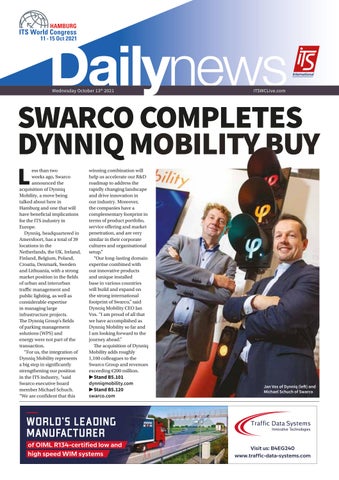
Less than two weeks ago, Swarco announced the acquisition of Dynniq Mobility, a move being talked about here in Hamburg and one that will have beneficial implications for the ITS industry in Europe.
Dynniq, headquartered in Amersfoort, has a total of 39 locations in the Netherlands, the UK, Ireland, Finland, Belgium, Poland, Croatia, Denmark, Sweden and Lithuania, with a strong market position in the fields of urban and interurban traffic management and public lighting, as well as considerable expertise in managing large infrastructure projects.
The Dynniq Group’s fields of parking management solutions (WPS) and energy were not part of the transaction.
“For us, the integration of Dynniq Mobility represents a big step in significantly strengthening our position in the ITS industry, “said Swarco executive board member Michael Schuch. “We are confident that this
winning combination will help us accelerate our R&D roadmap to address the rapidly changing landscape and drive innovation in our industry. Moreover, the companies have a complementary footprint in terms of product portfolio, service offering and market penetration, and are very similar in their corporate cultures and organisational setup.”
“Our long-lasting domain expertise combined with our innovative products and unique installed base in various countries will build and expand on the strong international footprint of Swarco,” said Dynniq Mobility CEO Jan Vos. “I am proud of all that we have accomplished as Dynniq Mobility so far and I am looking forward to the journey ahead.”
The acquisition of Dynniq Mobility adds roughly 1,100 colleagues to the Swarco Group and revenues exceeding €200 million.
▶Stand B5.101 dynniqmobility.com
▶Stand B5.120 swarco.com
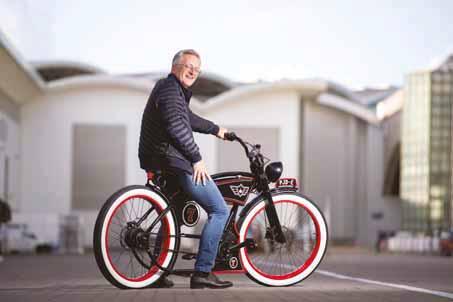
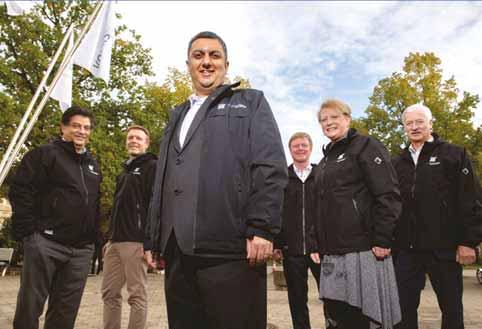
Jan Vos of Dynniq (left) and Michael Schuch of Swarco
Dailynews team
Publisher / MD
Andrew Barriball
Editor James Foster
Editorial team
Adam Hill
David Arminas
Sales director
Dan Emmerson
Design
Andy Taylder
Photography
James Robbins
Production manager
Nick Bond
IT & website director
James Howard
Website manager
Sarah Biswell
Social Media manager
Tatyana Mechkarova
Printed by Lehmann Offsetdruck
Contact us
The Daily News office can be contacted at media@ropl.com
The publishers would like to thank Ertico – ITS Europe for all its assistance in helping to produce the Daily News
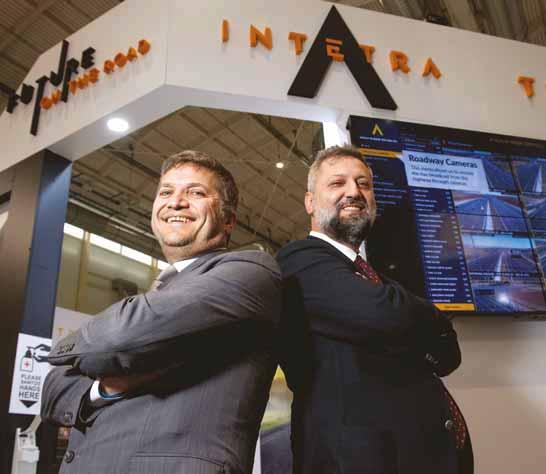
ntetra is one of the main movers behind Turkey’s first intelligent highway. The company’s in-house software is behind much of the hardware on the 335km route, which runs south-east from the capital, Ankara, to the city of Nigde and contains technology including 200 cameras, 65 variable message signs, nine weather stations and 40 traffic counting and classification sensors. “With our Internet of Things system, all the devices can communicate with each other,” says the company’s Emre Baykal.
“It is also designed for C-ITS connections in future,” adds Recep Bahar of Intetra. Intetra started in 2005 as an ITS company and added a tolling arm, Tetra HGS, in 2015. Specialising in multi-lane free-flow, it has 27 million registered users in Turkey, making it the country’s biggest electronic toll collection (ETC) firm, says Baykal: “As a toll collection company we can offer an end-to-end solution and also tailor it to specific needs.” The customer can use any camera or readers they want, as long as they meet specifications. The
ETC system can also be used to pay for parking. Intetra opened an office in the Danish capital, Copenhagen, a year-and-a-half ago. “It’s a hub for Smart City developments,” Baykal says. “It’s good to have a presence there, it’s a good place to enter the European market.” The company has close links with technical universities in Denmark and Sweden. It has 250 employees and offices in Ankara, Istanbul – as well as an R&D centre at Gebze Technical University near Istanbul.
▶Stand B5.431 intetra.com.tr
Horiba connected autonomous vehicle testing
In order to safely navigate a fully automated vehicle in traffic, sensors are needed but which require additional testing.
Horiba's CAV lab-based testing solutions allow for scenariobased testing procedures that may be adapted according to specific standards.
The future test cell, therefore, combines standard test procedures with connected
autonomous vehicle testing applications to achieve scenariobased testing. This allows sensor testing with or without physical connections, depending on the specific case, such as development, homologation and PTI – periodic technical inspection. This solution can be combined with Horiba’s comprehensive range of products and services to enable
reproducible real-time testing of vehicles equipped with ADAS systems. These include dynamic and responsive dynamometers, such as Vulcan chassis dynamometer, Titan Powertrain VSL wheel-hub dynamometer, standalone hardware-in-the-loop testing solutions and the secure Stars Automation and Enterprise lab management system.
Horiba’s CAV testing solutions
contribute to validation processes and help developing ADAS functions by closing the gap between simulation, hardware-in-the-loop and proving ground tests enabling automated scenario-based testing procedures for vehicles and sensors, ensure reliable results.
▶Stand B5.512
Horiba.com
Recep Bahar (left) and Kamil Alpaydin
Michael Leyendecker of Vitronic
SOLUTIONS FROM VITRONIC
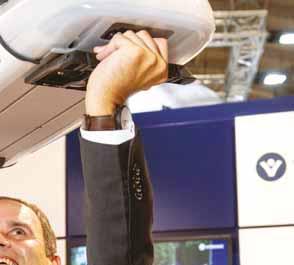
Vitronic is presenting visitors with versatile, flexible, and userfriendly traffic technology solutions. The company is addressing two of the most important questions of future mobility: the climate crisis and increased traffic volume in cities.
The company says it is tackling these challenges by developing innovative toll systems and participating in research projects that focus on protecting vulnerable road users (VRUs), along with other issues.
Visitors to the company’s stand will learn more about the
first mobile toll enforcement vehicles used in conjunction with the electronic toll collection (ETC) system of the National Revenue Administration in Poland. The vehicles detect, identify, and classify monitored vehicles automatically while in motion.
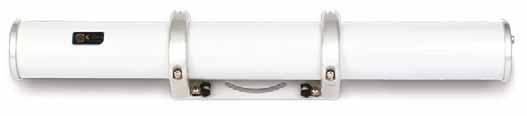
The heart of these patrol vehicles is the Enforcement Bar, a mobile, fully automatic number plate identification and classification system that enables automatic recognition of number plates (ANPR) as well as classification of different vehicle classes. Furthermore, the system’s technology makes
it possible to recognise number plates in four directions. It achieves a very high detection rate, even at high speeds, and allows enforcement officers to concentrate on identified suspect cases.
The system transmits the collected data to the ETC system, where they are checked in the database.
Vitronic will also show how sensor systems can be used to optimise traffic flow and protect VRUs at intersections. On the test track for automated and connected driving (TAVF), within close proximity to the exhibition centre, visitors can
Outokumpu will transport society to a sustainable future
Outokumpu is showing why stainless steel, best known for providing strength and corrosion resistance for railcars and road tankers, is a superb material for sustainable transportation. Outokumpu is showing how the company’s new high strength Forta H-Series offers possibilities to help car and bus designers create stronger and lighter structures that boost energy efficiency and increase crash safety. The weight of a bus could be cut by 1,000kg, note the company. Meanwhile, the heat protection properties
of the material are ideal for electric vehicle batteries and its non-magnetic nature helps build highly efficient electric motors.
Outokumpu also notes that stainless steel is set to play a vital role in the growing hydrogen economy, often seen as the fuel of the future. It will enable the mass production of the bipolar plates at the heart of fuel cell stacks, as well as vital elements such as the tank and piping that hold hydrogen fuel under pressure.
▶Stand B7.220 outokumpu.com
experience the technology live at a test installation. Together with the German Aerospace Centre (DLR) and T-Systems, Vitronic will test its systems at a dangerous location.
Another development on show, Vitronic’s IDTE solution (intelligent detection and tracking equipment), surveys an entire intersection area and provides recorded data from traffic objects for analysis purposes. The system warns road users of possible collisions in real time via a smartphone app.
▶Stand B5.230 vitronic.com
Community of EIT
Engaging urban communities as well as mobility institutions and AI companies to offer more mobility solutions is what EIT Urban Mobility is about. Supported by the European Institute of Innovation and Technology (EIT), EIT Urban Mobility accelerates positive change on mobility to make urban spaces more liveable. But solutions to complex problems call for an integrated approach and the sharing of ideas. Be a part of the solution by visiting the EIT Urban Mobility a the Congress.
▶Stand B4.EG170 eiturbanmobility.eu
We connect the dots of a new mobility revolution that will transform cities all over the world.
With the broadest end-to-end portfolio of intelligent traffic management solutions in the market, we enable cities, highway authorities,
and mobility operators to make road networks and fleets intelligent, enhance safety, and increase value sustainably over the lifecycle.
It’s time to make the world a better place. We are ready. Are you?
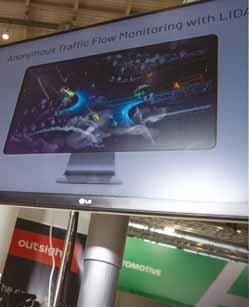
Outsight Lidar simplifies data process
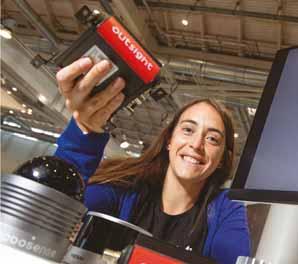
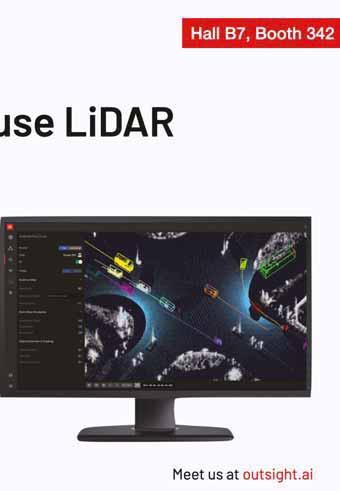
Outsight, the pioneer of 3D spatial intelligence solutions, announced today an ITS-specific version of its award-winning flagship product: the Augmented Lidar Box (ALB).
It’s the first real-time Lidar software engine that allows ITS and smart infrastructure application developers and integrators to seamlessly use Lidar data from any hardware supplier – thanks to a solution that comes in a shape of a small edge computing device.
Created as a turnkey solution, the ALB enables leveraging 3D spatial intelligence’s unique value while avoiding the complexity of processing 3D data in realtime from a myriad of sensor manufacturers. Among its features, it provides a hardware abstraction layer that delivers actionable insights in an open and standard data format regardless of the Lidar proprietary input stream, together with a set of commonly-required features such
as object detection and tracking, localisation and classification.
Because it only requires an ARM CPU and its AI doesn’t rely on machine learning, the solution is power-efficient and doesn’t need any training or annotation efforts.
Being a Lidar-agnostic solution, it saves ITS integrators the hassle of assessing and choosing the most appropriate Lidar for each use case. Lidar can now be easily used in vehicle counting and classification, pedestrian flow
monitoring, smart intersections and many other use cases.
Outsight will be showcasing the technology with live demos at its stand.
▶Stand B7.342 outsight.ai
Cindy Brugnon of Outsight
GEWI CYCLING INNOVATION
For many years, Gewi’s TIC software product has been used globally by road agencies and service providers to keep drivers informed and enable road operators to monitor, manage and maintain their networks.
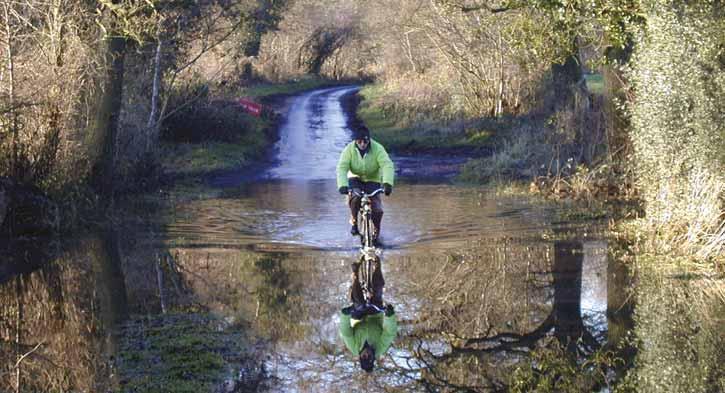
Now however, the company has developed the software to address other forms of mobility. Visitors to the Gewi Europe stand will see the latest innovation - TIC for Cycling.
The world is seeing a considerable shift in both travel demand and the way people get around, in part due to the pandemic.
For instance, cycling has seen massive growth with governments and transportation agencies investing heavily in creating a safer and greener transport network which supports cycling as a key means of transport. Dedicated cycle
ways and roads that support shared cycle space are seeing unprecedented growth.
As Gewi points out, just like the road network, cycle ways are open to problems and incidents, for instance closures, hazards, weather events, and will require
maintaining if they are to support and encourage more and more users.
TIC for Cycling captures information about problems affecting a route from a whole range of sources including crowd-sourced information,
sensors, weather data service providers, or disaster warning service providers.
The software enables transport agencies to manage cycleways and paths and gives them the ability to inform, in real-time, cyclists and other users about any issues which may have an impact on cycling, just as they can inform drivers using the road network.
Information is shared in TIC JSON format with navigation service providers. Moreover, a standard output of TIC for cycling data can be easily integrated into user apps and other systems.
TIC for Cycling can also be used by agencies to clear all problems caused by cycling incidents: operators will be supported by configurable stepby-step guidelines.
▶Stand B5.012 gewi.com
Hagen Geppert of Gewi
HERE’S 3D HD MAP IS ON TRACK
Here is helping to trial technology which will allow public transport authorities to make better use of their resources. The location data provider is involved in the Sensors4Rail project with German railway company Deutsche Bahn.
This gives trains precise information about exactly where they are on the track at any given time – allowing rail operators to schedule more trains without having to invest in extra infrastructure.
As the world’s cities bring in measures to decarbonise transport, such as banning cars from their centres, there are moves to attract more people to public transport.
“In cities there is no room to build more infrastructure but there is an increasing need for urban transportation,” says Michael Schöllhorn of Here. “Sensors localise the train’s position to the centimetre.
The goal is 35% more utilisation of existing tracks via a number of measures. This will be a big enablier for automated train operation as well.”
Here provides the 3D HD mapping which allows centimetre-accurate location of the train itself. Other partners in the project are Siemens Mobility, Bosch Engineering and Ibeo Automotive Systems.
Google monitors Hamburg air quality
Google is using an electric vehicle equipped with sensors to measure air quality in Hamburg to aid decisions on sustainable urban and transport planning.
Google says the sensors provided by Aclima record values for nitrogen dioxide, nitrous oxide, carbon dioxide, carbon monoxide, particulate matter and ozone. Once the data has been validated by Aclima, the results are passed on to the City Science Lab of the Hafencity University Hamburg, which can then recommend sustainable decisions on transport and urban development.
The Jaguar I-Pace vehicle will operate in central areas of the German city for a year. This project also includes input from a working group
from Hamburg. Google points out that clean air is critical to life but emphasises data from the World Health Organisation that shows more than 90% of the world’s population breathes polluted air.
For the past several years, Google has used several of its Street View vehicles with air pollution sensors to measure street by street air quality in cities. The company claims it has been working with partners around the world to make more than 500 million air measurements.
Google hopes cities will be able to use this information to make more informed decisions and accelerate efforts in sustainability.
▶Hall B3 google.com
Other projects on show in Hamburg include Here’s work with indoor spatial technology specialist NavVis and Swiss rail group SBB to help travellers find their way round unfamiliar transport hubs such as railway stations. Here’s mapping knowhow is added to NavVis’ digital twin of one of Zurich’s main train stations to create an app which guides users through their surroundings. Here’s Tamara Ciullo says: “We show you how to get from A to B, with suggestions for parking and bus and tram services.”
▶Stand B5.310 here.com
LOC.id-RTB
The LOC.id app is another user-friendly infrastructure-to-X application from RTB that can potentially save lives. The LOC.id app on a smartphone of a blind or visually impaired person "looks around" in the background to see if there are any applications relevant to this group of people and the current situation.
It either opens them or makes a recommendation to install them. However, this is only possible thanks to the support of mobility companies, from traffic signal systems and indoor navigation providers to public transport agencies, building sites and elevator manufacturers.
- Real-time tracking and data collection: dimensions, direction, distance, classification... - Intelligent traffic management through the 3D-LiDAR technology www.parifex.com l info@parifex.com
Your chance to win big with Valerann
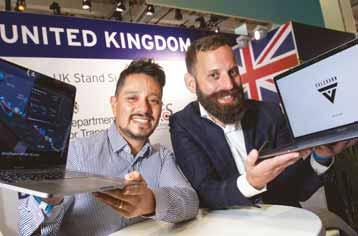
Valerann, an innovative cutting-edge ITS SaaS company that provides virtual traffic monitoring systems for road operators with a vision to enable all roads to enjoy the benefits of ITS. The company is using the ITS World Congress for the launch of Lanternn by Valerann. And two lucky organisations are going to win big in a launch competition, which closes on 1 November, 2021.
Valerann’s flagship offering, Lanternn by Valerann is a winner. This innovative solution helps complex operators extract more value from their data, while enabling lower funded road operators to access the many advantages of traffic monitoring and management
vehicles and integration with other in-use systems. Also included is free migration of live and historical data to the cloud. The winners will also have use of Valerann’s data fusion techniques providing the operator with the most insightful and timely information about their road to ensure they get up to 100% certainty of what is happening on their road.
For the launch of Lanternn by Valerann, the company is giving two lucky organisations
its full traffic monitoring and management control centre for free, as part of the launch competition. One winner will be a highly monitored road/road network with many data sources and the other will be a lower-budget road operator
with few sources of data. The winners will enjoy free setupintegration of their asset’s data sources to include open data sources, ITS infrastructure, navigation applications, radars, loops, connected vehicles data, data from patrol
The prizes will also include support throughout the process to make sure they are familiar with the system and the interface to make sure they are maximising the full potential of Lanternn by Valerann and a free licence to the system’s webbased software for 6-12 months.
Visitors can enter the competition at the company’s stand.
▶Stand B5.311 (ITS UK Pavilion) valerann.com
Eduardo Begazo (left) and Ariel Lev of Valerann
IRD UNVEILS NEW EUROPEAN SUBSIDIARY
IRD (International Road Dynamics) has used the ITS World Congress to unveil its new subsidiary, IRD Europe. The driver of its creation, says Rish Malhotra, president and CEO, is a desire to be at the heart of one of the world’s fastest developing ITS markets with a distinct identity which gives the group greater regional cohesion. Ultimately, it means better service for both existing and new customers.
IRD has delivered weigh-in-motion and other commercial vehicle-related safety and enforcement solutions to the European market for three decades. Recent changes, continues Malhotra, will reposition the group as the leading light in commercial vehicle enforcement.
At the same time, strategic acquisitions have extended IRD’s influence from strategic roads into urban environments.
Group companies in Europe now include Icoms Detections, whose microwave-based detection systems are used for traffic management, enforcement and vulnerable road user protection; Sensor Line, a specialist in fibre optic-based technology for tolling classification and cyclist detection; and VDS, developer and supplier of the only radarbased products currently certified by the PTB,
Germany’s national metrology institute, for direct enforcement of traffic violations.
A complementing acquisition in North America, of ETC Corporation, adds to IRD’s portfolio an electronic clearing-house capability which supports operations in tolling and adjacent ITS sectors.
“IRD Europe enables us to consolidate our regional position and opens the way to future acquisitions and expansion,” Malhotra concludes. “It supports our longer-term goal — to increase the safety and efficiency of all roads.”
▶Stand B4.EG150 irdinc.com
Rish Malhotra of IRD with the team
MONOTCH AND BE-MOBILE ANNOUNCE PARTNERSHIP
Late yesterday afternoon here at the ITS World Congress, Dutch and Flemish smart mobility specialists Monotch and BeMobile signed a partnership agreement for the realisation and upscaling of C-ITS services in the Netherlands, Flanders, France and the rest of Europe. Both parties underline the importance of a fully operational C-ITS ecosystem which provides many benefits such as improving traffic flows and road safety, prioritising road users and reducing emissions. By teaming up, Monotch and Be-Mobile are able to serve the entire mobility ecosystem and offer cities, road authorities and road users excellent opportunities to
deploy C-ITS services to their fullest potential.
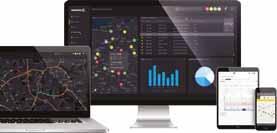
Both parties continue building on the successful cooperation and realisation of C-ITS use cases in the Netherlands and their joint tender submission for the Mobilidata programme in Flanders. The Be-Mobile C-ITS data and use case aggregation, the Flitsmeister traveller information and payments services, and the Monotch data aggregation platform (TLEX) will clearly reinforce each other. Road users will directly benefit from the combined marketready C-ITS solutions such as in-car signage and hazardous situation notifications. The partnership prepares the infrastructure for connected
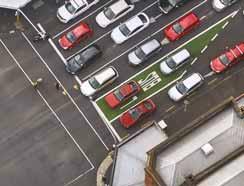
The misuse of the areas reserved for loading and unloading operations results in trucks and vans double parked, a negative impact on urban mobility. Urbiotica is showing its solution for the control of these parking spaces that allows service managers to be remotely alerted of possible infractions such as time exceeded or unauthorised parking.
and automated mobility and enables a large-scale roll-out of C-ITS services in Europe.
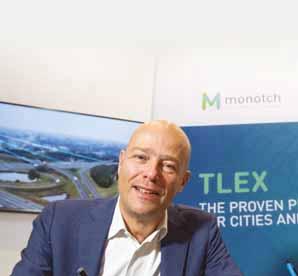
“Be-Mobile and Monotch not only share the vision of C-ITS, but also have the drive to provide high-quality and scalable services that directly benefit cities, road authorities and road users,” said Menno Malta, CEO of Monotch (left).
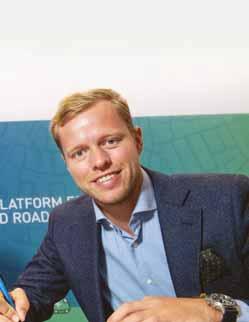
Jorn de Vries, CCO at Be-Mobile (right), adds that all parties will have a complementary role. “Together we can serve the entire value chain. This makes us the ideal partner for cities, road operators and other stakeholders to let C-ITS come to life everywhere in Europe.”
▶Stand B5.103 monotch.com
In with Ouster
Ouster invented its digital lidar in 2015 and today its systems and sensors are bringing high-resolution 3D imaging to countless industries and applications globally. The company is exhibiting a range of sensors and showing a live demonstration of its OS1-128 mid-range lidar sensor. At 128 vertical beams, Ouster says its lidar sensor offers the highest resolution available for superior object identification.
▶Stand B7.708 ouster.com
IT-Trans in Karlsruhe
Cybersecurity, 5G telecoms, on-demand and flexible transport as well as contactless ticketing – these are some of issues to be covered at the next IT-Trans 2022. Exhibition organiser IT-Trans is holding the event at the Karlsruhe Trade Fair Centre from 8 – 10 March next year. Learn more about the exhibition and conference programme at the IT-Trans stand.
▶Stand B7.007 it-trans.org/en
Instant System
▶Stand B7.365 urbiotica.com Reserved means
space. An alert is triggered if the user doesn’t check-in or if the time defined is exceeded. When the vehicle leaves or the infraction is dealt with by the guard, the alert is deactivated and saved. Urbiotica says the system is autonomous, reliable and robust. Additionally, it is easy and affordable thanks to the U-Spot M2M sensors, with no need of a Gateway.
The latest mobile application from French company Instant System offers intermodal and multimodal real-time and predictive journey planning and passenger information. It also provides real-time guidance, ticketing for public transport and booking and payment for alternative mobility services, including bike sharing, e-scooter sharing, car sharing, ride hailing and carpooling. More than 70 local authorities and public transport operators are already using the system, according Instant System.
The system uses U-Spot M2M sensors and a parking app through which users check into the
▶Stand B5.508 instant-system.com
The Better Way. Every Day.
Traffic and transportation issues are on our minds every day. We all want smoother and safer traffic flows, quicker travel, and less congestion and emissions. Whenever and wherever this is not the case, we see our quality of life at risk. That is why SWARCO focuses on improving the travel experience.
Whether you walk, drive your electric car, or ride on a bus or a bicycle: The coordination of different transport modes is crucial for a smooth, environmentally sound journey and a timely arrival. SWARCO road marking systems and traffic management solutions make this happen. With clear guidance and orientation, up-to-date, real-time information, and the broadened view on the entire mobility ecosystem.
Let’s talk how we can improve your travel experience.
ESRI DOES THE HAMBURG WALK
Every school child in Hamburg should have access to public transport within a five-minute walk from their school. That is the goal of city planners and Esri’s ArcGIS software has helped officials understand what infrastructure needs to be in place to reach that goal.
“From the transport policy point of view, this is very important to know,” said Sidonia Ilie, account executive with Esri.
“From a mother’s point of view, this equally important.”
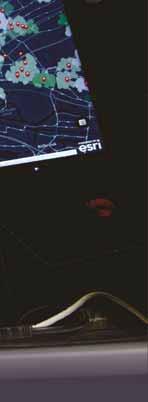
By using data from Hamburg city’s open data portal, called Tranzparenportal, ArcGIS was able to pull out data to indicate visually on a map where schools are situated and where public transportation access is located – bus, rail and underground.
Armed with this information, the city knows where to move bus stops or even to build new rail lines. Transportation officials will know where to paint crosswalks, install road barriers, create no-car lanes or install street cameras for safety.
The map was created for the city to demonstrate the power of Esri’s ArcGIS software, which can be used for comparative analysis projects of any type, explained Ilie. It allows a city to understand how far they have to go to reach a goal.
“Such tools can also be useful for keeping local governments and transportation agencies accountable to the public,” she said.
▶Stand B7.530 esri.com
Sidonia Ilie of Esri
Intercomp weighs in at Hamburg
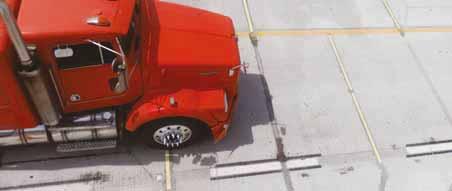
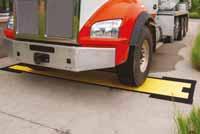
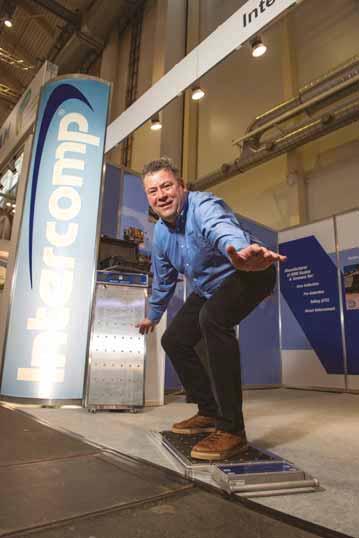
The hiatus of in-person events has not slowed down product development and certification of scales and sensors for US-based Intercomp. The manufacturer's of fixed and portable scales and sensors incorporate strain gauge technology, which enables accurate, stable, and reliable measurements via wheel and axle weighing applications. These scales and sensors for static and Weigh in Motion (WIM) applications are on display in Hamburg.
For WIM applications using installed scales, Intercomp’s inground strain gauge strip sensors for low- and high-speed WIM (HS-WIM), and the LS-WIM axle scale each maintain OIML R134 WIM certifications. These fixed WIM scales and sensors give product options delivering stable and accurate readings at speeds ranging
from 3mph (5kmh) to 80 mph (130kmh.)
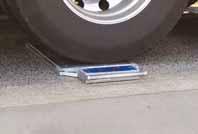
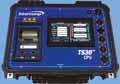
A selection of low-profile portable scales is on display here in Hamburg, with wireless LS788-WIM portable scales for static and WIM use, and the LP788 low-profile portable scales with both OIML R76 and NTEP certifications. The latest portable scale indicator, the TS30 CPU with intuitive touchscreen interface, is available for attendees to experience.
Bringing new capabilities to wheel load scales, Intercomp introduces the LTR788 dual-platform scale, which allows for weighing each tyre individually in dual tyre configurations. This enables service inspections of individual tyre ratings and tyre anomalies to be detected with a low-profile portable digital scale. Stand B5.010 intercompcompany.com
André Schier of Intercomp
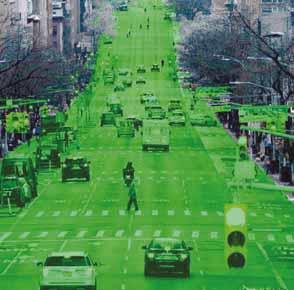
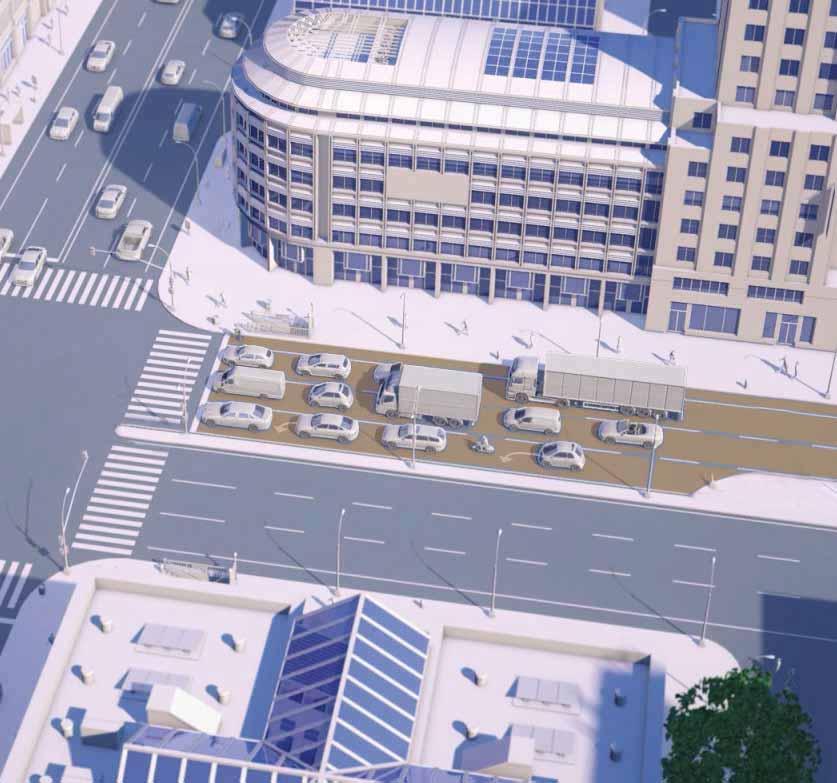
TURNING MOVEMENT COUNTS
VRU PROTECTION
PEDESTRIAN DETECTION
BICYCLE DETECTION
LANE-SPECIFICSTOPBARDETECTION
DILEMMA ZONE PROTECTION
QUEUE LENGTH ESTIMATION
LANE-SPECIFICADVANCEDETECTION
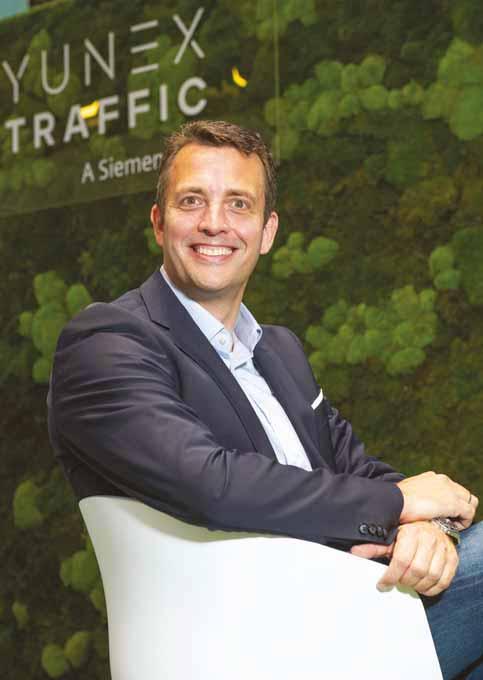
Yunex Traffic: time to act
Formerly Siemens ITS, Yunex Traffic is at a major event in its own right for the first time; CEO Markus Schlitt outlines why its vital that the company’s message is heard as soon as possible
If there is one message that Markus Schlitt, CEO of Yunex Traffic, wants to put across at ITS World Congress in Hamburg, it’s this: we need to act now. He is not talking about traffic (although traffic management technology is the Siemens Mobility company’s speciality) – he is talking about climate change.
The meeting in Hamburg is Yunex Traffic’s first large event as a separate entity; it was formerly Siemens ITS. “When we started this new company, we said we are combining 100 years of experience with the agility of a start-up,“ Schlitt says. “We want to show the industry that we are a new company, with a fresh image, a fresh logo with a fresh brand, and lots of innovations in our backpack.“
In Hamburg, Yunex Traffic will be highlighting products for tunnel and highway management, digital tolling and Clean Air Zones, as well as right-of-way solutions for fleets and bicycles.
But Schlitt emphasises that it will also be showcasing the company’s philosophy, with a portfolio streamlined around three purposes: climate action, safety and increased quality of life.
“My personal focus is clearly on safety as always - but it’s also a lot on climate action,“ he explains. “I have a little daughter, she's six years old: 18% of CO2 emissions come from road traffic and we need to do something. And this is really something that touches my heart; we want to give back to society and work on solutions which help cities to decrease their carbon footprint to being CO2-neutral. That is the ultimate goal.“
Digitalisation is going to be the key to achieving this, Schlitt believes. Yunex Traffic is targeting cities and highway authorities with its products and services. “These are our core customers since they are the network owners,“ he says.
He believes they have a mass of information that will enable them to engage in their mobility network and start facilitating change. The question is: how to exchange data and use it.
“We always need to create win-win situations,“ Schlitt continues. Allowing cities to better manage their traffic ecosystems will not only create more efficient traffic flow; it will also help authorities to make different modal options such as bikes, e-scooters and walking more attractive to residents. Both of these will help to reduce emissions.
“If we keep on with our mobility behaviour that 1.3 people on average are sitting in one car, we will not be able to solve the problem,” Schlitt says. Giving more space and priority to bike lanes and pedestrians can be done, as cities such as Paris have shown.
“Cloud computing is here, we all have smartphones so the technical possibilities are already there - we just have to apply that
"We want to give back to society and work on solutions which help cities to decrease their carbon footprint to being CO2-neutral"
to our industry, we just need to make use of it,“ Schlitt concludes.
“That would be our message at the World Congress: as a society we have tremendous challenges ahead of us and we need to start now to think differently. Let's do it now - it's all there. We have this attitude and the mindset and the motivation to really make a change - now, not in 10 years‘ time, we want to do it now.“
Today’s Congress programme is packed full of content across all aspects of ITS and mobility. To help you plan your day and avoid missing any sessions that might be of interest to you, here is a selection of some sessions that will be taking place today
PLENARY SESSION
Integrating mobility for travellers and goods is critical to ensuring that the transport in a region, city and locality is efficient and effective. Logistics services in particular constantly strive to lessen interruptions and maximise create efficiency.
Today’s Plenary, Delivering safe, efficient and integrated solutions (9:00 – 10:30 CCH - Hall Z) will look at what is being done globally to integrate mobility services to bring about efficiency and effectiveness gains and ask some questions about the ways forward.
Regional Forum
One of Europe’s highest priorities is addressing the implications of climate change. The European Green Deal is an ambitious package of policy measures to enable citizens and businesses to benefit from a sustainable green transition to Europe’s becoming the world’s first climate-neutral continent by 2050. Regional Forum 3: Green lights for Green Deals (11:00 – 12:30 CCH - Room X9) will share knowledge to provide users with more affordable, accessible, healthier and cleaner mobility options.
ITS ecosystems are the dominant solution to networks’ saturation as they provide several benefits. They contribute to congestion reduction, limitation of emissions and air pollution, avoidance of unexpected incidents on the road and to transportation efficiency. However, deploying interconnected Intelligent Transport Systems creates several challenges, mainly in terms of safety and cybersecurity. Therefore, a key-point to unlock the enormous potential the ITS ecosystem can offer towards more efficient transportation lies in the extent to which it remains cyber-secure. During special interest session Cybersecurity challenges and implications in ITS (14:00 – 15:30 Messe B6 - Room 12), the current situation will be presented and discussed, focusing on challenges and issues that need to be studied to address the growing needs of the ICT infrastructure.
As the cost of edge computing drops and the capability of machine learning algorithms improves, a new generation of traffic sensors are being developed. Using AI to improve traffic detection (14:00 – 15:30 Messe B6Room 2), will focus on the capabilities that are available as well as the technical challenges to cost effectively implement highly reliable systems.
Special interest session MaaS in Developing Countries (14:00 – 15:30 Messe B6 - Room 5) focuses on whether Mobility-as-a-Service (MaaS) can address transport problems in developing countries. Attendees will learn about findings from state-of-the-art research and real-world applications. The Trufi Association, which offers an open-source, white-label MaaS solution that makes semiformal transport transparent for governments and the public, will present. Based on the cases of Duitama (Colombia), Cochabamba (Bolivia), and Nouakchott (Mauretania), the session will discuss how open-data and local community engagement can propel MaaS initiatives.
5G Workshop: Connecting to Future Mobility
The Connecting to Future Mobility workshop (14:00 – 17:30 CCH - Room X9) is organised to link future mobility and current connectivity solutions. The workshop uses a two-step approach with presentations and interaction with the audience through a panel discussion and online surveying. The first step lays the foundation of what Future Mobility means. The second step investigates how communication technology enables the connection between available solutions and Future Mobility. Three main projects of programs are examined, and their potential contribution to the KPIs assessed. The presentations describe the use-cases, the 5G aspects that enable the use-cases, and what is needed to ensure they can contribute to Future Mobility. Presentations, panel minutes, and survey results will be made available afterward.
Secondly, the panel will present preliminary results from the EU-funded Solutionsplus project that encompasses city level demonstrations to test different types of innovative and integrated e-mobility solutions. Insights from the project highlight how MaaS can contribute to low-carbon urban mobility and improving last-mile connectivity. Finally, the panel will present insights from the MaaS Ecosystem Metro de Medellín and research findings from Manila (Philippines) where user demand and possible accessibility-gains have been investigated.
3D Mobility Management (16:00 – 17:00 Messe B6 - Room 9) will sketch an exciting picture of our future urban and suburban mobility. The main goal of this session is to support cities and regulators in preparing their responses and actions regarding emerging, prominent services enabled by urban air mobility (drones). The key question to be tackled by the panel is on the actual usage of drones: from the maturity of the drone and complementary technologies in terms of safety and security to operational topics such as integration to the mobility fabric, for instance MaaS, and to more social perspectives dealing with the questions of for whom? for what? for how much? The session will explore answers to these questions and discuss the potential of drones to contribute toward integrating the needs of local communities and urban areas for last mile transport for goods and people, fast medical response and care as well as traffic management.
Freight and ports global forum
Freight and Ports Global Forum: From the factory to your front door (14:00 - 17:00 CCH - Room X2) is a two-part global forum that will look at the critical role ITS plays in the process of goods manufacturing all the way to final doorstep delivery. First, the workshop will discuss port initiatives leading to environmental improvements (electrification for ships and trucks, water conservation and treatment, port automation, reservation systems, truck parking facilities), and describe relationships/ partnerships with local transportation agencies to utilise ITS to advance safety and minimise traffic disruptions and improve regional air quality.
Second, this workshop will describe the important role ITS plays in the logistical operations necessary to transport materials from the assembly line to the distribution centre to the local delivery operation to the final customer using the Just-In-Time delivery service that customers demand, expect, rely upon, and enjoy.
Attendees will understand the negative or positive impact to their local economy that relies heavily on the ITS professional’s ignorance or understanding of his/her role in considering the needs of freight movement just as much as people movement.
VITRONIC delivers high quality road traffic systems which secure an efficient and streamlined charging and enforcement business.
Visit us at booth B5.230
New perspectives
This ITS World Congress has organised a diverse Technical Tour programme that will give participants knowledge and new perspectives on Hamburg’s best-inclass intelligent transport systems. Not only that, the programme also includes visits to facilities around Germany. Here, we list the tours available just in Hamburg, but hurry! Seats are limited. Check out the app for more information and for tours outside of Hamburg.
Alsterdorf electric bus depot
Hamburger Hochbahn
In Germany’s most state-of-the-art bus depot, buses stand underneath six canopies and are connected to the electricity and compressed air supply when they are not out on service. This is where Hochbahn’s growing electric bus fleet will in future be “refuelled” overnight with 100% certified green energy. Hochbahn’s first proprietary transformer station takes care of that, converting 110 kV voltage into the 20 kV needed.
MOIA Hub Wandsbek
MOIA is a ridesharing service of Volkswagen where users share their trip with others travelling in the same direction. Combining trips like this helps protect the environment, ease traffic congestion, and reduce costs.
Wunder Mobility
WunderCar Mobility Solutions
Take a behind-the-scenes look at Wunder Mobility. Learn and understand how new mobility solutions like electric car-, scooter-, bike-, or moped sharing can be launched and scaled.
TSB Cargo Demonstrator
Cargo Maglev Demonstrator
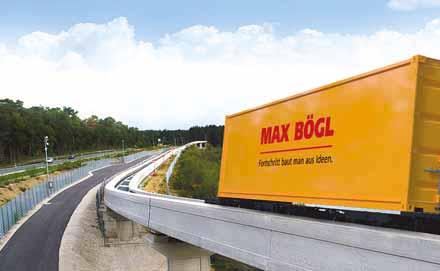
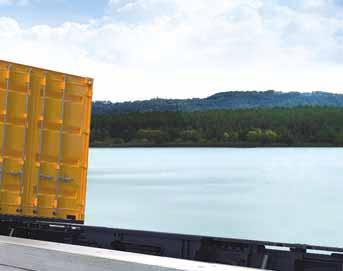
Visit the first physical demonstration facility of the new TSB Cargo technology developed by Max Bögl Group. It is a maglev system for the individual, efficient and CO2 neutral transport of standard ISO container units
on a separate guideway. On the TSB Cargo demonstration facility we present you the core components of this transport system including guideway, vehicle, switch, loading facilities as well as the operational control system.
Hamburg’s Data Heart
Agency for Geoinformation and Surveying (LGV)
Come on an exclusive trip into the heart of Hamburg’s data. Get to know how the Urban Data Platform Hamburg (UDP) works and why many ITS-projects rely on it. In addition to the UDP, this visit offers insight in three use-case categories: Data moves (Traffic infrastructure data); Data shows (Connected Urban Twin); and Data flows (Real-time data). The selected use-cases will provide an understanding of the opportunities data accessibility provides.
The Realiser for ITS Road
Infrastructure
Hamburg
Hamburg Verkehrsanlagen
Hamburg Verkehrsanlagen is offering visitors a technical visit round ITS traffic infrastructure facilities. This will give an in-depth, behind-the-scenes look at the technical background of different ITS lighthouse projects in Hamburg. Visitors can get detailed answers to questions on a range of topics stemming from the elements presented, or on the Digitising Urban Traffic demo tour and the associated ITS projects such as aVME, HaRaZäN, BiDiMoVe, TAVF-HH/V2X, and SmaLa. Also included is a visit to the technical monitoring centre for the ITS systems and the test laboratory of HHVA.
AI inspection-drone for visual aircraft inspections
Helmut-Schmidt-University / University of the Federal Armed Forces
The automated inspection of surface defects on an aircraft by using UAS solutions will be demonstrated in the hangar of
Lufthansa Technik Hamburg. All necessary steps with flight preparation, automated inspection execution and AI-supported data evaluation will be presented. The tour will be supplemented by a project presentation and Q&A sessions.
Experience aviation innovations of tomorrow
ZAL Centre of Applied Aeronautical Research
Tour of one of the world’s leading civil aviation research centres. Learn about ZAL’s Open Innovation approach and Innovation Service, while gaining insights into the state-of-the-art infrastructure: Acoustics Lab, AI Aviation Lab, Fuel Cell Lab, Laser peening, Cabin and Cargo Testrig and many more. Current projects are presented in an exhibition, ranging from digital cabin concepts to fuel cell drone, or safety AGV.
Two nearby tours
Two tours, around 50km from Hamburg, are well worth considering: Hamburg University of Technology and the Autobahn Traffic Management Centre. At the university, participants will learn about a passenger shuttle and delivery robot operating together in a challenging urban environment. The whole system is now being evaluated under real world conditions. Many challenges of a technical and structural nature will be revealed. Participants on Die Autobahn des Bundes/Traffic Management Centre Germany tour will experience HATMS, the Hamburg motorway and tunnel management system and learn how its operators can control, monitor, and influence Hamburg’s traffic flow by using a single interface.