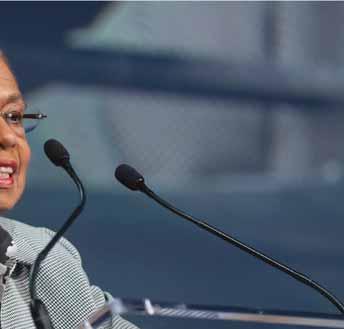



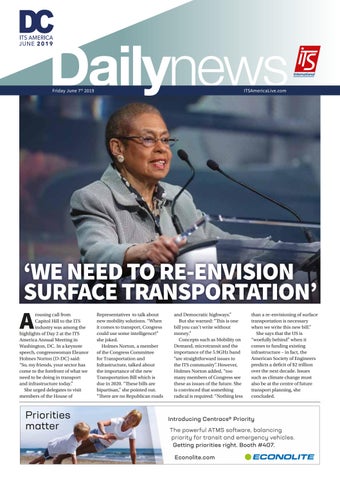
Arousing call from Capitol Hill to the ITS industry was among the highlights of Day 2 at the ITS America Annual Meeting in Washington, DC. In a keynote speech, congresswoman Eleanor Holmes Norton (D-DC) said: “So, my friends, your sector has come to the forefront of what we need to be doing in transport and infrastructure today.”
She urged delegates to visit members of the House of
Representatives to talk about new mobility solutions. “When it comes to transport, Congress could use some intelligence!” she joked.
Holmes Norton, a member of the Congress Committee for Transportation and Infrastructure, talked about the importance of the new Transportation Bill which is due in 2020. “These bills are bipartisan,” she pointed out.
“There are no Republican roads
and Democratic highways.”
But she warned: “This is one bill you can’t write without money.”
Concepts such as Mobility on Demand, microtransit and the importance of the 5.9GHz band “are straightforward issues to the ITS community” . However, Holmes Norton added, “too many members of Congress see these as issues of the future. She is convinced that something radical is required: “Nothing less
than a re-envisioning of surface transportation is necessary when we write this new bill.”
She says that the US is “woefully behind” when it comes to funding existing infrastructure – in fact, the American Society of Engineers predicts a deficit of $2 trillion over the next decade. Issues such as climate change must also be at the centre of future transport planning, she concluded.

The powerful ATMS software, balancing priority for transit and emergency vehicles. Getting priorities right. Booth #407.

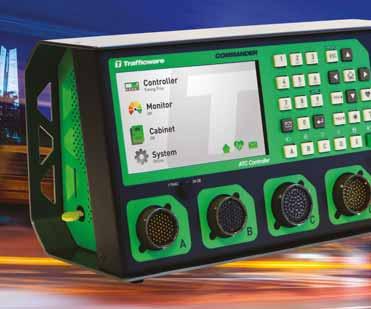
Forged from a rich history of legendary technology, CUBIC | Trafficware takes command of the future - today. Test drive the most advanced ATC controller, COMMANDER™!




• Designed with the ruggedness and power to meet the latest Version 6 ATC standards.
• Incorporates advanced hardware and web-based software technology platforms.
• TWO ATC-class processors to meet the needs of future Connected Vehicle Applications.
• Large, bright color touch display optimized for day or night use.
• Tactile keyboard & generously spaced keys designed with the classic user in mind.
• Enhanced graphical user interface providing an intuitive experience that is second to none.
• 32 phases, 128 detector inputs, peer-to-peer messaging, TSP, SynchroGreen Adaptive & Connected Vehicle ready.
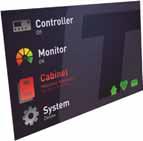

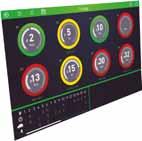

At the core is Trafficware’s controller firmware, used in tens of thousands of intersections. COMMANDER’s software is used in more Connected Vehicle, Adaptive Systems and Advanced IoT Transportation applications than any other controller.
Publisher / MD
Andrew Barriball
Editor James Foster
Editorial team
Adam Hill
David Arminas
Andrew Bardin Williams
Sales director
Dan Emmerson
Design Andy Taylder
Photography James Robbins
Production manager
Nick Bond
IT & website director
James Howard
Website
Sarah Biswell
Tatyana Mechkarova
Printed by MPM Communications LLC
Contact us
The Daily News office can be contacted at media@ropl.com
Published by
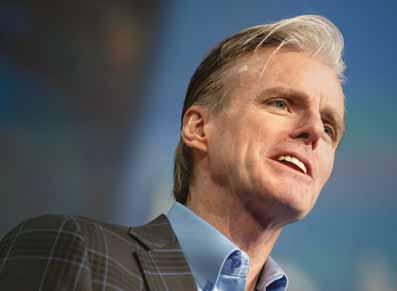
Paul Misener, Amazon vice president for global innovation and policy, urged delegates to embrace failure as a necessary step to coming up with new ideas and services – and to get on with it. “Do not wait until it’s too late and you must innovate,” he insisted in his keynote speech at the Annual Meeting.

T©Route One Publishing Ltd 2019 Waterbridge Court, 50 Spital Street, Dartford, Kent, DA1 2DT, United Kingdom Tel: +44 1322 612055 www.ropl.com

The publishers would like to thank ITS America for all its assistance in helping to produce the Daily News
he city of San Jose is analysing its emergency vehicle response routes after successful implementation of a centralised emergency vehicle pre-emption (CEVP) system from Transcore.
The system was fully implemented in October and since then the city has been archiving data on response times, explained Ryan Saville, associate vice president of Transcore. The beauty of the centralised system from Transcore is that it is an add-on to traffic management systems
and services which the company has been providing to San Jose since the early 1990s.
This has meant the city didn’t need extra physical equipment at intersections. Traditional equipment pre-empts the vehicle but it is done on an intersection-by-intersection basis. Before implementation of the CEVP passing through an intersection added between 7 seconds and 22 seconds to passage times.
After the centralised system was set up, passing through a CEVP intersection added only 1
second to 8 seconds.
Overall, the CEVP system appeared to save on average 5 seconds to 7 seconds in travel time per intersection passed through. With the average emergency vehicle trip passing through four intersections, a average of 20 seconds to 28 seconds has been saved per trip.
The city and Transcore note that based on prior research, 24 seconds saved can lead to a 1% to 2% reduction in the mortality rate for heart attack victims.
▶Booth 537
www.transcore.com
Alcatel-Lucent Enterprise (ALE) will launch a new provisioning tool this quarter that will help DOT technicians quickly provision ethernet switches in the field with minimal IP experience. Advanced ITS applications need advanced networking capabilities, but
networking expertise is in short supply. Alcatel-Lucent OmniVista Assistant will allow a technician to download switch configuration onto a mobile device such as a tablet or smart phone, plug it into the cabinet and automatically update a switch.
“We want to make it as easy as possible,” said Sara Brunswick, marketing director, ALE.
BCD Video, a systems integrator for government agencies and casinos, currently uses the app to deploy, update and maintain IP-enabled cameras. ALE will work with
state DOTs and municipal transportation agencies to adapt the technology for ITS applications.
Available first as an Android app, OmniVista Assistant will soon be available on iOS.
▶Booth 449
www.al-enterprise.com

The Teledyne Lumenera Ls245R camera is an embedded traffic imaging solution with integrated self-triggering VDET and ALPR.
Ls245R Traffic Camera Features:
» Sony Pregius® IMX392 sensor
» Xilinx® Zynq® Ultrascale+™ MPSoC
» Gigabit Ethernet Interface
» Natural and NIR-LED Lighting
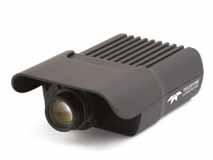
» Applications: AET, HOT/HOV, ETL, Congestion Tolling, Avg. Speed Enforcement







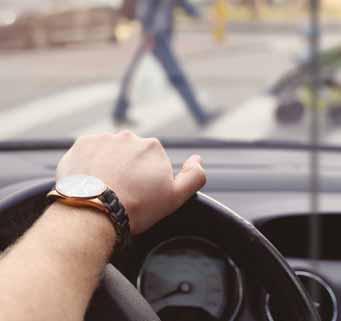

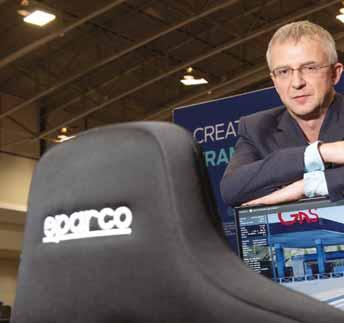
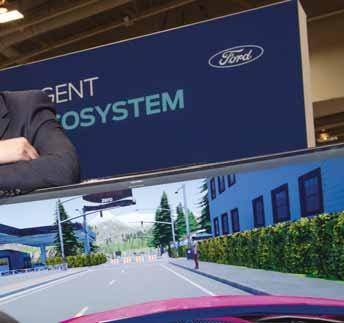
Ford Motor Company is demonstrating two solutions that are designed to make the streets safer for vulnerable road users (VRUs), whether they are on foot or using new micromobility modes such as e-scooters.
Ford has committed to deploying cellular Vehicle to Everything (C-V2X) technology in all new US vehicle models from 2022. At the Annual Meeting it is showing off
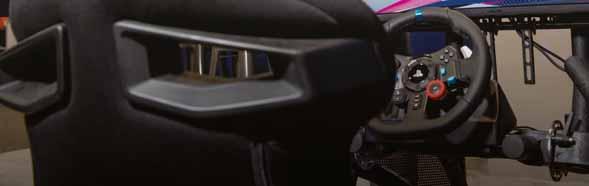
‘bridge’ technology that enables communication before that happens. “The simulator was developed to help explain the user experience,” says Erik Kiledal (pictured), connected vehicle technology engineer, connected vehicle – platform and products at Ford. “We can simulate different scenarios.”
One product allows pedestrians to ‘talk’ to a vehicle via a phone app – in effect ‘asking’ traffic whether it is safe
Kimley-Horn is demonstrating its Kadence software that optimizes traffic signal timing to balance performance with safety and efficiency. As traffic patterns fluctuate and land use changes over time, Kadence is able to adapt to these demands. Kadence users have access to productivity tools such as second-by-second historical data of signal status, real-time and historical time-space diagrams, congestion management algorithms, data analysis and archiving, centre-to-centre operation, performance management, text and email alerts, built-in and configurable reports and artificial intelligence features including a Google Assistant interface.
▶Both 560
www.Kimley-Horn.com
to cross. C-V2X-enabled vehicles pick up the app request and slow to allow the pedestrian across the road.
The technology can also be used for scooter riders – a relatively new phenomenon that authorities in US cities are currently wrestling with. Using Ford’s technology, scooters can communicate with vehicles via Bluetooth to alert them of their presence in the vicinity.
“Scooters are presenting a bit
of a challenge for safety,” says Kiledal. “Our main topic is safety for VRUs. Anything we can do to improve VRU safety is something we support.”
Ford has been carrying out a number of tests using the technology and there are some limited, geofenced C-V2X deployments in the US at present from other car manufacturers as well.
▶Booth 543
www.ford.com
Southwest Research Institute has released ActiveVision, a machine vision tool that transportation agencies can use to detect and report changes in traffic conditions. ActiveVision’s algorithms use machine learning with cameras to provide real-time data on weather conditions and other anomalies affecting congestion. No human monitoring is required for the subscription-based solution that Southwest says improves safety for rural highways, urban intersections and pedestrian walkways.
Designed for integration with
intelligent transportation systems, ActiveVision can be configured with existing traffic cameras to analyse roadway conditions. The software continually observes traffic camera feeds from existing camera infrastructure and generates traffic condition alerts.
Software upgrades come at no added cost, according to Southwest. Third party applications include cell phone text alerts, 511 ATIS systems, e-mails, ATMS systems and open API.
▶Booth 431
www.activevision.swri.org



To help you plan your day, here is an overview of some key topics from today’s full conference schedule. Check out the programme for further information and speakers and panellists
The 33 Smart Mobility Corridor is blazing a new trail on the road to becoming a connected corridor along a 35-mile section of US 33 between the city of Dublin and city of Marysville, near Columbus, Ohio. The corridor connects two nodes of automotive research: the Transportation Research Centre (TRC) and Smart Columbus, and includes multiple public and private partners. The US 33 corridor will offer a unique opportunity to deploy and test smart vehicle technology in various settings, including urban, suburban, and rural and roadway types, as well as local, arterial, and collector streets and multilane, divided highway ramps. The project includes the installation of 62 dedicated short-range communication (DSRC) devices along US 33 with another 32 installed at traffic signals within the cities of Marysville and Dublin, equipping between 600 and 1,200 vehicles with connected vehicle technology; developing V2I applications; and developing a connected vehicle environment to manage the data flow and system.

Special session US 33 - the Road to a Connected Corridor (8:00 - 9:15, room 204A) will provide an overview of the overall project, with a special focus on the lessons learned so far during the implementation. Attendees will hear from the project manager and local officials about how the project is proceeding, what has been a challenge so far, and how those challenges are being overcome.




In 2016, Audi launched the Traffic Light Information (TLI) service, an industry first vehicle-to-infrastructure (V2I) service available to customers. Since its original deployment in Las Vegas, the nationwide service has expanded into 13 metropolitan areas across the US. TTS, the V2I service provider, is currently expanding deployment across the US and Canada and onboarding more than 100 agencies. The roadmap for deploying and supporting a nationwide V2I service requires coordination across multiple agencies, both private and public, and several disparate systems.


What can the public sector do to encourage shared ridership?

Future of Traffic Planning and Prediction (8:00 - 9:15, room 209BC) will explore how to simulate traffic prediction and look at cities that have already moved forward with implementing traffic simulations into their control rooms.
This session will discuss how cities can better predict and plan for traffic, including assessment and optimisation of transit signal priority (TSP) and bus rapid transit (BRT) schemes; feasibility studies for high occupancy vehicle (HOV) and high occupancy toll (HOT) lanes; impact analysis of infrastructure design, such as highway corridor improvement/ construction; environmental impact analysis; toll and road pricing; evaluation of travel demand management (TDM) strategies; signal control plan optimisation and adaptive control evaluation; safety analysis; evaluation of variable speed policies and other ITS; highway capacity manual (HCM) analysis; and work zone management.
This session will also focus on some regions who are looking at virtual control centres and future simulation that leads to better investment in technologies around adaptive control and congestion pricing, among other topics. Through real-world scenarios, attendees will learn from cities about how they are using these capabilities to ensure that their cities are safer, more sustainable and better places to live, work and play.
Provisions for interoperable wireless connectivity between intelligent transportation infrastructure systems and opt-in automated vehicles are expected to offer significant system efficiency benefits. Special session Interoperable Integration of Automation into the Highway Transportation System (8:00 - 9:30, room 207B) will provide a brief overview of the topic. It will be followed by an open discussion on how best to identify an initial set of candidate interfaces for standardisation, and reach a broad consensus on these interfaces’ preferred characteristics. Results will support ongoing updates to the US Department of Transportation’s ITS architecture reference and toolsets to more fully support automation. Participants will represent the perspective of infrastructure owner/operators, automation implementers/OEMs, standards, and ITS architecture.
Much has changed, especially in the past decade, with regards to how we manage and operate our surface transportation. Some infrastructure owners and operators’ (IOOs), however, have excelled at adapting to this new need to hire uniquely skilled personnel for their transportation systems management and operation (TSMO) needs: the National Operations Centre of Excellence (NOCoE), even had a two-day workshop on this subject. During special session Workforce- Adapting to the Changing Needs (10:15 - 11:30, room 204A), attendees will hear from industry leaders on the challenges they have faced, the course of action they have taken, and how they plan to address workforce adaptation in the future.
Cellular V2X (C-V2X) is a lightning rod topic, as it holds significant promise, and for many, that promise comes with questions. This special session The Case for Cellular V2X (10:15 - 11:30, room 204C) is aimed at answering questions on performance, deployment prospects, spectrum needs, co-existence with DSRC and the anticipated future with a focus on prospects in the US. C-V2X “now” will be covered, as well as C-V2X “in the future”, and the links between current deployment to vulnerable road user safety, and finally to the 5G future will also be covered. The aim is for the audience to gain a full understanding of technical and pragmatic aspects of C-V2X.

In special session Putting the ITS in MaaS (10:15 - 11:30, room 206), a number of the nation’s mobility leaders will discuss the challenges and lessons learned from their experiences using technology to address Mobility as a Service.
Delaware, New Jersey and Pennsylvania have worked together for years on regional mobility initiatives. Special session Keeping It Moving: Sharing Data Across State Lines (10:15 - 11:30, room 209A) will provide an overview of each state’s ITS systems, available transportation data and how they are managed and archived, and how transportation professionals are engaging information technology (IT) professionals to meet the challenges of cybersecurity as well as seamlessly integrate and connect with other partners. Speakers will discuss how they are readying their agencies for complex and unique emerging technologies, such as dynamic and predictive traffic management, connected/automated vehicles and infrastructure and machine learning. Finally, they will discuss how they are working together across state lines to improve operations by sharing data for better safety and mobility outcomes, and improving coordination during major events and incidents impacting the region.



Delaware, New Jersey and Pennsylvania have worked together for years on regional mobility initiatives














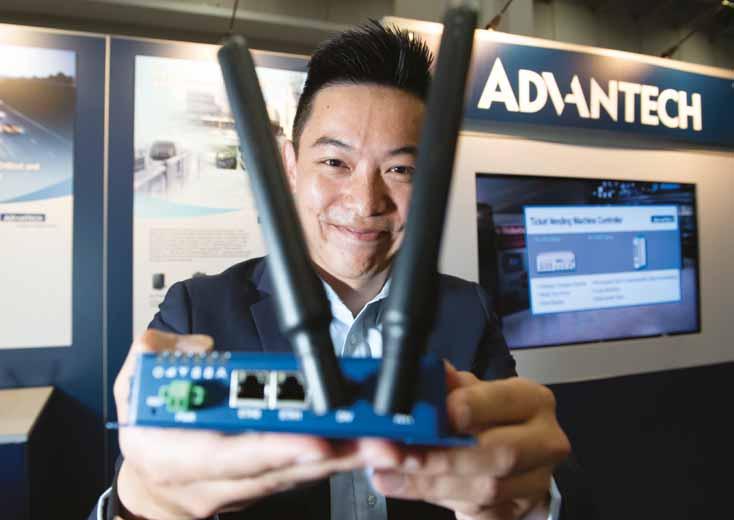
Advantech is showcasing what it says is the only FirstNet-enabled wireless router on display at ITS America Annual Meeting. Authorised by Congress in 2012, FirstNet is a nationwide broadband network dedicated to first responders— allowing them to communicate during critical events when other communications networks tend to fail.
The ICR-3200 LTE gateway connects IP or serial devices to a cellular network. With an upload speed of up to 50 Mbps and download speeds of up to 150 Mbps, the router provides ample bandwidth for high data demand applications such as CCTV.
According to Ken Kao, director of the transportation sector for Advantech, the California
Department of Transportation (CalTrans) has deployed 400 units state-wide with plans to deploy 1,000 more in the next several months. The Texas Department of Transportation (TexDOT) and the New York Department of Transportation (NYDOT) are in the process of rolling out the router for their FirstNet broadband networks.
The ICR-3200 is extremely
weather-resistant with no moving parts and no fans and is able to withstand temperatures from -40 to 75 degrees Celsius. It also has built-in redundancy and failover protection with two SIM card inputs—allowing the router to switch between carriers if one of them becomes unavailable.
▶Booth 655 www.advantech.com
Hill and Smith recently conducted a hard shoulder running (HSR) pilot on a stretch of Route 1 in New Jersey, finding that opening up the shoulder for traffic during peak periods shortened average travel time by half while reducing traffic accidents.
The pilot was conducted over a two-mile stretch in South Brunswick Township in central New Jersey over two weeks.
After making road improvements that included repaving and restriping, the New Jersey DOT opened the shoulder to traffic
during the morning and afternoon commutes and collected traffic count data with a series of remote traffic microwave sensors. The data was then compared to historical traffic counts from the same dates in 2013, 2014 and 2015 that were collected using similar methods.
The pilot found that opening up the shoulder to traffic during peak hours would save 518 vehicle hours per day and 129,500 vehicle hours per year—resulting in $2.4 million user cost savings. At the same time,
it would reduce carbon emissions by 19,015 kg, gasoline by 19,417 gallons and diesel by 4,280 gallons.
As a result of the reduction in rear-end crashes, yearly crash costs would go down by more than $200,000.
Given the $5.26 million price tag to make improvements and maintain the road over 20 years, the project would result in an estimated net savings of $15.3 million.
▶Booth 446
www.hillandsmith.com

Shailen Bhatt, president and CEO of ITS America, gives a sneak peek at the ITS World Congress 2020





Every three years, ITS America welcomes colleagues from around the world to North America for the World Congress. Next year, we are thrilled to host the 27th ITS World Congress in Los Angeles, from 4 – 8 October.
Throughout the event, we will explore “The New Age of Mobility.” The recent explosion of new technologies and new forms of mobility are transforming the future of transportation. At a time in which we are focused on moving people, data and freight, how will we prepare for a future that is increasingly more connected, autonomous, shared and electric? The technologies that make our roads safer will also reduce congestion and greenhouse gas emissions and move us closer to a future of seamless mobility, one that is safer, greener and smarter.
Just before the 2019 ITS America Annual Meeting in Washington, DC ITS America leadership travelled to Los Angeles for several days of planning with our counterparts from Asia and Europe. Without giving too much away, here is a brief sneak peek at what’s behind the curtain.
A highlight of any ITS World Congress is the exhibit floor. We anticipate more than 300 innovative companies will join us in the LA Convention Centre to exhibit groundbreaking transportation technologies. We

are also creating a “Pathways to Seamless Mobility Pavilion,” which will showcase select global cities leading the way on the integration of Mobility on Demand (MOD) and Mobility as a Service (MaaS) solutions. Advancing and promoting start-up efforts in mobility, we will stage a global innovation competition in which six semi-finalists will compete and showcase their solutions for a safer, greener smarter future. And to encourage young people to pursue careers in the field, we will launch an emerging leaders’ programme to advance the future leaders of ITS. The programme will target students from around the world. Stay tuned for more details in the weeks and months ahead.
Just this week, in conjunction with the annual meeting, ITS America is launching the call for papers for the 2020 World Congress. The themes for papers are Seamless Mobility and Changing Behaviour; Fuelling the Future: Alternative Fuels and Emissions; The Path to Vision Zero; Disruption on the Digital Highway: Data; Technology from Entry to the Last Mile; Connectivity or Spectrum / Networks; Intelligent, Connected and Automated Vehicles; and Organising for Success, Governance, Business Models and International Cooperation.
For more information on the call for papers, please visit the ITS America booth in the exhibit hall.
There will certainly be no shortage of sessions, speakers, demonstrations and tours to keep participants engaged, but be sure to carve out time to explore Los Angeles. The event is being held at the Los Angeles Convention Centre, which is in downtown LA and makes it easy to experience the sights and sounds, such as food, entertainment, local arts and shopping. And of course, there are so many other attractions nearby, amazing beaches, Hollywood, Universal Studios, Disneyland and more.
ITS America members are eager to engage with others around the world who share our vision of a better future transformed by intelligent mobility – one that is safer, greener and smarter. Please join us for this transformational, international event.

JON RIMANELLI Founder and CEO, ASX.US

“
Michigan revolutionized how people across the globe get around. And we’re doing it again as a leader in mobility. From planes to drones and beyond, Michigan is hard at work developing innovative ways to move the world, just like we always have. The next big thing in mobility is happening in Michigan. Get here or get left behind.
Visit planetm.com

Cepton Technologies launched a new highspeed LiDAR sensor that provides 1,200 scan lines per second aimed at high-speed vehicle scanning and profiling applications. According to Jerone Floor, principal software architect on the product, the LiDAR sensor is 40 times faster than the closest competitor.
Based on the company’s Micro Motion Technology (MMT), the SORA-P60 3D sensor allows traffic organisations to accurately scan and classify vehicles travelling at normal highway speeds. This improves accuracy of vehicle counting and classification while keeping roads open and traffic flowing.
The SORA-P60 3D can be packaged with Nividia’s Jetson TX2-based microcomputer to
create a 3D visualisation of a point cloud data in near real time.
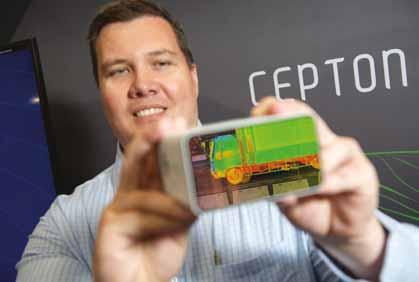

“Cepton’s SORA-P60’s three scan lines, each scanning at 400Hz, enables accurate scanning for advanced classification of objects traveling at highway speeds,” Floor said. “To put it in perspective, 400Hz translates to a scan line every five centimetres for an object traveling at 50 miles per hour. This means you can measure the size of a tow hitch and trailer on a vehicle traveling on a highway in real time.”
Officially launched this week, the new sensor is being tested in a highway tolling application in the US and will be generally available by the end of the summer.
▶Booth 452 www.cepton.com
Macro is looking to make a splash in the North American market after recently spinning off Ross and Baruzzini, an ITS leader in the Middle East for more than 50 years.
A mobility design engineering firm, Macro helps DOTs plan, design and assess transportation networks from surface roads and highways to light rail. According to Megan Cecily Huff, vice president, Macro, the company consults on what steps to take when building a network, what
technology is needed and how to evaluate specific products. It will even oversee implementations if required.
“If cities want to make a positive impact, they need to revolutionise the way they think about, plan for and advance mobility,” Huff said.
Macro is based in the Philadelphia area and is focusing on developing relationships with DOTs in the Mid-Atlantic and Northeast regions.
▶Booth 466 www.macro.com
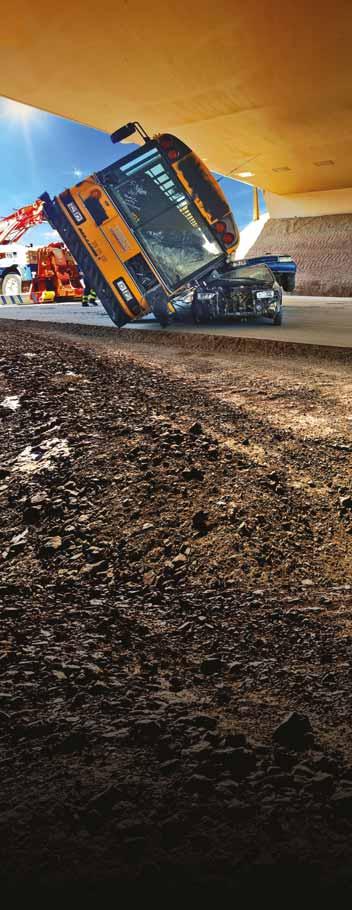
Siemens launched a new digital lab to create innovative solutions to real customer problems.
Based in Austin, Texas, the team is made up of 14 people— including four engineers, four developers, two data engineers, two customer-facing managers, a scrum master and a director. The team is currently working on a connected vehicle pilot that is investigating why vehicles are braking harshly on specific stretch of road.
“Everyone talks about the importance of data but lament data’s impact on real world solutions,” said Laryssa Park, director of the lab. “We want to make sure we are solving something that matters instead of just pushing something out into the marketplace.”
While the Austin lab is new, Siemens has operated another digital lab in Germany that works under the same goal of using data to solve real customer problems. In the two years it’s been open, the German lab has worked on a truck parking pilot and a shared bike dock pilot among other projects.
According to a company spokesperson, Siemens spends more than $1 billion annually on R&D in the US.
▶Booth 401 www.siemens.com
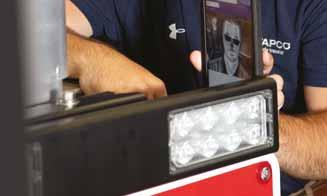
Tapco is promoting a new partnership with Flir to distribute its thermal cameras as part of its wrong-way alert and pedestrian crossing systems— adding greater detection capabilities that will lead to safer roadways.
The thermal imaging sensors provide two detection zones. When a vehicle enters the first zone, an alert is activated on messaging inside and outside the vehicle. If corrected action is not taken and the vehicle enters the second zone, the police and other authorities are notified of the potentially dangerous situation.
The wrong-way alert systems
have been recently deployed on four ramps on the Central Texas Expressway near Austin.
The pedestrian crossing system works similarly. Heat radiating objects like people or animals are detected in multiple zones, triggering alerts and messaging to get vehicles to stop, slow down or reroute.
According to Steve Paulus, a marketing communications manager with Tapco, the systems are agnostic, able to integrate with any DSRC or 5G roadside units without having to rip and replace existing equipment.
▶Booth 555
www.tapconet.com
Aecom has brought together around a dozen local US transit agencies to form the Automated Bus Consortium to explore driverless bus pilot programmes.
Among the authorities are Dallas Area Rapid Transit, Los Angeles County Metropolitan Transportation Authority and the Metropolitan Atlanta Rapid Transit Authority.
ABC is looking into buying up to 100 full-sized autonomous buses that will run at normal speeds along designated urban routes. Meanwhile, Aecom will provide planning, assessment, implementation and evaluation of the services for the consortium members.
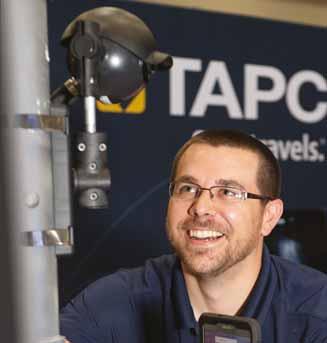
Advanced driver-assistance systems and vehicle automation – which will save lives - is part of indepth research being done by the Virginia Tech Transportation Institute.
The plan calls for a 12-month feasibility study followed by buses rolling out onto roads between 2021 and 2022. Each agency will make their own decisions regarding future additional automated bus purchases and deployment following the completion of the feasibility phase.
Aecom said it will host a forum in Detroit in September for ABC members to meet technology companies and bus manufacturers to discuss the development of programme specifications. Buses are expected to roll out onto the members’ streets within two years.
▶Booth 430 www.automatedbusconsortium.com
VTTI says that it is one of the largest transportation institutes in the US as measured by most metrics and is at ITS America to showcase it progress and its collaboration with a variety of OEMs and auto manufacturers.
VTTI researchers are on hand to discuss the institute’s testing capabilities and partnership opportunities, such as the Virginia Connected Corridor where the Virginia Department of Transport and VTTI are conducting early stage testing and deployment of connected vehicle infrastructure and applications.
Also, the Automated Mobility Partnership within VTTI brings together industry leaders to promote the development of tools, techniques and data resources to support the rapid advancement of automated-vehicle deployment.
▶Booth 548 www.vtti.vt.edu
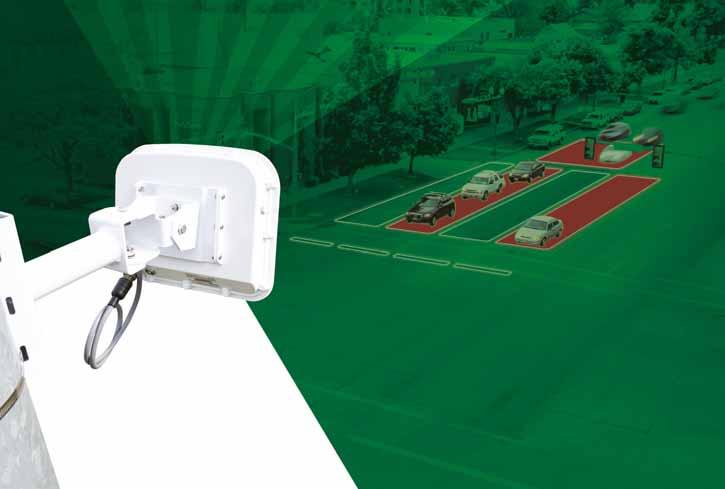

ZONE 9 QUEUE
OCCUPIED
ZONE 8 RIGHT TRAFFIC UNOCCUPIED
ZONE 7 THROUGH TRAFFIC OCCUPIED
ZONES 1-4 COUNTING UNOCCUPIED
ZONE 6 THROUGH TRAFFIC UNOCCUPIED
ZONE 5 DEDICATED LEFT OCCUPIED
Vision The only radar capable of true presence detection at the stop bar.










































































Ploughing a snowy road is one thing; knowing exactly the road’s surface condition is another.
Enter Vaisala’s Mobile Detector MD30. It attaches to the snowplough behind the plough unit and just ahead of one of the vehicle’s front wheels to monitor the surface condition of the cleared road.
Many times after ploughing a road, a spreader –either attached to the back of the plough or following the plough – will spread more than enough grit and salt to make the road safer for vehicles. There is an overcompensation of material mainly because the state of the surface remains unknown except for the fact that it has been cleared of snow.
Vaisala says that its MD30 is the first road surface state sensor designed specifically for snowplough. It transmits data — surface temperature, grip, relative humidity, dew point and road and air temperature via Bluetooth - to the snowplough cab where the driver can see the results on his phone. The data can also be sent to a central control centre for a larger picture of a regional road network.
The MD30 is designed to withstand the heavy vibration of snowploughing. The hood of the sensor uses a holed double structure that directs air flow to protect the sensor lens and keep it clean.
▶Booth 661 www.vaisala.com
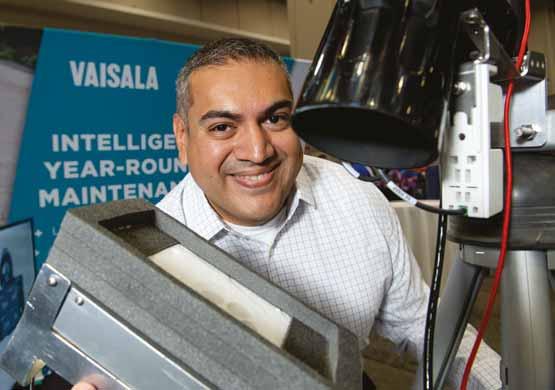









Intercomp Company is displaying its portable scales and fixed, in-ground Weigh In Motion (WIM) scales which can be used from low speeds to 80mph. The newest NTEP-certified portable static and WIM scales are shown at the Annual Meeting.
These are deployed by states for commercial vehicle screening and enforcement activities. The digital and wireless solutions “take portable weighing into the next generation of scales, increasing productivity and user safety when weighing vehicles”, the firm insists.
Last year, Intercomp celebrated its 40th anniversary of designing and manufacturing portable and fixed scales for weighing vehicles at its location just outside Minneapolis, MN. Its fixed, in-ground WIM scales and sensors are used for axle and gross vehicle weight checking, data collection and pre-selection on highways and interstates throughout the world.


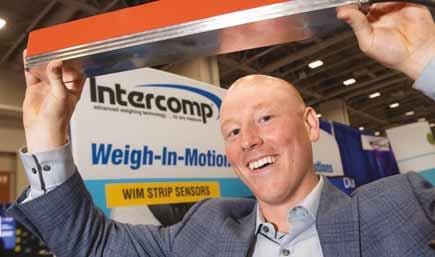
Using the same technology found in highly accurate static truck scales, they are optimised for rapid vehicle weighing. International visitors may be interested to learn that the WIM scales have received OIML certification, with additional OIML certifications in process for the static portable scales. This enables their



use in a variety of legal applications - including tolling by weight and direct enforcementwhen approved in certain countries.
▶Booth 565 intercompcompany.com














Visit Axis & Citilog at ITS America in booth 324
ave effort, costs and To see how they can save s, visit lives on your roads, v axis.com / traffic hieve traffic mobility A smarter way to achie where traffic moves safely and freely. Axis cameras, Picture a road system w analytic software from Citilog, can help you bring it about. empowered with ana quality Axis video, Citilog solutions deliver insights that simplify Utilizing high-qu agement decisions and help you get more from existing infrastructure. traffic manag

Mobile Mark is featuring two vehicle-mounted antennas that it says are well-suited for the current wave of DSRC and C-V2X trials.
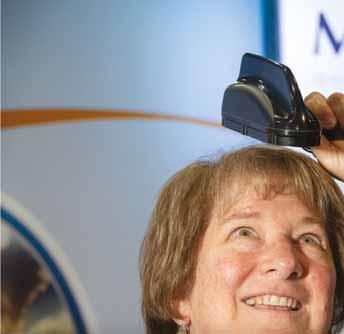
The MXF-5900 MaxFin surface mount antenna provides 2xMIMO coverage for DSRC at 5.9 GHz and global navigation or locational coverage on either GPS or the multi-system GNSS. Mobile Mark insists it is designed to optimise DSRC performance in mobile antennas used in ITS trials.
Just 7.5” long by 2.25” wide and 2.5” tall, it is a compact option and works across the bands with <2:1 VSWR. The company says average gain on the DSRC elements is 4 dBi gain, with a peak gain of 8 dBi. Meanwhile, GPS/GNSS gain is 5 dBic with 26 dB amplifier.
Roof-mounting is recommended to eliminate any shadowing caused by the vehicle itself and to allow optimum line-of-sight signals – and the antenna is also available in a
mag-mount version; the MMXF5900. Meanwhile, the company’s SMW-314 surface mount antenna combines LTE, DSRC & GPS antenna, with the cellular element providing coverage from 694-960 & 1710-3700 MHz and the DSRC element rated from 5.8-6.0 GHz.
The company will also be showing its Bi-Directional Blade Antenna (BD-5900), which can be mounted on a traffic light arm or on a roadside unit or cabinet. “While many
“We went in big,” said Kevin Kosch, a solutions engineer with Sony Video Security Products, speaking about the SNC-VB770 4K, an ultra-high sensitivity 4K Network Camera. By big, Kosch means the 35mm full-frame Exmor CMOS Sensor. The SNC-VB770 4K features top levels of minimum illumination of less than 0.004 lx.
This means that the unit captures exceptionally detailed 4K/30 fps colour video – even at night and in similarly extreme lighting environments, such as almost pitch-black conditions,
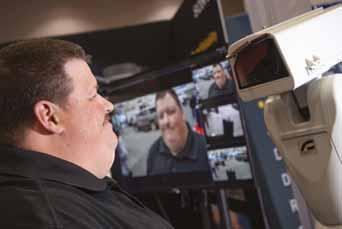
night-time starlight or indoors with a poor lighting source.
Also, the camera captures blur-less images with its
high-speed electronic shutter so users can track letters –characters - numbers and human facial expression clearly
intersections are best served by omni-directional antennas, other intersections may experience atypical traffic flows and benefit from Bi-Directional coverage along the principal route,” says Mobile Mark’s CEO Michael Berry.
A Quad-Directional Rod Antenna is in pre-production stage, and will offer what Berry calls an “interesting twist for urban intersections”
▶Booth 311 www.mobilemark.com
in poorly-lit conditions.
Intelligent tracking plus multi tracking can recognise and dynamically track multiple subjects in separate windows, together with its wide-area situational overview. Intelligent coding captures selected areas of interest in maximum detail, while reducing bit-rates in the other areas of the image to save network bandwidth.
The unit can also be located in pan-tilt housing allowing it to scan down freeways and moving objects.
▶Booth 348
www.sony.com/security




Your job is critical in helping make roads safer for the driving public—but you’re not alone in your mission. We’ll continue to challenges you face.


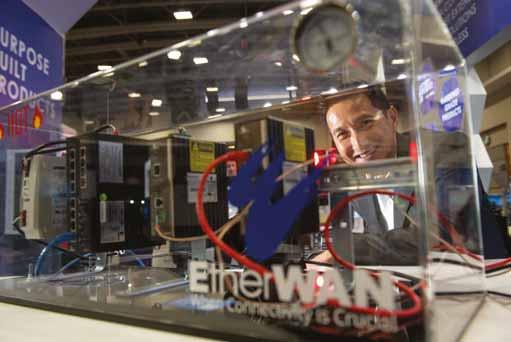
The number of connected devices at intersections and the data they produce has exploded over the past 10 years—leading to greater bandwidth and connectivity requirements that aren’t being met by existing network infrastructure. In steps EtherWAN, a leading supplier of ethernet networking equipment for the ITS market.
Unfortunately, explains Steve Frank, director of sales, EtherWAN, people still do not quite understand how ethernet technology works, how it is designed, implemented and maintained. EtherWAN hopes to change that by taking a hands-on approach to building relationships with partners, integrators and DOT employees.
“We really need people to understand the entire ethernet ecosystem, so we’re building education programmes aimed directly at the people who are opening up cabinets and maintaining critical ITS network infrastructure,” Frank said. “Our goal is to create mini experts in the field.”
EtherWAN has a large footprint in Southern California where the company is headquartered and is currently working with Inglewood, a suburb of Los Angeles. The small city of just over 100,000 residents is the future home to two NFL teams—the Rams
and the Chargers—is set to host Super Bowl LVI in 2022 and the 2028 Summer Olympics Opening and Closing Ceremonies. It’s also the location of a large shopping centre that attracts people from all over the region.
Needless to say, transportation is a critical government function, and the city is in the process of installing hundreds of cameras

across road corridors. There is no way that the existing network could scale to that level or provide the bandwidth necessary to connect all those devices. Upgrading its backbone network to ethernet backed by EtherWAN’s switches made sense.
▶Booth 631
EtherWAN.com
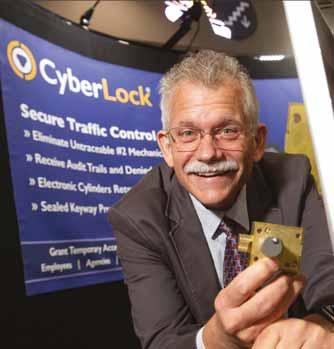
CyberLock has unveiled its newest CyberLock electronic lockthe CL-TC2L (left oriented) and CL-TC2R (right oriented).
Designed to retrofit into most traffic cabinets, the CyberLock traffic cabinet lock is the ideal solution to ensure the security of Intelligent Traffic System cabinets. The CyberLock traffic control cabinet lock allows users to seamlessly replace existing mechanical locks with a CyberLock cylinder, according to the company. CyberKeys are programmed using CyberAudit software. Software managers can load each CyberKey with a list of locks it may access, schedules of authorised dates and times it may access and a begin-end date range during which the key will operate. Additionally, an audit trail is recorded in both the lock and the key, allowing municipalities to track all access attempts. The audit capabilities increase accountability and help ensure traffic cabinets are being serviced regularly.
▶Booth 222 www.cyberlock.com
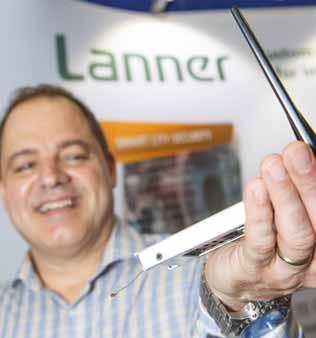
Lanner is showcasing its new PGN Series LTE Modules at the Annual Meeting. PGN-300 and PGN600 are pre-certified LTE modules that can be plugged into Lanner´s vehicle and train NVRs using a Mini PCIe slot to offer uninterrupted in-vehicle wireless connectivity over any cellular network. This newlylaunched LTE product line is certified with PTCRB and AT&T – and “Verizon and FirstNet certifications are on the way within the next few weeks” , the firm says.
PGN-series modules are external USB dongles inside precertified enclosures designed to plug into Lanner´s in-vehicle V3S, V6S and R6S computers.
“Systems with pre-certified PGN modules plugged in them do not require re-certification making it a huge advantage for the OEMs,” Lanner insists. “Also by being inside the system, external dongles become more reliable and secure from theft.”
In addition to offering prevalidated NVR platforms and certified LTE modules, Lanner also offers custom-design for

platforms with personalised branding for OEMs and VMS providers.
Lanner´s V3S (4x PoE) and V6S (10x PoE) are purposebuilt in-vehicle computers and


popular platforms for onboard video surveillance applications in school bus, specialty vehicles and mass transit buses.
▶Booth 748
www.lannerinc.com
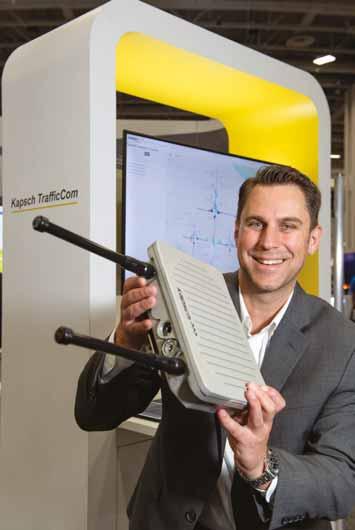
Municipalities and DoTs around the country are building infrastructure to support the inevitability of connected vehicles hitting the streets— but not a lot of transportation agencies have seamless visibility into that infrastructure, argues Jeff Adler, a vice president at Kapsch. He hopes to change that through Kapsch’s connected mobility platform.
Based in the cloud, Kapsch’s solution gives transportation officials visibility into connected intersections—including signalling, dynamic messaging and pedestrian crossings.
A video monitor at the company’s booth shows a live feed from a traffic control centre in Marysville, Ohio, where you can see vehicles approach intersections as they traverse a map as well as signal states. While not all the vehicles are connected, video monitoring solutions identify and track the vehicles in the city. This live map
gives traffic engineers a bird’seye view of traffic as well as the ability to drill down to individual intersections or corridors.
“We really want to remove the silos that typically exist between different departments like traffic and transit,” said Steve Sprouffske, head of Kapsch’s connected vehicle practice. “The goal is more connected services.”
A mobile application designed for blind pedestrians also ties into Kapsch’s connected mobility platform. Voice commands and vibrations communicate to the user as signals change and vehicles approach the intersection. It also gives the user directional information—such as “You’re near a crossing but not facing it”—and keeps them within the crosswalk boundaries. The app is currently being tested in cities in North Carolina, Virginia and Ohio.
▶Booth 525
www.kapsch.net

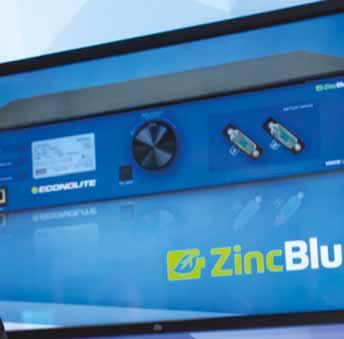

ZincBlue2, a next-generation intelligent digital nickel-zinc battery-based uninterruptable power supply (UPS) solution, adds to Econolite’s comprehensive suite of battery backup system (BBS) offerings. ZincBlue2 delivers even more capabilities to maintain vital signalised operations, including the IT systems for advanced smart intersections. It features a more compact and lightweight nickel-zinc battery design and provides significantly
longer run times. ZincBlue2 also provides more intelligence with extensive event logging and simplified user interface with the industry’s first Navigation Dial for operation and configuration. The user interface also supports browserbased remote system management and update capabilities, as well as email alert messaging.
Just like the original Econolite ZincBlue, ZincBlue2 is an easy-to-install,
self-maintained solution with superior performance. It allows agencies to leverage the unused space in a traffic cabinet to slide ZinceBlue2 inbetween the outer wall and traffic control components, so there is no need for an additional enclosure. ZincBlue2 provides an environmentally-conscious alternative to traditional lead-acid BBS, supporting green initiatives.
▶Booth 407
www.econolite.com

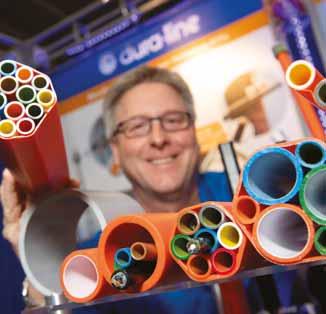

City authorities are going to benefit from higher-density products to carry fibre networks in future – particularly with developments such as the 5G roll-out. “We don’t know how much fibre we are going to need going forward but we know we are going to need more,” says Joseph Lange, Dura-Line business development manager –microtechnology, US. The company’s products are used by a number of utilities departments. For example, in one recent deployment, the City of Augusta used Dura-Line’s FuturePath Flex Locatable 4-Way with 18/14mm MicroDuct to hold the 96-count fibre. “We’re the no-name vendor that nobody knows,” Lange laughs. “We’re the tyres on the car – we’re what makes it go. Not the fancy buttons that make the windows go down.” As he points out, even wireless technologies require cabling. “You still need us,” he says.
The company began in the early 1970s “with big, empty holes in the ground” and began developing microtechnology in the late 1980s “to make more use of that same conduit”
“We’ve been growing with the industry since 1972,” he concludes. “What continues to happen is that our microtechnology products continue to evolve because there is more and more need for fibre.”
▶Booth 756
www.duraline.com
At your side. To help you move mobility forward.
Together, we can transform the way the world travels — with intelligent transit systems, integrated curbside management, dynamic roadway charging and advanced public safety solutions. All backed by advanced analytics and scalable platforms to ensure everything works as one today, tomorrow and beyond.
Ready to move mobility forward? Visit us at booth #406


















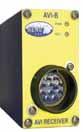
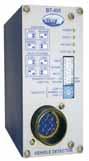
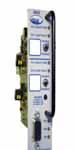
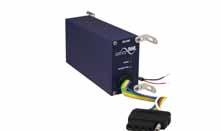


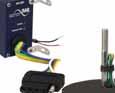


(AVI-911®) system. The AVI-911 system allows for hands-free access into secure gated areas. Vehicles equipped with the low-frequency, digitally encoded AVI-911 transmitters emit a short-range signal from the vehicle to the in-pavement loop located near a gate. When the transmitter is above the loop, the signal is coupled to a Reno A&E AVI-911 receiver, which is an auxiliary component of the gate operator. Each vehicle equipped with an AVI-911 transmitter will automatically open gates equipped with a Reno A&E AVI-911 existing gated location.

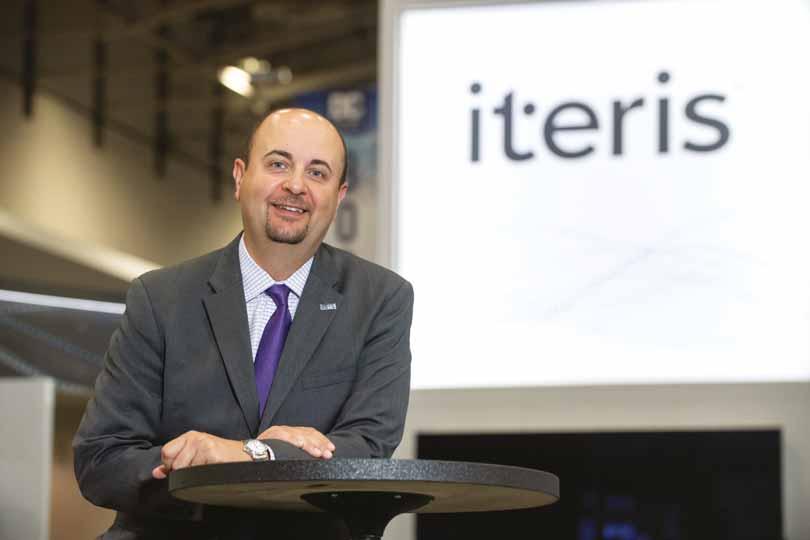
Ramin Massoumi, senior VP and general manager of Iteris on his interpretation of this year’s overarching theme – A Better Future Transformed by Intelligent Mobility, Safer. Greener. Smarter
The overarching theme of this year’s ITS America Annual Meeting will no doubt serve to reinforce the safety and sustainability-focused initiatives that many attendees spend time developing solutions for, as well as inspire them to find new and even more innovative ways to improve our nation’s transportation networks.
With the death toll on our roadways climbing to an average of over 100 per day, we are constantly reminded of the importance of initiatives surrounding the movement of people, data and freight. Which is why I’d like to use a few examples of why these three elements, in reality, are inseparable.
The first example I’d like to share regarding solutions to help move people, data and freight is the use of connected vehicle technology in the context of workzones and mobile assets on the roadway.
Anyone who has driven through any snow state will be familiar with the cloud of snow that emanates from a working snow plough, and will likely slow down and keep their distance.
But if you’re not familiar with this practice, you might assume it’s just a gust of snow. This assumption has led to dozens of rear-end collisions involving cars and snow
ploughs, and there are no prizes for guessing which vehicle comes out on top.
The same issue applies to attenuator trucks used in highway workzone environments. Drivers who don’t notice these vehicles can endanger themselves and the construction crew bravely driving them. But there is a simple solution for both of these cases.
By installing onboard, vehicle-toeverything (V2X) or vehicle-to-vehicle (V2V) devices in these mobile assets, they can send out a signal to approaching cars’ mobile app or onboard systems warning them to slow down. With the technology already available today, this is more than achievable and is yet


"The reality is that only 1% of trucks on our roadways are being inspected"


another example of using connected vehicle technology to help improve the safety and mobility of people and data.
A second example is the role commercial vehicle operations can play in making a significant difference to the way companies move freight around the country. It can positively impact the people moving the freight, agencies responsible for infrastructure and safety, and regulators governing safety operations. Data ties these many disparate elements together.
The reality is that only 1% of trucks on our roadways are being inspected. This harrowing reality is a product of several factors. In some cases, this might be because a particular route doesn’t have a weigh station, doesn’t have a working weigh station, or has a weigh station but doesn’t have the technology to conduct accurate inspections efficiently. In other cases, it could be that resources are so constrained that increasing the enforcement rate is just not possible. Whatever the reason for this figure, as innovators, we need to find solutions. The good news is that by taking advantage of connected vehicle technology, there’s a fighting chance of raising that figure in a short period of time.
To achieve success and increase inspection rates, commercial vehicles operators must equip vehicles with advanced in-cabin V2X
transponders. Transmitted data received by sensors and mainline technology can be used to automate screening by sending vehicle identifiers to nearby enforcement equipment that leverages software to complete an inspection with minimal if any, officer intervention. Incorporating regional enforcement data can increase the value of this automation by incorporating permits and weight enforcement activities. This requires forward movement to further connect commercial vehicles to infrastructure.
Implementing these measures and effectively utilising the data collected will ensure that trucks that are in good standing can keep operating with no interruptions – resulting in on-time deliveries and satisfactory hours-of-service performance. Also, commercial vehicles at risk of violating
"Vehicles at risk of violating safety standards will be quickly identified and the risk mitigated in advance of an incident"

Ramin Massoumi, an ITS America board member, joined Iteris in 1998, focusing on the application of advanced technologies in the traffic management market, and has led projects throughout the United States. He continued to expand his role within the Transportation Systems division and served as the firm’s vice president of business development from June 2011 to March 2015. As senior vice president and general manager, Massoumi oversees the strategic growth and operations of the Transportation Systems business unit.
safety standards will be quickly identified, and the risk mitigated in advance of an incident, which even further improves goods movement.
By avoiding collisions and other incidents, several key stakeholders in transportation will realise an immediate benefit. Shippers will have more on-time deliveries and less liability. Carriers will have more time on the road, increasing their already thin margins. Neighbouring motorists will have safer, more efficient mobility. The industry is readily equipped with the tools to realise these benefits – all driven by data.
The ITS America Annual Meeting, here in our nation’s capital this week, has provided a superb forum to discuss these applications and how we can work together to further improve mobility and safety along our roads.