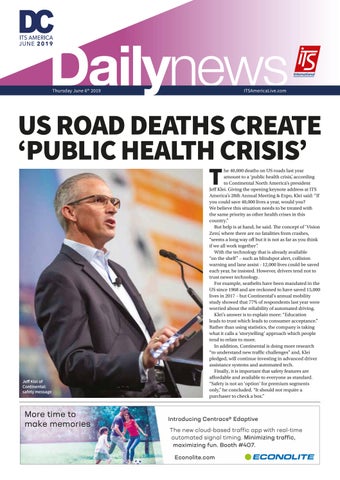
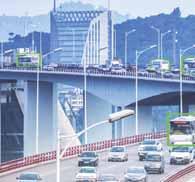
The 40,000 deaths on US roads last year amount to a ‘public health crisis’ , according to Continental North America’s president Jeff Klei. Giving the opening keynote address at ITS America’s 28th Annual Meeting & Expo, Klei said: “If you could save 40,000 lives a year, would you? We believe this situation needs to be treated with the same priority as other health crises in this country.”
But help is at hand, he said. The concept of ‘Vision Zero’ , where there are no fatalities from crashes, “seems a long way off but it is not as far as you think if we all work together”
With the technology that is already available “on the shelf” – such as blindspot alert, collision warning and lane assist - 12,000 lives could be saved each year, he insisted. However, drivers tend not to trust newer technology.
For example, seatbelts have been mandated in the US since 1968 and are reckoned to have saved 15,000 lives in 2017 – but Continental’s annual mobility study showed that 77% of respondents last year were worried about the reliability of automated driving.
Klei’s answer is to explain more: “Education leads to trust which leads to consumer acceptance.” Rather than using statistics, the company is taking what it calls a ‘storytelling’ approach which people tend to relate to more.
In addition, Continental is doing more research “to understand new traffic challenges” and, Klei pledged, will continue investing in advanced driver assistance systems and automated tech.
Finally, it is important that safety features are affordable and available to everyone as standard. “Safety is not an ‘option’ for premium segments only,” he concluded. “It should not require a purchaser to check a box.”
The new cloud-based traffic app with real-time automated signal timing. Minimizing traffic, maximizing fun. Booth #407.
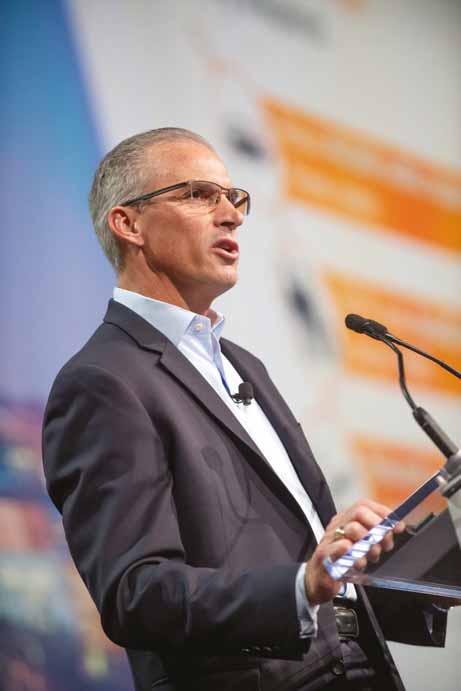
Jeff Klei of Continental: safety message
Dailynews team
Publisher / MD
Andrew Barriball
Editor James Foster
Editorial team
Adam Hill
David Arminas
Andrew Bardin Williams
Sales director
Dan Emmerson
Design
Andy Taylder
Photography James Robbins
Production manager
Nick Bond
IT & website director
James Howard
Website
Sarah Biswell
Tatyana Mechkarova
Printed by
MPM Communications LLC
Contact us
The Daily News office can be contacted at media@ropl.com
Published by
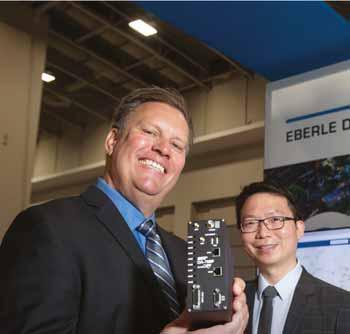
Dr. John Shearer of EDI and James Chen of Wistron NeWeb corporation
The publishers would like to thank ITS America for all its assistance in helping to produce the Daily News
EDI demonstrates C-V2X proof-of-concept with iCite
Eberle Design Incorporated (EDI), the leading manufacturer of traffic control electronics with more than five million operational devices in traffic cabinets worldwide, will be demonstrating its EDI iCite Data Aggregator at its booth.
Utilising the Qualcomm 9150 C-V2X platform the demonstration is designed as a proof-of-concept to show how a basic safety message (BSM) generated from an industry-standard on-boardUnit (OBU) can be received and translated by an EDI iCite Data Aggregator. It can be communicated in real time to the Flir Acyclica cloud platform where advanced traffic data analytics can be performed. The DA-700P iCite data aggregator
can be easily interfaced with any ATC, NEMA TS-1 or TS-2, Type 2070 traffic controller or cabinet architecture to provide additional or redundant BSM monitoring for added motorist and pedestrian safety.
“The integration of the 9150 C-V2X platform from Qualcomm Technologies into many of our core and wellestablished EDI product line provides additional intersection safety monitoring that can be subject to radio interference previously unknown in signalised intersection operations", said Dr Bill Sowell, interim president of Eberle Design. “The ease at which EDI devices can integrate with any major OEM’s traffic controllers, cabinets and central traffic management system uniquely
Best of ITS Award: the winners
Each year ITS America’s Best of ITS Award recognises organisations that have implemented the most advanced transportation projects. The programme aims to highlight organisations which demonstrate specific and measurable outcomes and exemplify innovation. The full list of 2019 winners is below: Hall of Fame Inductee Bud Wright,
positions EDI for future safety enhancements driven by the rapidly emerging connected and autonomous vehicle (CAV) initiatives. With the C-V2X enabled data aggregator, we can immediately provide BSM data from any legacy isolated or non-interconnected intersection which is controller and cabinet style agnostic,” he said.
“EDI greatly appreciates the time and support provided by Qualcomm Technologies, Flir Acyclica and WNC-Wistron NeWeb Corporation for this major proof-of-concept demonstration as it would not have been possible without the unique value each of these companies has provided,” added Sowell.
▶Booth 615
www.EDItraffic.com
Infrastructure spending must have a goal
Too often the conversation about infrastructure spending is how much and not about the goal of the spending, according to panellists during a Tuesday debate. You can spend as much money as you like on building new transport infrastructure but unless it is focused for an outcome, it will always be an incredible waste of taxpayer monies.
AXIS AND CITILOG FOCUSED ON A SMARTER ROAD
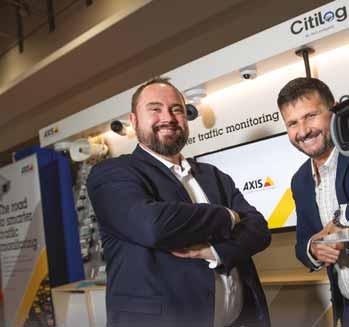
Axis Communications, a market leader in network video solutions, and Citilog, a provider of intelligent transportation solutions, have teamed up to showcase their solution to optimise traffic and transportation safety and efficiency.
When paired together, Axis Communications’ surveillance products and Citilog’s advanced analytics can be used to identify traffic incidents and deviations, in real time, to help traffic management centres improve traffic flows and shorten response times. This solution can make each stage of the incident management chain more effective by automatically detecting disturbances and supplying relevant real-time traffic data
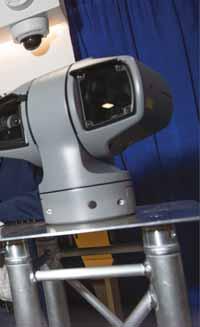
Visitors to the Axis booth can see a demonstration of the Axis Q6215-LE Network Camera, a robust network camera that combines
great image quality with high precision pan, tilt and 30x zoom, along with long range IR for coverage over wide and long distances. Its durable design can withstand harsh weather conditions and high winds, making an all-around great fit for transportation applications such as highways, bridges and more.
Citilog will be demonstrating how its technology can analyse advanced traffic statistics and provide solutions for traffic lights and intersection control.
The Citilog solutions can help to minimise congestion, gridlock and environmental impact. Alarms can be generated for incidents and traffic saturation detection, enabling traffic operators to redirect traffic and thereby adjust efficiency.
▶Booth 324
www.axis.com
www.citilog.com
Escrypt wins Canada project
Transport Canada has tabbed Escrypt to develop a nation-wide security credential management system (SCMS) for connected vehicles — recognising the importance of securing V2X data as the technology evolves and becomes mainstream. The era of connected vehicles will require trillions of bytes of data flowing between millions of sensors, devices and vehicles — including potentially personal information of drivers, passengers and vehicle owners. It’s
important that this information is secured and protected from malicious actors.
The project will include connected traffic signals that give priority to emergency response vehicles, real-time information about potential hazards such as slippery surfaces, accidents or construction and warnings to advise commercial truck drivers about cyclists, pedestrians and motorcyclists. ▶Booth 367 www.escrypt.com
There is also a tendency to spend the money on newbuild rather than maintaining current infrastructure, said Beth Osborne, director of Transportation for America, an alliance of elected business and civic leaders across the US. It comes down to having a transport policy and sticking to it, said Osborne, speaking during the session about how government at all levels can encourage intelligent mobility through shared modes.
One of the first steps is for governments to do a social benefit-cost analysis over 30 years, said Gabe Klein, co-founder of transportation consultancy Cityfi and formerly commissioner of the Chicago Department of Transportation. Such an analysis should look to recoup the initial capital cost of projects. “The bottom line is to stop spending money unless you can see a full return on investment,” he told the audience. If you want people to choose socially acceptable transportation options, then you have to give the people a good choice of them. Klein said he would happily cut in half the available space for single-occupancy vehicles and boost that for highoccupancy vehicles. There are still too many transport policies that result in getting people to where they don’t necessarily need to go, said Joe McAndrew, transport policy director at Greater Washington Partnership.
Eric McWhorter (left) and Anthony Incorvati
TARUN KAJEEPETA Founder, Condor Detroit
If you do business in the mobility sector, you should be doing business in Michigan. We’re known for moving the world, and now we’re defining how people and products will move in the future. Michigan’s mobility initiative, PlanetM, is where you can make the connections, find the resources and get the grants that will get your business—and the future of mobility—moving forward. Don’t get left behind. Visit planetm.com
To help you plan your day, here is an overview of some key topics from today’s full conference schedule. Check out the programme for further information and speakers and panellists.
Closing Keynote and Panel
The 20th century was about moving cars; this century is about moving people, data and freight. Today’s keynote and panel: Moving People. Data. Freight. (9:45 - 11:00, ballroom AB) will explore questions related to how new forms of mobility are transforming how we move. How do people get around today, and how can we make it easier? We have massive amounts of data from vehicles and infrastructure, but how will we harness it to improve safety, reduce congestion, and transform our transportation system? The session will also look at how automated and driver-assisted technologies will help form a connected freight system to drive our economy forward.
Keynote speaker is Paul Misener, vice president for global innovation and policy, Amazon. On behalf of Amazon and its customers, he has testified before the United States Congress over 30 times – on net neutrality, privacy, tax, cloud computing, and more – and many dozens of occasions before other policymaking bodies around the world. He has also given hundreds of public speeches and media interviews.
The distinguished panel will include Joe Bergera, president and CEO, Iteris; Joanna Pinkerton, president/CEO, Central Ohio Transit Authority (COTA); Leslie Richards, Secretary, Pennsylvania DoT; and Dr Joshua Switkes, founder and CEO, Peloton Technology.
The Emergency Evacuations Committee of the Transportation Research Board (TRB) will be holding its mid-year meeting (8:00 - 1:00, room 209A). This committee is concerned with preparedness for, and operational issues of, emergency evacuations associated with any natural or human-made hazards. Evacuations with, little, or no notice, as well as building, urban and regional evacuation are included. It seeks to identify research needs, encourage and facilitate individual and joint research efforts, and disseminate research findings aimed at enhancing the effectiveness and efficiency of operations and increasing safety and survivability of those involved in an emergency evacuation. The committee acts as a resource to governmental and nongovernmental organisations concerned with evacuation planning and operations.
With 25,000 workers expected in the new Arlington/Alexandria Amazon headquarters, residents are questioning how the cities will absorb the new commuters. DC metro area has a rich network of public transportation infrastructure, but they realise they will need to increase capacity. Arlington County and the State of Virginia have pledged to invest $223 million for transportation improvements alone to entice the company to select the HQ location.
In Seattle’s Mercer Corridor, home to Amazon’s original headquarters, adaptive traffic signal control has been key to reducing commuting times – at the busiest times of day, times have been reduced by 21%. Special session Preparing for Amazon HQ2: Why the DC Area Needs Adaptive Traffic Signal Controls (8:15 - 9:30, room 206) will examine the benefits that other congested cities have seen from such smart signals, and address how this may help the new HQ2 address some of the resident concerns.
US Department of Transportation (USDoT) Data for Automated Vehicle Integration (DAVI) (8:15 - 9:30, room 207A) will provide an update on lessons learned through the DAVI initiative and the Work Zone Data Exchange (WZDx) project, and insights on priorities for data exchange. Discussions will highlight the federal role in accelerating voluntary data exchange, as well as successful applications of the DAVI guiding principles and framework. The session will also help identify new critical uses cases and priorities for data exchange, and address specific needs that will help further inform and provide innovation for transportation decisionmaking.
The primary goal of special session Infrastructure Maturity – Supporting Advanced ITS and CV Technologies (8:15 - 9:30, room 207B) focuses on helping transportation agencies understand where their network and security need to be about their future goals with new technologies. Today most network and security discussions talk about the threats: the panel would like to change that focus on where an agency is today, and what steps it needs to take to reach the agency’s operational, technological and safety goals. The session will look at how to create a plan to prioritise efforts, make sure investments today support future goals, and allow the agency to pursue funds to support their efforts. The discussion will also do a deeper dive on what agencies around the country are doing in support of cybersecurity, fibre asset management and network monitoring as it ties back to the theme of the session – infrastructure maturity – and how their efforts are preparing their agencies for the future.
The freight industry is facing tremendous challenges. Demand is growing, existing systems are becoming congested, current infrastructure is ageing, and investment in new infrastructure is shrinking. The industry is looking at technologies, like autonomous vehicles, improved operational data and system management, drone technology, and even underground transport tubes, to improve transport. Executive session 21st Century (12:30 - 1:45, room 207A) will see a panel of experts provide an overview of challenges and technology-based solutions in freight movement today.
Very much looking to the future, special session Transforming the Ride of the Future: Preparing for Urban Air Mobility (12:301:45, room 204A) urban air mobility (UAM) is poised to transform how we move between our communities. UAM envisions on-demand air taxies to deliver passengers to their destinations as efficiently as possible. Vehicles under development provide short-range flights with targeted ranges from 60 – 120 miles. Plans are being set forth for a working commercial air taxi system, with air travel becoming a viable travel option over the next ten years.
A panel of UAM experts from across the board will answer a range of questions, including where will this start and how long before it affects your planning efforts? What do you need to know to prepare your agency for the onset of this revolution in transportation?
The US Federal Highway Administration
Cyber and physical risks continue to grow in the connected world of C/AVs, smart cities and smart transportation with new weaknesses related to interconnected systems, cooperation between agencies and jurisdictions, and the continued increase in attacks. Special session Executive Challenges and Cyber Threats (12:30 - 1:45, room 207B) will feature senior executives who will discuss the challenges they face and the actions they, and their teams, are taking to mitigate cyber threats.
During special session Bridging the Gap in Vulnerable Road User Safety: The Role of ITS (12:30 - 1:45, room 209BC), a panel of diverse experts will set the framework for a holistic discussion of the future of ITS in vulnerable road user safety. It will take into consideration the trends in vulnerable road user fatalities, the history of road user safety treatments, the
The freight industry is facing tremendous challenges
An established and key forum at ITS State DoT Roundtable, (2:00 – 5:30, room 207) will see state department of transportation executives in charge of ITS deployment decisions discuss their experiences, successes, failures, challenges, and other lessons learned in launching projects and preparing infrastructure to meet and support future mobility demands. This year, there will be two panel discussions to take a look into two specific topics.
The first focuses on what DoTs are doing to incorporate, support and encourage the deployment of multi-modal mobility solutions such as Mobility as a Service/Mobility on Demand. The other panel will examine emerging technologies that will disrupt business as usual for DoTs, and what they are doing to prepare for these technologies
Shailen Bhatt, president & CEO of ITS America and Jim Tymon, executive director, AASHTO will be joined by senior figures from departments of transportation from Arizona, California, Delaware, District of Columbia, Hawaii, Michigan, New Jersey, Kansas, North Carolina, Tennessee, Utah and Washington State.
With the emergence of big data from multiple sources, growing capabilities of connected vehicle systems, and the grassroots support for vision zero efforts in many communities, cities are asking how to make the transition from reactive safety to a more targeted proactive approach.
Is there a way to act before, rather than after, tragedies happen? Is “zero crashes” as a goal now achievable due to advances in technology? What is the role of infrastructure based sensors and vehicle connectivity in enabling a new approach for safety?
Together for Safer Roads coalition members are purpose-driven companies who are dedicated to making the world’s roads safer for all users. In executive session Together For Safer Roads (2:00 - 3:15, room 207A), executives from four very different industries (waste management, beverage, insurance and automotive) will share their reasons for committing to this mission and share examples of how they are helping to create a more connected, safe and efficient transportation system.
In Proactive Intersection Safety (2:003:15, room 209A) speakers will explore several proactive approaches to intersection safety and discuss how data-driven methods can enable new project funding models and more effective, less costly countermeasures.
Over the past ten years, the transportation industry has become increasingly susceptible to cyber threats with attacks aimed at gaining access to systems, data, and overall disrupting backend networks along with platforms in the field. Sharing threat intelligence is an option that allows agencies to promote more efficient and coordinated responses while fostering collaboration. Building upon the panel from last year’s annual meeting, Sharing Cyber Threat Intelligence 2.0 (2:00 - 3:15, room 207B) will continue the conversation on threat intelligence sharing methods highlighting steps that state DoTs, other transportation organisations, and even industry can take to build an integrated information sharing strategy to strengthen their overall cybersecurity posture and get in front of cyber incidents and attacks.
The future of mobility holds promise for all to reap the benefits. Connected and automated vehicle technology makes it especially possible for the elderly and handicapped. How can we ensure reliability and independence through mobility solutions? Special session Improved Mobility with CAV Technology (2:00 - 3:15, room 209BC) will discuss specific challenges faced by this demographic. Best practices for collaboration with outside agencies and best use cases for state, federal, and local deployments will be identified.
As a follow-up to Emergency Response Day 2019, which took place yesterday, ITS for the Responder: How ITS Applications Can Save Responder Lives and Make Everyone Safer During a Traffic Incident (2:00 - 3:15, room 204C) aims to engage the ITS community around potential solutions to assist in the challenges responders face on our roadways. After a presentation on the central challenges faced by responders, the audience will be asked to discuss what kind of deployable and emerging technologies can be utilised or transformed specifically for responder needs. The challenges in finding business cases for adapting ITS technologies for responder applications will also be discussed, and where the industry has succeeded will be examined. The session will finish by trying to identify 2-3 key actions the responder and ITS communities can take to work together in the future.
Over the past ten years, the transportation industry has become increasingly susceptible to cyber threats
Malcolm Dougherty is chair of the ITS America Board of Directors and works for Michael Baker International
Looking ahead
QWhen, and why, did you first join ITS America?
I have served on the Board of Directors since 2012 while still in my public sector career, when I was the director of the California Department of Transportation (Caltrans). My reason for getting involved is still true today; the transportation system is evolving and will continue to evolve.
New technology is deployed on a daily basis and is enhancing the operation of the system and the vehicles travellers on the system use. From safety features to information about the transportation
Malcolm Dougherty, incoming chair of ITS America, on the exciting and challenging road ahead for ITS
system, technology is changing in our vehicles and how the network is managed. This evolution will continue, and connected automation will become more prevalent.
As a transportation professional, I want to be as close to the forefront as I can be to assist in achieving our goals of a safe, interconnected, efficient transportation system.
QCould you reflect for a moment on where you think the organisation was seven years ago when you became a board member?
Composition of the board and the organisation have continued to grow and become more balanced among public, private and academic institutions. ITS America has always advocated for additional funding to be dedicated to emerging technology that will improve the transportation system.
Many of the new technologies have the promise of dramatically improving the safety of the system: reducing injuries and fatalities and encouraging or incentivising the use of funds on new technology could improve safety and improve mobility.
As time goes on, more complicated policy issues emerge that need input from an informed entity that prioritises public interest above individual objectives. Examples are automated vehicles and the rules that govern vehicle design and operation on public roads. Protecting the safety of the public while also creating a path to deployment and advancement is essential.
Another example is protecting the spectrum used for connected vehicle technology to transmit information that would assist safety features on vehicles. These are the types of issues where ITS America has tried to be an informed resource for decision makers.
QAs chair of ITSA, what do you think are the most pressing issues facing the organisation and the wider industry? What needs to be achieved?
Advancement and deployment of new technology need to be facilitated and encouraged, but, at the same time, it needs to be guided by policy that helps it realise the intended consequences and avoid the unintended consequences. This requires advocacy, but also balance. We must always ensure the safety of all users. Will automated vehicles enhance the safety of other users, such as pedestrians and cyclists? Will the newly automated vehicles complement transit, relieve or cause more congestion?
I think ITS America needs to strive for the right regulatory touch while still advancing deployment so that the benefits of improved safety, mobility and access can be realised.
QWhen your tenure as chair ends, what would you like your legacy to be?
I don’t know about legacy, but I hope I’m remembered for being pragmatic, at times tempering the over-enthusiasm and hype and trying to depict a path along which this technology will evolve. How will it emerge with the overlap with the older transportation system still in operation? And how do we stay focused on solving transportation challenges using new technology and not just focus on deployment for deployment’s sake? How can we use emerging technology to improve safety and mobility?
QEveryone recognises that the ITS industry is changing, and indeed growing significantly. Is that wider growth reflected in the membership of ITS America?
Absolutely! If you take just the first quarter of this year, some of the leading names in technology, innovation, mobility and infrastructure have become members, including Amazon Web Services, the American Centre for Mobility, Auto Action, Dock, Inc., Gannett Fleming, Here
Technologies, the Idaho Transportation Department, Jacobs, Middlesex (NJ) County, the Ohio Turnpike Authority, Redflex, the San Francisco County Transportation Authority, TSPS, UrbanLogiq, a mobility service provider and a large technology provider, are part of the growing number of private companies, public agencies, and research organisations working with ITS America to advance the research and deployment of intelligent transportation technologies.
QThe main theme of this year’s Annual Meeting is Intelligent Mobility: Safer, Greener, Smarter, so the focus is on the future of mobility technologies and seamless mobility around the movement of people, data and freight in the 21st century. Would you like to provide a few thoughts on that?
It is a very well thought out and timely theme. It focuses on the objectives of how intelligent mobility technologies can achieve the goals of enhancing the quality of life for people, the communities in which we live and the economic vitality of our cities. The transportation system should enhance our lives, our communities, and not be a detriment to our environment –how can new technology help us to more rapidly achieve these goals?
www.mbakerintl.com
"The transportation system should enhance our lives, our communities, and not be a detriment to our environment"
Siemens shows latest technologies
Siemens Mobility Intelligent Traffic Systems is showcasing its latest technologies that help shape connected mobility. As cities continue to grow, so are the demands on their transportation ecosystems and roadways.
Planning and implementing technologies today will help ease congestion, improve sustainability and enhance liveability for today’s residents –and tomorrow’s.
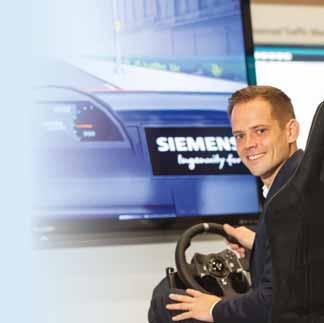
Attendees can play a connected vehicle game at the booth where drivers can experience first-hand the safety and efficiency benefits of V2X technologies that are available on our roads today.
They can learn more about how these technologies have benefited drivers and pedestrians in Tampa Bay, Ann Arbor, Las Vegas and New York City, and will soon enhance the streets of Gainesville.
Also visitors will learn more about adaptive signal controls, advanced traffic management systems, traffic enforcement and the latest innovations coming from Siemens' digital lab. They can also hear from the company’s presenters about the future of autonomous vehicles, why the DC area needs adaptive signalling and the future of traffic planning. ▶Booth 401 www.siemens.com
ZITEK MELTS BARRIERS TO NORTH AMERICAN MARKET
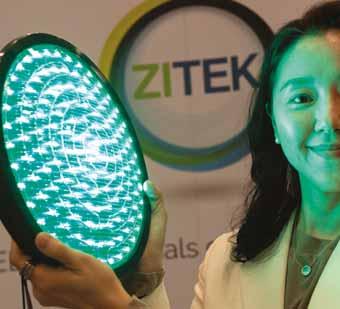
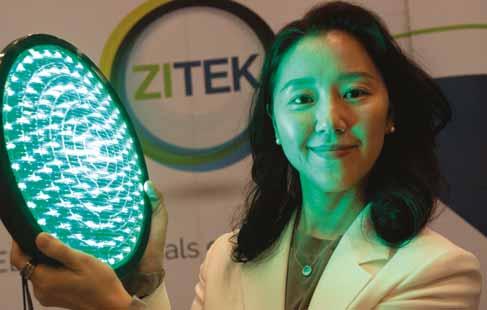
South Korean company Zitek is launching its heated LED traffic signal solution in the US and Canadian markets—meeting with distributors and DoTs while waiting for its ITE certification. It’s just in time, as climate change is creating more dangerous wintery weather across North America.
As state DoTs have switched from incandescent bulbs to LED traffic lights to save energy and maintenance costs, an unintended consequence has been that the low-wattage bulbs do not get hot enough to melt snow that accumulates on the signals.
Enter Zitek and its new LED traffic signal. Called MeltSmart, the signal includes an automatic heating element that kicks on as a photo-electric sensor detects coverage while a thermal sensor ensures the blockage isn’t caused by some other obstruction like pollen, litter or plant matter. The heating element raises the surface temperature of the lens in seconds and then automatically turns off when the snow melts.
CEO. “With the unique patented technology, Zitek strives to help protect lives and build safer roads worldwide.”
While DoTs will need to rip out and replace existing traffic signals with Zitek’s MeltSmart signals, Lee said that the additional cost— which runs about 15% more than existing
signals—can be recouped through a reduction in traffic accidents, their response and fewer complaints. And with replacement cycles turning over every several years, she doesn’t see deployment as a major roadblock.
▶Booth 563
www.Zitekcorp.com
“By providing drivers and pedestrians with clear visibility of the signals, MeltSmart greatly contributes to avoid traffic accidents and possible loss of life in snowy weather conditions,” said Soyoung Lee, the company’s
to save tended ttage ow that gnal. n es r atter. then melts s mart dents er pany’s
Michael Venus of Siemens
Soyoung Lee of Zitek
NEW AIMSUN SOFTWARE FOR TESTING MOBILITY
Hardened Networks gets tougher
Hardened Networks by ITS Express has upgraded its V3 Series hardened switches specifically engineered to handle the challenging demands of the toughest environmental conditions.
Aimsun launched a major new product innovation just two weeks ago, and visitors will have an opportunity of seeing its ground-breaking capabilities.
Aimsun Auto is a new software platform for largescale design and validation of path planning algorithms for self-driving vehicles. When used in combination with sensor testing tools and vehicle dynamics simulation tools, Auto provides a test harness that is full-stack, highly automated and infinitely scalable.
Auto allows test vehicles to drive inside entire digital cities — perfect virtual copies of transportation networks — where the limits of autonomous vehicle technology can be safely explored.
Users can synthetically
generate, execute, and analyse tens of thousands of scenarios, making it exponentially more efficient and wider-ranging than any methodology based on field data.
“With Auto, there is no need to drive around seeking the conditions that you want to test, or to laboriously script each actor’s behaviour frameby-frame. Scale and speed are of the essence,” said Matthew Juckes, president of Aimsun.
“Auto can execute thousands of concurrent instances much faster than real time on private or commercial cloud infrastructure, effectively covering the equivalent of millions of autonomous miles overnight. It’s fast; it’s infinitely scalable and, most importantly, it’s safe.”
Aimsun says Auto is a perfect complement to sensor testing tools and driving
simulation software, being able to integrate seamlessly into a testing environment and providing a scenario generation engine to cater for both ordinary and noncompliant situations.
“The scope of testing is virtually unlimited,” says Juckes. “Testing with Auto can include extraordinary scenarios with rogue actors that would be prohibitively expensive or impossible to perform in the field; with Auto, you can also run wide-area regression tests to ensure that a new release of autonomy stack continues to meet prior safety standards. Obtaining realistic estimates on overall journey time, emissions profile, energy consumption and smoothness of ride for door-to-door trips are a unique feature of Auto.”
▶Booth 723 www.aimsun.com
CATT Lab sees RITIS expansion
The CATT Lab’s web-based transportation analytics platform –RITIS – is expanding rapidly across the US, the organisation says. The number of states using it has gone from 15 to 37 over the last two years, a rise which is driven by contracts to provide data and analytics for initiatives including a
federally-mandated performance measurement programme, CATT Lab suggests. Marketed as a lowcost alternative to ATSPM, RITIS is used to collect and analyse performance monitoring data and can “significantly reduce” agencies’ dependence on outside consultants. Figures can be used
to determine which infrastructure projects to fund, but CATT Lab is concerned that awareness needs raising, saying that “a huge number of suddenly-eligible users across these 37 states don’t even know they qualify for RITIS”.
▶Booth 455 www.ritis.org
The redesigned V3 Series switches are engineered to exceed NEMA TS-2 specifications and have been equipped with Enhanced SFP ports (100Mb/1000Mb/2.5G) and Ultra SFP ports (100Mb/1000Mb/2.5Gb/10Gb), as well as all of the reliable and secure features of their V2 Series predecessors. These switches are also available in the Plus version, which has optical bypass capabilities.
▶Booth 735
www.itsexpress.com
Solar Tech touts safety
Solar Tech hopes to make workzones safer for both motorists and workers through its new Smart Zone software. Built on a private network, Smart Zone safely gathers and analyses data from various sensors that can be used to manually or automatically trigger messages displayed on portable changeable message signs.
The messages display travel times, urge drivers to reduce speed or redirect vehicles to alternate routes—reducing accidents while keeping workers and motorists safe. According to Solar Tech, Smart Zone requires no third-party programming. Real-time data is collected from cameras, radar, traffic volume detectors and weather sensors and is sent wirelessly to a traffic management system.
▶Booth 709
www.solartechnology.com
Matthew Juckes of Aimsun
At your side. To help you move mobility forward.
Together, we can transform the way the world travels — with intelligent transit systems, integrated curbside management, dynamic roadway charging and advanced public safety solutions. All backed by advanced analytics and scalable platforms to ensure everything works as one today, tomorrow and beyond.
Ready to move mobility forward? Visit us at booth #406
Wavetronix radar powers intersection metrics
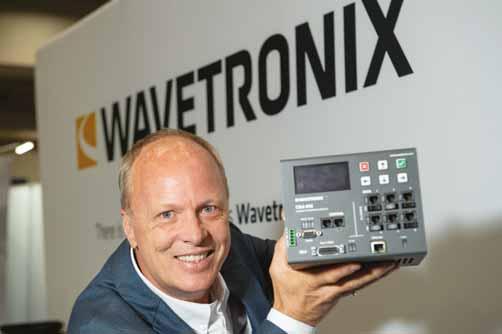
Wavetronix is using the Annual Meeting to demonstrate how its SmartSensor Advance and Matrix is being used by the Utah Department of Transportation (UDoT) in an innovative programme that publicises the performance of signalised intersections.
One of the most costeffective ways to improve signalised intersections is to implement a signal performance measurement system (SPM). They use the data from traffic detectors to proactively monitor traffic signals, giving transportation agencies real-time insights into what’s happening at their intersections. UDoT has led the country in SPM implementation, and its success can help other agencies looking to achieve similar benefits in their traffic networks.
SPM effectiveness depends
on the quality of the traffic data being collected by sensors at the intersection. UDoT’s system relies heavily on SmartSensor Advance and SmartSensor Matrix, non-intrusive radar devices created specifically for the intersection by Wavetronix.
Working with UDoT, Wavetronix optimised the Advance and Matrix sensors to allow the transfer of raw data from traffic controllers directly to a UDoT server. This realtime data populates a series of metrics that provide instant information about intersections to traffic engineers, allowing UDoT to proactively address problems.
In just the first year of use, the agency identified and fixed more than 100 detector problems, 35 time-of-day errors and 40 incorrect traffic offsets for better progression. Today, UDoT claims that only one in four
vehicles encounters a red light on its roads.
The agency's metrics are open to the public. Anyone wishing to see the data UDoT uses to
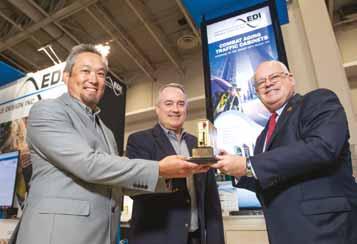
EDI and McCain celebrate over 1,000 ATC cabinets deployed
Today, Eberle Design (EDI) acknowledged McCain, a Swarco Group Company, on its achievement of providing more than 1,000 ATC Cabinets to the industry, making them safer, smarter and more efficient.
The Institute of Traffic Engineers (ITE) along with the National Electrical Manufacturers Association (NEMA) and the American Association of State Highway and Transportation Officials (AASHTO) recently released the ATC Standard 5301 V02.02, making the Advanced Transportation Controller (ATC) Cabinet a national standard. Numerous Departments of Transportation are already embracing the advantages of the ATC cabinet and replacing
cities, counties and states safer for motorists and technicians, preparing to be smart-city and connected and autonomous vehicle-ready.
“The recent release of the
and counties making the switch to ATC Cabinets confirms that ageing cabinets are in need for an upgrade to prepare for what’s to come,” said Dr Bill Sowell, interim president at EDI. “The industry is
improve its intersections can access it at udottraffic.utah.gov/ signalperformancemetrics. ▶Booth 437 www.wavetronix.com
advancing at a pace we have not seen before, and we are thrilled to be able to assist alongside our long-time partner, McCain.”
Accepting the award, Nathan Welch, McCain’s director of sales, accepted the award and had this to say: “We thank our very own Reza Roozitalab, VP of hardware engineering, Scott Evans, former EDI VP of engineering, and all members of the ATC Standards Committee for their hard work. We have well over 1,000 ATC cabinets deployed and are excited to watch our Google Map of deployments grow, as the industry embraces the value of the technology.”
▶Booth 615
www.editraffic.com
www.mccain-inc.com
Dale Bartlett of Wavetronix
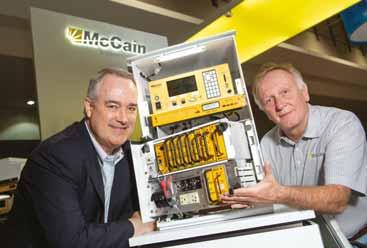
From left to right: Nathan Welch, Greg McKhann & Bill Sowell
Smart Cities Adapt
SynchroGreen® Adaptive Gets You There.
Smarter.
SynchroGreen® Adaptive is the fastest growing traffic control system in North America. Brought to you by the same company that delivers the industry-leading Synchro® Traffic Analysis & Simulation Software and ATMS Central Traffic Management System.
•Proven to reduce travel time, decrease congestion, improve safety
•Real-time optimization - cycle, offset, split
•Significantly improves use of roadway capacity
•Easy to install, intuitive to use
•Connected-vehicle and Transit Signal Priority capable
•Created by traffic engineers for traffic engineers
AN INVALUABLE LEARNING EXPERIENCE WITH 3M
3M has a major presence here at the Annual Meeting. The company is hosting a panel session at the Pathways to Innovation stage and will also stage demonstrations of the newest pavement markings innovations at its booth.
Yesterday, 3M hosted the Automated Vehicle Safety: The crossroads between technology, policy and infrastructure panel session, bringing together participants from across the connected and automated
vehicle ecosystem for a discussion to help bridge the gap between vehicles and infrastructure. It provided the audience with an invaluable insight into automated driving systems, how they interact with infrastructure, and what they can do today to help improve safety on the roadway.
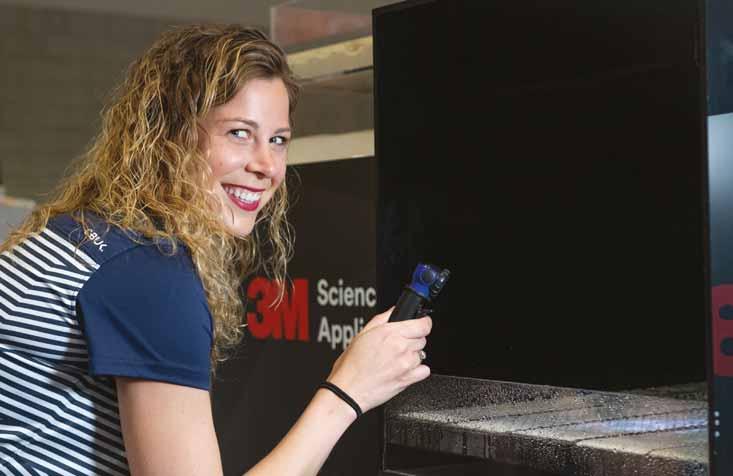
At the 3M booth, wet reflectivity and contrast demonstrations of the company’s Connected Roads Contrast Tape Series 380ADAS and 3M’s
Fortified with Fortis
The latest version of the OPEK ITS Orchestrator Assets Management Portal 2.1. System from Fortis Consulting includes custom report builder and alarm modules.
Importantly, the latest version has secure inter-portal data access with the ability to share data between different assets management systems, financial data integrity and budgetary reports and mapbased customisable views of geocoded assets.
It allows the monitoring and
managing all types and aspects of IT/ITS and non-ITS related assets. The new version is fully customisable per municipality/ agency in accordance with local rules and procedures. The system is already delivering substantial benefits to the end-users, including its largest deployment at the New York City Department of Transportation - more than 1 million assets in the single system.
▶Booth 551 www.fortis-cs.com
Connected Roads All Weather Elements will be staged.
380ADAS provides a 60% increase in visibility distance versus beaded paint products in night-time rainy conditions, and increased contrast of white and yellow lane markings with black edges on both sides – the wider black edges provide a larger contrast target for camera detection at longer distances.
3M’s Connected Roads All Weather Elements, takes pavement markings to new levels
of performance for drivers and ADAS systems in virtually any conditions. Importantly, 3M Elements are compatible with most liquid pavement marking binders and install with double-drop systems. Moreover, it requires 20% fewer elements than the previous generation 3M Reflective Elements and is the company’s most efficient optics for liquid pavement markings yet.
▶Booth 301
www.3m.com
Reserve your booth for ITSWC 2020
Any companies that are interested in exploring the possibility of reserving exhibiting space at the ITS World Congress in Los Angeles, October 4-8 2020, make sure you speak to Carly DiVito of Corcoran who can be found in the sales office at the far end of the exhibition hall in aisle 700. The theme of the event is The New Age of Mobility, where technologies, services and systems will be featured that move us closer to a future of seamless mobility. Booth sales are already well advanced, so if you wish to reserve exhibition space, don’t wait too long!
Elizabeth Dunlap of 3M
PlanetM gateway to Michigan’s mobility ecosystem
Visitors to the Annual Meeting are being encouraged to check out the one place that has a mobility strategy which aligns the collective mobility stakeholders and strategies across Michigan state. PlanetM connects mobility companies to Michigan’s people, places and resources dedicated to the evolution of transportation mobility.
PlanetM is where big ideas in mobility are born and where Michigan’s vast talent is brought together to work toward advancing the future of the mobility industry. Michigan is home to two world-class autonomous vehicle testing sites, leading the nation in testing and development of next-generation transportation technology. Not to mention, PlanetM’s network
of industry leaders, universities, private and public organisations and government agencies has positioned the state to remain the leader in all things mobility for years to come.
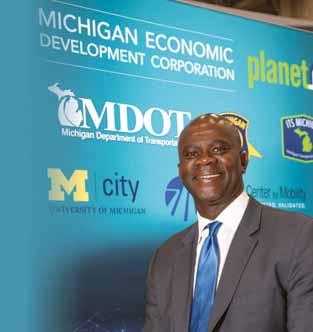
“Early on, leaders at the Michigan Department of Transportation saw the potential for automated vehicles to revolutionise mobility,” said MDoT director Paul C. Ajegba. “With our ground-breaking legislation and robust private industry partnerships, we expect Michigan to continue to lead in this arena.”
PlanetM also helps mobility companies accelerate innovation by providing the opportunity to access advanced testing facilities in Michigan through grants.
▶Booth 415 www.planetm.com
AV mobility for an ageing population
Autonomous vehicles (AVs) have the potential to improve the lifestyles of an ageing population, according to speakers in the session AVs, Healthcare and Aging. The Michigan Henry Ford Health System is a case in point, said Timothy Woods, general manager of Autonomous Vehicle Alliance and moderator of the Wednesday session. “The Ford system is moving increasingly toward an outpatient model over the next 10 years where patients will be mobility-dependent to get to their appointments.”
The Ford system means that patients will be spending time outside the healthcare centre, be it in an assisted or independent living facility. But their insurance payments will be dependent upon them meeting their medical appointments. This is where reliable AV transportation will be crucial to the outpatient system, said Woods.
“Too often a patient’s caregiver is also the driver of the vehicle taking the patient to the
Ped detect live!
appointment,” said Suzette Malek, manager of global societal trends research with General Motors. That’s not the caregiver’s main job. In an AV there is a “social moment” between the caregiver and the patient because they can converse.
There still remain obstacles for patients and elderly people before they can trust an AV, noted Michelle Hartmann, market intelligence manager with Magna International, the global Canadian automotive supplier and mobility technology company. “If people that they [older people] trust are using and talking about the usefulness of AVs, then trust about AVs will eventually build up,” she said.
Also, the use of AVs can replace the anxiety that many independently living older people now have about some aspects of driving which stops them from getting behind the wheel, said Hartmann. These include a fear of night driving and of bad-weather driving.
are experiencing a live Pedestrian Detection Demonstration using Connect:ITS System, a simple to use, scalable low-power roadside information system. It uses data from both MH Corbin and popular third party sensors to allow algorithms to compute changing roadway conditions in real time. Data is then sorted and distributed to an existing messaging network of HAR systems, dynamic message signs and flashing beacon systems.
Additional outputs can also be used to send data to in-vehicle warning systems via DSRC. Potential applications for the CONNECT:ITS include bridge deck icing, low visibility, curve warning, over-height vehicle detection and wrong-way detection. The CONNECT:ITS System can also be scaled up or down for a customised solution based on application needs. ▶Booth 458 www.mhcorbin.com
Visitors to the MH Corbin booth
Paul Ajegba of MDoT
Smart cities don't have to be complicated
Creating a safe and integrated Smart City should be as easy as playing with building blocks, according to McCain, a developer of intelligent traffic systems. McCain’s Smart City Vision is built on three blocks, explained Greg McKhann, McCain’s chief operating officer.
The first is a foundation of smart hardware, including low-voltage ATC cabinets that come connected vehicle-ready and variable message signs that consume only 10% of the power of traditional units.
The second building block is intelligent software. This can include McCain’s Transparity Traffic Management System that delivers high-resolution
event data with information that makes traffic managers more productive. Also included is McCain’s OPTIPARK Parking Guidance System that provides motorists with parking guidance while offering parking facility
operators a compelling low-cost alternative compared to singlespace systems.
The third block brings it all together through integrated communities, featuring McCain’s transportation data
exchange called Transparity TDX. This establishes a cloudhosted capability to provide customised data services, critical to supporting connected and autonomous vehicle operations.
“With the high pace of traffic management innovation, communities should be able to embrace the future without reinventing their infrastructure after every new deployment,” said McKhan.
“Our products are designed to be adaptable, to build upon one another and to communicate seamlessly so cities don’t continually face massive upgrade costs.”
▶Booth 201 www.mccain-inc.com
Greg McKhann (left) and Don Maas
TAKING A PEEK AT SIGNAL PRIORITIES
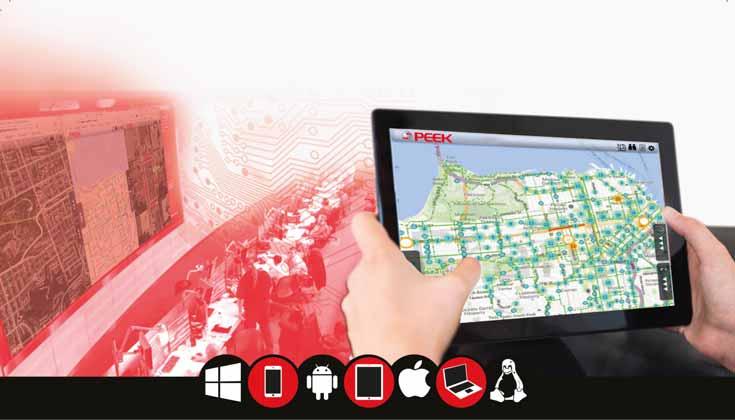
Representatives at Peek Traffic are spending their time at the Annual Meeting talking about their goal to provide signal priority capabilities to intelligent transit vehicles across North America and abroad. Peek allows traffic and transit officials to use radio, WiFi and centre to centre communications to give transit vehicles traffic signal priority as they near an intersection. Schedules, real-time arrival times, current traffic flow and congestion data flows into Peek’s GREENWave ATC traffic control software where it optimises signal timing.
“There’s an art to traffic signal priority,” said Ray Deer, the company’s CTO. “You want to provide priority just enough so that buses and light rail systems stay on schedule without impacting regular traffic.”
According to Deer, Peek recently conducted a pilot in Minneapolis, that resulted in a large reduction in all vehicle delay times due to light rail prioritsations. The average reduction in vehicle delay was 32% while the number of vehicles that had to wait two minutes or longer for the train was reduced by half. The longest delay measured reduced from 11 minutes to 4 minutes.
▶Booth 630 www.peektraffic.com
Ray Deer of Peek
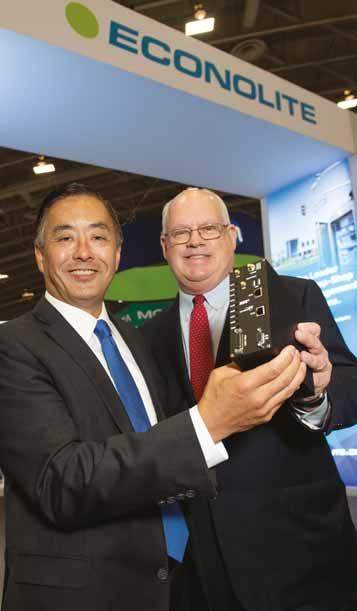
Econolite and Eberle Design (EDI) have teamed up to simplify signal performance measures with the new DA-500E, a fully-hardened in-cabinet data and communications-rich platform designed to integrate within legacy controllers and cabinets. It features cellular and edge computer data aggregating, which integrates with a wide range of controllers. The DA-500E also enables powerful connectivity and data analytics with Econolite’s industry-leading Centracs SPM to provide the critical link between Centracs SPM and older controllers and/or closed-loop systems.
The DA-500E transforms legacy or remote traffic cabinets into immersive intersection traffic data reporting units,
ECONOLITE & EBERLE'S DA-500E PLATFORM
enables connectivity, and hosts CV apps at the edge. Centracs SPM data analytics are now available to older or previously non-connected controllers enabling proactive traffic management with the ease of a cloud-based platform.
Centracs SPM and DA-500E can communicate via builtin cellular modems or use existing IP infrastructure.
The device also enables older controllers, even from other manufacturers, to be Centracs SPM-ready by leveraging its ability to access the SDLC output. It provides the Purdue Coordination Diagram and the Indiana High-Resolution Data Set directly to Centracs SPM, enabling automated signal performance measures.
y, and hosts . Centracs are now trollers traffic he ease atform. DA-500E ia builtor use cture. nables ven cturers, -ready y to access the n gh-Resolution Centracs mated ures.
▶Booth 407 www.econolite.com
m
Workzones in a C/AV environment
Little standardisation of hardware, software and data management remains an obstacle to the development of workzone safety in the era of connected autonomous vehicles.
However, field trials are progressing in many US states with a goal to establish ubiquitous and open access to information on workzone safety, according to Todd Peterson, a transport specialist within the US Federal Highway Administration. The government’s Work Zone Data Initiative is working toward this goal, he told delegates in the debate session Navigating work zones in a CAV environment. National standards will eventually be required, said Peterson. But first the usual obstacles of data management will need to be overcome. These include a lack of
resources by agencies and contractors to integrate systems for a complete view of the work zone. Also, data may remain in silos within organisations, further hindering integration of information to get an overall picture of work zone infrastructure and activity.
Another challenge is to verify data as accurate, according to Jay Parikh, a principal investigator at Camp in V2I. Camp is responsible for research and prototype development of safety applications with the Federal Highway Administration. There is also the continuing challenge of having the physical node points on the road which send out data in the right place all the time, he told delegates.
A major field trial is showing up issues
that might be otherwise overlooked, said Michele Mueller, senior project manager for connected and automated vehicles in the Michigan Department of Transportation. A pilot project with 3M is being conducted along the I-75 rebuild project – the first connected work zone in the US, she told delegates.
For example, said Mueller, the pilot project is exploring the issue of passing vehicles being able to always pick up location data from workers’ vests even if they are behind solid objects and not visible. Also, the DoT is working with 3M to ensure pavement markings are readable regardless of weather conditions and that road signs remain durable and datareadable throughout the years.
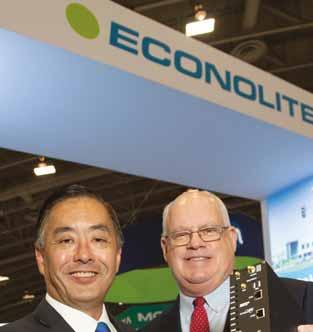
Mark Nogaki of Econolite and EDI's Bill Sowell
0
The acceptable number
Your job is critical in helping make roads safer for the driving public—but you’re not alone in your mission. We’ll continue to challenges you face.
Make your existing highway camera network smarter
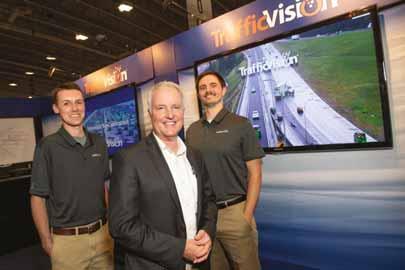
TrafficVision is demonstrating an automatic incident detection (AID) solution that was designed to collect the real-time information agencies want from their existing and new highway cameras.
“Our highly flexible, user-defined AID-system enhances operators’ eyes to monitor their existing cameras and continuously detect abnormal situations in traffic, ultimately assisting in making time-critical decisions based on real-time situational detections,” says TrfficVision’s Ray Keys, adding that the result makes cameras smart.
Any agency can instantly, easily and non-intrusively deploy TrafficVision across its network of diverse highway cameras, including pan-tilt-zoom and turn existing video networks into a
flexible and smart surveillance community, enabling incident detection and data collection reporting 24/7.
Detection images and/or video clips can be transmitted to the operator or user-defined sets and subsets of users who can
then decide on the nature of the incident and how best to respond.
This smart technology can easily be integrated into existing ATMS systems or operate in stand-alone mode. Best of all, as the software is enhanced and additional features are added, they are passed along
to customers without requiring hardware upgrades. TrafficVision also works with thermal cameras where high accuracy under adverse lighting and weather conditions is desired.
Depending on the view, one camera can monitor multiple lanes of traffic including opposing directions of travel and provide data stamp, incident snapshot and video snippet for analysis and verification of stopped vehicles. This also includes debris or pedestrians on the highway, slowed traffic below set thresholds, congestion, wrong way drivers, low visibility, and other features such as vehicle volumes and speeds, flow rate, lane occupancy and vehicle classification.
▶Booth 536
www.trafficvision.com
Advanced Automated Traffic Image Analysis
Introducing
the Ls245R Traffic Camera
Embedded Artificial Intelligence for VDET and ALPR
The Teledyne Lumenera Ls245R camera is an embedded traffic imaging solution with integrated self-triggering VDET and ALPR. The Ls245R images, analyzes, and extracts data all on its own –without the need for a separate computer for image processing.
From left to right: Davcid Reynolds, Ray Keys and Josh Kissel
WAYCARE AI ENABLES INCIDENT MANAGEMENT
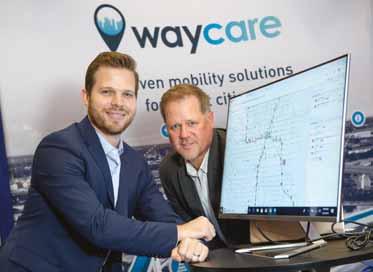
Waycare is developing artificial intelligence (AI)powered solutions enabling transportation and public safety agencies to harness internal and in-vehicle data for real-time, predictive incident management and traffic optimisation.
The system collects and synthesises into a single platform not only municipal data such as sensors, CCTV cameras, traffic signal information, but also diverse sets of in-vehicle data such as telematics, crowd-sourced navigation, and connected vehicle insights. Leveraging applied machine learning and predictive analytics, the system transforms this information into
real-time decision-making tools and forward-looking insights, enabling improved incident mitigation, dynamic real-time traffic flow optimisation and direct communication with the public.
A cloud-based solution, Waycare’s platform is interoperable across agencies throughout a region on any data-enabled device.
The platform was successfully deployed in the Las Vegas region, and the system was able to demonstrate the use of AI and in-vehicle data for traffic management, incident management, crash prediction, and prevention. Notable results include on average 12-minute faster response time
to incidents, 17% fewer crashes on monitored roads through proactive policing, 180% increase in incidents identified,
and a 300% increase of messages to the public.
▶Booth 755
www.waycaretech.com
ONE CABINET AT A TIME
Through best-in-class diagnostics, smart components, and cutting-edge technology, McCain’s ATC Cabinets are the safest available today. With the most units sold, our proven ATC Cabinets are ready for tomorrow’s challenges and the future of connected vehicles.
www.mccain-inc.com
McCain. Proud to Be Part of Something Bigger.
Celebrating our SWARCO family; improving your travel experience for 50 years.