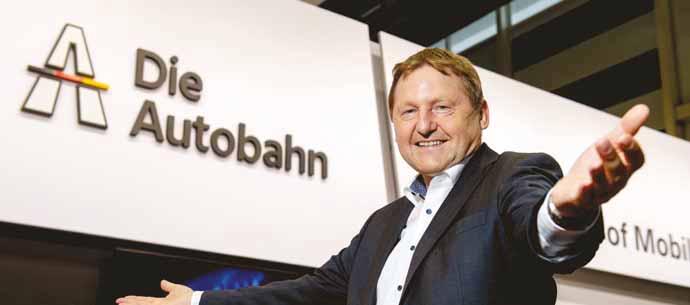


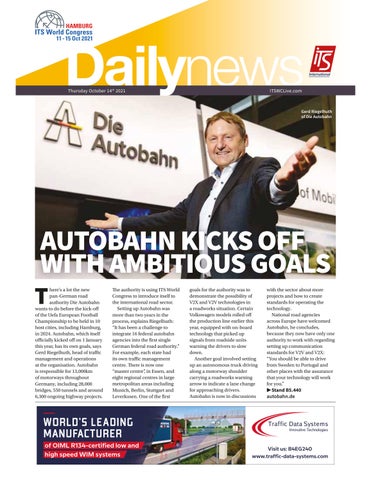
There’s a lot the new pan-German road authority Die Autobahn wants to do before the kick-off of the Uefa European Football Championship to be held in 10 host cities, including Hamburg, in 2024. Autobahn, which itself officially kicked off on 1 January this year, has its own goals, says Gerd Riegelhuth, head of traffic management and operations at the organisation. Autobahn is responsible for 13,000km of motorways throughout Germany, including 28,000 bridges, 550 tunnels and around 6,300 ongoing highway projects.
The authority is using ITS World Congress to introduce itself to the international road sector. Setting up Autobahn was more than two years in the process, explains Riegelhuth: “It has been a challenge to integrate 16 federal autobahn agencies into the first single German federal road authority.”
For example, each state had its own traffic management centre. There is now one “master centre” , in Essen, and eight regional centres in large metropolitan areas including Munich, Berlin, Stuttgart and Leverkusen. One of the first
goals for the authority was to demonstrate the possibility of V2X and V2V technologies in a roadworks situation. Certain Volkswagen models rolled off the production line earlier this year, equipped with on-board technology that picked up signals from roadside units warning the drivers to slow down.
Another goal involved setting up an autonomous truck driving along a motorway shoulder carrying a roadworks warning arrow to indicate a lane change for approaching drivers. Autobahn is now in discussions



with the sector about more projects and how to create standards for operating the technology.
National road agencies across Europe have welcomed Autobahn, he concludes, because they now have only one authority to work with regarding setting up communication standards for V2V and V2X: “You should be able to drive from Sweden to Portugal and other places with the assurance that your technology will work for you.”
▶Stand B5.440 autobahn.de





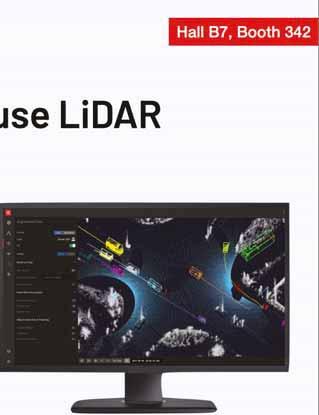
- Advanced speed measurement: multi-vehicle detection, classification, multi-lane tracking...

- Real-time tracking and data collection: dimensions, direction, distance, classification... - Intelligent traffic management through the 3D-LiDAR technology www.parifex.com l info@parifex.com





Publisher / MD
Andrew Barriball
Editor James Foster
Editorial team
Adam Hill
David Arminas
Sales director
Dan Emmerson
Design
Andy Taylder
Photography
James Robbins
Production manager
Nick Bond
IT & website director
James Howard
Website manager
Sarah Biswell
Social Media manager
Tatyana Mechkarova
Printed by Lehmann Offsetdruck
Contact us
The Daily News office can be contacted at media@ropl.com
Published by
©Route One Publishing Ltd 2021 Waterbridge Court, 50 Spital Street, Dartford, Kent, DA1 2DT, United Kingdom
Tel: +44 1322 612055 www.ropl.com
The publishers would like to thank Ertico – ITS Europe for all its assistance in helping to produce the Daily News
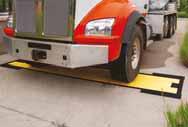
PSS has now integrated its Rapture rumble strip handling machine into i-Cone’s IoR – Internet of Roadworktechnology that interfaces with existing traffic control equipment.
The Rapture, mounted on the front of a road works service vehicle, intermittently drops
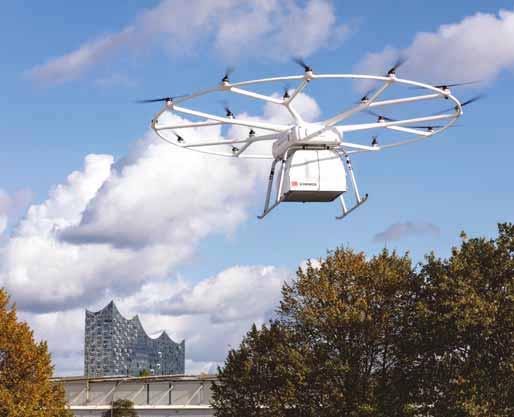

Volocopter’s electric heavy-lift drone VoloDrone conducted its first public flight yesterday here at ITS World Congress Hamburg 2021. Together with the international logistics leader DB Schenker, Volocopter, a pioneer of urban air mobility (UAM), demonstrated VoloDrone’s seamless integration into the logistics supply chain with an end-to-end cargo transport demonstration.
The three-minute test flight took off at 15:02 at homePort Hamburg and reached a maximum altitude of 22 metres. For this delivery simulation, the
electric heavy-lift utility drone was equipped with a load-box in between its landing gear. First, the demonstration teams secured a Euro-pallet sized load to the box under the VoloDrone, followed by a smooth take-off.
After this, the aircraft brought the payload to a DB Schenker Cargo Bike and landed safely. Once the payload was transferred successfully, the Cargo Bike delivered its cargo to the final destination under the area’s park deck, marking the completion of the entirely electric, multimodal last-mile delivery.
flexible lane-wide rumble strips to alert approaching drivers that they must slow down. Rapture’s lane-wide magnetic bar pulls a rumble strip from a tray, moves it out from the truck and lowers it onto the road, releasing it several centimetres above the surface. By connecting Rapture to i-Cone’s IoR, traffic controllers
know how many strips have been laid down, when they were taken up and so when to allow traffic back into a lane. The system will create a historical record of work zone activity for highway agencies.
Meanwhile, i-Cone’s IoR reports work zone data directly to navigation systems and
“This first public VoloDrone flight is a strong sign for Volocopter´s leading position in the UAM industry. We are the only UAM company offering solutions for passengers and goods that are flying fully scaled and publicly around the world,” says Florian Reuter, Volocopter CEO. “Our VoloDrone will make existing logistics processes more robust, efficient, and sustainable. DB Schenker is an invaluable partner in our endeavor to untap the massive potential of our VoloDrone’s logistics use cases.”
▶Stand B2 volocopter.com
connected vehicles to provide drivers with real-time situation awareness. Drivers will see geo-located work zones and other roadside activity on their navigation application GPS dashboard, such as Google Maps and Waze.
▶Stand B5.509
pss-innovations.com


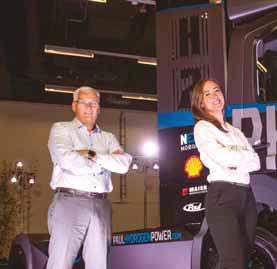
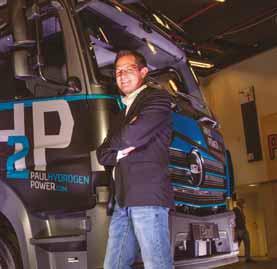


Shell, MaierKorduletsch and Paul Nutzfahrzeuge are introducing a medium-duty fuel cell truck to activate the market for hydrogen used as a fuel in the medium to heavy duty road transport sector. Paul Nutzfahrzeuge is a company that develops specialpurpose commercial vehicles. MaierKorduletsch is a group of companies in which members such as Maier Holding and Maier & Korduletsch Energie trade in energy, fuels and lubricants.
Fabian Ziegler, Shell country chair, Germany, says: "Road freight traffic could triple by 2050. At the same time, Germany has so far fallen short of its own targets for reducing greenhouse gas emissions. In addition, nitrogen oxide and other pollutant limits are exceeded in many cities and regions. It is therefore important to reduce CO2 emissions and improve air quality, which can be done through new low-carbon fuels, as well as improved fuel efficiency.”
Cohda Wireless has demonstrated a Vehicle to Pedestrian (V2P) detection solution in which the connected vehicle receives warnings based on the proximity of vulnerable road users (VRU).Cohda says the driver is alerted to the presence of the VRUs on the basis of safe, close or critical distance, raising their awareness so they can take appropriate action to avoid a collision. The technology comprises a wearable electronic tag which can be mounted on a cyclist's helmet or attached to a backpack or clothing accessory.
Bernd Luebben, vice president business development at Cohda, believes the system represents a practical and highly interoperable
Shell says the basis of the new zero-emission vehicle is a glider – a chassis and driver cabin from Mercedes-Benz Atego, equipped by Paul Nutzfahrzeuge with a central drive from ZF and a fuel cell from Toyota.
According to Shell, the 15t truck (24t including trailer) with a hydrogen storage capacity of 30 kg can represent a range of up to 500 km and be fully refuelled within only 10 to 15 minutes.
As part of the collaboration, MaierKorduletsch is to construct a hydrogen retail station for
solution for incorporation into a connected intelligent transport system.
“Invariably, accidents comprising pedestrians and cyclists involve an element of surprise and that’s what we are attempting to address with this technology,” Luebben says.
“For example, a pedestrian might step out into traffic from behind a truck, or a bus has obscured the presence of a cyclist and the driver only realises that the cyclist is there when a collision is unavoidable. It’s this nonline-of-sight application that is particularly beneficial.”
The demonstration was carried out in collaboration with NXP Semiconductors and
the first trucks. Shell plans the supply of green hydrogen and is developing an integrated mobility platform which includes a vehicle offer on a payper-km basis. The companies plan to offer customers up to 2,500 fuel cell trucks with up to 50 hydrogen filling stations by 2025. The first 25 prototype trucks will be tested by select customers as early as next year. Mass production is scheduled to start in 2023.
▶Stand B5.330 shell.com
Spectrum FiftyNine, a company specialising in the design and integration of collision avoidance modules.
Huanyu Gu, senior product marketing manager ADAS at NXP, says that a strong ecosystem and partnerships are crucial for the continuous development of Vehicle to Everything (V2X).
“Use cases like Vehicle to Pedestrian make clear that all road users can benefit from the proven V2X/DSRC technology and chipsets that are already in standard use in selected passenger car models today,” Gu adds.
▶Stand B5.302
cohdawireless.com, nxp.com
































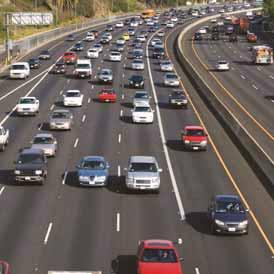

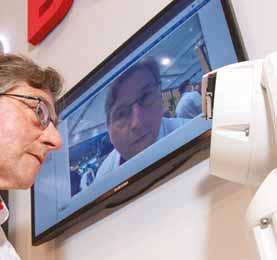


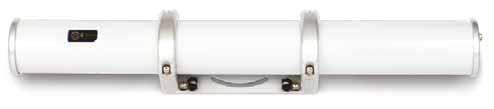
‘Mic’ is one tough character and he is showing off his powers in real time on the Bosch Security stand. Mic, a member of the company’s Inteox family of cameras, is detecting traffic conditions along a stretch of motorway in the US.
The camera’s steel housing is rated IP68 for water tightness and there are no internal running gears to foul up. There is even an external lens wiper and the lens window is heated
for climates that experience freezing temperatures. Inteox enables app developers, system integrators and other Bosch partners to develop customerspecific apps or easily customise security solutions with no restrictions or boundaries.
For transportation agencies, the cameras provide vehicle and vehicle type detection, as well as vulnerable road users including pedestrians, cyclists and motorcyclist.
Inteox combines built-in
intelligent video analytics from Bosch, a commonly-used open Operating System provided by Azena and the ability to securely add software apps at a later date. Thanks to the fully open principle, system integrators are free to add apps available in the application store, making it quick and simple to customise solutions.
The system can create a detection box where a vehicle’s passage is timed; a slowing down of vehicles indicates


congestion ahead of the area, explained Joel White, product owner for intelligent traffic solutions within Bosch. This triggers an alert sent to vehicles where drivers view on an onboard screen the congested area and they can change their route. Meanwhile, the Bosch systems also sends an alert to road-side variable message signs indicating congestion ahead and posts a slower speed.
▶Stand B5:115 boschsecurity.com
The focus of PTV Group's appearance here in Hamburg is on the intelligent use of data: the company is presenting its latest solutions for analysing, evaluating and visualising data, its state-of-the-art tools for shaping sustainable and efficient mobility.
PTV is demonstrating its latest innovative Software as a Service product, PTV Visum Publisher. With interactive dashboards and 3D maps, the tool enables users to analyse and visualise large sets of data to understand and evaluate a wide range of different scenarios in mobility planning. The attractive visualisations facilitate clear
and vivid communication of mobility ideas to stakeholders, decision-makers and public.
Other highlights at PTV’s stand include the web-based PTV Bicycle Planner, a tool to develop reliable bike lane concepts, and PTV's new cooperation with Bosch to enhance air quality in cities. By integrating precise emissions data from Bosch into the traffic simulation tool PTV Vissim, the effects of planned traffic measures on vehicle emissions and on air quality can be easily evaluated.
PTV Group has also announced its partnership with Germany’s new Mobility
Data Space, which is promoted by the Federal Ministry of Transport and Digital Infrastructure. For the mobility data sharing platform, PTV has developed a use case for improved traffic forecasting based on machine learning technologies.
"Our software solutions enable city and traffic planners to better understand the entire mobility ecosystem and make sound decisions," said Christian U. Haas, CEO of PTV Group. “The smart use of data and its visualisation are key elements in creating future-oriented and sustainable mobility."
▶Stand B4.EG230 ptvgroup.com








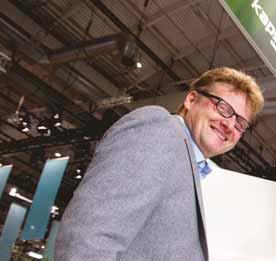
Michael Ganser of Kapsch
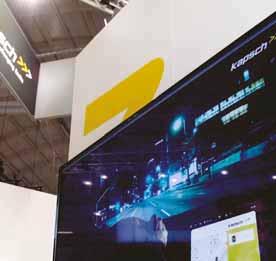


In terms of sustainable mobility in cities, avoiding congestion is a key issue. Intelligent traffic management leads to quick, effective solutions and positive effects on the environment and quality of life. That’s why experts from Kapsch are presenting their mobility solutions for digital traffic control and intelligent networking of vehicles and roads here in Hamburg.
A quarter of all greenhouse gas emissions in Europe are due to traffic. The fact that this is also causing resentment
among those affected was recently made clear by the Kapsch TrafficCom Index-2021: 70 % of German and 74 % of Austrian respondents no longer consider road traffic emissions acceptable.
Intelligent traffic management allows traffic authorities to record and respond to traffic conditions in real time. While conventional solutions are time-delayed and inaccurate, a proactive solution takes into account current traffic conditions and combines measures
such as dynamic pricing, intelligent vehicle routing and signal optimisation to manage demand from private motorised transport.
"Traffic congestion and its associated emissions create a public health crisis and cause millions of dollars in lost productivity. That's why we are driving innovation and technology in key areas such as connected driving, smart roads and smart mobility pricing. All these elements need to work together if we want to achieve sustainable change," says Gerd

Gröbminger, VP sales Ceneca at Kapsch TrafficCom, adding that a first convenience function that can be implemented quickly is the Green Wave Assistant.
Traffic signal timing data is processed directly for drivers with a smartphone app or integrated into the vehicle navigation system so that they can keep up with the green phases of the traffic signals and drive more smoothly while at the same time saving energy.
▶Stand B5.405 kapsch.net
The recently launched VahanSim, from Marben, allows the lab testing of V2X devices for their ability to detect and identify road obstacles.
The VahanSim V2X simulation testing tool offers user-friendly and easy-to-use graphical interface to generate complex V2X application scenarios, said Devang Naik, director of software engineering at the US-based company.
With VahanSim, users can create
or modify scenarios involving many vehicles, road side units, pedestrians, crosswalks and configure various notifications and signals in only a few clicks.
Using VahanSim can help improve road safety and optimise traffic flow during congestion periods or when road maintenance is underway, he said.
▶Stand B5.008 Marben-products.com
Continental is highlighting its prototype Autonomous Mobile Robotics, including its Corriere, a small delivery robot for transporting groceries and packages in urban areas. It weighs just under 40kg and is only 30cm high. It is already on trial in Singapore transporting food from a restaurant to Continental’s local site. The Corriere is ideal for what is known as the last mile of the logistics supply chain. Also, city people need no longer head out in their car or on their bicycle to pick up that forgotten bottle of milk.
▶Stand B5.410 continental.com
Traffic and transportation issues are on our minds every day. We all want smoother and safer traffic flows, quicker travel, and less congestion and emissions. Whenever and wherever this is not the case, we see our quality of life at risk. That is why SWARCO focuses on improving the travel experience.
Whether you walk, drive your electric car, or ride on a bus or a bicycle: The coordination of different transport modes is crucial for a smooth, environmentally sound journey and a timely arrival. SWARCO road marking systems and traffic management solutions make this happen. With clear guidance and orientation, up-to-date, real-time information, and the broadened view on the entire mobility ecosystem.
Let’s talk how we can improve your travel experience.






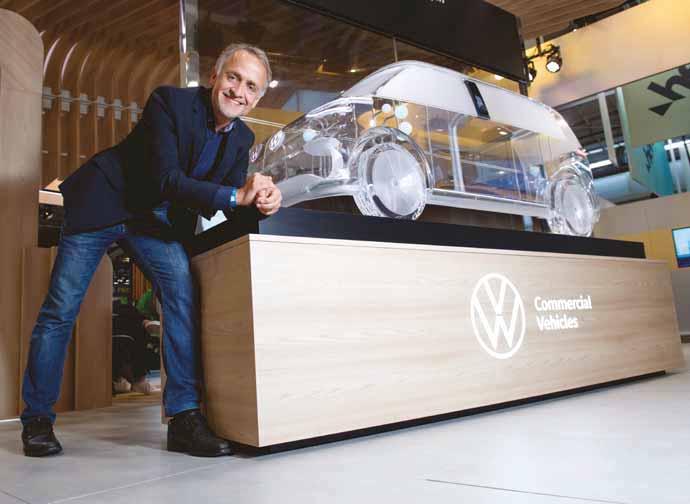
Volkswagen Group is here in Hamburg to present solutions for an integrated, future-proof transportation system.
The focus is on autonomous driving, the intelligent use of vehicle data and the integration of electric vehicles into the power grid. Together with its Volkswagen Commercial Vehicles, Moia, Cariad, Elli and MAN Truck & Bus brands, the group is providing a forum for interested parties and experts with live demonstrations of
pioneering pilot projects, discussion panels, lectures and expert talks.
“Intelligent transportation systems play a key role in futureproof mobility in cities and beyond,” said Gernot Döllner, senior VP group strategy at Volkswagen. “They are the basic prerequisite for carbonneutral, connected, safe and tailored mobility solutions and key factors in our New Auto Group strategy. Together with our partners, we will make the mobility of people and goods
How does AI-based and cloud software help operate urban infrastructure in a reliable, intelligent and sustainable way?
Find out at the PSI Group’s stand where the company’s solutions include software for predictive traffic management, smart utility grids, integrated depot and charging management for e-vehicles, automated rail transport and efficient airport baggage handling. With KPI-based decision support, software from PSI optimises traffic flow control, network management and operational processes in bus and streetcar depots.
▶Stand B5.002
psi.de
even more efficient, sustainable and convenient.”
For Volkswagen, autonomous driving is a key technology that enables new mobility solutions and improves road safety. Moia is using an interactive simulation to show how largefleet autonomous ride-sharing can contribute to the mobility revolution.
AD1, Volkswagen Commercial Vehicles is allowing visitors to experience various usage scenarios of self-driving shuttles for the transportation of goods
MOIA, the young start-up mobility company of the Volkswagen Group, is showing its a digital ecosystem for the entire value chain of ride-pooling - from apps to algorithms to fleet management. MOIA currently offers a fully electric ride-pooling system in Hamburg and Hanover. People share a vehicle, whose start and destination are in a

and people. Cariad is providing insights into data-based services that help improve traffic safety and flow. For example, anonymised data from group vehicles enables authorities in Europe and the US to optimise road maintenance and winter services already today.
Another core topic is the systematic switch to e-mobility and also, cooperation as a success factor for the transformation.
▶Stand B5.210 volkswagen.com
similar direction. Via the app, the customer sends a ride request. A dynamic pooling algorithm assigns it in a fraction of a second to an already existing ride. Customers are picked up and transported together with others on a completely dynamic route.
▶Stand: B5.211 moia.io









Optibus is seeking to create happy passengers on public transport by showing operators different route planning and scheduling scenarios.
“We allow companies to move to the native cloud, a serverless environment which allows them to compute Big Data more quickly,” says Carmine Chiuchiolo of Optibus. “The upside of that is companies can start modelling their operations. Passenger happiness is the main goal. A mapping facility allows you to layer data – for example, origin and destination or social and demographic data.”
The power of the AI solution is that it allows you to deal with the day-to-day running while also seeing where they could improve.
“We want to allow companies to find that marginal percentile of improvement which allows them to win bids and have happier customers,” says Chiuchiolo.
▶Stand B5.409 optibus.com




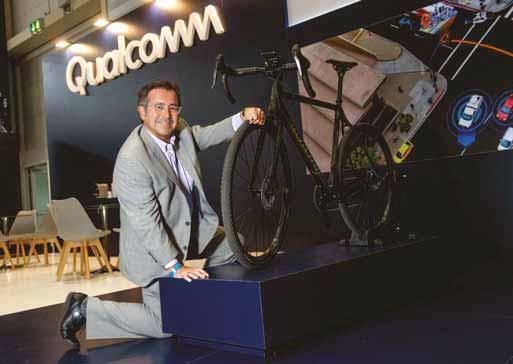
ualcomm Technologies’ partnership with mobility platform Spoke has taken centre stage on the US wireless technology provider’s stand at ITS World Congress.
The company is using its cellular Vehicle to Everything (C-V2X) to help improve safety for cyclists by enabling direct communication between road users, vehicles and roadside infrastructure without the need for a cellular network.
The form factor, previously engineered for automotive use, has been altered for bikes, enabling vehicles to identify vulnerable road users using the

same C-V2X technology used in vehicles.
Jim Misener, Qualcomm’s global V2X ecosystem lead, is confident about the development of C-V2X over the next few years: “The technology constantly evolves but it has to be interoperable with future technology.”
Looking ahead to the next ITS World Congress in Los Angeles in 2022, he said: “By LA, we’d anticipate that the FCC would have finished its deliberations on C-V2X. And in two years’ time we are in China, where you’ll see a mature system, with 100 cities and 14 or 15 OEMs. China has a head of steam. The
effects of that deployment will be profound.”
The important thing about C-V2X is that it is applicable all over the world, with a few




tweaks. “It’s the same underlying hardware with some difference in protocols,” explains Misener. ▶Stand B5.300 Qualcomm.com





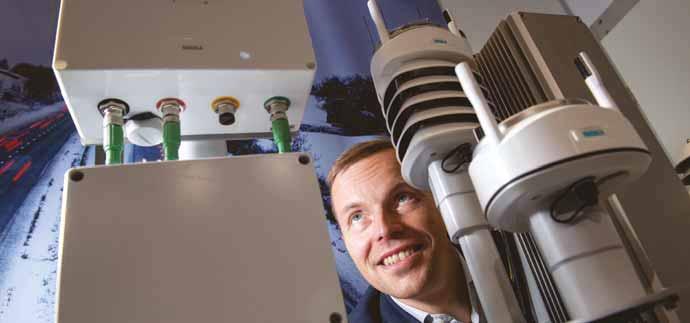

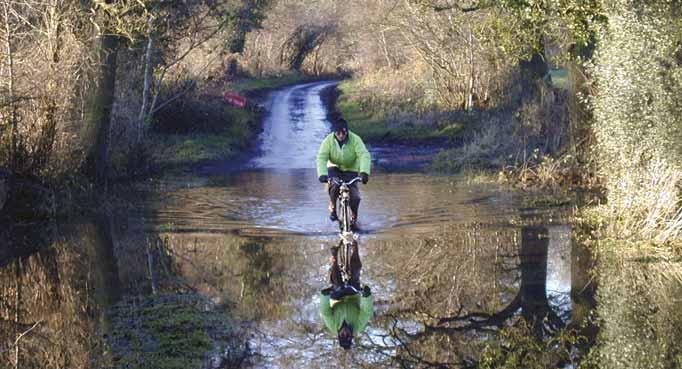
If it rains, will cyclists still cycle to work or will they take the bus? Anecdotally, the answer is yes. But Vaisala’s new Beacon Station will help supply data that answers this and other mobility questions, thanks to a project in the UK.
“We are co-locating our Beacon Station 500 series weather analysis equipment with Vivacity’s AI road side units that generate computer visions of traffic movements, such as identifying cars, trucks, buses, cyclists and pedestrians,” said Daniel Johns, head of Vaisala’s ground transportation business
development. More the 60 locations are being set up in the West Midlands, including the city of Birmingham, and should be fully functional by the end of the year.
The Beacon Station incorporates Vaisala’s Weather Transmitter for measuring wind, rain, temperature, humidity and air pressure. Beacon also incorporates Vaisala’s Air Quality Centre for measuring pollution levels.
“The goal is to know how the weather affects people’s choices of mobility,” said Johns. “We will be able to see if vehicular

traffic increases on rainy or cold days and if so, should there be more buses or other public transportation modes on those days.”
By measuring air quality as well, road authorities can see any correlation between poor weather and pollution levels and take action to mitigate pollution when they know inclement weather is on the way.
“Such micro-detail can help build really intelligent traffic flow management,” said Johns.
▶Stand B5.127 vaisala.com
What can cities do in order to implement ITS technology and speed up the mobility revolution? Ertico has some answers. Along with partners ITS America, Swarco and Arriva, it has undertaken an ambitious piece of research, interviewing directors of transportation in 300 cities worldwide to ask exactly what they need to achieve this vital aim.
The full results will be published by Ertico in a couple of weeks but during a session at the ITS World Congress an enraptured audience was given an insight into the findings.
Three big topics dominated the responses: sustainability/
air quality; data sharing between cities and industry; and Mobility as a Service/Mobility on Demand. The top priority of most respondents is to improve public transport. “This is not a surprise but good to have it confirmed,” said Zeljko Jeftic of Ertico. Then came improving air quality and decarbonising city mobility, with climate change also high up the list. Cities are also aware that they need more – and better – data, although they are conscious of protecting individuals’ privacy.
The main challenges for most cities were instructive. For the vast majority, traffic congestion is the issue that is grinding their
gears, with pollution and noise also ringing warning bells. You might have expected these –but there is another problem that many cities said they face too: resistance to change from their citizens. Decarbonising transportation often involves restricting car use and this is proving to be a hard sell for some people. It is going to be a tough one for cities to negotiate: people don’t like parking restrictions, for example. “Not too many cities are going straight out and banning cars,” said Jeftic.
At the same time, there is progress: the Covid pandemic gave cities the chance to
reallocate street space, in particular by building new bike lanes, although many Moonshot respondents also spoke about the investment they had made in electric vehicle charging infrastructure and micromobility. “Several cities said they were going to make the Covid changes permanent,” Jeftic noted.
Speeding up the process of improvement is not a onesize-fits-all deal. Cities face a variety of issues and their needs are evolving. But Ertico’s City Moonshot will go a long way to achieving their goals.
▶Stand B5.135 ertico.com
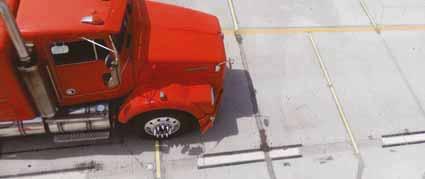

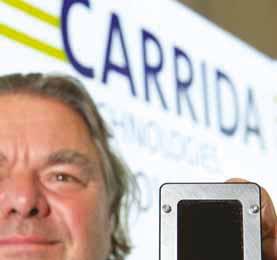



Carrida Technologies’ new Carrida Cam Dragon+ would almost fit in your wallet – but the tiny ALPR camera is three times faster than the firm’s existing Carrida Cam Basic+ so still packs a big punch.
“We have a lot of success in parking,” explains Siegfried Mayr of Carrida.
The German company, a joint venture between Vision
Components and SL Solutions, is also active in the worlds of tolling and traffic management – and is testing Dragon+ in law enforcement operations in Germany and South America. Smart City applications are also being explored.
As well as identifying number plates, the camera can determine vehicle specification including make and model – the
sort of anonymized data which will be useful for city authorities. Carrida’s software can recognize licence plates with 98% accuracy across the world. It can operate in challenging environments, including extreme heat or freezing weather.
“You don’t need additional hardware to get results – it’s a Plug and Play solution,” says Mayr.
Citilog is venturing into the great outdoors with its incident detection analytics, thanks to advances in AI and deep learning. The 700-camera Citilog CT-IM Analytics system is being deployed along roads around Cairo in Egypt.
Citilog CT-IM Analytics was developed originally for incident detection in tunnels. “But advances in deep learning has meant that the CT-IM analytics system can now be used outdoors where the environment is not as stable as in a tunnel,” said Eric Toffin, chief executive of Paris-based Citilog which has been part of the Tagmaster group only since April.
Inside tunnels there is little air movement, no rain, stable humidity
and no harsh light. Outdoors there is changeable weather such as variable winds. “We can now achieve the same performance outdoors as we do in a tunnel and eliminate around 90% of disturbances that would give false data,” said Toffin. The system is now suitable for bridges and large highway projects.
CT-IM Analytics provides automatic real-time incident detection with alarms and associated video evidence within seconds of an occurrence. The system’s detections and traffic statistics are managed by a CT-Center, a centralised software suite for configuring, tuning and filtering alarms.
▶Stand B5.502 citilog.com

Carrida offers a choice of three versions of its software engines to integrate with any project or application: it works with any edge device, independent of hardware or manufacturer. It is proven technology, the firm says, with image acquisition, processing and analysis is on one board.
▶Stand B5.505 carrida-technologies.com





















Next September, the 28th ITS World Congress (ITSWC) will return to the United States for the first time since 2014 – to Los Angeles, a city that embodies ‘Transformation by Transportation’
The premier event for Intelligent Transportation Systems (ITS) will bring together industry stakeholders, including policymakers, OEM’s, entrepreneurs, researchers, academics, investors, and other leaders from around the world. They will connect, network and participate in live education sessions in which industry experts present the latest developments in ITS along with a comprehensive expo floor showcasing cutting-edge technology.
Los Angeles is a leader in developing innovative ways for people to move around. Just as it did for the 1984 Olympics, the city is making infrastructure improvements in advance of the 2028 games that will benefit residents for decades to come, including the Twenty-Eight by ’28 initiative to complete 28 transit projects by 2028.
The city has said it will be carbon neutral by 2050 with its Green New Deal, which includes such targets as electrifying the bus fleet by 2030; requiring 80% of vehicles to be electric by 2035; and reducing vehicle miles travelled (VMT) by 45% by 2050.
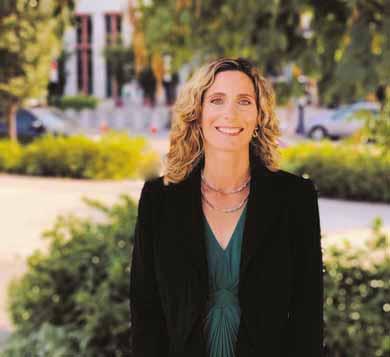
The ports of Los Angeles and Long Beach are the two largest in the nation and combined are the tenth largest in the world. Together, they move roughly 40% of the
Los Angeles is leading the way in changing how people get around, how goods are delivered and how data is optimised for public benefit. Join us as we gather to experience how technology is being deployed to transform transportation – using AI to more efficiently operate systems, deploying personal delivery devices to assess
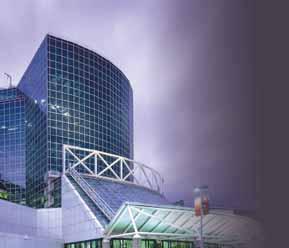
Los Angeles, the second largest city in the US has it all - culture, nightlife, sun, sand and the Hollywood Hills. Los Angeles Convention Centre (LACC), located in the heart of vibrant downtown LA, is a leading destination for conventions, trade shows and exhibitions. Only 17 miles from Los Angeles International Airport, the ITS World Congress venue is conveniently located in the southwest district of downtown LA. The shopping/ restaurant hubs around the convention centre include The Block, Fig at 7th, LA Live and Restaurant Row on 7th Street.

infrastructure, creating the nation’s first zero emission delivery zone, and so much more to ensure a safer, green, smarter, and more equitable future.
“Los Angeles – the city most known for cars even 20 years ago - is now leading a transformation with transit and micromobility, and it is using data to make the system more efficient and more equitable,” said Laura Chace, president & CEO of ITS America.
“We’re enthusiastic about the ITS World Congress 2022 in Los Angeles. The longterm planning and vision we are creating along with our partner ITS America is in sync with our view of significant intelligent transportation and mobility sector innovation, transformations and growth for the years ahead,” said Will Wise, Reed Exhibitions’ Group VP.
LA2022 will have a packed and wide-ranging menu of plenary and executive sessions. Learning and dialogue opportunities with peers from around the world will be further enhanced by a full range of special interest, technical/scientific and strategic technology sessions, as well as a whole range of ancillary meetings and events.
Intelligent transportation technologies present us with an opportunity to transform mobility and change outcomes for generations - greener communities and more resilient systems, increased access and equity, and safer, smarter streets for all.
We expect more than 300 innovative companies exhibiting ground-breaking transportation technologies at the LA Convention Centre. Space is still available for the 2022 event, so if you’re interested, please contact Adam Balsam at abalsam@ rxglobal.com for more details and to reserve your space!
ITS America members are eager to engage with others around the world who share our vision of a better future transformed by intelligent mobility – one that is safer, greener, smarter, and more equitable. We look forward to a transformational event September 18-22, 2022.
Today’s Congress programme is packed full of content across all aspects of ITS and mobility. To help you plan your day and avoid missing any sessions that might be of interest to you, here is a selection of some sessions that will be taking place today

A digital transformation – underpinned by Internet of Things, Artificial Intelligence, Machine Learning, Big Data and Advanced Analytics – is giving rise to technology innovations and new services that are reshaping transport systems and changing the way we live. While digitalisation is helping to make great strides in automated mobility and enabling new services, it is also crucial for harnessing the full potential of the anticipated ubiquitous connectivity of the future, through which connected mobility is expected to take us towards more intelligent, safe, and sustainable traffic systems. Given its invaluable role, copious amounts of data are collected on a daily basis by a multiplicity of stakeholders for diverse ends. The true value of the data generated and collected, however, can only be realised if the different actors collaborate in an organised way in standardised and regulated data marketplaces. This plenary Navigating data marketplaces in Smart Cities (9:00 – 10:30 CCH - Hall Z) will discuss the role of such data marketplaces for mobility ecosystems and the challenges in meeting various stakeholder demands.



TURNING MOVEMENT COUNTS




VRU PROTECTION




PEDESTRIAN DETECTION

BICYCLE DETECTION






LANE-SPECIFICSTOPBARDETECTION






DILEMMA ZONE PROTECTION





QUEUE LENGTH ESTIMATION





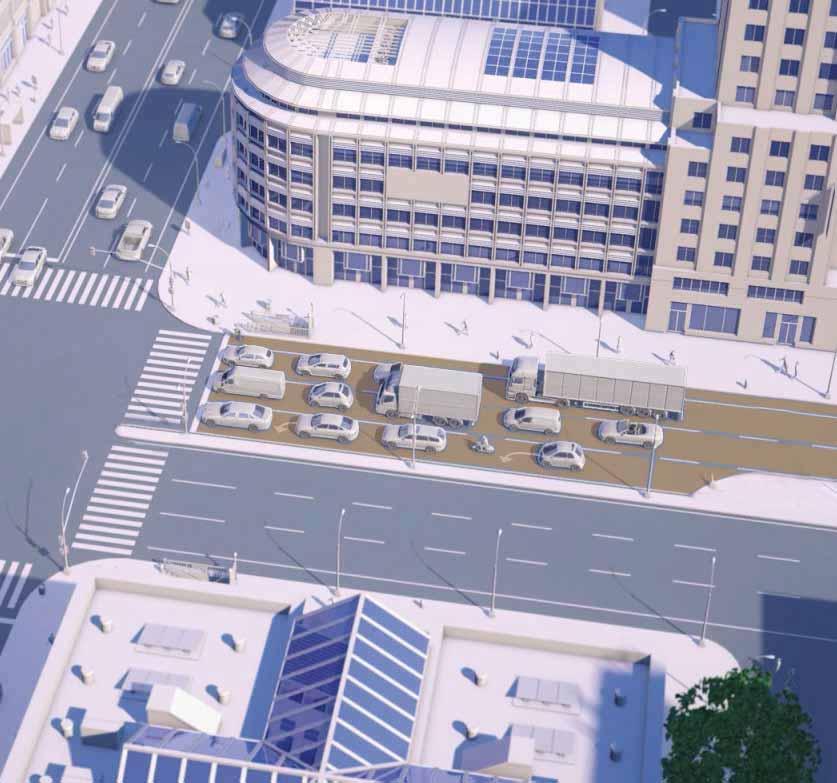
LANE-SPECIFICADVANCEDETECTION



This two-part workshop (14:00 16:15
CCH - Room X1) begins with Workshop 1: Interactive Traffic Management: from concept to reality and looks at the concept of interactive traffic management, as developed by the Ertico Innovation Platform, TM 2.0. The proof of concept for TM 2.0 is to be found in the Socrates 2.0 CEF project run by the Dutch Ministry and in a number of practices and services already available in the market. The exchange of traffic information and its integration in traffic management plans and measures in real time among traffic stakeholders, promotes a unique public-private partnership between road authorities, service providers and car manufacturers.


Extending the scope of the TM 2.0 principles of cooperation, trust and co-opetition to the mobility network can prove key in aligning the objectives and needs of the stakeholders involved in multimodal mobility, such as MaaS operators, MaaS service providers and public transport operators. The integration of TM 2.0 and MaaS can result into a win-win-win for city administrators, mobility users and traffic and travel information providers and the users alike. Traffic Management Workshop 2: Data Exchange and business models for network management (15:15 – 16:15
CCH - Room X1) will assess the impact of this approach when exploring data exchange and business models in mobility network management (MNM). The relation of multimodality with public transport and the involvement of MaaS providers and their business models will be discussed while the questions of how these interact with the interactive traffic management of the road network (including how public transport fleets are managed, Covid and resilience and park and ride measures and schemes) will also be addressed.

We connect the dots of a new mobility revolution that will transform cities all over the world.
With the broadest end-to-end portfolio of intelligent traffic management solutions in the market, we enable cities, highway authorities,
and mobility operators to make road networks and fleets intelligent, enhance safety, and increase value sustainably over the lifecycle.
It’s time to make the world a better place. We are ready. Are you?
At VITRONIC, we strive to implement customized road traffic systems that allow for efficient mobility, while taking people and nature into account.

Visit us at booth B5.230