September/October 2023 | www.itsinternational.com
International &
D
PO S T
ED RE
SP
NT
• PRI
Y• IBL TP
U
CE
O
ED
RI N T
TO R
International
O NS
E
ADVANCED TECHNOLOGY FOR TRAFFIC MANAGEMENT AND URBAN MOBILITY
OU
R CARBON
FO
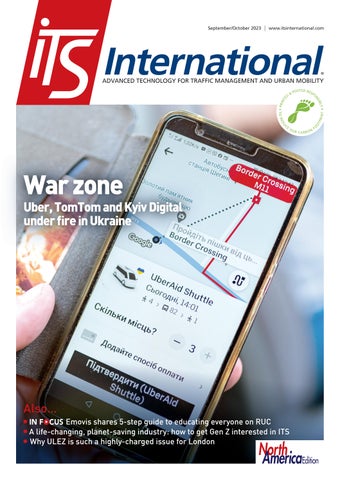
War zone
Uber, TomTom and Kyiv Digital under fire in Ukraine
Also… Emovis shares 5-step guide to educating everyone on RUC A life-changing, planet-saving industry: how to get Gen Z interested in ITS Why ULEZ is such a highly-charged issue for London
North AmericaEdition
The cities committed to the European Green Deal lead by example. Mitigating climate change, reducing emissions and pollution, and transforming energy and mobility systems are challenging tasks for the cities on their way to become climate neutral by 2050. SWARCO is ready to lend support when it comes to reshaping urban mobility with ITS technologies. Together, we can make big steps towards reaching the Green Deal goals and improving quality of life for us and future generations. Let’s make Europe green. Deal?
uƌǵƷ ƷژɋǚƷ Ʒژ°Þ ¨ ژuƷɋƌ Ǡɋɲ ɲژݨ ¨ژƷɱȲƷȵǠƷȄƩƷ Ʒژƌɋɋژ OUGOÞ ä° °ژÅh ǠȵȂǠȄǒǚƌȂًًژw- ח – זƩɋȏƨƷȵ 2023 | OƌǹǹǹژًًבژȽtand D1אא
SWARCO | The Better Way. Every Day
swarco.com/gogreen
CONTENTS
Contents
16
September/October 2023
05 COMMENT
ROAD USAGE
36
CHARGING 06 NEWS DIGEST
If people don’t understand the benefits of RUC, then it is unlikely to have public support. Emovis outlines ways in which key messages – particularly on fairness - can be put across
08 CONTRACTS & DEALS 11 NEWS ANALYSIS
11
Many Londoners lost their cool during the city’s massive, late-summer ULEZ expansion. Will it be worth the pain and what can other cities learn from it?
40 NEXT GENERATION ITS is a life-changing, planet-saving industry. But how do we convince Gen Z that it is a good career option? Alistair Gollop & Sharon Kindleysides have a few ideas, including apprenticeships - and, not least, explaining what ITS actually is
16 INTERVIEW “There really has to be a better way,” says Veronica O. Davis, City of Houston transportation director and author of Inclusive Transportation
45 CODE OF PRACTICE 20 INCIDENT MANAGEMENT
The UK government has attempted to unleash the possibilities of MaaS with the publication of new guidelines. But is this the way to help encourage implementation?
& MONITORING Valerann thinks its SaaS system, remotely deployed in Latin America, is able to identify traffic management incidents much more quickly
20
48 PRODUCTS & INNOVATIONS 24 ITS IN UKRAINE Russia’s invasion has cost thousands of lives and devastated much of the country. In an Ertico-hosted webinar, Kyiv Digital, TomTom and Uber shared their extraordinary war stories
North AmericaEdition
North America area only 28 SMART CITIES
40
NA 03 Rekor and AWS asked the
Cities are frontrunners of the green transition. But scaling sustainable transport solutions quickly is going to require cooperation, says Maria Tsavachidis of EIT Urban Mobility
US transportation industry what it was thinking. The US transportation industry didn’t hold back
NA 05 Engineers need multiple
31 SUSTAINABLE TRAVEL
MANAGEMENT Mobility as a Service – or whatever we’re going to end up calling it – makes sense in a world which is looking for less carbonInternational intensive ways of getting around, suggests John War zone Nuutinen of SkedGo
| www.itsinternational.com
AND URBAN MOBILITY &
POS
T ED RE S
PO
Y• IBL
• PR IN
D
NS
TE
FOR TRAFFIC MANAGEMENT
TP
OU
R CARBO
Uber, TomTom and Kyiv Digital XQGHU À UH LQ 8NUDLQH
45
Cover story True resilience
N
NA 08 Making it illegal to hold your
phone while driving is designed to improve road safety: Cambridge Mobile Telematics looks at three states to see if it works
Also…
Image: © Uber
www.itsinternational.com - updated content every working day
F
O
U
CE
O
ED
l
TO R
ti
RI N T
September/October 2023
ADVANCED TECHNOLOGY
solutions in their toolbox for accurate data collection, explains Wes Guckert of The Traffic Group
to educating everyone on RUC Emovis shares 5-step guide interested in ITS industry: how to get Gen Z A life-changing, planet-saving issue for London Why ULEZ is such a highly-charged
© ITS INTERNATIONAL SEPTEMBER/OCTOBER 2023
03
Smart+ BORN FOR MLFF TOLLING
23 – FIERA M 20 I
Visit us at stand
O
IT
-1 7
R20 hall 5 N
AL Y•
SICURE ZZ
A
RHO NO LA
• 15
art: donaldecompany.com
Two AI accelerators for extraordinary performances
VE
M BE
R - M IL
AN
www.tattile.com
COMMENT
“SAFETY HAS DIFFERENT MEANINGS AT DIFFERENT TIMES”
“
ITS in war means guiding people to safety from missiles
could just catch on: remote control, you might call it. And you might have heard that the world’s biggest ultra-low emission zone has been rolled out in London. Not everyone is thrilled about it (this is a bit of British understatement) but we have sifted through the information, the disinformation, the emotion and the political shenanigans to get to what we think ULEZ means and how it will work. Finally, as you’re reading this, you know what makes ITS such a great industry to work in – but how do we convince the next generation? This is an issue ITS International is going to keep coming back to and all ideas are welcome. Few youngsters are going to choose ITS as a career if they don’t know what ITS actually is. So how to explain it? We know it’s life-saving (and not just on the world’s
Editor Adam Hill Email: ahill@ropl.com Tel: +44 1322 612062
Production Manager Nick Bond Email: nbond@ropl.com Tel: +44 1322 612066
Web Manager Sarah Biswell Email: sbiswell@ropl.com Tel: +44 1322 612078
Editorial Director Geoff Hadwick Email: ghadwick@ropl.com Tel: +44 1322 612013
Design Team Simon Ward, Andy Taylder
Social Media Manager Tatyana Mechkarova Email: tmechkarova@ropl.com
Sales Director Dan Emmerson Email: demmerson@ropl.com Tel: +44 1322 612068 Sales Team Graeme McQueen Email: gmcqueen@ropl.com Tel: +44 1322 612069
Office Manager Kelly Thompson Email: kthompson@ropl.com Internet, IT & Data Services Director James Howard Email: jhoward@ropl.com Tel: +44 1322 612070
“
I
TS is all about safety - but does safety always mean the same thing? It depends. A recent webinar illustrated this perfectly: hats off to Ertico – ITS Europe for bringing together representatives from Kyiv Digital, TomTom and Uber to explain the role which ITS technology has played in the most extreme situation imaginable. Russia’s invasion of Ukraine has devastated the country and cost thousands of lives. Traffic control is obviously not top of the list of ITS deployments in a war zone – but hearing about the uses of ITS technology in Ukraine is both remarkable and humbling. Ertico’s Johanna Tzanidaki summed it up powerfully: “ITS in war means guiding people to safety from missiles.” To more peaceful parts of the world: Valerann has started to master the art of remotely deploying traffic management software in Latin America without leaving its offices. It says its Software as a Service solution can detect incidents more quickly. The results are intriguing. This cloud thing
Publisher/ Managing Director Andrew Barriball Email: abarriball@ropl.com Tel: +44 1322 612057 CEO Roger Adshead Email: radshead@ropl.com
www.itsinternational.com - updated content every working day
roads - see Ukraine) plus it also has a key role in mitigating the effects of climate change. But can we get that message to Gen Z? Please get in touch at the address below with your thoughts and suggestions. And as ever, happy reading! ITS
Adam Hill EDITOR @ITSeditorAdam @adamhillwriter @itseditor_adamhill @ITSInt
Have your say Email me at ahill@ropl.com
Printed by Warners (Midlands) PLC
ITS International, USPS 13324, is published bimonthly by Route One Publishing Ltd, Second Floor, West Hill House, West Hill, Dartford, Kent, DA1 2EU, UK. No part of the publication may be reproduced in any form whatsoever without the express permission of the publishers. Views expressed in this journal do not necessarily reflect the opinion of the Editor or Route One Publishing Ltd. All editorial, advertising or circulation enquiries to: ITS International, Second Floor, West Hill House, West Hill, Dartford, Kent, DA1 2EU, UK.
The US annual subscription price is US$173.00. Airfreight and mailing in the USA by agent named World Container Inc, 150-15, 183rd Street, Jamaica, NY 11413, USA. Periodicals postage paid at Brooklyn, NY 11256. US Postmaster: Send address changes to ITS International, Air Business Ltd, c/o World Container INC 150-15, 183rd St, Jamaica, NY 11413, USA. Subscription records are maintained at Route One Publishing Ltd, Second Floor, West Hill House, West Hill, Dartford, Kent, DA1 2EU, UK. Air Business Ltd is acting as our mailing agent.
Reader Enquiry Service: data@ropl.com Tel: +44 1322 612061 Subscription Enquiries: subs@ropl.com Global: Print ISSN 1463-6344 Digital ISSN 2057-3421 NA: Print ISSN 2632-4458 Digital ISSN 2632-5950
Published by © Route One Publishing Ltd 2023
© ITS INTERNATIONAL SEPTEMBER/OCTOBER 2023
05
© Stig Alenäs | Dreamstime.com
NEWS DIGEST
London's ultra-low emission zone expands to cover whole city
Fairtiq checks in to help digitise Danish public transport payments
Deutsche Telekom and Mira are trialling remote-controlled shuttles between the telecom giant's locations in the German city of Bonn. "We are convinced that teleoperated driving will play an important role in LPSURYLQJ WKH HI½ FLHQF\ DQG VXVWDLQDELOLW\ RI WUDQVSRUW ² VDLG Klaus Kappen, CEO of Mira. "By working with Deutsche Telekom, we can develop innovative solutions for the mobility of the future and test them in public
New director general for EU's DG Move
Thales eases payment for riders on Hong Kong trams
The 150,000 passengers who use Hong Kong's iconic doubledecker trams each day are now able to pay electronically for their rides - rather than just with cash or Octopus cards. Thales, in partnership with Golong International Technology Company, has provided an integrated electronic payment system for Hong Kong Tramways' 165 tramcars, which means 12 electronic payment methods - including contactless, Apple Pay, Google Pay and QR codes - are available. Thales’ new integrated solution
WUDI½ F PDQDJHPHQW QHWZRUNV and hardware, as well as boosting intersection safety and security.
© Kawee Wateesatogkij | Dreamstime.com
Applied Information joins #FREEtheMIBs campaign
Applied Information has joined the four-year-old #FREEtheMIBs campaign ZKLFK DLPV WR HQFRXUDJH WUDI½ F signal controller and ITS device manufacturers to unite with public sector agencies to share management information bases (MIBs). These provide a common language through which central WUDI½ F PDQDJHPHQW V\VWHPV and transportation management devices communicate - but they are not comprehensive and do not cater for the technical advances that are constantly made to systems. The aim is to boost interoperability across
Magda Kopczynska has begun her role as director general at the European Commissioner's Directorate-General Mobility and Transport (DG Move), replacing Henrik Hololei. While Kopczynska was deputy director general at the DirectorateGeneral Agriculture and Rural Development since January this year, she is a DG Move veteran, holding a variety of positions there between 2009 and December 2022. Of particular relevance to the ITS sector are her stints as director for innovative and sustainable transport and head of unit for clean transport and sustainable urban mobility.
© European Commission
Deutsche Telekom & Mira launch Bonn AV project
includes software development, provision of Octopus and EMV 45 EDFN RI½ FH DQG KDUGZDUH design to replace the existing payment system.
URDG WUDI½ F WRGD\ ² 'HXWVFKH Telekom’s 5G network will enable transmission of data from the vehicles to a control centre.
© Lai Ching Yuen | Dreamstime.com
Fairtiq has been chosen as a preferred software provider for digitalisation of Danish public transport payment systems. As one of four suppliers to Danish Rejsekort & Rejseplan, the Swiss company says it will be allowed to participate in tenders - worth €67m in total - concerning software solutions over the next eight years. Before boarding a train, tram or bus, passengers swipe the app-based check-in/checkout solution. This means they have a valid ticket for the entire public transport network. The app uses location services to register the route travelled and calculates the correct fare.
Drivers across London now face paying £12.50 per day if their vehicles are not compliant with ultra-low emission zone (ULEZ) standards. The original ULEZ was launched in 2017, covering inner boroughs of the UK's capital. Mayor of London Sadiq Khan has consistently said ULEZ expansion is a public health measure, improving air quality - but his opponents have criticised it as a moneymaking exercise. Imperial College London found in 2019 that toxic air contributed to the premature deaths of around 4,000 Londoners. Khan says every borough exceeds World Health Organisation pollution limits. • ULEZ: London’s burning issue, p11
FOLLOW ITS INTERNATIONAL ON SOCIAL MEDIA Facebook @ITSInt
06
Twitter @ITS_Int_News
© ITS INTERNATIONAL SEPTEMBER/OCTOBER 2023
LinkedIn @ITS International Magazine
Instagram @itsinternational_magazine
www.itsinternational.com - updated content every working day
© Eterenes |Dreamstime.com
The cities of Seoul, South Korea, and Bogotá, Colombia, have agreed to share knowledge on integrated, connected public transportation systems. Bogotá’s current bus rapid transit system is the city’s primary method of transportation, but it plans to expand methods moving forward, with 'next-generation' projects including elevated trains and light rail. Seoul Metropolitan Government (SMG) has signed a memorandum of understanding to consult on an integrated transportation system and says it "intends to actively share its roughly 20 years of policy experience, including the city’s integrated fares and free transfer system".
Beep using Oxa AV software for shuttles in US
Autonomous vehicle provider Beep and AV software developer Oxa have partnered to deploy vehicles in the US. Oxa’s autonomy software will be installed in various vehicle types operated by Beep, "from current passenger shuttles to future vehicle platforms". 7KH ½ UVW LQLWLDWLYH LV D ¾ HHW of Beep autonomous and electric shuttles driven by Oxa Driver software. Two of the Beep shuttles operate at
the recently-opened SunTrax test facility in Auburndale, )ORULGD WKH ½ UVW ORFDWLRQ LQ WKH 86 VSHFL½ FDOO\ GHVLJQHG IRU connected autonomous vehicle and standard automotive testing in a single site.
© Tamer Adel | Dreamstime.com
Seoul to share public transport knowledge with Bogotá
5G focus for Iveda in Egypt smart cities programme
Cloud-based AI video and sensor technology specialist Iveda is partnering with The Arab Organization for Industrialization to expand smart city initiatives across Egypt. Improving mobility and transportation will be key parts of the agreement, which dovetails with Egypt's plans to establish 38 so-called '5th-generation' smart cities as part of an infrastructure development strategy. Iveda KDV VHFXULW\ FHUWL½ FDWLRQ from Egyptian military intelligence, allowing it to engage in projects around the country, which will include the development of 13 smart cities, DV ZHOO DV RXW½ WWLQJ WKH 1HZ Administrative Capital near Cairo with smart city solutions.
© Oxa
Optibus software rolled out across buses in Brazil's Porto Alegre
Porto Alegre in Brazil has EHFRPH WKH ½ UVW FLW\ LQ /DWLQ America to use Optibus software to plan and schedule
public transportation citywide. Empresa Pública de Transporte e Circulação (EPTC - the Department of Urban Mobility within the Public Company of Transport and Circulation) says the solution will be rolled out across the 11 transportation operators which manage Porto Alegre’s public bus network. It transports 114.6 million passengers annually, with 2.8 million bus trips per year, and Optibus’ cloud-native platform is expected to make compliance with regulatory requirements more transparent.
FHWA makes emergency $3m available for Hawaii WUDIÀ F PDQDJHPHQW The US Department of Transportation’s Federal Highway Administration has announced the immediate availability of $3 million in
© Iofoto | Dreamstime.com
NEWS DIGEST
'quick release' emergency relief for Hawaii DoT following $XJXVWµV GHYDVWDWLQJ ZLOG½ UHV in and around Lahaina on the island of Maui. The money will be used to replace damaged and destroyed infrastructure, such as portable batteryRSHUDWHG WUDI½ F VLJQDOV VLJQV erosion control of damaged DUHDV JXDUGUDLOV DQG EDUULHUV WR UHURXWH WUDI½ F DQG SURWHFW pedestrians and workers. Federal highway administrator Shailen Bhatt says the funds will also be for "resources for repairs to infrastructure in the future".
PTV's campaign #MobilityIsAHumanRide moves into new phase The ability to move around freely is taken as a right by most of us, something we rarely think about. But for many, transport and travel present problems rather than opportunities - and this is the spirit in which PTV Group launched its #MobilityisaHumanRide campaign for human-centred transportation earlier this year. It has now moved into a new phase, with PTV pledging to donate €1 for every relevant LinkedIn post (including a statement on the personal need for, and importance of, mobility) to the World Resources Institute, which works on mobility projects in developing countries.
FOLLOW ITS INTERNATIONAL ON SOCIAL MEDIA Facebook @ITSInt
Twitter @ITS_Int_News
www.itsinternational.com - updated content every working day
LinkedIn @ITS International Magazine
Instagram @itsinternational_magazine
© ITS INTERNATIONAL SEPTEMBER/OCTOBER 2023
07
S
CONTRACT & DEALS
Yunex nets 'multimillion dollar' Bay Area Toll Authority deal
Commsignia raises $15m in new funding round
Vehicle to Everything specialist Commsignia has closed a $15 million Series B fundraising round, and LG Electronics has joined Samsung Catalyst Fund and Qualcomm Ventures as partners. Commsignia has mass production deals with several automotive OEMs and is involved in research projects with Volkswagen, Audi of America and Ford. With the new cash, the company says it "aims to grow faster in new markets DQG JHRJUDSKLHV³ &RPPVLJQLD has V2X deployments in the
Nextbike by Tier is set to strengthen its footprint in Italy with the introduction of new bike-sharing systems in the cities of Senigallia and Mondolfo. Building upon launches in Bergamo and Gorizia in the spring of 2022, the upcoming schemes in the cities on the Adriatic Coast are planned to feature approximately 170 bikes, 55 of which will be electric, and are set to go live this autumn. The company highlights bikeshare's role in MaaS, emphasising that the new schemes will supplement the public transport services of the two cities.
Econolite acquires :HVWHUQ 3DFLÀ F 6LJQDO
Bellevue takes on three-year Iteris SaaS agreement
The US city of Bellevue, near Seattle in Washington state, has awarded Iteris a three-year Software as a Service agreement. City authorities will have access to Iteris’ proprietary mobility data set, ClearData, as well as the ClearGuide Roadways and Safety solutions to use for mobility analytics. Iteris says ClearGuide gives cities the tools to track transportation trends across the city with
Nextbike by Tier moves further into Italy
Econolite has acquired its distribution partner, Western PaFL½ F 6LJQDO IRU DQ XQGLVFORVHG VXP :36 LV EDVHG LQ WKH 6DQ Francisco Bay Area and operates throughout the western US, distributing and integrating adaptive signal control, advanced WUDI½ F PDQDJHPHQW V\VWHPV DQG FRQQHFWHG YHKLFOH V\VWHPV The deal gives Econolite, which is part of the Umovity brand ZLWK 379 *URXS DFFHVV WR H[SHULHQFHG WHFKQLFDO VDOHV DQG ½ HOG support technicians in the region. “The acquisition allows WPS DQG (FRQROLWH WR FRPELQH UHVRXUFHV DQG LPSURYH HI½ FLHQFLHV ³ says Don Shupp, president of WPS. © Monticelllo | Dreamstime.com
TagMaster has bought the USbased radar division of Image Sensing Systems for $4.8m. ISS provides radar-based vehicle GHWHFWLRQ DQG WUDI½ F GDWD VROX tions and the deal, done through TagMaster's US subsidiary Sensys Networks, includes the RTMS Echo and RTMS Echo+Camera portfolio. Jonas Svensson, CEO of TagMaster, says the deal will strengthen its hand in the US. TagMaster is known for providing in-ground sensing solutions, so the addition of ISS's radar-based, above-ground sensors means it
"will be better positioned to address the growing demand for multi-sensor solutions". ................................................
© Mihai Andritoiu | Dreamstime.com
TagMaster buys ISS radar business for $4.8m
© Rawpixelimages | Dreamstime.com
<XQH[ 7UDI½ F KDV ZRQ D PXOWL PLOOLRQ GROODU WKUHH \HDU DJUHH ment to provide express lane and bridge tolling facility maintenance services for the Bay Area Toll Authority (Bata). As well as toll infrastructure at the San Francisco Bay area’s seven stateowned bridges including the Bay, Antioch, Richmond, Dumbarton and San Mateo, the deal includes express lanes within the Bay Area transportation network. The contract, which can be extended for a further three years, includes the maintenance, repair and inspection of multiple ITS devices as well as supporting equipment including electrical systems, and stationary and variable message signs.
US, including Las Vegas and Denver, as well as on European highways in Italy and Czech Republic. .................................................
© Melpomenem | Dreamstime.com
© Minyun Zhou | Dreamstime.com
minimal resources, and will enable Bellevue "to identify and rank regional speeding hotspots in a proactive manner, rather than relying on past crash data alone". .................................................
FOLLOW ITS INTERNATIONAL ON SOCIAL MEDIA Facebook @ITSInt
08
Twitter @ITS_Int_News
© ITS INTERNATIONAL SEPTEMBER/OCTOBER 2023
LinkedIn @ITS International Magazine
Instagram @itsinternational_magazine
www.itsinternational.com - updated content every working day
Civil Security
Road Safety
Traffic Flow
Vision Zero
Sustainable Mobility
Emission Control
Full Service
AI & Big Data Analytics
Road User Charging
Enabling Safer and Smarter Mobility. Jenoptik provides innovative and sustainable smart mobility technology and services. As an end-to-end solution provider, we support our customers with the provision of roadside equipment and software, including integration and installation through to full-service operation. Our strong global presence and installation base is supported by a reliable partner network. With innovation as our driving force, Jenoptik is a world-leading enabler for smart mobility, making roads, journeys and communities safer around the globe.
jenoptik.com/markets/public-safety
Follow us!
Automatic Incident Detection
Immediate response for tunnels, bridges, and highways Citilog Automated Incident Detection leverages Artificial Intelligence and the latest developments in Deep Learning to automatically identify incidents in real time on your roadways with ten times less false postivies: • • • •
Wrong way driving Stopped vehicles Smoke in tunnels Pedestrians
• Debris • Slow vehicles • Congestion
Our intelligent solutions optimize operations and reduce response times for traffic operators, providing a safer road for the travellers they serve.
Faster response times start here: citilog.com
Sold and supported by Sensys Networks in North America.
NEWS ANALYSIS ULEZ expansion: it’s fair to say not everyone is on board
© Jessica Girvan | Dreamstime.com
London’s burning issue Many Londoners lost their cool during the city’s massive, late-summer ULEZ expansion. Will it be worth the pain and what can other cities learn from it? Andrew Stone assesses the story so far… Confusion about the zone’s new borders, patchy implementation of the infrastructure to police them and a simmering political furore all further clouded the expansion. Opposition has been fierce. Four councils (run by the UK’s Conservative party, which also forms the national government) have unsuccessfully fought the scheme’s expansion through the courts: Hillingdon, Harrow, Bexley and Croydon. The (Conservative) UK prime minister Rishi Sunak weighed in against (Labour) London mayor Sadiq Khan’s ‘war on motorists’ (omitting to mention that it was a Conservative London mayor, Boris Johnson, who originally initiated plans for a London ULEZ). Political football There is a wider context here. Feeling the political heat, the Conservative party of government – facing defeat in 2024’s general election if the polls are to be believed - senses political capital to be made in slowing and even reversing plans to limit car use, rolling back low-traffic neighbourhoods
www.itsinternational.com - updated content every working day
“
Beyond the political pantomime, is there merit in the criticisms of the scheme’s expansion?
“
L
ondon’s newly-expanded ULEZ is big. Really big. Said to be the largest in the world, it has grown far beyond its urban core to the edges of its suburban crust. The £140m expansion at the end of August saw the zone more than quadruple from 380km2 (147 sq miles) to 1,579km2 (610 sq miles), encompassing all 32 London boroughs. The zone now encroaches close to the city’s orbital M25 motorway at most compass points, covering 8.8 million residents and including the city’s main air hub, Heathrow. The expansion has been, to put it mildly, a turbulent one. It’s fair to say that a significant minority of Londoners oppose the scheme (although according to one poll, not most of them). A few took criminal action against the imposition of the £12.50 daily charge payable by owners of non-compliant vehicles, vandalising hundreds of enforcement cameras in the expanded zone. Many thousands more (one UK paper claims up to two million) attempted to defeat ANPR cameras with reflective ‘stealth’ tape.
(LTNs), fighting the expansion of 20mph urban speed limits, delaying controls on the most polluting vehicles and slowing the phase out of fossil-fuel burners. The fact that the Conservatives retained one parliamentary seat in a recent byelection (the London borough of Uxbridge, ironically the seat formerly held by Johnson himself) is - in part at least - owing to its residents’ anger at the ULEZ expansion. Beyond the political pantomime, is there merit in the criticisms of the scheme’s expansion? A few bear closer consideration: Too many vehicles will be penalised Organisations including motorist membership group the RAC have challenged TfL’s claims that more than © ITS INTERNATIONAL SEPTEMBER/OCTOBER 2023
11
© Smutkoalex | Dreamstime.com
NEWS ANALYSIS
London mayor Sadiq Khan says expansion is needed to improve air quality
95% of vehicles in the zone are compliant – and, by implication, the suggestion that only a few laggards will be penalised by the scheme. The RAC claims that in fact more than 850,000 vehicles will not be compliant - one in six cars. The Office for Statistics Regulation (OSR) has criticised TfL for lacking transparency about the data supporting this claim. Less affluent workers are being unfairly penalised The ULEZ penalty hits car-dependent people towards the bottom end of the income scale, who cannot afford more modern, cleaner vehicles. To address this, a £160m scrappage scheme offers up to £2,000 for scrapping a car and more for small business owners who run commercial vehicles. This only applies to Londoners, however, and not to affected residents outside the city who travel regularly into the capital. The scheme is a mayoral tax grab Estimates of the fines levied on noncompliant vehicles range from annual totals of £260m to £400m a year. Both figures are more than annual council car parking penalties nationwide and they serve as a useful benchmark – a recent Freedom of Information (FOI) request found London’s smaller, pre-2023 ULEZ zone generated over £224 million in 2022. TfL rejects criticisms that the scheme is a ‘cash grab’ by Khan to do with as he wishes, pointing to the fact that all revenues will be reinvested in London’s public transport network. Critics will seek reassurance that this will happen. TfL forecasts that the LEZ/ULEZ scheme will generate net proceeds of under £200m per year for the first two years with declining net proceeds thereafter as Londoners' vehicles increasingly come into compliance.
12
© ITS INTERNATIONAL SEPTEMBER/OCTOBER 2023
Alternative transport options don’t exist While ULEZ revenues may be hypothecated to pay for mass transit improvements, addressing transit in the city’s outer suburban edges will take time and in many cases will not achieve what private cars can in terms of connectivity. London’s highly suburban outer boroughs lack the dense public transport networks of the city’s centre, with patchier tube and bus coverage, for example. Will investment help address public transit options outside the zone’s immediate boundaries? The ULEZ expansion will hardly impact air pollution levels The primary goal of the ULEZ is to reduce harmful air pollutants, particularly nitrogen dioxide (NO2) and particulate matter (PM2.5 - the fine particles emitted by cars, industry and other harmful sources), which have been linked to respiratory and
cardiovascular health problems. TfL points to the fact that since the initial phases of the ULEZ’s introduction, pollution levels in London have dropped significantly, by more than 50% in some areas. But the newly-expanded zone will have much more modest impacts, according to the mayor’s own impact assessment, which predicts a reduction of 1.3% in the average Londoner’s exposure to NO2 and negligible reductions of 0.1% in exposure to particulates. According to calculations by the UK’s Channel 4 News, spread across the city’s population, expanding ULEZ to outer London adds just 0.0089 days – or 13 minutes – to the average Londoner’s life expectancy this year. Despite the above criticisms, Khan is unrepentant and can point to some stark statistics that support the need to tighten air quality standards further still. Even with the expanded ULEZ, it is estimated that no Londoners will live in areas that meet the tough new World Heath Organisation annual average guidelines of 10 microgrammes per cubic metre of air for NO2 or 5 microgrammes per cubic metre of air for PM2.5. Beyond London and the UK, there are lessons in London’s ULEZ expansion for other mayors and major municipalities in Europe in particular - who will be aware of the sobering fact that London’s air was already relatively clean compared to many European cities. An investigation by German broadcaster Deutsche Welle (DW) using satellite data from the Copernicus Atmospheric Monitoring Service (CAMS) found that in 2022, 98% of Europeans lived in areas where PM 2.5 levels were over WHO limits. Pollution was especially severe in parts of central Europe, the Po valley in Italy and in larger metropolitan areas, such as Athens, Barcelona and Paris with the most polluted reaching annual averages of PM 2.5 of around 25 micrograms.
UK prime minister Rishi Sunak criticises ‘unnecessary extra tax’
www.itsinternational.com - updated content every working day
EUROPEAN SMART MOBILITY SOLUTIONS
FREE DOWNLOAD Barrier-Free Tolling Challenges for Fleets
Tolling Solutions
Violation Solutions
Enforcement Solutions
Custom payment solutions for rental and commercial fleets to manage traditional and barrier-free tolling
Integrated solution for fleets to easily manage, process and pay parking, tolling, speeding violations and assign liability to drivers
Specialized collection of solutions for unpaid traffic and parking penalties issued to domestic and foreign registered vehicles
Learn more verramobility.com/european-solutions
NEWS ANALYSIS According to a study published in science journal The Lancet using pollution data from 2015, around 10% of deaths in cities like Milan could be prevented if average PM 2.5 concentrations dropped by 10 micrograms per cubic metre. And if Europe's major cities were able to hit the five micrograms per cubic metre target, the researchers concluded there would be 100,000 fewer pollution-related deaths every year. Expanding a city ULEZ beyond a core area is, however, clearly fraught with complexity and is hostage to considerable opposition. Those wanting to expand their own zones might consider the following:
14
The economic and political context matters The furore over the London ULEZ expansion was so intense in part because of the financial pressures on working people during a cost-of-living crisis. The imposition of restrictions on movement, however welljustified and proportionate, require some level of assent from those who experience them and support to help them upgrade vehicles. Assess the trade-offs and opportunity costs Could the capital (both financial and political) invested in London’s ULEZ expansion have been better directed to achieve air quality improvements elsewhere? Road traffic is not the only contributor to poor air quality. London’s Underground network - where PM2.5 concentrations are approximately 15 times greater than in the surface and roadside environments in central London - is one area of focus that critics claim is being ignored. Air quality improvement measures here would seem an important priority – would money be better spent on these rather than on relatively modest improvements in the outer boroughs? Closer econometric study here might provide clearer answers. Consider alternative, cheaper measures City-wide ULEZ enforcement is costly and not every city will be able to afford the infrastructure to encompass the city beyond
a core area. Other measures may be able to achieve similar aims for less. One such is emissions-based parking (EBP), which targets higher-polluting vehicles when they park, instead of charging a one-off toll when they pass a certain point. Simplicity, fairness to all vehicles – including ones inbound from beyond an ULEZ - and cost-effectiveness are arguments for it. The fact it enforces and encourages - rather than forces - cleaner vehicle adoption is a further benefit. EBP, for example, led to a 16% reduction in polluting vehicles when introduced by London’s Westminster City Council in 2017. The scheme has now been adopted by almost half of London boroughs. Complex calculations “There are no solutions, only trade-offs,” wrote economist and commentator Thomas Sowell. City mayors must carefully weigh the costs of ULEZ expansion (financial, political and economic) alongside the costs (in human lives and stunted productivity) of poor air quality. These are complex calculations, but they must be done. Where the predicted air quality improvements for ULEZ introduction or expansion are modest and the costs high, city halls might do well to consider alternatives that may achieve more for less while imposing fewer restrictions on movement - and also lowering the political heat. ITS
ABOUT THE AUTHOR: Andrew Stone is a freelance writer on transport and urban mobility issues
© Lorna Jane | Dreamstime.com
© Lorna Jane | Dreamstime.com
Focus on the ‘why’ Imposing ULEZ zones based on carbon emissions or Net Zero arguments is likely to have less appeal across a city’s electorates - and especially its drivers. The political arguments for imposing limits on these grounds are at the least contested and in some cases are being rejected. It may be better to focus on the very well-evidenced impacts of poor local air quality. Car drivers are quite capable of grasping that using their vehicle imposes externalities on all and that cleaner air is in their interests too, but this messaging can get lost. The pernicious – and very welldocumented - impacts of poor air quality need to be driven home – such as particulate matter’s ability to be absorbed into the bloodstream and even into the brain stem. The social and business implications of this need to emphasised - workers are estimated to be 5%–6% more productive when air pollution levels are rated as good, and greater exposure to fine particles is associated with lower intelligence and diminished performance over a range of cognitive domains. Air pollution impact on cognition among
the young is another powerful argument. The implications for city schools located close to busy roads where traffic air pollution peaks when children are at or travelling from or to school are obvious. Studies show children from highly-polluted schools have smaller growth in cognitive development than children from less-polluted schools.
© ITS INTERNATIONAL SEPTEMBER/OCTOBER 2023
www.itsinternational.com - updated content every working day
Ź
Ź
> Advanced speed control to improve road safety > Vehicle counting and highly accurate data in real time > Multi-lane tracking: dimensions, classification, distance, number plate... > Smart traffic management through 3D-LiDAR technology
www.parifex.com/en/products l info@parifex.com
INTERVIEW
“THERE REALLY HAS TO BE A BETTER WAY” Is it possible to change a system whose attitudes seem entrenched? Veronica O. Davis, author of this year’s must-read transport book Inclusive Transportation, talks to Adam Hill
T
Public figure It’s one thing writing a manifesto when you’re a private citizen, but Davis is now a public figure and Inclusive Transportation is out there. It is an excellent book: elegant, informative, practical, personal – and, at times, blunt. For example, she is sceptical of those promising to solve transportation problems through technology: “Tech companies lack an understanding of transportation…They will say they can do it faster than government. When there are no rules, it is easy to disrupt.” Also, she knows she won’t convince those who push back against the concept of equity: “White nationalists, who unfortunately often cloak themselves with Christian evangelism…have
16
© ITS INTERNATIONAL SEPTEMBER/OCTOBER 2023
“
“
here is always a danger when people put their head above the parapet to voice an opinion: other people might not care for the opinion they are voicing. Veronica O. Davis is a civil engineer, planner and self-identified transportation nerd who this year published a book. Inclusive Transportation: A Manifesto for Repairing Divided Communities discusses the need to rethink planning, to increase the diversity of those who make the decisions, to write the wrongs of historical injustice, and to look again at how to engage with the public. For more than a decade, Davis ran the transport engineering consultancy she co-founded, Nspiregreen, in Washington, DC, before taking up her current role as director, transportation and drainage operations for the City of Houston, Texas, in January 2021. Like everyone else in transportation in the US, she is today working in an environment in which, for the best part of a century, cars have been prioritised above all other modes, most of the time. “All of us are dealing with the system we inherited and every day you’re making decisions to attempt to unravel that system, trying to be diligent, trying to show care,” she tells ITS International from her office in Houston. “There are times just because someone is the loudest doesn’t mean they get what they want. And it’s having the courage to make the decision that you think is the right decision in the end, and it’s hard.”
If you want to buy my books to burn them - have at it! Just buy them first
no desire to see communities reconnected, nor do they care if Black, Brown or lowincome communities are destroyed to make way for new highways or roads”. It’s strong stuff. She credits the team at Island Press with “the great balance I had with my editors, of knowing when I needed to dance and when I needed to just say the thing that needed to be said”. She adds: “There were a lot of raw things that we took out.” (One would love to see those). But she believes her staff, stakeholders and bosses are used to the way she thinks. “Having to work with me for almost three years now, they know I’m very clear where I stand,” Davis says. “Because every day there are still things that come up that affect Black and Brown communities. And I’m very clear and pointed and I don’t waver. There are times when you can have these ‘well, let’s www.itsinternational.com - updated content every working day
INTERVIEW explore the possibilities [-type discussions]’ and then there is: ‘No, we are not doing this’. She is active on social media and has been picked up by “some of the more conservative” feeds. “I think there’s at least two or three that are like [she said] ‘cars are racist’ and I was like: ‘That’s not what I said!’ So I feel like you’ve made it in this world when you’re on this kind of hit list!” (For the record, Davis is emphatic in the book: “It is not about taking away people’s freedom to decide to drive a car. It is about giving people the freedom to use other options to travel to work, play, shop and whatever else they need to do.”) From the outset, Davis was determined to make Inclusive Transportation a practical volume. “It was very intentional,” she nods. “One of the books that I love is called Think and Grow Rich by Napoleon Hill. And I keep a copy of it - especially when I was a business owner - I keep a copy by my desk and I love the way that it’s structured: I’m going to give an idea. I’m going to give you an example of that idea. And now I want you to pause and reflect on that idea. The Seven Habits of Highly Effective People [by Stephen R. Covey] is the same thing: here’s a concept, here’s an example: now you try.” In short, they are books which are read – but then regularly referred to, rather than stuck away on a high shelf. ‘Shouting to the world’ She chose the subtitle ‘A Manifesto for Repairing Divided Communities’ because “it really is just a shouting to the world of how, as an industry, we need to be better”. The frameworks she lays out may have steps missing but she says: “That’s the beauty of a framework: you can make it work for what you are doing and scale it to what you need - you don’t have to go step by step. It’s just to give you a place to start.” Inclusive Transportation was the only book to be mentioned more than twice in our recent look at what transportation leaders were reading (see Advance booking, ITS International July/ August 2023). Most of the feedback she’s had has been positive. But she laughs: “Hey, if it’s negative and you want to buy my books to burn them - have at it! Just buy them first.” Part of what makes the book so enjoyable is that Davis sees value in acknowledging her mistakes. “While I have plenty of career left, the Eastern Downtown Cycle Track project in Washington, DC, is one of my lower moments,” she writes.
There were multiple stakeholders on this bland-sounding project, but racial dynamics, the public meeting format – even the size of the meeting space itself, and an appearance from the library police (!) – were all contributing factors in it not going as well as Davis would have liked, shall we say. The episode is proof that public engagement on transport projects is very difficult to get right. To get the full story, read the book – it’s well worth it. She says now: “I think the successful projects are easy in a sense that you get it done and you think you know everything, but you do learn from - not so much failure - but the tough situations. I will say it has put me in a mindset now at public engagement that I don’t get rattled at all.” So there is learning to be had from our lowest moments. “I mean, I guess it could get lower but it was pretty low,” she laughs. “And because it was such a floor, it has made me better in dealing with the public even when there are challenging conversations to be had. What am I afraid of now? The library police aren’t here!” To some extent, the proposed bike lane in question served as a lightning rod for wider community angst: neighbourhoods are constantly changing and, for some, the pace of that change is worrying. This is a wider issue when it comes to transportation planning. With a little bit more work on that aspect with the community, she thinks the Eastern Downtown Cycle Track “probably still would have blown up, but it would have made it easier”. Davis’ optimism shines through Inclusive Transportation, but even she questions whether the transportation industry wants to – or even can – change in the way she envisages: “You know, it’s the question I ask because even in my role - even in the things that I deal with - there are parts of the industry that are holding on.” There is a push/pull between those who want something more dynamic than just tinkering around the fringes, against those who say: “No, this is fine. We’ve done some things around the edges.” Status symbol “Multimodal has become a dirty word,” she suggests. “You say it and they’re like, ‘but what about single-occupancy vehicles?’ You’re having to remind people that multimodal isn’t just about a bike lane or sidewalk infrastructure.” Davis talks about the importance of road freight distribution and rail, for instance. But
© Marchello74 | Dreamstime.com
Highways often cut through US urban communities with little regard for people who actually lived there
www.itsinternational.com - updated content every working day
© ITS INTERNATIONAL SEPTEMBER/OCTOBER 2023
17
© Dogorasun | Dreamstime.com
INTERVIEW
‘Even most city downtowns are on the high-injury network,’ Davis says
it’s hard to have a conversation that doesn’t involve automobiles. “’It’s my American right to get in my vehicle and go where I want to go and you’re not gonna tell me otherwise’ - it’s very much that kind of holding on,” she says. “And car companies have done fabulous advertising, right? And that’s why we feel like we have to own certain cars so that we can be happy on Christmas, when the car is there with a big bow, or it’s a status symbol - it’s all of those things.” Younger Americans in urban areas are not necessarily quite so on board with that idea. Davis recalls: “I got my driver’s licence two days after my birthday - and I felt like that was too long. These young kids, they’re like: ‘Ah, well, okay, maybe’. So there’s so many people in their twenties, even in car-centric cities, that don’t have a driver’s licence because the younger generation does not want that. And as an industry, we are not even attempting to accommodate that.”
“
“
Every day there are still things that come up that affect Black and Brown communities. And I’m very clear and pointed and I don’t waver
She believes there is hope, however. “The Bipartisan Infrastructure Law is probably one of the most progressive pieces of legislation that we’ve had,” Davis says. “Even just beyond the funding, at its core, the fact that there is money specifically for areas of persistent poverty; reconnecting communities is absolutely a recognition of ‘we have done harm and now we will attempt to mitigate or undo or somehow fix some of that harm’. I think in the next five to 10 years, when those projects are completed, we will see the overall impact of the Bipartisan Infrastructure Law.” Her other piece of hope for change in the way the US designs and operates its transportation systems is, at first glance, a surprising one: insurance companies. “They’re my sleeper pick, if you will,” Davis smiles. “At the end of the day, the goal of insurance isn’t to pay out – it is to collect your premiums and use
18
© ITS INTERNATIONAL SEPTEMBER/OCTOBER 2023
those premiums to invest. But when you’re looking at crashes, and fatalities and serious injuries, and the cost associated with those, the property damage, it gets to a point that insurance companies are going to say: ‘Oh no, this isn’t going to work’. Or you know, they may say: ‘Based on the type of vehicle you have, we’re not going to insure that vehicle’. I’m not going to say it’s going to happen overnight. But I think that they are going to be an interesting kind of ally in change.” Insurance companies as the good guys? Who’d have thought it? “Well it’s, you know, the enemy of my enemy is my friend!” she laughs. Personal experience Davis weaves personal experience throughout Inclusive Transportation, for instance telling her family story in the book, including how her grandparents lost their home to make way for a freeway in Baton Rouge, Louisiana. She first talked about this at a planning conference in that city. “And what I found is, particularly at that conference, it really helped people connect,” she says. More importantly, she thinks it brings the past closer to people, rather than being something that happened long ago and ‘over there’. “It puts some context to the timeline for when a lot of this happened,” she explains. “When we go into communities, and we’re doing projects in these neighbourhoods that were impacted by the highways, you have to remember there are people in their 70s - maybe even their 60s - who remember what it was before. Hopefully as practitioners, as we work in neighbourhoods, we remember that context.” Looking at photographs from many US cities in the 1950s you see really wide sidewalks, she continues. “You see thriving communities, you see people walking, playing, being safe. And now you look at most US cities and you see cars, you see congestion. Even most city downtowns are on the high-injury network because you have high volumes of people trying to walk, and a whole bunch of vehicles getting frustrated. So there really has to be a better way.” One final question: when’s her next book? “I don’t know,” Davis laughs. “That one was a labour of love. I don’t know. We’ll see.” ITS www.itsinternational.com - updated content every working day
ÀȲƊǏ˛Ƨ Management Software OPTIMIZE TRAFFIC FLOW ²à ª! wƧ!ƊǞȁ ةXȁƧخٚȺ ÀȲƊǏ˛Ƨ wƊȁƊǐƵǿƵȁɈ ²ȌǏɈɩƊȲƵ ȺȌǶɐɈǞȌȁȺ ƵȁƊƦǶƵ ɈȲƊȁȺȯȌȲɈƊɈǞȌȁ ȯȲȌǏƵȺȺǞȌȁƊǶȺ ɈȌ ȯȲȌƊƧɈǞɨƵǶɯ ǿƊȁƊǐƵ ɈȲƊǏ˛Ƨ ˜Ȍɩ ƊȁƮ ȯȲȌǿȌɈƵ ǿȌƦǞǶǞɈɯ ɈǘȲȌɐǐǘ ȲƵƊǶٌɈǞǿƵ ɈȲƊǏ˛Ƨ ƮƊɈƊ ƧȌǶǶƵƧɈǞȌȁ ƊȁƮ ǿƊȁƊǐƵǿƵȁɈ ɈȌȌǶȺ خÀǘƵ ǿȌƮƵȲȁ ƊȲƧǘǞɈƵƧɈɐȲƵ ȌǏ ɈǘƵ ȺȌǶɐɈǞȌȁȺ ǞȺ ƮƵȺǞǐȁƵƮ ɈȌ ǿƵƵɈ ɈǘƵ ƮƵǿƊȁƮȺ ȌǏ ɈȌƮƊɯٚȺ ɈȲƊȁȺȯȌȲɈƊɈǞȌȁ ȁƵɈɩȌȲDz ƊȁƮ ƊƮƊȯɈ ɩǞɈǘ ɯȌɐȲ ƵɨȌǶɨǞȁǐ ȁƵƵƮȺ خ ا²à ª! wɯ!ǞɈɯ® اÀȲƊȁȺȯƊȲǞɈɯ® ²ɐǞɈƵ اƮƊȯɈǞɨƵ اÀȲƊǏ˛Ƨ wƊȁƊǐƵǿƵȁɈ ²ɯȺɈƵǿ ـÀw²ف ا²ǞǐȁƊǶ §ƵȲǏȌȲǿƊȁƧƵ wƵƊȺɐȲƵȺ ـ²§wف
ßǞƵɩ ƊǶǶ ÀȲƊǏ˛Ƨ wƊȁƊǐƵǿƵȁɈ ²ȌǏɈɩƊȲƵ ȺȌǶɐɈǞȌȁȺ Ȍȁ ɈǘƵ Central Management Systems product page
mccain.swarco.com/tms
April 22-25, 2024 Conference: April 22-25 | Expo Hall: April 23-25
Phoenix Convention Center, AZ ITS America Conference & Expo, taking place April 22-25, 2024 at the Phoenix Convention Center in Phoenix, Arizona, will bring together the entire intelligent transportation community for thought-provoking education, networking, and demonstrations exploring the technologies and solutions that will enable a better future.
LEARN MORE AT ITSAMERICAEVENTS.COM
Hosted By:
In Partnership With:
Built By:
ln the business of building businesses
DEPARTMENTS OF TRANSPORTATION
North AmericaEdition
They said what?!
Rekor and AWS asked the US transportation industry what it was thinking. The US transportation industry didn’t hold back. Adam Hill picks over some robust findings formal ITS investment. So what are they doing in the meantime? “They are sorting out how to balance labour shortages, fill potholes, increase driver happiness, and understand how to utilise the vast amounts of data they already have”. As one executive stated: “We are far away from an investment plan, because we need to first enable the building blocks of ITS throughout our organisations; they can’t be a side thought. ITS must belong to the C-suite of any transportation authority because we touch every part of the organisation – from field staff to top executives.”
If I hear one more session on digital twin, I’m walking out. Do you want to have a successful conversation? Let’s talk about three real things we can do tomorrow
and AWS spoke to advocate what the report calls “a paradigm shift in how we perceive and utilise pilots as broader models for collaboration”. Too much of what we call ‘deployment’ is in fact just ‘installation’. “To overcome this hurdle, the industry must transition from a copy-and-paste mentality to embracing technology as a catalyst for knowledge development,” the report says. Deployment must encompass R&D, prototyping and testing, along with “rigorous evaluation and sharing of results… within a national innovation community, facilitating endeavour, transcending the fragmented, state-by-state approach of trial and error.” The report argues for a shared, collaborative national research agenda that emphasises learning together rather than in isolation “to ensure we break the cycle of repeating each other's failures unknowingly”. That sounds like a good start. ITS
It is a sobering analysis – but a useful one. There also appears to be a dichotomy in the findings, too: the industry is apparently down on the idea of pilots, while at the same time recognising that pilots are important. So what is happening? “Discarding pilots signifies a lack of foresight and a failure to embrace innovation,” points out one respondent. “Such an attitude has perpetuated the current predicament of incremental improvements that we find ourselves in.” The key, therefore, is that “we must expedite the implementation of lessons learned from these pilots, daring to stumble boldly and learn quickly from failures.” The transport leaders which Rekor
The PDF The True State of US Transportation: What DoTs are really saying behind closed doors is available to download free now
“
www.itsinternational.com - updated content every working day
“
E
ver wondered what senior executives from the US transportation industry say behind closed doors? Earlier this year, Rekor and AWS joined forces to conduct what they called a “no-nonsense listening campaign in the transportation industry” in an attempt to reveal “the unvarnished truth about the current ‘State of the Union’ on digital infrastructure”. The (anonymous) findings are every bit as good as that makes it sound. The white paper - The True State of US Transportation – was composed by Morgan Klaas, facilitator, MD and partner with Profitable Ideas Exchange, and fizzes with insight. The takeaways are well worth reading in their entirety, but a few of them really stand out – not least this one: “The industry says it’s piloted out.” DoT leaders are “fatigued by grandiose long-term visions and opportunities”, the report continues. Practical first steps are the order of the day. One participant put it brilliantly: “If I hear one more session on digital twin, I’m walking out. Do you want to have a successful conversation? Let’s talk about three real things we can do tomorrow. Let’s be tactical and not so meta in our thinking. It’s unrealistic.” There’s no harm in thinking big – after all, pilots are where some of the best ideas come from and are worked through – but there is a balance to be struck. There is a recognition from the participants that ITS technology is a must in order to move things forward, but Rekor and AWS found that it will be “two to three years” before most DoTs have a
© ITS INTERNATIONAL SEPTEMBER/OCTOBER 2023
NA 03
DESIGN BETTER. MOVE FASTER. CONNECT INSTANTLY. SYNCHRO STUDIO V12
! " ! # $ % & %
REQUEST A QUOTE TODAY.
DATA COLLECTION
North AmericaEdition
Detailed traffic data enables the identification of high-risk locations and informs the implementation of safety measures like traffic signals and pedestrian crossings
Why keeping count is so important for WUDIÀ F PDQDJHPHQW Traffic engineers need to have multiple solutions in their toolbox to complete the most accurate and safe data collection programmes possible, explains Wes Guckert of The Traffic Group
A
ccording to the transportation analytics firm Inrix, the average US motorist spent 51 hours sitting in traffic last year — 15 hours more than in 2021, though it remains 50% lower than the pre-pandemic high of 99 hours in 2019. Inrix also found that those taking to the highways in Chicago lost the most time to congestion last year at an average 155 hours, an hour less than commuters experienced in London, which has the distinction of having the worst traffic among major world cities studied. Looking at it from a dollars, or pounds, perspective, the Inrix Global Traffic Scorecard showed that congestion cost the UK economy £8 billion in 2021, which works out at an average of £595 per driver. Meanwhile, the US lost $120 billion due to traffic congestion. Drivers are obviously paying a high price to sit in traffic – both in terms of their time and money. Traffic data collection plays a pivotal role in transportation and traffic management systems across the globe and is vital to the operation of any city. By accurately capturing and analysing traffic data, governments, urban planners, and traffic engineers can make informed decisions to optimise infrastructure, improve traffic flow and enhance overall transportation efficiency.
Unfortunately, state and local governments often face limited budgets and dwindling staff. This can make it difficult for agencies to find the time and resources to evaluate available data collection technologies or thoroughly check on the data work being done by vendors or consultants. Compounding this issue is the fact that many programmes are based on low-bid contracts, prompting vendors to limit their data equipment standards and testing to provide a lower fee. All this, of course, can result in poor data collection. And poor data collected today can negatively impact development and expansion decisions, as well as maintenance needs and improvements, for the foreseeable future. Data collection benefits Understanding the benefits of data collection will ensure agencies make these projects a priority. Specifically, key benefits of traffic counting data collection include: 1. Infrastructure planning: By identifying traffic volumes and patterns, authorities can assess the need for new roads, bridges, and public transportation systems, ensuring optimal infrastructure development. 2. Traffic flow optimisation: Traffic counting data aids in identifying
www.itsinternational.com - updated content every working day
congestion-prone areas and implementing measures such as signal timings, lane configurations, and alternative routes to improve traffic flow and reduce delays. 3. Safety enhancements: Detailed traffic data enables the identification of high-risk locations and informs the implementation of safety measures like traffic signals, pedestrian crossings, and speed limit adjustments. 4. Public transportation planning: Accurate traffic counting data assists in determining public transportation routes, schedules, and capacity requirements, contributing to efficient and sustainable transit systems. Once government officials understand the full benefits of data collection, it is also worth understanding the various methodologies employed to collect traffic counting data, ranging from manual counts to advanced automated systems. Some common techniques include: •
Manual counting: Trained personnel manually observe and record traffic data by using clickers, tally sheets, or video recordings. Although labourintensive, this method is still employed in certain regions or for specialised studies.
© ITS INTERNATIONAL SEPTEMBER/OCTOBER 2023
NA 05
DATA COLLECTION North AmericaEdition •
•
•
Mechanical counters: Mechanical devices like pneumatic tubes or axle detectors are embedded on roadways to record vehicle movements, providing reliable data for traffic volume and classification. Inductive loop detectors: These electromagnetic sensors installed beneath the road surface detect vehicles by measuring disturbances in the magnetic field, allowing for accurate traffic volume and speed measurements. Video-based systems: Cameras strategically placed alongside roadways capture video footage that is later analysed using computer-vision algorithms to extract traffic data, including vehicle counts, classifications, and speeds. Currently there is at least one methodology employing artificial intelligence (AI) protocols.
Additionally, road tubes provide an accurate and affordable means to collect axle-based traffic data. The catch, however, is that they must be installed correctly, which can be tricky. First, all equipment used in conjunction with road tubes must be tested and checked to ensure that it is working properly. This means the air switches within the road counters must be working at similar sensitivities. The counters, in turn, must be free from debris or corrosion. Only new or lightly worn road tubes
should be free-flowing, with minimal congestion or backing. Congestion or stop-and-go traffic will result in the appearance of low volumes. Areas where the roadway curves or congestion regularly occurs will generate errors in the data collected. The counter itself must be able to decipher the pulses it receives correctly. This can be complicated because the counter has to decipher numerous issues which can impact the data collected. Tailgating, for example, may be misinterpreted as a truck or longer single vehicle, such as a limousine. Phantom pulses, which occur when air travelling down the road tube hits the far end of the tube and echoes back toward the counter, can confuse the counter into thinking it is seeing traffic where there is none.
should be used. Tubes should be knotted, and pressure tested to ensure they do not leak air. This will guarantee a good pulse in the road tube which will be accurately received by the counter. Road tubes that leak or fail to provide equal air pulse will inevitably produce errors in axle data collection. Location is essential for improving the performance of the counter and assuring data accuracy. Road tubes should be perpendicular to the road edge and struck straight-on by passing traffic. Ideally, traffic
New technologies There are, of course, alternate technologies that can be employed for data collection, but each comes at a price. The piezo method, for example, is the technology that most closely resembles the road tube method. Like the road tube, the piezo is embedded in the roadway perpendicular to traffic and registers the axles of vehicles as they cross. Far more accurate and much more sensitive than the road tube, the piezo will also last much longer in the roadway. Embedding the sensors in the roadway, however, is costly, time-consuming, and labour-intensive. As a
Think different. YOU CAN'T SOLVE PROBLEMS WITH THE SAME THINKING USED TO CREATE THEM.
Experience the difference... Q-FREE TOLLING & TRAFFIC MANAGEMENT
NA 06
© ITS INTERNATIONAL SEPTEMBER/OCTOBER 2023
www.q-free.com
www.itsinternational.com - updated content every working day
DATA COLLECTION result, use of the piezo method tends to be reserved for long-term or permanent data collection programmes. Advancements in technology have revolutionised traffic counting data collection, as well, which lead to more efficient and accurate systems. Some notable developments include Bluetooth and Wi-Fi tracking. Utilising Bluetooth or Wi-Fi signals emitted by vehicles, this technology anonymously tracks their movement and travel times,
providing real-time data without the need for physical infrastructure. GPS-based tracking data from smartphones or vehicles allows for detailed tracking and analysis of travel patterns, speeds, and routes while mobile apps and crowdsourcing utilise data to enable users to contribute real-time traffic information, supplementing traditional data collection methods and providing additional insights. The costs and risks to safety cited above
North AmericaEdition
necessitate the need for traffic engineers to have multiple solutions in their toolbox to complete the most accurate and safe data collection programme possible. With the rapid advance of AI solutions, the hope is that new, AI-enhanced video and radar technologies are now available on the market to help alleviate the gaps that currently exist in non-intrusive data collection efforts. This will enable governments to accurately—and safely—collect the traffic data needed to inform transportation planning and policy decisions in the future. Through the implementation of advanced technologies, the collection and analysis of traffic data continues to evolve, offering greater opportunities to enhance traffic management strategies and optimise resource allocations, ultimately improving mobility both locally and globally. ITS
ABOUT THE AUTHOR: Wes Guckert is president and CEO of The Traffic Group. He is also a fellow of ITE and on the National Small Business Leadership Council
Let the Iteris ClearMobility® Platform combine cloud computing, artificial intelligence, advanced sensors and expert advisory services to keep your roads safe, travel efficient and communities thriving.
Learn more at iteris.com/clearmobility
www.itsinternational.com - updated content every working day
© ITS INTERNATIONAL SEPTEMBER/OCTOBER 2023
NA 07
The rules of distraction
Look – no hands!
Making it illegal to hold your mobile phone while driving is designed to increase road safety, says Adam Hill. Cambridge Mobile Telematics has been looking at the numbers to see if it works
H
ands-free cellphone laws were passed in Ohio, Michigan, and Alabama earlier this year, making it illegal to hold a phone while driving in those states. It’s relatively early days but Cambridge Mobile Telematics (CMT) has analysed the statistics to see whether drivers are taking any notice. It measures what it calls “phone motion distraction”, which happens when the phone screen is on and the phone is moving, indicating that the driver has it in their hand and therefore cannot be fully concentrated on the road ahead. The results are interesting: while CMT says that distracted driving is down in Ohio and Michigan – and more than 3,800 crashes have been prevented with new laws – it has actually increased in Alabama (see Look – no hands! right). In some ways this fits a pattern: the company analysed another eight states that introduced hands-free legislation from 2018-21, and found that the average reduction in distraction was 13% in the first three months after the laws were introduced. However, by the end of 2022, distraction was up by 3% in these states compared to the month before the law. This is highly significant because CMT’s
NA 08
research suggests that every 10% increase in distracted driving raises the crash rate by 1.4%. This comes at a human and financial cost. NHTSA’s The Economic and Societal Impact of Motor Vehicle Crashes from 2019 shows $340 billion in crash damages from 14.2 million crashes that year, averaging $23,954 per crash. CMT says that, while distracted driving in Alabama fell slightly in the first month, it rose after that until, by month three, it was actually higher than before the law. Interestingly, a relative lack of media coverage may have been a factor. In Ohio, there were over 130 stories published about the initial drop in distracted driving and the prevention of crashes, while state governor Mike Dewine also tweeted about the results. In Michigan, CMT says, there were more than 20 articles about the hands-free bill performance after the first month. By stark contrast, it found one article in Alabama. Despite this, any reduction in distraction levels is welcome: CMT estimates that, in the first month, Alabama was able to prevent 70% of crashes and $1.6 million in economic damages. “While the long-term performance in Alabama isn’t in line with Ohio and Michigan, these results show that even small improvements help reduce road risk and crashes,” CMT says. ITS
© ITS INTERNATIONAL SEPTEMBER/OCTOBER 2023
Ohio • Start date: 4 April, 2023 • Distraction 1 month before law: 1 minute and 39 seconds • Average distraction after law: 1 minute and 32 seconds • Overall distraction change: 7.5% reduction • Crashes prevented: 2,200 • Fatalities prevented: 6 • Economic damage prevented: $54 million Michigan • Start date: 30 June, 2023 • Distraction 1 month before law: 1:48 • Average distraction after law: 1:34 • Overall distraction change: 12.7% reduction • Crashes prevented: 1,600 • Fatalities prevented: 4 • Economic damage prevented: $38 million Alabama • Start date: 16 June, 2023 • Distraction 1 month before law: 2:05 • Average distraction after law: 2:05 • Overall distraction change: 0.3% increase • Crashes prevented: 70 • Economic damage prevented: $1.6 million Source: www.cmtelematics.com
www.itsinternational.com - updated content every working day
© Maksim Marchanka | Dreamstime.com
DISTRACTED DRIVING North AmericaEdition
Could road fatalities ever be a thing of the past? Investing in traffic enforcement technologies means investing in saving people’s lives.
INCIDENT MANAGEMENT & DETECTION
The future is remote More responsive traffic management is of enormous value – and Valerann thinks its SaaS system, remotely deployed in Latin America, is able to identify incidents much more quickly, finds Andrew Stone
20
© ITS INTERNATIONAL SEPTEMBER/OCTOBER 2023
Another notable implementation – again, with Openvia - is along Costa Rica’s Ruta 27, which serves as a testbed for innovation in the Caribbean region. The 76.8 km motorway connecting the capital, San Jose, and Caldera, the busiest sea port at the Pacific coast, carries 100,000 vehicles per day. The road, with 33 mobile and 22 fixed cameras, has a complex terrain with variable width between two to four lanes (each direction) and goes through mountains and valleys. As the road is located in the tropics it is subjected to fog, heat and tropical rains. Powerful safety tools Such challenging environments make Latin America a promising and fast-growing market for the company, says Matthew Cooper, the company’s vice president for market development. “These are very safety-conscious markets with some of the highest accident rates in Latin America. They take this very seriously. They know their priories and where to invest. They are knowledgeable, but they are handicapped by environment and funding.
“
Remote deployment to cloud makes it easier to get access to proper ITS systems and third-party data sources
“
L
ast year, Chile’s Costa Arauco motorway gained a state-of-the-art advanced traffic monitoring system (ATMS) that significantly improved its network oversight and safety. And it was all deployed remotely in a few weeks by engineers working from London and Tel Aviv. The solution is from Valerann, an ITS Software as a Service (SaaS) company specialising in artificial intelligence (AI), Big Data and data fusion technology. It points the way to a future in which ITS systems are supplied remotely over the cloud, and operate smartly by leveraging a mix of hardware and third-party data feeds. It gives operators new AI-enhanced automated capabilities to swiftly spot, respond to and even anticipate and so minimise or prevent incidents entirely. In partnership with Openvia Mobility, the Chilean deployment integrated nine cameras for road monitoring, 15 cameras located across three toll areas and eight response operation vehicles, and is one of several Valerann has completed in the region.
Matthew Cooper Valerann This is good for Valerann, he says. “Remote deployment to cloud makes it easier for them to get access to proper ITS systems and third-party data sources. We give them powerful tools they could not leverage before engaging with us.” Operators in emerging economies with limited budgets now have the potential to leapfrog the functionality of ITS systems from advanced economies. Valerann’s solution, called Lanternn, offers a number of innovative features. The system offers automated incident detection, helping operators detect where a tricky
www.itsinternational.com - updated content every working day
“
“
The number of incidents that get identified has doubled for our customers
© Maxkabakov | Dreamstime.com
The Valerann deployments point the way to a future in which ITS systems are supplied remotely over the cloud
© Globalvia
Ruta 27 in Costa Rica goes through mountains and valleys, and is subjected to fog, heat and tropical rains
www.itsinternational.com - updated content every working day
situation may be coming up and enabling them to get ahead of incidents to mitigate risk. This could include the use of variable message signs, external data sources such as Waze and TomTom, or an alert being sent to nearby patrol cars. A differentiating feature of Lanternn is its ability to fuse data sources and rapidly analyse them in aggregate, says Cooper: “On other deployments it is incumbent on the operator to look at and analyse each individual data source. Even a modest deployment could have many cameras and lots of alerts from third-party systems and the operator has to then sift through those alerts. We take all those data posts and analyse them in real time to work out what’s going on.” The use of AI is an important component here. Valerann’s platform is able to model the position, speed and classification of vehicles in real time, to intelligently detect and validate events on the road and to predict times and locations with an elevated accident risk. It uses machine vision to identify both static and moving objects, weather and light conditions and to automatically verify alerts reported from open and floating-car sources. It also uses natural language processing (NLP) to make sense of social media feeds. The alert system works via thresholds that identify signals which fit the profile of an incident by comparing various data sources and corroborating them. “Once we have that confidence, we can send an alert to the operator,” explains Cooper. “We eliminate blind spots so we have a clear understanding of what’s going on. It’s very valuable.” This process generates alerts that afford operators a high degree of their veracity while also offering steps to take to resolve the situation. “Those anticipatory capabilities have not been available before even in the most robust ITS systems,” claims Cooper. Over time operators can also improve the performance of the solution by refining the variables that are most relevant to them based on their own feedback and experiences. This serves to improve the corroborating evidence that gives them ever-greater confidence in their responses to incoming incident data. Infrastructure-lite Lanternn’s ability to connect with third-party data sources offering data on speed, volume or occupancy has a further benefit in that it can reduce or even eliminate the need to invest in further infrastructure such as radars and detector loops, obviating the need to procure, install, maintain, and replace such devices. Cooper points out the value of such a feature to any operator. Given the high cost of legacy ITS infrastructure there, blind spots are almost inevitable even in well-equipped © ITS INTERNATIONAL SEPTEMBER/OCTOBER 2023
21
REGISTER TODAY FOR THE IBTTA GLOBAL TOLLING SUMMIT IN ATHENS, GREECE
Athens City Tour Technical & Archeological Tour Sponsored by Olympia Odos Two Full Days of Programming and Exhibits
November 12-14, 2023 | www.IBTTA.org/athens HOST AGENCY
PARTNER ORGANIZATION
IBTTA IS THE GLOBAL COMMMUNITY OF TOLL ROAD OPERATORS AND THE SUPPLIERS WHO SERVE THEM.
JOIN US TODAY!
www.IBTTA.org/membership
INCIDENT MANAGEMENT & DETECTION
Lowering the barriers to entry Operating as a SaaS system offers further benefits over legacy systems. There are huge barriers to entry to deploying ITS functionality - devices and detectors and also ITS systems – in emerging economies. The SaaS model requires no up-front investment and fees are proportional to the compute power required and remote deployment offers further benefits. “Our cloud model and SaaS pricing structure enable these road network operators to have access to a system like ours at a price that does not require significant up-front expense,” says Cooper Remote deployment (at the customer’s discretion) entails lower costs and faster deployments with less investment in system IT infrastructure (such as servers) and IT management overheads (including dealing with firewalls, for example) compared with established solutions. Testing can also be conducted remotely.
Ruta 27 carries 100,000 vehicles per day
“
It reduces the barriers to entry for road authorities without big budgets to invest and we have a much faster time to value
The time-savings are significant. Implementation can be completed in as little as two months compared to more than a year to configure, test and hand over, as is the established norm. “It reduces the barriers to entry for road authorities without big budgets to invest and we have a much faster time to value,” says Cooper. Metrics that matter The third-party data sources are also available by subscription, further reducing adoption costs as operators can pay only for what they need, as they need it. A good example of the practical safety value of such a system is at high-risk, largely cash-based toll booths that are still common in emerging economies. “Leveraging thirdparty data sources helps them understand what is going on in those parts of the network that they could not before and they are not locked out by the high costs they would have to incur,” Cooper suggests.
Lanternn by Valerann dashboard
www.itsinternational.com - updated content every working day
© Globalvia
“
road networks. “You can’t cover every foot of network. We provide road operators with 100% coverage of the network but leveraging both third-party and legacy infrastructure,” Cooper adds. Operators can also use the solution to analyse the network data over time and in places where there are frequent near-misses or crashes in locations with no detector or camera. Armed with such insights, they can then opt to upgrade blackspot areas with hardware for further safety. Safety, security and convenience for operational staff is a further benefit. The Costa Arauco deployment in Chile, for example, is on a remote road in a lowpopulation area that makes it challenging to attend to infrastructure there. Vehicles travel at high speeds, engineers must cover large distances and equipment is prone to looting. Minimising the need to install hardware here is a clear benefit.
Faster and more responsive traffic management is of enormous value. Valerann claims its system is able to identify incidents 25% faster compared to the period prior to its deployment, a valuable improvement given the importance of responding appropriately within as short a time as possible to prevent the risk of secondary accidents happening. “We know it is driving value and helping them save lives,” Cooper says. “The number of incidents that get identified has doubled for our customers. Their level of awareness to what has been happening has increased and they are now able to increase safety across the entire road network as opposed to particular spots where they have legacy ITS devices.” But the solution is also being deployed by operators in advanced economies who are also benefitting from the gaps it can fill even in well-equipped networks. This is very much the next generation of intelligent systems, which offers what other advanced systems have struggled to achieve. Cooper cites the example of the Australian state of Victoria, which invested significantly in automated detection but struggled to gain reliable outputs from the system. “Even the most robust deployments will have blind spots,” says Cooper. “We enable them to know where to put the next bits of infrastructure and for those who have not invested as much, a platform like ours enables them to get up to speed more quickly. An agency or an operator which has not deployed cameras can use third-party data sources to give them the coverage to understand what is happening. We show them where they can make their first investment. Whether we are talking to someone looking to deploy their next camera or their next 100, there is still value in what we offer.” ITS © ITS INTERNATIONAL SEPTEMBER/OCTOBER 2023
23
© Roman Rvachov | Dreamstime.com
ITS IN UKRAINE
Civilians and infrastructure have been targeted by Russia during its invasion of Ukraine
War zone
Russia’s invasion of Ukraine has cost thousands of lives and devastated much of the country. Ertico – ITS Europe hosted a webinar in which some key players in Ukraine’s ITS community – Kyiv Digital, TomTom and Uber - shared their extraordinary stories. Adam Hill listened in…
24
© ITS INTERNATIONAL SEPTEMBER/OCTOBER 2023
functionality for missile attacks”, ITS International July/August 2022). Speaking on the Ertico webinar, Oleg Polovynko, formerly CIO of Kyiv City Council and now adviser to the city’s mayor on digital strategy, says: “ITS plays a main role of connection with citizens in Kyiv.” The app gives people
“
ITS won’t work without electricity. So it’s about your plan: how to be flexible, how fast you can recover your system
“
W
henever ITS folk gather together, it’s not long before someone mentions safety. Reducing motor vehicle collisions and keeping all road users safe is the ultimate raison d’etre of ITS technology. But ‘safety’ means different things according to the time and place. Since 24 February 2022, when Russia invaded Ukraine, ITS has not primarily been used to enforce speed limits in the Ukrainian capital, Kyiv. Far from it, in fact. Ertico – ITS Europe brought together several players to tell their ‘war stories’ in a webinar. As moderator Johanna Tzanidaki, Ertico’s chief innovation officer, explained: “ITS in war means guiding people to safety from missiles.” That’s a sobering thought – and it was exactly how Kyiv Digital pivoted in the days after the invasion, changing its metropolitan transport app from one which allowed citizens to pay for parking and negotiate public transit to one which warned them of air raids and highlighted bomb shelters (see “We never thought we’d create app
Oleg Polovynko Kyiv City Council information about pharmacies, food stores, air quality and radiation levels: “It is a life-saving tool for our citizens. All these services were provided through the transportation app.” ITS was also used to control traffic lights to create safe transport ‘corridors’, he says. Much of the Russian bombing campaign has targeted energy infrastructure, as have deliberate Russian cyberattacks. “ITS won’t work without
electricity,” Polovynko says. “So it’s about your plan: how to be flexible, how fast you can recover your system.” In this sense, he thinks, Kyiv has experience to offer the world and he wants to work with international partners going forward. His country’s current highpressure situation has similarities with life when natural disaster strikes, such as earthquakes or - as the climate changes floods and wildfires. “This is not a natural disaster, it is a man-made war,” he says. “But the challenges are the same.” This has helped Kyiv and Ukraine rethink strategy on ITS, he continues. “We understand the value of the right infrastructure. We already have back-ups and cybersecurity solutions to be stable. This helps us to be flexible, providing different channels. ITS is a sandbox for us where we’re working on a model of the future, in cooperation with telecoms companies.” In addition to such ITS staples as data from traffic cameras, this involves data from cellphones, helping Kyiv’s authorities to understand traffic patterns or public transit needs and to respond accordingly. Above all, he urges city managers to be prepared: “Look at your
www.itsinternational.com - updated content every working day
Safety Minded
Safer roadways are just a detection away
Every year 1.3 million people perish on roadways worldwide. Agencies can make a difference - and we can help - with these solutions: • Enhanced pedestrian tracking • Wrong way driver detection • Automated warning signs • Dynamic speed limits • Automated incident detection Safer roadways start with accurate and reliable detection to automatically trigger these applications and more.
Safer roadways start here: sensysnetworks.com/safety
ITS IN UKRAINE
© Uber
Uber launched a shuttle from Lviv to the Polish border
26
© ITS INTERNATIONAL SEPTEMBER/OCTOBER 2023
“
Nothing in Ukraine was truly safe Georgii Sokolianskyi Uber
Uber has provided 100,000 free trips for refugees, medical staff and essential workers
© Uber
were not going to the bar – they were evacuating. And for drivers to continue earning on Uber was crucial. We didn’t want to destroy one of the few economic opportunities that there were at the time.” In Ukraine’s second city, Kharkhiv, in the north-east, 40% of the building stock was destroyed when Russia attacked. Uber blacked out areas which were known to be mined, or where there were government buildings, or troop build-ups. The idea was
“
ITS systems through a civil defence lens.” Many multinational companies were working in Ukraine at the time of Russia’s invasion, so were faced with a choice: should they continue operations? Stephanie Leonard, head of government and regulatory affairs at TomTom Netherlands, explained on the Ertico webinar that routes coming into Ukraine – although not those leaving the country were automatically marked as closed soon after the invasion. But the TomTom team for Ukraine, based in neighbouring Poland, “quickly became aware that they needed a different response from other emergency events [that they had tackled]”. Chillingly, the team became aware that Ukrainians were sheltering in underground car parks from Russian missiles. “A lot of people were hiding in parking garages,” Leonard says. “The traffic team had information on its map which could be used to target innocent civilians. They deactivated traffic location layers so you couldn’t search for it – something that they had never done before.” In the next few days, TomTom was unable to fulfil the accuracy of its traffic routing as the situation on the ground became increasingly confused; it was unclear whether roads had been bombed or were occupied by soldiers. “Three to four days after the invasion we had to turn off the traffic and navigation server – it was impossible to keep it running,” she explains. Meanwhile Uber decided to continue with its ride-hail services, with as great an emphasis on safety for drivers as possible. But as Georgii Sokolianskyi, Uber head of driver operations, EMEA Central Ops, admits: “Nothing in Ukraine was truly safe.” Risk assessment was difficult – if not impossible at times – but Uber represented a lifeline, he argues: “People requesting trips
to rely on local users - but at the same time recognise that no-one has truly accurate information. “When airstrikes happened, we had to re-route in real time,” he says. “We observed a couple of things: there was mass migration from the east of the country to the west; the population of Kharkhiv halved and the population of western towns doubled. Transport infrastructure couldn’t cope.” Thus, Uber expanded its operations in Ukraine from nine to 18 cities to help provide local communities with essential transportation. “We followed our riders and drivers,” Sokolianskyi says. The company noticed new mobility patterns as people evacuated to the Romanian and Polish borders. Uber launched an emergency shuttle from the centre of Lviv, in the west of Ukraine, about 70km from the border. “It became a hotspot,” he says. There was a need “to meet the change in demand very quickly”. Uber has provided more than 100,000 free trips for refugees, doctors, nurses and essential workers across the country. Its drivers have also been delivering hundreds of tonnes of emergency food, medicine and shelter supplies. On the webinar, Sokolianskyi emphasised the need to change operating systems quickly and also to take account of what he calls ‘discoverability’. “If you change routes, nobody knows about it,” he points out. “One major advantage was that we could change a route and tell people in real time that it has changed. It’s crucial to manage risk – not perfectly – but have safeguards.” Ertico’s Johanna Tzanidaki summed up: “We in the audience are safely tucked away – but speaking with real-life experience from Ukraine is very powerful.” ITS
www.itsinternational.com - updated content every working day
BEST-IN-CLASS
RADAR DETECTION Only 2 Sensors Needed Per Intersection Simple to Set-Up & Use 900 ft. of Detection Approach Area Departure Detection Pedestrian Detection Bike Detection
Superior Radar Traffic Detection, Accuracy, and Reliability Econolite’s EVO RADAR™ sensor is designed for all approaches, which helps to reduce travel times and traffic congestion, while increasing safety at intersections for pedestrians, cyclists, and motorists. The EVO RADAR sensor solution is ideally suited for a variety of intersections, using a 110-degree field-of-view designed to cover two approaches with a single sensor. EVO RADAR provides situational awareness at every intersection.
A unified brand for Econolite and PTV Group
To learn more, visit www.econolite.com/solutions/sensors/evo-radar
SMART CITIES
A multimodal approach to sustainable and inclusive mobility
Cities are frontrunners of the green transition. But scaling sustainable transport solutions quickly is going to require cooperation, says Maria Tsavachidis of EIT Urban Mobility
A
t EIT Urban Mobility, Europe's leading innovation community for urban mobility, co-funded by the European Union, we facilitate the testing and scaling of innovative transport solutions across cities. Our goal is to accelerate the adoption of sustainable urban mobility innovations. Humanity is standing at the crossroads of climate crisis and collective action. Recent warnings from the Intergovernmental Panel on Climate Change (IPCC) and the EU on climate change urge us to expedite our journey towards climate neutrality. And the green transition requires two critical elements: speed and scale. The transportation sector has been a key contributor to the climate crisis and must now transform to be part of the solution. The European Green Deal calls for a 90% reduction in greenhouse gas emissions from the transport sector. To achieve this goal, we must reimagine mobility in smart cities to be sustainable, inclusive and seamlessly integrated. The key to this transformation is multimodality – a concept that harnesses the
28
© ITS INTERNATIONAL SEPTEMBER/OCTOBER 2023
strengths of various transport modes, such as convenience, speed, reliability, predictability and cost-effectiveness. When viable alternatives are available, people naturally gravitate towards the most sustainable option. In Barcelona, the new urban bus system led to a growth of demand of 13.7% over five years (see International Transport Federation Public Transport Governance in Greater Barcelona discussion paper). Collaboration is paramount However, the path to integrated mobility is paved with obstacles. Regulatory conflicts, institutional capacity gaps, talent shortages and funding challenges cast shadows on our progress. The blurred boundaries in governance, management and financing exacerbate the complexity. To overcome these hurdles, collaboration is paramount. The power of networks and ecosystems play a pivotal role in creating and commercialising new solutions. No single organisation can innovate alone at the scale required. Public transport, historically fragmented across modes and scales, must break free from silos.
It is key to leave behind the false dichotomy of public transport on one side and individual transport on the opposite side. If we want to reduce the carbon footprint of transport, we have to use all modes of transport according to their individual strengths. Instead of modes operating independently, we have to integrate all available modes into one mobility system that will enable people to comfortably travel door-to-door on a tiny environmental footprint. To provide an alternative to private car ownership in suburban, low-density areas, public transport must find ways to seamlessly bridge the first and last mile by connecting with shared mobility and on-demand services. Smart cities use innovation and technology to create these integrated, more inclusive mobility solutions. The European Commission is preparing a legal framework for Multimodal Digital Mobility Services (MDMS), promoting collaboration while ensuring competitiveness. Mobility Data Spaces (MDS) represent an important part of this framework, fostering trust, interoperability and sovereignty. The initiative of 17 European partners,
www.itsinternational.com - updated content every working day
PrepDSpace4Mobility, is pushing for common building blocks and governance frameworks for MDMS, streamlining the passenger experience. The traditional engineer-build-operate model must evolve into an agile, collaborative build-test-and-learn approach. It's essential to align projects with the real needs of cities and citizens. Agile testing, while not guaranteeing success, accelerates the learning curve and leads to more viable solutions. Cities are the frontrunners of the green transition. They have the interest of people at heart and the power to make changes: cycling infrastructure and reallocation of public space, low-emission zones, city tolling, parking regulations, et cetera. Fast implementation To enable fast implementation of pilots and testing, we have set up an agile innovation programme called Raptor (Rapid Applications for Transport). Start-ups from all across Europe bid to solve concrete mobility problems in cities. The best-fitting solutions are implemented and tested in four to six months: 70% of agile projects so far have resulted in continuation of the cooperation and broader deployment. Ultimately, collaborating in ecosystems is the main key for transforming to a sustainable mobility system. Stakeholders
© Tupungato | Dreamstime.com
SMART CITIES
Barcelona’s bus network saw a 13.7% increase in demand
from diverse backgrounds must work together, sharing knowledge and experience. Partnerships, co-investments, common standards and interoperability are essential for innovative solutions to reach critical mass. Technology and innovation are important enablers for inclusive and sustainable transport solutions, and smart cities. By embracing multimodality, collaboration, and agile testing, we can chart a course towards sustainable, inclusive and climate-neutral urban mobility. ITS
ABOUT THE AUTHOR: Maria Tsavachidis is CEO of EIT Urban Mobility and president of Tomorrow.Mobility World Congress
CAN YOU RECOGNIZE WHAT IS COMING?
smartmicro.com
ITS_Advert Sep-Oct.indd 1
www.itsinternational.com - updated content every working day
smartmicro KNOWS. 13.09.2023 17:09:20 © ITS INTERNATIONAL SEPTEMBER/OCTOBER 2023 29
ITS International's state-of-the-art website www.itsinternational.com
The ITS International website brings you the very latest in website functionality, with the most up-to-date content available relating to advanced technology for traffic management and urban mobility The site is fully optimised for desktop, tablet and mobile and has a growing social media audience. The website is constantly being updated by the editorial team posting new content daily.
A global wave that’s starting to break
SUSTAINABLE TRAVEL MANAGEMENT
Mobility as a Service – or whatever we’re going to end up calling it – makes sense in a world which is looking for less carbon-intensive ways of getting around. John Nuutinen of SkedGo talks to Adam Hill
E
So, no – he doesn’t think it’s the end for scooters – far from it. “I think they've revolutionised Mobility as a Service, they provide that first-mile/last-mile component that was missing for a lot of people,” he continues. “I think it's more about trying to adjust to each other's expectations and creating a model that works: it'll standardise itself in the longer run. It’s still a massive growth market: it's a bit of an arms race, isn't it, there's a lot of providers entering the market.” Successful combination SkedGo suggests that a combination of e-scooter and public transit is efficient when it comes to reducing carbon emissions for trips. “Wherever SkedGo installs a mobility solution, micromobility is always integrated. So it's not like people are choosing whether they should or not, they're trying to decide how many micromobility options to put into their solutions. A lot of cities are reducing car access to the centre of cities, so they need these transport options. It bodes well for the micromobility market.”
With so much flux, it’s perhaps no surprise that the concept of MaaS itself is in constant evolution. “It's great to create a stage-post to reassess and re-evaluate what MaaS is; I don't think we’re anywhere near the end of that journey, to get to something that is a final version of MaaS,” he says. “Effectively, we're learning: as each month goes by there's more data produced, there's more inputs, there's new developments, so it's an industry in evolution, it's constant flow.” The next challenge is to create something that really chimes with the public. “I look at the term ‘Mobility as a Service’ and it’s probably something that people don't understand,” Nuutinen points out. “If you're a regular commuter, you're never going to call it MaaS - because in the end, it's something that should be part of the transport furniture. It should enable - it shouldn't need to be carved out as something different. That's my opinion anyway. When I go to a party or a barbecue and I talk to people, I’m really reticent to call it Mobility as a Service because people don't get it. But when you
© Anatoli Styf | Dreamstime.com
-scooters are now banned from the streets of Paris. There is rationalisation of shared transport operations in many cities after the free-for-all of the last five years or so. So is micromobility under pressure? John Nuutinen, CEO of SkedGo is well-placed to respond. SkedGo provides trip planning and other Mobility as a Service technology to companies using its application programming interface (API) which allows organisations to create their own multimodal offerings – often involving scooters. “It pretty much depends,” he muses. “Every city is different. It depends on who's governing and what the regulations are, what the public sentiment is towards them. Some cities you go into, it’s obvious they’ve overcooked it, there's so many scooters all over the place; in others, it just seems to blend into the background a little bit better. So I think it’s a case-by-case scenario, a bit like when Uber was trying to get into different cities, some are more welcoming than others.”
“
I don't think you can shoehorn MaaS in somewhere and hope it works
“
John Nuutinen SkedGo Bicycles – an early form of micromobility – are increasingly part of cities’ active travel plans
www.itsinternational.com - updated content every working day
© ITS INTERNATIONAL SEPTEMBER/OCTOBER 2023
31
No one-size-fits-all Regardless of what we actually call transportation services, SkedGo sets a great deal of store by tailoring its solutions to different groups or organisations, rather than offering a one-size-fits-all approach. “I think that’s our differentiation,” says Nuutinen. “It has to do with our philosophy because we are trying ‘to improve lives, one trip at a time’. That's the mission statement. To do that, you can't go with the same model and expect the same results. And part of putting the user at the centre of the transport ecosystem is to enable them to make informed decisions about their transport options. So it can't be the same - because all those ecosystems are different. So what we focus on is delivering purpose-built solutions. When you talk about one-size-fits-all, or ‘scale’, or ‘templating’, it really doesn't achieve that.” To really make a MaaS-type concept hit home for users, it’s got to be profoundly resonant for them, Nuutinen insists. “Localisation is the key,” he explains. “For me to pick up an application, it's got to resonate. I've got to feel like it belongs where I am and vice versa. So that's what we focus on: configuring and localising - not customisation. It's the simple things: it's integrating transport service providers to a granular level, so you can integrate a small taxi company with eight vehicles - this is the type of stuff we're doing with clients like [community transport provider] Feonix. Not only do they want that granular localisation, they need a purpose for people to adopt those capabilities. And in their case, it's paratransit, so it delivers a benefit or a use even before we talk about Mobility as a Service. When you combine that purpose with MaaS, you have something not only practical, but something that changes the lives of people that use it.” Nuutinen and others at SkedGo speak a lot about the importance of access to transportation services. “It's one of our core values: inclusiveness is a big deal,” he acknowledges. “It doesn't matter if
32
© ITS INTERNATIONAL SEPTEMBER/OCTOBER 2023
Accessibility and inclusion are key elements of successful MaaS solutions
we're dealing with disabled commuters or disadvantaged communities, that inclusiveness is very important because that's what public transit, for example, has tried to achieve. And it continues to strive. They're continuing to try to ensure that no one is left behind.” MaaS should facilitate this, he thinks: “It should be one of the industry-leading technologies that enables that - and I think it truly does. So regardless of the commercial models, or whatever else you look at it from a business perspective, MaaS has to be inclusive.” Getting this right, in multiple different situations, is nuanced to say the least. Nuutinen takes Feonix as an example again: “They have a reason for being, they deliver a value already. What SkedGo brings to it just enhances or complements what they already have. I don't think you can shoehorn MaaS in somewhere and hope it works: the commercial basics, the strategic rationale is already going to be there. MaaS can complement or supplement that.”
“
It’s amazing when I go into a city that I was in probably 10 or 20 years ago, and there's parks where roads used to be
“
explain what it does, they get it - but to them it seems intuitive, it should be done anyway.” Sounds like good advice to anyone at a barbecue. He laughs: “I avoid naming it. But starting from the bigger vision, it has changed the way that the world moves - I think that's a good place to start with.” In the US, he notes that there is more reference to Mobility on Demand. “I found that sort of made a little bit more sense to me,” he says. “I've seen new concepts like Mobility as a Feature [see Sampo Hietanen: ‘We needed better dreams’ in ITS International January/February 2023], for example. So I guess you've got to call things something. These are the terms we've got at the moment.”
© Cowardlion| Dreamstime.com
SUSTAINABLE TRAVEL MANAGEMENT
Quantifiable benefits It won’t be appropriate for everyone, but the benefits can be quantified, Nuutinen says. “We are able to quantify the value and that's because the more time has passed, more data is available and so we've been able to benchmark now,” he explains. “So there's no doubt that Mobility as a Service does www.itsinternational.com - updated content every working day
Photo Location - Michalovce, Slovakia
Active Travel
9WFKܪH
Parking
Delineation
Environmental
Making places safer, greener, smarter Improve safety and reduce accidents for all road users with the Clearview Intelligence SolarLite range
www.clearview-intelligence.com
Follow us:
t: +44 (0)1908 088008 e: info@clearview-intelligence.com -JFI 4KܪHJ &ZWTWF -TZXJ )JQYNH &[JSZJ 7TTPXQJ^ 2NQYTS 0J^SJX 20 1<
Route Safety
Smart Mobility
SUSTAINABLE TRAVEL MANAGEMENT
© Konstantin Pukhov | Dreamstime.com
Cars will increasingly be restricted in city centres worldwide
deliver a value, whether it's a community or commercial value: you can save time, money and costs. Whether that stacks up commercially for an organisation depends on what they're trying to achieve. Local government agencies, for example, are not trying to create a profit - they're trying to create efficiency, they're trying to deliver value to their constituents.” The potential of MaaS in decarbonisation and reducing congestion is interesting here. But bus and train companies might see something different. “Now what they see is the door-to-door life of their customers,” Nuutinen suggests. “Previously what they’d see is a partition view: every time someone tapped on or tapped off. They know what their customers are doing during that period, but had no idea what's happening the rest of the time. [MaaS] enables them to gather important data and enables them to align their assets or investment into the areas where most of the demand is. So there's all sorts of value happening all the time. But I think we put too much emphasis on the revenue value of Mobility as a Service.” That’s what SkedGo would describe as the ‘corporate market’. “A corporate market is looking for a return on investment and they want to see hard dollars,” he continues. “That will happen, and we're starting to see it happen already. We talk about ‘B2B MaaS’ in places such as the Netherlands or in France, where they've aligned MaaS solutions to accommodate changes in legislation that provide tax benefits to commuters to adopt greener transport options. There we start to see the first signs that there is a commercial model that delivers a profit to businesses. Whether there's a B[usiness] to C[onsumer] MaaS provider out there that can generate enough volume to create incremental revenues to support their business model, that's only a matter of time.
34
© ITS INTERNATIONAL SEPTEMBER/OCTOBER 2023
But at the moment, that's probably where the most difficult market is in Mobility as a Service.” But as cities restrict car use and attempt to improve air quality, alternative transportation options are being actively sought. “I think it's going one way, honestly,” Nuutinen says. “The funding cities are providing for lower-carbon options is just one indicator; they're looking for greener ways to transport their constituents. It’s amazing when I go into a city that I was in probably 10 or 20 years ago, and there's parks where roads used to be. It makes for a better, healthier standard of living.” Transport hubs will take on extra importance in this scenario, which perhaps means that services – perhaps for recreation or leisure - will grow up alongside them to help attract people to mass transit. “A bit of a horse-and-cart situation, isn't it?” he smiles. “Do you build it and they'll come, or is it the other way, based on demand? I've seen a lot of tenders to do with these transport hubs and at the moment it's a collection of transport options. But I think it'll need to be more than that to attract people and to create some vibrancy for that location - something more than just the transport options.” He laughs: “But you can see how it could go horribly wrong in some bleak transport depot scenario versus a vibrant cafe culture type of place that people go to anyway.” Common thread He admits he is sounding like a broken record when he says: “Ultimately, for MaaS to work, it's got to deliver more than just the basics. There's got to be a purpose behind it. I don't think there's one type of MaaS in the end: there'll be a common thread through all this - having solutions that have a purpose, that deliver more than
just one value. But it’s not MaaS if you're just buying a ticket and putting people on several modes of transport. You need to deliver more value.” Inclusiveness is critical here, Nuutinen thinks. “It's got to serve society, not a certain portion of society that want to use transport services in a certain way. So it's both a challenge and opportunity for local government authorities to shape what their cities look like. It's an opportunity for transit agencies to basically create a different infrastructure that supplements or complements what they've got already. It's not there to replace anything: this is about making the act of moving around, with transport, better.” Western Europe is “still the most vibrant market at the moment, with the most creative thinking behind where MaaS is going”, he says. But the US will catch up, Nuutinen believes. “The US is emerging now as a quiet sleeper. It got to MaaS a little bit late but I think it'll start to drive the agenda over time.” The African continent offers other interesting opportunities too, he thinks. “It’s an enormous market that’s starting from the base up.” In Eastern Europe and the Middle East, MaaS may look different again because the commercial rationales may be different. “They've got a different problem to solve, and that's where the purpose-built solutions come in,” Nuutinen says. “They can't just import a solution and say: ‘Hey, here's MaaS’.” But notwithstanding the potential for individual markets, he is optimistic for what seems like a change in mindset. He concludes: “I think it's encouraging that it is now a global wave that’s starting to break rather than just a regional focus on Mobility as a Service.” ITS • See Code breaker, p45
www.itsinternational.com - updated content every working day
THE CLEAR CHOICE FOR YOUR TMC The same company you trust for digital roadway displays now has a solution HQT 6TCHƂE /CPCIGOGPV %GPVGTU
LEARN MORE DAKTRONICS.COM/TMC
WATCH THE VIDEO
Software for smart cities and intelligent transport systems
Invipo is a data storage, management software and information portal in one. It integrates city and road technologies into one user interface with smart tools.
www.invipo.com
9:41 AM
ROAD USAGE CHARGING Paying for infrastructure: getting trickier
© Melpomenem | Dreamstime.com
A 5-step guide to educating the public – and policymakers - on RUC If people don’t understand the benefits of road usage charging, then it is unlikely to have public support. Scott Jacobs of Emovis outlines ways in which key messages – particularly on fairness - can be put across
#1 - Rethink Equity and the “Tax Break” for Electric Vehicle Owners The more electric vehicles (EVs) on the road, the better it is for society. However, there is an important part of the equation that is
36
© ITS INTERNATIONAL SEPTEMBER/OCTOBER 2023
being missed as it relates to electric vehicles, the environment and equity. Currently, most estimates put the average price of a new EV over $60,000, while a car of any kind is in the upper $40,000s. Those who can afford EVs are usually people who are in the uppermiddle class or wealthy, and then don’t have to pay the gas tax. Those who continue to drive gas vehicles, who usually have less
disposable income, continue to pay their tax. RUC levels the playing field by ensuring that all drivers are paying their fair share of tax. The concept of fairness resonates with both the public, transportation stakeholders and policymakers. Central to this conception of fairness is paying for what you use. It is much less effective when conversations about fairness pit groups against each other
© Artinun Prekmoung | Dreamstime.com
M
ost of us reading this article can point to how an educational experience resulted in personal opportunities. With this in mind, it’s imperative at this point in time for the tolling industry to step up and provide meaningful education about the opportunities of road usage charging (RUC) to various stakeholders: legislators, policymakers, industry organisations, interest groups, transportation associations, public safety groups, environmental organisations and the media. It is key to educate and mobilise the public at large as this impacts the actions and decision-making of these different groups. We only move the needle when all these different stakeholders are championing the cause. In addition to providing awareness of the benefits, such education can also address the many misperceptions that exist around RUC and highlight how these programmes benefit society overall. The following are five key points related to such an educational campaign.
www.itsinternational.com - updated content every working day
ROAD USAGE CHARGING (drivers of fuel-efficient vs. less fuel-efficient vehicles, rural vs. urban residents, those who drive more vs. those who drive less). These conversations are also often based on mistaken or exaggerated assumptions about who stands to benefit. Bring the conversation back to a unifying principle: it is fair that everyone pays for the roads they use.
#3 - The Gas Tax Contributes to Economic Growth Think about what happens when an interstate is completely closed in an area. Traffic needs to be diverted to alternative routes. Suddenly, a 15-minute commute to
© Noppon Kobpimai | Dreamstime.com
#2 - Reset the Expectations around Gas Tax Expenses How much does the average person spend per year in gas taxes? Ask the average person this question and they would have no idea how to answer this and are probably more likely to overestimate. In reality, it is just a few hundred dollars. With a RUC solution in place, it is important for motorists to have transparency so they can be aware exactly how much they are paying for the mileage and how much that would be if they were paying a gas tax. We are doing this as part of our collaboration with the Oklahoma Department of Transportation and its payper-mile pilot programme. See the example in this table below. We are early on with this programme, but initial feedback from all stakeholders to this has been positive.
We take functioning roads for granted
2022 FORD F150 enrolled May 2023 - JSW692 - OBD II Mileage Reporting Option (MPG 19.00) Per Mile Charges Accrued
Miles
Charge
(0.0100 cents per mile) Current Month Charged (JUN 2023)
1,435.9mi
$14.36
Previous Months Charged (New Cycle)
0.0mi
$0.00
Total Per Mile Fees Charged
1,435.9mi
$14.36
Estimated Gallons of fuel used for Charged Mileage
75.57 Estimated fuel Tax and State Fee Charges
Fair Miles Oklahoma Charges
Current Month Charges
$0.00
$14.36
Monthly State Fee
$0.00
-----
Estimated State Fuel Tax
$15.11
$0.00
Total
$15.11
$14.36
www.itsinternational.com - updated content every working day
a destination can balloon into over one hour. This costs time and money to the thousands of impacted drivers. As a society, we take functioning roads for granted. We expect to get into our vehicles and for a trip to take a certain amount of time. In actuality, we see a strong possibility that a deteriorating transportation system can have a very damaging economic impact. We know the money from the gas tax is declining and that the necessary work on the roads and bridges isn’t being addressed. However, according to public opinion surveys, most residents believe that roads are in good condition and that funding is either increasing or staying the same. Many are unaware that the fuel tax is a primary source of transportation funding. In reality, many locations are facing the potential shift from sporadic traffic inconveniences to persistent disruptions. What happens when a jurisdiction isn’t able to fund an emergency road project? If the project isn’t ignored, usually what happens is that funding is taken from a different governmental budget – often a social programme. This obviously can have a very negative adverse effect on a community. Most of the public is unaware of this. There are some similarities to the climate crisis – not addressing the warning signals will come at a very hefty cost to society. The more motorists are educated about these economic realities related to transportation and raise their voices in response, the more this impacts legislators, interest groups, transportation associations, public safety groups, environmental organisations and the media. #4 - Lead with Values Transportation stakeholders and policymakers possess a high level of awareness about the challenges facing the state’s transportation infrastructure, especially the ability to © ITS INTERNATIONAL SEPTEMBER/OCTOBER 2023
37
ROAD USAGE CHARGING fund it adequately. Communications about funding can become highly technical. The public is more interested in the values that a well-functioning transportation system helps support: quality of life, safety, and a healthy economy. Leading with values and emphasising the tangible benefits of well-maintained roads and bridges is likely to make the public more receptive to proposals about transportation funding alternatives. Even for individuals working directly in transportation, clear communication is important to crystallise the stakes. #5 - Data from Telematics Needs to Be Made Available Telematics data is collected by the vehicle manufacturer directly from the vehicle (location, odometer reading) and then shared with Emovis. A third-party private company then builds a daily trip total from that data that defines the total miles driven and in what geofenced location (state, city, locality, etc.). Governments should mandate that this information from telematics be made available as telematics provides ease of user adoption at the lowest cost to the client. There may be concerns that such information violates privacy concerns. With RUC, the government doesn’t have access to this information. Private industry has the data and cannot sell it to another entity under any circumstances. The information is aggregated and anonymised data – just the total mileage – and doesn’t track specifics about exact whereabouts. No matter where we go, countless security cameras are filming drivers’ movements. The majority of people share data with other private companies through phones (which is often sold to third
EXCLUSIVE VIDEO CONTENT
Final Thought We have historical information through our surveys in pilot programmes that clearly show customers who were hesitant about participating in a RUC roll-out. However, through education, these same individuals realise that the hurdle isn’t significant and buy into the benefits, as noted in follow-up surveys. These individuals who were once reluctant then share a much more positive perspective, which plays a role in greater acceptance overall. Their buy-in then directly positively impacts all the transportation industry stakeholders. Without educational awareness driven by smart communications, optimal results aren’t possible. This is costly for everyone. ITS
Scan QR code with your mobile phone camera and tap the link to see how Benoît Rossi of Emovis sees RUC going forward ABOUT THE AUTHOR: Scott Jacobs is RUC product manager for Emovis
“
“
parties, hence the targeted ads that you might receive at a particular time). When asked about privacy and tracking, we are much more likely to engage when we understand the positive benefits. It is therefore important to communicate the positive outcomes of sharing information: road safety and a reduction in vehicle repair costs. A negative perception of an activity can quickly be reversed when it directly impacts our wallets!
© Sutiponmm | Dreamstime.com
RUC levels the playing field by ensuring that all drivers are paying their fair share of tax
38
© ITS INTERNATIONAL SEPTEMBER/OCTOBER 2023
www.itsinternational.com - updated content every working day
TO M O R R OW MOBILITY WORLD CONGRESS
7 - 9 NOVEMBER 2023
www.tomorrowmobility.com #TMWC23
BARCELONA & ONLINE
Make your move matter Join the urban mobility revolution
Meet the apprentice - it's not just a TV series ITS: NEXT GENERATION
The intelligent transportation industry has a need for young people and the structured learning and practical experience of apprenticeships might help attract them, thinks Alistair Gollop, founder of ITS Now
W
ithin ITS, we see an ongoing skills shortage, in an area where the demand for these technologies is seeing an unprecedented level of growth, with the sector worth a reported value of £15bn a year to the UK’s economy. The field of ITS is constantly evolving due to the way in which technology is being ever more closely intertwined with mobility, and the implications that advances in technology applications, such as connected and automated vehicles (C/AV), will have on ITS infrastructure generally. Because of this, the demand for ITS skills is growing rapidly. In the past, many entrants to ITS have tended to come either from an electrical/ electronic background, or from graduates in civil engineering or transport planning. However, the ageing demographic of many of those working in the sector is causing an issue for many companies and organisations, as experienced ITS practitioners retire. To overcome this, and to fill the additional resourcing required, it is vitally important
that we encourage more newcomers into ITS from a broad range of backgrounds. Tackling the stigma To achieve this, it is vitally important that we tackle the stigma that engineering often suffers from, especially with school pupils, before they get to an age where they start to choose career options. Factors which tend to deter young people from choosing careers in ITS and other engineering disciplines include the misconception that engineering is dirty, boring, requires long anti-social hours and is all about heavy machinery and construction. In fact, there are many varied and exciting opportunities across diverse roles and disciplines even within what appears to be a narrow sector such as ITS. Other common negative stereotypes that can deter young people are that engineering is still seen as a male-dominated field, and this can discourage women from pursuing a career within it. A perception of a lack of diversity can also often put off members of minority
groups, where some of these issues may be caused by a lack of engineering role models within family and community groups. There is not always a lot of support for young people who are interested in pursuing technical careers; many schools still concentrate on academic qualifications over vocational training. Another mistaken belief is the need for high-level qualifications in science, technology and maths, but there are actually many different options to start working in engineering disciplines. To tackle some of these negative perceptions, and to enthuse young people about how exciting careers in sectors such as ITS can be, many organisations and companies have been engaging with schools to facilitate science, technology, engineering and mathematics (STEM) events. Free resources There are a wide range of resources available across different topic areas. As an example, the Institute of Engineering and Technology (IET) provides extensive free resources for
© Opolja | Dreamstime.com
There are many varied opportunities across diverse roles and disciplines even within what appears to be a narrow sector such as ITS
40
© ITS INTERNATIONAL SEPTEMBER/OCTOBER 2023
www.itsinternational.com - updated content every working day
ITS: NEXT GENERATION underlying issues these are being used to resolve are very similar around the globe, so this provides prospects to work and learn from these different solutions. Another aspect of working in the ITS sector that many people will not be aware of is the level of ongoing training and professional development which many organisations provide to their staff. Many employers will assist staff to attain their Incorporated or Chartered Engineering status, but it is important to understand how different organisations, such as the Institute of Highway Engineers (IHE), have the ability to support this process for those specialising in ITS disciplines.
“
“
It is vitally important that we encourage more newcomers into ITS from a broad range of backgrounds
© Paradee Paradee | Dreamstime.com
A good place to start is the Institute of Highway Engineers where apprentices and students can join for free
primary and secondary school pupils. It is critical that pupils experience these types of events on a regular basis throughout their education, if we stand a chance of them going on to pursue technical careers or further education options after they leave school. Companies have been undertaking careers visits to secondary schools to complement STEM activities and to build up relationships, with some success in recruiting individuals consequently. After school, many young people will want to go on to pursue full-time education, many going on to university. However, the costs associated with undertaking a degree are putting off increasing numbers. This has seen a welcome resurgence of apprenticeship opportunities across many engineering sectors, including ITS. There are many advantages for those undertaking an apprenticeship route: as well as structured learning (such as day release to college) they tend to offer a more practical learning experience while working in the field. This can give participants a significant advantage over graduates who have only learned about ITS in a theoretical setting. Apprenticeships also give the opportunity to work with experienced practitioners in the sector, allowing apprentices to learn from them and to build a network of contacts of their own within the sector. This can be invaluable throughout their career. "I'm really enjoying my ITS apprenticeship,” said James Brown, an ITS apprentice at Transport for London. “I'm learning so much about how to make our transport system more efficient, reliable, and sustainable. I'm also getting to work on some
really exciting projects, like developing new traffic management systems and testing autonomous vehicles. It's a great way to start my career in engineering”. Benefits of apprenticeships Apprentices also receive a salary while learning, instead of accruing the high costs associated with a degree. In addition, apprentices who complete their apprenticeships benefit from having built a relationship with their employer, so that they are often seen as invaluable members of the team and offered full-time jobs. This can lead to a higher salary compared with graduates who have to start their careers at entry-level positions and pay back student loans. The ITS work environment is highly collaborative, it is very common in the sector for engineers to work across different disciplines - and often organisations - to solve the many and varied complex problems ITS applications are used to solve. This provides an excellent opportunity to see the diverse range of ITS roles that exist, before young people start to specialise in particular areas of the sector. Although many engineers may end up specialising in a particular segment of the sector, such as traffic signals, the breadth of roles is huge, including design, specification, installation, maintenance, mechanical, electrical, electronic, software, consultancy and client roles. Because of the issues which intelligent transport systems are used to deal with, there are also lots of opportunities to work within the sector across the world. Although the actual solutions may vary in different countries, many of the technologies and
www.itsinternational.com - updated content every working day
Similar solutions This level of investment in staff ensures that employees’ capabilities not only remain relevant in a fast-changing environment, but also provides a mechanism for personal progression within the industry. This type of professional support framework results in many people staying in the sector for their entire career. As well as in-house training, there are also a range of training opportunities that exist around the sector. A good place to start is the IHE (www.theihe.org) where apprentices and students can join for free. This will then give them access to a broad range of support and professional development opportunities, with learning pathways which are relevant throughout their career. Additionally, there are also online resources, such as my @ ITSNow YouTube channel, which cover a diverse range of topic areas (www.itsnow. org). One of the really satisfying things that comes from working in the ITS sector is the fact that you can see the tangible benefits that your work has on both the transport network directly, but also on communities around these. So, to answer the original question: How should we attract young people to join the ITS sector? There really is a need to not only make young people aware of what the ITS sector is, but also to ensure that we show the exciting opportunities that exist across a spectrum of different roles, to make a real difference in the world, working on cutting-edge technologies whilst earning a good salary, in a sector with long-term prospects and plenty of opportunities to work worldwide. ITS
ABOUT THE AUTHOR: Alistair Gollop is founder of ITS Now © ITS INTERNATIONAL SEPTEMBER/OCTOBER 2023
41
ITS: NEXT GENERATION
Wanted: new blood
© Altanaka | Dreamstime.com
Young people need a reason to enter the ITS industry
ITS is a life-changing, planet-saving industry. But how can the sector can convince Gen Z that ITS is a good career option? Sharon Kindleysides has a few ideas – not least explaining what ITS actually is
T
raffic Nerds Assemble! It’s a great slogan on a t-shirt (and yes I have one!) but it also sums up the problem of the ITS and wider transport industry in three words. It is frequently seen as geeky and a bit of a secret club that takes on the rest of the world in a brave, underdog way and it is seen as being predominantly masculine - the aforementioned T-shirt was not available in women’s sizes. (Oh no, we thought it was – apologies! ITS ed). Alistair Gollop’s article on how to attract younger people to ITS (see p.40) eloquently explains the issues facing the sector and offers practical ways of encouraging younger people to enter this branch of the industry specifically. But are we failing in how we attract younger entrants to the industry or is it the industry itself that has an image problem compared to other industries? Perhaps it is simply not seen as an attractive profession to work in? The word ‘transport’ tends to conjure up an image of bus depots or warehouses and the working environment is often thought to be a bit old-fashioned and involving oily hands. Within this, ‘intelligent transport’ sounds a bit nonsensical – is there nonintelligent transport too?
42
© ITS INTERNATIONAL SEPTEMBER/OCTOBER 2023
Town and highways planners tend to be blamed for all of the woes that travellers experience - and are, most certainly, personally responsible for potholes not being fixed. Other careers are more clearly defined in people’s minds. Even though other STEM sectors have recruitment issues too, most people have a fair idea of what a civil engineer does or where an electronics engineer might work - but jobs in transport, and ITS in particular, are an amorphous concept. The ‘real’ transport industry The transport industry has very few icons. Representation in the mainstream media is often of older gentlemen taking prosaic train rides or highly experimental space exploration but what is lacking is visibility - what the ‘real’ transport industry is all about. Why would anyone ever consider a career in a sector they don’t understand? ITS is a life-changing, planet-saving industry! Without it, cities would be in gridlock, smothered in smog and clouds of pollution, public transport as we know it would not exist and the most common of concepts such as satnavs and tap-on/tap-off systems and bike-share schemes would not exist.
But you know that already (otherwise you wouldn’t be reading this article). The real question is how do we harness the potential the industry has and ensure that the young people considering their careers realise the real potential they have to bring about decarbonisation, sustainability and social equality? ITS is about solving problems and adopting new approaches to promote sustainability, decarbonisation and fairness. There is a need to reflect and promote this in courses and job titles, perhaps Design for Sustainable Living or Design for Green Mobility rather than Town/Transport Planning. Course content that uses case studies to explain and demonstrate the principles and real-world impact of ITS projects. Or job descriptions that explain how the work individuals undertake creates benefits rather than a list of software packages and acronyms applicants need to understand. Careers opportunities Other industries have run campaigns to raise awareness of the careers opportunities they offer - for example Generation Logistics, Reach for the Sky and a variety of military recruitment campaigns. These focus on explaining the range of jobs available beyond
www.itsinternational.com - updated content every working day
ITS: NEXT GENERATION Approaches to recruitment are changing too. While the CV is not yet dead, video resumes, online assessments and a whole plethora of job websites make it difficult for an organisation to stand out to candidates. To attract younger applicants, the approach to job posts and interviews now is expected to have as much emphasis on the organisation selling itself to the candidate as the candidate selling themselves to the organisation.
“
“
what might be perceived as the typical roles in the sector and showing how young people’s personal skills are a good fit. They appear to succeed in creating awareness: in the first 11 months Generation Logistics - a programme funded jointly by the UK’s Department for Transport (DfT) and industry - achieved almost 600,000 visits to its website and built a network of almost 200 ‘ambassadors’ posting and promoting on social media. Meanwhile the British Army’s 'Snowflake' campaign was so successful that it resulted in the highest number of recruits in 10 years. The ITS industry is realistically too small to run advertising campaigns running into the hundreds of thousands of pounds, but a joined-up approach across employers and professional institutions using social media activity to highlight great case studies of young people doing amazing things in ITS might be a good place to start…and yes, that will involve TikTok! There is increasing awareness that what younger people want from their working life differs from the generations before them. Longer graduate programmes following university with regular rotations and possibly site moves may not be as attractive as they once were to a generation who expect to change role frequently during the course of their career. Their outlook on life in general is more balanced than that of older workers and, according to Microsoft's Work Trend Index Annual Report, 51% of Gen Z employees (roughly, those born between the mid-1990s and 2010) are more likely to prioritise health and wellbeing over work. An article by Giselle Kovary, president and co-founder of N-gen People, comparing generational working styles, identified that they see their career as a way to grow personally rather than the Baby Boomer generation, which views career as a representation of self-worth.
Why would anyone ever consider a career in a sector they don’t understand?
Openness and transparency Job adverts need to be much more transparent and open about what the role entails with clear descriptions of “what you will be doing” in a role rather than relying on an assumption that applicants automatically know what a job title entails. For instance, what is the difference between a Signal Engineer and a Signals Engineer? Younger people are seen as being more aware of the problems in the world around them and many are naturally drawn to look for solutions to societal problems. A large number of start-ups has appeared in the ITS space, without many of their founders ever having come across the term ‘ITS’. At June’s Move conference in London, 600 start-ups were registered and the non-scientific study of the founders showed the majority to be below the average age of the more traditional industry attendees. According to HR News, 40% of teenagers would like to start their own business and 25% of 18-24 years olds aim to do so in the next five years.
In turn, many of the Innovate UK-funded competitions address specific challenges or application areas, such as artificial intelligence or decarbonisation, or are aimed specifically at young innovators. The UK government’s Catapults already embrace theme areas rather than specific industries: for example, Connected Places or Digital, and many projects have emerged looking at applications that are ITS solutions but by a different name – Smart City Applications, Autonomous Vehicles, Future Flight. How can the enthusiasm and creativity of these entrepreneurs be brought into the mainstream and nurtured to provide wide-reaching benefits without scaring them off with long and complicated-sounding standards and certifications? Could the threads be brought together, and an ITS-themed challenge developed for young entrepreneurs to raise awareness of the sector and the real-world challenges that are waiting to be solved? Perhaps a Smart City Living Competition? It will take time for the ITS industry to improve the visibility and understanding of the sector. But following Alistair Gollop’s excellent recommendations for proactive outreach - and with the ideas outlined above to raise the awareness of the exciting and world-impacting solutions that ITS professionals work on – hopefully, Generation Alpha will be queuing up to work in the community. ITS
ABOUT THE AUTHOR: Sharon Kindleysides is a global ITS and future mobility consultant
© Macrovector | Dreamstime.com
Perhaps ITS-related course titles need updating – for instance, Design for Green Mobility rather than Town/Transport Planning
www.itsinternational.com - updated content every working day
© ITS INTERNATIONAL SEPTEMBER/OCTOBER 2023
43
MOBILITY AS A SERVICE
© Ryzhov Sergey | Dreamstime.com
Seamless MaaS payment remains a key challenge
Code breaker The UK government has attempted to unleash the possibilities of MaaS with the publication of a code of practice. Alan Dron takes a look at how it might help encourage implementation
T
he UK government has taken its first steps to shape the future of Mobility as a Service (MaaS), with the publication of a code of practice it hopes will develop the system into a practical, widely-used tool. The government believes MaaS has the potential to bring significant benefits and cost savings for the travelling public: “Better use of data and digital technologies can help improve the efficiency of the transport system, providing greater freedom and choice for how we travel around,” the UK Department for Transport (DfT) says. “Joining up different modes of transport can also improve the commercial viability of services and help them to reach more people.” However, despite the attractiveness of these potential benefits, the DfT admitted – as has every authority looking at the issue - that developing MaaS is a complex undertaking. “There are many technical and commercial challenges to overcome when designing a MaaS solution, alongside overlapping regulatory frameworks that create a challenging environment for MaaS to succeed,” it says. “In addition, MaaS is still in its infancy worldwide, with testing and trialling taking place alongside small-scale deployments.” As a result, it is an opportune time to
take a voluntary, guidance-based approach through a code of practice to enable these platforms to emerge “and mitigate any unintended consequences”. The DfT said that it favours a voluntary code of practice, rather than a stricter regulatory approach, so as not to “stifle innovation” in an emerging industry. However, it cautioned that the code will also provide an opportunity “to gather further evidence…to understand if and where regulation might need to be brought forward in the future.” The development has been welcomed by the ITS sector. Max Sugarman, chief executive of ITS (UK), called it "positive", adding that it provided "valuable guidelines in areas like open data, accessibility and commerciality, all of which will support MaaS providers going forward”. He added that, with government assistance, the UK can support a more integrated, end-to-end transport system, speed up the decarbonisation and digitalisation of the transport network and deliver economic growth, investment and jobs. Travellers can already access MaaS information via apps such as Citymapper and Google Maps, and the new guidance encourages app platform providers to consider accessibility needs when suggesting routes. These could include outlining
www.itsinternational.com - updated content every working day
wheelchair-accessible routes and stations and providing step-free options for all journeys. The code also recommends that app providers consider safety when suggesting routes - for instance, allowing people to choose “main roads only” options for journeys, keeping to well-lit roads. Users in rural areas - where internet connectivity could make accessing online journey planning difficult - are also mentioned: platforms should include offline options, such as a phone number for ordering taxis or claiming compensation for delays. Examples of MaaS platform operators already operating in the UK include Swift in the West Midlands. Now the largest smart ticketing scheme outside London, Swift cards can be used as a ticket for train, bus or tram services, as well as car parking and season tickets. The scheme has 190,000 active smartcard holders, with 45 million journeys completed over the past 12 years. In 2020, the DfT also awarded funding to Solent Transport as part of its Future Transport Zones programme to develop a transport app for its region. The app, Breeze, allows people on the south coast to plan, book and pay for journeys, including involving public transport, cycling, e-scooters and ferries. It also provides information about how busy services are and suggests the greenest way to travel. © ITS INTERNATIONAL SEPTEMBER/OCTOBER 2023
45
MOBILITY AS A SERVICE “As the UK’s first multi-city MaaS app with integrated ticketing, Breeze is already proving popular across south Hampshire and the Isle of Wight with over 7,000 users inside its first 10 months of operation,” said Conrad Haigh, Solent Transport manager. “Giving customers the travel information they need and bringing clarity to travel options are critical to the continued success of Breeze.” In setting out the terms of the code of practice, the DfT stresses that its recommendations have taken into account the views of the public, local authorities, transport operators and other private organisations. The document is broken down into several sections…
and time; timetables; payment data including ticket price; location data to help users track their progress; and ways to help users reroute themselves in the event of disruption to their planned mode of transport. They should also include data to show how busy a passenger’s planned route is, together with accessibility data to aid the disabled and shared bike or e-scooter data, such as live vehicle location and charge data, parking locations and rental cost. MaaS providers sharing data to help improve the efficiency of future journeys must ensure that such data is fully anonymised.
Enabling active and sustainable travel In what some may see as more of a plug for sustainability rather than MaaS per se, the DfT recommends that MaaS platforms should provide users with information about the CO2 savings that can be made by walking or cycling.
Multimodal ticketing The DfT wants MaaS platform providers, transport operators and local authorities to work together to offer a consistent ticketing experience that provides travellers with both convenience and value for money, notably through transparent pricing structures that allow all passengers to have access to the ‘best value’ fares for their journeys. The department also wants MaaS platform providers to ensure that emerging and future technologies can be easily integrated into existing systems. Collaboration between MaaS platform providers, transport operators and local authorities should take place at an early stage of setting up of any MaaS scheme. Ticketing schemes should also take into account concession fares for the disabled.
Data considerations to facilitate MaaS Transport operators should provide a range of information, including data to assist journey planning, such as route, distance
Consumer protection With multimodal journeys likely to become more common in future, MaaS platform providers should make consumers aware at an early stage of the purchasing process
Accessibility and inclusion Among the recommendations, MaaS platform providers should adhere to web content accessibility guidelines, allowing visually impaired users to use the app. Wheelchair users should also be catered for through the provision of wheelchair-accessible routes and stations that they can easily use.
“
for the various transport providers, so that they can claim compensation for delays or cancellations, or request ticket refunds if necessary. Travellers should also be made aware, through clear labelling, where a particular journey is being promoted for commercial gain. This could take the form of a distinctive ‘sponsored’ or ‘promoted’ tag on-screen. And all organisations involved in a MaaS scheme should ensure that users’ personal data is handled in accordance with data protection legislation. Competition Local authorities, MaaS platform providers and transport operators should ensure that any commercial agreements that they enter into between themselves promote fair pricing, avoid exclusivity of services and encourage data sharing, to guard against any lessening of competition. To help with this, the DfT recommends that all possible public transport options and services available in the area of a chosen journey should be shown in the MaaS app. At ITS (UK) Max Sugarman believes MaaS “can be a game-changer in promoting greater use of shared and public transport and encouraging the public to take low-carbon forms of transport”. For Cubic Transportation Systems’ customer experience manager, Anna Allwright, the code “is a very real progress to frictionless travel through building confidence in public transport use by delivering meaningful engagement”. The problems of MaaS implementation remain as challenging as ever – but the publication of the code suggests that, at least, the will is there. ITS
The DfT wants MaaS platform providers, transport operators and local authorities to work together to offer a consistent ticketing experience
46
© ITS INTERNATIONAL SEPTEMBER/OCTOBER 2023
© Kiosea39 | Dreamstime.com
“
Safety for users should be key consideration for MaaS app developers, code says
www.itsinternational.com - updated content every working day
16 – 19 APR 2024 AMSTERDAM / NL
THE WORLD’S LEADING PLATFORM FOR MOBILITY SOLUTIONS & KNOWLEDGE SHARING ACCELERATING TOWARDS SMART, SAFE AND SUSTAINABLE MOBILITY FOR ALL
900 EXHIBITORS - 30,000+ VISITORS - 120 SUMMIT SESSIONS - 200+ SPEAKERS - 100+ COUNTRIES REPRESENTED
INTERTRAFFIC EVENTS & SUMMITS
24/7 NEWS, VIEWS & INSIGHTS
SHANGHAI / CN 24 - 26 JUL 2023 MEXICO CITY / MX 14 - 16 NOV 2023 AMSTERDAM / NL 16 - 19 APR 2024
INTERTRAFFIC WORLD MAGAZINE INTERTRAFFIC NEWSLETTER INTERTRAFFIC ONLINE PLATFORM
INTERTRAFFIC.COM
PRODUCTS & INNOVATIONS
VIVACITY SENSES CHANGE IN THE AIR IN SHEFFIELD © Yuri Arcurs | Dreamstime.com
6KHI½ HOG &LW\ &RXQFLO LQ WKH 8. KDV LPSOHPHQWHG D QHWZRUN RI 9LYD&LW\ WUDI½ F PRQLWRULQJ VHQVRUV DORQJVLGH DLU TXDOLW\ VHQVRUV WR DVVHVV WKH LPSDFW RI WKH DUHDµV QHZO\ LQWURGXFHG &OHDQ $LU =RQH &$= 2YHU WKH QH[W WKUHH \HDUV WKH VHQVRUV ZLOO ORRN DW WUDI½ F ¾ RZ RQ WKH FLW\ V RXWHU ULQJ URDG DQG WKH LPSDFW RI WKH &$= RQ SROOXWDQWV LQ DQ DWWHPSW WR FDSWXUH WKH HQYLURQPHQWDO DQG KHDOWK EHQH½ WV RI UHGXFHG YHKLFOH DFWLYLW\ 6KHI½ HOGµV &$= LV D FODVV & FKDUJHDEOH ]RQH IRU WKH PRVW SROOXWLQJ KHDY\ DQG OLJKW JRRGV YHKLFOHV YDQV EXVHV FRDFKHV DQG WD[LV DQG LWV SXUSRVH LV WR ORZHU KDUPIXO OHYHOV RI 12 LQ WKH FLW\ 7KH FRXQFLO VXJJHVWV DLU SROOXWLRQ LV FDXVLQJ XS WR GHDWKV LQ WKH 8. HYHU\ \HDU ZLWK EHWZHHQ DQG LQ 6KHI½ HOG LWVHOI DQG FDXVLQJ VHULRXV LOOQHVVHV VXFK DV VWURNHV OXQJ FDQFHU DQG FDUGLRYDVFXODU GLVHDVH 7KH FRXQFLO V GLUHFWRU RI SXEOLF KHDOWK *UHJ )HOO VD\V ²:KHQ LW FRPHV WR DLU SROOXWLRQ WKH HYLGHQFH LV FOHDU ° WKHUH LV QR ´VDIH OLPLWµ
FOLLOW ITS INTERNATIONAL ON SOCIAL MEDIA Facebook @ITSInt
Twitter @ITS_Int_News
LinkedIn @ITS International Magazine
Instagram @itsinternational_magazine
FLARE PARTNERS WITH JOYRIDE TO BOOST MICROMOBILITY SAFETY
© Yuri Arcurs|Dreamstime.com
0LFURPRELOLW\ VRIWZDUH SODWIRUP -R\ULGH LV SDUWQHULQJ ZLWK DXWRPDWLF LQFLGHQW GHWHFWLRQ QHWZRUN )ODUH $ZDUH LQ D ELG WR ERRVW PLFURPRELOLW\ VDIHW\ IRU H ELNH DQG H VFRRWHU ULGHUV 2QH RI WKH SULPDU\ UHDVRQV IRU URDG WUDI½ F FROOLVLRQV LV D ODFN RI GULYHU DZDUHQHVV SDUWLFXODUO\ UHJDUGLQJ YXOQHUDEOH URDG XVHUV VXFK DV H ELNH RU H VFRRWHU ULGHUV 7KH )ODUH $ZDUH 1HWZRUN DLPV WR WDFNOH WKLV LVVXH E\ FUHDWLQJ D FRQQHFWLRQ EHWZHHQ PLFURPRELOLW\ XVHUV DQG GULYHUV 7KH QHWZRUN SURYLGHV LQFLGHQW DYRLGDQFH FDSD ELOLWLHV E\ SUH ZDUQLQJ GULYHUV ZKHQ D YXOQHUDEOH URDG XVHU VXFK DV DQ H VFRRWHU ULGHU LV LQ WKHLU EOLQG VSRW %\ MRLQLQJ WKH QHWZRUN ULGHUV LQ WXUQ JDLQ DFFHVV WR LQFLGHQW DYRLGDQFH FDSDELOLWLHV WKDW FDQ SUHYHQW DFFLGHQWV FDXVHG E\ KXPDQ HUURU 7KH LQWHJUDWLRQ RI )ODUH DOVR HQDEOHV PLFURPRELOLW\ RSHUDWRUV WR DQDO\VH DQG VKDUH LQFLGHQW GDWD ZLWK ORFDO DXWKRULWLHV FRQWULEXWLQJ WR WKH GHVLJQ RI VDIHU VWUHHWV DQG LPSURYHG LQIUDVWUXFWXUH IRU DOO URDG XVHUV )ODUH $ZDUH ZLOO EH DYDLODEOH WR WKH PLFURPRELOLW\ RSHUDWRUV WKDW -R\ULGH VHUYHV DV DQ DSS SOXJ LQ WKDW XVHUV FDQ RSW WR XVH ZLWKRXW QHHGLQJ WR DGG DGGLWLRQDO KDUGZDUH UXQQLQJ LQ WKH EDFNJURXQG RI -R\ULGHµV FXVWRPLVHG PLFURPRELOLW\ UHQWDO 5LGHU $SS
48
© ITS INTERNATIONAL SEPTEMBER/OCTOBER 2023
Detection and monitoring in Australia with Beam and Drover AI 0LFURPRELOLW\ FRPSDQ\ %HDP KDV SDUWQHUHG ZLWK 'URYHU $, WR EULQJ IRRWSDWK GHWHFWLRQ DQG VSHHG OLPLWLQJ WHFKQRORJ\ WR WKH $XVWUDOLDQ VWDWH RI 9LFWRULD $ ¾ HHW RI H VFRRWHUV ½ WWHG ZLWK %HDPµV 3HGHVWULDQ 6KLHOG WHFKQRORJ\ SRZHUHG E\ 'URYHU $, V 3DWK3LORW ZLOO RSHUDWH LQ WKH &LW\ RI 0HOWRQ ,W PHDQV WKH VFRRWHUV ZLOO EH DEOH WR GHWHFW DQG FRUUHFW LOOHJDO IRRWSDWK ULGLQJ E\ VORZLQJ WKH ULGHU GRZQ DQG JLYLQJ WKHP YHUEDO ZDUQLQJV %HDP DQG 'URYHU ZLOO XWLOLVH D WKUHH JURXS WHVWLQJ DSSURDFK HYDOXDWLQJ WKH HIIHFWLYHQHVV RI GLIIHULQJ UHDO WLPH ULGHU IHHGEDFN LQ LQ¾ XHQFLQJ ULGHU EHKDYLRXU )LIW\ H VFRRWHUV ZLOO EH LQWHJUDWHG ZLWK IXOO 3HGHVWULDQ 6KLHOG WHFKQRORJ\ IHDWXULQJ ERWK DXGLR DOHUWV DQG UHDO WLPH VSHHG DGMXVWPHQWV RQ IRRWSDWKV GHOLYHULQJ D ZDUQLQJ DERXW LOOHJDO IRRWSDWK ULGLQJ DQG VORZLQJ WKH H VFRRWHU GRZQ )LIW\ H VFRRWHUV ZLOO EH LQWHJUDWHG ZLWK SDUWLDO 3HGHVWULDQ 6KLHOG WHFKQRORJ\ GHOLYHULQJ DXGLR DOHUWV RQO\ VKRXOG WKH ULGHU DWWHPSW WR ULGH RQ WKH IRRWSDWK EXW ZLWK QR VSHHG FKDQJH 7KH ½ QDO H VFRRWHUV ZLOO VHUYH DV WKH FRQWURO JURXS ZLWK WKH WHFKQRORJ\ GHWHFWLQJ ULGHU LQWHUDFWLRQ ZLWK GLIIHULQJ URDG VXUIDFHV EXW GHOLYHULQJ QR UHDO WLPH IHHGEDFN www.itsinternational.com - updated content every working day
PRODUCTS & INNOVATIONS
Brigade cameras use AI to eliminate vehicle blind spots Brigade Electronics has launched a new range of AI Intelligent detection FDPHUDV WR EH ½ WWHG WR WKH IURQW DQG UHDU RI WUXFNV RU EXVHV LQ WKH 8. 'HVLJQHG for blind-spot detection, the new cameras use AI to recognise humans within D SUHGH½ QHG GHWHFWLRQ ]RQH DQG ZDUQ GULYHUV YLVXDOO\ DQG RU DXGLEO\ EHIRUH D possible collision occurs. Brigade says they have a range of improved features and offer enhanced visibility at both ends of the vehicle. The cameras require QR FRQ½ JXUDWLRQ VRIWZDUH PDNLQJ WKHP TXLFN DQG HDV\ WR LQVWDOO IRU SDVVHQJHU WUDQVSRUW VXFK DV EXVHV DV ZHOO DV IRU ORJLVWLFV ¾ HHWV 7KLHUU\ %RXUJHD\ %ULJDGH VHQLRU SURGXFW PDQDJHU VD\V WKH\ ZLOO KDYH D VLJQL½ FDQW LPSDFW RQ the commercial vehicle safety landscape". He adds: "Their advanced features DQG FDSDELOLWLHV PDNH WKHP DQ LQYDOXDEOH WRRO IRU ¾ HHW RSHUDWRUV DQG GULYHUV ensuring that our roads are safer and more secure than ever before." The FDPHUDV SURGXFH KLJK GH½ QLWLRQ LPDJHV VKRZLQJ SHRSOH LQ D FRORXUHG ER[ overlayed on the HD camera image on the driver’s monitor. Image processing and detected person overlay are built into the plug-and-play cameras.
SAFETY BOOST FOR ACTIVE TRAVEL IN CONNECTICUT Connecticut will incorporate major road design criteria focussing on safety for pedestrians and cyclists after one of the state’s highest annual death tolls. The northeast US state saw more than 360 fatalities on its highways last year, including over 70 pedestrian deaths. For pedestrians, Connecticut Department of Transportation’s Complete Streets design features sidewalks, shared-use paths or side paths on both sides of the road. To aid cyclists there will be paved outside road shoulders, bike lanes, separated bike paths and shared-use paths on both sides of the roadway. Highway design will, going forward, emphasise the use of public transportation such as more crosswalks, bus or tram shelters, benches and other ways to make existing or proposed transit stops more accessible to people of all capabilities. “While this change may sound technical, it is a big deal for improving the safety of our transportation network,” said CTDoT commissioner Garrett Eucalitto. “We are doing everything we can to break down barriers to transportation and make Connecticut roadways more accessible for everyone.”
FOLLOW ITS INTERNATIONAL ON SOCIAL MEDIA Facebook @ITSInt
Twitter @ITS_Int_News
LinkedIn @ITS International Magazine
Instagram @itsinternational_magazine
TEMPCAST IS LATEST WEATHER OFFERING FROM VAISALA The combination of Vaisala’s TempCast DQG :[ +RUL]RQ VROXWLRQV LV DQ HDV\ and affordable way to get accurate road weather measurements from challenging locations, the company says. TempCast is a wireless, polemounted sensor that measures air temperature, humidity and pavement surface temperature without ever touching the pavement. With built-in connectivity and power, TempCast can be installed almost anywhere, turning an ordinary road into a smart road. It brings additional observational value from locations between existing road weather stations, that were previously hard to measure. It can also be used to
www.itsinternational.com - updated content every working day
build entirely new networks that were not feasible before. TempCast – a selfpowered, wireless NB-IoT unit - is the latest Internet of Things-based sensor in Vaisala’s offerings and comes with a three-year battery lifetime. Meanwhile, Vaisala GroundCast, an in-ground IoT-based sensor that measures pavement temperature from different depths, as well as the road surface state, was introduced last year. Both TempCast and *URXQG&DVW FRQQHFW WR :[ +RUL]RQ Vaisala’s subscription-based weather KD]DUG LPSDFW SRUWDO WKDW GHOLYHUV visualisations, alerts and insights on current and future road conditions.
© ITS INTERNATIONAL SEPTEMBER/OCTOBER 2023
49
TOMTOM FINDS ITS WAY TO STREETLIGHT DATA StreetLight Data is incorporating TomTom's geolocation data into its cloud-based products which are designed to help make travel patterns clear. TomTom’s historiFDO DQG UHDO WLPH WUDI½ F DQDO\WLFV LV EDVHG RQ DQRQ\PLVHG VSHHG GDWD IURP PRUH than 600 million connected devices worldwide. “For a decade StreetLight has been FRPPLWWHG WR ½ QGLQJ DQG OHYHUDJLQJ WKH EHVW GDWD VHWV DYDLODEOH WR JLYH RXU FOLHQWV access to transportation metrics and insights that help them make better, faster and often less expensive decisions about critical transportation and infrastructure ZRUN VD\V /DXUD 6FKHZHO 6WUHHW/LJKW &(2 DQG 93 RI WUDQVSRUWDWLRQ VRIWZDUH DW SDUHQW FRPSDQ\ -DFREV 7UDQVSRUWDWLRQ KDV ELJ FKDOOHQJHV DQG ZH KDYH ELJ ambitions to help meet them. This includes expanding into new products and new JHRJUDSKLHV 5DOI 3HWHU 6FKDHIHU 93 IRU WUDI½ F WUDYHO LQIRUPDWLRQ DW 7RP7RP VD\V %\ FRPELQLQJ RXU GDWD IURP PLOOLRQV RI WULSV JOREDOO\ ZLWK 6WUHHW/LJKWµV LQGXVWU\ WDLORUHG VROXWLRQV ZH HQDEOH WUDQVSRUWDWLRQ SODQQHUV URDG DXWKRULWLHV DQG EXVLQHVVHV WR PDNH LQIRUPHG DFFXUDWH GHFLVLRQV WKHUHE\ UHGXFLQJ FRQJHVWLRQ DQG LPSURYLQJ PRELOLW\ ³
STRAIN GAUGE TECHNOLOGY
Don't tap - just walk through Seoul, capital of South Korea, has begun WDNLQJ WDJOHVV SD\PHQWV ZLWKRXW WDSSLQJ D SD\PHQW FDUG RQ LWV OLJKW PHWUR QHWZRUN 7R DXWRPDWLFDOO\ KDYH WKHLU IDUH FKDUJHG when moving through the turnstiles, users GRZQORDG WKH 7PRQH\ DSS DQG HQDEOH %OXHWRRWK IXQFWLRQV 7KH ZDON WKURXJK SD\PHQW VROXWLRQ KDV MXVW VWDUWHG RSHUDWLRQ at 12 stations along the Ui-Sinseol LRT, 6HRXO 0HWURSROLWDQ *RYHUQPHQW 60* VD\V 60* EHOLHYHV WDJOHVV SD\PHQW LV WKH PRVW anticipated service in the next-generation transportation environment" and it plans to H[SDQG WKH V\VWHP WR RWKHU WUDQVSRUWDWLRQ PRGHV LQFOXGLQJ WKH VXEZD\ DQG VHOI GULYLQJ buses.
© Seoul Metropolitan Government
© Cjit25 | Dreamstime.com
PRODUCTS & INNOVATIONS
= PERFORMANCE RELIABILITY LONGEVITY
LS-WIM®
HS-WIM®
WEIGH-IN-MOTION STRIP SENSORS Ports | Border Crossings | Weight Compliance | Data Collection | Pre-Selection | Direct Enforcement intercompcompany.com +1 +44
50
763 476 2531 118 932 0578
Worldwide UK
© ITS INTERNATIONAL SEPTEMBER/OCTOBER 2023
www.itsinternational.com - updated content every working day
PRODUCTS & INNOVATIONS
GEBRÜDER WEISS GETS CREATIVE WITH LAST-MILE DELIVERY IN CROATIA /RJLVWLFV ½ UP *HEU GHU :HLVV KDV VWDUWHG XVLQJ HOHFWULF WULF\FOHV IRU GHOLYHULHV WR SULYDWH KRPHV DQG FRPSDQLHV RQ WKH &URDWLDQ LVODQGV RI 5DE DQG /RßLQM ,W VD\V WKH ORZ QRLVH HOHFWULF YHKLFOHV DUH HDV\ WR PDQRHXYUH PDNLQJ WKHP LGHDO IRU GHOLYHULHV LQ VPDOO WRZQV DQG WRXULVW UHVRUWV GXULQJ KROLGD\ VHDVRQ ,W LV LPSRUWDQW WR PDLQWDLQ WKH LVODQGVµ DXWKHQWLFLW\ DQG XQLTXHQHVV VD\V %DUEDUD %XMDF ÝLF FRXQWU\ PDQDJHU &URDWLD DW *HEU GHU :HLVV %\ XVLQJ RXU HOHFWULF WULF\FOHV WR SURYLGH GHOLYHU\ VHUYLFHV ZH KHOS WKH LVODQG RDVHV UHWDLQ WKHLU FKDUPLQJ FKDUDFWHU $QG RXU FXVWRPHUV ZLOO UHFHLYH WKH JRRGV WKH\ RUGHUHG RQOLQH LQ DQ HFR IULHQGO\ PDQQHU 7KH WULNH FDQ WUDQVSRUW WRWDO ZHLJKWV RI NJ DQG FRYHU NP RQ RQH EDWWHU\ FKDUJH *HEU GHU :HLVV &URDWLD KDV DOVR UHFHQWO\ VWDUWHG WR XVH HOHFWULF YDQV IRU GHOLYHULHV WR ½ QDO FXVWRPHUV LQ =DJUHE ZLWK WKH YHKLFOHV FRYHULQJ NP RQ RQH FKDUJH DOORZLQJ XS WR HFR IULHQGO\ GHOLYHULHV SHU GD\ %DWWHULHV DUH FKDUJHG YLD WKH FRPSDQ\µV RZQ SKRWRYROWDLF V\VWHP UHFHQWO\ LQVWDOOHG DW LWV PDLQ ORFDWLRQ QHDU =DJUHE ,W DOVR XVHV HOHFWULF WUXFNV LQ 9LHQQD $XVWULD
Q-Free installs adaptive signal control on Orlando’s I-Drive
© Rushtonheather | Dreamstime.com
4 )UHH KDV GHSOR\HG LWV 0D[WLPH DGDSWLYH WUDI½ F OLJKW FRQWURO VROXWLRQ WR LPSURYH WUDI½ F ¾ RZ DORQJ D WKUHH PLOH VWUHWFK RI ,QWHUQDWLRQDO 'ULYH D EXV\ WRXULVW FRUULGRU LQ 2UODQGR )ORULGD , 'ULYH FRQWDLQV DWWUDFWLRQV VXFK DV 8QLYHUVDO 6WXGLRV 6HD :RUOG DQG 2UDQJH &RXQW\ &RQYHQWLRQ &HQWHU ZLWK QHDUO\ YHKLFOHV SHU GD\ YLVLWLQJ ,QVWDOOHG ORFDOO\ DW WKH WUDI½ F FRQWUROOHU 0D[WLPH DXWRPDWLFDOO\ DGMXVWV WUDI½ F VLJQDO WLPLQJ LQ UHVSRQVH WR UHDO WLPH GHPDQG RSWLPLVLQJ ORFDO VLJQDO WLPLQJ F\FOHV DW LQWHUVHFWLRQV RQ , 'ULYH 4 )UHH VD\V 7KH XQXVXDOO\ ZLGH , 'ULYH FRUULGRU LV SUREOHPDWLF ZKHQ GHDOLQJ ZLWK SHGHVWULDQ DQG YHKLFOH VDIHW\ DQG HI½ FLHQF\ OHDGLQJ WR RYHUO\ ORQJ ZDLW WLPHV DQG F\FOH OHQJWKV WKDW FRXOG FDXVH SRWHQWLDOO\ XQVDIH FRQGLWLRQV 0D[WLPH RIIHUV SRZHUIXO WRROV IRU VWDQGDUG DQG DGDSWLYH VLJQDO WLPLQJ VD\V 7KRPDV 0RQW] VHQLRU WUDI½ F RSHUDWLRQV HQJLQHHU DW 4 )UHH /HYHUDJLQJ WKHVH DGYDQFHG IHDWXUHV UHDOO\ DOORZHG XV WR EDODQFH YHKLFOH DQG SHGHVWULDQ QHHGV IRU WKLV FRUULGRU ³
Advertisers INDEX Company
Page
Website
Company
Page
Clearview
p33
www.clearview-intelligence.com
TagMaster
p10 & p25
www.citilog.com
Cross Zlin
p35
www.invipo.com
Tattile
p4
www.tattile.com
Daktronics
p35
www.daktronics.com/tmc
Tomorrow Mobility
p39
www.tomorrowmobility.com
Econolite
p27
www.econolite.com
Verra Mobility
p13
www.verramobility.com/european-solutions
ESRI
OBC
http://go.esri.com
Vitronic
p19
www.vitronic.com
IBTTA
p22
www.ibtta.org/membership
Intercomp
p50
www.intercompcompany.com
Intertraffic
p47
www.intertraffic.com
ITS World Congress
p44
www.itsworldcongress.com
North AmericaEdition Cubic
NA3
http://transportation.cubic.com
Jenoptik
p9
www.jenoptik.com
Iteris
NA7
www.iteris.com/clearmobility
Parifex
p15
www.parifex.com
ITS America
NA2
www.itsamericaevents.com
Smartmicro
p29
www.smartmicro.com
McCain
NA1
http://mccain.swarco.com/tms
Swarco
IFC
www.swarco.com
Q-Free
NA6
www.q-free.com
www.itsinternational.com - updated content every working day
Website
© ITS INTERNATIONAL SEPTEMBER/OCTOBER 2023
51
BUILD SMARTER WITH GIS Plan and Deliver More Strategic Infrastructure Investments Transportation agencies worldwide are building the infrastructure of the future to achieve greater mobility and more seamless supply chains to increase economic development. Whether constructing new highways or the latest technologies for traffic management, agencies want to be assured they are making the most strategic investments. By leveraging Esri’s geographic information system (GIS) technology, you can Q
Design and plan resilient and sustainable infrastructure.
Q
Analyze mobility patterns to reduce congestion and increase access.
Q
Plan capital improvement projects based on data and analysis.
Q
Integrate information from multiple real-time sources to control congestion.
Discover Esri, the key technology partner in building more intelligent transportation.
go.esri.com/building-intelligent-transportation
Copyrigh Copy right igh gh ht © 2023 0 Esri. All rights reserved.