November/December 2025 | www.itsinternational.com
International
ADVANCED TECHNOLOGY FOR TRAFFIC MANAGEMENT AND URBAN MOBILITY
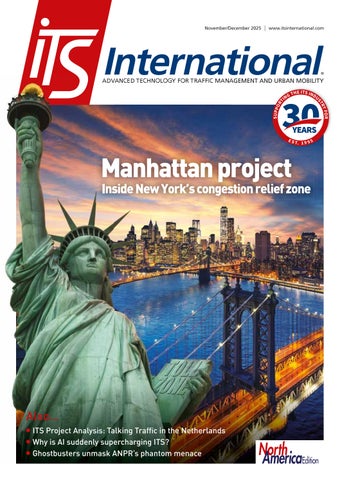
Manhattan project
T. 1 9 9 5
SUPPO
RT
HE ITS IND
U
FOR RY ST
GT
IN
ES
Inside New York’s congestion relief zone
Also… ,76 3URMHFW $QDO\VLV 7DONLQJ 7UDI½ F LQ WKH 1HWKHUODQGV :K\ LV $, VXGGHQO\ VXSHUFKDUJLQJ ,76" *KRVWEXVWHUV XQPDVN $135µV SKDQWRP PHQDFH
North AmericaEdition
Powerful Cloud-based ATMS with Predictive Traffic Forecasts using Artificial Intelligence Delivering New Levels of Traffic Signal Control and Intelligent Automation: Econolite’s Centracs® Mobility Platform, the cloud-based Advanced Transportation Management System (ATMS), now integrates PTV Flows. This predictive traffic management solution leverages AI to forecast travel times, enabling proactive and intelligent signal control decisions. Centracs Mobility with PTV Flows is the only ATMS capable of moving traffic signal optimizations from reactive to proactive. The Traffic Proactive optimization module is layered on top of existing capabilities for data analytics and reporting, signal/ detection management, additional optimization services, and much more. umovity.com a unified brand for
CONTENTS PO S T
ED RE
&
SP
O
• PRI
Y• IBL
NT
NS
E
Contents D
U
OU
R CARBON
November/December 2025
05 COMMENT
32 CONGESTION
CHARGING 06 NEWS DIGEST
Big change in the Big Apple: how TransCore brought New York City’s congestion relief zone into being - and why scaffolding, arborists and balloons provided such unexpected obstacles
08 CONTRACTS & DEALS 10 ITS PR JECT ANALYSIS
TALKING TRAFFIC
07
The Netherlands’ ambitious initiative to connect the country’s road users with infrastructure – and each other – aims to improve efficiency and safety. Four of the major players in this well-established project explain everything
36 ARTIFICIAL
INTELLIGENCE Time to believe the hype, perhaps... AI has been around for some years in transportation systems – but it now appears to be ‘supercharging’ ITS activity. We look at what’s changed and what it means for the industry
19 VISION TECHNOLOGY The phantom menace: ghost plates – vehicle licence plates which are obscured to evade detection by ANPR cameras - are an increasing problem for authorities. But MAV Systems and Redspeed International have some answers...
10
46 PRODUCTS &
INNOVATIONS
North AmericaEdition
24 WEIGH IN MOTION
North America area only
How can WiM technology help to preserve road infrastructure? And how can WiM companies best explain the benefits of their systems to cash-strapped city and highway authorities?
24
NA 01 When tech providers align
strategically, they can deploy solutions faster, more efficiently,and at a scale that individual vendors can’t achieve, says Mark Talbot, CEO of Q-Free
November/December 2025 | www.itsinternational.com
International
ADVANCED TECHNOLOGY FOR TRAFFIC MANAGEMENT AND URBAN MOBILITY
Manhattan project
T. 1 9 9 5
SUPPO
RT
HE ITS IND
U
FOR RY ST
GT
IN
ES
Inside New York’s congestion relief zone
Cover story We finally, really did it Also… ,76 3URMHFW $QDO\VLV 7DONLQJ 7UDI½ F LQ WKH 1HWKHUODQGV :K\ LV $, VXGGHQO\ VXSHUFKDUJLQJ ,76" *KRVWEXVWHUV XQPDVN $135µV SKDQWRP PHQDFH
36 ITS International is now on Bluesky!
Image: © Ron Sumners | Dreamstime.com © Ilja Mašík | Dreamstime.com
@itsinternational.bsky.social
TP
O
ED
19
RI N T
TO R
CE
NA 05 Marty Beard, new CEO of
Hayden AI, answers ITS International’s questions about bus lane enforcement...
© ITS INTERNATIONAL NOVEMBER/DECEMBER 2025
03
FO
OCR CLOUD Because every character counts!
Stark OCR Cloud is the best to increase the reading performance of the last % of text recognition.
art: cristinaferretti.com
For applications where increased reading rates translate into lower OPEX (manual review) and higher revenues.
www.tattile.com
COMMENT
W
Editor Adam Hill Email: ahill@ropl.com Tel: +44 1322 612062 Sales Director Dan Emmerson Email: demmerson@ropl.com Tel: +44 1322 612068 Head of Digital Sarah Biswell Email: sbiswell@ropl.com Tel: +44 1322 612078 Staff Writer David Arminas
Design Team Simon Ward, Andy Taylder Data & Marketing Manager Alan Cansick Email: acansick@ropl.com Tel: +44 1322 612061 Office Manager Kelly Thompson Email: kthompson@ropl.com Production Manager Nick Bond Email: nbond@ropl.com Tel: +44 1322 612066
ITS International: supporting the ITS industry for 30 years
“
It’s been easy to cast AI as the great disrupter before, but not so much now
“
e’re taking an in-depth look in our cover story this issue at one of the most significant transportation stories of 2025 – the successful introduction of the first US congestion charge zone in New York City. The tale has it all: political intrigue, technical ingenuity, strong opposition, global interest – and even, at key points, the intervention of arborists. Tree experts rarely make appearances in our industry, proving that the Capital of the WorldTM is always full of surprises. There’s another hot topic to jump into – one which may have an even longer-lasting impact. Following on from ITS International’s second AI in Transportation supplement, we’ve asked more experts why the use of artificial intelligence appears to have shifted in the transportation world. It’s a long read but we’re confident you’ll find it worthwhile. Our deep dive comes at an interesting time: AI in transportation has always been a promising concept but its impact has been limited by several key factors – not least the cost of hardware, relative weakness of computing power, and availability of useful
© Dzmitry Ryzhykau | Dreamstime.com
“WHY THE AI ‘TREND CAROUSEL’ IS DIFFERENT THIS TIME”
data. Something has changed – but what? Why now does AI appear to be ‘supercharging’ ITS activity? After all, we’ve had fads before (blockchain, anyone?) This time feels different. Christopher Kettell of TRL Software puts it beautifully: “Is AI just another spin on the trend carousel, or is it something real? In my opinion, this is something tangible. Unlike previous hype cycles there are some clear differences.” Those differences are instructive: AI is now more advanced, processing has more oomph, edge compute is cheaper - and
Publisher/ Managing Director Andrew Barriball Email: abarriball@ropl.com Tel: +44 1322 612057 CEO Roger Adshead Email: radshead@ropl.com Editorial Consultant Geoff Hadwick
that’s just the start. The ability of learning models has jumped ahead. Consumer familiarity with – and trust of – AI in dayto-day applications (such as ChatGPT) has created momentum. We’re not just looking at AI as a research tool anymore – rather, it’s an enabler. It’s been easy to cast it as the great disrupter before – the task eater, the poem creator, the job destroyer - but not so much now. Because what if AI is actually just a practical tool that supports real improvements in efficiency, accuracy and system resilience? In short, what if AI is growing up? ITS
Adam Hill EDITOR
Have your say Email me at ahill@ropl.com @itseditoradam.bsky.social @adamhillwriter @itseditor_adamhill
Printed by Warners (Midlands) PLC
ITS International (PE 13324) is published 6 times a year with combined issues in January/ February, March/April, May/June, July/August, September/October and November/December by Route One Publishing Ltd, Second Floor, West Hill House, West Hill, Dartford, Kent, DA1 2EU, UK. Airfreight and mailing in the USA by agent named World Container Inc., c/o BBT 150-15, 183rd St, Jamaica, NY 11413, USA. Periodicals postage paid at Brooklyn, NY 11256. POSTMASTER: Send address changes to ITS International, World Container Inc., c/o BBT 150-15, 183rd St, Jamaica, NY 11413, USA.
All editorial, advertising or circulation enquiries to: ITS International, Second Floor, West Hill House, West Hill, Dartford, Kent, DA1 2EU, UK. No part of the publication may be reproduced in any form whatsoever without the express permission of the publishers. Views expressed in this journal do not necessarily reflect the opinion of the Editor or Route One Publishing Ltd. Reader Enquiry Service: data@ropl.com Tel: +44 1322 612061 Subscription Enquiries: subs@ropl.com Global: Print ISSN 1463-6344 Digital ISSN 2057-3421 NA: Print ISSN 2632-4458 Digital ISSN 2632-5950
Air Business Ltd is acting as our mailing agent. Subscription records are maintained at Route One Publishing Ltd, Second Floor, West Hill House, West Hill, Dartford, Kent, DA1 2EU, UK.
Published by © Route One Publishing Ltd 2025
© ITS INTERNATIONAL NOVEMBER/DECEMBER 2025
05
NEWS DIGEST
Jenoptik signs -RUGDQ WUDIÀ F GHDO
Ettifos gains BABA compliance
Cellular Vehicle to Everything (C-V2X) specialist Ettifos, has announced that its compact on-board unit (OBU) and aftermarket V2X device (AVD), V2X-AIR, is now fully compliant with Build America, Buy America (BABA) requirements under the US Infrastructure Investment and Jobs Act (IIJA). 2QH RI WKH ½ UVW 9 ; GHYLFHV to meet US federal domestic production standards, it can be used in federally-funded transportation programmes and connected vehicle initiatives without requiring waivers or exemptions. It means V2X-AIR is available for immediate purchase and use by US customers, supporting near-term connected mobility deployment.
Hojun Kim, CEO (left) and Kangmin Lee, COO
© Ahmad.a Atwah | Dreamstime.com
-HQRSWLN 6PDUW 0RELOLW\ 6ROXWLRQV WRJHWKHU ZLWK 7UDI½ F7HFK 0LGGOH (DVW ZLOO UROO RXW DGYDQFHG WUDI½ F VDIHW\ V\VWHPV DFURVV *UHDWHU $PPDQ 0XQLFLSDOLW\ LQ -RUGDQ 8QGHU WKH DJUHHPHQW 7UDI½ 6WDU 65 red light and speed enforcement cameras will be installed in the Jordanian capital. There will also be nine Vector SR P2P (point-to-point) section control devices on key highway stretches to monitor average speeds. All the incidents collected by the devices will be fed into Jenoptik’s new EDFN RI½ FH SODWIRUP )ORZ7ULV JLYLQJ the municipality a single, real-time YLHZ RI WUDI½ F YLRODWLRQV +DOI RI WKH 7UDI½ 6WDU XQLWV ZLOO EH RQ highways and half in the city.
Kapsch drives four new toll plazas in Serbia
Driverless delivery from Sweden to Norway
Einride has announced a successful cross-border operation of a cabless electric autonomous delivery truck – no human driver on board – between Sweden and Norway. 7KH ½ UP VDLG WKH DXWRQRPRXV border crossing, organised with several partners including Q-Free, took place at the Ørje crossing and marks the ZRUOG ½ UVW FDEOHVV HOHFWULF autonomous crossing of a country's border. Other partners for the crossing included Norway’s public roads administration Statens Vegvesen, transport research JURXS 6LQWHI7UD½ NYHUNHW and Østfold commune. It was conducted on behalf of PostNord, which ships around 200 million parcels across the Nordic region each year.
Four new toll plazas - powered by SmartToll tech from Kapsch 7UDI½ F&RP KDYH RSHQHG WR WUDI½ F DORQJ WKH 0RUDYVNL Corridor in central Serbia. They are part of a project comprising 150 contracted lanes, 120 of which will be delivered by the HQG RI 7KH 0RUDYVNL
Corridor is a 112.4 km motorway in the eastern European country, running east to west and connecting Serbia’s capital, Belgrade, and the tourist magnet of the Zlatibor mountain region. The route is integrated with the north-south corridor between +XQJDU\ DQG 1RUWK 0DFHGRQLD
transport sector in creating HFRQRPLF DQG VRFLDO EHQH½ WV Speaking at the ITS UK Annual Awards 2025 in London, he said: "I'm clear technology isn't just an afterthought, it's the very engine of national renewal." Wearing an ITS World Congress 2027 lapel pin - the Congress will be held in Birmingham, UK, in two years' time - he talked about how the UK government is aiming to make transport better "for more people in more places, and how technology is at the heart of it".
,QWHUWUDIÀ F Amsterdam 2026 introduces Startup Award $ QHZ WURSK\ WKH ,QWHUWUDI½ F Startup Award - is to be LQWURGXFHG DW ,QWHUWUDI½ F Amsterdam 2026, which takes SODFH 0DUFK QH[W \HDU "Startups play an important role in shaping the future of mobility," VD\V ,QWHUWUDI½ F 7KH\ EULQJ fresh ideas, new technologies, and creative solutions to the WUDI½ F DQG WUDQVSRUW LQGXVWU\ 6WDUWXSV ZKLFK DUH RI½ FLDOO\ registered as part of ITSUP26 will be automatically entered into the new competition. ITS International is proud to be producing the Daily News DW ,QWHUWUDI½ F $PVWHUGDP 2026, where the winner will be announced at the opening ceremony. ZZZ LQWHUWUDI½ F FRP DPVWHUGDP SURJUDPPH LWVXS
ITS is 'engine’ of UK renewal
UK transport minister Simon Lightwood has praised the contribution of the intelligent
FOLLOW ITS INTERNATIONAL ON SOCIAL MEDIA Facebook @ITSInt
06
Bluesky @itsinternational.bsky.social
© ITS INTERNATIONAL NOVEMBER/DECEMBER 2025
LinkedIn @ITS International Magazine
Instagram @itsinternational_magazine
Follow us on LinkedIn
youtube @itsinternational
@ITS International Magazine
NEWS DIGEST
UHGXFLQJ JULGORFN DQG DGYDQFLQJ DFFHVV $QG 7UDQV&RUH ZRQ LQ WKH 3ULYDWH 6HFWRU ,QQRYDWLRQ FDWHJRU\ IRU LWV ZRUN ZLWK WKH FLW\ GHYHORSLQJ WKH DGYDQFHG WROOLQJ V\VWHP WKDW XQGHUSLQV WKH 07$ V LQLWLDWLYH 7KH &HQWUDO %XVLQHVV 'LVWULFW 7ROOLQJ 3URJUDP LV DLPHG DW UHGXFLQJ FRQJHVWLRQ LPSURYLQJ WUDYHO UHOLDELOLW\ HQKDQFLQJ DLU TXDOLW\ ° DQG JHQHUDWLQJ FULWLFDO IXQGLQJ IRU PDVV WUDQVLW
Drivers are struggling with QHZ K\EULG WUDI½ F VLJQDOV DQG FURVVZDONV OHDGLQJ WR SRWHQWLDOO\ GDQJHURXV VLWXDWLRQV IRU SHGHVWULDQV 8QLYHUVLW\ RI 0DVVDFKXVHWWV DW $PKHUVW UHVHDUFKHUV IRXQG WKDW GULYHUV DUH ²VWRSSLQJ HDUO\ IDLOLQJ WR VWRS RU UROOLQJ WKURXJK³ DW SHGHVWULDQ K\EULG EHDFRQV 3+%V ZKLFK DUH LQFUHDVLQJO\ IRXQG DW PLG EORFN FURVVZDONV 3+%V KDYH ½ YH SKDVHV RI LQGLFDWLRQV IRU PRWRULVWV EXW QHDUO\ D TXDUWHU RI GULYHUV GURYH WKURXJK GXULQJ WKH VROLG UHG SKDVH WKH HTXLYDOHQW RI UXQQLQJ D UHG OLJKW 0HDQZKLOH RI GULYHUV GURYH WKURXJK WKH ¾ DVKLQJ UHG UHJDUGOHVV RI SHGHVWULDQ SUHVHQFH ° VLPLODU WR UXQQLQJ D VWRS VLJQ
UHDO WLPH )ORZ /DEV VD\V WKH V\VWHP JLYHV )'R7 YDOLGDWHG UHDO WLPH WXUQLQJ PRYHPHQW FRXQWV +LVWRULFDOO\ RQH RI WKH PRVW GLI½ FXOW DQG H[SHQVLYH GDWDVHWV IRU DJHQFLHV WR REWDLQ WXUQLQJ PRYHPHQW FRXQWV KDYH WUDGLWLRQDOO\ EHHQ OLPLWHG WR VKRUW WHUP PDQXDO ½ HOG VWXGLHV WKH ½ UP DGGV
)ORZ /DEV WUDI½ F PDQDJHPHQW V\VWHP LV QRZ RSHUDWLRQDO DFURVV LQWHUVHFWLRQV LQ WKH 2UODQGR PHWURSROLWDQ DUHD IROORZLQJ D SLORW 7KH )ORULGD 'R7 GHDO LQWHJUDWHV /XPLQXV /XPLQXV 3OXV DQG )ORZ 57 )ORZ /DEVµ UHDO WLPH $, SODWIRUP LQWR )'R7µV H[LVWLQJ LQIUDVWUXFWXUH DOORZLQJ LW WR PRQLWRU DQDO\VH DQG UHVSRQG WR WUDI½ F FRQGLWLRQV LQ
It’s Midnight in Osaka
© 4kclips | Dreamstime.com
© Marcel De Grijs | Dreamstime.com
Flow Labs turns it on in Orlando
Awards recognition for NYC congestion zone 1HZ <RUN &LW\ V FRQJHVWLRQ UHOLHI ]RQH ODXQFKHG LQ -DQXDU\ ZDV UHFRJQLVHG LQ WZR ,%77$ 7ROO ([FHOOHQFH $ZDUGV 7KH FLW\ V 0HWURSROLWDQ 7UDQVSRUWDWLRQ $XWKRULW\ 07$ %ULGJHV DQG 7XQQHOV ZRQ WKH 6RFLDO 5HVSRQVLELOLW\ $ZDUG IRU WKH ZRUN ZKLFK ,%77$ VDLG PDUNHG D KLVWRULF ½ UVW E\
6RUDFOH D MRLQW YHQWXUH EHWZHHQ -DSDQ $LUOLQHV DQG 6XPLWRPR &RUSRUDWLRQ ZLOO OHDG WKH HVWDEOLVKPHQW RI DLU WD[L VHUYLFHV LQ -DSDQµV 2VDND 3UHIHFWXUH 6RUDFOH ZLOO GHSOR\ $UFKHU $YLDWLRQµV 0LGQLJKW H972/ DLUFUDIW DV WKH FRUH SDUW RI LWV ¾ HHW 7KH DJUHHPHQWV ZLWK WKH 2VDND 3UHIHFWXUH DQG 2VDND &LW\ DUH VWHSV WRZDUG EXLOGLQJ RXW WKH RSHUDWLRQDO UHJXODWRU\ DQG FRPPXQLW\ IUDPHZRUNV QHHGHG WR FRQQHFW 2VDND DQG WKH EURDGHU .DQVDL UHJLRQ ZLWK DLU WD[L ¾ LJKWV $UFKHU DQG
6RUDFOH SUHYLRXVO\ DQQRXQFHG D VWUDWHJLF DOOLDQFH LQ 1RYHPEHU WR MRLQWO\ ODXQFK DLU WD[L RSHUDWLRQV LQ -DSDQ
ITS World Congress 2026: submission deadline 31 January
© Sean Pavone | Dreamstime.com
Crosswalk confusion at 'pedestrian hybrid beacons'
7KH RI½ FLDO ZHEVLWH IRU WKH ,76 :RUOG &RQJUHVV LQ *DQJQHXQJ 5HSXEOLF RI .RUHD KDV JRQH OLYH DQG SDSHU DQG VHVVLRQ VXEPLVVLRQV DUH QRZ RSHQ ZLWK D GHDGOLQH RI -DQXDU\ (DFK VXEPLVVLRQ ZLOO EH SHHU UHYLHZHG E\ H[SHUWV IURP WKH WKUHH ,76 :RUOG &RQJUHVV UHJLRQV *DQJQHXQJ RQ WKH HDVW FRDVW RI .RUHD KDV D SRSXODWLRQ RI DURXQG $ YLVLRQ RI VPDUW PRELOLW\ LQ PLG VL]HG FLWLHV LV WKH RYHUDUFKLQJ WKHPH RI WKH HYHQW ZLWK WKH XPEUHOOD WDJ %H\RQG 0RELOLW\ &RQQHFWHG :RUOG ,76 ,QWHUQDWLRQDO LV SURXG WR EH SURGXFLQJ WKH Daily News DW ,76 :RUOG &RQJUHVV LWVZRUOGFRQJUHVV RUJ ,76 LQGH[ GR
© Zhukovsky | Dreamstime.com
"We must think beyond traditional tolling partners," says next IBTTA president -RL 'HDQ µV SUHVLGHQW RI WROOLQJ DVVRFLDWLRQ ,%77$ KDV FDOOHG RQ WKH LQGXVWU\ WR FDVW LWV QHW ZLGHU WR DGYDQFH LWV FDXVH $V ZH PRYH IRUZDUG ZH PXVW WKLQN EH\RQG RXU WUDGLWLRQDO WROOLQJ SDUWQHUV DQG HPEUDFH D EURDGHU HFRV\VWHP RI LQQRYDWRUV WHFKQRORJLVWV UHVHDUFKHUV DQG FRPPXQLW\ OHDGHUV VKH VDLG LQ D VSHHFK DV VKH DFFHSWHG KHU QHZ UROH 'HDQ ZKR LV &(2 DW 5LFKPRQG 0HWURSROLWDQ 7UDQVSRUWDWLRQ $XWKRULW\ WDNHV RYHU RQ -DQXDU\ IURP V SUHVLGHQW -DPHV +RIPDQQ H[HFXWLYH GLUHFWRU DQG &(2 RI 1RUWK 7H[DV 7ROOZD\ $XWKRULW\ 'HDQµV YLVLRQ IRU ,%77$ LV EDVHG RQ WKUHH SLOODUV LQYHVWPHQW LPSDFW DQG ,Q¾ XHQFH
FOLLOW ITS INTERNATIONAL ON SOCIAL MEDIA Facebook @ITSInt
Bluesky @itsinternational.bsky.social
Did we mention it’s our 30th birthday this year?
LinkedIn @ITS International Magazine
Instagram @itsinternational_magazine
youtube @itsinternational
© ITS INTERNATIONAL NOVEMBER/DECEMBER 2025
07
S
© Janusorlov | Dreamstime.com
Chicago adds bus enforcement cameras
ADAS data deal for Space 42 & DMP in UAE
Six Chicago Transit Authority EXVHV DUH RSHUDWLQJ IRU WKH ½ UVW time with automated bus lane enforcement (ABLE) systems from Hayden AI to spot parking and standing violations in bus and bike lanes. Part of the City of Chicago’s Smart Streets pilot programme, which was launched last year, the pilot with Hayden AI will last until December 2026. Each ABLE system includes an on-board processor, plus two windshield-mounted cameras that allow it to identify and record data capturing violations. Hayden AI performs a manual review before transferring data WR WKH &LW\ RI &KLFDJR IRU ½ QDO determination and violation issuance.
Mumbai integrated transit app launches
Space42 and Dynamic Map Platform (DMP) will provide HD map data for an advanced driver-assistance system in the United Arab Emirates. The companies' data will enable General Motors’ hands-free Super Cruise functionality. The "long-term" deal enables Space42 to supply Lidar point cloud data and updates to DMP, which will process the data for customised HD map data used by GM. The OEM says Super Cruise is "proven technology", deployed on over 960,000km of roads in North America.
Mumbai Metropolitan Region Development Authority (MMRDA) has launched an integrated mobility app which brings together SXEOLF WUDQVSRUW RSHUDWRUV 005'$ VD\V LW LV ,QGLD V ½ UVW VXFK app, and covers the entire Mumbai metropolitan region, which is home to around 20 million people. A single QR-based digital ticket will enable travel across metro, bus, monorail and suburban rail, removing multiple apps, bookings and paper tickets. The app has a tri-lingual interface (Hindi, Marathi and English), with safety features including 'Share My Location', Emergency Helpline and SOS, an emergency function that transmits location information to pre-selected trusted contacts when activated. © Srinivas Akella Ramalingaswami | Dreamstime.com
Rekor Systems has been awarded a multi-year deal from Georgia DoT. It comes on the heels of a statewide blanket purchase order in June from Texas DoT for the deployment of the Rekor Command platform. The GDoT agreement is projected to generate over $50 million, and could increase total contract value to more than $100 million RYHU D VHYHQ \HDU WHUP WKH ½ UP says. Rekor Discover, the Data as a Service platform, will be used to integrate all types of roadside detection for GDoT, including YHKLFOH FODVVL½ FDWLRQ :HLJK in Motion, and non-motorised detection, into a managed, and turnkey solution.
Statens Vegvesen - the Norwegian Public Roads Administration (NPRA) - is to deploy Q-Free's Intrada Insight solution across the Nordic nation’s tolling network. The system will power NPRA’s nationwide ANPR system for AutoPass - Norway's electronic tolling programme - which covers roads stretching from urban centres to the Arctic Circle. The organisations have worked together for some years. This new contract - a four-year term with options up to seven years - covers both automated recognition and manual image review of all toll passage images, processing more than 760 million images and 400 million transactions annually.
© Tampatra1 | Dreamstime.com
Rekor wins $50m Georgia DoT deal
© Anthony Aneese Totah Jr | Dreamstime.com
Star Systems International (SSI) has implemented a multi-lane, IUHH ¾ RZ 0/)) SLORW LQ .XDOD /XPSXU 0DOD\VLD UHSODFLQJ legacy plaza/barrier-based tolling. The solution - which SSI says "sets the stage" for wider adoption across south-east Asia, was deployed in collaboration with Malaysian payments ½ UP 7RXFK ´Q *R DQG WROOLQJ V\VWHP SURYLGHU 6LGUD 5HWUR½ WWLQJ onto an existing gantry means the pilot results can be validated against actual tolling data. The company says Sidra's Parsec lane-control system "plays a critical role" in integrating SSI's Titan Pro reader and Avior antenna with ANPR cameras and 3D Lidar sensors.
Norway chooses Q-Free to power AutoPass
© Tea | Dreamstime.com
© Rosnun | Dreamstime.com
CONTRACT & DEALS
FOLLOW ITS INTERNATIONAL ON SOCIAL MEDIA Facebook @ITSInt
08
Bluesky @itsinternational.bsky.social
© ITS INTERNATIONAL NOVEMBER/DECEMBER 2025
LinkedIn @ITS International Magazine
Instagram @itsinternational_magazine
youtube @itsinternational
For the latest news go to www.itsinternational.com
ûŖϒƯďŏŖϒ×ǣďűűƆňϒ×ďƞƚΜ ƱƼȤϒȤŖύǣŖϒƼǠŖƱƆƱŲϒǷƁŖ űďǫǷϒƞďƱŖ ƼƱƱŖňǷƆƱŲϒƯƼŇƆƞƆǷȪϒǷƼϒŏƆŲƆǷďƞϒƆƱűǣďǫǷǣȇňǷȇǣŖϒǷƼƼƚϒȪŖďǣǫΘϒ ƼȤΙϒƆǷ ƁďǠǠŖƱǫϒƆƱϒǣŖňƼǣŏϒǷƆƯŖΘϒûƆǷƁϒ×{.Ā VƱǷŖǣňƁďƱŲŖϒκϒǷƁŖϒŏďǷď ŖȩňƁďƱŲŖϒŖƱŲƆƱŖϒκϒűǣƼƯϒ ƼƱƼǷňƁΙϒȪƼȇϒŲŖǷϒƆƯǠďňǷϒȤƆǷƁƼȇǷϒǷƁŖ ňƼƯǠƞŖȩƆǷȪΘ ÊŖňȇǣŖΙϒǠǣƼȣŖƱϒďƱŏϒƆƱǫǷďƱǷƞȪϒďȣďƆƞďŇƞŖΘϒ&ŖǠƞƼȪϒƱƼȤϒƆƱϒȪƼȇǣϒƼȤƱ ȴȇǣŖϒ ďǣƚŖǷǠƞďňŖϒǷŖƱďƱǷΘ
{ŖďǣƱϒƯƼǣŖ
ITS PR JECT ANALYSIS
TALKING TRAFFIC
IT’S GOOD TO TALK
Talking Traffic is an ambitious initiative to connect one country’s road users with infrastructure – and each other – in a bid to improve efficiency and safety. Four of the major players in the well-established Dutch project explain everything to Adam Hill…
T
alking Traffic started in 2016 as an ambitious project to boost connectivity between vehicles and infrastructure in the Netherlands. The Dutch government initiative, driven by the Ministry of Infrastructure and Water Management, aims to extend cooperative ITS (C-ITS) services, improving traffic efficiency and safety. It has brought together around 60 regional and local road authorities; national and international private companies; roadside equipment vendors; app providers; mobile network operators; consultancies; systems integrators, and many more.
10
© ITS INTERNATIONAL NOVEMBER/DECEMBER 2025
At the project’s heart is real-time interaction between traffic lights and road users, enabling motorists to receive notifications about traffic lights’ status, allowing them in turn to make better decisions while driving. This includes Glosa (green light optimal speed advisory), which advises drivers on the ideal speed to maintain a ‘green light streak’, as well as priority for essential traffic such as emergency vehicles and cyclists. ITS International has checked in with a few of the key ITS companies involved to gauge progress after nine years of operation, to find out the lessons learned – and to see what the future holds for Talking Traffic.
Monotch and TLEX Monotch began its involvement during the R&D phase, explains Menno Malta, the company’s founder and CEO: “We were tasked with the realisation and delivery of a platform to exchange real-time data between smart traffic lights and road users.” Monotch put its TLEX (Traffic Live Exchange) platform forward as the cornerstone of a connected mobility and digital infrastructure solution to meet all the requirements set by Netherlands authorities. After a European Union (EU) procurement procedure, Monotch was rewarded with a contract to implement what became known as the Urban Data Access Platform (UDAP), For the latest news go to www.itsinternational.com
ITS PR JECT ANALYSIS © Monotch
TALKING TRAFFIC
Monotch’s Traffic Live Exchange is the cornerstone of a connected mobility and digital infrastructure solution
based on the TLEX platform. It features precisely what governments, cities and road authorities find essential for a smart mobility data-exchange platform, says Malta. “It’s bi-directional – it sends data to road users and receives anonymised information from road users; it is a continuous and realtime data exchange; it’s vendor-independent, making it possible to use existing hardware without significant investments,” he explains. It also allows authorities to keep control, letting other approved and verified parties to connect, and ensures they can rely on data quality and standardisation. “Now, this programme has transitioned into a large-scale, real-life deployment with ITS International: supporting the ITS industry for 30 years
an actual impact on mobility,” insists Malta. “It is the largest connected mobility deployment in Europe, where more and larger-scale use cases are added.” He points to the fact that, from this year, all Dutch ambulances are connected. More than half of Dutch road users now receive emergency vehicle approaching (EVA) warnings when an ambulance is near. “Within the next 12 months, 90% of Dutch fire trucks will be connected to the same system, allowing EVA warnings for these vehicles as well,” Malta says. “The increasing availability of data supports the transition to data-driven policies and deployment.”
Swarco’s active involvement Swarco has also been involved from the early stages. Responding to ITS International’s questions about the project, Herman van der Vliet, ITS portfolio manager, and Danny Vroemen, manager, strategy & solutions, from Swarco Netherlands, explain: “A huge accomplishment was the joint creation and implementation of the architecture of the socalled intelligent traffic light controller (iTLC), splitting the TLC into interoperable elements focusing on traffic safety, adaptive traffic control and cooperative, connected and automated mobility (CCAM) data exchange. This resulted in the new standard for all TLC suppliers delivering in the Netherlands.” © ITS INTERNATIONAL NOVEMBER/DECEMBER 2025
11
TALKING TRAFFIC
© Swarco
ITS PR JECT ANALYSIS
“
Talking Traffic is unique in its national scope and focus on deployments - in contrast to many smaller pilots
“
Herman van der Vliet & Danny Vroemen Swarco
Swarco was heavily involved in the joint creation of the intelligent traffic light controller architecture
Dynniq – acquired by Swarco in 2021 – was actively involved in the development of cloud services as a subcontractor to Talking Traffic’s telecoms provider KPN. These services allow for data exchange with C-ITS services based on European standards. “The first phase of Talking Traffic focused on joint creation of specifications and interoperability testing,” say Van der Vliet and Vroemen. “In the second phase, delivery to individual road authorities took place.” Mobility for Haskoning Mobility is a key market for Haskoning, an independent international consultancy which specialises in engineering, design, and software-driven solutions. In the Talking Traffic partnership, it acts both as a software technology solution supplier and traffic engineering expert. “Haskoning provides key digital components and technical expertise that form the foundation of the programme’s operational layer,” explains Bob Randsdorp, director, business development, smart mobility. “With these components, we enable road authorities to implement their policy on the roads through the most efficient and effective traffic management solution so far available: traffic light signals.” Its core contribution is the hardwareagnostic Flowtack Software as a Service (SaaS) solution, designed to support real-time, data-driven, policy-based traffic management by providing fully-adaptive control strategies for traffic lights. Flowtack aggregates real-time data from connected vehicles, roadside units (RSUs), traffic controllers, and other available data sources,
12
© ITS INTERNATIONAL NOVEMBER/DECEMBER 2025
enabling predictive optimisation of traffic flows through advanced algorithms and data analytics. Complementing this, the Flowtack CloudRIS SaaS serves as the roadside ITS station (RIS) software layer, ensuring secure and standardised bi-directional communication between the roadside infrastructure and external service providers which communicate with road users. It complies fully with ETSI ITS-G5, C-ITS hybrid communication standards, and ISO 19091 profiles for cooperative signal control. The Flowtack CloudRIS enables interoperability between different controller brands and supports over-the-air configuration and monitoring of C-ITS messages, including SPaT, MAP, CAM, and DENM. “Together, these solutions empower road authorities to implement policy efficiently through adaptive traffic management,” Randsdorp says. The core of Be-Mobile Be-Mobile, active in the Benelux countries (Belgium, Netherlands and Luxembourg), was involved in a number of projects that laid the foundation of Talking Traffic – not least rolling out use cases like EVA in the Netherlands as early as 2014, says business development manager Wannes de Smet. “I was lucky to join Be-Mobile at the right time, in 2016, and designed the platform now serving three million monthly active end users, along with a fleet of ambulances and fire engines, numbering in the thousands across Europe,” he says. “With the sole exception of roadside hardware, our Be-Warned platform comprises everything from ingesting diverse sets of data sets,
back into the system, providing valuable input on traffic conditions and travel behaviour. With traffic signal priority (for emergency vehicles, vulnerable road users, logistics and public transport), EVA alerts, and time-togreen (Glosa), Malta says the implementation of Talking Traffic “has made Dutch mobility safer, more efficient, and more sustainable”. These digital tools give road authorities more control over optimising both urban and inter-urban traffic. “The groundwork laid by the Talking Traffic programme, which led to the UDAP platform and continues within the DMI [Dutch Metropolitan Innovations] environment, has enabled data-driven traffic management and prepared the Netherlands for the next generation of connected mobility,” Malta adds. “Enabling real-time, GDPR-compliant communication between road users and traffic infrastructure allows road users to receive precise and context-aware information through connected applications,” agrees Haskoning’s Bob Randsdorp. As well as Glosa and traffic signal priority, there is also dynamic re-routing and incident warnings, improving overall network reliability. “Maybe even more importantly, road users become part of the solution,” he says. “With the help of Flowtack, road users gain personal advantages - shorter journeys, fewer stops, reduced emissions - and at the same time they help to implement the road authorities' policies: a win-win situation.” Algorithm-driven control logic Haskoning’s Flowtack engine supports these services by applying advanced algorithmdriven control logic to optimise signal cycles in real time. By fusing connected vehicle data Follow us on LinkedIn
@ITS International Magazine
SWARCO’s traffic light experts lead once more the way when it comes to sustainability, environmental soundness, and a reduced CO₂ footprint. COMBIA CIRCULAR is the world’s first signal head largely made of post-consumer recycled polycarbonate. This forward-looking material philosophy reduces dependence on fossil raw materials, prevents waste, and optimizes the product’s life cycle without compromising the expected qualities of traffic lights: elegant design, energy efficiency, UV-stabilized robustness, and quick and easy maintenance.
swarco.com
It goes without saying that COMBIA CIRCULAR is also a smart traffic light beyond red, amber, or green. It enables intelligent add-ons like the measurement of environmental parameters, the warning of pedestrians distracted by smartphones, the integration of acoustics for the visually impaired, and the AI-supported detection and classification of road users.
MEET SWARCO and our views on circular economy at Intertraffic, stands 02.222 and 07.227 from 10 to 13 March 2026!
TALKING TRAFFIC
treating and enriching them, to ultimately publishing them in standard data formats on data exchanges, or using them in our offerings aimed at road users. The very core of our platform is simply determining what is relevant for end users given their position or context window - and providing everything needed to send the right kind of message, per event type, at the right moment. This all happens in real time with millions of users which is good fun to build and operate.” The benefits of Talking Traffic The benefits of Talking Traffic for road users – including drivers, cyclists and pedestrians in the Netherlands are considerable, explains Menno Malta at Monotch: “Currently, 100% of ambulances are connected to the system, and around four million road users — roughly 50% of all drivers in the Netherlands — receive tailored information about Dutch traffic conditions through various channels such as in-car dashboards, mobile apps, and on-board units. Approximately 30% of the country’s traffic light controllers are now connected.” This programme In additionhas to data being transitioned a users, large-scale, sent into to road about 20% real-life deployment an data of vehicles alsowith send live
“
actual impact on mobility Menno Malta Monotch
programme. This enables the development of traffic management policies with active mobility in mind.” Swarco has fully integrated priority and Glosa services in its network control application, which means individual road authorities can define and execute traffic policies on their network. “As a result, for instance, emergency vehicles can safely cross
intersections, trucks have fewer stops on designated routes, bicycles and pedestrians have less waiting time at intersections,” Van der Vliet and Vroemen point out. “Car drivers are informed with predicted state changes or even receive a speed advisory, and so on.” The range of benefits is impressive – yet while signal priority and EVA capture the imagination, Be-Mobile’s Wannes de Smet has another function in mind. “My personal favourite is the one most people think of as being obvious - and easy,” he admits. “Maximum speed information.” Before the Talking Traffic ecosystem, De Smet continues, showing accurate real-time speed data everywhere was simply not possible: “All the variable speed signs data needed to be published with minimal latency. Temporary restrictions due to roadworks or events, time-based speed restrictions - the list goes on for all data sources required to allow us to combine everything and deliver the single, correct maximum speed to an end user. It might still not be perfect but never before has anyone driving in the Netherlands received speed information at such high quality.” A transformational project It's fair to describe Talking Traffic as a transformational project, thinks Randsdorp. “It moves mobility management from infrastructure-centric control to a data-driven system,” he suggests. “Traditional traffic control systems rely on pre-set timing plans and static sensor inputs. Talking Traffic, by contrast, integrates real-time vehicle data, cloud computing, and standardised communication protocols into one cooperative framework.” The traditional hardware-based approach has the additional disadvantage of severely limiting road authorities’ vendor choice - the © Monotch
with conventional sensor data, Flowtack can adapt junction control to changing demand patterns, mitigating congestion and improving junction throughput. As Flowtack is able to communicate with surrounding junctions, these benefits are not restricted to single intersections, but optimise whole networks. Therefore, safety improves through earlier hazard awareness and fewer red-light violations; efficiency rises as smoother traffic flows reduce fuel consumption and CO2 emissions; accessibility increases as road authorities gain better situational awareness and control flexibility; and there is the possibility to prioritise specific types of road users (blue-light priority, active mobility, etc) through a network. “For Dutch road authorities, this marks a shift from reactive to proactive traffic management, where data streams from the connected environment enable continuous policy-based optimisation, rather than periodic plan updates,” Randsdorp says. CCAM is now an indisputable part of the future mobility and traffic management solutions and services, say Van der Vliet and Vroemen at Swarco: “In the longer term, Talking Traffic prepares the infrastructure for gradually introducing autonomous driving. In the shorter term, the aim is to increase safety and performance.” Priority services - in combination with adaptive network traffic control - have proven to be a huge benefit, they continue. “More information, well ahead of arrival at an intersection, allows for providing priority (i.e. far fewer stops) to individual vehicles or active road users without a negative impact on overall traffic flows. For emergency vehicles it means a safer and faster crossing of junctions. As you can imagine, for a biking nation [such as the Netherlands], priority services for cyclists are implemented and currently being rolled out in a separate
“
ITS PR JECT ANALYSIS
14
© ITS INTERNATIONAL NOVEMBER/DECEMBER 2025
ITS International is now on Bluesky!
@itsinternational.bsky.social
TALKING TRAFFIC
Multi-vendor implementation While the openness of the system is positive – for instance, a multi-vendor implementation on an intersection, with one supplier providing the hardware, another the control application, a third the priority services and yet another organisation being responsible for daily maintenance of the intersection – this is also why standardisation is so needed, they continue.
“
If you are not used to being a digital road operator yet, it takes a minute to get there and appreciate the Talking Traffic model
“
Wannes de Smet Be-Mobile
ITS International: supporting the ITS industry for 30 years
© Monotch
The Talking Traffic ecosystem has required close collaboration from a lot of parties
“
Talking Traffic is transformational because it moves mobility management from infrastructurecentric control to a data-driven system
“
so-called ‘vendor lock-in’ risk, he adds: “Within Talking Traffic, standardised interfaces have been developed, allowing road authorities to mix and match hardware and software from different providers, increasing flexibility and reducing costs.” Flowtack and Flowtack CloudRIS turn traffic signals into fully-adaptive intelligent cooperative nodes within a connected network of any scale. Each junction becomes a digital asset, capable of two-way communication with vehicles, the cloud, and nearby junctions. It’s scalable, interoperable and provides a continuous service. “In essence, Talking Traffic demonstrates how public–private collaboration, data openness, and system interoperability can collectively redefine the operation and governance of local, regional and national mobility networks.” For Herman van der Vliet and Danny Vroemen at Swarco, “it changed the market approach for traffic control in the early stages, allowing for a more open ecosystem, anticipating growing market competition and thus activating more innovations”. But they sound a note of caution: “Talking Traffic initiated a long-term transition towards operationalising an ecosystem from traffic light controllers through cloud services towards CCAM service providers. Standardising the interfaces and clear technology choices allows for data sharing at all levels. However, there is a difficult balance between CCAM services and traffic control: from a services point of view, there is a need for harmonised behaviour on the infrastructure - meaning services would logically only be successful if all intersections support the services. On the other hand, upgrading the full infrastructure takes time and needs investments, sometimes without a direct return.”
ITS PR JECT ANALYSIS
Bob Randsdorp Haskoning “Having said this, you can also see one of the downfalls of Talking Traffic, where more organisations work together, more interfaces come into place - which doesn’t necessarily mean that the programme leads to an easier, more cost-effective deployment,” Van der Vliet and Vroemen warn. For Menno Malta, the picture is clearer: for one thing, the focus has been on large-scale deployment, using clear principles for all involved. Talking Traffic is built to last with a governance structure and continuous quality control organised by authorities. And the fact that there are no silos makes it worth the investment for all the stakeholders. He points to the figures: over 60 municipalities connect in the ecosystem; a third of traffic light controllers are connected; half of the Netherlands’ road users receive in-car information; all ambulances are connected. “Each day, around 1.3 billion mobility-related messages are exchanged to make this possible,” he says simply. Talking Traffic’s openness is crucial, says De Smet at Be-Mobile. “It captures the principle that road operators and road users benefit from exchanging and using clear information about restrictions, incidents and intents,” he explains. “If everyone stays within their own walls we end up with some digital representation of the road network at the road operator, another one within every app community and even more separate ones depending on the car you drive — all of them incomplete.”
What makes Talking Traffic transformational is executing on the concept of an open ITS ecosystem and making it a reality. “It is pushing road operators to invest significantly in data availability and quality while challenging us to develop new business models where we can share our information with the road operators and our direct competitors in a sustainable way,” he says. For instance, Be-Mobile provides emergency vehicle data not only to its Flitsmeister community but also to Hyundai and Kia via the UDAP data exchange. “Having no vendor lock-in when it comes to interaction with traffic lights means not only can we provide services to vehicles with a right to priority, we improve everyone’s (including cyclists, which have been underrepresented in intelligent traffic systems) drive with showing the time-to-green and notifying traffic lights well ahead of your arrival which gets you a green light earlier,” he suggests. Collaboration between partners Collaboration is perhaps the defining feature of Talking Traffic. “The programme’s success rests upon the cooperation of government agencies, industry partners, technology developers and research institutions,” thinks Bob Randsdorp at Haskoning. “Our engineers collaborate closely with traffic control suppliers, system integrators, and public authorities to test interoperability, define open APIs, and validate new cooperative control concepts. The result is an ecosystem that is not merely a collection of systems but a shared, adaptive infrastructure with a common operational framework. This culture of collaboration, underpinned by transparency, shared data models, and joint testing, sets a new benchmark for how complex ITS systems can be managed across multiple stakeholders and boundaries.” Closer relationships with everyone from small city road operators to Rijkswaterstaat, and from hardware vendors to ambulance drivers, have been important, says De Smet. © ITS INTERNATIONAL NOVEMBER/DECEMBER 2025
15
TALKING TRAFFIC
“To get to a working and reliable ecosystem you have to invest in partnerships with every actor — why does a data source contain certain quirks, how do we deliver information back to improve these sources, work on synergies, and so on,” he acknowledges. “The willingness to understand each other’s needs and executing on a common vision has been the backbone of the Talking Traffic project.” Legacy and influence He points to another project that builds on the foundation of Talking Traffic: the Mobilidata deployment in Belgium’s Flanders region: “As the contractor for the Mobilidata core we helped realise almost 30 connected use cases in a very short time span, in use now by millions of drivers in Flanders.” Haskoning is not alone in seeing Talking Traffic as a blueprint for future cooperative mobility systems. “It combines open standards, modular software architectures, and multi-stakeholder governance,” says Randsdorp. “As connected road users and automated vehicles become mainstream, such frameworks will be essential for harmonising data exchange and ensuring safety at scale.
Talking Traffic: in numbers Over 30% of intelligent traffic light controllers in the Netherlands are connected
Across Europe and other parts of the world, there is growing momentum to replicate the Talking Traffic model through initiatives such as C-Roads, Mobilidata and NordicWay. These initiatives share the same goal: to realise a pan-European C-ITS environment in which vehicles, infrastructure, and cloud systems interact seamlessly, regardless of brand or country.” Its influence can reach further, too. “On a global level, road authorities are increasingly struggling to implement their policies, leading to increased frustration among road users due to unnecessary stops at junctions,” Randsdorp adds. “Success will not be measured solely by the number of connected junctions or the coverage of C-ITS services, but by quantifiable performance outcomes, such as measurable reductions in delay, fuel use, and emissions; improved safety records; faster emergency response times; and increased trust and adoption by both public authorities and private users.” Logically, similar projects will arise throughout the world, suggest Van der Vliet and Vroemen from Swarco. “Multiple initiatives in Europe are already taking place,” they point out. “Talking Traffic is unique in its national scope and focus on deployments - in contrast to many smaller pilots. Harmonisation of traffic management is needed to gain more international pace. But this is far from easy given the fact that local markets have developed their policies and control algorithms for decades to optimise traffic management fitting their own culture. Balancing individual needs with collective interests will take time.”
Spreading the word Monotch’s Menno Malta thinks you need to see Talking Traffic as a programme rather than a single project. “The technology is finding its way through Europe already: Flanders, with Mobilidata, is building on many best practices and results of Talking Traffic. Delegations from the US, UK and Germany have visited the Netherlands to learn about Talking Traffic and a number of them are actively pursuing a similar deployment.” Success looks like deployment (rather than a pilot), real impact within three to five years, a foundation to build on (and add more use cases) – plus openness to the entire mobility ecosystem, he insists. “Ultimately, Talking Traffic’s legacy will be its demonstration that data-driven cooperation between infrastructure, software, and people can deliver smarter, safer, and more sustainable mobility across Europe,” believes Randsdorp. “The challenge no longer is proving the success of the connected, open ecosystem approach - because it’s working right now across multiple independent regions,” concludes De Smet. “Instead, the next goal is to get stakeholders in other regions to explore and look into the Talking Traffic approach, because if you are not used to being a digital road operator yet - or see no need to invest in an open and diverse ecosystem of suppliers and end users - it takes a minute to get there and appreciate the Talking Traffic model. Meanwhile we continue to spread the word far and wide.” ITS © Monotch
ITS PR JECT ANALYSIS
80% of all new traffic light controllers are implemented as ‘intelligent’
35% of vehicles share their status 50% of vehicles receive emergency vehicle approaching (EVA) alerts
100% of ambulances are connected Over 90% of fire trucks will be connected in 2026
16
© ITS INTERNATIONAL NOVEMBER/DECEMBER 2025
ITS International is now on Bluesky!
@itsinternational.bsky.social
Intelligent traffic signals for smoother and safer traffic 2 Flowtack Configuration
Discover the power of Flowtack: O
Implementing mobility policy through intelligent traffic signals
O
Proactive, real-time network-wide traffic management
O
Adaptive ITS solution for dynamic urban mobility
1
3
X9
Data integration
Policy
X11
X10
X12
Urban Data Access Platform
4 Implementation
1 Policy Flowtack start
2 Flowtack Configuration
Flowtack service
4 Implementation
3
Data integration
Want to know how intelligent traffic signals transform mobility?
THE CLEAR CHOICE FOR YOUR TMC The same company you trust for digital roadway displays now JCU C UQNWVKQP HQT 6TCHƂE Management Centers.
DAKTRONICS.COM/TMC
WATCH THE VIDEO
STRATEGY
Partnerships are the blueprint for the next decade of transportation
North AmericaEdition
When tech providers align strategically, they can deploy solutions faster, more efficiently, and at a scale that individual vendors can’t achieve, says Mark Talbot, CEO of Q-Free
The transportation technology challenge The ITS sector faces a unique set of constraints that can slow progress. Standards evolve slowly. Procurement cycles are long. Agencies must balance safety, cybersecurity, and modernisation — all while ensuring interoperability with legacy infrastructure. Historically, vendors tried to tackle these challenges in isolation, building proprietary systems that didn’t connect. Building the future demands openness. Modern deployments require connected ecosystems with free-flowing data, not silos. ITS International is now on Bluesky!
© Alphaspirit | Dreamstime.com
P
rogress in mobility doesn’t happen in silos—it happens when leaders come together with shared purpose. In transportation today, no single company can solve every challenge alone. The scale, speed, and complexity of what agencies are being asked to deliver— connected vehicle integration, cybersecurity, and data-driven traffic management—have grown far beyond the capacity of any single vendor. After decades in this industry, I’m convinced progress requires collaboration, collaboration requires partnership, and big goals demand big partnerships. We demonstrated that premise in action at ITS World Congress 2025 in Atlanta, where Q-Free brought together a broad coalition of industry leaders and the Georgia Department of Transportation to a first-ofits-kind live demonstration: a fully-integrated traffic management network built across the exhibit floor. Our industry often talks about future technologies, but Atlanta showcased the future of collaboration, and how real integration between vendors can deliver real results. That approach isn’t new: Henry Ford and Harvey Firestone proved the value of partnership more than a century ago, but today, the pressure to deliver outcomes at unprecedented speed is greater than ever. And that’s exactly why strategic collaboration is now a business imperative.
To deliver future-ready mobility, agencies need solutions that unite networking, software, hardware and security into one cohesive architecture. That can only happen when technology leaders bring their complementary strengths to the table. To my colleagues in the industry: go-it-alone strategies are dying. The future belongs to those who collaborate, align strengths, and move forward together. Q-Free and Cisco: a model partnership One of the most powerful examples of this approach is our collaboration with Cisco, a global leader in networking and cybersecurity. For the past four years, Q-Free and Cisco have worked together to bridge the gap between operational technology (OT) and information technology (IT) — two worlds that historically haven’t communicated effectively. What began as a technology showcase has evolved into a strategic partnership spanning connected vehicle technology and cybersecurity. Cisco brings advanced routing and switching capabilities that extend beyond traditional networking, while Q-Free brings agile traffic control solutions capable
@itsinternational.bsky.social
of delivering innovative applications quickly and flexibly. Together, we’ve architected interoperable, large-scale infrastructure solutions that enable agencies to modernise massive networks and unlock a wide range of CV applications at scale, such as red-light violation warnings, dilemma-zone protection, and advanced pedestrian safety—all without the need for additional roadside boxes. Whether data travels via dedicated shortrange communications (DSRC), direct cellular Vehicle to Everything (C-V2X), cellular networks, or centre-to-centre links, our joint architecture supports it seamlessly at the edge where instant communications matter most. I’m not claiming we have an exclusive relationship. Each of us works with partners appropriate for the mission - but we’ve built mutual trust, and we both have the bandwidth, ingenuity, and culture to bring real benefit to the customers we serve and the projects we collaborate on. Cisco recognises the critical need for a partner with deep traffic operations experience with signal control and advanced traffic management systems. “Q-Free's agile and innovative culture perfectly complements Cisco's, enabling us to quickly co-develop
© ITS INTERNATIONAL NOVEMBER/DECEMBER 2025
NA 01
STRATEGY North AmericaEdition
“
NA 02
© ITS INTERNATIONAL NOVEMBER/DECEMBER 2025
E
&
POS T
ED RE
SP
NT
D
O
• PRI
Y• IBL
Mark Talbot Q-Free
ADVANCED TECHNOLOGY FOR TRAFFIC MANAGEMENT AND URBAN MOBILITY NS
To my colleagues in the industry: go-it-alone strategies are dying... The future belongs to those who collaborate
International
RI N T TP
O
CE
U
“
The Coachella Valley example One standout example is our work in California’s Coachella Valley (see ITS International, September-October 2024). Building on the success of the CV Sync regional ATMS under the leadership of Carlos Ortiz and his team at Advantec Consulting Engineers, Q-Free and Cisco are collaborating on a pilot to extend the region’s connected vehicle capabilities. The effort brings together multiple partners to test and scale connected vehicle communications using several methods—cellular, virtual roadside units and edge processing—to enable emergency vehicle preemption and transit priority across a distributed regional network. While Cisco wasn’t part of the original CV Sync deployment, its involvement in this pilot reflects a shared commitment to advancing secure, scalable CV communications and validating real-world interoperability. This collaboration builds on the foundation of our citywide deployment in Franklin, Tennessee, where connected vehicle technology from Q-Free and Cisco is already in daily use by the city’s fire department. There, emergency responders leverage preemption capabilities across the entire network—demonstrating that connected mobility solutions aren’t just the future concepts, but operational tools improving safety and response time today. Together, we’re helping agencies like the Coachella Valley Association of Governments expand their mobility ecosystem and demonstrate how
September/October 2024 | www.itsinternational.com
ED
Communications that build confidence With increased complexity comes the need for increasingly robust cybersecurity. Many ITS protocols were never designed with security in mind. Cisco’s expertise in securing device-to-device and device-tonetwork communications complements Q-Free’s approach to secure traffic signal control management, helping agencies design resilient traffic management systems from the ground up. By integrating Cisco’s trusted networksecurity solutions with our traffic control platforms, we help agencies consolidate technology stacks, reduce physical components, and manage cybersecurity holistically across their infrastructure. This alignment builds confidence—both for transportation engineers and for IT departments charged with protecting critical systems. Ultimately, the strongest argument for partnership is risk reduction. When agencies work with a coalition of proven leaders, they avoid the pitfalls of fragmented deployments and untested integrations. This credibility of two or more industry leaders, each with specific skillsets, highlights why agencies and consultants are increasingly favouring consortium approaches for major deployments. They recognise that assembling teams of complementary
specialists who can deliver best-in-class solutions within their lane reduces the risk, and downstream, the risk to the taxpayers they work for. These ideas are not just theoretical— they’re being proven in the field.
TO R
open platforms that interact in real time, delivering transformative outcomes for our joint customers,” says Mark Knellinger, transportation solutions architect at Cisco. “This collaboration accelerates roadway safety, seamlessly integrating legacy infrastructure with leading-edge technologies, ensuring a secure and expandable path for the future of transportation."
OU
R CARBON
FO
Desert song
How ITS allowed Coachella Valley to get its groove back
Also… Multimodal travel in the Nordics will be just the ticket Olympics legacy: the new HOV lanes of Paris What can outer space teach us about transport on Earth?
North AmericaEdition
Coachella Valley’s CV Sync project is a great example of partnerships in action
collaborative innovation can move critical public-safety applications from pilot to practice. The lesson is clear: when major technology providers align strategically, they can deploy transformative solutions faster, more efficiently, and at a scale that individual vendors simply could not achieve alone. Major global events and large-scale mobility operations highlight the scale, complexity, and coordination required to move millions of people safely and efficiently. Cisco’s proven ability to deliver secure, high-performance networks on this scale underscores the strength of our partnership—and together, we’re exploring how our combined technologies can support future transportation operations that demand the same level of precision and reliability. A blueprint for the future Strategic, high-value partnerships aren’t a trend, they are the blueprint for how the next decade of transportation will unfold. From connected and automated mobility to advanced traffic management and secure network design, the challenges ahead are too complex for any single company to solve alone. The winners will be those who collaborate, those who can integrate, adapt, and innovate through partnership. The agencies that embrace this model will deploy faster, reduce risk, and future-proof their infrastructure for what’s next. At Q-Free, we are proud to lead this shift. By bringing together world-class partners, we’re building transportation systems that are greater than the sum of their parts—and ready for the road ahead. ITS Follow us on LinkedIn
@ITS International Magazine
Smart City ready with vehicle, bicycle, and pedestrian detection High performance video detection
Autoscope® OptiVu is taking video detection to QHZ KHLJKWV E\ RࢆHULQJ VPDUW REMHFW GHWHFWLRQ algorithms powered by AI and machine learning. The camera and processor provide high performance vehicle detection, bicycle DQG SHGHVWULDQ GHWHFWLRQ HQKDQFHG WUDࢇF GDWD collection in real-time, and Smart City readiness with connectivity to other systems. Maximize your Autoscope OptiVu detection system with Centracs® +Detect, our revolutionary cloud-based data analytics, monitoring, and reporting platform. +Detect VXSSRUWV LQIRUPHG WUDࢇF PDQDJHPHQW GHFLVLRQ making and signal optimization.
econolite.com
June 9-12, 2026 Huntington Place, Detroit, Michigan
EMPOWERING INNOVATION ITS America Conference & Expo, taking place June 9-12, 2026 at the Huntington Place, Detroit, Michigan, will explore Empowering Innovation and bring together the entire intelligent transportation community for thought-provoking education, networking, and demonstrations exploring the technologies and solutions that will enable a better future.
LEARN MORE AT: ITSAMERICAEVENTS.COM
Hosted By:
In Partnership With:
Built By:
ln the business of building businesses
ENFORCEMENT
Q&A North America
Edition
© Jorge Salcedo | Dreamstime.com
IF WE CAN SEE IT, WE CAN DETECT IT
Marty Beard, Hayden AI’s new CEO, answers ITS International’s questions…
B
us-mounted camera enforcement changes driver behaviour and keeps dedicated transit zones clear of illegally-parked vehicles, improving transit on-time performance, accessibility and safety. Hayden AI’s automated enforcement system is installed on hundreds of transit buses in New York City, Los Angeles, Philadelphia and Washington, DC, where it has helped increase transit bus speeds and reduce collisions along routes utilising this technology. But there’s a lot more it can do.The company has expanded quickly over the last few years, which brings challenges of its own. Marty Beard, formerly at BlackBerry, was appointed CEO in August. His career also includes executive leadership roles at LiveOps, Sybase and Oracle. ITS International asked him a few questions… ITS International: supporting the ITS industry for 30 years
You’re deploying rapidly and presumably that means scaling the team equally rapidly? What challenges does that bring? The rapid growth absolutely requires scaling, but we are being highly intentional about how we approach it. Our primary focus is ensuring that we meet – and exceed – our customers’ expectations and deliver the differentiated solutions that the market demands. The key challenge is maintaining that high bar for talent and strategic focus across the entire business, from engineering to customer delivery. Hayden’s bus zone and bike lane enforcement technology is wellestablished but as a company you’ve said it’s just the beginning – so what’s next?
Transit is the core of our business. What’s next for us is helping our customers get more value out of their bus-mounted automated enforcement programmes, by adding more systems and enforcing important zones that impact bus service and road safety, like bike lanes, no stopping zones, and double parking. But there is a lot we are working on beyond automated enforcement. A huge area we’re developing is asset detection – utilising our mobile vision technology to detect and monitor the condition of roadway assets. That means detecting issues and alerting our city partners as soon as they occur, like potholes, missing or obscured signage, overflowing trash cans, broken glass at bus shelters, overgrowth of foliage – things that are frequently changing and challenging for cities to keep track of manually.
© ITS INTERNATIONAL NOVEMBER/DECEMBER 2025
NA 05
ENFORCEMENT North AmericaEdition Q&A You’ve said Hayden's asset management capabilities are growing every day: what can you detect and why is that important for cities? If we can see it, we can detect it. That's the beauty of our vision AI technology. This means we can detect everything from missing signs and broken utility poles to graffiti and unauthorised roadwork. This capability is important for cities because it allows them to be proactive, not reactive, in addressing maintenance needs. Our technology is also configurable, so cities can choose which assets are the most critical to track. You talk about “practical AI for cities”, with impact (rather than hype) being the key – can you expand on what that means?
“
The danger is that AI gets dismissed as overhyped or out of touch with reality Marty Beard Hayden AI
“
AI is everywhere right now, and there is no shortage of companies promising transformative breakthroughs using AI. But too often, those promises are years away— or never materialise at all. The danger is that AI gets dismissed as overhyped or out of touch with reality. At Hayden AI, we’re doing the opposite by focusing on practical AI – technology that delivers real value today. We’ve built a product that is incredibly useful: that’s why 10 major cities in the
Kinetic® Mobility MOBILITY REIMAGINED. 5 ³ Q N
NA 06
© ITS INTERNATIONAL NOVEMBER/DECEMBER 2025
Follow us on LinkedIn
@ITS International Magazine
© Joe Sohm | Dreamstime.com
ENFORCEMENT US already use it. Very few AI companies can say that they have deployed a hardware and AI solution with almost every major public transit agency in the US after only a few years in business. Practical AI is central to what we do at Hayden AI because we want to give cities and transit agencies the tools they need to make transportation safer, more accessible, and more reliable for everyone, whether or not you’re on a bus or a bike or walking. When you got your feet under the CEO’s desk, did you find what you expected at Hayden AI? I knew there were talented, passionate people at Hayden. I didn’t realise how deep that talent and passion ran until I got here. We just hosted our very first “Hayden Hackathon”, where our engineers had one week to build new products that help improve safety, transportation efficiency, and quality of life in cities. The projects blew me away. I’m looking forward to refining them and bringing the best ones to market.
Hayden AI’s enforcement cameras are installed on Philadelphia buses
All companies are different – what experience do you bring to Hayden AI (from BlackBerry, for instance) which you think will be particularly useful?
Q&A North America
Edition
I was the chief operating officer of Blackberry from 2014-17. If you remember Blackberry, you might not think those were golden years for the company: iPhones and Androids were dominating the smartphone market by then. But Blackberry survived and started to thrive because we pivoted – we took everything we had learned about communication in the 21st century and built enterprise security solutions that are used by thousands of companies and governments across the world today. After BlackBerry, I became interested in computer vision and its transformative potential. Hayden AI is the perfect place for both my enterprise security background and computer vision experience because both security and vision AI are essential to our business. What are your immediate priorities for Hayden AI? My top priority is ensuring we build the right structure and organisation to support our rapid growth both domestically in the US and internationally. Our goal is to always deliver the best service for our customers, while capitalising on the fact that we are a highly innovative company with a lot of opportunity ahead of us. ITS
Smarter detection. Proven performance.
Delivers true sensor fusion – integrating high-definition video and radar for real-time, AI-powered detection. Built for accuracy in all conditions, Vantage Apex sets the standard for tomorrow's intelligent traffic management.
iteris.com/vantageapex
ITS International is now on Bluesky!
@itsinternational.bsky.social
© ITS INTERNATIONAL NOVEMBER/DECEMBER 2025
NA 07
SWARCO McCain
Smarter Cities Start Here Helping agencies simplify complex traffic challenges through open, scalable solutions. ■
MyCity enables system-wide visibility and control while integrating with existing infrastructure.
■
ATC FLeX® and Omni eX® support true interoperability, giving agencies the flexibility to choose the best tools for their network.
■
Changeable Message Signs are built for clarity and reliability keeping roads safe and costs low.
mccain.swarco.com
October 19-23, 2026 Gangneung Olympic Park, Gangneung City, Gangwon State, Republic of Korea Ministerial Round Table, Plenary / Special Interest Sessions, International / Regional Forum, Technical / Scientific Papers, Exhibition, Demonstration / Tech Tour, Cultural Events and more
VISION TECHNOLOGY
The phantom menace
MAV camera
Ghost plates – vehicle licence plates which are obscured to evade detection by ANPR cameras - are an increasing problem for authorities. But MAV Systems and Redspeed International have some answers, finds Adam Hill
Follow us on LinkedIn
@ITS International Magazine
characters,” explains Chris Shepherd, head of products and services at MAV Systems. “Offenders use coatings, films, or physical alterations that distort the way infrared (IR) light reflects from the surface.” Sprays and overlays Common methods include reflective sprays and clear overlays that scatter or absorb IR light, making the plate appear blank or overexposed to ANPR cameras, he says. Altered materials and finishes, where reflective or textured surfaces interfere with character recognition, are other methods. Then there are 3D and 4D plates, which use raised or multi-layered acrylic characters. “While some are legal if manufactured correctly, many use materials or finishes that make them non-compliant and harder for standard ANPR systems to read, particularly under IR illumination,” Shepherd says. “The goal in every case is to make the plate
“
Continuous updates and algorithmic improvements will keep enforcement capabilities one step ahead
“
A
utomatic number plate recognition (ANPR) technology revolutionised traffic enforcement. Which means it was only a matter of time before criminals caught up. It used to be the case that a driver wanting to evade capture by camera would have to remove or cover their vehicle’s licence plate. Effective enough, in one sense – but very easy to spot. How much more useful would it be if your car or truck had a normal-looking licence plate which a traditional ANPR camera could not read? Welcome to the world of ‘ghost plates’. And the problem of these illegallymodified items is, say two UK-based ITS companies, a growing one. “Ghost plates are designed to defeat ANPR systems by manipulating how a plate appears to a camera rather than by simply hiding the
Chris Shepherd MAV Systems ITS INTERNATIONAL NOVEMBER/DECEMBER 2025
19
VISION TECHNOLOGY
What Redspeed’s Sentio Ghost system ‘sees’
Extent of the problem According to Duckham, estimates indicate that up to one in 15 plates may be unreadable by legacy ANPR. Shepherd says MAV Systems’ own data shows that 2–5% of vehicles on typical UK roads are operating with ghost plates: “This rises sharply in specific environments - 25% in road charging or congestion areas, where drivers have a financial incentive to avoid detection.” And in an initiative that MAV carried out
20
ITS INTERNATIONAL NOVEMBER/DECEMBER 2025
This widespread anonymity directly undermines enforcement, reduces road safety, and creates unfairness for law-abiding drivers.” So much for identifying the issue; how does technology allow authorities to see through these ‘invisibility cloaks’? And do new cameras provide evidence which allows authorities to secure convictions for driving offences?
“
“
look normal to the human eye but unreadable to enforcement cameras.” Since ITS relies, among other things, on the ability to reliably identify and track vehicles, this is a worry. Tom Duckham, CEO of Redspeed International, warns: “The integrity of this function is being eroded by the proliferation of illegally-modified licence plates.” Ghost plates are “a significant challenge for law enforcement, parking and tolling operators and urban traffic management globally”. Chemically and physically engineering plates to defeat the IR lighting solution used by conventional ANPR cameras allows offenders to systematically evade not only speed limits and clean-air zone charges but also critical law enforcement surveillance. Therefore, Redspeed’s mission is to ensure that “every vehicle on the road network is accountable”. Its Sentio range of cameras - and specifically the modular Sentio Ghost system – aims to directly address what Redspeed sees as a critical failure point. Duckham has championed the use of computer vision and deep-learning AI to move beyond legacy ANPR, saying that cutting-edge AI features are “pushing the envelope of traffic sensing”.
The era of the invisible vehicle is over Tom Duckham Redspeed International
“at a major international airport”, this went up to 40–55% he says – where up to 60% of the vehicles using ghost plates were taxis. But it’s not just about avoiding having to pay for pick-up or drop-off. Further analysis found that around 15% of these vehicles were also untaxed, without MOT, or unregistered - highlighting how ghost plates often accompany wider non-compliance. And it is a criminal business. “While some individuals modify their own plates, there is now clear evidence of a broader supply chain producing and selling these plates for profit,” Shepherd continues. “Ghost plates are frequently linked to vehicle tax evasion, toll and congestion-charge avoidance, and other offences such as the use of uninsured or unregistered vehicles.
AI and algorithms MAV’s AiQ ANPR technology uses a blend of artificial intelligence and advanced on-camera algorithms to detect and flag suspicious plates in real time. “Each camera captures both colour and infrared images simultaneously, allowing the system to compare how the plate appears under different lighting conditions,” Shepherd explains. “When a ghost plate is present, discrepancies appear between the two captures — for example, a plate that looks clear in visible light but unreadable under IR. The algorithms automatically identify and flag these inconsistencies. We also utilise blended infrared frequencies, which defeat most reflective coatings and masking materials 24/7. This enables consistent, highconfidence identification across all common ghosting techniques. The result is a highquality, verifiable dataset that supports police intelligence systems and enables targeted enforcement. These records can be used as reliable evidence to support driving-offence investigations and prosecutions.” High-quality, prosecutable evidence is the key for Redspeed’s Sentio Ghost technology, too. “It integrates advanced sensor capture with deep-learning AI, turning the system into a ‘ghost buster’,” says Duckham.
ITS International is now on Bluesky!
@itsinternational.bsky.social
ITS Applications ė˂ʍࢫ· Ņࢫ ˏüࢫˏ͛ࢫɄࢫ̛ͅΝʍ͍ʱͷ˵ࢫɄ˵˵࣒ˏ̛࣒̌̌ʍࢫ ½öþࢫͅ˵Ʉͩʱ̛͍̆ࢫʍ̌ʳˏ̌ʍʍ͍ʍɾࢫ͛ͅʍɲˏёɲɄ˵˵Ωࢫʱ̛͍ࢫ ̌ͩʍ˵˵ˏʳʍ̌ͩࢫ ė͍Ʉ̛͍̌͛ͩͅࢫĊΩ͛ͩʍ̆͛ࢶࢫ-̛̆ɩˏ̌ˏ̌ʳࢫɄɾΘɄ̌ɲʍɾࢫ ࢷࢫʳ˵̛ɩɄ˵ࢫͅ˵Ʉͩʍࢫ͍ʍɲ̛ʳ̌ˏͩˏ̛̌ࢷࢫɄ̌ɾࢫ͍ͷʳʳʍɾࢫ˂Ʉ͍ɾΝɄ͍ʍࢷࢫ ˏͩࢫɾʍ˵ˏΘʍ͍͛ࢫʍΦɲʍͩͅˏ̛̌Ʉ˵ࢫͅʍ͍ʱ̛͍̆Ʉ̌ɲʍࢫɄɲ̛͍͛͛ࢫɄࢫΝˏɾʍࢫ͍Ʉ̌ʳʍࢫ̛ʱࢫ ėĊࢫͷ͛ʍࢫɲɄ͛ʍ͛ࣔʱ̛͍̆ࢫ͍ͩɄʱёɲࢫ ʍ̌ʱ̛͍ɲʍ̆ʍ̌ͩࢫɄ̌ɾࢫ˥̛ͷ͍̌ʍΩࢫ͍ͩɄɲˬˏ̌ʳࢫ̛ͩࢫ͛̆Ʉ͍ͩࢫɲˏͩΩࢫɾɄͩɄࢫˏ̌͛ˏʳ˂ͩ͛ࢶࢫŋ˂ʍͩ˂ʍ͍ࢫʱ̛͍ࢫͷ͍ɩɄ̌ࢫ ɲ̛̌ʳʍ͛ͩˏ̛̌ࢫη̛̌ʍ͛ࢷࢫ˂ˏʳ˂ΝɄΩ͛ࢷࢫ̛͍ࢫɲ̛͍࣒͛͛ɩ̛͍ɾʍ͍ࢫ̛̆̌ˏ̛͍ͩˏ̌ʳࢷࢫͩ˂ʍࢫ· Ņࢫ ˏüࢫ̛͍ͅΘˏɾʍ͛ࢫ ͷ̌̆Ʉͩɲ˂ʍɾࢫɄɲɲͷ͍ɄɲΩࢷࢫђʍΦˏɩˏ˵ˏͩΩࢷࢫɄ̌ɾࢫ̛ͅʍ͍Ʉͩˏ̛̌Ʉ˵ࢫ͍ʍ˵ˏɄɩˏ˵ˏͩΩࢶ
Discover how the MAV AiQ can transform your system capabilities. Contact us today to schedule a demonstration or request more information. Ʉ͍̌ͅऐɄ͍̌ͅɲɄ̆ʍ͍Ʉ͛ࢶɲ̛̆ࢫࢫचࢫࢫΝΝΝࢶɄ͍̌ͅɲɄ̆ʍ͍Ʉ͛ࢶɲ̛̆ࢫࢫचࢫࢫॆ࠷࠷ࢫ࠶࠶࠶ࢫ࠻࠳࠳ࢫ࠶࠳࠸࠳
Part of
ROAD WEATHER
More effective winter maintenance, safer roads, comprehensive overview and cost savings. Thanks to our road weather technologies, you can keep roads safe and clear. METIS 5 is a unique suite of software for obtaining data on roads relating to
weather conditions, present circumstances and future scenarios and provides a comprehensive overview in real time.
www.cross-traffic.com
VISION TECHNOLOGY
‘A continuous arms race’ Duckham recognises that criminal activity evolves alongside technology. Indeed, he calls the battle against ghost plates “a continuous arms race”. The efficacy of the Sentio Ghost system was recently validated through Operation Phantom, a pilot conducted with the UK’s second-biggest police force, West Midlands Police. The region includes the cities of Birmingham, Coventry and Wolverhampton and sits at the heart of the UK's transport network, including major motorways and freight links that connect the whole country. Operation Phantom utilised a single Sentio Ghost unit and delivered a stark measure of the problem: 4,335 instances of ghost plates were detected in just two weeks. This data was linked to 2,961 individual vehicles that would likely have otherwise remained invisible to conventional enforcement tools. Duckham calls the pilot a “critical proof-of-concept, establishing a repeatable operational framework that effectively denies anonymity to offenders and provides law enforcement with a powerful new asset for crime fighting and road safety”. Meanwhile, MAV’s airport deployment, where it picked up that staggering number of taxis with ghost plates, “demonstrated the scale of the issue in high-traffic commercial environments and the effectiveness of our system in identifying vehicles that standard ANPR would miss”, Shepherd says. “The intelligence produced has enabled enforcement partners to target unlicensed and noncompliant operators and strengthen overall site security. Across other deployments, similar outcomes have been achieved: large numbers of unregistered, untaxed, or cloned vehicles identified and passed to enforcement teams for action.”
22
ITS INTERNATIONAL NOVEMBER/DECEMBER 2025
Importance of collaboration Both men emphasise the importance of collaboration with police and government bodies to ensure that technological solutions are practical and effective in real-world enforcement. “We are now working with police forces, local authorities, and enforcement partners to scale deployment nationally,” Shepherd says. “The goal is to integrate ghost-plate detection into existing ANPR networks, ensuring continuous coverage of key routes, urban centres, and sensitive sites such as airports, ports, and toll areas.” © Liufu Yu | Dreamstime.com
It is based on two pillars of detection. The first is dual-spectrum imaging. “Sentio Ghost overcomes IR-resistant materials by abandoning reliance on a single imaging modality,” Duckham begins. “The system simultaneously captures a high-resolution (9-megapixel, colour image) alongside the standard IR-compatible data. When the IR reflection blinds the traditional ANPR image, the clear, high-resolution colour image provides the necessary evidence.” The second pillar is AI-anomaly detection. “The system leverages advanced, UK-developed AI software that performs a second-tier analysis,” he says. “This machine-learning layer is trained to detect subtle discrepancies, performing an ANPR with ghost-plate anomaly flagging.” That combination ensures high capture and reads rates, thus providing a demonstrable increase in the reliability and accuracy of plate detection, even in challenging environments, he adds.
How do ghost plates work? “The primary evasion tactics employed by miscreants are technologically deliberate,” explains Tom Duckham of Redspeed International: • IR reflectivity: Applying specialised sprays that scatter the infrared (IR) light emitted by the camera's lighting solution, resulting in a blank or washed-out image • Thin, clear dielectric dichroic coating: made of multiple ultra-thin transparent layers, this film can be tuned to obscure visibility from cameras • Alpha/numerics made from cast acrylic - polymethyl methacrylate (PMMA): Physically altered, noncompliant plates - often variations of illegal 3D or 4D formats - with alpha numerics made from these substances do not transmit visible light. They remain visible to the naked eye - but allow all light wavelengths through under IR conditions, rendering the characters transparent
The same technology can be applied internationally, wherever plate-based enforcement or border monitoring is used. “Criminals will continue to evolve their methods, but our approach — combining adaptive AI with multi-frequency infrared capture — ensures our systems can respond dynamically,” Shepherd insists. “Continuous updates and algorithmic improvements will keep enforcement capabilities one step ahead, supporting safer and more compliant roads everywhere our technology is deployed.” For Redspeed, the immediate future involves a calculated, global roll-out focusing on what it calls “high-need” sectors. In the UK, the priority is wide-scale deployment across other police forces and urban authorities. “This targeted expansion will deliver a powerful dual benefit: significantly enhancing road safety by tackling high-risk offenders and directly tackling serious organised criminality by denying offenders the anonymity required to evade detection for crimes extending far beyond traffic violations,” suggests Duckham. International expansion When it comes to international expansion, Redspeed is a Home Office Type Approval camera provider with existing approvals across southern Africa and Australasia. “The modular nature of the Sentio 720 Back Office platform allows the Ghost capability to be swiftly integrated into existing international infrastructure,” Duckham adds. “This offers a highly scalable solution for global partners battling similar issues across differing plate standards.” Redspeed’s R&D team says it is now looking beyond ANPR anomaly detection, “integrating advanced vehicle forensics and predictive modelling to create technologicallyenabled systems that will define the next generation of urban traffic enforcement and mobility solutions”. Certainly, the firm believes the success of Operation Phantom marks a definitive turning point in the integrity of ITS. “What began as an alarming vulnerability exploited by sophisticated criminal evasion tactics has been met by a superior, technologically-advanced solution,” Duckham says. “This technology is more than just an ANPR upgrade; it is a forensic, AI-driven barrier against a growing form of digital crime. Redspeed has defeated the anonymity criminals sought, providing law enforcement agencies worldwide with the robust, prosecutable evidence they need to secure convictions and maintain traffic integrity.” You can see what Redspeed means by the battle against ghost plates being “a continuous arms race”. But it’s a battle that can be won. “The era of the invisible vehicle is over,” concludes Duckham. ITS
ITS International is now on Bluesky!
@itsinternational.bsky.social
WEIGH IN MOTION
Predict and preserve How can Weigh in Motion technology help to preserve road infrastructure? And how can WiM companies best explain the benefits of their systems? Adam Hill finds out…
Immediate preservation functions For Oliver Bain, senior vice president sales – tolling & MD of Q-Free UK – Infomobility, WiM systems are a critical tool in protecting roads authorities’ networks and assets.
24
© ITS INTERNATIONAL NOVEMBER/DECEMBER 2025
“Immediate preservation functions can be utilised by physically stopping an overweight vehicle crossing a bridge structure or entering a toll route, thereby halting any immediate threat,” Bain begins. “Threats to infrastructure come from the damage caused by overweight vehicles themselves and/ or the fallout from accidents that can result from excessively long braking distances, tyre failures, and concentrated impact to pavements, should a vehicle’s load be shed for any reason.”
“
There’s more than just an economic case — we’ve seen bridges collapse under the weight of what they have been expected to carry, so there’s also a major safety case to be made as well Brendan Ezeanowi Quarterhill
“
A
geing transportation infrastructure is an issue in countries all round the world. In many places, road surfaces are crumbling and bridges are in danger of becoming unsafe. Financial pressure on transport authorities means that money is tight. So what role can Weigh in Motion (WiM) play? We asked the experts a few questions – starting with how WiM technology could help to preserve infrastructure. Václav Blahník, product manager of telematics at Cross Zlín, says WiM can offer a financial lift to road and bridge operators “by collecting fines for overloading a vehicle”. This money can then be reinvested. Florian Weiss, CEO and owner of Traffic Data Systems, expands on the benefits: “WiM supplies the data of the way a road is currently operated: amounts of vehicles, vehicle classes, axles, weights and so on. Authorities can use this data in order to make calculations about how long a bridge can be used, or whether it should reduce the speed of trucks crossing it, for example.”
Further, WiM systems can be used to monitor and exercise an overall weight limit on a structure by limiting the volume of traffic crossing through systems like that of ramp metering, Bain adds. “Some tolling agencies and road user charging authorities offer
favourable rates for vehicles with more axles despite them carrying the same weight as another vehicle – this is to act as an incentive to commercial vehicle owners to invest in vehicles less likely to impact the road surfaces and increase the life of roads and toll routes. Roadside WiM systems enforce these and increase compliance with such strategies.” Bain points out that continuous monitoring of traffic weight data can highlight changes in vehicle weight trends, including those seen in the adoption of electric vehicles across commercial and private vehicles. Brendan Ezeanowi, international sales manager (safety & enforcement) at Quarterhill, takes up the story. “Overloaded commercial vehicles wear out infrastructure - pavement surfaces, bridge structures - more quickly, and wear rate is equal to the power of four,” he begins. “In other words, a fully-loaded truck can cause many thousands of times more wear to a paved surface than an average car, and an overloaded truck significantly more wear than a fully-loaded one.” Abuse caused by overloading Therefore, enforcing legal loading - both gross vehicle and individual axle weights - prevents unexpected wear and damage. “It’s accepted that a pavement will have a finite service life,” Ezeanowi says. “However, in order to achieve its expected life, efforts need to be made to For the latest news go to www.itsinternational.com
WEIGH IN MOTION
Quarterhill has implemented a WiM project with Idaho Transportation Department and Idaho State Patrol
ITS International: supporting the ITS industry for 30 years
“
Data-driven enforcement effectively lowers over-limit rates, discourages the practice, and contributes to a fairer use of the transport network
“
ensure that it’s used legally/as predicted. Load-bearing structures such as bridges can have their service lives severely curtailed by the abuse caused by overloading. There’s more than just an economic case — we’ve seen bridges collapse under the weight of what they have been expected to carry, so there’s also a major safety case to be made as well.” Safety is a factor in another sense, he points out: “Acutely overloaded vehicles will strain their suspension, braking and powertrain systems. That leads to component failures, even more infrastructure damage, such as to barriers and other roadside furniture, and is a hazard to life.” Finally, there are environmental burdens too. “As well as overloaded vehicles necessitating more civil engineering work more quickly, overburdened powertrains produce more emissions,” Ezeanowi reasons. “WiM provides a means of accurately addressing all of these things. It monitors road users’ habits in real time, and it does it without interrupting traffic flows. This is important, because if every vehicle had to be stopped and inspected, commercial and social activity would grind to a halt. The technology does its job unobtrusively, only causing disruptions to the journeys of those who break the law. This not only makes it effective, it also increases public acceptance and support.”
Kenneth Ren VanJee For Kenneth Ren, VanJee IBD system integration engineer, it’s vital to emphasise that WiM technology moves beyond simple weighing. “By capturing axle loads, gross vehicle weight, speed, and spacing in real time as traffic flows, it provides the foundational data for a paradigm shift from reactive to proactive infrastructure management,” he explains. 24/7 operational capability Ren sees WiM’s role in asset preservation as multi-faceted; first, there is targeted overload enforcement and deterrence. “The 24/7 operational capability of modern WiM systems allows for the precise identification of overloaded vehicles, which are disproportionately responsible for pavement and bridge deterioration,” he suggests. “This data-driven
enforcement effectively lowers over-limit rates, discourages the practice, and contributes to a fairer use of the transport network. Furthermore, the data aids in optimising freight logistics, encouraging a modal shift where appropriate for long-haul goods, thereby enhancing overall system efficiency.” As a rich source of vital data, continuously logging traffic volume, vehicle classification and load spectra, WiM also informs a scientific maintenance strategy. “This intelligence empowers transportation agencies to conduct accurate infrastructure health assessments, moving beyond assumptions by understanding the real-world load types and frequencies that structures endure, enabling accurate predictions of fatigue life and structural integrity,” Ren suggests. It can also optimise maintenance scheduling and budgeting, allowing authorities to transition from cyclical to condition-based maintenance – and directing them to allocate finite resources strategically to the road sections and bridges under the most significant stress, “ensuring the highest impact for every dollar spent”. Most relevant information For Leonardo Guerson, Intercomp WiM product manager and application engineer, vehicle weight data is among the most relevant © ITS INTERNATIONAL NOVEMBER/DECEMBER 2025
25
WEIGH IN MOTION urgent interventions and closures,” he says. “The investment in WiM systems is quickly recovered through the early knowledge of actual loading demands versus design conditions,” agrees Intercomp’s Leonardo Guerson. “This allows authorities to identify where assets are being overstressed and take corrective action before deterioration escalates into costly failures. When necessary, WiM data also enables targeted enforcement, helping to normalise the equation between design assumptions and real-world loading behaviour. By extending service life and preventing premature damage, WiM technology significantly reduces long-term maintenance and reconstruction costs.” VanJee’s Kenneth Ren agrees: “A primary, and often decisive, advantage of WiM technology is its ability to alleviate fiscal pressure on transportation departments.”
VanJee’s system in action on the Jing-Tai Expressway
information that can be collected from a road or bridge. “It reveals the actual load demands over a transport link - information that directly affects both design and service life. High-accuracy WiM technology is the only practical means to (1) design infrastructure that matches the real loading conditions it will experience; and (2) verify that existing structures are operating within their intended design limits. In short, WiM helps ensure that infrastructure is built right and used right. When roads or bridges deteriorate prematurely, it is often due to a failure to either design or upgrade infrastructure based on real load demands, or to enforce the limits for which it was designed.” Capturing the ‘real’ traffic picture is critical to WiM’s appeal, suggests Giacomo Imposa, Kistler business development manager, structural health monitoring (SHM). “One overloaded truck can cause as much wear as thousands of cars,” Imposa says. “WiM identifies these vehicles in real time, allowing authorities to act before cumulative damage occurs.”
“
Real-time data also supports smarter maintenance and design decisions, extending the lifespan of critical assets. “This isn’t just about control, it’s preservation through knowledge,” he says. Predict and preserve Therefore, given WiM’s ability to predict and preserve, it follows that the technology can take pressure off transport authorities’ budgets. “Definitely,” says Imposa. “Prevention is always cheaper than repair. WiM helps authorities shift from reactive to proactive infrastructure management.” By correlating WIM data with SHM insights, authorities can focus resources where stress and degradation are highest, he says, while real traffic data helps optimise future infrastructure projects, reducing unnecessary costs. And it can certainly reduce emergencies. “Early detection of overloads and structural stress minimises the need for
Cost avoidance and revenue generation It achieves this through a dual mechanism of cost avoidance and revenue generation: first up, cost avoidance through proactive preservation. “The fundamental economic principle at play is that preventive maintenance is vastly less expensive than emergency repairs,” he says. “By mitigating the acute structural damage inflicted by overloaded trucks, WiM systems significantly extend the service life of pavements and bridges, delaying costly major rehabilitations. The capital saved on a single avoided emergency bridge repair or full-depth road reconstruction can often justify the investment in a network of WiM stations.” At the same time, WiM can help create new revenue streams for sustainable, fairer funding mechanisms, while also providing irrefutable evidence for enforcing weight regulations. “The resulting fines can be directly reinvested into the maintenance budget, creating a virtuous cycle where those
Position it as an investment: frame WiM not as a cost, but as a strategic tool for safety, efficiency and long-term savings
“
Giacomo Imposa Kistler WiM detects and enables enforcement against overweight vehicles, reducing stress on roads and bridges, and produces data for structural analysis: “When combined with structural health monitoring, WiM reveals how traffic loads affect structural behaviour, helping engineers understand the full interaction between vehicles and infrastructure.”
26
© ITS INTERNATIONAL NOVEMBER/DECEMBER 2025
The ‘cost’ of a WiM installation pales into insignificance next to the likely costs of repair or replacement
Follow us on LinkedIn
@ITS International Magazine
State of the Art Weigh-In-Motion Systems
3URMHFW VSHFLœF ZHLJK LQ PRWLRQ VROXWLRQV IRU VWDWLVWLFDO SUHVHOHFWLRQ DQG HQIRUFHPHQW DSSOLFDWLRQV EDVHG RQ &267 UHVSHFWLYHO\ 2,0/ 5 &HUWLœHG E\
Swiss Confederation Federal Institute of Metrology METAS
www.traffic-data-systems.com
who damage the infrastructure contribute directly to its upkeep,” he explains. Internationally, WiM is integrated with electronic toll collection to facilitate weightmile taxes (WMT). “This model is more equitable than flat-rate taxes, as it directly correlates a vehicle's payment with the road wear it causes, ensuring heavy freight operators pay their fair share,” Ren adds. For Brendan Ezeanowi at Quarterhill, WiM helps to prevent the unforeseen, such as the large and unexpected costs of remediating unexpectedly degraded civil engineering structures. “It introduces predictability and dependability, because you have the data and the real knowledge of how a piece of infrastructure is being used,” he explains. “So, on the one hand, you can enforce and prevent. But, even if wear is accelerated, for whatever reason, you’re at least made aware. That enables you to think about where the money may need to come from to cover the costs of remediation.” Reallocating resources In some instances, infrastructure may not wear as quickly as predicted: as in the case of economic downturn, or other factors – such as a pandemic, for example. “In those instances, being able to correctly gauge a piece of infrastructure’s condition can prevent needless work and costs, enable safe and environmentally responsible deferments,
© Intercomp
WEIGH IN MOTION
ABOVE: Intercomp sees weight data as among
the most relevant information that can be collected from a road or bridge
and release budgets and resources to be reallocated precisely where needed.” Indeed WiM, now more than ever, can relieve pressure on the public purse, thinks Oliver Bain at Q-Free. “Automated enforcement systems now allow roads authorities to not only receive all the short-, medium-,
and long-term safety and financial benefits of preventing costly accidents and excessive wear to roads and bridges,” he says. “But now, those who break the rules set to keep people safe and save public money, end up paying for the WiM systems and their maintenance.” So with all this evidence in place, it must surely be possible to market WiM to road and bridge operators as a cost-benefit proposition. "The costs for a WiM system are fairly low in comparison to the maintenance cost
KEEP TRACK OF YOUR BRIDGE’S VITAL SIGNS
Structural Health Monitoring (SHM) from Kistler provides continuous real-time information about the condition of any bridge. Sensors installed at key positions accurately track vibrations, changes in structure and other safety-critical parameters. With its dedicated sensors, signal processing units and cloudbased software solutions, Kistler partners with bridge engineers and operators worldwide to maximize service lifetimes and optimize user safety. www.kistler.com
28
© ITS INTERNATIONAL NOVEMBER/DECEMBER 2025
961-834e-01.25 © 2025 Kistler Group
Runyang Yangtze River Bridge, China
WEIGH IN MOTION
“
“
By extending service life and preventing premature damage, WiM technology significantly reduces long-term maintenance and reconstruction costs
© Intercomp
Leonardo Guerson Intercomp
is ‘built right and used right’
is relatively low when detailed information about the actual use of the bridge is supplied by the WiM system.”
for roads,” says Florian Weiss at Traffic Data Systems. “Most operators have no real clue about what kind - and what amount - of traffic is using its roads and this is one of the key issues. If you say the price for, let's say, a four-way WiM system with ANPR cameras for a bridge is a €250,000 once to be paid - yes, that's a lot of money. However, considering that the annual maintenance costs for this bridge is €4-7 million, this sum
Complex and expensive Quarterhill’s Brendan Ezeanowi takes up the point: “Technology isn’t a cost — it’s an investment. That applies to WiM as much as any other. It’s far more costly to prematurely repair large pieces of infrastructure than to install technology that prevents it from being abused. And it will be large pieces of infrastructure: remember, damage caused by regular vehicle overloading is highly unlikely to be limited to a small area, and
ABOVE: WiM helps ensure that infrastructure
premature pavement wear is more likely to occur along a whole road section or route, not just at localised points. In the case of bridges, these are often complex and expensive structures that are designed to bear specific loads based on agreed traffic profiles — including numbers of vehicles and any size increases — over several decades. Even with relatively small and simple bridge structures, you may still have a series of them along a given route, and all will need to be protected. The ‘cost’ of a WiM installation and its effective operation - because merely installing the technology isn’t a walkaway solution - pales into insignificance next to the likely costs of premature infrastructure repair or replacement.” It's important that WiM systems can be used to enforce and/or monitor the actual weights of vehicles using authority assets. “Having real-time, real-life data allows
A BETTER
WEIGH with Strain Gauge Strip Sensors
OIML R134
+1 763-476-2531 intercompcompany.com
ITS International: supporting the ITS industry for 30 years
Weigh-in-Motion technology engineered for accuracy, calibration stability, and long lifespan.
© ITS INTERNATIONAL NOVEMBER/DECEMBER 2025
29
WEIGH IN MOTION
Explaining WiM’s benefits But in order to get transport authorities to see the benefits, you have to explain it in terms that are particularly close to their hearts. “Successful promotion of WiM to authorities requires a strategic communication focus on their core priorities: safety, fiscal responsibility, efficiency and public accountability,” suggests Kenneth Ren at VanJee. The first step is to build an unassailable data-driven case. “Use localised data to make the problem tangible,” Ren suggests. “Showcase current traffic flows, highlight heavy truck concentrations, and illustrate the deteriorating condition of key assets. Contrast the high, reactive cost of a single
overload-induced repair project with the relatively modest investment in a proactive WiM system, presenting a clear return on the investment model that projects breakeven within a three-to-five-year horizon. Emphasising the importance of proactivity is also important. “Clearly differentiate the WiM-enabled future from the outdated status quo,” Ren continues. “Position WiM as the cornerstone of a ‘smart’, proactive asset management system that identifies and mitigates risks before they become failures.
“
Having real-time, real-life data allows authorities to either confirm their network strategy is still fit for purpose, or raise the flag if a strategy needs changing
“
authorities to either confirm their network strategy is still fit for purpose, or raise the flag if a strategy needs changing,” suggests Oliver Bain at Q-Free. “For example, many roads authorities invest and maintain bridge structures. On inspection, bridge cables may be found to be deteriorating, raising safety concerns. Usage data from the WiM systems can then be used to assess if a weight or vehicle volume restriction needs to be applied to the bridge while maintenance is carried out. If legislation permits, then weight-limit enforcement can be supplied by the WiM system. If not, a vehicle classification exclusion strategy can be enforced through ALPR. Without WiM data, the road authority will have to be much more conservative in their approach, which can severely harm traffic flows for prolonged repair periods.”
Oliver Bain Q-Free Contrast this with the traditional, passive model, where management is merely a response to public complaints and structural failures, leading to higher costs and greater public disruption.” Successful bench-marking cases are a ‘must’ to make the case. “Showcase the effectiveness of successful applications of WiM in protecting infrastructure and optimising budgets in other cities or countries (such as Europe, North America, Asia, etc) both domestically and internationally, which can
effectively reduce decision-making risks.” Finally, advocate for a phased pilot programme. “Recommend a low-risk, high-visibility pilot deployment on a critical freight corridor or key bridge,” he concludes. “A pilot project serves as a tangible proof-ofconcept, generating localised data, validating system performance, and building internal champions by demonstrating value before a full-scale roll-out is proposed.” Data-driven solution The value of WiM lies in positioning it not just as an enforcement tool, but as a datadriven infrastructure-management solution, believes Leonardo Guerson at Intercomp. “It provides the quantitative foundation for smarter design, more accurate budgeting, and better resource allocation,” he says. “Rather than reacting to failures, authorities can base investment decisions on reliable, continuous load data - resulting in longerlasting infrastructure and more efficient use of limited public funds.” For Giacomo Imposa at Kistler, it all comes back to what you can prove: “Speak the language of data. Demonstrate measurable outcomes to show value. Quantify impact: highlight how many overloads were prevented, how much fatigue damage was avoided, and how asset life was extended. Use real examples: reference successful projects like the Brooklyn-Queens Expressway and Washington Bridge, where WiM and SHM provided actionable insights. Position it as an investment: frame WiM not as a cost, but as a strategic tool for safety, efficiency and long-term savings.” ITS
Combining WiM and structural health monitoring data provides rich information
Weigh In Motion sensors for traffic load monitoring
© Kistler
Sensors for Structural Health Monitoring
30
© ITS INTERNATIONAL NOVEMBER/DECEMBER 2025
ITS International is now on Bluesky!
@itsinternational.bsky.social
AI Traffic Data System AI-powered traffic reporting. iTHEIA™ da d ta recording. Automated Enforcement Safer and smarter roads. Fully-automated solutions. Weigh-in-Motion Accurate WIM tech. Efficient traffic monitoring. Multi-Lane Free Flow Toll Migration Improved operational performance.
© Ilja Mašík | Dreamstime.com
CONGESTION CHARGING
© Ron Sumners | Dreamstime.com
Manhattan project Politics, arborists, centuries of history, Macy’s Thanksgiving Day Parade balloons – and, yes, scaffolding: Adam Hill talks to TransCore’s Clint Holley about some of the unusual problems faced when implementing the first congestion charge zone in the US
32
© ITS INTERNATIONAL NOVEMBER/DECEMBER 2025
only that, they have done their job, says New York Metropolitan Transportation Authority Bridges & Tunnels (MTA B&T). The new CRZ has reduced congestion, improved travel reliability, enhanced air quality and generated funding for mass transit. Getting things done So much for the politics. Behind the scenes, ITS professionals were quietly getting on with getting things done. TransCore provided all of the hardware for this enormous rollout in Manhattan. The company’s chief operating officer Clint Holley was the project manager for the CBDTP, and is now project principal as this massive undertaking transitions from the installation phase into the equally important maintenance phase.
“
“
L
aunched on 5 January this year, the Central Business District Tolling Program (CBDTP) in New York City was the first congestion charge initiative of its type in the US. Since then, drivers entering Manhattan south of 60th Street – into the Congestion Relief Zone (CRZ) - during peak hours pay a $9 daily toll. In a country where driving your car wherever you want - at whatever time of day you wish - is seen by many as an unwritten Amendment, this was never likely to happen without incident. And so it proved. New York state governor Kathy Hochul had already scuttled congestion pricing herself in a surprise move in 2024, before the scheme was finally reinstated. Then came legal action from the state of New Jersey – followed by a Trump Administration letter in February this year, insisting that the Federal Highway Administration "will work with the project sponsors on an orderly termination of the tolls". Yet despite the hoopla, the toll cameras stayed on – and they have remained so. Not
We had a 310day schedule, which was very scary Clint Holley TransCore
Ten months on, Holley is rightly pleased with what his team has achieved so far. The company is well-versed in auto tolling but New York was “slightly different”. TransCore’s system uses machine vision cameras, convolutional neural networks, and advanced machine learning to identify and classify in real time. It is powered by TransCore’s Infinity Digital Lane System, which captures raw data from overhead detection points and processes it centrally. Holley explains: “There is all the lane hardware, the host hardware for the roadside, which is pretty typical, and then we're also doing all the MIR - so the manual image review is done on the roadside hardware, instead of the back office, where it's done on most projects.” TransCore sends a fully-formed transaction to the back office that's ready to bill, either to a known account or for a violation. Congestion pricing in New York had been an on-off discussion since at least the 1990s, but things gathered pace in 2018 with the passing of state legislation, and For the latest news go to www.itsinternational.com
CONGESTION CHARGING
The ‘décor’ element “So not only do we have ADA restrictions, but New York has a lot of expectations for liveability in the city. So they didn't want a pole in a certain place: maybe it met a requirement – but you were putting it in front of, literally, somebody's apartment, or somebody's front door to their flat. There's a lot of historic churches there - nobody wanted a poll in front of a historic church, right? That ITS International: supporting the ITS industry for 30 years
ABOVE: Overhead tolling gantries are powered by TransCore’s Infinity Digital Lane System
© Zhukovsky | Dreamstime.com
Excitement – and trepidation At that point, Holley experienced a combination of excitement and trepidation. “It's kind of a mixed bag,” he smiles. “It's extremely exciting, cutting-edge - you know, the biggest city in the US, one of the biggest in the world. So, a huge opportunity for the city of New York and for TransCore. We were super-excited.” And then there was actually making it happen. “We had a 310-day schedule, which was very scary,” Holley laughs. “You know, in a 300-and-something-year-old city where there's still clay pipes in use for sewer transmission, we knew we were going to have to construct and dig and build in a highlycomplicated scenario.” In fact, ‘highly-complicated’ is putting it mildly. To accommodate the outsize balloons which fly on the annual Macy’s Thanksgiving Day Parade, for instance, one of TransCore’s poles had to be retractable for just that single day per year – an engineering conundrum. “I can honestly say that probably every scenario you could think of for a tolling system to have to operate in - it all occurs in New York,” Holley recalls. “Like you say, we had to move one of the poles for the Macy's Day Parade. Also, this was the first time I had to talk to the Secret Service, because we were having to operate and build during the UN [United Nations] General Assembly - nothing happens in the city during the UN week.” There is also the often-overlooked fact that New York is a really old city. So quite apart from clay sewage pipes, streets aren't necessarily that wide – unlike, say, a tolling operation on a rural highway - and the environment has built up over centuries, often in strange ways. “Every city has to meet ADA - American Disability Act- requirements for walking, but in New York, we also had to deal with [the fact that] these were people's neighbourhoods that we're building in,” explains Holley.
© TransCore
MTA put out a design and build contract with operation and maintenance attached to it. “It was all new functionality: nobody had really moved into the AI front yet with machine learning and video,” Holley recalls. “There had been a couple of all-overhead systems, but none of them really operated in an environment like New York. So we did a couple of pilot roll-outs with MTA, and then got selected in 2019.”
would not be good. So there were a lot of things that you don't deal with on a day-today basis.” The roadside infrastructure footprint also had to be pretty light - gantries could not cover the full span of the road. “You had to have enough width that you could get an 18-wheeler through,” says Holley. There was even a ‘décor’ element to the build, to complement existing light poles and match New York’s distinctive streetscapes. “Different blocks in Manhattan have different colour schemes,” he explains. “So we had to bring the architect in to match the city scene, so that our poles blended in.” It turns out there are three different
shades of green – who knew? - including a ‘Central Park’ green. “Yes, we had sites in Central Park too, which is a natural federal historic area, so we had to deal with constraints related to that,” he continues. “There's a Belgian block in Central Park, where it's 200 years old, so we needed to take the stones out, put the pole in and put all the stones back, and keep up with how many were there; you know, not things you normally deal with on a toll site where we're digging on the side of the road.” Complicated though it was, this all worked because it was a partnership, insists Holley. Collaboration: not negotiable “MTA was there, which is a state organisation; we had the city of New York; the New York City DoT; the state DoT for New York; and we spent a lot of time and meetings, coordinating – and the city did a lot for us,” he says. “The permitting process can be arduous, and we got a lot of help from city administrators that were working with the team. The power was through ConEd and Verizon, and there's permitting processes through the utility companies to bring power to the poles – but ConEd is not typically putting a meter on a pole! So we had to ask for the process to bend a little bit to keep it going. But everybody was working toward the same goal, because everybody – even in Manhattan - really wanted the system; nobody likes sitting in traffic. So we did get a lot of support from all the sister agencies.” Collaboration was not negotiable: there were something like a dozen primary agencies © ITS INTERNATIONAL NOVEMBER/DECEMBER 2025
33
involved – quite a hefty number of organisations to pull in the same direction – but Holley reckons the total number was closer to 40. “Just inside the city, you've got the Department of Parks, the Department of Forestry, the DEP [Department of Environmental Protection], plus the historic bridges along the water, so there's all those organisations,” he says. “And two of the roadways are actually state-owned, so we had to deal with them. And then you had the different neighbourhood associations that wanted to make comments, or had issues. And the Central Park Conservancy: nobody wants a jackhammer running next to a horse and carriage, right? That’s not necessarily a safe environment. So we had a lot of organisations we had to work through.” It was certainly an educational experience. “The team learned a ton,” he says. “We laugh sometimes – now - about where we thought the complications were going to be in the beginning and where they ended up being at the end. A few of them were the same, but some of them were wildly, wildly different.”
ABOVE: New York’s weather was just one of
the obstacles which TransCore needed to overcome during installation BELOW: The Macy’s Day Parade balloons created yet another surprising issue
“No, I don't think I slept most of that project,” he says seriously. Given that it lasted the best part of a year, that must have been pretty tiring. But there was always something to worry about. “We didn't have enough time to slip very many days,” he emphasises. “You would dig a hole and find something, or we go to install a pole and would have a ready-to-go foundation in place, and you show up the next day and there was scaffolding covering the site!” The scaffolding company would say it would be clear in six to nine months: “We're like, no, we need it in six or nine hours!” Native New Yorker He is hopeful that other cities can use the New York experience as a road map for their own congestion charging plans, with Boston and Washington, DC, as possible candidates. “For some cities, the way the roadway systems are built makes it harder to implement,” he suggests. “Manhattan was great because it was very condensed and they had a very good transit system, which is a big part of this - people have a legitimate alternative.” That’s not the case in other places, but time will tell what the US appetite really is. As for Holley, he had never lived in a big, walkable city before so moving there for the duration of the project gave him an insight into the life of New Yorkers. “I got a very intimate view of the city because we were out there at night and day, walking around,” he says. “And I walked all of Manhattan, probably a dozen times, looking at sites. And I bet I've seen more Manhattan than some people that live in Manhattan.” ITS
© HooverTung | Dreamstime.com
Arborists and scaffolding The frequency with which arborists – the people who specialise in looking after trees - were involved in the build was one of these. “You know, the number of times where a tree was located causing major, significant impact to a toll system is not something that we'd ever, ever considered when we started the project,” Holley laughs. For all the difficulties, it’s a testament to the organisation and grit of the TransCore team and its partners that things went so well. In fact, the project was actually delivered one day early. Is Holley a good sleeper?
© TransCore
CONGESTION CHARGING
34
© ITS INTERNATIONAL NOVEMBER/DECEMBER 2025
Follow us on LinkedIn
@ITS International Magazine
CLASS 2
ARTIFICIAL INTELLIGENCE
Do believe the hype AI has been around for some years in transportation systems – but why now does AI appear to have ‘supercharged’ ITS activity? What’s changed? And what does it mean for the industry?
Brian Fuller
3UHVLGHQW 6HQV\V Networks
“
The possibilities AI provides for traffic applications have been extended quite significantly over the last couple of years
“
Peter Ummenhofer
Head of products & solutions EXVLQHVV XQLW WUDI½ F 9LWURQLF AI has been in use for many years for ITS applications like electronic toll collection or traffic surveillance, for which smart cameras with edge processing have been used to detect vehicles, classify them, and read their licence plates. Due to more advanced AI software and significantly increased processing power, the possibilities AI provides for traffic applications have been extended quite significantly over the last couple of years, though. Nowadays,
36
© ITS INTERNATIONAL NOVEMBER/DECEMBER 2025
AI is also being used as a key technology for traffic management, allowing it to detect and track vehicles or vulnerable road users like pedestrians or cyclists at intersections, or to dynamically control traffic signals, predict congestion, and optimise flow by analysing real-time data from sensors. In addition, for road safety, AI is being used to enforce manoeuvre violations and to detect safety-critical situations, e.g. at crosswalks or at railway crossings, allowing drivers to be warned via message signs or - in the case of connected cars - via Vehicle to Everything (V2X) technology.
There are several key reasons why AI has moved to the forefront of ITS innovation, but a few seem to be the driving forces of this change. First and foremost, advancements in the computational capacity of processors have enabled more complex AI models like those built with deep learning. This has also enabled sophisticated applications to run in edge-processing environments where central servers are not required for real-time applications. Tied to processing-power increases are advancements in deep-learning models within AI. Deep learning has significantly improved the performance of AI while reducing the complexity of implementation. For example, it has dramatically reduced the issue of false positives in video analytics. Prior to deep learning, false positives created poor results for many video analytics applications in ITS. Utilising properly-trained deep-learning models can reduce false positives by an order of magnitude. Deep learning also moves the product offerings closer to true
ITS International is now on Bluesky!
@itsinternational.bsky.social
© Lakhesis | Dreamstime.com
ARTIFICIAL INTELLIGENCE
automation, versus all of the handholding required to support earlier traffic AI systems. Sensys’ sister company, Citilog, has been developing machine-vision AI technology for 28 years and has deployed it on over 60,000 cameras through more than 1,600 implementations worldwide. In 2019, it made a major step up to deep learning by integrating its vast, real-world dataset into DL models. This seems to be the key element that many newcomers to this space are missing.
“
AI will not be the perfect fit for all traffic applications, but it can be combined with other technologies to reach new heights
“
Everyone has an algorithm, but do they have the right comprehensive dataset for their environment that fully optimises their algorithm as they train their AI model? More generally, the evolution of machine vision in other larger markets and industries has enabled the advancement of these technologies in the transportation industry. At the same time, a knock-on effect of the prevalence of AI in these other markets - especially in consumer applications - has led to more familiarity and greater trust in AI systems, ITS International: supporting the ITS industry for 30 years
accelerating both interest and adoption. Within the traffic space, graphical user interface improvements, including those enabled by the high-quality video now readily available, have made these tools both easier to interpret and more valuable. Some common examples in traffic AI are bounding boxes and paths of travel that highlight different modes of traffic as well as critical traffic incidents. AI will not be the perfect fit for all traffic applications, but it can be combined with other technologies to reach new heights. Using detection as an example, radar is still ideal for highway data collection because of the low cost, accuracy and simplicity. And wireless sensors work where other detection doesn’t, because they can be placed far from power and networking sources. Recognising this, Sensys Networks recently launched a solution named MultiSens Intersection, which combines video AI at the intersection with wireless sensors for midblock or advance detection. AI is excellent for differentiating vehicles and vulnerable road users, and edge processing can be leveraged to combine the detections from the cameras and the wireless sensors. This solution can actuate traffic signals in real-time and provide higher-level metrics using better input data than video alone.
Toni Marzo Founder & CEO, Intertraff
Over the past decade, massive investments in AI by global technology leaders have accelerated the development of software frameworks and neural-network architectures that were once out of reach for most companies in the ITS sector. These advancements, initially driven by giants in fields such as autonomous driving, consumer electronics, and cloud computing, have effectively democratised access to cutting-edge AI tools. As a result, companies operating in the ITS and camera-enforcement markets suddenly gained the ability to leverage sophisticated image-recognition, object-detection, and behaviour-analysis models without the need for extensive in-house R&D. It’s no surprise that the entire industry rapidly embraced these new capabilities. However, for quite some time in my opinion, AI in transportation was a promising concept but limited by hardware cost, computing power, and data availability. What’s happening now is that several technological and market © ITS INTERNATIONAL NOVEMBER/DECEMBER 2025
37
ARTIFICIAL INTELLIGENCE
“
True innovation in AI-based ITS does not end with faster processors or smarter algorithms
“
© Niel Ibragimov | Dreamstime.com
Edge modules can now execute complex inference tasks that once required data centres — effectively leapfrogging the technological resistance points that held the industry back for years. However, true innovation in AI-based ITS does not end with faster processors or smarter algorithms. The real challenge lies in designing an integrated system that combines exceptional imaging hardware, reliable illumination, and carefully-trained AI models capable of operating 24/7 under all weather and lighting conditions. In recent years, several so-called smart city initiatives have promoted the idea that existing CCTV networks of cameras could simply be ‘upgraded with AI’ to make cities smarter — promising capabilities such as automated enforcement or behavioural analytics without the need for new hardware. This is an appealing - but largely unrealistic - proposition when it comes to reliable enforcement or 24/7 behavioural analytics. In reality, this approach overlooks a fundamental truth: AI performance is only as good as the visual data it receives. Without purpose-built cameras, calibrated optics, synchronised lighting, and robust datasets covering real-world scenarios, even the most advanced AI models will fail to deliver consistent, legally defensible results. At Intertraff, we view AI not as a quick add-on to legacy infrastructure, but as the central intelligence of a tightly integrated vision ecosystem — one that ensures accuracy, reliability, and compliance around the clock.
38
© ITS INTERNATIONAL NOVEMBER/DECEMBER 2025
“
Is AI just another spin on the trend carousel, or is it something real? In my opinion, this is something tangible
“
factors have converged, transforming AI from a research tool into a practical enabler of high-accuracy, real-time traffic enforcement and management. What I am trying to say is that, until recently, image processing for enforcement applications (licence-plate recognition, speed measurement, seatbelt and mobile-phone detection) required large server infrastructures. Early embedded solutions, such as Intel Movidius, offered only limited processing power — sufficient for basic vision tasks but not for deep-learning inference. NVIDIA Jetson devices later enabled more advanced AI at the edge, though their cost, power consumption, limited availability (especially during 2020–22), and very limited support for Windows-based systems posed challenges. Today, new-generation AI accelerators — such as Hailo and Axelera — deliver tens of TOPS (tera-operations per second) within compact, low-power modules, making it feasible to run complex deep-learning models directly inside the camera or roadside unit. Today’s convergence of high-performance AI chips and advanced neural-network software has finally removed many of the historical bottlenecks that limited the adoption of intelligent traffic systems.
Christopher Kettell
Chief technologist at TRL Software Before we look at what’s happening now, let’s take a brief look back. Blockchain featured in every transport conference in 2017, with fanfares about how distributed ledgers would revolutionise supply chains. Before that it was Big Data (2012-15). The answer to every transport problem was "collect more data". Consultants cried: "Data is the new oil" - all while forgetting that crude oil is useless without refineries. We were promised that the Internet of Things (2010-12) would connect everything to everything; that smart cities (2008-11) would think for themselves; RFID (2003-06) would track every vehicle, every package, every journey. Intelligent transport systems were heralded as imminent in the 1990s, expert systems in the 1980s, and cybernetics in the 1970s. Each promised revolution. Each delivered only modest evolution in niche domains, at best. So, is AI just another spin on the trend carousel, or is it something real? In my opinion, this is something tangible. Unlike previous hype cycles there are some clear differences: •
Firstly, AI is delivering measurable results and benefits - not necessarily revolutionary or at scale yet, but real outcomes. Blockchain, by comparison, never got close to contributing to measurable transport improvements.
Follow us on LinkedIn
@ITS International Magazine
ARTIFICIAL INTELLIGENCE
The current ‘AI boom’ feels familiar because it has the hallmarks of hyperbole, from start-ups claiming revolutionary solutions with AI capabilities (often just basic statistics) to being a magic ingredient being added to products, “AI inside”. Consultants who were blockchain experts in 2018 are now AI strategists. Conferences boast of revealing transformational secrets while showcasing solutions that achieve barely incremental improvement or are unscalable. History shows us that the technologies that truly transform transport are often boring: containerisation changed global trade more than any digital technology; roundabouts reduced accidents more effectively than smart intersections; contactless payment increased public transport usage more than any app. In each case the transition from novel innovation to mainstream use was rapid, smooth, and the technology swiftly taken for granted. As Shirley Bassey sang, it’s all just a little bit of history repeating: overhyped, underdelivered, then quietly integrated where it actually adds value. In 10 years, we won't talk about "AI in transport" any more than we talk about "common databases" today. It'll just be part of the stack, doing useful but unglamorous work. If you are trying to work out if AI will supercharge your task, my advice is to focus on the outcome and ask by how much will the “AI inside” alter the outcome. TRL recently launched UTC Scoot 8 AI, adding the AI label because we absolutely believe (and can prove) that the outcomes for users will be clear and measurable. Before we arrive at this ubiquitous nirvana of AI-supported better transportation, there are still a few hurdles. A recent research task sponsored by the UK Department for Transport (DfT) led to a report Bridging the Gap: Overcoming the Barriers to AI Adoption in Transport. This report explores why the transport sector is lagging behind in using AI and how to address it. While AI promises major gains in safety, efficiency, and sustainability, progress is slowed by limited infrastructure, low AI literacy, public distrust, and environmental concerns. The report offers practical insights and five key opportunities to help decision-makers and innovators accelerate ITS International: supporting the ITS industry for 30 years
responsible, large-scale adoption of AI across the transport industry. Finally, I don’t need AI to predict what you will ask me next: “the next big thing” is already waiting in the wings - quantum computing.
Darren Odom
VP mobility platform, Network Optix From recording video to deciding from video: for years, AI in transportation meant pilots that detected a few things on a few cameras - useful, but brittle. What changed—suddenly—isn’t one silver bullet. It’s the stack maturing all at once: models, edge compute, data plumbing, and operational tooling. The result is that cities can now move from recording video to deciding from video at scale. 1) Models grew up—and went multimodal: foundation and vision models are far better at understanding messy, real-world scenes than even three years ago. They generalise, they fine-tune quickly, and they fuse inputs (video, telemetry, maps) to answer higher-value questions: Is this a near-miss? Which lane is congested? Is
the workzone set correctly? That leap— from “bounding boxes” to “operational understanding”—is what planners and operators actually need. 2) Edge abundance flipped the economics: commodity GPUs/NPUs in traffic cabinets, city data centres, and even cameras mean inference happens on-site. With better codecs and smarter sampling, agencies don’t have to backhaul every frame to the cloud. The cloud shifts roles: orchestration, learning, fleet management—not raw video transport. Costs drop, latency shrinks, privacy improves. 3) The plumbing got real: AI isn’t magic; it’s pipelines. The maturation of MLOps, device management, and streaming data standards means agencies can deploy, observe, A/B test, roll back, and measure models like they do software. Outputs aren’t just “events”. They’re structured, time-aligned data streams that other systems can act on—via MQTT, APIs or message buses—without custom glue for every intersection. 4) From “single-use widgets” to a platform layer: the first wave of AI point products solved a slice—wrong-way detection here, pedestrian counts there. At scale, cities can’t buy 20 different boxes. They need a neutral platform that treats cameras as universal sensors, runs many AIs on any device, and publishes trustworthy data to TMCs, ATMS and analytics. That platformisation is what unlocks portfoliolevel ROI instead of one-off wins.
“
The plumbing got real: AI isn’t magic; it’s pipelines
© Melpomenem | Dreamstime.com
•
Secondly, the democratisation of AI use is real. In contrast to blockchain's technical complexity, generative AI (Chat GPT, CoPilot et al) lets any user interact with systems using plain language; not, of course, forgetting it has created pseudo experts across a whole range of subjects – who knew? Finally, AI can be seen to solve actual transport problems: predicting demand, optimising routes, forecasting - this isn't a solution looking for a problem.
“
•
© ITS INTERNATIONAL NOVEMBER/DECEMBER 2025
39
10 - 13 MAR 2026 THE WORLD’S LEADING EVENT ON MOBILITY & TRAFFIC TECHNOLOGY ITS TRAFFIC MANAGEMENT • ROAD INFRASTRUCTURE • ROAD SAFETY • PARKING
REGISTER NOW! Get your ticket to both the show floor and the summit programme on www.intertraffic.com
30,000+ ATTENDEES
900+ EXHIBITORS
300+ KNOWLEDGE SESSIONS
145+ COUNTRIES REPRESENTED
45+ COUNTRIES REPRESENTED
7 THEATRES AND STAGES
CONTENT THEMES:
• Future-Proof Roads: Building Safe & Climate-Resilient Infrastructure • Smart Traffic Management for a Safer and Greener Future • Drive the Future: Smart, Customized & Autonomous Mobility • Roadmap to Zero: Aligning Safety Goals with Asset Management Excellence
• Revolutionizing Parking: Smarter Systems, Frictionless Experience • Urban Mobility Reinvented: Smart, Safe & Climate-Resilient INTERTRAFFIC.COM
SCAN TO LEARN MORE
ARTIFICIAL INTELLIGENCE
The Nx Go perspective: an operating fabric for “visual infrastructure”: Network Optix built Nx Go to be that neutral layer—the operating system for operational vision: •
•
What this looks like in practice (and why now works): •
•
•
•
•
•
•
The punchline: cities don’t have to choose between “lots of apps” or “one vendor’s walled garden.” They can standardise on a video-native platform that lets best-in-class AI run close to the edge and makes the outputs first-class data. So—why now? Because all the prerequisites finally arrived together. AI is accurate enough, edge compute is cheap enough, the plumbing is mature enough, and governance is strong enough to deliver operational outcomes, not pilots.
Asad Lesani VP, smart infrastructure product, Ouster
For decades, AI has been a promising concept in transportation research. However, only recently has it moved to large-scale, impactful deployments in ITS across our cities. This surge in activity reflects the convergence of key technological advancements and a global push towards road safety: smarter data, advanced AI at the edge and Vision Zero goals. Smarter data: historically, traffic management was hampered by the limitations of legacy sensors. Inductive loops, designed for a vehicle-only world, missed vulnerable road users like two-wheelers and e-scooters. Cameras have struggled with poor lighting, sun glare, and adverse weather. All while pedestrian fatalities and injuries have risen in many countries. The game-changer has been the move to digital Lidar. Unlike its early, expensive predecessors, it is now extremely reliable and scalable. Lidar provides high-resolution, accurate 3D spatial information.
“
We’re no longer just analysing traffic; we’re bringing physical AI to life
© Melpomenem | Dreamstime.com
•
Signal performance that adapts to reality: Instead of fixed plans plus occasional re-timing studies, AI produces continuous, lane-level measures (arrivals on green, split failures, queue spillback) and feeds them into adaptive logic. Fewer truck stops, lower emissions, faster bus schedules. Safety analytics beyond crash data: Near-miss detection from standard video turns “waiting for crashes” into proactive mitigation. Agencies prioritise projects where risk is observed this week, not inferred from last year’s reports. Workzone assurance and compliance: AI verifies taper placement, cone density, and worker proximity in real time—using existing poles and body-worn cameras. Fewer closures; safer crews. Kerb and transit management: Computer vision finally tames the kerb—doubleparking, dwell times, bus bunching— with structured outputs that billing, enforcement, and planning systems can consume. Incident detection that doesn’t page a human for everything: The system fuses multiple signals (stopped object + lane occupancy + speed drop) to raise actionable alerts, not alarms that burn operator attention.
Device-agnostic ingest at scale. If it speaks IP (and thousands of cameras and sensors do), you can onboard it. Agencies don’t forklift infrastructure; they extend it. AI Manager for the edge. Deploy, monitor, and version models across heterogeneous hardware (GPU servers, embedded NPUs, even certain cameras). Roll out a new workzone model to 50 sites at 2am, roll it back at 2:07 if telemetry says throughput dipped. Maps as the truth layer. Every asset and event is geo-anchored in a live 3D map so operations can see where and why— not just what. That makes data instantly usable by TMCs, planners, and incident response. Data out by default. Results aren’t screenshots; they’re structured streams (MQTT/ APIs) other systems can subscribe to: ATMS, enforcement, payments, BI. No more CSV purgatory. Governance built in. Role-based access, retention policies, audit logs, and model provenance give agencies the controls they need for modern procurement and public trust.
ITS is moving from projects to platforms, and from video as evidence to video as intelligence. Cities that lean into this shift will see the benefits show up where it counts: shorter trips, safer corridors, happier operators—and a budget that goes further every quarter.
“
5) Governance, trust, and ROI caught up: procurement shifted from “try a cool demo” to “prove savings, safety, and service levels”. Agencies now require measurable KPIs (delay, throughput, near-misses), audit trails, and privacy controls. AI projects that surface interpretable metrics—and plug into existing workflows—survive budget season. The discipline around evaluation is as important as the model itself.
ITS International: supporting the ITS industry for 30 years
© ITS INTERNATIONAL NOVEMBER/DECEMBER 2025
41
ARTIFICIAL INTELLIGENCE
This rich, multimodal data is the ideal fuel for modern AI. We’ve seen this first hand with solutions like Ouster BlueCity, our turnkey Lidar traffic management platform. The system combines our Lidars with proprietary AI perception software that allows us to detect, classify and track vehicles, cyclists, and pedestrians with just one or two sensors, regardless of light or weather conditions. This rich data provide a complete, all-inone traffic actuation and analytics solution, making it a very compelling value proposition for cities and states. Advanced AI at the edge: the second shift is the leap from traditional, rules-based AI (heuristic models) to modern, deep-learning AI. This change is enabled by high-performance, low-latency edge computing, like NVIDIA Jetson. In the past, traffic systems were too slow or resource-limited to process complex sensor data in real time. Now, solutions like Ouster BlueCity can run sophisticated deep neural networks (DNNs) right at the roadside. This capability allows the system to: • • •
Process vast amounts of 3D data in real time Make split-second decisions for dynamic signal timing and congestion reduction Continuously improve based on new learning (there is no cap on its learning potential)
Mark Talbot CEO, Q-Free
AI is at a pivotal moment in traffic management— defined by two converging forces: the maturity of AI technology and its mainstream acceptance. The public’s growing comfort with tools like ChatGPT has normalised AI, driving adoption across industries and reducing perceived risk for agencies exploring how it can improve operations. We’re also at a fascinating inflection point. Over the past decade, transportation data has become the holy grail of traffic management—fuelled by advances in affordable computing that allow agencies to capture massive volumes of high-fidelity data with minimal latency. Yet turning that information into actionable insight has remained elusive. The question now is whether AI can finally process these streams of structured and unstructured data efficiently enough to drive real, value-added decisions. At Q-Free, we’ve been laying the groundwork for this transformation for years. Our edge computing provides a natural platform for applied AI—AI that’s not theoretical, but practical, explainable and transparent. These systems process information in real time to enable smarter, faster, and more efficient decisions. We’re already leveraging AI in applications like automatic licence-plate recognition to enhance accuracy and streamline our own production and testing processes. AI isn’t new to transportation, but what’s changed is that the systems around it are finally ready. We’re not just managing mobility—we’re beginning to anticipate it.
© Liudmila Habrus | Dreamstime.com
Real-time multimodal 3D data allows for enhanced road safety monitoring and alerts for safety events like wrong-way driving, pedestrians outside of a crosswalk and stopped vehicles. We’ve made major investments in training our deep-learning AI perception model on an ever-expanding corpus of real-world data, including more than four million labelled objects from over
800 different traffic sites. This means Ouster BlueCity has "learned" across all types of intersection, traffic pattern, and weather conditions imaginable, enabling better detection accuracy for complex use cases. Vision Zero goals: the final catalyst is the growing demand for automated data collection and connected transportation to help reduce fatalities and injuries on our roadways. The widespread goal of achieving Vision Zero has accelerated the demand for AI-powered ITS systems that can accurately detect and classify multimodal road users without the need for manual data collection efforts - which are often inaccurate, timely and cost-prohibitive. Cities want to quickly identify a range of safety events to provide fast interventions, design changes, and make data-led planning decisions for safer streets. That may include identifying near-miss collisions, red-light runners or pedestrian safety events. All of this is now possible with AI. When AI is powered by reliable 3D data, we can deliver the fast, real-time proactive safety analytics needed to meet these goals, resulting in optimised signal timing, reduced congestion, and enhanced safety. In summary, the powerful fusion of Ouster’s proprietary deep-learning model, advanced edge computing, and rich Lidar data is a real breakthrough in the industry. It allows us to move beyond simple data collection and run real-time, low-latency applications directly at the infrastructure's edge. We can now execute advanced traffic control logic that treats road user safety as a core component, not an afterthought, all while dramatically improving vehicle fluidity. We’re no longer just analysing traffic; we’re bringing physical AI to life across our transportation infrastructure - enabling it to see, understand, and respond to what’s happening on the road as it unfolds.
42
© ITS INTERNATIONAL NOVEMBER/DECEMBER 2025
ITS International is now on Bluesky!
@itsinternational.bsky.social
ARTIFICIAL INTELLIGENCE
CTO, Umovity
From my perspective, the recent acceleration of AI applications in transportation is driven by several key factors. First and foremost, we now have much richer and higher-volume data. In today’s mobility sector, vast, complex, and fast-moving data streams have become the lifeblood of modern ITS. New generations of roadway sensors, powered by advanced software, are generating significantly larger and more detailed datasets than ever before. This long-untapped potential is finally being leveraged to deliver real intelligence and predictive insights. A second driver is the technological maturity of AI infrastructure. The combination of powerful AI frameworks, cloud computing and edge devices has made it possible to train, deploy, and operate AI models in near real-time. As a result, AI in ITS has moved from being largely historical and analytical to becoming operational — embedded in everyday systems, processes and decision. This shift makes AI not just more visible, but more impactful across the transportation landscape. Another important reason is the growing pressure on cities to deliver more efficient, sustainable, and resilient mobility. Congestion, climate goals, cost constraints, ageing infrastructure, and the rapid growth of travel demand are all pushing transport authorities to adopt smarter, data-driven solutions. Traditional ITS deployments, often based on static rules or pre-set time intervals, focused mainly on monitoring, alerts, and reactive signal optimisation. Today, that is no longer enough. The demand for predictive, adaptive systems is enormous. Likewise, the era of siloed systems — with separate signal controllers, traffic counts, and planning
44
© ITS INTERNATIONAL NOVEMBER/DECEMBER 2025
“
Mogens Abel-Bache
models — is giving way to a more connected and holistic approach. At Umovity, we see tremendous potential in converging multimodal transportation planning and operations into a unified ecosystem, one where shared data and connected technology drives better solutions. Frameworks such as our dynamic, multimodal network management integrate management, operational planning, and decision-support tools into one intelligent framework. This empowers cities and organisations to shape and optimise mobility across all transportation modes. Ultimately, this integrated approach amplifies the power of AI. It enables a faster and continuous cycle of planning > simulation > real-time operation > feedback, allowing cities to adjust and respond more quickly in a connected and more efficient way. This creates a truly adaptive mobility system that learns and improves over time, turning insight into action almost instantly.
Marc-André Funk
CTO, T-Systems Road User Services
“
AI’s role in the tolling industry is that of an enabler—less a catalyst of revolution and more a driver of continuous improvement
AI is rapidly becoming a very important enabling technology within tolling systems—not so much as a disruptive force, but as a practical technology that supports improvements in efficiency, accuracy, and system resilience. In a sector that rightly takes a rather conservative, evidence-based approach, AI is being adopted where it can clearly demonstrate operational value and align with regulatory and reliability requirements. Today, AI is being applied or introduced in areas such as automatic number-plate recognition, vehicle classification, fraud detection, GIS-based toll object management, ITS International is now on Bluesky!
“
“
Long-untapped potential is finally being leveraged to deliver real intelligence and predictive insights
and agent-based customer interaction. Beyond operational efficiency, AI is a key enabler of sustainability and environmental, social and governance (ESG) objectives. It reduces congestion through predictive traffic management and dynamic tolling models that proactively balance traffic flows. This results in smoother journeys, fewer idle times, and lower fuel consumption—directly reducing CO2 emissions. AI also supports upcoming, new digital tolling models that are highly relevant for the light vehicle segment, such as smartphone- or vehicle-based tolling, further eliminating the need for physical toll booths or, in the long run, even onboard units, and enabling seamless integration with the emerging ecosystem of autonomous and connected vehicles. At the same time, tolling data has become a strategic asset, powering AI-driven traffic management, logistics optimisation, and value-added mobility services such as Germany’s national parkingspace information platform. AI technologies are becoming omnipresent and easily available and are therefore relevant at all levels within T-Systems Road User Services, both as a developer and an operator of toll systems. We take an embracing approach to these developments, integrating AI rapidly where it delivers tangible benefits, particularly in monitoring, data analytics, and anomaly detection. The objective is not to get trapped in a hype dead end, but to ensure that each step in the AI digitalisation journey is secure, reliable, and aligned with real market needs. Ultimately, AI’s role in the tolling industry is that of an enabler—less a catalyst of revolution and more a driver of continuous improvement, empowering systems to become smarter, more efficient, and better prepared for the future of connected and sustainable mobility. ITS
@itsinternational.bsky.social
)LHOG 3URYHQ 7UDIߔF $,
1RW DOO $, LV EXLOW RQ \HDUV RI H[SHULHQFH The traffic market is flooded with AI promises. But genuine intelligence in traffic management isn’t just about code; it’s about context. It’s built on decades of data, learned from over 60,000 cameras across more than 1,600 global sites. This vast, real-world experience is the foundation of our deep learning models, enabling accuracy that newcomers cannot replicate. •
Radically Fewer False Positives: Our AI is pre-trained to ignore shadows, glare, and weather, so your operators can trust our data and alerts.
•
Mission-Specific Detection: From wrong-way drivers on highways to smoke in tunnels, our solutions protect high-stakes environments.
•
Speed That Saves Lives: As proven in the Vuache Tunnel incident, our rapid detection provides the critical minutes needed to avert tragedy.
Invest in field-proven AI with deep learning trained on a massive dataset for accuracy and reliability on your roadways.
AI data you can trust: citilog.com
PRODUCTS & INNOVATIONS
ETTIFOS V2X-AIR NOW BABA-COMPLIANT 9 ; $,5 DV RQH RI WKH ½ UVW 9 ; devices to meet US federal domestic production standards. This means that its direct use in federally-funded transportation programmes and connected vehicle initiatives does not require waivers or exemptions. US deployers can now buy the V2X-AIR for connected mobility pilots and large-scale cooperative safety deployments ZKLOH EHQH½ WLQJ IURP streamlined federal eligibility for procurement and grant programmes and strengthened
© Maxkabakov | Dreamstime.com
Ettifos’ compact on-board unit and aftermarket V2X device V2X-AIR is now compliant with Build America, Buy America (BABA) requirements. V2X-AIR is designed to deliver secure and reliable C-V2X communication through the PC5 interface, supporting critical safety applications such as collision warnings, workzone alerts and intersection safety. The company said that compliance with the BABA requirements - under the US Infrastructure Investment and Jobs Act (IIJA) - positions
domestic supply chain and economic resilience. The device can be paired with a smartphone application for enhanced usability across a wide range of
vehicle types, from passenger FDUV WR FRPPHUFLDO ¾ HHWV delivering critical information to drivers for improved road safety DQG WUDI½ F HI½ FLHQF\ www.ettifos.com
Econolite picks up SOC audit Econolite Systems has completed an SOC 2 Type II audit and received an 62& UHSRUW IRU LWV &HQWUDFV 0RELOLW\ $GYDQFHG 7UDI½ F 0DQDJHPHQW 6\VWHP 3ODWIRUP (FRQROLWH VDLG WKDW LW LV WKH ½ UVW 1RUWK $PHULFDQ SURYLGHU WR DFKLHYH this independent third-party attestation level and passed completion with no H[FHSWLRQV 7KH ULJRURXV DXGLW ZDV SHUIRUPHG E\ WKH &3$ ½ UP 6HQVLED 7KH 62& 7\SH ,, UHSRUW LV JRYHUQHG E\ WKH $PHULFDQ ,QVWLWXWH RI &HUWL½ HG 3XEOLF Accountants. It validates an organisation’s cloud-based security, availability, SURFHVVLQJ LQWHJULW\ DQG FRQ½ GHQWLDOLW\ SURFHVV FRQWUROV 7KLV UHSRUW FRYHUHG the entirety of the Centracs Mobility platform. The resulting clean SOC 2 Type ,, UHSRUW ZLWK QR H[FHSWLRQV FRQ½ UPV WKDW (FRQROLWH 6\VWHPµV LQWHUQDO FRQWUROV and Centracs Mobility meet the stringent Trust Services Criteria for security operations on an ongoing basis. This assures Econolite customers that their quality data is protected by industry-leading security measures and best practices. Following the successful audit, Econolite Systems also obtained an SOC 3 report. The SOC 3 attestation report provides a high-level summary of Centracs Mobility and the organisation’s security-compliance position. www.econolite.com
DOCUMENTATION BACKS Q-FREE’S SIGNALS API Q-Free has published its interface-control documentation and communication protocols for the Dynamic Signals Application Programming Interface (API). The move provides integrators, agencies and partners with the information necessary to integrate Q-Free’s F\EHUVHFXUH WUDI½ F VLJQDO FRQWURO VRIWZDUH LQWR WKHLU WUDI½ F PDQDJHPHQW V\VWHPV Widely recognised as the global standard for software integration, APIs are what make modern technology ecosystems work - enabling devices, systems and applications to FRPPXQLFDWH VHFXUHO\ DQG HI½ FLHQWO\ :KLOH PDQ\ DUHDV RI LQWHOOLJHQW WUDQVSRUWDWLRQ KDYH DOUHDG\ DGRSWHG $3,V WUDI½ F VLJQDO FRQWUROOHUV KDYH ODUJHO\ UHOLHG RQ OHJDF\ protocols. By publishing the interface-control documentation and integration protocols necessary to interact with the Dynamic Signals API, Q-Free said that it brings the same open, secure interoperability found in other smart mobility domains directly to the intersection. Q-Free said it has built its secure API from the ground up, using modern cybersecurity principles, including encryption and authentication, to prevent interception or impersonation attacks and foster trust across diverse systems. Agencies, consultants and third parties within the ITS industry can access the interface-control documentation and communication protocols on Q-Free’s website, enabling seamless integration without proprietary dependencies or restrictions. www.q-free.com
46
© ITS INTERNATIONAL NOVEMBER/DECEMBER 2025
ITS International: supporting the ITS industry for 30 years
One platform. Any vendor. Total control.
Smarter, Safer Device Management for your ITS Network Agencies struggle to manage their increasingly complex ITS infrastructure. Refresh collaboration with your IT department and deploy EdgePulse — the cutting-edge alternative to old / retrofitted network management software.
A bold new approach to managing RSUs and ITS assets All-in-one platform with centralized monitoring and control Health monitoring
AI-driven insights
SCMS integration
Firmware management
Vendor neutral by design Affordable
Robust security
Supports the latest NTCIP standards, including NTCIP 1218 for RSU management.
by
Visit for more info edgepulse.cloud
Scan me to learn more about EdgePulse
PRODUCTS & INNOVATIONS
INTERTRAFF HAS LAUNCHED ITS D-COP RED-LIGHT ENFORCEMENT CAMERA The lightweight product - a development of the existing D-Cop range - can be mounted directly onto existing poles, and has embedded cameras and integrated radar all in one unit. Cameras read the WUDI½ F OLJKW VWDWXV DQG WKH UDGDU GHWHFWV vehicles; it can spot violations without DQ\ SK\VLFDO OLQN WR WKH WUDI½ F OLJKW FRQWUROOHU 7KH ½ UP VD\V LW RQO\ QHHGV a simple power connection so there is no complex cabling - and it is designed to be portable, so can run on a 20-amp battery for up to 12 hours if needed. 7KLV QHZ DSSURDFK GUDVWLFDOO\ VLPSOL½ HV installation logistics," explains Intertraff
founder and CEO Toni Marzo. "In traditional set-ups, technicians needed to SXOO FDEOHV WR WKH WUDI½ F OLJKW FRQWUROOHU and often extend wiring 80m or more to position the radar in front of the camera on the opposite side of the road." None of this is required with the D-Cop system, he insists. "The entire installation can be completed in under an hour, reducing both installation time and overall costs by up to 90% compared to conventional systems." There is currently a live installation of D-Cop in Fujairah, United Arab Emirates. intertraff.com
COHDA OBU PASSES EUROPEAN E1 CERTIFICATION Connected and autonomous vehicle software specialist Cohda Wireless says that its MK6 on-board unit for Vehicle to Everything 9 ; WHFKQRORJ\ KDV DFKLHYHG ( FHUWL½ FDWLRQ 7KLV SDYHV WKH ZD\ IRU Cohda’s V2X tech to be incorporated into public transport systems and as an approved OEM aftermarket accessory across Europe. $V SDUW RI WKH ( FHUWL½ FDWLRQ SURFHVV &RKGDµV 2%8 KDV SDVVHG crucial tests, including ECE R10 and ECE R118. “These approvals DUH D VLJQL½ FDQW PLOHVWRQH LQ HQVXULQJ WKDW RXU 9 ; WHFKQRORJ\ FDQ EH LQFRUSRUDWHG LQWR SXEOLF WUDQVSRUW ¾ HHWV DQG DFTXLUHG DV DQ DSSURYHG 2(0 DIWHUPDUNHW DFFHVVRU\ ³ VDLG %HUQG /XHEEHQ (pictured), VP business development at Cohda Wireless. ECE R10 ensures electromagnetic compatibility compliance, necessary for vehicles operating in dense urban environments with extensive HOHFWURQLF V\VWHPV 0HDQZKLOH (&( 5 YHUL½ HV ½ UH UHVLVWDQFH IRU materials used in vehicle interiors, an essential safety standard for EXVHV DQG WUDPV :LWK ( FHUWL½ FDWLRQ JUDQWHG E\ WKH *HUPDQ )HGHUDO 0RWRU 7UDQVSRUW $XWKRULW\ &RKGD :LUHOHVVµ 2%8 LV QRZ HOLJLEOH WR EHDU WKH ( PDUN 7KLV VLJQL½ HV FRPSOLDQFH ZLWK WKH VWULQJHQW VDIHW\ and regulatory requirements set by the United Nations Economic Commission for Europe. cohdawireless.com
48
© ITS INTERNATIONAL NOVEMBER/DECEMBER 2025
Tom by TomTom puts drivers on alert TomTom has launched what it calls a "road alert assistant" which delivers only essential alerts to drivers. Tom by TomTom XVHV /(' OLJKWV DQG DQ DXGLR EX]]HU WR LQIRUP GULYHUV RI VSHHG FDPHUDV URDG KD]DUGV DQG WUDI½ F 'HVLJQHG WR PLQLPLVH distractions, it has no screen, and doesn't 'speak', and can be used with the company's new, free app. Pim Spaanderman, 7RP7RP V 0' IRU FRQVXPHU VD\V ²/HYHUDJLQJ RYHU \HDUV RI mapping expertise and millions of insights from our community, we’ve developed two new products that work together to provide drivers with unmatched navigation, real-time road awareness, and critical alerts." Tom starts the moment a drive commences, whether it is a 'planned' route or not. The device receives its data from the TomTom app, which runs in the background. On planned journeys, the app uses TomTom’s maps "with continuous updates and accurate speed limits, while also providing highly comprehensive speed camera data in Europe and North America". Data comes from over 600 million connected devices powered by TomTom technology, the manufacturer says, providing real-time road insights. www.tomtom.com
ITS International is now on Bluesky!
@itsinternational.bsky.social
© Mikael Damkier | Dreamstime.com
PRODUCTS & INNOVATIONS
STARK NEW READING FROM TATTILE Tattile has launched Stark OCR Cloud, a cloud-based service that extends the capabilities of its embedded OCR (optical character recognition) technology. Tattile said that the recognition and detection performance of Stark OCR Cloud surpasses that of the embedded solution, especially in the most challenging cases. The embedded OCR and cloud OCR solutions developed by Tattile are entirely separate and do not overlap. They are built by different teams and serve distinct
purposes. The embedded 2&5 LV VSHFL½ FDOO\ WDLORUHG for real-time processing directly within Tattile’s camera hardware. Meanwhile, the cloud OCR provides more extensive processing power and additional features that can complement the embedded solution or operate independently. Stark OCR Cloud can be used as a second-level solution when integrated with Tattile’s cameras, providing enhanced processing and advanced analysis capabilities. Alternatively, it can function
DV D ½ UVW OHYHO VROXWLRQ ZLWK all other types of cameras, offering a complete OCR solution for any setup. Stark OCR Cloud can be deployed on-premises, hosted and run directly on the customer’s own infrastructure, rather than relying on an external cloud provider. Organisations have WKH ¾ H[LELOLW\ WR NHHS WKH HQWLUH OCR processing pipeline within their own data centres, ensuring greater control over the system, data and security. Alternatively, Tattile offers Stark OCR Cloud as a
Reliability
fully-managed, Software as a Service (SaaS) cloud solution, requiring no infrastructure from the customer. The system runs in a secure, GDPR and localregulation-compliant cloud environment with a guaranteed SLA of 99.9% uptime. The result is a maximum of only eight hours of downtime per year, said the company. This SaaS approach allows rapid deployment, scalability and VLPSOL½ HG PDLQWHQDQFH IRU customers which prefer a hands-off infrastructure model. www.tattile.com
Tailored Solutions
Safety as a Service
Sustainability
Global Presence
Widest Product Range Road Safety Pioneer
Civil Security (ANPR)
Decades of Experience
Driving Road Safety and Security Jenoptik provides innovative and sustainable smart mobility technology and services. As an end-to-end solution provider, we support our customers with the provision of roadside equipment and software, including integration and installation through to full-service operation. Our strong global presence and installation base is supported by a reliable partner network. Follow us! jenoptik.com/markets/public-safety
50
JEN-25-0011_Anzeigen_2025_GB_ITS_184x124.indd 1 © ITS INTERNATIONAL NOVEMBER/DECEMBER 2025
11.03.25 11:13
Did we mention it’s our 30th birthday this year?
PRODUCTS & INNOVATIONS
SCOOT 8 AI IS LATEST VERSION OF TRL'S UTC SOLUTION that their investment is delivering tangible results on their streets.” TRL says 6FRRW $, V SUHGLFWLYH FRQWURO forecasts network demand and automatically adjusts signal timings for smoother WUDI½ F ¾ RZ UHGXFHG GHOD\V DQG IDVWHU LQFLGHQW UHVSRQVH Algorithms cut manual interventions, TRL adds, and built-in anomaly detection means incidents can be LGHQWL½ HG XS WR IDVWHU often before emergency FDOOV DUH PDGH 5HDO WLPH SHUIRUPDQFH GDVKERDUGV track return on investment and allow integration with WKLUG SDUW\ SODWIRUPV OLNH :D]H IRU &LWLHV 6FRRW LV GHSOR\HG LQ PRUH WKDQ towns and cities worldwide, TRL says, adding that it gives WUDQVSRUW DXWKRULWLHV D UREXVW IXWXUH UHDG\ SODWIRUP that delivers measurable UHVXOWV DQG D W\SLFDO UHWXUQ RQ LQYHVWPHQW ZLWKLQ PRQWKV www.trl.co.uk
© Spectrumoflight | Dreamstime.com
TRL Software has launched Scoot 8 AI - the latest version of its established, hardwareDJQRVWLF XUEDQ WUDI½ F control solution. The brand is nearly 50 years old: this new incarnation introduces DUWL½ FLDO LQWHOOLJHQFH ZKLFK TRL says, can forecast WUDI½ F FRQGLWLRQV XS WR minutes in advance. The ½ UP VD\V WKDW LW GHOLYHUV journey-time reductions of XS WR FRPSDUHG ZLWK current generation systems, and even greater gains for FLWLHV XSJUDGLQJ IURP HDUOLHU YHUVLRQV &KULVWRSKHU Kettell, chief technologist at TRL Software, says the QHZ YHUVLRQ UHSUHVHQWV D fundamental shift in how FLWLHV PDQDJH WUDI½ F %\ FRPELQLQJ RXU SURYHQ DGDSWLYH FRQWURO ZLWK SUHGLFWLYH $, ZH DUH QRW MXVW UHVSRQGLQJ WR FRQJHVWLRQ ZH DUH SUHYHQWLQJ LW 0RUH LPSRUWDQWO\ ZH DUH tracking every outcome to JLYH FLWLHV UHDO FRQ½ GHQFH
FOLLOW ITS INTERNATIONAL ON SOCIAL MEDIA Facebook @ITSInt
Bluesky @itsinternational.bsky.social
LinkedIn @ITS International Magazine
Instagram @itsinternational_magazine
youtube @itsinternational
Advertisers INDEX Company
Page
Website
Company
Page
Website
Cross Zlin
p21
www.cross-traffic.com
Star Systems International
p43
www.star-int.net
Daktronics
p17
www.daktronics.com
Swarco
p13
www.swarco.com
Ettifos
p23
www.ettifos.com
Tagmaster
p45
www.citilog.com
Haskoning
p17
www.haskoning.com
Taplane
p47
www.edgepulse.cloud
Hayden AI
OBC
www.hayden.ai
Tattile
p4
www.tattile.com
Intercomp
p29
www.intercompcompany.com
Traffic Data Systems
p27
www.traffic-data-systems.com
Intertraffic
p40
www.intertraffic.com
Transcore
p18
www.transcore.com
ITS European Congress
p49
http://2026.itseuropeancongress.com
Jenoptik
p50
www.jenoptik.com
Kistler
p28
www.kistler.com
MAV Systems
p21
www.anprcameras.com
North AmericaEdition Econolite
NA3
www.econolite.com
Monotch
p9
www.monotch.com
Iteris
NA7
www.iteris.com/vantageapex
PTV
IFC
www.umovity.com
ITS America
NA4
www.itsamericaevents.com
Quarterhill
p31
www.quarterhill.com
ITS World Congress
NA8
https://2026itsworldcongress.org/
Redspeed
p23
www.redspeed-int.com
Q-Free
NA6
www.q-free.com
Rekor
p35
www.rekor.ai
Swarco McCain
NA8
http://mccain.swarco.com
For the latest news go to www.itsinternational.com
© ITS INTERNATIONAL NOVEMBER/DECEMBER 2025
51
Practical AI for Cities Hayden AI helps cities keep bus lanes, bike lanes, bus stops clear of parking violations. We combine advanced vision AI with purpose-built, vehiclemounted hardware to help make streets safer and improve transit performance for everyone. Learn more at www.hayden.ai