November/December 2023 | www.itsinternational.com
International &
PO S T
ED RE
SP
O
• PRI
Y• IBL
NT
D
NS
E
ADVANCED TECHNOLOGY FOR TRAFFIC MANAGEMENT AND URBAN MOBILITY
TP
U
O
ED
RI N T
TO R
CE
OU
R CARBON
FO
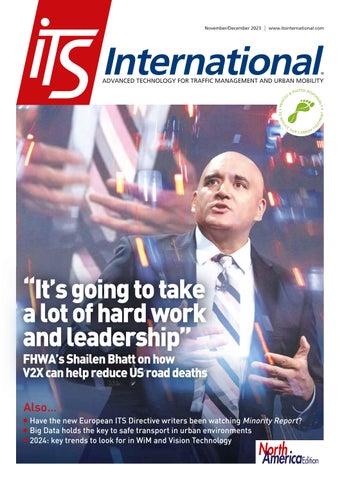
“It’s going to take a lot of hard work and leadership”
FHWA’s Shailen Bhatt on how V2X can help reduce US road deaths Also… Have the new European ITS Directive writers been watching Minority Report? Big Data holds the key to safe transport in urban environments 2024: key trends to look for in WiM and Vision Technology
North AmericaEdition
Ź
Ź
> Advanced speed control to improve road safety > Vehicle counting and highly accurate data in real time > Multi-lane tracking: dimensions, classification, distance, number plate... > Smart traffic management through 3D-LiDAR technology
www.parifex.com/en/products l info@parifex.com
CONTENTS
Contents
13
November/December 2023
05 COMMENT 06 NEWS DIGEST 08 CONTRACTS & DEALS 10
PRIVATE EQUITY What makes a good ITS investment and what are the chances of the money coming into transportation creating an unsustainable bubble?
10
Cover story 13 INTERVIEW “It’s like anybody, you have good days, you have bad days. I would say that I am naturally an optimist.” FHWA’s Shailen Bhatt on whether V2X will cut US road deaths
17 NEWS ANALYSIS Accessible pedestrian signals are no longer just an option for US cities and municipalities - they now have the backing of the law
19
33 MOBILITY AS A VALUE It’s easy to say that people should embrace active travel – but advocates must beware of a disconnect with people’s lives and options on the ground, says Annika Lundkvist
38 VISION TECHNOLOGY The future comes at you quickly. What trends or technologies do vision experts expect to come to the fore in 2024?
41 ASECAP DAYS 2023 If firms collect and analyse their ‘vast lakes of data’ they can investigate threats, monitor management systems and drive up revenues
45 CONNECTED VEHICLES Will fitting a mobile phone to a 123-year-old vehicle make it connected? Participants at the London to Brighton Veteran Car Run found out...
48 PRODUCTS & INNOVATIONS
19 EUROPEAN ITS DIRECTIVE Steven Spielberg’s Minority Report appears to predict a C-ITS Day 3 use case. Richard Lax of Kapsch TrafficCom wonders whether the great Hollywood director was once an intern in DG Move…
25 WEIGH IN MOTION Concerns about infrastructure are leading road authorities to consider the importance of WiM to monitor the wellbeing of their roads and bridges
29 29
BIG DATA As more of us live in urban areas and need to share space on the road, 3D perception and smart cities point the way to safer transportation, says William Muller of Seoul Robotics
33 www.itsinternational.com - To the Bhattmobile!
North AmericaEdition
North America area only
NA 01 All-electronic toll collection is the future of tolling and has many benefits, such as cost savings, customer convenience and safety. But it requires a new approach, say Hal Worrall and Mike Carneiro
NA 06 Since the dawn of the
automobile age a century ago, Americans have not been the most enthusiastic of pedestrians. But now they are really falling out of love with walking, finds StreeLight Data
© ITS INTERNATIONAL NOVEMBER/DECEMBER 2023
03
Smart+ BORN FOR MLFF TOLLING
23 – FIERA M 20 I
Visit us at stand
O
IT
-1 7
R20 hall 5 N
AL Y•
SICURE ZZ
A
RHO NO LA
• 15
art: donaldecompany.com
Two AI accelerators for extraordinary performances
VE
M BE
R - M IL
AN
www.tattile.com
COMMENT
“WANT SOLUTIONS? THEN LET’S TRY UNDERSTANDING OTHER POINTS OF VIEW”
“
Get talking – more than that, get listening
worldwide occur in the poorest nations on the planet. According to the United Nations Road Safety Fund, someone dies on the world’s roads every 24 seconds, with over 90% of fatalities in low- and middle-income countries. The ITS industry is already doing good work on this, but the figures are a reminder that there’s a long way to go. Elsewhere in this issue, active travel campaigner Annika Lundkvist makes a refreshing point. She grew up in car-centric North America so understands how difficult it is for many people to find alternative modes of transport. In her article on p33 she writes: “In terms of wanting to effect change, it is increasingly important to me to spend time with predominantly automobile users who associate freedom with driving and to also challenge those who assume that walkability is a value that everyone already understands and accepts.”
Editor Adam Hill Email: ahill@ropl.com Tel: +44 1322 612062
Production Manager Nick Bond Email: nbond@ropl.com Tel: +44 1322 612066
Web Manager Sarah Biswell Email: sbiswell@ropl.com Tel: +44 1322 612078
Editorial Director Geoff Hadwick Email: ghadwick@ropl.com Tel: +44 1322 612013
Design Team Simon Ward, Andy Taylder
Social Media Manager Tatyana Mechkarova Email: tmechkarova@ropl.com
Sales Director Dan Emmerson Email: demmerson@ropl.com Tel: +44 1322 612068 Sales Team Graeme McQueen Email: gmcqueen@ropl.com Tel: +44 1322 612069
Office Manager Kelly Thompson Email: kthompson@ropl.com Internet, IT & Data Services Director James Howard Email: jhoward@ropl.com Tel: +44 1322 612070
“
O
ur interview in this issue of ITS International is with Shailen Bhatt, whose roles at various state departments of transportation, ITS America and Aecom led him to the top job at the US Federal Highway Administration. His in-tray is bulging but there can be no more pressing matter than fatalities on US roads: 43,000 a year at the last count. He has experience, charisma and drive; I’ve expressed my opinion before that if anyone can make a difference, Bhatt can. He admits: “It’s going to take a lot of hard work and leadership. I am optimistic that we will very soon get there - but it can’t be just the things we’ve always tried to do.” A Safe System Approach, plus Vehicle to Everything technology roll-outs, is the key to success, he thinks. Bhatt also makes a nice point about the place of the automobile in American culture with a reference to the Beach Boys, too. Find out more on p13. While the US is an outlier in terms of road deaths in high-income countries (fatalities per head of population are way ahead of everyone else) the majority of road deaths
Publisher/ Managing Director Andrew Barriball Email: abarriball@ropl.com Tel: +44 1322 612057 CEO Roger Adshead Email: radshead@ropl.com
www.itsinternational.com - updated content every working day
It’s something we can all reflect on in our daily lives: understanding the other person’s point of view* and attempting to empathise with their fears and desires is a prerequisite to finding common solutions to big problems. Get talking – more than that, get listening. ITS *That said, I’ll never understand the guy in his SUV who went through a red light while I was crossing the road this morning
Adam Hill EDITOR @ITSeditorAdam @adamhillwriter @itseditor_adamhill @ITSInt
Have your say Email me at ahill@ropl.com
Printed by Warners (Midlands) PLC
ITS International, USPS 13324, is published bimonthly by Route One Publishing Ltd, Second Floor, West Hill House, West Hill, Dartford, Kent, DA1 2EU, UK. No part of the publication may be reproduced in any form whatsoever without the express permission of the publishers. Views expressed in this journal do not necessarily reflect the opinion of the Editor or Route One Publishing Ltd. All editorial, advertising or circulation enquiries to: ITS International, Second Floor, West Hill House, West Hill, Dartford, Kent, DA1 2EU, UK.
The US annual subscription price is US$173.00. Airfreight and mailing in the USA by agent named World Container Inc, 150-15, 183rd Street, Jamaica, NY 11413, USA. Periodicals postage paid at Brooklyn, NY 11256. US Postmaster: Send address changes to ITS International, Air Business Ltd, c/o World Container INC 150-15, 183rd St, Jamaica, NY 11413, USA. Subscription records are maintained at Route One Publishing Ltd, Second Floor, West Hill House, West Hill, Dartford, Kent, DA1 2EU, UK. Air Business Ltd is acting as our mailing agent.
Reader Enquiry Service: data@ropl.com Tel: +44 1322 612061 Subscription Enquiries: subs@ropl.com Global: Print ISSN 1463-6344 Digital ISSN 2057-3421 NA: Print ISSN 2632-4458 Digital ISSN 2632-5950
Published by © Route One Publishing Ltd 2023
© ITS INTERNATIONAL NOVEMBER/DECEMBER 2023
05
© Cloud Yew | Dreamstime.com
NEWS DIGEST
FHWA opens $40m grant opportunity for V2X roll-out
since 1964, the 2023 edition covers road and transport data for more than 200 countries 2016-21 and provides over 200 key indicators. These LQFOXGH FRXQWU\ SUR½ OHV URDG QHWZRUNV WUDI½ F H[SHQGLWXUH CO2 emissions and energy consumption. WRS Data is available for free through the IRF Data Warehouse Online Platform. Dashboards enable users to visualise the data and compare it across multiple countries and times, or to compare several metrics for one country.
© Hanohiki | Dreamstime.com
Vianova is to collect mobility data in Berlin as part of a new deal with the Senate Department for Urban Mobility, Transport, Climate Action and the Environment (SenUMVK). Information from the German capital's 60,000 UHQWDO YHKLFOHV ZLOO ¾ RZ LQWR WKH urban mobility management platform, building on Vianova’s existing partnership with public transport operator Berliner Verkehrsbetriebe. It is the ½ UVW WLPH WKDW GDWD IURP DOO RI %HUOLQ V VKDUHG PRELOLW\ ¾ HHWV will be aggregated to offer analysis of historical trends, as well as real-time insights.
Report: ‘€86bn needed by 2030’ for sustainable mobility in Europe
Europe will require an additional €86 billion by 2030 if the continent is serious about creating sustainable mobility, according to new research by EIT Urban Mobility. However, it says this massive investment will be able to generate a return of €3.06 for every euro invested. CEO Maria Tsavachidis says that the severity of the climate crisis means a "radical shift" in the way we approach urban mobility is required. EIT Urban Mobility says results from its survey show that by 2030 pricing schemes (congestion and pollution charging, parking pricing, public transport integrated ticketing and tariff schemes) will have the "highest QHW EHQH½ WV LQ VPDOO DQG medium cities".
© Marekusz | Dreamstime.com
New HOV lanes for I-75 in Michigan
New carpooling lanes are to be set up in the US state of Michigan along a stretch of I-75. The move is intended to help address congestion problems for the city of Troy. These will EH WKH ½ UVW FDUSRROLQJ ODQHV LQ Michigan and are being built in a project being managed by the Michigan Department of Transportation. The highoccupancy vehicle lanes are being set up in each direction on I-75 between 12 Mile Road and South Boulevard along a 22.4km stretch in Oakland County.
VRU awareness tech comes to the streets of Montreal .DSVFK 7UDI½ F&RP V GHWHFWLRQ solution for vulnerable road users (VRUs) such as pedestrians and cyclists is to be installed across 19 intersections in the downtown area of Montreal, Canada. The company's Orchestrated Connected Corridor (OCC) services suite will be used in the Notre Dame corridor and in Montreal city centre, to detect incidents, classify vehicles and VRUs, and to highlight wrongway driving, congestion and other potentially dangerous VLWXDWLRQV 2&& XVHV WUDI½ F GDWD from existing video cameras and connected vehicles to provide drivers with real-time QRWL½ FDWLRQV DERXW 958V
© Michael Vi | Dreamstime.com
IRF: 'Knowledge is the key to progress'
The International Road Federation - IRF (Geneva) - has launched the 60th Edition of the IRF World Road Statistics (WRS). Produced annually
© Ferenz | Dreamstime.com
Vianova captures micromobility data in Berlin
© Marian Vejcik | Dreamstime.com
US Department of Transportation’s Federal Highway Administration (FHWA) has given the green light for funding applications to companies and organisations which deploy Vehicle to Everything (V2X) technology. The $40 million Saving Lives with Connectivity: Accelerating V2X Deployment grant opportunity is to advance connected and interoperable vehicle technologies, allowing vehicles to communicate with one another and with road infrastructure. USDoT says it will share a draft V2X Deployment Plan to gather stakeholder feedback on a collective plan for the deployment of interoperable connectivity. The plan is set to be completed in early 2024. • Shailen Bhatt interview, p13
FOLLOW ITS INTERNATIONAL ON SOCIAL MEDIA Facebook @ITSInt
06
Twitter @ITS_Int_News
© ITS INTERNATIONAL NOVEMBER/DECEMBER 2023
LinkedIn @ITS International Magazine
Instagram @itsinternational_magazine
www.itsinternational.com - updated content every working day
NEWS DIGEST
Bike lane enforcement is next stop for Hayden AI
Hayden AI has introduced automated bike lane enforcement into its vision AI platform. In 2021, 961 cyclists were killed by vehicles in the US. The new solution aims to reduce illegal parking in bike lanes, which endangers cyclists who have to enter JHQHUDO WUDI½ F ODQHV LQ RUGHU to get round a parked vehicle. It uses the same hardware and technology as Hayden
© Andreistanescu | Dreamstime.com
Cruise 'pauses' driverless operations in US
Autonomous vehicle company Cruise has extended its suspension of driverless AV operations in the US, with a "voluntary pause of supervised and manual operations". The move will affect around 70 vehicles. Cruise says: “This orderly pause is a further step to rebuild public trust while we undergo a full safety review. We will continue to operate our vehicles in closed course training environments and maintain an active simulation program in order to stay focused on advancing AV technology."
CFX sets up toll road lane closure alerts Central Florida Expressway Authority (CFX) is to create a nine-month lane closure QRWL½ FDWLRQ V\VWHP SLORW IRU its toll roads. The project uses One.network software which will allow CFX to communicate roadway disruptions to the
Mott MacDonald and UrbanV plan to Á \ KLJK Mott MacDonald and vertiport designer UrbanV are partnering to develop advanced air mobility (AAM) infrastructure worldwide. AAM uses electric vertical takeoff and landing aircraft to move people and goods, and UrbanV plans to enable a route from
© Mott MacDonald | UrbanV
public and other stakeholders using the Sunshine State's busy tourist corridors. The PDSSLQJ WUDI½ F PDQDJHPHQW and real-time workzone QRWL½ FDWLRQ VRIWZDUH ZLOO SURYLGH WUDI½ F HQJLQHHUV ZLWK D VLQJOH operational view of all lane closures throughout the CFX network. Information is provided directly to GPS companies so they can update their maps for drivers.
Fiumicino Airport to Rome city centre by the end of 2024. Mott MacDonald is already working across the world on several projects, and supported a consortium planning a network of 25 vertiports in the UK. UrbanV was established by Aeroporti di Roma, Save Group, Aeroports de la Côte d’Azur and Aeroporto di Bologna.
GHSA acts on 'dirty little secret' of US distracted driving
© Bladerunner88 | Dreamstime.com
© Djedzura | Dreamstime.com
Tolling will bring €700 billion revenue to Europe in the next 10 years, according to a new report by Ptolemus Consulting Group. It forecasts that the electronic toll collection (ETC) market will have 120 million subscribers in 2032 - and account for 80% of this revenue. "Despite the public backlash, there is no (credible) alternative to tolling for road funding," the report says. Many European countries are braced for a funding crisis which will be aggravated by the take-up of electric vehicles and the resulting fall in fuel tax.
AI's existing automated bus lane and bus stop enforcement platforms. The platform equips parking enforcement vehicles with forward-facing, AI-powered cameras to detect and enforce bike lane parking violations "at scale".
© Craig Russell | Dreamstime.com
Tolling 'to bring €700bn' to Europe by 2032
The US Governors Highway Safety Association (GHSA) has awarded two grants - of $87,500 each - to help reduce distracted driving in the District of Columbia (DC) and Washington state. Partnering with General Motors, GHSA is awarding the money to WKH UHOHYDQW VWDWH KLJKZD\ VDIHW\ RI½ FHV WR FUHDWH DQG HYDOXDWH local distracted driving prevention programmes. “Distraction is a ‘dirty little secret’ that few drivers want to talk about," says GHSA CEO Jonathan Adkins. "Distracted drivers kill people every day, yet surveys show most drivers think others are the problem, not themselves.”
FOLLOW ITS INTERNATIONAL ON SOCIAL MEDIA Facebook @ITSInt
Twitter @ITS_Int_News
www.itsinternational.com - updated content every working day
LinkedIn @ITS International Magazine
Instagram @itsinternational_magazine
© ITS INTERNATIONAL NOVEMBER/DECEMBER 2023
07
6
&2175$&7 '($/6
5HNRU DQG 1H[W0RYH WHDP XS IRU &9 DQG 58& SURMHFWV
*09 WR SURYLGH DFFRXQW EDVHG WLFNHWLQJ IRU &\SUXV EXVHV
8EHU FXVWRPHUV LQ 3KRH QL[ $UL]RQD DUH QRZ DEOH WR UHTXHVW D IXOO\ DXWRQRPRXV ULGH WKURXJK D SDUWQHUVKLS ZLWK :D\PR 8EHU; 8EHU *UHHQ 8EHU &RPIRUW RU 8EHU &RPIRUW (OHFWULF ULGHV FRPH ZLWK WKH RSWLRQ WR FRQ½ UP D ULGH LQ D :D\PR DXWRQRPRXV YHKLFOH LI RQH LV DYDLODEOH :D\PR VD\V ULGHUV ZLOO VWLOO EH DEOH WR KDLO WKH :D\PR 'ULYHU GLUHFWO\ WKURXJK WKH :D\PR 2QH DSS ZKLFK LV DYDLODEOH LQ 0HWUR 3KRHQL[ 6DQ )UDQFLVFR DQG /RV $QJHOHV ,W ZLOO VRRQ EH DQ RSWLRQ LQ $XVWLQ 7H[DV DV ZHOO WKH ½ UP VD\V
© Michal Durinik | Dreamstime.com
6KDUHG PRELOLW\ GDWD GULYHV ,QUL[ V LQWHUHVW LQ 5LGH 5HSRUW 7UDQVSRUW GDWD VSHFLDOLVW ,QUL[ LV VHW WR EX\ D VKDUHG PRELOLW\ GDWD DJJUHJDWLRQ FRPSDQ\ 5LGH 5HSRUW ZKRVH VROXWLRQ HQDEOHV FLWLHV WR PDQDJH SROLFLHV DQG FRPSOLDQFH DQDO\VH KLVWRULFDO WUDYHO SDWWHUQV DQG WUDFN DQG LQYRLFH RSHUDWRUV IRU IHHV ,QUL[ VD\V 5LGH 5HSRUW VXSSRUWV SXEOLF DJHQFLHV RQ WKUHH FRQWL QHQWV DQG ZLOO H[SDQG WKH EUHDGWK GHSWK DQG FRQYHQLHQFH RI LWV RZQ 6RIWZDUH DV D 6HUYLFH RIIHULQJ ,QUL[ ,4 E\ DGGLQJ VKDUHG PRELOLW\ WR WKH PL[ &XUUHQW 86 XVHUV RI ,QUL[ ,4 LQFOXGH DXWKRULWLHV LQ $XVWLQ 6DQ )UDQFLVFR %D\ DQG :DVKLQJWRQ '&
© Aleksei Todosko | Dreamstime.com
.DSVFK 7UDI½ F&RP LV WR XVH FR RSHUDWLYH ,76 & ,76 WR LPSURYH VDIHW\ LQ ZRUN]RQHV RQ *HUPDQ PRWRUZD\V .DSVFK VD\V WKH € P GHDO ZLWK $XWREDKQ ZKLFK UXQV WKH FRXQWU\ V KLJKZD\ QHWZRUN KDV SRWHQWLDO WR JURZ WR € P 0RELOH EDUULHU ERDUGV LQGLFDWLQJ WHPSRUDU\ ZRUN VLWHV ZLOO EH HTXLSSHG ZLWK ,76 URDGVLGH XQLWV 568V ZKLFK VHQG ZDUQLQJ PHVVDJHV GLUHFWO\ WR DSSURDFKLQJ YHKLFOHV .DSVFK ZLOO VXSSO\ DURXQG 568V DV ZHOO DV WKH FORXG EDVHG &0&& FRQQHFWHG PRELOLW\ FRQWURO FHQWUH VRIWZDUH WKDW FRQWUROV WKH ,56 DQG FDQ DFW DV DQ LQWHUIDFH WR RWKHU WUDI½ F PDQDJHPHQW V\VWHPV
:D\PR DQG 8EHU EHJLQ 3KRHQL[ $9 VHUYLFH
*09 KDV EHHQ DZDUGHG D FRQ WUDFW WR LQWURGXFH DQ DFFRXQW EDVHG WLFNHWLQJ $%7 V\VWHP RQ SXEOLF WUDQVLW LQ &\SUXV ,W ZLOO SURYLGH WKLV IRU FLW\ DQG LQWHUFLW\ EXVHV RSHUDWHG E\ VL[ FRPSDQLHV XQGHU FRQFHVVLRQ E\ WKH 0LQLVWU\ RI 7UDQVSRUW &RPPXQLFDWLRQV DQG :RUNV 7KH EXV ¾ HHW DOUHDG\ KDV D VPDUW FDUG V\VWHP EXW QRZ SDVVHQJHUV ZLOO EH DEOH WR KDYH WLFNHW IUHH WUDYHO XVLQJ FRQWDFWOHVV FDUGV SKRQHV VPDUWZDWFKHV DQG EDQN FDUGV WR SD\ *09 ZLOO VXSSO\ 79 FRQWDFWOHVV FDUG YDOLGDWRUV ZKLFK WDNH ERWK UHJXODU WUDQVLW DQG EDQN FDUGV
6HRXO 5RERWLFV KDV SDUWQHUHG ZLWK DQ $XVWULD EDVHG WHVW ODERUDWRU\ IRU DXWRPDWHG GULY LQJ V\VWHPV 7KH WLH XS ZLWK $/3 /DE LV GHVLJQHG WR SURYLGH ' SHUFHSWLRQ WUDI½ F VDIHW\ V\VWHPV IRU WKH 'DFK UHJLRQ *HUPDQ\ $XVWULD DQG 6ZLW]HU ODQG DQG FHQWUDO (XURSH 7KH FRPSDQLHV KDYH GHYHORSHG D /LGDU EDVHG V\VWHP ZKLFK LV FXUUHQWO\ GHSOR\HG DW DFFLGHQW SURQH LQWHUVHFWLRQV LQ 6DO]EXUJ WR EHWWHU XQGHUVWDQG LQWHUDF WLRQV EHWZHHQ YXOQHUDEOH URDG XVHUV VXFK DV F\FOLVWV DQG YHKLFOHV 6DO]EXUJ 5HVHDUFK DQG XUEDQ PRELOLW\ ODE =XNX QIWVZHJH DW DUH XVLQJ LW DW WZR KLJK ULVN LQWHUVHFWLRQV ZLWK PXOWLSOH ELNH ODQHV
© Waymo
© Typhoonski | Dreamstime.com
5HNRU 6\VWHPV KDV WHDPHG XS ZLWK 1H[W0RYH E\ &LQWUD WR DF FHOHUDWH WKH FRQQHFWHG YHKLFOH DQG LQIUDVWUXFWXUH HFRV\VWHP LQ WKH 86 7KH 5HNRU 2QH URDGZD\ LQWHOOLJHQFH HQJLQH JHQHUDWHV LQVLJKWV IURP WULOOLRQV RI GDWD SRLQWV 5HNRU VD\V &RPELQHG ZLWK 1H[W0RYH V OHDGLQJ LQIUDVWUXFWXUH DQG URDGZD\ WHFKQRORJ\ FDSDELOLWLHV ZH DUH KHOSLQJ VKDSH WKH IXWXUH RI PRELOLW\ LW DGGV 7KH SDUWQHUV DUH FXUUHQWO\ OHDGLQJ D FRQQHFWHG YHKLFOH SURMHFW LQ SDUWQHUVKLS ZLWK WKH 2UHJRQ 'HSDUWPHQW RI 7UDQVSRUWDWLRQ *DQ QHWW )OHPLQJ DQG &OHDU5RDG 1H[WPRYH LV WKH GLJLWDO EXVLQHVV YHQWXUH RI )HUURYLDO V KLJKZD\ GLYLVLRQ
.DSVFK 7UDIÀ F&RP signs € P & ,76 GHDO ZLWK *HUPDQ $XWREDKQ
© GMV
© Haiyin | Dreamstime.com
&\FOLVW VDIHW\ RQ WUDFN LQ 6DO]EXUJ ZLWK 6HRXO 5RERWLFV /LGDU
FOLLOW ITS INTERNATIONAL ON SOCIAL MEDIA Facebook @ITSInt
08
Twitter @ITS_Int_News
© ITS INTERNATIONAL NOVEMBER/DECEMBER 2023
LinkedIn @ITS International Magazine
Instagram @itsinternational_magazine
www.itsinternational.com - updated content every working day
Put this on your radar
Easy, accurate detection is here. Again. Is there an Echo in here? Actually, yes. And we don’t mind saying it twice, because we’re excited to have recently added RTMS Echo to the Sensys Networks expanding suite of accurate detection solutions. For count stations on highways and arterials, nothing comes close to RTMS Echo for ease of deployment. Built from the ground up and offering transportation engineers an easy to use, highly accurate, and cost effective solution that SURYLGHV VRSKLVWLFDWHG WUDIÀF GDWD • Easy to deploy • Accurate • Cost effective
Ping us for more info at sensysnetworks.com/rtmsecho
© Mkos83 | Dreamstime.com
PRIVATE EQUITY
Return on investment What makes a good ITS investment and what are the chances of the money coming into transportation creating an unsustainable bubble? Frederic Bruneteau and Alberto Lodieu of Ptolemus Consulting Group take a look at the market and suggest some key areas of interest for the future
(1) Geographic expansion: Swarco’s acquisition of McCain in the US in 2016, Abertis’ acquisition of RCO in Mexico in 2019, ST Engineering’s acquisition of US-based TransCore in 2021; PTV’s acquisition of Econolite in the US and Via’s acquisition of CityMapper in 2022. This year, a major transaction was Vinci’s acquisition of Entrevias in Brazil. (2) Entry into a new segment: Swarco’s acquisition of Dynniq and Vinci’s acquisition of Sice, Verra Mobility’s acquisition of T2 Systems in 2021. (3) Consolidation: TagMaster’s acquisition of Citylog and Vinci’s acquisition of Sice in 2021 and Easypark’s acquisition of Flowbird Group in 2023. As far as financial investors are concerned, they have been looking to acquire companies that:
10
© ITS INTERNATIONAL NOVEMBER/DECEMBER 2023
(1) Provide exposure to growing infrastructure-related operations and services markets, e.g. road charging/tolling (2) Combine a recognised technology/ solution differentiation with strong involvement in services, (3) Have an increased share of recurring revenues and long-term contracts.
“
The winners are often the first to find the right model, which consists of a technology but also an end-to-end solution and a business model
“
W
hat attracts investors to ITS? In the last few years, trade investors have mainly attempted to create global ITS champions through:
Most notable transactions by financial investors in the solutions market include Quarterhill’s acquisition of International Road Dynamics in 2017, Bridgepoint’s acquisition of PTV in 2021; Hig Capital’s investment in Eysa and (through Eysa) Tecsidel and Atlantia’s purchase of Yunex in 2022. This year, one of the most interesting transactions was Q-Free’s acquisition by Guardian Capital. In the services market, the most notable recent transaction was Partners
Group’s investment in Telepass for more than €1 billion in 2020. We have seen also significant investment from large infrastructure and pension funds into road concessionaires, e.g. Dutch pension fund APG, South Korea’s National Pension Service and Swiss Life unit Slam’s investment into Brisa in 2020. Or Blackstone’s and Macquarie’s joint investment (with CDP) into Autostrade last year. Where do you see the potential for growth? We have identified 17 key segment growth opportunities in the market, some of them only in certain regions of the world. For example, the enforcement market for cities. This has been the sweet spot of companies like Verra Mobility and TagMaster. Initially focused on parking, we are seeing an increasing number of application domains, notably around the ‘greenification’ and traffic management of the city. In the future, access control, low-emission zones and congestion charging schemes will become even more present. High-occupancy vehicle (HOV) lanes, once only in North America, could also take off in Europe. They are about to be implemented on the ring road of
www.itsinternational.com - updated content every working day
PRIVATE EQUITY Paris, for example. Another very attractive opportunity will be around GNSS-based road usage charging. Based on our recent market analyses, we see four new European countries currently implementing GNSS tolls for trucks. And we expect seven more countries to join them in the next 10 years. The model has also major growth potential in the US, as our recent RUC USA Report highlighted. A third one will be smart parking. This is a market that is still mostly based on physical payments. We believe that the market is now maturing towards digital solutions, either through smart phones or connected vehicle payments. This explains last week’s simultaneous acquisition of Flowbird Group by EasyPark Group and PayByPhone’s acquisition by FleetCor. What sort of money are we talking about in the market as a whole? It’s a challenge to evaluate exactly how much money is flowing into the business as many buyers do not reveal the transaction values. However, we would suggest a typical range of $3-4 billion per year in the ITS solutions business. Last year, thanks to the acquisition of TransCore by ST Engineering for $2.7 billion, was on the high side of this amount. On the road operation side, transactions are more scarce but reach amounts typically upwards of $1 billion. We would estimate the annual average at approximately $4-5 billion. Are particular ITS technologies attractive? There are certainly generic investment themes around video (e.g. ANPR), data management and artificial intelligence,
GNSS, connected vehicle data, vehicle electrification, smartphones, etc. Some are more uncertain, such as Vehicle to Everything (V2X), because they require a very high investment in infrastructure without a quick return. It could happen if there is a regulatory mandate. Overall, our experience is that the winners are often companies that are the first to find the right model, which consists of a technology but also an end-to-end solution and a business model.
EXCLUSIVE VIDEO CONTENT
How do companies identify potential targets for investment and acquisition? You need a combination of market expertise, and strategic and financial delivery capabilities. Some rely on their own M&A unit while others are assisted by specialised consulting firms.
Scan QR code with your mobile phone camera and tap the link to see how Steve Sandbo of Vance Street Capital views opportunities in the ITS sector
Is there a danger of a 'bubble' in ITS? Of course, there is always a risk of overinvestment, particularly if the growth rates disappoint. But the increase in interest rates is increasing the cost of capital and raising the bar for all investors, which will reduce valuations in the very short term. In the long run, we believe there is a need for much more consolidation in the solutions supply globally. We conducted an industry-wide analysis of profitability and it was striking that many solutions providers are still not generating acceptable profitability.Many are losing money. In the road operation business itself, buyers are much more focused on financial ratios, which reduces the risks of overpaying. ITS
ABOUT THE AUTHORS: Frederic Bruneteau (left) is MD of Ptolemus
www.itsinternational.com - updated content every working day
Consulting Group, and Alberto Lodieu is senior manager
“
We are seeing an increasing number of application domains, notably around the ‘greenification’ and traffic management of the city
“
© Michael Vi | Dreamstime.com
High-occupancy vehicle lanes, once only in North America, could also take off in Europe
© ITS INTERNATIONAL NOVEMBER/DECEMBER 2023
11
DESIGN BETTER. MOVE FASTER. CONNECT INSTANTLY. SYNCHRO STUDIO V12
! " ! # $ % & %
REQUEST A QUOTE TODAY.
INTERVIEW
“THE PREMISE OF CONNECTIVITY LEADING TO SAFETY – I AM JUST UNSHAKEABLE IN THAT BELIEF” Government money is available for Vehicle to Everything roll-outs. Shailen Bhatt talks to Adam Hill about changing the narrative on road safety - and the importance of deploying technology at scale
I
www.itsinternational.com - updated content every working day
“
Everybody thinks that they’re the perfect driver and that it won’t happen to them
“
n October, the US Department of Transportation’s Federal Highway Administration (FHWA) gave the green light for funding applications to deploy Vehicle to Everything (V2X) technology. The $40 million Saving Lives with Connectivity: Accelerating V2X Deployment grant opportunity is to advance connected and interoperable vehicle technologies, allowing vehicles to communicate with one another and with road infrastructure. A V2X Deployment Plan is set to be completed in early 2024. Speaking to ITS International, FHWA administrator Shailen Bhatt outlined his thoughts on the future. He was FHWA’s associate administrator for highway policy and external affairs under Barack Obama, and left Aecom to take up the top job at FHWA in January this year. The desire for greater road safety has been ever-present in his career at the Kentucky, Delaware, and Colorado Departments of Transportation and as CEO of ITS America. Bhatt has charisma, drive, bags of experience – and is passionate about saving lives. And yet, in 2021, 43,000 people died on US roadways. With that grim backdrop, is he optimistic that technologies such as V2X will eventually make a difference? “It’s like anybody, you have good days you have bad days,” Bhatt admits. “I would say that I am naturally an optimist. So I think I’m of two minds on your question. I mean, quite frankly I’m sick to death of talking about safety. My entire career in transportation, we’ve talked about getting towards zero deaths - and if we could save people’s lives with just the words that we have used, we’d be bringing people back to life on American roadways.” So he is driven by “action and optimism”, he says. “I am optimistic that my daughters - who are eight and 10 now - in their lifetime, will look back almost like we look back on diseases like polio [and think], ‘oh, you know, Americans used to die from that’. It’s going to take a lot of hard work and
© ITS INTERNATIONAL NOVEMBER/DECEMBER 2023
13
INTERVIEW © Korn Vitthayanukarun | Dreamstime.com
“
We celebrate the automobile in the US, but we don’t have as many cultural references to the 43,000 deaths that occur every year because of it
“
leadership. I am optimistic that we will very soon get there - but it can’t be just the things we’ve always tried to do: it’s got to be the Safe System Approach, and technology, for me, is the critical path to getting there.” Safe System Approach The Safe System Approach has been adopted in USDoT’s National Roadway Safety Strategy to address US road deaths: in essence, it seeks to prioritise the elimination of crashes that result in death and serious injuries, while acknowledging that humans make mistakes. In order to mitigate those mistakes, you have to design transportation systems with that vulnerability in mind. Crucially, responsibility for this is shared between everyone - government, automotive OEMs, safety advocates, researchers and the general public – and the concept of safety must be proactive rather than reactive. FHWA believes V2X can be a key component. “Obviously, saving lives, it’s our most important role,” says Bhatt. “And so we want to save lives with connectivity by accelerating V2X deployment. You’ve been covering this for a long time. We’re hoping to move the needle on connectivity. We’ve talked at a high level for a long time. We’ve had good deployments that are out there, but we’re hoping to really spur the needle in the face of 43,000 deaths on American roadways.” $40 million is a big chunk of cash, but is it really enough to do this? “$40m is a lot of money and if you deploy it properly, I think it will move the needle,” says Bhatt. “Is it going to get us to ubiquitous connectivity everywhere across the nation? Absolutely not. But what we’re trying to do is [to] pick a couple of places that can concentrate the deployment, hopefully get some more private sector support to jump on as well. And then the outcome that I’m hoping for is that, in one or two places, we get to really great deployments and case studies; people start to see data of crashes coming down, fatalities coming down, congestion and GHG [greenhouse gas] emissions coming down. And then, imitation is the most sincere form of flattery: other city leaders will be, like: ‘Wow, that’s amazing. We should do that here as well’.”
14
© ITS INTERNATIONAL NOVEMBER/DECEMBER 2023
Seatbelts were once controversial, but have been a proven life-saver
So much for the money available – what about the technology itself? The US Federal Communications Commission’s decision in April to grant a joint waiver request to deploy cellular Vehicle to Everything (C-V2X) technology in the upper 20 MHz part of the 5.9 GHz band paved the way for roll-out. But is that enough spectrum to make V2X work? “These things are never moving forward as cleanly or as easily as we would hope,” Bhatt says carefully. He references an earlier attempt to create connectivity - the SPaT Challenge – which tasked US state and local public sector transportation infrastructure owners and operators to cooperate together to achieve deployment of DSRC infrastructure. “That was all about DSRC,” he says. “Now, we’ve got C-V2X, we’ve got less of the spectrum to work with. We have the spectrum that we have. But what’s important here – and again, this is my focus - is if we can deploy, and show some use cases that are moving the needle, that could then force a conversation if we have deployments that require more: ‘Here’s our evidence and our data around our deployment, for why we need more spectrum for safety’.” Road deaths make US an outlier There is no doubt that something is needed. While 43,000 road deaths is a large number, what’s really shocking is the extent to which this figure makes the US an outlier among developed nations. Research from the US Centers for Disease Control and Prevention (CDC) found that, in 2019, the US had the highest population-based death rate on the roads (11.1 per 100,000 people) of high-income countries. In fact, the US rate was 2.3 times higher than the average rate for 28 other nations (4.8 per 100,000). US road deaths also increased in 2020 and 2021. “I would say part of our challenge is that we have 100 years of land use in this country that is - particularly post-World War Two – prioritised around the automobile,” Bhatt suggests. “And it’s great, and it contributes to that very American ethos and culture going back to the Beach Boys singing: ‘Round, round, get around, I get around’. But there was another band at that time called Jan & Dean and they had a hit song called Dead www.itsinternational.com - updated content every working day
INTERVIEW Man’s Curve. And so, we celebrate the automobile in the US, but we don’t have as many cultural references to the 43,000 deaths that occur every year because of it.” Part of the problem, perhaps, is that humans tend to dwell on the possibility of an unlikely but spectacular danger - such as a shark attack or lightning strike - rather than the obvious one of being killed in an automobile collision. “You’ve got a much greater chance of dying in a car crash than you do of being eaten by a shark,” Bhatt agrees. “But what probably weighs more on people’s minds when they’re driving to the beach is the shark that might be in the water - not the drunk, distracted, drowsy driver that might be on the road there. Everybody thinks that they’re the perfect driver and that it won’t happen to them. We’re never going to shake that belief, so we just want to provide as much safety as possible in the system.” To that end, for the last couple of years, USDoT has been trying to “shift the arc”, While the he says. “The automobile is a automobile was a celebrated part of our culture. great example of 20th But we also need to celebrate century technology, pedestrians, cyclists, transit; there’s 21st century we have to look at the data technology that can around vulnerable road users. provide safety for us And I think that’s what we’re trying to shift the narrative on - and deploying technology at scale. Because while the automobile was a great example of 20th century technology, there’s 21st century technology that can both distract us but also provide safety for us.” FHWA has responsibility for infrastructure, so is not going to be able to do this on its own. “There’s lots of other entities around connectivity, automobiles and others,” Bhatt says. “What we’re trying to do is provide leadership and confirmation for people that this is still very important. This is a marathon, not a sprint.” Bhatt is pragmatic when it comes to whether the stars are aligning, with technology providers and OEMs getting together.
“
“
“I think it comes together and then, you know, slightly deviates, and then it’ll come back together,” he asserts. “Every technology has moved in fits and starts. Certainly if you look at the history of automobile safety, seatbelts used to be controversial but it’s unequivocal that they save lives.” Potential game-changer In much the same way, airbags, advanced driver assistance systems and child safety seats have all been steps on the way to making cars safer to drive. “So we always hope that we get there, but what did Winston Churchill say? ‘I have great faith the Americans will eventually do the right thing once they’ve exhausted every other option.’” Bhatt smiles: “I’ve probably paraphrased that a little bit – but we’ve tried a bunch of things. We’re still at 43,000. This is another thing for us to try.” He does not think people are resisting the march of C-V2X but he does see an appetite for results. “I don’t think I sense resistance,” he explains. “I think I sense ‘show me!’ That was the whole point of the V2I Deployment Coalition - we were going to go out and deploy, and we have deployed. But I think another factor here is China, which is moving forward quite aggressively on V2X. And in the US, the president has been quite clear that he wants us to be leaders in this space. So, for me, this is not some pie in the sky, ethereal idea: there’s data, there’s research and so just like we eventually got there with seatbelts, I think we’ll eventually get there with connectivity. In what form, I don’t know: we thought it was DSRC, now it’s C-V2X. The technology evolves, but the premise of connectivity leading to safety - I am just unshakeable in that belief.” You sense that Bhatt would not have taken the FHWA job unless he thought he could make a difference, and he certainly sees V2X as a potential game-changer. “Yes, absolutely,” he concludes. “If I didn’t, I wouldn’t have been such an evangelist for it throughout my career. It’s another layer of safety. And again, I’m just very optimistic that, whether it’s now or in the near future, we’ll start to bend the needle towards zero, and technology will be a critical component of that.” ITS © Fsstock | Dreamstime.com
The automobile occupies a central place in American popular culture
www.itsinternational.com - updated content every working day
© ITS INTERNATIONAL NOVEMBER/DECEMBER 2023
15
Vision statement
NEWS ANALYSIS
New pedestrian signal requirements designed to make crossings safer for the visually impaired mean that accessible signals are no longer just an option for US cities and municipalities. They now have the backing of the law, explains Andrew Stone
S
accessibility guidelines, designed to ease some of the uncertainties and risks they face when crossing the street, will soon be encoded into law. At this point they become mandatory at the local, state and federal level in the US, obliging those tasked with installing and maintaining pedestrian signals to deploy the latest compliant APS equipment. Safer navigation with APS The provision of APS (devices that translate visual pedestrian information into sensory formats to enable people with visual disabilities to navigate cities safely and
© Erin Alexis Randolph | Dreamstime.com
ue Crawford, an active and proficient traveller who also happens to be blind, has the following to say about the challenges she faces when navigating around city streets these days: “Today cars are largely silent. Some engines shut off when stopping at a red light so one cannot know it is there. Signal cycles are variable and cars are nearly always moving, so it is nearly impossible to listen for audible cues. An accessible pedestrian signal [APS] is an absolute necessity today.” Happily for Crawford and other US citizens with visual disabilities, new
www.itsinternational.com - updated content every working day
comfortably) is a topic close to the heart of Dr. Billie Louise "Beezy" Bentzen, director of research at Accessible Design for the Blind, a consultancy dedicated to improving accessibility for pedestrians with disabilities, primarily through human factors research. In some cases, it has taken years of work to understand what cues and sounds work best. Establishing exactly how to help pedestrians with vision disabilities navigate safely to the end of a crossing, for example, has been a tricky issue to resolve and one that has been the focus of much of the consultancy’s research. Speaking on a webinar hosted by Polara Enterprises, a maker of ADA-compliant, pedestrian-friendly crosswalk devices, Bentzen explains: “In our research on APS, it was easy to let people know when that walk interval was on - but helping them actually get across the sidewalk straight and end up where they wanted to be was really hard. We tried a number of things that would enable that and none of them worked very well. The only thing that did was having a louder walk tone [and] a louder locator tone during the pedestrian change interval that comes from the opposite end of the crosswalk only. Where you have an excessively long crosswalk, where it is a bit diagonal and where there’s not traffic that is parallel to that crosswalk or the intersection is skewed in some way, then an audible beacon is extremely helpful to get people straight across.” Such cutting-edge human factors research is the latest in more than three decades of study dedicated to evolving pedestrian crossings to be as usable and safe for the visually impaired as possible. The findings of such research have contributed the Public Right of Way Accessibility Guidelines (Prowag) for implementing the Americans with Disabilities Act (ADA) with regard to sidewalks, crosswalks, pedestrian signals and other public pedestrian facilities to ensure they are equally accessible to - and usable by - all pedestrians. Closing the guidance gap Prior to the August 2023 publication of Prowag, the technical requirements for pedestrian facilities were lacking, leaving state and local governments to determine on their own how best to comply with the ADA’s mandate. Prowag fills this long-standing © ITS INTERNATIONAL NOVEMBER/DECEMBER 2023
17
NEWS ANALYSIS
Key requirements The good news is that Prowag harmonises with the MUTCD in key areas. These include requirements for: • A method of activation (either a push button that activates accessible features when pressed or a passive detection device that detects pedestrians and activates accessible features automatically) • A device that provides audible indications of pedestrian signals (either a percussive tone or speech message) • A push button with a ‘high visual contrast’ tactile arrow that vibrates during the walk phase • A locator tone that helps individuals who are blind or have low vision locate the push button • Operable parts that must be operable with one hand and not require tight grasping, pinching, or twisting of the wrist In addition to APS, which Prowag requires to be installed wherever pedestrian signals
18
© ITS INTERNATIONAL NOVEMBER/DECEMBER 2023
“
“
Install APS because it’s the right thing to do. Don’t wait for Prowag to be adopted Beezy Bentzen, Accessible Design for the Blind
Tactile paving on a pedestrian crossing © Taigis | Dreamstime.com
gap, providing transportation engineers and planners with actionable guidance. The US Department of Justice and US Department of Transport will adopt the guidelines, at which point they will be legally enforceable. From here on in, when pedestrian signals are installed or altered, or if pedestrian signals are added to a crossing, a Prowag-compliant APS must also be added. There is, unfortunately, some uncertainty surrounding what is meant by an ‘alteration’, Bentzen notes. “An alteration is defined as a change to a pedestrian facility in an existing pedestrian right of way that affects or could affect pedestrian access, usability, or accessibility. That is incredibly vague and it is left up to local jurisdictions to decide. I hope the DoT will give us more guidance on what alterations trigger installation of APS.” Agencies and municipalities which specify and procure pedestrian signalling will also need to be aware that there will be some misalignment between the requirements contained within Prowag and the current edition of the US traffic control ‘bible’: the Manual on Uniform Traffic Control Devices (MUTCD). A notable difference between the two is that Prowag now makes it clear that what are guidelines within MUTCD have become mandatory requirements. A new edition is due to be published soon but the final discrepancies between Prowag and MUTCD may take longer to be ironed out completely, warns Bentzen. “We don’t know what the final MUTCD will be so there is a fair amount of uncertainty right now. In about two years they will all be saying the same thing.”
are installed or altered (commonly at intersections and crossings equipped with pedestrian hybrid beacons), it also requires audible information at locations where pedestrian-activated warning lights are installed or altered. These devices must activate a speech message that indicates the status of the beacon. They must not include vibrotactile features indicating a walk interval, as warning devices are not signals and do not stop traffic. Under Prowag, crosswalks at multi-lane roundabouts and channelised turn lanes are now required to have additional treatments that alert motorists to the presence of pedestrians, or that slow or stop traffic at those crosswalks. These can be: • A traffic control signal with a pedestrian signal head • A pedestrian hybrid beacon • A pedestrian-actuated rectangular rapid flashing beacon, and/or a raised crossing The new guidelines also render some APS equipment non-compliant. Examples include those that lack vibrating, high visual contrast tactile arrows on the push button and speaker-type APS that lack locator tones. “Regular ADA-compliant push buttons are not APS so as we move forward these do not provide the Prowag-required features,” Bentzen notes. She adds that Prowag also requires specific positioning of APS - as mispositioned APS can confuse or mislead pedestrians, defeating their purpose. We may all be beneficiaries of the new guidelines, suggests Matthew Baker, vice
president of sales at Polara. “APS is not just of use to those with visual impairments,” he suggests. “As everyone knows, pedestrian fatalities have risen [in the US]. Smart phones, distracted users Among the contributing factors is distracted pedestrians. That audible indication can be good for everyone. If you’re looking at your phone and not paying attention to the visual signal, if a rapid percussive sound happens or a speech message, hopefully that gets your attention and gets you out into that crosswalk quicker without delay.” Given the obvious benefits, there is a clear moral as well as a legal imperative for agencies and municipalities to act now, observes Bentzen. “Install APS because it’s the right thing to do. Don’t wait for Prowag to be adopted,” she urges. “Discrimination against people with disabilities, such as the failure to provide accessible and useable information - including pedestrian signal information - has been required since 1973. A failure to provide APS cannot be justified by not having scoping and technical specifications published by the DoT.” Since 2007 San Francisco, New York and Chicago have all been found liable for violating the ADA by failing to provide enough APS and each city has been required to speed up provision, Bentzen points out. “You can’t say ‘we don’t have to do it because that standard is not out yet’,” she concludes. “You are required to provide accessibility.” ITS O For more detail on the specific requirements of Prowag, see https:// polara.com/wp-content/uploads/2023/08/ Polara-PROWAG-factsheet.pdf
www.itsinternational.com - updated content every working day
ELECTRONIC TOLL COLLECTION
North AmericaEdition © Aaron Kohr | Dreamstime.com
Without registration, or a transponder, collecting an outstanding toll becomes dependent upon correctly identifying the vehicle licence plate
AETC: the promise and the reality Hal Worrall and Mike Carneiro look at the history of AETC - and offer some thoughts on why it cannot be seen as just an expansion of existing ETC technology
E
lectronic toll collection (ETC) has been around for nearly 40 years (Bergen, Norway, 1986) and - as percentages of revenue collected with ETC increased - the movement away from coin machines, manual collection and the stop-and-go of the gate arm gained momentum. The promise of reduced manual collection costs, more throughput in collection and greater safety in travel increased acceptance of ETC and amplified the movement to all-electronic toll collection (AETC). As ETC revenue collection approached 80% and then 90%, the consideration to exclusively accept electronic toll collection began to be adopted and the term AETC was born. As AETC implementation expanded, it became apparent that 90% of revenue does not equate to 90% of the customers and that the cost of collecting relatively small numbers of toll transactions, of small value, from large numbers of people, was a major effort. This non-prepaid, non-electronic revenue still represented a considerable percentage of total revenue. To collect this “remnant” revenue required many customer interactions, while mailings and phone calls and back-office operations blossomed in size - supported by collection agencies engaged to address those resistant or unable to pay. It is estimated that over seven million persons
in the US are unbanked, requiring alternatives to credit and bank debit payment methods. Complicating factors in AETC When customers travel on an AETC toll highway without a transponder or without registering their vehicle licence number with a prepayment account, the potential to collect the outstanding toll becomes dependent upon correctly identifying the vehicle licence plate number and the vehicle owner by accessing motor vehicle records. Vehicles registered in the state in which the toll highway operates are much more likely to be ultimately collected since most states allow for vehicle registrations to be placed on hold until outstanding toll transactions are satisfied. For out-of-state vehicles, however, the likelihood of collection decreases. Without interstate vehicle registration reciprocity, payment becomes voluntary. Because of the diversity in vehicle registration statutes and privacy laws of various states, there are numerous complications for establishing the needed reciprocity. Some states allow duplicate licence plate numbers between classes of vehicles and therefore the possibility exists that a collection action could be taken against an innocent traveller, resulting in negative press reports and damaged public relations. This is especially the case where the state in which the vehicle is registered has no toll facilities
www.itsinternational.com - updated content every working day
of its own. Understandably, these states are much less likely to support vehicle registration holds for toll violations in other states. However, it is also a consideration even where the state does have toll operations. AETC in practice Initially, AETC is undertaken with enthusiasm as reduced collection costs, safety and throughput are promoted. Initial press reports laud the progressive approach of the agency and plans are prepared for converting manual lanes, toll plaza buildings and other physical infrastructure. Lane equipment and other electronics are modified to support AETC and decommission manual and coin machine lanes. Toll operations undergo significant modifications to implement AETC. Core capabilities required for implementing AETC are licence plate recognition and optical character recognition (OCR) commensurate with a greater emphasis on back-office functions for processing and mailing notices, and communicating with customers. Accounting modifications for reconciliation and reporting are made and modifications to computer systems are performed to support AETC and collection operations. Cameras and OCR capabilities have significantly improved over the last 20 years and pay-by-plate programmes have been implemented, allowing customers to register their vehicle licence numbers as
© ITS INTERNATIONAL NOVEMBER/DECEMBER 2023
NA 01
ELECTRONIC TOLL COLLECTION North AmericaEdition an alternative to acquiring and placing a transponder in the vehicle. All of these approaches have resulted in significantly reduced revenue loss but short of toll barriers and gate arms, some revenue loss occurs. Strategies for minimising revenue loss and communicating the reasons for the loss are important considerations for AETC implementations. AETC operational environments Toll facilities are basically one of two types: urban barrier systems or long-haul ticket systems. In an urban barrier system, toll amounts are relatively small and occur more frequently as the traffic requires frequent exits and entrance ramps for accessing urban networks. In contrast, ticket systems are designed for long-haul toll operations, with large percentages of commercial vehicles having fewer exits and tolling points. An important consideration for implementing AETC in an environment of significant commercial traffic is the toll amount, which is many times greater than that of a passenger vehicle. Some turnpikes in the US report that 50-60% of total revenue collected is from commercial vehicle traffic. AETC implementation in these environments requires careful consideration of the registration process for apportioned or commercial vehicles. Additionally, capture of front licence plates is especially important to obtain the commercial operator’s registration rather than the registration of the trailer. Collection categories in AETC There are numerous categories of toll collection to consider when implementing AETC. ETC transponder transactions and pay-byplate programmes with prepayment credit, debit and cash have well-developed systems, processes and communication methods. The focus of AETC implementation is on those categories of collection likely to experience
a significant increase in activity - i.e. the unauthorised traveller. These customers are predominately infrequent customers. Once cash payment methods are eliminated, the infrequent customer is faced with an immediate quandary of how to pay. Toll operators prepare major communication campaigns to inform the public and to encourage the adoption of electronic payment methods but infrequent customers are less likely to be informed or willing to participate in electronic payment. Even those who live near toll facilities are influenced by news reports concerning privacy, minimum balances, difficulties in resolving unintentional violations and any mistaken accusation of toll violation. Typically, 75-80% of revenue is collected by transponder. Pay-by-plate programmes constitute an additional 5-12%. The end result is that nearly 10% of revenue must be collected through some other means. The systems, processes and communications that support this 10% require focused attention when implementing AETC. Customers who have not established a payment method in advance of travel - but whose vehicle is registered in the state - constitute another category of collection. These transactions require solicitation through mailings. Typically, there are three separate mailings that are sent to the registered owner of the vehicle (obtained from the state division of motor vehicles). The first mailing requests payment with a small processing fee; the second with a processing fee and small penalty; and the last with a larger penalty. Failing this, transactions enter a collections process which can result in a vehicle registration hold until payment is made. The last collection category to consider is for vehicles with no established payment method and which are registered in another
© Joni Hanebutt | Dreamstime.com
Coin machines, manual collection and the stop-and-go of the gate arm are gradually being phased out
NA 02
© ITS INTERNATIONAL NOVEMBER/DECEMBER 2023
state or jurisdiction. The process of collection is usually the same as in state vehicles; however, without interstate reciprocity agreement there is no capability to hold vehicle registrations to enforce payment. Unpredictable events can also happen that affect toll revenue loss and necessary changes to collection processes. Certainly, Covid was a significant event that affected personal contact in manual collections, but it also affected the ability to prepare mailings in a timely fashion and in some cases changes in toll collection policy and methods until employees could safely engage. Just as collections processes for parking, governmental fees and other vehicle-related collections, the core element is correctly identifying the customer responsible for payment as a result of owning a vehicle and having an enforcement mechanism in place (See Vehicle registration as a focus for reducing toll revenue loss on pNA04). Conclusion AETC is the future of tolling and implementing it has many important benefits, such as cost savings, customer convenience and safety. It is, however, not simply an expansion of existing ETC technology. AETC heightens the necessity for new approaches to ensure a complete and fair collection of tolls. In a facility under AETC, fewer of the transactions are guaranteed when manual or coin machine payment is eliminated. ETC allowed the option of prepaying through a transponder or registering the licence plate and the ability to pay in the lane; AETC eliminated lane payment methods that were most often used by infrequent customers. Under AETC, the responsible vehicle registrant must be accurately identified and incentives put in place to encourage settlement of outstanding toll transactions and violations. New approaches for leased vehicles, fleets and holders of title should be considered to encourage settlement. The strategies put in place for AETC post-transaction collections should also consider the type of facility (ticket or barrier) and the predominant transaction type (private or commercial). Careful consideration of these factors could have a major influence on the perceived and actual success of an AETC implementation. ITS
ABOUT THE AUTHORS: Hal Worrall (left) is founder of Transportation Innovations, and is a former president of IBTTA and former chair of ITS America; Mike Carneiro is director of DMV services at IPS Group
www.itsinternational.com - updated content every working day
for iNS features
Cross over to Polara APS. You’ve got a million things to do. Running new wires in every intersection isn’t one of them. Polara’s iNS is the only accessible pedestrian signal (APS) that draws both power and data from the existing button wires, saving you thousands in excavation and new conduit. And if there aren’t ĻȎȂȂDŽƷϵȭƈǯœǸϽϵƈȂϵĿĘƷϵǯȎƷϵDŽɇϵϵĘϵǸƈŰƷĘƨЏƁœĘņϵĿDŽƷȂǯDŽƨƨœǯϼ Talk to your Polara distributor today about the iNS. Future you will thank you. www.Polara.com
The future is accessible. @2023 Polara Enterprises LLC. All rights reserved. Polara.com
ELECTRONIC TOLL COLLECTION North AmericaEdition
Vehicle registration as a focus for reducing toll revenue loss Access to registered owner (RO) information is critical and tollways need robust DMV solutions that allow communication with registrants of vehicles of both in-state and especially out-of-state toll travellers. This robust solution must incorporate all registrants, whether commercial or non-commercial. For example, 14 states segregate their commercial or apportioned vehicles into separate databases. The tollway should choose a DMV provider that has the knowledge and ability to reach both databases because of the large amount of revenue that commercial vehicles represent. Many states, despite allowing direct access to their DMV system, do not have a mechanism to allow a search of commercial databases, leaving serious toll revenue unreachable. When selecting back-office vendors it is vital to consider the role of the DMV service provider. Because of the mission-critical role of the DMV service provider, agencies may wish to consider a separate procurement of the function. When an RFP is issued for back-office services, the majority include DMV access within the responsibilities of the backoffice provider. Although the back-office provider is selected through a thorough evaluation, unless a focus is placed on DMV services, revenue loss could be the result.
Registration services are more complex and require experience and knowledge to avoid revenue loss. Usually, registered owner data is accepted as accurate and that the registrant is the violator. However, it is unfortunately common for states to issue the same plate number across multiple major registration types, especially passenger and apportioned vehicles. If the DMV vendor does not have access to the apportioned database, notifications can be directed to the incorrect party. Such events waste financial resources in the acquisition of data and incorrect mailings, as well as the processing costs and customer contact to rectify the errors. Acquiring the correct registrant is paramount – however, some DMVs require minimum dollar amounts to do a vehicle registration hold and it may be necessary to accumulate several transactions to reach the minimum requirement. Processing procedures must allow for this restriction. The issue is certainly a factor in out-of-state registration holds. There are alternatives to this repetitive process. Most states require the toll agency to notify the registrant. However, after the notification process, it may be appropriate to notify other parties related to the ownership of the vehicle. There are
fleet vehicles, leased vehicles and vehicles deeded to the entity that holds the loan on the vehicle. All of these entities have an interest in any liens that might be placed on vehicles before they are deeded to the registered owner. Leasing and lienholder companies are on record at the DMV as the vehicle title owner. These companies are the true owner of the vehicle until the vehicle debt is paid, and that would include any public liabilities such as parking or tolling violations. Lenders do not want to transfer ownership of vehicles with public liabilities as the vehicle could be seized by the jurisdiction for such debt. Since the registrant has refused to pay the debt, the leasing and lending community can remit, and by contract with their consumer, levy that debt back to their customer. Although the leasing and lender communities are the most interested parties on record at DMV, DMVs in general do not have the ability to provide lease/lender contact information as they do for registration queries. This is another reason why the selection of a DMV provider is critical. A qualified provider will understand all aspects of the vehicle titling and registration process and will have developed solutions to ensure payment of outstanding toll violations. ITS
© David Tonelson | Dreamstime.com
Unless a back-office focus is placed on DMV services, revenue loss could be the result
NA 04
© ITS INTERNATIONAL NOVEMBER/DECEMBER 2023
www.itsinternational.com - updated content every working day
ÀȲƊǏ˛Ƨ Management Software OPTIMIZE TRAFFIC FLOW ²à ª! wƧ!ƊǞȁ ةXȁƧخٚȺ ÀȲƊǏ˛Ƨ wƊȁƊǐƵǿƵȁɈ ²ȌǏɈɩƊȲƵ ȺȌǶɐɈǞȌȁȺ ƵȁƊƦǶƵ ɈȲƊȁȺȯȌȲɈƊɈǞȌȁ ȯȲȌǏƵȺȺǞȌȁƊǶȺ ɈȌ ȯȲȌƊƧɈǞɨƵǶɯ ǿƊȁƊǐƵ ɈȲƊǏ˛Ƨ ˜Ȍɩ ƊȁƮ ȯȲȌǿȌɈƵ ǿȌƦǞǶǞɈɯ ɈǘȲȌɐǐǘ ȲƵƊǶٌɈǞǿƵ ɈȲƊǏ˛Ƨ ƮƊɈƊ ƧȌǶǶƵƧɈǞȌȁ ƊȁƮ ǿƊȁƊǐƵǿƵȁɈ ɈȌȌǶȺ خÀǘƵ ǿȌƮƵȲȁ ƊȲƧǘǞɈƵƧɈɐȲƵ ȌǏ ɈǘƵ ȺȌǶɐɈǞȌȁȺ ǞȺ ƮƵȺǞǐȁƵƮ ɈȌ ǿƵƵɈ ɈǘƵ ƮƵǿƊȁƮȺ ȌǏ ɈȌƮƊɯٚȺ ɈȲƊȁȺȯȌȲɈƊɈǞȌȁ ȁƵɈɩȌȲDz ƊȁƮ ƊƮƊȯɈ ɩǞɈǘ ɯȌɐȲ ƵɨȌǶɨǞȁǐ ȁƵƵƮȺ خ ا²à ª! wɯ!ǞɈɯ® اÀȲƊȁȺȯƊȲǞɈɯ® ²ɐǞɈƵ اƮƊȯɈǞɨƵ اÀȲƊǏ˛Ƨ wƊȁƊǐƵǿƵȁɈ ²ɯȺɈƵǿ ـÀw²ف ا²ǞǐȁƊǶ §ƵȲǏȌȲǿƊȁƧƵ wƵƊȺɐȲƵȺ ـ²§wف
ßǞƵɩ ƊǶǶ ÀȲƊǏ˛Ƨ wƊȁƊǐƵǿƵȁɈ ²ȌǏɈɩƊȲƵ ȺȌǶɐɈǞȌȁȺ Ȍȁ ɈǘƵ Central Management Systems product page
mccain.swarco.com/tms
URBAN MOBILITY North AmericaEdition
© Solarseven | Dreamstime.com
Two steps back Walking has declined over the last three years in the US – yet pedestrian fatalities have been rising. Adam Hill looks at new research from StreetLight Data to find out why this is happening
Reliable data begins with accurate detection Don't compromise on accuracy, even in harsh weather. Choose Iteris, the proven leader in traffic detection technology, and elevate your traffic management with unmatched performance and unwavering support. iteris.com/detection
NA 06
© ITS INTERNATIONAL NOVEMBER/DECEMBER 2023
www.itsinternational.com - updated content every working day
URBAN MOBILITY
S
ince the dawn of the automobile age a century ago, Americans have not been noted as the most enthusiastic of pedestrians. But now they are really falling out of love with walking. That’s the clear message from new research by StreetLight Data, which suggests that annual average daily walking trips in the US dropped by 36% nationwide from 2019-22. This is a “significant and universal decline”, StreetLight says. What makes that figure even more remarkable is that pedestrian fatalities actually increased over the same period, according to the Governors Highway Safety Association’s Pedestrian Traffic Fatalities by State report - meaning that safety has got worse. Complex picture Meanwhile, StreetLight’s Walking in America: Metro & Statewide Pedestrian & Mode Share Trends shows that the percentage of trips taken by active transportation (i.e. walking and cycling) dropped to 10% last year, down from 14% in 2019. That said, bicycle activity is increasing as a share of all trips. It’s a complex picture. The survey of the 100 largest US metro areas contains information which is potentially useful for city authorities and planners. In all of them, walking trips declined over the three-year period by at least
20%. Of the larger areas, New York City, San Francisco and Boston have the highest share of trips taken via an active transportation mode – while Houston, Dallas and Atlanta saw some of the smallest. Among the largest 25 states by population, New York, New Jersey and Massachusetts see the highest share of trips taken via active transportation while Louisiana, Tennessee, and Alabama are at the other end of the scale. StreetLight says walking has been “starting to stabilise nationally” since 2021, with several metro areas – primarily with dense downtowns such as Washington, DC - seeing an increase in 2022. Weather factor Interestingly, weather is a factor, with the decline in walking sharpest in the most inclement regions. Metros in Florida, California, Arizona and Nevada saw relatively small reductions. This may indicate that the reduction in overall pedestrian activity “is largely a reduction in ‘utility trips’ (e.g. walking to get lunch downtown during a workday), and less due to reduction in ‘recreational’ trips such as going for a walk with friends”, StreetLight says. But this could be a problem: "The concentration of smallest declines and biggest increase reversals in warm weather locations is a cause for concern… because
North AmericaEdition
it suggests that walking is increasingly functioning as a mode of recreation and pleasure, rather than a mode of utility.” Why is all this happening? A greater emphasis on remote working since Covid, and the resulting emptier downtowns are “likely pulling back pedestrian activity”. But the authors admit that it’s one thing understanding that a downward trend exists and quite another suggesting what should be done about it. “The pandemic seems to have had an obvious impact — but crafting policies and plans to improve active mode share will require more detailed understanding of the mechanisms of change, and how it varies across the US and within individual metro areas,” they say. StreetLight adds that it will attempt to probe these questions further in future research. Active travel data is often scarce, says Laura Schewel, StreetLight CEO and VP of transportation software at parent company Jacobs. "We hope that localities can use trends to help re-focus their resources,” she says. “In most places, the changes are significant and vary between urban and suburban areas. This indicates that localities might get bigger impact expending pedestrian investments beyond the normal boundaries, and updating assumptions about how to increase walking.” ITS
Think different. YOU CAN'T SOLVE PROBLEMS WITH THE SAME THINKING USED TO CREATE THEM.
Experience the difference... Q-FREE TOLLING & TRAFFIC MANAGEMENT
www.itsinternational.com - updated content every working day
www.q-free.com
© ITS INTERNATIONAL NOVEMBER/DECEMBER 2023
NA 07
The Intersection of Strategic Partnership and Capital ƙʔʧͣڑʧͣڑζ̇ͅʹڑɤɆʔջڑζ̇ͅ˓ڑɤʊǸɆζջڑζ̇ͅڑɆ˓ʹͅɤռڑIʔ̇̇ͣɤڑǸ̻ͅڑʧΤǸʹɤڑɤ́ʧʹζ̻ڑǸͅʹ˷ɤͅڑɆǸ̻Ǹȿ˓ɤڑ ̇ʅڑȿʧ˓ɒʧ˷ʊڑǸڑɆͣʹ̇˰ʧύɤɒͅʹڑǸ˷ͣʧʹʧ̇˷˓̻ڑǸ˷ʹڑʔǸʹڑΨ̇ͅˋͣڑʅ̇ͅڑζ̇ջڑζ̇ͅʹڑɤǸ˰ڑǸ˷ɒڑζ̇ͅڑ Ɇ̇˰̻Ǹ˷ζժͣڑʅʹͅɤռڑ
ʹڑDžǸ˷ɆɤڑƋʹͅɤɤʹڑIǸ̻ʧʹǸ˓ջ˰ڑ̇ͅڑʧͣͣʧ̇˷ڑʧ̻ͣڑ̇ʹڑǸͅʹ˷ɤͅڑΨʧʹʔڑɤ˷ʹͅɤ̻ͅɤ˷ɤͣͅڑΨʔ̇ڑǸͅɤڑʊͅɤǸʹڑǸʹ˓̇ͣڑΤʧ˷ʊڑɆͣʹ̇˰ɤͅڑ ɆʔǸ˓˓ɤ˷ʊɤͣڑǸ˷ɒڑʔɤ˓̻ʹڑʔɤ˰ͣڑɆǸ˓ɤʹڑʔɤʧͅڑȿͣʧ˷ɤͣͣռڑLjɤڑʧ˷ΤɤͣʹڑʔɤǸΤʧ˓ζڑʧ˷ڑ̇ͅڑɆ̇˰̻Ǹ˷ʧɤͣڑΨʧʹʔڑɒɤɤ̻̻̇ڑɤͅǸʹʧ˷ʊڑ ͅɤͣ̇ͅɆɤͣڑ̇ʹڑǸɆɆɤ˓ɤͅǸʹɤڑʊ̇ͅΨʹʔڑǸ˷ɒ̇˓˷ڑɆˋʹ˷ڑǸ̻̻ɤɒڑΤǸ˓ɤռ
contact@vancestreetcapital.com ֡ԏռԒԏԎռԐԒԏռԗԏԎԎ
ԏԔԒԎԓڑƋ˷ͣɤʹڑA˓ΤɒջڑƋʧʹɤڑԐԎԎڑŶǸɆʧʅʧɆڑŶǸ˓ʧͣǸɒɤͣջڑI ڑԙԎԐԗԐ vancestreetcapital.com
© Prostockstudio | Dreamstime.com
EUROPEAN ITS DIRECTIVE
“
Minority Report reeks of interoperability and full integration of the vehicle and the infrastructure
“
A 21-year old movie by Steven Spielberg appears to predict a C-ITS Day 3 use case. Richard Lax of Kapsch TrafficCom looks at the new European ITS Directive and idly wonders whether the great Hollywood movie director was once a European Commission intern in DG Move…
R
ecently I watched Steven Spielberg’s 2002 sci-fi action classic Minority Report (set in the year 2054). Have you seen it? You remember the scene where Tom Cruise is in a self-driving vehicle? Was that not the ‘vehicle merging’ cooperative ITS (C-ITS) Day 3 use case? Those superefficient highways? The vehicles have to be aware of each other and the infrastructure too. (In the movie, Cruise is actually quite exposed as a vulnerable road user. Spielberg could have anticipated more standards covering VRUs – although just the idea of the great director foreseeing the European Union’s Smart and Sustainable Mobility Strategy is funny in a
nerdish way). Still, the brave new world is not that far removed from what transport planners probably once dreamed of when thinking of a future advanced transport system. A system where all fits together. Without getting into too much regulatory detail: Minority Report reeks of interoperability and full integration of the vehicle and the infrastructure. Rewind from that futuristic transport system back to our rough-and-tumble present. The ITS Directive has just been revised, and it contains outlines of a vision of how a European connected road transport system could look. A Directive is a type of EU law. It is directed at the EU Member States, which are obliged to implement it. EU
www.itsinternational.com - updated content every working day
Directives, broadly speaking, address the EU single market, predominantly consumer safety, interoperability and fair competition between EU companies. This one shares some basics with that Minority Report world, namely the full integration of vehicles and roads and both forming an ecosystem. The broad strokes: one eco-system, no monopolies The ITS Directive envisions seamless ITS and it envisions ITS to be centred around the vehicle and roads - rather than around communication technology. It foresees an environment in which ITS for the public good is regulated through specifications to create a non-discriminatory market for © ITS INTERNATIONAL NOVEMBER/DECEMBER 2023
19
© BiancoBlue | Dreamstime.com
EUROPEAN ITS DIRECTIVE
“
The ITS Directive further consolidates the EU’s unique V2X ecosystem, it adds cybersecurity to the legal consolidated aspects, the other being radio spectrum
“
ITS in Europe. The ITS Directive will be of particular relevance to C-ITS. For adopting EU legislation the Member States come together as the Council - one of the two co-legislators - the other being the European Parliament that consists of elected Members of European Parliament (MEPs). The ‘ordinary legislative procedure’ is the most common. A quick look at the principles for specification and deployment give an idea of how the European Parliament and Member States think ITS should look: a) Interoperability: so all who need to can understand each other. This is a principle in Annex II and again specifically highlighted for Vehicle to
Everything (V2X) – which is C-ITS in EU lingo - in recital 12. b) Backward compatibility: no disruptions through incompatible technologies or technology generations, updates etc. This is a principle in Annex II. Recital 21 also touches upon backward compatibility, as the legislator tasks the European Commission to look into the disruptive effects of changes of cellular technology generations for road safety, in this case eCall – the EU-wide system which automatically makes a free 112 emergency call if your vehicle is involved in a serious road accident. c) Respect national infrastructure, including its specificities: this alludes to electronic road charging
systems, existing C-ITS systems and the like. This is of importance for radio spectrum regulation. ITS electronic communications networks increasingly appear along road networks and need to be coordinated to avoid radio interference. Radio interference reduces road safety and toll road operators’ revenue. It also obstructs the work of enforcement authorities which use electronic communications networks for remote checks on HGVs in Europe. d) Coherence with EU law and policies: a particularly rich and complex principle, this includes items such as existing EU rules, standards or technology neutrality. The principle
Compatible technology & governance
Sufficient spectrum for C-ITS
O With earlier technology generations
O 50 MHz harmonised in 5.9 GHz spectrum
O With other exsisting technologies
O Technology neutral
ITS EU Directive
Secure O As in the revised ITS Directive
(electronic road tolling, smart tachograph, weights and dimensions, satellite) O Good cooperation automotive OEM & road operators
20
© ITS INTERNATIONAL NOVEMBER/DECEMBER 2023
www.itsinternational.com - updated content every working day
Civil Security
Road Safety
Traffic Flow
Vision Zero
Sustainable Mobility
Emission Control
Full Service
AI & Big Data Analytics
Road User Charging
Enabling Safer and Smarter Mobility. Jenoptik provides innovative and sustainable smart mobility technology and services. As an end-to-end solution provider, we support our customers with the provision of roadside equipment and software, including integration and installation through to full-service operation. Our strong global presence and installation base is supported by a reliable partner network. With innovation as our driving force, Jenoptik is a world-leading enabler for smart mobility, making roads, journeys and communities safer around the globe.
jenoptik.com/markets/public-safety
Follow us!
© Viorel Dudau | Dreamstime.com
EUROPEAN ITS DIRECTIVE
of coherence is padded by further references. It relates to recital 35, which highlights that the Commission has to involve the Member State Committees on smart tachograph and road charging, among others, in its decision making. This again relates to radio spectrum and is meant to prevent radio interference. Same goes for the reference to the European Electronic Communications Code 2018/1972, which is always quoted in relation to technology neutrality. It frames technology neutrality under the current system of general authorisations and other provisions in the Code. C-ITS in Europe runs under a general authorisation on the 5.9 GHz frequency band. In a nutshell, technology neutrality has to fit into current laws and standards. The finer lines, nuances on C-ITS & a cracker On C-ITS, the ITS Directive carries a lot of the lessons learnt from the failed C-ITS Delegated Act. Delegated Acts and Implementing Acts are subordinated to their ‘mother legislation’. In a nutshell: Delegated Acts are mainly found in Directives or Regulations (anything under the ordinary legislative procedure), they amend or supplement non-essential elements of legislation. Since here details are added to EU legislation, the Commission, the Parliament and the Council have a say. ‘Implementing Acts’ are intended to facilitate the uniform application of the law across Europe and do not change any of the legal provisions of the law. Since it’s about implementation - and this is a Member State responsibility - they have most say here. Anyway, the new ITS Directive takes several elements from the Delegated Act and elevates them to the level of a Directive. First, it defines C-ITS legally: the legal definition from that previous attempt has been elevated to the text of the Directive. Previously, C-ITS was more or less defined as V2X under a single EU credential management system. Little change here, but throw
22
© ITS INTERNATIONAL NOVEMBER/DECEMBER 2023
The C-ITS security credential management system is part of the Directive and administered by the European Commission
in that the actors have to be able to exchange among each other ‘without prior knowledge’ and in a ‘non-discriminatory manner’. It’ll be fun mulling over this: looking at it from a purely technical angle, short-range V2X communication is covered. The definition is about messages, not technology; technology just needs to be in the security credential management system. So here's the cracker: the C-ITS security credential management system is part of the Directive and administered by the European Commission. This makes Europe unique: it’s no project, no pilot or trial - the EU has created a piece of security infrastructure that will define V2X in Europe (remember, it’s C-ITS for EU policy buffs). I know of no other region that has one and I am sure it will play a role beyond V2X. The Directive constitutes a legal basis for processing personal data for specified ITS services. For C-ITS this means that the services can operate without having to ask the user’s consent. Be sure, the specifications will contain ample provision on how to protect personal data. This applies to all specified ITS, including C-ITS, since the Directive also foresees specifications in the
area of C-ITS (see Annex I 4.2). Interesting legal detail: a Delegated Act is not ‘senior’ enough to constitute a legal basis for processing personal data, it requires the full agreement of Parliament and the Member States in the Council. Also a discussion point from the C-ITS Delegated Act: solved! Finally, the ITS Directive addresses the formal cause of the failure of the C-ITS Delegated Act in 2019. Back then, the Council argued that it was broader than its legal basis - the old ITS Directive. The argument went that the failed C-ITS Delegated Act gave the Commission more powers than the Council had granted the Commission through the ‘old ITS Directive’. Anybody who knows the EU, knows this is a ‘mega no-no’ and the Member States know no mercy when defending this principle. The new ITS Directive contains (article 7a) an interim clause that makes it clear what the Commission is allowed to do in a case of emergency and what not. A word on taxonomy Nice touch! The ITS Directive highlights that the Taxonomy Regulation has to consider better traffic management and modal shift, beyond simply promoting increasingly cleaner transport vehicles or vessels. The Parliament and the EU Member States have agreed and the changes of the ITS Directive have been adopted - so from Minority Report to majority rapport. The ITS Directive further consolidates the EU’s unique V2X ecosystem, it adds cybersecurity to the legal consolidated aspects, the other being radio spectrum. The close cooperation between automotive OEMs and road operators is the third European unique selling point. ITS
ABOUT THE AUTHOR:
Richard Lax is corporate expert EU Affairs at Kapsch TrafficCom
How the EU legislative process works The European Commission, the EU’s civil service, is tasked to propose EU legislation, while the co-legislators are tasked with the political decision-making. The Council’s Presidency chairs the discussions within the Council and
represents the Council vis-à-vis the Parliament. The Council’s presidency rotates every six months. Parliament is represented by the Rapporteur of a certain dossier. EU legislation then passes through various readings and the ever-mysterious
so-called ‘trilogue’, when Council and Parliament sit down and negotiate text. This process has just been completed for the ITS Directive, it’s adopted and awaits its translation into the EU languages and its publication.
www.itsinternational.com - updated content every working day
THE CLEAR CHOICE FOR YOUR TMC The same company you trust for digital roadway displays now has a solution HQT 6TCHƂE /CPCIGOGPV %GPVGTU
DAKTRONICS.COM/TMC
%100'%6 9+6* 174 &#-6410+%5 6'#/
APRIL 1619, 2024 • AMSTERDAM
120,0 00 +C ON TR O
YED PLO DE
150 ,00 0+
S ER LL
CA BI
S ET N
ED OY PL E D
APRIL 2225, 2024 • PHOENIX, AZ
The Leader in
One-Stop-Shop O RS
Econolite provides transportation agencies with four pillar advanced
S
S N SE
D EP LO YE D
0+ ,00 160
Traffic Management Solutions
DE PL OY
ED
To learn more, visit www.econolite.com
M TE S SY 0+ 42
technologies that reduce travel time, ease congestion, enhance transit operations, and provide safer mobility for all roadway users.
WEIGH IN MOTION
Structural health Concerns about infrastructure are leading road authorities to consider the importance of Weigh in Motion solutions to monitor the wellbeing of their roads – and particularly bridges – finds Adam Hill
M
onitoring the weight of heavy traffic, such as trucks, using highways – and particularly bridges – is gaining more traction worldwide as infrastructure ages and its structural health presents pressing difficulties. “Road operators are facing increasing challenges related to the ageing of the infrastructure, especially when looking into bridge infrastructure,” says David Cornu, head of business unit traffic solutions at Kistler. It is a problem tailor-made for Weigh in Motion (WiM) companies. “More and more bridges are showing increased structural deficiencies and approaching in a fast pace their end of service life,” Cornu adds. “WiM has proved to be a strong means to identify overloaded vehicles. For the upcoming years we expect a further push into the deployment of automatic WiM enforcement sites, where trucks are
automatically fined in cases of overloading. This will enable efficient protection of the bridge infrastructure and at the same time an increase in traffic safety. In combination with our bridge structural health monitoring systems, the health and strength of a bridge structure can be fully assessed and monitored over time, to ensure a safe operation 24/7 and to allow a safe extension of its service life.” Infrastructure is important Direct enforcement is one area of WiM that could provide impetus for companies in the sector – but some are still waiting for its promise to be realised. “I had high hopes that direct enforcement would move WiM forward,” admits Florian Weiss, CEO and owner of WiM specialist Traffic Data Systems. “We haven’t seen that yet.” But Weiss has certainly seen the importance of WiM rise in terms of bridge maintenance. “Authorities are
“
realising that infrastructure is important: in particular customers are recognising that there are problems on bridges caused by overloaded vehicles,” Weiss continues. “WiM is a way of monitoring real weights on bridges. I see a shift in 2024 from statistics - the simple vehicle-counting approach - to actual monitoring.” The extra data this gives you is vital, he says: “In order to find a solution, you need to know how a bridge is really used. In many countries they have a sufficient amount of traffic counters – but is a tractor with a trailer empty? Half-loaded? Overloaded? This is the information you can only get from WiM, not a traffic counter.” In much the same way, authorities are realising that the costs of not doing anything are out of proportion with the alternative, he says. “If you take the cost of replacing, say, 300m of a six-lane motorway with the cost of implementing a WiM system – it’s nothing!”
Customers are recognising that there are problems on bridges caused by overloaded vehicles
“ © Dtguy | Dreamstime.com
Florian Weiss Traffic Data Systems
www.itsinternational.com - updated content every working day
© ITS INTERNATIONAL NOVEMBER/DECEMBER 2023
25
WEIGH IN MOTION Leonardo Guerson, WiM product manager and application engineer at Intercomp, is seeing high quality WiM data increasingly used for traffic input in road asset management, particularly in pavement design and maintenance. “This development is propelled by the availability of cost-effective, high-accuracy WiM sensors in the market, allowing for the establishment of an adequate number of WiM sites to collect representative data,” Guerson explains. “Access to precise traffic load data reduces the need for estimations, significantly enhancing the accuracy of infrastructure designs and maintenance actions aligned with infrastructure demands. By utilising high-accuracy data collection sensors, end users not only enhance the reliability of their datasets but also reduce ownership costs, thanks to less frequent recalibrations and sensor replacements.” Turbulent year ahead Václav Blahník, product manager of WiM at Cross Zlín, points to what the company sees as a “probably very turbulent” year ahead. Perhaps this turbulence will open the
“
Precise traffic load data reduces the need for estimations, significantly enhancing the accuracy of infrastructure designs and maintenance
“
Leonardo Guerson Intercomp
door for WiM companies which are happy to embrace complication on behalf of their customers. “For this reason, we will get more complex implementations, including additional technologies like laser scanning, profiling, RFID vehicle detection etc,“ Blahník says. “Due to this, we expect also further requirements to integrate WiM systems into superior ITS systems.” International Road Dynamics, meanwhile, sees a growing need to enhance road safety by identifying tyre types and tyre anomalies. “We believe that, in 2024, the requirements for tyre anomaly detection will continue to grow and play a pivotal role in the industry,” insists CEO Rish Malhotra. IRD’s Tire Anomaly and Classification System measures tyre width and detects problems, as well as classifying vehicles based on their tyre properties. “From a law enforcement perspective, this well-adopted technology provides significant advantages, enabling authorities to identify and manage safety risks more effectively, thereby predicting and preventing road accidents,” Malhotra says. “Given the growing demand from commercial vehicle enforcement agencies, this outlook, when coupled with the power of AI, will deliver innovative solutions to improve truck safety. These will continue to align with IRD’s mission to champion safer and more efficient roadways worldwide. The combination of machine learning, deep neural networks and computer vision provides opportunities to address in new ways an increasing range of functions that are a part of commercial vehicle operations.”
The International Society for Weigh in Motion (ISWiM) represents researchers, vendors and end users of WiM technology, both infrastructure- and vehicle-based. In November it held a conference in Brisbane, Australia, with the International Forum for Heavy Vehicle Transport & Technology (HVTT Forum), which promotes and supports the development of road freight transport technology, safety and policy and to facilitate information exchange between researchers, policymakers, regulators, road agencies and the transport industry. Andy Lees, Q-Free independent consultant on WiM and information officer for ISWiM, was at the event and points to another trend which is opening up. “The improvement in vehicle classification for WiM has long been a goal and the recent introduction of loop profiling is starting to make inroads into this issue,” he says. “In fact, a paper was presented at the recent Technology Convergence conference in Brisbane on this very topic.” But it is the newest of technology which will really start to make this sing. “The application of AI is now enhancing this process by using neural networks to help improve the complex algorithms used to determine vehicle types,” Lees says. “The advantages of adopting machine learning techniques for this process are numerous and varied. The end user is provided with enhanced identification and categorisation methods which would otherwise be unobtainable, such as electric vehicle identification, vehicles with raised axles, low platform versus box trailers versus tanker trailers to name but a few.” ITS
“
We expect a further push into the deployment of automatic WiM enforcement sites, where trucks are automatically fined in cases of overloading
“ © Manwolste | Dreamstime.com
David Cornu Kistler
26
© ITS INTERNATIONAL NOVEMBER/DECEMBER 2023
www.itsinternational.com - updated content every working day
State of the Art Weigh-In-Motion Systems
3URMHFW VSHFLœF ZHLJK LQ PRWLRQ VROXWLRQV IRU VWDWLVWLFDO SUHVHOHFWLRQ DQG HQIRUFHPHQW DSSOLFDWLRQV EDVHG RQ &267 UHVSHFWLYHO\ 2,0/ 5 &HUWLœHG E\
Swiss Confederation Federal Institute of Metrology METAS
www.traffic-data-systems.com
961-626e-11.22 © 2022 Kistler Group
Efficient protection for roads and bridges
Relieve the stress – before it’s too late! If bridges are already in poor condition, overloaded trucks will damage them even more. So effective solutions are urgently needed before it’s too late! Weigh In Motion (WIM) systems from Kistler automatically record the actual density of heavy traffic. This data is the basis for accurately calculating the load-bearing index – the key parameter for effective bridge protection. www.kistler.com/wim
WEIGH-IN-MOTION
CrossWIM is a modular system to help you weigh vehicle in motion, monitor and assess traffic.
www.cross-traffic.com
© Seoul Robotics
BIG DATA
Everything’s better in 3D As more and more of us will live in urban areas and need to share space on the road, 3D perception and smart cities point the way to safer transportation, says William Muller of Seoul Robotics insights afforded by 3D data, not only for their municipalities, but also for their broader regions, and others who could benefit from the technology. Use cases vary but mainly focus on the following applications…
“
3D insights can be used to identify underutilised road space that could be transformed for EV infrastructure
“
I
n a rapidly urbanising world, cities are facing a myriad of challenges to address the issues of today and prepare for the future. From new and improved technologies that are unlocking powerful data sets, to the increased popularity of electric vehicles (EVs), and the auto industry’s progress to making on-road automated vehicles (AVs) a reality, there’s a global push for enhancing roadway efficiencies, safety, and overall quality of life for residents. Cities are seeking dynamic insights that can help inform strategies, each with its unique priorities – from cities in the Middle East, such as Dubai and Riyadh, that have launched ambitious smart city initiatives to diversify their economies, improve infrastructure, and enhance sustainability, to African cities, including Nairobi, Cape Town, and Lagos, that are investing in projects to address urbanisation challenges and improve services. However, there is at least one commonality between all smart cities: it is crucial for city planners and policymakers to access accurate data. While census data can shed some light on the population and their lives, the most usable insights for city planning will come from understanding how space is used. That’s why cities are leveraging the granular
Infrastructure management & planning Data-enhanced resource management creates more efficient and resilient systems which ultimately make streets safer and reduce the waste of government funds. Cities like Chattanooga, US, and Helsinki, Finland, are investing heavily in 3D data projects, such as digital twins, which when used for urban planning, could save cities over $280 billion annually by 2030. Incorporating 3D data into roadway planning and management processes enhances precision, efficiency, and safety while reducing costs and environmental impact. Advances in technology and data collection methods, such as Lidar, are making it increasingly accessible and valuable for cities to leverage.
www.itsinternational.com - updated content every working day
With 3D perception, cities can gain incredibly accurate and detailed analytics on the number, location, and velocity of even dense groups of people, cyclists and different vehicle types within zones equipped with 3D sensors. It’s also used for real-time monitoring of critical infrastructure, providing insights into road usage as well as congestion and contributing factors for a continuous assessment of the state of roadways. The combination of these insights is invaluable for cities looking to optimise their infrastructure. By understanding traffic and pedestrian routes, city planners can better allocate resources for road maintenance, upgrades, and even safety measures such as adapting signage. It also powers the identification of high-risk areas and gives a detailed look into accidents and near misses to understand the causes and ways to improve. For example, a city might find that pedestrians are frequently jaywalking at night, causing visibility issues for drivers and increasing the risk of collisions. This information indicates the city should install a pedestrian crossing with event-triggered light signals to enable safe passage. What’s more, the 3D insights can be used to identify underutilised road space that could be transformed for EV infrastructure. It’s expected that by 2030, up to 86% of car © ITS INTERNATIONAL NOVEMBER/DECEMBER 2023
29
BIG DATA
“
© Sergey Novikov | Dreamstime.com
3D sensors might alert cities to areas of frequent jaywalking at night, indicating that a pedestrian crossing should be installed
The key to success in smart city development is… the sharing of data and insights among cities
“
Traffic management With 68% of the population expected to live in urban areas by 2050, cities are looking for intelligent ways to optimise traffic. 3D insights into traffic flow and road conditions are being used to unveil patterns for this very reason. Findings can be leveraged to develop more effective traffic signal timing, monitoring, and could even be used to inform dynamic route guidance.
3D technology could ease the transition of AVs – including AV public transport
30
© ITS INTERNATIONAL NOVEMBER/DECEMBER 2023
Real-time insights also empower real-time decision-making. One notable application is Seoul Robotics' intersection traffic solution, which uses AI to transform real-time raw 3D data into actionable insights. It’s able to proactively interpret intersection activities based on real-time and statistical data, as opposed to relying on physically triggered signals, and uses standard communication protocols to share highly accurate insights on object location, travel direction, and speed with the various traffic controllers used by cities. Effective traffic management isn't solely beneficial for drivers—it's also critical for the safety of vulnerable road users such as cyclists and pedestrians. Innovations like the intersection traffic solution ensure pedestrian safety by accurately identifying and mitigating road risks. This includes
© Viachaslau Vaitsenok | Dreamstime.com
sales will be electric. City planners are under immense pressure to deliver the infrastructure needed to make and support this reality. Charging stations are a key component of this mission and finding locations that are both convenient and don’t disrupt the flow of the city can be a major challenge, made easier with detailed road usage and traffic route data.
measures like identifying a slow pedestrian traversing a multi-lane road and extending light signals based on their travel speed so they have time to cross safely. Data sharing The key to success in smart city development is not only the adoption of 3D perception technology but also the sharing of data and insights among cities. Collaboration between cities can accelerate innovation and standardisation in the smart city technology industry. By pooling resources and knowledge, cities can address urban challenges and unlock economic opportunities while enhancing security and promoting data monetisation. While generating deeper insights into a city is needed to build for the future, enhanced communication between local, county and state governments is equally critical. Recently, the Center of Urban Informatics and Progress (CUIP) at the University of Tennessee at Chattanooga has been working on a data integration platform to make the 3D data it collects accessible between government departments. This platform aims to provide a centralised repository for transportation-related data, allowing local agencies to share information and improve resource allocation. The benefits of improved communication between government entities are manifold. It allows for more efficient resource allocation, streamlined decision-making processes, and a holistic view of transportation networks, which is essential for the success of connected vehicles. When local, county, and state governments collaborate
www.itsinternational.com - updated content every working day
BIG DATA and share data, the entire transportation ecosystem becomes more efficient, safer and better prepared for the future. Next-gen vehicles As the next generation of vehicles approaches, departments of transportation now need to focus on bridging the gaps between vehicles and the city itself. Vehicles will always be limited by their vantage point, meaning blind spots are an inevitability – especially in older cities with narrow, winding roads like in Europe, or those with high density like New York or in Asia. 3D sensors can help overcome these challenges when placed on the infrastructure surrounding roadways, like on traffic lights, buildings, and highway overhangs – these systems can comprehensively capture and communicate detailed analysis of an environment.
EXCLUSIVE VIDEO CONTENT
Connected vehicles - that is, vehicles which can use telematics to send and receive information about their surroundings - will be the first stage of this new generation of cars. Auto manufacturers are already installing these systems into new cars, and cities have the opportunity to leverage this technology. By providing accurate 3D information about road conditions, traffic patterns, and potential obstacles directly to connected vehicles, cities can enhance both their safety and efficiency. 3D technology will also enable a more seamless transition for AVs. Currently, AVs are being trained on data collected from vehicles equipped with cameras and sensors as they navigate the streets, but there’s a lot of information that is being missed. Infrastructure-based 3D sensors can collect data 24/7 and provide an allencompassing vision that is unprecedented for AVs. For example, these sensors will be able to bridge the gap of visibility for cars turning left on a multi-lane road by sharing details of the entire intersection activity from an unobstructed vantage point. Next-gen vehicles rely on high-resolution, real-time data to navigate and make decisions, and cities have the power to provide an additional layer of insight to make them even safer. This next generation of vehicles has already begun to descend on city streets with autonomous ride-share becoming more common in major cities. What’s more, cities are making plans for autonomous public transport too. With connected vehicles and AVs increasingly relying on 3D perception
for navigation and obstacle detection, this technology is already proving it will bring us closer to a safe future of autonomous transportation. Future-proofing smart cities As cities increasingly tap into the power of 3D perception technology to gain a deeper understanding of how people use their spaces, they're paving the way for improvements that will directly benefit their residents. The rising popularity of 3D perception technology will reimagine urban development, creating cities that are not just smarter, but more efficient and sustainable too. As cities adapt and embrace smart data-driven initiatives, the integration of 3D technology and better communication between government entities will play a key role in future-proofing urban solutions. This includes managing traffic, integrating AVs, and a whole lot more. By leveraging this technology and fostering collaboration, cities worldwide are on track to create a brighter and more future-ready urban future for everyone. ITS
ABOUT THE AUTHOR: William Muller is vice president of business development at Seoul Robotics
Riyadh in Saudi Arabia has launched ambitious smart city plans
© Wajd Ramadan | Dreamstime.com
Scan QR code with your mobile phone camera and tap the link to see how Christian U. Haas from Umovity (uniting Econolite & PTV Group) sees the importance of data in the development of smart mobility
www.itsinternational.com - updated content every working day
© ITS INTERNATIONAL NOVEMBER/DECEMBER 2023
31
Industry connections on social media Facebook @ITSInt
LinkedIn ITS International Magazine
Twitter @ITS_Int_News
Instagram @itsinternational_magazine
How are you moving today?
© Annika Lundkvist
MOBILITY AS A VALUE
“
“
We risk a self-righteousness of our own when we show no interest at all in the challenges of choosing sustainable modes in car-centric communities
Annika Lundkvist, Pedestrianspace.org
It’s easy to say that people should embrace active travel – but it’s often not as simple as that. Advocates must beware of a disconnect with people’s lives and options on the ground, says Annika Lundkvist
H
ow are you moving today? In my lectures and workshops on urban mobility, which I also dub ‘Mobility Thought Labs’, I often open with this question. I want to engage my audience from the very beginning in a reflective journey about their mobility choices (what options are available to them when they leave their home each day), their mobility decisions (what modes they decide on based on those options), and how it shapes their daily mobility behaviour. I see it as a 'cinema of daily
mobility' through the lens of a community's inhabitants. So, as you read this, I ask you, how are you moving today? Did your journeys this week fulfill or frustrate you? Are you satisfied with the diversity of mobility choices available to you (and possibly also those around you such as family members and dependents) or are you yearning for something different? For those of us working with mobility in some capacity, we are used to thinking about these topics on a regular basis. My own research is focused on a holistic approach
www.itsinternational.com - updated content every working day
to looking at best practices and barriers of walkability and I will confess that most days of my week are consumed with reading, writing and thinking about this topic. I am also typically surrounded, whether in person or virtually, by many others who occupy the same or a similar silo of thought. From point A to point B For most people, mobility is, however, an activity that is simply embedded in their day. It is about getting from point A to point B and a basic requirement for getting around © ITS INTERNATIONAL NOVEMBER/DECEMBER 2023
33
April 22-25, 2024 Conference: April 22-25 | Expo Hall: April 23-25
Phoenix Convention Center, AZ ITS America Conference & Expo, taking place April 22-25, 2024 at the Phoenix Convention Center in Phoenix, Arizona, will bring together the entire intelligent transportation community for thought-provoking education, networking, and demonstrations exploring the technologies and solutions that will enable a better future.
LEARN MORE AT ITSAMERICAEVENTS.COM
Hosted By:
In Partnership With:
Built By:
ln the business of building businesses
© Annika Lundkvist
The automobile remains the only realistic mode for many people
“
Associating a motorist lifestyle with ‘freedom’ is not just an automobile advertisement, it’s an actual mindset and one that is indeed prevalent in many cultures and countries
“
their community for everyday needs. For those of us engaged in mobility work, research, and advocacy, the topic of mobility choices takes on a different urgency than simply a basic awareness of what choices are available to us when we walk out of our front door. We know that the availability of certain modes (or lack of) is the result of years of societal prioritisations, driven by many factors, that create a reality in which the ease to, for example, decide to ride a bus or tram is possible or not. Having grown up in car-centric North American suburbs, where driving for all your needs was largely unquestioned and just a way of life, I am deeply familiar with car dependence and the reality of experiencing the car as a 'second mobile living room'. It would be years into adulthood that I came to the understanding that walkability, how quality pedestrian space and infrastructure is provided in a community, was a deep value for me. I’ve also learned through this time, through multiple interviews, roundtables, observations and various other modes of engaging with diverse municipalities, that there is a clear and present political dimension in many communities and societies when it comes to prioritising sustainable mobility. Sustainable mobility is often (not always but often) packaged up in a ‘liberal’ agenda and not prioritised in more, so-called ‘conservative’ ones. I believe the work to depoliticise sustainable mobility is one of the key barriers we face. Additionally, simply because such aims are packaged in a certain agenda obviously does not mean significant
© Annika Lundkvist
MOBILITY AS A VALUE
effort is spent to realise them. There is considerable and appropriate critique, for example, that while ‘sustainable mobility’ is broadly touted as a goal across Europe, affordable and efficient train travel is not being consistently prioritised, while flights often remain the most affordable mode to travel between European cities. The sustainable mode should not be the one reserved for those most privileged, financially and time-wise. Sustainable mobility, positioned as an ideological aspiration with leanings that are routinely attached to one side of the political spectrum, is a barrier to be overcome as we who work with themes of active mobility understand the considerable effect of mobility choices on spatial equity, environmental and public health and societal well-being. Embedded car dependence This ‘depoliticisation’ also requires active engagement from diverse actors including, of course, sustainable mobility advocates themselves. Education and awareness building are two activities core to my research and media advocacy, as my ongoing intention is to work with the ‘psychological infrastructure’ related
www.itsinternational.com - updated content every working day
to mobility culture and mindsets. There is an imperative to provide educational opportunities for the public to help shape awareness of why walkability is something to advocate for in the first place. There is also the need to work within advocacy circles and among sustainable mobility-minded individuals about how we can best effect change. Within active mobility advocacy, there can exist a complete disconnect to understanding how widespread and deeply embedded car dependence is as well as the fact that many actually value a motorist lifestyle. Proponents of walkability should not assume that a) everyone has heard of and understands walkability and b) everyone wants walkable communities. Providing opportunities to shape awareness about why walkable places and quality access to public transportation are societal benefits is crucial, as is developing the savvy to be able to communicate with people who opt to drive when other options are available to them - as well as the sympathy and ability to communicate with those who drive because no viable alternative exists. Associating a motorist lifestyle with ‘freedom’ is not just an automobile © ITS INTERNATIONAL NOVEMBER/DECEMBER 2023
35
Psyche of the public There has to be an incentive to buck against the dominant mobility culture and retrain your own mobility habits and behaviour. When the incentive is the ‘common good’ as well as environmental and societal health, considerable work may be required with the
“
“
advertisement, it’s an actual mindset and one that is indeed prevalent in many cultures and countries, as decades of marketing and car-centric planning have led to a societal prioritisation of automobility as the primary mobility culture. Additionally, for so many people, automobility is a type of freedom, considering that no other viable options exist in their communities. If you have never experienced living in a community with car-dominant planning and poor options for moving by foot, cycle or public transit, it may be difficult to grasp the value that people do place on a mode of transport that we as advocates are seeking to reduce use of. Assuming that everyone should ‘get’ the goal of having streets for people and deeply walkable communities doesn’t help us reach that goal. Conversely, in many places where viable options for car use do exist, many people are simply resistant to change as well as sceptical about converting to another mobility mode. It does require energy and motivation to shift your behaviour and possibly even a bit of a learning curve. I recall living in communities where sidewalks existed to get to the corner store but if you had a car you wouldn’t walk.
© Annika Lundkvist
MOBILITY AS A VALUE
Proponents of walkability should not assume that a) everyone has heard of and understands walkability and b) everyone wants walkable communities
‘psyche of the public’. Individual will for - and prioritisation of - automobility may outweigh the value people perceive in such benefits. I deeply value the solidarity and connection to fellow sustainable mobility professionals and advocates but feel we risk a self-righteousness of our own when we show no interest at all in the challenges of choosing sustainable modes in car-centric communities. It is crucial that we are able to look to, learn from and spotlight areas where great equity in movement has already been achieved but the other piece of the puzzle is reaching out to those communities where
© Annika Lundkvist
Mobility options other than driving are – sometimes – available
36
walking has been deeply marginalised and where the understanding of the potential of public transit as a common good is not yet manifest. In terms of wanting to effect change, it is increasingly important to me to spend time with predominantly automobile users who associate freedom with driving and to also challenge those who assume that walkability is a value that everyone already understands and accepts. I remember telling a prominent sustainable mobility leader that I didn’t experience a walkable urban lifestyle until my early twenties and he replied, ‘That’s weird.’ The disconnect this response carries to the condition of many people’s lives and options on the ground is profound. It is not only possible but probable that many people have values that are not reflected in the policies of their society. Understanding and shaping awareness of mobility as a value is a central part of my work and mission. There are indeed also many people who don't embody these values as they have never had the opportunity to live them. Some municipalities seem to have been successful in overcoming the significant hurdle of sustainable mobility polarisation, establishing active mobility as a truly common value regardless of political affiliation. Moving forward, we can look to those cities and their recent histories to learn how the polarisation was broken down. Reshaping mobility culture is a collective task. An ‘all hands on deck’ approach is needed. Are you on board? ITS
ABOUT THE AUTHOR:
Annika Lundkvist is the founder of pedestrianspace.org, a platform and NGO dedicated to issues of sustainable urbanism © ITS INTERNATIONAL NOVEMBER/DECEMBER 2023
www.itsinternational.com - updated content every working day
Zero in on Safety with our smart transportation solutions. Verra Mobility is dedicated to reducing crashes, enhancing urban mobility, and saving lives. With our advanced technology and expert teams, we are committed to making our roads safer for everyone. Safety belongs to all, and we are working tirelessly to ensure that every trip is safe. Join us in our mission to zero in on safety and positively impact our communities. Together, we can create a safer future for all.
SAFETY AND MOBILITY SOLUTIONS Speed Management Red-Light Enforcement Bus Lane Enforcement CrossingGuard™ School Bus Safety Protected Bike Lane ALPR (Automated License Plate Recognition)
verramobility.com/government/zero-in-pledge
2024 comes into sharp focus What vision technology trend is likely to come to the fore next year? Let’s ask the experts
“
The adoption of computer vision technologies is continuing to grow, and 2024 could represent a breakout year
“
Anthony Incorvati Axis Communications 38
© ITS INTERNATIONAL NOVEMBER/DECEMBER 2023
vision sensors coupled with specialised AI provide real-time infrastructural insight and situational awareness to connected and autonomous vehicles, thereby predicting and detecting conflicts with pedestrians, vehicles or other vulnerable road users [VRUs], to avoid collisions,” Incorvati continues. “In addition, the technology supports adaptive traffic management by detecting and tracking vehicles, VRUs and safety conditions. This enables adaptive traffic signal actuation based on safety events like red-light running or jaywalking. The technology integrates with industrystandard signal controllers.” Private and public Teledyne Imaging sees two trends continuing over the next 12 months: the first is the additional vision sensor module being integrated into autonomous vehicles. “This is true for both private transportation, like a car, or efforts into growing autonomous public transportation,” says Manny Romero, the firm’s senior product manager. “The second trend is continuously growing usage and/or investigation of AI in ITS in general. This might be more edge-based on smart transportation, but can be cloud-based on non-critical decision-making.” As more city authorities around the world encourage active travel, there
“
[One trend is] the additional vision sensor module being integrated into autonomous vehicles
“
P
redicting the future is famously fraught with peril, particularly in fast-moving areas of technology. For example, this time last year everyone had heard of artificial intelligence but relatively few people were au fait with ChatGPT. The future comes at you quickly. But with those caveats, it’s worth doing a bit of horizon-scanning, looking ahead just a short distance to see the trends or technologies that vision experts expect to come to the fore next year – 2024. “The adoption of computer vision technologies is continuing to grow, and 2024 could represent a breakout year,” says Anthony Incorvati, segment development manager at Axis Communications. The use of vision technology to improve road safety is particularly prevalent in today’s thinking on mobility. “Computer
© Dimitar Lazarov | Dreamstime.com
VISION TECHNOLOGY
Manny Romero Teledyne Imaging will be other applications, thinks Incorvati. “Computer vision is also being applied to crosswalks to detect pedestrians and other VRUs, predict their intent-to-cross and apply flashing strobes at the right time,” he points out. “This removes the need for pedestrians to push a button, and instead the system automatically and preemptively alerts nearby vehicles—ultimately improving VRU safety and ensuring effective traffic control around crossings.” Meanwhile, video analytics will be key for Ekin next year. “The one trend that we believe in and are actually developing is video analytics,” says Jerry Diaz, president of Ekin Americas. “This will allow us to eliminate hardware components that impede the continuous growth of AI. Software is a limitless evolution while hardware is finite. The future in our case, the present - is to is to utilise video analytics for traffic management, enforcement, civil security and school safety.”
www.itsinternational.com - updated content every working day
© Leung Cho Pan | Dreamstime.com
VISION TECHNOLOGY
Monitoring speeding and traffic light violations will remain key
Driver-monitoring systems Another potentially significant trend in vision technology within ITS in 2024 is advanced vision-based driver-monitoring systems (DMS), according to Tattile. “The integration of more sophisticated DMS using advanced vision technology is expected to become increasingly prevalent in vehicles and transportation systems,” thinks Tattile CTO Alex Filippini. “These systems typically utilise cameras and AI computer vision algorithms to monitor the driver's attention, behaviour and overall state while operating a vehicle. Advanced vision-based DMS is likely to be a pivotal component in ensuring safer and more reliable transportation systems, and their increased implementation is expected to be a key trend in the vision tech aspect of intelligent transportation by 2024.”
“
As city traffic systems continue to grow in complexity, traffic governance has become a critical area for video technology applications Jayden Xu Hikvision
www.itsinternational.com - updated content every working day
“
“
Alex Filippini Tattile
To address this need, in addition to existing solutions for monitoring speeding and traffic light violations, Tattile says it is developing solutions integrated with its cameras, entirely based on AI, such as vehicle-inside inspection (VII) and advanced tracking modelling (ATM). Finally, for its part, Hikvision anticipates the integration of radar and camera systems coming to the fore in 2024. “Radar has shown great advantages in object detection and movement tracking, providing accurate, long-range detection, unaffected by weather conditions,” says Jayden Xu, the company’s senior ITS solution manager. “By merging radar and video into multi-dimensional camera systems, they surpass the limitations of conventional one-dimensional video perception. With enhanced perception capabilities for traffic systems, cameraradar fusion demonstrates vast potential
“
The one trend that we believe in and are actually developing is video analytics
“
“
The integration of more sophisticated driver-monitoring systems using advanced vision technology is expected to become increasingly prevalent
Jerry Diaz Ekin Americas in improving traffic safety management, from early obstacle detection to identifying speed violations, resulting in safer roads and well-maintained environments.” ITS trends This is part of an ITS trend which emphasises smart traffic and highways management – sometimes using AI and Internet of Things (IoT) tech to create more efficient and convenient traffic services. “As city traffic systems continue to grow in complexity, traffic governance has become a critical area for video technology applications, where technologies like AI and IoT are being utilised to facilitate real-time monitoring, violation detection, and traffic flow control, enhancing the responsiveness of traffic management,” Xu continues. “Meanwhile, the future of highways is shifting towards intelligent automation with smart traffic systems, being capable of identifying hazards, aiding in route selection, and even facilitating autonomous driving.” ITS © ITS INTERNATIONAL NOVEMBER/DECEMBER 2023
39
IF YOUR COMPANY IS EXHIBITING AT THESE SHOWS, WE CAN GET YOU NOTICED AMSTERDAM
ITS International is the exclusive Official Publisher for each of these major industry events in 2024. In that capacity we will produce The Official Show Preview and The Daily News
ITSWCLiv
LETES Y P M O C O SWARCQ MOBILITY BU DYNNI L 3x Wednesda
y Octobe
th 1 r 13 202
www.inte
Wednesda
iew v e r P l a i c i f Of
By advertising in these publications, your company is guaranteed to be editorially covered in the form of a photo-story. This will heighten awareness of your company and its products, and encourage visitors/delegates to seek you out on-site and discuss their requirements. PUBLISHED
BY
e.com
202 th y 30 March
rtrafficlive
.com
2
l bination wil winning com rate our R&D ele help us acc s the to addres roadmap dscape lan ng ngi the rapidly cha in announced q innovation and drive n of Dynni ver, acquisitio ry. Moreo ng our indust a move bei ies have a Mobility, the compan ry footprint in ut here in abo ed l talk t wil nta io, compleme and one tha duct portfol Hamburg lications terms of pro g and market eficial imp have ben rin industry in service offe are very for the ITS etration, and porate pen . in d Europe their cor dquartere similar in ional Dynniq, hea a total of 39 organisat cultures and rt, has Amersfoo ain setup.” in the sting dom and, locations the UK, Irel “Our long-la ed with ds, rlan Nethe and, combin gium, Pol expertise products Finland, Bel ark, Sweden innovative nm our De , ed install Croatia strong ia, with a and unique s countries and Lithuan n in the fields iou itio base in var on market pos and expand interurban will build tional of urban and ng interna ent and stro em the nag o,” said traffic ma well as int of Swarc O Jan as , tpr foo ting public ligh bility CE se Dynniq Mo ud of all that ble experti considera pro as Vos. “I am ing large omplished in manag ts. we have acc ty so far and ture projec ds infrastruc s fiel q Mobili up’ nni Gro Dy q rd to the The Dynni ent king forwa em loo nag am I ma ad.” of parking nniq journey ahe (WPS) and the ition of Dy solutions t of l The acquis re not par multimoda s roughly energy we to enable . Mobility add s to the also help ing. transaction integration of gue wheel. ride-shar lea col 00 ) and an of the use at the 1,1 travel and enues rev “For us, the ents ens, chairm tchJan Vos of Dynniq (left rco up andmo bile phone affic res Litj Gro ertr rep o ter Int ty arc ik Pie the bili Sw Jenopt 0 million. y gave it of Swa of Du ly Dynniq Mo e it led hael Schuch y and MD ard waseed ing t,€20 The jur ificant GlobenAw exc ard becaus Awards jur wledge-sharing Mic ine 101 step in sign Green big iety a soc itio piration Aw ationNews, traffic cab kno e B5. Ins pir pos rt d t pol ins spo our ffi s tan tha e ingfic, Daily ble ▶S tran rov vidraf lained heningfor its Traid omfield, pro ign ena strengt bility.cthe drive to imp wit ns Crow, exp better industry, “sa d ovative des niqinmo dyn platform ige, Intert hot, Anze ent solutio e it inhthe ITS went to roa whose inn ction rd ms and provid mention B5.120 for enforcem e since it was to fun sted Sytan – that oisexecutive boa dware ReWS a special ▶S Dat ta utions Sw d for com ITS har arc ffi.chou system SC the nee Trasuch traffic sol that have l Sch wit s of theer Michae arco.com ety barrier . It’s sw – not climate ed. the winner memb s reducing ingsaf this firm Aisico ntrol tes nch thu t inn the ian lau uni tha ng, ree s beg at nt a Ital Th oni wa wh froming. 2022. e are confide -of-co trophy this is air conditi and CO2 c Awards “W The final years: nce– but a beginnigned to stop out sumption at the Intertraffi Experieing es us new des the energy con ther beginn re given out ision “giv Intertraffic Use c gethr ward icles, even where –a . e FCC decsolution s tod Too trophies we Intertraffi to move for tec goe veh nee h.” e is weak emissions Th -savingm” , whichWe emony of arddi Aw loy this installation surfac ressed the s a lifementu . ), Au opening cer coveringfor them to deploy 0 Nesxt ether to depand-a sus towa moAcusen efit. togimp (above, leftParking, which m –be easier ntal ws vehicle rtz ben B4EG24 rda Ste n ety dem d ste lia: saf ic,has bee or, Am am meich allo Visit us: huge Au om ere ironwh r stra Bra fromthe env2X, atic airs directjury with its dynTh has ect in aff om tor nt asp can ano aut nce t C-V systems.c sec g’ me an tha one elle -eg e exc he ITS nalate with Up is govern t addresses na fic-dataationic icken-and Heads ‘chrfac inspirmu e. nt, with thanted: “It’s bee res ponsive inte d the USawarenes www.traf tem me astructur ection syscom s s, commakinroa welcome deployme e FCC of s.” Th made unicationns andand det in with g d infr ble d and to C-V2X led rs mm pro an dec cal Co ure ety g of l y act of saf low ter. g jou rne solutio Federa win-ce a has lon the gro fied es us a great deal nce rti eric icle manuf both n34 Ambet decisionellers’ experie veh rs ctio C) ITS rato odu (FC “giv R1 ope r c d OI on affirea trav ML ture waive Intertresp of intrthe Commissi ms eager to get r request ner of the infrastruc to some ste sybili for its wid 6:07 ty – we’re joint waive Win each other 21 16:5 d WIMflexi m reducingh spee 12/10/20 to grant a icle to waiting for Qualcom added. as a way of hig each year cellular Veh Misener, , right), started,” he so deaths hnology to deploy d, says: extent. Jim nard (above 40,000 or system lea (C-V2X) tec of the our good Blaine Leo t ds. “All of e3 hnology bal V2X eco Everything par roa tec pag glo z be US ion on to MH on rtat ng er 20 transpo Continued T, says: y is only goi in the upp om at Utah DO it,” says technolog d. engineer systems.c for 20 can deploy 5.9 GHz ban manufacturers, US fic-datan waiting and useful if we www.traf “We’ve bee a president Various car sportation red).1 and ITS Americ aceITSW ctu.indd C21 nts of tran Chews (pi low signed ailyn ra departme d ies 2_D Lau fie Day pan O rti CE h com -ce and ITS tec it will of OIML R134 t, and now stems ® the reques d WIM sy , Toogethr, Rick Joosten Left-right: jimer, Jenoptik and Brahim Lem nink, Acusensusess than two Jan , Swarco Alexander weeks ago
EDITIONS PER EVENT
RS ARE… E N N I W E TH is produced ANDcontent All editorial TENTIAinLprint, and handed to
Oarrive at theFvenue Pthey z H G attendees as 5.9 A ASHED BY CC each morning. Better still, theL photo-stories will be globally distributed to 38,000 industry E UN professionals via a series of eNewsletters, and hosted on T
LE A D IN G W O R LD’S U R E R U FACT N A M www.itsinternational.com to ensure maximum exposure. D’S O N LY LRLD W OR CT U R E R C M A N U FA
To explore how your company can stand out from its competitors, contact us today! cs Mobility Centra tform d-based Pla ProvefornAdCvanloceduTraffic Management Systems ▶Dan Emmerson Sales Director dan@ropl.com Tel: +44 1322 612068 Mobile: +44 7979 911819 high spee
▶Andrew Barriball Publisher media@ropl.com Tel: +44 1322 612057 Mobile: +44 7768 178162
s INT22 Day Dailynew
d 1 2_AT.ind
d for A unified bran
6:28 22 14:0 29/03/20
Data drives the best decisions
ASECAP DAYS 2023
Emiliano Di Marino, Autostrade per L'Italia (left, speaking)
© Asecap
Almost all the data being collected by highway operators is going to waste. But if firms collect and analyse these ‘vast lakes of data’ they can investigate threats, monitor management systems and drive up revenues, delegates were told at Asecap Days 2023. Geoff Hadwick reports per L'Italia. “Make better decisions using a data-driven approach,” he also told Asecap’s 350 delegates from 20 different countries. Because they represent most of Europe’s biggest toll road operators, they are sitting on “data lakes [that can] provide a single storage for massive amounts of business and system data to drive insights and predictions”. Ramos: 'Better way'
© Asecap
W
e are “collecting vast amounts of valuable data, but not doing anything valuable with it,” delegates at this year’s Asecap Days conference were told. “There must be a better way,” said Emil Sylvester Ramos, CEO and co-founder of the Iris R&D Group. Speaker after speaker at the event in Istanbul returned to the theme of getting more out of the data that is being collected by the world’s leading highway operators. A huge profit opportunity is being overlooked. Ramos talked about his company’s IrisGo platform, which can collect data automatically then transmit it to administrators utilising the IrisCity cloud reporting platform. The resulting data flow includes integration with existing customer data platforms and allows administrators “to visualise [problems] and make data-driven decisions based on the need and location”. Ramos wants to see the industry adopt solutions like this to make faster high-quality decisions, “whether it’s building better roads, finding preventive maintenance opportunities or creating asset inventories". The benefits that will flow are enormous. It was a theme echoed by Emiliano Di Marino, IT project manager of Autostrade
www.itsinternational.com - updated content every working day
Why not use this business data, whether it is related to assets, inspections, traffic or construction site plans, to get an overview of your road network status and improve traffic flows, he added. Everything firms need can be found in this data “to investigate threats, monitor systems, and improve performance”. Ideally, Di Marino recommends the “creation of digital inventories and the full digitisation of inspection processes, based on a modular and scalable platform”. This should enable “health monitoring of infrastructures; transparency and data control; analytics and reporting on assets and defects; and the increased productivity and efficiency of inspection processes”. In other words, put a centralised asset management and infrastructure monitoring platform in place so that all members of the organisation can use the same data source to make timely and business-critical decisions, he added. Meanwhile Marzia Malavisi, head of structural monitoring at Movyon, took the same principles into the detailed work involved in bridge maintenance and inspection. Think about using digital twins and AI, she said, and move away from physically observing and measuring the wear and tear of the bridge structure. © ITS INTERNATIONAL NOVEMBER/DECEMBER 2023
41
ASECAP DAYS 2023
© Asecap
Marzia Malavisi of Movyon
“Create a high-resolution digital twin [of the bridge] using multi-resolution technology” and then “perform linear and areal measurements, insert notes directly on the 3D structure, and visualise an initial set of defects suggested by an artificial intelligence system”. Use the resulting data to “reimagine bridge inspections using a technology that allows to bring the bridge ‘into the office’ and carry out remote and safe inspections [on screen], and to analyse high-definition images of hard-to-reach bridge components”. Get it right, Malavisi said, and it is possible to “apply AI to support inspectors [and] to observe and measure the evolution of defects over time”. And the benefits? A Jacob Rainbow of Valerann
“limited impact” on your highway traffic flows, your key operational needs, and “a higher level of security”. Think safety too And don’t just think about higher profits and lower costs … think safety too. There are huge strategic and operational wins by using Big Data and AI to speed up response times and reduce fatalities. Michael Vardi, Valerann co-founder shared the company’s vision of leveraging AI to save lives and to make our roads safer. He talked about the company’s Lanternn platform, a real-time fusion engine that consumes, analyses and organises data from
integrated sources by harnessing AI, machine learning, and Big Data technologies. “The result is a rich, accurate picture of the road, its traffic, infrastructure and conditions, including the most relevant disruptions and safety incidents,” Vardi suggested. Jacob Rainbow, the company’s technology lead, data fusion, went further, outlining how Lanterrn can help road operators use AI-driven risk prediction to improve road safety. After all, accident risk prediction is a crucial area in the progress towards Vision Zero says Valerann. The technology predicts risk, Rainbow told the conference, drawing “immediate insights from millions of historical incidents” and fusing it together in “easy-to-understand plain English”. It then puts these feeds into context, using traffic flow and weather reports, and roadside cameras, before “reducing the noise” that Big Data and information overload can impose. The system uses feedback from apps like Waze, for instance, and aims for “93% compression to mitigate alert fatigue”, he added. There is also a “fuzzy logic fusion engine [which] allows infinite customisation". The end result, according to one of the company’s customers, has been an 88% improvement in response relevance, a 25% improvement in response times, and a 40% reduction in the number of accidents. Also, 95% of incident alerts on Lanternn are raised with the operator within five minutes of having taken place. “By having early road incident notifications, we are able to shorten our response time, [even] on parts of the road where we don’t have ITS infrastructure,” says one of Valerann’s Lanternn users. Who pays? All of this data investment cannot take place without funding, and several sessions at Asecap Days 2023 looked at how
42
© ITS INTERNATIONAL NOVEMBER/DECEMBER 2023
www.itsinternational.com - updated content every working day
ASECAP DAYS 2023 tariffs, Boutin said. “But [they] must not fund infrastructure. A combination of RUC and toll fees seems unlikely when both are needed, but RUC should compensate for gas [fuel] tax disappearance and tolls should be used for infrastructure funding.” And the clock is ticking. It is interesting to note that 90% of France’s toll concessions will come to an end in the 2030s. Decisions are going to be needed very soon.
Lubor Lancos, Kapsch
© Asecap
tomorrow’s road infrastructure is going to be financed. Expect road user charging (RUC) and toll collection revenues to be merged into one platform, but with differentiated billing, said Lubor Lancos, solution consultant at Kapsch TrafficCom. “RUC will be collected from all vehicles [with an alternative propulsion] for any road they use.” This will be a fuel excise duty replacement and “tolls will be collected on strategic roads determined by the road authorities”. We should also get ready now for more and more clean air zones, low-emission zones and congestion charging - all delivered on the same technology platform, he added. And governments will need to take the people with them. “RUC collection should be revenue-neutral and should not increase the tax burden on individual [citizens],” Lancos added. All fees must be acceptable and thoroughly explained to the public, otherwise we should get ready for rejection and protest. It will also be important to keep your revenue streams separate, said Christophe Boutin, executive director of Asfa, the French association of toll motorway companies. We need to decide if the Eurovignette is our “friend or our foe”, he told the conference.
The European Environment Agency defines this as a “fixed annual charge for heavy vehicles calculated in accordance with the damage caused to the environment and road infrastructure, necessary for using the roads in EU countries that do not levy tolls on motorways”. Vignettes are also described as “a form of road pricing imposed on vehicles, usually in addition to their compulsory road tax fees, based on a period of time the vehicle may use the road, instead of road tolls that are based on distance travelled”. Boutin is also worried about road users being hit with a double whammy, generating anger and disobedience. “Directive 2022/362 [on toll tariffs says that] the infrastructure charge for heavy-duty vehicles shall be based on the principle of the recovery of infrastructure costs,” he said. “The weighted average infrastructure charge for heavy-duty vehicles shall be related to the construction costs and the costs of operating, maintaining and developing the infrastructure network concerned. The weighted average infrastructure charge may also include a return on capital and/or a profit margin based on market conditions.” However, the reality is that external cost charges may be introduced on top of
The bottom line Despite all the noise and all the good intentions, and no matter what happens, we must never forget that traffic and revenue is always the bottom line, said John Davis, commercial director at ViaPlus Europe. Road tolling is rather like a modern watch, he said. It has evolved into something far more complex than its predecessors. But we must never forget that its core purpose is still to generate cash - just as a modern watch still exists to tell the time. “Tolling marches on,” said Davis. “Toll systems have evolved from manual, to mechanical and electrical, to digital, and now to the smart IoTT [Internet of Transport Things] … but their core function remains unchanged. It is to optimise traffic and assure revenues.” Today, more than ever, it is all about the customer, he added: “There has to be a proven correlation between compliance and quality customer service. Customer experience levels are crucial to both traffic and revenue.” In the early phases of tolling evolution there was a ‘user pays’ focus, with the monies raised used to finance infrastructure, according to Davis. “The concept of ‘customers’ was not on the radar. Then there was a recognition that quality customer service is crucial to revenue realisation and a ‘Who Owns the Customer?’ question arose. “Today, we have a digital-first approach to customer service and the ‘Who Owns the Customer?’ question has become more complex.” Complex solutions are therefore going to be needed and, once again, this is where the intelligent use of data will help drive better decisions. ITS
© Asecap
www.itsinternational.com - updated content every working day
© ITS INTERNATIONAL NOVEMBER/DECEMBER 2023
43
16 - 19 APR 2024 AMSTERDAM / NL
SMART, SAFE, AND SUSTAINABLE MOBILITY FOR ALL THE WORLD’S LEADING MEETING PLACE FOR MOBILITY PROFESSIONALS
INTEGRATED SUMMIT PROGRAMME Enjoy a knowledge programme of over 120 sessions, from debates to demonstrations. 200+ speakers will cover the hottest topics touching on policy support, best practices, user cases, trends and more.
LARGEST EVER EVENT FLOOR 900+ public and private organisations spread over 12 halls will present the latest solutions and developments in mobility and traffic technology. From road safety to parking solutions, intelligent infrastructure, traffic management, smart mobility, and everything in between.
SEE YOU AT THE BIGGEST MOBILITY GATHERING OF 2024!
REGISTER NOW! INTERTRAFFIC.COM
Join over 35,000 peers from 140+ countries to network, learn, and be inspired! Get your early bird complimentary* ticket to both the VKRZ ȵRRU DQG VXPPLW SURJUDPPH RQ ::: Ζ17(575$))Ζ& &20 [*see our entrance policy online for conditions]
Hand © Pressureua | Dreamstime.com
Modern spin on an old classic
CONNECTED VEHICLES
W
ouldn’t it be great if we could just go straight from today to the safer, cleaner future that the automated vehicles developers have been promising us for some time? Let’s start again, with just new automated vehicles! Sadly, that just is not going to happen. Instead, we need to plan for a gradual change over many years, with automated and existing human-driven vehicles sharing the roads. The first reason for this is the sheer volume of vehicles on our roads - 40,723,974 in the UK alone. And the second reason is that vehicles are getting older – the UK’s Society of Motor Manufacturers and Traders (SMMT) says that, in 2023, the average car and van are both now 9.0 years old, while the average truck has 8.2 years of service and the average bus 13.1 years. These have risen due to Covid but also because not all people can afford newer cars: SMMT forecasts sales of 1.8 million cars this year, but there are already 33 million of them in place. So without a major scrappage scheme and even if all new vehicles were automated tomorrow - the transition time to get even half of vehicles automated would still be
measured in decades. I have already seen this in my work for VESOS solutions on eCall – where a system mandated in all newly-approved cars and vans in 2018 has now reached 30-35% of those on the road. This trend is likely to continue, for example with Londoners buying older petrol cars to replace newer diesels that are not compliant with the ultra-low emission zone (ULEZ). Later, synthetic carbon-neutral fuels could allow us to prolong the life of internal combustion engines where these remain the best powerplant either in terms of practicality (like agriculture) or whole-life environmental impact. Stone-cold classic And last but not least, there is also the classic and historic fleet of vehicles - about 496,000 of them in the UK (of which I have one). These travel few miles and are well maintained, some might say “over-cherished”. Telling many drivers and owners they can no longer use their 'pride and joy' car or motorbike as they can’t work in with an automated future would be a hard political ask in Middle England. These older vehicles actually have a low impact on the environment compared to
www.itsinternational.com - updated content every working day
© Andy Graham
How do we transition the millions of vehicles on the world’s roads to a connected and - one day - automated future? Andy Graham of White Willow Consulting highlights an intriguing pilot which sought to make some of the UK’s oldest vehicles connected – using just a phone a replacement new one (they don’t do many miles as, let’s be honest, they break down more often and some are uncomfortable for long journeys - I speak from experience of a 1980s TVR en route to Le Mans). But they bring immense pleasure, not just to their owners but to spectators too, at events ranging from the London to Brighton Veteran Car Run – more of that later - to the Festival of the Unexceptional, a celebration of long-forgotten mundane everyday family cars from 1968-1998. Both make people happy. And far from a few old blokes like me in sheds tinkering with spanners, the classic car industry, according to the Historic Classic Vehicle Alliance, had an £18.3billion turnover in 2019. Within that are £1.57billion in classic car sales and £1.08billion in insurance alone. So, new autonomous vehicles will need to know about the presence and characteristics of a wide variety of old vehicles they come across, just like they need to know the rules of the road, roadworks, traffic signals phase, the location of fire engines (recently highlighted in the US), and cyclists and pedestrians, among many other © ITS INTERNATIONAL NOVEMBER/DECEMBER 2023
45
CONNECTED VEHICLES
© Darren Capes
things. Connected vehicles can provide this data now – as vehicles don’t all need to be automated. There’s a great example of transition from aviation. My father used to fly in the RAF in a fabulous plane called a Catalina, way out over the Atlantic. One of them still flies in the UK, and I flew in it a few years ago. It is made of 1940s aluminium, wires, leather and some original paint, but has a 21st century avionics screen instead of the map and sextant Dad used. This broadcasts the identity of the plane (G-PBYA), its speed and location to other aircraft, to air traffic control, and hence to the internet at https://www.flightradar24.com/data/ aircraft/g-pbya# in pretty much real time. Have a look next time you are on a boring Teams call – there are also Spitfires aplenty on Flightradar24, using the same sort of equipment, flying in and out of congested London airspace.
“
© Darren Capes
46
© ITS INTERNATIONAL NOVEMBER/DECEMBER 2023
travel between vehicles and to the roadside with minimal time lag (since there is no point knowing where the vehicle was a minute ago…) There are similar Vulnerable Road User Awareness Messages for cycles (VAM). So the question is: how do we persuade drivers of older vehicles to fit the kit to send out CAM messages (or VAMs on old bikes), and what technology do they need to do so? CAM messages have been traditionally seen as coming from on-board units fitted to new cars on the assembly line, to broadcast the data directly to other vehicles. But for older vehicles, how do we get them in place? There are two approaches – one is to make a dedicated retrofittable ‘box’ like in the Catalina, and make it a requirement for older vehicles to have one. But this might prove expensive. A second way is to exploit the mobile phone which almost every driver of an old vehicle already has on board or hidden inside a warm jacket. There is a technology challenge in the speed of communications being able to do that fast enough, but clever minds are working on it. The RAC Foundation has started this already, beginning on the Connected RM Sotheby’s London to Brighton Veteran Car Run of 2021. This was a ‘pathfinder’, looking at how practical it was to use standard mobile phones with dedicated apps that provided several services to drivers: notably in vehicle signing and giving a fixed navigation route that matched the official route, turn by turn. It also offered tracking, so mechanics could find a broken-down vehicle and fix it (generally with a hammer) and other services all in one integrated app. Even though we didn’t use CAM messages for the
“
“I am here” So, if we can keep an 80-year-old aeroplane in the air in a congested, hi-tech environment with complex automated systems, can we do the same for older vehicles? The answer is yes, if they broadcast a Co-operative Awareness Message (or CAM) from a suitable device. This is the digital data equivalent of a flashing yellow beacon, also saying: “I am here, I am this big (or small), I am moving in this way,” so automated vehicles can take account of them. And it is done several times a second (at least twice for slow vehicles). These messages need to
We need to plan for a gradual change over many years, with automated and existing human-driven vehicles sharing the roads
pathfinder, it worked well enough on 4G cellular networks in busy Brighton to show that the concept was feasible – that you could fit a mobile phone to a 123-year-old car without too much a) fuss and b) visual intrusion. We did find that battery life was a challenge on one particular phone maker (there is no 12v socket on a veteran car – in fact very little is electricity at all) but that will improve over time. I would like to see our initial RAC run work expanded to develop the safety-critical devices we will need for a mixed automated and human-driven fleet, either as dedicated devices or apps if the communications work quickly enough. This could be a great opportunity for UK innovators. But this area is not simply not sexy enough to attract funds compared to driverless cars – as the UK government continues to invest in autonomy, with £18.5m announced in September. Connected, human-driven vehicles (especially ones that aren’t new) remain the Cinderella. But they will be around for many years to come, will be politically important and offer immediate benefits to human drivers and other road users. ITS
ABOUT THE AUTHOR: Andy Graham is principal of White Willow Consulting and bridges the gap between roads and automotive technology www.whitewillow.biz
www.itsinternational.com - updated content every working day
DUBAI
ITS World Congress 16-20 Septamber 2024 Mobility Driven by ITS
YOUR VOICE, OUR FUTURE Be the catalyst of change and shape tomorrow's mobility with your contribution! Present groundbreaking research, showcase visionary projects, and drive dynamic discussions in the Technical Programme of the 2024 ITS World Congress.
Submit by 15 December 2023 More info: itscongress.com/technical-programme ORGANISED BY
ERil"ICO
CO-ORGANISED BY
I
-
I
i
ITS A/v\ERICA
Os
HOSTED BY
PRODUCTS & INNOVATIONS
COMPACT BWS500 WEATHER STATION FROM VAISALA Vaisala has launched the compact Beam Station – BWS500 – for weather and environmental monitoring by cities, road agencies and industrial zone authorities. It is designed as a turnkey monitoring station that provides access WR UHOLDEOH LQIRUPDWLRQ RQ DLU SROOXWDQWV VRODU UDGLDWLRQ ¾ RRGLQJ VQRZ depth, water level, visibility, road conditions, pavement temperature and current weather conditions. Due to its small size and affordability, says Vaisala, Beam Station can be deployed virtually anywhere to deploy effectively denser observation networks which support the needs for increasing capabilities to understand weather and optimise processes accordingly. It allows for easy installation in all locations, even busy urban areas, including H[LVWLQJ LQIUDVWUXFWXUH VXFK DV VWUHHW SROHV WUDI½ F OLJKWV DQG EULGJHV %HDP DYDLODEOH DV D standalone station or as a network of stations, aggregates insights and delivers them directly to the customer’s back-end system. Select measurements can also be viewed via Vaisala’s cloud services. Product manager Paras Chopra says: “Beam has been co-developed with input from some of the leading system integrators to improve the sustainability of our communities.”
FOLLOW ITS INTERNATIONAL ON SOCIAL MEDIA LinkedIn @ITS International Magazine
Iteris looks to Vantage Next Max for intersection management Iteris has launched Vantage Next Max, a central control unit (CCU) that doubles the number of sensors supported on the Vantage Next platform from four to eight per in-cabinet processor. This makes it DQ LGHDO WUDI½ F GHWHFWLRQ VROXWLRQ IRU ODUJHU RU XQLTXHO\ FRQ½ JXUHG intersections with up to 10 lanes, diverging diamond interchanges DQG ORFDWLRQV ZLWK VSHFLDO UHTXLUHPHQWV WKDW PD\ W\SLFDOO\ UHTXLUH more sensors to achieve comprehensive detection coverage", Iteris VXJJHVWV ,W PHDQV WUDI½ F HQJLQHHUV DQG V\VWHP LQWHJUDWRUV FDQ LQVWDOO DQG FRQ½ JXUH D VLQJOH V\VWHP UDWKHU WKDQ PXOWLSOH V\VWHPV LQ D WUDI½ F FDELQHW 7KH 9DQWDJH GHWHFWLRQ SURGXFW VXLWH LV SDUW RI ,WHULVµ ClearMobility platform, which combines elements such as cloud FRPSXWLQJ DUWL½ FLDO LQWHOOLJHQFH DGYDQFHG VHQVRUV DQG DGYLVRU\ VHUYLFHV WR PDQDJH WUDI½ F 9DQWDJH 1H[W 0D[ LV RXU ODWHVW LQQRYDWLRQ as we continue to prioritise evolving customer needs”, says Tiffany Symes, senior director of product management at Iteris. “Proper GHWHFWLRQ FRYHUDJH LPSURYHV WUDI½ F RSHUDWLRQV UHGXFHV HPLVVLRQV and enhances safety, and with this high-capacity platform we’re making it easier than ever to optimally manage large intersections.”
48
© ITS INTERNATIONAL NOVEMBER/DECEMBER 2023
Instagram @itsinternational_magazine
ATKINS JACOBS JOINT VENTURE ON POLLUTION BRINGS THE NOISE
Road camera trials designed to root out antisocial vehicle drivers have started in the UK. Backed by £300,000, the Atkins Jacobs joint venture (commissioned by the UK Department for Transport) has begun its two-month trial on roads in the northern English town of Keighley, near Leeds. The solution, previously tried out at a private test track, uses a video camera in conjunction with a number of microphones to accurately pinpoint excessively noisy vehicles as they pass by. The 'noise cameras' are designed and developed by MicrodB and will be installed in three more locations - Gloucestershire, Great Yarmouth and Birmingham - over the next two months. The devices take a picture of the vehicle and record noise levels to create digital evidence which can be used by local SROLFH WR ½ QH GULYHUV 5RDG QRLVH FRQWULEXWHV WR KHDOWK SUREOHPV such as heart attacks, strokes and dementia, with health costs estimated to be up to £10 billion.
© Milton Cogheil | Dreamstime.com
Twitter @ITS_Int_News
© Sergey Novikov | Dreamstime.com
Facebook @ITSInt
www.itsinternational.com - updated content every working day
PRODUCTS & INNOVATIONS
Kinetic Corridors is latest traffic management release from Q-Free
© Sean Pavone | Dreamstime.com
4 )UHH KDV UHOHDVHG WKH QHZHVW PRGXOH RI LWV .LQHWLF 0RELOLW\ WUDI½ F PDQDJHPHQW platform for managing connected corridors. Kinetic Corridors takes in and analyses data WR GHWHFW XQVDIH RU LQHI½ FLHQW URDG FRQGLWLRQV WKH FRPSDQ\ VD\V $ YLVXDO XVHU LQWHUIDFH provides "a comprehensive birds-eye view of real-time conditions", allowing agencies to respond to changes swiftly, and the system also features customisable business rules and automation strategies. “Connectivity, real-time data analysis and automation are IXQGDPHQWDOV LQ RXU VPDUW FLW\ IXWXUH ³ VD\V 4 )UHH VHQLRU 93 RI WUDI½ F PDQDJHPHQW 'DQ 6NLI½ QJWRQ ²$XWRPDWLRQ FDQ VDYH OLYHV DQG SURDFWLYHO\ DGGUHVV WUDI½ F FRQJHVWLRQ by taking delay out of the equation. Kinetic Corridors uses advanced technology and algorithms to detect and respond to recurring conditions, reducing operator workload, and providing consistent response to the travelling public. This allows operators to focus on more complex tasks that require adaptive thinking and manual intervention.” Trisha Tunilla, Q-Free EVP of marketing, says: “We believe Kinetic Corridors is poised to reshape urban mobility management and create smoother, safer and more eco-friendly transportation corridors for all.”
CAMERAS GET SMARTER WITH SCAiLX SCAiLX is an IP/AI edge device platform developed fully in-house by Videology, that brings edge AI processing capabilities right on the camera level. Videology Zoom Block cameras with LVDS output can now be extended to have on-camera AI capabilities WKURXJK WKH 6&$L/; SODWIRUP 7KLV ½ UVW JHQHUDWLRQ RI 9LGHRORJ\ VPDUW FDPHUDV SCAiLX-ZB, is designed around a Videology Zoom Block camera coupled with a 3-board stack: an application interface board - LVDS to MIPI converter; a System-on-Module (SoM) board - NXP i.MX 8M Mini or Plus; and an output board - ethernet networking processor board with appropriate power management solution (RJ-45 RU 3R( 'XH WR LWV PRGXODU GHVLJQ 6&$L/; =% FRPHV LQ YDULRXV FRQ½ JXUDWLRQV For instance, the camera module can be any Videology Zoom Block camera with LVDS output, ranging from 10x to 55x optical zooming capability; the SoM board supports advanced embedded processing capabilities to deliver low-power and high-performing solutions on the edge for embedded consumer and LQGXVWULDO DSSOLFDWLRQV 7KH 6R0 ERDUG FRQ½ JXUDWLRQ LQFOXGHV DQ LQWHJUDWHG machine-learning accelerator with neural processing unit (NPU) and image signal processor (ISP). • Content produced in association with Videology
FOLLOW ITS INTERNATIONAL ON SOCIAL MEDIA Facebook @ITSInt
Twitter @ITS_Int_News
LinkedIn @ITS International Magazine
Instagram @itsinternational_magazine
GENETEC AND OUTSIGHT COLLABORATE ON INTEGRATION being compatible with any hardware vendor offers a wide range of possibilities to meet the high demand of customers." Genetec's products also include the AutoVu ANPR system and Stratocast cloud-based video monitoring solution. Raul Bravo, president founder of Outsight, says the collaboration "offers unparalleled freedom to customers, allowing them to select the best hardware and seamlessly combine sensors from various manufacturers". The companies say users can "easily" amalgamate Lidar data with other sources, such as cameras and radar.
www.itsinternational.com - updated content every working day
© Wacomka | Dreamstime.com
Lidar company Outsight and cybersecurity specialist Genetec say they have integrated all of their solutions. This means that the Genetec Security Center platform will now "seamlessly integrate data processed by Outsight, regardless of the Lidar device source". Genetec director of critical infrastructure practice David Lenot, says: "We believe 3D Lidar technology is going to be a key enabler for many industries to address security and safety challenges and improve RSHUDWLRQV HI½ FLHQF\ 7KH FDSDELOLW\ of Outsight perception software
© ITS INTERNATIONAL NOVEMBER/DECEMBER 2023
49
PRODUCTS & INNOVATIONS
PTV & ECONOLITE HIGHLIGHT INTEGRATION IN UMOVITY MOBILITY UPDATE © Mykyta Starychenko | Dreamstime.com
PTV Group and Econolite have unveiled their latest portfolio under the umbrella brand 8PRYLW\ IRU WKH ½ UVW WLPH +LJKOLJKWV RI WKH VKDUHG SRUWIROLR LQFOXGH WKH QHZ YHUVLRQ RI 379 9LVXP 9LVXP ZKLFK KDV LQWHJUDWHG DFWLYLW\ EDVHG PRGHOOLQJ $%0 FDOFXODWLRQ 0LFKDHO 2OLYHU 379 GLUHFWRU SURIHVVLRQDO VHUYLFHV VDLG LW KDV VLJQL½ FDQWO\ VSHG XS WKH VKRUWHVW SDWK VHDUFK IRU WLPHWDEOHG SXEOLF WUDQVSRUW ZLWK ZKDW WKH ½ UP VD\V LV D WLPHV VSHHG ERRVW 7KHUH LV DOVR D QHZ WRRO WR PHUJH GDWD IURP GLIIHUHQW QHWZRUNV SOXV WKH QHZ YHUVLRQ VXSSRUWV HOHYDWLRQ GDWD LPSRUW IRU DFFXUDWH PRGHOOLQJ RI DFWLYH PRGHV OLNH ELF\FOHV DQG DQ H[WHQGHG VHW RI *,6 WRROV 7UDI½ F HQJLQHHULQJ VRIWZDUH 379 9LVWUR LV QRZ LQWHJUDWHG ZLWK (FRQROLWH V &HQWUDFV DGYDQFHG WUDI½ F PDQDJHPHQW V\VWHP EULGJLQJ VLJQDO WLPLQJ DQDO\VLV ZLWK WUDI½ F LPSDFW VWXGLHV 6WHIIHQ :HNHFN 379 YLFH SUHVLGHQW HQJLQHHULQJ PRELOLW\ VD\V 7KH WHGLRXV PDQXDO FRGLQJ LV JRQH 2WKHU QHZ IHDWXUHV RI 9LVWUR LQFOXGH HPLVVLRQV DQG HOHFWULF YHKLFOH LPSDFW FDOFXODWLRQV DORQJ ZLWK WKH LQWHJUDWLRQ RI OHDGLQJ SHGHVWULDQ LQWHUYDOV /3, LQWR 9LVVLP
FOLLOW ITS INTERNATIONAL ON SOCIAL MEDIA Facebook @ITSInt
Twitter @ITS_Int_News
LinkedIn @ITS International Magazine
Instagram @itsinternational_magazine
Traffic Group Signals acquires LTM Design 8. EDVHG WHPSRUDU\ VLJQDO VSHFLDOLVW 7UDI½ F *URXS 6LJQDOV 7*6 KDV DFTXLUHG WUDI½ F PDQDJHPHQW VHUYLFH SURYLGHU /70 'HVLJQ /70 V IDFLOLWLHV ZLOO DFW DV DQ RSHUDWLQJ KXE IRU 7*6 ZKLFK LV NQRZQ IRU WKH (YR 0HWUR DQG 5DGLR&RQQHFW VLJQDO EUDQGV 7KH FRPSDQ\ VD\V WKH DFTXLVLWLRQ RI /70 ZLOO GHOLYHU LPSURYHG UHVSRQVH DQG GHOLYHU\ WLPHV WR FXVWRPHU VLWHV LQ /RQGRQ DQG VXUURXQGLQJ DUHDV 3HWH +XWFKLQVRQ 0' RI 7UDI½ F *URXS 6LJQDOV VD\V )ROORZLQJ WKH JURZWK RI RXU 0HWUR DQG (YR V\VWHPV RXU FXVWRPHUV KDYH EHHQ DVNLQJ XV WR VXSSRUW WKHP EH\RQG RXU FXUUHQW FDSDELOLWLHV 7KH FRPELQHG UHVRXUFHV RI ERWK WHDPV ZLOO LQFUHDVH FDSDFLW\ WR VXSSRUW D JUHDWHU QXPEHU RI 0HWUR DQG (YR VFKHPHV DQG HQDEOH URXQG WKH FORFN VXSSRUW /70 VD\V LW ZLOO FRQWLQXH WR VXSSRUW LWV FXVWRPHUV RQ FXUUHQW DQG IXWXUH FRQWUDFWV LQ DGGLWLRQ WR VXSSRUWLQJ 7*6 FXVWRPHUV ZLWK SURGXFW GHOLYHU\ WUDLQLQJ DQG RQ VLWH VXSSRUW RI (YR DQG 0HWUR VLJQDO V\VWHPV /70 0' /HH 3KLOOLVNLUN VD\V WKH ½ UP VDZ WKH DFTXLVLWLRQ DV DQ RSSRUWXQLW\ WR HYROYH KRZ /70 RSHUDWHV DV D EXVLQHVV³
50
© ITS INTERNATIONAL NOVEMBER/DECEMBER 2023
INNOVUSION AND D2 PARTNER ON LIDAR FOR INTERSECTION-BASED DETECTION /LGDU ½ UP ,QQRYXVLRQ LV WR LQWHJUDWH LWV VHQVRUV LQWR ' 7UDI½ F 7HFKQRORJLHV WUDI½ F PDQDJHPHQW VROXWLRQV 7KH SDUWQHUVKLS ZLOO VHH ' EHLQJ 86 GLVWULEXWRU LQ WKH ,76 PDUNHW IRU LQWHUVHFWLRQ EDVHG GHWHFWLRQ /LGDU WHFKQRORJ\ HQDEOHV ' VHQVLQJ IRU autonomous vehicles and advanced driver-assistance systems $'$6 DOORZLQJ GHWHFWLRQ RI WUDFNLQJ RI URDG XVHUV LQFOXGLQJ SHGHVWULDQV DQG F\FOLVWV 7KH FRPSDQLHV VD\ WKH\ SODQ WR FUHDWH XQSDUDOOHOHG WUDI½ F PDQDJHPHQW VROXWLRQV FDSDEOH RI DGGUHVVLQJ WKH FRPSOH[ FKDOOHQJHV IDFHG E\ PRGHUQ XUEDQ HQYLURQPHQWV ,Q D VHSDUDWH PRYH ' KDV MRLQHG IRUFHV ZLWK UHDO WLPH SDUNLQJ DYDLODELOLW\ VSHFLDOLVW 6WUHHWOLQH ZKRVH SODWIRUP SRZHUV LQIUDVWUXFWXUH OHVV VHQVLQJ DQ ,QWHUQHW RI 7KLQJV SRUWIROLR DQG D VXLWH RI PDQDJHPHQW WRROV GHVLJQHG WR VXSSRUW VPDUW SDUNLQJ VROXWLRQV 7KH LPDJH VKRZV D SRLQW FORXG LPDJH RI )OLQGHUV 6WUHHW UDLOZD\ VWDWLRQ LQ 0HOERXUQH $XVWUDOLD ,QQRYXVLRQµV /LGDU ²EULQJV D QHZ GLPHQVLRQ RI YHKLFOH REMHFW DQG SHRSOH GHWHFWLRQ³ VDLG ' GLUHFWRU RI WUDI½ F (ULF *DQQDZD\
www.itsinternational.com - updated content every working day
PRODUCTS & INNOVATIONS
ITERIS RECEIVES $9.5M THREE-YEAR ARC-IT DEAL WITH USDOT
© Ivan Mikhaylov | Dreamstime.com
Iteris is to continue its long-running advisory role in the development of the US's ITS ecosystem. US Department of Transportation has awarded a three-year, $9.5m deal which will see the company supporting the evolution of the Architecture Reference for Cooperative and Intelligent 7UDQVSRUWDWLRQ $5& ,7 FRQWHQW WR UH¾ HFW RQJRLQJ FKDQJHV LQ ,76 The task order is made under Iteris’ General Services Administration Multiple Award Schedule contract from the Federal Highway Administration Intelligent Transportation Systems Joint Program 2I½ FH ,76 -32 ²6LQFH LWV LQLWLDO UHOHDVH LQ WKH ,76 DUFKLWHFWXUH programme has been a vital and constantly evolving reference for ITS and emerging technology projects,” said Moe Zarean, general manager, mobility operations services at Iteris. The company most recently expanded ARC-IT to support multimodal accessible travel (MAT), with updates addressing accessible navigation, payment integration, and vulnerable road user safety across multiple modes. ARC-IT has DOVR EHHQ XSGDWHG WR EHWWHU VXSSRUW PDQDJHPHQW RI HOHFWURQLF WUDI½ F UHJXODWLRQV DGGUHVVLQJ HOHFWURQLF FRPPXQLFDWLRQ RI WUDI½ F UHJXODWLRQV to connected and automated vehicles.
Truvelo focuses on traffic enforcement deal with police A police force in the UK has given Truvelo a contract for its hand-held Lasercam 4 and VMS PRELOH HQIRUFHPHQW VROXWLRQ 6WDIIRUGVKLUH 3ROLFH ZLOO XVH WKH /DVHUFDP D +RPH 2I½ FH type-approved video Lidar speed meter which can capture high-quality video evidence RI VSHHGLQJ RIIHQFHV DV ZHOO DV RWKHU PRYLQJ WUDI½ F YLRODWLRQV 906 LV D EURZVHU EDVHG solution which can process all types of enforceable driving and parking offences — both FULPLQDO DQG FLYLO $PRQJ WKH NH\ EHQH½ WV DUH WKH ODFN RI QHHG WR UHPRYH PHGLD IURP WKH device, plus the introduction of an end-to-end audit trail. Truvelo's technical sales manager Steve Townsend says: "We look forward to working with them to deliver a successful implementation and provide ongoing support." The contract was awarded through the &URZQ &RPPHUFLDO 6HUYLFH &&6 7UDI½ F 7HFKQRORJ\ DQG $VVRFLDWHG 6HUYLFHV 77$6 procurement framework.
Advertisers INDEX Company
Page
Website
Company
Page
Cross Zlin
p28
www.cross-traffic.com
TagMaster
p9
www.sensysnetworks.com/rtmsecho
Cubic
p12
http://transportation.cubic.com
Tattile
p4
www.tattile.com
Daktronics
p23
www.daktronics.com/tmc
Traffic Data Systems
p27
www.traffic-data-systems.com
Econolite
p23
www.econolite.com
Verra Mobility
p37
www.verramobility.com
Intertraffic
p44
www.intertraffic.com
ITS America
p34
www.itsamericaevents.com
Website
North AmericaEdition
ITS World Congress
p47
www.itscongress.com/technical-programme
emovis
p24
www.emovis.com
Jenoptik
p21
www.jenoptik.com
Iteris
NA6
www.iteris.com/detection
Kistler
p28
www.kistler.com/wim
McCain
NA5
http://mccain.swarco.com/tms
Parifex
IFC
www.parifex.com/en/products
Polara
NA3
www.polara.com
PTV Group
p16
www.ptvgroup.com
Q-Free
NA7
www.q-free.com
Swarco
OBC
www.swarco.com/gogreen
Vance Street Capital
NA8
www.vancestreetcapital.com
www.itsinternational.com - updated content every working day
© ITS INTERNATIONAL NOVEMBER/DECEMBER 2023
51
The cities committed to the European Green Deal lead by example. Mitigating climate change, reducing emissions and pollution, and transforming energy and mobility systems are challenging tasks for the cities on their way to become climate neutral by 2050. SWARCO is ready to lend support when it comes to reshaping urban mobility with ITS technologies. Together, we can make big steps towards reaching the Green Deal goals and improving quality of life for us and future generations. Let’s make Europe green. Deal?
Come and see us and our GoGreen VR experience at INTERTRAFFIC AMSTERDAM 16 - 19 April 2024 | Stands 02.222 and 02.236
SWARCO | The Better Way. Every Day
swarco.com/gogreen