Ro bu st in fr as tr uc tu re ,r el ia b l ba ck bo ne of mo bi lit ya nd ec o ne tw or ks an dt he gr ow in gi m we at he re ve nt s, in te ll ig en tp
Cu tti ng -e dg es of tw ar es ol ut i ne ed ed to id en ti fy ri sk se ar l y an dp la nc on st ru ct io n, tr af fi c st ra te gi ca lly .W it ha dv an ce d em po we rd ec is io n- ma ke rs t o ne tw or ks th at ar ee ff ic ie nt , r
le br id ge s, an ds af et unn el sf or mt he onom ic st re ng th .B ut wi th agi ng mp ac to fc li ma te ch an ge an de xt re me la nn in gh as ne ve rb een mo re cr itic al io ns de li ve rt he da ta -d ri ve ni ns ig ht s y, ab so rb sh oc ks wi th out sy st em fa ilu re , cd iv er si on ,a nd ma in te na nc e si mu la ti on sa nd pr ed ic ti ve mo de ls ,w e ob ui ld an ds us ta in tr an sp or ta ti on re si li en t, an dr ea dy fo rt he fu tu re . P l anning Re s n
Learnmore: ptvgroup.com
33
ITS WORLD CONGRESS
ITS International’s Daily News will be in Atlanta to capture the news, the innovations, the talking points – and the fun – in three magazines, a different edition each day: make sure you pick up yours!
36
ECOSYSTEMS
15
Remco Timmer of Here Technologies: “Human driving and machine driving needs to be a continuum - and there needs to be trust and understanding both ways”
DECARBONISATION
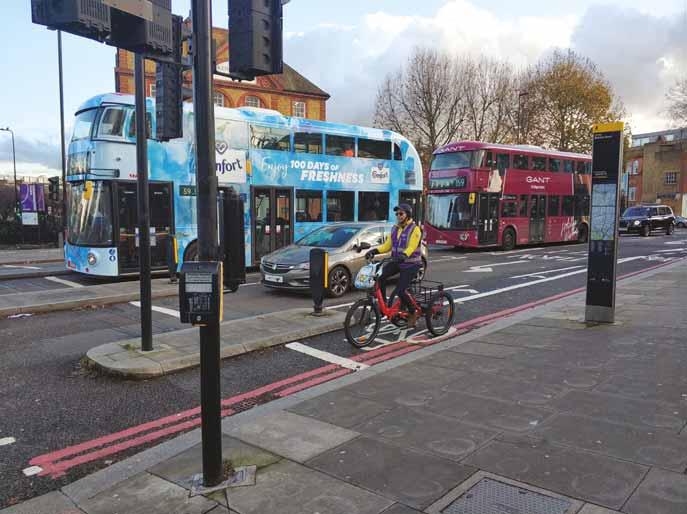
Walking, cycling and ‘minimobility’ -all thriving together - could offer alter natives to car use, thinks Caz Conneller of Loud Mobility
21
FUTURE OF MOBILITY
What will the industry look like in 10 years, describe ITS in three words –don’t you just hate those type of questions?
Transportation needs to change to meet future challenges. Natalie Sauber of Arcadis suggests that nature-positive mobility is the only way forward
38 MASS
TRANSIT
UITP Summit 2025 in Hamburg highlighted an interesting collaboration between the public and private sectors
40
URBAN MOBILITY
Doing more with less could unlock intelligent transportation systems across the African continent
42 AIR QUALITY
27
TUNNEL MANAGEMENT
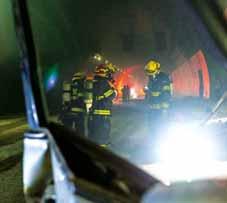
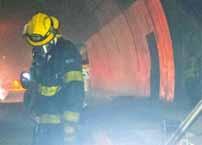
With the help of Citilog’s early warning system, authorities were able to close the Vuache Tunnel in France before a fire fully broke out
30
ITS INTERNATIONAL 30TH BIRTHDAY
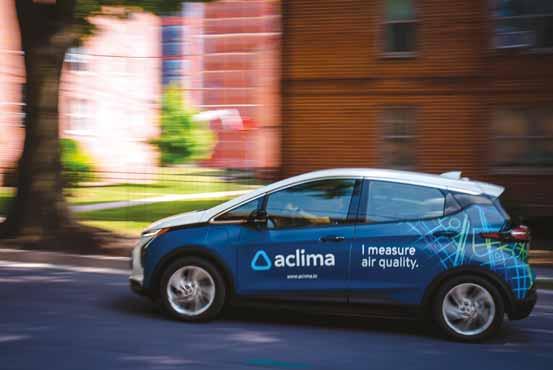
Mobile sensors enable cities to drill down into pollution at a block-by-block level 47 PRODUCTS & INNOVATIONS
The first large-scale tap-on/tap-off card, the beginning of the DailyNews and – via Barbie - a milestone in V2X deployment: ITS highlights from the 21st century
“WHERE COULD ITS BE IN 2035? PREDICTION TIME, PEOPLE!”
ITS International is 30 years old (we may, just possibly, have mentioned this) and we thought it was a good time to take a look back, as well casting our gaze forward to see where we could be over the next decade or so. We asked a few ITS luminaries three simple questions:
1) Describe ITS in three words (without using ‘intelligent’, ‘transportation’ or ‘systems’)?
2) If you had to single out just one past ITS advance, what would it be?
3) What’s the main change you predict we’ll see in the ITS industry by 2035?
“ “ One constant going forward will be transport’s relationship with the environment
Their answers (from p21) are revealing, both for what they say – and for what our experts cannot predict. The industry is changing fast. However, one constant going forward will be transport’s relationship with the environment.
So in this special anniversary issue, we also take a look at how smaller vehicles might help make our urban areas less
Editor
Adam Hill
Email: ahill@ropl.com
Tel: +44 1322 612062
Sales Director
Dan Emmerson
Email: demmerson@ropl.com
Tel: +44 1322 612068
Web Manager
Sarah Biswell
Email: sbiswell@ropl.com
Tel: +44 1322 612078
Staff Writer
David Arminas
Design Team
Simon Ward, Andy Taylder
Data & Marketing Manager
Alan Cansick
Email: acansick@ropl.com
Tel: +44 1322 612061
Office Manager
Kelly Thompson
Email: kthompson@ropl.com
Production Manager
Nick Bond
Email: nbond@ropl.com
Tel: +44 1322 612066
congested and polluted (p15), examine some of the latest techniques in measuring air quality (p42) and get an insight into ‘nature-positive mobility’ (p36). “The last decade was all about cutting emissions,” writes Natalie Sauber of Arcadis. “The next one will be about restoring ecosystems.”
By the way, in addition to our 30th birthday, we’re celebrating another
Publisher/
Managing Director
Andrew Barriball
Email: abarriball@ropl.com
Tel: +44 1322 612057
CEO Roger Adshead
Email: radshead@ropl.com
Editorial Consultant
Geoff Hadwick
milestone as well. Twenty-five years ago, we launched the Daily News at the 7th ITS World Congress in Turin. A show newspaper – producing a different edition each day, with stories and photography ‘live’ from the exhibition floor and conference hall – was a new idea in the ITS industry. We go right back to the beginning (p33) to get the lowdown: “Truthfully, it was a huge leap of faith back in 2000 and we were not 100% sure we could pull it off,” admits publisher Andrew Barriball. But it did work and it has evolved to become part of the fabric of ITS World Congresses from Berlin to Busan via Detroit and Dubai. And once again, ITS International is proud to be producing the Daily News at ITS World Congress 2025 in August. We’ll see you in Atlanta! ITS
Adam Hill EDITOR
Email me at ahill@ropl.com @itseditoradam.bsky.social @adamhillwriter @itseditor_adamhill
Printed by Warners (Midlands) PLC
ITS International (PE 13324) is published 6 times a year with combined issues in January/ February, March/April, May/June, July/August, September/October and November/December by Route One Publishing Ltd, Second Floor, West Hill House, West Hill, Dartford, Kent, DA1 2EU, UK.
Airfreight and mailing in the USA by agent named World Container Inc., c/o BBT 150-15, 183rd St, Jamaica, NY 11413, USA. Periodicals postage paid at Brooklyn, NY 11256.
POSTMASTER: Send address changes to ITS International, World Container Inc., c/o BBT 150-15, 183rd St, Jamaica, NY 11413, USA.
Air Business Ltd is acting as our mailing agent.
Subscription records are maintained at Route One Publishing Ltd, Second Floor, West Hill House, West Hill, Dartford, Kent, DA1 2EU, UK.
All editorial, advertising or circulation enquiries to:
ITS International, Second Floor, West Hill House, West Hill, Dartford, Kent, DA1 2EU, UK.
No part of the publication may be reproduced in any form whatsoever without the express permission of the publishers. Views expressed in this journal do not necessarily reflect the opinion of the Editor or Route One Publishing Ltd.
An autonomous shuttle service in the Netherlands has carried metro station. Dam Shuttles is numerous Lidar sensors and
Flow Labs covers 2,500 North Carolina intersections intersections across the state.
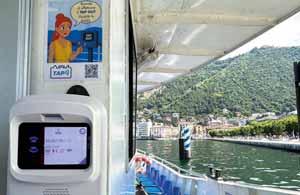
Conduent sails along in north Italian lakes validators.
in transportation guide aims to offer clear roadmap
America have
joint
£10.6m boost for Glasgow sustainable travel
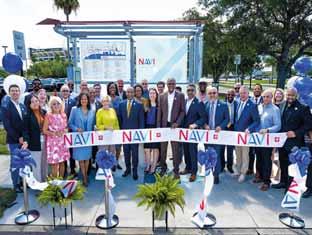
Jacksonville AV public transport service starts
Florida's Jacksonville Transportation Authority (JTA) has launched what it says is vehicles in the US. Navi Vehicle Innovation) operates
route alerts to help identify and
response plans; plus historical congestion charts to track
district to sports, dining and
the service consists of 14 seating up to nine passengers,
to deploy Iteris ClearGuide
ITS World Congress 2025: home runs and deep dives
conference schedule and has plenty to offer. For any delegate seeking insights into is a variety of Tech Tours into topics including event
GMV contactless payment for Madrid transit
Madrid Regional Transportation
Authority (RTA) has signed a to use Iteris’ ClearGuide and intersections. Iteris will
said the service represents a decisive step towards a for the Spanish capital. The a pilot project launched last
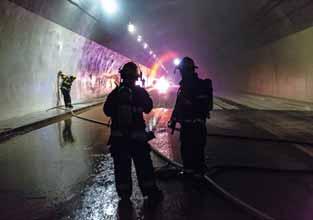
that affected a large part of the operators using EMV transit still Citilog ITS helps avert tragedy in Vuache Tunnel Tragedy was averted earlier
Savoie region of the French Alps. A heavy goods vehicle, laden their part in quickly raising the
the power outage this year
Synapse ITS has acquired Oko, a navigation app designed to help blind and visually-impaired pedestrians navigate intelligence to help identify pedestrian signals: users can simply point their phone camera towards crossing signals to interpret information - particularly helpful when ADAcompliant (Americans with Disabilities Act) and Prowagthousands of crossing images, to recognise signals. Synapse says it will reinstate Oko as a free subscription "to make its services accessible to as many pedestrians as possible".
Verra Mobility tolling payment for Sixt in Italy
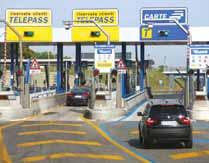
Verra Mobility will offer electronic toll payment for vehicles rented by Sixt in six Italian cities - Milan, Rome, Florence, Venice, Bergamo and Bologna. The deal with Sixt means that rental car drivers can opt-in to the programme when renting a vehicle, which allows them to automatically pay tolls electronically. There will be no waiting in the toll booth line or having the right amount of cash on hand. In 2023, Verra Mobility announced its partnership with Telepass, an Italy-based company offering integrated mobility, to enable expanded toll payment coverage for short-term rentals.
Montreal’s ARTM chooses Masabi
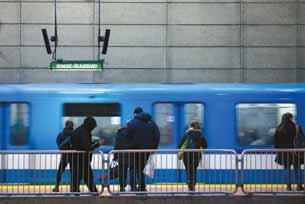
(ARTM) has chosen UK-based Masabi for development and implementation of a fare collection solution to replace its current Opus card. The work will be part of the Concerto project, a gradual complete overhaul of the entire fare collection system in the metropolitan Montreal region of Quebec province in Canada. Concerto involves updating more than 12,000 pieces of equipment across
Modaxo
de Transport de Longueuil, the City of Montreal and greater
Egis wins Olympic gold in Briançon
As part of infrastructure development for the 2030 Winter Olympic and Paralympic Games in France, Egis will project manage modernisation of a key road, creating an additional lane for Olympics use which will then be dedicated for public transport and bicycles. The project was given to Egis by the Hautes-Alpes department and the municipality of Briançon, and covers 16km of RD1091 between Briançon and Serre-Chevalier. The Olympic Lane is for athletes to transfer between the Olympic Village in Briançon and the Olympic Stadium in Serre-Chevalier.
buys Siscog Transport scheduling software provider Siscog has been acquired by Modaxo, the umbrella group for numerous technology companies in the public transportation arena. Headquartered in Portugal, Siscog (Sistemas Cognitivos) was founded in 1986 by Professors João Pavão Martins and Ernesto Morgado. Siscog's portfolio consists of Ontime, for creating and updating timetables; Fleet, for scheduling and managing vehicles; Railnode, for scheduling and managing local resources; and Crews, for scheduling and managing staff. Clients include Lisbon Metro and London Underground, as well as suburban rail operators in Copenhagen and Barcelona.
acceptance is expected in early 2026. The system is live in the
cover the counties Akershus, Buskerud, Innlandet, Telemark, created in 2001 and is headquartered in Drammen.
“HUMAN DRIVING AND MACHINE DRIVING NEEDS TO BE A CONTINUUM –WITH TRUST BOTH WAYS”
Many drivers are already using some form of automation but there’s much more to come. Remco Timmer of Here Technologies talks to Adam Hill about how far this will go – and how fast…
ITS International has a theory and it goes like this: autonomous vehicle (AV) adoption is always “about eight years away”. Doesn’t really matter when you ask the question – i.e. three years ago, it was “about eight years away” and that will be the case in another three years. It’s always “about eight years away”.
Remco Timmer, VP product management, head of automotive solutions at Here Technologies, listens politely. He has probably heard all this before. More of that later.
To ensure we’re all on the same page: SAE International’s Levels of Driving Automation go from Level 0 (no automation) to Level 5 (fully-autonomous driving). Between Level 2 automation (where the driver is in control of the vehicle, even while features such as lane-assist are operating) and Level 3 (L3 - you’re not driving when features are engaged - but you need to be alert to the vehicle ‘handing back’ control to you) lies ‘Level 2+’ (L2+).
And there’s an awful lot more space in between – and even within – all these designations. So before we get ahead of ourselves, what automated features, such as advanced driver assistance (ADA), are we currently looking at in most cars?
State of the art
“It starts with basic cruise control, then active cruise control, then lane keeping with active cruise control, then typically handsfree driving and hands free-driving with lane change,” Timmer begins. “That’s typically known as the L2+ level of automated driving. And it’s going to be the new norm very soon. You already see this in premium vehicles, definitely in Asia. And you’re going to get more of these kind of features for all kinds of brands, also at lower price levels. The cost to do this is lowering significantly and will become massively available. There’s only two vehicles in the world currently that have L3 autonomous driving - BMW and Mercedes – and both of these are relying on our map to provide them these kind of features.”
Not that automated driving of any kind can just rely on a map, he quickly points out. “The map always needs to work in unison, and in collaboration, with the sensor stack, the compute and the logic that runs on that compute, so it’s integrated into all of that by the OEM or their partners. But yeah, this is basically where we’re at today.”
At the moment, then, only a small number of vehicles run
It’s critical that AV functionality isn’t built out in isolation “ “
with full L3 driving. “You know, that’s the state of the art, the absolute pinnacle of innovation,” Timmer explains. “But I think you’ll see even that kind of functionality rolled out more and more and also be available at a larger operational design domain. So currently we serve only highways and limited access roads in Germany and parts of the US. And I think the challenge of the industry at large is to make sure that these L2 features, L2+ features and L3 features become available at a larger footprint.”
That way, drivers will become used to using these features. “So it just becomes part of almost every journey,” he adds. “And then as soon as it does, and you start to experience this, and you see how it fits into your journey, you’ll see also the adoption pick up further.”
Mass adoption of L2+ L2+ might involve hands-free highway driving, rather than just lane-assist, for instance. And this is where we are going to see change, thinks Timmer. “There’s only 100 million vehicles sold every year, right?” he says. “So in order to adopt and change the entire fleet will take a few years. I think you’ll see mass adoption of L2+ much sooner. It’s happening already: as we speak, quite a lot of volume models now have L2 and L2+ functionality. So that’s what we’re going to see first, and then the leap from L2+ to L3 in designated areas isn’t all that big.”
Well, he smiles, it is still a significant investment and “a little bit” more complex. But in terms of the tech stack, it is feasible to make the transition from L2+ to L3 with a progressive roll-out of software changes over the lifecycle of a vehicle. “So we don’t need to wait for a new vehicle,” he explains. “You don’t deliver software once: you are continuously evolving the software in the vehicle, and you need to be part of the software development environment, the training, the validation of the software of the OEM - which we are - and as a consequence, they can slowly but surely deploy ever-more advanced functionality. We need to be part of that continuous loop.”
Some OEMs are more agile than others, of course, but Timmer can see a way forward. “For a while, everybody thought we could leapfrog to L3,” he suggests. “I don’t think that’s a super-sensible path. It’s probably far more efficient to gradually evolve into L3 but have a hardware platform that can already accommodate these L3 functionalities, in terms of sensors and compute capability. Almost all vehicles have a basic ADA stack
already embedded. We’re not going to go from 0 to L3 but this is a gradual road ahead.”
One country leads L2+ development, he thinks. “In China, the availability of ADAS and AD features - especially L2+ - is very, very, very high in comparison to Europe and North America.” In addition to a prevalence of tech stacks, China also replaces its car fleet more quickly than other countries. “But Europe and North America still really have a critical advantage when it comes to doing this in a safe, reliable, regulated way,” insists Timmer. “There’s a lot of collaboration ongoing between government and industry and suppliers in Europe and North America, so I don’t think they are lacking. But it’s a very different market. It will take a little bit longer to replace the fleets and have these features.”
Autonomy seems to sit in a bubble sometimes, with driverless vehicles seen as occupying their own space – rather than being regarded as part of a continuum of vehicle connectivity.
“I think it’s critical that AV functionality isn’t built out in isolation,” Timmer agrees. “That would be really, really silly and inefficient and complex. Basically, human driving and machine driving needs to be a continuum - and there needs to be trust and understanding both ways.”
In an increasingly autonomous world, there will still need to be handovers of control both ways, too – a highly contentious area for road safety campaigners, and anyone who is simply worried about how this might work in practice. “If you think of AVs too much in a bubble, it’s either machine-operated or not,” says Timmer. “Okay, but what is the ‘or not’? And how can you make this a gradual transition? That’s why, for example, we provide only one map serving the human and the machine, and we want that map to be as consistent as possible. It cannot be that the human is basing its decision on a different understanding of the environment than the machine.”
‘More and more collaborative’ Traditional OEMs may once have had departments working on separate functionality, but not anymore. “They become more and more collaborative,” says Timmer. “That’s a requirement. Otherwise this will not work.”
The human-machine handover: a question of trust
Technology is evolving quickly – so can Timmer give us an idea of something that we couldn’t do five years ago when it comes to automated driving, but which is now commonplace? He picks the example of sensors, whose resolution has improved and price has dropped.
“It’s now actually so cheap to have plentiful sensors - that helps a lot, that creates a lot of resilience,” says Timmer. “You want to have overlapping field of views all the time. If you only have one radar sensor in the front and maybe not one in the back, and you have only two cameras in the front - and not seven or nine or 13 - you don’t have the resilience in this stack.”
There is also the question of what you can do with sensor data once you’ve got it. “You also have the compute available locally in the vehicle that can actually deal with this much sensor information - and also this resolution of sensor information,” he points out. “So that’s advancing at an incredible rate. And then, with more GPUs in the vehicle as well, it is much easier to process these kind of loads.”
AI has caused “an incredible storm”, he goes on. “And it’s not going to ever slow down, it’s going to pick up and move faster still.” The complexity - and capability - of the models is increasing exponentially.
“So compared to five years ago, the stacks are becoming way more resilient to all kinds of operating conditions,” he insists. “They are trained on far more data and scenarios as a consequence. And they would have the equivalent of many hundreds of thousands of years of driving by an incredible amount of people available to them.”
Advances in simulation have also helped. “We have a lot of customers that used to rely on real-world drives. Well, it’s slow, right? You cannot perform all the tests and all the different scenarios that easily. But now customers are using our map to create the virtualised environment where they can deploy
SAE International’s Levels of Driving Automation go from Level 0 (no automation) to Level 5 (fully-autonomous
simulated vehicles that can run millions - if not billions - of kilometres of simulated drives, and harden the models. None of that was available even two years ago!”
However, although a great deal has changed, the basic building blocks remain the same, he believes.
“People say: ‘hey, it’s all going to be about end-to-end models’, but that just doesn’t really matter, honestly. So if you have three models that are doing the task separately, or collapse all of that in one large end-to-end model, it’s just a different strategy to achieve something similar. And maybe the eventual resilience of an end-to-end model might be greater than having it divided. We’ll see. Everybody is attempting all these different strategies - but just the skill and the speed at which you can do that is, frankly, mind-blowing.”
Where will AVs be in 2035?
All of which might make the final question difficult to answer. If we’re sitting here in 2035, how has the game changed? If things move so quickly, will today’s developments seem irrelevant by then?
Timmer thinks we’ll see more autonomy in public transportation in a decade’s time. “In 2035, there will be fleets of orchestrated autonomous vehicles, L4 or L5,” Timmer smiles. “They will be so efficiently deployed that they are at a very attractive price point per kilometre, and they would have very high occupancy as well, which is key to drive down the cost. I like to compare it to cars: cars are now designed as consumer products - but they almost need to be designed as airplanes, with maximum operational performance. And I think those autonomous fleet vehicles will be designed almost like airplanes: they need to have an uptime of 99%; they need to have an occupancy rate of 99%; and they need to be orchestrated.”
While they won’t be able to fulfil end-to-end mobility, they will be deployed in larger and larger areas. There will be a significant change in the capability of private vehicles, too. “I think also in 2035, you’ll see massive, massive use of L2+/L3 functionality as well, probably even at the lower end of the market - at least L2+.” How and where this functionality can be used – and where handovers take place – “will be really, really clear”, says Timmer. “Because that’s what the regulators will need and, I think, honestly, that’s also what the OEMs will need.”
Navigation planning will ensure that, “for the majority of journeys, you’ll be using this L2+ or L3 functionality, simply because it’s more convenient, more enjoyable that way, and more relaxing”.
He’s refreshingly clear about the limitations of the technology. “I mean, it’s easy to achieve L5 functionality on a test track!” he laughs. But Timmer is also enthusiastic about the possibilities. So will our mobility experience change so radically, so quickly? Time will tell. ITS
Here’s mapping plays a key role in the evolution of automated driving
EASY INSTALLATION
EASY MAINTENANCE
MAXIMUM PERFORMANCE
AI-READY FEATURES
OPEN STANDARD COMPLIANCE
The streets of your town
A mosaic of walking, wheeling, cycling, micromobility and ‘minimobility’ - all thriving together - could offer alternatives to car use, says Caz Conneller of Loud Mobility
As cities strive to decarbonise, micromobility and active travel are gaining momentum as viable alternatives to private cars while contributing to improved public health. But what other opportunities and areas of innovation exist in the middle ground between the car and the bicycle? And how can we design mobility solutions that truly serve a broader, more diverse population when it comes to personal transport?
Large parts of Europe’s population are overlooked by Europe’s existing mobility system. Celeste Reglá Díaz from EIT Mobility recently told Zag Daily that the system typically “caters for middle-aged men who work 9 to 5, have no caregiving responsibilities, and have no physical impairments… Mobility needs are more complex than that”.
My interest in e-mobility began whilst running Cyclechic, an e-commerce business I founded to help more women cycle as their mode of transport. I saw first-hand how women - my customers - were being empowered by electric bikes and electric cargo bikes. Women with mobility challenges, women nervous about riding with children, and those completely new to cycling were embracing these vehicles because they made everyday
journeys easier and more practical. This led me to start the She’s Electric campaign, with the aim of engaging more women and giving them a positive first experience with a range of e-bikes and e-cycles.
But many women still see the car as the only legitimate way to navigate their busy lives, transport children, care for loved ones and feel safe. My experiences through this work sparked a question: what if we designed vehicles that not only met these needs but pushed even further? What if we created small vehicles that preserved some of the car’s value—comfort, weather protection, multi-passenger carrying capacity—while being lighter, less polluting and more space-efficient?
Could this be a safe passage away from car dependency? The shift is being seen in logistics, with advancement of quadricycles such as the EAV cargo bikes. EAV is an innovative UK-based manufacturing company that designs cargo bikes to look and function more like vans.
Designing
with inclusion in mind
A recent report by Connected Places Catapult - Advances in Inclusive Micromobility - states the importance of “prioritising inclusivity and accessibility in design”.
And when I spoke to Jessie Ridler, an excompliance engineer at EAV, she highlighted how important understanding the user experience is in design. “Can a rider open the door with their arms full of parcels?” she asks. As the only woman on her team, she often tested early vehicle prototypes and found accessibility gaps others missed.
“I had to use both hands to apply the brake. People were surprised, but we acted on it—we redesigned it,” she said.
It’s clear that thoughtful and thorough user-testing and inclusive input on design across a broad range of users is essential for mainstream adoption and appeal. But can simply designing bikes to perform more like cars solve the deeper problems?
I put this question to Ian Walker, professor of environmental psychology at Swansea University and creator of the term ‘motonormativity’—the idea that society sees driving as the default, while other modes are marginalised.
“The problem is we start halfway through,” he tells me. “Policymakers and politicians ask where to put all the cars, or how to swap petrol cars for electric ones that make us feel better about ourselves—without questioning why we’re so reliant on cars to begin with.”
He argues that if we framed the problem around social exclusion or transport inequality —asking how we ensure everyone can access the services they need and can thrive — we’d start finding different, more transformative solutions.
I’m on board with this big-picture thinking—treating root causes, not symptoms. But many of the innovators and entrepreneurs trying to fix the problem are looking at how we can use people’s existing comfort with driving to switch them to safer, smaller, less polluting vehicles. Is there space for a new troupe of vehicles that straddles the middle ground?
According to the European Environment Agency, most short urban trips by car carry an average of 1.3 passengers. When we take our ‘motonormal’ blinkers off, we can see this is inefficient to the point of absurdity, particularly as cars just keep getting bigger. According to Clean Cities Campaign and its work on car spreading: “SUV sales were at record levels in 2024 in UK – 62% of new car sales”.
Minimobility: designing for the middle
Joey Grigg, business director at Osta Designs, sums it up well: “Most journeys are short and light—yet we’re using the same vehicles we’d use for a 50-mile family trip. We need to make it easy to switch modes. That’s the key.”
Grigg and his team of automotive and cargo-bike designers are exploring a variety of vehicles that blur the lines between car and bike. They ask: “Is it a bigger bike or a smaller car?” And then they build according to specific, real-world use cases. Their goal is mass adoption, not niche appeal.
He introduced me to the term ‘minimobility’—one step up from micromobility. It’s a
“ This kind of shared vehicle could offer a dignified, enjoyable alternative to the car - without clogging up residential streets
Caz Conneller Loud Mobility “
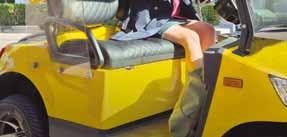
ABOVE: Yo-Go’s electric buggy-style vehicles fall somewhere between a golf cart and a quadricycle
new category, yes, but also a broader idea.
“For us, minimobility focuses on right-sizing, human-sizing, and eliminating unnecessary weight and complexity in how we move,” Grigg says.
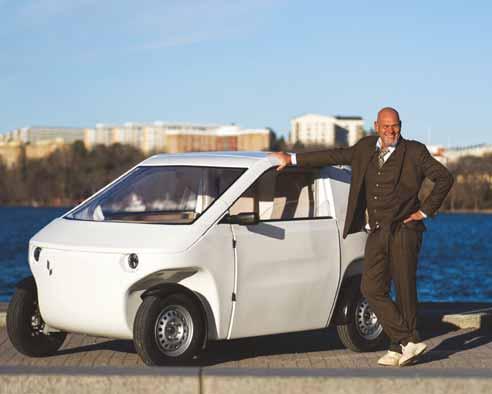
With new terms comes new energy—you can feel a bubble of creativity and innovation under the surface. Another new term is ‘light urban vehicle’, which forms the name of Håkan Lutz’s company Luvly, which has just signed a development deal with automotive giant Stellantis.
Lutz has been at the forefront of minimobility for a number of years and tells
me that, with Luvly’s solution, “there’s no need to change behaviours”. The vehicles sit in the L7 category (heavy quadricycles) and perform like cars; but they are lighter, less emitting - both in tailpipe emissions and manufacturing - and much less damaging to pedestrians or other road users in collisions.
But the big accessibility gamechanger is the price. They will come in around the price of the average second-hand car, making them a truly affordable option for those on low and middle incomes. The platforms and technology are sold to original equipment manufacturers and they can produce the vehicle closer to the market.
With the average electric vehicle coming in at £40,000 ($52,800), isn’t an affordable solution both attractive and necessary? Lutz sees strong market potential in both Europe - with smaller, narrower streets - and India, where people are already accustomed to using smaller vehicles.
A heritage in small vehicles
While new names and ideas proliferate, some innovators have long understood the power of small. One is Microlino, a Swiss company founded by Wim, Oliver and Merlin Ouboter, the family behind the Micro Kickscooter—the scooter that revolutionised kids’ mobility over the past two decades.
So my head was turned when I first saw Microlino’s electric microcar—a two-seater that’s fast enough for urban travel but a fraction of the size and cost of a car—the connection made perfect sense. Its vintage design is just the right balance of cool and cute; this ‘bubble car’ causes a buzz wherever
The She’s Electric campaign aims to give women a positive first experience with a range of e-bikes and e-cycles
See your intersections and beyond like never before
True Sensor Fusion
Video AI at the intersection
Wireless sensors for advance / midblock
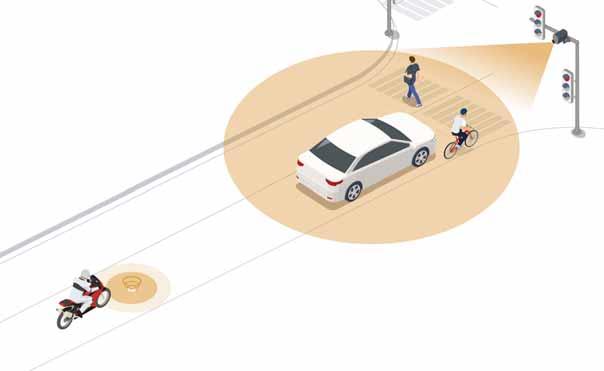
MultiSens Intersection fuses video AI and wireless sensors into a unified platform so you can see everything—at the intersection and down the street.
This evolution in traffic detection technology delivers seamless signal actuation and comprehensive traffic analysis by combining the strengths of two proven systems with:
•Premium Accuracy - See all approaching traffic and all road users (vehicles, bikes, scooters, and pedestrians) - no blind spots.
•Unmatched Flexibility - Reliable advance detection, even without power, comms or clear line-of-sight - no trenching required.
•Unified Control - Manage all detection and traffic data from a single platform - no separate systems to manage.
See what’s really happening at every intersection and beyond.
income backgrounds, and those previously excluded. It’s genuinely joyful to witness.
But accessibility gaps remain. UK charities Motability Foundation and Collaborative Mobility UK (CoMoUK) revealed that while only 10% of disabled people who took part in their research had used shared micromobility services, 53% believed they had the potential to improve their lives.
That’s something Harry Fisher from Motability is working to change. He’s leading a new UK initiative to make shared micromobility more accessible to disabled users. Disabled people already use
cycling, highlights: “We consider that electric and e-assist micro-mobility devices have the potential to be important low-carbon modes for disabled and non-disabled people, with further potential to reduce driven trips and so reduce risk of road traffic collisions and air pollution.”
Fisher explains: “It’s not about creating a separate service for disabled people; it’s about making a service that works for everyone.”
This could include more three-wheeled vehicles, such as trikes, which provide a more stable ride. Fisher also questions whether access via a smartphone app is the most inclusive way to access the vehicles.
Shared —which brings together disabled users, community groups, operators and local authorities—and is set to
Clear regulation is also needed to set the way for innovation to blossom and to enhance accessibility. Many countries are now introducing or updating legislation to support the growing category of light electric vehicles, creating clearer frameworks for their use on public roads. George Beard, head of future mobility at TRL, notes the advantages of these regulations having fewer regulatory barriers for users—such as not requiring a driving cantly increase uptake across broader demographics.
Experimenting with shared light
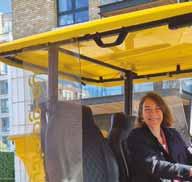
Some cities are already testing the idea of shared ‘mini-vehicles’. In London, I tried a new scheme called Yo-Go, which offers electric buggy-style vehicles that fall somewhere between a golf cart and a quadricycle. After a few technical hiccups unlocking the vehicle, I enjoyed a breezy ride through the city. I felt more road presence than on an e-bike, while still being in touch with my surroundings. For older users, this kind of shared vehicle could offer a dignified, enjoyable alternative to the car—without clogging up residential streets with the all-too-familiar site of rows and rows of parked cars.
The future: integration and belonging
If we combine inclusive shared micromobility, light electric vehicles, and mass transit— alongside walking and cycling—we could create a far more accessible and sustainable transport system. As serial entrepreneur Alex Nesic, co-founder of Bingo Tech IO and expert in the light electric vehicle space, puts it: “Micromobility and public transport are an elegant combination.” I couldn’t agree more.
When I asked Jessie Ridler what future mobility should look like, she said she’d love to see a “variation of vehicles co-existing in the same space”.
That vision excites me too: opening up streets to the innovation that comes when you truly understand and cater for the needs of a diverse range of people. A mosaic of walking, wheeling, cycling, micromobility and minimobility all thriving together. After all, isn’t variety the spice of life? ITS
ABOUT THE AUTHOR:
Caz Conneller is director of community & culture at Loud Mobility caz@loudmobility.co.uk
Håkan Lutz ‘has been at the forefront of minimobility for a number of years’
Modeling and Planning
Multimodel
Prediction and Management
Cutting-edge
How tolling changes are making electronic music
Hal Worrall and Douglas Chastain offer some perspectives on the evolution of electronic toll collection and how ownership shapes priorities in the industry
In the evolving landscape of transportation infrastructure, the implementation and management of electronic toll collection (ETC) systems have become central to efficient toll road operations. As technology has advanced, the responsibilities and roles of the agency owners and contractors have evolved. Public agencies, private integrators, concessionaires, equipment providers, and software firms have played a role in advancing ETC - but not all participants approach ETC with the same mindset. Ownership, and the financial and operational accountability it entails, has a profound influence on priorities and performance. To demonstrate this dynamic, consider a personal analogy.
When I first learned to drive, I treated my parents' car casually—fuel was someone else’s concern, maintenance barely crossed my mind. But the
moment I bought my own car, everything changed. I monitored fluid levels, kept the tank full, and washed it regularly. Ownership brought responsibility—and with it, a shift in priorities.
We see this same contrast in the tolling industry. But in the tolling industry, there’s a middle ground – the concessionaire – who is both an owner and a contractor for integration services.
The evolution of ETC
Before ETC, toll revenue collection was a relatively simple process. Agencyemployed collectors handled cash transactions, and their responsibilities were clear. Toll collectors were audited precisely and trained to respect the process, much like bank tellers. However, with the arrival of ETC, a new cast of players emerged: integrators, equipment manufacturers, software developers, and back-office service providers. These participants brought with them the perspectives of their own organisations.
The roles and responsibilities of those involved in collecting toll revenue shifted significantly as ETC became a part of the toll payment process. The more complex electronic components and processes became, the more the entire revenue-collection responsibility began to fragment. The vendor’s responsibility evolved to providing a system that meets performance standards. Various equipment components and specialised software were measured on the ability of their components to satisfy their assigned specific requirements. The agency remained as the entity with a central focus on collecting all of the revenue in an equitable and publicly-acceptable manner.
The method of contracting integration services also evolved. Initially, agencies contracted for the ETC system - including the back office and roadside systems. Over time, this practice began to be modified and,
New York’s Holland Tunnel went ETC-only in 2020
more frequently, roadside system and back-office functions were contracted to different vendors - further separating the toll collection process into more contract elements.
With each additional participant in the ETC process, the intellectual property (IP) became more complex. While agencies own the IP involved in ETC systems installed at their facilities, much of the underlying technology remains proprietary to vendors. As innovations occur, they are sometimes viewed as competitive issues and not shared freely. Innovations often come at additional cost, further highlighting the divide between public operators and private vendors.
Public versus private: differing incentives
Public agencies are governed by laws, transparency mandates, and a duty to protect public assets and provide a safe and convenient road for their patrons. After maintaining safety, their top priority is securing all revenue due, with customer service and efficiency following closely behind.
Innovation is welcome—but only insofar as it supports safety, compliance, equity and fiduciary responsibility. Public agencies also avoid risk, much like anyone evaluates risk and the likelihood that the family car will be returned without damage when deciding to
overall reputation in the tolling industry for successful implementations of ETC and teamwork is critically reviewed when agencies perform the process of evaluating bid proposals.
Concessionaires sit in a unique position. Decades-long concession agreements mean
that the concessionaire is deeply interested in maintaining their asset and equally interested in collecting all due toll revenue. Concessionaires take on the financial risk of operating and maintaining toll roads, as if they were leasing a car. For them, ETC is not merely a technical system—it’s the core of their business. Profitability depends on the accuracy and efficiency of every toll collected. Concessionaire interests include those of the agency owner and the integrator.
“ ETC is a tool, not the mission
This alignment of incentives transforms how concessionaires approach ETC. Their focus isn’t limited to meeting minimum performance standards. Instead, they continuously seek to optimise system reliability, user experience and long-term value.
Some have formed their own integrator divisions, allowing them to both operate toll roads and develop the technology that powers them. These concessionaireintegrators benefit from real-world testing grounds and develop a deeper understanding of operational needs. Further, they maintain the culture and priorities of their parent companies – they feel the same sense of ownership and responsibility.
Shared goals, different emphases
While all participants in the ETC ecosystem—agencies, integrators, and concessionaires—value innovation, customer service, and performance, their priorities sometimes diverge:
• Public agencies emphasise safety, risk mitigation, revenue assurance, and regulatory compliance. ETC is a tool, not the mission
• Integrators prioritise meeting contract requirements, protecting proprietary IP, and ensuring project profitabilityinnovation is a differentiator, but not always central to their business
• Concessionaires blend both worlds. Their decades-long mindset fosters a commitment to long-term system performance, customer satisfaction, and sustainable infrastructure investment. Their integrator subsidiaries share this mindset, too
Ownership mentality makes the difference
The sense of ownership makes a difference. Just as a first-time car owner treats their vehicle with care and purpose, organisations that 'own' the toll revenue stream – whether permanently or for a few decades –approach ETC as an owner of the revenue stream.
Intersection-level performance insights without connectivity
ClearGuide® Signal Trends
The new set of probe data-based performance metrics within ClearGuide® helps agencies reduce congestion by monitoring traffic signal performance and identifying deterioration at the intersection, without reliance on infrastructure.
Meet Us at ITS World Congress Booth #1613
Maintenance is more than functional adequacy or contract compliance, it is about reliability, optimising performance and preserving long-term value. Ownership perspective goes beyond collection mechanics and includes continuous system improvement, user experience enhancements, and sustainable infrastructure investment.
As with the ownership of the first personal vehicle, a new perspective develops. You want the car to be the best - not just perform the basic function of transportation; and every automobile owned, after the first, receives a level of care that did not exist when you drove your parents’ car. The immersive experience of operating a tolled facility shapes how ETC development is undertaken - not just for compliance, but for continuous improvement. ITS
Hal Worrall is president at Transportation Innovations and Douglas Chastain is chief sales cer – North America, A-to-Be
10 ways to combat the rise of scams
1. Tolling scams impersonating DoTs and tolling agencies have gained significant traction over the last year. Why do you think these systems have become targets for fraud?
Tolling systems are a prime target for scammers because they involve financial transactions. Many users do not have auto-replenishment set up, making them more susceptible to believing they owe tolls. Scammers take advantage of this by impersonating toll agencies and state departments of transportation to trick individuals into paying fraudulent charges. These scams have evolved over time, targeting a wide range of demographics, making every road user susceptible. mccain.swarco.com
2. From your perspective, what vulnerabilities exist in current tolling systems that make scams like this possible?
Several vulnerabilities in tolling systems make these scams possible. First, confusing user interfaces and a lack of transparency regarding toll balances create opportunities for scammers to exploit user uncertainty. Many drivers interact with multiple toll agencies, which adds complexity and increases the likelihood of confusion. Additionally, outdated and poorly-designed legacy systems contribute to these vulnerabilities, making it harder for users to discern legitimate communications from fake ones. Scammers often capitalise on this by creating spoof websites and sending fraudulent messages.
3. How can users most easily detect a scam like this, and what should they do upon receipt of a fake notification?
Detecting toll scams involves spotting common red flags. For example, fraudulent messages often include threats of consequences such as jail time or registration holds, which legitimate toll agencies would never use. Real toll agencies also do not send payment
requests via text or embed payment links in communication. To protect themselves, users should verify their toll balances by logging into official agency websites or contacting customer service through trusted channels rather than responding directly to suspicious messages.
4. From a systems and infrastructure standpoint, what proactive measures can tolling agencies take to protect users from these kinds of attacks?
Tolling agencies can take several proactive steps to safeguard users. Public education and awareness campaigns are vital, ensuring users know how to distinguish legitimate communications from scams. Agencies should keep scam alerts prominently displayed on official websites and include warnings in billing inserts sent to users. It is also important to train call centre agents to provide guidance on identifying fraudulent notifications. Finally, maintaining consistent messaging and recognisable branding across all communications can help users quickly identify legitimate interactions from official agencies.
5. Zooming out a little, how does the modernisation of ITS and tolling infrastructure impact the larger industry, and thereby help reduce fraud risk and improve system integrity?
Modernising ITS and tolling infrastructure can have a significant positive effect on the industry. Improved systems can reduce user confusion by providing clearer information about toll balances and agency responsibilities. Upgrading billing and payment processes also makes it easier for users to track what they owe, enhancing transparency. These advancements not only improve the overall user experience but also strengthen system integrity, making it harder for scammers to exploit weaknesses.
6. What role could real-time data, automation or AI play in identifying and mitigating threats in tolling environments?
Real-time data, automation and artificial intelligence technologies have the potential to revolutionise threat detection and prevention in tolling systems. By investing in AI-driven fraud prevention tools, agencies can leverage the ability of machine-learning algorithms to process large volumes
Kinetic® Mobility
of data, identify patterns of suspicious behaviour and detect anomalies. These tools can provide real-time alerts, enabling agencies to proactively address malicious activities before they affect users. Harnessing these technologies enhances system security and protects users from fraudulent schemes.
7. As the industry looks toward upgrading legacy systems, what are some best practices you’d recommend to tolling agencies to ensure they are future-proofing against emerging threats? Future-proofing requires a proactive and strategic approach to technology adoption, process design, and vigilance against emerging cyber threats. To build resilient systems, tolling agencies should adopt several best practices that combine robust technological solutions with strong user education. One critical measure is adopting verified communication methods. Tools like Google Verified SMS and iMessage Contact Key Verification provide
Real
toll agencies do not send payment requests via text or embed payment links in communication
“ “
a secure channel for transactional discussions and ensure users can trust the authenticity of communications. This minimises the risk of phishing attempts and fraud. Transitioning to cloud-based infrastructure is another important step. Cloud platforms not only offer scalable and secure environments but can also automatically update to address emerging vulnerabilities. Hosting tolling systems on cloud networks improves resilience against threats like data breaches and DDoS attacks while maintaining system efficiency. Alongside this, implementing rigorous authentication protocols—such as dualfactor authentication (2FA) or biometric verification—can enhance identity security and prevent unauthorised access to sensitive user accounts or payment systems. Interoperability should also be a key focus for futureready tolling systems. By prioritising standardised communication and integrated security protocols, agencies can ensure seamless interoperability across different jurisdictions while mitigating risks tied to outdated or fragmented legacy systems. To support this, tolling agencies must conduct regular audits and penetration testing to continuously evaluate and enhance the security of their infrastructure. Ongoing assessments ensure that weak points are identified and addressed as new threats evolve. Finally, tolling agencies must actively engage users in fraud prevention through customer education initiatives. By educating customers on recognising genuine communications—such as verified agency messages using tools like Google Verified SMS—and providing guidelines for safeguarding accounts, tolling agencies can empower users to avoid falling victim to scams. Combining these technological advancements with a focus on user awareness will help tolling agencies stay ahead of cybercriminals while maintaining reliable and secure systems for the future.
adopted by the North Texas Tollway Authority (NTTA)—can reassure the public and reduce frustration. Honest messaging and consistency go a long way in restoring confidence and fostering a sense of reliability.
9. What broader lessons can the tolling industry take from this situation in terms of balancing tech innovation with public engagement?
The tolling industry must recognise that not all users are tech-savvy and should avoid assuming one-size-fits-all solutions. Agencies need to tailor their communication strategies to accommodate diverse demographics and ensure ease of access for all users. Listening to public feedback is crucial for identifying pain points and improving engagement. Balancing technology innovation with clear, inclusive communication ensures that advancements benefit everyone without alienating less tech-savvy users.
10.Looking ahead, what do you see as the most important priorities for tolling systems as they evolve to meet new demands and modernise in the long term—from fraud prevention to congestion pricing and beyond?
8. Public trust in tolling systems is key. How can agencies build or rebuild that trust in the face of scams like these? Public trust is often undermined by scams, outdated payment processes, toll increases and infrastructure concerns. To rebuild that trust, agencies need to prioritise transparency and proactive communication. Clear and frequent updates—similar to the approach
As tolling systems evolve, their priorities should centre on fraud prevention, infrastructure modernization, and fostering public trust. Agencies must anticipate future challenges—such as sophisticated fraud schemes or shifts in transportation dynamics—and design systems that are both secure and adaptable. Beyond technical improvements, effective communication and education will remain vital in ensuring users feel confident navigating modernised systems. Additionally, initiatives like congestion pricing and dynamic tolling should align with user needs and convey fairness and transparency. ITS
ABOUT THE AUTHORS: Cyndi Smith is program director at Quarterhill and Nick Frush is a principal architect at Quarterhill
One platform. Any vendor. Total control.
Smarter, Safer Device Management for your ITS Network
Agencies struggle to manage their increasingly complex ITS infrastructure. Refresh collaboration with your IT department and deploy EdgePulse — the cutting-edge alternative to old / retrofitted network management software.
A bold new approach to managing RSUs and ITS assets
All-in-one platform with centralized monitoring and control
Health monitoring
SCMS integration
Vendor neutral by design
Affordable
AI-driven insights
Robust security
Supports the latest NTCIP standards, including NTCIP 1218 for RSU management.
Firmware management by
VISIONS OF ITS
What will the industry look like in 10 years, describe ITS in three words – don’t you just hate those type of questions? (Happily for us, our ITS luminaries played ball: answers below)…
President and CEO, ITS America
Describe ITS in three words (without using ‘intelligent’, ‘transportation’ or ‘systems’)?
Safe. Smart. Connected.
If you had to single out just one past ITS advance, what would it be?
Vehicle to Everything (V2X) technologies.
What’s the main change you predict we’ll see in the ITS industry by 2035?
Open-source systems that enable real-time data and communications across platforms, modes and jurisdictions.
Christian U. Haas CEO, Umovity
Describe ITS in three words (without using ‘intelligent’, ‘transportation’ or ‘systems’)?
Brains behind movement.
If you had to single out just one past ITS advance, what would it be?
Adaptive traffic signal control systems - first time intelligence was brought into road infrastructure.
What’s the main change you predict we’ll see in the ITS industry by 2035?
System-wide integrated traffic management and planning, driven by AI automation, V2X and X2V communication, fully real-time and multimodal.
Renee Autumn Ray
Senior director of strategic growth, Hayden AI
Describe ITS in three words (without using ‘intelligent’, ‘transportation’ or ‘systems’)?
Applying technology (across) mobility - to solve problems and provide insights to improve safety and performance.
If you had to single out just one past ITS advance, what would it be?
Traffic signal priority to allow emergency vehicles and transit to move more quickly through traffic.
What’s the main change you predict we’ll see in the ITS industry by 2035? Better coordination, hopefully with the help of open-source data standards and interoperability.
‘systems’)?
Connected mobility networks.
What’s the main change you predict we’ll see in the ITS industry by 2035?
Kurtis McBride Founder and CEO, Miovision
Describe ITS in three words (without using ‘intelligent’, ‘transportation’ or ‘systems’)?
It’ll be a mobility system, like the internet. Question: who will run it?
we had connected systems. But ITS isn’t just about seeing things in real time. We’ve gone from relying on occasional traffic studies once every few years to having access to ow of rich, 24/7 traffic data. That’s a ood of new data! That’s why we’ve also added the ability to draw insights from that data: where are near-misses happening that indicate a safety risk? Where is signal timing clearly suboptimal? With ITS, we’re not just collecting data; we’re highlighting problems that need attention at a pace that would have been hard to imagine a generation ago.
more autonomous vehicles in urban areas, integrated with public transportation systems and more connected within smart city frameworks.
Digital, connected and insights. The transition from analogue to digital systems marked a pivotal shift. In the analogue world, hardware-based devices delivered a defined solution or function. As we moved to digital systems, we entered a world where a platform could do many things via software— like a smartphone at the intersection. That alone was a fundamental game-changer. That’s not all we achieved with ITS. We also introduced connectivity—infrastructure that could share data at a distance, meaning traffic teams could remotely get a look at what’s happening at the intersection or roadside. This enabled a whole-network view in real-time that just wasn’t possible before
If you had to single out just one past ITS advance, what would it be? I think connectivity stands out. A great unconnected solution can make a real impact at a specific location. But a network of connected systems provides a whole new perspective—seeing how changes in one area impact another. It really enables a systems approach to traffic management, rather than simply addressing a series of specific problems, often prioritised by citizens’ complaints.
What’s the main change you predict we’ll see in the ITS industry by 2035? If adding connectivity helped traffic teams shift from problem areas to a network perspective, what’s coming is even more exciting: connecting road users directly to infrastructure. With our connected vehicle solutions—like Traffic Light Information (TLI) found in Audi, Lamborghini and Bentley vehicles—we’re already powering V2X applications. But the real shift will happen when this kind of connectivity is ubiquitous—available at nearly every intersection. I believe that kind of connectivity will be an accelerator for autonomy. Autonomous vehicles are currently trying to navigate based on on-board sensing and processing, which is really complex and expensive. If they had access to reliable, ubiquitous data from traffic infrastructure, that would make systems more reliable—and safer. Knowing there is a pedestrian in an intersection before they show up on in-car sensors provides more time to react. You can also imagine how much better traffic could flow if in-car systems ‘knew’ the optimal speeds to avoid unnecessary stops. Extending connectivity to road users will be as revolutionary as the shift from analogue to digital systems—and it’s already happening.
How Can We Stop Driver Distractions?
What seems like a quick response can lead to seconds of lost attention - enough to miss critical moments in traffic.
Our AI-powered Mobile Phone and Seatbelt Enforcement System detects violations automatically and reduces manual effort.
Andy Taylor
Vice president, global urban mobility, Mastercard
Describe ITS in three words (without using ‘intelligent’, ‘transportation’ or ‘systems’)?
Speedy, simple, smooth. No tickets. No queues. No fuss.
If you had to single out just one past ITS advance, what would it be?
Contactless fare revolution. Remember when EMV tap-and-go on buses and metros was a pipe dream? Now it’s everywhere—cutting boarding times by 30%. Game-changer.
What’s the main change you predict we’ll see in the ITS industry by 2035?
Frictionless, end-to-end journeys. By 2035, your phone (or heck, your watch) will autoroute, auto-pay, even auto-adjust for delays. Seamless from front door to final stop.
Kelley Coyner
Founder, Innovation4Mobility
Describe ITS in three words (without using ‘intelligent’, ‘transportation’ or ‘systems’)?
Inside tech ‘symposium’ - we have to quit talking to ourselves.
If you had to single out just one past ITS advance, what would it be?
Dynamic tolling (smart tech plus smart policy to manage congestion).
Development engineer, IAV
Describe ITS in three words (without using ‘intelligent’, ‘transportation’ or ‘systems’)?
Innovation. Solutions. Traffic.
If you had to single out just one past ITS advance, what would it be?
The coordinated and continuous rollout of V2X communication in Europe represents my major ITS advancement. The entire ITS community has worked enduring for many years to establish a cooperative ITS deployment. It's wonderful to see it functioning interoperable across multiple countries in Europe.
What’s the main change you predict we’ll see in the ITS industry by 2035?
In the past, ITS, particularly C-ITS, was driven by OEMs and their suppliers. I believe mobility will transform, especially in urban areas, with autonomous shuttles offering a viable alternative to motorised individual mobility. C-ITS and ITS services will play a significant role in enabling successful implementation. New players, such as shuttle operators or public authorities deploying these shuttles, will advance developments from a different perspective, fostering a cooperative transportation system for all its participants.
Michael Schuch CEO, Swarco
Describe ITS in three words (without using ‘intelligent’, ‘transportation’ or ‘systems’)?
Solution-driven, connected, accessible.
If you had to single out just one past ITS advance, what would it be?
The humble traffic signal is a true ITS classic. From its gas-lit beginnings in 1868 to the timed systems of the 1920s, it’s been central to road safety, saving millions of lives. Its sustainable upgrade, replacing energy-hungry bulbs with LEDs, cut power use by 80% and slashed maintenance needs. Today, the Swarco Combia takes it even further, turning the simple stop-and-go light into a smart mobility hub with built-in intelligence, paving the way for safer, greener, and more connected streets.
What’s the main change you predict we’ll see in the ITS industry by 2035?
By 2035, AI will be the brains behind traffic management, shifting from reactive signal timing to predictive, self-optimising networks. Machine learning will fuse data from video, radar, connected vehicles, and sensors to anticipate demand and adapt in real time. Our Swarco SmartAI is already leading this shift: reallocating green time, opening pop-up bus or bike lanes, and adjusting speed limits to prevent congestion before it starts. The result? A traffic ecosystem that moves people safely and sustainably, while continuously learning and evolving on its own.
Veronica O. Davis National practice director -
planning & environment, AtkinsRéalis
Describe ITS in three words (without using ‘intelligent’, ‘transportation’ or ‘systems’)? Efficiency, communication, payment (last one I was thinking of tolling).
If you had to single out just one past ITS advance, what would it be?
Congestion pricing in urban areas.
What’s the main change you predict we’ll see in the ITS industry by 2035? Connected vehicles.
Intelligent Video is the Worlds new OS.
The Camera is the New Sensor
Free POC try Nx Go out risk free.
Easy
Unlock the future of transportation management with Nx Go, leveraging the powerful infrastructure of Network Optix. Experience unprecedented visibility, efficiency, and safety through unified camera intelligence and real-time analytics.
Unified Sensor Intelligence: Transform standard traffic cameras into intelligent sensors delivering structured, GIS data.
Real-Time Insight: Harness live, spatially-aware data integrated seamlessly with GIS and city-scale traffic management systems.
Security: SOC2 compliant and extremely secure.
Driving Road Safety and Security
Not too hot to handle
With the help of Citilog’s early warning, authorities were able to close the Vuache Tunnel in France before a fire fully broke out, reports David Arminas
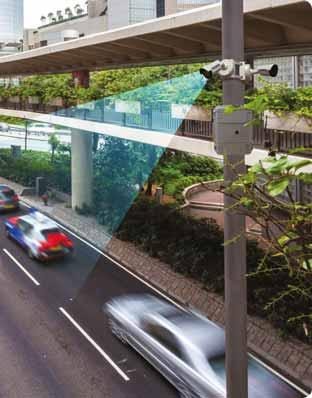
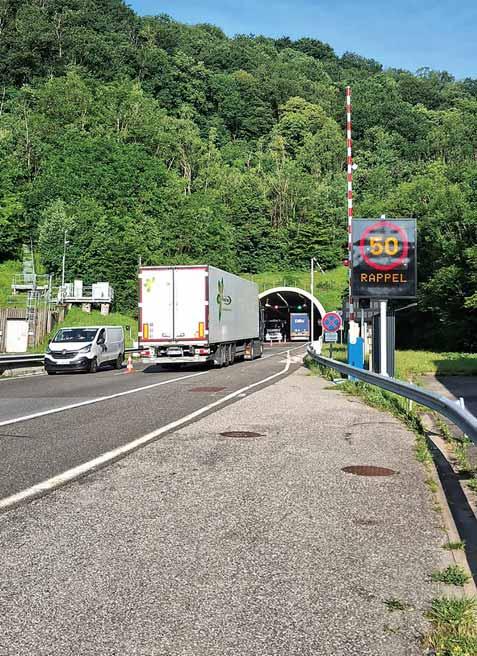
Tragedy was averted when in June a fire broke out in the Vuache Tunnel in the Haute-Savoie region of the French Alps. Automatic incident detection (AID) systems from Citilog played their part in quickly alerting officials about the incident which ensured a swift and effective response from emergency services.
The twin-bore 1.4km-long tunnel was opened in 1982. It was in the southbound tunnel that a heavy goods vehicle laden with plastic pellets caught fire. Because of Citilog’s early warning, officials were able to close the tunnel - one of two bores - before the fire fully broke out. This prevented other vehicles from entering and avoiding what could have been a far more serious situation (see box, response timeline).
ATMB (Autoroutes et Tunnel du Mont Blanc) is the company responsible for managing the French side of the Mont Blanc Tunnel, which runs between France and Italy, as well as the surrounding alpine highways. ATMB plays a key role in ensuring safe and efficient cross-border transportation. This recent positive outcome is the result of a remarkably fast and coordinated response by ATMB’s operations teams and emergency services - and, crucially, of the automatic incident detection system that triggered the first alert.
Citilog is a major supplier of videobased automatic incident detection solutions for tunnels, bridges and highways, with more than 60,000 cameras installed world-wide.
Citilog says that its solution turns cameras into AID sensors, creating a broad detection network where nothing is missed. No matter where an incident occurs, it will be detected instantly to reduce its impact on road users - and sometimes help save lives and prevent secondary accidents. Its broad incident detection automatically identifies wrongway vehicles, pedestrians and debris, smoke and occlusion as well as lane changes, congestion and slow or stopped vehicles.
Citilog’s AID is deployable on a server or directly within the cameras, ensuring it meets all customers’ needs. It is compatible with central servers for future scalability and is completely cameraagnostic, allowing one server to handle up to 100 streams. It is deployable on Axis cameras as a cost-effective alternative for distributed architectures.
and deep-learning algorithms enables a detection range of 300m - not achievable through deep learning alone.
Traffic through the dual-bore Vuache Tunnel, part of the A40, resumed the next day when officials reopened the other two-lane tunnel using one lane in each direction for vehicles. Meanwhile, as a safety precaution, ATMB reported that the transport of dangerous materials through the tunnel was forbidden until repairs to the damaged tunnel were completed and the restriction officially lifted.
Incidents will always occur. No system is going to be perfect, explains Grégoire Latourte, regional sales manager for Citilog. It is all about risk management. When an incident such as the recent one in the Vuache Tunnel happens, it reinforces the ongoing efforts of tunnel operators and owners to secure their infrastructure and invest in systems like AID.
The system’s video analytics algorithms are trained to identify vehicles and remain unaffected by shadows, reflected light, or moving vegetation. Citilog says that its combination of pixel analytics
In fact, the risks of a fire in a road tunnel are greater than many people would think, according to the World Road Association (Piarc). Since 1957, Piarc has had a road tunnel committee to address a range of issues related to the use of road tunnels, such as geometry, equipment
The risk of fire in a road tunnel is greater than many would think, says Piarc
and maintenance, operation, safety and the environment.
Piarc says that vehicle fires give rise to particular concern simply because they are, actually, not very rare in road tunnels. The discussion on tunnel fires is often dominated by the extreme events which have occurred, such as in the 11.7km-long Mont Blanc Tunnel between France and Italy and in Austria’s 6.5km-long Tauern Tunnel. However, in reality, the majority of tunnel fires are relatively small events in comparison. Nevertheless, says Piarc, they may have the potential to develop into more serious events, depending on various influencing factors. This is because the vehicle fires are contained for the most part within a vehicle’s physical structure and are slow to grow outside the vehicle. Basically, vehicles catch fire more often than the public thinks; it is just that they usually catch fire on an open road.
Piarc affirms that the confined space of a tunnel provides an environment in which untenable conditions may develop rapidly in the case of a fire. Numerous real fire tests have been performed in the context of various national and international research programmes to confirm assumptions on fire sizes and fire behaviour. In these tests, the focus again has been on large-scale fires with high heat-release rates.
Given all this, road tunnel operators and owners have been well aware for many, many years about the importance of an AID system and its ability to rapidly detect events, allowing emergency teams to react quickly and avoid the most serious of repercussions - loss of life.
“However, they may not all be aware of the leap in performance and reliability that has been achieved over the past 10 years, thanks in particular to the use of deep neural networks,” says Latourte. “This minimises the inconvenience caused by false alarms and enriches the information fed back to operators. For example, a system can provide vehicle class information or generate new types of alarm.”
All this paves the way for the deployment of AID systems on open roads under challenging environmental conditions where performance levels now meet operators’ expectations.
“I can't speak on behalf of ATMB, but what is certain is that they have demonstrated operational excellence in managing this incident and minimising its impact,” says Latourte. “First, in terms of the human toll, since there were no casualties. But also in material terms, since the fire caused damage that was kept to a minimum by the rapid and appropriate response of the emergency teams. From Citilog’s perspective, I can only commend ATMB's scrupulous and regular maintenance for their AID system to ensure optimal working order at all times.”
The maintenance aspect of AID systems
The tunnel runs through the Haute-Savoie region of the French Alps
Vuache Tunnel fire: response timeline
• At 10:33 the incident detection system identifies a stopped vehicle; the ATMB control centre immediately activates tunnel-closure procedures
• At 10:38 the fire breaks out on the truck, but the tunnel is already closed; firefighters intervene swiftly, no other vehicles are involved and the driver is safely evacuated
• By 5:30am the next day, safe traffic flow is restored through the unaffected tube
“ ATMB organises detection tests every year… All this pays off when an incident such as a fire breaks out in a tunnel
“
Grégoire Latourte Citilog
cannot be over-emphasised, continues Latourte. “Beyond the usual maintenance, ATMB organises detection tests every year, enabling them to validate the system's ability to perfectly detect any type of event. All this pays off when an incident such as a fire breaks out in a tunnel.”
As with all technologies, it will move forward and rapidly. “I don't think the race to higher levels of performance is over,” says Latourte. “We'll continue to work to exploit
the potential offered by new developments in the field of AI applied to computer vision. It would not be surprising, either, if the reliability and enrichment of information were to be achieved through the fusion of different complementary technologies or the use of multiple information sources, starting with those made available by the vehicle itself, through V2X [Vehicle to Everything] technology.”
While there is no universal rule about when an AID provider is brought into a new tunnel project, Latourte says that Citilog is regularly consulted by engineering firms during structural design phases. “This is a virtuous circle. I would always recommend it, as it enables us to pass on the benefit of our experience accumulated over almost 30 years of AID projects around the world. It will give an AID system every opportunity to excel once deployed in operational conditions.” ITS
THE WAY AHEAD
2000-2025
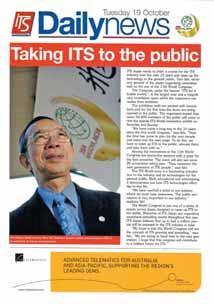
The first large-scale tap-on/tap-off card, the beginning of the Daily News and – via Barbie - a milestone in V2X deployment: here’s some ITS highlights from the first quarter of the 21st century…
2000
The first of (so far) 10 movies in the globally-popular Fast & Furious franchise is released, a testament to the enduring appeal of speed in popular culture. Not so good on road safety. Or decarbonisation
Japan’s Land, Infrastructure, Transport and Tourism Ministry creates a study panel to discuss a ‘vehicle autopilot driving system’, with a view to seeing self-driving cars using designated expressway lanes in the 2020s BACK IN 2001
Daily News launched
For the 7th ITS World Congress in Turin, Italy, ITS International launched the Daily News, written and printed on-site. The first US version came in Chicago in 2002 (pictured) and the magazines – plus their digital and eNewsletter incarnations – have been a fixture of other events, such as ITS America Annual Meetings and Intertraffic Amsterdam, ever since. The Daily News will be back at the ITS World Congress in Atlanta from 24-28 August this year
BACK IN 2012
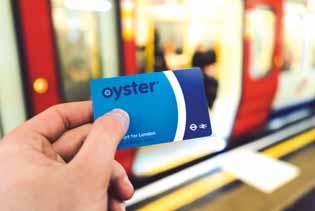
TfL introduces Oyster card
2003 2017
One of the most popular transport smartcards was launched, allowing riders to ‘pay as you go’ by topping it up, rather than purchasing a ticket for the journey. Transport for London says Oyster made travel “simpler and more convenient by allowing faster boarding on buses, quicker access through ticket gates, and reduced need to queue to buy paper tickets”
Public-private transportation
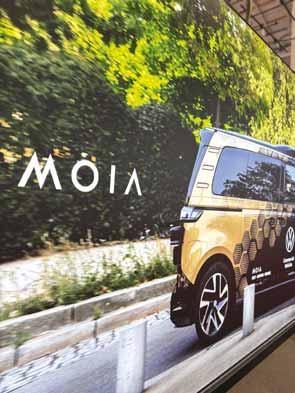
Volkswagen subsidiary Moia and public transport agency Hamburger Hochbahn start work on a new, environmentally-friendly mobility service for Hamburg, Germany. The idea is to supplement mass transit with on-demand electric shuttles to provide an attractive alternative to travelling by private car
With strict lockdowns and widespread working from home in place, ridership on mass transit collapsed all round the world - New York’s Metropolitan Transportation Authority warned of an urgent need for $12 billion to offset lost revenue that year, for example. Some unexpected consequences of Covid included improved air quality, expansion of cycling infrastructure, rising micromobility and repurposing of street space
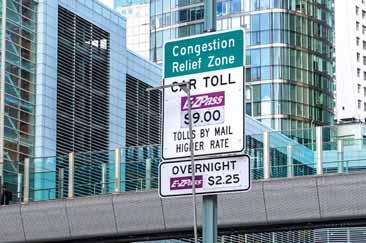
New York congestion charge
The first congestion charging scheme in a US city finally comes into force. New York City's Congestion Relief Zone means that car drivers pay a $9 daily toll to enter Manhattan south of 60th Street during peak hours; the overnight rate is $2.25. MTA says the move is required to reduce traffic congestion and raise revenue to improve public transportation services
The US Federal Communications Commission granted a joint waiver request to deploy cellular Vehicle to Everything (C-V2X) technology - which allows vehicles to communicate with one another and with road infrastructure - in the upper 20 MHz part of the 5.9 GHz band. Jim Misener, Qualcomm global V2X ecosystem lead, told ITS International: "So that means safety starts to happen on American roadways sooner rather than later”
Tolling Reaches New Heights in the Mile High City
October 11-14, 2025 | Denver, CO
Join IBTTA for the largest gathering of the global tolling community.
WHAT TO EXPECT:
Three full days of expert-led sessionsexploring the global trends, challenges, and innovations shaping the future of the tolling industry.
Packed exhibit hall showcasing the latest tolling innovations, products, and services.
The IBTTA Toll Excellence Awards Ceremonyrecognizing industry excellence including the announcement of the President’s Award for Innovation.
Three Denver-area technical tourspresented by our hosts and multiple networking opportun ities throughout the meeting. Register today! ibtta.org/denver
HAPPY BIRTHDA(IL)Y
Twenty-fi
ITS International launched the Daily News
7th ITS World Congress in Turin. Publisher Andrew Barriball looks back – and explains how the publication has evolved to remain a key component of ITS events all over the world…
It’s only natural
The transportation industry needs to change to meet future challenges. Natalie Sauber of Arcadis suggests that nature-positive mobility is going to be the only way forward…
Cities are overheating. Pollinators are disappearing. Congestion keeps climbing, while natural systems strain under the pressure of growth. Everywhere you look, the way we move and what we move through is starting to fracture. Mobility today isn’t just about vehicles or infrastructure. It’s about ecosystems, industrial policy, and the choices we make in response to climate breakdown, technological shifts, and a new era of geopolitics. Governments are no longer just referees. They’re becoming architects. And the blueprint is changing.
The shift: From emission reduction to ecosystem regeneration
The last decade was all about cutting emissions. The next one will be about restoring ecosystems. Nature-positive mobility means
infrastructure that actively restores. Think of transport corridors that support pollinators. Rail lines that make space for biodiversity. Roads that work with, not against, the environment. According to UNEP, just 3% of global transport projects currently assess biodiversity impacts at the design stage. But this is changing fast. Europe is pushing forward: the UK mandates a 10% biodiversity net gain in development, and the EU’s Nature Restoration Law introduces binding targets for degraded ecosystems. Across Asia, China’s Ecological Civilization strategy embeds biodiversity into development policy. In Singapore, the Jurong Innovation District weaves in forest corridors and sponge city elements. In India, Bengaluru is embedding urban forestry directly into its transport infrastructure. In North America, early efforts are gaining ground. Some US cities have begun
“
“ The last decade was all about cutting emissions. The next one will be about restoring ecosystems
Natalie Sauber Arcadis
trialling green corridors alongside highways and expanding urban tree-canopy targets within mobility planning. But the regulatory consistency seen in Europe remains nascent. This isn’t about nature in the abstract. It’s about cleaner air on your commute. Quieter neighbourhoods. Resilient cities. Nature is no longer a footnote. It’s becoming a fundamental design parameter.
The policy arms race: Sovereignty over speed
Global mobility is fragmenting. Countries are racing to build self-reliant systems. Policies are shifting inward. In the US, the Inflation Reduction Act prioritises domestic electric vehicle (EV) and battery manufacturing. In the EU, the Critical Raw Materials Act aims to cut reliance on China, and Green Deal policies are setting new thresholds for
supply chain transparency. Across Asia, China continues to dominate upstream clean-tech value chains, exporting over 60% of the world’s EVs in 2023 alone, according to the IEA. The result is diverging industrial policies, national taxonomies, and regulatory borders tightening. It’s not just government-to-business anymore. It’s increasingly government-to-bespoke. This leaves businesses with a tough decision. Do they build for interoperability across regions, or optimise for local compliance in a world of competing rulebooks?
Data is the new public utility
Forget the old line that data is the new oil. It’s more like water now - essential, everflowing, and foundational to infrastructure. Governments want control over the pipelines. The EU Data Act comes into effect next year, bringing rules on portability, open APIs, and interoperability. Cities like Barcelona already require private mobility operators to share real-time data with public agencies. In North America, regulators are only beginning to shape this conversation, while some Asian governments, notably South Korea and Japan, have already embedded national AI and data ethics frameworks into smart mobility schemes. This shift isn’t only about privacy. It’s about strategic control, national resilience and who governs the digital infrastructure that enables mobility. Expect to see data increasingly treated as public infrastructure, with governance, duties and obligations baked in.
The systemic bottleneck
Every region faces a version of the same problem. Ambition is high, but execution is stuck. In the UK, decades of additive regulation have created a tangle of processes where even good ideas stall. One example is the introduction of a national bat protection strategy to replace thousands of bespoke local plans. It's a small step, but a smart one. In the US, permitting reform has become a bipartisan priority. Despite a $7.5 billion federal investment, only 47 EV charging stations had been deployed across 15 states by the end of 2024, according to Politico Bureaucratic hurdles, equipment delays, and local coordination challenges continue to stall delivery. In Asia, speed is often prioritised, but alignment with environmental and social safeguards varies widely. The real challenge isn’t the vision. It’s the plumbing - how we plan, fund, approve and scale infrastructure in a way that doesn’t default to delay.
Drones,
AVs and the defencemobility
nexus
services. In the US, BVLOS regulations are still evolving, with commercial use lagging behind defence. Autonomous vehicles are on a similar path, combining artificial intelligence, robotics and transport systems into a single high-stakes space. This convergence raises new ethical and strategic questions. When mobility merges with defence and national infrastructure, the policy stakes and the competitive risks rise sharply.
Final thought: Policy is the new operating system
Mobility is becoming dual-use by design. Drones developed for conflict zones are being adapted for civilian applications like rural medical supply delivery. By 2030, the UK wants commercial drone delivery to be routine across sectors from emergency response to infrastructure maintenance. In Asia, China and South Korea are expanding drone logistics for both urban and rural
Governments aren’t just setting regulations. They’re defining the incentives, constraints, and blueprints for what’s possible. If mobility infrastructure doesn’t give back to nature, to communities, to data ecosystems, then it’s not future-ready. We can’t keep layering new ambitions onto broken systems. It’s time to rethink the plumbing - how we plan, fund, permit and procure. Nature-positive mobility isn’t just a good idea. It’s the next frontier of sustainable infrastructure. With initiatives like Valuing Nature gaining momentum, the shift from extractive to regenerative models is finally getting real traction. We’ve got the ambition. Now we need the systems, and the political courage, to match it. ITS
ABOUT THE AUTHOR:
Natalie Sauber is global ecosystems development director at Arcadis
Between the lines
UITP Summit 2025 in Hamburg highlighted an interesting collaboration between the public and private sectors with the aim of moving people around more easily. Adam Hill reflects on some learnings from this now-annual event…
The ITS world does not exist in a vacuum: the way that transport services are planned and run; the choices we make in promoting new mobility initiatives; the access that we build into our schemes; our assumptions in how we think about what communities need – all of these are (or should be) on the minds of policymakers and planners.
Moving people in a safe, efficient, sustainable way isn’t just a question of better traffic management – it’s about providing options. If your only option is to use your own car, then that’s really no choice at all… And so to the UITP Summit 2025 in Hamburg, Germany, where a long-standing public-private partnership came under the spotlight.
Hamburger Hochbahn, the city’s public transport agency, has an agreement stretching back to 2017 with Volkswagen subsidiary Moia, which provides on-demand ride-share services. These were electric vehicles when it started and, the plan is, they will eventually be autonomous too.
Pragmatic relationship
While this is not ‘new’ thinking, it is an example of ‘good’ thinking. Interestingly, Hochbahn has never seen Moia as a threat;
instead, it’s a pragmatic relationship. Hochbahn CEO Robert Henrich says: "It is not a competitor to public transport - it is a complement. We think it's important that the customer should have the right solution at their fingertips." This would often be public transport - "it is the backbone of mobility in the city" - but could also be shared mobility.
That idea – of providing people with different ways of moving around, acknowledging that successful mobility systems consist of disparate elements, working together – should not be revolutionary but often feels as though it is.
If your only option is to use your own car, then that’s really no choice at all “ “
Efforts to change this are certainly underway in Hamburg. AV provider Holon is also testing its Holon Urban shuttle this summer in its first real-world pilot – the Alike project, again in partnership with Hochbahn, supported by the German Ministry for Digital and Transport.
Separately, Hochbahn’s 3plus3 project will see autonomous buses on the streets at the end of 2026. Rather than being on-demand, these will run on scheduled
routes in addition to the existing bus service. Hochbahn says it will share the findings from the project with the Association of German Transport Companies (VDV) and other transport firms to promote a ‘shared learning’, with a view to moving from trial to regular operations in 2028-29.
Technology-driven business
Dr. Anjes Tjarks, minister for transport and mobility transition in Hamburg, told UITP Summit 2025 delegates that public transport “is a people-driven business”. However, he added: "But it must become a technologydriven business. That's a big challenge."
Sascha Meyer, CEO of Moia, acknowledged that autonomous vehicles have not (yet) been deployed in the numbers that might have been expected – but says this is precisely because it is difficult: "The industry has underestimated the effort to create an integrated system."
Perhaps we are now seeing a more realistic understanding of what’s involved. Either way, the UITP Summit moves to Dubai in 2026, before returning to Hamburg in 2027 - the perfect opportunity, in other words, to compare how mobility has changed in Germany’s second-largest city over a two-year period where so much is expected. ITS
VW subsidiary Moia has an agreement with Hamburger Hochbahn
Frugal innovation is key to expanding ITS in Africa
Doing more with less
could unlock intelligent transportation systems across the African continent, says Debo Shopade of Genyz Transport Solutions UK
The transformational power of intelligent transportation systems - though obvious in most developing economies - is not yet visible in Africa. Despite the overwhelming benefit case for it, adoption across Africa remains muted with very limited, isolated implementation across few major cities. With the continent’s rapidly-growing urban population set to triple by 2050, a major escalation of the transportation challenges is anticipated. In this scenario, not having ITS in the mitigation toolkit will be a mistake.
Answering Africa’s slow ITS deployment question is not an exact science and there are many reasons that could be responsible - ranging from socio-economic to technical limitations and a lack of a coherent national ITS deployment strategy. One issue addressed by this article is that traditional ITS solutions and deployment approaches are not tuned to the realities and context of most African economies. The answer in my view lies in the need for frugal innovation - creating greater business and social value while significantly reducing resource utilisation in resource-constrained settings. This notion fits well with Africa’s capacity- and resourcelimited socio-economic context. Rather than importing expensive, feature-rich ITS
solutions from developed markets, African cities can leverage existing technologies and local expertise to build contextually appropriate ITS solutions.
The African challenge
Africa faces unique barriers to ITS adoption, such as weak institutional frameworks, limited budgets competing with traditional infrastructure projects, and unreliable power supply. These create a challenging environment for conventional technology deployments to work. There's also a persistent perception among some policymakers that “ITS cannot work here”. Such perception is driven by a wrong prevailing sentiment that ITS is an enabler of traditional transportation systems, as opposed to ITS being a viable paradigm at the heart of new transportation networks - while also enabling ones.
“ Traditional ITS solutions and deployment approaches are not tuned to the realities and context of most African economies
The African context demands a fresh approach. Instead of viewing resource constraints as obstacles, frugal innovation treats them as catalysts for innovation and creative problem-solving.
Principles of frugal ITS Frugal innovation differs fundamentally from traditional technology-transfer approaches. Whereas conventional approaches prioritise technological sophistication and advancement, frugal innovation focuses on core functionalities that deliver essential value. It emphasises affordability, simplicity, sustainability and inclusivity.
This approach can be applied across the entire ITS value chain—from data collection using mobile phones instead of expensive sensors, to battery-powered e-paper displays that operate for weeks without recharging in areas with unreliable power.
Lagos BRT: a case study
The Lagos bus rapid transit system demonstrates frugal innovation in action. Serving a metropolitan area of 25 million people, Lagos faced severe congestion and inadequate public transportation. Traditional ITS solutions would have been prohibitively expensive and difficult to maintain.
Instead, the project adopted frugal approaches:
• Agent-based ticketing: Fares were collected in advance via a network of agents rather than installing expensive smart ticketing solutions
• Energy-efficient tracking: Always-on vehicle monitoring despite power constraints
• Feature optimisation: Unnecessary features were eliminated to reduce costs and complexity
The result? Improved operational efficiency, enhanced service quality, and increased ridership—proving that contextually appropriate solutions can deliver significant benefits.
Innovation examples
Across Africa, frugal ITS solutions are emerging:
• Mobile phone-based traffic data collection leverages high smartphone penetration rates
• Battery-powered magnetic sensors provide alternatives to expensive inductive loop detectors
• Mobile payment systems like M-Pesa have been adapted for public transportation fare collection
• Ride-hailing applications have been modified for local conditions
• Capacity development: Investment in education and training programmes focused on frugal approaches, combined with leveraging diaspora expertise, can build local capabilities.
• Implementation: High-visibility demonstration projects can showcase benefits while phased implementation allows for learning and adaptation with minimal initial investment.
• Research and innovation: Contextualised research focused on local challenges should inform technology adaptation efforts, with platforms enabling collaborative problem-solving.
The path forward
Frugal innovation offers African countries a pathway to accelerate ITS adoption without waiting for traditional infrastructure development or large capital investments. By focusing on contextually appropriate solutions that leverage local knowledge and capabilities, cities can address pressing transportation challenges while building sustainable technology ecosystems.
The key is recognising that constraints can drive innovation. When resources are limited, creativity flourishes. Africa's transportation challenges are real, but so is its potential for innovative solutions.
• Physical infrastructure adaptations: Barriers prevented other vehicles from entering BRT lanes, ensuring route discipline without sophisticated enforcement technologies
• Biometric driver management: A simple login system improved accountability nancial incentives linked to driver behaviour
• Vandal-proof design: Technologies were adapted with theft-resistant features for challenging environments
These examples show how existing technologies can be combined creatively to address local transportation challenges.
Strategic framework
Successful frugal ITS implementation requires a comprehensive approach:
• Policy and institutions: National ITS strategies should explicitly incorporate frugal innovation principles and create regulatory frameworks that accommodate innovative solutions while ensuring safety and interoperability.
As urbanisation accelerates across the continent, the choice is clear: continue waiting for expensive, imported solutions that may never arrive or embrace frugal innovation to build ITS deployments that work in African contexts today.
The Lagos BRT example shows this isn't just theoretical—it's happening now. Other African cities should take note and adapt these principles to their own unique circumstances. ITS
ABOUT THE AUTHOR:
Debo Shopade is CEO at Genyz Transport Solutions UK, specialising in ITS implementation in emerging markets
Mobile sensors are enabling cities to drill down into air quality at a hyperlocal level – and make data-based decisions which will cut pollution and improve urban mobility, block by block. Gordon Feller reports on three companies…
According to various studies sponsored by the World Health Organisation, air pollution is the greatest environmental health threat of our time. While more and more communities around the world have started to collect air quality data with low-cost sensors, automated monitoring stations or satellites, the data is often not put to use.
As they face off against serious environmental problems, cities around the world are looking for ways to tackle air pollution, loud noise and bad road conditions. Elected and appointed officials in these jurisdictions know that these are not just annoying problems — they affect people’s health, property values, traffic flow and overall quality of life.
Traditional ways of checking air and noise levels — like fixed monitoring stations — provide a general picture for a whole city. But they miss the differences from one street to another, which are often the most important for everyday choices.
This lack of detailed data is a big
issue for many sectors. For example, health apps can’t give safe advice to runners or people with asthma without knowing the exact air quality in each area. City planners also need accurate, local data to design green spaces or plan traffic better. Even real estate listings could benefit from showing how clean or polluted a specific neighbourhood is. Mobile sensors offer a better way, but they’ve often been too basic or not reliable enough. One recently-developed option places high-quality sensors on moving vehicles. The core idea is quite simple: gather real-time data on air quality, road conditions, and noise — every few metres, all day long. This kind of system is not just an idea: it’s already working in some cities. It provides clear, street-level insights that help people, businesses and governments make smarter, healthier choices.
Scalability and impact
Since 2022, Swiss tech firm Sparrow Analytics has driven over one million miles, collecting more than a billion environmental measurements across more
“
like giving cities an MRI instead of an X-ray
“ It's
Max Interbrick
Sparrow Analytics
than 10 countries. This global expansion has demonstrated both the scalability and impact of its platform.
In Switzerland, Sparrow deployed its technology in the country’s top five cities, covering 640 zipcodes and more than 2.5 million people. Partnering with Swiss Post, Sparrow equipped delivery fleets with its mobile sensors – Sparrow Nodes - which are capable of measuring up to 50 different parameters while in motion. This creates a dense, mobile sensor network and the initiative transformed environmental intelligence across Geneva, Zurich, Lausanne, Bern and Basel — revealing hyper-local pollution hotspots and enabling municipal authorities to take fast, data-driven action on traffic and air quality.
“Sparrow is now working with TomTom to integrate air pollution data into driver cockpit displays,” says Sparrow co-founder and COO Max Interbrick. “Drivers will see not only traffic delays but also real-time pollution-exposure levels, helping sensitive individuals avoid high-risk areas and reducing overall traffic”.
In Belgium, the city of Antwerp leveraged Sparrow’s sensors through a collaboration with mobility services. Facing increasing public concern over urban pollution, Antwerp used the real-time data to pinpoint particulate concentrations and nitrogen dioxide spikes. This empowered the city to implement smarter traffic-flow strategies, adapt public warnings, and integrate air quality insights into local apps — significantly enhancing public health responsiveness.
When asked about the impact of the company’s deployment of its technology inside Antwerp, Interbrick says: “After four months of deployment, Sparrow nodes revealed high NO2 levels in low-emission zones, despite traffic restrictions. This particular insight led a local political party to propose new Friday closures, for better enforcement”.
Extreme conditions
In Israel, Sparrow conducted a ‘harsh device test’, whose aim was to push equipment to perform under extreme climate and terrain conditions. This validation helped improve the robustness of the Sparrow Node hardware for global deployments, ensuring reliable operation, whether it be in deserts or dense urban cores.
More recently, Sparrow launched its operations in New York City, not the most easy-going urban environment. In NYC, Sparrow Nodes are being integrated into fleets to create a high-resolution, real-time environmental map. That’s useful for mobility services, public health agencies and urban planners in any dynamic metropolis.
Sparrow now works to adapt its data platform to varying needs, infrastructures, and climates “while maintaining scientifi accuracy and operational reliability”.
At the heart of Sparrow’s tech is the Sparrow Node proprietary mobile sensing device. Each one combines “high-grade sensors with real-time GPS and timestamp technology to collect data on multiple environmental parameters”, including:
• Air pollution: PM0.3-0.5, PM0.5-1-2.5-5, PM10, NO, NO CO, CO2, VOC
• Weather data: temperature, humidity, and pressure, altitude and speed
• Road quality: International Roughness Index (IRI) and surface defect vibration (SDV) metrics
• Noise pollution: real-time exposure and event detection
Each Sparrow Node is mounted on a vehicle using a magnetic, rugged design built for operation from -30°C to +50°C. As vehicles navigate their routes, data is collected every few seconds and transmitted via cellular networks to a cloud platform. The system is designed for reliability and low latency, using REST-based APIs for seamless integration with third-party platforms.
‘Continuous calibration’
To ensure greater accuracy, Sparrow Nodes undergo “continuous calibration” against reference-grade instruments. This approach blends the coverage of mobile sensors with the reliability of stationary lab-grade monitors. The company developed multiple APIs — including address, zipcode, city and area – which enables tailored access by clients, from mobile app developers to public sector dashboards.
The platform’s intelligence has been designed to get one step beyond mere data collection. Through machine-learning models, Sparrow analyses pollutant behaviours, detects anomalies and models future trends. This predictive power allows cities not just to react, but to plan ahead — forecasting exposure risks during events or high-traffic periods and aligning interventions with real-time needs.
Unlike traditional solutions that require massive infrastructure and lack real-time flexibility, Sparrow’s fleet-integrated system in a place like NYC enables coverage of the entire city with as few as 50 sensor-equipped vehicles.
Interbrick says that Sparrow represents a “leap forward” in environmental Data as a Service, bridging the critical gap between macro-level urban data and micro-level decison-making. With proven deployments in Switzerland and Belgium, a scalable tech platform, and a business model built on partnerships with delivery fleets and public vehicles,
Interbrick focused the company on its differentiation from other providers. “Most current air pollution monitoring relies on low-resolution simulations, based on sparse reference stations or limited static sensors,” he argues. “Sparrow changes that by using mobile sensors on public transport to deliver real-time, street-level data where people actually are. It's like giving cities an MRI instead of an X-ray”.
With its focus on roads, Sparrow enables what Interbrick calls “data-driven decisions” on transport, mobility and traffic-related air pollution. He says Sparrow helps customers – both cities and companies – to “drive real behavioural change”.
Other companies are pushing the envelope to develop new approaches. Two are worth noting here: Breeze Technologies and Aclima.
From its home base in California’s Silicon Valley, Aclima’s hardware and software technology platform “translates billions of scientific measurements from its network of roving sensors into environmental intelligence”.
Sources of air pollution
Last year, the influential State of California’s Air Resources Board (Carb) launched an innovative programme to enhance air quality monitoring across the state, with a heavy focus on communities where residents live near multiple sources of pollution.
“ “ What gets measured, gets managed: with SMMI, we are measuring more than ever before
Davida Herzl Aclima
Aclima says its mobile network delivers air quality data at the street level
The goal of this public/private partnership, dubbed the Statewide Mobile Monitoring Initiative (SMMI), is to get more data about the levels and sources of air pollution and greenhouse gas emissions that communities face.
Carb awarded a $27 million contract to Aclima to serve as SMMI’s core tech provider, with the funds provided by California Climate Investments. With this money Aclima is deploying a fleet of over 40 sensor-equipped vehicles to map air pollution at the neighbourhood level across 64 California communities.
The state government says this “is designed to provide real-time, block-by-block air quality data, especially in communities most affected by pollution, covering more than 950,000 miles and reaching 5.2 million residents”.
Aclima engineers three distinct components to its system:
• Vehicles are equipped with cutting-edge sensors that collect high-resolution data on dozens of pollutants every second as they drive through urban areas
• SMMI is guided by community input, with Community Air Monitoring Plans “developed in partnership with local organisations to ensure monitoring targets the areas of greatest need”
• Aclima’s collected data is made available to regulators and the public, “supporting transparency and empowering communities to take action”
Aclima says its mobile network delivers air quality data at the street level, revealing pollution differences that can vary up to
eight times from one block to the next. The firm provides what it calls “an integrated platform—from data collection to analytics and public reporting—enabling actionable insights for cities, regulators, and residents”. SMMI routes were informed by environmental NGOs "engaged with local communities to identify areas and sites of most concern" (e.g. industrial plants, high-traffic corridors). As part of SMMI, they are being asked for very targeted data from community-led queries.
Environmental decision making
Aclima argues that most systems only measure a subset of major pollutants, which is not an adequate health indicator of air quality: “Unless people have the data, it is impossible for them to connect the dots on what is impacting the air they breathe.”
Davida Herzl, CEO and co-founder of Aclima, says the California project is “reimagining the role of technology in public service”. She adds: “Because ‘what gets measured, gets managed’. With SMMI, we are measuring more than ever before—in communities that have waited long enough and are not only finally being seen, they’re being heard, engaged, and helping lead the way. This is not a top-down programme. It’s an unprecedented partnership among government, business, and research institutions.”
Of course, Aclima is not the only enterprise trying to make a difference in cities. According to Robert Heinecke, founder and CEO of German firm Breeze, its technologies “enable cities to implement data-driven environmental management processes, with particular focus on air quality”.
Breeze develops lower-cost environmental sensors as well as an environmental decisionmaking support platform: “Cities deploy our sensors to collect environmental data on a much more hyperlocal scale than before, for instance air quality data on a block-by-block and street-by-street level.”
In 2021 the company launched the InterLuft air quality monitoring project, with money from the German Federal Ministry for Transportation and Infrastructure (BMVI)’s mFund, which promotes R&D projects looking at digital data-based mobility applications.
Breeze has also worked with the US Department of Homeland Security (DHS) Science and Technology Directorate (S&T) in California on deployment of wildfire and air quality sensors – and put in place Germany’s first fully-automated, air quality-based wildfire detection system in Blankenburg.
The company’s technologies are deployed in 11 countries with partner companies, including Microsoft, NTT, SAP, Miele and Deutsche Telekom, and it is piloting what it calls a “citizen portal for air quality data”.
Breeze takes what Heinecke says is an AI-first approach, turning data into action.
“Leveraging our environmental AI, we provide clean-air action recommendations based on the past successes and failures of clean-air actions globally. This way, we are able to provide forecasts of specific impacts of potential clean-air actions”.
Efficiency and effectiveness
Decision-makers use Breeze’s Environmental Intelligence Cloud to receive a database of actions which, Heinecke argues, “greatly increases efficiency and effectiveness of clean-air actions being implemented…. we are aiming at raising the efficiency and effectiveness of clean-air actions by a factor of 10”.
Breeze uses collected data to provide action recommendations from a database of more than 3,500 solutions. The aim is to help customers learn from the successes and failures of their colleagues and predecessors, on a worldwide level.
Heinecke says: “After implementing Breeze Technologies' AI clean-air action recommendations, one of our city partners was able to improve air quality by approximately 70%.”
Each of these three private companies – Sparrow, Aclima and Breeze - is providing real-time hyperlocal air quality data, and they share an important goal: helping urban residents and visitors, particularly those affected by higher pollution levels, to protect themselves.
With accurate information, and with action recommendations, they can avoid areas with higher levels of pollution, use masks and filters, and take other countermeasures. That can prevent health emergencies, and perhaps even save lives. ITS
“ One of our city partners was able to improve air quality by approximately 70%
Robert Heinecke Breeze
Breeze is involved in a wildfire alert initiative in California
BENTLEY ADDS OPEN API FOR BLYNCSY
Bentley Systems has launched an open API and self-service tools in its Blyncsy Roadway Intelligence solution in order to accelerate development of applications. Bentley said the open API (application programming interface) framework will enable third-party developers, users and businesses to seamlessly integrate with the Blyncsy analytics solution. Access to a new self-service portal will
utility of the offering, said the company. Businesses will be able to unlock roadway insights and develop a diverse range of applications, from smart city initiatives and transportation planning to autonomous vehicle development and offering leverages AI and crowdsourced
imagery to deliver actionable insights
solution enables automated detection and analysis of roadway assets and conditions, enhancing maintenance, disaster recovery
will provide access to the crowdsourced dash camera imagery, including new pedestrian and bicyclist detection models, roadway debris and vegetation detection. Additional roadway detections are planned
self-service portal provide a standardised interface to streamline the process for partners, developers and organisations to integrate Bentley’s Blyncsy data directly
www.bentley.com
Fusion's CAVstar is the star in Cambridge
An autonomous electric bus using Fusion Processing’s CAVstar automated drive system has started passenger services on the that will be operating in Cambridge, around 100km north of
allows the buses to drive autonomously, with a safety driver in the cab. Fusion said the autonomous bus service is “ground-breaking” Connector project is led by the Greater Cambridge Partnership
Vehicles (CCAV). www.fusionproc.com
OPTIBUS EXPANDS END-TO-END PLATFORM WITH CONTROL
designed to give public transportation providers command over live service delivery and operations. It combines real-time visibility with
the tools needed to monitor and adapt services in the moment, leading to fewer service disruptions, improved regulatory compliance and on-time performance as well as faster communication between the control centre, drivers and passengers. Control is also vendor-agnostic, able to connect seamlessly to in-vehicle systems, enabling real-time driver guidance, messaging, onboard passenger
teams have full visibility into and control over real-time service
monitoring to give a control centre live visibility into vehicle location, performance metrics and service status, plus the tools to manage service disruptions in real time. Control centres can manage and reassign crew duties and communicate with drivers in real time to keep services moving smoothly. www.optibus.com
Miovision says it is helping to improve road safety by enabling city authorities to act on crashes before they happen. The Canadian company says its Continuous Safety Monitoring (CSM) solution provides life-saving insights by proactively identifying near-misses at intersections. It argues that traditional crash-based approaches "remain slow and outdated, often relying on data that lags by three to six years". By contrast, Miovision CSM "changes the game by enabling cities to act before tragedy strikes". The solution uses existing camera infrastructure to provide near-miss data, which allows agencies to understand where high-risk intersections are and act accordingly.
Key features:
Miovision cameras
• Kinetic risk model that assesses speed, angle, time and user type
• Dashboards and visualisations to track trends, performance and root causes
• 90-day clip storage for before-and-after evaluations
• Multimodal coverage including red-light running, jaywalking and signal compliance
Using CSM, city engineers in Bellingham, interactions at right-turn intersections, before serious collisions occurred. Bellingham evaluated a new infrastructure design, which led to a 33% increase in bicycle ridership, and an 87% bike-lane utilisation rate, Miovision says. www.miovision.com
Verizon Business has commercially launched Edge Transportation Exchange, a mobile-network Vehicle to Everything (V2X) communication platform for connected vehicles, with multiple customers already signed on. Following a successful 5G Automotive Association (5GAA) joint demonstration, the platform is now being used by the Arizona Commerce Authority, Delaware Department of Transportation, Rutgers University Center for Advanced Infrastructure and Transportation (Rutgers CAIT) and Volkswagen Group of America. Edge Transportation Exchange allows vehicles to communicate and share data with each other, pedestrians and connected
signals, in near-real time. The 5GAA joint demonstration included use cases such as informing drivers about vulnerable road
users, dangerous weather and roadway
On the Edge with Verizon’s new real-time V2X platform
timing at intersections. Edge also serves as an API-driven platform for collaborative innovation between automakers, technology developers and municipal governments. Each can use the mobile-network V2X technology to scale existing connected solutions or innovate new technology for road-user safety and satisfaction. Development and collaboration is centralised through the Verizon ThingSpace IoT platform. The robust integrated solution combines Verizon’s 5G and LTE mobile networks, Verizon 5G Edge mobile edge compute and geolocation technology enhanced with Verizon Hyper Precise Location. It uses a virtual architecture that reduces the need for physical roadside radio units. www.verizonconnect.com
RISE OPENS 6G PROVING GROUND IN SWEDEN
Rise (Research Institutes of Sweden) has unveiled a 6G edge-computing facility with end-to-end vehicle and infrastructure testing facilities. Telecom providers, AI engineers and vehicle manufacturers around the world can work together at AstaZero, the world’s
environment for automated transport system and mobility connectivity. This includes component reliability tests in electromagnetic chambers to repeatable functionality tests at the AstaZero proving ground, where systems can be tested in a safe, realistic environment. Rise says that, as international 3G networks are mission-critical systems, such as police,
challenge of upgrading and adapting their systems to ensure seamless integration with 6G infrastructure and technologies. AstaZero is now launching a system that enables communication reliability between vehicles to reach 99.999%, marking the biggest breakthrough in vehicle testing for a generation, according to the Swedish researchers. The next generation of critical communication (V2X) scenarios will unlock the full potential of this ecosystem and allow vehicles – both AI-enabled and non-AI-enabled – to interact within edge networks. To reach the required level of reliability will require tests at the individual sensor level - but also on integrated and collaborative systems, a task which has been impossible until now.
HIGH-PRECISION THEIA TELEPHOTOS FOR FIXED AND MOBILE TRAFFIC INSTALLATIONS
Theia Technologies’ compact telephoto lenses deliver the performance required for modern ITS and ANPR applications. These high-precision lenses combine superior resolution with a compact form factor—
enforcement installations. Theia’s SL1250 and motorised TL1250 telephoto lenses support 300 lp/mm resolution, enabling 1.55μm on sensors up to 1/1.7”. These lenses provide a 12–50mm focal length while maintaining a compact 52mm length, in this focal range. For smaller sensor formats, the SL940 and TL936 offer 200lp/
length, these lenses are among the most compact high-performance telephotos available. All lenses are IR-corrected from 435nm to 940nm, eliminating focus shift
wavelengths. This allows consistent focus across lighting conditions—whether under
ambient sunlight or IR illumination— night licence-plate capture. Paired with modern high-resolution cameras and AI-based recognition engines, the SL1250 and TL1250 can capture licence plates at both visible and NIR lighting. These lenses maintain optical sharpness across the
conditions. Available in manual, DC auto-iris, and P-iris versions, these lenses support CS-mount and D25 board-mount
Content produced in association with Theia Technologies www.theiatech.com
Advertisers INDEX
Cross Zlin p13 www.cross-traffic.com
Cubic p35 www.cubic.com/transportation
Daktronics p14 www.daktronics.com/tmc
Emovis p20 www.emovis.com
IBTTA p32 www.ibtta.com/denver
Intercomp p14 www.intercompcompany.com
Intertraffic p46 www.intertraffic.com
Intetra p39 www.intetra.com.tr
ITS World Congress IBC https://www.itsworldcongress.kr/
ITS European Congress p49 htttp://2026.itseuropeancongress.com
Jenoptik p26 www.jenoptik.com
MAV Systems p29 www.anprcameras.com
Miovision p26 www.miovision.com
Network Optix p25 www.networkoptix.com
Umovity IFC www.ptvgroup.com
Quarterhill OBC www.quarterhill.com
Stalker Radar p29 www.streetdynamics.com
Star Systems International p9 www.star-int.net
Tagmaster p17 www.sensysnetworks.com/multisens
Taplane p19 http://edgepulse.cloud
Tattile p4 www.tattile.com
Vance Street p45 www.vancestreetcapital.com
Vitronic p23 www.vitronic.com
NorthAmerica Edition
Econolite
Iteris
Q-Free
Rekor
NA2 www.umovity.com
NA5 www.iteris.com/signal-trends
NA7 www.q-free.com
NA1 www.rekor.ai
Swarco McCain NA6 http://mccain.swarco.com
(Intelligent Transport Society of Korea) is Korea’s national hub for smart transportation, connecting government, industry, academia, and research since 1999. With companies, it drives mobility innovation.
Designated as the national organization by (Ministry of Land, Infrastructure and Transport), ITS Korea leads (Notice No. 2013-852), (Notice No. 2010-405), and (Notice No. 2015-540).
October 19-23, 2026
Gangneung Olympic Park, Gangneung City, Gangwon State, Republic of Korea
Ministerial Round Table, Plenary / Special Interest Sessions, International / Regional Forum, Technical / Scientific Papers, Exhibition, Demonstration / Tech Tour, Cultural Events and more
AI Traffic Data System
AI-powered traffic reporting. iTHEIA™ da d ta recording.
Automated Enforcement
Safer and smarter roads. Fully-automated solutions.