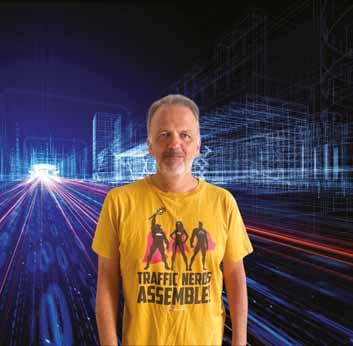
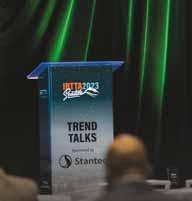
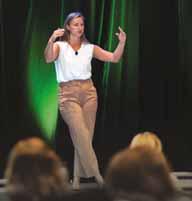
IBTTA president James Hofmann: “Gas tax in the US hasn’t gone up since 1993: that’s where tolling can come in”
Um... did we mention that 2025 is a very special year?
Chattanooga in Tennessee plans the largest deployment of Lidar-based traffic detection in the US
”You can’t be what you can’t see”: practical solutions for levelling the playing field
Technology is ready to meet new demands from automatic braking systems, says Teledyne Flir
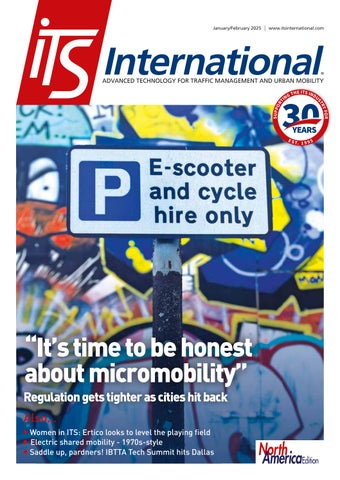
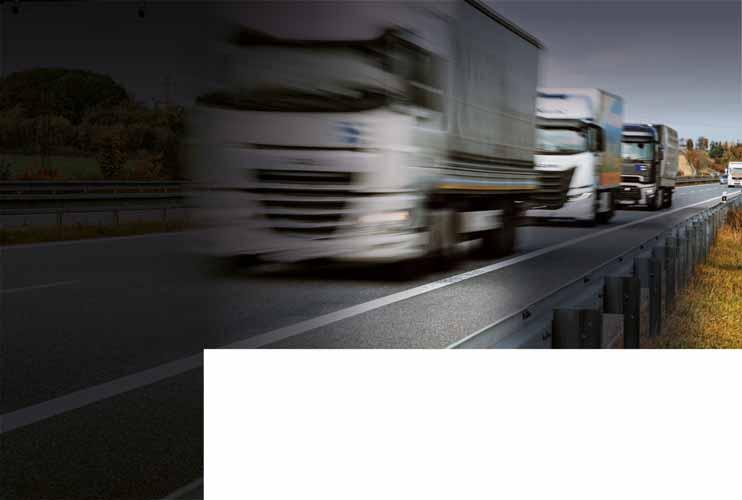
Cities are hitting back with tighter regulation, so how does shared mobility move forward? Scott Shepard has some thoughts... 35
”Get it right, it will usher in a new golden century; get it wrong, and we’re dinosaurs” 40
Should e-scooters be legal on footways? Read the new report 42 WITKAR
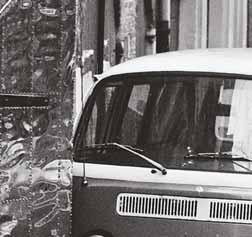
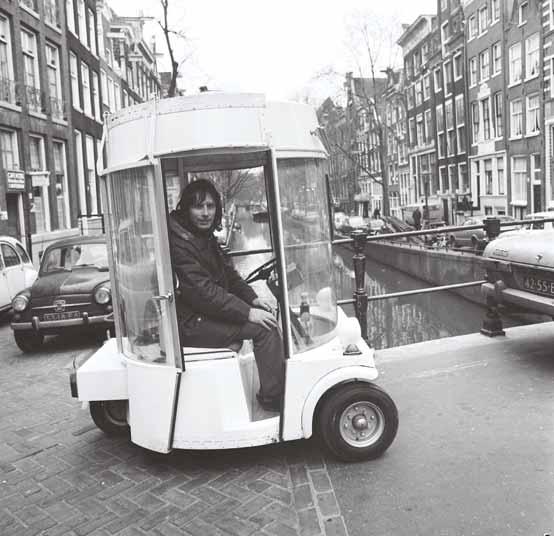
Think electric shared mobility is new? Think again as we head back in time to 1970s Amsterdam... 46
No-one gets left behind if the destination is seamless user experience, says RideFlag Technologies
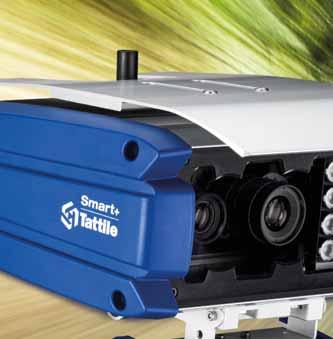
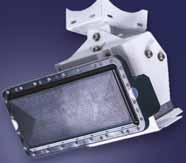
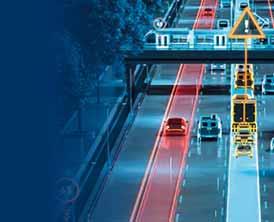
Smart+ Speed
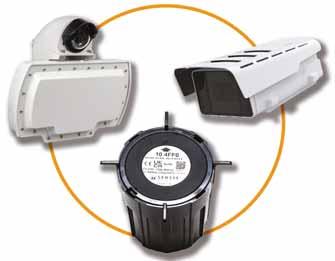
AI BASED SPEED ENFORCEMENT
Neural plate and vehicle detection algorithms
Radar with POE connection
Coverage up to 3 lanes
YOUR VALUES ARE YOUR VALUES: HOW DO YOU WANT TO BE SEEN?
“Those are my principles, and if you don’t like them... well, I have others.” This famous Groucho Marx quote has been much on my mind recently. So three cheers are in order for Kathryn Clay, the new CEO and executive director of US-based tolling organisation IBTTA, who has robustly defended diversity, equity and inclusion (DEI).
“It was really important to me to find an organisation that really lived DEI principles: it’s not a political costume you put on when it’s relevant or convenient; it’s something that you live or you don’t,” she said. “I firmly believe that our values don’t change just because the incumbents in the political powers that be may change - our values stay the same.”
The law is the law. Of course companies and organisations must comply with that. But most of the corporate values we choose to prioritise and portray have absolutely nothing to do with legislation. It’s about what you think is right and how you want to be seen. Your values are your values. Restating and confirming them in tricky political weather is called leadership.
Editor Adam Hill
Email: ahill@ropl.com
Tel: +44 1322 612062
Editorial Consultant
Geoff Hadwick
Sales Director
Dan Emmerson
Email: demmerson@ropl.com
Tel: +44 1322 612068
Production Manager
Nick Bond
Email: nbond@ropl.com
Tel: +44 1322 612066
Design Team
Simon Ward, Andy Taylder
Web Manager
Sarah Biswell
Email: sbiswell@ropl.com
Tel: +44 1322 612078
Data & Marketing
Manager
Alan Cansick
Email: acansick@ropl.com
Tel: +44 1322 612061
Office Manager
Kelly Thompson
Email: kthompson@ropl.com
“
“ Firms – including ITS firms – which embrace diversity tend to do better at the one thing they are created to do: make money
And if, for some reason, you don’t like the ‘it’s about fairness’ argument for DEI, then what about the financial one? McKinsey & Company’s report Diversity Matters
Even More, released just over a year ago, found: “Despite a rapidly-changing business landscape, the business case for DEI not only holds, but grows even stronger.”
It went on: “Companies with greater diversity on their boards of directors are more likely to outperform financially.”
Do all DEI initiatives or hiring practices work perfectly? On the basis that there is unlikely to be a single programme or process in any workplace, anywhere in the world, that cannot be improved in some way, I doubt it. But would you just tear up any other programme or process, or would you take the time to make it better?
So one more time for the people at the back… Evidence suggests that firms –including ITS firms - which embrace diversity
Publisher/
Managing Director
Andrew Barriball
Email: abarriball@ropl.com
Tel: +44 1322 612057
CEO
Roger Adshead
Email: radshead@ropl.com
tend to do better at the one thing they are created to do: make money. The fact that this is still up for debate is curious.
DEI includes greater gender representation, and at the ITS World Congress in Dubai last September, Ertico – ITS Europe organised a session called Global Voices of Women in ITS. We caught up with the six speakers who took part to get some more thoughts from them (p24). As Ertico’s Lidia Buenavida Peña says: “Ultimately, the ITS industry must recognise that fostering a culture of inclusivity is not just about fairness—it’s about driving innovation through diverse perspectives and creating solutions that better serve all members of society.”
As McKinsey & Co have shown, it helps the bottom line, too. That’s a principle we can surely all stand by. ITS
Adam Hill EDITOR
Email me at ahill@ropl.com @itseditoradam.bsky.social @adamhillwriter @itseditor_adamhill
Printed
ITS International (PE 13324) is published 6 times a year with combined issues in January/ February, March/April, May/June, July/August, September/October and November/December by Route One Publishing Ltd, Second Floor, West Hill House, West Hill, Dartford, Kent, DA1 2EU, UK.
Airfreight and mailing in the USA by agent named World Container Inc., c/o BBT 150-15, 183rd St, Jamaica, NY 11413, USA. Periodicals postage paid at Brooklyn, NY 11256.
POSTMASTER: Send address changes to ITS International, World Container Inc., c/o BBT 150-15, 183rd St, Jamaica, NY 11413, USA.
Air Business Ltd is acting as our mailing agent.
Subscription records are maintained at Route One Publishing Ltd, Second Floor, West Hill House, West Hill, Dartford, Kent, DA1 2EU, UK.
All editorial, advertising or circulation enquiries to:
ITS International, Second Floor, West Hill House, West Hill, Dartford, Kent, DA1 2EU, UK.
No part of the publication may be reproduced in any form whatsoever without the express permission of the publishers. Views expressed in this journal do not necessarily reflect the opinion of the Editor or Route One Publishing Ltd.
Reader Enquiry Service: data@ropl.com
Tel: +44 1322 612061
Subscription Enquiries: subs@ropl.com
Global: Print ISSN 1463-6344
Digital ISSN 2057-3421
by Warners (Midlands) PLC
5GAA and ITS India
connect in New Delhi
The 5G Automotive Association (5GAA) and ITS India have signed a memorandum of understanding to drive innovation in connected and autonomous mobility. India is home to 1.4 billion people, making it the most populous country in the world. It is also the most dangerous for road users, with 155,600 fatalities in 2021. 5GAA and ITS India said: "This and sustainable transportation, leveraging 5G, C-V2X and AI-driven mobility solutions. Together, we aim to transform urban mobility, enhance road safety and drive seamless vehicle connectivity."
Q-Free provides ITS software for Statens Vegvesen
Q-Free has signed a contract with Statens VegvesenNorwegian Public Roads Administration - to develop and operate an intelligent transportation system server. The software, which will replace a pilot software from higher throughput, enhanced robustness and better error handling. The contract includes an operations component as a service provided by Q-Free, said Ola Martin Lykkja, Q-Free’s project manager of the company’s RUC 2.0 team - Road User Charging 2.0. “This project highlights [Statens Vegvesen’s]
dedication to adopting C-ITS technology and moving from research to full production,” said Lykkja.
Sustains Life
UK-based research group TRL is partnering with University Hospital Southampton to reduce road deaths by linking
time. The English hospital and TRL have together been awarded £500,000 by the UK’s Department for Transport and the Road Safety Trust to launch
initiative, the two-year Data Sustains Life project. It aims to anonymously integrate wideranging data insights, providing a holistic view of the causes and consequences of road crashes in the UK.
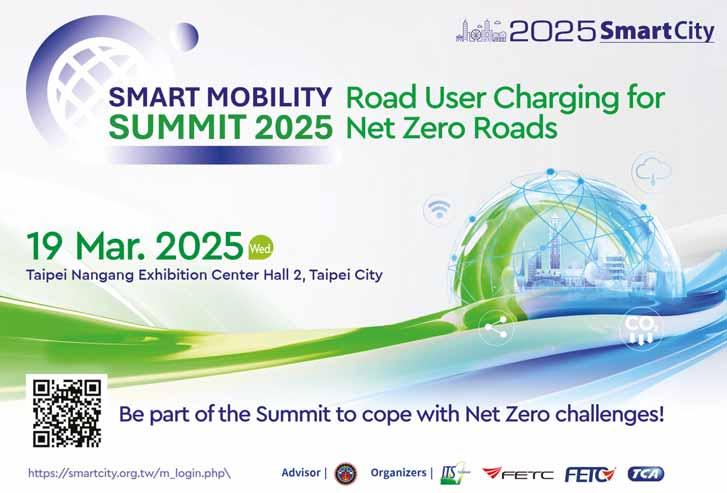
Congress 2029 - is looking at the future of transportation, road user charging and decarbonisation - with a particular focus on the Asia-
New IBTTA boss defends DEI initiatives
The new boss of IBTTA has offered a robust defence of diversity, equity and inclusion (DEI) policies after US president Donald Trump called DEI programmes "dangerous, demeaning and immoral". Kathryn Clay, who took over as executive director and CEO of the tolling organisation at the start of this year, said: "[DEI is] not a political costume you put on when it’s relevant or convenient; it’s something that
Mobility Summit 2025 will take place on 19 March at the Taipei Nangang Exhibition Center Hall 2, co-located with the Smart City Summit & Expo. The one-day programme is jointly organised by ITS Taiwan, Far Eastern Electronic Toll Collection Co, FETC International Co and the Taipei Computer Association.
you live or you don’t…our values don’t change just because the incumbents in the political powers that be may change.”
Taiwan's Smart Mobility Summit takes shape
A one-day event in Taipei, Taiwan – host of the ITS World
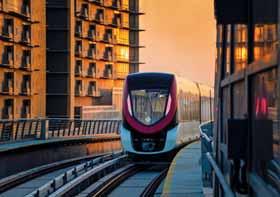
All lines open on Riyadh Metro
Riyadh's driverless mass transit system is now fully open, says the Royal Commission for Riyadh City (RCRC). The last of the six lines to open - the eastwest, 41km Orange Line – runs from Jeddah Road to the Second Eastern Ring Road, parallel to the Khashm Al Aan in the east, and includes An Naseem – an interchange with the Purple Line. Riyadh Metro is open from 6am to midnight, and tickets are available using the Darb and self-service machines at stations.
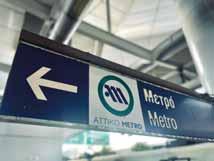
Athens metro goes contactless with Tap2ride
Riders on public transport in Athens, Greece, can now make contactless payments for their journey. The new 'Tap2ride' service on Athens Urban Transport Organisation (Oasa)
The city has 75 signalised intersections, and Econolite will also connect Centracs Mobility
monitoring, with the possibility of adding more.
metro and trams - it has been available since April 2024 on Athens' airport express bus lines. Oasa has worked with Hellas Smart Ticket, LG CNS,
contactless on the Greek capital's urban transport network. Daily maximum charge is equal to the cost of a daily ticket - €4.10 - regardless of the number of journeys taken.
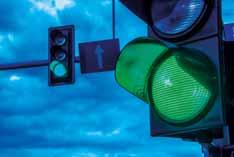
Charlottesville signals its integration with Econolite
Econolite is to integrate its Centracs Mobility platform into the city of Charlottesville's communications network,
and cellular. The city, in the US state of Virginia, covers an area of just 10.4 square miles but sees heavy daily commuter
metropolitan area population of 160,000: it wants realtime management of arterial congestion, as well as the ability to facilitate future ITS projects.
air quality, highlighting issues like liveability and greenhouse gas emissions.
Haas Alert to expand in Michigan
Scenexus is new spin-off from TNO
Dutch research and innovation organisation TNO has launched a spin-off which uses digital twins to improve urban planning, including
Scenexus is supported by an investment of €1.6 million from
Michigan Department of Transportation and the city of Dearborn are looking to extend their use of Haas Alert's Safety Cloud system. The V2X platform delivers to drivers real-time alerts about upcoming roadway hazards such as emergency vehicles and workzones. MDoT is activating it on a mixture of public safety and roadway maintenance vehicles including State Patrol vehicles, snow ploughs, workzone assets and public transit buses. Dearborn is to use the platform on 300 city vehicles and assets
RingGo's parent completes Flowbird acquisition
Venture capitalists E& Capital - part of global technology group E&, headquartered in United Arab Emiratesand telecoms giant AT&T subsidiary AT&T Ventures - have invested undisclosed sums into Derq. The MIT spinoff says the new investment will be used to expand its activities in the US and Middle Kuwait, Oman, Qatar, Saudi Arabia and UAE. Derq’s AIbased solution fuses data
sensors and runs real-time edge analytics to enable infrastructure perception and V2X/5G applications as well as insights.
Star Systems International acquires V Track ID
Tolling tech manufacturer Star Systems International (SSI) - known in particular for its RFID readers and transponders - has acquired data specialist V Track ID. The deal is "to prepare for a future where RFID technology can connect vehicles, toll systems, and other system
and real-time data exchange". V Track ID's patented technology is designed for gathering data on vehicles, operators, and freight with the use of existing installed infrastructure and technologies, bridging the gap from current RFID transponder capabilities towards V2X.
has awarded Cubic Transportation Systems a $211 million contract to design, install and operate a new fare payment system called Septa Key 2.0. Estimated completion date is 2029 and it will be used by nearly four million transit riders in the US city of Philadelphia and surrounding counties. The agency says customers have helped guide the project, and insists Septa Key 2.0 will be more reliable and easy to use, offering new functionality such as virtual key cards and enhanced website, mobile app and call centre.
Hayden AI
Nearly 8,000 parking violations at bus stops were detected in a three-month pilot using Hayden AI’s automated bus stop enforcement system in Braga, Portugal. The pilot was funded by the European Institute of Innovation and Technology’s AI Challenge competition, which Hayden AI and Braga won together in January 2024. To conduct the pilot, Hayden AI technology was installed on two Transportes Urbanos de Braga buses operating on Lines 40 - 44 and Lines 41 - 49. Results from the pilot revealed 7,999 bus stop parking violations occurring along these lines.
awarded €
A joint venture comprising
Worldline has been awarded a speed enforcement support contract in Spain. Worth €83m, the deal from the Spanish
runs until the end of 2027. It covers support and technical assistance and management of the automated complaintprocessing centre in the city of
400 pieces of hardware along Spain's road network, including speed measurement equipment and cameras, and these will be maintained by the joint venture companies.
Ouster’s BlueCity Lidar solution is to be deployed at more than 120 intersections covering downtown Chattanooga, Tennessee. The $2 million contract follows a successful pilot at 12 intersections, and is the largest deployment of Lidar detection technology for
Lidar sensors and edge AI will be installed at each intersection and analyse safety incidents and provide detection for V2X communications.
•See Lidar lets planners see big picture, p19
Emovis has completed its
tolling system for Elizabeth River Crossings in the South Hampton Roads region of Virginia, US. The project includes four tolling gantries located at the
Vehicle data is processed via the cloud-based roadside system equipment platform, Emovis Identify. This generates accurate, uniform transaction messages, the company says, which are integrated with ERC’s toll transaction host for rating and invoicing in near-real-time. The old tolling system has remained operational during the
be decommissioned after full adoption of the new platform.
three companies that manufacture signal heads, controllers, and variable message and passenger information signs, as well as providing software for C-ITS and V2X communication. It had combined sales of €27.3 million in 2023 and employs around 120
opportunity for us to amplify our presence in the French-speaking
4kclips | Dreamstime.com
“WHAT DO WE NEED TO DO TO PROPEL US 20 YEARS INTO THE FUTURE?”
James Hofmann of the North Texas Tollway Authority talks to Adam Hill about new beginnings plus the need for tolling to get the user experience right, streamlining digital experiences - and what to expect from the IBTTA Technology Summit in Dallas
t’s an interesting time!” smiles James Hofmann, president of IBTTA. The boss of North Texas Tollway Authority (NTTA) has just taken over the year-long presidency of the international tolling organisation. At exactly the same time, Kathryn Clay has begun her tenure as IBTTA executive director and CEO following two decades of Pat Jones running the show.
“So we’re going through that transition,” continues Hofmann. “A new CEO in the helm with new ideas and different perspectives, open for new ideas and opportunities, it’s just exciting.” A big part of his role will be “just making sure that we continue to head in the direction we need to head in, and that we don’t get distracted”.
There’s certainly a lot going on. Infrastructure funding challenges remain an evergreen issue, and the need for transportation to be sustainable and resilient is – given recent hurricanes, floods and wildfires – an increasing concern. So where does the money come from? “Gas tax in the US hasn’t gone up since 1993,” says Hofmann. “In the state of Texas, ours was set in 1991 so you’re basically looking at over 30 years of no increase - so it’s probably lost 50-65% of its purchasing power. And for me, that’s where tolling can come in.”
Necessary infrastructure
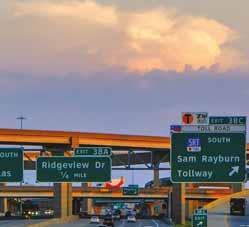
The Dallas/Fort Worth area that the North Texas Tollway Authority (NTTA) – of which Hofmann is executive director and CEO - serves is home to eight million people, with the population expected to grow another million in the next eight years.
“We would love it if there was enough tax revenue to pay for all of the necessary infrastructure,” he says. “But the fact of the matter is, there isn’t. Having tolling as a tool in the toolbox is important, because the region can come to us and ask: ‘Do you guys have the capacity
Gas tax in the US hasn’t gone up since 1993: and for me, that’s where tolling can come in “ “
to build certain projects?’ And to date, we’ve stepped up and we fill that void - and we do it without tax dollars. So we are completely self-funded. Nationally, tolling should be looked at the same way: there’s only so many dollars - especially if you start siphoning those dollars off to support other non-transportationrelated items. Tolling is a self-sustaining revenue source that can continuously be reinvested back into the infrastructure - not just to build it, but also to maintain it, and then it frees up tax dollars to be used elsewhere.”
The pace of technological change may provide some answers. Hofmann thinks the industry is at the beginning of probably the biggest advance in transportation since the horse and buggy was replaced by the internal combustion engine.
“Just like then, technology is driving that change today,” he says. “We don’t know when autonomous vehicles will get here –that will be a game-changer. But connected vehicles are here and they’re only growing in proliferation. So that opens up a lot of opportunities for us: the first areas that we’re seeing, obviously, are safety-related. At NTTA, we’ve got a focus on the next few years to continuously leverage in-vehicle technology, as well as cellular technology, to obtain information from - and disseminate information to - our customers, our users.”
Connected vehicles will also allow agencies to change how they collect tolls. “Right now, we either read a transponder or we take a licence plate and we find out where to bill you and attempt to collect that way; connected vehicle technology will allow us to skip both of those when it becomes mainstream,” Hofmann says. “But it’s kind of chicken-and-egg. We’re looking at private industry saying: ‘Hey, give us that technology’ and they’re looking at us saying: ‘Hey, when is it that you guys are ready to fully invest in this?’
It’s similar to the 2000s, he says, when a couple of agencies began to take cash booths out of their toll lanes. “You know, you just kind of have to do it,” he smiles. “So who’s going to be going out there, first and foremost, to look at collecting tolls via connected vehicles, and then when’s the private sector going to get there?”
AI and machine learning
He is also enthused about artificial intelligence and machine learning technologies and their computational capabilities: aggregating multiple data sources which can then be analysed to provide predictive and decision-making capabilities. “I think we’re right on the cusp of that environment, of those opportunities,” he says.
NTTA is not afraid to try new things. Two decades ago it attempted to adapt technology that was being used for airport security. “We approached one of the main vendors and said: ‘Can you take that technology and adapt it to free-flowing roadways, so if somebody were to stop on our roads, or a mattress were to end up in the lanes, it would automatically identify that and alert our traffic management centre?’”
The technology has evolved but the principle remains the same, he suggests. “The ability for us to take video, feed it into analytical software and [for it] to then alert us when there’s an anomaly or an incident on our roadways is paramount, because the quicker that we know that there’s an incident, the faster we can respond to it, with the correct resources. You know, is it a hazmat spill versus a flat tyre?”
As well as increasing safety, this sort of responsiveness also helps to create a more positive user experience – something that is increasingly important in a world where people expect services to be available at the tap of a smartphone. Of course, some drivers always used to complain because they didn’t have the right small change in the days of toll booths, too - but Hofmann is acutely aware that advances in technology have to be handled in a way that suits the way people actually live their lives.
“As an industry, we haven’t necessarily made video tolling as easy as they would like to see it,” he acknowledges. “We have a saying around here, from a customer service and payment perspective: we’re not going to be compared to another toll agency - they’re going to compare us to Amazon, the utilities, or Netflix. And so we need to do things that make us look more like those companies than not.”
This is sometimes a challenge. “You know, as innovative as the toll industry is, we also tend to be very conservative,” he goes on. “And we tend to not as quickly embrace some of the newer technologies that maybe other industries might. But that being said, I think what you see on the horizon is the emergence of digital payment technologies, and a number of us are trying to figure out: what does that mean to us and what does that mean to our customer? If I have a customer today that pays me with a credit card, would giving them the ability to pay with Apple or
Tolling is a self-sustaining revenue source that can continuously be reinvested back into the infrastructure - and then it frees up tax dollars to be used elsewhere
“ “
Digital experiences
A trend towards streamlining things, to fall more in line with other digital experiences, is therefore underway, he says: “Especially in a lot of the metropolitan areas, you’re looking at how can we take tolling payments, Uber ride-share payments, transit payments, and is there a way that we can provide a platform for them to pay for all of their transportation services, whether that’s Mobility as a Service or something else? It’ll be interesting to see where we end up.”
Outside of his day job, it is a packed 12 months for Hofmann. IBTTA’s Be Safe Together global campaign, started in 2024, will run again this year in the week of 23 June: “It’s a very important reminder to make sure that we’re focusing on employee safety and customer safety as well. That is something that will resonate for some time with IBTTA, and rightfully so.”
He will also be instrumental in setting IBTTA’s strategic plan. “We’re looking at this as a great opportunity to set not just the next five years, but for the next 20-plus years,” he says. “We’ve got a very strong foundation, a very strong membership, a sense of community; public and private sector people work together to exchange ideas. So I want us to look at, over the next five years, what do we need to do to not just keep that momentum going, but to propel us 20 years into the future.”
He is very excited about the possibilities. “Having a strategic plan that identifies what we need to do differently next year to help meet some end goal will drive everything that we do in the organisation: it will drive our committees, our workforce, our task force, our working groups, it will drive the types of presentations we’re looking for, and the content and the topics.”
He envisages, with member involvement, a “wonderful machine that just works in harmony to accomplish our goals”.
Advocacy is going to become more important for IBTTA going forward, as is community and membership – i.e. the value of being an IBTTA member. Workforce development will be another focus “because we don’t have enough young people coming into the transportation industry to meet the demand of today, much less the demand of tomorrow”.
And of course, the arrival of Kathryn Clay as CEO creates opportunity. “The fact that Kathryn is here is just another dynamic that is exciting, in my year as president, to figure out: okay, how can we take her expertise and her experience and her strengths to further push us into the future?”
2025 is shaping up to be a busy one. See you in Dallas! ITS
Why come to the IBTTA Technology Summit 2025?
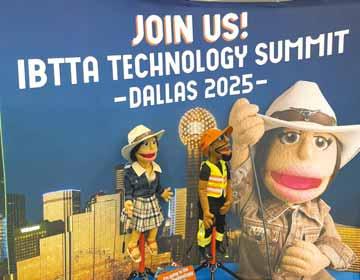
“We’ll have over 800 professionals from across the world,” says IBTTA 2025 president James Hofmann. “There will be agency staffso operators - and there will be private sector folks that support those operators. The agenda focuses on how technology can help move organisations forward - in the engineering, planning, design and construction side of things and the operations and maintenance of our roadways. On the data analytics side, it could be: how do we interact with our customers more? What kind of programmes do we need to be looking at to better serve our customers?”
Recovery and resilience – in the face of natural disasters and cybersecurity breaches - are also subjects of interest. “When you look at the types of topics that are going to be covered, it’s basically soup-to-nuts of
how technology serves an organisation,” Hofmann says. “And all of the vendor and consultant communities that we rely on to provide us tools and services and resources are going to be there as well. If you’ve never been, or you’re looking at getting into the tolling industry, you can see what opportunities are there - because they’re numerous. Transportation is changing. Toll agencies tend to have money, which means that they can adapt quicker than other organisations may be able to.”
IBTTA is holding half a dozen conferences this year, covering finance, road user charging, communications, legal, roadway maintenance and operations. “Pick one and come and give it a shot,” Hofmann concludes.
“Because I think what you’ll find is a wonderful group of professionals that are there for a purpose - and that’s to
serve our customers in the best way that we can.”
From 10am to 4pm on Saturday 22 March, as part of IBTTA’s long-standing commitment to local communities in the places it holds events, there will be a Blood Drive in partnership with the American Red Cross at the conference venue,
the Hyatt Regency Dallas. The initiative is aimed at replenishing blood stocks to support Texas communities affected by the recent storms. www.ibtta.org/events/ technology-summit-dallas
• IBTTA Technology Summit 2025 is in Dallas, TX on 22-25 March
Multi-Technology
Traffic safety and flow through comprehensive detection solutions.
Smart traffic management is transforming highways without costly expansions. Wireless sensors, side-fire radar, and AI-powered video detection optimize flow, reduce congestion, and enhance safety. All without costly new roadway construction.
With real-time data and automated incident response, agencies can improve efficiency, mitigate crashes, and keep traffic moving—proving that smarter roads, not bigger ones, are the future.
•Highway Counts / VOS
•Coordinated Ramp Metering
•Automatic Incident / Wrong Way Detection
•Truck Parking Availability
For smarter highways, visit: sensysnetworks.com/highways
Est.1995
CELBRATING 30 YEARS OF SUPPORTING OUR INDUSTRY
What
were you doing in 1995? Andrew Barriball was in Yokohama, along with some people from a nascent sector who wanted to make transportation cleaner and safer …
Crack open the champagne!
Prepare the speeches! In some ways it’s a surprise that we’ve reached this anniversary. There was nothing inevitable about the ITS sector’s expansion. It was all quite low-key in the early days.
My introduction to the mysterious world of intelligent transportation systems started in 1995, in Yokohama, Japan, at the second ITS World Congress – the first had been held in Paris in 1994. It was immediately evident that this was a sector in its infancy: it seems hard to imagine now, but the extent of the exhibition was a series of tables, dressed only with linen tablecloths and product literature.
So what united us 30 years ago? We were a group who bought into the vision of a better, safer and more productive future, with fewer poisonous emissions - but we needed to convince those in authority to show the courage and ‘give ITS a go’. Thankfully, some did.
Today, 30 years on, the industry has matured out of all recognition and there are numerous societal benefits that have been gained as a result. But there is still a long way to go. And that is where ITS International fits in.
I hope we’ve done our bit in supporting and championing the sector as well.
Throughout this year, we’ll be celebrating our birthday with reminiscences from some industry luminaries, and taking a look back at some of the highlights – and perhaps one or two lowlights, too, to remind us how far we’ve come.
When you think about the huge stands and slick product displays which will be on show at the 30th ITS World Congress in Atlanta, US, this August, the contrast could hardly be greater.
Baby steps
Conversations about the applications and limits of ITS were also taking baby steps. I recall some of the early discussions being around whether CCTV was indeed a reliable alternative to loops - and we marvelled at the concept of digital mapping being presented at the (very generous) hospitality suite, hosted by Navigation Technologies.
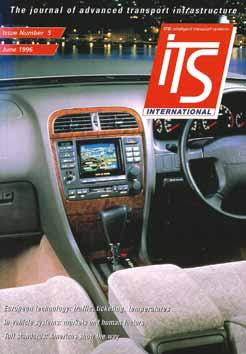
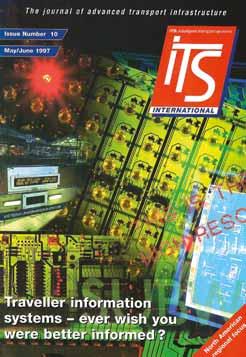
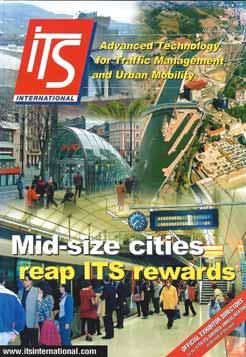
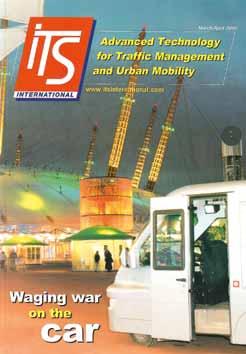
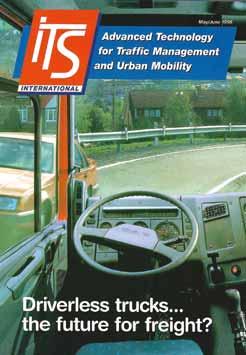
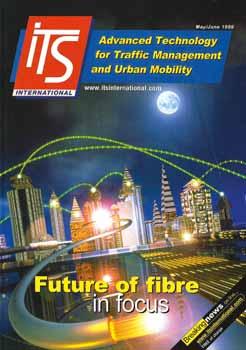
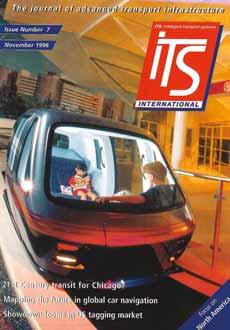
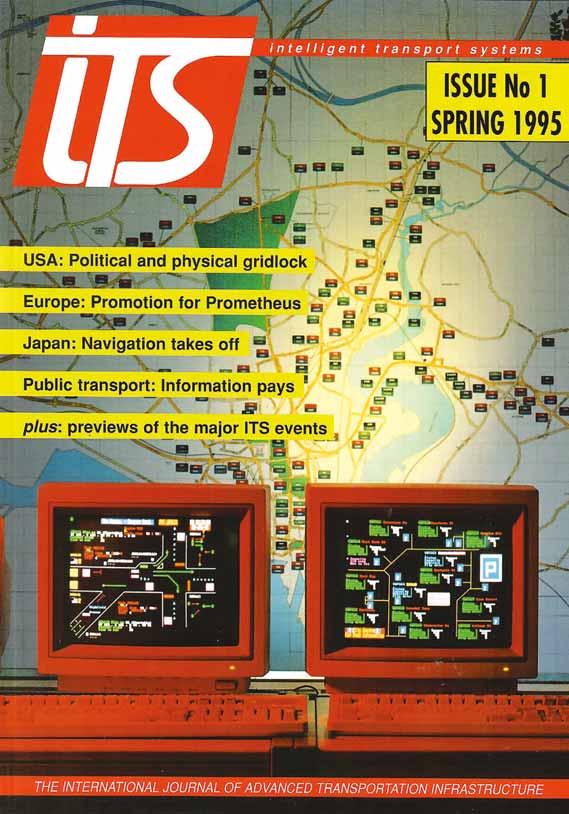
Our first issue (left) deals with a few topics which are still familiar to all of us in the industry: passenger information systems (could be better); congestion (better in some ways); political gridlock (hmmm….) And as you can see from the range of cover designs on the previous pages, our look has matured a bit too. But even though ITS International’s clothes have changes over the years, our role remains much the same: it’s simple - we are the interface between those who actually know, and those who need to know! It’s not very scientific, but I like to think we are playing a pivotal role in keeping the industry updated and informed: long may that continue.
Championing the industry
We’ve been fortunate to be supported and championed by the great and good of the ITS industry – we’re grateful for that, and
Check out @ITS International Magazine on LinkedIn, and join in with our weekly #FlashbackFriday questions: there are no prizes but it’s a great place to share your thoughts on the industry then and now, on where you were in 1995 (kindergarten, or not even born, in some cases!) and, indeed, what you’ve been doing in the industry since then.
And it will be fascinating to see where we will be 10 years from now…. Roll on, ITS International’s 40th birthday! ITS
ABOUT THE AUTHOR:
Andrew Barriball is publisher of ITS International and MD of Route One Publishing
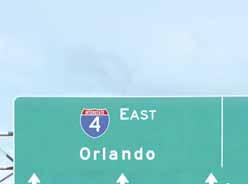
Smoother running on Florida’s I-4
The Sunshine State is pioneering new implementations of V2X tech designed to smooth traffic flows and save lives. Andrew Stone shares the story so far…
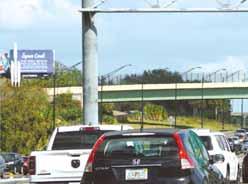
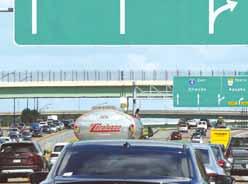
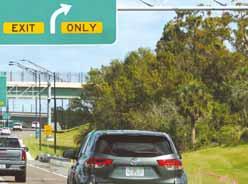
Between 2016 and 2019, 150 motorists died on the Orlando section of Florida’s I-4, earning it the grim title of one of the most dangerous highways in the US. Heavy congestion, complex interchanges, and distracted driving all contribute to high accident rates along the 347-mile span of highway and arterial roads. It is an ideal location for the trial of a cutting-edge, Vehicle to Everything (V2X) traffic initiative being spearheaded by Dr. Rawa Adla, assistant professor of computer engineering at Florida Polytechnic University.
I-4’s position as a major artery connecting attractions including Walt Disney World, Universal Studios, and a host of sandy beaches creates a unique traffic dynamic.
“Florida is a tourism state – everyone wants to travel to the Orlando amusement parks or to Clearwater and the beaches,” says Adla.
The mix of local commuters and out-ofstate tourists unfamiliar with the roadway further contributes to its high accident rate. “That’s why it’s so important to improve safety in this critical area of I-4,” she adds.
The I-4 Frame (Florida Regional Advanced Mobility Elements) Project aims to tackle these challenges head-on. Supported by two grants totalling $252,000 from the Florida Department of Transportation (FDoT) as part of a broader USDoT initiative, Frame seeks to revolutionise traffic safety and mobility using V2X technology.
“The idea behind V2X is to enhance traffic mobility and safety by enabling cars to communicate with each other and with infrastructure,” says Adla.
With Florida Polytechnic University situated directly on I-4 between Tampa and Orlando, the project is ideally positioned to monitor and analyse the impact of these cutting-edge technologies. “We are at the heart of this work, located in a very critical location for the research,” says Adla.
A two-phase strategy
At its core, V2X technology facilitates real-time communication. Using this system, vehicles can receive critical updates about road conditions, upcoming lane closures or traffic light changes. For example, drivers can be warned about hazards such as sudden
stops or red lights at intersections, preventing last-minute manoeuvres that often lead to accidents.
The real-world deployment of V2X technology focuses on providing drivers with timely, actionable information as well.
Launched in 2020, the I-4 Frame Project adopts a two-phase approach. Phase one, which concluded in March 2023, focused on evaluating the potential benefits of V2X technology using advanced traffic simulation models.
“I started by first creating multiple traffic transportation simulation models to replicate the actual scenarios on the I-4 on the road,” says Adla. “These models replicate the traffic on different days, different times of the day, different holidays, weekends. We created multiple models, and we compared the actual traffic using data we collected from [FDoT]. We then implemented V2X technologies into our simulation models and applied cutting-edge data analytics to quantify the benefits. We simulated the whole road and included cars with the same characteristics as those normally there, and then we evaluated the benefits. Our results
showed that implementing this advanced technology will reduce the number of crashes and reduce travel time.”
The simulation results suggest compelling results will arise from the physical implementation of a V2X system. The study compared the performance of physical on-board units (OBUs) with that of OBU emulators (OBUe), such as smartphones using data feeds from Florida’s FL511 Advanced Traveler Information System, offering live information on congestion events, crashes, construction and maintenance activities. It assessed the implementation of three main warning alerts (see box out).
The potential safety improvements are clear even without the mass installation of on-board units, given the significant benefits that come with integrating such functionality into smartphones, says Adla.
“Drivers can download an app like FL511, which can act as a receiver using LTE communication. This ensures that even if only 20% of cars on the road are equipped with V2X, the system can still be effective. As soon as the implementation is done we're going to go over educating people how to use it and have it ready.”
From simulation to real-world impact
The real-world implementation of phase two is now underway. Beginning in mid-2024, more than 350 roadside units (RSUs) are in the process of being installed along the I-4 corridor to transmit information to V2X-equipped vehicles or smartphones with compatible apps.
The RSUs will transmit information to the vehicles advising what action to take - for example, warning of a lane closure ahead, enabling a vehicle to change lanes in good time. “It's not going to wait until the last minute, and this is going to enhance the traffic and we avoid the congestion,” says Adla.
Another implementation is RSUs at traffic lights giving vehicles warning that a light is about to change, enabling them to react more smoothly.
The roll-out of equipment is expected
Speed warning and enforcement results
According to the model, speed warning and enforcement alerts would cut crashes by 53% when all vehicles are equipped with OBUs, and see a 50% crash reduction when all vehicles are equipped with OBUe. The model also showed that with only a 20% market penetration, crashes could be cut by 16% and 17% (OBU and OBUe respectively).
to be complete by May 2025 and while this happens, Adla is analysing the data collected from the ongoing physical implementation to identify any areas where there are failures or improvements in relation to what was expected in the models created in phase one.
“Phase two also involves collecting real-world data as the technology is implemented,” said Adla. “We aim to address any system malfunctions or limitations by continuously analysing the data.”
The era of autonomy
While the immediate focus is on improving safety and mobility, the I-4 Frame Project also sets the stage for the advent of autonomous vehicles. “Looking ahead, AVs represent the next frontier for this technology,” says Adla. “When vehicles are fully autonomous, they can seamlessly follow commands from the system, eliminating human error and variability in driver behaviour.”
By integrating V2X technology, selfdriving cars could further smooth traffic flow, virtually eliminate accidents, and enhance mobility for individuals unable to drive.
Beyond safety, V2X technology offers significant environmental advantages. By optimising traffic flow and reducing idling, it lowers emissions and improves fuel efficiency. Smoother traffic conditions also translate to shorter journeys with their attendant human and economic benefits.
Frame’s success hinges on collaboration between multiple stakeholders, including technology providers, automotive manufacturers and local governments. FDoT has partnered with Florida Polytechnic University and other organisations to ensure the seamless integration of V2X technology into existing transportation systems.
country.
Indeed, the I-4 Frame Project could serve as a blueprint for implementing V2X technology in other regions, says Adla.
“Our goal is to share lessons learned to encourage broader adoption of V2X technologies worldwide. Similar projects are underway in Texas and Michigan, and we’re learning from each other.”
The results of phase two will be shared in due course, she adds. “This project is going to be beneficial to everyone who is interested in implementing the V2X advanced technologies. We learn from each other. We will share our lessons learned with everyone from inside the US, outside the US, everywhere. I'm really happy and excited about these results. This study can be replicated in different areas in different countries. We have multiple lessons learned during the implementation. If we share these with different areas, we can save human lives and reduce traffic times. We should be optimistic about the coming five years. During that time, we will see great improvements on the road.” ITS
Model for the future
The initiative is scheduled for completion by 2027, by which time Adla expects drivers along the I-4 to notice a much smoother commute.
The research will also help inform future transportation projects throughout the
Reduced speed zone warning and lane-closure alert results
Emergency vehicle preemption results
Crashes could be cut by around 30% with both OBU and OBUe if all vehicles were equipped - and even with a 20% market penetration, crashes could be cut by 23% with OBU and by 19% with OBUe communications.
Implementing Emergency Vehicle preemption (EVP) functionality into the system, giving priority at interchanges to emergency vehicles, could reduce collisions involving emergency vehicles by 70% and improve emergency response times between 14% and 50%, according to the model.
Dr. Rawa Adla, Florida
Polytechnic University
Superior Radar Traffic Detection, Accuracy, and Reliability
The most capable radar detection solution on the market.
Econolite’s EVO RADAR™ sensors are designed for all approaches, which helps to reduce travel safety at intersections for pedestrians, cyclists, and motorists. The EVO RADAR sensor solution is ideally suited for a variety of intersections, using approaches with a single sensor.
Enhance your EVO RADAR detection system with the advanced, cloud-based data reporting, analytics, and monitoring capabilities of Centracs® +Detect. +Detect automatically and virtually reports speeds, and signal performance metrics.
econolite.com
BIG AND BOLD DALLAS, TEXAS
Two In-Depth Technical Tours: Equinix and Inland Port
Four powerhouse tracks, including fan-favorite Tech Talks
Join the IBTTA Foundation in giving back through Red Cross blood drives and Soles4Souls
Join us for the IBTTA Tech Summit, this March! news.
Packed exhibit hall and more!
Hosted by March 22-25, 2025 Dallas, TX Evening Event at Gilley’s
Follow us on for the latest news. Register today at www.ibtta.org
A century of progress?
In January 1925 a traffic ordinance was introduced in Los Angeles. The 100-year anniversary is significant because, transportation historian Peter Norton suggests, the law in effect set the blueprint for car-dependency across the US. Adam Hill asks him how…
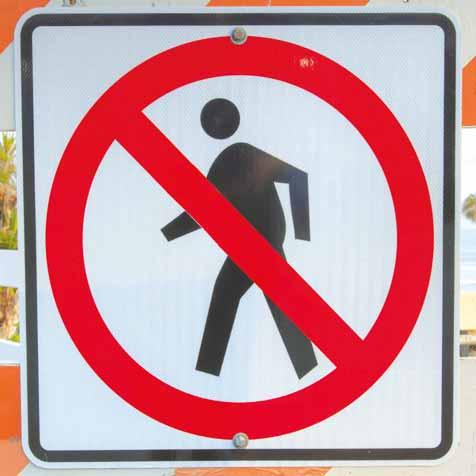
Just over 100 years ago, in January 1925, a traffic ordinance was passed in Los Angeles. There’s seemingly nothing so unusual about that: other US cities already had ordinances regulating the way that pedestrians walked when they were on or near roadways.
“Minneapolis and Boston had them by 1910, though they were minimally enforced, if enforced at all,” explains transport historian Peter Norton.
“Kansas City, Missouri, had a ‘no jaywalking’ law in 1912, and they did enforce theirs. Even LA experimented with pedestrian regulation before 1925. In 1923 the Auto Club of Southern California got the LAPD to issue a ‘no jaywalking’ order. The club supplied
the signs, posting 60 of them along Broadway in downtown LA.”
However, LA’s ordinance stuck: even though cars were the relative newcomers to the city’s streets in 1925, vehicles were to take precedence over pedestrians. It became the model for the US, with state and local jaywalking laws descended from it.
Ordinance adapted LA’s ideas – although leaving out the city’s original rule which said pedestrians could raise their hand to stop cars before crossing the road.
But why? The LA ordinance became the national blueprint because the National Conference on Street and Highway Safety made it the basis of its Model Municipal Traffic Ordinance in 1927-28, explains Norton, associate professor at the University of Virginia, and author of books including Fighting Traffic: The Dawn of the Motor Age in the American City. Rather than draft from scratch, the Model Municipal Traffic
“The model ordinance was the official recommendation of the US Commerce Department. It was promoted nationwide by automobile clubs, by the National Automobile Chamber of Commerce, and by others in ‘motordom’,” continues Norton. “By 1930 it was already in place throughout much of the US. Some states just adopted it statewide. By late 1930, 23 cities beyond California had adopted the model ordinance, in whole or in part. New Jersey, New York and Wisconsin adopted versions of it as state law. It is the ancestor of the typical traffic ordinances in US state codes and municipal ordinances today. It superseded common
law principles by which pedestrians had rights at least equal to those of other street users.”
But it would still have been possible for Chicago and New York, say, to go their own way if they wanted. “Yes, and in fact to some extent cities did,” he adds. “By that I mean the LA ordinance became the national model – but only the model. States and cities were free to use ordinances they already had on the books, or to adopt revised versions of the model, and they did. Plus cities went their own way on matters of enforcement. Some enforced the jaywalking rules, some didn’t. Many had sporadic ‘safety drives’ where they’d ticket people for a week or two, then go back to benign neglect. There was plenty of variability. But the LA ordinance was the national example, and was by far the most influential pedestrian control ordinance.”
Yet although the new law established the dominance of cars over pedestrians – and contrary to how it might appear today – the new technology of motor cars hadn’t been accepted as the dominant mode straightaway. “Circa 1920, the conventional wisdom – among experts, authorities, and the mainstream press (indicative to some degree of their readers’ views) – was that motorists were welcome only on condition that they conform to streets as they were, neither obstructing nor endangering others,” says Norton.
‘Jaywalking’ wasn’t always a thing
False histories
Fast-forward to today, and that attitude seems a distant memory. And that’s why history is essential, suggests Norton. “We need to recover the fact that 100 years ago every US city – even LA – was walkable and had a vibrant walking culture,” he insists. “Conversely, we need to question the false histories that were constructed to perpetuate the status quo. These histories misattribute the status quo to popular preferences, mass demand, consumer choice, democracy or culture. In fact, while Americans welcomed cars, they never chose car dependency. We need to build on the fact that ‘freedom of choice’ is a pervasive value that cuts across political, social, class and ethnic lines. We have a choice-free transport system. Every state department of transportation presumes that car ownership is the precondition of convenient mobility. That deprives Americans of choices. Improving walkability restores choice.”
However, people will still need cars –and in fact many people in the US have no realistic choice about that. “Yes indeed,” Norton agrees. “This is a fact, and in many places it’s worsening. Millions are driving 50 miles each way to work. In some places, such as San Francisco, it can be the only way to reach affordable housing. But I often hear a wrong and very dangerous explanation for this: ‘That’s just American culture. Everyone prefers to drive. That’s how it got this way.’ This story is historically wrong. It
“ “ Every state DoT presumes that car ownership is the precondition of convenient mobility: that deprives Americans of choices
Peter
Norton
University of Virginia
also serves as an excuse to do nothing about the status quo.”
The true history is “liberating but complicated”, he says: “The LA ordinance story is a beautiful way to reduce this complex story to a manageable scale. It’s a simplification, but a fair simplification. We need accurate but manageable true stories like this one.”
Part of the reason that marking anniversaries such as the 1925 traffic ordinance is important, Norton argues, is that it offers a way forward that sees the dominance of cars being reduced. “Yes, definitely,” he insists. “History proves that streets can be radically redefined.”
Radical revision
In 1922, a proponent of priority for motorists, Edward Mehren, recognised this fact, and saw that roads could be defined as primarily for motor vehicles. “In an editorial in Engineering News-Record, he wrote: ‘The obvious solution … lies only in a radical revision of our conception of what a city street is for’,” Norton says. “He was arguing that the purpose of streets can be reversed, and he and his allies set out to reverse it. Their success proves it can be reversed again.”
This counter-reversal has actually occurred in some places - though not so much in the US. For example, in 1970, driver priority was the norm on the large majority of urban streets in the Netherlands. “Engineering standards, laws and to some degree social norms supported this priority. But between 1970 and 1990, this priority was either negated or reversed on a very large fraction of Dutch streets. People tell me: ‘But the Netherlands is a small country. It’s not like the US.’ To which I reply: ‘You’re right, the Netherlands is not like the US - but it is a lot like two New Jerseys.’ The Netherlands closely resembles two New Jerseys in area, population density, topography, climate, weather, income, etc. They’re even a lot alike culturally. Both have a reputation for being home to assertive, direct, sometimes blunt people who like to get ahead.”
And reassertion requires assertiveness, he says. “To get your rights respected you have to assert your rights,” Norton says. “We have so normalised car domination that often pedestrians defer to drivers even
where the pedestrian has the right of way. We need to reach people with this message: ‘When you walk and you have the right of way, be prepared to safely assert it’.”
In much of Europe, this rebalancing is happening to an extent. “Paris has set the example,” he suggests. “Oslo and Utrecht and many other cities have also done amazing things. In the US, no. There are isolated success stories: Hoboken, NJ; Market Street and Octavia Boulevard in San Francisco, etc. Relaxation of zoning restrictions in some cities has helped too. But these are fragmentary and incomplete examples.”
Freedom of choice
He is not hugely optimistic that this will go further. “But constructive change that I felt hopeless about 20 years ago has happened,” he points out. “I’ve seen DoTs adopt concepts, such as ‘complete streets’, that began as renegade ideas but have since been more accepted. I’ve seen more official acknowledgment that the US egregiously fails pedestrians. I’ve seen officials agree that crashes are not mere ‘accidents’. I’ve seen bike lanes spread in some cities, such as New York, to a degree I did not dare to hope for. In growing cities, there will be growing pressure to give up on accommodating every driver and on finding other ways instead. The San Francisco Bay iteris.com/pedsafe
Enhancing Safety,
Area, Los Angeles, Denver, Austin, Atlanta and greater Washington will all have to give people choices they lack now, simply because the traffic jams are so bad.”
Interestingly, he sees opportunities for coalitions across political divides. “For example, ‘freedom of choice’ may help us frame bike lanes, for example, as means of giving people choices they lack now,” Norton says. “Highways that don’t charge users require vast public money administered by huge state bureaucracies. There are opportunities to enlist conservatives in
support of a model in which drivers pay for what they get. Relaxation of zoning rules would permit destinations to get closer together, and can accurately be framed as relief from intrusive government.”
In short, while cars will – of necessity – remain vital to many people in the US, there is room for alternative experiences of mobility to be developed. After all, if you are left with no option but to make a 100-mile round trip each day to your place of work, it’s not as though you’re exercising freedom of choice anyway. ITS
Vantage PedSafe™ is an advanced pedestrian safety system that combines detection, real-time analytics, and integrated safety applications to protect pedestrians in all weather and lighting conditions – from perfect visibility to total darkness.
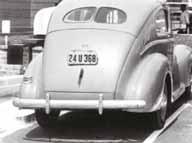
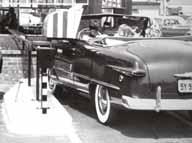
Cars in LA in the 1940s
Lidar lets planners see big picture
The city of Chattanooga is attempting to make its streets safer by using the largest deployment of Lidar-based traffic detection in the US. Adam Hill reports…
The city of Chattanooga in Tennessee, US, has been experimenting with the use of 3D digital Lidar at intersections and roadways. Lidar specialist Ouster has been one of the partners in the smart traffic work of the University of Tennessee at Chattanooga (UTC) Center for Urban Informatics and Progress (CUIP). An ITS America webinar recently offered some insight into how this urban testbed has created a number of learnings around smarter traffic management, including pedestrian safety.
Lidar can be instrumental in multimodal traffic actuation based on all road users, including people and vehicles; integration with Vehicle to Everything (V2X) systems; and cloud data covering traffic and safety analytics, such as red-light running, nearmisses and wrong-way driving.
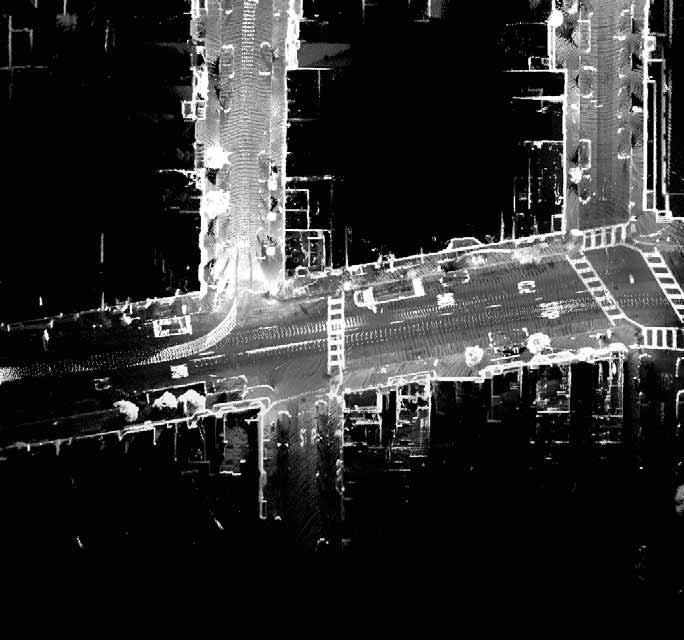
Lidar is a sensor using optical lasers in order to map - in real time - the space around it. Ouster says its Lidar has 128 laser beams that are effectively transmitted all around the sensor, hitting objects like walls, cars, pedestrians and cyclists; those reflections come back to the sensor, which
allows the sensor to create a set of pixels – a point cloud - for every reflection in space.
“We're generating over five million points in every second with our Lidar sensors, so we’re not just inferring how the world around us looks - we're measuring everything at centimetre-level accuracy,” explains Itai Dadon, VP for smart infrastructure at Ouster. “And because we're using lasers, we're effectively immune from lighting and weather conditions and can provide visibility into what is happening on our roads, 24/7, 365 [days a year], without depending on lighting the environment correctly or making sure that the weather is good.”
Ouster’s BlueCity is an end-to-end solution where raw data from Lidars is injected into an edge computer whose perception software translates what the Lidar sees into a set of objects that are classified and tracked in real time and space. “So we detect where are the vehicles, where the trucks, where the pedestrians, where the cyclists - and all that in real time,” says Dadon. “And that information can be used in a variety of ways, both at the edge - for realtime applications such as traffic actuation by the traffic controller or V2X communications
- or providing that information to the cloud for further analytics.”
Mina Sartipi, professor and director of the CUIP, explains the centre was set up to partner with local government, working on real-world issues. And the first of these was: “How can we make our environment, our city, safer and more accessible for all?”
Much of CUIP’s work is done by undergraduate and graduate students, and brings together other universities, as well as private companies and government, to develop ideas that can be moved towards large-scale deployment. “We want to go beyond pilot studies,” Sartipi insists. “Our goal is having a city-scale environment for testing ideas and solutions that go beyond being in labs and academic [settings] to really be deployed and adopted by both local government and also people. How can we enhance the quality of life? Can this also be an economic development opportunity for us?”
CUIP research areas cover safety and energy efficiency – which includes traffic signal optimisation – as well as use of communications technology such as V2X, plus sustainability, electrification and
LIDAR IN TRANSPORTATION
automation. The research organisation is deliberately aligned with Tennessee state and Chattanooga city goals, for example around Vision Zero, improving travel times and reducing fuel use and emissions.
Research sandbox
When CUIP was first established, the city created a smart corridor test bed, a mile and a quarter long through downtown Chattanooga, in a mix of residential and business areas, with 12 signalised intersections, all-fibre connectivity, cameras, roadside units, Internet of Things (IoT) gateways and edge computers.
“It was really a sandbox to support the research that we were doing at CUIP,” says Austin Harris, deputy director and CTO of the research institute. “We would run video analytics 24/7, pull in signal phasing and timing data - we still do that today – and we built up a real-time, low-latency data infrastructure to bring all that data back in. We call it Testbed as a Service: it's accessible, a web platform that users can log into, download data and we also have a software development kit. With the current deployment we bring in about two billion data points a day.”
This is vital, since one of the issues which the city of Chattanooga originally had was lack of data. “You can't solve any issues if you don't have any real-world data to work on,” says Harris. “Of course, we're very focused on artificial intelligence and machine learning, so we also need datasets to drive our research. Having a real-world testing and validation environment was one of the core goals, to address urban challenges through data-driven research, and we think it's critical to collaborate with industry and government to test, analyse and validate new technologies.”
Comparing CUIP’s research projects before and after the use of Lidar is illuminating – literally. Cameras have their limitations, explains Harris. One of the first projects on the test bed was funded by the city of Chattanooga, looking at how vulnerable road users were using roadways, and examining near-misses. “It's very easy to obstruct the camera's view, even
with multiple cameras, especially if we're looking at pedestrian safety,” he adds. Also, environmental factors, such as fog, rain, snow, and time of day all “had a significant impact on the performance of the algorithm that we developed”.
A conversation with Ouster at an ITS America meeting in 2019 led to Ouster donating Lidars to CUIP to expand on the camera-based, near-miss detection project to improve results. “We saw how Lidar could be used: it gave us much higher resolution information around the geospatial aspect,” explains Harris. “You don't have to calculate that third dimension - you're actually measuring it utilising Lidar, which gives us much more confidence in the data that we're using to build applications on top of.”
Lidars were installed at intersections, diagonally across from one another. “Depending on the size of the intersection, you can utilise one sensor, and then down in the traffic cabinet we have the Ouster BlueCity edge processor as well,” Harris says. “What we find is much higher reliability in varied lighting conditions; we don't see much degradation at all in Lidar. Additionally,
the range is extended because these are 360-degree sensors, so we get to see quite a bit further down the approaches than we normally would with the cameras.”
Since 2019, 33 out of the 37 pedestrian fatalities in Chattanooga have occurred at night, Harris says, which makes Lidar an important tool in road safety. From a privacy perspective, it helps that no personally identifiable data is collected using Lidar. Also, the level of data – in terms of speed, object type, relative location of road users toward each other, and so on – creates a solid foundation on which more complex applications (e.g. cooperative infrastructure) can be built.
‘Largest deployment in the US’ Currently, Chattanooga has 13 intersections equipped with Ouster’s BlueCity intersection solutions. But the city is expanding the initial test bed to around 130 intersections in total, covering the downtown area and beyond, comprising edge computing, cameras, Lidars and roadside units. “It will be the largest deployment in the US of Lidar-based traffic detection and actuation software,” Harris says.
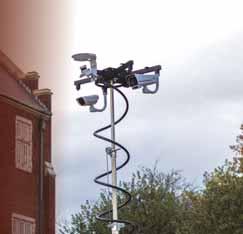
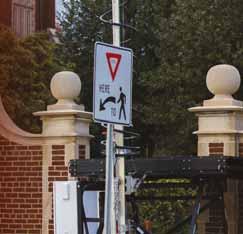
CUIP uses the OS 1-128 model, with two Power over Ethernet Lidars per intersection. There is also a mobile data collection unit on a trailer which can be deployed anywhere. “Everything's processed there at the edge,” says Harris. “So there's no large data being pushed over: it can be done over a cellular connection or cellular modem at each intersection.”
BlueCity will soon be used for all the actuation throughout the downtown area of Chattanooga. Current applications are near-miss detection, wrong-way detection, and improved understanding of pedestrian
BlueCity looks at everything with “centimetre-level accuracy”
Chattanooga is expanding its initial test bed to around 130 intersections in total
>Non-intrusive system including high positioning tolerance
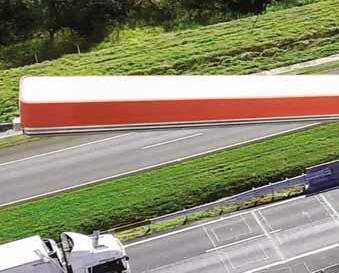
>Decoy function to strengthen the deterrent and educational effect on users
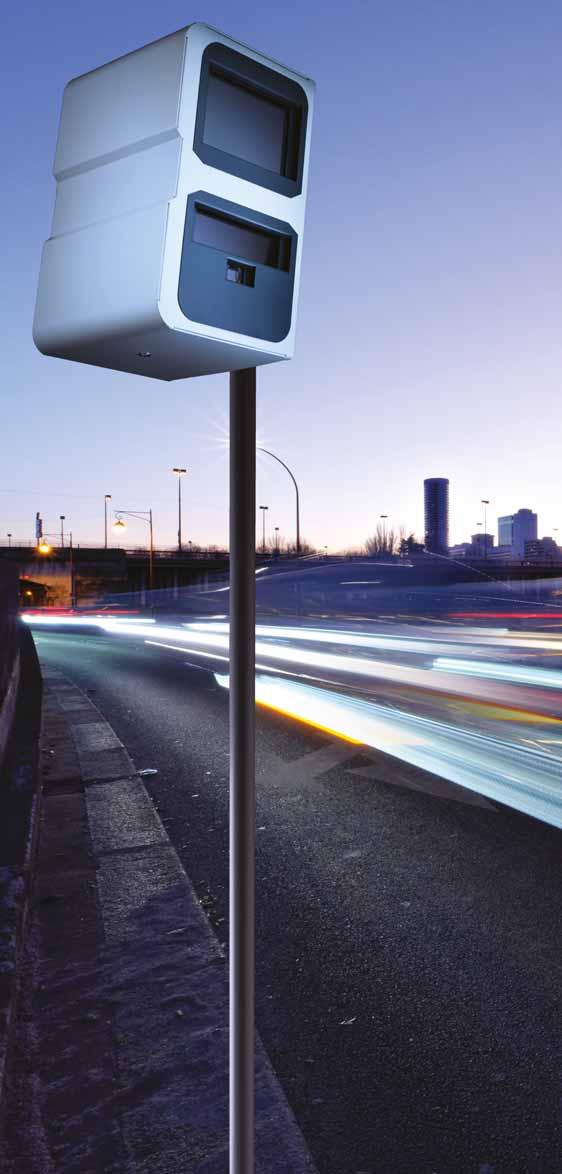
>Stationary solution for enforcement of multiple road traffic offences
>Smart traffic enforcement through 3D-LiDAR technology
LIDAR IN TRANSPORTATION
movement. Harris highlights BlueCity’s range, speed estimations, geospatial features and advanced traffic signal performance measures provided to the cloud application that comes with the package.
The software aggregates the point clouds from the two Lidars installed in diagonally opposite corners of the intersection, providing full coverage of all the approaches and the intersection itself. “The reason we're using two Lidars is to not only have better coverage, but also to have visibility into the intersections from two angles, since the Lidars require a line of sight for the lasers to hit the objects - for the sensors to ‘see’ the object,” points out Dadon. “If there is, for example, a large truck turning in the intersection, it would potentially block the view from one Lidar. But by having two Lidars that have 360 degrees field of view, we're able to see the complete intersection with better coverage, but also without any interruption or obstructions in that intersection at any time.”
The software takes the information from the 3D view and translates it into objects with bounding boxes classified as either vehicles or pedestrians or cyclists. These are then tracked over their journey as long as they're within
the coverage of one of the two sensors.
The Lidars are connected using Ethernet cables, so just require a Cat6 run from the traffic controller to each pole where the Lidars are installed. “With the PoE injectors, installation really takes just a few minutes by strapping the mounting brackets on the
Watch out: students crossing
The University of Tennessee at Chattanooga (UTC) identified students crossing a particular road in large numbers as a major safety issue. “The problem is they didn't really have any way to collect the data to justify any interventions,” explains Austin Harris of UTC’s Center for Urban Informatics and Progress. “There were some cameras on campus buildings that we tried to utilise, but the frame of reference was just not sufficient.”
Instead CUIP deployed its mobile data collection trailer, which comprises four solar panels, solar battery, cellular modem and Ouster’s BlueCity edge processor.
Near-misses can be analysed via an algorithm Ouster calls ‘postencroachment time’. “If two objects are crossing the same point in space within less, in this case, than two seconds, it will register automatically as a ‘nearmiss event’,” Itai Dadon from Ouster explains. “And this information is really hard to collect because you need to understand positions in space and scale in order to do this accurately. And the ability to provide that information to a city, to a DoT, really allows them to take actions to improve and enhance safety in that particular location.”
If a number of these events occur multiple times a day or across a particular period of time, it may be worth putting in a simple solution such as a sign warning drivers to look for cyclists behind them.
In the Chattanooga example, during a four-day study while UTC classes were in session, there were 518 mid-block crossings: 207 of those were near-miss instances with a five-second post-encroachment time, and 33 were near-misses with a two-second post encroachment time.
CUIP took this very concerning information to the university, who took it to the city. A temporary mid-block crossing was put into this location, which is now permanent. In another four-day survey, there were 487 midblock crossings, with 33 out of crosswalk. But the key result was zero near-misses following the installation of the crossing.
“We can see there's a huge improvement here by doing this,” Harris says. “And this is such a great project, because it shows the full circle.”
“Sometimes the solutions are not necessarily high tech, but the ability to understand where and when they are needed really depends on having the data,” concludes Dadon.
pole itself,” Dadon explains. “Afterwards, all the configuration setting can be done from distance, and the installers don't need to spend any time on the intersection itself, which is extremely important.” Because installations can be done on the poles directly and not on the masts, there is also no need to stop traffic.
Data from the Lidars on where all the cars, pedestrians and cyclists are at each moment in time can be provided at the edge in the traffic cabinet to the traffic controller, to begin actuating the traffic. Visibility on all road users – rather than just vehicles – is a step up from loops, and this information can also be used by roadside units for V2X applications, says Dadon. The information is also pushed to the cloud, with a 4G LTE cell or modem connection adequate for the task.
The BlueCity dashboard shows various types of information from the intersection – for example, counts for each approach, separated by vehicles and vulnerable road users, over a given period (e.g. 48 hours, or one week). Speed counts give users the speed aggregations per approach, with mean, maximum and median measurements using data from the Lidars. ITS
Lidar installation takes “a few minutes” by strapping the mounting brackets to the pole, Ouster says
You can’t be what you can’t see
Bias – unconscious or otherwise – is a major problem when it comes to ensuring that ITS businesses reflect the diversity of the talent pool available to them. But there are practical solutions to challenges which have made the playing field uneven…
At last year’s ITS World Congress in Dubai, Ertico – ITS Europe organised a session called Global Voices of Women in ITS. Covering topics such as confidence, representation and ensuring that everybody has a voice, it contained some insightful nuggets. For instance, if she feels unconfident about speaking at an event, Paula Claytonsmith of Local Council Roads Innovation Group tells herself that she needs to be visible: "If there's a young woman in the audience, they can't be what they can't see."
Meanwhile, Susan Harris of ITS Australia always urges women to be willing to grab opportunities when they come and not to say 'no'. The reason? "Because the bloke next to you is going to say 'yes'!"
And finally, Diana Willert of Yunex Traffic revealed that her answer to 'mansplaining' is to say: "Thank you very much for repeating what I just said because it's always better to hear things twice."
A few months on, ITS International asked the women who took part to reflect once more on a few questions, such as: What are the challenges for women in ITS - and how do we overcome them? What practical measures would help? What can the ITS industry as a whole do?
Agne Vaitekenaite Head of partnership and advocacy, Ertico
Women in ITS face significant challenges, including underrepresentation, lack of women in leadership positions, and unconscious bias. Underrepresentation can lead to a lack of role models, which can be addressed through mentorship programmes, and encouraging STEM [science, technology, maths] education. The lack of women in leadership roles also limits their influence and diversity in decision-making. This can be mitigated by providing more leadership training opportunities for women and
To minimise the impact of unconscious bias, it is crucial to have diverse decision-making teams and leadership within organisations
“ “
inclusive hiring strategies. Although the level of awareness of the issues has increased during the last years, unconscious bias remains a prominent challenge and is often a root cause of the other issues. To minimise the impact of unconscious bias, it is crucial to have diverse decision-making teams and leadership within organisations. Addressing the challenges faced by women
Susan Harris CEO, ITS Australia
As an established leader in the transport technology sector, I am privileged to have some opportunity to help shape our sector. I am passionate about helping to improve diversity in our sector so we can have a wide range of faces and voices contributing to solve our transport challenges. Gender diversity is often targeted as a priority. At ITS Australia we continually strive to raise the profile and visibility of women in our industry. We are conscious of diversity in our leadership roles and speaker line up and look to provide a supportive, encouraging environment for young women to grow their presentation and leadership skills. Prioritising diversity may mean not always targeting the most senior person for a particular role, but the result ultimately adds interest and creates a more welcoming space for everyone. I am a great believer in supporting flexibility across the workplace to normalise this for all employees – flexibility might be helpful to care for family, ageing parents, pets or maybe a passion project as someone is headed to retirement. We still need to get the job done, with the interesting roles also being the busy ones, but having flexibility to balance personal activities amongst our work lives can create and improve engagement and wellbeing for us all.
SVP sustainability,
quota in management positions by 2026 and ensuring that over 20% of new hires each year are women. Additionally, we have established a women's network with regular exchange and coaching sessions, facilitated by an external coach, which sees high participation and welcomes male colleagues, where topics range from assertiveness and career management to menopause in business. I personally act as a mentor towards women within the company and outside, which is incredibly enriching to see female talents grow and succeed. By addressing these challenges and implementing practical measures, we can create a more inclusive and diverse ITS industry.
in ITS requires practical measures at both global and personal levels. Globally, it is important to promote gender equality, drive global initiatives and awareness campaigns to change societal attitudes. On a personal level, I believe it is important for women to build strong professional networks, to have a strong support system, seek mentorship, and advocate for themselves and other women by voicing their achievements and seeking leadership roles. It is not easy, but at the same time, I enjoy the challenge. Working towards creating a more equitable and supportive environment for women in ITS is both an important and rewarding journey which is necessary for the advancement of the industry.
Women in the ITS sector face several challenges, including underrepresentation, gender bias and limited access to leadership roles. These challenges are often compounded by a lack of mentorship and networking opportunities, which are crucial for career advancement. Additionally, the perception that ITS is a male-dominated field, combined with the lack of female role models in the industry, can discourage young women from pursuing careers and establishing themselves in this sector. To overcome these challenges, it is essential to foster an inclusive culture that values diversity and promotes gender equality. This can be achieved through targeted recruitment efforts, mentorship programmes, and creating platforms for women to share their experiences and insights. Encouraging male allies to support gender diversity initiatives is also vital. Furthermore, it is important to recognise that women often do not have the ‘loud voices’ in the room. We must ensure that all voices are being heard and valued, creating an environment where everyone feels empowered to contribute. Yunex Traffic is actively working towards gender equality by aiming for a 20% women’s
The field of ITS was conceived to merge engineering and transport by integrating advanced technologies, such as sensors, data analytics, and communication networks, to enhance transportation efficiency, safety and sustainability. Unfortunately, engineering and transport have traditionally been career domains with one of the highest gender imbalances. Women have faced systematic barriers in these areas because of societal norms and gender stereotypes. Transport jobs have been viewed as too demanding for women. For possibly similar reasons, women have been discouraged to pursue professions in STEM. The good news is that this issue is being addressed, and labour shortages are getting governments and policymakers to take action across the world. Although women are increasingly embracing careers in ITS - which combines engineering, technology, business, and social and environmental factors - they are still widely underrepresented. This lack of representation is even more apparent in leadership roles. The ITS industry has a chance to set an example by scrupulously adopting diversity, equity and inclusion (DEI) frameworks within their organisations. What’s more, this diversity should be visible and discernible, particularly on the public stage, in fora, keynotes and panels. Girls and women choosing their professional paths must be able to see them as role models. Mentorship programmes would also be of great value. The goal of ITS is to serve the mobility needs of everyone at all times. User-centric mobility and transport systems can only be achieved if there is true representation at every step. ITS boasts a reputation and ambition of being futuristic. We must match our social and professional outlook with the current times.
Paula Claytonsmith Chief executive, UK Local Council Roads Innovation Group
One of the key challenges for women in the ITS sector— especially for young women or those just starting their careers—is the lack of visible role models across a range of roles. While there are many brilliant women in the eld, they are sometimes less visible or not frequently in the spotlight. Stepping into the spotlight can feel intimidating, so it is crucial to help build confidence in women that find this intimidating and create supportive environments that make this process less daunting. There is a quote I love (though it is not mine): ‘You can’t be what you can’t see.’ It rings true—if women cannot see examples of others like them thriving in these roles, it becomes harder for them to imagine achieving those goals themselves. The industry can adopt simple yet effective initiatives to create more opportunities for women to thrive. For instance:
• Encourage, and allow scheduled time for participation in STEM outreach activities, such as careers days and school programmes
• Increase access or support mentoring schemes to guide women entering the field
• Create and support opportunities where women can showcase their roles, making the diversity of opportunities in ITS more visible
Some companies already lead the way in these efforts, but broader and wide-scale systematic adoption across the sector would make a significant impact. With its wide range of roles and exciting innovations, the ITS field has so much to offer—not just now but in the future. Highlighting these possibilities will inspire young people, career changers, and future generations alike to join the industry.
Lidia Buenavida Peña Project manager, Ertico
The challenges for women in ITS (and STEM fields generally) are often rooted in systemic issues, such as unconscious bias, a lack of role models, and limited access to leadership opportunities. Women frequently face barriers to professional growth, including inadequate representation in decision-making positions and networking spaces. The industry’s fast-paced, technology-driven nature can also amplify existing inequalities, particularly when inclusivity isn't explicitly prioritised during innovation and policy design. One key area for improvement is ensuring women are included at decision-making tables, whether it’s an expert panel or a strategic meeting.
Too often, the excuse is made that ‘there are no women experts on this or that topic’. This simply reflects a lack of effort to seek out and engage the many capable women in the field. Proactively identifying and inviting women experts is critical to dismantling this barrier. Practical measures include creating mentorship programmes to guide and empower women, supporting women-led initiatives, and fostering flexible working environments. Offering scholarships, mandating diverse panels, and setting benchmarks for gender equality in leadership roles can also make a tangible difference. Initiatives such as gender equality plans (GEPs), like the one Ertico is developing, are particularly impactful as they provide structured frameworks for organisations to identify gaps, but also best practices, implement strategies, and track progress toward greater equity. GEPs foster accountability and ensure that gender considerations are systematically integrated into hiring practices, workplace policies and leadership pipelines, paving the way for sustainable change. Ultimately, the ITS industry must recognise that fostering a culture of inclusivity is not just about fairness—it’s about driving innovation through diverse perspectives and creating solutions that better serve all members of society. ITS
• There will be a Special Interest Session on Women in ITS during Ertico’s ITS European Congress in Seville, which runs from 19-21 May
Stepping into the spotlight can feel intimidating, so it is crucial to help build confidence in women that find this intimidating and create supportive environments “ “
Sensing an opportunity
Possible increases in speeds for automatic braking systems are causing concern in the US vehicle manufacturing sector. But some companies say the technology is ready to meet the new demands, finds David Arminas
Many collisions between vehicles around the world have been avoided by the well-proven automatic braking (AEB) systems - at times called ABS - carried by vehicles. An offshoot of this technology is the pedestrian automatic emergency braking (PAEB) system, whereby sensors can detect the presence of people. Sensors react with warnings for the driver using a dashboard message or an audible alarm that a collision is possible and that he or she needs to brake. If the driver fails to do so, the system automatically applies the brakes.
Basic AEB works at low speeds to prevent or reduce the severity of minor urban collisions. But more sophisticated systems work at higher speeds where there is greater potential for severe injury or death.
In 2016, vehicle makers committed themselves to install AEB in all new US vehicles by 2025 and have already met that commitment, according to the Alliance for Automotive Innovation (often called Auto Innovators).
But in 2024 the US National Highway Traffic Safety Administration (NHTSA) issued Federal Motor Vehicle Safety Standard (FMVSS) No. 127, which mandates the inclusion of PAEB in all passenger cars and light trucks weighing up to 10,000 pounds (4.5 tonnes) by 2029. The key issue is that the standard increases the speeds for AEB responses and - critically - requires PAEB
systems to detect pedestrians in darkness and at various speeds.
NHTSA says the new standard will save at least 360 lives a year and prevent at least 24,000 injuries annually.
An AEB system must stop and avoid rear-end crashes at up to 62mph (100kph) and detect pedestrians in daylight and at night. The standard will require AEB to engage at up to 90mph (145kph) when a collision with a lead vehicle is imminent and up to 45mph (72kph) when a pedestrian is detected.
Delayed decision
The election of US president Donald Trump has muddied the waters. On 20 January he issued a memorandum to US executive departments and agencies, entitled ‘Regulatory Freeze Pending Review.’ The NHTSA then announced there would be a pause until 20 March. “The temporary delay in effective date is necessary to give Department officials the opportunity for further review and consideration of new regulations”, NHTSA says.
As ITS International went to press, it was unclear how the Trump administration would decide to proceed.
What is clear, however, is that campaign group America Walks applauded the original decision in mid-2023 to increase the speeds for pedestrian detection. America Walks helps equip organisations and individuals with
the resources needed to create more walkable, safer communities for people of all ages and abilities. This can include assisting a small town in building sidewalks, for example, or advocating for changes in highway construction policies. The organisation called the proposed changes “a crucial step in making vehicles safer for pedestrians”.
According to its website: “Initial standards will require that PAEB systems be able to completely avoid contact with pedestrians when a vehicle is travelling 25mph or less….. the performance testing requirements will require that PAEB systems be able to completely avoid contact with pedestrians when a vehicle is traveling up to 40mph.”
America Walks said it has long called for mature safety technologies like PAEB to be incorporated directly into the required FMVSS that applies to all new vehicles: “Similar vehicle safety programmes across the globe already include PAEB and the US has fallen behind.”
But the NHTSA updates for PAEB have been met with heavy criticism by John Bozzella, chief executive of Auto Innovators. The Washington, DC-based trade association’s members include international car and light duty truck manufacturers that build and sell products in the US. The NHTSA updates are “wrong on the merits, wrong on the science,” he said. He called it “really a disastrous decision by the nation’s top traffic safety regulator that will endlessly - and
unnecessarily - frustrate drivers, will make vehicles more expensive and at the end of the day...won’t really improve driver or pedestrian safety”.
In January 2025, the organisation initiated litigation in the US Court of Appeals for the DC Circuit to seek a repeal of the NHTSA AEB rule. And in a letter to the US Congress last year, Bozzella wrote: “After a decade of shared and substantive work on AEB and a billion dollars invested, NHTSA inexplicably changed course and issued a rule that automakers indicated was not feasible with widely-used braking technologies. Here’s what I (regrettably) conclude will happen: driving AEB-equipped vehicles in the U.S. under NHTSA’s new standard will become unpredictable, erratic and will frustrate or flummox drivers.”
Testing, testing
However, technology is already available to meet the upgraded standards, including PAEB, according to Teledyne Flir, a provider of sensing solutions for defence and industrial applications, and VSI Labs, which provides technical and applied research on the hardware, software, and connectivity systems that support advanced safety and automated driving systems.
Together, they have issued test results using NHTSA’s new FMVSS No. 127 PAEB testing scenarios. VSI Labs’ research vehicle, which included the latest automatic AEB thermal camera from Teledyne Flir, successfully passed all tests, while three new 2024 vehicles failed two or more night-time test scenarios, the firms say.
The two companies noted that the new regulation is more important than ever because US pedestrian fatalities in traffi crashes remain near all-time highs, particularly at night, when 77.7% of pedestrian fatalities occurred in 2022.
Decreased visibility is a challenge for braking systems
Heated debate
The majority of state-of-the-art AEB systems rely on a combination of a visible camera and radar, but these systems struggle in darkness and low visibility. Thermal imaging, by contrast, detects heat energy, not visible light, so it works just as well in daylight as in darkness. Furthermore, it can eliminate the need to keep
increasing headlight brightness as thermal imaging can see multiple times farther down the road at night compared to standard headlights, offering another solution to the growing chorus of complaints around increasingly brighter headlights for an additional low three-figures per thermal camera.
NHTSA has demonstrated through testing that meeting FMVSS No. 127 requirements is achievable. The smallest and lightest vehicle of the five commercial-off-theshelf (Cots) vehicles the agency tested - the 2023 Toyota Corolla Hybrid XLE - passed all
PAEB tests at the maximum required speed. The other four that NHTSA tested failed one or more of the low-headlight beam night-time tests, suggesting that increased speed and vehicle weight combined with decreased visibility challenge existing AEB sensor suites.
VSI Labs tested the performance of a thermal-fused PAEB system on a Ford Fusion Hybrid research vehicle and three current state-of-the-art 2024 Cots PAEB systems. The thermal-fused AEB sensor suite featured Teledyne Flir’s latest long-wave infrared (LWIR) automotive thermal camera, an automotive HD radar, and an automotive visible camera. All three 2024 Cots vehicles use a combination of radar and/or visible camera(s) and do not include a thermal camera.
The test results revealed that, for daytime PAEB performance, both thermal-fused and Cots PAEB systems passed all daytime tests.
Superior detection
For night-time PAEB performance, only the thermal-fused PAEB system passed all tests, demonstrating superior detection capabilities independent of headlight performance.
Meanwhile, thermally-active pedestrian test mannequins (PTMs) provide a realistic representation of a human thermal signature and are recommended for future PAEB testing protocols using thermal cameras.
“With the ability to see through darkness, shadows, headlight and sun glare, smoke and most fog, as well as its unique capability
NHTSA says new standard will save at least 360 lives a year and prevent 24,000 injuries
to detect wildlife on the roadway, OEMs should consider integrating thermal cameras as a cost-effective method to meet FMVSS No. 127 requirements,” said Mike Walters, vice president for product management at Teledyne Flir. “With the ability to see well beyond the range of headlights, thermal cameras provide advanced warning - extending braking distances, improving detection and false positive performance and increasing deceleration comfort and safety.”
Phil Magney, founder of VSI Labs, says that testing showed all three Cots vehicles failed at least two or more test scenarios at night, “indicating that meeting the standard will be challenging using the current top-rated PAEB systems on all vehicle
Problems with 'car bloat'
sizes and weights”.
Furthermore, real-world corner cases are potentially more challenging, emphasising the value of automotive thermal cameras for true-positive and false-positive PAEB performance, said Magney. “VSI’s testing shows that thermal camera technology exists to help automotive manufacturers meet FMVSS No. 127 requirements by 2029 and make roads safer for pedestrians.”
VSI conducted all tests at the American Center for Mobility in Ypsilanti, Michigan, last September during the day and the night. A Cots thermally-active (heated) adult pedestrian test mannequin, produced by 4activeSystems, was used to provide a thermal signature representative of an adult human. ITS
For some pedestrian safety advocates the changes to PAEB requirements don’t go far enough, and likely never will. Last September, in an article in US business magazine Fast Company, MIT Mobility Initiative senior fellow David Zipper welcomed the improved PAEB technology. But he also expressed reservations. He cited comments by Robin Hutcheson, a former US Department of Transportation official who led the development of the department’s 2021
National Roadway Safety Strategy. “You can have car safety technology, but that technology alone isn’t enough,” said Hutcheson.
Zipper wrote that alongside PAEB is a requirement to fight what he calls “car bloat” – also known as ‘autobesity’.
The increasing size of cars – in particular SUVs –has been a worry for many road safety campaigners, who point to statistics suggesting that bigger vehicles are more dangerous for pedestrians, cyclists,
and people in smaller cars. This is in part because cars with higher hoods tend to hit people in the head and torso, rather than the legs, causing more severe injuries.
To attempt to address this, in a separate upgrade, NHTSA is beefing up its requirements for NCAP: National Car Assessment ProgrammeCrashworthiness Pedestrian Protection.
For a new vehicle to be sold to the public, it must pass certain crash tests between it and pedestrians,
and meet certain standards of design based on the results of crash testing with simulated pedestrians. Much has to do with the design of a vehicle’s front end, including the bumper, along with the width and overall front-end height. This might mean that the front ends of many large pickup trucks and SUVs will have to be redesigned. But it may also represent a major step toward addressing the soaring number of US pedestrian deaths, which hit a 40-year high in 2021.
‘It’s time to be honest
The micromobility market is in flux, cities are hitting back: so how can bike- and scooter-share move forward in a way that satisfies everyone? Adam Hill finds out…
fter a seemingly free-for-all period, the micromobility market worldwide is now looking at a much more heavily-regulated landscape. Along with the mergers and even closures of some companies, a number of cities have pushed back strongly – following safety concerns over speeding riders, and complaints from residents tired of negotiating street clutter – to ban shared scooters altogether. So what’s the way forward?
Micromobility expert Scott Shepard, founder & CEO of #CitiesFirst Advisors, answers ITS International’s questions…
On the face of it, the shared mobility industry is facing something of a crisis. What’s going on?
We've seen cautionary tales in Paris, Madrid and Melbourne. These are a signal of the maturity of the micromobility market and point to a need to be integrated with sound public policy. European cities are perhaps being influenced by the media hype and these negative stories - but they're looking at the long game. There’s a clear signal from the public sector that the direction of micromobility is following the path that Mobility as a Service (MaaS) took about two
have a keen interest in that. And there's going to be much more of a hybrid approach to business models and distribution of modalities in clearly-marked mobility hubs that achieve decarbonisation goals.
“
“ Scooters are going to be more closely monitored and actively enforced
Scott Shepard #CitiesFirst Advisors
going to make, leveraging the European Green Deal to change their infrastructure. And if they upgrade their infrastructure, we can understand which operators and modalities will be present and functioning in a particular city or region. So it's a clearly logical approach - but we have to move past a lot of these distractions.
What is the first step forward?
We have to move past the hype. We have to move past the fear, and we have to move past a lot of these distractions coming from operators, coming from the venture capitalists (VCs) and from cities themselves. The end game - at least on the European continent – is the Sump (Sustainable Urban Mobility Plan). If we look at the Sump, then we understand what investments cities are
After the flux in the micromobility market worldwide over the last few years, where do you assess we’re at now?
We are currently in the third phase of micromobility. The first wave started with bike shares, mainly from China, around 2015-16. They were dockless: no rules, no regulations, the Wild West. Then we had the first wave of scooter micromobility in 2017-18, starting in Germany and France, and spreading throughout the European continent and in the US. Then we have the pandemic and operations pause for a period: however it starts growing again around 2021-22: in the US, it becomes much more balkanised. You end up with a set of cities that are taking an incremental approach with a patchwork of inconsistent regulations and fees. In Europe, many of the providers took a different approach and followed Voi’s ‘cities
first’ playbook: approach cities and try to be a partner first – rather than just seeking market share and expansion. Integrating with MaaS, and balancing fleets in a distributed manner, resonated well with cities. And then in 2022-23 the first wave of RFPs, or public tenders, entered the scene: so we see more harmonisation of parking, data reporting, greening fleets, etc.
So how does that lead to what happened in Paris, Melbourne and Madrid, with shared micromobility –such as scooters - being removed from cities?
Do I think it's a domino effect? No. Do I think all cities are going to remove scooters and micromobility? No. But there are some common themes around these disparate events. VCs have disappeared from the sector completely: they closed their chequebooks first with the vote to ban scooters in Paris and next the Silicon Valley Bank failure - a perfect storm that happened around March-April 2023, where capital just evaporated. And it's been that way ever since. The micromobility market is moving towards even tighter regulation, with more scooter bans, smaller fleets, modal shift towards bike-share, and more of a trend towards hybrid public-private systems that are financed by the public sector. So private capital is exiting the market, and you're going to be seeing cities fill in the vacuum with station-based, scooter-and-bike-share multimodal schemes, like Berlin’s Jelbi system.
Is there a common thread with those city bans?
The Madrid scooter ban had nothing to do with the Paris vote, although it may have influenced this negative perception. The scooter share companies – Dott, Tier Mobility and Lime - were unfortunately not
ABOVE: Bird was relaunched last year under a new parent – Third Lane Mobility - after filing for bankruptcy; Lime was one of three scooter firms whose licences were cancelled in Madrid
providing the required data based upon the contract, and management of parking in regulated zones was not complied with. Madrid’s tender was detailed and prescriptive. It is tough to match those requirements, but unfortunately that's now the cost of doing business in highly-regulated markets. The Madrid ban will now set a precedent for how other cities better enforce their public tenders. Scooters are going to be more closely monitored and actively enforced.
Have micromobility companies who want to operate in cities got the message that they need to play ball?
In Europe, operators need to not just offer scooters or one modality; they need to capitalise on the successes of e-bikes and cargo bikes and offer a multimodal bundle that realises the ambitions of the European Sumps for decarbonisation of the transport sector through shared and active mobility. If operators demonstrate strong alignment with public policy, then cities will score higher on public tenders - such as greening fleets, better management of public
spaces and providing last-mile connections to public transport. If operators stop viewing scooter-share as an individual modality, they can take a multimodal approach with smaller fleets, yet are better managed and more highly utilised similar to the Brussels model, where multimodal hubs (drop zones) are distributed across the city and region. Across municipalities in the EU, there is a trend towards decarbonised fleets, car-free city centres and sustainable modal shift. So green policies and infrastructure investment are in place, consumer demand is better than ever, resulting in a sound business case and commercial market. It's going to be a few years, but operators will now have to work within these tighter, regulated, policy-driven models that cities like Milan and Budapest are rightfully setting the stage for.
A lot of companies offer more than one mode: have they tended to be smarter in the way they use cycles, for example, than in the way sometimes they use scooters?
Companies just go where the opportunity is – but there is now an opportunity for city authorities to exploit the multimodality of the operators. They can mix and match based upon their local needs. So the mandate has to come from cities: ‘We need 2,000 scooters, maybe 3,500 bike shares, distributed in 10 or 20 different, mobility hubs throughout a city based upon a specific operating formula’. This partnership model needs to be led by the city, but with feedback from operators to ensure success. And it has to be a balanced mix of station-based and hybrid - no longer just dockless. The dockless-only model has commercially failed. So a successful model will comprise a mix of virtual parking stations (as in Brussels) and physical dock stations – with a balance of docked scooter and bike-share together. The cumbersome fee structure of certain councils and cities can be a hindrance to operators. These added fees can significantly reduce profitability and make a specific market less appealing. It also depends on the conditions of the permit regarding the provision of shared mobility infrastructure. On mainland Europe, we're seeing more of the cities investing in infrastructure themselves and not requiring that of the operator's permit. The operators simply need to better self-regulate within the infrastructure that is provided, whether it's painted scooter boxes, docked scooters or bike stations, not to exceed the capacity. And if they're improperly parked, you could use augmented-reality computer vision, or you could hire additional enforcement to better manage public spaces and streets. There will be a maximum response time, and if operators don't respond, then they get fined, or they lose their permit. That's how it works. ITS
Cities are likely to enforce scooter parking
THE WORLD’S LEADING EVENTS ON MOBILITY & TRAFFIC TECHNOLOGY
Mark your calendar for Intertraffic events around the globe, the premier gatherings for traffic and mobility professionals worldwide. Whether you’re a visitor seeking cutting-edge solutions or an exhibitor aiming to showcase innovations, Intertraffic offers unparalleled
GET READY TO SHAPE THE FUTURE OF MOBILITY!
opportunities to network, learn, and grow your business. Don’t miss the chance to make your mark in achieving smart, safe, and sustainable mobility for all. This is where the future happens! Get in touch with our team on intertraffic@rai.nl or check out www.intertraffic.com.
Why AI could be the saviour of public transport – if we let it
Get it right and the rewards could be there. Thomas Ableman looks at how transport in the UK – and beyond – might be transformed by artificial intelligence…
Public transport is at a crossroads. While we've seen incremental improvements in accessibility and convenience, the core issues—cost and coverage—persist. Because public transport is expensive to operate, it remains a niche option, used by a minority - especially outside inner cities. However, artificial intelligence offers us an unprecedented opportunity to break free from constraints that have existed since the start of the era of car dominance. By reimagining how public transport is delivered and expanding its reach, AI could usher in a revolution—if we're bold enough to embrace it.
The starting point is that only a tiny proportion of people in the UK live within walking distance of high-frequency public transport (I’m lucky enough to be one of them). If you do have frequent
public transport accessible locally, you choose to use it. That’s why, in the UK, most journeys in London are made by public transport but not most journeys in Leicester.
The problem is that providing high-frequency services to most locations is unaffordable. The main driver of the cost is the driver. Take that out, and the position is transformed.
Now, I’m not saying that we’ll take the driver from existing services. Most services currently operate with one human and a large number of passengers (as services with few passengers are unviable). One member of staff is probably the lower acceptable limit. That’s why London’s Docklands Light Railway and Victoria underground line have operated with staff on board since they opened decades ago, even though the trains have always been automatic.
But what driverless public transport
will enable is an extraordinary expansion of service to places that are unaffordable when staffed, but affordable when automated.
It’s not about cars
There’s a lot of focus on autonomous cars. However, the main problem with cars is physics: they take up too much space. The logic of a famous 1960s UK newspaper advert still holds true. In three pictures it showed, first, a street full of cars; then the same street with a number of people standing in it; and, finally, a single bus on the same street. Next to the pictures was the tagline: “These vehicles are carrying 69 people who could all be on this one bus.”
By contrast, driverless vehicles have the potential to create gridlock. If people like me who don’t drive start taking AVs, no-one will ever move. AI can optimise but it can’t solve impenetrability: the law
INTELLIGENCE
of physics that states that only one object can occupy a physical space at a time. Only one car can occupy each space on the road. Autonomous or otherwise, cars have a percentage point of the capacity of buses. Moreover, just as with other forms of AI, AVs will continue to make mistakes. That’s why it’s taking so long to get beyond a few robotaxis in a couple of American cities to global adoption. But public transport AVs can have the back-up of a room full of video operators. One operator can be responsible for escalations from hundreds of vehicles. If the vehicle isn’t sure what it can safely do in a particular situation, it can propose a solution to a human, and the human can check. A shuttle that stays within a defined suburb will have far fewer issues than a driverless car that needs to know every streetscape on Earth.
That means that each suburb, town and village can be connected by highfrequency autonomous shuttles to the core public transport network. This would be transformational. And it will become possible.
The reason it will be possible is that the cost of public transport without the cost of fuel or drivers (obviously these vehicles will be electric) is a fraction of the current cost. Imagine the places that it will be possible to profitably connect! If public transport connectivity can be provided for £1 per vehicle mile, the density of the network will transform. As the peripheral network becomes larger, the core network becomes stronger. It’s the opposite of the Beeching Cuts – the 1960s closures of thousands of miles of the UK rail network. I can’t wait.
My only slight worry is that I don’t see as much progress being made towards making it happen as I’d like. The only city that’s doing this seriously and properly is Norway’s capital, Oslo, under the leadership of Bernt Reiten Jenssen, visionary CEO of public transport authority Ruter. We all need to catch up.
But the cars are coming
However, we cannot take our eye off the ball when it comes to AVs. I have long predicted that it will take a very long time to get to Level 5 autonomy – i.e. when a car can go anywhere without anyone in the driving seat. It’s not because the technology isn’t there to make it happen most of the time. It’s because the consequences of failure are so great. But, equally, autonomous cars are already live in US cities, carrying passengers.
We need to be alert that AV operators don’t try to pull off the same trick that their automotive industry predecessors did almost exactly a century ago. Back in the 1920s, car execs realised that it would be easier to get their product off the ground if cities were better designed for cars. So they persuaded councils to put fences along pavements and
to corral pedestrians onto fixed crossing points. You can imagine a similar dynamic playing out with autonomous.
AI-driven cars also create the risk that the 'taxi’ product becomes a much more significant competitor. One of the characteristics of AVs is that it becomes much less clear what is a bus, what is a taxi, what is a car and what is a private hire vehicle. If you could use your AV as a taxi when you’re at home watching TV, there is a significant risk of new competition from vehicles that are more sustainable than a petrol car but a lot less sustainable than other transport modes.
Better and cheaper
It’s therefore crucial that our core network becomes cheaper. It won’t become cheaper because we will take out the drivers from busy services - we won’t. But the network will become cheaper. AI will be able to optimise schedules both in advance and in real time. What’s the best roster for all the buses and trains in a given region to balance cost and revenue? Like all models, AI’s answer will depend on assumptions (elasticities will remain as key as ever). But it’ll have the capability to try to answer the question. Today it’s a question we don’t even try to answer.
AI will be able to optimise schedules both in advance and in real time
Some of you may doubt what I’m saying. You’d be right to. I mean, obviously, I’m wrong - but I’m not going to be a million miles wrong. The core capabilities of AI are now pretty clear. So the only question is whether they will scale to the extent I’m describing.
And I think we got the answer to that last year when Google announced an agreement to purchase nuclear energy from reactors to be developed by Kairos Power because, Google says: “The grid needs new electricity sources to support AI technologies.”
That’s how much power they think they’ll be using. That’s because they’re going to be doing… well… the stuff I’m talking about. So I’m definitely wrong in the detail. But I’m not wrong that it’s another big transition, like the internet.
What about the planet?
Many of you may worry about the sustainability implications of all this. I certainly do. After all, not every AI company is thinking about the energy they generate. I asked the founder of one AI start-up how he thought about the carbon implications of what he was doing and he literally hadn’t thought about it at all. The problem is that this article isn’t what I want to be happening: it’s what is happening. I can’t prevent AI any
My point isn’t that AI is good. My point is that AI is happening. Our job is to get the best we can out of it
Get it right, it will usher in a new golden century for public transport; get it wrong, and we’re dinosaurs “ “
more than King Canute could turn back the tide. My specialism is transport and mobility, so all I can do is try to minimise the carbon emission in our sector. And my assertion is that we can deliver a better outcome for carbon by using AI to make sustainable transport superb.
This is big
To give you a sense of the power of AI, a modern AI model uses 10 billion PetaFlops of computing power to train. (This isn’t a prediction - it’s reality today.) Flops and PetaFlops aren’t language we’re familiar with (Flops stands for floating-point operations per second). It’s a measure of computing power. Just saying that 10 billion PetaFlops is a huge amount of computing power is pretty meaningless. So let me help you try to visualise what it looks like.
Imagine doing a maths calculation on a pocket calculator. Visualise that? OK, that’s about 20 Flops. Now imagine you’re a real whizz at multi-tasking, so you’re simultaneously doing a maths calculation on 50 pocket calculators at the same time. I appreciate this might be harder to visualise. Now imagine that every human on earth is simultaneously doing a maths calculation on 50 pocket calculators each. Now imagine that every planet in the solar system is populated with as many humans as Earth, and they are all doing a maths calculation on 50 calculators each.
I realise we’re getting beyond the usual “size of Manhattan”, “number of double-deck buses” or “area of football pitches” scales here. Sorry. There’s a lot of computing power in AI. And I’m afraid this visualisation is about to get worse.
You see, and bear with me, but I’m going to have to ask you not to operate 50
pocket calculators but seven trillion. If all your seven trillion pocket calculators were piled on end, they would stretch out from your hand to the sun. And back. Six times. So I’m afraid you might struggle a tad to operate them all at once. But you’re game for a go, right?
So, there we have it, if you imagine you and everyone else on Earth (plus an equivalent number of people on every other planet) all simultaneously doing a mathematical calculation on a pile of pocket calculators that each stretches from Earth to the sun and back six times, that is how much computing power is used to train a modern AI model.
I don’t know about you, but I think that’s going to have an impact on things.
Any downsides?
Are there downsides other than the fact AI requires so much energy? Oh my goodness, yes: AI has the potential to regurgitate our own biases, to build enormous dependency on hackable computers and to blur the lines of organisational accountability.
My point isn’t that AI is good. My point is that AI is happening. Our job is to get the best we can out of it. And now, I’m afraid I need to come to the tricky part. We don’t have a great track record of getting the most from technology. In fact, transportation is one of the only sectors I can think of where technology and automation make things more expensive. When train signalling systems moved the skill first from the cab to the signal box and then to the software developer’s studio, we incurred all of the costs of modern signalling but carried on paying the drivers as if the job was as skilled as it had been before. When the e-commerce revolution
transport, we incurred the costs of online retailing. And we kept booking offices open. And we have more ticket vending machines than ever. And dissatisfied customers.
In general, automation allows us to add new costs, retain the old costs and fail to deliver consumer benefits. Now, this is a problem given what’s about to happen. I’m not blaming anyone else for this. I’ve been a director of transport companies since I was 26. I carry as much blame as anyone, and more than most. Collectively, we haven’t fixed this. But we’ve got to. One of the reasons I created Freewheeling is that I can see this coming and feel like it needs an outsider championing the change. When I was at Transport for London, I found it surprisingly hard to have this conversation. When I was on the inside doing the job I did then, I really needed someone like me on the outside.
The AI revolution is going to transform every sector, upend customer expectations and revolutionise the workplace. But we shouldn’t see it as a threat. If we get it right, it will usher in a new golden century for public transport. Get it wrong, and we’re dinosaurs. ITS
ABOUT THE AUTHOR: Thomas Ableman is former director of strategy and innovation at Transport for London and founder of Freewheeling www.freewheeling.info
AI-driven cars create the risk that the 'taxi’ product becomes a much more significant competitor
Design for life
David Arminas saddles up…
K-based global transport research consultancy TRL has produced a report that recommends technical design regulations for e-scooters to make them safer for all users and more useable for disabled people. Technical research into construction standards for e-scooters notes that there could be benefits from allowing e-scooters to be allowed to legally run on pedestrian paths and footways.
Currently e-scooters have no formal definition in the UK. TRL’s report sets out 10 primary recommendations to inform development of this new category and the technical definition of e-scooters. It was commissioned by the UK’s Department for Transport (DfT) and completed with WMG (Warwick Manufacturing Group), a multidisciplinary research department within the University of Warwick.
The report focuses on how regulations can ensure that risks posed to e-scooter users and other road users are as low as possible and that the design of e-scooters is inclusive of disabled people. Also, that the sustainability of e-scooters is maximised in order to
A new report sets out recommendations for technical requirements for UK e-scooters to improve safety and ensure they are as inclusive and sustainable – and safe - as possible.
make a net contribution towards zero carbon emissions.
The DfT has previously proposed to create a Light Zero Emission Vehicle (LZEV) category to encourage the growth and adoption of light electric vehicles while maintaining safety standards. This category would include within it sub-categories for different groups of light vehicles, of which e-scooters would be one. These vehicles would effectively sit outside the remit of motor vehicle regulations, for example the learner ‘L’ category.
Ianto Guy, TRL’s technical lead for the research, said the work gathered evidence to inform requirements for the design, construction, sale, use and maintenance of e-scooters. “Consideration of the mobility needs of disabled people was also a primary focus to ensure that regulations can unlock the micromobility market for everyone,” said Guy, an automotive engineer and paramedic with two decades of experience designing, conducting and leading vehicle safety and performance trials. He has also led a variety of micromobility-related projects for the European Commission.
Our goal was to assist the DfT in developing effective regulations for e-scooters that are sufficiently flexible and proportionate to promote innovation and minimise burden for industry
Ianto
Guy
TRL “ “
What does the report recommend?
Key recommendations include permitting e-scooters to be used on footways, which the report says will bring clear accessibility benefits for those with mobility impairments. However, notes the report, there are legitimate concerns that permitting e-scooters to be ridden on pavements will inevitably bring them into conflict with pedestrians.
This is of particular concern to visuallyimpaired and older people. Further work is needed to understand how to mitigate these risks while ensuring micromobility is accessible for all.
Practical performance-based tests for e-scooter stability should be adopted, for example, based on those currently applied in Germany under the eKFV approval system. The Kraftfahrt-Bundesamt (Germany’s Federal Motor Transport Authority) grants approvals for production of personal light electric vehicles (eKFVs). Approvals can be granted only to assessed manufacturers.
Other recommendations are that e-scooters should be fitted with a system that limits their maximum speed which cannot be easily defeated. Meanwhile, it is a scooter’s laden mass - weight of scooter plus that of the rider – that should be regulated, rather than the scooter’s unladen mass. The acceleration of e-scooters should be limited to a maximum of 2m per second.
To reduce whole-life carbon emissions, measures should be introduced to prolong the lives of e-scooters. These include the introduction of “right-to-repair”requirements and extending the mandatory warranty period to at least two years. Local authorities may wish to stipulate certain technical characteristics for the scooters used in open-access rental schemes and the authorities should continue to be allowed to do so by way of their licensing of those schemes. However, the report suggests there is no strong case to support different technical regulations for shared and privately owned e-scooters.
The report’s recommendations align with those recently made by TRL in a separate project for the European Commission with regards to harmonisation of e-scooter regulations across Europe.
George Beard TRL “ “
Despite Brexit [the UK leaving the European Union], there are also clear benefits to aligning the approach across Europe
Facing practical challenges
George Beard, head of new mobility work at TRL, drew on its in-depth knowledge and experience of developing national and international regulations and standards for new vehicle types to deliver this research project: “We also engaged with industry to ensure our recommendations will help to deliver a regulatory mechanism which is mindful of the needs and practical challenges faced by manufacturers, retailers and rental scheme operators.”
Beard said e-scooters can represent a genuine alternative to many transport modes and have a valuable role to play in delivering the UK’s decarbonisation goals. “Despite
Brexit [the UK leaving the European Union], there are also clear benefits to aligning the approach across Europe. We have applied a consistent philosophy in these concurrent projects for the UK DfT and the European Commission to facilitate market access and encourage adoption of universal safety, sustainability and accessibility standards.”
Mark Urbanowski, principal engineer for micromobility at WMG - who led sustainability research within the projectsaid that, typically, 70% of product emissions are embedded within supply chains. “By developing sustainability requirements for e-scooters, stakeholders will be motivated to extend vehicle life as well as improve product design and manufacturing processes, reducing waste and maximising use of sustainable recyclable materials and components,” said Urbanowski. “Including sustainability in the proposed technical requirements ensures a level playing field with a common set of rules and will reduce environmental impact across all stages of the LZEV value chain.”
The DfT will require a parliamentary Transport Bill to provide regulatory powers for vehicles in any new Light Zero Emission Vehicle (LZEV) category. Also, trials of rental schemes have been extended in order to allow further data to be captured into the use of and safety of e-scooters. ITS
The techy bit
On the subject of technical regulation, Technical research into construction standards for e-scooters sets out that the structural integrity requirements of the UK regulation BS EN17128:2020 should be updated in order to make them more robust and more closely aligned to real-world use cases. Also, UK regulation BS EN 17128:2020 should be updated to contain the same battery requirements as BS EN 15194, therefore ensuring the battery complies with EN 506041:2016+A1:2021. At the same time, BS EN 50604-1 should undergo a thorough revision and be updated to address current shortcomings.
Same old, same old
An electric, shared mobility scheme in a major European city? Nothing remarkable about that - except this one started half a century ago. Beate Kubitz traces the history of Witkar
very so often ‘new’ forms of urban mobility are invented. Anyone pounding the global ITS conference circuit will be greeted by vehicles and systems that promise to solve urban mobility, whether for individuals or for congested city streets. Stands proudly display vehicles big and small, with innovative propulsion, perhaps in modular configurations, or on rails, in tunnels, in the air. They may boast autonomy, to optimise utilisation of infrastructure, maximise return on investment or promise freedom, solutions and the future – but now.
However, they may not be entirely new. “Whenever you hear about a new innovation,
remember that it might have already been invented decades ago," points out Lior Steinberg, co-founder and urban planner at Humankind. "Don't fall for the new and shiny: try to understand what didn't work back then.”
These days, shared transport places a huge emphasis on technological innovation. It is, however, most probable, that the original ancestor of all these ‘new’ mobility ideas was not technology-driven – but a social movement.
Invention out of chaos
The author Mary Shelley observed that “invention, it must be humbly admitted, does not consist in creating out of void, but out
of chaos”, and the origin of shared mobility is pure chaos: a 1960s anarchist social movement from Amsterdam. The Provos (named to reappropriate a derogatory term for disaffected Dutch teenagers) aimed to harness the energy of disenchanted youth through staged cultural interventions. They created enormously popular events and pranks which combined counter-culture and humour aimed at sparking social change. They campaigned against several things: for example, air pollution from traffic congestion, the tobacco industry and prohibitions on marijuana. Importantly, they won the sympathy of Amsterdammers, and at one point, five Provos were elected as members of the City Council.
One of these Provos, Luud Schimmelpennink, was pivotal in the development of shared mobility. The early 1960s saw the first real impacts of cars on urban life and culture. Across the western world, urban planners began reshaping city centres to accommodate cars. Historic city centres and residential neighbourhoods were threatened with destruction to make way for highways.
The system was smart and fully functional, implementing all the elements recognisable in today’s bike- and car-sharing systems “ “
At the same time cars began to choke Amsterdam’s streets and the city’s previously most popular mode of transport – the bicycle – was in decline. With cars squeezing out bicycles, and car-centric planners planning the destruction of communities, the Provos were able to seize on this dynamic and make it one of their rallying points. They declared that “the bicycle is something but almost nothing”, celebrating the bicycle’s minimalism. Schimmelpennink would say that “the car is asocial” but “the bicycle makes downtown a playful centre”.
The Provos, however, did not just campaign with words. Their social interventions were often practical. Their statement on the bike was underlined by creating a bike-sharing scheme consisting of a haphazard system of white-painted bikes left unlocked across the city, often confiscated by the police, and - typically anarchist - free to use.
By 1967, Schimmelpennink had been elected to the city council. He was unusual in
the ability to make some of the plans more concrete. When his proposal to formalise bike-share was not passed – conservatives thought the bicycle old-fashioned - he turned his mind and inventive skill to a shared system of compact electric cars instead.
In 1968 he demonstrated a prototype EV to a fellow councillor. Four years later - in 1972 - he was ready to present plans for the system to the authorities.
Innovative funding model
These plans were necessarily complex. They included an innovative funding model through the establishment of a cooperative society, a network of tiny cars which necessitated the design of both EVs and base-station technology, and the management systems including member registration, payment and the management of the location of vehicles.
Effectively Schimmelpennink had come up with a combined social, technical and business model. Whilst his approach to shared mobility may have been born of chaos, its technological application was at the cutting edge of innovation at the time.
Initially, one base ‘loading’ station was permitted in 1973, housing just five cars for three months. The Witkars (named in homage to the original ‘Witte Fietsen Plan’ or White Bike Plan) were two-seater, threewheeled, electrically-powered vehicles. Each had an overhead charging system which
charged their batteries automatically when they pulled into the Witkar loading station. They had a maximum speed of 30km/hour and a range of 30 minutes driving on full charge. The system grew to three stations with city funding and the support of 2,500 members of the cooperative society over the course of 1974 and 1975.
To drive a Witkar, members joined and paid both a lifetime fee for their ‘key’ and a fee per kilometre for driving. Initially they operated manually with members showing their membership cards to an operator. Cars were started using a coin. However, Schimmelpennink quickly pioneered an automated membership scheme, which was followed by a punchcard-based banking and reconciliation system which enabled user accounts to be kept. Shortly after, this was developed into a magnetic card that both started the car and integrated with the banking system. On starting the car, members would dial ahead to check that there would be a space at the destination base. The system was smart and fully functional, implementing all the elements recognisable in today’s bike- and car-sharing systems.
In an interview with the BBC, Schimmelpennink recalled how some greeted the system with initial suspicion: “In the beginning, the police would drive behind the witkarren to see if anything would go wrong.” And with Schimmelpennink retaining his Provo iconoclasm with statements like “Leave your shitcar, take a Witkar” to promote it, some scepticism in more mainstream quarters is perhaps understandable.
Despite this, the system worked and Witkar was later granted a 10-year pilot in the city. Eventually there were five stations and over 4,500 members using them.
Studies carried out by the Amsterdam city council showed that with 20 Witkar stations in operation, a 10% reduction in inner city passenger traffic and 17% reduction in occupied parking spaces would be achieved. However, this expansion never materialised.
Lack of scale
Witkar did not survive beyond its 10-year pilot period and closed in 1988. In various interviews Schimmelpennink put its failure down to a lack of scale. He described it as “like a tram network with three stops" and suggested in an interview with The Guardian newspaper that much more was required: “In order to make it a success, we needed to have a network of at least 25 stations – and in the end, we were unable to finance the extension of the network. That’s why it didn’t work out.” This lack of scale was also due to a lack of political supportwhich in turn reduced access to the funding which would have made scaling up possible.
Political support, funding and growth often go hand in hand – and their impacts can be traced (both positively and negatively) in the development of shared mobility systems worldwide. The most successful systems – such as the Transport for London Santander scheme or the Paris Vélib - combine city support and private sector finance with robust operations and technology.
Although Witkar closed, it’s not really obvious that it should be counted as a failure. Its technology was innovative and robust. Many of the technological innovations were adopted in bike-share schemes in the following decades, sometimes directly because of Schimmelpennink’s involvement in their development. His further development of the original Witkar membership, tracking and back-office systems for the Depo bikeshare system he designed was deployed on a small scale in the Netherlands. Depo was not scaled up – but inspired large-scale bikesharing systems like the JCDecaux launches in Paris and Lyon in the early 2000s.
The interventions, too, that enabled Amsterdammers to turn the tide on the private car and set aside more and safer space for cycling, stemmed from this period. As Steinberg reflects: “At the end of the day, it's not the Witkar that saved Amsterdam. It was its decision to rethink the scarce space in the city. It stopped giving all of it to cars."
As a social inventor, industrial designer and politician Schimmelpennink "should be celebrated much more" as one of the inventors of shared mobility, starting from the White Bike Plan of the 1960s.
And when it comes to solutions for urban mobility, Steinberg concludes: “We just don't have the time to make more mistakes. It's better to look at cities that have already implemented walking, cycling, public transit and shared mobility, and adopt their simple ideas and solutions.” ITS
Amsterdam made a political choice to allocate space from cars to bikes
No-one gets left behind
As transportation agencies prepare for a digital evolution, they need to be thinking about more than just transport to make sure users can all be on the journey too, suggests RideFlag Technologies…
Technology, as we know it, is rapidly evolving—faster than we can keep up with it. This highlights the growing demand for skilled information professionals who can navigate the vast array of information and data efficiently, creatively and ethically while also understanding the broader societal impacts of our ever-changing information/digital landscape.
As transportation agencies prepare for this evolution in digital products and services, two powerful tools can be deployed to ensure employees, customers and users alike are not left behind: diversity, equity and inclusion (DEI) and user experience design (UXD).
It is imperative as professionals we remain true to our discipline of diversifying talent, ensuring everyone benefits equally from the product and/or service, and being inclusive of other perspectives and experiences. UXD further enables these values, allowing innovative technology to not only accommodate different experiences, but create new ones that all can enjoy.
Austin Bernier and Sophia Currier, RideFlag Technologies’ two lead designers, are at the forefront of digital innovation. While Bernier’s sociological lens emphasises human behaviour, social structures and inclusivity, Currier’s business-oriented mindset focuses on strategy, efficiency and
scalability. This interplay of perspectives enables them to challenge, refine and build upon each other’s ideas—diverging in thought to explore possibilities and converging on innovative, user-centred solutions.
Bernier’s research bridges
UX and DEI
Throughout his work, Bernier applies an understanding of human behaviour to empathise with users and create meaningful digital solutions. The need for inclusive decision-making has never been more critical. For too long, mobility policies have been shaped without meaningful input from diverse user groups, such as marginalised communities, disabled individuals and lowerincome travellers.
Bernier's work in DEI within transportation agencies helps address these gaps, ensuring that policies and technologies reflect the realities of all users, not just the majority. His commitment to equity is particularly evident in his user research, including a successful year-long equity pilot programme assessing RideFlag’s ability to verify carpool occupants through the user’s smartphone device. The findings from this innovative research not only improved the app’s accuracy and reliability but also enhanced its overall usability.
Looking ahead, Bernier continues to
explore new ways to merge DEI with user experience research, leveraging digital transformation to build solutions that are accessible, fair, and human-centred.
Currier balances UX through design strategy
Sophia Currier approaches user experience design through a more strategic lens, focusing on identifying and solving the right problems for users: “I find the strategy behind design fascinating. As a designer, I have a duty to advocate and create for the user while also considering the client's needs. That’s where the intersection of strategy and design comes into play, allowing me to find creative solutions that bring the best of both worlds.” Currier is optimising the user experience to create seamless interactions for users while also meeting the mandates and objectives of client solutions at RideFlag. This strategic approach to design aligns closely with tolling project management, where negotiation, communication, leadership and design thinking are essential skills.
User experience design is often defined as the holistic interaction a user has with a product or service, but Currier sees it as more nuanced. She believes UX extends beyond the moment of interaction, encompassing the emotions, needs and lasting impact a design has on the people it serves.
UX,
DEI and the road ahead
Historically, transportation systems have been built with a one-size-fits-all approach, often leaving gaps in accessibility, usability and fairness. However, in an era of increasing reliance on data-driven decision-making, emerging technologies, and real-time mobility services, agencies are realising successful implementation requires being inclusive of human experiences. Deploying a human-centred approach is an effective tool all professionals in the industry can use when innovating, allowing equity to permeate in transportation policy and mobility solutions to help meet the needs of all travellers.
Embedding DEI principles is more than just a moral obligation, it is a strategic advantage. As digital solutions shape the way people interact with the world, designing with all users in mind is essential. DEI-driven innovation ensures that technology is accessible, equitable, and inclusive of diverse identities, backgrounds, and abilities. This approach fosters trust, removes barriers, and ultimately drives broader adoption and long-term success.
RideFlag’s high-occupancy vehicle (HOV) verification app exemplifies the integration of DEI with cutting-edge technology. By prioritising inclusivity in both development and testing, RideFlag minimises biases that could disproportionately impact certain demographics. For example, their equityfocused approach ensures a consistent experience across different skin tones and age groups, enhancing both the accuracy and accessibility of the verification process.
User experience design plays a pivotal role in translating DEI principles into tangible product outcomes. Through extensive user research and engagement with diverse communities, UX designers identify barriers and create intuitive, inclusive and accessible experiences. UXD also enhances inclusivity by advocating for features that minimise biases, such as avoiding overly technical language, implementing high-contrast visuals and integrating voice-enabled navigation.
At the intersection of DEI and UXD, technology becomes more equitable and human-centred. Aligning innovation with inclusivity sets a standard for how technology can foster connection and empowerment in an increasingly diverse world. ITS
ABOUT THE AUTHORS:
Sophia Currier is user experience (UX) design & project delivery manager and Austin Bernier is UX designer & researcher; both work for RideFlag Technologies
How IBTTA is involved
Austin Bernier is an active member of IBTTA’s Outreach, Opportunity and Engagement Committee, which is committed to listening, learning and taking meaningful action toward racial and social justice within the tolling industry and beyond.
As a Momentum Leader for the committee’s Enlightenment Working Group, he helps lead initiatives that deepen understanding of diversity, inclusion and unconscious bias. Through safe-space conversations, book discussions, and the Diversity Speaker Series, he supports IBTTA members in recognising inequities and becoming celebrated upstanders in their workplaces and communities.
In February 2025, he presented on ‘code-switching’ at IBTTA’s Leadership Academy. Originally a linguistic term, code-switching in a broader social context extends to adjusting one’s behaviour, appearance or speech to conform to different cultural expectations in various settings. Bernier explored strategies for fostering inclusivity, building rapport, and creating environments where individuals feel comfortable being their authentic selves—ultimately reducing the pressure to code-switch.
Sophia Currier has spoken at multiple IBTTA conferences on the importance of UX design, exploring its intersections with accessibility and
sustainability: "It feels good to know you're making an impact on people's daily lives with your product - you do your best to ensures it is a seamless and positive experience."
Her passion for collaboration and leadership has led her to serve on multiple IBTTA councils and working groups, including the Young Professional Council Steering Committee (where she chairs the Career Growth subcommittee), the Women in Tolling Events subcommittee, the Emerging Technology Committee, and the Sustainability & Resilience Task Force.
In her upcoming Tech Talk at the IBTTA Technology Summit, Currier will highlight the ‘grey digital divide’ — the gap in digital accessibility affecting older generations—as the tolling industry accelerates its push toward digital transformation. She will urge agencies and businesses not to overlook a significant elderly customer base, many of whom may not be tech-savvy, yet remain essential stakeholders. A key distinction is that age does not determine ability, a principle that applies not only to digital literacy but to many other aspects of accessibility and inclusion.
• IBTTA’s Technical Summit takes place in Dallas on 23-25 March 2025
Sophia Currier speaking at an IBTTA meeting
Clear signs on inspection from EU Road Federation
Experts in the European Union Road signs have developed a practical guide for
tools for road safety inspection and audits that road agencies may have. Converted to a
can automatically issue reports with pictures and geolocation data. Thorough road sign inspections are more than ever a critical part of highway maintenance, notes the ERF, which is based in Brussels, Belgium. Clearly-seen and up-to-date signage is
MOOVIT AND DISTRIBUSION TEAM UP FOR TRAVEL
important for both human and advanced
vehicle and road safety by using automated technology, such as sensors and cameras, to detect nearby obstacles or driver errors, and
various levels of autonomous driving. The European Union’s road safety initiatives led to a substantial decrease in fatalities, from
while the number of road deaths was halved stagnated. www.erf.be
announcement allowing its users to be able to plan cross-region journeys. Now, they can also pay for them, starting with hundreds
users will be able to easily plan, purchase and validate journeys for intercity travel, including cross-border journeys, with mobility options such as long-distance trains, buses and ferries. “We transport connectivity and contributing to more sustainable travel options.” www.moovitapp.com www.distribusion.com
EASTERN TRANSPORTATION COALITION GOES WITH THE FLOW
Flow Labs has been selected by the Eastern Transportation Coalition in the US to join its via Geotab ITS's ancillary products. Flow Labs said that the for public agencies, offering simple access to high-quality
technology at discounted pricing with a simple procurement process. Agencies across the eastern US seaboard can now
and deliver immediate results. The company’s AI-powered platform analyses predict and
an entire city in seconds. Flow Labs says it achieves highway agency goals by using data from connected vehicles and for expensive hardware or
The Eastern Transportation Coalition is a partnership of
18 states and Washington,
collaborative membership-based organisation, the coalition brings transportation agencies together from across the eastern US to improve the region’s mobility through enhanced safety and covers transportation systems management, operations and freight movements. www.tetcoalition.org www.flowlabs.ai
SRL'S VMS IS OUT OF SIGHT
England’s National Highways agency is using variable message signs (VMS) to display nonregulatory messages to indicate that maintenance teams may
time that such messages have been displayed in an effort to better communicate to drivers that obstacles, diversions or road works lie ahead. The VMS from
wording not usually usedincluding ‘Working even out of view’ - to provide an awareness of operations not within eyesight of a driver or outside of the public eye. Last October, under the initiative from SRL and road maintenance provider Kier, in collaboration
with National Highways, the signs
section of the A417 Missing Link project. It was done as part of National Highways’ Electronic Boards for Roadworks review. Industry research has shown that messages which can be read within four seconds are
signs presented yellow text on a black background; the new signs display concise, friendly messages in white text over a black background. SRL said that National Highways can now display messages using more options, such as text colour and border additions. www.srl.co.uk
Lyt platform achieves US cybersecurity standard SOC 2
Emergency vehicle preemption and transit signal priority specialist
Lyt says its platform has achieved SOC 2 Type 2 compliance, demonstrating a commitment to cybersecurity excellence. SOC 2 Type 2 is a standard established by the American Institute of
principles of security - protection against unauthorised access and safeguarding sensitive data from breaches – and availability: that is, an assurance that systems are in operation and are reliable and resilient. Lyt said that it has embedded encryption protocols, conducted rigorous audits and invested heavily in training and technology to ensure its platforms remain resilient to evolving cybersecurity threats. Dustin Harber, chief technical
commitment to delivering innovative urban mobility solutions that
to the communities we serve by providing secure, reliable, and transformative technologies.”
www.lyt.ai
3D LANE GEOMETRY FOR TOMTOM ORBIS MAPS
Location information provider TomTom has expanded lane geometry data on its Orbis Maps. The maps now offer "lane-level precision that is measured in centimetres, available on a global scale and continuously refreshed", it says. Mike Schoofs, the move marks a "transformative step in mapping technology". Using AI, including fundamental vision models, TomTom Orbis Maps can now produce 3D lane geometry for any road type, by merging crowdsourced observations from production vehicles and dashcams, aerial and satellite imagery and Lidar survey data. Advanced driver-assistance systems (ADAS) rely on lane-level maps for
reliability and safety, TomTom says, and the new maps can offer accurate delineation of road surfaces and painted lines, and combine
movements and behaviour. This "enables navigation in complex urban environments through better anticipation of tricky situations, such as busy intersections, high-speed junctions, and interactions with vulnerable road users", the company suggests. "Urban
in map data, which helps them make informed bike lane and public transport planning, and parking space optimisation.” www.tomtom.com
NEMA RELEASES COMMS STANDARD FOR CONNECTED VEHICLES
Nema, the National Electrical Manufacturers Association, has released a communication standard for connected vehicle infrastructure and roadside equipment. A vital component of the connected vehicle ecosystem is the ability for vehicles and infrastructure to communicate regardless of the type of device or underlying technology. Nema says that its Connected Vehicle Infrastructure – Roadside Equipment Standard (NEMA TS 400102024) will facilitate better communication among over-the-air wireless safety messages, applications and cybersecurity measures for connected vehicles and the larger transportation system. Nema believes that the standard will provide better detection and warning systems for drivers when vulnerable road users such as
and decrease carbon emissions. One example of how connected vehicle technologies are improving roadway conditions can be found in Detroit. The Michigan state’s department of transportation is piloting sensors in vehicles that collect data about roads and ‘signal preemption’ that enhances communication between ambulances responding to emergencies and roadside controllers. Nema’s standard contains key guidance that enables agencies and other transportation infrastructure owner/operators to procure and deploy connected vehicle roadside units to. Reducing crashes and roadway fatalities is the highest priority.
Entropy’s bike-share product Azoth analyses real-time data such as vehicle geolocation, weather, trip history and local events to forecast passenger movements up to 24 hours in advance. This transforms
an exact science, says Entropy.
intelligence with data fusion, the process of integrating multiple data sources to produce more consistent, accurate and useful information than that provided by any individual data source. The aim is to provide information for the design, adaptation and regulation of mobility-related services. Entropy says that its models are based on multi-source data
cartography, population knowledge, satellite imagery and meteorology. The company said Azoth predicts user demand and needs for every recharging station and charging network, enabling proactive management. Forecasting of vehicle and parking space availability within
gain in prediction precision, for
performance through more accurate demand predictions. The overall result is fewer trips, meaning a lowering of CO2 emissions. In 2023, Entropy was the winner of the AI for Urban Mobility Challenge organised by the Greater Paris Region.
Teledyne Flir’s drone software flies high
Teledyne Flir has released Prism Supervisor which integrates
observations. The company says that its Supervisor, the latest in its Prism-embedded software ecosystem, improves mission safety, aircraft systems (UAS). Prism Supervisor provides a platform for deploying object detection, tracking and computational imaging on low-power processors. This enhances UAS mission performance
adapts its autopilot functionality in real time, dynamically minimises operator impact while improving mission success, according to Teledyne. For example, a Prism Supervisor-controlled drone could autonomously circle and alert the operator upon the detection of an incident. "From behaviour and mission planning
management. www.flir.co.uk
MAGIC PEDESTRIAN SAFETY PILOT PROJECT FOR PEACHTREE CORNERS
and pedestrian safety solutions provider ConnVas. The city, in the US state of Georgia, said the pilot project will address the safety challenges of busy crosswalks by testing how real time, AI-driven detection and alerts can reduce accidents. It works
by activating alerts - even when pedestrians do not activate crosswalk signals. At the core is the ConnVas Magic (Multi Access Generic Infrastructure Controller) detector. The edge computing system incorporates cameras mounted on RRFB (rectangular movements. It also has Vehicle to Everything (V2X) transceivers for real-time Vehicle to Infrastructure (V2I) communication and an integrated audio-visual alert system. When the system detects a pedestrian or cyclist using the crosswalk, crossing outside of the crosswalk lines or a vehicle approaching the crosswalk, the technologies work together to immediately activate alerts to both the users of the crosswalk and incoming drivers, even if the person did not activate the crosswalk alert. The system continually collects anonymous data for ongoing analysis of crosswalk usage
Cross Zlin p18 www.cross-traffic.com
Daktronics p27 www.daktronics.com/tmc
FETC p18 http://smartcity.org.tw/m_login.php
Intercomp p27 www.intercompcompany.com
Intertraffic p34 www.intertraffic.com
Intetra p37 www.intetra.com.tr
ITS European Congress p45 www.itseuropeancongress.com
Preliminary results from the pilot programme that were extracted from a mid-week 72-hour period, show distinct patterns. ConnVas reported over 220 pedestrian crossings for more than 70 crossing events, with only three false alarms. The system consistently and time, ensuring those crossing the road and oncoming drivers were promptly warned.
felonies, near-misses and counts of pedestrians, cyclists and vehicles. The information is being used to evaluate the technology’s
www.connvas.com www.curiositylabptc.com
PTV IFC www.umovity.com
Quarterhill p9 www.quarterhill.com
Tagmaster p13 www.sensysnetworks.com/highways
Tattile p4 www.tattile.com
NorthAmerica Edition
Econolite NA3 www.econolite.com
IBTTA NA4 www.ibtta.org
Iteris NA7 www.iteris.com/pedsafe
Q-Free NA8 www.q-free.com
Swarco McCain NA8 http://mccain.swarco.com
Driving Road Safety and Security
Jenoptik provides innovative and sustainable smart mobility technology and services.
As an end-to-end solution provider, we support our customers with the provision of roadside equipment and software, including integration and installation through to full-service operation. Our strong global presence and installation base is supported by a reliable partner network.
With innovation as our driving force, Jenoptik is a world-leading enabler for smart mobility, making roads, journeys and communities safer around the globe.