January/February 2023 | www.itsinternational.com
International &
PO S T
ED RE
SP
O
• PRI
Y• IBL
NT
D
NS
E
ADVANCED TECHNOLOGY FOR TRAFFIC MANAGEMENT AND URBAN MOBILITY
TP
U
O
ED
RI N T
TO R
CE
OU
R CARBON
FO
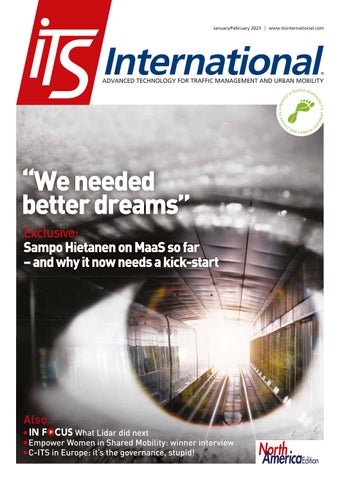
“We needed better dreams” Exclusive: Sampo Hietanen on MaaS so far – and why it now needs a kick-start
Also…
What Lidar did next Empower Women in Shared Mobility: winner interview C-ITS in Europe: it’s the governance, stupid!
North AmericaEdition
EVERY JOURNEY MATTERS We know transportation is personal. Getting from Point A to Point B is part of your everyday life. Now it’s time to get you there smarter, safer, and more efficiently. Let’s discuss advancing mobility together.
transportation.cubic.com
CONTENTS
Contents
11
January/February 2023
05 COMMENT
34 DIGITAL NAVIGATION
Satnav – not costly civil engineering projects – might point us towards better management of congested road networks, argues David Metz of University College London
06 NEWS DIGEST 08 CONTRACTS & DEALS 11 INTERVIEW
38 ASECAP DAYS: REPORT
Whee!’s Kari Anne Solfjeld Eid, winner of Empower Women in Shared Mobility 2023: “For a city to be loveable, the car has to be a guest”
06
There’s a lot to think about as Europe’s tolling bigwigs are told to prepare for ‘interoperability on steroids’
14 MOBILITY AS A SERVICE
42 ENFORCEMENT
Sampo Hietanen, godfather of MaaS, explains why the future is on its side - but the MaaS concept now needs a kick-start
If you don’t wear a seatbelt, you’re disproportionately likely to be killed in road collisions: Geoff Collins of Acusensus explains how AI will help
21 TRAFFIC MANAGEMENT
44 TUNNELS
Chattanooga, you too? The Tennessee city is rolling out 100-plus smart intersections - with a little help from Seoul Robotics
24
The 18km Fehmarnbelt Tunnel reduces travel time between Denmark and Germany to just 10 minutes with futureproofed ITS technology
24 DETECTION &
48 PRODUCTS & INNOVATIONS
MONITORING
North AmericaEdition
C-ITS is here: but who’s responsible for making it work? Richard Lax of Kapsch TrafficCom points to lessons learned from the European experience
NA 03 Mass transit is under pressure
LIDAR
29
29
North America area only
all over the world: to get riders back, it might be worth looking at more data and taking some pointers from retail
Automotive, tolling, robotics – outside of traffic, road safety and autonomous vehicles, find the applications that will move the dial in terms of Lidar during 2023
NA 05 The way we order and pay for
www.itsinternational.com January/February 2023 |
International FOR TRAFFIC MANAGEMENT
AND URBAN MOBILITY &
POS
T ED RE S
PO
Y• IBL
48
Exclusive: Sampo Hietanen on MaaS so far t – and why it now needs a kick-star
Image: © Flowertiare | Dreamstime.com
www.itsinternational.com - updated content every working day
Also…
What Lidar did next Mobility: winner interview Empower Women in Shared stupid! C-ITS in Europe: it’s the governance,
TP
O
CE
OU
F
O
U
Dream baby dream
“We needed better dreams”
ED
Cover story
l
TO R
ti
RI N T
• PRIN
D
NS
TE
ADVANCED TECHNOLOGY
goods has changed radically – but what about how those goods are delivered? Here’s how sidewalk robots could reshape the urban landscape
R CARBO
N
NA 08 At first glance, rural
Appalachian roads are not the most obvious place for an autonomous vehicle trial - but DriveOhio thinks AVs can bring value to people and businesses in the countryside
© ITS INTERNATIONAL JANUARY/FEBRUARY 2023
03
art: donaldecompany.com
Inside Inspection
FRONTAL OCCUPANTS DETECTION & COUNTING
www.tattile.com
COMMENT
“THERE’S NOTHING WRONG WITH A BIT OF LUCID DREAMING”
“An industry where most of the money lies in research and pilots is not an industry yet.” “MaaS has not become mainstream, and it has not changed the way people perceive their freedom of mobility.” “Sadly, [it] has been frustratingly slow: we have been working as an ‘egosystem’, not an ecosystem” (‘Egosystem’ is such a great word, by the way!) “We needed better dreams and MaaS has brought that into the discussion”
Editor Adam Hill Email: ahill@ropl.com Tel: +44 1322 612062 Editorial Director Geoff Hadwick Email: ghadwick@ropl.com Tel: +44 1322 612013
Sales Director Dan Emmerson Email: demmerson@ropl.com Tel: +44 1322 612068
Contributing Editors Colin Sowman Email: csowman@ropl.com
Production Manager Nick Bond Email: nbond@ropl.com Tel: +44 1322 612066
David Crawford Email: dcrawford@ropl.com Andrew Bardin Williams Email: andrew@ abwcopywriting.com
Sales Team Graeme McQueen Email: gmcqueen@ropl.com Tel: +44 1322 612069
Design Team Simon Ward, Andy Taylder Circulation & Database Manager Charmaine Douglas Office Manager Kelly Thompson Email: kthompson@ropl.com
“
“
S
ampo Hietanen, godfather of Mobility as a Service, is honest about the story so far for MaaS. In an exclusive article for ITS International, it’s striking that he is so clear-headed about the shortcomings of the concept that he did so much to create and popularise. Here are just a few tasters:
Step forward, Mobility as a Feature
So after 2,000 speeches about MaaS, is Sampo Hietanen still dreaming? Heck, yes! But this is lucid dreaming: micromobility has changed the way we perceive short-distance, inner-city trips, he points out. And it is also the first new means of transportation that did not break through with an ownership model. Subscriptions are both rather popular now, as Netflix and Spotify will attest. But there’s still something missing. Step forward, Mobility as a Feature. It’s worth reading what he has to say. Meanwhile, as a proud supporter of Movmi’s Empower Women in Shared Mobility initiative, ITS International is delighted to have an interview with a newer name in the mobility industry too. Kari Anne Solfjeld Eid, founder of Oslo-based
Internet, IT & Data Services Director James Howard Email: jhoward@ropl.com Tel: +44 1322 612070 Webmasters Sarah Biswell, Tatyana Mechkarova Email: webmaster@ropl.com Tel: +44 1322 612078 Publisher/ Managing Director Andrew Barriball Email: abarriball@ropl.com Tel: +44 1322 612057 CEO Roger Adshead Email: radshead@ropl.com
www.itsinternational.com - updated content every working day
e-cargo bike subscription service Whee!, won the 2023 programme, and thinks there are better ways many of us can be getting round our urban areas. Cars still have a place, of course, but her point is simple: “For a city to be loveable, the car has to be a guest.” I think many of us know what she means. ITS
Adam Hill EDITOR @ITSeditorAdam @adamhillwriter @itseditor_adamhill @ITSInt
Have your say Email me at ahill@ropl.com
Printed by Warners (Midlands) PLC
ITS International, USPS 13324, is published bimonthly by Route One Publishing Ltd, Second Floor, West Hill House, West Hill, Dartford, Kent, DA1 2EU, UK. No part of the publication may be reproduced in any form whatsoever without the express permission of the publishers. Views expressed in this journal do not necessarily reflect the opinion of the Editor or Route One Publishing Ltd. All editorial, advertising or circulation enquiries to: ITS International, Second Floor, West Hill House, West Hill, Dartford, Kent, DA1 2EU, UK.
The US annual subscription price is US$173.00. Airfreight and mailing in the USA by agent named World Container Inc, 150-15, 183rd Street, Jamaica, NY 11413, USA. Periodicals postage paid at Brooklyn, NY 11256. US Postmaster: Send address changes to ITS International, Air Business Ltd, c/o World Container INC 150-15, 183rd St, Jamaica, NY 11413, USA. Subscription records are maintained at Route One Publishing Ltd, Second Floor, West Hill House, West Hill, Dartford, Kent, DA1 2EU, UK. Air Business Ltd is acting as our mailing agent.
Reader Enquiry Service: data@ropl.com Tel: +44 1322 612061 Subscription Enquiries: subs@ropl.com Global: Print ISSN 1463-6344 Digital ISSN 2057-3421 NA: Print ISSN 2399-7087 Digital ISSN 2399-7095
Published by © Route One Publishing Ltd 2023
© ITS INTERNATIONAL JANUARY/FEBRUARY 2023
05
NEWS DIGEST
PTV & Econolite enter new domain of PTV. Meanwhile PTV Logistics will link with Conundra to create the new logistics business, focusing on route planning and optimisation software, under Steven De Schrijver, former CEO and co-founder of Conundra. All individual brand names will be retained for now.
DriveOhio AVs take Appalachian Way
Some cities talk about multimodal transport: Amsterdam just gets on and does it. The Netherlands is famed for its cycling culture, and its latest move in making active travel and public transport more accessible is to open two bike garages, Stationsplein and IJboulevard, under Open Havenfront, the water between the Prins Hendrikkade and Amsterdam Central Station, with space for 11,000 bikes between them. Putting them underground will give pedestrians more space around the railway station, which is a hub for national and international travel.
© Eduard Goricev | Dreamstime.com
Amsterdam bike garages go under water
Kapsch opening IUHH Á RZ URDG WR 5LR ,Q 0DUFK .DSVFK 7UDI½ F&RP LV WR RSHQ WKH ½ UVW SDUW RI D PDMRU IUHH ¾ RZ WROOLQJ SURMHFW in Brazil on 200km of the highway which connects Rio de Janeiro and Santos. The BR101 highway, which connects the country's most populous states is concessioned by CCR RioSP. The coast road was completed in 1972 and is used daily by approximately 10,000 commercial vehicles. Kapsch VD\V WKH V\VWHP LV WKH ½ UVW RI LWV kind in Brazil since the required legislation was introduced in 2021.
£20m to improve disabled access to transport
A UK university has received a £20m grant to improve accessibility to transportation services for people with disabilities. Coventry University will use the money from charity 0RWDELOLW\ WR FUHDWH WKH 8.µV ½ UVW evidence centre for accessible and inclusive transport. Motability's research shows that disabled people in the UK currently make 38% fewer journeys than non-disabled SHRSOH ° D ½ JXUH WKDW KDVQµW changed in the last decade and which therefore impacts disabled people’s access to healthcare, employment, education and social activities.
© Monkey Business Images | Dreamstime.com
DriveOhio's Rural Automated Driving Systems project is starting two deployments on the US state's country roads. The project focuses on 32 counties in Ohio’s rural Appalachian region, and is "the most comprehensive testing effort yet to be conducted on rural roads in the US", DriveOhio - part of Ohio Department of 7UDQVSRUWDWLRQ VD\V 7KH ½ UVW year-long deployment includes three passenger vehicles - with safety drivers - equipped with AutonomouStuff technology travelling on divided highways and rural two-lane roads in Athens and Vinton counties.
© Chuyu | Dreamstime.com
© Leung Cho Pan | Dreamstime.com
Two businesses - mobility and logistics – have been created out of PTV Group, Econolite and Conundra. Econolite and PTV Mobility have formed the new mobility EXVLQHVV IRFXVLQJ RQ WUDI½ F PDQDJHPHQW and planning, under the new brand name Umovity, led by Christian Haas, former CEO
WiM market worth $1.8bn by 2027: report
The global Weigh in Motion (WiM) system market is projected to reach $1.8 billion by 2027 - up from $1.1 billion this year. That's according to a new report from Research and Markets, which predicts a compound annual growth rate (CAGR) of 10% during the forecast period. Europe is estimated to have the highest demand for WiM systems and will dominate the market by value this year. High-speed WiM systems, which cost 50-60% more than low-speed systems, dominate Europe.
FOLLOW ITS INTERNATIONAL ON SOCIAL MEDIA Facebook @ITSInt
06
Twitter @ITS_Int_News
© ITS INTERNATIONAL JANUARY/FEBRUARY 2023
LinkedIn @ITS International Magazine
Instagram @itsinternational_magazine
www.itsinternational.com - updated content every working day
NEWS DIGEST
Amsterdam Drone Week 2023: prep for take-off
Amsterdam, Paris and Japan will demonstrate plans for advanced air mobility (AAM) at this year’s Amsterdam Drone Week, which takes place at RAI Amsterdam from 21-23 March. Held alongside the European Aviation Safety Agency High Level Conference on Drones, this year’s theme is ‘Innovative Air Mobility connecting Cities and Regions’, with AAM mooted both as a means of ultra-short-range citywide hops for passengers and of delivering urgent supplies to areas where road infrastructure is poor.
© J P | Dreamstime.com
Barcelona urban mobility challenge is on
© Jiawangkun | Dreamstime.com
New transit centre for Rhode Island Rhode Island Public Transit Authority (Ripta) plans to build a new public transit centre in the state capital, Providence. The intermodal development will serve as Ripta’s central bus depot, with bike parking, initially serving three million transit users annually, a number which is expected to grow. A request for proposals calls for "bold, innovative ideas" from the private sector to design, EXLOG ½ QDQFH RSHUDWH DQG maintain the centre through a "progressive joint development project delivery model" to be submitted by 17 April.
A series of challenges has been launched by Barcelona Innova /DE 0RELOLW\ WR ½ QG LQQRYDWLYH disruptive mobility solutions for Barcelona in Spain. The urban mobility living lab of Barcelona City Council and the Barcelona Institute of Technology for the Habitat, it is supported by Fira de Barcelona, which hosts the Smart Expo World Congress and Tomorrow.Mobility (7-9 1RYHPEHU 7KH ½ UVW challenge - offering €200,000 in prizes - is to reduce motorbike accidents in the Catalan city and to increase safety for other road users too.
© Andreistanescu | Dreamstime.com
Oakland moves to curb delivery jams
Populus is partnering with the City of Oakland to launch smart loading zones that will allow operators to pay for their use of space through GPS technology from their delivery or on-demand vehicles. The California city has announced a QHZ SHUPLW IRU ¾ HHW RSHUDWRUV "to leverage a frictionless, hardware-free method to pay for kerb use and reduce potential parking tickets". From ride-hail to on-demand delivery, the rise in vehicles wanting to use kerb space is presenting problems for cities as drivers park dangerously or misuse loading areas.
© Kuzma | Dreamstime.com
Moovit scores in Turkish soccer
UITP launches public transport EHQHÀ WV WRROER[ Public transportation association UITP has launched new resources designed to highlight the EHQH½ WV RI SXEOLF WUDQVSRUW 7KH 3XEOLF 7UDQVSRUW %HQH½ WV 7RROER[ FRQWDLQV EURFKXUHV SRVWHUV and visuals to help users communicate this message to the public, policymakers and other VWDNHKROGHUV ,W LGHQWL½ HV EHQH½ WV RI SXEOLF WUDQVSRUW LQFOXGLQJ FOHDQ DLU DIIRUGDELOLW\ boosting economies and creating local jobs - in three categories: people, progress and planet. 3XEOLF WUDQVSRUW DQG FRPELQHG PRELOLW\ LPSURYH VRFLDO FRKHVLRQ JXDUDQWHH ½ QDQFLDO DQG SK\VLFDO DFFHVVLELOLW\ DQG ½ JKW FOLPDWH FKDQJH 8,73 VD\V
Turkish soccer club stanbul Basaksehir FK and urban mobility app Moovit say their partnership has helped fans to get to games more sustainably by encouraging public and shared transportation use. $OWKRXJK QRW SXWWLQJ D ½ JXUH on it, the partners say promoting multimodal travel to the Basaksehir Fatih Terim stadium in Istanbul, as well as to away matches, has helped reduce CO2 emissions. Basaksehir plays in the top division of the Turkish Super Lig and also has matches in panEuropean competitions.
FOLLOW ITS INTERNATIONAL ON SOCIAL MEDIA Facebook @ITSInt
Twitter @ITS_Int_News
www.itsinternational.com - updated content every working day
LinkedIn @ITS International Magazine
Instagram @itsinternational_magazine
© ITS INTERNATIONAL JANUARY/FEBRUARY 2023
07
S
CONTRACT & DEALS
Canada installation for Swarco McCain
Via Verde has been awarded a contract for the management and collection of tolls on the A24 Blankenburg Connection, a highway serving the port city of Rotterdam in the Netherlands. As part of the deal, A-to-Be will provide its MoveBeyond EDFN RI½ FH V\VWHP WR 5': WKH Netherlands Vehicle Authority. The A24 roadway connects two of the principal highways in the Rotterdam area, the A15 and the A20. It will be only the third 'XWFK KLJKZD\ WR LQFOXGH D system of electronic tolling.
+DL\LQ _ 'UHDPVWLPH FRP
A-to-Be has Via Verde's back
with an accurate picture of what’s happening across road systems". It will also help with Smart City management such as emissions control and the optimisation of parking and public transport, as well as enhancing road safety through real-time and historical data on accidents, hard braking and speeds.
Yunex and Lyt join up LQ 3DFLÀ F 1: 9DQGHU:ROI,PDJHV _ 'UHDPVWLPH FRP
Iteris & Otonomo 'unlock mobility infrastructure'
Connected vehicle data available through Otonomo Technologies is to be integrated into Iteris’ ClearMobility platform. The agreement will allow clients to "gain an unprecedented view of WUDI½ F EHKDYLRXUV JOREDOO\ WR LPSURYH UHDO WLPH WUDI½ F ¾ RZV
<XQH[ 7UDI½ F DQG /\W DUH WR SDUWQHU LQ WKH 86 RQ WUDI½ F PDQDJHPHQW DQG ½ UVW responder priority throughout WKH 3DFL½ F 1RUWKZHVW 7KH WZR ½ UPV VD\ WKH\ ZLOO EULQJ together leading AI and connected vehicle technologies
to prioritise and optimise public transport, plus emergency and other vehicles. Paired with Yunex's solutions including DGYDQFHG WUDI½ F PDQDJHPHQW systems, connected vehicle applications and advanced WUDI½ F FRQWUROOHUV WUDI½ F agencies can now leverage Lyt. HPHUJHQF\ ZKLFK JLYHV ½ UVW responder vehicles a consistent and reliable green light as they journey to an incident.
Texas sharing for One.network
© Dejan Baric | Dreamstime.com
Madrid City Council has awarded contracts to shared micromobility SURYLGHUV 'RWW /LPH DQG 7LHU Each company will provide 2,000 e-scooters that will be deployed in the city for a period of three years. The council has the option of extending the licence periods for six months at a time, depending on how demand evolves. The devices will enter service in May and are DLPHG DW FUHDWLQJ D VLJQL½ FDQW shift in the city’s transport options.
2QWDULR LV WKH VLWH RI WKH ½ UVW Canadian full-city installation of the McCain ATC Cabinet. Swarco McCain is partnering with distributor Innovative 7UDI½ F 6ROXWLRQV WR XSJUDGH 122 intersections in the City of Greater Sudbury. To be completed in 2024, the deal is part of the city’s plan to XSJUDGH WUDI½ F PDQDJHPHQW infrastructure to a modern system that allows for future growth. It will also allow the City to leverage additional systems like transit signal priority and emergency vehicle preemption. Equipment deployed includes the McCain M ATC cabinet.
© Sean Pavone | Dreamstime.com
Dott, Lime & Tier scoot into Madrid
North Central Texas Council of Governments (NCTCOG) has selected workzone data software company One.network to offer data-sharing solutions. These will be available to member communities and US transportation agencies via the TXShare Cooperative Purchasing Program, which NCTCOG operates, and the idea is that these will let them manage their workzones and FUHDWH IHHGV WKURXJK WKH QDWLRQDO :RUN =RQH 'DWD ([FKDQJH :='[ 7KH 86 'HSDUWPHQW RI 7UDQVSRUWDWLRQµV :='[ ZKLFK One.network helped to frame, provides the information to GPS app providers, regional agencies and other third parties.
'DYLGJQ _ 'UHDPVWLPH FRP
FOLLOW ITS INTERNATIONAL ON SOCIAL MEDIA Facebook @ITSInt
08
Twitter @ITS_Int_News
© ITS INTERNATIONAL JANUARY/FEBRUARY 2023
LinkedIn @ITS International Magazine
Instagram @itsinternational_magazine
www.itsinternational.com - updated content every working day
Civil Security
Traffic Flow
Vision Zero
Sustainable Mobility
Road Safety
Emission Control
Full Service Road User Charging
Enabling Safer and Smarter Mobility. Jenoptik provides innovative and sustainable smart mobility technology and services. As an end-to-end solution provider, we support our customers with the provision of roadside equipment and software, including integration and installation through to full-service operation. Our strong global presence and installation base is supported by a reliable partner network. With innovation as our driving force, Jenoptik is a world-leading enabler for smart mobility, making roads, journeys and communities safer around the globe.
Follow us!
jenoptik.com/markets/public-safety
AI & Big Data Analytics
SMARTMICRO SENSORS FOR ENFORCEMENT SOLUTIONS Multi-lane & multi-object detection RED-LIGHT ENFORCEMENT APPLICATIONS: Red-light enforcement Stationary speed enforcement Portable speed enforcement Mobile speed enforcement
STATIONARY SPEED ENFORCEMENT
MOBILE SPEED ENFOR
smartmicro.com
MARCH 22-23
2023
PARIS Porte De Versailles Pavillon 6
WHERE INNOVATORS AND POLICYMAKERS MAKE MOBILITY
The largest annual global gathering of policymakers, institutions, NGOs, companies, and international start-ups focused on sustainable urban mobility solutions, featuring over 200 exhibitors, 300 speakers, and 8,000 attendees.
www.amwe.world
INTERVIEW
“FOR A CITY TO BE LOVEABLE, THE CAR HAS TO BE A GUEST” Kari Anne Solfjeld Eid, founder of e-cargo bike subscription service Whee!, has won the Empower Women in Shared Mobility 2023 programme. She tells Adam Hill how to make cities loveable…
K
ari Anne Solfjeld Eid was surprised but delighted to win Movmi’s Empower Women in Shared Mobility (EmpowerWISM) 2023 award. The programme is open to companies which have been in business for fewer than five years, have at least one woman co-founder or executive, and offer a product or service that falls within the shared mobility industry – a perfect fit, in short, for the founder of Oslo-based electric cargo bike subscription service Whee! The EmpowerWISM judges said they were inspired by Whee!’s vision for a car-free sustainable future. Solfjeld Eid’s first experience of cargo bikes was in 2014 and she talks of “the epiphany of the transformative power of this vehicle.” She adds: “I always say that when you ride a bike in Oslo, it takes you 15 minutes to be radicalised. I mean, you suddenly see the injustice in the way space is divided; you see the space that kids have sacrificed; that everything is made to be forgiving for reckless, indifferent drivers.” While the Norwegian capital has quite a strong active travel culture, Solfjeld Eid says: “I got really tired of talking about bicycle urbanism. There are a couple of big development projects here in Oslo where they have very high aims for sustainability, but they don’t view the transportation aspect as a part of it. They’re kind of stuck in the old ways of planning: [but] there will be no 15-minute city if you plan for cars, and have active transportation as an afterthought.”
www.itsinternational.com - updated content every working day
“
“
Ripple effect Moving people from cars to bikes is the best way to achieve sustainability goals, she says, creating a “ripple effect that’s also mindset transformational”. She admits with a laugh that cargo bikes are ‘strange’ looking, “like an ‘ugly duckling’ kind of vibe”. They’re also expensive. “So I understood that if I want people to fully realise the potential of this, we need to get more people on them - and we need to remove the barriers so more people can use them,” she explains. She started a pilot with 35 subscription bikes in 2020, and “we’ve been running to meet demand” ever since. The models Whee! offers are not the big, nearly three-metre-long ones you might see on Dutch streets, for instance; they carry a couple
There will be no 15-minute city if you plan for cars
© ITS INTERNATIONAL JANUARY/FEBRUARY 2023
11
INTERVIEW of passengers in the back and are more manageable in size: in other words more like “something that resembles the bike that you have ridden as a kid”. Rather than being intimidated, therefore, users can “feel empowered and safe”. “It will change your life, it will improve your quality of life,” she explains. But while e-cargo bike subscriptions seem a good fit for highdensity Oslo with its progressive, anti-congestion policies, what about urban areas with different geographies and demographics? “We believe this is the smallest market we will be operating in,” says Solfjeld Eid. “The density of Oslo comes from a couple of historically good choices like building rail and preserving the forests around the city. So we are looking at cities who have a progressive approach, who are repurposing the space in their cities, removing parking spaces, adding congestion fees and just really wanting to free up the space for the inhabitants. And we’re also looking at cities that have quite a high amount of urban families living in the city centres.”
Oslo’s high density makes it well-suited to the Whee! concept – but it can also work in other cities
Solfjeld Eid talks of the ‘transformative power’ of cargo bikes
transportation and plan for the modes that are more efficient and more attractive and more sustainable and so more social. So of course we need to have cars for all kinds of deliveries and for disabled people, for example, but we need to really just plan around the car as a third or fourth priority.” Before Whee!, Solfjeld Eid’s experience was largely as a designer. “My design skills are in user experience and service design, really trying to understand users’ needs,” she explains. “I saw that there is a gender gap in cycling, there is a gender
“
© Sergei Tsepek | Dreamstime.com
What we see is that when people get electric cars, they drive even more
“
Car culture Interestingly, this does not necessarily mean urban areas which already have a mature bicycling culture. “So we’re not looking at Amsterdam and Utrecht and Copenhagen because they have something that works,” she explains. “So we’re looking at maybe Barcelona, Paris, Milan, Brussels, Berlin, all these other cities where they’re sort of moving towards that.” Whee! also sees possibilities outside of Europe. “We have to also be super-selective into which cities we want to go in,” she says. “I am following the development of more pedestrianfriendly cities and there is a shift there.” What about the US or Canada? “Well, car culture is so massively embedded in North America, so I think it’s more challenging. But maybe some cities in the African continent or Asia could be interesting because you have the density of population: that’s a premise for us coming in - we have to go where the car is highly impractical.” Not, she says, that Whee! is conducting a war on cars. “I don’t think that cars will go away within the next 30 years,” she points out. “But I think that in order for a city to be loveable, the car has to be a guest; we have to change the hierarchy of
12
© ITS INTERNATIONAL JANUARY/FEBRUARY 2023
www.itsinternational.com - updated content every working day
INTERVIEW
gap in transportation and mobility. And there are hardly any micromobility or sharing services that really took into account how completely different the travel patterns of a caregiver are compared to the travel patterns of a young, free and single person who needs to only move themselves.” Caregivers – often women – have to move children and their stuff around to different appointments and activities, and might reasonably feel they can’t do this without a car. “We have the solution,” smiles Solfjeld Eid. “It’s kind of low-key and it’s not very high-tech, but it’s getting more high-tech and it’s electric and it’s just brilliant!” Company DNA Whee! has 10 full-time employees and three of the founders are female – hence the close alignment with the principles of the EmpowerWISM programme. “It sounds cheesy to say, but it’s in our company DNA because we also have a goal of equal gender representation,” she explains. “We have built the workshop so female mechanics don’t have to lift the 30kg bikes every day; accessibility is in everything we do.” Intriguingly, Solfjeld Eid points to similarities in some aspects of Norwegian and North American car culture. “In Norway, there is a very urban/rural divide in transportation that reflects into policy; it is closer to North America when it comes to our culture than to Europe, actually,” she says. “Oslo is the one city where we have density but there are around 150,000 people commuting into Oslo every day by car. And as soon as you get outside the centre of the city, then you have a stronger car culture, where the car is perceived as identity, culture, lifestyle, freedom – everything it is promising to be but not really delivering on.” Norway has enthusiastically embraced electric vehicle takeup, with vast numbers of people taking advantage of government subsidies to the point where 20% of cars are electric. In 2021, 64.5% of all new cars sold were fully-electric - the highest percentage of EVs in new car sales across Europe. Norway’s EV association (Norsk elbilforening) thinks it will take just another www.itsinternational.com - updated content every working day
two years before 30% of the country’s total car fleet is electric. A third of vehicles in Oslo itself are electric. Meanwhile, detractors have suggested that more money might be spent on encouraging active travel and on public transport. “We’re a world leader in Tesla sales and everything, which is good, but it’s still a car and what we see is that when people get electric cars, they drive even more” points out Solfjeld Eid. “I really do like a lot of things about electric cars. But I think they make people feel that they contributed to being environmentally friendly. And then they drive more. So the two things that Norwegians do are driving the electric car and sorting the recycling. But we still consume like crazy and fly all over the place!” User experience For Whee! the next 12 months will see it developing its concept and business further. “Our goal for this year is to get one step further on the development of our own bike concept that’s more circular and built for maintenance and repair - but also more user friendly and more difficult to steal,” she says. User experience is again a huge part of what Whee! is trying to do, while adding in what Solfjeld Eid calls a “service design mindset”, designing a great bike for end users, but which is easy to be maintained and which has longevity. “Our goal is to break even here in Oslo just to prove that we can get to be a highly profitable business,” she continues. “And the last goal is to plant the flag abroad. So we’re doing analysis of the next market that we’re going into and really looking for partners in the cities I mentioned, to see whether it’s better for us to do a pilot or a first approach.” In some ways, Solfjeld Eid’s experiences as a designer and keen student of user experience have led her to this point. “I’m not a visual designer, but I’m a user-insight concept developer who really cares about egalitarian mobility,” she concludes. “I happened to come across the cargo bike as a potential solution – and my goal is to leverage that into everyone understanding what a great solution it is for life in cities.” ITS © ITS INTERNATIONAL JANUARY/FEBRUARY 2023
13
MOBILITY AS A SERVICE
© Flowertiare | Dreamstime.com
"We needed better dreams" Sampo Hietanen, founder of MaaS Global, is one of the authors of the Mobility as a Service concept: the dream is still real, but MaaS needs to evolve, he insists
14
© ITS INTERNATIONAL JANUARY/FEBRUARY 2023
MaaS: less commitment to ownership, more choices for daily life, the need for convenience and urgency of sustainability just to mention a few. But nothing is bigger than our need for freedom of mobility. That means guaranteed access anywhere, anytime on a whim (easy to guess where we got our service name from).
“
MaaS has not become mainstream, and it has not changed the way people perceive their freedom of mobility
“
M
obility as a Service (MaaS) has been there as a concept for more than 15 years. For over five years it’s been on the lips of just about everyone involved in mobility. In many ways it has been like the emperor’s new clothes: something we all should look in awe at – but not really knowing why. So, does MaaS have any relevance or is it just one of those buzzwords waiting to be replaced by a fancier acronym? Having been insisting on MaaS for quite some time now, here’s what I think about it… I agree with Gartner’s Hype Cycle showing MaaS at the ‘Trough of Disillusionment’, reaching a plateau within two to five years. Covid and the financial crisis caused by Russian aggression have stolen three years from the natural development of MaaS: it needs a new jump start. MaaS is a whole new business category, which would take around 20% of household costs. Something so big will not be introduced easily to consumers. Having said that, all consumer trends point towards
Supply and demand The maturity of MaaS markets is dependent on supply and demand. On the supply side, access to all modes in an area is needed to even test the theory of MaaS. No organisation alone will have enough capacity to fulfill the need for every person’s freedom - just try to name a transport provider that can guarantee you all your trips for the next
year. This is what you have in your mind when buying a car. In many ways it is hard to judge the success of MaaS when we haven’t even fully tried it yet. Sadly, the industry has been frustratingly slow: we have been working as an ‘egosystem’, not an ecosystem. We still do not have many areas where relevant access would be easily available on fair terms. Before you have all the components, it’s hard to understand how the demand works. On the demand side, we have learned that people consistently look for all-in-one convenience as the first benefit. The biggest user bases tend to live either centrally or along public transportation corridors. Users are also very demanding – the unlocking of an e-scooter or city bike of any kind cannot take even five seconds. They also expect a one-stop shop for customer care. And all this must work in a multivendor, multimodal world. One big learning has been that technical integration is not nearly as big an effort as process integration. Like in other service businesses, segmenting customers and finding your best
www.itsinternational.com - updated content every working day
MOBILITY AS A SERVICE segments is relevant. We have noticed that there are major differences in the behaviour of so-called 'big fish' who use the service for all their trips. Finding that segment is a core to any MaaS operation being successful. Here are some examples (see tables below) of current categories divided by their usage (where ARPU stands for average revenue per user). We found out that marketing can be targeted to very selected areas with this approach. As can be seen from the picture (right), the big fish are concentrated close to city centre and in places around public transport hubs. 25% of the customers actually live in 10 zip codes. Big fish are multimodal and use the service much more frequently than others. This also speaks in favour of monthly subscriptions. For the big fish it is a lifestyle issue, and they really value convenience. Spotting big fish and converting mid-ARPU users upwards is a key element to success. We know much more now than we did five years ago. But how about the big dream of MaaS being better than your own car? Is it even worth pursuing or should we just face the music? A large survey around European cities showed that more than one third of people are looking for a solution to replace their privately-owned vehicle. These people are currently underserved by the mobility industry; they would like
Big Fish
the true feeling of multimodality without the hassle of opening lots of apps but they’re not getting it. So, we know we have an impact tool that people want - but it has not been put to market. There is not enough evidence to show that everything has changed with MaaS, but all the numbers point in the right direction. Prior to Covid, up to 24% of Whim users
in Helsinki said that they either avoided buying a car, or sold it, with the help of the service. More than 40% of bike trips relate to public transport - and connecting taxis with public transport is more than three times more frequent with Whim. The whole MaaS concept was born out of thinking what digital disruption will look like in mobility - and especially what it will
Modes combination
Engaged Mid ARPU 1.0 0.8 MODE BICYCLE PT RENTAL_CAR SCOOTER TAXI
0.6 0.4 0.2
SCOOTER
TAXI
SCOOTER
TAXI
Big Fish
RENTAL_CAR
BICYCLE
PT
0.0
Parent_mode
1.0 0.8 MODE BICYCLE PT RENTAL_CAR SCOOTER TAXI
0.6 0.4 0.2
RENTAL_CAR
PT
BICYCLE
0.0
Parent_mode
www.itsinternational.com - updated content every working day
© ITS INTERNATIONAL JANUARY/FEBRUARY 2023
15
MOBILITY AS A SERVICE
Modes combination Big Fish
Engaged Mid ARPU
Engaged Low ARPU
Mon
Mon
Mon
Tue
Tue
Tue
Wed
Wed
Wed
Thu
Thu
Thu
Fri
Fri
Fri
Sat
Sat
Sat
Sun
Sun
Sun
0
5
10
15
20
0
5
HOUR
10
15
20
0
5
HOUR
10
15
20
15
20
HOUR
Use by hour and type of day (work week vs weekend) Big Fish
Engaged Mid ARPU
Engaged Low ARPU
TYPE_OF_DAY Weekend Workweek
TYPE_OF_DAY Weekend Workweek
TYPE_OF_DAY Weekend Workweek
0
5
10
15
20
0
5
10
15
20
0
5
10
HOUR
HOUR
HOUR
look like in the eyes of the consumer. I dare to say that, prior to MaaS, the discussion around the dominance of the car and how to compete against it was just ideological humming or ‘rationalisation dreams’ by city engineers.
But a lot has changed in the last years. We see micromobility booming and changing the way we perceive short-distance, inner-city trips. It is also the first new means of transportation that did not break through with an ownership model. Just imagine the hassle for city regulators if half of the people owned their e-scooters? Setting time-based speed limits and so on would be impossible. Payments are also changing in a way that allows much easier access to all modes
from car-share to public transport. This makes the expensive part of building MaaS much faster and more affordable. These are just some examples of the enablers that are needed to even start building the user experience people deserve. If you go around Madrid, you see young people using the nearest car-share easily - and not even considering buying a car. One big question has haunted MaaS from the beginning: namely, who will
‘Freedom of movement’ The car has represented freedom of movement to us for a century. That sense of freedom is not something that even younger generations are willing to sacrifice. We needed better dreams and MaaS has brought that into the discussion. I have given over 2,000 speeches about MaaS in all kinds of forums and still get excited to see how people start dreaming. It is easy to sell the idea of ‘all modes open to them everywhere in the world with no hassle and just one monthly payment’ (preferably paid by an employer, parents or whoever feels most suitable). Still, if you look at the amount of talk, research, national programmes and investment, very little has changed so far. MaaS has not become mainstream, and it has not changed the way people perceive their freedom of mobility. An industry where most of the money lies in research and pilots is not an industry yet.
16
© ITS INTERNATIONAL JANUARY/FEBRUARY 2023
If MaaS cannot liberate the money used for car ownership, it will struggle to be sustainable
© ITS International
“
“
We needed better dreams and MaaS has brought that into the discussion
www.itsinternational.com - updated content every working day
Holistic Urban Mobility Management by SWARCO
LET IT FLOW! People, Traffic, Environment – a liveable city for all. SWARCO’s well-thought-out Urban Mobility Management provides intelligent, sustainable traffic solutions. From smart intersections to the connected Smart City: With systems from SWARCO, you are well-prepared for the future.
Explore the Urban Mobility Management of the future now!
MyINTERSECTION
MyCORRIDOR
Future-proof solutions from a single source.
www.swarco.com/let-it-flow
MyCITY
© ITS International
MOBILITY AS A SERVICE
Micromobility is the first new means of transportation that did not break through with an ownership model
18
© ITS INTERNATIONAL JANUARY/FEBRUARY 2023
then vouchers for end users seem to drive the required private investment to get to critical mass of MaaS. Most companies want to stay on the sidelines of MaaS – enabling it, but not taking the end-user risk. Those that get their money from end users are very few. There have been endless debates about whether this is a B2C, B2B or even B2G market. Whoever ends up serving the customer must deal with the C-type business – the consumer - so I find the debate pointless. MaaS is, in the end, a B2C business, the rest is just channel strategy. The brilliance of the car industry is that it is a competitive consumer business that has externalised its infrastructure (and most of the annoying parts) to society.
“
In many ways it is hard to judge the success of MaaS when we haven’t even fully tried it yet
“
provide the aggregated solution to the end user? I’ve often said that we have an egosystem instead of an ecosystem in mobility. Some think that choice should not be enabled for users. The thinking behind this is that authorities should dictate the correct mode and route. Alternatively, some want to dominate the space from a business perspective and over-utilise market dominance. This kind of narrow thinking fails to see that we don’t have a cake to cut yet. If the competitor is car ownership instead of another service provider, we start seeing the world differently. If MaaS cannot liberate the money used for car ownership, it will struggle to be sustainable. That can only happen by creating real value to users - not by trying to guide or educate them. Cities and their public transport organisations have struggled to find their role within MaaS. Some years back the interest started to be big enough to create strategies towards MaaS – but it resulted in a wilderness of isolated technical pilots and research programmes. Only a very few cities or governments wanted to look beyond pilots and consider what MaaS markets could look like. Finland made legislation to enable markets but failed to enforce it. Antwerp has worked as a city to push for open markets but the market struggles with size (Brussels is still a walled garden) and Covid took a toll on it as well. The recent openings in Milan and some other Italian cities are promising. A prequalification and
Mobility as a Feature The latest trend in the MaaS business is that mobility will become an embedded feature into other sectors that are in touch with mobility. Almost all sectors touch mobility but cannot utilise it in their service. This is what Professor David Hensher from the University of Sydney Business School and I called Mobility as a Feature (MaaF) in a recent article.
MaaF is enabled through MaaS technology, making the plug-in easier. Companies that aim to embed mobility into their services are not capable of investing into the platform needed to produce the necessary integrations and the user experience - but they will embed it if that is made easy. This happened also with maps years back and is now happening with banking and insurance. MaaF can be a natural evolution, whereby your event ticket comes easily with access; your rent is combined with all modes you want to open; or your car insurance will become your ‘freedom insurance’. Eventually you could also buy an access to a car but the service can be produced multimodally. In many ways the biggest benefits tend to materialise when you cross sectors and create new experiences. The future is on the side of MaaS. It does take a village to build, and a mindset change within the industry is needed. It is not about what’s in it for your core business - but more about what’s in it for the end user. That attitude has proven to be the right one when going for disruption. ITS
ABOUT THE AUTHOR: Sampo Hietanen is founder and CEO of MaaS Global, home of the Whim MaaS app
www.itsinternational.com - updated content every working day
Dynamic Message Signs SUSTAINABLE. RELIABLE. SUPERIOR VISIBILITY. SWARCO McCain Inc.’s signs utilize powerful and innovative components like integrated 3-in-1 LEDs combined with SWARCO’s patented precision-optic technology resulting in the highest visibility, lowest operational costs, and longest mean time between failures in the transportation industry. • Dynamic Message Signs (DMS) • Changeable Message Signs (CMS) • Variable Speed Limit Signs (VSLS) • Lane Control Signs (LCS) • Blank-Out Signs (BOS) View all sign offerings on the Dynamic Message Signs product page
mccain.swarco.com/dms
Earn Continuing Education Credits (CEC) with our on-demand webinars. Dynamic Message Signs
mccain.swarco.com/webinars-od
April 24-27, 2023 Gaylord Texan Resort, TX Conference: April 24-27 | Expo Hall: April 25-27
IMPLEMENTING INNOVATION FOR ALL ITS America Conference & Expo, taking place April 24-27, 2023 at the Gaylord Texan Resort, will explore Implementing Innovation for All and bring together the entire intelligent transportation community for thought-provoking education, networking, and demonstrations exploring the technologies and solutions that will enable a better future.
REGISTER TODAY: ITSAMERICAEVENTS2023.COM/ITSINTERNATIONAL Hosted By:
In Partnership With:
Built By:
ln the business of building businesses
North AmericaEdition
Platform announcement: public transport is running 10 years behind schedule Public transport worldwide is under pressure on a variety of fronts. Jon Salmon of Snapper Services UK explains why the industry should look more at data – and pick up some tips from the retail sector
I
t’s currently difficult not to associate public transport with cancellations and delays. All too often, we find ourselves frustrated at the bus shelter, train platform or tram stop, continually refreshing our smartphones for a travel update while hoping a service will arrive to take us to our destination – whether that’s to work, the high street or a friend’s house. Recent statistics suggest this has caused a widespread reduction of trust in public transport services. In Britain, there has been a 20% decline in bus passenger journeys compared to pre-pandemic levels in 2018/19 – when services were already at their lowest levels of usage since the 1980s – which suggests the decline isn’t solely caused by the growth of remote working. According to the US Census, public transportation only accounts for a mere 2% of trips in urban areas, which has resulted in the average American wasting 54 hours per year in traffic. Meanwhile, rail travel has decreased in Europe, with the number of passengers in Spain dropping from around 600,000 in 2017 to around 400,000 in 2021, while the number of passengers in Italy fell from around 865,000 to around 490,000 over the same period, according to data from Eurostat.
Without access to dependable routes, people will continue to lose faith in public transport services and our cities will remain congested. Rising to the challenge This decline is cause for concern given that the public transport sector has a crucial role to play in the fight against climate change. Successfully winning back passenger trust is vital if the public transport industry is to fulfil its potential when it comes to reducing emissions and making our cities more liveable. At the same time, the cost-of-living crisis is prompting more people to travel via public transport, with research finding almost half (41%) of UK adults plan to use the bus more often in a bid to save money. This is a genuine opportunity to encourage people to re-embrace public transport, so finding innovative ways to drive efficiency on our networks is more important than ever before. Authorities and operators must rise to the challenge through a smarter approach to technology and leveraging data. Inspired by retail Other industries, particularly retail, have demonstrated what can be achieved through making effective use of digital transformation and new technology to enhance the user experience. Compare this to bus services in particular, and it can feel like
www.itsinternational.com - updated content every working day
progress has stagnated and public transport is lagging 10 years behind other industries. Advanced self-checkout processes or same-day delivery, in which a once-futuristic drone will deliver your package within hours of clicking the ‘pay now’ button, appear far ahead of developments within the public transport sector. These ‘on-demand’ services speak to the flexibility and immediacy expected in a modern customer experience. We can also look towards retail’s rapid adoption of digital and analytical technologies like learning to enhance productivity and deliver personalised customer experiences at scale. Organisations that successfully integrate these new technologies open the door to improved customer retention and cost efficiencies. Thinking globally Public transit data has huge power to shape the cities we live in. We’re already seeing more open data and collaboration initiatives doing well across public and private entities. Public transportation in Southeast Asia, for instance, is celebrated for its efficient, punctual, and clean network infrastructure. As such, it’s worth looking at what operators are doing differently in places such as Japan, China and South Korea. Indeed, South Korea’s capital, Seoul, was recently awarded the Smart City 2022 title, receiving special recognition for its © ITS INTERNATIONAL
JANUARY/FEBRUARY 2023
NA 03
© Ying Feng Johansson | Dreamstime.com
MASS TRANSIT
MASS TRANSIT North AmericaEdition
© 22tomtom | Dreamstime.com
Smart Seoul platform, which promotes digital inclusion policies across communication, mobility, education, safety and tech utilisation. Similarly, Tokyo recently topped a list of the world's future-ready cities, reflecting the city’s ability to adapt effectively to evolving community needs. These initiatives take aim at today’s biggest challenges: sustainability and the cost-of-living crisis. The ability to draw real insights from all of this information is an opportunity for our industry to build trust in public transport and shape our communities. Research finds almost half (41%) of UK adults plan to use the bus more often in a bid to save money
A data-driven approach Learning from operators in Asia will involve turning to simple technology that enables local authorities and transport operators to adopt a data-driven approach. Access to accurate data and easy-to-use analytics tools will support them in better managing their transport networks. This will enable the more effective use of existing real-time information, allowing transport operators to give their entire teams full visibility into how the network is performing, identify areas of improvement and focus their efforts on addressing these pain points for passengers. Authorities, operators, and private entities should work together to provide a better, more reliable transportation service. Operators will face challenges when
modernising their approach, from inflationary pressures and driver shortages to changing travel habits from flexible working. The good news is that at Snapper Services, we believe these challenges can be met by leveraging existing data and by implementing the correct analytical tools. In this way, operators can seek to improve their overall transportation network performance and boost passenger numbers through a focus on frequency, punctuality, and reliability. Cooperation across all relevant parties and a drive to regain passenger trust in public transport will be an important first step.
Without data and digital transformation, the industry will remain behind schedule on its journey to operating successfully by fully meeting the needs of today’s passengers. ITS
ABOUT THE AUTHOR: Jon Salmon is executive director of Snapper Services UK
Industry connections on social media
Facebook @ITSInt
NA 04
LinkedIn ITS International Magazine
© ITS INTERNATIONAL JANUARY/FEBRUARY 2023
Twitter @ITS_Int_News
Instagram @itsinternational_magazine
www.itsinternational.com - updated content every working day
EMERGING TECHNOLOGIES
North AmericaEdition
Here they come, trundling down your street The way we order and pay for goods has changed radically – but what about how those goods are delivered? Gordon Feller looks at how sidewalk robots might reshape the urban landscape
P
ersonal delivery devices (PDDs) – or sidewalk robots – are an increasingly common sight in our cities. But four pilot schemes last year (see Special Delivery, ITS International November/December 2022, North America edition) highlighted some problems. In Pittsburgh, the bots found themselves unable to operate in a key neighbourhood “due to infrastructure limitations such as cracked sidewalks … sidewalk obstructions such as overgrown trees or bushes, or if cars were parked blocking the [way]”. Difficulties in other cities weren’t any easier to solve. In Detroit, the PDDs had a hard time crossing a wide road on their route, with issues that can certainly be expected to show up in other cities: walk signals that were too short in duration; an inaccessible median. Meanwhile, some PDDs in San José got stuck (or even tipped over) when confronted with sidewalk obstructions, rendering themselves inoperable. Engaging local communities in such projects as these is likely to become mandatory. According to David Rodriguez, co-founder of Kiwibot, whose machines took part in
the trials, such engagements are important because they “allow people to adopt the technology more quickly, and accept the robots. It is essential to involve communities in local activities and events”. Rodriguez cites one example: connecting with Miami’s Little Havana community by doing school activities. Rodriguez says: “This allowed people to feel safe around the robot. Thanks to Kiwibot’s technology, we could provide the city with data to identify where garbage was accumulating the most. With this data, the city could make decisions impacting citizens’ quality of life and solve health and wellness issues.” Revolution and delivery Kiwibot announced it would expand to 1,200 robots by the end of 2022 and now operates on around 25 US college campuses. The company has opened operations in the Middle East, while running pilots in Peru, Spain and Japan. In partnership with Sodexo, Kiwibot provides students, faculty and staff the opportunity to get their food or other goods delivered on-campus via app. Users then receive a unique link to track their order and follow the robot’s
location in real time. The weight range of each Kiwibot is 20-29kg and, for safety, they run at human walking pace. Each robot creates a real-time virtual visualisation of the world by using sensors, reflective flags, night lights and a range Lidar. Kiwibots can stay centred on the sidewalk without any human assistance, which is what the company calls “C2C - Corner to Corner”. Kiwibot insists its perception software is designed and programmed to ensure pedestrian safety. Campus or city mobility and foot traffic are taken into consideration in ways which serve customer needs safely, primarily by bots yielding the right of way. Kiwibots need teleoperators to cross the street - the scenario with the most risks – and the company obtains a permit signed by local and state authorities which allows its PDDs to transit private spaces and their surroundings. Hardware is designed and tested to handle extreme weather such as snow. In addition to the company’s proprietary delivery service, Kiwibot has piloted mapping and off-campus advertising in US cities (including Pittsburgh, Boston, Washington DC, Detroit, Miami, and San José).
Starship: enterprise
www.itsinternational.com - updated content every working day
© ITS INTERNATIONAL
JANUARY/FEBRUARY 2023
NA 05
EMERGING TECHNOLOGIES North AmericaEdition
The race for space Of course, Kiwibot is not the only start-up jostling for space on city sidewalks. Another is Starship Technologies, whose robots are designed to deliver food, groceries and packages locally in minutes. They have travelled millions of miles and completed 3.5 million autonomous deliveries around the world, the company says. Starship was founded by Ahti Heinla and Skype co-founder Janus Friis. Thousands of the cooler-sized bots roam on sidewalks, interact with pedestrians and cross well over 100,000 roads per day. Inside each robot is a suite of sensors from optical systems, point cloud sensors, radars, inertial, ultrasonic sensors and processing units. The industry itself – and new sensors
Kiwibot insists its perception software is designed and programmed to ensure pedestrian safety
– are both developing rapidly and flexibility is at a premium. Risto Meskus, Starship head of manufacturing and supply chain, explains that the firm designs, engineers and manufactures the robots in-house: “Manufacturing is co-located with the R&D team in Tallinn, Estonia, with a global supply chain. Parts are sourced mainly from Europe and China; electronics assembly and metal chassis are sourced from various factories around the globe”. The company puts together approximately 80% of the vehicles in-house with a manufacturing model which is relatively labour-intensive and divided into
120,0 00 +C ON TR O
YED PLO DE
150 ,00 0+
S ER LL
CA BI
S ET N
ED OY PL E D
the following phases: body assembly, chassis assembly, final assembly and testing. Developing and manufacturing complex products with cutting-edge technology requires a lot of agility from establishing a clear plan to take a product from concept to its final form to production and supply chain. During the post-Covid supply chain disruptions, the company’s purchasing-and sourcing-related load increased 900% (including engineering impacts). However, Starship was able to make use of its vertical integration by redesigning tens of electronics subsystems to entirely different chip architectures, validating and testing the design and keeping growth at the target of 300% with what Meskus said was “minimal delivery disruptions and no system performance impact”. As the company grows, Meskus points out that manufacturing and supply chain “continues to evolve” and his team is focused on developing solutions to enable further scaling. For instance, this includes transitioning a higher degree of sub-assembly value-add manufacturing to chosen contract manufacturers, “allowing in-house teams to focus on complex, high-value-add work content and driving manufacturability improvements in product design work”. In this way, Starship is actively working towards moving from building hundreds of units per month, to thousands. ITS © Kistler Group
So how will PDDs make a real difference in the world of intelligent transport? “These robots have the potential to transform the way that last-mile delivery is conducted,” explains University of Michigan professor Ram Vasudevan. “Current last-mile solutions contribute to large amounts of pollution and add to congestion. By utilising semi-autonomous, battery-powered robots that operate at the margin of the road and can get out of the way of traffic near the beginning and end of deliveries, these last-mile solutions could significantly improve accessibility.”
The Leader in
One-Stop-Shop O RS
Econolite provides transportation agencies with four pillar advanced
S
S N SE
D EP LO YE D
0+ ,00 160
Traffic Management Solutions
DE PL OY
ED
EM ST Y S 0+ 42
technologies that reduce travel time, ease congestion, enhance transit operations, and provide safer mobility for all roadway users.
To learn more, visit www.econolite.com
NA 06
© ITS INTERNATIONAL JANUARY/FEBRUARY 2023
www.itsinternational.com - updated content every working day
EMERGING TECHNOLOGIES
North AmericaEdition
The last mile Nuro brings customdesigned electric PDDs to operate in local communities in three US states: Texas, Arizona and California. The goal which they promote is: “Less driving and more thriving”. Nuro announced a $40 million investment to develop two new facilities in southern Nevada—an end-of-line manufacturing facility and world-class
closed-course test track—to commercialise and scale production of what the company says is its third-generation autonomous vehicle. Since enacting its first-inthe-US autonomous vehicle legislation in 2011, the state government of Nevada has been promoting itself to the world as a leader in promoting safe deployment. Jiajun Zhu, Nuro cofounder and CEO, says this
is a “significant moment” for the company. “Building on our tremendous momentum—including strategic partnerships with industry leaders such as Domino’s, Kroger and FedEx and operations in three states—we are now able to invest in the infrastructure to build tens of thousands of robots”. Nuro will be taking over 74 acres of the Las Vegas Motor Speedway to build
what it calls “a world-class, closed-course testing facility that will allow sophisticated development and validation of its autonomous on-road vehicles”. The testing track will measure bot performance in a broad range of scenarios, from avoiding pedestrians and pets to giving bicycles space on shared roadways, as well as environmental tests and vehicle systems validation.
Think different.
Experience the difference... Q-FREE TOLLING & TRAFFIC MANAGEMENT
www.itsinternational.com - updated content every working day
© Kistler Group
YOU CAN'T SOLVE PROBLEMS WITH THE SAME THINKING USED TO CREATE THEM.
www.q-free.com
© ITS INTERNATIONAL
JANUARY/FEBRUARY 2023
NA 07
© Kistler Group © Ohio DoT
RURAL AUTONOMOUS VEHICLES North AmericaEdition
The rural Appalachian area ‘would greatly benefit from using AVs’
A nice drive in the country
Autonomous vehicle pilots so far have been typically sighted in urban areas. But researchers in rural regions of Ohio are now trying to find out exactly what benefits they could bring to the countryside
NA 08
© ITS INTERNATIONAL JANUARY/FEBRUARY 2023
will always be in the driver’s seat with their hands on the wheel, ready to take over if required. Different conditions The vehicles themselves have already been tested at the Transportation Research Center’s (TRC) 4,500-acre proving grounds in East Liberty, Ohio, on closed roadways. “The rural Appalachian area surrounding Ohio University would greatly benefit from using autonomous vehicles to deliver goods and transport people, but the road conditions are very different than urban and suburban regions,” said Dr. Jay Wilhelm, associate professor of mechanical engineering at the university.
“
This project holds great promise for the economic wellbeing of rural communities
“
“Our goal is to bridge the technology gap in rural Appalachian communities so automated vehicles can improve quality of life throughout the region.” Specific routes are mapped in high-definition so the advanced driving system has precise information about what DriveOhio calls “explicit roadway characteristics such as lane widths and the location of signals, crosswalks, and nearby buildings”. “Automated driving systems are expected to transform roadway safety in the future, and the data collected with this
© Kistler Group
U
rban canyons – quite apart from mixed traffic - present a variety of challenges to getting autonomous vehicles onto the roads in cities. But what about the problems that AVs might face in rural areas? Curves, hills, movement in and out of tree-shaded areas – all these are a potential challenge to driverless systems. Yet get it right, and automated vehicle technology has the very real potential of enhancing mobility for people in rural communities that have been historically underserved. Transport experts in Ohio are about to find out how much of a challenge all this actually is. DriveOhio’s Rural Automated Driving Systems project, funded in part by a $7.5m grant from the US Department of Transportation, is starting two deployments on the state’s country roads. The project focuses on 32 counties in Ohio’s rural Appalachian region, and is “the most comprehensive testing effort yet to be conducted on rural roads in the US”, says DriveOhio, part of Ohio DoT. The first year-long deployment includes three passenger vehicles - with safety drivers - equipped with AutonomouStuff technology travelling on divided highways and rural twolane roads in Athens and Vinton counties. They will be tested in different operational and environmental conditions, including in periods of limited visibility and in workzones. When the automated driving system is engaged, the technology will control steering, acceleration and braking – but DriveOhio says a professional driver
project will be used to refine the technology to maximise its potential,” said DriveOhio executive director Preeti Choudhary. “Many vehicles on the road today already have some degree of automated driving system technologies like adaptive cruise control, lane keep assist, or emergency braking. Those systems are meant to enhance safety, but they certainly don’t replace the human driver.” Hands on the wheel The second deployment will feature a pair of 53-foot platoon-equipped tractor-trailers connected by technology that enables them to travel closely together at highway speeds. Better fuel consumption for fleets and the reduction of human error are the goals. When the trucks are connected, the lead vehicle controls the speed, and Drive Ohio says the following vehicle will have “precisely matched braking and acceleration to respond to the lead vehicle’s movement”. Equipped with radar to detect other vehicles, the trucks should be able to monitor and react to slower-moving traffic – although, again, a professional driver will always be in the driver’s seat ready to take over. The vehicles will first be deployed on the 35-mile US 33 Smart Mobility Corridor, specifically designed for testing smart and connected vehicles, and a private fleet will begin using the trucks in its day-to-day business later in 2023. “This project holds great promise for the future of transportation and the economic wellbeing of rural communities,” said Brett Roubinek, president and CEO of TRC. ITS
www.itsinternational.com - updated content every working day
car ph 0m
car 0m ph
P< P<
P< P<
P>
car 3
P>
ph
0m
P> P> > P
ph
8m
car 2
P>
5 car 3
The Future is Here. High-definition video and radar detection sensor with integrated artificial intelligence algorithms make Vantage Apex stand apart from anything else on the market today.
mph
5 car 3
h
2 mp
car 4
car
THE CLEAR CHOICE FOR YOUR TMC The same company you trust for digital roadway displays now has a solution HQT 6TCHƂE /CPCIGOGPV %GPVGTU
LEARN MORE DAKTRONICS.COM/TMC
WATCH THE VIDEO
mph
car
ph
36 m
iteris.com/vantageapex
car
k 33
truc
mph
ph
28 m
ph
33 m
Join the tolling industry in Indianapolis April 29 - May 2, 2023!
TECHNOLOGY SUMMIT PACKED FOUR-DAY PROGRAM FOCUSED ON: Digital Transformation Modernizing the Back Office Customer-Centric Payment Systems ...and a lot more! EXHIBITS AND SPONSORSHIPS AVAILABLE
www.IBTTA.org/indy MARK YOUR CALENDARS! MARCH 25- 28
JULY 30-AUGUST 1
Communications, HR & Legal Workshop Norfolk, VA | Hilton Norfolk The Main www.IBTTA.org/norfolk
Maintenance, Engineering and Roadway Operations Workshop Nashville, TN | Renaissance Nashville Hotel www.IBTTA.org/nashville
APRIL 29-MAY 2
OC TOBER 7-10
Technology Summit Indianapolis, IN | JW Marriott Indianapolis www.IBTTA.org/indy
91st Annual Meeting & Exhibition Seattle, WA | Seattle Convention Center www.IBTTA.org/seattle
JUNE 4-6
MID -NOVEMBER
Road Usage Charging and Finance Summit Salt Lake City, UT | Hyatt Regency Salt Lake City www.IBTTA.org/slc
Global Tolling Summit Europe – Details Pending
www.IBTTA.org/events
SUSTAINABLE TRAFFIC MANAGEMENT Chattanooga: getting smarter
Chattanooga, you too Tennessee city has joined the ranks of urban areas seeing the benefit of ITS technology, particularly Lidar, at smart intersections – with a little help from Seoul Robotics. Adam Hill dives into the detail
“
We try to empower cities to deploy and scale the stuff William Muller Seoul Robotics
Step up That’s not bad from just 11 signalised intersections – although they offered the city one billion data points a day. Clearly 100-plus intersections – the biggest urban Internet of Things (IoT) deployment of its kind in the US – is a huge step up from that, with full connectivity, and a range of sensors as well as edge computing, and a dazzling array of data points. “It expands the type of research that can be done at this scale,” CUIP Testbed manager Austin Harris says. “The testbed is an enabler for CUIP: for our students, it
www.itsinternational.com - updated content every working day
gives hands-on experience with real-world data and the environment for real-world testing and validation. But at the same time, we see this as a tool that we want to share with industry and other academics, as well as government: you know, if you don't have something we have, come use the environment, let’s update it. So we really look at it as a platform that enables a wide range of research on IoT, ITS, connected and automated vehicles, wireless communications, and so forth.” “What's really great about the CUIP team is that their goal was to help share this information, not hold it all to themselves and say, ‘Well, look, I succeeded!’” says William Muller, VP of business development at Seoul Robotics. “They actually, truly want to take what they’re learning and help pass it on to other cities. And that's our goal too: they might not always choose us as their vendor - that's fine, but at least we’re allowing them to avoid a lot of mistakes.” And there should be a rich store of information to share, as Chattanooga intends to use 3D data from the new intersections to prepare for the transition to electric vehicles, mapping the ideal locations to install EV
© Suwin Puengsamrong | Dreamstime.com
and actionability has enabled numerous advancements in how we can make our city safer, more efficient and healthier for the people who live here."
“
T
he City of Chattanooga in Tennessee is to build what it believes is the largest smart intersection network in the US, with more than 100 intersections covering the entire downtown area. The US Department of Transportation is giving $4.5 million to the programme – matched by private investors for a total of around $9m - to install a 'living laboratory' throughout 2023 and 2024. Seoul Robotics is a key player, expanding an existing partnership with the Chattanooga Department of Innovation Delivery and Performance, and the Center of Urban Informatics and Progress (CUIP) at the city's University of Tennessee. Their MLK Smart Corridor testbed, first deployed in 2019, uses Lidar sensors equipped with Seoul Robotics’ 3D perception software SENSR to anonymously detect, track and predict the movement of pedestrians and vehicles. This delivered “an entirely new dimension of insights beyond what we anticipated," said Dr. Mina Sartipi, CUIP founding director. "The level of accuracy
© ITS INTERNATIONAL JANUARY/FEBRUARY 2023
21
SUSTAINABLE TRAFFIC MANAGEMENT charging stations, and how to best use the ones the city already has. It will also utilise the system's real-time traffic insights to optimise routes in a bid to alleviate congestion and reduce vehicle emissions. The data will also help understand pedestrian movement at intersections and through city corridors, on the road to Vision Zero.
Insights on a range of issues, from pedestrian safety to city planning, are expected
hand-in-hand with us having a new version of the software, which is built around scaling now, and going into those 100-plus locations easily and rapidly. Because anybody that's hung a camera at an intersection and done the wiring, they can easily do it.” The really complex bit was always the configurations and set-ups and getting the software and the technologies working, he explains: “That's what we really took care of.”
“
“
‘Open sandbox’ However, it's one thing having this nextgeneration testbed, an ‘open sandbox’: but will the citizens of Chattanooga – the drivers, pedestrians and cyclists – actually feel the benefit? CUIP’s goals are aligned with those of the city, insists Harris: for the initial corridor testbed, community engagement was key. “We worked extremely closely with the city,” he says. “The first project we were able to do with Seoul Robotics was around pedestrian safety. The city came to us and said: ‘We want to look at near-miss events, to understand how pedestrians are utilising the intersections and how can we identify high-risk scenarios?’” With the new, much wider-scale, deployment, the technology will be applied to make a positive impact on congestion, safety and connectivity, Harris says. Seoul Robotics will provide “high-resolution data” from Lidar across the myriad intersections. It sounds as though Seoul Robotics is in for some long days and nights to get all this kit up and running, but Muller is not daunted by the task ahead. “What we try to do is empower cities or whichever contractor they work with to allow them to deploy and scale the stuff,” he says. “The design has now been built around scaling, so instead of us spending a day per intersection, once installation - which is normally the longest piece – is complete, we try to get the intersection up and running in under an hour. And I believe we're getting to that point. This all goes
I don't think there's anything else deployed like this Austin Harris CUIP
Deployments at scale But since the beginning of 2022, Seoul Robotics has been working on making deployments scale as easily, as efficiently, as 2019’s original deployment
22
© ITS INTERNATIONAL JANUARY/FEBRUARY 2023
possible: “We are, if not the only one, then at least one of the very few that gets that part of it, and the importance of that - and has actually achieved that. You see a lot of cool demos out there and fancy videos being played.” But when it comes to scale, Muller insists: “I don't think many of them are in that position as of now.” Similar testbeds tend to be proof-ofconcept affairs, Muller says: “This is the first one that's actually scaling.” And he is excited by the prospect: “We still don't have full visibility. There's a lot of things we’ve still got to learn because now we're going from just a singular intersection point of view to the whole corridor.” Updates will be made as the project goes along. “We had dedicated short-range radio deployed in 2019,” Harris laughs. “And very soon after that we realised that was the incorrect direction - I'll leave it at that - but we didn't have Lidar deployed in that initial technology stack or design of each intersection on day one. After the first project with Seoul Robotics we learned a lot: we saw extreme value in the data they provided and the system that we have deployed out there, way beyond pedestrian safety, from cooperative perception through the infrastructure.” Pedestrian insights plus ‘the big picture’ will be what Chattanooga gets out of this, suggests Muller. “I think it's going to be pretty positive. If you think about your base technologies, the things that you utilise to get from point A to point B – maybe a Waze or a Google Maps - you can start planning your journey, you can know where to stop for gas, where you want to go visit something,” he says. “So it's that concept, but at a more city operational level: seeing the big picture from this whole corridor. Where are the choke points? Where are the busy points? How do we encourage people to put their offices there because we know what the foot-flow looks like? Where do we want to add more parks and more restaurants because people gather here or do this there? We’re hoping to see those kind of insights.” ITS
www.itsinternational.com - updated content every working day
Robust Detection
Durable detection installed in the blink of a traffic light
Introducing the new
FlexMag Mini
FlexMag Mini is an even smaller and more durable wireless traffic sensor - only 67mm (2.6”) in diameter - that installs in just two to five minutes! • At least 30% longer lasting than loops • Installs in just 2-5 minutes • Still the most accurate detection It’s the fastest, easiest way to have accurate and more reliable detection.
For leaner, cleaner, quicker traffic detection, visit sensysnetworks.com/durable
1608 Fourth St., Suite 110, Berkeley, CA 94710 USA info@sensysnetworks.com | 510.548.4620
SensysNetworks-ITSIntl-JanFeb2023-fullpagead.indd 1
2/11/2023 4:12:46 AM
DETECTION & MONITORING
C-ITS in Europe: it’s the governance, stupid! Cooperative ITS (C-ITS) is coming – in fact, it’s already here. But who has responsibility for making it work? Richard Lax of Kapsch TrafficCom thinks there are lessons to be learned from the European experience
A
round one million serially equipped cooperative ITS (C-ITS) vehicles are already on the market. The number is steadily rising. Two motorway operators - Asfinag (Austria) and Die Autobahn (Germany) - have both launched nationwide C-ITS road construction warning services. Meanwhile, Germany has just created a regulatory framework allowing driverless vehicles for use on specific infrastructure (SAE level 4 vehicles) into the market. They would operate in defined infrastructure domains. The notion of an autonomous vehicle is a bit of a misnomer, since the vehicle is only autonomous from the driver, it remains interwoven into the traffic environment. It only replaces the senses of the driver and their decision-making with a combination of sensors, radio
systems and automated decision-making. However, the thing that’s most difficult to automate is responsibility. Automation eventually depends on the distribution of responsibility amongst the actors involved: road users - such as cars, motorcycles, vulnerable road users - vehicle operators (remember, the motorist may be phased out), road operators, public transport, etc. Agreeing on this distribution takes far longer than thinking up technical solutions to make automation happen. Europe’s secret Here, Europe is an interesting case to look at – while other regions work on demos, European automotive OEMs and road operators already deploy the communication system that automation requires for time-critical communication: C-ITS.
Why C-ITS? Think split-second reactions preventing vehicles from bumping into each other and looking around corners in the direct vicinity of the vehicle, stuff so important you best communicate directly peer-topeer (to our US readers: you would call C-ITS V2X). So why is Europe doing so well here? The secret is governance. In ‘hard law’, Europe provided sufficient radio spectrum for C-ITS to work. Further to that, Europe invested in building a consensus between public authorities, road operators and car makers that established rules all actors could trust. This created the confidence to deploy C-ITS. Now some of these established rules mentioned above, having been tried and tested, are cast into law at European Union level to further strengthen the regulatory framework.
24
“
“
The real argument lies, as so often, in the question of who is allowed to decide what
© ITS INTERNATIONAL JANUARY/FEBRUARY 2023
© Suwin Puengsamrong | Dreamstime.com
Europe invested in building a consensus between public authorities, road operators and car makers that established rules all actors could trust
www.itsinternational.com - updated content every working day
DETECTION & MONITORING
Where’s the beef? The real argument lies, as so often, in the question of who is allowed to decide what. In the case of the ITS Directive, this concerns
Europe provided sufficient radio spectrum for C-ITS to work © Ekkasit919 | Dreamstime.com
The ITS Directive At EU level a revision of the ITS Directive – which has been in force since 2010 – is in the making. In it, Member States and European Parliament grant the European Commission the right to adopt ITS specifications to establish rules for ITS across the EU. Here are a few examples: a good part of the regulatory framework for the eCall stems from the ITS Directive; the ‘would-havebeen’ C-ITS Delegated Act was rooted in the ITS Directive; other acts cover real-time traffic information, known as RTTI, safe and secure parking and more. After roughly 10 years it was time for the ITS Directive to be revised and updated, and the Commission pitched its legislative proposal in late 2021 (see box, Proposed new ITS Directive).
the data and ITS services in the Annexes. The datasets, geographical scope and deadlines are key to the speed of deployment and to costs. Now in the so-called ‘trilogues’ between EU Member States, represented by the Council, Parliament and the Commission, the stakeholders try to find a balance between broadly speaking to the needs of road safety/automation on the
one side and budget responsibility on the other. The Commission and Parliament tend to be ambitious policy drivers while the Council curbs enthusiasm as it guards Member State budgets. The Council has been looking for the lowest common denominator - in a nutshell: Member States control all and no deadlines please! The Czech Council Presidency has kicked-off
Proposed new ITS Directive
Automation & security: This is key, and the provisions proposed by the Commission here would plug a regulatory hole, if adopted. First there are the so-called ‘interim measures’ which regulate Commission and Member State competencies in emergency situations - in this case a cybersecurity breach in the European authentication system for C-ITS communication. The absence of this clause was the stumbling block for the C-ITS specification that got rejected by the Member States in 2019. The proposal also outlines an EU-wide security authentication system, the security PKI (public key infrastructure). The PKI is essential for C-ITS to operate and one of Europe’s unique selling points for C-ITS. Keep your eyes peeled – it could and should play a key role in authenticating messages for all kinds of robots and drones in the future.
ITS data & services: The Annexes carry most of the real content of the proposal, and here you will find the ITS data types (restrictions in place, state of the network, data for safe and secure truck parking, safety-related events and multimodal static travel data), their proposed geographical coverage and deadlines by when they should become available for which road networks. The road safety-related minimum universal traffic information
www.itsinternational.com - updated content every working day
service, already known from a delegated act, is proposed for motorways. The principles: The eCall is the best illustration of the instability, the absence of guiding principles in regulation causes. The 2G phase-out in Europe is not only proving a challenge for the eCall that depends on 2G cellular communication, it also highlights the dangers of a technology path that is not backward-compatible.
© Ifeelstock | Dreamstime.com
The new ITS Directive focuses on a number of areas.
The ITS Directive proposal looks at creating a stable regulatory environment for seamless ITS deployment. For this, aspects such as interoperability and backward compatibility, maturity or the link to technology neutrality and spectrum regulation are of key importance. Linking ITS with the EU Green Deal and investment: Parliament understood that investment and public funding for ITS would dry up if it were not considered in the EU’s taxonomy regulation. The taxonomy regulation classifies which criteria economic activities would have to meet to be considered ‘green’ and encourage investment and public procurement to focus on ‘green’ economic activities. On 19 December 2022, the Commission published an FAQ on taxonomy, which starts to address the taxonomy regulation-related questions the Parliament has posed.
© ITS INTERNATIONAL JANUARY/FEBRUARY 2023
25
DETECTION & MONITORING
ITS about governance! ITS is about governance, at least ITS geared at public goals, such as road safety, safe automation or sustainability. Europe’s leadership in this field is based on a regulatory framework that gives actors the confidence to deploy. The proposal contains key elements that further strengthen this framework and hence Europe’s global lead. This counts particularly for the text passages on security. This security authentication system may very well be the blueprint for any security authentication system for machine-to-machine (M2M) communication that operates in public spaces. C-ITS is a type of M2M communication enabled to operate in public spaces through a functioning regulatory framework. Stability is required. The security
authentication system and the principles for deployment are key to Europe’s drive to road safety and automation, so are the related interim measures. A further pillar on which Europe’s lead stands is its radio spectrum regulation. The ITS Directive does not touch radio spectrum, still it should be mentioned. In the following fields, flexibility counts: ITS needs a flexible way to handle data and the geographical scope of ITS services, to allow the deployment of new services. I would dream of lawmakers taking a pragmatic approach and addressing datasets and services on a case-by-case basis; they should have the confidence that flexibility would not result in every forest road or footpath requiring ITS equipment. Finally, ITS needs investment. In the taxonomy regulation, the Commission already states that a screening criterion for traffic management is needed for EU transport policy to progress. This should be stated again in the ITS directive to bridge the gap between the finance and mobility
silos. Parliament has picked up the ball and proposed an according recital for the Directive, reminding the Commission to fully consider traffic management and ITS in the taxonomy’s technical screening criteria. As Halford E. Luccock of Yale University once said: “No-one can whistle a symphony. It takes an orchestra to play it.” So, think inclusive: the role of roads in automation is slowly emerging and may be bigger than assumed a few years ago. Automation is likely to be as much about roads as it is about vehicles. ITS
© Femern
the trilogues and more are to follow: a sure sign that there is some wiggle-room for compromise, since the players could have also left the table.
ABOUT THE AUTHOR: Richard Lax is executive expert, EU affairs, Kapsch TrafficCom
“
Europe’s leadership in this field is based on a regulatory framework that gives actors the confidence to deploy
© Artjazz | Dreamstime.com
“
What does that mean ? A short EU law primer A Directive is a type of EU law. It is directed at the EU Member States, which are obliged to implement it. EU Directives broadly speaking address the EU single market, predominantly consumer safety, interoperability and fair competition between EU companies. For adopting on EU legislation the EU Member States come together as the Council. The Council is one of the two co-legislators, the other being the European Parliament which consists of elected Members of
26
European Parliament (MEPs). The legislative procedure is the ‘ordinary legislative procedure’ - the most common. Delegated acts and implementing acts are subordinated to their socalled ‘mother legislation’. In a nutshell: delegated acts are mainly found in Directives or Regulations (anything under the ‘ordinary legislative procedure’); they amend or supplement non-essential elements of legislation. Since this is where details are added to EU legislation, the Commission, Parliament
© ITS INTERNATIONAL JANUARY/FEBRUARY 2023
and Council all have a say. Implementing acts are intended to facilitate the uniform application of the law across Europe and do not change any of the legal provisions of the law. Since it’s about implementation and this is a Member State responsibility they have most say here. The European Commission, the EU’s civil service, is tasked with proposing EU legislation, while the co-legislators are tasked with political decision-making. The Council’s Presidency chairs
the discussions within the Council and represents the Council vis-à-vis the Parliament. The Council’s presidency rotates every six months (so every Member State gets a go - providing loads of opportunities to travel to cool places). Parliament is represented by the Rapporteur on a certain dossier. EU legislation then passes through various readings and the ever-mysterious so-called ‘trilogue’, when Council and Parliament sit down and negotiate text
www.itsinternational.com - updated content every working day
New
Optical AI Detection
Robust, AI Driven Detection at the Stop-line
AGD 650
DUAL ZONE STOP-LINE DETECTOR
Delivering robust vehicle detection data at the stop-line of multi lane approaches
The AGD650 stop-line detector is a smart, optical,
•
Detection of moving and stationary targets at the stop-line
and junctions more efficient by delivering robust vehicle
•
Two independent user adjustable detection zones
•
Deep learning image recognition allows for prioritisation of vehicle types
dynamic environment detector that makes intersections
detection data at the stop-line of multi lane approaches. The 650 has in-built artificial intelligence and makes use of a new neural processing platform and sophisticated
•
In-built AI aids target differentiation
algorithms to provide ultra-reliable real-time detection
•
WiFi AGD Touch-setup - speeds installation and reduces risk
and automated decision making on vehicle types, including bicycles and scooters.
For more information please contact us at:
+44 (0) 1452 854212 enquiries@agd-systems.com
safer, greener, more efficient
www.agd-systems.com
✓
EUROPEAN CONGRESS LISBON, PORTUGAL 22-24 May 2023 ,76 7KH *DPH &KDQJHU
ORGANISED BY:
HOSTED BY:
SUPPORTED BY:
LIDAR Velodyne Lidar: expanding outside ITS
Velodyne Lidar
Moving the dial Automotive, tolling, robotics – outside of traffic, road safety and autonomous vehicles, what applications will move the dial in terms of Lidar during 2023? Quite a few, finds Adam Hill
What’s next for Lidar? But it’s a mature technology and other areas of interest are constantly opening up. So in terms of deployments, what can we expect from Lidar over the next 12 months?
Benmbarek sees it as a critical sensing modality for industries such as robotics, industrial and construction automation, railroad and logistics. “Lidar still needs to focus on two main objectives: performance and cost,” says William Muller, VP of business development, Seoul Robotics. “Once you can perfect that recipe, there's no limits: anywhere you put any other sensing technology, you can position Lidar.” “The demand for Lidar technology will continue to increase, driven especially by many other applications outside automotive, including Smart City ones, thanks to the initial investment made in the context of self-driving cars R&D,” thinks Raoul Bravo, founder of Outsight. “In the coming year, we can expect to see Lidar solutions being deployed at scale and not only in proof-ofconcept contexts.” For Steve Bird, CEO of Red Fox ID, Lidar will continue to be an important sensing technology for tolling applications. “It neatly addresses many of the issues seen with traditional detection and classification systems,” he says. “For a while there has been a singular focus on automotive and as the automotive companies make their choices those Lidar companies not selected are looking at other domains for
www.itsinternational.com - updated content every working day
“
The demand for Lidar technology will continue to increase, driven especially by many other applications outside automotive
“
L
idar’s attributes - reliable and precise object detection in any light or weather, with an accurate 3D image of the environment (unlike cameras), in high resolution (unlike radar), all while maintaining personal privacy – make for a compelling story when it comes to smart traffic and automotive. “Lidar technology is unique in both its ability to provide 3D spatial intelligence and in its reliable detection in all lighting and all weather conditions, making it an ideal solution for many industries that seek to achieve efficiency or safety in various applications and systems that involve tracking or measuring the movement of objects or determining the volume of an object or space,” says AEye VP of strategic initiatives, Akram Benmbarek. Its suitability for applications in traffic safety and the development of autonomous vehicles have boosted Lidar’s profile in the ITS world.
Raul Bravo Outsight
deployment. This will result in devices that are better aligned in terms of functionality and more closely matched to the use case with pricing better suited for large-scale deployment.” Interest in robotics Innoviz Technologies expects to see two deployments with its InnovizOne sensor this year. “The first is an autonomous shuttle programme, the second is BMW L3,” says CEO & co-founder Omer Keilaf. The company will supply Lidar for Swiss start-up Loxo’s self-driving delivery vehicles, while BMW’s Level 3 self-driving programme is set for launch in 2023. Outside of automotive, Keilaf highlights other applications for the technology including construction sites, © ITS INTERNATIONAL JANUARY/FEBRUARY 2023
29
LIDAR
© LeddarTech
“In addition, we can support greater levels of autonomy, i.e. Levels 4 and 5, for which Lidar is expected to be employed,” he says. “However, we’re also seeing that imaging radar is finally becoming more mature and beginning series production shipments. So I think in the next 12 months, we’ll see more clearly which of the two technologies (Lidar or HD radar) will take the lead for the active sensing component that is so crucial for reliable AD.” Flexible integration AEye’s Akram Benmbarek says 2023 will see an increasing number of Lidar deployments in ITS. Intetra's Lidar-based tolling solution rolled out in Turkey and Kazakhstan, for example, leverages AEye’s 4Sight intelligent sensing platform to provide accurate, real-time detection and generate actionable and precise data to support automated tolling. Unlike inductive loop systems, Lidarbased systems need no invasive infrastructure, being mounted on gantries or traffic poles. They are also software-configurable. This makes them faster, easier and cheaper to install, upgrade, and service. An open SDK ensures flexible integration and the system is versatile when it comes to sensor
“
We’re also seeing that imaging radar is finally becoming more mature and beginning series production shipments Pierre Olivier LeddarTech
“
Lidar has emerged as a powerful tool with a wide range of potential applications
“
last-mile delivery and mapping: logistics and postal group Japan Post will use Innoviz Lidar to create digital maps, which could mean unmanned deliveries becoming a reality. Another area of interest, Keilaf says, is robotics – and this chimes with Velodyne Lidar too. Velodyne Lidar is focused on introducing Lidar-enabled solutions to advanced technology markets, including robotics, intelligent infrastructure and industrial, says Asad Lesani, the firm’s VP intelligent infrastructure product. “These markets comprised 85% of our Q3 2022 sales, up from 53% in the previous quarter,” he points out. “As automotive Lidar applications push further into the future, our focus on these early markets is paying off. According to industry research firm Yole, the available market for Lidar in industrial and robotics is expected to grow from $1.8 billion in 2021 to $2.6 billion in 2027.” The primary focus of automotive software company LeddarTech is to meet customer requirements with sensor fusion and perception software that enable ADAS applications typically employing camera, radar or a combination of both, says company CTO Pierre Olivier.
“
LeddarTech’s LeddarCar was on show at this year’s CES in Las Vegas
height, pitch angle, number of lanes and types of data extracted. Benmbarek also sees possibilities in robotics and perimeter security. “[These] are markets, that enjoy the unique capabilities of Lidar - and especially software-defined Lidar like AEye’s - to provide the level of data reliability coupled with intelligence and precision that wasn't possible before,” he believes. “Lidar has certainly emerged as a powerful tool with a wide range of potential applications, and as it becomes more affordable, it is expected to enable many applications that save or improve people's lives across the globe.” One of the newer areas of interest to emerge is people tracking, thinks Raoul Bravo at Outsight. This can be used in airports, train stations, retail zones, parking lots, and other public places and allows for the detection, tracking, and classification of each individual element, even in large spaces. “One of the best things about Lidar solutions here is that, unlike camera face ID, Lidar data makes it possible to accurately identify and track people and things without recognising people, so this technology is completely anonymous,”
Akram Benmbarek AEye
Lidar for traffic safety and truck parking from Outsight
30
© ITS INTERNATIONAL JANUARY/FEBRUARY 2023
www.itsinternational.com - updated content every working day
Reliable Devices to Manage Road Control
MULTIFUNCTIONAL TRAFFIC MANAGEMENT TOOLS FOR ALL NEEDS
> Advanced speed control, red light and stop crossing > Vehicle counting and highly accurate data in real time > Multi-lane tracking: dimensions, direction, distance, classification... > Intelligent traffic management through the 3D-LiDAR technology
www.parifex.com l info@parifex.com
LIDAR
The bigger picture On the subject of people movement, Seoul Robotics has recently been involved in projects using Lidar at airports. “We were looking from the kerbside to the journey through the terminal to getting into the gates,” says Seoul’s William Muller. “I think all goes hand in hand, because you can imagine that there's relevance from a city level, all the way through to when you get from a bus station to a train station, through the city streets to the airport, through the airport or to your electric or connected vehicle. It all starts building a bigger picture.” It’s also worth mentioning truck parking monitoring,” Bravo says. “In this case, the Lidar solution has to state the status (free or occupied) of different parking zone sub-areas: Lidar is the technology of choice because it is the only one that can distinguish between trucks that are parked too close together or in an oblique position. Besides, it also works well in the dark.”
Going forward, where will Lidar ‘move the dial’ in terms of deployment and applications? Lidar remains one of a collection of sensors required for a complete detection system, emphasises Steve Bird of Red Fox ID. “A fusion of technologies is required to produce a solution that provides a richer information set that can then be applied to tolling, Smart Cities and enforcement-type applications. As Lidar technology matures, its use in tolling applications will increase.”
“
As automotive Lidar applications push further into the future, our focus on these early markets is paying off
“
Bravo says. “Another emerging area of interest is spatial intelligence and security, where Lidar can be used to track and deliver meaningful analytics about people's movements through critical areas of space. It can also be used for physical security purposes, sending out quick alerts about unexpected events if a certain metric goes over a certain threshold or if a security zone or perimeter is broken. Unlike camera face ID, Lidar can ‘read’ the environment independently of lighting or weather conditions and, thanks to software processing like Outsight’s, continuously track the movement of people and other objects.”
Asad Lesani Velodyne Lidar
Lidar is increasingly used in robotics and industrial applications, including warehouse and dock monitoring and more, and Velodyne Lidar expects this growth to accelerate over the next 12 months. Asad Lesani adds: “As we continue to build out a robust software offering for our customers, we anticipate even further adoption in the robotics sphere.” And Lidar is already making a difference in many industries and situations outside of self-driving cars and ITS, says Raoul Bravo, including industrial crane safety, ground truth data generation,
people-flow monitoring, spatial intelligence and security, forestry monitoring, and volume measurement of warehouses or truck loads. Critical role Seoul Robotics sees itself as a Lidar 3D perception company, deploying and scaling in the public transportation sector, including rail crossings. “I think Lidar is going to become another sensing commodity in the future,” suggests Muller. “I don't think it's ever going to be the be-all and end-all: the solution is also going to come down eventually to sensor fusion, to companies that are the glue that brings the hardware technologies together to create a unified solution.” And while Lidar is expanding into areas outside of ITS, that doesn’t mean the technology itself is leaving the sector. “Regarding smart traffic management, Lidar has served and likely will continue to serve as a critical sensing component,” says Pierre Olivier at LeddarTech. “Lidars are employed in intelligent traffic systems that perform functions for advanced traffic monitoring, speed measurement and enforcement, and pedestrian-crossing automation, as well as in other applications to increase safety and make traffic more efficient. I foresee that Lidar will always play a critical role in this area.” ITS
EXCLUSIVE VIDEO CONTENT
Smart traffic remains one of the key deployment use cases for Lidar technology
Sebastien de la Bastie Chief Business Officer, Outsight
© Velodyne Lidar
Scan this QR code with your mobile phone camera and tap the link to see video content
32
© ITS INTERNATIONAL JANUARY/FEBRUARY 2023
www.itsinternational.com - updated content every working day
INTRODUCING LiDAR
Powered by next generation solid-state LiDAR for advanced vehicle detection and classification. Single gantry “Express Lane Ready” tolling solution with rear camera trigger.
99.96%
Full FHWA possible with minimal in-pavement axle sensor.
Vehicle detection accuracy in all traffic and weather conditions from an above ground solution. LiDAR
redfoxid.co.uk
PARKING SYSTEMS
Comprehensive parking solutions. Parking on streets and in car parks has never been easier.
www.cross-traffic.com
P
DIGITAL NAVIGATION
Are we nearly there yet?
© Hannu Viitanen | Dreamstime.com
When road users are asked why congestion is a problem, their main concern is the uncertainty of journey time: but digital navigation removes this
Satnav – not costly civil engineering projects – might point us towards better management of congested road networks, argues David Metz of University College London
34
© ITS INTERNATIONAL JANUARY/FEBRUARY 2023
employed regional variable demand models that utilised the long-established Saturn software. Traffic flows and speeds for the with- and without-investment cases were compared, and the outputs fed into the economic model, the Department for Transport’s TUBA model, which forecasts the economic benefits.
“
Something had gone badly wrong with the traffic modelling that informed the investment decisions
“
T
he widespread use of digital navigation (DN), generally known as satnav, is changing travel behaviour (see my recent paper). One impact is to divert local users to major roads to take advantage of increased capacity. I have analysed two UK smart motorway investments in detail: M25 Junctions 23-27 and M1 Junctions 10-13. The smart motorway concept involves converting the hard shoulder to a running lane, originally during the periods of morning and evening peak demand, or, as has been recent practice, throughout the day. The advantage is that capacity can be increased without the cost of additional land take or rebuilding bridges. Monitoring the traffic flows and speeds three to five years after opening of the two schemes showed that the forecast increases in speed had not occurred, and hence the economic benefits, which largely depend on the value of time savings, were not obtained. Something had gone badly wrong with the traffic modelling that informed the investment decisions. Accordingly, I sought and obtained copies of the relevant reports. The traffic modelling in both cases
Time-saving benefits? In both cases, substantial travel time-saving benefits were projected for business users, offset by a small increase in vehicle operating costs (VOC). There were also substantial time savings for non-business users (commuters and others) but these were very largely or entirely offset by increased VOC. Hence there was no net economic benefit to non-business users. It seems likely that increased numbers of such users , above that forecast, pre-empted the increased capacity
intended for longer-distance business users. Examination of the routing information offered by Google Maps, for a journey between two locations in the neighbourhood of a smart motorway scheme, shows that diversion to the motorway can save time, but at the cost of increased distance and hence fuel cost. This is consistent with the modelling, on the basis that road users are likely to take the faster route and be less concerned about VOC. Those making local trips have a variety of options, using the motorway as well as local roads, while long-distance users are likely to stay on the motorway. In the past, local users would have made routing decisions based on recent experience of congestion and broadcast traffic information. But with the widespread use of DN, the choice of the fastest route is clear. The impact of DN is to increase local use of motorway capacity, to the disadvantage of longer-distance users. This seems likely to be an important contributory factor to the failure of the M25 and M1 smart motorway investments to deliver the expected travel time savings. Although detailed information is available only for two smart motorway schemes thus far, it is likely that these may
www.itsinternational.com - updated content every working day
DIGITAL NAVIGATION
Exception proves the rule If the motorway system operated as a toll road, as in France or Italy, tolls would deter use by locals. The one example in the UK is the M6toll road in the West Midlands, built and operated with private finance, where daily traffic is half that on the adjacent M6 proper, doubtless due in part to the toll that local users do not choose to pay. But this is the exception that proves the rule: which is that attempts to alleviate congestion by increasing the capacity of major roads experiencing marked peaks of traffic at commuting times, as with smart motorways, must be expected to result in increased use for local trips, to the disadvantage of longer-distance users. To better appreciate the benefits of road investment, it would be important to understand the impact of DN on road user behaviour, so that this can be incorporated into the traffic modelling that informs investment decisions.
It would also be important to get a more granular evaluation of outcomes of investment. Traffic and economic modelling of prospective investments distinguishes between business and non-business users, the former split between cars, light goods and heavy goods vehicles, and the latter between commuter and other journey purposes. In contrast, monitoring of outcomes only tracks total traffic, volume and speed. However, it is now possible to employ DN to distinguish between local and longest-distance traffic, as exemplified by the TomTom Origin/Destination analytical service. Making such a distinction is important for evaluating the economic benefits of investment since the total volume of traffic might be close to that forecast, but if the share of local users is greater than forecast, the economic benefit will be less than expected. Facing headwinds We are at present midway through the second five-year road investment programme, known as RIS2, worth £27bn over the period 2020-2025. RIS3 is now being planned. But there are headwinds: •
The potential economic benefits are likely to be overstated, as discussed above.
•
•
•
•
Any increase in road capacity is inconsistent with the Net Zero climate change objective since both tailpipe and embedded carbon would be increased. There are public anxieties about the safety of smart motorways in the absence of the hard shoulder, reflected in a critical report from the House of Commons Transport Committee, to which the government responded by halting new schemes until five years of safety data is available. The government’s Levelling Up White Paper, published in early 2022, identified a dozen ‘missions’ across departments. The single mission for the Department for Transport is aimed at improving public transport in regional cities towards that achieved in London, a sensible political and social objective. There was no reference to road investment, which is sensible given that congestion delays on the SRN are less in the Midlands and North than in the South-east. Current pressures on medium-term public expenditure.
Given these impediments, there is a good case for treating the SRN as a mature network, with a focus on operational efficiency. This is the case for urban © Gorgios | Dreamstime.com
not be unrepresentative. The strategic road network (SRN) is under greatest stress in or near areas of population density, where local users and longer-distance users compete for road space. Remote from such areas, the traffic generally flows fairly freely. So opportunities for investment appear to be where local users are best placed to take advantage of new capacity.
London Orbital: the M25 rings the UK capital
www.itsinternational.com - updated content every working day
© ITS INTERNATIONAL JANUARY/FEBRUARY 2023
35
DIGITAL NAVIGATION
“
Digital navigation increases local use of motorway capacity, to the disadvantage of longer-distance users
© David Clarke | Dreamstime.com
“
Daily traffic on the M6toll road is half that on the adjacent M6, doubtless due in part to the toll that local users do not choose to pay
roads, which in the past were enlarged to accommodate more traffic, but nowadays the trend is to reduce capacity allocated to general traffic, to encourage active travel and facilitate public transport. Similarly, the aviation sector focuses on operational efficiency – airlines maximising use of aircraft, allocated routes and passenger load factors; airports (struggling recently) optimising throughput of passengers and baggage; and air traffic management making best use of crowded airspace. The underlying discipline is operations research, not civil engineering, plus the modelling and economic analysis of operations, not long-lived investment. A focus on operational efficiency of the SRN would naturally prompt consideration of how best to take advantage of the huge investment in DN that has been made, both by providers of the service and by road users. Here, a very odd phenomenon is the apparent disregard of DN by road authorities, at least as judged by their publications – no reference to satnav in those of National Highways, the Department for Transport, or local authorities (with the one exception known to me, Transport for London’s collaboration with Waze). Why is this? Possibly because of the preoccupation of highways engineers with civil engineering works, the need to spend the large budget allocated to the SRN, the lack of professional background to cope with
36
© ITS INTERNATIONAL JANUARY/FEBRUARY 2023
digital technologies, and the fact that road authorities are monopolies, so not subject to competitive pressures? Lessons from road freight The one constituent of road users that is highly competitive is road freight, particularly that forming part of integrated logistics businesses, which makes extensive use of digital technologies to manage fleets on the SRN and delivery vehicles on local roads. We are well aware of this when we order goods online, with a specified delivery date and often a time slot, the ability to track packages, delivery confirmed on the doorstep, and our feedback sought on the experience – all done by algorithm. This kind of operational efficiency needs to be brought to bear on the totality of traffic on the road network. Experienced network operators would naturally want to take advantage of DN, which is Vehicle to Infrastructure connectivity that is changing travel behaviour on a massive scale. One aim would be to cope better at times of stress - major incidents, bad weather, peak holiday flows. A second would be to optimise use of the network in normal times, including avoiding routing traffic through unsuitable minor roads. There is a maxim that you can’t build your way out of congestion, which we know from experience to be generally true. The smart motorway case studies exemplify this truth and provide an explanation: increased
capacity is taken up by local users, preempting capacity intended for longer-distance business users, with no overall economic benefit, and restoring congestion to what it had been before. However, when road users are asked why congestion is a problem, their main concern is the uncertainty of journey time. DN provides estimates of journey time in advance, so those who need to be at their destination at a particular time can decide when best to set out; those who are more flexible can avoid the worst of congestion; and all can choose the fastest route.DN is vastly more cost-effective as a means to mitigate the impact of road traffic congestion than costly civil engineering investment. ITS • This article was first published at www.drivingchange.org.uk
ABOUT THE AUTHOR: David Metz is honorary professor, Centre for Transport Studies, University College London, where he researches travel behaviour and transport systems. His book Good to Go? Decarbonising Travel After the Pandemic is available now
www.itsinternational.com - updated content every working day
LiDAR-based Software Solutions for Intelligent Transportation Systems Accurately identify, classify, and track vehicles, pedestrians/VRU. In real-time. Depending on your use case, you can select or combine the best LiDAR models from various manufacturers thanks to our sensor-agnostic solution.
Get Spatial Insights thanks to 3D data Pedestrian/VRU
Speed & Trajectory
Interactions
Measuring & Tolling
Stop Bar detection
Reserved lane violation
Pedestrian near-miss
Wrong way
Lane change detection
Vehicle near-miss
Illegal right turn
Vehicle trajectory monitoring
Vehicle dimensions
Class-wise over-speed
Yellow box junction
Tra c jam starting/ending
Cross-walk safety
People )ow monitoring
Class-wise tolling
outsight.ai
Prepare for ‘interoperability on steroids’ ASECAP DAYS: REPORT
The gathering of Europe’s toll professionals offers a chance for views to be exchanged by senior people on a number of big issues: and there’s currently an awful lot to think about, reports Geoff Hadwick All pictures courtesy of Asecap
38
© ITS INTERNATIONAL JANUARY/FEBRUARY 2023
And it’s going to be complicated. “Digital transformation is happening everywhere,” Davis told the annual gathering of Europe’s leading toll road operators. “It’s leading to an Internet of Things [IoT] where everybody and everything is connected.” Emerging ITS technologies such as Mobility as a Service (MaaS) and connected and autonomous vehicles (C/AVs) are leading to an Internet of Transport Things (IoTT), he continued, all of which need to be layered through “a myriad of choices around adapting: emerging technologies, emerging co-operative business and operational models and changes in customer ownership”. The challenge that ITS faces is: “How can such changes be safely adapted on top of legacy systems and existing operations?” With a lot of teamwork and commitment, said Davis. “Transitioning to a sustainable
digital transport network [will be] very similar to the tolling sector’s transition to interoperability. It was a long journey, but we got there.” Technology was “the easy part”, according to Davis. It was far trickier getting hearts and minds, and an innovative approach, to fall into place. It was worth the effort, though, he said, because this is also where the European Union’s heart lies.
“
Rapid technology change and increased connectivity is totally transforming our business
“
T
his year’s Asecap Days conference in Brussels took “decarbonising road infrastructure in a tough economy” as its theme. More than 250 delegates came together in the Belgian capital to get the expert view on some of the key challenges facing the ITS sector, such as the future for road user charging, infrastructure finance, climate change, cooperative, connected and automated mobility (CCAM) and cybersecurity. In a future full of sustainable digital transport networks, expect “interoperability on steroids” says John Davis, commercial director of TollPlus, part of Vinci: “Rapid technology change and increased connectivity is totally transforming our business as Europe transitions towards a digital transport network.”
John Davis TollPlus
www.itsinternational.com - updated content every working day
ASECAP DAYS: REPORT
Anouar Benazzouz, IRF Geneva: ‘We need to learn system thinking’
Wolfgang Schildorfer, University of Applied Sciences Upper Austria: ‘Information retrieval … will be key to providing CCAM decision support’
Data says it all The common thread bringing all of these elements together is data and TollPlus has been developing back-office systems that are “transaction-focused,” packed with modular options that can be easily added or deleted. The ITS sector needs to be geared towards empowering people, businesses and organisations to make better decisions based on insights from data, reckons Davis. In Europe, there is a raft of new and emerging policy and regulatory requirements including Directive (EU) 2019/1024 on open data and the reuse of Public Service Information, the Data Governance Act (DGA), ePrivacy Regulation (ePR), General Data Protection Regulation (GDPR), the EU Sustainable and Smart Mobility Strategy, and the EU Data Strategy and its associated white paper on artificial intelligence. It’s the same picture in the US where the industry is “grappling with similar challenges” despite less focus on “Regulation First”. Other topics at this year’s Asecap Days included: green mobility and climate change mitigation via sustainable funding; sustainable low-carbon motorways; adapting roads
www.itsinternational.com - updated content every working day
in order to achieve a meaningful digital transformation; cooperative, connected and automated mobility (CCAM); new thinking around resilience, safety, and emerging technologies; and the future for road user charging.
“
We know that for every €1 we invest in our roads, €8 comes back in societal gains
“
John Davis, TollPlus: prepare for ‘a long journey’
The EU wants to “adopt digitilisation as an integrated component of an interconnected, interoperable, and efficiently managed transport system”, he said. It wants “to improve the safety, security and environmental performance of the transport sector in Europe and prioritise sustainable transport policies as a key component of achieving the union’s climate action objectives”. These are the drivers behind almost all of the EU’s policy initiatives at present.
Geert van der Linden DG Move
There is a lot going on in the world right now, said International Road Federation (IRF Geneva) president Anouar Benazzouz, as companies struggle to contend with the vagaries of war, pandemic and climate change. “Going forward the role of infrastructure planners, designers and contractors will fundamentally change,” he told the Asecap delegates. “To be able to embrace new technologies as they emerge, countries around the world, and lending institutions, will need to have proper processes and regulatory frameworks in place. Infrastructure providers will need to ensure that they have the skills, knowledge and systems in place to build the associated infrastructure.” His message and the call from IRF Geneva has been equally clear: “We need to learn system thinking. We need to build true partnerships to deliver on these critical issues.” Pragmatism will be key Benazzouz
© ITS INTERNATIONAL JANUARY/FEBRUARY 2023
39
ASECAP DAYS: REPORT
40
© ITS INTERNATIONAL JANUARY/FEBRUARY 2023
Change the way you think All of them in truth, he concluded, answering his own question. “We need to change our way of thinking and operational philosophy,” he said. “A new win-win approach is required because motorway operators will soon be just one of the links of the chain, and not the full chain. Time is precious,
Asecap director general Malika Seddi
© Femern
Don’t criminalise us The same theme was taken up by Massimiliano Salini, member of the European Parliament, who agreed that the industry must work hard to prevent compromise and conflict: “I strongly reject the criminalisation of the road transport industry for climatic reasons.” Salini says that he has to constantly remind the EU parliament “to consider how many sustainable technological solutions come from the ITS sector while maintaining the mobility of goods and people every day”. The EU needs to make policy and legislative decisions “based on scientific data and not on ideological positions: this is the real challenge for me, and for you”. And scientific data underpinned a wide-ranging discussion on using digital twins to monitor traffic flows and improve road safety standards. “Information retrieval from all sorts of different data sources will be key to providing CCAM decision support,” argued Professor Wolfgang Schildorfer, vice dean for research in transport logistics and mobility at the University of Applied Sciences Upper Austria. The industry needs to work towards the full convergence of all its tech developments if it is going to make real progress on CCAM he said. Europe’s motorway operators are well placed to support digital twin testing and can help provide the test beds necessary for bringing together work on “parallel projects” such as Cope and Esrium, both of which are trying to “intelligently combine information from all road users” such as people, automated vehicles, and road surfaces to
create “a kind of ‘collective perception’ and ‘situation awareness’ platform”. Yes to all of that, added Konstantinos Koutsoukos, president of Greece’s Hellenic Association of Toll Road Network (Hellastron) and chief executive of Egnatia Odos. “Motorway operators could be considered as a sports team coach who combines the skills of his players and decides how to set up the team for the best possible result,” he told the Asecap delegates. “Without players there is no team … [but] without a coach, the team cannot play.” Europe’s motorway operators need urgently to define a clear approach for this new era, he continued: “They need to have an integrated and well-defined strategy; to develop and provide the demanded infrastructure; to complete the required digital transformation; to comply with the vision for sustainability; and to change their way of thinking and their operational philosophy.” And none of this should come as a surprise. It’s been coming for a long time. Maybe it is a lack of funding that is holding things back suggested Koutsoukos. So, he asked: “Who should fund, or co-fund, the motorway infrastructure needed?” How about: “The state (to improve the safety, mobility and the environment) by extending the concession period? The motorway industry itself (to decrease the operating expenses)? The automobile industry (to sell the next generation of vehicles)? The telecom industry (to sell more xG services)? The content providers (to sell "content" to users)? Or the users themselves (to travel quickly, safely and protect the environment)?”
Bill Halkias of Hellastron
“
I strongly reject the criminalisation of the road transport industry for climatic reasons
“
added, and local context will matter more than ever. Why pragmatism? “Because roads move people and goods, [and] almost every journey involves interaction with roads. We need to decarbonise without compromising the services we provide and without undermining a vital network that serves all other transport modes, including active mobility and public transport.”
Massimiliano Salini MEP and even though this issue has been under consideration for the last few years, most operators are still thinking about how to set up the team.” In short - stop thinking and act now, he argued: “We can take the leading role.” And it’s a role that Europe’s politicians value. According to keynote speaker Geert van der Linden, senior policy officer, DG Move, at the European Commission: “We
www.itsinternational.com - updated content every working day
ASECAP DAYS: REPORT
“
The A79 is the first motorway in France to adapt prices according to environmental criteria
According to Françoise Congestri, operations manager, toll and customer areas for French motorway operator APRR, the east-west free-flow section on the A79 offers three major advantages over a conventional toll barrier. 1. More fluidity with no more stops and queues at the toll barrier: “This saves time, smooths traffic flow, and means there is less risk of traffic jams.” 2. Improved safety with less risk of road accidents by avoiding slowing down and restarting in the midst of many cars. “This reduces the stress of arriving at the toll barrier and having to find the right lane, look for your payment method, etc,” she explains. 3. More sustainable mobility: lower levels of fuel consumption and CO2 emissions are achieved
Françoise Congestri Operations manager, toll and customer areas, APRR
by eliminating the need for vehicles to stop and restart at toll barriers. For example, each time it stops at a barrier, a heavy goods vehicle consumes one litre of ordinary diesel, which represents CO2 emissions of 3.1 kg (source: ASFA - Association of French Motorway Companies). “There is also less soil artificialisation because a free-flow overhead gateway requires less infrastructure than the installation of a conventional toll barrier,” Congestri says. “This means less land conversion and a much-reduced impact on the natural environment. The estimated surface area required for a toll barrier is 16 hectares.” Working with Aliaé, Congestri says that the A79 test zone has been set up to use “a complex electronic toll system with antennae able to read toll tags, cameras, able to read licence plates,
know that for every €1 we invest in our roads, €8 comes back in societal gains.” Digitally transformed roads and proper traffic management technology mean less time lost in jams, he said. “To achieve our automation dream we need to take baby steps and set up new partnerships. We need to connect everybody to everything.” The politicians will put their money where their mouths are too, Van der Linden added: “Smart mobility will connect all the dots and digital infrastructures will exchange info and collaborate with vehicles.
“
Bringing down barriers on first free-flow toll motorway in France
and lasers able to categorise vehicle categories”. For drivers, “signs are posted along the motorway to inform them that they are travelling on a free-flow toll motorway and of the four payment methods available”. Firstly, she said, there is the toll tag so that drivers don't have to do anything. The invoice is made available each month in their online customer account and the user is charged automatically around the 15th of the month following the trip. Secondly, customers register their vehicle’s number plate and bank details at www.aliae.com so plates are detected on every trip and their bank accounts are charged weekly. The third option is payper-trip, where the drivers can pay online at www.aliae. com by “simply entering their number plate to find their trips. You must pay for your trip within 72 hours after using the A79, and to make
Future-proof deployment will support human drivers today and prepare the roads for driverless vehicles tomorrow.” Public and private investments will be aligned, and legislation will provide the bedrock for it all. Under the headline of ‘Efficient and green mobility’, Van der Linden told the Asecap conference that the EU is committed to a proposal to amend the ITS Directive 2010/40/EU that will extend the scope of the Directive to mandate availability of crucial data (real-time traffic information, road-safety related events and multimodal
www.itsinternational.com - updated content every working day
sure you don’t forget to make a payment, you can register your email address and receive a notification as soon as payment is due.” Fourthly, pay as you go, where “customers pause to pay for their journey with cash, bank card or private card” at a traditional terminal at the side of the road. Congestri also shared the way in which the tolls are being collected according to vehicle type. “The A79 is the first motorway in France to adapt prices according to environmental criteria,” she proudly told the conference. “For light vehicles (class 1, 2 and 5), the overall toll will not exceed €5 for the 88km stretch of road, and there is a reduction for low-emission 100% electric vehicles. And, for heavy goods vehicles (class 3 and 4), the overall toll will not exceed €20 for the 88km. Again, there will be reductions or penalties according to their euro pollution class.”
travel information services) … and mandate deployment of essential services (currently road safety). In terms of measuring the success of these initiatives, Van der Linden said: “The expected impact of the revised Directive until 2040 (which includes mature C-ITS services) are: time-saved benefits of €145 billion and a reduction in the cost of accidents of €30 bn.” All this for “a total cost of €21 billion, resulting in a cost-benefit ratio of 8:6.” A wise investment, thinks the EU. ITS © ITS INTERNATIONAL JANUARY/FEBRUARY 2023
41
ENFORCEMENT
Acusensus’ Geoff Collins speaks to a BBC crew next to the M1 in England
Safe seats
If you don’t wear a seatbelt, you’re disproportionately likely to be killed in road collisions. Geoff Collins of Acusensus talks to Adam Hill about how AI will allow police to monitor and prevent this risky behaviour
42
© ITS INTERNATIONAL JANUARY/FEBRUARY 2023
“
It’s just showing: one, what can be done; and two, the magnitude of the issue that we're facing globally Geoff Collins Acusensus
It has been tried out on England’s M1 motorway and the south coast town of Brighton, in the county of Sussex: the latter location was not chosen at random - Jo Shiner, chief constable of Sussex Police, is also the UK National Police Chiefs' Council lead for roads policing. “We made a point of getting it down there so that she was able to have a look at it and understand what could be done,” explains Collins. “There's quite a difference between a brochure and the real world.”
With two black boxes and five cameras in total, Heads-Up takes several images. There is a large, contextual one which shows the entire vehicle including number plate. “And then there are other cameras which have a different angle of attack,” Collins, who comes from a machine vision background himself, explains. “You have a very, very sharp angle of attack, looking down through the windscreen. So if you're holding a phone low down, perhaps next to the steering wheel, it would pick it up. Then there's a shallow-angle camera coming in, looking over a longer distance, that would pick up behaviour from the side.” Radar trigger A radar is used to trigger image capture at the right location, creating a measure of the speed of the vehicle. If any images suggest the behaviour that enforcement authorities want to identify, the AI pulls the data through for potential review. AI has changed the game, Collins says: “You teach it what ‘normal good’ looks like; and you teach it what ‘abnormal bad’ looks like. And you have false positives and false negatives, true positives, true negatives, and it's the change cases where it learns and gets a bit better. For example, if an image comes up and the AI says: ‘I think somebody's not wearing seatbelts’, but they are wearing one, it goes back into the learning machine. So by the
© Suwin Puengsamrong | Dreamstime.com
Proof of concept Australia-based road safety specialist Acusensus thinks it has an answer: its AIdriven Heads-Up camera system has been used in proof-of-concept work, funded by National Highways, with Aecom as delivery partner. The Heads-Up kit, mounted on a van for mobility and ease of use in these
tests, helps to identify drivers who aren't wearing a seatbelt or are distracted by their mobile phone. “It’s just showing: one, what can be done; and two, the magnitude of the issue that we're facing globally,” says Geoff Collins, general manager UK for Acusensus.
“
J
anuary 2023 was the 40th anniversary of the UK’s first seatbelt law coming into force, making it mandatory for drivers and front seat passengers to wear a seatbelt. The issue was highlighted that month when UK prime minister Rishi Sunak was fined by Lancashire Police for not wearing a seatbelt while filming a video for social media in the backseat. Cue lots of media rebukes about ‘safe seats’. This high-profile blooper apart, compliance in front and back seats is pretty high: UK Department for Transport figures show that, in 2021 in England, Wales and Scotland, 94.8% of all drivers were observed using a seatbelt (although this had dropped from 96.5% in 2017). It’s important: road casualty statistics for 2020 show that 23% of car occupant deaths were not wearing one – in other words, you are disproportionately likely to be killed in a collision without using this most basic piece of kit.
www.itsinternational.com - updated content every working day
ENFORCEMENT light shone in a particular way, which then gives you the best possible domain, the best possible image. And then the AI will look at the image and think: ‘Based on my knowledge and understanding, this is what I think the outcome should be’. But unlike a human, it never gets bored: show it the same thing, time after time after time, it would make the same decision.”
As well as seatbelt violations, Heads-Up will also give a clear image of mobile phone use
time you've got, let's say 100,000 images, you've trained it what good and bad look like. But it’s continued to learn from the difference points where it's maybe made a mistake.” In effect, the AI acts as a “very powerful pre-filter” which is always followed by human review of the data. The filtering is done locally in a GPU processor, linked to the camera, at the side of the road. Human
review happens at some point in the next 48 hours. “Typically, it will be someone remote that goes to a secure cloud,” explains Collins. The image is key. “If you just take a bad image to start with, you'll probably make a bad decision,” he adds. “So there's a combination of very good optics, very good camera resolution and technology, very fast shutter speed, and particular wavelength
www.itsinternational.com - updated content every working day
Data integrity The integrity of personal data is upheld at all times, Acusensus says. Images are only reviewed if there's a likely violation, and only once a violation has been validated by a human is any more data - e.g. vehicle make and model, and numberplate – made available. Collins emphasises that in the UK “we're in the exploration and demonstration phase with a view to becoming operational”. In Australia, Heads-Up is fully up and running, with sites installed, operated, controlled and monitored day-in, day-out. The van won’t be the long-term delivery model in the UK: instead Heads-Up will be on trailers which can be relocated routinely every few days, with perhaps some fixed infrastructure on strategic roads where the traffic volume is higher. “I would be disappointed if we're not doing either or both of those things by the end of the year,” Collins concludes. ITS
© ITS INTERNATIONAL JANUARY/FEBRUARY 2023
43
TUNNEL MANAGEMENT
)XWXUH SURRÀ QJ Picking up the electro-mechanical contract for the Fehmarnbelt Tunnel was a milestone, according to David Calero Monteagudo, head of global ITS and tunnel business for Spanish company Sice. David Arminas finds out more
A
t 18km long, the Fehmarnbelt Tunnel is the biggest infrastructure project in Denmark and one of the most ambitious in Europe. When complete, it will also be the world’s longest immersed road and rail tunnel. The tunnel will connect Scandinavia and continental Europe through a so-called ‘green corridor’ that will reduce the travel time between Denmark and Germany to just seven minutes by train and 10 minutes by car. The Danish client, Femern, recently awarded the Spanish consortium of Sice and its sister company Cobra IS (Industrial Services) - a renewable energy development business - the design and construction contract for all electro-mechanical installations
in the tunnel – a deal worth around €530 million ($518.6 million). The contract places special emphasis on energy-efficient solutions and solutions that can adapt to future green technologies. The Sice and Cobra contract is part of a total infrastructure project valued at more than €7.4 billion ($7.24 billion). The tunnel will connect northern Germany, especially Hamburg, with Denmark and Sweden, in particular the Danish capital Copenhagen and Sweden’s Malmö city. “Winning Femern was a milestone for us,” says David Calero Monteagudo, head of Sice’s global ITS and tunnels business. “Last year was our 100th anniversary and now we have our biggest contract in the company’s 101-year history.” Understandably, Sice has had to work
hard for it. “We had to show them [the client] that we had the experience from past and ongoing projects,” he recalls. “Our work starts January 1 with two years for design, followed by four years for construction and implementation and then two years for maintenance,” said Monteagudo, speaking at the ITS World Congress in Los Angeles in September. Leading-edge technology The consortium’s work includes the design, supply, installation, testing, commissioning and maintenance of the electro-mechanical systems in the tunnel’s five tubes - two road, two for high-speed rail and one for services and maintenance. The scope of the contract includes all the technology behind the MEICA systems - mechanical, electrical,
“
We have to show the client that they will have the latest technology when the tunnel finally opens - this means we will likely be installing systems that haven’t even been developed yet
“
David Calero Monteagudo Sice
Sice’s work will include intelligent lighting, emergency lighting, monitoring and surveillance systems for such aspects as automatic incident detection, air quality and fire detection, as well as traffic management - variable message signs, barriers to close the tunnel and weather stations
44
© ITS INTERNATIONAL JANUARY/FEBRUARY 2023
www.itsinternational.com - updated content every working day
TUNNEL MANAGEMENT instrumentation and control and automation. According to the consortium at the time of the award, the contract positions both Sice and Cobra at the leading edge of technology. Because the electro-mechanical systems work will be done over eight years, there is a need to “future-proof” the ITS tunnel systems, explains Monteagudo. “We’ve had to put together a technology management plan that includes a panel of four or five experts who meet once a month or so to review the latest technical developments,” he says. “We have to show the client that they will have the latest technology when the tunnel finally opens. This means we will likely be installing systems that haven’t even been developed yet.” One of the systems for which it is especially important to have up-to-date technology is emergency warnings. Fire, vehicle crashes and poor air quality can close down a tunnel for hours if not days or months, causing travel chaos for drivers as well as financial chaos for the tunnel owner. False alarms for these incidents can also be costly. “The client wants an extremely low false alarm rate, so low, in fact, that most systems don’t now have such a rate,” he says. Two contracts in particular helped Sice win the Femern deal. One is its work in
Australia on the WestConnex project; the other is on the Calle 30 project in Spanish capital Madrid. These were especially intricate and detailed non-linear projects, meaning each involved connecting a series of tunnels, with multiple exits and entrances for vehicles - creating a myriad of signalling and timing possibilities for all traffic systems. Without downplaying the challenges of the Femern contract, Monteagudo noted that the Danish-German link is at least a linear project. There are effectively five tunnels running parallel the entire length of connected immersed sections. But there is ‘only’ one entrance and one exit for vehicles. Logistical challenges However, make no doubt, notes Monteagudo, the challenges for the Femern project will be many, with one of them being logistics. The site is actually very isolated, so getting equipment and systems there will be difficult. Then they are dealing with two cultures, Danish and German. Communications will have to be precise. But his own experiences dealing with cultures other than his own, Spanish, is extensive and impressive – he has the bona fides. Sice and Cobra IS were for years part of the global Spanish infrastructure group
Fehmarnbelt Tunnel: Details Instrumentation, control & automation • Monitoring and surveillance systems - CCTV, automatic incident detection, air quality monitoring, fire detection and access control; • Traffic management systems inside the tunnel – including variable message signs, barriers to close the tunnel and weather station • Emergency communications systems - public address, TETRA radio system, GSM-R, GSM, FM and DAB, emergency roadtelephones • IT platform that integrates the SCADA control systems - Sice's own flagship product SIDERA is the key system for the tunnel control centre's operations control and management system - energy management strategies and solutions will be implemented to achieve zero CO2 emissions. Mechanical systems • Ventilation of road tunnels, railway tunnels and service tunnel pressurisation; • Drainage; • Emergency doors; • Fire extinguishing; • Trays, Pipes, etc; • Elevators/lifts.
© Femern
Electrical systems • Medium- and low-voltage electrical distribution; • Emergency power supply to critical systems; • Intelligent lighting - including screens for daylight entry at entry and exit points; • Emergency lighting.
www.itsinternational.com - updated content every working day
© ITS INTERNATIONAL JANUARY/FEBRUARY 2023
45
TUNNEL MANAGEMENT
It is early days for the Fehmarnbelt project. The tunnel will run from the Danish island of Lolland to the German island of Fehmarn, crossing the 18km-wide Fehmarn Belt (strait) in the Baltic Sea. It will consist of 79 standard 217m-long poured cement elements with 10 service elements of 85.7m in length. All the sections will be manufactured in a special factory from which they will be floated into the strait. By May, the Dutch consortium Fehmarn Belt Contractors (FBC) had helped dredge half of the total amount of soil from the seabed to create the trench into which the sections will be lowered and connected. Last summer work started on the tunnel’s Danish portal building, where train and road traffic will descend and drive through the 18km to Germany. The building of the tunnel portal on the German side of the fixed link, at Puttgarden on the German island Fehmarn, will start in 2023. Completion of the project is expected in 2029. ITS
Madrid Calle 30 Sice developed the full integration of the Calle 30 tunnels for the Madrid Calle 30. This involved the remodelling of the roadway and land where the old M-30 used to run, following construction of more than 47km of tunnels. The control centre coordinates and synchronises the installations and human resources. All of the Calle 30 installations are supervised and controlled from the control centre. New sections of road totalled 99km, 56km of which is in tunnels. Construction started in September 2004 and was complete by the second quarter of 2007. The project came in just under €3.9 billion ($3.8 billion). With a 13-month deadline, Sice’s work included construction of the main security control centre. There was also hardware control equipment and Sice Sidera's proprietary integral tunnel control software application for both this centre and the backup centre physically located in Madrid’s local government mobility area. The application developed by SICE monitors and controls over 400,000 signals - security systems, electromechanical installations, traffic, communications and lighting.
© Femern
The tunnel will run from the Danish island of Lolland to the German island of Fehmarn, crossing the 18km-wide Fehmarn Belt (strait) in the Baltic Sea
Work has started building the tunnel element factory (top of picture) near the ferry terminal at Rødbyhavn on the Danish island of Lolland
© Femern
ACS, but are now owned by global French group Vinci. Monteagude has been with Sice for 22 years and is now in Madrid in order to carry out the Femern contract. His CV includes seven years living in the US west coast city of Seattle where he was involved in setting up ITS for the Alaskan Way Tunnel, which took six years to complete. The 2.7km-long bored tunnel is part of the Alaskan Way Viaduct Replacement Project named after a section of SR 99 (State Route 99), a street running along Seattle’s seafront. Part of the original was an ageing 3.2km viaduct that opened in 1953. The new Alaskan Way includes the tunnel almost directly beneath the old viaduct that was demolished. Burying the SR99 has freed up the waterfront area for major inner-city development. Sice got to work on the Alaskan Way Tunnel through the Seattle Tunnel Partners, a joint venture of New York-based Dragados US (a subsidiary of Dragados, the construction division of Sice’s parent group at the time, ACS Group) and the general contractor Tutor Perini Corporation, based in California. Work involved installing and testing thousands of components and 90 interconnected systems. The tunnel opened in early 2019. The final tunnel construction bill came to $2 billion out of the overall project’s $3.2 billion. A year after the tunnel opened, vehicle use topped one million trips monthly. The Washington State Department of Transportation said that since tolling started in November, 83% of drivers using the tunnel had a Good To Go! account, which means they pay the lowest toll possible - $2 less than having no pass or account. The tolls help pay back construction bonds and pay to keep the 3.2km tunnel running safely and smoothly, said the department.
46
© ITS INTERNATIONAL JANUARY/FEBRUARY 2023
www.itsinternational.com - updated content every working day
SPEEDING UP THE MOBILITY TRANSITION
INTERTRAFFIC EVENTS & SUMMITS SHANGHAI / CN 24 - 26 JUL 2023 MEXICO CITY / MX 14 - 16 NOV 2023 AMSTERDAM / NL 16 - 19 APR 2024
24/7 NEWS, VIEWS & INSIGHTS INTERTRAFFIC WORLD MAGAZINE INTERTRAFFIC NEWSLETTER INTERTRAFFIC ONLINE PLATFORM
SMART MOBILITY • INFRASTRUCTURE • TRAFFIC MANAGEMENT • ROAD SAFETY • PARKING
Intertraffic is all about connecting public and private sectors to shape the world’s mobility future. Not just at world leading events but with year-round engagement to accelerate the exchange of knowledge and expertise to tackle pressing mobility issues, seize current opportunities and spotlight future ones. We showcase the stories of people, organisations, projects and technologies driving a sustainable, liveable and mobile society. Join us for valuable insights, exceptional networking and fruitful collaborations. More info on ZZZ LQWHUWUDɝ F FRP
INTERTRAFFIC.COM
PRODUCTS & INNOVATIONS
SWARCO'S NEXT GENERATION SHINES Swarco Road Marking Systems says its next-generation SolidPlus SUHPLXP UH¾ HFWLYH JODVV EHDGV FRPELQH JUHDWHU URDG VDIHW\ DV ZHOO DV EHLQJ VXVWDLQDEO\ SURGXFHG 7KDQNV WR WKHLU H[FHOOHQW UHWURUH¾ HFWLRQ WKH\ HQKDQFH WKH YLVLELOLW\ RI URDG PDUNLQJV LQ GLI½ FXOW FRQGLWLRQV DQG PDNH URDGV VDIHU 0RGHUQ GULYHU DVVLVWDQFH V\VWHPV DQG DXWRPDWHG YHKLFOHV GHSHQG RQ FOHDUO\ YLVLEOH URDG PDUNLQJV GDUN DQG ZHW FRQGLWLRQV DV ZHOO DV KHDGOLJKW JODUH IURP RQFRPLQJ WUDI½ F FRQWLQXH WR UHSUHVHQW FKDOOHQJLQJ VLWXDWLRQV 7KH\ UHTXLUH FOHDUO\ GHWHFWDEOH PDUNLQJ V\VWHPV WKDW FDQ EH UHFRJQLVHG E\ YHKLFOH VHQVRUV HYHQ LQ DGYHUVH FRQGLWLRQV 7KH EHWWHU URDG PDUNLQJV DUH GHWHFWHG E\ FDPHUDV DQG /LGDU VHQVRUV WKH VDIHU URDG WUDQVSRUW LV IRU KXPDQV DQG PDFKLQHV 2QJRLQJ LPSURYHPHQWV LQ WKH SURGXFWLRQ SURFHVV DOVR DOORZ IRU DQ HI½ FLHQW DQG UHVSRQVLEOH XVH RI UHVRXUFHV DQG UHGXFH WKH HQYLURQPHQWDO LPSDFW WKH UHVXOW RI PDQ\ \HDUVµ 5 ' DW 6ZDUFR 5RDG 0DUNLQJ 6\VWHPVµ &HQWHU RI &RPSHWHQFH IRU *ODVV 7HFKQRORJ\ DQG 0DUNLQJ 6\VWHPV
FOLLOW ITS INTERNATIONAL ON SOCIAL MEDIA Facebook @ITSInt
Twitter @ITS_Int_News
LinkedIn @ITS International Magazine
Instagram @itsinternational_magazine
OTONOMO HELPS MICROSOFT MAP THINGS OUT 0LFURVRIW 0DSV ZLOO XVH 2WRQRPR 7HFKQRORJLHV VWUHDPLQJ FRQQHFWHG YHKLFOH GDWD WR HQKDQFH PDSSLQJ VHUYLFHV IRU XVHUV DFURVV 0LFURVRIW $]XUH :LQGRZV 0LFURVRIW DQG %LQJ ,QIRUPDWLRQ ZLOO LQFOXGH FXUUHQW WUDI½ F FRQGLWLRQV DFFLGHQW QRWL½ FDWLRQ DQG URXWH RSWLPLVDWLRQ 0LFURVRIW VD\V WKLV ZLOO VXSSRUW LWV RZQ EUDQG DQG WKLUG SDUW\ OLFHQVHG PDSSLQJ SURGXFWV DQG VHUYLFHV VXFK DV QHZ URDG JHRPHWU\ RU WXUQ UHVWULFWLRQV ²0LFURVRIWµV UREXVW PDSSLQJ VHUYLFHV RIIHU D ZHDOWK RI GHWDLOHG ORFDWLRQ DQG WUDI½ F GDWD WR LWV XVHUV DFURVV WKH FRPSDQ\µV HFRV\VWHP RI VHUYLFHV SODWIRUPV DQG DSSOLFDWLRQV ³ VDLG %HQ 9RONRZ &(2 DQG FR IRXQGHU DW 2WRQRPR ²:HµUH SOHDVHG WKDW 0LFURVRIW UHFRJQLVHG WKH EHQH½ W RI WKH EUHDGWK GHSWK DQG TXDOLW\ RI WKH FRQQHFWHG YHKLFOH GDWD WKDW UXQV WKURXJK 2WRQRPR ³ 2WRQRPR V GDWD ZLOO SURYLGH D PHDQLQJIXO DQG KLJK LPSDFW DGGLWLRQ WR RXU FXUUHQW SURFHVVLQJ FKDLQV DQG GDWD VHWV VDLG 5XVVHOO 'LFNHU &93 0DSV DQG /RFDO DW 0LFURVRIW
Dashbike catches near-miss events *HUPDQ ½ UP 'DVKIDFWRU\ KDV UHOHDVHG D GDVKFDP VSHFL½ FDOO\ GHVLJQHG IRU F\FOLVWV WR UHFRUG QHDU PLVV HYHQWV 7KH 'DVKELNH 0RQW 9HQWRX[ DXWRPDWLFDOO\ VDYHV YLGHR VHTXHQFHV ZKHQ YHKLFOHV RYHUWDNH ZLWKLQ P RI WKH ELNH ° DOORZLQJ WKH SRWHQWLDO IRU UHGUHVV LQ WKH HYHQW RI GDQJHURXV GULYLQJ RU DQ DFFLGHQW 7KH FDPHUD LV DWWDFKHG WR WKH ORZHU VDGGOH RU VHDW SRVW RI WKH ELNH DQG WKH UHFRUGLQJV LW JHQHUDWHV DUH FRPSOLDQW ZLWK GDWD SURWHFWLRQ UHJXODWLRQV WKH ½ UP VD\V 7KH SURGXFW DOVR DOORZV F\FOLVWV WR KHOS LPSURYH XUEDQ ELNH LQIUDVWUXFWXUH E\ VKDULQJ ULGH GDWD DQRQ\PRXVO\ WR FLWLHV YLD WKH 'DVKWUDFN GDWD SODWIRUP
48
© ITS INTERNATIONAL JANUARY/FEBRUARY 2023
www.itsinternational.com - updated content every working day
PRODUCTS & INNOVATIONS
© Sergey Panikhin | Dreamstime.com
InnoSenT sizes up ITR-3800
TATTILE OFFERS STARK CONTRAST
7DWWLOH KDV GHYHORSHG 6WDUN 6WDQGDUG 7DWWLOH $UFKLWHFWXUH DQ DSSOLFDWLRQ IUDPHZRUN OD\HU FRPPRQ WR DOO QHZ JHQHUDWLRQ 7DWWLOH FDPHUDV 7KH FRPSDQ\ VD\V LW LV EXLOW WR VXSSRUW D PRGXODU VRIWZDUH VWUXFWXUH IDVW GHYHORSPHQW DQG HDV\ LQWHJUDWLRQ RI QHZ IHDWXUHV DQG HGJH DOJRULWKPV SURYLGLQJ VFDODELOLW\ RYHU D ZLGH UDQJH RI 7DWWLOH GHYLFHV 7KH PRGXODU GHVLJQ PHDQV LW FDQ EH H[WHQGHG WR PHHW DOO DSSOLFDWLRQ QHHGV ZLWK FRQWLQXRXV LQWHJUDWLRQ DQG WHVWLQJ RI WKH ZKROH V\VWHP HYHQ LQ WKH ZRUVW ZRUNLQJ FRQGLWLRQV WR JXDUDQWHH VWDELOLW\ DQG UHOLDEOH UHVXOWV 7DWWLOH FRQWLQXHV 7KH SURGXFW DOVR KDV KLJK SHUIRUPDQFH SURFHVVLQJ ZLWK VWDQGDUG OHJDF\ DQG IXOO\ FXVWRPLVDEOH FRPPXQLFDWLRQ SURWRFROV VXSSRUWHG LQFOXGLQJ $3, 5HVW IRU VHDPOHVV LQWHJUDWLRQ ZLWK WKLUG SDUW\ EDFN RI½ FH V\VWHPV 6WDUN DOVR KDV D UHVSRQVLYH DQG LQWXLWLYH ZHE LQWHUIDFH ZLWK HDV\ FDPHUD GHSOR\PHQW DQG FRQ½ JXUDWLRQ 7DWWLOH FRQFOXGHV 2WKHU IHDWXUHV LQFOXGH D TXLFN FRQ½ JXUDWLRQ ZL]DUG LQWXLWLYH DFFHVV WR GHYLFH IXQFWLRQDOLWLHV FRQ½ JXUDWLRQ VHOI FKHFN DQG GLDJQRVWLF UHSRUW SOXV TXLFN SHUIRUPDQFH DQG UHVXOWV RYHUYLHZ
,QQR6HQ7 KDV GHYHORSHG D QHZ KLJK WHFK UDGDU V\VWHP IRU LQWHUVHFWLRQ PDQDJHPHQW DQG WUDI½ F PRQLWRULQJ WKH ,75 ,W KDV D EXLOW LQ IXOO +' FDPHUD IRU WUDQVPLWWLQJ LPDJH LQIRUPDWLRQ 7KH )0&: UDGDU XVHV ' 0,02 WHFKQRORJ\ IRU KLJK UHVROXWLRQ DQG SUHFLVH GHWHFWLRQ RI PRYLQJ DQG VWDWLF REMHFWV WKH *HUPDQ PDQXIDFWXUHU VD\V ,W UHFRUGV WKH VSHHG GLVWDQFH GLUHFWLRQ RI PRYHPHQW DQG DQJXODU SRVLWLRQ RI D ZLGH YDULHW\ RI URDG XVHUV VXFK DV SHRSOH RU FDUV HQDEOLQJ SUHFLVH SRVLWLRQLQJ ZLWKLQ WKH GHWHFWLRQ UDQJH DQG WKH UHOLDEOH GLVWLQFWLRQ RI LQGLYLGXDO REMHFWV EDVHG RQ WKH WKUHH GLPHQVLRQV RI GLVWDQFH VSHHG DQG DQJOH 7KH UDGDU V\VWHP SURYLGHV UHDO WLPH GDWD RQ WKH FXUUHQW WUDI½ F VLWXDWLRQ DQG XWLOLVHV UDGDU WUDFNLQJ DQG REMHFW FODVVL½ FDWLRQ IRU DSSOLFDWLRQV VXFK DV GHWHFWLRQ RI ZURQJ ZD\ GULYHUV EURNHQ GRZQ YHKLFOHV YHKLFOHV LQ WKH LQWHUVHFWLRQ DUHD OHQJWK RI EDFNHG XS WUDI½ F RU SHRSOH ZKR ZRXOG OLNH WR FURVV WKH URDG 7KH ,75 FDQ V\VWHPDWLFDOO\ WUDQVPLW D VLJQDO WR WKH WUDI½ F OLJKW FRQWURO V\VWHP ZKHQ D VSHFL½ F HYHQW RFFXUV
Kapsch gantry has wooden heart .DSVFK 7UDI½ F&RP KDV SXW D QHZ VSLQ RQ D IDPLOLDU SLHFH RI VWHHO DQG DOXPLQLXP LQIUDVWUXFWXUH WKH PRWRUZD\ JDQWU\ 7KH FRPSDQ\ V *UHHQ *DQWU\ LV PDGH IURP ZRRG EXW FDQ VWLOO VXSSRUW VLJQV VHQVRUV DQG VR RQ DQG KDV D PRGXODU GHVLJQ .DSVFK VD\V WKLV DOORZV DQ LQVWDOODWLRQ FRPSDUDEOH
WR VWDQGDUG VWHHO EULGJHV DQG DOVR ZLWK WKH VDPH VHUYLFH OLIH DQG PDLQWHQDQFH LQWHQVLW\ (DFK VWHHO JDQWU\ FUHDWHV RYHU WRQV RI &2 GXULQJ LWV SURGXFWLRQ WKH FRPSDQ\ VD\V EXW WKH ZRRG YHUVLRQ ELQGV PRUH WKDQ WRQV RI &2 DQG WKXV KDV D SRVLWLYH FDUERQ IRRWSULQW DQG SDYHV WKH
ZD\ IRU VXVWDLQDEOH URDG LQIUDVWUXFWXUH *XDUDQWHHG IRU \HDUV WKH SURMHFW LV IXQGHG E\ WKH :DOGIRQGV DQ LQLWLDWLYH RI WKH $XVWULDQ )HGHUDO 0LQLVWU\ RI $JULFXOWXUH )RUHVWU\ 5HJLRQV DQG :DWHU 0DQDJHPHQW DQG LV FDUULHG RXW DV SDUW RI WKH 7KLQN :RRG SURJUDPPH RI WKH $XVWULDQ :RRG LQLWLDWLYH
FOLLOW ITS INTERNATIONAL ON SOCIAL MEDIA Facebook @ITSInt
Twitter @ITS_Int_News
www.itsinternational.com - updated content every working day
LinkedIn @ITS International Magazine
Instagram @itsinternational_magazine
© ITS INTERNATIONAL JANUARY/FEBRUARY 2023
49
PRODUCTS & INNOVATIONS
YUNEX V2X PRIORITISES WALLONIA BUSES <XQH[ 7UDI½ F LV WR GHYHORS LPSOHPHQW DQG PDLQWDLQ D SULRULWLVDWLRQ V\VWHP IRU SXEOLF WUDQVSRUW LQ :DOORQLD %HOJLXP WR HQFRXUDJH SHRSOH WR PDNH WKH VZLWFK IURP SULYDWH FDUV WR EXV RU WUDP 63: 6HUYLFH 3XEOLF GH :DOORQLD DQG 7(& 7UDQVSRUW HQ &RPPXQ DZDUGHG <XQH[ WKH SURMHFW WKH ½ UVW SKDVH RI ZKLFK LV H[SHFWHG WR EH FRPSOHWH E\
WKH HQG RI ,W LV EDVHG RQ <XQH[ 7UDI½ F ,&7UDI½ F & ,76 ZKLFK WKH ½ UP VD\V LV FRPSOL DQW ZLWK WKH (XURSHDQ (76, (XURSHDQ 7HOHFRPPXQLFDWLRQV 6WDQGDUGV ,QVWLWXWH VWDQGDUGV IRU & ,76 ZKLFK DOORZ IRU ¾ XHQW FURVV ERUGHU LQWHURSHU DELOLW\ 7KH V\VWHP SURFHVVHV FRQWLQXRXV UHDO WLPH XSGDWHV RI WKH SRVLWLRQ RI WKH DS SURDFKLQJ EXV HQVXULQJ WKDW
DW HYHU\ LQWHUVHFWLRQ WKH OLJKW DXWRPDWLFDOO\ VZLWFKHV WR JUHHQ DW WKH SHUIHFW PRPHQW ,W XVHV 9HKLFOH WR (YHU\WKLQJ 9 ; WHFKQRORJ\ ZLWK VLJQDO H[FKDQJH FRPLQJ IURP H[LVWLQJ
URDGVLGH XQLWV DQG RQ ERDUG XQLWV ZKLFK DUH DOUHDG\ DYDLO DEOH RQ WKH YHKLFOHV 7KH V\VWHP ZLOO FRQWULEXWH WR D UHGXFWLRQ LQ RSHUDWLRQDO FRVWV WUDYHO WLPHV DQG MRXUQH\ WLPH <XQH[ DGGV
FOLLOW ITS INTERNATIONAL ON SOCIAL MEDIA Facebook @ITSInt
Twitter @ITS_Int_News
LinkedIn @ITS International Magazine
Instagram @itsinternational_magazine
ECO CSK HAS KERB APPEAL $ SURJUDPPH WR ERRVW PLFURPRELOLW\ DQG DFWLYH WUDYHO LV XVLQJ UHF\FOHG PDWHULDO WR IRUP NHUE OLQHV F\FOH WUDFNV DQG FKDQQHOV DORQJVLGH D YHKLFOH ODQH DQG QHZ GLVDEOHG SDUNLQJ ED\V 7KH UHGHYHORSPHQW LV SDUW RI WKH ½ UVW SKDVH RI 'HUE\ 0RELOLW\ 3URJUDPPH WR GHOLYHU EHWWHU WUDQVSRUW FKRLFHV IRU WKH QRUWKHUQ (QJOLVK FLW\ :RUN LQFOXGHV LPSURYLQJ DFFHVV IRU F\FOLVWV DQG SHGHVWULDQV SDYHPHQWV ZLGHQHG DQG UHVXUIDFHG DQG VWHSSHG F\FOHZD\V FUHDWHG &KDUFRQ +DUG /DQGVFDSLQJ D GLYLVLRQ RI $JJUHJDWH ,QGXVWULHV LV VXSSO\LQJ VXVWDLQDEOH NHUEV IRU WKH UHGHYHORSPHQW RI 'HUE\ FLW\ FHQWUH 7KH FRXQFLO FKRVH &KDUFRQµV EHVSRNH %ODFN %DVDOW .HUE (FR &6. .HUE DQG (FR &6. F\FOH NHUEV ZKLFK UHSOLFDWH WKH ORRN RI QDWXUDO JUDQLWH DQG FRQWDLQ XS WR UHF\FOHG RU UHFODLPHG PDWHULDOV DQG FDUU\ D WKLUG OHVV RI WKH FDUERQ IRRWSULQW DFFRUGLQJ WR WKH PDQXIDFWXUHU
NXP chip for ADAS & AVs 1;3 6HPLFRQGXFWRUV KDV DQQRXQFHG D QP 5)&026 UDGDU RQH FKLS ,& IDPLO\ IRU QH[W JHQHUDWLRQ $'$6 DQG DXWRQRPRXV GULYLQJ V\VWHPV 7KH QHZ 6$) [[ RQH FKLS IDPLO\ FRPELQHV 1;3µV UDGDU VHQVLQJ DQG SURFHVVLQJ WHFKQRORJLHV LQWR D VLQJOH GHYLFH RIIHULQJ 7LHU V DQG 2(0V QHZ ¾ H[LELOLW\ LQ DGGUHVVLQJ VKRUW PHGLXP DQG ORQJ UDQJH UDGDU DSSOLFDWLRQV WKH ½ UP VD\V ²2XU QHZ UDGDU RQH FKLS IDPLO\ HQDEOHV WKH UHOLDEOH ORQJ UDQJH GHWHFWLRQ RI REMHFWV DQG VHSDUDWLRQ RI VPDOO REMHFWV QH[W WR ODUJHU RQHV OLNH D IDVW PRYLQJ PRWRUF\FOH QH[W
50
© ITS INTERNATIONAL JANUARY/FEBRUARY 2023
WR FDUV DQG WUXFNV RQ D EXV\ PXOWL ODQH KLJKZD\ ³ VDLG 7RUVWHQ /HKPDQQ 1;3 H[HFXWLYH YLFH SUHVLGHQW ²7KLV DGYDQFHG UDGDU VHQVLQJ WHFKQRORJ\ SOD\V DQ HVVHQWLDO SDUW LQ DFFHOHUDWLQJ WKH GHYHORSPHQW RI QH[W JHQHUDWLRQ $'$6 ³ FRPPHQWHG +LURVKL .RQGR KHDG RI 6DIHW\ 6\VWHPV %XVLQHVV 8QLW DW 'HQVR &RUSRUDWLRQ 1;3µV QHZ IDPLO\ RI DXWRPRWLYH UDGDU 6R&V LV FRPSULVHG RI KLJK SHUIRUPDQFH UDGDU WUDQVFHLYHUV LQWHJUDWHG ZLWK PXOWL FRUH UDGDU SURFHVVRUV ZKLFK DUH EXLOW RQ 1;3µV 6 5 UDGDU FRPSXWH SODWIRUP
www.itsinternational.com - updated content every working day
PRODUCTS & INNOVATIONS
GLASGOW BENEFITS FROM AGD650 The AGD650, manufactured by AGD Systems, is now in full production. The dualzone, stop-line detector had undergone trials across the 8. DKHDG RI LWV RI½ FLDO ODXQFK The solution makes use of AI technology, high-grade optics and deep-learning image recognition to detect both stationary and moving targets, with potential for enhanced data-stream capability
going forward. Commercial director Ian Hind said: “We’ve been delighted with both the feedback from the local authorities who took part in the trial, and the high initial demand for the 650 now it’s being produced in volume.” Glasgow City Council was one of the organisations to EHQH½ W IURP WDNLQJ SDUW LQ the trial - at two locations where there were existing
GHWHFWLRQ FKDOOHQJHV 7KH ½ UVW is a junction where service vehicles exit from a pedestrian section of a road, meaning the detector had to be set up to trigger only when a four-wheel vehicle entered the chosen zone to avoid false detections when pedestrians walked past. At the second location, vehicles exit from a car park adjacent to a stop line which usually meant
they weren’t being detected by the existing solution.“The detector was 100% effective in both test locations,” a council spokesman said. “The technology has the capability of correctly identifying vehicles, cyclists and pedestrians – and giving an improved level of control IRU WUDI½ F VLJQDOV ZKLFK PDNHV it more reliable and effective than traditional detectors.”
Advertisers INDEX Company
Page
Website
Company
Page
Website
AGD Systems
p27
www.agd-systems.com
PTV
OBC
www.umovity.com
Autonomy
p10
www.amwe.world
Redfox ID
p33
www.redfoxid.co.uk
Cross Zlin
p33
www.cross-traffic.com
Smartmicro
p10
www.smartmicro.com
Cubic
IFC
www.cubic.com
Swarco
p17
www.swarco.com/let-it-flow
Daktronics
p19
www.daktronics.com/tmc
Tagmaster
p23
www.tagmaster.com
IBTTA
p20
www.ibtta.org
Tattile
p4
www.tattile.com
Intertraff
p43
www.intertraff.com
Intertraffic
p47
www.intertraffic.com
Iteris
p19
www.iteris.com/vantageapex
North AmericaEdition
ITS European Congress
p28
www.itseuropeancongress.com
Econolite
NA06
www.econolite.com
Jenoptik
p9
www.jenoptik.com
ITS America
NA02
www.itsamericaevents2023.com
Outsight
p37
www.outsight.ai
McCain
NA01
http://mccain.swarco.com/webinars-od
Parifex
p31
www.parifex.com
Q-Free
NA07
www.q-free.com
www.itsinternational.com - updated content every working day
© ITS INTERNATIONAL JANUARY/FEBRUARY 2023
51
Mobility is what moves us. Every step, every intersection, every ride brings us closer to our goals. 5HDOLW\ LV ZH DOO PRYH LQ GLࢆHUHQW ZD\V The power is, you can shape it your way. Discover the best technology to shape safe, sustainable and smart mobility. Umovityऺ்ऺ?30ऺ90Bऺ@94ȑ0/ऺ-=,9/ऺ1:=ऺ #%ऺ =:@;ऺ ऺ .:9:74?0ற umovity.com
#30ऺ@94ȑ0/ brand for