September/October 2026 | www.itsinternational.com
ADVANCED TECHNOLOGY FOR TRAFFIC MANAGEMENT AND URBAN MOBILITY
International
TOGETH WE M ER
OVE!
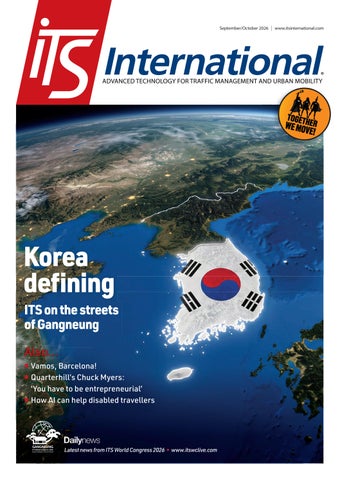
Korea defining ITS on the streets of Gangneung Also… Vamos, Barcelona! Quarterhill’s Chuck Myers: ‘You have to be entrepreneurial’ How AI can help disabled travellers
Latest news from ITS World Congress 2026 • www.itswclive.com
ITS_Cover_FINAL.indd 1
30/9/2026 2: 0 m
Event Mobility Intelligence The complete event mobility lifecycle in one connected approach Major events put extraordinary pressure on transport networks. Arrival peaks, venue access, public transport demand, parking, shuttle services and pedestrian flows all need to work together within very short time windows. PTV’s Event Mobility Intelligence helps cities, transport authorities, venue operators and event organizers test mobility concepts before event day, predict network impacts and respond faster when conditions change. From strategic planning and multimodal simulation to real-time traffic intelligence and post-event analysis, PTV helps turn event mobility from guesswork into evidence-based decisions. Discover the technology behind Event Mobility Intelligence ptv.to/event-mob-tech
2-3 Contents.indd 2
30/9/2026 11:36 am
&P
OS T E D R E S P
O
TP
ED
OU
O
U
10
T
TO R
Contents CE
RIN
• PR
Y• IBL
IN
ED
NS
T
CONTENTS
R CARBON
FO
September/October 2026
05 COMMENT
31 AI IN TOLLING
Artificial intelligence is not magic, but it is an extraordinarily powerful tool that needs to be deployed across transportation infrastructure with urgency and intent.
06 NEWS DIGEST 08 CONTRACTS AND DEALS 10 INTERVIEW
15
Quarterhill CEO Chuck Myers talks artificial intelligence, Conduent integration – and why sailing is excellent preparation for business.
15 TRAVEL MANAGEMENT We need to prioritise the unglamorous work of accessibility data, SkedGo CEO John Nuutinen writes.
Vamos, Barcelona! Find out why the popular Spanish city has one of the smartest, most coherent and progressive mobility ecosystems in the world.
43 CONNECTED &
AUTONOMOUS VEHICLES
Fifty years from now, historians will not ask which company built the cleverest self-driving car; they will ask whether we made them safe enough to trust one another.
19 ITS WORLD CONGRESS 2026 Intelligent transportation professionals from around the world are about to gather in Gangneung, South Korea, to see how ITS is transforming urban safety and mobility.
19
35 URBAN MOBILITY
49 PRODUCTS & INNOVATIONS
24 CYBERSECURITY
North AmericaEdition
Econolite’s Hans M. Molin and Vincent Mayeda examine why cloud-based advanced traffic management system security compliance is now a digital infrastructure imperative.
North America area only
NA 01
28 ENFORCEMENT Traffic is mobile – so traffic safety should be, too, according to Sensys Gatso CEO Lew Miller.
The technology is there, but implementing RUC requires that the public understands its value and implications, according to Q-Free’s Mark Talbot.
24
September/October 2026 | www.itsinternational.com
ADVANCED TECHNOLOGY FOR TRAFFIC MANAGEMENT AND URBAN MOBILITY
International
Cover story
NA 05
People’s Congress
Korea defining
Image: Rasel/stock.adobe.com
ITS on the streets of Gangneung Also…
35 www.itsinternational.com
2-3 Contents.indd 3
TOGETH
ER WE MOVE!
Vamos, Barcelona! Quarterhill’s Chuck Myers: ‘You have to be entrepreneurial’ How AI can help disabled travellers
Las Vegas’ new Red Line bus rapid transit system is a major investment in a busy transportation corridor, Andrew Kjellman of RTC of Southern Nevada explains.
Latest news from ITS World Congress 2026 • www.itswclive.com
© ITS INTERNATIONAL SEPT/OCT 2026
03
30/9/2026 11:36 am
art: donaldecompany.com
Mobile+ THE NEW STANDARD IN PATROLLING Dual AI sensor for unseen detection & reading performance Turn-Key solution with Stark Patrol All in one solution
www.tattile.com
4-5 Comment.indd 4
30/9/2026 11:29 am
COMMENT
Image: Prime Creative Media
END OF HUMANITY – OR JUST BETTER TRANSPORT?
art: donaldecompany.com
Image: Putilich/Dreamstime.com
A
rtificial intelligence (AI) is, once again, having a moment. Development of the technology needs to be slowed, with adequate checks and balances put in place, according to AI experts, including some who’ve been instrumental in developing it in the first place. We have been told that AI has the potential to make transportation more efficient and profitable, and cleaner and more accessible. However, it could also, according to people with knowledge of the matter, destroy the whole of humanity in the next decade. Hard to know what to think, except perhaps: you win some, you lose some. Anyway, let’s assume for now that the whole ‘end of civilisation’ scenario is simply one of those eye-catching ideas at the gloomier end of the prediction spectrum. Instead, in this issue of ITS International, you’ll find a variety of rather more optimistic views. AI has the capacity to create bigger margins for ITS companies and their customers (Chuck Myers of Quarterhill, p10); it will make video identification more precise, enabling tolling operators to
AI will be a major topic of conversation at ITS World Congress reduce revenue leakage (Tollscopic’s DOT#, p31); and it will help disabled travellers to navigate public transport more easily, thus encouraging people to make journeys they would otherwise think beyond them (John Nuutinen of SkedGo, p15). And whatever you think of its potential and dangers – the opportunities and guardrails – AI will be a major topic of conversation in Gangneung as the ITS community comes together for the 32nd ITS World Congress from October 19–23.
Editor Adam Hill adam.hill@primeglobalpublishing.com
Chief Operating Officer Andrew Barriball andrewb@primeglobalpublishing.com
Sales Director Dan Emmerson dane@primeglobalpublishing.com
Publisher Paul Hayes paul.hayes@primeglobalpublishing.com
Head of Digital Sarah Biswell sarah.biswell@primeglobalpublishing.com
CEO Christine Clancy
Staff Writer David Arminas david.arminas@primeglobalpublishing.com
Chairman John Murphy
4-5 Comment.indd 5
Adam Hill EDITOR
Have your say
Printed by Warners (Midlands) PLC
ITS International (PE 13324) is published 6 times a year with combined issues in January/February, March/April, May/June, July/August, September/October and November/December by Route One Publishing Ltd, Second Floor, West Hill House, West Hill, Dartford, Kent, DA1 2EU, UK. Airfreight and mailing in the USA by agent named World Container Inc., c/o BBT 150-15, 183rd St, Jamaica, NY 11413, USA. Periodicals postage paid at Brooklyn, NY 11256. POSTMASTER: Send address changes to ITS International, World Container Inc., c/o BBT 150-15, 183rd St, Jamaica, NY 11413, USA. Air Business Ltd is acting as our mailing agent. Subscription records are maintained at Route One Publishing Ltd, Second Floor, West Hill House, West Hill, Dartford, Kent, DA1 2EU, UK.
Designer Deborah Pilarinos
Follow us on LinkedIn
It’s the third time the Congress has been held in South Korea and Gangneung, a mid-size city on the country’s east coast, has embraced intelligent transportation. Its beaches attract tourists at weekends and in holiday season, when traffic surges, so it has spent the last five years gradually weaving ITS into its fabric. From autonomous shuttles to pedestrianfriendly crossings, there will be a lot to see. We hope to see you there, too. Can’t be there in person? No problem. As usual, ITS International will be producing three on-site editions of the Daily News, capturing the products, solutions and deals as they unfold. In addition to a daily eNewsletter from the event, as well as updates on social media, you’ll be able to find news stories and digital versions of the magazines. Just go to www.itswclive.com
@ITS International Magazine
Email me
adamh@primeglobalpublishing.com
All editorial, advertising or circulation enquiries to: ITS International, Second Floor, West Hill House, West Hill, Dartford, Kent, DA1 2EU, UK. No part of the publication may be reproduced in any form whatsoever without the express permission of the publishers. Views expressed in this journal do not necessarily reflect the opinion of the Editor or Route One Publishing Ltd. Subscription Enquiries: subscriptions@primeglobalpublishing.com Global: NA:
Print Digital Print Digital
ISSN 1463-6344 ISSN 2057-3421 ISSN 2632-4458 ISSN 2632-5950
PublishedGLOBAL by Prime Global Publishing PUBLISHING
ITS INTERNATIONAL SEPT/OCT 2026
05
30/9/2026 11:29 am
NEWS DIGEST
Image: TasFoto/Dreamstime.com
Kapsch TrafficCom has deployed its Geo Location Platform (GLP) for satellite-based tolling in the Netherlands. The platform, which is also operating in Belgium, creates tolling transactions; it enables satellite tolling, road user charging and location-based business applications for toll chargers, road authorities,
toll service providers, fleet management providers and European electronic toll service (EETS) service providers. The platform receives location data from global navigation satellite system (GNSS)enabled devices, smartphones, connected vehicles or on-board units. Map-matching technology then identifies road usage, creates rated trip reports and provides charge reports for further processing and billing.
Major SHIFFT for Dubai Future Foundation and Oxa
Business incubator Dubai Future Foundation and autonomous vehicle tech developer Oxa have launched a joint venture called SHIFFT, which will incorporate self-driving technology into an autonomous logistics and worksite intelligence product, putting autonomous vehicles to work in ports and airports. The idea is to make Dubai a global hub for autonomous logistics. The first scalable commercial deployment is due in Dubai before the end of 2027. Autonomous systems deployed by SHIFFT will use Oxa’s self-driving software, Oxa Driver, paired with Oxa’s cloud-based fleet management software, Oxa Hub.
Ettifos joins Arizona V2X deployment
Vehicle to everything (V2X) tech specialist Ettifos has joined the multi-vendor team behind a major V2X project in Arizona, US.
Image: Carolyn Franks/Dreamstime
scheduled maintenance, emergency repair services, and system calibration for PennDoT’s network of planning and compliance WiM sites. The remit will include support for new site installations, upgrades, and reporting integration with PennDoT’s field operations manager system. “Reliable and accurate vehicle data is fundamental to maintaining safe and efficient transportation networks,” Quarterhill chief executive officer Chuck Myers said.
It has been chosen to support Maricopa County Department of Transportation in the delivery of its Connected Vehicle Acceleration Zone (CVAZ). The deployment – including Ettifos’ V2X-AIR aftermarket on-board units (OBUs) – is designed to accelerate interoperable V2X technology across key corridors in the county. Running to 2028, CVAZ will primarily use 5.9 GHz communications, connecting up to 650 roadside units with approximately 400 OBUs. CVAZ covers key corridors and communities, including Phoenix, Tolleson and Avondale.
North Carolina dashcam imagery drive for Iteris
Image: Timrobertsaerial Dreamstime.com
Kapsch Geo Location satellite tolling goes Dutch
Image: Cesar Crusat/Dreamstime.com
Image: Network Optix
California’s Santa Clara County has launched a solution that applies artificial intelligence (AI) to more than 600 cameras across the county’s expressway network. The aim is to reduce collisions, protect pedestrians and cyclists, and give traffic operators a live view of the road. Network Optix, Supermicro and Intel are the technology partners for the scheme. The Santa Clara County Intelligent Transportation Initiative runs on the Network Optix video and AI platform. Cameras are connected using three of Network Optix’s Nx Go servers, with dedicated AI accelerators, as well as edge devices.
Quarterhill wins $4.6m PennDoT WiM contract
Iteris has won a mobility analytics deal with the North Carolina Department of Transportation (NCDoT). The Almaviva Group company will work with real-time road imagery provider Vizzion to provide dashcam imagery in the ClearGuide platform. Vizzion said it has one-frameper-second imagery available from a growing network of tens of thousands of connected dash cameras on commercial vehicles. ClearGuide users at NCDoT can see available dashcam coverage in a map interface and select specific imagery to view real-time conditions. This provides ‘ground-truth’ evidence, which means there is less need to send staff out on the roadways, according to Iteris. Image: Serge Skiba/Dreamstime.com
Network Optix puts AI eyes on Santa Clara
Pennsylvania Department of Transportation (PennDoT) has brought Quarterhill on board to run statewide Weigh in Motion (WiM) operations. The three-year $4.6 million contract will see Quarterhill delivering
FOLLOW ITS INTERNATIONAL ON SOCIAL MEDIA Facebook @ITSInt
6
6-7 News.indd 6
Bluesky @itsinternational.bsky.social
ITS INTERNATIONAL SEPT/OCT 2026
LinkedIn @ITS International Magazine
Instagram @itsinternational_magazine
youtube @itsinternational
www.itsinternational.com – get your intelligent mobility fix
30/9/2026 11:2 am
NEWS DIGEST
TransCore modernises tolling on Florida expressway
“How people search online is changing quickly,” JustPark chief technology officer Junaid Baldick said. “We’re already seeing drivers discover JustPark through AI [artificial intelligence] platforms, so our response is simple: if that’s where people increasingly want to search for parking, we want JustPark to be there.”
The Tampa–Hillsborough Expressway Authority (THEA) has given TransCore the contract to modernise toll collection on a key roadway. The firm will upgrade ageing roadside infrastructure across the 18 miles and 17 toll zones of the Selmon Expressway. The deployment will include
Minnesota workzone safety pilot for Sensys Gatso
exposing cyclists to risks and that cyclists had a constitutional right to safety.
Pony.ai and Uber to expand robotaxi service in Europe
Toronto has green light to remove cycle lanes
JustPark adds ChatGPT search
JustPark now allows UK drivers to search for spaces directly within ChatGPT. Users opt in by adding the JustPark plug-in, allowing ChatGPT to search a network of more than 150,000 reservable parking spaces in the UK. Drivers are then directed to the JustPark app or website to complete the booking.
Riders in the Croatian capital of Zagreb are now able to order a Pony.ai robotaxi on the Uber platform. The move is part of an agreement between Pony.ai and Uber Technologies to deploy more than 2000 Pony.ai robotaxis across Europe. Pony.ai operates paid, fullydriverless services in four Chinese cities. The plan is to add services in four other cities in Europe, with deployment in the Middle East also on the roadmap. Uber has been active in the autonomous vehicle space, signing an agreement this year with automaker Stellantis and artificial intelligence (AI) company Wayve.
Image: Sensys Gatso Group
Image: Bobhilscher/Dreamstime.com
TransCore’s VCATS (vehicle classification and tracking system) and SmartPass solutions. VCATS is designed to detect and continuously track vehicles throughout the tolling zone. In turn, this supports accurate vehicle identification and toll transaction creation through classification and licence plate recognition.
Image: Pony.ai
Image: John Wollwerth/Dreamstime.com
A provincial court in Canada has said the removal of 19km of protected bike lanes from several busy streets in the city of Toronto can go ahead. The decision by the Ontario Court of Appeal overturns a lower court ruling against allowing the Ontario government to order the city to remove the lanes. That ruling said that by removing the bike lanes, the city would be
Sensys Gatso Group is working with the Minnesota Department of Transportation (MnDoT) on the US state’s Work Zone Safety Camera Pilot Program. The $800,000 initiative – expected to take place later this year – will educate drivers on the dangers of speeding through highway workzones. Sensys Gatso will deploy Flux mobile speed cameras installed on battery-powered solar trailers in two Minnesota construction project corridors: Interstate 35W in Burnsville, a commuter route south of Minneapolis; and Highway 65 between Cambridge and Braham, which is an hour north of the major metropolitan area.
Transit services across Washington, D.C. stopped for a minute on September 11. The pause to bus and train services, announced by Washington Metropolitan Area Transportation Authority, was a mark of remembrance for those killed in the attacks on New York City and Washington, D.C. on September 11, 2001. The minute began at 9:37am ET, which is the time at which one of four passenger airliners hijacked that day crashed into the Pentagon.
Image: Mesutdogan/Dreamstime.com
Image: Dmitrii Melnikov/Dreamstime.com
Metro services pause on 25th anniversary of 9/11
FOLLOW ITS INTERNATIONAL ON SOCIAL MEDIA Facebook @ITSInt
Bluesky @itsinternational.bsky.social
LinkedIn @ITS International Magazine
For all the latest from ITS World Congress 2026, go to www.itswclive.com
6-7 News.indd 7
Instagram @itsinternational_magazine
youtube @itsinternational
ITS INTERNATIONAL SEPT/OCT 2026
7
30/9/2026 11:2 am
S SenSen’s ‘hoon cameras’ to hit Melbourne
Image: Moia
A private consortium has been chosen to lead a $9.2 billion smart infrastructure project in the US state of Tennessee. DriveTN – comprised of Transurban, Aecom, Cintra, Ferrovial and Tikehau Star Infra – will design, build, finance and operate the I-24 Southeast Choice Lanes. This will see 26 miles of toll lanes added in both directions between I-40 east of downtown Nashville to I-840 near Murfreesboro. Existing lanes will remain free, but the new lanes will provide drivers with a faster, more reliable trip if they choose to pay. The state’s Transportation Modernization Board approved DriveTN as Tennessee Department of Transport’s partner.
Israel-based fintech group Nayax is to buy parking solutions specialist IPS Group from Windjammer Capital Investors in a $350 million deal. Nayax manages payment infrastructure worldwide, while IPS delivers smart parking hardware and software across 250,000 parking spaces. The deal will see IPS expanding into new markets, starting with continental Europe. IPS processes millions of consumer payment transactions annually for municipalities, universities and private operators in the US, UK, Ireland and Canada. Its platform covers meters, mobile and text-based payments, enforcement and permitting software, vehicle detection and kerb data analytics.
The Ray maps out Montana geospatial deal
US non-profit transport safety and research group The Ray is partnering with the Montana Department of Transport to develop geospatial analysis tools to enhance safety, mobility and resource conservation across the north-west US state’s transportation network. Joint analysis and pilot evaluations will continue through 2028. The collaboration includes research, testing, policy development and identification of potential funding opportunities. The initial focus will be on three key areas: safety, noise and smart infrastructure (including analysis of data to improve road user safety); wildlife crossing and habitat evaluation; and right-of-way for energy and utilities.
Residents of Hamburg are now able to book shared rides in Moia’s autonomous ID. Buzz vehicles. The system is part of the Alike mobility project in the German city, which tests autonomous on-demand mobility services to determine how they can complement buses and trains. The next phases of Alike will see Hochbahn begin to operate Holon AVs. Moia, part of Volkswagen, will initially have “up to 10” vehicles deployed, covering parts of Winterhude, Barmbek and Wandsbek. During this pilot phase, rides are free of charge and vehicles contain a trained human safety operator.
Traffic Group lands data collection project in New Mexico Image: Mihai Andritoiu/Dreamstime.com:
Nayax expands parking presence with IPS acquisition
Image: Anatolii Savitskii/Dreamstime.com
Image: Sean Pavone/Dreamstime.com
Hamburgers can now book rides in Moia AVs
SenSen Networks is to deliver cameras that will pick up excessively noisy vehicles for a two-year pilot in the Australian state of Victoria. The acoustic cameras are triggered by loud vehicle noise and will capture images and registration details so ‘hoons’ who tear up the streets can be identified – and potentially fined. The trial, by the state’s Environment Protection Authority, is expected to begin by the end of the year. The first four SenSen cameras will be rolled out across Port Phillip, Casey, Knox and Stonnington councils, with three more to follow.
Image: Nils Versemann/Dreamstime.com
Tennessee’s new partners for toll lanes project
The Traffic Group has been selected by New Mexico Department of Transportation to conduct statewide data collection. Under the contract, the first for the company in the US state, Traffic Group will collect short-duration and turning movement traffic counts on major and minor arterials, as well as interstate locations. The programme is designed to understand the use and performance of New Mexico’s roadway system. Traffic Group will evaluate collected data against historical and current traffic information, adjacent roadway data and other relevant factors, such as changes in surrounding land use, roadway configurations and traffic patterns.
Image: Tetiana Zbrodko/Dreamstime.com
CONTR ACT & DE AL S
FOLLOW ITS INTERNATIONAL ON SOCIAL MEDIA Facebook @ITSInt
8
Bluesky @itsinternational.bsky.social
ITS INTERNATIONAL SEPT/OCT 2026
8-9 CONTRACTS and Deals.indd 8
LinkedIn @ITS International Magazine
Instagram @itsinternational_magazine
youtube @itsinternational
ITS International – at the heart of the ITS industry since 1995
30/9/2026 11:2 am
Enforcement In Motion.
Motiva
Market leading, next generation in-motion enforcement.
Either stationary or in-motion
Introducing Motiva by Sensys Gatso The future of in-vehicle automated enforcement has arrived, and it’s in-motion.
1-minute deployment
We’re proud to introduce Motiva—the newest addition to the Sensys Gatso suite and a new market leading category: in-motion automated speed enforcement.
Automated camera alignment
Designed to meet the evolving needs of road safety professionals, Motiva combines advanced detection technologies with operational simplicity to deliver a highly flexible, intelligent enforcement solution. Whether supporting planned operations or rapid deployment scenarios, it provides agencies with a powerful new tool to improve compliance and help make roads safer.
Bi-directional enforcement
As part of the Sensys Gatso ecosystem, Motiva complements our comprehensive portfolio of automated enforcement solutions, giving customers even greater flexibility to deploy the right technology in the right place at the right time.
Sensys Gatso
8-9 CONTRACTS and Deals.indd 9
With Motiva, we’re continuing our commitment to delivering smarter, more effective road safety solutions that help communities reduce speeding and save lives. Learn more: sensysgatso.com E-mail: us_sales@sensysgatso.com - Trusted Innovation™ info@sensysgatso.com
30/9/2026 11:2 am
INTERVIEW
Image: Quarterhill
“TRANSPORTATION IS THE PERFECT APPLICATION FOR AI”
Quarterhill CEO Chuck Myers talks artificial intelligence, Conduent integration, MIT, entrepreneurialism – and why sailing is excellent preparation for business.
E
arlier this year, Quarterhill announced it would acquire Conduent Transportation’s tolling business for $70 million. The deal, expected to close before the end of the year, will help “build a larger, more focused, and more profitable ITS platform,” Quarterhill chief executive officer (CEO) Chuck Myers said. But it’s one thing to purchase a major business; making it work optimally in its new home is something else again. So, what are the pinch points in bringing the Conduent operation into Quarterhill? “It’s always the integration,” Myers immediately said. “But my feedback from clients has been positive. I think most people are pretty happy about the acquisition; transportation is all we’re going to be focused in, and I think they like that.” Conduent’s tolling business operates in the US and the UK, and covers all electronic tolling, roadside and back office payment processing, image review, automated licence plate recognition, violation enforcement, and analytics, with 14 million transactions per day. Quarterhill chairman Rusty Lewis described the transaction as “transformational.”
10
ITS INTERNATIONAL SEPT/OCT 2026
10-13 INTERVIEW.indd 10
“Conduent’s tolling solutions business brings scale, long-term agency relationships, proven technology capabilities and deep tolling expertise in a core market,” Lewis said. The theory is that a combined platform will be better positioned to serve transportation agencies, expand profitability and create sustainable, longterm value for shareholders. Formidable reputation This is all very familiar territory for Myers, who comes with a formidable business reputation, built over a long career of turning companies around – or growing them, or merging them, or all three – and delivering value for shareholders. There is little that fazes him. “I will tell you that, from any M&A activity I’ve ever worked on, dealing with the Conduent folks has been a pleasure,” Myers said. “We’ve worked really hard together on this integration and, as you know, Conduent’s still going to be part-owner of the company. They truly want their customers to be served well. “Anybody associated with the projects is coming over, so we’re basically supporting the existing teams. It’s going to be a lot of work, but we’re going to be a large, strong company when we’re done.”
Artificial intelligence (AI) is going to be a major part of how they get there. Indeed, in Myers’ wide-ranging conversation with ITS International, one of his key themes is the intersection of AI and transport. He has previously described AI as a “living organism”, so how has that organism changed in the last couple of years, and what effect has that had on business? Myers muses on the way that optical character recognition, which came of age in the 1950s, morphed (much later) into convolutional neural networks, and how so much work in AI now is based on transformer models. “That didn’t exist, really, two years ago,” he said. “I mean, it wasn’t in academic papers until 2021, and now that’s what we’re doing with all our vision models, so that in itself is something. “We’re not interested in building frontier models, but the big change I’ve been impressed with internally is how much our agentic stuff has taken off.” In other words, things are moving very fast. “You’re not putting the [AI] genie back in a bottle; it’s just the way you do things,” Myers said. “It’s the way we code. It’s the way we do everything, and it’s fundamentally going to change the industry. That’s one of the reasons I came to Quarterhill: transportation www.itsinternational.com – get your intelligent mobility fix
30/9/2026 11:26 am
INTERVIEW
Far from conventional Myers’ own background is far from conventional. On the face of it, he would seem an obvious candidate to have been the high-school kid who started a computer club, ran science fairs or invited visiting businesspeople to speak at the student industrial society. But no… “I basically never went to high school,” he said. “Well, I never had a real highschool education. I went a couple of times for a semester here, a semester there.” Myers spent much of his childhood in the Caribbean and Mexico, sailing professionally in his teens.
You’re not putting the [AI] genie back in a bottle Yet he also ended up going to one of the most prestigious schools in the world: Massachusetts Institute of Technology (MIT). “After we sold TransCore, I told myself I wanted a real college career, so I went to MIT when I was around 27,” he said. “I was debating between Stanford, Harvard and MIT, but because I had the money at that point, I decided on MIT due to its joint finance and engineering masters.”
Image: Khairil Azhar Junos/Dreamstime.com
is the perfect application for AI. You can guardrail it – it just makes the applications better.” One can see why Myers thinks of Quarterhill as a technology company rather than a systems integrator. “We’re investing in technology, so our customers will be getting a lot more,” he said. Myers believes AI has the power to deliver better margins, while customers will see better, faster deployment and less hardware. There is a golden thread of entrepreneurialism running through Myers’ CV. He has worked at start-ups and big corporates, in a range of industries from telecoms to vision to AI and finance and transportation. He co-founded TransCore, for instance. “I worked for one of the greatest entrepreneurs in the world, a guy named Bob Beyster [founder of Science Applications International Corporation],” Myers said. “He’s the most entrepreneurial guy I ever met, and he ran one of the biggest classified companies in the entire world. In my experience, there aren’t many entrepreneurs in corporate America; it’s more common for people to move up through the ranks.”
For all the latest from ITS World Congress 2026, go to www.itswclive.com
10-13 INTERVIEW.indd 11
Myers and his wife moved to Boston. “I had two of the best years of my life there, just doing real academic work,” he said. The plan was always to go back into business afterwards. “I’m probably unusual in that I have a strong technical, financial background and operational background,” he said. “I don’t think that’s completely normal.” This does not seem to have held Myers back. In fact, rather the opposite. “I’ve always had this ability to distill a complex thing into something simplistic,” he said. “That’s really what it comes down to. I’ve never seen a technology problem – that I could solve by myself – but where I didn’t know where to find the people [to solve it]. All problems, whether it’s the integration of Conduent, whether it’s the turnaround of the telecom company [Verisign], they were all people problems.” It’s also important to understand technology so you can ask the right questions, grasp the parameters of what’s happening and why, and get a better idea of what might come down the track. In this sense, it’s tempting to see Myers’ early experience of serious sailing as having a profound influence on his life and career. After all, sailing involves risk and requires precision – carrying out
Quarterhill is buying Conduent Transportation’s tolling business for $70 million.
ITS INTERNATIONAL SEPT/OCT 2026
11
30/9/2026 11:26 am
Image: Roman Tiraspolsky/stock.adobe.com
INTERVIEW
“I had two of the best years of my life [at MIT], just doing real academic work.”
Image: Zvonimir Orec/Dreamstime.com
“Sailing may be the best training ground in the world for a CEO.”
manoeuvres such as tacking into the wind, for example – as well as planning and discipline. But there is also a sense of adventure. Is it too simplistic to say that these qualities and experiences are also relevant to business? Myers considered the question seriously. “Sailing may be the best training ground in the world for a CEO,” he said. Myers’ parents first took him sailing when he was three weeks old. By the time he was six, he was sailing “a boat that, even back then, was 1000, 2000 bucks it’s a lot of responsibility.”
12
ITS INTERNATIONAL SEPT/OCT 2026
10-13 INTERVIEW.indd 12
He delivered his first boat from the Turks and Caicos Islands to Florida when he was 14 years old. “Where else do you get that kind of responsibility?’,” he asked. By the age of 15, he was racing in boats “that cost 30 grand just to prepare”. A year or two later, another step up. “You’re skippering a boat that’s worth a million dollars and you’re responsible for everybody,” Myers recalled. “You can’t screw up, you know? If you screw up, people die, and so I think that mentality has stayed with me.
“You cross your Ts, dot your Is. You have to deal with so many vectors at the same time: you’re dealing with wind, you’re dealing with waves, you’re dealing with competition. “You have to know all the rules, you still have to sail faster than the other person, you can’t do anything to damage the boat, and so there’s really not many sports in the world that have all those. You see it at a young age, and so you learn. You know, don’t do stupid stuff.” Pick a direction Taking all that into account, what sort of skipper are you, Chuck? “Well, that’s probably not a fair question,” he smiled. “Probably the same as I am as a CEO. I’m happy to listen. But when it’s time to tack, just pick a tack, because the worst thing you can do is not pick a direction and commit to it. “And if you have to change, take the other line, but don’t sit around and wait
If something needs to change, why are you waiting to change it?” too long. Once you tell people what you’re going to do, they either get on board or they don’t. And so that’s kind of how I am.” Myers wants to grow Quarterhill into a billion-dollar company and thinks he’ll be in his post for another few years, until successors are ready. “Will I ever stop working? No. Do I have plans to do anything after this? No,” he said. “We’re going to try to build a good successor team behind us. I look at everything in three-year chunks, and this is my third year.” Myers’ philosophy of business is quite refreshing. “I look at it very positively going forward. I almost never look back,” he said. “I do believe you have to be entrepreneurial. If you concentrate on all the negativity, all the time, on all the things that could go wrong – you can’t worry about it. Things go wrong every day.” A better question to ask, he thinks, is, “Did I mitigate the risk as much as I can?” However, there is even a caveat to that. “Don’t mitigate it so much that you’re not taking risks,” he said. Myers is good company, nimble in conversation, and often considering his answers carefully. He has had a highly successful, diverse career, and clearly relishes the work. He laughed. “I think I’ve mellowed a lot,” he said. “But still, if something needs to change, why are you waiting to change it? “It’s not going to do me any good to sit around and wait for it.” ITS www.itsinternational.com – get your intelligent mobility fix
30/9/2026 11:26 am
www.swarco-its.com
10-13 INTERVIEW.indd 13
30/9/2026 11:26 am
ACCURATE RADAR DETECTION
12 LANES. 1 DEVICE. HIGHWAY-SCALE DETECTION. RTMS Echo delivers highway-scale coverage without the hardware sprawl. Accurate per-vehicle detection across up to 12 lanes from a single pole-mounted radar. Premium accuracy data for count stations and traffic management systems - with the coverage efficiency your budget demands. • Cat5/6x connection • Wi-Fi configuration • Industry-standard integration
MORE RELIABLE TRAFFIC DETECTION sensysnetworks.com/scale
SensysNetworks-RTMSEchoScale-ITSInternational-2026SepOct-v6.indd 1 14-17 Travel management.indd 14
9/12/2026 11:13:43 PM 30/9/2026 11:2 am
3:43 PM
Image: Grejak/Dreamstime.com
TRAVEL MANAGEMENT
The journeys that never happen: Can AI make travel accessible? We need to prioritise the unglamorous work of accessibility data: collecting it well, keeping it current and sharing it openly, SkedGo CEO John Nuutinen writes.
E
very day, journeys are abandoned before they begin. A wheelchair user cannot confirm whether the lift at their destination station is working, so they stay at home. Someone with a heart condition does not know if a route is step-free, or whether there will be somewhere to rest along the way, so a hospital appointment becomes an unaffordable taxi fare, or it simply does not happen. These cases are not failures of ambition or effort. They are failures of information. When you cannot trust what an app or website tells you, the rational choice is often not to travel at all. And the journey that never happens leaves no trace in the data, which is part of the problem. And that problem is large and stubbornly persistent. A gap that has barely moved People with disability people make around 30% fewer journeys than non-disabled people, a gap that, according to Transport for All’s 2023 report ‘Are We There Yet?’, is roughly the same as it was more than two decades ago.
The charity found that disabled respondents made an average of 5.84 trips a week, around a third of the UK national average of 17. Many wanted to travel more: on average, they said they would make half as many journeys again if the barriers were removed. Those barriers are not only physical. The UK Department for Transport’s ‘It’s Everyone’s Journey’ campaign reports that one in four people with disability say negative attitudes from other passengers put them off public transport altogether. The exclusion has real consequences, limiting access to work, healthcare, education and social life. And the planning burden is heavy. Nearly two-thirds of Transport for All’s respondents said they had to plan every single journey to be sure it was safe, yet the information they needed to do so was often unavailable, inaccurate or inaccessible. This is where conventional journey planning quietly lets people down. Most planners are built for able-bodied passengers: someone who walks at a standard pace, can manage stairs and crowds, does not need a toilet en route,
For all the latest from ITS World Congress 2026, go to www.itswclive.com
14-17 Travel management.indd 15
and treats a broken lift as a minor inconvenience rather than a full stop. Accessibility information, where it exists at all, tends to be patchy, held in separate systems, and static. A planner might know that a station has step-free access in principle, but not that the only lift has been out of service since Tuesday. The moment real life intervenes – a delay, a diversion, a closure – the plan becomes brittle and the people with the least margin for error are the ones it fails first. For most passengers, an unexpected flight of stairs is an irritation. For a wheelchair user, it can mean a journey that cannot be completed at all, stranded at a platform with no onward route the planner ever thought to check. The difference is that the technology to build more responsive, personalised journeys is now becoming practical. What has changed is not that we suddenly care more. It is that the tools to plan around the individual now exist. Large language models let people ask for what they actually need in plain language: a step-free route with an accessible toilet and space for a wheelchair, avoiding a particular interchange. ITS INTERNATIONAL SEPT/OCT 2026
15
30/9/2026 11:2 am
TRAVEL MANAGEMENT
With real-time feeds, a planner can fold in live disruption rather than yesterday’s timetable and reroute when a lift fails. It can learn an individual’s walking speed, preferred stations, and routes that do not work for them; the same questions do not have to be repeatedly answered.
What has changed is not that we suddenly care more: it is that the tools to plan around the individual now exist Picture the difference. Today, a disabled traveller pieces together a trip from a timetable, a separate accessibility map, an operator’s disruption page and, often, a phone call. Tomorrow, they ask once, in their own words, and receive a route built around their needs that updates itself if conditions change. This is not speculation. Researchers at Texas A&M University–San Antonio recently tested large language models against open transit data, using the widely adopted General Transit Feed Specification, to see whether they could support route planning, reduce waiting times and offer personalised travel assistance. Their conclusion is instructive precisely because it is measured: the potential is real, but careful engineering and fine-tuning are essential and the models stumbled on more complex tasks. Work from the MIT–IBM Watson AI Lab points the same way, pairing a language model with a solver so the plans
16
ITS INTERNATIONAL SEPT/OCT 2026
14-17 Travel management.indd 16
it produces are not merely plausiblesounding but actually valid. It is the same principle behind SkedGo’s own TripGo Mobility AI: travellers ask for a journey in natural language, but every answer is grounded in our real-time multimodal routing engine rather than improvised by the model, so the route that comes back is verified, current and explainable rather than a plausible guess. The bottleneck is data, not algorithms That caveat is the heart of the matter. The hard part of accessible journey planning is no longer the algorithm; it is the data. An artificial intelligence (AI) model is only as good as what you feed it, and accessibility data remains the weakest link: inconsistently collected, rarely standardised, and too often out of date the moment it is published. Knowing whether a lift is working right now, whether an accessible toilet is open, or whether there is genuinely room for a wheelchair on the 08:14am, requires operators to capture that information reliably and share it in a common format. Where that data exists and flows, AI can do remarkable things with it. Where it does not, no amount of clever modelling will conjure a trustworthy answer. It will only produce a confident one, which for a disabled traveller is worse. So the bottleneck is not technical capability, but rather the willingness to treat accessibility data as core operational data rather than an afterthought – to collect it, maintain it and open it up. That is an industry decision, not a
research problem, and it is one we can make now. None of it is exotic. Live disruption feeds, lift-status monitoring and accessibility audits already exist in pockets across the network; the task is to make them consistent, current and shareable rather than locked in silos that no planner can reach. It is also be a decision that pays off far beyond the people for whom it is designed. Build a planner that genuinely understands step-free routes, walking pace and live disruption, and you have built something better for a parent with a buggy, a traveller hauling a heavy suitcase, an older passenger, someone recovering from surgery, anyone whose needs do not match the mythical average. Design for, and with, people with disability and everyone benefits. There is also a commercial dimension. The charity organisation Scope estimates the spending power of people with disability and their households, the socalled purple pound, at around £274 billion a year in the UK. Transport on which people with disability can rely is not a cost centre. It widens the customer base, supports more journeys, and earns loyalty from travellers who remember exactly who made their lives easier. None of this requires a technological leap. The journey planning, the natural language understanding, the real-time data handling and the personalisation already exist, and are improving quickly. What stands between disabled travellers and journeys they can trust is no longer the state of AI. It is whether the transport sector chooses to prioritise the unglamorous work of accessibility data: collecting it well, keeping it current, and sharing it openly. That is a choice, not a constraint. We can keep treating the journeys that never happen as an unfortunate fact of life, invisible because they leave no trace. Or we can decide that everyone deserves to set out in confidence and build the data foundations that finally make personalised, accessible travel the norm rather than the exception. The technology is ready. The question is whether we are. ITS
Image: SkedGo
Image: Timur Malazoniia/ Dreamstime.com
For some passengers, a broken lift represents a full stop to their journey.
ABOUT THE AUTHOR John Nuutinen is CEO of SkedGo
www.itsinternational.com – get your intelligent mobility fix
30/9/2026 11:2 am
14-17 Travel management.indd 17
30/9/2026 11:2 am
18-23 ITS World Congress.indd 18 Starsystems combined document.indd 1
30/9/2026 11:21 /9/2026 11: 2 am
North AmericaEdition
For the first time, we’re literally running out of road.
Image: trekandshoot/Dreamstime.com
ROAD USER CHARGING
Road user charging: The time is now The technology is there, but implementing RUC requires the public to understand both its value and its implications, according to Q-Free CEO Mark Talbot.
Y
ou might think road user charging (RUC) is a new concept. The idea of people paying a fee to drive on roads might sound radical but, in fact, we’ve been doing it all along. We just call it a fuel tax. Fuel taxes were a fantastic idea in the 20th century, when every vehicle was reliably inefficient and ran on oil. For decades, the funds raised were a predictable revenue source to build, maintain, and improve our infrastructure, right up until they weren’t. Everyone in our industry understands fuel-efficient and electric vehicles, coupled with stagnant fuel tax rates, have created an unsustainable problem
for governments and agencies around the globe. And for the first time since the establishment of national highway networks, we’re literally running out of road. Meanwhile, demand on our transportation networks has never been greater. Freight volumes continue to rise; urban congestion continues to intensify; infrastructure is ageing, expectations for safer, smarter and more connected roads continue to grow. Without a solution, we risk moving backwards rather than forwards. While others have talked about the issue, at Q-Free we’ve addressed it and now I feel compelled to talk about it.
For all the latest from ITS World Congress 2026, go to www.itswclive.com
NA_1-3 Q-Free RUC.indd 1
The fact is we all need to pay our share, and equity and long-term sustainability have to be at the heart of our strategy moving forward. Electric vehicle drivers need to pay and so do the owners of gas-powered vehicles. We should all be responsible for building new roads. In my view, the answer is obvious; we should each pay for the distance we travel. That’s the definition of RUC and it hits all the marks, from equity and fairness to embracing technology and innovation to long-term sustainability. The argument against RUC has for years started with the assumption that the public isn’t ready, followed quickly by the lack of accurate technology to © ITS INTERNATIONAL
SEPT/OCT 2026
NA 1 30/9/2026 2:0
m
Images: Q-Free
North AmericaEdition ROAD USER CHARGING
A three-month Oslo pilot will see 300 drivers test Q-Free’s GNSS-based road user charging solution.
deliver a transparent and equitable process. But modern positioning systems, connected vehicles, secure payment platforms and privacy-preserving architectures have matured dramatically over the past decade. Opponents often cited privacy concerns, but protecting privacy is key to user confidence and adoption. User data should be collected for the specific purpose of
calculating the amount owed, and the only data collected should be captured solely to support that purpose. Flexible architectures now allow agencies to adopt policies that reflect their own legal frameworks while giving motorists the assurance their data is secure; and we, along with several of our competitors, can now provide reliable, accurate, low-cost solutions that
completely undermine any argument that the technology isn’t ready to support RUC. Successful deployments place as much emphasis on customer experience as engineering. Drivers expect systems that are simple, accurate and largely invisible in their daily lives. Whether payments occur through on-board devices, connected vehicle platforms or future software-defined vehicles, convenience matters just as much as capability, and agencies are learning that transparency matters more than complexity. People do not necessarily expect road funding to be simple. They do expect it to be understandable. In 2026, the pieces are in place and all of that is possible. RUC is not only the obvious choice, it’s the only one that checks all the boxes. The question is no longer whether the technology is ready. It is. The question is whether we can build the public support and trust necessary to implement the change. That’s where the tide is shifting. Most drivers understand that roads require investment, and as RUC aligns cost with actual use, those same drivers respond to equity. Our company has a significant footprint in Australia, and one of the most encouraging developments was revealed in a recent national study commissioned by Transport Australia.
Your Traffic Products Need BABA Compliance. We Deliver It. With over 40 years of manufacturing expertise and a team deeply rooted in the traffic industry, Hi-Tek Electronics delivers high-quality, full-turnkey electronic contract manufacturing built for the intelligent transportation systems (ITS) sector. Our U.S.-based advanced manufacturing facility combines precision, efficiency, and scalability to support your traffic products at every stage of production — from start to finish. Our BABA-compliant capabilities ensure dependable, end-to-end manufacturing for every project. For more information, email BABA@HiTekQuality.com
NA 2
© ITS INTERNATIONAL
NA_1-3 Q-Free RUC.indd 2
SEPT/OCT 2026
www.itsinternational.com – get your intelligent mobility fix
30/9/2026 11:09 am
ROAD USER CHARGING The research examined public attitudes toward future road funding and the results challenge many long-held assumptions. Nearly six in 10 Australians support replacing the fuel tax with a per-kilometre road user charge. Interestingly, support climbs even higher among electric and hybrid vehicle owners. People want equity in road user charging. They also want an assurance that money raised will be put to its intended use. In the Transport Australia study, support for RUC increased when respondents understood that revenues would be dedicated to maintaining and improving roads. It’s important to note that does not necessarily mean everyone pays more – in many cases, it means people pay more fairly. That matters because fairness builds trust, and trust is the real currency of transportation policy. Technology may enable road user charging, but public confidence determines success. We’ve seen a similar shift in Europe, with different solutions being tested throughout the continent. We have already demonstrated how our on-board unit-based global navigation satellite system (GNSS) solution, created in partnership with Sony, can be deployed at scale while maintaining privacy and operational robustness.
But this isn’t technology searching for a problem. In fact, it was developed and tested in collaboration with research institutions and public road authorities, including the Norwegian Public Roads Administration, independent research organisation SINTEF, and the Norwegian Research Council, to address their reality. More pilots are underway, including one in the Norwegian capital of Oslo kicking off this autumn where 300 drivers will test the solution over three months. Built with deep consideration for cybersecurity and privacy, the solution is seamless, and as we gather driver feedback on the user experience, we understand that aspect is an important part of these trials. Implementing RUC requires that the public understands both its value and its implications. In the complex US market, RUC addresses America’s unique challenges. All 50 states and the District of Columbia charge a gas tax ranging from 71 cents per gallon in California to eight cents in Alaska. Add on the federal gas tax of 18.4 cents and the maths gets complicated. But, once again, Americans have already opted in to RUC: 35 states currently have toll roads, tunnels or bridges, often all three. Programmes like E-Z Pass, which
North AmericaEdition
[Fuel tax] funds were a predictable revenue source to build, maintain and improve our infrastructure, right up until they weren’t Mark Talbot Q-Free chief executive officer operates in 20 states, make the process simple and seamless. At Q-Free, we were founded on the dual business streams of traffic management and tolling, and we answer two questions particularly well: how will we manage our roads and how will we pay for them? I’m excited about the pace of innovation of the technologies – some of which we haven’t even begun to imagine – which will drive road management. But the answer to payment question is already mature, ready and right in front of us. Road user charging: it’s not if or even how. It’s now. ITS
One Sensor. Four Cameras. Faster Install. AI-powered, single-mount detection delivers stop-bar coverage across multiple approaches with a quad-camera design. Install in as little as 90 minutes* and expand reliable detection across smaller, infrastructure-constrained intersections. *Based on early customer installations. Actual times may vary.
iteris.com/vantagenode
For all the latest from ITS World Congress 2026, go to www.itswclive.com
NA_1-3 Q-Free RUC.indd 3
© ITS INTERNATIONAL
SEPT/OCT 2026
NA 3 30/9/2026 11:09 am
INTRODUCING
TruView™ Central Get a true view of traffic operations with TruView Central from Cubic. Part of a brand new web-based traffic management suite, TruView Central works by leveraging existing ATMS systems and field controller networks to streamline deployment and deliver greater flexibility to securely access central management software from any device. Contact us to learn how TruView can transform your signal network performance.
Let’s Build Your City. Together. cubic.com/transportation
NA_4-7 Las Vegas BRT.indd 4
30/9/2026 11:01 am
MASS TRANSIT
Las Vegas bets on BRT
North AmericaEdition
Las Vegas’ new Red Line bus rapid transit system is a major investment in a busy transportation corridor. ITS International climbs on board with Andrew Kjellman of RTC of Southern Nevada to find out more.
Y
ou might not think of mass transit when you think of Las Vegas, but the Regional Transportation Commission (RTC) of Southern Nevada thinks differently. The agency oversees public transit, metropolitan planning, roadway funding, traffic management and the public bike-share system. RTC deputy chief executive officer Andrew Kjellman is passionate about how public transport is an enabler for having a better and healthier life with access to opportunity. “The Red Line is southern Nevada’s first bus rapid transit [BRT] system and a major investment in one of our region’s busiest transportation corridors,” he said. BRT aims to combine the capacity and speed of light rail transit (LRT) or mass rapid transit (MRT) with the flexibility, lower cost and simplicity of a bus system. The Red Line bus starts in eastern Las Vegas city and moves westward to connect with Maryland Parkway, the beginning of the BRT service.
As the bus moves along, the scene outside the window would be unfamiliar to most tourists, who spend most of their time along the four-mile Strip, part of Las Vegas Boulevard. The Strip is, in fact, immediately south of Las Vegas city limits and in the unincorporated towns of Paradise and Winchester. Yet its concentration of hotels and casinos is one of the driving forces for the economy of not just Las Vegas but the immediate region. Nonetheless, the Red Line does not serve it; instead, RTC’s Deuce bus service runs every 15 minutes along the Strip and in downtown. Faster, more reliable connections The Red Line runs along the 12.5-mile Maryland Parkway, a few blocks over but parallel to the Strip. According to media reports, Maryland Parkway has around 63,000 people along its length and serves as access to about 109,000 jobs. The view out the Red Line bus is one of a typical North American city getting on with its daily business – people on the move for shopping or heading to work.
The Red Line is designed to provide faster, more reliable connections between downtown Las Vegas, the Medical District, the University of Nevada at Las Vegas, Harry Reid International Airport and other key destinations. “Maryland Parkway already serves more than 9000 transit riders each day,” Kjellman said. “The Red Line builds on that demand by delivering a higher-capacity, more dependable transit experience designed to meet future transportation needs.” The recent opening of the Red Line is part of the $378 million Maryland Parkway Bus Rapid Transit overhaul. The Red Line replaces Route 109 and offers zero-emission, high-capacity hydrogen fuel cell buses running every 12 minutes during daytime hours, seven days a week. Dedicated transit lanes along a 7.3-mile stretch are designed to bypass general traffic congestion and reduce transit delays for the route. According to a report in the Las Vegas Sun, a new case study said federal investments are driving a 20% cut in
Image: RTC of Southern Nevada
The Red Line offers zero-emission, high-capacity hydrogen fuel cell buses running every 12 minutes.
For all the latest from ITS World Congress 2026, go to www.itswclive.com
NA_4-7 Las Vegas BRT.indd 5
© ITS INTERNATIONAL
SEPT/OCT 2026
NA 5 30/9/2026 11:01 am
North AmericaEdition MASS TRANSIT The Red Line is about more than moving people: it’s about improving access to opportunity Andrew Kjellman RTC deputy chief executive officer transit commute times along the key Las Vegas artery. This is an important saving for people with no access to a vehicle, and for those who do have access but still choose to use public transportation. The RTC’s vision, Kjellman said, is to advance regionally transformative mobility solutions through equitable, innovative and sustainable infrastructure development. The mission is to elevate quality of life for residents and visitors through sustainable planning, collaborative problem-solving and safe and equitable transportation service. “The project is designed to address congestion-related delays and improve access to jobs, education, healthcare and other essential destinations,” Kjellman said. “Through dedicated transit lanes and transit signal priority [TSP] technology, the Red Line is expected to improve travel times by up to 20% once corridor construction is complete.”
While the Red Line service has started, construction remains underway on approximately four miles of the more than 12-mile Maryland Parkway corridor. “Additional travel time improvements are expected as the remaining infrastructure, including transit signal priority systems, is completed later this year,” Kjellman said. TSP is currently operating at 20 intersections north of Sahara Avenue, with expansion planned to 50 intersections as corridor construction progresses. “Full functionality is anticipated by the end of the year,” Kjellman said. In one week at the beginning of September, the system processed more than 30,000 transit priority requests, with priority granted approximately 30% of the time, helping buses clear intersections without stopping. RTC has contracted with engineering, planning, and design consultants Kimley–Horn to support implementation of the TSP system. Maryland Parkway is one of RTC’s highest-ridership corridors, and the agency forecasts that the existing 9000 daily riders will grow to roughly 13,000 by 2040 as the corridor continues to develop and the full benefits of the project are realised. The Red Line is also an example of transit-oriented development, which
Kjellman believes is especially critical given the region’s extreme climate. “This project was designed as a complete corridor improvement to create a safer, more comfortable experience for everyone who uses Maryland Parkway, whether they ride transit, walk, bike or drive,” he said. “In southern Nevada’s extreme heat, wider sidewalks, shade trees, improved lighting and safer pedestrian crossings help make the corridor more accessible and comfortable year-round. Dedicated bicycle facilities provide additional transportation choices while improving safety for cyclists.” Sidewalks in most locations were widened from five to 10 feet, and trees are being planted along the route. Street trees are being added on both sides of the roadway, as well as down the centre of the median. High-quality transit can serve as a catalyst for future investment by improving access and creating more walkable, connected communities. “In practice, this can support opportunities for additional housing, employment, retail and community services located near transit stations,” Kjellman said. “To help guide that growth, RTC has partnered with the City of Las Vegas and Clark County on
Kinetic® Mobility One Platform. Total Network Visibility. Break down silos and manage signals, video, and sensors as one system—at any scale.
Learn more at: q-free.com/kinetic-mobility
NA 6
© ITS INTERNATIONAL
NA_4-7 Las Vegas BRT.indd 6
SEPT/OCT 2026
www.itsinternational.com – get your intelligent mobility fix
30/9/2026 11:01 am
transit-oriented development studies to help align future land use plans with the transit investment.” Riders of the Red Line also can use the rideRTC app or visit TellRTC.com to access rideRTC See & Say, RTC’s new customer reporting platform. Customers can easily highlight safety and security concerns, maintenance issues and cleanliness requests. This helps RTC respond more efficiently to issues across the transit system. Together, these changes reflect RTC’s ongoing commitment to providing safer, faster and more reliable transportation while making it easier for riders to access information and navigate the region. At the southern end of the Red Line is the South Strip Transit Terminal, just south of Harry Reid International Airport. The terminal is an important stop for locals and tourists alike and there is a park-and-ride facility to save driving northwards along the Strip. Meanwhile, people will be milling about, on their phones, looking at timetables for connecting buses. “At the end of the day, the Red Line is about more than moving people,” Kjellman said. “It’s about improving access to opportunity, supporting economic growth and creating a more connected and resilient southern Nevada.” ITS
North AmericaEdition
Image: Konstantin Sutyagin/Dreamstime.com
MASS TRANSIT
Maryland Parkway already serves more than 9000 transit riders each day.
SWARCO McCain
Mix. Match. Take Control.
Discover the latest in our line of interoperable solutions ATC FLeX® II
Omni eX®
MyCity
Our most FLeXible traffic controller yet.
Smarter Intersection Control.
Total network visibility.
Let SWARCO McCain help you create your custom solution today!
SWARCO-McCain_ITS_Half-Page_Sep-Oct.indd 3
For all the latest from ITS World Congress 2026, go to www.itswclive.com
NA_4-7 Las Vegas BRT.indd 7
© ITS INTERNATIONAL
NA 7
9/24/2026 9:44:26 AM SEPT/OCT 2026
30/9/2026 11:01 am
Tomorrow’s Traffic Control Starts Today with EOS
Secure by Design. Field Validated. Built to stay ahead of evolving mobility demands. Developed through extensive customer pilot programs, Econolite EOS controller firmware combines enhanced cybersecurity, expanded NTCIP interoperability, multimodal innovations, and connected infrastructure readiness in one powerful new release. Available on Econolite’s Cobalt® and 2070 controllers, as well as other vendor controllers, EOS delivers a smarter, more resilient controller platform ready to support future transportation operations.
econolite.com Let’s make intersections smarter—and safer.
NA_4-7 Las Vegas BRT.indd 8
30/9/2026 11:02 am
1: 2 am
ITS WORLD CONGRESS
Image: Gangneung City
ITS woven into everyday life
City traffic is monitored 24 hours a day, 365 days a year.
ITS professionals from around the world are about to gather in Gangneung, South Korea, where they will see how ITS, seamlessly integrated into the city’s activities, is transforming urban safety and mobility.
G
angneung is hosting the 2026 ITS World Congress, the third South Korean city to do so after Seoul and Busan. Gangneung has spent the past five years gradually building ITS across the city and operating a wide range of transport services on actual roads, transforming itself into a city of future mobility. Gangneung’s traffic conditions are closely tied to its character as a tourism city. Roads that flow relatively smoothly on weekdays look entirely different on weekends and during peak holiday periods, when tourist traffic surges. At the Anmok Intersection, for example, traffic volume rises from around 18,000 vehicles on ordinary days to approximately 28,000 on busy weekends and holiday periods when visitors arrive in force. Around destinations such as Jungang Market and the city’s beaches, long lines of vehicles searching for parking or waiting to enter form, causing congestion that can extend to nearby intersections. With limited scope to continually widen roads in a developed urban area, Gangneung chose to draw on advanced technology to improve operational efficiency of existing infrastructure.
Gangneung has advanced an ITS development project in phases since 2021, integrating traffic signals, intersection traffic volumes, pedestrian safety, emergency vehicle dispatch, parking and public transport information. Building on communications networks and roadside infrastructure for collecting and transmitting traffic information, the city expanded the project’s scope to include services that residents experience in their daily lives, such as smart crosswalks, real-time traffic signal information, emergency-vehicle-priority signals, smart intersections, and parking information. The hub connecting urban transport At the heart of Gangneung’s ITS is the Urban Information Center, which monitors and analyses traffic volumes, signal data, video feeds, incidents, and other information collected from transport facilities in real-time. The information is then used to provide services, including traffic signal operation, emergency response, parking information, public transport management, and autonomous vehicle monitoring and control, for residents and visitors alike. Control room staff members monitor the city’s traffic and safety conditions 24
For all the latest from ITS World Congress 2026, go to www.itswclive.com
18-23 ITS World Congress.indd 19
hours a day, 365 days a year. Rather than operating individual roadside facilities separately, they are connected to the Urban Information Center via the city’s own communications network, creating an integrated system that encompasses everything from traffic data collection and analysis to on-site response. Gangneung has gone beyond simply installing new equipment. It has operated services on actual roads, analysed their effectiveness, and applied the results to subsequent projects. This process of continuously upgrading services based on field operating experience and accumulated data has become an important strength of Gangneung’s ITS. That integrated approach is particularly visible in the way Gangneung is using ITS to make everyday journeys safer for pedestrians. One of the city’s flagship safety services is the smart crosswalk. Using artificial intelligence (AI)-powered video analytics, the system detects pedestrian motions as they cross the road. If older adults, people with limited mobility, or other vulnerable road users are unable to finish crossing within the allotted time, the pedestrian signal is automatically extended. ITS INTERNATIONAL SEPT/OCT 2026
19
30/9/2026 11:21 am
18-23 ITS World Congress.indd 20
30/9/2026 11:21 am
ITS WORLD CONGRESS expanded the service to TMAP, Hyundai Motor Company, Naver and other platforms. Residents and visitors can access the information through navigation services they already use, without the need to install a separate app. Most users are unlikely to realise the signal information displayed on their navigation systems originates from the Gangneung Urban Information Center. It is an example of publicly-developed traffic data being combined with private-sector platforms and integrated into everyday life. In a user survey, 80.1% of respondents agreed the service was necessary, while 84.3% expressed an intention to use it. Beyond providing information to road users, Gangneung is using the data it collects to actively adjust how its intersections operate. The city uses smart intersections with video analytics systems that collect data on traffic volume by lane, vehicle type and direction of travel. Moving beyond conventional one-time field surveys, the system continuously analyses traffic volumes by time of day and direction, providing baseline data to adjust signal timing and improve traffic operations. In some sections where the system has been implemented, travel speeds improved by approximately 6.2%, while delays decreased by around 14.5%. This demonstrates how traffic data and improved signal operations can increase
the efficiency of existing roads without additional road expansion. Meanwhile, in the Gangmun and Anmok coastal areas, where tourist traffic is particularly concentrated, Gangneung operates real-time traffic responsive control (TRC) based on coordinated signal groups. The system coordinates signals across multiple intersections. When traffic becomes concentrated along a particular section, signals at adjacent intersections are adjusted simultaneously to disperse vehicles and maintain traffic flow, helping ease congestion in real time during peak tourism periods. The city also dynamically adjusts signal cycles in response to changes in traffic volumes in heavily-visited areas, using uses data-driven signal operations to address the distinctive traffic patterns of a tourism city, where fixed signal timings alone cannot adequately respond to sharp fluctuations in traffic. The benefits of this responsive approach extend beyond traffic flow, with ITS also being used when every second matters. The city’s emergency vehicle priority signal system demonstrates that ITS goes beyond improving traffic efficiency; it also protects lives and safety. When a fire engine or ambulance approaches an intersection, the system grants priority to the signal in its direction of travel, helping the first responder pass quickly through congested stretches and intersections.
Image: 2026 Gangneung ITS World Congress Organizing Committee
With a relatively high proportion of older residents, Gangneung places particular importance on helping older adults and other vulnerable road users cross safely. Smart crosswalks represent a shift from the conventional approach, in which pedestrians must hurry to cross within a fixed signal time. Instead, the signal system recognises pedestrians’ circumstances and responds accordingly. An analysis of pedestrian behaviour before and after the service was introduced found that jaywalking decreased by approximately 90%, while the number of people who began crossing shortly before the pedestrian signal ended fell by around 65%. These findings demonstrate not only the technology’s performance but also how it has changed people’s actual behaviour. The same data-driven approach is also helping Gangneung give drivers information that can make their journeys more predictable. Real-time traffic signal information is another highly-accessible service that drivers can use in their daily lives. Signal data generated by the Gangneung Urban Information Center is integrated with private-sector navigation platforms and invehicle services, enabling drivers to check the current signal status and remaining signal time at the next intersection. Beginning with integration with Kakao Mobility in 2024, Gangneung has
The signal system recognises pedestrians’ circumstances and responds accordingly.
For all the latest from ITS World Congress 2026, go to www.itswclive.com
18-23 ITS World Congress.indd 21
ITS INTERNATIONAL SEPT/OCT 2026
21
30/9/2026 11:21 am
ITS WORLD CONGRESS Gangneung operates the system in cooperation with relevant agencies, including the police and the fire service, and has so far supported more than 6900 emergency responses. On major emergency response routes, arrival times at the scene have been cut from about 13 minutes close to around five. Emergency vehicle signal priority rarely catches citizens’ attention under normal conditions, but when an emergency occurs, traffic signals, roadside facilities, and the Urban Information Center work together organically to help secure the ‘golden hour’, that vital time after an injury or incident when quick response will make the most difference.
Image: 2026 Gangneung ITS World Congress Organizing Committee
Solving parking in a tourist city Gangneung is also upgrading its parking information services to make travel more convenient for visitors. Around Jungang Market and major tourist attractions, for example, parking demand is concentrated in specific time slots, and queues of vehicles waiting to enter parking facilities cause congestion on nearby roads and at intersections. In response, Gangneung is advancing the service beyond simply announcing the number of available spaces; it analyses congestion levels and estimated waiting times for each parking facility so users can choose one with relatively more room. The goal is to distribute vehicles appropriately across available parking spaces, reducing user inconvenience and traffic congestion in the city centre.
Autonomous vehicles are in operation in Gangneung.
22
ITS INTERNATIONAL SEPT/OCT 2026
18-23 ITS World Congress.indd 22
The city also operates smart bus shelters to improve the public transport environment. These shelters feature heating and cooling systems, heated benches, and bus and tourist information displays. Key equipment is managed remotely from the Urban Information Center, helping residents and visitors use public transport more safely and comfortably. Gangneung’s attention to autonomous driving is not only about demonstrating advanced technology. In the field, securing bus drivers is becoming increasingly difficult, and remote and outlying routes with low ridership are difficult to sustain through conventional fixed-route service alone due to high labour and operating costs. Autonomous driving is being examined as a realistic alternative to supplement the right to mobility in such areas and to establish a sustainable public transport operating model. The city operates an autonomous driving demonstration district, running tourism-oriented autonomous vehicles and the autonomous Masil Bus for passengers with reduced mobility on public roads. By giving residents and visitors the chance to ride autonomous vehicles for themselves, the city is easing vague anxieties about the new technology and raising public awareness and acceptance so that autonomous driving can be embraced as an everyday means of transport. The Urban Information Center monitors the location and operating status of autonomous vehicles in an integrated manner and maintains a management system that responds quickly to incidents. In addition, the real-time traffic signal information that Gangneung has built and opened up enables autonomous vehicles to recognise signal states and remaining times in advance. This underpins the stable operation of autonomous vehicles and serves as the foundational transport infrastructure that will enable a variety of autonomous driving services to operate on Gangneung’s roads in the future. The city plans to develop this further into a public transport model that combines autonomous driving technology with demand-responsive transport. Moving away from rigidly fixed schedules and routes and flexibly adjusting them based on user calls and travel demand would improve operating efficiency, even in low-demand remote and outlying areas, while assuring residents’ right to mobility. The autonomous public transport Gangneung is pursuing is not a technology that replaces people entirely, but a means of addressing driver shortages and gaps in transport service. When ITS infrastructure, real-time signal
information, autonomous vehicle monitoring, and demand-responsive services are integrated, they can create a new public transport operating model that spans both urban and underserved areas. Future mobility technology Gangneung may be small in scale compared with major cities, but its competitive strength has come from using the entire city as a testbed for quickly deploying new transport services and producing results that citizens can feel. Participants visiting Gangneung during this ITS World Congress can see how traffic information is collected and analysed at the Urban Information Center, and observe technologies at work on real roads, including emergency vehicle signal priority, smart intersections, Lidar-based incident detection at roundabouts, smart crosswalks, real-time signal information, digital traffic signal controllers, parking information, and autonomous driving services. Rather than exhibiting each technology individually, Gangneung shows the entire process in which roadside facilities, communication networks, the Urban Information Center, and private-sector platforms are integrated into a single system that recognises and responds to traffic conditions. Congress participants can experience ITS in operation firsthand not only in the exhibition hall but on Gangneung’s actual roads and in the everyday spaces where its citizens live. The city views the Congress not as the final goal of its ITS programme but as a new starting point toward becoming a future mobility city. Building on the Urban Information Center, communication networks, and traffic data it has established so far, the city plans to incorporate artificial intelligence, digital twins, and autonomous driving technologies into traffic operations step by step, and to keep expanding services that citizens can feel. For Gangneung, the ultimate measure of its ITS investment is not the technology itself but how naturally it improves everyday life. “Rather than people coming to Gangneung and saying that its advanced transport technology stood out, I hope they simply find themselves thinking, ‘How did getting here and getting around feel so easy?’,” a city official said. “I also hope our citizens can enjoy safety and convenience naturally in their daily lives, without being especially conscious of the technology. “Improving the city’s flow out of sight, and making sure that anyone can conveniently use the services they need, that is the future mobility city Gangneung wants to build.” ITS
www.itsinternational.com – get your intelligent mobility fix
30/9/2026 11:21 am
How do we scale traffic enforcement without adding complexity? From detecting violations to processing cases, VITRONIC manages traffic enforcement end to end. One managed service. One accountable partner. Discover Traffic Safety as a Service.
18-23 ITS World Congress.indd 23
30/9/2026 11:21 am
Image: Phuttaphat Tipsana/Dreamstime.com
CYBERSECURITY
Security detail Cloud-based advanced traffic management system security compliance is now a digital infrastructure imperative. Econolite’s Hans M. Molin and Vincent Mayeda explain why.
A
s roadway infrastructure adopts and deploys more connected and cloud-based systems, maintaining cybersecurity compliance with industry standards is a critically mounting requirement. Security standards such as Systems and Organization Controls (SOC), Government Risk and Authorization Management Program (GovRAMP),1 Federal Risk and Authorization Management Program (FedRAMP), and Europe’s General Data Protection Regulation (GDPR) establish rigorous frameworks for protecting sensitive data, ensuring system integrity, and maintaining user privacy.2 These frameworks also provide meticulous audit benchmarks for organisational processes and policies. Compliance with these frameworks will be particularly crucial for cloud-based advanced transportation management systems (ATMS) that manage and leverage roadway data. Compliance mitigates risk and supports operational resilience. It also builds trust with public agencies and infrastructure stakeholders. Adherence to these standards supports regulatory alignment, enhances procurement eligibility, and enables scalable innovation. Moving forward, achieving compliance with rigorous
24
ITS INTERNATIONAL SEPT/OCT 2026
24-27 Cyber.indd 24
independent cybersecurity frameworks will be imperative for the future of digital transportation infrastructure.
of time. Requiring ongoing compliance validation, it also verifies the operational effectiveness of these controls.
Frameworks overview
Risk and authorisation management programs GovRAMP and FedRAMP are closely related cloud security frameworks. FedRAMP, funded by the Federal Office of Management and Budget, is a US government-wide programme that standardises the security assessment, authorisation, and continuous monitoring of cloud-based products and services used by government agencies. It was created to accelerate the adoption of cloud-based computing by providing a governmentwide security baseline. GovRAMP, a non-profit, is specifically designed for state, local, tribal and educational (SLED) entities to standardise the security evaluation of CSPs. This programme serves the unique needs of state and local procurement processes, ensuring CSPs meet stringent security benchmarks. Both GovRAMP and FedRAMP require continuous monitoring and assessment.
Independent or third-party-certified cybersecurity audits work to verify comprehensive data security and privacy compliance. While different audits address different aspects of an organisation’s responsibilities, generally, they follow industry-recognised and certified processes. Systems and Organization Controls cybersecurity audit The SOC audit is governed by the American Institute of Certified Public Accountants (AICPA). It developed the SOC frameworks, which include SOC 2 Type II and SOC 3, and sets the standards for these audits to validate an organisation’s cybersecurity posture and demonstrate the effectiveness of their internal controls.3 The AICPA also established the ‘Trust Services Criteria (TSC): Focusing on the trust principles of Data Security, Availability, Processing Integrity, Confidentiality, and Privacy’. These criteria underpin a voluntary audit provides third-party assurances about a platform and the cloud service provider’s (CSP) internal controls over a period
General Data Protection Regulation GDPR is a mandatory, legally enforceable regulation framework that governs the processing of personal data of European www.itsinternational.com – get your intelligent mobility fix
30/9/2026 11:21 am
CYBERSECURITY Union (EU) residents. A GDPR audit assesses a company’s lawful compliance with data protection principles, including processing, subject rights and security measures. In the case of GDPR, noncompliance carries significant penalties.4
Compliance to industry security standards for cloudbased ATMS software Municipalities are deploying and implementing more cloud-based solutions to manage traffic safety, roadway infrastructure, and emerging mobility applications. As a result, cybersecurity compliance with industry security standards is essential. Auditing and evaluation frameworks like SOC 2 Type II, GovRAMP and GDPR provide structured third-party validation of security, privacy and operational controls. This helps to demonstrate that not only is the platform resilient, trustworthy and aligned with regulatory expectations but also that the organisation adheres to the highest standards for security processes and policies. This is especially important for CSPs and a cloud-based ATMS platform.
These certifications serve as differentiators, signalling that a vendor meets the industry’s highest standards for security and privacy. They also streamline procurement by reducing the need for custom security assessments.
Operational excellence and risk management Compliance frameworks mandate best practices that directly enhance ATMS resilience. SOC 2 requires robust access controls, encrypted communications, and continuous monitoring. It verifies that only authorised users can interact with critical systems. The process audits enforce vulnerability scanning, incident response planning, and configuration management, which are vital for maintaining uptime and mitigating threats. Furthermore, ATMS platforms will require verification of controls for data minimisation and accountability mechanisms. These controls reduce operational risk, prevent service disruptions, and enable proactive threat detection. This is a critical competency for systems that must operate reliably in real-time transportation environments.
TSC compliance and internal process policies
Smart city assurance Compliance certification is often a prerequisite for doing business with government agencies and enterprise clients in today’s procurement landscape, and this will be more of a requirement in the future. Departments of transportation (DoTs), municipal planning organisations (MPOs), and traffic engineering agencies increasingly require SOC 2 Type II audit or GovRAMP certification as part of their vendor selection criteria. GDPR compliance is essential for any ATMS provider operating in or serving EU jurisdictions.
Standards-based and industry-recognised cybersecurity frameworks are built around core principles designed to ensure data security, availability, processing integrity, confidentiality and privacy of cloud-based systems. These trust principles are part of the TSC and can be directly mapped to internal process policies that govern the development and operation of cloud-based ATMS (Figure 1). The alignment between these standards and internal controls demonstrates a proactive approach to compliance and risk mitigation. It also requires a continual improvement process and re-certification programme.
Regulatory alignment and vendor trust Cybersecurity compliance aligns cloudbased ATMS platforms with evolving regulatory requirements. SOC 2 and GovRAMP, in particular, provide structured documentation and audit trails. The comprehensive audits and compliance help to show that data subjects’ rights are respected, and that systems are designed with privacy in mind. Importantly, these frameworks allow cloud providers to rely on third-party assurances rather than duplicative internal-based audits, which lack transparency. Third-party audits build ATMS platform trust with customers, regulators, and integration partners.
Image: Econolite
Data security and trust Cloud-based ATMS platforms handle growing volumes of roadway data, including traffic patterns, infrastructure telemetry and user information. SOC 2 Type II audits validate not only the existence of security controls but also their operational effectiveness over time. This instills long-term confidence in the platform’s ability to protect data against breaches and unauthorised access. GDPR further reinforces this by mandating strict data handling, consent and breach notification protocols for any system processing personal data.
GovRAMP requires that cloud services meet stringent security baselines. In many cases, this is mandatory for public-sector technology procurement and deployments.
Figure 1: Trust services criteria core principles. For all the latest from ITS World Congress 2026, go to www.itswclive.com
24-27 Cyber.indd 25
ITS INTERNATIONAL SEPT/OCT 2026
25
30/9/2026 11:21 am
CYBERSECURITY database level, and access is restricted through token-based authentication. These measures ensure personal and operational data is handled in accordance with privacy regulations and customer expectations.
Image: Nipitpon Sing Ad/Dreamstime.com
Optimised security posture
Here are a few of the comprehensive suite of policies, including data protection, network security, and encryption, as they relate to the TSC principles. Security Security is foundational to all compliance frameworks. SOC 2 and GovRAMP require strict network isolation, intrusion detection systems (IDS), and firewall configurations to prevent unauthorised access. For example, a comprehensive network security policy is essential. It enforces process controls through segmented network zones, ACLs and firewalls that isolate production environments from external threats. This is vital for the organisation and the product. In addition, secure remote access protocols such as VPN, SSH, and TLS 1.2 or higher are mandated, helping to ensure encrypted communication across untrusted networks.5 These measures directly address specific security criteria and designated baseline controls for cloud-based services and systems. Availability Data availability is critical for ATMS platforms that manage real-time traffic operations. It is imperative that processes require redundancy, disaster recovery and infrastructure monitoring to maintain system uptime. A comprehensive data protection policy is essential. It outlines the use of multi-zone replication and encrypted storage volumes to maintain data availability. The policy must also outline the use of security information and event management (SIEM) tools to detect system failures and trigger alerts, supporting rapid response and continuity of service. These practices align with SOC 2’s availability criterion and GovRAMP’s continuous monitoring requirements.
26
ITS INTERNATIONAL SEPT/OCT 2026
24-27 Cyber.indd 26
Processing integrity Processing integrity requires systems operate accurately and reliably. SOC 2 requires mechanisms to prevent unauthorised data manipulation and to log all system activities. As a result, a data protection policy must mandate role-based access control and comprehensive audit logging for create, read, update and delete (CRUD) operations. Logs capture who performed the action, what was done, and the outcome. This is necessary for forensic analysis and compliance reporting. These controls help to maintain ATMS data remains accurate and trustworthy. Confidentiality Protecting sensitive data from unauthorised disclosure is especially important for using real-time crowdsourced or floating car data (FCD). For example, there are audit benchmarks for encryption of personal data at rest and in transit. This is where an encryption policy that specifies the use of symmetric and/or asymmetric encryption standards for all data, including VPN keys, SSL certificates and internal communications, is essential. Moreover, combined with a stringent data protection policy, the use of encryption standards reinforces data confidentiality controls by requiring trusted encrypted volumes and secure key management practices. This also includes rotation and hardware-backed storage, helping to protecting confidential traffic data and user information in accordance with industry and international standards. Privacy A central tenet of GDPR, privacy is increasingly emphasised in the SOC 2 Type II evaluation. A data protection policy must include data classification protocols, encrypted messaging channels, and regulated data transfer mechanisms. Sensitive data is logically separated at the
In the realm of smart mobility and cloudbased ATMS, cybersecurity compliance is an operational imperative that demonstrates a culture of security. Transportation agencies, cities and MPOs demand assurances that their cloud-based platform and operational data is protected by rigorous, independently verified controls. SOC 2 Type II, GovRAMP, and GDPR security frameworks provide that assurance, validating accredited third-party auditing of security measures with a focus on sustained ongoing improvement and effectiveness over time. SOC 2 Type II audits, for example, demonstrate that a cloud-based ATMS provider has implemented controls aligned with the TSC: security, availability, processing integrity, confidentiality, and privacy. These controls must show they are actively monitored and maintained. This level of transparency fosters trust among public-sector clients, who must demonstrate that their systems meet internal governance and external regulatory requirements. GDPR compliance further reinforces this trust by guaranteeing personal data is handled ethically and securely, with accountability and breach notification protocols. In addition, security frameworks compliance drives a stronger security posture. Preparing for SOC 2 or GovRAMP evaluation audits requires organisations to formalise and document security practices, implement continuous monitoring, and establish incident response procedures. Receiving a clean ‘no exceptions’ report for a cloud-based platform reflects the highest levels of commitment to an optimised security posture. It also confirms that policies directly address network segmentation, intrusion detection, and encrypted remote access. They also identify and enforce encryption and strict key management practices, as well as detail data classification, logging and monitoring protocols. These controls also elevate and validate the organisation’s ability to detect, respond to, and recover from threats. Real-time monitoring tools, centralised logging, and role-based access controls help identify and address anomalies quickly. The result is a resilient cloud-based ATMS platform capable of supporting critical infrastructure in dynamic, even unpredictable, ecosystems.
www.itsinternational.com – get your intelligent mobility fix
30/9/2026 11:21 am
CYBERSECURITY By aligning internal policies with industry standards, cloud-based ATMS platforms and their providers demonstrate technical competence and strategic foresight. This also supports system scalability and flexibility to support emerging technologies and applications. As cloud-based ATMS become central to smart city mobility infrastructure, aligning with cybersecurity frameworks like SOC 2 Type II, GovRAMP, and GDPR is vital. These industry security standards not only validate the robust security controls of CSPs but also demonstrate that the cloud architecture is designed for resilience, scalability and integrity. Leveraging and incorporating multizone replication, encrypted volumes and automated monitoring tools support high availability and rapid incident response. These few architectural examples reflect a deep commitment to safeguarding sensitive traffic and infrastructure data while supporting operational continuity. To maintain compliance and maximise the benefits of these cybersecurity frameworks, a continually monitored, structured approach is needed for cloudbased ATMS development. A few vital areas should include: • Planning – gap analysis against framework requirements. Identify areas where internal policies and technical
controls need enhancement, particularly around data classification, access management and encryption. • Conducting audits – engage with AICPA-certified third-party auditors to perform SOC 2 Type II assessments. Audit readiness should include comprehensive documentation, centralised logging and evidence of control effectiveness over time. • Ongoing compliance – cybersecurity is a continuous process. Implement automated monitoring, regular vulnerability scans, and incident response drills. Update policies to reflect evolving threats and regulatory changes. Maintain audit trails and conduct annual reviews of firewall rules, access controls, and encryption standards. Ensure scheduled audits, certifications and attestations are fulfilled.6 By embedding these cybersecurity practices into the foundation of a cloud-based ATMS, CSPs not only meet compliance requirements but also optimise their security posture. This is fundamental in building stakeholder trust and better positioning the system for scalable growth. In the context of smart city integration, where data flows across public and private networks, this cybersecurity diligence help
to ensure digital mobility infrastructure maintains the highest levels of security and interoperability. ITS References 1. StateRAMP (dba GovRAMP), a 501(c)6 nonprofit, is a membership organisation composed of service providers offering IaaS, PaaS, and/or SaaS solutions, third party assessment organisations, and government officials. Its members lead, manage, and work in various disciplines across the United States and are all committed to making the digital landscape a safer, more secure place. https://govramp.org 2. GovRAMP and FedRAMP derive from NIST SP 800 53 requirements; GDPR mandates technicalorganisational measures for personal data. https://www.compliancepoint.com/cyber-security/ comparing-fedramp-and-govramp/; https://www. gdpr-advisor.com/gdprcloudsecurity/; https://www. databank.com/resources/blogs/understandinggdpr-cloud-compliance-a-guide-for-businesses/ 3. The Importance of SOC 2 Type II Compliance for Cloud Service Providers, Gateway Group April 1, 2025. https://gatewaygroup.com/the-importanceof-soc-2-type-ii-compliance-for-cloud-serviceproviders/ 4. The GDPR legal requirements and penalties; GDPR Regulation (EU) 2016/679 (General Data Protection Regulation). https://gdpr.eu/tag/gdpr/ 5. SOC 2 Requirements: Essential Guidelines for Compliance,” Gowsika, Sprinto, Nov. 7, 2024 (VPN, TLS 1.2+). 6. GovRAMP requires documented continuous monitoring and incident response. StateRAMP Continuous Monitoring and Improvement Guide v1.7, September 2024. https:// govramp.org/wp-content/uploads/2022/11/ StateRAMP-Continuous-Monitoring-Guide-1.7.pdf
The Prime Mover in Intelligent Traffic Solutions Q-Free delivers open, secure, and scalable systems that advance tolling, transform traffic management, and pioneer new road user charging models. Trusted across Europe, Asia, Australia, and the Americas to modernize mobility and simplify every journey. Modern mobility starts here.
www.q-free.com
For all the latest from ITS World Congress 2026, go to www.itswclive.com
24-27 Cyber.indd 27
ITS INTERNATIONAL SEPT/OCT 2026
27
30/9/2026 11:21 am
Putting traffic safety in motion
Image: Smileus/Dreamstime.com
ENFORCEMENT
Automated enforcement needs to be in the right places at the right times, according to Sensys Gatso CEO Lew Miller.
R
oad safety programmes are evolving beyond fixed enforcement, with in-motion technology giving authorities new ways to target risk across the network. As agencies look to make better use of resources, the ability to deploy enforcement where and when it is needed is becoming increasingly important. Despite decades of investment in road safety, fatalities remain a significant global concern, with more than one million people losing their lives in traffic crashes each year. Behind that figure are families, communities and lives changed forever, reinforcing the importance of finding new and effective ways to improve safety.
Automated enforcement safety programmes utilising fixed cameras for spot speed, average speed, and red-light enforcement are effective tools that positively change driver behaviour at scale, while also improving traffic flow, limiting unnecessary and sometimes dangerous traffic stops and supporting Vision Zero and other safety initiatives. They’re a safety multiplier that effectively and responsibly improves our communities and saves lives. Around the world, programmes with fixed enforcement systems consistently lower violation and crash rates by providing continuous protection at high-risk intersections and road segments. They’re an essential part of every successful road safety programme
Image: Prime Global Publishing
Rural roads can present greater safety challenges.
28
ITS INTERNATIONAL SEPT/OCT 2026
28-29 Sensys Gatso.indd 28
because dangerous intersections and roadways rarely become safe on their own. In a time of limited resources, however, governments face challenges in addressing safety issues on other parts of road networks, such as rural roads and highways, where fixed cameras or even traditional mobile enforcement solutions rotated among different locations, may not be practical or possible, leaving gaps with potentially devastating consequences. Extending safety across the network According to the US Department of Transportation, approximately 43% of American traffic fatalities occur on rural roads. That’s 1.5 times higher than in urban areas, and speed was the major factor in at least 28% of rural crashes. The story is repeated in Europe, where the rural fatality rate hovers around 50%. To maximise safety programmes, governments must have other options. At Sensys Gatso, that understanding drives our innovation. We founded the automated enforcement discipline with the Gatsometer camera seven decades ago, and since then we’ve worked to expand the options available to governments with our innovative invehicle technology that can enforce while stationary or in-motion. In 2013, the French government first used our in-vehicle systems to crack down on speeders and reduce crashes. The government saw a 15% reduction in fatal crashes in the programme’s first
www.itsinternational.com – get your intelligent mobility fix
30/9/2026 11:20 am
ENFORCEMENT six months of operation, leading to a relationship that continues to this day. But in the 13 years since we began operations in France, technology has evolved to meet an ever-growing need. Sensys Gatso is committed to trusted innovation and continuous improvement to provide our customers with advanced technology built on a foundation of quality, accuracy and integrity. Our next generation in-vehicle system, Motiva by Sensys Gatso, is the embodiment of that commitment. It operates equally well and remarkably accurately from a moving vehicle or as a stationary tool. It has a smaller footprint and is simpler to install than the firstgeneration system, allowing for use in a wider variety of vehicles with fewer modifications to the vehicle required. Its set-up is simple, with rapid camera alignment, and there’s no need to exit the vehicle. Radar advancements, autonomous operation, and real-time edge processing mean authorities can capture more violations and protect more locations and stretches of roadway. That level of capability allows governments to manage road safety from any location at any time, at a level that wasn’t previously attainable. And it’s getting attention around the world, with agencies in Australia, Europe, the Middle
East and North America already reviewing or piloting Motiva. Acting on data The continued evolution of automated enforcement as a safety tool isn’t just about addressing infrastructure gaps. It’s also driven by data. Transportation agencies today have access to more information than ever on speeds, crash histories, traffic volumes, and dangerous behaviours. The challenge is no longer collecting data but acting on it. In-vehicle solutions like Motiva allow agencies to quickly align deployment decisions with data and current conditions and risk, rather than relying on historical infrastructure investments.
Communities deserve transparency, fairness, and assurance that enforcement decisions are driven by safety As connected infrastructure, cloud platforms and artificial intelligence (AI) continue to mature, those decisions will become even more informed and faster. Automated enforcement is increasingly part of a proactive approach to traffic safety, helping agencies identify emerging risks, deploy resources strategically,
measure outcomes, and continually refine their programmes. Of course, none of this succeeds without public confidence. Communities deserve transparency, fairness and assurance that enforcement decisions are driven by safety. Enforcement systems like Motiva strengthen trust because deployments can fill gaps in the safety network and follow evolving needs, whether identified through crash data, engineering analysis, changing road conditions or citizen requests for enforcement. When enforcement clearly follows risk with a nexus to safety, communities are far more likely to recognise it for what it is: an impactful public safety initiative. In my view, the future of automated traffic enforcement will not be defined solely by sharper cameras or faster processors. It will also be defined by being in the right places at the right times. While fixed and traditional mobile enforcement will continue to play an indispensable role, in-motion enforcement that moves with traffic dramatically expands what agencies can accomplish. It enables faster responses, efficient use of resources, and programmes that evolve alongside the communities they serve. Traffic is mobile. Risk is mobile. Traffic safety must be mobile, too. ITS
A BETTER
WEIGH with Strain Gauge Strip Sensors
Weigh-in-Motion technology engineered for accuracy, calibration stability, and long lifespan. +1 763-476-2531 intercompcompany.com For all the latest from ITS World Congress 2026, go to www.itswclive.com
28-29 Sensys Gatso.indd 29
ITS INTERNATIONAL SEPT/OCT 2026
29
30/9/2026 11:20 am
SAFER
ROADS
SAFER
LIFES © crédit illustration : freepik - crédit photo : AdobeStock
Cutting-Edge System including Camera and 3D LiDAR Sensor
NOMAD
M ULT I PL E ROAD TRAF FIC OFFENCES S T AT I ONA RY SYSTEM > Simultaneous and automated enforcement of speeding and red-light running > Non-intrusive and easy-to-install and use system > Fast and automatic calibration > Deterrence function www.parifex.com | +33 1 39 20 80 60
30-33 TollScopic.indd 30
30/9/2026 11:1 am
AI IN TOLLING
Applying AI architecture in real-world transportation How can AI help improve image recognition? Ray Leiva and Hal Worrall explain.
M
otor carrier operations form the backbone of freight transport in the US. According to the US Department of Transport’s (DoT) Bureau of Transportation Statistics, they account for 70–73% of the total annual value of transported goods, amounting to roughly $141 billion. Much of this freight travels along the 44,000-mile Interstate Highway System and an interconnected network of long-haul turnpikes, such as those in Pennsylvania, Indiana, Ohio, Oklahoma, Kansas, and the New York State Thruway, which connect key commercial and industrial nodes. Commercial vehicles pay higher toll rates, typically scaled by axle count. As a result, while they make up only 20% of total traffic, they generate 50% or more of all toll revenue. On the Ohio Turnpike, for example, commercial carriers accounted for 62% of toll revenue in 2025. Today, revenue collection on these turnpikes is predominantly cashless, relying on electronic toll collection (ETC) systems.
Commercial carriers and ETC The majority of motor carriers, especially larger ones, set up fleet ETC accounts to process payments automatically. In contrast, many smaller carriers operate with less-developed administrative systems, with most relying on loadmatching services to secure contracts for hauling trailers owned by third parties. Given the large number of independent owner–operators across the industry, it is uncommon for tractors and trailers to share the same owner. Motor carriers generate 28–30% of all toll revenue in the US, and while 70–80% of commercial tolls are paid electronically, the remainder are mailed invoices based on licence plate recognition. Furthermore, ‘chameleon carriers’ – rogue operators that accumulate substantial balances in unpaid tolls – are a significant issue on US turnpikes. When faced with enforcement actions, they dissolve their company registrations and re-establish under new corporate identities. Ohio Turnpike has identified 315 such trucking companies that collectively owe $5.2 million.
The starting point is identifying the right carrier. Enforcement of toll collection depends on definitively identifying the owner of the tractor unit, rather than the trailer. Traditional solutions have relied on capturing the tractor’s front licence plate using optical character recognition (OCR) technology to retrieve state registration data and mail an invoice to the address on the registration. Because of damaged or illegible plates, dependence on one image of a licence plate, and the limitation of OCR to transform image to characters with a high degree of statistical confidence, more comprehensive process is required. An artificial intelligence (AI)native system approach can process video frames to access the USDoT placard that is required to be displayed on the cab of all motor carriers. Many traditional data systems are being modernised through AI integration, including OCR technology. However, while AI-enhanced OCR improves image processing, it only resolves a fraction of the broader challenge of identifying the company responsible for toll payments.
Image: Mirko Vitali/Dreamstime.com
AI is not magic; it is an extraordinarily powerful tool.
For all the latest from ITS World Congress 2026, go to www.itswclive.com
30-33 TollScopic.indd 31
ITS INTERNATIONAL SEPT/OCT 2026
31
30/9/2026 11:19 am
Image: Welcomia/Dreamstime.comcom
Image: Tollscopiccom
AI IN TOLLING
To address this issue, Tollscopic developed a purpose-built AI-native system, DOT#, which evaluates all available contextual data to identify and learn verifiable data relationships. Consequently, this AI-native framework yields a significantly higher success rate in definitively identifying the responsible fleet operator. AI-native and traditional systems An AI-native system is fundamentally different from traditional systems. The latter are deterministic, relying on precisely-formatted input, hardcoded processing logic, and explicitly-formatted output. The software development lifecycle follows a sequential progression – moving from concept and detailed design through to coding, testing, modification and ultimate deployment. Systems design for an AI model involve defining the data to be collected, filtering and correcting that data for consistency, training the selected architecture, and managing testing, deployment and ongoing monitoring. Unlike traditional systems, an AI system learns continuously as operating conditions change. Core intelligence is not hardcoded into the software logic; rather, it is initially established through human-labelled training data and subsequently expanded through probabilistic, autonomous learning as real-world conditions evolve. These fundamental differences, which will increase as the AI industry rapidly advances tools and models, are best explained through example. The difference becomes clearer when AI is applied to the practical challenge of identifying commercial carriers. A traditional systems approach to commercial carrier toll collection is heavily dependent on OCR. Plates may be unreadable but the greater issue is the ability to obtain the correct vehicle registration. Determination of the plate number must be to a high enough statistical confidence to ensure errors do
32
ITS INTERNATIONAL SEPT/OCT 2026
30-33 TollScopic.indd 32
not occur in invoicing the wrong company. In addition, delays or barriers occur when retrieving registration data from out-ofstate databases. The Tollscopic-developed transportation AI platform processes video for tolling and ITS applications using a cloud-based AI processing service. The DOT# application uses that platform and is adapted to through labelled training to detect and read USDoT ownership placards. All commercial carriers are legally required to display these placards, which have a unique number, carrier name, operating authority number (if applicable) and domicile (city and state). By training the model to extract placard information, the system learns to execute this process autonomously, dynamically adjusting its detection algorithms to account for changing climatic conditions, placard font variations, and differing positional placement of the placard on the vehicle. A traditional systems approach depends on reading a moving vehicle at a fixed location from one image. Tollscopic DOT# collects video data at 30 frames per second as a vehicle progresses through a tolling area. Each frame consists of high-density pixel data that can be evaluated independently. The DOT# application analyses each video frame in real-time, scanning for pixel arrangements that match the pattern of a vehicle placard. Frames with a high calculated probability of containing placard information are processed, while lowprobability frames are filtered out. To increase confidence and to verify the extracted data, qualifying frames are cross-compared for uniformity. While the process could halt once a probable USDoT number, name and domicile are identified, additional external data can be leveraged to confirm ownership (the ultimate objective). Specifically, the system cross-references the extracted details with the Federal
Motor Carrier Safety Administration (FMCSA) database, matching the vehicle’s placard information against federal records to achieve a near-certain determination of ownership. Video data is processed to reach a most likely DOT# at the pixel level. For example, if a single digit of a USDoT number is obscured or unreadable, the system analyses character pixels to infer potential matches based on geometric shape, generating two or three candidate numbers. Results obtained from this analysis are then compared to potential FMCSA records. By comparing number, name, address and other placard data for consistency, calculations of probability are carried out for each potential candidate record. The system selects the record with the highest probability, provided competing matches fall below a significantly lower probability threshold. If the top candidate records yield closely matching probability scores, the system registers reduced certainty and flags the result accordingly. Ultimately, this AI-native process continuously evaluates contextual data to determine a statistically probable match, moving beyond traditional, binary deterministic models that reach a deterministic solution much less frequently. Public debate surrounding AI has rapidly become a cultural phenomenon. Foundational technological shifts naturally provoke fear, and AI’s potential impact rivals that of the steam engine during the Industrial Revolution. A lack of understanding inevitably breeds distrust, a friction amplified by a dense wall of new technical jargon that leaves many sceptical of what AI can actually accomplish. Yet, witnessing an AI-native system operate in real time – dynamically adapting to shifting weather, variable lighting, and unpredictable environments without human intervention – demonstrates its true capability. AI is not magic; it is an extraordinarily powerful tool, and one that we must deploy across our transportation infrastructure with urgency and intent. ITS
ABOUT THE AUTHORS L–R: Ray Leiva is president of Tollscopic, and Hal Worrall is president of Transportation Innovations.
www.itsinternational.com – get your intelligent mobility fix
30/9/2026 11:19 am
JEN-2
Getting closer to Vision Zero Protecting and Serving Generations Every 24 seconds, a life is lost on the road. Families and friends are devastated. Let’s change it with e.g. detection of: – Speed and red light violations – Seat belt violations and mobile phone use – Illegal driving maneuvers We will get you closer to Vision Zero. Get in touch with us now!
Watch the video!
JEN-26-0006_Anzeigen_2026_Layout_VisionZero_ITS_210x297.indd 2 30-33 TollScopic.indd 33
27.02.26 15:08 30/9/2026 11:19 am
34-41 Barcelona.indd 34
30/9/2026 11:16 am
Images: Viorel Dudau/Dreamstime.com, Dreamstime.com and Prime Global Publishing
URBAN MOBILITY
Vamos, Barcelona! The Smart City Expo World Congress takes place in Barcelona in November, and the Spanish city’s multimodal transport system means there will be lots to talk about, Beate Kubitz writes.
N
ovember will see the eyes of the mobility world on the Smart City Expo World Congress in Barcelona, which is home to one of the smartest, most coherent and progressive mobility ecosystems in the world. Regularly topping the list of the world’s most visited cities, Barcelona’s authorities must balance the needs of its 1.8 million residents with an incredible 30 million annual visitors. This necessitates high-quality infrastructure and very firm prioritisation to ensure the city functions for residents – the lifeblood of the city – as well as the hordes that flock to it to meet, lap up the art and culture, or to wander among historic buildings from Las Ramblas to the La Sagrada Família.
Supporting this scale of movement requires foundational infrastructure at boss level, from the 170km metro system to more than 1000km of city roads and 30km of tram lines, facilitating millions of journeys per day. But this alone is not enough; prioritisation is fundamental. For city authorities to enable smooth journeys at street level, they must also battle to keep order among the teeming multitudes of road users. Repeated tensions require repeated re-workings of how and why, and for whom, each part of the system works. Take cycling, for example. The city is growing its cycling network, claiming around 2000km of cycling routes and 263km of bike lanes, as well as up to 12,000 bike-share bikes to enable short-term hires.
For all the latest from ITS World Congress 2026, go to www.itswclive.com
34-41 Barcelona.indd 35
Overall cycle modal share, including people with their own bikes, is slowly growing and stands at 3–4%, up from a base 2% in 2010. Bike sharing has become a busy, high-profile industry. The city’s own bike-share scheme, Bicing, has 8000 bikes at fixed docking stations that are often over-subscribed in the city centre. This is where prioritisation comes in. Bicing is a subsidised scheme that exists for residents to get around the city and connect with the bus and metro, rather than the tourist population. To access Bicing you must sign up, and prove residency in the city, as part of the process. Private, dockless bikeshare has grown to offer tourists options, and stands at seven operators and 3500 bikes. But this is about to change. ITS INTERNATIONAL SEPT/OCT 2026
35
30/9/2026 11:16 am
URBAN MOBILITY
The city’s ‘superblocks’ This dialectic is not new. Barcelona has been exploring tensions at road level for more than a century. The most recent iteration of plans to create low-traffic areas – the ‘superilles’ or ‘superblocks’ – launched in 2015 but cannot really claim to be novel. In the 1850s, Catalan urban planner Ildefons Cerdà i Sunyer designed L’Eixample, the expansion of Barcelona outside the old city walls, as a garden city, enabling social interaction and community
Antoni Gaudí’s Park Güell is a huge tourist draw.
36
ITS INTERNATIONAL SEPT/OCT 2026
34-41 Barcelona.indd 36
living, where transportation of people and goods would not dominate public space. This theme was echoed in the 1930s plan for the city by architects Josep Luís Sert and Le Corbusière, and again in 1958, when architect Oriol Bohigas suggested joining nine blocks in the urban fabric of L’Eixample. The recent iteration of superblocks was trialled with a handful of 400x400m zones in Gràcia in 2014, creating ‘green cells’ out of the largely grid-based street plan, with traffic diverted around their perimeters. There are no through routes within the blocks, and access by vehicles is limited to one-way streets with a speed limit of 10km/h, creating local neighbourhoods where the street space is open and safe for use by pedestrians for varying purposes. It is also made it possible to increase the number of trees, plants, seating and play areas to create calmer, more social areas for residents, with space for sitting outside, socialising and for children to play. Despite worries that it may reduce retail footfall or increase gentrification and price people out of neighbourhoods, this relatively simple idea has been so successful that it is being used as the blueprint for urban renewal throughout the city. It is also shaping the plans for urban mobility to complement the superblocks, as reduced through routes necessitate re-planning bus services to serve the neighbourhoods viably.
So what exactly is going on under the proverbial hood? Barcelona’s mobility wiring is based on roads and the underground metro, and the city has a longstanding goal of prioritising public road users – the bus – over private cars, and pedestrians and cyclists over them all. The city is aiming for more than 81% of journeys to be completed on foot, bicycle or public transport. Buses are central to this plan, and in Barcelona they are impressive. A redesign of the network completed in 2018 was intended to make the system more legible and logical. The new network features 28 highperformance lines, 17 vertical (from the sea to the mountains), eight horizontal (Llobregat-Besòs) and three diagonal. To keep them clear for passengers, the horizontal lines are prefixed with an H, the vertical lines with a V, and diagonal lines with a D. Since then, the city has consistently worked to make the buses simpler to use. Although prepaid tickets and apps are available in many shapes, sizes and tariff types, anyone can get on a bus and pay a flat fare with cash or a single-tap bank card. This facilitates extremely rapid boarding (tickets and passes can be validated on board by a number of means) so buses can pick up, set down, and be on their way in seconds. All of this fits with the bus network redesign priorities: faster, easier to
Image: Luciano Mortu-la/Dreamstime.com
Mayor Jaume Collboni recently announced that Barcelona would not renew the licences of its private dockless bike-share operators when they expire in January 2027, citing parking chaos and a fleet used “90% by tourists”. To fill the gap (and possibly indicating the 90% tourist usage is an overstatement), Bicing will grow by 50% to reach 12,000 bikes over the course of the mayoral next term. Whether this will be fully implemented remains under discussion; there is concern from opposition parties that even with the planned Bicing expansion there will not be sufficient capacity and they are demanding that the decision be reversed. Current plans anticipate that tourists use bikes hired by the day which must be returned to shops to reduce the parking problems. How this will play out is yet to be seen.
www.itsinternational.com – get your intelligent mobility fix
30/9/2026 11:1 am
34-41 Barcelona.indd 37
30/9/2026 11:1 am
URBAN MOBILITY use with better intermodality, more frequent services and new lines and interchange hubs. Tweaking the network Even with a carefully designed network, individual routes and locations can present problems that require more targeted solutions. The 116 bus route provides a good example of how Barcelona is adapting individual services to meet local needs. The 116 serves the La Salut neighbourhood, but also visits Antoni Gaudí’s Park Güell, the city’s second-most popular attraction after Gaudí’s La Sagrada Família, which means residents have had a tough job competing with visiting tourists to get to and from jobs and services. They have long complained about extended waits and impossible journeys due to overcrowded vehicles. Following a move by the city council to get the route removed from digital maps and journey planners, and thus effectively hidden from tourists, the route is now almost exclusively used by residents. The occasional overused service notwithstanding, buses are the lifeblood of road transport. The services that crisscross the city run to tight schedules, with bus lanes and prioritised junctions. Keeping the flow going has occupied the authorities, which are highly focused on service delivery. Getting a grip on the problem, when they do not have a great deal of control over the volume of traffic or driver behaviour, is a challenge. Delays to services by drivers using bus lanes or blocking stops are known to be a
problem, but not necessarily the extent of the delays they cause. Getting a clearer picture of these delays was the focus of a pilot involving Hayden AI. Hayden AI uses bus-mounted cameras to capture quantifiable data on traffic violations that affect operations. In line with data-protection measures, it processes them on-board the bus and only transmits details to the authorities where a violation is suspected. The system is intended for enforcement of traffic rules, but when first deployment in Barcelona it was also a tool for the city to understand the impact of traffic violations on the punctuality of buses. Transports Metropolitans de Barcelona (TMB) commissioned a proof-of-concept pilot to understand the technology and the kinds of insights it provides across two bus routes, the H12 and the D20. Hayden AI was used to observe and document violations and relate them to the performance of the network The system made 13,000 observations of incidents of bus stop parking and driving or parking in bus lanes over the six-month pilot. “On a typical route, a bus spent 50% of time on route stationary, mainly for bus stops and signals, but a significant proportion had nothing to do with planned stops but were a result of congestion or illegal parking,” Hayden AI chief growth officer Charley Territo said. The deployment of Hayden AI technology helped the city better understand network performance, and how enforcement could improve
Fundamental wiring Driver behaviour is one issue, but the fundamental wiring of the road system is another. Barcelona is currently renewing the traffic signals and junction controls with technology that will enable it to implement these changes. Its renewal plan requires long-term partner, intelligent transportation systems provider Kapsch TrafficCom,
The city is home to 30km of tram lines.
Images: Prime Global Publishing
Barcelona’s mobility wiring depends on the metro.
services, but also highlighted how delays from illegal parking had more serious consequences at certain times and in some segments of the network than in others. In some cases, a brief violation could set off a cascade of events that compounded so routes were delayed far longer; say, 15–20 minutes. The insights showed where better education, enforcement and even engineering to change the road layout could be targeted. The fact the technology is vision-based means it can easily show the infractions in such a way that operators understand the sequence of events where lateness occurs. “Hayden AI provided quantifiable data, showing how our system can capture events and turn them into evidence, so that automated cameras can be used for enforcement,” Territo said. Turning these insights into formal enforcement requires the technology to be integrated into local traffic regulations. Barcelona has demonstrated a willingness to keep adjusting its approach as circumstances require, creating scope for new technologies to become part of its traffic-control framework.
38
ITS INTERNATIONAL SEPT/OCT 2026
34-41 Barcelona.indd 38
www.itsinternational.com – get your intelligent mobility fix
30/9/2026 11:1 am
34-41 Barcelona.indd 39
30/9/2026 11:1 am
Active travel is a priority in Barcelona.
Metro favourite: Gaudí’s La Sagrada Família.
to update traffic light controllers to the latest generation of technology. The city aims to reduce private car use, but, at the same time, traffic must still circulate while prioritising public transport and protecting pedestrians and cyclists. “Barcelona is open-minded to initiatives and innovation,” Kapsch TrafficCom chief executive officer (CEO) and managing director Spain and Portugal Juan Zamakona said. “It needs to support future traffic management and is preparing for future traffic trends. They want to renew the technology of the traffic system and operate traffic management to enable efficient traffic movements.”
40
ITS INTERNATIONAL SEPT/OCT 2026
34-41 Barcelona.indd 40
While replacing the hardware, a system upgrade will enable intelligent intersections to eliminate disruption and to prioritise and integrate public transport and emergency vehicles. Using cooperative ITS (C-ITS), roadside units and the on-board systems on public transport work collaboratively in a shared environments, connecting with traffic control and determining whether a specific service is running to schedule or delayed so it can prioritise signals accordingly. The system also uses analytics to understand the context of the junction, and even its role within the larger road network and the traffic being carried at the time, to help decision-making.
Images: Prime Global Publishing
URBAN MOBILITY
The subsidised Bicing scheme exists for residents.
The benefits of this more connected approach extend beyond keeping buses moving, with the same systems creating opportunities to make Barcelona’s streets safer for vulnerable road users. Measures besides the renewal of audible signals will contribute to better protection – from detection of particular requirements when approaching crossing signals to transmitting warnings to buses where cyclists approach their blind spots. As Barcelona adopts new approaches to improve its tools for rationing public space and prioritising public transport and active travel, the critical systems and hardware it uses are being augmented by AI-powered analysis that enables increasingly sophisticated traffic management and targeted interventions. As new sensors and camera systems permit richer data, prediction and action can become more sophisticated. TMB has its own data science teams and partners with the city council, external partners and the Barcelona Supercomputing Center (BSC) for advanced modelling. This investment in cutting-edge systems is not surprising. The highwire act balancing the needs of residents and the huge flux of visitors (who represent about 14% of the city’s economic activity) requires constant investment and innovation; not just the use of the latest technology but also a preparedness to adjust the rules that govern mobility and the city streets. Only through iterations of dialogue among users, information and analysis can smart city infrastructure be put to work adaptably for all. ITS ITS International is a media partner of Smart City Expo World Congress, which will be held in Barcelona from November 3–5.
www.itsinternational.com - updated content every working day
30/9/2026 11:1 am
Tolling Revenue Protected Backed by decades of tolling operations experience, our solutions streamline systems to stop revenue leakage.
Learn more at emovis.com
34-41 Barcelona.indd 41
30/9/2026 11:1 am
ITS South Korea ERTICO Press 42-47 CAVs and V2X.indd 42 Ad 1 - v3 OUTLINED.indd 1
10/09/2026 14:48 30/9/2026 11:12 am
Image: Oleksandra Tsvid/Dreamstime.com
CONNECTED & AUTONOMOUS VEHICLES
Merging into the future Fifty years from now, the historians of mobility will not ask which company built the cleverest self-driving car, but whether we made automated vehicles safe enough to trust one another, Ganesh Jayaram writes.
P
icture a weekday morning in the 2050s. You step into a vehicle that has no steering wheel worth the name, and it slips into a river of traffic moving faster and closer than any human would dare. Nothing about the moment feels remarkable – and that is precisely the point. The mark of a mature, safe technology is not spectacle; it is the quiet, provable absence of harm, repeated so reliably that we stop noticing it. Aviation reached that point through decades of disciplined safety engineering and hard-won international agreement. Automated mobility has not yet there, and the reason is hiding in a manoeuvre so ordinary we perform it without thinking. It is the merge. The negotiation at the on-ramp. The unspoken bargain struck between strangers when one lane must become part of another in a space that is already full. For a human driver, it is an act of eye contact, courtesy and nerve. For a machine, it is one of the hardest unsolved safety problems in the entirety of automated driving – and, it could be argued, a small window onto the
largest questions of regulation and standardisation we will face in the decades ahead. Safety is not a feature, it is the precondition Let me state the principle that governs everything my colleagues and I do, because it is easy to say and hard to honour: safety is non-negotiable. It is not a performance target to be traded against cost, speed to market or competitive advantage. It is the precondition for the technology existing at all. A self-driving system that is brilliant 99 times and catastrophic on the 100th has not earned the road. In automated mobility, the burden of proof sits with the machine, and it must be discharged before deployment, not after an inquiry. The public imagination fixes on the dramatic edge cases; the child who runs into the road, the lorry jack-knifed across a motorway. Those matter, but they are rare. What a vehicle does thousands of times on every journey – cooperate safely with other road users in dense, ambiguous, time-critical traffic – is where risk actually accumulates.
For all the latest from ITS World Congress 2026, go to www.itswclive.com
14:48
42-47 CAVs and V2X.indd 43
A merge into a congested lane compresses the entire safety challenge of automated driving into a few seconds – perception under uncertainty, prediction of human intent, negotiation without a common language, and a decision that must be safe not only for the vehicle making it but for everyone around it. Get the rare case wrong and you make headlines. Get the ordinary case wrong and you erode the statistical safety of the entire system. Those limitations also point to a bigger truth: making connected mobility safe cannot be the responsibility of a single company, technology or country. The most important work of an expert group is not to celebrate what the technology can already do. It is to confront, rigorously and without flinching, what it cannot yet do safely, and where our regulations and standards fall short of the problem. In the expert group I help to lead at the International Telecommunication Union (ITU), we treat those inadequacies as the real agenda, because unexamined gaps are where accidents are born. Three of them define the decade ahead. ITS INTERNATIONAL SEPT/OCT 2026
43
30/9/2026 11:1 am
CONNECTED & AUTONOMOUS VEHICLES First, a requirements gap. There is, as yet, no consolidated, cross-manufacturer definition of what a vehicle must be able to do to merge safely and reliably; only a patchwork of proprietary behaviours that were never designed to interoperate. Second, a functional safety gap. Each manufacturer reasons about the safety of the merge in its own terms, when the safety of a cooperative manoeuvre is a property of the whole system, not of any single vehicle within it. Third, a regulatory gap. Our rules of the road, our type-approval regimes and our liability frameworks were written for human drivers who can be blamed, retrained or disqualified, and they do not yet answer who is accountable when two automated vehicles negotiate a merge and the negotiation fails. Naming these gaps is not pessimism. It is the discipline on which safety depends. You cannot standardise your way out of a problem you refuse to describe, and you cannot regulate a risk you have not first made legible. Much of my work is precisely this translation, turning an intractable safety question into a set of requirements to which engineers can build and which regulators can hold industry accountable. That collective responsibility becomes considerably harder when vehicles, data and infrastructure cross jurisdictional boundaries. Here is the uncomfortable truth that becomes obvious the moment you take the long view: no manufacturer, however capable, can make the merge safe alone. A vehicle from one maker must cooperate flawlessly with a vehicle from another,
built on a different continent, running different software, certified under a different legal regime, and it must do so at closing speeds where a single misread intention is measured in lives. Safety, in a cooperative system, is not a property any one company can own. It has to be agreed. That is why the future of automated mobility will be written not only in laboratories and on test tracks, but in the far less photogenic rooms where international standards and regulatory expectations are forged. If vehicles are to negotiate the merge with one another safely, they must first agree on a common language for doing so – what to communicate, when, with what meaning, and with what guarantees of reliability – and regulators across jurisdictions must be able to trust that language enough to permit it.
A merge on a Los Angeles freeway is not a merge on a Mumbai arterial or a Stuttgart autobahn Absent that agreement, we will build millions of intelligent machines that are, to one another, strangers who do not speak, and, to regulators, black boxes they cannot certify. An example in global safety standardisation Within ITU’s Collaboration on ITS Communication Standards, the expert group on Communications Technology for Automated Driving established, in 2024, a working group with a
deliberately narrow and hard mandate: vehicular communications for merging automatically into congested lanes. As its chair, I convene vehicle manufacturers, standards bodies and functional-safety experts from across the industry and around the world, because the answer, by its nature, cannot come from any one of them. Our task is an exacting one. We define the requirements a vehicle must satisfy to merge safely, reliably and repeatably. We build a consolidated functional-safety perspective for the merge across major manufacturers rather than a fragile patchwork of proprietary ones. We collect the hardest real-world merging environments in every major jurisdiction. We determine how many communicating, equipped vehicles must be present before automated merging becomes reliably safe. And we confront the question engineers often prefer to avoid – what level of failure the authorities in different jurisdictions can, and cannot, accept. Every one of these is simultaneously a safety decision, a standardisation decision and a regulatory one. That is the point. When jurisdictions apply different standards, the safest approach must account for the most demanding requirements rather than the least restrictive. A merge on a Los Angeles freeway is not a merge on a Mumbai arterial or a Stuttgart autobahn. The geometry differs, the traffic culture differs, the mix of vehicles differs and, crucially, the level of risk that a society and its regulators are willing to tolerate differs.
Image: Iryna Kushnarova/Dreamstime.com
Mumbai offers different traffic challenges to, say, LA or Stuttgart.
44
ITS INTERNATIONAL SEPT/OCT 2026
42-47 CAVs and V2X.indd 44
www.itsinternational.com – get your intelligent mobility fix
30/9/2026 11:1 am
April 12-15, 2027 Salt Palace Convention Center Salt Lake City, Utah
SMART SYSTEMS, SEAMLESS JOURNEYS ITS America Conference & Expo, taking place April 12-15, 2027 at the Salt Palace Convention Center, Salt Lake City, Utah, will explore Smart Systems, Seamless Journeys and bring together the entire intelligent transportation community for thought-provoking education, networking, and demonstrations exploring the technologies and solutions that will enable a better future.
LEARN MORE AT: ITSAMERICAEVENTS.COM
Hosted By:
In Partnership With:
Built By:
ln the business of building businesses
42-47 CAVs and V2X.indd 45
30/9/2026 11:1 am
CONNECTED & AUTONOMOUS VEHICLES One of the quietly radical safety principles with which we work is that a global system must be validated against the most demanding real-world conditions, not the most convenient ones. If a rule for cooperation is safe in the worst-case jurisdiction, it can be trusted everywhere. Design for the hardest road, and the safe roads take care of themselves. This reframes standardisation from a bureaucratic chore into a profoundly strategic act of public safety. Every threshold we set – how much communicating traffic must exist before automated merging is permitted, what counts as an acceptable failure, who bears responsibility when the negotiation goes wrong – is at once a technical, a regulatory and a moral decision about the kind of mobility future in which we are prepared to live. These are not questions that can be deferred until the technology arrives. In a very real sense, they are the technology. Ultimately, the success of connected mobility will depend not only on how well its systems communicate, but on how well they account for the people using them. It is tempting to imagine the automated future as a sealed world of machines talking only to machines. It will be nothing of the kind.
Image: Pichaya P/Dreamstime.com
Automated vehicles will share space with users, including pedestrians who broadcast nothing, signal informally and behave unpredictably.
The intelligent city operating system Invipo brings city and road technologies together in one platform.
Show me traffic highlights this morning
Now you can talk to it Meet Invipo Assistant - AI that understands the context of your work. Ask questions, get answers in the form you need, and turn insights into action - directly in Invipo.
Understand. Decide. Act. See Invipo at Smart City Expo World Congress 3–5 Nov 2026 | Fira Barcelona, Gran Vía Pavilion 2 | Street C | Stand 181
46
ITS INTERNATIONAL SEPT/OCT 2026
42-47 CAVs and V2X.indd 46
www.itsinternational.com – get your intelligent mobility fix
30/9/2026 11:1 am
CONNECTED & AUTONOMOUS VEHICLES For decades to come, perhaps permanently, automated vehicles will share space with human drivers, cyclists, motorcyclists and pedestrians who broadcast nothing, signal informally, and behave unpredictably. The most connected road will remain the most human one. A cooperative system whose safety depends on everyone being a cooperating machine is not a safe system; it is a fantasy.
A global system must be validated against the most demanding real-world conditions, not the most convenient ones The genuinely difficult, genuinely important safety work is designing cooperation that degrades gracefully in mixed traffic and that protects the most vulnerable people on the road even when they carry no device at all. Regulation must demand nothing less, and standards must make nothing less buildable. The stakes rise above engineering. Get the merge wrong and we do not simply inconvenience travellers; we cost lives, entrench inequities, erode public trust, and cede the rules of the future to whichever region or company moves first, safety notwithstanding.
Get it right – openly, internationally, with safety written into the standard rather than negotiated away – and we lay the quiet, durable foundation on which every later advance in automated mobility will safely stand. What the next decades ask of us The years ahead will not be defined by who builds the cleverest single vehicle, but by who does the patient, unglamorous, safety-critical work of making millions of vehicles trustworthy to one another and to the people around them – and of upgrading our regulations and standards to match. That work is happening now, in expert groups and standards rooms where the incentives to cooperate are weaker than the incentives to compete, and where persuading nations and competitors to agree on a shared, safe language is itself an act of engineering and diplomacy in equal measure. I am optimistic, but not naively so. The merge is a challenging problem because safe cooperation is a challenging problem, and safe cooperation is a challenging problem because it asks independent actors – vehicles at an on-ramp, and the industries and regulators that build and govern them – to bind themselves to a common good that none can secure alone.
The technical challenge, the regulatory challenge and the safety challenge are, in the end, the same challenge. That is what makes this the most consequential problem in mobility today. Fifty years from now, if a passenger steps into a vehicle, joins a fast and crowded stream of traffic, and feels nothing remarkable at all, it will be because a generation of engineers, standardsmakers and safety experts refused to compromise on the ordinary problem. The merge will have disappeared, and its safe disappearance will be one of the great, invisible achievements of our age. Safety, after all, is loudest when nothing happens. ITS
ABOUT THE AUTHOR Ganesh Jayaram is chair of Working Group 1 of the ITU Expert Group on Communications Technology for Automated Driving (EG-ComAD). He is also Volkswagen Group regulatory affairs and standardisation lead. The views expressed here are his own.
THE CLEAR CHOICE FOR YOUR TMC The same company you trust for digital roadway displays now has a solution for Traffic Management Centers.
DAKTRONICS.COM/TMC
WATCH THE VIDEO For all the latest from ITS World Congress 2026, go to www.itswclive.com
42-47 CAVs and V2X.indd 47
ITS INTERNATIONAL SEPT/OCT 2026
47
30/9/2026 11:1 am
SMART. SAFE. SUSTAINABLE. THE WORLD’S LEADING EVENTS ON MOBILITY & TRAFFIC TECHNOLOGY
7 - 10 MAR 2028
24/7 NEWS, VIEWS & INSIGHTS • INTERTRAFFIC NEWSLETTER • INTERTRAFFIC BOLETIN • INTERTRAFFIC ONLINE PLATFORM • INSIDE INTERTRAFFIC PODCAST • INTERTRAFFIC SOCIALS
WORLD / MAGAZINE
GET READY TO SHAPE THE FUTURE OF MOBILITY! Mark your calendar for Intertraffic events around the globe,
learn, and grow your business. Don’t miss the chance to
the premier gatherings for traffic and mobility professionals
make your mark in achieving smart, safe, and sustainable
worldwide. Whether you’re a visitor seeking cutting-edge
mobility for all. This is where the future happens! Get in
solutions or an exhibitor aiming to showcase innovations,
touch with our team on intertraffic@rai.nl or check out
Intertraffic offers unparalleled opportunities to network,
www.intertraffic.com.
INTERTRAFFIC.COM
48-51 PRODUCTS.indd 48 AD_IT_events_A4_sept26.indd 1
30/9/2026 11:12 am 16-09-2026 12:06
6 12:06
Econolite radar gets Epiq EU nod intersections with just two sensors under virtually all weather and lighting conditions. Epiq supports adaptive traffic signal control, multimodal priority strategies, and safety applications such as dilemma zone protection and red-lightrunning mitigation. Econolite is part of the Umovity brand, which also includes PTV Group. Econolite’s cloud-native Centracs advanced traffic management system platform will be deployed in Europe for the first time as part of Umovity’s new adaptive control agreement in Hamburg, Germany.
Image: Econolite
Econolite’s traffic detection solution Epiq Radar has received European Union CE certification, which means it meets European Union (EU) product rules and can be sold in the EU regardless of where it is manufactured. The product, which is already deployed across North America and in European pilot projects, combines long-range frequency-modulated continuous wave (FMCW) radar technology with a built-in HD camera. According to Econolite, this enables highly accurate detection and classification of vehicles, pedestrians and cyclists. The system can monitor multiple approaches up to 275m (900 feet). It is designed cover most
www.econolite.com
Clearview and Prismo reflect power of the sun Clearview Intelligence and Prismo have launched a heavy-duty, solar-powered active road stud designed specifically for busy roads. The new SolarLite S381 has UK Department for Transport (DoT) type approval and combines Clearview’s technology with Prismo’s robust cast iron housing for durability, providing protection against heavy goods vehicles and winter maintenance operations, including snow ploughs. The product is built to withstand the demanding conditions found on heavily trafficked road networks, using existing SolarLite technology. It does not rely on vehicle headlights for illumination; instead, it projects bright LED light visible from
Want a Bolt ride? Ask ChatGPT
distances up to 900m, compared with 90m for a reflective road stud in good conditions, the companies said. Operating automatically from dusk until dawn, each road stud can store enough energy to run for up to seven days without sunlight. Findings from the Adept Live Labs 2 programme demonstrated that alternative visual guidance could reduce carbon emissions by up to 25% and deliver savings of £1.24m over 10 years compared with alternative conventional street lighting solutions, the companies conclude. www.clearview-intelligence.com
Image: Clearview Intelligence
.
PRODUCTS & INNOVATIONS
Follow us on LinkedIn
48-51 PRODUCTS.indd 49
@ITS International Magazine
Bolt has launched ride-hailing through ChatGPT, which the company said allows for the first time anyone in Europe to book a ride through OpenAI’s ubiquitous conversational artificial intelligence (AI) system. Customers can interact with Bolt directly inside ChatGPT, which has 900 million weekly users. While payment inside ChatGPT will follow later this year, it still runs through the Bolt app for the time being. Riders will be able to see an upfront price estimate for their journey, weigh up route options and check when their driver will arrive. The ChatGPT conversation also suggests the best place to be picked up. When ready to travel, the details transfer to the Bolt app, where the booking is completed. The integration comes as AI becomes the dominant channel through which travellers discover and plan their journeys, according to a recent survey. Accenture’s ‘Consumer Pulse Research 2025’, based on 18,000 consumers in 14 countries, suggests 80% of travellers globally now use AI tools for travel purposes. More than half are willing to let AI fully manage their travel arrangements. “People don’t plan their evening in five different apps anymore,” Bolt senior vice president Paddy Partridge said. “As more everyday interactions take place through AI, we think requesting a ride should be just as straightforward: ask, see the price and go.” www.bolt.eu/en-gb ITS INTERNATIONAL SEPT/OCT 2026
49
30/9/2026 11:12 am
PRODUCTS & INNOVATIONS
AGD Systems has launched a cybersecurity solution AGD Connect, a cloud platform designed to simplify secure access to intelligent traffic detection products by replacing shared passwords with secure, individual user authentication. This will give highway authorities greater control over who is using their roadside assets, AGD said. Users can securely manage access for their own teams and authorised maintenance contractors. Every user has a unique account, allowing permissions to be granted or revoked at an individual level while eliminating the need to manage multiple passwords across different devices and organisations. AGD Connect has been developed in response to the introduction of the Cyber Resilience Act and new European harmonised cybersecurity standards for internet-connected radio equipment, AGD said.
50
ITS INTERNATIONAL SEPT/OCT 2026
48-51 PRODUCTS.indd 50
Image: AGD Systems
AGD Connect aims to secure traffic detection products
The company also said the product “has been engineered for the realities of roadside maintenance, where internet connectivity is often unavailable”. Using the AGD secure browser, engineers can authenticate while an internet connection is available and can then continue working securely on site, even if there is no mobile coverage.
“AGD Connect is ... the foundation of our digital future,” AGD technical director Darren Hudson said. “We wanted to create a platform that helps customers meet the latest cybersecurity requirements while making everyday access to AGD products simpler and more secure.” www.agd-systems.com
ITS International – at the heart of the ITS industry since 1995
30/9/2026 11:12 am
PRODUCTS & INNOVATIONS
Image: Alexandersikov/Dreamstime.com
ViaPlus expands AI in Haven platform ViaPlus, part of Vinci Highways, has expanded artificial intelligence (AI) capabilities in its Haven customer service operations platform. It has introduced conversational and agentic interactions which engage with customers and execute service requests. ViaPlus specialises in operating electronic toll collection contracts that typically include customer account management services, enforcement processes, payment services, image review services, and tag (transponder) inventory management.
The company said the changes will speed up resolution times and improve service consistency for transportation agencies that use Haven and process millions of customer transactions a year. But “people remain central to the Haven model”, ViaPlus said, with human expertise remaining “essential for handling nuanced situations and building lasting customer relationships”. Customers will receive 24/7 multilingual support. Issues such as payment processing and account updates can be handled autonomously, but complex cases will be “escalated” to human agents.
“Haven’s new AI features allow ViaPlus to deliver enhanced customer resolutions with speed and consistency,” ViaPlus chief executive officer Xavier Defrenne said. “As transportation systems become increasingly automated and transaction volumes continue to grow, these innovations will help mobility agencies scale customer support efficiently while maintaining the high standards of service their customers expect.” www.viaplus.com
FOLLOW ITS INTERNATIONAL ON SOCIAL MEDIA Facebook @ITSInt
Bluesky @itsinternational.bsky.social
LinkedIn @ITS International Magazine
Instagram @itsinternational_magazine
youtube @itsinternational
Advertisers INDEX Company
Page
Website
Company
Page
Website
CROSS Zlín Daktronics Emovis IBM IBTTA Intercomp Intertraffic ITS America ITS World Congress Jenoptik Parifex PTV/Umovity Q-Free Quarterhill Rekor AI Sensys Gatso Star Systems
46 47 41 52 34 29 48 45 42 33 30 2 27 17 20 13 18
www.cross-traffic.com www.daktronics.com www.emovis.com www.ibm.com www.ibtta.org www.intercompcompany.com www.intertraffic.com www.itsa.org www.itsworldcongress.com www.jenoptik.com www.parifex.com www.ptvgroup.com www.q-free.com www.quarterhill.com www.rekor.ai www.sensysgatso.com star-int.net
Stalker Radar Swarco Tagmaster Tattile Tollscopic TransCore Vitronic
50 9 14 4 39 37 23
www.stalkerradar.com www.swarco.com www.tagmaster.com www.tattile.com www.tollscopic.com www.transcore.com www.vitronic.com
Cubic Econolite Hi-Tek Iteris Q-Free SWARCO McCain
NA4 NA8 NA2 NA3 NA6 NA7
www.cubic.com/transportation www.econolite.com www.hi-tek.com www.iteris.com www.q-free.com www.swarco.com
Follow us on LinkedIn
48-51 PRODUCTS.indd 51
@ITS International Magazine
North AmericaEdition
ITS INTERNATIONAL SEPT/OCT 2026
51
30/9/2026 11:12 am
Let’s create
Every trip creates signals.
smarter transit
Most agencies already have the data they need. Vehicle telemetry, fare activity, maintenance records, dispatch events, and patterns of rider demand can reveal where service slows, where costs rise, and where reliability breaks down. IBM helps transit leaders connect those sources, surface practical business insights, and turn day-to-day operating data into better planning, scheduling and performance decisions. IBM turns transit data into insights. Insights into actions. And those actions into better outcomes. That’s smart.
NA_1-3 Q-Free RUC.indd 52
30/9/2026 11:09 am