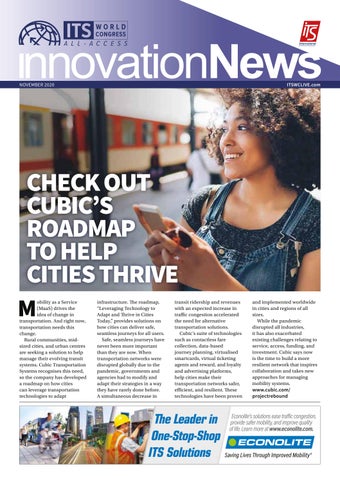

CHECK OUT CUBIC’S ROADMAP TO HELP CITIES THRIVE



Mobility as a Service (MaaS) drives the idea of change in transportation. And right now, transportation needs this change.
Rural communities, midsized cities, and urban centres are seeking a solution to help manage their evolving transit systems. Cubic Transportation Systems recognises this need, so the company has developed a roadmap on how cities can leverage transportation technologies to adapt
infrastructure. The roadmap, “Leveraging Technology to Adapt and Thrive in Cities Today,” provides solutions on how cities can deliver safe, seamless journeys for all users.
Safe, seamless journeys have never been more important than they are now. When transportation networks were disrupted globally due to the pandemic, governments and agencies had to modify and adapt their strategies in a way they have rarely done befo re. A simultaneous decrease in


transit ridership and revenues with an expected increase in traffic congestion accelerated the need for alternative transportation solutions.
Cubic’s suite of technologies such as contactless fare collection, data-based journey planning, virtualised smartcards, virtual ticketing agents and reward, and loyalty and advertising platforms, help cities make their transportation networks safer, efficient, and resilient. These technologies have been proven
and implemented worldwide in cities and regions of all sizes.
While the pandemic disrupted all industries, it has also exacerbated existing challenges relating to service, access, funding, and investment. Cubic says now is the time to build a more resilient network that inspires collaboration and takes new approaches for managing mobility systems.
www.cubic.com/ projectrebound






PA Turnpike upgrades to MG Squared's Ethernet Camera Lowering Devices
The PA Turnpike is an East–West toll highway operated by the Pennsylvania Turnpike Commission (PTC) in the State of Pennsylvania. First opened in 1940, the PTC is now tasked with managing traffic over 550 miles, including from the border with Ohio in the west all the way to the border with New Jersey in the east. This challenge is made easier with strategically deployed cameras throughout the PA Turnpike footprint.
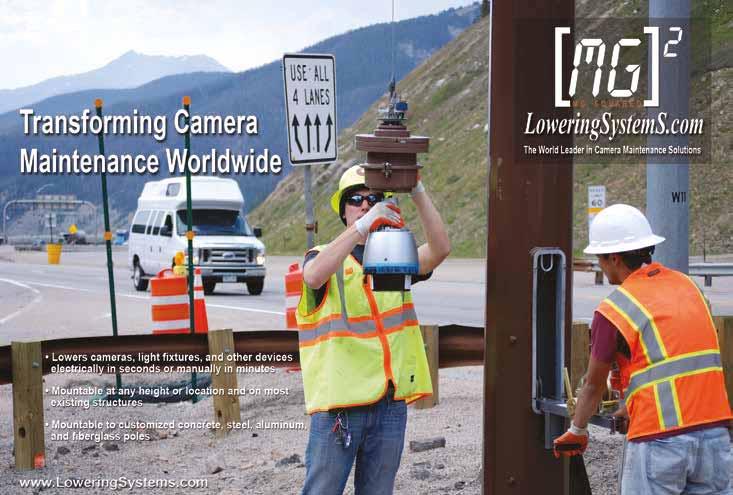
To best keep all 80 cameras across the PA Turnpike operating at 100 per cent efficiency, yet not burden the Turnpike users with lane closures and numerous hazards of bucket trucks on the travel way, PTC installed the camera lowering technology of MG Squared (MG2). Now, camera maintenance can take place at ground level in a much safer work environment for both
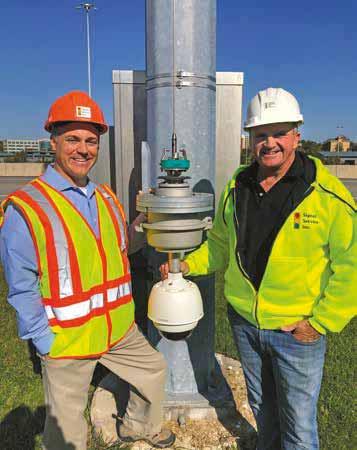
The PTC recently approved a project to convert all of its roadside ITS cameras and lowering devices from analogue to ethernet. “This project is part
along our roadway,” explains Jeffrey Beard, PA Turnpike transportation technologies manager. Beard adds, “With
the assistance and advice of the team at Signal Service, this fall we begin replacing 80 cameras along I-76 and I-476 utilising the latest MG2 CAT6a Ethernet Lowering Devices and Bosch Starlight Digital IP cameras.”
Pennsylvania headquartered Signal Service and particularly its ITS director, Steve Dowdall, have been a tremendous asset with their hands-on “in the field” approach, ensuring that PTC achieves its goals of safety, innovation and customer service.
When this upgrade is completed in 2021, the PTC operations centre will have unsurpassed video analytics with high-definition views of the Turnpike along with continued safe ground-level access to all of its cameras which will improve the safety of both PA Turnpike patrons and employees. www.LoweringSystem.com
STAR SYSTEMS MOBILE TRANSPONDER READER
With the ubiquitous use of transponders for ETC globally, many operators are using handheld terminals with apps that can verify vehicle identity and collect tolls to reduce queue times and traffic jams at multi-mode toll plazas.
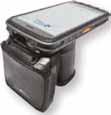
Star Systems International says its Pyxis UHF RFID handheld reader can add mobility and high performance to all vehicle identification projects.
Pyxis provides a real-time, connected and portable way to use installed vehicle
Publisher / MD
Andrew Barriball
CEO Roger Adshead
Editor
James Foster
Editorial team
Adam Hill, David Arminas
transponders in just about any application.
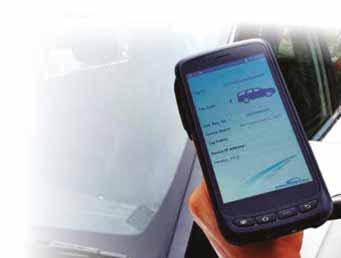
It is rugged, versatile and it delivers excellent read range, accuracy and reliability. With features such as an Androidbased OS, Wi-Fi, Bluetooth, GPS, GPRS/4G, onboard camera and barcode scanning, Pyxis is said to be the perfect tool for mobile vehicle identification applications such as plaza traffic jams / queue busting, vehicle registration checks, tag updates, authentications, deployments and commissioning. It is also
Graeme McQueen, Fulvio Bonfiglietti, Yvonne Tindall
Simon Ward, Andy Taylder
great for vehicle location applications, insurance and safety inspection verifications, traffic violation enforcement, and more.
Additionally, the easy-to-use interface makes it a breeze to incorporate barcodes, pictures, GPS coordinates, and RFID in a single transaction.
Pyxis comes with ready-made applications for testing and deploying transponders along with the option for custom made applications. Users may also develop their own applications using programming tools,
Ryan Brown, president, Signal Service, (left), and Steve Dowdall, ITS director, Signal Service with the MG2 CAT6a Ethernet Camera Lowering Device and a Bosch Starlight IP camera
THE BENEFITS OF AGGREGATING MULTIPLE LIVE STREAMS OF DATA
Ta reality. While it brings great promise, it also brings new challenges for those seeking to derive insights from the voluminous data each connected vehicle will transmit. Any number of transportation agencies are beginning to grapple with the challenge of monitoring the live streams of
their roadways.
Several cities, tollways and state departments of transportation, have begun conducting early tests of aggregating not only DSRC data, but also combining weather, and other real-time streams into a common operational view. The aim is to help them understand
used to better manage traffic, but also to help warn motorists of approaching dangers.
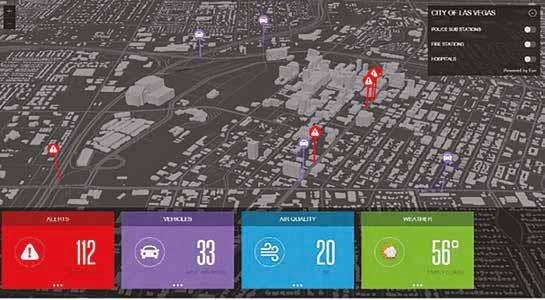
For example, one tollway relied on Esri software capabilities to analyse streaming Internet of Things (IoT) data inputs on dashboards and maps. Aggregating not only dedicated short-range communication
(DSRC) data from equipped vehicles, but also real-time weather, embedded sensors on bridges, and wind data among other live data streams. The result was that tollway staff were able to identify when certain bridges became dangerous because of icy conditions under high wind conditions.
ArcGIS Velocity allows agencies to aggregate huge streams of real-time data in the cloud and do analysis as the data streams in. Esri says this new capability will help organisations take advantage of the insights made possible by IoT with up-to-the-minute data and improved situational awareness.
These examples highlight how transportation professionals continue to explore how these new data sources and their IoT capabilities can be leveraged to provide a safer, and less congested experience on their roadways. www.esri.com
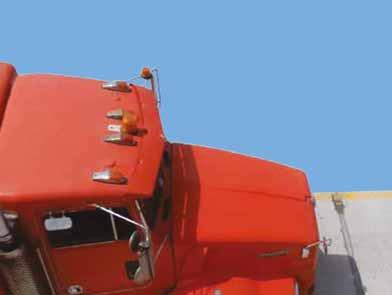
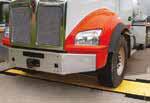
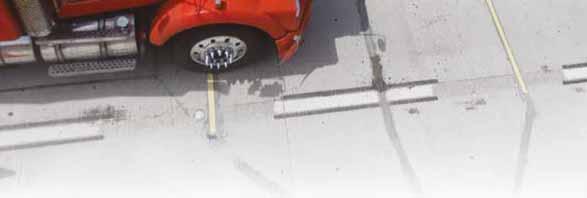
Making roads safer with IRD’s TACS
Since IRD introduced its Tire Anomaly and Classification System (TACS) a few years ago, it has been widely adopted for tyre safety screening. In the United States, multiple agencies have adopted TACS for commercial vehicle enforcement purposes. Installed in advance of weigh stations, TACS identifies trucks with conditions such as underinflated, flat, missing or mismatched tyres. Inspectors can reference a vehicle record showing the location of the suspect tyre on the vehicle and know exactly which tyre to examine. Fines may result, and vehicles with unsafe tyres can be placed out of service until the tyre problem is corrected. TACS has been very effective
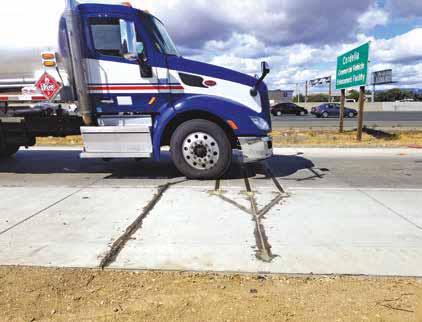
TACS to their E-screening systems. In European systems so far inefficient tyre, is found by the system. There is an established
relationship between underinflated tyres and reduced fuel efficiency, so the systems flag tyres running with low-pressure for efficiency/ environmental reasons.
With so many systems deployed, TACS now screens millions of vehicles annually. Between 1 January and 31 October of this year, over 230,000 vehicles were flagged with tyre anomalies sufficiently severe to pose a safety hazard. Not only is TACS having a significant positive effect on road safety in jurisdictions where it is deployed, it is also demonstrating that there are many vehicles on the road that pose a safety hazard due to inadequate tyre maintenance. www.irdinc.com
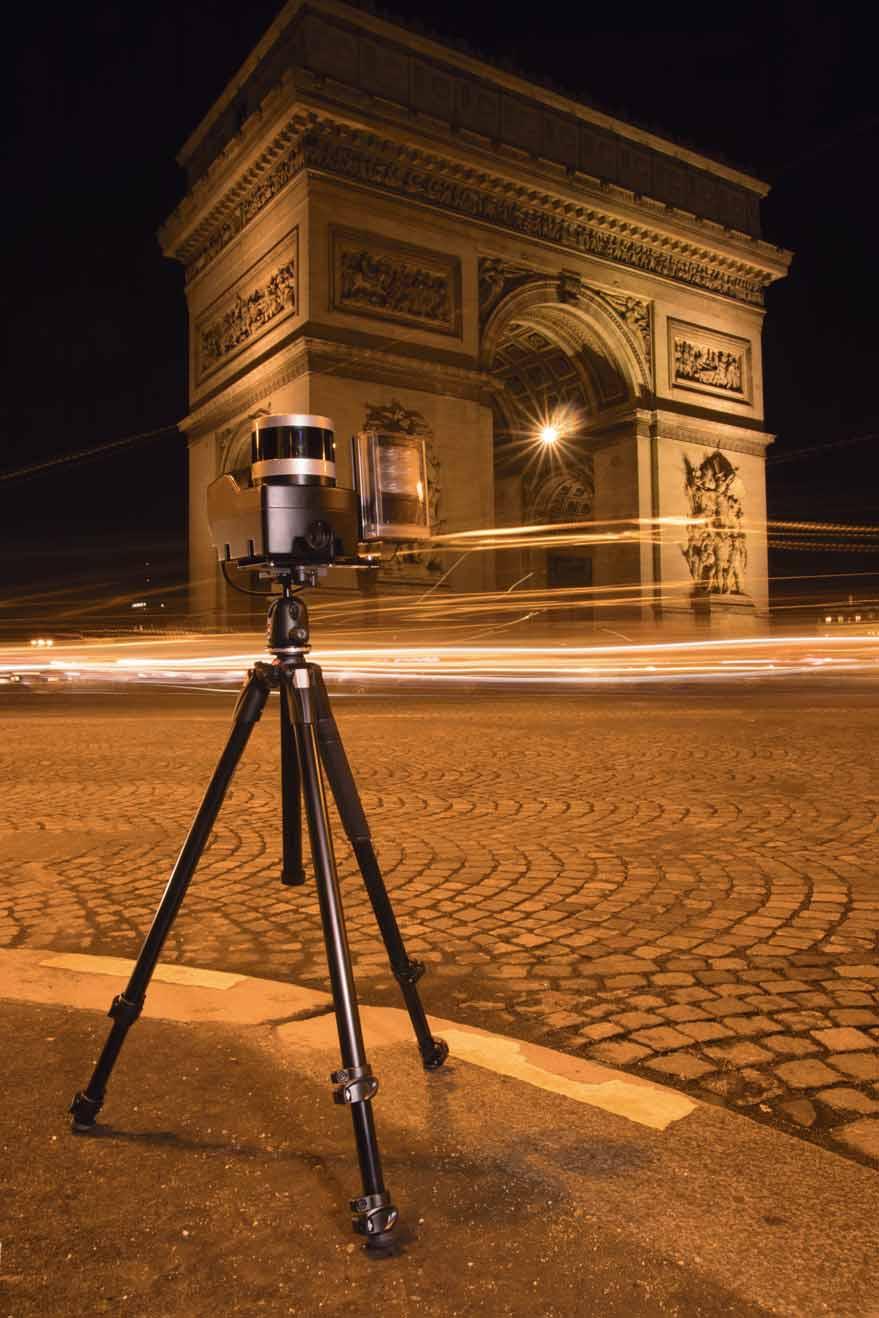
Expertsintrafficenforcement technologies,PARIFEXdevelops fixedandmobilesystemsusingthe mostadvancedandinnovative technologies.Itslatestcreation offersthemostcomprehensive trafficmonitoringsolutioninone singlelightequipment.
Conduent pilot of new payment system on Adelaide trams
Conduent Transportation has installed a new contactless open payment system on the Adelaide tram system overseen by the South Australian Public Transport Authority (SAPTA). This sixmonth pilot programme started on 20 September. Adelaide travellers can now use their Visa, MasterCard and NFC-enabled smart devices to pay for their fares on the 24 trams throughout the city. Adelaide is the fifth largest city in Australia, with a population of approximately 1.4 million.
Leveraging Conduent’s Atlas system, which is already used by the Adelaide transit authority, the company has deployed its Atlas Open Media pay-as-yougo module and validators on the vehicles for on-board fare payment. During the pilot, Conduent’s new system will operate alongside the MetroCard validating system on Adelaide trams.
Atlas Open Media modernises
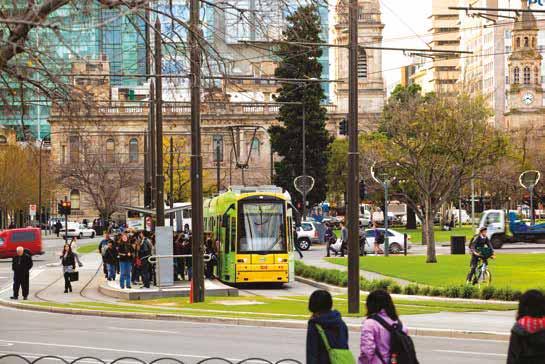
a transit network’s fare collection by enabling a variety of transit ticketing payment methods, including EMV contactless cards, digital bank wallets, NFC and QR code. Given recent health concerns associated with Covid-19, contactless fare collection systems have become a beneficial tool that transportation operators can use to help maintain a safe environment for their
passengers.
“Enabling contactless payment on trams is the first phase of modernising fare collection across the Adelaide Metro network,” said Anne Alford, executive director, SAPTA. “By leveraging this technology, Adelaide will have easier, faster, safer and more accessible public transport. Implementation of the pilot was seamless with Adelaide
Metro able to utilise its existing partnership with Conduent Transportation to employ its expertise and technology.”
This is the latest collaboration between Conduent Transportation and the South Australian Government. For more than 25 years, Conduent has delivered ticketing and fleet management systems, including terminals and on-site support. www.conduent.com
Q-FREE EXPANDS LANEAWARE WORK ZONE TOOL TO MANAGE AIRPORT ROAD PROJECTS
Q-Free has revealed it is expanding its successful LaneAware Work Zones lane closure management tool to include a standalone product for airport road projects. LaneAware Airports will organise, manage and automate lane closures for airports, so when it’s time to fly, airport authorities can ensure the best arrival and departure experience for travellers.
The airport lane closure tool is a new web-based application adapted from Q-Free’s trailblazing LaneAware Work Zones software. It is designed to help resolve the all-too common conflict between approach road congestion and passengers rushing to make a flight. Both the LaneAware Work Zones and LaneAware Airports
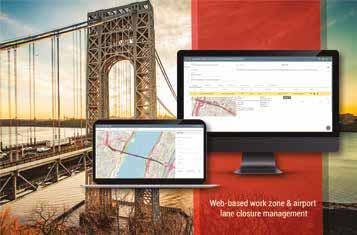
solutions provide authorities with the ability to schedule lane closures, share workzone data with the public and media, and minimise errors and disruption.
Q-Free says both products could not be more timely.
With Covid-19 vaccines edging closer to reality and governments discussing ambitious infrastructure plans to help rebuild Covid-weakened economies, the potential for road construction gridlock and the
need for impactful solutions is growing increasingly urgent.
“We realised early on that our unprecedented LaneAware Work Zones solution could make a massive impact on facilities and organisations with a lot of moving parts,” said Morten Andersson, senior executive vice president of traffic management for Q-Free. “Most lane closure activities at airports are handled by multiple departments, making it an extreme challenge to coordinate activities without negatively impacting operations or traffic at critical times. Our LaneAware solutions centralise and resolve these conflicts easily, providing a seamless experience for travellers and workers alike.”
www.q-free.com






















































































































































aws.amazon.com/stateandlocal/transportation













































































ITS America Events delivered successful ITS All-Access virtual event
ITS America and Reed Exhibitions delivered their first-ever ITS World Congress All-Access digital series, supported by premier sponsor Amazon Web Services. Jaime McAuley, marketing and event director, ITS America Events, looks back on a successful programme.
The ITS World All-Access virtual event attracted nearly 2,700 participants, 30 supporting sponsors representing solution providers from the entire spectrum of the intelligent transportation industry and close to 50 networking and educational opportunities that enabled ITS industry professionals to learn, explore and stay on top of emerging trends.
We were extremely disappointed that we couldn’t convene in person this year to deliver the ITS World Congress event in Los Angeles. Our Reed Exhibitions’ Events team and ITS America wanted to ensure that our virtual event series in September and October represented the quality and variety of educational opportunities that would have been available at the face-to-face event. It’s challenging to take an in-person, live event and replicate it virtually, but our choice in programming, speakers, sponsors and virtual platforms helped pave the way




to success, excellent satisfaction ratings, and delivery of a virtual event that was valuable and educational for our entire ITS community.
The ITS World Congress All-Access virtual event series, which spanned several weeks, created a platform for the intelligent transportation community to source innovative and actionable insights by delivering a total of 44 sessions ranging from interactive education sessions, discussion groups, live Q+As, and vendor solution presentations in the form of case studies, keynotes and expert panels – now all available on-demand in the ITS AllAccess Knowledge Centre. The sessions will be available to view and download until April 2021. Education themes explored relevant and timely industry topics such as intelligent, connected and automated vehicles, equity and accessibility, Vehicle to Everything (V2X), incentivising people


"There was an impressive amount of audience interaction and engagement..."
Jaime McAuley, marketing and event director, ITS America Events

to move differently, Mobility on Demand/ MaaS, cybersecurity, best practices for utilising data, sustainability, workforce development, traffic management, safety, customer experience, pandemic impacts on transportation and more.
Audience interaction and engagement
There was an impressive amount of audience interaction and engagement with more than 300 questions and answers on various topics presented throughout the four-week event series. Speakers, moderators and panellists included representation from public sector agencies such as state departments of transportation, cities and metropolitan planning organisations, research analysts, educational institutions, transportation operators, manufacturers and more. There was an average of 131 registrants per session with a strong make-up of domestic and international attendees.


“ITS World Congress All-Access was a terrific opportunity to connect with stakeholders from across the industry and around the world during this time when we could not gather in person,” said ITS America president and CEO, Shailen Bhatt. “We were thrilled at the

enthusiastic response to the event, and we can’t wait to reconnect with ITS stakeholders in 2021 and 2022 at the ITS World Congress in Los Angeles.”
The ITS World Congress attracted 30 sponsors, well-respected leading companies from across the intelligent transportation and mobility industry that offered solutions and technologies to help prepare the industry for the future of mobility. They included Amazon Web Services, AECOM, Bewegen, Bosch, Conduent Transportation, the UK Department of International Trade, Econolite, Genetec, Google Cloud, HDR, Investissement Quebec International, IRD, Kapsch, LeddarTech, Lufft, OTT Hydromet, Miovision, Netlift, PlanetM, Siemens, Transoft Solutions, SwRI, Syntony GNSS, Toyota, Waycare, WSP and a variety of other industry partners.

“We were thrilled at the enthusiastic response to the event, and we can’t wait to reconnect with ITS stakeholders in 2021 and 2022 at the ITS World Congress in Los Angeles”
Shailen
Bhatt, president & CEO, ITS America
pathogens and more.
We will reimagine transportation Covid-19 has fundamentally changed transportation around the world, from personal mobility to the delivery of goods, and new views on quality of life and equity. As we emerge from this pandemic, what does transportation look like? We have an opportunity now to help shape a safer, greener, smarter future by making smart investments that can have a positive impact on mobility, commuting patterns, supply chain and delivery of goods. As we prepare for our 2021 and 2022 events, we will reimagine transportation and discuss how technology is a foundational piece of a new 21st century transportation system. There will be a virtual/hybrid opportunity available at our 2021 event for attendees unable to attend in person. This will include live streaming of selected educational sessions
with up-to-date guidance from public health officials, including the Centers for Disease Control and Prevention (CDC) and World Health Organisation (WHO), state and local governments and the protocols put in place by our network of venue partners. As part of that commitment, and to prioritise the health and well-being of everyone at our events, we have created a Health and Safety Task Force to develop and implement policies and best practices around Covid-19 response and prevention. Some of the safety and health procedures could include clear messaging that reflects all Covid-19 protocols and requirements displayed throughout the venue/event and provided in advance to all customers, vendors and staff; approved self-assessments, non-invasive entry screening, and medical facilities and response teams; hand sanitiser dispensers deployed throughout the exhibit hall and other areas; use of disinfectant products that have been pre-approved and certified by the US Environmental Protection Agency (EPA) for use against emerging viruses, bacteria, and other airborne and bloodborne
The top 15 most attended and viewed sessions:
1. AV Shuttles in the US – Lessons Learned from Planning to Deployment
2. SOS -Save Our Spectrum- the 5.9 Ghz Band and V2X
3. Keynote: Peter DeFazio (D-OR), Chairman, House Transportation & Infrastructure Committee, talks with Shailen Bhatt
4. Does MaaS Contribute To Sustainable Transportation?
5. Infrastructure Readiness for Cooperative Automated Transportation
6. Automated Bus Consortium Program
7. Mobility Utopia: 2030 - Part 1 of 2
8. Beyond the CV Pilot; Integrating OEMs
9. MOD & MaaS Workshop: Transportation as a Commodity and Utility: Part 1 of 2 (Sponsored by Cubic)
10. Keynote: Blair Anderson, Director, AWS Public Policy, talks with Shailen Bhatt, President and CEO, ITS America (Sponsored by AWS)
11. Getting Beyond Data Distraction: How Data is Driving Mobility Outcomes
12. Transit Rethink: How Does Transit Adapt to a Future That Includes onDemand Services?
13. Deployment of V2X at 5.9 GHz in the U.S.
14. Accelerate Cooperative Driving Automation (CDA) Deployment with Open Source Software for ITS
15. Cooperative Driving Automation: The Latest in U.S. Research, Resources, and Findings for Global Improvements in Safety and Mobility
The ITS World Congress All-Access education sessions will be available to access on demand for the next several months. You can still register to view the webinars and sponsored showcase pages by purchasing a premium pass for $95, which grants access to the entire library of content as well as past webinars and special sessions. Members of ITS America, sponsors, speakers, non-profits, academia, public agencies and Transportation Tech Leaders Program members are eligible to receive complimentary premium passes.
For more information on ITS America Events, please visit www.itsamericaevents.com
Reed Exhibitions
Reed Exhibitions is a leading global events and information business. It combines face-to-face with data and digital resources to help customers learn about markets, source products and complete transactions at over 500 events in almost 30 countries across 43 industry sectors, attracting more than 7 million participants.
Our face-to-face and digital events, organized by 35 global offices, leverage industry expertise, large data sets and technology to enable our customers to generate billions of dollars of revenue for the economic development of local markets and national economies around the world. Reed Exhibitions is part of RELX, a global provider of information and analytics for professional and business customers across industries. www.reedexhibitions.com
ITS America
The Intelligent Transportation Society of America (ITS America) advances the research and deployment of intelligent transportation technologies to save lives, improve mobility, promote sustainability, and increase efficiency and productivity. Its vision is a better future transformed by intelligent mobility: safer, greener, smarter.

Jenoptik‘s Civil Security is making the world safer with advanced security solutions. We capture, analyse and act against public safety threats such as serious organised crime and border control violations through the use of real-time predictive data analysis.
We specialize in:
• • • Driver Behaviour Detection
• Big Data Analysis
• Data Processing
Make life safer and brighter. With JENOPTIK Light & Safety.
jenoptik.com/civil-security
Follow us on LinkedIn and Twitter and get more information about JENOPTIK Light & Safety

ITS World Congress 2021: Experience Future Mobility Now in Hamburg
Global transport is facing unprecedented challenges to service delivery. Whilst governments step up efforts on climate change, city authorities are looking for ways to innovate through times of crisis, to balance passenger transport flows and the freight traffic essential for business and residents’ supplies. Citizens everywhere require reliable, affordable and personalised transport that meets their own needs and demands.
Fortunately, innovation in ITS is enabling us to address these challenges. Automated and connected transport is demonstrating its potential to improve the quality of life, reduce fatalities and enhance the mobility and independence of millions. Smart traffic management and Mobility as a Service (MaaS) can significantly cut transport’s greenhouse gas emissions. Major changes in the quality and availability of data are bringing new solutions, businesses and business models.
New solutions and services
The next ITS World Congress, which will be held in Hamburg from 11-15 October 2021, will gather together thought leaders, developers and decision-makers from the automotive, public transport, logistics, IT, mobility and telecommunications sectors to exchange ideas on the mobility solutions of the future. Experts from around the world will present new solutions and services that benefit cities and citizens, and discuss how the disruptive impact of new technologies can be reduced by revising regulations to encourage safe, secure and socially accessible change. Hamburg is the perfect location for this prestigious event: the host city is a European model for urban mobility and a renowned international port for freight and logistics.
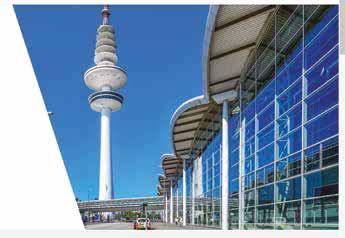
The conference theme, Experience Future Mobility Now, matches the mission and vision Hamburg has been embracing over the last few years, since the adoption of an ITS strategy in 2016. Hamburg has been using AI and other digital technologies to improve traffic flow, as well as engaging in several ITS initiatives with the goal of achieving ‘smart city’ status by 2050.
The Congress is Ertico – ITS Europe’s most powerful tool to connect people, processes, data to revolutionise world cities and communities and raise awareness amongst us all: policy makers, experts and the public alike.
Learn, network and share
Ertico and the city of Hamburg are proud to offer such an occasion to learn, network and share solutions and ideas to bring us one step closer to smarter, user-friendly and more sustainable mobility, with a focus on digital as a key enabler to achieve the green transition
and ensure the human-centric development of AI.
The programme in Hamburg includes sessions about CAD, MaaS, intelligent infrastructure, solutions for cities and citizens, complemented by an expansive exhibition area and a set of live demonstrations for a first-hand experience of the mobility of the future.
The call for contributions is currently open: for more information, visit https:// itsworldcongress.com
The Congress venue
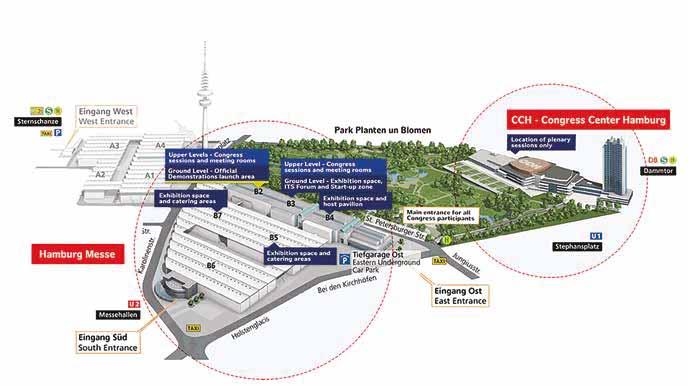
The Congress Centre Hamburg (CCH) makes the Hanseatic City an exceptional location for the ITS World Congress 2021. With a total available exhibition space of 12,000m2, another 12,000m2 of foyer space, and 12,000 seats in up to 50 halls and rooms, the new CCH will be in perfect shape for your visit in 2021.





Making roadways across North America better by the mile, right now


Cirrus by Panasonic: Connected Vehicle Technology Solutions
Right now, mile by mile, we’re transforming roadways from Georgia to Colorado to Utah and beyond. Making them smarter, safer and more vitally connected to everything that travels upon them. Cirrus by Panasonic is helping our transportation partners use connected vehicle technology to identify and respond to traffic incidents faster and deliver critical safety alerts to travelers. We implement reliable field deployment solutions and offer an open data management platform to help agencies make the most of every dollar. How can we help move what matters in your state?
Learn more

Reflecting on our predictions of the macro trends affecting the sector in 2020



In a recent blog, Axis Communications’ Peter Lindström revisited earlier predictions of macro trends in light of the Covid-19 pandemic.
Nfuture!”
He was a clever man.
Back in January, I published a post which looked at the broader macro trends that I thought would affect the security sector in 2020. At that point, few would have predicted the level of disruption that the Covid-19 pandemic would cause across the globe, in all aspects of our professional and personal lives.
I thought it would be interesting to look again at those trends, to see how each might have been affected by the past few months. Some might have a heightened relevance, others perhaps less so, but all would have been impacted in some way.
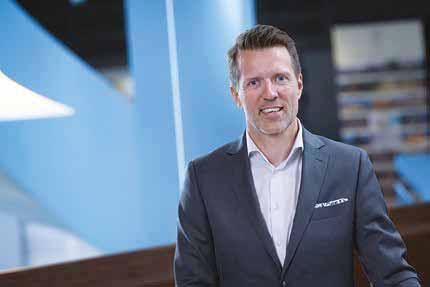
Trust
The first trend is about trust, and indeed is one which I see as a common link between all other trends. Nothing has changed in our feelings over the past few months: it is clear that trust remains as a central principle in the relationship between citizens, business and government, and it could be argued that it is more critical than ever.
In business, every organisation has had to
fundamental human need to feel secure"
Peter Lindström, executive vice president head of global sales, Axis Communications
react swiftly to the impact of the pandemic on operations. Every decision has the potential to impact the trust between a business and its stakeholders – employees, customers, suppliers and local communities. It’s perhaps been a time more than any other when the true values that sit at the core of a business are exposed, for good and bad. In this article, Axis’ CEO Ray Mauritsson and CTO Johan Paulsson talk about how ethics and trust affect different aspects of business, technology and the company.
We are still in the midst of managing the pandemic, but the next few months will demonstrate whether the bond of trust between citizens and public and private institutions has been weakened or strengthened. But it’s no less important.
The need to feel secure
If there was one trend that I’m confident is still relevant, it’s the fundamental human need to feel secure. Clearly, over the past few months, people’s sense of safety and security has been disrupted: we’ve all been feeling, at times, concerned about the health of our friends and families, and the significant changes and restrictions to aspects of everyday life have been disorientating. This will continue as some aspects of life take a
long time to return to ‘normal’ , while others will be changed forever.
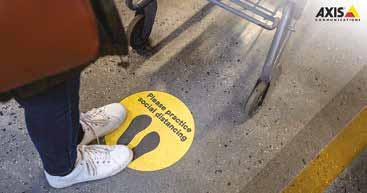
When used in line with national and international regulations, video surveillance has for a long time played a role in keeping people safe and secure without impinging on their privacy. This remains the same, and in fact video, audio and access control technologies can help in ensuring adherence to public safety guidelines. Whether managing the number of people and their proximity in public spaces, shops and offices; reducing the contact points in building access; or communicating essential public health information, technology can help.
Sustainability and the environment
The broader impacts of the pandemic –particularly the reduction in international and domestic travel – have resulted in environmental benefits across the globe. Hopefully, these benefits can be a springboard to more focus on environmental responsibility and sustainable operations as the world of business and commerce recovers – some of which, I’m sure, will be driven by consumer behaviour.
More broadly, the approach a business takes to sustainability in environmental responsibility has always been part of their overall approach to business ethics. Again, the light has been shone on the fundamental values of every organisation as they managed their way through the pandemic.
Those organisations which have traditionally demonstrated a strong ethical
approach to business – and which has been demonstrated through their reaction to the pandemic – will emerge stronger and with deeper relationships. “Doing the right thing” has never been more important.
Urbanisation
Another key trend is urbanisation. It’s going to be interesting to see how the pandemic affects the trend that we’ve seen for many years of more people living in cities. Commentators in certain markets have already started speculating that many people will move away from urban centres given both the perceived health risks of living in such crowded communities, and the realisation that working more flexibly is a real possibility.
However, it can also be argued that the opportunity to work remotely – only visiting an office once or twice a week, if at all – is a luxury that a minority of working people can afford. Ultimately, it is unlikely that we’ll see a mass exodus of people from cities, and the



requirement for technology to play a role in keeping cities safe, secure and efficient will
The impact of global politics
There’s certainly no evidence that the pandemic has lessened the implications of global politics on business. The perhaps natural desire of governments to focus on the health and safety of their own citizens, added to the disruption of global supply chains, may lead to longer-term protectionism around resources, capabilities and people. However, if nations are to ‘Build Back Better’ following the pandemic, openness, honesty and transparency are essential if we are to fully learn the lessons that will make society more resilient.
I am sure further trends will emerge over the coming months that will impact life at work and at home across the globe. As measures are put in place to reduce the risk of the pandemic and future viruses returning, we also have the opportunity to learn positive lessons and make fundamental changes to improve the way we live our lives. We must look to take that opportunity. If you want to stay updated on the latest security trends and insights from Axis and our friends in the security industry, please subscribe to the Security Trends & Insights newsletter.
www.axis.com

Peter Lindström is a seasoned professional in the IT and security industries. He joined Axis Communications 16 years ago as a Nordic manager and expanded his responsibility to become the regional director for the Nordic, Baltic, Central Eastern Europe, Russia and CIS countries. In 2008, Peter began working with the startup of a new Axis team, the New Business Team, focusing on business opportunities outside of Axis’ core businesses. Most recently, in 2019, he was appointed executive vice president head of sales, responsible for Axis’ global sales operations. Peter got his start at Lund University in Sweden, from which he holds both a University Certificate (UC) in Electrical Engineering and a Master of Business Administration (MBA).
















TRANSCORE DELIVERS TOLLING INTEROPERABILITY ACROSS THE US
The release of TransCore’s NP2 tri-protocol tags is a timely and welcome innnovation in tolling throughout the US. Agencies are increasingly seeking interoperable solutions and hands-free options for simplified travel across the contiguous United States. The new NP2 tri-protocol tags meet this need by allowing for seamless travel across tolling regions.
NP2 tags are tested and approved by the three governing agencies – IAG, OmniAir, and FCC – and provide toll operators a near-term, tag-based option for facilitating inter-regional interoperability.
With customisable settings and software, NP2 is designed to help capture revenue across all vehicle classes and uses, and its software is intended to be updated and reconfigured as



business needs
evolve without costly tag recalls. This also means agencies can customise features and design configurations and applications to meet unique business needs, while offering a choice in hardware to meet the driving habits of their customers.
Additionally, Transcore says the NP2 is one of the most accurate, secure tags on the market today. This means operators can offer an immediate choice for tag-based
interoperability without sacrificing performance, no matter where in the United States their customer is travelling.
While establishing universal North American interoperability may demand significant time
commitments and investment in infrastructure, technology, communication, and network development, NP2 triprotocol tags offer a tag-based choice for customers seeking interoperability today. https://transcore.com/np2
Investigate ways AI and machine learning can make a huge difference
Artificial intelligence (AI) is already making significant differences in day-to-day transportation management operations across the US, according to emerging technology experts at the recent virtual ITS World Congress. The panellists, brought together by Siemens Mobility’s ITS Digital Lab in Austin, Texas, encouraged transportation departments and public agencies to investigate ways AI and machine learning can make operations more efficient or help them develop and implement actionable decisions in real time.
“Investing in solutions that save time, generate efficiencies and keep people safe is particularly wise during
today’s pandemic and economic uncertainty,” said Laryssa Parker, VP and head of the ITS Digital Lab. “AI and machine learning can be used to automate manual operations, for example, making this work more efficient and allowing staff members to use their expertise for higher-level activities. AI also helps DOTs and agencies go beyond detecting and managing incidents to predicting and preventing crashes,” she commented.
c er,
along with the capabilities to
to process it, make meaningful calculations, and then take action from the data, weren’t possible just a few years ago. Now, thanks to AI, transportation managers are seeing great results.
AI allows projects to be done on a larger scale, too. Instead of focusing on just one corridor, for example, DOTs and agencies can now look at the entire region to understand the conditions that are causing accidents. Today’s access to large amounts of data
Other key topics covered by the panellists included safety and mobility; cybersecurity; collaboration inside and outside DOTs and agencies; and using AI to understand and leverage existing infrastructure www.siemens.com
AI can predict and prevent crashes - Laryssa Parker, VP and head of Siemens Mobility’s ITS Digital Lab






Empower smart decisions by accurately detecting and measuring
To learn more about RTMS Sx-300, visit: bit.ly/34YrNJX
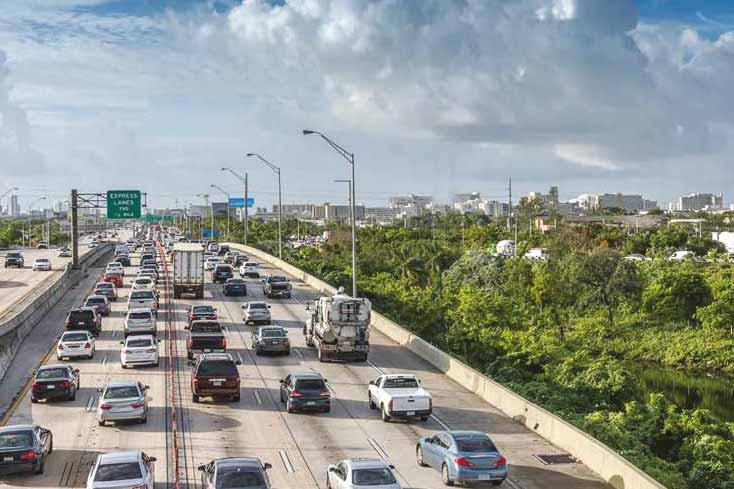









Our cities are becoming smarter and faster every day, and as the modern city evolves so does its transportation offerings. By migrating transportation services to the cloud, cities can evolve to meet citizens'
transportation needs. To meet modern-day travellers’ expectations, the cloud drives innovation by providing realtime analytics and predictive modelling that can make transportation easier and faster.
Amazon Web Services
(AWS) works with leading transportation technologies to help build cloud solutions for mass transit, tollways, departments of transportation, and more. These transportation solutions enable constituent service improvements, making
streets safer, improving urban mobility, and delivering savings.
For example, Transport for New South Wales in Australia uses the cloud to predict patronage numbers across the entire transport network, enabling the agency to better plan workforce and asset utilisation and improve customer satisfaction.
Using open data, Transport for London helps users plan 31 million journeys a day and has been used by 83 per cent of Londoners.
And for cities like Louisville, Kentucky, the cloud provided a way to collect and understand data for more informed decision making on traffic and congestion.
From managing traffic signals and intersection surveillance to smart parking and improved public transportation, AWS says it can help create meaningful, personalised, greener, safer, and reliable experiences for users. https://aws.amazon.com/ stateandlocal/transportation/
STRINGENT TESTING OF TRAFFIC DATA SYSTEMS’ TMCS-IP WIM TECHNOLOGY
Germany-headquartered Traffic Data Systems (TDS) has revealed details of a test on its Weigh In Motion (WIM) systems that was undertaken in August and September. The company says it is still the only manufacturer in the world capable of supplying low- and high-speed WIM systems complying with the OIML R134 standard for enforcement and tolling applications.
The recent test was carried over a 10-day cycle with five heavy and two light goods vehicles. These vehicles passed the sensor arrays of TDS’ WIM sites several times with different speeds and weights. In total more than 600 passages were carried out. Each passage was monitored and evaluated by the Swiss Metrological Institute (METAS). Part of these test rides and measuring procedures were also monitored by the German Metrological Institute (PTB).
According to the requirements of some European metrological institutes, the fleet of HGVs also contained two road tankers. Their passages were required to be evaluated with different loads in order to prove that these
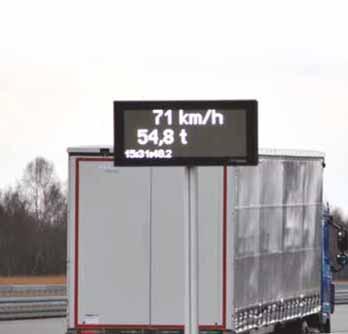
vehicles in motion with liquids are also weighed correctly. Empty and fully-loaded vehicles are in general no problem. However, the challenge is to weigh halfloaded road tankers correctly since not just the vehicle, but
also the whole load, is in motion. These stringent tests are TDS's first step in order to achieve the next higher accuracy class according to OIML R134 (±2,5% initial verification and ±5% in service) for its TMCS-IP WIM system for a speed range from 5km/h to 120km/h for HGVs (heavy goods vehicles) and up to 140km/h for LGVs (light goods vehicles).
www.traffic-data-systems.com





SHIMMICK’S FOCUS ON CUSTOMER JOURNEY MAPPING
Tolling agencies are looking for better ways to understand their customers’ experiences as part of their continued improvement initiatives. Shimmick’s O&M division believes focusing on the customer experience is fundamental to building a strong brand and implementing technologies and processes that deliver an excellent customer experience through efficient operations. Shimmick accomplishes this through its tolling-specific customer experience journey mapping process. This advanced solution reflects the end-toend experience toll customers have across every touch point in a multi-channel operation including walk-in, IVR, mobile app, chat, email, and others. The journey map can outline why their clients’ customers call their CSC or visit a walk-in centre or

website and what the customers are thinking, doing, feeling, and struggling with across their journey. By tracking the customer journey, Shimmick can work with their clients to improve service delivery and ensure an outstanding experience each and every time.
“It’s important for our
clients to understand what their customers are actually experiencing," says Scott Wilson, director of Shimmick’s operations. “Whether they are trying to pay a toll invoice, create a new account, or replenish a transponder account, the customer needs to have a clear and easy
At a glance: Key products for a fullyoptimised traffic surveillance system
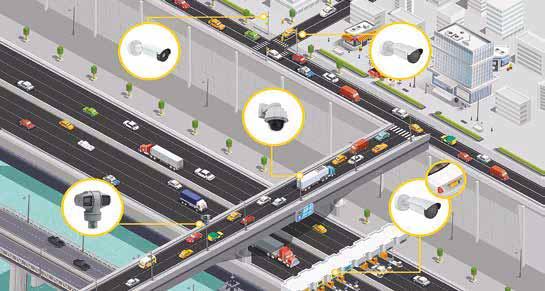
To showcase why a focused suite of traffic surveillance solutions is critical to efficiently manage the road, Axis Communications, a leader of IP-based products and solutions that offers a purposebuilt portfolio for roadside surveillance, has created a new infographic called “Total surveillance solutions for traffic management.”
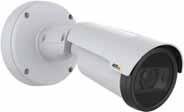
Outlined in the infographic are the key products for a fullyoptimised traffic surveillance system including high-quality thermal network cameras, giving reliable 24/7 detection in any light condition, and PTZ network cameras for roadway wide-area coverage which are able to withstand the toughest conditions. A licence plate network camera is also called
out in the infographic – which is dedicated for capturing sharp images at high speeds. The Axis Q1700-LE licence plate camera is designed for third-party software that allows for applications such
as plate recognition and vehicle classification and counting.
The infographic also highlights the importance of real-time situational awareness and several advanced traffic
path to accomplish these tasks. Our customer journey mapping approach allows us to identify gaps in the process, communicate those gaps with our clients, develop solutions and then institute those changes so that each interaction results in the ultimate customer experience.”
Brad White, VP of operations added: “This approach to continued improvement for our clients is an example of Shimmick’s core values which includes complete transparency with our clients and allows us to develop an association based on mutual trust and support. Our clients know that we are committed to them and their customers which leads to long term, deeper connections with them that are based on meaningful, more authentic relationships.”
www.shimmick.com
applications, such as automatic incident detection and nearmiss detection, that can give either real-time or historical data for managing the road.
To see the full surveillance offerings that Axis recommends for traffic management applications, download the full infographic.
www.axis.com


Video-as-a-Sensor solutions for intelligent intersections
Ointersections, and along corridors, and storefronts in close proximity to roadways, can obstruct views of pedestrians. Combine these factors with the increase in distracted pedestrians, and it is clear why strategies to make such vulnerable road users more visible to motorists are essential to the safety of intersections and pedestrian crossings.
To address these factors, Bosch says its IP video cameras with on-board intelligent analytics provide accurate automatic detection of pedestrians approaching a crosswalk or in the road. Moreover, integration of the IP camera with third-party technology can broadcast personal safety messages via dedicated short-range communications (DSRC) to smart vehicles, alerting them to the presence of pedestrians. These safety messages display
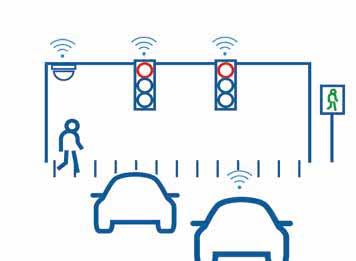
on a live map on the vehicle’s on-board unit, along with traffic signal state, phase timing, and vehicle and pedestrian movements in the area – improving situational awareness for drivers.
According to Bosch, with video analytics, its IP camera becomes an intelligent sensor that can classify objects as pedestrians, cyclists, or vehicles. Using video-as-a-sensor, traffic engineers can collect real-time data to analyse road usage. Dashboards deliver business intelligence information with counts of pedestrians and vehicles at intersections for data-driven decision-making about signal timing and more.
Bosch says that, from pedestrian safety initiatives to improving traffic flow, videoas-a-sensor technology enables a range of solutions to meet the needs of city planners and senior traffic engineers worldwide.
www.us.bosch.com

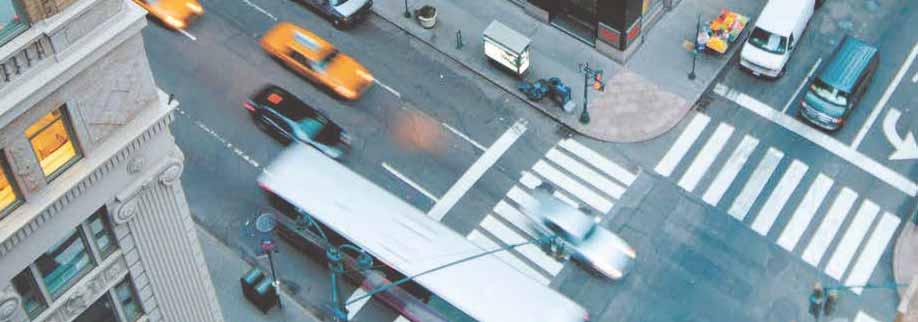
Traffic data collection is a key topic for cities and mobility digitalisation. It is predicted that some 70 per cent of the world’s population will live in a city by 2050. That is why cities are hurrying up to optimise population flows and provide efficient means of transport.
The growing number of inhabitants and vehicles leads to the increase in traffic jams and carbon emissions and has a direct impact on the urban environment. Cities face both economic and ecological challenges to deploy cleaner public transport in order to improve circulation flows. It is possible to easily regulate traffic jams and carbon emissions through functionalities such as vehicle counting, tracking and the real-time management of red lights. However, a deep analysis of data is obviously necessary to improve urban installations.
Collecting data is a substantial step to successfully digitalise
HOW DATA COLLECTION HELPS CITIES TO BECOME SMARTER
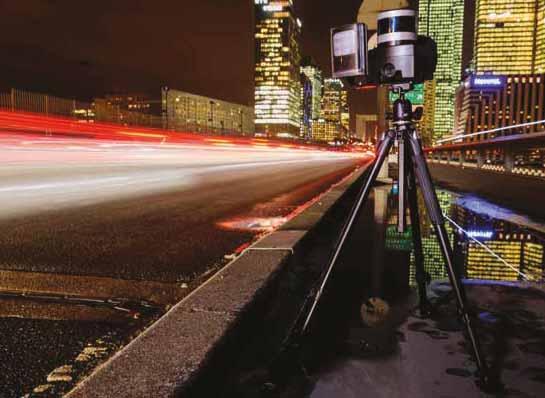
cities and their urban planning. And precise statistics on mobility services are necessary, such as the daily number of vehicles, the classification, the most usual routes to name just a few. To make data
collection possible, systems like the 3D Lidar-based Nano, designed by Parifex, are set up throughout the city to detect all the fixed and mobile objects in a 360-degree field of vision. Through the Nano-Cam, which
incorporates a camera and 3D Lidar technology, many other situations, including speeding, running red lights, crossing the stop line, and more can be controlled.
www.parifex.com/en



The benefits of WIM technology from Oriux
headway, all in either binned or per vehicle records.


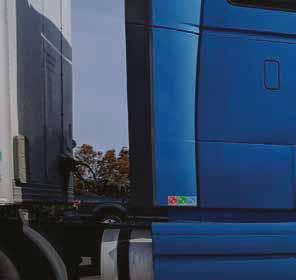
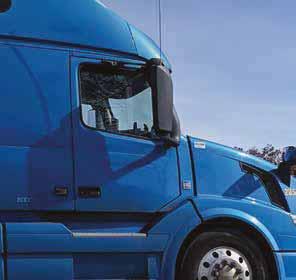
Weigh In Motion (WIM) technology allows transportation agencies to classify and record vehicle weight as vehicles travel over a measuring site on the highway. This technology provides agencies with the necessary tools to enforce overweight compliance




programmes, helping them keep roads safe and extend the life cycle of their infrastructure.
Oriux’s line of portable and permanent data collectors and WIM plug-in modules has allowed transportation agencies to accurately collect vehicle data for traffic studies and to aid them in the enforcement


of weight limits. Vehicle data that can be collected by the company’s WIM solutions include gross vehicle weight, classification, arrival time, speed, volumetric flow, individual axle weights and spacings, overload indications, equivalent standard axle loadings (ESALs), gap and


The use of Oriux’s simply installed plug-in modules allows flexible installation of multilane configurations to suit specific site demands and provides ease of expansion when first ordered, or at a later date. Any existing ADR Sabre, ADR-2000, or ADR- 3000 can be upgraded in the field for WIM operations. The upgrade is simple and costeffective.
Oriux, the evolution of Peek, is a technology innovator of intelligent transportation systems and traffic management solutions, providing the world with safer roads and better mobility. The company has more than 25,000 traffic counters in operation worldwide and provides a broad range of products among three different product lines: data collection, detection and intersection control. The company employs more than 1,000 people in the Americas. www.oriux.com



PANASONIC’S CONNECTED VEHICLE DATA ECOSYSTEM SECURITY
In a connected vehicle ecosystem, cars talk to roads, roads to cars, cars to infrastructure, and so on, via an integrated data communication platform. But a complex system has many more requirements beyond its hardware and software package.
Panasonic has developed a first in its deployment and services solution for departments of transportation (DOT). This approach not only enables the critical communication between vehicles and roadways and traffic operators, but supports critical security needs that go along with it.
Panasonic says it is the only, worldwide Integrity Security Services (ISS) Certificate Management Service (CMS) Certified Partner to provide integrated services in its
connected vehicle solution.

This means that Panasonic is authorised to sponsor V2X device vendors through the ISS Security Attestation process, which certifies a device as meeting all requirements for participation in the V2X security system. Panasonic can also act on behalf of its DOT partners, like Georgia DOT, to establish the provider service identifiers
Adaptive
(PSID) and service specific permissions (SSP) for use in its deployment along The Ray C. Anderson Memorial Highway on I-85 outside Atlanta. These authorisations allow Panasonic to provide turn-key deployment solutions of vehicle on-board units and roadside units that are already secure-by-design and
enrolled into a CMS on day one of the project.
Panasonic’s ISS registration portal makes it easy for authorised devices to be registered and ensures that the devices being prepared for a DOT deployment receive the correct certificate mix, with the correct PSID and SSP allocation for the deployment. It also prevents unauthorised entities from having access to certificate material created specifically for DOTs and limits the number of devices that can be registered to the number authorised by Panasonic on the project. https://na.panasonic.com/us/ smart-mobility/cirrus

Welcome to Adaptive Control Detection for the modern intersection.
You need detection installations to be quick, easy, on-budget and hassle-free. Loops simply cannot meet all of those requirements. Loops fail in shifting pavement, get cut accidentally and often require re-tuning.
With our wireless Adaptive Detection solution, you aren’t tearing up your roads or rewiring your intersections. And FlexMag sensors take just 25% of the time to install vs loops, yet are robust enough to outlast the abuse your roadways suffer from vehicles and weather. Most importantly, because FlexMag is so accurate and reliable,
How will your city adapt?

Cranberry Township deploys Centracs SPM and Edaptive
Cranberry Township, in Pennsylvania, has deployed the Centracs Edaptive solution as part of its ongoing proactive plans to leverage leading-edge technologies in addressing traffic congestion. The township, in the fast-growing Pittsburgh suburb, will use Edaptive as part of Econolite’s Centracs SPM (signal performance measures) solution to help reduce peak commuter traffic congestion, as well as immediately respond to unexpected traffic events.
Known for being a western Pennsylvania economic and employment centre, Cranberry Township has more
jobs than resident population.
“The population nearly doubles during the weekdays as 25,000 people make their way into the township for work,” said Kelly Maurer, PE, Cranberry Township assistant director, public works. “The signal performance measures, and real-time adaptive system helps us proactively smooth traffic during rush hours and provides us with the flexibility to immediately address unexpected events that impact traffic such as weather. Edaptive helps us automatically optimise cycles, offsets, and splits to increase arrivals on green, even during highly variable traffic conditions and events.”

Cranberry Township has taken a leadership approach in addressing traffic conditions from Pittsburgh and neighbouring communities for many years by leveraging ITS technology. Working with partner Path Master, of Twinsburg, Ohio, Econolite helped integrate the realtime adaptive signal control solution.
“The Centracs system really

helped increase the township’s operational efficiencies and laid the groundwork for more advanced traffic control like Edaptive,” said Marty McKinney, Cranberry Township manager of traffic operations. “Edaptive is not only helping Cranberry Township; the reduction in congestion and travel times are also benefiting neighbouring communities.”
www.econolite.com

ADAPTIVE TRAFFIC CONTROL REDUCES CONGESTION… AND STRESS
Adapting to evolving traffic patterns can be difficult. Bad weather, accidents, events, construction work, and even business openings can alter traffic for hours, days, weeks, or longer.
The use of adaptive traffic control systems (ATCS) has been on the rise for busy corridors, having shown to improve travel times between 10-50 per cent. Not only that, but a recent transportation research study showed that ATCS had a positive impact on driver behaviour, and even reduced driver stress and heart rate. With an estimated 30 per cent of road crashes caused by driver stress, it’s clear that the benefits of a robust ATCS extend beyond saving time on the roads.
Unfortunately, ATCS account for less than one per cent of all traffic signals, which means there’s still too much delay, too many unnecessary stops, and yes - too much stress.
The FHWA asserts that the reliability and accuracy of the decisions made by the adaptive algorithms cannot be achieved without well-maintained detection. In other words, the
better the data fed into the ATCS, the better it is at adjusting signals to live traffic patterns, like an automated stress-reliever. Successful adaptive systems around the world are equipped
with wireless magnetometers, like the FlexMag sensor provided by Sensys Networks. Unlike loops, these detectors don’t require tearing up roads or rewiring intersections and take just 25 per cent of the time to install versus loops. Perhaps most importantly, these same wireless sensors are even more accurate but also robust enough to outlast the abuse roadways suffer from vehicles and weather.
Cape Town, South Africa uses FlexMag exclusively for detection for its ATCS. This technology was chosen primarily due to its accuracy as well as the lower lifecycle cost of the system. “The installation of this system is so much easier than loops, especially since it does not require power where the detection is located,” says Syntell’s Andrew Houliston, who oversaw the project in Cape Town.
www.sensysnetworks.com




GAIN VISIBILITY AND CONTROL
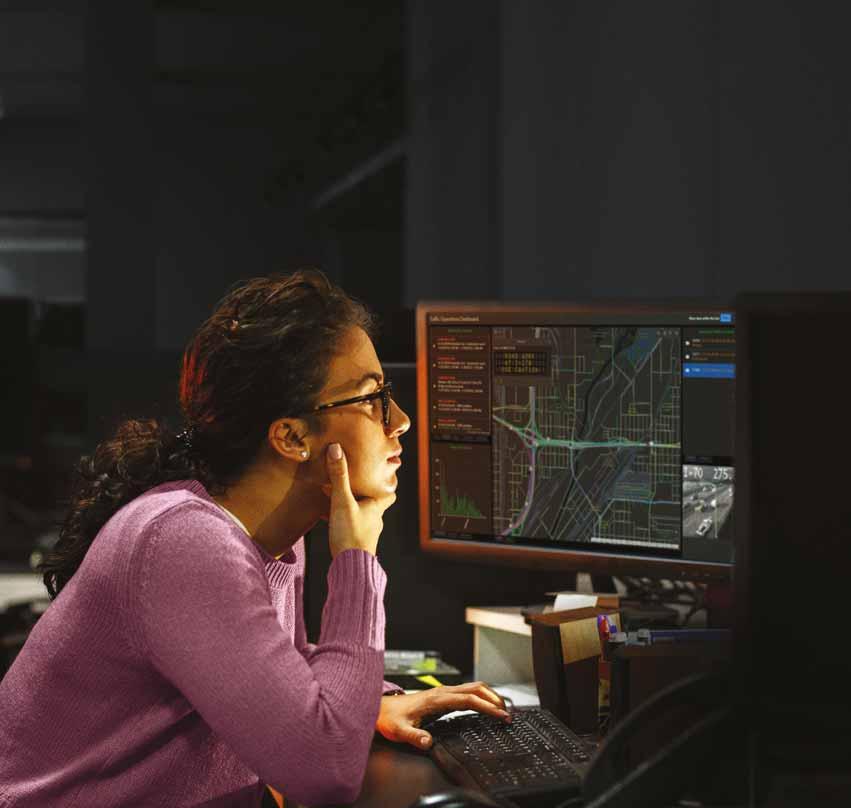
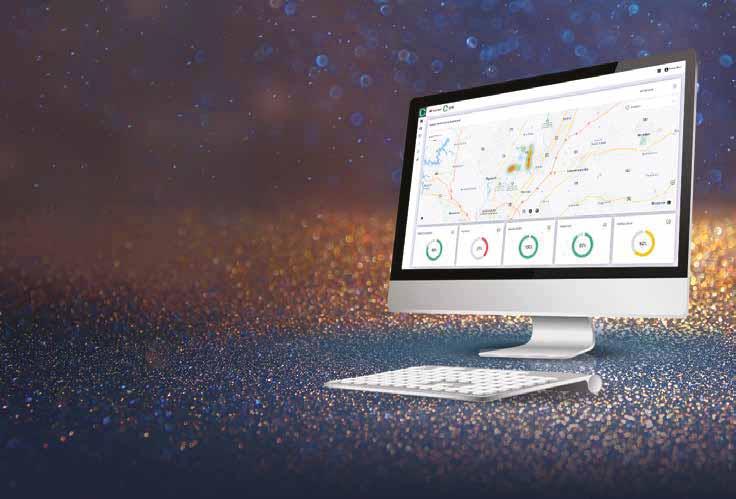
Getting the optimal performance from your network is the role of operations. With Esri’s location intelligence, bring together real-time information from disparate sources to help you keep your system operating at peak performance.
Learn how you can take operational control and tackle your mobility challenges by using Esri® technology. go.esri.com/gain-greater-control



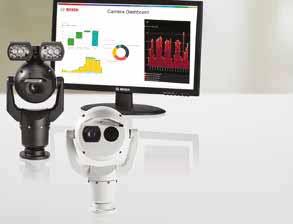
Bosch empowers you to build a safer transportation ecosystem with analytics-driven video solutions.
Bosch intelligent IP cameras enable video as a sensor technology that delivers automatic incident detection highway and urban infrastructure planning.

MCCAIN MILESTONE: 2,000+ ATC CABINET DEPLOYMENTS
Deployments in the progressive city of Austin, Texas will mark this significant milestone of more than 2,000 McCain ATC Cabinet installations in North America.
Austin recently awarded McCain a five-year, $2.6 million city-wide ATC Cabinet contract as Austin is prepared for a future with smart city and CAV capabilities.
“ATC Cabinet technology has become the cornerstone of intelligent transportation in the United States for the foreseeable future,” said Nathan Welch, VP of sales and marketing for McCain.
“With most urban areas looking at smart city technologies to solve their congestion problems, it will be imperative for them to adopt the ATC Cabinet architecture to address these problems.”
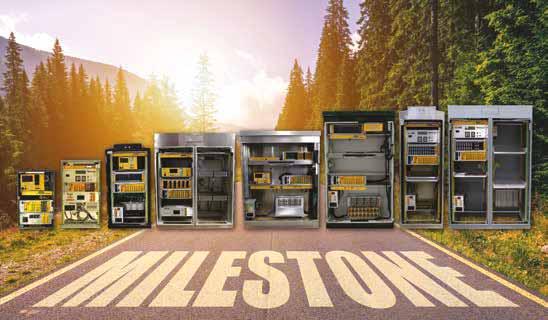
With an extensive variety of footprints in McCain’s ATC Cabinet series, these cabinets can be leveraged for almost any traffic scenario – from central business districts that require functionality with a limited
footprint, to running multiple intersections from a single cabinet.
“This ATC Cabinet benchmark is a huge accomplishment not only for McCain, but the entire transportation industry,”
said Greg McKhann, COO for McCain. “It means the industry is advancing and using our innovations to ultimately make smarter, safer, more efficient and environmentally friendly cities.” www.mccain-inc.com
Railroad quiet zone and high-speed rail crossing protection from Island Radar
Driver protection at railroad crossings is not foolproof. Drivers do ignore obvious warnings at crossings,
endangering their safety as well as the safety of other motorists and rail operators. Railroad and traffic managers continue to add
supplemental safety measures to crossings to improve safety as rail traffic becomes more complex with quiet zones and high-speed rail corridors.
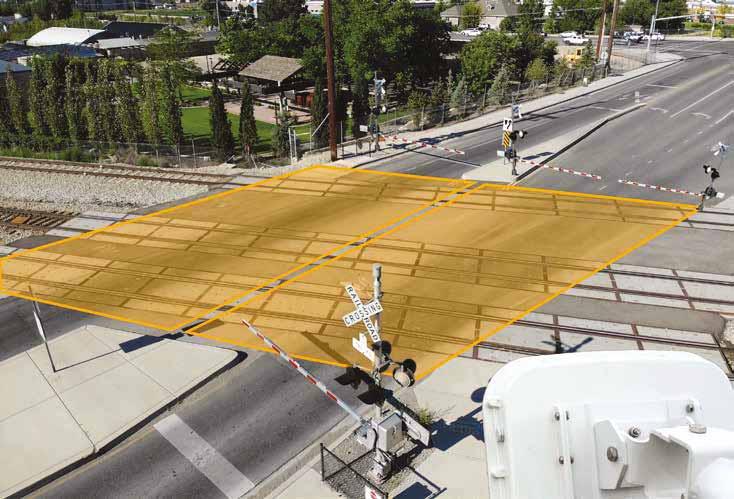
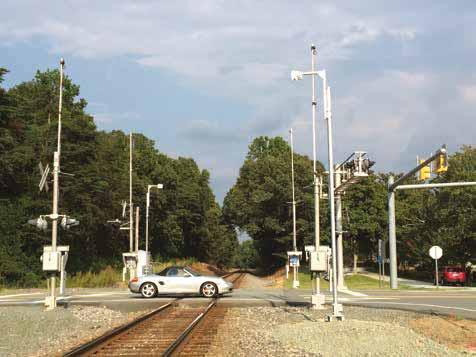
One of these supplemental safety measures is the implementation of a fourquadrant gate crossing. This prevents access to the crossing from both sides of the track, in all lanes. When four quadrant gates are used, the entrance gates descend upon activation of the crossing by a train, thus preventing any further travel into the crossing island. Subsequently, the exit gates are driven down only when a vehicle detection system can confirm that no vehicles remain on the crossing island where they could be trapped when all four gates
Today, Island Radar offers an FRA-approved vehicle detection system with redundant broad-
zone protection specifically for four-quadrant gate locations. Installed non-intrusively in the track wayside, the Island Radar system provides a level of detection and crossing safety that is not feasible with other forms of detection. When configured with the gate controllers, the Island Radar system confirms safe clearance of the crossing island, allowing the exit gates to remain in a safe down position without trapping a vehicle on the island.
Island Radar is the detection of choice for Florida’s high-speed rail corridor, and the company’s systems have been installed on numerous crossing safety projects in North America with class I and transit railroads. The Island Radar vehicle detection system is proving to be the smarter, safer, more reliable choice for vehicle detection.
www.islandradar.com
Intercomp places WIM sensors in Ukraine
Intercomp, manufacturer of portable vehicle weighing and measurement products, has announced the selection of its Weigh In Motion (WIM) Strip Sensors for commercial vehicle enforcement in the Ukraine.
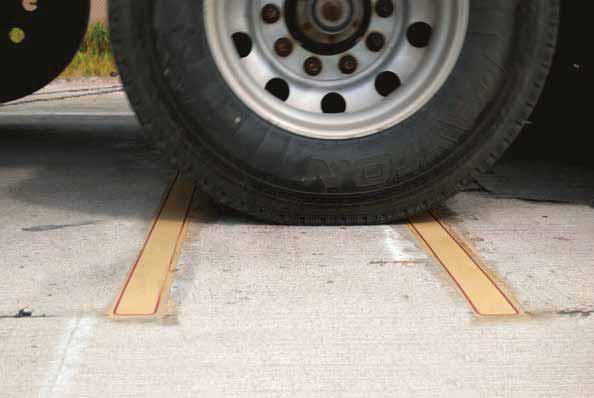
Based on proven strain gauge technology, which is widely recognised as the most accurate means to weigh a vehicle, the WIM sensors were selected because of the technology’s inherent accuracy, temperature stability, and ease of calibration and operation over time. Already employed in hundreds of WIM sites in the region, the sensors also have international OIML R134 certification as validation of their performance. The virtual WIM systems’ roadside equipment and WIM
software will be provided by Saskatoon, Canada-based International Road Dynamics, (IRD), a company experienced with providing integrated WIM solutions throughout the world. “Intercomp is excited to add this project to our existing partnership with IRD, building on our extensive experience with strain gauge scales and sensors which provide the integrator the best possible value for WIM data,” states Jon Arnold, market specialist at Intercomp.
The sensors operate in pairs installed in the roadway surface, enabling rapid installation, calibration, and low-maintenance operation over time. Intercomp is a USbased company with offices throughout the world and has been manufacturing weight and measurement devices for over 40 years.
www.intercompcompany.com
ACTIVATING REMOTE CAPABILITIES FOR TRANSPORTATION MANAGEMENT CENTRES
Hundreds of transportation management centres (TMCs) around North America took on a new challenge this year –how to maintain the essential services they provide, while keeping staff safe during the ongoing Covid-19 pandemic. Many TMCs feature operators and other staff working in close proximity, sometimes even sharing desks, equipment, and other facilities, around the clock. Many of these centres, and

their supporting systems, were not designed for remote operations. Even those who were able to go remote faced challenges with limited functionality or performance. Parsons’ expertise in Virtual TMC operations, including experience in leading the development of the Virtual TMC Guidebooks, helped many of its customers transition to remote operations without losing important functionality or
performance. A virtual TMC might include a physical facility with the capability to go remote, or a completely virtual operation with no physical centre at all. Either way, virtual TMCs must maintain critical functions including monitoring, collecting, processing, and fusing transportation system data; disseminating transformation information to outside entities; implementing control

strategies that affect changes in the transportation system; and coordinate responses to traffic situations and incidents.
As Parsons points out, while Covid-19 will not be with us forever, these virtual capabilities can help departments of transportation reduce costs, increase innovation, and improve operational agility. Additionally, virtual TMCs prepare DOTs for future catastrophic events, whether another pandemic, hurricane, or wildfire.
Parsons says it can help manage both shortand long-term virtual TMC needs, including assessments, security design, communications architecture, training plans, implementation plans, and more.
www.parsons.com/ products/inet/





























Intelligent video solutions f or more e ffi cient tra ffi c management
A fully optimized traffic management system includes high quality and reliable video surveillance. Combining PTZ, thermal and license plate capture cameras with advanced video analytics gives you actionable, real-time insight that you can use to improve road safety and keep traffic flowing
Learn more at www.axis.com/traffic


WORLD’S FIRST AND ONLY
OIML R134-certified low and high speed weigh-in-motion systems for enforcement and tolling applications

OIML R134 CERTIFIED
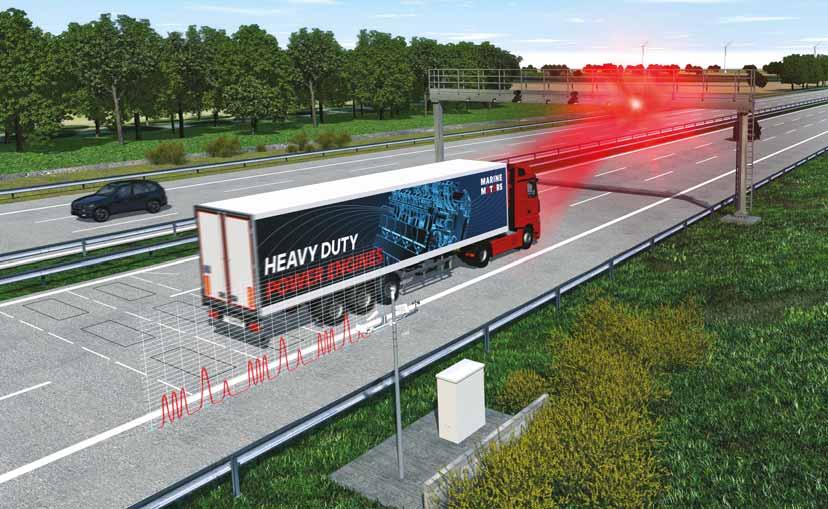
From 5 km / h to 120 km / h for HGVs (Heavy Goods Vehicles) and from 5 km / h to 140 km / h for LGVs (Light Goods Vehicles)
With only 3 rows of OIML-certified Lineas® sensors
Temperature range - 30 °C to + 75 °C with up to 85 % RH
Rugged design for harsh (hot and cold) environments
Certified by:
Swiss Confederation
Federal Institute of Metrology METAS
RTMS HELPS IMPROVE TRAFFIC FLOW IN MEXICO CITY
As congestion and transportation issues continue to impact cities around the world, metropolitan areas are looking for solutions to help solve these issues.
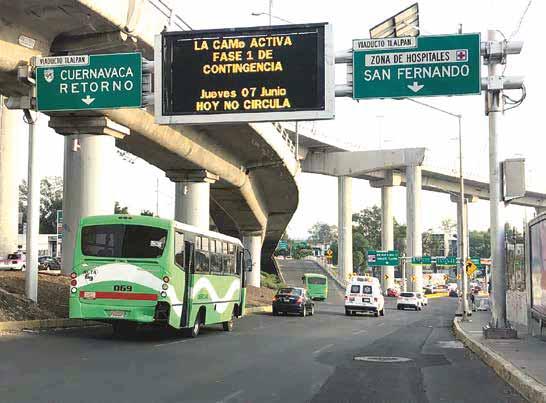
Mexico City is one of those cities wanting to solve its congestion problem by integrating a number of ITS technologies to help manage the city’s Infovial road information system.
Image Sensing Systems’ partner, Semex, has worked closely with Mexico City’s roadway agencies to deploy 287 RTMS Sx-300 radars in the city. These devices are used to gather volume, classification, speed and occupancy data throughout the roadway network. The traffic data collected is used to make decisions in real time about roadway operations. Identifying congestion or roadway problems in real-time allows the agency to alert drivers of the situation and provide alternative options
to help prevent travel delays and keep traffic moving.
Mexico City’s Infovial road information system covers 350 km (217.5 miles) or approximately 72 per cent of
the primary road network. The operation centre monitors and manages 341 sensors and a network of LED variable message signs. The Infovial system collects data 24 hours a day, seven days a week and is shared with different agencies for analysis providing support for improving the traffic flow throughout Mexico City. www.imagesensing.com
AI-controlled junctions rolled out in the UK
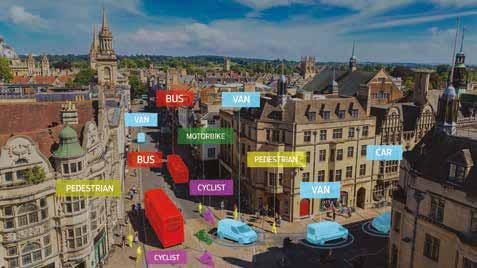
Vivacity Labs has deployed AIcontrolled ‘smart’ traffic junctions in Manchester, UK, to enable the increase of active travel modes such as cycling and walking during the pandemic.
As more cyclists and pedestrians use junctions
originally designed to prioritise cars and other vehicles, there is a need to look carefully at exactly who is using the roads and crossings and how they might most safely be able to move around.
“Since the pandemic,
commuter trends and traffic hotspots have changed completely, and cities need AI to help protect people no matter what mode of transport they take,” said Mark Nicholson, CEO of Vivacity Labs.
The programme - which won the Innovative Use of Technology award at the 2020 ITS (UK) Awards - uses sensors with inbuilt AI, enabling Transport for Greater Manchester (TfGM) to anonymously identify different types of road users at selected junctions and control traffic signals.
This means the authority can allow different modes of transportation - including cyclists and pedestrians - to be prioritised as and when required.
The AI signal control system, which Vivacity says is the first of its kind, went live early this year and now simultaneously controls
three neighbouring junctions in the Blackfriars area of Salford.
This is part of a threeyear Innovate UK co-funded programme to use AI to optimise traffic networks, and the UK government's 5G Create fund has been tapped for further cash to allow the project to scale up to 20 junctions in Manchester by the end of 2021.
Richard Dolphin, TfGM highways network performance manager, says: “We’ve been really impressed with how Vivacity has approached this, assessing current ways of working and addressing the complexities of managing a multimodal transport network. Hopefully, this development will continue into something that will positively disrupt the industry and revolutionise active travel in urban areas.” www.vivacitylabs.com