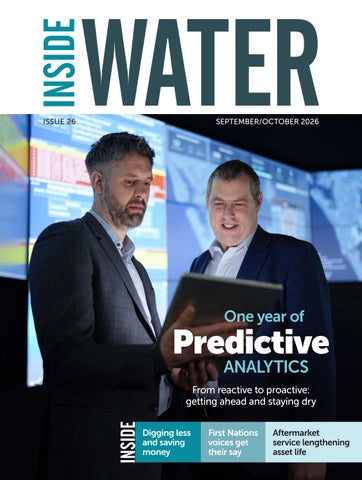
ISSUE 26
SEPTEMBER/OCTOBER 2026
One year of
Predictive ANALYTICS
From reactive to proactive: getting ahead and staying dry Digging less and saving money
First Nations voices get their say
Aftermarket service lengthening asset life
We’re Creating the Future of Water for climate, communities and our kids
CONTENTS Issue 26: September/October 2026
22 REGULAR
FOCUS
4
Editor’s Note
TRENCHLESS TECHNOLOGY
AFTERMARKET
58
The Last Word
10
33
Interflow Ideas to action
COVER STORY
6
13
StormHarvester and WaterCare
16 18
Greater Western Water
20
The Philippines
24
VicWater Excellence begins with curiosity
WIOA
26
42
Underground Experts
EVENTS
44 Australian Water Association Listening before delivery
VEGA
46 48
Iota
International No-Dig Auckland A moment beneath Auckland
Taggle
49
Utility Awards Bringing water work into view
50
Responsible governance begins with transparency
39
Atlas Copco Paths into industry
From pressure data to operational insight
qldwater
Kennards Hire Building certainty into water management
People behind the data
29
Face-to-face buffet
57
WATER MANAGEMENT
Support behind stronger supply
ASSOCIATIONS
54
Mullane
DIGITAL WATER
Water across an archipelago
Xylem Societal pressure driving sustainable pressure
Proven technology, fresh thinking
INTERNATIONAL INSIGHT
52
36
Minitap
Four culverts, one road, no excavation
Earning customer confidence
39
SUSTAINABILITY
Small cut, big connection
UTILITY INSIGHT
22
OptionX Under the surface
The power of data and signals
KSB Service before failure
No-Dig Down Under No-Dig’s Sydney homecoming
44
52 www.insidewater.com.au INSIDE WATER
3
EDITOR’S Note
Reading the signals Chairman
THE WATER SECTOR is rarely short of data. The harder task is deciding which signals matter and when they demand action. That question runs through this edition of Inside Water. Across wastewater monitoring, Victorian innovation, customer relationships and water security in the Philippines, the common thread is not technology alone. It is the ability to observe carefully and turn what we learn into practical decisions. Our cover story takes that idea underground. Watercare has installed about 4,600 level sensors across Auckland’s wastewater network. Together with StormHarvester’s analytics, they have supported about 75 blockage responses. In Papatoetoe, an unusual level rise triggered an alert. Operators assessed it, crews arrived within an hour and two wastewater discharges were prevented. That chain works because reliable data meets operational knowledge. Machine learning can identify unusual behaviour, but people must decide whether it matters and how to respond. Curiosity drives the same shift elsewhere in this edition. At the 2026 Intelligent Water Networks Member Conference, members shared 54 projects spanning artificial intelligence, pressure-transient detection, sewer heat recovery and PFAS treatment. The strongest message was not about having the newest technology. Innovation depends on people who define the problem, test an idea and share the result. Customers also send signals, although they may not arrive through a dashboard. Greater Western Water Managing Director Cameron FitzGerald reflects on the relationships he encountered with regional water users. Those customers understood the value of
4
water services and expressed clear expectations about their delivery. Greater Western Water must now apply that lesson as it rebuilds confidence following problems with its billing system implementation. Fixing the system is essential, but trust will return through humility, clearer service and practical support. Innovation can improve operations, but customers judge the result through their own experience. Our international insight carries this theme across more than 7,600 Philippine islands. Abundant rainfall does not guarantee water security when geography, storage, affordability and public trust vary between communities. Ramon Alikpala’s experience shows why no single model can answer every local challenge. It also reminds us that Australia and the Philippines can learn from each other. progress begins with attention. A sensor cannot set community priorities. A model cannot create trust. People must interpret the evidence, challenge assumptions and adapt the response. Seeing sooner creates time to act. Listening carefully helps direct that action. Trust depends on what happens next. As FitzGerald said, “We need to understand that all the decisions that we make have an impact on real people.” Enjoy!
John Murphy john.murphy@primecreative.com.au
Chief Executive Officer Christine Clancy christine.clancy@primecreative.com.au
Publisher Sarah Baker sarah.baker@primecreative.com.au
Managing Editor Geoff Crockett geoff.crockett@primecreative.com.au
Editor Chris Edwards chris.edwards@primecreative.com.au
Art Director/Design Daz Woolley
Head of Design Clayton Hawley clayton.hawley@primecreative.com.au
Brand Manager Rosie Davis rosie.davis@primecreative.com.au p: +61 423 368 501
Client Success Manager Ben Sammartino ben.sammartino@primecreative.com.au
Head Office Prime Creative Pty Ltd 379 Docklands Drive, Docklands, Victoria 3008 p: +61 3 9690 8766 enquiries@primecreative.com.au www.insidewater.com.au
Subscriptions +61 3 9690 8766 subscriptions@primecreative.com.au Inside Water is available by subscription from the publisher. The rights of refusal are reserved by the publisher.
Cover image StormHarvester
Articles All articles submitted for publication become the property of the publisher. The Editor reserves the right to adjust any article to conform with the magazine format.
Copyright
Chris Edwards, Inside Water Editor
INSIDE WATER September/October 2026
Inside Water is owned by Prime Creative Media and published by John Murphy. All material in Inside Water is copyright and no part may be reproduced or copied in any form or by any means (graphic, electronic or mechanical including information and retrieval systems) without written permission of the publisher. The Editor welcomes contributions but reserves the right to accept or reject any material. While every effort has been made to ensure the accuracy of information, Prime Creative Media will not accept responsibility for errors or omissions or for any consequences arising from reliance on information published. The opinions expressed in Inside Water are not necessarily the opinions of, or endorsed by the publisher unless otherwise stated.
COVER STORY Watercare and StormHarvester
The power of data and signals Watercare is using real-time signals to identify emerging issues earlier, target investment more effectively and reduce the risk of wastewater overflows before they affect customers or the environment. BETTER CUSTOMER OUTCOMES start with better information. Working with StormHarvester, New Zealand’s Watercare is building a smarter, more proactive wastewater network that detects problems before they become incidents, helping teams prioritise resources, improve service reliability and make more informed decisions about long-term network resilience. In Papatoetoe, StormHarvester enabled Watercare to identify and respond to a developing blockage before wastewater spilled from an emergency overflow point. Crews were on site within an hour, clearing the line and preventing the spill, demonstrating how datadriven operations can prevent environmental harm while delivering
6
a better customer experience. The intervention captures proactive network management in practice. A sensor noticed an abnormal rise in levels, analytics separated it from ordinary wet-weather behaviour, and operators acted before customers or the environment felt the consequences. That sequence matters. Auckland’s’ city’s wastewater network runs through coastal communities, volcanic terrain and catchments influenced by intense rainfall, groundwater and tides. Auckland Council manages stormwater, while Watercare manages wastewater. However, rainwater, groundwater and tidal ingress still enter parts of the wastewater system through
INSIDE WATER September/October 2026
Watercare and StormHarvester teams examine monitoring coverage across Auckland, where thousands of sensors are providing greater visibility of wastewater network behaviour. Images: Watercare, StormHarvester
combined areas, misconnections, damaged pipes and other pathways. Those flows consume capacity, increase overflow risk and can obscure developing faults. The challenge is identifying what the network is doing, why it is doing it and where crews should respond. The warning arrives Watercare planned to install 5,000 level sensors across its roughly 8,000-kilometre wastewater network in the twelve months since Inside Water spoke to them last year. At the time of our interviews this year, about 4,600 were in the ground. Nearly 4,000 had been onboarded into StormHarvester, and machine learning had been activated at more than 1,100 sites. The rollout stretches from Wellsford in the north across the urban area and towards Auckland’s southern communities. Watercare prioritised known areas where spills were most likely to occur, then worked suburb by suburb to improve
“ The insights we’re gaining enable us to
focus our teams where they can deliver the greatest impact, achieve faster results and prevent wastewater overflows before they affect our communities
”
installation efficiency. Watercare Smart Networks Manager, David Moore, said the programme had already detected around 75 blockage responses. Most involved slow-building restrictions rather than dramatic failures. The sensor trace rose away from its normal pattern, crews investigated, and the level returned to normal after they cleared the line. “We will get more proactive rather than reactive because we will get to the issue earlier, before the customer phones in,” Moore said. “That is really the key.” StormHarvester also identified a collapsed sewer in Onehunga. This showed why broad coverage is so important: a sensor can reveal abnormal behaviour before operators know whether fat, debris, roots or structural failure sits downstream. StormHarvester Australia and New Zealand Director, Gus Thiele, described the shift as key to a better customer experience. Before broad monitoring, a utility often first learned about a local failure through a flooded property, a visible overflow or a customer reporting it. “It is literally turning the lights on,” Thiele said. “You go from having very little information about what is happening day to day to having sensors across almost the whole network.” Watercare is also extending monitoring to emergency overflow points. The network has about 1,000 of these locations. Roughly half already had supervisory control and data acquisition monitoring, while the programme is targeting the previously unmonitored sites. Access constraints, confined-space requirements and complex centralcity locations make that work slower than standard manhole installations. That visibility may initially increase
reported overflow numbers without indicating worse performance. Watercare can replace estimates with observed events and investigate why some sites spill more often than models suggested. Signals into action A large sensor fleet can create its own operational burden. Thousands of devices produce level readings every day, and many rise during rainfall without indicating a fault. Sending crews to every high level reading is unnecessary and inefficient. StormHarvester uses machine learning to establish a baseline for normal behaviour at each monitored location. The platform then identifies deviations that resemble blockages or other anomalies. Thiele said alert accuracy for the Watercare deployment was about 90.7 per cent at the time of the interview. “Accuracy is everything in this
Watercare operations personnel discuss network conditions with the project team inside the utility’s control room in Auckland.
application,” he said. “The worst case, especially with a high volume of sensors, is calling something a problem when it is normal behaviour. A crew will not be pleased if they arrive and find nothing to act on.” An alert must do more than flag a rising line. StormHarvester grades alerts by severity and aligns them with Watercare’s areas and priorities. Site history, previous spills and nearby sensitive environments also inform triage. That design fits existing work practices. It introduces better evidence where teams already decide what to do next. “The concept is condition-based rather than calendar-based,” Thiele said. “It does not necessarily reduce the total amount of work. It changes what people are doing by moving jobs from a reactive bucket into a proactive bucket.” That cultural transition to how Watercare teams respond is as
www.insidewater.com.au INSIDE WATER
7
COVER STORY Watercare and StormHarvester
important as the analytics in order to maximise the value from the system. “Now people can ask what the sensors were doing before an overflow and whether they can see the problem,” Moore said. “Previously, the response might have been to send a sucker truck and CCTV camera. We are getting a more inquisitive mindset and using the data to solve the problem, so it does not repeat.” Field feedback builds confidence. When levels fall after an intervention, Watercare gains evidence that the restriction was real, and the response worked. Understanding where and why blockages occur allows Watercare to work alongside communities to address the root causes of wastewater issues. The data also provides transparency around maintenance activities, helping residents and local stakeholders understand the risks being addressed and the benefits of preventative work. Following unwanted water Blockage detection delivers immediate operational value, but the next phase reaches further
into wet-weather planning. Watercare wants to distinguish dry-weather wastewater from rapid inflow and slower infiltration across the network. Inflow often enters quickly during rain. It can come through direct stormwater connections, defective manhole covers or other pathways. Infiltration tends to move through cracks and joints as groundwater rises. Tidal influence adds another pattern in coastal areas. Each source calls for a different investigation and response. Watercare has traditionally examined whole catchments when searching for unwanted water. With broad sensor coverage and enough seasonal history, it expects to narrow some investigations to several streets. High inflow scores could direct smoke testing towards likely misconnections. Persistent infiltration could focus CCTV inspections and pipe rehabilitation on smaller areas. “Where we have the highest inflow, we can send smoke-testing crews to those locations,” Moore said. “Before, we might have done the whole catchment. Now we may get
Live sensor information is helping Watercare investigate developing wastewater problems before customers report an overflow or network failure.
8
INSIDE WATER September/October 2026
down to two or three streets, so we can spend our money and time much better.” That precision can improve operating expenditure, capital planning and hydraulic models by comparing assumed wet-weather behaviour with measured flows. Thiele said machine learning becomes especially valuable when analysts examine long periods of data across thousands of sites. Human reviewers can spot obvious peaks, but they struggle to classify subtle relationships between rain, tides, groundwater and pump operation at network scale. “The exciting part is being able to say, show me the top locations for tidal ingress by catchment or by site,” he said. “You can do the same for inflow. That feeds directly into the programme and should change how teams spend their time and money.” This phase also clarifies the relationship between stormwater and wastewater management. Auckland Council operates Auckland’s stormwater network, not Watercare, but the two work closely together. The monitoring programme can reveal where wet-weather conditions affect wastewater performance and provide stronger evidence for coordinated investigations. Proactive management does not mean treating every rainfall response as a wastewater defect. It means identifying the pathways that place avoidable pressure on the wastewater system, then directing the appropriate team towards the cause. Longer data histories will make those judgements more reliable. Moore cautioned that the fleet had ramped up throughout the year, so Watercare had not yet observed every site through complete seasonal cycles.
The next 6 to 12 months will provide a stronger baseline for measuring changes in overflow frequency, response times and targeted rehabilitation. Scale needs structure Watercare moved quickly because it treated smart wastewater monitoring as an operational programme rather than a collection of devices. That required attention to installation quality, data assurance, system architecture, procurement and internal ownership. No two manholes present identical conditions. Private property, communications and access can complicate installation. Poor records or unreliable data can undermine analytics before machine learning begins. StormHarvester brought experience from large British deployments into the Auckland programme. Thiele said that allowed the parties to import established practices for sensor placement, data quality and alert management rather than repeat early mistakes. Watercare also used a data-as-aservice contract structure. Hardware and installation are supplied by Kallipr, and responsibilities remained connected, while payment partly followed confirmation that devices worked. This reduced scope for disputes over equipment, installation or missing data. “The utility is protected from a truckload of equipment arriving and becoming its responsibility the moment it is dropped off,” Thiele said. The wider StormHarvester user community has provided another form of risk reduction. Moore attended a user forum in the United Kingdom where utilities with mature deployments shared lessons on sensor density, benefit tracking
and operational engagement. “It is useful to validate the direction and make sure we are not going off on a tangent,” Moore said. “Some of those utilities are two or three years ahead of us. We can learn from their successes and their failures, then choose a different path where necessary.” Auckland’s coastal conditions, terrain and drainage mix also give the wider user community new evidence about how monitoring performs in different environments. Future capability and data will continue to improve results The programme’s future value will come from connecting more data sources and embedding the resulting insights into routine decisions. Watercare and StormHarvester are preparing broader inflow and infiltration analysis, while future capabilities include pump performance alerts, spill prediction and rising-main burst detection. Pump monitoring could identify degradation before failure. Risingmain analytics could detect partial ruptures or performance changes before a major burst. Both applications follow the same principle as blockage detection: establish normal behaviour, recognise meaningful deviation and give teams time to act. Reactive work will remain. Networks will fail, storms will exceed capacity, and crews will face urgent incidents. Proactive management changes the balance by creating more chances to intervene while work remains planned and contained. For Auckland communities, that balance affects beaches, waterways, public health and confidence in essential services.
Network data is reviewed against operational conditions to help teams prioritise emerging blockages, wet-weather risks and field responses.
For Watercare, it supports better use of maintenance budgets and stronger evidence for renewals. For operators, it replaces some uncertain callouts with prioritised work based on network behaviour. The Papatoetoe intervention demonstrates the immediate value of data-driven decision-making. Moore says the greater opportunity lies in building a smarter, more resilient network that continuously learns from real-time signals, providing deeper insights into where wet-weather pressures enter the system, how assets respond, and which actions will deliver the greatest reduction in risk. “The growing wealth of network data is helping Watercare take a more targeted and strategic approach to inflow and infiltration management, maintenance and rehabilitation programmes. “We are really excited about the difference we can make through our inflow and infiltration work and rehabilitation programmes,” Moore said. “The insights we’re gaining enable us to focus our teams where they can deliver the greatest impact, achieve faster results and prevent wastewater overflows before they affect our communities. “The real opportunity is using data to move beyond responding to symptoms and address the underlying causes of network issues. Over time, these insights will help us make smarter investment decisions, improve network performance and reliability, and deliver a better experience for our customers.” For more information, visit watercare.co.nz and stormharvester.com
www.insidewater.com.au INSIDE WATER
9
FOCUS Trenchless Technology
Ideas to action A structured approach to innovation at Interflow, one that involves everybody in the business, is being designed to harness powerful ideas and turn them into reality. INNOVATION HAS ALWAYS been a part of the Interflow way of doing business. It is critical to delivering its purpose of ‘improving the lives of the people we work with, the communities we serve and the environment we work in, for generations to come’. Many advances in trenchless technologies have come from people within the company – from crews, engineers and support teams. Now, as the pace of change accelerates, the time has come to develop a more structured way of capturing, assessing and scaling ideas. The new innovation program will bring visibility and momentum to ideas from across Interflow. The goal is to ensure that great thinking doesn’t get lost, that ideas can travel and grow, and that people responsible for those ideas receive the feedback and recognition they deserve. Joseph Curkovic, Innovation Manager at Interflow, said the
The new innovation program aims to change that, with a structured funnel through which ideas can flow freely and transparently. “There will be steps and stage gates in that funnel,” Curkovic said. “Through the assessment of those ideas, the highest priorities will be identified.” Importantly, those priorities will not be determined by financial return alone, he said. Each will be assessed across multiple factors, including environmental impact, safety, quality and cost. This means the business can respond to changing priorities throughout the years – whether they relate to improving the environment, improving the lives of its people or enabling more efficient ways of working – while still maintaining a consistent evaluation process.
program signals a shift from informal innovation to a more disciplined, organisation-wide approach. “In truth, the innovation team can’t innovate in isolation,” Curkovic said. “As a team, we support our people to deliver innovation. We create the tools, manage the framework and bring the business along the journey to support the initiatives.” So, how does that work? Creating a clear pathway for ideas Historically within Interflow, ideas have been actioned at team level. As teams have sought to solve problems locally, they have developed new processes and sometimes products that potentially were not visible beyond their immediate environment. That has led to good outcomes, Curkovic said. And some of those ideas have eventually spread across the organisation. At the same time, the process has often been slow and disjointed, and some ideas have not been captured or developed.
Interflow’s innovation program will give ideas from across the business a clearer pathway to assessment, support and implementation. Images: Interflow
10
INSIDE WATER September/October 2026
Innovation involves everybody It’s no secret that innovation can only succeed if a diverse range of people from across a business are deeply engaged in the process. That’s why the Interflow innovation program is being designed to involve everybody. Rather than focusing only on large, disruptive, ideas that require massive budgets and deep engagement from senior leaders, the program recognises that most innovation happens in small, practical improvements that affect everyday work. “There is bottom-up, continuous improvement and there is top-down innovation,” Curkovic said. “Both are of great value, meaning everybody should be involved.” Crews and local teams will be empowered to identify and implement improvements that make their work safer, faster or more efficient. These ideas will be assessed and approved locally, allowing them to
gain traction quickly without getting lost in a centralised system. Then, they will be promoted throughout the system so other teams can learn from them, copy them and customise and improve upon them. “What we want to do is keep those local initiatives local,” Curkovic said. “Incremental initiatives should be assessed, prioritised, funded and executed near the source.” At the same time, the program also offers a pathway for larger, more complex ideas to be escalated and developed at a national or strategic level. At the very top of the funnel, there is also room for a focus on longerterm, transformational innovation. “That’s where we’re scanning globally, looking for disruptive technologies, partners, research, new markets, etc.,” Curkovic said. The result is a layered approach that supports everything from a simple idea on a site to multi-million dollar, business-wide, initiatives. Momentum, recognition and long-term impact By cutting across silos and bringing people together from different disciplines, the program offers strength through diversity. Ideas are tested, refined, and strengthened in an environment of support, with input and expertise from numerous levels. “You’ll be able to see who’s driving the idea forward,” Curkovic said. “And the people that are following it can and say, ‘That’s a great idea. Let’s copy that.’” Beyond processes and platforms, the Interflow innovation program is primarily about culture and about reinforcing a more professional, data- and merit-driven approach to improvement. “What we want to do is give people
the tools to become professional innovators,” Curkovic said. “The KPIs in the business case tool will get them thinking at their local level about how they can save time, resources, distance, energy, waste, and deliver on our purpose.” By promoting the link between the original ideas and the eventual, measurable outcomes, the program will help individuals and teams understand the broader impact of their work. At the same time, it also supports Interflow’s long-term strategy. “We’ve been around for 90 years,” Curkovic said. “The whole point of this is to be relevant for another 90 years.” What happens next? The Interflow innovation program is in development now, with a target rollout next financial year. A key component will be a central input system where ideas can be submitted, tracked and progressed. The team is also exploring ways
Local teams will be empowered to identify and implement practical improvements close to where they originate.
Larger and more complex ideas can move through Interflow’s structured pathway for national or strategic development.
to make that process simple and accessible for the future, including the use of voice input and AI to help submissions. In the meantime, Curkovic said the best next step is for people to start paying attention to their own ideas. “What we really want is to build that culture of innovation where people think deeply about their daily activities,” he said. “How can I save time? How can I reduce effort? How can I improve safety? How can I improve the environment?” For those working across Interflow, that might mean taking note of small inefficiencies, opportunities for improvement or ideas for doing things differently and capturing them somewhere simple. When the formal system goes live, those ideas will have a place to go and a pathway to becoming something much bigger.
For more information, visit interflow.com.au
www.insidewater.com.au INSIDE WATER
11
Folded, pulled into the host main and expanded in place — restoring a leak-tight, drinking-water approved barrier YOUR PRESSURE MAIN
through compact insertion pits, not open trench.
REHABILITATION SOLUTION
PRESSURE MAINS RENEWED. Liner within the existing host main — no structural connection.
4,000 m max single installation length
AS/NZS 4020:2018 approved for contact with drinking water WHY TRENCHLESS
DN50 – DN1600 Diameter range
Burst to 12,000 kPa
Operating to 4,000 kPa — 3:1 safety margin
50 years Design life
45° and 90° bends
Follows the existing alignment
— Lower environmental impact — Fast installation — Minimal surface restoration — Minimal disruption to traffic — Lower renewal cost — Shorter isolation periods
WATER NETWORKS
PRESSURE SEWER NETWORKS
trunk and distribution mains
rising mains and pressure sewers
WATER AUTHORITIES · COUNCILS · MINING · INDUSTRIAL Installed worldwide by specialist trenchless pipeline contractors.
Approved installers across Australia Contact ATS to discuss your project, to be referred to an approved installer, or to apply to become one.
info@atsupplies.com.au
FOCUS Trenchless Technology
Under the surface A South Australian water industry project has shown how microtunnelling can reduce service exposure, community disruption and excavation risk when planning, technology and field delivery are considered together. WATER UTILITIES and contractors are installing deeper pipeline assets through corridors that carry roads, homes, businesses, and buried services. Open-cut construction may remain feasible, but its cost is not limited to the initial pipe installation works. It can include service protection, traffic control, shoring, spoil movement, reinstatement, worker exposure and community disruption. A recent microtunnelling project tested that comparison in the field, combining delivery planning from Fulton Hogan with specialist trenchless capability from Edge Underground. Edge Underground used AdaptX technology, developed through parent company, OptionX Group. The system uses Advanced Vacuum Microtunnelling to install pipelines with efficiency not previously seen in the trenchless space. Jithu John, Senior Project Manager
at Fulton Hogan, said that services, sewer depth, corridor congestion, surface disruption, community impact, and utility risk shaped the method selection. Crowded corridors The project corridor included water, wastewater, sewer, electricity, gas and communications assets. John said around 65 per cent of the service crossings were in microtunnelled sections. “That would be around 170 odd services, which is how many services I did not hit going through microtunnelling,” John said. Those avoided interfaces gave the delivery team more than a productivity gain. Each exposed service needs to be located, checked, supported and protected. Each one can affect safety, program, access and continuity. Stuart Harrison, from OptionX
The surface set-up for microtunnelling is significantly smaller than the alternative. Images: OptionX Group
Group, said service risk is often understated when trenchless and open-cut methods are compared. “Every service is a risk,” Harrison said. “It may not be where the drawings say it is. It may be old, damaged or poorly identified. Someone has to expose it, work around it, support it and protect it.” Planning the work Microtunnelling did not remove planning complexity. It changed where that planning had to happen. John said the delivery team had to prepare the launch and reception shafts in the correct sequence while keeping tunnelling crews moving between work fronts. Consistent production from Edge Underground helped Fulton Hogan prepare the next shafts without opening too many work areas. “Continuous drilling allowed the works to go seamlessly,” John said. The sequence helped engineers, supervisors, traffic teams and community engagement staff plan around a predictable rhythm. “Everyone came to the party,” he said. “It was like everyone was taking ownership of the job, delivering it as one single body.”
www.insidewater.com.au INSIDE WATER
13
FOCUS Trenchless Technology
Microtunnelling can still get to the same depths as open-cut construction.
Measuring value The project also challenged how performance is measured. John said metres installed remain important, but they do not capture the full value of a construction method in a serviced corridor. “Generally, you would count productivity or success as metres in the ground in these kinds of projects, but it’s not just metres in the ground,” John said. Performance using AdaptX technology on a recent project has shown labour requirements fell by about 35 per cent, and fuel consumption decreased by around 13 litres per metre. Carbon emissions were reduced by more than 575 tonnes across construction, material production and quarrying activities. Harrison said those outcomes are tied to how much construction activity can be avoided. “With microtunnelling, we only remove the ground necessary to create the bore and install the pipe,” he said. Project teams also need to compare complete construction methods when it comes to budgeting.
14
“The problem is that we often compare the known cost of microtunnelling against an incomplete cost for open cut,” Harrison said. Accuracy at depth Advanced vacuum microtunnelling also shaped the technical case. Harrison described AdaptX as a keyhole option for pipelines because it uses a laser-guided pilot bore before reaming to the required diameter. That sequence is notable in gravity sewer work, where line and grade determine how the asset performs. “Gravity sewer is where accuracy really matters because the pipe has to be installed to precise line and grade,” Harrison said. “The real improvement is not just accuracy. It is repeatability.” Depth also changes the economics. Open-cut trenches require more excavation, wider work areas, heavier shoring, improved spoil management, and stronger safety controls as they become deeper. Microtunnelling still requires shafts, but the underground installation
INSIDE WATER September/October 2026
process stays consistent. Performance on a recent project has shown savings of around 3 per cent compared with opencut construction at four metres, increasing to approximately 30 per cent at seven metres. Earlier assessment Both delivery and technology lessons point to the need for an earlier assessment of methods. John said future projects should consider early contractor involvement, geotechnical investigations, constructability reviews, risk management and collaborative planning before the design is locked in. “The geotechnical investigations that need to be carried out upfront will define the type of technology to be used, whether it is open trench or microtunnelling,” John said. Harrison said specifications should focus on outcomes such as accuracy, safety, cost, productivity, emissions and community impact, rather than defaulting to past delivery methods. The South Australian work showed microtunnelling can be a planning tool for reducing field interfaces, limiting disruption and giving project teams more control over how a pipeline is delivered. John said the results of this project had depended on coordination across the delivery chain. “It was a massive outcome, a huge amount of planning to be done, a lot of lessons learned, and the collaboration and the partnership that we built through those phases,” John said. “That is the key to success for any job.”
For more information, visit optionxgroup.com.au
Seamlessly integrate your digital metering device management, alarm management, data validation and analytics, while choosing which functions you manage inhouse or outsource.
The choice is yours with Lentic.
Lentic is enabling digital metering at scale for:
Learn more at Lentic.com
FOCUS Trenchless Technology
Small hole, big connection As trenchless construction reshapes crowded utility corridors, Minitap is helping contractors complete large offtake hot tapping in confined excavations without losing the surface-disruption benefits that trenchless technologies were designed to deliver. TRENCHLESS TECHNOLOGIES has reduced surface disruption and helped contractors thread new assets through crowded corridors. It has also created a challenge at connection points. Many verges now carry a dense mix of water, gas, power and telecommunications. When a contractor needs to complete a large offtake tapping, the excavation may be too tight for conventional hot tapping machines. That is the problem Minitap was developed to solve. Built by contractors for contractors, the Australian-designed system offers crews a compact hot-tapping option for pressurised utility pipes. It was designed for confined excavations, where a larger opening can lead to reinstatement, traffic disruption, and delays. “This calls for a surgical approach to services delivery,” Minitap Managing Director Ben Worst said. Trenchless connection points Hot tapping allows a new connection to be made to a live, pressurised pipeline without interrupting service. It can reduce shutdowns, avoid customer disruption and support more efficient delivery of new connections, valves and hydrants. In trenchless projects, the margins are slim. HDD can install pipe with
16
minimal surface impact, but the connection still needs to be made in the ground. If tapping equipment requires a large excavation, part of the trenchless benefits can be lost at the final connection point. Minitap addresses the excavation issue through size first. The machine has an overall length of 610 millimetres and can operate in a one-square-metre excavation. That smaller footprint gives crews more options in congested verges or narrow access pits. “Today, utility services contractors are operating in a very crowded onverge work area, which often does not allow access for traditional large frame equipment for large off-take tappings,” Worst said. Smaller excavation For contractors, confined space is not just a design inconvenience. It affects the programme, labour, plant, traffic control and the ability to complete repeatable work at fixed cost. A larger excavation may require extra approvals, longer reinstatement and additional exposure to adjacent services. Re-routing connecting pipework can add time and cost to the project. In some cases, crews may need to shut down because the live
INSIDE WATER September/October 2026
Hot-tapping is an effective solution for effective infrastructure work. Image: Minitap
tapping equipment cannot reach the pipe safely. Minitap’s compact form gives contractors another path. It can increase the proportion of tappings completed within the original excavation, especially where trenchless installation has left limited room around the target connection. “The contractor wins by having an efficient and repeatable process which delivers a predictable result as it lowers the frequency of unplanned overruns,” Worst said. Minitap is also easily moved. It weighs just 30 kilograms and is supported by a mobile hydraulic power pack and an eight-metre hydraulic hose assembly. That set up helps crews use the system where road access is limited, or the work area does not suit larger equipment. Built for the ground Minitap was not developed as a single machine in isolation. Its cutters, power pack, valve adaptor, and support model were designed around servicecontracting conditions. The enclosed machine body and robust components are designed to handle outdoor worksites, wet ground, and changing weather conditions. For contractors delivering fixedprice works, reliability is key because a breakdown can affect crews, customer notifications and the wider works programme. The company supports the system with training, local servicing, and parts supply from Australia,
“ The contractor wins by having an
efficient and repeatable process which delivers a predictable result as it lowers the frequency of unplanned overruns
”
helping contractors avoid long delays associated with offshore equipment support. The cutter design is another important part of the trenchless story. Conventional cutters are often adapted from flat surface cutting applications. Minitap supplies diamond – and tungsten carbide – tipped cutters designed for bowed pipe surfaces and various pipe materials, including cast iron, ductile iron, steel, reinforced concrete, asbestos, PVC, and MDPE. “Most cutters on the market are developed for concrete cutting in more of a construction
environment,” Worst said. “But in the world of service contracting, you’re dealing with differing pipe surfaces and pressures, which requires a more tailored approach for optimal results.” Australian conditions Minitap was first designed in 2016, with an early prototype tested and approved under the supervision of Water Corporation. Since then, the product has completed thousands of hot tappings across Australia. The company is Australian-owned and managed, with headquarters in Perth. Its technology has patents in Australia and the United States, with
design registrations in the United Kingdom and Europe. For the trenchless sector, its main value is practicality. It helps preserve the purpose of trenchless construction by reducing the surface impact at connection points. It gives crews a way to work around congested services without defaulting to larger excavations. “Since inception, the hot tapping equipment sector has seen little change, but the needs of the market are evolving,” Worst said.
For more information, visit minitap.net
1300 033 880 undergroundexperts.com.au
A seamless solution to your Pipeline Rehab projects. Operating Australia-wide from its Geelong head office,
A strong focus on non-destructive
Deployment of globally proven
renewal methodologies
Insituform technologies
Long-term partnerships with utilities,
Consistent delivery of quality,
Underground Experts delivers specialised trenchless solutions designed to extend the operational life of vital underground assets. We offer comprehensive assessment, rehabilitation, and renewal services across wastewater, stormwater, and water infrastructure. By prioritizing low-disruption methodologies and practical engineering, we help asset managers meet long-term performance objectives efficiently.
Contact Us Today
councils, and Tier-1 contractors
safety, and program reliability
FOCUS Trenchless Technology
Four culverts, one road, no excavation A quad-cell DN1500 flood culvert system in NSW: under a busy road, between a rural catchment creek and a tidal river, normally underwater. Mullane Trenchless Pipeline Solutions relined all four culverts instead of closing the road. STORMWATER TENDS TO be the part of the network renewed last and inspected least. They tend to be large in diameter, frequently in or under waterways, and rarely attracting the funding directed at water and sewer. When these assets reach the end of their service life, the constraints around them are usually worse than anything faced on a potable main. The asset was four parallel DN1500 reinforced concrete culverts of roughly 22 metres each. The culverts ran beneath a trafficked road in an environmentally sensitive tidal zone in New South Wales. A major creek drained the rural catchment upstream, while a tidal river lay below. The concrete had deteriorated to the point of requiring renewal. As a flood system, the structure sits partially to fully submerged in normal use. There was no seasonal window in which the culverts would be dry. Protected fauna were a serious consideration during project planning. The client managed
18
these requirements, while Fisheries approvals governed environmental controls and pumping discharge. The client and precise location remain confidential. The alternative was worse than it looks Reaching four DN1500 culverts by open cut means excavating the full width and depth of the road above them. The road closes: not for a lane-closure period, but for the duration. Both waterways still have to be sheet-piled and dewatered, so none of the temporary works disappears. They would become features of a much longer program. The step most often underestimated is what follows. Open-cut replacement would require proper bedding, haunching and compaction around four parallel culverts. Achieving that standard in a channel that refills twice daily would be difficult, even under ideal conditions. Settlement over a poorly
INSIDE WATER September/October 2026
Mullane used cofferdams and dewatering to create a controlled work zone before relining four DN1500 culverts beneath the operating roa Photo by Mullane Trenchless
compacted trench is the most common long-term failure mode of large-diameter open-cut work. The pavement then has to be fully reconstructed on top of it. The trenchless option renewed all four culverts from within in four working days. Traffic continued using the road, while the existing pipes remained as permanent formwork. “When you lay the two methods side by side, the trenchless case makes itself,” Mullane Trenchless Operations Director Luke Woodward said. “The question was never whether relining was better here. It was whether we could create the conditions to do it at all.” Creating a dry site UV curing of a CIPP liner requires a completely dry setting. Residual flow or standing water compromises the cure, so the requirement is absolute rather than a matter of degree. This creates a new challenge for an asset that is usually submerged. Mullane installed cofferdams using sheet piling above and below the structure. The objective was not to reduce flows but to stop them completely. As a result, the culverts could be dewatered and held dry for the duration of each cure. Pumping and continuous
monitoring held that state, while custom scaffolding platforms lowered into the drained channel supported liner boxes weighing around three tonnes. The works required a 35-tonne sheet-piling rig and 23-tonne excavators in a confined footprint. Mullane Trenchless drew on the wider civil capabilities of the HL Mullane Group. These extend across water mains, sewer mains, pump stations and related infrastructure. That resolved the physical constraints that determine whether a liner can be installed at all. Four days, no gaps Months of planning and two weeks of preparation supported four consecutive lining days, one culvert per day. The schedule was not efficiency for its own sake. Approvals and flood risk defined a finite window for isolation, and a culvert out of service is one unavailable to the catchment it protects. Every cured liner triggered
another round of civil works, with only hours to reset. Liner temperature control was treated as a quality assurance requirement. Resin temperature rises quickly in warm conditions and can introduce variability into the cure. Mullane therefore leased a refrigerated facility near the site to keep the SAERTEX UV-cured liners below 14 degrees Celsius. Each box was craned to the work area only as needed, keeping the material within specification until installation. Gravity and pressure Mullane is also expanding its pressure-pipeline capability. As an approved installer of ASOE pressure lining systems from DN50 to DN1600, it can renew water mains,
Sheet-pile cofferdams and a temporary work platform created the dry, controlled environment needed.
The Mullane project team with the four relined DN1500 culverts.
fire mains and sewer rising mains from compact insertion pits rather than open trenches. The timing is deliberate. Much of Australia’s pressure network was installed during the post-war decades and is approaching the end of its serviceable life. Many assets sit beneath roads, rail corridors and developed land where open-cut renewal would cause considerable disruption. Mullane mobilises nationally, working with asset owners in every state and territory, and welcomes approaches from any authority weighing renewal options on a constrained asset. For more information, visit mullanetrenchless.com.au
www.insidewater.com.au INSIDE WATER
19
FOCUS Trenchless Technology
Proven technology, fresh thinking
Underground Experts combines proven CIPP technology with detailed asset evidence and a people-first culture to help utilities renew ageing pipelines with less disruption above ground. As cities become denser, renewing a failed water or wastewater pipeline affects far more than the asset. Excavation can disrupt residents, businesses and traffic for weeks. Trenchless pipeline renewal can restore capacity while limiting work above ground. For Underground Experts Managing Director Tyler Hall, that makes trenchless rehabilitation an early consideration rather than an option reserved for difficult sites. “Our crews can line between 200 and 300 metres in a day,” Hall said. “Excavating and replacing the same length can mean weeks of disruption. It affects residents and traffic, and the work can become quite messy.” Hall has worked in pipeline renewals since joining Insituform in Canada in 2005. During that period, he has seen cured-in-place
20
pipe (CIPP) installation respond to changing environmental and operational expectations. “In the early stages, liners were installed using water, which was then heated to cure the liner,” he said. “It was slow and used a lot of water. Air inversion and steam curing can now reduce time on site by up to 50 per cent, while UV curing provides another option.” He said Insituform’s flagship products contain 75 per cent recycled material, reducing the footprint of pipeline rehabilitation while improving installation efficiency. Evidence before selection Speed alone does not determine whether CIPP or another trenchless pipeline renewal method suits an asset. Underground Experts cleans
INSIDE WATER September/October 2026
Smaller sites and more precise works benefit governments, water utilities and communities.
Tyler Hall has been in the trenchless technology space for over 20 years. Photo by Underground Experts
and inspects the pipe with closedcircuit television. WinCan then produces serviceability and structural grading reports. The company’s engineers and project managers review those findings before preparing a rehabilitation recommendation. According to Hall, the assessment must extend beyond visible defects. “Asset owners need to consider the site conditions, how the asset is used, its condition, the network
it serves, its diameter, bends and shape,” he said. “There is no onesize-fits-all product, although we believe CIPP is among the industry’s most versatile options.” Incomplete information can lead to a system that does not address the asset’s operating conditions or structural needs. At worst, another intervention becomes necessary much sooner than planned. “The aim should be to achieve at least 50 to 100 years from a newly rehabilitated asset,” Hall said. “If all the relevant factors are not considered properly, we can find ourselves needing to repair it again.” CIPP creates a jointless pipe within the host pipe, with limited diameter loss. Its smooth surface can support hydraulic performance. However, Underground Experts does not approach each pipeline with a predetermined product. Proven technology, fresh thinking Underground Experts is the exclusive Australasian provider of the full Insituform Technology product range. Insituform pioneered CIPP more than 50 years ago and now offers systems for gravity pipes, pressure applications, laterals and varying structural requirements. The relationship allows Underground Experts to combine proven technology, research and international experience with the agility, energy and fresh thinking of a new-generation business. “Insituform has been pivotal because it gives us the baseline of a world-leading product from the inventor of CIPP,” Hall said. “We can draw on more than 50 years of experience, innovation, research and development, and refined technology.” Access to a broad portfolio does not remove the need for independent assessment. Hall said the company
uses other products and materials when conditions require them. Its pressure-main capability includes Primus Line installation. “We have exclusive rights to the Insituform range, but we are not limited to those products,” he said. “We assess each project so it can be completed with the appropriate materials and methods.” That distinction informs trenchless pipeline renewal planning and specification. A performance-led approach considers the asset’s geometry, loads, pressure, access and service environment. It lets project teams select the system that best addresses the evidence. Quality through delivery Material selection is only one part of the result. Underground Experts tracks quality from liner manufacture through installation and final inspection. Hall said every Insituform liner undergoes 28 qualitycontrol checks before approval for installation. Crews then record installation pressures, incoming heat temperatures and liner temperatures during curing. The project record concludes with final CCTV footage and a WinCan report, which provide the client with evidence of the installed product. “All measurable data is recorded during installation and, in some cases, supplied to the client,” Hall said. “The final CCTV and WinCan report then provide proof of the completed product.” Hall connects that delivery discipline with the culture Underground Experts has built. Because trenchless crews regularly work away from home, the company established work-life balance as an early priority. “We wanted to create a culture that was different,” he said. “We consider
CIPP can work in almost any sized pipe, from the roundest to the ovoid.
ourselves a family business, with our employees’ best interests first. Once we had happy people, the rest seemed easy.” The company shares project wins and recognises employee achievements. Hall said clients notice the resulting difference in relationships, safety and quality. Rather than pursuing every opportunity, Underground Experts seeks focused relationships in which clients can rely on its team. That approach also shapes the company’s next stage. Hall wants Underground Experts to help asset owners move from reacting to failure towards preventative maintenance and catchment-based planning. Better condition data can support earlier intervention and allow utilities to package work around network priorities. “The opportunity is to work with clients so they get the most from our capability and value,” Hall said. “We want to support preventative maintenance and catchment-based programs, rather than waiting for an asset to fail.” For more information, visit undergroundexperts.com.au
www.insidewater.com.au INSIDE WATER
21
UTILITY INSIGHT Greater Western Water
Earning customer confidence Greater Western Water Managing Director Cameron FitzGerald says customer trust must be earned through clear service, practical support and decisions that recognise the real impact on communities. TRUST IN WATER services is built through everyday reliability. Bills need to be clear, pipes need to work, growth needs to be planned, and customers need to believe their utility understands each decision. Greater Western Water Managing Director Cameron FitzGerald said that for his business the obligation to rebuild trust is immediate. He said the utility is working hard to restore customer confidence after its billing system implementation missed the mark, while serving one of Victoria’s most diverse and fastgrowing service areas. FitzGerald said his experience across Southern Rural Water, Melbourne Water and City West Water had shaped the way he thinks about customers, water security and system planning. “The thing I learnt the most from my time at Southern Rural Water was the focus on customers,” FitzGerald said. He said regional customers often know their water authority closely and have clear expectations about the services they receive. “Agriculture people, who are having a crack in agriculture, are extremely astute and capable business people,” he said. “They know the value of the services that you’re providing.” Learning from customers That direct relationship with regional water customers is central to FitzGerald’s view of trust. “They’re very clear about what the expectations are, and it just drives a really strong commitment to customers, an unrelenting
22
commitment to customers,” FitzGerald said. Greater Western Water’s commitment to customers now sits in a specific context. “We have missed the mark in our billing system implementation, and we have to do better than that,” Fitzgerald said. He said fixing the system matters, but it will not be enough on its own and Greater Western Water needs to provide customers with a clearer experience and demonstrate it understands the impact the issue has had. “We have to start by being humble,” FitzGerald said. “We have to accept that we didn’t get this right, and that it is now our responsibility to do the right thing.” That means building support around vulnerable customers and earning trust through action. “That will be how we win back trust by earning that, by making sure we know who our community is,” he said. Different customers Greater Western Water’s challenge is not confined to billing. Its service area stretches from dense parts of Melbourne through established suburbs, growth corridors, periurban communities and the Macedon Ranges. FitzGerald said that diversity is one of the strengths of its role, but it also means the utility needs to understand different systems and customer needs. In the city, Greater Western Water works with Melbourne
INSIDE WATER September/October 2026
Greater Western Water Managing Director Cameron FitzGerald says the utility must rebuild customer confidence through clearer service, practical support and decisions that recognise the impact on real people. Images: Greater Western Water
Water on backbone water security infrastructure. One challenge is renewing 100-year-old assets in streets where the work affects traffic, residents, and businesses. “It’s a really different perspective,” he said. “If you’re out in the Macedon Ranges, you don’t have those same level of traffic issues, but they are smaller systems. They’re often harder to manage.” Customer trust depends on understanding those differences. A customer in an established urban area may notice disruption from night works. A customer in a growing regional town may focus on supply security. Both need the utility to explain what it is doing and why it matters. Planning and affordability That same principle shapes how FitzGerald talks about growth. He said water needs to be part
of urban planning decisions early, rather than being brought in after development patterns have been set. “If water comes in too late, you’re just going to deliver traditional responses,” he said. Early planning allows the utility to consider integrated water management, stormwater harvesting, recycled water and future security needs. It also helps Greater Western Water make investment decisions that keep services affordable. FitzGerald said partnerships with councils are critical because councils deliver essential services and are closely connected to communities. Greater Western Water already has 15 examples where harvested water supports sports grounds and other community assets through council partnerships. Affordability remains one of the strongest links between customer trust and long-term planning. FitzGerald said the sector must respond to climate variability,
population growth and ageing infrastructure without losing sight of household impacts. “We need to understand that all the decisions that we make have an impact on real people,” he said. A wider test FitzGerald’s view of customer trust also reaches into water efficiency. He said the sector should avoid a boombust approach where conservation only becomes visible during drought. “We’ve got to make every drop count,” he said. “It’s a precious resource.” During the Millennium Drought, Melbourne’s usage fell from about 208 litres per person per day to a low of 149 litres under Target 155 (now Target 150).
Cameron FitzGerald with Greater Western Water employees.
The Werribee River on Wadawurrung Country.
FitzGerald said Melbourne’s Annual Water Outlook June quarterly update shows usage has since rebounded to about 162 litres, but that still shows long-term behavioural change. The immediate test for Greater Western Water is clear. FitzGerald wants the organisation to regain the trust of the customers and communities it serves. Across the wider sector, he wants efficiency and reuse to become a focus. “It is core business that we use every drop of water as efficiently as we possibly can, and we reuse it as much as we possibly can,” FitzGerald said. “We do that in a really affordable way – that means that the economy can thrive, that households can thrive.”
www.insidewater.com.au INSIDE WATER
23
FOCUS Digital Water
Support behind stronger supply VEGA combined field-ready measurement technology with training, commissioning tools and remote technical support to help a Mexican water utility turn difficult operating conditions into clearer decisions for the people maintaining and relying on its network. RELIABLE DRINKING WATER depends on people having accurate information when and where they need it. In Aguascalientes, Mexico, VEGA has supported a digital monitoring project that gives technicians earlier visibility of pressure and level changes across a demanding water network. Veolia Agua Aguascalientes supplies about 900,000 people through 2,821 kilometres of pipes. Its 218 wells average almost 400 metres deep, while the deepest reaches 650 metres. Each produces just under 20 litres per second on average. The groundwater presents an unusual measurement challenge. At about 33 degrees Celsius, it carries minerals, metals and sand. Calcium carbonate can build up rapidly, contributing to corrosion and restricting pressure, while other particles can affect pumps. “We supply households, hospitals, schools and businesses with
24
high-quality drinking water via a 2,821-kilometre network of pipes,” VEOLIA Agua Aguascalientes General Director Leonardo Estrada García said. Before distribution, Veolia treats the water with sodium hypochlorite and activated carbon. It then pumps the water into elevated tanks and cisterns. VEGA’s role was to help create dependable measurement points across this chain, from deep wells to customer connections. Support beyond sensors VEGA sensors have operated across the system since 2020. The project began with demonstration testing at critical points, allowing Veolia to assess instrument compactness and reliability under local conditions before expanding their use. VEGA then supported the people responsible for the technology. Its team delivered the first sensor installation and configuration training on site. Remote specialists answered
INSIDE WATER September/October 2026
Above left: VEGAPULS C 11 radar sensors continuously monitor levels in elevated tanks and cisterns despite warm water and mineral deposits. Above: The VEGABAR 28 pressure transmitter uses a ceramic measuring cell and can measure liquids at temperatures up to 130 degrees Celsius. Images: Veolia, VEGA
technicians’ later questions, helping them move from installation to routine use. Rather than applying one instrument across every location, VEGA matched the measurement method to each task. Pressure transmitters addressed customer connections, hydrostatic instruments handled deep wells, and non-contact radar managed tanks exposed to deposits. That combination of proven instruments and accessible support underpinned three applications: pressure monitoring at customer connections, water-level measurement in pump shafts, and level measurement in elevated tanks and cisterns. Pressure made visible Teams previously checked network pressure manually at selected times. Those spot checks could not provide continuous visibility at a customer’s connection, limiting the utility’s ability to anticipate problems or respond quickly. After the trials, Veolia installed VEGABAR 28 pressure transmitters at critical locations. Their ceramic measuring cells handle liquids up to 130 degrees Celsius. Technicians can commission each instrument through the VEGA Tools app, while a 360-degree colour display provides an immediate local status. “This allows for a non-invasive connection at the customer’s water inlet to monitor the pressure,” VEOLIA Agua Aguascalientes Deputy Maintenance Manager Juan Carlos Martínez Martínez said. Measurements feed Veolia’s Hubgrade platform, where employees can act on live information. The web-based VEGA Inventory System also visualises level data, helping operators connect
water extraction and distribution with timely adjustments when pressure falls. “This allows us to react dynamically, for example in the event of a sudden pressure drop,” VEOLIA Agua Aguascalientes Head of Telemetry Guadalupe Bastida Vilchis said. Supporting field teams VEGAWELL 52 hydrostatic pressure transmitters monitor dynamic and static water levels in the wells. Their ceramic measuring cells, robust housings and overload resistance suit deep-well conditions. The readings help operators avoid
withdrawing more water than can seep back while maintaining the pumps communities depend upon. It has been found that in tanks and cisterns, mineral deposits and warm water had contributed to faulty readings. VEGAPULS C 11 radar sensors measure without contacting the water. Their focused 80-gigahertz beam filters interference from deposits and vessel walls, while the protected design tolerates confined spaces, ambient exposure and chlorine. Bluetooth setup helps technicians configure instruments quickly. For
later maintenance, they can scan a QR code or enter a serial number to retrieve information about a VEGA device. VEGA’s support therefore extends from measurement hardware to the technicians using it and the customers affected by their decisions. “Customer service has improved significantly, as has the ability to predict problems with the pressure,” Veolia Hubgrade Mexico Head Fernando Flores Cocuyo said. For more information, visit vega.com
The world’s most compact hot tapping machine BUILT BY CONTRACTORS FOR CONTRACTORS
Minitap’s patented technology provides a portable, robust and safe hot tapping solution for large offtake hot tapping in confined space environments • Advanced cutter designs For more information please contact Ben: +61 409 495 380 • ben@minitap.net
www.minitap.net
• Comprehensive training program • Local service & support • Designed and manufactured in Australia
FOCUS Digital Water
People behind the data Toowoomba Regional Council’s digital metering partnership with Iota and Optus is helping residents find leaks, understand consumption and protect a resource shaped by drought, growth and strong community responsibility. DIGITAL WATER METERS are providing Toowoomba residents near real-time consumption data enabling earlier leak alerts and greater control over their water use, while enabling Toowoomba Regional Council to proactively manage the water network. The region-wide roll out of digital water meters pairs Council’s local knowledge with Iota’s Lentic IoT platform and technology delivered through an Optus-led consortium. For Deputy Mayor Rebecca Vonhoff, the strongest result is not the volume of data collected. It is the way residents can use that information to protect a resource shaped by drought, geography and agricultural life. “Water isn’t something that we just turn on a tap and, lo and behold, there it is,” Cr Vonhoff said. “We
26
feel it very deeply because of what we’ve gone through during bad droughts and our strong ties to agricultural communities.” Before the 68,000 digital meter rollout, Council relied on periodic manual meter readings across a region of about 13,000 square kilometres. Residents often received information months after using water. Council was also reactive as small network problems went unseen and escalated into visible failures. Population growth, ageing infrastructure and Toowoomba’s position at the top of a mountain range added pressure. Council needed stronger information for daily operations and long-term investment, while residents needed faster feedback. “We have to work really hard for our
INSIDE WATER September/October 2026
Toowoomba Regional Council’s deputy mayor Rebecca Vonhoff said better information was giving residents greater agency over water use and leak detection. Image: Toowoomba Regional Council
The GreenBe Toowoomba Water app gives residents detailed usage data and alerts when unusual water flow may indicate a leak. Image: GreenBe Software Pty Ltd.
water,” Cr Vonhoff said. “We needed to make sure we were not just being responsive. We had to get ahead of the game and plan meticulously, because you cannot afford to get this stuff wrong.” Early trials showed Council that digital water meters could deliver the promised benefits. A competitive procurement process then assessed price, innovation, implementation, technical capability and longterm support. The selected consortium combined connectivity, smart metering, utility services and customer engagement. Optus would provide reliable and secure data transmission via its NBIoT network. At the heart of the program would be Iota’s Lentic meter data management platform, which captures, filters, manages and analyses the continuous stream of data generated by the meters. By transforming raw data into actionable intelligence, Lentic enables leak detection, management of alarms, customer insights and operational decision-making, ensuring utilities can extract the real value from their smart metering investment. GreenBe would provide the
customer engagement apps, empowering residents with near-real time visibility of their water use, the ability to set daily targets and receive digital notifications and help them identify and address leaks before they become costly problems. ETS Infrastructure Management would install the digital meters and Iota Flow Lotic devices for large commercial meters. Council contributed local network knowledge and a clear understanding of its communities. Partnership in practice Councillor Vonhoff said the program relied on genuine partnership rather than technology alone. “Nothing happens without genuine partnership,” she said. “Council brought the local knowledge of the network and that personal understanding of what our residents need. Optus and Iota brought the technical expertise and experience.” That combination has produced measurable outcomes. More than 50,000 continuous-use alarms have identified persistent consumption at customer properties. Council said the program had helped detect about 95 megalitres of water being lost through undetected leaks. Many alerts related to small, persistent problems rather than dramatic pipe failures. Toilets, irrigation systems and plumbing fixtures can leak quietly for long periods. Near real-time information gives customers the chance to intervene before the loss grows. Residents were already conscious of water scarcity, yet the results reinforced an important point. Conservation does not depend only on good intentions. People also need timely, practical information that lets them act.
Customers take control More than 13,000 residential property owners and occupants had registered for the Lentic-enabled GreenBe Toowoomba Water app by mid-July 2026. That represented 20.4 per cent of installed meters. Users can examine consumption in 30-minute, hourly and daily intervals. They spend an average of five to seven minutes in the app, while up to 4,300 residents log in during a typical month. GreenBe said this regular self-service also reduces customer support enquiries. Councillor Vonhoff said the uptake showed residents want to understand their consumption. Council hopes to increase registrations as the rollout continues. “Giving people more information gives them more agency,” she said. “We trust our residents. They want to do the right thing, and they have demonstrated that time and time again.” Council has also gained a faster operational response. During a significant leak event, smart meter data helped staff understand demand across the network and manage the system while repairs progressed. Councillor Vonhoff said the outcome would have involved greater water loss without that visibility. Data for decisions The digital water meters now support more than leak detection and customer awareness. Council’s planning and operations teams use detailed consumption patterns
Iota’s Lentic platform gives Council greater visibility of continuous-use alarms across the Toowoomba regional water network. Image: Iota
to identify trends and guide infrastructure priorities.The data also supports Council’s exploration of digital twin technology. By combining smart meter information with other network data, teams can test growth scenarios and assess where future investment will deliver the greatest benefit. Council is also examining more targeted communication about planned and unplanned interruptions. The same digital foundations could eventually support other water-related services that require faster data collection and clearer customer information. The digital metering project demonstrates how purpose-built technology can support a Council when implementation remains grounded in local needs. It also shows that data becomes valuable when people can understand and use it. Councillor Vonhoff said other regional councils should focus on both information and relationships when considering similar programs. “Good decisions start with good data, but you also need to prioritise partnership,” she said. “Successful implementation depends on the people and relationships behind it. “Residents embrace digital services when there is a clear benefit, and this gives them a more active role in conserving an incredibly precious resource.” For more information, visit iotaservices.com.au
www.insidewater.com.au INSIDE WATER
27
Supporting the women leading industry forward As Principal Partner of the 2026 Women in Industry Awards, we’re proud to celebrate the remarkable women whose innovation, leadership, and dedication are driving progress across Australian industry.
atlascopcogroup.com/en-au
FOCUS Digital Water
From pressure data to operational insight Taggle’s Advanced Network Management Module combines pressure data collected from digital meters with GIS layers, giving utilities a clearer view of reticulation performance over time and across locations for network investigations. THE RETICULATION NETWORK is one of the most critical assets a utility owns, yet it is largely invisible. Buried beneath roads and footpaths, its condition is largely presumed rather than observed. Water managers rely on hydraulic models to predict how the network should perform and SCADA systems to monitor key assets, but there has been a gap between these two sources of information: a practical, operational view of what is happening throughout the wider network. Taggle’s new Advanced Network Management Module, available within Aqualus Water, has been developed to bridge this gap. By combining pressure and flow data from pressure-enabled digital water meters with GIS network information, the module provides utilities with a new way to visualise, investigate and better understand network performance across both time and location.
valves, hydrants, pressure zones and other network layers. Pressure and flow readings from digital meters are then displayed geographically, allowing operators and engineers to explore network conditions spatially while also examining how they change over time. The result is an interactive view of the reticulation network where users can search by address, meter ID or AMR ID (digital meter ID), inspect pressure conditions at a particular point in time, and overlay network infrastructure to understand how surrounding assets may be influencing performance. This geospatial perspective is key to interpreting network behaviour in its operational context, rather than viewing individual pressure readings in isolation.
the distribution network. Pressure-enabled digital water meters effectively become distributed network sensors. Installed at the point of supply, they not only measure customer consumption but also capture pressure data every 15 minutes. This provides valuable insight into network behaviour at hundreds or even thousands of locations. Rather than relying on isolated monitoring points, utilities can begin building a much richer picture of how pressure varies across the entire network. Bringing pressure into context Taggle’s Advanced Network Management Module transforms this data into operational insights. Within Aqualus Water, utilities can upload GIS assets including pipes,
The Advanced Network Management Module in Aqualus Water Image: Taggle Systems
Understanding change over time While spatial visibility is valuable, many operational investigations require understanding how conditions evolve. The Advanced Network Management Module includes
Seeing the network beyond SCADA SCADA systems provide valuable, high-frequency data, but only from a relatively small number of fixed monitoring locations such as a pump outlet or the critical point. Hydraulic models remain essential planning tools, helping engineers understand how a network is expected to perform under different scenarios. However, they are models relying on past calibrations rather than measured reality. The missing piece has been widespread, measured pressure d ata collected from across www.insidewater.com.au INSIDE WATER
29
FOCUS Digital Water
Honeywell Q400P Digital Meter with Integrated Pressure Sensor
powerful time-series analysis tools that allow users to compare pressure and flow data from multiple locations simultaneously. Sensors can be selected directly from the map and displayed together on a single chart, making it easier to determine whether unusual behaviour is isolated to one area or occurring across a broader section of the network. The module also includes the ability to replay pressure conditions over time, providing a dynamic visualisation of how network behaviour changes throughout the day or during specific operational events. This combination of spatial and temporal analysis gives utilities a practical way to investigate pressure behaviour using measured field data rather than assumptions. Supporting everyday network operations The module has been designed around practical operational
30
workflows that water utilities undertake every day. When responding to customer pressure complaints, operators can quickly review pressure history at the affected location and compare it with surrounding properties to determine whether the issue is localised or network-wide. Engineering teams can investigate abnormal pressure behaviour following valve operations, planned shutdowns or unexpected incidents. Changes to valve integrity or network boundaries can also become more visible by comparing pressure patterns across different parts of the system. The module also supports pressure management initiatives by allowing utilities to monitor pressure performance throughout the network and assess the effectiveness of pressure reduction strategies over time. For utilities focused on reducing non-revenue water, pressure data provides valuable context
INSIDE WATER September/October 2026
for engineering investigations. Understanding pressure behaviour alongside consumption and DMA analysis helps identify potential leakage risks and informs decisionmaking around leakage reduction. Measured field pressure can also be used to validate hydraulic models, allowing engineers to compare predicted network performance with actual operating conditions. A new layer of operational intelligence As water networks continue to age and utilities face increasing pressure to improve efficiency, having greater visibility of network behaviour is becoming increasingly important. The Advanced Network Management Module extends Aqualus Water beyond customer consumption monitoring, providing a new operational layer focused on understanding how the distribution network is performing. By combining GIS mapping with live and historical pressure and flow information, utilities can investigate issues faster, validate engineering assumptions, and make better-informed operational decisions. Rather than adding another isolated data source, the module connects information that most utilities already possess, SCADA and GIS assets, into a practical view of the network alongside the new pressure data collected from digital meters. The result is a clearer understanding of network behaviour, enabling water managers to move from reacting to problems after they occur to proactively identifying emerging issues and optimising network performance before they impact customerss
For more information, visit taggle.com
KH3428_0726
From pumps and pipes to water treatment and discharge, our experts can make it easy by handling the whole job from start to finish.
LEARN HOW WE CAN SUPPORT YOUR NEXT PROJECT
FOCUS Aftermarket Service
Service before failure When pump, valve and rotating equipment assets sit at the centre of water and wastewater operations, service cannot be treated as an afterthought. WATER AND WASTEWATER operators rarely have simple asset problems. Pumps and valves operate across mixed fleets, ageing sites, changing inflow conditions, and critical environments where downtime can affect network reliability, treatment capacity, and compliance. For Rodrigo Monteiro, SupremeServ Manager for the East Coast of Australia at KSB, service support has moved beyond the traditional repair model. SupremeServ, he said, represents KSB’s aftermarket support across spare parts and service, but its role is broader than returning equipment to operation. “SupremeServ is about lifecycle support,” Monteiro said. “It is not just about the supply of parts and repair equipment, but ensuring pumps, valves and rotating equipment operate reliably across their entire service life.” He said this position is especially important for water and
wastewater operators, where reliability and aftermarket support are non-negotiable. On the East Coast, KSB has built that proposition around combining global engineering capability with local delivery. Why service matters Customers commonly deal with unplanned downtime, declining performance from ageing assets, or delays due to spare parts availability. In water and wastewater, changing inflow characteristics and higher solids loads can also place additional stress on pump systems. Those issues can affect treatment capacity, network reliability and compliance. As a result, customers need more than a repair. They need a partner that can restore performance quickly while helping reduce the risk of repeat failure. Monteiro said the service conversation has changed significantly in recent years. Maintenance is no longer viewed
Understanding when a part might need servicing is just part of the SupremeServ solution.
only as a reactive cost. It has become part of how utilities manage performance, reliability and asset optimisation. “Every intervention is seen as an opportunity to improve how the asset performs, not just return it to the baseline,” he said. Customers now want validated test results, performance data and clear insight into asset condition. Monteiro said SupremeServ is built around the connection between workshop capability, engineering expertise and performance verification. From repair to control The practical difference between reactive maintenance and planned service lies in the distinction between disruption and control. Reactive maintenance begins after failure. By that point, the customer may already be managing downtime, emergency response and higher costs because damage has progressed. A planned approach creates room
www.insidewater.com.au INSIDE WATER
33
FOCUS Aftermarket Service
to identify issues through inspection, condition awareness and servicing before they become failures. Monteiro said SupremeServ’s focus is to help customers move away from run-to-failure models and towards structured, proactive maintenance. When a customer engages SupremeServ, the process begins with understanding the operational issue, urgency and site conditions. Equipment can then be assessed onsite or through one of KSB’s facilities. In the workshop, the asset moves through the stages of receipt, strip and assessment, reporting, cleaning, rebuilding and testing, supported by experienced technicians and engineering oversight. “Customers gain confidence knowing the asset has been tested and verified, not just repaired,” he said. The final stages include commissioning support and documented service history. That documentation turns an individual repair into part of a longer reliability record. One partner for mixed fleets Most water utilities operate mixedmanufacturer environments. Treatment plants, pump stations and networks often include equipment from multiple original equipment manufacturers, installed across different projects and decades. That reality makes manufacturerindependent service important. SupremeServ supports KSB equipment and provides service for other pump, valve, and rotating equipment manufacturers. Monteiro said this helps customers reduce complexity across mixed asset fleets. A consolidated service partner can help utilities apply consistent technical standards while maintaining a clearer view of asset
34
condition and repair history. Spare parts planning is another critical part of that model. Monteiro said spare parts can determine whether a fault remains a minor issue or becomes a major outage. SupremeServ treats parts as part of reliability planning, rather than simple procurement. That means identifying critical spares and ensuring access to the correct components required to maintain asset reliability. Local stockholding at Bundamba is intended to reduce lead times and improve responsiveness without inefficient overstocking. “The focus is on ensuring the right parts are available when needed,” Monteiro said. Reliability through insight Monteiro sees the biggest reliability gains coming from early intervention, better use of asset history, regular inspections and validated testing. Condition monitoring is also becoming more important, with tools such as KSB Guard providing visibility of vibration and temperature. That information can help identify potential issues before failure
INSIDE WATER September/October 2026
Rodrigo Monteiro is the SupremeServe Manager of the East Coast of Australia. Photos by KSB
occurs. Combined with workshop capability and performance testing, it supports a more informed approach to maintenance and longterm reliability. The distinction between a transactional repair job and a service partnership comes down to mindset. Transactional repair focuses on the immediate issue. A service partnership looks at how the asset operates, why problems recur and what can be improved over time. “Service partnership focuses on improving long-term performance,” he said. As utilities place more emphasis on resilience, lifecycle cost and continuity of service, Monteiro expects SupremeServ to keep moving further into that strategic role. “The future is about helping utilities shift from reactive maintenance towards more planned, datainformed asset management, where reliability, efficiency and continuity of service are built into everyday operations,” he said. For more information, visit ksb.com
OPERATIONAL AND ASSET INTELLIGENCE FOR WASTEWATER UTILITIES
RISING MAIN ALERTING
VIRTUAL FLOW MONITORING
LEARN MORE
AT VICWATER, AND AT STAND 063 AT WATERNZ
stormharvester.com info@stormharvester.com StormHarvester
FOCUS Sustainability
Societal pressure driving sustainable progress
Xylem Australia and New Zealand is working with customers to make sustainability measurable through smarter equipment, digital insight and whole-of-life support. XYLEM AUSTRALIA AND New Zealand is helping utilities strengthen their long term performance through sustainable water solutions that combine efficient equipment, digital visibility and lifecycle support across water and wastewater networks. “The biggest challenge is balancing the growing demand with ageing infrastructure, which is obviously a global problem,” said Mark Trembath, Xylem Australia and New Zealand’s sustainability lead. “The assets laid or built by our parents and grandparents are at the end of their useful life.” He said climate pressures, rising construction costs, tighter environmental regulation, energy prices and insurance costs were compounding the challenge faced by Utilities that must keep investing in resilience while keeping water affordable.
36
“What they budgeted five or six years ago at $100 million is now $300 million,” Trembath said. Smarter water losses Trembath believes non-revenue water remains one of the clearest opportunities for utilities trying to improve sustainability. It is often discussed as a financial issue, but the sustainability case is just as strong. “Can you imagine CUB or CocaCola losing 15, 20, 25 per cent of their product, or producing this product and not being paid for it?” Trembath said. “That’s exactly what non-revenue water is.” Every litre lost has already been extracted, treated, pumped and monitored. Reducing those losses can protect supplies, reduce energy use and delay upgrades to treatment plants, storage or network assets.
INSIDE WATER September/October 2026
Extending the life of assets works to support sustainability goals. Images: Xylem ANZ
Xylem’s 2025 Sustainability Report said its solutions had helped customers reduce more than 4.3 billion cubic metres of non-revenue water since 2019. Trembath said the starting point for customers was visibility. “It really starts by having visibility of what’s happening across the network,” he said. Xylem supports that through smart sensors, analytics and digital platforms that help utilities detect leaks earlier, prioritise repairs and optimise pressure management. Trembath said its platforms are vendor agnostic, allowing utilities to use data from existing assets. Digital tools are also changing the maintenance conversation. Instead of waiting for failures, utilities can use condition data, performance analytics and lifecycle planning to decide when equipment should be maintained, upgraded or replaced. “Digital tools have become fundamental, and they allow utilities to move from being mostly reactive to predictive operations,” Trembath said. Cutting hidden emissions Water and wastewater assets can consume more energy than required when they operate away from their optimal point. That makes asset management central to emissions reduction and cost control. Trembath pointed to pumps, mixers, blowers, control systems and chemical use as areas where smarter operation can make a material difference. Xylem’s digital analytics platforms can integrate energy tariffs and Bureau of Meteorology data to help utilities manage energyintensive processes. That is particularly important in wastewater treatment plants, where
blowers are among the most energyintensive assets. “Using more energy efficient appliances such as pumps, mixers and control systems can sustainably reduce energy consumption,” Trembath said. Xylem’s report said the company had reduced Scope 1 and 2 marketbased emissions by 16 per cent from its 2023 baseline. It also said Xylem technologies had helped reduce water’s carbon footprint by more than eight million metric tonnes of carbon dioxide equivalent since 2019. Trembath said customers increasingly expect measurable outcomes, not just equipment supply. They want lower energy consumption, lower lifecycle costs, reduced emissions, improved reliability and strong digital capability. “They’re also seeking partners who can support them throughout the life of an asset, from design through to operation optimisation,” he said. Reuse and responsibility Water reuse is another major part of the sustainability picture.
Trembath said Australia had already shown the value of recycled water in irrigation, industry and environmental applications, but more potential remained. “There’s still a little bit of a yuck factor in direct potable reuse,” he said. However, indirect potable reuse, urban redevelopment and industrial precincts are becoming more relevant as climate variability increases. Trembath said data centres were a growing example because they can consume large volumes of drinking water. “It’s very unsustainable,” he said. Xylem’s report said its solutions had enabled the reuse of more than 22 billion cubic metres of water since 2019. That sits beside its work in pollution prevention, including wastewater pumps, UV, ozone, filtration, treatment technologies
The Flygt pump systems are reducing unscheduled callouts and dry weather spills.
By integrating digital analytics platforms into the Flygt pump systems, clients can take a proactive approach to their maintenance.
and digital monitoring. Trembath highlighted Xylem’s Flygt brand, which is celebrating its 125th anniversary, and Concertor, the next generation of smart pumps and mixers. He said the technology can reduce unscheduled callouts and dry weather spills while delivering efficiencies of up to 50 per cent. Sustainability also extends to the product lifecycle. Trembath said Xylem considers sustainability from design and manufacturing through operation and end of life. Its new Kemps Creek facility in Sydney is operating energy neutral and almost water neutral. The company has also released a product sustainability report for its Flygt small to medium pump range up to 105 kilowatts. Trembath said it shows where raw materials are sourced, how manufacturing is managed and how end-of-life disposal should occur. The cast iron in those pumps is sourced from recycled materials. Meaningful sustainability had to be judged by tangible outcomes: lower water losses, less energy consumption, pollution prevention, greater resilience and reliable access to safe water. “Targets and reporting are also important because they provide accountability,” Trembath said. “But success is ultimately measured by real world improvements customers achieve every day through better technology, better decisions and stronger partnerships.” For more information, visit xylem.com/en-au
www.insidewater.com.au INSIDE WATER
37
INTERNATIONAL INSIGHT Philippines
Water across an archipelago Across thousands of islands, water security depends on geography, regulation, public trust and resilience. Ramon Alikpala explains how the Philippines is confronting uneven access and why Australia remains an important partner. THE PHILIPPINES STRETCHES across more than 7,600 islands, with Luzon, the Visayas and Mindanao separated by seas, mountains and different local conditions. That geography shapes the Philippines’ water sector. Ramon Alikpala has spent two decades working across regulation, governance, finance and community services, and he said the sector did not fit a single national model. Alikpala entered water in 2002 after working in economics, finance and public-private partnerships. He joined the Metropolitan Waterworks and Sewerage System, which served about 16 million
people in Metro Manila. A year later, he moved to the National Water Resources Board, where his responsibilities expanded to surface water, groundwater and allocation. “What fascinated me was that I came in with a finance and economics lens, but you started talking about poverty issues, climate issues, regulation and technical matters,” Alikpala said. He later chaired MWSS and better with water, an organization providing urban poor communities with sustainable access to water at home, and other essential services such as civil protection, hygiene education, and community empowerment.
Ramon Alikpala is the chair of MWSS and Better with Water Images: better with water
Properly managing water across a vast archipelago is not an easy task.
Different systems, different pressures Rainfall alone does not solve the Philippines’ water problems. Alikpala said the country received about 2.2 to 2.4 metres of rain each year, yet many islands lacked the storage or catchments needed to retain it. Cebu illustrates the challenge. Its long shape, central mountain range and limestone geology limit its storage opportunities. Other islands faced scarcity despite sitting near water-rich provinces because pipelines could not always cross the channels between them. “You have one island that is abundant, and the other island is facing water scarcity,” he said. “We can’t extend pipelines from one province to the next.” Metro Manila operates at scale. Its concessions form one of the world’s largest water public-private partnerships. Private capital and strong regulation here created economies of scale that smaller centres could not reproduce. Outside the capital, investment is harder to attract. Projects are smaller, political influence is stronger and regulation varies. Alikpala said metropolitan utilities and community-based providers needed different approaches, but both required clear oversight.
www.insidewater.com.au INSIDE WATER
39
INTERNATIONAL INSIGHT Philippines
Installing metering equipment into Manila is a significantly different task depending on the homes in that region. Image: Linus Escandor/better with water
“You need that regulatory stick to get them to expand,” he said. “There is no one size fits all.” Service and trust Customer service remains central to the Philippines water sector. Alikpala clarified that communities had generally accepted private participation, but poor service could still trigger protest. “The role of the regulator is to say, yes, you need to get a return on investment. Otherwise, nobody’s going to invest,” he said. “But you can’t make it exceedingly high –that people can’t afford to pay for it.” He said five per cent of monthly household income was a common affordability guide, which could require utilities to stage capital works. Regulators also had to test whether proposed investments were prudent. Alikpala warned against “gold plating”, where excessive spending could inflate utility returns. Trust extends beyond price. He cited research suggesting about 48 per cent of people nationally bought drinking water in five-gallon containers or from refilling stations. In urban areas, the share exceeded half, even where potable supplies were available. “There is traditional mistrust of the water that comes out of your taps,” he said. “It is justifiable in some areas, but in some areas, it is probably a waste of money.” On smaller islands, those containers can be essential and expensive.
40
Boats may carry water from a larger island because the community has neither freshwater nor power. Solarpowered desalination and local refill systems could reduce that burden, but technology alone would not guarantee success. “We need to get people from the community to operate these sophisticated plants,” Alikpala said. “It’s not a technology issue. It’s a management issue.” Designing for disruption Emergency management has become anothe1r defining pressure. The Philippines regularly faces typhoons, floods, droughts and changing rainfall patterns. Alikpala said historical averages no longer provided enough confidence for dam operations or long-term planning. Utilities increasingly relied on dynamic modelling and shorter forecasts. Longer dry spells, compressed wet seasons and more intense rainfall could affect water quality, irrigation, hydropower and storage. Infrastructure also had to withstand damage. Pipes crossing rivers could be struck by debris. Pump stations and treatment plants near waterways needed electrical equipment above flood levels. Utilities also needed standby pipes, backup power and enough fuel to continue operating when roads were cut. “When we design right now, we have to be a little more conscious
INSIDE WATER September/October 2026
that our water infrastructure is more resilient,” he said. Learning in both directions Alikpala said Australia offered useful lessons in demand management. Philippine planning has traditionally focused on finding new supply, while Australia has developed stronger policies around efficient fixtures, conservation and reducing consumption during scarcity. “Our population is growing significantly fast, and we are facing scarcity issues in many areas because we are unable to store the water,” he said. “Water demand is an area that we look to emulate.” Australia could learn from the Philippines’ experience with disaster preparedness, flexible service delivery and infrastructure built under constrained conditions. Its utilities routinely planned for damaged pipes, interrupted power, isolated communities and rapid restoration. The Philippines water sector may next require stronger national coordination. Alikpala said proposals for a Department of Water and a Water Regulatory Commission reflected recognition that flood management, irrigation, water supply and wastewater could no longer operate in silos. He also saw opportunities to rethink industrial water use as data centres and other large users increased demand. Greater recycling, reuse and efficiency would become essential where new allocations were no longer available. For both countries, the most productive path may lie in comparing what works, adapting it to local conditions and treating shared pressures as an opportunity. Alikpala’s closing message was direct and optimistic: “We should exchange notes.”
Looking Looking for for the the level? level? Measuring Measuring the the impossible impossible with with radar. radar.
No Nomatter matterwhether whetheryour yourproducts productsare areliquid liquidororsolid, solid,hot, hot,cold, cold,ororcorrosive corrosive––for fordecades, decades,our ourradar radartechnology technologyhas hasbeen been setting settingthe thestandards standardsininlevel levelmeasurement measurementfor forwastewater wastewatertreatment. treatment.We Wedeliver deliverprecise, precise,reliable reliablemeasured measuredvalues valuesexactly exactly where wherethey’re they’reneeded, needed,resulting resultingininmore morestable stableprocesses, processes,greater greatersafety, safety,and andmaximum maximumproduct productquality. quality.With Withour ourradar radar solutions, solutions,innovation innovationknows knowsno nolimits. limits. Everything Everythingisispossible. possible.With WithVEGA. VEGA.
vega.com vega.com
FOCUS Water Management
Building certainty into water management Water problems can stop projects, inflate costs and expose teams to environmental risk. Kennards Hire is helping customers plan earlier by combining pumping, treatment, and technical support into a single coordinated water management solution. WATER MANAGEMENT OFTEN becomes visible only when it starts disrupting a project. A flooded work area, unexpected groundwater, or a discharge issue can quickly put pressure on schedules, budgets, and environmental obligations. Kennards Hire Water Management solutions are built around changing that approach. By becoming involved earlier, the business helps project teams identify likely water risks, understand site constraints and design a coordinated response before those risks affect the critical path. Abdul Nasir, Pumps and Power Operations Product Specialist at Kennards Hire, said major projects increasingly needed more than equipment supplied in isolation. “Customers wanted practical project support, technical guidance, supplier coordination and compliance awareness,” Nasir said. “That has moved us from being simply an equipment supplier to
42
becoming more of a project partner.” Nasir said the same principle applied to water management, where pumping, treatment, transfer, monitoring and discharge controls could not always be treated separately. “Early involvement, technical input and a single point of coordination can remove uncertainty and keep everything under one umbrella,” he said. Planning water early Water is often underestimated during planning and tendering because it can initially appear to be a straightforward pumping requirement. Site conditions can make the task far more complex. Groundwater, sediment, pH, turbidity and discharge limits can all influence treatment and environmental controls. Nasir said project teams sometimes only addressed water when it became an immediate site issue. “Common gaps include
INSIDE WATER September/October 2026
Having the right equipment for the right job is critical for any water management project. Photo by Kennards Hire
understanding where the water is coming from, what the likely volumes are, what the discharge limits are and what environmental controls apply,” he said. “If that happens too late, the project is often left working with whatever equipment and suppliers are available.” That reactive approach can increase costs, fragment scopes, and force rushed redesigns. It can also make supplier coordination harder when the project team is already under operational pressure. Early engagement changes the discussion from emergency mobilisation to planned risk management. Kennards Hire can review reports, assess site conditions and identify equipment, treatment and operating requirements before mobilisation. Nasir said this flexibility allowed customers to consider availability, system capacity and treatment needs while there was still time to make informed decisions. “It reduces delays, avoids rushed redesigns and gives the customer a better opportunity to stop water issues affecting the project’s critical path,” he said.
One integrated system Kennards Hire begins by understanding the project, site conditions and compliance requirements. That process may include site visits and reviews of geotechnical, groundwater or flowmanagement reports. The team then considers expected flows, discharge locations, operating hours and treatment targets. From there, it can develop a complete treatment train, rather than supply unrelated equipment. A system may include diesel, electric, or submersible pumps; high-flow or high-head units; hoses; pipework; sediment tanks; clarifiers; chemical dosing systems; generators; and telemetry. Maintenance schedules and inspections can also form part of the solution. “The goal is to design a fit-forpurpose system where every component works together,” Nasir said. “We can then mobilise it, optimise it and provide ongoing support so it continues to perform on site.” The modular systems can also change as site conditions develop. Nasir said regional conditions and environmental requirements could also influence the configuration. “Every site needs its own solution,” he said. “If something unexpected appears, we can add to the system or change it rather than relying on equipment selected in isolation and hoping it works.” Clear accountability Complex water management can require several suppliers, each responsible for different equipment or services. Project teams may need to coordinate pumps, tanks, treatment equipment, monitoring and maintenance separately. Kennards Hire’s integrated model
places those elements under one point of accountability. Nasir said this reduced the gaps between scopes, supporting faster decisions when conditions changed. “If there is a water treatment issue, the customer can come to Kennards Hire, and we can manage the full response,” he said. “They do not need to work through several suppliers to determine where responsibility sits.” The approach also allows water management to be considered within the broader project plan. That can support construction continuity, environmental compliance and water reuse. Nasir said Kennards Hire had delivered systems that treated water for reuse on site, reducing discharge and demand for additional water. It had also supported flooded sites where work needed to continue despite wet conditions. “For project managers, the main issue is often time,” he said. “If water stops the site, they need confidence that it will be managed and that the project can keep moving.” Project lifecycle support Delivering that certainty requires more than equipment. Kennards Hire has developed specialist personnel, project processes and branch support to manage systems from assessment and configuration through commissioning, maintenance and demobilisation.
Dewatering pumps are essential for so many infrastructure projects.
Abdul Nasir is the Pumps & Power Operations Product Specialist at Kennards Hire.
Nasir said the Specialist Solutions model reflected the increasing complexity of major projects and the need for practical expertise alongside equipment. Digital monitoring and telemetry are also expected to strengthen the service by giving customers clearer information about system performance and operating conditions. The central principle, however, remains early collaboration. “When we are involved before the issue becomes urgent, we can design around the project rather than simply react to a problem,” Nasir said. “That gives the customer a more reliable outcome and helps keep the project moving.” For more information, visit kennards.com.au/commercial www.insidewater.com.au INSIDE WATER
43
FOCUS Events
Nina Braid says Voices from the Bush can help the water industry move from consultation to earlier, stronger partnership with communities. Image: Yarra Valley Water
Listening before delivery Australian Water Association director Nina Braid says Voices from the Bush can help the water industry build stronger partnerships by listening earlier and placing community voices at the centre of water decisions. WHEN THE AUSTRALIAN Water Association brings Voices from the Bush 2026 to Mparntwe (Alice Springs), Nina Braid wants delegates to do more than attend. Braid, Aboriginal Partnerships Manager at Yarra Valley Water, sees the event as a chance to hear directly from people working with water issues in rural, remote and very remote Australia. It is a reminder that solutions are stronger when they are shaped with communities. Braid’s path into water came through land, water, policy and community development work. Before joining Yarra Valley Water seven years ago, she worked with the Indigenous Land and Sea Corporation across policy, project
44
management, traineeships and agricultural programs. She described her move into water as accidental, but on purpose. “I think working in and around communities for communityled solutions, when you put a community at the centre of what you need to achieve for water and the environment, you get really good outcomes,” Braid said. “People don’t want to feel like something’s being done to them. They want to do it with you.” A different conference Voices from the Bush 2026 carries the theme Stronger Together, Creating Change. The AWA event will focus on
INSIDE WATER September/October 2026
delivery, outcomes and impact, while continuing water security, equity and sustainability discussions in regional and remote communities. Braid became involved after attending the previous Voices from the Bush conference. She had worked with AWA on bringing First Peoples voices into broader water industry programs, including Ozwater. She said she had seen a shift from tokenistic inclusion to more embedded participation. However, Voices from the Bush felt different because First Peoples perspectives were not treated as an additional stream. “It was the first conference that I went to in Australia where I didn’t feel like a minority,” Braid said. “We don’t get a little special stream. It was just a normal conference for me. “It was a really unique conference,” Braid said. “I was like, that was really special.” When she was asked to help shape the 2026 program, she accepted quickly. Partnership before compliance The theme Stronger Together, Creating Change, has a practical meaning. It is about sharing problems, sharing solutions and recognising that useful ideas can move between remote communities, regional utilities and metropolitan water corporations. “Just because I work in a Victorian metropolitan water corporation, it doesn’t mean that we can’t help solve an issue for a community like Yuendumu,” she said. “Vice versa, they may have solutions to problems that we have in the metro region. If we share problems, we can share solutions as well.” That approach also shapes her view of genuine First Peoples leadership in water. At Yarra Valley Water,
Braid’s role includes working with Traditional Owners on water planning and management. She said there was a clear difference between partnership and consultation. Consultation often begins when an organisation already has a preferred outcome, project or policy direction. Partnership begins earlier and changes what is possible. “When you partner, you don’t come in under compliance and go, yep, I’ve ticked a box,” Braid said. “When you consult, you’re generally going in to have a conversation where you already have a predetermined outcome in mind.” That distinction is important for a sector dealing with complex water issues across Australia. Braid said technical solutions could not be separated from culture, geography, governance and history. She said the wider industry still needed to practise active listening, particularly when decisions were being made about infrastructure,
service delivery and community water needs. “Who knows Country better than the people who have managed it for 50,000 years before colonisation?” Braid said. “Those oral stories are really important, and the stories of Country are really important to be able to understand how we got to where we are today with the complex water issues that we have.” Keeping momentum Cultural safety is central to the role Voices from the Bush can play. Braid said people needed to show up as their genuine selves every day of the year, not only during NAIDOC Week or Reconciliation Week. She said AWA and the wider water sector had made progress in creating those spaces, but the work needed to continue. “Going to a conference where we want to see what difference looks like, what difference feels like, you have to make sure that there is the ability for people to
Delegates gather outdoors during a previous Voices from the Bush event, bringing regional, remote and First Peoples water perspectives together in Central Australia. Image: Australian Water Association
A previous Voices from the Bush dinner provided delegates with a Central Australian setting to continue water sector conversations beyond the formal program. Image: Australian Water Association
voice a difference of opinion and be respectful,” Braid said. “People need to respectfully listen as well.” Braid said the diversity of the program committee helped create that environment. It includes people from the Commonwealth, Territory, state, water authority and research settings. The measure of success will come after delegates leave Mparntwe. The question is whether they continue the conversations, build new networks and change how they work. “There’s something really special about being in the central desert talking about water,” Braid said. “I’m looking forward to what new networks might look like and how, after the conference, we go back and continue those conversations, continue the momentum and continue to create change.” For more information,visit awa.asn.au
www.insidewater.com.au INSIDE WATER
45
FOCUS Events
Paths into industry At the 2026 Women in Industry Awards, Atlas Copco Group and two award winners showed how careers can shape the future of industry for women. THE WOMEN IN Industry Awards draw strength from the sectors they bring together. Mining, engineering, manufacturing, process control, transport, utilities and infrastructure can look different from the outside, but they share a need for skill, leadership and practical problem solving. Atlas Copco Group, principal partner of the 2026 awards, sees that breadth as central to the event’s value. Fiona Halliday, HR Manager for Oceania Holdings South East Asia and Oceania, gave the principal partner address at the event. Her message was about the talent industry risks losing when opportunities are not shared widely enough. “Diversity is not just an HR thing,” Halliday said. “If we’re not targeting equality or equity across industry, we miss 50 per cent of the available talent in the market.”
46
That view gave context to two winners from different professional fields. Caroline Luczynski from SMEC won Marketer of the Year. Yuan Yuan from Sykes Group, part of Atlas Copco Group, won Business Development Success of the Year. Seeing the pathway Halliday has attended the awards for several years and has seen the program grow in scale and confidence. She said the depth of talent across the room was striking, given the number of nominees and the environments in which many women work. “The talent that’s there is just insane,” she said. “To see so many women nominated and as finalists, and to see that incremental growth, is so cool.” Halliday said the awards matter because they make the industries
INSIDE WATER September/October 2026
Fiona Halliday spoke about the importance of these awards. Images: Prime Creative Media
visible to people who may not have pictured themselves in it. That includes technical roles, operations, sales, marketing, leadership and support functions. It also includes careers that do not move in a straight line. “If you can see it, you can be it,” Halliday said. “If you can see females in leadership roles, or working on a maintenance team, or as a sales representative, anything is achievable.” Halliday said awards nights were valuable, but the responsibility did not end when the trophy was handed over. “It’s great to have an awards night, but if it doesn’t translate into people looking at someone in their team and saying, ‘I can see something in them that’s worth the investment,’ then we miss the opportunity,” she said. Technical stories Luczynski’s award reflected a different part of industry. Marketing in engineering and infrastructure is often close to the work, but not always at the centre of recognition. Luczynski said the moment felt unusual because marketers usually elevate other people’s achievements. “We often work behind the scenes, helping others elevate their stories, celebrating project milestones and technical achievements,” Luczynski said. “We don’t often stop to reflect on our own contributions.” She joined SMEC following her work on Brisbane Metro, one of Brisbane City Council’s largest transport infrastructure projects. Since then, she has worked where technical excellence needs to be communicated with accuracy, credibility and purpose. Luczynski said strong marketing in engineering begins with listening. Engineers and technical specialists solve complex problems, but those
problems usually connect to a human outcome. “It really starts with listening,” she said. “At the heart of every project, there is a human outcome and impact on the community.” That is where she sees marketing making its strategic contribution. It bridges technical excellence and public understanding without stripping away the engineering detail. Luczynski said SMEC’s purpose of engineering positive change has meaning when the change is visible. “It’s more than a statement,” she said. “It’s about bringing that purpose to life through the outcomes we deliver.” Marketing in technical industries, she said, places more weight on credibility, evidence and trust. The communication has to respect long project timelines, significant investment and community legacy. “It has to be accurate,” Luczynski said. “It also comes down to whether we are communicating work that is meaningful, and we’re driving positive outcomes for the community.” Customer needs Yuan’s award came from a business development role shaped by change, customer focus and team collaboration. She said the recognition was not only personal, because the work behind it had depended on colleagues, mentors and teams supporting one another through organisational shifts and new business lines. “Great results don’t come just from one person,” Yuan said. “They come from people bringing different strengths to the table and working towards a common goal.” Her role in the aftermarket business has focused on moving from a reactive service model to
a more proactive, data-driven approach. Yuan said the goal was to shift the mindset from reacting to anticipating. That shift is important for customers operating in remote mining environments, where a critical pump failure can affect production. Instead of waiting for a parts request, the team reviews equipment life cycles, service history, demand patterns and customer needs. “We have been focusing on understanding customers’ operating environments and stocking the right parts in the right regions,” Yuan said. “The ultimate goal is to help customers minimise their downtime and keep their operations running.” She said aftermarket support was not only about selling parts. It was about technical expertise, communication, service support and long-term partnerships built on reliability. “The biggest shift was moving from asking, ‘How quickly can we respond?’ to asking, ‘How can we help prevent the problem in the first place?’” Yuan said. That approach reflects the Atlas Copco Group values of collaboration, innovation and commitment. Yuan said innovation can be as practical as asking whether a process can be improved. “Customers remember whether you follow through on your promises,” she said. Wider recognition Yuan’s story also brought a personal dimension to the awards.
Yuan Yuan received her award with her mother (left) and daughter (right).
She spoke about her mother travelling from China to attend, and about her daughter studying chemical engineering. It connected three generations of women through strength, confidence and opportunity. “My mum taught me to think independently and make my own decisions,” Yuan said. “That shaped how I approach both life and leadership today.” Recognition is not only about the person on stage. It can influence the people watching, the teams around them and the employers deciding where to invest next. Halliday said industry still needed resilience and grit from women, but it also needed employers to keep changing through mentoring, development pathways, inclusive recruitment and worksites designed for different people. She hopes that young women and emerging leaders see the awards and understand that the industry is not a single fixed path. “There’s a path for everybody,” Halliday said. “It doesn’t matter what career you’ve chosen. It’s about showing up, giving it a go and loving what you do.” Halliday said the awards create a moment of recognition, but their larger value is in what happens after the applause. “There is a whole world out there of really cool stuff,” she said. “If they can see it, they can be it.” For more information, visit atlascopcogroup.com/en-au, sykesgroup.com, and smec.com.
www.insidewater.com.au INSIDE WATER
47
FOCUS Events
A moment beneath Auckland Some opportunities only come around once. With the world’s leading trenchless specialists gathering in Auckland, International No-Dig 2026 is one of those moments for the Australasian water industry.
Minimal impact is the name of the game with trenchless technology. Image: ungvar/ stock.adobe.com
INTERNATIONAL NO-DIG AUCKLAND 2026 will make history as the first International Society for Trenchless Technology conference and exhibition held in New Zealand. More than any other industry gathering, it gives utilities, contractors and suppliers across Australasia rare access to global expertise without having to travel halfway around the world. Neil Vanner, General Manager of New Zealand-based underground utility installation specialist, Universal Underground, said that access is one reason the event matters. The other is the value of meeting people who understand the same project pressures. “Networking is quite important to me,” Vanner said. “Sharing information, learning about what others are doing and seeing new technologies is valuable. You never know who you are going to meet at these events.” A local global stage Vanner expects the New Zealand industry to welcome the event which he said also presents overseas delegates with a chance to visit a market where trenchless technology
48
has been widely adopted. He said New Zealand had embraced horizontal directional drilling, particularly around Waikato. “You can’t go far around the Waikato without seeing a drilling machine on the side of the road,” Vanner said. Fourteen HDD companies operate within about 50 kilometres of Hamilton, showing how established the method has become. International No-Dig Auckland 2026 will also offer something different from No-Dig Down Under. Vanner expects a larger international presence and more insight into work underway in Europe, China and the United States. That global perspective could help local engineers and contractors compare methods, question established approaches and identify ideas that suit New Zealand conditions. Capability on display Universal Underground will use its booth to show what the company can deliver rather than fill the floor with equipment. The contractor does not manufacture or sell machines, so its
INSIDE WATER September/October 2026
display will focus on project videos, practical experience and the skills behind its work. Visitors will be able to watch short job videos and connect with the company’s YouTube channel through a QR code. Vanner said the aim is to reach council engineers, consultants and others who may not know the company’s full capability. “We’re not a big company, but we do punch well above our weight,” he said. Support that matters For Vanner, attending is also about backing an event that organisers have worked to bring to New Zealand. The first local International No-Dig will only achieve its potential if the regional sector supports it. That makes the conference more than a place to collect brochures or compare products. It is a chance to build relationships, test ideas and show international visitors how deeply trenchless technology has taken hold in New Zealand. “It is in New Zealand for the first time and I feel obligated to support it,” Vanner said. “It is a great opportunity, and I hope it gets good attendance.” For tickets, visit no-dignz.com
FOCUS Events
Bringing water work into view Water’s hardest work usually succeeds without public attention. As the Utility Awards prepare to bring finalists together in Melbourne, Autodesk’s Chris Ryan argues the sector should attend, celebrate its people and exchange ideas across essential services. WATER UTILITIES DELIVER one of Australia’s most important services through assets most people never see. With the inaugural Utility Awards finalists announced, the sector now has an opportunity to recognise the people, projects and partnerships behind that work. Safe water does not arrive by accident. Utilities protect public health, maintain ageing networks and support population growth. They also balance household, agricultural and industrial demand while preparing for climate variability and extreme weather. Autodesk Head of Water Infrastructure APJC Chris Ryan said water deserved particular attention within a cross-utility awards program. “Water is the single most critical aspect of life on Earth,” Chris Ryan said. “Without it, life doesn’t exist, so celebrating the work these people do to bring quality, safe water to every person, while managing the needs of agriculture and industry, is important.” More than one network Water utilities often manage potable water, sewerage, stormwater and flood response. Each system carries different risks and requires distinct engineering, operational and planning skills. “Linear assets are hard to design, manage and operate,” Chris Ryan said. “Water utilities are distinct because their remit also includes disaster
management for flooding situations. It covers potable water, sewer and stormwater management, which requires many different types of engineering skills.” That complexity can disappear behind a simple customer experience. People turn on a tap, flush a toilet or expect streets to drain after heavy rain. Reliable service can make difficult technical work look routine. The Utility Awards provide a national setting where that work can be recognised. The program spans 15 categories covering leadership, project delivery, customer service, safety, sustainability and innovation, with Autodesk supporting the inaugural event as principal partner.
Chris Ryan is the Head of Water Infrastructure AJPC for Autodesk Image: Autodesk
“Autodesk supports all utilities, and we hope that we see innovation showcased across all utilities.” Why attendance matters The awards evening on October 27 gives water professionals a chance to support finalists, recognise colleagues and compare approaches across essential services. It also places water-sector achievement alongside progress in energy and infrastructure, with tickets now available. Chris Ryan said the sector’s work deserved greater visibility as future pressures continued to build. “Your high-quality work and focus on excellence is the fuel driving the answers to this uncertainty,” he said. For tickets,visit utilityawards.com.au
Bringing capability forward Autodesk works with utilities across planning, design and operations. Chris Ryan said that position had shown the company how much specialist capability sits behind essential infrastructure. “As a major supplier of software tools that help with the planning, design and operations of utilities, Autodesk has decided to support the awards to help showcase the skills and capabilities of this industry,” Chris Ryan said. He said Autodesk approached the first awards without a fixed view of what water-sector innovation should look like. “We don’t have any preconceived ideas for water utilities other than that they showcase their innovations,” Chris Ryan said. www.insidewater.com.au INSIDE WATER
49
FOCUS Events
No-Dig’s Sydney homecoming After almost 25 years of support, Gold Sponsor Rob Carr will help No-Dig Down Under bring the trenchless sector together in Sydney for technical learning, project discussions and direct access to specialist expertise. NO-DIG DOWN UNDER 2027, The Australasian Society for Trenchless Technology (ASTT), will return to Sydney Showground on July 21–22, 2027. It will bring the trenchless technology sector back to the city for the first time since 2022. The event will connect contractors, engineers, asset owners and suppliers. Rob Carr has joined as a Gold Sponsor, extending an association of almost 25 years. Angelo Soumboulidis, General Manager and Director of Rob Carr, said the company’s involvement had grown alongside No-Dig Down Under. “It’s where our industry comes together to push what’s possible underground,” Soumboulidis said. “As Australia’s leading specialist in microtunnelling and trenchless infrastructure, we don’t just want a seat in that conversation. We want to help drive it.” Sydney homecoming The 2025 Melbourne event attracted 3,011 attendees. No-Dig Down Under’s Sydney return places the event in one of Rob Carr’s most active markets. Soumboulidis described the move
50
as a homecoming for the business. “So much of Australia’s underground infrastructure is being renewed and expanded in Sydney right now that there’s no better place to bring the industry together,” he said. The two-day program will combine an exhibition, technical presentations and networking. Training courses will run before the conference. Three networking events are planned, including the ASTT Gala Dinner and Awards Evening. ASTT President Blair Telfer said he looked forward to welcoming the trenchless industry to Sydney. “The past events have gotten bigger and better than the previous, and I’m sure everyone will enjoy Sydney 2027,” Telfer said. Knowledge in the room Soumboulidis said in-person discussions allowed specialist knowledge to be shared with clients, asset owners and emerging professionals. At the 2025 event, a senior leader from a metropolitan water authority brought about 15 graduates, engineers and managers to Rob Carr’s stand. The group discussed
INSIDE WATER September/October 2026
Rob Carr has supported No-Dig Down Under for almost 25 years and will return as a Gold Sponsor when the event reaches Sydney in 2027. Image: Prime Creative Media
microtunnelling equipment, methods and project details with the company’s team. “That’s the value of an event like this in a nutshell,” Soumboulidis said. “It’s where the people who own the infrastructure and the people who build it can connect.” Rob Carr expects to showcase its microtunnelling capability, technology, plant and experience in difficult ground. Final details will be confirmed closer to the event. Soumboulidis said the company’s crews and engineers would be active at the stand. “The best thing we can offer is direct access to the people who actually do the work,” he said. Exhibition opportunities are available, while attendee tickets are listed as coming soon. Soumboulidis encouraged people working across underground infrastructure to attend. “You’ll see the latest technology, hear how the hardest projects actually got delivered and meet the people behind them,” he said. “We’ll be there, and we’d love to see everyone at our stand.” To book your exhibitor stand, visit nodigdownunder.com
Water Infrastructure
2026
Let’s celebrate
Get tickets
27 October 2026 Evoqe Events Principal Partner
Gold Partners
FOCUS Events
Excellence begins with curiosity
The Intelligent Water Networks Member Conference celebrated projects changing Victoria’s water sector. Yet its clearest message was that innovation depends on people who keep asking questions, share what they learn and turn promising trials into everyday practice. INNOVATION RARELY FOLLOWS the tidy path shown in a project plan. An experiment produces an unexpected result. A technology reveals a problem nobody could previously see. A useful idea meets the harder challenge of becoming business as usual. At the 2026 Intelligent Water Networks (IWN) Member Conference, those moments formed part of a larger story about how Victoria’s water sector develops the confidence and connections needed to innovate. The theme, Celebrating Excellence in Innovation, invited members to recognise more than successful technologies. Water innovation emerged as a collective practice built on better questions, testing ideas against real problems and sharing the risk
52
of trying something new. IWN program director Jason Cotton opened the conference by sharing basic details on 54 active projects. They ranged from artificial intelligence and pressure-transient detection to sewer heat recovery and emerging PFAS treatment. Minister for Water Harriet Shing placed that work within the pressures confronting Victoria. Falling storages, a drying climate, volatile weather and population growth demand practical responses. Wastewater, lost water and rising emissions also create opportunities to recycle, reuse and reform. “Innovation isn’t an option; it’s a necessity,” Shing said. “You’re creating solutions that really do drive our safe and sustainable water sector in Victoria.”
INSIDE WATER September/October 2026
Dona Tantirimudalige spoke effusively about the benefits of innovation within the water sector. Images: Intelligent Water Networks
People make progress New IWN chair and Westernport Water managing director Dona Tantirimudalige described purposeful innovation as the work of “curious, optimistic problem solvers”. “The sector at this point is facing not just challenges but unprecedented opportunities,” Tantirimudalige said. Those problem solvers were visible throughout the conference. Greater Western Water’s pressuretransient trial united teams that would not usually work together. Pressure transients, commonly known as water hammer, can damage pipes, valves and other assets. Nick Raffaele explained that monitoring helped Greater Western Water identify the distinct signatures of these events and investigate their causes. Modelling indicated that reducing pressure transients by about 50 per cent, alongside a 12 per cent reduction in head pressure, could extend asset life by as much as 12 years. A small operational change at a large industrial customer
also substantially reduced transient activity. For Raffaele, the wider benefit came from involving asset optimisation, network operations, maintenance, planning, customer teams and industrial users. That collaboration created the support needed to move beyond a proof of concept. “Start with the problem. Don’t start with the technology or the solution,” Raffaele said. “What’s the business challenge you’re trying to solve?” Process builds capability The conference challenged the idea that water innovation depends on sudden inspiration. Jo Lim, chief executive officer of VicWater, described the processes IWN uses to develop an innovation mindset. The Water Minister’s Climate Innovation Challenge has funded about $690,000 across 11 submissions, nine involving multiple water authorities. Rather than simply ranking applications, the program coaches participating teams, so every proposal becomes stronger. Shing pointed to Barwon Water’s wastewater heat recovery project, a 2025 challenge winner. It captures thermal energy from wastewater and could reduce annual heating costs for one large swimming facility by almost $300,000. “This success doesn’t happen by accident,” Shing said. “It happens because of investment, and it happens because of collaboration.” Two hackathons have also brought 17 teams together to develop and pitch operational data products. InStream takes a longer view through a 12-month co-creation process that helps participants understand a challenge, develop ideas and progress towards prototypes. These formats give participants
methods to take back into their organisations. They also address a persistent challenge: converting trials into adoption. “There is more to it than just the latest leading-edge technology,” Lim said. “How we lead people through a process of innovation using best-practice methodologies helps to build more systemic innovation capability.” Ideas with wider value Grampians Wimmera Mallee Water’s Donald Community Power Plant demonstrated how an unconventional idea could create value beyond a water corporation’s immediate operations. The proposed neighbourhood battery could store energy during the day and discharge it when the local systems faces greater demand. Senior project engineer Will Taylor said it could manage costs and emissions while supporting a community affected by unreliable supply and constraints on rooftop solar exports. “It’s not really in a water corporation wheelhouse, but it’s because we’re in the position to do it,” Taylor said. “We think there are good things that can come from it for the people who we deliver water to.” Monash University’s ozone nanobubble research showed how collaboration can expand the sector’s options. Dr Arash Zamyadi outlined work using nanobubbles to improve PFAS capture before adsorption onto
There is a vast array of Champions across the Intelligent Water Networks.
granular activated carbon. Pilot experiments reduced total measured PFAS to below eight nanograms per litre. Questions remain around optimisation and scale-up, but uncertainty is precisely where shared research has value. Learning without failure Shing urged the sector to share both successes and failures, arguing that continuous improvement depended on learning when ideas did not work. Cotton returned to that thought in his closing address through a childhood memory of The Professor and the Inquiring Minds. During a live experiment, a student told Professor Julius Sumner Miller that it had gone wrong. The professor rejected that conclusion. Nature had behaved exactly as it would, he explained. The group had simply failed to predict the result. Cotton connected that lesson to the trials, adoptions and unfinished questions presented throughout the conference. An unexpected outcome was not failure. It was information that could improve the next decision. He also refined the conference theme. The day may have celebrated excellence in innovation, but Cotton said it had become a celebration of excellence in people. “Without our people, there would be no excellence in innovation,” Cotton said. “It’s our people who step in and step up to the challenge, to challenge the status quo, and with belief, passion, conviction and a healthy dose of optimism.”
www.insidewater.com.au INSIDE WATER
53
ASSOCIATIONS Water Industry Operations Association of Australia
Face-to-face buffet WIOA is looking beyond its conferences to build stronger everyday connections across the people who keep water services running. THE WATER INDUSTRY Operations Association of Australia (WIOA) has never tried to be everything to everyone. For Chief Executive Officer Dean Barnett, its strength has come from knowing who it serves. “I think our biggest role is to stay focused on our swimming lane, which has been the operations sector within the water industry,” Barnett said. “As an association, never lose sight of member-focused outcomes, because without our members, we don’t exist.” That focus matters as WIOA prepares to gather the operations sector in Newcastle.
The conference will allow members to share practical experience, compare technologies, and recognise work that is often only noticed when something goes wrong. Barnett said WIOA’s community has broadened beyond its original operator base. Its membership now includes treatment plant operators, network operators, wastewater operators, laboratory technicians, operations centre teams, data specialists and senior operations leaders. That breadth led to one of WIOA’s most visible changes. It shifted
While the social functions are part of what WIOA offers, it’s not the only thing. Photo by Water Industry Operations Association of Australia (WIOA)
Dean Barnett is the CEO of WIOA.
54
INSIDE WATER September/October 2026
from the Water Industry Operators Association to the Water Industry Operations Association to reflect the people now running modern water services. “We were really just trying to reflect our current membership,” Barnett said. Holding the line While the name has changed, Barnett said the purpose has not. WIOA’s core work remains tied to the front line. “The one thing that stayed constant through that change is our focus on the front line,” he said. “We don’t want to lose sight of the front-line fluoroes that are out there providing that community service 24 hours a day, seven days a week.” That includes crews working through public holidays, severe weather and emergency events to keep drinking water, wastewater and recycled water systems operating. Barnett said those roles demand passion, commitment and adaptability. Across his 35 years in the industry, he has watched operational work move from handwritten diaries to paper-based work orders, digital devices, SCADA systems and now big data. The next wave will involve artificial intelligence and
new forms of decision support. “The water companies have got so much data. How they’re managing that, and the operator now is probably considering AI,” Barnett said. “How is AI going to support the role that they do rather than hinder it?” That question points to WIOA’s future. Operators will still need technical training and product information. They will also need spaces to compare experience, raise concerns and shape how technology is applied. Barnett said flexibility and adaptability will be essential as the sector responds to skills shortages, higher compliance demands and rising community expectations. “They’re in an industry and also in a position that is not sitting still,” he said. “It’s continually evolving.” The WIOA buffet WIOA’s answer is not a single program, event, or initiative. Barnett described it as a buffet, with conferences, interest days, competitions, technical exchange, training and informal contact serving different needs. “I would look at that as the WIOA buffet that we offer to all the memberships,” he said. “There’s not one thing that stands out. I think we need that whole recipe and more.” That phrase captures where WIOA is heading. Its future will remain faceto-face, but not only through large events. Barnett said WIOA is putting more staff around the country to be closer to members. Until recently, WIOA was physically based in Shepparton, Victoria, while serving a national membership. The team now includes staff in Queensland, New South Wales, Victoria, Western Australia, and South Australia. The reason is practical. Barnett
believes the best conversations in the operations sector happen in person, not via email or a newsletter. “The depth in conversation is held face to face,” he said. That means being present at toolbox meetings, treatment plants, lunch-and-learn sessions and smaller gatherings where members can speak openly about what is working and what could help the wider WIOA community. Everyday connection The next challenge is to extend that connection beyond scheduled events. Looking to 2027, Barnett said WIOA is exploring a digital tool to keep members connected every day. The goal is simple. If a Far North Queensland treatment plant operator has a problem, they should be able to quickly reach similar operators across the country. They may also ask corporate members whether a technology or process could address the issue. “What’s the digital tool that can support that?” Barnett said. “That would be something that we’re definitely going to be focused on next year.” WIOA is also relaunching its operator placement program. It would help match operators with sites where they can build experience with specific technology, such as a new dissolved air flotation system. It could also allow experienced operators to support smaller or remote communities. Barnett said that the exchange would not run in one direction. Operators may arrive intending to share knowledge but often leave with
The Bendigo round of WIOA Conferences continues to be a mainstay of the calender for those in water operations.
The Mains Tapping Competition is a fiercelycontested Trans-Tasman competition.
new ideas and stronger networks. WIOA is also trying to lift the profile of operations careers. A free student membership aims to expose more people to the water industry, while a Victorian pilot will develop “day in the life” material for schools. For Barnett, the long-term ambition is to strengthen WIOA’s foundation: support, collaboration, recognition and personal development. “The water industry is very humble,” he said. “If we can do anything to enhance that celebration component, acknowledgement, and personal development. That’s what we’ll be focusing on.” For more information, visit wioa.org.au
www.insidewater.com.au INSIDE WATER
55
Utilities | Councils | Engineers | Contractors | Suppliers
The global stage for trenchless innovation Bringing the latest trenchless advancements and industry knowledge to Auckland New Zealand International Convention Centre, Auckland 28 – 29 October 2026
Hosted in partnership with
GET TICKETS
ASSOCIATIONS qldwater
Responsible governance starts with transparency Queensland’s ageing water assets require billions of dollars in renewal investment. qldwater argues that transparent risk data and sustained funding will be essential to ensure infrastructure decisions reflect long-term public need. ACROSS QUEENSLAND, THE water sector is facing a growing and unavoidable reality. Much of the infrastructure that underpins safe, reliable water and wastewater services is reaching the end of its life. Recent research by the Local Government Association of Queensland (LGAQ) paints a stark picture. More than half of the state’s water and sewerage networks are already beyond their typical service life, with an average pipe age of 58 years. The cost of urgent renewals alone is estimated at more than $5 billion, with total replacement needs exceeding $45 billion. The outcomes are already being felt. In 2025, more than 7,700 water main breaks were recorded across the state, equating to a failure every 73 minutes. They hit regional and remote communities hardest, where systems are more vulnerable and resources are limited. While these risks intensify, critical pieces of statewide analysis remain out of public view. The Government’s Urban Water Risk Assessment, completed in 2023–24, considered risks across water service providers outside South East Queensland. The Queensland Treasury Corporation’s Funding and Affordability Project also examined sustainably funding future investment across the sector. Both reports were completed at significant cost. Yet neither has been released. This lack of transparency limits public accountability. Without access to the underlying
data, communities cannot fully understand their exposure to urban water risks. Decision makers cannot be held to account for whether funding is being directed to areas of greatest need. The Queensland Audit Office has highlighted that workforce and infrastructure constraints are already contributing to non compliance and water quality incidents. It concluded that better planning is essential to help councils address these pressures and continue to deliver safe drinking water to their communities. Smaller and regional providers face a compounding challenge. Limited revenue, shrinking populations, and rising construction and labour costs impact multiple projects across the service area. Ageing assets are driving up maintenance costs and increasing the likelihood of failure. This is a current and escalating risk to public health, liveability and economic resilience. Competing priorities in a constrained environment Questions are increasingly being asked about how public funding is prioritised. The Queensland Government’s $7.1 billion Games Venues Infrastructure Program, including plans for a new Brisbane stadium, represents one of the largest infrastructure investments in the state’s history. However, commentary surrounding the Brisbane 2032 program has highlighted a shift away from the International Olympic Committee’s
More must be done by the Queensland Government to increase transparency around water infrastructure spending. Photo by rweisswald/stock. adobe.com
“New Norm” principles which emphasise the reuse of existing venues and temporary infrastructure. This question of balancing investment in non-essential assets against the maintainence of essential services is particularly relevant against the backdrop of global instability. This includes supply chain disruptions linked to conflict in the Middle East and impacts on key shipping routes. The resultant conditions make long-term infrastructure planning more complex, increasing financial risks associated with major capital projects. These decisions are not abstract. They have real implications for rates, service reliability and longterm affordability. Water and wastewater infrastructure is not optional. It is fundamental to public health, environmental protection and economic activity. When these systems fail, the impacts are immediate and far-reaching. The LGAQ’s research highlights that without dedicated, long-term funding pathways for renewals, the gap between infrastructure needs and funding will continue to widen. Queensland’s water sector has a strong track record of delivering essential services under challenging conditions. But the scale of the current infrastructure challenge demands a more coordinated and transparent response. Publishing the findings would be an important first step. Ensuring that water infrastructure remains safe, reliable and affordable must be part of that commitment.
www.insidewater.com.au INSIDE WATER
57
FOCUS The Last Drop
The original wet blanket To finish each issue, we aim to look at the lighter side of water and water-related issues. If you’ve seen an amusing story, let us know so we can consider it for the next issue. IT IS DIFFICULT to imagine Earth without water. It would make the water industry considerably quieter, for one thing. There would be fewer treatment plants, fewer pipes, fewer procurement panels and, in all likelihood, fewer strongly worded emails about stormwater. Fortunately, Earth did acquire water. The question is how. For many years, one popular explanation has been that the early Earth was built rather dry, then later received its water when asteroids and similar celestial couriers arrived with the universe’s least convenient delivery service. A recent University of Oxford study in Icarus has now made that story less tidy, which is a familiar experience for anyone who has ever opened a valve. The researchers studied LAR 12252, an enstatite chondrite collected in Antarctica. These meteorites are useful because their composition is thought to resemble the material that helped build the early Earth. Enstatite chondrites have generally had a reputation for being dry. This is understandable. They formed in the hot inner Solar System, where water ice was not expected to hang around politely waiting for planet
58
formation. Earlier thinking therefore leaned toward the idea that Earth’s water was delivered later by hydrated material from elsewhere. The Oxford team, however, went looking for hydrogen, the small but essential half of water’s casting department. Using sulphur X-ray absorption near-edge structure spectroscopy, which is the sort of phrase that makes a subeditor quietly check the page width, they found hydrogen bonded to sulphur inside the meteorite. Importantly, it was not sitting where terrestrial contamination would be expected. In the fine matrix, the hydrogensulphur signal was almost 10 times higher than in chondrule mesostasis. This matters because it suggests the material that built Earth may not have been as parched as previously assumed. Earlier work in science had already shown that enstatite chondrites could contain enough hydrogen to have delivered at least three times the mass of water in Earth’s oceans. The newer research helps explain where much of that hydrogen may have been hiding. The proposed mechanism is
INSIDE WATER September/October 2026
A celestial reminder that Earth’s water story may have started long before pipes, pumps or procurement panels entered the picture. Image: Yuriy Mazur/ stock.adobe.com
wonderfully undramatic by planetary standards. No grand cosmic hose. No icy asteroid with a hero complex. Instead, tiny sulphide grains, hydrogen-rich gas, flash heating, rapid cooling and hydrogen sulphide trapped in silicate glass. It is less “the oceans arrived from space”, and more “the ingredients were in the pantry all along.” This is good news for Earth, although it does slightly reduce the romance of the asteroid delivery theory. Humanity may need to accept that its oceans were not a late surprise gift from the heavens, but a natural consequence of the materials already present when the planet formed. For the water sector, there is a comforting lesson here. Whether you are dealing with a treatment plant, a catchment or a 4.55-billion-year-old planetary building block, the answer is often hidden in the matrix. And if the origin of Earth’s water can be traced to sulphur-bearing compounds in an Antarctic meteorite, perhaps the next person who says “it’s just water” should be sent directly to Diamond Light Source with a notebook and a packed lunch.
Tough outside. Smart inside. AmaRex Pro
Our new submersible motor pump can do more, but needs less: Thanks to self-cleaning, smart functions and IE-5 motors, maintenance costs and energy consumption are reduced.
Find out more
oup.com.au
THE BEST TRENCH IS THE ONE YOU NEVER DIG! optionxgroup.com.au
OptionX Group enables water utilities to deliver gravity sewer infrastructure with less disruption, greater accuracy and improved productivity.
THE ADVANTAGE • Millimetre-accurate installation • Faster project delivery • Reduced community disruption • 350mm to 1830mm and beyond • Eliminates open trench safety risks • Performs across a wide range of ground conditions
»»»» TAKING TRENCHLESS FURTHER »»»» optionxgroup.com.au