ISSUE 27
NOVEMBER/DECEMBER 2026
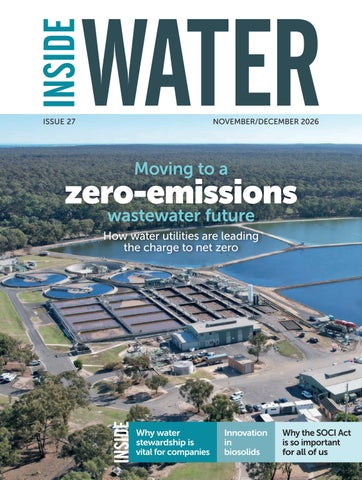
Moving to a
zero-emissions wastewater future
How water utilities are leading the charge to net zero
Why water stewardship is vital for companies
Innovation in biosolids
Why the SOCI Act is so important for all of us
We’re Creating the Future of Water for climate, communities and our kids
CONTENTS Issue 27: November/December 2026
11 REGULAR
FOCUS
4
Editor’s Note
WASTEWATER
34
Inside Water Podcast
10
58
The Last Drop
12
COVER STORY
6
31
Xylem
Water Minister’s Climate Innovation Challenge
125 years beneath the surface
Finding new value in biosolids
38
KSB
15
Wastewater Emissions Report
WAM/SAVECO
40 Data Centre Build Expo
System reliability starts with the mechanics of pumping
Cutting wastewater emissions at source
18
Where data centres meet water and why it is the big topic for the water sector’s future
ELAFLEX
42
Built to move
INTERNATIONAL INSIGHT
20
44 Finland
Global Water
REGULATORY INSIGHT
WATER STEWARDSHIP
46
23
Home Affairs Resilience before compliance
DIGITAL WATER
36
Suntory
EVENTS
52
VicWater
26
54
qldwater
56
Water Industry Operations Association of Australia
Taggle The next evolution in digital metering
Investing in water together
ASSOCIATIONS
Decarbonisation Awards Where water fits in Australia’s decarbonisation push
Rethinking the wastewater investment decision
Renewing resilience
No-Dig Down Under Sydney prepares for the next No-Dig with trenchless tech taking over
Fibre, flow and function
INFRASTRUCTURE
48
WaterAid Australia
Interflow Collaborating to keep a hospital running
Walking together for water
28
INCLUSION
Australian Water Association
50
23
Pride in Water Making inclusion easier across the entire water sector
Putting every water source option on the table
44
50 www.insidewater.com.au INSIDE WATER
3
EDITOR’S Note
Wastewater as a system Chairman
WASTEWATER RARELY ATTRACTS attention when everything is working. It moves out of sight, passes through networks and treatment plants, and returns to the environment or begins another life as recycled water, energy or recovered resources. That apparent simplicity hides one of the water sector’s most complex engineering and investment challenges. What struck me while reading the stories in this issue was how often the same lesson appeared in different forms: wastewater performance depends on decisions made well beyond the treatment process itself. The stories in this issue show why wastewater can no longer be treated as a sequence of separate assets or processes. Decisions made at the network, inlet, treatment and resource recovery stages can influence everything that follows. We see that clearly in the growing focus on wastewater emissions. Methane and nitrous oxide are produced by the treatment processes themselves, which means decarbonisation cannot rely on renewable electricity alone. Utilities are increasingly measuring where emissions form, adjusting operations and exploring ways to recover carbon, nutrients and energy before they become liabilities. The same whole-of-system thinking applies to treatment mechanics. Screening, grit removal, conveying and sludge handling may appear to be individual equipment decisions, but poor selection or integration can create problems across an entire plant. Reliability starts with understanding how the plant actually operates, including peak flows, solids loading, maintenance access and the demands that assets will face over decades. Wastewater planning also needs to
4
start earlier. The choice between gravity and pressure sewerage, for example, is not simply a question of pumps or pipes. It can reshape excavation, construction risk, maintenance requirements, operating costs, and how a network responds to difficult terrain or established communities. Then there is the longer horizon. Finland’s experience is a reminder that strong wastewater services still depend on renewal, workforce capability, sound asset management and investment discipline. Infrastructure built decades ago eventually reaches the point where deferral becomes a risk in itself. Taken together, these stories point to a broader shift in how we understand wastewater. It is not just something to collect, treat and discharge. It is a critical infrastructure system that must be planned, operated and renewed as one connected whole. That requires better data, better integration and a willingness to challenge assumptions that may have guided investment for generations. Wastewater might remain largely invisible to the public. Still, the decisions being made around it today will shape the reliability, resilience and environmental performance of water services for decades to come. Enjoy this issue!
John Murphy john.murphy@primecreative.com.au
Chief Executive Officer Christine Clancy christine.clancy@primecreative.com.au
Publisher Sarah Baker sarah.baker@primecreative.com.au
Managing Editor Geoff Crockett geoff.crockett@primecreative.com.au
Editor Chris Edwards chris.edwards@primecreative.com.au
Art Director/Design Alejandro Molano
Head of Design Clayton Hawley clayton.hawley@primecreative.com.au
Brand Manager Rosie Davis rosie.davis@primecreative.com.au p: +61 423 368 501
Client Success Manager Ben Sammartino ben.sammartino@primecreative.com.au
Head Office Prime Creative Pty Ltd 379 Docklands Drive, Docklands, Victoria 3008 p: +61 3 9690 8766 enquiries@primecreative.com.au www.insidewater.com.au
Subscriptions +61 3 9690 8766 subscriptions@primecreative.com.au Inside Water is available by subscription from the publisher. The rights of refusal are reserved by the publisher.
Cover image Coliban Water
Articles All articles submitted for publication become the property of the publisher. The Editor reserves the right to adjust any article to conform with the magazine format.
Copyright
Chris Edwards, Inside Water Editor
INSIDE WATER November/December 2026
Inside Water is owned by Prime Creative Media and published by John Murphy. All material in Inside Water is copyright and no part may be reproduced or copied in any form or by any means (graphic, electronic or mechanical including information and retrieval systems) without written permission of the publisher. The Editor welcomes contributions but reserves the right to accept or reject any material. While every effort has been made to ensure the accuracy of information, Prime Creative Media will not accept responsibility for errors or omissions or for any consequences arising from reliance on information published. The opinions expressed in Inside Water are not necessarily the opinions of, or endorsed by the publisher unless otherwise stated.
125 Years of Solving the Toughest Challenges Flygt has helped communities and industries solve some of the world’s most complex wastewater challenges. From protecting critical transportation infrastructure to improving wastewater operations and reducing environmental impact, these projects show how reliable wastewater management helps keep cities moving, services running and communities resilient.
COVER STORY Wastewater Emissions Report
Cutting wastewater emissions at source Renewable electricity has reduced one part of the water industry’s carbon footprint. The harder challenge is tackling methane and nitrous oxide generated by wastewater treatment, with utilities increasingly looking to intervene at the source.
RENEWABLE ELECTRICITY HAS changed the emissions profile of Australia’s water industry. It has also exposed a more difficult problem. Wastewater treatment can generate greenhouse gases through the same biological processes used to protect waterways and public health. Methane forms under anaerobic conditions, while nitrous oxide can arise during the nitrification and denitrification used to remove nitrogen. The Intergovernmental Panel on Climate Change (IPCC) identifies both as potential direct emissions from wastewater collection and treatment. Unlike emissions from purchased electricity, they cannot be addressed simply by changing the power source. Australia’s water sector is now trying to understand how much is being produced, where it occurs and which
6
operating conditions can be changed to reduce it. Water Research Australia’s ARC Linkage Project is examining methane and nitrous oxide across 21 wastewater treatment plants with 11 participating utilities. Monitoring has begun at more than half the sites. Early results suggest nitrous oxide varies considerably with carbon and nitrogen loads, aeration, dissolved oxygen and treatment performance, rather than following a consistent default factor. Sydney Water and Coliban Water approach the monitoring task from very different positions. Sydney Water operates major metropolitan water resource recovery facilities while preparing for substantial population growth. Coliban Water’s network stretches from small lagoon plants serving
INSIDE WATER November/December 2026
Sydney Water’s Malabar Water Resource Recovery Facility is one example of utilities recovering value from wastewater emissions. Image: Sydney Water
several hundred people to the Bendigo Water Reclamation Plant. Different treatment systems require different interventions, but both utilities are looking more closely at emissions produced during treatment. Measuring the invisible Australian greenhouse reporting offers several ways to estimate wastewater emissions. Method 1 under National Greenhouse and Energy Reporting uses national-average estimates Methods 2 and 3 incorporate increasingly facility-specific sampling and analysis to estimate emissions and energy. Even the more detailed approaches are different from continuously measuring the gas leaving a treatment process. Coliban Water uses Method 2. Plant data, including influent, effluent and biosolids information, feeds into its calculations rather than relying primarily on population estimates. “In a perfect world, direct measurement would be ideal,” Coliban Water Manager Energy, Climate and Circular Economy Megan Kreutzer said. “We’re keeping an eye on the technology because I think that’s where the industry needs to go. It would give us a clearer picture rather than relying on a black-box calculation.” Sydney Water also uses Method 2, basing its reporting on mass balances, surrogate indicators with NGER emission factors applied. Its involvement in the ARC project is adding direct measurements to that picture. “We are directly measuring greenhouse gas emissions using gas hoods and liquid probe measurements at two Water Resource Recovery Facilities,” Sydney Water Strategy and Sustainability Manager Jean
Davis said. “Preliminary results from these facilities are promising when compared with published emission factors.” Direct monitoring brings its own technical choices. Recent Australian research compared gas-flux hoods with submerged liquid sensors and found that neither method suits every application. Plant design, aeration systems, monitoring duration, costs and the number of sampling locations all affect the choice. Reliable plant data can then support more than annual reporting. Operators can link emission peaks to specific conditions and test whether operational changes actually reduce them. From data to control SA Water has already demonstrated what can follow. Research at the Bolivar Wastewater Treatment Plant used floating hoods to monitor nitrous oxide emissions from activated sludge treatment in real time. Working with the University of Queensland, SA Water identified links between plant operation and N2O production. Changes to aeration profiles reduced nitrous oxide emissions by around 30 per cent, while also delivering energy savings and other operational improvements. The research findings were subsequently incorporated into the IPCC’s 2019 refinement of wastewater greenhouse gas guidance. It is a challenging space as nitrous oxide remains one of the harder problems facing utilities. “Our biggest contributor to our wastewater emissions is nitrous oxide,” Kreutzer said. “It’s probably about 75 per cent of our Scope 1 emissions relating to wastewater treatment. The other 25 per cent is methane.”
Sydney Water has also identified nitrous oxide as a major focus of its Scope 1 program. Its work includes technology scanning and process optimisation while accounting for population growth, environmental licence requirements and treatment costs. Recent full-scale research helps explain why there is no simple operating recipe. Modelling found that changes to dissolved oxygen settings could reduce nitrous oxide emissions by between eight and 38 per cent across tested scenarios. Lower emissions still had to be balanced against ammonia and total nitrogen removal. Bolivar’s experience points towards a more plant-specific approach. Measurements reveal how a particular treatment process behaves. Operators can then adjust aeration or other parameters and check the result rather than assuming a generic emissions factor accurately represents their facility. Capturing methane’s value Methane offers a different set of options because capturing it can produce useful energy. Coliban Water’s regional network illustrates the range of interventions available. Some of its facultative lagoons serve only a few hundred
Separate research at Bolivar used direct nitrous oxide monitoring to optimise aeration, delivering energy savings. Image: SA Water
people, making major mechanical upgrades difficult to justify. Regular desludging remains one of its most effective methane controls. Kreutzer cited the Cohuna wastewater treatment plant, where desludging took an annual methane figure of about 134 tonnes down to effectively zero for that reporting period. Coliban Water is also trialling solarpowered aeration for lagoon systems without readily available power. “We’ve got a very decentralised system, so it’s not a one-size-fits-all approach,” Kreutzer said. “If we can put some air into the system and reduce those methane emissions while keeping it as a fairly passive system, that would be a good outcome for us.” At Sydney Water, biogas recovery has been part of operations for more than 25 years. Nine water resource recovery facilities use cogeneration. Malabar supplies biogas for conversion into biomethane, while Liverpool is progressing a foodwaste project intended to increase biogas production. “There are rigorous technical and economic assessments before we proceed,” Davis said. “We look at biogas yield, site electricity demand, capital costs and electricity prices. Optimising both performance and cost is critical.”
www.insidewater.com.au INSIDE WATER
7
COVER STORY Wastewater Emissions Report
Water Corporation is extending biogas recovery through the Woodman Point Water Resource Recovery Facility upgrade in Western Australia. The expanded facility will treat up to 120 tonnes of organic matter each day and capture more biogas for renewable energy. The WA Government estimates reduced grid demand will avoid about 5,600 tonnes of carbon dioxide equivalent annually. From waste to value Wastewater decarbonisation is also opening a broader discussion about what treatment plants can produce. North East Water’s Wodonga Resource Recovery Hub has been designed around that idea. Its $83 million treatment upgrade and threemegawatt solar farm are expected to reduce Scope 1 and Scope 2 emissions from 12,124 tonnes to
about 1,500 tonnes each year. The project is also pursuing biogas, recycled water, heat and biochar, with longer-term potential for fertiliser production. In the West, the Woodman Point facility combines similar resource recovery objectives with a much larger solids-treatment operation. Organic matter is already converted into biosolids for broadacre agriculture. Centralising more solids treatment here is expected to remove around 1,000 truck movements annually, avoiding another estimated 1,300 tonnes of carbon dioxide equivalent. Commercial returns depend heavily on location and plant configuration. “At Malabar, Sydney Water supplies biogas to Jemena under a commercial arrangement, where it is converted into renewable gas,” Davis said. “Project viability depends on
The Cohuna wastewater treatment plant. Coliban Water said regular desludging at the site reduced an annual methane figure of about 134 tonnes effectively to zero for that reporting period. Image: Coliban Water
Coliban Water’s Bendigo Water Reclamation Plant is the largest facility in a decentralised wastewater network that also includes small lagoon systems serving regional communities. Image: Coliban Water
8
INSIDE WATER November/December 2026
co-location to the gas network to receive the biomethane.” Kreutzer sees another possibility in nitrogen recovery. Coliban Water is researching technologies that could extract ammonia earlier in treatment, rather than allowing all nitrogen to proceed through conventional biological removal. “If we can remove that ammonia, harvest it and then use it for beneficial reuse in agriculture, I think there are huge opportunities in that space,” she said. “It’s taking it out of the front end, not waiting until the nitrogen gets to the back end of the system.” Such projects change the economics of the discussion. Carbon, nutrients, water and energy that once moved through a wastetreatment system can become useful products, provided the recovery process works technically and commercially. Optimising the whole system Resource recovery can also create unexpected trade-offs. A University of Queensland and Melbourne Water study followed a full-scale wastewater treatment system for two years. Carbon captured upstream generated biogas that offset about 40 per cent of total emissions. Removing that carbon, however, left less readily biodegradable material available for downstream denitrification. As a result, nitrous oxide emissions increased. Researchers modelled several operational and infrastructure changes together. Their preferred integrated approach reduced the N2O emission factor by 50 per cent and the overall carbon footprint by 40 per cent. Energy recovery fell by 31 per cent. The lowest-emissions treatment strategy may therefore differ from
“ If we can remove that ammonia, harvest it and then use it for beneficial reuse in agriculture, I think there are huge opportunities in that space
”
the one that produces the most renewable energy. Water quality, energy use, nutrient removal, direct emissions, and operating costs must be considered across the plant rather than unit by unit. Sydney Water has started bringing whole-of-life emissions into planning as Greater Sydney grows. “As Greater Sydney grows, balancing increased wastewater demand with our emissions reduction goals will remain a challenge,” Davis said. “We’re embedding emissions considerations into planning,
capital projects and investment decisions, from forecasting wholeof-life emissions and setting reduction targets to looking for new technologies.” Coliban Water is following a portfolio of process optimisation, research, sequestration and future treatment technologies. “Carbon sequestration has many upsides and benefits, but getting to the source of it is the key,” Kreutzer said. “In a perfect world, the timing will line up so we can transition from an offset approach into actual direct action on the emissions.”
The next stage of wastewater decarbonisation will depend less on offsetting emissions and more on understanding where they form, then changing treatment processes to stop them at source. That same shift creates opportunities to recover carbon, nutrients and energy before they become liabilities. As measurement improves and treatment systems evolve, utilities are moving closer to a harder goal: preventing wastewater emissions rather than simply accounting for them.
FOCUS Wastewater
125 years beneath the surface Millard explain how field experience, changing wastewater and intelligent technology continue to redefine what utilities expect from their pumps. WASTEWATER PUMPING HAS always had a simple objective: move what arrives at the pump station and keep the network operating. What reaches those pumps, however, has never stopped changing. Wet wipes, fats, oils and grease now place different demands on
those changing demands. The brand originated in Sweden in 1901, with its technology progressing from mechanical innovation through self-cleaning hydraulics to intelligent pumping systems. Brian Krishna, Managing Director of Xylem Australia and New Zealand, said that evolution had been central to Flygt’s longevity. “Over 125 years, the technology has changed a lot, but the operational pressures and issues have remained very real,” Krishna said. “The Flygt brand has stayed relevant because we’ve continued to evolve with utilities, right through from mechanical innovation to the digital intelligence that we’re seeing today, while staying grounded with field operators and real-world problems.”
wastewater systems. Utilities also expect more from the assets below ground. Lower energy use, fewer call-outs, longer service lives and better visibility of performance are increasingly important. Flygt wastewater pumps have spent 125 years evolving around
Kay Millard is the Sales Manager, WI, Transport NSW/WA at Xylem Australia and New Zealand. Images: Xylem Australia and New Zealand
10
INSIDE WATER November/December 2026
125 years of proven performance and certainty The development of Flygt wastewater pumps includes several shifts in how wastewater infrastructure could be designed and operated. Xylem traces the first Flygt submersible drainage pump to 1947 and the first submersible wastewater pump to 1956. Moving the pump into the wastewater reduced the complexity associated with traditional dry-installed stations, while changing installation, servicing and safety considerations. Kay Millard, Sales Manager, WI, Transport NSW/WA at Xylem Australia and New Zealand, has worked with Flygt for 36 years and watched the technology move through several generations. She recalled starting with the C-channel open impeller before N-technology arrived in 1997. Its self-cleaning, non-clog approach changed how Flygt addressed ragging and solids-handling problems. The same hydraulic
principle now carries into Concertor. The progression reflects a consistent challenge. The basic duty remains pumping wastewater, but the conditions and expectations surrounding that task keep changing. Problems that persist Krishna said wastewater networks are dealing with greater complexity, including wet wipes, fats, oils, grease and other solids. Growing communities and tighter expectations around service performance have increased the consequences when pumping assets struggle. Millard said some of Flygt’s most important developments had been validated through what operators experienced in the field. She recalled a trial with a major Sydney utility at a pump station experiencing regular clogging from wipes and rags. The utility initially agreed to a six-month trial of an N-pump. “After the first month, they actually purchased the pump, and then they purchased a second pump, although they still had five months to go with the trial,” Millard said. “The technology proved itself.” That experience illustrates the role field performance has played in Flygt’s development. Rather than treating clogging as an unavoidable characteristic of wastewater pumping, its hydraulic design has evolved around the material operators actually encounter. Concertor retains Flygt’s N-technology hydraulics while adding intelligent control and monitoring, allowing the system to respond to operating conditions rather than relying only on fixed settings.
pumping assets. Krishna said energy performance, resilience, reduced maintenance and greater visibility have become part of the reliability equation. Millard added that long asset life remains important, with some Flygt pumps she has encountered still operating after 35 or 40 years. However, Krishna said digital capability is expanding what reliability means. “Reliability now also includes predictability,” he said. “Whether you’ve got a piece of mechanical equipment that is very robust, the digital intelligence is going to prove that even further into the future.” Concertor extends that idea beyond an individual pump. Rather than the pump, controls and other station components operating independently, the system can respond to changing inflows as an integrated unit. “The station becomes less reactive and it becomes more selfmanaging,” Krishna said. “It does it through this intelligence that is looking at the whole system, not just as a pump.” Millard has seen other benefits emerge from that intelligence. Concertor’s sump and pipe-cleaning functions can reduce accumulated material and associated odours, improving conditions for operators and neighbouring communities.
Reliability gets smarter Australian and New Zealand utilities are also asking more of their
More valuable work The shift towards intelligent pumping comes as utilities manage ageing
It’s not just about having a pump, but taking a holistic view of the whole system.
assets with constrained workforces. Millard said Concertor’s broader performance range can reduce the number of pump variants customers need to hold. Automated cleaning can also reduce repeated interventions to remove rags and wipes. Krishna stressed that intelligent systems were not replacing wastewater expertise. Instead, they could shift skilled operators away from repetitive alarms, blockages and emergency call-outs. “Teams can focus on high-priority infrastructure and asset planning and more targeted maintenance and let the intelligence help you with the noisy stuff that we can make more predictable,” he said. That makes digital intelligence a way of directing scarce operational expertise towards work where human judgement creates greater value. After 125 years, Krishna believes the next generation still has to start with robust hydraulic performance. What changes is the intelligence around it. “The future is not just about building a stronger pump,” he said. “It’s about building a smarter wastewater solution.” For a technology with roots stretching back to 1901, that may be the most important lesson. Wastewater pumping cannot stand still because the wastewater industry never does. For more information, visit xylem.com
www.insidewater.com.au INSIDE WATER
11
FOCUS Wastewater
Fibre, flow and function Wastewater pumps face changing loads, fibrous material and demanding operating conditions. KSB Australia is using D-max hydraulics and compact motor cooling to balance reliability, efficiency and maintainability across wastewater pumping applications. WASTEWATER RARELY BEHAVES as designers would like. Fibrous material, fluctuating solids loads and sudden inflows can make pumping less predictable, placing pressure on reliability and energy performance. KSB Australia is addressing those conditions through developments in its Amarex KRT wastewater pump range, including the D-max impeller and Compact Cooling Jacket. Together, they target two recurring challenges: moving difficult wastewater efficiently and maintaining reliable motor cooling. Emilio de Paz, Business Developer for the Water Market at KSB, said wastewater characteristics vary between locations.
12
“The changes depend on the geographic location of the wastewater pumping station, but on average one can highlight the increased proportion of fibre-building content present in the wastewater network, mostly wet wipes,” de Paz said. He also pointed to periods of higher dry-solids concentration, possibly linked to water scarcity, alongside high inflows during heavy rainfall. Designing for fibres Those conditions shaped the development brief for D-max. KSB wanted to improve the handling of unscreened wastewater with relatively high fibre content. The challenge was to retain efficiencies associated with closed multichannel impellers.
INSIDE WATER November/December 2026
The range of Amarex KRT pumps is designed for all sorts of wastewater pumping applications. Images: KSB
Across Amarex KRT and Sewatec pumps fitted with D-max impellers, KSB set a minimum free passage of 76 millimetres. “Reliability is the key criterion in the wastewater business,” de Paz said. The wear plate closely mirrors the impeller’s conical form, keeping clearances short. The impeller contour is intended to increase tangential velocity smoothly while controlling the forces acting on solids and fibres. de Paz linked that behaviour to KSB’s patented Ever Cleaning Blade concept. The geometry is intended to help fibrous material move through the hydraulic passage rather than collect in critical areas.
KSB used computational fluid dynamics, laboratory trials, field testing and high-speed imaging during development. “With the help of CFD simulations, laboratory and field testing, together with high-speed imaging, we were able to observe how fibrous materials move through the pump and identify the critical areas in which they can become clogged,” de Paz said. Those observations helped refine the hydraulic design. de Paz said stringy fibrous material remains the principal source of clogging. Matching pump to duty D-max is not intended to replace every other impeller option. Correct selection begins with the pumping station itself. “Naturally, the first step is to determine the application and focus on how the pumping station has been designed,” de Paz said. “Are we expecting any air entry? Are there any zones with dead water where solids might settle?” Engineers also need to consider circulating flows and likely particle sizes. That makes selection a systemlevel exercise. D-max may suit wastewater with high fibre content, but other impeller designs can be preferable where gas content, larger solids or different solids concentrations dominate. The same principle applies to overall pump efficiency. de Paz said utilities should assess the full range of duty points rather than focusing only on peak hydraulic efficiency. “Sometimes designing installations with a combination of smaller and bigger pumps can be more energyefficient than cases in which all pumps are operated with VFDs at reduced frequencies,” he said. “VFD losses should also be included in the overall efficiency calculations.” Tangential pump speed matters
because solids require sufficient velocity to transport reliably. Cooling without wastewater The Compact Cooling Jacket tackles a different constraint. Instead of relying on pumped wastewater to cool the motor, it uses a closed water-glycol circuit. de Paz said the benefit is consistent cooling without exposing the cooling mechanism to wastewater solids or potentially aggressive chemistry. “Cooling a motor with a closed circuit in which a mixture of waterglycol is recirculated guarantees a clean operation and constant cooling, as there is no clogging risk inside the cooling mechanism,” he said. In dry-pit installations, the compact arrangement can reduce the equipment footprint. The discharge cover also acts as a heat exchanger, allowing the circulating coolant to benefit from the wastewater’s lower temperature. For wet-pit installations, the cooling system can support continuous operation at lower water levels. That may create opportunities to reduce excavation depth in new pumping stations. de Paz cautioned that lower water levels do not remove the need to maintain minimum submergence. “Minimum submergences to avoid air-entraining vortices should always be considered, and they are a function of the flow rate,” he said.
The D-max and its compact cooling jacket can handle a range of issues.
Designing for lifecycle Amarex KRT pumps with compactcooled motors can be paired with KSB’s AmaSlide maintenance aid for horizontal installations, improving access to hydraulic components and mechanical seals. The 4STK cartridge mechanical seal incorporates the recirculation impeller used by the cooling circuit. Sensors can monitor stator and bearing temperatures, vibration and other conditions, while the AmaControl protection module can consolidate those signals and transfer data via Modbus. de Paz said these features can support maintenance scheduling and predictive maintenance. Adjustable wear plates on D-max hydraulics allow operators to restore clearances from the suction side as wear develops, helping preserve efficiency over a longer operating period. For utilities, that brings the discussion back to the wider pumping station. Installation arrangement, flooding risk, pump sizing, drive losses, solids transport, maintenance access and hydraulic efficiency all need to be considered together. “The several duty points need to be assessed to optimise the overall efficiency, not only the hydraulic one,” de Paz said. For more information, visit ksb.com
www.insidewater.com.au INSIDE WATER
13
FOCUS Wastewater
Reliability starts with the mechanics Mechanical equipment may sit at the front or back of a wastewater treatment plant, but Bhrigu Sharma argues its influence extends across the entire process. Getting selection, sizing and integration right can improve reliability, efficiency and whole-of-life performance. WASTEWATER TREATMENT DISCUSSIONS often focus on biological and chemical processes. Yet the mechanical equipment surrounding those stages can determine how reliably the entire plant operates. WAM Australia Sales Manager Bhrigu Sharma said utilities increasingly recognise that screening, grit removal, conveying and sludge handling are not isolated functions. They influence what reaches pumps, biological processes and downstream equipment. That changes the operating burden carried across the plant. “Mechanical treatment shouldn’t be viewed as simply equipment at
the front or back of the wastewater treatment plant,” Sharma said. “It has a direct influence on the reliability of the plant and the efficiency of the overall process.” Sharma said that breadth of capability lets the business consider how material moves through a plant rather than treating each machine as a separate purchase, empowering consultants to optimise overall plant efficiency and resource recovery. Start with the whole plant Mechanical pre-treatment is particularly important because problems that are not removed at the inlet do not disappear. Screenings, grit, fats and other unwanted
Fine drum screens form part of the mechanical treatment process at the Snapfinger wastewater treatment plant in Georgia, United States. WAM Australia says equipment selection and integration can influence reliability throughout a treatment plant. Images: SAVECO Water
material can continue downstream. They can affect pumps, wells, conveyors, biological processes and sludge handling equipment. “The front end of the plant is essentially protecting everything that comes afterwards,” Sharma said. “A good front-end system should make the rest of the plant’s job easier.” The consequences can multiply because a wastewater plant may contain dozens of pumps and other mechanical assets. Material that escapes one process can therefore become a maintenance problem somewhere else. Sharma said equipment selection should also account for abnormal operating conditions. It cannot assume the plant will remain within its everyday flow profile. That does not mean removing as much material as possible without regard to the application. Screen size, hydraulic conditions, solids characteristics, and how captured screenings are conveyed and dewatered all influence plant performance. Poor selection can create blockages, increase cleaning and maintenance, and demand more manual intervention from operators. Undersized equipment may appear adequate in normal conditions but struggle when hydraulic flow or solids loading rises. “Ultimately, a piece of equipment can look perfectly adequate on paper, but still be the wrong solution for the real operating environment,” Sharma said. Design for real conditions Sharma said equipment selection is moving beyond a simple design-flow number. Utilities and consultants are increasingly considering minimum, average and peak flows, as well as solids loading
www.insidewater.com.au INSIDE WATER
15
FOCUS Wastewater
and catchment characteristics. Industrial inputs, population growth and rainfall can all change operating conditions. Some recent specifications he has seen also forecast flow requirements at staged intervals extending about 25 years. That pushes equipment selection towards a broader operating envelope rather than a single point of duty. The same approach applies to whole-of-life performance. Capital cost remains important. However, Sharma said utilities are asking more questions about maintenance frequency, wear components, energy consumption, spare-parts availability, and operator intervention, all of which influence long-term reliability and efficiency. “The purchase price is only one part of the cost,” he said. “A slightly cheaper piece of equipment that requires more maintenance or more frequent replacement may ultimately be much more expensive over the operating life.” Retrofit around reality That thinking matters more when utilities try to extract more value from existing wastewater infrastructure. New plants allow engineers to design buildings, civil works and processes around new equipment. Retrofit projects must instead accommodate existing structures, pipework, electrical systems, access restrictions and limited space. Often, the plant must remain operational during the upgrade.
16
“You need to consider access for installation and maintenance, lifting requirements, available headroom, existing interfaces, and how new equipment will integrate with the equipment already present on site,” Sharma said. Addressing these factors ensures retrofit projects support long-term plant reliability and performance. “The technical ideal solution isn’t necessarily the best practical solution because of the constraints of the existing site.” Sharma sees that constraint as both a challenge and an opportunity for Australian utilities. Targeted improvements to screening, grit removal, conveying or sludge handling can lift performance without requiring a complete plant rebuild. One example is septage receiving, where incoming material can vary significantly and include rags, large solids and stones. WAM Australia offers systems that combine screening, washing, conveying and dewatering. Sharma said the value isn’t a single performance figure. A better-designed system can create a cleaner, more consistent process with less manual handling. The same principle extends into sludge handling. Treatment concentrates material rather than eliminating it, creating requirements around conveying, screening, separation, dewatering support and chemical dosing. Because sludge characteristics
INSIDE WATER November/December 2026
The BEAST septage receiving system combines several mechanical treatment functions to manage variable incoming material. Bhrigu Sharma says effective mechanical design can reduce manual handling and improve process consistency.
vary, Sharma said equipment must again be selected around the actual material and required outcome. Whole-of-life changes the equation The strongest opportunity is to improve how existing infrastructure performs while reducing manual intervention and supporting future resource recovery. Sharma expects mechanical treatment to become increasingly important as utilities pursue greater operational consistency and energy efficiency. It can also support recovering useful resources from wastewater and sludge. That makes integration central to the purchasing decision. Correct sizing, realistic operating data, maintenance access and compatibility with existing equipment can have consequences well beyond the machine itself. “If you get the fundamentals right, correct equipment selection, appropriate sizing, good integration with the existing equipment, and consideration of whole-of-life performance, you can make a significant difference to the plant’s overall operation,” Sharma said. “That’s ultimately what we are trying to achieve with customers. Not just supplying equipment, but helping them find practical, reliable solutions that work in the real operating environment.” For more information, visit saveco-water.com.au/en/savau/home
FOCUS Wastewater
Built to move Expansion joints can be easy to overlook within complex water and wastewater assets. ELAFLEX Pacific Sales Manager Mario Iglic explains why managing movement starts with selecting, designing and installing the right component. EXPANSION JOINTS RARELY command the same attention as pumps, valves or major pipeline assets. Yet water expansion joints can protect the wider installation by absorbing vibration, thermal growth and alignment issues. For ELAFLEX Pacific, that makes them a practical line of defence. The company is better known in Australia for fuel-handling equipment, but its product portfolio extends well beyond the forecourt. “ELAFLEX Pacific is a leading international specialist for refuelling and safe connections and transfer of dangerous goods and sensitive fluids,” ELAFLEX Pacific Sales Manager Mario Iglic said. “You may or may not know the name, but you’re more likely to handle the product on a regular basis, from nozzles at petrol stations to hoses that transfer jet fuel onto your next flight.” The business is now looking to build greater awareness of its expansionjoint capability within Australia’s water sector, including both the ELAFLEX ERV range and engineered solutions from Ditec.
18
A small component, a large role Iglic said the first function of an expansion joint was to manage movement created elsewhere in the system. “First and foremost, expansion joints are designed to assimilate the mechanical vibrations from pump systems,” he said. “They also help absorb thermal growth and help with assembly tolerances.” Those tolerances can become important where installed pipework does not align exactly as intended. An expansion joint can accommodate a degree of movement or misalignment while helping isolate vibration before it travels through the pipeline. “You may not think of an expansion joint within your designs, but they become, at times, a critical component,” Iglic said. ELAFLEX’s standard ERV expansion joints cover sizes up to DN1000. Iglic said Ditec broadened that capability where larger diameters or more complex movement requirements were involved. “Anything beyond that is covered by Ditec,” he said. “With the addition of
INSIDE WATER November/December 2026
Ditec can engineer expansion joints around the movement, pressure, medium and operating requirements of individual pipeline applications. Images: ELAFLEX
Ditec into the group, it’s been able to expand our range and essentially our horizons.” While the standard ELAFLEX ERV design uses a single arch, Ditec can engineer single, double, triple or multi-arch configurations, as well as pressure-balanced designs, depending on the application. Selection starts with information Correct water expansion joint specification begins with understanding what the component will actually experience. “The product selection itself is determined by the medium, the pressure and the possible movement, and the general requirements that are provided by the customer,” Iglic said. That information becomes particularly important in water and wastewater infrastructure, where one installation may carry potable water while another handles sludge, chemicals or abrasive solids. “Does the expansion joint need a limiter to stop excessive movement caused by pressure fluctuations or vibrations?” Iglic said. “Is this being
used in a wastewater recovery system, and will there be solids falling through that could damage the lining? Are there chemicals within the treatment that need to be accounted for?” The answers influence rubber compound selection, movement limits, reinforcement and other design details. Potable water applications also bring additional requirements because materials in contact with drinking water need the appropriate approvals. “The fluid being transferred always determines the rubber compound,” Iglic said. “The medium really must be known.” That need for information places responsibility on suppliers and customers alike. Iglic said ELAFLEX and Ditec ask detailed questions because assumptions made early in the process can affect the long-term performance of the component. “The more information, obviously, the better,” he said. “Sometimes we can’t get the answers that we want, and we have to work with what we have.” Designing for Australian conditions Water expansion joints may also need to account for the environment outside the pipe.
Australian infrastructure can face high ambient temperatures, strong ultraviolet radiation, remote operating conditions and long maintenance intervals. Iglic said those factors could be incorporated into material selection and protective measures. “With UV exposure, Ditec can build an additional UV shield that is installed with the expansion joint itself,” he said. “The mitigation of high ambient temperatures is built into the rubber compound.” He pointed to international applications ranging from water infrastructure in Egypt to expansion joints submerged in seawater at desalination intakes. The lesson, he said, was that expected service life depended heavily on the operating environment. “If somebody asks me the life of an expansion joint, I can’t tell you,” Iglic said. “They can range anywhere from five years to 25 years. It all depends on the environment and the working conditions.” Installation matters Even the right product can be compromised by poor installation. Iglic said one of the most common problems involved the orientation
Ditec manufactures purposeengineered expansion joints for applications where size, movement or operating conditions require a customised solution.
Ditec extends the ELAFLEX Group’s expansion-joint capability into large-diameter and specialised pipeline applications.
of nuts and bolts. If bolts are installed so they can contact the rubber as the joint moves, repeated movement can score the surface and weaken the joint. “I’ve had customers send me photos of expansion joints that have failed, and we can see that the installation is incorrect,” he said. Incorrect pipe sizing can create similar problems, particularly where movement allows the pipe edge to wear against the rubber sealing surface. These examples reinforce the broader point. Expansion joints should be considered as part of the system design rather than added after other decisions have been made. “Vibrations and thermal expansion happen,” Iglic said. “The best way to extend the life of the pipeline or the facility is to factor in expansion joints as a line of protection.” For more information, visit elaflex.com.au
www.insidewater.com.au INSIDE WATER
19
FOCUS Wastewater
Rethinking the wastewater investment decision Wastewater servicing decisions can shape infrastructure costs and operations for decades. Global Water’s product manager Darren Emes explains why pressure sewer deserves consideration much earlier in the investment process. WASTEWATER NETWORKS ARE long-lived assets, but the decisions that shape them are often made early. Gravity sewerage may be the familiar starting point for developers, councils and utilities. Darren Emes believes pressure sewer should be assessed alongside it before locking in a servicing strategy. Emes has worked in the water sector for more than 40 years and has known Global Water for close
20
to 30. The family-owned company is approaching 50 years in the water and wastewater industry. “The first thing that you do is a CAPEX (capital expenditure) comparison, so that’s your capital cost analysis, and then the second stage is what your operating cost is going to be,” he said. That framework applies to new developments, network extensions and septic tank replacement
INSIDE WATER November/December 2026
A pressure sewer system changes the way wastewater infrastructure can be configured, with propertylevel pumping feeding a shallow pressure network. Images: Global Water
schemes. The starting point is not simply which pump or pipe to select. Instead, project teams need to determine which network architecture provides the strongest outcome over its working life. Rethinking the network Pressure sewer changes several assumptions behind conventional sewer design. Global Water’s systems use small-
“ Every single land development
moving forward, those things should definitely be considered
diameter pressure mains installed relatively close to the surface. Emes said typical network pipes could be laid about 600 millimetres to one metre deep. Gravity sewers may need to run several metres below ground and at a consistent grade. That difference can change the scale of excavation and civil works required. Pressure sewers also remove much of the streetbased infrastructure associated with gravity networks, including maintenance holes. “When you put a pressure sewer network in, especially in comparison to a gravity sewer, the system cost itself is a lot less, purely because you’re using smalldiameter pipe and it’s laid at a very shallow depth,” Emes said. The pressure system instead places a small tank, pump and controller at individual properties. Project teams therefore need to compare the infrastructure required to make the whole network function, not just the equipment at each property. When sites get harder Brownfield developments can contain existing homes, utilities, roads and other constraints. Deep excavation can increase disruption and complicate construction. Rock, high groundwater and undulating terrain can add further cost and risk. Pressure mains can be installed in shallow trenches. Where conditions allow, directional boring can further reduce excavation. “If you were then to go into those narrow streets and try and dig a six-metre-deep trench down the middle of the road, you can imagine the issues that you’re going to encounter,” Emes said. Septic tank replacement schemes are another application. Emes
pointed to work in South Australia, where thousands of properties are being transitioned away from septic systems through a mix of pressure and gravity sewer connections. For residents, he said the conversion can reduce ongoing septic tank maintenance. A closed pressure system can also reduce opportunities for groundwater infiltration or wastewater leakage. Counting the lifecycle Capital cost is only half of the investment question. Sewer networks need to be operated and maintained for decades. Emes said gravity systems can sometimes be perceived as inexpensive to operate because they do not have distributed household pumps. Their pipes, maintenance holes, pump stations and other infrastructure still require inspection, cleaning and repair. “A lot of people overlook that. They always look at, ‘What’s just the capital cost?’ In many cases, people think it’s free to put in a gravity network, whereas with pressure sewer they see pumps to maintain and the cost of power,” Emes said. Pressure sewer shifts part of that maintenance burden to distributed mechanical and electrical equipment. Global Water’s system uses pumps, local controllers and alarms, with remote monitoring also available through SCADA. Emes said the pumps would typically operate for eight to 10 years before requiring service, depending on operating conditions and homeowner behaviour. Its recent testing also indicated household electricity use could cost around $30 to $40 each year under the conditions it modelled. Those figures are project-specific, and show why any comparison needs the full operating model.
”
Global Water’s pressure sewer system combines the collection chamber, pump and associated pipework within a property-level installation.
Designing for flow Pressure sewer will not suit every development. The case depends on topography, discharge points, existing infrastructure, construction conditions, lifecycle costs and the operating model that follows. Emes said that those factors should be assessed before gravity becomes the assumed solution. For Global Water, that positions pressure sewer as a wastewater infrastructure choice rather than simply a pumping product. For developers, councils and utilities, the opportunity is to compare the complete network while there is still time for that choice to influence project design, construction and longterm operation. “Every single land development moving forward, those things should definitely be considered,” Emes said. For more information, visit globalwatergroup.com.au www.insidewater.com.au INSIDE WATER
21
FOCUS Water Stewardship
Investing in water together Suntory Oceania’s Mizu Mirai – “water future” - platform combines freshwater research, water replenishment and education, creating a connected approach to water stewardship designed to safeguard healthier waterways for generations to come. MIZU MIRAI, MEANING “water future”, is Suntory Oceania’s water stewardship platform, built around three connected pillars: freshwater research, water replenishment and education. It reflects Suntory’s long-standing belief that businesses have a responsibility to help protect the natural resources they depend on, building on decades of water conservation and watershed protection programs across Japan, the Americas, Europe and Asia. Central to the program is Suntory’s new three-year, $1 million partnership with Griffith University’s Australian Rivers Institute (ARI), its largest local water commitment to date. Professor David Hamilton, Director of ARI, said the challenge begins with understanding water security as more than simply water availability. “Water security is a combination of both the quality and the quantity of that water,” he said. Hamilton also pointed to the decline of freshwater biodiversity as another reason to treat water management as a connected environmental problem rather than a question of supply alone. Science for action ARI’s research examines how climate change and land-use change affect water quantity, water quality, and catchment resilience. One research stream analyses river-flow records spanning 50 to more than 100 years. Long records help researchers distinguish natural variability from human-driven change and better understand nonstationarity.
Many models still use the past to guide the future. Hamilton said changes in groundwater, vegetation and soils through time can weaken those assumptions. “Are the models perfect? No, and they’ll never be, but they can provide us with good insights of what the future may look like,” he said. The program is also examining environmental “safe zones” for waterways. Hamilton cautioned against treating limits like a speed limit that managers should approach as closely as possible. Safe boundaries need enough headroom for droughts, floods and other natural variation. The objective is to identify where action can prevent ecosystems from reaching tipping points, after which restoration becomes harder and more expensive. “What we’re about is looking for where we are close to some of
Professor David Hamilton and Dr Liliana Pagliero from Griffith University’s Australian Rivers Institute. The institute’s research partnership with Suntory Oceania forms a key part of the Mizu Mirai approach to water stewardship. Images: Suntory Oceania
these tipping points,” Hamilton said. “Where can we most effectively put our resources?” That question runs through the project’s work on nutrient sources and riparian restoration. Satellite observations show continued loss of naturally vegetated areas beside waterways, including in Queensland. Hamilton said those zones can slow flows and reduce nutrients and sediment entering rivers. Research can therefore help identify where a given level of investment in restoration will have the greatest effect, rather than simply directing investment towards locations where action is easiest. Green meets grey That evidence matters to utilities as much as water users. Hamilton said future investment should not be framed as a choice between conventional assets and nature-based solutions.
www.insidewater.com.au INSIDE WATER
23
FOCUS Water Stewardship
“It’s not one or the other. It’s grey and green infrastructure together,” he said. This green infrastructure can also be treated as an asset. “The money that you put in green infrastructure will continue to enhance year on year as the trees grow, as you increase the resilience of the system,” Hamilton said. Suntory Oceania’s planned replenishment project in Queensland’s Lockyer Valley creates another link between research and implementation. Hamilton said restoration can produce benefits beyond replenishing water. These can extend to carbon, biodiversity, water quality and downstream environments. Stewardship through collaboration At its core, Mizu Mirai is built on the idea that water stewardship extends beyond any single organisation or site. Hamilton said effective water
24
stewardship depends on collaboration across researchers, industry, landholders, communities and policymakers. Understanding how freshwater systems are changing is only part of the challenge. The next step is translating that knowledge into decisions that improve catchment health and strengthen long-term water security. Hamilton believes collaborative models can help accelerate action by demonstrating the benefits of science-informed investment and restoration. “There are those who will say, ‘I’m not doing that until it’s certain that it’ll work’, and there are others that will start to follow leaders when they see the benefits,” he said. For Hamilton, success would mean data informing decisions, decisions supporting better governance, and governance enabling practical investment in water security and biodiversity. “That will happen in a collaboration
INSIDE WATER November/December 2026
Suntory Oceania’s Swanbank facility in Ipswich, Queensland. Mizu Mirai extends the company’s water stewardship beyond operational efficiency into research, replenishment and education.
Australian Rivers Institute researchers are examining how hydrology, catchment condition and restoration can support healthier and more resilient freshwater systems.
at the ground level, but it’ll happen by providing global leadership and thought process to water sustainability and water stewardship,” he said. For more information, visit suntoryoceania.com
FOCUS Events
Walking together for water WaterAid Australia’s 2026 Walk for Water turned a simple act of movement into a shared water sector statement, drawing utilities, suppliers and industry leaders together to support communities still living without clean water close to home. WHEN MOST AUSTRALIANS need water, it is only a few steps away. A tap, drinking fountain or kitchen sink provides a service so reliable that the infrastructure behind it can disappear from daily thought. For 696 million people worldwide, that experience is very different. Almost one in ten people still lack clean water close to home, while women and children often spend long periods walking to collect it.
26
WaterAid Australia’s Walk for Water brought that contrast into focus again in 2026. Held from October 19–23, the campaign invited people to walk, run or ride across five days while raising funds and awareness for WaterAid’s work. The challenge was deliberately accessible. Participants could choose their own distance and pace, then involve colleagues, family and friends. The format gives teams room to
INSIDE WATER November/December 2026
Yarra Valley Water MD Natalie Foeng leading a team on their Walk for Water in 2025. Images: Yarra Valley Water
participate without making distance a barrier. For Australia’s water industry, however, the campaign has increasingly become something larger: a collective expression of support from people whose professional lives centre on water. The 2025 campaign showed how strongly that message could resonate. More than 200 Yarra Valley Water employees took part, while South East Water employees raised more than $6,000. Across the campaign, they raised more than $140,000. A sector-wide effort WaterAid again assembled a group of Water Leaders for 2026, drawing
representatives from utilities, engineering firms, contractors, technology companies and industry bodies. The group included leaders from Actemium, AECOM, Alluvium Group, Aurecon, Barwon Water, Downer, Interflow, Sequana, South East Water, Sydney Water, TRILITY, Water New Zealand, Xylem and Yarra Valley Water. Their involvement reflected an important connection between the Australian water sector and WaterAid’s mission. Water professionals spend their careers planning, operating and maintaining systems intended to provide safe and reliable services. Walk for Water asks them to consider what life looks like where those systems do not exist, are inaccessible or cannot be relied upon. WaterAid says a reliable supply of clean water, decent toilets and good hygiene supports health, dignity, education and economic opportunity. Its work focuses not only on infrastructure, but on the systems, policy, finance and local capability needed to keep services operating over time. Sydney Water Executive General Manager Customer Experience and WaterAid Australia Non-Executive Director Denisha Anbu linked the fundraising effort to practical outcomes. She said less than $10,000 could provide a school in Papua New Guinea with a rainwater tank and handwashing facilities, while $50,000 could help a whole village gain a sustainable clean water system. “These are life-changing projects for entire communities,” Anbu said. Making the network visible One of the most ambitious Victorian activations was the 83.3-kilometre Ultra Walk for Water across Melbourne.
Sequana’s Zoe Walsh, Inside Water’s Chris Edwards and Finao’s Terry Down set out to connect Melbourne’s four metropolitan water utilities on foot over October 22–23. The route linked South East Water, Melbourne Water, Yarra Valley Water and Greater Western Water, with other water industry participants joining individual legs. The concept turned Melbourne’s water map into a physical journey. It followed the bay, rivers, and waterways that form part of the broader system those organisations help manage, while drawing attention to a very different kind of walk undertaken every day elsewhere in the world. “We work in an industry where clean, safe water is something we think about every day, but for millions of people it still isn’t available close to home,” Walsh said. “Walking 83 kilometres across Melbourne’s water network is a powerful way to put that reality into perspective and to bring our industry together to help change it.” The Ultra Walk was not the only long-distance effort. Barwon Water Managing Director Shaun Cumming and Board Director Corrina Eccles centred their campaign on a 60-kilometre route from Lorne to Apollo Bay through the Great Otway National Park. It began at Lorne’s drinking water source, the St George River, and finished at Apollo Bay’s Barham River source. Those challenges added a visible layer to a campaign built around participation rather than athletic achievement. The distances attracted attention, but the wider Walk for Water format remained open to people choosing a target that suited them.
Both two and four-legged friends are welcome to take part in Yarra Valley Water’s Walk for Water.
Beyond the finish line WaterAid’s figures underline why the campaign continues. Beyond the 696 million people without clean water close to home, 2.1 billion people worldwide do not have safe water. Around 1.5 billion do not have a decent toilet of their own, and almost 400,000 children under five die each year from diseases linked to unsafe water, sanitation and hygiene. WaterAid works alongside communities in 22 countries. Since 1981, WaterAid has reached over 30 million people with clean water, 29.6 million with decent toilets and 31.7 million with good hygiene. The scale of those figures can make the global water crisis feel distant from an Australian workplace. Walk for Water narrows that distance by giving people a practical way to participate, fundraise and talk about why water services shape so many other parts of life. Ahead of the event, Inside Water editor Chris Edwards said the Ultra Walk gave the sector a way to act around that shared understanding. “The Ultra Walk gives our industry a chance to come together around something fundamental: access to clean water and sanitation,” Edwards said. “By taking on the full distance and having people from across the sector join us along the route, we hope to build awareness, start conversations and raise meaningful funds for WaterAid.” That conversation does not end when the walking stops. The campaign’s strongest message carries back into the organisations that design, fund, operate, and advocate for water systems every day: reliable water is ordinary only when the systems and people behind it make it so.
www.insidewater.com.au INSIDE WATER
27
ASSOCIATIONS Australian Water Association
Putting every option on the table Danielle Francis’s push to make purified recycled water a normal part of water security planning has earned national recognition, culminating in the 2026 Water Professional of the Year award. DANIELLE FRANCIS DID not expect to be named the Australian Water Association’s 2026 Water Professional of the Year. The award, sponsored by KSB Australia, recognised a career of strategic leadership and advocacy, including her work advancing purified recycled water for drinking. She said the nomination alone felt significant because she considered the other national finalists exceptional. Her acceptance speech captured that surprise. “Put your hand up if you have imposter syndrome. I’m going to dedicate this to all the imposters out there,” Francis said on the night. The award also landed more deeply after the event. Francis, from the Water Services Association of Australia (WSAA), said she spent time the next day reflecting on what peer recognition meant after years in a
28
sector that rarely seeks the spotlight. “It was a lovely and a genuinely unexpected compliment. I was absolutely chuffed, and I was absolutely floored,” she said. Opening the conversation That recognition reflects work which helped move purified recycled water, or PRW, from a sometimes difficult subject towards a legitimate planning option. WSAA’s 2019 All Options on the Table: Lessons from the Journeys of Others report looked at case studies from around the world of cities that had taken their communities on a journey to consider purified recycled water for drinking. Ultimately, most had adopted it, and there are lessons about how they approached a patient, calm conversation with their communities to explain the rationale and benefits.
INSIDE WATER November/December 2026
Danielle Francis was named the 2026 Water Professional of the Year at the Australian Water Awards, recognising her leadership and advocacy across the water sector. Image: Australian Water Association
Francis said fair comparison is important because the benefits can be substantial. “We’ve got to explain to people the benefits of PRW,” she said. “Effectively, you need to understand, well, what are the relative benefits of one option over another?” Other important parts of engaging with communities on purified recycled water, like any new water supply option, are time, trust and transparency, explaining the context that recycling is part of the natural water cycle which technology simply speeds up, that word choices are important, and the important role of media and regulators. It is also important to seek bi-partisan political support on the need for water supply action and the best solutions for a particular region or city. Planning beyond drought Francis believes Australia is still in the early stages of its PRW journey. Perth’s groundwater replenishment scheme has provided one working model, while other utilities are building knowledge, demonstration projects and planning pathways.
She said one barrier can arise before a technical or regulatory question is even asked: the assumption that communities will resist. “If we go into a conversation with communities telling people and flagging that people are opposed to something, you automatically take away a sort of an open-minded approach that a lot of people actually do have,” Francis said. The alternative is to present PRW as one option within a diversified portfolio, then explain what it can contribute. That also means moving beyond the idea that rainfallindependent assets should exist only for emergencies. Francis pointed to Australia’s desalination experience. Plants built during the Millennium Drought were often framed as insurance policies, yet they have since supported systems through drought, floods, bushfires and other climate extremes. “Actually, when you build a really fabulous piece of infrastructure like a PRW plant or a desal plant, ideally you want to be using it as part of baseload supply,” she said. “That’s what helps you, you know, have a secure and resilient water supply.”
Trust through openness Technical capability alone does not make an option ready for a community. Francis said long-term progress depends on patient, open, engagement and genuine listening. “A really important thing is to discuss things openly because that’s us as a sector doing our job,” she said. “We really do ourselves a disservice if we kind of treat things as a taboo topic and we don’t talk about it comfortably.” She also warned against the “decide, announce, defend” model. Instead, utilities can start with the local challenge, explain the available options, and discuss the trade-offs with communities before locking in a preferred solution. That approach also leaves room for something less conventional: making the conversation enjoyable. Francis has used PRW tastings at community and stakeholder events. Overseas utilities have gone further, using purified recycled water in coffee, soft drinks, gelato and other products. “The thing that people remember when they go home, and they tell their family around the dinner table, is, ‘Hey, today I drank this water’,” she said.
Danielle Francis says open conversations and genuine listening are essential when communities consider complex water supply options. Image: Danielle Francis
Purified recycled water has been used in beverages and tasting experiences overseas to help communities engage with the technology in a more familiar and approachable way. Image: Australian Water Association
Recognition and momentum Francis sees signs that the Australian conversation is already changing. Six or seven years ago, she established a national PRW collaboration group at a time when some utilities were reluctant to discuss projects openly. She said the topic is now far more visible and comfortable. Perth remains the established Australian example. Francis also pointed to the NSW Recycled Water Roadmap and Sydney Water’s Quakers Hill PRW Discovery Centre as evidence of growing capability and openness. The Award gives that work a personal marker. Francis said recognition from peers made her reflect on the cumulative effect of work that can otherwise feel incremental. “You soldier on for a long time through all of your work and that kind of thing, and you hope it’s having an impact, but it’s not something you consciously think about,” she said. For Francis, the larger goal remains unchanged: communities should have enough information to weigh safe, resilient and affordable water options on their merits. As she told the audience while accepting the award, progress rarely comes without mistakes. “I had all these ideas, and I would just try things. And I failed a million times,” Francis said. “But when we keep giving things our all, we end up kicking amazing goals.”
www.insidewater.com.au INSIDE WATER
29
Australia’s dedicated exhibition for building the future of data centre infrastructure 15–16 SEPTEMBER 2027 Melbourne Convention and Exhibition Centre (co-located with Converge Expo)
BOOK YOUR STAND
FOCUS Events
Finding new value in biosolids Victoria’s water sector is testing a diverse set of approaches to biosolids, from landscape restoration and fertiliser to industrial products, composting and water treatment.
BIOSOLIDS MANAGEMENT IS becoming a more complex question for water utilities. Emerging contaminants, emissions targets, transport costs and changing regulatory expectations are increasing pressure on established pathways, while research is opening new opportunities to recover carbon, nutrients and other value. That tension was evident at the 2026 Water Minister’s Climate Innovation Challenge, where seven finalists presented markedly different responses to the same broad problem. The winning Biochar for Dja project, led by Barwon Water with Wadawurrung Traditional Owners Aboriginal Corporation and Federation University, will explore how biosolids-derived biochar
could support native plants and climate-resilient landscapes on Wadawurrung Country. Yet the wider field suggested something equally important: there may be no single future pathway for biosolids. RMIT University’s Dr Ganesh Veluswamy captured that challenge while presenting a separate proposal led by Central Highlands Water. “All biosolids are not the same, and therefore all biochars will not be the same,” Veluswamy said. Returning value to Country Biochar for Dja builds on Barwon Water’s Regional Renewable Organics Network, which is intended to transform 60,000 tonnes of biosolids blended with council garden organics into about 8,000
The Biochar for Dja team won the 2026 Water Minister’s Climate Innovation Challenge with a project exploring biosolidsderived biochar for native plant production and landscape restoration on Wadawurrung Country. Images: Intelligent Water Networks
tonnes of biochar each year by 2031. The project will investigate how that material could be used in native plant production before moving into landscape restoration. Wadawurrung man and Gobata Dja Manager Samuel Smits said the work would explore which native species benefit most from biochar and whether it can improve plant health and survival after planting. “Better survival rates means more successful revegetation, healthier habitats, stronger biodiversity and more resilient ecosystems,” Smits said. Federation University will cofund a three-year PhD, with work progressing from laboratory and greenhouse trials into nursery testing and planting on Country. The research will examine water and nutrient efficiency while also considering regulatory requirements for biosolids-derived biochar. The partnership is intended to combine scientific research with Wadawurrung knowledge of local plants, soils and landscapes, while retaining ownership of that knowledge with Wadawurrung. Creating new products Other finalists looked at very different destinations for biosolidsderived materials. Central Highlands Water, RMIT, Greater Western Water, Barwon Water and Saunders Aqua Metro proposed using biochar in HDPE components for non-pressure water assets, water-treatment monoliths and fire-resistant cladding and lining. The concept is not starting from zero. Veluswamy said eight years of work had already produced formulations, scalable manufacturing approaches and prototypes. The next step is
www.insidewater.com.au INSIDE WATER
31
FOCUS Events
validating different Victorian biochars, understanding variability and developing the standards, economics and markets needed for adoption. The team estimated that converting half of Victoria’s biosolids to biochar for durable products could reduce emissions by about 75,000 tonnes each year. Barwon Water and RMIT took another approach with Future Fertilisers. Their proposal combines struvite with biosolids-derived biochar to create a slow-release fertiliser while investigating whether desalination brine could replace commercial magnesium salts. Barwon Water Research and Development team member Aaron Green framed the opportunity around resources already passing through treatment plants. “Let’s stop paying to destroy what we’re paying to import,” Green said. The project estimated that 50 per cent uptake across Victorian biosolids could avoid about 21,500 tonnes of carbon dioxide emissions. WasteNotPot offered a more tangible application. Barwon Water, Deakin University and genU Community Nursery will test biodegradable nursery pots containing biosolids-derived biochar. The concept would allow seedlings and pots to be planted together, with the pot eventually breaking down in the soil.
32
Matching place and pathway East Gippsland Water’s proposal showed why geography can be as important as technology. Its 11 lagoon-based wastewater treatment plants generate around 1,000 dry tonnes of biosolids each year, while the nearest commercial composting facility is more than 100 kilometres away. Working with East Gippsland Shire Council and Gippsland Agricultural Group, the utility plans to combine nutrient-rich biosolids with carbonrich green waste and agricultural soils. The project estimated composting could cut biosolids-management emissions by 80 to 90 per cent. Keeping material within the region could also save up to $250,000 annually in transport and gate fees. Wannon Water and AtkinsRéalis approached the issue from further upstream. Rather than focusing only on what happens after material reaches a treatment plant, their industrial ecology project will map nutrients, carbon and contaminants across five sewerage systems. “What if some of our biggest opportunities exist before everything gets there?” Wannon Water’s Linton Hall said. The aim is to identify where resources can be recovered and contaminants better managed before mixed wastewater limits the available options.
INSIDE WATER November/December 2026
Finalists and project partners at the 2026 Water Minister’s Climate Innovation Challenge, where seven projects showcased different pathways for future biosolids management.
Moving into implementation Goulburn Valley Water, Monash University and Barwon Water added another pathway through BioSorb Mobile, a transportable treatment unit combining engineered biosolids-derived biochar with ozone nanobubbles. The system is intended to target algal cells, taste and odour compounds and emerging contaminants while reducing reliance on virgin activated carbon. Together, the seven projects span restoration, manufacturing, nutrient recovery, composting, source management and treatment. Their differences are arguably their strongest collective message. IWN Program Director Jason Cotton said the Challenge was ultimately about moving promising ideas into practical use. “It’s great to run trials and it’s great to have submissions, but we add value when we implement, and we have impact on our climate when we implement,” Cotton said. The next stage will show which combinations of feedstock, technology, market and location can become repeatable operating models. For Victoria’s water sector, the future of biosolids may depend less on finding one answer than on learning where each answer fits.
Inside Water is a new multi-platform publication for the Australian water industry. It is focused on the people, products and technology that enable sustainable and innovative management of Australia’s water resources.
ISSUE 26
SEPTEMBER/OCTOBER 2026
SUBSCRIBE TODAY
One year of
Visit www.insidewater.com.au, select Subscribe and use our easy online form to subscribe today!
Predictive ANALYTICS
From reactive to proactive: getting ahead and staying dry Digging less and saving money
www.insidewater.com.au
First Nations voices get their say
Aftermarket service lengthening asset life
INSIDE WATER Podcast
Ten conversations, one connected industry After ten episodes, the Inside Water Podcast has brought together leaders, researchers, operators and specialists to examine where the sector is heading. Their conversations reveal an industry whose biggest challenges are increasingly connected. THE FIRST TEN episodes of the Inside Water Podcast have covered water security, infrastructure, public health, regional service delivery, digital transformation, research, workforce, efficiency and operations. Our guests approached the sector from different positions, but many returned to the same pressure points. VicWater CEO Jo Lim described a sector balancing ageing assets, population growth, climate resilience and affordability. She said utilities were increasingly focused on strategic planning while trying to maintain reliable and affordable services. “We talk a lot in the sector now
34
about intergenerational equity,” Lim said. “We want to make sure that customers of the future are still going to be able to receive the same reliable, affordable services that customers now receive.” Professor Stuart Khan put the challenge in similarly long-term terms. Discussing rainfall-independent supplies, he warned against waiting until the next crisis before acting. “If you wait for the crisis, it’s very hard to build your way out of a crisis,” Khan said. Water security was also the biggest opportunity identified by McConnell Dowell Group Technical Director of
INSIDE WATER November/December 2026
VicWater CEO Jo Lim discussed the balance between longterm investment, affordability, water security and building community understanding of the value of water services. Images: Prime Creative Media
Water David Middleton. “What things do we need to do to secure future water supplies for cities and towns?” Middleton said. He pointed to desalination, purified recycled water, integrated water management and behavioural change as part of a much broader response to securing Australia’s future water supplies. Chris Philpot, CEO of the Water Conservancy, added that efficiency should sit alongside major supply options rather than reappear only during drought. Technology is human Digital water appeared repeatedly throughout the series, but the strongest insight was that technology alone will not transform the sector. SWAN Asia Pacific Lead Zolboo Dashmyagmar said discussions about digital transformation kept returning
to people, trust and capability. “Technology enabled the transition, trust made it possible,” Dashmyagmar said, recalling one example shared through SWAN. She also highlighted a warning heard during industry discussions: “If your data is clean, AI will make you faster, but if your data is dirty, it will make you confidently wrong at scale.” Lim similarly identified opportunities for AI to improve customer and staff experiences, while stressing governance, ethical use and workforce training. LVI Associates Vice President Laura Chan saw the same issue from the workforce side. Digital water, she said, is accelerating across asset management, leak detection, smart networks, digital twins and predictive maintenance. “The industry needs to invest in digital skills, mentorships, and early leadership pathways if it’s going to attract and keep the talent to deliver this transformation,” Chan said. GHD Water Market Leader Victoria Jane Espie brought the argument back to delivery. Innovation, she suggested, does not always need to be the most visible new technology. Better processes, integrated delivery and the ability to translate ideas into practical outcomes can be just as powerful.
drawing on research. He described effective collaboration as a two-way relationship built around a common problem, with utilities and researchers bringing different expertise. “Great collaboration, from my experience, is great people with great attitudes that take an interest in other people’s problems,” Bergmann said. WIOA CEO Dean Barnett distilled the idea even further. “I think the biggest opportunity is just connection,” Barnett said. “A lot of the issues that we’re dealing with are similar to other organisations, whether they’re across the country or internationally.” Water needs a voice The podcast conversations also exposed a paradox. Water is essential, but the sector itself can remain largely invisible. Chan opened her discussion with a simple observation. “Water touches everything,” she said. “Public health, economic growth, climate resilience, and yet most people outside the industry don’t realise how sophisticated and technical the sector has become.” Barnett made the same point from the operational side. People expect water to appear from the tap and
McConnell Dowell Group Technical Director of Water David Middleton explored water security, infrastructure delivery and the opportunities created by a changing water sector.
GHD Water Market Leader Victoria Jane Espie highlighted collaboration, practical innovation and the importance of attracting a new generation of professionals seeking purposeful careers.
wastewater to disappear, while rarely seeing the workforce behind those services. That visibility matters for community trust, investment and workforce attraction. Espie said one reason for confidence in the future was the emerging generation of professionals. “They want a career with purpose,” she said. Lim argued that the sector also has a role in helping communities understand the value of water and wastewater services, particularly as Australia considers new supply options that will require public support. That need to explain, question and connect is also where the Inside Water Podcast fits. The first ten episodes have shown how much knowledge sits across utilities, operators, researchers, suppliers, consultants, associations and specialists. No single conversation can resolve the sector’s challenges, but each can expose an experience or idea that helps someone else move forward. You can find the Inside Water Podcast on YouTube, Spotify, and Apple Podcasts, with links available from the Podcast tab on our website at www.insidewater.com.au
Collaboration creates capacity If one theme connected almost every episode, it was collaboration. Queensland Water Directorate CEO Dr Georgina Davis described regional alliances that allow councils to share expertise, procurement and evidence while building stronger cases for investment. “The regions always tell me that it’s stronger for them to hunt in a pack than try to go it alone,” Davis said. Water Research Australia CEO Dr David Bergmann made a similar point, www.insidewater.com.au INSIDE WATER
35
FOCUS Digital Water
The next evolution in digital metering Digital meters are only as useful as the hardware behind them. Taggle Systems is putting the Honeywell Q400 through demanding Australian conditions, with pressure monitoring, long battery life, and stronger connectivity built in. DIGITAL METERING CONVERSATIONS often centre on data: what we collect, what it tells us and what we can do with it. But the hardware that collects that data can sometimes be overlooked. As an end-to-end digital water metering solution provider, Taggle invests heavily in research and development, testing hardware and communications technologies. One meter that has impressed is the Honeywell Q400, which combines pressure monitoring, external antenna capability, dual batteries and enhanced security. The Honeywell Q400 is also proving itself in tough Australian conditions. Water meters need to withstand extreme heat, flooding, frost and snow while reliably collecting and transmitting data from underground pits, metal meter boxes and highhumidity locations.
36
No moving parts, nothing to wear out The Q400 measures flow using ultrasonic technology, so it has no mechanical parts to wear out or drift over time. Its electronics are fully potted and rated IP68, helping protect the meter against water and dirt in harsh meter-box environments. Available in DN20 and DN25, with potential for larger sizes in the future, the DN20 and DN25 are also available in a lilac recycled-water version. With a measuring range above R250, the Q400 can capture everything from the slow drip of a leaking toilet to peak demand. With a range of alarms covering leaks, bursts, backflow, no consumption and low battery, potential problems can be flagged earlier. Pressure insights direct from the meter An optional pressure sensor turns individual Q400 meters
INSIDE WATER November/December 2026
The Honeywell Q400 combines ultrasonic flow measurement with optional pressure monitoring, long-life battery capacity and flexible communications. Images: Taggle
into monitoring points across the reticulation network. It samples pressure every 15 minutes and flow every 30 minutes, before transmitting the data at the end of each day. Pressure data is available in Aqualus Water, along with the new Advanced Network Management Module. The Advanced Network Management Module combines GIS mapping with pressure and flow data and helps teams investigate issues, visualise network conditions and identify abnormal behaviour. A dual battery for the long haul Frequent meter replacements can become costly across thousands of properties or remote locations. The Q400’s dual D-cell battery provides an expected life of up to 15 years*, for increased confidence in Australian conditions. Longer battery life means fewer site visits, lower maintenance and replacement costs, and less disruption. It also supports local data storage for data continuity by reducing the risk of gaps caused by network outages or congestion. At scale, a more reliable meter means less site visits and unanticipated costs which impact total cost-of-ownership and
“ Taggle and Honeywell have worked together for more than a decade, with the Q400 representing the latest evolution of that relationship
support a more sustainable digital metering program. Stronger connectivity from the meter pit Meter pits can be challenging environments for radio communications used in digital metering. Being below ground can weaken radio signals, while metal lids, flooded meter boxes and installation depth can reduce connectivity. The Q400 offers an externalantenna-ready option with an industry-standard SMA connection, giving utilities greater flexibility in difficult installations. Taggle’s low-profile external antenna stands less than 9 millimetres (mm) high, keeping it below the 10 mm trip-hazard threshold commonly used by councils. Its IK10 impact rating and UV resistance suit exposed environments. The SMA connection also allows compatible third-party antennas where required. In Taggle’s testing, positioning the antenna outside the pit delivered markedly stronger signal performance than an internal antenna, especially in flooded pits and all-metal meter boxes. Stronger communications can mean fewer site visits and retransmission attempts, helping conserve battery life and maintain data delivery. The low-profile antenna can also be fitted without replacing existing meter lids. Secure and simple to run AES-128 end-to-end encryption protects Q400 data as it travels from the meter to the head-end system. Taggle bundles the SIM and manages communications over Telstra’s national NB-IoT network. This removes the need for councils and water utilities
to manage individual SIMs or communications infrastructure. The Q400 connects once a day for less than a minute to transmit its data, helping conserve battery life. Firmware can also be updated remotely without a technician visiting each meter. Armidale puts the Q400 through its paces Armidale Regional Council has replaced 9,286 meters across most of its water meter network with Q400 digital water meters, demonstrating the technology at scale in the challenging conditions of the New England region. The rollout began in Guyra, and was quickly put to the test. One week after the first meters were installed, snow blanketed the region. The meters continued to operate, recording water temperatures as low as 2°C. Digital metering also detected a significant leak at the Guyra Hotel, where hundreds of litres of water were being lost every hour. The issue was identified and repaired within days, limiting prolonged water loss. By the project’s completion in August 2026, 9,286 meters had been installed with zero workplace health and safety incidents, while integration with Council systems was completed without error. Data quality remained at approximately 99.9 per cent, including on Armidale’s outskirts where communications coverage had been a concern. The project was delivered on schedule, with the Q400s continuing to perform strongly in the field.
Snow in Guyra provided an early test for the Q400 rollout, with meters continuing to operate after temperatures dropped soon after installation.
”
with the Q400 representing the latest evolution of that relationship. Taggle provides an end-to-end digital metering solution, supported by strong technology partnerships that help deliver reliable, highquality solutions to water utilities. With close to 100 per cent data continuity across multiple Q400 projects, the meter is building a strong field record across communications, battery life, pressure monitoring and performance. For more information, visit taggle.com *Battery life is subject to operating and environmental conditions.
Proven technology, trusted partners Taggle and Honeywell have worked together for more than a decade, www.insidewater.com.au INSIDE WATER
37
EVENTS No-Dig Down Under
Sydney prepares for the next No-Dig No-Dig Down Under returns to Sydney in 2027, bringing the trenchless sector together as asset owners confront the challenge of renewing existing networks while delivering the next generation of underground infrastructure. NO-DIG DOWN UNDER returns to Sydney in 2027 as Australia’s underground infrastructure sector balances renewing ageing networks with delivering new assets. Across two days, the event will bring together the people, technologies and technical knowledge shaping the next phase of trenchless infrastructure. Held at Sydney Showground on July 21–22, No-Dig Down Under 2027 will return to a city with a strong infrastructure pipeline, growing demand for trenchless solutions and strategic importance to the sector. Organised in partnership with the Australasian Society for Trenchless Technology (ASTT), the event has grown into the largest no-dig technology event in the southern hemisphere. Its return to Sydney follows the 2025 Melbourne event,
38
which attracted approximately 3,011 attendees from Australia, New Zealand and further afield. Back to Sydney Sydney last hosted No-Dig Down Under in 2022. The 2027 edition will again bring contractors, utilities, engineers, asset owners, suppliers and industry leaders together for technical learning, networking and business development. ASTT President Blair Telfer said he was looking forward to helping deliver the event and reconnecting with the Australasian trenchless community. “I am equally excited to look forward to No Dig Down Under 2027 in Sydney and the chance to catch up with all our Australasian trenchless practitioners,” Telfer said. “The past events have gotten bigger and better than the previous,
INSIDE WATER November/December 2026
Interflow continues as a lead sponsor for No-Dig Down Under. Photos: Prime Creative Media
and I’m sure everyone will enjoy Sydney 2027.” Australia’s continued investment in underground networks is increasing demand for methods that can reduce surface disruption and support efficient project delivery. No-Dig provides a meeting point between asset owners and the companies supplying trenchless technology, expertise and delivery capability. An influential audience The 2025 event highlighted the decision-making influence within the No-Dig Down Under audience. Seventy-eight per cent of attendees identified as decision makers, while 25 per cent represented asset owners and utilities. Prime Creative Media Head of Marketing – Events Molly Hancock said the figures reflected the quality of the audience the event attracts. “No-Dig Down Under is built around bringing the right people into the room, and the audience data from our previous event really demonstrates the quality of that audience,” Hancock said.
“With almost eight in ten attendees identifying as decision makers, and a quarter coming from asset owners and utilities, the event provides an incredibly relevant environment for businesses looking to build relationships with the people responsible for underground infrastructure.” The audience connects organisations that specify and deliver infrastructure with the products, services and technical approaches being developed across the trenchless sector. Sponsor support for 2027 is already building, with organisations including Rob Carr, Interflow, Michels Trenchless and Vermeer Australia committing to the event. Beyond the exhibition The exhibition floor is only one part of the 2027 program. No-Dig Down Under will also feature training courses, a technical conference program, live demonstrations and industry networking. Pre-conference training courses will cover trenchless methods and will be presented by industry leaders from Australia and overseas. The technical program will invite speakers to present papers on case studies, emerging technologies, challenging projects and environments, skills and training, and risk management. Attendees can also claim CPD hours through Engineers Australia for attending the conference. The program will be supported by an expansive exhibition hall featuring organisations from across the industry. The past three events have been sold out, underscoring strong supplier interest. Three sponsored social functions are also planned, including the ASTT Gala Dinner and Awards Evening, giving delegates further opportunities to connect across the sector.
Industry comes together Returning sponsors provide one measure of how established trenchless businesses view the event. Interflow will return as a Silver Sponsor. Marketing and Communications Manager Jessica Benten said No-Dig Down Under creates a rare opportunity to bring customers, technical teams and industry partners together. “It’s one of the very few opportunities we get to have everybody from the trenchless sector in one place,” Benten said. “The event draws in a good mix of key customers that we work with all the time. It’s a really good opportunity for both our customerfacing team and our technology, product and innovation teams to connect with those people.” Vermeer Australia will also return as a Gold Sponsor, continuing its long-standing support of the event. Its trenchless offering includes horizontal directional drilling equipment, vacuum excavators and associated technologies used in underground construction and utility installation. Vermeer Australia General Manager Nigel Dobier said the event brings together the people, technology and ideas influencing the future of trenchless construction.
The technical papers provide unique insights into the direction of the trenchless technology space.
“We’re looking forward to connecting with customers and industry peers and showcasing Vermeer’s range of industryleading trenchless equipment and solutions,” Dobier said. He said the sponsorship also reflected a broader commitment to the sector. “As a long-term industry partner, we believe it’s important to invest in opportunities that help strengthen the trenchless community and support the future of the industry,” Dobier said. With ageing underground networks requiring renewal and new infrastructure continuing to be delivered, trenchless methods are becoming an increasingly important part of water, utilities, transport and civil projects. No-Dig Down Under 2027 will place those challenges alongside the technologies, technical experience and commercial relationships needed to address them. For an industry expected to do more beneath increasingly constrained cities and communities, Sydney will provide two days to examine what comes next. For exhibiting inquiries visit nodigdownunder.com
www.insidewater.com.au INSIDE WATER
39
FOCUS Events
Where data centres meet water Australia’s data centre pipeline is creating new demands on water, cooling and utility infrastructure. Data Centre Build Expo will bring together the sectors responsible for designing, supplying, and servicing those systems in Melbourne in 2027. AUSTRALIA’S DATA CENTRE boom is usually framed through computing power, artificial intelligence and electricity. Yet every new facility is physical infrastructure, with cooling, water, fire protection, controls and utility connections shaping how it can operate. That is the gap that the Data Centre Build Expo aims to address when it launches at the Melbourne Convention and Exhibition Centre on September 15–16, 2027. Developers, operators, engineers, contractors, utilities and specialist suppliers will meet around the systems needed to plan, build and operate data centres.
40
Prime Creative Media Head of Marketing – Events Molly Hancock said the event responds to growing demand for physical delivery expertise. More than servers The timing is significant. Data centres are becoming larger infrastructure customers while cooling technology is changing quickly. Site selection can determine access to potable or recycled water, while cooling choices can influence water and energy use. Bürkert Australia National Engineering Manager Nelson Chymiak said the sector needed to
INSIDE WATER November/December 2026
As more data centres appear across Australia, it’s an opportunity to build more sustainable operations. Image: Steve – stock.adobe.com
look beyond computing equipment. “Its performance depends on the successful integration of power, cooling, water, fire protection, safety, building systems and control infrastructure,” Chymiak said. That integration helps explain why a dedicated construction expo matters. Water decisions intersect with mechanical engineering, power systems, fire protection, commissioning and facilities management. The Data Centre Build Expo which brings those disciplines together, before project assumptions become fixed, will show the water sector how its infrastructure fits into the data centre lifecycle. Water moves upstream Government policy is reinforcing the need for earlier water involvement in data centre projects.
In March 2026, the Australian Government set expectations for new and expanded data centres to engage early with utilities and consider secure local water sources. “Data centres should use innovative, efficient and sustainable solutions to minimise water use,” the expectations stated. Australia’s Water Ministerial Council took the issue further in August. Ministers, with Queensland dissenting, agreed to minimum requirements including climate resilience, water efficiency, transparent reporting and infrastructure cost contributions. The communiqué called for “minimising water use; building operational resilience in the face of a changing climate; meeting water efficiency standards and reporting water use transparently”. NSW has moved into more detailed planning measures. Its Data Centre Guidelines bring Water Usage Effectiveness into project assessment and expect waterintensive cooling systems to use recycled water. The NSW Government said the guidelines require data centres to “pay for the energy and water infrastructure they require” as investment grows. More than 60 data centres are operating or under construction in NSW. Another 19 projects, valued at $50.3 billion, were in the State Significant Development pipeline when the guidelines were released. Source water, network capacity, recycled-water access, drought response and metering increasingly need consideration during site selection and design. From rules to systems Policy can set the destination, but engineers still have to build systems that work around the clock.
That creates a practical role for Data Centre Build Expo. The event will cover the construction lifecycle, with participants spanning cooling, power, fire protection, utilities and specialist engineering. Bürkert’s involvement as a Silver Sponsor illustrates where water expertise fits. Chymiak identified cooling-water management, liquid cooling, coolant distribution, flow and pressure control, water-quality monitoring and digital connectivity as emerging areas of interest. Higher-density computing can change how equipment removes heat. Water-efficiency requirements can also alter the case for different cooling architectures. The water sector has knowledge to contribute before specifying equipment. Utilities can explain supply constraints. Engineers can assess water quality and hydraulic requirements. Technology providers can show how monitoring and control may improve efficiency and reliability. Hancock said the conference would help those groups exchange practical experience. “The conference will give the industry a place to have those practical conversations and share what is actually working on the ground,” she said. Utilities at the table The financial implications are also becoming clearer. On 4 September 2026, the Independent Pricing and Regulatory Tribunal (IPART) began
It’s not just about the power and the noise. Data centres need to work out how to effectively use water, and based on current discussions, it’s not going to be from the drinking water supplies. Image: GoAerials/ stock.adobe.com
consulting on draft terms for a review of data centre water pricing in NSW. IPART Chair Anthony Wing said data centre growth created a need to manage water supply and infrastructure impacts. “Data centres are an important part of the digital economy in NSW and around the world,” Wing said. “The equipment in data centres generates a lot of heat, and some cooling systems can use a lot of water.” “As demand for data storage and processing continues to grow, we need the right framework in place to ensure that any impacts on water infrastructure and our long-term water supply are properly managed.” The review will consider connection costs, network upgrades and additional supply capacity, including water recycling plants. “This would include how data centre operators should contribute to the costs they create, while ensuring existing customers are not required to subsidise them,” Wing said. That makes utility participation increasingly important. Developers need to understand water-system constraints, while utilities need insight into changing cooling technologies and projected demand. The Data Centre Build Expo is the chance for water companies to enter the data centre conversation while facilities are still being conceived, designed and built. For more information, visit datacentrebuildexpo.com.au
www.insidewater.com.au INSIDE WATER
41
FOCUS Events
Decarbonisation and water Australia’s transition to lower emissions is reaching deep into essential infrastructure. For the water sector, that means looking beyond renewable electricity to the systems, technologies, supply chains and partnerships that can deliver measurable change. AUSTRALIA’S WATER INDUSTRY sits at the intersection of several major decarbonisation challenges. Utilities operate energyintensive treatment processes and pumping systems, manage large infrastructure portfolios and depend on extensive equipment and materials supply chains. They must also maintain reliable essential services while reducing their environmental footprint. The Australian Decarbonisation Awards, to be held in September 2027, will recognise organisations, projects and individuals delivering measurable greenhouse gas emissions reductions across sectors including energy, transport, infrastructure, construction, manufacturing, waste, agriculture, mining, technology and financial services. That cross-sector reach opens a window for water utilities into approaches being developed well beyond their own industry. Caitlyn Douglas, Head of Awards and Conferences at Prime Creative
42
Media, said recognition was an important part of bringing visibility to the organisations and individuals contributing to Australia’s decarbonisation efforts. “Recognition is an important part of celebrating the organisations and individuals who are putting in the work to create meaningful change,” Douglas said. “Decarbonisation is a significant challenge, and there are organisations across Australia doing impressive work that deserves to be recognised and shared, in particular in the water utilities sector. The awards provide an opportunity to put those achievements in the spotlight and acknowledge the people behind them.” Beyond renewable energy Renewable electricity remains fundamental to reducing emissions, but water utilities have opportunities well beyond changing the source of electricity. Pumping schedules, treatment processes, storage, onsite generation, batteries and
INSIDE WATER November/December 2026
Christie’s Beach Wastewater Treatment Plant features solar panels, which work to reduce carbon emissions from electricity. Image: Thomas/ stock.adobe.com
electrification can all have an impact. The wider system’s performance depends on how well those elements work together. The Energy Systems & Electrification Award covers renewable integration, storage and electrification, while other categories recognise industrial decarbonisation, lower-carbon buildings, climate technology and operational improvements. Douglas said individual technologies needed to be considered within the operation in which they would work. “You can install solar or a battery, but the bigger question is how that technology works with the rest of the operation,” she said. “For a water utility, that might mean looking at when pumping occurs, how much energy treatment processes require, where electricity is coming from and whether certain loads can be shifted to make better use of renewable generation. “Sometimes the biggest opportunity isn’t one individual technology. It’s finding a smarter way for several technologies and processes to work together.” Proof before promises Measurement runs through the Australian Decarbonisation Awards criteria. Projects are expected to demonstrate emissions reductions
or other environmental outcomes. Technology entrants need evidence of real-world effectiveness, while several categories ask whether successful approaches can be replicated or scaled. Targets establish direction. Infrastructure owners then need evidence showing how technologies and operating changes perform after deployment. Douglas said practical evidence was becoming increasingly important for organisations responsible for essential infrastructure. “We hear about exciting new technologies all the time, and innovation is absolutely necessary, but there’s a big difference between something working in theory or under controlled conditions and proving itself in the real world,” she said. “For organisations operating essential infrastructure, reliability is obviously critical. They need to know what happens when a technology is operating every day, under different conditions, and how it performs over time. “That’s why I think demonstration projects and operational data are so valuable. They give other organisations something tangible to learn from.” Beyond the site As organisations address their most direct sources of emissions, attention is moving further along the value chain. That can include embodied emissions, construction materials, equipment procurement, logistics, waste, reuse and end-oflife decisions. The Circular Economy and Scope 3 Award covers waste reduction, material reuse and recovery, resource efficiency, sustainable procurement and value-chain emissions. Douglas said those less visible
sources would become a larger part of the decarbonisation conversation. “For many organisations, some of the more obvious opportunities come first – renewable electricity, energy efficiency or electrifying equipment that previously relied on fossil fuels. But once you start making progress in those areas, you naturally have to look further,” she said. “That means asking questions about where materials come from, what you’re buying, how products are transported, whether equipment can be reused and what happens to it at the end of its life. “The next stage of decarbonisation is going to require organisations to think beyond their own sites and consider the emissions associated with their entire value chain.” Learning across sectors Water does not need to develop every decarbonisation solution independently. Many technologies and commercial models relevant to utilities are also being tested in mining, manufacturing, transport, energy and the built environment. Batteries, electrification, demand management, lower-carbon materials and financing structures can move across industry boundaries. A cross-sector awards program puts those approaches in front of organisations that may otherwise have little reason to encounter them.
Wind farms are growing across Australia to minimise or eliminate carbon emissions. Image: Cynthia/ stock.adobe.com
Douglas said recognition could also help successful projects reach audiences beyond their immediate industry. “An awards program can give organisations a platform to share their achievements with a much broader audience,” Douglas said. “It is about more than the award itself. It is about giving successful projects, organisations and individuals the recognition they have earned and creating an opportunity for their work to be seen by others across the industry and beyond.” Water utilities already rely on engineering firms, contractors, manufacturers, technology providers, energy businesses, councils, governments and communities to plan and deliver infrastructure. The same collaborative approach is increasingly relevant to decarbonisation, where progress will depend not only on individual technologies, but on organisations sharing knowledge, evidence and approaches that can be adapted across industries. The Australian Decarbonisation Awards will provide a platform to recognise those efforts and celebrate the organisations, projects and individuals contributing to Australia’s transition towards a lower-emissions future. More information coming soon
www.insidewater.com.au INSIDE WATER
43
INTERNATIONAL INSIGHT Finland
Renewing resilience Finland’s water services remain among the world’s strongest, but ageing networks, fragmented utility scale and rising security demands are testing that position. New reforms are forcing utilities to plan further ahead and build resilience into renewal. FINLAND’S WATER SECTOR begins from a position of strength. 99.98 per cent of drinking-water samples meet quality requirements and objectives, while water availability remains secure. Yet beneath that performance sits an infrastructure challenge that is becoming harder to defer. Riku Vahala, managing director of the Finnish Water Utilities Association (FIWA), known in Finnish as Vesilaitosyhdistys or VVY, said the central challenge was no longer water quality or availability. It was the condition, scale and resilience of the systems supporting them. “Our biggest challenge is ageing infrastructure. A large share of our water and wastewater
44
networks were built in the 1960s and 1970s, and these assets are now reaching the point where substantial reinvestment is needed,” Vahala said. Strong system, ageing assets Finnish water utilities manage about 100,000 kilometres of drinkingwater mains and 50,000 kilometres of sewer network. Their overall condition remains reasonable, but the margin for delay is narrowing. Some utilities have increased renewal rates and reduced pipe failures. Others carry a substantial backlog. Vahala believes the situation could become serious for a few within the next decade. Finland’s geography adds another
INSIDE WATER November/December 2026
Ageing networks are driving higher renewal requirements across Finland. Finnish utilities manage about 50,000 kilometres of sewer network alongside 100,000 kilometres of drinking-water mains. Images: FIWA
constraint. Its drinking-water network is almost as long as Sweden’s, despite Sweden having roughly twice the population. “We have almost the same amount of infrastructure to maintain, but only about half the number of customers paying for it,” Vahala said. Asset age is only part of the engineering problem. Frost, frost heave, construction quality, soil conditions, operating pressures and historic maintenance decisions can all affect performance. “Two pipes installed in the same year can perform very differently depending on how they were constructed and the conditions they’ve experienced over their lifetime,” Vahala said. “Utilities need good data, condition information and risk assessments to understand where failures are most likely to occur and where investment will have the greatest impact.” The funding requirement is
substantial. Sector estimates put annual water investment needs at about €777 million through to 2040, with total annual investment needs expected to be almost twice the previous investment level. In that same period, more than one per cent of the water network and nearly two per cent of the wastewater network will need renewal each year. Smaller Finnish water utilities face the greatest pressure. They have fewer customers, more pipe per customer and less financial flexibility. Political resistance to tariff increases can compound the technical challenge. Reform through foresight That imbalance sits at the centre of Finland’s Water Services Act reforms, which took effect in 2026. New planning requirements are intended to create a clearer view of long-term liabilities. A key measure is the asset management plan. Utilities must look about 20 years ahead, identify investment requirements and explain how they will finance them. Vahala expects that process to expose where very small standalone utilities may struggle to remain sustainable. “As municipalities gain a clearer picture of future investment needs, workforce requirements and operational risks, some may conclude that larger regional utilities could provide a more sustainable solution,” he said. Finland has around 1,100 water utilities, yet about 80 of the largest provide almost 80 per cent of the country’s water services. The fragmentation has consequences beyond finance. Small utilities cannot maintain specialists across every discipline. Staff may
span operations, engineering, regulation and customer service while also needing expertise in cybersecurity, digitalisation and asset management. FIWA research found a median workforce of about 6.5 employees among participating member utilities. Smaller operators can remain viable, Vahala said, but cooperation and shared services become increasingly important for 24-hour continuity. He also sees operating partnerships as an alternative to mergers. A larger utility can operate a smaller system while local ownership of the assets remains unchanged, making cooperation easier to accept. Resilience beyond renewal Resilience is changing what Finnish water infrastructure must protect against. Russia’s war against Ukraine has sharpened Finland’s focus on critical infrastructure because the countries share a long border. Finnish water utilities once concentrated mainly on accidents, equipment failures and natural disruptions. Vahala said that was no longer enough. “We must also be prepared for deliberate actions by state actors and other hostile parties,” he said. “This means strengthening both physical security and cybersecurity, improving our ability to detect and respond to threats, and ensuring that essential water services can continue operating even during serious disruptions.” Source diversity also matters. Around 46 per cent of utility water comes from groundwater, 19 per cent from artificially recharged groundwater and 35 per cent from surface water. Multiple source types can provide greater flexibility during disruption.
Network renewal underway in a residential area of Helsinki. Finland’s Water Services Act reforms are placing greater emphasis on long-term asset planning and financing.
Vahala said Australia offered useful lessons in planning for extremes. Drought, variable rainfall, desalination, recycling and demand management have forced Australian utilities to design for a wider range of conditions. Finland must now renew ageing assets, strengthen security, meet tighter European wastewater requirements and build capability across a fragmented sector. Digitalisation may help utilities target scarce capital. Vahala sees potential in network modelling, leak detection and predictive asset management, although he believes the sector is still early in that journey. For Vahala, the clearest measure of reform will be whether Finland develops utilities with enough scale, expertise and financial capacity to keep strong services resilient. “If I had to pick one indicator, I would like to see fewer but larger and more professionally managed water utilities,” he said. “That would tell me that the sector has strengthened its ability to invest, maintain critical expertise and provide resilient services in the long term.”
www.insidewater.com.au INSIDE WATER
45
GOVERNMENT INSIGHT Home Affairs
Resilience beyond compliance Australia is strengthening the rules around critical infrastructure as cyber and national security threats evolve. The test for water utilities will be turning higher expectations into practical resilience without imposing the same compliance model on every organisation. WATER INFRASTRUCTURE IS difficult to move, duplicate or replace. A disruption can quickly affect drinking water safety, cause sewage overflows and interrupt businesses that rely on secure water services. These characteristics help explain why water sits within the Security of Critical Infrastructure Act 2018, also known as the SOCI Act. The SOCI Act addresses risks including cyberattacks, espionage, sabotage, coercion and failures across interconnected infrastructure. Not every water or sewerage asset is automatically regulated as a critical water asset. The principal threshold captures assets managed by one utility that serve at least 100,000 water or sewerage connections. That threshold places many major urban utilities directly within the regime. It also exposes an important policy question. Smaller regional utilities and councils may face similar threats, yet operate with fewer cyber specialists, assurance resources and procurement options.
46
A Department of Home Affairs spokesperson said the framework was designed to adapt as those risks changed. “The Security of Critical Infrastructure Act 2018 is a flexible and principles-based framework that was introduced to strengthen the Government’s capacity to manage the national security risks of espionage, sabotage and coercion arising from foreign involvement in Australia’s critical infrastructure,” the spokesperson said. “Since its establishment in 2018, the Act has significantly improved visibility, cyber incident awareness and risk management across critical infrastructure sectors,” the spokesperson said. A changing threat The framework now covers 11 sectors and 22 asset classes. Coverage reflects an asset’s interconnectivity, substitutability and the consequences of disruption. Those considerations are especially relevant to water.
INSIDE WATER November/December 2026
While a wastewater treatment plant might not seem like a cybersecurity risk, the possibilities are not to be ignored. Image: Thomas/ stock.adobe.com
Treatment plants, networks and control systems are geographically fixed. Their operation also depends on electricity, telecommunications, data services, chemicals and specialist suppliers. The government’s Horizon 2 cyber security action plan warns that sophisticated state-based actors are targeting critical infrastructure. They may seek espionage, disruption or destruction, including by positioning themselves inside networks for future incidents. The plan also says smaller entities are disproportionately affected by cyber risk. This gap is growing as malicious actors become harder to detect. Enhanced Critical Infrastructure Risk Management Program rules commenced on 10 June 2026. They apply to critical water assets and several other high-risk asset classes. The rules address legacy systems, emerging technology, phishingresistant multi-factor authentication and segregation between critical and non-critical systems. They also cover offshore access, insider threats, supply chains, foreign influence and physical hazards. Compliance is staged. New material-risk requirements apply from 10 June 2027, while more complex measures receive until 10 June 2028.
Reform in stages These enacted rules are separate from broader SOCI reform proposals considered through the latest consultation. Home Affairs is examining clearer coverage, stronger governance and assurance, reduced duplication and updated intervention powers. “The Government has accepted all six recommendations arising from the Independent Review of the SOCI Act and is delivering a staged program of legislative reform,” the spokesperson said. “This includes working with industry and regulators to identify and address areas where SOCI Act obligations overlap with other regulatory requirements, reducing unnecessary duplication and supporting more efficient compliance outcomes,” the spokesperson said. “Proposed reforms to the SOCI Act intend to make the SOCI framework clearer, more workable and better aligned with the way critical infrastructure operates today,” the spokesperson added. That distinction matters. The consultation has closed, but its proposed measures are not all settled law. They include a framework to recognise substantially equivalent obligations under other Commonwealth, state or territory regimes. SOCI reform could be significant for water providers already accountable under public health, environmental, dam safety and emergency management requirements. Effective harmonisation could redirect effort from repeated reporting towards risk reduction. Poor calibration could add another process. The consultation also proposed stronger governing-body oversight and periodic independent assurance of risk management plans. It acknowledged that costs would fall
unevenly. Smaller responsible entities and regional operators may find qualified assurance harder to source and proportionally more expensive. Scale shapes capability Large urban utilities can often maintain dedicated security teams, commission independent reviews and exert leverage over suppliers. Regional providers and councils may rely on shared staff, managed services and vendors serving many organisations. The Horizon 2 plan points towards a more layered response. It proposes stronger supply-chain security, improved logging and monitoring, scalable exercises and a single “tell us once” reporting interface. “Collaboration will remain central to improving resilience, particularly for smaller infrastructure operators and providers with limited access to specialist capabilities,” the spokesperson said. Critical Infrastructure Risk Management Program annual reports for 2025–26 were due by September 28, 2026. Approval must come from the board, council or other governing body. Home Affairs said its compliance approach remained risk-based and
With so much data flowing through treatment plants, it is critical to keep control of our infrastructure. Image: reewungjunerr/ stock.adobe.com
proportionate. That provides an immediate test of how principles translate across different watersector structures. Connected resilience A secure water utility can still be exposed through power, telecommunications, cloud services, treatment chemicals or remote vendor access. The Horizon 2 plan calls for stronger information sharing with critical infrastructure owners, operators and supply chains. It also proposes enhancements to the Trusted Information Sharing Network. SOCI reform is supposed to make those connections more visible and manageable. Success will depend on whether it produces clearer responsibilities, practical support and stronger controls, rather than compliance activity alone. “Through the Trusted Information Sharing Network, which is managed by Home Affairs, governments, regulators, peak bodies and industry can share threat information, expertise and lessons, and better understand dependencies across the critical infrastructure network,” the spokesperson said.
www.insidewater.com.au INSIDE WATER
47
FOCUS Infrastructure
Collaborating to keep a hospital running Sometimes the power of a water maintenance engineering project comes less from the engineering itself and more from its purpose. FROM A PURE engineering point of view, Newcastle’s Platt Street Water Main Renewal was run-of-the-mill. It involved 460 metres of ageing 750mm water main that required renewal, with 420 metres completed by using trenchless slip lining, and the remainder replaced using more conventional dig-and-lay processes where angles and connections made slip lining impossible. One part of the project involved decommissioning a nearby 500mm water main, which required maintaining temporary services during decommissioning while navigating a dense web of pre-existing underground infrastructure. The real challenge, though, came from what existed above the ground. This included Calvary Mater Newcastle, a public hospital and major cancer care centre for the Hunter New England Local Health District, as
48
well as a collection of related health service businesses, medical specialists, residential homes, a church, a school and a morgue. “This project really was characterised by the extra stakeholders, the extra people and the extra community relations, and this is part of the reason it was shortlisted for a CCF Earth Award,” said Interflow Delivery Manager Allan Moran. The nearby school meant some of the more disruptive work could be done in school holidays. But the holidays were for Easter, which meant activity at the local church was at its peak. Then, of course, the hospital could not afford a single moment of water loss. “Rather than treating stakeholder and community engagement as a communications activity, Hunter Water and Interflow made it a core part of project delivery,” said
INSIDE WATER November/December 2026
Water main renewal works on Platt Street were carried out beside Calvary Mater Newcastle, where maintaining uninterrupted water supply was critical. Images: Interflow
Justin Watts, Executive Manager Infrastructure Delivery at Hunter Water. “We maintained twice-weekly stakeholder updates, tailored our engagement approach to the needs of different groups and worked closely with hospital representatives throughout the project to ensure we understood and responded to their operational needs.” Water is life What made this project different was that engineering had to adapt to an exceptionally constrained environment, including a hospital that could not operate without water. “Obviously, with a hospital, you can’t turn the water off,” Moran said. “With dialysis and everything else, you can’t take away their water. If you do, even for a short amount of time, people can die.” Early in the project, the engineering team carried out a trial shutdown with the hospital’s technicians, testing and validating the hospital’s back-up systems in case they were left without mains water for any period. “Certain things weren’t well-known
to us,” Moran said. “What happens if the connection shuts down? Are there any other knock-on effects? That testing piece was an important learning opportunity for the hospital, and for us, to really understand the various systems.” As the water main was upgraded, a temporary bypass had to be installed to ensure the hospital retained its water supply. That temporary connection also had to be fully tested before the critical changeover, both to ensure proper operation and water quality. Finally, the hospital had its own reserve water storage, in case all else failed unexpectedly. For the pipe maintenance project itself, the physical site presented yet another major challenge. Typically, crews would weld a continuous length of polyethylene pipe before pulling it through the host pipe. On the Platt Street site, competing factors above ground left insufficient room. Instead, the team joined 36 individual 12-metre lengths into four separate 108-metre strings and stored them on a hillside. The team then gradually welded the four
pieces together during installation. “We had to weld the strings together as we pulled it through,” Moran said. “Each time you do that, it takes about an hour and a half to two hours. It’s a thermal reaction, so you’ve got to give it enough time to cool down. You can’t move it until it’s cool enough.” Even so, completing that part of the process in a single weekend day dramatically minimised potential disruption to hospital operations, nearby parking areas, and other surrounding stakeholders. “Every project we deliver is focused on creating value for the people and businesses of the Lower Hunter,” Watts said. “This project was a great example of putting our customers at the centre of decision-making, and we were proud of the outcome achieved.” Measuring success by what didn’t happen Every project has its own technical challenges. In Platt Street, these took
Interflow crews worked within a constrained urban site as they renewed the ageing Platt Street water main.
The Platt Street alignment runs through a dense Newcastle precinct containing homes, health services, a school and a church.
the form of underground services that required specialist, non-destructive investigations before excavation and redesign of the new pipe once the subterranean map had been drawn. Poor ground conditions also demanded a structural redesign of thrust blocks to enable pulling the pipe through the ground. On top of that, extreme wet weather flooded excavations and forced the use of cranes when excavators could no longer safely access stored pipe sections. The project team overcame these and other challenges. But still, Moran said, the engineering achievements on this project were measured more by what didn’t happen than by what did. “We’re all proud of what we achieved, in that we didn’t have any major issues,” he said. “The hospital and its patients were fine, we didn’t stop any deliveries, there were no major community incidents, the church and school were fine, and residents were able to get on with their lives.” “Considering what we were dealing with and the effort that went into it, that is an awesome outcome.” The result was not only a renewed section of critical water infrastructure that improves water supply and flood protection by strengthening pipework, but also a project that showed civil engineering’s greatest innovations don’t always involve new technology. Sometimes they come from finding better ways for people to work together. For more information, visit interflow.com.au
www.insidewater.com.au INSIDE WATER
49
FOCUS Inclusion
Making inclusion easier across water Pride in Water is building a sector-wide approach to LGBTIQA+ inclusion, giving water organisations and individuals practical ways to connect, learn, and act without starting from scratch. INCLUSION MAY LOOK different from one workplace to another, but the work required to achieve it does not always need to be duplicated. That idea sits at the centre of Pride in Water, a network working to improve LGBTIQA+ inclusion across the water sector. For program lead Zoé Kennedy, the organisation’s growing role is to make inclusion simple and practical for a workforce that stretches from treatment plants and field crews to laboratories, engineering teams and corporate offices. Kennedy, who also runs inclusion consultancy Spark and Co, came to the water sector through Pride in Water itself. She had previously helped establish a cross-government Pride Network in New South Wales and connected with Pride in Water’s founders while they were building a similar sector-wide model. What began in 2019 as a volunteerled network has since developed
50
into a membership program with formal governance and a 12-person Leadership Council. Kennedy said conversations had shifted from simply asking what LGBTIQA+ inclusion looks like in water to asking how organisations and leaders can become part of the change. Built for water Pride in Water’s sector focus is central to the model. Water cannot be treated as a single workplace environment. “Not everyone’s in an office. It’s not a corporate space only,” Pride in Water program lead Zoé Kennedy said. “It’s a really diverse mix of field workers, remote field workers, lab workers, office-based workers and some who are a mix of these.” That diversity extends across operators, engineers, scientists, IT professionals and many other roles. Rather than asking every employer
INSIDE WATER November/December 2026
Pride in Water is taking practical LGBTIQA+ inclusion conversations directly into major watersector events, including Ozwater 2026. Images: Pride In Water
to monitor changing language, legislation and inclusion practice separately, Kennedy wants Pride in Water to develop shareable knowledge and resources. The Leadership Council is intended to keep that work grounded in the sector. Kennedy said close to 40 people expressed interest in joining, with the final group deliberately spanning different levels of seniority, geography and lived experience. From cupcakes to action Visibility remains important, but Kennedy does not see activities such as the familiar rainbow cupcakes at Ozwater as the end point. “The cupcakes empower and allow for the real conversations,” she said. “They bring people together, and then we have an opportunity to have the bigger conversations with them.” That visibility has expanded through conference booths, presentations and partnerships. Pride in Water
also runs four events and four training sessions each year, creating opportunities for people to connect across organisational boundaries. Kennedy said those connections can have professional and social value. People who meet through the network sometimes discover contacts in other organisations who can help with their day-to-day work. One event showed how far the definition of workplace inclusion can extend. A session for parents of LGBTIQA+ children began as structured training, but Kennedy abandoned much of her planned slide deck when participants started sharing experiences and advice. “The conversation in the room was far more valuable than anything I could have had on a slide,” she said. Parents at different stages of supporting their children learned from each other, creating a connection that an individual employer may struggle to provide alone. From safe to affirmed Kennedy described the broader evolution of inclusion work as moving from “safe to accepted to included to affirmed”. Pride in Water still needs to operate across that spectrum. Two of its four annual training sessions remain Pride 101 sessions, providing an accessible starting point for people unfamiliar with terminology, pronouns or the practical implications of workplace assumptions. Member needs shape the other two sessions. Kennedy used gender affirmation policies as one example: if one organisation needs help preparing managers to support an employee, others are likely to face the same challenge. Resources are being developed in the same way, ranging from introductory material through
to guidance for established Pride Networks. “We’ve got people who are heavily involved doing this day to day on top of their job, who want to make the most of the impact they can have, all the way through to people who go, ‘I’m here, and I want to be supportive, but what does that look like?’” Kennedy said. Making inclusion simpler Looking five years ahead, Kennedy wants Pride in Water to be financially sustainable and embedded in the fabric of the sector, with enough capacity to deliver the work organisations and individuals need. Further ahead, she can see opportunities for closer collaboration with other sector networks, creating shared capability while allowing each group to retain its expertise. The immediate proposition, however, is deliberately uncomplicated. Kennedy wants organisations to understand that joining Pride in Water is straightforward and can give them access to inclusion capability they would otherwise need to source or create themselves. For individuals, the entry point is even simpler. Pride in Water membership will remain free, ensuring people can access resources, events and training even if their employer cannot or does not join.
Pride in Water participants at the 2026 Midsumma Pride March, reflecting the network’s growing community across the water sector.
Early organisational members, meanwhile, have an opportunity to help establish something intended to benefit workplaces well beyond their own. “We really want organisations to be a part of that first wave, to come and be the example and to invest in something that will have a huge impact in years to come for the whole sector, not just their organisation,” Kennedy said. For more information, visit prideinwater.com.au
Pride in Water’s rainbow cupcakes have become a familiar part of Ozwater, using visibility and connection to create opportunities for deeper inclusion conversations.
www.insidewater.com.au INSIDE WATER
51
ASSOCIATIONS VicWater
Excellence before the crisis Victoria’s water sector has plenty to celebrate, but the VicWater Annual Conference suggested its next test of excellence will be how well it prepares for pressures before they become crises. THE THEME OF the 2026 VicWater Annual Conference was “Celebrating Excellence: Leading the Way Forward”. Across two days in Melbourne, however, excellence was rarely described as a finished state. It was the ability to recognise pressure early, make decisions before they become urgent and bring others into those decisions. VicWater Chair Therese Tierney opened the conference by noting the sector’s collaborative character and its tendency to understate its achievements. “I think it’s fair to say that we do a lot of great things across the state, yet we rarely take time to talk about them and sell ourselves,” Tierney said. The program tested that idea against water security, data centres, emissions, customer trust, workforce culture and relationships with Traditional Owners. A common thread emerged. Excellence looked less like having every answer and
52
more like building the capability, relationships and evidence needed before the next problem arrives. Pressure is converging Few sessions made that clearer than the water security panel. Busselton Water CEO David Hughes-Owen described Western Australia as an “early warning signal” for Victoria after decades of declining rainfall. During the dry 2023–24 summer, water use across south-west Western Australia rose by around 15 to 16 per cent. Perth uses about 337 gigalitres annually, while only about 12 gigalitres flowed into its dams this year. “What is your tipping point, and have you reached tipping point, or are you going to? When you get to tipping point, what are you going to do about it?” Hughes-Owen asked. The pressure is not isolated to climate. Greater Western Water Managing Director Cameron FitzGerald said his
INSIDE WATER November/December 2026
More than 280 delegates gathered at the 2026 VicWater Annual Conference, where collaboration, long-term planning and preparation for future pressures emerged as recurring themes. Images: VicWater
business already has 19 operating data centres, five approved for connection and another 16 proposals at different planning stages. “We’re not afraid of what that might create,” FitzGerald said. “It’s up to us to deliver servicing solutions that meet the utility that we need to be.” That requires early planning, an understanding of where networks can accommodate demand and a willingness to prioritise alternatives such as recycled water. Data centres can have vastly different water requirements depending on design, making the servicing conversation more important than assumptions about the sector itself. Act before urgency North East Water’s West Wodonga Resource Recovery Hub showed what early decisions can produce. The $83 million project is expanding capacity for Wodonga’s residential and industrial growth through to 2045. It is also expected to reduce the treatment plant’s Scope 1 and 2 emissions by about 88 per cent through solar generation, anaerobic treatment and biogas recovery. Managing Director Jo Murdoch said the project reframes incoming
waste as a resource that can support new products and revenue. Future opportunities include biomethane, biochar and purified recycled water. “This is not something that has happened overnight,” Murdoch said. “This project was conceptualised many, many years ago by North East Water.” Intelligent Water Networks Program Director Jason Cotton made a similar point about innovation. IWN now has 54 projects across eight programs, supported by more than 140 water corporation volunteers. “It’s great to run pilots and trials, but the value occurs at adoption, not the trial,” Cotton said. The regulators reinforced the same shift towards foresight. Department of Health Deputy Chief Health Officer Dr Evelyn Wong said excellence extended beyond meeting statutory requirements. “Excellence is not just about compliance,” Wong said. “It’s a mature, proactive culture of prevention, transparency and continuous improvement.”
Essential Services Commission Commissioner Rebecca Billings likewise placed greater emphasis on performance, long-term planning and evidence for the capital expenditure wave businesses say is coming. “Having that pathway gives you a lot of confidence about the approach to the way that you’re managing your business into the long term,” Billings said. Systems, not silos Preparation also depends on who participates in decisions. Melbourne Water Managing Director Nerina di Lorenzo described a shift from consulting Traditional Owners on individual projects to engaging earlier at program level. Its 2026–31 pricing work sought funding that would allow Traditional Owner organisations to build sustained capability rather than repeatedly resource short engagements. “If you want to have real systemic change, you’ve got to adjust every
North East Water’s West Wodonga Resource Recovery Hub featured as an example of long-term planning turning wastewater treatment into a broader circular economy opportunity.
The Leading the Future of Water Security panel examined future supply mixes, demand management and the decisions utilities may need to make before climate pressure becomes crisis.
part of your system,” di Lorenzo said. “By the time you’re talking about a project, it’s kind of done.” Wannon Water offered a parallel lesson from inside the organisation. Managing Director Steven Waterhouse and Executive People and Resilience Anna Stow argued employee experience had become an input to performance, not simply an outcome. “Strategy still matters; it provides direction,” Waterhouse said. “But strategy alone isn’t enough, and culture alone isn’t enough. People sit at the centre of all of that.” Their co-designed field roster trial demonstrated the principle. Staff helped identify risks, test options and define success instead of receiving a solution designed for them. Across the conference, the pattern kept resurfacing. Customer insight improved through shared data. Emissions reduction advanced through collective procurement. Innovation accelerated when utilities worked together. Water security discussions returned repeatedly to trust built before major decisions. Climate pressure, affordability, new industrial demand and ageing assets will not wait for perfect conditions. The conference instead offered a practical definition of leading the way forward: build the relationships, evidence and capability while there is still time to choose. As Tierney told delegates, Victoria’s collaborative water sector already has the foundation. “We really do things better together,” she said.
www.insidewater.com.au INSIDE WATER
53
ASSOCIATIONS qldwater
A training package the sector deserves Australia’s water operators carry significant responsibility for public health, safety and essential services. qldwater argues the qualification used to train many of them must better reflect the risks, skills and knowledge the modern role demands. ON 6 DECEMBER 2024, Skills Ministers agreed to a new, purposebased approach to VET qualifications guided by principles to improve quality, simplify course designs, and reduce complexity. This represented a shift away from a ‘one size fits all’ approach to qualification design and a step toward increasing the relevance and value of VET qualifications for learners and employers. The model is a key element in meeting the objectives and priorities outlined in the National Skills Agreement. The NWP30222 Certificate III in Water Industry Operations consists of two core and nine elective Units of Competency (UoC) chosen to suit worker and employer needs. NWP30222 is currently used predominantly as a traineeship rather than an apprenticeship, with only 11 UoC required for completion. In Autumn, qldwater undertook a review of the NWP30222 training package against the Training Package Standards, the Australian Qualifications Framework, the Australian Core Skills Framework and water sector requirements. This followed sector-led concerns that the package was not meeting
54
learner or sector requirements. The review focused on the most commonly used NWP-coded UoC in Queensland and found the NWP30222 qualification has not been significantly updated beyond administrative changes in 18 years. It also identified themes of non-compliance with the Standards for Training Packages that have been overlooked and perpetuated through multiple versions with minor administrative changes. For much of the sector, the required 11 Units of Competency (UoC) to award the qualification do not reflect the essential work, skills, knowledge and risk that the sector expects and needs from a qualified Water Industry Operator (large and specialised water utilities excepted). The qualification also does not reflect the level of responsibility or risk associated with supplying drinking water and water services legislation. With the Government’s introduction of a new approach to VET qualification design, change is urgent. Workplace Health and Safety (WHS) Units The review highlighted inadequate WHS training in the package.
INSIDE WATER November/December 2026
Maintaining complex equipment can be an enormous challenge. Image: Adwo/stock. adobe.com
One of the two core UoC is drawn from outside the NWP package, namely BSBWHS308. This is intended to provide the foundation for the water operator’s WHS skills and knowledge. ‘BSBWHS308 Participate in WHS hazard identification, risk assessment and risk control processes’ has been taken from the Business Services package. The BSB (Business Services) training package encompasses a range of qualifications and competency standards designed to equip individuals with the skills and knowledge necessary for various roles in the business services industry, covering essential skills in areas such as management, administration, and project management. The unit applies to those who assist with identifying workplace hazards and assessing and controlling WHS risks as part of their WHS responsibilities, which are in addition to their main duties. BSBWHS308 is not an appropriate WHS UoC for water industry operators. While the underlying principles can be applied, it does not specify or explore the hazards and risks/high risks associated with working on water industry plant and equipment, including high-risk work and the need for safe work method statements. Contextually, a paper cut in an office is not equivalent to a chlorine gas leak in a confined space.
Performance evidence requirements (that is, the evidence required to demonstrate competence) across the UoC are also inadequate given the level of risk involved. For example, assessing chlorine handling on a single occasion does not ensure operator competency and does not meet defined competency standards. In fact, all the NWP units that can be chosen as electives in this qualification only require performance evidence to be assessed once. This does not reflect ASQA’s definition of competence as “the consistent application of knowledge and skill to the standard of performance required in the workplace”. Additionally, the two current UoC for chlorine gas are derived from training products developed more than a decade ago. The current NWPTRT007 continues to focus almost exclusively on SelfContained Breathing Apparatus (SCBA) as its respiratory protection requirement. It makes little reference to modern alternatives such as Powered Air Purifying
Respirators (PAPR) for routine chlorine handling tasks. Range of UoC There are 167 UoC listed for use in NWP30222 with the provision to import up to two elective units from a qualification in this or any other endorsed Training Package. This is a high number that reflects the range and scope of the sector, considering only 11 UoC award the qualification. Only 99 units (59 per cent) are NWP-coded units specifically developed for the water industry. Elective units come from 12 different sectors (including NWP) across seven Jobs and Skills Councils (JSC). Several risks are associated with importing non-NWP UoC. Not least, updates to nonNWP training packages are not automatically captured, which has led to incomplete training plans and may disadvantage students. BuildSkills Australia must monitor and update the UoC whenever other JSCs update their training package(s), adding cost and maintenance for BuildSkills and
In an environment where workforce and skills shortages are an ongoing concern, qldwater is working to fix that problem. Image: Mulderphoto/stock. adobe.com
RTOs to capture these changes, along with credit transfer and transition arrangements, to award the qualification. qldwater is calling for an immediate and comprehensive water industry workforce study to identify the current and emerging skills and knowledge requirements of water industry operators, including how roles are expected to evolve in the future. The findings should then be used to assess whether the NWP30222 Certificate III in Water Industry Operations and its units of competency are fit for purpose and to inform any future review or redevelopment of the NWP Training Package. As part of this work, the National Water Package should address known gaps, including developing a sector-specific WHS core UoC to replace the Business sector UoC currently used. We need to remove unused and outdated electives from other training packages, as well as develop new UoC that provide the foundation skills operators need now and into the future.
www.insidewater.com.au INSIDE WATER
55
ASSOCIATIONS Water Industry Operations Association
People behind the pipes From operators and mentors to technical papers and practical plant improvements, WIOA’s 2026 awards across Queensland, New South Wales and national categories celebrated the people turning operational knowledge into safer, more reliable water services. ACROSS QUEENSLAND, NEW South Wales and the national stage, the 2026 WIOA award winners showed how much operational excellence depends on people. The honours covered technical problem-solving, operator development, safety, research, teamwork and the practical skills that keep water and wastewater services running. The Water Industry Operations Association of Australia (WIOA) awards also highlighted the range of pathways into operational leadership. Experienced mentors stood beside emerging operators, while utilities, councils and contractors were recognised for innovations that can be applied across the sector. Across the Queensland and NSW conferences, the awards turned attention towards the people behind treatment plants, networks and operational systems. They also gave practical work, often carried out away from public view, a prominent place within the industry’s annual conference program. Operators step forward TRILITY’s Matt Reusch was one of the major names across the 2026 awards program. Reusch was named Queensland Operator of the Year before going on to receive the National Operator of the Year award. His nomination traced 23 years with TRILITY, from process control roles to his current position as Project Manager, Assets. It highlighted work across Townsville’s water supply, including leadership during
56
a Northern Water Treatment Plant pipeline failure. Reusch and the maintenance team established temporary pumping, hoses and diesel generation while repairs progressed, with the plant restored within four days. His practical approach also featured in work responding to blue-green algae at Ross River Dam. Reusch led a team that rebuilt a temporary free-chlorine system from available components and returned it to service on the same day. NSW Operator of the Year Adam Gallagher brought a different career story. The Veolia wastewater operator had three years of employment recorded in his nomination, but several practical improvements were already attributed to his work. Gallagher used a spreader to apply granulated chlorine during clarifier cleaning. He also installed grease lines to reduce confined-space entry and added industrial fans to improve powder polymer handling in hot, humid conditions. Gallagher had also completed his Certificate III in Water Industry Operations ahead of schedule. Sydney Water’s Tom Horsley was named NSW New Operator of the Year. His nomination recorded just 1.5 years in the industry, rapid progression to Production Officer Level 2 and acting Process Controller duties. It also credited Horsley with helping resolve nitrite lock at Shellharbour and supporting improvements across
INSIDE WATER November/December 2026
TRILITY’s Matt Reusch receives the 2026 National Operator of the Year award after earlier being named Queensland Operator of the Year. Images: WIOA
several Illawarra water resource recovery facilities. Technical knowledge recognised The WIOA award winners also demonstrated how operational knowledge moves through papers, competitions and plant performance. Riverina Water County Council’s Renier Van Zyl won NSW Best Paper by an Operator. His paper reviewed the Wagga Wagga Water Treatment Plant sludge tank mixer upgrade. Sydney Water’s Divya Annangi placed second for her paper on citric acid cleaning and roughing filter performance at Nepean Water Filtration Plant. SA Water’s Bella Balfour won Best Paper Overall for work examining inorganic scaling and reverse osmosis membrane performance decline at Hawker Water Treatment Plant. Rous County Council’s Nightcap Water Treatment Plant took the NSW IXOM Best Tasting Tap Water title. The winning sample came from a Richmond Hill distribution point
supplied from Rocky Creek Dam. The entry noted that the treatment plant serves about 110,000 residents. Its treatment train includes coagulation, dissolved air flotation, sand filtration, ozone, biologically activated carbon and chlorination. Practical competition remained part of the program. Midcoast Council’s Dean Lewin and Mark Summerville, competing as the Midcoast Cross Threaders, won the Reece Civil and Viadux Main Tapping Competition. Polymaster received the Ron Bergmeier Award for Best Exhibition Site in NSW. National recognition Among the national WIOA award winners, mentoring and team culture featured strongly. Rockhampton Regional Council’s Murray Ball received National Mentor of the Year. His nomination described a 42-year career in water and wastewater. During that time, he mentored hundreds of operators, apprentices, trainees and emerging
leaders across Queensland. It emphasised field-based coaching, multi-skilling and the confidence that comes from understanding why a task matters, not simply how to complete it. Gympie Regional Council’s Bruce Sorensen won the national Problem Accepted Solution Supplied Award. At Goomeri Sewage Treatment Plant, Sorensen replaced manually retrieved floating chlorine dosing tubes with fixed dosing and inspection tubes. The low-cost change reduced manual handling,
Veolia wastewater operator Adam Gallagher was named the 2026 NSW Operator of the Year after being recognised for operational improvements, safety initiatives and continuous professional development.
The Reece Civil and Viadux Main Tapping Competition brought practical operational skills into the conference program. Midcoast Council’s Midcoast Cross Threaders won the 2026 NSW competition.
chemical exposure, slip risks and wear on the existing infrastructure. Water Corporation’s Warren Blackwood District Team received National Team of the Year, with Gympie Regional Council named runner-up. The 25-person Warren Blackwood team had shifted its maintenance approach from reactive work towards evidence-based asset condition and risk prioritisation. Its nomination also detailed additional maintenance investment and a parallel focus on workforce capability, mentoring and culture. The awards program included a more light-hearted recognition of long-term service. Sally Shepherd was inducted as a Delegate of the Inextricably Obstructed Tap Society, better known as the IDIOTS. Shepherd, an experienced product specialist and member of the WIOA NSW Advisory Committee, has a background spanning water treatment, environmental awareness and biotechnology. Taken together, the WIOA award winners showed that operational excellence is not confined to one job title or one type of organisation. It can appear in a rapid response to a plant failure or a safer way to dose chlorine. It can also emerge through a technical paper, a tapping competition, or decades spent teaching the next operator what to look for.
www.insidewater.com.au INSIDE WATER
57
FOCUS The Last Drop
The lighter side of water To finish each issue, we aim to look at the lighter side of water and water-related issues. If you’ve seen an amusing story, let us know so we can consider it for the next issue. All that glitters is… infrastructure? Water utilities have several familiar ways to fund asset renewal: capital programs, government grants, borrowings and customer bills. Osaka can now add another option: anonymous bullion. In October 2025, a mystery benefactor donated ¥500,000 to Osaka’s water utility, about $4500. Then, on 18 November, 2025, the donor followed it up with 21 kilograms of gold. Osaka City valued the haul at ¥566.54 million, about $5.1 million. The donor asked that it support the city’s water business, including work on ageing water pipes. They also declined a mayoral appreciation ceremony. Even Osaka Mayor Hideyuki Yokoyama seemed to struggle with the concept. Asked during his official press conference how he reacted, Yokoyama admitted to some curiosity about what 21 kilograms of gold actually felt like. “I might have said I wanted to hold it. What kind of question is that?” he said.
58
Most water professionals can go an entire career without seeing their capital funding arrive as bullion. Unfortunately, the numbers quickly bring everyone back to earth. Osaka’s water network stretches for about 5,200 kilometres. The city says extensive pipe construction during Japan’s rapid economic growth means it is confronting ageing infrastructure earlier than many major cities. Osaka has moved to lift its pipe renewal rate from about 53 kilometres to 63 kilometres each year. Its accelerated program contemplates roughly 1,780 kilometres of renewal over 30 years, at an estimated cost of ¥852 billion, about $7.6 billion. Suddenly, 21 kilograms of gold looks less like buried treasure and more like a particularly shiny capital contribution. Osaka City Waterworks Bureau promised to honour the donor’s intentions, saying that it would “make valuable use of it” on water
INSIDE WATER November/December 2026
Sadly, this gold is not enough to cure one Japanese city of its water infrastructure problems. Image: hayasidario/ stock.adobe.com
projects, including measures to address ageing pipes. A serious point lies beneath the gold rush. Buried water infrastructure rarely attracts much attention while it works. Renewal programs are expensive, long-term and largely invisible. Yet postponing investment does not make the pipes younger. Utilities everywhere must find sustainable ways to inspect, prioritise, finance and replace ageing assets before failures make the decisions for them. Anonymous benefactors carrying precious metals are probably best left out of the long-term funding model. Still, Osaka’s mystery donor achieved something most asset managers would envy. For a few days, ageing water pipes became international news. Perhaps that is the real gold standard: funding the infrastructure beneath our feet before somebody needs to turn up with a bullion bar to get our attention.
Tough outside. Smart inside. AmaRex Pro
Our new submersible motor pump can do more, but needs less: Thanks to self-cleaning, smart functions and IE-5 motors, maintenance costs and energy consumption are reduced.
Find out more
21-22 JULY 2027
Sydney Showgrounds
SELLING FAST. DON’T WAIT.
2023 2025 2027
GET IN EARLY
Book your stand WWW.NODIGDOWNUNDER.COM
SPONSORS
No-Dig Down Under is the Southern Hemisphere’s largest large-scale conference and exhibition dedicated to trenchless technology.
IN PARTNERSHIP WITH