supporting SPANIELS
Canine senses o er customer friendly, sustainable solution






We’re Creating the Future of Water for people, communities and the environment


Following the nose
ONE OF THE pleasures of working around the water industry is being reminded that progress does not always look the way we expect.
It can look like a new sensor, a digital platform or a procurement model built around better outcomes. It can also look like an English Springer Spaniel moving across a paddock, following a scent most people would never notice, and stopping above an underground leak.
That image sits at the centre of this issue because it o ers useful insight into the sector. Water work is often discussed in terms of assets, capital programs, regulations, and technology. Those things matter. They shape what utilities can deliver and how quickly they can respond.
Yet the detector dog story shows another side of the industry: patient training, field judgement and the willingness to test an idea that might, at first, sound unlikely.
Leak detection dogs are not being used because they are charming. They are being used because they can help identify problems that conventional methods may miss, particularly in di cult terrain and across long regional networks. That is what makes the story more than a novelty. It is a practical example of how the sector can add capability without assuming every answer must be digital.
There is also a deeper point in the relationship between the dog and the handler.
The dog may detect the odour, but the handler must read the behaviour, trust the indication, and understand the conditions at the search site. A tiny head movement can matter, so can the confidence to believe the dog when instruments or field conditions do not provide an easy answer.
That same test of trust appears elsewhere in this issue.
Predictive sewer analytics can only help if operators believe the alert is reliable enough to act on and it’s becoming clear our young professionals will only step into leadership if the sector provides them with meaningful access to decision-making.
Further afield, international collaboration only works when both sides trust each other enough to share lessons rather than selling answers. Meanwhile, WaterAid’s work reminds us the most useful solution is not always the most sophisticated one – it is the one a community can sustain.
The detector dogs bring the ideas of trust and trying something new together in a way that is hard to ignore.
They show that innovation is not a single category. It can be behavioural science, operational planning, careful training and a tennis ball at the end of the job.
For a sector under pressure to reduce losses, manage ageing assets and make better use of limited resources, that matters.
The future of water will need advanced tools. It will also need people who can recognise value when it arrives in an unexpected form –sometimes, that form has four legs. After our attendance at Ozwater, we look forward to engaging with the industry even more.
Chris Edwards, Inside Water Editor
Chairman John Murphy john.murphy@primecreative.com.au
Chief Executive O cer
Christine Clancy christine.clancy@primecreative.com.au
Publisher Sarah Baker sarah.baker@primecreative.com.au
Managing Editor Geo Crockett geo .crockett@primecreative.com.au
Editor Chris Edwards chris.edwards@primecreative.com.au
Design Alejandro Molano
Head of Design Clayton Hawley clayton.hawley@primecreative.com.au
Brand Manager Rosie Davis rosie.davis@primecreative.com.au p: +61 423 368 501
Client Success Manager Ben Sammartino ben.sammartino@primecreative.com.au
Head O ce Prime Creative Pty Ltd 379 Docklands Drive, Docklands, Victoria 3008 p: +61 3 9690 8766 enquiries@primecreative.com.au www.insidewater.com.au
Subscriptions
+61 3 9690 8766 subscriptions@primecreative.com.au
Inside Water is available by subscription from the publisher. The rights of refusal are reserved by the publisher.
Cover image Water Corporation
Articles
All articles submitted for publication become the property of the publisher. The Editor reserves the right to adjust any article to conform with the magazine format.
Copyright Inside Water is owned by Prime Creative Media and published by John Murphy. All material in Inside Water is copyright and no part may be reproduced or copied in any form or by any means (graphic, electronic or mechanical including information and retrieval systems) without written permission of the publisher. The Editor welcomes contributions but reserves the right to accept or reject any material. While every e ort has been made to ensure the accuracy of information, Prime Creative Media will not accept responsibility for errors or omissions or for any consequences arising from reliance on information published. The opinions expressed in Inside Water are not necessarily the opinions of, or endorsed by the publisher unless otherwise stated.

COVER STORY Detector Dogs

Scent of a leak
Detector dogs are helping Australian utilities locate hidden leaks faster, changing how water networks are monitored and maintained.
FOR DECADES, UTILITIES have relied on acoustic monitoring, pressure testing and field inspections to locate underground leaks.
Those tools still matter. But across Australia, another capability is beginning to change the way utilities think about water loss, asset monitoring, and di cult-toaccess infrastructure.
It has four legs, an exceptional sense of smell and a tennis ball waiting at the end of the job.
Leak detection dogs are emerging as a serious operational tool in the water sector. From the farmland pipelines of Western Australia to the dense networks of Sydney, utilities are increasingly using trained detector dogs to identify hidden leaks that conventional methods can struggle to locate.
The work combines behavioural science, operational planning and
canine detection capability. It also depends heavily on the relationship between the dog and its handler.
At Water Corporation in Western Australia, Louise Willmott has seen firsthand how e ective the approach can be across the utility’s sprawling regional network.
“With Water Corporation, we manage over 35,000 kilometres worth of water mains,” Willmott said. “It’s one of the largest networks in the world.”
That scale creates unique operational challenges.
Traditional leak detection systems worked well in metropolitan areas, where access points are frequent and infrastructure is concentrated. Regional farmland pipelines were another matter entirely.
“We were finding that out in the farmlands, where you’ve got long stretches of pipeline and the access
Kep has been finding leaks across Western Australia for a while now.
Image: Water Corporation
points can be kilometres apart, those traditional leak detection methods weren’t cutting it,” she said.
Water loss in those environments can continue undetected for extended periods. In some cases, leaks may not generate obvious surface pooling or pressure changes, particularly across isolated rural corridors. Utilities can spend considerable time narrowing down potential problem areas before excavation even begins.
That challenge is one reason detector dogs are attracting increasing attention. Rather than replacing existing technologies, the dogs are helping utilities investigate areas where conventional methods may be less e ective or more resource-intensive.
Built for the field Water Corporation’s detector dog programme began through a research and development trial in 2017.
The question was straightforward. Could trained dogs reliably detect underground water leaks?
The trial involved veteran detection dog trainer Stephen Austin, coowner of Steve and Vicki Austins’ Dog Training Education. Austin has spent decades working with detector dogs across biosecurity, conservation and government operations.
“The harder the job and the more interesting the job, the more I enjoy doing it,” Austin said. “A lot of people said you couldn’t do it, particularly if it were raining outside or underwater. I thought we were massively underestimating what dogs could do.”
The trial succeeded.
Water Corporation later introduced Kep, an English Springer Spaniel specifically trained to identify chlorinated drinking water leaking underground. According to Willmott, Kep became the first leak detection dog in Australia and the first dog globally trained from puppyhood specifically for underground water leak detection.
The dog’s target odour is chlorine contained within scheme water. Through extensive conditioning and reinforcement training, Kep learned to ignore competing odours such as bore water, irrigation systems and rainwater.
That distinction matters.
“The dogs are trained to only indicate on the scheme water picture,” Willmott said. “The odour that predominantly is the chlorine.”
The operational advantages are becoming increasingly clear.
Unlike some traditional methods, detector dogs are not a ected by pipe material. They can also move quickly across di cult terrain while locating leaks with no visible surface signs.
Nicole Harvey, founder of Cutting Edge Canine and one of the original handlers involved in Sydney Water’s detector dog programme, said the technology fills a specific operational gap.
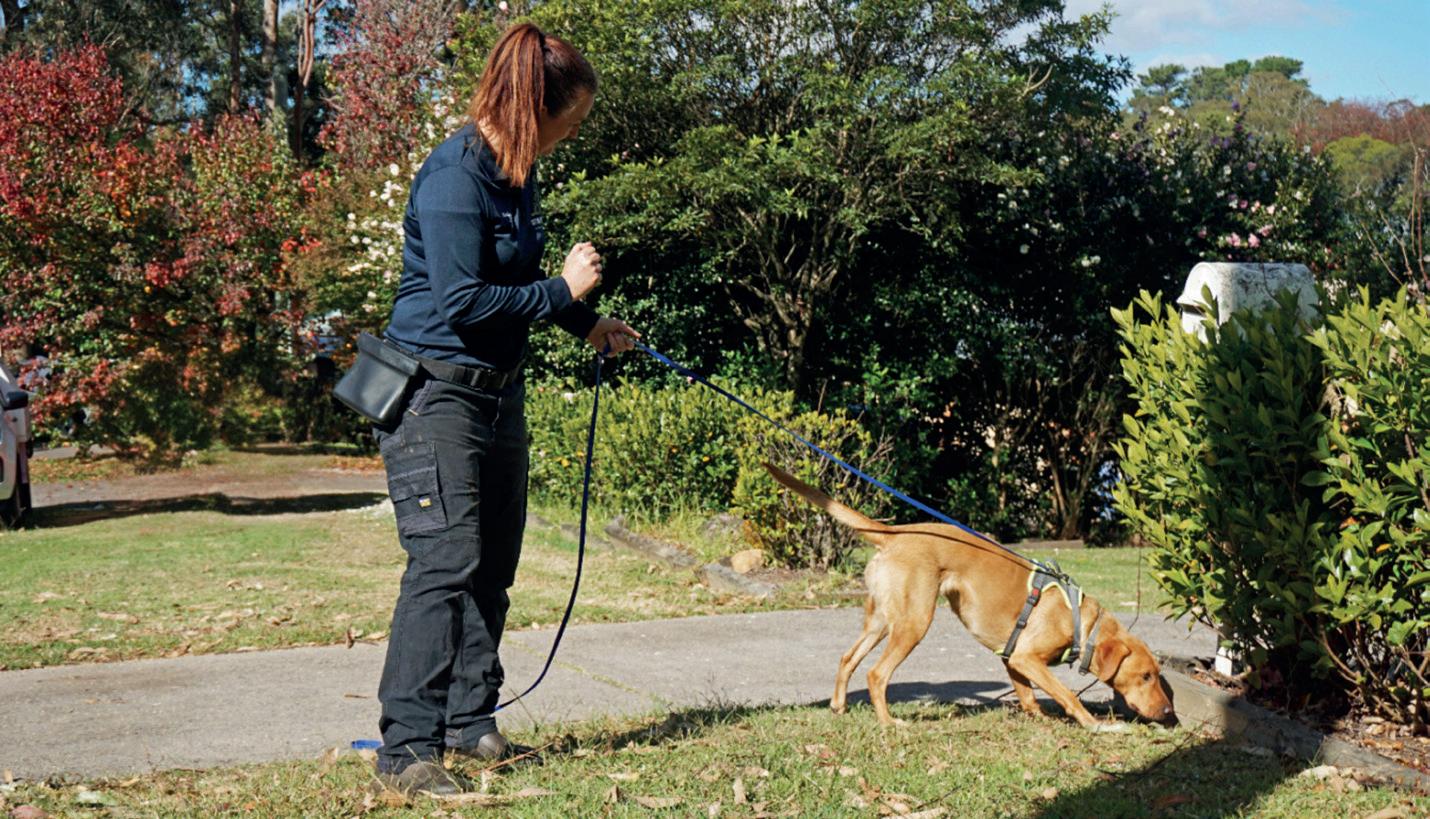
“The dogs’ strength is that it doesn’t matter what type of pipe the water is going through,” Harvey said. “A lot of other technology can be a ected by the type of pipe.”
Harvey later established her own operation to bring leak detection capability to regional councils across New South Wales.
Her work has included di cult terrain in the Blue Mountains, where detector dogs located hidden leaks in areas crews had searched unsuccessfully for days.
“We had dogs in the Blue Mountains National Park where crews had been trying to find a leak through hard terrain,” she said. “The dogs went straight through the terrain and found the leak within 40 minutes.”
The dogs also create opportunities in environmentally sensitive areas where utilities want to minimise disturbance.
Narrowing excavation zones can reduce damage to vegetation, access tracks and protected land while helping crews target repairs more e ciently.
For regional councils with limited resources, operational e ciency can become especially important.
A smaller field crew supported by a detector dog team may be able to investigate large pipeline sections far more quickly than traditional manual approaches alone.
Reading the dog
The e ectiveness of leak detection dogs depends heavily on the handler’s interpretation of their canine companion.
Training a dog to recognise an odour is only one part of the
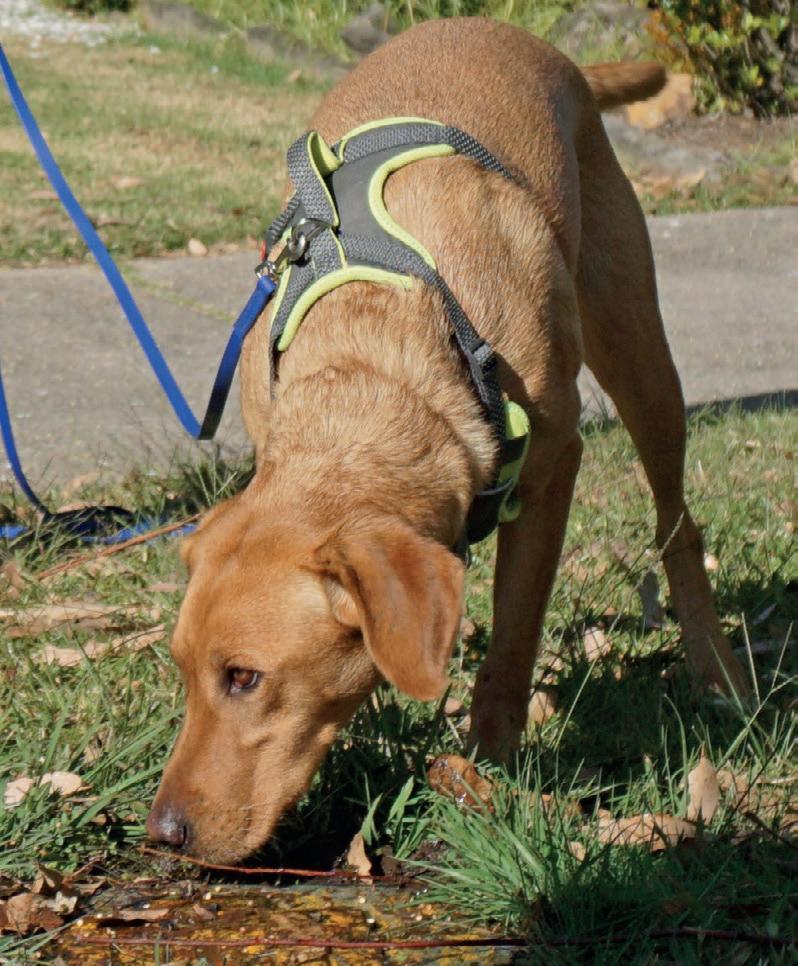
Nicole Harvey working with Toast, a working line labrador, on a suburban Sydney street.
Image: Nicole Harvey, Cutting Edge Canine
process. Handlers must also learn to identify subtle behavioural shifts that indicate the dog has encountered a scent trail.
“We teach handlers how to interpret subtle changes in the dog,” Harvey said.“It could be a tiny head flick toward an area. We need to be able to interpret that.”
Austin describes detector dog training as both a science and an art
The science involves conditioning, odour imprinting and reinforcement techniques.
The art lies in understanding the individual dog, selecting the right reward system and knowing how to maintain motivation.
Toast hard at work.
Image: Nicole Harvey, Cutting Edge Canine
“The reward only comes from training,” Austin said. “Training is the highlight of the dog’s life. It is the best thing in the dog’s life.”
COVER STORY Detector Dogs

The dogs used in water utility work are typically working-line Springer Spaniels or Cocker Spaniels. Austin said the breeds are selected for their strong hunting instincts, energy, and natural search behaviours.
“You want a dog that wants to go out and search first,” he said. Developing a fully operational detector dog team can take up to 18 months.
The process begins early, often from eight weeks of age, with extensive socialisation and environmental exposure. The dogs are trained to operate in the presence of machinery, tra c, livestock, and di cult terrain before odour-specific training intensifies. Handlers also undergo significant development during that process.
“At Sydney Water, we connected pretty quickly,” Harvey said of her partnership with a detector dog named Joey. “We got to the point where if he was going to move a certain way, I could predict that movement.”
That trust can directly a ect operational outcomes.
Harvey recalled one incident in which Joey indicated a leak beside a roadway, despite acoustic crews being unable to detect anything unusual.
“When they dug it up, two and a half metres underground, there was a tiny drip on the main,” she said. “If I hesitated and I didn’t believe him, he may have lost confidence in that type of leak.”
Willmott said building that relationship with Kep took time after taking over handling responsibilities from a previous team member. Once the partnership strengthened, the field results improved as well.
“When we started really getting in sync, and we were finding those leaks, that first non-visible leak that we found together was my favourite,” she said.
Finding the invisible
Much of the value of leak detection dogs comes from their ability to locate non-visible leaks. These are leaks with little or no surface evidence, often hidden beneath soil, vegetation or drainage systems.
Willmott recalled one example in regional Western Australia where Kep identified chlorinated water near what appeared to be a standard drainage runo area.
Residents believed the pooling water came from stormwater drains running through nearby hills.
Kep disagreed.
“She was definitely on odour,” Willmott said.
Field crews later investigated and discovered a buried leaking scour valve that had likely been leaking for an extended period.
The dogs can also reduce excavation requirements.
Rather than digging large areas to isolate faults, utilities can significantly narrow search zones. That creates advantages around labour, environmental impact and cultural heritage protection.
“You’re minimising the amount of digging and protecting the flora and fauna,” Willmott said. “The dogs pinpoint where those water sources are coming from.”
The approach aligns well with regional Western Australia.
Open farmland, sandy soils and lower background water activity allow the dogs to work more freely and detect odours more e ectively.
“In the regional areas, it’s open paddocks,” Willmott said. “You don’t have these obstacles in place and tra c. The dogs can work freely and systematically.”
The work still presents challenges. Handlers must manage heat, snakes, livestock, long-distance travel and remote safety conditions. Water Corporation’s teams carry satellite communications equipment and conduct specialised safety training, including snake aversion conditioning for the dogs.
Despite those challenges, the programme continues to expand.
Water Corporation recently added Piper, a working-line Cocker Spaniel being trained to be the next generation of leak-detection capability.
Willmott has trained Piper since puppyhood under Austin’s mentorship.
“Seeing her recognise the odour and commit to the indication with no hesitation was really exciting,” she said.
Louise Willmott with Kep and a young pup ready for training. Image: Water Corporation
Austin believes those early stages of training are critical because they shape how confidently the dogs will work in unpredictable field environments later.
“You start them o nice and young,” he said. “Then you’ve got to get your handler and make sure your handler is trained correctly.”
More than a novelty One of the biggest barriers facing detector dog programmes remains perception.
Utilities unfamiliar with the capability can initially view the dogs as novelty additions rather than operational assets.
“I think it’s hard to believe sometimes that this is even possible,” Willmott said. “They’re not just a mascot. They’re genuinely finding those leaks.”
Austin believes detector dogs remain widely underestimated across multiple sectors.
“I honestly believe we’re not even touching the surface of the ability of a detection dog at the moment,” he said.
That thinking extends beyond drinking water networks.
Utilities and trainers are already exploring how detector dogs could support wastewater detection, environmental monitoring and broader asset management activities.
The challenge will be integrating canine detection capability into increasingly digital utility environments.
Austin does not see detector dogs competing directly against advanced technologies such as sensors, AI or remote monitoring systems.
Rewarding your detector dog consistently is key to e ective training.
Image: Water Corporation

Instead, he sees them operating alongside those tools.
“The technology is great,” he said.
“But the dog can be a very good backup for the technology, and the technology can be a good backup for the dog.”
For utilities facing growing pressure to reduce water loss, manage ageing infrastructure and improve operational e ciency, detector dogs are proving they can o er something di cult to replicate.
They can find the invisible. And sometimes, they can do it faster than anyone expected.
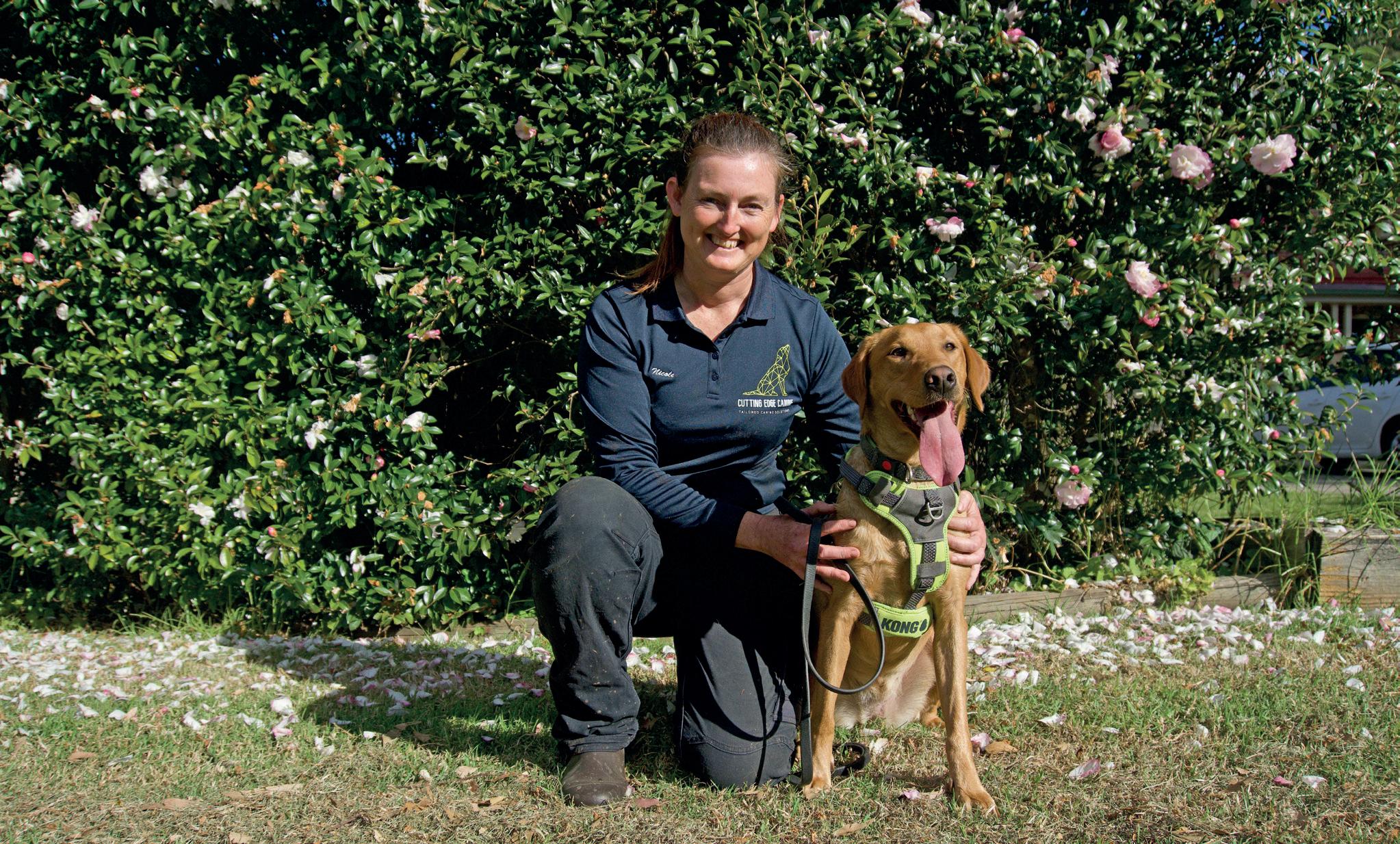
Harvey with Toast.
Image: Nicole Harvey, Cutting Edge Canine
Digital Water
The decline of concealed leak rebates
Water utilities have been reducing the financial impact of leak rebates and the administrative headaches associated with investigations and claim processing.
UNEXPECTED WATER BILLS caused by hidden leaks can place significant financial pressure on households and businesses. To help customers facing these circumstances, many water utilities o er concealed leak rebates. This is a form of financial relief designed to reduce the impact of water lost to concealed plumbing failures.
Digital metering technology is becoming more widespread across Australia and New Zealand. Utilities are now focusing on preventing costly leaks before they escalate. In many cases, this reduces the need for rebates.
What is a concealed leak rebate?
A concealed leak rebate is a partial refund or credit from a water utility. It applies when a customer’s bill rises sharply because of a hidden leak. This is particularly the case when the leak exhibits no visible sign of water loss, and the fault and/or loss could not reasonably have been identified. A common example is an underground service pipe leaking between the meter and the property. Others include burst pipes beneath concrete slabs, leaks hidden within walls or ceilings, and irrigation system failures that are not immediately visible.
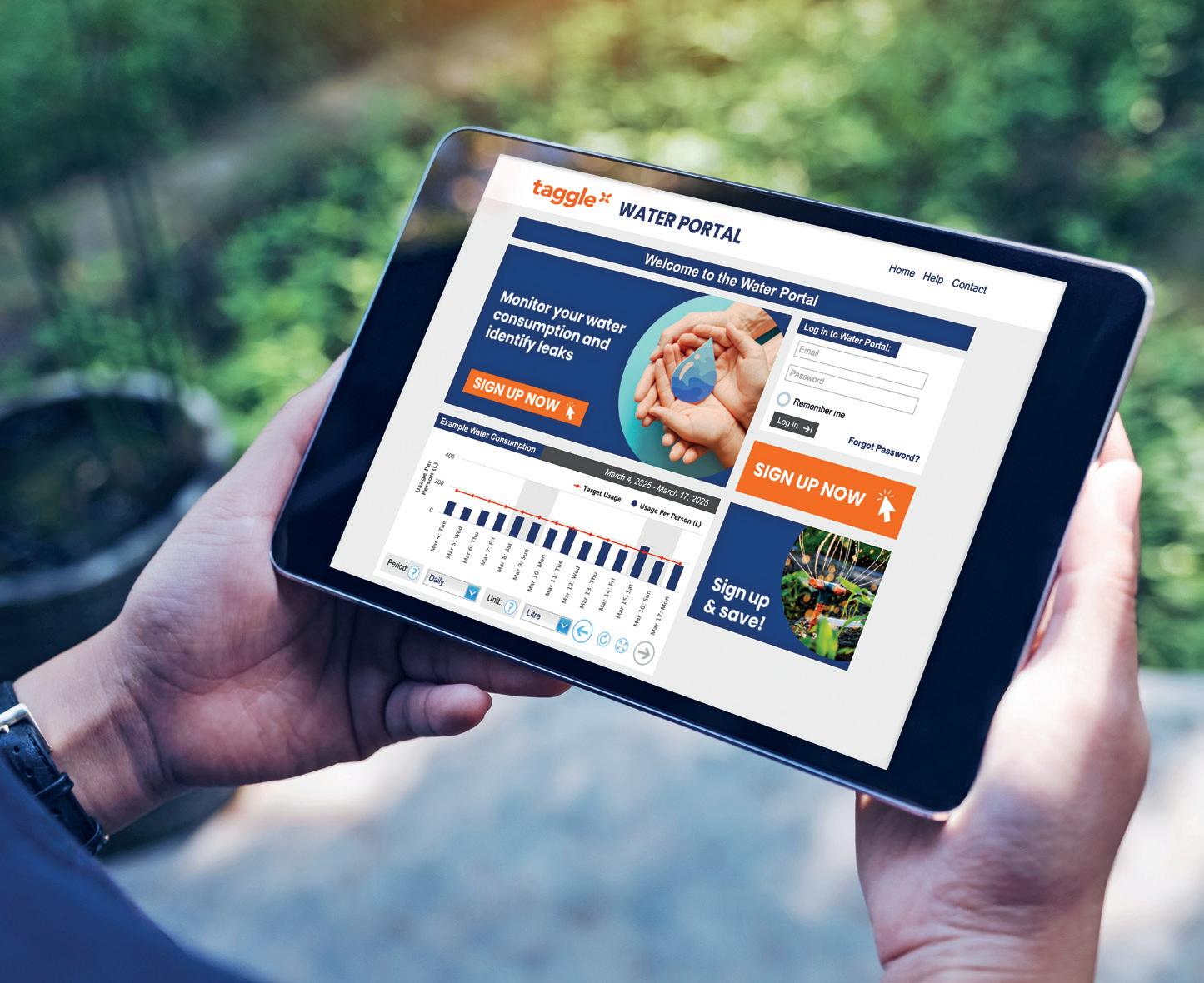
Customer Portals reduce claims and prevent bill shock.
Images: Taggle
Other costs associated with leak rebates
Most discussions about leak rebates focus on the rebate payment itself. However, the true cost to utilities is often much higher. There is a range of operational, administrative, and customer service costs that underlie every leak rebate claim.
High bill enquiries often lead to lengthy investigations. Sta may need to manage customer calls and complaints. They may also review consumption history, inspect sites, test meters and assess plumber reports or invoices.
These activities consume sta time and resources. Across thousands of small administrative tasks, the annual cost can become significant for resource-challenged water utilities and local governments.
This time could be better utilised through proactive leak notification procedures enabled by digital water metering.
The impact of digital meters on leak rebates
Digital water meters enable earlier leak detection. They also support faster customer notification and quicker repairs. That can stop small leaks from becoming major billing events.
Without digital meters, a leak may only appear at the end of a billing cycle. By then, it may have been running for weeks or months. Digital meters can trigger a notification within days. Hourly water consumption data allows utilities and customers to identify continuous water flows, overnight water use and unusual water flow patterns.
Customer portals
Digital metering portals empower customers to identify unusual usage on their own. They are alerted to leaks by SMS or email rather than
waiting for a quarterly bill. Driving sign-ups can be challenging.
Having said that, it’s a worthwhile investment, as customers who have registered will not be hit with bill shock from concealed leaks.
With access to hourly data, leak alerts, and monthly email consumption reports, many leaks that would previously have resulted in a rebate claim are now resolved before reaching the threshold for assistance. Any water usage questions to customer service can be answered quickly using the data in the portal.
Most utilities revise their Concealed Leak Rebate Policy when they install digital meters. Once usage data is available via a customer portal, some leaks are no longer considered concealed. This places greater responsibility on property owners and residents to monitor usage and maintain plumbing infrastructure.
Utilities can provide the additional service of sending leak notifications to all properties with leaks via either SMS, email or letter. This is generally considered an added service, and such a notification, or lack thereof, does not alter the availability of a rebate.
Clauses are also often added to policies that require property owners to sign up for the customer portal to receive the rebate. This ensures that any future leaks are quickly detected through system alerts.
The proven impact
The long-term value of minimising leak rebates is best demonstrated by Mackay Regional Council, the first Australian utility to complete a full digital meter rollout.
Since installing Taggle digital water meters across its network in 2012, Council has reduced its annual leak rebate costs from around $150,000 to just $14,000.
More than a decade after deployment, Council continues to actively alert customers to leaks, reducing leak rebates by 90 per cent. Customer leak rebates will continue to play an important role in supporting households a ected by hidden plumbing failures. However, the future of leak management is increasingly focused on prevention rather than compensation.
Digital metering, proactive alerts and customer self-service tools are enabling utilities to detect leaks earlier, reduce water loss and minimise bill
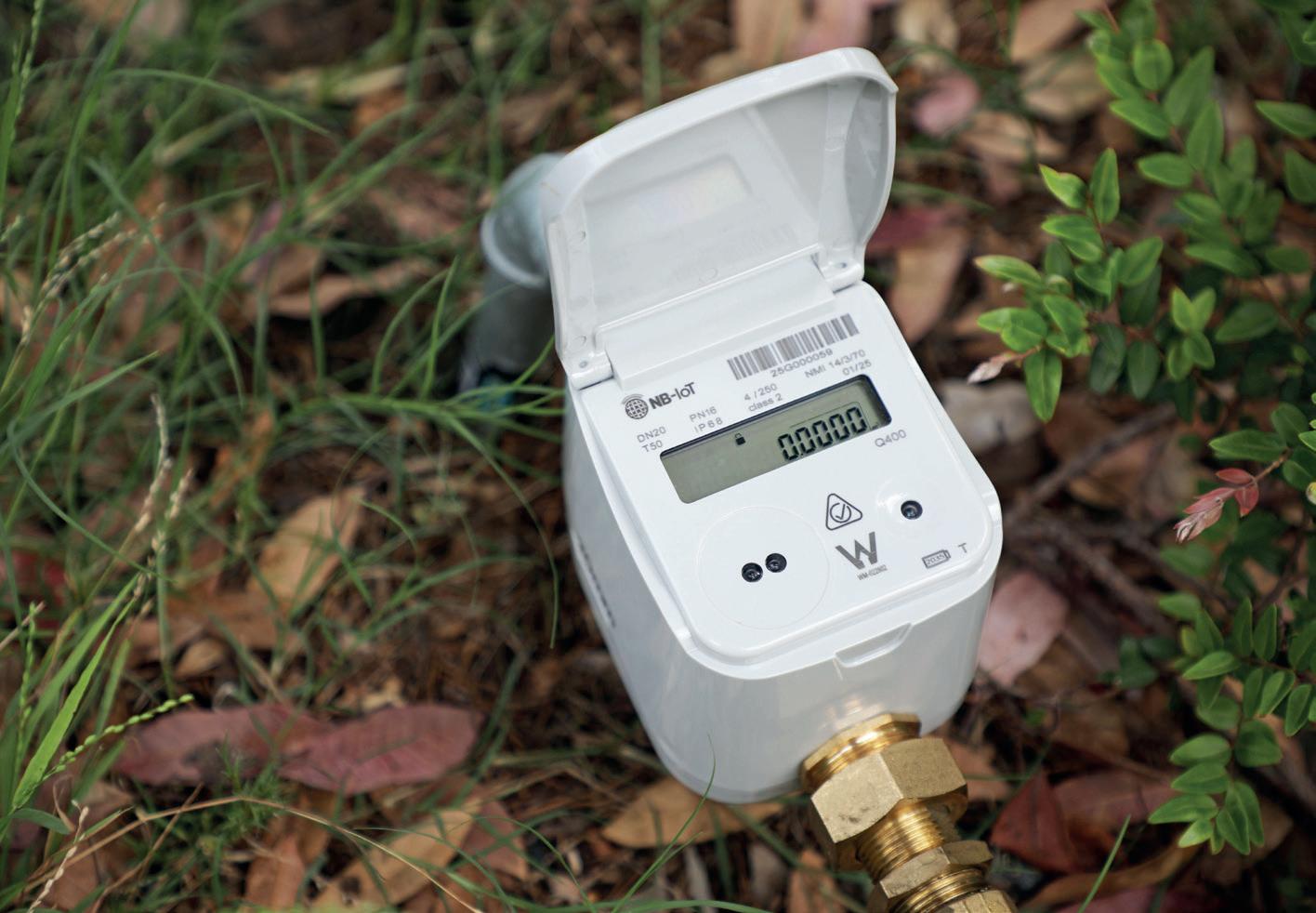
Digital metering empowers users to identify and fix leaks before needing a rebate.
Concealed leaks can be quickly identified with data – don’t wait for the grass to grow.
shock. As these technologies become more widespread across Australia and New Zealand, utilities have an opportunity to reduce the financial and operational burden of leak rebates while delivering better outcomes for customers and the environment.
For many utilities, the shift is simple. Digital metering helps them move from ‘finding leaks after the bill’ to ‘finding leaks before the bill.’
That is one of its clearest customer benefits.
To learn more, visit taggle.com

STOP GUESSING
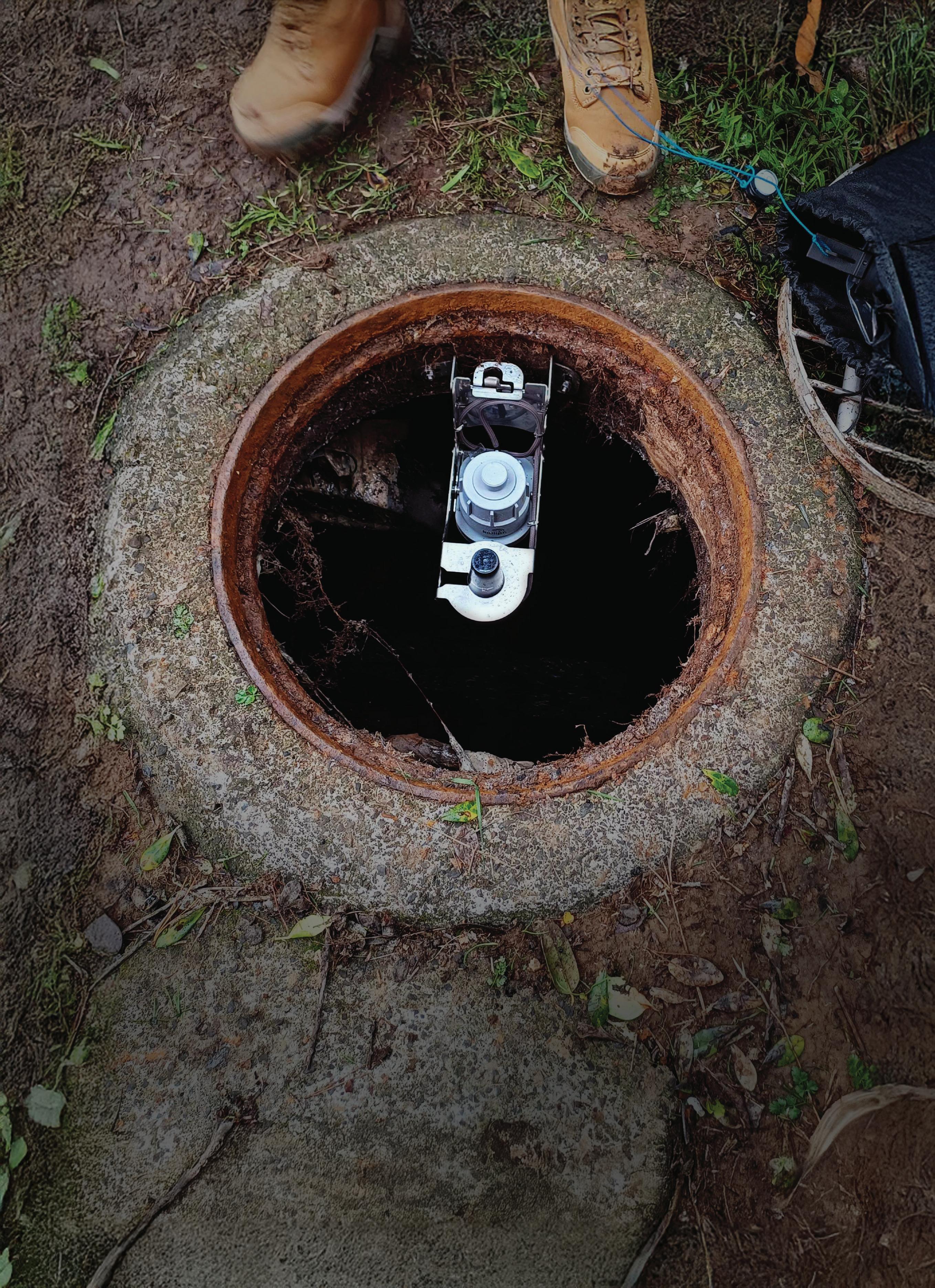
Remote monitoring hardware and software built for utilities and councils. Installed fast. Runs for years. Data you can act on.

FOCUS Digital Water
From alert to action
StormHarvester’s work with Barwon Water explores how predictive analytics can support utilities to better interpret sewer alerts.
IN THE OPENING episode of The Newsroom, a producer is told there is a news alert. His response is blunt: “It’s yellow.” The alert is visible, but it is not yet urgent enough to interrupt the room. Water utilities know that feeling. Control rooms, smart networks teams and field crews already deal with large volumes of telemetry, SCADA alarms and sensor data. The challenge is understanding which alerts are meaningful, which asset needs attention and which warning could prevent a sewer overflow before it becomes a problem.
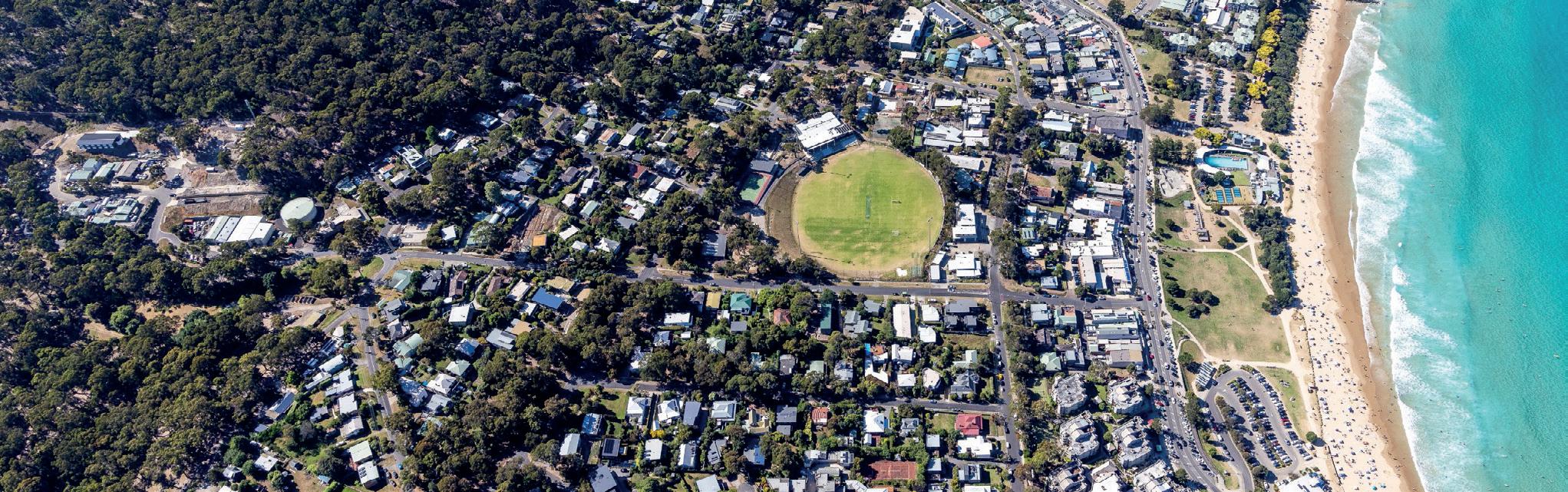
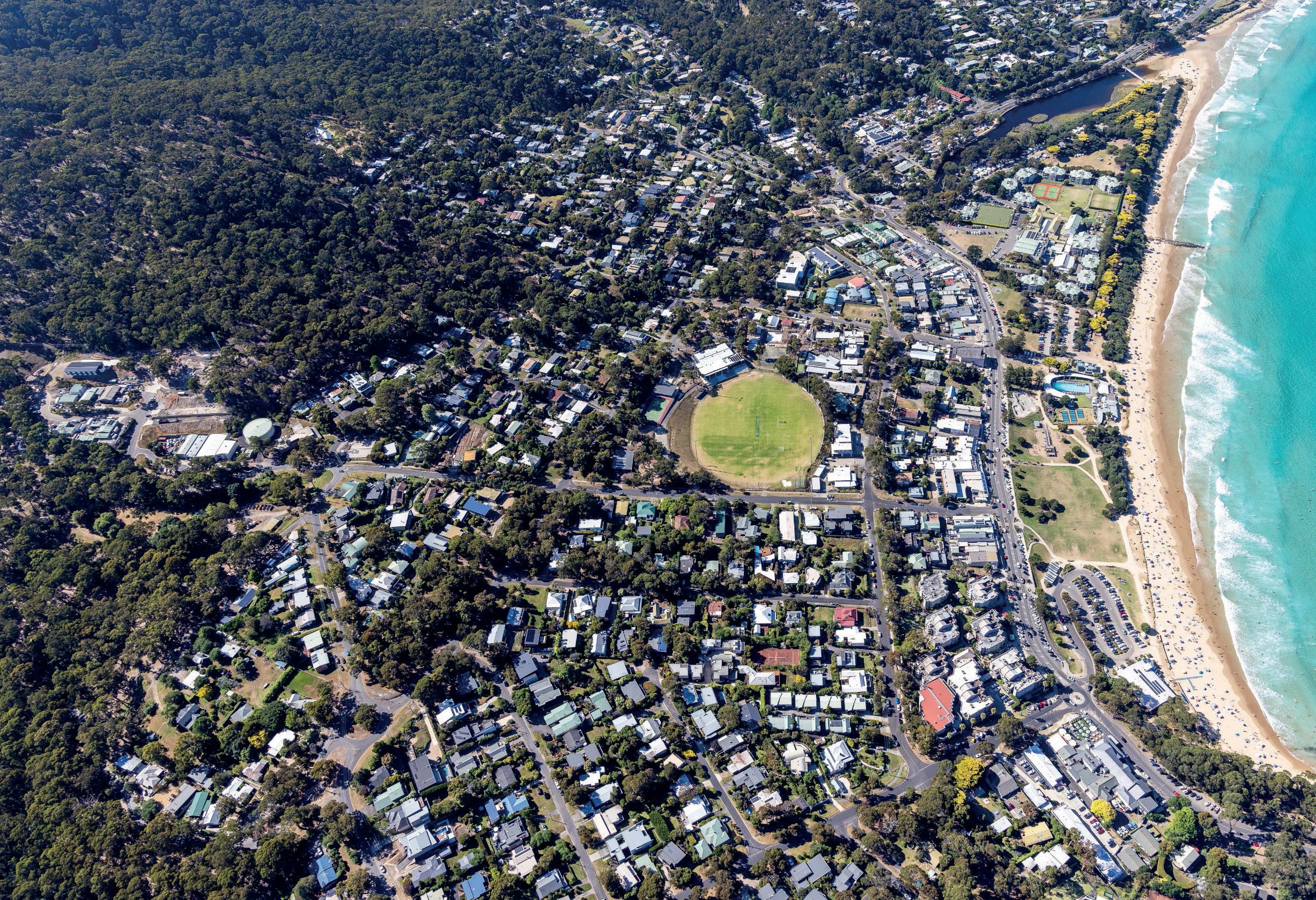
This challenge sits at the centre of a trial deployment undertaken by StormHarvester and Barwon Water in Lorne, a coastal town on Victoria’s Great Ocean Road.
The trial began in 2025 as Barwon Water explored opportunities to that would help them shift from reactive wastewater network management to a more proactive model and StormHarvester came in as a trial technology partner supporting risk management, using sewer level sensors and machine learning to identify developing blockages before they became incidents. The setting mattered. Lorne has a relatively small permanent population, but visitor numbers swell during holiday periods. Wastewater flows can rise quickly. The network also faces coastal conditions, including groundwater infiltration and tidal influences, as well as the usual sewer risks of fats, wet wipes, roots, sand, and silt.
The beautiful coastal town of Lorne has been hiding a challenge.
Image: Barwon Water, Barwon Asset Solutions
“We will forecast how conditions are going to evolve, change, and then prioritise the interventions where the risk is highest and where we think there is actually a problem,” StormHarvester’s Gus Thiele said.
From alarms to action
The biggest issue is not whether utilities can collect data. Many already can. The bigger challenge is whether operational teams can act on it with confidence.
“If the alerts are not reliable, they are just noise,” Thiele said. “What you get is alarm fatigue and mistrust within the utility and the operational team. They start to ignore and deprioritise things because it is false, it is not urgent, or it is a sensor issue.”
That is where StormHarvester’s role moves beyond simple alarm management. The digital platform learns how an asset normally behaves, accounting for local
FOCUS Digital Water
conditions such as rainfall and seasonal changes. Instead of waiting until a sewer reaches a broad high-level threshold, it can detect abnormal behaviour much earlier.
Thiele said the older approach was often a blunt alarm set at a fixed level, such as 80 per cent full. That can miss early warning signs or create false alarms when conditions change.
“Because we can learn a baseline, we can alarm as soon as it goes out of baseline,” he said. “That is how you pick up early warning signs of things going wrong reliably.”
In Lorne, Barwon Water required alerts that could support operational decision-making, enabling crews to investigate potential issues before high levels, spills or customer impacts occurred.
Why Lorne tested the model
The Barwon Water case study highlights several early interventions.
In one example, StormHarvester’s predictive models detected unexpectedly high sewer levels at a maintenance hole, after accounting for rainfall and seasonal conditions. Crews later found a developing partial blockage and cleared it before heavy rainfall arrived.
In another case, an alert enabled Barwon Water to schedule a line clean before a busy holiday weekend. Crews identified a soccer ball-sized fat accumulation roughly 30 metres from the maintenance hole, along with tree roots and wet wipes. Jetting teams cleared the obstruction and investigated upstream and downstream sections.
A third example involved an unusual sewer elevation that remained abnormal even after rainfall was accounted for. Crews found sand and silt build-up and cleared it before it could turn into a spill during subsequent wet weather.
These examples are useful because they are ordinary. They do not rely on a rare asset failure or a dramatic network collapse. They show the everyday materials and conditions that can gradually restrict flow until the consequence becomes visible.
“Most utilities will have a good idea of where their problem areas are already, because they work the network every day,” Thiele said. “Where the analytics comes in is making sure that things are actually happening.”
Evidence for environmental risk management
The application of analytics sits within a broader environmental and regulatory context. Sewer blockages are a known contributor of pollution and overflow incidents.
In Victoria, utilities are subject to General Environmental Duty obligations, which require them to take reasonably practicable steps to minimise risks to human health and the environment.
Thiele said platforms such as StormHarvester can help utilities move from responding to incidents toward evidencing proactive risk management.
“What we are doing for Barwon Water at the moment is giving them really clear, data and insights that can support proactive risk management, not just reacting to incidents,” he said.
That evidence can be important during environmental audits or incident reviews. It can also support decisions about crew deployment, recurring issues and investment in sensors, analytics or renewal.
The Barwon Water case study also points to inflow and infiltration analysis across monitored networks. That broadens the value beyond blockage detection. Excess flows can a ect operational planning,
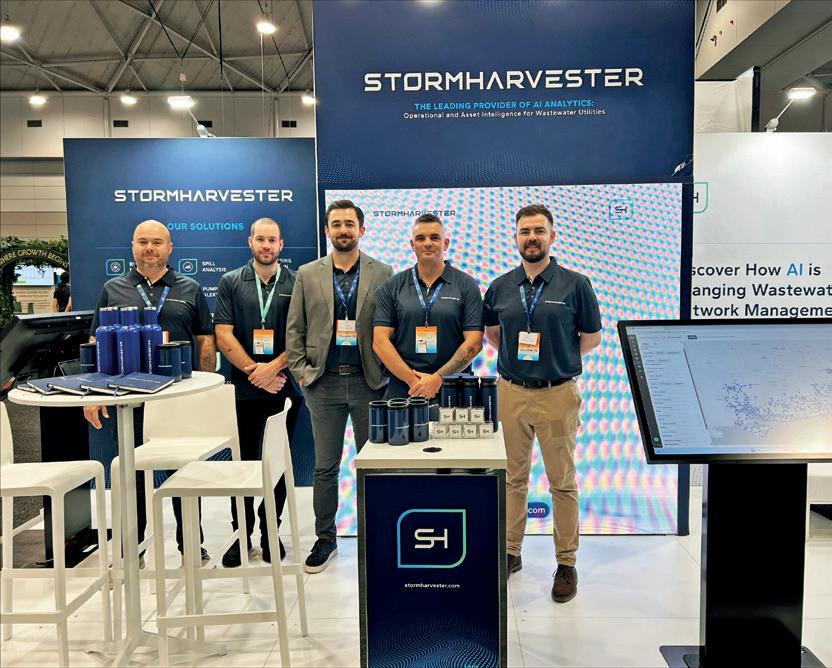
The team at StormHarvester showcased their solutions at Ozwater’26 in Brisbane. Image: StormHarvester
hydraulic model validation and longterm capital decisions.
“If you monitor a section of network and find out that your hydraulic model is slightly out of sync, that might change the sizing of a storage tank you were going to build,” Thiele said. “At worst, maybe your tank is smaller. At best, maybe you never put it in.”
A clearer view of risk
This is why proactive risk management in this space matters. The story is not simply about more sensors or dashboards. It is about providing utilities with better evidence to act, especially where the consequences of failure are high.
“Wastewater analytics platforms had helped us and respond to potential blockages earlier,” Barwon Water’s General Manager, Smart & Sustainable Infrastructure, David Snadden, said.
That earlier response is the practical point. In a sewer network, a yellow alert should not be ignored, but it also cannot be allowed to become one more colour in a crowded control room. The value lies in knowing when yellow means “watch” and when it means “send a crew now.”
For Australian utilities facing ageing assets, climate pressures, population shifts and tighter environmental expectations, predictive sewer analytics is becoming less of a technical add-on and more of a way to manage risk before it becomes visible.
For more information, visit stormharvester.com
Rodents. Termites.
NOT ON OUR WATCH

Stop
Tricab Water Treatment cable systems last up to 7 times longer than standard cables in harsh water and wastewater environments.
CABLE SYSTEMS DESIGNED TO LAST
Continuous operation in fresh and salt water down to 1000m
Non-Toxic and Safe for Drinking Water
Resists chlorine, ozone, acids and alkalis
Resists rodent bites and high impact
UV and Weather resistant
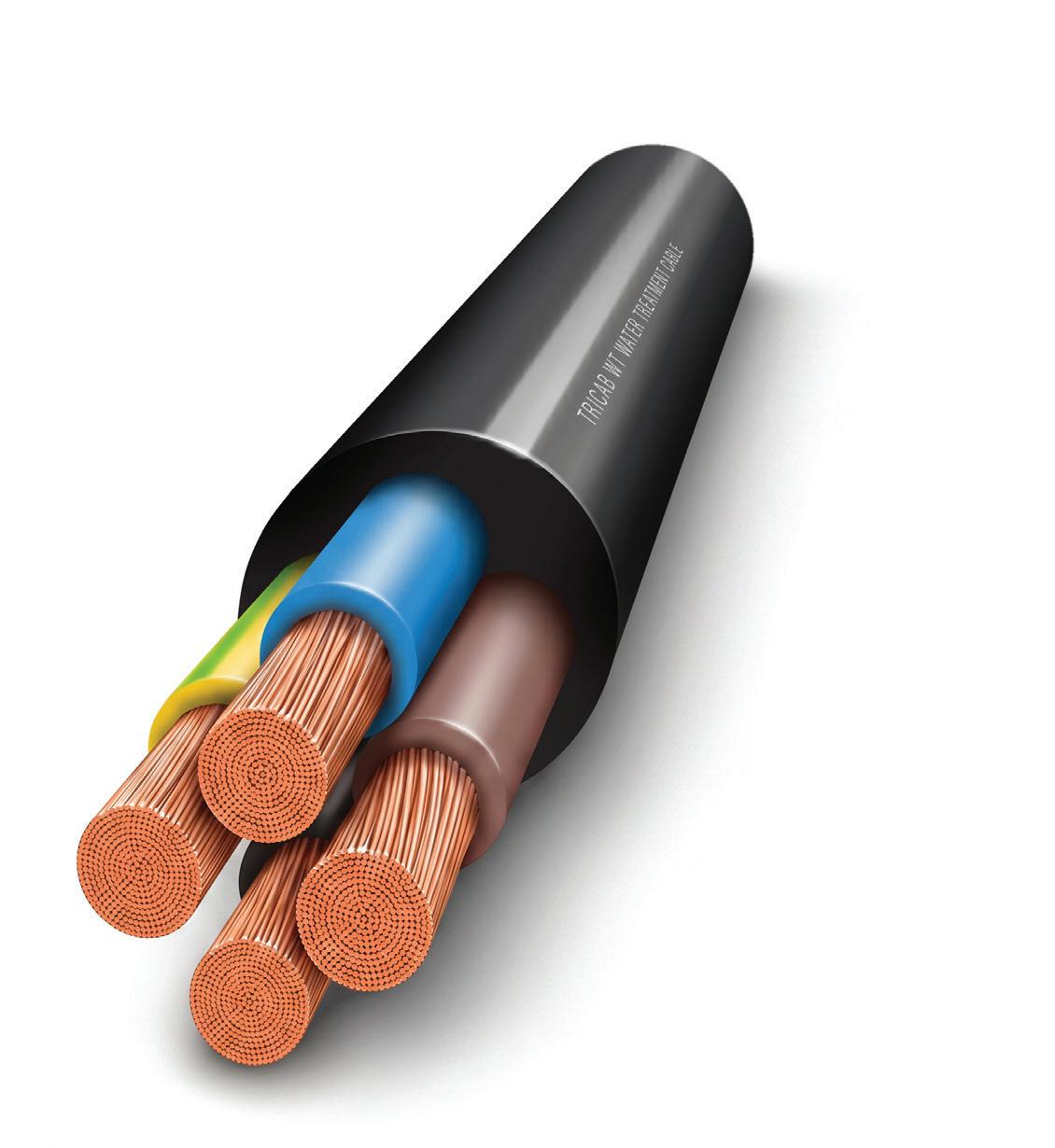
Premium PUR Jacket
Superior resistance to abrasion, oil, chemicals, cutting, cracking and UV
Tough & Durable
Resists rodent bites, impacts, moisture and harsh conditions
Anti-Termite Additive
Buit-in barrier that deters termites and insects
Fine copper stranding Allows for super flexibility and better performance
FOCUS Digital Water
Smart metering the farm
Data Right is applying its smart water metering experience to agricultural irrigation, where compliance, timing, and trust all matter.
WATER METERING HAS moved beyond a basic measurement point on an irrigation property. Across Australian agriculture, meters now sit within a broader conversation about allocation management, regulatory obligations, and confidence between water users and authorities.
That shift has created a need for installers who understand formal metering requirements and the practical realities of farm sites.
Data Right, known for smart meter and automated meter reading installations, has moved into agricultural irrigation meter installation as part of its ambition to become a holistic provider across water metering.
According to Data Right’s Ian Joblin, the move followed industry discussions that identified a shortage of qualified sta .
“We continue to strive to grow to a holistic service provider for all things water metering,” Joblin said.
“In discussions with the Queensland Minister for Water, we were made aware of a need for additional duly qualified persons and certified meter installers. The way this integrated with our existing skillset meant it was a logical progression.”
That progression has taken Data Right from dense, urban meter programs into a more variable operating environment.
Managing water on the farm is becoming a non-negotiable for state governments and water utilities across the country.
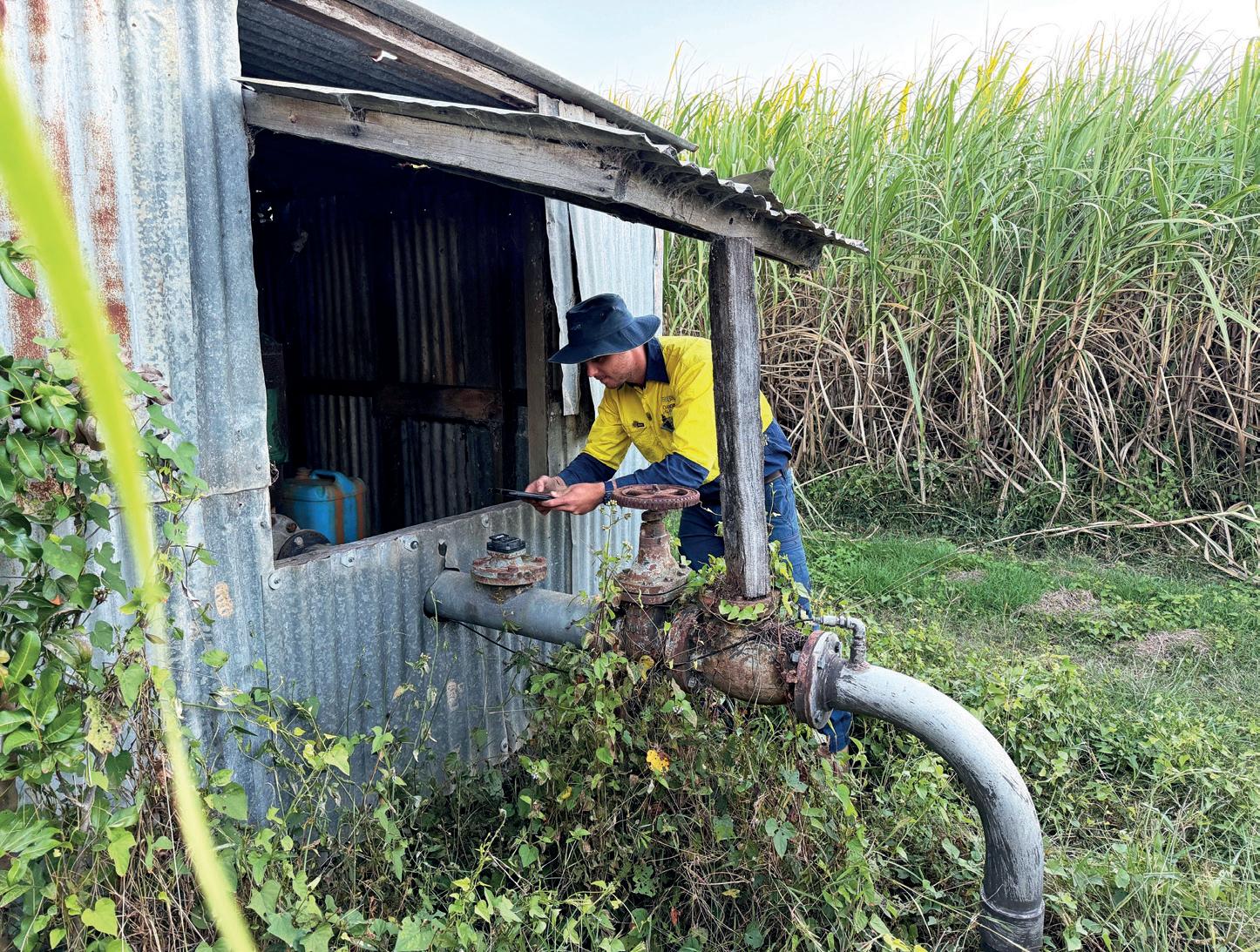
Di erent ground
Agricultural meter installation can involve installing a new meter or certifying an existing installation. In either case, the process is not just about fitting a device.
Joblin said the work involves confirming that a meter has been installed correctly in line with manufacturer requirements and metering standards.
It also requires checking the meter’s function and the adjacent pipework. The installer must then issue a certificate within the relevant state cycle. The result must satisfy both the irrigator and the department and it must also protect the integrity of the measurement process.
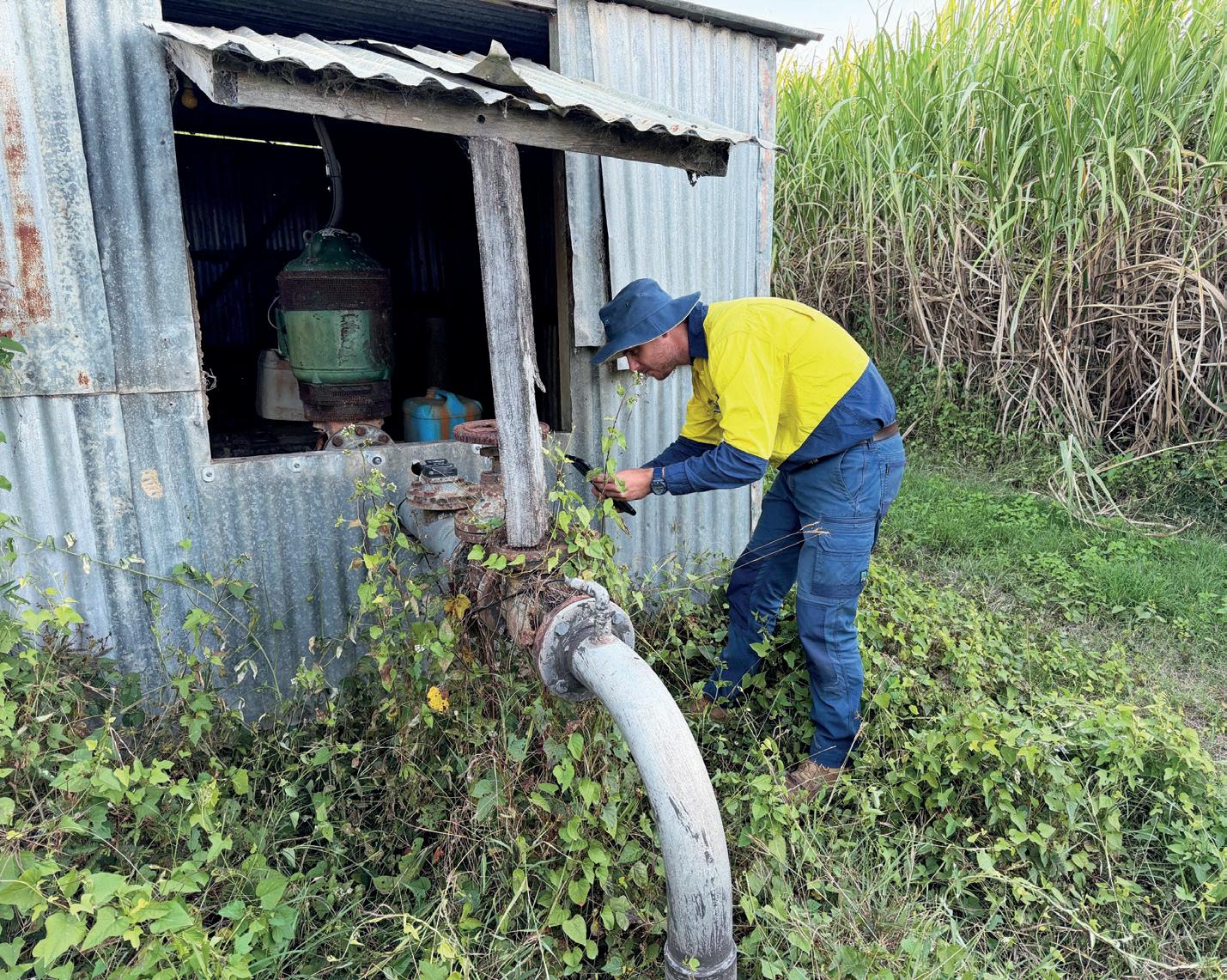
“The meters are geographically far more spread out than most residential meters, are larger in size and are pressured by a pump rather than mains pressure,” Joblin said.
“The installation still requires all the usual planning and interaction with the property owner, and satisfaction of the owner and the department are the driving factors behind our service levels.”
Growers and irrigators face a di erent set of pressure points when meters need to be installed, upgraded or brought into compliance. Cost matters, as does access to materials and qualified installers.
Seasonal conditions can also change the urgency of the work.
Joblin said demand can fluctuate when rainfall is high, and water storage is available. In those periods, new installations or the maintenance of existing certifications may become less immediate.
That variability places more weight on planning, communication and timing. A metering program that works in an urban rollout may need careful adaptation before it can succeed across agricultural sites.
Images: Data Right
Scoping the site
Every irrigation site carries its own constraints. A meter may sit on a pump line, near a channel, beside groundwater infrastructure or at a remote point on a property.
Reliable installation begins before field crews arrive.
Joblin said the meter is just one part of the assessment. Water quality, piping systems, water volume requirements across hectares, terrain and drainage can all a ect the final metering solution.
“Understanding the end requirements and working backwards to scoping the best solution,” Joblin said. “Installation, validation and handover are all simple with a well-scoped and planned solution that meets all manufacturing and metering specifications along with irrigation outcomes.”
That early work can also reduce disruption. Weather, crop cycles, seasonal tasks and limited windows for site access shape agricultural operations and Data Right’s approach is built around communication and flexibility.
“Communication is critical,” Joblin said. “Understanding seasonal tasks and fitting in with windows of opportunity comes from understanding the irrigators we deal with and communicating e ectively with their needs. Having the available resources to be flexible with our service delivery is a key to customer satisfaction.”
The same focus carries across from Data Right’s large-scale utility meter rollouts.
“We don’t believe it matters what industry you are in,” he said.
“The minute you lose sight of what your customers’ key outcomes are from your service is the minute you have lost sight of your business deliverables. That will always be at the heart of all services Data Right provides.”
Data and confidence
Certification requirements, automated meter reading capabilities, and closer monitoring of water consumption have driven recent changes in agricultural metering. Joblin said in the agricultural space, that change has not always been voluntary.
“If we are being honest, for a lot of irrigators, the change is being forced upon them,” he said.
Yet once the change is accepted, better data can deliver practical value.
“Once that change is accepted, we are seeing far greater control over utilisation of water resources at an optimal level to provide the best outcome for crop productivity,”
Joblin said.
Smart meters and automated meter reading can shift the conversation too.
Accurate measurement remains essential, but timely data can also support operational decisions and
With agriculture counting for a significant portion of Australia’s economy, understanding how water is used is vital.
strengthen trust between irrigators, water authorities and regulators.
Joblin said the key benefit is simple: timeliness.
“Being transparent allows all parties to work together to achieve desired outcomes,” he said.
Better visibility can help water users understand what is happening on site sooner, rather than relying only on retrospective readings or periodic certification checks.
Joblin sees smart metering as the strongest short-term opportunity.
“The move towards smart metering will provide the biggest short-term benefit for irrigators and water authorities,” Joblin said. “A better understanding of what is happening in a timely fashion then provides opportunity for improvement.”
For more information, visit dataright.com.au
Digital Water
Keep the water flowing
Saltire Infrastructure is helping utilities and contractors work on live water networks while reducing shutdowns, water loss and community disruption.
WHEN A TOWN or community loses water, the problem reaches beyond the pipes. It reaches the kitchen sink, the school, the business and the operator who has to explain when the supply will return.
Water utilities know planned works can become a community issue when a shutdown means tankers, bottled water, night shifts and customers waiting for updates.
Saltire Infrastructure Managing Director Cailean MacLellan sees that pressure from both sides of the trench.
His company works with utilities to deliver complex live network and infrastructure works while helping reduce the need for planned shutdowns through live network planning, live water mains inspection, hot tapping, line stopping, bypass systems and live insertion valves. MacLellan started in civil engineering in Glasgow, where
Scottish Water contracts drew him towards the water sector.
After moving to Australia, he worked on water treatment plants, wastewater systems and pipelines in the Pilbara, including infrastructure for a 3000-person village.
Why do shutdowns create hidden pressure?
The problem of water main shutdowns became sharper during COVID. MacLellan was working on mains replacement programs in Perth when the normal assumptions around daytime outages changed.
Before work-from-home arrangements became common, crews could often isolate a water main during the day with limited customer impact. Once people were home, the same activity became much harder to justify.
“Shutdown of water mains during the day was normal, where
everyone’s at work and at school, and it had minimal impact to residents and the community”, MacLellan said. “With everybody at home, you couldn’t shut down the pipeline anymore and everything became night shifts and weekend working”.
Night work reduced daytime disruption, but it carried its own cost. Crews needed overtime, rest periods and altered rosters. Stakeholder management also became harder when construction activity moved outside normal hours. MacLellan said the direct construction cost is only one part of the equation. A shutdown can require months of planning, admin work and input from utility teams, councils and other a ected stakeholders.
Water loss is another issue. In regional towns supplied from a single tank or feed, traditional isolation may require emptying a tank or a section of the main before work can begin.
“The stakeholders are without water for a prolonged period of time, so then you have to provide water tankers to the residents, water bottles and community engagement. Those types of impacts are not always factored into the cost analysis when comparing live network technologies with traditional shutdown methods,” MacLellan said. Beyond the immediate outage, utilities must also account for the time required to recharge and refill the network once works are completed, adding further operational and community impacts that are often overlooked during shutdown planning.
How can utilities avoid shutdowns?
Saltire’s approach is built around creating safe, localised access to live water networks. Rather than shutting down a large section of the main, the company looks for ways
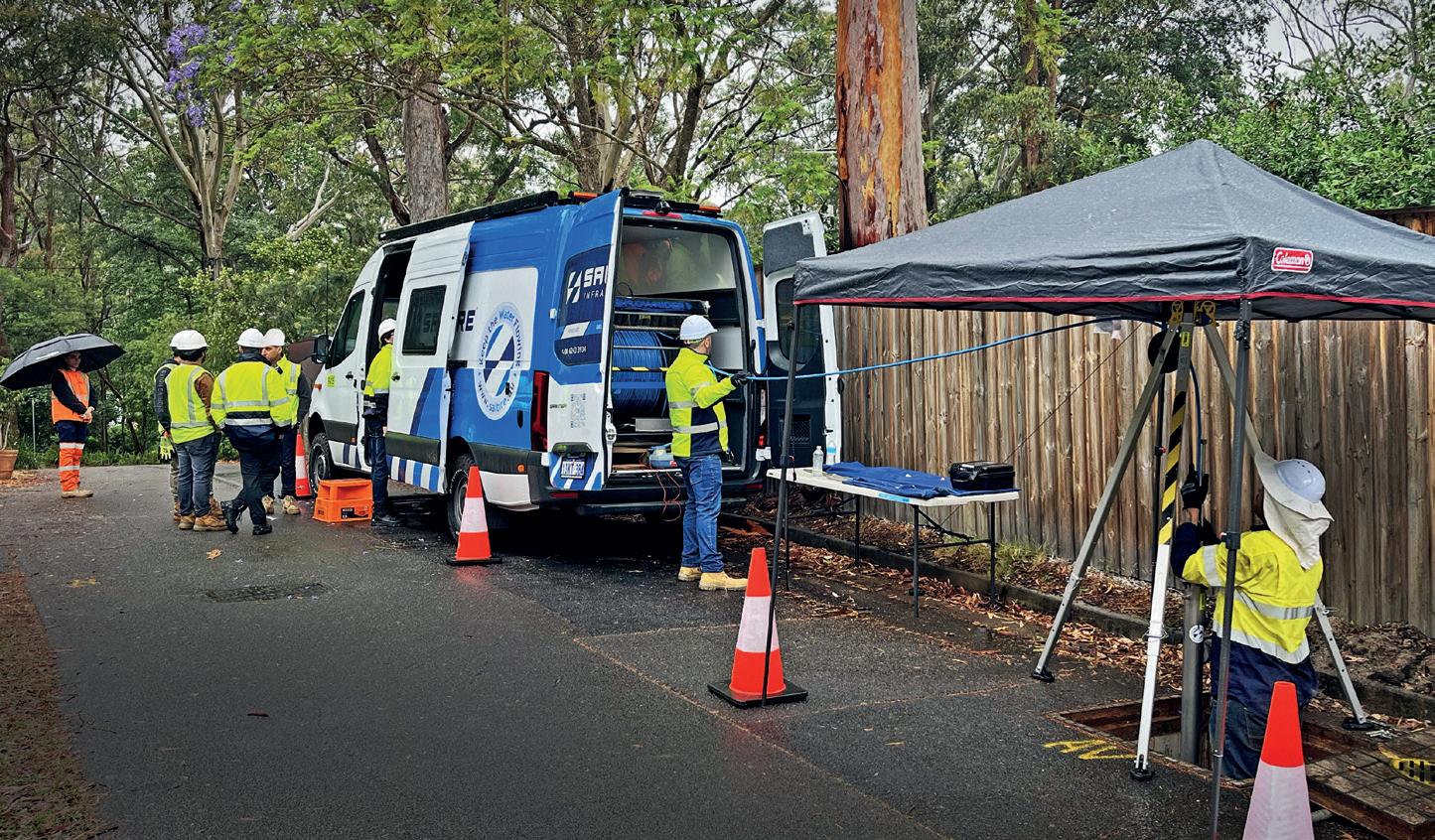
Getting out on site with trained professionals is central to the operations of Saltire Infrastructure. Images: Saltire Infrastructure
to inspect, isolate, bypass, repair or upgrade a targeted section while supply continues.
Cameras and acoustic leakdetection equipment can enter a pipeline while it is still operating at full pressure and flow. That gives utilities information that may disappear once a main is drained or taken out of service.
Live inspection can help identify leaks, assess conditions, locate missing assets and test whether a planned isolation carries extra risk.
Hot tapping allows new services or fire services to connect to existing mains without interrupting customers.
Line stopping and bypass systems can remove short sections from service while water continues to move around the work area.
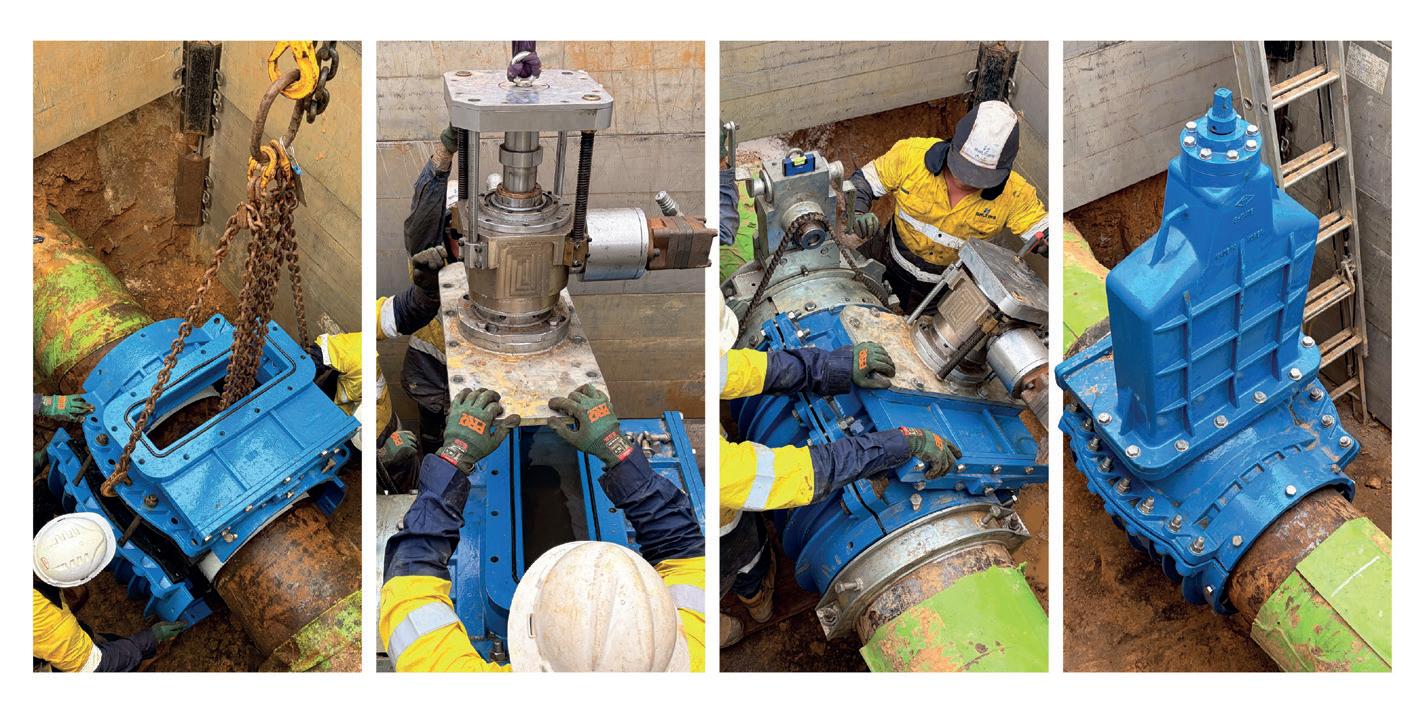
Saltire also uses live insertion mechanical valves. These can be installed under full flow and pressure, including in emergency environments.
“The live insertion valve is very unique, it’s a full mechanical isolation provided on that pipeline,” MacLellan said, “providing safe access for crews to undertake repairs and maintenance works while the network remains live”.
The valve can remain in place as a new asset, providing utilities with another isolation point for future maintenance.
Why does planning matter first?
MacLellan said the best solutions are achieved when Saltire is engaged early to assess alternatives to traditional shutdown methods.
Early planning allows the team to review network diagrams, confirm water sources, understand flow paths and choose the right combination of isolation and bypass tools.
“You’ve got the data from the water authority of what their network is
doing, you sit down, you understand it, and we plan it,” MacLellan said.
“The more we can control and plan the isolation or bypass, the less impact it will have and the smoother the process becomes”.
That planning reduces the burden on utility sta . Saltire’s team includes people who have operated and maintained water networks from the client side, giving them practical knowledge of how assets behave beyond a drawing set.
Its reliability has also been built through six years of repeat deployment in specialised livenetwork work. In a field where safe isolation, bypass planning and underpressure intervention leave little room for trial and error, that track record has helped establish Saltire as a partner capable of deploying the right technology under di cult operating conditions.
A regional project at Three Springs in Western Australia shows how that experience can a ect a community.
The town was supplied by a singlefeed steel pipeline with a section that repeatedly failed. A conventional shutdown would have left the town without water.
Saltire installed two live insertion valves, completed hot tapping
on each side of the main and established a temporary bypass before isolating the damaged section of the pipeline. Crews could then cut out and replace the failed section while maintaining supply to this regional town.
The same principle applies to smaller maintenance tasks. In regional and fire-prone areas, hydrant replacement programs can place pressure on local operators if each job requires isolation, customer notification and after-hours work.
Saltire’s method can allow multiple hydrants to be replaced in a day without broader service disruption.
As utilities focus more on trunk and distribution mains, MacLellan expects the technology to move into larger, higher-risk assets. Growth in towns and cities can make those mains harder to isolate.
The goal is not only to complete the asset work. It is to allow operators and communities to continue with less disruption while the work is underway around them.
“If you’re doing the Saltire way of the valve and hydrant program, it’s just business as usual for them,” MacLellan said.
For more information, visit saltire.au Their infrastructure is designed with water quality and security in mind.
FOCUS Digital Water
Continuous waste control
Continuous trade waste monitoring is helping SA Water identify discharge risks earlier, protect wastewater assets, and support customers before compliance issues escalate.
TRADE WASTE HAS always asked utilities to manage what they cannot always see. A scheduled audit or grab sample can capture a single moment, but trade waste does not behave like a standard meter reading. It changes with production cycles, cleaning processes and equipment faults.
SA Water’s work with Kallipr is turning continuous trade waste monitoring into an operational tool.
The utility is moving from periodic visibility to near-real-time data to support compliance, customer engagement, network protection, and charging.
Importantly, the monitoring data is directly accessible to and administered by SA Water. Previously, monitoring systems were generally administered and controlled by individual trade waste customers, limiting SA Water’s direct access and validation to operational data.
SA Water authorises and regulates trade waste discharges under the Water Industry Act 2012 and its Restricted Wastewater Acceptance Framework.
Trade waste can include fats and oils, suspended solids, nitrogen, metals, hydrocarbons, and high-strength organics from commercial, industrial, and manufacturing activities.
Before the project, SA Water said trade waste monitoring relied mainly on periodic sampling, customer reporting, inspections and reactive investigations after incidents or complaints. Monitoring information for major customers was also often spread across customer-owned portals and systems, limiting realtime visibility and validation.
Getting monitoring right is important, as a non-compliant discharge can a ect sewer assets, treatment processes, worker safety and final e uent quality before the next inspection. A customer may also breach limits without knowing quickly enough to respond.
Stelios Trikoulis, Kallipr CCO, said the traditional model carried an unavoidable data gap with limited ability for SA Water to independently access, validate and verify monitoring data.
“The historical way of doing it was point in time, labour-intensive and manual,” Trikoulis said.
“You would have to attend one of these trade waste sites; they could be a very big industrial manufacturing facility, and you would need to do a point-intime study.”
The challenge is that trade waste parameters are variable rather than fixed or cumulative. Flow, pH, turbidity, and other measures can move in and out of range over the course of a day.
“Those parameters are not an accumulative measure; they’re changing over time,” he said.
Live visibility
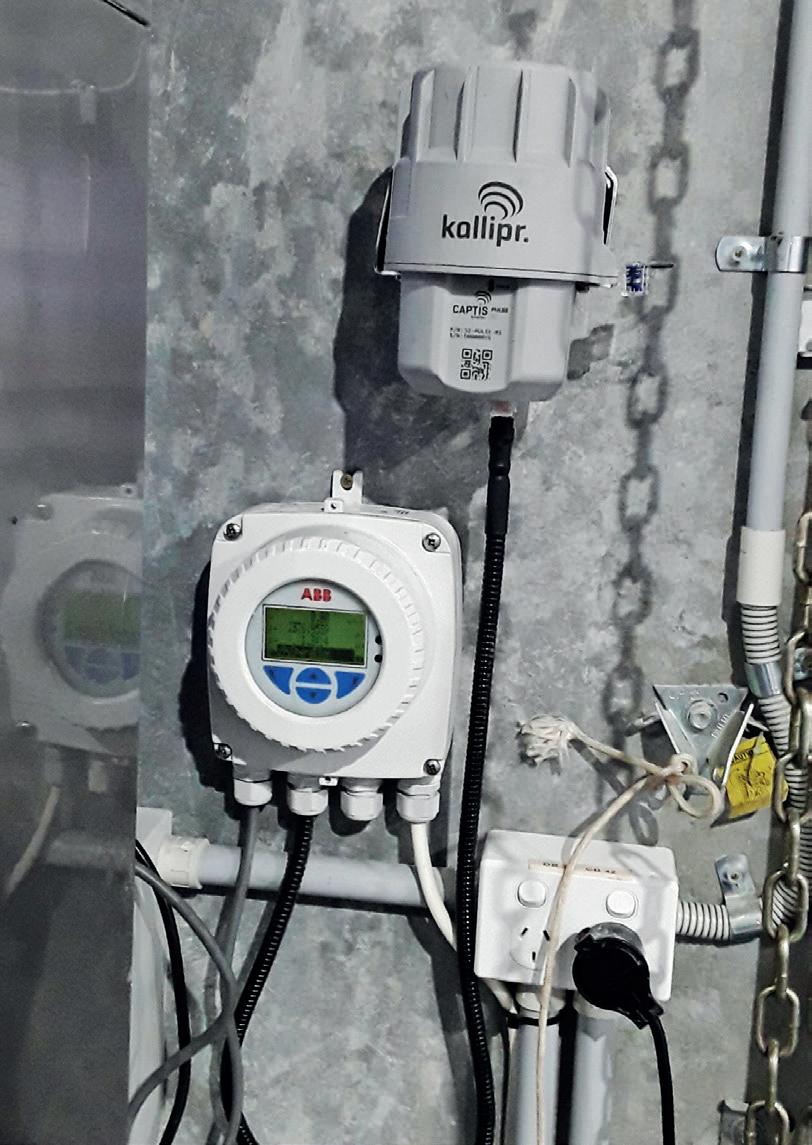
Kallipr fills the data gap by connecting existing trade waste equipment to a continuous telemetry system.
Its Captis Recharge device is designed for multi-sensor sites where a single installation may capture flow rates, water quality readings, and system health data. That flexibility matters because many trade waste sites already
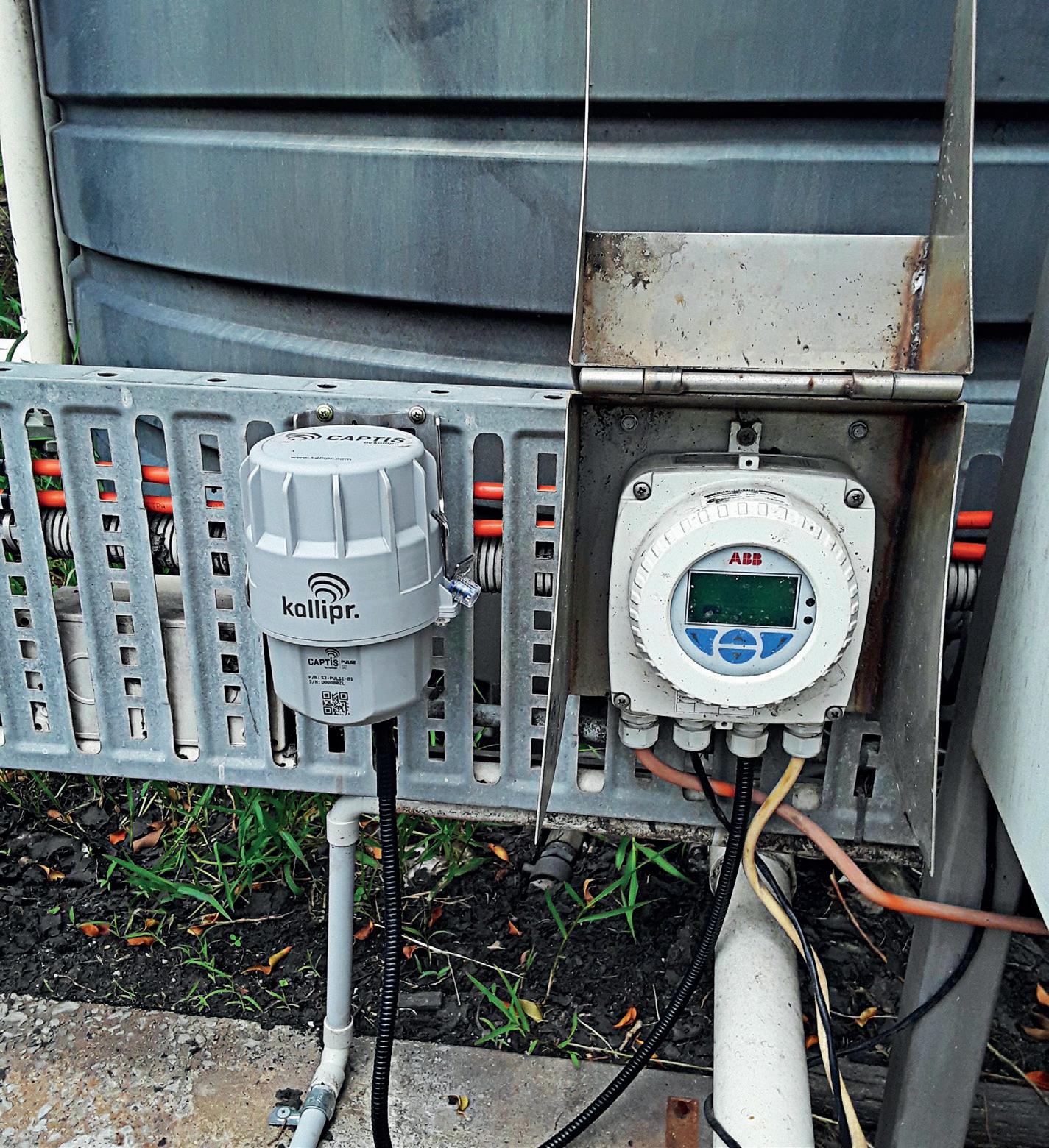
A typical trade waste site fitted with a Captis device, capturing readings from existing instrumentation Images: Kallipr
have instrumentation in place, so SA Water and its customers do not need to start again.
“It’s a multi-sensor, multiparameter use case,” Trikoulis said.
The chosen monitoring device support legacy and modern protocols, high-frequency logging, cellular transmission, and sustained operation. Captis Recharge can use mains power or solar-supported rechargeable batteries.
Data flows into Kallipr Kloud, where trade waste o cers can view live and historical telemetry, manage device health and respond to alarms. SA Water can also feed the data into its own systems.
Trikoulis described Kallipr Kloud as the first response point.
“We’re able to visualise the data to the trade waste o cers, we’re able to generate an alarming sequence,” he said.
What changes on site
The largest shift is from retrospective reporting to active response. With Kallipr’s system, SA Water can see what happens between audits and act sooner when a parameter moves outside a set threshold, with all trade waste customer data visible on a single Kallipr Kloud platform rather than across multiple customer-managed systems, reducing manual e ort, time, and complexity.
If pH, turbidity, flow or another measure triggers an exception, an alarm can notify a trade waste o cer by SMS or email. If it is not acknowledged, the alert moves through an escalation pathway.
“There is an on-demand live triage process based on that alarm to be able to take action in real time,” Trikoulis said.
SA Water said continuous monitoring has shifted the conversation with trialled trade waste customers from reactive compliance discussions to more proactive operational management. Instead of relying solely on historical sampling data, discussions now draw on near-real-time data and trend analysis.
It also means SA Water visits can be guided by data rather than a calendar alone, with clearer evidence available for compliance discussions and billing, as loading patterns can be reviewed over time.
Trikoulis said continuous monitoring has been received as a practical tool that helps dischargers stay compliant.
“No one tends to want to do the wrong thing,” he said. “I think everyone strives to do the right thing. It’s sometimes having the tools to do the right thing.”
Customers who previously provided periodic reports can now have information streamed
automatically. When alarms occur, SA Water and the customer can work from the same data.
Trikoulis said the system has already picked up alarms that would previously have been reported after the fact, if they were identified at all.
“Those alarms wouldn’t have existed; they would be retrospectively reported to SA Water, as opposed to reported in real time,” he said.
Future scale
Following successful trials, Kallipr and SA Water are working toward deployment across 75 prioritised customers in the next 12 months. The program could then extend to the top 100-150 customers.
Trikoulis said that would give SA Water a much clearer view of trade waste performance across high-risk customers, with full control and administration of trade waste discharge quality and quantity monitoring.
“We’re at the start of this program,” he said. “Once we get up to 10,
Captis device is bringing continuous monitoring to trade waste sites that previously relied on manual checks
50, 100, 150 customers, being able to look at that trade waste data holistically, I’m very confident it’s going to open up new questions, new problems, and new initiatives.”
The lesson for other utilities is not only about hardware. Trikoulis said SA Water and Kallipr completed a detailed process design phase and finalised the system architecture prior to deployment.
This includes customer models, site types, data flows and integration pathways, data storage, reporting and alarm and escalation protocols.
The benefit of continuous trade waste monitoring is that it turns varied sites into an operational data stream.
It gives utilities earlier warning, customers clearer guidance and wastewater networks a better chance of protection before a discharge becomes a bigger problem.
For more information, visit kallipr.com and sawater.com.au
Kallipr’s
FOCUS Digital Water
Partnership powers meters
PLUS ES and Sagemcom Australasia have formed a strategic partnership to help Australian water utilities scale digital metering with lower delivery risk.
AUSTRALIA’S WATER UTILITIES are not short of interest in digital metering. The harder task is turning that interest into programs that can be delivered safely, scaled across networks and supported over the longer term.
That is why the strategic partnership between PLUS ES and Sagemcom Australasia is significant. It is not simply a technology supply agreement. It brings together PLUS ES’s experience in large-scale metering services with Sagemcom’s established digital water metering platforms, smart devices and telecommunications expertise.
The success of a digital meter rollout for utiities depends on more than just the meter itself. Hardware, communications, data security, software integration, field delivery, device management, and ongoing support all need to work as a single system. If any part of that chain is weak, the program’s value can be limited.
PLUS ES has announced the strategic partnership to support its expansion into the digital water metering market.
The agreement will provide digital water meters, network sensors and the software required to manage those devices across utility networks.
The timing is important as many existing meter fleets are approaching end of life, and utilities are weighing up whether the replacement should be like-for-like, or part of a broader shift towards the Internet of Things which opens the door for changes in the underlying operating model and opportunities for more significant shifts in the customer experience.
The new partnership gives PLUS ES a stronger platform to support utilities in making that decision.
A stronger pathway
The value of the partnership lies in how it connects two distinct fields of expertise.
PLUS ES brings its extensive metering as a service experience from the electricity sector, where large device fleets, data management and customer-facing systems are already well established. Sagemcom brings global communications and metering capabilities, including their SICONIA range of digital meters, embedded IoT sensors, and SICONIA software suite.
Eric Rieul, CEO of Energy and Telecom at Sagemcom (left) and Rob Amphlett Lewis, Group Executive of Distributed Services and PLUS ES at Ausgrid (right)
Together, that gives Australian water utilities a more complete delivery model. Rather than buying meters in isolation, utilities can consider how the devices, communications, and data systems will operate over the life of the program.
Rob Amphlett Lewis, Group Executive of Distributed Services at PLUS ES, said the partnership is designed to help utilities transition to digital metering without incurring unnecessary delivery risk.
“While large-scale digital metering in the Australian water sector is relatively new, it’s well established throughout Europe, North America and Asia, markets that Sagemcom is a leading player in,” Amphlett Lewis said.
“We’re working with utilities to develop a service o ering and value proposition which is cost-e ective and assists them in making the jump in a low-risk way, leveraging our own
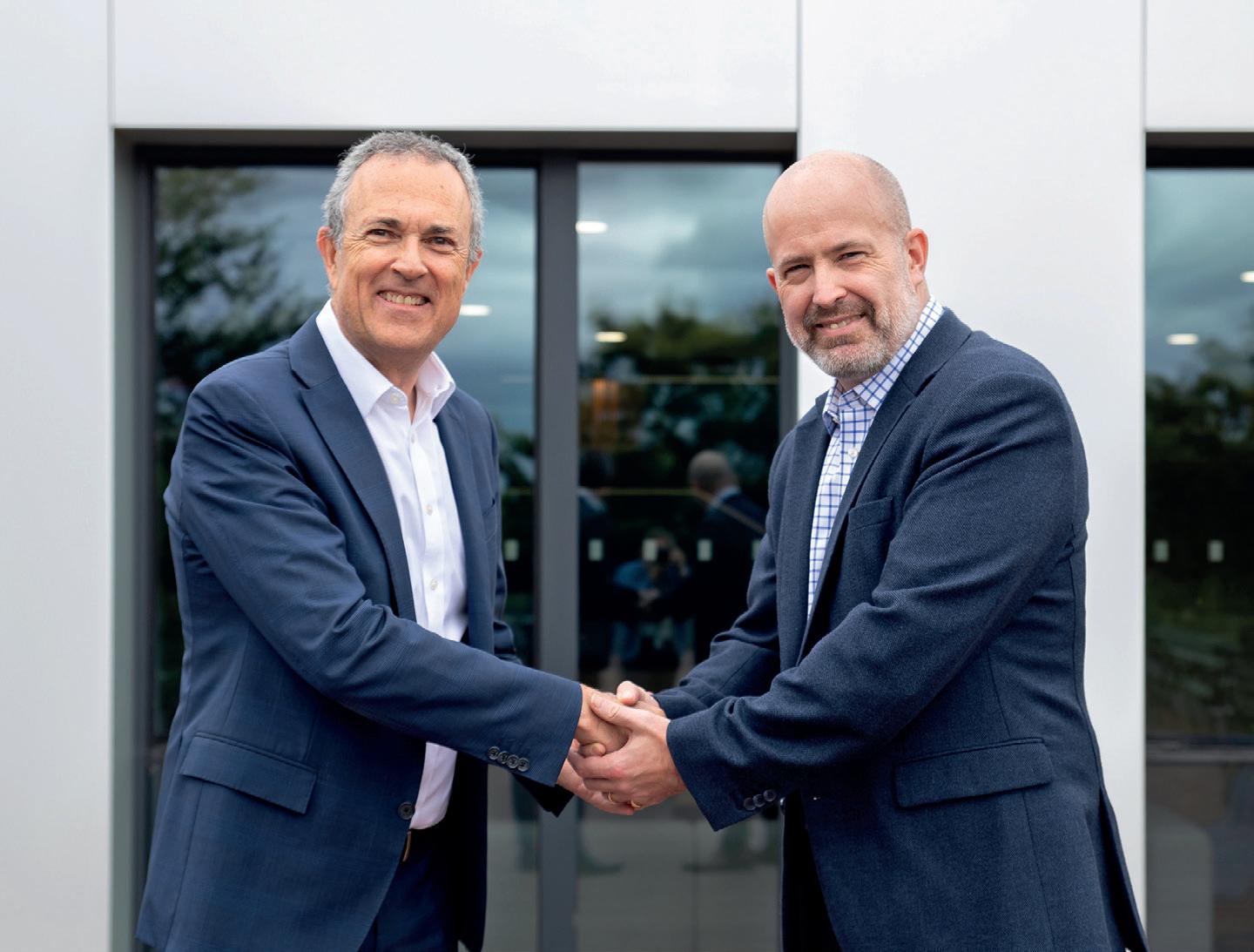
Photo by Sagemcom
experiences over the last 15 years in electricity, as well as the experience of key partners like Sagemcom.”
That point is central to the partnership. Australian utilities are not just assessing whether digital meters work. They are assessing whether a program can be delivered at scale, integrated with existing systems and maintained with confidence after installation.
Digital metering can enable a range of water conservation, customer service and network management benefits.
More frequent consumption data can help utilities identify unusual usage, provide early notification of possible faults, and reduce the delay between a leak forming and a customer finding out.
Network data can also help operators understand where pressure, performance or asset issues may be emerging, as well as assist planners in delivering network upgrades just in time.
Secure systems
For PLUS ES, the Sagemcom agreement is also a long-term strategic move. It gives the company access to proven technology and software while allowing the water o ering to be tailored to Australian operating conditions.
Glenn Wilson, Director of Water at PLUS ES, said the Sagemcom partnership is critical to PLUS ES’s long-term water strategy.
“We were particularly impressed with Sagemcom’s experience and proven track record, as well as their focus on innovation throughout the entire value chain,” Wilson said. “This agreement includes supplying and implementing their SICONIA software suite to support various IoT sensors we will ultimately deploy, including digital meters.”
Wilson said the technical settings
behind the rollout were important.
“We will be utilising modern open standards communications protocols which ensure interoperability, long battery and device life, and secure data transmission from the meter all the way into our backend IT systems,” he said. “Sagemcom’s approach to end-to-end encryption is a key attribute of their SICONIA solution.”
The focus on open standards is particularly relevant in water, where utilities need confidence that devices and systems can work across mixed operating environments.
A closed or fragmented model can create future constraints. An interoperable approach can give utilities more flexibility as their digital networks grow.
Sagemcom Australasia forms part of French-owned Sagemcom Energy and Telecom, which provides digital metering and energy solutions across electricity, gas and water.
The company’s water metering technology includes ultrasonic meters and IoT-enabled systems for remote monitoring.
Its smart water meters can incorporate pressure and acoustic sensors to support real-time monitoring of service performance. That means the meter can become part of a wider network intelligence system, rather than just being a consumption measurement device.
Local capability
Eric Rieul, CEO of Sagemcom Energy and Telecom, said the partnership would strengthen PLUS ES’s o er.
“We are proud to partner with PLUS ES and strengthen their water metering-as-a-service o ering,”
Rieul said. “As a mission-driven company, we are committed to helping our partners move towards more environmentally friendly practices.”
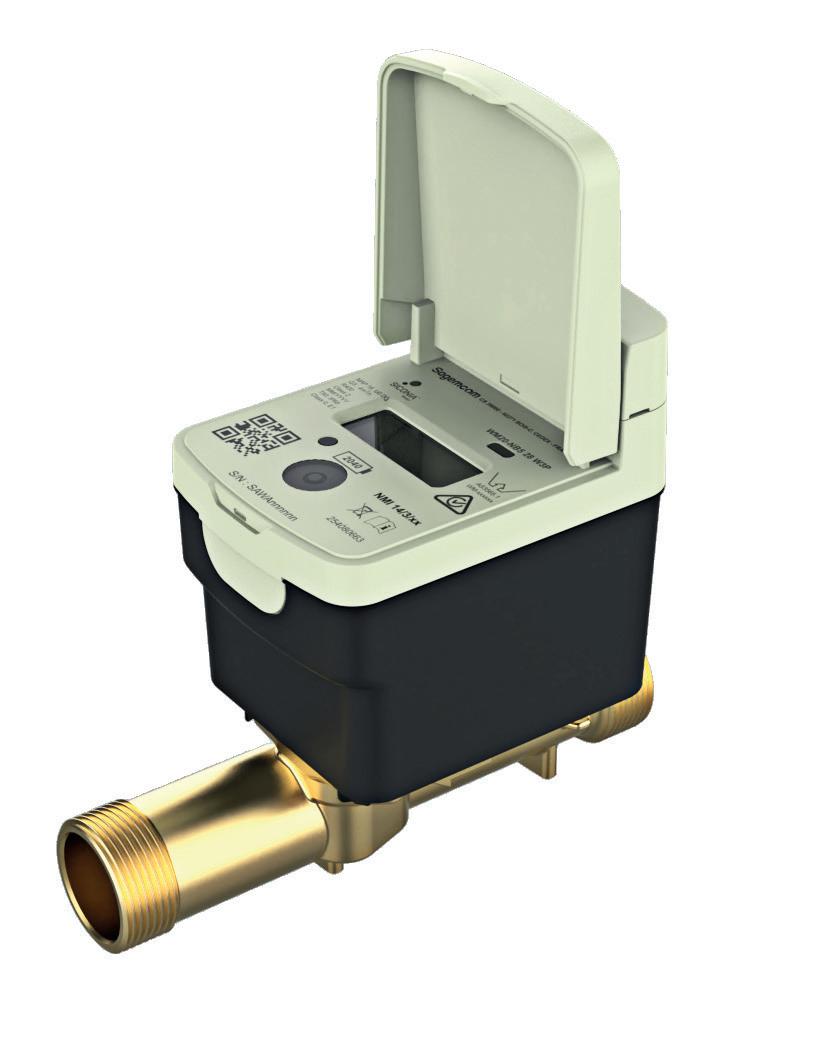
The digital water meters by Sagemcom and PLUS ES could change the way utiities track water use in the context of their infrastructure networks.
The partnership also has a local delivery dimension.
Sagemcom Australia operates from Melbourne and Sydney, providing regional support for its software and IoT solutions. That local presence matters for utilities that need technical support, field responsiveness and confidence that global technology can be backed in the Australian market.
Sagemcom also works with Cape, which provides employment opportunities for people with disabilities while measuring and calibrating digital water meters upon their arrival
That social procurement element gives the partnership a broader industry relevance. Digital water metering is often discussed in terms of data, devices, leakage, and customer service. In this case, the delivery model also includes local capability and inclusive employment.
The partnership between PLUS ES and Sagemcom introduces a digital metering as-a-service model that includes technology and support. Its significance stems from that combination, o ering utilities a way to look beyond individual devices and consider the entire system necessary to implement digital water metering e ectively at scale.
For more information, visit pluses.com.au and sagemcom.com/en
VIRTUAL FLOW MONITORING RISING MAIN ALERTING LEARN MORE ON STAND G04 AT OZWATER

Why carbon choice matters
PFAS removal depends on pore structure, adsorption strength, and supply reliability, not just headline-activated-carbon specifications.
PFAS CONTAMINATION HAS shifted from a future treatment concern to an operational issue for water utilities.
As detection limits fall and regulatory expectations tighten, treatment systems must remove PFAS at concentrations at which small changes in water chemistry, flow, and competing contaminants can a ect performance.
Granular activated carbon (GAC) remains one of the most widely used options because it can fit into existing filtration infrastructure, handle high flow volumes and remove other organic contaminants alongside PFAS.
However, James Cumming said that operational performance can vary significantly among activated carbons, even when basic specifications appear similar.
How does PFAS adsorption work in GAC systems?
PFAS removal in a GAC system is not instant. The process depends on PFAS moving from the bulk water to the activated carbon surface, di using into the pore structure, interacting with adsorption sites and remaining held under continuous hydraulic loading.
That sequence indicates that adsorption is governed as much by mass transfer as by capacity. An activated carbon may have strong laboratory adsorption values for Iodine and internal surface area, but still underperform if PFAS compounds cannot reach internal pore surfaces quickly enough during normal operation.
Pore accessibility, surface chemistry, hydrophobic interaction
strength, mass-transfer kinetics, and competition from dissolved constituents all a ect removal. Natural organic matter can also occupy adsorption sites, thereby reducing PFAS uptake.
Why does pore structure matter for water utilities?
In full-scale contactors, only part of the activated carbon’s internal surface area is e ectively utilised. The practical question is whether the pore structure allows PFAS to move into the Activated carbon bed and remain adsorbed before breakthrough occurs.
High-performance GAC requires a balance between micropores and mesopores. Micropores provide some adsorption sites, while mesopores support transport into the internal structure.
If mesoporosity is too limited, PFAS movement into the carbon is restricted. That can lead to underused adsorption capacity and earlier breakthrough, even when the surface area or iodine number appears strong or elevated James Cumming positions coalbased activated carbon as practical in this context because it can provide greater pore connectivity, a favourable micropore and mesopore distribution, and improved accessibility under continuousflow conditions.
What limits short-chain PFAS removal?
Short-chain PFAS compounds create a harder treatment challenge. They are generally more soluble, less hydrophobic and interact more weakly with carbon surfaces.
Selecting the right type of activatedcarbon is vital for PFAS remediation.
Image: James Cumming
This means they can move through a carbon bed faster and break through earlier than long-chain PFAS compounds. In operational systems, this can shorten runtimes and make treatment more sensitive to variations in water quality. As per independent testing, C-F bonds with three or less are considered shorter chain PFAS compounds, and are objectively harder to adsorb and remove than longer chain PFAS with any Activated Carbon.
Sustained PFAS removal depends on how e ectively PFAS can access internal pores, how strongly it adsorbs under real-world water chemistry, how well the media resists competition from natural organic matter, and how stable adsorption remains across the bed depth. Supply reliability is another factor for Australian utilities to consider too. James Cumming said Purazorb provides locally available coalbased GAC, with shorter lead times than imported products, consistent supply and technical support suited to Australian water treatment conditions. That combination of media performance and supply certainty may prove as important as initial treatment selection.
For more information, visit jamescumming.com.au/


Forever filter focus
PFAS has pushed drinking water filtration from a technical specification into a public confidence issue, reshaping how suppliers prove performance against forever chemicals.
FOR MANY AUSTRALIANS, drinking water quality was once judged by taste, odour and trust in the network. That trust still matters, but PFAS has given facility managers a sharper language for asking what might be in water after centralised treatment.
At Zip Water, that shift has changed product development.
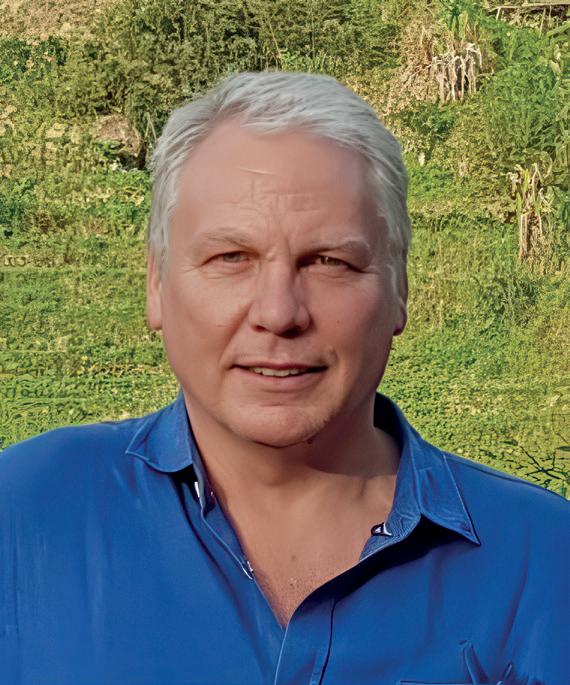
Kevin Moult, R&D and innovation manager at Zip Water, said pointof-use filtration now has to address questions that are both technical and personal.
“We are o ering filtered drinking water to consumers,” Moult said.
“The focus is on giving that experience where they feel delighted in our product and in the water we deliver.”
PFAS has accelerated that task because it is not a single contaminant. It is a broad family of synthetic chemicals with di erent behaviours, risk profiles and levels
of scientific certainty. For the water industry, that complexity creates a communication problem as much as an engineering one.
Zip Water has gained broader technical expertise through the Culligan group, a link Moult said matters when it comes to understanding the emerging contaminants moving from laboratory concern to public knowledge.
“There are a lot of them,” Moult said. “As we go forward, we have on our radar those emerging contaminants that are now challenging us and saying, ‘How are we going to get those under control?”
Consumers are hearing about forever chemicals through the news, regulators and social media. A responsible manufacturer cannot simply respond with a bigger list of claims.
Clean drinking water is important to every family.
How do PFAS claims become evidence?
One of the most important distinctions in filtration is also one of the least visible to consumers. A filter may technically reduce many substances, but not every reduction can be promoted as a formal claim. For Moult, the di erence is fundamental.
“Marketing claims are easy to make, but without testing, they’re hard for consumers to verify,” he said.
“Compliance in filtration products allows the consumer the confidence in experiencing the best, healthy and contaminant free water.”
Zip Water’s approach is to focus on claims that are tested, defensible and meaningful. Moult said some point-of-use systems can list dozens of contaminants, but that volume can become confusing rather than useful. Consumers are more likely to understand claims about substances such as lead, asbestos, chlorine, taste and odour, microplastics, and, increasingly, PFAS.
That does not mean the filter is doing nothing else. It means the company is choosing which claims
Images: ZIP Water
to test, certify and communicate in a market where copy filters may make broad claims without the same evidence base.
“We undertake third party testing on competitor products and the results have shown that there are a lot of substandard filters out in the market,” he said.
For PFAS, that evidence burden is higher. Moult said Zip Water initially focused on two of the most recognised PFAS compounds before extending its work to a broader group of commonly monitored PFAS substances. The company had to test, adjust, and retest rather than assume its existing platform would meet the new expectations.
“We took our filtration and said, okay, how can we counter this? How can we remove this PFAS?” he said.
“Our priority was to give consumers confidence in their drinking water, knowing our filters are designed to address these contaminants.”
What happens after PFAS is captured?
PFAS also raises an important question for the industry. If a filter captures a persistent contaminant, what happens next?
Moult said this has prompted deeper consideration around product life, disposal and the broader environmental pathway of contaminants.
Zip Water’s filters use a polypropylene housing with fibre carbon and pleated membrane components. The housing can be recycled, while the carbon media safely contains captured contaminants.
“PFAS has sharpened the focus on what comes next,” Moult said. “These are persistent substances, so it’s important they are e ectively captured and contained, rather than remaining in the water people drink.”
For Moult, containment is a key part of the value of cartridge-based filtration. He contrasts this with reverse osmosis systems, which rejects water carrying contaminants to the drain.
“Our focus is on reducing exposure at the tap while continuing to improve how filtration systems are managed at end of life.”
While PFAS remains a broader environmental challenge, filtration plays an important role in reducing exposure at the point of use and helping protect people in everyday settings.
Where does point-ofuse filtration fit?
Moult is careful not to position point-of-use filtration as a replacement for municipal treatment. Centralised treatment remains the
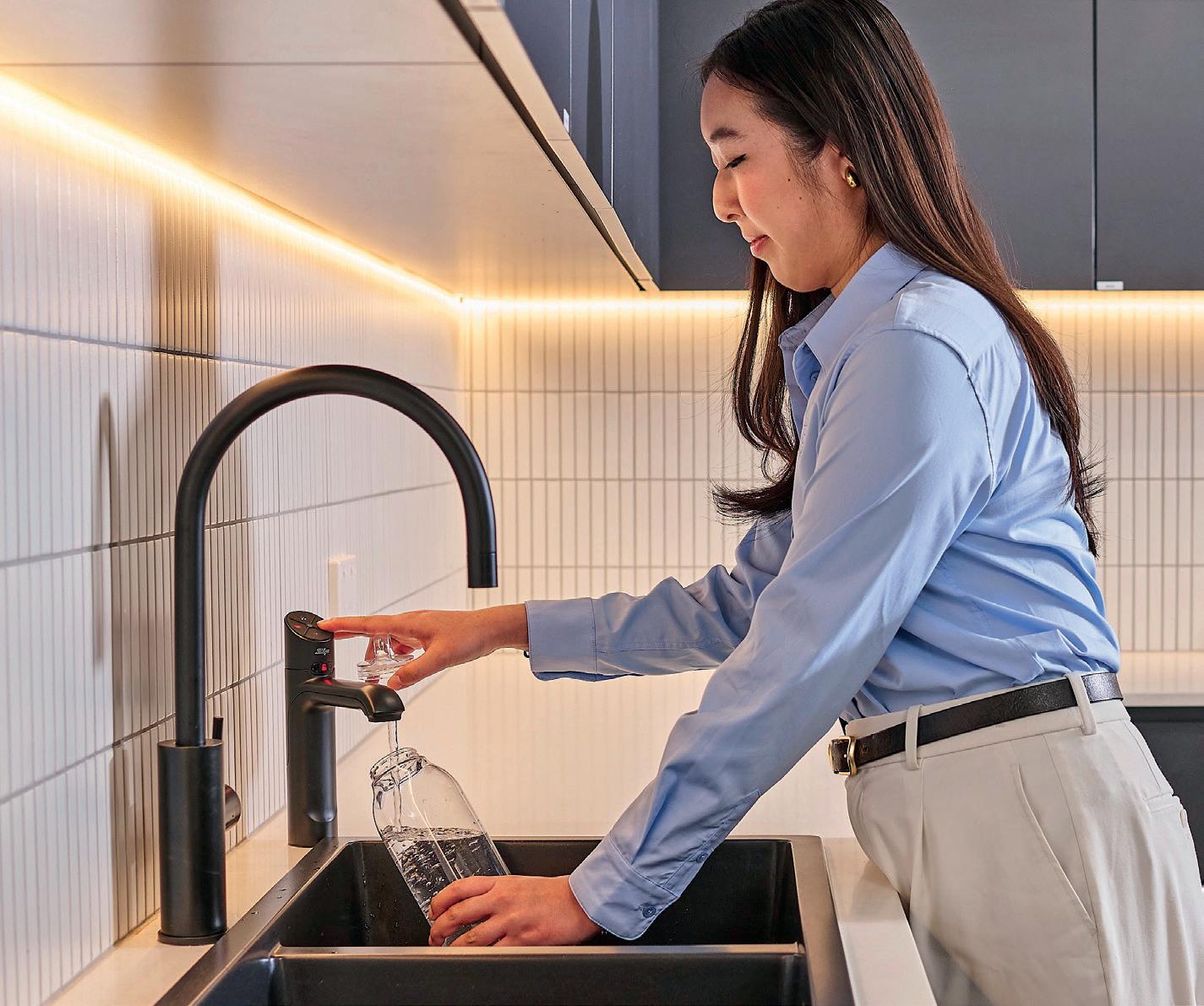
foundation of public health. Pointof-use systems sit at the final stage, removing contaminants that have been introduced post treatment such as lead, asbestos and other sediments, plus the chlorine that is dosed at treatment.
Regulatory standards, contaminant detection capability and consumer expectations are not moving at the same pace.
Filtering the nasties out of drinking water before it lands in your glass can be easier than it looks.
That pressures utilities, manufacturers and regulators to communicate clearly, act carefully and invest in improved compliance methods.
For more information, visit zipwater.com
Kevin Moult is the R&D and Innovation Manager at Zip Water.
WATER METER SPECIALISTS

Data Right is Australia’s leading smart water meter installers. Specialising in:
• Installation roll out
• Project management
• Preproject evaluation, decision making and requirement audit
• Network maintenance and replacements
• Water meter reading
• Associated plumbing works
• Non-Residential Meter Validation Contact us on 1300163837 for a solution to your water meter requirements.
headoffice@dataright.com.au www.dataright.com.au
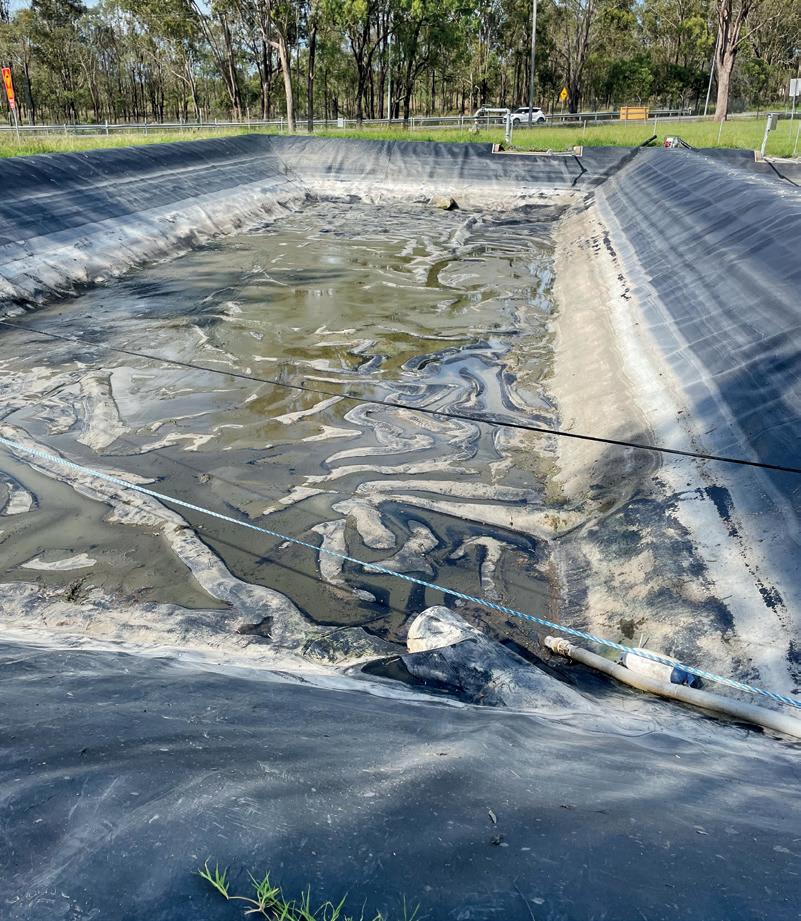
Measuring PFAS remediation
PFAS remediation projects need reliable measurement, remote monitoring and practical technology that can operate across di cult contaminated water sites.
hence solar and battery power were required,” Scarborough said.
“With this, it was important that VEGA still have remote access to the radio unit and connected sensors.”
That requirement shaped the equipment used by VEGA. The PLICSMOBILE radio unit incorporates a power management system that enables remote access while supporting low-power field deployment.
temporary assets. Others are remote or constrained by existing conditions.
deployed with minimal infrastructure
PLICSMOBILE is a 4G-LTE based radio telemetry unit.
Wireless transmission is also central. It enables measurement data to be sent from the field to an o -site user without requiring the operator to attend the site each time information is needed.
Visibility is available at both local and remote levels. Local access can be achieved through the sensor’s Bluetooth connection, the VEGA Tools App and PACTware software.
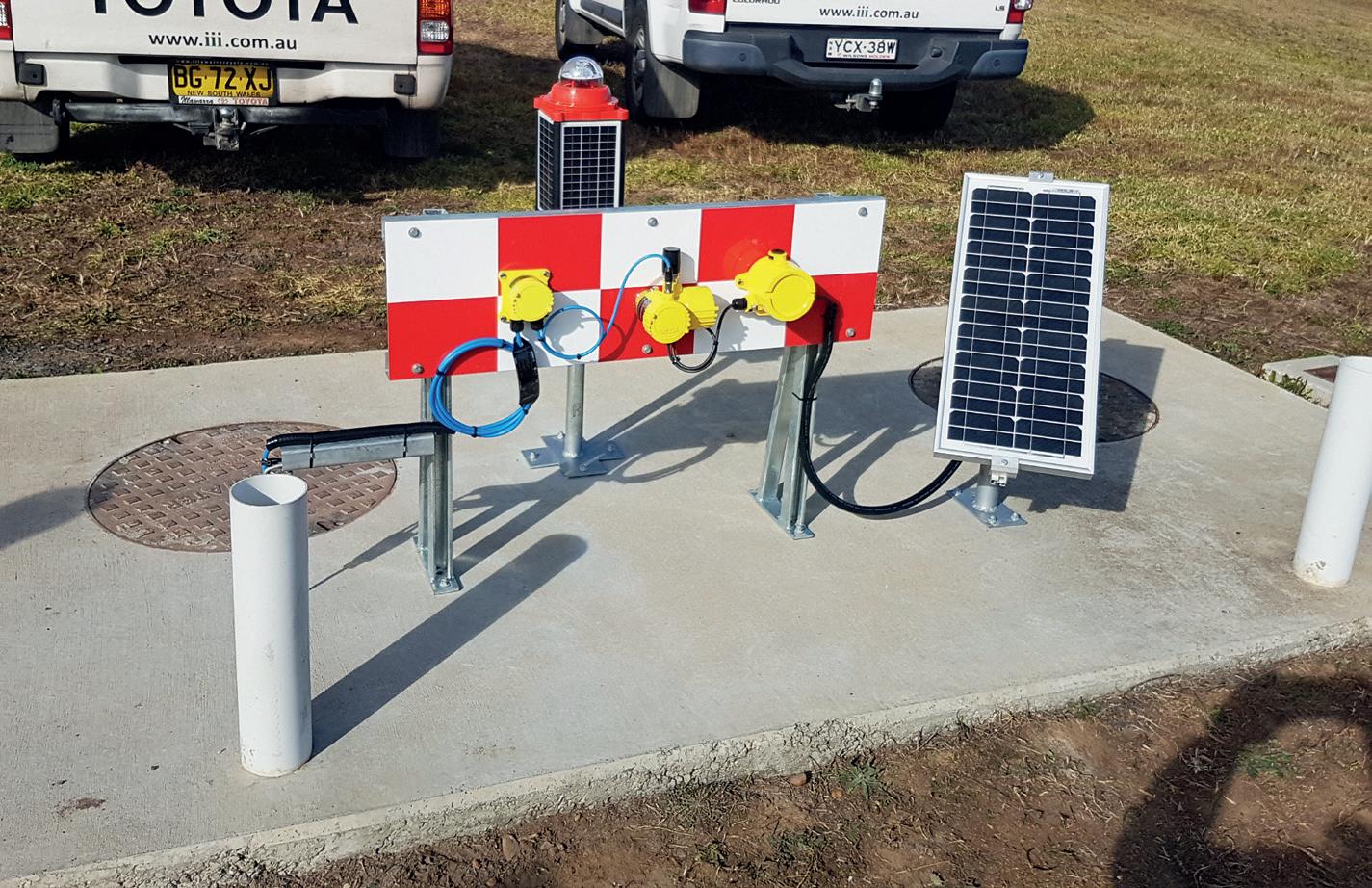
Photo by VEGA and Veolia
FOCUS PFAS Remediation
Remote visibility is available through the VIS web portal and the VIS App. That flexibility matters where conditions can change quickly.
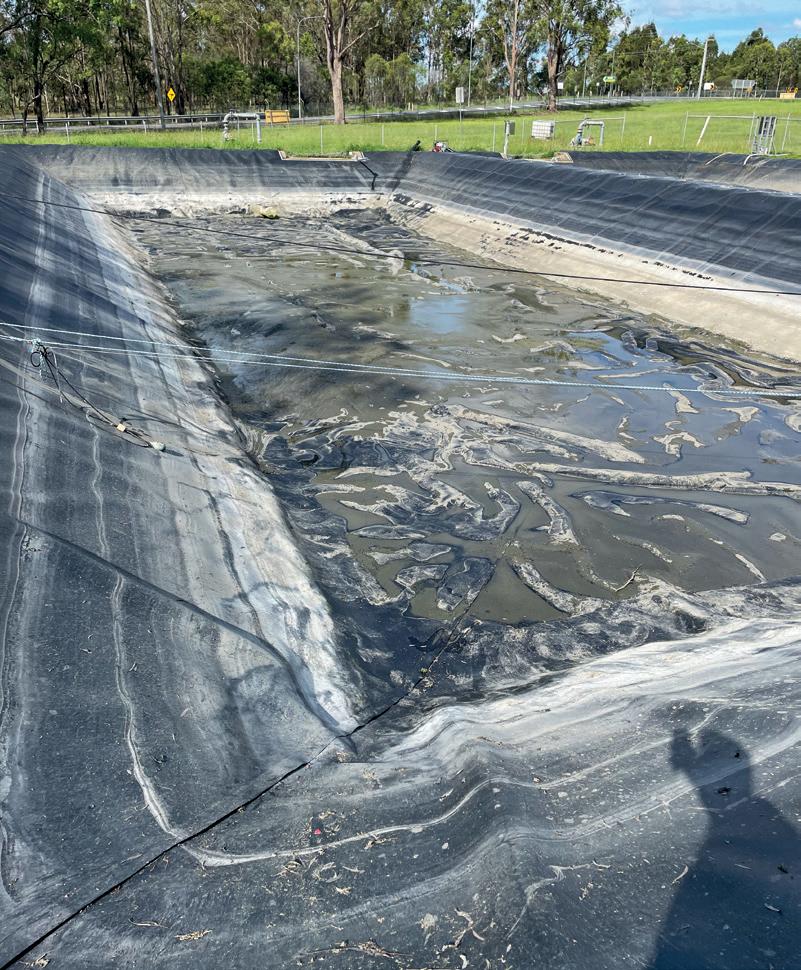
Scarborough referred to an installation at a particular facility where radar collected level data from groundwater and stormwater infrastructure, with a channel running beneath a car park. While he could not comment on the remediation partner’s treatment process or compliance settings, he noted that such an installation would likely need early warning during major storm events.
This is an important distinction. VEGA is not claiming to manage the PFAS treatment process itself. Its role sits in the measurement layer, where reliable field data supports operational awareness.
Collaboration in high-scrutiny work
Scarborough said one factor behind VEGA’s involvement was an existing supply relationship with the remediation partner.
International engineering links also helped leverage an established working relationship between the two businesses.
“One of the factors was a longstanding global supply agreement,” he said. “The good working relationship was leveraged.”
It is rare for PFAS remediation to be solved by a single technology provider. Treatment processes, monitoring systems, waste management pathways and site operations must work together. Compatibility and ease of deployment become practical issues.
In fixed water sites, measurement sensors connected to telemetry can include a mix of device brands. Getting them to communicate can be di cult.
“With the VEGA devices and software, it was easy due to everything being proprietary and streamlined, making connections seamless,” he said.
VEGA’s earlier approach involved a radar sensor, a radio unit and a solar panel or battery system. Since then, the company has developed more autonomous technology for faster deployment and lower infrastructure demands.
Scarborough pointed to the VEGAPULS Air 41, an autonomous radar sensor with integrated radio communication and a longlife battery. Depending on the network environment, it can use cellular (NB-IoT/LTE-M) or LoRa communication. The unit can be deployed and set up within minutes. Emerging contaminants, stormwater capture, remote storage, sewer monitoring, and temporary treatment projects can all benefit from instrumentation that is easy to install and can send data without complex
supporting infrastructure.
Government-linked remediation programs can involve access, safety or security requirements that make frequent site visits less practical.
Remote monitoring does not replace treatment expertise, but it can reduce operational friction and support consistent measurement in the field.
“We are keen to support the customer by developing products that will comply with the everincreasing environmental and safety standards,” Scarborough said.
Measurement technology will need to keep pace, not by promising to solve PFAS alone, but by giving operators dependable information from the field.
“We expect that the demand for better air, land and water quality will only increase, so accurate measurement combined with easy deployment and cloud-based data will follow,” Scarborough said.
For more information, visit vega.com
Tracking water levels in containments ponds is vital.
Water without compromise
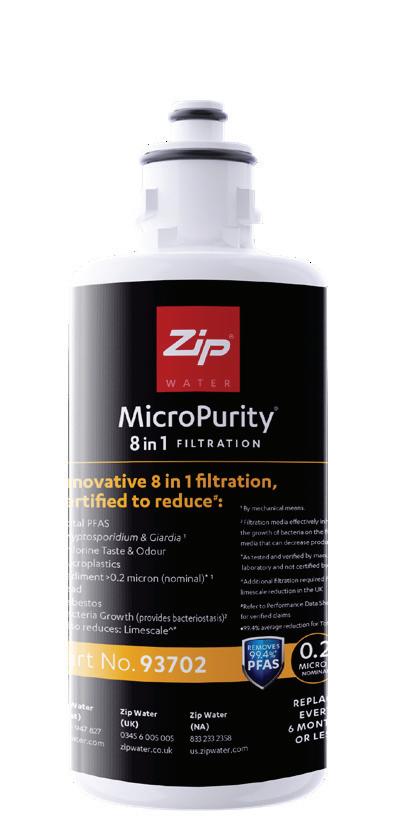
Zip MicroPurity filtration now removes 99.4% of PFAS*.
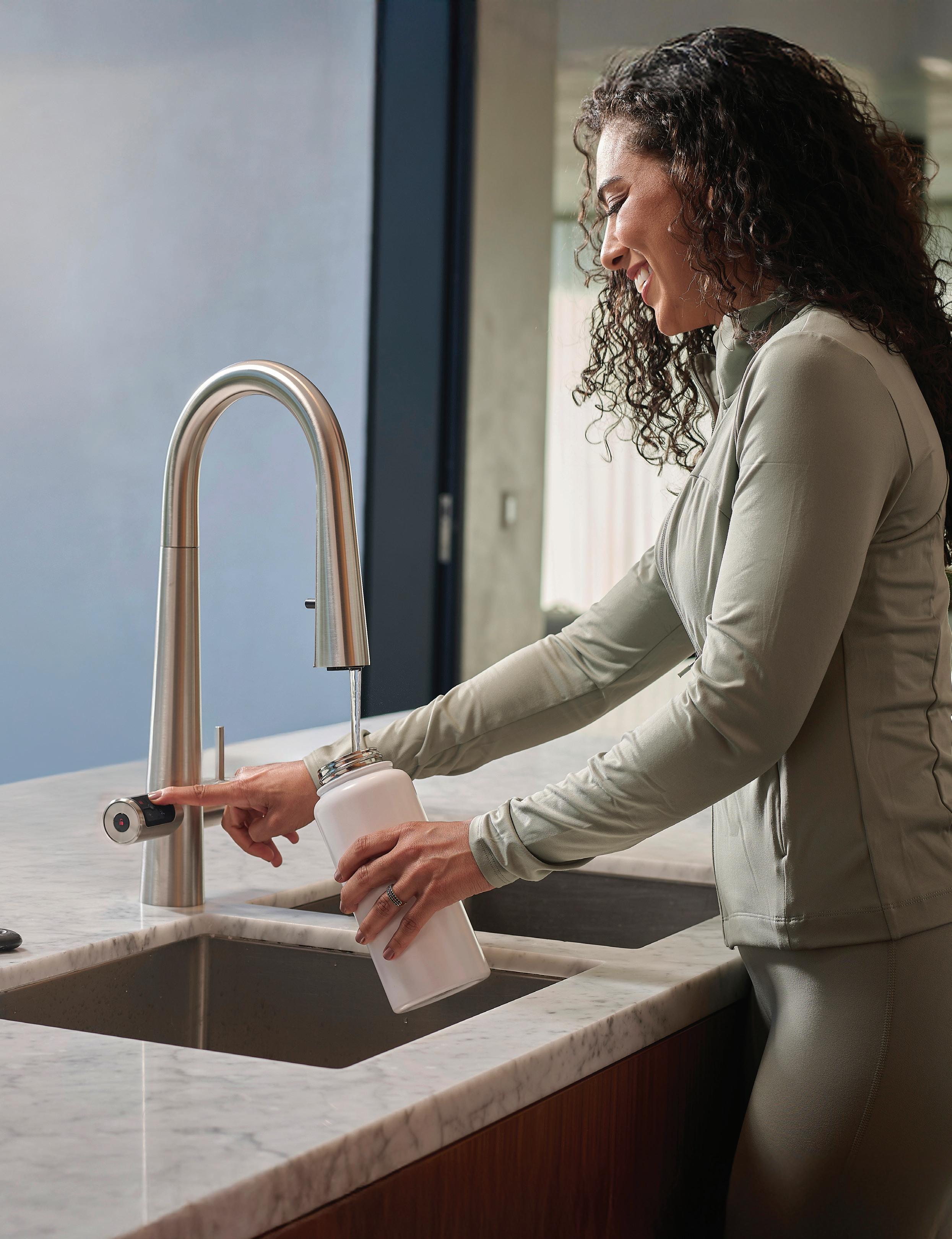
Zip HydroTap features our innovative MicroPurity 8-in-1 filtration,
reduce the eight most common contaminants, including PFAS and microplastics, for pure-tasting water without compromise.

Superior service beyond supply
Xylem ANZ is helping water operators rethink service, spare parts and asset support across the full lifecycle.
WATER AND WASTEWATER operators are under pressure to keep essential assets running longer with fewer people, tighter budgets, and rising operating costs.
That pressure has changed how Xylem ANZ discusses service and aftermarket support with utilities, councils and contractors.
Kristy Rua, Service and Aftermarket Leader ANZ - WI Transport at Xylem ANZ, said the pressures across Australia and New Zealand are increasingly consistent.
“Tighter budgets, rising energy and operational costs, and skills shortages continue to be challenges,” Rua said. “Additionally, there is a clear increase in infrastructure demand, primarily driven by climate impacts.”
That operating environment has put more attention on installed assets. Pumps, mixers and related equipment are no longer viewed only through the point of sale.
“I guess they’re being asked to do more with less,” Rua said. “They need to extend the life of their existing assets, so we’re seeing more of a focus on lifecycle costs, e ciencies and sustainability of assets.”
Service shifts from repair to prevention
Aftermarket support has changed sharply during the past 18 to 24 months, according to Rua.
“The role of the aftermarket has shifted dramatically,” she said.
“Previously, there was a focus on fixing assets as they failed. Now there’s a lot more emphasis on preventative and predictive maintenance strategies.”
That shift depends on knowing the installed base, where the critical assets are and where problems are likely to emerge. It also requires service providers to work with customers
before a breakdown forces an urgent response.
“With Xylem’s expertise, digital solutions and programs that we have available, we work alongside our customers to develop these maintenance strategies and preventative maintenance programs,” Rua said.
Why genuine spare parts matter
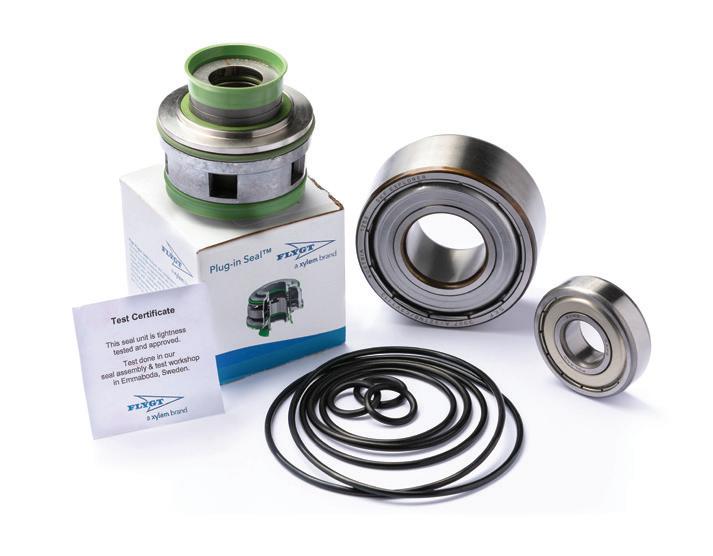
Genuine spare parts have their greatest value in critical water and wastewater applications.
“The biggest di erence is in critical water and wastewater applications, where reliability is really essential,” Rua said. “Customers just can’t a ord to have repetitive failures or extended outages, and their pumps not performing as they’re designed.”
Xylem’s Flygt genuine spare parts are engineered for its pumps and mixers. Rua said that helps maintain performance, e ciency, and reliability while supporting preventive maintenance programs.
“They also play an important role in preventative maintenance, because
Kristy Rua is the Service and Aftermarket Leader ANZ - WI Transport at Xylem ANZ. Images: Xylem Australia and New Zealand
if they’re using genuine parts, it reduces the risk of repetitive repairs or call outs, extends the life of the asset, lowers lifecycle costs and gives the customer confidence that their asset is performing,” she said.
That point matters when customers face pressure to reduce immediate costs.
While a non-genuine part or an incorrect spare part may look cheaper at the time, Rua said the longer-term impact can be higher energy use, repeated failures, reduced performance and more unplanned downtime.
“The biggest risk is they’re focusing on short-term cost savings instead of long-term asset reliability,” she said. “Over time, what may appear to be a lower-cost repair, that one-o repair, can often result in higher lifecycle and operational costs.”
Local capability supports critical assets
When an urgent breakdown occurs, customers need a fast response, which Xylem’s systems allow it to deliver.
“It’s a combination of speed and our technical knowledge through our experienced technicians and our product teams across ANZ,” Rua said. “We’re able to provide skilled service technicians to our customers for advice.”
Local capability is central to the Xylem support model.
Rua said customers value knowing that the original equipment manufacturer has workshops, trained technicians, field service teams, service partners, and a local spare parts inventory.
“Our local capabilities definitely are essential, particularly with our customers managing critical wastewater and water assets,” she said. “Customers have confidence when they’re purchasing products
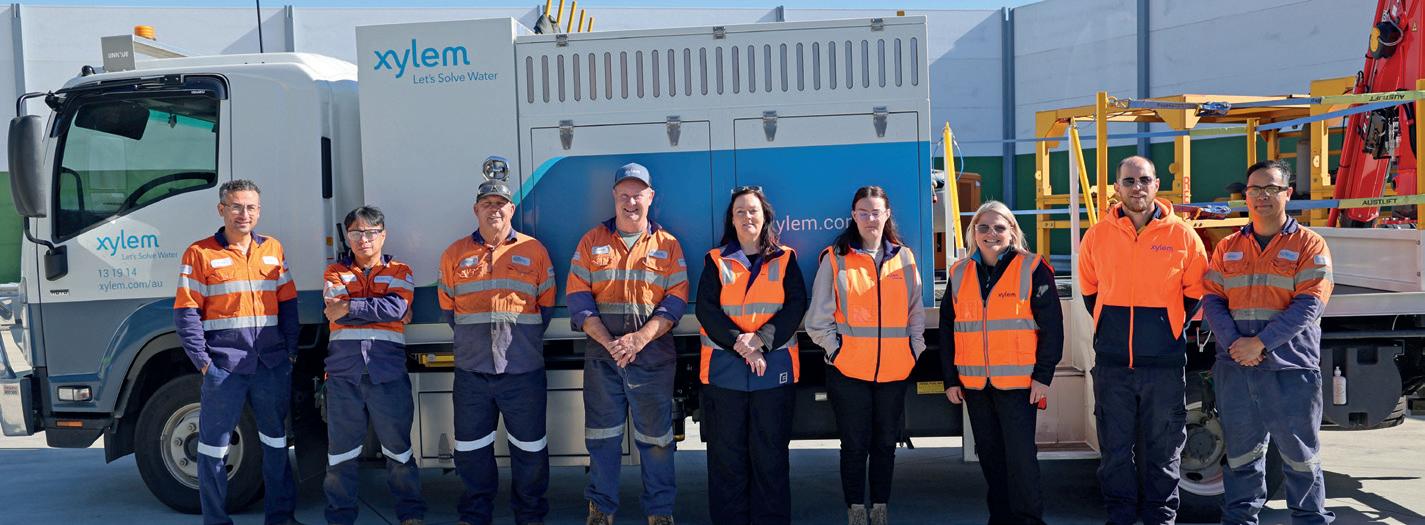
from Xylem that they also have that local OEM service and maintenance support, along with spare parts availability locally when needed.”
A trusted service partnership continues through the life of the asset. It includes technical support, service, spare parts and planned maintenance after equipment has been installed and commissioned.
“A trusted service partner would be more about supporting our customers through the life of the asset,” she said. “After the sale, from technical support, service, spare parts and planned maintenance, they’re really an extension of our team and a big part of how we support our customers day to day.”
Service history solves problems
One customer example showed the value of combining service history, technical support and practical investigation.
Xylem had overhauled a pump for a local water authority. After the customer installed it at a pump station, performance issues continued.
Rather than treating the problem as a simple repair issue, Xylem
It’s a team e ort to ensure that proper aftermarket support is provided to all its clients.
reviewed the application, service history and operating conditions.
The team found the pump had been installed in the wrong station.
“The performance issues they were experiencing weren’t really the pump anyway,” Rua said. “The pump was in the wrong installation, the wrong pump station. Just by having that service history available, we were able to resolve those problems for our customers.”
That example shows why OEM support can be valuable well after commissioning.
It gives customers access to product knowledge, asset history, and service experience, which can shorten the path from problem to resolution.
Moving quickly and e ciently to support customers is vital to Xylem ANZ.
“The biggest benefit from working with an OEM is the long-term value that we’re able to bring beyond that initial sale,” Rua said. “We understand our products inside and out, how they’re designed, how they’re meant to perform, and the technical requirements and support that we’re able to provide.”
For more information, visit xylem.com/en-au
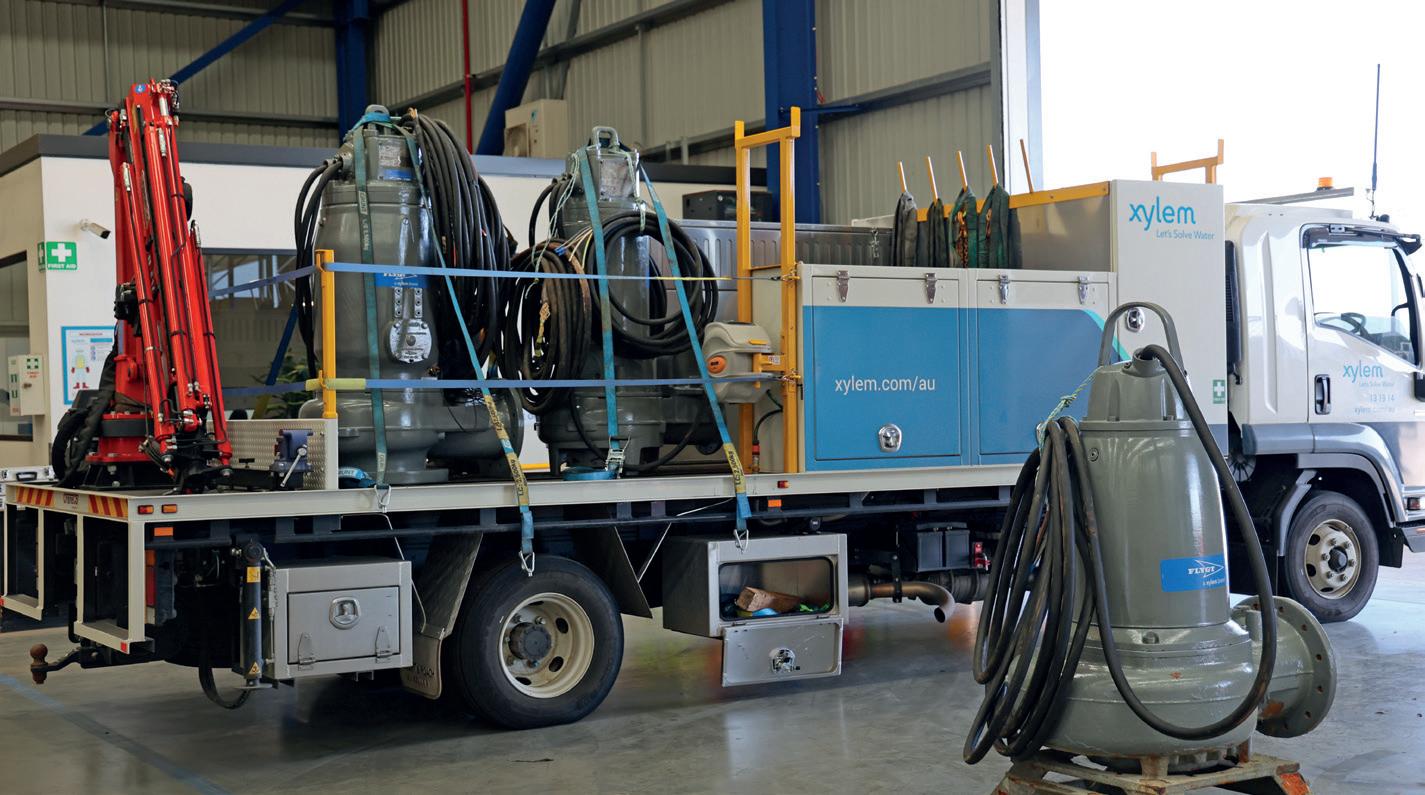
Dry pump discipline
KSB Australia’s Omega dry-installed pump puts reliability, e ciency and maintainability at the centre of water infrastructure.
PUMP SELECTION IS rarely a catalogue exercise for water utilities in Australia or across the globe. A pump station can sit between the raw water intake, the treatment process, the transfer main, the pressure-boosting duty, or the desalination service. Each application brings di erent flow conditions, water chemistry, temperature, floor space and maintenance access.
The cost of a poor match is usually paid later through energy use, seal wear, vibration, downtime or replacement decisions that arrive earlier than planned.
That is where KSB Australia sees the latest Omega dry-installed pump fitting into long-term water infrastructure planning.
Tobias Knop, National Manager Water and Wastewater at KSB Australia, said the pump has been developed for utilities that need e cient operation, service access and reliability across demanding water applications.
“The new Omega o ers numerous benefits. Energy and cost savings thanks to its e cient and compact design, as well as lower CO₂ emissions, to name just a few,” Knop said.
“Furthermore, reduced downtime and a longer service life, thanks to its reliable and service-friendly design, make the new Omega the perfect pump for all water utilities and the above-mentioned applications.”
KSB describes the Omega as a single-stage, axially split volutecasing pump for horizontal or vertical installation. It uses a double-entry radial impeller and is listed for waterworks, desalination plants, pressure boosting and water transport.
Managing pump loads
The technical case starts inside the casing. In water infrastructure, reliability is influenced by how the pump manages axial and radial forces over many years of operation. Bearing loads, vibration and shaft deflection shape maintenance intervals and the likelihood of unplanned work.
The Omega dryinstalled pump is set to become a staple for the water industry.
Images: KSB
“The axially split volute casing with the double-entry impeller o ers the benefit of balanced axial thrust, which reduces the loads acting on the rolling element bearings,” Knop said.
He said the combination of the double-entry impeller and doublevolute casing supports reliability and service life. The impeller compensates for axial forces, while the self-aligning rotor ensures proper alignment. The casing’s double-volute design reduces radial forces. Together, those features are intended to reduce bearing loads and vibration levels. Knop said the optimised
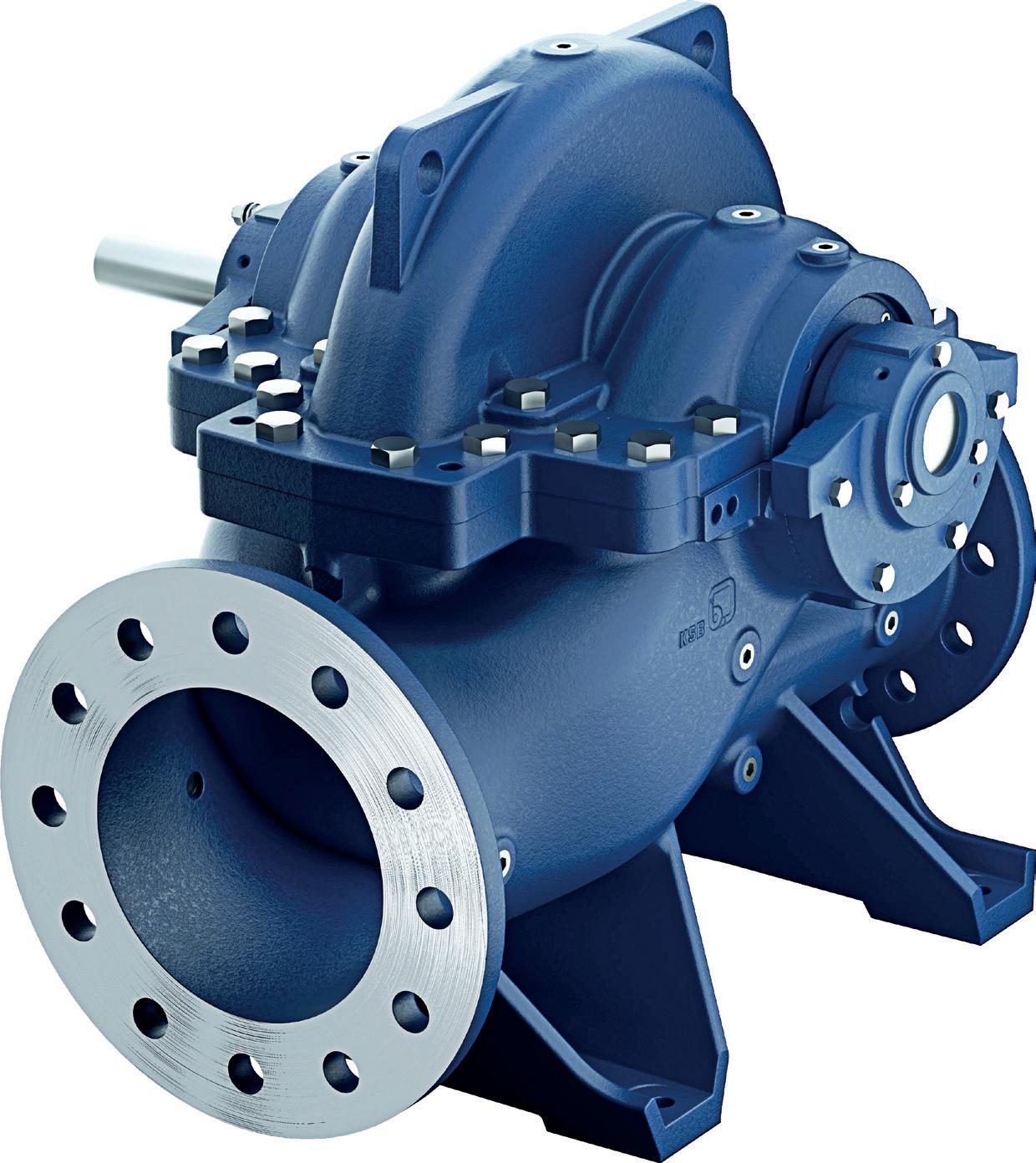
hydraulic design and double-volute casing also support improved net positive suction head behaviour, longer bearing life and reduced noise emissions.
Vibration control matters because the pump is only one part of a wider system. Dynamic stress can weaken bearings, mechanical seals and connected components. Once vibration increases, maintenance intervals shorten, and the risk of pump failure rises.
“Vibrations should generally be minimised as much as possible, as they can weaken the system as a whole and individual components,” Knop said.
Finding e ciency gains
Water utilities know that a single specification does not drive pumping e ciency. Motor e ciency matters, but so do the pump curve, approach flow conditions, hydraulic design, operating points and control strategy.
Knop said each factor has a role, even where the scope for improvement in any one measure appears limited.
Di erent pumps have di erent e ciency levels, and a pump operating close to its best e ciency point will usually have the longest service life.
“The pump’s surroundings, including the approach flow conditions, also influence the pump’s performance,” he said. “In the latest generation of the Omega series, hydraulic performance has been optimised using CFD simulations, supported by operational experience from the Omega and RDLO series.
“These refinements increase e ciency and reduce energy consumption under typical operating conditions.”
All these points matter for Australian utilities because demand profiles can shift across seasons, growth corridors
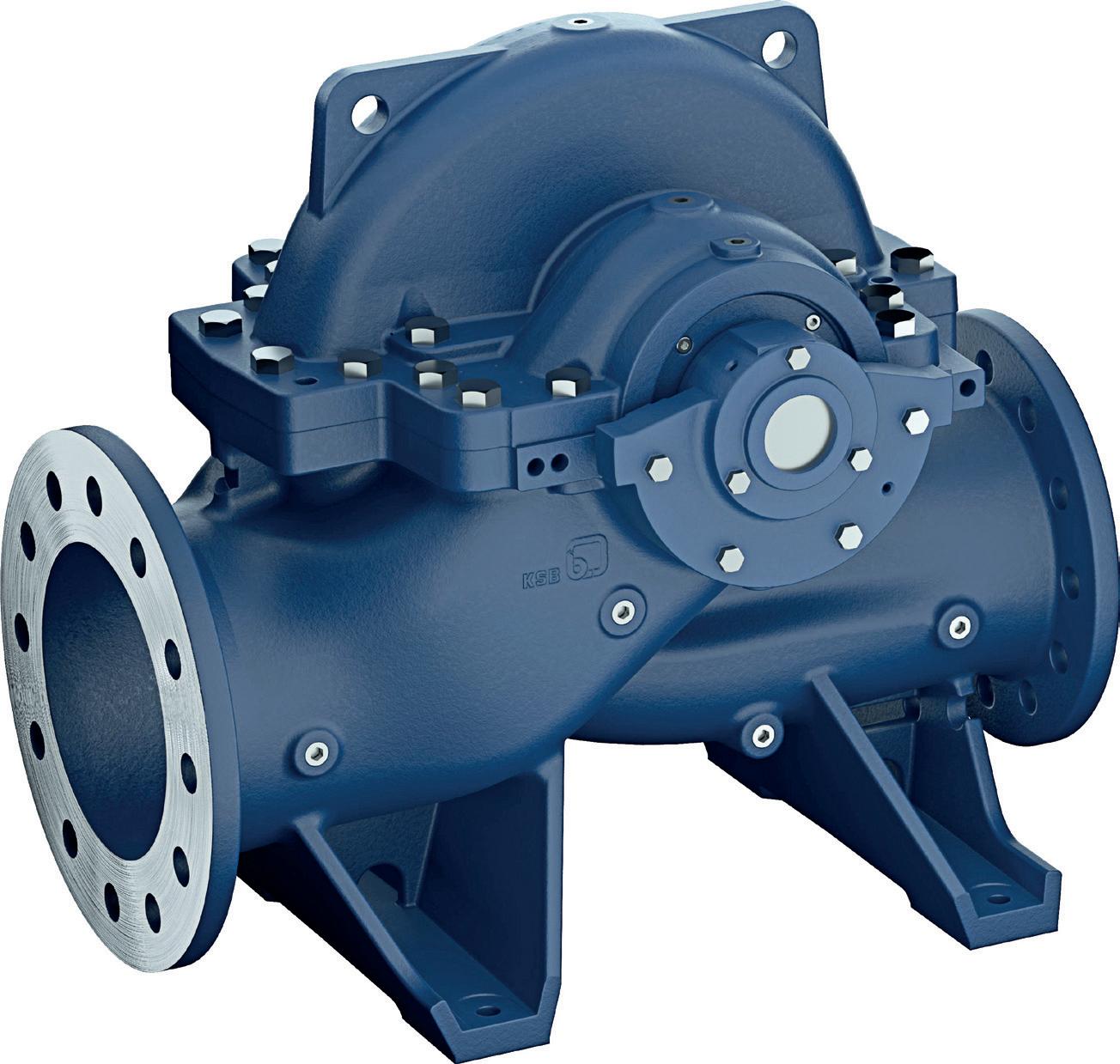
and large distribution networks. A pump selected for only a single duty point may not suit how the asset actually operates.
Materials and maintenance
Once a pump is installed, maintainability becomes just as important as initial performance.
The Omega material highlights low maintenance costs, solid casing split flanges, short shafts, corrosionresistant materials and service access. Knop said no single feature is always most important because every application is di erent.
Material selection can become a decisive factor. Choosing the wrong material can lead to extended downtime and high costs, even when the rest of the installation has been well designed.
“The Omega is designed for handling water and fluids with a low solids content,” Knop said. “As a general guideline, it is recommended to provide the pump supplier with as much information as possible about the medium, from temperature and pH values to the intended application and any other known details, so that the pump supplier can select the most suitable material for the specific application.”
KSB has been working to ensure that the Omega dryinstalled pump is a key feature of long-term water infrastructure planning.
Whenever an application can be considered as ‘non-standard’, KSB can consult its materials laboratory in Germany to assess media compatibility. That matters for utilities dealing with raw water, treated water, seawater or service water where chemistry and solids content can change the risk profile.
Service access also has practical value. Knop said the shortened shaft reduces shaft deflection, allows smaller clearances and improves the e ciency and service life of the shaft seal. Mechanical seals can be replaced without removing the motor or opening the pump.
Installation decisions still require trade-o s. Horizontal installations are less sensitive to vibration and easier to maintain, while vertical installations need less floor space. The right choice depends on the site, existing pipework, and access constraints.
The same logic applies when utilities assess an older split-case pump. Repair, retrofit and replacement can all be valid options. Knop said the best technical answer depends on the specific application and the customer’s preference.
For more information, visit ksb.com/en-au
Custom cable confidence
TriCab is using local cable design, testing, and manufacturing to support demanding water and wastewater environments.

WATER AND WASTEWATER assets rarely give electrical infrastructure an easy life.
Treatment plants, pump stations, submersible applications, chemical dosing areas and industrial water facilities expose cables to moisture, chemicals, bacteria, oils, movement and di cult installation conditions.
For operators and contractors, those conditions make industrial cable solutions more than a procurement decision.
TriCab has built its approach to cables around that reality. Rather than treating cable as a commodity, the Australian manufacturer views cable performance as part of an asset’s reliability profile.
Its work across water treatment draws on experience in mining, marine, industrial and infrastructure environments, where harsh conditions can quickly expose poor material selection or weak manufacturing control.
For TriCab National Business Development Manager Daniel Fitzell, the starting point is understanding the environment before designing the cable.
“The main stu that we would design for is resistance to chemicals and bacteria and things like that,” Fitzell said. “So, the cable does have a long service life and meets those particular requirements of the install.”
Designed for exposure
Industrial cable solutions for water treatment need to survive conditions that can be constant, variable and di cult to control.
Moisture is only one part of the challenge. Wastewater facilities may also involve bacteria, chlorine, peroxides, oils and other contaminants, while installation areas can be confined, wet or di cult to access.
Fitzell said TriCab is designed to meet demanding Australian and international standards, with reliability as the practical outcome. In treatment applications, that can mean specifying cable jackets and materials suited to the environment, rather than relying on a generalpurpose product.
“We design to the harshest of Australian standards and international standards as well,” he said.
That emphasis is particularly important where cable performance underpins pumps, control systems, mechanical equipment, power supply and mediumvoltage infrastructure.
Fitzell said TriCab can support a complete installation across those categories, including control, mechanical, power, cables and medium-voltage cables.
In submersible applications, he said, the outer sheath becomes especially important.
“You want to have a sheath, or something like that, that’s going to handle these harsh environments,” he said. “Say your bacteria, your chlorines, your peroxides and things like that.”
TriCab can also o er TPU jacket options for harsher environments. That detail matters because the cable must be matched to its operating conditions, not simply to the upfront project budget.
Local testing
A central part of TriCab’s position is local manufacturing. Fitzell said the company manufactures in Port Melbourne and has invested in an in-house test laboratory to support quality control.
TriCab also uses third-party testing to give customers another layer of assurance.
“We actually have a $2 million test lab that we’ve built ourselves in Port Melbourne,” Fitzell said. “Everything that we produce is to the highest of Australian standards.”
That testing capability sits at the centre of TriCab’s argument about long-term risk. Fitzell said cable failures are often linked to cheaper imported products, particularly where buyers rely only on supplierprovided test certificates. In-house reports from overseas suppliers may not give asset owners the same confidence as independent testing.
Cables manufactured in Australia are better placed to deal with local challenges. Images: TriCab
“I think these guys must start asking for not just in-house test reports, but third-party test reports from reliable test labs,” he said.
The issue is not only compliance. It is also about what happens after installation. A lower-cost cable may reduce the initial project price, but Fitzell said the risk may surface later in the form of insulation breakdown, performance issues, or reduced asset certainty.
“With these large infrastructure projects, we sort of wonder sometimes, is that initial cost benefit worth the risk later on?” he said.
That question becomes sharper when the cable sits inside a critical asset. Pump stations, treatment facilities and industrial water systems cannot easily tolerate avoidable downtime.
Once the installation is complete, replacement can be expensive, disruptive and di cult to schedule.
Built to suit
TriCab’s custom manufacturing capability gives it another role in water sector projects. Instead of supplying only standard cable, the company can work from a project requirement and build to a specific application, standard or performance need.
“If a particular customer came to us with a problem where they needed a solution done, then we could come in from an engineering aspect and really solve that problem,” Fitzell said. “We can actually make a cable specific to an application.”
That capability extends into pre-terminated leads, matching accessories and termination systems. Fitzell said TriCab can supply a complete cable-and-accessory system that has been tested together, rather than combining an imported cable with generic accessories.
“We o er, actually, the complete end-to-end system,” he said. “We
don’t just o er the cable; we actually o er all the termination side of it as well.”
For contractors, flexibility is also a practical issue in installation. Fitzell said some lower-cost cables use thicker internal copper stranding, while TriCab can use finer class six stranding.
In practical terms, that can make a cable easier to bend and install in tight or awkward spaces.
He said the labour component also matters. A more flexible cable may help installers work faster in confined or di cult locations, which can o set part of the higher purchase price.
“The labour-saving component, when you’re looking at the installation side of things, is huge,” he said. “The labour is a massive part of the entire installation.”
Whole-of-life value
Fitzell said the water sector remains cost-driven, particularly where contractors choose cable based on project pricing and that can create a gap between the immediate interests of installation budgets and the longerterm interests of asset owners.
“We still find it sometimes very, very hard to compete with the cost,” he said.
“We do have barriers that we’re still trying to break down to get the end user to maybe look at spending a little bit more.”
Fitzell said engineers and procurement teams should request third-party testing, inspect samples, and understand the manufacturing process before making major cable decisions.
TriCab invites its customers to visit its manufacturing facility and test lab. Fitzell said TriCab avoids some lead time risks because its products are not reliant on overseas shipping. The company can cut drums to the exact
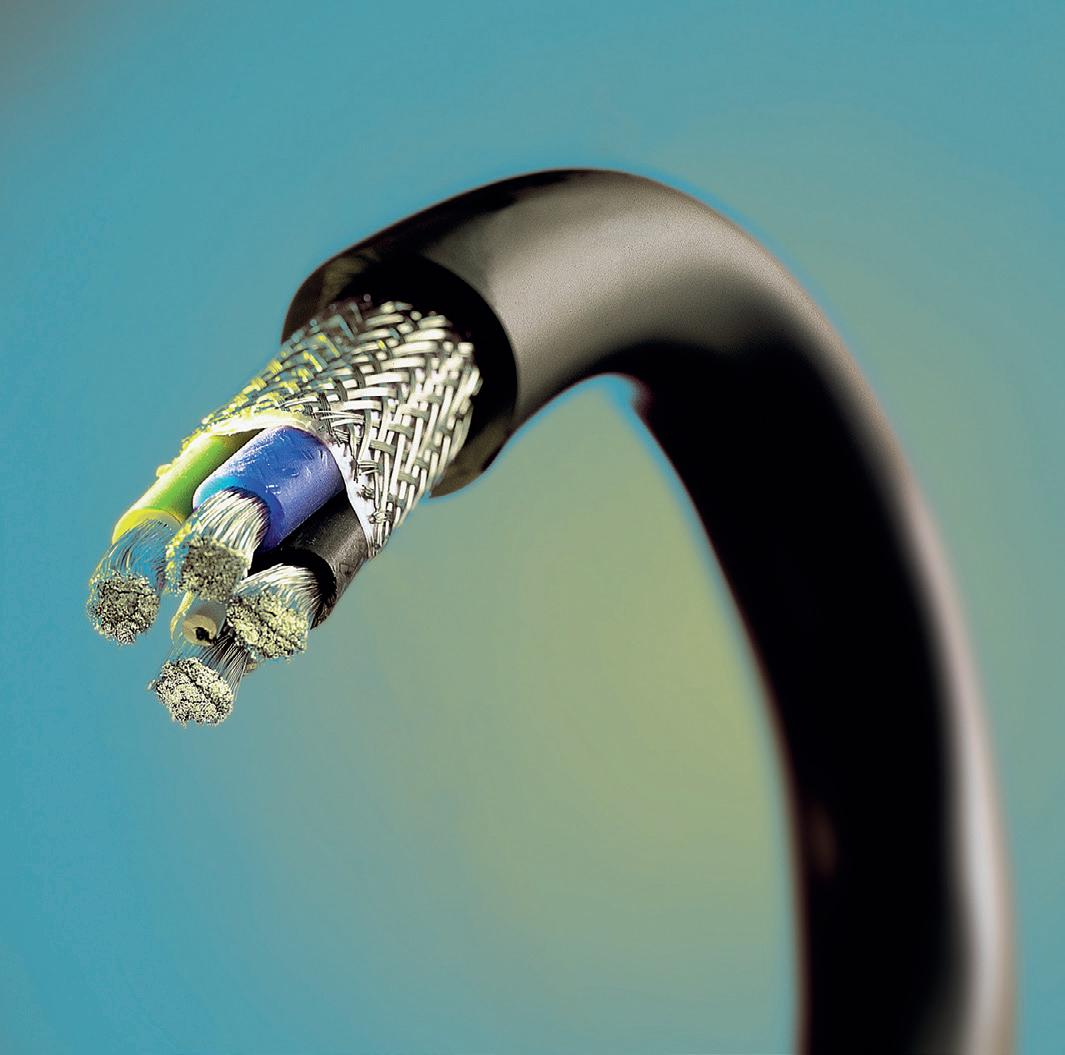
The multiple coatings provides higher levels of protection without impacting flexibility.
Ensuring that the cabe remains in one piece and operational while in chemically challenging envirovnments is vital.
lengths required, rather than sending bulk drums that may create waste or handling issues.
In Fitzell’s view, local cable design, tested accessories and industrial cable solutions give water utilities a stronger basis for asset certainty.
“What it does is it just o ers that certainty again, in terms of quality,” he said. “You’re using a locally manufactured cable to the highest quality with their own self-branded matching accessories that have all been tested together as a unit.”
For more information, visit tricab.com
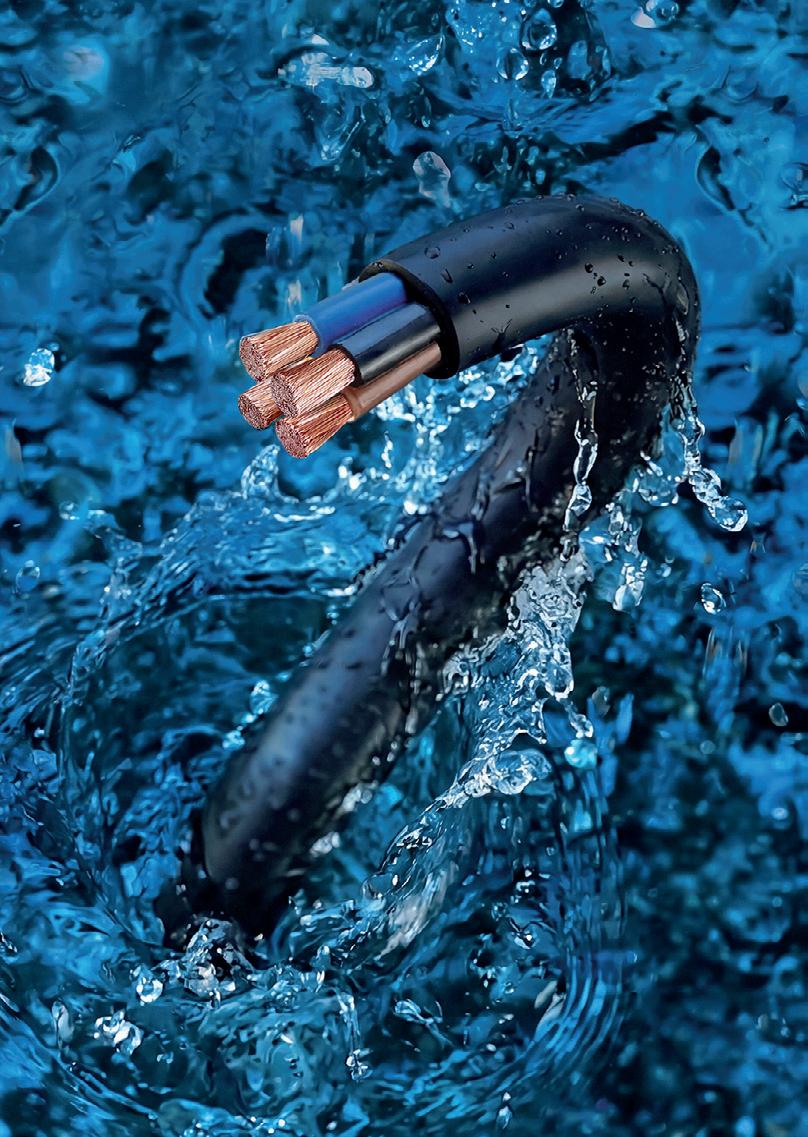
FOCUS Equity and Inclusion
Closing the gender pay gap
Interflow has eliminated its gender pay gap by embedding fair pay practices into every part of the way the business operates.
IN PAST YEARS in construction and engineering, gender pay gaps have often been explained away as an unavoidable by-product of workforce composition.
After all, the greater number of field roles tend to be held by men. But at Interflow, leaders decided that explanation simply didn’t work.
Over the past few years, Interflow has implemented a series of structural and process changes to ensure people are paid fairly for their specific role, experience and contribution, regardless of gender.
The result? Interflow now has no gender pay gap.
For a business operating in the heavily male construction, utilities and water infrastructure sectors,
that outcome means a great deal.
Internally, however, it was never considered a headline initiative. Instead, it came from a broader, conscious focus on fairness and organisational culture.
Chief Financial O cer Tracy Black said the company’s approach was really about ensuring everyone was paid appropriately and fairly, rather than specifically by gender.
“If I think back to the foundation of all of this, we weren’t trying to get to gender pay equality,” she said. “It was instead centred around diversity and inclusion, and about doing the right thing and attracting the right people by paying proper market rates.”
“We pay superannuation while people are on parental leave, for
Interflow said leadership backing has been central to embedding fair pay practices across the business.
Images: Interflow
example. So, we took a big-picture view of what fairness really means when it comes to pay.”
One of the first parts of the process was conducting market assessments of salary ranges, in hand with an independent market analysis body, to ensure current internal roles aligned with benchmarks.
Since those first standards were established, updates have continued to be made to the data to ensure salaries remain within the correct salary bands, regardless of a person’s gender.
And so, the outcome – the elimination of the gender pay gap – was a natural result of fair and consistent pay practices across Interflow. But that’s not the only positive result.
Embedding fairness in Interflow culture
In any business, positive cultures are only reinforced at the operational level when systems and processes
support and consistently encourage new ways of doing things and new behaviours.
Once the original work on salaries at Interflow was completed, it was embedded in the company’s processes and policies for setting, reviewing, and communicating future salaries. Most importantly, pay would never be influenced by gender, race, faith or any other personal characteristic.
Anne-Marie Vella, Interflow’s People Experience Manager, said a vital part of the process was establishing a clear policy and a supporting salary framework for every role.
“It’s actually fairly simple in practise,” Vella said. “We’ve got a role and a salary range. And no matter what, the people in that role need to be within that range. None of it has anything to do with gender.”
Each role has a defined salary band that aligns with current market data. People are positioned within the range based on performance, experience, capability and responsibility.
“We also look at things like parental leave,” Vella added. “When someone re-enters the workplace, we test their salary against current data because the market may have shifted while they were away.”
Importantly, that framework does not then gather dust. Twice a year, or when someone is promoted or returns after a long absence, the ranges are revisited to ensure they remain fair and appropriate.
That’s just the starting point. Of equal importance is how those standards are communicated across Interflow.
Around the time of annual salary reviews, leaders host sessions to explain the framework and the principles that underpin it. This is important, as it communicates
that the standards are not simply set by HR but are understood and supported by the Executive Leadership Team and senior leaders across the business.
“That was a big thing for me – I didn’t want it to come from HR,” Vella said. “It has to come from the leaders, otherwise it’s not going to be embedded in the way we do business.”
Equality is part of Interflow’s purpose
For the Interflow leadership team, the motivation behind the concept of greater equality across the business connects to the organisation’s broader purpose.
“It’s actually all about our purpose,” Black said. “Our purpose is to improve the lives of the people we work with, the communities we serve and the environment we work in. More simply, it’s just not right to have it any other way.”
The elimination of the gender pay gap at Interflow was a notable achievement in itself. Interflow earned the WORK180 award for Outstanding Achievements in Pay Equity in 2025. Black said the biggest challenge facing the organisation is achieving stronger gender representation across the industry more broadly.
It’s no secret that construction and infrastructure-related sectors have male-dominated workforces.
“I think our real challenge now is around attracting and retaining an equal female representation,” Black said. “We have a focus on this in recruitment, from leadership appointments all the way through our workforce.”
In fact, leadership representation has leapt forward at Interflow in recent years. When Black joined Interflow three years ago, she was the second of two women in the
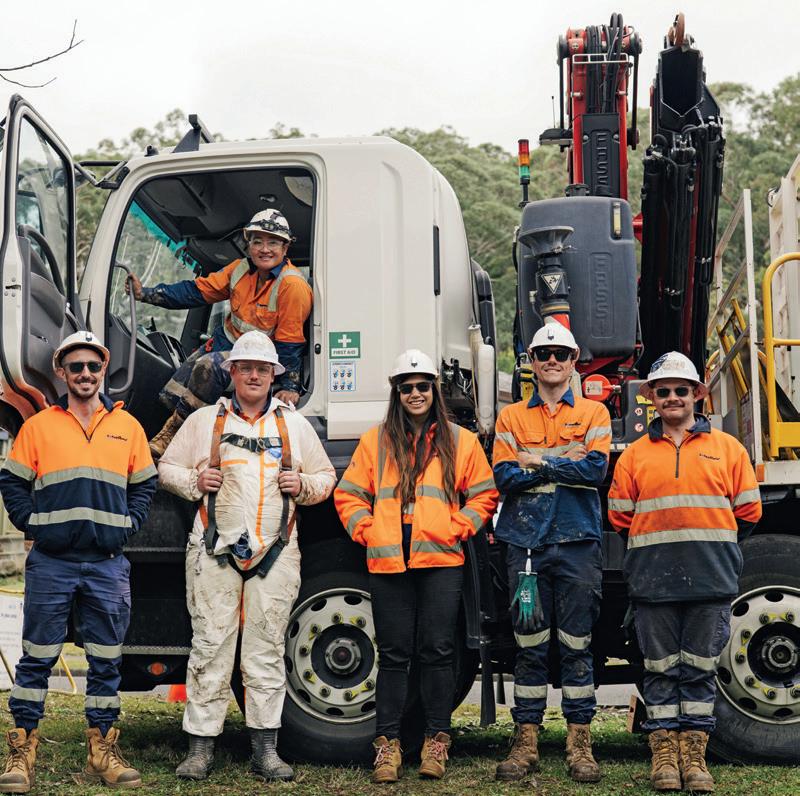
Interflow’s operational workforce reflects the sectors where gender representation and pay equity remain ongoing industry challenges.
executive group. Now, three of eight Interflow executives are female. Those changes matter not just symbolically, but practically.
“When you’re looking at a new role, the last thing that gets you over the line is your sense of how you’re going to fit in,” she said. “If it’s just a bunch of blokes sitting at the table, there’s no way a woman can feel like she’s going to fit in.”
Greater gender diversity at the highest level within a business naturally, and often dramatically, expands the organisation’s potential talent pool, Black said. That o ers a critical advantage, culturally and commercially, as engineering and infrastructure firms across Australia face skills shortages.
“For us, this is now simply the way we work,” Vella said. “It’s embedded into the way we do things.”
In removing the gender pay gap, Interflow has demonstrated that even in male-dominated sectors, structural fairness is not just a nice-to-have; it’s also a powerful competitive advantage.
For more information, visit interflow.com.au
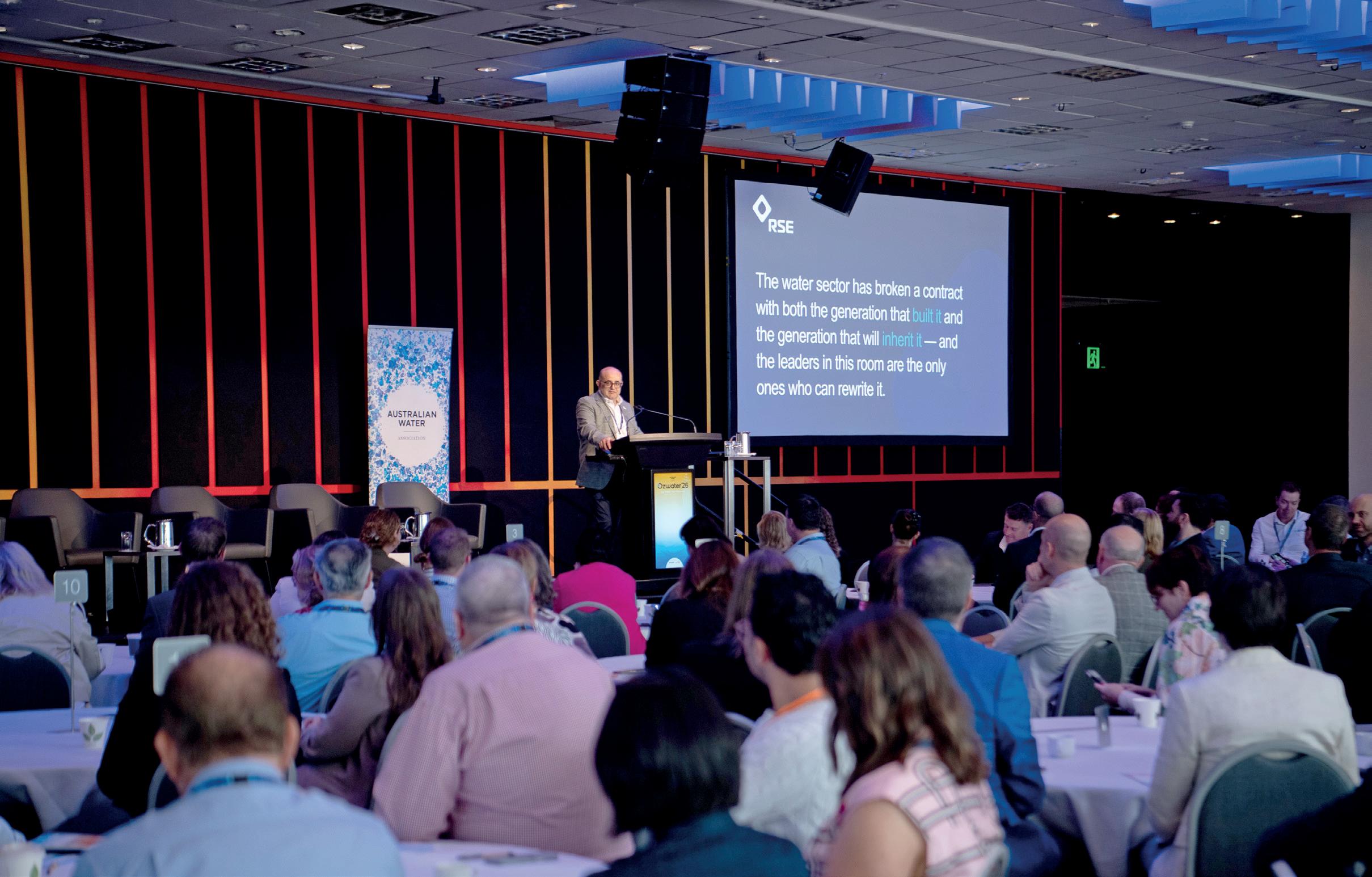
A two-way tide
British and Australian water organisations have much to learn from each other as climate, trust and delivery pressures grow.
THE BRITISH WATER industry is in the middle of what Stephen Slessor describes as its biggest reset in a generation. As Chair of British Water, he is watching a sector trying to deliver record investment while also facing a major review of its regulation.
“The headline I would give Australia is don’t import the UK debate, but do take seriously what happens when ownership models, regulatory design and public communication get out of alignment,” Slessor said. “For me, the lesson is not about the model, it’s about the alignment.”
That distinction matters. Much international commentary on the UK sector centres on privatisation, yet Slessor argues the regulatory architecture is just as important. In England, economic regulation, environmental enforcement, drinking water quality and policy sit across separate bodies.
He said that structure has helped create tension at a time when the sector needs investment, public confidence and faster delivery.
A sector reset
Slessor said the UK is trying to deploy unprecedented capital while redesigning the system that governs how that capital is delivered. The sector’s largest pressure point, in his view, is not only environmental performance. It is financial sustainability.
“If a utility cannot finance the work, it can’t deliver the outcomes, and trust erodes further,” he said.
The environmental story is often simplified outside the UK. Storm overflow discharges and pollution events have damaged public confidence, but Slessor said drinking water compliance remains high and leakage has fallen over time.
“The story that travels is really around the sewage story, and we are partly responsible for sorting that out,” Slessor said. “But it sits alongside decades of measurable improvement that really doesn’t make it into international coverage.”
The harder lesson may be less visible. Slessor pointed to skills, asset data and supply-chain capacity as risks that can sit beneath policy debates until delivery programs begin to strain.
Early preparation is where Australia can gain ground, he said. Also that standardisation, procurement reform and workforce planning need to happen before major capital pipelines reach peak volume.
“Standardise before you scale,” he said. “Standardisation reduces costs, accelerates delivery and de-risks the supply chain.”
He also warned against redesigning procurement while delivery pressure is already at its peak. Once frameworks are live, fragmented contract models can become di cult to unwind.
Stephen Slessor presenting at Ozwater’26
Images: RSE Group
INTERNATIONAL OUTLOOK United Kingdom
Supply chain role
British Water’s membership spans consultants, contractors, manufacturers, technology providers and digital specialists.
Slessor said the supply chain should be treated as central to water-sector outcomes, not as a late procurement function.
“The supply chain represents about 80 per cent of the actual delivery capacity in UK water,” he said.
The UK system, he said, has often been optimised for compliance and lowest cost delivery rather than outcomes. That model can make it harder to use innovation, build longterm capability or allocate risk to the party best able to manage it.
Outcome-based delivery needs longer relationships and contracts that ask what has improved, not whether a specified asset has been built.
“Compliance contracts kill innovation, because a big spec defines the answer,” he said.
“Outcome contracts ask, how did that river improve, or how did that water quality improve?”
Slessor believes Australia has advantages in this area. Longer statelevel planning horizons and strong vocational training provide a platform for more deliberate delivery models.
He also believes British firms need to approach Australia with humility. The UK’s regulatory experience does not transfer neatly into a market shaped by drought, regional service delivery, state-owned utilities and di erent customer expectations.
Lessons both ways
Slessor said Australia has developed some of the world’s most sophisticated approaches to water management, particularly in drought resilience, demand management, water recycling and planning under uncertainty.
He also said the UK has much to learn from Australia’s engagement with First Nations knowledge and cultural water values.
“The work being done on cultural flows, Traditional Owner partnerships and that integration of First Nations knowledge into water planning is leading across the world,” he said.
The comparison also reveals a philosophical di erence. Slessor said the UK still tends to talk about water as a service to be regulated, while Australia talks about water as a resource managed within natural and cultural systems.
That distinction will shape future collaboration. Both sectors face ageing assets, a ordability pressures, climate risks, emerging contaminants, PFAS, microplastics, cybersecurity, and skills shortages.
The opportunity is to share lessons rather than sell answers. Slessor sees strong potential in digital construction, asset management, leakage, wastewater treatment, circular economy outcomes, and emerging contaminants.
He said parallel trials, shared pilots, and co-funded research could test the same technologies in di erent climates and asset bases. He also suggested a bilateral PFAS or emerging contaminants working group involving British Water, the Australian Water Association and relevant regulators.
“When we collaborate, we avoid relearning lessons that have already been paid for somewhere else,”
Slessor said.
The same logic applies to public trust.
Both sectors need better ways to explain why investment is needed, what customers will experience, and where the trade-o s lie.
Slessor said trust is rebuilt through behaviour, not communication alone. Publishing performance data matters,
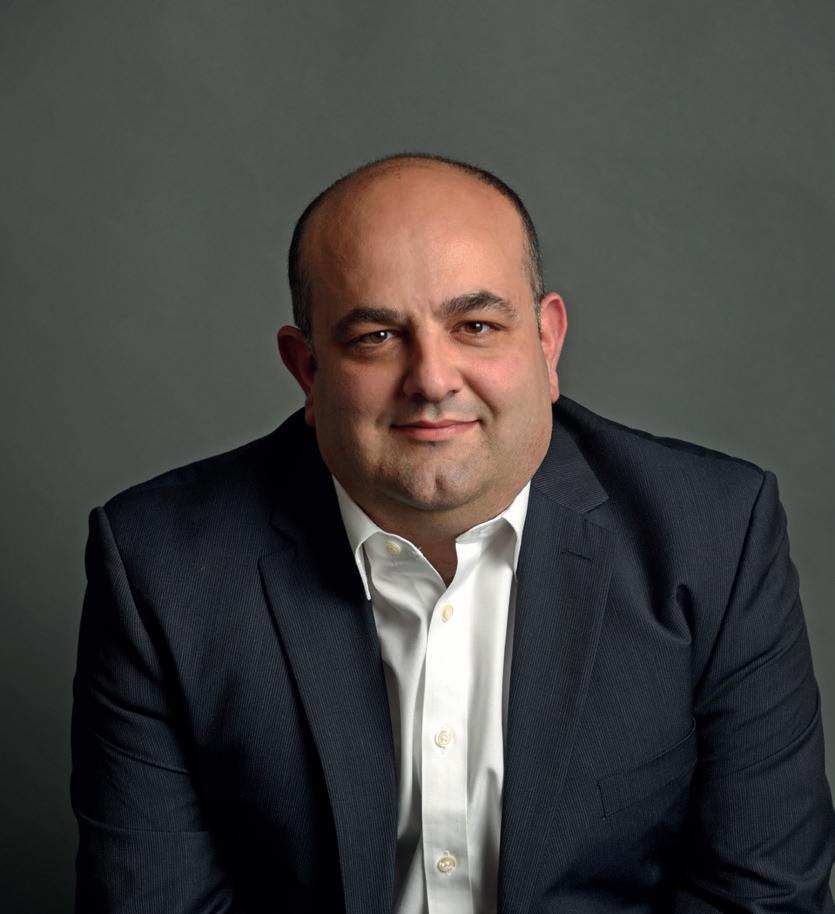
had a significant influence on the British water industry.
but so does making failures, near misses and trade-o s visible.
Customers may support investment in cleaner rivers, fewer service interruptions, drought resilience and environmental restoration, he said, but they are less likely to respond to technical language about pipes, plants and pumping capacity.
A stronger UK-Australia relationship could include structured exchange programs, joint innovation funding, regulatory dialogue and trade missions built around learning rather than selling.
British Water can help convene, coordinate and translate those opportunities, but Slessor said it will need strong partners in Australia.
“It’s not about one-o ministerial visits and all the politics,” Slessor said.
“It’s about bringing an exchange in cultural and operational experience where we both need to learn from each other. It’s not a one-way street; it’s a two-way funnel.”
For more information, visit britishwater.co.uk


Stephen Slessor has
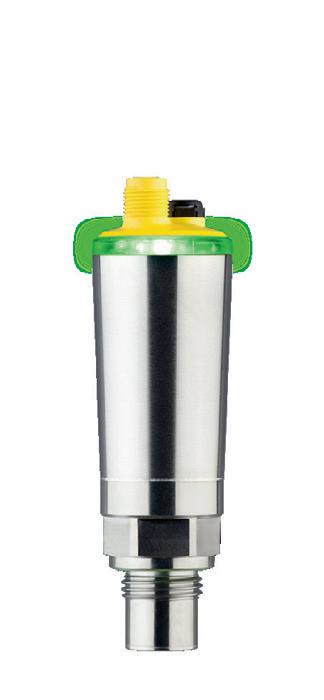
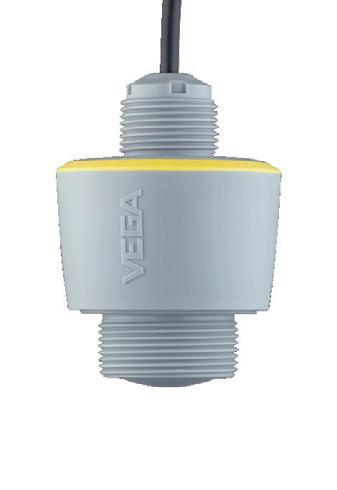
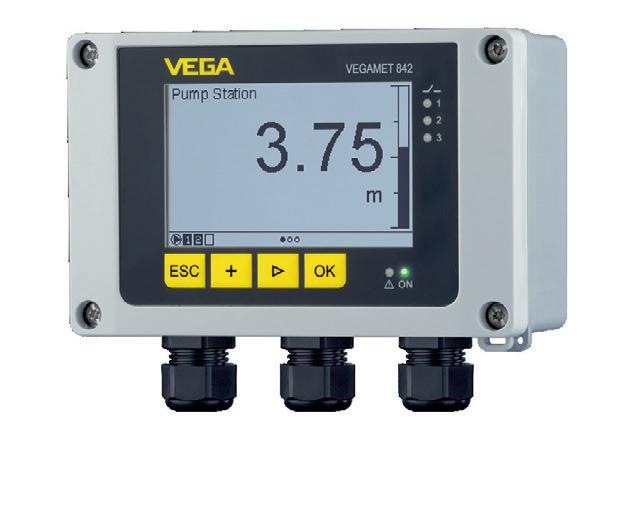
Water is the essence of life. That’s why a type of measurement technology is required that does justice to its importance. Our level and pressure sensors ensure quality with precise measured values to support reliable treatment processes – especially when every drop matters.
Everything is possible. With VEGA.

ASSOCIATIONS VicWater
A steady course
Charmaine Quick’s leadership at Goulburn-Murray Water has combined operational discipline, regional pragmatism and a firm belief that the sector works best when it works together.
WATER HAS NEVER been an abstract policy question for Charmaine Quick. It was rainwater tanks, short showers and the hard memory of drought on a family farm outside Horsham.
Growing up in western Victoria during the dry years of the 1980s gave her an early understanding of what water means when it is scarce and contested.
After a careers night run by Horsham City Council engineers, where she was the only young woman in the room, Quick decided engineering could be a practical use of maths and science. After that, water became the natural fit.
After 28 years at Melbourne Water and seven and a half years leading Goulburn-Murray Water, Quick is preparing to step back from the sector. Her reflections are not framed around a single project or asset. They are about stability, trust, people and the capacity of water organisations to keep adapting.
How did stability rebuild confidence?
When Quick arrived at GoulburnMurray Water, the challenge was not simply technical. The organisation had experienced nine managing directors in 14 years, while the Murray-Darling Basin Plan had reshaped its operating base.
Water deliveries to irrigation communities had fallen from about 1800 gigalitres a year to about 900 gigalitres, yet costs were rising.
A $2 billion modernisation program had changed much of the irrigation network from manual operation to automation. The authority needed
a di erent structure, di erent skills, and a clearer way of using data to guide asset management.
Quick’s response began with leadership and culture. She established a new executive team, restructured the organisation and focused on customer engagement, digital capability and asset decisions. The result was not immediate, especially as the organisation also navigated COVID-19, an earthquake near Eildon and major floods.
Yet the outcomes were significant.
Goulburn-Murray Water reduced its four-year revenue requirement from $504 million to $440 million, contributing to a 10 per cent price reduction for the average irrigator. In the next pricing submission, the authority held prices broadly stable rather than allowing savings to disappear.
“I was really proud of the fact that we were able to maintain those e ciencies and those savings,” Quick said.
She is equally proud of what stability did for the reputation of the organisation. The largest rural water authority in Australia has become a more attractive employment prospect for people..
What makes regional water leadership di erent?
Regional water utilities operate where policy, production, environment and community identity meet.
At Goulburn-Murray Water, that means serving irrigators, environmental water holders, Traditional Owners, urban water authorities and regional communities
Charmaine Quick has been leading GoulburnMurray Water for many years.
Images: GoulburnMurray Water
across a system that supports food production, recreation, ecosystems and towns.
Quick said clarity of purpose is essential. Goulburn-Murray Water’s role is to store and deliver water for those who own it, but that does not remove the need for broader leadership.
The organisation’s vision of “water for a thriving northern Victoria” gave it a shared starting point. A thriving region cannot exist without agriculture, healthy waterways, town supply, recreation and community confidence. The harder work is negotiating how water is used when interests di er.
That is where engagement becomes practical, not performative. Quick points to the need to work with irrigators, catchment management authorities, urban water corporations and regulators, while recognising that not everyone will agree.
In her view, good water policy may be the point at which all parties slightly disagree, because no single interest has been entirely favoured. That perspective is important as
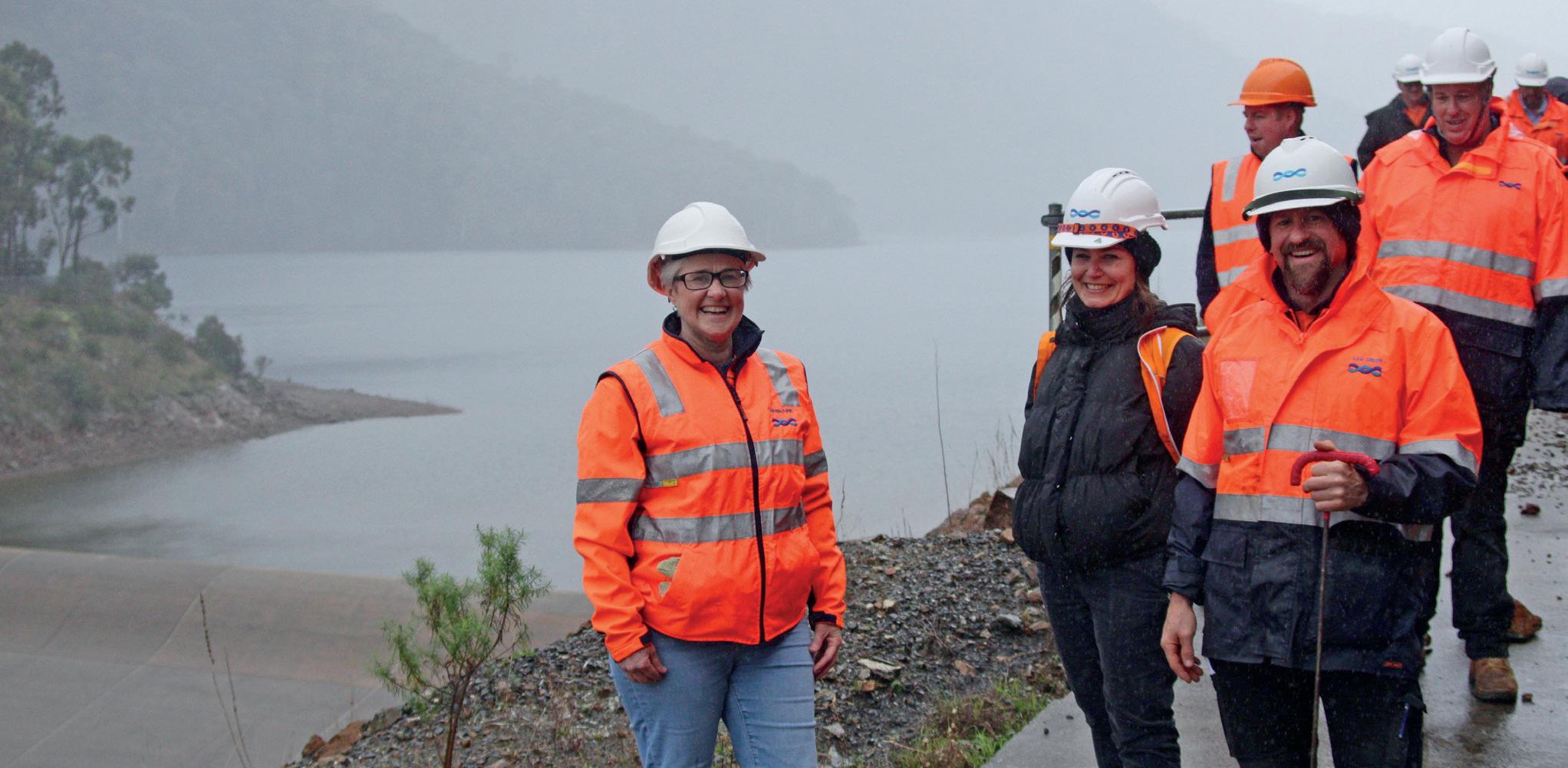
climate variability, a ordability pressures and ageing infrastructure reshape the sector. Quick describes climate change as a challenge of extremes, with too much water at some times and not enough at others. She also sees skills shortages and rising compliance costs as risks for utilities trying to keep water a ordable while renewing assets.
Quick is concerned that public debate is becoming less able to hold complexity. Social media can reward shouting rather than negotiation, yet the next phase of water management will require compromise, patience and sustained conversation.
Why does collaboration still matter?
Collaboration has been one of Victoria’s strongest assets in the water sector. VicWater has played a central role by providing managing directors with a forum to test ideas, share problems, and identify issues best solved collectively.
“It can be quite lonely at the top,” Quick said.
She said VicWater’s managing director forums, specialist groups, and broader sector networks help water organisations avoid duplicating e ort in areas such as climate change, financial sustainability, netzero commitments, innovation, and technology. Where utilities are not in competition, collaboration can make them more e cient and e ective.
Quick also points to the Institute of Water Administration and Intelligent
Water Networks (IWN) as structures that help ideas move between organisations and across disciplines. The problems ahead will not be solved by one utility, one person or one profession.
It is clear that technology will be part of the opportunity of the future.
Quick has seen the shift from expensive, power- and landlinedependent field monitoring with limited sensors to solar-powered systems, mobile communications, automated gates, and real-time data. Irrigators can now order water by phone at any time, while control rooms manage automated infrastructure to support more e cient delivery.
Artificial intelligence may be the next step, but Quick’s emphasis remains grounded. Data only matters if it becomes insight, and insight only matters if it leads to better decisions for customers, assets and communities.
Her advice to future leaders reflects that practical mindset. Do not rush a career. Build broad experience before specialising. Spend time with customers and operators. Keep learning. Remember that a degree or a title does not mean you know it all. Quick’s own measure of legacy has changed over time. Earlier in her career, she thought it might be the assets she helped build. Now, she sees it more clearly in the people she has supported, promoted and prepared to lead the sector forward. That may be the most fitting
She has always been committed to dealing with the challenges of the region, from the driest droughts to the wettest periods.
conclusion for a career shaped by water’s practical demands: infrastructure, technology, pricing and asset management matter.
However, she notes that regional water will also depend on leaders who can listen, collaborate and take the right risks.
Quick emphasised the importance of people in the industry taking a more holistic approach to understanding and addressing risk. She said that people in the industry should be open to new solutions and feel encouraged to think outside the box.
“I think really understanding risk and being prepared to take some risks where it makes sense, because that’s where we will get something di erent,” Quick said.
Quick has been a steady hand and well-respected presence throughout her tenure.
ASSOCIATIONS qldwater
From protection to cost recovery
As utilities face rising costs and compliance pressures, qldwater’s Trade Waste Uplift Project is helping recover costs more fairly.
THE TRADE WASTE manager’s role is usually described as a protective function. It ensures that the acceptance of trade waste into the sewage system does not a ect workers’ health, degrade assets, inhibit treatment processes, cause environmental harm, or reduce the value of downstream products for reuse.
qldwater frequently receives updates from members where trade waste has negatively impacted assets.
For example, in one region, a juice manufacturer caused extensive damage to trunk mains and pump stations through uncontrolled acidic discharges.
In another case, excessive discharge of oil and grease
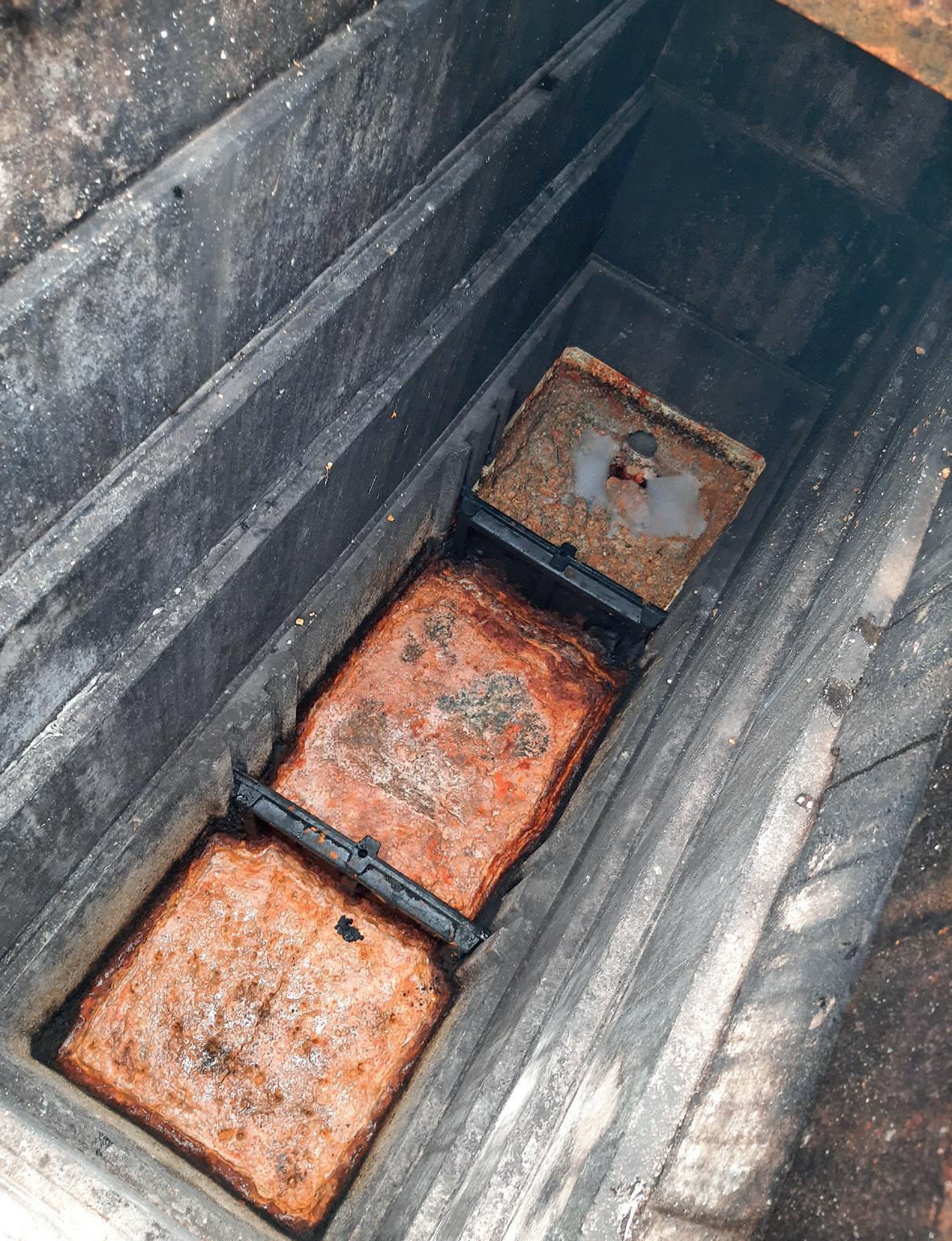
from a food processor hindered the treatment process. This resulted in non-compliance with environmental regulations.
There is another dimension to the trade waste manager’s role that is increasingly important. Utilities must ensure that the additional costs incurred from accepting trade waste are recovered from generators in a cost-reflective manner.
Failure to do this places a disproportionate burden on domestic customers. In many cases, that situation has become normalised. The reasons for this are surprisingly straightforward. There is a mistaken perception that sewage charges already cover the cost of accepting trade waste, so there is no apparent revenue shortfall.
The actual cost of accepting trade waste is often unclear. Utilities may also be concerned that investment in trade waste management will not yield a return.
These reasons reflect a modern tendency toward low-energy management systems. However, utilities that address them can realise significant benefits.
Those benefits include reduced pollutant loads, lower capital and operational costs, and reduced risk of non-compliance with Environmental Authorities.
They also include lower system maintenance costs and improved regulatory compliance, which can reduce environmental and economic risk.
There are many more advantages, including improved customer relationships, but let’s focus on the main ones.
Addressing these issues is almost certain to pay dividends. A 2025 report from the Water Services Association of Australia found that almost all Australian utilities under-recover trade waste costs. The proper management of trade waste is vital for minimising costs.









Planning a shutdown?
There’s a better way.
Many shutdowns are planned for the same reasons:
ISOLATION & SAFETY INSPECTION
REPLACEMENT & RENEWALS
PIPELINE COMMISSIONING NEW ASSET CONNECTIONS
Engage early to explore alternatives to traditional shutdown methods.
Across Australia’s water networks, shutdowns are often treated as the default solution for critical works. With modern live network technologies, many of these can now be completed without interrupting supply. Saltire works alongside utilities and contractors to solve complex challenges on live water networks with minimal or zero disruption.
Scan the QR codes to how our technologies work.
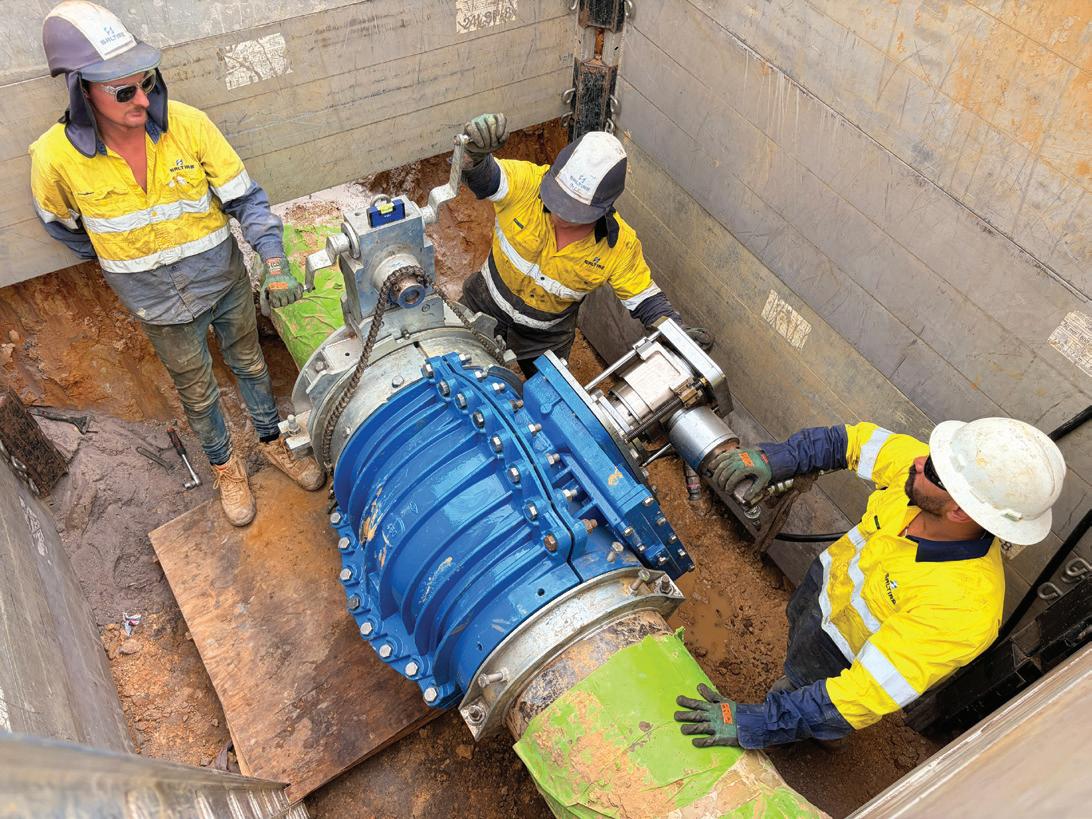
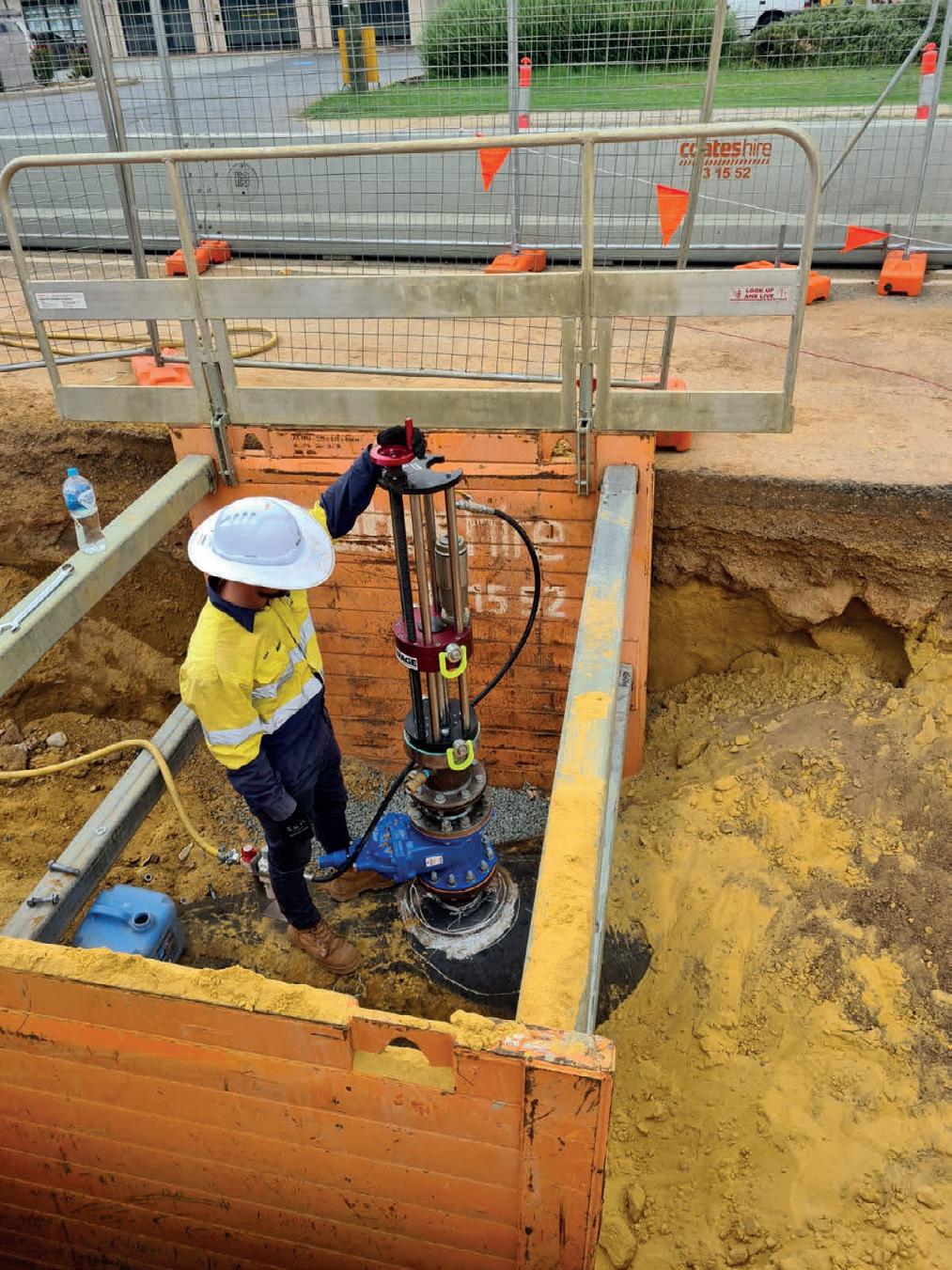
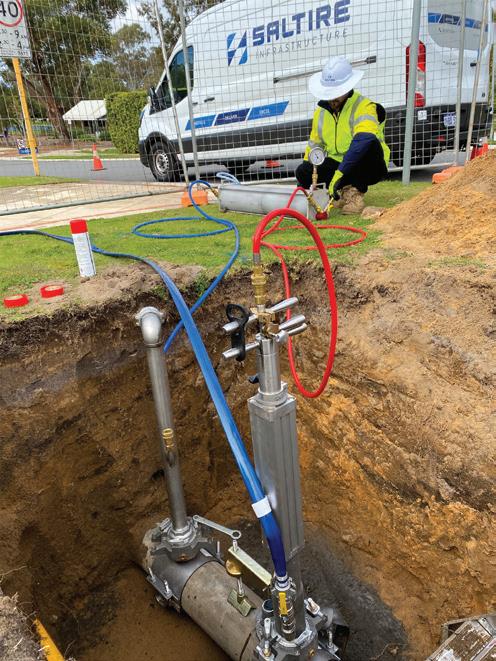
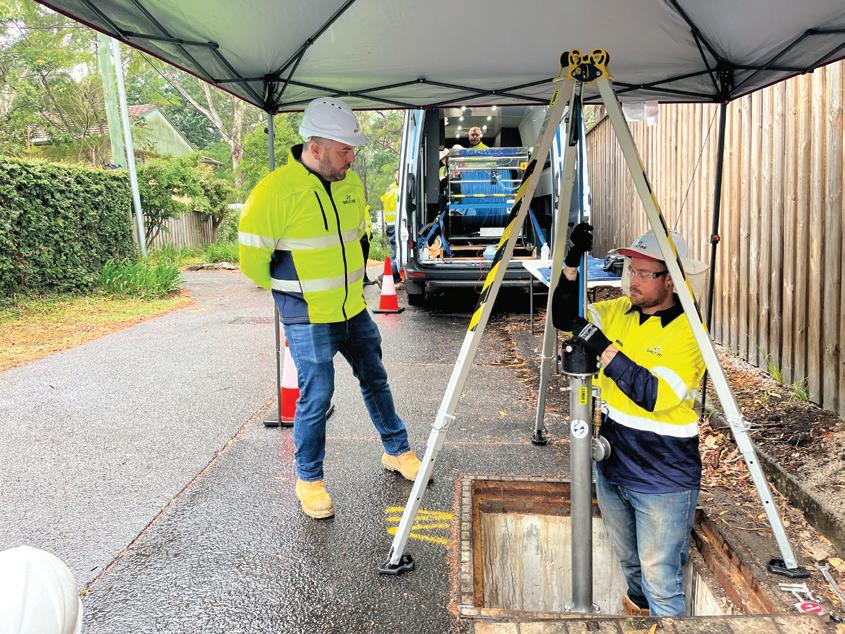
Before you plan a shutdown, talk to Saltire.
Operations sector getting involved
The WIOA 2026 NSW Conference returns to Newcastle with a strong focus on practical knowledge, peer recognition and operational skill.
WHEN THE NEW South Wales water operations sector gathers in Newcastle this September, the value of the event will lie beyond the formal program.
It will sit in the practical knowledge shared among operators, the problems discussed between peers, and the recognition given to people who keep water and wastewater services running.
The Water Industry Operations Association of Australia will host the 2026 NSW Water Industry Operations Conference & Exhibition in Newcastle on September 9 and 10.
The event will bring operators, utility teams, suppliers, emerging professionals and industry partners together for two days of technical learning, exhibition activity and sector connection.
A sector built on shared experience
The 2025 NSW conference showed what the Newcastle event can o er. It featured operator-led papers, poster presentations, training, awards, competitions and an exhibition floor focused on water and wastewater industry products and services. Topics included flood response, PFAS
management, water-quality learnings, operational upgrades, and climaterelated challenges.
That mix is central to WIOA’s role. The conference gives practical field experience a public platform. A di cult shutdown, treatment issue, mains repair, or system improvement can o er lessons that are useful well beyond a single organisation.
For WIOA CEO Dean Barnett, the 2026 event also comes at an important point for the association.
“The water operations sector has always been at the core of who we are, and reaching 6,000 members in 2026 is a proud milestone,” Barnett said. “More than a number, it reflects a growing community of dedicated professionals committed to sharing knowledge, supporting one another, and strengthening our industry for the future. We encourage our members to get involved and share their experiences with peers in Newcastle this September.”
Presentations, posters and practical lessons
WIOA is encouraging members and industry participants to submit abstracts for the 2026 program.
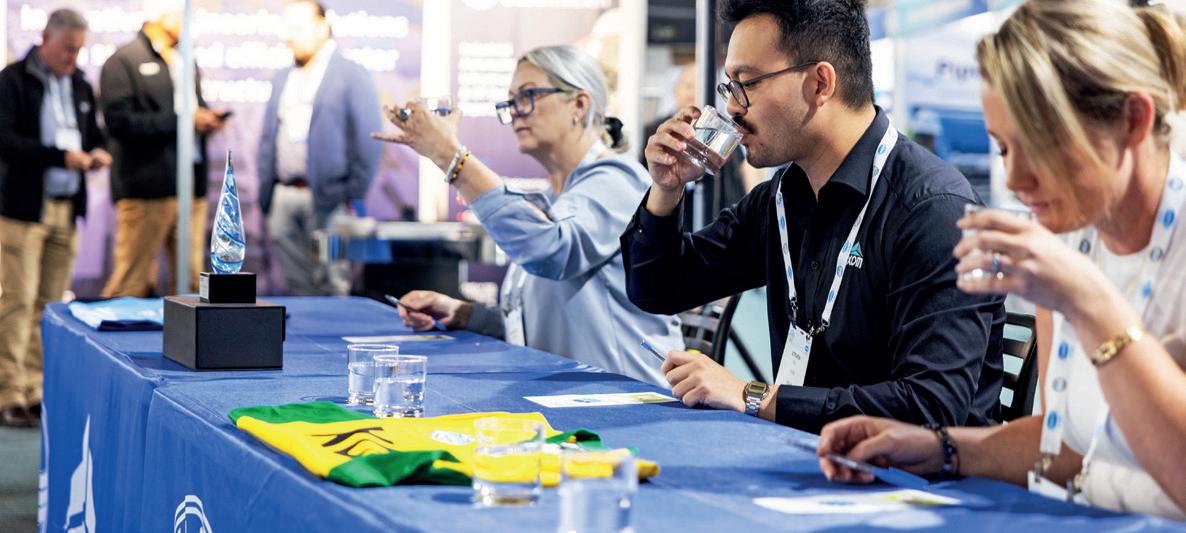
The best tasting tap water is a fiercely soughtafter title in every state and territory. Image: WIOA
Presenters can share a project, initiative, field lesson or innovative solution through either a technical paper or a poster.
That flexibility matters for an operationally focused event. Some projects need the structure of a detailed technical presentation. Others are better suited to a poster format, where delegates can ask direct questions and discuss the work in a more relaxed setting.
The strongest conference material often comes from people who have solved a problem under real operating constraints. Those lessons can help other utilities consider what worked, what failed and what should be tested before a similar approach is used elsewhere.
Competition, recognition and Newcastle connection
The conference will also o er operators and teams several ways to participate beyond the papers program, sponsored by McBerns.
WIOA is inviting nominations for their National and NSW Awards, including the New Operator category and recognition for standout teams and members of the water operations workforce.
The Reece Civil + Viadux Main Tapping Competition and the IXOM Best Tasting Tap Water Contest will also return.
These competitions add a practical and public-facing element to the event, while recognising the skill, care and consistency behind everyday water operations.
Together, the papers, awards, exhibition and competitions give the NSW water operations sector a clear invitation. Get involved, share what you know and recognise the people doing the work.
For more information, visit wioa.org.au/2026nsw
Water’s next voices
Valentina Zheng says the 2026 YWP Conference and Ball will help young professionals turn sector ambition into practical change.
FOR MANY YOUNG professionals, the water sector does not begin as a grand plan. It begins with a first role, a good team and a few chances to meet people who make the industry feel less distant.
Valentina Zheng, a digital designer at Mott MacDonald, found that path starting during the COVID pandemic, when a role in water opened soon after graduation. Today, Zheng works on Mott MacDonald’s Next Generation for Delivery (NG4D) program, supporting Urban Utilities across South East Queensland with reticulation services.
The Australian Water Association’s Young Water Professionals program gave her a way into the wider sector.
“I was pretty certain that this is my passion, this is my drive in my career, pretty early on within my career,” Zheng said. “A lot of it was actually thanks to AWA.”
That early exposure came through sundowners, industry events and
conversations with other water professionals. Over time, the network became an anchor.
“Once you’ve got friends, and you know people that you’re acquainted with in the industry, it kind of anchors you,” she said. “You start to feel like, ‘Oh, I’m part of this industry, and I don’t want to move anywhere anymore.’”
Zheng’s sense of belonging now underpins his role as chair of the planning group for the 2026 AWA/ IWA Young Water Professionals Conference and Ball.
The Melbourne event’s theme, “From Vision to Action,” challenges Zheng and her team to ensure the conference is practical, valuable, and directly linked to the decisions young water professionals are actively influencing.
Finding a place
Zheng’s involvement with the YWP program grew from the same

Valentina Zheng is a digital designer at Mott MacDonald. Image: Mott Macdonald

networks that helped her settle into the sector. She began attending AWA events through encouragement from colleagues, then joined the AWA mentorship program. Her mentor, Justin Simonis, helped her see volunteering as a way to contribute, not only a way to build a career.
“I saw his passion,” Zheng said. “I saw how much he cannot just get out from volunteering, but also how much he can contribute to the industry. I was very inspired.”
The advice she received was simple: start somewhere. In Zheng’s case, that meant applying for the AWA YWP committee.
“I pushed hard. I talked to everyone that I knew who was on the AWA committee to vote for me, and I made it in,” she said.
Attending events can introduce people to the sector, but volunteering builds a di erent kind of connection.
Young Water Professionals participating in workshop discussions at Ozwater’26.
Image: Australian Water Association
“You really only build relationships, meaningful relationships, when you go through that camaraderie with someone,” Zheng said.
That has meant planning events, sharing responsibility and working with peers toward a common
outcome. It has also opened the door to reviewing Ozwater papers, assisting conference chairs and taking part in what she described as “adult table conversations”.
Those experiences have helped build her knowledge of the sector. They have also made the industry feel more accessible.
From theme to action
The YWP Conference and Ball is of national scope, but its organising model is grounded in youngprofessional leadership.
The taskforce brings together volunteers from di erent states to plan an event that can stand apart from larger industry conferences while still treating young professionals as serious contributors.
Zheng became chair after raising her hand during the planning process.
“I said, ‘I’m happy to chair this planning task force, this planning group,’” she said.
The group wanted the conference to show what young water professionals can do when they have ownership of the agenda. That intent sits behind the theme.
“We realised everyone was leaning towards the idea that the industry has been having a lot of conversations,” Zheng said. “We’ve been having conferences, but after the conference, everyone just goes home and forgets about everything, and nothing really happens.”
That observation led the taskforce to focus on implementation. The question became how to turn conference discussion into something delegates could use when they returned to work.
“People can share their visions all the time, but how do we really bring them into concrete actions that can make a real change?” Zheng said. The planning group for the 2026
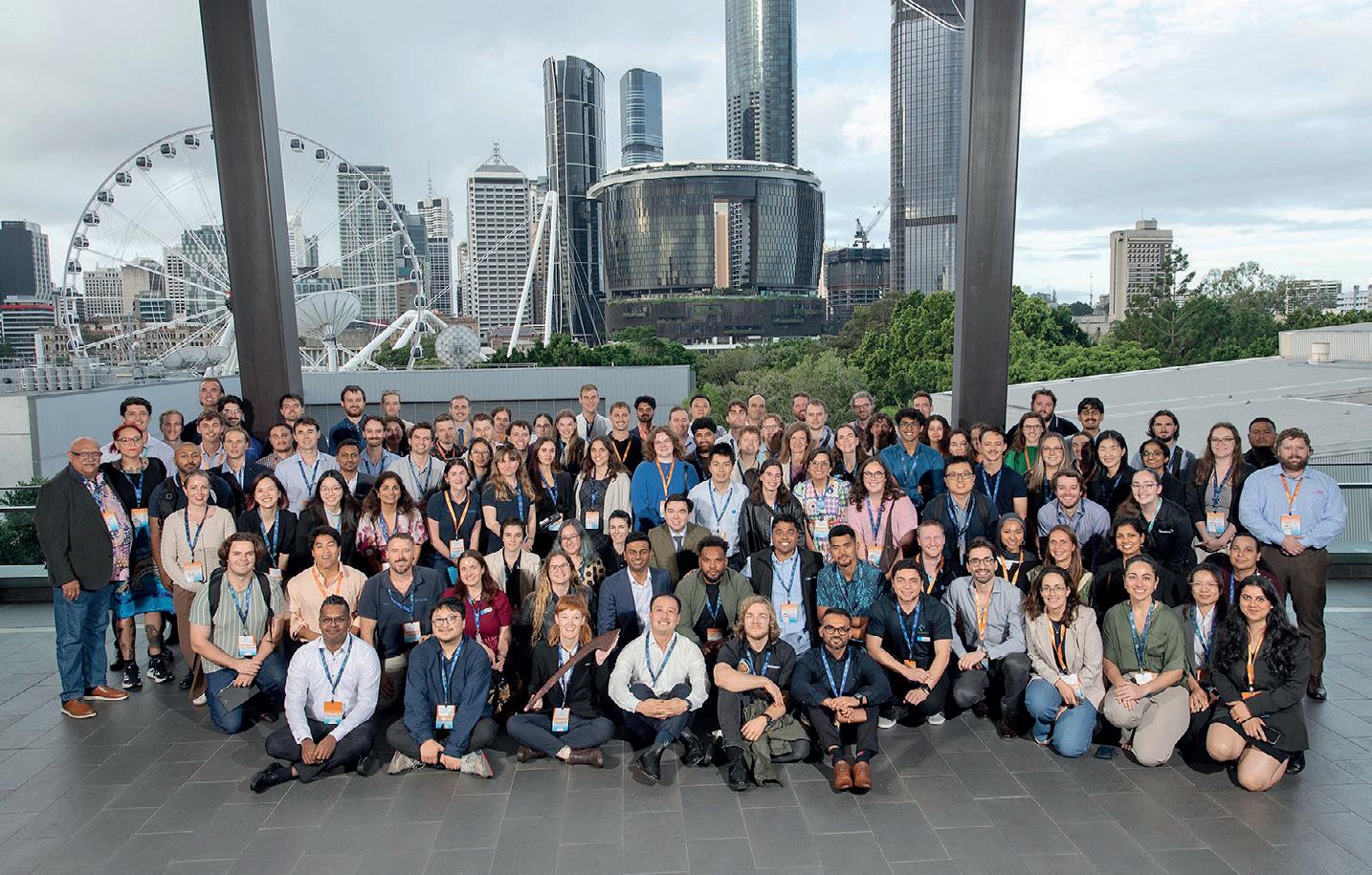
program has placed strong emphasis on digital innovation, artificial intelligence, workforce diversity and emerging leadership. Zheng’s own digital background shaped some of that discussion.
“Digital is a great starting point,” she said. “It’s a great tool to transform your ideas into reality.”
The workforce stream also reflects questions that many young professionals are already asking. These include how organisations support generational diversity, create inclusive teams, and make space for people at di erent career stages.
Those conversations are not abstract. They are part of how the water sector can keep knowledge moving between generations while giving new professionals room to contribute.
A seat at the table
For Zheng, the conference also aims to shift the industry’s perception of young water professionals.
“You have to expose the next generation to decision making, to just give them a seat at the table to observe, to participate, to even say the wrong things, so that they understand why it’s wrong,” Zheng said.
That is where the emerging leadership focus becomes practical. Panel discussions will give delegates access to lessons from senior water leaders.
Paper selection has also been used to ensure the program conveys the right messages on climate resilience, digital transformation, community
Young Water Professionals recently gathered at Ozwater’26 for the YWP Program.
Image: Australian Water Association
engagement, and workforce change.
Zheng said a YWP conference creates a di erent atmosphere from larger events because the proportion of young water professionals is higher and the topics are more relatable.
“They know the majority of the people around them are at a similar experience level as themselves,” she said. “They’re probably more open to start conversations.”
That matters for confidence. A delegate who might feel hesitant in a large industry room may be more willing to ask questions, test ideas, and start conversations when the event is designed with young professionals in mind.
Zheng hopes delegates leave Melbourne with a stronger sense of agency.
“You might be young, you might not be at the top tier in your organisation at the moment, but we have just as much, if not more, power to push for changes and to push for actions,” she said.
As the chair of the taskforce, success will depend on whether delegates return to their workplaces with ideas they feel able to share and the confidence to act on them.
“We want delegates to return to their workplaces, saying ‘I attended this conference, I learned heaps, and guess what, you were not there, and I can share this with you,’” Zheng said. “They should want to be able to make some real changes.”
For more information, visit awa.asn.au/young-water-professionals
Ripples that reach further
Ripple has turned an Ozwater evening into a practical fundraiser connecting Australia’s water sector with WaterAid’s global work.
OZWATER IS USUALLY a place for the Australian water sector to look forward. Conference halls fill with discussion about data, assets, e ciency and the technologies that will shape the next decade.
Ripple, a digital water metering industry fundraising event, asks the sector to look sideways. It brings together people from the most technologically sophisticated end of the water industry, including those working with digital water meters, systems integration, and connected infrastructure.
Held at the Ship Inn during Ozwater 2026, Ripple gave the industry a place to gather on the one free night of the conference program.
It was part networking function, part fundraiser, and part reminder that the fundamentals of clean water and sanitation still underpin every technical discussion in the sector.
The ra e was the major fundraiser on the night. Around it, suppliers, customers and peers used the evening to support WaterAid while making practical use of a limited window in a crowded Ozwater week.
For Andrew Hinchli e, New Plumbing Solutions’ involvement in Ripple is not about presenting technology as the answer. It is about practical support and what happens when suppliers, customers and peers act together.
“I think Tom (Muller) made it very
All the sponsors came together for Ripple, and are looking forward to the next edition in Sydney. Images: WaterAid
clear on the night when he spoke to the audience that the work that they do in the countries they operate in, Timor-Leste and Papua New Guinea and so on, is not about the most sophisticated outcome,” Hinchli e said.
“We don’t necessarily use that as an opportunity to celebrate innovation and cutting-edge technology, because it’s not necessarily sustainable in those environments.”
A fundraiser with momentum Ripple has now run for three years. Its name was built around a simple image: a pebble hitting water and sending out rings long after the first impact has disappeared.
Hinchli e said the fundraiser began with a small group of suppliers who wanted to support WaterAid during Australia’s largest water gathering.
“This was three years ago, a concept
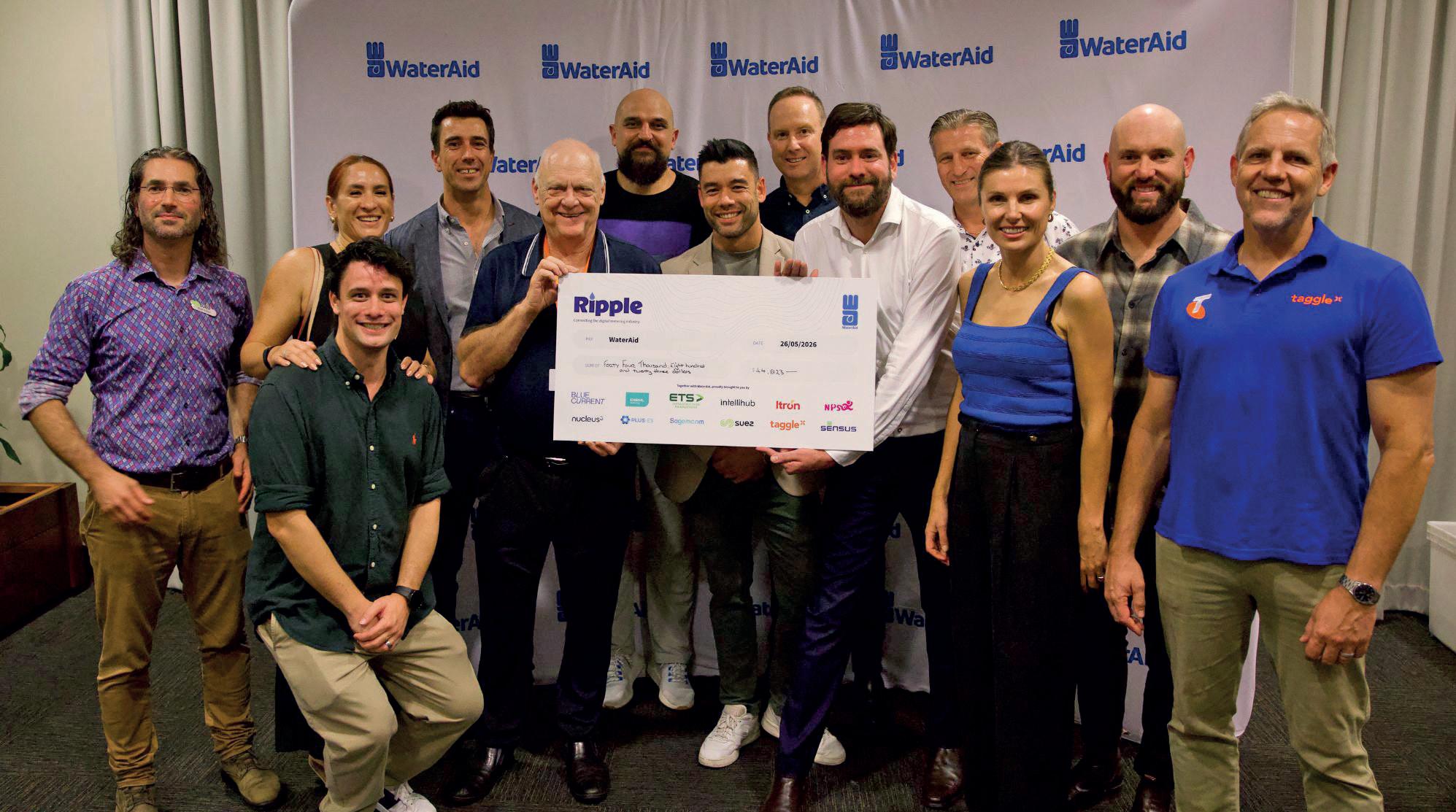
that came together by a few key suppliers who all knew each other reasonably well,” he said.
“We raised six thousand dollars on that first night and thought we were superheroes, and naturally that trajectory has really rocketed o .”
The 2026 Ripple fundraiser raised just over $44,000. That followed $31,700 in 2025, taking the total from the past three years to more than $80,000.
The result showed Hinchli e what can happen when businesses that usually carry di erent logos put one shared cause ahead of their separate commercial interests.
“If you think there are di erent logos on our shirts, and it’s an industry filled with di erent characters, at the end of the day, we can all come together and raise quite meaningful funds for WaterAid, and change lives,” he said.
Why practical solutions matter WaterAid’s public figures give the work a hard edge. Almost one in 10 people worldwide do not have clean water close to home, while 1.5 billion people do not have their own toilet.
In WaterAid’s work, the first question is often whether a solution can keep operating without the support structures Australian organisations take for granted.
Hinchli e pointed to the use of bamboo pipes as an example. The point was not that bamboo is novel. It was that communities can maintain and replace it without imported equipment or specialist support.
“The fact is that’s a technology technique that they’ve used for generations as well, and it comes down to the sustainability of the solutions that get provided to them,” he said.
“You could have cutting-edge tech that can’t be supported because there isn’t 24 hours of electricity available, or there isn’t the backup and support.
There may not be reliable cellular service for monitoring and those sorts of things.
“So it is very much about doing the fundamentals and doing them right, and supporting them from that perspective so that they can continue in each of those communities.”
That lesson also travels back into local water work. Hinchli e said WaterAid’s work reinforces why sophisticated systems exist in the first place.
“We’re always looking for the most accurate data, the most accurate alerts and alarms, and those sorts of things, and that’s important, particularly if you’re doing critical work,” he said.
“But it also cuts back right to the very fundamental that you need to have an accurate supply and a timely supply of clean water.”
One industry, one room
Ozwater is Australia’s premier water conference, with a three-day program and a large national exhibition that brings utilities, suppliers, consultants and decision-makers together in the same week.
Ripple was designed around the reality of that crowded conference program. In 2026, 12 sponsors came together at the Ship Inn so customers, partners and suppliers could support WaterAid while making industry connections.
The format gave the evening a clearer purpose than a standard networking function. Attendees could move between suppliers, customers and peers while knowing the room
WaterAid CEO Tom Muller addressed the water sector at Ripple.
had been assembled around one shared outcome: raising money for practical water, sanitation and hygiene work through WaterAid.
“It was very much driven by the reality that you can’t be in 12 places at once,” Hinchli e said.
“By bringing all of those together in one venue, it was very much like, well, you can e ectively be in 12 places. If somebody wanted to talk to NPS, they can, but Itron were there, as was Sagemcom, as was IntelliHub and all the other sponsors.
“It was very much a fundraiser, a great networking opportunity, and really trying to be as e cient with our time for all of our customers, our suppliers, our partners and the industry as a whole.”
The next ripple Hinchli e expects Ripple to pass $100,000 in total donations at the 2027 Sydney gathering. The fundraiser will then return to Melbourne with Ozwater in 2028.
NPS is also working with WaterAid around World Toilet Day on 19 November. The challenge is to keep asking what practical support can look like beyond a single night of fundraising.
“There’s a huge opportunity there to do something a little further and beyond,” Hinchli e said.
“It has to be sustainable, but we’re constantly in touch with the team from WaterAid about this and other initiatives.”
To find out more, visit wateraid.org/au/get-involved
No-dig under the long white cloud
International No-Dig Auckland will showcase New Zealand’s growing trenchless capability as water, engineering and construction leaders gather to explore smarter infrastructure delivery.
NEW ZEALAND’S TRENCHLESS
sector is preparing for a larger stage.
International No-Dig Auckland will bring water, engineering and construction leaders together as interest grows in lower-disruption ways to install, renew and maintain essential infrastructure.
The event will take place at the New Zealand International Convention Centre from October 28 to 29, 2026. It will give local capability more visibility while drawing global knowledge into New Zealand. Across drinking water, wastewater, stormwater, transport corridors and utility networks, underground assets are carrying heavier expectations. Communities want reliable services, but they also expect construction methods that limit tra c impacts, protect public amenity and reduce environmental disturbance.
A sector on show
New Zealand’s Local Water Done Well programme adds another layer to that discussion. Finalised in August 2025 through the (Water Services) Act 2025 the former Three Waters reforms and gave councils greater control over water management.
“The LWDW programme is reshaping how councils and utilities manage water,” Prime Creative Media General Manager, Events Molly Hancock said.
“It raises the bar for sustainability, innovation and long-term resilience, and it’s a real opportunity for trenchless technologies to play a central role.”
Water New Zealand has joined as
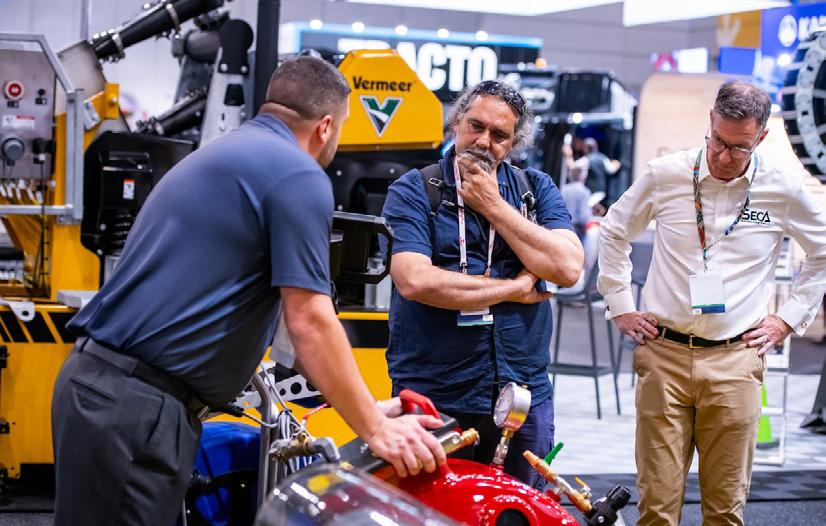


The global stage for trenchless innovation
Bringing the latest trenchless advancements and industry knowledge to Auckland
New Zealand International Convention Centre, Auckland 28 – 29 October 2026
GET TICKETS



Rewarding utility excellence
The 2026 Utility Awards will recognise the people, projects and organisations shaping Australia’s essential services.
AUSTRALIA’S
ESSENTIAL SERVICES
rarely get a quiet year. Utilities are managing the energy transition, water security, network investment, customer expectations, safety obligations, and field delivery in communities that quickly notice when services fail.
The inaugural Utility Awards has been launched to recognise the organisations, teams and individuals doing that work across electricity, gas, renewables, water and network infrastructure. Nominations are now open, with the awards dinner to be held at Evoqé Events in Melbourne on 27 October 2026.
Recognising utility work
Presented in partnership with Australia’s leading utilities, the program celebrates practical achievement across the sector. Its scope is deliberately broad, reflecting how modern utilities often face shared pressures even when their assets, customers, and regulatory settings di er.
The categories include Utility of the Year, Retailer of the Year, Utility Person of the Year, Customer Experience Person of the Year, Utility Project of the Year and Project Delivery Team of the Year. They also recognise Digital Transformation Project of the Year, Network Innovation, Decarbonisation Initiative of the Year, Cross-Utility Collaboration of the Year, Utility-Supplier Partnership of the Year, Rising Star in Utilities, Safety Excellence, Field Excellence and Diversity & Inclusion Program of the Year.
Prime Creative Media head of awards and conferences, Caitlyn Douglas, said the program was designed to recognise people and projects that set a high standard.
“The utilities sector is evolving rapidly, and these awards are designed to shine a spotlight on the leaders and innovators setting new benchmarks for the industry,” Douglas said.
The Utility Awards will honour the individuals, organisations and projects around Australia’s essential services.
Image: Prime Creative Media

Why a sector-spanning program
The awards arrive as utilities are being asked to deliver reliable services while changing how they plan, operate and engage.
Water utilities are investing in resilience and customer outcomes.
Energy networks are dealing with decarbonisation and demand.
Suppliers and contractors are increasingly part of the delivery model, from digital systems to field operations.
That cross-sector structure is reflected in the nomination criteria, which encourage entries from utilities of all sizes, industry partners, contractors and suppliers.
The program is also open to projects, leadership, sustainability initiatives and operational achievements, giving organisations a platform to recognise both headline work and the processes behind it.
“The award categories have been carefully designed to reflect the breadth and diversity of the utilities sector, while creating meaningful opportunities to recognise the outstanding individuals, teams and organisations driving the industry forward,” Douglas said.
Nominations now open
The awards will bring together leaders and professionals from across the country for a black-tie evening in Melbourne, with arrival from 6:30pm and a 7pm start.
For utilities and partners, the program o ers a formal way to recognise work that often sits behind the scenes. It also gives teams a reason to document the evidence, outcomes, and people behind projects that help shape Australia’s essential services.
For more information, visit utilityawards.com.au
FOCUS The Last Drop
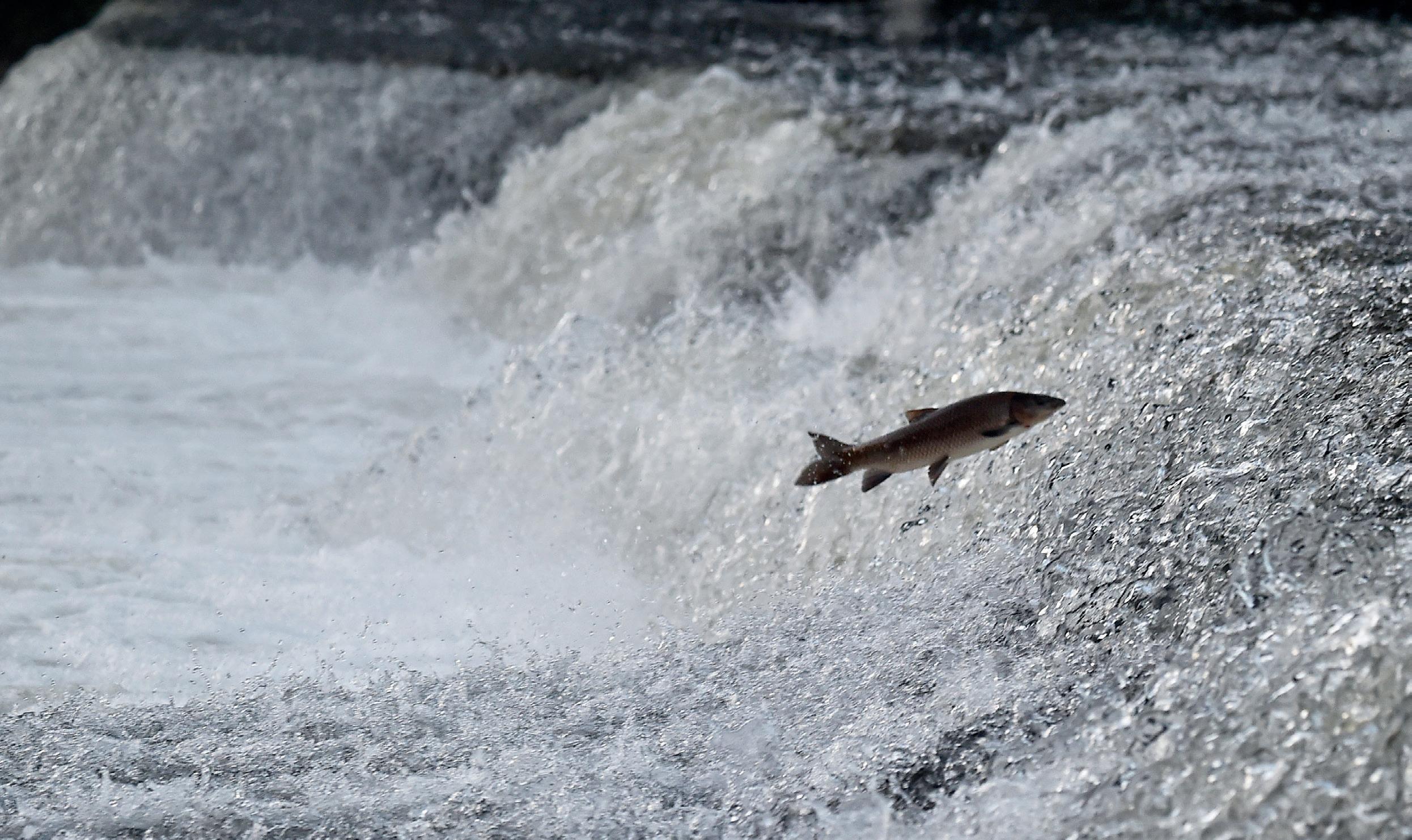
The Last Drop
To finish each issue, we aim to look at the lighter side of water and water-related issues. If you’ve seen an amusing story, let us know so we can consider it for the next issue.
Something fishy in the wastewater
One salmon, two salmon, red salmon, restless salmon. That is not quite how Dr Seuss put it, but then Dr Seuss was spared the task of reading modern ecotoxicology papers over lunch.
A recent Current Biology study has delivered one of those findings that sounds like it escaped from a comedy writer’s room, then returned carrying a clipboard and a Bayesian model. Researchers exposed juvenile Atlantic salmon to cocaine and benzoylecgonine, its main metabolite, at environmentally realistic levels. They then released the fish into Sweden’s Lake Vättern and tracked them with acoustic telemetry.
The result was not, regrettably, salmon forming a jazz quartet or asking whether anyone had seen their sunglasses. It was more serious and, therefore, funnier, in the way water science often is. The fish exposed to benzoylecgonine swam farther than the control fish, particularly late in the trial. By the final fortnight, they were covering almost twice the weekly distance. They also dispersed farther across the lake. In other words,
some salmon appeared to receive the chemical equivalent of an overenthusiastic conference program and decided they had to see the next session, even if it was 12 kilometres away and held near a pike.
This is not the first hint that human pharmaceutical and illicit drug residues can turn up where they are not invited. Wastewater researchers have reported cocaine and benzoylecgonine in treated wastewater, surface waters and, in one career-defining paper, Brazilian sharpnose sharks. The water sector already knew that what goes down the drain does not always politely disappear. It now has a salmonid case study with fins, telemetry tags and alarming cardio.
The metabolite finding is particularly awkward. Environmental risk assessments, like many o ce meetings, can focus too much on the most famous person in the room. Cocaine gets the headline. Benzoylecgonine quietly does the networking, occurs at higher concentrations in many aquatic settings, and may prove more relevant to fish behaviour than the parent compound. This is another reminder that
wastewater is not merely dirty water awaiting redemption. It is a chemical autobiography of the catchment. It records painkillers, antibiotics, antidepressants, ca eine, weekend decisions and the occasional poor choice with remarkable discretion. Treatment plants are expected to handle all of this while remaining under budget, compliant, resilient and, if possible, invisible to anyone not currently complaining about rates.
There is a temptation to make the salmon the joke. That would be unfair. The salmon are simply doing what salmon do: swimming, dispersing and trying not to become someone else’s lunch.
The more absurd character is us, a species capable of detecting trace contaminants with precision while still acting surprised when the drain leads somewhere.
So, spare a thought for the Atlantic salmon of Lake Vättern. They did not ask to become the poster fish for emerging contaminants. They were just released into a lake, fitted with transmitters and sent into the peer-reviewed unknown.
Some swam farther than expected. The rest of us should probably take the hint.
Is this salmon jumping for joy, or escaping something more serious?
Image: alberto/ stock.adobe.com
Tough outside. Smart inside.
Our new submersible motor pump can do more, but needs less: Thanks to self-cleaning, smart functions and IE-5 motors, maintenance costs and energy consumption are reduced.

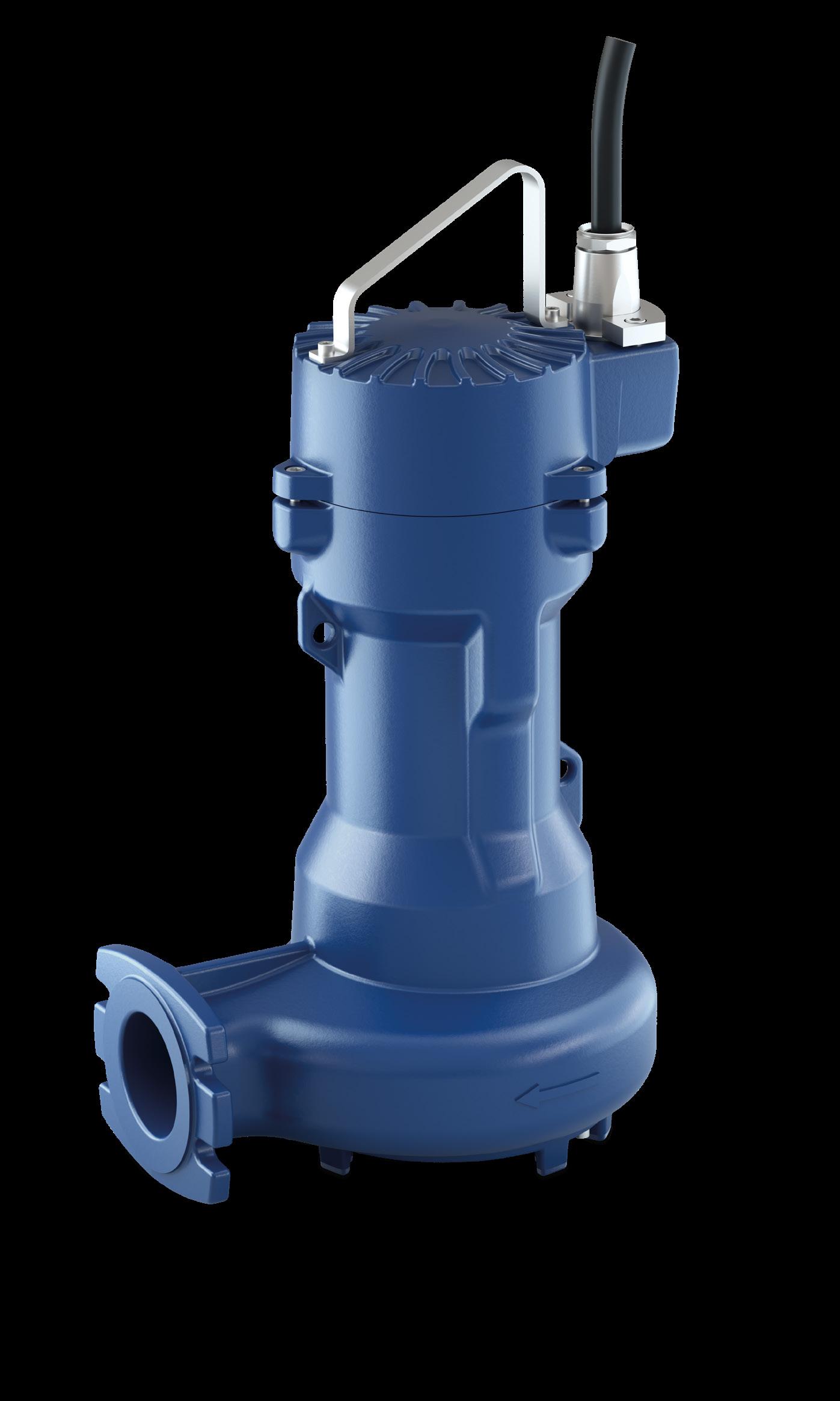
AmaRex Pro