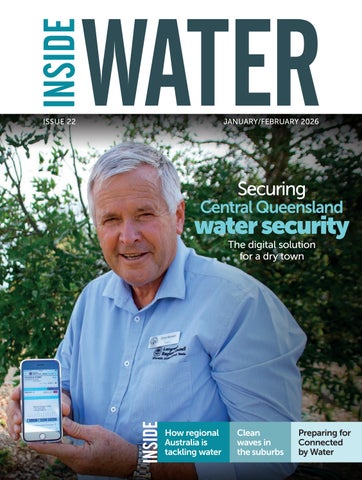
ISSUE 22
JANUARY/FEBRUARY 2026
Securing
Central Queensland
water security The digital solution for a dry town
How regional Australia is tackling water
Clean waves in the suburbs
Preparing for Connected by Water
We’re Creating the Future of Water for people, communities and the environment
CONTENTS Issue 22: January/February 2026
10
28
34
50
REGULAR 4
Editor’s Note
58
The Last Word
COVER STORY
6
Taggle Community embraces water security in Longreach
REGULATORY INSIGHT
26
Murray-Darling Basin Authority Rivers for generations
28
Commonwealth Environmental Water Holder
FOCUS PRODUCTS
10
36
Interflow
PFAS Committee PFAS perils for possums and Country
UTILITY INSIGHT
REGIONAL AUSTRALIA
14
44 Water Corporation Leading the Western water story
TECHNICAL TAP ON
48
ACIC and UQ Tracking drugs through wastewater
50
WaveGarden
18 20
SUSTAINABILITY
40 Melbourne Park 42
Stacey Daniel Lower Murray Water Regional priorities in northwest Victoria
24
Serving water wisdom
NSW Water Directorate
Sunwater Shaped by the Queensland sun
FROM THE MINISTER’S DESK
EVENTS
57
32
Lucy Hood
The trenchless white cloud
Busselton Water
Seeing the whole landscape
22
International No-Dig Auckland
Busselton riding a wave of resilience
Stronger services for regional towns
Engineering clear surf water
Protecting our coastal future
38
qldwater A holistic future for biosolids management
16
SWAN APAC Workshop Turning point for the digital water utility
When pipes aren’t round
Valuing every drop
30
World Toilet Day Closing the sanitation gap
Xylem The value of certainty
12
34
Connected by Water
AirTrunk The cloud’s thirst for change
PURIFIED RECYCLED WATER
46 WSAA and Sydney Water Shaping source-agnostic supply
WOMEN IN WATER
52
University of Sydney Cooling cities, catching clouds
54
Water connections from coast to coast
Anita Doig Mapping the invisible flow
www.insidewater.com.au INSIDE WATER
3
EDITOR’S Note
A season of smarter water Chairman
ACROSS AUSTRALIA, THE water industry continues to prove that progress often begins with connection. Whether it is a regional council embracing digital tools, a utility advancing new technology, or a national forum uniting ideas from coast to coast, this issue of Inside Water celebrates a sector that is building momentum through collaboration, innovation and trust. Longreach, a small Queensland community, has taken a significant step toward its water security with the rollout of Taggle Systems’ digital meters. The project has given residents and Council real-time visibility of consumption and leaks, transforming the conversation about water from one of scarcity to shared stewardship. Mayor Tony Rayner says water is the backbone of every community, and better management means a stronger future. What began as a technical project has evolved into a cultural shift, proving that even in the most remote regions, digital tools can create confidence and resilience. That theme of confidence carries through to our profile of Xylem’s Flygt wastewater pumps. Adrian Rijnbeek reminds us that certainty in wastewater management is not just about hardware, but about peace of mind for the people who keep networks running. Certainty of a different kind drives the work of the Senate PFAS Committee, chaired by Senator Lidia Thorpe. The committee’s findings reveal the far-reaching impact of PFAS on wildlife, waterways and communities, but they also highlight a growing sense of accountability within the sector. Thorpe’s call for national consistency and transparency reinforces that environmental protection is inseparable from public trust.
4
Western Australia features strongly in this issue too, with Peter Spencer of Water Corporation looking ahead to Connected by Water 2026. The event will bring together leaders from across Australia and around the world to share insights across municipal, industrial and agricultural sectors. That same spirit of connection was on display in Sydney at the 4th SWAN AsiaPacific Workshop. There, experts agreed that the digital tipping point for utilities has arrived. Speakers from Sydney Water, Hunter Water, Urban Utilities and beyond emphasised that the human element remains at the heart of digital transformation. Technology can enable progress, but trust, ethics and shared learning ensure it lasts. Taken together, these stories capture a sector that is moving with purpose. From Longreach to Perth, from the control room to community meeting, the message is consistent: water leadership in Australia is grounded in optimism and action. Every challenge becomes an opportunity to collaborate, innovate, and care for the people and environments we serve. From the most remote communities to largest cities, the water sector continues to show what collaboration can deliver. I hope this issue leaves you encouraged by what is happening across Australia and confident about what comes next.
John Murphy john.murphy@primecreative.com.au
Chief Executive Officer Christine Clancy christine.clancy@primecreative.com.au
Publisher Sarah Baker sarah.baker@primecreative.com.au
Managing Editor Geoff Crockett geoff.crockett@primecreative.com.au
Editor Chris Edwards chris.edwards@primecreative.com.au
Design Alejandro Molano
Head of Design Blake Storey blake.storey@primecreative.com.au
Brand Manager Luke Ronca luke.ronca@primecreative.com.au p: +61 402 718 081
Client Success Manager Ben Sammartino ben.sammartino@primecreative.com.au
Head Office Prime Creative Pty Ltd 379 Docklands Drive, Docklands, Victoria 3008 p: +61 3 9690 8766 enquiries@primecreative.com.au www.insidewater.com.au
Subscriptions +61 3 9690 8766 subscriptions@primecreative.com.au Inside Water is available by subscription from the publisher. The rights of refusal are reserved by the publisher.
Cover image Taggle Systems, Longreach Regional Council
Articles All articles submitted for publication become the property of the publisher. The Editor reserves the right to adjust any article to conform with the magazine format.
Copyright
Chris Edwards, Inside Water Editor
INSIDE WATER January/February 2026
Inside Water is owned by Prime Creative Media and published by John Murphy. All material in Inside Water is copyright and no part may be reproduced or copied in any form or by any means (graphic, electronic or mechanical including information and retrieval systems) without written permission of the publisher. The Editor welcomes contributions but reserves the right to accept or reject any material. While every effort has been made to ensure the accuracy of information, Prime Creative Media will not accept responsibility for errors or omissions or for any consequences arising from reliance on information published. The opinions expressed in Inside Water are not necessarily the opinions of, or endorsed by the publisher unless otherwise stated.
The Flygt pump George chose in 2006 is still going strong today George may have been new to wastewater pumps back then but he knew just what he wanted – the certainty of a solution that would run trouble-free for years on end. And that’s exactly what he got. Today Xylem’s Flygt pumps are George’s preferred choice. The Value of Certainty
COVER STORY Taggle Systems & Telstra
Community embraces water security in Longreach A digital metering project is giving Longreach new clarity on consumption and leaks as the community adopts technology for long-term security. FOR LONGREACH REGIONAL Council, introducing digital metering is more than a technological upgrade. It is a cultural shift toward shared responsibility for water security. It reflects a partnership between Council, technology providers and the community itself. Mayor Tony Rayner describes water as “the backbone of each community” and said effective management was essential for the region’s future. With residents now equipped with a customer portal, they have the tools and data to monitor their own water use, introducing a new layer of accountability and conservation awareness. Single source water supply at risk In central west Queensland, Longreach depends almost entirely on the Thomson River, a system shaped by overland flow and
6
unpredictable climatic cycles. During the last major dry period, the river sank to critically low levels. Creeks thinned, channels receded, and the community entered high levels of water restrictions. Residents and business owners felt the pressure of a shrinking supply as water scarcity severely impacts the quality of life. “When you see your water supply dropping and dropping quickly, and then you escalate your level of water restriction to level two and then level three, it becomes quite apparent that there is a critical issue to be managed,” Mayor Tony Rayner said. His reflection captured what many had come to understand. Water security could no longer rely on reactive responses to drought. The community needed a long-term plan, supported by modern tools and clear, accessible information, to identify areas where water can be saved. From that moment, Council
INSIDE WATER January/February 2026
River boats in the Longreach region. Image: Joanne Ballard
embarked on one of its most significant water initiatives in decades. The rollout of digital water meters became central to that strategy. What began as a discussion about technology soon revealed itself as a community story about behaviour, data, trust and the future of Longreach. How Longreach prepared for a new approach to water management The first step in reshaping Longreach’s water future was a detailed assessment of the region’s vulnerabilities. The Longreach Regional Water Supply Security Assessment conducted in 2019 by the State Government, provided a clear picture of how frequently the town was pushed towards crisis. Longreach sits in a droughtprone region where geography magnifies climate variability. Council recognised the town needed new tools to understand the complete picture of its water balance. The result was the Longreach Water Security for Growth program. Supported by the National Water Grid, the Queensland Government
and the Council’s own contributions, the program includes a wide range of projects. These include raising five weirs on the Thomson River, replacing water mains, and improving the water balance model that underpins long-term planning. Digital water meters were also identified as being essential for understanding daily and seasonal consumption patterns and for revealing losses that had previously gone unnoticed. Previously, the meters were read only annually, with residents receiving a fixed annual allocation of 1,200 kilolitres. With only one reading per year, both residents and Council were operating in the dark with no visibility into how water was being used or lost to leaks. Another pressing issue was that the town’s existing mechanical meters were near the end of their useful life. Many were slowing down and underreading. It was clear that the town needed a system that could provide accurate, day-to-day data. The digital meters offered that opportunity. They were more accurate and equipped to send
data remotely. They also provided residents with a way to see their own water use through a customer portal, introducing a new layer of accountability and conservation awareness. Rethinking a drying river through long-term community planning Mayor Rayner has lived in Longreach long enough to witness multiple cycles of drought, flood and uncertainty. His insight has shaped how Council communicates about water security. “Being a long-term local who has seen the impacts of drought and low water levels, I know firsthand what it is like. It impacts your liveability,” he said. “The last thing you want is to go into a period of low water supply and no gardens.” Rayner and CEO Brett Walsh made water security a top strategic priority in their discussions with state and
Tony Rayner is the Mayor of Longreach Regional Council. Image: Longreach Regional Council
The team at Longreach Regional Council. Image: Longreach Regional Council
federal governments. The goal was not only to protect existing residents but also to support community growth. Families want reliable water. Businesses want certainty. Community groups want to know that sporting fields, parks and recreation areas can be maintained. “I needed to take the business case up with both the state and the federal government,” Rayner said. “We were very fortunate to get strong support.” With funding secured, Council moved quickly from planning to implementation. How partnerships strengthened the regional rollout Collaborative partnerships with experience, local knowledge, and the right tools and processes enabled the project to launch quickly and efficiently. With Telstra as the prime contractor and communications provider, and Taggle Systems providing project management, devices and delivery, the project was well supported. Manager of Innovation and Business Support Kimberley Dillon said Telstra’s partnership with Taggle helped establish confidence in the project. She said the involvement of the national provider added credibility and ensured the system underwent rigorous quality and security checks. For a remote municipal government with limited access to contractors, these partnerships and their experience were critical. They ensured fast responses to operational issues, easier communication with
www.insidewater.com.au INSIDE WATER
7
COVER STORY Taggle Systems & Telstra
residents and a stronger foundation for future system upgrades. Where experience counts Taggle worked closely with Council staff to integrate the water meter data with internal financial and administrative processes. With over 75 council and utility customers, this process has been streamlined and is a critical part of the project. The ability for meter data to flow directly into billing and customer service processes reduced duplication, improved accuracy and saved time. “It is a massive bonus for billing, operations, and for the customer service team,” Utilities Consultant Shane Anderson said. The customer service team can now support our residents with water enquiries using the water meter data. Once residents sign up for the customer portal, they will receive automatic leak alerts. The customer service team are also contacting property owners to quickly action the largest leaks. Inside the digital rollout and the operational effort behind it A slow start in trialling various technologies meant that, once the go-ahead was given, the pressure was on to meet funding milestones. The deadline was tight, with half the meters needing to be installed by the end of November. Telstra and Taggle got stuck in coordinating all the moving parts to meet the deadline, including going the extra mile to have the meters flown in rather than shipped. Council utilised its internal plumbing team to install the 800
8
meters, and they moved at an impressive pace. On their most productive day, they installed 93 meters. They completed the full 800 with time to spare. “They performed admirably and did the job,” Anderson said. “The digital metering project is the first component of the broader Water Security for Growth program to be delivered on time and under budget.” Once the data started to flow The data emerging from the newly installed meters revealed the scale of previously unseen issues. In the early weeks, the system recorded 233 potential leaks across the network, each lasting 48 hours. The total volume of water lost to these leaks in the first few weeks reached approximately 1600 kilolitres. The average rate of leakage was 70 litres per hour, and around 15 per cent of meters showed signs of continuous flow. These figures provided Council with its most accurate picture of water loss to date. They also confirmed that real-time monitoring could prevent long-term, costly losses and help residents avoid unexpected excess water charges. How early wins and human stories helped build community trust Having the technology in place was just the first step; community education was a critical part of the project and is driving the success. Workshops were held with local plumbers to help them understand the system, interpret data, and assist residents. “We made sure that our plumbers
INSIDE WATER January/February 2026
Sun setting over the Thomson River. Image: Joanne Ballard
Council plumber installing a water meter. Image: Longreach Regional Council
were on board and had that intimate understanding of the customer portal,” Dillon said. “When they are looking at the data, they know what they are looking at and can actually help the residents and business owners.” Real stories soon began to demonstrate how powerful the system could be. Following installation, an alert quickly appeared for a 400-litre-perhour leak. Council contacted the resident, and a plumbing inspection revealed that the inlet shut-off to the float on an evaporative air conditioner was not working, causing water to run continuously. This issue could have gone undetected for months and was resolved within a day. With the leak, the residents’ water consumption was 19,203 litres per day; once the leak was fixed, it dropped to 5,791 litres per day. “They were super grateful,” Business Support Coordinator Anna Lacey said. “Better to nip it in the bud now before it continues.”
Another good news story Two businesses next door to each other on the main street, owned by the same landlord, both had significant leaks. At first, Council thought there might be an issue with the data but sure enough there were leaks on both properties. The first involved a continuously running toilet, and the other was another faulty evaporative cooling system. While the leaking toilet was not concealed, quantifying just how much water was being lost was a shock to the owner. Having the data prompted the owner to take action to fix it. Without the alerts, the owner would have had a significant water bill at the end of the year. During times of drought when the river runs low, finding these unnecessary water losses quickly can have a significant impact on water security. These early examples of identified losses helped ease community concerns. Residents began thinking differently about how they are using water, considering their irrigation and household systems. Some adjusted sprinkler times. Others checked older plumbing fixtures. Many became more aware of how much water they were using daily. Backing of the Councillors Councillors were briefed throughout the rollout to ensure their understanding aligned with community expectations. Their involvement helped reduce confusion, especially among residents who initially worried that digital monitoring might lead to unwanted scrutiny. The consistent message focused on conservation, community benefit, and long-term security rather than punitive measures.
What digital metering means for Longreach water security Although the rollout has only recently begun, the long-term potential of digital metering is already clear. Aside from identifying leaks in properties, the system also allows Council to track water movement from the reservoir to the suburb and to the household. Utilising the District Metered Area (DMA) functionality within Taggle’s software, zones can be set up for water management within the network. Any disparities between these points reveal non-revenue water losses in the network, enabling the Council to pinpoint leaks, assess aging infrastructure and prioritise investment in areas with greater losses. Anderson said the new insights would reshape asset management. Council would no longer rely on assumptions based on pipe age or location. Decisions could be guided by actual performance, informing when and where to replace mains, how to manage reservoirs and how to plan for seasonal changes in consumption. Longreach Regional Council CEO Brett Walsh said increased supply with the raising of the weirs had to be matched with smarter demand management. “Given that we will have increased supply, we also have to manage the demand for that supply, which is why the digital meters are critical.” He said the alignment of supply and demand planning would become more critical as climate pressures intensified and the community grew. Digital metering would support future drought-triggered management by providing a better understanding of how water is used at scale, helping Council create more accurate, timely restrictions, and reduce the severity and length of those restrictions by utilising the data to identify wasted water.
One of the weirs that surround Longreach being raised by at least one metre. Image: Longreach Regional Council
Walsh said the monitoring would also help improve planning for evaporative cooling systems, which can consume significant water volumes during peak summer months. A community taking charge of its future With digital meters in place, Longreach now has a clear and continuously updated picture of how its most important resource is used. The community has begun to adapt its behaviour, and Council has the information it needs to plan for decades rather than seasons. Longreach will continue to rely on the ebb and flow of the Thomson River, but it now has the tools to prepare for dry periods and protect its natural resources. The story unfolding in the region is one of resilience, clarity and longterm security. For a community shaped by harsh climate and strong identity, the project marks a meaningful step toward greater confidence in its future. Mayor Rayner said the project’s success reflected something deeper than technology or infrastructure. “Water is the livelihood of our community, and management of that is very much part of it,” he said. “If we can better manage that resource, that is a really critical tool for us.” For more information, visit telstra. com.au/business-enterprise and taggle.com
www.insidewater.com.au INSIDE WATER
9
FOCUS Products
The value of certainty Reliable wastewater networks depend on more than hardware. For Xylem, the long history of Flygt wastewater pumps shapes a future built on certainty. WASTEWATER NETWORKS ACROSS Australia are experiencing new pressures driven by population growth, unpredictable weather events and increasingly variable flow conditions. Utility teams are expected to maintain reliability while navigating these changing dynamics, and they want equipment that performs consistently without requiring constant attention. In his role as Xylem’s General Manager Sales Water Infrastructure, Adrian Rijnbeek spends much of his time listening to water utilities across the country. It is why he views certainty as a balance between system behaviour and human expectations. “Certainty means that there is confidence in wastewater networks and knowing those networks will perform reliably under ever-changing conditions,” he said. “Ultimately, it is about providing peace of mind for operators and field maintenance staff.” This expectation is shaping how utilities plan and invest, particularly as they seek ways to minimise risk and maintain trust with the communities they serve. How Flygt wastewater pumps fit into the value of certainty Flygt has been central to Xylem’s wastewater portfolio for decades,
10
and Rijnbeek said that long-standing presence helps guide customers toward systems they trust. Utilities recognise that certainty comes not only from the product but also from the expertise and working relationships developed over time. “The Flygt brand has been the core of Xylem’s wastewater portfolio for a very long time, and our customers depend on that as part of their strategies,” he said. “We provide proven performance, unrivalled expertise and innovation that has been relentless for many years.” The Value of Certainty campaign builds on this heritage by framing reliability as an engineered outcome. For utilities, certainty means knowing that pumps, controls and system components will respond effectively to conditions they cannot fully predict. Xylem presents certainty not as a slogan but as a measurable promise supported by design choices, service arrangements and adaptive technologies. Lifecycle performance in an era of tighter budgets Budget pressure continues to influence how utilities invest in longterm infrastructure, and Rijnbeek said lifecycle economics now play a central role in Flygt wastewater pump decisions.
INSIDE WATER January/February 2026
There’s plenty of brain power behind the Flygt Concertor pump system. Images: Xylem
“With wastewater assets, we are focused on total life cycle cost, not just the upfront cost,” he said. “Flygt provides greater efficiencies over time through reduced energy consumption and reduced maintenance callouts.” By working with customers to analyse the complete pumping system rather than the pump in isolation, Xylem helps utilities understand how energy consumption, component wear, maintenance patterns and operational behaviour influence long-term value. Lifecycle-driven planning reduces uncertainty by giving utilities a clearer picture of how assets will perform over time, helping them avoid reactive spending and unplanned outages. Innovative reliability in complex wastewater environments Flygt wastewater pumps have earned industry recognition for their hydraulics, clog-resistant designs and durable construction. Rijnbeek said innovation remains essential as wastewater networks encounter higher levels of wipes, debris and variable load patterns. “For the hydraulic part of the system, we developed the adaptive N-technology and now Xylem’s Flygt Concertor,” he said. “We are leading the way when
it comes to providing advanced technologies in wastewater pumping systems.” These innovations address the real-world conditions operators face every day. By helping pumps adapt to the changing characteristics of wastewater, Xylem strengthens operational reliability and reduces the likelihood of blockages that can disrupt service or damage assets. Delivering certainty in the field through the Flygt Concertor The Flygt Concertor system has been increasingly adopted by utilities seeking a solution for problematic pump stations where debris and wipes have caused frequent blockages. Rijnbeek said that utilities that adopt Concertor often see immediate performance improvements. “The Concertor has integrated intelligence that will detect pump blockages and perform cleaning functions, as well as maintain a clean sump,” he said. “We are proud that we continue to lead the way with Concertor in the Australian market.” The system’s ability to clear potential blockages automatically reduces unplanned callouts and supports operators who previously had to intervene manually. This proactive behaviour embodies the idea of certainty by giving teams confidence that their systems can respond in real time to the conditions they encounter. Digital insight as a foundation of operational confidence Utilities are increasingly relying on data to support maintenance planning, resource allocation and system optimisation as digital enablement becomes a central part of modern network management. Many organisations are now
integrating real-time monitoring and analytics into their operational workflows, which shifts decisionmaking from reactive judgments to evidence-based action. Rijnbeek said the Flygt Concertor’s integrated intelligence plays a key role in supporting this transition. “It provides important data and allows utilities to make informed decisions or allow those decisions to be made without human intervention,” he said. “The pump will actually remove potential blockages before it stops and requires field maintenance staff.” Xylem has also introduced broader digital solutions that enhance visibility across pump stations, helping operators interpret conditions, track performance trends, and act earlier when issues emerge. This shift from reactive to preventive management aligns with the Value of Certainty campaign by reducing operational surprises and reinforcing confidence in asset performance. Sustainability as part of future certainty Sustainability is becoming a central expectation across the water sector, particularly as utilities pursue lower emissions and improved environmental outcomes. Rijnbeek said sustainability is embedded across Xylem’s approach to product development and facility operations. “Sustainability is an important part of Xylem’s strategy,” he said. “We focus on energy-efficient designs, and we have production facilities that are 100 per cent renewable, that recycle 100 per cent of process water and send zero waste to landfill.” Energy-efficient technologies and durable materials help utilities reduce environmental impact while improving reliability and controlling operating costs.
Xylem Service Technician inspecting a Flygt N3153 pump in front of the Sydney Opera House.
A future built on confidence and clarity Utilities are increasingly adopting service partnerships that include predictive analytics, conditionfocused maintenance and performance-based expectations. Rijnbeek said this reflects a broader desire for clarity in asset performance and resource requirements. “Utilities want more data to understand where they need to put their time and resources,,” he said. “Reliable systems help in the operation of these organisations.” Looking ahead, he expects Flygt wastewater pumps and the Concertor system to continue evolving with stronger digital capabilities and more advanced predictive tools that support utilities before issues emerge. Through these advances, Rijnbeek said the core message remains grounded in supporting the people who manage wastewater networks every day. “Ultimately, it is about providing certainty and peace of mind for operators and field maintenance staff.” For more information, visit xylem.com/au
www.insidewater.com.au INSIDE WATER
11
FOCUS Products
When pipes aren’t round Many sewers, drains, and culverts are not perfectly circular, leading to overdesign during the renewal phase. Finite Element Analysis is enabling Interflow to offer solutions that are more fit for purpose, lower cost and more sustainable. An ovoid wastewater pipe like this is not always suitable for a circular liner. Images: Interflow
FOR MANY NON-CIRCULAR underground pipes across Australia, the reality of their renewal is imperfect. If a pipe is perfectly circular, then standards, specifications and renewal methods are well documented and accepted. The same can be said for pipes that have deformed to a uniform oval shape within a limited range. However, as soon as a pipe’s internal shape deflects outside strict parameters, the most efficient and sustainable solutions have been more challenging to design, until now. At Interflow, there is an innate drive to find world-class solutions to the most complex customer problems. A great deal of thought and research has been put into the effective use of Finite Element Analysis (FEA), a computer-based method, in the company’s work, used in other engineering sectors, including aerospace and automotive,
12
to understand how complex objects behave under various loading. What is Finite Element Analysis in engineering? “Fundamentally, FEA is based on mechanics and mathematics,” Dr Weigang Wang, CP Eng, Design Manager at Interflow, said. “The computer does the calculation and gives us the very best solution.” The method works by dividing a complex structure into many small, interconnected components also known as elements. Engineers can then use computer simulations to evaluate how each element responds to applied loads, and how all the elements interact to represent the behaviour of the complete structure under different loading conditions. In the 1970s, Boeing extensively used FEA during the development of the 747. Through FEA simulations, engineers assessed the aircraft’s structural integrity, predicted stress distributions, and refined
INSIDE WATER January/February 2026
the design to enhance both safety and efficiency. In these virtual environments, designers can analyse how each component reacts to different loads and conditions. In the Boeing case, this involves factors like weight, aerodynamic forces, and material stresses. The digital model accurately simulates real-world behaviour, enabling engineers to modify and test the design multiple times until the structure performs as required. Once the configuration and material properties are optimised through the simulation, the final design can be produced with confidence that it will meet performance and safety requirements.
How does Finite Element Analysis help on site? • Clear limits: FEA models quantify deflection or pressure outcomes, providing crews with clear guidelines to follow. • Handling is lighter and safer: Right-sized solutions lead to fewer heavy lifts and less time on site. • Fewer surprises: When non-circular and weaker areas are identified in advance, task sequencing and bracing are more logical, and rework is dramatically reduced. • Schedule certainty: Lighter components and fewer mid-project changes mean shorter install times. • Improve sustainability: Good, robust design drives sustainability across all areas of the supply chain and installation process.
“At Interflow, we see FEA as the next evolution in the design approach for complex pipeline rehabilitation,” Ervin Hung, Interflow’s Strategic Solutions Operations Manager, said. “What transformed the safety and efficiency of aircraft and automotive industries can now redefine how we strengthen and renew pipeline infrastructures.” “FEA delivers a new level of clarity, allowing us to see precisely how a structural liner of any shape responds to real-world loads and conditions. When we apply this to non-circular pipelines, we can design with greater efficiency, reduce material use, and ensure performance with measurable confidence for the asset owners.” When modelling meets delivery The FEA modelling process brings enormous value when it drives decisions in the field. Take grouting or void filling of liners, for example. “When grout is pumped into the void around a flexible liner, the intention is to fill that void,” Hung said. “This can involve the buildup of a great amount of pressure. Over-pressuring the liner can deform it beyond design limits, or in the extreme case, burst the liner, which can have unintended environmental consequences.” “When the lined pipe is circular, we know the exact forces it can withstand. However, when the shape is non-circular, the risks are much higher. Using FEA, we can use the grout’s properties and model the buoyancy loads on the liner to generate the most efficient grouting methodology with no risk of overpressure.” The many benefits of FEA-driven certainty If an FEA model indicates that a liner can be made 20 per cent thinner while maintaining the
same performance and efficiency, this results in savings in material, fuel, handling effort, and time throughout the supply chain and installation process. It can mean fewer people are underground or on-site and are there for less time. This brings a safety dividend and a community benefit. When designers use FEA to quantify limits, field teams can be confident in the procedures they define. As a result, risk drops and fewer resources are required. Interflow isn’t suggesting that FEA is used on every renewal project. The sweet spot for the technology is in complex edge cases, including non-circular sections, asymmetric deterioration, unusual load paths or where unique pressures, such as staged grouting, couple with structural response. “In these instances, the traditional methods are not very accurate,” Wang said. “As a result, people might apply conservative inputs to be safe. This will cost more, will take longer, require more resources and from the construction point of view might create more challenges.” “As we have been making use of this tool on real projects, we have found it produces a more sustainable design solution that carries less risk. It also delivers greater value for asset owners.”
The team at Interflow working together to solve challenges and present fit-for-purpose solutions.
Understanding the pressures being exerted on each section of the pipe is critical.
The final challenge is a cultural one: ensuring project teams and customers know when to tap this expertise, particularly during bid and design rather than after methods have been locked in. A centralised design centre of excellence, available to everyone at Interflow, helps to route complex projects through the right channels, improving visibility and sharpening knowledge around innovative tools such as FEA. “We’re involving our design and engineering team earlier in the process,” Hung said. “This early collaboration ensures right-sized, fit-for-purpose solutions become the norm for complex, noncircular renewals.” For more information, visit interflow.com
www.insidewater.com.au INSIDE WATER
13
ASSOCIATIONS qldwater
A holistic future for biosolids management qldwater’s work on biosolids reform is helping shape a balanced, national approach to reuse, innovation and regulation. BIOSOLIDS ARE THE nutrient-rich, organic material that is produced after wastewater has been treated and stabilised. Far from being a waste, they are a by-product with significant agronomic and environmental value. In Australia, most biosolids are beneficially applied on land, where they provide essential nutrients, improve soil structure, increase microbial activity, and boost resilience in farming systems. By recycling carbon, nitrogen, phosphorus, and micronutrients back into the soil, biosolids reduce reliance on synthetic fertilisers, many of which are costly, energy-intensive to produce, and subject to volatile international markets and supply chains. As a steady, locally available resource, biosolids also underpin circular economy ambitions. A resource under pressure Biosolids have long been recognised as a valuable resource, but the sector is now at a crossroads. While the benefits of biosolids are widely acknowledged, their continued use faces a complex mix of challenges including contaminants (such as per- and polyfluoroalkyl substances (PFAS)), increasingly conservative regulatory reform, rising transport and processing costs, and mounting scrutiny from communities and markets. Population growth and urbanisation is amplifying these pressures, increasing biosolids production and forcing utilities and regulators to adapt.
14
Building a shared vision Two major initiatives are shaping an updated, national perspective on biosolids management. qldwater’s Future of Biosolids Reuse Roundtable brought together utilities, regulators, agricultural users and scientific advisors. The consensus was clear: land application remains the cornerstone of biosolids use. It delivers consistent agronomic benefits and supports resilient farming systems, especially as fertiliser costs and carbon decline in soils weigh heavily on farmers. Participants also emphasised practical constraints: odour, seasonal application windows, logistics, and the growing burden of regulatory uncertainty. WSAA’s “Weighing up the Options” Sustainable Biosolids Management Assessment provided a structured comparison of 20 different management pathways. It found that where PFAS risks are managed land application continues to deliver the best outcomes, while advanced anaerobic digestion, pelletisation, pyrolysis and gasification represent viable alternatives should land use be restricted. These sector-led initiatives have set the foundation for a holistic vision: optimisation of existing practices, diversification into emerging technologies, and stronger source control of contaminants. Outcomes and priorities From these initiatives, several clear priorities emerged: • Recognition of biosolids as a
INSIDE WATER January/February 2026
The effective use of biosolids in agriculture is part of a holistic approach to wastewater. Image: qldwater
resource, not a liability. • Maintaining land application as the primary use pathway, supported by policy reform and improved logistics. • Diversifying into advanced technologies like digestion, pelletisation, and thermal conversion to build resilience. • Tightening source control of contaminants, particularly PFAS, to secure long-term viability. • Creating viable markets for biosolids and derived products, including opportunities in soil carbon and the recovery of nonrenewable, essential nutrients many of which are rare. This collective vision calls for an adaptive, risk-based approach that balances opportunity with precaution. NSW Biosolids Regulatory Review: Concerns over proposed limits The national conversation has gained new urgency with the ongoing NSW Biosolids Regulatory Review. The NSW EPA’s draft Biosolids Resource Recovery Order/Exemption proposes the introduction of conservative contaminant limits for PFAS (more conservative than the advice in PFAS NEMP 3.0), which has raised alarm across the sector. The order also telegraphs future limits for HHCB and triclosan: compounds that are widely used in household products. Water utilities are passive receivers of these community-derived contaminants. Utilities and agricultural stakeholders fear the thresholds
under consideration are overly conservative and out of step with risk-based international practice. They argue that, if adopted, these limits could sharply reduce the proportion of biosolids eligible for land application, without consideration of risk-based scientific evidence of environmental or health impacts as outlined in the PFAS NEMP 3.0. The PFAS NEMP itself cautions that exceedance of “trigger” values does not necessarily imply unacceptable risk. If the existing soil plus added biosolids PFAS would exceed those levels, then constraints need to be placed (e.g. limiting application rate) or further risk assessment/ management is required. The stakeholders say the adoption of more restrictive trigger values will not necessarily provide improved environmental outcomes and may indeed yield disbenefits for the agricultural sector. The concern is not simply regulatory compliance: it is the wider implications and that more restrictive limits could: • Undermine agricultural confidence, despite decades of sustainable use. • Erode market access, shrinking the outlets available to utilities.
• Drive higher costs, with utilities forced to invest in advanced thermal or disposal solutions before markets and policy are ready. • Diminish circular economy gains, cutting off a stable, carbonrich soil amendment in favour of higher-cost, less sustainable pathways and forcing technology adoption which may destroy the opportunity to recover the nonrenewable essential nutrients. For the Directorate, the solution lies not in fatiguing utilities but in addressing source control of contaminants. Without upstream regulation of industrial inputs and consumer products, limits on biosolids alone risk being both ineffective and economically damaging. The outcomes from the NSW Biosolids Regulatory Review is a reminder that poorly calibrated policy has the potential to destabilise an entire use market. For many, it underscores the urgent need for nationally consistent, proportionate, and evidence-based standards.
Small wastewater treatment plants can be built into agricultural areas to minimise truck rollouts and improve agricultural efficiency. Image: Leonid/ stock.adobe.com
Looking ahead Developing a holistic vision for biosolids management is no longer optional. It requires:
These healthy shoots represent the positive impact biosolids can have. Image: Rafail/stock. adobe.com
• Adaptive frameworks that integrate risk, opportunity, and community expectations. • Coordinated reform across resources, environment, and agricultural policy. • Greater investment in innovation to ensure technology pathways are commercially viable. • Building and maintaining social licence with farmers, regulators, and the public. The future of biosolids will depend on aligning innovation, regulation, and market development. Land application will remain central, but it cannot stand alone. A resilient system will be one that blends optimisation of existing practices with investment in new technologies, while tackling contaminants at their source. The Queensland and WSAA initiatives show the way forward: collaborative visioning, evidence-based evaluation, and proactive diversification. The NSW EPA’s draft Biosolids Resource Recovery Order/Exemption demonstrates the fragility of progress. Without proportionate regulation and strong source control, the sector risks being pushed into costly, less sustainable alternatives. By taking a national, adaptive approach, Australia can ensure biosolids remain a cornerstone of sustainable water management and agricultural resilience rather than an unintended casualty of regulatory overreach. For more information, visit qldwater.com.au
www.insidewater.com.au INSIDE WATER
15
FOCUS Regional Australia
Busselton riding a wave of resilience Busselton Water is strengthening its foundations as one of Western Australia’s fastest-growing regional utilities, with a long-term focus on resilience and community connection. BUSSELTON IS WELL known for its coastal lifestyle, but beneath its calm surface sits a complex regional water story. As one of Western Australia’s fastest-growing areas, the region faces rising demand, shifting climate patterns, and increasing pressure on groundwater. For Busselton Water Chief Executive Officer David Hughes-Owen, these pressures are not distant challenges but immediate priorities that shape every aspect of the organisation’s planning. He said the appeal of moving to Busselton after decades in the sector came from both lifestyle and purpose. “It was a great opportunity to take the 25 or 30 years I had been in the industry and look at how I could support building a contemporary and agile water utility that sets a benchmark for customer service and environmental stewardship.” Those ambitions now sit at the core of a broader Busselton water strategy to guide the utility through the next decade of growth. How is Busselton Water responding to climate and coastal pressures? Busselton’s coastal position creates unique vulnerabilities. Groundwater salinity has been rising along parts of the coast, reflecting long-term climate trends across the south west. Hughes-Owen said the shift is already visible. “We are seeing increasing salinity in our coastal bores. We have developed a long-term programme to transition our bore field inland. That process has already started
16
and will continue for the next 10 to 15 years.” The Busselton Water Supply Improvement Project is a major part of this work. The first stage includes a new inland bore and treatment plant supported by state and federal funding. The move inland is not about increasing supply but securing what the utility already has. “We need to start early. Infrastructure takes time, and we want to make sure we get that transition underway now.” This long-horizon approach has become central to the Busselton water strategy, particularly as the region balances climate variability with sustained population growth. Building resilience for a growing regional community Busselton’s population is increasing by about 2.6 per cent each year, with seasonal tourism creating sudden, intense demand spikes. During summer holidays, the population can grow several times over, placing significant pressure on infrastructure and operations. “Our forebears built big resilient systems 20 or 30 years ago, so we have been trading on that for some time,” Hughes-Owen said. “But we see the next 10 to 15 years being a real challenge. We have doubled storage in parts of the network, and the new project will add around 20 per cent more capacity during the summer period.” Regional resilience also extends beyond water storage. Energy continuity is a key concern, particularly for an area that relies heavily on pumping.
INSIDE WATER January/February 2026
Busselton Water CEO David Hughes-Owen Images: Busselton Water
“Water is so reliant on energy. We have put in backups to ensure we can continue supplying water if the grid goes down.” What role do consultants and partnerships play in regional resilience? As a small utility, Busselton Water operates with leaner internal resources. That reality has pushed the organisation to adopt a flexible and collaborative model. Hughes-Owen said the approach is deliberate. “We are generally reliant on consultants and expert advisers for capacity and capability. We are open with our contractors and vendors about our constraints, and that lets us work together in ways that are innovative but not cost-prohibitive.” The utility often works with boutique consultants and regional specialists, as well as with experts from across the country, particularly in the areas of digital metering and data systems. Collaboration with other water utilities is also central to the Busselton water strategy. “For example, we are currently working closely with Victorian utility South East Water on digital smart metering. We work closely with Water Corporation on procedures
and policies, and I often reach back into my networks at TasWater. Maintaining strong utility networks is really important.” Strengthening community trust and engagement Regional utilities occupy a unique position. Their teams often live in the same neighbourhoods they serve, and customers know their utility far more personally than those in metropolitan areas do. Hughes-Owen said this proximity shapes the organisation’s entire outlook. “A good regional utility will see its closeness to the customer as an advantage. If we are open, honest and available, we can work through challenges together.” Over the past three months, Busselton Water has established new customer groups to discuss long-term issues such as supply costs, water efficiency, and local system resilience. The aim is to give the community a
structured voice as the utility navigates the next decade of decisions. “What water was in the past, which was a low-cost and easy solution for your home, is now becoming higher cost, more challenging and more highly regulated. These are conversations we need to have together.” Driving regional sustainability Sustainability is central to the organisation’s direction. In the past five years, Busselton Water has cut its greenhouse gas emissions by 45 per cent despite a 15 per cent rise in water demand. This has been achieved through solar installations, variable-speed pumps, and operational optimisation. Hughes-Owen said the next step is to expand digital metering and use data to reduce water loss and improve customer education. He also sees broader benefits for local industries that rely heavily on secure water supplies.
From left to right: Busselton Water CEO David Hughes-Owen, Team Leader - Treatment Andrew Thompson and WA Water Minister the Hon Don Punch MLA at Busselton Water’s Plant 2
Busselton Water Team Leader - Networks, Shannon Dempster onsite during the Caves Road pipeline upgrade project
“There is no reason why a utility like ours cannot support wineries, agricultural growers and other industries. Water is vital for their viability. Our role is to provide longterm resilience across the region, not just in the public supply.” What does the future look like for regional water management? For Hughes-Owen, optimism comes from collaboration. He believes the sector understands the importance of ensuring regional Australia has secure and sustainable water supplies. The ability of smaller utilities to be agile, transparent and community-focused gives them a vital role in shaping statewide conversations. As the Busselton water strategy advances, Hughes-Owen said policymakers can benefit from listening closely to regional voices. “Regional water utilities are great places for innovation because they are agile and face challenges at their doorstep. We can provide a point of difference to the water conversation in Western Australia.” He added that influence often comes from being close to the community itself. “Being smaller means we are well placed to challenge ideas and provide real examples to government.” And for Hughes-Owen, that is the essence of what a regional water utility brings to its state. “We can be more nimble, more flexible and very open in the way we support our community and our policymakers.”
www.insidewater.com.au INSIDE WATER
17
FOCUS Regional Australia
Stronger services for regional towns Advocacy, collaboration and digital innovation are helping councils strengthen regional water in New South Wales. LOCAL COUNCILS ACROSS regional New South Wales deliver essential services under conditions that differ significantly from those in metropolitan centres. Ageing infrastructure, climate stress and complex regulatory expectations shape how these councils operate day to day. Strengthening these systems requires advocacy, coordination and a clear understanding of what regional communities need to stay resilient. Brendan Guiney, Executive Officer of the New South Wales Water Directorate, said regional towns face challenges that are not always visible from the outside. “Small towns face a real challenge,” Guiney said. “They do not always achieve the same level of service that metropolitan areas receive.” He said the 2019 tinder box drought sharpened awareness of how vulnerable some systems had become. “Nearly 50 town water supplies were at high risk of failure,” Guiney said. “It showed how far some communities were falling behind.”
18
How is climate pressure reshaping water planning? Climate variability continues to influence regional water in New South Wales and Guiney said the 2019 drought had forced councils to rethink their long-term planning. “The drought introduced the difficult topic of Day Zero,” he said. “Every water utility now needs a strong plan A, plan B and plan C.” Ageing infrastructure remains a challenging issue too, and Guiney pointed out that rebuilding entire systems is often unrealistic for smaller councils. “It is very difficult and almost unaffordable to build our way out of trouble,” he said. “We need to look at innovative approaches with the assets we already have.” Among those innovative approaches are digital tools with the potential to create new opportunities for remote towns that have traditionally struggled with distance and limited local resources. “Digital technology will be a game changer for small towns,” Guiney said. “It will help operators
INSIDE WATER January/February 2026
Towns like Moama are growing with the rollout of the Inland Rail, and that’s creating water security concerns. Image: Doublelee/ stock.adobe.com
work more efficiently across long distances.” State-supported programmes are helping utilities apply these tools more widely, including the Regional Leakage Management Programme, now in its second phase. “It has delivered an uplift in measuring and monitoring water flows,” Guiney said. “It is reducing water loss and improving water security.” He said the Advanced Operational Support Programme is also making a difference. “It brings digital technology into monitoring critical control points for water quality,” Guiney said. “It gives operators more confidence that they are producing clean drinking water day after day.” Narromine Shire Council demonstrates what is possible when digital tools are applied across the whole system. “Narromine is my benchmark for a small town using digital technologies,” Guiney said. “They use everything from CCTV cameras to smart meters and pressure monitoring.”
What pressures come with regional economic growth? Population change continues to shape regional water in New South Wales. In particular, major projects such as Inland Rail and the state’s renewable energy zones bring short-term population surges to inland towns. “Towns along the Inland Rail are booming,” Guiney said. “Water is a critical and essential service, and economies cannot grow without it. Some councils need to upgrade their infrastructure so they can support these workers.” Workforce shortages are another major concern. “The local government water sector finds remuneration challenging,” he said. “We are competing with mining, agriculture and major construction projects.” A statewide survey carried out with the New South Wales Department of Climate Change, Energy, the Environment and Water (NSW DCCEEW) identified significant workforce gaps. “It showed at least 15 per cent shortages in regional New South Wales,” Guiney said. In response, the Water Directorate is developing a long-term workforce roadmap. “We are working on governmentfunded traineeships and apprenticeships,” he said. “We need councils to be more aware of workforce trends.” Regional collaboration also continues to play a critical role, and Guiney said alliances have been quite successful. “It helps small councils share knowledge and resources.” How does state legislation affect local water delivery? At the 4th SWAN APAC Workshop in Sydney, Guiney highlighted the
importance of understanding the relationship between state law and local government operations. “The state writes the laws governing local government,” he said. “It is critical that we liaise with both state and local governments.” Regulatory reform is a core part of the Directorate’s Strategy 2030 with Guiney stating that “better regulation principles make our work more effective”. Emerging contaminants, such as PFAS, are another issue, posing new challenges for councils across New South Wales and the country. “Several small towns now exceed revised drinking water guidelines,” he said. “PFAS also affects biosolids and wastewater.” He said compliance is becoming increasingly expensive and can challenge affordability for regional communities.
The reservoir wall at Lake Canobolas in Orange Image: Wittke Photography/stock. adobe.com
With fires causing enormous problems across New South Wales and the rest of Australia, it’s critical that raw water sources have pollutants removed as quickly as practicable. Image: Wittke Photography/stock. adobe.com
through a co-design process. “We are looking at how that funding gap can be met,” Guiney said. “Smaller councils do not always have the capacity to run regional projects. “We need to incentivise collaboration so councils can work together.” As the conversation turns to the future, the need for sustained investment becomes clear. “Regional communities deserve safe and reliable water services, regardless of their size,” Guiney said. “If we make the right investments now, the next generation will inherit stronger, safer and more dependable systems right across regional New South Wales.”
What new funding models could support regional utilities? Funding reform is a major issue for regional water in New South Wales. “The Productivity and Equality Commissioner assessed alternative funding models,” Guiney said. “At least 16 small utilities will need a community service obligation.” He said the state government and the Directorate are now working www.insidewater.com.au INSIDE WATER
19
FOCUS Regional Australia
Seeing the whole landscape Stacey Daniel reflects on a career shaped by Australia’s most varied landscapes and the opportunities to strengthen water access across regional communities. INDUSTRY LEADER, CONSULTANT and coach Stacey Daniel has built an engineering career defined by contrast. From the red earth of Kalgoorlie to the alpine landscapes of Falls Creek, she has worked in places shaped by scarcity, excess and everything in between. Each experience reinforced her view that regional water development is often grounded in local conditions. Stacey said her early years in Western Australia were a powerful education in the realities of water scarcity. “I had a real appreciation for water resources in going to an arid environment,” she said. “When you are talking about rehabilitation, you are talking about re-establishing the land ideally to what it was. It is pretty challenging.” Her work involved reshaping landforms to capture limited rainfall and designing revegetation programs that could survive without ongoing intervention. The process required careful experimentation with soil types, seeds, slopes and surface conditions. It also taught her how closely engineering outcomes depend on the local environment. Returning to Victoria made the contrasts even sharper. Falls Creek, where she later served on the Board of Management, relied on natural runoff and high-mountain lakes. “In some cases, you can have natural system solutions, but then in other cases you need to engage a very engineered, manufactured solution,” she said. From desalination plants on minesites to hydro-supported alpine lakes, she saw firsthand how different
20
communities built resilience using the tools available to them. How is water security evolving across regional Australia? Stacey has watched attitudes toward water security mature over the past two decades and points to the emergence of national frameworks as a major shift. “There is a need for water of certain quality and quantity in different areas, and also the need to plan for what future demands might be relative to population, industry and commercial growth,” she said. “Every solution has got to be tailored for the region, and that is where action plans can come in, because they provide a framework for some common direction.” She said national planning initiatives help overcome the fragmentation that often slowed or complicated regional water decisions and that bringing councils, agencies, and communities together in one conversation made long-term planning more achievable. Stacey’s exposure in northern Victoria reinforced this. At the time, central Victorian towns were reaching their supply limits and multiple pipeline projects were proposed to support anticipated growth. “There was a focus on continuing to provide water to meet demand than managing demands to meet limited supplies,” she said. She said the scenario demonstrated how regional resilience is built through forecasting, scenario planning, and investment, rather than reactive decision-making.
INSIDE WATER January/February 2026
Stacey Daniel continues to have an impact on water resource planning issues in rural and regional Australia. Images: Stacey Daniel
What can innovation look like outside major cities? Stacey believes innovation in regional water development is accelerating, especially in industries such as tourism and agriculture, which rely on real-time environmental understanding. “I think there is so much opportunity with how we can use technology to really advance our monitoring and understanding,” she said. She highlighted the growing use of soil moisture sensors, climate-aware irrigation systems and data platforms can improve decision-making for land managers. She also pointed to snowmaking technology in alpine resorts as an example of how climate adaptation is influencing water use.
She described Mount Buller’s recent efforts to produce snow crystal generation as a sign of how technology and climate pressures intersect. These innovations, she said, demonstrate how regional communities are adopting new tools to respond to environmental uncertainty. How does collaboration shape long-term outcomes? Although Stacey has seen many successful partnerships, she also noted that not every promising idea progresses due to timing, competing priorities or changing roles. She shared an example from early in her career involving an industrial site, a golf course and a nearby freeway project. The concept explored whether recycled water could be transferred between sites to support more sustainable land management. “It was really interesting,” she recalled. “There was a real winwin opportunity for both sites. It balanced out with what the needs were at the golf course.” She said the experience highlighted the importance of collaboration, continuity, and transparent discussions to advancing regional water projects and decision making. “Infrastructure can only go so far, but it is the human side that we also need to bear in mind,” she said. Her involvement with Engineers Without Borders programs strengthens this perspective. Helping implement water, sanitation and hygiene programs in Cambodian schools highlights how education, local ownership and longterm engagement create more durable outcomes. What opportunities exist for future professionals? Stacey’s recognition at this year’s Women in Industry Awards reflected
her leadership and advocacy for engineering careers and voices in governance and decision making. “It was really great to get recognised for the work that I have done where I have seen a need,” she said. She said regional pathways offer unmatched opportunities for earlycareer engineers to contribute meaningfully to communities, develop broad technical skills and participate in high-impact projects. “Regional places are fabulous,” she said. “There is a need for water delivery, there is water engineering, and there are career opportunities in the industry all over the country.” She also said modern communication has made regional work far more accessible for people who want different lifestyles and career flexibility without losing connection to family and friends. Stacey’s expertise in sustainability and development also saw her recently appointed to the Regional Development Australia Melbourne Committee, providing support to the broader regions.
Stacey was the winner of the 2025 Women in Industry Awards for Excellence in Engineering.
As an industry leader, Stacey understands the challenges communities across Australia face.
She believes the future will reward engineers and technologists who can combine local understanding with national thinking, and who can balance environmental, cultural and economic priorities. Her message for emerging professionals is optimistic. The field is expanding, the work is meaningful, and the needs of regional Australia ensure there will always be space for motivated professionals who want to make a difference.
What will shape the next decade? Stacey sees the next decade as a period of significant opportunity for regional water development. National frameworks are strengthening, climate data is improving and community expectations are rising. “There is so much breadth and diversity with all of these projects addressing different factors right across the country,” she said. www.insidewater.com.au INSIDE WATER
21
FOCUS Regional Australia
Regional priorities in northwest Victoria Lower Murray Water’s work across the Sunraysia and Victorian Mallee region demonstrates how regional utilities are rethinking scale, climate, and customer expectations. REGIONAL WATER MANAGEMENT stretches far beyond pipes and pumps. In northwest Victoria, the work of Lower Murray Water (LMW) reflects a mix of geography, climate pressure and the expectations of towns and industries that depend on the River Murray. Managing that complexity is central to the organisation’s identity as a regional water utility. Paul Northey, Managing Director of LMW, said nothing matters more to communities than secure water and sewerage services. He said the connection to customers, the environmental reliance of the system and the engineering scale of the network continue to shape the challenges in the region. LMW spans more than 350 kilometres from the South Australian
22
border through Mildura to Swan Hill and Kerang. The footprint includes semi-arid landscapes with high water demand and strong agricultural activity. It also includes urban centres seeking growth and industries that rely on irrigation networks first built more than a century ago. Northey said the organisation is a true hybrid business because it oversees urban services, rural irrigation districts and customers who privately divert from the river. He said those functions are distinct but deeply connected, particularly where irrigators also depend on potable urban supplies supported by strong regional economies. Water pricing has been a longstanding challenge across the region and Northey noted that Mildura has some of the lowest volumetric tariffs in the country, despite high usage,
INSIDE WATER January/February 2026
While it looks like luscious greenery, the Lower Murray is not without its water security challenges. Images: Lower Murray Water
a mix that reflects history rather than long-term sustainability. He said the assets have been pushed to their limits, and the business has reached a point where a new pricing model is necessary to ensure reliability and support future upgrades. That conversation must strike a balance between the reality of increasing costs and the opportunity for customers to manage their usage effectively. He said Lower Murray Water struggles to produce and deliver water for the existing lowest tariff of 53 cents a kilolitre, and customers will soon need to consider how pricing and demand interact. Understanding the Basin and its regional impact Lower Murray Water is part of the broader Murray-Darling Basin, which faces competing demands. Northey said this is fundamentally different from working in self-contained urban systems. He said the organisation monitors the annual water security outlook and works closely with its bulk supplier, Goulburn Murray Water, who are the Northern Victorian Water Resource provider. Timing is a central challenge. The Murray’s delivery system means water released from Hume Dam takes at least 4 weeks to reach the region. Managing that delay is crucial for urban communities and irrigators who rely on water at specific times of the year. He said the Barmah Choke illustrates how constraints in system delivery influence supply planning. Lower Murray Water also works across borders where necessary. Northey said the organisation supplies bulk water to Murray Downs in New South Wales and is exploring additional service options with Murray River Council.
Planning for resilient irrigation districts Irrigation is central to the region’s economic identity. To support that future, Lower Murray Water is developing a rural masterplan to examine the long-term shape of its pump irrigation districts. Northey said that many irrigation networks were built more than 100 years ago for small landholdings, which no longer reflect modern horticulture. The master plan will consider commodity choices, changing customer bases, the need for network extension or contraction and the interactions between irrigation areas and growing urban development. He said the organisation must ensure customers have efficient delivery to support sustainable production across the districts. Horticultural customers hold their own permanent or temporary water entitlements, and Lower Murray Water plays a delivery role within the broader water market. Northey said the organisation needs to ensure the system is ready for sudden changes in weather or demand, using forecasting tools to predict water needs before those conditions emerge. Building climate resilience in a semi-arid region Urban resilience relies on securing enough water to supply communities through dry years. Northey said the organisation now holds a buffer of about 50 per cent above average annual needs to protect towns such as Mildura, Swan Hill and Kerang. He said this approach reflects what customers expect from a regional water utility operating in a climatedependent environment. Irrigators rely on their own water shares, but the organisation
still manages river operations in conjunction with Basin partners to mitigate the risk of mismatches between supply and demand. Northey said the 2022 floods highlighted that resilience planning must consider more than drought. Flooding damaged river infrastructure and tested the protection measures that keep assets secure. He said the business now examines the location and adaptability of all river-based assets. Modernising treatment and delivery systems Water quality is closely tied to the Murray’s condition and to address this, Lower Murray Water is planning a new treatment plant for Swan Hill that will replace an ageing facility. Northey said the project will introduce more flexibility for variable river conditions and allow the organisation to supply nearby townships through a more interconnected network. The organisation is also investing in operational improvements. He said staff also monitor river water quality every year to determine the risks of blue-green algae and adjust treatment processes accordingly. Another weapon in Lower Murray Water’s arsenal is digital transformation, which is reshaping customer service and rural delivery. Northey said a new CRM and billing system will support online portals and e-billing, giving customers more control over their accounts. In the irrigation network, automation is essential and Northey said the organisation uses extensive monitoring to ensure water arrives exactly when ordered. He said the network must avoid under or over-ordering, particularly during peak periods when growers need precise supply.
Paul Northey is the Managing Director of Lower Murray Water (LMW).
Working with regional workforces and partners Attracting skilled staff across remote towns remains a structural challenge. LMW focuses on workforce planning, role design and professional development while working with other employers to strengthen the region’s talent base. Cross-border relationships are also reshaping how the organisation thinks about its region. Northey said discussions with councils and irrigation trusts in New South Wales and South Australia had opened opportunities to design services that match how communities actually live and work along the river. Looking ahead, Northey said the future lies in practical innovation. He said renewable energy behind the meter, modernised rural networks, interconnection for towns, and greater recycling potential in a semi-arid landscape will shape the next decade. Northey said the strength of the organisation comes from staying connected to customers, staff and neighbouring authorities. He said every conversation reveals something new and useful because “every staff member knows more about their particular job than you do, and you always learn something when you take the time to listen.”
www.insidewater.com.au INSIDE WATER
23
FOCUS Regional Australia
Shaped by the Queensland sun From tropical rivers to inland schemes, Sunwater’s Glenn Stockton shares insights into managing water across a vast and changing state. OPERATING ACROSS QUEENSLAND means working in landscapes that shift from rainforest humidity to inland dryness. For Sunwater Chief Executive Officer Glenn Stockton, that diversity is both a privilege and a practical challenge. Sunwater’s footprint spans major river systems including the Barron, Burdekin, Fitzroy, Burnett and Dawson. Each behaves differently, shaped by geology, hydrology, local industry and community needs. “It gives us a real privilege to work across the state,” Stockton said. He added that every river and storage behaves in its own way, requiring assets explicitly designed for their setting and operated by people who know their country. The complexity means no two assets are the same. Designing and managing infrastructure for such varied climates requires an organisation that can plan for both extremes at the same time.
“We can only deliver the water we have,” he said. “In dry periods, that impacts our customers, so we keep them advised and manage the nature of the resource.” During major weather events, preparations begin long before rain appears. Maintenance of irrigation schemes ensures channels, regulators and pumps withstand impacts. Plans are rehearsed so teams can move quickly when assets are damaged. Sunwater staff often face situations where pumps become inundated or intake structures are blocked with debris. Having divers, contractors and internal crews ready to mobilise is crucial.
What does resilience mean across Queensland’s regional schemes? Regional Queensland can swing from drought to flooding within days. In some seasons, both conditions happen at once across different districts. Stockton said resilience begins with design quality, planning and consistent preparation.
24
INSIDE WATER January/February 2026
The Burdekin Falls Dam is just one piece of infrastructure that Sunwater manages. Images: Sunwater
Glenn Stockton is the Chief Executive Officer of Sunwater.
“It is having that experience and those plans in place so we can get in quickly in a safe way that promotes the availability of the asset,” Stockton said. Regional workforce pressures add another layer of complexity. Many towns face skill shortages and ageing workforces. Sunwater competes with agriculture, mining, power stations and local government for talent. To address this, Stockton has emphasised workplace culture and long-term succession planning. He calls the organisation’s philosophy a culture of care. “I care about you. I care about the assets. I care about our customers and our communities,” he said. That principle shapes safety, resourcing, and the tools teams receive to do their jobs. Knowledge transfer is another priority. Sunwater is bringing new staff into roles well before longstanding operators retire to preserve local expertise. Stockton said it requires carrying cost in the short term but strengthens capability over time. How does Sunwater work with Queensland’s councils and communities? Sunwater’s assets span dozens of local government areas. Relationships with councils, traditional owners and state agencies
underpin the organisation’s ability to deliver water safely and reliably. Stockton invests time in meeting mayors and chief executives across regional Queensland. He said the organisation interacts with councils in three main ways. “There is a commercial relationship where we provide raw bulk water,” he said. “The second is through local disaster management groups when our infrastructure sits within a council area. “The third is that many of our people live and work in those communities.” These connections matter during flood events and emergency planning. They also influence how Sunwater approaches customer engagement. The organisation has been broadening its advisory groups to include urban councils, industrial users and power stations alongside irrigators. This gives all customers a shared forum to understand water availability, trade mechanisms and environmental obligations. Stockton said resource operating licences set clear rules for environmental releases, seasonal flows, and water-use categories. Meeting those requirements while communicating transparently with customers is essential. “We make sure people can trust that we operate within the rules and that we meet our obligations,” he said. How are ageing assets modernised for future demand? Some of Sunwater’s dams and schemes have been operating for 50 years or more. Assets such as Fairbairn Dam and Burdekin Falls Dam defined the development of entire regions, supporting agriculture, towns, mining and recreation. “Secure water brings prosperity,” Stockton said.
He has seen communities flourish as long-term water security enabled cropping expansion, new industries and population growth. As assets age, Sunwater is introducing technologies that reduce losses, improve visibility and increase efficiency. Remote vehicles, sensors, cameras, and expanded telemetry are becoming core tools for surveillance and operations. A recent modernisation of the Mareeba Dimbulah Water Supply Scheme demonstrated the potential. Through upgraded regulators and channel control, Sunwater generated additional yield without raising dam walls or committing major capital. “We could put water back into the scheme for sale in a more capitalconscious manner,” Stockton said. Schemes are also moving toward full-system visibility, allowing staff to monitor flows from storage to end users. This supports better demand forecasting and loss management. Climate variability remains a defining factor too as Queensland’s storages face evaporation, intense rainfall and shifting catchment behaviours. Stockton said the organisation is still building its understanding of how these trends will affect longterm operations. “We are at the mercy of the climate conditions,” he said. “It is an area of discovery for us as we work our way through that.”
Tinaroo Falls Dam spilling, near Mareeba Far North Queensland.
What has shaped Stockton’s leadership across Sunwater’s statewide footprint? Stockton entered the water sector from an infrastructure and military background. He said he underestimated the sector’s complexity at first but quickly recognised the depth of expertise inside the organisation. Every river, customer and historical arrangement makes Sunwater’s operations unique. Service in geographically dispersed environments prepared him for leading teams spread across Queensland. But he credits Sunwater’s people for helping him understand the nuances of each scheme. “Every day I still learn different things,” he said. “Much of it is driven by the operating context of the organisation.” Looking ahead, Stockton sees significant opportunity in Queensland’s untapped catchments. There is capacity for new productive water to support food, fibre and critical minerals. “There is still productive water available to put to use,” he said. “That provides a great opportunity for growth and prosperity.” For Stockton, the future of regional Queensland lies in ensuring that water is used efficiently, transparently and for maximum productive value. “We would like to see ourselves continue to deliver water for prosperity.”
www.insidewater.com.au INSIDE WATER
25
REGULATORY INSIGHT Andrew McConville
Rivers for generations Chief Executive Andrew McConville reflects on how the MDBA is strengthening governance, science and community engagement to guide the Basin through a changing climate. THE MURRAY-DARLING BASIN remains one of Australia’s most heavily scrutinised and politically charged landscapes. At the centre of this work is the Murray–Darling Basin Authority (MDBA) and its Chief Executive Andrew McConville who has spent the past three and a half years guiding the MDBA through its next major phase, in which long-term policy must align with practical delivery in an increasingly variable climate. McConville’s approach rests on a simple principle – everything the MDBA undertakes must be shaped by the idea of creating rivers for generations. The phrase flows throughout his reasoning and has become central to how he frames the future of Murray–Darling Basin management. It also informs how he describes the challenges and opportunities that lie ahead. Approaching the next phase of Basin governance McConville said the MDBA’s work sits across two major responsibilities. One is the implementation of the Basin Plan. The other is operating the river system, which becomes especially demanding during the irrigation season. “We are making sure that we get water in the right places at the right time,” he said. This is occurring while the MDBA prepares the foundations for the Basin Plan Review due in 2026. The organisation has finalised inputs, including the Sustainable Rivers Audit, Basin Plan Evaluation findings
26
and the updated Sustainable Yields study and Basin Outlook. These key lines of evidence will help shape the discussion paper that opens the consultation period.
Andrew McConville is the Chief Executive of the Murray–Darling Basin Authority (MDBA).
Confronting environmental and agricultural tensions The Basin holds competing needs as environmental flows, irrigation, communities and industry all depend on the same limited resource. McConville said acknowledging this reality is the first step. “You have competing needs for what is a scarce resource. Water is a scarce resource, particularly in Australia.” He believes environmental and agricultural needs are not incompatible and they must be managed together to support river health and a productive economy. “If we do not have a healthy river system, we cannot have a productive agricultural economy.”. Through the MDBA working with the Commonwealth and state governments, more than 2,100 gigalitres of water have been recovered from consumptive use for the environment and McConville said communities want to know this water is being used effectively. He said the future must focus on extracting maximum value from environmental water rather than assuming recovery alone will deliver outcomes. The upcoming discussion paper will outline opportunities to refine how the Basin uses existing water, how ecological needs are assessed and how operational rules can adapt as knowledge improves.
Image: Murray Darling Basin Authority
INSIDE WATER January/February 2026
Working with communities across such a large geography With more than 150 councils and vast catchments, the MDBA relies on strong partnerships with organisations across the Basin. McConville points to groups including the Murray Darling Association, the Riverina and Murray Joint Organisation (RAMJO), irrigator bodies like the National Irrigators Council and key environmental organisations. “We cannot get everywhere to talk to everyone, so we need to make sure we use those groups well,” he said. The Basin Plan and Water Act already contain extensive reporting and accountability frameworks. McConville said the challenge is not the absence of transparency tools, it is their complexity. He believes the system must simplify reporting, particularly where reporting obligations have grown into more than one hundred separate requirements. He argues that clarity builds more trust than volume. Beyond formal structures, he has adopted a hand, or rather, feets-on approach to engagement.
“I am a big fan of what I call ‘shoe leather engagement’. Get out, burn the shoe leather and be out there,” he said. He said repeated visits build credibility. People become more open when they see consistency over time. The MDBA has expanded mechanisms, including leadership summits, youth forums, and regional officers, to improve how communities provide input and how the organisation responds. It has also adapted to recent reforms which have increased the obligations for including First Nations cultural values and knowledge in water policy. “We have invested heavily in engagement. We are shifting to a more inclusive approach,” he said. Nation gatherings have brought together more than 50 nations over the past year. The MDBA has also created a First Nations leadership group and a First Nations science team within its broader science program. These steps aim to integrate cultural science with Western hydrology at the Basin scale, a challenge McConville acknowledged as essential.
including a $66 million integrated river modelling uplift program that allows river models across the Basin to interact. “We use about three million observations a day to make planning and operational decisions,” he said. McConville said modelling will always involve uncertainty, but transparency in decision-making builds trust. Leadership in guiding the MDBA McConville describes his leadership approach as grounded in honesty, consistency, and a strong, purpose-driven culture. He said the MDBA must be a values-led organisation that remains focused on rivers for generations. “Just keep turning up and being prepared to engage. There are no right answers in this space,” he said. He encourages staff to take thoughtful risks, learn from mistakes and innovate. With more than 100 PhDs in the organisation, he sees his role as setting direction rather than directing technical work. He said creativity and adaptability are essential for navigating climate uncertainty and policy reform.
McConville is talking with stakeholders at Allanvale Station. Image: Murray Darling Basin Authority
Muddy floodwaters from the Darling River combine with the Murray River at the town of Wentworth, New South Wales. Image: 169169/ stock.adobe.com
What does success look like for the Basin in the next decade McConville hopes to see a Basin where river health and agricultural productivity reinforce one another. He wants communities to feel they have had a genuine say, even if they do not agree with every decision. McConville hopes for a Basin Plan that contains more adaptable tools and fewer political pressures. He would like to see a time when policy settings are stable enough that water no longer dominates public debate. “I would love it if people almost said there is nothing to see here,” he said. For him, this stability would allow innovation, investment, and long-term environmental recovery. The Basin must support rivers for generations, and the decisions made today must create the conditions for a healthier, more resilient Basin. For more information, visit mdba.gov.au
Climate variability on the MDBA’s long-term planning Climate change is intensifying variability in rainfall, temperature and inflows and McConville said the MDBA is now far better equipped to deal with it than when the Basin Plan was first established. Part of that is being able to draw on 12 years of data reflecting Basin Plan implementation to provide a more accurate view of how environmental water behaves and how systems respond. He highlighted the MDBA’s investment in improved modelling, www.insidewater.com.au INSIDE WATER
27
REGULATORY INSIGHT CEWH
Valuing every drop Commonwealth Environmental Water Holder Dr Simon Banks explains how optimising environmental water management works for all Australians, safeguarding rivers, wetlands, and communities for generations
THE MURRAY-DARLING BASIN’S rivers and wetlands are more than waterways – they are the lifeblood of ecosystems, communities, and cultures. Protecting and restoring them in a changing climate is one of the greatest environmental challenges of our time, especially across the huge scale of 1 million square kilometres of the Basin. That’s why the Commonwealth Environmental Water Holder (CEWH) is committed to ensuring every drop of our water delivers maximum benefit for nature and people. Our work is internationally unique. We manage a vast public asset, Commonwealth water for the environment, on behalf of all Australians.
28
This is not just about moving water; it’s about restoring resilience to rivers and wetlands that sustain biodiversity, agriculture and communities. Since our first water delivery in 2009, we’ve faced extremes: crippling droughts that threatened irreversible damage and floods that impacted Basin communities, as well as offering rare opportunities for renewal. Through these challenges, we’ve learned, adapted, and proven that environmental water works, achieving results for the environment and the people who rely on it. In dry years, our role is critical. We prevent ecological collapse by keeping key wetlands alive and supporting native fish survival.
INSIDE WATER January/February 2026
Dr Simon Banks meets with stakeholders at the Macquarie Marshes. Images: Commonwealth Environmental Water Holder
In wet years, we amplify nature’s own rhythms, enabling large-scale breeding events for waterbirds and native fish. These outcomes are backed by science and monitoring and informed by real-time local knowledge. We also embed First Nations knowledge and collaborate with local communities, because healthy rivers are a shared responsibility. Looking forward, persistence and innovation will continue to define our approach. Climate change is reshaping water availability and variability, influencing runoff and drought projections, so we must stay on the path to be smarter and more strategic. Our preparations for a hotter and drier future will give us the greatest chance to build resilient ecosystems in both wet and dry times. Assisting the environment and communities to adapt to climate change will be essential if connectivity between rivers and the floodplain is further reduced and poor water quality events occur more often. That means integrating delivery, carryover, and trade to optimise environmental outcomes at a whole-of-basin scale. Delivering water for the environment is essential, alongside investment in complementary actions, such as habitat restoration, that enhance the impact of water delivery. Continuing to harness science, including First Nations’ knowledge, to guide decisions and share information widely is fundamental to the success of environmental water delivery. Partnerships are at the heart of this work. We collaborate with landholders, state agencies, First Nations, non-government organisations, irrigators, scientists,
and community groups. Together, we can achieve more than any one organisation alone. As the only organisation delivering water for the environment with a Basin-wide perspective, we have unique insights, and responsibility, to advocate for policy reform and strengthen the Basin Plan, ensuring water for the environment remains a cornerstone of sustainable water management. We are proud of our results. Since
our inception we have delivered 19,000 gigalitres of Commonwealth environmental water to 56 different ecosystem types. That’s the equivalent volume of 38 Sydney Harbours. We’ve supported more than 28,000 kilometres of waterways and more than 470,000 hectares of vital habitats being revived. We‘ve helped keep 11 Ramsar-listed wetlands resilient and supported
Commonwealth Environmental Water Holder Dr Simon Banks.
Dr Simon Banks at the junction of the Warrego and Darling rivers in November 2025.
threatened species like silver perch, Murray cod, and Murray hardyhead through critical life stages. Other positive impacts have been waterbirds nesting in greater numbers, and species like the southern bell frog reoccupying parts of their former range. We take stewardship of our water portfolio seriously, striving to be a model water user, meeting all statutory obligations, and pushing boundaries in environmental restoration. Our work is not just about rivers, it’s about communities, culture, and the future of Australia’s environment. We will continue to adapt our portfolio management to address climatic and environmental challenges and opportunities. Our Strategic Plan 2026–30 sets out how we will deliver on our vision: Healthy rivers for healthy communities – valuing every drop. This vision is not aspirational; it drives every decision we make. With sustained commitment, science and collaboration, we can keep our rivers healthy for generations to come. Our new strategic plan outlines three key pillars for managing the Commonwealth environmental water portfolio: 1. Optimising management of environmental water holdings 2. Harnessing science and knowledge 3. Growing our partnerships. These pillars will guide how we manage the Commonwealth’s water holdings to deliver long-term benefits for the Basin and the people who depend on it. For more information, visit dcceew. gov.au/cewh
www.insidewater.com.au INSIDE WATER
29
REGULATORY INSIGHT PFAS Committee
PFAS perils for possums and Country The Chair of the Senate PFAS inquiry, Lidia Thorpe, shared how the PFAS committee findings reveal national risks for waterways, wildlife and communities. WHEN SENATOR LIDIA Thorpe tabled the Senate Select Committee’s final report on PFAS, she delivered a warning that cut through the technical detail. PFAS contamination was not only present in water supplies, soils and seafood. It was also showing up in wildlife that holds cultural meaning for First Nations people. “I heard yesterday that possums have high contents of PFAS,” she said. “I was just like, what, possums?” The image is confronting, yet it reflects the PFAS committee findings and the earlier interim report. Both documents detail the movement of PFAS through waterways and ecosystems. Thorpe said that hearing
30
about PFAS in dolphins and possums underscored the scale of the threat. “When dolphins and possums have high PFAS levels, they ultimately die, and a part of us dies with our totems,” she said. As Chair of the Committee, Thorpe approached the inquiry with a straightforward premise. Australia’s regulatory system had not kept pace with international evidence or community expectations. “We have a problem in this country with these forever chemicals,” she said. “We need stronger national guidelines that are consistent across every state and territory, and we need to regularly test drinking water and swimming water for PFAS.”
INSIDE WATER January/February 2026
The Senate Select Committee on PFAS (per and polyfluoroalkyl substances) visited Wreck Bay as part of their investigation Images: Senator Lidia Thorpe
The final report’s 47 recommendations reflect this position. Although the inquiry canvassed chemical regulation, health impacts, waste pathways and groundwater contamination, Thorpe said the action case was already compelling. “We know through the evidence that PFAS causes ill health in many forms, and the US regulations are much stronger than ours,” she said. “We need to keep up with the rest of the world.” Thorpe said that Australia should move towards eliminating PFAS altogether. “We need to ban all PFAS and related chemicals,” she said. “A full ban is what will keep people in this country safe and protect future generations.” First Nations water justice While the final report expands the inquiry’s national scope, the interim report centred on Wreck Bay. The community sits downstream from a Defence site, and the committee heard deeply personal evidence about PFAS contamination in local waterways. Thorpe said Wreck Bay illustrated how PFAS disrupts daily life, cultural responsibilities and community health. “If it is affecting First Nations communities, it is affecting everybody,” she said. “We cannot have elders spending money from their aged care packages on bottled water. That is not a solution.” She described seeing a snake dying on the beach during her visit. Residents told her it was due to contaminated runoff from the Defence base. “When we know of a hotspot, we need to eradicate it,” she said. “We need to isolate PFAS before it runs into waterways, contaminates
animals, and harms more people.” In nearby communities, residents reported rare cancers that raised alarms. “There was a cancer cluster,” she said. “We heard about young sisters with brain cancers, teenagers with breast cancer and young men with sores on their backs. Clearly, there is an issue.” The PFAS committee findings emphasise that First Nations communities bear a disproportionate burden from contamination, particularly when hunting and fishing are central to cultural practice. Thorpe said this reality should unsettle policymakers. “Fishing and hunting cannot happen anymore in places like Wreck Bay,” she said. “It has already changed how communities live.” She called for accessible blood testing and transparent water sampling to help communities understand their exposure. “We know PFAS is in all of our blood, so the question is how much,” she said. “People need to be informed about the implications.” Regulatory changes coming The final report repeatedly warns that Australia risks becoming a dumping ground for PFAS-laden products as other countries tighten standards. Thorpe said Australia must revise its chemical and import controls. “We need to improve chemical assessment and regulation in this country,” she said. “If we are not monitoring chemicals, how can we be assured we are drinking clean water or swimming in rivers that will not cause us harm?” She said that water utilities cannot carry the burden alone. “Departments only have so much power,” she said. “The Environmental Protection agencies need to be empowered to enforce clean
drinking water and clean rivers.” The PFAS committee findings highlight inconsistencies in state and territory thresholds for PFAS in drinking water, groundwater and recreational waters. Thorpe said a single national standard was essential. “What levels are allowable in one area should be the same in another,” she said. “Water regulators need to be held accountable to a national standard.” She also emphasised the role of shared learning. Throughout the inquiry, utilities and contractors demonstrated technologies for isolating or treating PFAS. “We saw examples at airports where PFAS is being contained to stop runoff into farmland,” she said. “That information needs to be shared nationally.”
Senator Thorpe has worked tirelessly as the Chair of the Committee.
This dead snake is representative of the impact of PFAS contamination in wildlife holding cultural meanings.
“We were given a glass of water at a hotel, and he looked at me in a way that questioned my willingness to drink that water,” Thorpe said. “It made me think about how little we know about what we consume.” The committee’s final recommendations include pursuing litigation against PFAS manufacturers. Thorpe said companies should be held accountable. “Why should the taxpayer pay for the harm being caused?” she said. “The companies that invented this poison should be paying.” She ended with a reminder that water protection carries deep cultural meaning. “Water is life,” she said. “To protect our water for future generations, we need to pressure governments to implement these recommendations.”
Communicating risk and responsibility The report also explores the mental health impacts that PFAS uncertainty creates. Thorpe said transparency must be central to risk communication. “Any customer should know what they are drinking,” she said. “Water companies should be open about PFAS levels and provide updates. If people do not know what is in the water, why would they drink it?” She said she was struck by how little Australians know about the quality of their water. Recalling a conversation with a US PFAS litigator, she said the moment captured the wider issue. www.insidewater.com.au INSIDE WATER
31
FOCUS Events
Water connections from coast to coast As the Australian Water Association prepares to host Connected by Water 2026 in Western Australia, the national water community will gather in Perth to explore shared challenges, cross-sector insights and the diverse ways water shapes communities and industries across the country. WESTERN AUSTRALIA SITS a long way from the eastern states, and Peter Spencer knows the distance better than most. As a senior figure at Water Corporation and past President of the Australian Water Association’s Western Australian Branch, he has spent years working across both sides of the nation’s water community. That sense of overcoming physical and professional distance forms the backdrop to Connected by Water 2026, which will be held from February 25 to 26 at the Perth Convention and Exhibition Centre. For Spencer, bringing a national event to Western Australia is not simply about showcasing local projects. It is about connection and exchange at a continental scale. “We are a long way from the east coast, so it is a good chance for us to get the east coast industry over here. We can hear what they are doing, and they can see what we are doing,” Spencer said.
32
At its core, Connected by Water is designed to bring sectors together that often operate in parallel rather than in partnership. The municipal water sector will be joined by representatives from mining, agriculture, horticulture, irrigation, food processing and a wide range of industries that use, move or treat large volumes of water. For Spencer, Western Australia offers a natural case study for that kind of crosssector conversation. “One of the key objectives is getting a connection from the municipal water sector to all other sectors that rely on water. WA makes a good case study because we are an economy that is so reliant on mining,” Spencer said. In Western Australia, those industries have traditionally managed water independently from the city-led municipal systems. Mining companies, for example, have built and operated their own treatment assets for decades. Spencer believes
INSIDE WATER January/February 2026
AWA CEO Corinne Cheeseman opening Connected by Water 2024. Images: Australian Water Association
the time is right to bridge that divide so that sectors can learn from one another. “At the moment, it all feels quite separate. There is a lot of opportunity to share across sectors, because ultimately the water is the same for everyone,” he said. What Connected by Water offers delegates in Western Australia With delegates expected from across Australia and overseas, Spencer is conscious that Connected by Water 2026 must reflect a national conversation rather than a statebased one. The programme has been built with that in mind. Over two days of sessions, workshops, and knowledge-sharing events, leaders from utilities, government, regulation, research, and industry will explore themes that cut across regional and sector boundaries. Spencer said the programme is intentionally broad. “We have a mix of presentations and workshops. It is not meant to be an exposé of what we are doing in Western Australia. There will be an equal mix of presenters from WA telling the WA story, and presenters from elsewhere telling stories from elsewhere,” he said. Environmental and hydrogeological
diversity also plays a role. Much of Western Australia’s water management is anchored in groundwater, while eastern states rely more heavily on surface water. Spencer expects that difference to create strong discussion, particularly around storage, recycling and environmental management. The programme also includes three pre-conference site tours, offering a practical look at research, technology and large-scale desalination. Two visits will focus on research and advanced technology, while a third will take delegates to a major desalination plant. “For us, large-scale desalination is business as usual. We have been doing it for over 20 years, but many visitors have not had to deal with it at this scale,” Spencer said. Exploring how technologies work beyond the technical detail Spencer emphasised the event is not a technical showcase. Instead, the focus sits on how technologies actually work inside organisations, communities and regulatory frameworks. “It is not a leading-edge technical conference. What you will get is how you make a technology like reverse osmosis work in your sector or industry. How do you get it built, regulated and operated, and how do you build a business case?” he said. Those questions are becoming increasingly important as industries look to supply more of their water needs in-house. In Perth, Water Corporation supplies roughly half the city’s total demand. Industry, irrigation and commercial operators source the other half. “A lot of industry sectors are looking at self-supply. There is a really big economy of self-supply in Perth, and those people need to understand what it is to find water, source it,
treat it and deliver it,” Spencer said. Western Australia’s hydrogeological conditions also make it a valuable location for testing and refining treatment technologies. “We have every challenge you could have with reverse osmosis. Highly saline seawaters through to low-salinity brackish waters, and groundwaters with nitrate, radionuclides, and silica. We are a good test bed,” he said. Why national water connections matter beyond the conference Spencer sees Connected by Water as the starting point for relationships that continue long after the event ends. While the conference provides the focal point, the broader AWA community offers the structure for ongoing collaboration through specialist networks, webinars and other events. “We are quite collegiate in the water sector. You keep connections, and you keep sharing what you are doing and what you are learning,” Spencer said. He believes other sectors, particularly mining, will benefit from adopting that collegiate approach. “In mining, someone at one company will not ring someone at another company to ask how they are dealing with a challenge. But when it comes to water, they are relying on the same technologies and the same regulators, so why wouldn’t they share?” he said.
Professor Anne Poelina from the Nulungu Research Institute speaking at Connected by Water 2024.
The exhibition is an excellent opportunity for delegates and attendees to learn about new products and services.
couple of interesting things, but nothing that really grabs me. Then I get there and start talking with people and discover what is really going on,” he said. He sees particular value for young water professionals, who can enter the AWA’s national network in an accessible, informal setting. “You cannot beat that face-to-face connection. For young professionals, being able to rub shoulders more informally with senior people is so valuable,” Spencer said. As AWA prepares to welcome Australia’s water community to Western Australia in 2026, Spencer hopes delegates arrive with curiosity and an open mind. “This conference is about extending your networks beyond the municipal sector and into other industries that use water. There is so much to learn when you look beyond your own sector,” he said. The Australian Water Association’s Connected by Water 2026 event will be held at the Perth Convention and Exhibition Centre on February 25 and 26. To register, visit awa.asn.au/ connected-by-water-2026
A place for discovery and for the next generation For Spencer, the event’s greatest value lies in discovery. “Often I will look through a programme and think there are a www.insidewater.com.au INSIDE WATER
33
FOCUS Events
Closing the sanitation gap World Toilet Day brought experts together to expose the inclusion gaps that still shape access to safe and dignified sanitation. SAFE SANITATION SHOULD be a universal guarantee, yet speakers at a World Toilet Day event hosted by the Sequana Group (made up of Sequana, Atlas & IPS) set out a confronting truth. Billions of people still live without safely managed sanitation, and the consequences continue to fall hardest on marginalised communities. The panel, led by WaterAid’s Director of Policy and Programs, Meredith Hickman, examined where progress is falling short and what needs to change to realise dignity for all. Jason Ampt, WaterAid Australia’s Head of Corporate Partnerships, opened the evening by acknowledging supporters and setting the tone for a conversation grounded in the reality behind World Toilet Day. He reminded the room that 3.4 billion people remain without safely managed sanitation. Daniel Irwin, Sequana Acting CEO and Managing Director – South & East, noted that these figures are difficult for most Australians to comprehend, yet they reflect the lived experience of half the world. How does inclusion shape the sanitation gap across the region Much of the regional story remains mixed. According to Gerard Cheong, Assistant Director for Climate Integration and Programming at the Department of Foreign Affairs and Trade, significant global progress has occurred, but inclusion remains uneven. He said the number of people with access to safely managed sanitation
34
has doubled in the past 25 years, yet billions still miss out. Cheong added that demographic growth, especially in urban areas, puts additional pressure on services. He explained that regional disparities remain stark. He noted that overall coverage figures often mask more profound inequities faced by peri-urban, remote or lowincome communities. “We see sub-national disparities everywhere. Even where national progress looks strong, people in poorer or more remote areas experience a very different reality,” he said. Cheong also highlighted barriers faced by women, people with disability and marginalised households. He added that many countries still lack the policy tools and financial models to reach those least served. Inclusivity, he argued, is not just about technical systems but also about how governments and partners engage communities and integrate soft and hard elements of service delivery. “Scaling up sanitation is about systems as much as pipes. Without both, inclusion is the first thing to fall away,” he said. What does exclusion look like closer to home? The panel also explored the domestic picture and the gaps that persist for First Nations communities. WaterAid Australia’s regional technical lead for WASH system strengthening, Fraser Goff, explained that safely managed sanitation in Australia sits at around 96 per cent.
INSIDE WATER January/February 2026
Sequana and WaterAid Australia worked together to present this event. Images: Prime Creative Media
That still leaves roughly four per cent of the population without systems that prevent contamination or protect public health. Goff said the impacts are felt most acutely in remote homelands. These locations are culturally important places where households often manage their own services with limited external support. He explained that some service providers report that households still use pit latrines, while others spend large portions of their budgets on failing septic systems that are well past their lifespan. Cultural requirements can also shape how sanitation facilities are designed and used. Goff shared examples of service providers needing to consider taboos around who can enter or exit toilet blocks and how households dispose of materials. “These are deeply place-based issues. They require practical solutions that respect culture and the environment people live in,” he said. Climate change is expected to intensify these pressures. Goff
noted that rising temperatures, more extreme rainfall and water scarcity all affect the reliability of sanitation systems. In some homelands, groundwater resources are already stretched and may not support both drinking supply and flushing systems in future. These challenges, he said, will only become more difficult without a coordinated approach to land management, water supply and sanitation. What does sanitation mean for health care facilities The impacts of unsafe sanitation extend beyond households. Former WaterAid Cambodia program coordinator and current Australia Awards scholar, Vouchnea Tang, provided an insight into conditions in Cambodian health facilities. “Sanitation in health care facilities is more than having a toilet. It includes waste management, water management, disposal systems and environmental cleaning,” Tang said. She explained that unhygienic facilities expose patients to infection risks and undermine the very purpose of health care.
Tang added that inclusive infrastructure is essential. Facilities need toilets designed for women, people with limited mobility and staff. She said many facilities still rely on pit latrines and basic structures that do not support safe disposal or dignity. Her work in Cambodia emphasised the importance of leadership and community involvement. “We trained managers and health staff because leadership is important. When something blocks a sanitation system, it is not only a technical problem. It is a management problem,” she said. She emphasised the need for behavioural education, noting that misuse of facilities can undermine entire systems.
From left to right: Fraser Goff, Kerrie Burge, Gerard Cheong, Vouchnea Tang and facilitator Meredith Hickman
Do we need innovation or political commitment to achieve inclusion Kerrie Burge from the Revitalising Informal Settlements and their Environments (RISE) program argued that innovation must extend beyond technology.
Many people attended the presentation with a view to help the water industry do better.
She said RISE’s experience in Indonesia showed that meaningful community engagement from concept through to construction can significantly increase connection rates and improve longterm outcomes. “Technical solutions matter, but innovation is also about how we engage. When residents understand the benefits and can shape the process, connections rise and systems last,” she said. Burge cautioned that rapid technological solutions could overshadow the need for culturally appropriate design and ongoing community involvement. She stressed that shared knowledge, adaptive planning and sustained resources are necessary to ensure infrastructure matches local reality. As the discussion closed, the theme of World Toilet Day remained central. Momentum depends on political will, long-term investment, and locally led solutions that reach those who have been left behind. Hickman reinforced that sanitation must be prioritised at national and regional levels, particularly as governments confront the impacts of climate change. She also reminded attendees that inclusion cannot be an afterthought. Progress must be judged not only by the number of new systems built but by who they serve and how they endure. “World Toilet Day is a reminder that sanitation is a human right. We need systems that reach everyone, including the most marginalised,” Hickman said.
www.insidewater.com.au INSIDE WATER
35
FOCUS Events
Turning point for the digital water utility Experts explore how digital water utility transformation depends on the balance of people, technology, and policy. WHEN 182 WATER industry professionals from 86 companies and organisations gathered in Sydney for the 4th SWAN Asia-Pacific Workshop, the message was clear: the sector has reached its digital tipping point. Over the course of a day, speakers from utilities, research institutions, and private technology firms explored how the industry can balance people, technology, and policy in an increasingly complex environment. Sydney Water’s Head of Operational Technology, Craig Earl, opened the workshop by reminding delegates that digital transformation is more than a technical challenge. “What we do is hard, but it’s worthwhile,” he said, calling on participants to “look after each other as we look after our networks.” Aligning people, technology and policy The workshop’s theme, “The Digital Utility Tipping Point: Aligning People, Technology, and Policy,” captured the spirit of a region trying to transform rapidly without leaving people behind. Sydney Water’s
36
Chief Financial Officer, Dean Page, set the tone with a keynote that explored how utilities can utilise artificial intelligence ethically and transparently. “Digital transformation is no longer optional,” Page said. “From predictive maintenance to AI-driven asset management, the utility sector is rapidly becoming a data-driven ecosystem. The question is not what AI can do, but what it should do, and how we set its boundaries.” Page outlined Sydney Water’s early AI use cases, including machine learning for wastewater network inspections and computer vision to map critical assets. Yet he cautioned that digital adoption must always remain “human-centred, fair, transparent and accountable.” The human tipping point A later panel, The Tipping Point Is Human, Not Digital, took that concept further. Moderated by Jenny Francis from Hunter Water, it featured digital leaders from across Australia. “Transformation in water isn’t about technology; it’s about people,”
INSIDE WATER January/February 2026
182 people from 86 organisations across the region attended the 4th Smart Water Network Forum (SWAN) APAC Workshop. Images: Smart Water Networks (SWAN) Forum
Francis said in her introduction. Sydney Water’s Chief Digital Officer, Sridhar Pydipati, argued that technology succeeds only when governance and delivery align with culture. “Whoever owns the benefits, owns the transformation,” he said. “It’s not IT’s job to deliver change; it’s the organisation’s job to own it.” Urban Utilities’ Martine Watson added that adaptation, not technology, is now the sector’s biggest challenge. “Technology has never moved faster. What worries me is our ability to adapt. Our business systems aren’t built to change at this pace,” she said. For Icon Water’s Tony Pollock, success begins with shared trust. “Get people on board and make sure they have buy-in across the business,” he said. “Humans with large ambitions can underestimate risk, but trust keeps transformation on track.” Procurement and partnerships Procurement emerged as another critical point of friction and opportunity. In a panel moderated by Barwon Water’s Wayne Pales, speakers called for more agile approaches to contracting and service delivery.
“Digital transformations can’t succeed without effective relationships,” Pales said. “Too often, things fall down during the procurement process.” New South Wales Water Directorate Executive Officer Brendan Guiney explained how smaller councils struggle to access digital infrastructure. “We work across 700,000 square kilometres with small teams that have to provide the same service Sydney Water provides,” he said. “The opportunity is there; we just need funding and skills to match it.” Jacobs’ Clarissa Phillips outlined how her team is helping to build that roadmap. “A lot of these utilities don’t have any telemetry or GIS. Once they’re digitised, they can move from analogue to medium, and eventually to high digital maturity with AI and machine learning,” she said. From New Zealand, Watercare’s Campbell Scott described how his utility uses lean agile procurement to fast-track solutions while maintaining transparency. “You get the shortlisted vendors in the same room. They all present, they all negotiate, and the best fit rises to the top,” he explained.
water, identify leaks faster and plan infrastructure more efficiently.” Goulburn Murray Water’s Mark Williams shared how early adoption reshaped his operations. “The biggest challenge now is bringing all that data together,” he said. “It’s about using the information for better management, not just collection.” WSAA’s Hadis Zare presented the national state of play. Her survey found that while many utilities are running pilots, only a handful have achieved full-scale deployment. “We’ve made progress, but the pace remains slow,” she said. “Quantifying the benefits and building strong business cases remain key challenges.”
The breakout session offered a unique opportunity for groups to come together and address the industry’s biggest challenges.
From data to delivery By the closing session, collaboration was the word on everyone’s lips. Participants agreed that the sector’s digital tipping point will depend on sharing data, lessons and risks more openly.
Zolboo Dashmyagmar, the SWAN AsiaPacific Lead, presented two awards during the day-long session.
“The real challenge isn’t the technology,” said one facilitator during the roundtable recap. “It’s agreeing on definitions, frameworks and trust so that digital becomes an enabler, not a burden.” As the harbour shimmered outside the Sydney venue, Earl offered his final reflection. “What we do makes a tangible difference to our customers, to our environment and to our communities,” he said. “Let’s remember to care for each other as we deliver the hard things.” That sense of purpose carried through the day: a recognition that digital technology is only as powerful as the people who use it. If this year’s workshop proved anything, it is that the tipping point for water’s digital future has arrived, and it will be driven by collaboration. For more information, visit swan-forum.com
Lessons from the smart metering frontier Smart metering featured prominently throughout the day, with utilities across the region sharing successes and setbacks. David Peters of Taggle Systems led a candid discussion on the hype, hope and hard reality of largescale rollouts. South East Water’s Dan Sullivan said the utility is now installing 15,000 smart meters a month. “Digital metering is an important part of our response to climate change,” he said. “It helps us conserve www.insidewater.com.au INSIDE WATER
37
FOCUS Events
The trenchless white cloud As International No-Dig heads to Auckland in 2026, Pipe Core’s Jason Marshall highlights how collaboration and innovation are reshaping underground infrastructure. WHEN INTERNATIONAL NO-DIG arrives in Auckland in October 2026, it will turn the spotlight toward the unseen networks beneath our cities and the people reshaping how they are built, maintained and renewed. For Jason Marshall, Managing Director of Pipe Core, the event represents a defining moment for the trenchless technology sector across Australasia. “International No-Dig is a platform where technology, experience and collaboration intersect,” Marshall said. “It brings together manufacturers, contractors, utilities and engineers from around the world, driving the exchange of ideas that shape the future of underground infrastructure.” He said the trenchless technology and No-Dig connection reflect a shared ambition. “For Australia and New Zealand, it is a chance to showcase how our region continues to innovate and lead in applying global trenchless advancements to local challenges.” Why Pipe Core is stepping up As a Platinum Sponsor of No-Dig 2026, Pipe Core will take an active role in shaping conversations and demonstrations.
38
“Our goal is to strengthen connections between international technology partners and the industry that relies on those solutions locally,” Marshall said. Pipe Core’s Circle of Service model, which spans technology selection, training and ongoing support, has become a key component of its work across the region. Marshall said sponsorship reinforces that longterm commitment. “Sponsorship is an investment in the future of our industry. By supporting events like NoDig, we help bridge the gap between international technology leaders and local expertise, ensuring the latest innovations are accessible and successfully implemented in Australian and New Zealand conditions.” Why Auckland matters Auckland’s selection as host city is both symbolic and strategic. Marshall sees it as a reflection of New Zealand’s ambition and technical maturity. “Auckland is a vibrant, fastgrowing city that is deeply engaged in infrastructure renewal and environmental resilience,” he said. “It is a natural fit for a global event
INSIDE WATER January/February 2026
Pipe Core is a strong believer in the importance of education and knowledge sharing at events like International No-Dig. Images: Pipe Core
focused on sustainable water infrastructure asset management.” He said Auckland also strengthens regional collaboration. “The city provides a central meeting point for the Australasian and wider Asia-Pacific trenchless community, making it accessible, inspiring and globally relevant.” The No-Dig 2026 program will highlight cross-Tasman differences that shape industry needs. “New Zealand’s networks are overall younger than Australia’s and more geographically diverse,” Marshall said. “This presents an opportunity for New Zealand to leverage international learnings and take advantage of industry best practice.” He notes that recent water reforms have contributed to a challenging planning environment across the sector. “There has been uncertainty around water infrastructure strategy, operation and delivery,” he said. “That has made it difficult for authorities managing assets and for the wider industry trying to anticipate future needs.” Even so, Marshall said the focus remains consistent. “The shared goal is asset performance, sustainability and
minimal community disruption. Our role is to deliver tailored solutions that meet those needs on both sides of the Tasman.” The sustainability connection As urban growth accelerates and networks age, the environmental and social cost of excavation continues to rise. Marshall said trenchless methods offer a practical and responsible alternative. “Trenchless technology is fundamental to achieving sustainability in modern infrastructure,” he said. “It allows renewal and repair without excavation, reducing waste, emissions and surface disruption while extending the life of existing assets.” He said these benefits increasingly align with the sustainability metrics used by councils and utilities. “Avoided carbon, reduced spoil, and less traffic disruption. These outcomes demonstrate the genuine environmental value of trenchless work.” From the field to the floor Pipe Core’s involvement in complex rehabilitation projects gives the company a real-world perspective. “As a project partner, we work
alongside customers on UV-cured CIPP, potable water renewals and large-diameter rehabilitation,” Marshall said. “We collaborate closely with our suppliers to help deliver consistent outcomes.” He said those experiences will underpin Pipe Core’s presence in Auckland. “We bring lessons in planning, quality assurance and technology integration that help our customers achieve better outcomes on site.”
International No-Dig Auckland presents many networking opportunities.
Technology trends and innovation at No-Dig 2026 Marshall expects No-Dig 2026 to showcase a new generation of technologies. “We expect to see continued momentum toward sustainability, decarbonisation, smarter digital systems and data-driven decisionmaking,” he said. He pointed to fully electric cleaning and curing systems, improved composite materials and AI-assisted inspection tools as examples of the shift already underway. “Sustainability will be the common thread linking these innovations,” he said. The event’s collaborative platform also stands out.
Pipe Core’s electric sewer jetter will give attendees with a unique insight into emissionfree sewer cleaning.
“International No-Dig breaks down silos by giving everyone involved in the water sector a place to connect and learn from one another. It is a space for hands-on engagement, shared problem-solving and codevelopment of solutions.” Collaboration and capability Marshall said International No-Dig will offer significant value for utilities seeking modernisation pathways. “By engaging directly with technology developers, project leaders and equipment specialists, utilities can explore proven case studies and assess new techniques first-hand,” he said. “It is an opportunity to discuss practical implementation strategies tailored to their networks.” He encouraged newcomers to approach the event openly. “No-Dig is more than an exhibition. It is a global knowledge exchange. Whether you want to modernise operations, build partnerships or gain insight into sustainable trenchless techniques, there is no better opportunity. “The future lies in sustainable innovation. Technologies that deliver stronger performance with lower environmental impact,” he said. Marshall added that capability building will remain central to Pipe Core’s mission. “We are deeply invested in training, collaboration and knowledge sharing. That is what supports long-term resilience across the industry.” For more information, visit pipecore.com.au and no-dignz.com
www.insidewater.com.au INSIDE WATER
39
FOCUS Sustainability
Serving water wisdom An integrated water strategy is helping Melbourne Park manage heat, irrigation and peak event demand across one of Australia’s busiest sporting and entertainment precincts. MELBOURNE PARK HAS become a model for how major sporting venues can manage water sustainably while maintaining world-class facilities during peak demand. At the centre of this work is Nathan Dallas, Melbourne Park’s Director of Infrastructure, who has spent 25 years working across infrastructure, construction and facilities management. His long-standing interest in sustainability has shaped how the precinct integrates stormwater harvesting, smart technology and a resilience-first mindset across its sporting and entertainment landscape. The precinct’s mix of tennis arenas, football ovals, training grounds and public spaces requires a system that can scale quickly, adapt to Melbourne’s extreme climate and absorb peak demand during major events. Dallas said this integrated approach is essential to ensuring the precinct remains efficient, responsive and future-ready.
40
How does Melbourne Park keep its water supply stable? Melbourne Park operates around an extensive stormwater harvesting and treatment system that captures runoff across roughly 18 hectares on the northern side of Olympic Boulevard. Installed in 2010 and expanded in 2019, the network includes a 4.5-megalitre storage tank that supports irrigation and amenities across the precinct. “Our water demand naturally peaks during the summer months, so we schedule irrigation overnight to manage demand efficiently and reduce evaporation,” Dallas said. Last year, the system delivered approximately 13,000 kilolitres of high-quality treated water, offsetting reliance on mains supply. To put the scale into context, this equates to more than five Olympicsized swimming pools. Balancing water across multiple large venues demands precision. Melbourne Park uses real-time submetering across nine main meters,
INSIDE WATER January/February 2026
Melbourne Rectangular Stadium, better known as AAMI Park Images: Melbourne Park
enabling fast detection of anomalies and faults. “We can identify usage peaks, leaks or anomalies instantly,” Dallas said. “In some instances, it has allowed us to detect faults well before they would normally be identified through billing data”. These insights ensure the precinct remains responsive during simultaneous events, whether hosting crowds of 10,000 or 80,000 across a single evening. How does the precinct respond to Melbourne’s extreme climate? Melbourne’s summer heat, combined with pockets of winter drought and sudden periods of heavy rainfall, shapes how the precinct balances cooling, turf protection and longterm resilience. “Melbourne Park’s water strategy is built around sustainability, resilience and efficiency,” Dallas said. The stormwater harvesting and treatment system prioritises reclaimed water over potable supply, easing pressure on the broader metropolitan network and supporting irrigation across AAMI Park, Rod Laver Arena, John Cain Arena, Margaret Court Arena, Kia Arena, Centrepiece, the National Tennis Centre and the Tennis Australia headquarters.
Overnight irrigation reduces evaporation, while the high-quality treated water sustains turf and landscaping without adding pollutants. Environmental sensors at AAMI Park feed soil moisture and weather data into automated irrigation programs. “This maintains ideal turf conditions while conserving water,” Dallas said. The horticulture team also uses drone-based thermal mapping to identify heat-stress areas. These insights guide targeted irrigation across AAMI Park, Gosch’s Paddock, and the adjacent football oval on Punt Road, which clubs including Melbourne Storm, Melbourne Victory, and Melbourne Football Club use. How is recycled water shaping precinct-wide efficiency? The precinct’s reclaimed water network has significantly reduced potable consumption. But Dallas said the biggest lesson has been the importance of ongoing calibration and treatment plant optimisation. “It maintains water quality and reliability to help with the highintensity event periods,” he said. “We could have 10,000 people on one event night, or we could have 80,000 people walking through and using our facilities”. Every new project begins with a sustainability brief that embeds water efficiency from the conceptual stage. This includes opportunities to expand stormwater capture, integrate recycled water into existing systems, and install water-saving fixtures. Current investigations include a major expansion of the harvesting system to service Collingwood Football Club’s oval at the KGM Centre, AAMI Park’s main pitch and training grounds at Gosch’s Paddock. Early modelling indicates the upgrade could reduce irrigation demand by 18-20 megalitres per year.
“We believe the new system could cater for up to 20 per cent of the water consumption needed for those ovals,” Dallas said. In addition to saving water and reducing costs, the upgrade would improve environmental outcomes by reducing the flow of pollutants into the Yarra River. How does technology strengthen water resilience? Smart systems underpin Melbourne Park’s ability to respond dynamically to weather, event schedules and demand spikes. The precinct uses a dual monitoring approach, combining the VicFacilities metering platform with its SCADA control system. These tools provide real-time leak detection, usage tracking and operational alerts. “The recycled water contributes to about 10 to 20 per cent of our monthly supply,” Dallas said. SCADA monitors tank levels, pumps and alarms across all sites north of Olympic Boulevard, enabling rapid operational adjustments. Smart metering and predictive analytics work alongside automated irrigation and HVAC optimisation. The precinct also uses the OpenBlue platform to manage its cooling water loop and maintain optimal commissioned setpoints. “If they’re not within parameters, the system sends us real-time alerts,” Dallas said. Design also contributes to water efficiency. Roof structures across key venues funnel stormwater into the harvesting network, while doubleglazing and thermal facades reduce cooling loads. WELL-rated plumbing fixtures lower consumption further. Protecting players and spectators during the Australian Open The Australian Open brings unique challenges each January. Heat,
The pitch at AAMI Park is well-maintained for events throughout the year.
hydration and cooling become paramount, and the precinct adjusts its operations to align with Tennis Australia’s heat policy. Dallas said cooling is prioritised in key areas, such as the Champions Walk, where players enter Rod Laver Arena. Player treatment rooms, ice baths and misting fans are also strategically integrated across the site. Three large retractable roofs close when temperatures exceed 38 degrees, and passive shading structures help manage radiant heat. Hydration stations located throughout the precinct encourage bottle refills, reducing waste. “We’ve had over 100,000 bottles saved year to date,” Dallas said. What does success look like for the precinct? Weekly reviews, predictive maintenance and close coordination with capital works allow the team to manage more than 500 events each year without disrupting operations. Cross-team collaboration between facilities management, hydraulic contractors and event crews is essential to maintaining continuity. For Dallas, success is defined by reliability and long-term sustainability. “Success means upholding the significant investment that’s been made in our water harvesting and treatment systems while continuously evolving them to meet changing needs,” he said. Ultimately, it is about reducing potable water dependency, supporting elite sport and entertainment, and enhancing the experience of thousands of visitors each year. “That is what getting it right looks like to me,” Dallas said.
www.insidewater.com.au INSIDE WATER
41
FOCUS Sustainability
The cloud’s thirst for change Founded in Australia, AirTrunk has built its reputation on data efficiency and environmental stewardship. Its approach to water resilience in data centres is setting a new benchmark for responsible growth.
42
AUSTRALIA’S CLIMATE IS defined as much by its scarcity as its extremes. From parched inland basins to coastal humidity, every drop of water carries weight, including for the technology that underpins modern life. Few industries illustrate this tension more than data centres, where the push for digital speed must be balanced against the pull of environmental responsibility. For AirTrunk, a hyperscale data centre specialist founded in Sydney in 2015, water stewardship is not a box to tick but a core design principle. “As the digital infrastructure that supports the cloud further expands, so too does the responsibility to ensure it is developed in ways that actively address both environmental impacts and societal needs,” said Robin Khuda, AirTrunk’s Founder and CEO.
water and energy to manage the increasing heat loads from servers. In response, AirTrunk has developed a portfolio-wide water strategy built on four pillars: reduce, replace, reuse, and replenish. According to the company’s FY25 Sustainability Report, 55 per cent of AirTrunk’s total water use now comes from recycled supply, with its Singapore facility fully operating on reclaimed water. Each new data centre is designed to meet strict Water Usage Effectiveness (WUE) thresholds that align with the local water stress of the region. “We ensure responsible design and operations in regions experiencing increased water stress,” the FY25 report said. “Our goal is to minimise water withdrawal, pursue alternative sources in water stressed regions and improve water productivity across all our facilities”.
Setting new standards for sustainable cooling Cooling is one of the most resourceintensive parts of data centre operations. Traditional designs often rely on a combination of
Innovation through design The company’s approach to water resilience begins at the blueprint. In cooler regions, facilities like AirTrunk’s TOK1 data centre in Tokyo utilise free air cooling. This design requires no
INSIDE WATER January/February 2026
Despite the discussion and media reports, this is not how data centres are cooled. Image: nana/stock. adobe.com
water at all, whereas warmer sites, such as Sydney’s SYD campuses, rely on hybrid cooling systems that balance evaporative and dry modes to maintain efficiency. This adaptability reflects a broader principle: that data centre water use must be responsive to climate, not just technology. In Australia, where drought cycles and population pressures shape water supply, AirTrunk’s engineers have made optimisation a performance metric rather than an afterthought. AirTrunk’s portfolio Water Usage Effectiveness improved from 0.94 to 0.89 litres per kilowatt-hour in FY25. This was achieved even as the company added new capacity across all sites, demonstrating that growth and sustainability can advance together”. Recycling water, restoring balance In Johor Bahru, Malaysia, AirTrunk is collaborating with Johor Special Water to develop a large-scale recycled water supply system for its JHB1 and JHB2 campuses. The partnership treats unused wastewater for operational cooling, reducing
reliance on potable supplies and strengthening regional water security. Closer to home, AirTrunk’s SGP1 data centre in Singapore has piloted an innovative wastewater recovery project that reuses blowdown water from cooling systems, achieving a six per cent improvement in site-wide WUE. These lessons, the company says, will inform future developments across its Australian footprint. But AirTrunk’s leadership extends beyond engineering. Its introduction of a new measurement, net Water Usage Effectiveness (nWUE), recognises the environmental value of recycled water. By excluding recycled and non-potable water from traditional WUE calculations, nWUE provides a more accurate representation of the actual potable water consumption. “Our nWUE metric encourages innovation in circular water systems,” the company said. “It helps benchmark efficiency more meaningfully and drives continuous improvement toward low-impact operations.” In FY25, AirTrunk’s nWUE stood at 0.40 litres per kilowatt-hour, a figure it aims to reduce further through infrastructure upgrades and reuse initiatives. Leadership born from context Founded and headquartered in Sydney, AirTrunk has an intimate understanding of Australia’s water realities. The company’s data centres are designed not just to meet technical standards but to respect local water ecosystems. By aligning design decisions with regional climate risks, AirTrunk demonstrates how Australian innovation can guide sustainable digital growth. “Being founded in Australia gives us a deep appreciation for operating in water-stressed environments,” Khuda said. “It’s why we prioritise recycled water use and why we design
for long-term water resilience, not just compliance”. AirTrunk’s collaboration with utility providers and government agencies has also helped strengthen national frameworks for responsible data centre water use. Its white paper, Sustainable Resource Management for Data Centre Cooling, produced in collaboration with Microsoft Cloud and Ecolab’s Nalco Water, highlights the need for holistic regulation that considers both energy and water efficiency across Asia-Pacific markets. Metrics that matter AirTrunk’s sustainability performance is independently assured by KPMG, with verified metrics for water withdrawal and WUE. The company’s sustainability-linked financing, totalling A$17.75 billion, ties measurable outcomes such as water efficiency directly to loan margins, ensuring accountability is built into its business model. This integration of finance and environmental performance has made AirTrunk a leader among data centre operators. In FY25, all of its campuses met their design-defined WUE limits, and every litre saved contributes not only to operational resilience but also to the company’s wider netzero pathway. “Strategies to reduce, reuse, and replenish need to be widely encouraged and adopted to ensure sustainable water resource use,” AirTrunk said in its cooling whitepaper. “Collaboration across regulators, utilities and industry players will drive improvement of data centre efficiency standards across the region”. From controversy to credibility Globally, data centres have been criticised for their reliance on potable water, particularly in water-stressed parts of the United States. AirTrunk’s model offers a different story: that
Robin Khuda is the Founder and CEO of AirTrunk. Image: AirTrunk
high-tech infrastructure can coexist with responsible water management when designed intelligently from the ground up. “Looking ahead, we’re committed to delivering data centres that support digital growth while minimising environmental impact and creating value for the communities we serve,” Khuda said. “We recognise that the journey won’t be linear, and challenges are inevitable. Through continuous learning, innovation, and collaboration, we’re determined to improve and make measurable, meaningful progress.” Its efforts show that water use in data centres doesn’t have to be a controversial issue; it can be a catalyst for innovation, resilience, and community value. In a nation that knows the price of every drop, AirTrunk is proving that the cloud’s thirst for change can start with the water it saves. For more information, visit airtrunk.com
www.insidewater.com.au INSIDE WATER
43
UTILITY INSIGHT Water Corporation
Leading the Western water story Water Corporation CEO Pat Donovan outlines how Western Australia is confronting climate pressure, growth and rising demand through innovation and partnership. WESTERN AUSTRALIAN WATER management has long been shaped by a climate that is hotter, drier and more variable than almost anywhere else in the country. For Water Corporation CEO Pat Donovan, the future has arrived sooner than expected. He said the southwest of WA had become a global hotspot for climate impacts, with system-wide effects that now define the utility’s work. Since the mid-1970s, streamflows into Perth’s dams have fallen by about 80 per cent, while winter rainfall has dropped significantly. Even the wettest winter since 1996 delivered only 15 per cent of the runoff that once would have filled Perth’s storages. “What we are seeing is where worst-case climate scenarios are almost now likely scenarios,” Donovan said. “Our supply demand curves have all shifted five years forward in what appears to be 18 months.”
44
This shift, combined with a rapidly growing population and rising household water use, has accelerated the need for new, climate-resilient sources. Donovan said the state had crossed three million people last year, with Perth recording one of the fastest growth rates in the country. The next wave of climateresilient infrastructure Water Corporation is now delivering one of the most ambitious infrastructure programs in its history. The centrepiece is Alkimos, Perth’s next large-scale desalination plant, which will produce 50 billion litres of additional drinking water each year from 2028. Regional WA is also seeing new investment, including desalination plants in Onslow and Exmouth, as well as plans for up to six additional regional desalination facilities to replace declining groundwater sources and support new industrial growth..
INSIDE WATER January/February 2026
The Southern Seawater Desalination Plant produces about 30 per cent of Perth’s drinking water. Images: Water Corporation
Donovan said this long-term pipeline was essential. “We are looking at probably doubling the existing desalination capacity in Perth over the next decade,” he said. “Regional projects will also be critical for communities and industries across the state.” Wastewater recycling is another cornerstone of the shift. The advanced water recycling plant at Beenyup currently replenishes Perth’s aquifer with up to 28 billion litres a year. The Kwinana Water Recycling Plant is being expanded to support industrial demand and ease pressure on drinking water supplies. Although much of the focus is on major builds, Donovan said adapting existing assets was equally important. Water Corporation is upgrading its largest water resource recovery facility at Woodman Point and planning upgrades for two more of its major metropolitan plants by the mid-2030s.
“We inherited relatively new infrastructure when Water Corporation was established in 1996, but that infrastructure has now seen the growth it was designed for,” he said. How is innovation strengthening Western Australian water security? Alongside large capital works, the utility is investing heavily in research and operational optimisation. Water Corporation is nearing the 25-year mark of its research and development partnerships, involving more than 600 projects with universities in Australia and abroad. Donovan highlighted the recent visit by the Water Services Association of Australia board to the Subiaco Water Resource Innovation Precinct, led by principal R&D specialist Paul Nolan. “We got incredible feedback on the work happening there,” he said. Many of the most effective innovations are operational. Fibre optic leak monitoring is being trialled in Perth’s CBD to detect acoustic signatures of leaks before they become bursts. Leak detection dogs, including Piper, are now used in regional towns where non-visible leaks are harder to find. Digital metering trials are underway to help both customers and operators better understand consumption and network efficiency. Water Corporation is also exploring AI and data analytics to support predictive maintenance and energy optimisation. Trials include modelling time-of-use energy patterns across major schemes and applying analytics to improve asset performance. Evaporation-reduction technologies are being tested at regional dams, including a Hexacover trial designed
to conserve water in highevaporation environments. Donovan said these incremental improvements mattered. “Any small advancements in network efficiency or water use efficiency really can make a big difference,” he said. “Our people are dedicated to bringing forward new solutions.” Why is partnership the key to future operations? Water Corporation’s long-term success depends on partnerships across government, industry, regulators, traditional owners and the community. Donovan described this as a defining priority for the next decade. The scale of infrastructure investment planned for WA, particularly in strategic industrial areas, requires coordinated sequencing of approvals, capital works and delivery capacity across multiple agencies. “We have to partner with the government like never before to support and enable their priorities,” he said. “The state is trying to diversify its economy, decarbonise and build new port infrastructure. Water is a fundamental enabler for that.” New forms of partnership are also emerging. A recent agreement with the Yindjibarndi Aboriginal Corporation aims to ensure sustainable groundwater management while protecting cultural and environmental values at Millstream. Donovan said such
Water Corporation Chief Executive Officer Pat Donovan
partnerships would become increasingly important across the state. Market partnerships are evolving, too. Rather than defining solutions in tenders, Water Corporation plans to release problem statements and invite broader innovation. Donovan said this shift would help build the supply chain’s capability and capacity. What does leadership look like in a state this large? With more than 50,000 kilometres of water and wastewater mains across an area many times the size of Ireland, effective leadership means enabling local teams to deliver for their communities. Donovan said servant leadership guided his approach. “My role is to enable our people to be their best and do their best for the communities they live and work in,” he said. He said leadership required clarity, courage and momentum. “My job is to unlock the amazing wisdom and experience that our people have and combine it with new ways of working and external partnerships to bring clarity to the complexity we are experiencing.” Looking ahead, Donovan said he felt optimistic about the future of Western Australian water. “The opportunity to reinforce WA as a global leader in climateresilient water sources and water security is something we can all be proud of,” he said. “Nothing is as important as ensuring safe and secure water services for all Western Australians.”
www.insidewater.com.au INSIDE WATER
45
FOCUS Purified Recycled Water
Shaping source-agnostic supply Australia is refining the policy settings that guide the use of recycled water for drinking, with national consistency emerging as a critical challenge for the future. AUSTRALIA’S CONVERSATION ABOUT purified recycled water is shifting. Once seen as a drought response, it is now emerging as a core component of long-term supply security. Yet, in a country where water regulation primarily resides with the states, a consistent national policy pathway remains essential. That is where the Australian Drinking Water Guidelines (ADWG) and the Australian Guidelines for Water Recycling (AGWR) intersect, and where the Water Services Association of Australia (WSAA) plays a critical role. How do guidelines shape national consistency? The policy architecture supporting the use of purified recycled water is already substantial. The Australian Drinking Water Guidelines (ADWG) remain the national benchmark for ensuring drinking water safety and protecting public health. Alongside them sit the Australian Guidelines for Water Recycling, including the Phase Document that outline expectations for using recycled water to augment drinking water supplies. Danielle Francis, Manager Customer and Policy at WSAA, said the relationship between these documents provides a strong
46
foundation for future reuse. “There is a layer of consistency from the fact that you have the guidelines at the national level,” she said. States interpret and apply the guidelines differently, but the shared structure offers a national anchor. This is particularly important as the industry shifts toward more sourceagnostic thinking, where treatment outcomes take precedence over the origin of the water. Kaye Power, Principal Water Quality and Public Health at Sydney Water, said the documents work together rather than in isolation. “The recycled water guideline are about the quality of water you need to be able to supplement into a raw water source that is then treated again and supplied into a network,” she said.
INSIDE WATER January/February 2026
The Sydney Water Purified Recycled Water Demonstration Plant by Sydney Water is minimising concerns around PRW. Image: Sydney Water
Danielle Francis, Manager Customer and Policy at WSAA. Image: Danielle Francis
How are the guidelines being applied in practice? Interpretation of the guidelines is rarely the challenge. Instead, the difficulty lies in how each state embeds the frameworks into regulation, approval pathways and operational expectations. Power said the guidelines are valuable because they allow flexibility. “It tells you what you have to have as an outcome, so that allows the utilities to look at what would be an engineering solution that would work for them,” she said. That flexibility becomes more important as utilities explore alternative sources within a source-agnostic policy mindset. It enables different engineering solutions to achieve the same public health outcomes. WSAA helps members navigate this landscape by elevating awareness of the national framework and the pathway it already provides. “The guidelines do indicate that there is this pathway available, and we encourage our members to learn from each other,” Francis said. While Australia has experience in Western Australia and a historical presence in Queensland, most states are still in the early stages of their journey.
What stands in the way of broader adoption? The framework is robust. The technical capability exists. But policy has limits, and acceptance often depends on community trust. Power said interpretation itself is not the issue. “The guidelines are quite robust, and people are used to applying them,” she said. Instead, utilities and regulators must build confidence that the safeguards embedded within the guidelines are reliable. Francis believes the policy framework does this well. “The iteration of the Australian Drinking Water Guidelines is consistently held up as the goal post,” she said. Where does purified recycled water fit within future policy? Globally, many jurisdictions have shifted from indirect potable reuse to direct potable reuse as technology matures. Australia is progressing at a slower pace, partly because the current guidelines tend to favour indirect systems with environmental buffers. Power said Australia will likely follow a similar path over time. “We need to have a period of acceptance of indirect potable reuse and implementation of it in Australia,” she said. Francis noted that international experience supports a clear shift toward source-agnostic drinking water standards. “We know that we can treat water adequately to bring it up to drinking water standards,” she said. She acknowledged that revising the ADWG is a major undertaking and requires regulators to
balance competing priorities. Demonstration projects in Australia will also provide valuable insights as jurisdictions mature. How can jurisdictions prepare for the next phase? The first shift is recognising purified recycled water as a standard resource. Power said the thinking needs to change. “It is not really an emergency thing. It is a standard method of producing high-quality water,” she said. Francis said that while Australia has historically built schemes as drought insurance, international examples show the benefits of continuous operation. “We have built plants with the narrative that they were insurance policies,” she said. A source-agnostic framework would reinforce this shift by treating all water sources equally, focusing on treatment performance rather than origin. What policy levers would improve national readiness? WSAA has called for a renewed National Water Initiative with clearer direction. Francis said national policy needs to be explicit about considering all available options. “We know that we need to have all options on the table for the future,” she said. WSAA would also like more transparent communication about
Modern water treatment plants need to consider how purified recycled water will be incorporated into their systems.
the performance of supply options and clearer policy authorisation for utilities to investigate purified recycled water without hesitation. “Silence on particular options can be interpreted as a lack of authorisation,” Francis said.
Image: gjp311/stock. adobe.com
How does this support a circular and resilient water future? Purified recycled water is part of a broader conversation about circularity. Power said recycled water should be recognised for the full range of resources it provides. “It is a water cycle, and there are lots of products you can get out of wastewater,” she said. Francis said national alignment and a “source-agnostic approach will be essential to strengthening water resilience over the next decade. “We have recommended that the government look at something like the water reuse action plans used internationally,” she said. Australia has the frameworks, technology, and experience to enable the purification of recycled water at scale. What it now needs is policy clarity, national consistency and public confidence. As WSAA continues to guide utilities through an evolving regulatory landscape, the conversation is shifting from possibility to inevitability. For more information, visit wsaa.asn.au
www.insidewater.com.au INSIDE WATER
47
TECHNICAL TAP ON ACIC and UQ
Tracking drugs through wastewater Australia’s wastewater testing program is revealing national drug-use patterns through rigorous science, long-term sampling and strong industry partnerships.
AUSTRALIA’S WASTEWATER NETWORK is doing more than carrying what we flush away. It has become one of the nation’s most potent and least intrusive tools for monitoring illicit drug consumption. For the Australian Criminal Intelligence Commission (ACIC) and its scientific partners at the University of Queensland (UQ) and the University of South Australia (UniSA), analysing what communities excrete offers a real-time window into drug trends that cannot be captured through traditional surveys or user-reported data alone. What began as a small research initiative has matured into a national program that shapes law enforcement, public health responses and policymaking. The technical processes outlined by ACIC specialists Amber Migus and Shane Neilson, strengthened by the analytical insights of UQ’s Professor Kevin Thomas, show how this program turns wastewater into a national intelligence resource.
48
A blind spot becomes a dataset The ACIC first turned to wastewater analysis more than a decade ago after noticing inconsistencies between user surveys and frontline agency observations, particularly in rural Australia. “There were several occasions where the existing drug data did not reflect what was being experienced on the ground,” Neilson said. “We needed another source of data that could sample large sections of the population reliably and consistently.” At that time, Australian universities were in the early stages of exploring wastewater-based epidemiology. UQ and UniSA (now Adelaide University) were running small programs, but the potential for national-scale monitoring was clear. When the National Ice Taskforce highlighted the urgent need for better methamphetamine data, wastewater analysis was adopted as part of the official response. A year-long national pilot followed. The results were compelling, and the
INSIDE WATER January/February 2026
program’s funding was incorporated into ACIC’s base operations. Today, it is one of the largest and longestrunning wastewater drug monitoring systems in the world. It is regularly referenced in international scientific forums and early warning networks.
Liquid chromatography is a key step in identifying illicit and other substances in wastewater samples. Images: Australian Criminal Intelligence Commission
Inside the sample bottle Although it may seem simple to test wastewater for drugs, the scientific process behind the program is anything but. Migus explained that the journey begins at wastewater treatment plants, where operators collect composite samples using auto samplers. “These are collected by the wonderful people at the wastewater treatment plants,” she said. “Without them, we would not have a program.” Samples are frozen and transported to UQ or the University of South Australia, where they undergo laboratory preparation, extraction and analysis. Professor Thomas described the technical backbone of the process. Drugs consumed by users are metabolised by the body and excreted in urine or faeces. Those metabolites are chemically stable enough to survive their path through the sewer network. Using liquid chromatography in tandem with mass spectrometry, the laboratory team detects and quantifies these compounds at extremely low concentrations. “From there, it becomes an exercise in back calculation,” Thomas said. The team must account for population estimates, flow rates provided by the treatment plant, the proportion of the drug excreted as each metabolite, and the limits of detection for each analytical method. Each drug has a specific excretion factor, a dose conversion value, and a quantification threshold. All are documented in program appendices and reviewed regularly.
While this mathematical work is invisible to most readers of the public reports, it ensures the final estimates reflect per capita consumption rather than raw chemical loads. “It is a process with a lot of scientific rigour,” Migus said. Strength in consistency One of the program’s most powerful attributes is its regularity. Samples are collected every two months in capital cities and every four months in regional areas. This consistency has produced a seven-year longitudinal dataset that reveals seasonal patterns, long-term shifts, and the impacts of major disruptions such as COVID-19. “During COVID, many traditional data collection methods were disrupted,” Migus said. “But we were still able to collect wastewater samples throughout that period.” That continuity provided insights into how lockdowns affected the consumption of methamphetamine, cocaine, MDMA and cannabis. These insights would have been difficult to obtain through surveys or police data alone. The breadth of the sampling network is equally important. Each sampling round covers more than half the Australian population, with participation from every state and territory. As a result, the program has become a key tool for understanding regional trends, an area that was previously underrepresented in national drug datasets. What the data reveals An ACIC report from 2024 noted record highs or concerning increases in methylamphetamine, cocaine and MDMA in several jurisdictions. It also noted long-term stability in cannabis and modest fluctuations in heroin. These trends mirror global shifts in production and supply,
including record levels of cocaine cultivation in the Americas and sophisticated methamphetamine manufacture across Asia. Australia’s data also contributes to international comparisons. The program participates in SCORE, a global collaboration that assesses drug metabolites using consistent methodologies. “Using the same processes means we can see how our drug use compares to other countries,” Migus said. Beyond law enforcement For the ACIC, wastewater data complements rather than replaces traditional intelligence. It helps validate seizure data, detect discrepancies in reporting, and measure the short-term impact of major law enforcement disruptions. “No single data set has all the answers,” Migus said. “Wastewater is part of a broader triangulation.” The data is also increasingly valuable for health agencies, which can see shifts in drug consumption earlier than through hospital presentations or surveys. The COVID period demonstrated how wastewater-based epidemiology can serve as an early warning tool during public health emergencies. Emerging tools and future applications Professor Thomas sees wastewaterbased epidemiology entering a new phase, driven by advances in analytical chemistry, automation, and portable sampling. Emerging methods allow detection of new psychoactive substances, synthetic opioids and pharmaceutical markers earlier than traditional systems. Scientific papers published over the past two years have demonstrated the ability to detect nitazene analogues,
The National Wastewater Drug Monitoring Program is a vital publication at a national and international level.
xylazine and related compounds in wastewater. These developments have significant implications for national preparedness. “That is where we are heading,” Thomas said. “Faster detection, broader panels, more sensitive methods and the ability to deploy sampling wherever it is needed.” That includes bespoke sampling, where investigators can monitor specific locations, such as festival sites, precincts or targeted catchments, without influencing citywide results. A national resource with global implications What began as a technical solution to a data gap now sits at the heart of Australia’s understanding of illicit drug markets. It is a program built on local operators, national partnerships, and world-class science. It highlights the unseen contributions treatment plant operators make to national health and security. “We always say they are the unsung heroes,” Neilson said. Their routine sampling has generated one of the most comprehensive longitudinal drug datasets in the world. It is a dataset that continues to grow more sophisticated each year.
www.insidewater.com.au INSIDE WATER
49
TECHNICAL TAP ON Wavegarden
Engineering clear surf water Wavegarden’s artificial surf lagoons have driven a decade of research, revealing the engineering required to keep large wave pools safe and clear. ARTIFICIAL SURF LAGOONS have grown into one of the most demanding forms of recreational water infrastructure. They appear simple from the outside. The water is blue and the waves are predictable. Yet behind every clear lagoon sits a treatment system that behaves much more like a compact municipal plant than a pool. Wavegarden is a Basque engineering company recognised globally as a leader in artificial surfing technology. The company designs, builds and operates commercial surf lagoons that combine electromechanical wavegeneration systems with large-scale water treatment processes. Its facilities now operate across the USA, Europe, Asia, the Middle East and Australia. Wavegarden’s engineers realised early that artificial surf water needed its own treatment approach. Andoni Urrutikoetxea, PhD, Engineer at Wavegarden, said the company understood the gap from the start.
“From the very beginning, we realised that surf lagoons could not simply copy swimming pools. Our lagoons are ten times bigger than the biggest swimming pools, so the systems had to be built from scratch.” The first surf lagoons often tolerated low water clarity because pool technology could not withstand wave-driven loads. Urrutikoetxea said this shaped early expectations. “At that time, the concept was that an artificial surfing lagoon was something brown, with plenty of solids and surface water. Clear lagoons simply did not exist.” Wavegarden shifted this view through hydrodynamic modelling, filtration design and microbial research. In Australia, the learning curve began with URBNSURF Melbourne. Lessons from Melbourne’s recycled-water model URBNSURF Melbourne opened before Wavegarden had developed
Surfland Brasil Bays from the air Photo by Wavegarden Surfland Brasil
its integrated treatment platform. The lagoon’s water strategy relied on a partnership with Melbourne Airport, which owns the land and already collects stormwater and greywater across the precinct. “It was just a casualty because the land where the lagoon is located belongs to the airport,” Urrutikoetxea said. The location provided access to a stable, non-potable water source, relieving pressure on Melbourne’s drinking-water system. The inlet water was upgraded through filtration and disinfection. Urrutikoetxea said the results were stronger than expected. “What we guarantee is that the fresh water coming into the system is good enough,” he said. “Our system is able to produce, honestly, drinking water. We do not aim for drinking water, but it fulfils the regulations.” Melbourne also highlighted the need for science-based disinfection. Wavegarden supported research published in Heliyon, which showed that chlorine alone was insufficient to inactivate Naegleria fowleri under lagoon-like conditions. The combination of ultraviolet and chlorine proved fully effective, matching Wavegarden’s own laboratory findings. Urrutikoetxea said this work was vital for warm climates. “We study the growth of amoeba and compare the velocity of growth to the velocity of disinfection,” he said. “Our goal is to prove that the lagoon is safe even when temperatures go higher than 26 degrees.” Engineering a purpose-built system Wavegarden’s newer facilities, including URBNSURF Sydney, use a treatment system designed specifically for artificial surf. The platform integrates biological treatment, ultrafiltration and ultraviolet
50
INSIDE WATER January/February 2026
disinfection into a continuous loop. Its control logic reflects the membrane and sensor strategies from Wavegarden’s patents. Urrutikoetxea said a unique system was essential. “We decided that we needed something special for our lagoons,” he said. “If we applied directly what was used in swimming pools, the water treatment would be more expensive than the wave machine itself.” The system was refined through laboratory trials in Spain and hydrodynamic modelling that mapped currents, turbulence patterns and mixing zones. This helped engineers position recirculation intakes to capture representative water from the entire lagoon. Biological treatment stabilises dissolved organics before water passes through the membranes. The membranes provide high clarity, improving ultraviolet performance. This multilayered approach keeps water stable even under heavy use. Wavegarden also improved energy performance. Its electromechanical wave engine uses less energy than pneumatic alternatives and generates more predictable flow conditions. These stable flows reduce the load on pumps and chemicals, lowering the treatment system’s overall demand. Urrutikoetxea said efficiency is now central to the design. “Our system today and the next version is going to be much less
energy demanding than it was ten years ago.” Building for safety, sustainability and future use Artificial surf water treatment now draws on microbiology, hydrodynamics and material science. Wavegarden expanded its research following microbial incidents at other international surf parks. Laboratory trials assessed microbial growth at different temperatures and compared it with disinfection performance. The company also explored seawater compatibility for future coastal sites. Seawater reduces pressure on freshwater systems but creates corrosion challenges. “We are working to have machinery that is compatible with seawater,” Urrutikoetxea said. “It is a challenge not because of the water treatment, but because of the machinery.” Wavegarden advises clients to secure non-potable sources early in project planning. These include stormwater, recycled municipal water and brackish aquifers. “When we start a project, we look for local alternative water resources that do not compete with existing infrastructure,” Urrutikoetxea said. “We ask the customer to find these sources from the very beginning.” Future systems will include a new disinfection approach that combines electroporation, electro-chlorination and advanced oxidation.
Sophia Medina in a perfectly formed tube. Photo by Wavegarden Praia da Grama
“We have been working for five years on a new disinfection technology,” Urrutikoetxea said. “We are starting the first full-scale module in our lab centre in Spain, and it will be applied in some Australian projects.” Wavegarden is also applying regenerative energy concepts from its wave machine to parts of the treatment system. “The same concept we use in wave making, we apply to water treatment to reduce consumption,” Urrutikoetxea said. As artificial surf expands worldwide, Wavegarden works closely with local authorities and utilities. “In many projects, the lagoon is something completely new for the local authorities,” Urrutikoetxea said. “So, we collaborate with the community, share our knowledge and adapt to their needs.” Artificial surf water treatment has become its own engineering discipline. It blends filtration science, microbiology, hydrodynamics and energy optimisation. Melbourne showed what was possible. Sydney showed what came next, and Perth will represent the future. Urrutikoetxea said the long-term focus remains clear. “We have water today, but we have to work hard to guarantee that the next generations will also have water. Our first goal is a safe water environment. The next is sustainability.”
www.insidewater.com.au INSIDE WATER
51
FOCUS Innovations
Cooling cities, catching clouds A University of Sydney innovation could reshape how Australia cools its buildings and captures fresh water directly from the air. FOR AUSTRALIA’S WATER sector, innovation often begins where scarcity meets ingenuity. Now, researchers at the University of Sydney have developed a paint that can cool buildings while pulling fresh water from the air. Led by Professor Chiara Neto, the team’s breakthrough could offer a new way to address heat and water stress in cities and remote regions alike. How paint became a water source The discovery began with a question: could a coating mimic nature’s most efficient water harvesters? Neto’s curiosity was sparked by a beetle from the Namib Desert, which collects fog droplets on its back and channels them into its mouth. “We wanted to replicate that chemistry and topography in a synthetic coating,” she said. Her team used a porous polymer, PVDF-HFP, to create a white, paintlike material that reflects up to 97 per cent of sunlight and radiates heat away. The surface cools below the surrounding air, creating conditions for water vapour to condense. It is a process known as atmospheric water capture. Cooling cities while collecting dew During a six-month trial on the roof of the Sydney Nanoscience Hub, the coating remained up to six degrees cooler than ambient air. Under optimal conditions, it harvested about 390 millilitres of water per square metre per day, while the average yield on typical dew days was around 50 millilitres. “It’s not about replacing rainfall but supplementing it,” Neto explained. “Even in dry areas, air contains water
52
vapour, and dew can form when surfaces cool at night.” That potential could be significant for Australia’s arid interior. While rainfall is sporadic, night-time humidity often rises, providing the right balance for condensation. Neto’s modelling suggests the technology could produce usable dew across much of the continent for nearly a third of the year. The chemistry of cool The paint’s performance depends on a careful interplay between surface structure and chemistry. In nature, the Namib beetle’s back alternates between hydrophilic bumps, which attract water, and hydrophobic valleys, which repel it. This contrast helps droplets form and then roll off efficiently, and the same principle drives the polymer coating’s function. “To harvest water, you need both,” Neto said. “If the surface is too water-loving, droplets stick. If it’s too water-hating, they won’t form at all. The trick is balancing those properties, so condensation happens quickly and the droplets release easily.” Traditional white paints rely on titanium dioxide pigments. Neto’s team achieved high solar reflectivity through internal porosity, rather than using pigments, making the coating more durable and sustainable. The surface was fine-tuned through phase inversion, in which the polymer separates into regions of different density as solvents evaporate. This creates a network of micro- and nano-scale pores that scatter sunlight like a mirror. A smooth topcoat adds the necessary hydrophobicity, allowing condensed
INSIDE WATER January/February 2026
Professor Chiara Neto (left) and Ming Chiu (right) showing their paint. Images: University of Sydney, Dewpoint Innovations
droplets to roll away and carry dust and soot with them. “The coating is self-cleaning,” Neto said. “As dew condenses and runs off, it removes particles that might otherwise affect its reflectivity.” A roof that works twice as hard Australia’s suburbs, particularly in Western Sydney, are among the hottest in the developed world. Dark roofs absorb heat, amplifying urban heat islands and increasing the demand for air conditioning. The new coating could lower roof temperatures by as much as 30 degrees compared with traditional paints. “Simulations show that if enough buildings in a suburb used cool roof paints, street-level temperatures could drop by two degrees,” Neto said. “That difference can save energy and improve liveability.” Lower surface temperatures also reduce the load on rooftop HVAC systems, which would draw in cooler air and operate more efficiently. For buildings already equipped
with rainwater tanks, the coating could offer an additional benefit: dew droplets can be channelled into the same collection systems, supplementing stored water during dry spells. Global context, local promise Around the world, others are turning to the atmosphere for their water needs. In Chile’s Atacama Desert, vast fog-catching nets harvest mist from Pacific air currents to supply nearby villages. While effective, these systems depend on consistent fog and require maintenance. Neto’s approach uses a passive, scalable coating that can be applied directly to buildings or infrastructure without specialised structures or energy inputs. In Australia, where more than two million homes already collect rainwater, this innovation can be easily integrated with existing systems. “A roof that stays cool and makes its own water isn’t a fantasy anymore,” Neto said. From lab to commercial paint Translating the discovery into a usable product required collaboration between academia and industry. Dewpoint Innovations, a startup founded in partnership with the University of Sydney, is now commercialising the paint. Neto
worked part-time with the company to guide its development. “It was a completely different rhythm from academic research,” she said. “In science, you can adjust your question as you go. In product development, you have strict deadlines and a single goal, so you have to make it work.” The commercial version is water-based and can be applied using standard rollers or sprayers. It is designed to withstand long-term exposure and deliver consistent cooling and condensation performance. Opportunities for the Australian water industry The coating’s decentralised water generation potential could support more resilient infrastructure. Even modest yields can make a difference in remote or drought-prone regions, particularly for horticulture, wildlife management or hydrogen production, which requires nine litres of water per kilogram of hydrogen. Some local water providers have already expressed interest in the concept. Decentralised water capture could ease strain on networks by providing small, distributed sources of clean water where pipelines are costly or impractical.
The prototypes on the roof of the Sydney Nanoscience Hub, during a six-month trial.
The painted panels before installation
Neto said. “It’s aesthetic, but it’s also cultural. We need to show that white roofs are not just practical but essential for comfort, energy savings and water resilience.” She hopes government planning and building standards will one day require reflective or dew-collecting coatings for energy efficiency. “Cool roof paints can save power and improve public health,” she said. “They should be seen as essential infrastructure, not an optional upgrade.” For now, the paint represents a rare convergence of chemistry, design and environmental purpose. “Imagine a city where every roof stays cool and makes its own water,” Neto said. “That’s what this technology offers, a simple, scalable step for a more sustainable Australia.”
Changing habits and building codes While the technology is ready, the challenge lies in public perception. “People still prefer black roofs,” www.insidewater.com.au INSIDE WATER
53
YOUNG PROFESSIONALS Anita Doig
Mapping the invisible flow Anita Doig’s hydrogeology research is helping bridge gaps in understanding how groundwater moves through tropical regolith, shaping better management for Australia’s most remote regions. WHEN ANITA DOIG began studying geology, she was drawn to the idea of reading the Earth’s story through rocks. Each mineral, fracture, and layer hinted at an ancient environment, piecing together what the planet looked like millions of years ago. Years later, that same curiosity has taken her beneath the surface, into the complex world of hydrogeology and groundwater management. Doig’s journey from minerals to water was born partly from circumstance and partly from curiosity. After working in petroleum exploration, the downturn that followed COVID-19 prompted her to reassess where she wanted to direct her skills. “I wanted a challenge that would keep me engaged and offer some stability,” she said. “Groundwater seemed like the perfect fit. I could still use my geological background, but in a way that directly supports communities.” Now based in the Northern Territory with WGA, Doig recently earned the Student Water Prize at the Northern Territory Water Awards for her research at Flinders University on the hydrogeology of lateritic regolith profiles. Her work applies fundamental geological principles to a setting that remains understudied but critically important: the deeply weathered, iron-rich layers that overlie much of northern Australia. How tropical regolith forms Lateritic regolith forms through intense tropical weathering, where
54
Doig now works for WGA, following the completion of her studies. Image: WGA
soluble minerals are dissolved away over time, leaving behind layers of ironstone and clay. These regolith profiles can extend tens of metres below the surface. While they may look solid and impermeable, Doig found that groundwater interacts with them in surprisingly dynamic ways. “In the tropics, laterite is prevalent,” she said. “It covers around a quarter of the Northern Territory, particularly in the Top End, where most people live. But there was very little published data explaining how groundwater moves through this environment. I wanted to write the paper I wished already existed.” Her research combines case studies from around the world, supplemented by local fieldwork, to develop a conceptual model that explains how groundwater behaves in these environments. This model identifies key hydraulic parameters, such as hydraulic conductivity and storativity, and examines how they vary depending on the underlying parent rock. “The big surprise was how much the parent rock type influences the regolith’s properties,” Doig said.
INSIDE WATER January/February 2026
“Different rocks weather in different ways, and that affects how clays form, how fractures develop, and how water can move. It sounds simple, but no one had pulled that together into a usable model before.” New findings on flow and hydraulic conductivity One of her most significant findings challenges a long-held assumption. Clays, she found, are not always impermeable barriers. When clays form in situ through tropical weathering, they can create preferential flow pathways, allowing some groundwater to move through even dense layers. “Hydrogeologists often think of clay as impermeable,” she said. “But in these tropical systems, the clays can actually let small amounts of water through. It is not fast, but it changes how we think about recharge and contaminant movement.” That insight is particularly important for the Northern Territory, where 90 per cent of water use comes from groundwater. Understanding how water travels through lateritic regolith helps improve the protection of drinking water bores and refines how recharge into deeper aquifers is modelled. “The top part of the regolith, the laterite cap, can be very permeable,” Doig said. “During the wet season, water can move rapidly through it. If a bore is screened in that upper section, contaminants from the surface can enter quickly. Knowing that helps us design and manage bores more safely.” Regional applications for hydrogeology Her findings also provide a foundation for future studies and engineering projects in other regions with similar geological conditions. Western Australia’s ancient
Yilgarn Craton, parts of northern Queensland, and areas around the Gulf of Carpentaria all feature lateritic profiles that are likely behave in comparable ways. “Getting a reliable map of where these profiles exist is a challenge,” Doig said. “But the methods I used can apply anywhere. The key is starting with the geology. If you understand the geological setting, you can fill data gaps with much more confidence.” That focus on first principles defines Doig’s approach. She said working in the Northern Territory often means interpreting systems with limited data. “You cannot always get more data,” she said. “You have to take what you have and work from there. That is where geology comes in. It gives you the framework to make sense of what is happening underground.” At Flinders University, Doig found mentors who helped her translate
that instinct into structured research. Supervisors Associate Professor Okke Batelaan and Dr Eddie Banks guided the project’s design and encouraged her to explore new questions. “They let me run with my ideas but were always there with good feedback,” she said. “That support made the research so much stronger.”
Anita Doig (left) receiving the Northern Territory Student Water Prize Image: Australian Water Association
From theory to realworld application Now at WGA, Doig is applying that same thinking to consulting projects across the Territory. Her dual experience in research and industry gives her a unique perspective on the persistent gap between academic studies and applied science. “Both research and industry are essential, but they have different goals,” she said. “Research aims to discover something new, while applied
science aims to solve a problem. The two can support each other, but it helps when people understand those differences.” Her award-winning research is already being used by hydrogeologists, engineers, and planners working in tropical environments. For Doig, that is the most rewarding outcome. “When I presented at the Australian Water Association’s Water in the Bush, a few people came up afterwards and said they could use my data in their work,” she said. “That meant a lot. It showed me the project was not just a thesis to finish a degree. It is something that will actually help people working on the ground.” A deeper understanding of Australia’s groundwater For someone who views rocks as pieces of ancient history, Doig’s focus has shifted to how the unseen movement of water shapes the future. Her work highlights the importance of understanding the smallest details of geology in enhancing how communities manage and protect their most vital resource. “There is always more to learn about groundwater,” she said. “We cannot see it, so we have to imagine it. The more we understand how it moves, the better we can look after it.”
Doig conducting field studies. Image: WGA
For more information, visit wga.com.au
www.insidewater.com.au INSIDE WATER
55
FEATURE CALENDAR
>> 2026
IN EVERY ISSUE Utility Insight, Regulatory Insight, From the Minister’s Desk & Technical Tap on
JAN/FEB
MAR/APR
MAY/JUN
Purified Recycled Water + SaaS
Stormwater Management + Water Meters & Remote Monitoring
Digital Water + AI
JUL/AUG
SEP/OCT
NOV/DEC
PFAS & Water Treatment + Pumps
Trenchless Technology + Filters
Wastewater + Tanks
For more information, please contact: Luke Ronca | Brand Manager luke.ronca@primecreative.com.au | +61 402 718 081
BOOK NOW
FROM THE MINISTER’S DESK Lucy Hood
Protecting our coastal future South Australian Minister for Climate, Environment and Water Lucy Hood outlines the state’s comprehensive response to the harmful algal bloom and its long-term coastal recovery. OUR GOVERNMENT CONTINUES to deliver a well-resourced and well-informed response to the unprecedented harmful algal bloom event impacting South Australia, with improved water quality a key focus. Our comprehensive $102.5 million summer plan, jointly funded with the Federal Government, includes more than $37 million to protect our environment for future generations and support vital algal bloom research. We are seeing significantly reduced levels of the bloom in much of our metro and regional waters, which is a positive sign over the critical summer months – and we continue to implement measures that support the algal bloom recovery. Testing results from the week beginning 30 November show 20 of 21 metropolitan onshore sites show no or low levels of Karenia. The latest metropolitan results show overall Karenia levels remain low compared with mid-October, when six sites recorded more than a million cells per litre. A single oyster can filter around 100 litres of water a day, which is why we are rolling out shellfish reefs across our oceans to make a significant difference to water quality for the long-term. To support these efforts, a new volunteer portal – listing programs and events the community can contribute to – has been created on the Government’s dedicated algal bloom site. South Australians are passionate about their marine environment, and we are providing more ways for
the public to give back to coastal communities. Another initiative under our summer plan is further development of the South Australian Integrated Coastal Water Quality Monitoring and Forecasting System, an extensive scientific monitoring, detection, and assessment program to be led by the South Australian Research and Development Institute (SARDI). This expanded monitoring and forecasting system aims to develop early detection and forecasting capabilities for key algal bloom species, particularly Karenia. This will include deploying a network of ocean moorings at six key sites and using Imaging FlowCytobot technology for automated, high-resolution identification and listing of algal bloom-forming species. Other summer plan initiatives include: • Large-scale limestone shellfish reef restoration – with new native shellfish reefs placed along the coast. When installed, these will create an environment where native oysters can grow into a natural reef, filtering the water and creating habitat for biodiversity and recovery. • Community shellfish reef restoration – using recycled shellfish shells to create additional community shellfish reefs, bringing the total number to 25 projects around the state. These reefs use recycled oyster shells, placed in strategic locations to create a natural habitat for new oysters and marine life.
Lucy Hood is the South Australian Minister for Climate, Environment and Water. Image: South Australian Department of Premier and Cabinet
• Research into large-scale seagrass restoration – undertaking seagrass and coastal wetland restoration in the Gulf St Vincent and Coorong. Seagrass helps filter excess nutrients from the water and supports bacteria that naturally limit algal growth, improving water quality. Seagrass also holds sand in place, provides a carbon sink, and serves as a nursery habitat for juvenile fish and other marine fauna. • A threatened and vulnerable marine species breeding program – involving targeted breeding, conservation and fish stocking for vulnerable and threatened species impacted by the algal bloom, which will occur alongside a biodiversity education program to assist in the recovery process. State Government agencies are also conducting other research, investigations and trials into various mitigation techniques for potential use at a limited scale in somewhat controlled waterways, such as lakes and marinas. This includes clay and gyroid absorbent sponge technologies.
www.insidewater.com.au INSIDE WATER
57
FOCUS The Last Word
The lighter side of water To finish each issue, we aim to look at the lighter side of water and water-related issues. If you’ve seen an amusing story, let us know so we can consider it for the next issue. Fit, thirsty and still running Everyone knows that exercise and dehydration do not mix. Lose too much water and you will slow down, get dizzy, and start dreaming of electrolytes. Yet in a small lab in California, a group of very fit mice decided to ignore that memo. Researchers at the University of California Riverside (UC Riverside) have spent more than 30 years selectively breeding “high runner” mice that absolutely love exercise. These athletic rodents voluntarily run about three times as far as their less motivated cousins, which scientists call the control group. When the team, led by Professor Theodore Garland, decided to see how they would handle a little thirst, the results were anything but sluggish. For the experiment, both the highrunner and control mice had access to running wheels for six days. Then, half of each group had their water taken away for 24 hours, while the rest sipped freely. Predictably, the water-deprived mice lost weight, about 18 to 20 per cent of body mass, but the surprise came next. Instead of slowing down, the fit mice ran harder. Females clocked
58
roughly 1,900 more revolutions in a day without water, and males pushed past 3,900. The control mice, meanwhile, barely changed their pace. Why would anyone, or any mouse, run more while dehydrated? Garland’s team suspects a behavioural quirk called reward substitution. In simple terms, if you take away one pleasure, the brain might double down on another. With no water to drink, the mice may have swapped the joy of sipping for the thrill of spinning. It is the rodent version of going for a jog when you are craving chocolate. There could also be a physiological edge. These super-fit mice have larger kidneys and higher endurance capacities than normal mice. Their bodies might cope better with shortterm dehydration, letting them keep running when others would stop. Whatever the cause, the finding hints that fitness itself may buffer against the early effects of dehydration. That idea has significant implications for humans living in a warming world. As heatwaves grow more frequent and water shortages become more common, being
INSIDE WATER January/February 2026
Dehydration could be the next key to breaking a world record. Image: Perytskyy/ stock.adobe.com
physically fit might help us stay active and alert even when mildly dehydrated. Garland stresses this does not mean we should start skipping water breaks. The study was a single day of deprivation, not an invitation to test your limits. But it does show that exercise training could make the body’s internal plumbing more adaptable to temporary stress. The work also adds a dash of humour to the science of endurance. Imagine a marathoner who speeds up every time the drink station runs dry, or a cyclist who pedals harder after losing a bottle. The mice did not mean to be inspirational, but their stubborn sprinting under thirst suggests that drive and fitness can sometimes outpace discomfort. So next time you lace up your shoes, take a moment to appreciate your own inner high runner. Stay hydrated, of course, but if you ever find yourself powering through a workout in the heat, know that somewhere in California, a few heroic mice did the same, running their hearts out for science and a bit of imaginary water.
The global stage for trenchless innovation
EXHIBIT NOW
New Zealand International Convention Centre, Auckland 28 – 29 October 2026
Hosted in partnership with