OCT/NOV 2026 ISSUE 134
22 Waste Expo Australia 32 Collaboration is key 38 WIRA Awards
Asbestos poses hidden threat after disasters By Inside Waste
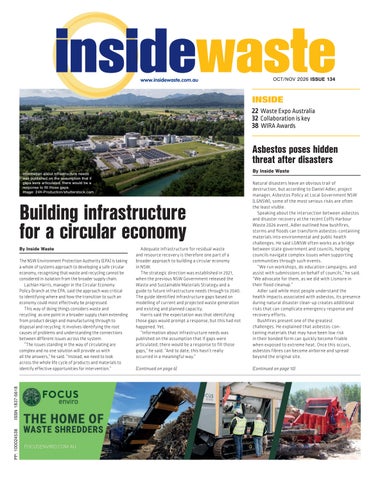
Information about infrastructure needs was published on the assumption that if gaps were articulated, there would be a response to fill those gaps. Image: 24K-Production/shutterstock.com
Adequate infrastructure for residual waste and resource recovery is therefore one part of a broader approach to building a circular economy in NSW. The strategic direction was established in 2021, when the previous NSW Government released the Waste and Sustainable Materials Strategy and a guide to future infrastructure needs through to 2040. The guide identified infrastructure gaps based on modelling of current and projected waste generation and existing and planned capacity. Harris said the expectation was that identifying those gaps would prompt a response, but this had not happened. Yet. “Information about infrastructure needs was published on the assumption that if gaps were articulated, there would be a response to fill those gaps,” he said. “And to date, this hasn’t really occurred in a meaningful way.”
Natural disasters leave an obvious trail of destruction, but according to Daniel Adler, project manager, Asbestos Policy at Local Government NSW (LGNSW), some of the most serious risks are often the least visible. Speaking about the intersection between asbestos and disaster recovery at the recent Coffs Harbour Waste 2026 event, Adler outlined how bushfires, storms and floods can transform asbestos-containing materials into environmental and public health challenges. He said LGNSW often works as a bridge between state government and councils, helping councils navigate complex issues when supporting communities through such events. “We run workshops, do education campaigns, and assist with submissions on behalf of councils,” he said. “We advocate for them, as we did with Lismore in their flood cleanup.” Adler said while most people understand the health impacts associated with asbestos, its presence during natural disaster clean-up creates additional risks that can complicate emergency response and recovery efforts. Bushfires present one of the greatest challenges. He explained that asbestos-containing materials that may have been low risk in their bonded form can quickly become friable when exposed to extreme heat. Once this occurs, asbestos fibres can become airborne and spread beyond the original site.
(Continued on page 6)
(Continued on page 10)
Building infrastructure for a circular economy By Inside Waste
PP: 100024538
ISSN 1837-5618
The NSW Environment Protection Authority (EPA) is taking a whole of systems approach to developing a safe circular economy, recognising that waste and recycling cannot be considered in isolation from the broader supply chain. Lachlan Harris, manager in the Circular Economy Policy Branch at the EPA, said the approach was critical to identifying where and how the transition to such an economy could most effectively be progressed. This way of doing things considers waste and recycling as one point in a broader supply chain extending from product design and manufacturing through to disposal and recycling. It involves identifying the root causes of problems and understanding the connections between different issues across the system. “The issues standing in the way of circulating are complex and no one solution will provide us with all the answers,” he said. “Instead, we need to look across the whole life cycle of products and materials to identify effective opportunities for intervention.”
Editor’s Note //
Because, of course, the best way to solve a complex Packaging reform can wait. Apparently. national problem is to ensure it remains a complex Australia has spent years talking about better packaging regulation. Now, after more consultation, stakeholder engagement and careful consideration, we appear to have reached a familiar conclusion: perhaps we should keep talking about it. In February, the Department of Climate Change, Energy, the Environment and Water engaged Design Enterprises to review and update the proposed Design for Kerbside Recyclability Grading Framework. Between March and May, more than 65 stakeholder interviews were conducted across the packaging supply chain. Packaging manufacturers, brand owners, recyclers, reprocessors and peak bodies all had their say. Their feedback was considered. An updated framework was produced and delivered to the Department. And the next step? Well, apparently, not too fast. Federal Environment Minister, Murray Watt, has indicated that “a new Commonwealth scheme for packaging will not be introduced during this term of Government”. The reason? The government feels it needs to balance environmental outcomes with the broader needs of the economy and avoid exacerbating cost of living pressures. Chief Executive Officer Christine Clancy christine.clancy@primecreative.com.au Managing Editor Mike Wheeler mike.wheeler@primecreative.com.au Brand Manager Chelsea Daniel chelsea.daniel@primecreative.com.au Designer Laura Drinkwater Client Success Manager Ben Sammartino ben.sammartino@primecreative.com.au
Head Office Prime Creative Pty Ltd 379 Docklands Drive Docklands VIC 3008 Australia p: +61 3 9690 8766 info@primecreative.com.au www.insidewaste.com.au
national problem. The Government will instead work with states and territories on opportunities to improve packaging regulations and policies in the nearer term. Meanwhile, the updated Framework is being considered, and no decision has been made about how it will be used. This is where the logic becomes difficult to follow. If the Framework is, as described, a robust and evidence-based guidance tool capable of increasing packaging recyclability and recovery, why is progress apparently being treated as something that requires indefinite caution? Nobody is suggesting environmental policy should ignore economic pressures. But framing packaging reform and cost-of-living concerns as competing priorities risks creating a false choice. Australia has consulted the supply chain. It has gathered the evidence. It has updated the framework. At some point, reform has to move beyond thanking everyone for their patience. Articles All articles submitted for publication become the property of the publisher. The Editor reserves the right to adjust any article to conform with the magazine format.
Subscriptions +61 3 9690 8766 subscriptions@primecreative.com.au Inside Waste is available by subscription from the publisher. The rights of refusal are reserved by the publisher
Copyright Inside Waste is owned by Prime Creative Media and published by John Murphy.
The Editor welcomes contributions but reserves the right to accept or reject any material. While every effort has been made to ensure the accuracy of information, Prime Creative Media will not accept responsibility for errors or omissions or for any consequences arising from reliance on information published. The opinions expressed in Inside Waste are not necessarily the opinions of, or endorsed by the publisher unless otherwise stated.
All material in Inside Waste is copyright and no part may be reproduced or copied in any form or by any means (graphic, electronic or mechanical including information and retrieval systems) without written permission of the publisher.
From Gatehouse to Dashboard
Waste Data Done Right
Capture real-time data Easy reporting via customisable dashboards Seamlessly manage tip passes Works in offline environments
Get Started with Cooee Today! solutions@cooeedata.com 4 INSIDEWASTE OCT/NOV 2026
“Cooee has allowed the Shire to enhance their understanding of the material being processed at the landfill site. The software has improved the recovery of gate fees and record keeping with immediate analysis of waste data. The team from Cooee developed the software to suit the Shire’s waste facility and has made the reporting more efficient and stress-free.” — Rikki Pulfer, Shire of Waroona
www.cooeedata.com
0447 393 363
Daily news updates at www.insidewaste.com.au
Thought Leadership //
Long term-council contracts can provide certainty for investment. Image: Inovational World/ shutterstock.com
Building infrastructure for a circular economy (Continued from the Cover) THE EPA BEGAN EXAMINING THE ISSUE IN EARLY 2024, leading to development of the Waste and Circular Infrastructure Plan.
Putting the plan into action The first chapter of the plan focused on residual waste capacity in Greater Sydney. Following stakeholder workshops and submissions on the draft, the final version was published last year. The plan represents a whole-of-government commitment, with agencies responsible for delivering its actions. The Department of Planning, Housing and Infrastructure has established a streamlined planning process for priority waste infrastructure, which is being used to assess the Lucas Heights western expansion. The EPA is also progressing regulatory amendments to update the energy from waste framework, undertaking an initial lands audit with Property Development NSW, and working towards stakeholder 6 INSIDEWASTE OCT/NOV 2026
consultation later in 2026. The Department of Planning, Housing and Infrastructure is also reviewing the potential for a state development assessment pathway for non-putrescible landfills. “This is just a snapshot of the work that’s underway and continues across all actions,” said Harris. While implementation of the first chapter continues, the EPA has shifted its attention to regional NSW for chapter two.
Regional challenges shape priorities The EPA engaged Arcadis to analyse waste data, with nine material streams mapped across regions to examine generation, recovery, material movements and processing and sorting capacity. “While our data is rich, it is also complex, and navigating and interpreting what it means is difficult to do without reference to local needs and expectations,” said Harris. The EPA examined construction and demolition, commercial and industrial, and municipal solid waste. Construction and demolition waste has not been
prioritised because it is often heavy and sensitive to levy settings, while low landfill costs in regional levy and non-levied areas make recovery difficult. Commercial and industrial waste also presents challenges because generators are dispersed, volumes are less certain and long-term contracts are limited. Municipal solid waste, however, has more stable volumes, while long-term council contracts can provide certainty for investment. “We’re choosing to focus our efforts here in chapter two with an intentional focus to support local councils to plan for the future and attract investment that is aligned with the needs of their communities,” said Harris. Harris said the EPA also held eight workshops with regional local governments and the 10 regional organisations, hearing consistent concerns about the economics and capacity of regional waste systems. “Resource recovery is rarely economically viable in regional New South Wales,” he said. “Low volumes and large transport distances makes this activity difficult to do.” Daily news updates at www.insidewaste.com.au
Part of the EcoCycle Group
STE FOR ISW AUG 26 235 x297 with bleed.pdf
C
M
Y
CM
MY
CY
CMY
K
1
1/9/2026
11:22 am
// Thought Leadership
The EPA also consulted material recovery facility operators, finding a lot of variation in infrastructure across regional NSW. Image: parilov/shutterstock.com
NO DOWNTIME FLOORING Heavy duty floor topping & repair system for waste handling sites
Councils also reported limited resources for long-term infrastructure planning, private sector investment attraction and achieving economies of scale. Legacy and unlicensed landfills are creating financial liabilities, while emerging gaps in residual waste capacity are being compounded by regional development and natural disasters.
Building investment confidence The EPA also consulted material recovery facility operators, finding a lot of variation in infrastructure across regional NSW. Operators reported rising operational costs associated with complex products, sorting technology upgrades and risks such as fires. Fragmented council tendering was also dampening investment confidence. The EPA is developing actions to support councils in planning for future infrastructure, attracting private investment and managing existing assets at an appropriate scale. Harris said councils could not do this alone and that new approaches were needed to tendering, infrastructure planning and asset management. “These approaches must achieve economies of scale and allow for appropriate sharing of costs and risks, but also enable sharing of mutual benefits for regional communities,” he said. The EPA is also working to ensure its data systems are fit for purpose. Chapter two is expected to be released later this year. This will be followed by consultation on a third chapter focused on resource recovery needs in Greater Sydney and potential policy interventions to improve resource recovery outcomes across NSW. Daily news updates at www.insidewaste.com.au
“The EPA is developing actions to support councils in planning infrastructure, attracting private investment, and managing existing assets at an appropriate scale.”
NO NO DOWNTIME DOWNTIME FLOORING FLOORING Heavy Heavyduty dutyfloor floortopping topping&&repair repair system systemfor forwaste wastehandling handlingsites sites • Leachate Resistant >>Leachate Leachate Resistant Resistant • Industrial Strength >>Industrial Industrial Strength Strength >High HighImpact Impact Rating Rating • High>Impact Rating >>Rapid RapidCure CureTimes Times • Rapid Cure Times >>Joint JointRepairs Repairs • Joint Repairs Call usfor for more moreinformation information CallCall usus for more information
02 8840 8888 02 028840 88408888 8888 enquiries@ascoatings.com.au www.ascoatings.com.au
enquiries@ascoatings.com.au enquiries@ascoatings.com.au | | www.ascoatings.com.au www.ascoatings.com.au
OCT/NOV 2026 INSIDEWASTE 9
Hazardous Waste //
Asbestos poses hidden threat after disasters (Continued from the Cover)
The lessons from Lismore While fire presents risks, Adler said floods create a different set of challenges because residents often return to damaged properties and begin recovery work immediately. Storms and floods can damage asbestos-containing materials through structural impacts, water ingress and wind-driven debris. Buildings that once safely contained asbestos can become sources of exposure when materials deteriorate.
“The risk of exposure increases significantly after these events, not just for emergency responders and cleanup crews, but for residents returning to their properties, often unaware of the danger,” he said. Adler said asbestos can easily become a secondary concern for communities dealing with the trauma and disruption caused by a disaster. Referring to the recent floods in Lismore and surrounding areas, he described how residents were focused on removing damaged building materials and restoring their homes, often without asbestos being front of mind.
“The trauma of a natural disaster really sets some things as high priorities such as retrieving personal belongings and making homes inhabitable again. Caring about asbestos at the time might not really be a big issue, but the health risks remain nonetheless.” The flood recovery environment also creates difficulties for regulators and councils. Unlike fire-damaged sites, which can often be secured and controlled, flood-affected residents typically return as soon as waters recede and begin managing their own clean-up activities.
Asbestos-containing materials can be low risk in their bonded form but become friable when exposed to extreme heat. Image: Eanstudio/ shutterstock.com
10 INSIDEWASTE OCT/NOV 2026
Daily news updates at www.insidewaste.com.au
Hazardous Waste //
Disasters can transform asbestoscontaining materials into public health challenges. Image: metamorworks/ shutterstock.com
“One of the key things that we’ve been informed of by NSW Public Works Advisory is that in these situations it’s a little bit easier to keep people out of fire-damaged structures,” said Adler. “But in the case of floods, as soon as the water recedes, people are back in and then they’re managing their own cleanup, they’re managing their own small-scale demolitions, and they’re throwing their rubbish out on the street verge. It’s very hard for councils and everyone to keep up with that as it develops.” The scale of contamination can also make resource recovery difficult. Once asbestos is mixed with large volumes of disaster waste, safely separating materials for recovery becomes challenging.
Planning for future disasters Citing research undertaken by the Asbestos and Silica Safety and Eradication Agency, Adler said growing concern exists nationally about the relationship between climate change, more frequent severe weather events, and asbestos exposure risks. 12 INSIDEWASTE OCT/NOV 2026
He referred to work undertaken through Australia’s Asbestos National Strategic Plan, which recognises that extreme weather events are increasing the likelihood of asbestos disturbance and exposure. He said the research is still developing in this area, particularly around how ageing asbestoscontaining materials may behave under changing environmental conditions. As materials deteriorate over time, future disasters could create risks that are not fully understood. One of the challenges is that managing asbestos safely is expensive. Adler presented examples provided by EDP Consultants showing that while lawful removal of asbestos roofing can cost tens of thousands of dollars, contamination following fire events can increase remediation costs dramatically. “If we have a fire that goes through and the asbestos becomes friable, EDP Consultants estimate we’re looking at it being five to 10 times more expensive to clean up,” he said. “In the end, EDP say we’re looking at up to a million dollars per property for friable asbestos cleanup.”
To address these challenges, Adler said governments are exploring many solutions. These include improving disposal options, increasing community awareness and developing better information about where asbestos remains in the built environment. He discussed the National Residential Asbestos Heat Map that identifies areas where asbestos roofing is likely to exist, helping governments understand the scale of the issue and support future planning. “The broader goal,” he said, “is to move towards more proactive removal rather than waiting for disasters to expose hidden risks.” “We need to know where it is in advance, identify and assess asbestos-containing material frequently, develop clear management plans, train personnel, communicate risks, and look at starting proactive removal of asbestos.” While asbestos may not be the first concern during an emergency, understanding where it exists and managing it safely is an essential part of protecting both people and the environment. Daily news updates at www.insidewaste.com.au
YOUR PROVEN SOLUTION Invest in the Best
for Maximum Recovery Eriez patented the world’s first Eddy Current Separator in 1969. Today, our full range of recycling equipment can be found all over the globe, increasing recovery and maximising revenues.
Eriez. Always the Right Choice. Eddy Current Separators from Eriez effectively remove nonferrous from automobile shredder residue (ASR), municipal solid waste (MSW), plastics, glass cullet, electronic scrap, and more.
GLOBAL LEADER IN SEPARATION TECHNOLOGIES
w w w.e riez .co m
Software //
The Cooee team begins configuring the system around known requirements, drawing on previous experience. Images: Cooee
Better waste data for smaller facilities WASTE MANAGERS ARE OFTEN ON THE LOOKOUT to improve how waste data is captured and used to better improve reporting and compliance to getting cleaner records and better service planning. The important question these managers are concerned about is whether a new system can be easily implemented without adding stress of another major project to an already full workload for workers. This is why replacing an existing process is rarely just a software decision. It’s a question of efficient implementation. Even when the need for better waste data is clear, the concern is whether changing systems will interrupt day-to-day operations or create a substantial implementation task for the waste manager to lead.
assess options, secure funding, engage stakeholders, prepare data, migrate old processes, train operational users and support them through the change. For a busy waste team, that workload can be enough to delay implementing a better system even though the need is clear. For smaller councils and facilities, the challenge can be even sharper, with limited internal IT capacity and growing regulatory expectations around data accuracy and security. An easy implementation does not just help the internal team. It also helps keep services steady for the community while the new system is introduced.
Designing implementation around the service, not the software Cooee was developed by a team with direct waste-sector experience, including long-term work with regional and rural operators. That background has shaped its implementation approach: understand how each service already works, then configure the system around those practical needs. “Our aim is to get people using Cooee with as little friction as possible,” says Sam Green, Cooee’s lead developer and data consultant. “Because we know the waste sector, we can usually anticipate the common requirements and come to the first meeting with
Implementation is where good ideas can get delayed Waste managers are needed to shape any new system because they understand the service, the constraints, and the reporting obligations their organisation faces. However, they should not have to become system designers, technical coordinators and trainers as well. A good implementation process draws on their operational knowledge while taking as much of the technical burden off them as possible. There are operational workflows to map, reporting and compliance requirements to consider, gatehouse practices to protect, finance and administration needs to align, and staff confidence to build. Some processes also carry specific knowledge that cannot simply be redesigned overnight. Then there is the biggest constraint: time. Time to 14 INSIDEWASTE OCT/NOV 2026
Cooee helps identify the difficult questions early and avoid unnecessary work.
Daily news updates at www.insidewaste.com.au
// Software
something ready to demonstrate, test and refine.” Every implementation is different, but Cooee’s work across more than 40 waste facilities, mostly in local government, means the team has seen many of the common challenges before. That experience helps identify the difficult questions early and avoid unnecessary work.
What easy implementation looks like in practice
After that, the team refines the configuration and prepares the system for testing. The next update meeting can then focus on checking the solution, answering questions and beginning training, with relevant staff able to be brought in where it helps build confidence early. “The aim is not to overwhelm people with training,” Green said. “Most users can get going after one session, with online videos available if they want to revisit anything later.” For councils that also need hardware support, Cooee can procure devices that are tested and selected for their suitability in rugged environments. The preconfigured devices help reduce the procurement workload for councils while ensuring operational staff have equipment that is suitable for the job from the beginning. Rather than managers needing to source, assess and configure hardware separately, devices can arrive ready for use with the relevant Cooee setup already in place.
Green described that for one recent council with straightforward requirements. “Cooee was able to configure, review and introduce the Cooee system within a month,” he said. A typical implementation starts once the relevant features are selected. From there, the Cooee team begins configuring the system around known requirements, drawing on previous experience with processes such as tip passes, invoicing, operational checklists and reporting workflows. Because some configuration has already been done, the first meeting can focus on review and refinement. Success is measured by confident adoption In many cases, that first 60-minute session includes a Successful implementation means reaching the point demonstration, discussion of key workflows and time where staff are confident using it, managers trust the for staff to try the app themselves. It is also where information coming through, and the organisation local requirements and the small operational details is not dependent on one internal expert to keep the that can make or break a system start to surface. process working. “We know managers need meetings to be concise That confidence extends beyond the first few and useful,” Green said. “We like to have a basic set-up weeks. Reliable data capture at the point of activity ready, along with optional features or process ideas, makes reporting periods smoother and gives so the conversation can focusReview on shaping the 1solution managers a stronger evidence base for budgets, Waste Management Ad 2025.pdf 19/12/2024 2:41:40 PM around what they actually need.” service changes, target tracking, fees and charges,
tip pass management and other recurring processes. If Cooee report users need extra support, further training is there to help them move beyond the basics, so they can find, filter and review data more confidently and get more value from the information already being captured. Continuity also helps. The same team that configures Cooee is involved in training and support, which means clients are dealing with people who already understand their setup, the decisions made during implementation and the way their service operates. “Our team configures, trains and provides support, which helps with continuity and understanding requests in context,” Green said.
Implementation should reduce pressure, not add to it For waste managers, the test of a new system is not only what it can capture, but whether it can be introduced without creating another major workload. Good implementation should make daily operations easier, reporting smoother and staff more confident in the processes they rely on. When the technical setup, configuration, training and support are handled well, managers can stay focused on running the service rather than carrying the full weight of system change. For councils and facility operators considering their next data project, ease of implementation should not be treated as a nice-to-have. It should be one of the clearest signs that the solution is fit for purpose.
Struggling to recycle your plastics?
Meet LANDFILL-BIODEGRADABLE PLASTIC C
M
Y
&
Recyclable
Biodegrades
with soft plastics
in modern landfills
CM
MY
CY
CMY
K
Our products complement the circular economy by being recyclable with mainstream soft plastics where programs exist and if not they will biodegrade in modern landfill 90% faster than conventional plastic with no microplastics.
PLUS
They have the same strength, flexibility, versatility and shelf-life as conventional plastic.
Daily news updates at www.insidewaste.com.au
OCT/NOV 2026 INSIDEWASTE 15
news
W 4.08 : Suite | 10 Century | Baulkham Hills|NSW 2135 | t: 5000 02 8746 5000 | e: info@wmrr.asn.au | w: www.wmrr.asn.au WMRR: Suite | 574.08 St Johns RoadCircuit | Glebe NSW 2037 t: 02 8746 | e: info@wmrr.asn.au | w: www.wmrr.asn.au
From the CEO’s We know whatdesk good policy looks like, so why aren’t we governing that way?
Environment Ministers will meet for the second industry however the Queensland Government has embarked on the development time this year on 7 December, following the first of a waste management strategy underpinned by a waste disposal levy to increase unnecessary andnew barriers for The businesses squarely in that conversation. Yetin we keeprecycling regulating at 2018 Meeting of Environment Ministers (MEM) and recovery and costs create jobs. Stateoperating will re-introduce a $70/ Australia. the wrong end of the – after a product been levyacross April, which was in part a response tovalue the chain import tonne has landfill in March 2019. There are also strong attempts to use policy Butand ‘recognition’ and ‘consideration’ cannot designed, manufactured, consumed restrictions driven by China’s Nationalimported, Swordsold and levers (levy–discounts exemptions) to incentivise thebecome use of recycled material another substitute for implementation. and finally becomes someone else’s ‘waste’ problem. This is Policy and the effects this policy has had across and make it cost competitive with virgin material. However, little has been done to There is another argument we need to confront directly. governing at the wrong end of the system. the Australian waste and resource recovery (WARR) establish new markets and Government has not taken the lead in the procurement Whenever producer responsibility is proposed, we hear The reality is that Australia does not need to invent all of industry. Key decisions derived from the April MEM of recycled material. There are grants available for resource recovery operations that it will impose additional costs on businesses and this from scratch. In August 2026, Europe’s Packaging and include: inestablishing Queensland although noconsumers. monies have been allocated to assist in 2018. This is ultimately But poor packaging and product Packaging Waste Regulation (PPWR) began, troubling as Queensland rolled out its Container Refund Scheme on 1 November, design are not free now. The costs already exist, and common rules for packaging across its entire lifecycle. It • Reducing waste generation, endorsing a target which will likely impact the cost and revenue models of the State’s MRFs – as we are being met through council rates, waste charges also progressively addresses problematic materials and of 100% of Australiansubstances, packaging beingrestrictions recyclable, in NSW. and recycling systems. WARR pays through additional including on PFAS.have Europeseen doesmost recently sorting, contamination, fires and damaged infrastructure. compostable or reusable bythis 2025, andregulation, developing not see as waste rather it is competition Governments through clean-ups, grants and infrastructure policy, part of building a stronger single market, reducing targets for recycled content in packaging. WESTERN AUSTRALIA programs designed to manage that were never dependence on virgin resources, encouraging innovation • Increasing Australia’s domestic recycling capacity. The Western Australian Government set up aproducts Waste Taskforce in direct response to properly designed or of funded recovery in the first and improving the competitiveness and resilience of National • Increasing the demand for recycled products. the China Sword. As part thisfor announcement, theplace. State Government And we carrythe the environmental carbon(3)-bin costs ofsystem - red for European industry. • Exploring opportunities to advance waste-to-energy and waste-to-biofuels. urged all local councils to all begin utilisation ofand a three unnecessarily extracting virgin resources while disposing This also means that Australian companies operating By Gayle Sloan, CEO WMRR • Updating the 2009 Waste Strategy by year end, which will include circular general waste, yellow for recyclables and green for organic waste - over the coming of valuable materials. The real policy question then, is not globally will have to meet these higher standards overseas. economy principles. years to reduce contamination. While this taskforce is a step in the right direction, whether there is a cost. It is who should pay it? Why should Australians accept poorer standards at home? I RECENTLY READ A COMMENT FROM PRIME MINISTER we are yet to see any tangible results from it or anyto funding industry. In October, Are we really prepared to continue privatisefor profits Why do we fight to be left behind? Anthony Albanese that stayed with me: “I firmly believe It is time to take stock and examine what has been achieved since these decisions the WA Waste Authority released its draft Waste Strategy to 2030, which comprises while socialising the costs? How long, in the pursuit of If a multinational prepares packaging to meet European that if you govern in the right way, and you get the policies were announced. Now, seven (7) months may not seem like a long a comprehensive and detailed the be State’s ‘circularity’, will weroadmap allow thosetowards costs to simply pushedshared vision of requirements, whytime, shouldhowever Australian consumers get the right, then the politics will follow.” in that time we have further Vietnam) and becoming onto thelow-waste, next person incircular the valueeconomy. chain – ultimately inferiorIndonesia, packaging that would not meet global safety anda sustainable, It makes me think aboutseen our waste and markets resource close (Malaysia, landing with recyclers, councils, ratepayers and taxpayers? design seven standards? If we reallycould want Australian businesses recovery and the question that’s financial stress, if you(WARR) are ansector operator under continued (7) months Good EPR changes that equation. Those who to compete globally, we must achieve greater productivity, increasingly to ignore: if we know what good policy make or difficult break you. COMMONWEALTH design, manufacture, and aplace sovereign manufacturing capability and more resilient the MEM looks like, why aren’t we implementing it? Following in April, Australiaimport now has newproducts Federalonto Environment Minister, shouldtocarry an appropriate chains. we want to reduce emissions and build whothe When it comes to waste, recovery Following the April resource MEM, we haveand had three (3)supply states stepAnd inifwith varying Melissa Price, in Australian October market reiterated media MEM’s commitment to explore responsibility for those products throughout their lifecycle. recycling and remanufacturing industries here, then our transitioning to a circular economy, we are not short of degrees of financial assistance for industry (councils and operators). This should waste to energy as part of the solution to the impacts of China’s National Sword, That is not anti-business. It is good economic policy and policy settings need to genuinely support those ambitions. evidence, nor short of strategies, targets, consultation be expected considering almost all states (except Queensland and Tasmania) have which is troubling (EfW is not a solution to recycling). The Commonwealth has how well-functioning markets create the signals necessary We also need to learn from our own experience. papers or international examples, nor problems that access to significant levy year. OnAustralia the eastern seaboard, also backed the Australian Recycling and endorsed the–National Packaging to reward better design,Label innovation and investment and now has containerVictoria deposit schemes (CDS) need solving. We also knowwaste business asincome usual willeach not get has approximately $600normillion waste levy reserves in the Sustainability Fund Targets developedhow bywe the Australian Packaging Covenant (APCO), ensure businesses doing the right thing areOrganisation not operating successfully across the country. However, Australia to its waste targets, can we in create a circular and NSW more $700 million per annumthey from the waste levy. There is which failed to incorporate feedback competitively disadvantagedindustry by those that are not. in the development have also demonstrated the consequences of has to date, economy whileraises continuing to than allow products and packaging no lack of fundsmarket that can reinvested intodeveloping our essential industry. of these targets. ToAustralia’s the Commonwealth’s credit, there own Productivity Commission has has been significant systems jurisdiction by jurisdiction. Different to certainly be placed onto the Australian withbe little to no recognised the improving materials rules, governance arrangements, eligible products responsibility for what happens to them at the end of their coordination in reviewing theimportance NationalofWaste Policy, with the Department of productivity and efficiency as we transition andaimplementation pathways. The result being that useful life. Andhelps we know that extended Funding but asgenuine we know, theproducer money goes much longer way with Environment bringing together industry players andtowards Statesa during the review more circular economy. And through the Revitalising businessespolicy operating nationally are themselves calling responsibility (EPR)support is one of and the fundamental toolsas appropriate Government leadership,policy as well levers. process. National Competition Policy agenda, governments for greater harmonisation given the administrative and required to change this. Yet we continue to hesitate – and, have already recognised the importance of addressing compliance burden created by multiple approaches to what frustratingly, we seem determined not to learn from either VICTORIA The updated Policy will now go before Environment Ministers on 7 December. The national consistency. We need nationally consistent EPR is, ultimately, one national marketplace. our own experience or that of others. Victoria has arguably been the most active and earnest in supporting the industry Commonwealth can play a key role – one that goes beyond the development of the frameworks, including design standards that prevent We need to learn from that experience, not repeat EPR is too often characterised as simply another post-China, with two (2) relief packages announced to support the recycling National Waste Policy. WMAAmaterials is supportive of the entering Federalour Government maximising problematic and chemicals it. Yes, reform takes courage and leadership. It means regulation or a mechanism for paying for recycling. But it industry, valued at a Well-designed total of $37 million. The Victorian Government hasinterests, also gone the levers taxation and importation powers, to maintain a strong, economy. And recycled-content requirements and marketnavigating competing resisting pressure andit has, including is so much more than that. EPR changes above and beyond all others states by announcing it would take a leadership role sustainable waste and resource recovery industry. development measures that create genuine demand for staying the course when things get difficult. But as the the economics of the system – creating incentives to use in creating demand recycled products. introduction of CDS demonstrated, meaningful reform is Australian recovered materials. fewer materialsmarket and design productsfor that last. It drives OF MEM 2 Most importantly, where good policy has already been rarely easy — and when the policy is right, itAHEAD is absolutely demand for recycled materials, stimulates innovation developed and tested internationally, should learn doing better than worth doing. Australia is one materials market, andmay we be movement and competition, reduces reliance on virgin resources and SOUTH AUSTRALIA There across Australia, with we some states from it rather than continually it. too Everylong. year It is evident that should start governing that way.ofThis is why the work provides investors’announced confidence that markets for recovered Government a $12.4 million support package comprising $2itmillion others, but the consensus is, progress is stillreinventing taking way we delay, more valuable material is lost, investment being progressed through Environment Ministers on materials exist. It also reduces carbon emissions by keeping additional expenditure, $5 million additional funding for a loan scheme, together there are funds available in almost all States to assist with developing secondary decisions are deferred andthe Australia behind stewardship, data and nationally consistent materials circulatingfunding productively than continually with targeted fromrather the Green Industries SAproduct budget. The Government has manufacturing infrastructure, however onlyfalls wayfurther that this will really happen is economies that are already implementing the architecture approaches is so important – so why isn’t it being treated extracting virgin resources to replace those thrown away. also offered grants for recycling infrastructure. if there is government leadership around mandating recycled content in Australia for circularity. Perhaps that brings us back to the Prime that way? This also connects directly to the broader Circular economy policy is economic policy. Resource now, not later. Minister: “If you govern in the right way, and you get the economic reform agenda. The Revitalising National productivity is productivity policy. And good product NEW SOUTH WALES policies right, then the politics will follow.” Competition Policy process has recognised opportunities stewardship is market reform. That distinction matters. At first glance, South Wales’ eye-watering $47 million recycling support the Used Packaging under which For WARR, we already knowNEPM, a great deal about whatAPCO is auspiced, to improve national consistency in productVoluntary stewardshipschemes like Australia is having aNew national conversation about package was heralded as the spark of hope industry However, on closer are not working. We tonnes of packaging waste in Australia, which thehave right 1.6million policy looks like. The question is whether we are andneeded. waste and resource recovery data. That matters productivity, sovereign capability, manufacturing, inspection, the bulk of this package that was via the Waste Less, Recycleregulation needs to be used asprepared an input packaging. to using recycled content to back act oninto it? We know whatBarriers good policy looks like. because as CDS shows, inconsistent is not supply-chain resilience, competition and the transition to funded We need to govern that way. and Government must lead simply environmental – it creates duplication, netMore zero. Iinitiative am going to keep saying this: materials and therefore the waste belong levy, was not new,anmaking it veryproblem difficult in civil infrastructure mustthe becourage identified and removed,
for stakeholders, including local government, to utilise the funds as they were already committed other activities. Some of the criteria proposed by the NSW 16 INSIDEWASTE OCT/NOVto2026 EPA also made it challenging for industry to apply to these grants. On the plus side, efforts are being made by the NSW Government to stimulate demand for recycled content through the intergovernmental agency working groups that have been established, though no tangible increase in demand or facilities have
in this field and prefer and purchase recycled material. A tax on virgin material should also be imposed as it isnews overseas. MEM must show strong leadership on this Daily updates at www.insidewaste.com.au issue. Ministers have, since April, dealt directly with operators and councils that are under stress and we have a chance to create jobs and investment in Australia at a time when manufacturing is declining. Ministers have the opportunity to be leaders of today, not procrastinators – leaders of tomorrow and we are urging
evelopment y to increase duce a $70/ o use policy cled material been done to procurement y operations 2018. This is 1 November, MRFs – as we
response to Government tem - red for r the coming ht direction, y. In October, ch comprises ed vision of
ent Minister, nt to explore ional Sword, nwealth has al Packaging tion (APCO), evelopment n significant partment of g the review
cember. The pment of the t maximising ain a strong,
better than evident that g secondary lly happen is t in Australia
is auspiced, tralia, which cled content nt must lead gin material rship on this councils that t in Australia rtunity to be e are urging
NSW, ACT & WA Tony Miller 0429 444 451 tony@garwoodinternational.com.au
VIC, TAS & SA Ian Pinney 0409 905 451 ian@garwoodinternational.com.au
www.garwoodinternational.com.au
QLD & NT Peter VanHeiden 0414 757 563 info@garwoodinternational.com.au
Circular Economy //
Why circular economy policy needs a wider lens By Lisa McLeod WASTE POLICY REMAINS ESSENTIAL. Councils need robust systems for collection, recycling, organics processing and safe disposal. But by the time a product reaches the bin, most of the decisions that determine its environmental impact have already been made. The circular economy asks a more fundamental question: How can we avoid waste being created in the first place, while keeping products and materials useful for longer and regenerating the natural systems on which communities depend? That distinction is central to Frankston City Council’s recently endorsed City Circularity Roadmap (March 2026). Rather than simply extending its existing Waste Circularity Plan 2023-2030, Council developed a separate roadmap to broaden the conversation beyond waste management and embed circularity across the systems that shape everyday life, such as buildings and infrastructure, food, clothing and consumer goods, local business, and Council operations. It is a useful example for the sector. Circular economy policy does not replace waste policy. It expands it. Waste management focuses on what happens after a product is discarded. By contrast, circular economy policy aims to limit waste generation and ensure materials retain their value for as long as possible.
From end of life to whole of system Waste services are the most visible part of a council’s resource recovery work. They are also where the consequences of resource decisions become apparent: a discarded sofa, a food scrap in the red bin, packaging that cannot be recycled, or building materials sent to landfill during demolition. Yet those outcomes are largely determined well before collection day. Product design, procurement decisions, building specifications, access to repair and reuse services, business practices and the availability of alternatives to buying new all shape what eventually becomes waste. A circular approach shifts attention upstream. It prioritises designing out waste and pollution, keeping products and materials at their highest value, and regenerating natural systems. Recycling remains
Excess pavement material from the McCormicks Road project was reused to seal Wedge Road, Skye, reducing waste and supporting Frankston City Council’s circular economy objectives. Images: Frankston City Council.
18 INSIDEWASTE OCT/NOV 2026
important, but it is not the destination. It is one tool among many, after opportunities to avoid, reduce, reuse, repair, share, refurbish and remanufacture have been considered. This broadens both the opportunity and the challenge. Local governments cannot create a circular economy, but they can contribute, and circularity is not owned by a waste team alone. It requires input from procurement, economic development, planning, infrastructure, property, parks, community development and communications. It also depends on collaboration with businesses, institutions, community, neighbouring councils and state government.
Why Frankston created a separate roadmap Frankston City Council already has policies and programs that support circular outcomes. These include waste and resource recovery services, food waste avoidance education, business support through its Trim Your Bin program, reusable product rebates, and use of recycled materials in Council projects. The Roadmap brings this activity together and identifies where further strategic direction can help accelerate progress. Its five-year plan is organised around three objectives: • Foster a circular economy culture: Make circular choices such as reuse, repair, sharing and food waste avoidance easier and more visible for residents. • Position Frankston as a circular economy hub: Support local businesses, innovation, skills and partnerships that can create economic opportunities from circular models. • Lead by example: Embed circular principles in Council procurement, asset management, infrastructure, policy and staff capability. The approach recognises that waste prevention is not simply a household behaviour issue. It is shaped by the availability, affordability and convenience of circular options. Repair cafés, Libraries of Things, clothing swaps and refill services do more than reduce waste. They can lower household costs, strengthen community connections and support local enterprise. The Council’s public messaging captures this practical dimension well: a borrowed tool instead of a new purchase, a salvaged building material used in its next project, recycled
glass used in road base, or a shampoo bottle refilled for another use. These are modest examples individually, but together they point to an economy that extracts more value from the materials already in circulation.
Focusing on places where councils can influence change To turn broad principles into practical action, the strategy focuses on three areas where councils have high influence and where measurable outcomes are achievable. The built environment is a major opportunity. Councils influence planning, construction, infrastructure delivery and the management of substantial public assets. Circular principles can extend the life of buildings and infrastructure, support adaptive reuse, improve material recovery during renovation and demolition, and create demand for recycled-content products. In Frankston, this includes developing guidance, standards and decisionmaking tools for Council assets, identifying flagship infrastructure projects, and pursuing local end markets for recyclable materials. Food systems connect climate, cost of living, health, local enterprise and resource recovery. Preventing food waste is preferable to managing it after disposal, while unavoidable organics can be transformed into valuable compost and mulch. The plan links food literacy, food rescue, support for local businesses and manufacturers, and greater use of recycled organics in parks, gardens and landscaping. Clothing and consumer goods are where circularity becomes particularly tangible to households. Repair, reuse, sharing and second-hand options can keep products in use, reduce pressure on household budgets and strengthen local social enterprise. Frankston’s plan includes support for community-led activities such as repair cafés, clothing swaps, Libraries of Things and upcycling workshops, alongside investigation of connected community and business circularity hubs.
Leadership means changing Council’s own systems A circular economy strategy needs to be more than a list of community programs. Councils have considerable
Delivering circularity in practice: Foam bitumen treatment was used to rehabilitate sections of McCormicks Road, Carrum Downs, extending the life of existing pavement materials and reducing demand for new resources.
Daily news updates at www.insidewaste.com.au
// Circular Economy
influence through their own purchasing, construction and asset decisions. Frankston’s Roadmap includes actions to integrate circular economy principles into strategies and policies, introduce environmentally sustainable procurement provisions, improve data on material use and waste flows, establish metrics, and build circular capability across Council teams. This internal focus matters. It helps turn circularity from a concept into routine practice. It also gives councils the credibility to ask residents and local businesses to make changes when they can demonstrate their own commitment. Measurement will remain difficult. Local circularity data is inconsistent, and outcomes are affected by supply chains and markets beyond municipal boundaries. Frankston’s proposed measures are therefore deliberately practical. For example, tracking the proportion of recycled aggregate used in civil works, compost and mulch used in parks, household food and clothing waste, and employment in circular economy sectors. No single measure can fully capture circularity. However, practical indicators give councils a way to track progress, identify gaps and demonstrate value to their communities.
The next step for waste policy The waste and resource recovery sector has done much of the groundwork for circularity. It has built the collection systems, processing infrastructure, market knowledge and community understanding
Community reuse events make circular choices visible, accessible and social.
needed to reduce landfill. But circularity challenges the sector to work further upstream and more collaboratively across government and the economy. Frankston’s separate Circularity Roadmap is valuable because it makes this shift explicit. It retains the importance of waste policy while recognising that a circular city will not be achieved through better disposal alone. The strongest local circular economy strategies will be those that connect waste and resource recovery with procurement, economic development, planning, infrastructure, food systems and community life. They will make circular choices practical, affordable and visible. And they will build on the many businesses, community organisations and residents already finding smarter ways to use resources.
Frankston’s approach is not necessarily a model to be copied in every detail. However, it highlights an important principle for local government: circular economy strategies work best when they sit across organisational functions rather than being treated solely as an extension of waste management. In a circular economy, waste is no longer simply a disposal problem. It is a signal that value has been lost and a reminder that better decisions can be made much earlier in the system. This article draws on Frankston City Council’s City Circularity Roadmap and related public communications. Images and review kindly provided by Lisa Finn, Coordinator Circularity Strategy and Programs Frankston City Council. Lisa McLeod is the principal environmental scientist at Blue Environment.
KEEP CRITICAL
WASTE SERVICES RUNNING. Residents expect waste services to operate without interruption. LANOTEC helps protect waste collection vehicles, compactors, transfer station equipment and critical infrastructure from corrosion, wear and environmental exposure.
Reduce corrosion Extend component life Protect electrical systems Improve reliability
KEEP YOUR FLEET MOVING. LANOTEC.COM.AU OUTLASTS. OUTPREFORMS
Daily news updates at www.insidewaste.com.au
WASTE COLLECTION FLEETS
TRANSFER STATIONS
LANDFILL EQUIPMENT
RECYCLING FACILITIES
OCT/NOV 2026 INSIDEWASTE 19
E-waste //
Fluorescent lights are disappearing, their mercury problem is not AS AUSTRALIA PHASES OUT MERCURY LAMPS, the final generation of fluorescent tubes is entering the waste stream. The shift to LED lighting has been celebrated as an energy-efficiency success. Yet Australia still generates millions of spent lamps each year. Every retrofit in a school, hospital, office tower, street light, warehouse or factory creates a less visible problem: what happens to the fluorescent tubes and globes that have been removed? At end of life, a fluorescent lamp is not ordinary glass. Mercury is essential to the way it produces light, but it also turns a routine maintenance item into a regulated waste stream. The World Health Organization ranks mercury among the 10 chemicals of greatest public health concern. In the environment, it can be transformed into methylmercury and accumulate through aquatic food chains. Australia has begun closing the door on mercury lighting. It ratified the Minamata Convention in December 2021, with the treaty entering into force domestically in March 2022. Several compact fluorescent categories reached their phase-out date
at the end of 2025. Further compact and linear lamp categories are due at the end of 2026, and most remaining linear and non-linear fluorescent categories are scheduled for phase-out by the end of 2027. Those deadlines regulate manufacture, import and export. They do not make the large installed stock in Australian buildings disappear. In fact, the transition to LED brings that legacy stock into the waste system faster. This exposes a gap in Australia’s policy architecture. FluoroCycle was established as a voluntary product stewardship arrangement, particularly for commercial and public buildings where most waste lamps arise. The Australian Government currently lists the scheme as voluntary and without current product stewardship accreditation. Australia is becoming more prescriptive about how mercury-containing lamps enter the market than how they leave it. The processing capability already exists. EcoCycle has invested over the past three decades to build a national, onshore lamp and mercury-recovery network. Millions of dollars have been spent on investing in lighting recycling, mercury separation and retirement technology.
Today, EcoCycle operates LP600 lighting-waste processing plants in Victoria, New South Wales and Western Australia, supported by LP200 plants in Queensland and South Australia. Locating equipment across five states reduces the need to transport fragile, mercury-bearing lamps across the country before processing. EcoCycle’s LP600 can process up to 600kg of fluorescent tubes an hour and recover up to 95 per cent of lamp materials. The technology is designed to do more than crush tubes. Lamps enter an enclosed, negative-pressure system, where they are separated into glass, metals, plastics and phosphor powder. The phosphor powder containing the Mercury is distilled and the elementary Mercury is directed to EcoCycle’s dedicated recovery and retirement systems, while separated glass and metals can return to productive use. Some of the recovered glass/plastics may not be suitable for reuse and in turn is accounted for as a waste product. An even less visible challenge sits inside older LCD televisions, computer monitors and some laptops. These devices can contain small cold-cathode fluorescent lamps, or CCFLs, behind their screens.
The Australian Government requires mercury waste to be managed in an environmentally sound manner. Images: Ecocycle
20 INSIDEWASTE OCT/NOV 2026
Daily news updates at www.insidewaste.com.au
// E-waste
EcoCycle has an automated robotic process that handles televisions, monitors and laptops.
Recovering them is slow and delicate as each device must be dismantled, the fragile tubes removed while limiting breakage as much as possible, and the mercury-bearing components segregated for controlled treatment. EcoCycle says this step is too often overlooked within the broader e-waste stream, despite the risk of mercury entering shredding residues or landfill. EcoCycle has invested in an automated robotic process that handles televisions, monitors and laptops containing these lamps within an enclosed, negative-pressure environment. This allows the mercury-bearing components to be safely and efficiently separated for controlled processing, while reducing worker exposure and making recovery commercially viable at scale. “Collecting an electronic device is not the same as recovering every hazardous component inside it,” says EcoCycle chief operating officer Nick Dodd. “Whether a fluorescent tube comes from a ceiling fitting or an old monitor, it must be identified, safely separated, traced and processed through a system that controls the mercury and accounts for every material stream.” That distinction is central to compliance. The Australian Government requires mercury waste to be managed in an environmentally sound manner, while state and territory regulators set facility licensing, storage, transport and tracking requirements. New South Wales identifies mercury and mercury compounds as wastes that may require tracking. South Australia bans fluorescent lighting from direct landfill disposal, while Victoria directs fluorescent bulbs away from municipal landfill. International movements of mercury waste also require permits. For waste generators, the obligation is broader than obtaining a collection receipt. It means using appropriate containers, preventing breakage, engaging licensed providers, maintaining an auditable chain of custody and confirming the final processing outcome. A recycling certificate should represent verified treatment, not merely a change of possession. Daily news updates at www.insidewaste.com.au
The economics explain why stronger stewardship is needed. Lamp recycling requires specialised collection, transport, filtration, worker protection, monitoring and mercury treatment. The recoverable glass and metals do not pay for that system. Without consistent funding, responsible operators compete against cheaper disposal routes that transfer environmental risk to future generations. Australia’s next step should be a nationally consistent, funded product stewardship model covering both legacy fluorescent lamps and emerging lighting waste. It should provide accessible collection, clear reporting, measurable recovery targets and transparent downstream outcomes. Governments and major property owners can act now
by writing recycling and evidence requirements into maintenance, demolition and retrofit contracts. “The phase-out of fluorescent lighting is the right direction, but it does not remove the lamps already installed across Australia,” says EcoCycle CEO Spyro Kalos. “We need to match the policy with a credible end-of-life pathway, so the final generation of mercury-bearing lamps is recovered rather than buried.” Australia does not need to invent the processing capability. It needs to use it. The fluorescent era will not truly end when the last tube is switched off. It will end when that tube is safely processed, its mercury controlled and its recoverable materials kept out of landfill.
Lamp recycling requires specialised collection, transport, filtration, worker protection, monitoring and mercury treatment.
OCT/NOV 2026 INSIDEWASTE 21
Waste Expo Australia //
Waste innovation takes centre stage WASTE-TO-ENERGY DIGITAL TWINS AND biotechnology’s role in creating a circular economy will be among the topics explored at Waste Expo Australia in Melbourne from 28-29 October, 2026. The event will bring together waste, recycling and resource recovery professionals to examine technologies and approaches shaping the sector, including the use of digital process modelling and biotechnology to improve how materials and facilities are managed. Anthony Douglas, senior consultant in Ramboll Australia’s Waste-to-Energy, Bioenergy and Carbon Capture team, will discuss how virtual process models can help developers and operators better understand and assess waste-to-energy facilities throughout their lifecycle. Samsara Eco’s head of bioengineering and discovery research, Vanessa Vongsouthi, will explore how biotechnology can help create a circular economy for some of the world’s most valuable materials.
Digital twins improve facility design and performance Digital twins, in the form of process simulation models, are giving waste-to-energy developers and operators a way to test, analyse and troubleshoot facilities in a virtual environment across the project lifecycle. Douglas, a chemical engineer with experience in process engineering, oil and gas consulting, process modelling and waste-to-energy project development, is now applying process simulation modelling tools to waste-to-energy developments across Australia. Anthony Douglas, senior consultant in Ramboll Australia’s Waste-to-Energy, Bioenergy and Carbon Capture team. Image: Anthony Douglas
22 INSIDEWASTE OCT/NOV 2026
“The process modelling aspect of digital twins is producing a mathematical representation of a process, and then tuning it with actual plant data, or starting with your design data and then tuning it with actual plant data,” Douglas said. For waste-to-energy projects, that approach can provide information from the earliest stages of development, including concept design and approvals. Ramboll has developed an in-house waste-to-energy modelling tool called RAMsteam, which draws on engineering data and other inputs to model facilities with different configurations. Douglas said the model can be used to assess key operational and financial factors, including material throughput, thermal input, power output, consumable requirements, residue production and emission rates. The digital environment also allows developers to test different scenarios before a facility is built. “This tool provides inputs to your financial model, and it also provides inputs to your environmental approvals because it’s telling you basically how much material you could process for a given thermal input,” he said. “It also estimates how much power output you’ll get and the emission rates under various operating conditions.” “It then allows you to do scenario analysis to stress your financial model to see what happens if your calorific value is higher or lower than you expected.” Changes in the composition of incoming waste can also be assessed. Douglas said higher levels of sulphur, chlorine or ash can affect reagent and ash requirements, making scenario analysis valuable during the concept design and approvals stages. Speed is another advantage. Douglas said a baseline model can be built within a week and used to provide technical information for different assessments and application documentation, such as the critical Air Quality Impact Assessment. Once a facility has been constructed, the digital twin process model can provide a benchmark against which actual plant performance can be measured. During commissioning, operators can compare the performance of the physical plant with the design data and investigate differences. “If you’re not achieving a process performance target, then you can use your digital twin process model to investigate why this is occurring,” Douglas said. “Is it something to do with the lime quality? Is it the air-cooled condensers not performing? Has something failed or does something need to be cleaned?” The model can continue to support operations by helping identify underperformance in key equipment and assessing the potential impact of changes designed to improve output or reduce operating costs. Douglas said process modelling has been used in other industries for many years, with the opportunity now being to apply that knowledge to waste-to-energy facilities. Extending process models to become a true digital twin, would require the model to be connected to the plant control system, for real-time optimisation and decision making. However, this would be significantly more complex and expensive and would require a strong business driver.
Meanwhile, process models by themselves can still deliver significant benefits and insights. “It’s really trying to help clients, developers and plant owners understand more about their development/asset and doing ‘what-if’ scenario analyses, sensitivity analyses and other assessments that can be done more easily and quickly in a digital environment rather than playing around with your plant and seeing what happens.”
Biotechnology targets hard-to-recycle materials Vongsouthi’s presentation, How Biotechnology is Creating a Circular Economy, will examine the potential for biotechnology to regenerate hard-to-recycle plastics and textiles, as well as its emerging applications in critical mineral recovery. Her journey into biotechnology began during her doctoral research at the Australian National University, where she initially worked on engineering fluorescent biosensors capable of lighting up in the presence of different neurotransmitters. Collaborating with neurophysiologists, she saw the sensors being used in rat brain tissue, providing her with an early lesson in what it meant for laboratory research to reach an end user. She later began applying the same protein engineering principles to enzymes capable of breaking down plastics, including polyethylene terephthalate, or PET, a material commonly used in packaging and apparel. Initially intended as a side project during her PhD, the work quickly grew into something larger. It ultimately contributed to the founding of Samsara Eco in 2021. The company’s approach uses biology and chemistry to break down the molecular chains that make up plastics and textiles. The process begins with the gentle treatment of pre-processed waste, including post-consumer and post-industrial textile waste. This loosens the molecular chains and breaks the material into short, dissolvable fragments. The resulting liquid is then passed through a column containing Samsara Eco’s engineered enzymes, which break the fragments down further into individual monomers. Vongsouthi said returning materials to their original molecular building blocks is important because it avoids the performance losses associated with conventional recycling. The resulting material is virgin-equivalent and can potentially be used in applications ranging from textiles and automotive components to packaging. “Conventional recycling degrades quality, and that compounds with every cycle,” she said. This can result in recycled plastics being directed into lower-value applications before eventually reaching landfill. By returning materials to their monomers, however, the material can be regenerated rather than continually downgraded. The technology is relevant to difficult waste streams containing mixed, coloured or contaminated materials. Samsara Eco originally targeted what Vongsouthi describes as the “mixed bale problem”, which includes plastics and textiles containing blends, additives and adhesives. Conventional recycling processes typically require Daily news updates at www.insidewaste.com.au
// Waste Expo Australia
relatively pure and clean waste streams. Biotechnology, by comparison, can target a material within a mixed input. The process can recover the material while contaminants are purified out, allowing more material to remain in circulation at its highest possible value rather than being sent to landfill or incinerated. Producing virgin-identical materials is also central to reducing reliance on fossil resources, Vongsouthi said. Conventionally recycled materials can eventually need to be blended with virgin materials to achieve the specifications required for high-performance products. Without maintaining those performance characteristics, recycled content may dilute the use of virgin materials rather than genuinely replacing them. High-quality recovered materials also have implications for the broader recycling economy. “If recovered material can go back into high-performance products, it holds its value,” Vongsouthi said. “That can improve the economics across the collection, sorting and reprocessing supply chain, helping keep more materials in circulation.” Partnerships with brands are another important component of scaling the technology. For example, Samsara Eco’s partnership with lululemon has provided an example of how brands can contribute beyond simply purchasing recycled materials. According to Vongsouthi, the partnership has helped demonstrate market demand, optimise processes for commercial conditions and connect the company with supply chain partners. “Brands pull demand through their supply chain, which is what innovations like ours need to help scale,” she said. Samsara Eco is also exploring biotechnology’s potential
Samsara Eco’s head of bioengineering Vanessa Vongsouthi. Image: Vanessa Vongsouthi
beyond plastics and textiles, with early work focused on critical minerals. Vongsouthi said critical minerals present a similar challenge. They are essential to electric vehicles, semiconductors and clean energy technologies, but often follow a linear model with limited recovery pathways at end of life.
Early work suggests engineered proteins could potentially recover critical minerals from discarded products. At scale, this could create what Vongsouthi describes as a new domestic reserve, one that already exists above ground in products that have reached the end of their useful lives. For circular technologies to scale, however, biotechnology alone will not be enough. Vongsouthi said an entire ecosystem must work together. Brands can demonstrate demand and help unlock investment, while policy can create a level playing field. Minimum recycled content requirements, for example, could establish a floor under demand and accelerate market development. Collecting, sorting and processing infrastructure will also remain essential. Looking ahead, Vongsouthi envisages an economy in which more materials remain in circulation at their highest possible value and less finite material is extracted. She also expects industries to increasingly judge materials not only by their first use, but by how many times they can be used again. For Australia, she sees an opportunity. The ambition is for Australian biotechnology to help create circularity for valuable materials around the world, transforming waste into a resource rather than allowing valuable molecules to be lost. Learn more about this topic and the broader issues shaping Australia’s resource recovery sector at Waste Expo Australia, taking place on 28–29 October 2026 at the Melbourne Convention & Exhibition Centre. Free registration is now open.
Davis Advisory
Daily news updates at www.insidewaste.com.au
OCT/NOV 2026 INSIDEWASTE 23
Landfill Management //
Why landfills are now central to Australia’s PFAS conversation By Kyle Lapic LANDFILLS DO NOT MANUFACTURE PER- AND polyfluoroalkyl substances (PFAS), but they increasingly sit at the centre of how Australia manages them at the end of the material lifecycle. PFAS have been used in industrial processes and everyday products because they resist heat, water, grease and stains. When those products become waste, the chemicals can enter municipal, commercial, industrial and construction waste streams. That creates an unusual challenge for landfill operators. They are generally not the original source of the PFAS they receive, but once those materials arrive on site, operators have to understand where the chemicals may move and how that risk should be managed. Australia’s regulatory direction is making that task harder to ignore. The PFAS National Environmental Management Plan (PFAS NEMP) version 3.1, released in 2026, is now the national reference point for investigating, assessing and managing PFAS contamination and waste. It provides nationally consistent guidance, while states and territories determine how that guidance is applied through their own regulatory frameworks. For landfill operators, PFAS is moving from a developing environmental issue to a more immediate operational consideration.
Landfills are becoming a PFAS data point Australian research has already shown why landfills are receiving greater attention. A study of leachate The NSW EPA describes landfills and sewage treatment plants as secondary receivers of PFAS. Image: Rich Carey/shutterstock.com
from 27 Australian landfills detected PFAS at every site sampled. Concentrations varied according to factors including waste type and landfill age, highlighting why PFAS behaviour cannot be reduced to a single concentration or site assumption. What it means: PFAS in landfill leachate is not confined to facilities known to have accepted a specific PFAS-contaminated waste stream. Their widespread historical use means they can enter the broader waste system through many different products and materials. That knowledge is now beginning to translate into more consistent monitoring requirements. From 1 October 2026, licensed landfills in New South Wales will be subject to the NSW Environment Protection Authority’s Landfill and Sewage Treatment Plant PFAS Monitoring Chemical Control Order. Landfills will be required to sample PFAS in leachate at least annually and downgradient groundwater quarterly, or surface water where an appropriate groundwater monitoring point is not available. The NSW EPA describes landfills and sewage treatment plants as secondary receivers of PFAS. The monitoring program is designed to establish comparable information about PFAS concentrations and pathways, rather than assume that every facility presents the same risk. That information will help guide further assessment and future regulatory decisions. For operators, the significance is straightforward. More monitoring means more site-specific information, and that information
may influence investigation, risk management and regulatory expectations. Leachate remains the clearest pathway Leachate remains the most established PFAS pathway for landfill operators to manage. Rainfall and moisture moving through waste can carry contaminants into leachate. PFAS presents a particular challenge because many compounds persist in the environment and are mobile in water. PFAS NEMP guidance recommends that leachate be collected and analysed before treatment, disposal or reuse. Where PFAS are detected, treatment, remediation or destruction options may need to be considered to reduce further movement into the environment. Victoria illustrates how national guidance can translate into state-level practice. EPA Victoria advises operators to consider the PFAS NEMP management hierarchy when accepting PFAScontaminated material and identifies landfill disposal as the least preferred option within that hierarchy. It also recommends ongoing sampling of landfill leachate, with treatment considered where concentrations or discharge volumes indicate further controls may be warranted. This changes the practical question around leachate. Having a collection system is only one part of the picture. Operators also need to know what the leachate contains, where it goes and whether existing treatment or disposal arrangements remain suitable.
Landfill gas is the next pathway to watch Leachate currently attracts most of the regulatory attention in Australia, but research overseas suggests landfill gas may also warrant closer examination. A 2024 study of three municipal solid waste landfills detected neutral PFAS compounds in landfill gas and concluded that gas could represent a significant release pathway for some PFAS. The research was conducted in the United States, and the science remains less developed than it is for leachate, so the findings should not be applied directly to Australian sites. They do, however, raise an important question about whether PFAS movement through landfills should be considered only as a water-management issue. What it means: As analytical methods improve, operators may need to look at PFAS across the landfill as a whole, rather than treating leachate, gas, groundwater and waste acceptance as unrelated programs.
Better information creates better options Landfill operators cannot change the historical use of PFAS in products that have already entered the waste stream. What they can control is how well they understand what reaches their site and what happens next. The practical response does not necessarily require a separate PFAS program. In many cases, 24 INSIDEWASTE OCT/NOV 2026
Daily news updates at www.insidewaste.com.au
// Landfill Management
the starting point is to connect PFAS with systems that already exist. That includes reviewing waste acceptance information, establishing reliable baseline data, understanding leachate and groundwater pathways, assessing existing treatment and disposal arrangements and maintaining consistent sampling records. Results also need to be interpreted in context. Detecting PFAS does not, on its own, establish environmental harm. Concentration, movement, receiving environments and potential exposure pathways all influence risk. The NSW EPA’s monitoring framework reflects this approach. The information collected will help determine whether further assessment of potential risks is required. For operators, knowing how those pieces fit together makes it easier to respond when regulators ask questions or requirements change.
Their position near the end of the material lifecycle, however, means they now have an important role in managing it. The shift underway is from managing individual PFAS requirements as they arise to understanding PFAS as part of the landfill system itself. For operators, that
knowledge provides a stronger basis for decisions about monitoring, treatment, environmental protection and future site management. Kyle Lapic is the solid waste market sector leader at Onterris
From passive receiver to active manager Australia’s approach to PFAS will continue to develop as analytical methods, health guidance and environmental evidence change. Landfill operators do not need to predict the next regulatory threshold. They do need enough reliable information to understand what is happening at their own site. That means connecting waste acceptance, leachate, groundwater, surface water and, where relevant, landfill gas to build a clearer picture of how PFAS may move through a facility. Landfills did not create the PFAS problem.
A study of leachate from 27 Australian landfills detected PFAS at every site sampled. Image: Onterris
TURNING WASTE INTO PROFIT
TROMMELS
HIGH SPEED SHREDDERS
SPALECK SCREEN
WINDROW TURNER
TDS 815
SLOW SPEED SHREDDER 1.5m Quick-Change Twin Shaft Shredding Unit Versatile Design for Multiple Applications
Customisable Shredding Programs Intuitive Control System
Call today: 1800 777 300 or Email: sales@finlay.com.au WASTE & RECYCLING
Daily news updates at www.insidewaste.com.au
www.finlay.com.au OCT/NOV 2026 INSIDEWASTE 25
Thought Leadership //
Helping waste businesses navigate complexity FOR BUSINESSES OPERATING IN AUSTRALIA’S waste, recycling and environmental sectors, navigating the regulatory landscape can be as challenging as the work itself. Planning approvals, environmental permissions, regulators, councils and community concerns can all intersect, requiring different areas of expertise to work together. At Davis Advisory, directors Kayla Gregg and Sarah Kovatch have built their business around helping clients manage those intersections. Gregg specialises in the waste and environmental side of the practice, while Kovatch brings planning expertise. Together, they work with clients across a range of issues in the industry whether it be processing facilities, asbestos removal, dangerous goods and skip bin operations. Their approach is to bring legal advice into projects early, when decisions about location, operations, approvals and regulatory engagement can still be shaped, rather than waiting for problems to emerge.
Two specialisations, one approach Gregg and Kovatch worked together earlier in their careers before developing expertise in different areas. Kovatch continued to build her planning background, while Gregg strengthened her environmental practice.
They later came together at Davis Advisory, allowing those specialisations to be combined for clients. Kovatch said the timing of their involvement can make a significant difference to a project, with early strategic advice helping clients avoid problems later. “I think it makes a very big difference to a project when we are brought in early,” she said. “We’re passionate about the benefits of having our input – from a strategic perspective – very early on in a project, rather than waiting for things to go wrong or get to a place where you might be starting to trip up a little bit or hitting those brick walls.” For waste businesses, those questions can be wide-ranging. A proposed facility may need to consider where it will be located, what materials will be received and processed, how those materials will be stored and contained, how vehicles will move through the site and what will ultimately happen to recovered materials. Gregg said clients need to approach regulators with a clear understanding of their proposed operations. “We would typically go to the client and say, ‘Look, in our experience, we think the regulator is going to be interested in this, this and this for your type of project.’ That is where you should start.’”
One example is Paintback, the national product stewardship scheme for unwanted paint and packaging. Paint-related operations, for example, can raise questions around storage, containment, fumes, truck movements and the movement of material into and out of a facility. This is where Gregg and Kovatch’s expertise come into play. “You’re talking about recycling, but what does that actually mean and what does that look like?” Gregg said. “You’re dealing with different types of mediums. It’s not just paint. You’re dealing with the metal can that the paint comes in, you’re dealing with the lid. There’s plastics. So how are you dealing with all those different mixed mediums when it comes to a waste type?”
A case study The long-standing relationship between Davis Advisory and Paintback provides an example of how the directors’ complementary expertise works in practice. Gregg said the firm has been involved with the Paintback Project since its establishment, when the concept was centred on product stewardship and diverting materials away from landfill and waterways. The Paint Circular Economy Headquarters opened in April 2025 as a world first. It is an end-to-end processing facility that sorts and separates unwanted paint and packaging, turning them into reusable materials and recycled-content products. Being first is precisely what made it difficult. Nothing of its kind had been built before; there was no established approval pathway to follow and no comparable facility for regulators to measure it against. The operation did not fit an existing mould, so a framework had to be constructed around it out of approvals designed for other things. The process involved meetings with the regulators to get agreement about the requisite permissions, preparation and lodgement of documentation and public consultation. Before engaging with regulators, the project team brought together a roundtable of consultants and experts to identify the matters that needed to be addressed. “It just goes to show, if you’ve got the right team, the right setup, the right advice early, it’s the most streamlined approach to approvals,” Gregg said. The experience reinforced their view that engagement with regulators needs to be informed and constructive to get the best outcomes.
Understanding the operation
Gregg (left) and Kovatch said the earlier they become involved in a project, the less surprises there are for clients. Images: Davis Advisory
26 INSIDEWASTE OCT/NOV 2026
Gregg said waste projects can sometimes create concern simply because they involve the word ‘waste’. That can lead to assumptions about an operation before regulators fully understand what the business is proposing. For that reason, Davis Advisory places importance on helping clients clearly explain their activities. “When you’re dealing with an unknown, or certainly anything that references waste, everyone panics,” Daily news updates at www.insidewaste.com.au
// Thought Leadership
Gregg said. “And it’s about walking the regulator through what it is that you do. Because if they’ve often not worked in your industry, how are they going to know what you do and how to regulate it?” The directors’ work is not confined to documents and meeting rooms. Kovatch said they spend time at client sites to understand how businesses actually operate. “We’re out on site with our steel cap boots on and really getting to know clients and how they operate and what they want to do,” she said. “I think it’s important in this industry to be on site.” That practical approach reflects the diversity of matters the firm handles. Its clients include ports, dangerous goods operators, transfer stations, asbestos removalists and skip bin operators, with specialised consultants brought in depending on the project. For Gregg and Kovatch, that variety is part of what makes the work appealing. “We have so much to talk about with what we do, and no two matters are the same” Gregg said.
Proactive rather than reactive The central message Davis Advisory wants to convey to the waste and recycling industry is straightforward: seek advice before problems develop. Gregg and Kovatch said businesses can benefit from having someone review an operation, identify potential issues and provide strategic guidance before they find themselves responding to a regulator or resolving a problem after the fact. “The key thing that we say to our clients and what
Daily news updates at www.insidewaste.com.au
Gregg (left) and Kovatch worked together earlier in their careers before developing expertise in different areas.
we want to get across to the industry is that you have to be proactive, not reactive. This is the approach that underpins all recent changes in regulation.” Gregg said. “If you don’t know, ask the question. Pick up the phone, run something past someone, get someone to come to your facility because it’s better than trying to respond when you’re in trouble.” That philosophy sits at the centre of the partnership between Gregg and Kovatch. Their different areas of legal expertise allow them to consider projects from both planning and environmental perspectives, while their practical involvement with clients helps them
understand the realities of individual operations. For clients in waste, recycling and environmental industries, that means access to lawyers who understand that regulatory compliance does not exist in isolation. Planning, environmental permissions, operational decisions and stakeholder engagement can all influence one another. By bringing those considerations together early, Gregg and Kovatch aim to help clients navigate an industry where complexity is unavoidable, but where the right advice and a proactive approach can make the path clearer.
OCT/NOV 2026 INSIDEWASTE 27
Events //
Discover smarter ways to improve waste and environmental operations FROM REDUCING OPERATING COSTS AND IMPROVING productivity to strengthening compliance and enhancing resource recovery outcomes, LEW26 and AUSJET26 bring together the suppliers, technologies and expertise helping Australia’s waste and environmental operators deliver better results. Across Australia, councils, waste contractors, resource recovery operators, utilities and environmental service providers are being asked to do more with less. Communities expect higher service levels. Compliance obligations continue to grow. Infrastructure is ageing. Labour shortages remain a challenge. Yet budgets and resources are often constrained. The organisations that succeed over the next decade will not simply work harder. They’ll work smarter. They’ll embrace technologies and solutions that improve productivity, reduce operating costs, strengthen safety outcomes, increase resource recovery and help teams achieve more with the resources they already have. That’s why the inaugural Liquid & Environmental Waste Expo (LEW26), co-located with AUSJET26, is bringing together the technologies, suppliers and expertise helping operators meet these challenges head on. Taking place on 28-29 October 2026 at Sydney Showground, Sydney Olympic Park, LEW26 and AUSJET26 will provide visitors with an opportunity to explore the latest innovations shaping Australia’s waste, wastewater, environmental services and infrastructure maintenance sectors.
Where operators go to find solutions When it comes to improving operational performance, there is no substitute for seeing solutions firsthand. While online research and supplier meetings remain important, nothing compares to being able to compare technologies side-by-side, speak directly with industry experts and see equipment operating in a real-world environment. LEW26 and AUSJET26 have been designed to help visitors make better informed decisions by bringing together leading suppliers, technologies and service providers under one roof. Visitors will be able to explore solutions covering: • Resource recovery and recycling. • Liquid waste collection and transport. • Wastewater and sewer maintenance. • Vacuum loading and industrial cleaning. • Pipeline inspection and rehabilitation. • Environmental monitoring and compliance. • Asset management technologies. • High-pressure water jetting. • Robotics and automation. • Safety and risk management. Attendees can evaluate how these solutions could improve their own operations, reduce costs and deliver measurable results. 28 INSIDEWASTE OCT/NOV 2026
Visitors will gain valuable insight into the technologies already delivering results. Image: Eric Stone
Built for waste, environmental and infrastructure maintenance professionals
Tackling workforce and productivity challenges
Whether you’re responsible for waste collection, transfer stations, recycling facilities, wastewater networks, liquid waste management, environmental compliance, stormwater assets, industrial cleaning, infrastructure maintenance or high-pressure water jetting operations, LEW26 and AUSJET26 have been designed to help you find practical solutions to everyday operational challenges. Together, the co-located events bring suppliers, technologies and expertise from across the waste, environmental services, liquid waste, industrial cleaning and infrastructure maintenance sectors, creating a unique opportunity to compare solutions, discover new approaches and connect with industry specialists in one location. Visitors can explore technologies and services designed to: • Increase fleet and crew productivity. • Reduce operating and maintenance costs. • Improve waste diversion and resource recovery outcomes. • Minimise downtime and service disruptions. • Extend the life of critical assets. • Improve compliance and reporting capabilities. • Address labour shortages through automation and smarter processes. • Enhance workplace and public safety. • Improve environmental performance. For many organisations, even modest efficiency gains can deliver substantial returns. Finding one better process, one smarter technology or one more effective supplier partnership can create a lot of value for years to come.
Labour shortages continue to impact many areas of the waste and environmental services sectors. As a result, operators are increasingly investing in technologies that improve productivity, reduce manual processes and help crews work more efficiently. From advanced inspection systems and digital asset management platforms through to automation, robotics and innovative equipment designs, LEW26 and AUSJET26 will showcase solutions helping organisations maintain service levels while controlling costs. Visitors will gain valuable insight into the technologies already delivering results across Australia’s councils, utilities and contracting businesses.
A strong focus on safety Safety remains one of the industry’s highest priorities. Whether working in confined spaces, managing sewer maintenance programs, operating vacuum trucks, undertaking industrial cleaning or maintaining critical infrastructure, operators are continually looking for safer ways to deliver essential services. LEW26 and AUSJET26 will showcase a wide range of technologies and practices designed to reduce risk, improve operational safety and support regulatory compliance. Visitors will also have the opportunity to learn from suppliers, contractors and industry professionals tackling many of the same operational challenges.
More than an exhibition Alongside the exhibition floor, visitors can take advantage of live demonstrations and the Cleanawaysponsored LEW/AUSJET Education Program. Daily news updates at www.insidewaste.com.au
VERTECH METAL RECOVERY SYSTEMS ADVANCED SYSTEMS FOR RECOVERING VALUE FROM WASTE
AUTOMOTIVE METAL RECOVERY
CABLE & COPPER RECYCLING
Waste Initiatives brings together advanced recycling technologies from Stokkermill and Panizzolo, delivering specialised systems for recovering valuable materials from solar panels, cable, radiators, WEEE, automotive metals, ASR, scrap metal and other complex waste streams.
COPPER, CABLE & RADIATORS
METAL RECOVERY & WEEE
SOLAR PANEL RECYCLING
Stokkermill systems recover valuable metals from electrical cable, copperrich materials and radiators.
SOLUTIONS AVAILABLE
These systems combine granulation and separation technologies to produce clean, separated material fractions.
• Radiator Processing
Panizzolo systems process scrap metal, automotive metals, ASR, WEEE and other mixed metal streams.
Stokkermill solutions process end-oflife solar panels for the separation and recovery of valuable materials.
Modular shredding, hammermill and separation technologies provide scalable solutions for efficient metal recovery.
Purpose-built systems combine size reduction and separation technologies for material recovery.
Contact us today on 1800 673 002 or info@wasteinitiatives.com
Discover more at wasteinitiatives.com.au
SOLAR PANEL RECYCLING
• Solar Panel Recycling • Cable & Copper Recovery • Scrap Metal Processing • Automotive Metal / ASR Recovery • WEEE Processing • Complete Recycling Systems
Backed by local engineering, project management and nationwide service support.
Events //
Featuring industry experts, case studies and practical insights, the program will address the real-world challenges facing councils, contractors, utilities and environmental service providers. Attendees will leave with practical knowledge and ideas that can be applied immediately within their own organisations.
Why attend LEW26 and AUSJET26? In just two days, visitors can compare leading suppliers and technologies in one location; see equipment and solutions operating live; identify opportunities to improve productivity and reduce costs; discover new approaches to workforce and labour challenges; strengthen compliance and environmental outcomes; stay ahead of changing industry and regulatory requirements; learn from industry experts and operational case studies; build valuable relationships with suppliers and peers; and return to work with practical ideas that can improve business performance. For busy operators and decisionmakers, the ability to assess multiple solutions in a single location can save months of research, supplier meetings and evaluation time.
Two expos - one valuable industry gathering While LEW26 and AUSJET26 each serve distinct sectors, they share many of the same operational priorities.
The decision to co-locate the events creates a unique opportunity for waste, environmental services, liquid waste, industrial cleaning, infrastructure maintenance and high-pressure water jetting professionals to connect, learn and explore new solutions together. LEW26 has already attracted major industry participants including Remondis, Envirowaste Services, Mega Pacific and Emtivac Engineering. The co-located AUSJET26 exhibition further expands the offering with companies including Cleanaway, Bucher Municipal, KAISER, Brokk/ Aquajet, WOMA, Hammelmann, KOR Equipment Solutions, Vacuum Truck Supplies, IBAK, Samson Pumps, Den-Jet and BlastOne. For visitors, it means greater access to suppliers, expertise, technology and practical solutions that can improve day-to-day operations.
fleet performance, waste services, environmental compliance, resource recovery, infrastructure maintenance or strategic decision-making, this is your opportunity to see what is working across the industry and identify solutions that can deliver measurable benefits for your organisation. Take two days out of the office and invest them in improving the next 12 months of your operation. A new piece of equipment, a smarter process, a better supplier relationship or a fresh idea from a peer may be all it takes to reduce costs, improve productivity, enhance safety or unlock new opportunities. The question is simple: Can you afford to miss an opportunity that could make your operation safer, more efficient and more profitable?
Better ideas, better decisions, and better outcomes.
Join Australia’s waste, environmental and infrastructure professionals at LEW26 and AUSJET26 on 28-29 October 2026 at Sydney Showground, Sydney Olympic Park. Trade registration and access to the Education Hub are free. Explore new technologies. Meet industry leaders. Learn from real-world case studies. Discover practical solutions you can take back and implement immediately. Register today and start planning your visit at ausjetconnect.com.au.
Every organisation is under pressure to improve efficiency, control costs, strengthen compliance and deliver better environmental outcomes. The difference between staying competitive and falling behind often comes down to access to better information, better technology and better industry connections. LEW26 and AUSJET26 have been created to help you find all three. If you’re responsible for operations,
Register Today
C
M
Y
CM
MY
CY
CMY
K
30 INSIDEWASTE OCT/NOV 2026
Daily news updates at www.insidewaste.com.au
Beyond the Bin
FE ATURED GUE ST S
Mike Wheeler Host and Editor, Inside Waste
Lisa Korycki Host and Editor, Waste Management Review
Gavin Shapiro Partner, Hones Lawyers
Beyond the Bin, powered by Inside Waste and Waste Management Review is dedicated to all things involving waste and resource recovery – from EPA requirements and licensing through to infrastructure, landfills, product stewardship and all peripheral issues. Powered by
Inside Waste & Waste Management Review
Trevor Evans Interim CEO, COEX
Listen Now
SEARCH
“BEYOND THE BIN’
Organics //
From waste to resource – an integrated approach TODAY, A HIGH-PERFORMANCE WASTE TREATMENT facility is not just a collection of individual machines. It is an integrated system in which mechanical equipment, air treatment, biological processes, automation and monitoring must work together efficiently. Achieving this requires more than individual technologies. It requires a partner capable of managing the entire project, from engineering and manufacturing through to installation, commissioning and ongoing support. That integrated approach was delivered by Italian engineering company Mion Ventoltermica Depurazioni S.p.A. (MVT), with its expertise available to the
Australian market through its partnership with Australian-based Vastum Engineering. Together, the companies combine MVT’s engineering and manufacturing capabilities with local project support. A recent project developed by MVT for a waste treatment application in Italy demonstrates this approach, combining automated aerobic biostabilisation, compost production and advanced odour treatment within a single turnkey solution. This case study is a great example of the type of project where Vastum Engineering can help transfer the knowledge and repeat the project in Australia, collaboration is key.
A plant for high-volume organic waste treatment The plant, in Italy’s south, is designed to treat approximately 140,000 tonnes of organic fraction municipal solid waste (OFMSW) and 35,000 tonnes of organic and green waste per year. The system includes 14 biocells and six maturation areas, allowing the organic material to undergo a controlled aerobic biostabilisation process before the subsequent stages of treatment. The objective is not simply to process waste, but to transform it into a usable resource. Through controlled biological processes, the system enables the recovery and transformation of organic waste into mixed compost, supporting a more circular method to waste management.
Odour control Odour management is one of the critical challenges in organic waste treatment facilities. In this project, the total air flow reaches approximately 400,000 m³/h, requiring a structure designed to manage the scale and variability of the facility. “As Australia’s organics processing sector continues to grow, governments and regulators will need to approve and licence additional facilities to manage increasing volumes of FOGO and other organic waste due to the types of emissions and odours they produce,” said Vastum Engineering’s director Amir Tadros. “Ensuring these facilities comply with environmental requirements will be critical, particularly in managing odour emissions and air quality. Effective odour control and air treatment systems will therefore play an important role in securing environmental approvals and maintaining community acceptance as new processing infrastructure is developed.” The air treatment system consists of six scrubbers, each designed for a flow rate of approximately 67,000 m³/h, followed by a biofiltration stage. The five biofilters are divided into three sectors each, allowing the treatment system to be configured and managed according to the specific operating requirements of the plant. This configuration enables the air extracted from the different process areas to be collected and treated through a combination of scrubbers and advanced biofiltration technologies. The scrubbers are manufactured directly by MVT and can be produced in both polypropylene and stainless steel, allowing the equipment to be selected according to the specific characteristics of each application.
Automation at the heart of plant
The air treatment system has six scrubbers, each designed for a flow rate of approximately 67,000 m³/h. Images: Mion Ventoltermica Depurazioni S.p.A.
32 INSIDEWASTE OCT/NOV 2026
The scale and complexity of a modern waste treatment facility make process control fundamental to its performance. MVT developed its own proprietary automation and control software, designed to manage and monitor the different stages of the process. The system enables automated operation, monitoring operating conditions and managing Daily news updates at www.insidewaste.com.au
// Organics
The 14 biocells allow the organic material to undergo a controlled aerobic biostabilisation process.
2 SHOWS UNDER ONE ROOF
OCTOBER 28 – 29, 2026 Sydney Showground
Discover the Technology. Meet the Experts. Shape the Future. treatment parameters according to process requirements. This helps maximise system performance while simultaneously optimising operating costs, reducing consumption, manual intervention and giving operators greater control over the entire cycle. Digitalisation thus becomes an integral part of the engineering solution, supporting the principles of Industry 4.0 and 5.0 while improving efficiency, process control and operational continuity. From the engineering and manufacturing of the key equipment to air treatment, automation, installation and commissioning, MVT managed the different stages of the project, ensuring continuity between the individual systems and their integration within the overall plant. By maintaining control over the engineering and manufacturing of key technologies, MVT was able to support the customer throughout the project, providing technical coordination and responding directly to modifications, technical requirements and operational needs as they arose.
Greater control, faster response Internal manufacturing is not only about production capacity. It also allows MVT to maintain control over the quality and consistency of the technologies within the plant. Having direct knowledge of the equipment, its design and its manufacturing allows MVT to provide technical support with a deeper understanding of the complete system. When required, the company can also make available dedicated storage services for the customer, supporting the availability of critical components and helping reduce intervention times. Combined with automation, remote monitoring and teleassistance, this strategy supports faster troubleshooting and more effective management of operational requirements throughout the plant’s lifecycle.
Australia’s only dedicated liquid and environmental waste exhibition, bringing together the wastewater, drainage and environmental services sectors.
What You’ll See • Connect with industry leaders, suppliers and operators. • Access expert insights at the Education Hub. • Explore innovations.
See Technology in Action! | Vacuum Trucks | Water Jetting | Drones | Pumps | CCTV & Robotics | Pipe Rehabilitation | Safety & Environmental Technology | Wastewater Technology
TWO INDUSTRY-LEADING EXHIBITIONS. ONE REGISTRATION. FREE TO ATTEND. IN CONJUNCTION WITH
Italian engineering with local support With more than five decades of experience, MVT combines Italian engineering and in-house manufacturing to develop customised waste treatment and air treatment solutions for customers in Italy and international markets. Through its partnership with Australian-based Vastum Engineering, this expertise is also available to the local market, providing on-the-ground project support combined with MVT’s engineering capabilities in waste treatment, odour control, automation and resource recovery. For waste management operators looking to develop new facilities or upgrade existing ones, the challenge is how to build smarter, more comprehensive and reliable systems capable of transforming waste into resources while controlling environmental impact. That is where an integrated engineering approach can make the difference.
REGISTER HERE Educational Hub Sponsor
LEW Support and Endorsement
For more information, visit vastum.com.au Daily news updates at www.insidewaste.com.au
OCT/NOV 2026 INSIDEWASTE 33 LEW Vertical ad 265x100mm.indd 1
14/7/2026 4:04 pm
Thought Leadership //
Can a small economy be a circular economy? By Ross Headifen Ph.D THE IDEA OF A CIRCULAR ECONOMY IS WHERE used products and materials are claimed back and reprocessed again to manufacture new products of similar level of usage. This reduces the need for constantly using virgin materials to make these products and reduce the impact this causes. It is not simply recycling materials and producing down-cycled, low-tech products as this does not prevent the use of virgin materials to make original products. An example for the plastics industry would be using soft plastics from packaging to make garden furniture. It does not enable more packaging to be made from recycled materials. For a discussion about plastics usage and a circular economy, there are numerous issues to consider. Probably the biggest is taking the steps to change from the current way of doing business to a different way. This is one step industry dislikes the most as it upsets their business models, and it forces them to invest in new ways of performing operations to essentially achieve the same outcomes. Under a circular economy they need to source their input materials from different sources, as well as deal with different material properties such as strength. Is the recycled material as strong as the virgin material? If not, do they need to use more? Another is the clarity of the material. Is it the same quality as the recycled material? If not, do they need to rethink their presentation appearance? These are issues that were solved many years ago for virgin materials, but now may require a new way of thinking, which is likely to cost a lot. Hence the push back by industry and the failing to reach any recycling targets
promoted by governments. One example is the National Policy Waste Action Plan targets for 2025 targets, which were woefully missed and pushed back another five years. There are three essential steps to get a circular economy working. 1. Collecting the waste (used products) and returning them back to centralised collection stations for the recyclers to access them. This is difficult to achieve voluntarily as an individual’s time is money. Without any incentive, little energy will be spent on this. The original products may be used over a range of societies, of differing economic levels and over a wide spatial range. Reaching all these places and encouraging people to go out of their way for no direct benefit to them – i.e. to return the used items – has, as the last few decades shown, been problematic and ineffective. Evidence has shown in overseas jurisdictions that introducing a financial incentive makes for a substantial increase in recovery rates. The introduction of the CDS (Container Deposit Schemes) for drink containers is a great example of this effectiveness. Imposing Extended Producer Responsibility (EPR) costs on manufacturers/importers to hold them partially responsible to get the used products back is another lever that can be pulled. The recent EU regulation, PPWR, imposed on their manufacturers and importers is an example of this. 2. Once the used material has been recovered, the next step is to process it to a state whereby manufacturers can use it for production. Though this step involves less people, it requires expensive sorting machines, washing processes and shredding and grinding machinery. For plastics there are a throng of
issues these businesses need to manage. Different materials, including PET, LDPE, HDPE, PP etc would need to be identified and separated. This is not an easy task. There is also the issue of contamination with other types of materials e.g. paper labels, glass, cardboard boxes and general cross contamination from the collection processes. Coloured plastics, even of the same type, have different recycling value. If incorrectly sorted, a coloured item can contaminate a large volume of clear material. This processing step is generally performed by private operators who need to make a profit from their operations. They need to bale and sell their sorted, cleaned, shredded recyclate to a buyer willing to pay enough to cover all the associated costs and the profit these operators need to make. 3. The final step requires a manufacturer who can purchase the recyclate and use it to make their products. There can be many pitfalls here. Is the recycled material the same strength in all directions as their virgin material? Is colour clarity an issue? Is there any odour? Does it process the same in their machines? With increasing pressure to prevent green washing, the recycled material needs to be certified as post-consumer content (PCR) by recognised independent agencies such as the Global Recycled Standard (GRS)or ISCC Plus. This adds another layer of expense to the manufacturer’s supply chain. The final decision a manufacturer must make is deciding to use lower cost virgin material, or pay more to use recycled content. Since sourcing of recycled content is a newer option, the economies of scale have not started as yet. More often than not, recycled material can be
For plastics, different materials, including PET, LDPE, HDPE, PP etc would need to be identified and separated. Image: /Alex/stock.adobe.com
34 INSIDEWASTE OCT/NOV 2026
Daily news updates at www.insidewaste.com.au
// Thought Leadership
scarce and more costly than virgin materials, which means the uptake by manufacturers of using circular materials has been low and only slowly increasing. The aforementioned EU PPWR is a mandatory regulation establishing minimum post-consumer recycled content targets for plastic packaging starting January 1, 2030. Targets scale by 2040 to drive circularity and reduce fossil-fuel plastic dependence. Now to the topic in question, factoring in all the above: can a relatively small economy like Australia have a circular economy for plastics? We manufacture only a small amount of plastic items here compared to what we import. This implies there is a big surplus of used or waste plastic to be disposed. Currently, about 90 per cent of this goes to landfill. We don’t have enough recyclers to process it, and they don’t have enough manufacturers to then buy it. Our labour rates are too high to perform the three steps above on a world scale, so it is almost always less costly to import products even when paying the import freight cost. This doesn’t bode well for being circular. To be circular there needs to be a much bigger economic region and have within that region, areas of differing economic levels. Europe could be circular as it has wealthy regions where it is uneconomic to be circular and it has less wealthy regions with lower labour rates that make it possible to process the waste plastic and sell it back to their EU counter parts. Plus, it is easy within the EU to ship materials around – the distances are close and it is all land transport. For a geographically large country like Australia, we cannot be circular for plastic within our borders. However, we could be circular if we adopted other close countries into a ‘local circular zone’. This would benefit all countries in the zone. Australia could collect its plastic waste and process/partially process it; and, then sell (not dump) to a zone member who can use it for manufacturing if they have the capacity, or refine the recyclate to be manufacturing quality and sell that to another partner country. This is akin to global circularity, which is what is needed for small economies.
Daily news updates at www.insidewaste.com.au
Australia would benefit from a circular ecomony by engaging with its neighbours in the South Pacific and south-east Asia. Image: Tuna Salmon/stock.adobe.com
A comparative example can be seen with the Auto Industry. Populations in every country drive cars, but only a few are set up to manufacture them at prices the world can buy. Not every country needs to make its own cars, and as we have learned, it can’t be done. We have accepted that other countries can do this more economically and we all benefit from this. Our plastic waste could benefit from this concept. In summary; yes, a small economy can be a circular economy in conjunction with other economies. For
Australia’s plastic waste to be circular, we need to be working with other nearby countries to form this local circular zone. We are too small and trying to force it will only delay the inevitable. These partnerships need to be sourced and set up quickly to avoid increasingly sending more plastic to landfill. In the interim, Biogone’s landfill biodegradable technology can biodegrade the plastic down. By Ross Headifen Ph.D is the co-owner of Biogone and Fieldtech Solutions.
OCT/NOV 2026 INSIDEWASTE 35
Equipment News //
To protect uptime across all operational environments, every unit comes equipped with Eggersmann’s integrated telematics suite. Images: SKALA
Versatility powers performance AS SHREDDING CONTRACTORS FACE TIGHTENING operational margins and competition in mainstream waste streams, versatility is no longer optional – it is a core business need. To remain profitable, forward-thinking contractors and recyclers are diversifying away from single-purpose processing, demanding equipment that can pivot effortlessly across varied applications. The electric Z50E brings a new dimension to site operations.
SKALA Environmental is experiencing accelerated adoption of the Eggersmann TEUTON range of slow-speed shredders across both private operators and regional based councils. Among the most versatile shredders on the market, the TEUTON series seamlessly processes materials ranging from tyres, green waste, and C&D debris to timber, mattresses, mine waste, C&I, bulky waste, product destruction and FOGO.
The all-in-one asset for evolving facilities The Eggersmann Z50 model has gained traction among regional councils and private waste operators. These entities increasingly require a single, robust platform capable of handling routine daily processing; such as the national rollout from green waste to FOGO, while maintaining the heavy-duty robustness required for campaign-based processing of mattresses, tyres, and bulky construction debris. By utilising a single-shaft, slow-speed design with a hardened Marathon rotator, the Z50 combines long-term durability with precise single-pass output sizing, thanks to interchangeable screen baskets which can be changed in 15 minutes.
Why slow-speed shredding? In high-throughput, high-wear environments, slow-speed processing delivers clear mechanical and financial features: • Reduced operating costs: slower speeds translate directly to reduced wear and tear on primary components. • Higher torque performance: heavy, resistant materials are sheared efficiently. • Contamination protection: high-torque shearing absorbs unshreddable items with less risk of catastrophic machine damage. 36 INSIDEWASTE OCT/NOV 2026
Daily news updates at www.insidewaste.com.au
// Equipment News
“Screen baskets - which can be changed in 15 minutes.” •
•
Environmental and workplace safety: lower RPM operation inherently minimises dust creation and operational noise (enhanced further by integrated Noise Reduction Technology). Optimised fuel efficiency: load sensing hydraulic drives ensure energy consumption matches material resistance dynamically.
Mechanical engineering built for rapid adaptability At the heart of both the Z50 and Z60 models is a three-metre rotor equipped with spirally mounted, interchangeable teeth. These teeth pass through an adjustable counter-knife comb, giving operators complete control over the initial fracture size. When paired with quick-change screen baskets (ranging from 60mm to 300mm), operators can shift the machine from a coarse primary shredder to a refined secondary processor producing high-grade biomass fuel in minutes. Key engineering highlights include: • Intelligent PLC: pre-set recipe programs adjust torque, rotor speed, and reversing sensitivity automatically. This protects internal components while metering output rates—ideal when feeding downstream sorting or decontamination lines operating at fixed capacities. • Rapid maintenance design: screen baskets swap out in just 15 minutes, while individual shredding tools are easily replaced on-site to minimise downtime.
The unit has a three-metre rotor equipped with spirally mounted, interchangeable teeth.
•
High clearance discharge: wide, dual conveyor belts feature variable speed controls and discharge heights up to 5 meters, allowing direct loading into high-sided trailers.
Looking ahead – mobile zero-emission processing Building on the success of the diesel-tracked variants, SKALA is now stocking the electric-mobile Z50E. This configuration combines a battery-powered tracked chassis for site mobility with a fully electric shredding drive. “The electric Z50E brings a new dimension to site operations,” said Craig Cosgrove, sales director at
SKALA. “It draws clean power directly from the grid while retaining the track-mobility needed to move around a recycling facility. This eliminates indoor emissions entirely and significantly lowers ongoing power and maintenance overheads.” To protect uptime across all operational environments, every TEUTON unit comes equipped with Eggersmann’s integrated telematics suite. This allows technical support teams to monitor health metrics, diagnose issues remotely, and establish proactive service schedules—ensuring maximum availability no matter how demanding the application. The Z50 combines long-term durability with precise single-pass output sizing.
Daily news updates at www.insidewaste.com.au
OCT/NOV 2026 INSIDEWASTE 37
Waste Innovation and Recycling Awards //
Finalists revealed for the 2026 Waste Innovation and Recycling Awards THE WASTE AND RESOURCE RECOVERY SECTOR’S leading individuals, businesses and organisations have been recognised, with the 2026 Waste Awards finalists now revealed. The finalist list highlights the depth of talent and innovation across Australia’s waste and resource
recovery industry, recognising those delivering meaningful outcomes and helping to drive the sector forward. “Congratulations to all of the 2026 Waste Awards finalists. Their recognition reflects the high calibre of work being delivered across the sector and the
significant contribution these individuals and organisations are making to the industry,” Caitlyn Douglas, Head of Awards and Conferences at Prime Creative Media said. “We look forward to bringing everyone together to celebrate these achievements at the Waste Awards gala dinner in October.”
The finalist list highlights the talent and innovation across Australia’s waste and resource recovery industry. Image: Nic Roberts Media
38 INSIDEWASTE OCT/NOV 2026
Daily news updates at www.insidewaste.com.au
// Waste Innovation and Recycling Awards
“Congratulations to all of the 2026 Waste Awards finalists. Their recognition reflects the high calibre of work being delivered across the sector and the significant contribution these individuals and organisations are making to the industry.”
• Sell & Parker for DG-Rated Battery Transport System • Veolia Australia and New Zealand for Bibra Lake Resource Recovery Park Fire Safety Upgrade
• Visy for AAA Safety Controls Driving Operational Excellence
Recycled Product of the Year The 2026 Waste Innovation and Recycling Awards Finalists:
• Dr Joe Pickin, Blue Environment • John Van Meel, Pinegro
Young Professional of the Year
Waste/Recycling Employee of the Year
• Alix Baltais, Envirocom australia • Tyson Charter, BottleCycler • Zane Foott, FOOTT • Lachlan Kinnaird, Veolia Environmental Services • Aya Salih, Bajwa EnviroConsult (BEC) • Thomas Staff, Bathurst Regional Council • Hannah Stewart, Stows Waste Management • Marne Thorpe, APR Recycling • Christopher Valimberti, HiQ • Karlie Zec, Tiny Tins Innovation Award
• Katrina Boyd, reDirect Recycling • Gareth Crewe, iQRenew • Michael Elias, UPPAREL • Paul Gaskett, The Environmental Group Limited • Kristofer James, Adelaide Electrical Salvage • Benjamin May, Greenovate & Re.Group • Jade Nicoll, Supacell • Ilje Pikaar and Markus Fluggen, IPMF Technologies • Tracey Pryor, Australian Bedding Stewardship Council • Ylias Sabri, RMIT University • Karlie Zec, Tiny Tins Leader of the Year
• Paul Callaghan, OLEOLOGY • Kayla Gregg, Davis Advisory • Laurie Kozlovic, Woolworths Group • Amir Mehdizadeh, Porous Lane • Damien Vella, Breen Resources Marketer of the Year
• Richard Brosnan, Container Exchange • Pippa Clark, VicReturn • Erin Ford, Repurpose It • Amanda Kacho, BINGO Industries Outstanding Woman in Waste Award
• Tracy Chalk, Penrith City Council • Madini De Alwis, Monash University • Jaclyn Geddes, enrich360 • Kayla Gregg, Davis Advisory • Deborah Lau, CSIRO • Katrina Naish, A Fitting Connection • Tammy O’Connor, KingKira Group • Tracey Pryor, Australian Bedding Stewardship Council • Dr Josephine Regel, Dartmouth Consulting • Natalie Stewart, Campbelltown City Council • Hannah Stewart, Stows Waste Management The Lifetime Contribution Achievement Award
• Aharon Arakel, Pact Renewables • Mehrdad Arashpour, ASCII Lab • Tracy Chalk, Penrith City Council • Peter Foott, FOOTT Daily news updates at www.insidewaste.com.au
• Kristian D’Aloia, JJS Waste • Christopher Valimberti, HiQ
Outstanding WARR Project: Metro
• City of Mitcham for Solar Panel Recycling Program • Earthsure for The Taylors Road Resource Recovery Precinct
• enrich360 for Food Waste Diversion at the Source: A New Model for High-Rise Living
• Exchange for Change for Return and Earn Bin Baskets
• Quayclean Australia for Beyond the Bin • Quayclean Australia for Setting the Stage • REMONDIS Australia for The T2D Project • Woolworths Group for Soft Plastics Outstanding WARR Project: Regional
• BEDUNDO for Onsite Regional Mattress Disassembling Service
• Blue Mountains City Council for Towards Zero Waste Events
• Byron Shire Council for TrailerBlazers • Exchange for Change for Return and Earn Bin Baskets
• Paintback for The Truemans Road Reserve Project • Pinegro for The Pinegro Organics Resource Recovery Facility
• Veolia Australia and New Zealand for The Spreyton MRF Outstanding Facility of the Year
• APR Recycling for Mark Anthony Drive Recycling Facility
• City of Parramatta for Community Recycling Centre • Cleanaway Waste Management Limited for The Western Sydney MRF
• Earthsure for Soil Washing Facility • EcoCycle Group for EcoBatt’s Battery-in-Device Shredding (BIDS) Plant
• Paintback for PaCE HQ • Recycle Rewards (Cleanaway and TOMRA) for St Leonards Container Sorting Facility
• Salvos Stores for The Textile Recovery Facility • TyreCycle (a ResourceCo company) for Port • •
Hedland Facility Van Schaik’s Bio Gro for Dandenong South Organics Receival facility Yarra Valley Water for ReWaste Lillydale
Safety Excellence Award
• EcoBatt for The Battery-in-Device Shredding Plant • ENCAPS for Integrated Fire Suppression solutions • NT Waste Away for Emergency Response Plan • Orange CC & Contained-waste Solutions for The LBin project
• Oscorp Energy for Avertas Automated Waste Monitoring and Fire Prevention System
• BigBuild Victoria for Eastern Freeway Upgrades Bourke to Tram
• Boral for Envir-O-Agg® Blended Sand: Recycled Glass Sand Innovation
• Ecoolp for High Performance Recycled Construction
Products Transforming Mixed Plastics into Sustainable Infrastructure • GSNE for From Waste to Resource: Delivering 100% Plasterboard Recovery and Creating a Circular Economy for Gypsum • Paintback for Recycled Water-Based Paint • Revolve Recycling for Preloved Bicycle with warranty • RMIT & Bristille Roofing for Low carbon concrete roof tiles give industrial waste a new home • RMIT University for SolarCrete • Visy for Paper Bubble • Visy for Re-In-Can-Ation
Start-up Company Award
• Adelaide Electrical Salvage • ARRC Gold Coast • Ecoolp • IPMF Technologies • Porous Lane • WasteVision • Waterzyme
WIAR Workplace of the Year
• Australian Environmental Auditors • Green Collect • Resource Recovery Australia • TOMRA Cleanaway Community Engagement Success of the Year
• ARRC • Blue Mountains City Council • Budget Waste Services • City of Boroondara • City of Stirling • City of Stonnington • Frankston City Council • Mitchell Shire Council • NT Waste Away Pty Ltd • Willoughby City Council NSW
Operational Excellence Award
• Frankston City Council • KingKira Group • NT Waste Away • OLEOLOGY • Valoriza • Woolworths Group
The gala dinner to announce the winners will be held on 29 October at Evoqe Events in Melbourne, providing the perfect opportunity to come together with industry peers and celebrate the achievements shaping the future of Australia’s waste and resource recovery sector. OCT/NOV 2026 INSIDEWASTE 39
E-waste //
Sensor technology reshapes e-waste recovery FOR TOTAL GREEN RECYCLING CEO RAM Kalyanasundaram, modern e-waste recycling is about more than processing greater volumes. It is about recovering cleaner, higher-value materials consistently and returning them to the circular economy. That objective has brought the Western Australian recycler and STEINERT Australia together over several years, with the latter’s sensor-based sorting technology helping Total Green improve the recovery and purity of materials from a variable waste stream.
Kalyanasundaram’s company processes end-of-life electrical and electronic equipment including televisions, computers, monitors, printers and other electrical equipment. Its current throughput is around 22 to 25 tonnes per operating day, or approximately 5000 tonnes a year. Kalyanasundaram said the company’s target outputs include ferrous and non-ferrous metals, printed circuit boards, copper-rich and aluminium-rich fractions, as well as recoverable plastics.
“The aim is not only to recover these materials, but to produce clean, consistent fractions that downstream processors can use effectively,” he said. The challenge is that e-waste is anything but uniform. Every load can contain a different combination of products, metals, plastics and contaminants, while changing product designs and material compositions make consistent sorting increasingly important. For Total Green Recycling, product purity and repeatability are critical. The company is also dealing with greater focus on batteries, data security, downstream transparency and verified environmental standards, while commodity buyers expect cleaner and more consistent products. Kalyanasundaram said good material preparation, stable operating settings and disciplined quality checks provide the foundation. This is where STEINERT comes into play. “STEINERT systems then give us the detection and separation capability to recover targeted materials more precisely,” he said. “This reduces contamination, limits the loss of valuable material and helps us produce more consistent outputs for our downstream customers.”
From manual sorting to sensor technology
STEINERT machines are designed to sort a variety of e-waste streams. Images: STEINERT
40 INSIDEWASTE OCT/NOV 2026
When STEINERT first began working with Total Green Recycling, the recycler’s process relied on manual sorting and a less sophisticated sorting system. Johann Hefner, sales manager, resource recovery at STEINERT Australia, said the companies had worked together over several years, initially with the KSS combination sorter before the UniSort was introduced to specifically target circuit boards. “When we started talking, they had a shredder, a magnet and eddy current separator, and they had an older colour sorter,” Hefner said. The colour sorter could be used repeatedly to recover green circuit boards, but the resulting fraction was heavily contaminated. The KSS provided broader sorting capability, combining colour, induction and laser sensors and allowing Total Green to target materials including circuit boards, metals, wire and stainless steel. As discussions progressed, circuit boards emerged as a key material stream, leading to the introduction of the UniSort. Its near-infrared technology identifies materials based on their resin characteristics rather than simply their visible colour, allowing it to recognise circuit boards regardless of their appearance. “It doesn’t matter if it’s a brown or red or blue or green circuit board. It sees it all,” Hefner said. That capability addresses one of the difficulties created when e-waste is shredded. Circuit boards can become dispersed throughout the processing line, with some entering the magnetic fraction because of small connectors, others moving into the non-ferrous fraction through an eddy current, and others falling Daily news updates at www.insidewaste.com.au
// E-waste
Total Green Recycling CEO Ram Kalyanasundaram and Johann Hefner, sales manager, resource recovery at STEINERT Australia.
through the eddy current and becoming distributed across the plant. STEINERT’s approach is to position the UniSort after the shredder and screen and before the first magnet, allowing circuit boards to be removed from the material stream before they become dispersed. The result has been an improvement in both recovery and product quality. “Total Green Recycling can generate a circuit board fraction that’s high purity, and they recover probably more than 90 per cent of the circuit board,” Hefner said.
Recovering more from every tonne The KSS machine’s features are key to the success of processing e-waste. “The KSS is an induction sorter, which gives users the flexibility of removing all the metals from the material that the eddy current doesn’t pick up, which includes the stainless steel, the wires and so on, to generate a metal-free plastic fraction for further processing,” Hefner said. Material can be re-fed through the system to create separate fractions, including wire and stainless steel. This gives Total Green a robust approach to metal recovery while reducing the need for manual picking. Kalyanasundaram said automation had become important as the company grew and the volume and variety of material moving through its plant increased. “STEINERT technology has helped us automate critical separation steps, improve recovery and build a platform that can support further growth,” he said. These systems also provide the ability to adjust sorting recipes as the feedstock changes, supporting a process where no two loads are necessarily the same. For Kalyanasundaram, that flexibility is important Daily news updates at www.insidewaste.com.au
not simply because it increases recovery, but because it creates a pathway towards greater consistency and scalability. “What impressed me most was the amount of valuable material that can still be identified and recovered from what initially appears to be a mixed, low-value stream,” he said.
Continuing to refine recovery The UniSort can also be used for visible plastics, with the technology capable of identifying materials such as ABS, PP, PC and others. However, the machine installed at Total Green is heavily utilised, while near-infrared sorting cannot identify dark or black plastics. Steinert has the BlackEye sensor sorter that is able to sort black plastics which could become relevant in a future project. The focus now is on optimising the existing line, improving recovery, refining sorting recipes and using operating data to improve quality and throughput. Total Green also intends to continue developing markets for recovered plastics and higher-value metal fractions. For STEINERT, the project highlights how sensor technology can be adapted to the challenges of e-waste processing, while local support remains an important part of the relationship. “We have a facility in Perth as well. We have two service technicians there and a test centre,” Hefner said. Kalyanasundaram said the technology was only one part of the equation. “Technology is important, but results come from combining good technology with skilled people and strong operating discipline,” he said. “That
combination of people, processes and equipment will remain central to Total Green’s efforts to recover more value from every tonne processed.” For Hefner, the outcome demonstrates what can be achieved when more precise sorting is applied to a difficult and constantly changing material stream. “In my opinion, they now have the most advanced recycling e-waste recycling plant in Australia,” he said.
The UniSort near-infrared technology identifies materials based on their resin characteristics rather than visible colour.
OCT/NOV 2026 INSIDEWASTE 41
Recycling //
Panizzolo’s systems combine shredding, hammer milling, separation and refining technologies. Images: Waste Initiatives
How Waste Initiatives helps reshape recycling of solar panels SOLAR PANEL RECYCLING IS BEGINNING TO ATTRACT investment as more panels reach the end of their useful lives, while metal recycling is an established industry being reshaped by the increasing value of recovered materials. At the coalface of this industry are Shannon Sangster, Waste Initiatives’ sales manager, and Brenton Sargeant, solutions partner for solid waste, shredding and depackaging. Both have noticed an increasing interest in the recycling of solar panels and the materials that make up the product. For Sangster, the emerging solar panel waste The Stokkermill system is designed to process the whole solar panel.
42 INSIDEWASTE OCT/NOV 2026
stream presents an opportunity to strengthen Australia’s end-of-life processing capacity and recover more of the materials contained within decommissioned panels. Waste Initiatives supplies Stokkermill Recycling Systems from Italy, which includes technology designed to process complete photovoltaic panels and recover their constituent materials through mechanical processing.
Solar panels reach end of life Waste Initiatives works with a range of clients to process solar panels efficiently and turn the resulting materials into a revenue stream. “We’ve seen that a lot of solar panels are starting to come offline,” Sangster said. “We’re also starting to see people considering investing in the equipment to process them.” The Stokkermill system is designed to process the whole solar panel rather than requiring the panel to be partially dismantled first. That means the junction box and other components can remain with the panel as it enters the recycling process. The system can also handle panels that have already been damaged, including those broken
during transport or removal from a site. Sangster said the initial stage of the process involves a shredder, which breaks down the panel before the material moves through the various mechanical and automated separation stages. The resulting fractions include several materials The mechanical process produces several streams that can be recovered and sold. The Stokkermill system is designed around mechanical size reduction, delamination and separation, producing aluminium, glass, silicon-rich material, EVA polymer and copper. “The precious metals are recovered within the silicon fraction rather than being separated individually through the mechanical process,” said Sangster. “Further chemical processing may be undertaken, depending on the material and available processing options.” Waste Initiatives works with its clients to find the best business solution. “As part of the business case, we can help clients by assessing the expected recovery rates for each material stream. Clients can then establish the downstream value and determine the potential return per tonne,” he said. Daily news updates at www.insidewaste.com.au
// Recycling
Building a viable solar stream Sangster said Australia currently recovers only a limited proportion of the materials contained in end-of-life solar panels. Clean Energy Council information indicates that up to 17 per cent of a panel by weight can currently be recycled in Australia, primarily through the recovery of components such as the aluminium frame and junction box. “That leaves much of the panel’s material uncaptured, with components such as glass, silicon and polymer backing potentially lost from the recycling stream,” he said. It’s all well to put clean energy panels on your roof, but we also need to consider what happens when they reach the end of their service life. Without an effective recovery pathway, valuable materials can be lost to landfill. The interest is not limited to individual recyclers. Sargeant said there is growing interest from private enterprise, private equity and larger businesses with the financial backing to invest in emerging recycling opportunities. The increasing value of precious metals is also helping to strengthen the potential return from investing in recovery equipment. The Stokkermill equipment is part of Waste Initiatives’ Vertech premium equipment range, with the company providing equipment selection, project management, installation, commissioning and ongoing service. For Sangster, the emphasis is on selecting equipment that can deliver a reliable output while keeping operating costs under control. The Australian government realises that the first generation of solar panels are coming to the end of life soon. It initiated a $24.7 million for a new solar panel recycling pilot. This national project aims to create a long-term recycling plan for solar waste, which is why Waste Initiatives is getting ahead of the game. “We always make sure we partner with the right supplier to bring something into the Australian market,” he said. “It’s going to be reliable, and it’s going to have the best possible output and then the lowest cost of operating per tonne.”
recovery has become not only important, but commercially attractive,” he said. The difference can be substantial when mixed material is processed into separate, cleaner commodities. Sargeant said a mixed metal stream can have a relatively low value per tonne, whereas recovered copper, aluminium, brass and other materials can command much higher returns. Panizzolo’s equipment can be configured as individual machines or as complete processing plants. Sargeant said Waste Initiatives works with customers to understand their existing operation, goals and the value currently being lost in their waste stream before determining what equipment may be required. The approach is aimed at the small- to medium-sized operator, with systems designed around the customer’s requirements and future needs. Sargeant said the equipment is fixed electric rather than mobile diesel, which can reduce reliance on diesel and support more efficient continuous processing.
Beyond shredding to recovery The opportunity extends beyond conventional scrap metal. Sargeant said Waste Initiatives is also seeing demand for processing car wiring looms, radiators and other materials, as well as cable granulation. The Stokkermill range includes cable recycling systems designed to recover copper and aluminium through shredding, granulation and separation.
“We’re seeing strong demand for scrap processing,” said Sargeant. “Solar panel recycling is still an emerging market, while scrap processing is already seeing significant investment and growth.”The broader proposition is about helping recyclers recover more of the value already contained in material they handle. Panizzolo’s systems are designed as integrated plants, with flexibility to accommodate changing waste streams, production targets and future expansion. For both solar panels and scrap metal, the underlying opportunity is not simply about reducing the volume of material. It is about separating waste into higher-value commodities and creating a strong commercial case for recovery. Waste Initiatives also provides installation, service, training and parts support through its in-house technicians and support team. The aim is to work with customers beyond the initial equipment sale and help them develop their processing capability as their requirements change. For solar panels, that opportunity is still developing as more material reaches the end of its life. For scrap metal, the market is already operating at scale, but higher commodity values are making greater separation and recovery increasingly attractive. In both cases, Sangster and Sargeant see the equipment as a means of turning more of the material already entering the recycling system into valuable commodities.
Scrap metal finds renewed value While solar recycling remains an emerging opportunity, Sargeant said the more immediate demand is coming from scrap metal processing. Waste Initiatives has partnered with Italian manufacturer, Panizzolo Recycling Systems, to supply equipment for this process. Part of Waste Initiatives’ Vertech range, Panizzolo’s systems combine shredding, hammer milling, separation and refining technologies into integrated metal recovery plants, drawing on metal recovery experience dating back to 1946 and patented technology to maximise processing efficiency, recovery and output quality. Sargeant said although the scrap metal industry is well established, the changing commodity values are creating a stronger incentive for recyclers to recover individual materials rather than selling mixed metal. “We’re seeing materials like copper and other precious metals values increasing, so sorting and Daily news updates at www.insidewaste.com.au
A Stokkermill line for copper and aluminium cable processing.
OCT/NOV 2026 INSIDEWASTE 43
Equipment News //
Red Giant delivers heavy-duty shredding performance THE HAMMEL VB 950 DK, KNOWN AS THE RED GIANT, has established a reputation as a high-capacity primary shredder designed to handle demanding waste and recycling applications. The machine sits at the top end of Hammel’s mobile primary shredder range, following the introduction of the first Hammel twin-shaft shredder into Australia in 2003. The first Red Giant – the VB 950 DK – arrived in Australia in 2009, when it was put to work at Glenfield Landfill in Sydney. That machine was eventually replaced by a newer VB 950 DK, but its working life did not end there. It moved to Queensland, where it continues to The Red Giant has low energy consumption, low noise emissions and minimal dust formation. Images: CSS/OneTrak
process specialised materials for a new owner. Its longevity provides a practical example of the durability expected from the Red Giant. The machine is built around two slow-moving shafts, with the design intended to provide strong intake behaviour while processing a range of materials. The unit also features hydraulic pressure reversing to help clean the shafts and reduce overloading, while its hydrostatic drive system is designed to assist when the machine encounters difficult-to-shred material. Durable tools and customisable shaft configurations further allow the machine to be adapted to different applications.
Its capacity is another key consideration for high-volume operators. It is powered by a CAT C18 Stage 5 engine and has a stated maximum capacity of up to 230 tonnes per hour for wood, 200 tonnes per hour for waste, and 40 tonnes per hour for metal. At 47 tonnes, it is a substantial machine, but it retains transport capability and can be set up quickly, providing flexibility for operations that need high levels of processing capacity. The range of material the Red Giant can process is central to its appeal. Applications include general waste, green waste, demolition materials, wood, pallets, cable drums, tyres and mixed metal scrap. The machine can also be used for applications such as landfill reduction and pre-shredding mining tyres for further processing. Its ability to work across different waste streams gives operators the opportunity to use one machine across multiple applications rather than limiting it to a single material. That versatility is reflected in the experience of customers who have continued to invest in the equipment. “We have owned six Hammel Red Giants since 2012, with two currently running in our Knox Transfer Facility. We have tried other shredders and keep coming back to the Red Giant,” said Mark Jeffs, managing director of WM Waste Management Services. The Red Giant is designed with operational
The unit also features hydraulic pressure reversing to help clean the shafts.
44 INSIDEWASTE OCT/NOV 2026
Daily news updates at www.insidewaste.com.au
// Equipment News
The first VB 950 DK arrived in Australia in 2009 and was put to work at a landfill in Sydney.
efficiency as a key priority. Local reseller, Onetrak, lists low energy consumption, low noise emissions and minimal dust formation among its features. Meanwhile, remote control operation and a high-volume tilting hopper can support operation with minimal operator input. A permanent over-belt magnet is also available for metal separation, adding another option for material recovery. For operators, equipment reliability is only one part of the decision-making process. The ability to access support, parts and advice can also influence the long-term value of a machine. This is important when equipment is being used in demanding waste and recycling environments. “For the past 10 years, Hammel shredders,
backed by CSS Equipment, have played a major role in JRM Resources’ operations, delivering the reliability, durability and performance our business depends on,” said John Moore, managing director of JRM Resources. The unit’s flexibility is similarly reflected in the experience of other operators. Its ability to process different materials means it can be used in waste management, scrap processing, demolition and recycling applications. The machine can also be configured with different shafts for specific materials, while options include a hopper extension, breaker bar, water sprinkling system and special belt construction. “We went with the Hammel shredders for several reasons, including the after-sales support, and they have such market
penetration that parts and advice are plentiful. They are versatile and can handle scrap metal, transfer station transport reduction, mattresses, environmental ground and weed control,” said Dean Wanless from Wanless Waste Management. With more than 100 Hammel primary shredders operating across the Pacific, the Red Giant sits at the top end of a range that has demonstrated its ability to work in varied Australian conditions. From waste reduction to specialised material processing, its combination of capacity, versatility, configurable equipment and slow-speed twin-shaft technology makes the VB 950 DK a machine designed for operators requiring a primary shredder capable of handling substantial and varied workloads. The unit is powered by a CAT C18 Stage 5 engine.
Daily news updates at www.insidewaste.com.au
OCT/NOV 2026 INSIDEWASTE 45
Equipment News //
Feeding the machine is designed around demanding applications. Image: Finlay Bros
Terex Ecotec TDS820 - built for demanding shredding applications WHEN IT COMES TO PROCESSING DIFFICULT and bulky materials, having a shredder that can adapt to the job is critical. The Terex Ecotec TDS820 slowspeed shredder is designed around that principle, combining high power, independent shaft control and customisable shredding programs to give operators greater control over how material is processed. At the heart of the TDS820 is a 497HP engine delivering 100,000 Nm of torque on each shaft. It is a true pre-shredder, designed for applications where high forces are required, and its twin-shaft configuration provides the flexibility needed to tackle a range of materials. Each shaft has an independent drive, allowing operators to control shaft speed, direction and the time spent in each configuration. This level of control is useful when material characteristics change. The TDS820 has adjustable shredding programs that can be changed while the machine is operating. This allows operators to configure the shredder to suit different materials. These programs are designed to reduce material wrapping and maximise production, helping operators get more from the machine as conditions change. The independently driven shafts are supported by independent gearboxes, allowing each shaft to run separately. Combined with the ability to operate the shafts in different directions, this provides greater flexibility during shredding. The hydrostatic 46 INSIDEWASTE OCT/NOV 2026
drive also provides increased protection against contamination while allowing bi-directional shredding. The two-metre-long shafts feature a welded tooth configuration, providing the machine with the ability to generate high throughput and material reduction. For operators working with challenging feedstocks, that combination of torque, shaft control and tooth configuration provides the forces needed to get material moving through the shredder. Feeding the machine is also designed around demanding applications. The tipping hopper increases the feed area and allows choke feeding, while hydraulic folding hopper extensions provide additional capacity when dealing with large and bulky materials. Together, these features make the machine well suited to applications where the feedstock does not always arrive in neat, consistent sizes. The TDS820 is built for a range of users across the waste and resource recovery sector. Customers include councils, composters, contractors, transfer stations, landfills and skip bin companies, with applications ranging from green waste and mattresses through to tyres, timber, construction and demolition material, commercial and industrial waste, and large and bulky items. For operators, the machine’s features extend beyond the shredding chamber. A remote control provides operational controls, while a reversible fan adds flexibility during operation. Automatic lubrication
keeps the shafts greased, and hydraulic raise and lower functionality for the over-band magnet adds convenience when configuring the machine. Material discharge has also been considered in the machine’s design. The transfer conveyor and extended product conveyor are separated, allowing operators to vary stockpile height while also making belt changes easier. A chamber camera provides visibility inside the shredding chamber, helping make the process of clearing blockages more straightforward. Ease of operation is another important consideration. The TDS820 features an easy-to-use operating system, while its tracked undercarriage allows the machine to be manoeuvred across difficult terrain. That mobility means operators can position the shredder where it is needed, rather than being limited to straightforward working conditions. Ultimately, the appeal of the TDS820 comes down to control and adaptability. Rather than relying on a single shredding configuration, operators can adjust the machine to suit the material in front of them. Local agent, Finlay also provides industry-renowned back-up covering service, technical information, process expertise and spares, giving operators support beyond the machine itself. For businesses processing difficult, bulky or variable materials, the Terex Ecotec TDS820 offers the combination of power, flexibility and control needed to keep challenging shredding applications moving. Daily news updates at www.insidewaste.com.au
// Equipment News
Front loaders bring simplicity to collection GARWOOD INTERNATIONAL’S FRONT LOADER offering is building on the company’s established experience in side loaders and rear loaders. While the company has been involved with front loaders for some time, the product is now being more actively introduced to the marketplace, with applications centred on commercial and industrial waste collection. The front loader is designed around a one-person operation, allowing the driver to remain in the cab while positioning the vehicle and handling bins. Adjustable, sliding forks provide flexibility for different bin widths, while the configuration allows the truck to access laneways and areas beside buildings before lifting and emptying large steel bins. For operators handling high volumes, the front lift configuration also provides excellent carrying capacity. Garwood’s standard front loader is a 31 cubic metre unit, with a 34 cubic metre option also available. The 31 cubic metre configuration can provide a payload of around 12 tonnes, depending on the chassis and application. Tony Miller, sales manager NSW/ACT at Garwood International, said the front loader provided a more efficient alternative to applications where a rear loader would require greater operator involvement. “With the front lift, what it is? It’s a one-man operation, as in you do not leave the vehicle,” he said. “You pick it up, throw it over the front of the cab and away you go so it’s very efficient for a lot of areas of waste collection. The units are primarily aimed at private contractors undertaking commercial waste collection, although there are also applications within local government. Miller said front loaders were uncommon among councils, but regional councils could benefit from their combination of capacity and ability to service larger, more dispersed areas. The front loader’s compaction system operates from the front of the body towards the rear, in contrast to a
rear loader, which packs waste from the rear towards the front. The body is not designed as a tipping body, with the internal ejector panel playing an important role in compacting and managing the waste within the body.
Controls, safety and service support Simplicity is a key part of Garwood’s approach to the operation of its front loaders. Rather than relying entirely on a CAN bus system, the company uses a PLC with hardwired controls and rocker switches, complemented by a joystick controller in the cab. An onboard display provides information about the operation of the unit. Ian Pinney, sales manager for SA/Vic/Tas at Garwood International, said operators could also use physical buttons rather than relying solely on the screen. The system is complemented by nine cameras positioned around the truck, providing visibility of different areas of the operation, including the hopper and tipping area. “Drivers can view different aspects of what is going on and where the waste is being tipped,” he said. “There’s a whole range of safety features that complement the product design.” The system also incorporates lockout functionality around the ejector panel. The panel must be in the correct position before a bin can be tipped into the hopper, preventing the lifting mechanism from operating if the ejector panel is in the way. Operators can use automatic or manual modes, with a one-shot function also available to provide a quick manual control. The overhead protection is another feature intended to protect the driver during the lifting process, so if a bin slips it doesn’t go through the driver cab. Then there are the adjustable forks, which can be moved to accommodate different bin widths, providing flexibility for operators dealing with a range of commercial waste containers. Garwood can also offer additional fire protection measures. A fire suppression system is available as an
option rather than standard equipment, with piping installed along the body and a connection point that allows fire brigade personnel to introduce suppression liquid into the body if required. “We also have monoxide detectors that connect through an audible alarm inside the cabin of the truck,” said Miller. Chassis selection is an important consideration because of the weight and capacity requirements of a front loader. Garwood’s front loader configuration uses an eight-by-four chassis, incorporating twin steering axles at the front and a twin bogie axle at the rear. The additional axle capacity is required because of the weight of the body and the material it is designed to carry. The company works with customers on chassis selection rather than maintaining an exclusive relationship with a particular supplier. Pinney said Isuzu was a common option for the configuration, while Volvo was another available choice. The front loader is generally matched with engines producing more than 300 horsepower, with outputs of around 320 horsepower and higher depending on the chassis. For Garwood, the focus remains on combining the necessary carrying capacity with straightforward operation and service support. Garwood provides servicing through dedicated technicians in metropolitan areas, while regional and remote customers can nominate preferred repairers who can be trained in the operation of the machines. The company also works with service providers and cab chassis dealers where appropriate. That combination of straightforward controls, substantial capacity, safety features and service support forms the basis of Garwood International’s front loader offering as the company continues to establish the product in the Australian waste collection market.
The front lift configuration also provides excellent carrying capacity. Image: Garwood
Daily news updates at www.insidewaste.com.au
OCT/NOV 2026 INSIDEWASTE 47
Power Your Team with
For a limited time, subscribe to Inside Waste and receive
40% off
your online subscription across Individual to 10-user subscriptions.
Simply scan the QR code and use the code ISW40 at checkout.
// Equipment News
Precision blending success in Australia with the Terracon Maverick MV224 A NEW APPROACH TO HIGH-VOLUME MATERIAL blending is gaining traction in Australia. Based in Northern Ireland, Terracon design and manufacture mobile mixing, batching, and blending equipment for construction and environmental sectors. Since their founding in 2020, the company has become a trusted partner for contractors and recyclers worldwide and is renowned for its innovative approach to equipment design. It works closely with customers to develop portable, durable machinery that is simple to operate, easy to maintain, and quick to set up. FOCUS enviro, the distributor of Terracon’s portable blending plants in Australia, introduced the Maverick MV224 Portable Blending Plant to the country’s waste, recycling, organics and resource recovery markets at the 2026 AORA Equipment Demonstration Day in Melbourne. The launch proved to be a success, with strong attendance, a lot of industry interest and operators keen to see the Maverick MV224 demonstrate its capabilities in a live production environment. “The Focus enviro and Terracon partnership was put into action from day one, with the Maverick MV224 going straight to work,” said Seamus Curran, managing director of Terracon. “The Maverick processed compost organics feedstock and proved to operators its high-volume Daily news updates at www.insidewaste.com.au
blending capabilities in real-world operating conditions. “[FOCUS enviro director] Robbie [McKernan] and I agreed, the best way to demonstrate the Maverick’s capabilities and showcase its potential OPEX benefits to operators was simple – put steel on the ground and material off the belt at AORA 2026.” The unit is the world’s only digital blending plant. It was designed to replace traditional bucket-blending methods with a dedicated, continuous blending solution.
The Maverick MV224 is designed to replace traditional bucket-blending methods. Images: FOCUS Enviro
Capable of production rates exceeding 1,000 tonnes per hour, the tracked blending plant is PLC controlled with continuous weighing, and is equipped with the technology of a concrete batching plant with the productivity of a pug mill. At the heart of the Maverick MV224 is a variable speed single mixing shaft that aggressively throws materials into each other at 90°. This feature gives operators a thorough, consistent blend at a rapid rate. The Maverick is a one-person operation operated from the loader cab, and has the unique ability to The MV224 is the world’s only digital blending plant.
OCT/NOV 2026 INSIDEWASTE 49
Equipment News //
The first two Maverick MV224’s demonstration trials took place for industry operators and prospective customers.
save and recall multiple blend programmes instantly. The unit’s versatility is relevant to Australia’s growing resource recovery and organics sectors. The machine can process and blend a range of materials including compost, soils, aggregates, sand, sawdust, mulch and coal, giving operators the flexibility to produce consistent finished products from multiple feedstocks. “The FOCUS enviro team identified a gap in the Australian market for purpose-built blending technology,” said McKernan. “We’re fortunate to work with industry leaders whose end-product requirements continue to evolve, with increasingly precise and application specific consistency metrics. Terracon’s
high-performance blenders have redefined efficiency and precision in all blending applications on a global scale. “That makes having world-class manufacturing partners like Seamus and the Terracon team incredibly valuable to us. Giving our customers access to proven technology designed to meet these increasingly demanding requirements. “It also aligns perfectly with the FOCUS enviro ethos: proven equipment, backed by the service, support and industry knowledge to deliver results after the machine arrives on site.” The response from the Australian market has reinforced FOCUS enviro’s decision to introduce additional Terracon units.
Following their arrival to Australia, the first two Maverick MV224’s were put on the road, and demonstration trials took place for industry operators and prospective customers. The high interest from businesses looking to increase throughput, improve blend consistency and reduce the cost associated with conventional blending methods lead to the sale of both units by the end of Q2 2026. For an industry increasingly focused on extracting greater value from recovered materials, the Maverick MV224 offers a compelling proposition: blend more material, with greater accuracy, while reducing unnecessary handling and operating costs. “Our customers think it’s a fantastic machine, and the feedback we’ve been getting is that there isn’t anything else like it on the market,” said John McGuinness, product specialist for FOCUS enviro. “The FOCUS enviro customer has feedstocks ranging from saw dust to pine bark, compost to thermal and coking coal. With the Maverick, operators can produce different blends by weight and ratio, with a complete digital production record. “It gives our guys clear, measurable data on exactly what they’re producing and ultimately a transparent picture on the machine’s return on investment. It doesn’t get any better than that.” With multiple units sold by the end of Q2, the Maverick MV224 has made a strong first impression on the Australian market. It is providing Australian operators with a smarter and more efficient way to produce consistent, specificationready blends. For FOCUS enviro, it is exactly the type of proven solution we want to bring to the market, with further units now entering Australia, the momentum behind the Maverick is only beginning. The Maverick gives operators a thorough, consistent blend at a rapid rate.
P
50 INSIDEWASTE OCT/NOV 2026
Daily news updates at www.insidewaste.com.au
2026
Principal Partner
RECOGNISING EXCELLENCE ACROSS THE WASTE AND RESOURCE RECOVERY SECTOR The 2026 Waste Innovation and Recycling Awards will bring the industry together in Melbourne this October to recognise the bold ideas, breakthrough technologies and outstanding achievements shaping the future of Australia’s waste and resource recovery sector.
Principal Partner
Platinum Partners
Get Tickets 29 OCTOBER 2026 EVOQE EVENTS MELBOURNE
Gold Partners
Event Partner
Lubrication //
Turning a natural byproduct into long-lasting protection WASTE AND RESOURCE RECOVERY FACILITIES operate in some of the toughest conditions faced by industrial assets. Constant exposure to moisture, leachate, salts, organic contaminants and harsh operating environments can accelerate corrosion across equipment, machinery and infrastructure. Over time, that can mean increased maintenance, unexpected downtime and the premature replacement of expensive assets. For Australian manufacturer LANOTEC, the opportunity is not just about treating corrosion once it appears, but helping operators protect those assets before the damage occurs. “If we’re involved from day one, that facility in three years is going to be in better condition than it otherwise would have been,” LANOTEC director Dale May said. “It’s a small investment that can protect very expensive assets over the long term.” It is an approach built around preventative maintenance and a somewhat unlikely raw material, lanolin, the naturally occurring wool grease produced by sheep.
Protection designed to last Lanolin naturally protects sheep’s wool from exposure to the elements. Its water-repelling and protective properties also make it an effective base for industrial corrosion protection and lubrication products. LANOTEC has spent decades developing lanolin-based formulations designed to penetrate, lubricate and leave behind a protective coating on surfaces exposed to demanding conditions. Unlike products that provide short-term lubrication before dissipating, LANOTEC’s formulations are designed to leave a protective layer. “Our product would last three times longer than many petroleum-based products,” May said. “It would do the same job, but it leaves a lanolin residue that continues to protect for a long time.” For waste and recycling operators, where equipment may be routinely exposed to moisture and contaminants, that ongoing protection can form part of a broader preventative maintenance program. Rather than waiting for corrosion to become visible or equipment to fail, protective products can be applied to assets as part of scheduled maintenance, helping operators improve reliability and extend asset life.
A natural fit with the circular economy There is another reason LANOTEC believes its products have a natural place within the waste and resource recovery sector. Lanolin is recovered during wool processing after sheep are shorn and the fleece is scoured before continuing into textile production. “What’s left is wool grease,” May said. “It’s naturally created. It’s not something that’s manufactured. We just happen to get it when we shear the sheep.” That byproduct becomes the foundation of products designed to protect and extend the working life of other materials and assets. For May, there is a strong connection between that process and the principles increasingly shaping Australia’s circular economy. 52 INSIDEWASTE OCT/NOV 2026
“It really is a full circle of sustainability,” he said. “The sheep naturally produce the lanolin, they are shorn, and the following year the process begins again. It is a renewable resource that can continue to be produced year after year.” The sustainability of the raw material was one of the things that attracted May to LANOTEC. With a background in metallurgy through his family’s iron foundry business and extensive experience in heavy manufacturing, he understood both the cost of corrosion and the value of preventing it. “What interested me in LANOTEC was that it was genuinely a sustainable product,” he said. “To think you can find a sustainable product that was developed nearly 30 years ago and can still tick so many of those boxes today is pretty special.”
Nearly three decades of Australian manufacturing Founded in 1998 by Geoff Boyle, LANOTEC was established around the potential of lanolin as a naturally derived ingredient for industrial protection. From its early beginnings, the company developed a range of lanolin-based products designed for penetration, lubrication and corrosion protection. Over time, LANOTEC expanded into industries including mining, marine, agriculture, manufacturing and waste and resource recovery. May later purchased LANOTEC with a small group of business partners, bringing his own manufacturing and metallurgy experience to the company and recognising the potential to build on what had already been established. Today, LANOTEC continues to manufacture in Australia and has expanded its product portfolio, including the introduction of new lubricant, electrical and marine products over the past 18 months. While the applications vary between industries, the underlying principle remains the same, protecting equipment and infrastructure before deterioration becomes an expensive problem.
Protecting expensive assets That philosophy has long been used in industries such as mining, where preventative maintenance is critical to keeping machinery operating and extending equipment life. LANOTEC believes the same approach has potential across waste and resource recovery. Transfer stations, recycling facilities, material recovery facilities, waste processing operations, collection equipment and associated infrastructure represent significant capital investment. At the same time, they can operate in environments where moisture, leachate, salts, organic matter and contaminants create ongoing challenges for exposed metal surfaces and equipment. For operators, the cost of corrosion is not limited to replacing a damaged component. Equipment failure can also mean unplanned downtime, additional labour, lost productivity and disruption to operations. In an industry where facilities and machinery are expected to perform day after day, preventative maintenance can play an important role in protecting that investment.
LANOTEC’s formulations are designed to leave a residual protective layer. Image: Lanotech
May believes this is where relatively small preventative measures can deliver value over the life of an asset. “If we’re involved from day one, that facility in three years is going to be in better condition than it otherwise would have been,” he said. “It’s a small investment that can protect very expensive assets over the long term.” The company is increasing its involvement in the waste and resource recovery sector, attending industry conferences and engaging directly with facility operators, waste contractors and councils. For LANOTEC, the opportunity is not simply to supply another maintenance product. It is to work with operators to identify where preventative corrosion protection can be incorporated into existing maintenance programs. “We think the future is good,” May said. “The challenge is always to grow the business and get the product into the hands of more people. The waste industry is a big piece of where we believe we can grow.”
Extending asset life As Australia’s waste and resource recovery infrastructure continues to develop, May believes there is an opportunity to think differently about how those assets are protected. Applying corrosion protection early, and maintaining that protection throughout an asset’s working life, can help reduce deterioration before it becomes a larger maintenance issue. It also fits naturally with an industry built around making better use of resources. If equipment can remain operational for longer, components can be protected rather than prematurely replaced, and infrastructure can be maintained instead of allowed to deteriorate, the benefits go beyond maintenance costs. It means getting more useful life from the assets already in operation. For LANOTEC, there is a natural connection between the product itself and that philosophy. A renewable byproduct from the wool industry becomes the basis of a product designed to protect valuable equipment and infrastructure, helping those assets remain in service for longer. Nearly three decades after LANOTEC was founded, the combination of preventative protection, longevity and sustainability is increasingly relevant to an industry focused on doing more with the resources it has. Daily news updates at www.insidewaste.com.au
// Equipment News
Peterson grinder delivers for OS Trees FOR OLIVER SHOEMARK, MANAGING DIRECTOR of OS Trees, the decision to invest in a Peterson 2710D grinder was driven by a practical need to make the company work more efficient. Shoemark started in tree work after leaving school early and completed his apprenticeship before working as a subcontract climber around the Sydney area. He later moved to Cairns, where he worked as a contract climber during Cyclone Larry, before heading overseas and establishing a business in England. After returning to Australia, Shoemark established a small tree operation in Bathurst in 2009, initially focusing on domestic work. OS Trees has since expanded into commercial work, roads and projects for Transport for NSW and other larger commercial clients.
Turning waste into value The company’s need for its own grinding capability developed as the scale of its work increased, particularly following the major bushfires of 2019. Shoemark said OS Trees was bringing a large amount of timber back to its yard and relying on contractors to grind it. As larger projects emerged, the company wanted a more efficient way of managing material, particularly root balls from jobs where stumps needed to be removed. Rather than treating the material as a waste product, OS Trees wanted to process it through a grinder, separate firewood and produce a usable mulch product. The same approach could also be applied to material accumulating at the company’s yard, where processing costs had become significant. “With the Peterson, we’ve been able to do a regrind, and because of the three-way method where it basically grinds in three ways, we’re getting a really good product and getting good money and making it cost effective,” Shoemark said. What began as a need to process material at the company’s yard has expanded into a capability OS Trees can take directly to project sites. Shoemark said the grinder has become useful on larger developments, including clearing work associated with subdivisions. Instead of transporting root balls to landfill or another disposal facility, OS Trees can now process the material on site. “We’re very cost effective for the client now,” he said. “Where normally he would have had to have got rid of his root balls to the tip and stuff. Now we’re just grinding it. It’s coming up great.” The resulting material has also created a market for OS Trees. Shoemark said the company allows some of the material to sit at its yard, where it breaks down before being screened and sold to landscape yards for use in garden mixes.
The tracked running gear and high ground clearance are valuable when the grinder is being moved around worksites. Shoemark said the absence of dangling hydraulic hoses also contributes to the machine’s manoeuvrability. That capability has allowed the company to use the grinder alongside its larger whole-tree chippers. While the company has several large chippers, the aforementioned root balls present a challenge. The grinder provides a way to shear and process those heavier materials while also separating firewood. Shoemark also highlighted the Peterson’s high conveyor and grinding process, which he said produces a fine product even when using a large screen. Another related key benefit has been the quality of the material produced during the initial grind. Rather than having to change screens and process the material again, Shoemark said OS Trees can often achieve a product that satisfies the client after a single pass. “It’s really easy maintenance, and with the backup, we didn’t just buy the machine, you know, because it’s just a machine,” he said.
Productivity backed by service The machine’s productivity has also exceeded Shoemark’s expectations, although he stressed that output depends on the material being processed. A recent project at a gold mine expansion provided a good test of the unit, with OS Trees tracking the grinder around different areas of the site and putting whole trees through the machine rather than shearing much of the material first. “The productivity out of that was huge,” he said. “I reckon we would have averaged 2000 to 3000 cubic metres a day, easy.” The support provided by Komatsu Forestry was another important consideration when OS Trees decided to purchase the machine. Shoemark said the availability of a full-time mechanic in the company’s area gave him confidence that support would be available if required. The company was also able to inspect other Peterson machines operating locally before making its decision. Komatsu Forest utilises Mal Windrum for Peterson
deliveries, drawing on his experience with the product dating back to the early 1990s. Windrum initially worked with Peterson through its original Australian dealer. Following Komatsu Forest’s appointment as the Australian and New Zealand dealer in 2009, he was appointed Peterson’s regional area manager for Australia and the broader region from South Africa to Japan. He played a key role in the transition to Komatsu Forest, product development and technical support. Following his retirement from Peterson, Windrum has continued to support Komatsu Forest with Peterson applications, cost estimates, training, technical support and installations. Local service support is provided by Gavin Fragar, previously employed by Komatsu Forest for a number of years and now has his own operation based in Bathurst. After purchasing the grinder, OS Trees received a detailed handover at its yard, including instruction on changing screens and information about how different screen configurations could affect productivity. Shoemark said the Peterson had performed as expected. “We haven’t had any niggles and we’ve had 250 hours on the machine. It’s done exactly what we’ve asked it to do,” he said. For Shoemark, the relationship with the supplier extended beyond the machine itself. He said the company’s willingness to work with OS Trees during the purchase process demonstrated a level of trust that he appreciated. That support also allowed OS Trees to get the grinder working when a delay with finance documentation could otherwise have held up a major project. “We did the testing. We did the grinding. We then had to get it mined back, and then we got it out to site,” he said. Shoemark said having the machine available on time was critical because the alternative could have resulted in significant project downtime. “If they didn’t do that, they would have held us up, and it probably would have cost us $10,000 to $20,000 a day,” he said.
The Peterson 2710D grinder allows contractors to process the material on site. Image: Komatsu Forest
Built for challenging access One of the main reasons OS Trees selected the Peterson 2710D was its size and mobility. Shoemark said the machine could be transported on the company’s quad low loader and used on jobs where it is important to remain within size and weight requirements. Its compact nature also allows OS Trees to access locations that would be more difficult for larger equipment. Daily news updates at www.insidewaste.com.au
OCT/NOV 2026 INSIDEWASTE 53
Equipment News //
Why eddy current separators are vital to recycling RECOVERING VALUABLE NON-FERROUS METALS from mixed waste streams is an increasingly important part of modern recycling. As operators work to reduce the volume of material sent to landfill and improve the value recovered from incoming waste, eddy current separation technology is playing a role. For Jonathan Schulberg, business development manager – heavy industry Asia Pacific Region for Eriez, the importance of eddy current separators begins with their ability to recover valuable materials efficiently. However, achieving strong results depends on more than installing the equipment. One of the main challenges recycling facilities face when recovering non-ferrous metals is how material is presented to the separator. “The biggest challenges faced by recycling facilities for non-ferrous recovery is material presentation,” said Schulberg. “In most instances, material is fed to the equipment via a conveyor or rudimentary chute. This method can cause material bias through the centre with underutilisation of the full eddy current width, and can lead to undesirable burden depths, or material turbulence where the material does not settle on the eddy current on approach to rotor.” Schulberg said these challenges can be addressed. “This can be overcome by introducing a vibratory feeder or specific material spreader to both provide an even and consistent spread and feed of the infeed material,” he said. The development of modern eddy current
technology has also given operators better control over the separation process. According to Schulberg, one advance in recent years has been the increased level of adjustment available on newer equipment. “This would have to be the higher level of operational parameter adjustment the new designed eddy currents have over the old,” he said. “In the eccentric design, having the adjustability of the rotor position for material launch angle coupled with a high rate of adjustment for the conveyor belt speed and splitter position means that customers can now achieve higher rates of material recovery and or material grade than was previously available.”
Recovering more valuable material The importance of improving non-ferrous metal recovery extends beyond the operational performance of a recycling facility. Schulberg said reducing the amount of material sent to landfill is a benefit in itself. At the same time, the value of non-ferrous metals makes their recovery commercially worth doing. Materials such as aluminium, copper and brass can provide a greater financial return by weight than other recoverable commodities within a commingled material stream. The ability to recover increasingly fine material is another area where eddy current technology has evolved. As the resource recovery industry places greater emphasis on recovering smaller particles that may previously have been lost, changes in rotor design have helped improve separation performance. Recovering increasingly fine material is an area where eddy current technology has evolved. Image: Eriez
54 INSIDEWASTE OCT/NOV 2026
“The technology has evolved by increasing rotor pole counts and rotor speeds,” Schulberg said. “This increase provides higher frequency changes at the point of inducement, allowing finer material to be induced and ejected far more efficiently than when previously available.” Different waste streams also present different opportunities for non-ferrous metal recovery. “ASR, auto shredder residue, and E-waste have the highest percentage of non-ferrous metals within their respective streams,” Schulberg said. “The C&D industry is seeing an increase in non-ferrous metals, which can be enough to warrant the investment in separation equipment.” Selecting the appropriate equipment configuration is important, particularly because different applications can require different rotor designs. Schulberg said there are usually several considerations involved in selecting the ideal configuration and that there is no universal solution. “Simply speak with your local Eriez representative when selecting the ideal rotor design for a given application as it may not always be one size fits all,” he said.
Efficiency without unnecessary complexity For recycling operators under pressure to increase recovery rates while controlling costs, separator design can also contribute to long-term operational efficiency. “Eddy current separation fits this requirement to a tee, the units have a low overhead operating cost for power consumption as they only have two gear motors to operate, and minimal ongoing maintenance requirements being regularly scheduled for greasing and inspection,” Schulberg said. “Eddy currents which are correctly maintained can achieve very long operating life spans.” The benefits can also be seen in the quality of recovered material streams. Schulberg pointed to improvements in the purity of streams such as glass and PET plastics, as well as a reduction in recoverable material being lost to waste and landfill. “From an operational standpoint the improvement of material purity of streams like glass and PET plastics, the reduction is recoverable material ending up in waste and landfill,” he said. “But mainly to my earlier point, non-ferrous metals yield the highest financial return by weight of any recoverable commodity with a commingled material stream.” Looking ahead, Schulberg believes the future development of eddy current separation technology will continue to be shaped by the needs of the resource recovery industry. “Eddy current separators have evolved with industry needs to this point,” he said. “I guess there would need to be requirements or changes within the resource recovery industry for eddy current separation to need to adapt to.” Daily news updates at www.insidewaste.com.au
// Young Professional
From chemistry to a career MEHELET ABRAHA ALWAYS IMAGINED HER FUTURE would involve science. Growing up, she enjoyed science at school and was inspired by her science teacher. She completed a Bachelor of Science at Griffith University, majoring in Chemistry and Physics, before undertaking an Honours year involving research work in a laboratory. Abraha had initially planned to pursue a PhD and go into academia, it was during that year of research that she began to realise the laboratory environment was not where she wanted to build her career. While she enjoyed the science itself, interacting with people and working in a more social environment was the direction she wanted to take. After completing her First-Class Honours, she took a position as a laboratory technician at a school, where she was able to work with students and teachers, before moving into a role at a hospital. It was during this time that she came across an advertisement for a graduate program with waste and resource recovery specialist, Pure Environmental. The program offered five rotations across different departments, giving graduates the opportunity to experience various areas of the business before settling into a role. It was that opportunity to explore different areas of the business and work out what she enjoyed that appealed to Abraha. She joined Pure, completed the graduate program, and found herself increasingly interested in both the company and the waste industry.
Putting science into practice For Abraha, one of the attractions of waste is the opportunity to apply her scientific background to practical problems. Her interest in the environment also stretches back to her younger years in East Africa, where she was actively involved in environmental initiatives and Model United Nations programmes, serving as Vice Chairperson of her school’s Model UN club and drafting environmental resolutions. “I like applying science and I really, really do love chemistry. I enjoy being able to utilize it practically to solve actual challenges. I’m also genuinely passionate about the environment,” she said. Her early work with Pure involved spending a year as an operational chemist at a Brisbane site involved in water treatment, resource recovery and packaged waste processing. The role involved waste characterisation and working as part of a technical team to understand incoming waste streams and determine appropriate treatment pathways. Abraha would receive waste inquiries from the sales team, assess the waste, work through potential treatment options and help determine how it would ultimately be handled. The role also required an understanding of the waste market, competitors, pricing, and the regulatory requirements surrounding the work. “At a high level, day to day involved receiving waste, assessing and testing it, reviewing lab results and determining the best treatment pathway and destination for it,” Abraha said. Daily news updates at www.insidewaste.com.au
One of the attractions of waste is the opportunity for Abraha to apply her scientific background to practical problems. Image: Mehelet Abraha
Growing with the industry
Looking beyond Australia
Abraha said Pure’s technical approach has provided opportunities to investigate different solutions rather than simply applying a standard process to every waste stream. The company’s technical team brings together people with a lot of industry experience to troubleshoot difficult waste streams and investigate alternative treatment pathways. Where appropriate, the business can also provide capital to trial new technologies and determine whether they are viable for implementation at its facilities. For Abraha, that combination of science, problem solving, and innovation is one of the most rewarding aspects of the industry. Abraha has recently moved into a national role working with the company’s health, safety, environment and quality department. Her responsibilities are in the environmental space, they include environmental compliance, planning and auditing across sites in Queensland and Western Australia. The move has brought a new set of challenges, including working across different regulatory environments. While Abraha has a comprehensive understanding of Queensland regulations, she is now also developing her knowledge of the regulatory framework in Western Australia. She is also working with the health and safety team to ensure environmental compliance is embedded within the company’s culture. “Over my time with Pure, I’ve gone from graduate chemist to operational chemist to a national environmental role. Pure has given me the support to grow into that and really lean into the areas where I add the most value,” she said. Abraha credits the support of management, supervisors and colleagues across the business as a key part of her development at Pure.
Abraha’s career ambitions extend beyond her current role. She is keen to continue building her expertise in environmental compliance and sees opportunities to develop from her current position as a coordinator into advisory and management roles, driven by the same instinct that’s carried her this far: applying scientific rigor to solve real-world resource and regulatory challenges. That instinct is what draws her to developments in environmental and waste management across European countries. Abraha sees value in learning from those systems and applying relevant practices in the Australian waste industry. It is also what shapes her long-term ambitions beyond Australia. Having grown up across East Africa, Abraha is interested in using her expertise to support developing nations. She sees potential opportunities to volunteer through advisory work and regulatory capacity-building with non-government organisations working on environmental regulations, treatment facilities and treatment technologies. Ultimately, her ambitions are tied to a broader concern about people having access to basic needs. Abraha’s view is that environmental work and human welfare are inseparable. Protecting the environment is protecting people’s access to what they need to survive. “I’m passionate about people getting their basic needs in clean water and food, and that starts with the environment that provides them,” she said. For someone who entered waste almost by accident, Abraha has quickly found an industry where her scientific training, environmental interests and desire to solve practical problems can come together. Her journey from the laboratory to a national environmental role has also given her a broader view of an industry she once knew little about, and a growing ambition to use that experience wherever it can make a difference. OCT/NOV 2026 INSIDEWASTE 55
Product Profiles //
Air Box Max
Information: Air Box Max is a compact, pre-assembled dust extraction system engineered for rapid installation and immediate operation. Its modular design, divided into just four units, allows the complete system to be transported in a single 40’ HC open-top container, significantly reducing logistics and installation costs. With electrical, pneumatic and hydraulic connections already prepared, commissioning is quick and straightforward, requiring minimal on-site work. Designed for high extraction performance, Air Box Max is ideal for applications including cable, tyre, WEEE and wood processing, delivering efficient dust control while minimising maintenance requirements and optimising plant productivity. Name: Vastum Engineering Phone: +61 2 9799 7373 Web: https://vastum.com.au Email: info@vastum.com.au
Biocell
Unit Dimensions: Varies depending on the project
Unit Dimensions: Varies depending on the project
Information: MVT biofilters provide an efficient and sustainable solution for the treatment of odorous emissions generated by industrial processes and waste treatment facilities. Based on biological oxidation, the system uses naturally occurring microorganisms to degrade airborne pollutants as contaminated air passes through a biomass filter media. Suitable for applications such as composting plants, RDF production and other waste management processes, MVT biofilters deliver high odour removal efficiency while ensuring low operating costs and simple maintenance. By combining natural treatment processes with proven engineering, they offer a sustainable approach to long-term odour control.
Information: MVT biocells deliver controlled and accelerated biological treatment of organic waste and municipal solid waste through biostabilisation and biodrying processes. Available in many configurations, they provide continuous monitoring of temperature, humidity and oxygen levels, ensuring consistent treatment performance. The systems support the production of high-quality compost and refuse-derived fuel (RDF), while reducing moisture content, waste volume and overall treatment time. Designed for reliable operation, low energy consumption and effective odour containment, MVT biocells help maximise material recovery and improve the efficiency of modern waste treatment facilities.
Name: Vastum EngineeringPhone: +61 2 9799 7373 Web: https://vastum.com.au Email: info@vastum.com.au
VASTUM ENGINEERING
Biofilter
Name: Vastum Engineering Phone: +61 2 9799 7373 Web: https://vastum.com.au Email: info@vastum.com.au
Vertical scrubbers
Self-Cleaning Bag Filter
Unit Dimensions: Varies depending on the project
Unit Dimensions: Varies depending on the project
Information: MVT vertical scrubbers are wet air pollution control systems designed to remove odorous compounds, acid gases and fumes from industrial air streams. Available in fixed-bed and floating-bed configurations, they suit different process requirements while ensuring high abatement efficiency. Polluted air passes through structured packing or floating media, where it comes into contact with water or specific chemical reagents to capture and reduce contaminants. Used in waste treatment facilities, MVT vertical scrubbers also deliver reliable low maintenance requirements.
Information: These bag filters are designed for the efficient removal of dust, fumes and particulate generated by industrial production and combustion processes. Using an automatic compressed-air cleaning system, they ensure continuous operation, high filtration efficiency and reduced maintenance requirements. Their modular design allows flexible sizing and easy adaptation to different plant layouts and future expansions. Suited for applications involving dust, wood shavings, sawdust and plastic particles, MVT bag filters also protect downstream air treatment systems.
Name: Vastum Engineering Phone: +61 2 9799 7373 Web: https://vastum.com.au Email: info@vastum.com.au
56 INSIDEWASTE OCT/NOV 2026
VASTUM ENGINEERING
VASTUM ENGINEERING
VASTUM ENGINEERING
VASTUM ENGINEERING
Unit dimensions: Length: 6.46 m - Width: 2.24 m - Height: 5.8 m Maximum suction airflow: 13,000 m³/h Electrical power consumption: 45 kW
Name: Vastum Engineering. Phone: +61 2 9799 7373 Web: https://vastum.com.au Email: info@vastum.com.au
Daily news updates at www.insidewaste.com.au
Mobile Biodrying Station
AS150M Mobile Air Density Separator Modular
Unit Dimensions: Varies depending on the project
Dimensions: Accelerator Belt: 1500mm | Hydraulic Adjustable In & Out | Hydraulic Adjustable Up & Down; Air Separation Module: 2 X 15kw Blowers |Adjustable Nozzle | VSD; Splitter Drum: 700mm Dia Splitter Drum | VSD; Applications: C&D/C&I Waste, MSW & Skip Waste Weight: 12 tonne
Information: The MVT Mobile Station is a compact and transportable solution that brings advanced biodrying, biostabilisation and composting technologies directly to the waste generation site. Designed for small-scale treatment without the need for civil works, it replicates the operating conditions and performance of full-scale MVT systems while offering maximum flexibility. Equipped with integrated air treatment, process monitoring and dedicated control software, it ensures efficient management of organic waste, sludge and other biodegradable materials. Ideal for pilot projects, on-site demonstrations and decentralised waste treatment, the MVT Mobile Station delivers reliable performance with low installation and operating costs. Name: Vastum Engineering Phone: +61 2 9799 7373 Web: https://vastum.com.au Email: info@vastum.com.au
FOCUS ENVIRO
VASTUM ENGINEERING
// Product Profiles
Information: This modular air density separator designed to efficiently separate light and heavy fractions from mixed material streams. Its single-drum separation system uses controlled airflow to recover lightweight materials while allowing heavier fractions to continue through the process. Designed for semi-permanent applications, the AS150M offers rapid setup, low installation requirements and the flexibility to integrate with other processing equipment. The unit provides operators with precise control over separation performance. Name: FOCUS ENVIRO; Phone: 02 4365 4247; Web: www.focusenviro. com.au; Email: info@focusenviro. com.au
Edge Innovate FTS65 Mulch Master
FOCUS ENVIRO
Unit Dimensions: Width: 2.5m (8’4”) Length: 16.8m (55’) Height: 3.3m (10’10”) Applications: Biomass, Compost, Mulch, Topsoil; Weight: 24.4 tonne Information: This unit is a portable feed stockpiler this is designed for the stockpiling of lower density, bulky materials such as mulch, compost and soils. It combines traditional flipping and rotation with constant material flow to provide blockage free stockpiling while also preventing compaction, contamination and risk of combustion. It can accept material directly fed from wheel loaders, wood grinders, shredders, screeners or trommel screens. It has a 25 per cent additional buffer capacity over the standard EDGE FTS units with a bespoke hopper design to prevent material bridging. Steep hopper sides and variable high-speed feeder conveyor allows unrestricted flow of material that is further regulated via a double screwed forward/reverse auger. The auger fulfills two roles; it conditions material by flipping and rotation allowing the material to separate, aerate and untangle as well as regulating the flow of material and preventing material bridging at the transfer point. Available with various discharge conveyor lengths from 50 to 75ft with operators having the choice of track mounted or 360° slew track chassis formats. Name: FOCUS ENVIRO; Phone: 02 4365 4247; Web: www.focusenviro.com.au ; Email: info@focusenviro.com.au
Edge Innovate Slayer XL
FOCUS ENVIRO
Unit Dimensions: Width: 2.5m (8’3”), Length: 10.78m (35’4”), Height: 4.3m (14’1”) Applications: All plastics (including wind turbine blades), All types of wood (railway sleepers, pallets), C & D/ C & I waste, Domestic and household waste, Green waste (including grass, trees, stumps), Mattresses, Paper and cardboard (including paper rolls), White household goods. Weight: 23.75 tonne Information: The EDGE Slayer XL, twin shaft, slow speed waste shredder provides an additional 20 per cent more throughput than the smaller Slayer X. Powered via a Caterpillar, 420hp engine; the Slayer XL has fuel economy with an average fuel consumption of 25-30ltr/hr (7-8 USG). It has a range of different twin shaft chamber configurations available; the EDGE shredder series is suitable for a range of applications including wood waste, domestic household waste and construction and demolition waste. It has other features such as tramp metal cycles and intelligent load sensing. The Slayer Series helps to produce a final material product with low dust percentage. Ultimately operators can be assured of greater uptime, vastly reduced maintenance and running costs. Name: FOCUS ENVIRO; Phone: 02 4365 4247; Web: www.focusenviro.com.au Email: info@focusenviro.com.au
Daily news updates at www.insidewaste.com.au
OCT/NOV 2026 INSIDEWASTE 57
Wasted Space //
Packaging problems abound PACKAGING HAS BECOME A HOT-BUTTON ISSUE IN the waste and resource recovery sector. And it is not hard to understand why. Walk into almost any shop and you will find a product that appears to have been packaged by someone who has never actually seen a recycling facility. There is the cardboard box. Inside the cardboard box is a plastic bag. Inside the plastic bag is a plastic tray. The tray contains the product, which is wrapped in another layer of plastic, accompanied by a small piece of foam and, presumably, a certificate confirming that the entire exercise was completely unnecessary. Sometimes the packaging is bigger than the product. This is progress, apparently. Manufacturers have spent years getting good at designing products. They have engineers, designers, marketing departments and consultants. They can make a phone thinner than a sandwich and a television thinner than a slice of bread. But when it comes to packaging, the prevailing philosophy sometimes appears to be: “How many different materials can we stick together before someone notices?” And that is where the waste industry starts reaching for the aspirin. Packaging needs to be designed for what
happens after the consumer has finished with it. Not just for how impressive it looks on a supermarket shelf. Not just for surviving a forklift, three shipping containers and an enthusiastic delivery driver. It needs to be designed so it can actually be recovered. That means thinking about material choices, avoiding unnecessary combinations, reducing excessive packaging and making sure the packaging is compatible with existing collection, sorting and recycling systems. It sounds remarkably simple. Which is probably why we keep making it complicated. A piece of cardboard with a plastic window, metallic coating, adhesive label and mysterious laminate may look fantastic on the shelf. At a recycling facility, however, it can quickly become the equivalent of bringing a three-course degustation menu to a sausage factory. And then there is the great Australian tradition of putting something inside something else, just to be safe. Buy a set of six screws and you may receive enough packaging to construct a small granny flat. Order an appliance online and there is a reasonable chance you will need a second appliance to dispose of the packaging. We have reached the point where the packaging feels like the main product and the actual product is simply a complimentary item.
Of course, packaging serves an important purpose. It protects products, extends shelf life, enables transport and provides information. Nobody is suggesting we return to throwing loose yoghurt into the back of the ute. But there is a difference between necessary packaging and packaging that exists because nobody stopped to ask what happens to it afterwards, or if a couple of the stages could be ignored/avoided. The waste and resource recovery industry should not be expected to perform miracles at the end of a product’s life. Recycling facilities can sort, process and recover materials, but they cannot magically turn fundamentally incompatible materials into a clean recycling stream. The solution starts much earlier. It starts on the designer’s desk. If manufacturers genuinely want to reduce waste, perhaps the first question when designing packaging should not be, “How can we make this look premium?” It should be, “What happens to this when someone throws it in the recycling bin?” Because if the answer is, “Well, technically, nobody knows,” perhaps it is time to go back to the drawing board. And maybe leave the foam at home.
Image: Charlie Goodall/ shutterstock.com
58 INSIDEWASTE OCT/NOV 2026
Daily news updates at www.insidewaste.com.au
Turning waste into value – from Dubai to Down Under
From initial planning to long-term operation, Kanadevia Inova delivers complete thermal and biological Waste to Energy plants. As an experienced EPC contractor, we handle every step – develop, design, build, operate, maintain. Our track record of more than 1,600 plants worldwide speaks for itself – including one of the world’s largest WtE facilities in Dubai. Check our references.
Discover more
S A A ISW A
C
M
Y
CM
MY
CY
CMY
K
26
p i t
ead
with bleed.pdf
1
1/9/2026
:23 am