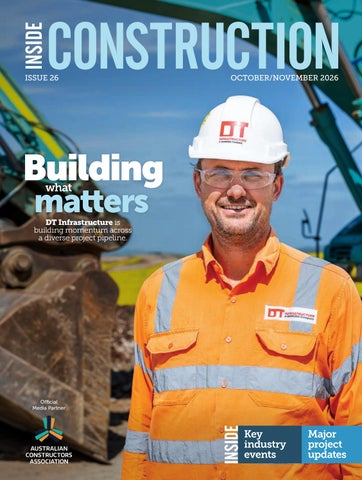
INSIDE CONSTRUCTION
ISSUE 26
OCTOBER/NOVEMBER 2026
Building ISSUE 26 | OCTOBER/NOVEMBER 2026
what
matters DT Infrastructure is building momentum across a diverse project pipeline.
www.insideconstruction.com.au
Official Media Partner
Key industry events
Major project updates
One-sided installation
CLASS 8.8
HBS-BOLT Blind & Hollow Steel Connections HEX
CSK
FLUSH
KBB88GHM KBB16PHM
KBB88GKM
KBB88GUM
Engineering innovation powered by our robust technical capabilities and the assurance of a NATA-accredited laboratory.
HEX
CSK
FLUSH
HBS-BOLT HEX, CSK & FLUSH
Applications & Features » Hot dip galvanised » Large grip range » High shear and tensile capacities » Steel framework, including gantries, bridges,
stadiums, and transmission towers For use with square, rectangular, and circular hollow sections 2609091
»
Founding Member
No.9000117
No.18918
Bolt Tension | Anti-Vibration | Corrosion Resistance | Product Reliability | Traceability
hobson.com.au
QUALITY FASTENERS SINCE 1935
We
ISSUE 26
OCTOBER/NOVEMBER 2026
8
25
17 COVER STORY 8
Building what matters DT Infrastructure discusses its approach to delivering well for clients across projects of varying scale and complexity.
28 FOCUS 12
The fast track to fulfilment Komatsu takes us inside its Melbourne Fulfilment Centre, where automation is helping get parts to customers faster.
17
The engineering behind safety Webuild explains why it engineers safety as a value across its operations, rather than treating it as a shifting priority.
REGULAR 4 6
Editor’s note Project Picks
ASSOCIATIONS
48 The National Association of Women in Construction 49 National Precast Concrete Association Australia 50
Australian Constructors Association
51
NexGen
52
Empowered Women in Trades
OPINION
53
20
Building with greater certainty Cupix shows how spatial intelligence can give teams a more accurate view of site conditions before delays take hold.
25
Infrastructure for everyone Bentley considers how digital twins are expanding the possibilities for more inclusive infrastructure design.
28
Software that keeps pace Preston Hire Group details the role MCS Rental Software has played in supporting its operations through years of change.
33
Tackling the blind side Hobson Engineering addresses the challenges limited access can create for steel connections with HBS-Bolts.
37
A breath of fresh air Mitsubishi Heavy Industries Air-Conditioners Australia profiles its DX-AHU solution for high-volume ventilation needs.
40 The evidence green procurement demands Transmutation makes the case for formal credentials that give contractors verified evidence for procurement and reporting.
44 No room for interruption McConnell Dowell and Built Environs take us through the delivery of critical infrastructure for Auckland City Hospital.
Dr Gretchen Gagel Founder and CEO of the International Institute for Women in Construction.
PEOPLE
56
Tarrsha Watkins Managing director of Protek WA and founder and CEO of Indigo Commercial.
EVENTS 54 55
Foundations and Frontiers 2026 Converge 2027
www.insideconstruction.com.au INSIDE CONSTRUCTION
3
WELCOME From the editorial team
The choices behind delivery
Chairman John Murphy
Successful construction projects depend on getting countless choices right along the way. Many of the stories in this edition return to the same question: what helps construction teams make better decisions? Sometimes it’s accurate information at the right time. In other cases, it’s effective collaboration, clear communication and established processes, particularly when a project doesn’t fit a standard approach. In the technology space, we look at how digital twins can bring end users into infrastructure planning earlier, and how spatial intelligence can give project teams an accurate, real-time view of site conditions, progress and asset information. Both point to the same opportunity: using better information when it can still influence the outcome. Elsewhere, a manufacturer of lowcarbon and circular construction products shares why it has invested heavily in third-party certification and verified environmental data as procurement and reporting requirements expand. A structural fastener supplier also shows how the right connection detail can overcome access and safety challenges before they become problems on site. An original equipment manufacturer takes us inside a purpose-built parts fulfilment centre where automation and locally held inventory are being used to cut response times. A building systems specialist looks at configurable ventilation for commercial buildings and data centres, while an equipment hire group reflects on software that has evolved with its specialist operations for almost two decades. Our cover story profiles a major contractor expanding across critical infrastructure markets, with work
4
spanning renewable energy, rail, road and defence projects. It looks at how cross-sector capability, in-house expertise and a broad service offering allow the business to adapt its delivery strategy to what each client and project requires, regardless of scale. In our major projects and safety pages, planning is put to the test. One team delivers a new central plant and services tunnel through a live hospital campus without interrupting critical operations, while a major construction firm examines the systems, training and behaviours that support safer work. The winner of this year’s Australian Construction Achievement Award takes the conversation further, demonstrating how decisions made during delivery can contribute to a much broader legacy through collaboration, workforce development, local participation and sustainability. There’s much more throughout this edition, but together these stories offer an exciting insight into just how many different elements – and decisions – feed into successful construction. As always, thank you for reading.
Chief Executive Officer Christine Clancy
Managing Editor Eugene Duffy eugene.duffy@primecreative.com.au
Editor Ashley Grogan ashley.grogan@primecreative.com.au
Sales Manager Danny Hernandez danny.hernandez@primecreative.com.au
Design Apostolos Topatsis
Head of Design Clayton Hawley clayton.hawley@primecreative.com.au
Business Development Manager Michael Ingram-Casha michael.ingram@primecreative.com.au p: +61 0423 266 991
Client Success Manager Ben Sammartino ben.sammartino@primecreative.com.au
Cover image credit DT Infrastructure
Head Office Prime Creative Pty Ltd 379 Docklands Drive, Docklands, Victoria 3008 Australia p: +61 3 9690 8766 info@primecreative.com.au www.insideconstruction.com.au
Subscriptions +61 3 9690 8766 subscriptions@primecreative.com.au Inside Construction is available by subscription from the publisher. The rights of refusal are reserved by the publisher
Articles All articles submitted for publication become the property of the publisher. The Editor reserves the right to adjust any article to conform with the magazine format.
Copyright
Ashley Grogan, Inside Construction Editor
INSIDE CONSTRUCTION October/November 2026
Inside Construction is owned by Prime Creative Media and published by John Murphy. All material in Inside Construction is copyright and no part may be reproduced or copied in any form or by any means (graphic, electronic or mechanical including information and retrieval systems) without written permission of the publisher. The Editor welcomes contributions but reserves the right to accept or reject any material. While every effort has been made to ensure the accuracy of information, Prime Creative Media will not accept responsibility for errors or omissions or for any consequences arising from reliance on information published. The opinions expressed in Inside Construction are not necessarily the opinions of, or endorsed by the publisher unless otherwise stated.
Real productivity starts with the right machine. Built to help operators get more done, every day.
From compact excavators to large construction equipment, Komatsu machines are designed to deliver the performance, reliability and efficiency businesses depend on, because real productivity starts with equipment built for the job. Explore the Komatsu Construction & Utility range today.
1300 566 287 | komatsu.com.au
REGULAR Project Picks
Projects shaping city life
The tower rises 138 metres above Brisbane’s inner north.
435 Bourke Street, Victoria Contractor: Multiplex Current value: Over $1 billion Details: Construction of 435 Bourke Street continues to progress in Melbourne’s CBD, with façade installation well advanced on the 52-storey commercial tower. Delivered by Multiplex for Cbus Property, the project incorporates a solar skin façade system designed to generate renewable energy while maintaining the building’s architectural quality. The façade forms a key part of the project’s sustainability strategy, alongside a targeted 45 per cent reduction in embodied carbon and the use of 100 per cent renewable energy during construction. Status: A milestone has been reached with the installation of more than 1,000 solar skin panels across the tower façade. Described by the project team as one of the largest applications of its kind in the Southern Hemisphere, the system integrates photovoltaic technology directly into the building envelope, requiring close coordination between façade, structural and services teams throughout design and delivery.
6
INSIDE CONSTRUCTION October/November 2026
185 Wharf St, Queensland Contractor: Hutchinson Builders Current value: $180 million Details: Cbus Property’s 185 Wharf St is a 30-level residential tower under construction in Brisbane’s inner north. Located in Spring Hill, the development will deliver 125 apartments designed to maximise natural light, cross-ventilation and views. Residents will have access to more than 1,400sqm of shared amenities that support recreation, relaxation and social connection, as well as end-of-trip facilities and resident parking. Buildability was a key consideration for the project from day one. Early collaboration between Cbus Property and head contractor Hutchinson Builders helped streamline delivery through a repeatable design and construction approach. Status: The project topped out in July 2026, with the team now progressing façade installation, services and interior works ahead of completion in 2027. Initiatives: The 185 Wharf St development is being delivered as an all-electric residential tower featuring rooftop solar, rainwater harvesting, natural ventilation and waste recycling systems, contributing to targets for 5 Star Green Star certification and a 7 Star NatHERS rating.
Image: Multiplex
Image: Hutchinson Builders
These projects are changing how people live, work and move through Australia’s cities.
More than 1,000 solar skin panels have been installed across the façade.
Canberra Light Rail Stage 2A, ACT
Light rail infrastructure works are well underway.
Image: CPB Contractors
Contractor: CPB Contractors and John Holland Current value: $575.3 million Details: Canberra Light Rail Stage 2A is a major public transport infrastructure project in the ACT, jointly funded by the Australian and ACT governments to extend Canberra’s light rail network and improve connectivity between the city centre and Lake Burley Griffin. The project is being delivered by Canberra Metro, with CPB Contractors and John Holland JV delivering the design and construction works. This marks the second stage of Canberra’s light rail network delivered by the Canberra Metro Consortium. Light Rail Stage 2A will extend the existing light rail network by 1.7km from Alinga Street to Commonwealth Park along London Circuit West. The extension includes three new stops at Edinburgh Avenue, City South and Commonwealth Park, improving access to the Australian National University, City West, New Acton, local businesses and residents. Once complete, the project will provide greater connectivity between the city and the lake, improve access to key employment, education and recreational destinations, and support sustainable transport through new walking and cycling infrastructure. The project will also enhance the urban environment through landscaping and tree planting along the corridor. Status: Construction is progressing across the Stage 2A corridor, with major civil, utility and light rail infrastructure works advancing throughout the project. As works continue towards completion, focus will progressively shift to systems integration, testing and commissioning, ahead of the commencement of passenger services in 2028.
Woolworths Sydney Chilled and Fresh Distribution Centre, New South Wales
Image: BESIX Watpac
The centre is nearing completion in Sydney’s west.
Contractor: BESIX Watpac Details: The Woolworths Sydney Chilled and Fresh Distribution Centre is a temperature-controlled multistorey facility that will increase the efficiency and capacity of Woolworths’ supply chain. Located in Sydney’s west, it will streamline operations for suppliers and transport operators while supporting the delivery of fresh produce and chilled goods across New South Wales. Once operational, the centre will supply fresh fruit, vegetables and dairy to more than 290 stores and employ more than 1,300 team members. Status: The project is nearing completion, with certifier inspections and witness testing walkthroughs underway. The refrigeration system has recently been commissioned, with temperature drawdown activities now progressing as the facility moves closer to operational readiness. Client workstreams are also being coordinated with the installation of automation systems, specialist racking infrastructure and dedicated banana ripening rooms. More than 3,600 people have been inducted onto site, contributing more than 1.29 million hours worked to date, with safety remaining a focus throughout delivery.
www.insideconstruction.com.au INSIDE CONSTRUCTION
7
COVER STORY Contractor profile
Building what matters For DT Infrastructure, capability is not measured by project size but by delivering the right outcome for clients, regardless of scale.
8
Matthew Lennon has spent more than 25 years delivering complex transport and energy infrastructure. Now, three months into his role as general manager for Queensland and South Australia at DT Infrastructure (DTI), he is applying that experience to a dynamic business as it expands across critical infrastructure markets. His career has included senior roles with CPB Contractors, John Holland and Rio Tinto, and projects including WestConnex, Cross River Rail and CopperString 2032. It has given him experience spanning different sectors, project environments and approaches to delivery. “What attracted me to DTI was the breadth of work it does across infrastructure delivery and renewables, along with the growth trajectory of the business,” says Lennon. His immediate priority is successful delivery of the projects DTI has secured over the past several months. That means supporting its skilled teams with the tools they need as the business continues to grow. DTI’s growth is being driven by opportunities across several markets, with demand in renewable energy, rail, roads and defence infrastructure creating a strong pipeline of work. Its service offering and inhouse expertise reinforce its credentials
INSIDE CONSTRUCTION October/November 2026
DT Infrastructure is expanding its renewable energy portfolio across Australia.
as an engineering, procurement and construction (EPC) partner. “Within DTI, we’ve built strong capability in procurement and engineering management, supported by people with successful project delivery experience across a range of sectors. We can bring those different disciplines together depending on what a project requires,” says Lennon. “One of the differentiators for us is the capability we can draw on through our parent company Gamuda Berhad in Kuala Lumpur. That includes digital engineering, in-house design expertise and additional resources.” That flexibility extends to the scale of work DTI is prepared to take on. The company’s award-winning Intelligent Transport Solutions (ITS) business, for example, provides design, installation, integration and maintenance of intelligent transport systems on projects ranging from $200,000 to $1.5 billion – including as part of the Warringah Freeway Upgrade and the Coffs Harbour Bypass. This gives DTI a specialist offering that can operate independently or form part of complex critical infrastructure programs. “We’re prepared to pursue smaller projects where some competitors may be more focused on major contracts,” says Lennon.
“We have an open-door approach to talking with clients about what they need, whether that leads to a small project or something much larger.”
Images: DT Infrastructure
Cross-sector capability DTI’s current portfolio spans renewable energy, rail, road and defence projects across Australia – reflecting the range of work the business can deliver and the complex delivery challenges it can overcome. For Lennon, the contrast between these projects is one of DTI’s strengths and was a key part of his decision to join the company. “Whether it’s rail, renewables or critical infrastructure, we see ourselves as a reliable EPC contractor equipped to tackle a wide range of work,” he says. This work includes major projects such as the Queensland Train Manufacturing Program (QTMP). DTI is designing and constructing the 66-hectare QTMP Ormeau rail facility, which will support Queensland’s new passenger train fleet. The project, being delivered in partnership with Downer, encompasses a 21,000sqm maintenance building, stabling and rail infrastructure, and sitewide services.
At the same time, DTI and CPB Contractors are working on Sydney’s Warringah Freeway Upgrade, delivering extensive road, bridge and interchange works across a 4km corridor while allowing more than 200,000 vehicles a day to continue using the network on one of Australia’s busiest road corridors. In Central Queensland, DTI is delivering the Boulder Creek Wind Farm for Aula Energy, which will comprise 38 turbines with a generation capacity of 228MW. The company is responsible for civil, structural and electrical infrastructure including turbine foundations, 41km of access tracks, a 33/275kV substation and associated transmission infrastructure. “When tackling projects of this scale, our approach is to undertake careful and methodical planning prior to work activities,” says Lennon.“Whether it’s managing complex traffic staging or undertaking early site investigations to optimise design solutions ahead of construction, we always keep the end goal clearly in our vision.” This approach has not gone unnoticed by clients. DTI has since secured the full Balance of Plant scope for Aula Energy’s 256MW Carmody’s Hill Wind Farm in South Australia.
“We’re prepared to pursue smaller projects where some competitors may be more focused on major contracts.”
DT Infrastructure is delivering complex road infrastructure in Sydney.
www.insideconstruction.com.au INSIDE CONSTRUCTION
9
COVER STORY
“Whether it’s rail, renewables or critical infrastructure, we see ourselves as a reliable EPC contractor equipped to tackle a wide range of work.”
DT Infrastructure brings multidisciplinary delivery capability to renewable energy projects.
10
Its early works program covered preliminary engineering, geotechnical studies, environmental assessments and technical investigations. “Because Carmody’s Hill follows Boulder Creek, we can take lessons from the first project into the second,” says Lennon. “The terrain is quite different, but ultimately we’re building the same end product, so there is a lot we can carry from one project into the next.” DTI’s renewable energy portfolio extends well beyond wind. The company has this year announced two major solar and battery hybrid projects in Central Queensland, which it is delivering for Edify Energy. The Smoky Creek and Guthrie’s Gap project near Rockhampton and the Ganymirra and Majors Creek project near Townsville represent some of the most ambitious solar power stations in Australia. “We’re very excited to be partnering with Edify Energy to deliver more than a gigawatt of solar generation backed by significant battery energy storage systems,” says Lennon. “Being able to work on signature renewable projects like these is part of what makes DTI such an attractive proposition.” Driving quality outcomes Delivering projects of this scale and critical importance depends on selecting the right approach for the conditions at hand.
INSIDE CONSTRUCTION October/November 2026
Image: Event Photos Australia
Contractor profile
Matthew Lennon is the general manager for Queensland and South Australia at DT Infrastructure.
Lennon says the scope of DTI’s portfolio does not translate to a single approach to delivery. “The starting point is understanding where the client sees the major risks and interfaces, the timelines they’re working to and where we can help address those issues,” he says. DTI’s experience across multiple sectors gives its teams a wider pool of lessons to draw from during those early discussions. Approaches that have worked elsewhere can be considered where they are relevant to the project. The early contractor involvement (ECI) model has played an important role on several of DTI’s renewable energy projects. Early investigations and close engagement with suppliers and the broader supply chain can help identify and reduce risks before construction begins, giving the client greater certainty about how the project will be delivered. “The ECI process gives us an opportunity to test and refine construction methodologies early and determine the most efficient approach for the project,” says Lennon. “Different projects have different drivers. Environmental requirements can influence the methodology, as can community impacts and other project constraints. ECI allows us
to work through those issues and make those decisions with the client early in the process.” Outside an ECI environment, DTI draws on specialist expertise from across the business, bringing together the people best placed to develop the most appropriate solution for the project. Those subject matter experts are also brought directly into client discussions, allowing clients to see the thinking behind a proposed solution and the expertise that will support its delivery. “Transparency is a big part of it,” says Lennon. “A developer and a contractor can look at the same issue through different lenses, so understanding both perspectives is important. Once you understand what the client needs, and the client understands the approach you’re taking, it creates a much better foundation for delivery.” Building on momentum That commitment to delivering well for clients will remain central as DTI builds on its position across critical infrastructure markets. “We’ve been successful in renewables and that will continue to be an area of focus for us. We also want to continue building on our
national rail footprint and the capability we have in that market,” says Lennon. “Queensland Rail is another priority for us, and we want to keep delivering well and strengthening that relationship.” South Australia presents another avenue for growth, including renewables, projects with a rail interface and defence. DTI is looking to expand its defence work nationally, with major investment underway in South Australia and Western Australia. “The other advantage we have is the ability to scale according to what a client needs,” says Lennon. “Procurement and contracting models are changing, and we’re already delivering projects under a range of models for different types of clients.” He says DTI’s flexible structure enables it to deliver for a dynamic industry. Experience across sectors, project sizes and contracting models allows the business to adjust its delivery strategy to suit the client and the project. For Lennon, that combination of adaptability, technical depth and experience positions DTI to keep growing without losing sight of the objective that underpins its work: delivering critical infrastructure well for its clients.
Matthew Lennon with Jo Stone, DTI’s executive general manager of health, safety, environment and quality.
“We’ve been successful in renewables and that will continue to be an area of focus for us.”
www.insideconstruction.com.au INSIDE CONSTRUCTION
11
FOCUS Equipment
The fast track to fulfilment
Image: Komatsu
Komatsu designed its Melbourne Fulfilment Centre around a single priority: getting parts to construction customers quickly and efficiently.
Aaron Kumar, general manager of supply chain and distribution at Komatsu.
12
Parts demand in construction doesn’t always run to a simple maintenance schedule. A contractor with one excavator can suddenly need a component because the machine has stopped, while another might see rain in the next day’s forecast and bring planned maintenance forward, creating an immediate parts requirement. Komatsu designed its Melbourne Fulfilment Centre around that kind of reactive demand. Inside Construction recently visited the $9.9 million, 12,500sqm facility in Tarneit to see how that response is built into the operation. On site, Aaron Kumar, general manager of supply chain and distribution, set out the thinking behind Komatsu’s investment. Local and dedicated support The centre opened in 2024 after Komatsu relocated its primary construction parts fulfilment operation from Fairfield in Sydney. The move followed several years of reviewing how the company supported its construction customers across Australia and Oceania. “Melbourne was a strategic location for Komatsu. We wanted a purpose-built facility to better support our construction customers, and Victoria has one of the largest concentrations of our construction machine population,” says Kumar. “One of the challenges we had in Sydney was our ability to deliver to our customers and branches the following day. Relocating the fulfilment centre to Melbourne gave us direct access from the Port of Melbourne, allowing us to reduce lead time and costs, placed us within the centre of our construction machine population, and allowed us to fulfil next-day deliveries to all of our East Coast branches overnight.” Speed and availability The relocation was intended to improve reach without reducing service elsewhere in the network. Metropolitan Melbourne customers have gained access to same-day delivery, while next-day delivery is now available across regional Victoria, South Australia and southern NSW. Komatsu also analysed its existing machine population and anticipated demand before the move, including the infrastructure pipeline expected over the next decade.
INSIDE CONSTRUCTION October/November 2026
The company increased the amount of inventory held in Australia at the same time, recognising that the speed of the fulfilment process has limited effect when the required part is still sitting at a factory or another location overseas. At the time of our visit, the Melbourne facility held about 23,000 product lines, with the centre capable of holding 35,000 unique stock items as demand grows. “With the scale of infrastructure work ahead and labour capacity already constrained, machine downtime can have a major impact on a customer’s business,” says Kumar. “Holding the right inventory locally is therefore a critical part of the strategy.” The breadth of that inventory shaped the facility from the outset. Komatsu needed enough density to support a large existing machine population while continuing to accommodate parts for new models entering the market, but it also wanted the operation to have room to grow over the next decade. Much of the infrastructure is modular, allowing the operation to expand as demand changes. Larger, slower-moving items such as track links, engines and motors are held in mobile racking that closes together when access isn’t required, while palletised stock is stored in very narrow aisles serviced by turret trucks. Both systems increase storage density without using more floor area than necessary. Once the stock is in place, the next pressure point is turning a customer order into a completed consignment. Regional fulfilment centre manager Isabelle Mychajlyk led us through that process, beginning with inbound goods. The team aims to process them on the day they arrive and move them into storage so they become available for sale quickly. Standard orders can be placed through customer service or Komatsu’s online parts portal, where customers select a service level to suit the required timeframe. Machinedown orders carry a much tighter target. “If a customer has a machine down and places an urgent order, the team has one hour to pick and pack that order and have it ready for collection,” says Mychajlyk. “For a standard order that needs to be delivered the following morning, once the order flows through to us, we pick the parts from the different zones and consolidate them so everything for that order comes together.”
breakdown or needs to come off the grid, it can be removed and serviced while the operation continues. The system provides a substantial productivity benefit.” AutoStore can expand with the facility. Additional grid can be built alongside the existing system without stopping the operation, after which the robots can be programmed to access the new section. Parts for one customer can come from several storage zones, so they are brought together at consolidation before packing. Larger components from palletised storage and smaller parts from AutoStore are matched to the same order, with a visual indicator turning green once every item has arrived. The complete order then moves to outbound to be packed into one box or onto one pallet for dispatch. “Automation plays a key role for us because the ultimate objective is speed to the customer,” says Kumar. “There are operational efficiencies that come with automation, but
“Automation plays a key role for us because the ultimate objective is speed to the customer.”
The Tarneit facility can hold up to 35,000 unique stock items.
Image: IndustriArc
Automation and efficiency Much of that picking takes place in AutoStore, the centre’s parts-to-person automation system and its fastest picking location. About 70 per cent of the product lines held in Melbourne are stored in 17,900 tubs beneath an aluminium grid, with each tub able to be divided into smaller compartments for multiple products. Eight autonomous robots travel across the grid. Komatsu’s warehouse management system allocates the inventory and feeds that information to AutoStore, which identifies the tub containing the required part and its position. If the tub is buried beneath others, the robots work together to move those above it, retrieve the correct tub and deliver it to a picking port, where human operators complete quantity and quality checks. “Because we are essentially a same-day facility, any downtime can affect our ability to fulfil customer orders,” says Mychajlyk. “AutoStore has eight robots, so if one has a
Facility snapshot Location: Tarneit, Victoria Investment: $9.9 million Facility size: 12,500sqm Inventory capacity: 35,000 unique stock items Key technologies: AutoStore robotic system, high-density storage systems, mobile racking, electric material handling, energy-efficient automation
www.insideconstruction.com.au INSIDE CONSTRUCTION
13
FOCUS
Image: IndustriArc
Equipment
AutoStore uses autonomous robots to retrieve parts quickly for customer orders.
Image: Komatsu
our focus is on how quickly we can retrieve parts from a location, consolidate and pack them, and get them out the door.” Komatsu is now looking at where technology could cut further time from the supply chain. Automated guided vehicles are being considered for moving goods through fulfilment centres, while AI may have a future role in helping planning and procurement teams make faster decisions. Kumar says any new technology still needs to add value to the operation and complement the people using it. “We have a very strong workforce across our distribution and fulfilment centres in Australia, and technology isn’t going to replace the need for those people,” he says. “We still need their knowledge and judgement to make decisions.”
Isabelle Mychajlyk, regional fulfilment centre manager at Komatsu.
14
Safety and sustainability Safety measures throughout the warehouse focus on limiting interaction between people and machinery. Dock locks and barriers reduce risks around loading areas and work at height. Four Komatsu electric forklifts operate on site, while a 15kg manual lifting limit applies across the facility. Other measures reduce the physical demands on operators. AutoStore removes the need to walk aisles retrieving parts, while height-adjustable packing tables allow operators to set their workstation to suit them. “That manual handling approach has also helped us create a more diverse workforce than you might traditionally see in warehousing,” says Mychajlyk. “About 60 per cent of the team is female, and we have an allfemale leadership team.”
Environmental performance was another design consideration, with the centre achieving a 5 Green Star Design rating. The AutoStore system was also selected with energy efficiency in mind, using lowpower robotic technology and regenerative energy features to reduce energy use across warehouse operations. “There was a clear aspiration to achieve that outcome because it aligned with both Komatsu Australia’s objectives and our global environmental and sustainability strategy,” says Kumar. “With a new purposebuilt facility such as this, meeting those requirements was non-negotiable. It was intended to be a flagship facility that could set the benchmark for what we wanted to do elsewhere.” Capacity and growth The Melbourne operation already supports customers across a wide geographic area, and its role is expected to grow with demand across the region. Its modular infrastructure, inventory capacity and expandable AutoStore system allow the centre to accommodate additional volume over time. “The facility also forms part of how we support construction customers more broadly across Oceania, including New Zealand,” says Kumar. “The service model may differ between markets, but we needed to look across the region to understand the capability required from Melbourne.” Wherever that demand comes from, the requirement is the same: have the right stock available and get it to the customer quickly.
INSIDE CONSTRUCTION October/November 2026
Transmu
CERTIFIED
ISO 9001
CERTIFIED
ISO 14001
CERTIFIED
ISO 45001
CREDENTIALED
Being green should be black and white As Australia’s most accredited low-carbon materials manufacturer for the construction industry, we represent the top tier of industry compliance, sustainability and quality management. And Transmutation’s certifications go far beyond standard regulatory requirements because we understand that when it comes to being green there is no room for grey. Our products and services clear strict modern supply chain vetting and “Buy Local” government policies. They help you meet national sustainability targets, win tenders, and directly contribute points to Green Star and Infrastructure Sustainability (IS) ratings. It’s as simple as that. But if you are concerned about anything ESG, from modern slavery to verified lifecycle data, read about us on pages 40-43 of this issue. We’ll turn your red flags to green.
www.transmutation.com.au
Transmutation Ad Two FA.indd 1
4/9/2026 3:57 pm
FOCUS Safety
The engineering behind safety At Webuild, safety is engineered as a value, not treated as a shifting priority.
Safety is commonly described as a priority in construction. I’d argue that’s exactly the challenge: priorities move; values don’t. Safety culture needs to become generative – part of ‘how we do business around here’. After years on major infrastructure sites, I’ve learned that safety is never the product of good intentions or a well-worded procedure on an intranet. It is planned and engineered deliberately, layer by layer, in the same way we design a tunnel, a conveyor or a segment factory. It comes alive in safe design systems that remove critical risks or put the highest levels of control in place, in the training that sharpens a supervisor’s focus at 6am and in the thousand decisions that never make the news because the job went according to plan and our people got home safe. From compliance to solving The most important shift I’ve seen is philosophical. Compliance asks, “Did we follow the rule?” A mature safety culture asks, “Did we solve the risk?”
On one of our projects, that meant standing up an HSR Working Group that brings worker representatives, unions, project leadership and safety professionals into the same room to identify issues and build practical solutions together. SafeWork NSW has recognised the approach as leading practice. Solving is harder than complying. It’s also the only thing that lasts. The system you don’t see The public sees the outcome of safety: a worker who goes home. What it rarely sees is the architecture underneath it. At Webuild, that architecture is deliberate: certified management systems aligned to ISO 45001, structured, robust risk assessments and diligent work planning, incident and nearmiss reporting, competency frameworks and clear escalation pathways that connect a frontline observation to senior leadership and, where required, the regulator. None of this is glamorous, but it’s what turns safety from a stated priority into a working system.
Images: Webuild
Safety is built into how Webuild teams plan, communicate and work on site.
By Shannon Spark, VP QHSE at Webuild in Australia.
www.insideconstruction.com.au INSIDE CONSTRUCTION
17
FOCUS Safety
Ongoing training helps Webuild teams recognise hazards and respond effectively.
On our projects in Australia, that discipline is measurable. The combined workforce has completed more than 35 million work hours in the last 12 months with positive results. Those aren’t lucky numbers; they are what a system produces when it’s built properly and maintained relentlessly.
Open communication gives workers an active role in identifying risks and improving site safety.
18
INSIDE CONSTRUCTION October/November 2026
Training that changes behaviour The most challenging safety problem isn’t hazard; it’s human. A diverse workforce, shortservice employees and shifting crews are delivering complex, time-pressured projects. You cannot procedure your way out of that. You have to build a strong safety culture and capability. That’s why our Safety Builders program, launched globally in 2017 and now embedded across every new project, isn’t a course you complete; it’s a leadership behaviour you adopt. It has engaged more than 26,400 people, run more than 1,500 workshops and delivered more than four million hours of safety training since 2020. Its Frontline Leader program was first introduced in Australia on the North East Link, purpose-built for the supervisors who shape culture on the ground. On that project, more than 500 people have completed the program, and 100 per cent said they’d recommend it. Its practical engagement tool, SAFER, distils good judgement into a combined conversation and call to action: see more, say more, solve more. Global framework, local build Here’s the part the industry often gets wrong. A global company cannot simply export a safety model and expect it to land. Australian sites are not Italian sites; a hydro project is not
a metro road; a segment factory is not a tunnel face. What works is a stable global framework that is then re-engineered for the realities of each country and each project. That adaptability is not a soft skill; it’s the differentiator. It’s why our program was recognised with a Gold Stevie Award at the 2025 International Business Awards for Health, Safety and Environment Program of the Year across Asia, Australia and New Zealand. The judges specifically cited its cultural adaptability and its ability to translate a global philosophy into practical, local leadership behaviours. A framework gives you consistency. Local adaptation gives you results. You need both.
The deep work Great engineering is mostly invisible, and so is great safety. Every uneventful shift is underpinned by well-designed systems, diligent planning for safe execution of work, effective change management and problemsolving. That’s the deep work of a construction company: the processes, systems and training, and the willingness to tailor them to the country and project in front of you. We often talk about engineering excellence and delivering complex infrastructure, but it means nothing if our people don’t go home safe. Getting that right isn’t luck or a slogan. It’s the most demanding engineering we do.
Webuild places shared responsibility for safety across every level of a project team.
www.insideconstruction.com.au INSIDE CONSTRUCTION
19
FOCUS Software and technology
Spatial intelligence can give construction teams a more accurate view of what is happening on site before delays and rework take hold.
“Smart companies in the industry will leverage site information in numerous ways, coupled with AI.”
20
Despite years of focus on productivity, construction projects continue to lose time through rework, delays and inefficient processes. For Michael Cook, director of solutions and customer success at Cupix, the physical construction work is usually not the bottleneck; it is the time spent searching for information, coordinating across disconnected systems and determining the appropriate path forward. That lost time can begin with poor coordination between the office and site, as delivery teams wait for updated drawings, clarifications, approvals or responses to requests for information before work can proceed. It can continue through progress reporting, with teams collecting thousands of site photos, updating spreadsheets and registers, and manually tracking the program. As those records are compiled across different parts of the project, they can become disconnected or outdated. At the same time, project documentation and construction activity can progress independently. Plans, schedules and models show what should be happening, but if teams cannot continually validate them against what has actually been built, deviations can go undetected. “The impacts often extend well beyond the bounds of the original issue – what may have started as a minor deviation or easily resolvable defect can quickly escalate to program delays, additional costs, and safety and quality concerns,” says Cook. Trade sequencing then becomes harder to manage. Construction programs depend on one activity being completed before another can begin, so teams need reliable information about which areas are ready for the next stage of work. Without it, labour and equipment can be deployed inefficiently and subsequent activities disrupted. “In many cases, project and site teams operate reactively as resources are redirected, activities are resequenced and decisions are made under increased time pressure to recover lost ground,” says Cook. The issue is not a lack of project information. Teams already have drawings, photographs, reports, schedules and other data.
INSIDE CONSTRUCTION October/November 2026
Image: Cupix and Gorodenkoff/stock.adobe.com
Building with greater certainty
What they can lack, says Cook, is real-time spatial intelligence about what is happening on site and where delivery begins to diverge from design or schedule. “Better visibility into site conditions and project status is one of the biggest opportunities to improve productivity today, ensuring construction projects keep to program and narrowing the gap between planned and actual,” he says. “Equally important is the ability to consolidate the information generated by stakeholders into a single lens, allowing for anyone to interrogate the documentation, designs, schedules, site progress and field conditions in context. This would allow stakeholders to move beyond siloed data and move toward collaborative and holistic decision making.” A trusted project record A reliable, shared record of site conditions changes the way project teams coordinate and make decisions. Spatial capture can create a time-aware record of what exists, what has changed and how site conditions compare with design and schedule. Rather than relying on individual updates, whether they are photos, status reports or assumptions, teams can see what has been installed and quickly identify completed and outstanding works. “This improves coordination between stakeholders and site teams, helps identify any challenges on the horizon and enables
“This establishes a reliable foundation for operations and ongoing facility management,” he says. “Given the long operational life and criticality of these environments, having access to accurate asset information helps owners manage their maintenance activities and sets a foundation to determine the best way to leverage data for the lifecycle of the facility.” The information captured during construction does not lose its value at practical completion. Its purpose changes, becoming a historical record of how the asset was actually built and giving owners and operators a verified reference point after handover.
Image: Cupix and Gorodenkoff/stock.adobe.com
decisions for specific outcomes to be made based on current site conditions and project data, rather than interpretation or incomplete information,” says Cook. Earlier identification gives teams more time to manage risk, maintain safety standards and address issues before they affect cost or program. For contractors and trades, the commercial benefit also extends to resource deployment, completion and cash-flow forecasting, material deliveries, procured asset management, commissioning and commercial discussions. “I’ve seen many active construction situations where leveraging high-quality, up-to-date spatial captures provided the necessary substantiation for progress claims and helped resolve variation disputes amicably,” says Cook. “In some instances, having the spatial capture saved an amount five times greater than the cost of the capture, and in one instance, close to 10 times greater.” Reliable site verification is particularly important on data centres and other complex infrastructure projects, where dense services installations, tight construction tolerances and highly sequenced activities demand close coordination across multiple trades, systems and stakeholders. Even minor deviations can affect the program, commissioning and operational readiness. Cook says accurate verification during delivery creates confidence that critical systems have been installed as designed, providing a trusted record of asset locations and asset data.
Spatial capture gives project teams a clear record of site conditions and progress.
On data centres, accurate asset information can support commissioning, maintenance and future upgrades.
www.insideconstruction.com.au INSIDE CONSTRUCTION
21
FOCUS
“Better visibility into site conditions and project status is one of the biggest opportunities to improve productivity today.”
The future of project data For Cook, the next step is making greater use of the information generated across projects. “The industry is increasingly recognising the value of project data and how the data does not exclusively reside within the design and construction phase as ‘just BIM data’. It is extremely important beyond that. Project data is leveraged for multiple use cases, including operations, asset maintenance, lifecycle planning and reuse,” he says. “Rather than seeing information as a project deliverable popped on the shelf to collect dust, there is a growing focus on construction teams to treat it as a long-term asset that’s leveraged by facilities managers and owners, who can use spatial intelligence to inform repeatable processes and future projects.” Owners are also placing greater contractual emphasis on accurate, structured and connected information that can support asset performance, maintenance and future upgrades. Cook says this is putting more attention on how contractors capture, manage and validate project information during delivery so it remains useful and accessible once construction is complete. “This shift towards data-driven project delivery is becoming a key part of the
Image: DisobeyArt/stock.adobe.com
Data centre projects depend on accurate site information to coordinate complex services and trades.
22
INSIDE CONSTRUCTION October/November 2026
Image: Gorodenkoff/stock.adobe.com
Software and technology
Spatial intelligence helps project teams compare what has been built with design and schedule.
construction industry’s broader digital transformation journey,” he says. “As confidence and maturity develop, the industry will leverage the information gathered as pre-emptive and predictive information for decision-making across a range of uses, including estimation, quality, safety, carbon tracking, design, material tracking, procurement, cost forecasting and programming.” That information can also give AI a useful role, but Cook says its value is not in making decisions on behalf of construction teams. Instead, AI can help people access and interpret project information while engineering judgement, trade experience and project expertise remain central to the decision-making process. Its usefulness, however, still depends on the accuracy of the site information available. “Smart companies in the industry will leverage site information in numerous ways, coupled with AI, to provide a competitive advantage and build a sustainable, smarter, data-centric future.” To learn more about how spatial intelligence can help improve project certainty and productivity, visit cupix.com
FUTURE-READY COOLING & AIR-HANDLING SOLUTIONS FOR MISSION-CRITICAL ENVIRONMENTS Mitsubishi Heavy Industries KX VRF systems and Pacific Ventilation DX-AHU air handling units combine to deliver flexible cooling, filtration and ventilation for large-scale commercial and mission-critical environments. Designed for data centres, healthcare, education, industrial and commercial applications, the solution provides scalable capacity, precise temperature control and project-specific configuration flexibility.
Ventilation & Fresh Air
Advanced Filtration
Precise Climate Control
Flexible Design
Deliver large volumes of conditioned fresh air to support indoor comfort and ventilation requirements.
Configurable filtration solutions, including HEPA and specialised filtration options, to support buildingspecific indoor air quality requirements.
Variable refrigerant flow technology provides responsive temperature control and efficient operation across changing building loads.
Modular AHU construction allows each solution to be configured around the space, airflow requirements and project objectives.
SCAN TO LEARN MORE
MCS RENTAL SOFTWARE
THE DIGITAL TRANSFORMATION YOUR BUSINESS DESERVES C
M
Y
CM
MY
CY
CMY
Go fully digital with smart automation and connected tools built for the future.
K
Passionate about your success
www.mcsrentalsoftware.com
Software and technology
Infrastructure for everyone Digital twins are opening new possibilities for more inclusive infrastructure.
Inclusive infrastructure considers how different users move through a space.
Image: Christelle/stock.adobe.com
N
FOCUS
Infrastructure is rarely used in one uniform way: a transport system may be planned around the daily commuter, yet the same network also must serve parents making several stops with children, people with limited mobility and users whose needs differ from those assumed during design. For Amelia Burnett, digital financial strategies director at Infrastructure Policy Advancement, a team within infrastructure engineering software firm Bentley Systems, that is one of the central questions behind inclusive infrastructure: who is being considered when decisions are made, and whether the people expected to use an asset have enough opportunity to influence how it works. “Inclusive infrastructure is about designing infrastructure so the widest possible group of people can use it,” says Burnett.
“It means not designing with a single user in mind.” Accessibility standards provide an essential baseline, but compliance doesn’t necessarily reveal how a place will feel or function when somebody moves through it. A design can satisfy the relevant requirements on paper and still create difficulties that become apparent only when it is considered from the perspective of particular users. A similar gap can arise with consultation. Infrastructure owners and developers have long had processes for involving stakeholders, but feedback has limited influence once substantial design decisions have already been made. By then, changing an alignment, access point, ramp or other element can carry much greater cost and disruption than addressing it earlier.
“Digital twins allow people to navigate spaces from different perspectives and test the experience of using them.”
www.insideconstruction.com.au INSIDE CONSTRUCTION
25
FOCUS Software and technology
Image: Tapasii/stock.adobe.com
“Engaging end users early enough for their needs to influence the project is just smart design.”
“What we have now are powerful new tools that allow us to bring those stakeholders into the process much earlier and give them a sense of how infrastructure will work before construction begins,” says Burnett. “Digital twins allow people to navigate spaces from different perspectives and test the experience of using them. That gives us an opportunity to identify issues during design, when they are far less costly to address than once an asset is under construction or operational. “It also means moving beyond something that is accessible on paper and meets the relevant design standards to something that is genuinely usable in practice.” Homai Rail Station in South Auckland shows how that can work at the level of an individual piece of infrastructure. As part of a level crossing replacement, Beca used a digital model during design and later used it to engage with people who would use the station. Viewed from the eye level of a wheelchair user, the model allowed the team to follow the route up the ramp and into the surrounding street network. It revealed that a turn onto the footpath was too sharp and presented a potential safety issue. The bridge design complied with the relevant standards, but
Inclusive design looks beyond compliance to how infrastructure works in practice.
26
INSIDE CONSTRUCTION October/November 2026
widening the connection improved the route for wheelchair users and, by extension, people with prams, cyclists and others moving through the space. The same model was adapted for another user group. Because the crossing was near a school for blind and low-vision students, it was 3D printed with Braille so students could provide tactile feedback on the design. In Brisbane, Cross River Rail paired a digital twin with a public visualisation centre so members of the community could experience what it would feel like to stand on a future station platform and understand how the project would fit within the city. “The centre is also being retained as a public engagement tool to help people understand what changes to Brisbane’s rail and transport systems will mean for them,” says Burnett. She says infrastructure owners need to consider the purpose of an asset, who they expect will use it and how their input can influence the finished scheme. That involvement can begin before an individual asset is even defined. Burnett recently published Built to Endure with Microsoft, Duke University, the American Society of Civil Engineers and AECOM. The report examines how infrastructure decisionmakers can use data, digital tools and digital twins to support resilience planning in cities. Wellington City Council, for instance, is considering how to become more resilient to climate change, with risks including sea level rise and storm surges along the coast, as well as landslides because of the surrounding terrain. As the council developed its city adaptation plan, it created a digital model that brought together information on climate risk, infrastructure and Indigenous knowledge. Because the model looked and felt familiar, Burnett says people could navigate it more intuitively than a technical report. It was made available in community spaces such as libraries and sports centres, widening access to the information. “That allowed citizens to contribute to and help co-create the adaptation plan from which future infrastructure projects will flow,” she says. “It also gave communities access to information they could use in their own projects or individual decision-making.”
Image: sally san/stock.adobe.com
a separate burden, it tends to resonate much better with commercially minded audiences.” Burnett expects digital twins to move from being seen as a nice-to-have visualisation tool to becoming standard practice in infrastructure planning and community consultation, much as environmental impact assessments are today. She also sees scope for digital twins beyond consultation during planning. Because a true digital twin is connected to continuously updated data, it can continue to provide information once an asset is operating. Dublin City University is exploring what that could mean for neurodivergent users. As part of its objective to become the world’s first autism-friendly university, researchers have examined how live information on noise, people flows and congestion could be made available through its campus digital twin. Students could use that information to identify quieter places to work or make informed decisions before entering busy spaces. “That democratises access to the data and improves transparency, making the university experience more accessible,” says Burnett. Inclusive infrastructure doesn’t just strengthen communities; it can also reduce delivery risk and help ensure infrastructure investment continues to serve users for decades to come.
Image: Bentley Systems
That level of participation can also influence social licence. Burnett describes trust as its foundation: people need to understand what a project is, why it is happening and the problem it is intended to solve. “If people can genuinely participate in that decision-making process and feel they are helping to co-create the outcome, rather than having a finished design presented to them, it can help build the long-term trust infrastructure projects need,” she says. “Technology can help change that. We are also seeing advances in AI that allow project teams to test a range of scenarios and outcomes more quickly, supporting more informed decision-making.” For stakeholders who see consultation as a compliance burden, Burnett points to the cost of getting it wrong. “Ultimately, most infrastructure exists to deliver a service, and, from a commercial perspective, you want people to use that service. Engaging end users early enough for their needs to influence the project is just smart design,” she says. “Engagement is an important part of risk management. Retrofits, delays and legal challenges are expensive. If engagement is framed as a way of managing those risks, on top of meeting compliance requirements, and as part of developing the project rather than
Early engagement can help infrastructure better reflect the needs of all users.
Amelia Burnett, digital financial strategies director at Infrastructure Policy Advancement, a team within Bentley Systems.
www.insideconstruction.com.au INSIDE CONSTRUCTION
27
FOCUS Software and technology
Software that keeps pace Preston Hire Group uses MCS to track equipment, contracts and customer activity.
MCS Rental Software has supported Preston Hire Group’s specialist operations through years of change.
28
Not long after joining Preston Hire Group 17 years ago, Jenny Grosvenor, now group integration and systems manager, was tasked with finding a rental software system as the business began to outgrow spreadsheets. With a portfolio spanning industrial services, construction equipment and machinery, the Australian management and investment group needed a central database that could track equipment and provide reliable information across its operations and product mix. That requirement was and still is important for two specialised brands: SuperCrane and SuperAccess. SuperCrane provides crane and material handling solutions across construction, infrastructure, industrial and maintenance projects, including complex lifting applications in challenging and confined environments. Its offering is focused on improving site efficiency, reducing project timelines and enabling safer lifting operations.
INSIDE CONSTRUCTION October/November 2026
SuperAccess is a modular, preassembled system for specialised site and public access applications. It is designed to reduce fall risk, improve safety and productivity, and reduce installation time and costs. Inside Construction recently caught up with Grosvenor at Preston Hire Group’s equipment yard in Cabramatta, NSW, to learn why MCS Rental Software was selected and how it supports the two brands today. “We considered some of the bigger names in the market, but the MCS team was engaging and the system looked straightforward to use,” she says. “Ultimately, we needed a system that could give us reliable information about our equipment and operations. That led us to MCS.” MCS now supports the core processes behind Preston Hire Group’s SuperCrane and SuperAccess operations. MCS Sales brings leads, quotes and customer interactions into one place, while providing visibility of the sales pipeline from prospect through to final order.
Images: Preston Hire Group
“Sales is the part we rely on most day to day,” says Grosvenor. “That starts with customer relationship management (CRM), moves through contract establishment and then into invoicing. It’s the part of MCS we’ve used the longest.” As a specialised hire business, she says Preston Hire Group’s equipment does not always follow the short-term hire cycle typical of a general rental business. Different customers have different requirements for how and when they are invoiced, and MCS has been able to accommodate those variations. “Having accurate equipment and contract information helps us get invoices out on time and, in turn, helps us get paid on time,” she says.
Tracking is another advantage. Once equipment is allocated to a job, Preston Hire Group can see what is on that job, what has been invoiced and the history of that customer. “We can then use the CRM data to track follow-ups, evaluate the sales pipeline, support forecasting and feed into our business intelligence reporting,” says Grosvenor. Preston Hire Group has changed considerably since MCS was introduced, including periods of expansion and contraction. Despite those shifts, the business has been able to continue using the same rental platform rather than absorb the cost and disruption of researching and implementing a replacement.
“Having accurate equipment and contract information helps us get invoices out on time and, in turn, helps us get paid on time.”
SuperCrane delivers lifting solutions for complex and confined sites.
www.insideconstruction.com.au INSIDE CONSTRUCTION
29
FOCUS Software and technology
“MCS continues to develop the system as technology changes, including the use of AI tools.”
Over that time, the platform itself has continued to evolve. “There is much more functionality in MCS now than when we first introduced it, and we’re continuing to look at how we can use more of that functionality,” says Grosvenor. “MCS continues to develop the system as technology changes, including the use of AI tools. It’s great that the MCS team come to us about new features and say, ‘We can help you with this’. They’ve always understood the business first and foremost, and that is important to us.” Alongside that ongoing development, she says MCS has provided consistent support, helping Preston Hire Group resolve issues quickly as its requirements have changed. “The support has always been there,” she says. “We’ve had a good working relationship
SuperAccess is a modular, preassembled system for specialised site and public access.
30
INSIDE CONSTRUCTION October/November 2026
with MCS over the years, and we’ve had direct contacts who know our system and can get issues resolved quickly. That continuity has been important.” For a business of Preston Hire Group’s size, rental-specific software also offers an alternative to a broader enterprise resource planning (ERP) system, which can carry a higher cost while including functionality the business may never use. “MCS is one of the critical suppliers our business depends on,” says Grosvenor. “We’ve stayed with them because they have been consistent and we trust them to support the business properly.” What began as a move away from spreadsheets has become a platform Preston Hire Group still relies on almost two decades later.
Building what matters Energy | Rail | Roads | Defence
FOCUS Structural solutions
Tackling the blind side Limited access can turn one steel connection into a much bigger job, but the right fastening system can simplify it. “Its primary application is for connections where access may only be permissible from one side of the connection or for fixing into hollow members,” he says. For engineers and contractors, that inaccessible face can have a wider effect on the job. Through-bolting may require additional access so a crew member can reach the reverse side. Welding calls for specialist labour, equipment and hot-work controls, followed by touch-ups to the finish around the weld. Cutting an access opening into the member changes its appearance and may also affect its capacity.
“Think of it as an expanding anchor for steelwork.”
Images: Hobson Engineering
HBS-Bolts address a problem that can complicate a steel connection: the installer can reach one side, but not the other. It’s a common constraint when fixing into square or rectangular hollow sections, as the enclosed member leaves no way to place or restrain a nut behind the connection. The same access problem can arise where surrounding steelwork blocks the reverse side, while restrictions on hot works may rule out welding, the traditional way of fixing these types of connections. Gavin McPherson, lead engineer at Hobson Engineering, says this is the central purpose of the HBS-Bolt range.
www.insideconstruction.com.au INSIDE CONSTRUCTION
33
FOCUS Structural solutions
The HBS-Bolt avoids the need for reverseside access by being installed from the accessible face. “Think of it as an expanding anchor for steelwork,” says McPherson. “Once the HBSBolt is inserted into the steel and tightened, an internal cone piece expands the HBS sleeve within the steelwork, clamping the plies together to provide sufficient restraint.” Hobson Engineering offers HBS-Bolts in three or five-part assemblies and a range of lengths and diameters, with hex, countersunk and flush head types to suit different technical and aesthetic requirements. Hex heads are commonly used for structural applications, while countersunk and flush options provide lower-profile finishes where the appearance of the connection is important. Stainless steel can also be specified in these applications, with the added benefit of corrosion resistance. High shear and tensile capacities and a large grip range make HBS-Bolts suitable for many steel connections, including square, rectangular and circular hollow sections
34
INSIDE CONSTRUCTION October/November 2026
and steel framework such as gantries, bridges, stadiums and transmission towers. The system is engineered to resist vibration and fatigue, with interlocking grooves on the cone designed to prevent loosening. “Correct hole size in the steelwork is critical to the performance of these products. Minimum ply thicknesses and grip range are also important factors to consider when designing the connection,” says McPherson. “Engineers should be mindful that the capacity data provided for HBS-Bolts relates to the product itself, and that the local strength of the steelwork should be considered when designing the connection.” There are limits to where HBS-Bolts can be used. McPherson cautions against treating the product as a direct substitute for every bolting arrangement. For instance, the product is not suitable as a replacement for 8.8/TB or TF connections, which require high tensile or clamp loads. The suitability of the product should be assessed and approved by an appropriate engineer for each project scenario. That review needs to consider the complete
connection, not only whether the fastener fits into the available space. Correct installation is equally important, particularly the tightening torque. “Ensuring the correct installation torque is used is most important,” says McPherson. “This ensures the product is set correctly without overstressing the components.” On site, one-sided installation can reduce both labour and access requirements. “The use of HBS-Bolts is much quicker and safer than welding on site,” says McPherson. “Installation can be performed by a competent labourer, which means specialist trades such as welders are not required. It can also remove costly access requirements where the other side of the steel would need to be reached for through-bolted connections.” As with all its products, quality assurance is built into Hobson Engineering’s HBS-Bolt range. The company’s quality management system is ISO 9001-certified, while its fastener testing facility is accredited by the National Association of Testing Authorities (NATA). European equivalents to HBS-Bolts may carry a European Technical Assessment (ETA),
but ETA approval is not required for steel connections in Australia. Hobson Engineering has nevertheless designed and tested the HBS-Bolt range to the requirements of European Assessment Document EAD330001-00-0602, and verifies the performance of each batch in its NATA-accredited laboratory before release to market. “This ensures consistent performance before the product is released for sale,” says McPherson. Full traceability is provided through the trace number on the product label, which allows users to access the relevant certificates and documentation through Hobson Engineering’s website. Unique test reports for each batch are also available free of charge. HBS-Bolts have a specific role: giving project teams a structural fastening option when only one side of the steel can be reached. With the connection assessed by an engineer and the installation requirements built into the work, an access problem can be resolved in the connection detail instead of being left for the site crew to solve.
“The use of HBS-Bolts is much quicker and safer than welding on site.”
www.insideconstruction.com.au INSIDE CONSTRUCTION
35
15–16 SEPTEMBER 2027 Melbourne Convention & Exhibition Centre
A civil and commercial construction event Building Australia’s future, together The must-attend event where decisionmakers, innovators, and suppliers connect to shape the future of construction
Book your stand
convergeexpo.com.au
FOCUS Building systems
A breath of fresh air Commercial construction and data centre projects are demanding more from ventilation, with air quality, comfort and efficiency shaping system design. to commercial applications requiring large volumes of conditioned air, including data centres, supermarkets, government buildings, entertainment and aquatic centres, and healthcare facilities. Developed with Pacific Ventilation, it combines a modular AHU with MHIAA’s KX VRF system, allowing each installation to be configured around the building. Compared with a conventional chilled-water AHU system, the key difference is how the air is conditioned. The DX-AHU couples the AHU with MHIAA’s VRF system through a direct expansion (DX) heat-exchanger coil, with the VRF system providing the heating and cooling capacity while the AHU moves and distributes the conditioned air through the building. An electronic expansion valve (EEV) kit provides the interface between the VRF condenser and the DX coil.
“A one-size-fitsall approach is becoming less suitable because different occupants have different requirements.”
Images: MHIAA
A commercial building can have the right heating and cooling capacity on paper and still fall short of what tenants and occupants expect from the space. Air quality, temperature stability, humidity, filtration and fresh-air delivery all shape the indoor environment, while energy use and available plant space place their own demands on the mechanical design. Roy Arindam, national commercial manager at Mitsubishi Heavy Industries Air-Conditioners Australia (MHIAA), says those expectations are changing quickly, particularly in major commercial markets. “Landlords, tenants and occupants are much more focused on air quality, but it can’t come at the expense of energy efficiency,” he says. “It’s about finding the right balance between indoor air quality, efficiency and maximising available space, including being able to manoeuvre equipment into constrained areas.” Different buildings, tenancies and occupants can place very different demands on the systems serving them. “A one-size-fits-all approach is becoming less suitable because different occupants have different requirements,” says Arindam. “It’s about understanding the space, the way it will be used and the level of comfort and control the tenant expects, then designing the system around those needs.” Air handling units (AHUs) play a central role in responding to those demands. As part of a heating, ventilation and air conditioning (HVAC) system, an AHU filters, conditions and moves air through a building. Depending on the application, it can handle fresh air, recirculated air or a mixture of both while helping maintain the temperature and humidity required within the occupied space. For medium, large and more complex buildings, the ability to move substantial volumes of treated air makes the AHU a key part of the ventilation strategy. It also raises a design question: how should that air be conditioned before it is distributed? MHIAA’s Direct Expansion – Air Handling Unit (DX-AHU) solution brings the flexibility of variable refrigerant flow (VRF) technology
DX-AHU systems can be configured to suit project requirements.
www.insideconstruction.com.au INSIDE CONSTRUCTION
37
FOCUS Building systems
MHIAA’s DX-AHU solution brings the flexibility of VRF technology to commercial applications.
“DX-AHUs become relevant in commercial buildings that need to move larger volumes of air.”
38
Comprising an EEV-control assembly and an EEV-set, it regulates the flow of refrigerant through the coil so the system can adjust the heating or cooling delivered according to demand. “DX-AHUs become relevant in commercial buildings that need to move larger volumes of air,” says Arindam. “They can work as a supplementary system for an individual tenancy or as the primary solution where a chilled-water system may not be practical or economical.” From a capital-cost perspective, Arindam says a DX-AHU can offer a more economical option than a chilled-water system in the right application. “That’s one reason we’re seeing more landlords and project teams consider this approach,” he says. “It’s also supported by the growing acceptance of VRF technology, which has become much more established in the commercial market over the past 10 to 15 years.” The collaboration with Pacific Ventilation expands the range and scale of applications MHIAA can address. Pacific Ventilation supplies the physical AHU, including the fan, DX coil, filters and other internal components, while MHIAA supplies the VRF condenser and EEV kit. “The collaboration came from recognising a gap in the market,” says Arindam. “MHIAA already had a strong product range for the commercial sector, but when projects required larger volumes of air or more customised designs for larger spaces, we needed to bring in additional air-handling expertise. Pacific Ventilation was already well established in large fans and AHUs, so there was a natural fit between the two businesses.” The AHU is modular, with each function housed in one or more modules that can be configured for different applications. The range spans cooling capacities from 25kW to 150kW and airflows from 580L/s to 7,500L/s,
INSIDE CONSTRUCTION October/November 2026
while MHIAA’s VRF systems range from 22.4kW to 168kW and can be combined for larger commercial applications. Project teams can therefore match the AHU, fan, motor and condenser capacity to the required air volume, temperature conditions and available space. Discharge can also be arranged to suit the installation, including side, top or horizontal configurations. For outdoor installations, the AHU can also be supplied as a roof unit with different roof configurations. Depending on the project, the platform can also incorporate heat recovery, sound attenuation and dampers, while its modular construction can assist with transport, staged installation and working within rooftop or plantroom constraints. Current projects show how different those configurations can be. “A good example is a large data centre we’re currently designing, where the project required vertical air discharge,” says Arindam. “That isn’t an unusual configuration, but it’s not something used on every project. We worked with Pacific Ventilation to design a top-discharge unit around the dimensions of the corridor and the area it needed to serve. The idea was to configure the equipment to suit the available space, rather than make the building accommodate a predetermined unit.” The same project reflects changes in how data centres are conditioned. As facilities become more AI-focused, more cooling is being concentrated directly around servers and equipment. Corridors, larger open spaces, and front and back-of-house areas can then have different conditioning needs, with the DX-AHU used to introduce large volumes of fresh air while maintaining the required conditions. A large aquatic and entertainment centre presents a different operating environment. Originally designed around a chilled-water system, the project was reassessed with the council before a DX-AHU solution
was developed to maintain the specified temperature and humidity. The roof-mounted units weigh between 5,000kg and 6,000kg and measure about four metres wide. Filtration has also taken on greater importance as building owners and occupants pay closer attention to indoor air quality following the COVID-19 pandemic. The DXAHU can be configured with different levels of filtration depending on the building and its use. “Landlords and tenants are placing much greater emphasis on indoor air quality, and that’s influencing the level of filtration specified for commercial buildings. Because the AHU is modular, the number and type of filters can be configured around the requirements of the building and its occupants,” says Arindam. “Depending on the application, that could mean standard filtration, high-efficiency particulate air (HEPA) filters or more specialised filtration for environments with higher air quality requirements. A laboratory, for example, may require a different level of filtration from a typical commercial office.” Control strategies can also vary between projects. The EEV kit allows the VRF condenser and DX coil to operate together, with supply or return-air temperature control available according to the application. The system can also connect with central controllers and building management systems (BMS). For MHIAA, tailoring a system to a project does not mean stepping away from established engineering and compliance requirements. “As a Japanese manufacturer, MHIAA has a strong emphasis on compliance, quality control and the performance of our equipment. The challenge has been identifying the right partner and working together to develop solutions that can respond to more specific market requirements while still meeting those standards,” says Arindam. That partnership gives MHIAA greater flexibility to respond to project-specific needs while maintaining its engineering, compliance and quality expectations. Independent certification provides an external measure of that performance. “The main certification the Australian market looks for is Eurovent, and Pacific Ventilation
carries an A+ Eurovent certification,” says Arindam. “That provides an important level of assurance when consultants and contractors are assessing whether a system meets the requirements of a project.” The DX-AHUs are also designed to meet broader standards for hygiene, equipment performance and machinery compliance, including Eurovent EN 1886, VDI 6022-1, Eco design 1253/2014 and EU Machinery Directive 2006/42/EEC. All DX-AHU solutions have the capacity to interface with relevant BACnet or Modbus gateways, which can then communicate with the BMS. The longer-term question is how DXAHUs fit alongside chilled-water systems as commercial ventilation needs continue to change. “Historically, consultants and contractors have often relied on chilled-water systems for larger spaces because they were seen as the established approach. We’re now seeing greater acceptance of DX-AHUs as another viable pathway,” says Arindam. “I don’t see one replacing the other. Chilledwater and DX-AHU systems will continue to operate alongside each other, with the choice depending on the requirements of the building and the application. “I think we’ll see more design and construct contractors and mechanical contractors with in-house design capabilities explore these systems as another way of achieving the required project outcomes while supporting long-term asset performance.” Arindam says the current DX-AHU range uses R410A, with MHIAA expecting to move towards R32 solutions as the technology develops. For MHIAA, the collaboration with Pacific Ventilation extends its commercial offering to include systems designed to move larger volumes of air in environments with controlled temperature and humidity. As commercial projects place more weight on comfort, indoor air quality and energy performance, configurable air handling gives consultants, contractors and developers greater scope to align ventilation, filtration, heating and cooling with how the building will be used and the needs of its occupants.
“Landlords, tenants and occupants are much more focused on air quality, but it can’t come at the expense of energy efficiency.”
Roy Arindam, national commercial manager at MHIAA.
www.insideconstruction.com.au INSIDE CONSTRUCTION
39
FOCUS Building products
Second-use materials provide the feedstock for Transmutation’s Australian-made products.
The evidence green procurement demands Formal credentials give contractors verified evidence for complex procurement and reporting requirements.
“Making highquality, circular products wasn’t enough. We wanted the credentials around them to be just as strong.”
40
Construction procurement teams are being asked to assess a broader set of requirements when selecting products and suppliers, alongside technical specifications and price. They may also need evidence of embodied carbon, recycled content and material provenance, lifecycle impacts, Scope 3 emissions, ethical sourcing including freedom from modern slavery, local content and supplier environmental, social and governance (ESG) performance. It’s an ever-growing list, and one that is favouring suppliers that can provide credible evidence to support their claims. As procurement criteria expand, so does the work involved in deciding whether supplier information can be relied upon. A product may be described as recycled, low carbon or sustainable, but contractors need to know what supports that claim, how the data was gathered, what part of the lifecycle it covers and whether it has been independently verified. Transmutation has spent years putting that proof in place. The Australian business, which transforms second-use materials into industrial-scale products engineered to reduce embodied carbon, has invested heavily in formal accreditation and certification, alongside independently verified material data.
INSIDE CONSTRUCTION October/November 2026
It boasts ISO 9001 for quality management, ISO 14001 for environmental management and ISO 45001 for occupational health and safety, along with GECA certification, environmental product declarations (EPDs), ESG credentials and membership of the UN Global Compact. For its first seven years, virtually all of Transmutation’s working capital has been reinvested into reaching the standard founder Brad Scott has set. There was no guarantee of an immediate return, yet the company worked to that standard while still establishing itself in the market. “We made a deliberate decision about where Transmutation would compete,” he says. “As a smaller player, there was no point entering established markets with another version of what was already there. Bar chairs are a good example. There are plenty of them in the market, so we had to ask: what is going to make ours different?” So why do it? Scott says it comes down to belief. “There’s a thin line between delusional and genius,” he says. “While you’re building something like this, you don’t necessarily know which side of that line you’re on. If it works, everybody can look back afterwards and understand why we did it.”
His background in chemistry put product quality at the front of Transmutation’s strategy. Whatever category the company entered, he wanted its products to compete at the upper end of the market. “But making high-quality, circular products wasn’t enough,” says Scott. “We wanted the credentials around them to be just as strong.” For Scott, the investment was as much about the standard he wanted Transmutation to operate at as it was about satisfying customer requirements. The resulting certifications and verified product data give customers independent support for the company’s ESG claims. “The objective was to remove as many barriers to procurement as possible. Whether somebody is a Tier 1, Tier 2 or Tier 3 contractor, if they have a set of criteria, we want to be able to meet those criteria at the highest level,” he says. “That became our point of differentiation. We wanted to establish a niche around highquality, sustainable products supported by high-level accreditation.”
“We chose GECA because of the standard behind that certification and its recognition in the market. We pursued EPDs because they provide product-specific environmental information through an internationally recognised framework,” says Scott. “It’s not just me out there telling people this is good. If we’re going to make a claim about a product, we want an independent organisation to have examined the evidence behind that claim.”
Purpose-built equipment helps Transmutation maintain control over product quality throughout production.
Images: Prime Creative Media
Independent verification Transmutation was deliberate about choosing credentials that involved external assessment and were recognised in the market.
Transmutation founder Brad Scott has invested heavily in accreditation and certification.
www.insideconstruction.com.au INSIDE CONSTRUCTION
41
FOCUS Building products
“Our position is: come in and look at what we do. We’ll show you the material, the process, the data and the systems behind it.”
42
He also takes a global view of standards, arguing that an international benchmark can carry more weight than a manufacturer’s own definition of good practice. For contractors, the result is information that can be used in procurement, sustainability assessments and reporting. Putting claims to the test Supplier information can feed directly into a contractor’s own targets and reporting. Scope 3 reporting captures emissions across the value chain, environmental claims are subject to ACCC scrutiny and ASIC has pursued misleading ESG representations. Directors of entities captured by Australia’s mandatory sustainability reporting regime also have declaration obligations. Poor supplier information can therefore become a reporting, compliance and reputational problem for the contractor relying on it. “The risks construction companies face when ESG claims from suppliers can’t be
INSIDE CONSTRUCTION October/November 2026
properly substantiated are much bigger than one product or one supplier,” says Scott. He supports tighter scrutiny of greenwashing, particularly where one supplier has invested in verification, accreditation, testing and transparent data while another relies on environmental language in its marketing. “Those two things should not carry equal weight. Greater scrutiny helps separate genuine environmental performance from environmental messaging, and that is good for the industry,” he says. “Our position is: come in and look at what we do. We’ll show you the material, the process, the data and the systems behind it.” Scope 3 reporting puts particular pressure on supplier data, because contractors can depend on information from across their value chains. “The difficulty is that a large proportion of the supply chain won’t have accurate productlevel data available,” says Scott. “When that data isn’t available, companies have to use
generic calculators, estimates and assumptions. Those assumptions tend to be conservative, so the reported figure can be substantially different from what the actual product footprint might be.” Transmutation can instead provide productspecific environmental data backed by an EPD, giving customers independently verified information for the products they purchase. While Scope 3 requirements are relatively new, Scott expects their influence on procurement to grow, even if the pace of change is harder to predict. “If you look internationally at where regulation, investment and procurement are heading, measurement is becoming increasingly important,” he says. “Governments and companies are making emissions commitments, and ultimately you can’t demonstrate progress against those commitments without reliable data. The companies thinking about it and focusing on it now are the ones that will end up ahead.”
Transmutation’s production processes undergo independent external assessment.
Standards across the business Transmutation’s broader credentials also apply to the way the business operates. Across standards and frameworks such as GECA, ISO and the UN Global Compact, the company has had to examine labour practices, health and safety, environmental management, resource use, waste, employment conditions and supply-chain issues relevant to ethical sourcing and modern slavery requirements. “One of the things people underestimate about serious accreditation is how far into the business the audit process goes. It isn’t only somebody looking at the finished product and deciding whether it is good enough,” says Scott. “It costs money. It takes time. It creates administrative work. External people come into your business and challenge what you’re doing. You have to provide evidence.” That process has changed the business by forcing those areas to be examined systematically, rather than only when a problem arises. Credentials as commercial currency On major projects, procurement criteria can cover Green Star or Infrastructure Sustainability objectives, carbon targets, local content and broader social requirements. Transmutation’s EPDs provide product-specific environmental data, GECA adds third-party product certification recognised by major sustainability rating frameworks, its ISO certifications demonstrate audited management systems and its Australian manufacturing and 100 per cent Australian supply chain can support local-content requirements. “This is where the different parts of the Transmutation model start working together. A single purchasing decision can contribute across several of those areas, so our products can provide multiple benefits at the same time,” says Scott. “Our objective is to supply a high-quality, high-performing product at a competitive price, while also giving the customer verified environmental information, Australian-made content and evidence that can support their broader contractual obligations.”
Credentials in application PostPrime An industrial-grade recycled resin made from Australian powdercoating waste as an alternative to virgin polymer.
Resin8 A lightweight ecoaggregate made from mixed plastic and e-waste for use in concrete, asphalt and other construction materials.
Low-carbon concrete A multi-technology concrete system developed by SCG Transmutation to reduce embodied carbon across the mix.
Bar chairs Concrete reinforcement bar chairs manufactured from PostPrime resin.
Wheel stops Lightweight, shockabsorbing wheel stops manufactured from PostPrime resin for parking infrastructure.
Jaffa Limestone Resin8 blocks Reconstituted limestone blocks incorporating Resin8 to reduce weight and embodied carbon.
www.insideconstruction.com.au INSIDE CONSTRUCTION
43
FOCUS Major projects
No room for interruption McConnell Dowell and Built Environs combined civil, building and commissioning expertise to deliver critical infrastructure for Auckland City Hospital’s future.
44
Little room for error defined McConnell Dowell and Built Environs’ delivery of the Auckland City Hospital Central Plant and Tunnel project. Across one of New Zealand’s busiest hospital campuses, patients kept arriving, emergency vehicles kept moving and essential systems had to stay live while major civil, building and installation works unfolded around them. “Everything we did had to be planned in the context of maintaining business-as-usual hospital operations,” says McConnell Dowell project director Matt Beswick. “The hospital never stopped because we were building next door.” The project centred on a new five-storey, 5,230sqm Central Plant Building and a 240m-long services tunnel connecting the existing A01 support building with the new A40 facility. The scope stretched from deep excavation and reinforced-concrete structures through to mechanical and electrical installation, complex commissioning of the new plant and eventual decommissioning of the existing A06 services and plant building. The hospital’s existing plant building dated back to around the 1950s or 1960s. Its equipment was ageing, while the building’s location made maintaining and replacing that equipment increasingly difficult.
INSIDE CONSTRUCTION October/November 2026
The new A40 Central Plant Building gives Auckland City Hospital greater resilience and capacity for future growth.
“The new building has a 100-year design life and has been configured so equipment can be accessed and replaced far more easily. Some of that equipment may have a service life of around 25 years, so over the life of the building it will need to be changed several times. Making those future replacements easier was an important part of the design,” says Beswick. “The location and services tunnel give the hospital much greater flexibility for future expansion. The tunnel extends west to support future development and is intended eventually to form part of a looped services network across the campus.” Getting there meant building new infrastructure into an environment where the consequences of an unplanned outage were very different from those on a conventional construction site. A damaged power cable, interrupted water supply or loss of another hospital service could affect clinical operations. “It wasn’t enough to plan how we would construct something; we also had to understand how that activity could affect patients, staff, emergency vehicles, specialist service providers and other hospital operations,” says Beswick. “Every construction methodology had that operational overlay.”
Protecting hospital access That thinking reached all the way into site logistics. About 95 per cent of the work could be contained within defined construction boundaries, but every large delivery still had to reach those work areas through a functioning hospital campus. Major plant and deliveries were restricted during periods such as shift changes, while access had to be preserved for staff, patients and emergency vehicles. The team had begun tackling those logistics during tendering, devising a bespoke traffic management system that created a separate path across the site for steel beams, columns, precast concrete elements and other large materials. “Over the four years, we estimate it removed about 5,000 construction truck movements from the public hospital roads,” says Beswick. “That was a major benefit for the hospital and one of the key differentiators in our tender methodology.” McConnell Dowell’s temporary works team designed it in-house, using recycled steel from a previous marine project where the material had served as crane staging. Building below ground The foundation works and services tunnel brought further challenges. During the enabling works, 110 foundation piles ranging from 7.5m to 26m deep were installed over a ten-week period. Excavation then progressed for the Central Plant Building and the 240m tunnel, which was constructed using an open-cut-and-cover methodology. The tunnel required large-diameter retaining piles, bracing, deep excavation and large reinforced-concrete sections cast in situ. Its alignment also crossed operating roads within the hospital campus, meaning the team couldn’t simply open the full trench and work continuously along it. Excavation had to advance in stages, coordinated with hospital access. The site added its own complications. “Auckland City Hospital is at the top of a hill overlooking the harbour. It’s a fantastic location for a beautiful outlook, but a difficult place to carry out major excavation,” says Beswick. “We did that work through exceptionally wet conditions in 2022 and 2023.
Deep excavation for the services tunnel progressed in stages to maintain access across the operating hospital campus.
Project snapshot • 110 foundation piles, ranging from 7.5m to 26m deep, installed over ten weeks during enabling works. • 240m-long services tunnel, measuring 4m wide and 3.5m high internally, constructed using an opencut-and-cover methodology. • Five-storey, 5,230sqm Central Plant Building. • Bespoke triple-friction pendulum bearings to improve seismic resilience. • Installation and commissioning of critical hospital services and plant equipment. • Decommissioning of the existing A06 services and plant building. “When you are excavating deeply on the side of a hill, heavy rain creates an immediate challenge because all that water naturally wants to find its way into the excavation. Managing groundwater and stormwater became a constant.” Then the team encountered basalt where it had not expected to find it. The hard volcanic rock forced changes to the excavation methodology and associated temporary works and shoring. www.insideconstruction.com.au INSIDE CONSTRUCTION
45
FOCUS Major projects
Bringing disciplines together The joint venture brought different capabilities to each stage of delivery. McConnell Dowell led much of the piling, excavation, temporary works, tunnel construction and associated reinforced-concrete works. Built Environs’ building capability came to the fore through the vertical construction.
Backup generation helps the hospital maintain critical services during a widespread grid failure.
46
INSIDE CONSTRUCTION October/November 2026
The two teams then worked together through the services fit-out, plant installation, integration and commissioning. “The two businesses brought complementary capabilities to the project,” says Beswick. “The joint venture allowed us to approach the project as one integrated delivery team instead of treating the civil, building and services packages as separate exercises.” Resilience by design The Central Plant Building is an Importance Level 4 facility, designed to continue supporting the hospital following a major event. Bespoke triple-friction pendulum bearings provide seismic isolation between the foundations and structure above, allowing controlled movement during an earthquake and reducing the forces transferred into the building and its plant. The facility also has backup power generation and on-site diesel storage, allowing the plant to continue supporting critical hospital services for up to three
Images: McConnell Dowell
“Everything we did had to be planned in the context of maintaining business-asusual hospital operations.”
Keeping within the limits Across the project, environmental controls were stringent. SiteHive monitoring units were positioned close to the main work areas to supplement the hospital’s existing monitoring network and provide the project team with continuous, real-time information on noise, vibration and dust. “If levels began heading towards a threshold, the team could respond immediately and adjust the methodology before it developed into an issue,” says Beswick. “Having that 24/7 feedback gave us another layer of assurance and allowed the construction team to make decisions based on live information.”
The 240m services tunnel carries critical infrastructure between the existing A01 building and the new A40 facility.
days without additional fuel during a widespread grid failure. “That’s important because the building supports essential services including power, chilled water, potable water and medical gases,” says Beswick. “Those systems need to be available when the hospital is under the greatest pressure, including after a natural disaster.” Connecting critical systems Integrating the new infrastructure with the hospital’s live systems brought another layer of complexity. Beswick says commissioning, integration and migration represented about one-third of the overall scope, with planning for the final changeovers starting years earlier. “Before equipment came to site, we carried out factory testing to demonstrate that it met the required performance criteria. Once it was installed, we tested it again under conditions that replicated how it would operate in the hospital,” he says. “The chillers are a good example. We created an artificial heat load so we could prove they would perform as required and cool the water properly before connecting them into the live hospital system.” Some critical migrations were planned six months in advance, with methodology documents passing through 15 or 16 revisions before the team was satisfied. Every major migration also carried a rollback plan. If something wasn’t performing as expected, the team could return to the original system without affecting hospital operations.
That level of planning depended on technical expertise, but Beswick says the relationship with the client was just as important when difficult interfaces or unexpected conditions arose. “We had an exceptionally engaged client team, and there was a genuine willingness on both sides to solve problems together,” he says. “There will always be surprises on a project of this scale, but if you have the right people in the room and everyone is focused on finding the best solution for the project, those issues can be dealt with quickly.” Delivering without disruption By handover in May 2026, the team had spent about four years working inside the live hospital campus. Beswick says he was particularly proud of the safety performance. “We spent four years on site lost-time injuryfree, despite undertaking high-risk activities including deep excavations, piling, major temporary works, heavy lifting and complex services installation,” he says. “We also delivered the project on time and on budget, and completed every critical services migration without an unplanned disruption to the hospital. “When you consider the environment we were working in and the potential implications of getting one of those interfaces wrong, that’s something the entire team can be proud of. “Most importantly, the hospital now has infrastructure that’s designed to support its operations for decades to come and give it the resilience and capacity it needs as the campus continues to develop.”
Matt Beswick, project director at McConnell Dowell.
www.insideconstruction.com.au INSIDE CONSTRUCTION
47
ASSOCIATIONS The National Association of Women in Construction
Shifting workplace culture One initiative is turning workplace culture goals into measurable progress in the construction industry.
Image: NAWIC
“This isn’t about blame – it’s about awareness, accountability and lifting the standard.”
By Cathryn Greville, CEO of NAWIC.
48
The strong momentum generated during the Industry Challenge phase of the National Association of Women in Construction’s (NAWIC) Allyship in Action initiative shows how turning intention into action supports culture change, with 65 organisations taking part and 2,600 people enrolled. The three-month challenge invited organisations across Australia’s construction and built environment sector to complete the program’s online Male Allies Training and demonstrate leadership in building safer, more respectful and inclusive workplaces. The online training is part of NAWIC’s three-year, $5 million Allyship in Action: Transforming Culture to Attract and Retain Women project. Funded by the Australian Government’s Building Women’s Careers Program, the project is being delivered in partnership with ADCO Constructions, CPB Contractors, the Australian Workers’ Union and Holmesglen Institute. Freecity Construction was named the winner of the challenge, achieving 100 per cent completion within the first six weeks after enrolling its entire construction team. Laing O’Rourke Australia, Duratec, Mott MacDonald and our project partners CPB Contractors and ADCO Constructions were also among the organisations with the highest number of completions. The Allyship in Action project also includes Male Allies On-site Training, which trains trade-based workers in allyship practices; the Ambassador Program, which aims to train change agents across all genders to model inclusive workplace standards; and the Sponsorship Program, which pairs highpotential women with senior leaders who advocate for their progression into leadership. Culture change in construction isn’t a women’s issue; it’s a sector issue and requires everyone, including men, to step up. The challenge isn’t just about finding workers for an industry facing a skills shortage; it’s about building workplaces that are fair, inclusive and respectful, where talented people from all backgrounds want to stay. Women currently make up less than 13 per cent of Australia’s construction workforce, with only around 3 per cent working on the tools – a huge and currently untapped resource. Allyship in Action is designed to
INSIDE CONSTRUCTION October/November 2026
close that gap by engaging men as active participants in driving cultural change. Allyship in Action senior project manager Greg Belle says the project is one of the largest government investments in construction culture change globally, and it’s built on evidence, not aspiration. “Male allyship isn’t complicated – it’s small things done consistently by the majority who have the power to shift the culture,” he says. “This isn’t about blame – it’s about awareness, accountability and lifting the standard. The barriers women face range from everyday assumptions and behaviour through to systemic issues that limit opportunity and progression. “The training provides real-life scenarios to unpack what the data shows and what women working on site actually experience. It explores how workplace culture directly impacts safety, wellbeing, performance and retention and why getting it right matters for everyone in the workplace.” Participants say the Male Allies Training course is insightful and helpful, providing practical, evidence-based tools to navigate real workplace situations with confidence. The training helps participants speak up early, respond to inappropriate behaviour and set the standard on site and within their teams. One participant recommends the program to anyone looking to drive change: “Yesterday I completed the NAWIC Male Allies Program, and it was incredibly eye-opening. It provides a profound look into the everyday experiences and comments our female counterparts face in the construction industry.” Another participant says: “I found it very informative and thought-provoking, particularly in reflecting on my own actions, whether I would call out certain behaviours, and how past workplace environments compare with the inclusive culture we should be creating.” Our online Male Allies Training Course is free, open to all men across the building sector and easy to complete in five short modules. Join our Allyship in Action project as we break down barriers, challenge outdated attitudes and create more opportunities for women. Learn more and register at nawic.com.au
ASSOCIATIONS National Precast Concrete Association Australia
Façade design is increasingly expected to balance architectural character with the realities of modern construction. Designers and contractors are seeking solutions that deliver the richness of traditional masonry while improving buildability, quality and program certainty, particularly on complex projects. Sydney Metro’s Crows Nest Station demonstrates how Brick Inlay can reconcile these objectives, delivering architectural detail with the certainty and efficiency of off-site construction. Designed by Woods Bagot, the station was conceived to complement Sydney’s Lower North Shore village character, drawing inspiration from the area’s historic brick buildings. The design weaves large-scale infrastructure into the local community while meeting the delivery requirements of a major transport infrastructure project. Finding the right balance The project showcases the façade expertise now represented within PSA Group through Robertson Facade Systems, working in collaboration with Architectural Form Liners Australia and fellow National Precast member Evolution Precast. Together, the team delivered a solution that combined the appearance of traditional brickwork with the precision of off-site manufacturing. Robertson Facade Systems’ Brick Inlay system embedded about 115,000 clay bricks into structural precast concrete panels, reducing the need for on-site bricklaying while preserving the texture, depth and permanence associated with traditional masonry. Getting the detail right Although Robertson Facade Systems has been delivering Brick Inlay for almost three decades, Crows Nest Station proved to be one of its most technically demanding projects. Parts of the façade incorporated a Flemish bond pattern, and at higher levels, the head of the bond started protruding in 5-millimetre increments to a maximum protrusion of 85mm. Reproducing the complex brick geometry consistently across
The Brick Inlay system delivered complex detailing across the façade.
every panel required extensive prototyping and specialist skills and experience. Robertson Facade Systems cut, prepared and blended the bricks, worked with Architectural Form Liners Australia to develop a bespoke formliner and protrusion system, and planned the formliner to suit the varying panel sizes before training Evolution Precast to use it to manufacture the panels. Factory-controlled manufacture enabled the completed architectural surface to be quality checked before installation, reducing the potential for on-site rework while supporting a predictable construction program. About 15 to 20 Brick Inlay panels were installed each week, helping maintain construction momentum. The modulated brick projections also contribute to the building’s architectural character, subtly changing its appearance from different viewing angles and helping soften the scale of the transport facility within its village setting. Building for the future The precision of the manufacturing process became evident during installation, when structural beams weighing up to 65 tonnes and spanning 28 metres were threaded through the 8-tonne Brick Inlay panels with as little as 20mm of clearance between the panels. The installation highlighted the importance of early collaboration between architects, façade suppliers, precast manufacturers and construction teams in delivering complex architectural outcomes. Crows Nest Station shows how precast concrete continues to evolve beyond structural performance.
Image: National Precast
Brick Inlay brings heritage character to Crows Nest Station.
Image: Trevor Mein
A modern expression of heritage
By Cadell Taye, CEO of National Precast.
www.insideconstruction.com.au INSIDE CONSTRUCTION
49
ASSOCIATIONS Australian Constructors Association
An example for the industry Meet this year’s Australian Construction Achievement Award winner.
Image: ACA
“The project sets a standard our industry should aspire to.”
By Peter Colacino, CEO of the Australian Constructors Association.
50
Every year, the Australian Construction Achievement Award (ACAA), presented by the Australian Constructors Association, recognises a project that demonstrates what our industry is capable of when excellence, innovation and collaboration come together. This year, that honour went to Multiplex for its ECU City Campus in Perth. The project is remarkable for its scale and complexity alone. Multiplex delivered a 73,000sqm university campus in the heart of Perth’s CBD, above operational rail tunnels and the Perth Busport, while maintaining transport services throughout construction. The campus will accommodate around 10,000 students and staff and is expected to generate about $7.5 billion in long-term economic benefits for Western Australia. Selected from seven finalists from across Australia, ECU City Campus prevailed against major projects including Melbourne’s Metro Tunnel, Western Sydney International Airport, New Footscray Hospital, Kimberley Marine Base, Groote Eylandt Wharf replacement and the New Sydney Fish Market. It stood out not only for its engineering complexity but also for the legacy it created. It is Perth’s first comprehensive inner-city university, bringing education, business, culture and community together in a way that will reshape the city for generations. The project’s legacy is matched by the complexity involved in delivering it. The site sits above live rail tunnels and directly integrates with the Perth Busport. Strict loading limits, complex geotechnical conditions and a highly constrained CBD footprint meant almost every design and construction decision required ingenuity. The team continually challenged assumptions and found smarter ways to deliver the project. One example was the redesign of the structural solution, which reduced steel requirements from about 6,000 tonnes to about 2,000 tonnes while maintaining the necessary performance outcomes. This was not just an engineering achievement. It delivered cost, sustainability and procurement benefits while reducing exposure to supply chain volatility. Yet the judges were equally impressed by what happened beyond the construction program. The project supported 122
INSIDE CONSTRUCTION October/November 2026
apprentices and trainees, creating pathways into the industry for the next generation. More than 95 per cent of project expenditure remained in WA, helping strengthen local businesses and supply chains. Indigenous enterprises were awarded about $32 million in work, exceeding participation targets. Programs designed to encourage more young women into the industry provided site visits, mentoring and direct exposure to construction careers. Female graduates and emerging leaders were supported, recognised and empowered. The project also demonstrated that sustainability and productivity are not competing objectives. A 600kW solar installation, one of the largest in central Perth, helps power the campus. More than 94 per cent of construction waste was diverted from landfill. Engineering solutions reduced material usage and minimised environmental impacts while improving constructability. The project was delivered through a genuine ‘One Team’ approach, bringing together the client, contractor, designers, subcontractors and stakeholders around a shared objective. Collaboration was embedded in how decisions were made and problems solved. When people talk about Australia’s future construction challenges, the conversation often focuses on what is holding us back. ECU City Campus reminds us to also focus on what is possible. This project succeeded because talented people worked together to overcome extraordinary constraints. They embraced innovation, invested in skills, strengthened local capability and created opportunities for future generations. Most importantly, they delivered something that will continue creating value long after construction has finished. That is why ECU City Campus took home the ACAA. The project sets a standard our industry should aspire to. The ACAA is proudly supported by organisations that are helping drive excellence across the sector, including Cbus Super, Engineers Australia, Gallagher, InEight, InfraBuild and Pinsent Masons. Together, they share a commitment to recognising the innovation, leadership and collaboration that will shape the next generation of Australian construction.
ASSOCIATIONS NexGen
Turning ambition into opportunity Female participation in construction is often discussed as a future goal. At Bank Street Park in Pyrmont, that goal is already becoming reality. For me, this represents more than a statistic: 15 women chose to challenge themselves, step outside their comfort zones and back themselves in an industry where women remain underrepresented. Throughout the program, we saw confidence grow, skills develop and barriers begin to break down. Some participants arrived with little knowledge of the construction industry, while others were looking for a fresh start or a pathway into stable, meaningful employment. What they all shared was a willingness to learn and a determination to create new opportunities for themselves. What has been rewarding is seeing the industry respond. Employers, contractors and subcontractors have engaged with participants, shared their knowledge and opened doors to potential career opportunities. As the program concludes, some of the women are now exploring employment pathways across the industry, from apprenticeships and traineeships to entry-level and specialist roles. That is what programs like this are designed to achieve. Bank Street Park shows that change takes more than targets. It takes a deliberate commitment to creating opportunities, testing new approaches and investing in people. BESIX Watpac’s involvement in this project, alongside Infrastructure NSW and the NSW Government Women in Construction program, demonstrates what can be achieved when workforce participation objectives are embedded into project delivery from the outset. The project is not only creating a new waterfront destination for the community but also creating pathways that have the potential to positively impact careers for years to come. Most importantly, the success of Ignite HER Pathway belongs to the women themselves. Their commitment, resilience and enthusiasm throughout the program have been inspiring to witness. They showed up every day ready to learn, to grow and to embrace opportunities that, for many, once felt out of reach. I could not be prouder of what they have achieved: 15 women started, 15 women completed and now 15 women are taking their next steps toward careers in construction.
“Throughout the program, we saw confidence grow, skills develop and barriers begin to break down.”
Image: NexGen
We need more people in construction. With ongoing skills shortages and a growing pipeline of infrastructure and housing projects, increasing female participation isn’t just a diversity initiative; it’s a workforce solution. More women are expressing interest in construction careers, and they’re bringing fresh ideas, different ways of thinking and strong communication skills that add value on site and across project teams. Delivered by BESIX Watpac for Infrastructure NSW, Bank Street Park is the first public green space to be delivered as part of the NSW Government’s revitalisation of the Blackwattle Bay precinct. It is also the first project in NSW to proactively work towards a stretch target of 50 per cent women’s participation across the project lifecycle. As a NSW Government Women in Construction pilot project, Bank Street Park is challenging long-held perceptions about who belongs in construction and what the future workforce can look like. For those of us working directly with women looking to enter the industry, initiatives like these are important because they create something many people need before they can consider a career change – a genuine opportunity. One of the initiatives underpinning Bank Street Park’s 50 per cent stretch target is the Ignite HER Pathway Program, created to support women exploring careers in construction by providing training, industry exposure and direct connections to employers and industry partners. The women completed a combination of classroom and practical training, gaining qualifications in WHS, hand and power tool operation, and machinery and equipment operation. They also developed handson skills in bricklaying, paving, irrigation, levelling and concreting, providing exposure to a range of construction trades. The results speak for themselves. The program attracted more than 80 applications. Following an information session attended by 30 women, 15 participants were selected to take part in the program and all 15 graduated, achieving a 100 per cent completion rate.
By Lauren Fahey, executive director at NexGen.
www.insideconstruction.com.au INSIDE CONSTRUCTION
51
ASSOCIATIONS Empowered Women in Trades
More tradies seeking support New research is putting tradie health and wellbeing under the spotlight.
Image: Anna Nguyen Photography
Image: Blue Steel
Steel Blue’s blue boots are helping spark conversations about mental health.
By Melinda Davis, GM of Empowered Women in Trades.
52
Throughout August, the Empowered Women in Trades (EWIT) team has been out and about in our blue boots, supporting EWIT Village member Steel Blue and its partnership with Beyond Blue. More than a colourful statement, these boots help spark vital conversations about mental health. Looking after your mental health is just as important as looking after your physical safety on the job, but the reality is that many tradies are facing increasing pressures both on and off the work site. As a supporting partner of Beyond Blue, Steel Blue is committed to supporting the mental health and wellbeing of tradies across Australia. Together with the Australian Physiotherapy Association, Steel Blue has conducted Australia’s largest Tradies National Health Survey, with more than 4,800 tradies sharing their experiences. The survey provides insight into the physical and mental health and wellbeing of Australia’s trade industry, helping identify the issues affecting workers today. Heavy demands on tradies Working in trades can be demanding, with many workers experiencing the ongoing impact of repetitive tasks, long hours and intensive work. The survey shows that 70 per cent of tradies experience work-related pain or discomfort each week. It also reveals that more than half of tradies lack confidence in their ability to continue working in their trade until retirement age, raising questions about the long-term sustainability of trade careers and the need for greater focus on worker health and wellbeing.
INSIDE CONSTRUCTION October/November 2026
Burnout taking a toll The survey also highlights the prevalence of workplace burnout. More than 70 per cent of tradies report experiencing burnout at least occasionally during the past 12 months. The result points to the importance of creating workplaces that promote wellbeing and support recovery. Dr Luke Martin, a clinical psychologist at Beyond Blue, says burnout is more than simply feeling tired after a busy week. “Burnout can develop when ongoing workplace demands consistently outweigh the support and resources people need to maintain their wellbeing,” says Martin. “Long hours, demanding workloads, labour shortages and the pressure to keep projects moving can all contribute to burnout. When the pressures of work build up over time without enough opportunity to rest and recover, the impact can extend well beyond the work site.” He says if burnout is left unaddressed, it can affect concentration, motivation, relationships and mental health. “While individuals can take steps to support their wellbeing, preventing burnout is also a workplace responsibility,” says Martin. “Key to creating a mentally healthy work site is reducing risks to mental health, like excessive demands, and fostering a culture where team members feel safe to speak up and seek support when they need it. It’s also important tradies know support is available and how to access it.” Every pair helps Steel Blue has always believed that protecting workers goes beyond manufacturing comfortable work boots. Supporting the wellbeing of the people who wear them is just as important. Every pair of blue Steel Blue boots sold helps make a difference, with $10 from every pair donated to Beyond Blue’s 24/7 Support Service. If you or someone you know is struggling, support is available through Beyond Blue. Visit beyondblue.org.au or call 1300 224 636 to speak with a counsellor.
OPINION Leadership
Your leadership counts The industry depends on people working together to build and maintain the assets communities rely on. Image: JT Jeeraphun/ stock.adobe.com
In her final regular column, Dr Gretchen Gagel shares the lessons four decades in construction have taught her about the industry. My hard‑earned reputation in the industry is fragile as a woman. Each of you has a responsibility to behave and care for one another in ways that help shape the future culture of our industry. I am counting on you. Finally, marketing matters. We don’t do a great job of conveying the importance of our industry to the world. Where is our hit Netflix series? We should receive adulation for the role we play in building and maintaining the assets that support civilisation. I tell people outside our industry this nearly every day. Do you want clean water, beautiful homes, hospitals, airports, roads and energy to charge your mobile phone? We make all of this and more happen, with tremendous technical skill and humility. Let’s be a little less humble. I hope you will connect with me on LinkedIn and share your thoughts on these ideas. What have I not yet learnt? What thinking has this provoked? My deepest gratitude to editor Ashley Grogan and the Inside Construction team for providing space for my voice. Thank you to all who take the time to read these thoughts and share your thoughts with me. Mostly, thank you to the millions of people in the global construction community who, with pride and thoughtfulness, build and maintain our world. Dr Gretchen Gagel, founder and CEO of the International Institute for Women in Construction (iiwic.org), is a member of the National Academy of Construction (US) and a leader respected for her fourdecade career of strategic advisement in the construction industry. Gretchen is passionate about leading change in the construction industry and developing future leaders. You can hear more from Gretchen on the Greatness Podcast, and her book, Building Women Leaders: A Blueprint for Women Thriving in Construction, is available on Amazon. Find out more at gretchengagel.com
“You, yes, you, are key to our industry’s success in rising to the occasion.”
Image: Heidi Victoria
What an amazing opportunity it has been to collaborate with the Inside Construction team on 21 editorials over the past four years. Thank you for this incredible opportunity to share what I have learnt as a construction industry leader over the past 40 years. Readers, I hope my thoughts have challenged and informed your thinking as a leader. But all good things must come to an end. After eight wonderful years living in Australia, and as a proud Australian citizen, I am shifting most of my time back to the US to be with my family and focus on my global work as founder and CEO of the International Institute for Women in Construction (IIWIC). This will be my final regular editorial, although the team has assured me that future guest appearances are welcome. My work with IIWIC will continue here in Australia as we build upon our recent white paper in collaboration with RMIT distinguished professor Dr Helen Lingard, NAWIC Australia and the Australian Constructors Association (ACA). I will be here regularly. Embedding myself in the US and Australian construction industries, and now in additional countries through my work with IIWIC, has taught me several important lessons. The first is that the systemic challenges our industry faces are global, not local. Solving these challenges, including high suicide rates, talent shortages, technology adoption, lack of flexibility and site culture, requires the boldest thinking by the bravest leaders. We must aggressively try new strategies, share our learnings, win and fail, and try again. Global collaboration is critical. We must band together, everyone. I have also learned that everyone’s actions count. You, yes, you, are key to our industry’s success in rising to the occasion. Our industry culture is shaped by the behaviour of everyone within it. If we tolerate poor behaviour, we condone it. I realise that with 40 years under my belt and little to lose, this may sound easy to say, but it is not.
By Dr Gretchen Gagel.
www.insideconstruction.com.au INSIDE CONSTRUCTION
53
EVENTS Foundations and Frontiers
From standout to standard The industry already knows what works. The challenge is doing it consistently.
Image: ACA
“Attendees recognised that many of the barriers holding projects back are not technical barriers at all.”
By Peter Colacino, CEO of the Australian Constructors Association.
54
At every industry conference, there is a temptation to focus on what is broken. Productivity is stalled. Projects are becoming more complex. Skills shortages persist. Trust is defined by the last project’s performance. At Foundations and Frontiers 2026 (FF26), the conversation took a different turn. FF26 was designed to explore what is working in construction and what lessons can be applied across projects. Rather than cataloguing problems, the forum set out to identify the conditions that create successful outcomes and understand how they can be scaled across the industry. To capture the collective wisdom of the room, attendees were invited throughout the day to contribute their observations, ideas and reflections via the Crystal Wall, an interactive platform that gathered audience insights in real time. Despite the diversity of projects, speakers and sectors represented, the audience kept returning to the same themes: trust, collaboration, early engagement, clarity of purpose and creating the conditions for innovation. Across sessions, speakers repeatedly challenged the notion that project success is primarily driven by contracts, procurement models or governance structures. Instead, they pointed to relationships. The New Bridgewater Bridge team described culture as the multiplier that turns technical capability into project performance, arguing that trust unlocks productivity at every level of delivery. Meanwhile, Western Sydney International Airport panellists spoke about the importance of behaviours over contractual commitments. Attendees recognised that many of the barriers holding projects back are not technical barriers at all. They are behavioural barriers. Defensive contracts create defensive behaviours. Risk aversion suppresses innovation. Misaligned incentives discourage collaboration. Another theme from the audience contributions was the growing recognition that the industry’s biggest opportunities sit at the front end of projects. The message from project leaders was consistent: value is created long before the first excavator arrives on site. The Atlassian Central team credited two years of early contractor involvement with
INSIDE CONSTRUCTION October/November 2026
building the trust and technical certainty required to deliver an ambitious project. The New Bridgewater Bridge team described early contractor involvement as creating the space to solve complex problems before construction began. In the ‘Redesigning design’ session, speakers argued that genuine productivity improvements come through better design inputs, earlier stakeholder engagement and fewer unnecessary review cycles rather than working harder during delivery. The audience reached a similar conclusion: productivity is not something that magically appears on site; it is largely determined by the decisions made before construction starts. The strongest projects showcased at FF26 demonstrated that early engagement, better design coordination and clearer project objectives create the conditions for success long before construction begins. Mike Lewis, operations director for the Office of the Managing Director at Laing O’Rourke, challenged the industry to be bolder in adopting modern methods of construction and shared evidence of projects delivering program savings through offsite manufacturing. Meanwhile, data centre leaders demonstrated how modularisation and new delivery approaches can improve workforce productivity without reducing employment opportunities. The audience response suggested the industry is becoming less interested in the novelty of new approaches and more interested in translating proven approaches into scalable solutions. We know that trust improves outcomes. We know that early engagement reduces risk. We know that clear objectives drive better decisions. We know that collaboration beats protectionism. We know that innovation thrives when people are given permission to test new ideas. What we struggle with is not knowing these things. What we struggle with is doing them consistently. The enduring message from FF26 was that the path to a more productive, sustainable and attractive construction industry may not lie in discovering something new. It may lie in having the courage and discipline to scale what already works.
EVENTS Converge
Taking it to the next level Converge is where Australia’s civil and commercial construction sectors connect, collaborate and improve. Converge launched with a broad remit across the construction industry. Informed by feedback and learnings from its inaugural year, the expo returns in 2027 bigger, bolder and more focused. Next year’s event, set for 15 to 16 September at the Melbourne Convention and Exhibition Centre, has been refined to centre on the major projects shaping Australia’s civil and commercial construction sectors. This focus will create more targeted opportunities to build relationships and share the knowledge that supports more efficient and productive project delivery. A number of new initiatives will help make that happen. The Contractor Hub Australia’s five-year major public infrastructure pipeline has reached $242 billion, according to Infrastructure Australia’s 2025 Infrastructure Market Capacity report. The industry is also facing weak productivity growth, workforce shortages, more complex delivery programs, constrained supply-chain capacity and geopolitical instability affecting procurement and material availability. Australian contractors are responding by adapting their approach to planning, procurement and project delivery, while seeking new capabilities, stronger supplychain relationships and skilled workers. The Contractor Hub will bring that activity to the expo floor, giving exhibitors and attendees direct access to contractors and greater insight into their upcoming work, project requirements and workforce needs. Participating contractors will be able to meet potential suppliers, assess new capabilities and connect with prospective employees. More networking One of the strongest messages to come from the inaugural Converge was the importance of connection. Attendees wanted more ways to exchange ideas and develop relationships. In 2027, Converge will respond with more networking spaces and activities. By bringing the right people together, the expo will make it easier to explore opportunities and better understand each other’s needs.
Partnering for 2027 The first association partners for Converge 2027 have been announced, supporting the event’s sharper focus on civil and commercial construction. Among those confirmed is Cement Concrete & Aggregates Australia, which will add expertise spanning advocacy, sustainability, technical standards, resource security, logistics and workforce development. CEO Michael Kilgariff says Converge will give the heavy construction materials sector access to contractors, developers and decision-makers involved in Australia’s future infrastructure and construction projects. “As demand for housing, roads, energy and major infrastructure continues to grow, events like Converge help strengthen collaboration across the construction materials supply chain,” he says. Empowered Women in Trades (EWIT) will also return as an association partner, with a focus on empowering women and nonbinary people in skilled trades and fostering a culture of inclusivity. General manager Melinda Davis says the event will help drive change across the sector. “Every conversation has the potential to spark a new partnership, and at EWIT, we know it truly takes a village,” she says. National Precast Concrete Association Australia will contribute the perspectives of precast manufacturers, suppliers and industry professionals. CEO Cadell Taye says the association supports Converge because “meaningful industry change happens when the right people come together”. “It’s an opportunity to exchange ideas, strengthen relationships and showcase the practical innovations that will help deliver Australia’s next generation of infrastructure more efficiently and sustainably,” she adds.
“Meaningful industry change happens when the right people come together.”
Further partners, initiatives and event news will be announced over the coming months ahead of Converge’s return in 2027. Interested in speaking as part of the conference, exploring sponsorship options or exhibiting? Visit convergeexpo.com.au www.insideconstruction.com.au INSIDE CONSTRUCTION
55
PEOPLE Profile
Proving another way can work
Image: Protek WA
By questioning one of construction’s most entrenched working practices, Tarrsha Watkins is creating a different way for people to build a career in the industry.
Tarrsha Watkins is the managing director of family business Protek WA.
56
Tarrsha Watkins didn’t set out to start a second construction business. She wanted to test an idea. Years spent inside the industry had left her questioning whether it could genuinely broaden its workforce while continuing to expect people to fit around the same long, rigid working hours. Her answer would become Indigo Commercial. The path to that idea began almost two decades earlier. Watkins grew up around construction, with her parents running a carpentry maintenance business. At about 17, she took on her first blue-collar role as a fencing labourer for her dad. “I started at the bottom of the bottom of the bottom, and that was always my dad’s approach: if you’re going to do something well, you need to learn it from the start,” she says. “There was no special treatment. If you survived that, you could move into other things, which I did across many different roles.” She wasn’t convinced the family business would be where she built her career. Watkins had what she describes as a stubborn determination not to rely on it. For a period, she was running her own personal training business, helping her mum with administration, joining her dad on site and working in hospitality. “I remember sitting there one weekend and realising I had to pick a direction because I had too many things going on. The person I was working with in personal training had asked if I wanted to partner with them and take what we were doing to the next level. At the same time, my parents wanted to start stepping back from their business,” she says. “I decided to go all in on the building industry. It just makes sense to me, and it always has. I love it even now. Even on the hard days, I still love it.” Working inside her parents’ business exposed her early to the gulf that can exist between what large clients expect and what smaller contractors have the resources to provide. “It was a mum-and-dad operation dealing with big-business problems but with smallbusiness resources,” says Watkins. The company often worked for larger builders or on government contracts.
INSIDE CONSTRUCTION October/November 2026
There wasn’t a legal department to interpret agreements or a human resources team to call on. Watkins remembers her mum completing invoices at the dining room table while the business was being asked to produce documents such as safety management plans. Rather than accept that divide, she became curious about it. She wanted to understand the contracts they were signing and the risks sitting behind them. She wanted to know how larger systems operated and how a smaller contractor could work within them without leaving itself unnecessarily exposed. That instinct began shaping the way she approached the company. “I started looking at the business almost like a project: identifying what wasn’t working and working out how to improve it,” says Watkins. Learning what leadership means In 2012, she became managing director of the family business, Protek WA. At the time, the title was partly functional. It made it easier for her to deal with banks and manage business relationships for her parents. Two years later, she was forced to confront what the title required of her. The business had become heavily reliant on one client. Watkins says the arrangement left the company exposed in ways the family didn’t fully understand, and in 2015 about 80 per cent of its work disappeared at once. There were around 50 people in the business. “I remember getting the phone call on a Wednesday afternoon,” she says. “I had no idea where our next job was coming from, so I called an emergency meeting with our crews for the following morning.” She stood in front of the team and told them what had happened. She couldn’t promise what would come next. What she could promise was that she would do everything possible to fix it. Anyone who wanted to leave could do so without hard feelings. One employee had been with the company for only about a week. He told Watkins that when similar situations had unfolded at previous employers, workers had simply turned up one morning to locked gates. Her willingness to tell the team the truth convinced him to stay. Others chose to leave. “That experience cemented for me what leadership really means,” she says.
Image: Jeremy Taylor/Red Empire Media
“When things go well, your job is to stand behind your team and recognise their efforts. When things go badly, your job is to stand in front of them, be honest about what is happening and take responsibility for finding a way through it.” Finding a way through meant replacing the lost work. Watkins had never written a tender, but she began searching for opportunities. When a client she wanted to work with released two tenders, she decided Protek WA would pursue both. There was an immediate problem: the tender process also called for ISO compliance. Protek WA didn’t have it, and paying a consultant to develop what was needed was beyond what the business could afford. So Watkins taught herself how to write the tenders and develop the required safety and quality management systems. “We ended up winning both tenders, and we still work for that client today. I’ve kept copies of those original tender submissions, and when I look back at them now, I can see just how far we’ve come,” she says. “I’d promised the team I was going to fix the situation and that I would do whatever it took. That’s what we did. There are still people on the Protek WA team today who were with us through that period.” But accepting the responsibility of leadership didn’t mean confidence came easily. Watkins recalls sometimes becoming physically sick before running HSEQ meetings because she was so nervous about standing in front of a group to deliver a talk or toolbox. Mentoring became important. Watkins sought advice from people in Tier 1 building companies and, over time, some of the people she had once approached for guidance began coming to her. “That helped me recognise that everyone brings different knowledge and experience to the table,” she says. “You don’t need to be the smartest person in the room. You need to listen to what everyone has to say, contribute your own perspective and then work out what you can use.” After more than a decade as managing director, Watkins bought Protek WA from her parents in 2023, becoming sole owner and sole director. The transition was freeing, but she also wanted the company to reflect
her leadership without stripping away the history that had created it. “There are still parts of the business today that make me realise how much I’m like my dad,” she says. “Certain things will always reflect the tone he set, and others will always reflect the influence of my mum. Then there are parts that are completely me. I like that balance.” Bridging the industry divide Alongside her work at Protek WA, Watkins became increasingly involved in industry discussions. Her interest in industry bodies grew from watching her parents operate a small contracting firm and seeing how easily businesses like theirs could be absent from decisions that affected them. Owners were often too occupied doing the work and keeping the company running to spend time at networking events or industry meetings. Through organisations including the Master Builders Association of Western Australia, Watkins sought to bring that small-business perspective into discussions about policy and legislation. “It’s been rewarding to act as a bridge between smaller contractors, larger businesses and policymakers,” she says. “It used to be common for people and families to build a life around running a small trades business, and I want that to still be possible in 10, 20 and 30 years’ time.” In 2025, Watkins was named a Business News 40under40 winner. She was pregnant with her second child at the awards night and had no expectation of hearing her name. In fact, she was eating dessert and not paying attention when it was called. Her partner had to nudge her. “Afterwards, I had this strange adrenaline crash because I’d spent such a long time dealing with imposter syndrome,” she says.
Watkins balances two businesses with raising two children under two, supported by her partner.
“I decided to go all in on the building industry. It just makes sense to me, and it always has.”
www.insideconstruction.com.au INSIDE CONSTRUCTION
57
PEOPLE Profile
“It was a mum-anddad operation dealing with big-business problems but with smallbusiness resources.”
58
“That was especially true while I was running a business that, technically, wasn’t mine. “The award gave me a sense of validation. It made me recognise that I did know what I was talking about and that I had come a long way in my own career and with the business. Winning made me realise that I needed to stop doubting myself.” Breaking down the barriers Around the same period, a problem that repeatedly surfaced in industry discussions had captured Watkins’ attention: the shortage of skilled labour and the need to bring more women into construction. She began to question what that ambition required in practice. “It’s easy to hold an International Women’s Day lunch and have cupcakes, but if we’re serious about bringing more women into the industry, we need to acknowledge the barriers they actually face,” she says. “I learnt that through my own experience. I started in the industry in a blue-collar role, working on the tools from 6am to 6pm, six days a week. I now have two children under two, and there is no way I would apply for that kind of role as a new mum.” The problem, as she saw it, extended beyond women. Parents and other caregivers could be pushed out of construction when their lives didn’t fit its traditional working patterns. Watkins decided to find out whether flexibility would make a measurable difference. She posted two identical job advertisements. The only change was the working hours and flexibility offered. Then she closed her laptop and went to bed. By the following morning, hundreds of people had applied for the flexible role, compared with roughly 30 applications Protek WA would ordinarily receive for the same position. “That was when I knew there was something worth pursuing,” says Watkins. “About a week later, I called my accountant and told him I had accidentally started a second business. Before I knew it, Indigo Commercial was up and running.” Indigo Commercial’s workforce model starts with full-time employees, supplemented by people whose availability looks different. Among them are single fathers who had
INSIDE CONSTRUCTION October/November 2026
been at risk of leaving the industry because their working hours made it difficult to manage custody arrangements and school pickups and drop-offs, people who can only work week on, week off and others with regular commitments to their children. The arrangement is mapped through Indigo Commercial’s rostering system around each person’s circumstances. “It might sound complicated, but it really isn’t,” says Watkins. The same flexibility is necessary in her own life. Recently, one of her children woke at 3am. After settling them back to sleep, she had an idea for Indigo Commercial, made a coffee and worked on it for an hour before returning to bed. Building for the next generation Indigo Commercial is now extending that thinking to the next generation. Watkins is working with registered training organisations to develop apprenticeship programs with the same accessibility and flexibility as its full-time roles. Work with community organisations is also underway on after-school events intended to expose young people to trades. “I’d be lying if I said I wasn’t proud of jumping feet first into launching Indigo Commercial,” she says. “It was a massive risk to put myself out there knowing full well that it could fail, particularly because making it work required such a big shift in industry mindset.” Her motivation for taking that risk reaches back to the industry she entered as a 17-yearold digging fence holes, and to the small family business that taught her both how rewarding construction could be and how difficult it could be to navigate. “I want to ensure small businesses continue to see it as an industry they want to be part of. Without small businesses, a lot of projects simply wouldn’t happen because they rely on smaller contractors to carry out much of the work,” she says. “I’ve always wanted to leave the industry better than I found it. I love this industry, and I want younger generations to get the same enjoyment from it that I’ve had. It would make me incredibly sad if younger people stopped seeing the building industry as a viable career path.”
PA R T N E R S F O R AU S T R A L I A’ S MOST SIGNIFIC ANT INFR A STRUC TURE We bring innovation, adaptability and commitment to deliver the most complex projects, safely. We work with our clients to connect people and places, creating legacy assets that help shape the nation.
New Women and Babies Hospital Project, Western Australia
INFRASTRUCTURE | ENERGY | RESOURCES
Discover more about Webuild Group in Australia
webuild-group.com.au
Webuild Inside Construction Advert_2026-08_FINAL.indd 1
1/09/2026 8:58:29 AM
in trenchless construction
INSIDE CONSTRUCTION
Breaking records
ISSUE 26 | OCTOBER/NOVEMBER 2026
Snells Algies Wastewater Auckland, New Zealand
Engineered by
mcconnelldowell.com
www.insideconstruction.com.au
Scan the QR to read the story behind the project