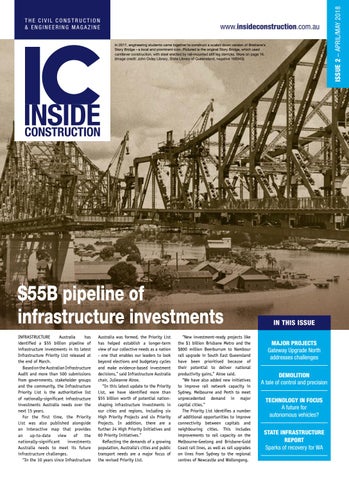
www.insideconstruction.com.au In 2017, engineering students came together to construct a scaled down version of Brisbane’s Story Bridge - a local and prominent icon. Pictured is the original Story Bridge, which used cantilever construction, with steel erected by rail-mounted stiff leg derricks. More on page 16. (Image credit: John Oxley Library, State Library of Queensland, negative 168343).
$55B pipeline of infrastructure investments INFRASTRUCTURE Australia has identified a $55 billion pipeline of infrastructure investments in its latest Infrastructure Priority List released at the end of March. Based on the Australian Infrastructure Audit and more than 500 submissions from governments, stakeholder groups and the community, the Infrastructure Priority List is the authoritative list of nationally-significant infrastructure investments Australia needs over the next 15 years. For the first time, the Priority List was also published alongside an interactive map that provides an up-to-date view of the nationally-significant investments Australia needs to meet its future infrastructure challenges. “In the 10 years since Infrastructure
Australia was formed, the Priority List has helped establish a longer-term view of our collective needs as a nation - one that enables our leaders to look beyond elections and budgetary cycles and make evidence-based investment decisions,” said Infrastructure Australia chair, Julieanne Alroe. “In this latest update to the Priority List, we have identified more than $55 billion worth of potential nationshaping infrastructure investments in our cities and regions, including six High Priority Projects and six Priority Projects. In addition, there are a further 24 High Priority Initiatives and 60 Priority Initiatives.” Reflecting the demands of a growing population, Australia’s cities and public transport needs are a major focus of the revised Priority List.
“New investment-ready projects like the $1 billion Brisbane Metro and the $800 million Beerburrum to Nambour rail upgrade in South East Queensland have been prioritised because of their potential to deliver national productivity gains,” Alroe said. “We have also added new initiatives to improve rail network capacity in Sydney, Melbourne and Perth to meet unprecedented demand in major capital cities.” The Priority List identifies a number of additional opportunities to improve connectivity between capitals and neighbouring cities. This includes improvements to rail capacity on the Melbourne-Geelong and Brisbane-Gold Coast rail lines, as well as rail upgrades on lines from Sydney to the regional centres of Newcastle and Wollongong.
IN THIS ISSUE MAJOR PROJECTS Gateway Upgrade North addresses challenges DEMOLITION A tale of control and precision TECHNOLOGY IN FOCUS A future for autonomous vehicles? STATE INFRASTRUCTURE REPORT Sparks of recovery for WA
ISSUE 2 – APRIL/MAY 2018
THE CIVIL CONSTRUCTION & ENGINEERING MAGAZINE
Imagine having an X-ray before you operate.
SmoothRide™ Resurfacing Workflow Solution SCAN
DESIGN
MILL
PAVE
COMPACT
There’s no reason to resurface with inadequate information or workflow any longer. Introducing SmoothRide, the world’s most advanced road resurfacing solution.
topconpositioning.com/SMOOTHRIDE
Let’s discuss your next project: 1300 867 266 | www.positionpartners.com.au
The Intersection of Infrastructure and Technology
Editor’s note +
Be careful what you ask for ON the face of it, US President Donald Trump’s $1.5 trillion plan to fix ‘crumbing infrastructure’, along with the mention of leveraging this with funding from the private sector and local governments, was the stuff of dreams for contractors. There was the expected outpouring of gratitude (We love you, Donnie!) from some industry groups - a crumb falling from heaven is a feast to a starving person. However, there were some intelligent notes of caution from other quarters. Smart Growth America said that there was a need to develop an infrastructure plan that provides real funding (i.e. does not rob Peta to pay Paula), fixes existing infrastructure, funds smart new projects and measures success. The third point is perhaps the most challenging: beneath the buzz phrase of “Internet of Things” is a lot of smart technology to make monitoring of infrastructure more cost-effective. There are also advances in materials technology that support a worldwide push for more resilient infrastructure to meet the challenges of climate change, or just plain work better. “Smart projects” also means not just building the “same old same old” but looking at the needs of tomorrow rather
than just projecting today’s or even yesterday’s needs. The disappearance of backyards, combined with the high proportion of millennials with no desire to own their own home, increases the demand for leisure space. The increasing number of people living in and near CBDs is increasing demand for more green space in CBDs; and requires a balancing act with competing demands for limited space. On the local front, perhaps the most important recent news is Consult Australia’s “iBodies: Infrastructure Governance in Australia” report calling for all levels of government to establish independent statutory infrastructure bodies (‘iBodies’) around four core principles of independence, planning, assessment and prioritisation. An element of the independence of the iBodies is that should a government wish to change either the projects to be funded or the priority of spending, it must seek parliamentary approval. The full document is accessible online at http://www.consultaustralia.com.au. On the matter of independence, the politicisation of the public service, and erosion over time of the separation of powers (legislative, executive, judicial) is a concern. I still regard the Sydney Harbour Bridge + Underground Rail Loop (often forgotten, but an integral
part of the planning) as the best example of infrastructure planning in Australian history. It delivered on many fronts: connectivity (allowing people to live north of the Harbour and work in the CBD), caters for multiple modes of transport (including trams, until 1960), had the capacity to handle decades of population growth, was planned early enough that the most cost-effective (top down) method of construction could be used for the loop, allowed for future network growth, and changed with advances in technology (originally planned as a two-span bridge but changes in steel technology allowed this to be built as a single span arch bridge when the project was rekindled post-WW1). The drive and vision of public servant Dr John Bradfield, and the respect accorded him by politicians of the era, was instrumental in the project’s success, as was the courage of those who supported such a large project in a much smaller Australia. Planning commenced over a century ago, but we can still learn valuable lessons today. We hope you enjoy the issue. For daily coverage of all that matters regarding infrastructure, engineering construction, as well as cranes, lifting and access sectors, visit www.insideconstruction.com.au
Senior Editor: Jacqueline Ong Editor: Greg Keane (greg.keane@mayfam.net) Journalist: Jan Arreza (jan.arreza@mayfam.net) Creative Director, Patterntwo Creative Studio: Toni Middendorf Advertising Sales: Ross May (ross@mayfam.net) Subscriptions: Email: subscriptions@mayfam.net Web: www.insideconstruction.com.au Office: Level 13, 333 George Street, Sydney, New South Wales 2000 Phone: 0400 868 456 Email: contact@mayfam.net Website: www.insideconstruction.com.au Publisher: Ross May (ross@mayfam.net) COPYRIGHT WARNING: All editorial copy and some advertisements in this publication are subject to copyright and may not be reproduced in any form without the written authorisation of the managing editor. Offenders will be prosecuted.
REWIND
THIS TIME, 10 YEARS AGO...
Unions keep ABCC in their sights: following the announcement made by former Prime Minister Kevin Rudd’s government that they would “have a tough cop on the beat in the building and construction industry”, unions confirmed they would continue to campaign for an end to the Office of the Australian Building and Construction Commission (ABCC) and its powers. The ABCC was abolished in May 2012 with many of its functions taken on by the Fair Work Building & Construction agency. At the end of 2016, the ABCC was re-established.
Ausdrill rejects MacMahon’s advances: drilling contractor Ausdrill rejected construction company Macmachon’s unsolicited $446 million takeover bid, calling it “inadequate” and “opportunistic”.
Desal plant demonstrates construction excellence: the Perth Saltwater Desalination Project was declared Australia’s most outstanding example of construction excellence at the 2008 Australian Construction Achievement Awards. The project involved the design and construction of a 144-megalitre per day seawater reverse osmosis desalination plant - the third largest in the world at the time - in an 18-month period.
World’s first hybrid unveiled: construction equipment manufacturer Komatsu launched what it claimed was the world’s first hybrid construction machine, the PC200-8 Hybrid excavator. The machine was powered by the Komatsu Hybrid System which used a newly developed electric motor to turn the upper structure, power generation motor, capacitor and diesel engine.
The hunt for a crane leader: the Crane Industry Council of Australia began its search for a chief executive officer - a newly created position at the time - eventually appointing Alan Marshall to the role in September that year. Today, Brandon Hitch leads CICA as CEO.
$1B makeover for Perth Airport: a $1 billion expansion and redevelopment plan was announced for Perth Airport, as part of a five- to seven-year plan to eventually merge the domestic and international terminals. In 2017, another infrastructure expansion program was announced, this time to the tune of $2.5 billion.
Daily news updates at www.insideconstruction.com.au
In May 2008, a $1B expansion and redevelopment plan was announced for Perth Airport. (Credit: Hugh Llewelyn, Flickr CC)
APRIL/MAY 2018 INSIDE CONSTRUCTION
3
+
News Australia’s infrastructure boom is creating cost pressures.
Growing demand pushes up costs GROWING demand is creating pressure within the sector, says international cost and consultancy practice WT Partnership, with personnel, plant and equipment, as well as base materials such as cement, steel and aggregates showing a significant increase in price. Releasing its Construction Market Conditions 2018 report in March, the firm said Australia’s infrastructure boom - major projects including rail, airports, and ports are already underway in NSW and Victoria - has intensified cost pressures and WT Partnership expects an escalation in tender prices in the sector of between 4-5% for civil infrastructure developments. In NSW, the escalation is forecast
to continue at around 4%, while the buoyant conditions in Victoria and the ACT will see the escalation trending at 3% and 3.25% respectively. Over in Tasmania, the escalation is pegged at 3.5%, while other regions across the country are expected to have tender pricing levels escalate at about 2-3%. However, Peter Clack, director of construction cost consulting firm Ralph Beattie Bosworth, told Inside Construction that tender price escalation will be at around 6% by the end of the year. “Major building projects are consequently at risk of cost blowouts, with serious shortages to be expected
$955M Sydney Metro contract awarded WORK is progressing on the Sydney Metro with the NSW government awarding a $955 million contract to transform Sydney’s busiest station. Laing O’Rourke will be upgrading Central Station and the contract includes: ++ the excavation and construction of the new underground Sydney Metro platforms at Central beneath platforms 13 and 14; ++ Central Walk - a new 19m-wide underground concourse from Chalmers Street, connecting customers to suburban rail platforms, Sydney Metro platforms, the new light rail and buses; and
++ escalators linking platforms 12 to 23. Completion of the Central Walk and Central Station metro upgrade contract is expected in 2022, with Central Walk open to customers. Due to the massive scale of the Sydney Metro project, the final Central contract value may vary due to ongoing fine-tuning and optimisation involving the 14 other major contracts, for which tenders have yet to be received. The first of five mega tunnel boring machines will be in the ground before the end of this year to deliver the twin 15.5km metro rail tunnels between Chatswood and Sydenham.
in the availability of structural trade workers such as concreters, steel workers, form workers and fixers, as they will be otherwise occupied in infrastructure projects,” Clack said. “NSW for instance is currently facing significant trade pricing pressures across demolition, formwork, joinery and plasterboard trades. In Victoria, the availability of specialist consultants, subcontractors, suppliers, plant and equipment is beginning to tighten, and will only get worse this year.” Procurement of building materials is another area of concern, with the large-scale demand on materials, especially concrete aggregates, reinforcement and steel for infrastructure
projects leading to cost escalation in other sectors of the industry. According to Clack, this will lead the country to go from a saturated market to an overheated market. “The sheer volume of major infrastructure projects will push up prices of concrete and steel. Prices of steelworks could go from around $5500 to $6000 per tonne now, to around $8000 or $9000 over the next 18 months,” Clack said. “Established developers will take the warning and be prepared to absorb these cost escalations, but newcomers to the industry may suffer from cost blowouts to an extent that they wouldn’t be able to recover from the loss.”
Western Sydney City plan to deliver long-term prosperity THE Turnbull and Berejiklian governments, along with eight Western Sydney councils, have agreed to a landmark Western Sydney City Deal, which is a coordinated plan designed to deliver long-term prosperity for the region. The deal will deliver for Western Sydney: ++ A North South Rail Link from St Marys to Badgerys Creek Aerotropolis via Western Sydney Airport. ++ A world-class Aerotropolis including Commonwealth-owned
land at North Bringelly. ++ An Investment Attraction Office to attract investment to the Western Parkland City. ++ New planning regime for Western Sydney to cut development costs. ++ A $150 million Western Parkland City Liveability Program to deliver community facilities. ++ New STEM-focused education facilities to train skilled workers needed for the Aerotropolis. ++ A plan to embed smart digital technology in the western city.
Four TBMs ordered FOUR tunnel boring machines (TBMs) have been ordered for Victoria’s $11 billion Metro Tunnel project and will start arriving early next year. They will burrow the project’s twin 9km tunnels. Each TBM will be 100m long, weigh up to 1000t and have a diameter of 7.2m. They will operate like moving factories as they travel beneath the city’s surface, with giant cutting heads burrowing through soil and rock before it’s transported via pipes to the surface. The custom-built machines include 4
INSIDE CONSTRUCTION APRIL/MAY 2018
offices, kitchens and bathrooms to support crews of up to 14 people during a round-the-clock operation. They will progressively install watertight concrete lining as they move under the surface at around 10m a day building the new tunnels. The heaviest single component of each TBM is the cutterhead, which weighs in at 175t and can tunnel through rock six times harder than concrete. The deepest tunnelling point will be under Swanston Street, at the
northern edge of the CBD near the new State Library Station. Here the TBMs will excavate around 40m below the surface. The four TBMs will install a total of 55,000 individual concrete segments that are needed to create the two tunnels. Upon their arrival, two machines will be transported to Arden and two to Domain, where they will be assembled, lowered into a shaft 20m underground and launched into the earth. Each TBM will head away from the city
on the first leg of their journey before being retrieved in Kensington and South Yarra. They will then be dismantled and trucked back to their starting points to be relaunched towards the city, with tunnelling expected to be complete by 2021. Significant work has already been undertaken at both launch sites to prepare the areas for tunnelling work, including the installation of temporary construction power substations to power the TBMs from both locations.
Daily news updates at www.insideconstruction.com.au
TRIO HAS THE ANSWER
Whether you need crushers, screens, feeders, washers, conveyors, air separators, or all of the above, the Trio ® range has you covered. We’re not here to sell you one piece of the puzzle, our highly skilled team of Weir Minerals engineers look at your entire operation and decide how the Trio ® range can help. It’s everything you need to run a Construction Aggregates plant, all in one place.
Visit www.theanswer.weir to learn how the Trio® range helped CNC Crushers. Copyright © 2018, Weir Minerals Australia Limited. All rights reserved. TRIO is a trademark and/or registered trademark of Weir Minerals Australia Ltd and Weir Group African IP Ltd; WEIR and the WEIR Logo are trademarks and/or registered trademarks of Weir Engineering Services Ltd.
www.minerals.weir
+
News
$255M win for John Holland
Artist’s impression of the Sunshine Coast Airport, which is undergoing an expansion undertaken by John Holland.
AUSTRALIAN contractor John Holland has secured a contract worth $225 million to build a new runway at the Sunshine Coast Airport in Queensland. The expansion is part of a $372 million privatisation deal with Palisade Investment Partners, which took control of Sunshine Coast Airport in 2017 under a 99-year lease with Sunshine Coast Council. Under the terms of the contract, John Holland will construct a new 2450m by 45m main runway, which will be designed by Beca Consultants and referred to as Runway 13/31. It will be capable of handling aircrafts up to the size of an Airbus A330 or Boeing 787. Runway 13/31 would intersect the existing Runway 18/36 slightly north of the current connection to the cross runway. The alignment of the new runway was chosen to avoid topographical constraints including Mt Coolum and Mt Ninderry. The location of the runway within the site was influenced by the following factors: ++ meeting aviation standards without the need for exemptions; ++ achieving the runway length required to meet target destinations in Asia and the length required for larger aircraft; ++ reducing the number of residents affected by aircraft noise; ++ avoiding poor geotechnical
conditions immediately east of the Sunshine Motorway at the north-west end of the runway; and ++ providing adequate flood conveyance capacity between the end of the runway and the Sunshine Motorway to avoid potential flood impacts. While the airport expansion was initially estimated to cost $347 million, current estimates show that the project would be delivered for around $303 million. This is largely due to the terminal expansion being taken over by the airport operator Sunshine Coast Airport. Early works progressed well throughout 2017, including the completion of the Finland Road upgrade to prepare the road surface for heavy vehicle traffic, engaging with the Kabi Kabi First Nation People to protect the cultural heritage of the runway expansion land, clearing the centreline and the relocation of the water main and power lines. John Holland Group will be taking possession of the project site over the next couple of weeks to start preparing the site for the dredging works, which will commence mid-year. Delivery of the expansion is being supported by loans from the Australian government and the Queensland Treasury Corporation and remains on track for completion by Christmas 2020.
Kingfield Galvanizing wins construction award KINGFIELD Galvanizing has won the Process Innovation Award at this year’s Australian Construction Awards (ACA) for its technological advances in the hot dip galvanizing (HDG) industry. Kingfield’s process innovation integrates sustainability and automation in a state-of-the-art HDG facility in Somerton, Victoria. The plant is considered a benchmark for the future of Australia’s HDG industry. With a focus on quadruple bottom line outcomes, the facility uses technology to lower emissions, improve both workplace safety and the working environment, increase recycling and re-use outputs to minimise waste. Kingfield’s investment in HDG process innovation was prompted by the requirements for major refurbishment works on their 30-year old traditional HDG plant, to modernise equipment and improve throughput for a growing customer base. 6
INSIDE CONSTRUCTION APRIL/MAY 2018
Inland Rail and Regional Rail Revival agreements reached DEPUTY Prime Minister and Minister for Infrastructure and Transport Michael McCormack and Victorian Minister for Public Transport and Major Projects Jacinta Allan have signed a Bilateral Agreement in relation to Inland Rail, making Victoria the first state to sign up to project. This agreement includes a commitment to negotiate a new long-term lease with the Australian Rail Track Corporation and to support the extension of the corridor to accommodate any changes to the North East Rail Line alignment required to support the delivery of Inland Rail. On completion, the Inland Rail Project will create a direct rail freight connection between Melbourne and Brisbane capable of moving double stacked freight containers. Inland Rail will deliver almost $7 billion in additional state gross product through construction and in the first 50 years of operation.
While the Inland Rail Project is a freight project, both governments acknowledge the North East Rail Line is currently used for both passenger and freight services and that this mixed use is intended to continue. Now that an agreement on Inland Rail has been reached, money for the $1.7 billion Regional Rail Revival program will begin to be delivered to Victoria. The works will be delivered under the Regional Rail Revival Program that will provide an upgrade to every regional passenger rail line in Victoria. Planning and defining the scope of works have already begun to ensure these projects meet the transport needs of passengers and regional communities, and the Victorian and Australian governments reaching agreement on the first stage of works, with some work already underway.
Companies shortlisted to build high priority QLD project THE Queensland government has announced the shortlisted companies for the contract to build the state’s highest priority infrastructure project - Cross River Rail. The shortlisted proponents are for two Cross River Rail major works packages: The Tunnel, Stations and Development (TSD) public-private partnership (PPP), and the Rail, Integration and Systems (RIS) alliance. Deputy Premier Jackie Trad said the announcement followed a comprehensive evaluation by the Cross River Rail Delivery Authority of the Expressions of Interest received for the two major works packages at the end of last year. “Shortlisted companies will now be required to prepare detailed bids that demonstrate innovation and offer Queenslanders the highest possible value for money,” Trad said. “Once the assessment process is complete, the consortia selected from these shortlists will be building this project.” The shortlisted companies are: 1. Tunnel, Stations and Development public-private partnership: ›› Pulse - CIMIC Group-led consortium, including Pacific Partnerships, CPB Contractors, UGL, BAM, Ghella and DIF. ›› Qonnect - QIC, Capella Capital, Lendlease, John Holland and Bouygues. ›› CentriQ Partnerships - Plenary Group, ACCIONA, GS Engineering & Construction, Salini Impregilo and Spotless Group. 2. Rail, Integratoin and Systems alliance: ›› River City Alliance - Laing O’Rourke Australia Construction Pty Limited, GHD Pty Ltd, Aurecon Australasia Pty Ltd, SYSTRA Scott Lister Australia Pty Ltd. ›› Unity Alliance - CPB Contractors Pty Limited, UGL Engineering Pty Limited, Jacobs Group (Australia) Pty Ltd, AECOM Australia Pty Ltd. The TSD PPP will primarily consist of the construction of the underground scope, comprising 5.9km of tunnel and new station caverns under the Brisbane River and CBD. Meanwhile, the RIS Alliance will comprise surface works and integration with the separate European Train Control System project being procured separately by Queensland Rail.
Daily news updates at www.insideconstruction.com.au
Do you want 10% more uptime? That’s how we make the big difference, the Metso Way. The Metso MX™ cone crusher is based on the patented Multi-Action crushing technology, which combines the piston and rotating bowl into a single crusher. The new crusher provides a giant leap in profitability, cutting operational costs by 10% and enabling 10% more uptime compared to traditional cone crushers. Find out more at www.metso.com/mx #TheMetsoWay