AUG/SEPT 2026
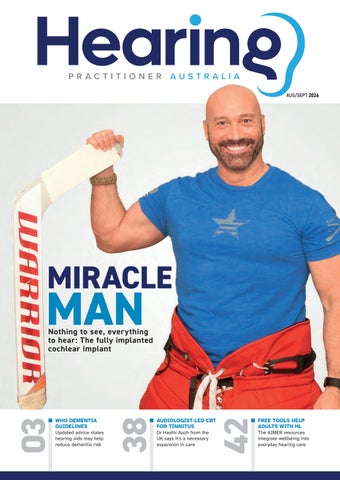
MIRACLE
MAN Updated advice states hearing aids may help reduce dementia risk
42
WHO DEMENTIA GUIDELINES
38
03
Nothing to see, everything to hear: The fully implanted cochlear implant
AUDIOLOGIST-LED CBT FOR TINNITUS
FREE TOOLS HELP ADULTS WITH HL
Dr Hashir Aazh from the UK says it's a necessary expansion in care
The AIMER resources integrate wellbeing into everyday hearing care
CLINICAL EXCELLENCE starts with
GREAT PEOPLE
At Specsavers Audiology, our clinicians are the heart of every customer experience combining expertise, advanced technology, and genuine care to help Australians hear better every day. Find out more at join.specsavers.com/au
WHO GUIDELINES UPDATE: HEARING AIDS 'MAY REDUCE RISK OF DEMENTIA' IN HL PATIENTS Updated World Health Organization (WHO) guidelines have recommended for the first time that hearing aids may be offered to adults with hearing loss to reduce the risk of cognitive decline and/ or dementia. But the global body tempered its advice by stating that the strength of the recommendation is “conditional due to the certainty of evidence being low”. The guideline development group (GDG) concluded that, “although the certainty of evidence is low to very low, the evidence base has increased, and consistent findings across studies suggest that treating hearing loss may reduce the risk of dementia. “Given the potential benefits (which probably outweigh the harms), and the global burden of unaddressed hearing loss and
its association with dementia risk, the GDG made a conditional recommendation that hearing aids may be offered to adults with hearing loss to reduce the risk of cognitive decline and/ or dementia.” Risk reduction of cognitive decline and dementia WHO guidelines, second edition were released on 15 July 2026. They update the 2019 guidelines which made no recommendation on using hearing aids to prevent dementia due to insufficient evidence. In the new version, the WHO asked the GDG researchers to investigate if, for adults with normal cognition or mild cognitive impairment and hearing loss, treatment of hearing loss was more effective than usual care or no intervention in reducing the risk of cognitive decline and/
Above: Treatment effects ranged from a 17% to 27% lower risk of dementia or cognitive decline. Image: Thodonal/stock.adobe.com.
or dementia. UNSW researchers Dr Hamidul Huque, Dr Yvonne Leung, Meiwei Li and the team lead Dr Lidan Zheng completed evidence profiles on hearing loss, cognitive activity, depression, and vision impairment. They said different risk factors exerted their greatest influence at specific stages. “For instance, the likelihood of developing dementia in later life (i.e. aged ≥65 years) increases as a result of exposure – particularly
in midlife (i.e. aged 19–65 years) – to hypertension, hearing loss, obesity, smoking, depression, dyslipidaemia, diabetes, excessive alcohol consumption, physical inactivity and traumatic brain injury,” they said. “To reduce the risk of cognitive decline and/or dementia specifically, hearing aids may be offered to adults with hearing loss. The strength of this recommendation is conditional as the certainty of evidence is low.” A ‘conditional recommendation’ is where the desirable effects of adhering to the recommendation probably outweigh the undesirable effects. The GDG issues “conditional (weak) recommendations where the certainty of evidence is limited, but where anticipated benefits, continued page 8
In a big win for the hearing care sector, audiology students will join the Commonwealth Prac Payment scheme which provides financial support to eligible students undertaking mandatory clinical placement and practical training. Some university lecturers want it to reach every audiology student undertaking mandatory placement, not just those who meet income-support or 15hours-per-week work thresholds. Australian Prime Minister Anthony Albanese said in July 2026 the government was expanding the scheme to students training in an additional ten key frontline health professions. Starting on 1 July 2027, eligible students are expected to receive up to $338.60 per
week during placements. The payment for teaching, nursing, midwifery and social work students was introduced in the 2024–25 Federal Budget with eligible students receiving weekly payments means tested benchmarked to the single Austudy rate and indexed annually. Audiology Australia (AudA) said the expansion followed lobbying from AudA, working with Allied Health Professions Australia (AHPA) in a united approach, and would ease financial stress, supporting students to focus more on building skills in preparation for the workforce. “The expansion is a massive win for audiologists, the wider allied health care sector, and those who may benefit from allied health care services,
including the one in five Australians living with deafness, hearing loss, or associated conditions,” said AudA president Lia Traves. ‘The fact the Prime Minister has recognised audiology as a “key frontline health profession” signals just how valuable the role of an audiologist is to help Australians manage their hearing, their ability to process and understand sounds, and their balance, and why supporting the future audiology workforce is so important.” ACAud inc. HAASA supported the campaign as an AHPA member. “Helping students complete their clinical training is an investment in a stronger, more diverse and sustainable continued page 8
Image: Claire Lariviere.
PRAC PAYMENT FOR AUDIOLOGY STUDENTS
What if this is a processing issue? Perth audiologist and APD expert Claire Lariviere wants more audiologists to consider auditory processing whenever patients report persistent listening problems despite normal audiograms or optimised hearing devices. She says auditory training deserves a bigger place in hearing care.
page 34
Personalised Hearing Care Starts with Sound Preference Not every patient wants to hear the world the same way. Introducing WSA Sound Preference, a new approach to personalised hearing care that recognises an important truth: two patients with the same hearing loss may prefer completely different listening experiences. WSA’s research points to sound preference as a measurable, highly personal factor in hearing aid adoption and satisfaction.
Make it part of every fitting: the WSA Sound Preference program gives you the research, language and an interactive listening tool to identify each client’s preferred sound design upfront — supporting stronger conversations, better outcomes and fewer returns. Search: wsa.com/soundpreference/
~40%
Going Beyond “Can you hear it?” Rather than asking only whether a sound can be heard, Sound Preference helps clinicians explore how a sound feels — building a fitting journey shaped around the individual, not just the audiogram.
of listeners show a clear, consistent preference for one sound design over another1
85%
By incorporating patient preference into the fitting journey, clinicians can create a more engaging, collaborative experience, building confidence, satisfaction and long-term hearing aid success.
of HCPs agree no single hearing aid technology is best for everyone2
The WSA Sound Preference approach supports truly personalised care benefits
STRONGER CLINICAL CONVERSATIONS
IMPROVED EARLY OUTCOMES
HIGHER SALES & FEWER RETURNS
90%
75%
60%
of HCPs agree: “The sound preference approach supports the clinical conversation with my clients.”3
of HCPs observed better outcomes when discussing sound preference at the initial appointment.3
of HCPs observed increased hearing aid sales and fewer returns using the sound preference approach.3
Experience Sound Preference for Yourself: Register Your Interest Today! Innovation Evening | October 2026
Be among the first to experience this exciting new approach to personalised hearing care. Register your interest today and receive event updates, locations and early access to registrations.
SCAN TO REGISTER
Reference:1. Balling LW et al. Auditory sound preference as a measurable dimension in hearing-aid fitting: Evidence from comparisons of time-domain and frequency-domain processing, February 2026. 2. Olesen, Internal study of 150 HCPs in the US and Germany, 2025. 3. WSA Sound Preference Research Summary, 2026.
ge
g
IN THIS ISSUE AUG/SEPT 2026
EDITORIAL
FEATURES
MODERN MIRACLES
16
Smarter from the inside
32
First denoising chip
One year from launch, Cochlear’s Nucleus Nexa System is changing the conversation.
Unitron’s new Moxi S-RX introduces the first DNN chip designed specifically to denoise speech in real time.
30
A hearing mission
36
Personalised care
Lived experience makes Annabel Fedcesin passionate about ensuring access to the best hearing.
Peter McKinnon reveals how WSA’s unique new Sound Preference Tool works and details its benefits.
EVERY ISSUE 07 UPFRONT
46 ENT COLUMN
09 NEWS
47 AUDIOMETRY COLUMN
45 SOAPBOX
48 MANAGEMENT COLUMN Association Partners
Education Partner
We often hear how cochlear implants improve people’s lives. In this special cochlear implant edition, we hear from two people exactly how much their lives have been transformed. I interviewed an inspiring single Dad from America, Michael Seufer, who is one of the first people in the world to hear with a new type of fully implanted cochlear implant (FICI). His story is nothing short of miraculous. Growing up as a child, his hearing loss was not detected until later in primary school. His family was astounded at how well he was doing academically despite having little hearing. Seufer was prescribed hearing aids but had little luck due to the type of hearing loss. He was embarrassed to wear them at school but persisted at college. Ice hockey became his safe place where he could be part of a team and star, without having to rely too much on his hearing, instead just concentrating on stopping the puck. It was communication, or lack of, with his young son that triggered Seufer to investigate cochlear implants. Wanting to no longer miss what his son was saying, he bravely volunteered to be among the first three to try Envoy Medical’s FICI. For him, the results have been outstanding. Closer to home, it has been one year since Cochlear launched its world first Nucleus Nexa System and it has already been impactful. One recipient, Perth retiree Karen Moloney, said the implant had turned her life around. Hearing loss had transformed the previously chatty, outgoing grandmother into someone who wanted to stay home and struggled to talk to anyone including her husband, children, grandchildren and neighbours. If she hadn’t had the implant when she did, she does not know what would have happened, but she does know that her mental health would have deteriorated. Her message is for hearing care practitioners to think more about referring patients who cannot progress further with hearing aids for earlier cochlear implant assessment, providing more options to hear and communicate better, and change lives for the better. HELEN CARTER Editor
HEARING PRACTITIONER AUSTRALIA
5
11–14 MAY 2027 BRISBANE CONVENTION & EXHIBITION CENTRE
CALL FOR ABSTRACTS
YOUR OPPORTUNITY TO PRESENT! Submit your abstract by 1 October 2026. Calling all voices in audiology! Expressions of interest are now open for you to present at Australia’s largest professional development event in audiology: the Audiology Australia Conference.
For our 2027 conference, 'Thriving Through Change', we are welcoming submissions on a broad range of topics including: • Aboriginal and Torres Strait Islander Ear Health • Innovations in Practice and Technology • Interdisciplinary Work
• Infants and Paediatrics • (Re)habilitation and Counselling • Ethics, Policy and Advocacy and Leadership • Practice and Clinic Management Don’t miss this opportunity to help build your public profile, raise awareness of your area of interest, and inspire others with your voice, experiences and expertise.
Submissions close on Thursday 1 October 2026.
For more information, visit
audaconference.com.au
N E
Just as HPA went to print, Earbus Foundation of WA began its rebrand as EAR FOUNDATION AUSTRALIA. The name change, after more than 13 years delivering ear health services across Western Australia, marks a significant milestone in the organisation’s evolution. CEO and co-founder Dr Lara Shur said the new name reflected its growth and expanding impact but its commitment remained the same. Earbus outreach services OFF THE BEATEN TRACK Weird
will continue to operate as a core part of its model, delivering mobile clinics to communities across WA. “Ear Foundation Australia is a clearer expression of who we are today and where we’re heading. Our focus remains on early intervention, community partnership and improving life outcomes for children,” she said. Alongside outreach, the organisation delivers newborn hearing screening, clinics, therapy services, and partnerships with schools and early learning centres. IN OTHER NEWS, Australia’s new national emergency messaging
system AusAlert will become fully operational by October 2026. It uses cell broadcast technology to send alerts directly to mobile devices within affected geographic areas. Developers worked with D/ deaf people and those with hearing loss to make it as clear, accessible and useful as possible. FINALLY, the Australian Government has renewed funding to enable Auslan90, Australia's only daily news service in Auslan, to continue. DeafConnect said it had received confirmation that the government would provide funding to maintain the program until June 2027.
STAT
Japanese horseshoe bats suppress background clutter through ultrasonic frequency control, revealing a new sensory strategy. Researchers uncovered the strategy used to improve prey detection under noisy conditions. They found the bats don't simply process sounds passively but actively manipulate sounds from the environment to enhance important signals. They follow a phenomenon called Doppler shift compensation – the change in frequency or pitch of a sound or light wave caused by movement of the source or the observer.
Wacky Norwegian scientists say the mysterious worldwide sound known as The Hum may not come from distant machines but from within the auditory system. They tested whether people who hear it have exceptional low-frequency hearing or measurable sounds produced inside their ears but found the strongest possibility was that many cases involved low-frequency tinnitus, even though the sound seemed completely external.
Published by:
379 Docklands Drive, Docklands VIC 3008 T: 03 9690 8766 www.primecreative.com.au Chief Executive Officer Christine Clancy christine.clancy@primecreative.com.au
Managing Editor Myles Hume myles.hume@primecreative.com.au Editor Helen Carter helen.carter@primecreative.com.au Business Development Manager Rosie Davis rosie.davis@primecreative.com.au Client Success Manager Karyssa Arendt karyssa.arendt@primecreative.com.au
Wonderful Dr Alexandra Elaine Adams, the UK’s first deafblind doctor, has graduated from medical school, despite undergoing major surgeries and spending 17 months in hospital during COVID-19. Dr Adams practises medicine using adaptive tech including a digital Bluetooth stethoscope paired directly to her hearing aids and uses her lived experience as a long-term patient to connect deeper with others. "Being a Deafblind person has given me the advantage of being a better doctor,” she said. Read more at settingsights.co.uk.
hearingpractitionernews.com.au
Publisher Sarah Baker sarah.baker@primecreative.com.au
Image: highwaystarz/stock.adobe.com.
7
UPFRONT
Head of Design Clayton Hawley Art Director Bea Barthelson Subscriptions T: 03 9690 8766 subscriptions@primecreative.com.au
3-5% of school-aged children have APD This means at least one child in every classroom has auditory processing disorder, says Perth audiologist Claire Lariviere. Page 34.
WHAT'S ON
Complete calendar page 50
THIS MONTH
NEXT MONTH
AUDA'S CONNECT & LEARN 2026
WORLD FEDERATION OF THE DEAF
14, 21 and 28 August
24-26 September
Melbourne, Sydney and Brisbane respectively. The CPD sessions focus on contemporary clinical practices and hearing implants.
Rome, Italy The WFD 75th Anniversary Conference also includes a gala, march and festival.
audiology.asn.au
wfdeaf.org
The Publisher reserves the right to alter or omit any article or advertisement submitted and requires indemnity from the advertisers and contributors against damages or liabilities that arise from material published. © Copyright – No part of this publication can be reproduced, stored in a retrieval system or transmitted in any means electronic, mechanical, photocopying, recording or otherwise without the permission of the publisher.
HEARING PRACTITIONER AUSTRALIA
7
NEWS
continued from page 3
feasibility, acceptability or equity gains nevertheless justify advising action”. The guidelines said mechanisms linking hearing loss to cognitive decline included social isolation, increased cognitive load, cardiovascular pathology and neurobiological changes, all of which may exacerbate risk of dementia. A graphic suggested treating hearing loss may prevent or delay dementia risk through reduced stress and inflammation. “Hearing loss contributes to a cascading effect of decreased social engagement, mental well-being and physical activity, which can increase the risk of cognitive decline and dementia,” the guidelines state. Researchers said observational data suggested hearing aid use may be associated with a reduced risk of dementia and mild cognitive impairment (MCI) in adults with normal cognition. “The certainty of evidence was rated as very low. Similarly, very-low-certainty evidence suggests that, in adults with MCI, hearing aid use may reduce the risk of progression to dementia,” they said. Treatment effects ranged from a 17% to 27% lower risk of dementia or cognitive decline. “RCT (randomised controlled trial) data indicate that hearing aid use
may have a small effect on cognitive function in adults with normal cognition," the guidelines said. "The certainty of evidence was rated very low.” Additionally, hearing aids should be used to address hearing loss, not solely for the purpose of preventing dementia, they said. “Unaddressed hearing loss has widespread impacts on quality of life, relationships and mental health and has been closely linked to cognitive decline and dementia," the advice states. "In theory, if hearing loss was reduced to zero at the population level, it is estimated that about 7% of dementia cases could be prevented.” But it said high-certainty evidence from RCTs on whether addressing hearing loss reduces dementia risk or slows progression was largely lacking or only slowly emerging. No randomised or longitudinal studies had reported cognitive or dementia outcomes for cochlear implant users, and no trials had directly compared different hearing interventions. Evidence on hearing interventions in adults with MCI was limited: only one study assessed hearing aid use with dementia as the outcome, and no systematic reviews had evaluated cognition as a primary outcome in this population. Existing studies varied widely in
Image:NeuRA.
TACKLING A LOOMING COGNITIVE CRISIS
“THEY’RE A VITAL STEP FORWARD IN TACKLING A LOOMING COGNITIVE CRISIS.”
PROF KAARIN ANSTEY NEURA
sample size and follow-up duration, with most focusing on older adults; evidence on interventions initiated in midlife was limited. “The influence of hearing loss severity and comorbidities on cognitive outcomes remains unclear. It remains uncertain whether cognitive benefits are derived directly from hearing interventions or from related factors such as increased social engagement and health care use,” the guidelines said. Further research was needed to evaluate long-term cognitive effects of interventions. Professor Kaarin Anstey, director of the UNSW Ageing Futures Institute and senior principal research scientist at Neuroscience Research Australia, helped draft the guidelines. She said they were a “vital step forward in tackling a looming cognitive crisis". “These guidelines are the culmination of a systematic and wide-ranging review of the evidence we now have about the efficacy of a range of interventions that can reduce dementia risk,” she said. WHO Director-General Dr Tedros Adhanom said: "We know more today than ever before about what drives dementia risk, and these guidelines translate that knowledge into action. Countries now have clear, evidence-based recommendations they can put into practice immediately to protect people's cognitive health."
UNIVERSITIES, AUDIOLOGY BODIES WELCOME MOVE continued from page 3
audiology workforce and in better access to hearing and balance care for communities across Australia,” said ACAud chair Kylie Dicieri. “Clinical placements can create significant financial pressure through lost income and the costs of travel, accommodation and relocation.” University of Queensland head of audiology Associate Professor Carlie Driscoll said it was a welcome and overdue recognition of the financial burden placement puts on allied health students, including those in audiology, who complete extensive unpaid clinical hours as part of their qualification. “Extending the payment to disciplines like audiology acknowledges what those of us in the sector have long known – that mandatory placements can be a genuine barrier to completing study, particularly for students who are 8
HEARING PRACTITIONER AUSTRALIA
already balancing work and caring responsibilities,” she said. “That said, I’d like to see the payment reach every student undertaking a mandatory placement, not just those who meet the income-support or 15-hours-perweek work thresholds. “Placement costs – relocation, reduced paid work capacity, transport – don’t discriminate by means test, and many students who fall just outside these criteria will still feel that pressure acutely. It’s a strong step in the right direction, but there’s more ground to cover before the policy matches the reality of what placements cost students.” Macquarie University Masters of Audiology course director Dr John Newall said while appropriate that funding was targeted at those most in need, most of their students experienced financial hardship due to clinical placement and would also benefit from Commonwealth support.
Macquarie University’s Dr John Newall, and AHPA CEO Bronwyn Morris-Donovan. Images: Macquarie University and AHPA.
“’Placement poverty’ is a factor which limits audiology students’ ability to commit and take full advantage of clinical placements,” he said. “In particular, the cost of attending educationally valuable longer term or block placements can be prohibitive for some students. We frequently have opportunities for placement in rural locations, but the cost of attending these placements presents a significant barrier to student attendance." He said the expansion would likely provide a stimulus for recruitment of students who've traditionally struggled with the financial burden of placement, particularly those from disadvantaged backgrounds and rural areas. AHPA CEO Bronwyn Morris-Donovan said the “landmark win for allied health students” was the result of a campaign backed by more than 43,000 Australians who signed its end placement poverty petition.”
KING’S BIRTHDAY HONOURS IN HEARING FIELD An audiologist who co-invented the speech processor for cochlear implants, an ENT surgeon, an interpreter who established the National Relay Service, a NextSense volunteer, and a philanthropist were honoured in the 2026 King’s Birthday List. Melbourne audiologist Emeritus Professor Richard Dowell, Sydney otolaryngologist Professor Raymond Sacks, Auslan pioneer interpreter John Flynn, NextSense president David Dinte, and NextSense and Murdoch Children’s Research Institute philanthropist Janet Calvert-Jones AO were recognised for their outstanding contributions. Prof Dowell was appointed as an Officer of the Order of Australia (AO) in the general division for distinguished service to audiology, the development of the cochlear implant, and tertiary education. He is Emeritus Professor, Audiology and Speech Science at The University of Melbourne, where he has had a 46-year tenure in audiology and speech science He has been involved in clinical work and research in cochlear implants for more than 40 years and was the audiologist who managed the first patient to receive a commercial multi-channel cochlear
implant in 1982 when the university became the main test centre. Prof Dowell has been director of audiology at The Royal Victorian Eye and Ear Hospital for 25 years, founded the hospital’s Cochlear Implant Clinic in 1985, and is a senior consultant there. Prof Sacks received an AO for distinguished service to otolaryngology, clinical training, tertiary education, and governance roles. The Royal Australasian College of Surgeons vice-president is a Macquarie University clinical professor of surgery and head of otolaryngology, Sydney Medical School's head of ENT surgery, an ASOHNS Fellow and former president, and the federal health department's panel of clinical
Above: (L-R clockwise from top) Prof Raymond Sacks, Emeritus Prof Richard Dowell, David Dinte and John Flynn. Images: RACS, RVEEH, NextSense, Deaf Connect.
experts' ENT representative. Flynn, a pioneer in Australia’s interpreting profession, received an AO for distinguished service to people who are deaf or hard of hearing, to equality and accessibility, and to Auslan training and education including being instrumental in ensuring accreditation for Auslan interpreters. He recently retired after 75 years of service to Australia’s Deaf community and has held leadership roles in Deaf societies in Victoria and NSW. Dinte, NextSense president and life member, was appointed a Member of the Order of Australia (AM) in recognition of his significant service to the not-for-profit sector. He recently celebrated 25 years of service to NextSense, having donated his time and expertise since joining its board in 2000. Calvert-Jones was one of five recipients of the Companion of the Order of Australia (AC,) the highest award. She was instrumental in establishing NextSense’s hearing services for children in Victoria (previously Taralye). Her mother, Dame Elisabeth Murdoch AC DBE, co-established the Murdoch Children’s Research Institute which is supported by Calvert-Jones and the Calvert-Jones Foundation.
HEARING LOSS A ‘HIDDEN EPIDEMIC’ IN DIABETES Researchers are calling for routine hearing tests to become part of standard diabetes care after a major review found about one in four adults with diabetes is living with clinically significant hearing loss. The systematic review and meta-analysis found people with diabetes are more than twice as likely to experience serious hearing loss as those without diabetes, and hearing impairment is a significant but under-recognised complication of diabetes. The researchers from The University of Queensland (UQ), Monash University and Pakistan, said in Diabetes Metabolism Research and Reviews in June 2026, that hearing impairment should be recognised alongside eye, kidney and nerve disease as an important complication of diabetes. Lead author, medical doctor Dr Mehwish Nisar from UQ, said hearing loss remained largely overlooked despite affecting an
estimated 130 million people with diabetes worldwide. She said it was a “hidden epidemic” and greater awareness was urgently needed. “One in four adults with diabetes are living with serious hearing loss,” she said. “Diabetes is the world’s fastest growing chronic disease, affecting over half a billion people, and people with diabetes are more than twice as likely to experience serious hearing loss.” The researchers reviewed 29 international studies involving more than 17,000 adults, most with type 2 diabetes or prediabetes. Diabetes was associated with more than double the risk of clinically significant hearing loss compared with people without diabete. While diabetic retinopathy, nephropathy and neuropathy are routinely monitored in clinical practice, the authors said hearing impairment remains a “significant, yet under-recognised, complication” rarely included in diabetes management. Dr Nisar is a UQ Research Fellow
Above: (L-R) UQ’s Dr Mehwish Nisar and Prof Piers Dawes. Images: Mehwish Nisar and Piers Dawes.
and an affiliate of the university’s Centre for Hearing Research (CHEAR) whose director Prof Piers Dawes was also an author. Meanwhile a large genetic study has found hyperglycaemia is not only associated with hearing loss but is likely to be a direct cause of it. The researchers from Taiwan, the UK and the US said findings strengthen the case for hearing monitoring in people with diabetes. HEARING PRACTITIONER AUSTRALIA
9
NEWS
ADVANCING PRACTICE
IN BRIEF SUICIDAL IDEATION Audiology Australia has developed a guide to help its members best support clients with suicidal thoughts or deteriorating mental wellbeing. The six-page document entitled ‘Responding to Suicidal Ideation in Clients’ is in response to members expressing concern about how to recognise signs of suicidal ideation and how to respond to ensure these clients are linked to appropriate crisis or mental health support. It provides best-practice recommendations and aims to ensure clients receive timely, appropriate care while also supporting the wellbeing of audiologists. CEO Leanne Emerson said these events could affect the mental health of audiologists.
AMPLIFON-GN DEAL Amplifon has taken out a $2.23 billion loan to help finance its proposed acquisition of GN Hearing. Amplifon said in June 2026 that the senior loan was entered into with a pool of leading financial institutions, including Goldman Sachs Bank Europe SE and J.P. Morgan SE, acting as global coordinators. Amplifon said the closing of the acquisition of GN Hearing was expected by the end of 2026. It announced in March that it would buy GN Hearing for $3.6 billion.
LA TROBE CLINIC An $82 million La Trobe Health Clinic at the university’s Bundoora campus has opened, expanding access to allied health services, teaching resources, and boosting student intake as well as housing a new audiology clinical service. The clinic provides affordable, student-led allied health services including audiology to patients in Melbourne’s northern suburbs. The university said the clinic would give students hands on experience in a real-world healthcare environment under clinical supervision with full audiology services across diagnostic, rehabilitation and vestibular specialties.
10
HEARING PRACTITIONER AUSTRALIA
Below: (L-R) Audiology Australia president Lia Traves and CEO Leanne Emerson. Images: Audiology Australia.
Audiology Australia (AudA) has announced that a new committee to be formed will support Australian audiologists to remain at the forefront of evidence-based clinical practice. The organisation said the new Audiology Australia Clinical Excellence Committee (AACEC) would shape the future of clinical guidance at AudA and play a critical role in driving a culture of continuous improvement of clinical best-practice across the audiology profession. The committee would identify emerging trends, risks and opportunities, translating these into practical initiatives that would advance clinical capabilities, promote innovation and strengthen professional standards. Applications for the inaugural committee were open to Audiology Australia Accredited Audiologists and due to close on 14 August 2026. Audiology Australia president Lia Traves said the AACEC would help to drive a culture of continuous improvement and excellence across the audiology profession in Australia. “The AACEC will provide an essential role in developing and updating clinical guidelines to reflect new evidence and practice evolution,” Traves said in a media release on 16 July 2026. “Where applicable, the group will also provide strategic input into policy reform to the board of directors.” AudA said the creation of the committee reflected its decision to evolve its approach to clinical engagement. The AACEC will sit at the centre of this new model and be supported by a series of
Clinical Practice Working Groups with priority areas of practice recommended by the AACEC and endorsed by the AudA Board. Applications for membership of these groups will be opened once their focuses have been determined by the inaugural committee. AudA said. Audiology Australia CEO Leanne Emerson said this model of clinical leadership would only become more important as audiology transitioned to Ahpra (Australian Health Practitioner Regulation Agency) regulation. “While Ahpra’s responsibility is to protect the public by regulating registration, professional standards and complaints, it establishes the minimum standard required for safe practice only, not the standard of excellence,” Emerson said. “Strong clinical leadership provides essential guidance, ensuring the profession has an authoritative voice on matters of clinical practice, quality improvement and health care policy.” There will be between six to eight members of the AACEC at any one time. The committee will comprise at least two AudA board members and one member with expertise in Aboriginal and Torres Strait Islander audiology and culturally safe practice. Members of the AACEC would provide input into clinical areas of policy reform and be in frequent communication with the Audiology Australia Board of Directors, CEO and management team. This would allow members with a history of clinical excellence and expertise to contribute to best practice and shape clinical priorities. The Audiology Australia Clinical Practice Working Groups (CPWGs) would support the AACEC with developing and reviewing clinical guidance and practice resources in defined areas of practice. Groups will be in line with clinical guidance priorities agreed by the AACEC and approved by the Board. For information, visit audiology. asn.au. *See more on page 45 when Audiology Australia CEO Leanne Emerson details how the organisation is shaping the future of clinical guidance.
$20M PLEDGE FOR CI KIDS
PIONEERS' PRIZE
The NSW Government will invest $20.4 million over four years to support pre- and post-implantation care for children receiving cochlear implants, helping more than 1,000 children each year access specialist follow-up services. Announced as part of the 2026/27 NSW Budget, the funding will go to not-for-profit organisations NextSense and The Shepherd Centre to deliver the NSW Paediatric Cochlear Implant Program including early intervention and therapy programs in partnership with NSW Health. The funds will support essential services including initial activation, ongoing mapping and monitoring, early intervention to develop listening, speech, language and social skills, and family education and support. NextSense said the investment would help sustain follow-up care well into the future. While Medicare and the NDIS contribute to funding these services, NextSense said it currently relies on philanthropic support to deliver much of its cochlear implant care. NextSense president David Dinte AM said cochlear implants could be life-changing, but ongoing rehabilitation was essential. “It's what comes next that is crucial, to ensure they can get the most out of their device," he said. "When combined with high-quality early intervention support, children can achieve incredible
Five scientists and engineers who developed the cochlear implant (CI) have jointly received the 2026 Richard N. Merkin Prize in Biomedical Technology. They are Australian ENT surgeon-scientist Professor Graeme Clark AC; MED-EL co-founders Dr Ingeborg Hochmair and Professor Erwin Hochmair from Austria; Duke Hearing Center director Professor Blake Wilson; and US neuroscientist Emeritus Professor Michael Merzenich. The prize recognises pathbreaking technologies that improve human health through the treatment, diagnosis or prevention of disease. Working independently from the late 1960s and early 1970s, they developed complementary innovations that enabled electrical stimulation of the auditory nerve to restore hearing for people with severe to profound deafness. The Broad Institute, which administers the prize, said the award recognised their combined contributions to safe implant design and speech-processing strategies that transformed CIs from an experimental concept into an effective clinical treatment. Prof Clark led development of the world's first clinically successful multichannel CI, performing Australia's first implantation in 1978 and helping establish Cochlear Ltd. The Hochmairs developed the first multichannel CI implanted in 1977, and Prof Merzenich advanced understanding of how CIs interface with the auditory system and contributed to early clinical trials that led to Advanced Bionics. Prof Wilson developed the Continuous Interleaved Sampling speech-processing strategy in 1989, a breakthrough that dramatically improved speech understanding and remains the foundation of modern cochlear implant processing. Below: (L-R) Prof Graeme Clark, Prof Erwin Hochmair, Dr Ingeborg Hochmair. (Bottom) Prof Michael Merzenich, Prof Blake Wilson. Image: Merkin Prize.
Above: Specialist care helps children learn to interpret sound, develop communication skills and build confidence using cochlear implant technology. Image: NextSense.
outcomes and require fewer hearing supports later in life." He said the funding would help NextSense and its First Voice partner, The Shepherd Centre, to continue providing high-quality care for children with cochlear implants. Dr Aleisha Davis, CEO of The Shepherd Centre, said the funding was a “landmark investment” in children with cochlear implants and their families. “It provides certainty for families that specialist support will be available from the earliest stages, when they need it most,” she said. NSW Health Minister Ryan Park said: "This is a lifechanging procedure and the aftercare is equally as important – and this funding recognises that." He said about one in 1,000 Australian newborns has hearing loss and early identification and intervention are critical to developing language and communication skills.
AUSTRALIAN FIRST SURGERY
Above: Twin brothers Jack and Artie on “switch on” day. Image: The Shepherd Centre.
In what is believed to be an Australian first, identical deaf twin babies have undergone bilateral cochlear implant surgery on the same day, and later had their implants activated simultaneously. Arthur (Artie) and Jack Porter were born premature and profoundly deaf because of a genetic condition. Sydney ENT surgeon Dr Rithvik Reddy operated on the brothers earlier in 2026. Two boys, four ears, eight hours
of surgery and, 15 days later they reached a remarkable milestone the moment they both heard sound together when their cochlear implants were activated. “When Artie and Jack were diagnosed at birth, we were overwhelmed and uncertain about what the future would hold,” their parents, Emily and Ewan Porter from Moss Vale, NSW, said. “The support we have received has helped us navigate every stage of this unique journey so far and we know it gives our boys the best possible start in life.” Their story was revealed when the NSW Budget allocated funds for The Shepherd Centre and NextSense for children with cochlear implants. “Knowing families will now have fully funded access to that same support means the world to us,” the Porters said. “We’re incredibly grateful to The Shepherd Centre, the clinicians, our family and friends, and everyone who helped us along the way.” HEARING PRACTITIONER AUSTRALIA
11
NEWS
ACAUD LAUNCHES HANDBOOK ACAud inc. HAASA has launched its first comprehensive Best Practice Handbook which it says is a practical resource to support hearing care clinicians at every stage of their professional journey. The Australian College of Audiology incorporating HAASA (ACAud inc. HAASA) developed and published the 96-page ACAud inc. HAASA Best Practice Handbook for Clinical Practice in July 2026. Executive officer, Marguerite Rushworth said that while the online resource is mainly for clinicians and students, it is free, open access to everyone and available online, ensuring it is easily accessible and can be updated as new evidence and best practice emerge. “It was developed in response to the need for a contemporary, evidence-informed resource that supports excellence in hearing healthcare,” she said. “ACAud recognised the value of providing a practical reference that promotes consistency in clinical practice and supports lifelong learning across the profession. “The handbook has been developed for audiometrists, audiologists and students embarking on a career in hearing healthcare. It has been designed as a practical resource to support clinicians at every stage of their
professional journey.” “ACAud has made the handbook freely available to the profession because we believe best practice should be shared for the benefit of clinicians and, ultimately, the people they care for,” Rushworth said. “The handbook has been designed as a living resource that will be reviewed and updated as new evidence, technologies and clinical standards evolve. Its launch represents an important step in supporting a unified, evidence-informed hearing health profession.” Rushworth said that by making it freely available, ACAud hopes to encourage consistency in clinical practice, support students and experienced clinicians alike, and contribute to continual improvement in hearing healthcare across Australia. “We hope this is just the beginning, with the handbook continuing to grow and evolve alongside the profession,” she said. ACAud said the book represented an enormous collaborative effort to support excellence in hearing healthcare and provide a practical resource for clinicians across the nation. Townsville audiologist Henriette Lategan, an audiology joint venture partner at Specsavers, was a major contributor. “Henriette’s commitment to this project has
Above: The free book is available online. Image: ACAud inc. HAASA.
been truly exceptional, and we are incredibly grateful for the knowledge, passion and leadership she has contributed throughout its development,” ACAud said. ACAud also thanked industry partners and organisations that provided valuable input and support during the project including Specsavers, Sonova, Amplifon, Interacoustics, and New Zealand audiology clinician Anthony McGeough, sales director at Natus Hearing & Balance, Australia and New Zealand. The handbook can be downloaded from acaud.com.au.
F
Th
EFFECTIVE HEARING AID USE AND DEMENTIA Older adults with hearing loss who use hearing aids effectively may have a significantly lower risk of developing dementia, according to a large study. But researchers stressed the study was observational and could not prove that hearing aids directly prevent dementia. The international study, published in Cell Reports Medicine, analysed data from 61,089 adults aged 55 years and older across 33 countries. It found hearing aid users had a 9% lower risk of probable dementia than hearing-impaired non-users over an average 6.5 years of follow-up. The team, led by Professor Chen Shanquan from the University of Hong Kong (HKUMed), included Australian audiologist Associate Professor Dona Jayakody from the University of Western Australia. The benefit appeared to depend on whether hearing aids provided 12
HEARING PRACTITIONER AUSTRALIA
meaningful improvement in daily life. Participants who reported good hearing improvement had a 14% lower dementia risk, while those who experienced little benefit showed no significant reduction, it found. “Our study suggests that the benefit is not simply about wearing a device, but whether the device
Above: (L-R) Prof Chen Shanquan and A/Prof Dona Jayakody. Images: The University of Hong Kong and Dona Jayakody.
meaningfully improves hearing in daily life,” Prof Shanquan said. The researchers said findings reinforce the importance of optimising hearing aid fittings, follow-up care and rehabilitation rather than focusing solely on device uptake. Meanwhile, adults with epilepsy and hearing loss who use hearing aids have a 23% lower risk of dementia than non-users with the same conditions, researchers from University Hospital Zurich and the University of Liverpool told the 2026 European Academy of Neurology Congress. Dr Carolina Ferreira-Atuesta said the finding was unique to epilepsy and may reflect reduced cognitive reserve in that population. She urged greater awareness, screening and treatment but said prospective studies were needed to confirm whether hearing aids directly protect cognitive health.
A
This m health will a Not a produ regist © Co
TINNITUS RISING IN YOUNG ADULTS: REPORT The prevalence of tinnitus among young adults in the US has increased significantly over the past 15 years, with researchers warning that growing exposure to loud sound may be contributing to the trend. The brief report, published in the Annals of Otology, Rhinology & Laryngology, analysed nationally representative health survey data from 2008 and 2023 to examine changes in tinnitus prevalence, duration and self-perceived impact among adults aged 18–24 years. Researchers from Massachusetts Eye and Ear and Harvard Medical School found tinnitus prevalence rose from 5.8% in 2008 to 7.8% in 2023, representing an estimated 2.3 million young adults who reported tinnitus in the previous 12 months. Symptoms were also lasting longer than 15 years ago, with a significant increase in reported duration, researchers found. Lead author Dr Ryan Bartholomew and colleagues said findings point to a concerning trend in a population traditionally
considered at lower risk of chronic auditory problems. “Nationally representative data indicate a concerning increasing prevalence and duration of tinnitus among young adults with a significant self-perceived impact,” they wrote. Data came from the National Health Interview Survey (NHIS), with participants reporting tinnitus symptoms, duration, perceived impact and healthcare use. Although many respondents described tinnitus as manageable, 8.7% of those with tinnitus
Above: Findings highlight the importance of discussing safe listening habits. Image: Alexander LW/stock.adobe. com.
FOR PROFESSIONALS This content is intended for Australian and New Zealand audiences.
What’s new in adult cochlear implant referral:
Applying the 60/70 guidelines
Live Virtual Event
Register now Earn CPD points: AudA CPD2627 022 Category 1.2 – 1 CPD ACAud inc. HAASA Endorsement No.2026134 – 1 point per hour + 0.5 for quiz
All healthcare professionals are welcome! This material is intended for health professionals. If you are a consumer, please seek advice from your health professional about treatments for hearing loss. Outcomes may vary, and your health professional will advise you about the factors which could affect your outcome. Always read the instructions for use. Not all products are available in all countries. Please contact your local Cochlear representative for product information. Cochlear, Hear now. And always and the elliptical logo are either trademarks or registered trademarks of the Cochlear group of companies (unless otherwise noted). © Cochlear Limited 2026. D2478865 v1 2026-07
12 - 1 pm
AEST Thursday 3 September
in 2023 said it was a moderate problem and 3.1% described it as a major problem. Despite this, only 10.1% had consulted a medical specialist. The study found a strong association between tinnitus and exposure to very loud sounds. Young adults reporting such exposure were more than twice as likely to experience tinnitus, supporting concerns that recreational noise from concerts, clubs, personal listening devices and other loud environments may be contributing to the increase. Researchers said findings reinforced the importance of promoting hearing conservation and safe listening habits, as tinnitus may be an early sign of auditory damage before measurable hearing loss develops. They said the study relied on self-reported data so could not establish cause and effect but rising prevalence and longer duration warranted ongoing monitoring and further investigation into the role of noise exposure and other risk factors.
HEARING CARE
Empathy in hearing care: Bridging the gap DANIEL PISTRITTO is a Melbourne audiometrist who uses a cochlear implant for one ear and a hearing aid for the other. His lived experience provides wisdom for hearing care practitioners about what patients really want.
A
But hearing loss is about much more than hearing. For many people, hearing loss affects their confidence, relationships, independence, and overall quality of life. It can lead to frustration, social withdrawal, misunderstandings, and feelings of isolation. That's why the most successful
Image: Prime Creative Media.
s hearing care professionals, we spend years developing our clinical knowledge. We learn how to interpret audiograms, program hearing aids, troubleshoot technology, and understand the complexities of the auditory system. Those skills are essential.
Audiometrist and cochlear implant recipient Daniel Pistritto delivering a powerful opening address at the 2026 ACAud inc. HAASA Congress.
14
HEARING PRACTITIONER AUSTRALIA
outcomes in hearing care don't come from technical expertise alone. They come from combining clinical skills with the ability to connect with people on a human level. THROUGH THE CLIENT'S EYES One of the most important skills any hearing care professional can develop is empathy. Every day, we meet people who are struggling with challenges that aren't always visible on an audiogram. Some are frustrated because conversations have become exhausting. Others feel embarrassed about constantly asking people to repeat themselves. Some are worried about what hearing aids might say about them, while others are grieving the hearing they once had. Taking the time to understand how hearing loss is affecting a person's life helps us provide care that is truly client-centred. A hearing aid adjustment may improve speech clarity, but sometimes what a client needs most is for someone to acknowledge their frustrations and reassure them that they're not alone. When clients feel heard and understood, trust develops. That trust often becomes the foundation for successful rehabilitation. COMMUNICATING CLEARLY Good communication is at the heart of everything we do. As hearing care professionals, it's easy to fall into the habit of using technical language. Terms such as sensorineural hearing loss, speech discrimination scores, improved signal to noise ratios, or directional microphones make perfect sense to us, but they can be confusing for many clients and their families. Our role is to translate complex information into language that people can easily understand. That means explaining hearing loss in practical terms, demonstrating how devices work, and checking that clients understand what we've discussed. It also means adapting our communication style to suit the individual sitting in front of us. Some clients want detailed explanations about the technology. Others simply want to know how their hearing loss affects their daily life and what can be done to
help. Some may benefit from written information they can take home and review later. There is no single approach that works for everyone.
Daniel Pistritto in clinic with a patient.
ENCOURAGING POSITIVE CHANGE Many people delay seeking help for hearing loss. Even after receiving a diagnosis, some remain hesitant about taking the next step. Fear, uncertainty, stigma, and misconceptions about hearing aids can all become barriers to treatment. As hearing care professionals, we have an opportunity to help clients move beyond those barriers. This isn't about convincing people to wear hearing aids. It's about helping them recognise the impact hearing loss is having on the things that matter most to them. When a grandparent talks about
Image: Prime Creative Media.
ONE SIZE DOESN'T FIT ALL No two people experience hearing loss in exactly the same way. Two clients may have very similar hearing test results but completely different listening needs, lifestyles, and goals. One person may struggle in business meetings. Another may find family gatherings overwhelming. Someone else may simply want to hear the television more clearly. That's why flexibility and problem-solving are such valuable skills in hearing care. Sometimes the solution involves fine-tuning hearing aid settings. Sometimes it involves assistive listening technology. Other times it may be about counselling, communication strategies, or setting realistic expectations. Our job is not simply to fit hearing devices. Our job is to help people find solutions that work in their everyday lives.
Image: Daniel Pistritto.
PATIENCE MAKES A DIFFERENCE Hearing rehabilitation is a journey, not a single appointment. Some clients accept their hearing loss quickly and are eager to move forward. Others need time to process the diagnosis and adjust emotionally. Many will experience challenges during the hearing aid adaptation period and may question whether the effort is worth it. Patience is essential. Rather than pushing clients toward a destination, we walk alongside them. We answer questions, address concerns, celebrate progress, and provide reassurance when things become difficult. The clients who achieve the best outcomes are often those who feel supported throughout the process rather than pressured to move faster than they're comfortable with.
“Our job is not simply to fit hearing devices. Our job is to help people find solutions that work in their everyday lives.”
Daniel Pistritto Audiometrist struggling to hear their grandchildren, or a partner describes feeling left out of conversations, those moments often become powerful motivators for change. By asking thoughtful questions and listening carefully to the answers, we can help clients identify their own reasons for seeking help. BUILDING TRUST THROUGH PROFESSIONALISM Trust is one of the most valuable things a client can place in us. People come to us looking for guidance, expertise, and honest advice. They trust us to recommend solutions that are in their best interests and to provide realistic expectations about what technology can achieve. Professionalism means being transparent, ethical, and respectful at every stage of the client journey. It means recommending what is appropriate for the individual rather than what is most expensive. It means acknowledging the limitations of technology as well as its benefits. It means treating every client with dignity and respect, regardless of their age, hearing loss, or circumstances.
THE HUMAN SIDE OF HEARING CARE At its core, hearing care is about people. Audiograms, hearing aids, cochlear implants, and assistive listening devices are important tools, but they are only part of the story. The real difference we make comes from the relationships we build and the support we provide. When we combine clinical expertise with empathy, patience, clear communication, adaptability, and integrity, we do more than improve hearing. We help people reconnect with conversations, strengthen relationships, regain confidence, and participate more fully in life. And that's what hearing care is really all about.
ABOUT THE AUTHOR: Daniel Pistritto is a Melbourne audiometrist. He was diagnosed with otosclerosis as a teenager and suffered total loss of hearing in his left ear as a young adult due to stapedectomy complications. His experiences and struggles with hearing loss led him to pursue a career as a hearing care professional. He now wears a hearing aid in his right ear and a cochlear implant on the other. He shares his experiences through his personal blog ‘Talking Hearing Loss’ – talkinghearingloss.com – and on his LinkedIn profile. His mission is to break the stigma surrounding hearing loss and help those impacted by loss of hearing to find ‘Life after Deaf’.
HEARING PRACTITIONER AUSTRALIA
15
Image: Ear Science Institute Australia.
COCHLEAR IMPLANTS
Ear Science Institute Australia clinical implant lead and senior implant audiologist Ronel Chester-Browne.
Smarter from the inside
One year from launch, Cochlear’s Nucleus Nexa System is changing the cochlear implant conversation. Hear about its impacts from an implant audiologist, a patient and a Cochlear engineer.
16
HEARING PRACTITIONER AUSTRALIA
microprocessor, internal memory and upgradeable firmware on the implant, creating what Cochlear describes as the world's first smart cochlear implant platform. Early clinical experience suggests benefits are extending well beyond the upgradeable firmware, with recipients wearing their devices for longer, while clinicians see new possibilities for long-term care. Ronel Chester-Browne, clinical implant lead and senior implant audiologist at Ear Science Institute Australia, says: "Our initial clinical experience with the Nucleus Nexa system is very positive. "Clients are adapting well, and most report high levels of confidence in their hearing in everyday situations. "The improvements we're seeing – greater device use and the intelligence built into the implant itself – may not always look like a sudden leap forward on day one, but over time they translate into meaningful, real-world benefits for our clients." Chester-Browne has spent more than 30 years working with cochlear implant patients and moved from South Africa to Perth 16 years ago to join Ear Science. The institute conducts several hundred cochlear implant assessments a year. While not all candidates proceed to surgery, most patients who underwent implantation through the Ear Science Surgical Facility in the past 12 months received the Nexa system, she says. "No referral is ever too early,” Chester-Browne says. “Even if someone is a borderline candidate or not yet a candidate, the assessment gives them information, reassurance and a clear idea of the next step if their hearing deteriorates."
WHAT IF I MISS OUT? When patients delay, technology is often the reason, she says. For years, recipients have worried that committing to surgery might prevent them accessing tomorrow's technology and this is commonly raised during counselling. “People often worry they'll miss out if they go ahead now and something better comes along or if they should wait for a totally implantable cochlear implant," she says. “With hearing loss, time matters. A lack of sound stimulation over a long period of time can result in auditory deprivation. "Our counselling is that hearing is critical and don’t postpone a treatment that could offer meaningful benefit now. The arrival of the Nexa System has altered those conversations. "Certain updates and innovations can be delivered through the internal implant as well," Chester-Browne says. Image: Keith Walsh.
A
s evidence mounts that adult cochlear implantation should occur earlier rather than later, hearing care professionals are being encouraged to rethink when they refer patients for assessment. For years, the widely used 60/60 referral guideline – an average hearing loss at or worse than 60 dB and a speech discrimination score at or below 60% – has helped identify adults who may benefit from cochlear implantation. New recommendations in the Australia and New Zealand Living Guidelines for Cochlear Implantation support expanding referral to 60/70, with Australian evidence suggesting adults with an unaided AB word phoneme score (under headphones) at or below 70% may also benefit. The 60/70 criteria are now being introduced and adopted to better reflect tools available in Australian clinical practice. The premise remains the same: refer earlier, assess earlier and avoid unnecessary delays to hearing rehabilitation. Only one in ten Australian adults who could benefit receive a cochlear implant. Delayed referral remains a major barrier, alongside misconceptions about candidacy, surgery and rapidly changing technology. One common question is: "Should I wait? What if something better comes along?" One year after Cochlear launched its Nucleus Nexa System, clinicians say that question is becoming easier to answer. The innovative Australian-developed system represents a fundamental change in cochlear implant design. Rather than relying solely on upgrades to the external sound processor, the Nexa System introduces intelligence inside the implant, having a programmable
Cochlear's vice president, implants and smart systems development R&D, Keith Walsh.
SMART IMPLANT PLATFORM Keith Walsh, Cochlear's vice president, implants and sound processor development R&D, says historically, cochlear implants were designed around capabilities available at the time they were implanted. "The Nucleus Nexa System changes that. It’s the first smart cochlear implant platform designed to evolve over time,” he says. “What makes it different is the intelligence built into the implant having a programmable microprocessor, internal memory and upgradeable firmware on the implant. “That gives us the ability to continue enhancing the system in ways that simply weren't possible before." Being designed with futureproofing in mind is only part of the story. "Patients benefit today through smaller and lighter external devices, smarter power management, faster recovery from lost or damaged processors, and the reassurance that they're choosing a system designed to keep advancing throughout their hearing journey," Walsh says. REAL-WORLD IMPROVEMENTS Chester-Browne says that although individual outcomes vary, clear trends are emerging. "We've seen greater device use – people are wearing their processors for longer each day than matched recipients using previous technology," she says. "That supports better adaptation to the cochlear implant sound and, ultimately, better hearing outcomes." She attributes part of that increase to the comfort of the smallest and lightest sound processors with all-day battery life. "The size and design of the sound processor are part of that: it's a small, comfortable device to wear, and the listening experience is more comfortable overall," Chester-Browne says. Walsh says Cochlear's own real-world data mirrors those observations. "We believe this is driven by a combination of performance and comfort," he says. "The system's more efficient radio frequency link enables smaller, lighter processors, and when a device is easier to wear, patients tend to wear it for longer." Longer daily use has important clinical implications. "More hearing time generally means more access to conversations, family interactions, work, education and the sounds of daily life,” Walsh says. “Research has consistently shown that greater exposure to auditory stimulation supports hearing outcomes, speech understanding and broader quality-of-life outcomes.”
Images: Cochlear.
"That gives recipients much better access to future technologies. "Instead of focusing on 'What if I miss out?', clients can ask, 'Why would I wait?' because they know the implant is designed with future upgrades in mind."
Cochlear’s Sydney headquarters.
Cochlear is a proud Australian company with much of its manufacturing taking place in Australia.
EASY STREAMING AND REHAB Wireless streaming also continues to deliver benefits, allowing recipients to connect easily to phones, televisions and other audio sources for communication, entertainment and rehabilitation. "It gives them more independence and better listening experiences in everyday life,” Chester-Browne says. " "Seamless streaming also supports rehabilitation – if it's easy to stream rehab exercises, people are more likely to do them, which contributes to better outcomes over time." Remote Care, which is available to individuals with a Nucleus or Kanso Sound Processor, is providing Nexa recipients with convenient options for ongoing care. Recipients typically attend regular appointments during their first postoperative year, but Chester-Browne says remote programming increasingly allows clinicians to troubleshoot issues and make adjustments while patients remain at home, reducing travel for regional Australians. Power efficiency is also a hallmark feature, with the Nexa System managing power more efficiently than previous devices. “That means it can run on a smaller battery while still providing the same number of hours of use as earlier systems. Longer battery life and efficient power management make it easier for people to wear their implants consistently,” she says. "But where Nexa really stands out is the intelligence that's built into the implant itself. "Historically, when we talked about upgrading technology, the focus was almost entirely on the external sound processor. "With Nexa, Cochlear has put firmware and intelligence into the internal implant which
Cochlear says its Nucleus Nexa is the world’s first and only ‘smart’ hearing implant system.
has onboard memory, and upgradeable implant firmware." One immediate advantage is faster recovery if an external processor is lost or damaged. With Smart Sync, a blank sound processor is placed on the implant which initiates the transfer of hearing settings stored on the implant to the sound processor. This can get patients hearing again within 20 seconds. Walsh says many recipients mention the reassurance this provides. "The strongest feedback is peace of mind," he says. "Many patients tell us they value knowing that their personalised hearing settings are stored safely within the implant itself, meaning that if a processor is lost or damaged, they can get back on air quickly," he says. Clinicians also see broader implications. "The feedback we're hearing most often is that the Nucleus Nexa System changes the conversation from 'what can this implant do today?' to 'what can this platform do over a lifetime?'," Walsh adds. HEARING PRACTITIONER AUSTRALIA
17
Images: Karen Moloney.
COCHLEAR IMPLANTS
Image: Ear Science Institute.
Karen Moloney is much happier now and says the changes have been transformative.
“Greater device use and the intelligence built into the implant translate into meaningful, real-world benefits for our clients."
AUSTRALIAN INNOVATION For Walsh, the Nexa System also represents Australia's continuing leadership in hearing innovation. "For 45 years, Cochlear has invested in improving the hearing health of Australia. This dates to Professor Graeme Clark, who pioneered the multichannel cochlear implant," he says. "Since then, Cochlear has invested more than $3 billion in R&D, with most of our research, development and manufacturing at facilities in Sydney, Melbourne and Brisbane. "Australia is now recognised as the world leader in addressing hearing loss as a result of collaboration between government, researchers, clinicians and industry. For Australian patients, that means access to world-leading technology backed by local expertise, local support and a team that understands the Australian healthcare environment." Walsh says the Nucleus Nexa System is important because it represents a shift from thinking about a cochlear implant as a device to thinking about it as a platform. "What excites me about the Nucleus Nexa System is that we've created a foundation that allows advances to continue long after the day of implantation. That's what patients want – not just great hearing today, but confidence that their system will continue to improve and adapt with them." Since launch, the system's been adopted across major developed markets and accounts for most Cochlear implant surgeries in many developed countries, Walsh says. 18
Karen Moloney and her Nucleus Nexa System cochlear implant.
HEARING PRACTITIONER AUSTRALIA
Ronel Chester-Browne Ear Science Institute Australia ISOLATION TO CONNECTION Perth retiree Karen Moloney, 64, is one benefactor who lived with gradually worsening sensorineural hearing loss for more than 15 years before receiving a Nexa implant in 2026. Like many adults, she relied on hearing aids but reached the point where amplification alone was no longer enough. She noticed in 2008 that her hearing was starting to fail, igniting a journey that originally started with hearing aids in both ears. As her hearing deteriorated, particularly in the high frequencies, those hearing aids could no longer treat that level of hearing loss. "It affected everything – conversations with family, friends, grandchildren, medical appointments, even chatting to people at the supermarket. It was frustrating and embarrassing. Conversations became so difficult that I just couldn't do it anymore,” Moloney says. She stopped using the telephone because speech was no longer clear, while her husband increasingly became her interpreter. “My confidence dropped hugely. I'd avoid talking to neighbours and it affected my mental health tremendously. You’re physically excluded from so much of what’s going on in your life,” she says. Her hearing loss affected family life. Looking after her young grandchildren became increasingly difficult because she couldn't understand what they were
saying, making overnight stays unsafe. Even conversations with her husband dwindled. "Our days of chit-chat were over. We'd stick to short, abrupt communication," she says. The turning point came when her Lions Hearing Clinic audiologist suggested she consider a cochlear implant. "We'd be looking at my audiogram and I'd joke, 'What happens when I fall off the page?' because half the high-pitched frequencies were literally off the chart," she says. After referral to her GP, ENT specialist and Ear Science, Moloney underwent comprehensive assessment before deciding to proceed. Along with her healthcare professionals, Cochlear’s Engagement Team also played a huge role in education and support, she says, including ‘super helpful’ group meetings beforehand with recipients. Moloney says rehabilitation afterwards was just as important as the surgery. "You have to persist. Your brain must learn how to hear with it,” she says. Rehab including podcasts and listening-training apps helped her adapt. "When they switched it on, it sounded quite mechanical, but there was definitely noise – and that was outstanding. Over time, that mechanical sound reduced. Now it just sounds like normal voices,” she says. Six months post implantation, the changes have been transformative. "The biggest difference is conversations. I'm entirely different now. I want to talk to people again," she says. "Not only is life better for me, it’s better for everyone who interacts with me.” Moloney can use the phone, enjoy conversations in cafés and hear every day sounds she had forgotten existed. "I can hear the softest cheep of the birds. I know when the microwave finishes and when it's raining because I can hear it. Those sounds disappear gradually, and you don't realise they're gone until you get them back." Moloney is so impressed with the Nexa System for her left ear that she plans to pursue implantation of her right ear – currently aided – in consultation with her clinician as her hearing deteriorates. She chose the system because of its future-ready design, her surgeon was more familiar with Cochlear implants, and she knew Cochlear was an Australian company. "I understood they could update software for the internal component which was important to me," she says. Her message to hearing health professionals and GPs is to encourage patients with moderately severe to profound hearing loss to seek assessment early. "You don't have to decide straight away but at least you know your options. Please get your patients assessed. Then they can make an informed choice." Disclaimer: This material is intended for health professionals. If you are a consumer, please seek advice from your health professional about treatments for hearing loss. Outcomes may vary, and your health professional will advise you about the factors which could affect your outcome. Always read the instructions for use. Not all products are available in all countries. Please contact your local Cochlear representative for product information.
INDEPENDENT AUDIOLOGISTS
it’s your time to connect, collaborate and cultivate Whether you’re an established practice owner or just starting out in your own business, Independent Audiologists Australia provides the resources, advocacy, education, and professional community to help you and your business thrive.
why join IAA?
We’re dedicated to supporting audiologists who value professional independence, clinical and business excellence, and consumer choice.
•
• • • •
•
National advocacy for independent audiology Exclusive member resources Business support High-quality CPD events and opportunities Networking with like-minded professionals Member savings on education, events and services
join IAA today 2026-2027 MEMBERSHIP Full Member $695 Friend of IAA $179
Now available, IAA's Business Bootcamp On-demand!
If you’re serious about strengthening your clinic’s systems, leadership, compliance confidence, and long-term sustainability — this is your opportunity to learn — for both IAA Members and non-members. Get ahead with your professional development. Available on-demand, allowing you to complete the sessions at your own pace. CPD endorsed until 27 August 2026: Audiology Australia – 10.75 Category 1.2 CPD points AcAud inc HAASA – 11 CPD points START HERE
Join us at “IAA in Session: Heard in the House 2026”, our flagship annual conference, taking place over two days at the iconic Hyatt Hotel Canberra. Designed for both established and emerging professionals (IAA Members or non-members), the conference will feature: • • • • • • •
Expert presentations covering both clinical and business topics Insights from respected keynote speakers and industry leaders Explore new ideas and technologies Discuss the future of independent audiology The Great Debate! Networking opportunities with colleagues from across Australia Gala Dinner celebration
We look forward to welcoming you to Canberra for two days of education, connection, and inspiration. The full program will be announced over time, keep an eye out! REGISTER NOW
indaud.net.au
COCHLEAR IMPLANTS
Image: Michael Seufer.
Michael Seufer in his ice hockey uniform.
Nothing to see, everything to hear MICHAEL SEUFER is one of the first people in the world to hear using a first-of-its-kind fully implanted cochlear implant (FICI). HPA asked him about his extraordinary journey and the decision which transformed his life.
M
ichael Seufer is the poster boy for the fully implanted cochlear implant (FICI), an experimental device he received nearly four years ago. He is also a pioneer in the development of Envoy Medical’s Acclaim FICI, a system which has changed his life, and exceeded his expectations, enabling hearing 24/7 even while sleeping, in the shower or swimming. "Everything about my life previously was about hiding my hearing loss and hearing aids, trying to be 'normal' and fit in,” he says. “But about three days after activation of the Acclaim implant, I could hear everything. "First and foremost, the Acclaim lets me just go do things. I’m no longer thinking about the device or the hearing loss all the time. There's nothing external to wear, nothing to take off, nothing to
20
HEARING PRACTITIONER AUSTRALIA
fall off or break." But the best thing about it, and the reason he took a leap of faith into something so new and untested, was to hear his son Mickey's voice and emotions, rather than miss half of what he was saying, and to hear him say “I love you Dad”. “Being able to hear my son is everything – good and bad – he’s a teenager! But they grow up so fast,” Seufer says. “You want to hear all of it, especially when you feel like you’ve been given a new lease on life. “I can hear while I sleep, I can pick up the phone and have a normal conversation with no captions, devices or workaround. I’m hearing things for the first time, or in ways I’ve never heard them before. I live fully and actively – this device lets me live the way I was always meant to.”
For most of his life, Seufer developed ways to navigate a world he could barely hear. He excelled at school despite significant bilateral hearing loss. He became a talented ice hockey goalie, finding freedom in a sport where success depended more on seeing than hearing. Later the single dad from Columbus, Ohio, in America built a career as a UX/ UI designer making apps and websites usable. And throughout, he spent decades trying to conceal the extent of his hearing difficulties, relying on hearing aids that never provided the benefit he needed. Today, Seufer is one of the first people in history to successfully receive and use a FICI. Envoy Medical developed the Acclaim implant and first investigated it through a feasibility trial at Mayo Clinic in the US. SENSOR IS THE DIFFERENCE Unlike conventional cochlear implants, the Acclaim system is fully implanted beneath the skin, with no external sound processor worn on the outside of the head or ear. His story offers a rare patient perspective on a technology that some believe could reshape cochlear implantation for many people with severe hearing loss. Seufer says that unlike TICIs (totally implantable cochlear implants) also in development, which have a microphone implanted under the skin, the Acclaim has no microphone. “How I understand it is that Acclaim uses a sensor on the ossicular chain, so the outer ear, ear canal, and eardrum are still doing their natural work before the device ever picks up the signal. That’s the part that makes it different – there is nothing in the ear canal and it was designed to use the natural anatomy of the ear,” he says. Envoy Medical says the proprietary piezoelectric sensor is the same sensor technology as its fully implanted active middle ear implant Esteem which received FDA approval in 2010. The sensor leverages the natural anatomy of the outer and middle ear instead of a microphone to capture sound and is designed for severe to profound sensorineural hearing loss not adequately addressed by hearing aids. “This isn’t just a cochlear implant. It’s a breakthrough,” Seufer says. “At my two-week check-up, one member of the trial team said, ‘It’s a miracle from the perspective that this is a brand-new device and it’s never been tested before. You are now the gold standard for what we hoped this device will do for others.” AUDITORY NERVE DAMAGE Seufer’s hearing loss was first detected during a routine school screening. “No-one knew I had hearing loss until probably second grade,” he recalls. “The school nurse sent a letter home after a routine hearing screening that all
Image: Michael Seufer.
Image: Michael Seufer.
Acclaim/Esteem Sensor
Acclaim Processor
Above: Having no external cochlear implant components means Michael Seufer can wear his helmet while playing ice hockey.
students had. She picked up a hearing loss, and it shocked my family because I’d never given any indication that I had hearing issues.” Further testing confirmed significant hearing loss caused by auditory nerve damage in both ears. The cause remains unknown. There is a family history of hearing loss on his mother’s side, although no-one in his generation inherited it. Another theory links it to glandular fever and a high fever he experienced as a child. As his hearing deteriorated, Seufer increasingly relied on coping strategies that masked the extent of his difficulties. “No-one knew how I was managing in school,” he says. “ My guess is I relied a lot on non-verbal and situational memory.” Despite hearing challenges that should have significantly affected learning, he achieved strong academic results, being invited into a gifted reading program and testing at a college reading level in sixth grade. It was the first sign that maybe his brain was picking up and processing more than expected. “The audiologist at Ohio State University asked my mother what grades I was getting,” he says. “When she said mostly A’s and B’s, he was astounded.” Seufer spent years trying not to draw attention to his hearing loss, wearing his hair long to hide a behind-the-ear hearing aid and later choosing completely-in-canal (CIC) devices despite needing more powerful amplification. “I needed powerful behind-the-ear aids but was determined not to wear them,” he says.
Image: Envoy Medical.
He can now hear the crowd and people pounding on the glass when he makes a save during ice hockey.
Acclaim Cochlear Electrode
All components of the Acclaim cochlear implant are internal. *For illustrative purposes only. Actual placement, experience and results may vary. ©Envoy Medical. All rights reserved . CAUTION: Investigational device. Limited by federal (or United States) law to investigational use.
Acclaim Power Lead
Acclaim Battery Pack
The hearing aids provided limited benefit. More recently, before implantation, he only had about 10% speech recognition with hearing aids. College brought some changes in perspective. “That was a learning experience: maybe I wasn’t ‘broken’, and maybe people didn’t see me that way. I don’t know where I got the courage to wear them like that,” he says of larger, more visible half shell hearing aids. “But once I did, things seemed to fade into the background. It wasn’t a big issue for other people.” Even so, communication remained extremely difficult. “Nothing I could put in my ear was really going to give me the benefit I needed. The loss was just too severe,” he adds.
THE MOMENT IT CHANGED Although Seufer had considered cochlear implantation for years and had progressed through assessment processes, he repeatedly stopped short of surgery. “I’d considered a cochlear implant off and on for maybe five to seven years,” he says. “I got very close, but something held me back.” The turning point came after becoming a father. His son Mickey, now aged 14 but nine at the time of the implant, unintentionally highlighted how much communication Seufer was missing. “He’s an outstanding kid – empathetic, caring, a real mercy heart. I wanted to hear everything he had to say. But I wasn’t hearing anything he had to say. When he’d talk to me, it would be like a 10 minute HEARING PRACTITIONER AUSTRALIA
21
COCHLEAR IMPLANTS
The internal Acclaim processor (far left) links to the sensor and electrode. *For illustrative purposes only. Actual placement,
Image: Envoy Medical.
experience and results may vary. ©Envoy Medical. All rights reserved. CAUTION: Investigational device. Limited by federal (or United States) law to investigational use.
Image: Michael Seufer.
The main reason for having the implant – Michael Seufer with his son Mickey.
response at his age, and I wasn’t getting any of it,” he says. “I’d answer based on what I thought he’d said, not what he actually said. I could see the disappointment on his face when my response didn’t match his question. That broke me. I realised, ‘I’ve got to do something about this’.” Seufer had followed Envoy Medical’s work for years. When he learned the company and Mayo Clinic were recruiting participants for an early feasibility study of the device, he immediately reached out. Within days, he was invited to Rochester, Minnesota, for evaluation. “My reaction was, ‘Let’s do it.’ What did I have to lose?” he says. “But before the surgery Mickey was afraid I might die. I talked with him and said that wasn’t going to happen – this was going to be the start of a really cool story. And I was right.” For someone who had spent decades trying to hide hearing devices, the concept 22
HEARING PRACTITIONER AUSTRALIA
was deeply appealing. “My goal was to live as normally as someone with natural hearing,” he says. “This gives me that.” Seufer became the third participant implanted in the first Acclaim cohort. The other two needed hearing aids as well as the implant to hear, he adds. The surgery involved implantation of all system components beneath the skin, including an implanted battery located below the collarbone. “Envoy, the engineers, and the Mayo team all gave me their best,” he says. “They made an incision behind the ear and created a small depression in the skull so a component could sit inside it. “There’s another component that effectively replaces the cochlea. There’s also a battery implanted in my chest, a couple of inches below the collarbone. You can’t see any of it.” A ROCKY START The initial activation was not what Seufer expected. “When they activated it at Mayo, it was terrible,” he says. “Just screeching, robotic noise. I couldn’t understand anything. I was distraught.” Disappointed and frustrated, he prepared to drive the 14 hours home to Ohio. Then something unexpected happened. Drawing on his understanding of cochlear implant adaptation, he decided to spend the drive listening to his music playlist and singing. He could feel the bass and see the lyrics. He took the hearing aid out of his right ear, relying purely on his left implanted ear. “As God is my witness, about 30 minutes into that drive I started hearing little bits of my own voice,” he says. “Four hours in, everything that came out of my mouth – my own voice – was clear. I taught my brain to hear, one song at a time.” Within days, the transformation
accelerated. “About three days after activation, I could hear everything. The screeching was gone – for speech, music, everything – and it has never returned.” Seufer believes that 40 years of decoding sound he shouldn’t have been able to parse helped change his brain in a way that enabled fast activation. “My brain may have developed unique ways of processing sound because of how I grew up with hearing loss. That might have helped me adapt faster and more completely,” he says. That breakthrough occurred in late 2022 after the surgery in November 2022. “I haven’t worn a hearing aid since,” he says. A 2024 paper by the team indicated it appeared Seufer’s brain had learned to block out a lot of background noise. At his two-week follow-up appointment, clinicians expected to see a patient still struggling with adaptation. Instead, Seufer walked into the room conversing normally. “They were talking to me, and I was responding while facing away,” he recalls. When audiologist Dr Aniket Saoji, director of the clinic’s cochlear implant program, asked how the device was performing, Seufer replied enthusiastically. “Dr Saoji asked, ‘You can hear me right now?’” Seufer says. To test him, Dr Saoji covered his mouth with paper and asked about the weather. “I said, ‘It’s crap,’ because there was two feet of snow everywhere,” Seufer says. “Everyone burst out laughing – partly because it was funny, and partly from sheer joy. They weren’t expecting me to hear this well, this early. It was a great moment for all of us.” Since implantation, Seufer’s unaided feedback has shaped the firmware including fixing a background noise issue for the 56 participants who followed in the next clinical trial. The ENT surgeon who performed the surgery, Dr Colin Driscoll from the Mayo Clinic, wrote in a letter to Seufer: “A special ‘thank you’ for being a pioneer in the development of the Envoy Acclaim cochlear implant and for the trust you placed in me and the Mayo Clinic team. You played a critically important role in the refinement of the device. It could not have been done without you.” BATTERY CHARGE Seufer charges the implanted battery every three days or so using an external charging loop placed over the implant site. The process takes two to 2.5 hours and can be done while watching television, driving or working. “I put on a harness, attach a coil over the chest area where the battery is implanted and continue with life as normal while it charges. It’s like those portable battery packs you charge your phone with on-the-go,” he adds. He also uses a remote control to adjust
Image: Michael Seufer.
NEW QUALITY OF LIFE Seufer still has no hearing in his right ear. “If you make a sound on my right, I’ll probably think it’s on the left,” he says. “But I don’t feel limited anymore. A lot of things I used to avoid because I thought, ‘I won’t be able to hear’, I just don’t think that way now.” He says the technology is not a cure – he still lacks hearing in his right ear as the implant was implanted for his left ear only. Yet the impact on daily life has been profound. Simple activities such as ordering food at a drive-through, enjoying music and participating in conversations have become easier.
The biggest change, however, has been hearing his son. “Now I can hear tone of voice,” he says. “Before, it was just about figuring out what was being said. Half the time I couldn’t even get that. Now I can also hear how it’s being said. Tone, emotion, there’s so much information in those things. I’m getting all of that now, and I wasn’t before. It’s a blessing. Being able to hear my son is everything." Seufer is careful not to overstate the technology’s current status. The Acclaim remains an investigational device, and he acknowledges there will be ongoing refinements. “We were the first three people in the history of mankind to ever have it,” he says. “That was the starting line.” He remains convinced the technology has enormous potential and would like to speak at conferences, sharing the perspective only a recipient can offer. "I'm not a pamphlet; I'm a real person living this,” he says. Through his Echoes Of A Miracle website and advocacy efforts, Seufer regularly hears from people searching for answers about hearing loss and possible future treatments. “A lot of people’s hearing loss has lowered their quality of life so much that they don’t have much hope left,” he says. “I know what that feels like – I’ve been there. There is hope, and as soon as this device makes it through approval and to market, it’s going to help a lot of people feel alive again. "In my mind, there aren't many times in life you get a second chance. When this opportunity came along, I knew it could help a lot of people, not just me. I knew how many lives it could change, and I was all in. I'd do it again and plan to have my other ear implanted. I really do believe it's a miracle." FDA APPLICATION Envoy said, in July 2026, that it had surpassed the three-month milestone for all 56 patients in its clinical trial evaluating Acclaim. Brent Lucas, Envoy Medical CEO said: "Each milestone achieved brings us one big step closer to our next major goal – submission of our Premarket Approval (PMA) application to the FDA." The company continues to collect safety and other study measures and anticipates
“I’m hearing things for the first time, or in ways I’ve never heard them before. Tone, emotion, there’s so much information in those things. I’m getting all of that now. It’s a blessing. Being able to hear my son is everything." Michael Seufer Columbus, Ohio, US
Image: Envoy Medical.
volume or mute the implant. The absence of external hardware has proven particularly valuable in everyday life and sport. A lifelong ice hockey goalie, Seufer continues playing and reports no issues wearing standard protective equipment. The internal components mean he can wear the helmet needed for protection. “I’ve also taken slap shots of the puck directly into the area where the Acclaim is implanted in my chest, three times,” he says. “I haven’t had any problem. No glitches, no anomalies.” Seufer started playing hockey at age 10 and loved it. “I still love it. I still play. Hockey became my happy place. It gave me an outlet in many ways, and I was really good at it – I like to think I can still hold my own,” he says. “With hockey, you’re back there in your crease by yourself. There’s nothing to hear. It’s just: see the puck, stop the puck. That was perfect for me. When you’re on the ice, the outside world fades away. It’s where you’re successful, where you have teammates, friendships, fellowship – all the good things sport brings. That’s what hockey is for me, and it still is. “But now I hear more when I play – the crowd noise, people pounding on the glass when I make a save. It’s an outstanding experience.” The device also functions without difficulty in airports and secure workplaces. “For the past five years I’ve been working mostly in the defence industry on applications, websites, and tools but I could not do what I do now without the Acclaim,” he says.
Envoy Medical CEO Brent Lucas.
it will submit the PMA application in 2027. In July it also shared “encouraging 12 month data from the first 10 participants in stage one” of the trial. Key interim data included that CNC (consonant-nucleus-consonant) word recognition improved to 53.2% at 12 months, up from 15.2% pre-implantation, and no serious adverse events were reported. Nine demonstrated “a positive hearing response consistent with the overall trend”, while one was a potential non-responder. In a supplementary analysis of 12-month visit data excluding the non-responder, the mean CNC word recognition score among the others was 59.1%, a 42.2% improvement from baseline. Lucas said: “While the study remains ongoing and these interim results are preliminary, these data reinforce our conviction that the future of cochlear implants is in fully implanted devices using Invisible Hearing technology. "We call ours a FICI because it is truly fully implanted. Cochlear and MED-EL call their versions a TICI - totally implantable cochlear implant. Theirs are designed to use an external sound processor for part of the day or after the battery can no longer hold a charge,” he says. OTHER VERSIONS Trials for the Cochlear and MED-EL investigational TICIs continue. The MED-EL TICI integrates all cochlear implant components including audio processor, microphone, and battery under the skin. Surgeons Professor Philippe Pierre Lefèbvre and Professor Joachim Müller undertook a feasibility study to evaluate the safety and performance of MED-EL’s TICI in 2020 in Belgium and Germany. HEARING PRACTITIONER AUSTRALIA
23
COCHLEAR IMPLANTS
Michael loves wearing baseball caps and his fully implanted cochlear implant enables that.
Image: MED-EL.
Image: Michael Seufer.
Image: The Royal Victorian Eye and Ear Hospital.
Prof Robert Briggs from The Royal Victorian Eye and Ear Hospital has been involved with Cochlear’s TICI trials.
Above: Belgian ENT surgeon Prof Philippe Pierre Lefèbvre implanted MED-EL’s experimental TICI.
They enrolled six participants with bilateral severe-to-profound sensorineural hearing loss. “The data suggest that the TICI can yield hearing performance comparable to that of a conventional CI and can provide substantially improved hearing and quality-of-life outcomes for users,” they said in Nature communications medicine in 2025. Co-author, MED-EL CEO and co-founder, Dr Ingeborg Hochmair, said on the MED-EL website: “Totally implantable cochlear implants are the future of hearing technology. This innovation is a profound leap forward in usability, aesthetics, and user satisfaction, reaffirming our mission to eliminate hearing loss as a barrier to communication and quality of life.” Melbourne ENT surgeon Professor Robert Briggs says Cochlear and The Royal Victorian Eye and Ear Hospital have more than 20-years of clinical experience and data in TICIs, having started clinical 24
HEARING PRACTITIONER AUSTRALIA
research in 2005 and conducted three feasibility studies. “A long-term goal is to provide totally implantable cochlear implant technology that will enable people to access hearing with and without any externally worn components, giving them more freedom to hear well in more situations than a traditional cochlear implant,” he says. After the success of a first trial of an investigational device in 2005, Cochlear started a second study in 2018 on a second generation TICI involving 10 adults with moderately severe-to-profound, post-linguistic, sensorineural hearing loss. The aim was to investigate its feasibility for restoring hearing loss in this population. It was conducted at the Eye and Ear with HEARnet Clinical Studies at The University of Melbourne. “It demonstrated that internal and external hearing provided significant improvements compared to baseline aided condition for speech recognition in quiet and noise at six months and 12 months,” Prof Briggs says. “On patient related outcome measures, patients were satisfied with daily hearing, often alternating between external or invisible hearing. Some recipients reported benefits of invisible hearing for some sporting activities (swimming), feelings of security and more awareness of sounds around them at night.” Prof Briggs says a key challenge for any TICI is body noise – sound produced from inside the body which is experienced by those with normal hearing – chewing on crunchy foods, the sound of our breathing. “For those with significant hearing loss, this may be a ‘new’ sound again as they may have ‘forgotten’ what it's like to hear one’s own body noises. Subcutaneous microphones will detect these noises far more than external microphones,” he says. While short term trials may demonstrate initial effectiveness, only long-term experience provides insights into device safety, performance and overall impact over extended periods, he adds. The
next phase of Cochlear’s long-term R&D program toward a TICI is well underway. In October 2024, Cochlear registered a third study with the Eye and Ear to explore improved features and a simplified treatment approach for an investigational TICI in adults. The feasibility study aims to enhance features and optimise the clinical pathway for the investigational TICI. Cochlear’s pivotal research program began in 2025. The ENTERPRISE study will evaluate the safety and effectiveness of a TICI in 36 adults with severe to profound hearing loss across six sites in Australia and France. The ELEVATE study will evaluate safety and effectiveness in 56 adults with severe to profound hearing loss across 11 sites in the US. “While showing tremendous promise in the feasibility studies using investigational devices, the development of totally implantable cochlear implant technology remains a complex undertaking,” Prof Briggs says. Data from these further clinical studies will be required to establish the evidence before a regulatory submission can be considered, he says, adding that Cochlear has the longest experience and most extensive clinical data with TICI technology. “At this time, a commercial TICI is not available,” Prof Briggs say. “Importantly, people living with hearing loss today should not wait for future technologies or delay treatment. “Treating hearing loss early, with the right treatment helps people to live their best life. Existing cochlear implants are an established treatment for adults and children with severe to profound hearing loss when hearing aids no longer provide enough clarity of sound. “TICIs are not intended to replace traditional cochlear implants, which will likely remain the standard of care for many individuals with severe to profound hearing loss. They may not be the solution of choice for all recipients, and we don’t know what countries they will be available in.”
COMMUNITY
Small charms, big impact Sydney student EDEN FALK has invented an accessory to help children feel confident and proud of their hearing aids and encourage use.
FROM DIAGNOSIS TO DESIGN Eden was born with hearing loss, diagnosed when a few weeks old, and fitted with hearing aids early. “I'm 45% deaf in one ear and 55% deaf in the other,” he explains. “The Shepherd
Eden meeting NSW Premier Chris Minns.
Eden Falk displaying a basketball Hibbitz.
Centre guided me through my hearing loss journey.” At school, he relies on hearing aids and a Roger system, which he says has been integral to his learning. While he’s grown comfortable with his devices, he knows not every child feels the same way. “Hibbitz don’t change the sound,” he explains. “The hearing aid still works exactly the same – it just makes it look cooler.” Eden’s entrepreneurial streak emerged early, wanting to have a business since he was six. The impetus to start one came during a run with his mum Michelle Falk. After experimenting with tubing, glue and recycled Jibbitz – including a first prototype that left his fingers stuck together – Eden began wearing the accessories to school around age nine. “I started getting compliments,” he says. “People would say, ‘What’s in your ear?’ and I’d say, ‘I invented it.’” Initially just an accessory for himself – with Eden changing them every two to three days to show his friends – Hibbitz officially became a business in 2024. SHARK TANK SUCCESS His big break came when he entered the Bondi Shark Tank Community Pitch, competing against adult entrepreneurs. “I was really nervous,” he adds. “I was up first and didn’t know how the sharks were going to act.” Eden won the People’s Choice Award, along with mentorship from judge and tech entrepreneur Ollie Hoffman, who helped him set up the business and a website. “That was one of the best decisions I’ve made,” Eden says. “It really took Hibbitz to the next level.” Interest grew rapidly and orders came from across Australia and overseas. Eden encourages recycling of unused Jibbitz and collected 430 in two weeks through a donation drive at his school. People can also mail them to him. “People’s spare Jibbitz would otherwise
The entrepreneur with some of his collection.
Images: Eden Falk.
S
ydney school student Eden Falk is proving that big ideas can come from children, and that lived experience can be a powerful driver of innovation. The 12-year-old entrepreneur creates Hibbitz, a fun accessory designed to help children feel more confident wearing their hearing aids. He recycles Jibbitz – small plastic charms that plug into the holes on Crocs shoes – into Hibbitz which attach to hearing aid tubing and earmoulds. They allow children to personalise their devices while discreetly covering the hearing aid mould. “I wanted more children to wear their hearing aids,” Eden says. “Some kids don’t want to because they feel uncomfortable, or they’re worried about bullying, or they think it makes them different. “That’s where Hibbitz comes in. It covers most of the mould, so you barely notice the hearing aid – and it makes people feel more confident.” Eden donates a portion of sales to The Shepherd Centre which he attended from infancy until age five. “At Hibbitz, we recycle Jibbitz into fun hearing aid accessories to help kids with hearing loss feel confident and proud to express their unique style,” he says. Eden won the People's Choice Award at Bondi Shark Tank in 2025 and, off the back of that, met NSW Premier Chris Minns in his office. It was a highlight for the bright youngster who aspires to be a politician, athlete and a businessman.
go in the bin, so we are environmentally friendly,” he says. The process is quite detailed and fiddly. He extensively cleans the Jibbitz and cuts them to size before adding tubing and determining where tubing and glue should go. Eden is working on expanding Hibbitz to fit cochlear implants after discovering at a camp for children with hearing loss that the accessory could be adapted to implant wiring. He also has plans for accessories for glasses, hats and other wearables. “What I love about Hibbitz is they can make you feel comfortable, and you can choose your favourite film, soccer team, colours or anything you want,” he says. “Hibbitz turns hearing aids into something you can be proud of; I think it’s good to be proud of them.” His father Adrian Falk says when Eden failed his newborn hearing test, “our world fell apart as parents and we had all these thoughts – will he speak, how will he integrate into society, will he be bullied?” “Fast forward to today and we credit a lot of his resilience and confidence to The Shepherd Centre as it’s enabled us to be advocates as parents and equipped us with tools. But this business is all Eden – he’s a force to be reckoned with.” For more information, see instagram.com/hibbitz. HEARING PRACTITIONER AUSTRALIA
25
Download for iOS Download for Android
Images: Specsavers.
HEARING CARE
The Specsavers team at the audiology launch at ParaBanks Shopping Centre, Salisbury, Adelaide.
On the horizon
Specsavers has launched a new plan for its next chapter of eye and hearing care across Australia and New Zealand. NICK TAYLOR provides the details.
I
n Specsavers' new five-year strategy, Horizon30, there is no dramatic reinvention of its audiology business. Rather than revolution, the focus is on evolution of what already works. The company is doubling down on the model that has underpinned its rapid growth since entering Australian audiology in 2017 – affordable, transparent and accessible hearing care – while steadily expanding clinical services, embracing new technologies, reaching more Australians and New Zealanders, and responding to an ageing population increasingly aware of the importance of hearing health. Nick Taylor, Specsavers ANZ director of professional services – audiology, says Horizon30 builds on those familiar themes while placing greater emphasis on digital care, expanded clinical services and partnerships recognising hearing health as an integral part of overall wellbeing. "We've been in Australia for 20 years in optics and nearly nine years in audiology, and I'm extremely proud of how we've made eyecare and hearing care more accessible and affordable to the general public of Australia and New Zealand," he says. "We've had a huge impact on improving people's lives through better hearing and we want to do more of that and reach more people. "We're seeing millions benefit from those services. The great thing is we don't need a massive change – we just need to keep evolving what already works." Since launching audiology in Australia,
28
HEARING PRACTITIONER AUSTRALIA
Specsavers has become one of the country's largest hearing care providers, integrating hearing services into 324 of its 399 stores. That growth comes against a backdrop of increasing demand. Australia's ageing population, greater public awareness of hearing loss and expanding evidence linking hearing health with broader wellbeing all point towards rising demand over the coming decade. "The big question for us is: how do we continue to embrace technology and research to provide better care for more Australians and Kiwis?" Taylor says. "That's what sits at the heart of this plan – caring for more people, more effectively and more conveniently, without losing sight of affordability, transparency and clinical standards." AI SUPPORTING CLINICIANS Artificial intelligence is one of the biggest opportunities, he says. Hearing aid manufacturers continue incorporating increasingly sophisticated AI into devices, while telehealth and digital tools are reshaping patient care. Taylor says the opportunity lies in helping clinicians confidently adopt these technologies while ensuring people remain at the centre of care. "To provide fantastic services for our customers, we need to make sure we have the very best professionals in the industry," he says. "Ultimately, healthcare is about people helping people. We have to keep
helping our clinicians develop their skills and knowledge and embrace the latest technology so they can continue to serve customers to the best of their ability." Rather than replacing face-to-face care, technology will improve access and convenience. "Our role is to help clinicians understand and embrace that technology, from what it can do for our customers to how it can support better health outcomes and make their journey with us easier," Taylor says. EXPANDING TELEAUDIOLOGY Teleaudiology is one area earmarked for expansion. Specsavers already provides remote hearing services but Taylor says there is considerable scope to broaden what patients can access without visiting a clinic. "We've seen AI really start to grow and thrive in the hearing aid space – some of the hearing aid technology using AI is absolutely fantastic. We think we can do more in telehealth and look at other ways we can best serve our customers in ways that are most convenient for them," he says. The aim is not to reduce in-person appointments but to offer greater flexibility. "It’s about giving customers options. They can come into a store or access services via technology – whether online, through remote follow-ups or self-help tools," Taylor says. Teleaudiology is expected to play a bigger role in follow-up appointments, hearing aid fine-tuning, rehabilitation and ongoing
support, particularly for people in regional areas or with mobility challenges. Affordability remains another cornerstone of Horizon30. Taylor says improving value without compromising clinical quality has been central to Specsavers' approach since entering the sector. "When we came into audiology, one of the big challenges was that hearing care simply wasn't affordable for many people across the country," he says. "Just as we did in optics, we came into audiology to change that and provide the best value in the marketplace without compromise on clinical standards or products." He believes the industry has evolved considerably over the past decade. "In 2017, the industry was put on notice by the ACCC,” Taylor says. "I'd like to think Specsavers has had a major impact there, with our transparency and openness from day one. We'll continue that going forward, because we believe it's the right thing to do for the Australian public." STRENGTHENING PARTNERSHIPS Horizon30 also highlights hearing care as part of broader healthcare. Taylor sees opportunities to strengthen partnerships with organisations working in chronic disease, healthy ageing and brain health. "A lot of healthcare now is about holistic health," he says. While Specsavers has worked with Diabetes Australia through the KeepSight program in eyecare, Taylor says diabetes is equally relevant to hearing health. "We know the correlation between diabetes and eye health and there's also a strong correlation between diabetes and hearing loss," he says.
"We've had a huge impact on improving people's lives through better hearing and we want to do more of that and reach more people.”
Nick Taylor Specsavers There is also growing evidence linking hearing loss with cognitive decline. "We're interested in the other comorbidities associated with hearing loss. Cognitive decline and dementia are big areas of focus in research,” Taylor says. "We want to build partnerships that help us educate the public on the importance of early hearing checks, not just for hearing, but for long-term brain health." MORE WAX REMOVAL A practical example of expanding patient services is cerumen removal. Introduced just over a year ago, the service is now available in about 200 Australian Specsavers locations – around two-thirds of its audiology stores – with further expansion planned across Australia and New Zealand. "We're always interested in services our customers need, where we can make their lives easier, and wax management is an obvious one," Taylor says. "People are susceptible to wax, particularly if they're hearing aid wearers, and to get the best out of their hearing aids we need to help them manage that. Instead of sending them somewhere else and asking them to come back, we Specsavers has integrated hearing care into 324 of its 399 stores in Australia.
want to provide that service across our store network." New Zealand clinics are expected to begin rolling out the service this year and into 2027. Taylor says it was developed to improve patient care rather than generate additional retail traffic. One of Specsavers' greatest advantages continues to be its integrated eye and hearing care model. He says millions of Australians have received hearing screenings through the company's stores. "We couldn't be prouder that we've screened more than five million Australians for hearing loss as they've come through our stores, often as part of their eyecare journey," he says. Repeated opportunities through regular eye appointments are also helping normalise hearing checks. "Even if they say ‘no’ to a hearing screening the first time, as they come back every 12 to 24 months for eyecare, people are starting to understand the importance of holistic health,” Taylor says. "People see that eyes and ears go together. More customers are saying, 'Why wouldn't I have a check to make sure things are looking good for the future?' "There's a reason we call it eyecare and hearing care. We don't just sell glasses or hearing aids – we're interested in the care of people's health." Supporting Horizon30 will be continued investment in professional development, including Specsavers' audiology clinical conferences, and business development. The company also offers structured career pathways from audiology assistants to audiology partners, reflecting its long-term commitment to workforce development. In developing the plan, Specsavers engaged extensively across its network of store partners, audiology professionals, optometrists, store and support office teams and external experts who provided wider industry context. As demand for hearing services grows, Taylor believes the challenge is not to reinvent hearing care, but to extend the reach of proven models through technology, education and expanded services so more Australians and New Zealanders can access convenient, evidence-based and affordable care. HEARING PRACTITIONER AUSTRALIA
29
PROFILE
Annabel’s personal hearing mission ANNABEL FEDCESIN’s personal experience with hearing loss has made the Specsavers Audiology clinic manager passionate about ensuring everyone can access the best hearing possible. She tells her story and explains why routine hearing screening is vital for all customers over age 50. Specsavers Audiology clinic manager Annabel Fedcesin at work in Adelaide.
T
here is ongoing stigma towards hearing impairment. Whether it’s ignoring the early signs, pushing blame on others, or avoiding situations that could prove a loss is present, the average person experiencing late life hearing loss has often internalised the outward stigma they’ve experienced in younger years. For children, bullying and misinformation around loss is extremely apparent – not being supported in ways that would have reduced the way they stood out or struggles they faced in the classroom, workplace or at home. Adults still carry a piece of that stigma despite today’s more accepting society. I was born with a cleft palate which resulted in ENT related issues throughout my life, namely grommets, ear infections
30
HEARING PRACTITIONER AUSTRALIA
and a tendency to have fluid trapped behind my ear. Although I like to believe I remained relatively unaffected by my conditions, ultimately there was always something that made me stand out from my classmates. I couldn’t swim without a chunky headband and my custom swim plugs, which none of my friends had. I was sensitive to certain noises and would sometimes have to step out of loud situations to stop my ears from hurting. I had to sit at the front of the class to hear better. Finally, my ENT specialist gave me some good news. While the grommets had left tympanosclerosis behind, causing a very minor low frequency hearing loss, I could have surgery to improve things. I wouldn’t
have to have the plugs, I wouldn’t have to step away from class to protect my ears, I wouldn’t have to sit up the front, instead joining my friends in whatever seats they wanted to be in that day. My ears would be ‘normal’. So, in 2011 I had two tympanoplasties at age 11 and waved goodbye to the main ways I stood out from others at school. That was until 2018 – my final year of high school – at an intense, university-style institute. Suddenly my left ear sounded muffled. I reverted inwards. I was back at the front of the class, not to showcase my studious nature but because I needed to be there. Despite my constant reminders, my friends continued to sit on my left side and grew frustrated having to tap my shoulder when I didn’t hear their whispered questions. Having a mother who worked in the hearing industry meant that while I waited for an appointment to see my ENT, I could trial a hearing aid to get through my classes. But I would be lying if I said it saved my life, fixed all my problems and pulled me back from the depths of social isolation. It was terrible. Because of the nature of the loss in my left ear, I constantly experienced a blocking and unblocking sensation. Every time it sounded better, it would muffle again with a wet squelch. What that meant for my use of a hearing aid is that I was in a constant state of fiddling with the volume. While my biology teacher spoke about topics that would usually captivate me, I was instead being disturbed by the sudden loudness of the room, turning the volume down, then the sudden quiet that settled, turning it up again. It was unbearable. I opted to give the loan aid back and instead avoid everything I could where I would struggle. I didn’t want to be in class where there was no point being there when I couldn’t understand what was being said. There was no point being around my friends when I was going to get embarrassed asking them to repeat themselves. Thankfully, my story has a mostly happy ending. I now have a permanent grommet in my left ear, and my right ear
THE HEARING SCREENER At Specsavers Audiology, we have three main audiology jobs: the audiology assistant, the audiology clinic manager, and the audiology professional or partner. We work alongside our optical team to address the health needs for customers’ eyes and ears particularly via the pre-test, which occurs at the start of an eye test. When a customer is taken into the pre-test room, if they’re over age 50, they’re encouraged to take our quick hearing screening. Much like an assessment, the screening is a pure tone style test, but it only addresses four main frequencies of 500hz, 1,000hz, 2,000hz and 4,000hz. Given the test is on an iPad with noise attenuating headphones in a non-soundproof space, we consider these non-diagnostic indicators so when a loss is shown, we encourage a customer to book a free 15-minute hearing check to review the result, consider potential causes and triage whether further testing is needed. THE HEARING CHECK As an audiology clinic manager, my job includes assisting the audiology professional or partner with triaging appointments, interpreting screener results, guiding customers through our products and helping them with maintenance of their hearing aids. My most common customers for the hearing check are people under age 35 wanting a baseline test or to assess what difficulties are normal or greater than the average experience, and over 50s who have been flagged by our hearing screener during a sight test as potentially having hearing loss. During a hearing check appointment, we go over the result of their screening with reminders that this is considered an indicator and that our background noise compensator is present.
Images: Annabel Fedcesin.
remains wholly unchanged. My hearing is primarily within the normal range with only a bit of tinnitus that barely affects me. I am now a 26-year-old audiology clinic manager at Specsavers Rundle Mall and Specsavers Norwood in South Australia. Due to my personal experience with hearing loss, I’m passionate about hearing and ensuring everyone can access the best hearing possible. The moments I love best are when we can help people who didn’t necessarily know they had hearing loss but have slowly experienced a decline in their social life and mental state because of it. Being able to help them understand it and then see the impact we can make in their lives makes my job fulfilling. In our practices, the hearing journey is inclusive, straightforward and helps to encourage an active awareness of hearing health. It’s a part of what makes Specsavers a great place to work.
Annabel Fedcesin performing otoscopy.
We explain results in a customer-centred way. Often, we will say, “These dots indicate high frequency noises or how clearly spoken words are understood”. It’s important not to overwhelm the customer with over-explanation or overtly technical terms. As a child of varying ENT related issues, the least of which resulted in different forms of hearing loss, I can understand the fear customers can have when faced with hearing loss. Being able to explain to them on a relatable level reduces some of that fear. The biggest conversation point in any hearing check is the customer’s hearing difficulties. No matter the level of loss, we always discuss what a customer has noticed in their personal life. This also
THE TAKEAWAY I have no interest in simply selling hearing aids. While most of my customers will be referred for a hearing assessment with an audiology professional, I know that not all loss is solvable through hearing aids. Instead, my approach to the hearing journey is one of experience. My passion for hearing comes from a place of genuine care for the mental wellbeing of my customers. The isolation of hearing loss is something I hope to not experience for years to come but also something I wish to prevent for others. I don’t normally mention my personal
“THE MOMENTS I LOVE BEST ARE WHEN WE CAN HELP PEOPLE WHO DIDN’T NECESSARILY KNOW THEY HAD HEARING LOSS BUT HAVE SLOWLY EXPERIENCED A DECLINE IN THEIR SOCIAL LIFE AND MENTAL STATE BECAUSE OF IT.” Annabel Fedcesin Specsavers helps to determine if a customer is ready to progress to the next level – the one-hour hearing assessment. If their needs and environments aren’t aligning with their loss in a way that causes noticeable struggle, we are not in the business of forcing further action. We encourage and inform as best we can but ultimately a customer’s ears are their choice to look after. I have had many customers who’ve seen me for a hearing check once or twice before they’re ready to take the next step. This is also why it is important that we screen their hearing every time they come for their annual eye test. Having records of declining hearing to correlate to their increasing difficulties illustrates the importance of acting.
experience with hearing loss in an appointment; instead, I use my lived experience to better understand a customer’s perspective and address changes they experience in their social lives. Have they been going out less than before? Have they been avoiding people and places? If I can help someone feel less alone and more understood, then I am fulfilling my responsibilities. ABOUT THE AUTHOR: Annabel Fedcesin, a creative writing honours graduate from the University of Adelaide, was born with a cleft palate. Her personal experience with ear and hearing related issues allows her to relate to customers on a personal level in her position as audiology clinic manager at Specsavers Rundle Mall and Specsavers Norwood.
HEARING PRACTITIONER AUSTRALIA
31
HEARING AIDS
DEEPSONIC: The world's first denoising chip
Unitron’s Moxi S-RX RIC hearing aids.
Unitron’s new Moxi S-RX represents a major hearing aid breakthrough by introducing the world's first dedicated deep neural network chip designed specifically to denoise speech in real time, says Sonova’s IRENE KALLIGERIS.
SECOND DEDICATED PROCESSOR Artificial intelligence (AI) is not new to hearing aids, Kalligeris says, with Sonova having incorporated AI into its products for more than two decades, primarily to identify different listening environments and automatically adjust settings. “What distinguishes the Moxi S-RX is the addition of a second, dedicated processor called DEEPSONIC,” she says. “Rather 32
HEARING PRACTITIONER AUSTRALIA
than sharing processing duties with the main hearing aid chip, DEEPSONIC's sole purpose is speech denoising in complex listening situations. "We effectively have two chips working together, in parallel,” Kalligeris says. "The Era chip is the main processing chip, while the DEEPSONIC chip takes care of speech denoising – it’s the world's first dedicated DNN chip whose sole function is to denoise and help people hear in challenging situations. “Hearing it in action is amazing. The noise almost melts away, and the speech signal is so clear.” Traditional hearing aid noise management relies heavily on beamforming, using directional microphones to prioritise sounds coming from directly in front of the wearer, she says, while reducing competing sounds from other directions. That approach works well when the person speaking is positioned directly ahead, but real-world conversations rarely occur under such ideal circumstances. "Speech comes from all directions, often in very complex, noisy environments," Kalligeris says. “With Moxi S-RX we've embedded an additional chip. It uses deep neural network technology to separate speech from the surrounding noise in real time, no matter where the speech is coming from. “It prioritises speech over noise from any direction, operating in real time by extracting, enhancing and integrating the speech signal. Instead of simply reducing background noise, the technology identifies, separates and preserves speech while denoising the incoming signal.
Image: Prime Creative Media.
O
ne of the biggest frustrations for hearing aid wearers has remained remarkably consistent over the decades: hearing conversations in noisy environments. Whether it's a busy restaurant, bustling family gathering or a crowded public space, separating speech from background noise continues to be the challenge people mention most often to hearing care professionals. It's also one of the hardest problems for hearing aid manufacturers to solve. Unitron believes its latest receiver-in-canal (RIC) hearing aid, the Moxi S-RX, launched in Australia in July 2026, is on the right track to addressing this challenge. Unitron is a subsidiary and hearing aid brand owned by the Sonova Group, one of the world's largest manufacturers of hearing care solutions. Audiologist Irene Kalligeris, head of audiology and product at Sonova Australia, says the rechargeable Receiver-in-Canal (RIC) device represents a significant step forward by introducing a dedicated deep neural network (DNN) chip designed specifically to denoise speech in real time. In fact, the technology – embedded as a second chip in the hearing aid – represents one of the most significant advances she’s witnessed during her 20-plus year career, she adds. "This DEEPSONIC chip is a first for Sonova, and in my opinion it's the biggest leap forward I've seen in hearing aid technology," she says. "Years ago, the introduction of directional microphones – two microphones on each hearing aid – was a huge step. I'd put this DNN chip in that same category of major breakthroughs."
REAL-TIME PROCESSING One concern with increasingly sophisticated AI processing is whether it introduces noticeable delays. Kalligeris says with DEEPSONIC wearers experience no perceptible lag. "The processing happens in real time, so there's no delay. The sound remains natural because it's a very fast processing chip that's constantly scanning the environment," she says. Importantly, the system does not eliminate environmental awareness. "You're still aware of the background noise around you, which is important for safety and general awareness, but the noise doesn't overpower the speech. That's really what the DNN chip does." Within Unitron's TrueFit fitting software, clinicians can adjust the strength of the denoising system through a feature called SoundSonic360. "SoundSonic360 is the name we give to this denoising feature in the software," Kalligeris says. "When audiologists are adjusting SoundSonic360, they're essentially adjusting how strong the denoising is in the hearing aids." And 360-degree processing keeps speech sharp no matter where it comes from. Sonova says maximum settings can provide up to a 10 dB signal-to-noise ratio (SNR) improvement compared with an omnidirectional microphone. "Ten decibels may not sound like much on paper," Kalligeris says, "but in a busy, noisy environment with speech coming from all directions, a 10 dB SNR improvement is actually very significant – it makes
“Rather than sharing processing duties with the main hearing aid chip, the new Sonova DEEPSONIC chip's sole purpose is denoising in complex listening situations. Instead of simply reducing background noise, it identifies, separates and preserves speech while denoising the incoming speech signal.” Irene Kalligeris Sonova Australia
Updated TrueFit software also incorporates Log It All Insights, which visually display listening environments experienced by the wearer including quiet, soft noise, loud noise and music etc. The feature also highlights DNN performance differences across technology levels. Kalligeris says this supports more informed conversations about appropriate technology selection.
HYPERFOCUS GIVES CONTROL Another feature designed for particularly difficult listening environments is HyperFocus, which users can activate and adjust through the Unitron app. "Think of it like shining a torch, a narrow beam that lets you really elevate what's happening within that beam," Kalligeris says."HyperFocus gives users that extra level of targeted focus when they need it." Rather than relying solely on automatic processing, wearers can decide when extra directional emphasis is appropriate. Alongside hardware improvements, Unitron has expanded its Experience Tech Tools ecosystem through its Remote Plus app. Ratings, which is one of the many tools that make up Experience Tech Tools, allows users to rate their listening experience, enabling hearing care practitioners (HCPs) to see what is going well and where further counselling support may be required. "Typically, you fit someone with hearing aids, they go away for a couple of weeks, then come back and you ask, 'How did you find them in noisy situations?'" Kalligeris says. "They try to reconstruct two weeks of listening from memory – most of us can't do that reliably." Using the app, wearers can adjust volume in real time, document specific listening situations and send time-stamped information directly to their clinician. The clinician can schedule remote fine-tuning or use the logged information during the next clinic visit. "It's a feature HCPs love, because it turns vague recollections into concrete, time-stamped data they can see in the software," she says.
EASYGUARD DOMES The launch also introduces EasyGuard domes, designed to reduce one of hearing aids' oldest maintenance issues: earwax. The domes incorporate a sound-transmitting membrane that allows sound through while helping prevent wax entering the receiver. "Wax is natural and it should be there," Kalligeris says. "But it's always been an ongoing battle for HCPs because wax can muffle the sound and make people think their hearing aids aren't working." She says the design should contribute to fewer repairs and more consistent performance. Importantly for existing Unitron users, the domes are backwards compatible with earlier rechargeable RIC products. The hearing aids themselves continue Sonova's established moisture protection strategy through hydrophobic coating on the external shell and paralyene coating on the internal circuitry, while lithium-ion batteries remain encapsulated within the device. Like other recent Sonova products, Moxi S-RX supports the company's Made For All connectivity approach, enabling compatibility across both Apple and Android smartphones. "People have strong preferences for their phones so it's important that the hearing aids fit into their existing digital life rather than forcing them to change phones to benefit from the technology,” Kalligeris says. Reflecting on more than two decades in audiology, she believes the profession has come a remarkable distance. She recalls her first clinic placement while still at university, when hearing aid adjustments were
Images: Sonova.
speech noticeably clearer over the hum of background noise." Beyond speech understanding, she says reducing listening effort may be one of the technology's greatest benefits. "Listening effort is an important part of this," she says. "Think about how tiring it is in a noisy restaurant when you're straining to hear your friends over music and chatter. If that's hard for people with normal hearing, it's exhausting for someone with a hearing loss." By improving the SNR through denoising, wearers expend less cognitive effort following conversations. "We see a real reduction in listening fatigue, which is a huge quality of life issue for hearing aid wearers,” she says. Sonova says its internal testing has shown people using the Moxi S-RX are twice as likely to understand speech in challenging situations compared with using conventional processing alone 1, while SoundSonic360 delivers up to three times greater SNR benefit than key competitors under certain test conditions. 2 Kalligeris says the company's research teams routinely benchmark performance against other manufacturers.
The DNN chip denoises speech in real time.
New EasyGuard domes reduce wax.
performed manually using tiny screwdrivers to alter analogue trimpots."That was essentially all we could offer," she says. "When I look at what we have now – deep neural networks, real-time denoising, fine-tuning via an app, and software that shows us exactly what environments people are in – it blows my mind compared to where we were 20-plus years ago." She believes the biggest opportunity lies in improving long-term hearing aid adoption by addressing people's greatest complaint. "The number one concern hearing-impaired people have is hearing better in background noise,” she reinforces. "If we can finally tackle that big complaint – 'I can't hear in noise, so I won't bother wearing my hearing aids' – and give people a positive experience right from the start, they're much more likely to keep wearing their devices instead of putting them in a drawer." For Kalligeris, the impact is also personal. "My dad wears Moxi SR-X hearing aids and has been hearing impaired for some time," she says. "He tells me it's the best he's ever been able to hear in background noise. From a clinical and personal perspective, that's incredibly rewarding." References: 1. Sonova AG. Data on file. PDL-22338. 2. Sonova AG. Data on file. PDL-22338. Please contact insights@unitron.com if interested in further information. The Moxi SR-X launched on 15 July 2026, accompanied by a national roadshow. The education events, endorsed by Audiology Australia and ACAud inc. HAASA, were followed by a recorded webinar available to all members. See unitron.com.
HEARING PRACTITIONER AUSTRALIA
33
TREATMENT
Hidden processing issues Auditory training deserves a bigger place in hearing care, says Perth audiologist CLAIRE LARIVIERE. Not just children but adults struggling with hearing aids who unknowingly have processing difficulties can also be helped.
F
or many audiologists, the clinical journey follows a familiar pattern. A patient presents with hearing difficulties, testing identifies hearing loss, hearing aids are fitted and optimised, and communication improves. But what happens when it doesn't? Perth audiologist Claire Lariviere believes this is where auditory processing disorder (APD) and auditory training deserve far greater attention. She says many adults continue to struggle despite well-fitted hearing aids because their brains also need rehabilitation after years of reduced auditory input. Likewise, children with normal hearing who are labelled inattentive, lazy or disruptive may have auditory processing difficulties that are going unrecognised, she says. Through her practice, CAPable Hearing Solutions, Lariviere works with children and adults in Perth and online across Australia, providing APD assessment and intervention. While she has helped many children improve their learning and listening, she also wants more audiologists to recognise the potential benefits for adults with hearing loss who are struggling despite appropriately fitted hearing aids. When hearing loss alone doesn't explain a patient's listening difficulties, there is often more that can be done. Audiologist and APD expert Claire Lariviere at her CAPable Hearing Solutions clinic in Perth.
34
HEARING PRACTITIONER AUSTRALIA
"They have nothing to lose by being assessed and treated for APD and everything to gain if it can help them," she says. Lariviere has worked in hearing and auditory processing assessment and auditory training for more than 20 years. Her interest in auditory rehabilitation began at 16 when she travelled from South Africa to Canada on a Rotary exchange with two profoundly deaf young adults who used sign language. "People assumed I needed to look after them," she recalls. "What I quickly discovered was that I needed them as much, if not more, than they needed me." When travel plans were disrupted, one of the Deaf travellers confidently navigated complicated rebooking while Lariviere improvised communication through gestures and writing." The experience opened my eyes to how marginalised deaf people can be despite being intelligent and capable," she says. She returned home determined to work in deafness, qualifying as a speech pathologist and audiologist in South Africa. Her early career focused on children with hearing loss, cochlear implants and spoken language therapy before an unexpected referral changed the direction of her professional life.
DOORWAY TO APD A mother asked Lariviere to assess her normal hearing son because, despite repeated reassurance that his hearing was fine, his speech and behaviour reminded his mother of his profoundly deaf sister before cochlear implantation. Routine audiological testing was normal but detailed assessment told a different story." “He had a significant auditory processing disorder," Lariviere says. "That was my doorway into APD." The experience demonstrated that children with normal hearing thresholds can experience listening difficulties with similar consequences to those with hearing loss. "It showed me how powerful a processing issue can be. It might not be as profound as deafness in terms of access to sound, but looking at education and literacy outcomes, the impact can look very similar," she says. After moving to Australia in 2011, Lariviere was surprised by the limited availability of APD intervention. While some clinicians provided diagnostic assessments, families often received little practical guidance afterwards, she says. "There were audiologists doing the tests, but parents would be told to see a speech therapist and most don't know how to treat APD," she says. "The result was many families were left with a diagnosis but no meaningful pathway forward." During the COVID-19 pandemic, Lariviere recognised that online rehabilitation could overcome geographical barriers. Through telehealth she began delivering APD intervention nationwide and, by 2021, referrals were arriving from across Australia. Lariviere describes APD as "a small name for a big diagnosis". Rather than relying on one or two tests, she combines several assessment approaches, using the Buffalo Model developed by Dr Jack Katz as her primary framework alongside additional validated measures. She trained under audiologist Dr Angela Loucks Alexander, who learnt the method from Dr Katz. "APD affects 3%–5% of school-aged children, meaning at least one child in every classroom has APD," Lariviere says. Her comprehensive assessment extends beyond formal testing. A detailed parent interview, lengthy face-to-face assessment and extensive report writing together require several hours for each patient. Parents frequently say, for the first time, someone has truly understood their child. "We're not just measuring weaknesses," she says. "We're also looking closely at strengths."
RETRAINING THE BRAIN Lariviere says APD intervention is fundamentally about neuroplasticity. "You're working on changing how the brain processes sound," she says. Most therapy focuses on helping the brain better discriminate speech sounds that patients consistently confuse. Children may substitute similar-sounding phonemes, such as saying "naybe" instead of "maybe", reflecting difficulty distinguishing subtle acoustic differences. Although assistive listening technologies such as Roger or FM systems have an important role, Lariviere believes therapy offers longer-term benefits by strengthening listening skills themselves. "I'm not anti-FM or Roger systems – they can be fantastic," she says. "But if a family has limited finances and they're choosing between spending $5,000 on a device or therapy, I know where I'd like them to invest first. Therapy builds a lifelong skill." Perhaps Lariviere's strongest message is directed at clinicians working with adults. She frequently sees patients whose hearing aids have been expertly fitted yet who continue to struggle to understand speech, particularly in noisy environments. In these situations, she believes the problem often lies not with the technology but with auditory processing after prolonged sensory deprivation. "Adults wait seven to ten years on average before getting hearing aids," she says. "In that time, the brain has been starved of clear input." Simply restoring audibility does not necessarily restore efficient processing. "You can't just switch the sound back on and expect automatic processing. You must rehabilitate that pathway," she says. Through structured auditory training with her, adults learn to distinguish speech sounds more effectively, allowing them to make better use of the information their hearing aids are providing. "It's not that the device was wrong," Lariviere says. "It's that the brain needed to learn how to use that signal again." She says successful outcomes are measured not by perfect hearing in every situation but by meaningful improvements in everyday life. One woman had become virtually housebound because background noise was overwhelming despite well-fitted hearing aids. Initially, Lariviere conducted therapy in the patient's home because she was unable to cope with leaving the house. Several weeks later the woman mentioned
Claire Lariviere using a visual filter during auditory training to help patients focus on auditory input.
Images: Claire Lariviere.
Those strengths can sometimes compensate sufficiently to produce apparently average results despite considerable effort by the child. "In real life, that child is working far harder than their peers just to keep up," she says. Assessment can begin from around three-and-a-half years of age when clinically appropriate, she adds.
she had met her son for coffee before the appointment. Lariviere recognised the significance: eight weeks earlier that patient would not have left the house. CHANGING LIVES For another patient, success meant retaining her volunteer leadership role after believing she would need to resign because she could no longer manage meetings. Not every patient will become comfortable in a noisy restaurant, Lariviere says. "But if someone can have a one-on-one conversation in a café, return to work meetings or participate in community life again, that's life-changing." The impact can be equally profound for children. Lariviere describes one highly intelligent teenager whose poor auditory processing left him disengaged from school and convinced he was unintelligent. Assessment revealed exceptionally strong memory and cognitive abilities but marked auditory processing deficits. She explained the problem was not intelligence but that "the message is leaving your ears and getting scrambled somewhere along the way to your brain. Our job is to unscramble it." His mother reported that understanding the diagnosis had transformed his outlook before therapy started. "He went from thinking he was dumb to thinking maybe there was an explanation." He subsequently returned to academic success. Another child previously regarded as disruptive became a student leader after intervention addressed the listening difficulties underpinning his behaviour.
"He was never a naughty kid," Lariviere says. "He was reacting to the frustration of not being able to process properly what he heard." She’s also keen to dispel the misconception that APD is solely a childhood condition. "You don't grow out of dyslexia or ADHD. APD is similar." Adults often develop sophisticated coping strategies, but the underlying processing differences remain. "Clinicians should consider auditory processing whenever patients report persistent listening problems despite normal audiograms or optimised hearing devices," she says. "The simple question I want in people's heads is: what if this is a processing issue?" Lariviere says APD intervention complements traditional audiological care. She works closely with referring clinicians, sharing information about specific speech sound difficulties that may guide hearing aid fine-tuning while therapy continues. Her message is equally directed at audiologists looking for greater professional satisfaction. "There is more than enough need out there," she says. "This isn't about competition." Instead, APD assessment and rehabilitation offer another avenue through which audiologists can make a meaningful difference. "There is a whole other layer of help available for adults and children when hearing alone doesn't explain their struggles," she says. "Referring to someone who does this work doesn't take anything away from you as a clinician. It adds another tool for your patients and enhances the value of the hearing care you're already providing." HEARING PRACTITIONER AUSTRALIA
35
TECHNOLOGY
Peter McKinnon demonstrating the Sound Preference Tool to hearing care practitioners.
Personalising hearing care through Sound Preference Audiologist PETER MCKINNON from WSA details why personalised hearing care goes beyond audibility to include an often-overlooked factor: individual sound preference.
36
HEARING PRACTITIONER AUSTRALIA
MORE THAN THE AUDIOGRAM Traditional hearing aid fittings are designed around an individual's hearing loss. Sound Preference adds another dimension: understanding how that individual prefers to experience sound. While two clients may share similar audiograms, they might value very different listening experiences. Some listeners prioritise a natural and balanced sound that preserves environmental awareness and subtle sound cues. Others prefer greater speech focus and clarity, particularly in challenging listening environments. At WSA, this understanding is reflected in its two distinct sound philosophies. Widex uses a unique time-domain processing approach designed to deliver a natural and authentic listening experience
Image: Prime Creative Media.
F
or decades, hearing aid fittings have focused on a clear objective: restoring audibility and improving speech understanding. Audiograms, verification measures, and evidence-based fitting protocols remain the foundation of excellent hearing care. Yet many clinicians will recognise a familiar challenge. Two clients with remarkably similar hearing loss can have completely different reactions to the same hearing aid fitting. One leaves delighted. The other returns saying, "It doesn't sound right." Why? Emerging research from WSA's recently released Sound Preference Framework suggests that successful hearing rehabilitation depends on more than audibility alone. How processed sound is experienced (whether it feels natural, comfortable, and personally meaningful) may play an important role in long-term hearing aid satisfaction and engagement. As many as 40% of users of well-fitted, high-quality hearing aids demonstrate a clear preference for one sound design over another, and those preferences cannot be predicted by audiogram, age, or lifestyle alone. This is where the concept of Sound Preference is changing how we think about personalised hearing care.
while maintaining a balance between speech and awareness of the surrounding environment. Many wearers are drawn to its ability to preserve the nuances and subtleties of everyday sound. Signia, meanwhile, uses a frequency-domain processing approach designed to enhance speech understanding and listening comfort through a more focused soundscape. For many wearers, particularly those who prioritise speech clarity in difficult listening situations, this creates a preferred listening experience. Importantly, neither approach is inherently better. They are simply different. The opportunity for clinicians is recognising that identifying these preferences can become an important part of delivering truly personalised care.
“As many as 40% of users of well-fitted, high-quality hearing aids demonstrate a clear preference for one sound design over another, and those preferences cannot be predicted by audiogram, age, or lifestyle alone.” Peter McKinnon WSA
FROM FITTING TO EXPLORATION At the heart of the framework is a concept known as Sound Preference Exploration. This is not a hearing test. Nor is it a performance assessment. Instead, it is a structured process that allows clients to compare different sound processing profiles and reflect on how those experiences feel to them in realistic listening environments. WSA's Sound Preference Tool, available at www.soundpreference.net, provides one example of how this can be achieved. The platform enables listeners to switch between different sound processing approaches across multiple everyday listening scenarios, helping them explore subtle but meaningful differences in sound quality and listening experience. The goal is not to determine which sound performs "best" in a technical sense. The goal is to discover which sound feels most aligned with the individual's preferences and everyday life. A NEW CONVERSATION Interestingly, research suggests that the way clinicians frame these conversations can be just as important as the technology itself. When clients feel they are being tested, they often try to identify the "right" answer. But when clinicians position the process as an exploration, with no right or wrong outcome, clients are more likely to focus on their personal reactions and preferences. Simple questions such as: • " Which of these sounds is more natural to you?" • " Which would you prefer to listen to all day?" • "Which feels more like your world?" can unlock insights that traditional fitting methods may not reveal. These conversations help turn listening impressions into meaningful clinical information.
Images: WSA.
THE POWER OF CHOICE One of the most compelling findings from behavioural science is that people are more likely to commit to solutions they feel they have helped choose themselves. The Sound Preference Framework applies this principle to hearing rehabilitation by encouraging a collaborative approach in which clients actively participate in evaluating different listening experiences. When clients feel their preferences are heard and incorporated into the fitting process, they can develop a greater sense of ownership over their hearing solution. Rather than being passive recipients of technology, they become active participants in shaping how they hear the world. For clinicians, that means the conversation expands beyond, "Can you hear it?" to also include, "Which listening experience feels right for you?"
Listening to soundscapes determine if they prefer natural or enhanced sound.
PERSONALISATION BEYOND TECH The broader significance of Sound Preference is that it expands the definition of personalisation. Traditionally, personalisation has focused on tailoring hearing technology to a patient's hearing loss. Sound Preference adds another dimension: tailoring sound to the individual behind the audiogram. It acknowledges that hearing rehabilitation is not simply a technical process. It is also a highly personal journey that involves identity, emotion, lifestyle, expectations, and confidence. By giving clients a more active role in shaping their listening experience, clinicians have an opportunity to strengthen engagement, improve satisfaction, and build deeper trust throughout the rehabilitation process.
Above: The listening scenarios on the Sound Preference Tool are driving, a walk in the park, cooking in the kitchen, enjoying a night out, and music.
THE FUTURE OF HEARING CARE As hearing care continues to evolve, personalisation will play an increasingly central role in achieving positive outcomes. The future is unlikely to be defined by a single "best" sound setting for every patient. Instead, it will be defined by helping individuals discover the sound experience that feels right for them. Sound Preference provides clinicians with a practical framework for making that
Further reading: The concepts discussed in this article are based on WSA's white paper Sound That Becomes Yours: The Sound Preference Framework for Personalized Hearing – Part 2, by Gitte Engelund, PhD, and Dr Rosa-Linde Fischer, which explores the science and clinical application of Sound Preference in personalised hearing care.
possible because ultimately, successful hearing care is not just about helping people hear more – it's about helping them hear in a way that feels uniquely their own. SOUND PREFERENCE IN YOUR CLINIC WSA will be hosting a series of Innovation Evenings across Australia this October, where clinicians can explore the latest research, experience Sound Preference Exploration firsthand, and discover practical ways to deliver more personalised hearing care. Register at eu.eventscloud.com/innovationevening. For more information see soundpreferences/en-au.
ABOUT THE AUTHOR: Peter McKinnon is WSA’s head of product, brand & marketing strategy in Australia.
HEARING PRACTITIONER AUSTRALIA
37
TINNITUS
Audiologist-delivered CBT for tinnitus
CBT delivered by audiologists is a necessary expansion of care in tinnitus management, says internationally renowned tinnitus expert, audiologist Dr HASHIR AAZH.
A DEFINED AND TARGETED ROLE Audiologist-delivered CBT is not a generic form of psychotherapy. It is a focused, symptom-specific intervention designed to address distress associated with auditory conditions such as tinnitus and sound intolerance. This approach typically involves three components. First, a comprehensive assessment to understand the patient’s auditory, emotional, and behavioural responses. Second, patient education and support, integrating neurophysiological explanations with psychologically informed guidance. Third, targeted CBT techniques aimed at reducing distress, modifying maladaptive thought patterns, and supporting behavioural change. Crucially, this model operates within clearly defined boundaries. Audiologists address tinnitus-related distress, while broader psychiatric conditions such as 38
HEARING PRACTITIONER AUSTRALIA
Internationally renowned tinnitus expert Dr Hashir Aazh from the UK.
Image: Hashir Aazh.
A
udiology is expanding. Across contemporary practice, clinicians are taking on broader roles, from auditory processing management and cognitive assessment to advanced hearing rehabilitation. Yet alongside this growth, a persistent clinical gap remains. Patients with tinnitus, hyperacusis, and misophonia continue to present with significant distress that is not adequately addressed by devices, procedures, or fitting strategies alone. Cognitive behavioural therapy (CBT) is the only intervention consistently recommended in clinical guidelines for reducing tinnitus-related distress. Despite this, access remains limited. Many patients do not view tinnitus as a mental health condition, are reluctant to seek psychological services, or they encounter clinicians without specialist knowledge of auditory disorders. In practice, referrals to psychology are often not followed or do not result in targeted care. This places audiologists in a unique position. They are not only the first point of contact, but often the only clinician consistently engaged with the patient. The question is no longer whether CBT is effective, but whether it can be responsibly integrated into audiological care.
trauma, severe depression, or complex anxiety are identified and referred to appropriate mental health professionals. This distinction ensures that care is both effective and ethically grounded. THE CLINICAL REALITY In everyday practice, the limitations of current pathways become clear. A patient presents with intrusive tinnitus, poor sleep, and escalating anxiety. Hearing aids may be adjusted, sound therapy introduced, and reassurance provided. Yet the distress persists. At this point, the standard response is referral. However, many patients do not follow through. Some do not believe psychological therapy is relevant. Others encounter long waiting times or clinicians unfamiliar with tinnitus. The result is a gap between evidence and access. Audiologists, however, are uniquely positioned to bridge this gap. They can connect auditory physiology with cognitive and emotional processes, explaining how perception, attention, and interpretation interact to sustain distress. With appropriate training, they can deliver structured interventions that directly target these mechanisms.
A PROFESSION AT A CROSSROADS Within the field, three broad positions have emerged. Some clinicians focus primarily on auditory management, with limited engagement in psychological aspects of care. Others recognise the importance of psychological factors but maintain that CBT should be delivered exclusively by psychologists. A third and growing group of audiologists are undertaking additional training in CBT to provide structured, evidence-based support within their scope of practice. It is this third position that reflects the direction in which the profession may need to move. Not as a replacement for psychology, but as a complementary model that improves access and continuity of care. THE ETHICAL DIMENSION The debate is often framed as a question of professional boundaries. However, in practice, it is better understood as a question of competing responsibilities. Audiologists are guided by established frameworks of beneficence, nonmaleficence, autonomy, and justice. When an effective intervention exists, but access is limited, the obligation to
Images: Prime Creative Media.
reduce suffering becomes difficult to ignore. Delaying care through ineffective referral pathways may inadvertently prolong distress. At the same time, working beyond one’s competence would also be unethical. This creates a space of ethical tension rather than clear violation. The audiologist who pursues additional CBT training is not abandoning professional standards but responding to a clinical reality in which patient needs are not being fully met. Importantly, this is not a choice between two extremes, becoming a psychologist or doing nothing. There is a third option: acquiring targeted training to deliver CBT within a defined and limited scope. This approach respects professional boundaries while addressing an unmet need.
Dr Hashir Aazh discussing CBT for tinnitus at the 2026 ACAud inc. HAASA National Congress on the Gold Coast.
CLARIFYING MISCONCEPTIONS A common concern is that CBT requires the same depth of training as that undertaken by psychologists. This assumption conflates two distinct roles. Psychologists are trained to assess, diagnose, and treat a wide range of psychiatric conditions. Audiologists, by contrast, apply CBT techniques to a specific domain: distress associated with auditory symptoms. This does not reduce the importance of training. On the contrary, it highlights the need for structured, supervised education tailored to tinnitus and
“THE INTEGRATION OF CBT REPRESENTS A NATURAL NEXT STEP, NOT A DEPARTURE FROM THE PROFESSION’S FOUNDATIONS, BUT AN EXTENSION OF ITS COMMITMENT TO PATIENT-CENTRED CARE.” Dr Hashir Aazh, Hashir International Specialist Clinics and Research Institute for Misophonia, Tinnitus and Hyperacusis sound intolerance. However, requiring full psychological qualification for this targeted application risks creating unnecessary barriers to care. It also reflects a broader misunderstanding. Tinnitus-related distress is often treated as if it belongs entirely within psychiatry. While psychological processes play a central role, the condition itself arises from a sensory-perceptual experience. The distress emerges from how this experience is interpreted, managed, and integrated into daily life. Recognising this distinction allows for a more proportionate and collaborative model of care. TOWARD AN INTEGRATED MODEL The future of tinnitus management is unlikely to lie in rigid professional boundaries. Instead, it will depend on integration. Audiologists can address
tinnitus-specific distress through targeted CBT. Psychologists can manage broader mental health conditions. Together, this dual-pathway model ensures that patients receive comprehensive and appropriate care. For this to happen, clearer guidance is needed. Institutional ambiguity currently places the burden of interpretation on individual clinicians. Some proceed cautiously, others withdraw entirely, and patients are left navigating inconsistent pathways. Providing structured frameworks for training and practice would support clinicians while maintaining safety and quality of care. Audiology is already expanding in scope. The integration of CBT represents a natural next step, not a departure from the profession’s foundations, but an extension of its commitment to patient-centred care. Patients with tinnitus do not present
Above: One of Dr Hashir Aazh's slides detailing the importance of emotions in tinnitus presented at the 2026 ACAud inc. HAASA Congress.
with purely auditory problems. They present with lived experiences that involve perception, emotion, and meaning. Addressing these dimensions requires more than devices alone. Audiologist-delivered CBT, when appropriately trained and clearly defined, offers a practical, ethical, and clinically effective way to meet this need. The challenge is not whether this role should exist, but whether the profession is ready to recognise and support it. ABOUT THE AUTHOR: Dr Hashir Aazh, PhD is director of the Hashir International Specialist Clinics and Research Institute for Misophonia, Tinnitus and Hyperacusis, London, UK. Contact him at info@hashirtinnitusclinic.com. See also hashirtinnitusclinic.com and cbthear.com.
HEARING PRACTITIONER AUSTRALIA
39
HEARING HEALTH
The far-reaching effects of hearing loss Research increasingly shows hearing loss affects far more than communication. Starkey’s patient education resources help hearing care professionals explain the links between hearing health and overall health and wellbeing plus how modern hearing technology can support healthier ageing.
M
any people still view hearing loss as an isolated problem affecting only the ears. Yet growing research suggests it has much wider implications, influencing physical, cognitive and emotional health. To help hearing care professionals (HCPs) communicate these connections more effectively, Starkey has developed patient education graphics and resources that explain the evidence linking hearing loss with broader health outcomes. Starkey says evidence links hearing loss with cardiovascular disease, diabetes, hypertension, obesity, dementia, tinnitus, falls, social isolation, smoking, and the ototoxic effects of some medications. The consequences extend beyond physical health. As everyday sounds gradually disappear, people can lose more than their ability to hear conversations. "Hearing loss might cause embarrassment, missing favourite sounds might lead to sadness, and missing critical information could create anxiety," Starkey says. "Not hearing conversations clearly might lead to feeling left out, and this can lead to depression and social isolation.
40
HEARING PRACTITIONER AUSTRALIA
"When hearing is impaired, our sense of space shrinks, warning cues get missed, and we withdraw from social activities or situations, leaving physical and mental health vulnerable." These effects can be subtle at first. Missing a grandchild's first words, struggling to follow conversations around the dinner table, withdrawing from favourite social activities or feeling less confident and independent all reduce a person's connection with family, friends and the wider community. HEALTHY AGEING Treating hearing loss is about much more than improving communication, Starkey says. Better hearing can help people stay socially connected, physically active and independent. Research consistently links strong social relationships with longer life expectancy and better overall health. Good hearing also contributes to confidence and personal safety. "Our sense of hearing plays a huge role in how confident we are and how safe we feel when out and about. Individuals with good hearing are two times less likely to
experience accidental injuries and three times less likely to have a history of falling." The relationship between hearing loss and cognitive health has received increasing attention over the past decade. Numerous studies have linked untreated hearing loss with dementia, with some research suggesting adults with hearing loss may be up to five times more likely to develop dementia than those with normal hearing. Maintaining hearing helps people remain engaged with the world around them. Starkey points to research quoted by the American Association of Retired Persons showing optimism and a positive outlook are associated with longer life expectancy and lower cardiovascular risk, with social engagement playing an important role in maintaining wellbeing. Evidence also continues to grow for the benefits of hearing aid use. Research shows appropriately managed hearing loss can improve communication, Below: A Starkey powerpoint details research findings on the connection between hearing loss and overall health.
AI SUPPORTS HEALTHY AGEING One example is Starkey's next leap in intelligent hearing and health, Omega AI hearing aids, featuring the world's first deep neural network powered directionality. The devices combine artificial intelligence-driven sound processing with health monitoring and falls management tools. They automatically analyse listening environments in real time, identifying complex soundscapes and prioritising speech while reducing background noise without the wearer needing to adjust settings manually. The aim is to make conversations easier to follow in challenging environments while delivering more natural listening throughout the day. Omega AI incorporates health and wellness features to support healthy ageing. Built-in sensors enable onboard fall detection, which can automatically alert nominated contacts through the My Starkey app if a fall is detected. The same sensors power Starkey's Balance Assessment Tool, allowing users to complete guided balance screening and exercises at home. Through sitting, standing and walking activities, the app evaluates strength, balance and gait. The information may help identify people at increased risk of falls and encourage preventative intervention before injury occurs. The emphasis reflects growing evidence linking hearing loss with impaired balance and falls. Rather than simply improving hearing, technologies such as Omega AI are increasingly positioning hearing aids as devices that support broader health, independence and quality of life. UNDERSTANDING THE EVIDENCE While awareness of the broader health impacts of hearing loss is growing within hearing care, many patients remain unaware of the connections. To support clinical conversations, Starkey has developed Hearing Health Insights patient information sheets summarising evidence linking hearing loss with common health conditions. They're designed to help HCPs professionals explain why hearing health should be considered part of overall health rather than an isolated sensory issue. One explores the relationship between hearing loss and cardiovascular disease, highlighting evidence that the health of the cardiovascular system can directly affect
Images: Starkey.
social participation, relationships and overall wellbeing. Today's hearing aids have evolved well beyond simple sound amplification. Essentially miniature computers, they can be individually programmed to each person's hearing needs while offering features such as direct smartphone connectivity, hands-free calling, automatic adaptation to different listening environments, and an increasing range of health and wellness functions.
the auditory system. "A compromised cardiovascular system may harm peripheral and central auditory systems," it says. "Low-frequency hearing loss and cardiovascular disease are closely related. Audiograms may be a useful screen for cardiovascular disease." Starkey says growing evidence suggests hearing loss may sometimes be an early indicator of underlying cardiovascular disease because reduced blood flow can damage the inner ear and broader auditory system. Understanding this relationship may support earlier identification of cardiovascular risk and a more holistic approach to patient care. The resource notes research showing people with hearing loss have 38% higher odds of cardiovascular disease. Another Hearing Health Insight focuses on research linking untreated hearing loss and dementia. It highlights evidence suggesting untreated hearing loss may contribute to cognitive decline through several pathways, including accelerated brain atrophy and increased social isolation. Separate resources examine links between hearing loss and diabetes, noting people with diabetes experience hearing loss at around twice the rate of those without the condition. A fourth resource addresses hearing loss, balance and falls, summarising evidence that hearing loss increases falls risk and outlining how balance exercises and hearing intervention may reduce that risk. Collectively, the resources encourage clinicians to broaden conversations beyond hearing and help patients understand how hearing care fits within a whole-person approach to healthy ageing. Despite increasing evidence linking hearing and overall health, Starkey's 2025 Hearing Health Trends consumer research suggests many Australians remain reluctant to seek help. It found two in three Australians over 50 continue to view ageing negatively, with concerns extending beyond hearing. When asked about their biggest health concerns as they age, 72% cited physical
Above: Starkey’s powerpoint also reveals the many positive changes from hearing aid use using data from MarkeTrak 2022 and Seminars in Hearing 2022.
decline, while 46% were concerned about both cognitive decline and deteriorating eyesight. Concern about hearing loss increased with age, from 27% among people aged 50 to 43% among those aged 65 years and over. Yet hearing aids remain less accepted than other sensory aids. More than four times as many older Australians reported wearing glasses than hearing aids, and only 22–23% said they would consider wearing hearing aids if their hearing changed. Encouragingly, awareness of technology's role in healthy ageing appears to be rising. About 67%–70% of people over 50 recognised benefits of technology in supporting positive ageing, representing a 23% increase over two years. Acceptance of artificial intelligence is also growing. Among Starkey's Genesis AI hearing aid users, 61% expressed optimism about AI's role in hearing care, and that rose to 73% in the broader 2025 survey. For HCPs, the findings present a challenge and an opportunity. Many Australians worry about cognitive health, independence and quality of life as they age, yet few recognise the role hearing care can play. By helping patients understand the evidence linking hearing with physical, cognitive and emotional wellbeing, clinicians may encourage earlier intervention and reduce stigma around hearing aid adoption. As hearing technology continues to evolve, devices such as Omega AI reflect a broader shift in hearing care. Rather than focusing just on amplification, today's hearing aids increasingly combine advanced sound processing with features that support communication, mobility, safety and overall wellbeing. Hearing care's no longer simply about hearing better; it's about helping people stay connected, active and healthier for longer. For more information, please email marketing@starkey.com.au. HEARING PRACTITIONER AUSTRALIA
41
AUDIOLOGY
Aiming for good wellbeing Image: Bec Bennett.
Free AIMER resources aid the wellbeing of adults with hearing loss. Their lead developer, Dr BEC BENNETT, explains how they’ve grown from an idea to an internationally recognised framework.
Dr Bec Bennett explaining AIMER on YouTube.
WHY AIMER MATTERS Hearing loss affects more than the ability to detect sound. It can impact identity, confidence, relationships, and participation in everyday life. Research consistently shows 42
HEARING PRACTITIONER AUSTRALIA
adults with hearing loss are at greater risk of loneliness, social withdrawal, anxiety, and depression. HCPs are often the first professionals people turn to when these wellbeing impacts emerge, yet many clinicians feel unsure how to respond. That’s why, while I was at Ear Science Institute Australia, our multidisiplinary team of researchers, clinical audiologists, psychologists, and behaviour change experts from Ear Science, The University of Western Australia, and The University of Queensland developed AIMER. Supported by Raine Medical Research Foundation funding, the framework was designed as a practical, evidence-based way to integrate social and emotional wellbeing into everyday hearing care. Early studies found most HCPs recognised the importance of discussing wellbeing, but few routinely initiated these conversations. Barriers included limited time, lack of training, uncertainty about professional
Image: Bec Bennett.
W
hen we first developed the AIMER framework, our goal was simple: to help hearing care professionals (HCPs) support the social and emotional wellbeing of adults with hearing loss. AIMER stands for Ask, Inform, Manage, Encourage, Refer. We wanted to give clinicians the confidence and tools to move beyond decibels and devices and start conversations that address the human experience of hearing loss. Since those initial studies, AIMER has grown from a single research intervention into a widely used training resource. Hundreds of clinicians worldwide have contacted us seeking guidance on how to implement it in their clinics. We’ve delivered workshops across Australia and internationally to more than 20 clinics, supporting over 500 HCPs. Clinicians tell us AIMER has transformed their confidence, strengthened client relationships, and renewed their sense of purpose in practice. As interest continued to grow, it became clear that face-to-face workshops alone could no longer meet demand. We couldn’t provide the same support to every clinic across Australia and internationally, so we took AIMER online. That’s how the AIMER Training Video Series was born.
scope, and concerns about “opening a can of worms”. AIMER was created to address these barriers using a structured approach informed by the Behaviour Change Wheel and COM-B model, which examines capability, opportunity, and motivation. The framework encourages clinicians to: • Ask about social and emotional wellbeing. • Inform clients about the common wellbeing impacts of hearing loss. • Manage these impacts with strategies and resources. • Encourage open discussion and coping skill development. • Refer when additional professional support is needed. When trialled across a large Australian hearing organisation, AIMER produced measurable changes in clinician behaviour. After the intervention, 92% of clinicians reported greater confidence discussing social and emotional wellbeing, while clinical notes showed a near-doubling of
“After the intervention, 92% of clinicians reported greater confidence discussing social and emotional wellbeing, while clinical notes showed a near-doubling of psychosocial language.” Dr Bec Bennett National Acoustic Laboratories
Pa
S in P
We of be ye Wh tel loo
Partner with us to solve the
Speech in Noise Puzzle We all know the frustration of seeing a patient who has been fitted with amplification, yet still is struggling daily. When the audiogram doesn’t tell the whole story, it’s time to look at their processing.
based on those used in our live workshops. Everything is free, ensuring clinics are not limited by size, location, or budget. Clinicians can complete training at their own pace, individually or as teams, and revisit material whenever needed for refreshers or onboarding staff. Clinic managers can incorporate resources into professional development and quality improvement programs. Our vision is to make holistic hearing care training universally accessible, empowering every audiologist to provide compassionate, person-centred support that addresses hearing and wellbeing. TOWARD HOLISTIC HEARING CARE Today, I continue my research as principal research audiologist at the National Acoustic Laboratories, where I focus on holistic hearing care and translating evidence into practical tools that improve the lived experience of adults with hearing loss. It's incredibly rewarding to see AIMER continue to grow beyond the original research project into a freely available resource for hearing care professionals around the world. It all began with a simple question: What if we treated hearing loss not just as a sensory issue, but as a human one? By equipping clinicians with the confidence and skills to have meaningful conversations about social and emotional wellbeing, we can
Image: GN Group/Unsplash.
psychosocial language. GP letters included more information about clients’ wellbeing, reflecting a shift toward more holistic care. AIMER worked not just in theory, but in practice. Since publishing our initial studies, we’ve received hundreds of messages from clinicians and clinic owners across Australia, the UK, Europe, North America, and Asia saying: “We want to do this too”. We’ve delivered workshops in-person and online, sometimes travelling across the country or internationally to partner with hearing care organisations. Each session reinforced how universal these challenges are. HCPs everywhere share the same desire to provide care that recognises the person behind the audiogram. The growing demand highlighted the need for a more scalable and sustainable solution. The AIMER Training Video Series is a suite of video-based modules to help clinicians and clinic owners implement the framework independently. Presented in an accessible format, the videos combine evidence-based learning with practical tools clinicians can apply immediately. They cover every step from understanding the psychosocial impacts of hearing loss to responding to client disclosures and setting personalised wellbeing goals. Training includes downloadable workbooks, conversation guides, and clinical resources
Wellbeing is vital in people with hearing loss.
reshape how hearing care is delivered and experienced by clients. We hope hearing care professionals will join us in this movement towards holistic, person-centred care. The tools are ready. The videos are freely available online. The next step is yours.
ABOUT THE AUTHOR: Dr Bec Bennett is principal research audiologist at the National Acoustic Laboratories. Access the AIMER Training Video Series at youtube.com/@DrBecBennett. Connect with Dr Bennett on LinkedIn.
We are accepting referrals for comprehensive assessments to assist your clinical decisionmaking. We specialize in supporting patients who fall into these categories: Normal Hearing, Diminished Function Patients reporting significant background noise interference despite clinically normal thresholds. Performance Gaps Aided patients with high-quality amplification who still struggle with speech clarity. Unexpected Deficits Speech discrimination scores that do not align with the severity of a diagnosed hearing loss. By identifying the processing component of their hearing difficulty, we can work together to provide targeted rehabilitation or environmental strategies to best support their listening and processing needs.
Don’t let your patients settle for hearing when they could be understanding. Refer them for a comprehensive assessment today. Call today on 0412 133 696 or email reception.capablehearing@gmail.com capablehearingsolutions.com.au
Grow your team with a Diploma of Audiometry Enrolments now open for the new HLT57425 program Develop the skills and capabilities within your hearing clinic through nationally recognised training designed for the hearing care sector. Ideal for clinic support staff ready to progress into an audiometry role and take the next step in their career.
Why study with AuCA? + + + + + + + + + + +
Flexible, self-paced online learning Easy-to-navigate learning management system (LMS) Current, industry-relevant learning materials Face-to-face practical workshops with an 8:1 student-to-trainer ratio Practice quizzes, webinars and simulation software Peer discussion forums and collaborative learning Dedicated tutorial support Online and practical assessments Regular phone and email contact Email enquiries answered within 24 hours Assignment marking within 14 days
enquiries@auca.edu.au +61 425 228 170 RTO Code: 45068
Enrol today, visit auca.edu.au
SOAPBOX
CLINICAL LEADERSHIP AND EXCELLENCE
BY LEANNE EMERSON As audiology moves towards registration under Ahpra, much of the conversation has understandably focused on regulation. What will registration mean? What standards will be required? What changes will clinicians need to make? These are important questions. But I think there is another question we should be asking ourselves: Who defines what excellence in audiology looks like? There is a common misconception that professional regulation and professional leadership are one and the same. They are not. They are complementary, but they serve fundamentally different purposes. Ahpra – the Australian Health Practitioner Regulation Agency – exists to protect the public. It regulates who can practise, establishes minimum professional standards, and manages notifications and complaints. Its role is essential, but by design it defines the minimum standard required for safe practice. It does not define what excellent practice looks like. That responsibility belongs to the profession. Every mature health profession relies on its professional body to provide clinical leadership. It is the profession itself that interprets emerging evidence, develops clinical guidance, identifies areas where practice needs to evolve, and supports clinicians to deliver care that goes beyond the minimum expected standard. Without that leadership, there is a risk that clinical practice becomes driven by compliance rather than continual improvement. Meeting regulatory requirements may keep patients safe, but it does not, on its own, advance the quality of care.
Clinical excellence requires something more. It requires a profession willing to ask difficult questions, challenge long-held assumptions, evaluate new evidence and translate research into practical guidance that clinicians can apply every day. It requires leaders who are prepared to look ahead rather than simply respond to change. This has never been more important than it is right now. CHANGING RAPIDLY Artificial intelligence, precision diagnostics, new hearing technologies, changing consumer expectations, competitive environments, funding streams that take a reductionist approach, multidisciplinary care and expanding models of service delivery are reshaping the way we practise. The evidence base continues to evolve, often faster than individual clinicians can reasonably keep pace with. In that environment, clinicians are looking for more than rules. They are looking for trusted guidance. They want practical advice on applying evidence to complex clinical situations. They want confidence that the profession is speaking with an authoritative voice on emerging issues. They want access to resources that help them continually improve their practice rather than simply remain compliant. And why? Because they genuinely care about their clients and the outcomes of the care they provide. Governments, universities, employers and consumers expect the same. They increasingly look to the recognised leaders of the profession to provide expert advice on clinical standards, quality improvement and the future direction of hearing healthcare. That is why clinical leadership has become one of the defining responsibilities of a modern professional body. At Audiology Australia, we believe our responsibility extends beyond representing the profession. We have a responsibility to help lead it. That is why we have established a new clinical governance structure
Image: Cantarela/stock.adobe.com.
Image: Audiology Australia.
Audiology Australia CEO LEANNE EMERSON details how the organisation is shaping the future of clinical guidance and defining what excellence in audiology looks like.
designed to bring together leading clinicians from across the profession to identify priorities, oversee the development of evidence-based clinical guidance and ensure members have access to practical resources that support high-quality care. Rather than producing guidance reactively, this structure will allow us to take a more strategic approach to clinical excellence. We will be able to identify emerging issues earlier, improve collaboration across areas of expertise and ensure our guidance reflects both the best available evidence and the realities of contemporary practice. Importantly, this work is not about telling clinicians how to practise. It is about supporting them to be the very best clinicians they can be. As we prepare for regulation, the distinction between regulation and professional leadership will become increasingly important. Regulators establish the floor. Professional bodies help define the ceiling and we will be supporting audiologists across Australia to do this, unapologetically. Our ambition should never be to simply meet the minimum standard required to practise. It should be to continually raise the standard of care for every person who entrusts us with their hearing health. That is what clinical leadership is about. And that is why it matters. ABOUT THE AUTHOR: Name: Leanne Emerson Qualifications: Graduate of the Australian Institute of Company Directors, Graduate Diploma Counselling and Applied Psychology Affiliations: Audiology Australia, CEO Location: Melbourne Years in industry: Three.
Above: Clinicians are looking for more than rules. They are looking for trusted guidance.
“IMPORTANTLY, THIS WORK IS NOT ABOUT TELLING CLINICIANS HOW TO PRACTISE. IT IS ABOUT SUPPORTING THEM TO BE THE VERY BEST CLINICIANS THEY CAN BE.”
HEARING PRACTITIONER AUSTRALIA
45
ENT
IMPLANTING HEARING DEVICES AFTER CANCER A new Melbourne study supports the safety and effectiveness of implantable hearing devices in patients after head and neck cancer treatment, says corresponding author, ENT surgeon Associate Professor JEAN-MARC GERARD.
H HEARING REHABILITATION IN THIS POPULATION IS COMPLEX AND REQUIRES MULTI DISCIPLINARY COLLABORATION.
A/PROF JEAN MARC GERARD Image: Royal Victorian Eye and Ear Hospital.
Image: Jean-Marc Gerard.
Image generated from an original photo of a cancer patient with a cochlear implant button processor.
earing loss is a common and often under-recognised consequence of treatment for head and neck cancer. It may arise from direct tumour involvement of the external, middle or inner ear, but more frequently results from surgery, radiotherapy, or chemotherapy. The pattern of hearing loss varies and can be conductive, sensorineural, or mixed. As survivorship in head and neck oncology improves, attention has increasingly shifted toward long-term functional outcomes and quality of life. Treatment modalities for head and neck malignancy can disrupt auditory function in multiple ways. Surgical procedures may remove or distort the pinna and external auditory canal, preventing the use of conventional air-conduction hearing aids. Radiotherapy can damage cochlear structures and the vestibulocochlear nerve, leading to sensorineural hearing loss, and may also contribute to conductive deficits through otitis media. Osteoradionecrosis of the temporal bone further complicates rehabilitation by causing chronic infection, exposed bone, and persistent otorrhoea. In addition, platinum-based chemotherapy agents are well known to be ototoxic, with a significant proportion of patients developing permanent sensorineural hearing loss. Implantable hearing devices, including osseo-integrated implants and cochlear implants, offer alternative rehabilitation strategies for patients unable to benefit from conventional amplification. However, their use in irradiated temporal bones presents specific challenges. These include impaired wound
46
HEARING PRACTITIONER AUSTRALIA
healing, soft tissue compromise, reduced osseointegration, and the potential for osteoradionecrosis. Furthermore, device-related imaging artefact and MRI compatibility must be considered in patients requiring ongoing oncologic surveillance. We conducted a retrospective review at The Royal Victorian Eye and Ear Hospital of adults with prior head and neck cancer treated with radiotherapy who later underwent implantation of an osseo-integrated device or cochlear implant between 2015 and 2024. Study authors from the Victorian Cochlear Implant Program at the hospital were myself, surgeons Dr Howard Webb, Dr Matthew Kwok, Dr Fiona Hill, Dr Timothy McLean and audiologist/ clinic co-ordinator, audiology, Rodney Hollow. Results were published in the Australian Journal of Otolaryngology on 30 January 2026. Eighteen patients met criteria. Median age was 76, and median follow-up approached 80 months. Five received osseo-integrated devices and 13 cochlear implantation. For osseo-integrated implants, most had undergone surgical treatment for cutaneous malignancies involving the parotid region and often the temporal bone resection and adjuvant radiotherapy. Four received percutaneous devices, and one received an active transcutaneous system. All had conductive or mixed hearing losses. Median interval between cancer treatment and implantation was three years. For the cochlear implant cohort, treatment histories included radiotherapy alone, chemoradiotherapy, or temporal bone surgery combined with radiotherapy. The median interval between oncologic treatment and cochlear implantation was 22 years, reflecting the long-term nature of hearing deterioration in many cases. Post-operative imaging confirmed appropriate electrode placement in nearly all. Audiological outcomes after cochlear implantation were favourable. The median post-operative word recognition score was 59%, and median phoneme recognition score, 80%. These results were comparable, though slightly inferior, to outcomes in non-irradiated post-lingually deafened adults at the hospital. Complication rates were low. One
patient with an osseo-integrated implant developed early post-operative infection requiring temporary abutment removal and delayed re-insertion. No long-term implant failures occurred. In the cochlear implant group, there were no cases of wound breakdown, infection, or explantation. Overall, findings suggest that, with appropriate patient selection, implantable hearing devices can be safely used in previously irradiated patients. Several important considerations influence decision-making in this population: The timing of implantation relative to cancer treatment requires careful judgement. While many oncologic protocols consider five years of remission a benchmark for cure, this varies by tumour type. Earlier implantation may improve auditory outcomes, as prolonged auditory deprivation is associated with poorer performance following cochlear implantation. In this series, several patients had implantation within five years of treatment without evidence of recurrence during follow-up. Imaging compatibility is another key factor. Although cochlear implants and osseo-integrated devices are compatible with CT and PET scans, they may produce local artefact. Modern cochlear implants are MRI-conditional, but scanning may cause discomfort or require specific precautions and image distortion around the implant site is unavoidable. The position of the receiver-stimulator should be planned with future imaging needs in mind. Findings support the safety and effectiveness of implantable hearing devices in patients after head and neck cancer treatment. Hearing rehabilitation in this population is complex and requires multidisciplinary collaboration. Consideration of oncologic prognosis, tissue quality, imaging requirements, and duration of deafness is essential. Cochlear implants and osseo-integrated devices can substantially improve hearing and quality of life in this challenging patient group. ABOUT THE AUTHOR: Associate Professor Jean Marc Gerard MD, DES, FRACS is clinical director of ear, nose and throat services at the Royal Victorian Eye and Ear Hospital and clinical associate/professor Department of Otolaryngology - University of Melbourne.
AUDIOMETRY
ETHICAL DISPENSING CONSIDERATIONS Recommendations for management and treatment need to be justified to be ethical, say VIRGILIA READETT and CHEDY KALACH.
VIRGILIA READETT
CHEDY KALACH
GUIDE OPEN CONVERSATIONS UTILISING LIFESTYLE QUESTIONS TO GATHER INFORMATION TO PROVIDE A JUSTIFIED RECOMMENDATION.
VIRGILIA READETT & CHEDY KALACH Images: Virgilia Readett and Chedy Kalach.
ASSUMPTION CASE STUDY Consider the hypothetical scenario: You work in a low socio-economic area. A senior gentleman has finished with your testing and needs a new hearing device. The customer is not dressed in a particularly fancy way, and he previously only purchased a low-priced subsidised device. Based off what you can see with his previous buying behaviour would you recommend and dispense a mid-range device? Or would you use effective lifestyle questions to gather
Image: Dusko/stock.adobe.com.
D
uring the busy flow, how often do we stop to consider the difference between what can be dispensed and what should be dispensed? What we should dispense is our ethical responsibility to our customers as hearing care professionals and encompasses what we should, as well as what we should not, be recommending. Ethics involves more than what is right and not wrong. It influences what we ought to do, our obligations and conduct within a society. In a professional setting such as the hearing sector this goes further than common decency and includes principles such as informed consent, duty of care and professional standards. To receive informed consent, we must provide customers with sufficient information so that they understand the possible outcomes, risks, and alternatives. The use of informed consent creates an air of professionalism and is essential for our ethical and legal obligations to customers. Duty of care is a legal obligation to avoid conduct that involves reasonable risk of danger to others. It is a hearing professional’s duty of care to provide accurate and appropriate advice when dispensing to customers. This is our moral obligation to their safety and wellbeing. Ethics guide what we consider the best option in a situation and therefore what treatment/ management including hearing aids, implants and therapy we recommend and don’t recommend to our customers. To be ethical these recommendations need to be supported by moral justifications and judgements.
To be ethical, recommendations should be supported by moral justifications.
his intended use, expectations, and budget before making a recommendation? Let’s look at likely outcomes for both options. OPTION ONE: The customer returns numerous times with the mid-range device you assumed they would want, but no fault can be found with the dispense or the fitting. Upon further questioning and troubleshooting you learn the issue lies with his expectations. You provide useful advice on how to use the device and the customer departs. He tells countless friends and family of his negative experience and tells them never to visit your practice. OPTION TWO: Through lifestyle questioning you learn your customer is a retired bank manager, has numerous investments and is happy to spend any amount to have the best device available. You consider his hobbies and his various outings and dispense a top of the range device you have available. You take time to talk through how to use the device at dispense and again at fitting to ensure his expectations on the use are accurate. He tells countless friends and family of his positive experience, becomes a loyal customer and tells everyone he knows to visit your practice. To avoid the trap of assumptions and situations like the first option, guide open conversations utilising lifestyle questions to gather information to provide a justified recommendation.
Don’t let assumptions prevent justified recommendations for: •A dditional services – there is no magical device that does it all. In more circumstances than not, they may benefit from additional services you offer. •A dvanced device designs and options - don’t assume your customers want what they have always had. They most likely want something better if it is available. The primary reason they have come in, is to improve their hearing. It is not just the test and the device that will do this. Your skills as a hearing care professional will also lead to an improved outcome. •P articular device – Would brand A, even though more expensive, be more suitable than brand B, which may have features more appropriate for the specific hearing loss? Not all expensive options are the best option for certain customers. Recommendations need to be justified to be ethical. It is our ethical duty to use knowledge and expertise to guide recommendations and seek to advance this knowledge. This will not only lead to giving the best possible advice but will build trust and credibility leading to the customer following our advice. Your knowledge will guide your decisions on what options are potentially best for your customers. ABOUT THE AUTHORS: Virgilia Readett is an optical dispenser and an optical training dispenser with the Australasian College of Optical Dispensing (ACOD.) Chedy Kalach is an orthoptist, optical dispenser and director of ACOD, as well as managing director of the Australasian College of Audiometry (AuCA.)
HEARING PRACTITIONER AUSTRALIA
47
MANAGEMENT
WORKERS COMPENSATION CHANGING IN NSW Human resources and workplace safety expert BELINDA MCLEAN details what health employers need to know about workers compensation reforms in New South Wales.
F ONE OF THE MOST SIGNIFICANT FEATURES IS THE TIGHTENING OF ELIGIBILITY AND ENTITLEMENT REQUIREMENTS FOR PRIMARY PSYCHOLOGICAL INJURY CLAIMS.
BELINDA MCLEAN Image: Belinda McLean.
PSYCHOLOGICAL INJURY FOCUS One of the most significant features of the reforms is the tightening of eligibility and entitlement requirements for primary psychological injury claims. Claims will need to be connected more clearly to defined workplace events, such as bullying, harassment, excessive work demands, traumatic incidents or vicarious trauma. General references to “work stress” or “burnout” are unlikely to be enough without clear evidence of what occurred, when it occurred
Image: Rawpixel.com/Shutterstock.com.
Below: General references to “work stress” or “burnout” are unlikely to be enough.
rom 1 July 2026, NSW employers face a changed workers compensation landscape, with reforms designed to improve scheme sustainability, sharpen the assessment of psychological injury claims and strengthen recovery-at-work outcomes. For health sector employers, including those running audiology and ENT businesses, and hospitals, these changes are particularly relevant. Patient-facing roles, high workloads, rostering pressures, occupational violence and emotionally demanding work all increase exposure to psychosocial risk. The message for employers is clear: prevention, documentation and early intervention will matter more than ever.
48
HEARING PRACTITIONER AUSTRALIA
and how it affected the worker. For health businesses, this does not reduce the need to manage psychological health. In fact, it increases the need for visible, practical controls. Workload allocation, fatigue, patient aggression, supervision, conflict management and escalation processes should therefore be reviewed. CRITICAL DOCUMENTATION The reforms will place greater scrutiny on the connection between workplace conduct and injury. This means employers must be able to show that management action was reasonable, fair and properly documented. Performance discussions, complaint handling, disciplinary steps, roster changes and workload concerns should all be recorded clearly and consistently. Managers should also be trained to recognise psychosocial hazards and respond early. A well-intended conversation can become problematic if it is poorly planned, undocumented or delivered inconsistently. Procedural fairness, respectful communication and evidence-based decision-making will be essential. EARLY RETURN TO WORK Another major theme is recovery at work. Employers will be expected to support early intervention, suitable duties and active coordination with insurers treating practitioners and rehabilitation providers. In practice, this means having suitable duties options ready before a claim arises, not scrambling to create them after an injury occurs. For smaller health practices and community-based providers, this may include identifying administrative tasks, adjusted hours, reduced patient-facing duties, modified caseloads or supported supervision arrangements. The goal is to keep injured workers safely connected to work while reducing the risk of aggravation.
PREMIUM STABILITY While an 18-month freeze on average premium increases may provide short-term budget certainty, it should not create complacency. Premium outcomes will continue to be influenced by claims history, risk profile and the effectiveness of workplace systems. Employers who invest early in prevention and claims management will be better positioned when the freeze ends. FIVE PRACTICAL STEPS: 1. Review psychosocial risk controls, including workload, rostering, fatigue, aggression and staff support pathways. 2. A udit human resources (HR) documentation for complaints, performance management, workplace changes and disciplinary action. 3. R efresh return-to-work procedures, including suitable duties options and early intervention triggers. 4. T rain managers in respectful communication, procedural fairness and accurate record keeping. 5. Ensure work, health and safety (WHS), human resources (HR) and workers compensation processes are aligned and consistently applied. THE BOTTOM LINE The 2026 NSW workers compensation reforms are more than an insurance change. They are a reminder that psychological health, good management and early recovery must be built into everyday workplace practice. For health sector employers, the best preparation is not simply understanding the new rules – it is strengthening the systems that prevent harm, support staff and demonstrate that reasonable action has been taken.
ABOUT THE AUTHOR: Belinda McLean is a HR professional with more than 25 years’ experience in people management, industrial relations and human resource management. She established HR Focus in 2006 to provide expert advice and assistance with HR and workplace safety.
CAREER
People on the move Image: Hearing Australia.
Image: Hearing Australia.
Image: Hearing Australia.
HEARING PRACTITIONER AUSTRALIA’S BI-MONTHLY BULLETIN TO KEEP THE AUSTRALIAN HEARING SECTOR UPDATED ON NEW APPOINTMENTS AND PERSONNEL CHANGES, NATIONALLY AND GLOBALLY
PROF GOLDFELD REAPPOINTED
Susan Turner-Kapsanis has been appointed to the Hearing Australia Board for a period of four years. Her past and current board roles span healthcare, disability, education and professional services. Turner-Kapsanis has founded two Australian healthcare businesses, has been a Singapore-based finance lawyer with Wall Street law firm Milbank, and is chair of The Shepherd Centre. Hearing Australia chair, Elizabeth Crouch AM said: “Susan’s leadership and understanding of the challenges facing Australians with hearing loss will be a tremendous asset as Hearing Australia continues to expand its impact and improve outcomes for clients across the country.”
Professor Sharon Goldfeld AM has been reappointed to the Hearing Australia Board for a further three-year term. She joined the board in June 2023. Prof Goldfeld is a paediatrician, researcher and policy advisor focussing on child development and health equity. She is director of the Centre for Community Child Health at The Royal Children’s Hospital, Melbourne, and theme director for population health at the Murdoch Children’s Research Institute. With a decade of experience in state government as a senior policymaker in health and education, Prof Goldfeld is uniquely positioned to seamlessly straddle research, policy, and practice.
Image: NAL.
Image: NAL.
NEW HA BOARD DIRECTOR
Dr Stephen Parnis has been reappointed to the Hearing Australia Board for a further three-year term. Dr Parnis joined the Board in June 2023. He is an accomplished medical specialist, experienced company director, opinion leader and advocate. His leadership within the medical profession and influence in the wider community began in 2004 in areas including public health, industrial relations and workforce policy, end of life care, health funding and medical ethics. As a company director in the medical and professional insurance industries for more than 18 years, Dr Parnis has contributed to the governance of professional associations and the medical indemnity sector.
Image: NextSense.
DR STEPHEN PARNIS REAPPOINTED
NEW ENT SURGEON FOR NT
AYRTON HOGAN JOINS NAL
NAL WELCOMES DR STEVE WINNALL
Cochlear implant, head and neck surgeon, Professor Arif Ulubil from Türkiye, started work at Royal Darwin Hospital in January 2026 and has now joined NextSense's team of consultant otologists. He will perform cochlear implant surgeries for NextSense clients, and surgical consults, at the hospital. An ENT professor from Istanbul's Taksim Acıbadem Hospital, he completed advanced fellowship training at the University of Miami–Jackson Memorial Hospital in otology and neurotology. Kylie Chisholm, NextSense network manager for greater Australia, said: “With Arif permanently based in Darwin, NextSense clients will have improved access and equity to cochlear implant ENT consultations and surgery."
Ayrton Hogan has been appointed manager of strategic innovation at the National Acoustic Laboratories (NAL). He is an audiologist with diverse experience across the hearing industry, including technical support and sales management at GN Hearing ANZ, global training and commercial excellence at GN Hearing in Denmark, global product management at Cochlear, and hearing health advocacy with the World Health Organization. In his new role, Hogan will champion innovative initiatives that translate NAL’s world leading hearing research into real-world application and impact, improving hearing health and transforming the lives of people with hearing difficulties.
Dr Steve Winnall has been appointed head of technology research at the National Acoustic Laboratories (NAL). Dr Winnall previously worked at Cochlear, where he led the development of the Nucleus 5 sound processor from concept to global launch. His career includes leading teams and developing technologies across healthcare, autonomous vehicles, satellite communications and robotics, including the application of AI and machine learning to research and product development. He advises universities and startups on commercialisation of early-stage research. At NAL, Dr Winnall is leading development of technologies that translate world leading hearing research into better hearing outcomes and real-world impact.
DO YOU HAVE CAREER NEWS TO SHARE?
To be featured, email details to editor Helen Carter at helen.carter@primecreative.com.au HEARING PRACTITIONER AUSTRALIA
49
2026EVENTS CALENDAR Image: JFL Photography/stock.adobe.com.
Image: EFStock/stock.adobe.com.
To list an event in our calendar please email helen.carter@primecreative.com.au
The 12th International Symposium on Objective Measures in Auditory Implants will be in Zurich, Switzerland in August.
INDEPENDENT AUDIOLOGISTS AUSTRALIA ANNUAL CONFERENCE Canberra, Australia 23-24 October inaud.net.au
NOVEMBER The Audiology Australia Online Conference 2026 will be from 15-16 October.
AUGUST
OCTOBER
CONNECT & LEARN 2026 Melbourne, Sydney and Brisbane respectively August 14, 21 and 28 audiology.asn.au
IMPROVING HEARING IMPLANTS CONFERENCE Girona, Spain 1-3 October ihi2026.com
OMAI 2026 12th International Symposium on Objective Measures in Auditory Implants Zurich, Switzerland 22–24 August computationalaudiology.com
AUDIOLOGY AUSTRALIA ONLINE CONFERENCE 2026 Australia Online 15-16 October audiology.asn.au
AUSTRALIA’S HEARING HEALTH WORKFORCE SUMMIT 2026 Plus HAASA’s 65th and ACAud’s 30th birthday gala ball Adelaide, Australia 9-10 November Acaud.com.au
DECEMBER
DEAFDISABLED LEARNERS WORKSHOP Online and Macquarie Park, NSW 16-17 September Nextsense.org.au ITINERANT TEACHER OF THE DEAF CONFERENCE 2026 Online and Macquarie Park, NSW, 18 September Nextsense.org.au WORLD FEDERATION OF THE DEAF 75TH ANNIVERSARY CONFERENCE Rome, Italy 24-26 September wfdeaf.org 50
HEARING PRACTITIONER AUSTRALIA
Image: myphotobank.com.au/stock.adobe.com.
SEPTEMBER
AUDIOLOGY AUSTRALIA WA CONFERENCE Perth, Australia 4 December audiology.asn.au
Australia’s Hearing Health Workforce Summit 2026 will be at the Intercontinental, Adelaide in November.
©2026 Sonova AG, or its affiliates.
A night filled with noise? Sounds great. Moxi™ S-RX Sonova’s DEEPSONIC™ chip delivers Deep Neural Network (DNN) technology that helps keep voices clear when distractions are loud and coming from every direction, so your clients can stay in the middle of it all. Ask us about Smile hearing aids. Learn more 1800 212 313 unitron.com/au A Sonova brand
ASK MORE from your hearing technology
Tech that’s yesterday’s thinking or future driven? Does the hearing technology you fit deliver improved speech intelligibility and added spatial awareness? Omega AI does.
scan to learn more
Starkey logo and Omega are trademarks of Starkey Laboratories, Inc. ©2026 Starkey Laboratories, Inc. All Rights Reserved