Global trailer
91
www.globaltrailermag.com ISSN 1839-5201
2026 | ISSUE 91
9 771836 520000
06
INNOVATION
BUSINESS
NEWS
IAA Insights Special Vehicle Design Refrigeration Tech E-Axle Developments
Executive Interview: Ekeri Market Report: PBS in AU Megatrends: Supply Chain Resilience Telematics Updates
MegaTrans Special Report Fenatran Event Preview Industry Voice: JOST Trailer Deliveries
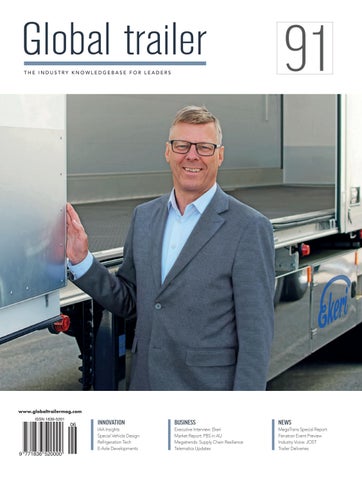
A TOUCH OF INFINITY
The 800,000 km on-road guarantee for the new BPW 7t universal swing axle will take you around the world 20 times. BPW‘s reliable swing axles enable low-loaders, semi-trailers and vehicles for special transport tasks to operate safely and smoothly with heavy and bulky loads in difficult terrain. The new swing axle is available as a 6 or 7-tonne axle and impresses with its compact design, high load capacity and maximum flexibility – for greater cost-effectiveness in use.
more information: bpw.de/en/swing-axle
YOUR BENEFITS: — Service friendly thanks to maintenance free wheel bearing — Safe and efficient thanks to ECO Drum Brake — Customer specific base plates for perfect vehicle integration
COVER STORY EASY LOADING
16
As shifting legislation and new operational demands redefine the trailer market, Ekeri CEO, Tom Eklund, is steering the Finnish manufacturer into its next era of disciplined, value-driven growth.
20
“ONE OF THE FASTEST WAYS TO IMPROVE ENVIRONMENTAL PERFORMANCE IS TO DEVELOP VEHICLES THAT CAN BE COUPLED TOGETHER AND OPERATED WITH FEWER FUEL-DRIVEN UNITS.” Ekeri CEO, Tom Eklund
IN THIS ISSUE BUSINESS 20
46
48
50
52
54
MARKET REPORT
Performance-Based Standards heavy vehicles are changing Australia’s freight task at unprecedented scale.
INDUSTRY VOICE
FEATURES 24
JOST World CEO, Joachim Dürr, detailed a vision centred on integrated technologies, connected fleets and application-focused innovation.
TRAILER DESIGN
Reducing trailer weight is only valuable when durability, payload and serviceability are protected. Wielton Group is targeting that balance with two semi-trailers developed to improve the efficiency of road transport.
SPECIAL REPORT
A reflection of IAA Transportation 2026.
EVENT REVIEW
A look at MegaTrans which was held in Melbourne, Australia, earlier this year.
EVENT PREVIEW
What to expect from Brazil’s Fenatran exhibition.
42
IAA INSIGHTS
Drawing on launches, demonstrations and conversations from Hanover, Global Trailer explores advances in connected trailers, lightweight construction, electric refrigeration, AIenabled fleet optimisation and next-generation safety systems. Through in-depth features and industry perspectives, the series considers what these developments reveal about the direction of the European trailer sector, the commercial pressures affecting investment and the practical implications for fleets as transport becomes increasingly digital, efficient and sustainable.
REGULARS 04 EDITOR’S NOTE
56 WORLD EVENTS
06 NEWS
58 MEGATRENDS
24
TELEMATICS
The latest developments in telematics with SAF-Holland and Krone. W W W.G LO B A LT R A I L E R M AG .C O M / G LO B A L T R A I L E R / 3
EDITOR’S LETTER
CHAIRMAN
John Murphy john.murphy@primecreative.com.au
CEO
Christine Clancy christine.clancy@primecreative.com.au
INTERNATIONAL SALES
Ashley Blachford ashley.blachford@primecreative.com.au
MANAGING EDITOR
Luke Applebee luke.applebee@primecreative.com.au
c
w
JOURNALIST
BOOM TOWN The trailer industry has looked to e-commerce, electrification and supply chain resilience as key drivers of freight demand for years. Another force is now gathering momentum, Artificial Intelligence. Much of the conversation around AI focuses on software and computing power, but its expansion is creating a substantial physical freight task. Data centres require semiconductors, servers, networking equipment, cooling systems, backup power infrastructure and specialised electrical components moving through increasingly complex global supply chains. Recent research published by DHL and New York University’s Stern School of Business found AI-related goods such as semiconductors and data-transmission equipment accounted for 42 per cent of global goods-trade growth in 2025. During the first quarter of 2026, that figure increased to 76 per cent. Yet AI’s impact on freight extends beyond what the industry will carry. That much was clear at a technology event in Melbourne earlier this year where industry leaders discussed how AI and automation are already being applied to everyday operations. The recurring message was refreshingly pragmatic – start with the problem, not the technology. Panellists described applications ranging from exception management and automated customer 4 / G LO B A L T R A I L E R / I S S U E 91
enquiries to labour planning, fault monitoring and connecting information across transport management, telematics and other operating systems. One speaker explained how AI can complement existing digital systems by connecting processes that traditional automation struggles to accommodate, while another highlighted its potential in monitoring hardware reliability. Importantly, the discussion also challenged the idea that more technology automatically delivers better outcomes. Investment needs a measurable return, systems need to solve genuine operational problems and employees need to understand how the technology improves their working day. There was also a strong sense that AI should build on the industry’s existing digital foundations rather than replace them. It can, instead, sit over the top of established systems. For trailer manufacturers and fleet operators, that creates a dual opportunity. AI is generating freight through enormous infrastructure investment while simultaneously providing new ways to move freight more efficiently. While the AI boom may be powered by algorithms, transport will help make it work.
Paul Lancaster paul.lancaster@primecreative.com.au
HEAD OF DESIGN Clayton Hawley
DESIGN Jacqueline Buckmaster, Bea Barthelson and Laura Drinkwater
CLIENT SUCCESS MANAGER Ben Sammartino ben.sammartino@primecreative.com.au
COVER Image: Ekeri.
HEAD OFFICE
Prime Creative Pty Ltd 379 Docklands Drive Docklands VIC 3008 Australia +61 3 9690 8766 info@primecreative.com.au www.globaltrailermag.com
SUBSCRIPTIONS
+61 3 9690 8766 subscriptions@primecreative.com.au Global Trailer is available by subscription from the publisher. The rights of refusal are reserved by the publisher.
ARTICLES
All articles submitted for publication become the property of the publisher. The Editor reserves the right to adjust any article to conform with the magazine format.
COPYRIGHT
Global Trailer is owned by Prime Creative Media and published by John Murphy. All material in Global Trailer is copyright and no part may be reproduced or copied in any form or by any means (graphic, electronic or mechanical including information and retrieval systems) without written permission of the publisher. The Editor welcomes contributions but reserves the right to accept or reject any material. While every effort has been made to ensure the accuracy of information, Prime Creative Media will not accept responsibility for errors or omissions or for any consequences arising from reliance on information published. The opinions expressed in Global Trailer are not necessarily the opinions of, or endorsed by the publisher unless otherwise stated.
FOLLOW US Global Trailer Magazine
T I
connecting
worlds
enabling solutions ahead
Thank you for visiting us at IAA Transportation 2026.
www.jost-world.com/iaa2026
NEWS INTERNATIONAL ASIA CAMBODIA Rhenus Logistics has relocated its Cambodia head office to a larger facility in Phnom Penh as it targets further growth. Rhenus Logistics has moved into GIA Tower on Koh Pich (Diamond Island), situated in Phnom Penh’s central business district. The investment is reported to follow a series of successful project deliveries in Cambodia, including government infrastructure projects, and aligns with its strategy of positioning the country as a key growth market. The new office is expected to improve accessibility for customers while strengthening support for industries including FMCG, manufacturing, industrial materials, automotive components, renewable energy equipment, life sciences and garments. “The opening of our new office marks an exciting chapter for Rhenus Logistics in Cambodia,” said Rhenus Logistics Managing Director of Myanmar & Cambodia, Rhenus Air & Ocean, Samuel Tan.
Rhenus expands Cambodia logistics operations. Image: Rhenus Logistics.
6 / G LO B A L T R A I L E R / I S S U E 91
“Over the past few years, we have built a strong team, expanded our customer base, and strengthened our position in the market,” he said. “This investment reflects our confidence in Cambodia’s growth potential and our commitment to supporting customers with reliable and innovative logistics solutions tailored to their evolving supply chain needs.” The expansion comes as Cambodia continues to strengthen trade policy, market access and business competitiveness ahead of its graduation from the United Nations’ Least Developed Country (LDC) category. From its new headquarters, Rhenus Cambodia will provide freight forwarding, cross-border transport, customs brokerage and project logistics services. The company said it will focus on developing tailored supply chain solutions for both local and foreign-invested businesses operating in key growth sectors. Rhenus Logistics also said the relocation reflects ongoing investment in employee
wellbeing and workforce development. Staff will have access to health and wellbeing initiatives including yoga programs, running clubs and shared sports facilities. The logistics provider is additionally expanding its talent pipeline through internship opportunities for students pursuing logistics-related studies. “Moving into a new office is not just about a new workplace,” said Tan. “It is about creating the right environment for our people, enhancing collaboration, and building the foundation for our next phase of growth. We look forward to continuing our journey with our customers, partners and employees as Cambodia further integrates into regional and global supply chains.” Rhenus Logistics entered the Cambodian market in 2017 and has since achieved ISO 9001, ISO 14001 and ISO 45001 certifications covering quality management, environmental management, and occupational health and safety.
T E F
To build up the Ecosystem of EV-RT and the Fleet Operating Base
NEWS INTERNATIONAL EUROPE
Ulrich Otto Sauer. Image: SAF-Holland.
GERMANY Former SAF-Holland owner and CEO, Ulrich Otto Sauer, passed away on 30 September 2026 at the age of 83. He has left a legacy that influenced modern trailer axle technology and guided SAF-Holland’s development into a global commercial vehicle supplier. A great-grandson of Sauer Achsenfabrik founder Paul Zill, Sauer assumed leadership of the family-owned business in 1974, succeeding his father, Roman Sauer. Equipped with qualifications in both mechanical engineering and business administration, he led the Bavarian manufacturer through a period of sustained growth and technological innovation. Widely recognised as a visionary within the commercial vehicle sector, Sauer’s interest in emerging technologies began during his studies abroad. Among his most significant contributions was the concept of a new trailer axle trailing arm design that ultimately led to the development of the SAF INTRA suspension system. The SAF INTRA chassis would go
8 / G LO B A L T R A I L E R / I S S U E 91
on to become one of the company’s most successful products, undergoing continuous development while achieving widespread adoption across global trailer fleets. Over several decades, Sauer played a pivotal role in expanding both the company and its product portfolio, helping establish SAF as a leading name in commercial vehicle components. His leadership continued until he stepped down as Managing Director in 2004 after laying the foundations for the company’s long-term international success. A major milestone followed in 2007 when Sauer Achsenfabrik merged with US-based HOL-LAND, creating SAFHolland as a European public company. Sauer remained closely involved with the business as a member of the Supervisory Board until 2015. In a statement, SAF-Holland said management and employees across the group join Sauer’s family and loved ones in mourning his passing and remain committed to carrying forward the life work of a leader whose innovations continue to influence the commercial vehicle industry today.
GERMANY Heavy transport and specialised vehicle manufacturer, TII Group, is investing a high double-digit million-euro amount in the redevelopment of its German headquarters and production facilities. The project includes a new corporate headquarters, modern working environments and the gradual replacement of existing production halls with new manufacturing facilities. According to TII Group, the investment reflects the long-term commitment of the Otto Rettenmaier shareholder family
to both the company and Germany as a manufacturing base. The redevelopment is designed to support future growth while strengthening the group’s technological and industrial capabilities. The new headquarters will house more than 200 modern workstations and feature flexible workplace concepts, meeting areas and customer presentation spaces. TII Group employs more than 600 people at the Pfedelbach site and more than 1,000 globally. “Our customers move loads where there is no room for compromise,” said TII Group Chairman, Dr Gerald Karch. “They expect safe, precise and cost-effective solutions, often for challenges that have never been solved before. In our new headquarters, we are bringing technical expertise, practical application experience and customer proximity even closer together. This enables us to translate customer requirements into intelligent vehicle solutions more quickly.” Beyond the office complex, TII Group plans to modernise the entire Pfedelbach manufacturing operation. Existing production buildings will be replaced with facilities designed to improve manufacturing, assembly and logistics processes while providing flexibility for future technologies and products. “The TII Group has doubled its revenue over the past few years,” said TII Group Managing Director, Filippo Baldassari. “Through the largest investment in our company’s history, we are now creating the conditions needed to continue this successful journey. The new headquarters and the renewal of our production facilities strengthen our collaboration, technological expertise and industrial capabilities. This will provide an additional foundation for efficient growth in Pfedelbach.”
C
M
Y
CM
MY
CY
CMY
K
C
A state of the art, upgraded and fully integrated global manufacturing centre of trailer systems and On/Off highway systems. Expertly designed and engineered with worldwide accessibility, offering you private label and OEM manufacturing solutions.
M
Y
CM
MY
CY
Drawing upon decades of expertise spanning Asia, Australia US, and in Europe, Fuwa stands as a global manufacturing powerhouse, unrivalled as the foremost network of specialists in truck and trailer components across the globe.
CMY
K
China
Fuwa Heavy Industries P: 86 750 596633
fuwa.cn
Australia
Fuwa K-Hitch P: 61 3 9369 0000
khitch.com.au
Singapore
Fuwa Engineering P: 65 6863 1806
fuwa.cn
Europe
VALX International P: 31 088 405 8800
valx.eu
NEWS INTERNATIONAL EUROPE The company operates manufacturing sites in Pfedelbach and Ulm in Germany, alongside a production facility in Bawal, India. While the Pfedelbach investment focuses on headquarters and factory renewal, TII said it is also continuing to invest in future technologies such as electromobility at its Ulm operation and has recently expanded manufacturing capacity in India. Known globally through its TII SCHEUERLE and TII KAMAG brands, the group has played a significant role in the development of specialised transport equipment. Among its innovations are the hydraulically supported pendulum axle, the SelfPropelled Modular Transporter (SPMT) and the KAMAG PrecisionMover, which is now also available as a fully electric vehicle. TII highlighted several recent heavy transport projects completed using SCHEUERLE equipment, including the relocation of Hamburg’s 3,700-tonne Stern Bridge, the movement of a 17,500-tonne offshore platform in Norway and the
transportation of a more than 23,000-tonne offshore wind turbine installation vessel in Texas, which established three world records. For the shareholder family, the investment holds special significance as it coincides with the 100th anniversary year of company founder Otto Rettenmaier. “By making the largest investment in our company’s history, we as shareholders are embracing our entrepreneurial responsibility and creating the conditions for a successful future for the TII Group,” said Susanne Rettenmaier, Managing Director of Rettenmaier Familienholding GmbH. “We are investing in modern working conditions, high-performance manufacturing and, above all, in the people whose knowledge, experience and passion define TII.” The investment forms part of TII Group’s broader strategy to expand its global manufacturing capabilities while reinforcing Germany as a key centre for technology development and production.
TII Group launches historic Pfedelbach project. Image: TII Group.
10 / G LO B A L T R A I L E R / I S S U E 91
UK Royal Mail is taking delivery of 100 new box van trailers from UK-based OEM, Montracon, following the development of a bespoke trailer specification tailored to the postal operator’s fleet requirements. The order goes beyond a straightforward fleet replacement program, with Montracon working alongside Royal Mail to develop a dedicated box van specification based on the operator’s specific operational needs rather than adapting an existing design. According to Montracon, its sales and engineering teams collaborated with Royal Mail throughout the development process to understand how the trailers would be used across the company’s nationwide logistics network before finalising the design. The project has resulted in a new Royal Mail-specific box van configuration within Montracon’s product portfolio, adding to the manufacturer’s recently launched Lightweight Box Van range. Montracon said the program reflects the growing demand for applicationspecific trailer designs as fleet operators seek equipment tailored to their individual operating conditions, payload requirements and efficiency objectives. “The right trailer specification starts with understanding how the equipment will actually be used,” the company said. All 100 trailers have been manufactured at Montracon’s Doncaster facility in the UK, with the manufacturer highlighting the importance of close collaboration between its sales, engineering, production and quality teams throughout the project. The company said maintaining in-house manufacturing capability enabled the bespoke specification to be consistently applied across the entire 100-trailer order
EUROPE while meeting Royal Mail’s requirements for quality, durability and fleet uniformity. For Montracon, the order also underscores the continuing role of UK trailer manufacturing in supplying major domestic fleets. “Projects such as the Royal Mail order bring together that manufacturing experience with the ability to develop new products and specifications as fleet requirements evolve,” the OEM said. Deliveries are now underway, with the first trailers already beginning to enter service with the Royal Mail fleet. Montracon said the project demonstrates that trailer specifications should be
shaped around operational requirements rather than a one-size-fits-all approach, noting that different fleets prioritise
factors such as payload capacity, weight reduction and operating environment differently.
Royal Mail orders 100 custom Montracon box vans. Image: Montracon.
www.cargobull.com
Temperature-controlled transport perfectly effective.
With the S.KO COOL reefer Transport temperatured goods more cost-effectively. The vapour diffusiontight FERROPLAST® body together with the high-efficient S.CU cooling unit and the smart TrailerConnect® telematics system ensure optimised and reliable transportation.
Find out more at schmitz.cargobull.com/ cool-freight
NEWS INTERNATIONAL NORTH AMERICA US C.H. Robinson has agreed to acquire RXO in a stock-and-cash transaction valued at $5.8 billion USD (approx. €4.9 billion), creating a combined company with an enterprise value exceeding $25 billion USD (approx. €21.2 billion). The acquisition brings together two major North American third-party logistics providers, combining C.H. Robinson’s global forwarding, managed transportation and multimodal capabilities with RXO’s strengths in freight brokerage, expedited transport and last-mile delivery. The companies expect the enlarged network to improve density, increase freight volumes and strengthen customer service across a broader range of transport solutions. A key objective of the transaction is the deployment of C.H. Robinson’s Lean AI operating model across RXO’s business. The company expects the initiative to deliver approximately $300 million USD (€255 million) in net run-rate cost synergies within two years of completion through operating efficiencies, shared-services savings and procurement optimisation. C.H. Robinson President and CEO, Dave Bozeman, said the deal represented the next phase of the company’s transformation strategy. “This transaction is a natural next step in our transformation, allowing us to create a more scaled, resilient North American thirdparty logistics provider positioned to offer exceptional customer service and redefine the future of our industry,” he said. Bozeman said both businesses shared a strong customer focus and complementary capabilities. “Like C.H. Robinson, RXO is a customerfocused company with expertise and talent that will allow us to expand our capabilities to better support customers of all sizes on
12 / G LO B A L T R A I L E R / I S S U E 91
C.H. Robinson President and CEO, Dave Bozeman. Image: C.H. Robinson.
their most complex challenges.” He added that the integration would be driven by technology-led productivity gains. “By applying our proven Lean AI model to RXO’s business, we expect to significantly enhance productivity to unlock compelling cost synergies.” According to C.H. Robinson, the acquisition will also significantly expand its proprietary datasets, enhancing the speed and precision of its AI-powered sales, freight matching and procurement capabilities. The combined company is expected to benefit from greater market visibility, broader customer exposure and improved resilience throughout freight market cycles. C.H. Robinson said RXO’s addition would increase network density while strengthening its position in the fragmented North American third-party logistics sector. RXO Chairman and CEO, Drew Wilkerson, said the transaction would create new opportunities for customers and employees alike. “Joining C.H. Robinson represents an exciting next chapter for our company, our employees and our customers,” he said. “We have built a strong business by staying relentlessly focused on our customers, operating with agility and delivering
solutions that help them navigate an increasingly complex supply chain.” Wilkerson said the complementary nature of the two businesses would increase value for customers. “By bringing together our complementary capabilities, talented teams and shared commitment to service, we will be able to offer customers greater scale, broader capabilities and even more value.” The transaction is expected to strengthen C.H. Robinson’s financial profile, with the company forecasting adjusted earnings per share accretion within nine months of completion and further gains in 2028. Increased cash flow generation is also expected to support rapid deleveraging while maintaining flexibility for future growth investments. RXO shareholders are expected to own approximately 11 per cent of the combined company upon completion of the transaction. The merger agreement has been unanimously approved by the boards of both companies and is expected to close in the first half of 2027, subject to regulatory approvals and RXO shareholder approval. Upon completion, RXO will be integrated primarily into C.H. Robinson’s North American Surface Transportation division.
SOUTH AMERICA BRAZIL Brazil’s trailer and semi-trailer market posted modest growth through the first nine months of 2026, prompting industry association ANFIR to suggest the sector may be moving into a more stable phase of recovery. According to the National Association of Road Implement Manufacturers (ANFIR), registrations in the trailer and semi-trailer segment reached 53,774 units between January and September 2026, up 0.22 per cent from 53,657 units recorded during the same period last year. The association said September was the second-strongest month of the year for
registrations, with 14,202 units sold, behind only July’s total of 15,173 units. While the trailer and semi-trailer market showed signs of improvement, the body-on-chassis segment remained under pressure. Sales in that category fell 3.05 per cent year-on-year to 55,941 units, compared with 57,698 units in the first nine months of 2025. Combined sales of road implements across both segments reached 109,715 units from January to September, down 1.47 per cent on the 111,355 units sold in the corresponding period last year. ANFIR President, José Carlos Spricigo, said the latest figures suggest the market
is gradually finding balance following recent volatility. “The performance of the trailer and semi-trailer sector may signal that we are moving toward equilibrium, indicating that the recovery is consolidating,” said Spricigo. He also pointed to the upcoming Fenatran transport exhibition, scheduled for November, as a potential catalyst for stronger demand in the months ahead. “With Fenatran taking place in November, an event expected to have a positive impact on business for at least the following four months, we could potentially see results slightly exceeding those of 2025,” said Spricigo.
NEWS INTERNATIONAL OCEANIA AUSTRALIA Bruce Baird, inaugural Chair of the National Heavy Vehicle Regulator (NHVR) Board and a respected leader in Australian transport and public service, has passed away. Baird played a pivotal role during the establishment of the NHVR and guiding the organisation through its formative years. Serving as Chair from the regulator’s inception, he helped set the strategic direction of the NHVR and oversaw its development as Australia’s first national heavy vehicle regulator. Before his involvement with the NHVR, Baird enjoyed a distinguished political career spanning both state and federal politics. He served in the NSW Parliament before representing the federal NSW seat of Cook between 1998 and 2007. During his time in state government, he held several ministerial portfolios, including Transport, Roads and Tourism, and played a key role in securing the 2000 Sydney Olympic Games. As the inaugural Chair of the NHVR Board, Baird guided the organisation through a significant period of reform and change, helping bring together government and industry in pursuit of a safer, more productive heavy vehicle industry. Tributes have flowed from across Australia following news of his passing. Prime Minister, Anthony Albanese, described Baird as “a real gentleman and a true parliamentarian”, noting that he served “with distinction, and he served with principle and unwavering humanity”.
Former Prime Minister Scott Morrison called him “a giant, a mentor and a friend”, while former Prime Minister Malcolm Turnbull remembered him as “a genuine liberal, motivated by love, not hate”. Baird was also recognised for his humanitarian work, including his advocacy on refugee issues and his appointment as Chair of the Refugee Resettlement Advisory Council -in 2008.
He was awarded membership of the Order of Australia in 2010 for his service to public life. “Baird’s leadership was characterised by integrity, professionalism and a genuine commitment to public service, and his contribution to the Australian transport industry extended well beyond the NHVR and will be remembered by many across the sector,” the NHVR said in a statement.
Vale Bruce Baird. Image: NHVR.
14 / G LO B A L T R A I L E R / I S S U E 91
Krone_A
OCEANIA AUSTRALIA MaxiPARTS has completed its approx. €6.9 million acquisition of an Australian commercial vehicle braking specialist. Based in Hornsby, New South Wales, Air Brake Systems (ABS) employs 20 people and generates annual revenue of approximately €12.4 million. Around 60 per cent of its revenue comes from supplying brake kits to trailer OEMs, with the remainder generated through aftermarket parts, technical support and telematics. ABS is one of three authorised Wabco OE brake distributors in Australia and also distributes products from Raufoss,
Kongsberg, Knorr-Bremse and Haldex. MaxiPARTS expects the acquisition of ABS to strengthen its trailer OE offering, combining the company’s technical expertise and customer relationships with its national warehousing and distribution network. MaxiPARTS Managing Director, Peter Loimaranta, said the businesses shared a focus on customer service and highquality commercial vehicle products. “With Air Brake Systems’ marketleading product range and technical expertise in commercial vehicle braking, combined with MaxiPARTS’ national scale, extensive network and established
support systems, the acquisition brings together two businesses with a shared commitment to meeting customers’ needs through high-quality service, products and solutions,” he said.
MaxiPARTS completes acquisition. Image: MaxiPARTS.
U‘D O Y E R ATU E ELF F S R E U H T O ND Y I F Y . L T K U O H QUIC T K WI R A D E IN TH
Krone_Australien_GlobalTrailer_200x135plus5_DU261010_Telematics.indd 1
06.10.2026 09:21:52
EASY
Robert Nyholm (left), Key Account Manager, and Anders Björklund, Sales Manager Europe, present an EXIII trailer. Anders is responsible for markets outside Scandinavia.Images: Ekeri.
16 / G LO B A L T R A I L E R / I S S U E 91
LOADING
G
COVER STORY
AS SHIFTING LEGISLATION AND NEW OPERATIONAL DEMANDS REDEFINE THE TRAILER MARKET, EKERI CEO, TOM EKLUND, IS STEERING THE FINNISH MANUFACTURER INTO ITS NEXT ERA OF DISCIPLINED, VALUE-DRIVEN GROWTH.
E
keri has long held a distinctive position in the Nordic trailer market. It specialises in side-opening vehicles that prioritise durability and total cost of ownership over headline price – an approach that has earned the Finnish manufacturer a loyal customer base and a reputation for being exceptionally easy to work with. It is into this environment that Ekeri’s new CEO, Tom Eklund, steps up, bringing with him decades of technical and operational experience shaped almost entirely within the company. Having served in roles ranging from Production Manager to Technical Director, Eklund said his deep familiarity with Ekeri’s processes, people and products has given him a strong understanding of how manufacturing works as well as the challenges the OEM faces in daily operations. Eklund’s professional journey is unusually comprehensive for a CEO in the trailer industry. After completing his engineering studies at the Helsinki University of Technology, now Aalto University, he joined Ekeri and spent nearly his entire career inside the company. Over the years he worked as Production Manager, Purchasing Manager, Logistics Manager, Property Manager and, for 15 years, Technical Director. From the outset, Eklund said he was determined to preserve the cultural strengths that have long defined the company. He wants employees to feel empowered to make decisions at the level where they are most appropriate, and he wants the distance between assembler and manager to remain uncomplicated. “I want to encourage our employees to take responsibility,” he said, emphasising that involvement and openness are essential to Ekeri’s identity. He also stressed that the company should remain easy to work with, both internally and externally, and that its values should be visible in every interaction. This philosophy is captured in the internal slogan WeAreEkeri, which he interprets as a commitment to collaboration,
transparency and shared purpose. People should not fear making mistakes, he said, but they should be willing to learn from them, because in most cases the issue is that a process has not been clear enough. The Ekeri product offering is equally distinctive. The company specialises in vehicles with side-opening doors, a configuration particularly suited to the Nordic market where gross vehicle weights are high and operational flexibility is essential. “Customers do not choose an Ekeri vehicle primarily based on price,” said Eklund. “They choose an Ekeri vehicle for its total cost of ownership and flexibility.” He added that the flexibility provided by the side-opening doors is often underestimated. This focus on value over price has shaped Ekeri’s customer relationships, which he described as one of the company’s greatest strengths. “We know our customers, and we are able to work with them in a constructive way,” he said. The specialised nature of the product also allows the trailer builder to maintain efficiency and consistent quality in production, supported by highly skilled employees who understand the requirements of modern road transport. Eklund’s early months as CEO were shaped by a need to bring greater structure to a growing organisation. “As a person, I value structure and clarity,” he said, noting that the company had made several major investments during 2025. The next step, he explained, is integrating those operations into the parent company. The group now comprises companies. Eklund said there is a clear need to clarify processes across the entire organisation. Standardised ways of working must be introduced in all functions, ensuring that growth does not come at the expense of consistency. His leadership style, he said, is based on clarity, structure and processes – an approach that aligns naturally with the company’s need for integration and alignment. Looking ahead five to ten years, Eklund’s long-term vision for Ekeri is defined by
Ekeri CEO, Tom Eklund, presents a trailer designed for the European market. The dry-freight trailer is equipped with side-opening doors and a tarpaulin roof and is XL certified.
W W W.G LO B A LT R A I L E R M AG .C O M / G LO B A L T R A I L E R / 1 7
stable growth and consistent results. He sees the company’s presence in Scandinavia increasing further, while also investing in strengthening its position in the most important European markets. This measured approach reflects both the company’s heritage and the realities of the trailer industry, where long product lifecycles, regulatory complexity and capital-intensive manufacturing reward consistency over volatility. One of the most significant forces shaping Ekeri’s future is legislation. “I believe legislation will have a major impact on us,” he said, pointing to the many regulatory changes taking place within the EU. These changes place increasing demands on manufacturers, and while Ekeri’s deep understanding of regulations is a strength, the company must still navigate the challenge of developing products that improve customer value while complying with evolving rules. Electrification and the introduction of VECTO calculations for trailers are two areas he identified as particularly influential. Ekeri has already participated in two electrification projects in cooperation with Volvo, gaining valuable insights into how trailers can support the transition to low-emission transport. Electrification is not yet a core development priority, but it is an area where the company is learning quickly. VECTO, meanwhile, represents one of the most significant regulatory shifts in years, and Eklund said it deserves special attention because it will shape product development and customer decision-making across Europe. Ekeri’s reputation for temperature-controlled and side-opening trailer solutions is well established, and Eklund intends to build on that legacy. “We will continue to invest in improving our core products,” he said, noting that new materials and equipment are constantly being developed to enhance customer value and maintain competitiveness. Among the products he highlighted were the company’s EXIII and FRC semi-trailers with side-opening doors, which he described as particularly important to the company’s future. One of the most promising growth opportunities for Ekeri lies in the defence sector. Demand for specialised transport equipment has surged, and the company’s EXIII products,
18 / G LO B A L T R A I L E R / I S S U E 91
equipped with side-opening doors, are well suited to this segment. “Everything that is manufactured must also be transported,” Eklund said, noting that materials for the defence industry increasingly require equipment adapted for sensitive cargo. At the same time, he sees growing recognition of the benefits of side-opening doors in cross-border transport. The flexibility they provide for return loads is becoming more important as operators seek to maximise utilisation and reduce empty kilometres. As cross-border transport increasingly recognises the need for this system, the value of Ekeri’s specialised design becomes even clearer. Innovation plays a central role in Ekeri’s strategy, supported by the company’s own development department. This department continuously improves existing products and develops new solutions, although its scope is naturally shaped by available resources. Eklund said the department’s work is essential to the company’s long-term competitiveness. Digitalisation and connected transport solutions, however, are not currently a major focus. Ekeri stays informed and responds to customer requests but does not see connected systems as a core development priority at this stage. This selective approach ensures that resources are directed where they deliver the most value.
COVER STORY
Assembly of side doors on a special 14.8-metre HCT dry-freight vehicle. The trailer is equipped with three axles, including a self-steering rear axle, to improve manoeuvrability and comply with Finnish HCT legislation.
Sustainability is another area where Ekeri has taken concrete steps. The company has already measured its Scope 1 and Scope 2 emissions, with the result that its factory is carbon neutral. It has also conducted simulations for Scope 3, gaining insight into the broader environmental footprint of its supply chain. A large share of components is sourced from local suppliers, a practice Eklund said the company will continue. The side-door function also contributes to environmental performance by enabling full utilisation on both outbound and inbound journeys. “One of the fastest ways to improve environmental performance is to develop vehicles that can be coupled together and operated with fewer fuel-driven units,” he said. Increasing total vehicle weights, if permitted, would further enhance efficiency, and all of this becomes even better if cross-border traffic is also allowed. This is sustainability grounded in operational reality, not marketing rhetoric. The trailer industry is facing a convergence of challenges: new EU laws, rising customer expectations, supply-chain disruptions and cost pressures. For Ekeri, meeting these challenges requires both strategic foresight and operational discipline. Eklund said regulatory compliance is
San Maw attaching a hinge to a door element – one of the components in the complete side-door package.
one of the biggest challenges, requiring dedicated resources to understand and prepare for new requirements. Customers, meanwhile, expect flawless performance between scheduled service intervals – a standard that leaves little room for error. Supply-chain volatility has also reshaped the company’s approach. Ekeri is strengthening cooperation with suppliers, increasing its use of AI to analyse market events and continuously gathering supplier input on price adjustments. At the same time, it is actively seeking alternative suppliers to ensure resilience. These are not temporary measures—they are the new normal. Customer expectations are evolving, especially among larger transport companies and logistics providers. Eklund said expectations of Ekeri as a product supplier are that the product should function flawlessly between scheduled service intervals. Customer feedback plays a crucial role in shaping company decisions and product development. “We are continuously improving the customer value of our products,” he said, noting that Ekeri has a process updated annually to collect customer feedback. This feedback loop is essential to the company’s ongoing efforts to enhance customer value. Despite his long tenure at Ekeri, Eklund said stepping into the CEO role brought surprises. “I believe the personnel responsibility is greater than I had imagined,” he said, adding that the volume of administrative discussions was also unexpected. Yet these challenges have reinforced his commitment to fostering a workplace culture where employees feel supported, informed and empowered. Under his leadership, Ekeri aims to remain a company where it is easy to raise concerns, easy to collaborate and easy to take pride in the work. Ekeri’s external slogan, Easy Loading, is widely recognised in the industry. But for Eklund, it represents far more than a description of the company’s side-door system. “It means that it should be easy to work with us,” he said. “Easy Loading means much more than transport. We mean that it should be easy to work with us.” www.ekeri.com
W W W.G LO B A LT R A I L E R M AG .C O M / G LO B A L T R A I L E R / 1 9
CRITICAL
MASS Aerial view of a road train in outback Australia. Image: Jonathan/stock.adobe.com.
PERFORMANCE-BASED STANDARDS HEAVY VEHICLES ARE CHANGING AUSTRALIA’S FREIGHT TASK AT UNPRECEDENTED SCALE.
A
ustralia’s high productivity scheme – Performance-Based Standards (PBS) – recognises productive, safer and more efficient alternatives to conventional heavy vehicle combinations. They were largely associated with early adopters prepared to navigate complex approval processes and restricted access
networks. The latest National Heavy Vehicle Regulator (NHVR) annual report suggests that period has passed. PBS is no longer a niche concept. It has become a significant component of Australia’s freight economy, carrying more than a quarter of the national road freight task and achieving growth rates that are reshaping the composition of the heavy vehicle fleet. During 2024-25, the NHVR reached a milestone of 33,599 PBS-certified vehicle units, representing a 39 per cent increase compared with the previous financial year. Over the same period, 5,157 PBS vehicle approvals were granted while 33,599 individual vehicles were added to the scheme. PBS vehicles now account for approximately 27 per cent of the national road freight task, equivalent to 72.2 billion tonne kilometres. Growth of that magnitude is difficult to ignore. The PBS scheme was established as an alternative to Australia’s traditional prescriptive vehicle regulations. Rather than complying with fixed dimensional and configuration requirements, vehicles are assessed against performance standards designed to ensure they operate safely and efficiently. The result has been the gradual development of increasingly sophisticated combinations capable of moving more freight with fewer trips. What is changing now is not simply the availability of PBS vehicles but the breadth of their adoption. According to the NHVR, PBS vehicle uptake has more than doubled the average
20 / G LO B A L T R A I L E R / I S S U E 91
growth recorded over the previous five years. The regulator described the increase as a significant milestone and linked it directly to efforts aimed at improving productivity, reducing emissions and modernising Australia’s freight fleet. The implications extend well beyond operators. For trailer manufacturers, PBS growth represents one of the clearest indicators of how rapidly freight equipment requirements are evolving. A scheme that once focused on a relatively small number of specialist combinations is now influencing mainstream fleet purchasing decisions, infrastructure planning and regulatory reform discussions across the country. Much of that growth is being driven by increasingly productive combinations. PBS vehicles recorded an average productivity gain equivalent to a payload of 18.6 tonnes above conventional alternatives performing the same freight task, while average utilisation climbed to 165,455 kilometres annually during 2024-25. The result is a fleet that is carrying more freight over greater distances while reducing the total number of vehicle movements required. The annual report also highlights considerable momentum in PBS approvals. In 2024-25, the NHVR received 854 PBS
MARKET REPORT
FAST FACT Australia reached 6,127 PBS vehicle combinations in 2024-25, up from 3,928 the previous year.
vehicle design applications and approved 821. Vehicle approval applications reached 5,117, with 5,157 approvals finalised. These figures continue a multi-year trend of sustained growth in both new vehicle designs and approved combinations. Among vehicle categories, A-doubles continued to be the dominant configuration. The NHVR recorded 269 A-double design applications during the year, more than any other vehicle type. Prime mover and semitrailer configurations also remained significant, while truck and dog combinations continued to generate substantial approval volumes. That distribution reflects changing freight requirements across multiple sectors. Livestock operators, bulk haulage businesses, container carriers and regional freight operators have increasingly sought combinations capable of delivering higher payloads while maintaining safety and network compatibility. PBS has emerged as the mechanism through which those productivity gains are being achieved. The NHVR’s own productivity measures reinforce the point. A new national performance measure introduced during the year tracks the percentage of freight moved by PBS vehicles relative to the
overall road freight task. The result reached 27.5 per cent, increasing by 6.6 per cent over the previous period and exceeding the regulator’s target. Importantly, this expansion is occurring alongside broader changes to the road access environment. The regulator reported that more than six million kilometres of road are now included within gazetted access networks. Expansion of these networks, combined with increased use of statutory notices and pre-approvals, is intended to reduce permit requirements and simplify access arrangements for productive combinations. Road access has historically represented one of the greatest barriers to PBS adoption. A vehicle capable of delivering exceptional productivity can only realise its full value if it can access the routes required by the freight task. The NHVR’s strategy increasingly focuses on expanding those opportunities by working with road managers and jurisdictions to create broader and more connected networks. Evidence of that approach can be found in the Strategic Local Government Asset Assessment Project (SLGAAP), which continues to assess bridges and culverts around Australia. The program has now completed 1,092 bridge and asset assessments. Data gathered through the initiative has demonstrated that refusal rates for PBS vehicles on assessed assets have fallen from 10 per cent in 2020 to just over 2 per cent in 2024. Assessments also identified dozens of previously restricted assets capable of supporting higherproductivity combinations. For manufacturers, those changes matter because access and equipment investment are inseparable. A fleet operator is far more likely to invest in sophisticated trailer equipment when it can operate across a broader network and serve a wider range of freight tasks. Every kilometre added to the PBS network potentially increases the commercial viability of higher-productivity equipment. Productivity, however, represents only part of the PBS story. The NHVR’s sustainability data indicates that PBS vehicles are also generating measurable environmental benefits. As of 30 June 2025, PBS vehicles had delivered fuel savings equivalent to more than 306 million litres compared with conventional vehicle combinations undertaking the same freight task. The regulator calculated associated carbon dioxide savings of 818,687 tonnes. Both outcomes substantially exceeded performance targets established for the reporting period. Those results are significant because they position productivity and sustainability as complementary objectives rather than competing priorities. The ability to move more freight using fewer trips has created opportunities to reduce fuel consumption and emissions without reducing transport capacity. The NHVR repeatedly identifies higher-productivity vehicles as a mechanism for achieving both economic and environmental outcomes simultaneously. That connection is becoming increasingly important as governments and industry pursue net-zero objectives. The annual report notes the introduction of measures designed to encourage low- and zero-emission vehicles, while also acknowledging that the transition to cleaner freight technologies will require careful consideration of road infrastructure and vehicle access arrangements. The regulator is simultaneously developing a Heavy Vehicle Sustainability Plan to support these objectives. PBS combinations are expected to remain central to that discussion because they offer immediate efficiency gains using technologies already available to operators. The regulator’s position is reflected in ongoing advocacy for PBS reform.
W W W.G LO B A LT R A I L E R M AG .C O M / G LO B A L T R A I L E R / 2 1
MARKET REPORT
Following publication of its Roadblocks to Reform report in 2024, the NHVR continued advocating for legislative amendments designed to accelerate adoption of productive vehicle combinations. The regulator argues that mature and proven PBS designs should have clearer pathways into mainstream regulation rather than remaining indefinitely within specialised approval frameworks. This reform effort represents one of the most consequential policy debates currently underway in the heavy vehicle sector. For operators, the issue centres on reducing administrative burden and accelerating access to productive equipment. For manufacturers, it concerns removing barriers to innovation and creating larger markets for successful vehicle designs. For regulators, the objective is maintaining safety while improving efficiency. The report repeatedly emphasises the need to simplify regulation without compromising outcomes. The NHVR identifies productivity, sustainability and regulatory simplification as interconnected objectives. Its current strategic framework prioritises technological innovation, improved data analysis and national harmonisation as mechanisms for delivering those outcomes. Digital tools are becoming increasingly important in that process. Throughout 2024-25 the regulator expanded the capabilities of NHVR Go and introduced new productivity analysis tools, including the Historic Access Reporting Tool and the Access Permit Rapid Cost Benefit Analysis Tool. Together, these systems are intended to provide better information for access decisions and help identify opportunities to reduce permit volumes. The NHVR is also integrating PBS processes into its digital environment. Work undertaken during the year focused on identifying pathways to digitise PBS design and vehicle approvals and incorporate those workflows into NHVR Go. The regulator intends these changes to streamline approval processes and improve customer experience. Taken together, the developments contained within the annual report point toward a freight sector increasingly organised around higher-productivity vehicles. The NHVR regulates more than 121,300 registered prime movers and 186,000 semitrailers Australia-wide. Image: André Havergo/stock.adobe.com.
22 / G LO B A L T R A I L E R / I S S U E 91
FAST FACT Vehicle approval applications increased from 2,259 in 2020-21 to 5,117 in 2024-25, highlighting rapid industry uptake.
PBS combinations are carrying a larger proportion of Australia’s freight. Certified vehicle numbers are increasing sharply. Network access is expanding. Productivity and sustainability outcomes continue to improve. Regulators are pursuing reforms designed to reduce barriers and encourage broader adoption. The statistics show a transport task progressively being performed by equipment operating beyond the limitations of traditional prescriptive design models. What began as an alternative pathway has become an integral part of Australia’s freight system. The latest NHVR figures indicate PBS has moved beyond experimentation and early adoption and established itself as one of the defining forces shaping heavy vehicle operations across the country. www.globaltrailermag.com
World Premiere for BPWs Wheelend ECO Pro. Images: BPW.
THE DATA
ADVANTAGE
DIGITALISATION, ARTIFICIAL INTELLIGENCE AND FLEET INTELLIGENCE ARE EMERGING AS THE NEXT FRONTIER FOR TRAILER TECHNOLOGY AS PERSONALLY LIABLE MANAGING PARTNERS ACHIM KOTZ AND MARKUS SCHELL POSITION BPW’S FUTURE BEYOND TRADITIONAL RUNNING GEAR. More than 200,000 trailers across Europe now operate on BPW’s Eco Air suspension system, highlighting demand for durable and costeffective fleet solutions.
24 / G LO B A L T R A I L E R / I S S U E 91
I
nnovation has long been central to BPW’s identity, but at IAA Transportation 2026 the company made it clear that software, telematics and services are becoming as important as axles, suspensions and wheel ends. Alongside products such as Hestal’s Flowmaster, friction-reduced Wheelend ECO Pro, steering axle technology and the latest IC Plus platform, BPW’s message was increasingly centred on what data can tell fleets and how it can be used to improve operational performance. “At IAA we bring together engineering innovation and digital intelligence,,” said Markus Schell. “Our focus is on helping fleets run more efficiently by using relevant trailer data for daily operations.” For BPW, the challenge is no longer simply collecting information from trailers. The focus has shifted to turning that information into meaningful decisions. “We see the first fleets who use data in a very structured way to optimise their equipment, and also their spare part and workshop strategies,” said Schell. “We are collecting data, but we also give them advice to optimise their fleet processes.” That capability is also increasingly powered by
IAA INSIGHTS
artificial intelligence. For example idem telematics AI solution, developed with Microsoft Copilot on a secure database, allows fleet managers to interrogate operational data through natural language rather than static reports. “You can ask an AI assistant in the telematics platform how many trailers have to go to the workshop next week and why,” said Schell. Yet both executives were careful to stress that AI is an enabler rather than a replacement for human expertise. “The consulting will still be human,” said Schell. “The interpretation has to be on a personal side.” Achim Kotz agreed, adding: “It’s people business. I don’t know if our generation is ready to just talk to a machine.” Regulation continues to shape much of the innovation pipeline. European requirements around trailer efficiency, braking performance and sustainability are driving development, although BPW maintains that many of the resulting technologies offer commercial benefits regardless of legislative mandates. “If you save diesel consumption, if you save tyre wear, if you have a better payload, it’s always good for your wallet, and at the same time, it’s good for environment,” said Kotz. At the same time, sustainability must remain commercially viable. “Sustainability is expensive,” said Kotz. “We have to be clever and combine it, and then again it comes to innovation of BPW. We always try to combine sustainability, but also the business and the competitiveness.” The company’s close relationships with major fleets remain critical to that approach. BPW recently expanded its partnership with Waberer’s for example, which the company views as an important source of operational insight and product validation. “The fleet is the source of getting ideas for innovation,” said Schell. “The trailer manufacturer provides only limited insights into the fleet operator’s needs, especially across the entire lifecycle. To really understand those needs, you have to engage directly with the fleets themselves. “According to BPW, those relationships have become increasingly valuable as operators seek greater efficiency from existing assets and extend vehicle lifecycles. More than 200,000 European trailers are now operating on BPW’s Eco Air
Achim Kotz, personally liable managing partner, in dialogue with customers at the BPW booth.
Markus Schell, personally liable managing partner, showcasing the BPW fleet service portfolio to political representatives.
suspension system, reflecting strong demand for standardised, cost-effective and durable solutions. BPW expects to see continued opportunities in digital services, lifecycle support and selective remanufacturing, while taking a measured view on trailer electrification. Both executives suggested electric trailer axles will likely remain relevant in specific applications such as mining, logging and road trains, but could become less necessary as battery-electric trucks become more widespread. Perhaps the most intriguing observation from BPW’s leadership was not technological but structural. While the industry focuses on software, AI and electrification, Kotz believes consolidation among European trailer manufacturers could have an equally profound impact. “The biggest question for me is how many trailer builders will be in Europe in four, six, eight years,” he said. “Consolidation will take place, and it’s already taking place.” For BPW, however, the strategy remains unchanged. The company is open to acquisitions that support its transport-focused mission, particularly in software and digital services, but remains cautious about diversification for its own sake. www.bpw.de
W W W.G LO B A LT R A I L E R M AG .C O M / G LO B A L T R A I L E R / 2 5
VALUE
ENGINEERED
SCHMITZ CARGOBULL CEO, ANDREAS SCHMITZ, SPOKE TO GLOBAL TRAILER AT IAA TRANSPORTATION 2026 ABOUT HOW SMARTER PRODUCTION, ARTIFICIAL INTELLIGENCE AND INTEGRATED TECHNOLOGY ARE DELIVERING MEASURABLE VALUE FOR TRANSPORT OPERATORS.
Schmitz Cargobull CEO, Andreas Schmitz, at a press conference held at IAA Transportation. Images: Schmitz Cargobull.
A
significantly expanded presence at IAA Transportation 2026 reflected the growing breadth of Schmitz Cargobull’s products, partnerships and international ambitions. According to Andreas Schmitz, the larger exhibition space was needed to bring the company’s evolving strategy together in one location. “We just didn’t have enough space anymore to showcase all the products and partner products that we have available,” he said. “Those are European partners and international partners, and we really wanted to make that available to our customers.” The display brought together trailers, transport refrigeration units, insulation technology, telematics and digital services. While the company continues consolidating and broadening its offering in Europe, Schmitz said its international strategy is centred on capabilities that can add value to regional manufacturers and operators. “Outside Europe, we’re bringing out cooling technology,” he said. “That’s the insulation panels, the transport refrigeration units, the telematics and the data behind it. That’s the strategy for the next years, and we’re implementing it.” Central to that approach is the promise of delivering more value throughout the working life of a trailer. Schmitz said this sometimes requires a higher initial investment in technologies that lower maintenance requirements or operating costs over time. A galvanised chassis is one example. Although more expensive to manufacture, its resistance to corrosion can reduce repainting requirements and improve vehicle availability. “At the end of the day, when you don’t have to repaint it and it’s always available, it
26 / G LO B A L T R A I L E R / I S S U E 91
adds a lot of value to the customer,” said Schmitz. “It typically should have a payback of two to three years.” The company is applying the same life-cycle approach to refrigerated transport. Its automated panel production system has reduced the thermal transmittance, or K-value, of its insulation panels from the regulatory benchmark of 0.4 to below 0.3. Schmitz said the improved thermal performance could reduce refrigeration unit running time by approximately 25 per cent, creating meaningful fuel and cost savings for fleets operating units for thousands of hours each year. Further refrigeration efficiencies have been achieved through digital control. In the company’s S.CU dc100 refrigeration system, the evaporator fans have been separated from the drivetrain, allowing their speeds to be controlled independently according to cooling demand. “We can more optimally get the cool air where it needs to be,” said Schmitz. “That in itself can reduce diesel consumption by eight per cent, and we have about an 11 per cent increase in cooling capacity.” Payload and durability have also guided the development of the company’s latest chassis technology. Schmitz said approximately 100 kilograms compared with the previous MEGA chassis had been removed from the chassis while its standard floor rating had increased from seven to eight tonnes. Knowledge gained through the acquisition of specialist manufacturers is contributing to this development process. Schmitz said Berger’s expertise in lightweight trailers had particular relevance for operations crossing the Alps and other routes where payload capacity is routinely maximised. “We’re continuously learning,” he said. “We
IAA INSIGHTS
bring that into our products, and there are certain things that we’ve brought from the Schmitz Cargobull world into the lightweight Berger products as well.” These improvements include a stronger body, an aluminium front wall and access to a broader spare-parts network. Data is becoming equally important to product development and aftersales support. Schmitz said information collected from vehicles operating across different markets helps engineers understand the forces acting on drivetrains, axles and other components. “You have to know what you’re testing against,” he said. “That has been our strength for decades. All the data that we have flows into that knowhow and helps our test centre get the product right.” The objective is to achieve an effective balance between tare weight and durability rather than engineering a product solely to perform well under an isolated laboratory test. Artificial Intelligence is also helping the company make its accumulated technical knowledge more accessible. Its DR. COOL diagnostic platform combines service manuals, technical instructions and historical fault information to guide refrigeration technicians through potential causes of a problem. “We’re using AI and bringing in all the data, instruction booklets and problems that we’ve had,” said Schmitz. “You ask a question and it presents the information in a format that allows you to quickly decide the most probable cause of a problem.” Rather than requiring a technician to search through multiple manuals, the system can prioritise diagnostic steps according to their probability and complexity. “The trick is to make the know-how available to the technician at the moment they need it,” said Schmitz. “The unit is back on the road quicker, and the repair itself is cheaper.” DR. COOL: AI-powered service assistant for the maintenance and repairs of cooling units.
DR. COOL is already being used by technicians and support teams, with Schmitz confirming that the multilingual platform is intended to be made available across the company’s markets. Electrification is another area in which flexibility will be essential, particularly during the transition from diesel-powered equipment. Schmitz said refrigerated transport represents an immediate opportunity because the refrigeration unit is a direct source of trailer-related carbon dioxide emissions. The trailer builder has developed a system that can take electrical power from the prime mover through an ePTO ready connection. It can also operate from shore power when parked, while retaining diesel capability when neither source is available. “We’re giving a maximum of flexibility,” said Schmitz. “Especially in this transition time, I think that will be the correct solution for our customers.” While fully electric refrigeration systems may eventually remove the diesel engine altogether, Schmitz said suitable battery technology would be required to maintain operational resilience. For electric trucks more broadly, he identified infrastructure and affordable electricity as the principal constraints on adoption. “The products are there, they function and they are cheaper to run if electricity is available at a reasonable cost,” he said. “It’s the infrastructure and the availability of cheap electricity that are now hampering the introduction in Europe.” Automation and digitalisation within the company’s production network are meanwhile improving accuracy, insulation performance and capacity. At its automated frame factory, production data is supplied directly to machinery and collected for analysis by engineers. Schmitz said tighter manufacturing tolerances were delivering more consistent assembly and improved thermal performance, while the production takt time had been reduced from 15 minutes to 10 minutes. “What we used to produce in three shifts, we can now produce in two shifts,” he said. “At the same time, we have additional capacity available should it be needed.” That flexibility is increasingly important in volatile markets, where operators expect manufacturers to provide equipment when it is required. “Availability of product is always key for customers,” Schmitz said. “They want the product when they need it and as quickly as possible, and that we can accommodate.” The company’s acquisition strategy will remain similarly disciplined. Outside Europe, Schmitz said potential investments must create identifiable synergies through refrigeration, insulation, telematics or data technology. “If we don’t add something, what’s the point?” he said. “Internationally, you will see only acquisitions that are going into that space.” Within Europe, specialist manufacturers can also benefit from the company’s established sales and service infrastructure. “In Europe, we have a good sales network and a good service network,” Schmitz said. “We add other players because those specialised manufacturers benefit from those networks.” Looking towards the next IAA Transportation, Schmitz expects innovation to remain the company’s clearest measure of progress. “You will see just as many new products and just as many new patents,” he said. “We’re already working on a few new products where I’m convinced it will be worth everybody’s time, and where once more we will add more value for our customers.” www.cargobull.com
W W W.G LO B A LT R A I L E R M AG .C O M / G LO B A L T R A I L E R / 2 7
BUILDING ENERGY
ECOSYSTEMS
A
A view of the Carrier stand at IAA Transportation. Images: Carrier Transicold.
CARRIER TRANSICOLD IS POSITIONING TRANSPORT REFRIGERATION AS AN INTEGRATED ENERGY SYSTEM RATHER THAN A STANDALONE COMPONENT, COMBINING ELECTRIFICATION, LOWER-GLOBAL-WARMINGPOTENTIAL REFRIGERANTS, INTELLIGENT ENERGY MANAGEMENT AND CONNECTED FLEET SERVICES.
t its IAA Transportation press conference, Carrier Transicold opened by setting out its approach to innovation. For the company, innovation only matters when it creates value. That value should last beyond the point of purchase and continue throughout the entire lifecycle of the equipment, from its first day in service to its last. This year, Carrier Transicold sees that innovation being shaped by three forces transforming refrigerated transport: electrification, decarbonisation and digitalisation. With this in mind, the company presented its latest innovations, starting with electric cold chain solutions. It stressed that the traction battery, refrigeration unit, trailer, charging infrastructure and supporting digital platform increasingly need to work together as one connected system.Under this approach, the company presented its overall latest innovations starting with a focus of electric cold chain solutions and highlighted that the traction battery, refrigeration unit, trailer, charging infrastructure and supporting digital platform must increasingly operate as one connected system. The centrepiece of Carrier Transicold’s trailer electrification offering is [R]eCool, a 38.5kWh battery platform that can be installed on new equipment or retrofitted to compatible refrigeration units. Depending on the duty cycle, the system can provide up to 10 hours of full-electric autonomy. The company said this made it suitable for applications including quiet urban deliveries, full-shift operations, low-emission zones and depot pre-cooling. [R]eCool has been designed as a redeployable energy asset rather than a component permanently tied to a single trailer. Its potential utilisation period extends to 16 years, with the battery system able to move between compatible assets as fleet requirements change. “The energy asset can follow the complete fleet and not be locked permanently to one trailer,” said Jean-Pascal Vielfaure, Director, Product, Carrier Transicold International Truck Trailer. Carrier Transicold is also testing ways for refrigeration batteries to interact with warehouses and the electricity network. Its vehicle-to-building concept allows a trailer
28 / G LO B A L T R A I L E R / I S S U E 91
battery to draw electricity from the grid and subsequently return energy to the warehouse. This could enable fleet operators to coordinate refrigeration assets with solar panels and other on-site energy sources, while vehicle-to-grid technology may allow energy stored during lower-cost periods to be returned during periods of peak demand. “Our battery can recharge from the grid, but we can also exchange energy with the warehouse,” said Vielfaure. “We can recharge and return energy to the warehouse, and this enables our customers to manage the energy through the assets.” A second electrification pathway combines Vector High Efficiency (HE) electric refrigeration technology with an axle-generator energyrecovery system. Developed in collaboration with an external supplier, the latest generator system is designed to recover more energy at low vehicle speeds while reducing maintenance requirements through an air-cooled configuration. Integration remains one of the central challenges facing electric refrigeration. A cooling unit cannot simply be connected to an electric truck without considering power conversion, voltage filtering, communication with the vehicle interface, safety requirements, installation and commissioning.
IAA INSIGHTS
Carrier Transicold’s eCool-Drive power electronics have been developed to address these requirements across electric truck systems operating at voltages ranging from 550V to 800V. “Our job is to make the cooling unit an integrated part of the commercial vehicle and not an afterthought,” said Vielfaure. The company’s expanding portfolio also includes electric refrigeration products for battery-powered light commercial vehicles and light trucks, as well as the Siberia 14 and Siberia 18 systems for rigid electric trucks. However, Carrier Transicold stressed that conventional thermal refrigeration would continue to play a significant role. Grid availability, charging infrastructure, electricity prices and individual duty cycles mean electrification will not progress uniformly across every geography. “The new technical strategy is not to choose one technology and abandon the other one,” said Vielfaure. “It is to electrify where the operating case is ready and improve efficiency everywhere.” Software has therefore become an increasingly important part of the company’s efficiency strategy. Existing Vector HE 19 model can receive updated control software developed using operational data collected through the Lynx Fleet platform. The updates account for operating patterns including continuous and start-stop modes, chilled and frozen loads, mono-temperature and multi-temperature transport, and high-ambient conditions. Rather than optimising performance against a laboratory cycle, the objective is to Jean-Pascal Vielfaure, Director, Product, Carrier Transicold International Truck Trailer.
improve efficiency in the duty cycles fleets encounter every day. According to Carrier Transicold, in certain conditions, a customer operating 50 eligible Vector HE 19 units could reduce its fuel consumption up to 19 per cent and could achieve fuel savings worth up to €30,000 annually by upgrading the software. “The refrigeration unit is becoming a software-defined asset, with value delivered through embedded controls and cloud-based services,” said Vielfaure. A new intelligence suite brings together fuel-optimisation software, connected tank sensors, fuel monitoring through Lynx Fleet and a multifunction driver display. Drivers can view fuel levels from the cab, while fleet managers can remotely monitor consumption and tank status. The platform can also issue low-fuel alerts and support predictive refuelling strategies, with the refrigeration unit’s software reducing fuel consumption at the other end of the system. Refrigerants form another key part of the decarbonisation strategy. Carrier Transicold said the new generation of A2L refrigerants offers nine times lower global-warming potential than the preceding technology. The company is implementing a patented safety-by-design approach that incorporates leak detection, engineering safeguards, controls, containment and isolation. It is also applying tightly controlled service, manufacturing and brazing processes to support the technology’s deployment. “Compliance and decarbonisation don’t have to make a trade-off with safety and reliability for our customers,” said Vielfaure. A white paper detailing the approach, including the role of leak detection and engineering safeguards, is being published on the Carrier Transicold website. Lower-GWP refrigerant developments are also being incorporated into the Vector HE 17 and Vector HE 19 platforms. The company pointed to British retailer Tesco as an example of a fleet adopting lower-GWP refrigeration technology in operational service. Beyond monitoring temperature and asset status, Lynx Fleet is expected to help customers assess whether their operations are ready for electrification. Battery capacity, charging opportunities and real-world operating patterns can be compared before a fleet commits to changing its equipment. The platform could subsequently coordinate charging around site power limitations, schedule pre-cooling and support decisions based on the energy actually available to the fleet. “The next opportunity goes further,” said Vielfaure. “By combining customer data, we can assess whether customer operations are ready for electrification before changing the fleet.” Carrier Transicold also announced the launch of the Carrier Transicold Parts Shop, initially in Germany ahead of a planned expansion into other European markets. The digital marketplace is intended to provide a simplified point of access to parts, services and digital tools throughout the refrigeration asset lifecycle. Together, the announcements demonstrate how the company intends to connect refrigeration hardware, batteries, software and energy infrastructure within a broader cold-chain ecosystem. At IAA Transportation, Carrier Transicold showed that it is already building the future of refrigerated transport. By bringing intelligent technologies together, the company is helping create cold chain operations that are smarter, more sustainable and more efficient. www.carriertransicold.eu
W W W.G LO B A LT R A I L E R M AG .C O M / G LO B A L T R A I L E R / 2 9
CUSTOMER FIRST The Wielton team at IAA Transportation. Images: Wielton Group.
AT IAA TRANSPORTATION 2026, WIELTON GROUP PRESENTED A UNIFIED VISION BUILT AROUND ITS GROWING FAMILY OF BRANDS, CUSTOMER-FOCUSED PRODUCT STRATEGY AND AN INCREASINGLY INTERNATIONAL OUTLOOK AS IT POSITIONS ITSELF FOR THE NEXT PHASE OF GROWTH. BASED ON CUSTOMER NEEDS, OPERATIONAL EFFICIENCY AND DIGITALISATION, THE GROUP’S BROAD PORTFOLIO IS BECOMING A KEY COMPETITIVE ADVANTAGE IN A CHANGING EUROPEAN TRAILER MARKET.
S
peaking with Global Trailer, Wielton Group CEO Pawel Szataniak was joined by Radoslaw Miszkiel, Chief Commercial Officer of Wielton and Benjamin Schmich, Chief Sales Officer of Langendorf to explain how the organisation is integrating its brands while maintaining their individual strengths. According to Benjamin Schmich, IAA Transportation 2026 provided the ideal platform to demonstrate how the group’s various brands could work together under a single strategy. “We are different brands, and each of our brands has a huge amount of interest, but mainly national,” he said. “We have a really strong brand in Germany, which is Langendorf, a member of the Wielton Group.” The stand featured a wide range of products from Langendorf, Wielton and Fruehauf, as well as solutions from Aberg Connect and Aberg Service, which represent the Group’s comprehensive response to its customers diverse needs. For Radoslaw Miszkiel, the strategy is the culmination of a long-term plan centred on expanding customer choice through brand synergies. “This is part of the long-term Wielton strategy,” he said. “We are in the phase to build the synergy out of the product perspective for our customers.” He added that the group’s diversified portfolio enables customers to source a wider range of trailer solutions from a single organisation. “Our strategy is to cover the customer needs as much as possible with one group,”
30 / G LO B A L T R A I L E R / I S S U E 91
said Pawel Szataniak. “Sometimes a customer must talk to two or three brands to fulfil his needs. We are ready to cover more customer needs.” Germany remains a particularly important market within that strategy. Wielton Group has recently made changes to its organisational structure in that country, expanding the Langendorf portfolio to include product from the Wielton brand as well. “Germany is from our perspective a very important country,” said Radoslaw Miszkiel. “The rest of the transport business is under the Langendorf umbrella, and we remain focused on growing and increasing our market share in that country.” The group’s multi-brand approach is also allowing it to serve customers across different price points and operational requirements.
IAA INSIGHTS
“The customer has a choice,” said Radoslaw Miszkiel. “We have a complementary effect and we are taking Wielton as our portfolio, so we are ready to address very wide expected price points.” Wielton Group also sees significant opportunities among Europe’s largest transport operators, particularly as industry consolidation continues to reshape the competitive landscape. “We are focused on following the market trend,” said Pawel Szataniak. “What is the strategic opportunity for us for the incoming years? Our presence in the biggest fleets.” He added that the company has already begun adapting its product offering to suit larger, more standardised fleets. “We are ready to discuss with the biggest fleets. We have both end customisation and a refreshed portfolio to serve the biggest standardised fleets.” Digitalisation is another major focus. Wielton’s telematics and connectivity activities are managed through Aberg Connect, which is developing new data-driven services for fleet operators. “The database is the future,” said Radoslaw Miszkiel. “The more you know about your fleet, the better decision you can make.” He suggested that the ability to use data effectively will become a defining characteristic of successful transport businesses. “We are open to cooperate with other sources of data and share our data because this is the biggest gold for the future,” said Radoslaw Miszkiel. While trailer manufacturers continue to navigate regulatory pressure and shifting market conditions, Radoslaw Miszkiel said the biggest changes may come from fleet consolidation.
“This consolidation process in the next two years is something which will bring surprises and new strategies for the company,” he said. Despite this, Wielton remains committed to tailoring its approach market-by-market rather than imposing a single formula across Europe. “We are developing our strategy following the customer and market needs,” said Radoslaw Miszkiel. “We don’t want to change just because we created some strategy. We are following the customers.” Benjamin Schmich agreed, noting that flexibility remains fundamental to the group’s success. “You must be flexible,” he said. “There is one strategy of the Wielton Group with all the brands, but we must see in which country this strategy will work and in which country we have to change a little bit.” The customer-first philosophy is also shaping operational decisions. Wielton continues to focus on manufacturing efficiency while positioning production and assembly closer to end users where practical. “Our aim is customer first, because at the end of the day, who is the most important? The customer,” said Radoslaw Miszkiel. “We are permanently focused on the effectiveness of our factories.” Early signs suggest the approach is resonating. “Our customer-oriented tactic works because our production slots in our factories are busy enough,” said Radoslaw Miszkiel. “We rather have to think about how to boost production capacity in Europe.” Beyond Europe, Wielton continues to evaluate expansion opportunities while strengthening existing international operations. “We are looking for the new markets permanently,” said Radoslaw Miszkiel. “We are very nicely developed in Africa and this development works really well.” Langendorf ’s specialised products have already established a global footprint, according to Benjamin Schmich, creating opportunities for wider group expansion. “Langendorf, with its specialised construction products, is really international because glass loaders and concrete loaders are everywhere in the world,” said Benjamin Schmich. Growth, according to Wielton Group, will continue to be guided by customer demand, portfolio synergies and the ability to adapt to evolving market conditions. “We are really looking forward to all possible opportunities,” said Radoslaw Miszkiel. “So far, we are quite busy fulfilling the requirements of our top customers in Europe.” www.wieltongroup.com
Wielton Group is expanding its multi-brand strategy to give European fleet customers broader trailer choice from a single organisation.
W W W.G LO B A LT R A I L E R M AG .C O M / G LO B A L T R A I L E R / 3 1
Krone’s ‘Built as One’ strategy brings specialist brands together while preserving their individual market identities. Images: Krone.
BUILT AS ONE
KRONE GROUP IS LEVERAGING THE SCALE OF ITS EXPANDING BRAND PORTFOLIO TO DELIVER BROADER SOLUTIONS, STRONGER SERVICE CAPABILITIES AND FUTURE-READY TECHNOLOGIES FOR TRANSPORT OPERATORS.
S
tanding beneath the prominent ‘Built as One’ message emblazoned across the Krone stand at IAA Transportation 2026, Bernard Krone made it clear that the German trailer manufacturer is no longer positioning itself as a single brand, but as a collection of specialist businesses working together under one strategic vision. “You can read it everywhere on our stand. Built as One. That’s our message,” he said. “Krone is not just one brand. Krone is a group. I think we have one of the widest product ranges in the European commercial vehicle business.” That portfolio now extends well beyond Krone’s traditional strengths in curtainsiders, refrigerated trailers and container chassis. Through acquisitions and integration efforts, the group incorporates specialist brands including Knapen, Schwarzmüller, Hüffermann and Gigant, each bringing established expertise in dedicated market segments. For Krone, the strategy is not about replacing respected brands with a single corporate identity. Instead, it is about preserving the strengths and reputations those businesses have built while creating additional value through collaboration. “When we had the opportunity to take over the market leader Knapen, we said that’s a great opportunity because they have such a good and well-known name in that particular market,” said Krone. “Bringing together the best brands, the best names, and working together to gain additional value is a great opportunity.”
32 / G LO B A L T R A I L E R / I S S U E 91
The integration process remains ongoing, but Krone believes the benefits are already becoming apparent, both internally and for customers. He described the journey as “a marathon, not a sprint”, pointing to growing cooperation across brands and sales organisations. “We’re learning every day,” he said. “We have to grow together. The team spirit in this group is already great. We help each other and understand step by step that we are not only Krone, not only Schwarzmüller, not only Knapen or Hüffermann. We have to work together.” That mindset is enabling customers to access a wider range of equipment solutions through a single network. A fleet approaching Krone for refrigerated trailers, for example, can now be connected with specialists supplying walking-floor trailers, tippers or other niche products within the group.
IAA INSIGHTS
Beyond sales opportunities, Krone sees significant upside in the group’s combined aftermarket operations. Shared resources, greater purchasing power and economies of scale are expected to improve parts availability, service responsiveness and overall customer support. “At the front end we have different brands, but behind that we grow together,” said Krone. “We want to gain speed, save money and raise economies of scale. The customer should benefit from it. We will achieve better prices, more market share, better service and faster parts deliveries. The customer will benefit from this more and more over the next couple of years.” Digitalisation was another recurring topic throughout IAA Transportation, and Krone believes the industry’s focus on telematics and data analytics must remain firmly centred on customer outcomes rather than technology for technology’s sake. “Data is a currency of the future,” he said. “Digitalisation is a big issue, but at the end of the day it has to help our customers and they have to benefit from it.” Krone said the company works closely with fleet operators to identify operational pain points and develop practical solutions that improve efficiency and productivity. “We work very close together with a lot of customers to look at their pain points and find solutions,” he said. Electrification also featured heavily on the manufacturer’s stand, including demonstrations of trailer technology designed to support lower-
emission freight operations. While battery-electric trucks continue to attract attention, Krone believes trailers themselves have a significant role to play in the transition. “We believe when we go into the electrification of traffic, there’s a lot of room underneath each trailer to put in batteries,” he said. “We will have diesel fuel trucks in the market for the next 10 to 15 years, so we need trailer solutions that help save fuel and reduce CO2 emissions.” The concept extends beyond supporting fully electric vehicles. Krone sees opportunities for battery-equipped trailers to act as range extenders, reduce fuel consumption and improve operating efficiency for conventional truck fleets during what is likely to be a lengthy industry transition. However, significant challenges remain. “I think we need charging points all over Europe,” Krone said. “That’s one of the key issues. The cost of batteries should go down. They are still too high in passenger cars as well as in trucks.” He also highlighted the importance of government support and investment frameworks that can help operators justify adopting new technologies. Looking more broadly across the freight sector, Krone does not believe there will be a single pathway to decarbonisation. Instead, he expects multiple technologies and operating models to coexist depending on application, geography and customer requirements. “The market is changing so fast,” he said. “Our customers are maybe a little bit overwhelmed by these developments. There’s probably not only one solution for the future. There’s a whole bunch of solutions and we have to work together with different partners to find the best solutions.” As for what visitors might expect when IAA Transportation returns in 2028, Krone was reluctant to make predictions. Yet he acknowledged that artificial intelligence is likely to play a major role in shaping the next generation of transport technologies and operating practices. “Especially with AI at the moment being the big thing, we will see a lot of new solutions in the future,” he said. “The important thing is that we as a company, and our customers, are open to these new things.” www.krone-group.com
Digitalisation and electrified trailer technology are key tools for improving fleet efficiency and reducing emissions according to Krone.
W W W.G LO B A LT R A I L E R M AG .C O M / G LO B A L T R A I L E R / 3 3
POWERING
DEPLOYMENT TRAILER ELECTRIFICATION IS MOVING FROM ISOLATED TRIALS TOWARDS BROADER FLEET DEPLOYMENT AS OPERATORS GAIN CONFIDENCE IN ITS COMMERCIAL AND OPERATIONAL VIABILITY. NIVALIS ENERGY EUROPE IS COMBINING ELECTRIC REFRIGERATION, SOLAR GENERATION AND PROPULSION ASSISTANCE TO IMPROVE ENERGY EFFICIENCY WITHOUT DISRUPTING ESTABLISHED TRANSPORT PROCESSES.
T
he transport industry’s transition towards electrification has been characterised by cautious trials, detailed operating assessments and questions over return on investment. However, Pavel Gilman, Nivalis Energy Europe Vice President Sales & Marketing – Project Management, believes the market is entering a new phase as customers begin progressing from demonstrations to larger deployments. “We are going now from what I would call the demonstration phase into the deployment phase,” said Gilman. “The demo is over. Now we start to convert the fleet, and every couple of months new customers are finishing this demonstration.” The change comes as the former SolarEdge e-Mobility operation transitions into Nivalis Group. Gilman said becoming part of a business familiar with vehicle electrification had brought a stronger understanding of the technology’s practical opportunities and challenges. “In the past, we had very good collaboration with SolarEdge Technologies, but they did something completely different,” said Gilman. “They were in the photovoltaic business, which is very different to our business of vehicle electrification, especially in the logistics industry. “Now we work with people who understand what we are doing and also understand our benefits and challenges. This is, I think, the biggest change that we have.” The company’s technology covers two principal applications: electric refrigerated trailers, known as e-reefers, and e-trailers that direct harvested energy towards propulsion to reduce the fuel consumption of the towing vehicle. Gilman said refrigerated transport had emerged as the more mature initial market because its technical and financial benefits were comparatively easy for operators to measure. “The market is now much more mature for the refrigeration unit,” he said. “One reason
34 / G LO B A L T R A I L E R / I S S U E 91
is that it is a little bit easier technologically, and the second reason is that the payback is easier to calculate, more obvious and also better.” At IAA Transportation 2026, Nivalis Energy Europe presented a system combining electric refrigeration with propulsion assistance. The configuration was developed after the company found that, under certain distribution profiles, the trailer could harvest more energy than its refrigeration unit consumed. Energy recovered through an electrified axle and generated by roof-mounted photovoltaic panels can initially be used to operate the refrigeration unit. Any surplus can then support the trailer’s propulsion and reduce the energy required from the prime mover. “What we generate free of charge from photovoltaic and recuperation through the e-axle is much greater than what the refrigeration unit can consume,” said Gilman. “In the standard distribution profile, the refrigeration unit does not consume so much. That is why we decided that all the energy generated for free, but not consumed by the refrigeration unit, should go into propulsion to save the fuel consumption of the towing vehicle.” Rather than supplying the same package for every application, Nivalis Energy Europe configures its systems around each fleet’s operating profile. Prospective customers complete an assessment covering approximately 20 questions about their routes, energy requirements and operating conditions. The company then uses its software and calculation tools to model the application’s worst-case energy demand. That process defines how much energy can be supplied through solar generation and axle recuperation. It also determines whether the operator requires a battery-only system or a combination of batteries, photovoltaic panels and an e-axle. “It is really mix and match,” said Gilman. “The outcome is what we call the configuration of the trailer, and also the size of the battery. This is what we define based on the use-profile description that we receive.” The combined refrigeration and propulsion trailer displayed at IAA Transportation 2026 was due to enter supermarket distribution operations in Italy. Its predictable delivery profile
IAA INSIGHTS
allowed Nivalis Energy Europe to calculate the application’s energy requirements before configuring the trailer. Gilman said the system’s success would be measured against several key criteria, beginning with its ability to enter service without forcing the operator to alter its existing processes. “First of all, there should be no change in the operation of what they are doing now,” he said “This is very important for every customer. Do not change operating processes.” The second measure would be the system’s ability to cover the trailer’s energy requirements, with Nivalis Energy Europe targeting at least 100 per cent of the application’s demand. Reliability, availability and return on investment would also influence whether the operator expanded its deployment. “Our target is to cover 100 per cent of their demand at least,” said Gilman. “This, of course, has a direct consequence for ROI because ROI is very important for our customers.” Telematics is vital to demonstrating those benefits. Operators can monitor diesel savings in litres and financial terms, while also measuring avoided emissions for their environmental reporting. “The customer should transparently understand the effect of this additional investment,” said Gilman. “They spend money and want to see why they are doing it. “We need to show the saving on diesel in litres, in euros or dollars, and also the saving of emissions. They get a clear picture about their savings and can calculate their ROI easily.” The telematics platform also allows Nivalis Energy Europe to diagnose the condition of its high-voltage equipment and deploy software
Nivalis Energy Europe exhibited at IAA Transportation. Images: Nivalis Energy Europe.
updates remotely. This removes the need for technicians to visit individual trailers whenever software changes are required. Beyond operating the trailer itself, Gilman sees the potential for electrified fleets to become distributed energy assets for factories, warehouses and logistics hubs. A trailer equipped with approximately 30 square metres of rooftop photovoltaic panels can generate energy while in service or standing idle. Across a fleet, those individual surfaces could collectively provide a substantial area for energy harvesting. “If you have a fleet of trailers, you have the backup for your factory, warehouse or logistics hub,” said Gilman. “You can take off the peaks of your power by providing energy back from the trailer and harvesting the energy on the solar roof.” Data from existing deployments has also helped address operator concerns around reliability and uptime. Gilman said the company’s systems had recorded uptime of more than 99 per cent. Depending on the application, connection to the electricity grid was generally required every four to six weeks to balance the lithium-ion batteries rather than because the system had exhausted its available energy. This contrasts with diesel refrigeration equipment, which requires regular refuelling, inspections and engine servicing. “Reliability is very good, uptime is very good, and customers really understand that the ROI works,” said Gilman. Nivalis Energy Europe typically calculates a return on investment of between two and four years. This compares with an expected first-owner trailer holding period of approximately eight to 12 years. Gilman emphasised, however, that the financial result was heavily influenced by the operating profile and the volume of diesel that the electric system could displace. “If you consume a lot of diesel, you save a lot,” said Gilman. “If you have only sporadic trips or very short routes, your diesel consumption is not so high, and I cannot save more than your diesel consumption. It is a very simple formula.” Beyond Europe, the company has identified North America and Australia as its other priority markets. An Australian demonstration trailer has been developed with local partners, QTRS and axle manufacturer TMC. Instead of transferring a European specification directly into the market, the system was adapted for Australian operating conditions, including extreme temperatures and a twin-wheel e-axle configuration. “We really adapted our technology to the Australian market,” said Gilman. “We are very happy that we went directly to this market with the right product.” Gilman said partnerships with axle manufacturers and refrigeration specialists remained critical because Nivalis Energy Europe contributes the electronic development and manufacturing expertise, while its partners provide the required mechanical knowledge and components. As the market progresses from demonstrations to deployment, the next challenge will be proving that the technology can retain its reliability as fleet volumes increase. For Gilman, success will depend on maintaining customer confidence and removing the anxiety that continues to surround the introduction of electric systems into trailer operations. “We have to show the customer that we have a reliable product, not only in small volumes but also in bigger volumes, and take away this anxiety about the new technology,” said Gilman. “This technology already exists. It is new to trailers, but it is not new to trucks, light commercial vehicles or passenger cars.” www.nivalisenergy.com
W W W.G LO B A LT R A I L E R M AG .C O M / G LO B A L T R A I L E R / 3 5
TRAILER-LED
ELECTRIFICATION The CIMC Vehicles stand at IAA Transportation in Hanover, Germany.
THE TRANSITION TO ELECTRIC FREIGHT IS FORCING THE TRANSPORT INDUSTRY TO RECONSIDER THE TRAILER’S ROLE. AT IAA TRANSPORTATION 2026, CIMC VEHICLES PRESENTED AN INTEGRATED MODEL COMBINING VEHICLES, MOBILE ENERGY INFRASTRUCTURE AND FLEET OPERATIONS.
H
eavy vehicle electrification has traditionally centred on the prime mover. Truck manufacturers have invested heavily in battery systems, electric drivetrains and vehicle controls, while trailers have largely remained passive assets behind increasingly sophisticated tractors. CIMC Vehicles challenged that convention in Hanover with its EV-RT, or Electric Vehicle Road Train, portfolio. The company’s display combined construction and logistics platforms coordinated tractor-trailer controls and transportable energy-storage units within a commercial system built around vehicles, energy replenishment and operations. The showcase was the culmination of a 500-day development program that began in May 2025. Its significance, however, extended beyond the speed of product development. CIMC Vehicles was making the case that electric freight will require the tractor, trailer, charging infrastructure and operating model to be designed as one interconnected system. At the centre of the display were three products: a pure-electric wing-body logistics combination, an electric tipper combination and the ALFA-B mobile charging unit. The long-platform logistics architecture integrates the electric drive, battery and electronic-control systems beneath an elongated chassis. Rather than converting an existing diesel configuration, CIMC Vehicles developed the platform specifically for electric operation, integrating the chassis, battery pack, e-axle and body structure. Its wing-body configuration uses a lightweight aluminium body and electro-hydraulic wing operation. Battery capacities can be configured from 100kWh to 400kWh, allowing energy storage to be matched more closely with individual routes and operating requirements. A separate short-platform architecture has been developed for construction applications. First displayed at the Wuhan International Commercial Vehicle Show in November 2025, it packages the propulsion and thermal-management systems beneath a compact heavy-duty chassis instead of following a conventional diesel-toelectric conversion. According to CIMC Vehicles, coordinated propulsion between the tractor and trailer increases total vehicle power by 15 to 20 per cent. The company said the 49-tonne
36 / G LO B A L T R A I L E R / I S S U E 91
CIMC Vehicles Chairman and CEO, David Li.
IAA INSIGHTS
gross combination can negotiate gradients of up to 30 per cent, while coordinated drive-by-wire braking reduces stopping distances by more than 20 per cent against Chinese national standards. It also reported a 30 per cent improvement in regenerative-braking efficiency during loaded downhill operation. The tipper includes an electrically operated tarpaulin system, removing the need for drivers to climb onto the body to secure the load. It illustrates how electrification can support improvements beyond emissions by incorporating safety and operational functions into the complete combination. Energy infrastructure remains one of the largest obstacles facing electric heavy vehicle deployment. Depot projects can be constrained by grid capacity, approval processes and the cost of fixed charging infrastructure, potentially delaying fleet investment even when suitable vehicles are available. CIMC Vehicles’ response is the ALFA mobile energy range. The curtainsider-based ALFA-A and swap-body ALFA-B combine battery storage and charging equipment within transportable units that can be deployed where fleet demand requires them. The ALFA-B offers battery capacities between 800kWh and 2,000kWh. Its standard charging output is 800kW, scalable to one megawatt, and CIMC Vehicles claims one unit can recharge between three and six electric heavy vehicles consecutively. Because the system is mobile, it is intended to reduce reliance on permanent civil works and allow charging capacity to be relocated as operations change. That approach points towards a more flexible model for the early stages of fleet electrification. Mobile storage is unlikely to remove every infrastructure constraint, but it could give operators another way to establish trials, support temporary sites or supplement grid-limited depots. Technology alone will not establish this model at scale. Tractor-trailer control systems depend on compatible interfaces, shared data and industry standards extending across vehicle manufacturers, component suppliers and operators. CIMC Vehicles used Hanover to host its second China-EU EV-RT Ecosystem High-Level Forum on 16 September. The event followed an inaugural
The EV-RT wing-type logistics combination. Images: CIMC Vehicles.
forum in Dongguan on 12 May and brought together truck manufacturers, suppliers, leasing businesses, fleet operators and consultancies. Discussions focused on open tractor-trailer interfaces, operational data and common standards for vehicle integration and energy infrastructure. The company is positioning itself as a partner to truck OEMs rather than a competitor. Its argument is that trailer manufacturers can become connectors within the electric ecosystem by coordinating the “other half ” of the combination with tractors and supporting infrastructure. That proposition is reinforced by CIMC Vehicles’ international manufacturing footprint, which includes SDC Trailers in the United Kingdom, LAG in Belgium and Vanguard in North America. This network gives the group established operations through which it can test how a common architecture might be adapted for different markets. During IAA China Day, Chairman and CEO, David Li, described four pillars supporting the EV-RT ecosystem: the vehicle combination, Power Bank, Show Agent and Service Agent. Together, they are intended to move the customer proposition beyond supplying equipment towards supporting vehicles throughout their operating lives. The 500-day program progressed from the construction combination’s Wuhan debut through reliability testing, logistics-platform development and the China-EU forums before reaching Hanover in September 2026. CIMC Vehicles has also outlined a longer technology roadmap encompassing automated trailer bodies, L3 and L4 autonomous tractors, AI-enabled logistics equipment and, eventually, unmanned depot-to-depot operations. Different markets will still need to address infrastructure costs, regulation, interoperability and the economics of integrating electric combinations into established fleets – challenges that CIMC Vehicles aims to address through its open-interface ecosystem and cross-border trials. www.cimcvehiclesgroup.com
W W W.G LO B A LT R A I L E R M AG .C O M / G LO B A L T R A I L E R / 3 7
INTELLIGENT
COLD CHAINS REFRIGERATED TRANSPORT IS ENTERING A NEW ERA WHERE ELECTRIFICATION, ARTIFICIAL INTELLIGENCE AND ENERGY RECOVERY TECHNOLOGIES ARE CHANGING HOW FLEETS BALANCE EFFICIENCY, SUSTAINABILITY AND PROFITABILITY.
A
t IAA Transportation 2026, Claudio Zanframundo, President of Thermo King EMEA Truck, Trailer, Bus and Global Marine, Rail, Air, and Didier Beaugé, Vice President Engineering & Technology at Trane Technologies, outlined how Thermo King is preparing for a future that will not be defined by a single technology pathway, but by a mix of solutions tailored to customer needs. While electrification remains a central industry focus, Zanframundo emphasised that refrigerated transport operators are progressing at different speeds depending on mission profiles, budgets and appetite for innovation. “You don’t have to be 100 per cent electric moving toward an electric truck to go electric with a refrigeration unit,” he said. “We understand that customers have different needs, different budgets and different missions to cover, and they can select across our product lineup what is best for them.” That philosophy is evident in Thermo King’s expanding technology portfolio. Alongside conventional diesel-powered systems, the company is advancing hybrid and electric solutions, most notably AxlePower, which captures kinetic energy generated during braking and stores it in battery packs to power refrigeration units. “When you have 40 tonnes plus on the road braking today, what is happening is that you are dissipating the kinetic energy of the vehicle and just transferring it into thermal
38 / G LO B A L T R A I L E R / I S S U E 91
energy and wasting it,” said Zanframundo. “What we do with AxlePower is recover this energy, package it into battery packs and then power the unit. This allows our customers to use zero fuel and have a mission that is 100 per cent electric.” To accelerate adoption, Thermo King is also allowing customers to rent AxlePower-equipped trailers before committing to broader fleet investment. “We don’t believe in ‘one-size-fits-all’. By remaining energy-flexible and deeply aligned with our customers’ distinct goals, we ensure we deliver the optimal technology solution for every partner,”said Zanframundo. Digitalisation and AI are playing an equally important role in that transition. Thermo King is using AI and telematics not only to help fleets select appropriate equipment but also to improve
IAA INSIGHTS
Thermo King tracks 16 million kilometres of refrigerated transport data every day across EMEA to improve product performance and uptime. Images: Trane Technologies / Thermo King.
operational performance and service delivery. “We are using it for helping our customers to select the best product for their mission,” said Zanframundo. “There is not a one-size-fits-all solution.” The technology enables fleets to monitor fuel consumption, temperature settings, door openings and equipment utilisation while also providing real-time data to service networks, improving response times and reducing downtime. The scale of data available is becoming a competitive advantage. “On a daily basis, we are tracking 16 million kilometres across EMEA,” said Zanframundo. “That’s like going 400 times around the globe every day, so that’s really a tonne of data that our engineering teams are using to tailor the next product generation for our customers.”
The company is also focusing on practical improvements that generate immediate returns for operators. At IAA Transportation 2026, Thermo King showcased its Eco Mode technology, which can reduce fuel consumption on traditional diesel refrigeration units by up to 50 per cent. “We want to talk the language of lower emissions, but together with that we also talk the language of money, savings and efficiencies,” said Zanframundo. “We are helping customers to make their fleets more efficient and more reliable in very pragmatic and tangible terms.” For Beaugé, one of the industry’s key challenges is balancing regional differences with increasingly global market expectations. “There are a lot of points of convergence,” he said. “The adoption is not the same across the globe and across each region, so it’s important that we keep developing products across the full spectrum, from electric to hybrid and traditional diesel.” Yet both executives repeatedly returned to the importance of aftersales support. As products become more connected, electrified and software-driven, Thermo King believes service capability may become just as important as hardware innovation. “You can develop whatever you want in terms of product, but if you are not able to serve it, if you don’t have a distribution and service network able to support it properly across the globe, then you have a problem,” said Zanframundo. To strengthen that capability, Thermo King has invested heavily in its distribution network, acquiring operations in the UK, Belgium, Luxembourg and southern Germany while maintaining direct operations in the Netherlands and Sweden. The company is also increasing dealer training across electrification, digitalisation and low-GWP refrigerants. Zanframundo does not expect diesel to disappear overnight. Instead, he foresees a gradual transition where electric refrigeration technologies advance more rapidly than truck electrification itself. “There will still be a need for a variety of applications,” he said. “Some customers will be ahead of time and be early adopters. Some others will come a little bit later.” However, he believes solutions already available today can deliver meaningful emissions reductions. AxlePower alone has the potential to reduce annual trailerrelated CO2 emissions by more than eight per cent while helping fleets move closer to increasingly stringent regulatory targets. www.tranetechnologies.com
Advancer EcoMode can reduce diesel consumption by up to 50 per cent, helping fleets lower operating costs without compromising cargo temperature management.
W W W.G LO B A LT R A I L E R M AG .C O M / G LO B A L T R A I L E R / 3 9
ZERO-EMISSION
MOMENTUM KÄSSBOHRER IS DEMONSTRATING HOW COLLABORATION, VEHICLE EFFICIENCY AND CONNECTED OPERATIONS CAN HELP MAKE ZERO-EMISSION FREIGHT VIABLE AT SCALE.
E
urope’s zero-emission freight transition is moving beyond proving whether electric commercial vehicles can do the job. The emerging challenge is creating a transport ecosystem in which vehicles, trailers, charging infrastructure and operational data can work together efficiently. That was among the messages emerging from the ZEFES project at IAA Transportation 2026, where industry participants examined the practical experience gained from zeroemission freight demonstrations across Europe. The program brings together battery-electric and fuel-cell-electric trucks with developments including e-trailers and electrified dollies, while demonstrations span road, rail and ferry operations across European freight corridors. Importantly, these operations are also generating information covering vehicle performance, energy consumption, charging strategies, multimodal integration and cross-border transport. For Kässbohrer, the work supports a broader approach to zero-emission transport in which trailer engineering forms part of the efficiency equation. While much of the industry’s attention has focused on alternative truck powertrains, electrification changes the requirements placed on the entire vehicle combination. Weight, payload, energy consumption,
4 0 / G LO B A L T R A I L E R / I S S U E 91
range, charging and multi-modality all influence how effectively a transport operation can be performed. İffet Türken, Executive Board Member at Kässbohrer, highlighted the importance of lightweight engineering in helping counter the additional weight associated with electric-truck batteries, particularly in operations where payload remains critical due to nature of the load, the intermodal suitability as well as cross-border regulatory alignment. The manufacturer is also developing how trailer electrification can contribute directly to vehicle performance. A collaboration between Kässbohrer and ZF has involved an electrified container chassis equipped with ZF TrailTrax. According to the IAA presentation,
IAA INSIGHTS
the e-container chassis was initially validated over 285,000km at Kässbohrer research and development centres before entering operation in combination with an electric truck. A subsequent 10,000km use case between Eindhoven and Augsburg recorded a 50 per cent extension in range for the combination. The project illustrates how developments elsewhere in the combination can support the transition to zero-emission road freight, rather than concentrating solely on the truck. It also coincides with a broader change in the information required to operate electric commercial vehicles effectively. Frank Kressmann, Global Transportation Sustainability Director at Procter & Gamble, presented experience from battery-electric freight operations between Zeebrugge and Berlin. The route operates five days per week using a combination exceeding 40 tonnes. Optimisation progressively reduced its charging requirements until the transport operation could be completed without intermediate charging under summer conditions. That experience demonstrates the relationship between vehicle technology and operational planning. The initial assumption was that the charging windows would turn energy management into an increasingly important part of day-to-day transport operations however the field experience demonstrated the need for multiple İffet Türken brings Kässbohrer’s trailer perspective to the zeroemission freight discussion at IAA Transportation 2026. Image: Kassbohrer.
charging stop planning on the routes could be entirely eliminated and the charging did hold up for the entire journey. During ZEFES project Procter & Gambe found out intermodal provided an attractive path for electrification where shorter routes are a natural fit for electrification and combined transport maximises efficiency and sustainability. Kressmann pointed towards digital planning tools bringing charging availability, route management and operational planning together. This is where connectivity assumes greater significance. The ZEFES material itself identifies vehicle performance, energy consumption and charging strategy among the information being generated through its demonstrations. As a result, digitalisation forms part of a much wider efficiency discussion. Henning Wittig, Project Manager and Research Associate at the Fraunhofer Institute for Transportation and Infrastructure Systems IVI, stated with the ZEFES project concluding, the question is no longer whether zero-emission trucks can be built and operated, but whether an entire European zero-emission freight network can function reliably, economically and at scale. He identified energy logistics, intelligent charging networks, interoperable digital ecosystems, automated logistics operations and infrastructure integration among areas requiring further development. This suggests that scaling zeroemission freight will depend not simply on increasing the number of electric vehicles on the road, but also on how effectively the different systems surrounding those vehicles can be coordinated. Kaj Hanson of Scania discussed ZEFES operations between Sweden and the Netherlands as well as European Modular System demonstrations in Spain. These showed that batteryelectric technology could undertake demanding long-haul operations, while also highlighting the need for further charging infrastructure especially to establish operational buffers. Expansion of charging infrastructure, including Megawatt Charging System facilities, was identified as necessary to provide greater operational flexibility and resilience. He underlined the importance of multiple technological pathways looking into the future. Battery-electric trucks will likely become the dominant solution for many operations, while fuel-cell systems, range extenders and e-trailers will play important complementary roles where additional range, flexibility and payload capacity are required. Wittig discussed development work involving an automated e-dolly and a future environment combining automated yard operations, automated charging and automated logistics processes with zero-emission vehicles. Trailers and dollies are potentially becoming more closely integrated into an operating environment combining electrification, automation and digital information. Rather than viewing these developments independently, the ZEFES demonstrations show how they must be addressed together. However, scaling the technology requires more than operational harmonisation. The regulatory alignment is critical. A ZEFES White Paper involving 53 transport industry stakeholders found 79 per cent identified fragmented European regulations as the principal obstacle to progressing from successful demonstrations towards widespread implementation. Coordination and standardisation are therefore important parts of the transition. For Kässbohrer, that fits a wider message around developing efficient transport solutions while working with the commercial vehicle ecosystem. Its involvement demonstrates that the trailer contributes to zero-emission freight efficiency. Capacity, electrification and integration with the towing vehicle influences the operational results. To benefit from the experiences of 40 partners from 14 countries, join the ZEFES Final Event in Luxembourg on 24-25 November 2026, where project partners will present the complete demonstration results, operational insights and policy recommendations generated throughout the project. www.kaessbohrer.com
W W W.G LO B A LT R A I L E R M AG .C O M / G LO B A L T R A I L E R / 4 1
SAF INTRADISC axle.
SYSTEMS
ADVANTAGE SAF-HOLLAND IS REDEFINING ITS ROLE IN THE TRAILER INDUSTRY, SHIFTING FROM A COMPONENT MANUFACTURER TO A FULLY INTEGRATED SYSTEMS SUPPLIER BUILT AROUND AXLES, BRAKING TECHNOLOGY, TELEMATICS AND PREDICTIVE MAINTENANCE. FOR PRESIDENT EUROPE, MIDDLE EAST AND AFRICA, ALEXANDRE CHARPIOT, THE TRANSFORMATION IS LESS ABOUT CHANGING THE COMPANY’S IDENTITY AND MORE ABOUT UNLOCKING THE VALUE OF YEARS OF STRATEGIC ACQUISITIONS.
T
Alexandre Charpiot discusses the future of trailer technology.
4 2 / G LO B A L T R A I L E R / I S S U E 91
he evolution of SAF-Holland’s offering has been driven by acquisitions that have expanded the company far beyond its traditional axle and fifth wheel heritage. The integration of Haldex brought brake expertise and electronic brake systems (EBS), while telematics capabilities have enabled SAF-Holland to develop a connected ecosystem for fleets. “From an axle manufacturer to one of the world’s leading manufacturers of chassis-related assemblies and components, primarily for trailers and trucks,” Charpiot explained. “From the identity, from the mindset, from the DNA, nothing really changed in the company. But we have these assets and these assets convert into this capability to propose to our customers a lot of different solutions and to combine these solutions.” That integration, he said, is creating opportunities that extend well beyond individual products. “By combining data from brakes, EBS, axles and telematics, we can move to the next level: predictive maintenance.” The result is a set of actionable insights that helps fleets plan maintenance more effectively and keep trailers on the road for longer. “This is the real value for our fleet customers,” said Charpiot. The company has already proven the concept
TELEMATICS
in the UK through its telematics platform, where more than 40,000 assets are connected and supported by over 70,000 subscriptions. The next objective is expanding that success across continental Europe. Central to this strategy is SAF-Holland’s growing suite of monitoring technologies, including wheel-end monitoring systems capable of tracking brake wear, brake temperature and overall wheel-end condition. “This creates further value for the trailer customer,” said Charpiot. The push towards greater connectivity comes as transport operators face mounting economic and labour challenges. Rising equipment costs, a shortage of skilled workshop technicians and a chronic driver shortage are forcing fleets to extend asset life while reducing operating costs. “We are missing a significant number of drivers in Germany, for example,” said Charpiot. “There is also a shortage of skilled workers in the workshops. That’s why we need solutions to make trailer maintenance easier and more efficient for fleet operators while helping them reduce operating costs.” Reducing unplanned maintenance remains a key focus. “We have to reduce breakdowns on the road, for example, with the wheel-end monitoring system,” he said. “Basically, it makes life easier for fleet managers.” Digitalisation is also influencing SAFHolland’s own operations. The company is increasingly incorporating automation and artificial intelligence across production facilities and business functions to remain competitive in a market facing growing global competition. “We have competitors coming from more or less everywhere” said Charpiot. “We have competitors coming from more or less everywhere,” said Charpiot. “To maintain our competitiveness, we need to continuously innovate, further enhance the quality and performance of our products, and strengthen operational excellence across the company. By continuously improving our processes and making smart use of new technologies, we can respond more effectively to changing market and customer requirements. SAF-Holland is currently rolling out Artificial Intelligence (AI)-focused projects throughout
Alexandre Charpiot. Images: SAF-Holland.
the organisation with the aim of reducing repetitive tasks for the individual employee and improving productivity. “We are starting a lot of projects in different areas, with the target to implement artificial intelligence to make the daily work of our employees easier,” said Charpiot. “To reduce the repetitive work and try to optimise that so they have more time to focus on value-adding activities and customer relationship.” The acquisition of Haldex remains a cornerstone of the company’s long-term strategy. Beyond adding braking expertise, it also strengthens the intelligence layer needed to connect the different elements of the trailer system. “We now have not only axles but a true brake specialist on board,” he said. “The EBS collects a wealth of data and provides valuable insights into the trailer’s operation. The DCU (Trailermaster) combines this with additional data from across the trailer and transmits it to the telematics portal. This data set allows us to turn trailer data into actionable insights and take our connected solutions to the next level.” For Charpiot, the longer-term vision is a fully integrated ecosystem connecting trailers, workshops, spare parts distributors and fleet operators. “If we are able to connect the products in the trailer, the workshops and the spare part dealers, then we can make very good use of all the data we collect,” said Charpiot. “This is, from my point of view, the vision we should have for the next five years.” While SAF-Holland continues to see opportunities in its core axle business, additional growth is increasingly coming from specialist applications including mining, construction and other off-highway sectors. Acquisitions such as Tecma and Assali Stefen have expanded the company’s reach into these markets while broadening its range of specialised axle solutions. However, despite the variety of products now brought together under its umbrella, Charpiot said that the company’s greatest strength does not lie in any single component. “Nobody else has the possibility to combine axles, brakes, EBS and telematics,” he said. “This is a unique combination.” For fleets under growing pressure to reduce costs, improve uptime and maximise asset utilisation, that integrated, telematics-enabled approach may prove to be SAFHolland’s most significant innovation yet. www.safholland.com
W W W.G LO B A LT R A I L E R M AG .C O M / G LO B A L T R A I L E R / 4 3
DIGITAL BACKBONE
K
RONE’s latest round of digital upgrades centres on a substantially re-engineered telematics platform designed to deliver faster alerting, deeper reporting and structured data availability for external systems. The significance of these developments lies in the operational improvements they are designed to enable: telematics is no longer considered in isolation but is being developed as a foundation for KRONE’s broader digital architecture, connecting operational data and services across the mykrone.blue environment, the Smart Assistant and authorised partner applications.The Operation Center, formerly referred to as KRONE Telematics, now includes enhanced alarm logic designed to identify critical events more quickly and route them more precisely to the relevant process.The telematics reporting functions have also been expanded to provide clearer visibility of vehicle status and operational trends. “Enhanced alarm and reporting functions ensure that critical events are detected more quickly and routed more precisely to the correct process,” said KRONE. These refinements are intended to reduce reaction times and support better-informed decisions based on current operational information, helping fleet managers maintain uptime and optimise utilisation.A major structural addition is the new Data Management Center, which provides selected telematics and operational data in a standardised format for authorised third-party applications. This enables fleets to connect KRONE
4 4 / G LO B A L T R A I L E R / I S S U E 91
KRONE HAS FURTHER DEVELOPED ITS TELEMATICS ARCHITECTURE INTO A CONNECTED DATA ENVIRONMENT THAT SUPPORTS THE BRAND’S WIDER DIGITAL ECOSYSTEM.
data to TMS, ERP and partner systems through standardised interfaces, reducing the need for individual point-to-point integrations. The move reflects KRONE’s commitment to open, scalable and interoperable digital processes. Maximilian Birle, Head of Digital Services at KRONE Trailer, emphasised the customer-driven nature of the development: “We develop our digital services in collaboration with our customers, focusing on their actual challenges and applications.” By enabling seamless data exchange, KRONE positions its telematics platform as the connective layer for mixed fleets and multi-system environments. While telematics provides the data
TELEMATICS
The Smart Assistant now supports drivers, fleet managers and workshops through mobile, web and messaging interfaces.
KRONE’s new Data Management Center enables standardised telematics data exchange with TMS, ERP and authorised thirdparty platforms. Images: KRONE.
foundation, the Smart Assistant complements this environment as a dedicated operational application for trailer-related checks, reporting and structured workflows. Initially developed as a driver-oriented QR-code tool, it has evolved into a multi-channel application supporting different user contexts through messaging applications, a mobile app and a web interface. This multichannel approach makes it easier for drivers, dispatchers, fleet managers and workshops to access and contribute relevant information within their respective workflows. mykrone.blue provides a single access point for telematics, fleet services and the KRONE spare parts shop.
The redesign introduces structured workflows for processes such as digital damage reporting and follow-up service activities, improving the handover of information between fleet operations and workshop processes. The Smart Assistant therefore serves as an operational link between users involved in trailer-related processes, while its connection with the wider mykrone.blue environment, including mykrone.fleet, is being expanded step by step. Birle noted that the overhaul was shaped by real-world feedback: “The Smart Assistant is not a tool we have built for our customers, but one we have developed together with them.” The result is a more consistent process chain in which relevant operational information can support subsequent service workflows.KRONE’s customer platform, mykrone.blue, is being expanded to provide access to additional services, including the KRONE spare parts shop.Customers can access the spare parts shop through mykrone.blue using a single login, reducing the need for separate registration processes. The integration supports KRONE’s ambition to create a seamless digital journey from trailer purchase through daily operations to service and parts supply. mykrone.blue provides a central access point for KRONE’s growing portfolio of digital services. Across all components, KRONE’s digital strategy is defined by incremental development and customer-driven refinement. Telematics provides the data foundation; the Smart Assistant supports defined operational workflows; and mykrone.blue provides central access to KRONE’s digital services. Together, they form a connected ecosystem designed to support fleets in real-world conditions rather than theoretical use cases. KRONE’s presence at IAA Transportation 2026 will provide a public platform for presenting these developments. Their longer-term significance lies in the operational improvements they are designed to enable: a more responsive telematics environment, clearer workflows and a more unified digital access point for fleets navigating increasingly complex transport networks. KRONE’s approach is based on step-by-step development shaped by feedback from the people who use the tools in daily operations. The aim is to provide fleets with a more integrated, transparent and efficient way to manage trailer-related information and processes. www.krone-trailer.com
W W W.G LO B A LT R A I L E R M AG .C O M / G LO B A L T R A I L E R / 4 5
JOST World CEO, Joachim Dürr, said the company’s future growth will be driven by connected technologies, digital platforms and applicationfocused innovation. Image: JOST World.
DRIVING INTEGRATION
T
AT IAA TRANSPORTATION 2026, JOST WORLD CEO, JOACHIM DÜRR, SHARED A VISION CENTRED ON INTEGRATED TECHNOLOGIES, CONNECTED FLEETS AND APPLICATION-FOCUSED INNOVATION.
wo years after the announcement of JOST’s acquisition of Hyva, Dürr said the industry has quickly embraced the combined business. “There has been a lot of understanding for the business combination from our customers, from our suppliers and from the entire industry,” said Dürr. “I think it’s a very logical step.” Rather than requiring extensive explanation, he said customers immediately recognised the value of bringing together globally established brands with complementary strengths. “We have increased relevance for our customers,” said Dürr. “That’s important to us and it helps the customers too because it gives us the opportunity to provide an even better service experience.” The company’s strategy remains firmly rooted in solving real-world transport challenges. While JOST is globally recognised for coupling systems and fifth wheels, Hyva remains synonymous with hydraulic tipping solutions in markets around the world. “When you think about tipping a tipper body, no matter where you are in this world, if it’s Australia, Canada, China, South America or Europe, you will think of a Hyva wet kit
4 6 / G LO B A L T R A I L E R / I S S U E 91
and you will think of a Hyva cylinder,” said Dürr. “The same if you try to couple a truck and a semi-trailer. No matter where you are, you’ll most likely touch a JOST product.” That application-driven approach is guiding JOST’s approach to one of the industry’s biggest trends, electrification. Walking the halls of IAA Transportation, Dürr identified electrification, digital integration, automation and uptime as dominant themes which JOST is also focusing on in terms of product development. One of the company’s key offerings is the Hyva E-PTO system, developed to provide hydraulic functionality for battery-electric trucks that lack
INDUSTRY VOICE
a conventional mechanical power take-off. “With these electric trucks, they typically don’t have a mechanical power take-off,” said Dürr. “The E-PTO converts the electrical energy into the hydraulic energy that you need for your body.” The technology supports a broad range of hydraulic applications including tippers, cranes, compactors and moving-floor equipment. It can be supplied as a fully assembled and validated frame-mounted package or integrated directly into a vehicle chassis. For Dürr, the transition to electrification presents more opportunities than challenges. “The E-PTO is a prime example where we can derive products that are needed for electric trucks,” he said. “The truck becoming more valuable also means that safety requirements are more important.” Safety remains a top priority, particularly as fleets seek to protect increasingly sophisticated and expensive assets. Dürr highlighted JOST’s KKS automated coupling technology, the King Pin and the ADDTRONIC fifth wheel platform as examples of products designed to improve operational safety while creating a foundation for future connected technologies. “We see opportunities of integrating more sensors, more cameras, more safety systems into the existing portfolio,” he said. ADDTRONIC, in particular, is designed to transform the fifth wheel into an upgradeable technology platform. “The JOST ADDTRONIC concept transforms the fifth wheel into a modular, future-ready platform for modern transport operations. Standardised interfaces and intelligent architecture allow safety, comfort and efficiency features to be added as requirements evolve. This scalable approach increases flexibility, reduces retrofit effort and helps protect fleet investments over time,” said Dürr. JOST’s digital ambitions extend beyond coupling systems. Hyva’s Digital Tipping System (DTS) is already being adopted by mining operations focused on improving safety and reducing costly downtime. According to Dürr, the system can actively prevent unsafe tipping situations by monitoring variables such as ground conditions, vehicle position and tipping angles.
“The tipping movement can be very dangerous if you’re not on stable ground,” he said. “The digital tipping system not only allows you to track after an accident what misuse may have happened before, it also avoids tipping. “If you have a certain constellation, it will not allow you to lift.” Beyond preventing incidents, DTS provides fleet managers with access to operational and driver-performance data through an online platform. “The fleet manager can online see the performance of the system and the performance of the driver, identify safety issues, train the drivers, give remarks to the drivers and warn the drivers,” said Dürr. The mining sector is also driving innovation within the business. JOST recently introduced its HPS hydro pneumatic suspension series, targeting a growing segment of mining trucks operating between 80 and 200 tonnes. Historically, mining vehicles have typically fallen into either adapted on-road truck platforms or ultra-heavy mining trucks exceeding 200 tonnes. Dürr believes a new category is emerging between those two extremes. “We see a new segment coming,” he said. “Between 80 and 200 tonnes. “They look more like a normal truck, but they have a wider body and are targeted for this weight range.” The suspension technology is derived from Hyva’s hydraulic expertise and is currently being launched with a Chinese customer. “We will see it all over Asia,” said Dürr. “We believe that the first applications will be China, Mongolia, Indonesia, but probably also in India.” JOST also sees significant growth opportunities across hydraulics, electrification, digitalisation and connected safety systems. Dürr said technology will play an important role in addressing the industry’s persistent driver shortage. “It is important to make the job more attractive, to have more technology that supports them and to make it safer,” he said. “We need to bring the right technologies to make these jobs more accessible to a broader range of potential drivers, older drivers, female drivers, drivers that like to have more technology and support their job with technology.” While full autonomy is not fully realised yet, Dürr suggested supported automation and advanced driver-assistance technologies could eventually reduce fatigue and potentially create new opportunities for regulatory flexibility. By 2028, he expects greater integration between JOST’s physical products and digital platforms. “We will see more sensing, more camera systems integrated, more safety systems, all with the focus of increasing productivity and increasing safe operations,” said Dürr. “We will also see more digital products and integration of some of the functions into our digital base. “You will see more of our functions in use with the fleet manager.” For a company long associated with fifth wheels and coupling systems, JOST’s future direction is increasingly defined by data, connectivity and integrated technology ecosystems. The objective, however, remains unchanged. “The real value that we think is important is that we connect with the customers, understand their applications, understand their needs and convert that into value,” said Dürr. “So that they can do a safer job with a better uptime and the right products.” www.jost-world.com
W W W.G LO B A LT R A I L E R M AG .C O M / G LO B A L T R A I L E R / 47
LIGHTER BY DESIGN
REDUCING TRAILER WEIGHT IS ONLY VALUABLE WHEN DURABILITY, PAYLOAD AND SERVICEABILITY ARE PROTECTED. WIELTON GROUP IS TARGETING THAT BALANCE WITH TWO SEMI-TRAILERS DEVELOPED TO IMPROVE THE EFFICIENCY OF ROAD TRANSPORT.
F
irst unveiled at IAA Transportation in Hanover, Germany, the new-generation Curtain Master M6 curtainsider combines a lower unladen weight with structural changes intended to support reliable everyday operation and reduce operating costs. The basic version has an unladen weight of 5,640kg, achieved through an optimised frame and body structure and greater standardisation of key design solutions. Its reduced tare weight creates the potential for operators to increase available payload without moving beyond existing vehicle weight limits. A new aluminium board profile in the front wall, together with redesigned locks, increases structural rigidity, improves connection quality and transfers loads more effectively. Wielton has also modified the way the boards connect to the corner posts,
4 8 / G LO B A L T R A I L E R / I S S U E 91
making the structure lighter than the previous generation while increasing its resistance to deformation. These changes reflect an important consideration for fleets evaluating lightweight trailer designs. Removing weight from a vehicle must not come at the expense of the components and structures exposed to repeated loading, unloading and road movement. The rear door has been thoroughly redesigned. A hinge with a single pivot point is intended to provide greater stability and durability, while the fully bolted door structure eliminates additional rivets and simplifies servicing. Independent hinges allow an operator to replace only a damaged component rather than the entire hinge set. This more modular approach may help
TRAILER DESIGN
The Curtain Master M6 features lightweight design without compromising durability. Image: Wielton Group.
fleets avoid replacing serviceable components unnecessarily, supporting improved repair efficiency and more controlled maintenance costs over the trailer’s working life. Changes have also been made to the floor. The plywood floor is bonded, reducing the number of screws required and extending its service life. Its tested load capacity has increased to 7,600kg, providing greater resistance to the concentrated loads encountered during intensive freight operations. The standard Curtain Master M6 includes a first lift axle, aluminium stanchion boards and door-opening signalling through Aberg Connect Telematics 2.0. Its side raves contain only active Safety-Lock holes, allowing straps to be secured along the entire length of the rave without adapters.
Interior visibility has been addressed through LED strips positioned in the corners, while steel bumpers protect the trailer’s corners and areas beneath the handles. Customers can select from 11 chassis equipment packages, including toolboxes, pallet boxes and spare-wheel baskets. “Our vehicles have been designed to support users in their daily work by ensuring durability, reliability and lower operating costs,” said Wielton Group CEO, Paweł Szataniak. “By combining an optimised yet solid structure with functional solutions, the Wielton semi-trailer helps increase payload, improve transport efficiency and enhance ease of operation. The applied solutions perform excellently in everyday use and meet the needs of even the most demanding users.” The group has applied a similar efficiency-led approach to the latest version of its Weight Master construction tipper. Part of Wielton’s rear-tipping self-unloading semitrailer range, the model combines an aluminium body with a starting weight of 4,560kg and capacities from 23m³ to 64m³. The tipper is designed to carry bulk and agricultural materials, asphalt, fuel, pallets and big bags, supporting applications across the construction, municipal and agricultural sectors. A straight frame manufactured from S700MC steel replaces the previous design, which tapered towards the front. Wielton said the change increases vehicle strength, while a revised layout for frame-mounted equipment provides easier access to components requiring inspection or servicing. The fifth-wheel plate and suspension components are produced using hydroforming technology, providing additional reinforcement and increasing chassis rigidity. Revised side-wall profiles strengthen the load body, further supporting durability during regular operation. Lateral stability has also been prioritised. The spacing between the main frame beams has increased to 1,400mm, while the wheel track has been widened to 2,140mm. Wider suspension airbag spacing is intended to provide additional stability when the body is raised in difficult off-road conditions or the vehicle is negotiating bends while carrying a heavy load. During side-slope testing, the revised Weight Master achieved an angle of eight degrees, qualifying it for Category A under IRTE guidelines. Its floor is manufactured from ENDUR-AL HB110 aluminium alloy to resist abrasion. A straight floor edge provides the internal width required to transport palletised loads, extending the model’s usefulness beyond conventional loose-material applications. Depending on the operation, the tipper can be specified with a tailgate with or without a discharge hatch, a removable chute or symmetrical barn doors with two discharge openings. Other available options include a third steering axle, sliding roof and metallic paint finish. The model also incorporates a weight-optimised frame, revised tarpaulin system and a stable, lightweight working platform compliant with machinery standards. Standard equipment includes an automatically lifting first axle and LED lighting, while a new bumper design uses gas springs to assist operation. An anti-corrosion coating is applied to protect the structure and preserve its appearance throughout its operating life. Together, the two models show that trailer efficiency cannot be measured by tare weight alone. Payload potential remains important, but fleets must also consider component durability, repairability, stability, loading flexibility and access to service points when assessing the vehicle’s contribution to whole-of-life productivity. www.wieltongroup.com
W W W.G LO B A LT R A I L E R M AG .C O M / G LO B A L T R A I L E R / 4 9
HANOVER HEAVYWEIGHTS MORE THAN 140,000 VISITORS ATTENDED HANOVER AS THE COMMERCIAL VEHICLE INDUSTRY USED IAA TRANSPORTATION 2026 TO SHOWCASE NEW TECHNOLOGIES.
VDA President, Hildegard Müller.
H
eld from 15-20 September, the event attracted 1,589 exhibitors from 46 countries, setting a new record for international participation. More than 113,000 industry professionals attended during the trade days, while overall attendance exceeded 140,000 visitors. The event organiser, the German Association of the Automotive Industry (VDA), reported more than 150 world premieres and new product launches across the six-day exhibition, underscoring IAA Transportation’s position as the world’s leading commercial vehicle and logistics event. International attendance continued to grow, with overseas visitors accounting for 40 per cent of trade attendees, up from 34 per cent at the previous edition. The Netherlands, China and Poland were among the strongest represented markets, while exhibitors from China, Turkey and Italy maintained a significant presence throughout the show. A defining theme across the exhibition was the industry’s push towards zero-emission transport. Manufacturers, suppliers and technology providers showcased battery-electric, hydrogen and digital transport solutions designed to support the decarbonisation of freight operations. VDA President, Hildegard Müller, said the technology required to transform road freight transport is increasingly available, but warned that infrastructure deployment and energy costs remain major barriers. “IAA Transportation 2026 demonstrated that the industry is taking responsibility and delivering solutions for climate-neutral, digital road freight transport,” she said. “Our companies have committed to innovation and investment. At IAA Transportation, they demonstrated that they are global leaders across all technological options and continue to lead the way.” Müller urged policymakers in Berlin and Brussels to accelerate the rollout of charging and hydrogen refuelling infrastructure, arguing that vehicle manufacturers should not bear the consequences of policy delays and insufficient grid development. The growing maturity of alternative powertrain technology was evident in the event’s popular Test Drives program. A record 84 vehicles from 17 manufacturers were available for demonstration, resulting in approximately 8,500 test drives, an increase of 32.5 per cent compared with IAA Transportation 2024. One of the most discussed demonstrations came from Milence, which showcased Megawatt Charging System technology capable of charging heavy-duty electric vehicles to 80 per cent, or even fully, within mandated driver rest periods of 30 to 45 minutes. The demonstration featured charging scenarios involving vehicles from Daimler Truck,
5 0 / G LO B A L T R A I L E R / I S S U E 91
MAN Truck & Bus and Scania. Visitor satisfaction remained strong, with 92 per cent of attendees reporting a positive experience. The event also attracted a highly influential audience, with 77 per cent of trade visitors involved in purchasing or procurement decisions at their organisations. More than half indicated plans to invest in commercial vehicles within the next six to 12 months. Media interest also reached new heights. Nearly 1,400 journalists from 50 countries attended the show, with international media accounting for approximately 85 per cent of total coverage. Exhibitors collectively hosted more than 110 press conferences during the week. The event concluded with organisers describing IAA Transportation 2026 as a successful showcase of how the commercial vehicle industry is
EVENT REVIEW
Recipients of the prestigious International Trailer Award. Images: VDA/IAA.
navigating the transition to a lower-emissions future. “Every IAA Transportation is a spectacular showcase of innovation, demonstrating how our industry embraces and masters change with passion and excellence,” said VDA Managing Director Jürgen Mindel. The next edition of IAA Transportation will be held in Hanover from 19-24 September 2028, with press day scheduled for 18 September. International Trailer Award 2027 winners revealed
The prestigious ‘Stars of the Year Awards’ were presented on press day at IAA Transportation 2026 in Hanover, Germany. The awards recognise outstanding achievements and pioneering innovations. “Once again, the ‘Stars of the Year Awards’ honour outstanding vehicles and technologies that set new benchmarks for the future of transport and logistics,” said VDA President, Hildegard Müller. “A walk through IAA Transportation makes one thing clear – innovation never stands still. Each generation builds on the achievements of the one before it and takes the next step forward.” The International Trailer Award 2027
recognised achievements across five categories, honouring developments that stood out for their technological innovation and practical solutions. In the ‘Body’ category, first place went to Schmitz Cargobull for the S.KO CITY with the S.CU MT-DUALEVAP transport refrigeration unit. Humbaur Dry took second place with the FlexBox Dry, followed by D-Tec in third with the FV-VAC Steered Vacuumliner. Kögel secured the International Trailer Award 2027 in the ‘Chassis’ category with the KÖGEL LIGHT PLUS, optimised for electric trucks. Second place went to BPW for its aluminium air suspension hanger bracket for the BPW Airlight II running gear. Junge Fahrzeugbau took third place with Trailerstar. In the ‘Components’ category, Kässbohrer impressed the jury with its Modular Floor System K.MFS, securing first place. Carrier Transicold took second place with its innovative safety concept for the use of A2L refrigerants. MRF placed third with the ePeares Access System. The award in the ‘Future’ category went to Krone for its innovative TrAIler Health Monitoring System. Fliegl took second place with its chemical container chassis for use with electric tractor units. SDG Modultechnik secured third place with its modified diamond mounting system with a central pivot bearing. This year also marked the first presentation of the ‘Community’ Award. Selected by the community, the award went to Koluman for its Adaptive Hidden Sidewall Platform Trailer (AHSP). Aspöck took second place with FlexLED, while Hüffermann placed third with the Schlitten-Carrier HSA 1870 NH. In addition to the trailer awards: Volvo Trucks won International Truck of the Year with its new electric truck range. ZF received the Truck Innovation Award for its TraXon Hybrid, and International Van of the Year went to the fourth-generation Renault Trafic E-Tech. www.iaa-transportation.com
W W W.G LO B A LT R A I L E R M AG .C O M / G LO B A L T R A I L E R / 51
PRACTICAL
During the supply chain resilience discussion, delegates heard that around $6.8 billion USD worth of goods per day were trapped during the 2021 Suez Canal disruption. Images: Prime Creative Media.
PROGRESS MEGATRANS 2026 REVEALED AN INDUSTRY FOCUSED LESS ON PREDICTING THE FUTURE AND MORE ON BUILDING PRACTICAL PATHWAYS TO IT.
A
cross two days of discussion – 16-17 September 2026 at the Melbourne Convention and Exhibition Centre – one message emerged consistently: the industry is committed to decarbonisation, digitalisation and resilience, but only if solutions remain practical, commercially viable and capable of keeping freight moving. MegaTrans revealed an industry moving beyond theory. Operators, manufacturers, policymakers and technology providers are now focused on implementation, asking not whether change is coming, but how it can be delivered in ways that improve productivity, profitability and sustainability at the same time. An industry facing turning points
Speaking at the MegaTrans Welcome Breakfast, Victorian Transport Association CEO, Peter Anderson, said the event is an important forum for an industry facing unprecedented pressure to evolve. Operators today must simultaneously manage rising fuel prices, escalating operating costs, labour shortages, growing customer expectations and increasing sustainability requirements. While these pressures are significant individually, together they are reshaping how businesses make investment decisions. Anderson noted that the transition to lower-emission transport technologies will not be straightforward.
5 2 / G LO B A L T R A I L E R / I S S U E 91
Rather than advocating a singular solution, he argued that businesses must make practical decisions suited to their own operations while government and industry work together to support the transition. Prime Creative Media Chairman, John Murphy, reinforced that position, emphasising that the event’s theme, the Sustainable Supply Chain of the Future, was not about sustainability at any cost. “It is about decarbonising without undermining what works, automating without losing our people, building networks that serve our operators,” said Murphy. “It’s about increasing safety as well as productivity.” Those themes would repeatedly reappear throughout the conference program. Government signals long-term commitment
Victorian Minister for Ports and Freight, Melissa Horne, used the opening breakfast to outline the state’s vision for freight and logistics. Her address highlighted the increasingly important role governments are playing in
SPECIAL REPORT
supporting industry transformation through infrastructure and policy investment. Horne pointed to the Victorian Commercial Port Strategy, Victorian Freight Plan and Victorian Rail Freight Plan as key frameworks designed to guide future freight development. She noted that Victoria had invested $181 million AUD in network capital upgrades since the previous MegaTrans event in 2022 and highlighted productivity improvements associated with the West Gate Tunnel. According to Horne, some trucks are now reaching the Port of Melbourne up to 40 minutes faster following the route’s opening. The Minister also pointed to the development of three port rail shuttle networks around Melbourne as part of broader efforts to improve freight efficiency while supporting emissions reduction objectives.
MegaTrans 2026 reinforced that Australia’s freight decarbonisation journey is likely to involve battery-electric, hydrogen and renewable diesel technologies operating side-by-side rather than a single diesel replacement.
Lessons in resilience
One of the most insightful discussions at MegaTrans focused on disruption and resilience. Moderated by Global Trailer Editor, Luke Applebee, the panel brought together CSIRO Senior Research Scientist Rodolfo García-Flores, DP World Director Perishables and Agriculture Oceania Ollie Van Heusden and UPS Area Sales Manager Australia and New Zealand Long Tran. The conversation examined how supply chains have evolved following events such as Covid-19, the Ever Given grounding in the Suez Canal and growing geopolitical uncertainty. Van Heusden highlighted the significance of the Suez Canal blockage. “It put shipping on the map in the mainstream media, and this is when people truly started to realise how many products we rely on moving by sea freight,” he said. “We had 6.8 billion US dollars a day worth of goods trapped in one tiny Suez Canal because a boat went sideways.” For the panel, disruptions were not isolated incidents. Rather, they represented symptoms of broader geopolitical, economic and environmental developments. “We see the crisis as the cause, but the supply chain problems as the symptom,” Van Heusden said. Australia’s geographic isolation was identified as both a challenge and a strength.
The Operators Hub was designed to connect transport operators with practical technologies, insights and strategies that can be applied immediately to improve fleet performance.
“We’re an island country, a long way away from some of our key markets,” Van Heusden said. “We’ve had to adapt. We’ve had to find ways to continue to be resilient.” The discussion repeatedly returned to planning and preparation. “Don’t wait for a disruption to start planning,” Tran advised. That practical advice reflects a wider shift occurring across supply chains. Resilience is no longer viewed primarily as risk management. It is increasingly becoming a strategic capability that enables businesses to respond faster and compete more effectively. Partnerships are becoming essential
The resilience discussion repeatedly highlighted collaboration as one of the industry’s most important success factors. Both Tran and Van Heusden stressed the importance of deep relationships between customers, suppliers and logistics providers. “We shouldn’t underestimate the importance of a partnership with our customers and with our vendors or suppliers,” said Van Heusden. “That’s how we can prepare well for the future by truly creating these two-way partnerships where we can lean on each other if there is a crisis.” Tran illustrated the value of collaboration through a Covid-era case study where close cooperation enabled a customer to successfully transition from a traditional business-to-business model into direct-to-consumer operations. www.megatrans.com.au
W W W.G LO B A LT R A I L E R M AG .C O M / G LO B A L T R A I L E R / 5 3
More than 700 brands will exhibit at Fenatran 2026. Images: RX.
BRAZIL BECKONS FROM CONNECTED TRAILERS AND TELEMATICS TO SUSTAINABILITY, WORKFORCE DEVELOPMENT AND FREIGHT EFFICIENCY, FENATRAN 2026 IS SHAPING UP AS A SHOWCASE OF THE TECHNOLOGIES AND STRATEGIES REDEFINING TRANSPORT OPERATIONS ACROSS LATIN AMERICA.
W
hen Fenatran returns to São Paulo Expo from 9-13 November, the event will do more than celebrate its 25th edition. It will offer a snapshot of an industry navigating some of the most significant changes in its history. Long regarded as Latin America’s premier transport and logistics exhibition, Fenatran has traditionally been a showcase for new trucks, trailers and components. This year, however, the conversation appears to be shifting. While equipment launches will remain central to the event, the strongest themes emerging from the organisers’ preview program are digitalisation, connectivity, operational efficiency and the growing importance of data. That focus reflects a broader reality facing transport operators around the world. Margins remain under pressure, customer expectations continue to rise and fleets are increasingly expected to operate more safely, sustainably and efficiently. Trailer manufacturers are responding by moving beyond equipment alone and developing integrated solutions designed to improve every aspect of fleet performance. Nowhere is that shift more evident than in Brazil.
5 4 / G LO B A L T R A I L E R / I S S U E 91
According to Fenatran organisers, manufacturers of road transport equipment will arrive at the exhibition with a strong emphasis on technologies that improve operational control, reduce costs and increase productivity. Monitoring systems, connectivity platforms, fleet management tools and aftermarket services are expected to feature prominently across the exhibition floor. For the trailer sector, this represents a notable evolution. Fleets are no longer evaluating equipment solely on payload, durability or acquisition cost. Increasingly, purchasing decisions are influenced by access to data, visibility of assets and the ability to optimise operations in real time. Brazil’s leading manufacturers are moving in that direction. Guerra Implementos has identified efficiency, digitalisation, safety, sustainability and operating cost optimisation as some of the primary forces reshaping the industry. The company views Fenatran as an opportunity not only to present products, but also to engage directly with transport operators and better understand the changing demands of the market.
EVENT PREVIEW
Librelato is taking a similarly broad approach. Its presence at the exhibition will focus on an ecosystem that combines trailers with parts support, connectivity solutions, fleet management services, aftermarket programs and fleet acquisition alternatives. The strategy reflects a growing recognition that transport operators increasingly value comprehensive support structures that help maximise asset utilisation throughout a trailer’s life cycle. Randon will also use the event to highlight developments across its trailer portfolio, with updates aimed at improving safety, durability, productivity and profitability for transport operators. Taken together, the exhibitors’ plans point towards a market increasingly focused on total operational performance rather than standalone hardware. Telematics will be a major part of that story. Connected trailers and data-driven fleet management have become essential tools for transport businesses seeking greater efficiency. Technologies that were once viewed as optional extras are rapidly becoming standard requirements as fleets seek real-time visibility of assets, predictive maintenance insights and greater control over operational performance. Among the companies highlighting this trend is HC Hornburg, which will showcase monitoring and traceability solutions for coldchain transport. The technologies are designed to improve visibility, security and efficiency throughout refrigerated transport operations. The direction mirrors developments already evident across Europe, North America and Australia, where telematics and smart-trailer technology are increasingly being integrated into everyday fleet management practices. The exhibition will also highlight another major force reshaping transport operations: the ongoing transformation of urban logistics. The rapid growth of e-commerce continues to place pressure on supply chains, particularly in last-mile delivery operations where efficiency is often most difficult to achieve. Fenatran organisers have identified urban freight transport as a major focus area for 2026, with exhibitors expected to present solutions aimed at boosting productivity while helping operators meet sustainability and regulatory requirements.
Electrification is expected to play a prominent role throughout the exhibition. Manufacturers are increasingly investing in electric vehicles alongside products powered by alternative fuels such as gas and biomethane. Combined with advances in connectivity, predictive maintenance and fleet management technology, these developments are helping transport companies improve efficiency while reducing environmental impact. The growing scale of Fenatran itself illustrates the strength of the market it serves. Organisers have expanded the exhibition’s external area to accommodate growing demand from exhibitors, increasing the show’s footprint by approximately 700 square metres and lifting total exhibition space to more than 100,000 square metres. Twentysix companies have already been confirmed for the new outdoor area, which will sit alongside activation zones and the Fenatran Experience test-drive program. The expansion reflects continuing investment across Brazil’s freight and logistics sectors and reinforces Fenatran’s role as one of the industry’s most important business platforms. Away from the exhibition stands, the event’s conference program will provide insight into many of the issues influencing transport investment decisions. Discussions covering innovation, operational efficiency, digital transformation and transport decarbonisation are expected to feature prominently through initiatives such as Frotas Conectadas, Fórum Transporte Sustentável, the NTC Seminar and Rota Fenatran. Another notable component of this year’s program is the growing focus on workforce development. The fourth Forum of Women in Transport and Logistics will examine both the progress and the challenges associated with increasing female participation in the industry. According to data highlighted by organisers, women now occupy more than seven per cent of truck driving positions in Brazil, while broader workforce participation continues to grow. For a sector confronting labour shortages and long-term workforce sustainability challenges, improving diversity and expanding the industry’s talent pool is becoming an increasingly important discussion. Collectively, the themes emerging ahead of Fenatran 2026 reveal an industry evolving far beyond traditional equipment manufacturing. Connectivity, telematics, automation, sustainability and integrated services are no longer emerging concepts. They are becoming competitive necessities. For trailer manufacturers, suppliers and fleet operators, the exhibition offers an opportunity to assess how those technologies are being adopted in one of the world’s most important freight markets. www.fenatran.com.br
The event will span more than 100,000 square metres of exhibition space.
W W W.G LO B A LT R A I L E R M AG .C O M / G LO B A L T R A I L E R / 5 5
WORLD EVENTS
Image: frank peters/stock.adobe.com.
BREAKBULK MIDDLE EAST 2-3 FEBRUARY 2027 Dubai Reportedly the region’s largest event for the project cargo and breakbulk industry.
Image: Taylor/stock.adobe.com.
TMC 27 8-11 MARCH 2027 Orlando, Florida The ATA’s annual meeting and transportation technology exhibition. tmcannual.trucking.org
www.middleeast.breakbulk.com/home
Image: f11photo/stock.adobe.com.
Image: SeanPavonePhoto/stock.adobe.com.
TRANSPORT LOGISTICS GERMANY 26-29 APRIL 2027
BREAKBULK EUROPE 11-13 MAY 2027
Munich, Germany International leading trade fair for logistics, mobility, IT, and supply chain management
Rotterdam, Netherlands The event is ideal for networking, business development and new partnerships across the global supply chain.
www.transportlogistic.de
www.europe.breakbulk.com
5 6 / G LO B A L T R A I L E R / I S S U E 91
KEEP A LOOK OUT RTX UK 6-8 July 2027 Warwickshire, UK www.roadtransportexpo.co.uk
Image: Firefighter Montreal/stock.adobe.com.
EXPO CAM 22-24 APRIL 2027 Montreal, Quebec A truck trade event which provides a comprehensive platform for all aspects of the industry. www.expocam.ca
NUFAM 22-25 September 2027 Karlsruhe, Germany www.nufam.de SOLUTRANS 16-20 November 2027 Lyon, France www.solutrans.fr TRANSPORT LOGISTIC AMERICAS 9-11 November 2027 Miami, US www.transportlogistic-americas.com/en/ INTERMODAL EUROPE 10-12 November 2026 Rotterdam, Netherlands www.intermodal-events.com VTM 23-25 November 2026 Torino, Italy www.italy.vehiclemeetings.com
Image: Matt Murray/stock.adobe.com.
BRISBANE TRUCK SHOW 20-23 MAY 2027
AUTOMECHANIKA SHANGHAI 2-5 December 2026 Shanghai, China www.automechanika-shanghai. hk.messefrankfurt.com
Brisbane, Australia Australia’s largest trucking event. www.brisbanetruckshow.com.au
W W W.G LO B A LT R A I L E R M AG .C O M / G LO B A L T R A I L E R / 57
MEGATRENDS
MISSION
RESILIENT
THE GLOBAL FREIGHT INDUSTRY IS UNDERGOING A STRUCTURAL RESET. AS GEOPOLITICAL TENSIONS, SUPPLY CHAIN DISRUPTION AND TECHNOLOGICAL CHANGE RESHAPE GLOBAL TRADE, RESILIENCE IS REPLACING EFFICIENCY AS THE SECTOR’S DEFINING PRIORITY.
L
ogistics networks, for decades, were built around one objective: moving goods at the lowest possible cost. Manufacturers sourced components globally, fleets relied on tightly synchronised supply chains and transport operators pursued efficiency above almost everything else. Today, that model is being reconsidered. The Covid-19 pandemic exposed vulnerabilities across international supply chains, while ongoing geopolitical tensions, trade disputes and regional conflicts have highlighted the risks of over-reliance on any single market, supplier or transport corridor. Increasingly, businesses are investing in flexibility, redundancy and supply security. The shift is influencing freight flows around the world. Manufacturers are adopting diversified sourcing strategies and exploring regional production hubs closer to customers. Alternative trade corridors are gaining importance, while logistics providers are placing greater emphasis on route optionality and operational resilience. The trend is visible across multiple regions. Türkiye is strengthening its position as a strategic bridge between Europe, Asia and the Middle East, while growing investment in Africa is creating new opportunities for transport operators, fleet owners and equipment manufacturers. DHL Group recently committed more than €300 million to expand logistics infrastructure and supply chain capability across Sub-Saharan Africa, underlining confidence in the continent’s growing role within global trade networks. Infrastructure providers are also adapting. According to DP World CEO & Managing Director Asia Pacific, Glen Hilton, resilient logistics infrastructure is increasingly serving both trade and disaster-response objectives, reflecting the growing importance New opportunities are emerging due to disruption in the supply chain. Image: Piyanat/ stock.adobe.com.
of reliability and continuity across transport networks. At the same time, technology is becoming a critical enabler. Artificial Intelligence (AI), predictive analytics and digital visibility platforms are helping operators identify disruptions before they occur, optimise freight flows and improve decision-making. Rather than simply reacting to supply chain shocks, businesses are increasingly investing in systems capable of anticipating them. For trailer manufacturers, these developments are creating new expectations. Customers are demanding equipment capable of operating across increasingly diverse freight tasks and regional markets. Connected trailers, telematics integration and enhanced aftermarket support are becoming more important as fleets seek greater visibility, utilisation and uptime. The industry’s largest manufacturers are also adjusting their strategies accordingly. Investment in regional manufacturing, local assembly, parts networks and customer support infrastructure has accelerated as companies seek to strengthen their position in evolving freight ecosystems. What emerges is a freight industry that still depends on global trade but no longer assumes globalisation alone will guarantee resilience. The next decade is unlikely to be defined by who can manufacture or transport goods most cheaply. Instead, success will belong to organisations capable of balancing efficiency with adaptability, technology with operational execution and growth with resilience. www.globaltrailermag.com
5 8 / G LO B A L T R A I L E R / I S S U E 91
NEXT ISSUE
GT92
EXPERIENCE THE WORLD’S ONLY DEDICATED B2B MAGAZINE FOR THE TRAILER AND ANCILLARY EQUIPMENT INDUSTRY. Feature*
Special* Fenatran 2026 TMC
80
90
Global trailer
Decarbonisation and sustainability
Into E-M obility with SA F-H OLLA ND
63
Visit SAF-HOLLAND
Global
IAA Transportation: Hall 26, Booth A10
trailer
eing for b ified? ctrrtation traffic eletranspo Heavy quiet
dy Rea
ON SALE JANUARY 2027
becomes electric , green and SAF TRAKr with the recuperation axle
NEWS ini
BUSINESSInterview: Facch
begins with a first step: Every great E-Mobility concept SAF-HOLLA ND – the innovative the new e-axle system from transformation. technology for the electric
*All features and special reports are subject to change.
ISSN
m
ag.co
ilerm
altra
.glob www
5201
1839-
00 36 5200
01
2026 | ISSUE 90
safholland .com
TO BECOME PART OF GLOBAL TRAILER PLEASE CONTACT:
w.g
ww
ISSN
1
ISSN 1839-5201
-520
1839
02
05
INNOVATION IAA Showcase nwald
S NEW Reports
Green & Silos ers Tank Maintenance e ics Brak Telemat Fleet
NEWS
BUSINESS
nts Special ng Eve ments Executive Interview: Schmitz Cargobull Upcomi Develop Unite stry Market Report: Trailer Builders Indu nds
Announcements Exclusive atre SS w: Gru Meg BUSINEve IntervieTaiw an Reveals Product
TIO N s 520000 771836 INN9OVA Logistic
Expansions Business re Upgrades Infrastructu Results s Financial Partnership Logistics
Executi Report: ds AI Electrification, Market ation Tren iew Rev Electrific chanika Autome
Megatrends: Asia Pacific Logistics Braking Technology: Haldex, Lumag
Global OEM Ranking List Hyva To Divest Tipper Business SAF-Holland Appoints President TIP Partners with Palfinger
2022
-Co stem into step obility E-Axle-Sy E-M ssive new huge iness progre r bus Every detail: The and first g you your all safety D– runnin ciency, a sm way OLLAN effi able ction. SAF-H more t dire sustain ards t tow most the righ for the p your flee dy elo rea . Get to dev the future start for and ility sib respon
| ISSU
836 9 771
E 63 2.21
01.1
om
lland.c
safho
m
g.co
ilerma
ltra
loba
s Tippers Suspension Axles & Technology Braking Trailers Electric
www.globaltrailermag.com
9 7718
Kr TRA m SAF e Syste n E-Axl cuperatio with starts by for re ncept
Executive NHVR Voice: TRAN Industry w: FENA Event Revie Resilience Chain Supply
ON INNOVATI
COVER STORY
520000
5
13:4
MAR KET U P DATE
JEFF BEZOS, AMAZON.COM
OUT OF
.indd
FOR EDITORIAL ENQUIRIES:
SAF
PRECEDENT FOR
paul.lancaster@primecreative.com.au
ON THE QUEST TO BECOMING THE FIRST TRULY GLOBAL ORGANISATION IN THE HISTORY OF TRAILER MANUFACTURING, CIMC VEHICLES HAS LEARNED THAT STAYING TRUE TO A GRAND VISION DOESN’T PRECLUDE STRATEGIC FLEXIBILITY.
A KEY TALKING POINT OF THE 2014 IAA COMMERCIAL VEHICLE SHOW, THE BRUISED RUSSIAN ECONOMY HAS FAILED TO TURN ITSELF AROUND IN TIME FOR THE NEXT EDITION OF THE ICONIC EVENT. WILL IT STILL CONTINUE TO OWN THE CONVERSATION, THOUGH? [ Story by Sebastian Grote ]
M
uddling through the longest recession since the turn of the century, Russia has racked up a sizeable budget deficit and is on track for yet another year of negative growth. Meanwhile, the prospect of fiscal relief is growing distant, with oil in a bear market after closing below $40 a barrel in August – theoretically making for a highly dramatic narrative in the lead-up to the largest transport industry gathering on the planet. But if you ask Denis Krivtsov, head of Russian OEM, Tonar, the country’s fragile economic state doesn’t necessarily mean it will become as prominent a topic as it was in 2014, when the Ukraine conflict and the annexation of Crimea were still fresh in mind and the European Union (EU) put an abrupt hold on west-east trade. According to Krivtsov, much of the western trailer community has since found
new growth potential in the heart of Europe and the still-sprawling east of the continent, leaving Russian businesses alone in dealing with what could be the most severe market slowdown in a decade or two. As a result, he says it is now up to the domestic transport equipment community to consolidate ahead of the parliamentary election in mid-September, which is hoped to give the battered economy a much-needed boost. “The Russian economy hasn’t really improved much since the last instalment of IAA. In fact, many local businesses have since folded as they simply refused to learn from the last crisis,” he explains – pointing to the EU’s recent decision to prolong economic sanctions against Russia until 31 January 2017.
[Story & Interview by Sebastian Grote]
avid Li, General Manager of CIMC Vehicles, the trailer building arm of China’s International Marine Container (CIMC) Group, isn’t quite what you’d expect of a man who has built a €1.93 billion industrial empire from the bottom up. Distinctly humble in his bearing and refreshingly unpolished in his language, the industry veteran is enveloped in an aura of authenticity and adventure that is much more Silicon Valley than Shenzhen Special Economic Zone (the official jargon for a giant business incubation area the Chinese government has set up across the bay from Hong Kong to help local businesses connect more easily with the western world). As such, there is nothing imperious about Li laying out his plan to build the world’s first international trailer building company – only genuine excitement in an idea so captivatingly grand that it would arguably suit an intrepid start-up more than an asset-rich manufacturing firm operating FAST FACT in a time of extreme economic volatility. CIMC Vehicles’ US subsidiary, Understanding the phenomenon that is Vanguard, is currently finalising CIMC Vehicles is therefore not so much a construction of a second factory in question of mapping out the business itself Trenton, Georgia. The €32 million as it is one of getting to know the man manufacturing plant will eventually employ 400 people and produce behind it – a scenario akin to US start-up 10,000 semi-trailers annually. Tesla, which is largely dependent on the
18 / G L O B A L TR A I L E R / I SS U E 3 0
W W W.G LO B A LTR A I LE R MAG .C O M / G L O B A L T R A I L E R / 19
In August 2016, the Financial Times publically wondered whether Amazon CEO Jeff Bezos was intending to drive everyone else in US retail crazy. The reason: Bezos is on a mission to re-define the classic concept of retail logistics. Instead of outsourcing the whole process, he set up a complex in-house transport network that has been aggressively expanding its reach, capabilities and capacity in the logistics and distribution arena over the past year or so. As part of the process, the Seattlebased company is now operating thousands of trailers emblazoned with Amazon’s logos acrosss North America. In Europe, Amazon is expanding rapidly as well, potentially making it a key talking point of the next IAA.
PEOPLE TO WATCH
THE
HUMAN
ELEMENT
D
FOR ADVERTISING ENQUIRIES:
ashley.blachford@primecreative.com.au
1
PERSE VERANCE MIND er 1-22
al Trail
ige Glob
D Anze
LAN
-HOL
ALBEIT A SUBSTANTIAL BUSINESS EXPENSE, VISITING A TRADE SHOW LIKE IAA IS A UNIQUE OPPORTUNITY TO MEET SOME OF THE MOST INFLUENTIAL PEOPLE IN COMMERCIAL ROAD TRANSPORT IN THE FLESH – A KEY ADVANTAGE IN THE DIGITAL AGE. [ Story by Sebastian Grote ]
F
rom wireless connectivity to electric mobility, the digital world is slowly infiltrating every aspect of commercial road transport. Yet although high technology is expected to dominate the conversation at this year’s IAA Commercial Vehicle Show in Germany (see page 52), it will be people that ultimately set the narrative. In fact, there is a distinct irony to the rise of technology in the manufacturing, according to best-selling US author, Daniel Pink, who has found that forging personal relationships is becoming ever more important as skill-sets evolve and demand more cognitive proficiency. So-called ‘thought jobs’, as Pink puts it, require a higher level of creativity, problem-solving prowess and out-of-the-box thinking, meaning that in order for a business to be successful, leveraging the unique human element behind each employee is key.
FAST FACT According to Russian Economy Development Minister, Aleksey Ulyukaev, the country’s economy is set to grow in the near future, as “the situation in the real sector of economy is improving and the dynamics of industrial production are positive”.
3 4 / G L O B A L TR A I L E R / I S S U E 3 0
globaltrailermag.com
W W W.G LO B A LTR A I LE R MAG .C O M / G L O B A L T R A I L E R / 3 5
58 / G LO BAL TRAI LE R / ISSUE 30
As such, he says fostering personal relationships in real life, for example in the context of a trade show, will ultimately help businesses become more profitable. In line with Pink’s assumption, Global Trailer has selected ten prominent individuals that have the potential to put their mark on the 2016 edition of the largest global transport industry gathering – either by attending it or as the subject of intense discussion. www.globaltrailermag.com
ALEXANDER DOBRINDT, GERMAN FEDERAL GOVERNMENT Germany’s Federal Minister for Transport and Digital Infrastructure, Alexander Dobrindt, is slated to officially open the 66th IAA Commercial Vehicle Show in Hanover. Dobrindt recently made headlines in Germany when he proposed self-driving vehicles in Germany should be fitted with a black box that is able to record specific details of an accident, much like in the aviation industry. According to newswire, Reuters, his proposal would require drivers to stay seated in front of the steering wheel, even tough they may not have to pay attention to traffic or actually steer. Despite that cautionary measure, Dobrindt approved six German cities – Hamburg, Munich, Ingolstadt, Düsseldorf, Dresden and Braunschweig – to become testing grounds for self-driving vehicles as part of a US$89 million (€80 million) project.
IFFET TÜRKEN, KÄSSBOHRER As the Executive Board Member responsible for Business Development at German OEM Kässbohrer – which is part of the Tirsan Group, the largest trailer manufacturing company in Turkey – Türken is considered one of the most influential personalities in European trailer building, and one of the most powerful women in the global transport equipment industry. The now 44-year-old joined the Tirsan Group in 1996 after graduating from Bogaziçi University in Istanbul and has since been stirring up Europe’s trailer building landscape – helping establish the Kässbohrer brand amongst the top ten in Europe.
PETER SIJS, TIP TRAILER SERVICES Overseeing the procurement processes for a 71,000-unit strong fleet that covers some five billion kilometres every year, Sijs, Services and Sourcing Operations Leader Europe at TIP Trailer Services, is considered one of the most influential people in Europe’s transport equipment industry. Having to replace up to 15,000 trailers annually, TIP Trailer Services spends an average of €30 million per year on parts alone – prompting Sijs to work closely with component suppliers and OEMs to leverage the latest in technology and develop new strategies to create competitive advantages. Most recently, he collaborated with German braking specialist Knorr-Bremse on the development of the company’s awardwinning iTAP system with FleetRemote functionality.
W W W. G LO BALT R AI L E R M AG. C O M / G L O B A L TR A I L E R / 5 9
Global trailer
Into E-Mobility with SAF-HOLLAND
Heavy transportation traffic becomes electric, green and quiet with the recuperation axle SAF TRAKr Every great E-Mobility concept begins with a first step: the new e-axle system from SAF-HOLLAND – the innovative technology for the electric transformation.
safholland.com 2026 | ISSUE 91