





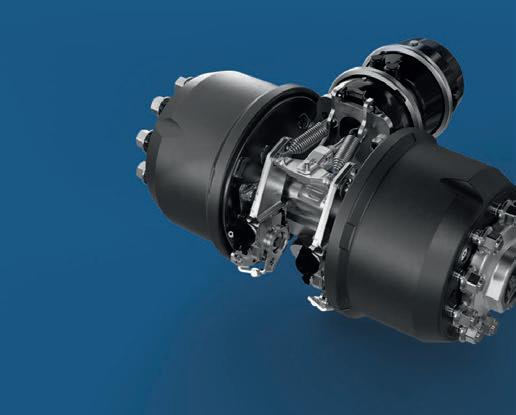
The 800,000 km on-road guarantee for the new BPW 7t universal swing axle will take you around the world 20 times.
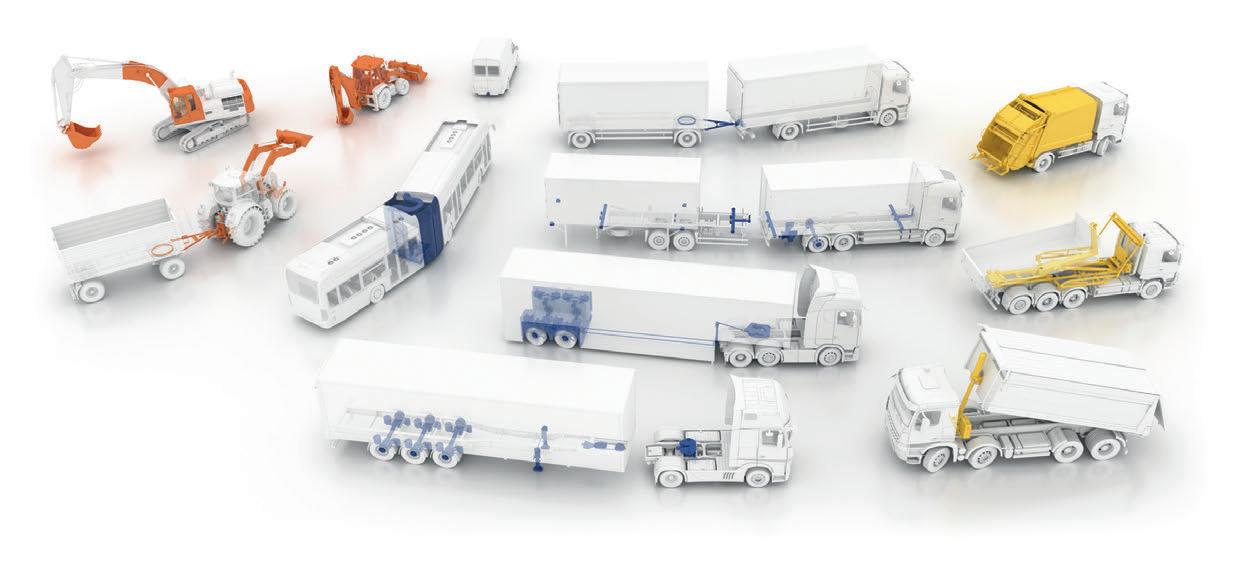
BPW‘s reliable swing axles enable low-loaders, semi-trailers and vehicles for special transport tasks to operate safely and smoothly with heavy and bulky loads in difficult terrain. The new swing axle is available as a 6 or 7-tonne axle and impresses with its compact design, high load capacity and maximum flexibility – for greater cost-effectiveness in use.
YOUR BENEFITS:
Service friendly thanks to maintenance free wheel bearing
Safe and efficient thanks to ECO Drum Brake


— Customer specific base plates for perfect vehicle integration more information: bpw.de/en/swing-axle

BPW
Star-chained
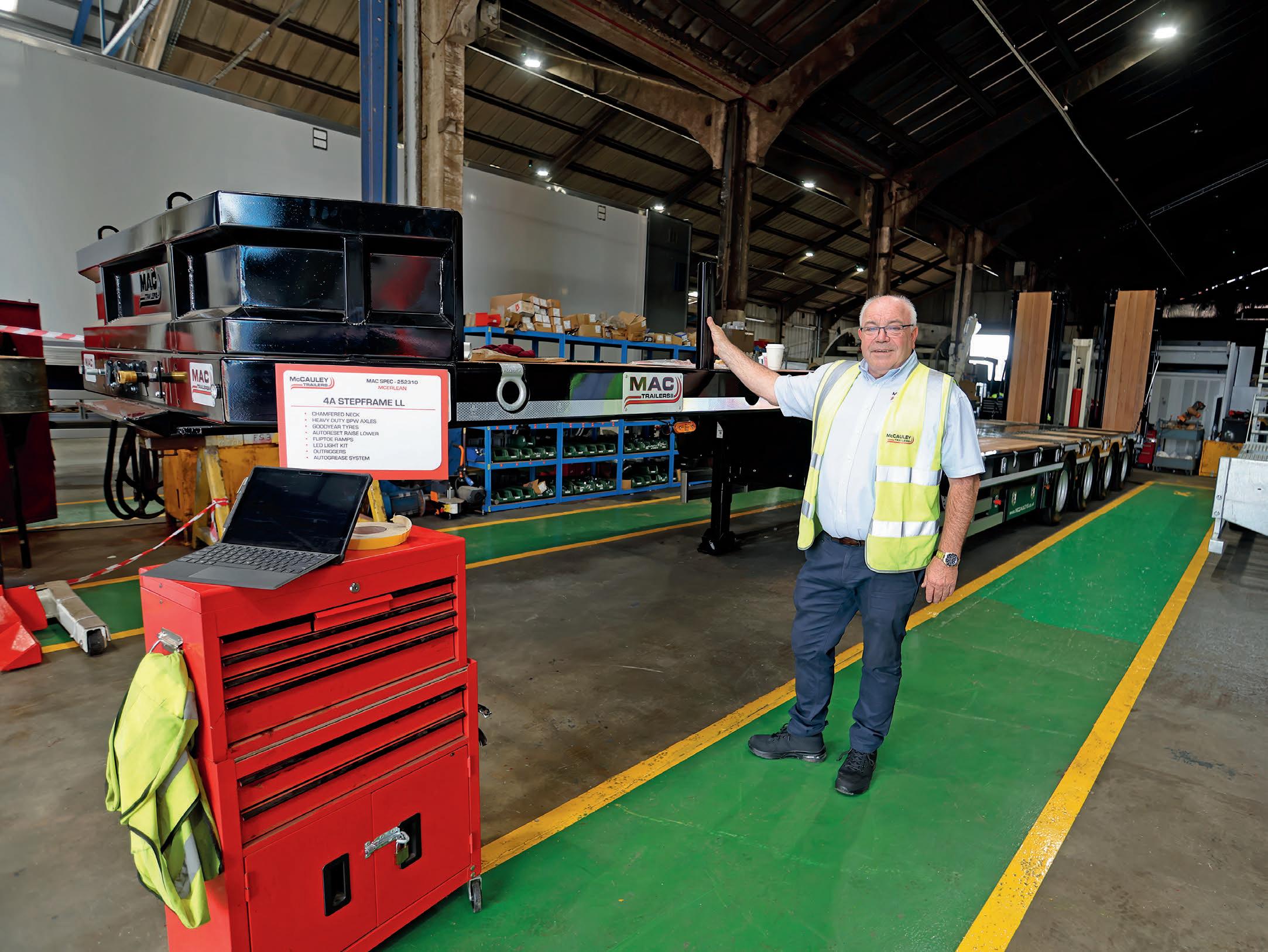
For seven decades, McCauley Trailers has quietly built a reputation as one of Northern Ireland’s most established trailer manufacturers. From a modest shed in the 1950s to a globally recognised producer of agricultural and commercial trailers, the company’s growth re ects a continuous focus on cra smanship, innovation and family values.
“MCCAULEY TRAILERS HAS CONSISTENTLY PLACED IMPORTANCE NOT ONLY ON MACHINERY AND TECHNOLOGY UPGRADES BUT ALSO ON THE GROWTH AND TRAINING OF ITS EMPLOYEES.”
A
TIP Group CEO, Arjen Kraaij, considers talks
e Italian composites specialist is celebrating two

As the northern hemisphere shi s from spring into summer, the global trailer and transport industry enters one of its most important periods of the year, that of the exhibition and events season. Across Europe, North America and Asia, calendars begin to ll with major trade shows, conferences and industry events. ese are far more than diary nootations; they are critical touchpoints for OEMs, suppliers and operators to connect,assess and align with the rapidly evolving market. For manufacturers, this is the moment to step forward and demonstrate progress. New trailer designs, lightweight materials, improvements and digital technologies are brought into the spotlight. It is where research and development meets reality; concepts are tested in against customer expectations and competitor benchmarks. ese events are also valuable forums for meaningful, face-to-face conversations. Deals are discussed, partnerships are formed and ideas are challenged. is year, those conversations are likely to centre on an intensifying set of pressures. Decarbonisation is a hot topic with regulators, trailer OEMs, customers and communities all pushing for measurable progress and resolution. At the same time, the industry continues to grapple with the practical realities of alternative fuel adoption. Hydrogen, electric and renewable fuels each present opportunities, but also new infrastructure and cost challenges. ese are not
issues that can be solved in isolation, and industry events provide a rare opportunity for stakeholders to share insights and be aligned on viable pathways forward. Also concerns around tolls, tari s, fuel security and total cost of ownership will also undoubtedly shape event agendas. Operators are looking for solutions that deliver not just environmental bene ts, but economic resilience. at puts pressure on OEMs to deliver products that are innovative and commercially viable in a diverse set of conditions.
ere is also a broader value to this period, as the opportunity to exchange ideas and build relationships in person carries renewed importance and can prove just as in uential as formal presentations.
For a global industry these events are bridges, connecting markets and accelerating progress.
As this edition lands, the exhibition season is just getting underway. e months ahead will o er a clear indication of where the industry is heading, not just in terms of technology, but in mindset. Innovation will be on display, but so too will the willingness to collaborate, adapt and confront the challenges that lie ahead.
In that sense, the exhibition season is not just about what is new. It is about what comes next.
CHAIRMAN
John Murphy john.murphy@primecreative.com.au
CEO Christine Clancy christine.clancy@primecreative.com.au
INTERNATIONAL SALES
Ashley Blachford ashley.blachford@primecreative.com.au
MANAGING EDITOR
Luke Applebee luke.applebee@primecreative.com.au
EDITOR
Paul Lancaster paul.lancaster@primecreative.com.au
HEAD OF DESIGN
Blake Storey
DESIGN
Laura Drinkwater
CLIENT SUCCESS MANAGER
Ben Sammartino ben.sammartino@primecreative.com.au
COVER Image: McCauley Trailers.
HEAD OFFICE
Prime Creative Pty Ltd
379 Docklands Drive Docklands VIC 3008 Australia +61 3 9690 8766 info@primecreative.com.au www.globaltrailermag.com
SUBSCRIPTIONS
+61 3 9690 8766 subscriptions@primecreative.com.au
Global Trailer is available by subscription from the publisher. e rights of refusal are reserved by the publisher.
All articles submitted for publication become the property of the publisher. e Editor reserves the right to adjust any article to conform with the magazine format.
Global Trailer is owned by Prime Creative Media and published by John Murphy. All material in Global Trailer is copyright and no part may be reproduced or copied in any form or by any means (graphic, electronic or mechanical including information and retrieval systems) without written permission of the publisher. e Editor welcomes contributions but reserves the right to accept or reject any material. While every e ort has been made to ensure the accuracy of information, Prime Creative Media will not accept responsibility for errors or omissions or for any consequences arising from reliance on information published. e opinions expressed in Global Trailer are not necessarily the opinions of, or endorsed by the publisher unless otherwise stated.
FOLLOW US Global Trailer Magazine


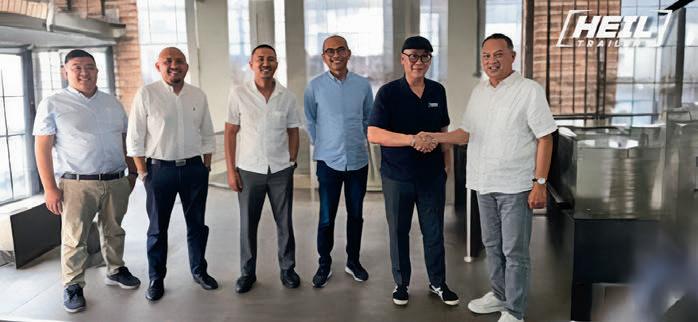
Heil Trailer Asia has been successful in its tender for a lucrative seven-year contract with RTC Brunei Shell Petroleum to supply rigid mounted petroleum tankers and water tankers.
“We are thrilled to share that Heil Asia has been awarded the supply of a combination of rigid mounted petroleum and water tankers for the RTC Brunei Shell Petroleum tender,” the company said.
“This achievement reflects our relentless commitment to quality, safety, and performance in delivering premium, world-class petroleum tankers.”
“Heil Asia is honoured with the opportunity to continue serving Brunei Shell Petroleum with our premium performance, world-class petroleum tankers for the next seven years.
“This milestone reinforces our dedication to reliability, innovation, and sustainable transport solutions for Brunei’s energy sector.”
Success Ventures Sdn Bhd, Heil Trailer Asia’s Channel Partner, led by Melvin Tay for Brunei, will be supporting Heil in the sales delivery, after sales and service, fleet maintenance, and parts supply throughout the life of the contract.
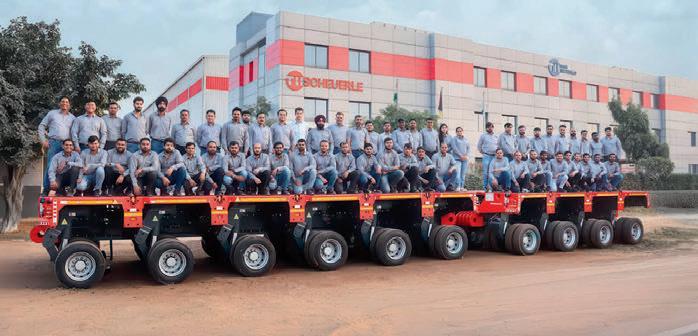
The TII Group marks 10 years of operations at its Indian production facility, developing into a key manufacturing and engineering hub for domestic and international heavy transport system markets.
Operated by TII India Pvt. Ltd., the Bawal facility near New Delhi began production in 2015 assembling pre-configured modules. It has now grown into a major part of the company’s global value chain, employing around 350 people and operating across a 30,000m² production footprint.
Over the past decade the plant has delivered several thousand axle lines and expanded its role beyond supplying
the Indian market to supporting projects across multiple regions. Today, transport solutions built in Bawal are deployed throughout the Middle East, Southeast Asia, Latin America, Africa and Europe.
TII India Managing Director, Miguel Fernandes, said the facility was designed from the outset to operate to the same standards as the group’s German plants.
“When we started in 2015 our focus was on building a stable industrial base with the highest standards,” he said.
“Today Bawal is a central pillar of our global strategy and has developed into an internationally connected heavy transport hub.”
A major part of the site’s growth has centred on production of the SCHEUERLE K25 modular system, which forms the technical basis for a wide range of heavy transport applications.
The modular platform can be configured for infrastructure, energy and industrial transport tasks and adapted to meet either national regulatory requirements or international homologation standards. Today, roughly two-thirds of TII India’s revenue comes from international projects, highlighting the facility’s importance within the group’s global manufacturing network.

The Netherlands is set to introduce a new truck toll from 1 July, as a replacement for the Eurovignette system, according to the Dutch body, RDW.
The new system will apply to domestic and foreign trucks, where truck owners will have to pay a fee based on each kilometre driven.
RDW said the toll will apply to almost all motorways and to certain provincial and municipal roads, with the cleaner and lighter the vehicle, the lower the rate er kilometre.
Trucks in categories N2 and N3 with allowable total weights of more than 3500 kilograms will have to pay the new toll. After the start of truck toll, the Dutch motor vehicle tax for trucks up to 12,000 kilograms will be abolished. For trucks that are 12,000 kg and heavier, the Dutch motor vehicle tax will be significantly reduced.
The Eurovignette for the Netherlands will
end on 1 July, upon which all trucks in the Netherlands will need a valid On-Board Unit (OBU) or toll box, even if a truck only operates on roads exempt from the truck toll.
The OBUs must be in operation for the whole journey of a truck travelling in the Netherlands.
RDW said to obtain an OBU, truck owners must sign a contract with a service provider, which will supply the monitoring equipment and will process toll payments. Alternatively, operators must have their contracts amended to include the truck toll in the Netherlands.
Trucks that are 40 years or older, and are only for private purposes, may be eligible for a dispensation. Police and fire vehicles can also get a dispensation.
Sweden-based Solar Power Accelerator (SPA) has officially rebranded to Renewable Power Accelerator (RPX) following a
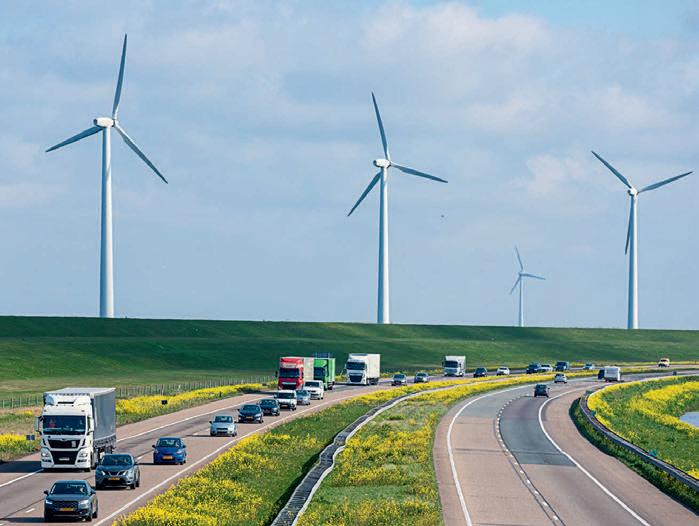
Dutch motorways, like the A6 near Lelystad, will be subject to a new truck toll from 1 July. Image: Kruwt/stock.adobe.com.

strategic repositioning to accelerate the electrification of Europe’s heavy duty transport sector through renewable energy solutions.
RPX’s primary focus will be to electrify Europe’s heavy transport with innovative renewable energy offerings, AI software and Battery-as-a-Service (BaaS) solutions.
Originally founded in early 2023, the company pivoted toward e-mobility in late 2024 in response to changing market conditions. It now delivers renewable energy, primarily solar and wind, to charging infrastructure for electric heavy-duty trucks (eHDT), prioritising key transport corridors, logistics depots and freight terminals across Europe.
RPX says it enables 100 per cent renewable electricity sourcing across Europe’s transport sector and is currently developing projects across the Nordic region, the UK, Spain, and Poland. It is raising funds to finance the expansion.
The company said it positions itself at the intersection of transport electrification, renewable energy generation, energy infrastructure & storage, and software solutions.
RPX said it can ensure charging stations are powered entirely by renewable energy through onsite microgrids, battery storage, and load balancing, supplemented with locally contracted PPAs with leading European power distributors.
“We are part of a broader paradigm shift toward renewable logistics,” said RPX Co-founder and Vice President, William Granelli.
“Recent macroeconomic and geopolitical developments have further highlighted the risks of fossil fuel dependency and the urgency of transitioning to resilient, redundant, and locally sourced renewable energy systems.”
























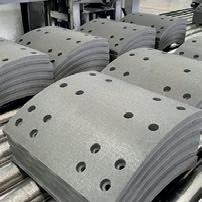

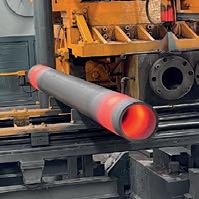








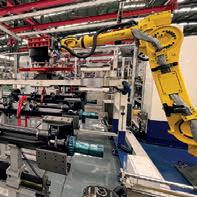
A state of the art, upgraded and fully integrated global manufacturing centre of trailer systems and On/Off highway systems. Expertly designed and engineered with worldwide accessibility, offering you private label and OEM manufacturing solutions.
Drawing upon decades of expertise spanning Asia, Australia US, and in Europe, Fuwa stands as a global manufacturing powerhouse, unrivalled as the foremost network of specialists in truck and trailer components across the globe.





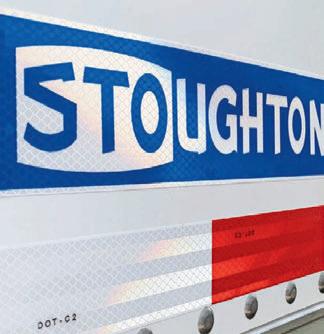

Stoughton Trailers has expanded its North American network with the appointment of Sovereign Trailers as an authorised dealer.
The new dealership has been formed in partnership with Peach State Truck Centers, a major commercial vehicle retailer in the Southeast with more than 700 employees and 14 locations.
Sovereign Trailers will represent Stoughton’s trailer range in Georgia, Alabama and Mississippi.
Peach State Truck Centers is a distributor of Freightliner and Western Star Class 8 trucks and, combined with Sovereign Trailers, the partnership delivers more than 50 years of industry expertise to the regional trailer market.
“We are thrilled to add the team at Sovereign to our dealer network,” said Stoughton Trailers VP of Sales, Derrick Washington. “Peach State is highly regarded in the region for its industry knowledge and service, and we are confident this new venture will deliver strong value for fleet customers.”
Peach State Truck Centers President, Rick Reynolds, said: “The launch of Sovereign Trailers and our partnership with Stoughton Trailers extends the
same standard of service, expertise and customer relationships that have defined us for decades into the trailer business.”
Sovereign Trailers will stock Stoughton dry van and refrigerated trailers at facilities in Jefferson and Villa Rica, Georgia, and Birmingham, Alabama.
Trailer sales, parts and service support will also be available across Peach State’s broader Southeast network.
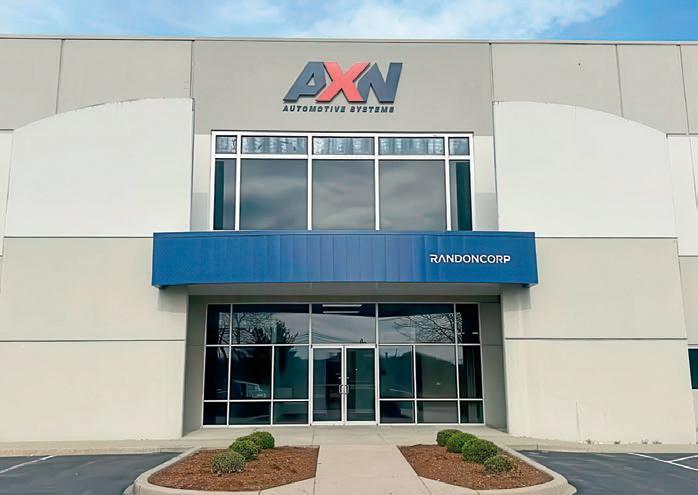
AXN Automotive Systems has opened a new manufacturing facility in Louisville, Kentucky to boost axle production capacity. The investment enables AXN to scale output to a targeted 100,000 axles annually, while adding new product lines and production capabilities. The company, part of the Randoncorp Group, also plans to double its workforce in the coming years.
“This investment reflects our deep commitment to strengthening manufacturing in the United States,” said Randoncorp President and CEO, Daniel Randon.
“We are proud to expand our footprint
in Louisville with high-quality products Made in America.”
The new facility features advanced manufacturing technologies, including an automated welding cell, a dedicated paint line and expanded assembly capacity. These upgrades are expected to improve throughput, efficiency and supply chain reliability for trailer manufacturer and aftermarket customers.
AXN, a single-source supplier of axles, suspensions, slider subframes and related components, said the expansion will enhance its ability to deliver products faster across North America. State and local leaders welcomed the expansion. Governor Andy Beshear said the project highlights Kentucky’s economic momentum and skilled workforce, while Louisville Mayor, Craig Greenberg, noted the city’s continued ability to attract advanced manufacturing investment and create stable jobs.
AXN was founded in Louisville in 2009 and acquired by Randoncorp in 2025.
Challenges that emerged in late 2025 are continuing to weigh on the US trailer market as the industry moves into 2026, according to an ACT Research report.
Jennifer McNealy, Director of CV Market Research & Publications at ACT Research, said cancellation activity remained volatile through 2025 before stabilising at lower levels early this year.
“Cancellations gyrated wildly throughout 2025 before returning to a more subdued rate to start 2026,” said McNealy.


“February’s rate of 0.5 per cent of backlog fell well below the target range for the first time in 13 months, following an improved but still elevated 1.6 per cent reading in January.”
She noted that cancellations remain elevated in tank trailer segments, largely driven by carriers scaling back amid reduced oil and gas activity. However, sustained higher oil prices could help stabilise demand in this segment.
Backlog trends also softened in February after modest gains earlier in the year, with backlogs declined 1.5 per cent month-on-month, or
roughly 1,100 units.
“As is typical for this time of year, the industry is entering a period of backlog drawdown,” she added. “The key question is the strength of fleets’ appetite for trailers in the near term. As in 2025, shallow backlogs remain a central concern.”
ACT Research highlighted a range of ongoing pressures, including soft freight demand, weak carrier profitability, financing constraints and continued uncertainty around tariffs. These factors are being compounded by high input costs—particularly metals—and subdued capital expenditure.


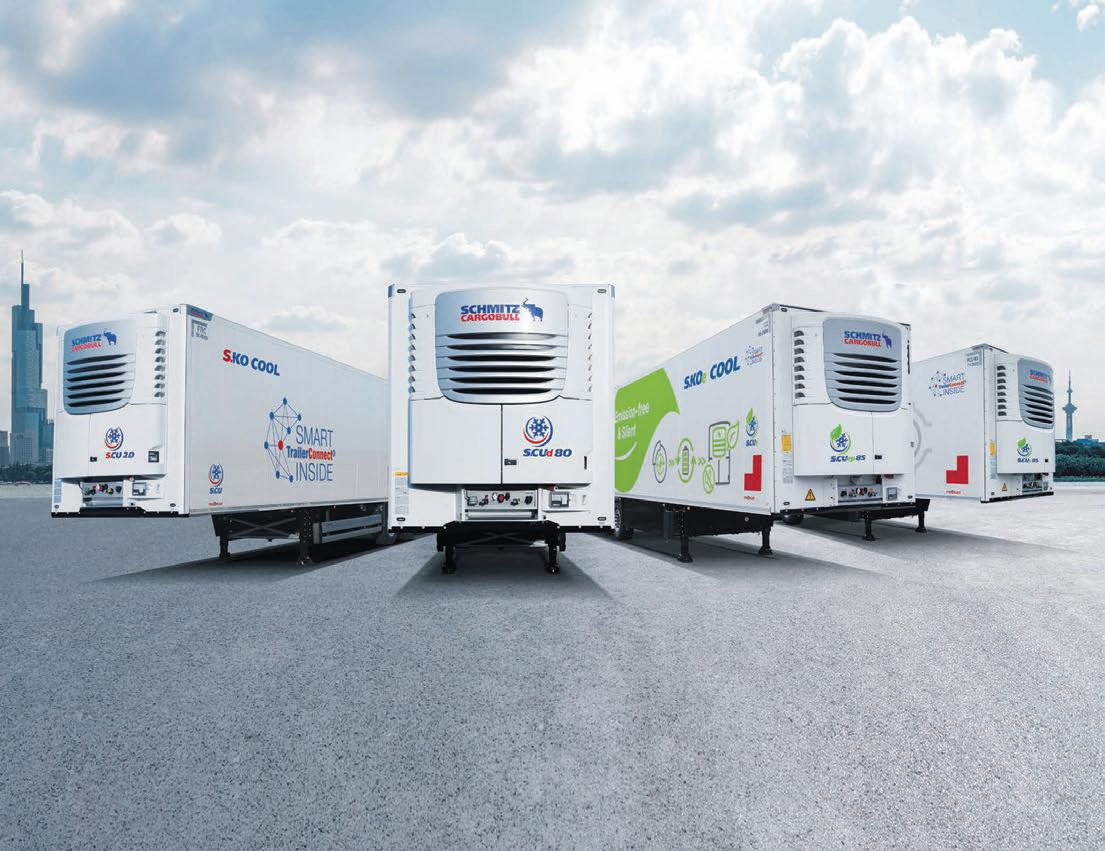
Transport temperatured goods more cost-effectively. The vapour diffusiontight FERROPLAST® body together with the efficient S.CU cooling unit and the smart TrailerConnect® telematics system ensure optimised and reliable transportation. Also available fully electric as S.KOe COOL.
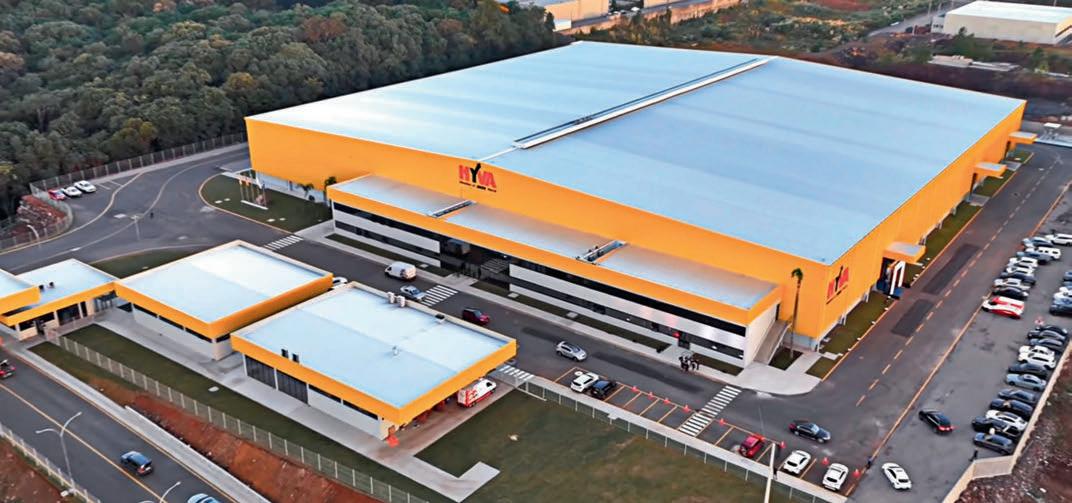
Hyva, part of JOST World, has announced a major expansion of its presence in South America with the opening of a new hydraulics factory in Caxias do Sul, in southern Brazil.
The state-of-the-art Hyva facility is a clear signal of “our long-term commitment to the Brazilian market and our ambition to further strengthen our position in the offhighway sector,”Hyva said.
With 17,000 m² of cutting-edge infrastructure, Hyva said it was not just increasing capacity, but “delivering bestin-class production driven by a highly passionate and skilled local team”.
“By combining our global engineering expertise with local roots, we ensure that our customers in agriculture, construction, and transport receive the most reliable, high-performance solutions,” Hyva said.
JOST World CEO, Joachim Dürr, was present for the official launch of the site, together with Hyva CEO of APAC Region, Alex Tan; Hyva South America Vice

President, Rogério Luis de Antoni; other executives and guests.
“This investment at this location is a dedication to the commercial industry in general and a dedication to Brazil, a country which I believe, with the structure you have, the size of the country, the population, the energy, that this has a very good future in front of it,” said Joachim Dürr.
The facility will have an annual production capacity of 52,000 hydraulic cylinders, 40,000 hydraulic kits, and 1,500 mobile floor systems.
Sunswap has deployed electric refrigeration technology in Chile through local distribution partner, Trailer Logistics. The system is now operating within the Walmart Chile supply chain, serving routes between Santiago, La Serena and Concepción, and is described as the country’s first fully diesel-free logistics operation.
Trailer Logistics General Manager, Hernán Searle, said: “It is about building a more resilient logistics system, less exposed to external factors and aligned with the energy challenges of the future.” High solar availability in Chile contributes to extended operating range and lower charging costs.
Sunswap CEO, Mike Lowe, highlighted the company’s expanding global footprint. “Sunswap is now running in the supply chains of some of the world’s most recognisable retailers – Tesco, Ocado and DFDS in Europe, Carrefour in France, and now Walmart in South America.”
He said every Sunswap unit is continuously monitoring the operation and improving it – reducing cost, cutting maintenance and giving operators more control.
Sunswap systems are now in operation across multiple international markets, including the UK, France, the Netherlands, Chile and Australia.
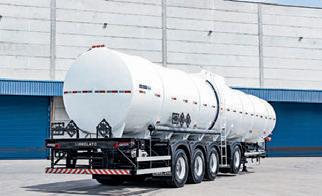
Brazil-based OEM, Librelato, has unveiled its Evolut 2026 Series Tank Line, which focuses on safety in the transport of hazardous liquids, weight reduction, and operational gains.
Developed based on market demands, the new product incorporates structural improvements in compliance with regulatory standards, resulting in greater payload capacity and operational efficiency. Librelato is responding to the market demands for tank-type road implements in Brazil, driven by the booming agribusiness sector and the demand for fuel
Librelato Commercial and Marketing Director, João Librelato said the company is positioning itself with solutions that combine technology, safety, and operational gains, meeting the real needs of the market.
“The Evolut 2026 Series is the result of a structured process of actively listening to the market, in which we gathered information directly from carriers, drivers, and fleet managers to understand, precisely, where we could evolve,” he said.
“What we are delivering now is a lighter, safer, and more efficient product that directly contributes to increased profitability of operations, without sacrificing the
Librelato. It is an evolution built on real data and with a total focus on the client’s operational results.”
Librelato’s engineering team achieved a weight reduction of approximately 260 kilograms for the semi-trailer versions, while the double trailer configurations have a reduction of approximately 500 kilograms.



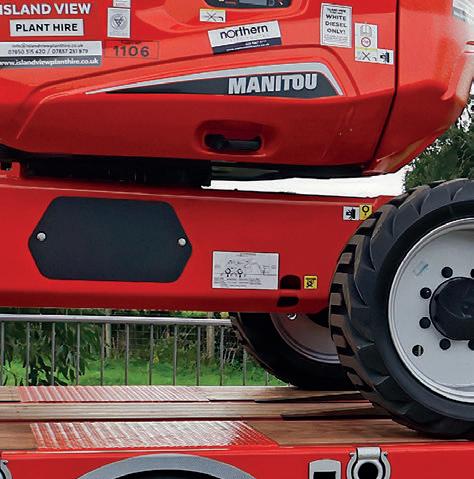
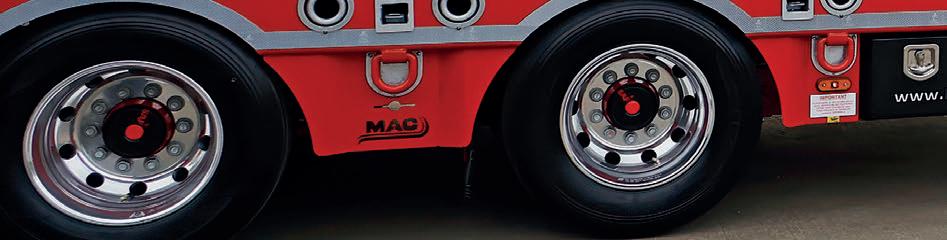

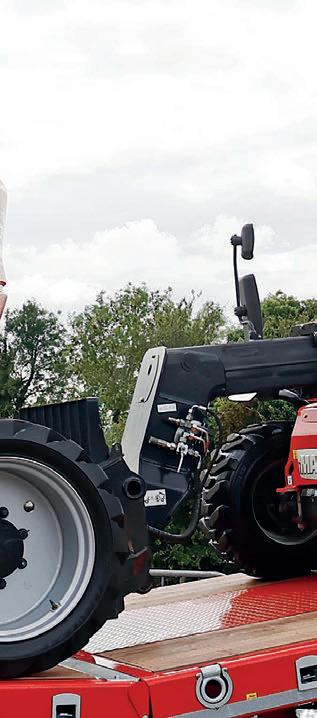

FOR SEVEN DECADES, MCCAULEY TRAILERS HAS QUIETLY BUILT A REPUTATION AS ONE OF NORTHERN IRELAND’S MOST ESTABLISHED TRAILER MANUFACTURERS. FROM A MODEST SHED IN THE 1950S TO A GLOBALLY RECOGNISED PRODUCER OF AGRICULTURAL AND COMMERCIAL TRAILERS, THE COMPANY’S GROWTH REFLECTS A CONTINUOUS FOCUS ON CRAFTSMANSHIP, INNOVATION AND FAMILY VALUES.

The story of McCauley Trailers began in 1955, when the company was founded as a small fabrication operation in Toomebridge, Northern Ireland. In those early years, the business operated out of little more than a shed, producing simple but robust trailers designed to meet the needs of local agriculture and industry.
Despite the modest facilities, the foundation
was laid for what would become a long-standing manufacturing success story. e company steadily built its reputation by focusing on durability, practical design and close relationships with customers.
A pivotal chapter in the company’s history began when Owen Kelly joined the business as a teenager. At just 17 years of age, Kelly started working under founder Clement McCauley. At the time, the company produced a variety of trailers including car plant trailers, cattle trailers and other specialised transport equipment.
Kelly’s aptitude for engineering was evident early on. His strong performance in metalwork and technology studies at school helped him secure an apprenticeship as a tter welder with the company. At that point, McCauley Trailers was still a small operation with just six employees.
What followed was a formative period for both Kelly and the company. Over time, his experience and technical knowledge grew alongside the business itself.
In 1986, when Clement McCauley decided to retire early, Kelly saw an opportunity to continue the company’s legacy. At just 26 years old, he acquired the business and began guiding it into a new era of growth and development.
Although McCauley Trailers has evolved into an internationally recognised manufacturer, the business has retained a strong family-oriented culture.
For Kelly, family is central to the company’s identity. His son and daughter now play major roles in the day-to-day operations, contributing to both the strategic direction and ongoing management of the business.

At the same time, Kelly emphasises that every employee is considered part of the extended McCauley family.
McCauley Trailers exports agricultural and commercial trailers across Ireland, the UK, Europe and international markets.
Trailers.
upgrades but also on the growth and training of its employees. is approach has ensured that the company retains the skilled workforce necessary to deliver high-quality manufacturing while adapting to modern production demands.”
e physical growth of McCauley Trailers mirrors the company’s increasing scale and capability.
“ e original site in Toomebridge served the business well in its early decades, but expansion became necessary as production increased and product lines diversi ed,” said Kelly. “Over time, we added sta , upgraded equipment and expanded facilities.”
A major milestone came in 2002 when McCauley Trailers opened a new factory equipped with modern manufacturing infrastructure. e facility introduced advanced production capabilities including specialised paint booths and a dedicated internal service bay.
“ e move represented more than a simple expansion,” said Kelly. “It was part of a long-term strategy to modernise the manufacturing process and ensure we could continue meeting customer demand while maintaining quality standards. Growth has not stopped there. As the business continues to evolve, further facility development remains underway. Additional production space is currently being constructed, re ecting our ongoing commitment to expansion.”
For McCauley Trailers, continuous development is essential. By upgrading facilities and adopting new technologies, the company ensures it remains competitive in an industry that increasingly demands e ciency, precision and exibility.
Another de ning moment in the company’s history came in 2000 with the creation of the MAC Trailers brand.
is branding initiative was designed to clearly distinguish between McCauley’s
agricultural trailers and its growing range of commercial transport equipment. Under the MAC name, the company began marketing its commercial trailers to a broader market.
e move proved successful, helping customers more easily identify product categories while strengthening McCauley’s presence in the commercial trailer segment.
As demand for specialised transport equipment grew across Europe, the MAC brand played an important role in expanding the company’s reach beyond its domestic market.
In 2004, McCauley Trailers began actively pursuing opportunities in the wider European market. This expansion saw the company exporting both agricultural and commercial
Today, McCauley Trailers products can be found not only throughout Ireland and Europe but in markets across the globe.
Modern trailer manufacturing increasingly relies on advanced automation and precision engineering. Recognising this shi , McCauley Trailers has made signi cant investments in
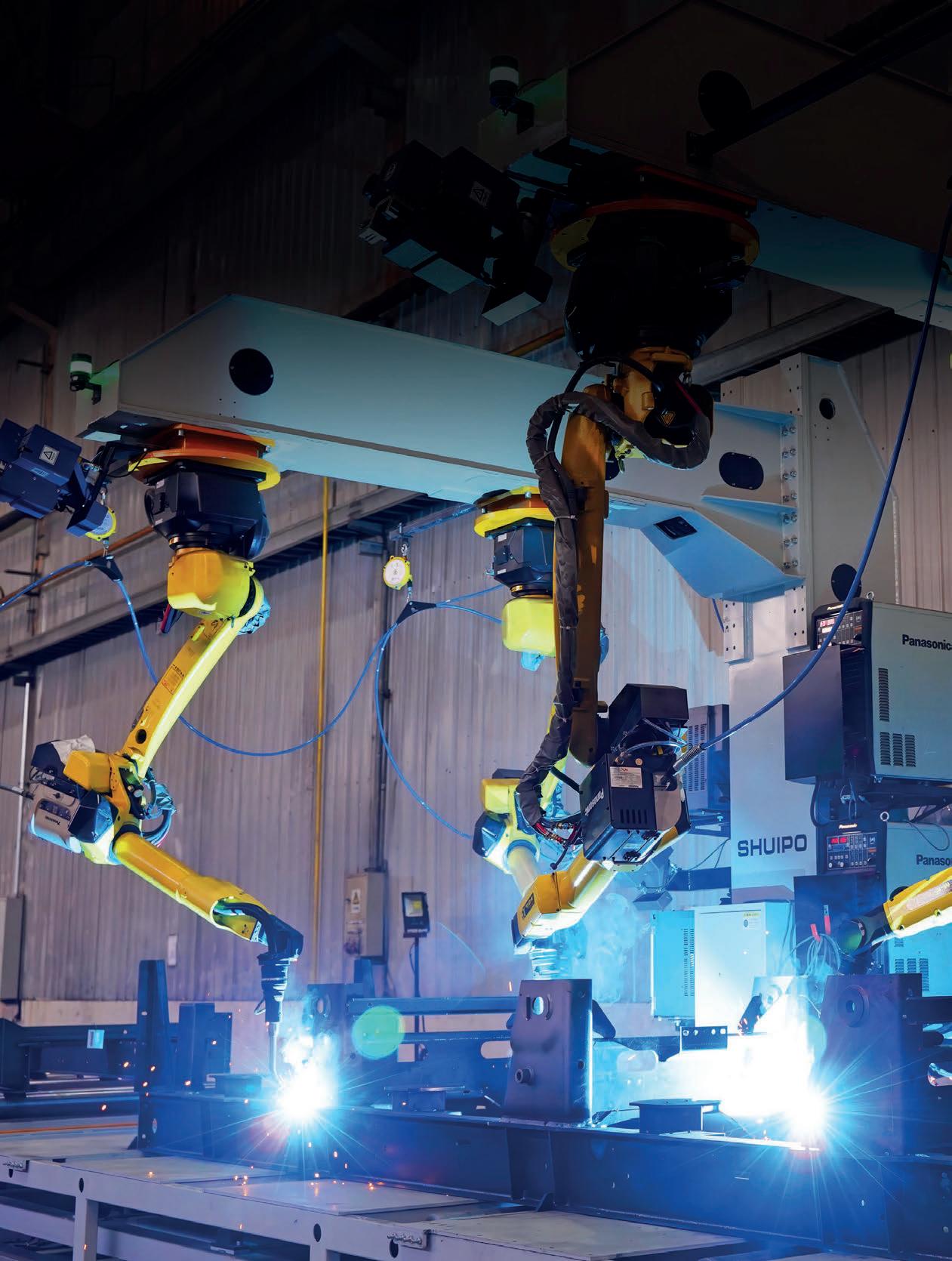
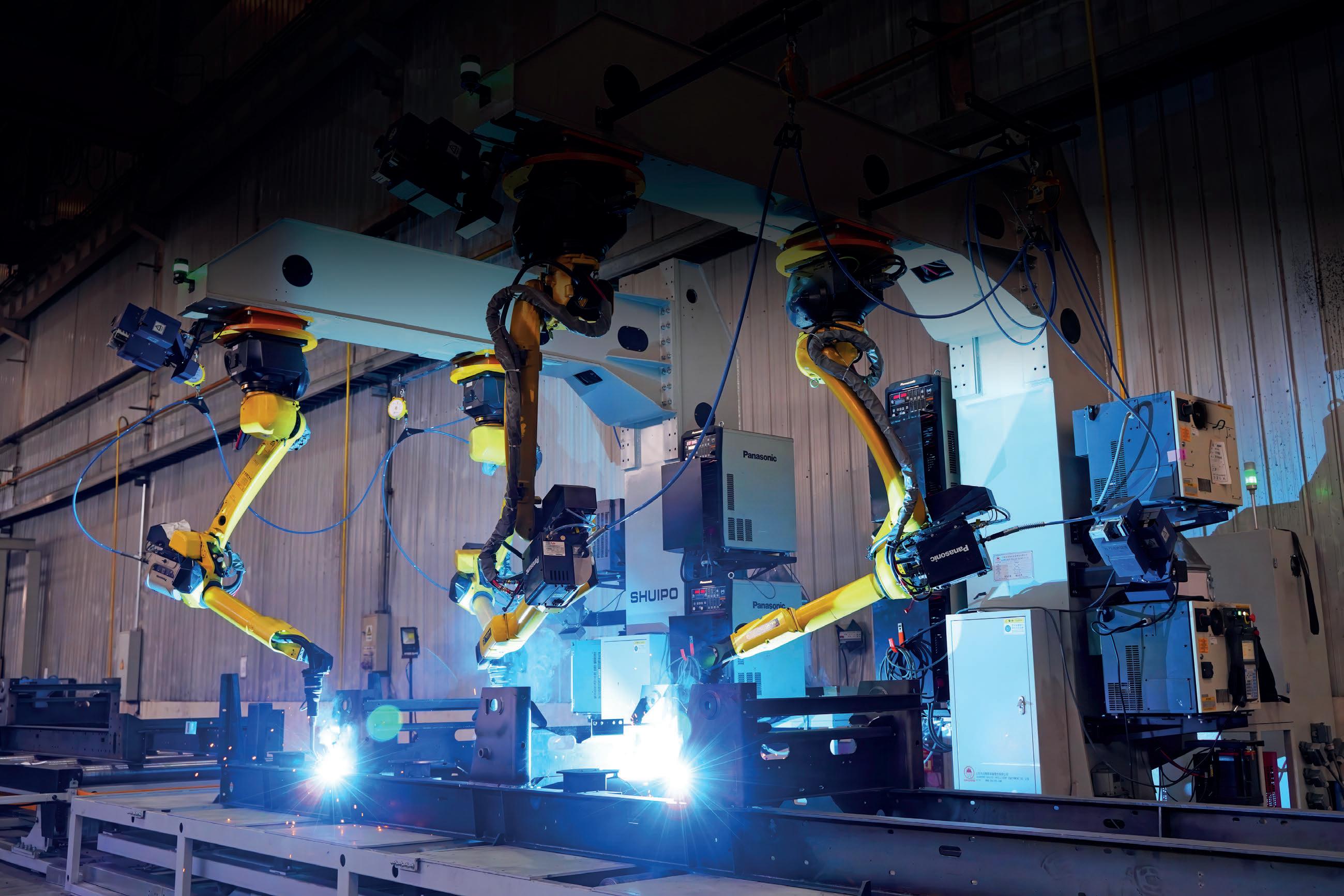
One of the most notable upgrades occurred in 2022 when the company invested approximately £1 million in a fully robotic chassis welding bay.
“ e system features six robotic welding units capable of producing trailer chassis, particularly low loaders, with exceptional accuracy and consistency,” said Kelly. “ e introduction of automated chassis welding has transformed production e ciency in several ways. Firstly, it enables us to produce standard trailer models more quickly while maintaining strict quality standards. Secondly, it allows skilled welders to focus on bespoke trailer builds and specialised fabrication work that requires human expertise. is balance between automation and cra smanship ensures McCauley Trailers can meet both high-volume demand and complex customisation requirements.”
The investment also demonstrates the company’s forward-looking approach to manufacturing. By embracing automation while retaining skilled labour, McCauley maintains exibility in an evolving industry.
Celebrating its 70th anniversary represents a significant achievement for McCauley Trailers. Over those decades, the company has
reached numerous milestones that illustrate its steady evolution.
In 1989, the OEM produced its rst agricultural trailer, marking the beginning of what would become a major segment of its product portfolio.
Six years later, in 1995, McCauley built its rst centre-axle commercial trailer – an innovation that paved the way for further developments in transport solutions.
By 2000, the company had introduced its rst semi low-loader trailer, expanding its capability in heavy transport applications.
Further advancements followed rapidly. In 2008, McCauley launched its rst four-axle semi loader before introducing a ve-axle semi lowloader the following year.
This progression from two axles to five represented a major engineering milestone and demonstrated the company’s growing expertise in heavy-duty trailer design.
Quality assurance also became a key focus. In 2011, McCauley Trailers achieved ISO 9001 certification, a globally recognised quality management standard.
Two years later, the company secured European Whole Vehicle Type Approval for its MACbranded commercial trailers. is certi cation allows the trailers to be registered across all European Union member states, each delivered with a Certi cate of Conformity.
Product diversi cation continued in 2015 with the introduction of bespoke box van trailers designed to meet unique customer requirements.
More recently, in 2021, McCauley expanded further by launching a purpose-built boat trailer – another example of the company’s ability to adapt to specialised transport markets.
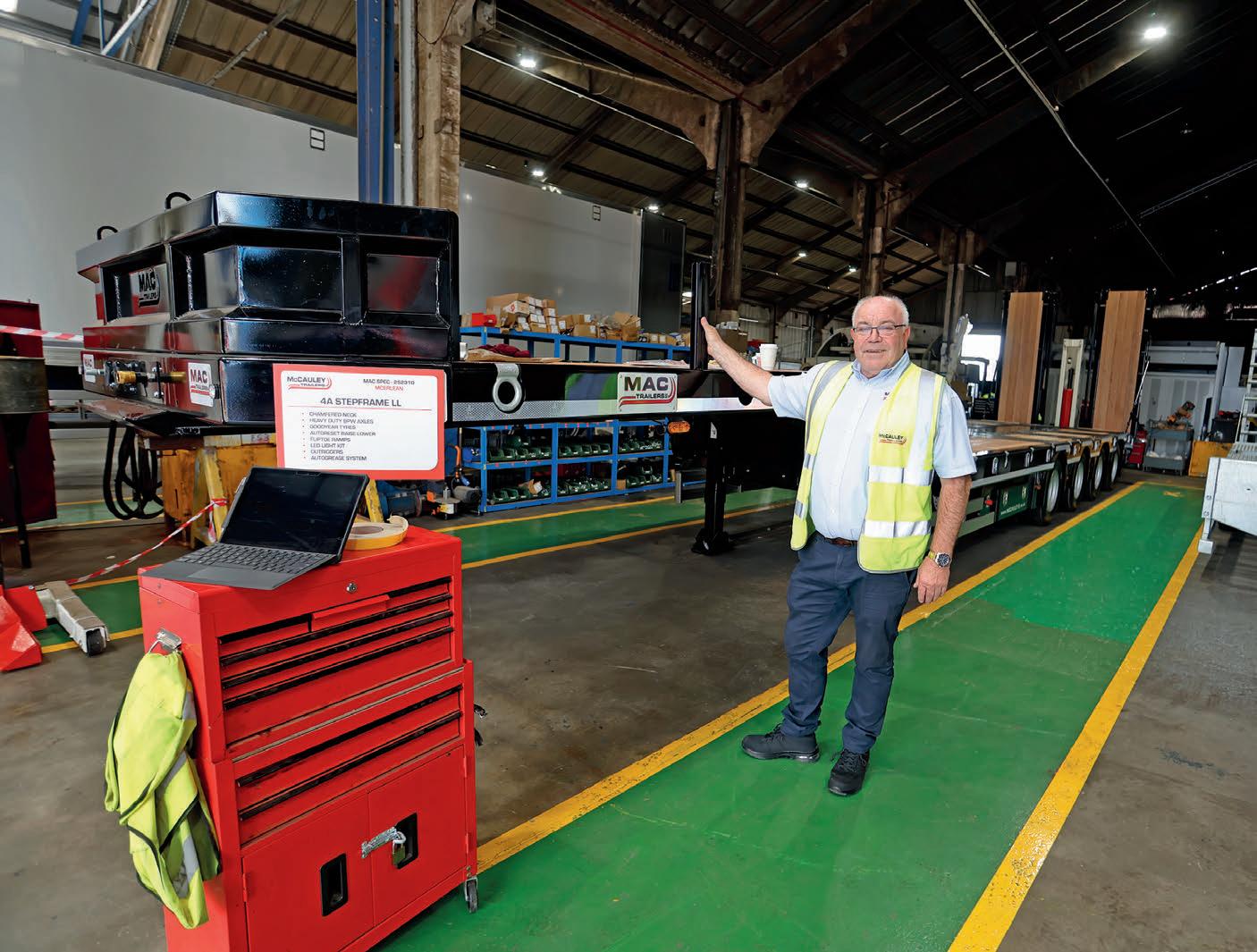
“Custom engineering remains a core strength of McCauley Trailers,” said Kelly. “One example is a recently delivered four-axle turntable trailer supplied to Sta an Maskin in Sweden. e trailer features a full platform length of 12 metres and is built with wide-track axles designed to provide enhanced stability during heavy transport operations.
Hydraulic ramps equipped with a power pack and gripper bars allow e cient loading and unloading of machinery. To prevent contamination and reduce maintenance requirements, the power pack box is fully sealed against dirt ingress. e trailer is tted with
Goodyear M+S tyres and includes a spare wheel mounted underneath in a dedicated holder protected by an alloy fold-up crash rail. Additional functionality is provided through timber trays, outriggers and outrigger boards. Four machine stoppers help secure cargo during transport. Lighting and safety features are also extensive. LED work lights are positioned strategically around the axles, while LED beacon lights mounted on the rear ramp enhance visibility. EU marker boards, bullseye lights and cat whisker lights provide further illumination and compliance with European transport standards. Connections for electrical and air systems are located on the front bogie channel, including a 24-volt VBG electric connector and Duomatic coupling for air brakes. A 15-pin Euro socket replaces traditional electrical connections, while rubber piping mounted behind the drawbar simpli es hook-up procedures. e trailer also includes sealed toolboxes for improved accessibility, a battery compartment on the neck and independent hydraulic landing legs reinforced with a bracing bar for enhanced stability. Additional safety and e ciency systems include a tyre pressure monitoring system and a front axle load sensor.”
McCauley Trailers produces a wide range of trailers designed to serve both agricultural and commercial transport sectors.
Among the most popular models are the company’s agricultural low loaders. ese trailers are designed for transporting heavy plant equipment, machinery and agricultural vehicles.
A typical three-axle low loader from McCauley o ers a gross carrying capacity of 27 tonnes. Its design prioritises strength and durability while maintaining ease of use.
Key features include an 840mm low bed height, cross-members integrated through the chassis and eight-leaf spring suspension systems.
Wide-track axles provide improved stability while checker-plate wheels and integrated tie-down points ensure cargo security.
Another highly demanded product is the company’s general purpose dump trailer range. ese trailers o er carrying capacities ranging from 12 to 30 tonnes and are designed for transporting materials such as soil, gravel and construction aggregates.
Many models feature a full Hardox steel body as standard, ensuring durability and resistance to wear.
A mid-body mounted bottle ram improves load distribution and enhances tipping e ciency, while heavy-duty suspension systems and high-capacity axles ensure reliability in demanding environments.
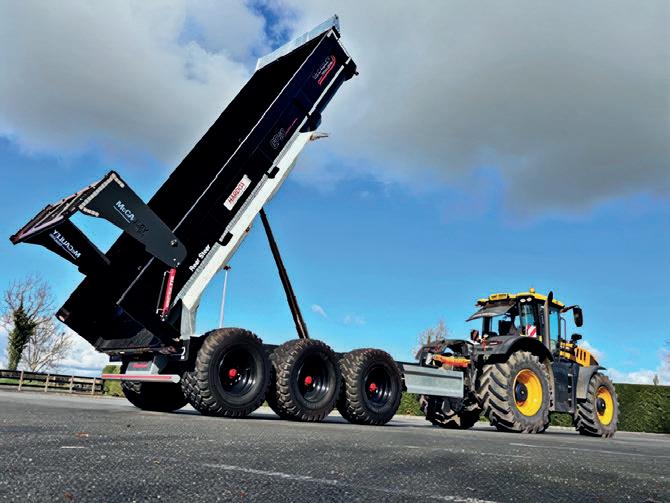
Other features include ECE-rated swivel tow hitches, radial wheels with increased load capacity and complete road lighting systems.
e trailers also incorporate safety features such as rear crash bars, lateral protection and galvanised mudguards.
Dropside trailers represent another versatile option within the McCauley product portfolio. ese trailers are designed for lighter transport tasks including grain, silage, bales and pallets. Standard speci cations typically include otation wheels, reinforced drawbars, heavy-duty tipping rams and rocker bogie suspension systems. Hydraulically locking tail doors and full road lighting systems further enhance usability and safety.
e road transport sector continues to evolve rapidly, in uenced by environmental considerations, fuel e ciency requirements and advances in digital technology. ese trends are shaping the way trailers are designed and manufactured. One area of increasing importance is aerodynamics. By improving air ow around trailer structures, manufacturers can help reduce fuel consumption for the vehicles towing them.
“McCauley Trailers has responded by incorporating aerodynamic design elements into its trailer development process,” said Kelly. “Reducing weight is another critical factor. Lighter trailers enable operators to increase payload capacity while lowering fuel usage and emissions. Advances in materials, design engineering and manufacturing processes allow McCauley to produce trailers that are both lighter and stronger than previous generations.”
Sustainability is becoming an increasingly signi cant consideration across the transport industry according to Kelly. Manufacturers are expected to develop products that support lower emissions and improved operational e ciency.
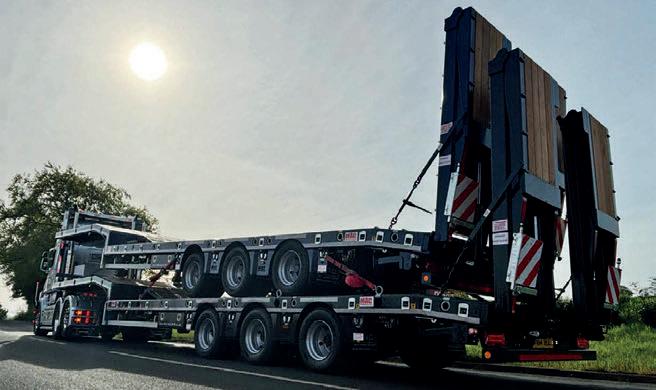
“McCauley Trailers has responded by re ning its designs to reduce overall trailer weight while maintaining structural strength,” said Kelly. “Our redesigned four-axle semi low-loader trailer illustrates this approach. e updated model is lighter than previous versions, enabling increased payload capacity and improved fuel e ciency for operators.
e trailer is available in both extendable and non-extendable con gurations. Standard features typically include two self-tracking axles and a front li ing axle.Eco-friendly mesh ramps are also o ered as a popular option. ese ramps provide aerodynamic bene ts while maintaining the structural integrity required for heavy machinery loading. Although customers can choose from various ramp types, many prefer the mesh design due to its balance of strength, weight reduction and aerodynamic performance.”
Manufacturing quality trailers is only part of the service McCauley Trailers provides. e company also places signi cant emphasis on a ermarket support.
“Every trailer supplied by McCauley is built using entirely new components and is

covered by a one-year warranty from the date of delivery,” said Kelly. “Any warranty work required is carried out in a practical and e cient manner designed to minimise disruption for customers. We operate a dedicated service and repair department at our headquarters in Northern Ireland. e facility includes a fully equipped service bay capable of handling a wide range of maintenance and refurbishment tasks.”
Importantly, McCauley’s service team is trained to repair trailers from other manufacturers as well as its own products. is capability ensures operators have access to expert support regardless of their eet composition.
Beyond its headquarters, McCauley Trailers maintains service points across mainland UK and the Republic of Ireland, along with dealership networks throughout Europe.
ese partnerships ensure customers can access maintenance and support services wherever they operate.
As the trailer manufacturing industry continues to evolve, McCauley Trailers is positioning itself for long-term growth.
Rising demand for logistics solutions, particularly driven by e-commerce and expanding supply chains, is creating opportunities for trailer manufacturers worldwide.
At the same time, specialised transport requirements are increasing. Industries such as construction, agriculture and heavy equipment transport require tailored trailer solutions capable of handling diverse cargo types.
Technological innovation is also reshaping the sector. Telematics systems, digital monitoring technologies and sustainability-focused engineering are becoming standard expectations.
McCauley Trailers is responding by investing in production infrastructure, developing new trailer designs and maintaining a strong focus on customer-speci c engineering.
For a company that began in a simple shed in Northern Ireland, the journey has been remarkable.
Yet the philosophy guiding the business remains largely unchanged: build strong trailers, support customers and invest in people.
A er more than 70 years in operation, that approach continues to drive McCauley Trailers forward.
www.mccauleys.co.uk
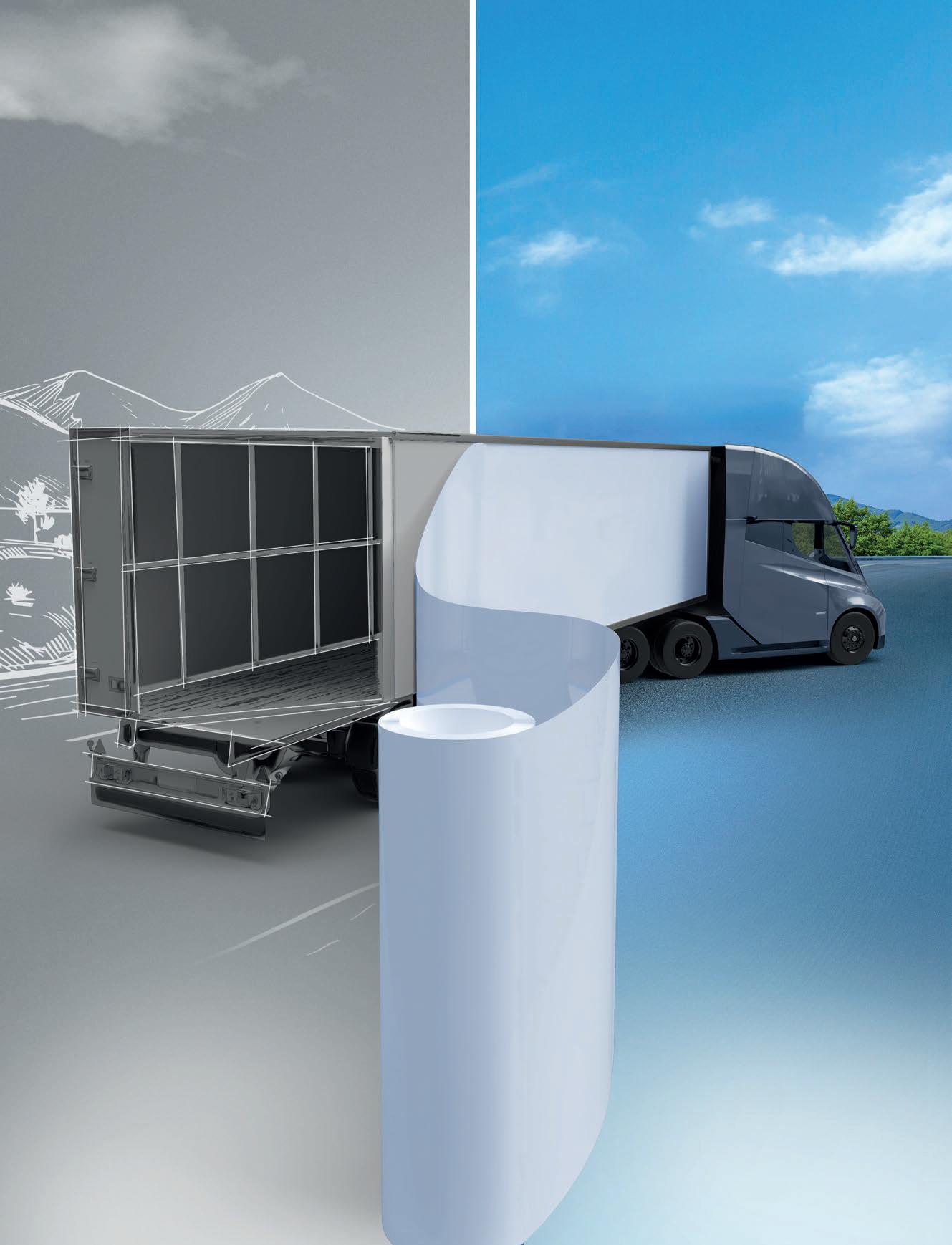
HIGH QUALITY GRP FOR COMMERCIAL VEHICLES. We stand right in the middle of every project realization.
LOGISTICS SECTOR IS ACCELERATING INTO
NEW ERA, DRIVEN BY MAJOR
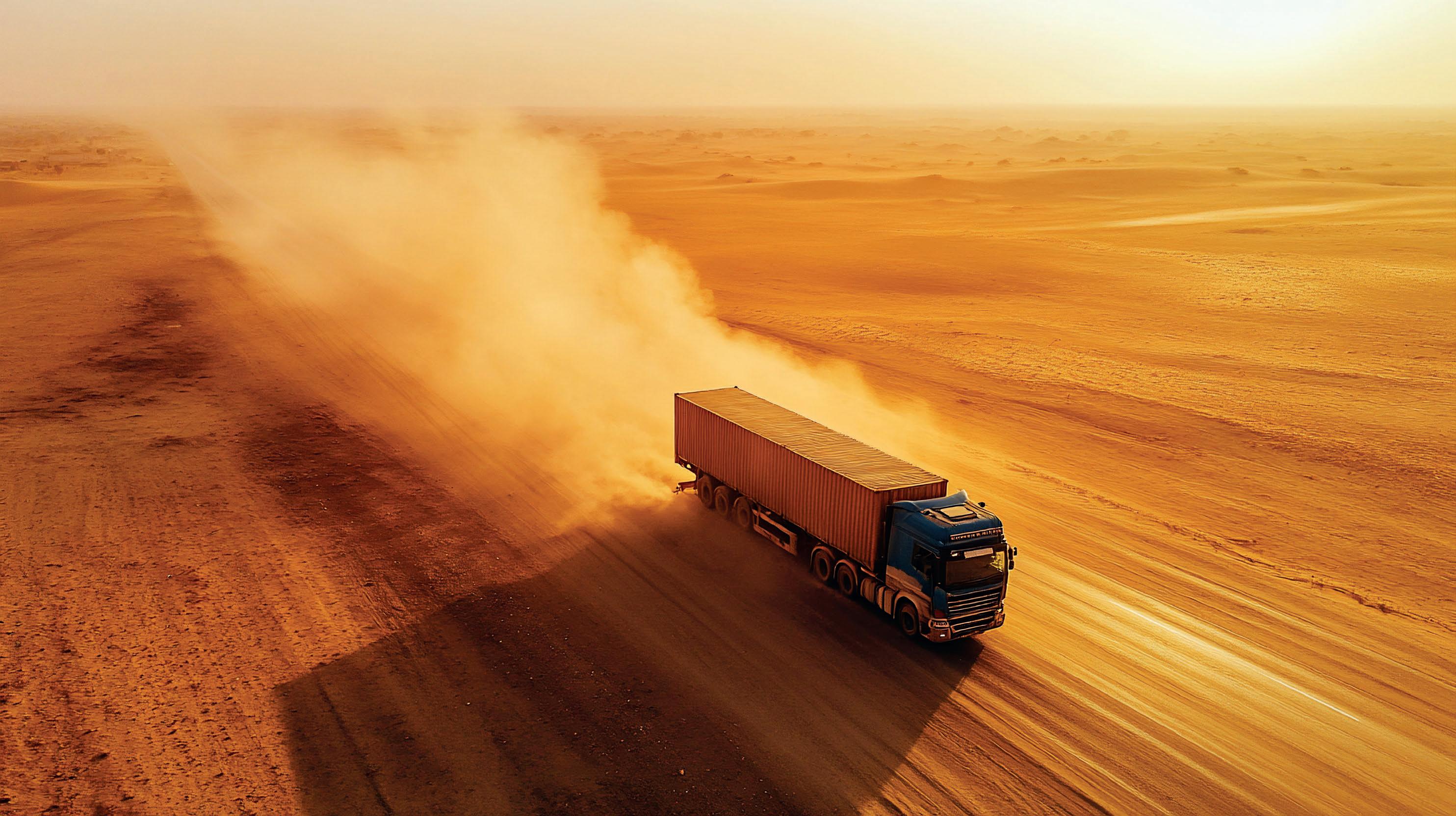
INVESTMENT, EXPANDING TRADE CORRIDORS AND GROWING DEMAND FOR FASTER, MORE RELIABLE SUPPLY CHAINS ACROSS THE CONTINENT.
Africa’s transport and logistics sector is entering a decisive decade. Capital investment, shi ing global trade dynamics and the implementation of continent-wide trade frameworks are converging to reshape how goods move across and beyond the region.
At the centre of this transformation is a growing recognition among global logistics players that Africa is no longer a peripheral market– it is an emerging logistics frontier.
e recent commitment by DHL Group to invest more than €300 million in SubSaharan Africa provides a clear signal that the race to build Africa’s next-generation supply chains is well underway. Beyond the headline gure, though, lies a deeper story – one of structural change in infrastructure, the rise of intra-African trade and the increasing sophistication of transport networks that are rede ning opportunity for trailer manufacturers, eet operators and logistics providers alike.
DHL’s multi-year investment spans its core divisions – Express, Global Forwarding and Supply Chain – and targets infrastructure upgrades, expanded aviation capacity and enhanced warehousing and transport solutions.
e rationale is grounded in data. Sub-Saharan Africa recorded the fastest trade growth globally in the rst half of 2025, with a 10 per cent year-on-year increase in trade value. Forecasts suggest continued expansion, with trade volumes expected
to grow at an average of 4.3 per cent annually through 2029 – placing the region among the world’s most dynamic trade corridors.
is growth is being driven by several structural factors: the rollout of the African Continental Free Trade Area (AfCFTA); rising demand for e-commerce and last-mile delivery; expansion of energy, mining and renewable sectors; and increasing integration into global value chains
For logistics providers, this combination presents both opportunity and urgency. As DHL itself noted, Africa is at a ‘pivotal moment in its trade journey’, requiring rapid improvements in infrastructure and service capability to sustain momentum.
Despite strong trade growth, infrastructure gaps remain the de ning constraint across African logistics. Road networks, port e ciency, rail connectivity and border processes vary signi cantly across regions, creating friction in supply chains.
DHL’s investment directly addresses several of these pain points: gateway upgrades to improve throughput at key logistics hubs; expansion
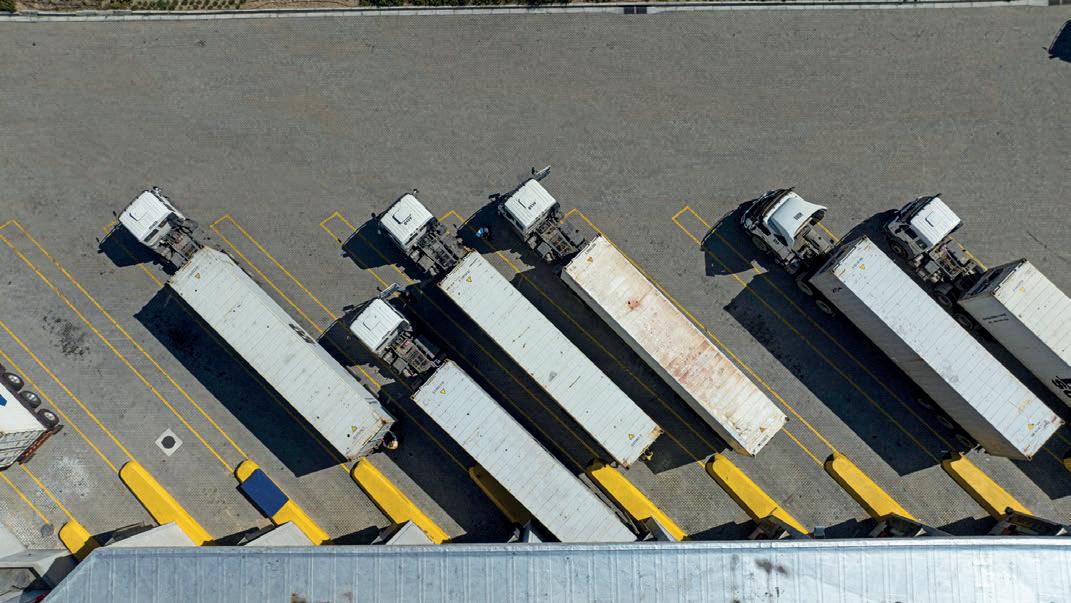
Sub-Saharan Africa recorded the world’s fastest trade growth in early 2025. Image: NAIMAH//stock.adobe.com.
into secondary cities, re ecting decentralised economic growth; enhanced air freight capacity to connect African markets with Europe and Asia; and development of contract logistics and warehousing, particularly in South Africa
For the trailer and transport equipment sector, these developments are particularly signi cant. As logistics networks extend beyond primary urban centres, demand will increase for regional distribution trailers suited to mixed road conditions; temperature-controlled units for pharmaceuticals and perishables; heavy-duty con gurations for energy and mining logistics; and exible, modular equipment for emerging e-commerce supply chains
In e ect, infrastructure investment is not just enabling trade – it is reshaping equipment demand pro les across the continent.
One of the most notable aspects of DHL’s strategy is its focus on ‘second cities’ – emerging urban centres that are becoming critical nodes in regional supply chains.
Historically, African logistics has been heavily concentrated in major ports and capital cities
such as Lagos, Nairobi and Johannesburg. However, AfCFTA and domestic economic diversi cation are driving growth in secondary markets, where manufacturing, agriculture and consumer demand are expanding.
DHL’s plan to extend time-de nite delivery services into these cities re ects a broader shi : supply chains are becoming more distributed; regional corridors are gaining importance over single-node logistics; and last-mile and mid-mile transport segments are expanding rapidly.
For trailer manufacturers and eet operators, this decentralisation presents both challenges and opportunities. Equipment must be adaptable to varied terrain and infrastructure quality, while eet strategies must accommodate longer, more complex distribution routes.
Another de ning feature of current investment trends is the move toward sectorspecialised logistics. DHL’s focus areas – life sciences, energy, perishables and e-commerce – highlight how supply chains in Africa are becoming more sophisticated.
Africa imports nearly 90 per cent of its medicines, and reliable cold chain logistics is critical to improving access. Investment in temperature-controlled transport and storage is therefore a priority.
For the trailer sector, this translates into growing demand for refrigerated trailers and advanced telematics to ensure compliance and product integrity.
Africa’s role in the global energy transition is expanding, supported by its vast reserves of critical minerals and renewable energy potential.
This sector requires specialised logistics solutions, including heavy-haul trailers. modular transport systems, equipment capable of handling oversized and high-value cargo.
Agricultural exports are a cornerstone of many African economies. Enhanced cold chain logistics and faster transit times are essential to reducing spoilage and improving competitiveness.
Meanwhile, e-commerce is rapidly transforming retail across Africa, driven by mobile connectivity and a growing middle class.
is sector places new demands on logistics networks: high-frequency, small-volume deliveries; e cient last-mile distribution; and integration with digital platforms and customs systems.
Together, these sectors are pushing African logistics beyond traditional bulk transport into a more diversi ed and technologically advanced ecosystem.
Investment is not limited to physical infrastructure. Digital tools are becoming increasingly central to logistics performance in Africa.
DHL is scaling digital capabilities to provide greater visibility and control across supply chains, helping customers navigate regulatory complexity and shi ing trade patterns.
Key trends include real-time tracking and predictive analytics; digital customs and documentation systems; and integration of logistics platforms with e-commerce ecosystems.
For transport operators, this means that competitiveness will increasingly depend not just on eet capacity, but on digital capability.
Trailer manufacturers are also responding, incorporating telematics, IoT sensors and data integration into equipment design. e result is a convergence of physical and digital infrastructure that is rede ning logistics e ciency.
Underlying much of the current investment wave is the African Continental Free Trade Area, which aims to create a single market of over 1.3 billion people.
AfCFTA is expected to: reduce tari s and non-tari barriers; simplify cross-border procedures; and stimulate intra-African trade.
However, its success depends heavily on logistics performance. E cient transport networks are essential to translating policy into practical trade ows.
DHL’s investment explicitly aligns with AfCFTA-driven growth, targeting the corridors and capabilities needed to support increased cross-border activity.
For the trailer industry, this could mean increased cross-border freight volumes, greater standardisation of equipment requirements and expansion of regional eet operations.
In many ways, AfCFTA is the demand driver, while logistics investment is the enabling
e country’s relatively advanced infrastructure, established logistics sector and strategic location make it a gateway for regional trade. DHL Supply Chain’s expansion in South Africa re ects growing demand for outsourced logistics and transport solutions.
For trailer manufacturers, South Africa continues to serve as a key production and assembly base, a testing ground for new technologies and con gurations as well as a distribution hub for neighbouring markets.
However, competition is intensifying as other African markets develop their own logistics capabilities. Despite strong momentum, signi cant challenges remain including infrastructure gaps –road quality, port congestion and rail limitations continue to impact efficiency. Regulatory complexity – cross-border trade involves diverse regulations and administrative processes. Skills and workforce development – the logistics sector requires skilled personnel to manage increasingly complex supply chains. Financing and investment risk – large-scale infrastructure projects o en face funding constraints and political risk.
Addressing these challenges will require coordinated e orts between governments, private sector players and international investors.
For the global trailer industry, Africa’s logistics transformation represents a major growth opportunity – but one that requires adaptation.
Key implications include product diversi cation (increased demand for specialised trailers like refrigerated, heavy-haul and modular); localisation, the need for region-speci c designs suited to African conditions; a ermarket services
(the growing importance of maintenance, parts and support networks); and partnership models or collaboration with logistics providers and local operators.
Manufacturers that can align with Africa’s evolving logistics landscape – combining durability, exibility and technological capability – will be well positioned to capture market share.
DHL’s €300-plus million investment is not an isolated initiative. It is part of a broader trend of increasing global interest in Africa’s logistics potential.
As supply chains diversify and companies seek new growth markets, Africa is emerging as a critical link in global trade networks. Its combination of demographic growth, resource wealth and expanding consumer markets makes it uniquely positioned for long-term expansion.
However, realising this potential will depend on continued investment in transport, logistics and infrastructure.
Africa’s logistics sector is undergoing a profound transformation. Investments such as DHL’s are
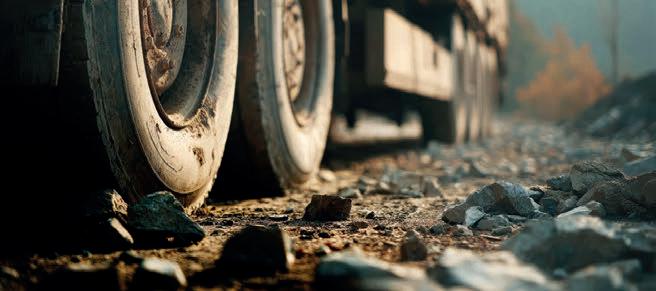
DHL is investing more than €300 million to upgrade infrastructure and supply chain capability across Africa. Image: somsri/stock.adobe.com.

accelerating the development of infrastructure, enhancing connectivity and enabling new trade opportunities across the continent.
For the trailer and transport industry, this transformation presents both a challenge and an opportunity. Success will depend on understanding the unique dynamics of African markets and delivering solutions that meet their evolving needs.
Africa is no longer a future market – it is a present one. And as logistics networks expand and mature, those who invest early in understanding and supporting this growth will be best placed to bene t from one of the most signi cant transport and trade stories of the coming decade.
www.globaltrailermag.com




RAS DEMAND FOR SAFE, EFFICIENT FOOD LOGISTICS GROWS ACROSS THE MIDDLE EAST AND AFRICA, REFRIGERATED TRAILER SPECIALIST GORICA IS DOUBLING DOWN ON TECHNOLOGY, INVESTMENT AND REGIONAL ADAPTATION TO RESHAPE COLD CHAIN TRANSPORT.
efrigerated transport is no longer a niche segment for GORICA – it is now one of the company’s core strategic pillars. GORICA General Manager of Sales and Marketing, Domen Bockor, said the company’s “Frigo” program ranked among its top three business lines, re ecting both its scale and long-term potential.
“It was one of the three leading programs within the Group, with strong market potential for both current and new solutions being developed with strategic partners,” said Bockor.

Across the Middle East and Africa GORICA has already established itself as a major provider of perishable goods transport solutions, but Bockor said the market has evolved beyond simple product supply towards a more sophisticated, value-driven model.

includes stainless steel milk tankers, aluminium bulkers for feed and grain, and other specialised transport equipment.
e strategy re ects the diversity of industries driving demand, from dairy, meat and seafood producers to supermarket chains and food processing companies. By targeting these segments, GORICA is positioning itself as a full-service provider across the cold chain.
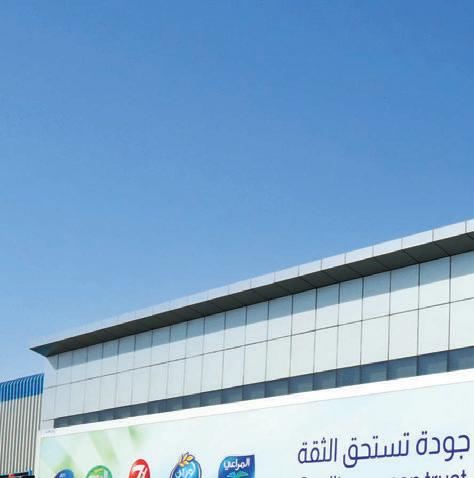
“It was no longer just about the product,” he said. “Customers were increasingly focused on total cost of ownership, the overall solution and return on investment.” at shi is shaping how GORICA approaches the refrigerated sector. Accordingly, the company integrates reefers them into a broader “perishable logistics program” that
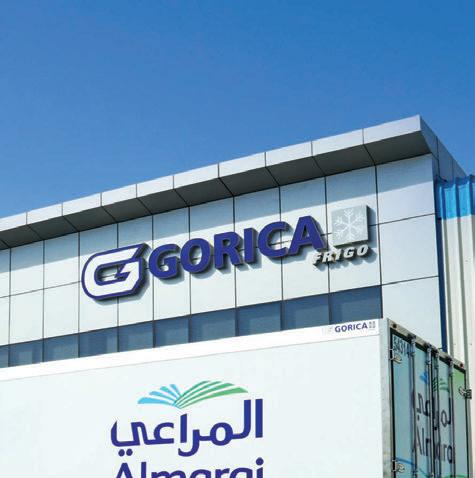
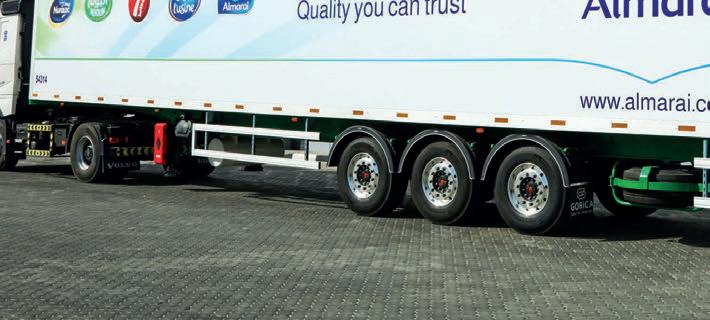
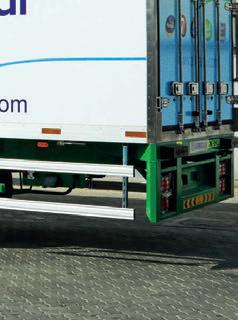
is long-term commitment is underpinned by signi cant nancial investment. Bockor pointed to the establishment of the Frigo division in 2010, when GORICA installed its rst dedicated production line for refrigerated bodies and semitrailers. at step included advanced manufacturing equipment, such as polyurethane injection systems and hydraulic presses.
Expansion followed quickly. By 2013, the company had begun developing a dedicated facility in Dubai Industrial City, culminating in a major milestone with the acquisition of a GRP (glass reinforced polyester) reefer factory from Germany-based Krone. e move led to the creation of GORICA’s fourth manufacturing site, completed by the end of 2015.
Today, that facility produces a wide range of refrigerated and dry freight equipment, forming a key part of the company’s global o ering. e total investment, Bockor said, represented a “strong double-digit million US dollar commitment”, highlighting its long-term focus on the sector.
Central to GORICA’s competitive edge is its approach to technology, speci cally it combining European design standards with solutions tailored to the unique MEA conditions.
“Our products are designed with local infrastructure, driver behaviour and environmental conditions in mind,” said Bockor. “ at localisation was a key advantage over international competitors.” at means building trailers that can withstand some of the harshest environments in the world and where thermal performance is critical.
GORICA’s solution is its use of GRP panels that provide high strength-to-weight ratio, long-term durability and are corrosion resistance. GRP also provides superior insulation, helping maintain consistent internal temperatures under great heat.
Bockor said the company’s focus on achieving optimal thermal conductivity, measured through K-values, is central to ensuring product integrity across long-distance transport routes.
“ ermal performance is critical, particularly in multi-drop operations and extreme climates,” he said.
The advantages of lightweight GRP over traditional metal panel construction are evident in this region. Unlike steel, GRP does not rust or corrode, requires minimal maintenance and can withstand exposure to chemicals, humidity and temperature uctuations.
“Composite materials o ered durability, strength and long service life, o en exceeding 25 years,” said Bockor.
Equally important is design exibility. GRP panels can be moulded into complex shapes, allowing for customised builds without signi cant cost increases,ideal in a market where tailored solutions are required.
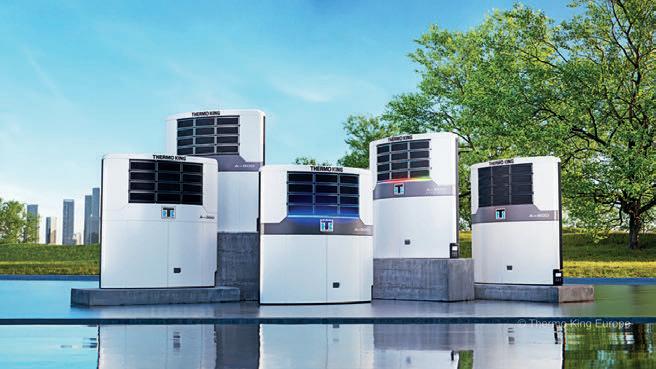
Cooling technology is another key component of the system. GORICA works closely with ermo King, equipping its refrigerated bodies and trailers with industry-leading refrigeration units designed to suit local conditions.
is approach re ects the GORICA’s broader focus on delivering complete solutions rather than individual components, which is underscored by the rapid growth of the cold chain sector across the MENA region. Demand for reliable food logistics is increasing, driven by population growth, urbanisation and changing consumption patterns.
Bockor said the shi towards service-based economies placed greater emphasis on safe and e cient transport of perishable goods. “ e service sector is becoming more critical, and that’s driving demand for higher-quality and safer cold chain solutions,” he said.
However, the region still faces signi cant challenges. While awareness of food safety and cold chain standards has improved, regulatory frameworks are inconsistent. Some operators still rely on older trailers,o en second or third-hand, that no longer meet European standards. is practice, Bockor warned, is increasingly unsustainable.
“Many of these trailers have already exceeded their service life under European ATP standards. When they are brought into the region, their thermal e ciency is already compromised,” he said.
In extreme climates, that loss of performance has serious implications for food safety and operational reliability. erefore, strengthening regulations and encouraging the adoption of modern equipment is critical to improving standards, such as Europe’s ATP certi cation system. “ e lack of clear regulations remains one of the biggest challenges,” Bockor said Despite these hurdles, the outlook for refrigerated transport in the region remains strong. With growing demand, increasing awareness and ongoing investment, the sector is poised for continued expansion.
For GORICA, the focus is on staying ahead of that curve – combining technology, local expertise and strategic partnerships to deliver solutions that meet the evolving needs of the market.
In a region where climate, distance and infrastructure all present unique challenges, the future of cold chain transport will depend not just on innovation, but on the ability to adapt that innovation to real-world conditions.
Domen Bockor makes it crystal clear that is exactly where GORICA intends to lead the market.
www.goricagroup.com
EVEN WHEN A PRODUCT IS AT ITS OPTIMAL STAGE OF DEVELOPMENT, THERE IS ALWAYS AN OPPORTUNITY TO REVIEW, REFINE AND RE-ENGINEER TO ENSURE THE PRODUCT CONTINUES TO MEET INDUSTRY AND CUSTOMER NEEDS. THAT IS THE PHILOSOPHY OF KRONE TRAILER WITH ITS LEADING REFRIGERATED PRODUCT.
With its new generation of Cool Liner, Krone Trailer is presenting a consistently re ned version of its proven refrigerated semi-trailer. e focus of the current iteration is on detailed design optimisations in the insulated structure, complemented by further increased structural stability as well as improvements in tightness, durability and economy.
Krone has achieved these goals while maintaining the same high level of exibility in temperature-controlled transport.
e new generation builds on the established Cool Liner concept, which is already renowned for e cient and versatile refrigerated logistics solutions – including fully electric refrigeration concepts, multi-temperature equipment and intelligent telematics solutions. e aim of the further development is to enhance the substance of the vehicle in key areas and to further optimise life cycle costs.
the same time optimising cost-e ectiveness over the entire life cycle. e result is a vehicle that is even more reliable in the tough everyday world of refrigerated transport.”
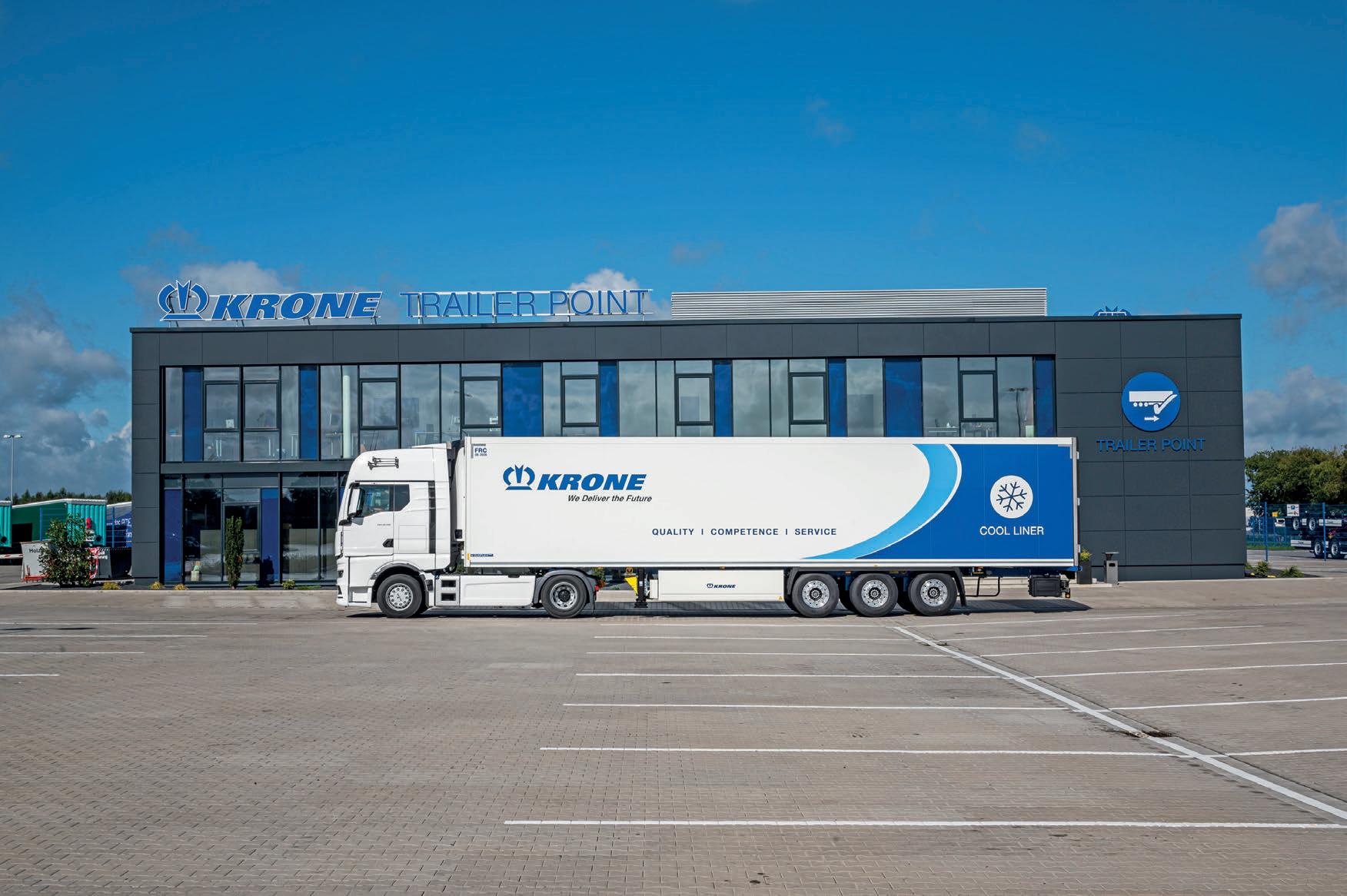
‘With the new Cool Liner generation, we deliberately did not aim for a revolution, but rather further developed the design details where they make the biggest di erence in
“Our aim was to further increase stability, robustness and value retention, while at
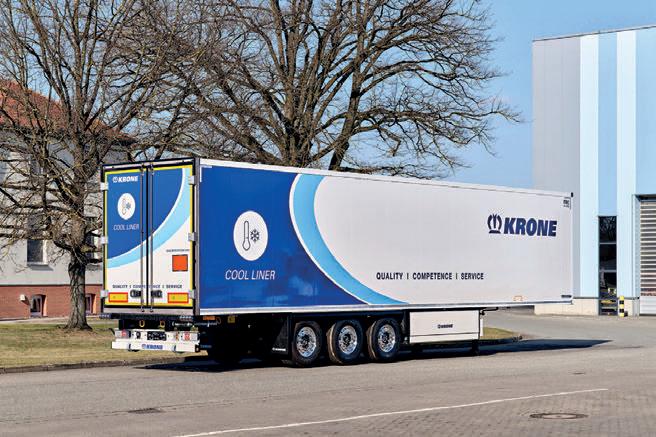
The side walls and roof continue to be manufactured as large panels using an open foaming process. The homogeneous foam structure ensures an optimum ‘K value’, therefore providing stable temperature control over the entire service life. e inner deck layer of the side wall has been redesigned at the transition to the roof and in the highly stressed area at the oor interface. is increases structural stability, especially during intensive loading and unloading.
e base skirting has also been redesigned. An optimised cross-section increases resistance to mechanical impact from industrial trucks and at the same time improves the seal against moisture. Adapted edging pro les on the outside support an optimised bonding process and contribute to a further increase in overall stability.
In the rear area, detailed, locally reinforced sections and reinforced door hinge blocks now
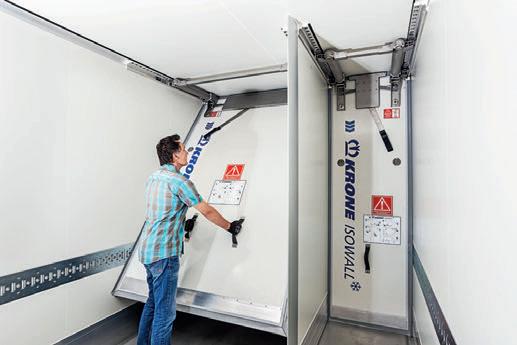
signi cantly reduce stress peaks, especially in the sensitive corner areas. New plastic inserts improve insulation and sealing and support the rear frame oor pro le during high-frequency forkli tra c. A new design in the lower corner area of the rear frame enables permanent sealing to the side wall. At the same time, the sealing joint in the wet area of the oor has been eliminated by design. is has resulted in increased long-term tightness and a noticeable contribution to value retention.
e oor continues to be manufactured as a large panel using an injection moulding process and o ers maximum load-bearing capacity thanks to
its homogeneous foam structure, further increasing structural integrity and performance of the product. e clean lines of the design also ensure optimised use and maintenance for operators.
In addition to a completely revised King Pin module, a reinforced oor design is available as an option at the front for increased requirements. For intermodal applications, a RoRomodule is available that signi cantly increases strength in the ferry block position. Newly designed oor edge strips with high structural density minimise the risk of moisture absorption and ensure long-term durability. A newly designed cable duct and sealing concept in the neck area also enables the safe integration of optional cable packages.
In addition to extensive analytical support, the design revisions were validated by numerous tests at Krone’s own test centre in Lingen, north-west Germany, where the detailed optimised radiator had to prove its resilience in demanding test programs over a period of several months.
For the rst time, the entire vehicle was validated on specially designed test benches against a wide range of requirement pro les for highly developed truck test tracks and against evaluation vehicles.
Robust Cool Liner
e result of the review, recon guration and demanding testing of the Cool Liner series is a refrigerated semi-trailer that consistently builds on its proven strengths in insulation performance, stability and versatility and has been further optimised in key technical details.
As a result, the new-look Cool Liner is ready for maximum e ciency in national and international refrigerated transport.
www.krone-trailer.com
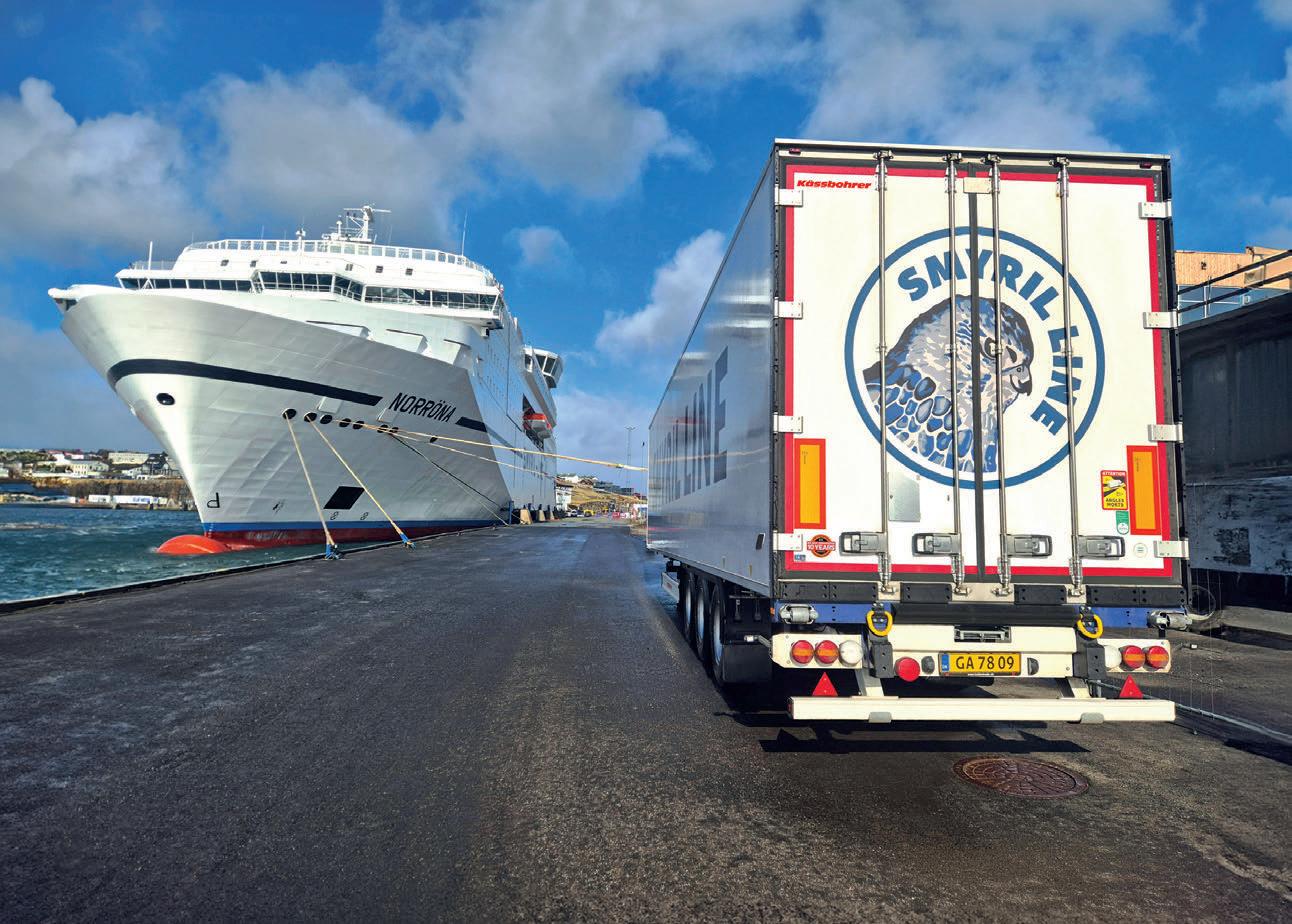
KÄSSBOHRER HAS UNVEILED A NEW-LOOK, NEXT-GENERATION OF REEFERS THAT ARE FAST GAINING A REPUTATION FOR THEIR ROBUSTNESS AND HIGH-QUALITY INSULATION.
Kässbohrer has combined its acclaimed, robust chassis with the latest in GRP panel technology to release its new range of reefer trailers, ideal for transporting delicate and perishable goods.
Developed, tested and validated at Europe’s top capability and capacity R&D centres for one million kilometres of normal use, the next-generation reefer series features top-class insulation, long product life and functional features that maximise e ciencies while providing optimal carrying capacity.
Cold-chain chassis
e new-look reefer’s gooseneck chassis that is integrated into the oor, combined with its strong one-piece king pin structure enables e cient and e ective coupling operations which, in turn, facilitate road stability and high safety even in uneven loading.
In addition, the robust chassis wheelbase and width are optimised to maximise the coupled vehicle’s manoeuvrability and stability.
e chassis is manufactured with S700MC steel and zinc phosphate known for its KTL coated process guaranteeing no rust perforation for 10 years, preserving the vehicle value.
e lightweight oor design withstands a 7.2-tonne forkli axle load for fast and challenging operations.
GRP technology
e reefers’ box panels are constructed with the GRP (Glass Reinforced Polyester) polyurethane panel technology to provide high-quality insulation with K-value of 0.31 W/m²K.
Kässbohrer’s next generation reefer range includes dedicated ferry and RO-RO con gurations.
is can signi cantly reduce the running time of refrigeration unit, resulting in up to €9300 fuel cost savings in ve years, compared to metal covered panels.
e panels are layered with UV-resistant and no scratch maintenance GRP and optimum density polyurethane that is tested for layer adhesion with 11,534 kN to guarantee maximum performance and durability.
e UV light-resistant and corrosion resistant GRP panels require no maintenance in case of minimal scratching and light damage to the side panels.
To ensure the structural uniformity and product life of the box, Kässbohrer has maximised the adhesion surface in all side panel connections and protected the box connection points with anodized aluminium one-piece and rivet-less mouldings. e rear frame is made of single piece stainless steel to provide the maximum stability to the overall box construction. e chassis and box connection are also vigorously tested and approved for one million kilometres of normal use, guaranteeing structural integrity for a long lifetime.
e stainless-steel door double locks, located in pairs on each door, provide operational e ciency
and ease of use by reducing the force needed to close rear doors.
e rear frame is protected along all edges with high-capacity rubber ramp bu ers to absorb the impacts during loading and unloading operations.
e bumper is designed with vertical rubbers and innovative cylindrical single roll galvanized stainless steel shock absorber ramp bu ers for maximum impact absorption.
For superior air circulation and optimum cooling unit performance, Kässbohrer has designed all premium cooler unit compatible ventilation cover with double tube ventilation system for homogenous air ow. is also allows for cooling of the whole box in single and doubledeck con gurations, as well as providing multitemperature for fresh and frozen goods, owers, and pharma transportation.
Kässbohrer also o ers optional patented foldable air circulation wall which can be opened for fast cleaning and protects the goods loaded close to the refrigeration unit from frosting.
Compliant with HACCP and Pharma certi cations, the entire oor is covered with antislip drop patterned aluminium, enabling vertical load bar positioning at any place on the oor.
e aluminium oor is welded to 250 mm aluminium high kick plates for durability and to ensure water tightness.
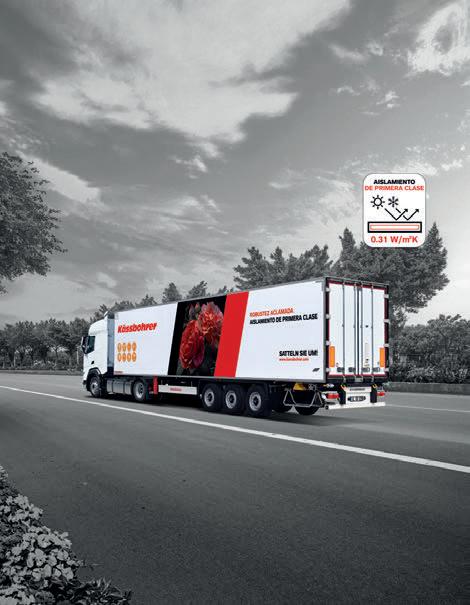
2.460mm and 2.500mm inner widths providing a total load capacity of 10 tonnes and up to 66 euro pallets on the second tier.
e optional partition wall is o ered with a movement range of 10.520 mm and enables transportation at two di erent temperatures from -20 degrees to +10 degrees.
e Kässbohrer reefer series is o ered in four di erent product groups – standard, double deck, ower transportation, and electri ed reefer. e Acclaimed Robustness and Top-Class Insulation reefer series are all o ered with ferry con gurations for reliability and e ciency in combined transport.
e next generation standard reefer K.SRI provides insulation with K Value of 0.31 W/ m²K value, and with inner height of 2.650 mm and inner width of 2.460 mm at 7.200 kg tare weight is FRC, PHARMA, HACCP, CODE XL certi ed.
e next generation, double-deck reefer K.SRI P maximises the loading factor of the insulated reefer, presenting 2,900mm internal height, 2,500mm internal width at 7.200kg, the double-deck loading system consists of 24 embedded vertical rails and 22 double-deck beams accommodating a total of 66 euro pallets.
e K.SRI F carrier reefer is precisely designed for delicate ower transport. O ered with the inner height of 2.700 mm, and the internal width of 2.500 mm, K.SRI F provides optimum loading volume while providing top class insulation to keep all kinds of goods fresh.
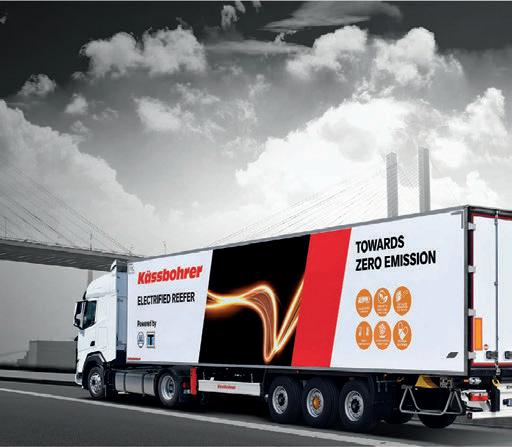
e K.SRI E electri ed reefer is supplied with ermo King-BPW recuperation electri ed cooling technology. Bene tting from Kässbohrer’s top insulation performance with its 0.31 K-value, the ermo King-BPW technology yields up to 4,000 litres of additional fuel savings per year, as well as up to 10-ton CO2 emission reductions.
Kässbohrer’s next generation reefer range is also o ered with dedicated ferry con gurations for reliable and e cient combined transport, bene tting from standard reefer’s reinforced gooseneck and one-piece king pin structure. is ensures exceptional durability, rigidity and resistance against torsion, impact and bending forces.
Where required, the gooseneck can also be reinforced with six millimetre steel plates, further enhancing chassis strength while their structural integrity is validated for Ro-Ro cornering, braking conditions and extreme loading scenarios, ensuring reliability during frequent crossings, port handling and terminal operations.
www.kaessbohrer.com



In pharmaceutical logistics, where stakes are high as temperature deviations of a few degrees can invalidate multi-million-euro cargoes, reliability has long been the domain of diesel fuel.
Historically, the risk of spoiled cargo was mitigated by noisy, diesel-guzzling and carbonintensive auxiliary engines running 24/7.
Now, Italian logistics specialist, Chiggiato S.p.A., is proving that reefer electri cation is no longer a niche experiment, but a viable solution for even the most demanding long-haul pro les. e transition to electri ed cooling is driven by stark arithmetics. A standard diesel-cooled trailer consumes approximately 360 litres of fuel per week, but by deploying the BPW ePower axle within the ermo King AxlePower system, Chiggiato has reduced this to 60 litres - an 80 per cent collapse in consumption.

is is a signi cant OpEx victory for operators’ balance sheets while, for the environment, it represents a weekly saving of nearly 800kg per unit.
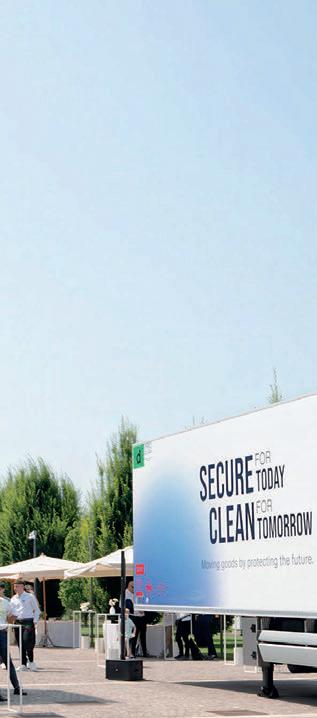



By decoupling the refrigeration unit from the primary combustion engine, Chiggiato reduces the mechanical strain on the vehicle. As the diesel component is no longer under dual-purpose load, the shi to electric cooling results in lower overall maintenance costs and increased uptime.
e residual consumption of 60 litres is a testament to the system’s primary reliance on regenerative braking - a strategy that challenges the industry dogma that recuperation is only e ective in urban, stop-and-go tra c.
The ePower trailer is a product of a specialised European collaboration, built on a partnership between Chiggiato S.p.A. and BPW dating back to 1972.

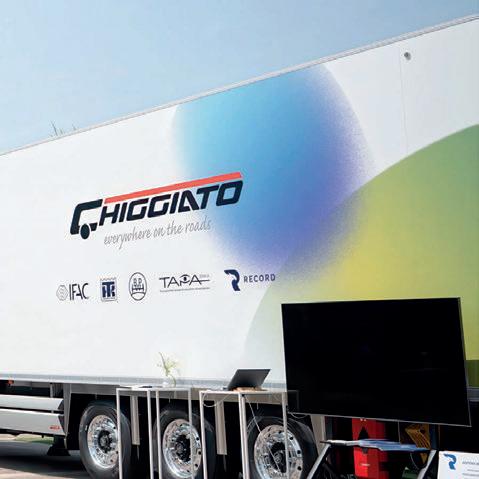
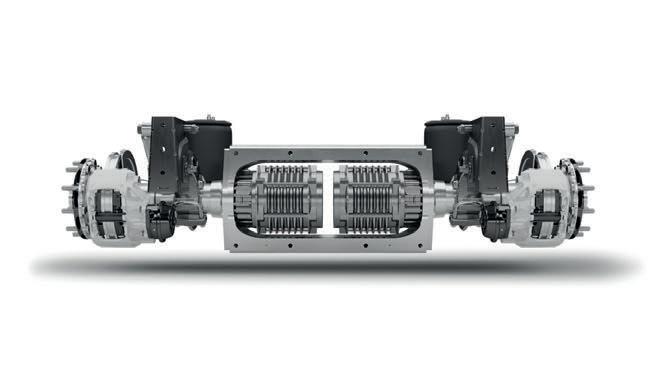
The vehicle utilises a “best-of-breed” configuration, consisting of:
∙ Axle & Energy: The BPW ePower recuperation axle, integrated into the Thermo King AxlePower system.
∙ Chassis: Precision-engineered by OMAR, a specialist in high-performance frames.
∙ Isothermal Body: Crafted by IFAC to minimise thermal leakage and reduce energy demand on the battery system.
Following a 2,000km trial to Denmark, the system is now a fixture on the Italian long-haul network. Even on highways with infrequent braking, the ePower axle stores sufficient energy during deceleration to sustain the battery packs. To satisfy strict GDP (Good Distribution Practice) standards, the system maintains a diesel backup as a fail-safe, ensuring 100 per cent thermal integrity with a fraction of the traditional carbon footprint.
Beyond fuel savings, Chiggiato’s investment serves broader strategic objectives:
∙ Human Capital: The ePower axle system eliminates the constant thrum and vibration of a diesel fridge, improving driver rest and road safety.
∙ Supply Chain De-risking: As pharmaceutical giants face pressure to address “Scope 3” emissions, Chiggiato’s “100 per cent EV Powered” branding signals that it is proactively anticipating future ESG regulations.
∙ Brand Capital: The ePower deployment has resulted in positive market response, sharpening Chiggiato’s profile as a “first-mover” in sustainable hightech logistics and deepening client trust.
Founded in 1972, Chiggiato S.p.A. is a pan-European logistics powerhouse, operating a hyper-modern, digitally networked fleet of refrigerated trailers, curtainsiders, and specialised vans, all monitored 24/7. Its core business is rooted in pharmaceutical transport, including the critical management of Italy’s blood plasma logistics, but also serves the high-tech logistics, fashion, and luxury sectors across Europe and the Middle East.
For Chiggiato’s CEO, Luca Chiggiato, the move is less about following trends and more about redefining leadership.
His strategy rests on three pillars - adding value to the customer, the planet, and the company itself. “If you want to be a true leader and make a difference, you must add value across all three,” said Chiggiato.
“We don’t just want to participate; we want to transform the market.”
By proving that high-tech recuperation excels even in the “braking-starved” long-haul environment, Chiggiato S.p.A. has removed the final hurdle for his clients, proving that the future of the cold chain is safe, silent and sustainable.
www.bpw.de/en/


New energy vehicle product sales exceeded 11,000 units, growing by more than 100 per cent year-on-year.
CIMC VEHICLES IS REPOSITIONING ITS GLOBAL TRAILER BUSINESS FOR SCALE, RESILIENCE AND AN ELECTRIC FUTURE.
The global trailer industry is no stranger to cycles of volatility, overcapacity and margin pressure, but few manufacturers have responded with the level of structural transformation undertaken by CIMC Vehicles. Its latest annual results, reporting revenue of 20.18 billion RMB for 2025 (approx. 2.5 billion euros), are less a nancial milestone than a marker of transition – the culmination of its three-year ‘Star-Chained Plan’ and the starting point for a more ambitious evolution under its successor, the ‘Stellar Plan’.
At the centre of this transformation is a deliberate attempt to rede ne how a global trailer manufacturer competes. Rather than relying solely on production scale or cost leadership, CIMC Vehicles has focused on integration across the value chain, operational standardisation and the development of what it describes as ‘new-quality productive forces’. e language is corporate, but the implications are tangible: fewer ine ciencies, tighter supply chains and a more responsive manufacturing base in an increasingly fragmented global market.
e results suggest early traction. A gross pro t margin approaching 16 per cent, strengthened operating cash ow and a notable li in quarterly pro tability point to improved nancial discipline. Yet the more telling indicators lie beneath the headline numbers. e company’s semi-trailer production footprint, spanning China, Global South, North America and Europe, delivered approximately 110,000 units in 2025, maintaining its position as the world’s largest manufacturer for the thirteenth consecutive year. at consistency at scale, particularly during a period of uneven global demand, underscores the e ectiveness of its restructuring e orts.
e Star-Chained Plan itself was conceived in response to what Chinese industry leaders increasingly describe as ‘involution-style competition’ – a condition characterised by oversupply, homogeneity and downward pricing pressure. For trailer manufacturers, this environment has eroded margins and limited di erentiation. CIMC Vehicles’ response has been to shi the battleground away from price and towards entire-value chain capability.
In practical terms, this has meant recon guring production around modular platforms, consolidating procurement and investing in standardised product lines. Labour e ciencies have improved markedly, with production hours for certain trailer categories reduced by up to 40 per cent. Centralised procurement rates exceeding 80 per cent have further tightened cost control, while also creating a framework that can be replicated across regions.
China remains the proving ground for these initiatives. e domestic semi-trailer business, operating in one of the world’s most competitive markets, recorded growth in both sales and revenue alongside an upli in margins. Market share gains, exceeding 22 per cent in semi-trailers and 26 per cent in liquid tankers, suggest that the strategy is delivering di erentiation in a crowded eld. Notably, this performance has been driven in part by a focus on ‘annual models’, standardised product lines that now account for roughly 40 per cent of sales in key segments. By reducing complexity and increasing consistency, these models have enabled more e cient production and clearer value propositions for customers.
However, the Chinese market is only one component of a broader global strategy. e company’s Global South operations – encompassing emerging markets across Southeast Asia, the Middle East, Africa and beyond – have become a signi cant growth engine. Revenue growth approaching 18 per cent and volume increases nearing 30 per cent re ect both rising demand and a more tailored approach to regional markets.
is approach has yielded particularly strong results in markets such as Vietnam and ailand, where growth has exceeded 70 per cent, and in frontier regions like Central Asia, where the company is establishing an early foothold. e integration of its Australian operations into this Global South framework further illustrates the strategic shi . Australia, while mature compared to many emerging markets, shares characteristics such as geographic scale and demand for specialised equipment. Maintaining pro tability and a top-six market position in this environment demonstrates the exibility of the model.
In contrast, developed markets have presented a more complex picture. Europe, for instance, has delivered stable volumes and modest revenue growth, but at the cost of margin compression. is re ects broader industry dynamics, including higher input costs, regulatory pressures and subdued demand. CIMC Vehicles’ response has been to prioritise stability – consolidating operations, advancing regional integration and standardising products to prepare for an eventual recovery.
North America tells a similar story of resilience amid so ness. While certain segments, such as refrigerated trailers, have maintained steady output, others have been impacted by inventory overhang and cautious capital expenditure from eets. Here, the company has leaned on its operational discipline, using pre-assembled inventory to meet demand spikes while controlling costs in weaker segments. e expectation of a gradual recovery by mid-2026 aligns with broader industry forecasts, but the emphasis remains on readiness rather than short-term expansion.
Beyond semi-trailers, CIMC Vehicles’ diversi ed portfolio is playing an increasingly important role. Its DTB (truck body) business has delivered steady growth, supported by structural reforms that mirror the principles of the StarChained Plan. e integration of production resources, particularly in segments such as mixer trucks, has improved e ciency and pro tability. At the same time, closer collaboration with OEM partners has enabled the development of integrated solutions, reducing system costs and accelerating time-to-market for new products. is collaborative approach is particularly evident in the company’s push into new energy vehicles. Sales of its new energy product range have more than doubled, exceeding 11,000 units, as demand for low-emission transport solutions continues to grow. While still a relatively small portion of the overall business, this segment represents a critical bridge to the next phase of industry development.
vehicle and trailer integration. Positioned as a cornerstone of its future, the EV-RT ecosystem aims to move beyond incremental electri cation towards a more holistic reimagining of heavy transport. is includes the development of electric trailer platforms, integration with electric tractors and the establishment of a closed-loop ecosystem encompassing design, manufacturing and operation.
e signi cance of this initiative extends beyond technology. By positioning itself as a ‘standard-setter’ in this space, CIMC Vehicles is seeking to in uence the direction of the industry itself. Participation in the development of national and international standards, alongside the introduction of new business models, re ects a recognition that the transition to electri cation will be as much about systems and infrastructure as it is about vehicles.
Yet ambition alone is not enough. e success of the EV-RT ecosystem will depend on the combined force of the entire ecosystem. While early progress is encouraging, including the development of prototype platforms, the path to widespread deployment remains uncertain. is is a long-term play, and one that will require sustained investment and collaboration.
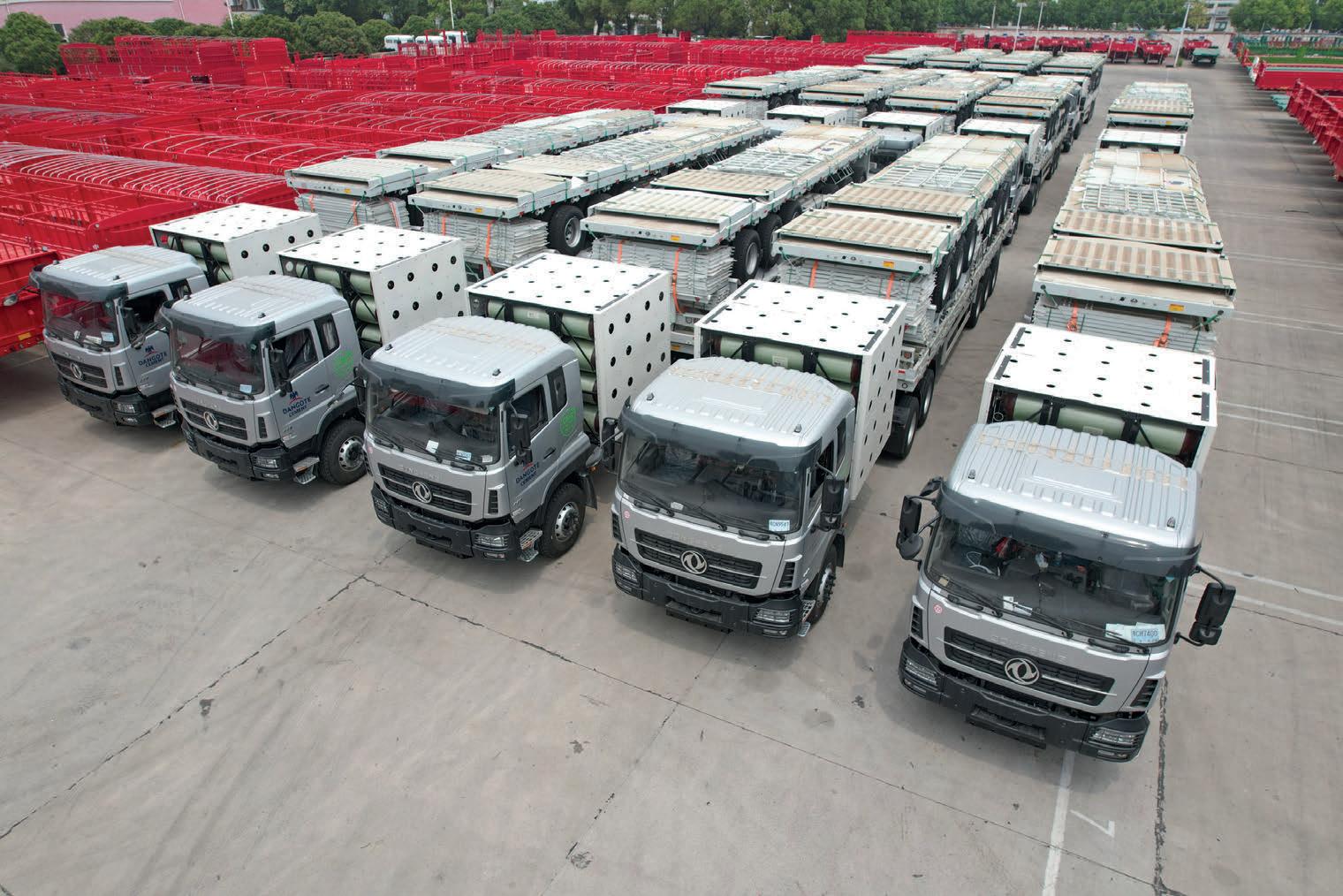
Looking ahead, the Stellar Plan (2026–2030) represents the next stage of this journey. Building on the foundations of the StarChained Plan, it aims to scale the company’s integrated model across regions while
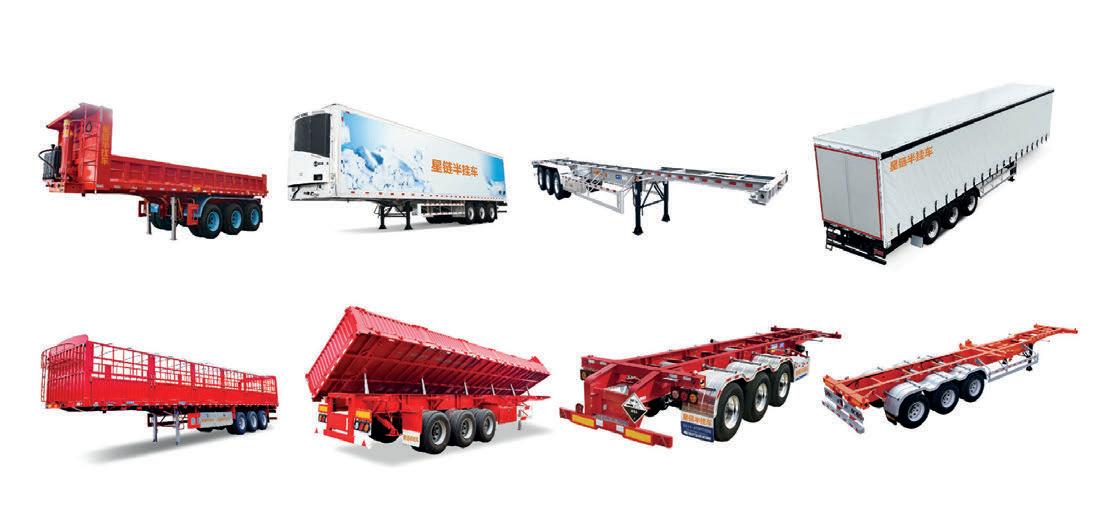
The company produced approximately 110,000 semi-trailers globally, ranking rst worldwide for the 13th consecutive year.
expanding its presence in key markets. is includes a renewed focus on North America, the launch of a European ‘Star-Chained’ initiative and continued development of the EV-RT ecosystem.
Central to this plan is the concept of the ‘entire-value chain’ operator. Rather than competing solely as a manufacturer, CIMC Vehicles is positioning itself as a provider of integrated solutions, encompassing everything from component supply and production to a ersales services and lifecycle management. is shi re ects broader trends within the transport industry, where value is increasingly created through services and data rather than hardware alone.
The expansion of producer services, including maintenance, refurbishment, leasing and pre-owned vehicle trading, is a key element of this strategy. e establishment of service networks, such as ‘Sanhao Centres’ and delivery hubs, provides the infrastructure to support these activities. In doing so, the company is
A batch order of 1,600 semi-trailers for Nigeria.
not only diversifying its revenue streams but also strengthening its relationships with customers, creating a more resilient business model.
For the global trailer industry, the implications are signi cant. As manufacturers adopt more integrated and service-oriented models, competition is likely to shi from product speci cations to ecosystem capabilities. is could reshape the competitive landscape, favouring companies with the scale and resources to invest in end-to-end solutions.
At the same time, the industry remains subject to the same fundamental challenges: cyclical demand, regulatory pressures and the need for continuous innovation. CIMC Vehicles’ transformation does not eliminate these challenges, but it does provide a framework for navigating them. By focusing on e ciency, integration and long-term capability building, the company is attempting to create a bu er against volatility while positioning itself for future growth.
Whether this approach will deliver sustained competitive advantage remains to be seen. e transition from a manufacturing-centric model to an integrated value chain operator is complex, and execution risks are signi cant. However, the early results of the Star-Chained Plan suggest that the foundations are in place.
For operators and suppliers watching from across global markets, the message is clear: scale alone is no longer su cient. In an environment de ned by rapid technological change and shi ing market dynamics, the ability to integrate, adapt and innovate will determine success
www.cimcvehiclesgroup.com
For Andreas Schmitz, the trajectory of Schmitz Cargobull is de ned by a simple but demanding principle: deliver measurable value to customers while navigating an increasingly complex regulatory and economic landscape. As the company builds on the momentum of 2025, Schmitz is clear-eyed about both the opportunities and the pressures shaping the European and global
e past year marks a period of steady expansion and strategic consolidation. “Internationally, Schmitz Cargobull strengthened its global engagement in the cold chain in 2025,” Schmitz said. Growth in North America continues through Cargobull North America, while a cooperation with SubZero opens the door to India – an emerging market with signi cant long-term potential. At the same time, the company reinforces its European base through close collaboration with partners such as GT Trailers, BERGER and Van Hool, broadening its product o ering across multiple segments.
ese partnerships are not merely symbolic; they are central to a broader strategy of scalable growth. Schmitz explains that alliances with established players enable the company to extend its reach while maintaining product quality and reliability. “Partnerships such as GT Trailers, Berger or Utility strengthen our position in key markets and enable us to o er a broader range of solutions and support our customers more e ectively,” he said.
In North America, the relationship with Utility Trailer Manufacturing Company is
particularly signi cant. Schmitz describes the partnership as a combination of complementary strengths. “Utility Trailer Manufacturing Company, as the largest and most professional manufacturer of refrigerated trailers in North America, contributes manufacturing expertise and strong market understanding,” he says. “Together with our expertise in cooling units, telematics and refrigerated systems, the focus is on delivering clear value for customers.”
Similarly, collaboration with GT Trailers supports niche segments. “GT Trailers is a capable and experienced manufacturer of specialised transport solutions, including highvolume combinations,” Schmitz explained. “By adding our purchasing power and reliable components, we can improve product quality in segments where our own volumes are limited.”
Despite these advances, 2025 has not been without its challenges. Of paramount concern among them is regulation, with the CEO seeing overregulation as slowing down innovation, while adding administrative e ort for both manufacturers and transport companies. He points to the planned introduction of VECTO for trailers as a key concern, arguing that it fails to account for technical realities and risks driving up costs unnecessarily. is regulatory tension has extended into 2026, where Schmitz sees policy as both a constraint and a catalyst. “Overregulation continues to be the dominant challenge,” he said. “VECTO does not re ect the actual usage of trailers and therefore prescribes erroneous solutions.” Instead, he advocates for a more balanced approach. “A fair approach would be to structure CO2 pricing based on the ‘polluter pays’ principle and market-oriented mechanism. is would ensure that costs re ect actual consumption and environmental impact.”
e company’s decision to join legal action against the European Commission’s Regulation (EU) 2024/1610 underscores the seriousness of the issue. Schmitz is unequivocal in his reasoning. “ e regulation starts from a wrong premise: trailers do not emit CO2,” he said. “If le unchallenged, the regulation would enforce measures that o er little real impact while increasing complexity and cost for customers.”
“OUR FOCUS IS ON SOLUTIONS THAT DELIVER CLEAR BENEFITS IN DAILY TRANSPORT OPERATIONS AND PROVIDE TANGIBLE ADDED VALUE FOR OUR CUSTOMERS, EVEN IF THIS RESULTS IN HIGHER MANUFACTURING COSTS FOR US.”
SCHMITZ CARGOBULL CEO, ANDREAS SCHMITZ
Even so, Schmitz remains pragmatic about the realities of operating in a heavily regulated environment. “ e ability to react quickly and remain exible in fastchanging market conditions has become part of day-to-day business,” he added – a mindset that informs the company’s outlook for 2026.
Looking ahead, Schmitz anticipates a gradual return of con dence across Europe. “We expect to see more con dence and investment activity return,” he said. Central to this outlook is a continued focus on product innovation that delivers tangible operational bene ts. “Our focus is on solutions that deliver clear bene ts in daily transport operations and provide tangible added value for our customers, even if this results in higher manufacturing costs for us.”
Examples include galvanisation for enhanced durability and advanced insulation technologies in refrigerated trailers such as the S.KO COOL. ese developments are designed not only to improve performance but also to reduce total cost of ownership – an increasingly critical metric for operators navigating tight margins and sustainability pressures.
Indeed, sustainability is not treated as a standalone objective but as an integrated component of product development and long-term strategy. e successful completion of the EcoDuo road-rail combination trial in 2025 highlights this approach. “As a fourth-generation family business, we naturally think in the long term and therefore sustainably,” Schmitz said. “ e EcoDuo project shows that economic e ciency and ecological sustainability can work well together when we look at the entire transport system.”
Future sustainability initiatives follow the same philosophy. “We focus on practical, e cient, and ecologically sound solutions that help our customers improve their transport operations,” he said. Durable construction methods, such as galvanisation, remain a cornerstone, alongside broader e orts to embed sustainability across all business areas.
Regulation, meanwhile, continues to shape research and development. “Regulatory requirements are integrated into our development process from the beginning,” Schmitz said. “At the same time, we design long-lasting, resource-e cient solutions that perform reliably in real operations.” e goal is to strike a balance between compliance and performance, ensuring that every innovation contributes to lower consumption and improved total cost of ownership.
Technology plays a critical role in this equation. Schmitz Cargobull has long been a pioneer in telematics, and the integration of AI is accelerating this capability. “We have been a telematics pioneer since the 1990s,” said Schmitz. “AI is becoming an important tool to process data and transform it into transparency, e ciency, and planning reliability for our customers. We will continue on this path.”
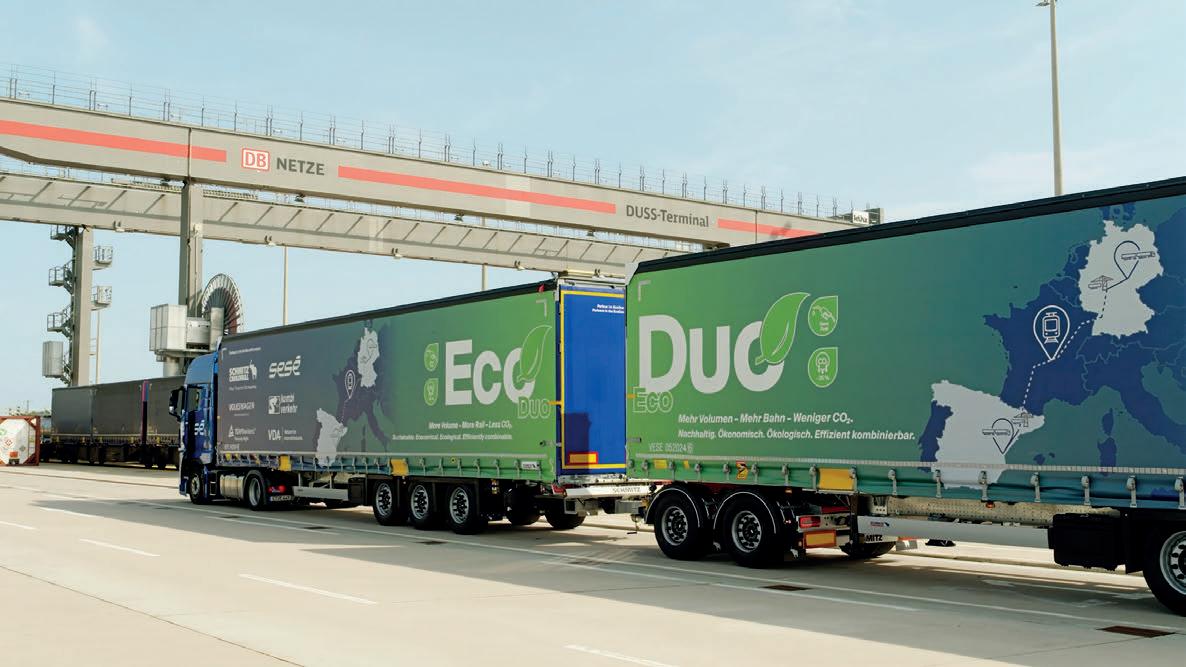
“WE FOCUS ON PRACTICAL, EFFICIENT, AND ECOLOGICALLY SOUND SOLUTIONS THAT HELP OUR CUSTOMERS IMPROVE THEIR TRANSPORT OPERATIONS.”
SCHMITZ
CARGOBULL
CEO, ANDREAS SCHMITZ
As the company positions itself for the next 12 to 36 months, the focus remains on steady, sustainable growth. “We aim to stay on our growth path, supported by strong products, reliable services, and continued international expansion,” the CEO said. However, he acknowledges that external factors, particularly political developments and investment sentiment, will play a decisive role. “ e challenge will be the speed and agility to react to a changing political environment.”
Underlying all of this is a leadership philosophy shaped as much by personal history as by professional experience. e passing of his father, Dr Heinz Schmitz, in October 2025 marks a signi cant moment for the company and its CEO. Schmitz speaks with clarity about the legacy le behind. “My father shaped our company with entrepreneurial courage, and a focus on customer bene t,” he said. “His principles continue to guide our daily work.” is in uence is evident in Schmitz’s own management style. “I rely on facts, transparency and a strong focus on customer value. I expect accountability throughout the organisation and promote open and direct communication.”
It is a straightforward approach, but one that re ects the operational discipline required to lead a global manufacturing business in uncertain times.
Maintaining perspective is equally important. “We focus on the basics: our
customers, our people, and a pragmatic approach to decision-making, promoting agility,” said Schmitz. is grounding in fundamentals has proven essential over the past decade, a period marked by signi cant disruption.
Since taking on the role of Chairman of the Management Board in 2016, Schmitz has overseen a period of transformation. “We have progressed in technology – for example, by introducing trailer telematics as a standard feature – strengthened our service focus, and expanded our international footprint,” he said.
At the same time, the company has navigated multiple crises, including geopolitical shi s and the loss of key markets.
“Managing these challenges shows that our resilience, our reliability and innovative spirit are key strengths. ese help us continue developing even in di cult times,” said Schmitz. at resilience now underpins the company’s forward strategy. With a clear focus on customer value, a pragmatic approach to sustainability, and a commitment to innovation, Schmitz Cargobull is positioning itself not just to adapt to change –but to help de ne the future of the global trailer industry.
www.cargobull.com






Troubleshooting and support made easier.
Images: Haldex
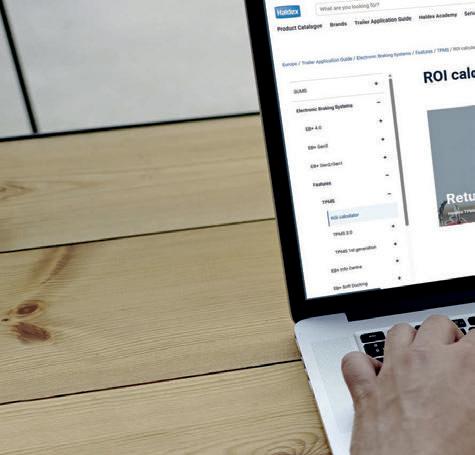
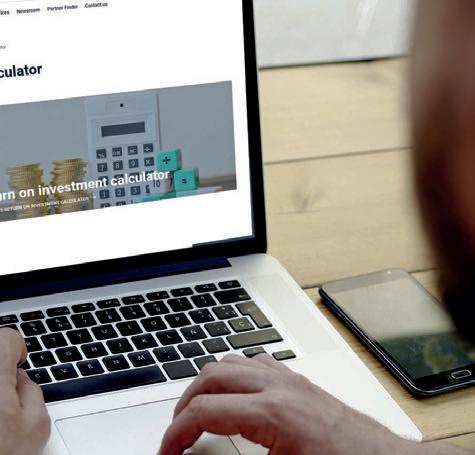




THE HALDEX TRAILER APPLICATION GUIDE IS A CLEAR SIGNAL OF WHERE SUPPORT IS HEADING – INSTANT, DIGITAL AND ALWAYS AVAILABLE. MORE THAN THAT, THOUGH, IT REFLECTS A FUNDAMENTAL SHIFT IN HOW TECHNICAL KNOWLEDGE IS CREATED, SHARED AND APPLIED.
The rise of the always-on workshop, the cross-border manufacturing environment and increasingly complex trailer systems have exposed a long-standing ine ciency in the industry – fragmented knowledge. For years, technicians, OEMs and eet operators have relied on email chains, phone calls and scattered documentation to solve problems that o en demand immediate answers.
TAG represents a decisive shi away from that model.
What began as a pragmatic internal solution to centralise ‘too scattered’ information has evolved into a comprehensive, customer-facing platform. Initially designed to help Haldex teams organise documentation and support day-to-day training, the system quickly revealed a much broader application.
“ e same problem existed outside Haldex,” said Haldex OE Product specialist, André Wilt. “Workshops, eets and trailer builders were facing the same ‘search time’ and fragmentation across documents, emails and platforms.” at realisation transformed the Haldex Trailer Application Guide (TAG) from an internal e ciency tool into a 24/7 global resource, delivering immediate access to speci cations, diagnostic procedures and type-approval documentation without the need for callbacks or inbox searches.
e signi cance of this shi is convenience and continuity.
“When you have no colleague or someone to refer to, you still have this second line.
at helps you to nd quickly an answer,” said Haldex Trailer Products Specialist, André Wilt. at ‘second line’ is increasingly becoming the rst point of contact.
TAG’s structure reflects a deeper understanding of how the industry consumes information. Its visual, component-based interface allows users to navigate from a full trailer overview down to granular technical detail, supporting multiple personas through a layered approach.
Trailer builders can use it for system specification and integration, while technicians dive deeper into diagnostics and
With 24/7 access, the Trailer Application Guide (TAG) is an always-on platform that delivers instant technical support worldwide. It is also an all-in-one resource that covers braking systems, air suspension and also features smart tools such as calculators and step-bystep diagnostics to reduce errors.
troubleshooting. Distributors, meanwhile, focus on compatibility and parts identi cation. is multi-audience design is central to the platform’s value.
It also highlights a broader industry trend, the democratisation of technical knowledge.
By removing barriers to information, TAG reduces reliance on specialist interpretation and minimises the risk of error in safetycritical systems. Wilt described it as a ‘shared technical foundation’ – one that underpins the industry’s ongoing shi towards connected systems, so ware-driven functionality and digital service models.
In practical terms, that digitalisation is already visible.
Tools such as the load sensing valve calculator replace paper charts and manual arithmetic in critical adjustment tasks, improving both speed and accuracy. In workshops, structured diagnostic tables now guide technicians through cable fault checks with de ned test conditions, expected values and corrective actions – eliminating guesswork and reducing downtime.
e traditional support model, emails, attachments, delayed responses, is being replaced by self-service access to validated, up-to-date information. Wilt explained, instead of waiting on responses, users can follow stepby-step procedures directly within the platform and escalate only when necessary.
The result is faster diagnostics, more consistent maintenance outcomes and a more e cient relationship between supplier and customer.
TAG also sits alongside a broader evolution in service delivery. Remote diagnostics, so ware updates and connected eet tools are becoming standard practice, and while TAG does not replace these technologies, it enables them by ensuring users have immediate access to the correct technical baseline.
For manufacturers, particularly those entering new regulatory or technical territory, the value is amplified. The agricultural segment is a prime example, as it adapts to increased adoption of air braking systems. TAG provides a knowledge bridge, enabling experienced builders to upskill quickly without relying solely on external training or support.
Importantly, the platform continues to evolve in step with product innovation and regulatory change.
A dedicated internal process ensures new content is curated, validated and published rapidly, o en within days or weeks of o cial documentation being released. Weekly review cycles and close coordination between product management, R&D and technical teams ensure TAG remains aligned with the latest developments, from systems like EB+ 4.0 and ABS 4.0 to emerging regulatory frameworks.
Since Haldex’s integration into the SAF-Holland Group, the role of TAG has expanded further. While its core structure remains unchanged, its reach has grown signi cantly, supporting a broader customer base and enabling greater consistency across a larger technical ecosystem.
“With a wider audience, TAG helps ensure consistency in understanding, communication and application of complex systems,” said Wilt.
What is perhaps most telling is how embedded the tool has become in daily operations.
“ e Trailer Application Guide is my daily work platform. I use it every day. I love it,” said Technical Sales Engineer, Lars-Olof Ohrberg. at level of adoption underscores its practical value, not just its potential. Looking ahead, the direction is clear. TAG will continue to evolve by transforming static, paper-based processes into guided digital tools, supporting – rather than replacing – engineering expertise. Areas such as suspension con guration and parameter setting are already being explored for similar treatment.
Emerging technologies like AI are also on the radar, though Haldex is taking a measured approach.
Any future integration, Wilt noted, must support accuracy, traceability and compliance – reinforcing the platform’s role as a trusted, validated source of technical knowledge rather than disrupting it.
Ultimately, TAG re ects a broader digital transformation across the trailer industry. As systems become more sophisticated and global supply chains more interconnected, the ability to access reliable information instantly will de ne operational e ciency.
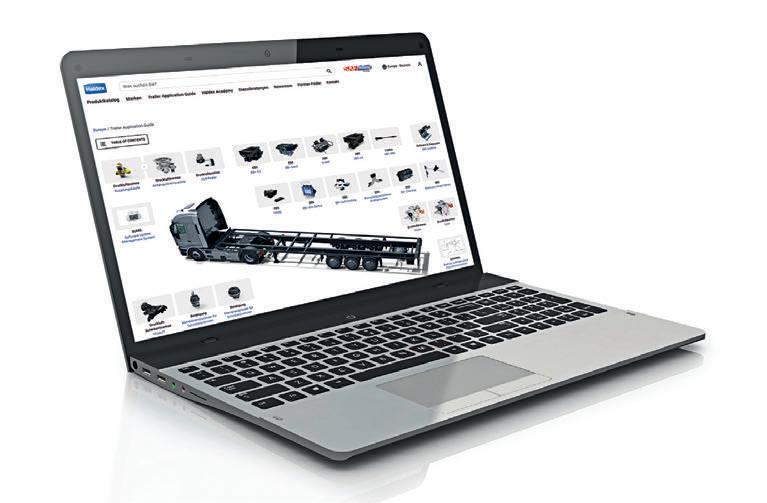
Intuitive, image-led design enables fast navigation without language barriers.
INVESTING HEAVILY IN AUTOMATION, WITH A RADICAL REORGANISATION OF ITS PRODUCTION LINE FOR TANK TRAILERS AND TANK CONTAINERS THAT AIMS TO DOUBLE CAPACITY.
Van Hool Industrial Vehicles, headquartered in Koningshooikt, has partnered with long-term associate and European market leader in welding automation, Valk Welding, to automate its production facilities through robotics to enhance its operations.
“Previously, we had three di erent production lines for the tank trucks and tank containers,” explained Van Hool’s production manager, Jos Hendrickx.
“We are currently merging these lines into a single branched production line that runs as a loop through the production facility.”
Van Hool builds tank trailers, tank containers, and chassis for, a range of sectors, including the food industry and the petrochemical sector. ese have now become its total focus a er undergoing a strategic reorientation.
As a result of this focused approach to tank construction, Van Hool reports that it is seeing concrete growth gures. Its factory currently produces 500 tank
containers and tank trailers annually, with the aim to double that to 1,000 units per year in due course.
In addition, chassis production stabilises at the current 1,000 units per year, with growth potential for the future.
is growth ambition explains the faceli the factory is currently undergoing. Machines have been relocated, roller conveyors installed, and the production line has been fundamentally redesigned. In this new set-up, a new Valk Welding robot installation plays a central role.
“ is robot is for internal welding, an activity
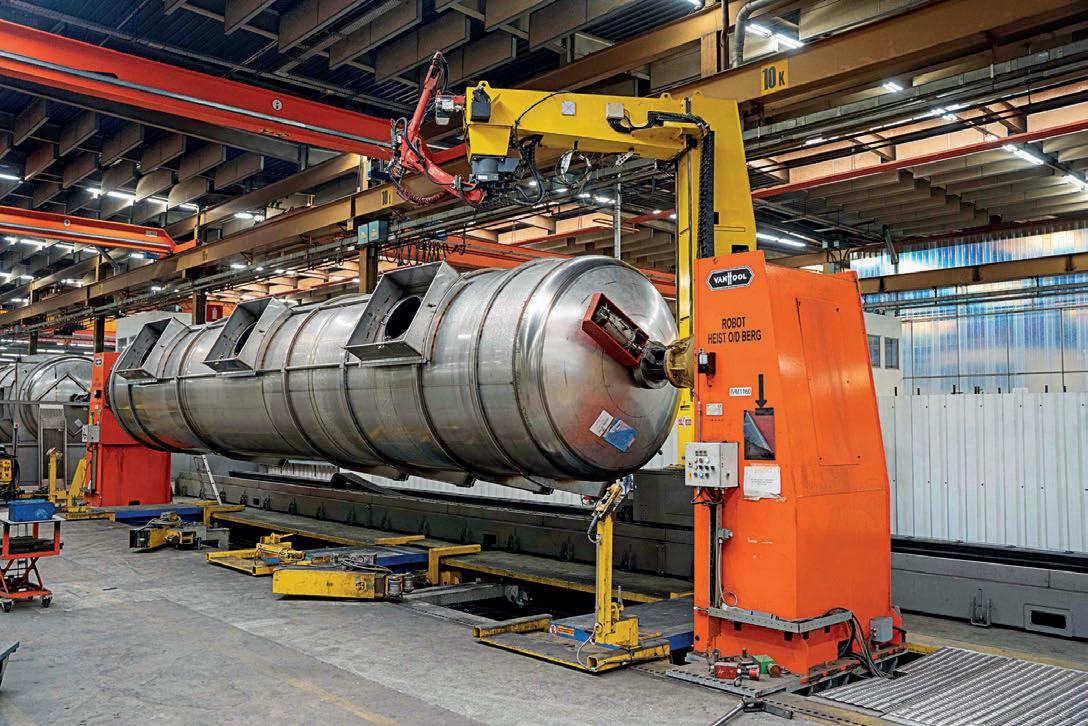
that is currently still carried out by manual welders,” said Hendrickx.
e internal welding of tank containers is technically demanding. Limited accessibility, tight tolerances, and the need for high-quality end products make Van Hool’s operations an ideal application for robotisation.
By automating this welding work, Van Hool increases the consistency of the weld quality, reduces the workload for operators and increases the throughput speed of production, said Hendrickx. In turn this leads to a doubling of capacity.
Valk Welding is not a new name in the Van Hool factory. e welding automation specialist delivered its rst welding robot to Van Hool in 1997 and has since installed around thirty robots in total. Most robots have been utilised in the chassis construction department, which has thereby already been automated to a considerable extent.
Van Hool Industrial Vehicles is now taking the next step in its growth, thanks to the new robot installation for the tank construction department.
“Van Hool is a key account for us and is always


at the forefront of testing new developments from Valk Welding and supporting them with valuable practical experience from production. at certainly also applies to this robot, which will take care of internal welding work,” said Jan Wanten, who is responsible for the Van Hool account within Valk Welding.
at practical experience is mutually bene cial. Over the years, multiple technical innovations have come about through close collaboration between the production teams of Van Hool and the engineers of Valk Welding. e new robot for internal welding ts within that tradition.
e automation drive at Van Hool Industrial Vehicles is not an isolated investment, but part of a broader strategic framework.
GRW, the acquiring party and a liated trailer manufacturer, aims to maximise synergies between its companies.
GRW director, Gerhard van der Merwe, who is closely involved in the operations in Koningshooikt, has since embraced the Valk Welding approach for his own trailer construction activities in South Africa. ere, GRW produces stainless steel tank containers.
e Valk Welding state-of-the-art system was installed at the beginning of 2026 and features two workstations where components are welded.
e use of robot welding as standard in tank construction ts within an international trend - the combination of specialisation, high quality requirements, and a tight labour market is driving manufacturers towards further automation.
Van Hool Industrial Vehicles and Valk Welding are at the forefront of this development.
www.valkwelding.com





The commercial vehicle sector is undergoing a profound transformation. For decades, braking technology development centred on durability, reliability and stopping power. Today, those fundamentals remain non-negotiable, but they are no longer su cient. Manufacturers must now meet increasingly strict environmental standards while maintaining, or even improving, performance. is dual mandate is rede ning how brake pads are designed, tested and produced.
At the heart of this shi is the evolution of friction materials. Once engineered primarily for strength and longevity, they are now being reformulated to minimise environmental impact. e removal of hazardous substances is no longer a future ambition – it has already happened. e focus has moved further, targeting the reduction of elements such as copper, zinc and antimony, all of which have historically played key roles in braking e ciency. is transition is not theoretical. It is actively reshaping development pipelines, forcing engineers to rethink material composition from the ground up. Every adjustment has consequences. A change intended to reduce emissions might in uence wear rates, alter
friction material must perform consistently across a wide range of conditions while meeting environmental targets that are becoming stricter with each regulatory cycle.
For companies like Lumag, the response has been to integrate every stage of the process. Material development, production and testing are no longer separate silos but parts of a continuous, controlled work ow. is approach allows for faster iteration and more reliable outcomes, particularly as regulatory frameworks evolve.
Recent investments re ect this strategy. Lumag has expanded its production capacity with a dedicated line for commercial vehicle brake pads, designed to support both volume growth and technological advancement. At the same time, its research and development teams are actively working on friction materials with reduced levels of copper, zinc and antimony – aligning products with upcoming environmental requirements rather than reacting to them.
Testing, in this context, has taken on a new level of importance. It is no longer enough to validate basic performance metrics. Modern brake systems must be evaluated under conditions that closely replicate real-world operation. is includes analysing noise, vibration and harshness (NVH), as well as wear characteristics, friction stability and brake dust emissions.
To meet these demands, advanced testing infrastructure has become essential. Dynamometer
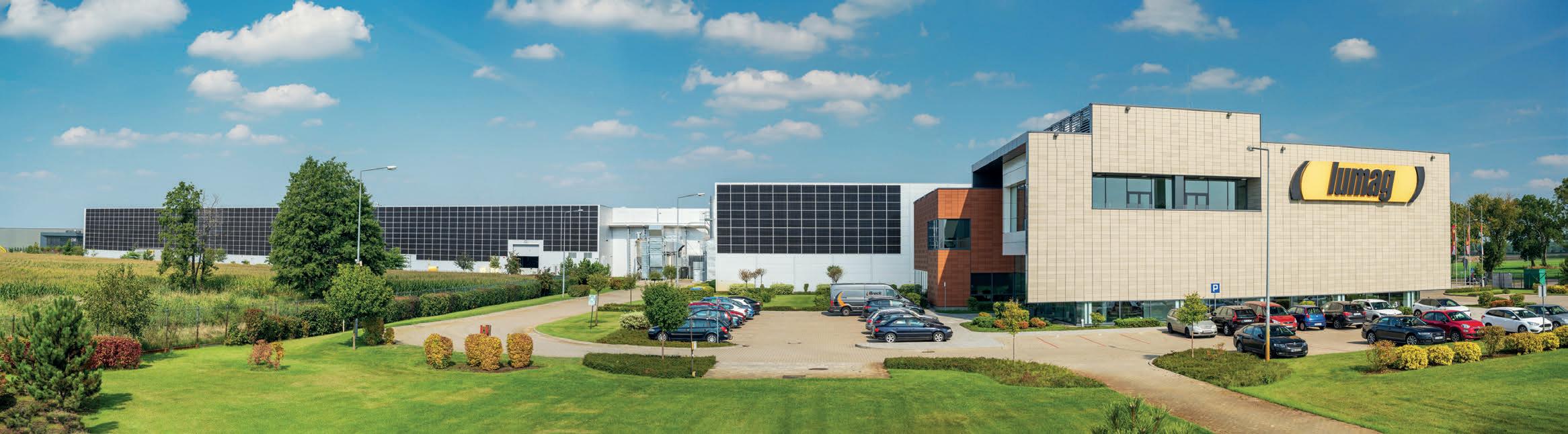
works, but to ensure that it performs consistently –every time, under any condition.
As Marcin Darowny, Head of R&D at Lumag, said: “We have completed the development of a new generation of friction material formulations designed to meet current and future environmental requirements. It was a long and multi-stage process, during which we tested hundreds of new materials and components. We carried out comprehensive studies of their properties in the context of upcoming regulatory changes.” is level of testing re ects a broader industry reality. Regulatory compliance is becoming increasingly complex. e forthcoming EURO 7 standards, for example, introduce new requirements related not only to exhaust emissions but also to particulate matter generated by braking systems. is places additional pressure on manufacturers to innovate in areas that were previously less scrutinised.
Brake dust – once considered a secondary issue – is now a central concern. Reducing particulate emissions without compromising braking performance requires new materials, new processes and new testing methodologies. It is a challenge that underscores the interconnected nature of modern engineering.
Beyond the technical sphere, supply chain dynamics are also influencing how braking technology evolves. In recent years, global disruptions have exposed the vulnerabilities of
regional production and shorter supply chains. European manufacturing, in particular, is increasingly viewed as a strategic advantage – o ering greater control, reduced risk and faster response times.
Łukasz Żak, Member of the Management Board for Marketing at Lumag, highlighted this shi : “Distributors today expect more than just product availability. ey are looking for consistency and predictability – but also for partners who are ready to adapt and respond to changing market needs and regulatory requirements, such as EURO 7.” is expectation is reshaping partnerships across the value chain. Suppliers are no longer evaluated solely on product quality or price. eir ability to anticipate change, ensure continuity and provide technical support is becoming equally critical.
In this environment, integration becomes more than an operational choice — it becomes a competitive di erentiator. Companies that can align production, testing and R&D within a single framework are better positioned to navigate uncertainty and deliver consistent results.
For Lumag, this integrated approach is central to its strategy. With production and research facilities based in Poland, the company combines local manufacturing with global reach, supplying brake pads to more than 40 markets worldwide. Its role as an original equipment (OE) supplier further reinforces the need for precision, reliability and forwardthinking development.
Yet the broader story extends beyond any single manufacturer. e evolution of braking technology re ects a wider transformation within the commercial vehicle industry — one driven by the convergence of performance expectations, environmental responsibility and regulatory oversight.
As Grzegorz Żak, President of the Management Board at Lumag, said: “ e direction is clear – braking technology must evolve towards both performance and environmental responsibility. As a manufacturer, we need to anticipate what is coming next and be ready for it in terms of materials, processes and production.” at direction leaves little room for incremental change. e shi underway is structural, requiring new ways of thinking about materials, systems and collaboration. It demands investment in technology, commitment to sustainability and a willingness to embrace complexity.
Ultimately, the future of braking will be de ned not by a single breakthrough, but by the ability to balance competing priorities – performance and emissions, durability and
EUROPEAN LOGISTICS IS SHIFTING FROM A BUY-AND-REPLACE MODEL TO A LIFECYCLE-FOCUSED APPROACH. AS COSTS RISE AND SUSTAINABILITY REGULATIONS TIGHTEN, CEOS ARE VIEWING TRAILERS AS FLEXIBLE CAPITAL RATHER THAN DISPOSABLE ASSETS. TIP GROUP CEO, ARJEN KRAAIJ, ANSWERS QUESTIONS ON THE ISSUE OF WHY REFURBISHMENT HAS BECOME A STRATEGIC PRIORITY. With increasing maintenance and operational costs, trailer refurbishment is a vital consideration for operators. Images: TIP Group.

TIP Group CEO, Arjen Kraaij, spoke with Global Trailer, sharing his insights into the growing issue of why trailer refurbishment has become a logical and strategic priority for many eets.
Q: With rising new equipment costs and corporate ESG demands, why has refurbishment shifted from a maintenance task to a strategic priority for boards?
A: For a long time, the industry followed a ‘buy-new-then-replace’ cycle because it was the easiest way to manage a balance sheet. However, the reality of the last few years, characterized by surging asset prices, unpredictable delivery windows and regulatory demands, has exposed the fragility of that model.
So, when I talk to boards today, the conversation is about converging asset strategy, capital allocation, and sustainability. Refurbishment allows the life of assets to extend by another four to eight years at a fraction of the cost of new equipment. For a CEO or CFO, this means you aren’t just reacting to the market; you are optimising your capital allocation by maintaining capacity at a signi cantly lower cost and to free up capital. It transforms the eet from a rigid cost center into a strategic tool that is exible and can be optimised. It’s about resilience, plain and simple.
Q: How does data-backed refurbishment help leaders resolve the perceived tension between environmental goals and healthy margins?
A: Sustainability is moving from the CSR report to the Annual Report, in uencing how companies are valued and trusted, and that changes everything. With CSRD, transparency is no longer optional. We now have the data to show that refurbishing a trailer can reduce its carbon footprint signi cantly compared to manufacturing a new one, primarily by avoiding the energy-intensive production of steel and aluminum.
In our recent collaborations, such as refurbishment programs with DSV and P&O Ferrymasters, we’ve seen that data-backed decisions are the only way to align ‘going green’ with maintaining margins. When a sourcing team sees the hard numbers, speci cally the tons of CO2 saved and the impact on the total cost of ownership, refurbishment stops being a ‘green
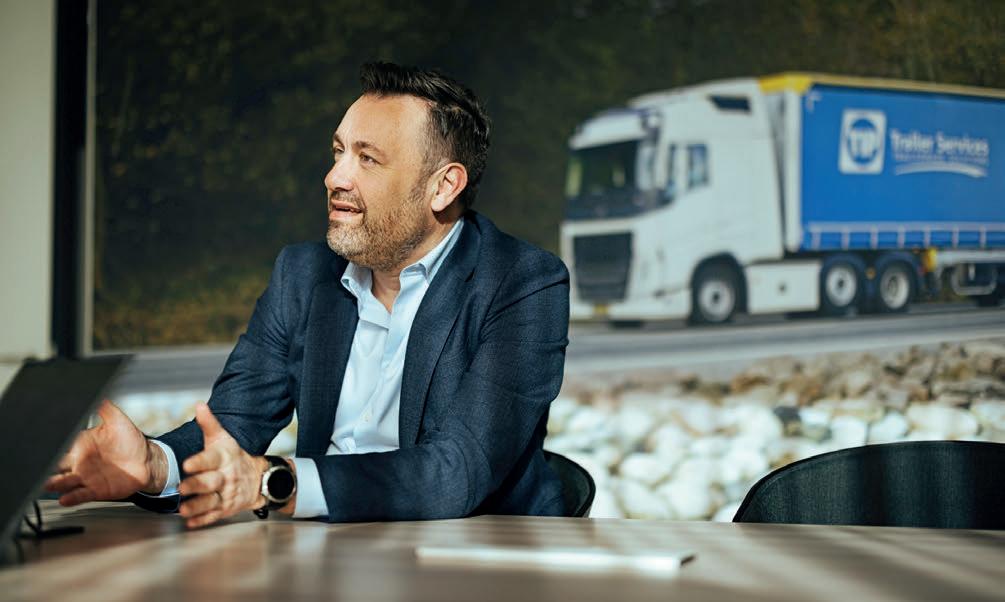
experiment’ and becomes the logical choice. Both nancially and in terms of CSR. Data is the bridge that allows us to meet these tightening expectations without compromising a customer’s competitive edge.
Q: Circular eet management requires an ecosystem of collaboration. As TIP expands its Excellence Centers, how are you evolving your workforce and partnerships to make refurbishment an industry standard?
A: No one can achieve circularity in isolation. To make this a standard across Europe, we need an ecosystem where suppliers and service providers are all aligned on life-extension. We are investing in our own dedicated Excellence Centers and growing this network through strategic moves, such as our 2024 acquisition of Trailer Auto Group in the UK. We need controlled environments where high-spec refurbishment is the primary goal.
Q: Looking toward 2030, how can eet leaders transition from a transactional ‘buyand-dispose’ mindset toward a partnership-based lifecycle model?
A: By 2030, the ‘buy-and-dispose’ mindset will be an outlier. e pressure from regulators, the market and planet will make the circular model the only viable way to scale or remain competitive. e real winners will be those who stop seeing their eet as a liability and start seeing it as a strategic asset for growth.
My advice to eet leaders is to look at the ‘second life’ of trailers as a planned phase, not an emergency backup. Start by standardising your framework: ensure your assets are maintained to a level that makes them ‘refurb-ready.’ At TIP, we are working to remove the barriers to scaling this consistently across borders, so we can help a customer manage their assets as easily in Madrid as they do in Oslo. When you manage the full lifecycle, you don’t just save costs; you build a more resilient business that can adapt to the evolving realities of our industry.
www.tip-group.com
THROUGHOUT 2026 BRIANZA PLASTICA IS CELEBRATING A DOUBLE MILESTONE - THE 20TH ANNIVERSARY OF ITS PRODUCTION SITE IN SAN MARTINO DI VENEZZE AND TWO DECADES OF ELYCOLD, ITS HIGH-QUALITY FIBREGLASS LAMINATE.
Since its opening in April 2006 in the province of Rovigo, the San Martino di Venezze facility has represented a strategic investment for Brianza Plastica. It was established to meet the demand for high-performance breglass laminates within the commercial and recreational vehicle sector, where aesthetic quality, reliability and production continuity are essential.
Over the past two decades, the plant has continually evolved, thanks to the expertise of its workforce, close collaboration with customers and the company’s commitment to innovation.
Developed at the state-of-the-art plant, using a discontinuous process, Brianza Plastica’s breglas laminate, Elycold, was created to meet the needs of the commercial and recreational vehicle sectors and is now also used in public transport and tanker applications.
“Brianza Plastica was founded in 1962, initially producing cold-curing breglass laminates, which were the standard technology of that era,” explained Brianza Plastica Sales Executive and Board Member, Alberto Crippa.
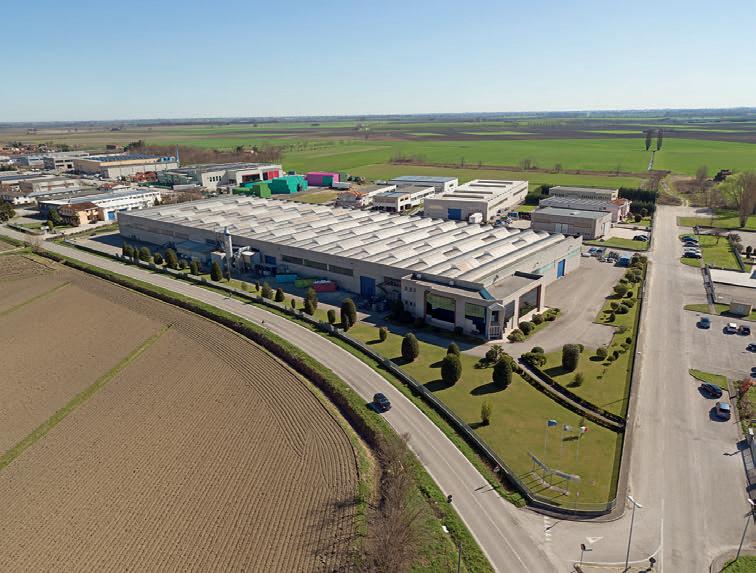
markets were construction and greenhouses, and we remain market leaders in these areas today.
“However, we recognised the need to enter the segment of high-quality laminates for recreational vehicles and commercial transport, where continuous lamination processes o en struggle to consistently meet the required quality standards.”
In 2004, an opportunity arose for Brianza Plastica to expand its production of laminates a er a meeting with a manager having extensive experience in this speci c type of production.
“By combining his expertise with our 40 years of industrial know-how in breglass manufacturing, we decided to develop a new product from the ground up. We selected the Polesine area for this, and in early 2006, the rst square metre of Elycold laminate was produced and sold,” said Crippa.
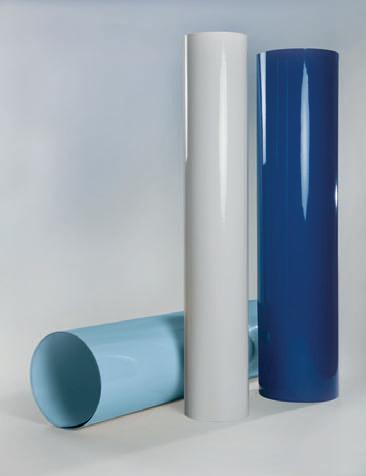
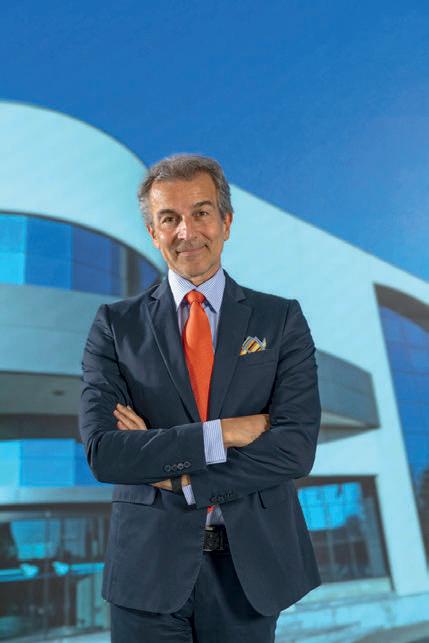
phases of development, steadily increasing its production capacity while introducing ever more advanced technologies and equipment; from the early years, marked by the launch of production lines and the ne-tuning of processes, to more recent developments in energy e ciency and the creation of a state-of-the-art research and development laboratory dedicated entirely to the product.
At the same time, Elycold has followed its own path of growth and transformation, which re ects the company’s ongoing commitment to innovation and quality. Originally developed to meet the speci c needs of the commercial and recreational vehicle sector, the product has evolved over time, expanding its range and applications while strengthening its presence in Italy and internationally.
In 2009, the opening of a new plant in Ostellato further expanded Brianza Plastica’s production capacity. is was followed, in the summer of 2016 – ten years a er the opening of the rst plant – by the inauguration of a second site at San Martino di Venezze, dedicated to the cold lamination process.
Elycold breglass laminates, manufactured entirely in Italy, are produced through a structured process with clearly de ned stages. Production is supported by a dedicated research and development laboratory, which conducts rigorous chemical and physical testing of both raw materials and nished products, ensuring consistently high-quality standards over time.
“Initially, production was primarily aimed
at Italian recreational vehicle manufacturers before expanding to the commercial vehicle sector,” said Crippa.
“Elycold’s success is rst and foremost due to its aesthetic appeal, with the breglass virtually invisible, making it a natural alternative to aluminium, as well as its mechanical performance, versatility and reparability, which set it apart from other materials.
“It is precisely this combination of visual appeal, mechanical strength, durability, lightness and exibility that makes Elycold a preferred solution for the walls of recreational vehicles, commercial vehicles, public transport vehicles and tankers.”
For Brianza Plastica, the 20th anniversary is not only a moment for celebration, but also an opportunity to re ect on a remarkable journey. Since its inception, Elycold has grown into a globally recognised brand, synonymous with quality in the world of vehicle out tting.
“Celebrating these 20 years means recognising the value of the journey we have built over time, whilst already turning our thoughts and gaze towards the next milestone,” said Crippa.
“We are pleased with the decision we made in 2004 and with the results we have achieved, particularly the respect and esteem we have earned from customers in the sector.
“ e most gratifying aspect for us is that, although our company has over 60 years of experience, we have only been operating in the recreational and commercial vehicle sector for 20 years. Yet we are now regarded on a par with long-established suppliers who have always been considered the benchmark.
“ is is perhaps the achievement we value most, and one we aim to build on as we pursue our next goals. We aim to strive even harder to become the industry benchmark, just as we have done with our other products in the construction sector.”
Elycold is made from a combination of polyester resins and glass bre. Over the years, this material has replaced aluminium in the production of refrigerated panels for commercial vehicles, camper vans, caravans and motorhomes, o ering vehicle manufacturers excellent durability and UV resistance.
Elycold is available in both rolls and sheets, with thicknesses ranging from 1 to 3.6mm, ensuring great exibility of use. It can be produced in widths of up to 3,400mm and lengths of up to 60 metres, enabling large surface coverage, optimised processing and installation, and a reduced number of joints.
Brianza Plastica’s success with its Elycold and its other products, such as the Elyplan GRP laminate, is another cause for celebration, with the company launching three new production sites with a total covered area of almost 30,000 square metres over the course of 20 years and creating about 80 new jobs while producing several million square metres of breglass laminates.
“ ese gures re ect the scale of our investment in terms of time, human resources and nancial commitment to supporting the growth of the Elycold brand,” said Crippa.
e company has no plans to slow down. From 2026 to 2028, Brianza Plastica foresees signi cant developments in terms of industrial expansion, production technologies and energy e ciency.
For the commercial and recreational vehicle sectors, Elycold’s 20-year milestone is therefore not only a symbolic anniversary, but also a con rmation of an industrial journey built on specialisation, close attention to market needs and the ability to evolve in step with manufacturers’ requirements
www. atlaminates.com
As Jagdamba Trailers’ CEO and Director, Gyan Singh Kshatriya, celebrates seven years as the head of the as stands at a de ning point in both his leadership journey and the company’s evolution – one that re ects rapid growth, calculated expansion and an increasingly global outlook.
“Today marks a signi cant milestone in my professional journey,” said Kshatriya. “What began as a modest operation has evolved into a powerhouse in the trailer industry, and I’m deeply proud to have led this transformation.”
Kshatriya played a pivotal role in establishing Jagdamba Trailers, providing direction and leadership before the company produced its inaugural tip trailer.
Under his guidance, operations were built from the ground up, setting the foundation for future growth. Today, the business has scaled to a production capacity exceeding 300 trailers per month, an impressive achievement made possible through clear strategy and disciplined execution, starting from zero and building up to this level.
“In 2019, we were focused on a narrow product range,” he explained. “ rough focused strategy and an unwavering commitment to quality, we’ve expanded signi cantly. at growth has been both deliberate and sustainable.”
Central to that expansion has been product diversi cation. Once primarily a tip trailer manufacturer, Jagdamba has broadened its portfolio to include cement bulkers, sidewall trailers, lowbed trailers, skeletal trailers and a growing suite of specialised transport solutions.
“ ese additions have strengthened the Jagdamba brand and allowed us to reach
new markets,” said Kshatriya. “We are not just increasing volume; we are increasing capability.”
e diversi cation strategy continues to evolve, with the company entering new segments including agricultural trolleys, while forwardlooking products, such as garbage compactors and concrete mixers, are already in development.
While international ambitions are front of mind, Jagdamba’s domestic footprint remains the backbone of its success. Over the past seven years, the company has cemented its position as a key player in the Indian trailer industry.
is is in part due to its base in Raigarh, Chhattisgarh. e state is renowned as a major source of electricity and steel for India, producing approximately 15 per cent of the country’s total steel. Good planning has ensured a ready supply of steel for trailer bodies.
A major contributor to the company’s standing has been securing approvals from leading OEMs including Tata Motors, Ashok Leyland and VE Commercial Vehicles for fully built-up trailer solutions.
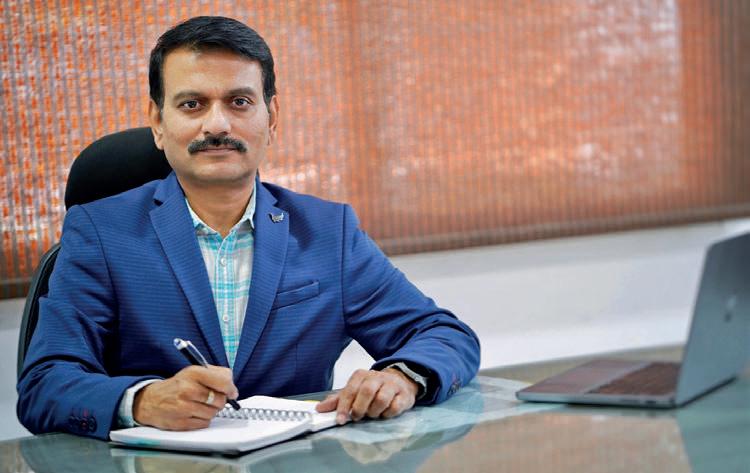
“ ese partnerships validate our engineering capability and our reliability,” said Kshatriya. “ ey also open doors to long-term collaboration and consistent demand.”
e company has also demonstrated its ability to meet stringent technical requirements through its work with the Defence Research and Development Organisation (DRDO), supplying specialised trailers—including missile-carrying platforms.
“ at project showcases the level of precision and quality we can deliver,” he said. “It’s a strong endorsement of our engineering standards.”
At the same time, a growing number of eet operators and key accounts have shi ed to Jagdamba as their preferred supplier.
“That trust has been earned through
performance,” said Kshatriya. “Reliability and consistency are what keep customers coming back.”
If the past seven years have been about building scale, 2025 represents a turning point in Jagdamba’s global ambitions.
“ e commissioning of our state-of-the-art UAE manufacturing facility in September 2025 is one of our biggest milestones,” said Kshatriya.
Located in the Hamriyah Free Zone in Sharjah and operating under Jagdamba Global Equipment Solutions, the new plant marks the company’s formal entry into international manufacturing.
“ is expansion allows us to serve new markets more e ectively and positions us as a global player,” he said. “It’s a major step forward.”
e UAE facility is already showing positive early results, with operations stabilising and market response encouraging.
“We are focused on scaling gradually and building strong local partnerships,” said Kshatriya. “ is is about long-term growth, not short-term gains.”
e OEM’s CEO fully acknowledges that the achievements stem directly from the right strategies formulated and implemented under my leadership, with the complete trust and backing of our promoters, Messrs. Umesh Agrawal and Amit Agrawal. “ eir visionary guidance, to position Jagdamba at the helm of the Indian trailer industry, and the free hand they gave me to execute with agility and precision have been the true foundation of our success.”
Despite its growth trajectory, Jagdamba has not been immune to broader industry pressures. Like many manufacturers, the company has faced supply chain disruptions, uctuating raw material costs, and shi ing compliance requirements.
“ e past year has presented challenges across the board,” said Kshatriya. “ ere has also been a downturn in parts of the Indian trailer sector, which has impacted margins.”
To counter these pressures, Jagdamba has expanded its marketing network into new regions, explored additional domestic and international markets, and accelerated its push into new product categories.
“Adaptability is critical in this industry,”
Jagdamba Trailers’ commitment to high quality products has seen its business footprint expand over the past seven years under CEO Gyan Singh Kshatriya.
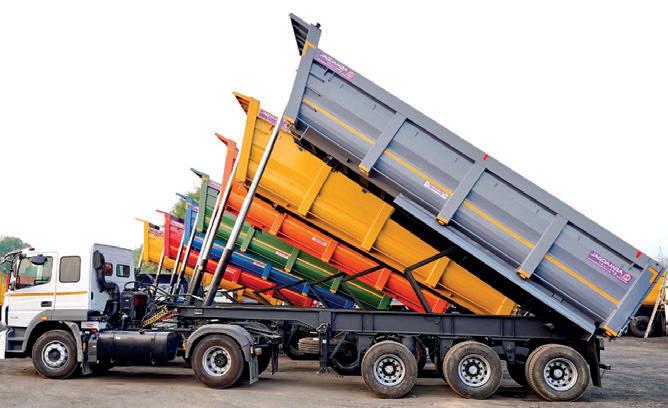
he said. “You have to anticipate change and respond quickly.”
Establishing operations in a new geography has also introduced regulatory and operational complexities, but Kshatriya says these challenges have been successfully managed through strong planning and execution.
Kshatriya views the broader Indian and South Asian trailer sector as being in a period of transformation, driven by infrastructure growth, evolving regulations and the increasing professionalisation of logistics.
“Demand is growing rapidly,” he said. “But there are still challenges around standardisation, enforcement and cost sensitivity.”
At the same time, the company’s international expansion is opening new opportunities across the Middle East and Africa.
“Our presence in the UAE enables us to explore export markets more e ectively,” Kshatriya said. “It strengthens our competitiveness on a global scale.”
Over the past 24 months, Jagdamba has deepened its understanding of these markets, tailoring its products to meet regional requirements and customer expectations.
“ at local understanding is critical,” he says. “It allows us to deliver the right solutions for each market.”
With heavy vehicle national law-like regulations tightening and e ciency demands shaping global transport markets, Kshatriya expects 2026 to be a year of consolidation and growth.
“Our focus will be on stabilising and scaling our UAE operations while continuing to strengthen our global footprint,” he said.
Product development will also remain a priority, particularly in the area of lightweight trailers designed to meet evolving compliance and e ciency requirements.
“ ere is a clear shi towards lighter, more e cient designs,” Kshatriya says. “We are investing heavily in that space.”
Upcoming innovations include advanced safety and operational features such as anti-topple systems, hydraulically operated landing gears, and improved top covering mechanisms.
“ ese features are about improving safety, e ciency and ease of use for our customers,” he said.
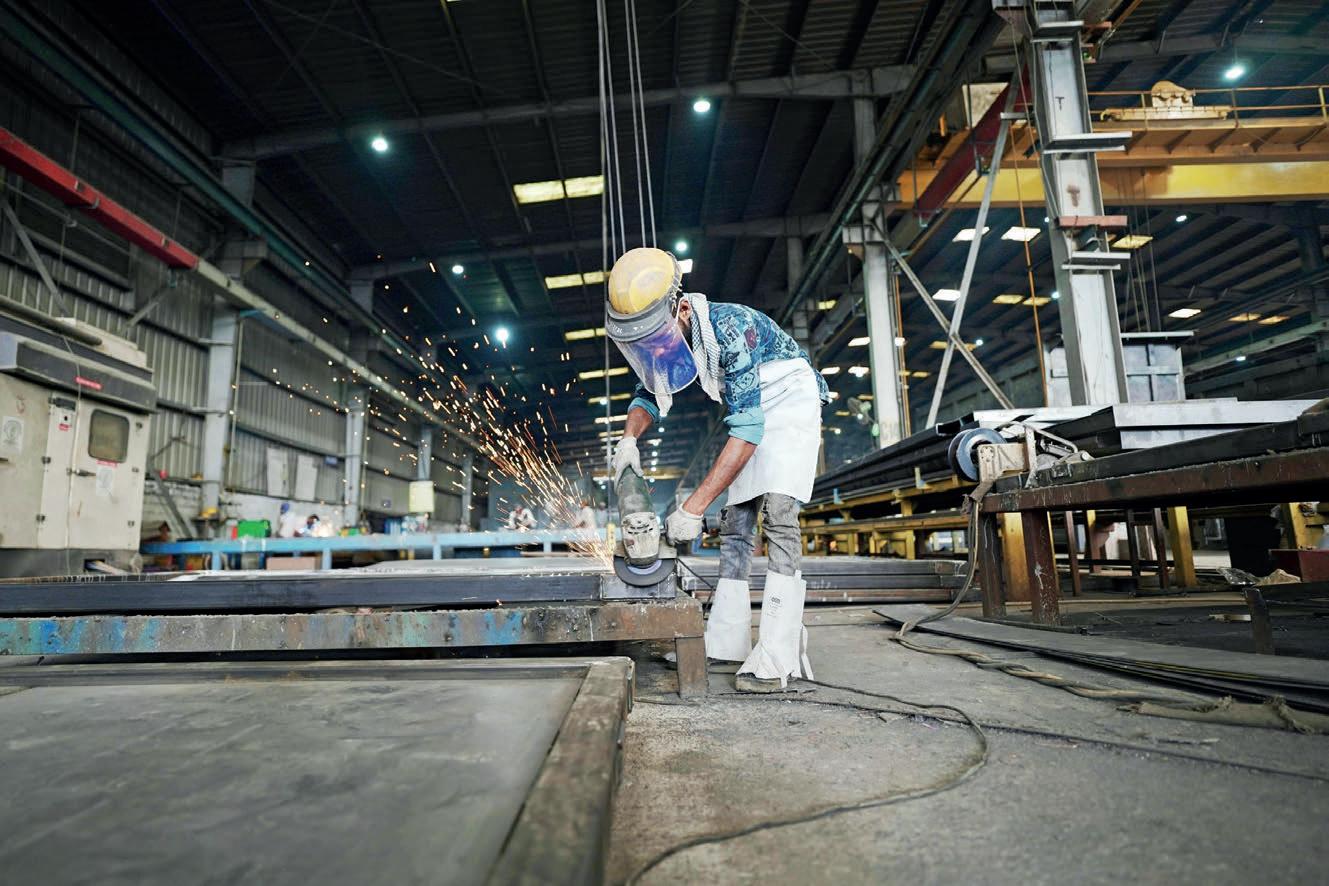
and enhanced design tools to improve both e ciency and product quality.
One notable innovation is an in-house hydraulically operated press bend machine designed for shaping trailer chassis components.
“ is has signi cantly improved precision and structural integrity,” said Kshatriya. “It’s a good example of how we’re innovating within our own processes.” e company is also exploring the role of arti cial intelligence in both manufacturing and transport operations.
“AI will play a signi cant role in predictive maintenance, process optimisation and safety,” he said. “In manufacturing, it can improve welding quality and surface nishing.”
Sustainability is becoming an increasingly important focus for Jagdamba, with initiatives aimed at reducing environmental impact and improving e ciency.
“We are focusing on weight optimisation, fuel e ciency and advanced materials,” said Kshatriya.
Plans are also underway to introduce renewable energy into the company’s manufacturing operations, including the installation of a solar power plant.
“ is will help reduce our carbon footprint and align with global environmental standards,” he said.
e shi towards electric vehicles is also in uencing trailer design, with lightweight solutions becoming essential to o set the higher mass of EV prime movers.
“We have already developed lightweight trailers speci cally for EV applications,” said Kshatriya. “ is is a key area of R&D.”
Over the next 12-to-36 months, Kshatriya’s vision is clear: to position Jagdamba Trailers as a globally recognised and trusted brand.
“We want to be known not just for scale, but for quality, reliability and engineering excellence,”
at ambition includes expanding further into emerging markets across the Middle East, Africa and potentially Europe, while also strengthening the company’s domestic footprint through
“At the same time, we will continue to focus on innovation, customer satisfaction and operational

Kshatriya readily attributes much of the company’s success to a combination of strategic leadership, strong organisational culture and the support of its promoters, Umesh Agrawal and
“ eir vision and trust have allowed us to
His own leadership style is grounded in practicality, discipline and long-term thinking.
“I believe in empowering teams, maintaining transparency and focusing on execution,” said Kshatriya. “At the same time, adaptability and continuous learning are essential.”
Maintaining perspective, he adds, comes from staying focused on long-term goals rather than short-term uctuations.
“You have to stay grounded in the fundamentals,” he said. “ at’s what drives sustainable growth.”
Re ecting on the past seven years, Kshatriya points to the transformation of Jagdamba Trailers into a recognised industry name as one of his most signi cant achievements.
“Expanding into international markets and establishing our UAE plant are major milestones,” he said. “But the journey is ongoing.”
With a strengthened domestic base, a growing international presence and a clear focus on innovation and sustainability, Jagdamba Trailers is positioning itself for the next phase of growth.
“We remain committed to building a globally competitive, quality-driven organisation,” said Kshatriya. “ e best is yet to come.”
www.jagdambatrailers.com














With over 45 years of experience, Valk Welding provides customized solutions, including welding wire, consumables, software, training, and support. We assist with production automation for both large series and single pieces, and for small to large products. Valk Welding is driving change in Europe and beyond!






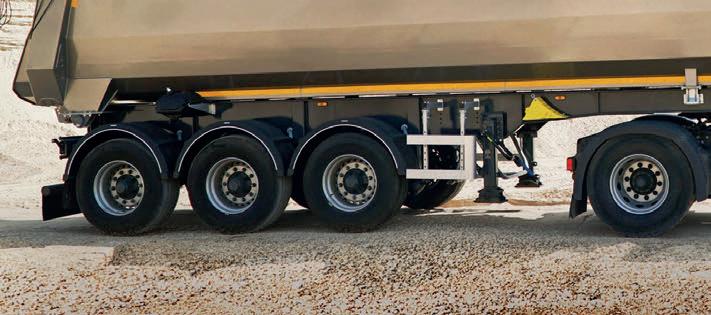
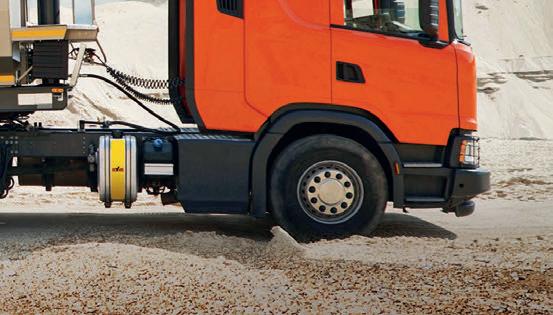

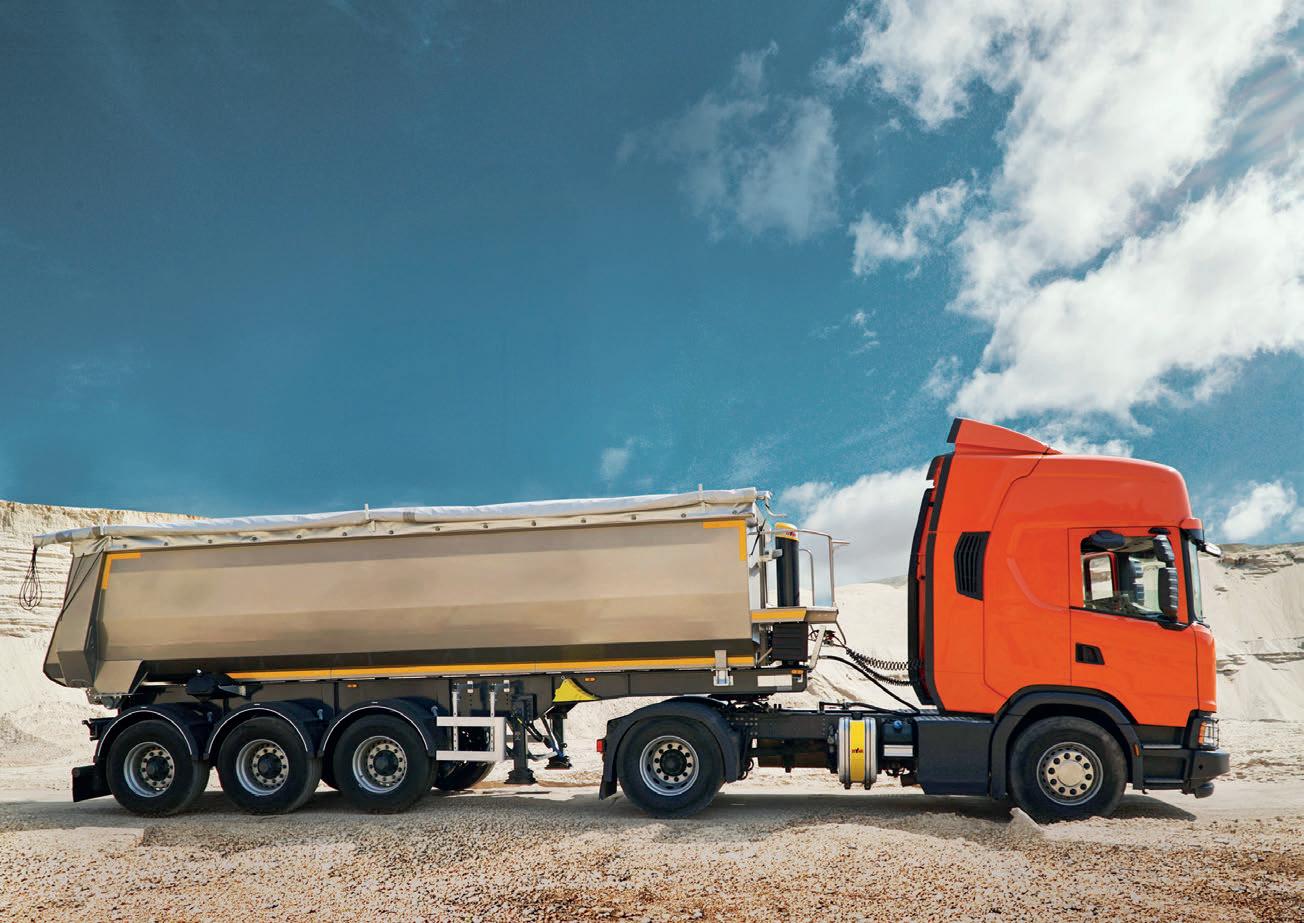
AT TRANSPOTEC 2026, HELD IN MILAN FROM 13-16 MAY, JOST SHOWCASED ITS COMPREHENSIVE PORTFOLIO FEATURING THE PRODUCT BRANDS INCLUDING, HYVA, TRIDEC, AND ROCKINGER, DEMONSTRATING HOW IT IS CONNECTING MARKETS, TECHNOLOGIES AND PEOPLE.
At Transpotec 2026, JOST demonstrated how engineering expertise and innovation can address the challenges of today’s commercial vehicle industry, particularly through safety, and sustainability.
From the automatic coupling system JOST KKS, which helps address driver shortages, to the Hyva ePowerbox100 for battery-electric trucks, the portfolio
is designed to make hard work easier and safer for drivers and eet operators alike.
A key highlight at this year’s Transpotec was the rst joint stand of JOST and Hyva in Italy. Following the successful integration of Hyva into the JOST portfolio, the combined presence demonstrated the expanded product range: from coupling and axle systems to advanced hydraulic solutions for li ing and tipping applications. At the same time, customers bene t from a stronger network that delivers solutions tailored to their speci c needs.
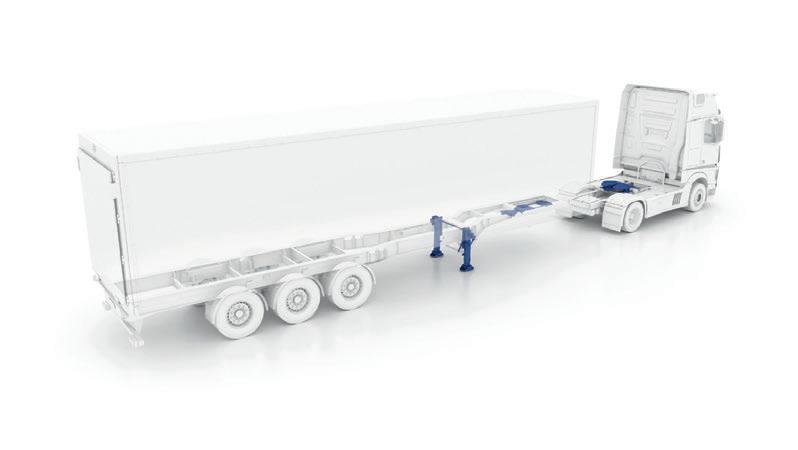
“We were excited to be back at Transpotec, one of Europe’s most important platforms for transport and logistics development,” said JOST Italia General Manager, Francesco Zucco. “Our goal was to showcase how JOST innovations across our brands JOST, Hyva, TRIDEC and ROCKINGER support the transport industry in addressing key challenges such as driver assistance, sustainability, and e ciency.
“At the same time, we remain close to our customers, adapting our solutions to local conditions and individual requirements.”
Hyva Italy Country Manager, Gian Marco Fulgeri, said: “ is marked our rst joint exhibition under the JOST umbrella in Italy.
“We have fully integrated the Hyva and JOST range into one portfolio, coming together as one uni ed Italian organization to deliver a broader and more complete o ering to the market.
“Together, we provide fully integrated solutions – from flexible hydraulic kits covering every application, to cylinders and hookloaders, up to advanced technologies like Hyva DTS – enabling greater e ciency, safety, and operational performance.”
On the outdoor area, JOST showcased live demonstrations of the KKS automatic coupling system.
e JOST KKS system was a highlight at Transpotec, as it facilitates faster, safer, more e cient manoeuvres by enabling drivers to couple and uncouple semi-trailers via remote control without leaving the driver’s cabin, automatically, safely and quickly. e driver is guided through the entire coupling process, with sensor technology providing live information on the KKS remote control throughout every step of the process. Climbing out of the cabin to manually open the h wheel, cranking down the landing gear and manually connecting the spiral cable, air and brake connections are all a thing of the past for drivers. Time, comfort and safety gains are made possible with just one product.
With the KKS JOST aims to set new benchmarks for performance and reliability in the transportation industry.
Another JOST product featured at Transpotec was the electric landing gear Modul E-Drive that does away with manual cranking, while making trailer coupling and decoupling easier. Modul E-Drive is particularly useful when access to the landing gear is restricted and when the trailer needs to be coupled or decoupled frequently and is a component of the automatic coupling system JOST KKS.
As an innovation, JOST presented the King Pin Finder in Milan, a camera integrated in the h wheel coupling that supports the coupling process by sending optimum images to the dashboard in the driver’s cabin. Securely integrated into the h wheel coupling, the
“OUR GOAL WAS TO SHOWCASE HOW JOST INNOVATIONS ACROSS OUR BRANDS JOST, HYVA, TRIDEC AND ROCKINGER SUPPORT THE TRANSPORT INDUSTRY IN ADDRESSING KEY CHALLENGES SUCH AS DRIVER ASSISTANCE, SUSTAINABILITY, AND EFFICIENCY.”
JOST ITALIA GENERAL MANAGER, FRANCESCO ZUCCO
JOST King Pin Finder provides assistance during coupling, thereby enhancing both safety and convenience.
e JOST DCA WEIGHTMASTER PLUS highlighted its capability to reduce emissions, protect resources and maximise e ciency. e optimised structure of the entire axle reduces the trio weight by 51 kg. In combination with the optional Weight Optimiser 27, the air bellows support with a lightweight aluminium tail end structure.
JOST-owned Hyva also unveiled its highly exible hydraulic kits that are engineered to cover the full spectrum of applications – from 3.5-tonne vehicles to 2- and 3-axle trucks, up to complete tractor wet kit solutions.
e hydraulics specialist demonstrated its cylinder portfolio includes both front-end and underbody solutions, as well as its Hookloader solutions, and its innovations, such as the Digital Tipping Solutions (DTS) and the ePowerbox100.
ROCKINGER exhibited another innovation at Transpotec in the form of the Drawbar Finder, resulting in drivers no longer needing to get out of their trucks to check that the drawbar eye is aligned correctly.
e JOST CSA and TRIDEC EF-S revealed how it is perfect for tight depots and narrow city streets, showcasing its command steer axle with electronic steering system.
www.jost-world.com
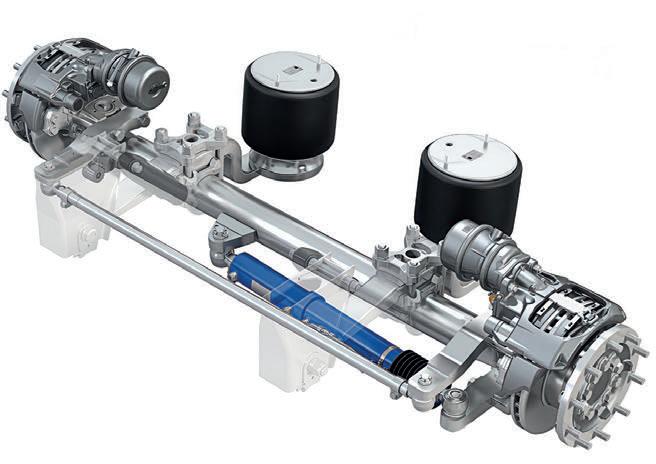
JOST’s TRIDEC EF-S axle is perfect for tight depots and narrow city streets. Image: JOST
Popvatetiana/stock.adobe.com


5-7 JUNE 2026
JAIPUR, INDIA
The 8th edition of the Expo will look at the future of all types of truck, truck batteries and brakes & brake parts at India’s leading truck and trailer exhibition. www.trucktrailerntyreexpo.com

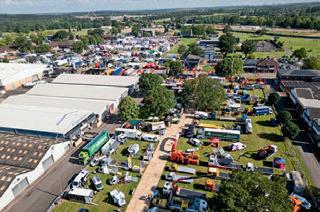
WARWICKSHIRE, UK
RTX 2026 is billed as the haulage sector’s must-attend summer tradeshow, as it celebrates ve years since its launch in 2022. roadtransportexpo.co.uk/rtx/en/page/home
Uslatar/stock.adobe.com


10-11 JUNE 2026
COLOGNE, GERMANY
This premier trade event that brings together OEMs, engineers, suppliers and industry professionals from the industrial vehicle technology sectors to showcase the latest advancements shaping the industry’s future. www.ivtexpo.com

Dron285/stock.adobe.com

1-3 JULY 2026
BANGKOK, THAILAND
CCE is billed as Asia’s leading B2B exhibition and conference for cold storage infrastructure and refrigeration and temperature-controlled logistics. www.coldchainexhibition.com
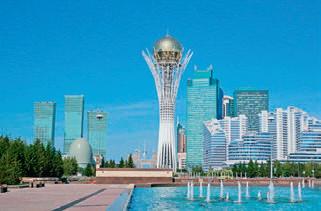
Image:Worldwide Pictures/stock.adobe.com
ASTANA, KAZAKHSTAN
The largest international exhibition of spare parts, automotive components, equipment and maintenance products in Kazakhstan and the Caspian region. www.automechanika.kz/en
Image: Seqoya/stock.adobe.com


CF ISTANBUL 2-4 JULY 2026
ISTANBUL, TURKEY
CF Istanbul is a platform for Türkiye’s leading construction materials and technology manufacturers to showcase their new products, bringing together over 200 participating companies from 20 di erent countries with more than 3,000 hosted buyers. www.c stanbul.com
2026 FTR TRANSPORTATION CONFERENCE
31 August – 3 September 2026
Indianapolis, USA www.ftrconference.com
IAA TRANSPORTATION 2026
15-20 September 2026
Hanover, Germany www.iaa-transportation.com
MEGATRANS 2026 16-17 September 2026 Melbourne, Australia www.megatrans.com.au
INNOTRANS 22-25 September 2026
Berlin, Germany www.innotrans.de/en
BAUMA CONEXPO INDIA 2026 15-18 September 2026
New Delhi, India www.bcindia.com
AAPEX 2026
3-5 November 2026
Las Vegas, Nevada www.aapexshow.com
VTM 23-25 November 2026
Torino, Italy www.italy.vehiclemeetings.com
AUTOMECHANIKA SHANGHAI 2-5 December 2026
Shanghai, China www.automechanika-shanghai. hk.messefrankfurt.com
TRAILER ELECTRIFICATION IS RAPIDLY EMERGING AS A PRACTICAL BRIDGE BETWEEN TODAY’S DIESEL FLEETS AND TOMORROW’S ZERO-EMISSION FREIGHT TASKS.
Electri cation in heavy transport is no longer con ned to the prime mover, as e-trailers are now longer seen a wish-list item, with a wave of innovations is pushing electri ed trailers from prototype to early-stage commercial deployment. At the centre of this transition is the rapid development of electri ed axles, which are transforming traditionally passive trailers into active contributors to propulsion and energy management. ese systems use regenerative braking to capture energy during deceleration or downhill running, storing it in onboard battery packs that can range from 200kWh to more than 600kWh. at stored energy can then be redeployed either to power auxiliary systems or to assist the prime mover.
e SAF-Holland TRAKr and TRAKe e-axles use recuperation to recover energy and provides traction support through the electric motor. is gives more traction and stability for the semitrailer, particularly in demanding road conditions and inclines.
Australian-based VE Motion is advancing systems that use regenerative axles to reduce brake wear while harvesting energy. More advanced con gurations go a step further, delivering active electric assistance of up to 295kW – enough to signi cantly reduce the load on the towing vehicle. In some applications, this can cut diesel consumption by as much as 50 per cent or extend the operating range of battery-electric trucks.
In Europe, regulatory progress has helped accelerate adoption, with the European Union enabling type approval for “eTrailers” and pre-series units already operating in countries such as Germany and Denmark. e 2013-2017 Transformers project focused on redesigning trucks and trailers to reduce fuel consumption and CO2 emissions – hopefully, without needing to change existing EU regulations.
German startup Trailer Dynamics, founded in 2018, has been at the forefront, deploying around two dozen pre-series trailers equipped with integrated electric drivetrains. e
Trailer Dynamics is at the forefront of advancing e-trailers in Europe. Image: Trailer Dynamics/Krone.
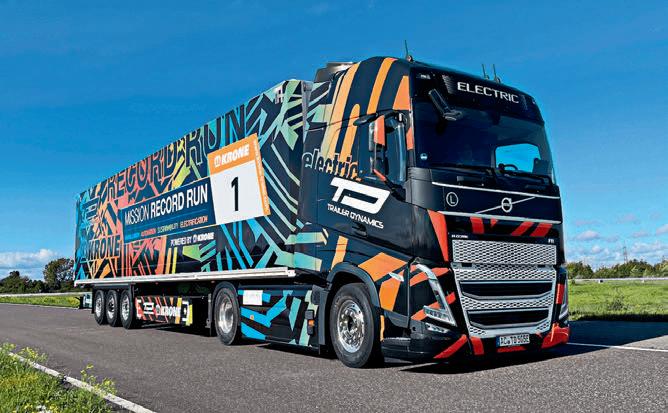
company’s system is designed to respond dynamically to the driving behaviour of the tractor unit, supporting propulsion regardless of whether the truck is powered by diesel, battery-electric or hydrogen. It recently secured a €25 million loan from the European Investment Bank to advance its research.
Australia is emerging as a key proving ground. With its long distances and heavy payloads, local freight presents ideal conditions to test how electri ed trailers can address the issue of range as one of the biggest barriers to zero-emission trucking. Trials are increasingly focused on using e-trailers as range extenders for electric prime movers, allowing operators to begin decarbonising without fully replacing existing eets.
Beyond propulsion, electrification is also reshaping auxiliary systems. Refrigerated transport is a prime example, where axle-based energy recovery systems are eliminating the need for separate diesel-powered cooling units. Technologies such as ermo King’s AxlePower, co-developed with BPW, capture braking energy and store it in high-voltage batteries to run refrigeration units both on the move and at standstill. Trials in Europe and Africa have demonstrated signi cant fuel savings and emissions reductions, including cuts of up to 20 tonnes of CO2 annually in some applications. Despite the momentum, challenges remain. e added weight and upfront cost of battery systems continue to pose barriers, although these are increasingly o set by lower fuel and maintenance costs over time. Regulatory frameworks also lag behind the technology in some markets, where fully powered trailer axles are not completely aligned with existing vehicle design rules.
ere are also technical hurdles. Siemens research in 2025 highlighted that integrating powered e-axles altered the entire vehicle’s dynamics “bringing new challenges in vehicle stability”.
Electri ed trailers are now widely regarded as a practical technology that can deliver immediate e ciency gains. With trials expanding, e-trailers are expected to move rmly into the mainstream by the end of the decade. In the interim, they can be viewed as a modular, scalable pathway to lower emissions, reduced fuel consumption and improved operational e ciency – without waiting for a complete overhaul of the heavy vehicle eet.
www.globaltrailermag.com

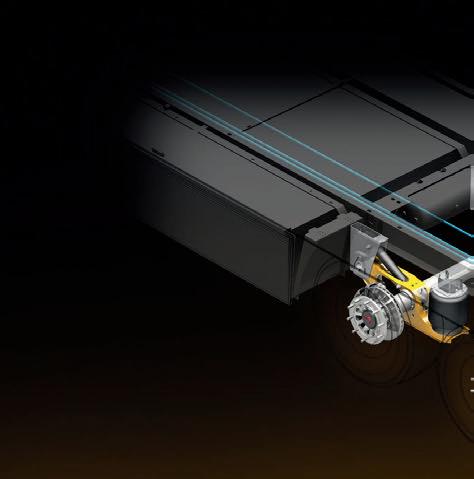



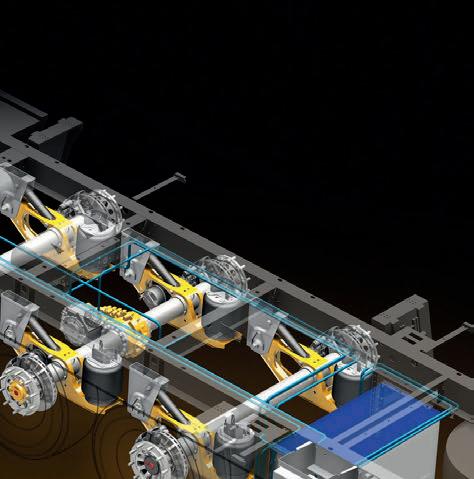
Heavy transportation traffic becomes electric, green and quiet with the recuperation axle SAF TRAKr
Every great E-Mobility concept begins with a first step: the new e-axle system from SAF-HOLLAND – the innovative technology for the electric transformation. safholland. com