Global trailer
86
www.globaltrailermag.com ISSN 1839-5201
2026 | ISSUE 86 10:44
9 771836 520000
01
INNOVATION
BUSINESS
NEWS
Trailer Design Sustainability Components Axles
Executive Interview: Tiger Trailers Industry Voice: HYVA Asia Market Report: Georgia, US Megatrends: AI In Logistics
Industry News Executive Profile: U A AL SOLUTRANS 2025 Review Automechanika Shanghai Review
A TOUCH OF INFINITY
The 800,000 km on-road guarantee for the new BPW 7t universal swing axle will take you around the world 20 times. BPW‘s reliable swing axles enable low-loaders, semi-trailers and vehicles for special transport tasks to operate safely and smoothly with heavy and bulky loads in difficult terrain. The new swing axle is available as a 6 or 7-tonne axle and impresses with its compact design, high load capacity and maximum flexibility – for greater cost-effectiveness in use.
more information: bpw.de/en/swing-axle
YOUR BENEFITS: — Service friendly thanks to maintenance free wheel bearing — Safe and efficient thanks to ECO Drum Brake — Customer specific base plates for perfect vehicle integration
54
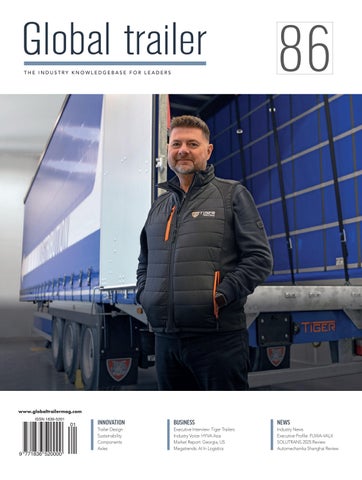
COVER STORY
16
TIGER BURNING BRIGHT
Since forming in 2014, Tiger Trailers has quickly established itself as one of the UK’s leading semi-trailer and rigid bodywork manufacturers. The team is keen to keep the OEM growing on the back of that meteoric rise, through innovation and dedication.
“OUR ETHOS IS TO PROVIDE CUSTOMERS WITH INNOVATIVE 3D ENGINEERING DESIGN SOLUTIONS, OUTSTANDING BUILD QUALITY AND A COLLABORATIVE, PERSONAL SERVICE.” Tiger Trailers Sales Director, Darren Holland
IN THIS ISSUE BUSINESS 22 26
28
34
MARKET REPORT
Find out what makes the US state of Georgia such a vital transport hub.
INDUSTRY VOICE
Global Trailer speals to Hyva Asia as to how it is progressing under the JOST umbrella.
36 38
TRAILER DESIGN
Read how the world’s leading semitrailer manufacturer is redefining electric transport.
44
FEATURES 30
32
EXECUTIVE PROFILE
48
BPW
54
Fuwa-Valx shares how it is redefining performance in a rapidly evolving market. Read how BPW maintains its high quality standards in its operations.
TIP GROUP
TIP Group’s CEO shares enlightening information about the industry’s status.
JOST
Read how JOST is flexing its green credentials.
SCHMITZ CARGOBULL
Find out more about how Schmitz Cargboll is making trailer transport more sustainable.
REGULARS
EU SPECIAL REPORT
04 EDITOR’S NOTE
56 EVENTS
06 NEWS
58 MEGATRENDS
Read the current situation of an intriguing court action by eight trailer OEMs.
SOLUTRANS 2025 REVIEW
Read about what happened at the SOLUTRANS 2025 trade exhibition in Lyon, France.
AUTOMECHANIKA 2025 REVIEW
34
Read about the Automechanika Shanghai 2025 trade fair.
W W W.G LO B A LT R A I L E R M AG .C O M / G LO B A L T R A I L E R / 3
EDITOR’S LETTER
CHAIRMAN John Murphy john.murphy@primecreative.com.au
CEO Christine Clancy christine.clancy@primecreative.com.au
INTERNATIONAL SALES Ashley Blachford ashley.blachford@primecreative.com.au
MANAGING EDITOR Luke Applebee luke.applebee@primecreative.com.au
EDITOR
LOOKING FORWARD TO HORSING AROUND Welcome to a brand-new year and to the first edition of Global Trailer for 2026. It’s fair to say that after a pretty tough 2025 many stakeholders are looking forward to this year with renewed confidence and enthusiasm. Last year wasn’t all doom and gloom, as we did see growth and consolidation with mergers and acquisitions, such as JOST and Hyva; Schmitz Cargobull and GT Trailers; the DSV and Schenker merger and more. We also saw trailer OEMs, such as Wielton, Randon, Hyundai Translead and Wabash, expanding their footprints and reputations in what has always been a tightly contested trailer market. Although 2025 saw an overall dip in trailer sales and production, due to issues such as tariffs, material costs and emissions controls, many operators were able to take a ‘steady as she goes’ approach to business, recording satisfactory, if not exceptional, financial results. We can agree that such achievements will hopefully lead to a strengthening of the transport industry as a whole. So, what can we expect for this new year? A quick dive into industry trends and terms, such as lightweight and modular materials, sustainability, carbon-emissions, improved efficiency, refurbishment, electric and autonomous vehicles crop up frequently. As with 2025, sustainability will undoubtedly be a major buzzword for
4 / G LO B A L T R A I L E R / I S S U E 86
the industry as it comes to grips with the balancing act between reducing carbon emissions and environmental sustainability on one hand, and maintaining cost effective and profitable businesses on the other side. The sheer inventiveness of humans indicates that such a delicate balance is certainly achievable, but it won’t be attained without support from governments and lawmakers. As the recent history has shown us, that will be the ultimate piece of the puzzle. Depending on which source you read, the global truck and trailer industries are going to experience a 5.0 per cent CAGR, or a “cautious stabilisation, but continued uncertainty, shaped by weak freight fundamentals, tariff-driven cost pressures, and regulatory ambiguity.” With all that has been experienced throughout last year, it would be reasonable to give 2025 a solid B grade. Now, as we enter the year of the horse (traditionally a good fortune in Chinese zodiac signs) we can all strive for a B+ or A- level year. Hope springs eternal, but with the trailer industry not likely to make an immediate bounce-back, it is probable that we will see more of the same steady and incremental forward movement – a gentle trot, rather than a gallop.
Paul Lancaster paul.lancaster@primecreative.com.au
HEAD OF DESIGN Blake Storey
DESIGN Laura Drinkwater
CLIENT SUCCESS MANAGER Maria Afendoulides maria.afendoulides@primecreative.com.au
COVER
Image: Tiger Trailers
HEAD OFFICE
Prime Creative Pty Ltd 379 Docklands Drive Docklands VIC 3008 Australia +61 3 9690 8766 info@primecreative.com.au www.globaltrailermag.com
SUBSCRIPTIONS
+61 3 9690 8766 subscriptions@primecreative.com.au Global Trailer is available by subscription from the publisher. The rights of refusal are reserved by the publisher.
ARTICLES
All articles submitted for publication become the property of the publisher. The Editor reserves the right to adjust any article to conform with the magazine format.
COPYRIGHT
Global Trailer is owned by Prime Creative Media and published by John Murphy. All material in Global Trailer is copyright and no part may be reproduced or copied in any form or by any means (graphic, electronic or mechanical including information and retrieval systems) without written permission of the publisher. The Editor welcomes contributions but reserves the right to accept or reject any material. While every effort has been made to ensure the accuracy of information, Prime Creative Media will not accept responsibility for errors or omissions or for any consequences arising from reliance on information published. The opinions expressed in Global Trailer are not necessarily the opinions of, or endorsed by the publisher unless otherwise stated.
T J
P
F T e fr c o
FOLLOW US Global Trailer Magazine
w
32298_A
The perfect coupling – JOST KKS Push-button trailer coupling For anyone already using it, it’s a match made in heaven: The KKS allows you to automatically control and monitor the entire coupling and uncoupling process via remote control from the cab. And this includes the air, electrical and brake connections – with simple and intuitive operation. The future of logistics is now on the streets.
R 0 KKS – FO NEW! JSK8 US VEHICLES O AUTONOM LS AND DEPOTS A IN IN TERM
www.kks-successstories.com
32298_ANZ_JOST-Global_Trailer_KKS_EN_200x265mm_250605.indd 1
05.06.25 12:24
NEWS INTERNATIONAL AFRICA SOUTH AFRICA South African truck and trailer builder, Serco, plans to concentrate on growth and reducing trailer total cost of ownership through innovation and faster service to improve vehicle uptime. Despite tough economic conditions, Serco has navigated 2025 with a strategic focus on delivering growth through innovation, customer partnerships, and operational excellence, Serco CEO, Clinton Holcroft, said. Holcroft said trends showed customers were extending their current assets’ lives while selectively investing in efficiency improvements. “Stand-outs are our on-site repair facilities, and the quick-opening curtain systems which help customers cut down time and labour costs during loading operations,” said Holcroft. Pleasing for Holcroft and Serco employees, the company has undergone palpable growth, with the company expanding its Boksburg branch facility to add 1,500 m² for repairs and 600 m² for manufacturing and installing new steelprocessing equipment. The additional spaces will shorten lead times and improve operation efficiencies.
“The added undercover workspace will enable us to increase capacity and service levels to our customers in Gauteng,” said Holcroft. “The project is expected to be complete by the end of 2025 and will include use of rainwater harvesting to improve the efficient and sustainable use of water in our business.” Holcroft is “cautiously optimistic” about prospects for Serco in 2026. “The order book going into the new year shows a healthy ‘pipeline’ for new body deliveries, however, we do expect ongoing pressure on order volumes due to the slow economy,” he said. He identified Serco’s strengths as being its industry experience, multi-site capacity, a strong after-sales footprint and product innovations, such as the company’s fastopening curtain siders and Ferro-foam refrigerated trailers. The company has secured larger premises for its after-sales repair business in Durban, expected to become operational by April 2026. This will enable Serco to significantly increase capacity and service levels for the repair of truck and trailer bodies in KwaZulu-Natal.
Serco CEO, Clinton Holcroft, is banking on a strong 2026 for the company. Image: Serco Pty Ltd.
6 / G LO B A L T R A I L E R / I S S U E 86
“Added to this, we are refining our ‘speed bay’ model to give customers same-day or next-day turnaround for smaller repairs,” said Holcroft. “Finally, we are accelerating the product development of operationally efficient body systems (load/unload speed and durability) and new materials to increase durability and weight saving in our vehicles.” Opportunities for the company in the new year include replacement of ageing fleets as interest rates ease, fleet conversions of light-weight bodies for low-emissions in the medium term and growing demand for faster repairs and rapid turnaround services. “Our purpose remains to give customers the edge. For 2026 we will focus on reducing our customers’ total cost of ownership through innovation and faster service to improve vehicle uptime” Holcroft said. “Practically, that means improving repair turnaround times across our network, reducing lead times for new vehicle bodies through investment in plant capability, and launching customer-facing service innovations that translate into measurable fleet productivity gains. “In the tightly traded transport and logistics industry, uptime and service reliability become competitive advantages for our customers. “Despite economic pressures, Serco has proven its resilience and ability to grow through customer partnerships and operational excellence. “With new technologies, expanded capacity, and a focus on sustainable, highperformance solutions, we’re confident that 2026 will be a year of meaningful progress for our business and the transport sector as a whole.”
A state of the art, upgraded and fully integrated global manufacturing centre of trailer systems and On/Off highway systems. Expertly designed and engineered with worldwide accessibility, offering you private label and OEM manufacturing solutions.
Drawing upon decades of expertise spanning Asia, Australia US, and in Europe, Fuwa stands as a global manufacturing powerhouse, unrivalled as the foremost network of specialists in truck and trailer components across the globe.
China
Fuwa Heavy Industries P: 86 750 596633
fuwa.cn
Australia
Fuwa K-Hitch P: 61 3 9369 0000
khitch.com.au
Singapore
Fuwa Engineering P: 65 6863 1806
fuwa.cn
Europe
VALX International P: 31 088 405 8800
valx.eu
NEWS INTERNATIONAL ASIA PACIFIC SINGAPORE The Asia Pacific region plays a central role in driving global trade, according to the DHL Global Connectedness Tracker 2025. The finding comes as international markets and trade face mounting challenges due to tariff pressures. DHL and New York University’s Stern School of Business have released an update to the DHL Global Connectedness Tracker, providing a systematic assessment of how international trade and business investment are reacting to the US’s current shifting trade policies. “Asia Pacific’s performance stands out due to its adaptability and strategic positioning, and the latest data shows how collaboration in the region is deepening even amid global uncertainty,” said DHL Express Asia Pacific CEO, Ken Lee. “From ASEAN’s rising role in absorbing trade flows to countries in the Asia Pacific region engaging more intensively with their neighbours, businesses in our region are proving agile and forward-looking. “DHL is well-positioned to support our customers in navigating any shifts in trade patterns, and we will continue to build capabilities where our customers want to be.” The DHL Global Connectedness Tracker reveals that, in the first half of 2025, international trade grew at a faster rate than in any half-year since 2010, excluding the pandemic rebound. US imports surged early in 2025 as buyers rushed to frontload purchases ahead of the Trump administration’s tariff hikes. The 2025 report found that six of the 10 fastest-growing trade routes were exports originating from an Asian economy, underscoring the region’s pivotal role in driving global trade momentum. Additionally, among the 50 largest trading
8 / G LO B A L T R A I L E R / I S S U E 86
Kuehne+Nagel’s new fulfilment centres add 100,000 sqm of space and create 1,500 new jobs across India. Image: Kuehne+Nagel.
nations, Hong Kong SAR, Thailand, Malaysia and Vietnam were among the top 10 markets that saw the fastest trade value growth, indicating the Asia Pacific region’s growing influence and resilience in supply chain networks. It also found that intra-Asia trade showed signs of continued integration and expanding connections, with East Asia & Pacific’s intra-regional trade share rising from 55 per cent to 56 per cent. This reflected Asian economies’ pivoting of trade flows toward regional partners to maintain growth, the report said. It found that ASEAN emerged as a key growth destination for Chinese exports, with Vietnam, Thailand, and India experiencing the largest increases in their share of China’s exports, while the US, Russia, Korea, Brazil, and Mexico experienced declines.
INDIA Kuehne+Nagel has unveiled a significant expansion of its contract logistics network in India, with five new fulfilment centres adding 100,000 square metres of capacity across key industrial regions. The new facilities, located in Gurgaon, Kolkata, Nagpur, Mumbai and Rajpura, bring the company’s total fulfilment footprint in India to nearly half a million square metres.
The expansion will create more than 1,500 new jobs, further supporting the country’s fast-growing logistics and manufacturing sectors. India’s rapid economic rise, projected to make it the world’s third-largest economy by 2030, is being fuelled by growth in high-tech, automotive, consumer goods and healthcare industries. To meet the increasing logistics demands of these sectors, Kuehne+Nagel is investing in scalable, high-performance supply chain infrastructure. Each of the new sites is equipped with advanced automation technologies, including telescopic conveyors and highefficiency sorting systems, enabling up to 75 per cent higher peak handling capacity. The new network reflects India’s diversified industrial development. Gurgaon and Nagpur continue to strengthen their positions as major logistics hubs, while Rajpura is emerging as a key manufacturing and distribution centre. “India is a key growth market for Kuehne+Nagel,” said Damian Raczynski, Senior Vice President, Contract Logistics, Kuehne+Nagel Asia Pacific. “We invest where our customers are. And this expansion strengthens our ability to serve high-demand industries with efficient, technology-driven logistics solutions.”
T E F
To build up the Ecosystem of EV-RT and the Fleet Operating Base
NEWS INTERNATIONAL AUSTRALASIA AUSTRALIA The Queensland Parliament passed the Heavy Vehicle National Law Amendment Bill following its introduction in August 2025, marking a major step in the long running review of Australia’s core heavy vehicle regulatory framework. The amendments are expected to take effect from mid-2026. The Heavy Vehicle National Law (HVNL) is administered by the National Heavy Vehicle Regulator (NHVR) and applies in New South Wales, Victoria, South Australia, Tasmania, Queensland and the Australian Capital Territory (ACT). The review began in 2018 and has involved several rounds of consultation, inquiries and stakeholder engagement. In its submission to the parliamentary inquiry, the Australian Trucking Association (ATA) said it remained disappointed with
The Queensland Government passed a new Heavy Vehicle National Law. Image: Luca/stock.adobe.com.
10 / G LO B A L T R A I L E R / I S S U E 86
the overall ambition and the extended length of the review process. The association said the review stalled until February 2022 when a further consultation was undertaken. State Transport Ministers agreed to implement his recommendations later that year. While the ATA described the consultative report as a compromise, it recommended the bill be passed on the basis that it can be regularly reviewed and improved under the law’s provisions. The bill, according to the ATA, does introduce several positive changes. These include shifting technical content into regulations and standards to better accommodate technology updates, requiring documented safety management systems for National Heavy Vehicle Accreditation Scheme (NHVAS) businesses, simplifying fatigue compliance and
reducing 21 penalties including minor fatigue and work diary offences. The National Road Transport Association, NatRoad, has also welcomed the passage of the bill but cautioned that operators will require detailed clarity ahead of the reforms taking effect in July 2026. NatRoad CEO, Warren Clark, said the measures represent meaningful progress although the key regulatory instruments covering fatigue, mass, maintenance, standards and supporting guidelines are still being developed. Clark said operators are already seeking certainty so they can prepare for changes that will include more flexible fatigue arrangements with risk-based guidance, updated accreditation and audit requirements, improved chain of responsibility alignment and greater use of digital record-keeping systems.
TRAILERS & RIGID BODYWORK
NEWS INTERNATIONAL EUROPE FRANCE Kögel Trailer GmbH is strengthening its presence in France by entering a partnership with Delta Trailers, based in Marville-Moutiers-Brûlé, west of Paris. Delta Trailers, a specialist in trailer sales and distribution, will become Kögel’s fourth trading partner in France, and this collaboration will ensure the nationwide availability of Kögel’s range of products and services for all French customers. Both companies are leveraging their customer focus in the partnership, where Delta Trailers will offer Kögel’s complete product portfolio, ranging from tippers, box and curtain-sided vehicles to container chassis and refrigerated trailers. The partnership will also include Kögel spare parts and related services, such as Kögel Telematics and KIT for vehicles. Repairs and maintenance services will be carried out in Delta Trailers’ own workshop. Founded in 2003, Delta Trailers employs Kögel Trailer CEO, Thore Bakker, left, and Delta Trailers CEO, Louis-Marie Levet, sign the new partnership deal. Image: Kögel Trailer.
12 / G LO B A L T R A I L E R / I S S U E 86
more than 25 employees, who contribute their expertise and in-depth market knowledge to ensure high customer satisfaction and a well-established sales network across the country. Delta Trailers CEO, Louis-Marie Levet, said: “We are delighted to partner with Kögel Trailer GmbH, which enables us to serve a large part of France with high-quality semitrailers and to offer our customers an even broader range of vehicles and services. “Our customers know that we always put their needs first – with Kögel, we have found a manufacturer that shares our values, true to their motto ‘Because we care.’” For Kögel, the partnership represents an important opportunity to fully expand and serve the French market, in which its existing dealer partnerships will remain unchanged. “With this partnership, we are closing an important strategic and geographical gap,” said Kögel Trailer GmbH CEO, Thore Bakker.
“We are convinced that Delta Trailers is an excellent and highly capable distribution partner for France, with deep knowledge of the local market and customer base. “Our long-term collaboration will further strengthen the Kögel brand in this key market and expand our customer reach.” Bakker said Kögel Trailer’s long-standing partners, TH Trucks, Groupe Kroely, and Trucks Solutions will continue to represent Kögel products in their respective regions and areas of responsibility.
GERMANY The European Investment Bank (EIB) is committing €25 million in venture debt to German system supplier, Trailer Dynamics. The Aachen-based start-up is emerging as one of the most influential players in trailer electrification, developing powered e-trailers designed to work with any truck. The financing, backed by the EU’s InvestEU program, will support the company’s industrial scale-up and market expansion as fleets across Europe confront tightening CO₂ regulations and rising operating costs. Trailer Dynamics’ system equips trailers with their own electric axle, lithium iron phosphate battery pack and powertrain management software. The result is a self-propelled unit that can cut diesel consumption by up to 40 per cent or extend the range of electric trucks from roughly 400 kilometres to around 700 kilometres. The technology enables long-haul zeroemission operations without relying on new truck platforms or widespread charging infrastructure. EIB Vice President, Nicola Beer, said the investment recognises the immediate
EUROPE impact electrified trailers can deliver. “Trailer Dynamics’ e-trailer technology cuts emissions, reduces fuel costs and extends electric truck range without compromising on performance or affordability,” she said. The company’s leadership echoed the sentiment, noting the funding will accelerate commercial rollout. CFO Michael W. Nimtsch described the partnership as “a strong vote of confidence” that will push the technology into mainstream fleet operations, while Supervisory Board Chairman Dr Stefan Binnewies emphasised its role
in helping Europe meet freight decarbonisation targets. Under new EU rules, trailers face a 10 per cent emissions-reduction target by 2030, along with mandatory certification requirements. Electrified trailers offer operators a direct pathway to compliance, reducing the risk of penalties and enabling incremental upgrades of existing fleets. Trailer Dynamics’ smart energy system automatically manages propulsion support, braking recovery and power distribution, while maintaining full interoperability across mixed-brand truck fleets – a key requirement for European
logistics operations where coupling and decoupling occur multiple times per day. The EIB said the investment aligns with InvestEU’s mission to mobilise capital for climate-aligned technologies. Since 2015, the bank has deployed more than €6 billion in venture debt to support fastgrowing European innovators. With the freight sector under pressure to deliver meaningful emissions reductions before 2030, electrified trailers are gaining traction as a costeffective bridge technology which is accelerating decarbonisation today while easing the transition to next-generation electric trucks.
Temperature-controlled transport perfectly effective.
With the S.KO COOL reefer
Transport temperatured goods more cost-effectively. The vapour diffusiontight FERROPLAST® body together with the efficient S.CU cooling unit and the smart TrailerConnect® telematics system ensure optimised and reliable transportation. Also available fully electric as S.KOe COOL.
Find out more at schmitz.cargobull.com/ cool-freight
NEWS INTERNATIONAL NORTH AMERICA USA
“Greg has made countless contributions to our industry and our association, and he has earned his place as ATA chairman. “This unique position has the ability to shape the future of trucking, and with the growing number of challenges we face, steady, experienced leadership is needed now more than ever. “With Greg at the helm, ATA will continue to prove its value proposition for our members and remain a strong voice for the millions of Americans our industry employs. “The past year has been one of the most rewarding and memorable experiences of my career. I congratulate Greg as he takes on this new role and wish him all the best on his own exciting journey.” ATA’s Board also elected Derek Leathers, Chairman and CEO of Werner Enterprises Inc. in Omaha, Nebraska, as first vice chair and Randy Clifford, Chairman and CEO of Ventura Transfer Company in Long Beach, California, as second vice chair. In addition, Gregg Troian, president of PGT Trucking Inc. in Aliquippa, Pennsylvania, was elected as vice chair. The Board re-elected John M. Smith, The ATA’s new president, Greg Hodgen. Image: ATA.
chairman of CRST International Holdings LLC, as secretary and Harold Sumerford Jr., CEO of J&M Tank Lines Inc., was elected as treasurer. In 2019, under Hodgen’s leadership, Groendyke Transport expanded into the Southeast region of the US, as a result of the largest acquisition in its history. Groendyke has also continued its tradition of safety excellence under Hodgen, winning its record ninth National Tank Truck Carriers (NTTC) North American Safety Champion Award in 2023. Hodgen continues to be involved in transportation-related associations and is currently serving on the Executive Committee of the ATA and was appointed as the vice chairman and incoming chairman by the Board Management Committee. He has served on the board of NTTC since 2000, including terms as NTTC Chairman and Chairman of the Executive Committee. He has also served on the NTTC Executive Committee, is the Chairman for the NTTC Image Committee, and recently was on the NTTC Budget and Finance Committee.
D F E S
Image:
The CEO of an Oklahoma-based transport company has been elected as the 81st Chairman of the American Trucking Associations (ATA). The ATA’s Board of Directors elected Greg Hodgen, CEO of Groendyke Transport Inc. from Enid Oklahoma, to lead the national body. “It is a tremendous honour to be the 81st Chairman of the American Trucking Associations,” said Hodgen. “Trucking is a noble profession, one that I love and am proud to have been a part of for the past three decades. “As I step into this role, I carry with me the stories, challenges, and values that define our industry.” Groendyke Transport, Inc., one of the nation’s largest tank-truck carriers, has more than 90 years’ expertise in bulk liquid and hazardous materials transportation services. Hodgen succeeds Dennis Dellinger, President & CEO of Cargo Transporters, as ATA Chairman. ATA President & CEO Chris Spear said of the new Chairman: “Over the past several decades, Greg has built a highly successful career at Groendyke and has been instrumental in growing the company into one of the nation’s largest tank-truck carriers. “Along the way, he has lent his time, talent, and expertise to ATA, and our Federation is stronger because of his invaluable insights and inspiring leadership. “ATA is fortunate to be able to add Greg to our distinguished list of accomplished chairmen, and I look forward to working with him on tackling a wide range of issues facing our industry, particularly the scourge of lawsuit abuse.” Outgoing Chairman, Dennis Dellinger, said:
14 / G LO B A L T R A I L E R / I S S U E 86
TIP_fulls
SOUTH AMERICA BRAZIL Brazil-based OEM, Randon, reported net revenue of 3.4 billion BRL (approx. €552 million) for Q3 2025 which was driven by rapid growth in its international aftermarket business and a rebound in sales across multiple regions. This result was a 9.9 per cent year-on-year increase. Despite a challenging global landscape, including subdued demand for trailers and parts, Randon grew revenue and saw a notable recovery in profitability. Adjusted EBITDA for the quarter reached 479.8 million BRL (~ €78 million), resulting in an adjusted EBITDA 13.9 per cent margin. This improvement reflected the success of earlier cost control measures
and structural adjustments. “We have consistently worked on initiatives to address the slowdown in certain segments and reduce our leverage,” said Randon CFO, Paulo Prignolato. “We adjusted structures, carried out strategic fundraising in the capital markets and implemented measures to optimise our working capital.” Internationally, Randon delivered a stellar performance. Revenues outside Brazil, including exports and overseas operations, surged by 91.2 per cent versus Q3 2024, totalling 199 million USD (~€171 million). The strong growth was underpinned by recent acquisitions, such as Dacomsa in Mexico, EBS in the UK and AXN (US).By
quarter’s end, international revenue was at 31.5 per cent of its total net revenue. Randon’s strategy and diversified portfolio have resulted in Standard & Poor’s reaffirming its brAAA national-scale rating, the highest possible, citing solid governance and proactive capital structure management. “In a challenging environment, our strength lies in the ability to innovate and stay on course,” said Randon President and CEO, Daniel Randon. “We have prioritised deleveraging, the integration of our synergies and operational efficiency, while preserving strategies that support sustainable growth.”
DISCOVER OUR FULL-SERVICE ELECTRIC SOLUTIONS
SCAN THE QR CODE tip-group.com
TIP_fullservice-e-solutions_magazin-ad_200x135mm_refresh_FINAL.indd 1
2025. 12. 02. 10:36
TIGER
BURNING BRIGHT SINCE FORMING IN 2014, TIGER TRAILERS HAS QUICKLY ESTABLISHED ITSELF AS ONE OF THE UK’S LEADING SEMI-TRAILER AND RIGID BODYWORK MANUFACTURERS. SALES DIRECTOR, DARREN HOLLAND, AND THE TEAM ARE KEEN TO KEEP THE OEM GROWING ON THE BACK OF THAT METEORIC RISE.
Tiger Trailer’s Sales Director, Darren Holland.
16 / G LO B A L T R A I L E R / I S S U E 86
COVER STORY
F
rom its nascent beginnings during huddled meetings around kitchen tables, and the opening of its first repurposed factory followed by the move to a purposebuilt, state-of-the-art facility, Tiger Trailers has become one of the most widely recognised, marketed, and ground-breaking firms in the sector. Today, it is one of the UK’s leading trailer builders, making about 2,000 vehicles each year, with a broad product line,comprising ambient and refrigerated trailers, box van trailers and rigid vehicles. Tiger Trailers are happy to say that all trailers feature bespoke elements unique to the end user. That attention to detail has resulted in the company enjoying sales in 2024 of more than £101million (~€116 million), with it seeing a large growth in refrigerated moving deck double deck trailers. Tiger Trailers’ Sales Director, Darren Holland, proudly proclaims he was one of Tiger Trailers’ founding members eleven years ago following John and Steven Cartwright having a vision to create the most advanced trailer and bodywork manufacturing facility in the UK, swiftly joined by other key personnel who shared that goal. Core values
“Our primary focusses as a company, from the board right down to each individual employee, are on high quality, innovation, employee development and engagement, and supporting our community – and I’m proud to be able to say that these areas have shaped up very strongly again in 2025, in which we have developed and launched our new apprenticeship scheme,” Holland said. From the time when John and Steven Cartwright set up Tiger Trailers after spending over 30 years previously in their family business, the company has always maintained a strict adherence to what it does best – making trailers for the UK market. As a result, Tiger Trailers is the only trailer company in the UK to offer a complete trailer service to its customers — consisting of new build manufacturing, bespoke product finance, trailer rental, maintenance, repairs and spare parts sales. “This, coupled with having a product range spanning from 7.5 tonne rigid vehicles to longer semi-trailers, enables Tiger to meet the changing demands of its customer base,” said Holland. “Tiger’s factory is unique, purpose built in 2019, delivering efficiencies that facilitates the efficient and effective line production of all products - offering customers faster turnaround of orders and improved product quality. “Our ethos is to provide customers with innovative 3D engineering design solutions, outstanding build quality and a collaborative, personal service.” Darren Holland added this goes hand-in-hand with its approach to work and corporate culture, both driven by Tiger’s five core values — Innovation in engineering and manufacturing techniques, which shape its trailer solutions; Excellence, where it aims for the highest standards possible; Courage, so as to confidently tackle challenges while learning on the journey; Accountability, so as to work efficiently and in a safe environment; and Integrity, being honest, ethical and respectful with all. Trailer market
Despite Tiger Trailers seeing the economic climate as being challenging in the past 18 months for the UK trailer industry, hit with higher costs and less production, it is optimistic about its own future growth plans, due to the development of new products and the enhancement of its existing finance and rental offerings. “Our broad product range and new product introductions has allowed for growth in sales of certain products,” said Darren Holland.
W W W.G LO B A LT R A I L E R M AG .C O M / G LO B A L T R A I L E R / 1 7
“OUR PRIMARY FOCUSES AS A COMPANY, FROM THE BOARD RIGHT DOWN TO E ACH INDIVIDUAL EMPLOYEE, ARE ON HIGH QUALIT Y, INNOVATION, EMPLOYEE DEVELOPMENT AND ENGAGEMENT, AND SUPPORTING OUR COMMUNIT Y.” TIGER TRAILERS SALES DIRECTOR, DARREN HOLLAND
While it sees the UK as its main market Tiger Trailers welcomes opportunities to manufacture for European operators, mindful of the typical differences in product specifications, longevity and usage profiles. It has partnered with Lecitrailer of Spain, one of Europe’s leading trailer manufacturers, to supply refrigerated vehicles and other specialist trailers in the UK. Tiger itself makes limited sales directly to the European market but has in recent years supplied box vans to parcel carriers in France, Germany, and curtainsiders to Belgium. However, it does produce ‘UK’ specification trailers, utilised by Tiger’s customers in both the UK and their European operations.
18 / G LO B A L T R A I L E R / I S S U E 86
New Tiger trailers on the production line. Images: Tiger Trailers.
Tiger has also in the last couple of years exported bespoke double deck curtainsiders to the US market, for the operations of a leading UK kitchen and bedroom retailer which has experienced substantial growth in North America. The company names increasing pressure to reduce costs amidst a more challenging trading environment, greater focus on increasing the lifespan of trailers in fleets, typically about 10 years plus, as the challenges facing a competitive trailer market. Innovation
As a leading trailer manufacturer, Tiger Trailer has always recognised that in order to stay relevant and up-to-date, it has to innovate. Its 168,000 sq ft (15,608 square metres) base is home to a state-of-the-art manufacturing facility, 3D engineering suite, specialist training centre, and product showroom. From being the first UK manufacturer
COVER STORY
to design and offer a moving double deck trailer with a 52-pallet capacity, followed by continuous engineering achievements such as the development of its Lightweight Clearspan Curtainsider Trailer and Captive Rave load restraint system, innovation is a core characteristic of Tiger Trailers’ culture. “While we continue to build a large number of curtainsided, box van and double deck semitrailers, along with ambient rigid bodywork, 2025 has seen us pour ongoing R&D into enhancing our refrigerated offering, with dualtemperature iterations of our moving deck double deck fridge trailer now in operation by supermarkets and other major operators,” said Darren Holland. These customers include major corporate players, such as Asda, Culina, DFDS, XPO and Moran, as well as fulfilling an order of 68 single-deck reefers to Greencore, and the manufacture of a large quantity of refrigerated rigid bodies to logistics operators. Tiger’s refrigerated trailers are built in partnership with Lecitrailer in Spain and continue to be one of its core product focuses. A collaborative Tiger innovation that has helped many operators to efficiently handle fragile dairy products is its specific milkcarrying fridge trailer. Milk market reefers in general have traditionally suffered due to the movement of the cages that carry the product, resulting in side wall damage, and Tiger’s solution was designed to address this. To understand what the market needs in terms of innovative products and services, Tiger Trailers ensures it visits all customers’ sites and works closely with them in a collaborative manner to deliver bespoke transport solutions. “This ongoing collaboration has seen us, for example, develop and introduce the second generation of our ‘captive rave’ load securing system that uses bungees to maximise versatility and also operator safety,” said Holland. “We’ve also manufactured a significant volume of specialist trailers and rigid bodies for gas cylinder transport, along with drawbar trailers.” The array of innovations isn’t restricted to the trailer specifications. In the last 12-18 months, the company has invested in new
Welding on Tiger’s factory floor.
TIGER INNOVATIONS Innovation has always been at the heart of Tiger’s product R&D, and over the past twelve months or so, it has collaboratively delivered solutions including the following: • AO: The innovative design of Tiger’s LST moving double deck box van trailers for electrical retailer AO was optimised for transporting double-stacked appliances on both lower and upper decks, up to four products wide. • BOC: A specialist solution to design and manufacture flatbed trailers and rigid bodywork for transporting gas cylinder pintle pallets, with bottles secured in rows along the length of the vehicles. • SELCO: Goods in 800mm high stillages, and magnums and pallets up to 600kg each, needed to be transported by a fixed double deck trailer with an upper deck rating of 14,000kg. Tiger s fixed the deck at 2m, with two support pillars either side. • ASDA George: Vehicles required for transporting large quantities of garments on rails. Tiger’s solution encompassed ‘high cube’ double deck box van trailers with an internal platform, allowing staff to manoeuvre along the length of the trailer and vertically, with 150 load-securing bars so suit along nine horizontal tracks.
W W W.G LO B A LT R A I L E R M AG .C O M / G LO B A L T R A I L E R / 1 9
“Plus, our trio of new GA75LVSD+FF compressors provide a 17.1 per cent energy cost saving of £9,971 per year and, more importantly, reduce CO2 emissions by 11.5 tonnes.” In addition, the company also maintains a large array of 460kW solar panels on its roof, with scope for further expansion, and a tree planting scheme for each unit made at the factory. From a product specification and supply chain perspective, Tiger ensures compliance with sustainable sourcing practices of forest products and has utilised recyclable alternatives for trailer sidewalls. It has also produced a significant number of lightweight trailers utilising extra high tensile steel. “We have also massively increased our trailer parking area to the rear of the factory, making vehicle movements more efficient and greener,” he said. A Tiger Trailer employee hard at work.
industry-leading paint booths to reduce energy consumption, as 90 per cent of the fresh air is recirculated during the baking process, while its Fuel Save Mode mitigates ‘lost’ air. Also, use of its Variable Speed Drive ensures fans run optimally, while the booths’ efficient LED lighting maximises safety and their air movement system speeds up panel heating, reducing paint cure times, and baking at lower temperatures. Additionally, the cardboard filters used reduce waste and are easier to change. Tiger Trailers has also included the burgeoning field of trailer rentals in its repetoire of trailer products and services since 2014. “The trailer rental part of the business began with a strict focus on double deck trailers,” Darren Holland explained. “The business has grown over the past 11 years and is a key service offered to new build customers, allowing customers to try Tiger’s product prior to their own purchase, whilst also supporting short or medium term hire needs.” Sustainability
The trailer builder views sustainability and ESG as vitally important for its daily operations, as well as its customers’ operations. Holland said Tiger has invested significant funds to make its factory increasingly greener and sustainable. “From a manufacturing perspective, Tiger has introduced cleaner and more efficient facilities such as our new paint booths which reduce energy consumption through 90 per cent of the fresh air being recirculated, lost air being captured, optimised fans, efficient lighting, and recyclable cardboard filters,” Holland said.
20 / G LO B A L T R A I L E R / I S S U E 86
Apprenticeship scheme
Since the year of its inception, apprenticeships have always been close to the heart of the company’s founders and senior management team, with the belief that training and inspiring the next generation helps to create strong communities as well as businesses.
FAST FACTS • April 2014: Tiger Trailers moves into its factory in Winsford, Cheshire. • November 2016: Tiger releases the UK’s first 52-pallet capacity moving deck double deck trailer. • January 2019: Tiger Trailers relocates to its new £22 million home • August 2019: Tiger Finance launched to provide tailored financial solutions. • April 2020: Siberian temperature-controlled range launched. • November 2021: Tiger Safety Team launches, along with the firm’s expansive CSR activities and memberships. • January 2022: Ed Booth appointed as Managing Director.
COVER STORY
Tiger’s latest apprentices have embarked on a three-year qualification to become ‘Maintenance and Operations Engineering Technicians’, which falls under the wider qualification of ‘Manufacturing in the Automotive Sector’. “As a manufacturer we’re committed to investing in developing skills for the future of the business, the local community, and the transport sector as a whole,” said Darren Holland. “Developing and launching apprenticeship schemes in this way also presents exciting opportunities to partner with educational organisations such as The Manchester College and Total People, who share Tiger’s passion for developing young people.” Holland himself is a proud example of the benefit of apprenticeships, which, for him started in 1987. “Apprenticeships for me are essential to allow people to grow their confidence and skill sets in a chosen career that sets a platform to allow them to expand from there,” he said. As a result of the attention to its apprenticeship scheme, Tiger continues to invest with its people, customers, community, product range and facility in mind.
“AS A MANUFACTURER WE’RE COMMITTED TO INVESTING IN DEVELOPING SKILLS FOR THE FUTURE OF THE BUSINESS, THE LOCAL COMMUNITY, AND THE TRANSPORT SECTOR AS A WHOLE.” TIGER TRAILERS SALES DIRECTOR, DARREN HOLLAND
Community work
Tiger Trailers has always maintained a keen sense of helping others in its community. The company’s road safety program, ‘STOP, LOOK, BE SEEN’ has been widely adopted by its customers over the years, as well as local businesses. The company continues to support the Cheshire Community Foundation, The King’s Trust, Passion for Learning, Cheshire Buddies, and Veterans Into Logistics and promotes and hosts events for Women in Transport, of which it is a member. “We also support young people through our local Chamber, and trees continue to be planted around the world and here in the UK for each product we sell,” said Holland. Future goals
“We plan to continue investing significantly in our people, facilities, products and processes in order to offer our customers increasingly innovative trailer solutions in both the ambient and refrigerated markets, increasing our business growth in a structured and sustainable way,” said Darren Holland. “We attribute our success to our loyal customers, suppliers and partners with whom we have excellent, productive relationships, but most of all to our extremely hard working and motivated employees who are making a difference every day.” www.tigertrailers.co.uk A temperature controlled moving double decker reefer trailer.
W W W.G LO B A LT R A I L E R M AG .C O M / G LO B A L T R A I L E R / 2 1
Atlanta, Georgia is at the epicentre of the state’s major logistics and corporate investments. Image: Kevin Ruck/stock.adobe.com.
GEORGIA
JUNCTION
WHEN GLADYS KNIGHT AND PIPS SANG ‘MIDNIGHT TRAIN TO GEORGIA’, ABOUT A MAN RETURNING TO HIS HOME STATE, THEY PROBABLY HAD NO INKLING THAT THE PEACH STATE WOULD BE RANKED THE TOP STATE IN THE US FOR DOING BUSINESS, THANKS LARGELY TO ITS LOCATION.
W
ith an area of approximately 154,000 square kilometres, Georgia is only ranked 24th out of the 50 US states in area. However, the southern state that for years has for many years been known as the Peach State or Peanut State, due to its strong reliance on those agricultural products, is rapidly becoming known as the United States’ transport node, or hub. In 2022, Georgia was ranked the top US state as a logistics infrastructure hub in the United States, as well as for the cost of doing business. Moreover, in 2024 Georgia was ranked the premier state for infrastructure in the US, making it a leading business centre. So, what makes Georgia such a sought-after location for a myriad of businesses from various industry sectors to set up shop? Location, location, location
According to the Georgia Department of Economic Development, the State’s unrivalled infrastructure planning that connects air, ports, rail and roads is the catalyst for manufacturers, transporters and logistics companies to be able to compete and thrive, nationally and internationally. “Thanks to long-term investments, Georgia’s logistics networks have become a gateway to the entire United States. In many cases, one of the first questions companies ask about is connectivity,” said Georgia Department of Economic Development Commissioner, Pat Wilson. “The connectivity and speed-to-market service Georgia provides has led to recordbreaking economic investment and trade, year after year – even during a global pandemic.” The State’s Georgia’s infrastructure set-up includes what has been called the world’s
22 / G LO B A L T R A I L E R / I S S U E 86
most efficient airport (the Hartsfield-Jackson Atlanta International Airport), the most extensive rail system in the US’s Southeast, and the nation’s fastest-growing port, enabling Georgia-based companies to reach national and international customers. As a result, Georgia handles and hauls more than $900 billion US (~€774 billion) of cargo each year. Road network
Utilising Georgia’s 32,187-kilometre network of federal and state highways that criss-cross the State, companies can reach about 80 per cent of US markets in less than two days. Georgia hosts two major transcontinental highways, two Class-1 railroads and 24 short lines that together move almost 200 million tonnes of cargo over 5,000 miles of rail each year. Logistics talent
Georgia has made a conscious decision to support the logistics industries in the State by offering more than 100 logistics-related education degrees, courses, programs, and certificates through universities and
MARKET REPORT
technical colleges. This supplies companies seeking cutting-edge research and hands-on qualified talent to enhance their operating initiatives. The availability of talent was one of the reasons cited by UPS in 2016, when it established a $400 million regional sorting and distributing hub in Atlanta. Georgia Governor, Brian Kemp, summed up the state’s business appeal. “Georgia’s superior infrastructure – including our robust highway system, rail lines, record-setting port, and topranked airport – continues to make doing business in the Peach State a competitive choice for companies around the world.” Atlanta
Georgia’s capital, Atlanta, is a magnet for logistics companies due to the three factors attributed to the State as a destination — central location, extensive transportation infrastructure, and large workforce. Hence, it is often dubbed the “Gateway to the South”. The city is a major hub for air, road, and rail transportation, providing access to 80 per cent of the US within a two-hour flight or two-day drive, significantly reducing transit times and costs for logistics operations. Atlanta’s major airport, the Hartsfield-Jackson Atlanta International Airport, is one of North America’s largest air cargo hubs, housing major cargo complexes and connections to other commercial airports in the state. The airport serves as Delta’s headquarters, which funnels a significant volume of the airline’s flights through the city. Atlanta is a hub for major interstate highways, including I-75, I-85, and I-95, providing direct access to major cities from Florida to the Mid-Atlantic. It is also home to a major intermodal hub with combined transport of rail and truck moving freight daily. Additionally, Georgia’s extensive rail system, with two Class 1 railroads and numerous short lines, dissects Atlanta. Complementing the State’s push for logisticsfocused education centres, Atlanta’s strong infrastructure and workforce, which includes talented professionals from institutions like Georgia Tech, through its Supply Chain &
Logistics Institute, attract major logistics and e-commerce companies. The Georgia State Government itself offers tax incentives, grants, and loan programs to support logistics and other businesses. Atlanta is also at the intersection of two major transcontinental highways, making it an attractive employment hub for the South-East States, while the Atlanta region offers a lower cost of living compared to other major distribution cities. According to the Atlanta Regional Commission, the convergence of Interstates 20, 75, and 85 in Atlanta positions the city as a crucial node in the national trucking industry. This intersection enables rapid freight movement, supporting both last-mile delivery and intercity distribution. Approximately 25 per cent of the US population is within a one-day truck drive from Atlanta, and more than 80 per cent can be reached within two days, underscoring the city’s strategic importance in freight logistics. As a result, Atlanta has also grown into a major global centre for supply-chain technology, being home to many corporate headquarters that help develop and manage cutting-edge, supply-chain technologies. The logistics sector can rightfully be named as Atlanta’s single-largest employer with over 250,000 thousand industry-related jobs. Case studies
The attraction of Georgia and its capital for business operations is not restricted to logistics and supply chain companies, from the US or internationally, with trailer builders and allied industry sector operators beating a path to state renowned for doing business. Randon
In September 2025, leading Brazil-headquartered trailer OEM, Randon, took a massive step into the North American market by opening a branch in Atlanta. Randon US Managing Director, Renato Franco, said of the expansion: “Together with our Frasle Mobility team, we officially inaugurated Randoncorp’s office in Atlanta, Georgia. “It is truly inspiring to see the progress we have been making, and we are deeply grateful to the North American community for welcoming us so warmly. “We cannot thank our customers enough for their trust and support, and we extend the same gratitude to our supply chain partners and employees who are helping us write this new chapter in Randoncorp’s history.” Subsequently, Georgia Governor, Brian Kemp, praised Randon for making the decision to set up in Atlanta, saying he and the State were excited about the investment by Randon. “International investment has been a key pillar of Georgia’s global economic strategy for over 50 years, with our international business community creating more than 8100 new jobs and $5.9 billion USD in investments in a single financial year,” the Governor said. “The 30th anniversary of our office in Brazil underscores this commitment to building lasting partnerships with job creators from around the world. “As the number one state for business for over a decade, Georgia has the workforce, infrastructure and pro-business environment you need to thrive. “Congratulations to the entire Randoncorp team and those in Georgia for supporting them in this latest step. I look forward to the growth of this partnership.” Great Dane
Although headquartered in Chicago, Illinois, 125-year-old trailer manufacturer Great Dane has opened a corporate office in Savannah, Georgia, as well as operating a production
W W W.G LO B A LT R A I L E R M AG .C O M / G LO B A L T R A I L E R / 2 3
MARKET REPORT
plant in Statesboro, Georgia and its Atlanta Service Center, where the focus is on parts, new and used trailers, as well as service and warranties for customers across the SouthEast region of the United States. Great Dane’s 41,806-square-metre Statesboro plant showcases its refrigerated trailer manufacturing plant, where it builds the Everest refrigerated trailers, the TL model reefer for truckload carriers and the CL model reefer,. particularly for North America’s Southeast. It included a 278 sqm climate-controlled, noise-free customer preview centre. Joining a network of seven other strategically located Great Dane manufacturing plants, the Statesboro facility was designed and built to be the most modern and efficient in the world at the time, producing, at full capacity, more than 5,000 trailers annually. Wabash
In September 2025, Indiana trailer builder, Wabash opened a new parts and service centre in Atlanta, so as to strengthen its customer access and service network across the southeast US states. A leader in end-to-end supply chain solutions for the transportation, logistics and infrastructure markets, Wabash also targeted the greater Atlanta region with three strategic growth moves. It has opened a new Atlanta parts and service centre, while also expanded its dealer relationship with Fleetco and added CS Truck and Trailer to its Preferred Partner Network. “These moves reflect how Wabash is building an extensive partner ecosystem that puts parts, service and support closer to our customers,” said Wabash Vice President of Parts & Services, Dave Hill. “Together, these Atlanta expansions mean faster turnaround, more coverage and better reliability for fleets operating across Georgia, Alabama, South Carolina and Tennessee.” Strategically located at the heart of the Southeast’s trucking corridor, Wabash’s new Atlanta-area Parts and Services centre will provide faster access to parts, service and truck body upfitting. The Atlanta site joins Wabash service centres in California, Florida, Ohio, Pennsylvania and Texas, with additional locations on the way. This expansion broadens Wabash’s dealer footprint in the Southeast and gives customers additional access to new and used equipment through a trusted partner. With its latest expansion, Wabash has added three CS Truck and Trailer locations to its Preferred Partner Network in Georgia. “Atlanta is a perfect example of how we’re executing that strategy – combining service
centres, dealer partners, and the Preferred Partner Network to increase coverage and elevate the customer experience,” said Dave Hill. Wabash told Global Trailer that the decision to open in Atlanta was a “natural choice”, as “Atlanta sits at the center of the Southeast trucking and logistics corridor, which makes it a natural choice for Wabash as we continue to grow our presence in the region,” a spokesperson said. “We have a strong and expanding customer base across Georgia, Alabama, South Carolina and Tennessee, as well as strong dealer partnerships in the region. This new location allows us to better serve our Southeast customer base and dealer partners with parts and service access right in their backyard. “The Atlanta market is a major hub with strong interstate access and a thriving freight economy, which creates an ideal environment for transportation and logistics operations.” Lineage
In April 2023, refrigerated warehousing and storage company, Lineage Logistics, celebrated the grand opening of its newest facility in Port Wentworth, Georgia. The Savannah Fresh-Port Wentworth facility is reportedly the largest single-terminal container facility of its kind in North America, spanning 20,439 square metre facility offers cross-docking services for products to enter and exit the facility on the same day. The facility also has 23 inbound and outbound lanes that can process more than 40 trucks daily to move up to 1.4 million pounds of produce per day. Lineage Logistics Global Sales & Business Development VP, Jim Henderson, described Georgia as “an essential hub for trade and innovation”. Lineage said the project resulted in a $78 million USD investment, bringing the company’s total economic investment in Chatham County to over $100 million USD. Conclusion
Randon executives were excited about the opening of its North America branch in Atlanta, Georgia. Image: Randon.
24 / G LO B A L T R A I L E R / I S S U E 86
With its optimal location and road, rail, sea and air infrastructures, and investments, Georgia will continue to reign supreme as the peach of the US transport and logistics industries. www.globaltrailermag.com
SYNERGY
DRIVES INNOVATION
JOST’S ACQUISITION OF HYVA UNITES TWO ENGINEERING LEADERS TO DELIVER INTEGRATED, INTELLIGENT TRANSPORT SOLUTIONS. FOR HYVA’S STEPHEN XUE, THE PARTNERSHIP IS ABOUT DRIVING INNOVATION, SUSTAINABILITY, AND SMARTER PERFORMANCE ACROSS THE GLOBAL HEAVY VEHICLE INDUSTRY.
W
hen JOST acquired Hyva in early 2025, the global trailer industry took notice. The deal brought together two engineering powerhouses, each with deep roots in the commercial vehicle sector, and promised a new era of integrated transport solutions. For Hyva Asia Marketing and Product Manager Stephen Xue, the alignment is far more than a simple merger of portfolios. It’s about synergy, blending innovation, responsiveness and a shared vision for a cleaner, smarter, safer, and more efficient future. Hyva and JOST have long served overlapping markets, particularly among trailer manufacturers. As Stephen explains, this natural customer crossover has made the integration process remarkably fluid. “Hyva products effectively extend JOST’s portfolio to meet customer requirements,” he said. “When customers combine Hyva tipping or lifting systems with JOST coupling technology, they experience a seamless integration. It’s about ensuring that every component, from the hydraulics to the coupling, is optimised to work together.” This integrated approach is increasingly critical in a market where equipment reliability, safety, and lifecycle efficiency determine success. With both brands now under one umbrella, customers can expect greater cohesion in product design, digital monitoring, and aftersales service. Hyva’s strength has always been its ability to adapt, quickly and globally, to customer needs. But today, that adaptability is being tested by unprecedented shifts in technology, regulation, and market expectations. According to Xue, the most exciting opportunities for innovation are emerging across three dimensions: electrification, digitalisation and global application diversity. “Electrification is increasing rapidly in China,” he said. “Every day we see new requirements for tipping hydraulics designed for electric vehicles – EV tippers and EV tipping trailers. To meet those needs, we’re developing solutions based on optimised designs for E-PTOs, pumps, and control systems.” Hyva’s engineers are also looking beyond hardware. The company’s Digital Tipping Solution (DTS), for example, is a next-generation system that provides real-time data on tipping operations – monitoring load weight, angle, and operational safety parameters.
26 / G LO B A L T R A I L E R / I S S U E 86
A tipper engineered for safety and durability.
“Digital tipping solutions like DTS offer huge opportunities,” said Xue. “They deliver insights that help operators improve safety, reduce downtime, and support compliance with stricter regulations.” The result is a product ecosystem that’s not only smarter but also safer and more sustainable. Customers, too, are evolving. Across Asia and beyond, equipment buyers are demanding systems that are reliable, easy to operate, and more costeffective to maintain. “The shift in customer requirements is clear,” said Stephen. “They want solutions that increase uptime, reduce risk, and lower total cost of ownership, particularly for demanding off-road and export markets.” Hyva’s response has been to build modular, digital-ready systems that can adapt to different regional needs. Whether it’s a mining tipper in Indonesia, a construction trailer in Vietnam, or a heavy-duty hauler in South America, the company’s design philosophy remains consistent: simplicity, safety and sustainability. Hyva’s DTS technology is a prime example. By preventing overloads and unsafe tipping operations, it helps reduce maintenance issues and downtime. Meanwhile, the data collected supports regulatory compliance, an increasingly critical factor in markets tightening emissions and safety standards. “Every minute of downtime costs money,” said Xue. “Our systems give customers more control and visibility, helping them operate safely and efficiently under diverse conditions.” As governments worldwide push for decarbonisation, electrification has become a defining trend in heavy transport. For Hyva, that means reimagining how hydraulic systems draw and manage power.
INDUSTRY VOICE
Through the development of electrified hydraulic systems, including the E-PTO (Electric Power TakeOff), Hyva is helping fleets reduce fuel consumption and emissions while maintaining productivity. “The E-PTO is a major step forward,” said Xue. “It enables tipping systems to operate without relying on an engine-driven PTO, which means lower emissions and fuel savings. For our customers, it’s about futureproofing their fleets against new environmental regulations while improving overall efficiency.” These innovations position Hyva not just as a hydraulic solutions provider, but as a partner in the broader energy transition sweeping through the transport and logistics sectors. While Hyva’s footprint is global, the Far East remains one of its most critical and dynamic markets. “The region represents one of the largest and fastest-growing markets for construction, mining, and logistics applications – all areas where Hyva is strong,” said Xue. “Customers here are early adopters of digital and electric solutions, especially in markets like Indonesia, where we’ve seen great traction with DTS.” Asia’s appetite for infrastructure development and smart technologies is driving demand for advanced tipping systems, including those designed for autonomous and off-road applications. “We expect tipping systems for construction and autonomous tippers, especially off-road, to grow rapidly,” said Xue. “Electrified hydraulic applications for EV tippers will also play a major role in the coming years.” In many ways, Asia is not only a growth market but also a proving ground for Hyva’s latest innovations. Lessons learned here often influence global product strategies. In an increasingly competitive and consolidated hydraulics market, Hyva’s advantage lies in its blend of global reach and local responsiveness. “Our edge comes from combining global scale with local after-sales support,” said Xue. “We understand that customers in different regions face different challenges, and our ability to tailor solutions for them is a key differentiator.” That local presence, supported by JOST’s extensive service and sales network, ensures that Hyva can deliver faster support and more complete solutions. The combined expertise of both companies means customers can expect not only stronger product integration but also enhanced training, service, and spare parts availability.
“The partnership with JOST allows us to leverage a stronger network, deliver more complete solutions, and continue investing in innovation that sets us apart,” said Xue. The Hyva-JOST alliance arrives at a pivotal moment for the global transport industry. The pressure to reduce emissions, enhance safety, and digitise operations is pushing manufacturers to rethink traditional systems. For Hyva, that challenge is also an opportunity, to redefine what tipping and lifting systems can be. As electrified vehicles and smart hydraulics reshape the market, Hyva’s strategy remains grounded in three core values: innovation, integration, and intelligence. “The demand for safer, cleaner, and more intelligent equipment is only increasing,” said Xue. “With JOST’s support, we’re ready to lead that transformation – helping customers build smarter, more sustainable fleets for the future.” www.jost-world.com
Hyva Asia Marketing and Product Manager, Stephen Xue. Images: JOST World
W W W.G LO B A LT R A I L E R M AG .C O M / G LO B A L T R A I L E R / 2 7
GLOBAL HOW THE WORLD’S LEADING SEMI-TRAILER MANUFACTURER IS REDEFINING ELECTRIC TRANSPORT WITH A NEW ECOSYSTEM FOR THE ROAD AHEAD.
W
hen the doors opened at the 2025 China International Commercial Vehicle Show (CCVS) in Wuhan, the atmosphere buzzed with anticipation. As the industry gathered to witness the next phase of commercial mobility, CIMC Vehicles commanded the spotlight with the global unveiling of its EV-RT (Electric Vehicles Road Train) product platform, a comprehensive, ecosystemlevel solution designed to redefine the electric truck-trailer segment. The debut of EV-RT was more than a new product announcement; it marked the unveiling of a systemic strategy that positions CIMC Vehicles at the heart of the electric transition. With a philosophy centred on Total Cost of Ownership (TCO) and scenariobased application, the company is steering the evolution of commercial transport beyond simple electrification toward an integrated ecosystem where vehicles, infrastructure, and digital operations function as one. CIMC Vehicles Chairman and CEO, Li Guiping, opened the showcase with a bold statement of intent. “The future of the industry lies not in simply pursuing a power transition from CIMC Vehicles Chairman and CEO, Li Guiping. Images: CIMC Vehicles.
28 / G LO B A L T R A I L E R / I S S U E 86
DEBUT fuel to electricity,” he said, “but in comprehensively building an EV-RT ecosystem that starts from user experience, takes the TCO of EV-RT as the core consideration, and synergises ‘electric tractor-trailer + operational base’.” That synergy, Li explained, is designed to make electric logistics genuinely viable. Not just technologically, but commercially. “Through technological and business model innovation,” he added, “we aim to provide users with sustainable and favourable TCO.” At the heart of the launch was the prototype of the EV-RT ecosystem which is an integrated system pairing an electric truck-trailer with an operational base – an infrastructure hub designed to simplify charging, maintenance and fleet management. Together, these elements represent CIMC Vehicles’ blueprint for the next generation of heavy-duty transport. Liu Xiaofeng, Managing Director of CIMC Vehicles’ Hannover Project, took the stage to explain the strategy behind EV-RT in detail. His keynote, “Building the EV-RT Ecosystem,” set out the framework for an industrial transformation driven by electrification and intelligent connectivity. Liu identified three critical challenges facing the current electric heavy-truck industry: technological bottlenecks in vehicle performance and endurance; infrastructure gaps and ecological imbalance between vehicle and charging systems; and a lack of sustainable customer value, preventing the formation of a sustainable business loop. CIMC Vehicles’ response, Liu said, is the EVRT+ operational base, forming the cornerstone of a new industrial ecosystem. The company has also introduced its 3×3 TCO Value Concept, designed to optimise operational costs across the full-vehicle lifecycle from procurement and energy use to maintenance and residual value. The roadmap ahead is structured around a six-step development plan, progressing from electrification to full intelligence, with the ultimate goal of creating a closed-loop product ecosystem.
TRAILER DESIGN
Each phase emphasises practical, scenario-based deployment rather than speculative technology – a point that underlines CIMC Vehicles’ pragmatic approach to innovation. The centrepiece of the launch was the global debut of the EV-RT product platform, unveiled to thunderous applause. As the curtain lifted, two working prototypes, the EV-RT-700 electric tractortrailer dump truck and the EV-RT-mix electric tractor-trailer mixer, were revealed in motion, performing live demonstrations to showcase the platform’s capability, efficiency and system integration. These vehicles are the first embodiments of CIMC Vehicles’ ‘integrated tractor-trailer’ architecture, the world’s first platform where the electric truck and trailer are designed as a single, synergised system. This deep integration enables energy optimisation, improved control precision and superior operational efficiency. The EV-RT platform is supported by an operation base (EV-ALFA+) that incorporates charging vehicles, maintenance facilities and intelligent control hubs. Together, they form the physical backbone of CIMC Vehicles’ EV-RT ecosystem, designed to deliver seamless operation and simplified fleet management for users under demanding industrial scenarios. “Convenience and continuity are at the core of EV-RT,” said CIMC Vehicles. “From replenishment to maintenance and daily operations, every link in the chain has been engineered to minimise downtime and maximise profitability.” The practical application of EV-RT technology was a focal point throughout the event. Yu Yang, Engineering Vice President of CIMC Vehicles’ partner KargoBot, highlighted the system’s versatility across different industrial scenarios from mining and construction to logistics and infrastructure transport. “EV-RT isn’t a single product,” said Yang. “It’s a scalable ecosystem capable of being tailored to the unique requirements of each operational environment.” Through customised design and ecosystem collaboration, CIMC Vehicles and its partners aim to demonstrate how electric commercial vehicles can deliver measurable returns in complex, highdemand use cases. “By aligning technology with application,” Yu added, “we’re not just creating electric trucks, we’re creating the conditions for electric logistics to succeed.”
EV-RT-700 electric tractor-trailer dump truck.
EV-RT-mix electric tractor-trailer mixer.
Beyond the technical presentations, CIMC Vehicles added a cultural touch to the showcase with its ‘Party Time’ social session on 11 November 2025. Designed to bridge the gap between industry and audience, the session invited social media influencers and transport commentators to engage directly with CIMC Vehicles’ engineers and executives. The event blended insight with interactivity from photo sessions and live content creation to discussions about how EV-RT technology fits into the broader narrative of global transport decarbonisation. The social buzz around the booth underscored CIMC Vehicles’ growing reputation not only as an industrial leader, but also as a brand shaping the conversation about the future of logistics. The successful debut of the EV-RT platform signals the next stage of CIMC Vehicles’ Hannover Project, an internal initiative aimed at accelerating the company’s transformation toward intelligent, green and integrated mobility. With the EV-RT ecosystem now publicly launched, the project moves from conceptual planning to scaled implementation. For CIMC Vehicles, the strategic context is clear. As China’s ‘15th Five-Year Plan’ sets ambitious targets for sustainability and digital integration, the company’s innovations align perfectly with national and global trends. “CIMC Vehicles is not only a manufacturer,” said Guiping. “We are an explorer, a builder, and a promoter of the entire electric logistics value chain.” CIMC Vehicles’ EV-RT is a combination of deep integration, lifecycle cost control and scenario-based design which offers a practical pathway for the electrification of heavy-duty road transport, where reliability, uptime and economics remain paramount. By addressing systemic challenges with ecosystem thinking, CIMC Vehicles has effectively repositioned itself as a leader in transport transformation, rather than merely a supplier of semi-trailers. www.cimcvehiclesgroup.com
W W W.G LO B A LT R A I L E R M AG .C O M / G LO B A L T R A I L E R / 2 9
Fuwa-Valx will launch two major weight-saving innovations in 2026. Images: Fuwa-Valx.
STEADY H A N D FROM SUSTAINABLE ENERGY AXLES TO NEXT-GENERATION SUSPENSION SYSTEMS, MANAGING DIRECTOR HARROLD QUAADEN-MARKHORST OUTLINES HOW FUWA-VALX IS REDEFINING PERFORMANCE, RELIABILITY AND COLLABORATION IN A RAPIDLY EVOLVING MARKET.
A
fter two turbulent years that tested the resilience of the transport and trailer manufacturing industries, signs of recovery are beginning to take shape. For Fuwa-Valx, the European division of global powerhouse Fuwa Group, these shifts are more than a rebound, they represent an opportunity to redefine the benchmarks of performance and innovation in trailer component design. “The market correction has shown that the strongest and most solid trailer builders will not only survive but come out stronger,” said Fuwa-Valx Managing Director, Harrold Quaaden-Markhorst. “We’re now seeing a clearer distinction in the market, where innovation, efficiency and reliability will determine long-term success.” With more than two decades of international experience across supply chain, operations and commercial leadership, Quaaden-Markhorst has a deep understanding of what drives resilience and growth in industrial ecosystems. Under his leadership, Fuwa-Valx has sharpened its focus on developing products that meet not just today’s operational demands, but also the sustainability and digitalisation challenges shaping the next generation of freight and logistics. At the core of Fuwa-Valx’s innovation strategy lies the pursuit of smarter, more efficient component systems that contribute to reduced emissions and improved vehicle performance. The company’s forthcoming ‘2.0 Energy Axle’ exemplifies this philosophy – a next-generation axle system that integrates energy recovery technology with smart
30 / G LO B A L T R A I L E R / I S S U E 86
functionality to support Europe’s ambitious CO2 reduction goals. “This is a tangible step towards greener transport,” said Quaaden-Markhorst.“We want to help trailer builders meet environmental targets while delivering real performance value to their customers.” The energy axle will form part of a broader suite of innovations that reflect the company’s proactive stance on sustainability, electrification, and intelligent transport systems. While Fuwa boasts a manufacturing footprint that spans continents, Fuwa-Valx’s European operations maintain a strong commitment to local engineering excellence. All axle and suspension certification projects are managed internally from its base in Beek en Donk, the Netherlands. “For the European market, certification is essential before any product can enter the market,” said Quaaden-Markhorst. “That’s why our engineering department works closely with trailer manufacturers to ensure full compliance and constant innovation alignment.” This close technical collaboration enables Fuwa-Valx to tailor its solutions precisely to
EXECUTIVE PROFILE
VALX Managing Director, Harrold Quaaden-Markhorst.
customer needs while ensuring every component upholds Fuwa’s globally consistent quality standards. Fuwa-Valx’s research and development pipeline is currently focused on two major projects that are set to reshape the company’s product portfolio: a new suspension system and an integrated suspension-axle concept, both scheduled for market launch in 2026. “These designs will deliver significant weight savings and improved efficiency,” said Quaaden-Markhorst. “They’re a direct reflection of our long-term innovation roadmap— reducing the carbon footprint while enhancing vehicle performance.” The systems are now undergoing rigorous testing to ensure they meet the durability and performance expectations of the demanding European transport sector. Fuwa-Valx’s sustainability philosophy extends beyond its product line. The company’s new energy-efficient facility, powered by solar panels, symbolises its operational commitment to reducing environmental impact. The company has also taken steps to minimise waste streams and adopt reusable transport packaging for its axles, contributing to significant reductions in packaging waste and logistical inefficiencies. “These are not isolated actions,” said QuaadenMarkhorst. “They’re part of a consistent, company-wide strategy to integrate sustainability into everything we do—from product design to how we move materials around the world.” Across Europe, weight reduction has become one of the defining trends in trailer design. In collaboration with OEM partners, Fuwa-Valx is continuously exploring opportunities to remove
unnecessary mass without sacrificing safety or durability. One such example is the new lightweight landing leg, recently introduced as part of Fuwa-Valx’s drive toward higher efficiency. “Reducing weight directly improves payload capacity and fuel efficiency,” said Quaaden-Markhorst. “But the trailer industry remains quite conservative, and European certification processes can limit the pace of innovation. That’s why long-term partnerships with OEMs are essential—they allow us to evolve together.” The global disruptions of recent years have highlighted the importance of supply chain agility and regional stock management. Fuwa-Valx responded by investing in a larger warehouse facility, giving the company greater control over inventory levels and logistics flexibility. “We’ve also reinforced our supplier network,” said Quaaden-Markhorst. “This ensures that we can continue delivering reliably, even when global conditions are uncertain.” Such resilience measures have positioned Fuwa-Valx as a dependable partner during volatile times—a trait highly valued by trailer manufacturers facing tight production schedules and fluctuating material costs. As trailer manufacturers move toward connected fleet systems and predictive maintenance, Fuwa-Valx is integrating digital traceability into its product range. Every Valx axle and landing leg now comes equipped with a barcode identifier, enabling seamless tracking across the product lifecycle from manufacturing and warranty management to spare parts logistics. “These digital tools improve efficiency and strengthen our aftersales support,” said Quaaden-Markhorst. “They also lay the groundwork for future data-driven maintenance systems, which will become standard in the coming years.” Unlike most European axle producers, Fuwa also manufactures drive axles, giving the group a unique advantage in addressing both advanced and emerging markets. This versatility allows Fuwa-Valx to serve a diverse customer base from high-tech logistics fleets in Western Europe to fast-growing markets investing in electrification and infrastructure expansion. “We see the strongest growth potential in markets that are embracing electrification and smart logistics,” said Quaaden-Markhorst. “That’s where our technology can make the greatest impact.” The industry’s move toward electric and autonomous trailers represents both a challenge and an opportunity. Fuwa-Valx is already well positioned for this transformation, thanks to Fuwa Group’s long-term investment in axle electrification and Valx’s commitment to adapting its trailer systems accordingly. “Our products are being designed to work seamlessly with next-generation vehicles,” said Quaaden-Markhorst. “The transition to smart, electric and autonomous transport is coming. And we’re making sure our technology is ready for it.” In the coming years, Fuwa-Valx is doubling down on partnerships with Europe’s top trailer manufacturers. Having already secured collaboration with the top 10 OEMs in the region, the company’s next strategic phase focuses on co-developing advanced axle innovations that align with emerging regulatory and operational trends. At the same time, Valx is introducing private-branded axles and expanding its service division to offer improved spare parts support – an initiative designed to enhance customer experience and reinforce brand loyalty. “Our ambition is to be more than a supplier,” said Quaaden-Markhorst. “We aim to be a true innovation partner. One that helps our customers prepare not just for the next model year but for the next decade of transport evolution.” www.valx.eu
W W W.G LO B A LT R A I L E R M AG .C O M / G LO B A L T R A I L E R / 3 1
HOLISTIC
IT STANDS TO REASON THAT COMMERCIAL TRANSPORT FLEETS CAN ONLY REMAIN COMPETITIVE AND VIABLE IF THEY MAINTAIN RELIABLE, DURABLE AND ECONOMICAL VEHICLES. TO THIS END, THE BPW GROUP TAKES A ‘WHOLE-OF-VEHICLE’ APPROACH TO ENSURING ROAD TRANSPORTS ARE CAPABLE OF STAYING ON THE HIGHWAYS AND BYWAYS.
A
t BPW, they live and breathe quality in every aspect of their global operations. So much so that, within the BPW Group, a consistent approach to comprehensive quality management across the entire development and production process and beyond ensures the high quality of BPW products, such as running gear systems and trailer body components. In its global network of leading specialists in research, innovation and development, industrial production and sales, the BPW Group relies on quality every day to ensure its products meet the exacting requirements of vehicle manufacturers and operators. To maintain its streamlined operations in the world of transport and logistics it is this steadfast adherence to quality that ensures all facets of BPW’s operations remain fully connected and at the peak of their operations. Rigorous testing
Trailer axles being jolted on hydraulic pulsers. Entire semitrailers drifting over icy surfaces. Heavy vehicles swirling up dust on sandy tracks. Rumbling over potholes on bad roads. These images of trailer test drives and test bench trials are well known across the transport sector. This is how BPW tests its individual components, as well as entire modules and complete vehicles to ensure product reliability and durability as realistically as possible. During these tests, BPW’s engineers put the products through rigorous testing - expecting a lot more from the products than those conditions they must later withstand in daily use. This is done to ensure the reliability of BPW running gear systems and components and therefore the BPW name is synonymous with quality.
32 / G LO B A L T R A I L E R / I S S U E 86
Quality management at BPW begins in the early phases of product development. A deciding factor for product reliability is advanced planning in terms of quality. “This process is an integral part of every development phase. At an early point in the process, we systematically evaluate the quality risks relating to a product and define measures to reduce risks and avoid errors”, said BPW Head of Quality Management, Markus Niehaus. As a result, project quality engineers at BPW play a central role in the development project team. Their roles are so vital that the quality engineers typically hold an additional internal qualification from BPW, ensuring they are capable of maintaining the company’s high standards. “Their role is that of a customer, scrutinising evaluations and decisions in the project that may have a negative impact on the quality of the product”, said Niehaus. Constant quality monitoring
At the BPW Group, quality is monitored throughout
COMPONENTS
BPW’s adherence to quality ensures that its products always meet customers’ exacting requirements. Image: BPW Group.
APPROACH the entire product life cycle — from production to
Certified management system
sales and after-market — and is ensured by many specialists. Quality is so highly rated that more than 160 employees in different departments and regions work in quality management and customer service for BPW. Experts in purchasing are responsible for the quality of purchased parts and ensure this thanks to targeted supplier selection, intensive supplier support and incoming goods inspections. In addition, series-accompanying and requalifying tests ensure the quality of BPW products during production, as well as during use. Customer service employees are responsible for product monitoring. They forward any feedback from the vehicle manufacturer and fleet operators on product behaviour during use. “This area plays an important role. If irregularities first occur during use, it is important to identify them and take preventive action to rectify them as soon as possible”, said Markus Niehaus. BPW’s thorough attention to customer service means that it also includes product and service training sessions at trailer manufacturers and service stations.
BPW’s philosophy is simple: uniform work processes and a certified management system ensure quality. There are clear rules for the auditing and certification of a quality management system. The BPW production locations are certified in accordance with the industry standard ISO 9001. In addition, selected BPW sites are also certified in accordance with the automotive standard IATF 16949. These certifications apply to the core processes of development and manufacture, as well as supporting processes such as human resource management, purchasing or information technology. “This is how we ensure that every employee of the BPW Group operates machinery in the same way or comply with the same rules when purchasing components,” said Markus Niehaus. In addition, BPW also adheres to self-created rules and processes resulting from years of industry experience, testing and feedback. In keeping with its quality-focused approach, BPW also engages independent auditors as early as the development project stage to ensure maximum product quality during the development process. “Our aspiration is to provide vehicle manufacturers and vehicle operators with a product that is reliable, with a high utility and that also ensures low operational costs,” Niehaus said. “We strive for quality not only in our company, but also beyond. BPW is able to adapt to the logistics and production processes of our customers enabling us to work hand in hand at these interfaces too.” That is yet another aspect of the company’s multi-faceted comprehensive quality management philosophy that ensures the production of reliable trailers with high-quality products and services, all embedded with the trademark BPW quality. www.bpw.de
W W W.G LO B A LT R A I L E R M AG .C O M / G LO B A L T R A I L E R / 3 3
RETHINKING
FLEETS
TIP GROUP CEO, ARJEN KRAAIJ, SHARES HIS PERSPECTIVE, BASED ON DECADES OF EXPERIENCE IN FLEET MANAGEMENT, SAYING THAT EFFECTIVE ASSET MANAGEMENT CAN STRENGTHEN A COMPANY’S BOTTOM LINE MARGIN BY IMPROVING CAPITAL EFFICIENCY, REDUCING RISK EXPOSURE AND ALIGNING OPERATIONAL AND FINANCIAL DECISION-MAKING.
TIP Group CEO, Arjen Kraaij Image: TIP Group.
B
y treating the trailer fleet as a strategic asset rather than a cost centre, companies can unlock capital for growth, maintain flexibility in volatile markets, and make smarter choices about ownership, leasing and lifecycle management. This is the approach taken by Arjen Kraaij, as he leads TIP Group to be a European powerhouse in trailer innovation, rentals and refurbishments. TIP Group’s CEO said that, in today’s competitive marketplace, it’s simply not a case of keeping trailers and trucks on the road. “Every decision, how you finance your assets, how long you keep them, when you replace them, directly impacts your financing structure, your risk profile, your ESG score and ultimately your return on capital,” said Kraaij. “For many companies, fleet costs are among the biggest drivers of total expenses, and even a small improvement can have a major impact on the bottom line. That’s why it has become a shared responsibility across the business, from executives to fleet managers.” Fleet management complexities
Times are changing and Kraaij said gone are the days when fleet management was something companies didn’t have to think much about.
34 / G LO B A L T R A I L E R / I S S U E 86
“Margins were predictable, relationships with suppliers were steady, and the business model felt safe, so there was no urgency to change, until costs started rising and volatility exposed the limits of that model,” Kraaij said. “You used to buy your trailers for roughly the same price each year, financing was cheap, and maintenance could be done almost anywhere. It was a given, an operational task that had to be managed. “The fleet manager handled it, and the CFO had to sign off on a few new trailers. No business case necessary, that’s just how things were done.” Nowadays, trailer maintenance has become a real challenge, working out where to get it done, by whom and what are the costs. “Equipment prices are up 30 to 40 per cent, electric trucks cost two or three times as much as
INDUSTRY INSIGHTS
diesel ones, and suddenly every purchase decision feels heavier. “You can no longer just walk into a dealer and order five new trucks.” There are many factors to consider – how to finance this; lease or buy; what’s the residual value, maintaining them; how to organise and avoid the cost of downtime and kilometres to the nearest workshop? Smart asset management
“Flexible asset models are first and foremost a financial instrument,” Kraaij explained. “If you’re focused on return on assets or return on capital employed, you have every reason to keep your balance sheet as light as possible, because you’re generating the same profit with less employed. “Companies are increasingly looking for ways to finance their fleets off-balance. It gives them flexibility, protects liquidity, and keeps their capital free for growth.” He said leasing, rental or pay-per-use models allow operators to scale their fleets up or down without tying up funds in equipment. However, at the same time the financial picture is increasingly shaped by operational realities, he said. “Digital tools now create a vital connection between daily operations and financial outcomes, turning routine operational data into actionable insight. “Such as performance monitoring and predictive maintenance, directly improving cost control and equipment availability. “But insights from data go further and are essential for financial decision-making to help determine when to replace, refurbish or sell assets, and how to finance them most effectively. This allows leaders to make better strategic decisions about their assets and turn operational data into real financial value.” For Kraaij, including ESG considerations in the decision-making process is only natural. And it also marks the point where financial and sustainability objectives start to converge, reflected by a proven asset management model, refurbishment. Refurbishment as a financial & ESG lever
Kraaij is adamant that trailer refurbishment is no longer a workshop decision, but one for management.
“FLEET MANAGEMENT HAS BECOME A STR ATEGIC DISCIPLINE THAT ALSO BELONGS TO THE CEO’S AND CFO’S AGENDA.” TIP GROUP CEO, ARJEN KRAAIJ
“Economically, the reality is straightforward: when equipment prices and interest rates are higher, refurbishing an existing trailer delivers a lower total cost per kilometre than buying new,” he said. “That difference is material for any CFO. But refurbishment isn’t just about cost savings. It also links directly to sustainability and capital allocation. Every trailer you refurbish extends its useful life, reduces depreciation, and lowers the embedded emissions from production.” He added that in practice, most companies prefer to outsource refurbishment rather than manage it themselves. “It’s not just about the technical work, it’s about avoiding maintenance risk and keeping cost predictability. “A typical approach is to sell six or seven year old assets to a specialist partner at a fair price, they have them refurbished and lease them back for a fixed monthly amount.” He said, from a capital perspective, refurbishment reduces the amount invested and the interest burden. “Yes, maintenance costs will be higher than with a brand new unit, but overall, the economics are stronger. And capital remains available for other priorities.” The answer can be found in long term contracts that will embed this approach, he continued. “We include mid-life refurbishment in multi-year programmes, such as a fifteenyear lease with refurbishment around year eight. This way, performance and cost are secured from the start. And we can, of course, further support decision making through data,”Kraaij said. Strengthening performance
Kraaij said the complexity of managing a fleet will only increase with more regulatory controls. “Environmental regulation is tightening across Europe, and every new rule adds to the cost of running and maintaining equipment,” he said. “The VECTO framework, for instance, will most likely raise the cost of trailers further. It’s a reality we have to adapt to, and it means companies need to prepare for a new level of financial and operational planning. “If you add all that up, the picture is clear. Fleet management is no longer just about buying, maintaining and selling vehicles. It now extends into capital strategy, risk management and regulatory planning as part of a broader asset management approach. “It has become a strategic discipline that also belongs to the CEO’s and CFO’s agenda. “I see TIP Group’s role as helping our customers make that shift. We’re giving companies the insight and control they need to free up capital, manage risk more effectively, and align financial and operational goals in a way that directly strengthens their company’s performance.” www.tip-group.com
W W W.G LO B A LT R A I L E R M AG .C O M / G LO B A L T R A I L E R / 3 5
JOST’S JOST IS FLEXING ITS GREEN CREDENTIALS BY MAKING COMMERCIAL VEHICLES MORE ENVIRONMENTALLY FRIENDLY WITH A RANGE OF INNOVATIVE TECHNOLOGIES THAT SUPPORT ELECTRIC OR HYBRID ENGINES.
R
ecognising the important role environmentally friendly technologies play in sustaining the commercial vehicle sector, JOST, through its #jostgreen strategy, has fully embraced sustainability in its product range, as well as by developing light-weight materials to improve fuel efficiency and reduce emissions, coupled with advanced recycling solutions for end-of-life components. These raft of innovations aim to minimise environmental impact, decrease carbon footprint, and promote sustainability within the transportation sector. JOST takes a dedicated approach to environmentally friendly products for use in commercial vehicles. Images: JOST World.
GREEN WORLD FA027 aluminium drop leg
With the new FA027 aluminium drop leg, JOST is expanding its landing leg portfolio in the weightsensitive transport segment. Like its “big sister” Modul CA, the aluminium drop leg is particularly aimed at users of tippers, tankers and silo vehicles, and wherever low weight is needed. The new FA027 is aimed at users who saddle less frequently, meaning that an average of 30 to 40 kilograms can be saved on each semi-trailer, which can be directly converted into additional loads or cargo and resulting in maximum turnover on every journey. With a static load of up to 24,000 kg per set, the FA027 offers the ideal combination of high robustness and extremely low weight, without compromising on stability or safety. The JOST materials and components used meet the highest quality standards and are maintenance-free, guaranteeing a long service life. LubeTronic 1Point
The second generation of the LubeTronic 1Point combines sustainability and user-friendliness, featuring a refillable cartridge. The unit allows easy, tool-free maintenance and reduces waste over its life cycle. Filled with biodegradable high-performance JOST lubricant, the system ensures excellent lubrication and long service life for fifth wheel couplings and other components. JOST fifth wheel coupling lubricant
JOST was the first manufacturer to introduce a completely biodegradable, high-performance lubricant — JHS 2020 B — for its fifth wheel couplings. It has been able to further develop the mixture over the last few years to meet customer-specific requirements. The lubricant is suited for the manual lubrication of all fifth
36 / G LO B A L T R A I L E R / I S S U E 86
AXLES AND HARDWARE
wheel couplings, king pins and ball bearing turntables. The key features of the lubricant are its complete biodegradability, minimal application requirements, temperature resistance, high adhesion on metal surfaces and minimal water absorption. DCA WEIGHTMASTER PLUS
Reducing emissions, protecting resources and maximising efficiency were the key aims when developing its new weight-optimised and lightest axle in its class – the DCA WEIGHTMASTER PLUS. The optimised structure of the entire axle reduces the trio weight by 51 kg. In combination with the optional Weight Optimiser 27 further weight savings of 27 kg are possible in the trio. The highlight of this axle is its wheel head with optimised weight, wear properties and performance, including the new DCA X7 brake, the lightest brake in its segment. The aim is to achieve an ideal interplay between the brake disc and lining, thereby reducing emissions while maximising the payload and performance. The PLUS series will also be available for DCA AIRMASTER, DCA STEER-MASTER, DCA PAVEMASTER, DCA MEGAMASTER and DCA RAILMASTER. E-Axle
With the e-axle, JOST offers a cost-efficient and modular system that can be used flexibly for battery-electric trucks as well as for vehicles with conventional combustion engines. Thanks to its lightweight and compact design, the e-axle enables flexible use in a variety of applications: from light distribution transport and short-haul routes to long-haul operations where it’s needed for long range to heavy-duty transport, giving traction support during start-up manoeuvres. The e-axle can be modularly adapted to different application requirements, and the emission-free drive ensures a reduction in CO2 emissions in conventional diesel vehicles and increases the range of the vehicle combination. The modular low-voltage system of the JOST E-Axis with an operating voltage of 48V and a basic output of 90kW offers a safe and maintenance-friendly product. The system can be operated with conventional trailer tires.
The JOST CSA & TRIDEC EF-S system.
The innovative DCA WEIGHTMASTER PLUS product.
JOST CSA and TRIDEC EF-S
The JOST CSA command steer axle can easily handle tight depots, narrow city streets and a 16.5-metre-long trailer that needs to be steered safely. Following the successful market launch of the CSA with the 9-tonne version, a 10-tonne axle has been added to the portfolio. Like the 9T, the CSA 10T can also be used in all conventional steering systems, whether mechanical, hydraulic or electronic. Its lowest roll radius has a positive effect on the actuation force, which is up to 70 per cent lower than that of comparable axles as a result. The low space requirement of the CSA is unparalleled, enabling smaller mud guard designs and thus wholly new vehicle designs. The JOST CSA is perfectly tailored to TRIDEC-brand steering systems: the TF mechanical system, the HF and HF-E hydraulic systems and the EF-S electronic steering system. Up to three JOST CSA axles can be used. The steering angle can be easily adapted to the available space for installation and the required manoeuvrability. DCA-L7-2 disc brake
JOST has once again optimised the weight of its tried-and-tested DCA-L7, allowing the user to pull three kilograms more payload per axle. The JOST DCA-L7-2 impresses with its reliability, ease of servicing and weight. Both trailer manufacturers and hauliers benefit from the lower weight, higher payload, optimised ease of servicing and maximum quality and reliability. TP-O Low
The TRIDEC TP-O Low swivel axle suspension is opening up a new market for independent trailer manufacturers, particularly in Europe’s high-volume, low-bed market. With suspension travel of 600 mm, the TP-O Low offers the lowest ride height with 12 tonnes per axle line, combined with a greater steering angle than any other suspension solution. www.jost-world.com
W W W.G LO B A LT R A I L E R M AG .C O M / G LO B A L T R A I L E R / 3 7
PERFECT
ECO-COMBO COMBINED TRANSPORT (ROAD/RAIL) IS A LEADING METHOD OF GOODS TRANSPORTATION AROUND EUROPE. HOWEVER, THE FIRST AND LAST MILE BY ROAD REPRESENT SIGNIFICANT SOURCES OF CARBON EMISSIONS. HOW THEN TO REDUCE THE CO₂ FOOTPRINT IN THE COMBINED TRANSPORT CHAIN AND OPTIMISE THE FIRST AND LAST MILES? A GERMAN-SPANISH COLLABORATION, ‘ECO-DUO’ , INVOLVING EUROPE’S LEADING OEM, SCHMITZ CARGOBULL, HAS PROVIDED A POTENTIAL WAY FORWARD. The EcoDuo pilot combined transport program in its full glory. Image: Schmitz Cargobull AG / Volkswagen AG.
38 / G LO B A L T R A I L E R / I S S U E 86
SUSTAINABILITY
T
ransport and logistics companies throughout the European Union are under immense pressure and scrutiny to reduce carbon emissions of their vehicles, particularly as Europe steams ahead to a carbonfree future, with a target of net-zero greenhouse gases by 2050. One area of concern is the level of carbon emissions from the ‘first and last mile’ in road transport. However, as heavy commercial vehicles with alternative drives are not yet on the roads in large numbers, additional measures are recommended for a significant CO2 reduction in the first and last mile of combined transport. In addition to the classic methods of vehicle optimisation, such as improved aerodynamics, low-resistance tyres or weight reduction, goods may be transported more resource-efficiently in the first and last mile on the road with longer vehicle combinations.
The long truck concept has been approved in Germany since 2017, but it suffers certain limitations when loading onto trains due to the different trailer types. For combined transport however, it is absolutely necessary to use normal three-axle standard semitrailers, since most of these are compatible with the railway’s standard pocket wagons. In collaboration with German and Spanish companies, the German Association of the Automotive Industry (VDA) initiated a 12-month EcoDuo pilot scheme, commencing in September 2024, to optimise the first and last miles in combined transport. Based on the question of reducing carbon emissions and the positive experiences of comparable projects in other EU countries, the pilot scheme, involving a 31.7m EcoDuo combination — one truck pulling two standard trailers — aimed to optimise the first and last mile in combined transport. The EcoDuo pilot results, showing 27.6 per cent CO2 savings and a strong compatibility with existing rail systems, now offers a practical path toward more sustainable logistics. What is EcoDuo?
The EcoDuo vehicle combination was already in use in some EU countries, such as Spain, Sweden, Finland and Denmark, with results in those member states being consistently positive. From studies in those countries, it was known that a short-term reduction in CO2 emissions on the first and last mile is achieved in combined transport using an overly long vehicle combination consisting of a tractor unit and two standard semi-trailers. With such positive results, it was then Germany’s turn to act on reducing carbon emissions in truck transport. The EcoDuo combination for the German pilot used a trailer connected to an unguided dolly (fifth wheel coupling for attaching a semi-trailer), totalling 31.70 metres in length. The total weight of this vehicle combination can be a maximum of 44 tonnes and is distributed over a total of ten axles. The axle loads are thus well below the maximum permissible loads defined in § 34 StVZO. It was decided that the pilot would operate for one year with Volkswagen AG between the MegaHub Lehrte (Lower Saxony) and the Volkswagen production facility in Wolfsburg (Lower Saxony). Due to the two standard semi-trailers, loading onto the train was possible without restrictions, enabling trans-shipment at the terminal is possible at any time without new technology. The success of the EcoDuo pilot means significant relief for the environment and at the same time an increase in efficiency for the economy. The CO2 emissions per tonne-kilometre were reduced significantly, as was the overall fuel consumption. In addition, the entire existing logistics infrastructure, such as the loading and unloading areas can be used as before. The EcoDuo concept differs fundamentally from the commonly used term of How the EcoDuo vehicle combination works. Image: Schmitz Cargobull AG.
W W W.G LO B A LT R A I L E R M AG .C O M / G LO B A L T R A I L E R / 3 9
“THE SUCCESSFUL TEST RESULTS OF THE ECODUO PILOT PROJECT IN GERMANY ARE AN IMPORTANT MILESTONE FOR THE FUTURE OF FREIGHT TR ANSPORT. THE CONCEPT IMPRESSIVELY DEMONSTR ATES HOW A TECHNOLOGY-NEUTR AL SOLUTION SUITABLE FOR BOTH ROAD AND R AIL CAN COMPLEMENT EUROPE AN TR ANSPORT CHAINS IN A ME ANINGFUL WAY.” SCHMITZ CARGOBULL CEO, ANDREAS SCHMITZ
platooning, which is based on the digital networking of several autonomous or semiautonomous trucks that drive in close formation behind each other and communicate electronically with each other. The beauty of the EcoDuo system is that no special trailers are needed – it uses standard, rail-compatible semi-trailers that are ready for immediate use without extra investment. To form the extended vehicle combination, a dolly is used to connect the two trailers but no structural modifications to the trailers themselves are required. The EcoDuo system is where a vehicle combination is physically coupled. It was also found to improve stability and safety with its ten-axle design, as the load is distributed over more axles. In turn, EcoDuo caused significantly less road usage and wear compared to conventional trucks, further protecting infrastructure. EcoDuo’s focus is on practical feasibility, efficiency and sustainability in everyday logistics operations – with immediately available technology that does not require additional investment in digital infrastructure or special driver qualifications. It was therefore a clear and practical solution for today’s road freight transport. Pilot project
Although the pilot project was operated from 2024-2025, Schmitz Cargobull had commenced developing the EcoDuo concept in 2018, with its first delivery to Finland (where up to 76 tonnes are permitted) and initial concept trials with Scania in Sweden. The EcoDuo was then introduced as an innovative long-haul solution and received the Green Truck Innovation Award in 2019. A pilot project started in Spain in 2019, followed by a five-year test phase, after which Spain approved the EcoDuo for up to 72 tonnes in 2024. This was when the most recent pilot project, in Germany, began with a total weight of up to 44 tonnes. The aim was to test the EcoDuo under real conditions on public roads. Under the leadership of the VDA, the EcoDuo was provided by OEM, Schmitz Cargobull, while the Volkswagen Group provided the transport connection. Previously, Volkswagen production containers between Wolfsburg and Spain had only been transported by truck, but under this pilot, global logistics service provider, Sesé, drove the EcoDuo from the Volkswagen plant in Wolfsburg to the MegaHub Lehrte terminal near Hanover, 70km away, which is operated by the German handling company
4 0 / G LO B A L T R A I L E R / I S S U E 86
Schiene-Straße und Kombiverkehr. From there, the semi-trailers were transported 1,700km by rail to Spain in the Kombiverkehr KG network. At the trans-shipment station in Barcelona, the individual semi-trailers were coupled together again to form an EcoDuo combination and then driven by Sesé on road to the destination. TÜV Rheinland, the German certification body, supported the pilot project scientifically and from a perspective of road traffic law and was able to confirm a CO2 reduction of more than 27 per cent per tonne-kilometre and less road wear compared to conventional trucks. From Schmitz Cargobull’s perspective, Sesé’s input was seen as crucial in demonstrating the operational feasibility, efficiency, and sustainability of the EcoDuo concept in Germany. “Their experience from Spain underlines the potential of EcoDuo to transform European freight transport by making it more efficient, climate-friendly, and competitive,” Schmitz Cargobull said. As the EcoDuo vehicle combination did not comply with all the provisions of the German Road Traffic Licensing Regulations (StVZO), particularly with regard to the permissible overall length, an exemption permit, with additional conditions, such as an escort vehicle, was obtained for the use of public traffic space within Lower Saxony. Despite the need for a special exemption permit, existing truck licences were sufficient for the pilot project, provided the vehicles were used on all approved route network. Due to its 31.7m total length, EcoDuo only operated on designated routes that avoid urban bottlenecks and sensitive infrastructure. TÜV Rheinland confirmed that
QUICK FACTS What is EcoDuo: • A 31.7-metre combination of two standard semi-trailers connected by a dolly and pulled by one tractor unit. • Compatible with rail transport. • It distributes weight over ten axles. • Can carry up to 72 tonnes in Spain, 76 tonnes in Scandinavia, and 44 tonnes in Germany.
SUSTAINABILITY
A diagram of the EcoDuo model. Image:Schmitz Cargobull AG.
all safety standards were met during the pilot. In total, Schmitz Cargobull has been pursuing the EcoDuo concept for about seven years, from initial development to the completion of the German pilot project in 2025. Benefits
The proven reductions from the EcoDuo vehicles have shown that this system of combined transport can contribute directly to meeting EU targets, as it significantly reduces CO2 emissions in road freight transport and promotes an almost symbiotic mix of road and rail freight. That compatibility with combined transport increases operational flexibility and efficiency for many logistics companies and supply chain operators. Depending on the weight restrictions, EcoDuo enables transport companies to move twice the cargo per journey with just one driver and one tractor unit, significantly increasing overall efficiency. This reduces the number of trips required, lowers fuel consumption, and optimises the use of available drivers - an important advantage given the current global driver shortage. Additionally, the improved weight distribution minimises road wear, contributing to lower infrastructure costs and higher overall productivity. To the extent that this system is providing savings benefits to transport companies, through fewer trips, lower fuel consumption, and reduced CO2 emissions per tonne-kilometre, Schmitz
Cargobull is delighted to be an integral part of the future of road transport across Europe. “We see combined transport (road/rail) as an important part of the future of freight transport – in fields of logistics and areas where it is possible,” Schmitz Cargobull said. “The rail compatibility of our trailers is therefore not just a technical detail, but a strategic element of the EcoDuo concept. Seamless integration into combined transport makes transport more efficient and sustainable.” This is particularly important in Germany where, although the long truck concept has been approved in Germany since 2017, trucks with a length of 25.25 metres (types 1, 2, 3 and 5), can only be loaded on to trains to a limited extent due to the different types of trailers. Whereas with combined transport, it is essential to use normal three-axle standard semi-trailers, as these are mostly compatible with standard railway pocket wagons. Sesé CEO, Sergio Treviño, has seen the benefit of the EcoDuo system (called duotrailers in Spain) after the success of the pilot with Schmitz Cargobull. “We believe that duotrailers are a key tool for the transformation of the supply chain of the future, as is already being demonstrated by their widespread acceptance in Spain,” he said. “If we want to maintain and even increase Europe’s competitiveness, it is essential that we adopt new innovations that increase efficiency, and duotrailers have proven to be an efficient, safe, and sustainable solution.” Furgo-Trayler, a Spanish parcel specialist, added 25 Schmitz Cargobull EcoDuo combinations, comprised of 50 S.BO EXPRESS dry freight semi-trailers and 25 dollies, to its fleet in late 2024, following initial successes of the pilot. “The reliability, safety and robustness of the Schmitz Cargobull trailers, which fit perfectly with Furgo-Trayler’s growth and consolidation strategy in the transport sector, were decisive factors in the purchase decision,” said Furgo-Trayler CEO, Joan Monzón. “This investment is part of our EcoTrailer program, which will challenge FurgoTrayler to reduce its environmental footprint by 30 percent over the next five years. “For the transformation to succeed, investment and collaboration are vital to make the transport sector more environmentally friendly for drivers.” VDA Managing Director, Government & Society, Andreas Rade, said the EcoDuo pilot addressed two of the major transport challenges in transport – the transition to climate neutrality and the shortage of drivers.
W W W.G LO B A LT R A I L E R M AG .C O M / G LO B A L T R A I L E R / 4 1
“The principle is as simple as it is ingenious: two semi-trailers for one truck tractor mean double the load on a single trip. This drastically reduces road congestion, fuel consumption and emissions,” Rade said. “With this project, we are showing how we can find the best solutions together through intra-European cooperation. For me, the EcoDuo is a prime example of future mobility and our ability to innovate because it shows how we can make the most of the potential of combined transport — and how well road and rail fit together.” Schmitz Cargobull CEO, Andreas Schmitz, said the EcoDuo will provide greater efficiencies and savings compared to other systems. “In comparison to previous long truck concepts, EcoDuo fulfills all safety standards and is ideal for combined transport, as standard semi-trailers can be easily loaded onto trains,” he said.
“IF WE WANT TO MAINTAIN AND EVEN INCRE ASE EUROPE’S COMPETITIVENESS, IT IS ESSENTIAL THAT WE ADOPT NEW INNOVATIONS THAT INCRE ASE EFFICIENCY, AND DUOTR AILERS HAVE PROVEN TO BE AN EFFICIENT, SAFE, AND SUSTAINABLE SOLUTION.” SESÉ CEO, SERGIO TREVIÑO
Lifting the trailers on to the rail system. Image: Schmitz Cargobull AG.
Precision trailer lifting. Image: Schmitz Cargobull AG.
4 2 / G LO B A L T R A I L E R / I S S U E 86
“The EcoDuo is available immediately and without expensive investments, and it makes a direct contribution to CO2 reduction in road freight transport.” Schmitz Cargobull’s CEO also highlighted the EcoDuo’s obvious benefits of being immediately available and not requiring costly investments. “It makes a direct and immediate contribution to reducing CO2 emissions in road freight transport,” said Schmitz. “The successful test results of the EcoDuo pilot project in Germany are an important milestone for the future of freight transport. “The concept impressively demonstrates how a technology-neutral solution suitable for both road and rail can complement European transport chains in a meaningful way.” Andreas Schmitz added that EcoDuo’s proven intermodal connectivity sets it clearly apart from other long truck concepts. “In addition, the EcoDuo helps to counteract the shortage of drivers while increasing transport efficiency and environmental friendliness. The pilot project has shown that EcoDuo is a real benefit for the economy, the environment and society.” The future model
The aim of the pilot project was to test the EcoDuo concept under real-life conditions and to evaluate its potential for reducing emissions and relieving pressure on the transport infrastructure. By achieving this as a runaway success, it is a now held up as a shining example of how cooperation between manufacturers, logistics companies and authorities can lead to solutions that are sustainable and economical for all involved. It highlighted that the EcoDuo is perfectly compatible with rail transport. Distributing weight over ten axles it can carry up to 72 tonnes in Spain, 76 tonnes in Scandinavia, and 44 tonnes (as per the pilot) in Germany. Importantly, the pilot provided valuable insights into how the transport sector can make road freight transport more sustainable and efficient. But what now for EcoDuo and Europe’s transport sector? After the successful pilot and the clear confirmation of the positive results by TÜV
SUSTAINABILITY
The EcoDuo pilot. Image: Schmitz Cargobull AG / Volkswagen AG.
Rheinland, the next step is to include EcoDuo in Germany’s positive network for long trucks. That is, the primary objective of the pilot project in Germany, and the central requirement of the project consortium, is the eventual introduction of the ‘Type 6’ vehicle and the expansion of the positive route network. This will require an amendment to regulations
QUICK FACTS Advantages of EcoDuo: 1. Reduction of CO2 emissions: Cuts emissions by 25-30 per cent (first and last mile of combined transport). 2. Helps to achieve climate targets: EcoDuo assists operators comply with strict emission controls and achieve climate goals. 3. Intelligent combination of road and rail: The two standard semi-trailers allow trailers to be loaded on to the train or ferry without restrictions. 4. Reduction of driver shortages: It replaces two conventional truck journeys, therefore only needing one driver 5. Increased transport efficiency: Reduces the number of trips, eases road wear, doubles transport volume capacity.
to introduce a new vehicle type (“Type 6”) for combinations up to 32 metres, which should be allowed on defined routes, including combined transport terminals. Meanwhile, the lack of unified EU regulations makes this a timely and relevant topic— especially as countries like Spain and Scandinavia already allow such combinations. The pilot has shown that EcoDuo is a ready-to-use, cost-effective, and environmentally responsible solution for modern freight transport. It represents a significant step toward more sustainable logistics. However, it faces regulatory challenges in the form of legal frameworks for long vehicle combination that are in need of updating, as well as terminals that must be prepared for coupling and uncoupling. Post the pilot the VDA is working to integrate EcoDuo into regular operations and support necessary legislative changes. It will be joined by Schmitz Cargobull, which is at the front line of seeking its adoption. “Schmitz Cargobull will continue to campaign for the EcoDuo concept to be included in the positive network for long trucks in Germany and cross-border transport in Europe,” CEO Andreas Schmitz said. “I urge political decision-makers to pave the way for this. We must urgently create framework conditions that actively promote the transition to climate-friendly freight transport without additional burdens. “Only in this way can we strengthen the competitiveness and innovative power of Europe as a business location.” As the pilot project was conducted in Germany it can only directly influence legislation in that country, meaning that each country in the EU has to create their own legislation for long truck legal frameworks. This can slow the progress of emission reductions within the transport industry, but Schmitz Cargobull says the pilot’s results can serve as a prime model and provide important impetus for similar developments in other European countries. www.cargobull.com
W W W.G LO B A LT R A I L E R M AG .C O M / G LO B A L T R A I L E R / 4 3
EU EMISSION CONTROL
A CONTENTIOUS EU REGULATION ON CO2 EMISSION STANDARDS FOR NEW HEAVY-DUTY VEHICLES AND TRAILERS HAS SEEN EIGHT LEADING TRAILER OEMS APPEAL TO THE EUROPEAN COURT OF JUSTICE, WITH MAJOR INDUSTRY RAMIFICATIONS TO COME.
The EU’s contentious Regulation seeks to reduce carbon emissions in heavy vehicles and trailers. Image: Maryna/stock.adobe.com
4 4 / G LO B A L T R A I L E R / I S S U E 86
CO2 EMISSIONS
S
ince 1 July 2024, Regulation (EU) 2024/1610, which amended Regulation (EU) 2018/858 and repealed Regulation (EU) 2018/956, requires that semi-trailers reduce their CO2 emissions by ten percent and other trailers by 7.5 percent. If trailer OEMs do not meet the targets, penalties of €4,250 per vehicle and per gram of CO2 emissions per tonne-kilometre will be imposed, which industry stakeholders say could result in trailer prices rising by up to 40 percent. Under the Regulation, a zero-emission vehicle is defined based on a tailpipe approach as <=3gCO2/tkm (freight vehicles) or <=1gCO2/ pkm (heavy passenger vehicles). Hydrogen-powered vehicles are defined as zero-emission vehicles. The effectiveness and impact of the amended regulation will be reviewed by the European Commission in 2027. Background
The first-ever EU-wide CO2 emission standards for heavy-duty vehicles, adopted in 2019, set targets for reducing the average emissions from new lorries for 2025 and 2030. The targets were expressed as a percentage reduction of emissions, compared to the EU
FAST FACT Regulation (EU) 2024/1610 Appellants: • Fliegl Fahrzeugbau • Kögel Trailer • Krone Commercial Vehicle SE • Langendorf • Schmitz Cargobull AG • Schwarzmüller • System Trailers Fahrzeugbau • Wecon
CO2 reduction targets for heavy trucks >7.5T are set as: • From 2030: -45 per cent • From 2035: -65 per cent • From 2040: -90 per cent
average in the reference period (1 July 2019–30 June 2020), being 15 per cent reduction from 2025 onwards and a 30 per cent reduction from 2030 onwards. The regulation also contained incentive mechanisms for zero- and low-emissions vehicles (ZLEV). On 18 January 2024, negotiators from the European Parliament and Council reached a provisional political agreement on a Commission proposal. On 6 June 2024, Regulation 2024/1610 was published in the Official Journal of the European Union and entered into force on 26 June, but with application from 1 July 2024. According to proponents of the Regulation, the revised EU CO2 emissions standards for heavy-duty vehicles, aim to significantly reduce emissions from trucks, buses, and trailers, by setting ambitious, but necessary, targets, including a 45 per cent CO2 reduction for large trucks and buses by 2030; 65 per cent by 2035, and 90 per cent by 2040 compared to 2019 levels, while also mandating that new city buses become zero-emission by 2035. The scope of the Regulation has been expanded to make almost all new heavy-duty vehicles with certified CO2 emissions – including smaller trucks, urban buses, coaches and trailers – subject to emission reduction targets. It also extends the scope of the regulation to vocational vehicles such as garbage trucks or concrete mixers at a later stage (2035). Already in effect, the Regulation has mandated since 1 July 2024, a starting 10 per cent CO2 reduction for semi-trailers and 7.5 per cent for other trailers; based on simulations using the EU’s own VECTO-Trailer tool, which forms the core of the Regulation. Appeal to CJEU
The passing of the Regulation has generated a collective reaction of deep concern from trailer OEMs, as they saw the regulation as imposes CO2 targets that are technically unachievable and linked to annual penalties that could threaten the existence of many manufacturers. This led eight leading European truck trailer manufacturers to file an appeal to the European Court of Justice (Court of Justice of the European Union) . The OEMs are Fliegl Fahrzeugbau, Kögel Trailer, Krone Commercial Vehicle SE, Langendorf, Schmitz Cargobull AG, Schwarzmüller, System Trailers Fahrzeugbau and Wecon. Together, they account for over 80 per cent of annual registrations in the relevant trailer segments in Germany and over 70 per cent across Europe. The most contentious part of the Resolution states that: “Since the CO2 emissions related to trailers have a strong impact on the overall CO2 emissions and energy consumption of heavy-duty motor vehicles, CO2 emissions reduction targets should also be set for trailers.” For the first time, trailers are included as responsible for CO2 emissions in the category of heavy-duty vehicles. Until the amending legislation such a categorisation only applied to trucks and tractor units. However, the group of eight says that trailers themselves do not generate any CO2 emissions, as they have no engines and argue that, from a technical perspective, the 2030-and-beyond targets of reduced carbon emissions of 10 per cent and 7.5 per cent, cannot be achieved across a manufacturer’s entire VECTO-relevant fleet. The lawsuit is supported by the German Association of the Automotive Industry (VDA), which considers the CO2 targets in their current form technically unfeasible. The appellants claim that instead of reducing emissions, the Regulation could lead to increased traffic volumes and overall emissions. At the centre of the disputed Resolution is how the trailer emissions were calculated – the EU’s VECTO (Vehicle Energy Consumption Calculation Tool) Trailer simulation
W W W.G LO B A LT R A I L E R M AG .C O M / G LO B A L T R A I L E R / 4 5
tool, which the appealing OEMs say is flawed as it takes into account theoretical parameters, such as reduced height or weight. The group says the VECTO-Trailer always simulates the entire vehicle combination (tractor plus trailer) and ignores decisive factors for trailers, meaning that an optimised trailer designed for intermodal transport, double-deck or high transport efficiency would still lead to penalties. The eight companies therefore say that the VECTO-Trailer simulation tool does not achieve its intended goal, results in existential fines, and disregards far more effective measures to improve CO2 efficiency in trailers. The European Union, represented by the European Commission and the Council, has argued that the companies lack ‘individual concern’, or legal status to bring the action. In first instance, when the appellants filed court action against the Resolution, the EU General Court accepted that argument and dismissed the initial action without examining the merits of the case. “The EU’s General Court did not hear the case on the merits but dismissed the claim on the procedural allegation that the eight plaintiffs were not individually concerned and thus had no legal standing,” the group’s spokesperson, Gero Schulze Isfort, said. “With our appeal we want to overcome this procedural threshold and want the Court of Justice of the European Union (CJEU) to hear our arguments on the merits.” As a result of the General Court’s decision, the eight companies filed an appeal at the Court of Justice (CJEU), which is now pending, with the appellants expecting a judgment in the first quarter of 2026. The eight manufacturers emphasise that modern trailers already contribute significantly to efficiency gains through lightweight construction, aerodynamics, reduced rolling resistance, and the use of steerable, lift and e-axles. They also say they are committed to the Paris Climate Agreement and are convinced that climate protection can only be truly efficient if it is economically viable and technically feasible.
The European Court of Justice is expected to rule on the legality of an EU trailer carbon emission reduction Resolution in early 2026. Image: nmann77/stock.adobe.com.
The add that, without amendments to the Regulation, more than 70,000 jobs are at risk, with corresponding severe economic and social consequences for Germany and the European industrial base, therefore posing an acute threat to their economic viability – with direct implications for thousands of jobs in the manufacturing and supplier industries. “We need actual efficiency gains across the entire system, not simulated pseudo-solutions,” said Schulze Isfort. “In its current form, the Regulation jeopardises not only climate targets but also production sites, fair competition, and more than 70,000 jobs. We therefore see no alternative but to seek legal recourse. “Climate protection requires holistic thinking. Only if the entire transport chain becomes more efficient can we achieve genuine CO2 savings.” The eight appellants say that to date, the Commission and the Council have not addressed the substantive issues of their claim, namely the technical objections to the VECTO-Trailer tool or the economic impacts of the Regulation that have been raised by industry stakeholders. “On the political level, we want EU policymakers to understand the foreseeable consequences of their decisions and to work with us on realistic solutions,” Gero Schulze Isfort said. Consequently, the group has formulated three demands, which it says will avoid inevitable economic and social damage: 1. Abolition of the penalties of the VECTO-Trailer simulation tool and the tool itself. 2. A moratorium on penalties until targets are technically achievable. 3. Credit for zero-emission tractors in trailer CO2 targets (ZE Vehicle Correction Factor). Current status
FAST FACT European Court of Justice appeal • 1 July 2024 — Regulation enters into force • 30 August 2024 — 8 trailer OEMs file an action for annulment at the General Court. • 22 May 2025 — General Court dismisses the case as inadmissible (no individual concern). • 30 July 2025 — Group files an appeal at the Court of Justice (CJEU). • November 2025 — Appeal pending before the CJEU. • Q1 2026 — Decision likely to be delivered
4 6 / G LO B A L T R A I L E R / I S S U E 86
The scope of the Regulation now covers almost all new heavy-duty vehicles with certified CO2 emissions subject to emission reduction targets, which the appellants believe lacks a sound rationale and does not appear to be fully thought through. “A policy that does not make technical or practical sense cannot achieve its goals,” Schulze Isfort said. “One should also keep in mind that we are talking about trailers here, which do not
CO2 EMISSIONS
Krone Trailer is one of the eight appellants. Image: Krone Trailer.
produce emissions themselves as they do not have an engine.” According to the OEM group, the Regulation has already had a series of deleterious effects, being: • Manufacturers are forced into costly data collection and reporting obligations. • They must make irreversible investment decisions based on a simulation tool (VECTOTrailer) that does not reflect reality. • It has created massive uncertainty for production planning and orders. • It threatens to raise trailer prices by up to 40 per cent, reduce competitiveness, and will lead to production shifts, unemployment or insolvencies. • It risks more road traffic, due to capacity loss from artificially lowered trailer dimensions. As a result, the group argues that the approach to the Regulation is disproportionate, technically unfounded, and counterproductive for climate goals, as they see the legislation as imposing constraints on designs that reduce capacity and increase emissions, which is the opposite of effective climate policy. “A tool that simulates CO2 savings even though, in reality, more trucks are on the road contradicts the climate targets,” said Gero Schulze Isfort. “The penalties foreseen will reach existential dimensions even in cases of only slight noncompliance with the targets. “What appears to save CO2 on paper generates
additional emissions on the road. That is not climate protection but an illusion with real-world consequences.” Outcome of the appeal
The group of eight is confident that the appeal before the Court of Justice (CJEU) in Luxembourg City will be successful, noting that the German Association of the Automotive Industry (VDA) shares their concerns. “We consider the General Court’s purely procedural ruling to be incorrect, especially since our arguments were not adequately considered,” the spokesperson said. “We are confident that the CJEU will view our case differently and have substantiated our appeal accordingly. Importantly, the General Court has not yet addressed the substance of our arguments. “On the merits, we claim a violation of several rights under the EU Fundamental Rights Charter (FRC) and are confident that the CJEU will accept our argument that these rights are violated by the regulation, which also disregards the principle of proportionality.” In the event the appeal is not successful, the eight OEMs say the financial consequences will be severe for the OEMs, employees and consumers. Schulze Isfort said the ramifications would include direct threats to over 70,000 jobs in Europe and “existential financial penalties” starting in 2030 that would cost larger manufacturers up to hundreds of millions of Euros annually. Added to these direct financial consequences, the group says there will be a massive loss of European competitiveness, leading to the potential offshoring of production in places such as Asia. The consortium sees that as another step towards the deindustrialisation of Europe. Coupled with that, the group says there will be higher transport emissions and more traffic, which is counterproductive to EU climate goals and a heavy distortion of competition within the trailer market, where smaller OEMs will struggle to compete or remain operational. Ultimately, the group of eight is hopeful that a positive case outcome will stimulate a constructive dialogue in the EU institutions to not include trailers in the coverage. www.globaltrailermag.com
W W W.G LO B A LT R A I L E R M AG .C O M / G LO B A L T R A I L E R / 47
TRANSFORMING THE FUTURE OF TRANSPORT
LAUNCHED IN 1988 BY THE FRENCH BODYWORK FEDERATION (FFC), SOLUTRANS HAS GROWN FROM A NICHE TRADE FAIR TO BECOME THE LEADING EUROPEAN EVENT FOR COMMERCIAL VEHICLE PROFESSIONALS, ATTRACTING 1,100 EXHIBITORS AND OVER 60,000 VISITORS DURING ITS FIVE DAYS IN NOVEMBER, CENTRED IN LYON, FRANCE.
S
OLUTRANS has evolved in the 37 years since its inception to now, with the 2025 exhibition reflecting the European commercial vehicle industry’s dynamism and commitment to innovation. While giving a nod to its bodywork industry legacy the biennial trade exhibition, which attracts about 64,000 professional and industry visitors, now stands as a true ‘trends laboratory’, offering exclusive previews of new vehicles, innovative products, and services, as well as hosting theme-based conferences and insightful talks from Europe’s leading industry experts. Industry challenges
While it takes a definite hi-tech approach to industry issues, there is also a humanistic approach to SOLUTRANS 2025. “We share common values, supporting concrete actions in favour of universal human rights, international labour standards, and environmental protection,” said its organisers. Reflecting the current hot-button issue for industries across Europe, SOLUTRANS 2025 adopted the slogan of ‘Energy – Climate ... Ambitious Together’, heralding its focus on
4 8 / G LO B A L T R A I L E R / I S S U E 86
the transformations affecting commercial vehicle and transport operators. This approach dovetailed into the three themes of SOLUTRANS 2025 — the ‘Evolution of Energy Mixes: Towards carbon-free mobility’, relating to finding the right energy sources and developing new infrastructure; ‘Data & AI’, focusing on optimising driving and maintenance and preparing for autonomous vehicles; and lastly ‘New Regulations’, looking at the accelerated changes to legal framework for energy use, with new European directives on safety, dimensions, energy efficiency and engines. This topic of new regulations is seen as a political and economic challenge that prompts European legislators to develop new regulatory frameworks.
SOLUTRANS 2025
SOLUTRANS 2025 lived up to its reputation as the leading European event for commercial vehicle professionals. Image: SOLUTRANS/FFC
The event delegates heard that legislators need to be able to adapt vehicles to new environmental and safety requirements; keeping key topics, such as weight and dimension directives, GSR II, Vecto Trailer, and powertrains, at the forefront of discussions that will shape the future of the transport sector.
SOLUTRANS FAST FACTS
• Started in 1988 by French Bodywork Federation (FFC) • Held biennially over five days • 1,100 exhibitors & brands • 64,000 visitors (professionals) • 24 per cent international visitors • 95,000m2 exhibition space
Highlights
One of the most well-attended sessions of SOLUTRANS 2025 was an animated discussion about the transition to heavy-duty electric vehicles depends on suitable, powerful and accessible charging infrastructure. Delegates heard that with specific sizing for heavy goods vehicles, economic models, energy constraints and coordination between players, there are many challenges of charging infrastructure. Without stations designed for road transport, electrification cannot accelerate the event heard. This is a strategic issue for transporters who must anticipate investments, regulations and operational organisation. Leading transport stakeholders and OEMs also shared their views on the ecological transition in the SOLUTRANS conference area, discussing their common goal of sustainably transform the current transport models. The C-level representatives, including Ulrich Loebich, Chairman and CEO of Daimler Trucks France, Davy Guillemard, President of Volvo Construction Equipement France and Emilio Portillo, President of Jungheinrich France, agreed that trucks, construction and logistics are facing the same challenge – that of accelerating decarbonization, rethinking our models and building a more sustainable future together. Another highlight was the SOLUTRANS 2025 gala dinner, where event President, Patrick Cholton, launched an appeal for all the stakeholders in commercial transport to band together.
W W W.G LO B A LT R A I L E R M AG .C O M / G LO B A L T R A I L E R / 4 9
“Professionals, organisations, institutions, we must unite within a common ecosystem. Today we are creating SOLUTRANS+, to federate talents and speak with a stronger voice to the public authorities and European institutions,” said Cholton. “We must take our responsibilities, and I deeply regret the thunderous absence of our policies to support our sector and inaugurate the largest European meeting of the Industrial and Urban Vehicle.” SOLUTRANS would not be what it is if it didn’t showcase the various commercial vehicles and components, particularly with its Trial Village, where attendees tested the latest industrial and commercial vehicles, innovative mobility solutions in real conditions. The array of transport and vehicles included thermal, electric, hydrogen vehicles; heavy goods vehicles, utility vehicles, light vehicles; and dynamic testing on a dedicated outdoor track to compare, evaluate and discover the technologies. The Static Zone saw demonstrations by, among others, Scania France, Qargo, Carosserie Corsin, Imer France, Jean Chereau SAS, JOST and Knocked. SOLUTRANS was also the perfect opportunity for OEMs, component manufacturers and allied industry representatives to exhibit the latest in technology and eco-friendly transport solutions. SOLUTRANS exhibitors JOST
JOST World took a laser-focus on the future of the industry, using its SOLUTRANS slogan of “On the Road with Tomorrow’s Technology.” The global company was keen to highlight how innovation, safety, and sustainability drive the future of the transport industry, through its latest product highlights, technology partnerships and live, outdoor demonstrations. Together with its well-known product brands of JOST, ROCKINGER, and TRIDEC, the company also showcased Hyva, the most-recent addition to the JOST
Delegates at the JOST stand. Images: JOST.
family, with demonstrations on hydraulic and tipping solutions. Featuring its #jostassist, #jostgreen, and #jostdigital platforms the JOST stand shared its technological transformations that enhance connected, environmentally friendly, and intelligent commercial vehicles. Kässbohrer
SOLUTRANS 2025 was the fifth consecutive
The JOST stand at SOLUTRANS attracted many visitors keen to learn about its range of innovative products. Image: JOST.
5 0 / G LO B A L T R A I L E R / I S S U E 86
SOLUTRANS 2025
participation for trailer OEM, Kässbohrer, which had a sustainability focus at this stand. Kässbohrer also hosted its highly successful K-Expert Talk Electrification sessions with expert stakeholders from OEMs, logistics companies as well as infrastructure service providers, in partnership with ZEFES. The K-Expert Talk focused on pioneering developments in electrification, opportunities and challenges in getting the technology on road and intermodal faster as well as Kässbohrer’s continued contribution to the sustainable transformation of the trailer industry. Kässbohrer also showcased its catalogue of transport solutions, from general cargo to abnormal and heavy transport, from intermodal to bulk and liquid goods.
“SOLUTR ANS IS OUR SHOWCASE IN FR ANCE AND AN INTERNATIONALLY RENOWNED TR ADE FAIR FOR THE COMMERCIAL VEHICLES INDUSTRY. THE RESPONSE TO OUR SYSTEM SOLUTIONS COMBINING TECHNOLOGY, SUSTAINABILIT Y AND SERVICE COMPETENCE HAS E XCEEDED OUR E XPECTATIONS.” SAF-HOLLAND FRANCE, MANAGING DIRECTOR, JÉRÔME GRAU
SAF-HOLLAND presents efficient and sustainable solutions for any transport task. Image: SAF-HOLLAND.
Schmitz Cargobull
One of Europe’s leading OEMs, Schmitz Cargobull, took the definitive approach of how modern trailer technology can play an important role in increasing safety, improving payload and reducing operating costs. In addition to its highly popular S.KO COOL semi-trailer, afeature of Schmitz Cargobull’s exhibition was unveiling its new S.CU dc90 transport refrigeration unit for the first time. The S.CU dc90 builds on the successful technology of the predecessor model (S.CU dc85) with a newly developed, hermetic twostage reciprocating compressor with improved fuel efficiency. The new unit incorporates the environmentally friendly refrigerant R454A and powerful cooling capacity, enabling temperature-controlled transport with reduced consumption. Schmitz Cargobull is focused on setting new standards for efficiency, sustainability and future-proofing in temperature-controlled transport with the combination of its R454A refrigerant with the new S.CU dc90 transport refrigeration unit. The result is the S.CU dc90 unit now provides up to 6 per cent higher refrigeration capacity and up to 10 per cent lower fuel consumption compared to its predecessor Krone
Krone Trailer’s stand at SOLUTRANS 2025 showcased much more than its range of trailers,
W W W.G LO B A LT R A I L E R M AG .C O M / G LO B A L T R A I L E R / 51
“PROFESSIONALS, ORGANISATIONS, INSTITUTIONS, WE MUST UNITE WITHIN A COMMON ECOSYSTEM. TODAY WE ARE CRE ATING SOLUTR ANS+, TO FEDER ATE TALENTS AND SPE AK WITH A STRONGER VOICE TO THE PUBLIC AUTHORITIES AND EUROPE AN INSTITUTIONS.” SOLUTRANS PRESIDENT, PATRICK CHOLTON
with it unveiling its digital platform - mykrone.blue, as well as its fuel-saving tyre range. The trailer OEM did, of course, have its premium range of trailers on exhibition, including an iteration of its Dry Liner trailer series, which has been designed for the French market. The Dry Liner boasts plywood side walls and a 2,370mm-wide roller door for swift loading and unloading, together with a host of extras, included as standard fits. These included LED cargo lighting, reinforced flooring, premium sight sealing, 13 pairs of
Trade visitors learned about the latest axle, brake and coupling systems and digital services at the SAF-Holland booth. Image: SAF-Holland.
5 2 / G LO B A L T R A I L E R / I S S U E 86
embedded lashing rings, and dual rows of slotted lashing rails. Also on show at the Krone stand was its highperformer — the Profi Liner trailer, which has steadily grown a reputation as a stand-out of European long-haul transport. Known for its durability and versatility, the trailer exemplifies Krone’s focus on real-world functionality and market responsiveness. SAF-HOLLAND
International system supplier, SAF-Holland, presented its integrated trailer solutions, digital services and sustainable aftermarket competence at SOLUTRANS 2025. Under the slogan “We supply the complete system for your trailer”, the company presented innovative components, digital solutions and customised services in Lyon as an integrated overall concept for the commercial vehicles industry. As a leading manufacturer of chassis-related systems and components for trucks and trailers, the German outfit, enjoyed a bouyant event, with a large number of trade visitors from all over the world taking the opportunity to learn about the latest axle, brake and coupling systems and digital tools at the SAF-Holland booth in hall 3. “SOLUTRANS is our showcase in France and an internationally renowned trade fair for the commercial vehicles industry. The response to our system solutions combining technology, sustainability and service competence has exceeded our expectations,” said SAF-Holland France, Managing Director, Jérôme Grau. SAF-Holland’s united brands, such as Haldex, Assali Stefen and Tecma, also demonstrated how the versatility of the group of companies enables tailored, one-stop solutions and system integration for a variety of transport tasks. SAF-HOLLAND was also able to showcase its digital aftermarket presence, such as its SH CONNECT app, highlighting its 2,200-plus service partners in Europe and a worldwide network. “We offer solutions that go beyond the product and consistently continue the partnership in the aftermarket,” said Grau. Thermo King
With a vision to ensure customers are “best fit for the future,” Thermo King’s stand in at
SOLUTRANS 2025
SOLUTRANS 2025 featured in-depth panel discussions on topical issues affecting Europe’s transport sector, as well as a range of hands-on test areas and exhibition stands. Image: SOLUTRANS/FFC
Hall 4, Stand F100 of SOLUTRA exhibited a dynamic lineup of solutions that demonstrates the company’s progress in the decarbonisation of cities and cleaner, smarter and more adaptable refrigerated transport. “Our vision is clear: to lead the electric transformation of refrigerated transport by offering solutions that address both today’s The event saw large attendance numbers. Image: SOLUTRANS/FFC
operational demands and tomorrow’s sustainability goals,” said Thermo King EMEA Truck, Trailer, Bus and Global Marine, Rail, Air, President, Claudio Zanframundo. “At SOLUTRANS we’re unveiling market-first innovations that embody our commitment to decarbonisation, flexibility, connectivity, and continuous improvement, empowering our customers to become best fit for the future, regardless of where they are on their journey.” At Solutrans, visitors discovered how Thermo King fosters ongoing innovation by offering a complete electric portfolio, alongside hybrid and power-agnostic solutions, introducing breakthrough AI and digital advancements. Attendees learnt that Thermo King truck and trailer units have been certified to operate on sustainable fuel options like B100 and HVO biofuels, without impacting maintenance schedules or warranty coverage, while its Advancer trailer unit’s new ‘ECOmode’ reduces fuel consumption by up to 50 per cent compared to continuous operation. Trade fair visitors also discovered Thermo King’s new fully electric E-Series units, which is setting the benchmark for large electric truck refrigeration. “Whether electrifying, hybridising, or upgrading traditional fleets, Thermo King is a trusted partner, offering leading expertise, a robust and evolving portfolio for every application, and building an even stronger, closer, and more responsive network for our customers, supported by our recent direct distribution investments across Europe,” said Claudio Zanframundo. The commercial vehicle trade fair will next appear as SOLUTRANS 2027, to be held in Lyon, France from 16-20 November 2027. www.solutrans.fr
W W W.G LO B A LT R A I L E R M AG .C O M / G LO B A L T R A I L E R / 5 3
BIGI NNUMBERS SHANGHAI AUTOMECHANIKA SHANGHAI HAS SET NEW EXHIBITION BENCHMARKS IN ASIA, AS THE LATEST EDITION OF THE FOUR-DAY TRADE FAIR CONCLUDED IN LATE NOVEMBER 2025 WITH RECORD ATTENDANCES AND EXHIBITORS.
F
rom 26 to 29 November 2025, the National Exhibition and Convention Center in Shanghai came alive with 253,691 visitors eager to connect with a record number of 7,465 exhibitors, reflecting a strong commitment to innovation and sustainability in the global automotive industry. The exhibition space covered a total of 383,000 sqm — a nine percent increase from last year’s event — the first time that all hall spaces of the Center were fully utilised. With 15 country and region pavilions, and a presence from key manufacturing hubs across China, the show proved to be a global platform for marketing, trade, information exchange, and education. Importantly, the exhibition showcased a strong commitment to fostering supply chain collaboration, aligning with industry trends, and nurturing the next generation of talent. The international exhibitors included representatives from Germany, India, Italy, Korea, Malaysia, Singapore, Spain, Thailand, Türkiye, and more as international participation saw a 20 percent increase compared to the previous event. The show welcomed around 20 new exhibitors, such as 3M, BMTS Technology, Castrol, ENOC and FFT, who were joined by other leading brands, including Bilstein, Bosch, Continental,
5 4 / G LO B A L T R A I L E R / I S S U E 86
Dali, Toyota Boshoku (Chlna), ZF and Zhongding Group Perfusion. Visitors from nearly 160 countries and regions registered for the event, an increase of 25 percent from 2024, including 261 buyer delegations representing 24,000 visitors, from 50 countries and regions. Groups from 10 countries and regions, including Argentina, Denmark, Switzerland, and the UK. The exhibition’s tone was set by the International Automotive Industry Conference 2025 presented by a CEO Summit, which brought together global executives to discuss the current and future automotive industry. Messe Frankfurt (HK) Ltd General Manager, Fiona Chiew, said: “The expanded scale and increased number of exhibitors this year exemplify the strength of the Chinese automotive industry and the effective platform for global access at Automechanika Shanghai.
The Automechanika Shanghai 2025 trade exhibition. Images: Messe Frankfurt (Shanghai) Co Ltd.
EXHIBITION OVERVIEW
Automechanika Shanghai’s influence as a platform for strategic collaboration between sectors and countries.” This year, the exhibition brought together leading car brands, including Chery Holding, GAC Aion, Li Auto, Qingling Motors, and Tesla, and supply chain subsidiaries, such as CZAG, DDAC, Dongfeng Wheel, FAW Foundry & Forging, FAWER, HPT, Qingshan Industry, SAIC, Stellantis, Wuling Industry and Yuchai Parts, who showcased products and innovations for fuel-powered and new energy vehicles. Specialised zones
“This year’s fringe program, featuring 94 events and over 450 distinguished speakers, will also explore advancements both in China and global markets. “These events maintain a global perspective and stay attuned to industry trends, fostering collaboration that advances the international supply chain and drives innovation for a more efficient global network.” China National Machinery Industry International Co Ltd was the co-organiser of the exhibition, whose Chairperson, Li Zhang, said that China is now a key player in automotive sales, production, and new energy vehicle development, leading to growing interest from around the globe. “This is evident in the increase of automakers participating as they seek to expand their global presence and enhance supply chains. The shift from being just visitors to active participants demonstrates
FAST FACT • 253,691 onsite visitors • 190 countries and regions • 28 per cent overseas • 14 per cent increase in visitors • 7,465 exhibitors from 44 countries and regions • 10 per cent increase in exhibitors • 383,000 sqm of exhibition space • 9 per cent increase • 94 fringe program events
This year, the New Energy & Connectivity sector expanded by 50 percent, now including about 30 debuting companies, while other companies returned with semiconductor chips, assisted driving systems, intelligent chassis, powertrain controllers, intelligent robots and a low-altitude aircraft. About 40 percent of all exhibitors this year showcased new energy and connectivity solutions, including new energy vehicle components and supply chain manufacturing from Changzhou, Hubei, Longquan, and Tianjin. The Parts & Components sector expanded by 10 percent this year, while the Tyres & Wheels section grew by nearly 50 percent, attracting new exhibitors with broader product displays. Other product sectors included Electrics & Electronics, Diagnostics & Repair / Body & Paint, Accessories, Customising, and Digital Solutions / Services. The exhibition also featured the new Technical Seminar Series, comprised of seven conferences on thermal management for new energy vehicles, ADAS, intelligent chassis technology, Talent Development series, while the Automotive Supply-Demand Matching series promoted resource integration by connecting carmakers and component suppliers. Other prominent events included the Automotive Aftermarket Summit, International Summit on Connected Vehicles Development 2025 Presented Automechanika Shanghai, Used Car Strategy and Development Forum 2025 and China International Tyre Industry Conference 2025. In addition, Innovation4Mobility featured over 30 presentations focused on automotive innovation and a Start-up Zone for new brands to connect and showcase soon-to-be commercialised products. Activities across the Customising x Tech and the Green Repair Area were hotspots for industry players to learn, discuss, and demonstrate advancements in mobility and the aftermarket. The fair also offered its most comprehensive fringe program yet with 94 fringe events, featuring over 450 speakers explaining how the industrial chain, integration and collaboration, in addition to policies and regulations, are shaping the automotive environment. It brought together experts from around the world with the range and focus of knowledge to address both current and future needs of the automotive industry. This follows as the fair’s expansion across various sectors kept pace with the evolving transport landscape. Notably, the New Energy & Connectivity and the Tyre & Wheel sectors both grew by 50 percent, while exhibition space in Parts & Components also increased by 10 percent. Other sectors, including the Electrics & Electronics, Accessories, Customising, Repair & Diagnostics / Body & Paint, Tyres & Wheels, and Digital Solutions / Services, collectively covered the entire supply chain with around 40 percent of exhibitors across the fairground also offering products for the new energy vehicle market. The next edition of Automechanika Shanghai will take place from 2 to 5 December 2026. www.automechanika-shanghai.hk.messefrankfurt.com
W W W.G LO B A LT R A I L E R M AG .C O M / G LO B A L T R A I L E R / 5 5
WORLD EVENTS
Image: AdobeStock_ tonefotographia_482429113
Image: AdobeStock_tryfonov_244458504
SMART DELIVERY EXPO 2026 28-30 JANUARY
WARSAW FLEET EXPO 2026 3-5 FEBRUARY
Bangkok, Thailand Explores delivery, postal, parcel, e-commerce, retail, last mile delivery, logistics & supply chain sector opportunities and developments from around Asia.
Warsaw, Poland This is an industry trade fair dedicated to the automotive fleet ecosystem, where attendees will meet fleet managers, representatives of purchasing and logistics departments, car manufacturers and dealers and more.
www.smartdeliveryexpo.com
warsawfleetexpo.com/en
Image: Whiterockcompany/stock.adobe.com
Image: SeanPavonePhoto/stock.adobe.com
LOGISTICS & AUTOMATION 2026 25-26 FEBRUARY
WORK TRUCK WEEK 2026 10-13 MARCH
Dortmund, Germany All facets of intralogistics are presented at the regional trade show — from conveyor technologies and sorting systems to storage equipment, automated solutions and e-logistics.
Indianapolis, US It brings together chassis OEMs, fleets, upfitters, equipment manufacturers, distributors, truck dealers, engineers, and product leaders to see innovations, exchange knowledge, and build partnerships.
www.intralogistik-messen.de/welcome
www.worktruckweek.com
5 6 / G LO B A L T R A I L E R / I S S U E 86
KEEP A LOOK OUT Image: iofoto/stock.adobe.com
2026 NATM CONVENTION & TRADE SHOW 2026 23-26 FEBRUARY Fort Worth, Texas, US This provides the trailer manufacturers, dealers and suppliers an opportunity to expand knowledge and skill sets, while networking with industry leaders and learning about the latest products in the industry. www.natm.com/events/2026-convention-and-trade-show
Image: Richard/stock.adobe.com
MID-AMERICA TRUCKING SHOW 26-28 March 2026 Kentucky, USA www.truckingshow.com CV SHOW 21-23 April 2026 Birmingham, UK www.cvshow.com INTERMODAL ASIA 22-24 April 2026 Shanghai, China www.intermodal-asia.com ACT EXPO 4-7 May 2026 Las Vegas, USA www.actexpo.com/expo AUTO EXPO AFRICA 2026 3-5 June 2026 Nairobi, Kenya www.expogr.com/kenyaauto MOVE 2026 17-18 June 2026 London, UK www.terrapinn.com/exhibition/move/index.stm
TMC 2026 16-19 MARCH
RTX 2026 30 June - 2 July 2026 Stoneleigh, UK roadtransportexpo.co.uk/rtx/en/page/home
Nashville, Tennessee, US TMC helps members develop the industry’s recommended practices that address the critical technology and maintenance issues that have the greatest impact on truck fleets.
IAA TRANSPORTATION 2026 15-20 September 2026 Hanover, Germany www.iaa-transportation.com
tmc.trucking.org
MEGATRANS 2026 16-17 September 2026 Melbourne, Australia www.megatrans.com.au W W W.G LO B A LT R A I L E R M AG .C O M / G LO B A L T R A I L E R / 57
MEGATRENDS
RIDING A NEW WAVE
THE DAYS OF TRACKING CARGO SHIPMENTS BY LOGBOOKS OR PHONE CALLS ARE RAPIDLY COMING TO AN END, AS MORE LOGISTICS COMPANIES ARE INCORPORATING AI SYSTEMS TO TRACK AND MONITOR THEIR SHIPMENTS AND EVEN DRIVERS.
D
ue to its ubiquity, the use of AI across the transport sectors is nothing new. What is astonishing is the rate that it is being implemented. Operators are seeing the benefits of incorporating AI into their supply chain operations – increasing productivity, delivery times and efficiency, while reducing losses and boosting customer satisfaction. All of these factors lead to the bottom line – business profitability. The 2025 Ninth Annual Global Transportation Benchmark Survey, conducted by software company, Descartes Systems Group, and SAPIO Research, found that 96 per cent of the 616 logistics service providers surveyed confirmed they were using generative AI for managing their transport solutions. Descartes has conducted an annual benchmark survey of global transportation professionals since 2017, identifying strategies, tactics, and expectations for the industry. Survey participants represent shippers and logistics service providers from North America and Europe. The report found that the areas where companies leverage generative AI in transportation were data entry (41 per cent), route/load optimisation (39 per cent), freight forecasting (35 per cent), and automated load matching/capacity sourcing (35 per cent). The report also found that companies not using AI tend to see view transportation as a “necessary evil” and expected low growth, with it reporting that 37 per cent of respondents
AI is rapidly becoming an indispensable tool for logistics and transportation companies. Image: Utaem2022/stock.adobe.com
5 8 / G LO B A L T R A I L E R / I S S U E 86
were still using heavy manual processes while a small 17 per cent of those surveyed using fully automated processes. Despite the report stating there was “considerable room for advancement in automation and digital maturity”, it did see an upside to the adoption of AI in supply chain. “Companies are also broadening the internal and external sharing of transportation data, advancing the shift toward connected, valuedriven ecosystems,” the survey report said. “Although 96 per cent of companies report some form of generative AI use, broader AI application and deeper integration of transportation data across supply chains remain opportunities for unlocking greater strategic value.” The report concluded that the supply chain industry was steadily moving towards “a more connected and strategic transportation function”. “The challenge ahead lies in closing the automation gap, scaling AI adoption, and embedding transportation insights into broader supply chain decisions,” it said. Similarly, a 2024 survey of manufacturing CEOs by Zogby Strategies and Xometry found that 97 per cent of respondents said they would use AI in their operations by 2026. In a 2021 report, McKinsey & Company said digital and AI development in supply chain will lead to faster decision making and greater awareness, saying that early adopters early adopters improve logistics costs by 15 percent, inventory levels by 35 percent, and service levels by 65 percent. Brazilian multinational, Frasle Mobility, uses AI to optimise production routines in its global businesses, such as the manufacture of commercial vehicles brake linings and components at plants in Brazil, China, and India. AI-powered management systems are now being frequently used to improve transportation and logistics efficiency. It will only become more ingrained in transport operations, as it helps to automate tasks and optimise goods transportation by such means as route planning, monitoring traffic and weather patterns, shipment and delivery of goods, tracking equipment failures, optimal warehousing and improving product quality. www.globaltrailermag.com
NEXT ISSUE
GT87
EXPERIENCE THE WORLD’S ONLY DEDICATED B2B MAGAZINE FOR THE TRAILER AND ANCILLARY EQUIPMENT INDUSTRY. Feature*
Special*
Trailer refurbishment
TMC US
80 Global trailer
85
63 Global trailer
US! CHALLEeNGE ing for b ified? tr elec
INDIVIDUAL RUNNING GEAR SOLUTIONS
dy Rea
ON SALE MARCH 2026
FOR SPECIAL TRANSPORT TASKS.
Your requirements mois nothing that can’t be transported. special axle solutions, there of experience to With our running gears and engineering expertise and decades They inspire us to use our entire vehicle and intended use. tivate us to create new things. – customised for the type of solutions together with you develop innovative and reliable modules with tasks. The use of air-sprung are as varied as the transportation systems for low-loaders. The vehicle concepts for low-loaders wide range of running gear one solution from our uniquely rigid and steering axles is just Challenge us!
*All features and special reports are subject to change.
NEWS ini
BUSINESSInterview: Facch
ISSN
5201
1839-
00
36 5200
9 7718
TO BECOME PART OF GLOBAL TRAILER PLEASE CONTACT:
m
g.co
ilerma
ltra
loba
w.g
ww
ISSN
1
-520
1839
02
01
Executive NHVR Voice: TRAN Industry w: FENA Event Revie Resilience Chain Supply
ON INNOVATI
s Tippers Suspension Axles & Technology Braking Trailers Electric
www.globaltrailermag.com ISSN 1839-5201
06
INNOVATION Trailer Design nwald
to Task Built SS w: Gru BUSINEve IntervieTaiw an Hardware Body
TIO N s 520000 771836 INN9OVA Logistic Green & Silos ers Tank Maintenance e ics Brak Telemat Fleet
Expansions Business re Upgrades Infrastructu Results s Financial Partnership Logistics
NEWS
S NEW Reports BUSINESS
nts Special ng Eve ments Interview: NAZ Industries Executive Upcomi Develop Romania stry Industry Voice: Schwarzmüller Indu atrends Meg Market Report: Trailer Security
Executi Report: ds & Suspensions Axles Market ation Tren iew Rev Electrific chanika Autome
Megatrends: DHL Europe Hub
Industry News Executive Profile: JOST Brazil SOLUTRANS Preview World Events
2022
-Co stem into step obility E-Axle-Sy E-M ssive new huge iness progre r bus Every detail: The and first g you your all safety D– runnin ciency, a sm way OLLAN effi able ction. SAF-H more t dire sustain ards t tow most the righ for the p your flee dy elo rea . Get to dev the future start for and ility sib respon
| ISSU
836 9 771
E 63 2.21
01.1
om
lland.c
safho
2025 | ISSUE 85
Kr TRA m SAF e Syste n tioINFORMATION:PW.DE/EN/ MORE E-Axl cupera SPEZIALACHSEN.B with starts by for re ncept
m
ag.co
ilerm
altra
.glob www
COVER STORY
520000
5
13:4
MAR KET U P DATE
JEFF BEZOS, AMAZON.COM
OUT OF
.indd
FOR EDITORIAL ENQUIRIES:
SAF
PRECEDENT FOR
luke.applebee@primecreative.com.au
ON THE QUEST TO BECOMING THE FIRST TRULY GLOBAL ORGANISATION IN THE HISTORY OF TRAILER MANUFACTURING, CIMC VEHICLES HAS LEARNED THAT STAYING TRUE TO A GRAND VISION DOESN’T PRECLUDE STRATEGIC FLEXIBILITY.
A KEY TALKING POINT OF THE 2014 IAA COMMERCIAL VEHICLE SHOW, THE BRUISED RUSSIAN ECONOMY HAS FAILED TO TURN ITSELF AROUND IN TIME FOR THE NEXT EDITION OF THE ICONIC EVENT. WILL IT STILL CONTINUE TO OWN THE CONVERSATION, THOUGH? [ Story by Sebastian Grote ]
M
uddling through the longest recession since the turn of the century, Russia has racked up a sizeable budget deficit and is on track for yet another year of negative growth. Meanwhile, the prospect of fiscal relief is growing distant, with oil in a bear market after closing below $40 a barrel in August – theoretically making for a highly dramatic narrative in the lead-up to the largest transport industry gathering on the planet. But if you ask Denis Krivtsov, head of Russian OEM, Tonar, the country’s fragile economic state doesn’t necessarily mean it will become as prominent a topic as it was in 2014, when the Ukraine conflict and the annexation of Crimea were still fresh in mind and the European Union (EU) put an abrupt hold on west-east trade. According to Krivtsov, much of the western trailer community has since found
new growth potential in the heart of Europe and the still-sprawling east of the continent, leaving Russian businesses alone in dealing with what could be the most severe market slowdown in a decade or two. As a result, he says it is now up to the domestic transport equipment community to consolidate ahead of the parliamentary election in mid-September, which is hoped to give the battered economy a much-needed boost. “The Russian economy hasn’t really improved much since the last instalment of IAA. In fact, many local businesses have since folded as they simply refused to learn from the last crisis,” he explains – pointing to the EU’s recent decision to prolong economic sanctions against Russia until 31 January 2017.
[Story & Interview by Sebastian Grote]
avid Li, General Manager of CIMC Vehicles, the trailer building arm of China’s International Marine Container (CIMC) Group, isn’t quite what you’d expect of a man who has built a €1.93 billion industrial empire from the bottom up. Distinctly humble in his bearing and refreshingly unpolished in his language, the industry veteran is enveloped in an aura of authenticity and adventure that is much more Silicon Valley than Shenzhen Special Economic Zone (the official jargon for a giant business incubation area the Chinese government has set up across the bay from Hong Kong to help local businesses connect more easily with the western world). As such, there is nothing imperious about Li laying out his plan to build the world’s first international trailer building company – only genuine excitement in an idea so captivatingly grand that it would arguably suit an intrepid start-up more than an asset-rich manufacturing firm operating FAST FACT in a time of extreme economic volatility. CIMC Vehicles’ US subsidiary, Understanding the phenomenon that is Vanguard, is currently finalising CIMC Vehicles is therefore not so much a construction of a second factory in question of mapping out the business itself Trenton, Georgia. The €32 million as it is one of getting to know the man manufacturing plant will eventually employ 400 people and produce behind it – a scenario akin to US start-up 10,000 semi-trailers annually. Tesla, which is largely dependent on the
18 / G L O B A L TR A I L E R / I SS U E 3 0
W W W.G LO B A LTR A I LE R MAG .C O M / G L O B A L T R A I L E R / 19
In August 2016, the Financial Times publically wondered whether Amazon CEO Jeff Bezos was intending to drive everyone else in US retail crazy. The reason: Bezos is on a mission to re-define the classic concept of retail logistics. Instead of outsourcing the whole process, he set up a complex in-house transport network that has been aggressively expanding its reach, capabilities and capacity in the logistics and distribution arena over the past year or so. As part of the process, the Seattlebased company is now operating thousands of trailers emblazoned with Amazon’s logos acrosss North America. In Europe, Amazon is expanding rapidly as well, potentially making it a key talking point of the next IAA.
PEOPLE TO WATCH
THE
HUMAN
ELEMENT
D
FOR ADVERTISING ENQUIRIES:
ashley.blachford@primecreative.com.au
1
PERSE VERANCE MIND er 1-22
al Trail
ige Glob
D Anze
LAN
-HOL
ALBEIT A SUBSTANTIAL BUSINESS EXPENSE, VISITING A TRADE SHOW LIKE IAA IS A UNIQUE OPPORTUNITY TO MEET SOME OF THE MOST INFLUENTIAL PEOPLE IN COMMERCIAL ROAD TRANSPORT IN THE FLESH – A KEY ADVANTAGE IN THE DIGITAL AGE. [ Story by Sebastian Grote ]
F
rom wireless connectivity to electric mobility, the digital world is slowly infiltrating every aspect of commercial road transport. Yet although high technology is expected to dominate the conversation at this year’s IAA Commercial Vehicle Show in Germany (see page 52), it will be people that ultimately set the narrative. In fact, there is a distinct irony to the rise of technology in the manufacturing, according to best-selling US author, Daniel Pink, who has found that forging personal relationships is becoming ever more important as skill-sets evolve and demand more cognitive proficiency. So-called ‘thought jobs’, as Pink puts it, require a higher level of creativity, problem-solving prowess and out-of-the-box thinking, meaning that in order for a business to be successful, leveraging the unique human element behind each employee is key.
FAST FACT According to Russian Economy Development Minister, Aleksey Ulyukaev, the country’s economy is set to grow in the near future, as “the situation in the real sector of economy is improving and the dynamics of industrial production are positive”.
3 4 / G L O B A L TR A I L E R / I S S U E 3 0
globaltrailermag.com
W W W.G LO B A LTR A I LE R MAG .C O M / G L O B A L T R A I L E R / 3 5
58 / G LO BAL TRAI LE R / ISSUE 30
As such, he says fostering personal relationships in real life, for example in the context of a trade show, will ultimately help businesses become more profitable. In line with Pink’s assumption, Global Trailer has selected ten prominent individuals that have the potential to put their mark on the 2016 edition of the largest global transport industry gathering – either by attending it or as the subject of intense discussion. www.globaltrailermag.com
ALEXANDER DOBRINDT, GERMAN FEDERAL GOVERNMENT Germany’s Federal Minister for Transport and Digital Infrastructure, Alexander Dobrindt, is slated to officially open the 66th IAA Commercial Vehicle Show in Hanover. Dobrindt recently made headlines in Germany when he proposed self-driving vehicles in Germany should be fitted with a black box that is able to record specific details of an accident, much like in the aviation industry. According to newswire, Reuters, his proposal would require drivers to stay seated in front of the steering wheel, even tough they may not have to pay attention to traffic or actually steer. Despite that cautionary measure, Dobrindt approved six German cities – Hamburg, Munich, Ingolstadt, Düsseldorf, Dresden and Braunschweig – to become testing grounds for self-driving vehicles as part of a US$89 million (€80 million) project.
IFFET TÜRKEN, KÄSSBOHRER As the Executive Board Member responsible for Business Development at German OEM Kässbohrer – which is part of the Tirsan Group, the largest trailer manufacturing company in Turkey – Türken is considered one of the most influential personalities in European trailer building, and one of the most powerful women in the global transport equipment industry. The now 44-year-old joined the Tirsan Group in 1996 after graduating from Bogaziçi University in Istanbul and has since been stirring up Europe’s trailer building landscape – helping establish the Kässbohrer brand amongst the top ten in Europe.
PETER SIJS, TIP TRAILER SERVICES Overseeing the procurement processes for a 71,000-unit strong fleet that covers some five billion kilometres every year, Sijs, Services and Sourcing Operations Leader Europe at TIP Trailer Services, is considered one of the most influential people in Europe’s transport equipment industry. Having to replace up to 15,000 trailers annually, TIP Trailer Services spends an average of €30 million per year on parts alone – prompting Sijs to work closely with component suppliers and OEMs to leverage the latest in technology and develop new strategies to create competitive advantages. Most recently, he collaborated with German braking specialist Knorr-Bremse on the development of the company’s awardwinning iTAP system with FleetRemote functionality.
W W W. G LO BALT R AI L E R M AG. C O M / G L O B A L TR A I L E R / 5 9
Global trailer
Into E-Mobility with SAF-HOLLAND
Heavy transportation traffic becomes electric, green and quiet with the recuperation axle SAF TRAKr Every great E-Mobility concept begins with a first step: the new e-axle system from SAF-HOLLAND – the innovative technology for the electric transformation.
safholland.com 2026 | ISSUE 86
saf-25-001-03_AZ_SAF_E_Achsen_GT_200x265_RZ.indd 1
27.03.25 10:44