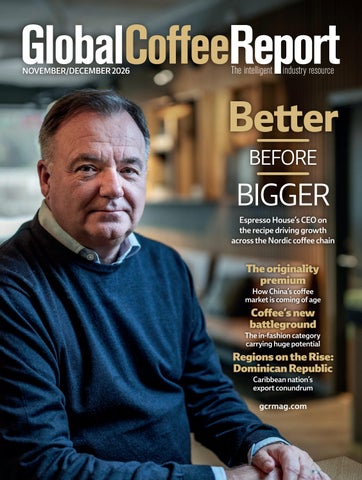
NOVEMBER/DECEMBER 2026
Better BEFORE
BIGGER Espresso House’s CEO on the recipe driving growth across the Nordic coffee chain
The originality premium
How China’s coffee market is coming of age
Coffee’s new battleground
The in-fashion category carrying huge potential
Regions on the Rise: Dominican Republic Caribbean nation’s export conundrum
gcrmag.com
INTENTIONAL DESIGN HANDCRAFTED WITH BOTH
S L AY E R E S P R E S S O . C O M
FORM AND FUNCTION IN MIND
CONTENTS NOV E M BE R / DE C E M BE R 2 0 2 6
33 44 Coffee’s new power players
COVER STORY
What has become so attractive about coffee as a business investment?
10 Better before bigger
Espresso House CEO Thomas Kelly on going back to basics to grow the largest coffee chain in the Nordics. “I like to go in when things need to be changed a little bit.”
46 Return to play Puts roasters, suppliers, and coffee professionals side by side in a way few events can.
49 Coffee’s new battleground The growing category emerging as the latest weapon in the race to win coffee’s next generation.
Thomas Kelly
52 Why education is power
CEO, ESPRESSO HOUSE
Turning shared knowledge into practical action to tackle change.
INDUSTRY INSIGHTS 14 A market worth fighting for Why China’s coffee market is rapidly coming of age.
18 From breakfast buffet to beach restaurant Delivering consistent coffee across six distinctive locations.
29 The habit behind the hype Functional beverages blurring the line between nutrition and psychology.
42 The 11.5-litre espresso machine How can manufacturers meet the growing demand for RTD coffee?
14
EQUIPMENT & TECH 20 Taking on the world The Australian business targeting three key international markets.
22 Automation by necessity Making automated barista assistance available to more.
24 Terroir at scale Preserving origin character through every stage of coffee processing.
26 Brewing new opportunities Combining coffee, juice, and specialty beverages to craft new customer experiences.
42
40 Automation meets adaptability Simplifying the most challenging aspects of coffee preparation
ORIGIN 33 Regions on the rise: Dominican Republic Export and specialty coffee are top of the agenda for this once largely domestic-facing origin.
36 The cost of transition Who will fund the regenerative agriculture transition for the smallholder farmers who need it most?
LAST WORD 58 Alternative to acquisition Could this emerging pathway offer a method for coffee businesses looking to hold onto independence in an era of consolidation?
REGULARS 04 Editor’s note 06 News in brief 54 Marketplace 56 Diary dashboard
49 GLOBAL COFFEE REPORT
3
EDITOR’S NOTE GL OBA L C OF F E E R E P ORT
CHIEF EXECUTIVE OFFICER
Christine Clancy christine.clancy@primecreative.com.au
A time of reinvention
W
HEN I FIRST stepped into the journalist’s chair at Global Coffee Report more than a year ago, I quickly learned that coffee is rarely just about the coffee. Behind every cup is a complex network of producers, exporters, traders, roasters, equipment manufacturers, retailers, researchers, and innovators, all navigating a landscape that can change at the drop of a hat. As I write my first Editor’s Letter for this publication, I am honoured to help share some of these stories. What continues to stand out to me is coffee’s remarkable ability to balance immediate challenges with long-term ambition. Despite uncertainty, and shifting consumer expectations, it is a sector that consistently demonstrates a capacity for reinvention. Often the most interesting developments in coffee do not happen in isolation. A decision made in a boardroom, a roastery, or on a farm can have ripple effects that span the globe. That spirit is reflected throughout this issue. Across the supply chain, businesses are asking new questions about what growth looks like and where future opportunities will emerge. In some cases, the answers are being found in entirely new categories. Consumers are increasingly seeking products that align with their lifestyles, driving interest in functional coffee, wellness-focused beverages, conveniencedriven formats, and new ways to enjoy coffee at home. Elsewhere, the search for resilience is sparking renewed interest in alternative coffee species such as Excelsa and the untapped potential they may offer producers and the wider sector. But innovation is not always about
4 GLOBAL COFFEE REPORT
creating something new. Sometimes, it is about refining what already exists. That philosophy is embodied by our cover story featuring Espresso House CEO Thomas Kelly. As one of Europe’s largest coffeehouse chains, Espresso House could easily focus its attention on expansion alone. Instead, Kelly argues that sustainable growth begins with getting the fundamentals right, placing customer experience, operational excellence, and quality ahead of sheer scale. His message of “better before bigger” offers an important reminder that longterm success is often built on strengthening foundations before pursuing expansion. In many ways, that sentiment extends beyond retail. Across coffee, companies are reassessing priorities, investing in efficiency, improving sustainability practices, embracing technology, and developing products that meet evolving consumer needs. The goal is not simply growth for growth’s sake, but growth with purpose. What connects many of the stories in this edition is a shared willingness to challenge assumptions and look beyond established ways of thinking. As Editor, my ambition for Global Coffee Report is to continue highlighting the people, businesses, and ideas shaping the future of coffee. We will keep celebrating innovation, exploring challenges, and examining the trends influencing our industry at every stage of the value chain. Thank you for welcoming me into this role. I look forward to sharing these stories with you and continuing the conversations that move our industry forward. GCR Daniel Woods Editor, Global Coffee Report
PUBLISHER
Sarah Baker sarah.baker@primecreative.com.au
GROUP MANAGING EDITOR
Myles Hume myles.hume@primecreative.com.au
EDITOR
Daniel Woods daniel.woods@primecreative.com.au
JOURNALISTS
Kristy Nicolaou kristy.nicolaou@primecreative.com.au Meg Kennedy meg.kennedy@primecreative.com.au
CONTRIBUTOR Kathryn Lewis
ART DIRECTOR/DESIGN
Daz Woolley daz.woolley@primecreative.com.au
BUSINESS DEVELOPMENT AND SALES MANAGER
Charlotte Murphy charlotte.murphy@primecreative.com.au
CLIENT SUCCESS
Cait Pillay caitlin.pillay@primecreative.com.au
COVER IMAGE Ariel Panowicz
HEAD OFFICE
Prime Creative Pty Ltd 379 Docklands Drive, Docklands, Victoria, 3008, Australia p: +61 3 9690 8766 info@primecreative.com.au gcrmag.com
SUBSCRIPTIONS
+61 3 9690 8766 subscriptions@primecreative.com.au Global Coffee Report Magazine is available by subscription from the publisher. The rights of refusal are reserved by the publisher.
ARTICLES
All articles submitted for publication become the property of the publisher. The Editor reserves the right to adjust any article to conform with the magazine format.
COPYRIGHT
Global Coffee Report is owned and published by Prime Creative Media. All material in Global Coffee Report Magazine is copyright and no part may be reproduced or copied in any form or by any means (graphic, electronic or mechanical including information and retrieval systems) without written permission of the publisher. The Editor welcomes contributions but reserves the right to accept or reject any material. While every effort has been made to ensure the accuracy of information Prime Creative Media will not accept responsibility for errors or omissions or for any consequences arising from reliance on information published. The opinions expressed in Global Coffee Report are not necessarily the opinions of, or endorsed by the publisher unless otherwise stated.
THE BEST BLEND HAPPENS ON THE FARM.
AI-generated
Diversification offers more than just an additional income source. By combining coffee with food crops, livestock, shade trees, and other productive activities, farmers can create more resilient farming systems. These systems make better use of nutrient and water cycles, improve soil health and biodiversity, reduce erosion, and spread production risks across multiple crops and activities.
SHAPING THE FUTURE O F C O F F E E C U LT I VAT I O N – E X P L O R E N KG’ S R E G E N E R AT I V E PR AC TICES ON THE GROUND: W W W. N KG . C O F F E E / F U T U R E
NEWS in brief AMERICAS As consumers look to consolidate wellness routines, coffee is emerging as a popular delivery vehicle for functional ingredients. It is often brewed before a vitamin is taken, a fitness goal is checked, or a wellness app is opened. That daily familiarity is helping drive the rise of functional coffee. Emily Lucci of J.M. Smucker says the segment is among the fastest-growing areas of the coffee market, with brands using the beverage as a convenient way to deliver additional health benefits through an existing habit. The trend is frequently labelled “wellness stacking”. But why are consumers so willing to combine multiple health objectives into a single routine, and how are principles of habit formation helping fuel the category’s momentum? See page 29 The Dominican Republic’s coffee industry is becoming more export-oriented, signalling a shift for a market that has historically focused on domestic consumption. Today, the country is building a stronger presence in specialty coffee and exports. For decades, relatively low production volumes meant most Dominican-grown coffee remained at home. While exports existed, they played a comparatively minor role in the sector. Recent figures suggest a significant shift is underway. According to government data, 2024 became the first year in more than a decade in which coffee exports generated greater value than imports. See page 33 Mergers and acquisitions continue to reshape the coffee industry, prompting some businesses to consider alternative ownership structures designed to protect their identity and long-term independence. Employee ownership is gaining renewed attention for its ability to align staff and company interests while preserving culture through periods of change. Green coffee importer Cafe Imports has joined that movement, transitioning to an Employee Stock Ownership Plan (ESOP) more than 30 years after being founded. See page 58
6 GLOBAL COFFEE REPORT
Espresso House looks to capture the Swedish idea of fika, taking a deliberate break to enjoy coffee with a small treat with friends. Image: Espresso House.
For decades, brands relied on famous faces to sell machines and beverages. Now, however, celebrities want ownership stakes rather than endorsement contracts. Since 2024, a wave of celebrity-backed coffee ventures has entered the market. Rock band Green Day launched Punk Bunny Coffee, singer Dolly Parton introduced Cup of Ambition Coffee, and actor Robert Downey Jr. co-founded ready-todrink brand happy coffee. Meanwhile, established industry players are embracing the trend, with Lavazza partnering with Pharrell Williams and Terrance “Pusha T” Thornton on Grindin Coffee. The attraction is clear. Unlike luxury goods or alcohol, coffee is woven into consumers’ daily routines, creating recurring purchases and long-term brand engagement. Premiumisation has further transformed coffee from a commodity into a lifestyle product, opening opportunities in subscriptions, cafés, merchandise, and ready-to-drink beverages. Yet celebrity status alone is unlikely to guarantee success. While star power can drive initial attention, lasting growth depends on product quality, authenticity, and credibility. See page 44
EUROPE Thomas Kelly was enjoying success as a CEO in the United Kingdom when an opportunity emerged that was difficult to ignore.
10 Approached by JAB to lead Espresso House, Kelly saw the chance to return to the Nordic region while taking responsibility for a brand he admired greatly. His turnaround strategy centred on strengthening the fundamentals: brand reputation, product quality, and employee engagement. Europe’s café chains are prioritising operational discipline over rapid expansion, a strategy Espresso House says is yielding results, which are becoming visible. The chain has reported six straight quarters of sales growth, with guest numbers rising for five consecutive quarters across all its operating markets. See page 10 Labour constraints and rising expectations for consistency are encouraging hospitality operators to reconsider how coffee is prepared and served. Every morning at Seerose Resort & Spa on Lake Hallwil, coffee service becomes a major operational challenge. During busy breakfast periods, as many as 200 guests can arrive within a short window, creating high expectations for speed, reliability, and beverage consistency. To help meet those demands, parent company Balance Familie partnered with Franke Coffee Systems in 2019. Now, Franke’s New A Line has been installed at four of the group’s six locations. See page 18 As beverage categories such as coffee and juice overlap, operators are looking
to capture shifting consumer demand by broadening their beverage menus. SEB Professional Beverage aims to support that development through its new Coffee & Beverage Competence (CBC) initiative, which brings together expertise from across multiple brands to help customers respond to emerging trends. Using consumer insights and trend forecasting, the CBC team developed 30 new beverage recipes during 2026. See page 26 Labour shortages and complex beverage menus are driving greater automation in cafés, particularly in milk preparation. Swiss manufacturer Thermoplan says its Black&White4 CTS machine uses software-driven milk texturing technology to deliver consistent hot and cold foam with minimal barista training, addressing challenges around staff turnover and product consistency. The company claims the system can help coffee shops operate up to 34 per cent
faster than traditional equipment, while a combined Thermoplan solution may reduce total cost of ownership by as much as 30 per cent. The machine is capable of producing up to 240 espressos or 200 coffees per hour. “We saw several issues in the market: inconsistency, lack of speed and performance, a shortage of skilled baristas, and high turnover ... we wanted to develop something unique,” says Sven Weibel, Head of Black & White Sales at Thermoplan. See page 40
32
per cent Of global out-home coffee consumption is cold beverages.
The rise of ready-to-drink coffee and liquid coffee concentrates is increasing demand for industrial-scale extraction technology. Producing 11.5 litres of espresso every minute sounds almost impossible. Using conventional café espresso equipment, achieving the same output would require about 400 groupheads running simultaneously. The statistic has attracted attention since the record was set in 2008, but its relevance extends beyond record books. As demand grows for ready-to-drink and liquid coffee products, largescale extraction capacity is becoming increasingly valuable. According to SK tec SA Owner Ottavio Filippini, the market is already evolving rapidly. “Until now, demand mostly centred on coffee beans – whether that’s whole-bean or ground coffee,” he says. “Now, liquid coffee is becoming more and more important worldwide.” See page 42
NEWS in brief Sachs, Global Sales Director, explains, suppliers need to be the “water in the bottle, or the coffee in the cup”, shaping products around the realities facing operators. Those industry needs ultimately guided the creation of Nuova Simonelli’s flagship automation platform. See page 22
18
Franke Coffee Systems and Balance Familie have partnered since 2019. Image: Franke and Balance Familie
Winning over future coffee consumers is becoming a battle fought across multiple fronts. Innovation teams are creating new RTD concepts, cafés are experimenting with signature beverages, and supermarkets are becoming an increasingly important arena through the emergence of espresso concentrates. The trend reflects broader changes in consumption habits. Nestlé reports that cold beverages accounted for 32 per cent of all out-of-home coffee consumption globally in 2023, while cold coffee drinking increased by 15 per cent over the previous four years. See page 49
ASIA-PACIFIC As China’s coffee market matures, competition is intensifying not only among brands but also over intellectual property. Today, it is one of the industry’s most fiercely competitive markets. And with popularity often comes imitation. Cimbali Group recently reinforced that point through a legal victory involving manufacturers accused of copying Slayer equipment designs. “The case teaches a lesson about timing: when your brand is being copied, time is never on your side,” says Cimbali Group General Counsel and Sustainability Director Flavia Volpi. See page 14
8 GLOBAL COFFEE REPORT
Having established itself in Australia and New Zealand, ADM Packaging is now looking further afield. The company has identified three priority international markets and is developing partnerships that can provide installation support, spare-parts networks, and local technical service, while retaining direct customer relationships. “We’ve been manufacturing packaging machinery since 1995, and we work with virtually every type of flexible bag format,” says ADM Packaging Founder George Fakhry. See page 20 Demand for operational efficiency is prompting equipment manufacturers to make automation more widely accessible across product ranges. Nuova Simonelli is broadening access to its C-Automation technology by expanding availability beyond the flagship platform on which it debuted. The move reflects pressures facing equipment manufacturers. As Virginie
US$15 million invested
By Ibero Uganda in Ugandan coffee producers since 2019.
As coffee continues its premiumisation journey, preserving flavour identity from origin through processing is becoming a growing priority. Flavourtech says consumers increasingly want products that express a sense of place, whether that means the floral jasmine qualities associated with Ethiopian coffees or the vibrant fruit character often found in high-altitude Colombian or Guatemalan origins. See page 24 Trade shows remain commercially valuable, but their role in specialty coffee is evolving. For Commonfolk Co-founder Sam Keck, the true benefit of Melbourne International Coffee Expo lies in bringing together different parts of the supply chain in one place. It creates opportunities for producers, roasters, equipment suppliers, and coffee professionals to discover ideas, build relationships, and experience each other’s work firsthand. See page 46 Artificial intelligence, supply-chain volatility and rising coffee costs are set to dominate discussion at next year’s Global Coffee Report Leaders Symposium in Melbourne. Held during the Melbourne International Coffee Expo (MICE), the event will bring together executives, roasters and business owners to discuss some of the industry’s most pressing issues, including artificial intelligence, automation, supply-chain volatility, rising coffee costs and the future of coffee consumption. The program will feature a keynote address and three expert panels focused on technology-driven disruption, the economics of coffee, and the opportunities likely to emerge over the next decade. Organisers say the event is designed to provide practical insights for businesses navigating an increasingly complex operating environment. The symposium follows a sold-out 2026
T P
F h s
edition and forms part of an expanded MICE2027 program, which will also launch the Australian Coffee Awards and new origin-focused education initiatives. See page 52
AFRICA As climate pressures intensify, regenerative agriculture is being viewed as an economic necessity rather than simply an environmental initiative. Discussions around regenerative agriculture often focus on environmental outcomes such as healthier soils and greater biodiversity. For many coffee farmers, the decision to adopt new practices is equally tied to economics. Producers in Uganda are already facing pressure from extended dry periods and the prospect of a Super El Niño event lasting into 2027. These conditions have reduced yields in some growing regions and increased financial strain on farming households.
NKG, through Ibero Uganda, is helping finance smallholder farmers so they can make lasting, sustainable change on their crops. Image: Neumann Kaffee Gruppe
At the same time, farmers continue to manage ongoing challenges including declining soil productivity, pests, and disease. Since 2019, Ibero Uganda has channelled more than US$15 million to coffee producers through Neumann
36 Kaffee Gruppe’s Smallholder Livelihoods Financing Facility. The funding has supported projects ranging from irrigation infrastructure and land purchases to tree planting programs and coffee farm rehabilitation. See page 36
THE FULL SPECTRUM OF PROFESSIONAL BEVERAGE. From premium fully-automatic to traditional brewing, from espresso heritage to citrus juicing: SEB Professional Beverage now serves every segment and every operator format.
www.seb-professional.com
Espresso House CEO Thomas Kelly was drawn back to the Nordics to help turn the region’s biggest coffee chain around. Image: Moa Källström.
10 GLOBAL COFFEE REPORT
COVER STORY E S PR E S S O HOU S E
BETTER BEFORE
BIGGER Espresso House CEO Thomas Kelly explains how people, premium positioning, and disciplined expansion are driving growth across the Nordic coffee chain.
W
HEN THOMAS KELLY first
moved to the Nordics as CEO of McDonald’s Finland in 2014, he didn’t think he would still be there in 2026. The current CEO of Espresso House had returned to his native United Kingdom after more than five years in Scandinavia, where he led McDonald’s Finland, then McDonald’s Sweden. He was leading burger chain Honest Burgers as its CEO. The business was performing well and Kelly had little reason to imagine another move abroad. “I was very happy as CEO of Honest Burgers, and it was going really well,” he says. “But then someone dropped me a note asking if I would meet someone from JAB, Espresso House’s parent company, for lunch. “He spoke to me about Espresso House. I was very aware of the brand because I’d lived in Sweden, I knew where the performance of the business was, and I knew it was a really good brand.” By the end of the conversation Kelly found himself considering a return to Sweden, this time to lead the largest coffee chain in the Nordics. “It ticked all my boxes. I love the Nordics, I’ve lived here before, and I’ve worked in the coffee industry before,” he says. “Now, I had this opportunity to run this really cool, popular brand. It was an easy yes, and one of the best lunches I ever had because it opened a door I’ve jumped through.” Kelly says that when he took the reins
at Espresso House, his mandate was straightforward: turn the business around. That type of task was no stranger to him, as he says each of his three prior CEO roles had a similar objective – an environment in which he thrives. “I like the disruption and the creation of something successful; Everyone loves being part of something successful so it’s important to bring the team with you,” he says. “I’m not the kind of person who likes to just steer the ship; I like to go in when things need to be changed a little bit, not accepting the status quo and not accepting that anything cannot be done or achieved. “When you take over a business like this, you’re looking for three things: good brand, good product, good people. If you can get all three right, then you get a good business. “We had a good brand, but we needed to realign on the product side, because we probably weren’t playing to our strengths as
“My leadership team works on the principle that we should try things. If we get it right, then we’re happy. If we get it wrong, then we’re wise.” Thomas Kelly
CEO, ESPRESSO HOUSE
a premium hand-crafted drinks company and then we had to work on how we got the right people into the business and around us to be successful.” Steadying the ship
From those three pillars, Kelly says it’s the ‘people’ aspect that he enjoys tackling most, and that without that, the whole structure collapses. “You need committed and capable people. Committed is more important than capable at the start. Hard work trumps talent when talent doesn’t work hard,” he says. “You need really committed people because you can train and develop, and then the capability kicks in. If you are both committed and capable, that’s a foundation from which the business can thrive. “If someone asked me what I’m best at, I would say talent spotting and bringing it through the organisation.” There are countless publications that talk about how important the first 30, 90, 100, or 365 days are for a new CEO. While Kelly smiles when he says he hopes there’s still plenty of time left in his tenure at the business, he says the challenge for any new leader isn’t starting momentum, it’s keeping it going. “When you go into an organisation, you get instant business momentum through energy and belief, because you can give that as a leader,” he says. “But there’s no substance behind it at first, it’s just ‘we can do this, we can fix the world’. GLOBAL COFFEE REPORT
11
COVER STORY E S PR E S S O HOU S E
Espresso House looks to capture the Swedish idea of fika, taking a deliberate break to enjoy coffee with a small treat with friends. Image: Espresso House.
“If you want sales growth as a new CEO, you can get it in year one – put your prices up. Year two, you’re in trouble. If you want guest count growth – discount the brand. Year two, you’re in trouble. “Getting sustainable, profitable growth is trickier. My focus at the start was: how do we get sustainable, profitable growth, and how do we get closer to the coffee shops and our customers? Our strategy was to be purposely better, not bigger.” Kelly always goes back to simplicity, and that it’s just “coffee and cakes”. Although he appreciates it is often more than that. “The lesson I’ve learned is keep things as simple as possible. The simpler you make it, the easier it is to implement in the coffee shops. If I keep it simple for myself and if I can understand what we are trying to do, I believe we will be okay,” he says. “My leadership team works on the principle that we should try things. If we get it right, then we’re happy. If we get it wrong, then we’re wise. As long as we’re happy or wise, we’ll always be moving forward.”
company in the markets where we trade, and we dial that up as a brand strength,” he says. “We’re not the same as other brands. We are cosy. We’re warm. We’re a living room on the high street. Other people are different – more functional, colder aesthetically, maybe that’s called trendy. We’re different from that and need to be more like Espresso House and less like others. “We want the fika, the warmth, the Nordic feel, lovely, relaxing furniture. At the end of the day, it’s actually more than just coffee and cakes – it’s somewhere people can come and relax. Sit there as long as you want. It might just be a nice, friendly, cosy environment where you can recharge and take a moment to yourself or meet friends.” Positioning Espresso House as a premium brand comes with heightened customer expectations, and an obligation to exceed them. “That comes with the responsibility to live that in everything you touch. All
A premium proposition
A huge part of where Espresso House’s strength lies is in its brand. Founded in 1996, it has become ubiquitous in the Nordics for its cosiness, warmth, and how it embraces the Swedish tradition of ‘fika’. “We’re number one in Sweden, number one in Norway, number one in Finland, number two in Denmark, and we’re in Germany as an entry market, we’re not number one there yet,” he says. Kelly says the brand is focused on this premium, fika-first aspect of the brand, and is extending it into its non-Nordic markets. “We’ve got a bit prouder of what we are. We are the premium hand-crafted beverage 12 GLOBAL COFFEE REPORT
Espresso House prioritises warmth, comfort, and cosiness at all its locations. Image: Espresso House.
the products must be premium, we must look premium, our staff must be the best,” Kelly says. “I have a phrase I use when I’m going round: if you wouldn’t have it in your house, don’t have it in Espresso House. You treat customers as if you’re inviting them into your home, because they can go anywhere. Everyone has choice, more than ever. “You have to give customers a reason to choose you and with that, build the top line, because once you build the top line it flows to the bottom line. You need unit economics, but you need to get that momentum. “You need to start with the customer and work backwards, be truly customer centric and invest where the customer is if you want to be successful. Fear of failure will stop you doing that.” That pride in the brand has led to the creation of Espresso House’s Master Barista program, which ensures at least one highly qualified barista is present in every location to help ensure consistency from cup to cup, and help train other staff. “We bring baristas into our training centres. It’s a three-day program where they’re learning intensive coffee skills, as well as things such as latte art,” Kelly says. “Our Master Baristas get a new black uniform that says, ‘Master Barista’, their name, and the year they qualified. When you see them in the shop, you can see their lifted pride. “I talk about commitment and capabilities, this gives both.” And then, if an individual that the company has put so much time and training into leaves? What then? “If you don’t train your people, they’re going to leave anyway,” Kelly says.
Kelly arrived at Espresso House with a wide range of F&B experience, as well as time leading McDonald’s Finland and McDonald’s Sweden. Image: Moa Källström.
“People want to learn, and they want to be part of something successful. You want to train to the highest level, so your brand is represented at the highest level to the customer. If people leave us, they leave us with a handshake and a ‘well done’.” Beyond the Nordics
Kelly says that, when he came on board, he would celebrate three consecutive days of positive momentum. Things have changed though. At the time of writing, Espresso House is about to register its 17th consecutive month of sales growth. “Our whole business is very strong at the moment,” he says. “We’ve had six consecutive quarters of sales growth, and five consecutive quarters of guest count growth across all five countries.” While Espresso House made its name in Sweden, Denmark, Norway, and Finland, it’s actually Germany where Kelly sees the strongest growth potential. The brand made its entrance into
Germany in 2017 after it acquired Balzac Coffee’s 43 existing locations. “From a like-for-like comparison, Germany has been the strongest market over the two years I’ve been here,” he says. “If you look at market penetration, in Sweden we have one coffee shop for every 50,000 people. In Germany, it’s one shop for every 1.6 million people.” On the cards is the path to that magic number of 1000 total locations. That might still be some time away, but there’s a plan in place. Strategic, considered growth in those original markets, and fast-paced expansion in Germany and other new regions. “Germany is our highest-growth market, so we’ll focus there. Then we’ll look at strategic partners elsewhere in the world, and how we can reach 1000 locations,” he continues. “We won’t do that in the Nordic countries, that’s too big a leap. But we can do it in other countries. We’ll continue to open shops in the Nordics, we successfully opened one in Norway a few weeks ago, but
we’re very selective about where we open. “In the highly penetrated markets, our strategy is to be better, and that’s working,” Kelly says. “Once we’re better, that’s when we look to bigger through strategic partnerships and franchisees.” The launch of the inaugural store in France is the perfect, real-world example. “We’ll open with a good franchise partner in a travel site in France, at Dijon train station, as we do very well in travel and airports,” Kelly says. “France is a highly populated country that loves premium coffee and hand crafted drinks. We need to find the right strategic partners, in France and other countries, who can scale us up, because there’s no point entering a country and having two, three, four, or five coffee shops. You need to scale, and scale fast. “We are a premium brand which is transferrable from its Swedish roots to most countries. The opportunities are endless.” GCR GLOBAL COFFEE REPORT
13
INDUSTRY INSIGHTS
Cimbali Group believes a recent legal victory regarding its Slayer machines could be felt throughout the coffee industry.
A market worth fighting for China has grown into Slayer’s second-largest market – a position built on distinctive design, strong brand identity and a commitment to protecting its IP.
T
EN YEARS AGO, China was largely viewed as consumer coffee’s next frontier. Today, it is one of the industry’s most fiercely contested battlegrounds, where multinational titans of the industry compete with domestic heavyweights for influence over a fast-growing consumer base. Where demand grows, imitators often follow. This was proven in Cimbali Group’s legal victory against manufacturers accused of producing counterfeit versions of Slayer equipment. Counterfeit espresso machines are rarely a problem in underdeveloped markets. Instead, they rear their heads when brands become recognisable and consumers become more discerning – in this case – about how their coffee is made. For Cimbali Group Legal & Corporate Affairs Director Flavia Volpi, the case represents far more than a courtroom victory. Having spent eight years working with China from both supplier and customer perspectives, she has witnessed
14 GLOBAL COFFEE REPORT
the market’s transformation first-hand. “I have watched the country evolve at extraordinary speed in every respect: consumption, sophistication, professional standards,” she says. “Several advisors had initially told us that victory was unlikely; our shareholders
“Lasting protection comes from combining enforcement with marketing and communication that make customers want the original.” Flavia Volpi
GROUP LEGAL & CORPORATE AFFAIRS DIRECTOR CIMBALI GROUP
nonetheless believed in the strategy, because Cimbali Group regards its brands and intellectual property (IP) as core assets.” Coming of age
The scale of China’s coffee growth in recent years is impossible to ignore. From domestic chains such as Luckin Coffee and Cotti Coffee taking market share from long-time global players such as Starbucks, to the proliferation of sophisticated specialty coffee operators in metropolitan hubs, it has become one of coffee’s most dynamic markets. Fuelled by expanding urban populations, growing café density, and a younger generation of consumers embracing innovation, specialty coffee has gained serious traction. The market is of critical importance to Cimbali Group and its Slayer brand, with China representing one of the manufacturer’s biggest opportunities. “China is Slayer’s second-largest market, and its coffee economy is expanding at an extraordinary pace,” Volpi says.
Images: Cimbali Group
C I M BA L I GROU P
Images: Cimbali Group
“In a market growing that fast, imitation products sold at significantly lower prices generate confusion along the professional supply chain and erode the positioning of a premium brand precisely where its future growth lies.” According to Volpi and Cimbali, there are more than 87,000 dedicated coffee outlets in China, a 31 per cent increase in the most recent measured period. “Walking away from the Chinese market, or tolerating counterfeiting within it, was simply not an option,” she says. “Protecting our IP there means protecting the conditions for our future growth.” The lawsuit centred around counterfeit manufacturers who were accused of producing machines that copied key Slayer brand elements and design characteristics. “To me, Slayer is all about making a bold statement with what you could call the machine’s ‘feet’,” says Christopher Flechtner, who designs the machines. “It’s the part that elevates it off the counter and presents it to the world. If you look at all the designs, the sheet metal work is fairly simple, but the ‘X’ and wing of the machines are what really make the statement.” The court found that signs used by the defendants were phonetically similar to “Slayer” and likely to cause confusion among customers regarding a commercial connection between the products. The ruling additionally recognised the machine’s overall appearance as protectable trade dress, including those distinctive individual features as defined by Flechtner. Volpi says the appellate court’s ruling was not only the first of its kind but was decisive on several fronts. “First, the Court recognised for the first time the trademark infringement, reversing the first-instance decision,” she says. “Second, the Court confirmed that the overall appearance of the Slayer espresso machine constitutes protected trade dress, a recognisable identifier of the product’s commercial origin. “Third, the damages were more than doubled, from RMB 800,000 (US$120,000) to RMB 2 million (US$298,000), with joint and several liability of all defendants and an immediate cessation order. “Taken together, the ruling shows that IP rights in China are enforceable assets, not abstract ones.” One of Volpi’s most compelling observations is that imitation can often be interpreted as evidence of commercial success.
China is one of the world’s most competitive coffee markets, which Slayer entered in 2012.
Counterfeiters rarely target products that lack market visibility. They gravitate towards brands that carry prestige and strong customer recognition. “The number of counterfeiters a brand attracts is, paradoxically, a measure of its success,” she says. “And legal protection is what allows the value created by innovation to remain with those who created it. “Innovation and design create brand Flavia Volpi has been in-house counsel for Cimbali Group for eight years, and led a recent case over Slayer intellectual property in China.
value, and brand value attracts imitation. They are three sides of the same triangle. “The case also teaches a lesson about timing: when your brand is being copied, time is never on your side. Register your rights early and broadly, monitor the market actively, collect evidence rigorously – in China it must be notarised – and act quickly. “Legal action alone is not enough: lasting protection comes from combining enforcement with marketing and communication that make customers want the original.” Volpi believes the market itself is beginning to recognise the distinction between originals and imitations. “Interestingly, even the comments we collected on Chinese social media during the case showed operators actively asking whether products were originals,” she says. “The market itself is learning to distinguish and appreciate the originals.” For Volpi, that growing appreciation for authenticity is among the clearest signs that China’s coffee market is entering a more mature phase. She believes the implications of the wider case extend far beyond Slayer and the coffee equipment sector. “It is the first total appellate victory in the professional coffee equipment sector – and a rare one more generally, in a system where litigation involving foreign parties represents only around ten per cent of IP GLOBAL COFFEE REPORT
15
INDUSTRY INSIGHTS C I M BA L I GROU P
Shaping the future
The ‘X’ and feet of Slayer machines were the main point of interest in a recent legal case.
disputes before the senior Chinese courts,” she says. “What makes it truly distinctive is that we did not have a registered design for the machine: protection was obtained for the product’s overall appearance as trade dress, under unfair competition law.” Historically, concerns surrounding IP protection have shaped foreign perceptions of the market. Volpi believes this experience and outcome challenges those perceptions. “The judgment examines, scrupulously and in all their complexity, every piece of evidence we submitted to establish the recognisability of the Slayer design in its market of reference,” she says. This included evidence ranging from trade show participation and media coverage to commentary from Chinese coffee professionals on social media platforms. “Our experience shows the opposite,” she says, referring to assumptions that foreign companies struggle to enforce rights in China. “The courts proved rigorous, thorough and ultimately willing to grant full protection to a foreign rights holder.” “A protective judicial system is itself a further driver of investment. It removes a significant element of country risk from the equation.” Better by design
Flechtner says the recognisable, if not iconic, profile of Slayer machines started from a practical engineering angle, rather than an attempt to create something so visually striking. “At the beginning, our primary drivers were that it had to be something completely new and unseen, with functionality and maintenance at its core,” he says. 16 GLOBAL COFFEE REPORT
“The open negative spaces of the ‘X’ let a technician easily remove the side panels, gain direct access to the machine’s vital innards, and even remove heating elements with incredible ease. “The process of assembling and maintaining the machine could not be compromised for aesthetics.” Over time, though, these practical design decisions evolved into a distinct visual identity that has become strongly associated with the Slayer brand. “As we continue to design and develop new machines, the assembly and maintenance remain the key focus,” Flechtner says. “Over the years, we have learned how to make machines more durable and reliable for the end user but, most importantly, easier to produce while allowing for the customisation that Slayer is known for. “For example, a Steam machine can be fully built and bench-tested without any coloured panels or wings. This minimises the risk of cosmetic damage and lets colour choices wait until the very end of the production process.” This aesthetic has carried through to Slayer’s two machines, the Espresso and the Steam. “The Espresso and the Steam are intentionally designed to appeal to different environments,” Flechtner says. “The “X” of Espresso, with its hubs and actuators, makes a bold, masculine statement, whereas the Steam introduces a more flowing, somewhat more feminine aesthetic. “I feel strongly that an espresso machine should fit naturally into its environment, and having two distinct aesthetics allows Slayer to reach a broader audience.”
This lawsuit has already changed how Cimbali Group approaches brand protection from an international perspective. The company has already expanded trademark registrations across multiple jurisdictions and categories while increasing its vigilance towards unauthorised use of its brands. “We now act immediately against anyone attempting to use our brands,” Volpi says. “On machines, but also coffee shops, accessories, and adjacent categories.” The group has also grown its presence on Chinese social media, recognising the importance of maintaining visibility in this rapidly evolving market. As coffee consumption continues to grow and specialty culture deepens across China, competitors will continue to battle on originality, design, technology and IP – not just price alone. Flechtner says the result was particularly meaningful to him. “I was amazed,” he says. “For a victory like that, I can only imagine how hard Cimbali’s legal team had to work. “I think it also shows how Slayer’s uniqueness is arguably Slayer’s and Slayer’s alone. How a barista interacts with the machine, the movements, the choreography, informs our brain before we even have coffee in hand that this is going to be something special. “Slayer has always stressed the importance of coffee craft and offers café owners and their baristas a truly enjoyable, impressive coffee-crafting process. The cafés that showcase Slayer on bar understand this, and the coffee lovers who seek out great coffee do, too. When I see a Slayer on bar, I can’t resist drinking a coffee.” Volpi believes the ruling will serve as both a practical precedent and a deterrent for future infringers. “The judgment itself has become an asset: a precedent we can build on and a clear deterrent signal to potential infringers, in China and elsewhere. “Court decisions like ours accelerate that evolution, because they make replication costly and originality defensible,” she says. For companies investing in design, engineering, and innovation, that may prove just as important as the growth of coffee consumption itself. GCR For further information, visit slayerespresso.com
by
SKtec SA, Via al Gas 30, 6850 Mendrisio, Switzerland +41 (91) 640 55 40, info@sktec.ch sktec.ch, swiss-espresso-extractor.com
INDUSTRY PROFILE FRANKE
From buffet to beach bar: One standard Family-owned Swiss hospitality group Balance Familie reveals how it maintains consistent coffee quality and a varied beverage offering across six distinctive locations.
C
OFFEE SERVICE at Seerose Resort & Spa on Lake Hallwil in central Switzerland begins with one of the busiest moments of the day. Up to 200 guests can arrive for breakfast during peak periods, many using the machines themselves and expecting their preferred beverage to be available quickly and prepared consistently. Later, coffee moves into the resort’s restaurants, including its Beach Restaurant by the lake, as well as meeting and conference breaks, events, and after-dinner service. Approximately 90,000 coffee
beverages are prepared at Seerose each year, yet volume is only part of the challenge. A single operation must support self-service and staff-operated outlets, changing levels of demand and users ranging from trained restaurant professionals to students, less experienced employees, and guests. “Coffee is part of the whole experience,” says Felix Suhner, owner and host at Balance Familie AG. “You want a good coffee at breakfast, during a meeting break and after dinner.” Christoph Gysi and Felix Suhner turned to Franke Coffee Systems to help them create better coffee consistency at Balance Familie’s individual venues.
18 GLOBAL COFFEE REPORT
One expectation
Together with his wife Rhéane, Suhner has grown Balance Familie into a collection of five hotels and one restaurant, each with its own identity and hospitality concept. At Seerose, the Swiss lakeside location is combined with Thai influences in both the venue’s design and food menu. “We are not a standard hotel group where everything is the same,” says Suhner. “Everything is individually created for our hotels. Our mission is simple: our guests should leave happy.” Christoph Gysi is General Manager of Seerose Resort and Spa, and a former barista trainer. For him, deliberate difference in the properties creates an operational requirement where guests should be able to rely on the same standard of beverage wherever and whenever they order. While he values the craft of a traditional espresso machine, a skilled barista cannot be present at every touchpoint. “We need solutions that guests or less experienced team members can use themselves while still achieving the quality of espresso and milk foam that we expect,” he says. This is not unique to Balance Familie. Hotels and restaurants in many markets
Images: Franke and Balance Familie
Franke Coffee Systems and Balance Familie have partnered since 2019.
Cocoon-like seating gives Restaurant Cocon at the Seerose Resort & Spa its distinctive character.
must deliver a reliable beverage experience across breakfast buffets, restaurants, conferences, events and self-service areas, even when demand and staff experience vary throughout the day.
Images: Franke and Balance Familie
One platform
Balance Familie began working with Franke Coffee Systems in 2019, and the partnership has since expanded across its portfolio. The New A Line is now installed in four of its six locations, alongside machines from the Classic A Line. For Suhner, the Swiss origins of the equipment are an important part of that partnership. “The fact that Franke is a Swiss company and produces its machines in Switzerland was very important to us,” he says. “We associate that with high quality.” Direct support and responsive service are equally important for hospitality businesses operating seven days a week. Together, these factors give Balance Familie the confidence to use Franke solutions across properties with different concepts and operating requirements. The New A Line provides a common platform that can be adapted to different service formats. At the Seerose breakfast buffet, the new A600’s 10.4-inch touchscreen guides guests intuitively through the beverage selection. In staff-served areas, the new A800 supports efficient service with parallel dispensing, particularly during busy periods. Mobile coffee stations provide additional flexibility for meetings, conferences and events. Because the machines are positioned in guest-facing areas, their appearance also matters. Suhner says he particularly values the New A Line’s Mahogany finish, which complements Balance Familie’s individually designed interiors. Gysi sees the machine as a visual highlight, especially where guests can watch their beverages being prepared. The Dynamic Spout Light adds to this presence while providing clear visual feedback during preparation. The New A Line also uses technologies designed to deliver consistent beverage quality. iQFlow manages espresso extraction in real time, helping defined taste profiles remain consistent regardless of who operates the machine. The New FoamMaster prepares hot and cold milk
and milk foam with dairy or plant-based alternatives, helping different users achieve the intended result without manual milk preparation. Since introducing the New A Line at Seerose, Gysi has observed consistently high coffee quality across the resort. Guided workflows make the operational standard easier to maintain. The intuitive interface enables guests and employees with different levels of experience to use the machines confidently, while on-screen instructions guide team members through routine tasks, including cleaning. “The team became comfortable with the machines very quickly,” Gysi says. “The machine shows employees exactly what they need to do, particularly during cleaning. “IndividualClean adapts system cleaning to actual machine use, supporting consistent hygiene with less operational effort.” More choice
Consistency does not mean limiting the menu. Balance Familie is seeing growing interest in plant-based, flavoured, iced and visually distinctive drinks, particularly among younger guests. Suhner emphasises the beverage variety
Guests and employees with varying coffee experience are trusted to use the New A Line at Balance Familie venues.
offered by the New A Line was a decisive factor in selecting the platform. Guests will continue to order espresso, coffee and cappuccino, but increasingly expect a choice of beans, milk alternatives, flavours and hot or iced preparations. At Seerose, this development is already visible. When Gysi and his team discovered that the Franke machines could prepare Matcha Lattes and Pink Superfood Lattes, they added these specialties to the beverage offer, including at breakfast. Iced versions followed as the weather became warmer, and the drinks are also available beyond the morning service. The New A Line can be configured for the needs of each location with up to three grinders, four bean hoppers, two powder units and a Flavor Station for up to six syrups. Once recipes are defined, they remain available through the same guided selection as the core coffee menu. This gives Balance Familie room to extend its beverage offer while keeping preparation manageable for guests and employees. For Balance Familie, automation is not about replacing hospitality or imposing a uniform concept. It provides a dependable foundation for coffee and other beverages across different properties, touchpoints and users. Each location remains unique, while the quality, choice, and ease of operation behind the experience can be repeated. That outcome brings the story back to Suhner’s central measure of success: guests should leave happy. From the first coffee at breakfast to the final espresso after dinner, the New A Line helps Balance Familie deliver on that promise, whatever the setting and whoever is operating the machine. GCR For more information, visit aline.franke.coffee GLOBAL COFFEE REPORT
19
EQUIPMENT AND TECH
George Fakhry (left) is looking to scale ADM Packaging globally.
ADM taking on the world After building a strong presence in the world-leading Australian and New Zealand coffee culture, ADM Packaging is targeting three key international expansion markets.
W
HAT’S MORE IMPORTANT to a
coffee roaster: flexibility or speed? And how can both be prioritised? As product ranges expand, bag sizes multiply, and consumer expectations around presentation continue to grow, packaging lines are being asked to do more than ever before. If you want to see evidence of this firsthand, just take a stroll down the coffee aisle of a local supermarket. According to ADM Packaging Founder George Fakhry, that reality has driven demand for the Australian manufacturer’s systems, which are designed to handle virtually any bag format while maintaining quick changeovers between sizes. Now, after establishing a strong presence in the world-leading coffee culture of Australia and New Zealand, the business is accelerating its expansion into new markets. It is targeting the United States (US), Canada, and the United Kingdom (UK), leveraging a packaging platform Fakhry says offers an unmatched blend of versatility and operational efficiency and know how. “We’ve been manufacturing packaging machinery since 1995, and we work with virtually every type of flexible bag format,” he says.
20 GLOBAL COFFEE REPORT
ADM designs and manufactures a broad range of vertical and pre-made pouch packaging equipment capable of handling products across multiple industries. In coffee, it has focused heavily on premade pouch systems that can accommodate roasted whole beans and ground coffee in a variety of formats, with the ADM-DP3 Series servicing the industry. “The beauty of these machines is the five-minute changeover between 250-gram, 500-gram, one and two -kilogram bags,” Fakhry says. “The changeover is quick, so you can do short or long runs. Most coffee bags have a four-sided opening, but this can also work with a two-sided opening like on the bags commonly used for products such as nuts, although we’re seeing coffee roasters adopt them as well. “The vast majority of the machines we ship pack the four-side opening bags, but if a customer wants two-side opening bags such as doy or even pillow bags, that’s no problem. It can pack those too.” This versatility is becoming more relevant for coffee roasters looking to make a splash in the modern market because, as Fakhry puts it, “packaging sells”. Many specialty roasters operate diverse product portfolios spanning different single
origins, blends, private-label products, and seasonal releases. Rather than dedicating production runs to a single format, operators can switch between pack sizes throughout the day without any lengthy machine adjustments. That flexibility also extends beyond size configurations or packaging styles. “We can run craft paper, laminated, or recyclable bags. Basically, anything that can be gripped, opened, and filled on the machine, it can use.” It also offers systems capable of switching between whole-bean and ground coffee production. “The ground coffee version has two heads that you can switch between. One head handles coffee beans, the other handles ground coffee,” says Fakhry. “That means with one machine we can pack ground coffee or beans and handle anything from 200 grams to two kilograms, or 12 ounces to five pounds.” ADM’s technology originates from the company’s wider expertise in bagging systems. It has developed coffee as a core market in recent years, with some of Australia’s most famous roasters among its client base. “We sent our first machine into the coffee
Images: ADM Packaging
A DM PAC K AG I N G
Images: ADM Packaging
industry in around 2013,” says Fakhry. “We started with just a couple but kept growing year on year. Today, many leading Australian coffee roasters trust ADM for their packaging automation, from standalone machines through to complete end-to-end solutions. “We’ve also got systems offshore, primarily in the UK and Canada.” One of the characteristics driving uptake, according to Fakhry, is the ability for operators to conduct multiple product changeovers without losing time. “Some customers do up to 20 changeovers a day across different labels and bag sizes,” he says. “Moving from a 250-gram bag to a 500gram bag takes about five minutes to set up, and it’s the same if they’re moving to a one kilogram or even two-kilogram bag.” While our range of form-fill-andseal equipment remains an option for high-volume roasters running repetitive production schedules, specialty coffee’s focus on branding has increased demand for more premium packaging formats. Material flexibility has also grown in importance. “We’ve had customers switch from formfill-and-seal packaging to pre-made bags who have seen sales go through the roof,” Fakhry says. “People notice what looks good on a shelf.”
ADM Packaging has been working with Australia and New Zealand’s coffee industry since 2013.
Beyond Australia
After years of domestic growth, ADM is now turning its attention to international markets. This growing offshore footprint has helped reinforce confidence that ADM’s technology can not only compete internationally but, according to Fakhry, is superior to many existing options. “People often talk about Melbourne and Australia’s leading coffee cultures,” he says. “If these leading roasters all want to use our technology, there’s definitely a bigger target offshore, so it makes sense to make it available. “There are similar machines to what we have overseas, but they don’t have the fiveminute changeover, the dual heads, full bag size range and styles all in one technology.” The company is preparing a campaign aimed at key Midwestern states in the United States, including Illinois, Wisconsin, Ohio, and Indiana, before expanding into additional states and regions soon. To support this international growth, Fakhry says ADM’s machines are primed to help improve the operations of international roasters.
ADM is aligning itself with networks and system integrators capable of handling installations, spare parts, and local service requirements while ADM retains the direct relationship with the customer. This approach is intended to preserve the direct relationships with customers ADM prides itself on while ensuring local support remains readily available when required. “We supply end-to-end systems,” says Fakhry. “Customers can get the conveyors, packaging machines, checkweigher, case packers and palletising robots all from the one stop shop and employ our user integrated central control system leaving nothing to chance” “If something does go wrong, we can be sent a 15- to 30-second video online. More often than not we can identify any problems and solve them within minutes without any language barriers.” Training is also a big focus for those who elect to install ADM systems. “You can buy the machine, but if you don’t emphasise formal training and cross check it’s been done, the customer loses out,” says Fakhry. “Proper training gives operators the knowledge to run the machines confidently and correctly.” ADM’s global growth is still grounded in the same values that have enabled it to scale to its success in one of the world’s most competitive and discerning coffee markets: providing reliable equipment that helps roasters present their products at their best. “We still have room to grow in Australia, but our biggest opportunities lie offshore,” says Fakhry. “Entrepreneurs around the world are shaping the future of coffee, and they need the right equipment with the highest industry standards to scale up and grow. Like in Australia, they only want the best.” GCR For further information, visit admpa.com.au GLOBAL COFFEE REPORT
21
EQUIPMENT AND TECH N U OVA S I M ON E L L I
Automation by necessity Nuova Simonelli is extending C-Automation beyond its flagship platform, making the automated system available to more coffee operators.
C
AFÉS HAVE NEVER faced more pressure to do more with less than they do right now, and that’s an industry trend that is showing little sign of easing up. Across global markets, operators are navigating rising coffee costs, persistent labour shortages, high staff turnover, and growing consumer expectations around quality and consistency. At the same time, businesses are being asked to increase throughput and maintain margins while delivering the same cup profile, regardless of whether the customer is in a flagship specialty café, a hotel lobby, or even a quick-service restaurant. For equipment manufacturers, those challenges have led to a rethink of how technology can support coffee service. As Simonelli Group Global Sales Director Virginie Sachs puts it, manufacturers need to be the “water in the bottle, or the coffee in the cup”, adapting themselves to the needs of the industry. For Nuova Simonelli, those challenges informed the development of C-Automation. C-Automation is an integrated system that enables the espresso machine and grinder to communicate through the portafilter, automatically recognising recipes and adjusting parameters during service. The system is designed to bring the benefits of automation to a traditional espresso workflow, helping operators achieve greater consistency and efficiency while preserving the craft and experience
22 GLOBAL COFFEE REPORT
that define a coffee shop. Originally available with the NUOVA Aurelia espresso machine and GX Grinder, the company has now expanded the ecosystem to include the Appia Viva and Viva Grinder, opening access to a broader segment of the market. According to Sachs, this technology emerged from observing long-term shifts across hospitality. “We don’t develop technology for its own sake,” she says. “We look at broader trends of where the market is going, consider what our partners and customers will need to succeed, and then develop a solution.” This philosophy also inspired Nuova Simonelli’s recent “Simplify Coffee, Stay Traditional” campaign featuring barista Tom, which highlights how automation can support coffee professionals behind the scenes while preserving the rituals, craftsmanship, and human interactions that remain at the heart of the coffee experience. In the years following the COVID pandemic, the economics of coffee service have changed. Three major challenges have become clear in recent times. “The first trend is a global labour crunch and high turnover. In the hospitality sector, one of the biggest challenges is the unprecedented staff shortage,” Sachs says. “The second is the rising cost of operations and raw materials. Inflation and the increasing cost of coffee make it essential to minimise waste. “Third, customers increasingly expect consistent coffee across multi-site chains. At
the same time, operators want to create the authentic energy of a coffee shop.” The extension of C-Automation to the Appia Viva and Viva Grinder may be the most significant development in the platform’s evolution since its launch. By expanding compatibility beyond the NUOVA Aurelia ecosystem, Nuova Simonelli is positioning automation as a broader operational tool. “Our strategic vision was clear from the beginning,” Sachs says. “Different coffee businesses have different requirements, expectations, and business models. “A global coffee chain, a roaster, a foodservice supplier, a hotel, or an independent shop will operate differently and under different conditions. But they all share the same objectives: consistency, efficiency, and productivity.” The move essentially brings C-Automation into a different segment of the market, extending its reach beyond high-volume flagship coffee operations and into businesses that may face similar labour and consistency challenges but operate at a different scale. “By extending C-Automation across our range, we can offer solutions customised to different business models without asking customers to adapt their business to one technology, or make compromises because that’s their only option,” says Sachs. While automation is a key part of that vision, Sachs says the customer experience is shaped not only by technology and
Images: Simonelli Group
C-Automation was originally only available with the NUOVA Aurelia espresso machine.
Images: Simonelli Group
workflow, but also by the design of the coffee station itself. “Technology and design should work together to make daily operations easier,” Sachs says. “Appia Viva and Viva Grinder were conceived as an integrated station connecting efficiency with visual impact. “The result is a clean, organised workspace that streamlines workflow while strengthening the premium image of the venue, enhancing overall coffee experience. “We want to shape ourselves around what our customers need to succeed.” Simonelli Group Project Manager Lauro Fioretti says the diverse nature of the company’s customer base necessitated varying levels of automation. “We work with many different customers, from coffee chains and roasters to independent businesses,” Fioretti says. “Large international chains may need the highest levels of automation, with large teams working across multiple shifts, many operating for 24 hours a day. In those cases, equipment needs to keep things simple.” Other operators may prefer greater staff interaction with customers while still benefitting from automated support. Automation has long been a sensitive topic within coffee, where quality and barista expertise remain core to the overall customer experience. Nuova Simonelli has always asserted that its objective is not to remove baristas from the equation entirely or even reduce the need for them. Instead, it aims to assist the barista by reducing repetitive technical tasks. “The feedback from baristas has been really positive,” Fioretti says. “They understand C-Automation isn’t replacing them; it’s taking care of basic and repetitive tasks such as adjusting the grinder or handling the basic steps of milk preparation. “Based on our Coffee Beverage Community team’s field experience, full training on a C-Automation station, including coffee extraction and milk steaming, typically takes about two hours.” “We have also seen a measurable impact on daily operations. Baristas using C-Automation recorded workflows that were up to 20 per cent faster compared with traditional coffee station setups, allowing them to serve customers more efficiently while maintaining a high level of beverage quality” says Fioretti. Sachs believes shorter training times are one of the platform’s big advantages, with training often a large cost for operators –
The capability of C-Automation has now been expanded to include the Appia Viva.
particularly those with high turnover. “It’s a step closer to the ‘zero training’ dream everyone wants in a coffee shop,” she says. Another challenge facing coffee roasters and equipment partners is the growing cost of technical support. Many wholesale roasters place machines with customers and maintain responsibility for servicing equipment in the field. According to Sachs, many service requests stem from incorrect grinder settings rather than equipment failures. “Roasters often say that three out of five emergency service calls are alarms caused by grinder deregulation.” “Technicians may need to travel to a location simply to readjust grinder settings and restore extraction performance. “With C-Automation, the machine and grinder communicate and continually adjust the grind, helping maintain the extraction standards set at the beginning,” Sachs says. “That complete integration between machine and grinder lets us control multiple variables, helping make the system stable and reliable in different situations.” Traditionally, maintaining espresso quality requires regular grinder adjustments throughout the day. Changes in temperature, humidity, bean age, and workload can all affect extraction, often resulting in multiple discarded shots before the correct settings are restored. “Manual calibration and constant grind adjustment can lead to significant product loss throughout the day,” Fioretti says. “During coffee service our built-in AI
auto-adjustment helps prevent errors and save coffee across locations. During the calibration phase alone, we recorded coffee savings of between two and five kilograms per month depending on the location.” Like most technology investments, automation ultimately succeeds or fails on its ability to generate a measurable return. To help customers assess the economics, Nuova Simonelli developed a simulator that evaluates factors including coffee volumes, labour costs, productivity targets, and equipment configurations, helping advise on return on investment (ROI) potential. “The simulator calculates the break-even point and ROI,” Fioretti says. “In most of the simulations we’ve done with customers already using automation, we see a return on investment in usually between three and six months.” The savings come from multiple areas, including labour, waste reduction, maintenance, cleaning, and equipment costs.” “C-Automation combines the cost structure and lifecycle of a traditional machine with the speed of service of an automated ecosystem,” Sachs echoes. “We’ve had real cases in busy locations such as airports, petrol stations, and highway sites. “Some have been producing 12 kilos of coffee a day consistently for the last two years. The results are promising in terms of consistency and productivity.” GCR For further information, visit nuovasimonelli.com/simplifycoffee/ GLOBAL COFFEE REPORT
23
INDUSTRY PROFILE F L AVOU RT E C H
Flavourtech says consumers are seeking the distinctive stories of single-origin beans in their drinks. Image: photostockatinat/Adobe Stock
Terroir at scale The industry’s pursuit of premiumisation is pushing a new focus on preserving origin character through every stage of coffee processing.
P
REMIUMISATION IS BECOMING
progressively common across the global coffee landscape. According to extraction technology manufacturer Flavourtech, modern consumers are seeking the distinctive stories of terroir – ranging from the vibrant jasmine notes of an Ethiopian micro-lot, or the complex, bright fruit acidity of highaltitude Colombian and Guatemalan beans. Historically, capturing these delicate, region-specific traits has been the exclusive domain of the roaster and barista. Flavourtech says that on an industrial scale, the thermal stress of traditional processing formats like soluble powder, liquid concentrates and ready-to-drink (RTD) beverages routinely destroys the very top-notes that define specialty coffee. Charlotte Briggs, Flavourtech’s Business Manager APEC says the company’s modular Integrated Extraction System (IES) preserves the delicate flavour profiles of single-origin coffees across every final product format. She explains that when single-origin coffee beans are dry-milled, the mechanical friction generates significant heat. “This heat, combined with exposure to air, instantly triggers oxidation and causes the bean’s most volatile, precious aroma compounds – what we call the front-end ‘top notes’ – to evaporate into the factory air before brewing even begins,” she says. 24 GLOBAL COFFEE REPORT
Briggs says Flavourtech resolves this issue via its Slurry Preparation Module, which utilises specialised wet-milling technology. “We mill the roasted coffee beans directly under a protective blanket of cold water. The cold water acts as a thermal buffer, eliminating friction heat and instantly trapping those volatile aromatics inside the liquid matrix,” she says. “The process creates a uniform slurry that perfectly locks in the bean’s intrinsic terroir from the first second of processing.” Alongside the Slurry Preparation Module, the next stage of the IES sees the slurry flow directly into Flavourtech’s flagship technology, the Spinning Cone Column (SCC), which Briggs describes as the “heart” of the aroma-recovery process. “Traditional brewing methods subject coffee to high temperatures for prolonged periods, which essentially ‘stews’ the coffee and creates bitter, off flavours,” says Briggs. “The low temperatures and rapid operation of the SCC enables simultaneous brewing of the coffee slurry and efficient natural aroma recovery.” The slurry enters the top of the column and moves downward over a series of alternating stationary and spinning cones, forming a thin, turbulent film. “Upward-flowing steam acts as a carrier, delicately stripping the pristine, volatile roast-and-ground aromatics from the slurry. The entire process takes less than
30 seconds. The captured single-origin essence is instantly condensed and stored in a chilled vessel, safely isolated from any subsequent thermal processing.” For industrial instant coffee production, Briggs says high-temperature extraction is traditionally necessary to achieve commercial yields – often at the cost of destroying coffee quality. Flavourtech’s Rotating Disc Column (RDC) can help bypass this issue. “In a standard instant coffee plant, the extraction columns hold coffee at high temperatures for hours, severely degrading coffee solids. With the IES, the coffee slurry entering our RDC has already had its premium, delicate flavour notes safely removed and sequestered by the SCC,” says Briggs. The RDC is a continuous extraction device that operates at a steady plug flow pattern. It moves the dearomatised coffee slurry upward through a series of rotating and stationary discs to maximise the transfer of soluble components. “Because residence time in the RDC is just 20 minutes, compared to hours in traditional technologies, this guarantees that industrial instant coffee producers achieve the high extraction yields required,” says Briggs, noting this includes significantly higher-quality solids, as the material is never over-processed or subjected to stagnant hot spots.
“Because the RDC processes solids cleanly without generating burnt or spent notes, the resulting liquid base remains clean and neutral,” she says. After passing through a clarification module to remove the spent grounds, Flavourtech’s process then takes the protected, chilled aroma fraction initially captured by the SCC and precisely doses it back into the liquid extract immediately prior to spray- or freeze-drying. “When the consumer opens the jar or packet of instant coffee and adds hot water, those original, volatile jasmine or citrus notes are released exactly as if the cup had just been pulled by a barista,” she says. Briggs says concentration is a “notorious bottleneck” for flavour preservation. Standard thermal evaporators can boil the coffee liquid for several minutes, thereby scorching the product. “Our Centritherm evaporator operates on a completely different physical principle,” she says. The Centritherm evaporator features a set of spinning cones where centrifugal force spreads the coffee extract into an ultra-thin film – just 0.1 mm thick. “Because the film is so thin, evaporation happens almost instantly under a vacuum at low temperatures,” says Briggs. The product’s heat contact time on the surface is only one second, with the negligible thermal footprint enabling the
technology to concentrate single-origin coffee extracts to high levels of soluble solids, without caramelisation or loss of colour vibrancy. Briggs says that as the RTD market is highly competitive, consumers are subject to “flavour fatigue” caused by heavily sweetened, masked coffee beverages. “Brands want to offer clean-label, black single-origin RTD coffees, but traditional methods leave canned beverages tasting flat and oxidised,” she says. “By utilising our complete IES line – from wet-milling to the SCC and finally the Centritherm evaporator – RTD beverage companies can pack a shelf-stable bottle with genuine, uncompromised varietal flavour.” Briggs explains that, for example, an Ethiopian Yirgacheffe is prized for its exquisite, volatile top-notes of delicate jasmine, lemongrass, and bright bergamot acidity. She says that in a standard coffee processing line, those notes disappear during dry milling and extraction. Through the IES, the Slurry Preparation Module catches ethereal floral compounds in water, and the SCC isolates them within 30 seconds. The final RTD bottle, or premium soluble powder, retains the distinct floral aroma bouquet of the original Yirgacheffe bean. “It completely shifts the perception of processed coffee from a commodity to a The comany’s Spinning Cone Column is described as the “heart” of the aroma-recovery process. Image: Flavourtech
true sensory experience,” says Briggs. Alternatively, Central and South American origins can be celebrated for a different complexity, specifically their balanced, deep fruit acidities and rich chocolate or caramel undertones. Briggs says these notes are highly susceptible to thermal degradation, with excessive heat turning vibrant fruit acidity into a flat, sour taste, ruining the sweetness of the caramel notes. “Because the entire IES line – from SCC, to RDC, and Centritherm evaporator – operates with continuous, short residence times under strict temperature controls, those complex acid structures and deep caramel accents remain perfectly intact,” she says. “The system handles delicate florals or robust, heavy profiles with the exact same level of precision.” But how difficult is it for a processing plant to switch between distinct singleorigin varieties on a single IES line? Briggs says it’s incredibly straightforward, requiring only a single operator to run the system – a major advantage for modern beverage manufacturers. “The IES is a continuous, completely closed system with automated Clean-inPlace (CIP) capabilities. A manufacturer can transition from an Ethiopian line to a Colombian micro-lot smoothly with minimal downtime, ensuring zero cross-contamination of flavour notes and maximum equipment utilisation,” she says. Briggs’ message to coffee roasters is straightforward: with the help of the IES, they no longer have to choose between scale and quality. “Available in three distinct sizes to precisely match your production volume requirements, the IES enables industrial processors to respect the hard work of the coffee farmers by carrying the authentic, unique terroir of single-origin coffees directly into mass-market products,” she says. “It gives brands the technological toolset to command premium margins across soluble coffee, liquid concentrates, and RTD formats, future-proofing their business against an increasingly discerning global consumer base. We welcome manufacturers to explore the IES technology further at one of our pilot plant facilities around the world.” GCR For further information, visit flavourtech.com GLOBAL COFFEE REPORT
25
EQUIPMENT & TECHOLOGY
In 2026, the CBC team has developed 30 new drinks and recipes, drawing on a combination of trend reports and consumer research.
Brewing new opportunities SEB Professional Beverage is combining expertise across its portfolio to help operators introduce new coffee, juice, and specialty beverage concepts.
A
BEVERAGE TREND CAN emerge
anywhere in the world at almost any time – but turning it into a successful menu offering at scale is a far more complex proposition. For coffee operators, true innovation often requires more than monitoring consumer behaviour. It demands an understanding of local preferences, operational requirements, equipment capabilities, ingredient availability, and commercial viability. What succeeds in one market may not always resonate in another, too. Against this backdrop, machine manufacturer SEB Professional Beverage is launching Coffee & Beverage Competence (CBC), a cross-brand capability focused on beverage trends, market insights, and menu concepts. Working across WMF, Schaerer, Curtis, La San Marco, and Zummo, CBC serves as the central hub for beverage expertise across the SEB Professional Beverage portfolio. According to Stefanie Sterzer, who leads the CBC team at SEB Professional Beverage, CBC’s role is to monitor developments globally and translate them into practical concepts for local markets. Beyond innovation, CBC acts as a knowledge hub, integrating beverage expertise into the SEB Professional portfolio through training, newsletters, and internal and external initiatives that support customers, partners, and teams worldwide.
26 GLOBAL COFFEE REPORT
“We want to understand what’s happening in the world and help customers find the solutions in our portfolio that best fit their needs. A key focus is showing what those solutions can look like on a beverage menu,” says Sterzer. By combining insights from across multiple beverage categories, CBC aims to help operators assess emerging trends and explore how they might be applied in different market and menu settings. “We believe one of the key values we offer customers is a single point of contact across multiple beverage categories. The right solution depends on their business model: do they want hand-crafted coffee,
“We believe one of the key values we offer customers is a single point of contact across multiple beverage categories. The right solution depends on their business model.” Stefanie Sterzer
TEAM LEAD PRODUCT TRAINING & COFFEE COMPETENCE
self-service, or more of a drip-coffee offer?,” says Sterzer. “We can provide a solution from our ecosystem for both sales and service. That brings simplicity and flexibility.” New directions for beverage menus
Among the trends influencing beverage menus, Sterzer identifies cold coffee, functional beverages, and coffee-based cocktails and mocktails as key areas of development. “Cold coffee drinks are already well established in the United States and Asia, and now they’re becoming more common worldwide throughout the year. Functional drinks, such as coffee enriched with protein or adaptogens, are another area we all need to keep up with,” she says. Matcha has become a “great starting point” for the CBC team as it explores how emerging beverage categories can be integrated into existing machine platforms and customer offerings. “When Matcha started gaining popularity around the world, we asked: ‘How can we do this, and how can we make it work?’ We connected with our international colleagues and networks to find out how to bring it into our existing portfolio and whether our machines needed new features,” explains Sterzer. “We found a solution that delivers consistently high beverage quality while keeping operation simple and efficient,
Images: SEB Professional.
S E B PROF E S S IONA L
Images: SEB Professional.
enabling operators to serve Matcha beverages fully automatically with minimal effort.” “Now customers can offer different combinations, from Matcha lattes to strawberry or dirty Matcha lattes, using powders, syrups, and non-dairy products. We bring emerging trends into our portfolio by showing our customers new beverage menu options and helping them to develop their menu board on our machines.” Global inspiration
In 2026, the CBC team has developed 30 new drinks and recipes, drawing on a combination of trend reports and consumer research. “We keep an eye on what’s happening around the world. We learn from our colleagues globally, and from our wider network and social media trend research,” says Sterzer. CBC is also building a global Signature Drink Library, with information about trends, recipes, and ingredient recommendations – markets can adapt the recipes and content locally. Sterzer points to the example of a Fruity Americano, which replaces the traditional water with a refreshing juice. “We can provide a basic recipe and recommendations, and then markets can decide what works best for them – for example, pomegranate or yuzu juice, as we’ve seen in Asia,” she explains. Face-to-face training sessions for the CBC also run across 18 markets, supported by more than 30 ready-to-use learning concepts in 2026, as well as additional formats tailored to individual needs. In parallel, the team works closely with Product Management, R&D, Marketing, Sales, and Service, contributing beverage knowledge and the in-cup perspective to projects from an early stage.
The company has used tastings and industry events to test concepts and gather feedback from customers. It is also partnering with the European Coffee Symposium in Berlin this November. Automation remains central to how the company is approaching menu innovation, particularly as operators seek consistency while introducing more complex drinks. “Our fully automatic systems give customers a way to serve trends consistently and efficiently. They can use powder-based solutions, connect different milk options and add syrups, making it easier to include new drinks in a self-service menu,” says Sterzer. “Software features also help maintain quality. For example, shot extraction control monitors the espresso extraction to help keep it stable. “It’s about connecting the systems and ingredients customers need while ensuring the machine performs consistently – and, of course, not forgetting the quality of the coffee itself.” Staying flexible
Looking ahead, Sterzer expects beverage menus to become even more diverse, influenced by ingredients, flavours, and concepts that can rapidly move from one market to another. She believes traditional black coffee will
continue to have an important place on menus, even as operators experiment with new formats and flavour combinations. “The key is to stay flexible and adapt to new drink opportunities. We’re preparing to support customers with the right product solutions so they can offer those drinks easily and quickly – without losing the quality of a good black coffee,” she says. “Trends are changing so quickly, three to five years feels like a long time. The most important thing for us and our customers is to stay curious, colourful, and flexible. Drinks will become more diverse, shaped by flavours and trends from around the world. “Consumers are looking for experiences, so businesses need to offer new things while still being a trusted place for someone who simply wants a black coffee. I think that balance will be key.” SEB Professional Beverage will continue the conversation at the European Coffee Symposium in Berlin from 24 to 26 November 2026. Operators and industry partners are invited to connect with the CBC team and explore how emerging beverage trends can be translated into practical, scalable menu concepts. GCR For further information, visit seb-professional.com
Collaboration and automation
Sterzer says maintaining links across the beverage industry is essential to understanding which trends may have long-term relevance and which are likely to remain niche. “Collaboration is very important. Just as we encourage our customers to stay curious, we need to do the same – keeping in touch with different parts of the industry is how we can react to change,” she says. “Sometimes that means trying things that don’t become big trends but are still worth exploring.”
Stefanie Sterzer identifies cold coffee, functional beverages, and coffee-based cocktails and mocktails as key areas of development.
GLOBAL COFFEE REPORT
27
EARLY BIRD TICKETS MELBOURNE CONVENTION AND EXHIBITION CENTRE 4–6 MARCH 2027
SAVE NOW. FOR A LIMITED TIME ONLY. MELBOURNE INTERNATIONAL COFFEE EXPO
PLATINUM SPONSORS
INDUSTRY INSIGHTS F U N C T IONA L C OF F E E
Once a category reserved for niche wellness brands, the popularity of functional coffee continues to boom. Image: ricka_kinamoti/ stock.adobe.com
The habit behind the hype From protein coffees to adaptogens, functional beverages promise greater wellness. Does its real benefit lie in nutrition, psychology, or both?
B
EFORE CONSUMERS REMEMBER
to take their multivitamin, hit their protein target, track their water intake, or open a wellness app, many have already completed one non-negotiable daily ritual: making a coffee. It’s a habit so deeply ingrained that for millions of people it happens automatically – and that’s exactly why a growing number of coffee brands are pursuing it as the perfect vehicle for health and wellness ingredients. From protein-fortified blends and adaptogens to cognitive-support ingredients and gut-health formulations, functional coffee promises consumers the opportunity to pursue multiple health goals through an activity they already perform every day. The concept is often described as “wellness stacking”, which bundles several beneficial behaviours into a single habit. But as functional coffee moves from niche wellness brands into the mainstream, an important question is emerging. Is functional coffee genuinely helping people build healthier lifestyles, or has wellness culture simply found another way to package optimisation into the morning coffee ritual? For Dr Phillippa Lally, a Senior Lecturer in Psychology at the University of Surrey
specialising in habits, behaviour change, and health psychology, part of the answer lies in the psychology behind how people adapt the way they act. “People lead busy lives and therefore are looking for ways to meet their goals as easily as possible,” she says. “If they want to live a healthy lifestyle there are so many messages about what we should all be doing that the idea of doing one thing that covers a lot of bases is appealing.” Rather than adding new routines, many people are looking for ways to incorporate health goals into habits that already exist. According to Dr Lally, these smaller, more incremental changes are easier to action, and easier to turn into a new habit. Consumers might stir protein powder into their morning coffee, add collagen to an iced latte, or choose ready-to-drink products containing ingredients linked to focus, energy, or recovery. Instead of creating entirely new behaviours, they’re attaching wellness goals to an established routine. Jessica Cording is a registered dietitian and the author of The Little Book of Game Changers and The Farewell Tour – the former of which is all about creating new healthy habits to manage stress and anxiety. She says these habits are becoming more
visible thanks to the rising popularity of wellness stacking. “Wellness stacking is when you combine several wellness-promoting habits into one moment or ritual, or adding several functional ingredients into one food or beverage,” she says. “I don’t think this is a new phenomenon. Habit stacking has been a part of the wellbeing conversation for many years, but with social media and more companies picking up on the fact that this is a marketing angle, we’ve been seeing it pop up more.” The power of an existing habit
Consumers may often think a successful behaviour change depends on motivation or willpower, but researchers have repeatedly shown that consistency and environmental cues are often more important. “It’s not that a coffee ritual is more useful than any other habit,” Dr Lally says. “It’s simply that, for many, this is a well-established habit that happens every day regardless of what else is happening. This makes it a good place to add in new behaviours to the established sequence.” Unlike a supplement that may be buried at the bottom of a bathroom cabinet, or a wellness app stacked beneath notifications on a phone, coffee is often prepared in the GLOBAL COFFEE REPORT
29
INDUSTRY INSIGHTS F U N C T IONA L C OF F E E
same location and at the same time day in, day out. “That means an individual can look at their coffee-making environment and change it to remind themselves to add in the new actions,” Dr Lally says. This may explain why functional coffee seems to resonate with today’s increasingly time-poor consumers. While previous generations often approached health through separate products and routines, younger consumers are seeking efficiency. Vice President of Marketing, Coffee at J.M. Smucker Emily Lucci says the opportunity is obvious for coffee brands. “Functional coffee is one of the fastest growing segments in coffee,” she says. “As the leader in the at-home category, we have a responsibility to deliver on consumer needs and believe we can make functional coffee more accessible through trusted quality, scale, and affordability.” Accessibility, she says, extends beyond distribution alone. “We are excited about the opportunity to help make functional coffee more accessible. Consumers will be able to find these products where they already shop for coffee,” she says. “In addition, the offerings are easy to understand because each product is centred around a specific consumer benefit. Lastly, the products are priced to make trials approachable for everyday coffee drinkers.” Not a shortcut to health
Yet if functional coffee succeeds commercially because it reduces friction, questions remain about whether it delivers meaningful nutritional outcomes. This is where Cording believes the conversation becomes more complicated and nuanced. From her perspective, the value of functional coffee depends less on
marketing claims surrounding individual ingredients. Instead, it depends on how those ingredients fit within a person’s overall health needs. “It’s important to remember that simply adding a functional ingredient to your coffee doesn’t automatically offset negative health habits or prevent or cure a disease,” she says. “Younger consumers have more awareness of wellness trends and products designed to support specific wellness goals. In some ways this is wonderful, as they are more motivated to be proactive about their health. “The shadow side of that can be they struggle with information overload and may be spending more time, money, or energy on things they might not need, or they end up feeling confused or overwhelmed.” The broader shift is not limited to coffee. Cording notes that as more consumers moderate or eliminate alcohol consumption, many are looking for beverages that deliver relaxation, enjoyment, or other functional benefits, creating opportunities across the wider drinks industry. Lucci says brands such as J.M. Smucker are responding to varied consumer priorities. “Our team reviewed the current marketplace and consumer research to better understand what coffee drinkers would most appreciate in coffee with functional benefits,” she says. “The four offerings reflect those benefits that we saw as being most attractive to our target audience.” For consumers navigating a market filled with functional claims, Cording argues that greater scrutiny from consumers is needed. “Not everything is for everyone at all points of life,” she says. “A few questions to ask are: What am I
actually hoping this ingredient or product will do? What does the research say about this ingredient? Is the dose in this product similar to what’s in the research?” she says. “What else am I taking? Are there any potential interactions? Am I getting this ingredient in any other products I use? If there is no overlap, will this ingredient stack in a helpful way with other things I’m taking?” She points to situations where adding protein to coffee can help consumers hit nutritional requirements they might otherwise miss. “If adding protein and creatine powder to coffee is helping a busy mum fuel her body after an early morning workout, when she would otherwise not have anything because she’s so busy getting the kids ready for the day, it can be helpful,” she says. “Or for someone on a GLP-1 agonist who’s dealing with very low appetite, coffee with protein could help them get in a little extra to support muscle retention. “But even when we dress it up with functional ingredients, coffee is not a balanced meal. Consumers could also be unknowingly overdoing certain ingredients. If a morning coffee, evening wind-down drink, and snack bar all have Ashwagandha, for example, that’s asking a lot of the liver to process all that. In that scenario, the coffee is not the health intervention, rather it’s the delivery mechanism for a beneficial behaviour. In many ways, this may be the central argument in favour of functional coffee. While nutrition experts continue to debate the effectiveness of individual ingredients and formulations, behaviour scientists have long recognised that even the most evidence-backed intervention provides little value if people fail to adopt it consistently. Functional coffee sits in the middle of both realities, as a wellness product built around a habit consumers already practice every day. Making healthy habits stick
Jessica Cording says functional coffee can support overall wellness, but consumers should be cautious. Image: Jessica Cording
30 GLOBAL COFFEE REPORT
Dr Phillippa Lally is a leading academic on the formation of habits and behaviour change. Image: Dr Phillippa Lally
Some of the strongest arguments for functional coffee are positioned around adherence to routine. After all, any evidence-based supplement will provide limited value if they’re not taken consistently. Habits solve that problem. “Forming a habit can initially take cognitive resource to remember to perform the new behaviour,” Dr Lally says. “So, forming one new habit is easier than forming many.”
c p
w s
a
The appeal of a multi-functional morning ritual reduces decision-making needs, simplifies routines, and lowers the mental effort required to maintain healthy behaviours. The sensory experience of coffee may further reward this process. Coffee’s aroma, flavour, preparation ritual, and physiological effects already provide immediate rewards. Attaching new wellness behaviours to those positive experiences may increase the chances they are continued over time. “The more rewarding a behaviour is, the more likely you are to repeat it,” Dr Lally says. “There is also research to suggest it will also become automatic more quickly.” For mainstream brands entering the category, maintaining that familiar coffee experience remains essential. “Great coffee taste was a key priority during development,” says Lucci. “Consumers expect a great cup of coffee from Folgers, and we believe functional benefits should complement that experience, not come at the expense of it.” Lucci believes the category’s appeal stems from its ability to add perceived value
J.M. Smucker is the latest big coffee company to tackle the functional space, launching a new line of instant coffee under the Folgers brand. Image: J.M. Smucker
without asking consumers to fundamentally change their routines. “Consumers today are expecting more from the food and beverages they enjoy and that extends to coffee. This new offering makes it easier for consumers to enjoy these added benefits without adjusting their usual daily habits,” she says. “Coffee is an ever-evolving category and
with each evolution we find opportunities to serve consumers who are already engaged with the category and those who may be newer to it. “Like past trends, we are seeing functional coffee attract new and current consumers and we see it as an opportunity to continue to deliver on our commitment to them.” GCR
create co f f e e products with premium single-origin
aromas
the integrated extraction system Captures & protects delicate coffee aromas
flavourtech.com
Learn how in our featured article!
SAVE THE DATE THE GLOBAL BOARDROOM FOR COFFEE
5th MARCH TWENTY–27
MELBOURNE CONVENTION AND EXHIBITION CENTRE
REGIONS ON THE RISE D OM I N IC A N R E PU BL IC
The Dominican Republic’s coffee-growing belt stretches across several mountain ranges. Image: Matyas Rehak/stock. adobe.com
Regions on the rise: Dominican Republic Once an almost exclusively domestic market, the Caribbean nation’s coffee industry is starting to pivot – with export and specialty top of the agenda.
T
HE DOMINICAN REPUBLIC is a
nation of coffee drinkers. While the country has never been a powerhouse of green-bean production, for years the modest amount of coffee produced in the country predominantly stayed within its borders. An unusual trend for a producing country. Historically, domestic demand has outpaced production. According to data from the World Bank, in the 1990s domestic consumption represented 50 to 75 per cent of production, rising to more than 80 per cent between 2000 and 2003. Yet, that tide appears to be turning. Figures from the Dominican Government suggest 2024 was the first year in more than a decade that its coffee export value exceeded import value. “Coffee exports in 2024 totalled US$ 41.1 million, representing a year-on-year growth of 106.6 per cent. This product was exported to more than 30 markets, with Puerto Rico (US$ 29.8 million) and the United States (US$ 4.6 million) being the main destinations,” reported Biviana Riveiro Disla, ProDominica Executive Director, in an official release via the Presidencia de la República Dominicana. However, an important caveat is that this figure includes both roasted and green coffee. For example, between January and March 2025, 76.9 per cent of total exports were roasted non-decaffeinated coffee. So, is coffee production actually increasing?
Rebuilding an industry
The Dominican Republic’s coffee production story is one of collapse followed by partial recovery. The crop was first introduced in the 1780s during the colonial era. Over the following two centuries, it became deeply embedded in the country’s agricultural landscape and drinking culture. At its cultivation peak in 1982, the country produced 1.159 million 60-kilogram bags of green coffee – roughly the amount Côte d’Ivoire produces today. In the years since, the industry has faced a series of hurdles that has seen yields plummet. One of the biggest dips was a resurgence of Coffee Leaf Rust (CLR) disease between 2012 and 2015, which saw production decline 74 per cent from 2009 to 2015. According to government agency the Dominican Coffee Institute (INDOCAFE), the CLR outbreak was compounded by incidences of coffee berry borer. Many of the plantations were already towards the end of their fruitful lifespans and, as a result, many smallholder producers abandoned their farms or replaced coffee with other crops. Since 2015, production hasn’t recovered – in fact, it’s continued to decline. In the 2025/26 production year, the country produced 125,000 60-kilogram bags – just 0.7 per cent of global production. However, through INDOCAFE, the government is attempting to rebuild
the coffee sector. According to its 2025 Memoria Institucional, the institute hopes to increase national production by about 33,000 60-kilogram bags between 2025 and 2026, “building on gains achieved through plantation renewal, technical support, and digital sector management”. According to Riveiro Disla, the strategy in place to stimulate local coffee production looks to “position the country’s export offerings in specialised niches”. Opportunities in specialty
In the hills of Barahona, one of the major producing provinces in the country’s coffee-growing belt that stretches across several mountain ranges, César Ros is one of the producers spearheading the country’s pivot to specialty. The Founder of Finca Dulcikafé, he works with 14 farms in the region – some owned by the coffee project, others developed in partnership with producers, landowners, and strategic partners. His mission is to raise the quality of Dominican coffee. “Traditionally, the Dominican coffee industry has been mainly oriented towards the conventional market, with little differentiation by origin, variety, processing method, or specific quality attributes,” says Ros. “There has also been more of a ‘harvester’ than ‘producer’ mentality, with much of the attention concentrated on the harvest itself rather than on managing the farm throughout the entire year.” GLOBAL COFFEE REPORT
33
REGIONS ON THE RISE D OM I N IC A N R E PU BL IC
César Ros (left) and Manuel Ramos (right) at one of the Finca Dulcikafé projects. Image: Casa Barista & Co.
Yet, he believes this vision is beginning to change, and a growing number of people in the local industry are becoming aware of the opportunities in specialty coffee. “Some of us are promoting an approach to coffee farming as a year-round activity, together with greater attention to traceability, varieties, processing, and final cup quality,” says Ros. “We are still a small group, but we are beginning to move from simply producing coffee towards building identity, origin, and value around Dominican coffee.” Finca Dulcikafé has a strong focus on regenerative agriculture, prioritising shadegrown coffee, living soils, biodiversity, and ecosystem restoration. Also central to its approach is its patented Mieludo Method, which uses controlled fermentations and drying techniques to bring out the full potential of each coffee. “The quality of Dominican coffee is improving, although not yet across the industry as a whole,” he says. “The improvement is being driven by producers who understand that our future lies in differentiating ourselves through quality.” The project currently exports about 90 per cent of its green coffee to specialty roasters around the world, with particular interest from European and Japanese buyers. While Ros says there’s international interest in Dominican coffee, he believes the industry faces a fundamental issue. “Our current production is not sufficient to meet domestic consumption. Therefore, two needs coexist: producing coffee for our own national market while also developing higher-value coffees for export,” he says. “Specialty coffee gives us the opportunity to generate greater value and wealth in coffee-producing areas. There are still relatively few of us working decisively in this direction, but interest is growing.” 34 GLOBAL COFFEE REPORT
The yield issue
While the Dominican Republic’s climate is very stable, the country’s average coffee yield is considerably lower than many other producing origins. Based on 2024 data, its yield was 81 per cent lower per hectare than Vietnam and 68 per cent lower than Brazil. “The climate is extremely stable, so the plant is generally in a comfortable state and isn’t exposed to much stress,” says Ros. “The soil has very good organic matter, but it doesn’t retain much water. Yields are low because the plant loses water easily. Even when it rains heavily, the water drains away.” Improving yield is one of the main objectives of INDOCAFE’s coffee program to increase the country’s production and exports. The approach is less about expanding the area planted and more about rehabilitating old, low-productivity plantations and replacing trees with better varieties. While the government’s productivity push is focused on the entire industry, for the specialty sector Ros believes low yields shouldn’t purely be seen as a negative. “Scarcity is a positive. There isn’t much coffee, so everyone wants to try it and form an opinion,” he says. “As such, there’s a lot of interest. The hardest part is price. We’re a new origin to much of the world and we have low yields, so we can’t compete on price. The buyers who look beyond that see the novelty, the exotic quality, and the fact that a small island is doing careful craft work.” Raising standards at home
FAOSTAT data from 2023 places the Dominican Republic as the second largest coffee-consuming nation in Latin America, with only Brazil beating its
coffee swigging capabilities. Even though on average Dominicans drink 3.63 kilograms of coffee per year, most of the nation hasn’t cottoned on to its burgeoning specialty market. When Manuel Ramos founded specialty roaster and café concept Casa Barista & Co in Santo Domingo in 2018, he says specialty coffee “basically didn’t exist” in the country. “The Dominican Republic has grown coffee for generations, but its specialty coffee industry is still young,” he says. “When we opened, there was no clearly defined category for what we were building. We had to train baristas, develop our own standards, and find solutions for things as basic to a specialty café as machine maintenance and water filtration. At the same time, we were introducing customers to a different way of tasting and understanding coffee.” Like so many people in the industry, Ramos’ journey started with a cup of coffee that stopped him in his tracks – and he wanted to recreate that experience for people at home. However, instead of sourcing single origins from around the world, he wanted to showcase what could be grown on their doorstep. At first, he sourced Dominican coffee through a broker, but he says it was difficult to find the quality of coffee he wanted to work with. Then, in 2020, he met Ros and started working with Finca Dulcikafé. “We work directly with César and his team on production and the selection of coffees, which gives us a close understanding of each lot before it reaches our roastery,” he says. “Since 2022, we have also worked with Finca Dulcikafé and SOH Conservación on an agroforestry coffee project of more than 650 hectares. It focuses on differentiated varieties and sustainable, regenerative cultivation. That connection at origin is central to our goal of bringing exceptional Dominican coffee to customers here and internationally.” When describing the intricacies of Dominican beans to the many tourists who visit the Casa Barista & Co venue in Ciudad Colonial – the number of which has swelled since it was included in The World’s Best Coffee Shop rankings – Ramos says there is no single flavour profile. “A cup might have comforting notes of chocolate and nuts, while another can be much more fruity or floral,” he says. “Variety, growing conditions, and processing all make a difference. Our carefully curated selection shows how clean,
sweet, and expressive Dominican specialty coffee can be.” At the lower-altitude growing regions, many producers prioritise traditional varieties such as Typica and Caturra. However, Ros says climate change is enabling Finca Dulcikafé to experiment. “At higher altitudes – places that were too cold to grow coffee 15 years ago – we now have more ambitious plans,” he says. “We’re planting varieties such as Laurina, Pacamara, and Geisha, including varieties that are completely new to the island. We’re experimenting because those higher sites are now suitable, and some varieties are responding surprisingly well.” An emerging niche origin?
While the export milestones celebrated by the Dominican Government are largely in roasted products, for producers like Ros the main international opportunity is in green coffee. “Specialty green beans allow us to work directly with roasters who are looking for new origins, traceability, distinctive varieties, and carefully controlled
Casa Barista & Co in Santo Domingo was ranked 89th in the 2026 The World’s Best Coffee Shops list. Image: Casa Barista & Co.
processing methods,” he says. “At the same time, roasted coffee offers another interesting avenue for adding value, particularly when there is a roaster capable of interpreting the product correctly and developing specific markets for it. The two approaches are complementary.” For small-scale roasters such as Ramos, exporting roasted coffee isn’t top of his agenda either.
“I began by selling beans in my stores, then branched into very specific customers such as high-end hotels,” he says. “I don’t want to enter the mass market because supermarket customers may not understand the product. I prefer clients who are looking for something specific, are willing to pay for it, and want to understand it.” In terms of broader production in the country, INDOCAFE is currently working on a new 2026–2030 Strategic Institutional Plan. Its 2025 institutional report says the new plan is being developed to address changing international trade requirements, climate change, and the EU’s deforestation regulations. Specialty is certainly part of those plans. In June 2026, the organisation sent nine Dominican companies to World of Coffee Brussels to showcase Dominican specialty coffee in international markets. “We must keep reinforcing the positives: we are a niche origin, an exotic origin,” says Ros. “In the next five or 10 years, the Dominican Republic can become a small but key player in Latin America.” GCR
SIMPLIFY COFFEE STAY TRADITIONAL
Discover more:
ORIGIN N E U M A N N K A F F E E G RU PPE
The business case for diversification For years, discussions around regenerative agriculture in coffee have largely focused on what happens in the soil. Yet for many smallholder farmers, the transition hinges on a much more tangible question: where will the money come from?
W
HILE REGENERATIVE agriculture is often discussed through the lens of soil health and biodiversity, for many smallholder farmers the transition depends just as much on economics as agronomy. Uganda’s coffee sector is dominated by smallholder farms, many of which cultivate coffee on relatively small plots alongside staple food crops. While the country’s coffee production and exports have expanded in recent years as new plantings mature and improved farming practices are adopted, productivity on many farms remains well below potential. Restoring fertility, improving water retention, increasing biodiversity, and reducing dependence on synthetic inputs have become pillars of global efforts to build more sustainable production systems. For many of the Ugandan smallholders’ farms, however, it is crop diversification, which is being viewed as the prime opportunity to invest in change while maintaining sustainable livelihoods. Food crops, integrated livestock, shade trees, and even beekeeping enterprises are helping farmers build additional income streams that strengthen household resilience while supporting the long-term health of farms. Farmer Services Unit and Procurement
36 GLOBAL COFFEE REPORT
Manager at Ibero Uganda, the export company of Neumann Kaffee Gruppe (NKG) in Uganda, Eddy Nkanagu believes diversification is critical to the future of many farms. “For many Ugandan coffee-farming families, diversification is no longer just an opportunity, but a necessity,” he says. “As climate change, market volatility, and rising production challenges pressure rural livelihoods, particularly for smallholders, resilience must be built at multiple levels.” Recent dry spells, along with the threat of a Super El Niño weather system persisting into 2027, have already impacted coffee-
“Current trials include the use of beans as cover crops, which can contribute to soil health, reduce erosion, and improve overall farm resilience.” Stephen Mutugi Murimi COMPLIANCE AND PROJECT OFFICER IBERO UGANDA
growing regions across Uganda, reducing yields and placing additional stress on already vulnerable farming households. Further, farmers continue to contend with declining soil fertility, pests and other disease pressures. Nkanagu believes diversification sits at the centre of the transition to more regenerative agricultural practices, as it could help make coffee farming more economically viable over the long-term and help balance transition risks. “Diversified farms combining coffee with food crops, shade trees, livestock, or other productive activities tend to be more resilient,” he says. “These multi-species systems can make better use of natural nutrient and water cycles, improve soil health, reduce vulnerability to pests and extreme weather, and better withstand climate shocks such as recent droughts. “Relying solely on coffee exposes smallholder families to harvest failures and price fluctuations.” While additional revenue is often the most visible benefit of diversification for smallholders, its value extends beyond income generation. Coffee income is often seasonal, creating periods of financial pressure between harvests. Additional crops can help bridge these gaps, generating cash flow throughout
Images: Neumann Kaffee Gruppe.
Uganda is increasing the amount of coffee it produces, but climate volatility threatens to stop the positive momentum.
Images: Neumann Kaffee Gruppe.
Much of the coffee produced in Uganda is grown on smallholder farms.
the year and increasing household food security. This creates a financial buffer that enables farmers to invest in longerterm improvements. “When households are less exposed to climate shocks, crop failures and price fluctuations, they are better able and more willing to invest in the long-term health and stepwise regenerative transition of their farms,” says Nkanagu. “This can include soil analysis and improvement, organic inputs, training, coffee tree replacement and rehabilitation, and other climate-adaptation measures.” “Together with access to suitable finance, resilient farms and diversified incomes form an important foundation for longterm climate resilience and a successful transition to regenerative agriculture.” What diversification looks like on Ugandan farms
The specific diversification strategy adopted by farmers often depends on local conditions, land availability, household priorities, and market opportunities. According to Compliance and Project Officer at Ibero Uganda Stephen Mutugi Murimi, some activities are becoming particularly common among Ugandan producers. “Ugandan coffee farmers diversify their coffee farms through crops such as plantain, cassava, maize, and horticultural crops like eggplants,” he says. Maize often generates more seasonal cash income, while plantain offers a food source and a more regular stream of revenue throughout the year. Plantain is also showing greater resilience to drought and changing climate conditions, due to its large biomass and pseudo stem, which contains substantial water reserves. It benefits the farm system as it reduces soil moisture loss in heat periods. In Western Uganda, the integration of livestock is gaining traction, with manure able to be used as an organic fertiliser. The recycling of nutrients through livestock manure can reduce dependence on external inputs to some extent while contributing to improved soil structure and fertility, objectives that align closely with regenerative agriculture principles. More and more smallholder farmers are also integrating shade and fruit trees into coffee systems, creating additional income opportunities while improving biodiversity and helping moderate on-
farm temperatures. Murimi says beekeeping is also gaining popularity, and not necessarily for a reason one might expect. “In general, Beekeeping is increasingly promoted because it supports pollination, encourages chemical-free and climatesmart farming practices, and can provide an additional revenue stream,” he says. “But also, farmers have observed that active beehives can help deter crop theft!” As part of NKG’s global sustainability activities, Ibero Uganda has expanded its farmer support programmes to help producers build more resilient livelihoods. The company’s Farmer Services Unit includes 84 staff members, among them 67 field officers operating across Uganda’s coffee-growing regions. Over time, its services have expanded beyond agronomic training and market access to include climate resilience, regenerative agriculture and financial inclusion initiatives. One of the company’s recent initiatives involves promoting plantain cultivation within coffee farms. “We promote diversification as part of our broader approach to regenerative and climate-resilient coffee production,” Murimi says.
“Farmers are trained to establish plantain as a companion crop that provides multiple benefits. “The plants can offer shade for coffee, contribute to household food security, and generate a steady source of income throughout the year.” The company also uses demonstration plots to test and showcase diversification practices. “Current trials include the use of beans as cover crops, which can contribute to soil health, reduce erosion, and improve overall farm resilience, while giving farmers firsthand experience with regenerative agriculture techniques,” Murimi says. Financing the regenerative transition
Even when farmers recognise the benefits of diversification and regenerative agriculture, implementation often depends on access to capital. For many smallholders, the upfront cost required to establish new enterprises or invest in long-term farm improvements is one of the greatest barriers to incorporating regenerative practices. Short-term lending can help producers purchase inputs, hire labour, or establish seasonal enterprises. Longerterm financing is often required for GLOBAL COFFEE REPORT
37
ORIGIN N E U M A N N K A F F E E G RU PPE
Ibero Uganda, via the SLF, is financing smallholder farmers so they are enabled to run their farms as businesses.
investments such as irrigation systems, agroforestry establishment, soil rehabilitation, land acquisition, and coffee replanting programmes. “While diversification helps farmers build resilience, establishing new income-generating activities or adopting regenerative practices often requires upfront investment before benefits can be realised,” Nkanagu says. “This is particularly important in regenerative agriculture, where many practices generate long-term benefits for soil health, productivity, and climate resilience but may not produce immediate financial returns. “Without access to suitable and affordable finance, farmers often struggle to make
these investments, even when they recognise their long-term value.” Ibero Uganda became one of the pioneering origins of Neumann Kaffee Gruppe’s (NKG) Smallholder Livelihoods Financing Facility (SLF). Since launching in 2017, Ibero Uganda has distributed more than US$15 million to Ugandan smallholders. The financing portfolio includes cash advances, school-fee loans, input financing, and longer-term investment loans designed to support climate adaptation and farm development, with eligibility extending beyond coffee. “Recognising that households are often more resilient when they combine coffee with other crops and income-generating
Data-backed income pathways A second income source can help a coffee farmer through a difficult season, but which opportunity is worth investing in? Ibero Uganda used IDH’s Income Driver Calculator (IDC) to explore that question, modelling how coffee yield, price, cost, farm size, and non-coffee income affect income across different farmer groups. Farm size strongly influences income potential, which is why Ibero Uganda used land size to determine the farmer segments it modelled. Their IDC analysis suggested that, for most farmers, raising coffee yields is the single most effective driver of income. However, yield gains alone rarely close the living income gap for farmers with three hectares or less. Diversification can help. Currently, livestock works best for farmers with less 38 GLOBAL COFFEE REPORT
than one hectare, while farms above five hectares gain more from off-farm business, although this makes up a much smaller share of total income than coffee for larger farms. Those larger farmers may see greater returns from investing further in coffee, while smaller farmers might have to be encouraged to pair their coffee income more with businesses outside the farm. The IDC does not determine which path a farmer should take. Rather, it helps companies like Ibero Uganda ask sharper questions about who benefits from which intervention, at what cost, and what would make it work. Paired with the team’s knowledge of its farmers, it can help turn a broad ambition into support that is tailored to different farm realities.
activities, the SLF allows farmers to access financing not only for coffee production, but also for diversification investments,” Nkanagu says. Farmers are already using financing for a wide range of activities designed to strengthen both livelihoods and farm performance. “One important use is land acquisition, which allows households to expand production, reduce land pressure, and introduce additional crops or enterprises alongside coffee,” he says. “Many farmers also invest in irrigation systems, which help reduce dependence on increasingly erratic rainfall and support year-round production of both coffee and food crops. “Another common investment is tree planting, including both coffee rehabilitation and the establishment of shade, fruit, and timber trees.” Evidence suggests the approach is producing tangible outcomes. According to a 2024 midline evaluation of the NKG Bloom Program and SLF conducted with IDH, farmers accessing finance through the facility reported production costs were reduced by 35 per cent. Access to finance was also associated with improvements in coffee quality, supported by investments in post-harvest handling equipment and participation in training programmes. Women and younger farmers often face additional barriers to finance, training, and access to quality planting material. Producers managing ageing coffee trees have different priorities again, particularly around rehabilitation and replanting. Nkanagu believes these differences highlight the importance of tailoring support programmes, financing products, and training initiatives to the needs of specific farmer groups rather than adopting a blanket approach. “Access to finance enabled farmers to move beyond short-term survival strategies and invest in practices that improve productivity, sustainability, and long-term resilience,” Nkanagu says. “A key lesson from Uganda’s coffee sector is that there is no one-size-fitsall solution. Tailoring interventions to these different farmer segments can help ensure that investments in diversification, regeneration, and climate resilience deliver lasting impact.” GCR
THE LATEST INTERNATIONAL COFFEE INFORMATION, DELIVERED TO YOUR DOOR
Global Coffee Report is the leading business magazine covering the international coffee industry. In‑depth features explore on‑the‑ground developments at origin, coffee pricing issues, technology updates, research breakthroughs, and much more.
gcrmag.com/subscribe
INDUSTRY INSIGHTS T H E R MOPL A N
When automation meets adaptability Thermoplan explains how the Black&White4 CTS’ Automated milk technology can help operators simplify one of the most challenging aspects of coffee preparation while adapting to an evolving beverage landscape.
A
BUSY COFFEE VENUE presents a constant balancing act: maintaining beverage quality, managing service speed and meeting customer expectations, often with a team that includes staff with varying levels of coffee-making experience. For hospitality operators, these challenges are particularly evident in milk-based beverages, where texture, temperature and consistency can significantly influence the final cup. As menus expand to include iced drinks, alternative milks and new flavour combinations, maintaining consistent results across every shift becomes increasingly demanding. Swiss coffee equipment manufacturer Thermoplan has developed the Black&White4 CTS to address these challenges. Alongside fully automatic coffee preparation with an integrated steam wand, the machine can help venues gain an edge through automated milk foaming
40 GLOBAL COFFEE REPORT
and hands-on milk texturing, offering new levels of flexibility while simplifying service. For Sven Weibel, Head of Black & White Sales at Thermoplan, the development of the company’s milk technology, in particular, was driven by several pressures facing the coffee industry. “We saw several issues in the market: inconsistency, lack of speed and performance, a shortage of skilled baristas, and high turnover,” he says. “So, we wanted to develop something unique and simple: AirSteam, which delivers perfect milk foam, hot or cold. No barista skills are needed, allowing operators to focus on their customers.” Simplifying milk preparation
It’s well-documented that milk preparation remains one of the most technically demanding aspects of coffee making. Achieving the desired texture requires
control over temperature and air incorporation, with results influenced by milk composition, starting temperature and the technique used. In other words, it’s a variable that can impact cup consistency. The Black&White4 CTS addresses these challenges with its AirSteam technology designed for automatic milk foaming and AutoSteam for manual milk texturing. This combination allows operators to automate repetitive preparation while retaining the option of a more hands-on approach when required. “The original challenge was to help our customers skip barista training. The technology is simple to use, and it helps ensure the product is consistently right,” Weibel says. “We wanted something truly robust, whether you’re operating a coffee shop, a QSR, or a high-standard hotel.” For businesses managing multiple
Images: Thermoplan
AirSteam uses real-time heating data to adjust the steaming process and deliver consistent milk quality.
Images: Thermoplan
locations or rotating staff, reducing the technical demands of milk preparation can help simplify onboarding and standardise workflows. Experienced baristas can also retain an element of control over preparation, making the machine relevant to venues balancing efficiency with the craft of coffee making. Weibel says behind Thermoplan’s technology is a combination of hardware and software designed to respond to the characteristics of the milk being heated. Rather than relying solely on fixed settings, the system uses information gathered during the heating process to determine how to achieve the desired result. “The hardware is one part of it; the magic happens in the software,” Weibel says. “The algorithm detects the milk’s starting temperature, works out how much milk is in the pitcher from the heating curve, and calculates how much air to add to create the foam.” The steam wand also incorporates a purge function to clean it before and after use, helping prepare the system for subsequent drinks. According to Weibel, Thermoplan releases four major software updates annually, providing opportunities to introduce new functionality as customer requirements and beverage trends evolve.
per cent faster compared with traditional equipment. He says the potential benefits include improved labour efficiency and more time for customer service. Further, Weibel says a combined Thermoplan solution can reduce total cost of ownership by up to 30 per cent compared with an average one-step machine. For operators, he says the decision is therefore not simply about how quickly a machine produces a drink. Cleaning requirements, maintenance, staffing, production capacity, and the ability to accommodate changing menus all contribute to its value over time. That means looking beyond today’s menu and what customers may want next. Alongside traditional espresso-based drinks, operators are introducing iced beverages, cold foam, flavoured toppings and functional ingredients to meet changing consumer preferences. Chilled Foam, another feature on the Black&White4 CTS, supports this shift – it’s designed for cold beverages and can be used in creations such as iced lattes and iced espresso macchiatos. This takes the machine’s milk-texturing capabilities beyond hot drinks, giving businesses additional options when developing seasonal or signature beverages. Weibel says Thermoplan sees adaptability
Automation as a hospitality tool
Automation in coffee has traditionally raised questions about the barista’s role and whether technology risks removing the human element from the café experience. But as labour pressures intensify, it’s being presented as a solution for repetitive tasks, allowing front-line staff to concentrate on customer engagement. With the Black&White4 CTS, venues can strike this balance. Its hybrid approach includes automated functions that can help standardise preparation, while the integrated steam wand retains the familiar experience of working with a milk pitcher. For high-volume venues, faster preparation and more predictable workflows can also help teams more effectively manage peak periods, particularly when orders involve multiple drinks or different milk requirements. According to Thermoplan, the Black&White4 CTS is capable of up to 240 espressos or 200 coffees per hour, depending on cup size and machine settings. Weibel says the company’s technology can help coffee shops operate up to 34
Thermoplan’s technology supports chilled and flavoured foam applications for a variety of beverages.
as central to the development of its milk technology. “We wanted to create something versatile, with maximum flexibility. Beverage trends keep changing – iced and hot drinks, protein, flavoured foams, and whatever comes next,” he says. “We may not yet know what Gen Alpha will want, but we can already see what’s emerging with Gen Z. “Cold beverages can open up another sales window, especially in the afternoon, when younger customers are looking for something different. They also help operators respond quickly to new trends.” Balancing freshness and flexibility
Equipment configuration too can influence how operators manage their coffee programs. Businesses that rotate beans, feature seasonal selections or serve multiple origins must consider how storage capacity and stock turnover influence the freshness of their coffees. Recognising this, Thermoplan has designed the Black&White4 CTS with bean hopper capacity of approximately 1.7 kilograms. The company has also examined the relationship between hopper storage and coffee quality. “Our studies showed differences in TDS (total dissolved solids) and taste profiles when beans had been in the hopper for more than four hours,” Weibel says. “Smaller hoppers encourage more frequent changes and help keep the coffee fresh.” As menus evolve and customer expectations shift, operators are increasingly seeking equipment that balances productivity, consistency, and flexibility while accommodating new beverage trends. By combining automatic coffee preparation with AirSteam – which delivers perfect milk foam, hot or cold with no barista skills needed – the Black&White4 CTS gives operators multiple approaches to milk preparation while supporting a broader range of hot and cold beverages. For Thermoplan, the development of milk technology is part of a wider commitment to evolving alongside the coffee industry. “There’s definitely more to come from Thermoplan,” Weibel hints. “We’re also working on tea and roasting, and we’re looking forward to what we can unveil next.” GCR For further information, visit thermoplan.ch GLOBAL COFFEE REPORT
41
INDUSTRY INSIGHTS SK TEC SA
The 11.5-litre espresso machine A Guinness World Record-setting machine that can produce 11.5 litres of espresso in one minute is finding new relevance as demand for liquid coffee accelerates.
W
HAT’S REQUIRED TO make 11.5 litres of espresso in a single minute? If you’re using an espresso machine you’ll find in any café around the world, you’re looking at about 400 groupheads working simultaneously. Or, one solitary Swiss Espresso Extractor, manufactured by SK tec SA. In 2008, this machine set the Guinness World Record for most espressos made in one minute from two kilograms of coffee beans. The machine’s development was guided by one premise: if espresso extraction is considered a best-practice preparation method in cafés, could the same process be scaled to an industrial level? While that 11.5-litre output volume is certainly a headline-grabbing statistic – and it’s a record that has stood since 2008 – the real-world applications are significant, as demand for ready-to-drink (RTD) liquid products continues to rise. Ottavio Filippini, Owner of SK tec SA, says he’s seeing this shift firsthand. “Until now, demand mostly centred on coffee beans – whether that’s whole-bean or ground coffee,” he says. “Now, liquid coffee is becoming more and more important worldwide.”
The Swiss Espresso Extractor set a world record for most espresso extracted in two minutes back in 2008 – a record which still stands today. Images: SK tec SA.
Espresso at an industrial scale
Machines that can produce a lot of liquid coffee in a short time are not new phenomena. Food manufacturers, beverage brands, and ingredient suppliers have long produced liquid coffee using a range of extraction methods. What makes SK tec SA’s approach different, Filippini says, is its reliance on pressure-driven extraction rather than filtration-based systems. Extraction follows the same broad stages as a traditional espresso machine, just on a much larger scale. Beans are ground and dosed before being transferred into an extraction cylinder. The coffee is then 42 GLOBAL COFFEE REPORT
compressed by a fixed piston before water passes vertically through the coffee bed under tightly controlled pressure and temperature conditions. When extraction is complete, the liquid coffee is transferred directly to a storage tank, while spent grounds compressed into a ‘coffee cake’ are automatically ejected
before the next cycle begins. The machine operates at about nine bars of pressure, similar to a café espresso machine, however the boiler is 50 litres. It can also be configured for either hotbrew or cold-brew production depending on customer requirements. “Our extraction technology is espresso
technology,” he says. “It uses pressure. “It is a very different way to extract coffee at this scale compared to usual filtration, overnight cold brews, and so on.” In practical terms, it applies the same principles found in traditional espresso preparation on an industrial level. “Many people will have coffee machines at home where you put the beans in, push a button, and you get your cup of coffee,” says Filippini. “Our machine works on, basically, the same principle in industrial quantities. It means when you push the button instead of getting a small cup to drink, you get a certain, pre-determined amount of liquid coffee.” The flavour advantage is a key reason why customers choose the system. “Our technology gets more flavour from the coffee, it’s like an espresso at the end,” Filippini says. “I have seen several customers come to us for this reason. They say this extraction technology gets more flavour out of the coffee than other technologies.” Although the potential for recordsetting output can attract attention, SK tec primarily designed the technology around flexibility. Operators can adjust multiple variables, including pressure, grind size, pre-infusion settings, water temperature, water quantity, and extraction volumes. “In this sector, we talk about Brix,” says Filippini. “The Brix degree is the concentration of the coffee. “Extracting two litres in one minute, means higher Brix, but the coffee is too strong to drink. If you extract 10 litres there’s more water and it is not as strong. “Our role is to give everyone the
SK tec SA Owner Ottavio Filippini sees great potential for the Swiss Espresso Extractor in RTD production lines.
possibility to adjust the machine as they want. We built the machine to be very flexible and to help everyone.” Production capacity ultimately depends on coffee quality, brewing parameters, extraction volume, and desired Brix level. However, the machine is designed to process a minimum of 120 kilograms of wholebean coffee per hour and can produce several litres of espresso from a single twokilogram coffee batch. Beyond roasting
Interestingly, the commercial path for the Swiss Espresso Extractor hasn’t always followed one direction. When development began nearly two decades ago, the company assumed coffee roasters would likely be the primary customer base, however the market’s response revealed other opportunities. “At the beginning, we said, ‘This is basically a coffee machine, so we go directly to coffee producers and roasteries’,” says Filippini. “When we started with this extraction technology, we didn’t know exactly what it would be used for. “We just had the idea to make this machine, the largest espresso machine in the world.” The dairy industry was one of the first sectors to embrace the technology, followed by other food and beverage manufacturers. Filippini says the alcohol industry uses it to make espresso-flavoured drinks, while dairy looked to milk-based RTD coffee. The growth of RTD coffee, coffee concentrates, and functional beverage categories has created additional opportunities for industrial extraction systems capable of delivering consistent
Users of the machine can choose how weak or strong they want the espresso to be when it is extracted.
flavour profiles at scale. Filippini believes this is one reason interest in liquid coffee production has accelerated in recent years, particularly throughout Asia. “It started very strongly in China and South Korea because they produce a lot of RTD, cans, small bottles, even sticks with a small amount of concentrated coffee you add to water and then drink,” says Filippini. “Many machines that we installed in Korea are used for cold brew, but always with the same pressure technology, espresso technology. “Cold brew is becoming more and more important. Of course, the output is lower because cold water takes longer to go through the coffee, but at the end you have a cold brew extract, and people like it.” “Now I really see the liquid coffee market coming even into hospitality, which is very interesting for roasters.” Interest is also drawing prospective customers directly to Switzerland to see the technology in action. Filippini says SK tec maintains a demonstration machine at its facility in Mendrisio where manufacturers, roasters, and beverage companies can conduct their own trials before investing. “We invite all potential customers to Switzerland,” he says. “We always have a machine here available to run tests. People from all over the world come here and do test extractions, and they are happy with what they see.” And that Guinness World Record-setting machine from 2008? It’s still in operation in Thailand, pumping out liquid coffee every day. GCR For further information, visit sktec.ch GLOBAL COFFEE REPORT
43
INDUSTRY INSIGHTS C OF F E E I N V E S T OR S
Coffee’s new power players Once the domain of endorsements, coffee is becoming a destination investment for celebrities and influencers, but is it sustainable?
F
OR AS LONG as advertising has existed, businesses have used the power of celebrity to sell their products. From socialite and stage actress Lillie Langtry becoming the face of Pears Soap in the 1880s, to the current coffee arms race where the likes of George Clooney and Dua Lipa are aligned with Nespresso, Brad Pitt with DēLonghi, and Ariana Grande with Starbucks, famous faces have long been used to build brand awareness. In recent years, however, another category of celebrity involvement in coffee has emerged: ownership. Industries such as fashion, cosmetics, alcohol, and nutrition have seen famous founders become just as important as the products themselves. The question now is whether coffee is becoming the next major celebrity investment category. Signs are mounting. While celebritybacked coffee ventures have existed for years, the concentration of launches over the past two years suggests something bigger may be taking place. Since the start of 2024 alone, a wave of celebrity-backed coffee brands has emerged. From bags of coffee to canned beverages and coffeehouse concepts, celebrity involvement is becoming embedded throughout the category. Rock band Green Day launched Punk Bunny Coffee, NFL star Patrick Mahomes entered the ready-to-drink space with Throne SPORT Coffee, singer Dolly Parton introduced Cup of Ambition Coffee. That’s only a small handful. The diversity of launches suggests celebrity involvement is no longer a niche corner of coffee.
Why coffee?
At first glance, coffee may seem like an unlikely candidate for this level of celebrity and investor interest. Traditionally viewed as a commoditydriven industry built on agricultural production and retail scale, coffee nevertheless possesses many of the characteristics investors find most attractive. 44 GLOBAL COFFEE REPORT
Pharrell Williams and Pusha T are some of the latest celebrities and influencers to see coffee as a sound business investment. Image: Lavazza.
Most importantly, coffee is habitual. While consumers may purchase a bottle of alcohol for a special occasion or invest in a luxury fashion item once or twice a year, coffee is woven into everyday life. From supermarket instant coffee to rare specialty microlots, billions of cups are consumed every day. Few consumer products also offer coffee’s flexibility. Successful brands can expand from packaged beans into capsules, RTD beverages, cafés, subscriptions, merchandise, and entertainment partnerships. Actor Robert Downey Jr.’s happy coffee shows that potential. In 2024, he joined forces with entrepreneur Craig Dubitsky to launch happy coffee, an RTD brand that has since secured distribution through major retailers including Target, Walmart, and Amazon. The company has already partnered with fellow Marvel actor Tom Holland’s nonalcoholic beer brand BERO. It’s now collaborated with Disney around the release of Avengers: Doomsday, launching limited-edition cans for the film. “A company called happy collaborating with a movie called Doomsday felt too
perfect to pass up,” Dubitsky says. “Great films like this create anticipation, participation, connection and, ultimately, joy. That’s the business we’re in, too. “Coffee is our first delivery system, with plenty more ways to deliver that feeling ahead.” These new commercial advantages of coffee are arriving at the same time consumer habits are changing. Over the past decade, consumers have traded up from commodity coffee to premium offerings. Specialty coffee, single origins, sustainability claims, and traceability initiatives mean coffee is no longer simply a beverage. That premiumisation has created room for differentiation, enabling founders to build brands around identity, community, and lifestyle. For many consumers, it has become an extension of lifestyle and personal values. The rise of the creator brand
On the other side of the same trend is the rise of influencers. Social media has fundamentally changed how products are marketed. Rather than becoming famous through traditional
media and then endorsing products, many creators build audiences first and businesses second. The result is what some marketers describe as the creator-founded brand: effectively a third generation of endorsement, following traditional celebrity advertising and influencer sponsorships. There is perhaps no better example than Emma Chamberlain. Rising to prominence in the late 2010s, her heavy editing style helped redefine a generation’s approach to online content. In 2019 she launched Chamberlain Coffee as a direct-to-consumer business. Since then, the brand has exploded in popularity. Her success is a clear demonstration that coffee can function as an audience-first consumer brand. “You guys are very important people to me in my life,” Chamberlain wrote when launching the company. “So, in a sense, this is our coffee bonding in a weird way because you’re not here in my house with me to make a coffee, so instead, we can be drinking the same cup.” Historically, coffee businesses followed a straightforward formula. Expertise came first. Roasters developed products, established quality credentials, and then sought customers. Celebrity and creator-led brands reverse that equation. The audience exists before the product launches. Consumers are often buying a connection to the person behind the brand, not expertise in roasting or sourcing. That model has caught the attention of major coffee companies. In September 2026, Lavazza launched Grindin Coffee with Pharrell Williams and Terrance ‘Pusha T’ Thornton, accompanied Emma Chamberlain is one of coffee’s modern success stories, scaling from direct-to-market coffee sachets to one of the world’s strongest influencer-led brands. Image: Chamberlain Coffee.
Nespresso’s partnership with George Clooney has become one of the world’s most recognisable celebrity brand affiliations. Image: Nespresso.
by a promotional tour across New York. “Grindin Coffee represents more than a product collaboration for Lavazza; it is a dialogue across generations and cultures,” says Lavazza Group Chief Marketing Officer Carlo Colpo. “It shows how coffee can serve as a bridge, an engine of innovation and connection. “We are excited to bring Lavazza’s quality and more than a century of expertise in service to a brand that embodies the energy and ambition of our time, creating a coffee experience that goes beyond the cup, helping us to remain relevant and inspire new generations.” The coffee challenge
If celebrity investment offers a glimpse of coffee’s future, alcohol offers comparison. George Clooney helped build Casamigos Tequila into a business that sold for up to US$1 billion. Ryan Reynolds transformed
Aviation Gin into one of the world’s bestknown celebrity spirits brands. Dwayne Johnson, Kylie Minogue, Michael Jordan, and Kendall Jenner have followed similar paths, demonstrating that celebrity-backed consumer goods can evolve from marketing exercises into major commercial enterprises. Yet coffee presents a unique challenge. Consumers may forgive a disappointing experience with a celebrity-endorsed spirit purchased occasionally, but a disappointing morning coffee is far more likely to prompt a switch to a competing product. Authenticity also carries weight in coffee. Consumers may initially be drawn to a brand because of a famous founder, but long-term success depends on the quality and credibility of the underlying product. That creates an interesting tension. Celebrity-backed coffee companies often excel at generating awareness, but they must still earn legitimacy within a highly competitive market that rewards expertise. The strongest examples recognise that consumers ultimately judge coffee by what is in the cup. Colombian actor Sofía Vergara’s ¡Dios Mío! Coffee aims to hit that balance. Launched in 2024 and now available across the United States, the brand combines star power with a clear origin story and a strategic alliance with the National Federation of Coffee Growers of Colombia. Through the partnership, the company supports the Federation’s Gender Equity Program, which works to improve the lives of women coffee producers. “Coffee has always been deeply personal to me. It reminds me of home,” Vergara says. “When we created ¡Dios Mío! Coffee, my dream was to share the extraordinary coffee of my country with more people.” The growing presence of celebrities in coffee may say less about celebrities and more about the industry itself. As investors search for categories capable of delivering recurring revenue, loyal audiences, and meaningful consumer engagement, coffee stands out as an attractive opportunity. Whether coffee becomes the next tequila remains uncertain. What is already clear is that a growing number of celebrities no longer see coffee as a product to endorse. Instead, it is a business to own. Just ask Robert Downey Jr., Sofía Vergara, or Pharrell Williams. GCR GLOBAL COFFEE REPORT
45
INDUSTRY INSIGHTS M IC E
Return to the Roasters Playground The Roasters Playground has become a defining feature of MICE, putting roasters, suppliers, and coffee professionals side by side in a way few events can.
A
S SPECIALTY COFFEE becomes increasingly commercialised, the value of an industry trade show is no longer measured solely in leads, sales, or new customers. Events such as the Melbourne International Coffee Expo (MICE) provide opportunities for coffee professionals to connect, exchange ideas, and showcase their coffee. At the heart of that experience is the Roasters Playground, one of the event’s most popular features, bringing together roasters from across Australia’s world-leading coffee culture in one room. La Marzocco returns to the event once again to support as a Platinum Sponsor and official machinery supplier, while Riverina Fresh is back as Gold Sponsor, providing dairy milk for participating roasters and exhibitors. The Italian machine manufacturer says its position at the heart of Australia’s coffee culture means it is well-placed to bring its local and international communities together through the activation.
MICE matters
For Commonfolk Co-Founder Sam Keck, the Melbourne International Coffee Expo (MICE) offers something 46 GLOBAL COFFEE REPORT
tough to quantify: a place where roasters, producers, equipment companies, and coffee professionals can meet to exchange knowledge and ideas. “It’s about connection and showing who we are alongside everyone else,” Keck says. “To hear from real people who are in the trenches doing their jobs, and to hear their takes on the industry and what matters to their businesses.” Commonfolk’s approach to MICE is perhaps best demonstrated by its participation in the Roasters Playground. For smaller roasters, exhibiting at a major industry event can be a significant investment. A traditional stand requires space, equipment, staffing and financial resources, while exhibitors may feel pressure to justify that investment through leads, sales and new customers. Keck acknowledges that those outcomes can be valuable, but they are not the roasters’ primary motivation. “Some people go to expos to get lots of leads and acquire new customers, and that probably works for some businesses,” he says. “For us, that would be a positive byproduct of what we’re there for.” Instead, Commonfolk wants to place its coffee alongside other respected Australian roasters.
MICE creates a rare opportunity for those coffees to be tasted side by side. “We know our coffee stacks up well against our peers, so we want that opportunity,” Keck says. The Roasters Playground is only one part of the attraction. The company is also interested in equipment and technology that can improve efficiency, including automation. “Automation has been a big one for me,” Keck says. “MICE has done a good job of having the latest innovations in automation, and I always enjoy that.” But perhaps the most important reason is more basic: meeting people face to face. “You can know someone online and feel connected to their persona, but that’s an avatar,” he says. “I’m a big believer in meeting in person; I think that’s how you build a real connection.” For an industry increasingly connected through digital platforms, the physical act of shaking someone’s hand remains invaluable. From producer partnership to cup
Commonfolk’s sourcing philosophy is also reflected in its long-standing relationship with Zukuka Bora in Uganda, a coffee
Image: Prime Creative Media.
MICE offers roasters and coffee professionals the opportunity to exchange knowledge and ideas.
Image: Prime Creative Media.
cooperative it helped establish in 2015. That has since developed into a significant producer partnership, with the roaster expecting the cooperative to produce four to six full containers of specialty coffee. Keck describes this year’s harvest as particularly impressive, with the natural process producing a complex and expressive Ugandan coffee. “Honestly, I’d recommend the Mount Elgon natural process,” he says. “It’s a compilation of coffees from multiple buying regions on Mount Elgon, a huge remnant volcano in eastern Uganda,” “We buy from around 20 communities, and this coffee brings together what’s left from the micro-lots.” It is an example of the connection Commonfolk is trying to build between sourcing and quality. The aim is not simply to tell a positive producer story. It is to develop relationships over time, improve quality and create better outcomes while producing coffee customers genuinely want to drink. That approach has become central to the company’s identity. The roaster describes itself as being at the ‘pointy end’ of specialty coffee quality while still trying to make coffee accessible. “The name reflects the idea that great coffee can be for everybody, and that it can be a force of good for everybody” Keck says The roaster has designed an ethical sourcing framework to ensure those ambitions are more than statements of intent. Rather than simply buying coffees it likes, Commonfolk aims to ask what its purchasing means for producers and how those relationships can improve over successive harvests. Keck explains how the approach has contributed to steady improvements in cup quality over the company’s years of operation, while creating the potential for higher returns to farmers. “Each harvest, when we go back to buy the same coffees, we want to build in better impacts and help improve quality,” he says. “We want to share it with the whole industry so people can apply some of those ideas to their businesses and sourcing practices.”
“MICE is a great equaliser for the whole industry because it brings everyone together.” Sam Keck
CO-FOUNDER, COMMONFOLK
this new industry within the broader coffee industry.” Today, specialty coffee has become a significant global business. Some independent roasters have been acquired by larger investors, while others have evolved into lifestyle brands. There is nothing inherently wrong with that growth, Keck says. But it can make opportunities for direct exchange between independent businesses less frequent. That is where he sees the value in MICE. “Something like MICE is a great equaliser for the whole industry because it brings everyone together, from corporates to coffee producers.” For Commonfolk, the answer is to make sure there are still places where the entire industry can meet. From a Mornington shed
The company was founded in 2013 in a large shed on Victoria’s Mornington Peninsula, at a time when specialty coffee was still in its early stages in Australia. The initial ambition was straightforward: find the best coffees available and roast them well. But the roaster soon began looking further up the supply chain and questioning
how its purchasing decisions could create better outcomes for producers. Keck became frustrated by the industry’s use of terms such as “direct trade” when, in many cases, coffee was still being purchased through the same established importers. Nevertheless, Commonfolk began working towards a model focused on smallholder farmers and coffees producers wanted to sell. One of the company’s most significant relationships developed in Uganda, where the roaster helped co-found the Zukuka Bora cooperative. Over time, the roaster also began working with specialist importers and brokers, recognising that logistics do not necessarily need to sit at the centre of a roaster’s responsibilities. “The logistics don’t necessarily need to be at the top of a coffee roaster’s list,” Keck says. “I think it’s better to focus on the partnership.” Its own reasoning for returning is equally straightforward. MICE gives the company a chance to pour its coffee, meet its peers, discover what is changing, and contribute to the conversation about what specialty coffee can become. Most importantly, it puts good coffee – and the people behind it – in the same room. In an industry with increasingly global supply chains, digital relationships and corporate scale, that may be one of the most valuable things a coffee event can offer. GCR For further information, visit internationalcoffeeexpo.com
Commonfolk helped co-found the Zukuka Bora cooperative in Uganda in 2015. Image: Commonfolk.
Keeping specialty coffee connected
Keck remembers the specialty coffee community as being smaller when he began. “When I started in specialty coffee, it was very collaborative,” he says. “Everyone was exchanging ideas, and we were all building GLOBAL COFFEE REPORT
47
Don’t miss the latest coffee industry news, market reports, must-read features, leader interviews, and more. Subscribe now to get Global Coffee Report’s free weekly newsletter delivered direct to your inbox.
gcrmag.com/newsletter/
INDUSTRY INSIGHTS E S PR E S S O C ON C E N T R AT E S
Large multinational corporations are rapidly diversifying into espresso concentrates.Image: artrachen/stock.adobe.com.
Coffee’s new battleground As cold coffee reshapes drinking habits, espresso concentrates are emerging as the latest weapon in the race to win coffee’s next generation.
W
HERE IS THE battle for the next
generation of coffee drinkers being fought? It’s in cafés serving creative signature drinks and R&D workshops creating the next ready-todrink (RTD) innovation. Now, it’s also in the supermarket aisles with the rapid growth of the espresso concentrate category. In September 2026, Keurig Dr Pepper (KDP) launched its liquid espresso concentrate platform across four of its brands – L’Or, Jacobs, Kenco, and Douwe
Egberts – serving the new products in 20 global markets. The move places the beverage giant in direct competition with Nestlé, which has spent the past two years aggressively expanding its Nescafé Espresso Concentrate range across North America, Europe, Asia, and Oceania. While espresso concentrates remain a relatively young retail category, the format is being viewed as a new gateway to younger consumers whose coffee habits are shaped by social media trends,
convenience, and a growing preference for cold coffee beverages. Unlike RTD coffee, espresso concentrates enable consumers to customise beverages while offering manufacturers a more flexible format for distribution and merchandising. According to Nestlé, 32 per cent of all coffee consumed out of home globally in 2023 was served cold, while cold coffee consumption increased 15 per cent over the previous four years. When launching Nescafé Espresso GLOBAL COFFEE REPORT
49
INDUSTRY INSIGHTS E S PR E S S O C ON C E N T R AT E S
Other big brands such as Starbucks and Keurig Dr Pepper are capitalising on espresso concentrates. Image: Starbucks.
Concentrate in 2024, Philipp Navratil, who was Head of Nestlé’s Coffee Strategic Business Unit at the time, said young coffee consumers start drinking their coffee cold, and the range was created to “capture the growing out of home cold coffee trend and bring it in-home”. It first launched the products in Australia and China before expanding into the United States (US) and United Kingdom (UK) in 2025. Nestlé’s confidence in the category has only strengthened. In April 2025, it identified Espresso Concentrate as one of its “big bets” for 2025 with, according to current Head of Nestlé’s Coffee Brands Strategic Business Unit Axel Touzet, the ability to generate more than 100 million Swiss francs (US$121 million) globally in annual sales. To keep up with demand, the company invested in a new production line at its Sri Muda factory in Malaysia, serving domestic and international demand including Singapore, Oceania, and the MENA region, with plans to export to Europe in the future. By April 2026, it announced expansion into 10 additional European markets, including France, Germany, Belgium, the Netherlands, Spain, Portugal, Switzerland, Austria, Norway, and Denmark. It also identified its commitment to the category by unveiling the Starbucks Coffee Craft range in April 2026, released as part of the Global Coffee Alliance between Nestlé and Starbucks. The product debuted in Japan, South Korea, and the UK, with further expansion planned across Europe and Asia. Nestlé said the launch was intended to capitalise on rising demand for personalised at-home beverage experiences, 50 GLOBAL COFFEE REPORT
“Cold coffee is what’s hot in the coffee world right now.” Ricard Barri Valentines CHIEF MARKETING OFFICER OF KDP’S COFFEE OPERATING UNIT
forecasting the global cold coffee segment could exceed US$4 billion by 2030. Ethel Touitou, Nestlé’s Global Category Lead for Starbucks, said the product was designed to make it “easier and more convenient to create delicious, iced beverages at home”. However, neither Nestlé nor KDP created the category. While espresso concentrates have only recently become a strategic priority for multinational coffee companies, the format was pioneered by a wave of challenger brands that identified consumer demand early. The appeal of concentrate lies in its ability to bridge the gap between café-quality customisation and convenience, allowing consumers to create iced lattes, americanos, flavoured beverages, cocktails, and other coffee serves from a single product. Brands such as Jot helped popularise ultra-concentrated coffee through direct-toconsumer sales, promoting concentrates as an alternative to pods, capsules, and home espresso machines. Competitors including Javvy Coffee followed with highly concentrated liquid coffee products, while cold brew innovators such as Chameleon Cold-Brew developed concentrated coffee products long before major manufacturers entered the segment.
The format has also been attracting specialty coffee operators. Nestlé acquired Chameleon Cold Brew in 2017, before selling it to SYSTM Foods in 2017. It is now owned by Next In Natural. In the UK, Origin Coffee launched a Cold Brew Espresso Concentrate product at a dedicated Cold Brew Brewery in Cornwall, with Founder Tom Sobey stating the goal was to bring specialty coffee into formats built for modern convenience. Lost Sheep Coffee in the UK also positioned its own espresso concentrates as specialty-grade, traceable coffee without the need for expensive coffee equipment. In Australia, ST. ALi launched its own espresso concentrate through major supermarket Coles after internal figures showed cold coffee accounted for more than one-third of beverage sales at its flagship South Melbourne café, showcasing how chilled coffee demand is influencing product innovation beyond multinational corporations. CEO Lachlan Ward described the rise of cold coffee as the most significant shift in consumption habits during the company’s more than 20 years of history. Nestlé may have established an early lead in the category, but KDP looks to be attempting to scale the concept more rapidly than any competitor so far. The company’s launch simultaneously introduced three espresso concentrate variants across 20 countries: Pure Black, Sweet Caramel, and Rich Mocha, with the company stating all products are usable for up to four weeks after opening when refrigerated. Rather than treating espresso concentrate as a single-brand innovation, KDP is leveraging its shared product platform
across multiple regional brands. “We’ve been mastering liquid coffee in the professional world for years,” said Chief R&D Officer for KDP’s Coffee Operating Unit. “Now we’re taking that expertise and applying it directly to the consumer home market. “It’s a great example of how a single, sophisticated R&D innovation platform can serve many different consumers and brands.” By developing one production system and adapting it for multiple brands, KDP can potentially lower development costs while reaching diverse consumer groups across Europe and international markets. Although Nestlé and KDP have adopted
different strategies for scaling espresso concentrates globally, the common theme across both companies’ messaging is the pursuit of younger consumers. Chief Marketing Officer of KDP’s Coffee Operating Unit Ricard Barri Valentines said “cold coffee is what’s hot in the coffee world right now”, and that “with the new liquid espresso concentrate line, [KDP] is directly targeting the Gen Z coffee lover”. Perhaps, even more importantly, KDP indicated that comparable launches have shown espresso concentrates can attract consumers who did not previously buy packaged retail coffee at all, according to an internal analysis of liquid espresso concentrate launches across Australia, Belgium, and other retail markets.
The speed of investment from Nestlé and KDP suggests espresso concentrates are being viewed as more than a temporary innovation. Nestlé has already publicly stated that previous launches have generated growth for the broader coffee category and the Nescafé brand, while indicators of the popularity of espresso concentrates remain favourable. As a result, it may become one of the most closely watched segments in retail coffee over the next few years. For Nestlé, the challenge will be maintaining its first-mover advantage. For KDP, the opportunity lies in leveraging its multi-brand rollout to quickly establish scale. GCR Nestlé first launched its Nescafé Espresso Concentrate in 2024 and has scaled it globally in the years since. Image: Nestlé.
INDUSTRY INSIGHTS The 2026 Global Coffee Report Symposium was a sold-out event.
Why education is power As the global coffee industry confronts rapid technological, economic and environmental change, the 2027 GCR Leaders Symposium will bring decision makers together to turn shared knowledge into practical action.
C
OLLABORATION HAS LONG been
the bridge between knowledge and action. In a global coffee market negotiating constant change, it is more important than ever. Information kept in silos may benefit one business or individual, but knowledge shared can elevate an entire industry. This belief in collaboration, education and collective progress sits at the heart of the Global Coffee Report (GCR) Leaders Symposium. Taking place on 5 March during the Melbourne International Coffee Expo (MICE), running from 4 to 6 March 2027, the high-level education event will bring together industry leaders and professionals for a morning of insight, discussion and valuable connection. “The Symposium provides a valuable setting for industry professionals to come together each year, step away from the demands of day-to-day business and consider the bigger picture and the future of our sector,” says Sarah Baker, MICE Lead and former Global Coffee Report and BeanScene Managing Editor, who will return to host the 2027 event. “The GCR Symposium is the platform we need to spark meaningful discussion about the trends, challenges and disruptors shaping coffee. I’m excited to present panels that speak directly to the needs of business owners and help attendees consider the future direction of our industry.” A keynote presentation will open the program, followed by panel sessions
52 GLOBAL COFFEE REPORT
exploring artificial intelligence (AI) and automation, supply-chain challenges and the economics of coffee, and the forces likely to shape coffee over the next decade. The first panel, ‘AI, automation and the disruptors of coffee’, will examine where technology can improve efficiency across the value chain and what the next wave of innovation could mean for profitability, productivity and scale. The second, ‘Supply-chain challenges and the economics of coffee’, will explore how climate volatility, including El Niño and shifting rainfall patterns, is combining with geopolitical tensions, trade barriers, shipping disruption and rising input costs to reshape coffee economics from farm to roaster. With global supply concentrated
in a relatively small number of producing countries, disruption can quickly affect availability, green coffee prices and margins. The panel will discuss how roasters and business owners can manage volatility, build more resilient supply chains and protect profitability while maintaining quality and long-term supply. The final panel, ‘Coffee of the next decade’, will consider the forces set to redefine how coffee is produced, sold and experienced. It will ask what innovation looks like in a mature café culture, where the next opportunities for growth may emerge and how Australian businesses can help lead coffee’s next evolution. “There is a great deal to unpack, but also a genuine opportunity to deliver insights
A keynote presentation will open the 2027 Symposium.
Images: Prime Creative Media
GCR SYMPOSIUM
Images: Prime Creative Media
and education that spark meaningful discussion among industry leaders, business operators, roasters and key decision-makers,” Baker says. “Our 2026 Symposium was a sold-out event, and we hope to build on that momentum for visitors making the pilgrimage to MICE2027.” The Symposium will take place on day two of MICE, running from 8am to 11.30am. It will conclude in time for the expo opening, which will shift to 11.30am to 7pm to accommodate ‘MICE at Night’. The extended hours are designed to make it easier for café owners and operators to experience the show. MICE2027 will also introduce the Australian Coffee Awards, an in-house competition judging espresso, filter and milk-based coffee entries. A dedicated Gallery Bar will showcase the topperforming coffees from each category. Other developments to the 2027 expo include an expanded Trip to Origin section honouring coffee producers, with a dedicated education stage for origin-focused content; a larger Roasters Playground, supported by La Marzocco and Riverina Fresh, with more stations supporting full-day roaster placements across the three-day show. A new Filter Bar dedicated to serving filter roasts in half-day roaster placements will also be a new addition, and will the additional Coffee Hero Awards categories celebrating producers, green bean traders, and industry innovators.
MICE Lead Sarah Baker says the event shines a spotlight on Australia’s coffee community.
“A lot of work has taken place behind the scenes to elevate MICE to another level. We’re excited about these developments and the additional value they can offer exhibitors and attendees,” Baker says. “Most importantly, we want MICE to remain an event that shines a spotlight on Australia’s incredible coffee community. It is a place to do business, connect buyers and sellers, network, learn and grow. We invite the world to come and experience it for themselves.” The full agenda and speaker line-up for the GCR Leaders Symposium will be announced soon. GCR For further information, visit gcrmag.com.
PRODUCT M A R K E T PL AC E
PRODUCT marketplace
La Delecta “Black Edition”
Image: SEB Professional.
The international launch of Italian espresso machine specialist La San Marco continues with the introduction of the La Delecta “Black Edition”, a compact espresso machine designed for cafés, bistros and hospitality venues looking for a reliable and accessible professional solution. Building on La San Marco’s long-standing espresso expertise, La Delecta combines ease of use, consistent daily performance and a contemporary matte black design. Developed for small- and medium-sized businesses, it makes authentic Italian espresso culture accessible to a broader range of professional operators. Its brewing system benefits from technology derived from La San Marco’s IGTS thermal stability concept, helping maintain stable brewing conditions and consistent cup quality during continuous operation. The intuitive interface allows operators to work efficiently with minimal training, making the machine suitable for businesses where ease of use is an important requirement. For more information, visit lasanmarco.com
The Spinning Cone Column (SCC) has a number of applications in the coffee industry but is increasingly being used by Cold Brew coffee producers for the recovery of valuable components remaining in spent beans post cold temperature extraction. These spent beans retain a considerable amount of flavour and soluble solids that can be recovered using an SCC and converted into RTD or instant coffee products. At a time when coffee prices are on the rise, any ability to extract more from each kilogram of beans is welcome news to producers. In one example, spent beans are mixed with water and passed through the SCC at 90–100°C to produce an extract for a new RTD coffee product. Aroma is also recovered during this step with a portion added back to the RTD product and the rest sold as a natural coffee flavour creating an additional revenue stream. For more information, visit flavourtech.com
54 GLOBAL COFFEE REPORT
Image: Flavourtech.
Flavourtech’s Spinning Cone Column
Image: ADM.
The ADM-i400QS Vertical Form Fill Seal machine is designed for coffee producers seeking efficient automated production with a premium retail presentation. Forming bags directly from roll film, the ADM-i400QS creates quad-seal coffee bags with four sealed corners, producing a strong, well-defined pack that maintains its shape and stands out on the shelf. Designed to work with roasted whole beans and ground coffee, the machine can produce coffee bags up to three kilograms and incorporate degassing valve application. It can also integrate with multihead weighing systems for automated filling. For growing roasters, the ADM-i400QS can operate as a standalone machine or form part of a complete line incorporating product feeding, weighing, conveying, case packing, and robotic palletising. Designed and manufactured in Melbourne, Australia, the ADM-i400QS combines flexible coffee packaging with reliable automated production. For more information, visit admpa.com.au
Mazzer x Slayer Dose
Image: Slayer.
Image: Flavourtech.
ADM-i400QS VFFS
Rooted in Slayer’s distinctive approach to specialty coffee, Mazzer x Slayer Dose is the result of a collaboration with Mazzer, bringing together two brands with a shared focus on precision, design and coffee craftsmanship. Developed to complement Slayer espresso machines, the grinder reflects a vision of coffee preparation as an integrated system, where grinding and extraction work together to deliver greater consistency and control. At its core is Mazzer’s expertise in grinding, with 69 mm conical ZZ burrs featuring a new geometry designed to reduce compressive force and promote a more uniform grind. Grind-by-weight technology and an integrated load cell ensure precise, repeatable dosing while streamlining the barista workflow. Designed for specialty cafés and medium-to-high-volume environments, Mazzer x Slayer Dose is particularly suited to light and medium roasts, enhancing clarity, sweetness and complex fruity and floral notes. A collaboration that brings together Slayer’s specialty coffee heritage and Mazzer’s grinding expertise, with precision at every step. For more information, visit slayerespresso.com/product/dose/
GLOBAL COFFEE REPORT
55
DIARY dashboard
Global coffee 1
Café Show Seoul
7
SEOUL, SOUTH KOREA
11 to 14 November 2026
3
Café Show Seoul brings together hundreds of exhibitors and thousands of industry professionals from across the globe. The event showcases the latest innovations in coffee, tea, bakery, desserts, beverage equipment, and foodservice solutions. Attendees can experience new products, participate in business matching programs, and gain insights through seminars, conferences, and industry forums. As a key hub for networking and trade, Café Show Seoul provides a comprehensive view of emerging trends and opportunities shaping the future of the global coffee and café sectors.
2
6
eng.cafeshow.com
2
3
4
SINTERCAFE
ASEAN Café Show
SAN JOSÉ, COSTA RICA
European Coffee Symposium
11 to 14 November 2026
BERLIN, GERMANY
26 to 29 November 2026
Producers, exporters, roasters, traders, and buyers from around the world convene at SINTERCAFE, one of the industry’s leading origin-based events. Founded in 1987 to promote Costa Rican coffee, the annual conference has grown into an international forum for networking, knowledge sharing, and coffee trade. The program combines industry presentations, panel discussions, cuppings, and immersive field visits to farms and mills to provide attendees with firsthand insight into coffee production.
sintercafe.com
23 to 25 November 2026 The annual European Coffee Symposium gathers senior leaders from the continent’s coffee and hospitality sectors to discuss market developments, business strategy, and consumer trends. Established in 2008, the event rotates between major European cities and attracts coffee retailers, roasters, suppliers, investors, and industry analysts. The program typically includes keynote presentations, panel discussions, networking sessions, and business meetings, as well as the European Coffee Awards.
europeancoffeesymposium.com 56 GLOBAL COFFEE REPORT
BANGKOK, THAILAND ASEAN Café Show is a celebration of the café, coffee, tea, bakery, ice cream, and beverage sectors in Southeast Asia. Held annually in Thailand, the event brings together manufacturers, suppliers, distributors, café operators, foodservice businesses, and industry professionals from across the region and beyond. The exhibition features coffee equipment, ingredients, café technology, bakery products, and foodservice solutions, alongside workshops, product demonstrations, competitions, and educational sessions.
aseancafeshow.com
events around the world 8 7
Melbourne International Coffee Expo (MICE)
3
MELBOURNE, AUSTRALIA
4 to 6 March 2027 Melbourne International Coffee Expo (MICE) is the Southern Hemisphere’s largest dedicated coffee industry event, providing a space for café owners, roasters, manufacturers, producers, traders, and more to connect and do business. Alongside a comprehensive trade exhibition, MICE features educational programs, industry forums, and networking opportunities. With a strong focus on knowledge sharing, the event has become a key meeting place for the Asia-Pacific coffee sector and a valuable platform for exploring emerging trends, products, and opportunities across the industry.
1 5 4 6
8
internationalcoffeeexpo.com
5
6
7
World of Coffee Dubai
African Fine Coffees Conference and Exhibition (AFCA)
Nordic Coffee Fest
DUBAI, UNITED ARAB EMIRATES
26 to 28 January 2027 Organised by the Specialty Coffee Association, World of Coffee Dubai sees coffee producers, traders, roasters, equipment manufacturers, café operators, and hospitality professionals gather to share ideas in the Middle East. The specialty coffee tradeshow’s program includes educational lectures, cupping sessions, workshops, and national coffee championships. With participation from coffee-producing and consuming countries, the event provides opportunities for networking and business development, while highlighting developments within one of the fastest-growing coffee markets.
dubai.worldofcoffee.org
KAMPALA, UGANDA
GOTHENBURG, SWEDEN
27 to 28 February 2027
AFCA 2027 will take place in the capital city of Africa’s largest coffee-production origin, Uganda, bringing together producers, exporters, traders, roasters, policymakers, researchers, and equipment suppliers from across the continent and international markets. Programming includes exhibitions, cuppings, competitions, workshops, and high-level discussions on trade, sustainability, value addition, and market access, all focusing on African producers.
Nordic Coffee Fest offers a window into one of specialty coffee’s most influential regions. Nordic countries have long influenced global conversations around light roasting, transparency, sustainability, and qualitydriven sourcing. The festival combines trade exhibits, product launches, tastings, educational sessions, competitions, and networking opportunities, attracting roasters, equipment manufacturers, green coffee buyers, and café operators from across Europe. Its influence often exceeds its size, providing an early indicator of consumer, roasting, and café trends that later gain traction internationally.
conference.afca.coffee
nordiccoffeefest.com
17 to 19 February 2027
GLOBAL COFFEE REPORT
57
LAST WORD
Alternative to acquisition
Images: Cafe Imports.
Cafe Imports has announced it is now employee-owned. Could this method of ownership be a life raft for independence in this era of consolidation?
E M PL OY E E OW N E R S H I P
Could employee ownership offer a different pathway for coffee businesses looking to hold onto independence in an era of consolidation?
A
S CONSOLIDATION CONTINUES
across the global coffee sector, it seems a growing number of businesses are exploring employee ownership models as a way to preserve company culture and retain independence – not to mention also creating long-term value for staff. The latest example comes from green coffee importer Cafe Imports, which has transitioned into an Employee Stock Ownership Plan (ESOP) more than three decades after it was founded. An ESOP is a federally regulated retirement benefit plan that can hold company shares on behalf of participating employees. The company sets up a trust fund and contributes shares of stock or cash to buy stock into it. Employees do not pay anything out of their pay cheques for these shares. Shares are then allocated into employee accounts based on factors such as salary or length of service. As employees stay with the company, they gain a legal right to a growing percentage of the shares through a process called vesting, with employees keeping a vested portion of the shares if they leave the business. Upon retirement or departure from the company, the company or trust then buys back the employee’s shares, giving them a lump sum or instalments as a retirement benefit. Founded in Minneapolis, Minnesota in
1993, Cafe Imports has expanded its scope to include offices and warehouses spanning the United States, Europe, and Australia. Now, it sources coffee from 24 origins and delivers to customers in 58 countries according to its 2026 Progress Report. Cafe Imports Founder Andrew Miller says the transition is a win-win for the business and those who work within it. “What Cafe Imports has become is a really cool, progressive, innovative company full of people with integrity and a deep love of specialty coffee,” Miller says. “Employee ownership allows us to preserve that independence, support the long-term future of the company, and continue investing in the people and relationships that have shaped who we are.” Cafe Imports is certainly not the only coffee company to transition to an ESOP structure, but it is likely one of the largest. BostonbeaN Coffee Company, an office coffee and breakroom service supplier based in Woburn, Massachusetts, made the transition to becoming employee-owned through an ESOP in November 2025. At the time, the company said, “this transition reflects our core belief that our people are our greatest asset” and the decision was a “testament to the trust we have in our team, our dedication to sustaining the legacy of BostonbeaN, and our shared promise to deliver exceptional service and enduring value to clients for generations to come”. Others, such as Gimme Coffee in Ithaca,
New York, elected to pursue a cooperative route, which uses a management structure for operational decision-making, but uses a representative democracy through employee owners. Employee owners vote to elect board members, change bylaws, change articles of organization, change membership criteria and processes, and determine whether the cooperative should be dissolved or sold. In this new era of employee ownership, Cafe Imports has assured its customers that nothing else will change, and that its mission is still focused on its three core commitments of ‘increase, decrease, and share’. For Miller, this next step represents a simple decision he believes will positively influence Cafe Imports’ future. “When I started Cafe Imports in 1993, I certainly didn’t have a 30-year plan,” says Miller. “For years, we continued the focus of finding coffees that excited us and finding roasters that saw the value we did in these exceptional coffees. Thankfully, success followed, but the path certainly wasn’t linear. “There have been a lot of great years, and years when we weren’t sure if the business would succeed but we doubled down on our values and have never strayed from who we are and how we operate in this industry. The integrity we have built is a huge key to the success of the business.” GCR
58 GLOBAL COFFEE REPORT
Inserat_Globa
Images: Cafe Imports.
Still Maximum Performance on Minimal Space. Now With Twice the Milk Choice.
COMPACT POWER Top performance in minimal space DUAL MILK SOLUTION Serve dairy and alternative milks from one machine FRESH & HYGIENIC Separate chilled containers with automatic cleaning SPACE-SMART Optional under-table fridge frees up counter space
Inserat_Global Coffee Report_host_210x275_2026.indd 3
thermoplan.ch
02.02.26 16:33
HALF THE EFFORT, DOUBLE THE QUALITY The New A Line
Training new staff takes time. Downtime costs businesses. That’s why the New A Line is designed to be intuitive from the first touch - no training needed, no delays, just smooth operation when the pressure’s on. It’s all about the moment.
HALF THE EFFORT, HALF THE EFFORT, DOUBLE DOUBLE THE THE QUALITY QUALITY Discover more at
aline.franke.coffee
The New A Line The Atakes Line TrainingNew new staff time. Downtime costs businesses. That’s
Training new staff takes time. Downtime costs businesses. That’s why the New A2 Line is designed to be intuitive from the first FCS_activechill_AdGCR_211x275.indd why the New A Lineneeded, is designed to be intuitive fromoperation the first touch - no training no delays, just smooth
21.09.2026 13:26:29
justmoment. smooth operation touch the - nopressure’s training needed, when on. It’s no all delays, about the when the pressure’s on. It’s all about the moment.
Discover more at aline.franke.coffee Discover more at aline.franke.coffee
FCS_activechill_AdGCR_211x275.indd 2
21.09.2026 13:26:29
FCS_activechill_AdGCR_211x275.indd 2
21.09.2026 13:26:29