MAY/JUNE 2026

MAY/JUNE 2026
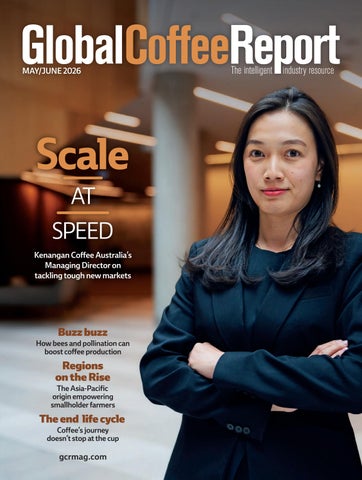
Kenangan Coffee Australia’s Managing Director on tackling tough new markets
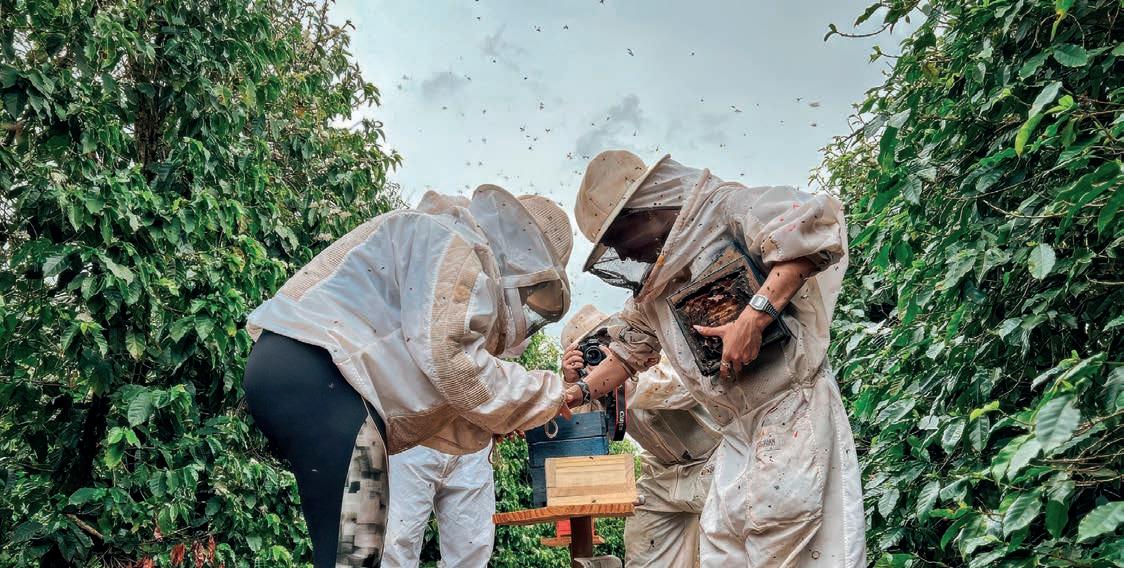
Buzz buzz
How bees and pollination can boost coffee production
The Asia-Pacific origin empowering smallholder farmers
The end life cycle
Coffee’s journey doesn’t stop at the cup
30 The end-life cycle of coffee
Why coffee’s journey doesn’t stop with the cup.
10 Scale at speed
“Australia is one of the world’s most challenging markets with some of the highest rents and wages in the world. If we can succeed here, we can succeed anywhere.”
Winnie Nawei MANAGING DIRECTOR, KENANGAN COFFEE AUSTRALIA
15 A slice of Melbourne
A new way to bring the city’s famous coffee to the world.
22 League of its own
Onyx Coffee Lab on enhancing United States specialty coffee culture.
28 A new era of integration
Behind the partnership between Cimbali Group and Mazzer.
48 Compact, precise, and versatile
Kenangan Coffee Australia’s Managing Director on why the Indonesian giant is successful wherever it goes. 30 43 58
An early look at what Neuhaus Neotec is rolling out at the Interpack expo.
50 Pu ing people first
How this manufacturer is anchoring its sustainability and inclusion agenda.
52 Coffee’s conundrums
Unpacking the latest insights from the 2026 GCR Leaders Symposium.
18 Pollinated with potential
Exploring the role of bees in coffee yield and why they are key to a sustainable future.
25 Nutrient strategies in Kenya
How be er soil management is empowering the nation’s smallholder farmers.
43 Regions on the Rise: PNG
Coffee crops are improving in the Asia-Pacific country as farmers move away from a “coffee garden” mindset. SOFTWARE
34 The ultimate roaster flex
Software connecting customer demand to the production fl oor.
36 Protecting every cup
How digital intelligence helps enable coffee quality at scale.
38 All systems go
Extracting more than just flavour into RTD and instant coffee products.
40 Connected coffee
Turning real-time data into efficient operations system-wide.
58 Knowledge is power
The latest important documents donated to the UC Davis Coffee Center. REGULARS
04 Editor’s note
06 News in brief
56 Marketplace COVER STORY



NE OF THE GREAT pleasures of working in co ee is its truly global nature. It’s a product that connects people across continents, cultures, and communities – yet no two places experience it quite the same way. Co ee is grown in one part of the world, roasted in another, and consumed di erently everywhere you go. at diversity was on full display at this year’s Global Co ee Report Leaders Symposium, held alongside the Melbourne International Co ee Expo (MICE) 2026. I had the pleasure of curating and moderating the program that delivered insights from leaders in non-traditional co ee venues, including premium large-scale events, airports and petrol stations. We examined how co ee is being delivered in high-volume environments, while tackling pressing issues like pricing, petroleum shortages, and climate change.
Co ee is no longer just a supporting act. Freedom Fuels operates 40 service stations across Australia, and is part of a broader shi from “grab-and-go” to destinations where customers are encouraged to stay. CEO Mark McKenzie spoke about the importance of partnerships in achieving that, recognising great co ee requires collaboration with local roasters.
In travel hubs, that same expectation of quality is being replicated at scale. SSP Australia & New Zealand is delivering caféquality co ee across 12 Australian airport terminals increasingly designed as lifestyle destinations. Yet, as National Head of Co ee Operations Martin Nguyen pointed out, consistency remains one of the greatest challenges – requiring a careful balance of training, equipment, and automation. en there are events, where co ee becomes part of something bigger. e Big Group CEO Kate Langford described her team as “experience architects”, with co ee playing a central role in how people
connect – whether at the Australian Open or a wedding.
Much of this couldn’t happen without the support of roasting partners. In our How to Scale Smart panel, leaders from across Australia’s roasting sector shared candid insights into growth. Co ee Supreme CEO Andrew Low spoke openly about the nancial realities of scaling, particularly those growing pains when costs rise sharply before pro ts follow.
We also heard from Starbucks Australia CEO Braeden Lord who, in his keynote address, outlined how one of the world’s largest co ee brands continues to evolve within one of its most mature markets.
Our nal panel continued this conversation. Brands like Indonesia’s Kopi Kenangan are entering Australia not just as an expansion play, but as a proving ground. As Managing Director Winnie Nawei explained on the panel and in this edition’s cover story, success Down Under can unlock opportunities across Western markets.
Similarly, Sasa Sestic, Founder of ONA Co ee, shared his journey into Dubai, describing it as both a strategic and intentionally uncomfortable step for the major Australian specialty roaster. at same sense of global connection carried through to MICE 2026 itself between cafe owners and operators who came to connect, learn and do business with 157 exhibitors across three days. e energy on the show oor was electric.
As I re ect on both the symposium and the expo, I’m incredibly proud of what was achieved. More importantly, I’m reminded that co ee’s strength lies in its ability to connect. at’s the power of co ee. And when we come together as an industry, that’s when the real magic happens. GCR
Sarah Baker Publisher Global Coffee Report
CHIEF EXECUTIVE OFFICER
Christine Clancy christine.clancy@primecreative.com.au
PUBLISHER
Sarah Baker sarah.baker@primecreative.com.au
GROUP MANAGING EDITOR
Myles Hume myles.hume@primecreative.com.au
EDITOR
Kathryn Lewis kathryn.lewis@primecreative.com.au
JOURNALISTS
Daniel Woods
daniel.woods@primecreative.com.au
Meg Kennedy meg.kennedy@primecreative.com.au
ART DIRECTOR/DESIGN
Daz Woolley daz.woolley@primecreative.com.au
HEAD OF DESIGN
Blake Storey blake.storey@primecreative.com.au
BUSINESS DEVELOPMENT AND SALES MANAGER
Charlotte Murphy charlotte.murphy@primecreative.com.au
CLIENT SUCCESS
Cailtin Pillay caitlin.pillay@primecreative.com.au
COVER IMAGE
Prime Creative Media
HEAD OFFICE
Prime Creative Pty Ltd 379 Docklands Drive, Docklands, Victoria, 3008, Australia p: +61 3 9690 8766 info@primecreative.com.au gcrmag.com
SUBSCRIPTIONS +61 3 9690 8766 subscriptions@primecreative.com.au
Global Co ee Report Magazine is available by subscription from the publisher. e rights of refusal are reserved by the publisher.
ARTICLES
All articles submitted for publication become the property of the publisher. e Editor reserves the right to adjust any article to conform with the magazine format.
COPYRIGHT
Global Co ee Report is owned and published by Prime Creative Media. All material in Global Co ee Report Magazine is copyright and no part may be reproduced or copied in any form or by any means (graphic, electronic or mechanical including information and retrieval systems) without written permission of the publisher. e Editor welcomes contributions but reserves the right to accept or reject any material. While every e ort has been made to ensure the accuracy of information Prime Creative Media will not accept responsibility for errors or omissions or for any consequences arising from reliance on information published. e opinions expressed in Global Co ee Report are not necessarily the opinions of, or endorsed by the publisher unless otherwise stated.
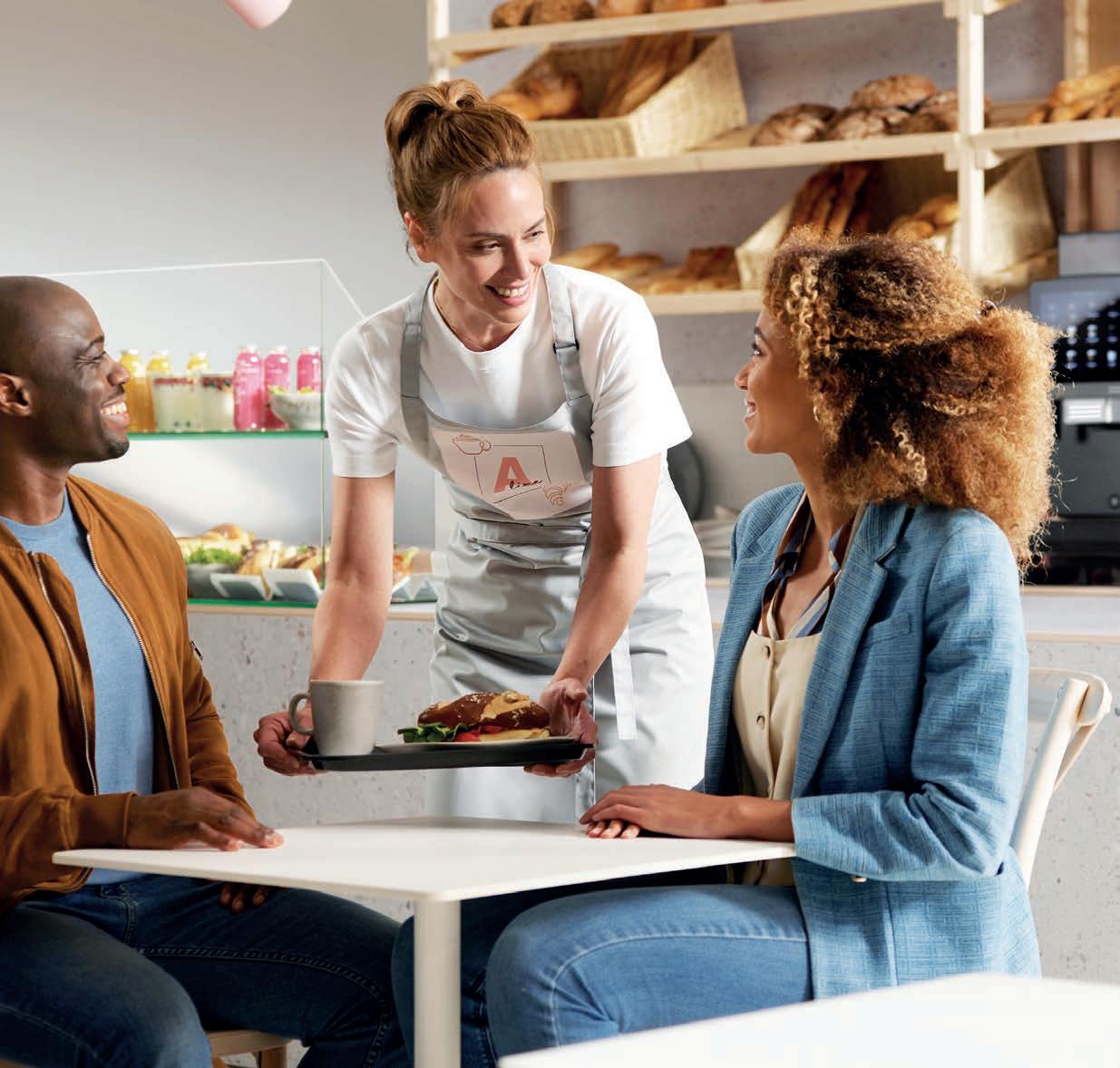
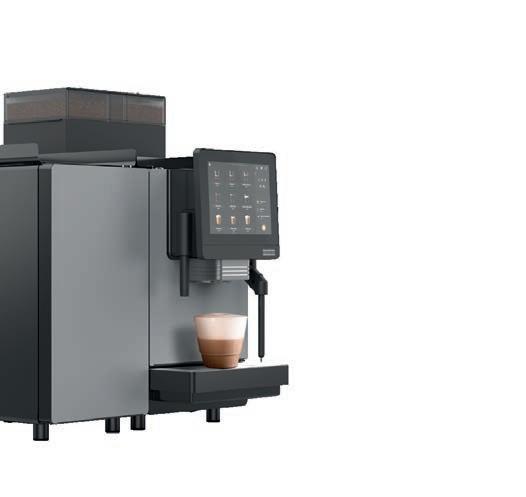
The New A Line
Manual coffee preparation takes time and slows down during peak hours. With the New A Line’s more easy-to-operate touch screen, you free up time to connect and create more moments with your It’s all about the moment.

The United States (US) is the cream of the global café culture crop, at least according to the updated World’s 100 Best Coffee Shops list for 2026. After being ranked second in 2025, Onyx Coffee LAB in Rogers, Arkansas, the US has topped the updated rankings, with the café and roastery located in a historic building in downtown Rogers. Overall, the best represented nations in the list were the US (nine), Australia (seven), Peru (fi ve), Spain (four), Honduras (four), and Taiwan (four).
The World’s 100 Best Coffee Shops CEO Cesar Ramirez says the spread of nations included in the 2026 list showcases the global expansion of specialty coffee culture. “Coffee shop culture continues to grow, and this ranking aims to give greater visibility to more coffee shops worldwide,” he says.
See page 22
67 per cent yield increase in coffee crops that introduced managed stingless bee colonies.
After more than a decade in specialty roasting, Caleb Sexton has stepped out to launch a solution to one of coffee’s most persistent operational headaches. The founder of Flexnet has introduced a purpose-built platform designed to unify the fragmented systems roasters rely on to run their businesses.
Drawing on his time at Five Senses Coffee in Australia, he has developed an all-in-one ecosystem spanning CRM, sales, production, reporting, and storefront functions, with integrations including Shopify and QuickBooks.
Although the company’s roots lie in Australia, Sexton made the strategic decision to launch in North America, citing its dense concentration of roasters, after the platform debuted at the World of Coffee San Diego 2025.
See page 34
In late 2025, the UC Davis Library received an assortment of coffee-themed donations from Starbucks Co-Founder Gerald ‘Jerry’ Baldwin, President of Hacienda La Minita Russ Kramer, and the Specialty Coffee Association (SCA).
The trio of collections all offer their own insights into not just the history of coffee in the United States (US), but the entire world.
See page 58
Kenyan coffee is mainly cultivated by smallholder farmers facing extreme challenges including limited access to finance, minimal external support, the pressures of ageing trees, and an ageing workforce.
While most farmers haven’t had their soils tested, that’s changing through the efforts of Ibero Kenya, part of Neumann Kaffee Gruppe.
“The goal is to help farmers get more value from the inputs they already buy, while gradually rebuilding the long-term health of their soils,” says Samuel Kahenya, Farmer Service Unit Manager Ibero Kenya.
See page 25
For decades, the coffee industry has operated under a delicate tension between the chemical demands of pest management and the biological necessity of pollination. But a groundbreaking study from Brazilian coffee farms suggests we might be underestimating pollinators’ potential in crop yield.
By introducing managed colonies of the stingless bee Scaptotrigona depilis into
both organic and conventional landscapes, researchers discovered a staggering 67 per cent increase in yields for coffee branches positioned near the hives.
See page 18
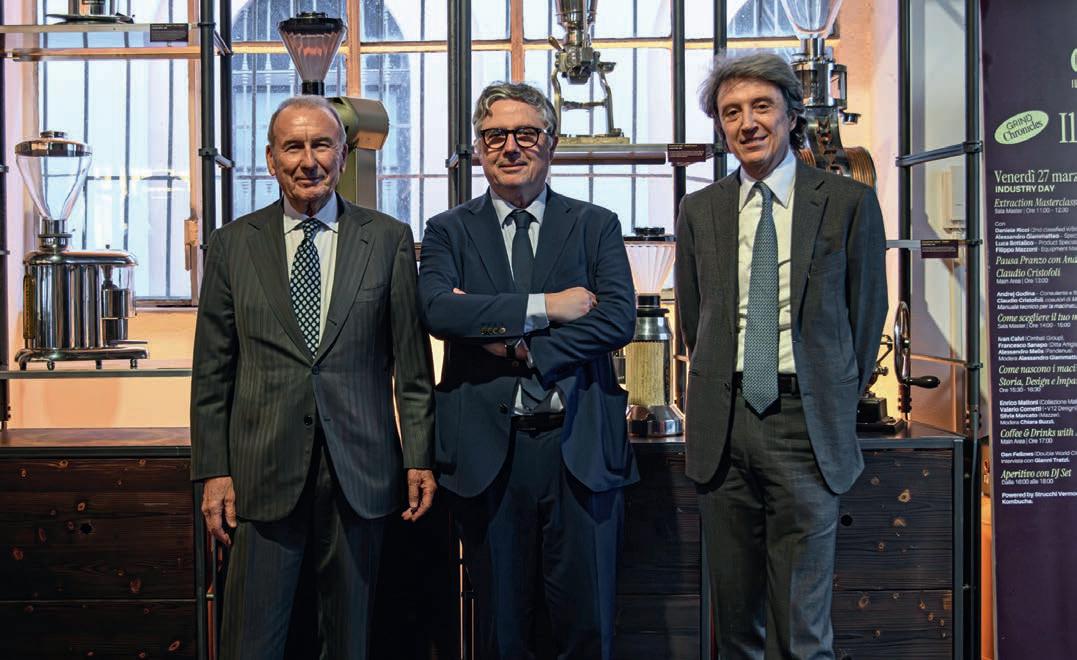
Two iconic Italian brands have combined their expertise with the new Mazzer x Slayer grinder. Premiered during the Grind Chronicles event in Milan, Cimbali Group says the grinder is the first piece of equipment born from the partnership, designed to bring the Slayer experience to the barista-grinder interaction, combining a ention to detail, iconic aesthetics, and an uncompromising pursuit of quality.
“We believe that Cimbali Group and Mazzer together can provide innovative technological solutions with a level of service and guarantee of excellence that is difficult to match,” says Mazzer President Giovanni Mazzer.
See page 28
The coffee industry has long treated spent coffee grounds as an inevitable endpoint – a waste stream destined for landfi ll rather than a resource to be reimagined. But a growing cohort of innovators is challenging that assumption, turning their a ention to the untapped chemical potential locked within every used puck.
Among them is EcoBean, which is extracting high-value compounds from coffee waste and repositioning the industry within a circular economy framework. From oils and antioxidants to functional chemical inputs, these materials can be repurposed across multiple industries, reducing both waste and reliance on virgin resources.
See page 30
As coffee expands beyond traditional cafés into hotels, bakeries, and convenience retail, maintaining standards across highvolume, fast-paced environments has become difficult. Developed by Swiss-based Franke Coffee Systems, the Mytico line is
responding to this with a hybrid approach that blends barista-inspired design with advanced automation.
Precision grinding, controlled extraction, and sophisticated milk systems work together to streamline workflows while preserving the visual theatre of espresso preparation. his integration of engineering and digital intelligence represents an important evolution in professional coffee equipment. “Digital technologies allow operators to protect beverage standards while simplifying workflows for staff,” Franke Coffee Systems CEO Marco Zancolò says.
See page 36
For a Nordic coffee company running thousands of fully automatic machines, an unusually hot and humid summer began to impact product performance in real time, impacting service and profitability. Adjusting the recipe was the only solution, but doing so quickly, consistently,
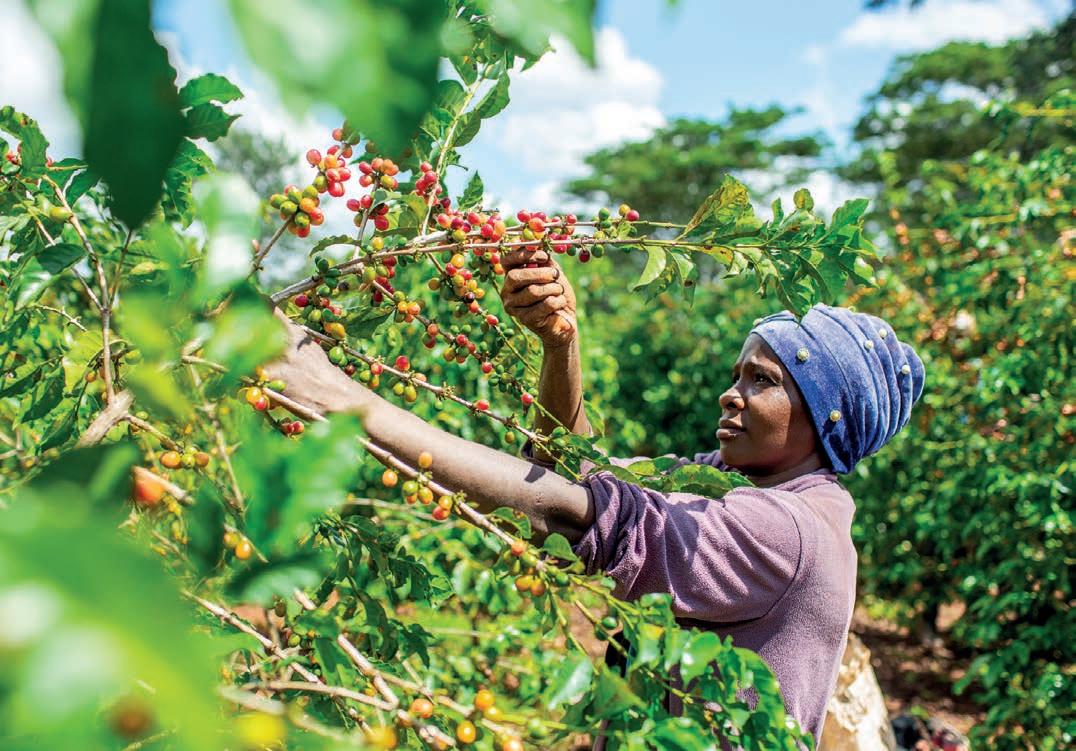
Renowned for bright acidity, full body, and distinctive fruit-forward profiles, there’s a significant market opportunity for Kenyan coffee, according to
and across an entire network was the ultimate challenge.
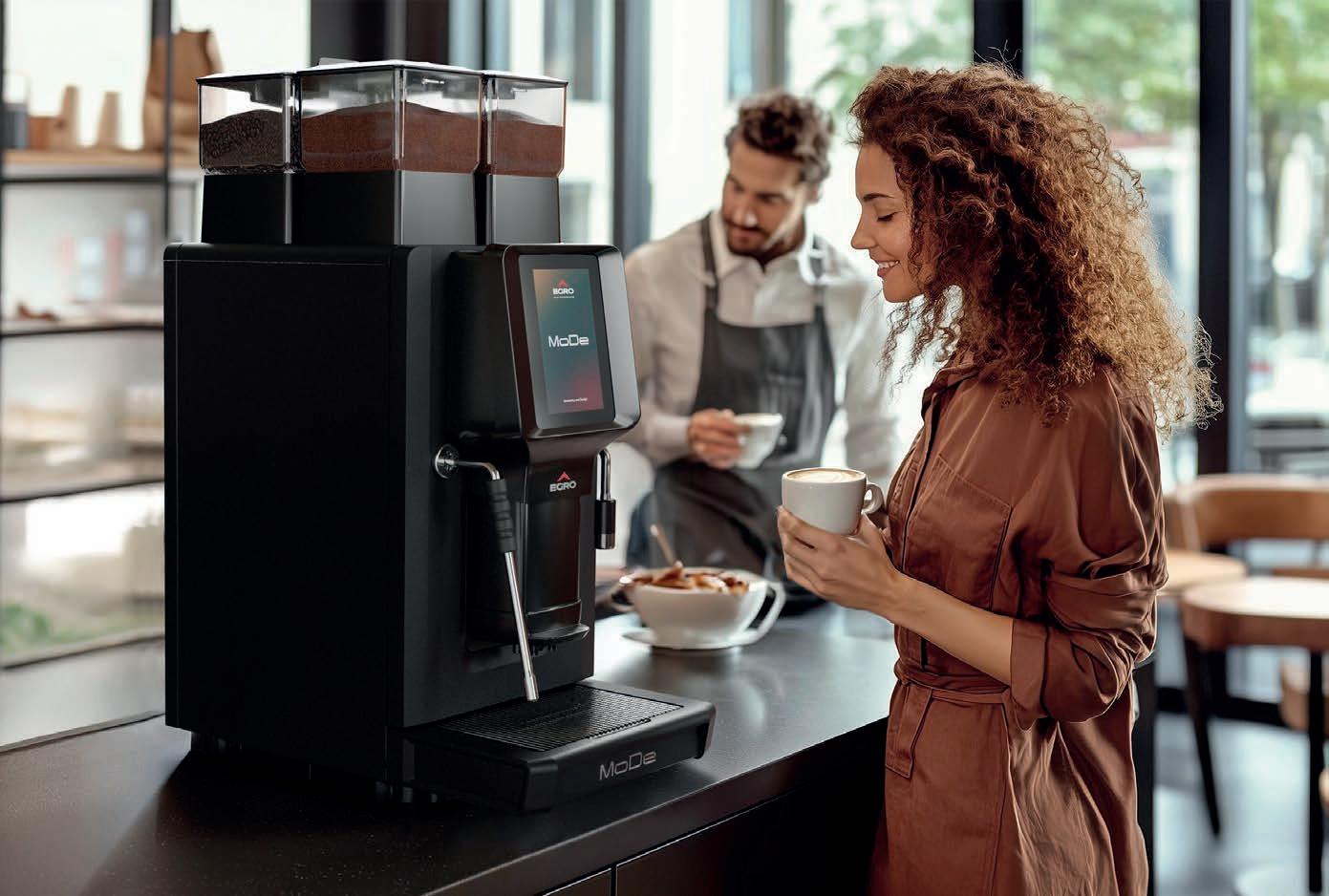
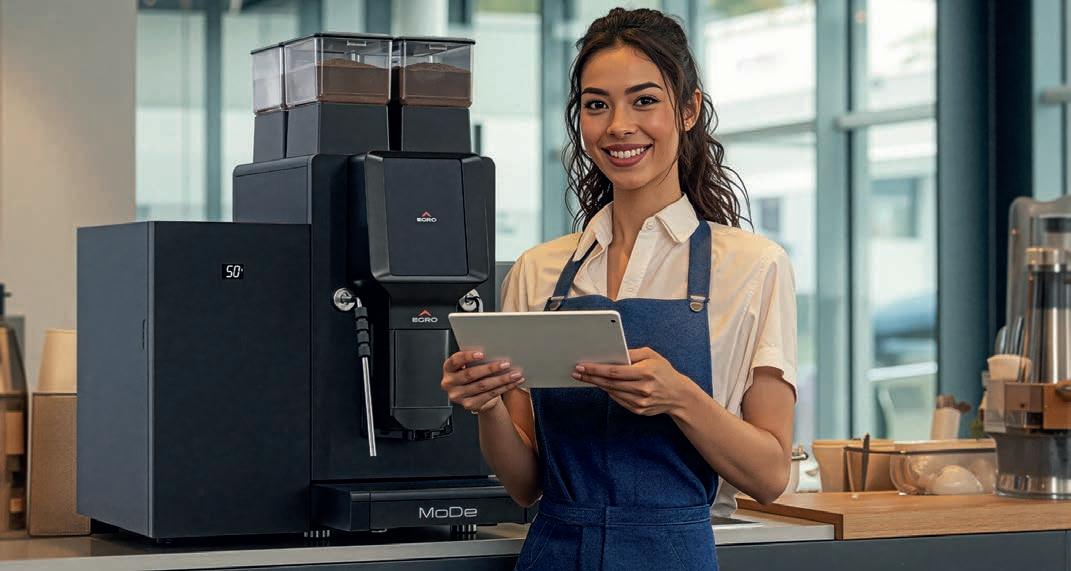
Without connectivity, the fix would have been slow and costly, according to Augusto Morales Meléndrez, Global Director of Strategic Marketing at Ali Group’s Coffee Division. Now, the telemetry system that solved this problem is being brought into the Egro MoDe and Egro Next machines.
See page 40
Alongside the stable whole-bean segment, the production of ground coffee in various forms is gaining importance, according to Neuhaus Neotec.
This shifting demand is creating change in what specialty roasters require from their equipment, and growing the need and desire for complete roasting and grinding production lines in-house.
See page 48
Equipment manufacturer SEB Professional Beverage is already making inroads into its Environmental, Social, Governance (ESG) strategy, unveiled in December 2024.
“People are at the heart of everything we do,” says Ayca Ozol, Sustainability
Manager at SEB Professional Beverage.
“Our ESG roadmap positions us not only as a machine manufacturer, but as a solutions provider that makes coffee culture more accessible, more intuitive, and more inclusive. We invest in high-performance machines and barrier-free self-service concepts that transform the entire hospitality sector.”
See page 50
It’s been a rapid rise for Indonesia coffee chain Kopi Kenangan, surpassing 1000 global locations in less than a decade, and joining esteemed ‘unicorn status’ companies like Uber, Airbnb, and SpaceX by becoming a privately held startup valued at more than US$1 billion.
Known as Kenangan Coffee outside Indonesia, it opened its first international location in Kuala Lumpur, Malaysia, followed by Singapore in September, the Philippines, and India. Now, it’s targeting rapid scalability in one of the world’s toughest markets.
“I think for Kenangan, entering Australia
is essential,” says Kenangan Coffee Australia Managing Director Winnie Nawei. “If the brand proves successful here, it can unlock opportunities in western markets like the United Kingdom, United States, and Canada.”
See page 10
Melbourne’s coffee is world famous, but what makes it so great? It’s a question Lance Brown has been pondering – and is providing a solution to – with his new Melbourne Coffee Group brand.
Brown, who has held senior positions at well known Australian coffee companies, has embarked on his own personal mission to bring Melbourne coffee to the world.
“I happened to be in Lombok in Bali a year or so ago, where I was si ing having a coffee. I overheard lady on the next table who was having a coffee say to her husband, ‘this is really good Melbourne coffee’,” he says.
“I went back to the villa, got the laptop out, and got to work. I quickly realised no one has really done ‘Melbourne Coffee’ and put it out into the world, so I registered the name. I want people to be able to say this
is good Melbourne coffee, and it can work anywhere and in anything.”
See page 15
Australian extraction technology
manufacturer Flavourtech and its Spinning Cone Column (SCC) has led the charge for almost 40 years to solve a key gap in the production of flavourful soluble and readyto-drink (RTD) coffee.
The company works with some of the world’s top beverage brands, helping them extra aroma without the use of high temperatures.
“The SCC has the versatility to capture
flavour notes from various bean types without damage,” says Global Sales Manager Paul Ahn. “The SCC is able to capture those volatile notes, which means coffee producers – whether making RTD concentrated liquids, or soluble coffee – can put those single, original, or unique characteristic notes back into the finished product.”
See page 38
Coffee is a powerful currency in Papua New Guinea (PNG). Shortly before the Pacific nation gained independence 1975, Wakpi Keu was introduced to coffee and advised that if he planted and tended to his crop, it would alter his family’s future.
“My grandfather planted the coffee, got money from that, and that helped my father became a civil engineer through coffee. He started his own construction company, and through that, was able to afford a good education for me and my siblings,” says Emma Wakpi, his granddaughter, who today runs Jiwaka Coffee, a social enterprise
that works with 904 PNG farmers from 11 villages to process and export specialty Arabica.
Stories like the Wakpi family can be found all over PNG, where roughly one in fi ve people grow coffee. Now, efforts are being made to encourage the nation’s majority (89 per cent) of smallholder farmers to professionalise their operations.
Page 43
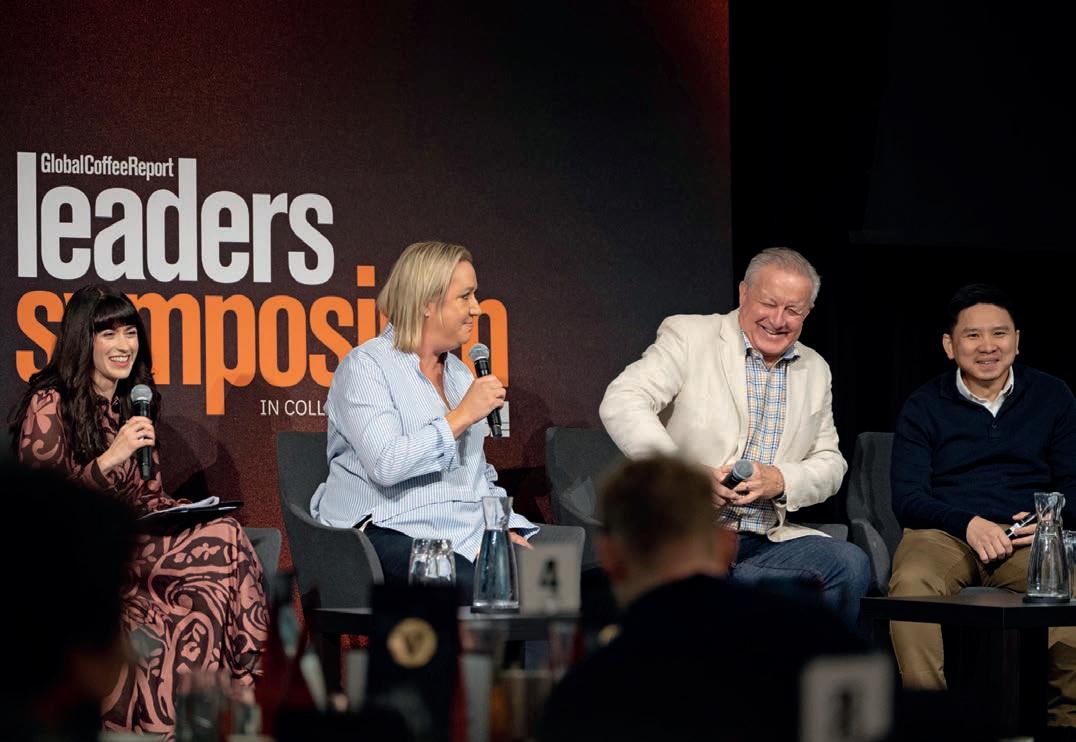
Australia hosted the Global Coffee Report Leaders Symposium in March, taking place alongside the Melbourne International Coffee Expo (MICE)
Across four panels, the event welcomed senior leaders from non-traditional coffee venues like fuel stations and airports, major coffee chains like Starbucks and Kopi Kenangan, and leading Australian roasters, to examine how coffee is being delivered in highvolume environments, while tackling pressing issues like pricing and climate change.
Page 52

Kenangan Coffee Australia Managing Director Winnie Nawei discusses the Indonesian chain’s rapid global expansion, and what’s next for the unicorn status start-up.
WHAT DOES Facebook Co-Founder
Eduardo Saverin have in common with an iconic rapper, a superstar tennic player, and an NBA basketballer? If you guessed ‘signi cant investment in the same rapidly growing Indonesian co ee company’, you’d be correct.
Saverin’s B Capital is a signi cant investor in Kenangan Co ee, alongside a range of famous faces and other investment rms that have seen the company gain ‘unicorn status’, meaning it’s a privately held startup valued at more than US$1 billion.
Other businesses to join this club over the years include Uber, Airbnb, and SpaceX.
Kopi Kenangan, known as Kenangan Co ee outside Indonesia, which was founded in 2017 by Edward Tirtanata, James Prananto, and Cynthia Chaerunnisa, has surpassed 1000 global locations in less than a decade.
Most are operated in its hotly contested Indonesian domestic market, where its tech-forward, fast-paced service proposition drew customers in and formed the foundation for rapid scalability.
A considered – yet still signi cant –Asian expansion has been ongoing since 2022, when Kenangan opened its rst international location in Kuala Lumpur, Malaysia. en further expansions into Singapore in September 2023, the Philippines in October 2024, India
and Australia in April 2025 followed. Now, it’s working to break its Asia-Paci c shackles and take its proposition global.
Innovate or stagnate
Australia can be a brutal market for co ee companies with the wrong strategy. Even large international chains, have had to pull back and reassess their positions before retooling and rebuilding a presence in its metropolitan hubs.
Now, the competition is closer than ever, but it’s indicative of a wider global trend where Asian co ee companies are taking on the rest of the world, with the likes of China’s Luckin Co ee, South Korea’s theVenti, and Japan’s % Arabica, among others, all looking to new markets to consolidate their dominance.
Winnie Nawei, Managing Director of Kenangan Co ee Australia, is overseeing the brand’s expansion into its newest, rst non-Asian market.
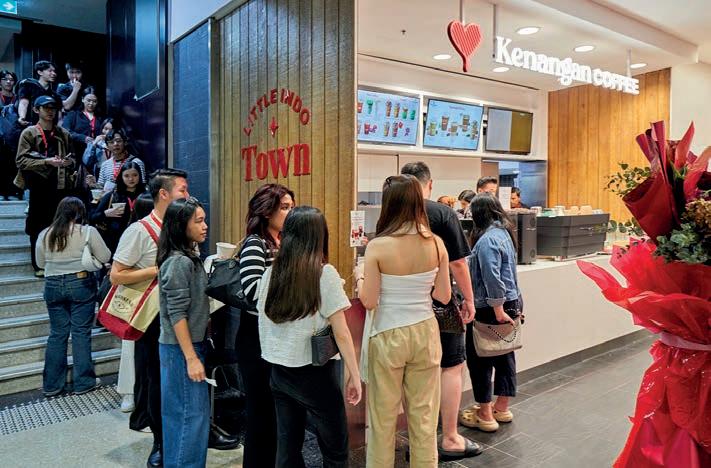
With a background in food and beverage franchising in Japan, South Korea, and Singapore, Nawei connected with an agent to help bring Kenangan to its newest outpost, with its rst store opening in the ‘Little Indo Town’ food-court of a Sydney shopping centre in 2025.
Now, there are locations in Sydney and Melbourne, with more to follow.
New ground has been trodden with this
entry into Australia, and Nawei believes the island continent can serve as a litmus test for Kenangan’s scalability into other western markets.
“I think for Kenangan, entering Australia is essential,” says Nawei. “If the brand proves successful here, it can unlock opportunities in western markets like the United Kingdom, United States, and Canada. Australia is also quite strategic –it sits within the Asia-Paci c region and is still relatively close to Indonesia, with Melbourne and Sydney being less than eight hours away.
“Australia is also one of the world’s most challenging markets, with some of the highest rents and wages in the world. If we can succeed here, we can succeed anywhere.
“Our core principle is simple: premiumquality co ee at an a ordable price. at’s been our rule from day one. Beyond that, it’s about localisation of products so we can adapt and suit di erent markets.” at localisation strategy is obvious in every region Kenangan operates in and lters down through its menus.
In Indonesia, Kenangan’s agship product is its Kopi Kenangan Mantan. e signature best-seller – which translates loosely to ‘Memories of an Ex’, keeping in line with the brand name’s translation to ‘Memory of Co ees’ – is a blend of
espresso, milk, and Indonesian palm sugar.
e result is a sweetened and milky co ee, which may share some similarities to other famous and traditional co eebased beverages from southeast Asia.
Vietnamese iced milk co ee Cà Phê Sữa Đá, made with sweetened condensed milk and Robusta co ee over ice, or a ai Oliang, a Robusta and grain concoction sweetened with sugar and sweetened condensed milk, immediately spring to mind.
ere is no one-size- ts-all approach for success in Asia, though, and Nawei says identifying local tastes and adapting Kenangan’s products to market preferences are key to creating the building blocks for new success.
“We introduce market-speci c products we think can be successful,” says Nawei. “In Australia, for instance, we’ve launched specialty drinks that combine co ee and tea in a mocktail style. ere’s strong demand, especially among younger customers looking for more creative options beyond traditional milk-based co ee.
“ at being said, the avour pro le someone in, for example, Singapore, is looking for is very di erent to Australia.
“Singaporean customers tend to prefer thicker, richer co ee, while Australian customers generally want less sweetness. So, while the base product remains consistent, we adapt to local preferences using customer data.”
The expansion boom e speed at which Kenangan has opened new locations in recent years
“Our core principle is simple: premium-quality coffee at an affordable price. That’s been our rule from day one.”
Winnie Nawei MANAGING DIRECTOR KENANGAN COFFEE AUSTRALIA
is so staggering that it almost doesn’t sound possible.
A er a slow start in its rst six months, it took just two years for the brand to have opened 230 locations around Indonesia. By the end of 2022, it was opening an average of one new store a day. is frenetic pace scaled to new heights in April 2022, when 26 stores were opened in 13 di erent cities in just one week. is speed of expansion, and the continued speed Kenangen is laying down roots for new stores, indicates the brand’s willingness to adapt its model, no matter where it’s located.
Co-Founder and CEO Tirtanata himself has labelled the Australian branch as a “partnership”, while its Taiwanese operations are a “joint venture”. India, on the other hand, is “self-owned”, he said in an interview with Indonesian news outlet Kompas in 2025.
He said the way in which Kenangan entered new regions was uid and dependant on the legality of where it was expanding. e important thing was just getting the brand there.
Despite these di ering ownership and operational models, Nawei says there is one common thread that links Kenangan Co ee Australia with Indonesia, India, Taiwan, and every other market it operates in around the world.
“We receive strong support from
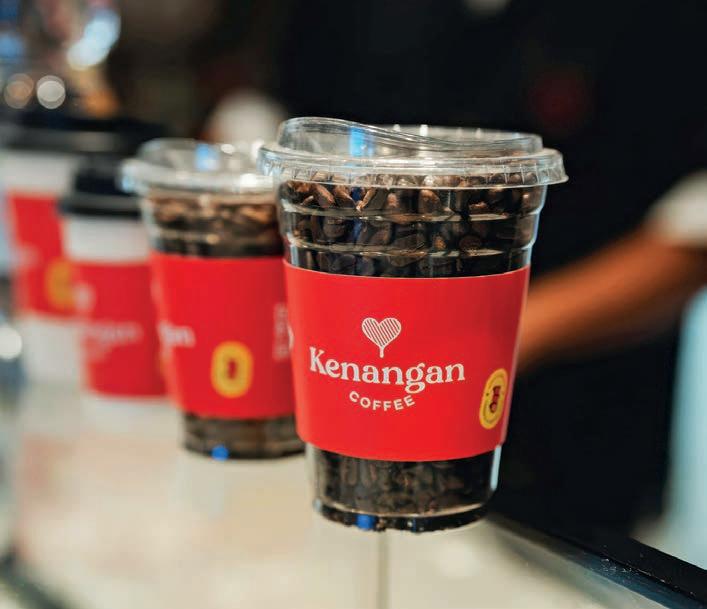
Indonesia,” says Nawei. “Every three to four months, the R&D team comes to Australia for about two weeks to develop new menu items. ey are very committed to ensuring success in this market.
“In Australia, we work closely as partners. Markets like Indonesia, Singapore, and Malaysia are easier to manage centrally because of similar climates and consumer behaviour. Australia is di erent, so local expertise is critical.
“ e co-founder, Edward Tirtanata, is still very involved in the business. He plays an active role in strategy and decision-making across all markets.”
ere are other companies all over the world that have achieved signi cant private equity and continue to be led by a motivated and strategically astute founder, so what is di erent about Kenangan that has fostered such rapid development?
e answer, Nawei believes, is simple –and it’s a combination of earning potential and co ee as a proven commercial consumer commodity.
“From an investment perspective, the business is attractive because of its scalability and strong return on investment (ROI),” she says.
“Most Kenangan Co ee outlets achieve ROI within around 18 months, which is very fast. In a market like Australia, achieving ROI can o en take up to three or four years.
“It’s the combination of a proven product, strong funding, and a scalable model that continues to drive this growth.”
Technology, too, is at the forefront of how Kenangan has scaled so rapidly and built a platform customers want to come back to.
“Technology is a major part of Kenangan’s success. e entire operation – from customer ordering to backend systems – is integrated with technology. is allows us to collect data, improve e ciency, and personalise the customer experience,” says Nawei.
“For example, the app remembers your favourite orders and suggests them the next time you visit. It can also recommend nearby stores and streamline ordering into just a few taps. In markets where it’s already active, the app has increased sales by 30 to 40 per cent.
“It also helps us with data mapping and understanding where customers are coming from. We use that information to decide where to open new stores, and it’s a big part of how we scale.”

Despite turning one eye away from Indonesia to push forward with global expansion, Kopi Kenangan continues to accelerate its growth in its home market.
Indonesia, a er all, is a competitive co ee culture. Janji Jiwa and Tomoro Co ee are just two more chains with well over 500 locations around the country.
Local strength leads into international opportunity, according to Nawei, who says despite the rapid evolution of Kenangan, it has not forgotten its roots.
“Kenangan is a modern co ee brand, but at its core, it is still rooted in Indonesian co ee. We use 100 per cent Indonesian beans, sourced from regions like Sumatra and Java,” says Nawei.
“ e way we present the co ee may be more aligned with western formats like lattes and cappuccinos, but the foundation remains Indonesian. We are committed to that identity.
“We currently use beans from places such from Bukit Teraja and Mandheling. If we can nd local roasting partners in Australia that meet our price and quality
requirements, that would create a win-win situation for both Indonesian producers and the local market.”
e acceleration seen over the past almost decade is due to step up another notch, with Kenangan targeting a doubling of its global presence in less than two years.
“Looking ahead, the target is 2000 outlets globally by 2028. at means a very aggressive expansion pace,” says Nawei.
“In Australia, we currently have around seven to eight stores in the pipeline for 2026, with plans to increase to around 15 next year. By 2028, we’re aiming for 25 to 30 stores nationally.
“We’re focusing on high-density, hightra c areas – places like Parramatta, Macquarie, and Burwood. In Melbourne, the CBD alone could support multiple locations. Our strategy is to secure strong landmark sites rst before expanding further.
“Ultimately, our goal in all markets is to combine strong product quality, smart localisation, and advanced technology to scale e ciently while maintaining a consistent customer experience.”
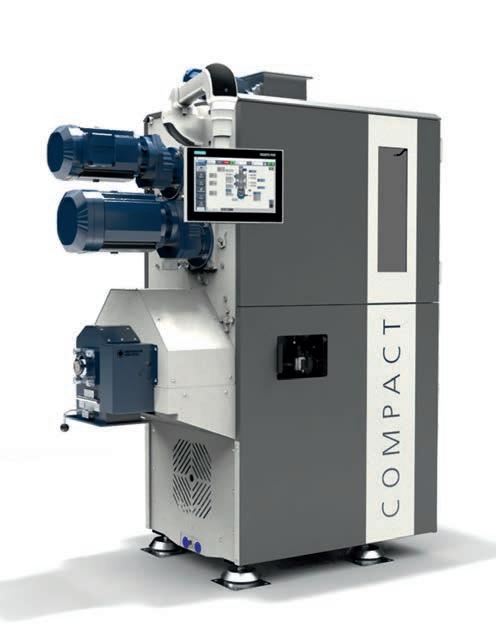
The new COMPACT roller grinder series is ideally fitted to the capacities of the NEOROAST series and offers two to three grinding sections followed by a discharge screw with compaction capabilities. The direct machine interface with complete process visualization and the wide range of standardized options fits the grinder to your individual demand – from coarse grinding up to espresso

Meet us at
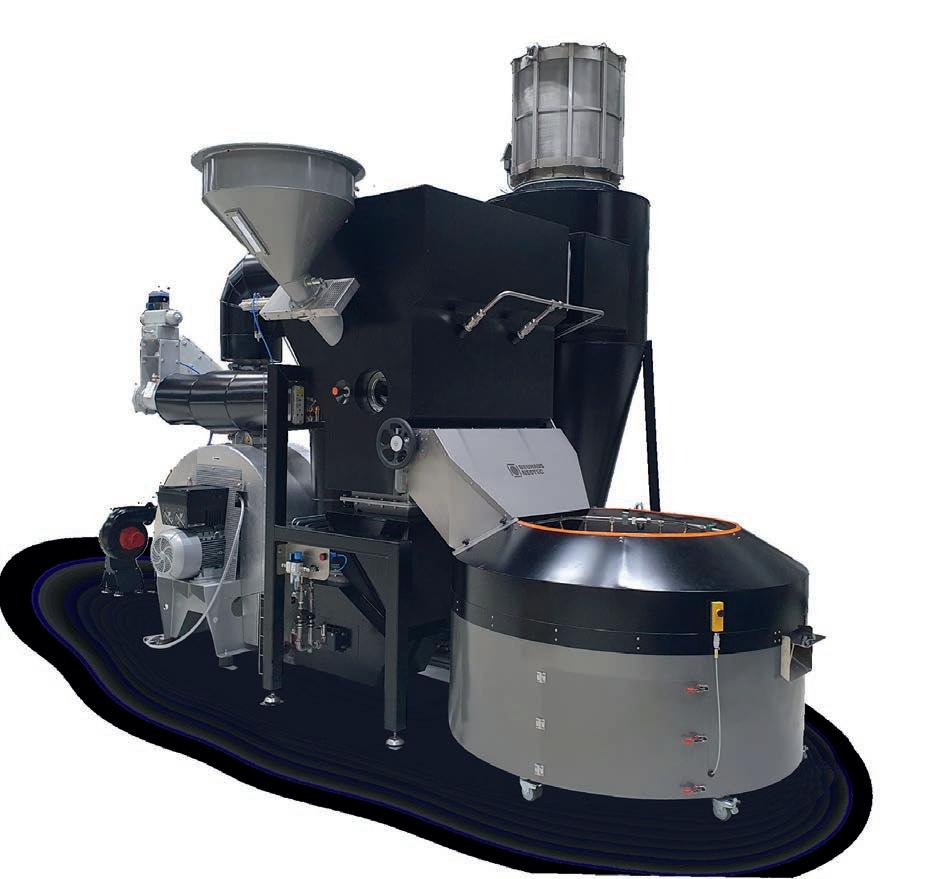
The NEOROAST roaster series is the most consistent solution for those seeking a highperformance air roaster with all its physical advantages. Engineered for minimal heat storage and maximum flexibility in roasting parameters, the NEOROAST allows you to choose your preferred heat source – gas, hydrogen, or fully electric.
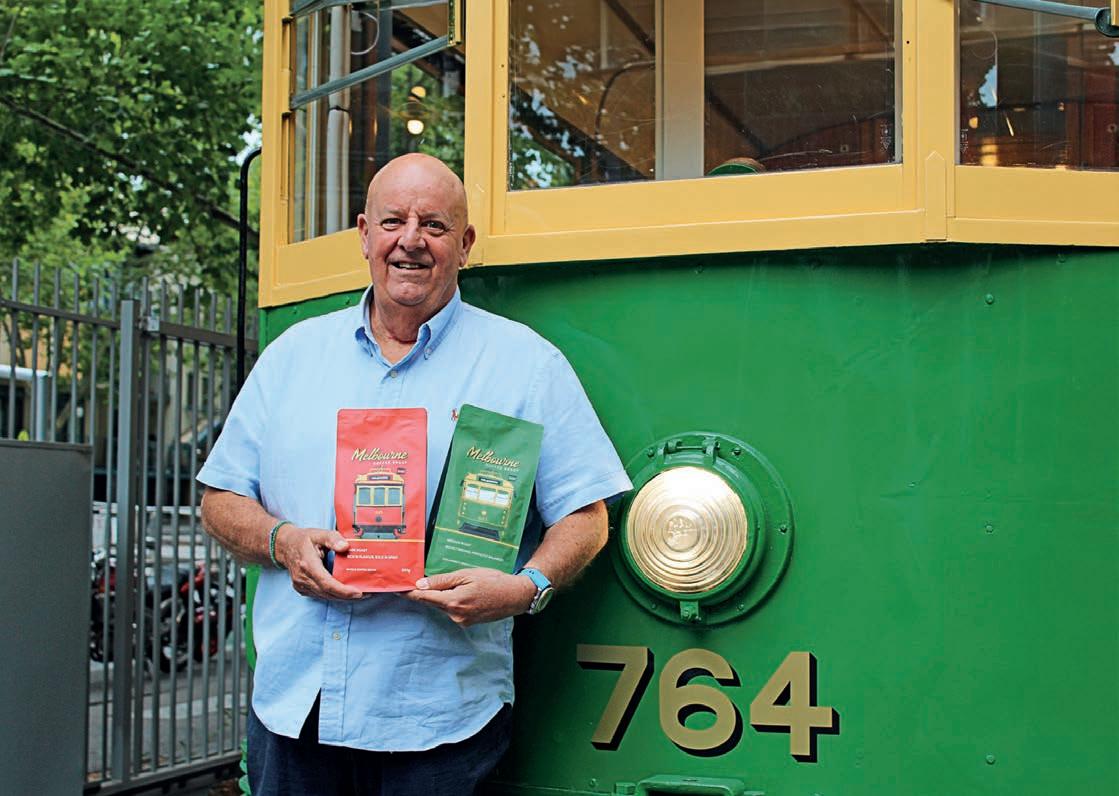
Melbourne’s coffee is world famous, but what makes it so great?
Lance Brown, a local industry stalwart, hasn’t just answered this question; he’s bringing his solution to the world.
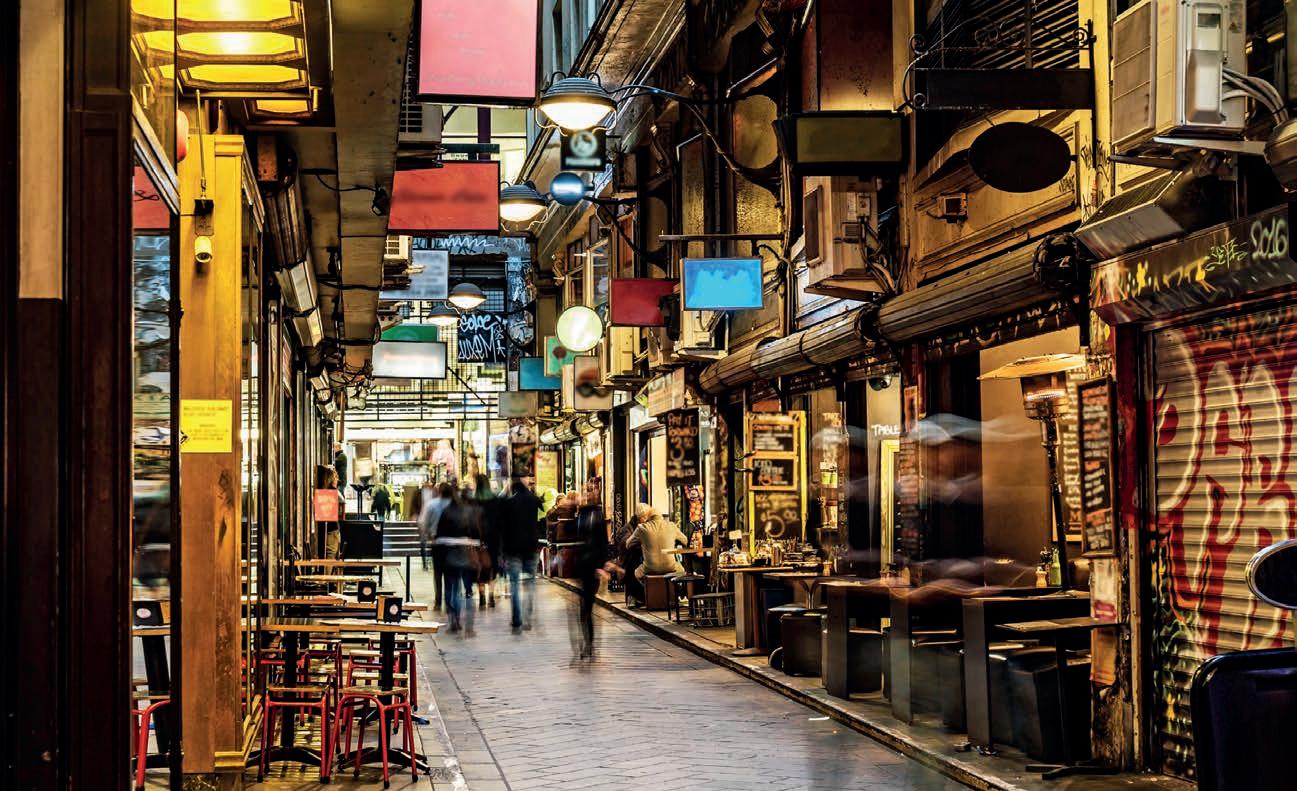
MANY COFFEE LOVERS in the world know about Melbourne co ee. Whether it’s an Italian espresso drinker sipping away in Turin, a Canadian huddling from the winter cold with a Double Double co ee at Tim Horton’s, a traveller creating new memories with an origin brew in Peru, or anyone in between, the city’s reputation travels well beyond the southeast corner of Australia.
Despite this international renown and popularity, one question is o en raised. What de nes a Melbourne co ee?
Yes, the city’s co ee culture has been in uenced by Italian and Greek heritage, but it has since been twisted and re ned to become its own world-famous beast. Now, it’s known as the land of lattes and Melbourne Magics – grown through a culture of innovation and trends borne from a desire to do things di erently.
Lance Brown, who has spent almost three decades working with the likes of JDE Peet’s, National Foods, now Bega – one of Australia’s largest manufacturers of dairy products – and Nomad Co ee Group – one of Australia and New Zealand’s premier co ee brands – says one key ingredient
“This coffee is Melbourne; it’s not just a coffee that is from Melbourne.”
Lance Brown FOUNDER,
MELBOURNE
COFFEE GROUP
de nes what type of co ee thrives in the city’s scene.
“Melbourne co ee needs to work well with milk. Australia is a milk nation –about 88 per cent of all co ee sold in Australia is milk-based, so you need to get that co ee cut through, in every cup,” says Brown.
“You need to have those chocolate, nutty avours coming through.”
Brown hasn’t just identi ed the iconic and non-negotiable aspects of what a Melbourne co ee is though, he’s bringing them to life with a new venture –Melbourne Co ee Group.
“When coming up with the concept,
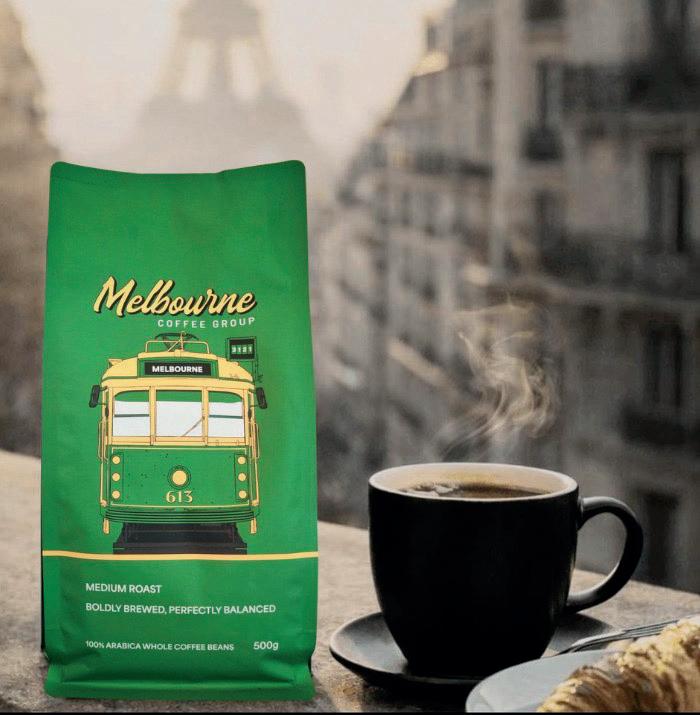
I always felt that the green and yellow W-Class tram shouted Melbourne moreso than any other iconic image,” says Brown.
“ e packaging and design itself is next level, I wanted all travellers and international expats to be excited to see the brand in the market and to enjoy ‘Melbourne Co ee’ wherever they are in the world.
“Melburnians are loud and proud of their co ee credentials. It’s in our DNA. We want good co ee wherever we are, without compromise.”
A er recently calling time on 12 years as one of the top co ee minds at Nomad, he’s embarked on his own personal mission to bring Melbourne co ee to the world through this new venture.
“I happened to be in Lombok in Bali a year or so ago, where I was sitting having a co ee. I overheard lady on the next table who was having a co ee say to her husband, ‘this is really good co ee, just like I get in Melbourne’,” says Brown.
“ at was insightful to me. I raced back to the villa, got the laptop out, and got to work. I quickly realised no one has really really promoted ‘Melbourne Co ee’ and
MELBOURNE COFFEE GROUP
put it out into the world, so I registered the name.
“It wasn’t really that hard, and maybe sometimes it’s the really simple ideas that work.
“I want people to be able to say this is good Melbourne co ee, and it can work anywhere and in anything. It’s going to perform, and that’s what you want to get out to people in the world. We’ve focused on getting the basics right and getting a market out there.”
Brown is one of the most well-regarded individuals in Melbourne’s co ee scene over the past three decades. By his own admission, when he started in a sales role with Douwe Egberts in 1998, he, by his own admission, could barely tell good co ee from bad.
From there, he rose to become a fully accredited World Co ee Judge in 2013, was Head Judge for Australian Latte Art Championships from 2008 to 2019, and has been a driving force behind Melbourne’s world-leading standing.
“I’ve got a hospitality background, so I understood the industry. Back then I knew little about co ee and even less about sales, but I was a good problem solver and the Australian market needed a co ee solution. I was able to provide that.
“You think back now and think, ‘how would that co ee have tasted?’. But it was a time where co ee was just starting to take
“There are hundreds of roasters all vying for the same coffee dollar.
At Melbourne Coffee Group we’re trying to do something a bit different.”
Lance Brown FOUNDER,
MELBOURNE COFFEE GROUP
o . For me, being in co ee was about being in the right place at the right time.
“Looking back, I have no idea what I would have done if I didn’t nd co ee.”
To create those nutty and chocolatey avours he sees as critical identi ers for one of the Southern Hemisphere’s co ee capitals, Brown has released two blends under the Melbourne Co ee Group banner, a medium roast and a dark roast.
“We wanted to give people the basics to make a good co ee with milk, so our medium roast is 100 per cent Arabica made with a blend of very good quality co ee from Brazil and Honduras, we’re talking scores of higher than 80,” he says.
“ en, we have a dark roast that is
made with the same blend of Brazil and Honduras, but with the addition of 20 per cent Robusta to add that real punchiness that you see on co ees that are popular in the Asian market.”
Within those two blends, there are a trio of products created.
“We have a one-kilogram format and a 500-gram format of both blends,” says Brown. “ e 500-gram came about as that is the most popular retail size for co ee.
“We also have steep bags. ese aren’t parachutes, but they’re just like a teabag that, when used, can go into green waste and compost.
“What motivated that decision? When travelling, you’ll usually see a pod setup in a hotel. To make the majority of those sustainable you have to scoop the co ee out, get about 10 pods, squish them together and put them in recycling.
“In hotels, these pods usually just stay in the tray and end up in land ll. We wanted to make it simple for people travelling to be able to make themselves a co ee and then responsibly dispose of what they use.”
From concept to concrete
It took less than a year for Brown to progress from overhearing that throwaway statement in Bali to being able to hold a bag of Melbourne Co ee Group beans in his hands.
With its green and gold branding and
Melbourne’s iconic city circle tram at the centre, the ‘MCG’ brand – which just so happens to share an acronym with the world-famous Melbourne Cricket Ground – has been brought to life.
e devil is also in the details. e tram’s route number – 3121 – represents the inner-east suburb of Richmond which is not only home to some of the city’s most popular venues but is also where the co ee is roasted.
e number at the front of the tram – 613 – pays homage to the city’s international dialling code.
e e ort to bring this project to life so quickly is by no means limited to Brown, though, who has been quick to praise those who have helped him reach this position, including Melbourne creative agency, COG Advertising.
“ ey’ve been incredible to work with, from the rst designs to totally buying in and being on this journey with me,” says Brown.
“It was Sophie Rasmussen who, in conjunction with David Dodds, latched onto the idea and helped progress it so quickly. It’s amazing how this has been brought to life.
“I had so many questions and they were brilliant with giving me advice on things I wasn’t familiar with, from image rights to trademarking.
“ ey did all the artwork and helped me generate my vision. ey did honestly buy into our tagline that ‘life’s too short for bad co ee’, and now we really believe we have a great product in Melbourne Co ee to take anywhere in the world.”
Melbourne already has a string of internationally renowned local roasters all competing for the attention of one of the world’s most discerning customer bases.
While Melbourne Co ee Group is obviously making its home in the city that shares its name, it’s also targeting the international market, using Melbourne’s reputation as a world-leader to help it launch internationally.
Of course, reputation can only get you so far, and Brown is bullish on the prospect that he has created a product that can live up to the lo y Melbourne name.
It’s through part of his experience as Nomad’s Director of International Sales that has given him a unique perspective on what the world expects from a distinctly Melburnian co ee, and how to deliver it.
“When I go overseas, really, I’m taking
a bag into a marketplace that doesn’t know anything about it. ey know it’s in Melbourne and it’s good, but it’s a bag of beans with a brand that could be anything,” he says.
“I want someone to be able to come and sit in an airport and grab a bag of co ee, or maybe a hat or t-shirt down the line, and it’s a great gi to give to somebody overseas.
“ is co ee is Melbourne, it’s not just a co ee that is from Melbourne. Eventually, it’d be great to even eventually serve it in a similar way to way Nick Stone has with Bluestone Lane, wouldn’t it?
“Right now, there are hundreds of roasters here all vying for the same dollar, but we’re trying to do something a little bit di erent.”
A key component of Brown’s vision of Melbourne Co ee Group’s global presence is keeping it accessible to those who want to try it.
“To be able to create a solution and bring it to life is incredibly exciting,” he says.
“Being immersed in the co ee pyramid, at the top you have these Cup of Excellence winners that make up maybe ve to 10 per cent of the local market.
“ ey’re the expensive co ees used by people like Jack Simpson in World Barista
Championships [also from Melbourne].
“ at’s not where I want to play. Of course, it’s amazing to have these sorts of co ees available, but I want to be able to give the larger share of the market – the ones not buying those types of co ee – the chance to have a better co ee.
“We can’t control the last 10 feet of how they brew and make the co ee, but we want to give them the tools to give them the best co ee possible.”
Despite only entering the market in early 2026, Melbourne Co ee Group is already earning recognition on the world stage, being awarded three medals at the 2026 Golden Bean World Series.
It earned bronze medals in the Alternate Milk, Small Franchise Milk, and Small Franchise Espresso categories before it was even publicly available.
“We’re giving the basics to be able to make good, fresh, award-winning co ee,” says Brown.
“Because, like our tagline says, life’s too short for bad co ee.”
GCR
For more information, visit melbournecoffeegroup.com

FOR DECADES, the co ee industry has operated under a delicate tension between the chemical demands of pest management and the biological necessity of pollination.
But a groundbreaking new Brazilian study suggests the sector might be underestimating pollinators’ potential in crop yield.
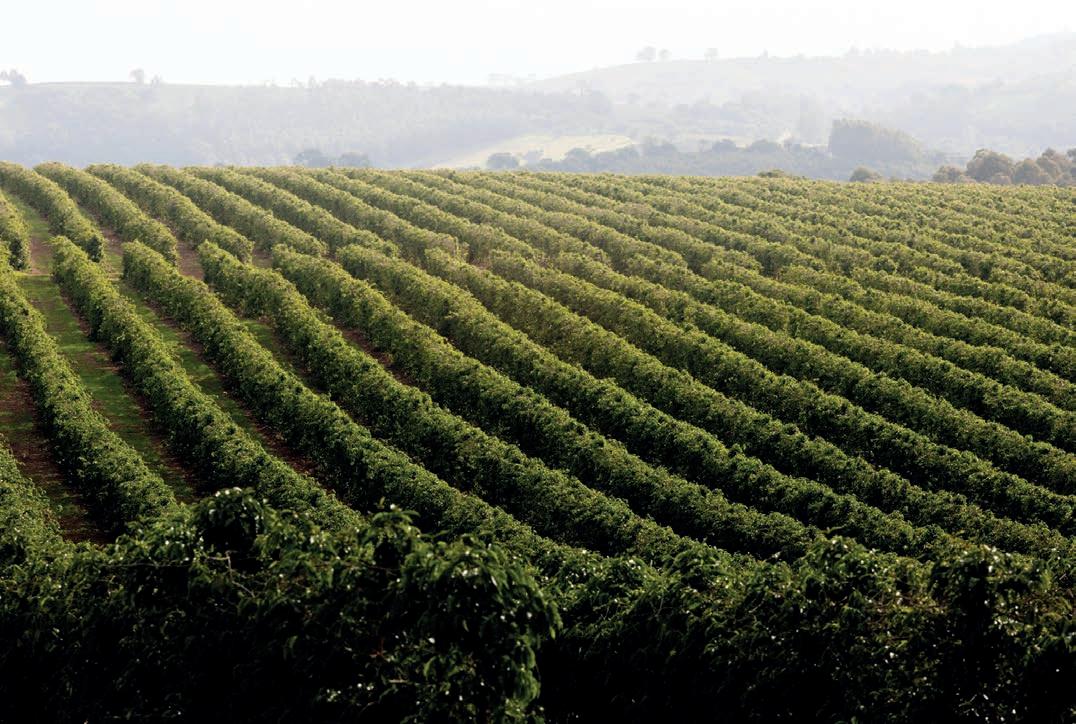
A joint study – published in the Frontiers in Bee Science journal in January 2026 –found that introducing managed colonies of the stingless bee species Scaptotrigona depilis into both organic and conventional landscapes resulted in a staggering 67 per cent increase in co ee yield for co ee branches positioned near the hives.
Complementary results from the same research project also showed that introducing managed Apis mellifera bee colonies can increase co ee productivity by about 16.5 per cent per hectare.
Beyond yield gains, the study also found improvements in co ee beverage quality,
with an average increase of 2.43 points in co ee cup scores (according to Speciality Co ee Association protocol) – potentially translating into higher market value and economic returns for farmers.
Completed during the 2022 season, the study found that managed stingless bees can markedly enhance co ee production, without colonies experiencing measurable detrimental e ects under current labelcompliant neonicotinoid insecticide use –commonly used on co ee crops.
With the ndings o ering practical insights for developing more sustainable co ee production strategies, it begs the question: what role can pollinators play in the future of co ee productivity?
Grounded research
Jenifer Dias Ramos, a biologist and Innovation Incentive Scholarship Holder at the Brazilian Agricultural Research Corporation (EMBRAPA) who contributed to the study, tells Global
Co ee Report (GCR) the ndings highlight pollinator management as “a practical strategy to simultaneously increase productivity, quality, and pro tability while supporting more sustainable co ee production systems”.
Modern co ee practices usually involve the use of neonicotinoid insecticides (“neonics”), such as thiamethoxam, to control key co ee pests such as the co ee leaf miner – a major threat to co ee production – and the Hemileia vastatrix fungus, which causes co ee leaf rust disease.
Prior to the study’s commencement, commercially available thiamethoxambased products were applied via soil drenching in 2021 during the berry expansion stage and according to label recommendations.
e stingless bee colonies were then introduced in the subsequent season in 2022, approximately 10 to 18 days before co ee blooming, to ensure the potential
e ects of insecticide residue on colony strength could be accurately assessed.
With previous studies raising concerns about these insecticides’ potential harmful e ects on pollinators via plant absorption, Scaptotrigona depilis – with its high resilience to management – became a promising alternative pollinator for Brazilian co ee.
“We investigated whether exposure to commonly used neonicotinoid insecticides under eld-realistic conditions could a ect the health of managed stingless bee colonies,” says Ramos. “[We monitored] key indicators of colony health, including brood production, brood mortality, and foraging activity, and found no statistically signi cant negative e ects under labelcompliant use conditions.”
e study found that no signi cant negative e ects were observed on brood production or mortality in colonies located in conventional farms, compared to those in organic farms.
Ramos says the ndings contribute to a better understanding of how pollinator health can be maintained in productive co ee systems – an important foundation for developing more sustainable and resilient agricultural practices.
Accountability across the industry
Ramos says stakeholders across the entire supply chain – from buyers, roasters, and certi cation bodies – can all play a key role in promoting healthy and sustainable pollination by valuing and prioritising co ee produced under pollinatorfriendly practices.
“Such certi cation could include criteria such as habitat conservation, responsible pesticide use, and practices that promote pollinator diversity and health,” says Ramos.
She also notes her work at her company, ABELHAR Scienti c Consulting, supports co ee producers interested in adopting pollinator-friendly production systems, including biodiversity conservation practices, and optimised pollination plans with managed bee supplementation during the owering period.
Ramos notes this type of approach “could help translate scienti c knowledge into practical solutions for more sustainable co ee production”.
By creating market incentives, Ramos says these actions can help make biodiversity conservation economically viable for producers. ese kinds of economic-friendly

incentives are echoed by Dr Ste en Schwarz, Managing Director and Founder of Co ee Consulate.
Schwarz writes in e Co eologist that insects on co ee farms can be considered as “a portfolio of ecosystem services” that could be managed, measured, and monetised indirectly through reduced risk and output quality.
Speaking to GCR, he also notes the need for role models in the industry who can lead the way for pollinator-friendly farming and “get people into the game”.
“For example, if you have 20 per cent more co ee cherries, it is nearly making 20 per cent more income, because you don’t need [an increase] in workers to pick them … that means there’s a sweet spot inside that must be investigated, and we need more intelligent discussion about that,” says Schwarz.
“ e question we have to raise is: how can we nd ways to commercialise that knowledge, so that industries, or startups can do business through consultation, or help to create a working, balanced ecosystem which has value?
“Helping farmers to get there should also be paid for, so we have to create working business models.”
Schwarz also highlights stabilisation of a healthy insect population as an important factor for increasing and stabilising co ee yield, which, in his opinion, is “even more important than anything else”.
What Ramos would like to see in future promotion of sustainable co ee production, is further studies on integrated pest and pollinator management, landscape management, and climate resilience.
“Another important area is investment in monitoring pollinator health and developing best practices for native bee management,” she says.
“Stronger collaboration between science and industry will be essential to scale sustainable solutions.”
But what does this look like in practise?
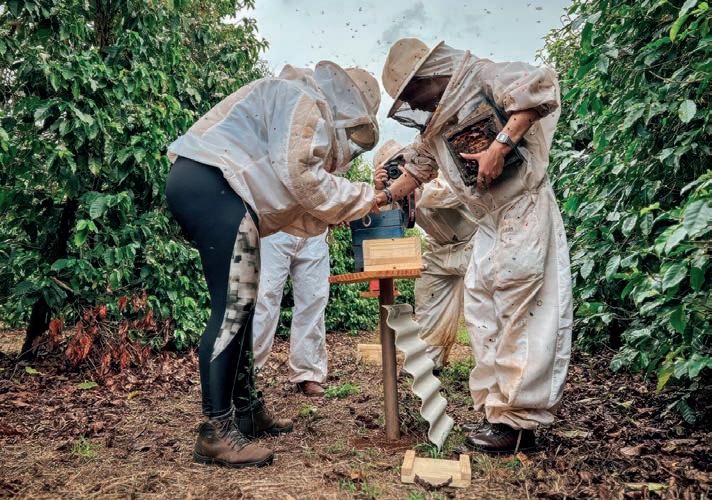
A possible option is the concept of “bee rental”, with producers renting hives to assist with the pollination of crops and encourage a higher yield.
Bee technology companies, such as AgroBee, are already working in the co ee space. e startup – colloquially referred to as the “Uber of Bees” – is focused on connecting producers and beekeepers to promote the increase of quality and quantity of food using ecosystemic bee services.
e company collaborated with global leader Nestlé in 2022 for the Nescafé Colméia project, which saw the introduction of beehives into more than 100 hectares of Brazilian co ee farms.
e Frontiers study suggests bee rental will likely become a routine practice in the Arabica co ee production system in Brazil, but notes more research is required to ensure the coexistence of pest management with the presence of introduced bees in the elds.
“Bee rental” services to encourage a higher yield could become common practice on farms in the future.
Ramos says this potential research could focus on long-term monitoring of insect communities in co ee farms to better understand the role of both managed and wild pollinators in crop productions. She notes it should also include studies evaluating how good agricultural practices, particularly pesticide use and application timing, can reduce risks to bene cial insects.
Another potential outcome is the creation of commercial colony productions of stingless bees, though research in this area is still minimal.
“More research is needed to develop scalable and standardised methods for the commercial production and management of stingless bee colonies, including improving techniques for colony multiplication, transport, and establishment under agricultural conditions, as well as de ning optimal stocking densities for di erent crops,” says Ramos.
“I would also like to see more studies on colony health monitoring, nutritional requirements, and best management practices to ensure colony survival and performance in farming environments.”
Another important area is identifying
pollinator-friendly practices, such as habitat management, preservation of native vegetation, and diversi cation of oral resources within co ee landscapes.
“Together, this research could help develop science-based guidelines that promote both pollinator conservation and sustainable co ee production,” says Ramos.
While the Frontiers study didn’t directly focus on climate, its e ects still echo strongly when discussing the future of sustainable farming.
In a worst-case scenario where pollinators suddenly disappeared from the co ee production cycle, Schwarz says the price of a latte at the café could increase by a quarter at most.
“If you just take it from the from the cost of the green co ee at the farmgate, I think it would easily make a 20 to 25 per cent surplus on the green co ee,” he says.
“If just looking into pollination and not looking into the mentioned side e ects of bioperturbation (the process of soil mixing, churning, or disturbance caused by organisms), I believe they will be even bigger than we can guess.”
With stingless bee colonies potentially giving farmers a direct method to increase co ee yield and generate longterm sustainable pro t, the study suggests this can be invested back into native forest restoration – creating a sustainable lifecycle that bene ts both pollinators and producers.
But pro tability is vital in encouraging farmers to practise good land stewardship through nature-positive approaches – Ramos says research evaluating the economic feasibility of stingless bee pollination services would be essential to support its wider adoption.
As for how this could be pitched to large-scale producers hesitant about the initial expenditure, Ramos says she would emphasise that introducing managed pollinators should be seen “as an investment in productivity and economic resilience, rather than an additional cost”.
“Our research shows that pollination can increase co ee yield by up to 67 per cent at the branch level and about 16.5 per cent at the eld scale, and can also improve beverage quality, increasing market value and farmer income,” says Ramos.
“Beyond the seasonal supplementation of bee colonies during owering, it is also essential to adopt pollinator-friendly farming practices, such as responsible pesticide use, habitat conservation, and the maintenance of oral resources.
“ ese practices can help conserve biodiversity while promoting more sustainable and resilient co ee production systems.
“From a business perspective, pollinator management therefore represents not only a productivity strategy, but also a pathway toward long-term sustainability.”
But big, sweeping changes to co ee production management don’t come easy.
As for potential roadblocks to pollinators within the next decade, Schwarz notes the biggest problem is the increase in pesticide use, as “[producers] think it’s the easy answer.”
“Spraying is obviously the easy answer, but it’s never the right answer, because you can’t ght nature,” says Schwarz.
“If you have [herbicides] like glyphosate, despite the fact that the industry tells you there’s no risk, you do see there are less pollinators, and things are happening and changing,” he says.
“ e more you ght nature and the natural environment, it will ght you back.”
With further research required in the space – particularly focusing on commercial production and management
of stingless bee colonies – this landmark study marks a potential future where co ee and pollinators can work in tandem to not only increase yield and quality for producers, but encourage and support a thriving ecosystem and industry. GCR
Unique wet milling and slurry processing for products with complete aroma profile and exceptional mouthfeel!



Onyx Coffee Lab was named the World’s Best Coffee Shop in 2026. How much has the list changed from its first iteration in 2025?
The United States (US) is the cream of the global café culture crop, at least according to the updated World’s 100 Best Co ee Shops list for 2026.
A er being ranked second in 2025, Onyx Co ee Lab in Rogers, Arkansas, US, has topped the updated rankings, with the café and roastery located in a historic building in the city’s downtown.
It is the only venue to have been named in the top three in both years the list has been published.
Onyx Co ee Lab Creative Director, Niki Weegens, says the continued recognition is the result of long-term and steady commitments done well over time.
“We’ve remained focused on what has always mattered to us: hospitality, quality, transparency, education, and honouring the work of the producers we partner with. is recognition is not the result of a sudden leap, it’s a testament to how our teams keep showing up with consistency, care, and a desire to keep improving year over year,” says Weegens.
“What makes us most proud is that this recognition re ects the work of an incredible team and the broader community that makes co ee possible. Awards like this are meaningful because they shine a light not just on a shop, but on the people behind it.
“Our baristas, roasters, educators, producers, and guests have all shaped what Onyx is. We’re grateful that it a rms our belief that co ee is at its best when it is both excellent and deeply hospitable, and we’re proud to represent the care and collaboration that goes into that every day.”
ere were a further eight US venues named alongside Onyx on the list: Arcane Co ee Estate (New York City, 12th), BlendIn Co ee Club (Houston, 20th), Domestique (Birmingham, 43rd), Prevail Co ee (Montgomery, 66th), Push Pull (Portland, Oregan, 72nd), Savaya Co ee Market (Tucson, 77th), Story and Soil Co ee (Hartford, 86th), and Metric (Chicago, 95th).
Weegens says this growth of US venues on the list represents a specialty co ee
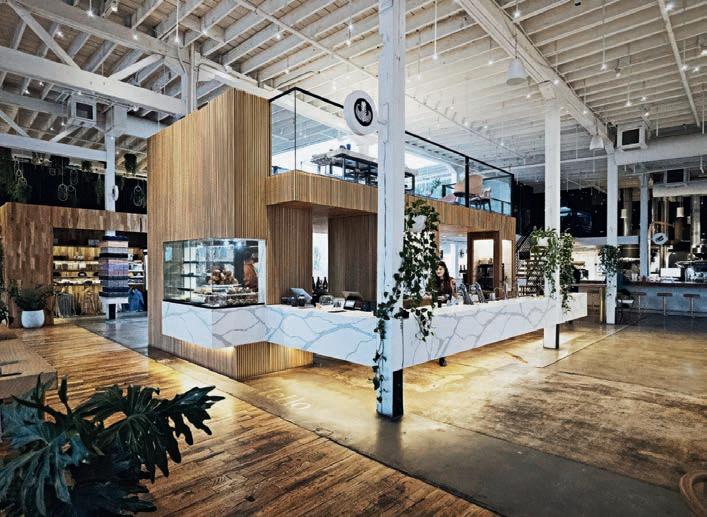
evolution happening all over the country.
“We strive to serve people with the best parts of specialty co ee: a commitment to cra , a spirit of curiosity, respect for producers, and a desire to keep making co ee more transparent and approachable,” she says.
“At its best, specialty co ee in the US is constantly evolving because it values innovation. It also values hospitality and providing broader access. We’ve always wanted Onyx to be a leader in that conversation by consistently pursuing excellence and by creating spaces and experiences that feel truly welcoming.”
Australian cafés once again ranked well in the list, with 2025 winner Toby’s Estate Co ee Roasters ranking h in the updated metrics. e Chippendale location was one of three venues from Sydney ranked in the top 15 – begging the question: is Melbourne still Australia’s leading city for co ee?
Only Co ee Project led the way for Australian venues, ranking one place ahead of Toby’s Estate in fourth position. Beta Co ee was the third Sydney venue on the list, ranking 13th.
Melbourne’s Proud Mary (27th) and Vacation Co ee (100th) were the two entrants from Australia’s traditional co ee capital, while Co ee Anthology (Brisbane, 29th) and Single O (Sydney, 53rd) rounded out Australia’s entrants on the list.
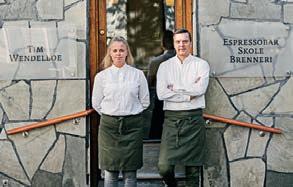
Norway’s Tim Wendelboe ranked three places higher in 2026, being named second.
In 2025, the US (12) and Australia (eight), two of the world’s leading consumer co ee cultures, accounted for 20 per cent of the list, however in 2026 this number dropped to 16.
While this year, nations like New Zealand, Slovenia, Morocco, Indonesia, Kenya, and Uganda went unrepresented a er featuring in 2025.
e steady growth in café culture in South and Central American origin countries has risen in recent years, with the likes of Peru, Honduras, Brazil, El Salvador, and Colombia all well-represented. Of these origin nations, Peru had ve representatives – including Ka Wasi Café Tostaduría in 17th and Monotono Specialty Co ee in 23rd, while El Salvador’s Alquimia Co ee ranked third in 2026.
Overall, the best represented nations in the list were the US (nine), Australia

(seven), Peru ( ve), Spain (four), Honduras (four), and Taiwan (four).
e World’s 100 Best Co ee Shops CEO Cesar Ramirez says the spread of nations included in the 2026 list showcases the global expansion of specialty co ee culture.
“In the end, we are embracing global trends,” says Ramirez.
“Co ee shop culture continues to grow, and this ranking aims to give greater visibility to more co ee shops worldwide.”
ese rankings were produced through a mixed system combining the evaluation of more than 800 professional judges from all continents with public voting. More than 15,000 co ee shops around the world were analysed, with more than 350,000 public votes tallied.
e evaluation criteria applied to the judging recognised co ee quality, barista experience and technique, customer service, innovation capacity, space design and atmosphere, sustainability practices, food and pastry quality, and service consistency.
While the 2027 rankings may feel a world away, Weegens says Onyx wants to continue to prove itself worthy
1 Onyx Coffee Lab, USA
2 Tim Wendelboe, Norway
3 Alquimia Coffee, El Salvador
4 Only Coffee Project, Australia
5 Toby’s Estate Coffee Roasters, Australia
6 Apartment Coffee, Singapore
7 Gota Coffee Experts, Austria
8 Story of Ono, Malaysia
9 Tropicalia Coffee, Colombia
10 Tanat, France
of continuing to pursue progress in specialty co ee.
“At Onyx, the goal isn’t really to defend a title, it’s to stay worthy of the trust people place in us,” she says.
“For us, that means continuing to focus on the fundamentals every single day: caring well for our guests, investing in our team,

sourcing thoughtfully, re ning quality, and staying open to growth.
“Recognition is encouraging, but it can’t become the focus. We want to keep learning, keep listening, and keep pushing ourselves to be better in ways that are meaningful and lasting. If we do that well, the rest will take care of itself.” GCR
Growing your roastery past 15,000 lbs/Month?
Growth adds complexity. Your systems don’t scale with it. More orders, more channels, more moving parts. What breaks isn’t demand, it’s coordination. Production, inventory, orders, and customers don’t stay aligned.
Built specifically for coffee roasters at scale.
Flexnet brings everything into one platform built for coffee roasters. Know what to produce, what it costs, and what’s happening in real time.

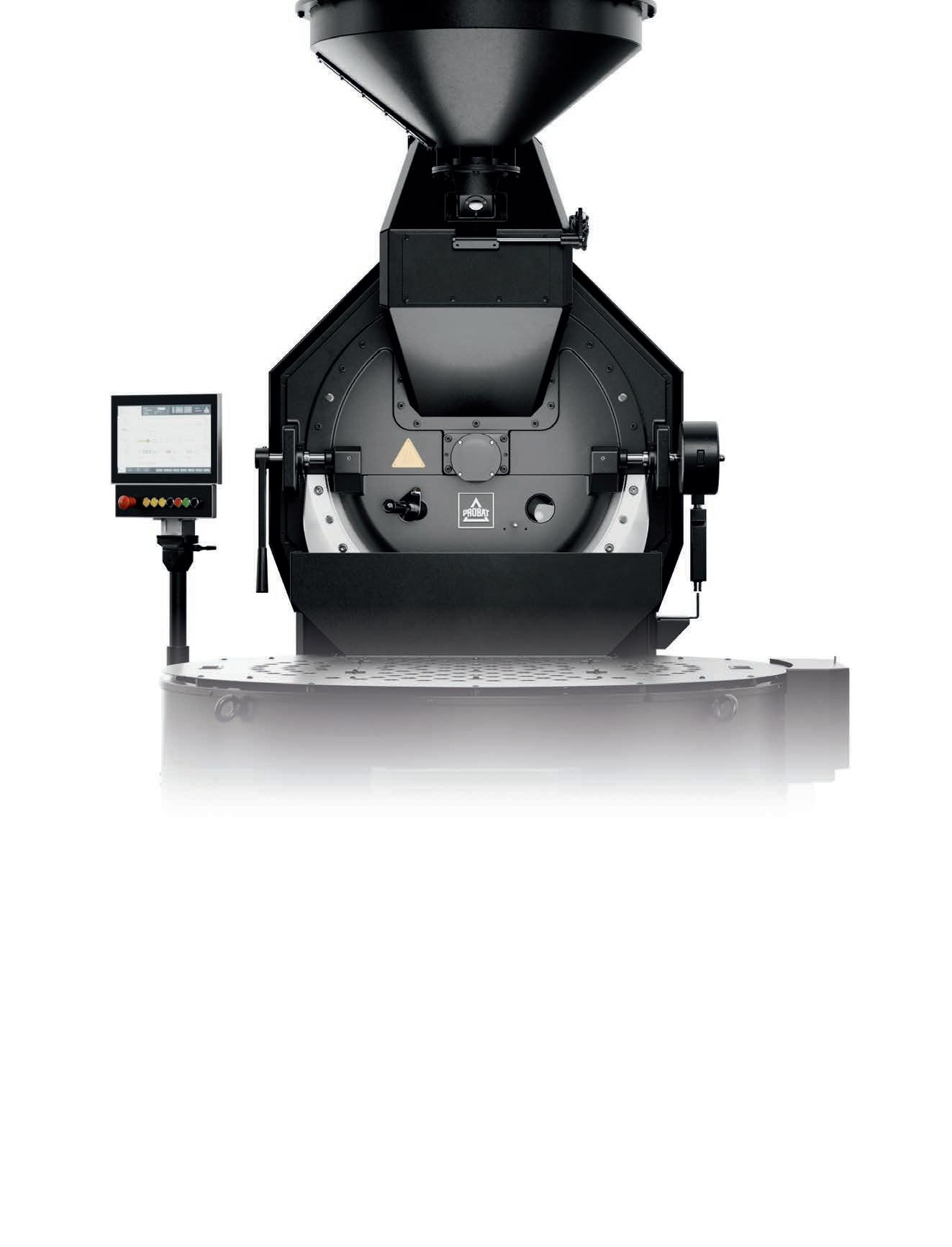
The innovative Cx70 drum roaster combines precision engineering, energy efficiency, and durable design in a compact, highperformance system. Engineered for growing roasteries, this one-bag roaster delivers outstanding value with a highly optimized cost-performance ratio, increased capacity, and low investment risk. Flexible configurations and automation options ensure seamless integration into your workflow for reliable, cost-efficient operation and maximum productivity across its entire lifecycle.
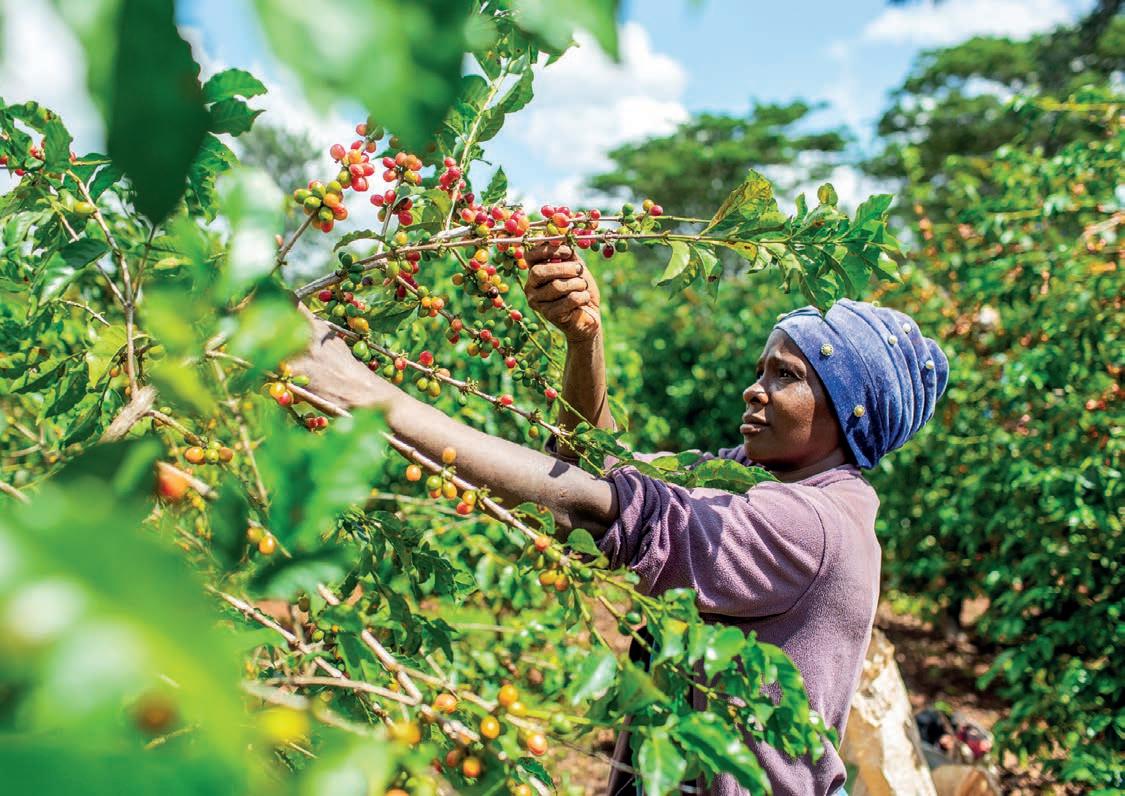
As pressures mount on Kenyan coffee, integrated nutrient management –guided by portable soil testing – is helping farmers make more informed decisions to improve their yields.
KENYAN COFFEE is mainly cultivated by smallholder farmers. Across the country, this occurs in mixed farming systems, where co ee sits alongside other crops and livestock on plots averaging just 0.2 hectares. Farmers can face a complex set of challenges, including limited access to nance, minimal external support, and the pressures of ageing trees and an ageing workforce.
At the same time, Kenya’s co ee industry – which produced 740,000 60kg bags in the 2025/26 harvest – is viewed favourably in the global market.
“What makes Kenya stand out is the market opportunity. Kenyan co ee has a strong global reputation, known for its bright acidity, full body, and distinctive fruit-forward pro les – think blackcurrant and berry notes,” says Krista Maruca, the East Africa Regional Sustainability Manager for global green co ee services group, Neumann Ka ee Gruppe (NKG).
“While national production has generally been declining the last few years, this season saw a modest rebound. High global prices have renewed farmer interest and
investment, supported by two consecutive seasons of favourable weather, leading to improved volumes in several regions.”
With so much untapped potential –especially in western regions – NKG is focused on helping Kenyan co ee farmers over the long-term. It operates in the country through local a liate, Ibero Kenya, which implements one of the company’s global sustainability initiative, NKG Bloom. is article is intended to highlight Ibero Kenya’s work, forming part of a series on regenerative agriculture across the co ee agronomic cycle, as practised by exporters within NKG.
Ibero Kenya itself aims to provide smallholder farmers with a bundle of services that help them operate their farms as pro table businesses while meeting the growing sustainability expectations of international buyers.
“In Kenya, sustainability has become less of a long-term ambition and more of an immediate necessity, as farmers contend with increasingly erratic rainfall, rising temperatures, and shi ing pest and disease pressures,” Maruca says.
ese changes are directly a ecting
productivity, she adds, pushing farmers to adopt practices, like soil conservation and water management, to adapt to changing conditions and build resilience on their farms.
“Adoption has also accelerated as sustainability is becoming more market driven. Global buyers are increasingly expecting these practices as a condition for sourcing, especially in specialty and certi ed markets,” Maruca says.
As this article goes to press in April 2026, integrated nutrient management is front of mind. When farmers have detailed and accurate insights during these early phases in the agronomic cycle, it can have a signi cant bearing on the next harvest.
Maruca says an unusual feature of Kenyan co ee farming is that it’s one of the few countries that can produce two co ee harvests each year: a main crop and a smaller “ y” crop, with the y crop beginning in many areas around March.
But climate change is disrupting that rhythm. Rains are arriving earlier and more erratically, which means owering and harvest periods are shi ing and sometimes stretching out across longer windows.
“Farmers are already feeling the impact of seasonal changes: hotter dry seasons make water harder to access, while heavier rains during wet periods increase erosion and the risk of washing away inputs like fertiliser,” Maruca says.
“At the same time, pest and disease pressure is rising, which can drive farmers to use more agrochemicals – adding costs and increasing the risk of exceeding residue limits in export markets.” is is where integrated nutrient management enters the picture. For Ibero Kenya, this starts with a simple question: what does the soil actually need?
Samuel Kahenya, Farmer Service Unit Manager Ibero Kenya, notes one of the biggest challenges in Kenya is that most smallholder farmers have never had their soils tested. At the same time, 60 to 70 per cent of Kenyan soils are highly acidic – “which means nutrients aren’t always absorbed e ciently”.
“By testing soils rst, we can recommend a balanced approach that looks at overall soil health as well as nutrient levels, and develop a plan that combines organic sources like manure or compost, targeted inorganic fertilisers, and practices like mulching or cover crops,” he says.
“ e goal is to help farmers get more
value from the inputs they already buy, while gradually rebuilding the long-term health of their soils.”
Power of portable scanners
is forms just part of Ibero Kenya’s work conducted through 29 employed sta who work directly with co ee farmers and cooperatives, reaching around 80,000 smallholder farmers nationwide through a network of partnered farmer cooperative societies.
Working through cooperatives allows Ibero Kenya to reach farmers at scale while strengthening local institutions that sustainably provide services to members.
Participating farmers and cooperatives receive a bundle of support services, based on their needs. is includes assistance with sustainability certi cation – such as farm assessments, continuous improvement planning, and support for external audits – as well as agronomic training provided by extension o cers embedded within cooperatives.
Ibero Kenya also o ers technical assistance on co ee processing and manages a grant pool that cooperatives can access to nance infrastructure improvements.
Among the tens of thousands of farmers
Ibero Kenya works with, most have never had their soil tested before. Traditionally, farmers would apply a standardised NPK (nitrogen, phosphorus, potassium) fertiliser based on a ordability, but when margins are already thin, spending money on nutrients the soil doesn’t need can pose a major risk.
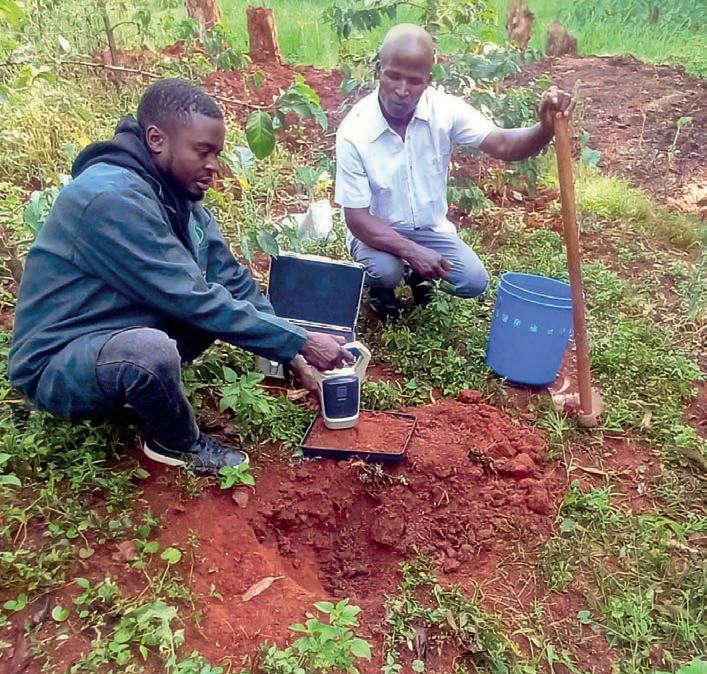
To reach scale, it has partnered with AgroCares to use portable soil scanners that can analyse soil on-site and provide instant results.
According to Kahenya, these devices use near-infrared spectroscopy, which measures how light re ects o the soil to estimate properties like nutrient levels, organic matter, and pH.
Instead of waiting weeks for lab results, he says farmers can immediately see a simple readout and talk through what it means for their farm.
“When we do this right before the planting or fertiliser season, it can signi cantly in uence what farmers decide to purchase and apply,” Kahenya says.
“Plant nutrition is one of the biggest constraints to productivity for co ee farmers in Kenya. Many farmers harvest around two kilograms of cherry per tree, when well-managed trees can produce 10 kilograms or more.”
Field sta conduct the soil tests in the o season, so farmers can prepare for the next round of applications.
Data from soil scanning allows Ibero Kenya to work with farmers to develop nutrient management plans tailored to their soils.
An example of this is in western Kenya, where NKG’s Ibero Kenya has a partnership with JDE Peet’s – one of the world’s leading pure-play co ee companies – to support farmers through the Gusii Co ee Farmers Cooperative Union. For this, 14 agronomists have been conducting soil tests in the months leading up to the next growing season, with eld o cers walking through results with the farmers on-site, and using the insights from testing to inform the overall training plan for farmers in the region.
“What’s powerful is showing farmers that improving soil health doesn’t always mean buying more inputs – sometimes it means using what’s already available on the farm more e ectively,” Kahenya says.
“Fertiliser costs for smallholders have also risen signi cantly since 2021 global fertiliser price spikes, making e ciency even more critical. Of course, improving fertiliser use e ciency also has real impacts
for the environment – reducing dependence on external inputs and protecting critical water sources from runo .”
Taking this a step further, Ibero Kenya is exploring how nutrient e ciency can be improved not just on-farm, but throughout the wider co ee value chain
More speci cally, it has identi ed waste upcycling opportunities at the wet-mill level, tting neatly with this focus on integrated nutrient management.
Kahenya points to Kenya’s western highlands – a region with strong production potential that faces challenges including soil degradation, erosion, and long-standing underinvestment.
Ibero Kenya, partnered with JDE Peet’s through its NKG Bloom program, is focusing on improving how cooperatives manage co ee processing waste while also strengthening soil health among its farmer members.
Wet mills can generate large volumes of co ee pulp and wastewater during processing, which are typically stored in lagoons, which can pose environmental
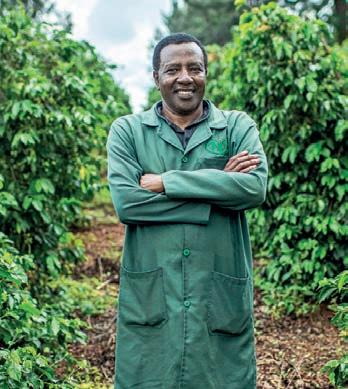
Kenya’s coffee industry – which produced 740,000 60kg bags in the 2025/26 harvest –is viewed favourably in the global market.
risks, or dried for use as mulch.
But according to Ibero Kenya, this “underutilises the material’s value”.
“We’re talking about tons of organic waste being generated at each cooperative during the harvest season. If not managed properly, it can become an environmental hazard. But it also represents a major opportunity,” Kahenya says.
“ at opportunity lies in low-cost, scalable waste upcycling solutions. e partnership is supporting cooperatives in western Kenya to explore ways of converting co ee pulp into higher-value
organic inputs for farmers to use locally.
“Approaches we’re evaluating include vermicomposting, which uses worms to accelerate decomposition, and black soldier y systems, which break down organic waste while producing nutrient-rich byproducts.” ese approaches can support integrated nutrient management by increasing the availability of locally produced organic fertilisers, which in turn improve soil structure, moisture retention, and longterm productivity.
With all the other work Ibero Kenya conducts, this complements ongoing training at the farm level to promote the e ective use of manure and compost.
“Importantly, we’re not taking a onesize- ts-all approach. We’re testing di erent models to understand what works best in each context, operationally and economically, so that these solutions can be sustained by the cooperatives themselves,” Kahenya says.
“With relatively modest investment, such approaches could allow under-resourced co ee regions like Kisii and Nyamira to ‘leapfrog’ toward more sustainable production systems.” GCR
When Ibero Kenya and JDE Peet’s began working with the Gusii Co ee Farmers Cooperative Union – a regional cooperative umbrella organisation representing co ee farmers in western Kenya – in 2022, the partnership shared a view of the opportunity in the region
Western Kenya is recognised as a region with an untapped potential for co ee, but where long-standing underinvestment, declining productivity, and limited access to agronomic services had constrained farmer productivity and incomes.
e ‘Strategic Partnership for Green Co ee Sourcing in Western Kenya’ – part of the JDE Peet’s Common Grounds Farmer Programme – was built on the principle that long term sustainability depends on strong commercial foundations. Farmers were placed at the centre of the programme, with a focus on good agricultural practices, integrated nutrient management, and cooperative strengthening – all critical to deliver tangible improvements in productivity, income, and resilience. Since 2022, the partnership has reached more than 50,000 smallholders with practical agronomic training
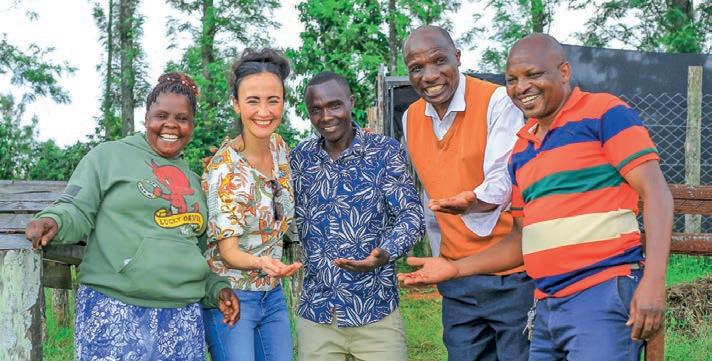
and consistent guidance, including on integrated nutrient management. Equipped with the right knowledge, and accelerated by strong price signals from the market, Ibero Kenya says that farmers have signi cantly increased production, with volumes from the Gusii Union rising by 28.9 per cent by the end of 2025, despite the average co ee plot size of just 0.12 hectares per farmer.
As the JDE Peet’s-Ibero Kenya partnership enters its next phase, the focus is expanding
beyond the farms to selected wet mills. e objective is to ensure that rising volumes are matched by improvements in processing quality, operational e ciency, and environmental management –including through innovations such as co ee pulp upcycling.
is integrated approach re ects a shared ambition: to support co ee farmers from the western region of Kenya to participate competitively and sustainably in global co ee markets.
Cimbali Group and Mazzer have unveiled their new long-term partnership to the world, but what’s next in the Italian espresso leaders’ playbook?
AFULLY INTEGRATED co ee ecosystem, where grinders and machines work seamlessly together”. It’s a concept that has been o -discussed through the modern history of espresso. Now, according to Cimbali Group Managing Director Frédéric il, it’s a notion within reach.
il described his hopes for that ecosystem upon the launch of the new partnership between two of the industry’s most recognised names – Cimbali Group and Mazzer – that has been cultivated through a desire to elevate co ee through greater control and enhanced avour. Both companies are steeped in Italian history, with LaCimbali rst founded in Milan in 1912, and Mazzer founded further east near Venice in 1948.
ey have since become world-leaders in espresso machines and grinders, respectively, and il says now is the right time for the pair to combine forces to herald a new era for both.
“ e partnership was driven by a clear objective: to bring together grinding and extraction – the two de ning moments of
espresso preparation – and elevate them to a new level of precision and in-cup quality,” he says.
“Cimbali Group and Mazzer share a deep-rooted identity built on engineering excellence, innovation, and a commitment to quality. As two historic Italian, familyowned companies, both organisations place people at the centre of their approach, investing in skills, expertise, and long-term know-how.
“ is shared heritage is a true expression of Made in Italy – where cra smanship, industrial excellence, and a culture of design come together to create value that is recognised worldwide.”
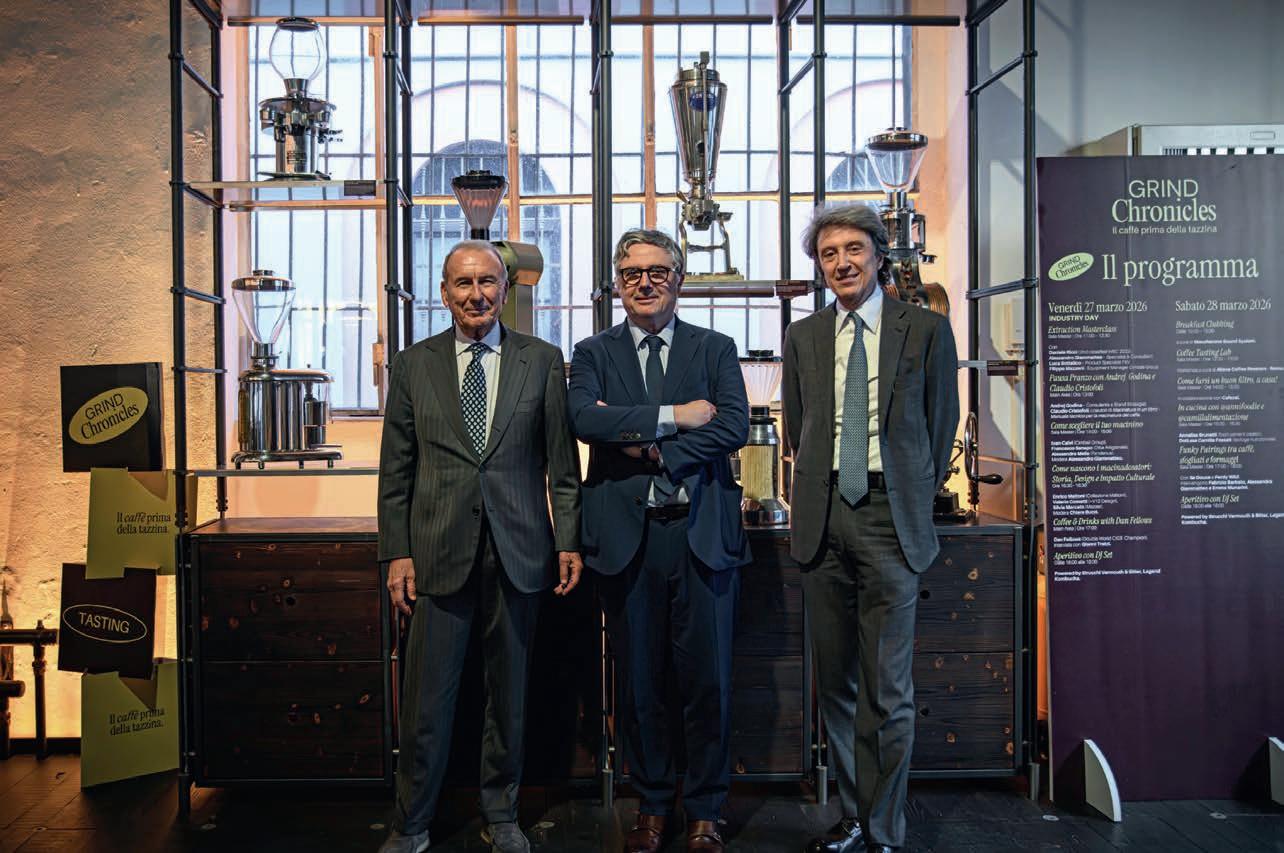
e rst step in this long-term strategic partnership has already been unveiled, with the Mazzer x Slayer grinder presented at Milan’s Grind Chronicles event – the rst ever event to be dedicated solely to the world of grinding – in late March 2026 before an o cial worldwide launch at London Co ee Festival, held between 14 and 17 May 2026.
e Mazzer x Slayer combines grind-byweight technology with an integrated load
cell and 69 mm conical burrs designed to deliver precise and consistent dosing, all while replicating the Slayer experience.
“By combining Cimbali Group’s leadership in espresso machine technology with Mazzer’s mastery in grinding which includes its iconic hopper, the partnership creates a more complete and coherent system. It also re ects a strong cultural alignment in terms of design, manufacturing, and technical rigour,” continues il.
“Together, we are closing the gap between grinder and machine, enabling a higher degree of integration, control, and consistency – ultimately setting a new benchmark for espresso performance and delivering greater value to the entire industry.”
From bean to cup
Cimbali Group’s ‘from bean to cup’ ethos, which centres on the delivery of quality traditional Italian espresso through advanced and user-friendly machines, is re ected in this partnership.
“ at ethos re ects the understanding
that grinding and extraction are not separate steps, but interconnected processes that must be developed in harmony,” says il.
“ is principle has guided product development from the outset, in uencing how our technologies are designed to interact as part of a single system rather than as standalone components. e result is a more intuitive work ow and a more consistent outcome, regardless of operating environment.
“By integrating grinder and espresso machine, we enable operators to have a greater control over every stage of co ee preparation.”
e trickle-down e ect of this ethos, which guides every decision at Cimbali Group, means the bene ts of the Mazzer x Slayer – and the future collaborations that happen through this partnership – can be felt by operators of all sizes.
e result is an integrated architecture that ensures consistency in the cup, precise control of parameters, and the ability to maintain the same quality – from a single point of sale to large international chains with high volumes – through intuitive work ows and a more consistent outcome, regardless of the operating environment,” says il.
“For single-shop operators, it simpli es the interaction between grinder and machine, giving baristas greater control, consistency, and con dence without added complexity. For chains and multi-site operators, the integrated systems enable a higher degree of standardisation, ensuring consistent performance across locations while also improving work ow e ciency, reducing training requirements and streamlining service.
“Ultimately, whether operating a single café or a global chain, this approach delivers the same core advantages: precision, reliability and in-cup quality.”
Whether it be through menu expansion, greater desire for speed, or a higher bar for quality, demands on baristas and cafés have, arguably, never been more complex. While co ee is still the main character in venues around the world, it is no longer limited to traditional espresso-based drinks. Now, espresso also plays a critical role as an ingredient in a new generation of hot and cold signature beverages, only making quality more critical.
il says this more demanding and volatile industry requires further integrated

solutions to not only ensure customer satisfaction, but ease of operation.
“ e co ee industry has reached a point where the shi towards greater integration, and system-level thinking no longer optional, but essential. Operators are increasingly looking for complete solutions, that ensure, consistency, e ciency, and control across the entire work ow,” says il.
“At the same time, the market is becoming more competitive and consolidated, with large, highly diversi ed groups expanding
their global presence. In this environment, di erentiation is no longer de ned by scale alone, but by identity, expertise, and the ability to deliver coherent, highquality solutions.”
Now, with the partnership announced and the Mazzer x Slayer grinder to be shown to the world in London this May, one eye of this partnership is rmly xed on tomorrow, and how Cimbali Group and Mazzer continue to combine to create new solutions to co ee industry problems.
il has issued something of a ‘watch this space’ regarding future collaborations, with more Cimbali Group brands set to launch products alongside Mazzer before further evolution.
“Following the unveiling of the Mazzer x Slayer grinder, the partnership will see the expansion of the product range across LaCimbali and Faema. Over time, the partnership will evolve towards connected systems, where grinder-dosers and machines communicate to optimise performance in real time,” he says.
“ e collaboration is structured as a longterm partnership, re ecting our shared commitment to continuous development, while respecting the identity and independence of both companies.
“Over time, we believe this will enable us to deliver more advanced, integrated solutions that enhance both performance and user experience.”
For now, though, il says the joint power of these heritage Italian brands (whose respective presidents both still carry the company name: Maurizio Cimbali and Giovanni Mazzer) represents a new chapter for both, helping to build upon their separate in uences on global co ee culture.
“ ere is something deeply meaningful and genuinely exciting about bringing together two historic Italian companies with such a strong legacy in the world of espresso,” says il.
“Both Cimbali Group and Mazzer have played a role in shaping not only the technology but also the culture of espresso, both in Italy and globally. e partnership builds on that shared history, rooted in decade of expertise, passion and dedication.
“Looking ahead, the partnership will continue to evolve, moving towards fully connected ecosystems, where machines and grinders communicate seamlessly to further enhance performance and consistency.” GCR
For more information, visit cimbaligroup.com

Coffee holds significant potential to become a circular economy if it can be redirected from landfill. Image: zentrady_ i3ell/stock.adobe.com.
Coffee is one of the world’s largest organic waste greenhouse gas contributors, but a variety of new solutions for the use of coffee waste are gathering traction across the globe.
PICTURE THIS. A customer walks into a café and orders a co ee –whether that be a latte, at white, cortado, espresso, or something else.
e transaction is completed; the barista makes the co ee, pours it, and disposes of the co ee puck. What happens next?
Of course, the co ee is drunk – and hopefully enjoyed – but the co ee grounds are then typically forgotten about and sent to land ll.
e life cycle of co ee doesn’t stop at the cup. In fact, the world’s most popular beverage has been doing signi cant harm to the environment from being sent to land ll for years, but that’s changing. Around the world, businesses and researchers are conceptualising and building new ways to responsibly dispose of spent co ee waste and turning what has traditionally been a linear pathway into a regenerative circular economy.
What’s the issue?
e disposal of co ee waste ties into a larger solution of irresponsible disposal of food waste which, according to a 2013 report by United Nations agency the Food
and Agriculture Organization, accounts for up to eight per cent of the world’s greenhouse gases.
With the world’s population drinking more than two billion cups of co ee per day, it is estimated there is about 18 million tonnes of wet spent co ee grounds produced as a byproduct of the brew. It’s a problem that is bigger than any one region, consumer, or origin.
As organic waste, co ee produces two greenhouse gases when broken down anaerobically – like when sent to land ll. Methane and carbon dioxide.
Methan is considered the more long-term damaging proposition of the two. It has a shorter lifespan than carbon dioxide but is incredibly potent at trapping heat – up to 80 to 85 times more potent over a 20-year period, according to the United Nations Environment Program. Since the Industrial Revolution, methane is thought to be responsible for about 30 per cent of global warming.
e oils and other compounds like ca eine, tannins, and chlorogenic acid contained within the co ee can also break down into acidic liquids known as
leachate, which has the potential to seep into soil and groundwater.
One example of a fresh use case for spent co ee is a startup coming out of Poland called EcoBean.
Co-funded by the European Union, the business was set up in 2018 by Co-Founders Kacper Kossowski and Marcin Koziorowski.
Kossowski is the former CEO of Julius Meinl Poland, while Koziorowski, by his own admission, has extensive experience “working at the intersection of business and academia”, where he connected researchers to market, particularly in the chemical and biotech industry.
EcoBean asserts up to 70 per cent of co ee’s potential is discarded a er brewing, while the co ee industry is the h largest emitter of carbon dioxide of any food.
To create a more circular economy, it is extracting key chemicals from the spent waste before repurposing them to be used in a variety of industries.
“ ere is huge potential in spent co ee grounds – more than 100 di erent types of chemicals are present in them,” says Koziorowski, who, along with being CoFounder, is EcoBean’s CEO.
“Realistically, we can currently focus on around 20, and right now we’re extracting ve with nothing le behind, so the process is fully circular.
“From the beginning, our goal was to break the material into fractions where we could nd alternatives already existing on the market and achieve the highest possible margin. We rst identi ed applications in food, because co ee is already a food product, and then in beauty and personal care.
“At the moment, we can extract ve ingredients: co ee oil, waxes, antioxidants, bres, and sugars. Of course, it depends on where the spent co ee grounds come from – which process and which point in the value chain.”
Koziorowski says EcoBean divides the market into two main streams: industrial waste, from production sites like instant co ee or cold brew manufacturers, where large volumes are produced in one place, and the more dispersed sources such as cafés, petrol stations, o ces, and roasteries.
“For now, we are focused entirely on industrial waste,” he says.
While EcoBean’s modelling has found the global annual total of used co ee grounds to exceed 12 million tonnes, not all of it
“There is huge potential in spent coffee grounds – more than 100 different types of chemicals are present in them.”
Marcin Koziorowski ECOBEAN CO-FOUNDER AND CEO
can be utilised in this process.
Whether it be through di culties acquiring through location, quality, or otherwise, it is likely inevitable that some co ee will have to be discarded.
Despite this, Koziorowski believes more than one third of spent co ee can be found through industrial waste channels.
“ ere is potential for around 12 million tonnes of spent co ee grounds annually, and about 4.5 million tonnes are relatively easy to access because they’re concentrated in industrial sites,” he says.
“We actually started with the more dispersed sources, collecting from large co ee chains, petrol stations, and o ces, but two years ago we decided to pivot.”
Although EcoBean’s mission of diverting co ee from land ll is not new, it’s representative of a new style
of environmentally minded businesses looking to nd uses for the commodity beyond fertiliser and biofuel.
Koziorowski says while the high nitrogen, phosphorus, and potassium make-up does make co ee a great fertiliser, there are more e ective ways to extract the true value of spent co ee.
“Some companies divert co ee grounds into fertiliser production, but that’s still low-value utilisation. In Europe, another common approach is using them as fuel in biomass boilers to generate energy for roasting. However, the value of energy recovery is only around €170 to €250 (US$196 to $288) per tonne,” he says.
“In our case, depending on the quality of the input, we can generate between €3500 to €9000 (US$4090 to $10,381) per tonne. at’s a massive di erence.
“Our vision has evolved signi cantly over the past seven or eight years. Early on, our rst product was co ee briquettes, which we launched in Portugal at a petrol station network. But a er a few months – and with some help from COVID – we went back to the drawing board and asked what more we could extract from spent co ee grounds.”
EcoBean is now partnering with one of the largest equipment suppliers in the co ee industry, which provides full production lines for instant co ee, cold brew, and roasting.
“ ere’s increasing demand from their customers for solutions like ours, and

we’re working to integrate our technology into their portfolio,” Koziorowski says.
A er years of trials and tests, he believes EcoBean is now in a strong position to present a striking proposition to the global co ee market where industrial co ee partners instead of generating waste, gain additional revenue stream.
At the start of 2026, it launched its rst product to market using its antioxidant extract – a ca einated drink made with recycled ca eine named ‘Krast’ – created in collaboration with Rebread, Cyrkl, and the University of Warsaw, available at Smak Natury.
e beverage has also been created using surplus bread and is being marketed as a healthy probiotic and prebiotic soda.
With that rst product launch chalked up as a success, Koziorowski says the next step is to make EcoBean’s technology more accessible to more people.
“We’re currently building a modular demo installation. e system is designed to be scalable – you can start with one extraction process, like co ee oil, and later add others such as bre, sugar, or antioxidants depending on demand. It’s a exible, plug-and-play approach,” he says.
“Within the next 12 to 18 months, we
expect to be ready to start selling these modular units to the industry. e idea is to o er a plug-and-play solution that can be easily integrated into existing facilities, with some adjustments depending on the type of waste.”
He says there is already strong interest in these modular solutions.
“We’re already in discussions with most of the top 10 co ee companies globally.
Even working with just one or two of these players – each with more than 20 facilities

worldwide – would be enough to scale the business signi cantly.
“But our ambition is bigger: to become the industry standard within ve years.”
A global goal
EcoBean is far from the only innovative potential solution to the co ee waste problem. Interesting and scalable concepts are popping up all over the world.
In Australia, a social enterprise called Reground travels to cafés around Sydney and Melbourne to collect their spent co ee grounds, while RMIT University researchers aided in the creation of a concrete mixed with biochar made from spent co ee grounds, which it says makes the concrete 30 per cent stronger. is concrete has already been used in large-scale infrastructure projects in the south-eastern state of Victoria.
In the United States, clothing brand Elemental has just launched its ‘Co ee read’ line, where co ee grounds are infused into recycled bres to create clothes, while Sustainable Resources Group creates fuel and grilling pellets, organic dry lubricants, and soil amendments.
It’s even happening at origin. In Indonesia,
Bell Living Lab pressure-forms tiles cra ed from agricultural waste to create furniture, wallets, bags, and other accessories.
While one of Indonesia’s most well-known specialty co ee roasters, Tanamera Co ee, has previously partnered with Sensatia Botanicals in the creation of body scrubs containing co ee grounds in 2023.
“Collaborating with Sensatia Botanicals has brought forth an idea that combines the utilisation of waste co ee grounds as one of the main ingredients in creating the Co ee Body Scrub,” Tanamera CEO Dini Aryani Criddle said at the time.
“By making use of the byproduct from our co ee production process, this product represents an extraordinary sustainability project.”
Finally, in China, researchers at Shenyang University have transformed co ee waste into high-performance, biodegradable insulation material.
“Co ee waste is produced on a massive scale worldwide, yet most of it ends up in land lls or is incinerated,” says the study’s corresponding author.
“Our work shows that this abundant waste stream can be upcycled into a
“This waste already exists, and it’s happening at scale. Now is the time to turn it into something with value.”
Marcin Koziorowski ECOBEAN
CO-FOUNDER AND CEO
high-value material that performs as well as commercial insulation products while being far more sustainable.
“ is approach not only improves material performance but also contributes to a circular economy. By turning waste into a functional product, we can reduce environmental burdens while creating new opportunities for sustainable materials.”
is particular research was the created a new thermal insulation material, a
key component in reducing energy use in buildings, transportation, and food systems, through the creation of a biochar with a porous architecture.
e result was a composite with a thermal conductivity of 0.04W per meter per Kelvin, a level comparable to commercial expanded polystyrene created with fossil fuels.
Materials with thermal conductivity below 0.07W per meter per Kelvin are generally considered e ective insulators.
Koziorowski says examples like EcoBean showcase not only the potential to utilise co ee waste in a way to limit its numbers in land ll, but to treat it as a value add into the ongoing push for a more sustainable world and a circular economy.
“We think co ee can be a great example of circularity. Consumers are already aware that spent co ee grounds can be reused – in gardening or even personal care – so there’s a growing understanding that it’s not really waste.
“ e key message is simple: this waste already exists, and it’s happening at scale. Now is the time to turn it into something with value.”

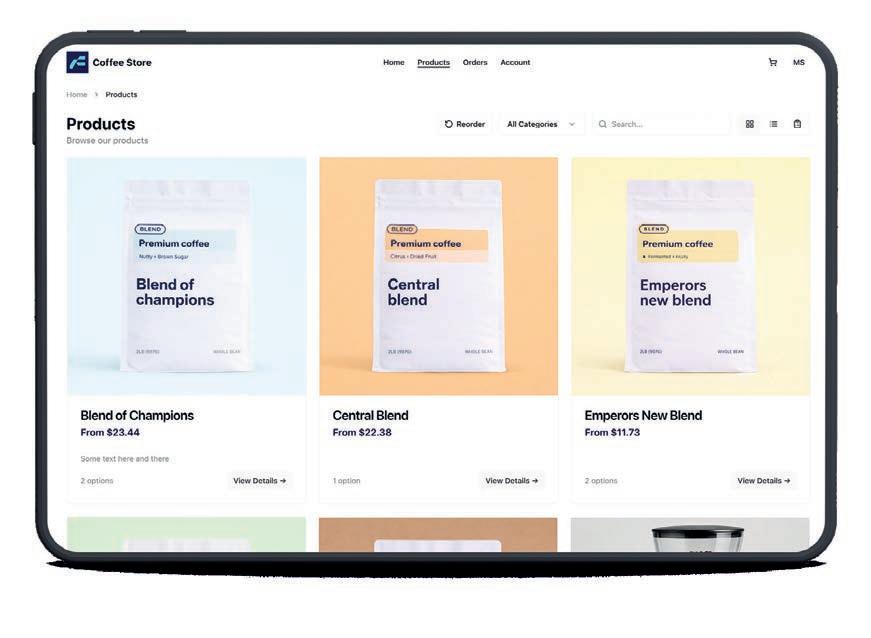
Software provider Flexnet is bridging the gap between customer demand and the production floor with its comprehensive technology, designed with roasters in mind.
ANY ROASTER will be familiar with the multitude of systems involved in running a viable business, from accounting and customer orders, to inbound business and day-to-day operational coordination.
For Flexnet Founder and CEO Caleb Sexton, the so ware began with the many practical problems that come with running a roastery. Solving those problems over time led to what he describes as a one-stopshop so ware platform tailored speci cally for the co ee industry.
Flexnet’s comprehensive list of features is divided into ve key areas so roasters can optimise and automate crucial parts of their operations: customer relationship management (CRM), sales, production, reporting, and storefront – with services ranging from lead tracking, automatic reminders, and order progression to inventory and data metrics. e so ware can also integrate with existing platforms such as Shopify and QuickBooks.
“We consistently hear from customers during our demonstrations that we are years ahead of even the nearest competitor,”
Sexton says. “We have an onboarding queue because [the so ware] does everything you need.”
So how did Flexnet reach this point within just 12 months?
A roaster’s heart
e company’s beginnings can be traced back to Perth, Australia. A er spending more than 15 years at specialty roaster
Five Senses Co ee – rst packing, roasting, and delivering – Sexton’s interest in IT led him to eventually become the Chief Information O cer working on the company’s systems and creating what would become the foundations of Flexnet.
“I spent years at Five Senses building systems to solve real roastery problems. When the opportunity came, I took those foundations and built Flexnet, which Five Senses continues to use to this day,” he says.
Sexton’s goal was to continue to tailor the product speci cally for the co ee market, something he believes sets the platform apart from its larger competition.
“We’re lucky that we have an amazing piece of so ware that is not only battle-
tested over 18 years of use, but built on those years of experience in co ee roasteries,” he says.
“With Flexnet, we know what’s important. We know that the number of kilos or pounds per week is important, because that’s what you’re making your commercial decisions on,” he says.
e so ware can track wholesale customer order patterns and alert the roaster if a café forgets to order. It also looks at all incoming orders from websites, phone calls, and emails and helps create a “roast plan”, so the roasting team knows exactly what’s required to ful l orders on any given day.
“[We help roastery sta with questions such as] ‘How much money do your customers owe you? Did your customers forget to order? Did they forget to order certain things?’,” Sexton says.
“ at makes a huge di erence, because our clients can start to have conversations with their customers that help them, rather than having customers calling on a Saturday and saying, ‘Hey, sorry, I’ve run out of co ee.’”
Outlining what a typical day looks like for a roaster using the platform, Sexton says it can tell roasters everything they need to know, from what their lead pipeline value is, to the number of bags needed for a particular blend, or even display estimated margins on their co ee products.
He says this gives roasters more time to focus on the work that matters, instead of chasing information across spreadsheets, or relying on manual updates from other team members.
“As an example, we help with the sales research side of things using AI, so teams spend less time searching for information and more time acting on it,” Sexton says.
Although Flexnet’s roots began in Australia, Sexton made the bold move to establish the company in the North American market, as he says the area has more roasters than anywhere else in the world. A er 12 months of further development on the platform, Flexnet was introduced to the market at the 2025 Specialty Co ee Expo in Houston, Texas.
Just 12 months since this debut, Flexnet is now servicing customers across the globe, including Singapore, South Africa, and the United Kingdom (UK), with its customers acquired mainly through the power of word-of-mouth and referrals.
During that period, Sexton has discovered new things about catering to these varied customers.
“ ere have been some key learnings in the di erences between roasters in the US, Europe, Australia, and Asia – all are very di erent, all want very di erent things,” says Sexton.
“ ere’s about an 80 per cent overlap, but there’s the 20 per cent minutiae.”
Sexton says Flexnet’s niche is catering to that 20 per cent.
“In [the co ee] business, people won’t buy your product unless you have their needs covered, and the 20 per cent is really hard to factor in,” he says.
“ e most common word we hear in our customer feedback is ‘comprehensive’, to which people say ‘Oh, wow, you really do have something for everything.’”
“Anyone can process orders – I could do that on [platforms such as] Shopify or WooCommerce. But can you translate that to a roasting list, or convert a Roaster’s Choice subscription to exactly what their production department needs to see? Probably not.”
One of Flexnet’s newest features is
Storefront, currently in beta, giving co ee roasters a better way to take B2B customer orders while supporting the customerspeci c pricing and product rules that are common in co ee.
“None of the current platforms, including accounting systems, really understand how co ee roasters sell their co ee to customers, so we decided to build Storefront to give roasters a real solution to that,” says Sexton.
All new features are created with that original goal in mind: servicing the demands of the co ee industry, no matter the location. Flexnet’s pay-as-you-grow pricing model scales with roasted volume, giving roasters a pricing structure that grows alongside their business.
“I genuinely believe that we have, hands down, the best so ware for co ee roasters that exists – no one has our breadth of scope,” Sexton says.
As roasting technology becomes more advanced, both in machinery and in the so ware around it, Sexton says access to good tools should not come at an excessive cost.
He believes the next major development
in this space is better access to useful information, including through AI, which Flexnet uses to help save clients time and free them up to focus on more valuable work.
“Focus on calling your customers, visiting them, or writing handwritten notes and putting them in every box. Do more of the things your customers actually value,” he says.
“For us, it always comes back to value. Flexnet is built to help roasters spend more time on the work that matters most.”
As for the immediate future, Sexton is focused on growth, both in terms of Flexnet’s customer base and continued product improvements.
“We’re going to continue to roll out new things that really help roasters,” he says.
“I personally love when my customers get to go on holiday, because they can stop being the linchpin of their business and empower their sta . If I can keep doing that, I’ll be really happy.” GCR
For more information on Flexnet, visit flexnet.co
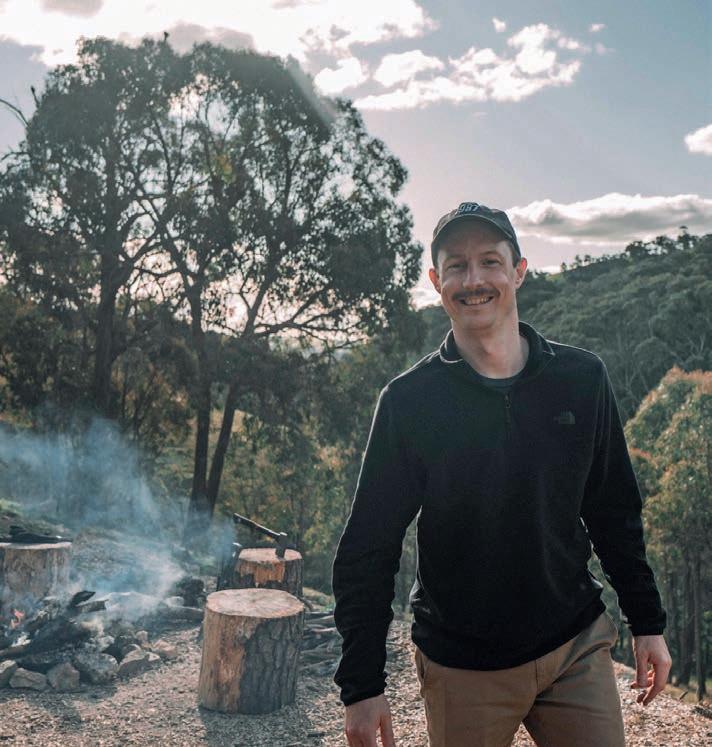
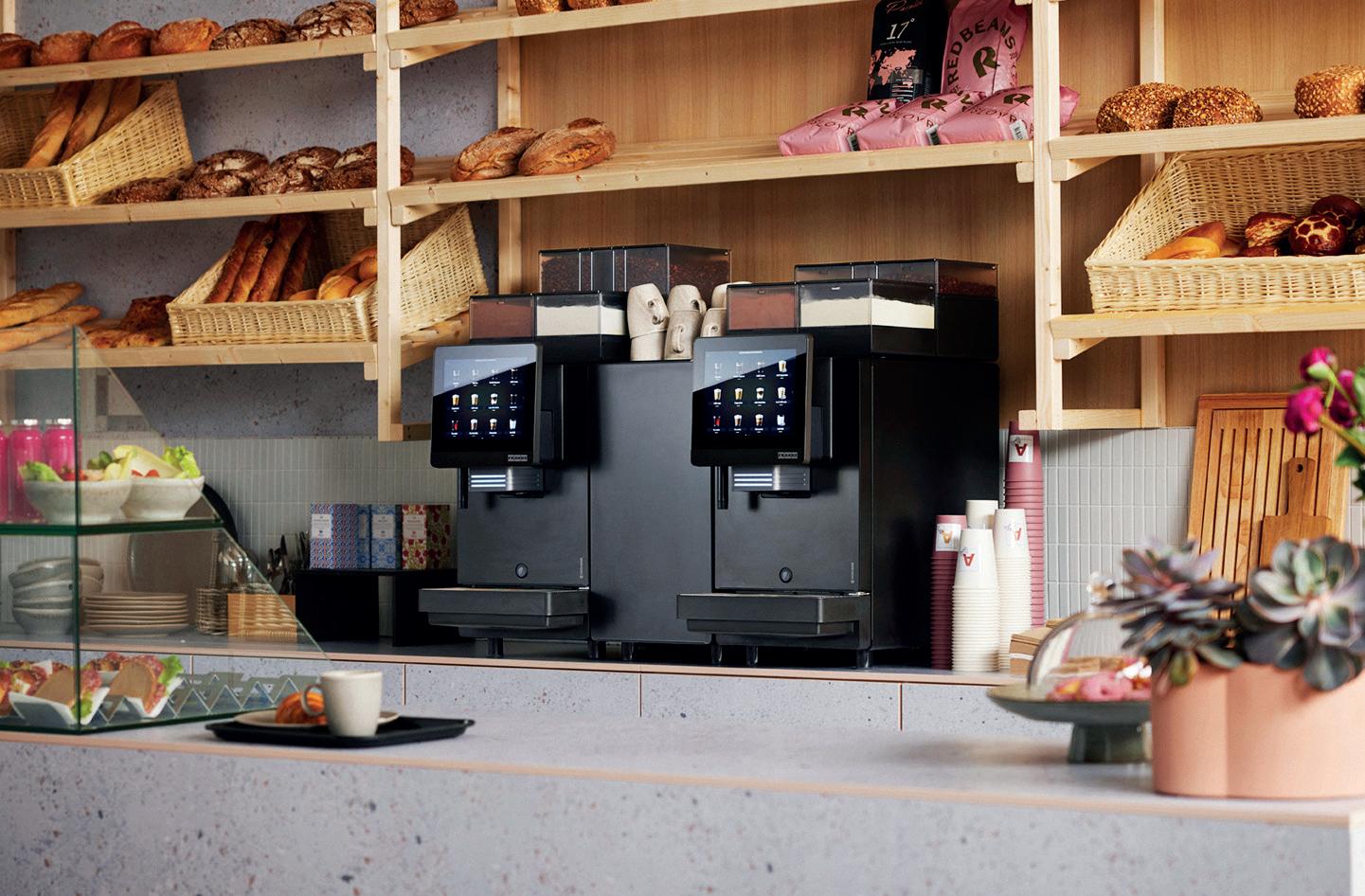
How digital intelligence helps coffee businesses maintain consistent quality at scale.
DELIVERING CONSISTENTLY highquality co ee has always been the foundation of a successful co ee business.
Yet, as the industry continues to expand beyond traditional cafés and into new spaces like hotels, bakeries, convenience retail, and quick service environments, maintaining that quality across increasingly complex operations is becoming a major challenge for operators.
Rising labour costs, higher sta turnover, and ever-expanding beverage menus driven by consumer demand for variety and customisation are increasing challenges the modern hospitality operator continues to face.
At the same time, co ee is becoming a central revenue driver in many hospitality and retail formats, raising expectations in not only quality, but also in speed of service.
Amid these pressures, automation and digital technology are becoming the clearest answer to these problems, and important tools for co ee businesses. Connectivity, intelligence, and automated preparation processes are helping operators streamline work ows, improve consistency, and manage growing operational complexity.
However, the adoption of automation in co ee preparation remains closely
tied to one fundamental question: can technology truly match the quality and experience consumers associate with barista cra smanship?
Closing the quality gap
For co ee businesses, the tension that comes from the continued close alignment presents a clear challenge. Automation o ers undeniable advantages in terms of e ciency, consistency, and operational control, yet if it is perceived as reducing beverage quality, it risks undermining the entire customer experience.
is is where the latest generation of co ee technology is beginning to reshape the conversation.
Over the past decade, automated co ee systems have advanced signi cantly. Improvements in grinding precision, brewing control, and milk preparation have helped close the gap between manual and automated preparation methods. At the same time, new concepts are combining the visual presence of traditional espresso preparation together with the consistency and e ciency of automated co ee systems.
Franke Co ee Systems has addressed this challenge with its Mytico line, developed to combine barista-inspired design with automated beverage preparation.
By integrating precision grinding, controlled brewing, and advanced milk technologies within a system designed for high-volume hospitality environments, Mytico can enable operators to deliver a co ee experience that maintains the visual theatre of traditional espresso preparation while supporting operational consistency.
Alongside these technical developments, digital technologies are introducing new ways for operators to manage quality and performance. Modern co ee solutions are increasingly built around so ware architecture, connectivity and operational data, allowing businesses to monitor machine eets, standardise beverage parameters and optimise work ows across multiple locations.
For operators running high-volume environments or multi-site networks, these capabilities are becoming increasingly valuable.
Digital systems enable beverage recipes and preparation parameters to be de ned centrally and deployed reliably across locations, helping ensure that drinks are produced consistently regardless of location or sta experience.
Connected systems can also provide insights about machine performance, beverage volumes and usage patterns,
supporting proactive maintenance and more e cient operations.
CEO of Franke Co ee Systems, Marco Zancolò, says this integration of engineering and digital intelligence represents an important evolution in professional co ee equipment.
“Co ee quality remains the foundation of any successful co ee programme,” he says.
“As operations become more complex, maintaining that quality consistently requires more than mechanical precision alone.
Digital technologies allow operators to protect beverage standards while simplifying work ows for sta .”
Becoming intelligent systems
For equipment manufacturers like Franke, this shi is gradually rede ning the role of the co ee machine itself.
Rather than functioning solely as a preparation tool, the machine increasingly becomes part of a broader operational ecosystem that combines brewing technology, intuitive user guidance and digital connectivity, according to Franke Co ee Systems Senior Product Marketing Manager, Mirza Bilalic.
“Operators today need systems that deliver both quality and simplicity,” he says.
“Digital operating systems provide structured user interfaces that guide beverage preparation, while enabling recipe management and operational insights, helping businesses maintain consistency even in busy environments.”
As co ee operations become more complex, equipment manufacturers are being expected to go beyond mechanical performance and deliver systems that combine precision engineering with digital intelligence.
Franke Co ee Systems has taken this
approach with its New A Line platform, designed to integrate modular brewing technology, connectivity and intuitive operation into a single system.
e platform integrates FrankeOS, a digital operating system with an intuitive, image-led interface that guides users through beverage preparation while supporting operators in managing resources e ciently.
Solutions like FrankeConnect, a built-in connectivity, provide remote visibility across machine eets, while iQFlow ensures consistent extraction for highest in-cup quality across varying service conditions. For operators managing multiple locations or high-volume environments, the company says these capabilities are designed to provide greater control over beverage quality while reducing operational complexity and training requirements.
By combining brewing performance with digital intelligence, the New A Line works to illustrate how modern co ee systems are evolving to support quality, consistency and operational insight across increasingly demanding co ee operations.
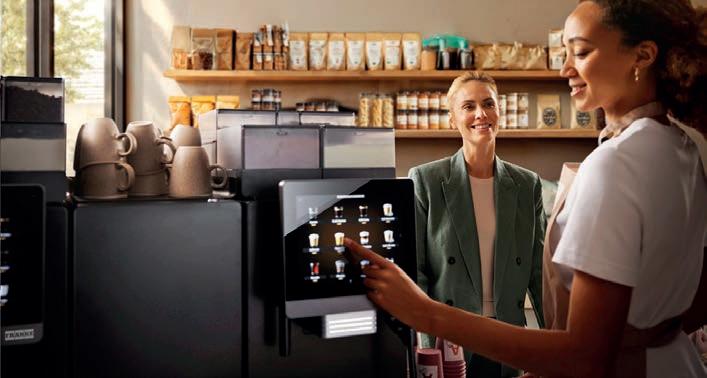
An uncompromising experience
e broader co ee sector is continuing to evolve rapidly as new formats, consumer behaviours and business models reshape the market.
Drive-thru concepts are gaining traction in several markets as customers seek greater convenience, while hospitality and retail environments are investing more heavily in co ee programmes and customer experience, using high-quality beverages and modern co ee concepts to attract and retain customers.
Within this environment, maintaining consistent beverage quality across locations, sta teams and service periods looks to be becoming one of the de ning operational challenges for co ee operators.
Automation and digital intelligence is unlikely to replace the cra smanship that de nes great co ee. However, when combined with precision engineering and thoughtful system design, Franke believes they can provide powerful tools to help businesses maintain quality while managing increasingly sophisticated operations.
As automation becomes more widespread across the industry, the de ning challenge will not simply be e ciency. e real test will be whether technology can support the cra smanship, quality and consistency that customers expect.
For co ee businesses navigating rising operational demands and competition, intelligent systems are becoming essential not only for operational performance, but also for safeguarding the quality that ultimately de nes the co ee experience. GCR
For more information, visit coffee.franke.com

Flavourtech says growing demand for products that taste closer to freshly brewed beverages, and retain more of their natural compounds, is occurring across ready-todrink products. Image: Sujid/Adobe Stock.
As ready-to-drink and instant coffee brands face greater consumer expectations, Flavourtech is helping companies to extract more than just flavour into their final products.
IN TODAY’S EVOLVING beverage landscape, consumer expectations appear to be shi ing rapidly towards products with higher quality, enhanced avour pro les, and tangible health bene ts.
Across ready-to-drink (RTD) co ee, premium iced teas, and even instant co ee formats, the industry is reporting growing demand for products that not only taste closer to freshly brewed beverages but also retain more of their natural compounds – such as the antioxidants and bioactive elements associated with co ee and tea.
ey’re the kind of trends that the Flavourtech team are tapping into.
As a leading manufacturer of food and beverage solutions for aroma recovery, extraction and evaporation, the Australianbased company says consumers are increasingly educated and willing to pay a premium for products that deliver on these attributes, valuing authenticity, freshness, and functional bene ts.
However, consistently achieving this level of quality at scale remains a challenge, particularly when it comes to preserving delicate aroma compounds – o en referred to as “top notes” – which play a critical role in de ning the true character and perceived quality of both co ee and tea.
e company’s Integrated Extraction System (IES) is designed to address this challenge through a modular, fully automated, and inline process that is speci cally engineered to capture, protect, and reintegrate natural aromas while e ciently producing high-quality extracts.
Central to this innovation is the combination of advanced slurry preparation, precise aroma recovery systems, and innovative extraction technologies.
The crucial beginning
At the crucial start of the IES lies Module 1, which includes a Slurry Preparation Module. is initial stage is critical in setting the foundation for the entire process.
Unlike conventional dry grinding methods, the Slurry Preparation Module incorporates wet milling technology. By milling roasted co ee beans or tea leaves in the presence of water, the system works to minimise heat generation and oxidation – two key factors that can degrade volatile aroma compounds.
According to Flavourtech, this gentle approach ensures that the intrinsic avour pro le of the raw material is preserved from the very beginning.
“Wet milling retains the raw material’s natural top notes – those highly volatile and desirable compounds responsible for the fresh, aromatic character of co ee and tea,” says Klaas Leenders, Flavourtech’s Central European Sales Manager. “ is is unique to the Flavourtech IES process.”
capture with the Spinning Cone Column
Following preparation, the slurry is introduced into Module 2 comprising Flavourtech’s renowned Spinning Cone Column (SCC), a key di erentiator in the IES.
“ e design of the SCC features alternating spinning and stationary cones creating thin liquid lms and high surface area, which enable rapid mass transfer,” says Leenders.
“ is results in extremely short residence times, which are critical for preserving delicate aroma compounds that would otherwise be lost or degraded under prolonged heat exposure.”
e recovered co ee or tea aroma is condensed and stored separately, while simultaneously brewing the high-quality extract. is natural and concentrated aroma is then added back to the product at a later stage creating a beverage with a premium natural avour pro le.
e integration Module 1 and 2 allows for the immediate capture of highly volatile “top notes” directly from the raw material, says Flavourtech, ensuring the full aromatic pro le is preserved before any degradation by later thermal processing.
“Unlike capturing aroma from a processed liquid extract, which o en loses its brightest characteristics to heat and oxidation, aroma recovery from a slurry maintains the authentic, ‘nature-identical’ essence of the co ee or tea,” says Leenders.
“It is more intense than that recovered from a liquid extract and is generously weighted in distinctive font-end aroma compounds that many beverages lack. is ability to isolate the most delicate aromatics is precisely why global avour companies prioritise slurry-based processing by the SCC, thus delivering a truly natural and complex sensory experience.”
High-temperature extraction
Module 3 of the IES introduces a hightemperature hydrolysis extraction system, utilising Flavourtech’s Rotating Disc Column (RDC) technology. is stage is optional and is designed speci cally for the e cient extraction of soluble solids, particularly in instant co ee production.
e RDC operates at elevated temperatures to maximise yield and extract soluble solids. However, because the delicate aroma compounds have already been removed and protected by the SCC, this stage can operate under more aggressive conditions without risking avour degradation.
e rotating discs, or ba es, within the column enhance mixing ensuring uniform extraction and high e ciency, as well as reduced extraction times of 20 minutes when compared to hours in other processes.
e result is a robust extract with optimal yield, forming the backbone of instant co ee products.
“We have to move with the times,” says Leenders. “As technology advances, so too must the processes – and the RDC represents a signi cant step forward in instant co ee manufacturing. It’s encouraging to see co ee companies around the world embracing this evolution.”
Ensuring texture and stability
Module 4 focuses on extract clari cation, a critical step in enhancing clarity, stability, and overall mouthfeel of the nal product.
“We’re seeing a shi in consumer preference toward a smoother, more velvety body in co ee extracts – closely replicating the experience of barista-made co ees from cafés,” says Leenders.
“ e IES is widely recognised within the industry for its ability to consistently produce extracts with exceptional body and texture.”
According to Flavourtech, its customers – food and beverage manufacturers – are increasingly leveraging this enhanced body and mouthfeel to di erentiate their RTD beverages, delivering a richer, more premium drinking experience that stands out on the shelf.
In instant co ee production, the improved mouthfeel can translate to a fuller cup pro le once reconstituted, narrowing the gap between soluble and freshly brewed co ee. e company says this added depth and texture not only elevates sensory quality but supports premium positioning, allowing brands to meet consumer
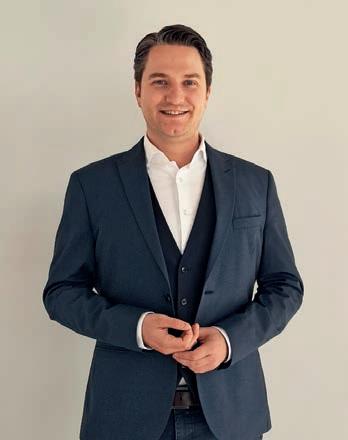
expectations and command higher value in the market.
Gentle concentration with the Centritherm evaporator
Module 4 utilises the Centritherm evaporator for the concentration of co ee and tea extracts. e technology operates under vacuum and at low temperatures, enabling gentle evaporation of water while preserving heat-sensitive compounds.
“ e Centritherm evaporator’s thin- lm design ensures extremely short residence times, one second actually,” says Leenders. “ is is a signi cant advantage over traditional evaporators, where prolonged exposure to heat can lead to avour degradation, colour changes, destruction of bioactives and the formation of undesirable compounds that may impact negatively in the overall taste.”
One of the most powerful features of the IES is its ability to reintegrate the captured
aroma back into the nal product.
A er the extract has been produced and concentrated, the stored aroma from the SCC is carefully added back into the product stream. is can occur prior to packaging for RTD beverages or before spray or freeze drying for instant co ee powders.
“By restoring the natural top notes that de ne the sensory experience, the IES delivers products that closely replicate the aroma and avour of freshly brewed co ee or tea,” says Leenders.
Beyond its individual components, the IES system is designed as a fully integrated and automated process. Each module operates seamlessly in series, ensuring consistent product quality and reducing the need for manual intervention.
“ is inline con guration not only improves e ciency but also minimises product handling, reducing the risk of contamination and variability. For manufacturers, this translates into lower operational costs, higher throughput, and greater control over product quality,” says Leenders.
Flavourtech says its IES represents a signi cant advancement in the production of RTD and instant co ee and tea products. By combining innovative technologies such as wet milling, the Spinning Cone Column, the Rotating Disc Column, and the Centritherm evaporator, it delivers a process that Flavourtech says is both e cient and produces beverages of uncompromising quality. GCR
For more information on Flavourtech, visit flavourtech.com
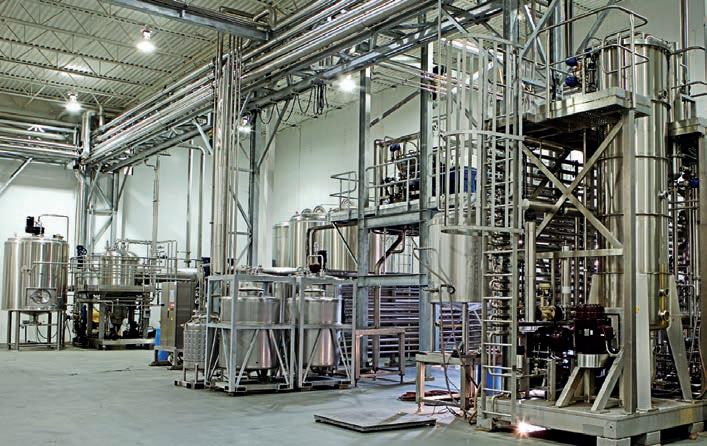
With a renowned telemetry platform now integrated into Egro’s fully automatic range, large-scale coffee operators can remotely manage machines and turn real-time data into more efficient operations.
ASUDDEN SPIKE in summer heat across the Nordics isn’t typically something co ee companies lose sleep over. But for one operator running thousands of fully automatic machines, an unusually hot and humid season began to a ect product performance in real time, impacting service and pro tability.
Adjusting the recipe was the only solution, but doing so quickly, consistently, and across an entire network was the ultimate challenge.
Without connectivity, the x would have been slow and costly, according to Augusto Morales Meléndrez, Global Director of Strategic Marketing at Ali Group Co ee Division, which includes well-known brands like Rancilio, Egro, and Crem, among others.
“ is would have required sending technicians to thousands of locations –extremely costly, especially in markets where wages are signi cantly higher. Instead, the client tested the update on a small number of machines, scaled gradually, and rolled it out across the network in a matter of days.”
Welbilt’s KitchenConnect platform was the solution to this high-stakes problem – and an example of how Internet of ings (IoT) connectivity is impacting the economics of co ee service at scale.
Now, that capability is being brought into the Egro MoDe and Egro Next, with both fully automatic models integrating KitchenConnect as part of the wider Ali Group and Welbilt ecosystem.
Meléndrez says it marks a signi cant step forward for the brand, aligning its fully automatic range with a platform already proven across thousands of machines globally (including 15,000-plus machines within the Ali Group Co ee Division).
“To scale a co ee business today, you need to automate more and make faster, data-driven decisions,” he says. “Fully automatic machines and connectivity make that possible.
“Ultimately, data is critical. Understanding how machines perform,
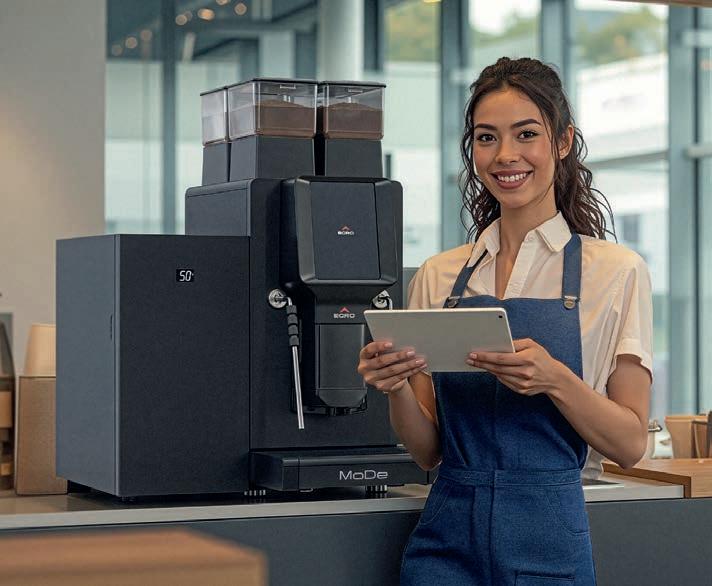
how stores operate, and where e ciencies can be gained is key – especially in a world increasingly shaped by AI.”
Meléndrez can think of many high-pro le hospitality chains that have invested in Egro MoDe and Egro Next machines.
Reliability, performance, and automation are the main bene ts of this co ee machine technology – but time and again, the brew quality stands out.
“ ese are subjective factors, but consistently, when we speak to customers – even highly technical teams like those at some of the world’s largest co ee chains –they highlight our brewing mechanism. It’s not new, but it’s been continuously re ned,” he says.
“Replicating traditional, manual espresso quality in an automatic format is not easy. Our system uses a thermally heated metallic group head, delivering consistency and performance. at’s one of our key unique selling points.”
Now, with the KitchenConnect
integration, large co ee companies with Egro MoDe and Egro Next machines can access a premier cloud-based IoT solution to gather and analyse all the valuable data generated by a single co ee machine or an entire eet.
In essence, it brings together reporting, asset management, menu control, quality monitoring, and service support into a dashboard with widgets, maps and graphs.
It also enables real-time monitoring of machine status, consumption, performance, and usage peaks via intuitive dashboards. Plus, operators can manage entire eets with a few clicks, switching from list to map view, and access detailed reports on dispensing, errors, and consumption trends on a weekly, monthly, or annual basis.
Ariel Vidal, Head of Product at Welbilt KitchenConnect, believes integrating Egro’s fully automatic machines into the KitchenConnect ecosystem creates “a powerful synergy” for operators.
“KitchenConnect focuses not just on
data collection but on actionable insights. While many platforms o er telemetry, KitchenConnect gathers data across diverse equipment types, surfaces decision-ready analytics, and integrates seamlessly into multi-brand eets,” he says.
“Egro’s fully automatic systems are designed for consistency, reliability, and ease of use; exactly the attributes that bene t most from connected insights. KitchenConnect extends this by enabling operators to remotely monitor performance, understand cleaning and usage patterns, and optimise eet-wide operations.
“ e combination results in smoother day-to-day operations and a more consistent, scalable co ee program.”
As expected, operators bene t from insights – number of drinks, product mix, peak hour output – that are considered standard, but essential, for large co ee companies today.
“What we’re increasingly focused on, however, is not just quantity, but quality,” Meléndrez says. “We’re working on monitoring parameters like temperature, extraction time, and drink consistency. Some of this is already in place, with more in development.”
With telemetry, operators appreciate many features, but one of the more basic – bi-directional functionality – is key, meaning they can monitor machines remotely, as well as control them. e Nordic case exempli es this, representing “a single use case that e ectively paid for the system for years” by minimising downtime, says Meléndrez.
“In other cases, in large countries like Australia, technicians can o en travel long distances – sometimes hours – only to nd a minor issue that could have been resolved remotely, or to discover they don’t have the required part,” Meléndrez says.
“With connected machines, technicians can receive noti cations in real time, diagnose issues in advance, review machine history, and even guide sta remotely. is saves time, fuel, and also labour costs, and ultimately reduces downtime for the customer.”
Remote diagnostics can also anticipate potential issues and accelerate technical interventions for a er-sales and service teams, enabling a more proactive approach to maintenance.
“While remote diagnostics aren’t unique to us, what sets us apart is the broader
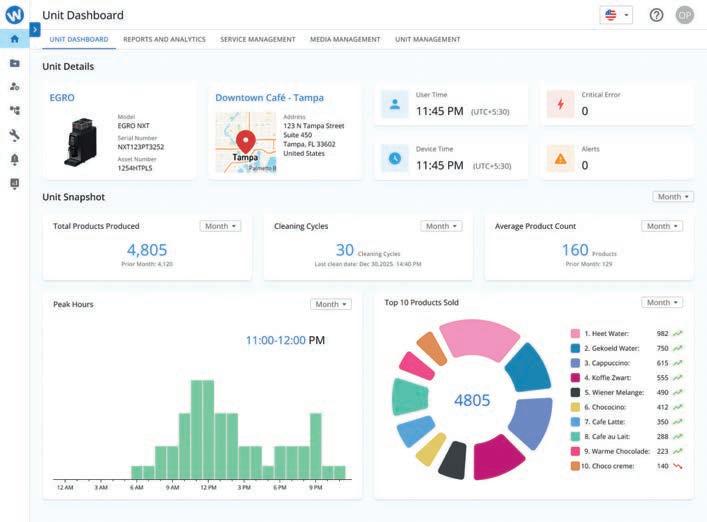
ecosystem and the experience we bring from working with global clients across the group,” says Meléndrez.
e value of telemetry doesn’t stop at servicing either. It also gives operators far greater visibility and control over their entire network.
Designed for exible integration, KitchenConnect is built on the cloud with scalable APIs. at means co ee chains –already operating with legacy infrastructure – can still bring data into their own systems with KitchenConnect. Taking it a step further, their co ee machine data can then be linked with business intelligence work ows, providing teams with real-time insights, and creating e ciency gains.
Meléndrez says there’s scope for operators to create multiple permission layers – from shop managers to regional managers to super users – to customise what each person sees.
“For instance, one user might receive an email alert when a cleaning cycle is due, while another gets a weekly performance report across multiple sites,” he says, noting it can provide visibility on issues taking longer than expected to be resolved.
And at the consumer interface, hospitality companies can use KitchenConnect to push multimedia content, such as screensavers and menu icons, in seconds – eliminating manual interventions or on-site visits.
“ is ensures Egro machines are constantly up to date, equipped with the latest features, refreshed content, and menus tailored to each venue and brand,” Meléndrez adds.
He also notes that companies are treating data security with more vigilance, something the Welbilt team has prioritised in KitchenConnect.
According to Welbilt, the platform is based on an enterprise-grade cloud infrastructure “that meets the highest standards of data security”.
It is designed to ensure information integrity, con dentiality, and availability, in line with industry best practices. Advanced IoT security features include secure device authentication, rmware integrity checks, and continuous protection against emerging threats.
“Why does one café outperform another by ve per cent? O en, it comes down to operations. With rising rent and labour costs, success depends on running highly e cient, well-optimised businesses,” Meléndrez says.
“ is is commercially sensitive information, and is why secure, wellmanaged data – supported by the right infrastructure, protocols, and platforms – is so important.”
As for the future of telemetry, Vidal believes it will be shaped by AI, which will help platforms predict issues before they occur, optimise usage patterns, and guide more e cient work ows.
“In addition, aggregated insights from connected eets will increasingly in uence engineering decisions, allowing manufacturers to design future machines based on real-world performance, user behaviour, and service trends,” he says.
“Connectivity will evolve from an operational aid into a key driver of smarter, more operator-focused equipment design.” GCR
For more information, visit egrocoffee.com/en/
THE LATEST INTERNATIONAL COFFEE INFORMATION, DELIVERED TO YOUR DOOR
Global Coffee Report is the leading business magazine covering the international coffee industry. In‑depth features explore on‑the‑ground developments at origin, coffee pricing issues, technology updates, research breakthroughs, and much more.

gcrmag.com/subscribe
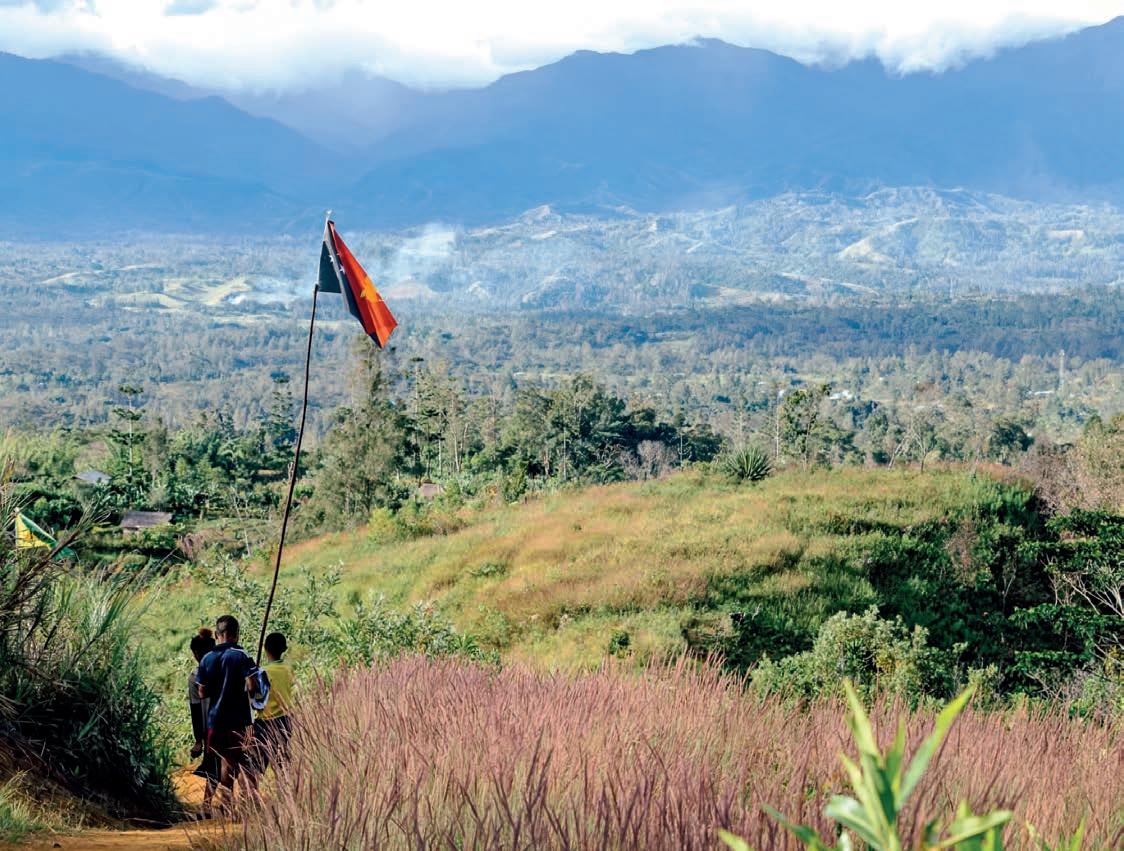
In Papua New Guinea, coffee is a lifeline powered by millions of smallholder farmers whose family-run plots sustain the country’s economy and its communities.
SHORTLY BEFORE Papua New Guinea (PNG) gained independence from Australia in 1975, Wakpi Keu was introduced to co ee and advised that if he planted and tended to his crop, it would alter his family’s future. Little did he know this would span generations.
“He was told ‘your son will use this co ee to go to school and university’,” says Emma Wakpi, his granddaughter, who today runs Jiwaka Co ee, a social enterprise that works with 904 PNG farmers from 11 villages to purchase, process, and export specialty Arabica.
“ e administrators at the time saw the people in the village needed something that would create cash for them, because the country was moving away from a barter system to more cash-based economy. ey looked at what could work, and there was co ee.
“My grandfather planted the co ee, got money from that, and my father became a civil engineer through co ee. He started his own construction company, and through that, was able to a ord a good education for me and my siblings.”
Stories like the Wakpi family can be found all over PNG, where around 2.5 million people grow co ee. In a country of around 10 million people, that’s one in four people growing co ee – mainly on family-run, smallholder lots up to ve hectares – with the crop considered a powerful currency.
Much of PNG society revolves around the co ee season, with picking, selling and processing taking place from March to May, leading to a festive period in June and July.
“Many treat co ee as their ATM. Co ee is the cash crop,” says Wakpi tells Global Co ee Report. “If they’re in need, they go out, they pick the co ee, bring it back, get the cash that they need, and go take their loved ones to the hospital or pay for school fees etc.
“But that’s something we are trying to shi the mindset around, we want more people to be treating co ee as more of a business.”
ese smallholder farmers dominate the PNG co ee landscape (89 per cent), followed by blockholders (eight per cent), and plantation owners (three per cent).
Wakpi’s home province, Jiwaka, is considered one of the major producing regions, with 14 per cent of PNG’s co ee grown there.
According to o cial data, the Eastern Highlands produces 45 per cent, the Western Highlands 22 per cent and Morobe eight per cent. Each are located on or near the Owen Stanley Range, with co ee grown at altitudes of 1,400 to 2,200 metres above sea level, and ultimately sent to Lae Port in the country’s east for export.
“For export to Australia, the transit time from Lae is only seven days. Quite o en the co ee can arrive before the documents,” says Jon Edwards, a co ee sector advisor who has worked in the PNG co ee industry for more than 40 years.
Edwards has been involved in all sides of PNG’s co ee industry. He was once General Manager of PNG Co ee Exports, one of the oldest exporters in the country, and on the board of the PNG industry regulator, the Co ee Industry Corporation (CIC).
Today, he serves as a co ee advisor, supporting sustainable supply chains,
co
ee sector development, and the growth of small to medium enterprise (SME) exporters, with a focus on strengthening Australia’s co ee relationship with PNG to drive greater economic prosperity in the origin country.
He says PNG’s Arabica co ee was recently streamlined from 13 to ve grades, with the United States being the largest market for its A Grade co ee (44 per cent), followed by its closet neighbour Australia (15 per cent) and Japan (seven per cent).
e bulk of PNG’s B and Y Grade co ees (47 per cent and 46 per cent, respectively) go to the EU, with Australia also making up around 15 per cent of exports for these grades, he says, citing o cial data.
“What’s interesting about the PNG is that 80 per cent of its income earnings come from mining, but 80 per cent of the population are employed in the agricultural sector, and within that co ee is number
two in terms of export earnings (22 per cent), second only to palm oil 39 per cent,” Edwards says.
“Co ee is higher value, but the volume of palm oil is huge – hence its export earnings. But co ee is by far the biggest employer of people.”
Edwards notes PNG’s exports in the last ve to six years have averaged around 800,000 60kg bags per year, which is down from around one million bags in a bygone era.
But the issue is more nuanced than this, with PNG’s co ee quality improving. Traditionally, the country has been a big producer of Y Grade co ee, working as “a heavy li er” in blends.
“ at is still the case today, but we can see the quality is improving. So even though the overall volume of exports is dropping, the percentage of premium co ee is increasing,” Edwards says, noting
that Y Grade – once the majority –accounts for around 42 per cent of PNG co ee today.
Several factors are contributing to lower yields, he says. As the population grows, Edwards says many farmers are swapping out their co ee for vegetables to feed their communities. And with four harvests per year, compared to one co ee harvest, it’s proving more lucrative.
“We also have a very old tree population in PNG, around 70 years old on average, compared to the bigger, more disciplined countries that will replace their co ee maybe every 20 years,” he says.
“ e variety of tree in PNG is excellent. It also speaks to the quality of our soil. But having said that, our production per hectare for smallholder is around 300 kilos of green per hectare where other countries expect 700 to 800.”
Limited farm management practices
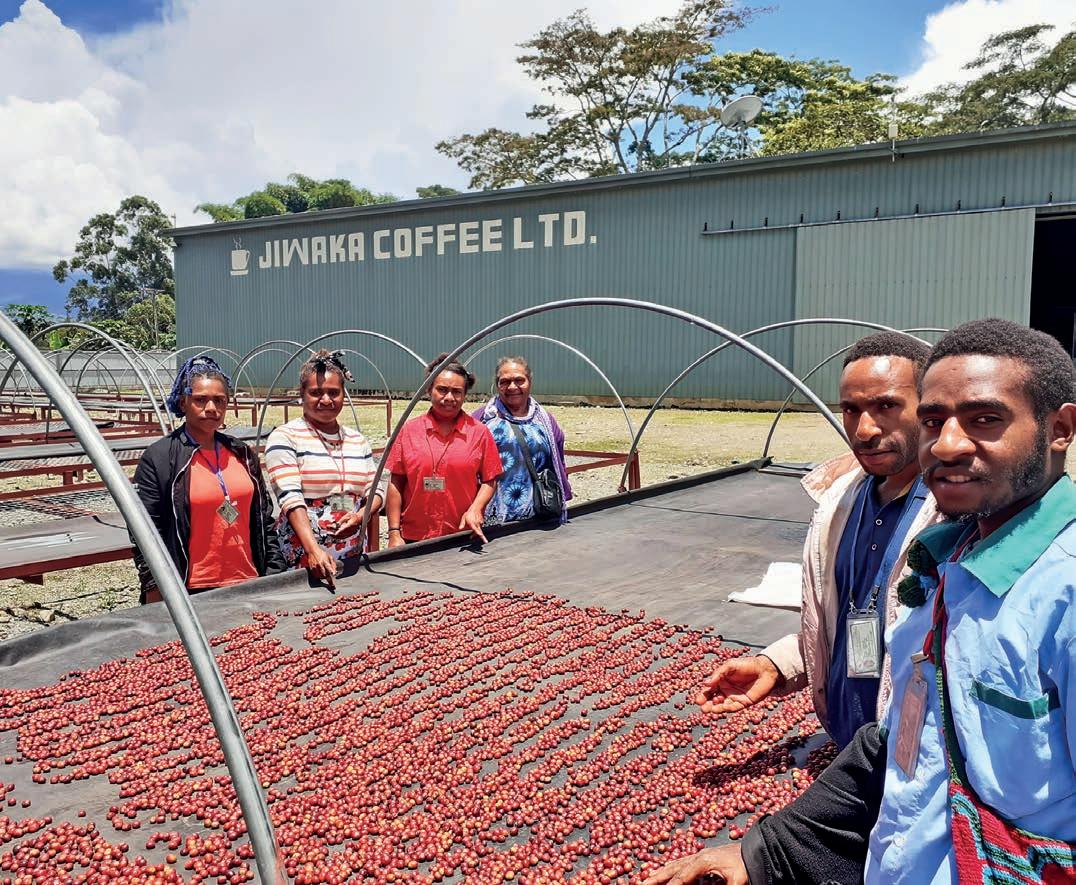
constrain production potential. Edwards notes that key activities such as pruning, tree husbandry, input application, and weed control are o en not carried out consistently. In particular, farmers may avoid pruning when some developing cherries are present, viewing them as potential income, with the longer-term productivity bene ts of pruning not fully considered.
“Co ee growers in Papua New Guinea o en treat their crop as a form of savings, holding parchment co ee until funds are needed for speci c social or household expenses,” he says.
“Sales typically increase in January and February as families meet school fee obligations or prepare for key events. While storing parchment carries risks to quality and potential the , it is generally viewed as a more secure and less tempting way to save compared to holding cash, which can be more easily spent.”
In PNG, co ee is an “amazing currency hedge”, Edwards says, with it being a US dollar-based trading commodity by default and design.
“ e last few years, you’ll see the volume has improved, and that has been because of the higher green bean price. It’s pricedriven volume: the higher the price, the more PNG farmers will tend to and harvest their co ee.”
While e orts have been made to improve infrastructure, PNG’s geography is arguably the biggest barrier for farmers. Edwards says many co ees are grown in “very, very remote areas” with “horrendous” access roads.
“People will walk for three days with a bag of co ee on their back to a road that is accessible for them to sell,” he says.
“PNG is one of the few countries, if not the only country in the world, that freights their co ee in aeroplanes from these areas at 700 kilos a load.”
at geography also has a bearing on how the co ee is prepared for sale. One of the advantages for PNG farmers is they can sell it in any of the three formats: cherries, parchment (at any moisture level) or as green beans.
“If they’re living next to a factory, they can obviously take it there and have it processed for a fee and then sell it as green bean to extract more value,” he says.
“If they’re living in the bush, very remote areas where the cherry trucks can’t come, they’ll o en pulp it themselves by hand, turn it into dried parchment, and walk it to the road to sell it in that form.”
One of the reasons PNG co ee quality is improving, however, is the advent of central wet mills set up in communities, close to farmers.
“ ey can accept a lot of cherry – and because they adopt a disciplined processing structure, we’re seeing a much more regular lot of co ee,” says Edwards. “ at’s why we have seen growth in A and B Grade co ee out of PNG.”
Emma Wakpi also recognised this

problem: the distance between farms and buying stations. She notes there is little infrastructure in rural areas and roads are o en impassable. For women, it can also be dangerous to travel, yet many farmers are forced to do so on foot for many miles carrying their harvest.
Wanting to change this system that unfairly disadvantages the co ee grower – and reduces their income – in 2018, she set up Jiwaka Co ee, which focuses on specialty co ee production with a wet and dry mill built on tribal land in Minj. e social enterprise handles single origin, shade-grown, specialty heritage Arabica co ee from the Waghi Valley in the Central Highlands, taking cars to pick up the co ee at the harvester’s farmgate.
It’s a chance to give back for Wakpi, who was raised a few hours away in a mining town and prospered thanks to her father’s career – which was built on the co ee her grandfather originally grew in the Jiwaka province decades ago.
“As much as we’re pursuing our own things – how much are we giving back to community as well? at’s something my father instilled in me and my siblings,” she says.
“When we would go back to Jiwaka, we’d watch people picking their co ees early in the morning, walk kilometres down to the roadside, waiting hours for the co ee cars to come, weigh and buy the co ee. It ate into their resources that could have been employed elsewhere.
“Dad said, ‘why don’t we establish a dry mill right up the road where the village is, so people don’t have to go as far and just process with us’.”
But Jiwaka Co ee is much more than this. Wakpi realised farmers’ livelihoods would only prosper if they were educated on areas like health, businesses and sustainable farming practises. e organisation sends experts into farming communities to upskill growers.
“We inform them of the value chain, when to pick red cherries, why it needs to arrive at the washing station within a certain amount of time because of fermentation, not picking during the rain,” she says. “ at increases their knowledge and how they value their own co ee.”
Many of PNG’s smallholders farmers operate what’s referred to as a ‘co ee garden’, ranging from as few as 10 trees to hundreds – or even 3000 in some cases.
“In Jiwaka, almost everyone has some sort of co ee garden. What we’re trying to do now is shi that terminology. e world is
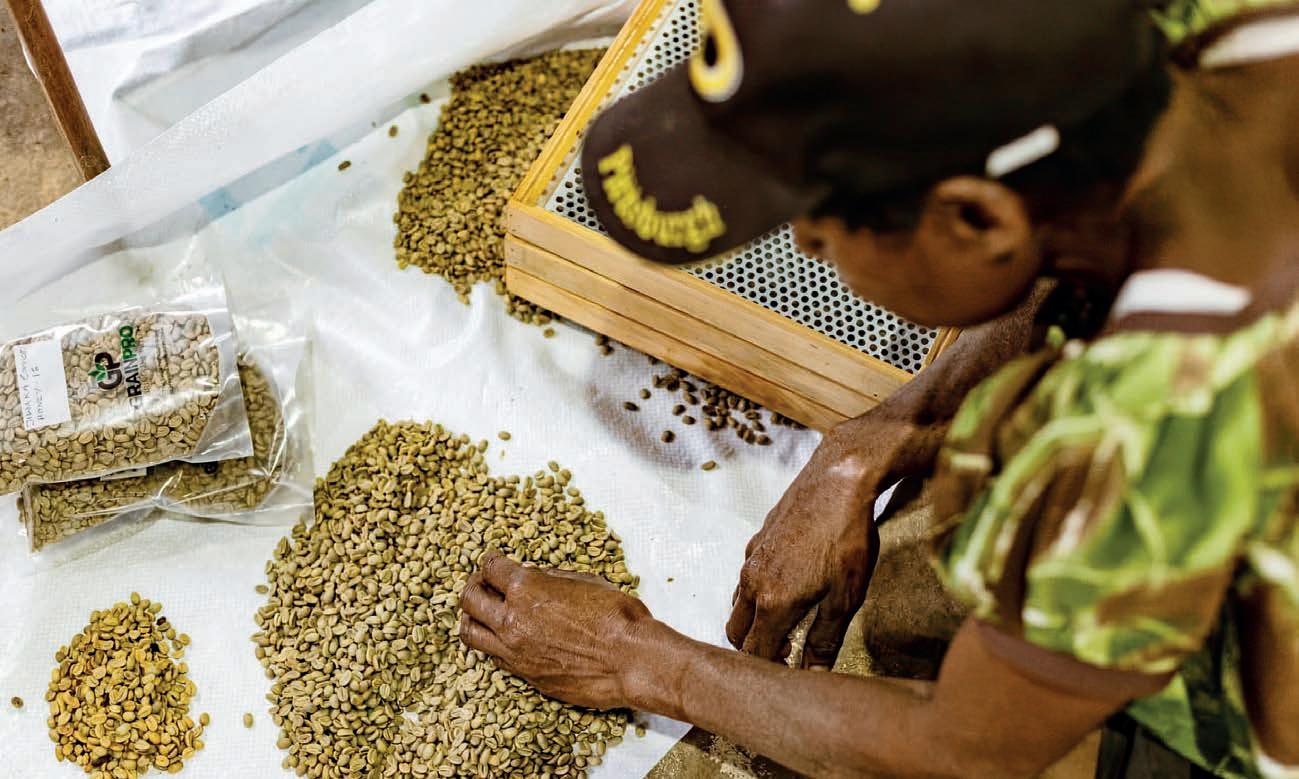
changing. Co ee is being valued di erently. With social media and better access to information, people now understand more than they did a few years ago.
“ e conversation becomes: how do we start seeing this as a business, and treat it that way? How do we value it properly, and approach it with the same mindset as any other enterprise – and thinking about concepts like intercropping.”
Wakpi is encouraging smallholder farmers to treat it like a nine to ve job, just like a teacher in a classroom or a nurse in a health centre.
“You are the co ee businessperson, working in your co ee ‘o ce’,” she says.
“While you’re there, you’re pruning, maintaining the trees, and at the same time planting traditional vegetables. It becomes one system, one way of working: you produce co ee as your income, and food to support your household.”
As PNG co ee looks to the future, small and medium exporters like Jiwaka Co ee are expected to play an even bigger role, leveraging their ability work alongside farmers with cultural awareness and understanding of the challenges they face.
Edwards says the main exporters used to account for 70 per cent of the market.
“What’s interesting about the PNG market right now, is that it’s a very competitive space, with all the big four global players
in green co ee trading operating there and now accounting for around 68 per cent of the market,” says Edwards.
“You have much more competition, sophisticated competition, people who have instruments to manage risk, to take forward contracts, nance is readily available, etc.
But you have all of that sitting now in a pie that is slowly shrinking.
“A part of that is the rise of small and mid-sized exporters who can deal much better with small supply groups. ey can get down and dirty and rub shoulders, if you will, with their supply chains.”
Big or small, each of those exporters is regulated by the CIC, which holds signi cant sway in PNG.
“ e CIC is responsible for all licences encompassing wet mills, dry mills, green bean exporters and roasted co ee exports,” says Rose Romalus, CIC’s Senior Quality Control O cer. “We are also responsible for the licencing of freight forwarders, those who handle co ee on behalf of the exporters at the port end.”
Edwards, a former CIC Board Member, notes that the regulator holds signi cant in uence over the sector.
“ e industry ultimately bene ts from this level of oversight. Every container exported is inspected and cupped by Rose and her team, ensuring consistent quality standards,” he says.
“Pricing is also monitored to ensure sales re ect prevailing market conditions,
which helps maintain the credibility and reputation of PNG co ee.”
He adds that PNG’s membership of the International Co ee Organization further reinforces this credibility through structured reporting and market transparency.
Romalus is positive about the future of PNG co ee, especially as more farmers professionalise their approach to co ee.
“ e number of local exporters that we now have here is a testament to, or evidence of, people now taking co ee more seriously,” she says.
“If you compare that to three to ve years ago, we have a good number of local exporters who used to be just farmers before, but now they’re treating the co ee as a real business.”
She says the revised Green Co ee Standard has now been reduced to ve Arabica grades, with A and B being the specialty/premium grades and Y, Y2, and Y3 being the commercial grades.
“ e revised grades provided equal opportunities for smallholders to improve the quality of co ees through the application of post-harvest best practices and trade as higher grades,” she says.
“In the last three years, volume of B grades has increased, and Y reduced, and as a result, the industry has seen the value of co ee doubled in 2023/2024 Co ee Year and also signi cantly increased in 2025.”

Don’t miss the latest coffee industry news, market reports, must-read features, leader interviews, and more.
Subscribe now to get Global Coffee Report’s free weekly newsletter delivered direct to your inbox.


gcrmag.com/newsletter/
This May’s Interpack expo will see equipment manufacturer Neuhaus Neotec present its COMPACT roller grinder for the first time – making a clear statement in the medium-capacity grinding segment.
THE COFFEE MARKET is on the move. Alongside the stable whole-bean segment, ground co ee in various forms is steadily gaining in importance.
Drip co ee is making a triumphant advance in numerous markets, and co ee specialties with a high milk content are enjoying popularity worldwide.
For specialty roasters, this means they must be able to grind their high-quality co ees with precision, while remaining exible enough to respond to a wide range of product requirements.
With its new COMPACT roller grinder, Neuhaus Neotec is responding to the growing demand in the specialty roasting sector – in particular, the wish of many NEOROAST customers – for a complete production line from roasting to grinding.
A growing market, rising demands
Compared to other grinding techniques, rolling grinders have multi-stage processes, and diverse adjustment parameters – roller gap, roller speeds, corrugation alignment – which enable not only the average particle size to be precisely controlled, but also the particle distribution across the grind size spectrum to be precisely managed.
Neuhaus Neotec says this is no small matter, as the distribution of large and small particles signi cantly in uences extraction time. Fluctuating grinding results are immediately noticeable in the taste, particularly with short extraction times, such as in capsule or porta lter co ee.
Disc grinder technology still dominates the small-batch segment. However, as capacity increases, disc grinders reach their limits – roller grinders then take the lead and nowadays achieve outputs of up to ve tonnes per hour.
Neuhaus Neotec says the COMPACT is deliberately positioned between these
The COMPACT roller grinder is responding to growing demand in the speciality roasting sector for a complete production line. Image: Neuhaus Neotec.
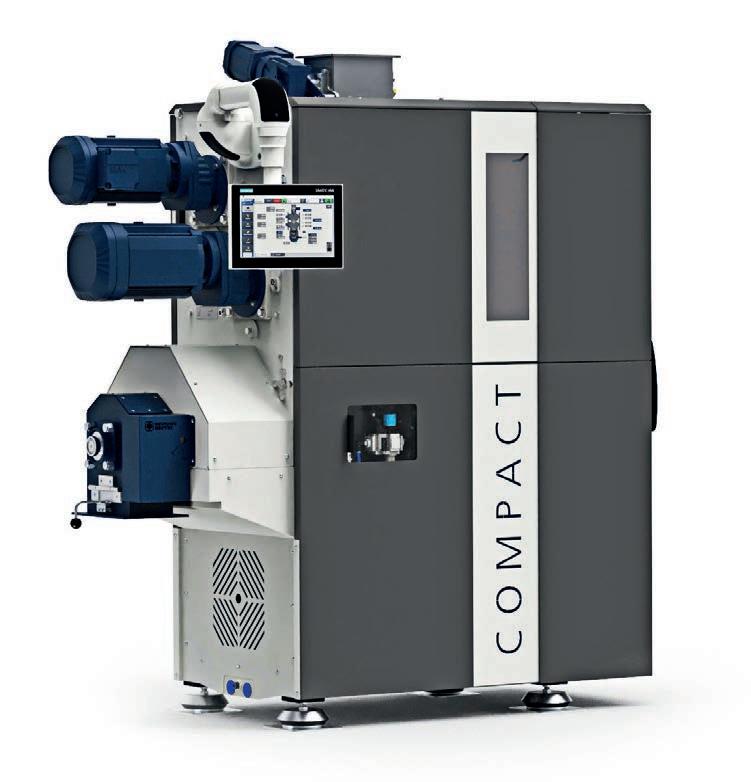
two worlds – with a capacity range of approx. 200 to 1,000 kg/h, it bridges the gap between compact disc grinders and largevolume industrial grinders.
e unit replaces the proven WMS series, and has been developed from the ground up. It says the design incorporates extensive experience from the SPECTRUM and NEOGRIND large-scale grinding series, complemented by fresh ideas for design optimisation.
e entire grinding mechanism is fully enclosed, and the previously separate
control cabinet is now built directly into the unit. is is designed to signi cantly reduce the space required and eliminates time-consuming cabling work during installation. e COMPACT, according to Neuhaus Neotec, is true plug-and-play: connect, switch on, grind.
e grinder is available in two sizes with roller lengths of 200 and 400 mm. Depending on the requirements, it can be con gured as a two- or three-stage model –covering a wide range of grinding pro les, from lter co ee to ne espresso grind.
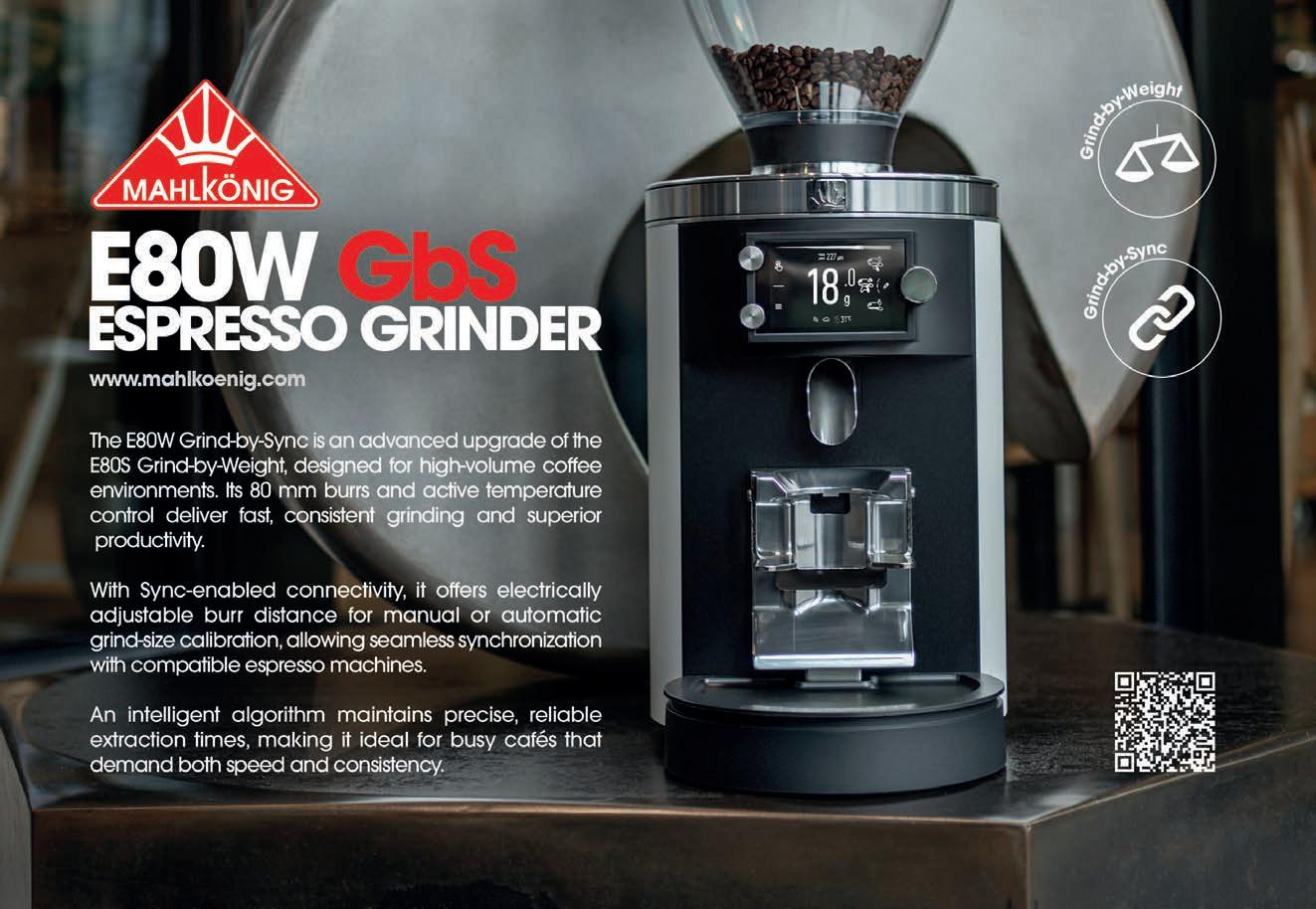
High process reliability
e grinder control system is based on a Siemens PLC with a swivelling touch panel for process visualisation.
All settings and measured values are clearly displayed, and an integrated recipe management system allows various grinding parameters to be prede ned according to the product –something Neuhaus Neotec says is a “clear advantage for businesses with varying product speci cations”.
e COMPACT can also be integrated into higher-level process control systems and communicates directly with the control room. Tried-and-tested automatic features from other grinder series help ensure smooth operation: precise servo motors enable fast and accurate grinding gap adjustments, while a sophisticated spring system ensures that the roller body disengages automatically when foreign objects pass through – thus reliably protecting the machine from damage.
Individually configurable
e COMPACT can be individually con gured far beyond the standard
“[The COMPACT] is true plug-andplay: connect, switch on, grind.”
equipment, Neuhaus Neotec says.
Available options include, amongst others, a compaction unit integrated into the discharge screw for high compaction rates; metal separator in the feeder; fully water-cooled grinding rollers; automatic lubrication for the roller bearings; and monitoring sensors for bearing temperatures and the temperature of the input and output product, managed via the PLC.
is allows each system to be precisely tailored to individual customer requirements and speci c ground co ee speci cations.
e COMPACT is designed for continuous operation, with long service life of the grinding elements, very low maintenance requirements, and quiet, low-vibration operation ensure a long service life even under intensive production conditions.
e enclosed design and sealed grinding chamber minimise aroma loss to the ambient air – the ground co ee retains its sensory quality right up to packaging.
Neuhaus Neotec says that for businesses producing premium products, this is not a minor detail, but a core competence.
With the COMPACT, Neuhaus Neotec says its setting new standards in the mid-range performance segment, with the machine combining decades of roller grinder expertise with modern design and well-thought-out practicality.
e launch at Interpack in May will reveal how the market reacts to this new o ering – and expectations are high. GCR
For more information, visit neuhaus-neotec.com
• World premiere at Interpack Düsseldorf (May 2026)
• Successor to the WMS series – completely redesigned
• Capacity range: approx. 200 – 1,000 kg/h
• Two sizes: roller lengths 200 mm and 400 mm
• Two- or three-stage design for filter coffee to espresso
• Fully enclosed – integrated control cabinet, plug-and-play
• Siemens PLC control with touch panel and recipe management
• Connection to higher-level process control systems possible
• Servo motors for precise grinding gap adjustment
• Automatic disengagement system in the event of foreign object passage
• Enclosed design for maximum aroma retention
• Extensive options: compacting unit, metal separator, water cooling, automatic lubrication, and much more
SEB Professional Beverage is anchoring its sustainability and inclusion agenda firmly in its Environmental, Social, Governance (ESG) strategy.

SEB Professional Beverage is ensuring a premium coffee experience remains accessible to every individual by engineering technology that is easy to use and dependable.
COFFEE CULTURE is evolving – driven not only by trends, but by rising expectations around accessibility, usability, and social responsibility. In today’s hospitality environments, co ee machines must be intuitive, inclusive, and reliable for every user.
Equipment manufacturer SEB Professional Beverage turns this challenge into a guiding principle. As a global leader in beverage preparation solutions, the company is not only developing advanced co ee machines with “barrierfree technologies”, but also anchoring its sustainability and inclusion agenda rmly in its Environmental, Social, Governance (ESG) strategy.
Unveiled in December 2024, the strategy’s mission is to make everyday co ee experiences simpler, more enjoyable, and more inclusive – whether in hotels, o ces, hospitals, or convenience environments.
Structured around three pillars – Act for Nature, Act as a Leader in Circular Economy, and Act for All – and one guiding principle, Act Responsibly and Ethically – the company’s ambition is embedded at the heart of the business,
supporting its mission and objective to accelerate and further intensify its e orts, with measurable goals approved by Science Based Targets initiative (SBTi).
As part of Groupe SEB, the business unit is aligned with the group’s overarching 2024–2030 ESG Ambition Act for better

living – embedding inclusion under the ‘Act for All’ pillar while simultaneously advancing climate actions, circular economy principles, high quality and durable product design, and responsible business practices.
e ambition goes beyond compliance – rather it is about enabling equal access to quality co ee experiences and creating sustainable value for operators, communities, and end users alike, the company says.
rough a human-centric perspective, operators can unlock previously underrepresented customer segments, such as people with mobility limitations, older consumers, or users who prefer intuitive, error-resistant interfaces. e result, according to SEB Professional Beverage, is new revenue potential, broader market penetration, and o erings designed for real everyday situations.
“People are at the heart of everything we do,” says Ayca Ozol, Sustainability Manager at SEB Professional Beverage.
“Our ESG roadmap positions us not only as a machine manufacturer, but as a solutions provider that makes co ee
culture more accessible, more intuitive, and more inclusive. We invest in highperformance machines and barrier-free, self-service concepts that transform the entire hospitality sector.”
An example of this in action is Schaerer’s Easy Access concept, part of the Groupe SEB brand – designed to maximise wheelchair accessibility in self-service contexts, it equips the drip tray area of the Schaerer Co ee Soul with dedicated control buttons.
e ergonomic arrow-key navigation echoes a computer keyboard, ensuring wheelchair users can operate the machine comfortably and independently.
SEB Professional Beverage says this makes Easy Access ideal for o ce settings, public spaces, medical practices, hospitals, and institutional catering. A service technician can also retro t Easy Access to existing machines.
While Easy Access enhances physical accessibility, the WMF barrier free so ware feature drives digital inclusion. A new, easily reachable icon on the machine’s touchscreen displays a full-screen QR code. Once scanned, a remote-control interface opens on the user’s smartphone, featuring large, high contrast images and a voiceover function.
Users can select beverages, adjust bean strength, choose milk or plant based alternatives, and place their order seamlessly and intuitively from their own device.
Innovation behind the counter
Alongside enhancing self-service accessibility, the work environment of service teams and baristas is also gaining attention in the automation space.
Increasing automation, especially in today’s advanced porta lter technologies, reduces complex manual steps, lightens physical strain, and ensures consistent incup quality. For operators, this means more e cient work ows, fewer errors, and more exible sta ng.
“Modern co ee concepts merge cra smanship and automation in entirely new ways. Technology ensures reliability and speed while still allowing space for human creativity and storytelling,” says Dominique Lasseur, Director Co ee Program at SEB Professional Beverage.
A prime example is the semi-automatic WMF espresso NEXT. SEB Professional Beverage says it preserves the artistry and sensory experience of barista cra smanship, while reducing errors and
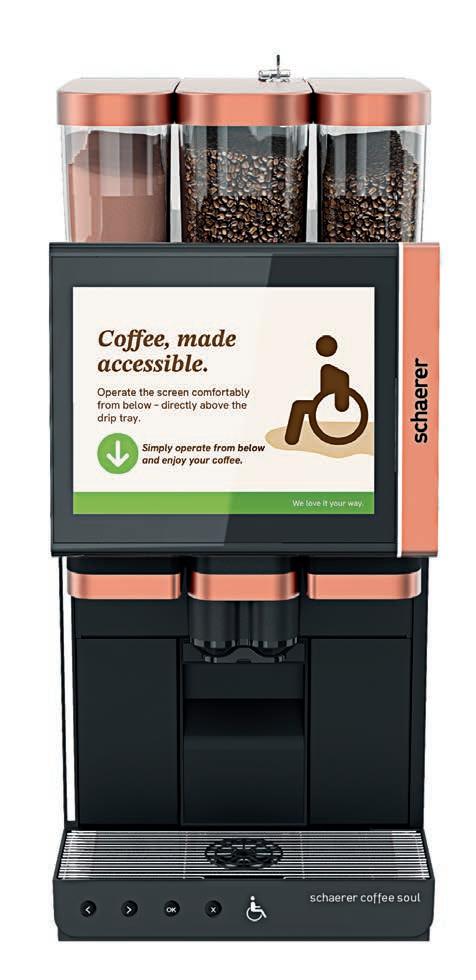
operational e ort. Lasseur emphasises automation at SEB Professional Beverage is purpose-driven: it expands access to great co ee for more people, both consumers and sta .
“We champion an inclusive co ee culture where tradition and automation coexist. With solutions like Schaerer Easy Access and WMF Barrier free, our machines bring connection, comfort and co ee enjoyment to places that were previously out of reach,” adds aryn Estevez, SEB Professional Beverages Global Marketing Senior Director.
With its people- rst ethos, SEB Professional Beverages says the social dimension of the ESG strategy is paramount. is includes responsible sourcing and a dedicated program to support 500 strategic suppliers in meeting stronger environmental and social standards.
For consumers, the group relies on certi ed quality management systems to ensure high product standards. For
Schaerer’s Easy Access concept is designed to maximise wheelchair accessibility in selfservice contexts.
employees, it continuously improves occupational health and safety and promotes gender parity in leadership and management roles.
Groupe SEB’s long-standing ESG commitment is recognised by leading international sustainability rating agencies. In 2025, the Group achieved an EcoVadis score of 82 out of 100, earning a gold medal. is performance is complemented by a ‘double A’ rating from the Carbon Disclosure Project (CDP) for climate and water, as well as an ‘A’ rating from MSCI.
e company says these achievements rea rm that sustainability and responsible business conduct are deeply rooted in the Group’s strategy.
rough this commitment, SEB Professional Beverage re ects a future where advanced technology, environmental stewardship, and social inclusion operate in tandem throughout all aspects of the industry. GCR
For more information, visit groupeseb.com/en
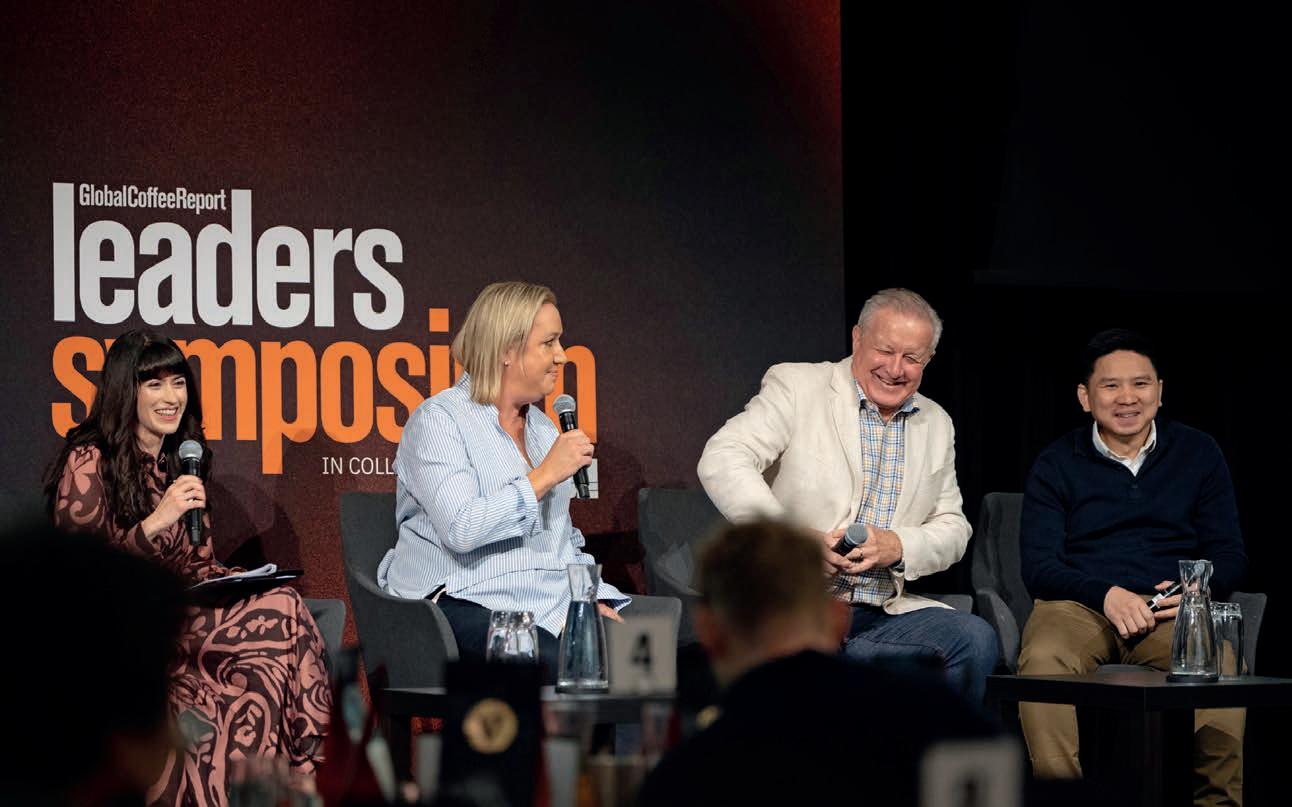
The Global Coffee Report Leaders Symposium united some of the industry’s sharpest minds to debate coffee in high-volume, high-pressure environments.
COFFEE at scale.
ey’re three simple words, but when put into action they expose one of the industry’s most complex balancing acts: how to serve exceptional co ee without diluting quality, consistency or commercial viability.
is was one of the consistent themes throughout the Global Co ee Report Leaders Symposium, which took place alongside the Melbourne International Co ee Expo (MICE) on Friday 27 March.
Across four panels, the event welcomed senior leaders from non-traditional co ee venues, major co ee chains like Starbucks and Kopi Kenangan, and leading Australian roasters, to examine how co ee is being delivered in high-volume environments, while tackling pressing issues like pricing and climate change.
e symposium’s opening session, titled Beyond the Café and moderated by GCR Publisher Sarah Baker, brought together leaders from catering, fuel retail, and travel hospitality to examine how co ee is evolving far beyond traditional café settings.
For Freedom Fuels, which operates 40 branded retail outlets, the shi has been
about rede ning the role of the service station. CEO Mark McKenzie described a broader transformation underway across the sector.
“Service stations are either becoming fully automated fuel sites, or hospitality destinations seeking to hold customers at the site, rather than just push them through the network. We’re in the latter,” he said.
Freedom Fuels is trying to move away from ‘grab-and-go’ products to creating places where people “dwell”. In metro areas, these are café-style environments, while regionally the network is aiming for “roadhouse-style experiences”.
e company has leaned heavily into partnerships, including with Queenslandbased roaster Merlo Co ee, as well as complementary food and beverage brands, to build a more compelling o er.
“Our philosophy is: we’re fuel experts, not co ee and hospitality experts,” he told the audience. “So, our goal is to partner with people that can bring expertise into our business – and we create co-dependency in terms of our o erings, which creates longer-term partnerships.”
at strategy is already altering customer behaviour. At one site, fuel volumes
have e ectively doubled – with the main di erence being the improved convenience o ering in that time.
“We’ve also seen one in ve customers visiting speci cally for co ee. We’re e ectively being treated as a café. People are using our forecourt for meetings – which tells me the co ee’s OK.”
e perception of airport co ee is shi ing too.
SSP Australia & New Zealand operates a portfolio of more than 100 hospitality outlets across 12 Australian airports, one New Zealand airport, as well as Sydney Central train station, with continued growth across the network. National Head of Co ee Operations Martin Nguyen said passengers were increasingly encountering café-quality o erings in terminals designed to feel more like retail and lifestyle destinations than transit hubs.
However, consistency remains a key operational hurdle.
Delivering quality co ee in high-tra c environments requires a combination of training, work ow e ciency, and smart equipment investment, he said, particularly as operators contend with labour shortages and rising costs.
“Right now, at the airport, a six-ounce co ee is around AUD$6.50 – sometimes AUD$7, depending on the brand we partner with,” he said, noting that higher operational costs in airports, like rent, contribute to this.
“But when customers see that you’re serving a well-known, premium co ee, they’re willing to pay for it.
“But I don’t think the current perception is entirely fair on the industry. People will happily pay $10 or $15 for a glass of wine – but why can’t you pay $7 or $8 for a good co ee? I think we need to shi the mindset and perception. If you’re getting a good co ee, it’s worth paying for.”
For e Big Group, co ee is increasingly embedded in large-scale experiences spanning major events such as the Australian Open and Spring Racing Carnival in Melbourne. CEO Kate Langford said delivering quality co ee at scale o en came down to people.
“We’ve done all the hard work in bringing in the right collaborators. en we pass that onto the sta and train them,” she said.
“We’ve put a major focus on sta training, recognition, and reviewing feedback from our events so we can close the gap. We can’t just set and forget. You can’t train somebody on a co ee machine and expect them to work it four weeks later. So you’ve got to constantly be out there, beside them, and working with them.”
Langford emphasised co ee’s role as a social anchor within premium hospitality.
“We’re more than caterers – we see ourselves as experience architects. We’re trying to create the best moments in people’s lives, whether that’s a wedding, the Australian Open, or a day out,” she said.
“Co ee is part of the experience of an event. Most people arrange to meet over co ee. It will be a major part of what we do going forward, and we’ll always be looking at it.”
Langford echoed Nguyen’s views around co ee pricing, pointing to this as both a consumer education issue and an ethical one.
“ e reality is, if you’re paying under $5 for a co ee, somewhere along the line someone isn’t being paid properly. at’s something we try to educate both our sta and our customers on,” she said.
Roasters who scaled smart
e symposium’s second panel, How to Scale Smart, brought together Australian co ee roasting leaders, with ST. ALi Co ee Roasters CEO Lachlan Ward, Co ee Supreme CEO Andrew Low, Nomad
Co ee Group CEO Craig Dickson, and Di Pacci Co ee Company Founder and Director Michael Rababi sharing insights into how they levelled-up their businesses.
When asked what nancial signals matter most when preparing to scale, Low highlighted the importance of both capital and capability.
“I would say, have your cash sorted, and have a mix of people who have been on the journey to phase one, and bring a couple of select people in who’ve seen the other side and can help connect the dots,” he said.
He also pointed to a critical pressure point in the growth curve for roasting businesses.
“My experience would suggest that getting to a couple of tonnes [per week] is a bit of a grind, but you can get there with some momentum. e hardest gap to transcend is probably two to 10 tonnes, because everything at that point in time triples in cost, but pro t doesn’t come with it for some period of time.
“You’ve got the roaster that costs ve times as much. You’ve got the warehouse that’s three times the size that you haven’t lled. You’ve got sta to do di erent functional jobs that aren’t fully utilised. So understanding your cost base, not just at the two tonne mark, but what it might be to support a customer base ve times as large, and price for that future, is the most important thing.”
For Ward, the conversation returned to people and nding the right leaders.
“You get to certain points where you know you’re faced with the next big leap,”
he said. “It’s about acknowledging maybe that you don’t have the people for the next step, or being honest and vulnerable enough to know that you don’t have all the answers and need to look elsewhere.”
Dickson reinforced the importance of disciplined long-term planning, particularly when it comes to infrastructure. As Nomad has expanded, the business has built roasteries designed not just for current demand, but for future growth, and in some cases scaling into them faster than anticipated.
“When you start projecting ve to 10 years ahead, you can see where capacity constraints may emerge,” he said. “If 2029 is going to look very di erent to today, that might mean placing an order for a new roaster in 2027.
“We’ve learned that robust forecasting and forward planning are critical. It’s about building infrastructure that doesn’t just meet today’s needs, but gives you the con dence and exibility to scale sustainably over the long term.”
Looking ahead, Rababi struck an optimistic tone about the resilience of the co ee industry, despite current headwinds for cafés (some panellists predicted 10 per cent café closures in the near future for their home market).
“ e exciting thing about co ee is, no matter which side of it goes down [wholesale or domestic], another side is going to go up,” he said, noting the fuel crisis could impact the cost of products at the time of writing.
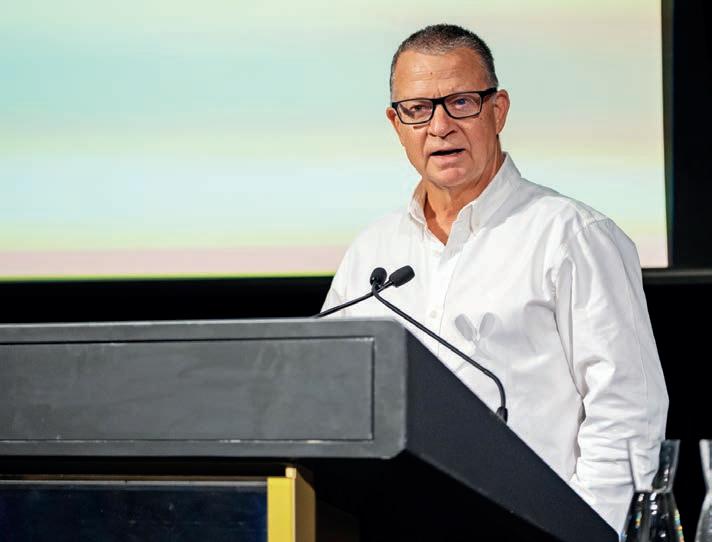
“I don’t think co ee’s ever going to die. It’s always looking up, but it depends which way.”
Starbucks update
Braeden Lord, CEO of Starbucks Australia, delivered the symposium’s keynote address, outlining the brand’s trajectory in one of the world’s most mature co ee markets.
From its Australian debut more than 25 years ago, Starbucks has grown to 94 locations nationwide, navigating a market widely regarded as among the most discerning globally.
Lord highlighted the company’s evolving approach to store formats, with an increasing emphasis on drive-through locations as a key growth channel, alongside traditional café environments tailored to local communities.
Central to the strategy is what he described as a return to the brand’s core identity – a “getting back to Starbucks” philosophy focused on being the world’s best customer service company, remaining visible, relevant and loved in every market, and reinforcing its role as a community co eehouse.
International flavour e symposium wrapped with a fourstrong panel under the theme: Global In uence in the Australian Co ee Market One brand to recently enter Australia – considered one of the world’s most discernible markets – is Kopi Kenangan.
Founded in 2017 in Indonesia, it now has more than 1400 stores globally across Southeast Asia and beyond. e brand has recently expanded into Taiwan, following its entry into Australia in 2025 with locations in Sydney and Melbourne.
Winnie Nawei, Managing Director of Kenangan Co ee Australia, said with Australia being a multicultural country, especially in Sydney with a large Southeast Asian community, it made sense to enter a market with existing demand.
“Sydney was a very strategic move, but it also challenged us to elevate our standards,” she said. “We’ve learned a lot. For example, we’ve had to tailor some of our drinks. In Southeast Asia, we don’t typically o er as many customisation options, but here customers expect it. Our signature Kenangan Latte is quite sweet for the Australian palate, and we received a lot of feedback on that. Now, we o er more exibility – customers can choose sweetness levels, dairy options, and co ee intensity.”
Kenangan Co ee di erentiates through strong, bold avours, particularly from Indonesian palm sugar. It also operates with a fast-service model and maintains competitive pricing — typically around AUD$4–$5 per cup.
“A big part of it is sourcing. We source most of our beans and key ingredients, like palm sugar, directly from Indonesia, which helps keep costs low. We also invest heavily in technology to reduce waste and manage inventory e ciently,” Nawei said.
Also on the panel was Louis-Philippe
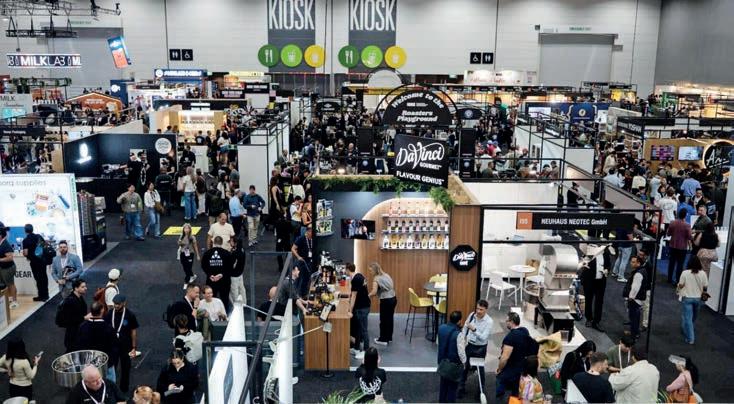
e 13th edition of the expo took place from 26 to 28 March at the Melbourne Convention and Exhibition Centre and saw a total of 14,159 unique visitors pass through the doors. THE 2026 MELBOURNE International Co ee Expo (MICE) concluded on a high a er three days of industry connection, business, and education for the Australian co ee community.
Boucher, Co-Founder of DAK Co ee Roasters. Established in 2019, it’s an Amsterdam-based specialty roastery that has quickly become one of Europe’s most talked-about brands.
For other roasters seeking to break into Europe, he said it’s vital to never underestimate the power of the bloc, with 25-plus distinct countries.
“How co ee is consumed in the Czech Republic versus the United Kingdom is fundamentally di erent. Going marketby-market and really understanding the speci c culture of one country, or at least one region rst, and then expanding from there is probably the best approach.”
Sasa Sestic, CEO of Australian roaster ONA Co ee which he founded in 2008 in Canberra, discussed the brand’s international expansion, starting with Dubai. It was a market he formed a close connection with when travelling a er winning the World Barista Championship in 2015.
“Dubai is a strategic move. It feels comfortable and small enough, but it’s also big enough to in uence what happens in other countries. For us, it’s a rst step to be the best we can be, and then expand in that part of the world.”
e move has come with a level of discomfort, something Sestic is seeking and embracing. It’s reminiscent of the time he took ONA Co ee into the Melbourne market, but at another level.
“ e challenge is maintaining the ONA identity – not just opening a café with our logo, but ensuring the soul of the brand is
“We’re extremely happy with the results: bumper crowds, quality leads and genuine business was conducted on the show oor in the most positive environment we’ve had to date. e vibes were extremely high,” said Sarah Baker, Publisher at Prime Creative Media, which runs MICE and publishes Global Co ee Report.
“Crowd numbers were fantastic. We’re really pleased that 35.1 per cent of our attendees were café owners and operators, and 29.7 per cent were roasters, indicating that the right audience of decision makers was present.”
MICE featured 157 exhibitors displaying the latest in co ee machine and roasting equipment, co ee tools and ancillary equipment, packaging, POS so ware, dairy and dairy alternatives, bakery items, and matcha.
One of the most popular attractions at
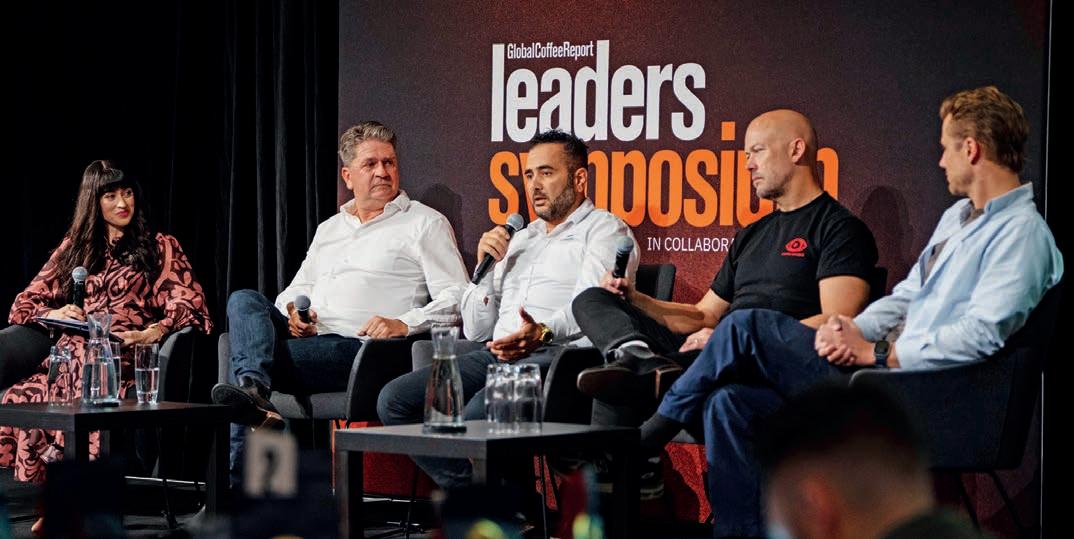
there, and I’ve spent months on the ground with the team to embed that DNA,” he said.
“ e attention to detail in café design is next level [in Dubai]. I’ve always focused more on co ee and experience rather than aesthetics, so I’m learning a lot.”
Compared to Australia, co ee can be priced at almost double the rate.
“ at allows you to employ more sta and deliver a higher-end experience, without running as lean as you might have to in Australia,” Sestic said.
“We’re also learning how to scale properly
the show was the Roasters Playground, sponsored by La Marzocco and Australian dairy company Riverina Fresh. More than 36 roasters across the country took halfday residencies to showcase and celebrate their co ee selections.
Co ee industry education was a major feature of the show. In addition to the GCR Leaders Symposium, Baker moderated the Café Education Stage, sponsored by Grounded Packaging, powered by BeanScene magazine.
Baker described this as “a crowd favourite”, with 23 session topics and 78 panellists converging across the three days to discuss the topics, trends and subjects that matter to café owners in one of the world’s leading markets.
“ e program was designed to be an engaging platform to educate, inspire and motivate café owners with insights that can help grow their business and see it thrive
– documenting recipes, systems, and training. Previously, it was more hands-on, but now everything needs to be structured for growth.”
Sonja Needs rounded out the panel. She is an Academic within the Faculty of Science at e University of Melbourne where she’ has coordinated and developed the institution’s rst co ee subject: Co ee: Science, Trade and Culture.
While climate change and adaptation remain the “biggest challenges”, she’s constantly teaching her students about
and not just survive in today’s current climate,” she said.
“We covered everything from pro tability and management to matcha madness, the cold beverage revolution, automation, sustainability and so much more. I loved seeing the crowd taking every seat possible – for some it was the oor – just to hear from some of the industry’s best business operators.”
Over in the Trip to Origin section of the show, producers, importers and green bean experts from the world’s co ee-growing regions held cupping sessions and delivered educational talks that explored origin, processing and the realities behind production. e countries represented included Brazil, Papua New Guinea, Indonesia, Uganda, Kenya, Fiji, Samoa, Vanuatu, Peru, Colombia, Guatemala, Costa Rica, and El Salvador.
Axil Co ee Roasters won Australia’s
ethical sourcing and how that impacts smallholder farmers.
“We don’t pay very much for co ee here [in Australia]; we should be paying more for our co ee, but that money shouldn’t be going back to the roasters or importers, instead it should be invested back into our smallholder land owners,” she said.
“ ey should be getting a living wage. We also need to be investing into adaptation strategies and helping them develop their businesses, so that we build a more reliable supply chain.” GCR
Favourite Co ee competition held on-site, capping a successful 12 months for the Melbourne-born roaster which has also included Jack Simpson being named World Barista Champion.
MICE organisers have now con rmed dates for the 2027 show, taking place from 4 to 6 March.
“We’re excited about the future of MICE. Most importantly, we’re happy that this year’s show has really helped to unite, motivate and celebrate our industry. ere’s nothing more rewarding than seeing our exhibitors and the wider co ee community grow from such an important annual event,” Baker said.
“ at’s the power of MICE. Magic happens when we all come together.”
Exhibitors for MICE27 can contact Business Development Manager Mike Wilson at mike.wilson@primecreative. com.au or call +61 466 609 732.
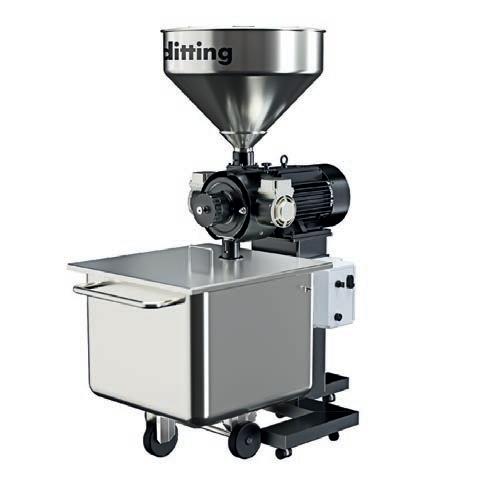
The 1827 High Volume from Ditting is engineered to elevate premium pre-ground co ee production to the next level, increasing output capacity from 230 kg to an impressive 300 kg per hour. Designed for continuous operation, it is the ideal solution for medium to large-scale co ee producers and professional roasteries seeking both e ciency and uncompromising quality.
At the heart of the 1827 High Volume is its exceptionally even grind performance, delivering consistent, high-quality results batch after batch. The high-precision stepless adjustment system ensures maximum control over grind size, allowing operators to fine-tune settings with outstanding repeatability.
Equipped with premium, wear-resistant burrs tailored to specific application needs, the machine guarantees durability and long-term reliability. Its powerful three-phase motor, featuring advanced surface cooling and high starting torque, ensures stable performance even under demanding continuous-use conditions.
Built for professionals who demand precision, consistency, and productivity, the 1827 High Volume from Ditting sets a new standard in industrial co ee grinding.
For more information, visit di ing.com
Flexnet Storefront is a smarter, simpler way for co ee roasters to manage wholesale ordering. Built for growing, multichannel businesses, it combines e-commerce with wholesale account management, aiming to reduce complexity and save time. Users can create tailored buying experiences with account-specific product lists and customisable pricing, while orders can automatically align with roast schedules and cuto times to keep teams organised without constant back-andforth. With flexible branding and an intuitive interface, Storefront is designed to deliver a seamless experience for both roasters and their customers, supporting growth without added operational strain. By moving their ordering into the digital age, operators can run their entire operation on one system built for co ee roasters.
For more information, visit flexnet.co
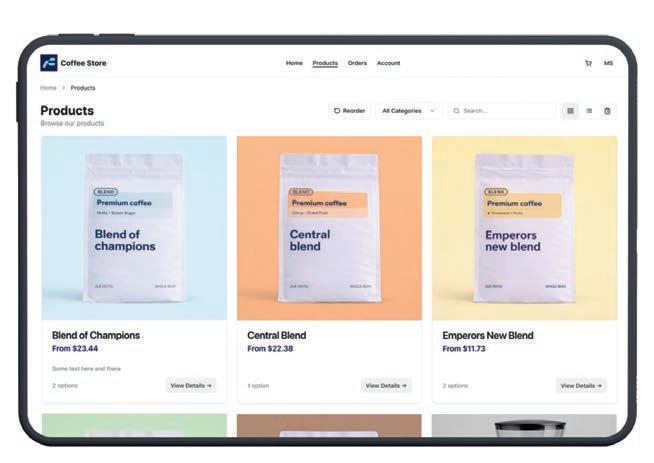

SEB Professional Beverage, via WMF Professional Co ee Machines, is making professionalgrade co ee more accessible. Compact, user-friendly, and designed for small- to medium-sized spaces, the trio of new machines bring WMF’s renowned quality, intuitive operation, and attractive design to o ces, B&Bs, cafés, and self-service areas. The three new models include the WMF Peak 50 (pictured), described as a best-in-class machine for the segment with a daily output of 80 cups. It o ers a wide beverage selection including powder options, a double co ee spout, Americano function, fixed water connection, and a two-boiler system for faster preparation. There’s also the WMF Perfection OFFICE – WMF’s most compact solution for the semi-professional and entry-level market, delivering up to 40 cups per day – and the WMF Elevation 10, bringing professional-grade co ee to smaller o ces, educational institutions, reception areas, and self-service zones in guest houses or small hotels, with a daily output of up to 50 cups per day.
For more information, visit wmf-coffeemachines.com
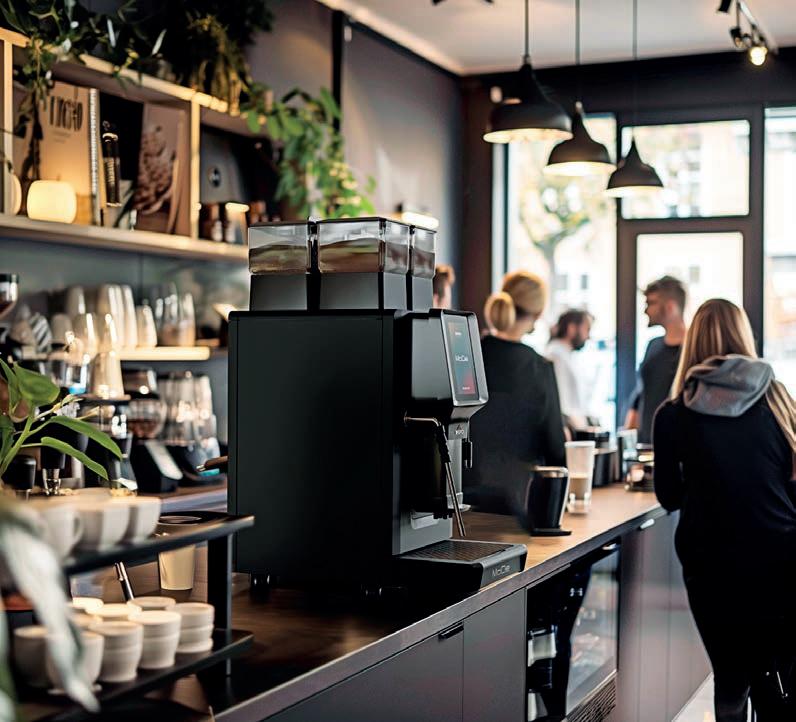
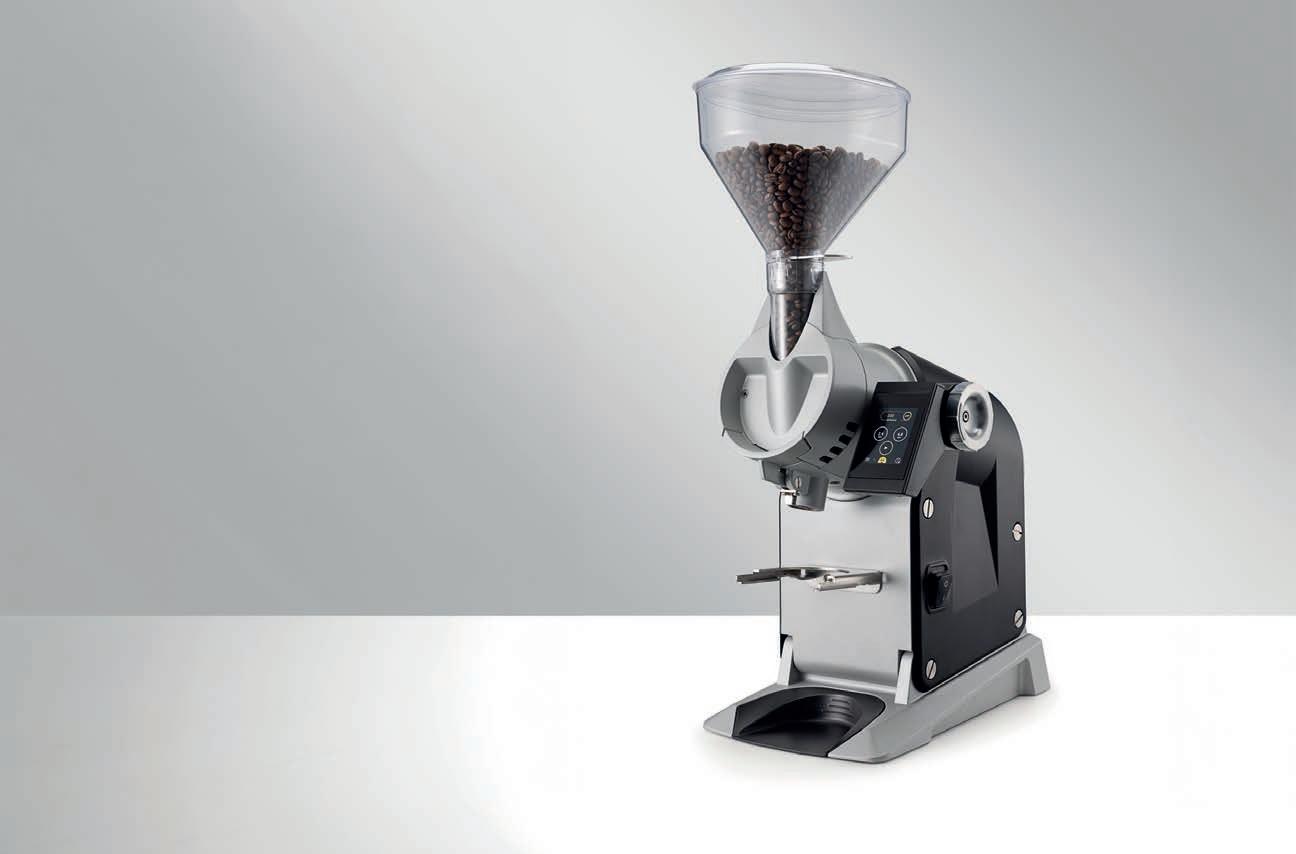
Egro MoDe is a compact, fully automatic co ee machine developed for medium-volume environments, with an output of approximately 150–180 cups per day. Designed to combine performance, flexibility, and ease-of-use, it is available in three configurations – Pure Co ee, Quick Milk, and Pro Milk – enabling operators to tailor the machine to di erent service models and menu requirements. The machine – with an intuitive interface – supports a wide beverage range, covering co ee, fresh milk, and soluble-based drinks. Recent updates include: the iSteam Pro automatic steam wand for precise control over milk temperature and frothing levels; the Fresh Water Bypass function enabling the quick preparation of co ee beverages with ice; and the Quick Restart feature that reduces downtime by allowing the machine to resume operation rapidly when conditions permit. MoDe is also compatible with KitchenConnect, Ali Group’s cloud-based digital platform, giving operators access machine data, performance monitoring, and remote settings management.
For more information, visit egrocoffee.com
Casadio, part of Cimbali Group, has been crafting grinders since 1950, with ERMES DUAL considered its most flexible, high-performance grinder to date. The dual mode concept enables users to freely switch between multiple types of recipe. ERMES DUAL’s vertical burrs enable operators to switch from on-demand mode to single shot mode with a simple tap on the display. The grinding chamber is equipped with a real-time burr distance detection system, designed to be accurate to the micron, to ensure visibility and control over each setting, thanks to the 2.5-inch color display. Inside the grinder are 75 mm flat burrs by KEBER, featuring more than 40 years of expertise in steel burr engineering and manufacturing. Through in-depth studies on geometry and cutting profiles, these burrs have been optimised to deliver precise and consistent grinding across a wide range of recipes, from espresso to filter. This is said to make them ideal for “truly DUAL use”, ensuring versatility and top-quality results in every cup.
For more information, visit casadio.com
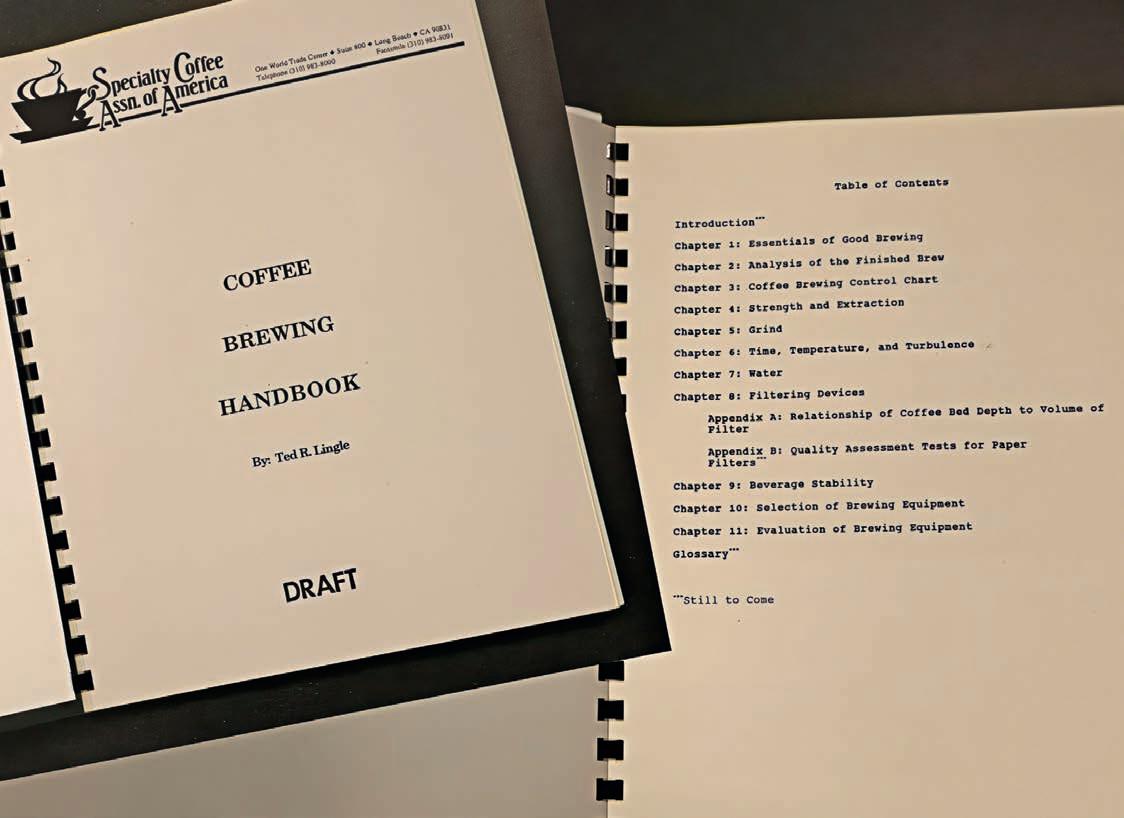
The UC Davis Library recently received a donation of collections including a coffee book from the 1600s, early financial records from Starbucks, and coffee education materials from the 1990s.
THE UNIVERSITY of California (UC) Davis Co ee Center says it is the rst multidisciplinary university research centre to address the challenges and needs of the industry through a “holistic approach to co ee science and education”. But a recent donation to the college will help students look back, rather than forward.
In late 2025, the UC Davis Library received a batch of co ee-themed donations from Starbucks Co-Founder Gerald ‘Jerry’ Baldwin, President of Hacienda La Minita Russ Kramer, and the Specialty Co ee Association (SCA).
e trio of collections all o er their own insights into not just the history of co ee in the United States (US), but the entire world.
Central to the donation from Baldwin is the chronicling of the early days of Starbucks, from its rst guestbook and poster to nancial records from the rst 17 years of the business, all of which highlight Starbucks’ rise from a single Seattle co eehouse to becoming one of the largest companies in the world.
Kramer’s collection, conversely, covers
a more international scope, from records spanning more than four decades and his work developing co ee programs for leading brands including Dunkin’ Donuts and McDonald’s.
Also included in Kramer’s donations is a book from 1687 which he acquired on behalf of Hacienda La Minita’s parent company, Distant Lands Co ee, titled Le bon usage du thé, du ca é, et du chocolat pour la preservation & pour la guerison des maladies by French physician Nicolas de Blégny.
e title translates to e proper use of tea, co ee, and chocolate for the preservation and healing of diseases. It is now the fourth-oldest book in the entire UC Davis Library.
Finally, the SCA donated a substantial archive from its institutional library, including more than 100 boxes of books, educational documents, and early dra s of publications that later became foundational texts for co ee professionals worldwide.
Bill Ristenpart, Child-Whitaker Endowed Professor of Chemical Engineering and Director of the UC Davis Co ee Center,

says these insights into the history of co ee are important in advising the university’s research.
“ ese collections give us the historical and cultural context that complements our scienti c work,” says Ristenpart.
“Co ee is one of the most widely consumed beverages in the world, yet there is still so much to learn about it.
“Having these collections available at the UC Davis Library will allow us, as researchers, to connect cutting-edge research with the people, practices, and ideas that shaped the modern co ee landscape.”
Kramer says people donating collections to resources like the UC Davis Library is important for remembering co ee’s history.
“ ere are people all over the world with a lifetime of knowledge on co ee they’ve collected and it’s sitting in isolation,” he says.
“What the library o ers is an opportunity for a generation to bring that all together in one, objective place.
“ e UC Davis Library will be the centre of the world of co ee research – without a doubt. I’m convinced of that.”
Innovative soil nutrient analysis solutions allow farmers to apply the right fertilizer at the right time and in the right amount. These methods, combined with the use of organic waste and compost, offer economic benefits, help preserve soil quality, and promote environmentally responsible farming for future generations.