JULY/AUGUST 2026
JULY/AUGUST 2026
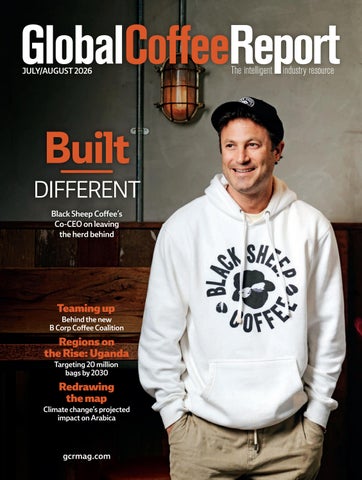
Black Sheep Coffee’s Co-CEO on leaving the herd behind
Teaming up
Behind the new B Corp Coffee Coalition
Regions on the Rise: Uganda
Targeting 20 million bags by 2030
Redrawing the map
Climate change’s projected impact on Arabica
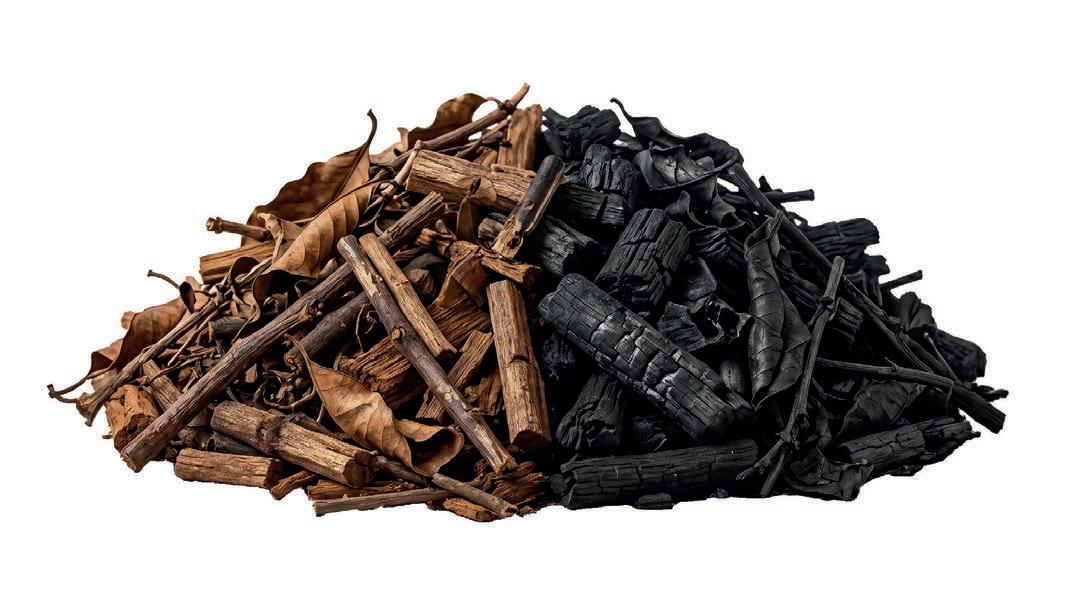

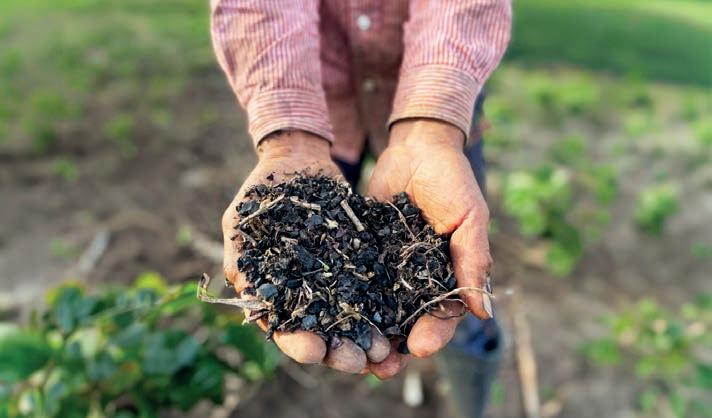
Biochar created from coffee husks boosts soil quality by enhancing its structure, helping it retain moisture, and making nutrients more accessible. This supports the growth of healthier coffee plants and encourages regenerative, climate-friendly farming methods. For these reasons, we increasingly use biochar alongside our producers.
SHAPING THE FUTURE OF COFFEE CULTIVATION –EXPLORE NKG’S REGENERATIVE PRACTICES ON THE GROUND: WWW.NKG.COFFEE/FUTURE
COVER STORY
“It’s not for us to lecture customers. What ma ered to us was: does this coffee taste like money, and is it awesome?”
Gabriel Shohet CO-FOUNDER AND CO-CEO, BLACK SHEEP COFFEE
15 Welcome to the show
Introducing Mikafi, Thermoplan’s tabletop roaster taking coffee to the next stage.
18 The art of AMAZING
Using automation to scale quality and efficiency without sacrifice human connection.
20 A unique opportunity
UNIC has transferred production to France’s central region after 30 years in Carros.
22 New life in legacy
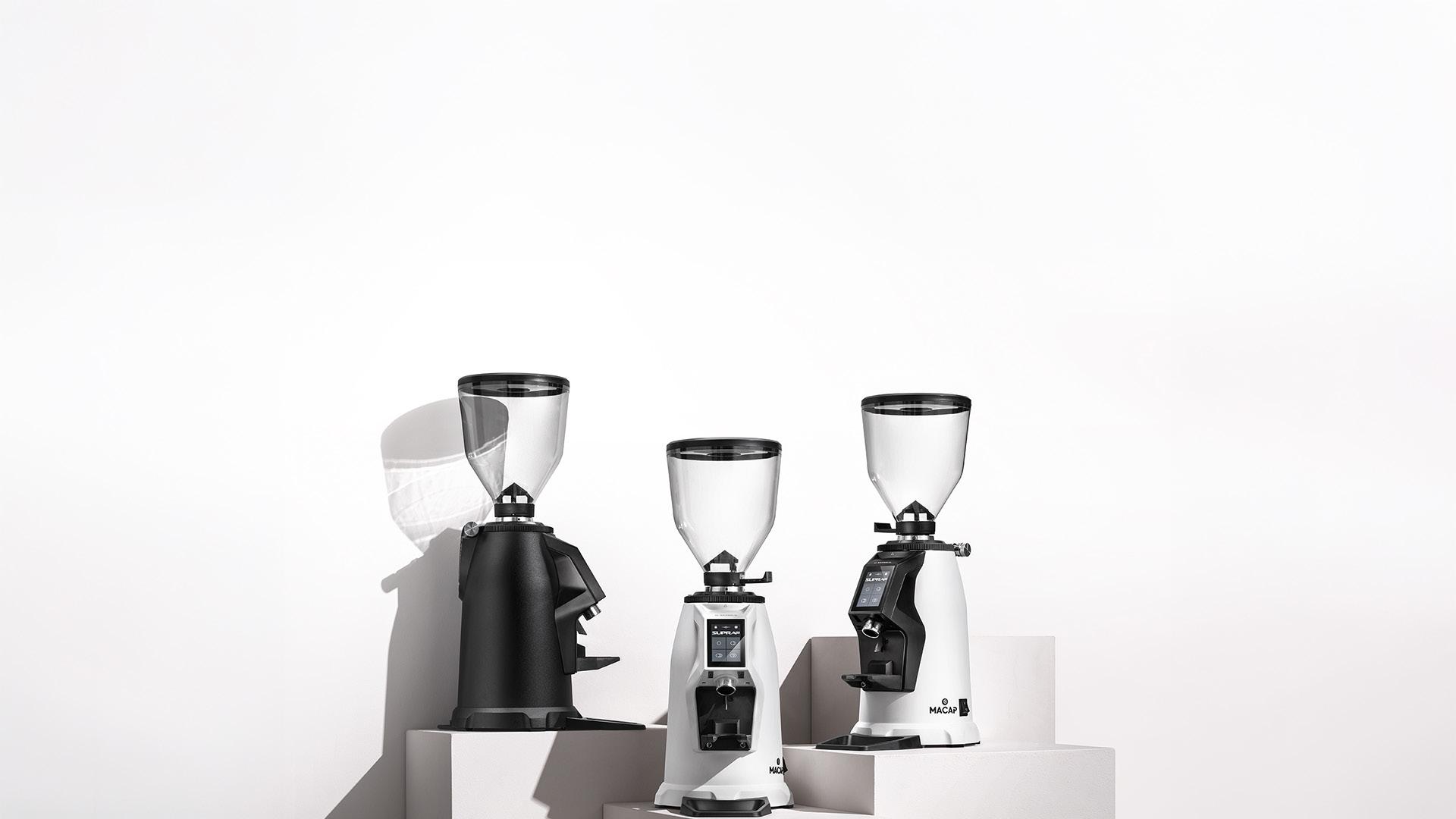
A new grinder is responding to increasing product variety across roaster portfolios.
28 Precision meets problem-solving
IMA’s integrated line is rising to the challenge of precision, adaptability, and integration.
34 Still packing a punch
Flexibility and digitalisation are key for how Cama can service the coffee sector.
52 Two machines, one philosophy
Creating new opportunities to match machine to craft.
54 Redefining extraction
A trusted machine is helping cold brew coffee producers capitalise on growing demand.
24 Regions on the Rise: Uganda
Africa’s largest coffee producer wants to more than double its production capacity by the end of the decade.
37 Building a resilient future
A new report suggests the next decade is decisive for responding to climate change.
49 Bringing origin to you
Trip to Origin was a celebrated new component of MICE26, returning even stronger in 2027.
10 Separate from the herd Black Sheep Coffee’s Co-Founder and Co-CEO on building the United Kingdom’s fastest-growing coffee company. 10 18 24
40 Carbon, calculated
Evoca Group has released its Carbon Footprint Calculator to the world.
43 Pulp to productivity
How biochar is helping Colombian farmers cultivate healthy coffee trees.
46 A collective step forward
B Corp-certified coffee businesses are reframing the conversation around collaborative opportunity.
58 Infinity and beyond
What a new partnership means for deforestation prevention efforts.
04 Editor’s note
06 News in brief
56 Marketplace

OR THIS EDITION of Global Co ee Report, one theme kept surfacing: the future of co ee is unlikely to look like its past.
at might sound obvious. Every industry evolves. But co ee is entering a period where several of its biggest assumptions are being challenged simultaneously – from what we grow, to how we grow it, to the way businesses collaborate and create value.
One of the most fascinating examples in this issue comes from the United Kingdom’s Black Sheep Co ee. More than a decade ago, co-founders Gabriel Shohet and Eirik Holth built a business around an idea many in specialty co ee considered almost heretical: championing Robusta.
What struck me most was the willingness to question industry orthodoxy. At a time when Arabica dominated every specialty co ee conversation, Black Sheep looked at Robusta as a species with characteristics that could become increasingly valuable in a changing world: greater resilience, di erent harvest cycles, and stronger resistance to pests.
Whether one agrees with its approach or not, it highlights an important reality, the co ee industry’s future may not be in uenced solely by preserving what has always worked.
at thinking becomes even more relevant when viewed through the lens of climate change.
is edition examines new research suggesting the geography of co ee is already shi ing. According to Rabobank, a major co ee industry nancier, around 8 per cent of current Arabica-growing areas are now considered unsuitable, with that gure projected to rise signi cantly by 2050.
Yet alongside those challenges sits an equally compelling story of innovation.
World Co ee Research’s Innovea Global Co ee Breeding Network is accelerating
the development of climate-resilient co ee varieties by treating the world as a “climate time machine”, testing future possibilities in today’s environments.
For years, environmental commitments have o en been discussed in broad terms. Increasingly, however, the industry is demanding measurable action. Evoca Group’s new Carbon Footprint Calculator is one example of how businesses are being equipped with tools to better understand the emissions embedded within equipment purchasing decisions.
As environmental reporting expectations continue to grow, transparency and data will become just as important as ambition.
But perhaps the most encouraging story in this issue is one built around a simple idea: no organisation can solve these challenges alone.
e newly formed B Corp Co ee Coalition brings together businesses from origin, trade, roasting, and retail to tackle some of co ee’s most complex issues collectively. Climate resilience, livelihoods, workforce development, and long-term sustainability are not problems that sit neatly within one company, one country, or one segment of the value chain.
What impressed me most about the coalition is its recognition that progress doesn’t always begin with having all the answers. Sometimes it starts by bringing the right people into the same room and committing to learn from one another.
e future of co ee won’t be determined by any single innovation, technology, or business model. It will depend on an industry’s collective willingness to adapt.
And if the stories in this edition are any indication, there are plenty of reasons to feel optimistic about what comes next. GCR
Sarah Baker Publisher Global Coffee Report
CHIEF EXECUTIVE OFFICER
Christine Clancy christine.clancy@primecreative.com.au
PUBLISHER
Sarah Baker sarah.baker@primecreative.com.au
GROUP MANAGING EDITOR
Myles Hume myles.hume@primecreative.com.au
EDITOR
Kathryn Lewis kathryn.lewis@primecreative.com.au
ASSISTANT EDITOR
Daniel Woods daniel.woods@primecreative.com.au
JOURNALIST
Meg Kennedy meg.kennedy@primecreative.com.au
ART DIRECTOR/DESIGN
Daz Woolley daz.woolley@primecreative.com.au
BUSINESS DEVELOPMENT AND SALES MANAGER
Charlotte Murphy charlotte.murphy@primecreative.com.au
CLIENT SUCCESS
Cailtin Pillay caitlin.pillay@primecreative.com.au
COVER IMAGE
Onur Pinar
HEAD OFFICE
Prime Creative Pty Ltd 379 Docklands Drive, Docklands, Victoria, 3008, Australia p: +61 3 9690 8766 info@primecreative.com.au gcrmag.com
SUBSCRIPTIONS +61 3 9690 8766
subscriptions@primecreative.com.au
Global Co ee Report Magazine is available by subscription from the publisher. e rights of refusal are reserved by the publisher.
ARTICLES
All articles submitted for publication become the property of the publisher. e Editor reserves the right to adjust any article to conform with the magazine format.
COPYRIGHT
Global Co ee Report is owned and published by Prime Creative Media. All material in Global Co ee Report Magazine is copyright and no part may be reproduced or copied in any form or by any means (graphic, electronic or mechanical including information and retrieval systems) without written permission of the publisher. e Editor welcomes contributions but reserves the right to accept or reject any material. While every e ort has been made to ensure the accuracy of information Prime Creative Media will not accept responsibility for errors or omissions or for any consequences arising from reliance on information published. e opinions expressed in Global Co ee Report are not necessarily the opinions of, or endorsed by the publisher unless otherwise stated.
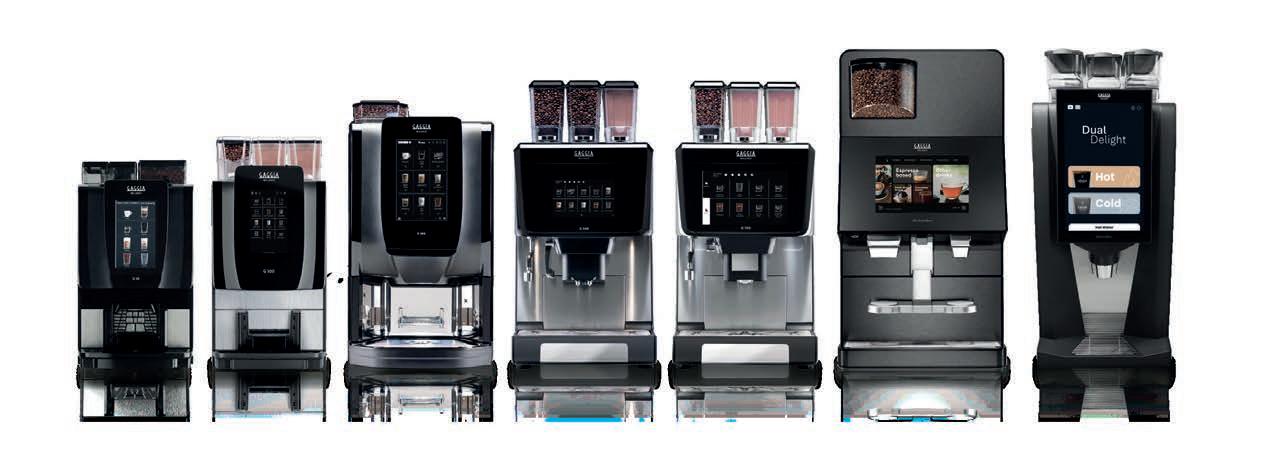
G Line is the new generation of fully automatic professional machines. A comprehensive range born from a long-standing tradition of craftsmanship and the highest standards of sustainability, with, at its core, an advanced extraction system that ensures consistent precision and exceptional coffee quality, delivering a scientifically perfected flavour.
Discover the environmental impact of your machine

Climate change is already changing the geography of coffee. With Rabobank estimating about 8 per cent of current Arabica-growing land is already unsuitable, that figure looks likely to be even higher come the middle of the century.
Adaptation to the changing climate of key coffee growing regions is accelerating beyond the farm. Breeding programs are racing to develop heat, drought, and disease resistant varieties, while traders and roasters are rethinking flavour profi les as terroir evolves.
The result is an industry moving into a new period of transformation, where future supplies of coffee will depend on the new adaptations being made at origin.
See page 37
Colombia’s coffee-growing regions are being impacted by a perfect storm of stresses at all ends of the supply chain. On one hand, there is soil degradation and erratic weather, on the other, a rising demand for coffee traceability and lower carbon production.
1.2 million square kilometres
of coffee farms mapped by Airbus by the end of June 2026.
Kaffee Gruppe, through its affi liate SKN Caribecafé, is working with about 5,000 farmers to incorporate biochar into production. Applied via compost, it enhances soil structure, water retention, and nutrient efficiency while locking away carbon.
Backed by partnerships and carbonaccounting ambitions, this scalable and mobile solution is showing promising early field results.
“Biochar is used as part of an integrated soil fertility strategy. It is combined with compost, primarily derived from coffee pulp, as well as with mineral fertilisers and based on soil analysis, if available,” says NKG Sustainability Manager, Dr Julius Wenzig.
“We have observed various benefits, ranging from the plant’s physical characteristics to soil quality and productivity.
“The plant’s physical structure appears healthy, with improved colour and leaves in good condition, indicating it is ready for abundant flowering.
“The soil retains moisture and is capable of more efficiently retaining the recommended fertiliser.
“Thus, the necessary conditions are in place for improved plant quality and yield. Biochar is not intended to replace fertilisers; rather, it enhances nutrientuse efficiency, improves soil structure, increases water-holding capacity, and promotes biological activity within the soil.”
See page 43
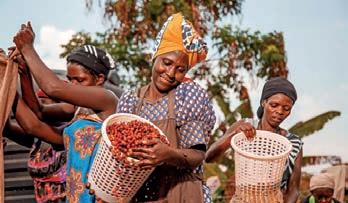
Uganda is already one of the leading producers of coffee in Africa, but the ancestral homeland of Robusta coffee is positioning itself to almost double its coffee production by the end of the decade.
With a lofty target of 20 million 60 kilogram bags of coffee produced by 2030, Uganda is looking to boost the quality of the coffee it exports, while also targeting new markets such as the Middle East and China.
“Last year, we exported around 8.3 million 60 kilogram bags of green coffee, earning about US$2.3 billion. Coffee is a very strategic commodity in Uganda, contributing almost 20 per cent of our GDP,” says Assistant Commissioner in charge of coffee quality assurance and value addition in Uganda, Gordon Katwirenabo.
“The roadmap is the vehicle to drive the sector from 3.5 million 60 kilogram bags in 2017 to 20 million 60 kilogram bags by 2030. Since then, we have already moved from 3.5 million to around 10 million 60 kilogram bags of production. We believe that by 2030, we can reach the 20 million bag target.”
See page 24
One of the major roadblocks facing accurate deforestation policy advice in the world of coffee has been the lack of data.
Not anymore.
JDE Peet’s has teamed up with Louis Dreyfus Company, Sucden, Neumann Kaffee Gruppe, Touton, Sucafina, and Tchibo in a bid to put an end to this problem.
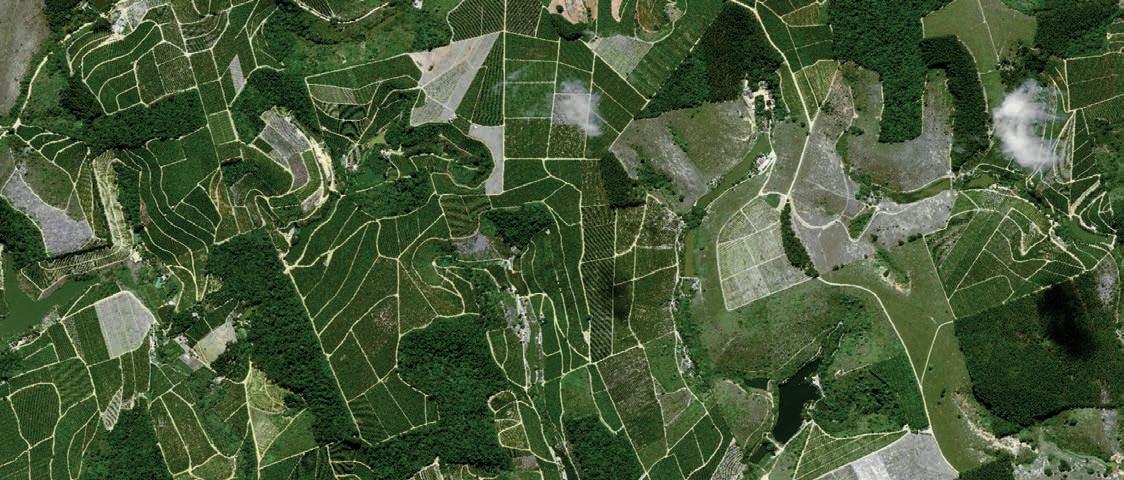
Now, Airbus Space and Defence is set to use its Pléiades and Pléiades Neo satellite networks to accurately map coffee landscapes all over the world, including 1.2 million square kilometres by the end of June 2026.
See page 58
Founded in 2013, Black Sheep Coffee has grown to become the fourth-largest coffee company in the United Kingdom. Now, cofounders Gabriel Shohet and Eirik Holth are looking to the United States to take their business to the next level.
Black Sheep is no ordinary coffee company, though. Since beginning, it has focused on selling mainly Robusta coffee to its customers, with its heritage Robusta Revival beans still accounting for about 85 per cent of its coffee sales.
“We launched Robusta Revival and nobody really understood what it was. We were sort of shut out from the specialty coffee scene. We were going against the establishment and the trend, and that’s where our name came from,” says Shohet.
“We realised we were going totally against the grain.”
See page 10
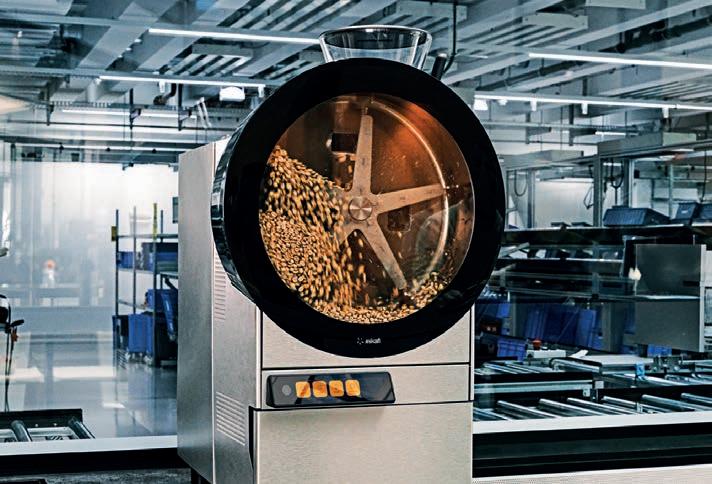
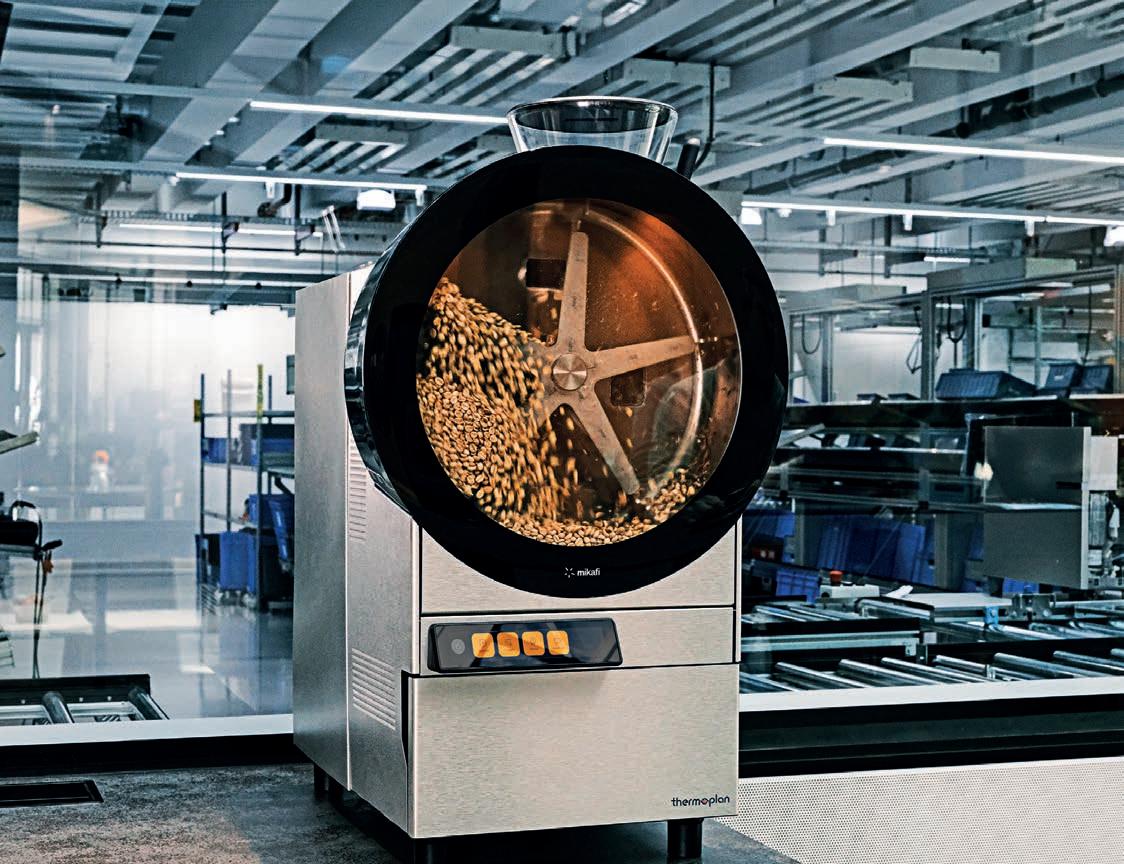
Imagine a coffee roaster small enough to fit on a countertop and can roast coffee in real-time right in front of a customer’s eyes. That’s a vision Thermoplan has brought to life with Mikafi, an 800-gram to 1.2-kilogram capacity roaster built to turn roasting into a show.
The automatic machine manufacturer unveiled the equipment at Host Milano 2025 but put it through its paces in front of the watching world at World of Coffee Brussels.
Built for specialty cafés, small-lot roasteries, and everything in between – is countertop roasting a new frontier for coffee?
See page 15
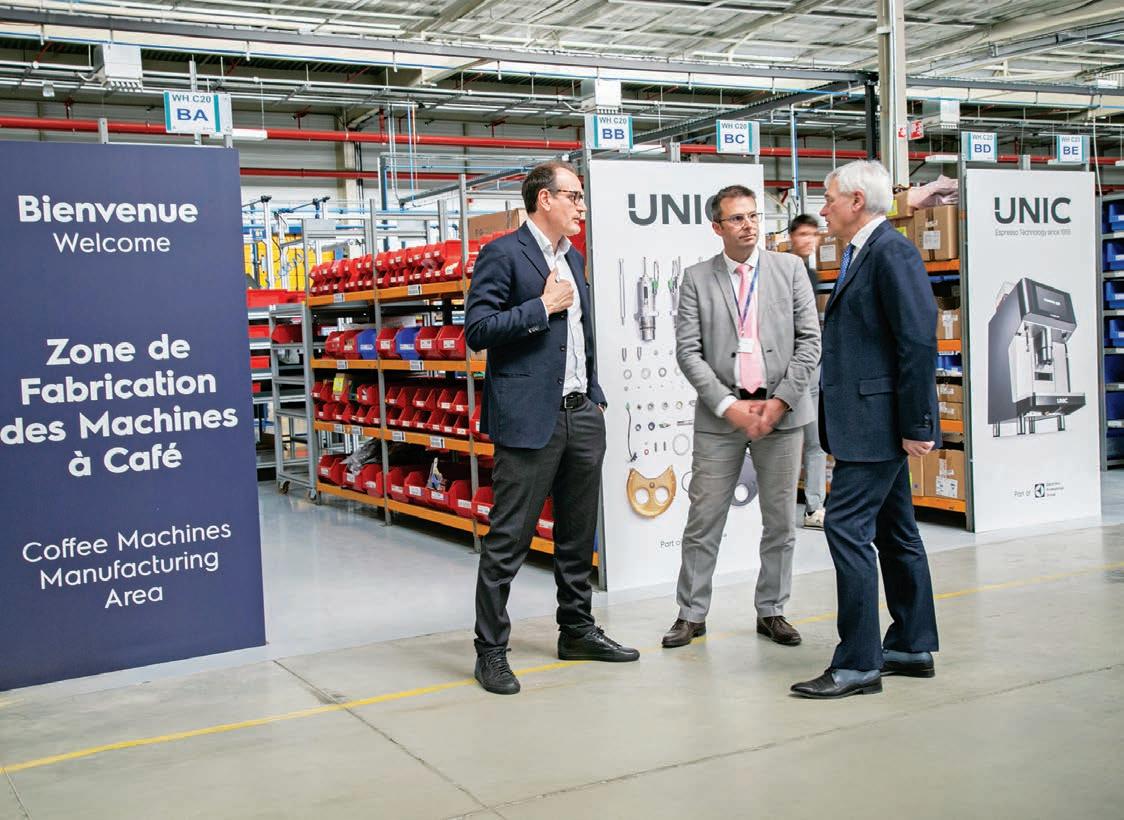
After close to 30 years calling Carros home, UNIC has shifted its production to Aubusson in central France.
The state-of-the-art facility was first inaugurated by UNIC’s parent company, Electrolux, in 2000, with all UNIC manufacturing shifting to the location from April 2026.
Electrolux Professional President Business Area Food Preparation and Beverage, Philippe Zava ireo, says moving to Aubusson will help UNIC continue its growth trajectory.
“[Aubusson’s] increased flexibility and capacity enable UNIC to be er respond to seasonal fluctuations and market demand, enhancing efficiency and competitiveness while supporting sustainable growth and long-term customer value,” he says.
See page 20
Industrial coffee production and specialty coffee have, typically, operated in separate
worlds – parallel to each other, but rarely interacting. As consumer expectations continue to rise across the industry though, that distinction is becoming grey.
Hemro Group’s decision to reposition Mahlkönig’s storied DK27 grinder as the Di ing 1827 High Volume reflects this new shift in how coffee is made at scale.
According to Hemro, the transition a response to changing demands in production roasting, where consistency, thermal stability, serviceability, and flexibility are increasingly prized.
See page 22
Industrial coffee production is shifting from crude grind size targets to engineered particle distributions, a change driven by the demands of single serve brewing.
Downstream, packaging technology is undergoing a similar transformation. The IMA SYNKRO platform’s independently controlled shu les allow manufacturers to fine tune sealing and handling for an expanding array of sustainable capsule materials. Integrated weighing and gentle dosing aim to preserve both aroma and structural integrity.
IMA Petroncini CEO, Nicola Panzani, says accommodating this shift means new systems must be created to ensure quality across millions of extractions.
“Today, the objective is not simply producing finer or coarser coffee, but engineering a PSD that delivers stable hydraulic behaviour, predictable extraction,
and repeatable sensory performance across millions of single-serve units,” says Panzani.
See page 28
After more than two decades in coffee, Denis Girardi has a conclusion that it’s grinders, not espresso machines, that determine whether a chain delivers consistency at scale.
In high-volume se ings small variations compound quickly, especially as staff rotate and peak periods strain both equipment and process.
“[Consistent grinder performance] is the single most critical point in a coffee shop,” says Girardi.
“[It] has the highest impact on overall drink repeatability when it comes to coffee quality. If you control the grind and the dose at the source, you stabilise the extraction regardless of the surrounding environment.”
See page 31
Italian packaging group Cama is navigating a coffee sector in flux, where sustainability and flexibility are reshaping both materials and machinery.
As Cama Sales and Technical Manager, Sergio Cornago, notes, “one of the biggest changes has been the stronger focus on reducing waste and using more recyclable materials”, prompting a shift from plastics towards aluminium, despite earlier alternatives that “didn’t really deliver the expected results”.
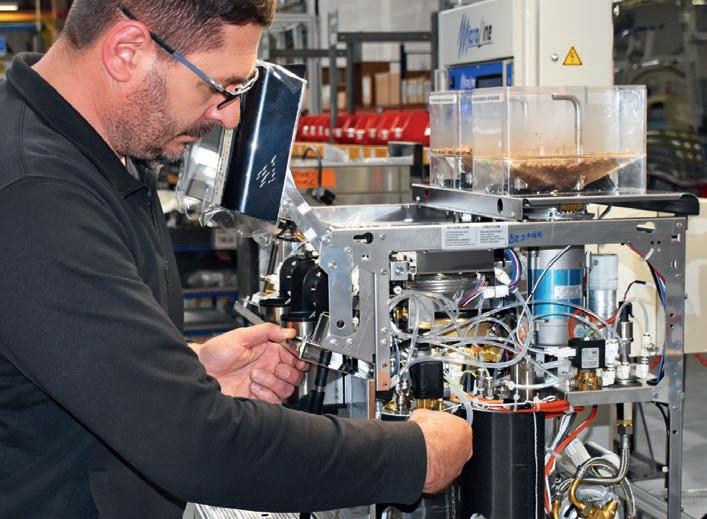
The technical hurdle of self-protecting capsules showcases how packaging choices affect both waste and quality.
Buoyed by renewed investment appetite, Cama sees major brands consolidating production in-house while diversifying formats.
See page 34
Accounting for coffee’s carbon footprint is notoriously tricky: emissions accrue across origin, lengthy supply chains, and longlived machinery.
Evoca Group is a empting to bring greater clarity to this problem with its Carbon Footprint Calculator 2.0, a tool designed to quantify the environmental impact of coffee machines across their lifecycle.
By translating technical data into metrics such as emissions and energy use per cup, the calculator seeks to make sustainability a practical consideration in purchasing decisions, rather than an abstract ideal.
See page 40
20 million coffee bags produced by Uganda by 2030.
A group of B Corp-certified coffee businesses from all over the world have joined forces to create the B Corp Coffee Coalition.
Founded by seven members, at the time of writing more than 20 per cent of all eligible B Corp-certified businesses are part of the coalition, which aims to provide a dedicated space for members to align on shared priorities, exchange best practices, and develop approaches that strengthen long-term sustainability.
Brazilian coffee growers cooperative, Sancoffee, was one of seven founding members. Head of Impact, Ana Claudia Silva, says it is important for organisations with similar values to align.
“For us, it is impossible to ‘promote prosperity’ in the field without an integrated global ecosystem that supports the farmers at the base. Likewise, it is impossible to ‘cultivate relationships and harvest trust’ without fostering a transparent, pre-competitive agenda among businesses worldwide,” she says.
“Joining forces with other global references in the B Corp movement reinforces our commitment to go beyond basic commercial sustainability, actively pursuing regenerative leadership grounded in the values we live by every day.”
See page 46
In coffee’s increasingly bifurcated world, automation and artistry no longer rivals.
Rather, they often go hand in hand.
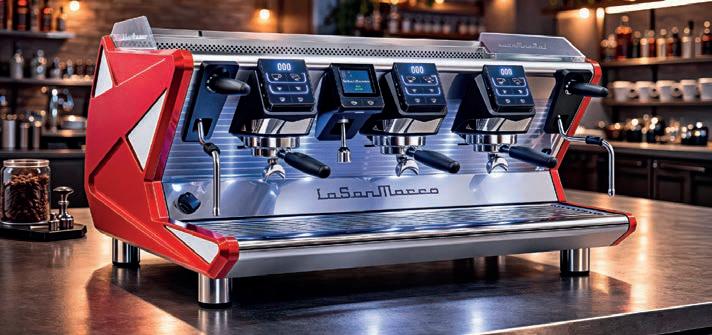
SEB Professional Beverage argues that operators are no longer choosing between machines, but orchestrating them – deploying manual espresso systems for theatre and craft, while relying on automated counterparts to handle the grind of peak demand.
Its pairing of La San Marco’s LA 125 with the WMF espresso NEXT embodies what Managing Director La San Marco at SEB Professional Beverage, Giovanni Fucili, calls “two different professional needs, rather than a hierarchy of quality”.
See page 52
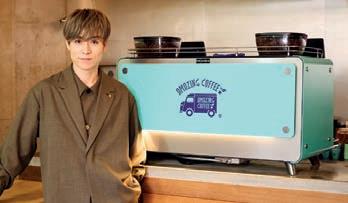
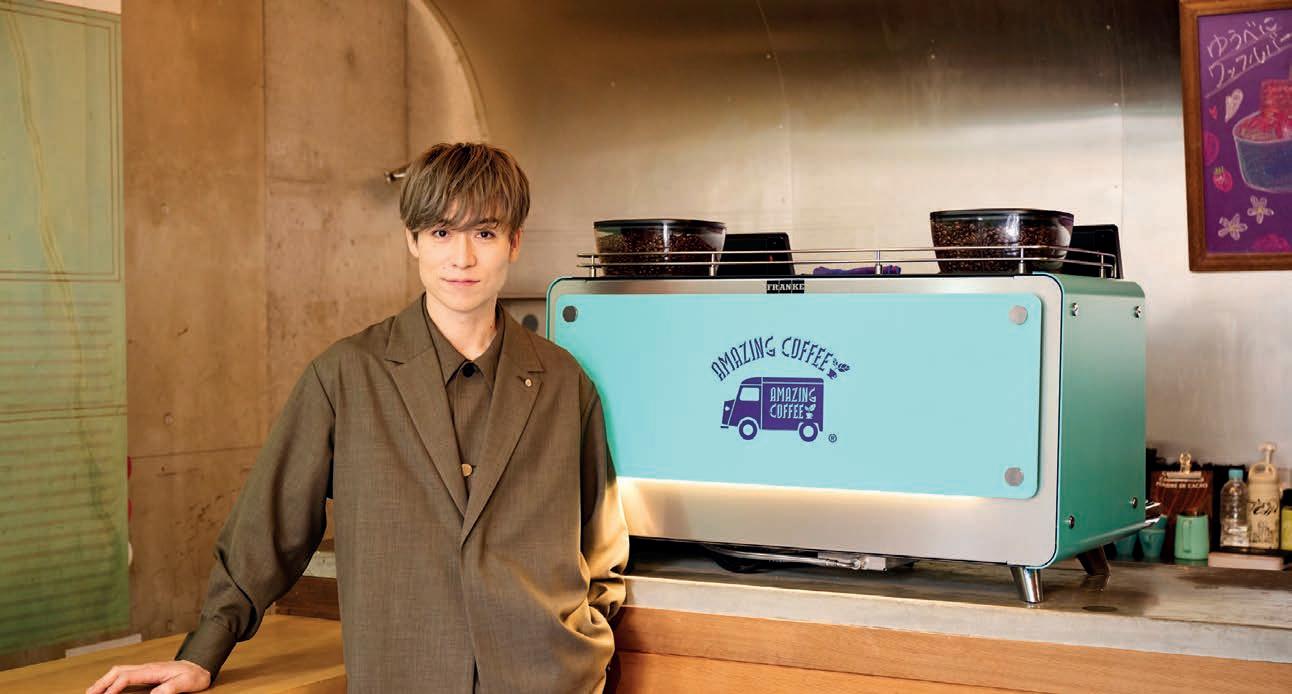
AMAZING COFFEE, produced by famous dancer and Coffee Meister Ambassador for the Specialty Coffee Association of Japan, EXILE TETSUYA, has become a leading entertainment-driven coffee brand in one of the world’s most fluid and exciting markets.
Today, it operates fi ve locations around the country, alongside collaboration stores and online pop-ups, aiming to reach fans of coffee and entertainment where they are. When faced with huge rushes of fans looking to interact with the brand, AMAZING COFFEE turned to automation to help it scale coffee quality, efficiency, and omotenashi.
“For a coffee shop, the espresso machine is the ‘face’ of the establishment. Changing the machine means changing that face. And Mytico’s face – it’s really beautiful,” says TETSUYA.
See page 18
Trip to Origin made its Melbourne International Coffee Expo (MICE) debut in 2026, and producers from across the globe descended on the Melbourne Convention and Exhibition Centre to showcase the best coffees and most exciting developments from their origins.
The activation is already confirmed to be back on the agenda for MICE27.
Her Excellency Ms Dorothy Samalie Hyuha, Uganda’s High Commissioner for Australia, travelled from Canberra to a end MICE26. She says the most riveting aspect of MICE was just how much of the global coffee community was in Melbourne.
“What I enjoyed about this show is the

layout of it, and how different café players have been in a position to participate,” says Samalie Hyuha.
“You find the exhibitors who export and produce coffee are here [at Trip to Origin], but the roasters are here, the baristas are here, those who manufacture packaging and machinery are here.
“We have had an opportunity to tell the success story of coffee from Uganda. Our goal is to enter the Australian market to trade coffee and open ourselves to the Pacific region and the entire world.”
See page 49
Cold brew and other cold coffees have exploded in popularity in recent years, with consumers looking for new and novel ways to enjoy coffee.
Flavourtech Global Sales Manager, Paul Ahn, says the traditional cold brew steeping cycles leave 20 to 30 per cent valuable soluble coffee materials in the waste grounds, and this high potential material is being discarded with li le thought.
He says there are methods to fully extract the remaining solids and convert them into different products.
“It’s a massive win for sustainability and a highly lucrative way to generate more revenue from material that was previously destined for landfi ll,” says Ahn.
“The ability of our systems to process slurries and mashes, means we can handle waste streams, like fruit peel, spent coffee
grounds and mustard meal, extracting valuable flavours, essential oils and active compounds.
“Manufacturers can extract maximum usable value from raw materials and turn waste into marketable products. Alternatively, they might want to remove undesirable aromas from waste so that it may be used as animal feed.”
See page 54

From trestle tables at market stalls to expanding to more than 140 worldwide locations, Black Sheep Coffee has been built on a belief in Robusta and wanting to challenge the specialty coffee hierarchy.
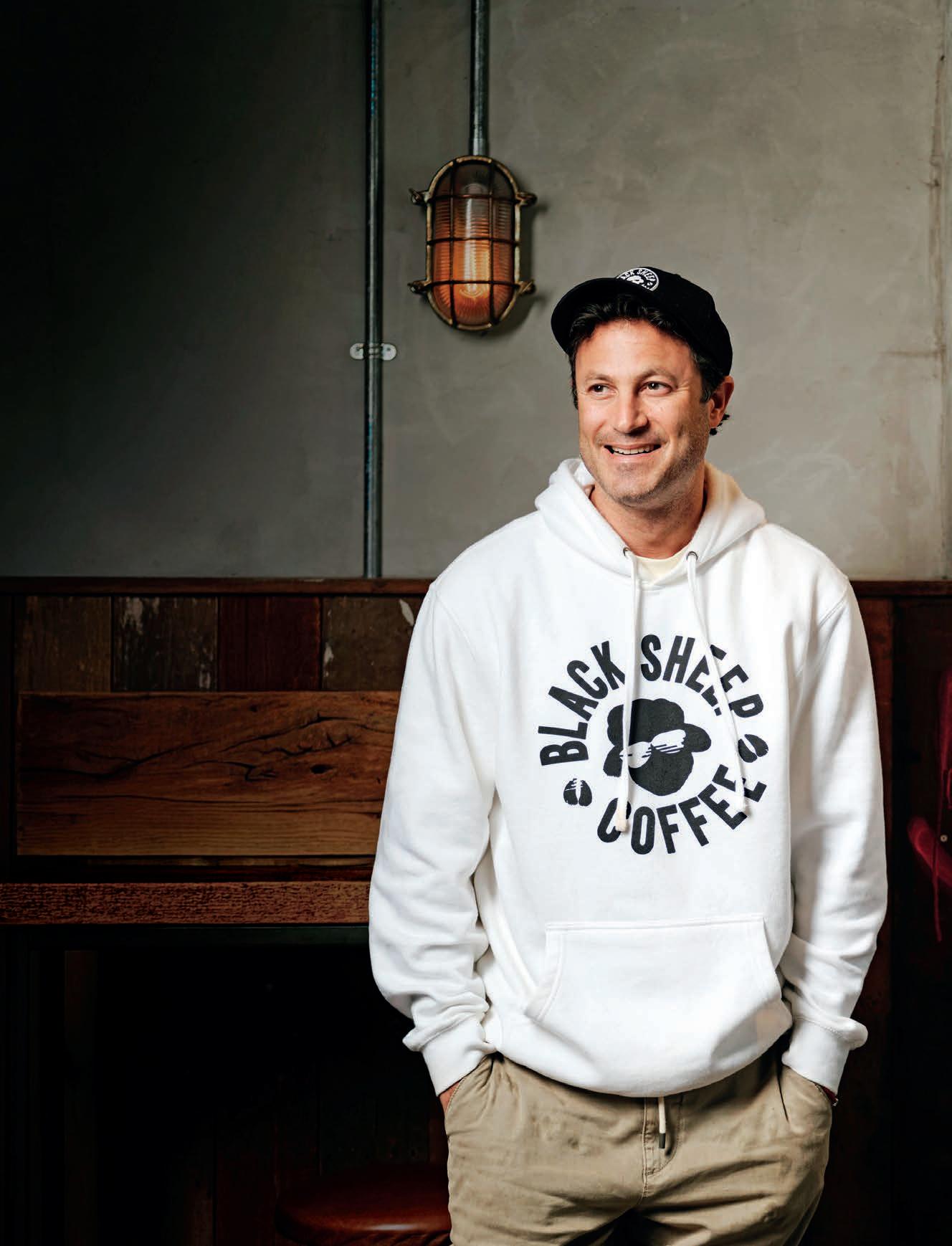
AFTER SPENDING just a few minutes with Gabriel Shohet, you can tell he’s not a conventional co ee company executive.
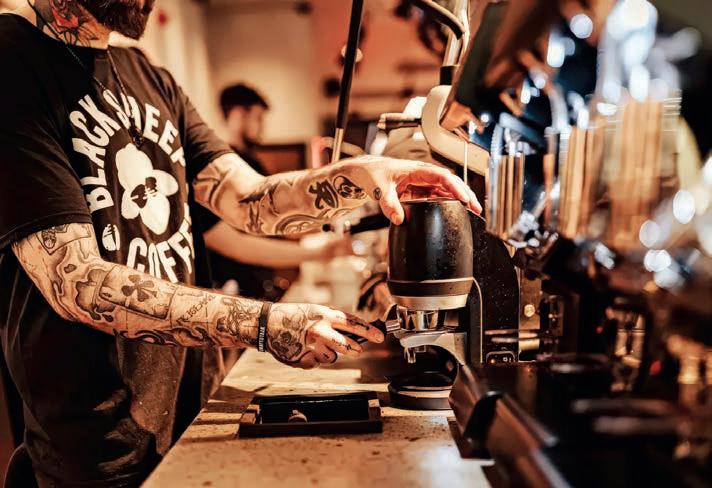
Clad in his now almost trademark Black Sheep Co ee hoodie and hat, the Co-Founder and Co-CEO of the United Kingdom’s (UK) fourth largest – and fastest growing – co ee company seems all about connection.
While the early conversation centred around his recent move to Miami to spearhead the growth of Black Sheep’s United States (US) operations, basketball player Kristaps Porzingis coming on board as an investor in 2021, and navigating time di erences of the world, it is immediately clear that Shohet is someone who thrives on challenging himself.
A er growing to more than 140 total locations worldwide, most of which are in the United Kingdom, Black Sheep’s story is one of two international students, Shohet and fellow Co-Founder Eirik Holth, meeting at a Scottish college, moving to opposite sides of the world, and decided to start a co ee company in London.
“Eirik and I started as roommates back in college at St Andrews,” says Shohet. “We both loved co ee and were very passionate about co ee as a product. We graduated and went our separate ways – him to New
York and me to Milan – but we would stay in touch on Skype every Sunday.
“We would always talk about starting a company. A er a year of that we said, ‘if we don’t actually quit our jobs, we’re never going to do this’. No matter what happened, even if it wasn’t all planned out, we were going to quit.
“ at day came and we quit our jobs on the same day, moved to London, and started this co ee company together.”
Robusta Revival
e story, or at least the concept, of two college roommates or high school best friends starting a business together is not new. It’s one that has been immortalised not just in Hollywood, but through real-world success stories like Facebook, Reddit, and Ben & Jerry’s, among a litany of others.
When Black Sheep launched in 2013 though, it faced one key di erence from the rest of the established London co ee landscape, it was pushing the potential of Robusta, rather than its more popular cousin Arabica.
“You had all those guys with long moustaches doing cupping sessions and talking about Arabica co ee. at was the only game in town, Robusta was like a swear word,” re ects Shohet.
“We would show up at cupping sessions and it was almost like a cult. It wasn’t just raised eyebrows – there was some animosity. ‘You’re not invited to our sessions because you do Robusta’. None of these guys had ever tried specialty-grade Robusta, because it just didn’t exist. It was very weird.”
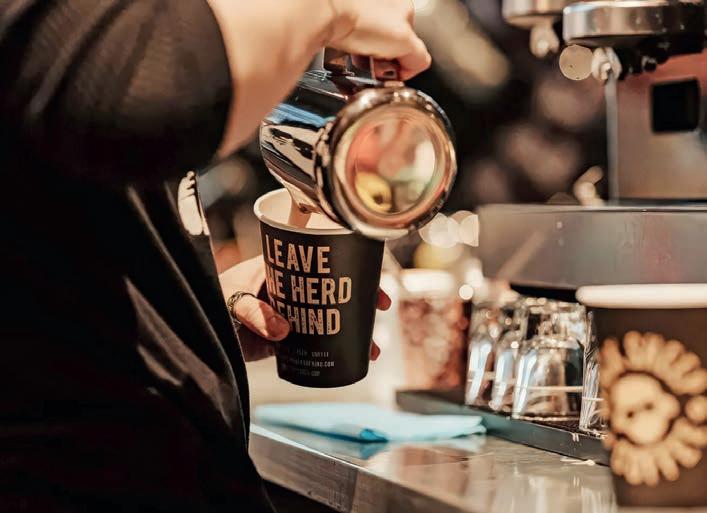
Black Sheep’s slogan is to ‘Leave the herd behind’, and Shohet says this desire to hero Robusta – some 12 years before the rst Robusta avour wheel was even developed – was the driving force behind he and Holth being what he labels as the black sheep of London’s co ee scene.
is Robusta obsession went beyond desire to be di erent, though, with Robusta’s ability to be commoditised a key driver of the Black Sheep ethos. Its resilience as species and di erent harvest cycles stood out.
“We did a lot of research, and what we found, in a nutshell, was that Robusta is a more robust plant,” he says. “It grows on much thicker trees at lower altitude, has more cherries per tree, you can harvest it year-round instead of once a year like Arabica.
“It has roughly twice the ca eine content, which acts as a natural pesticide.
“We found all these properties that made it a great plant species if you wanted to
mass-produce something: better output and lower cost. at’s essentially what happened – people started mass producing Robusta because the yield was better.
“Robusta became a commodity that would fetch the same price on the market, and once it all fetches the same price it becomes a race to the bottom to see who can produce it cheapest.”
ey took principles from how co ee farmers grow the highest quality Arabica and scoured the world looking for producers who were applying them to Robusta.
“If we could nd a plantation that is high altitude, shade grown, hand-picked, sundried, double-washed, and processed like a ne Arabica, would that be a product worth trying? e answer was yes,” says Shohet.
“We visited hundreds of co ee plantations until we found this one guy who had inherited an Arabica plantation from his dad, had taken out all the Arabica, and started growing Robusta instead.
“He was a big believer. We thought, nally, we’ve found some Robusta. We also found some in India, in northwest Kerala, in eastern Uganda, and some plots in Ecuador. But it was very rare, it took a lot of travelling and searching.”
e rst major product Black Sheep launched was Robusta Revival – a single origin 100 per cent specialty Robusta from Karnataka that Shohet and Holth initially sold at market stalls and supplied to other businesses.
“We launched Robusta Revival and nobody really understood what it was. We
were sort of shut out from the specialty co ee scene. We were going against the establishment and the trend, and that’s where our name came from. We realised we were going totally against the grain,” says Shohet.
“We also realised early on that most of our consumers don’t know the di erence between Robusta and Arabica, and most people don’t to care. It’s not for us to lecture customers. What mattered to us was: does this co ee taste like money, and is it awesome?”
From about US$20,000 in savings, and a Kickstarter campaign to help get funding over the line, Black Sheep evolved from
trestle tables at market stalls, to a wholesale roaster, to its own café.
“We do Arabica lter now, and we also have Arabica espresso-based blends like our Blue Volcano or Love Berries, but our house default beans is the same as from 2013, and it still makes up 85 per cent of our co ee sales,” says Shohet.
“At rst, we were selling B2B and using the stalls to get immediate feedback on the product. We pretty quickly realised B2B is weird because you end up being a provider of co ee machines and maintenance.
“We would rock up at hotels with our little toolboxes to repair broken machines. at’s not what we wanted to do, and we wanted that interaction with customers. ose popups were initially built to test the product but very quickly became what the whole business was about.”
At the time of writing in June 2026, there are more than 140 Black Sheep locations around the world – and Shohet says there are a handful set to open in the US, UK, and Middle East in the coming weeks.
While much of the discussion around Black Sheep’s growth tends to be focused on its establishment as the ‘best of the rest’ in terms of scale behind Starbucks, Ca è Nero, and Costa Co ee in its home market, and its move to the US, Shohet doesn’t underestimate the importance of the Middle East as an expansion region.
Black Sheep has targeted the countries of the Gulf Cooperation Council (GCC), which includes the likes of the United Arab Emirates and Saudi Arabia.
“ e US, UK, and GCC – these are very chain friendly markets, unlike Australia, New Zealand, South Africa, and much of Europe, where there’s this idea that a chain equals bad quality. In those markets it’s almost the opposite: people appreciate the consistency of a chain that can do things well,” says Shohet.
“In the Gulf countries, co ee is growing at double digits. You’ve got a demographic that’s moving away from tea and really switching over to co ee, so you have that tailwind of growth, which is awesome. Also, alcohol is not a big thing in the UAE, and it’s not a thing at all in Saudi Arabia.
“Imagine London, where you have co ee shops and pubs and nightclubs. Now imagine Jeddah or Riyadh, where the pubs, clubs, and bars are all co ee shops because there’s no alcohol. People go to co ee shops to celebrate birthdays, to go on dates. e rush hour for co ee shops in Jeddah is 11pm.”
Given that, even in just this story, Shohet has mentioned London, St Andrews, Milan, Miami, Jeddah, and travelling to a handful of di erent co ee origins, it’s obvious he’s a man who thrives being on the move.
It seemed almost inevitable he would end up in the US, bringing Black Sheep to what is likely the world’s most challenging commercial franchise market.
“ e US is massive. People spend more in co ee shops, the average transaction value is much higher, and the competition is erce – which we love. It’s kind of an obvious place to be. We want to go where it’s the hardest, for the same reasons we picked London when we started,” he says.
ey’ve picked the Sun Belt states to launch into the US, a geographic region that spans the southern part of the country from coast-to-coast, with a special focus on Texas and Florida.
“We picked states we think have good fundamentals. You have big population growth that you don’t see elsewhere in the US – a lot of people from California moving to Texas, and from New York down to Florida,” says Shohet.
“ e Sun Belt in general – Georgia, Tennessee, the Carolinas – are great, growing states that are pro business. ere are fewer hurdles to get started. If you get a piece of land in Houston, you can basically do whatever you want with it: sell co ee or hair dryers, do a drive thru or not. ere are very few zoning restrictions, so it’s easy to get cracking.”
Shohet likens the Miami Black Sheep o ce to something of a ghost town in this

early stage, saying it’s “literally an empty building with ve chairs and no screens”, and that “it echoes because there’s no furniture”. Yet, the prospect of building the brand from the ground up is invigorating and exhilarating.
“Being in the US now is like starting the company from scratch. It’s really di cult because you’re facing challenges you haven’t faced in a long time and thought you’d never have to face again. You’re right back in the weeds,” he says.
“Day to day, you end up being very hands on again: having relationships with landlords, nding sites, meeting franchisees, doing a lot of the site search yourself, guring out the local supply chain – all those bits and pieces. It’s fun. I love it. It’s very rewarding, and I’m really enjoying this US market entry.”
As for what’s next for Black Sheep, it’s the same message as it has been for the past few years. Consolidation and organic growth.
From two years of market stalls and building the rst location by hand, to launching a franchise model a er 50 locations in the UK, the past 13 years have been all systems go for Shohet, Holth, and the ever-expanding Black Sheep team.
“I don’t have any big announcement like we’re entering a completely new country far away,” says Shohet.
“It’s really about doing more of the same,
being thorough, and continuing to build.
“We’re also lucky that we don’t have any private equity funds on our cap table setting a timeline for us and saying, ‘You need to get to this shop number by this date,’ with consequences if we don’t. We set our own targets and milestones, and we can grow at the pace we think is right, in the places that really matter.”
Customer demand – whether that’s more Black Sheep locations in existing markets, further expansion into the GCC or US, or otherwise – will remain the key driver for the business, Shohet says.
“We look at customer satisfaction metrics to de ne growth. As long as our customer satisfaction scores go up, we keep opening more shops. If that were to drop at some point, we’d probably take a step back and think, ‘okay, maybe we need to slow down and x some stu ’,” he says.
“For now, performance on that front has been incredible. I think we’re getting closer to a 4.8 average on Google Maps across the network, which is awesome – up from about 4.5 a year and a half ago. at’s a really important data point for us. We also look at other customer satisfaction touchpoints like Trustpilot and our own website.
“We really try to listen to our customers and understand what the overall sentiment towards the brand is.” GCR


THERE HAS ALWAYS been more to cafés and co ee than simply serving someone a drink. If the end goal was purely ca eination, all cafés would look the same, specialty co ee wouldn’t exist, and there would be nobody seeking the creation new and unique experiences for customers.
What happens, then, when the art of pouring a co ee has been turned into a show all over the world – what is the next point of di erence in connecting customers to co ee? For ermoplan, it’s making roasting the star.
Project Manager for ermoplan, Andrea Della Zoppa, is one of the driving forces behind Mika , which was rst debuted at Host Milano in 2025.
e countertop roaster, with its capacity of 800 grams to 1.2 kilograms, has been created to make roasting more accessible to more people, and to o er a new tool to experienced roasters looking to push the envelope.
“We want to make roasting accessible and transform it into a captivating experience that customers can see, smell, and connect with. To do that, the roaster needs to be
visible – on the countertop, behind the barista, or anywhere it becomes part of the customer experience,” she says.
“Not using too much space is crucial, so customers can really see the roasting process.
“Mika has a large glass drum where you can watch the beans turning from green to brown roasted co ee; you can literally see the colour changing. We want the customer to see that process.
Some may call roasting co ee a science, others, an art. To many, it’s a combination of both. Mastering how to perfectly roast the best co ees in the world can take years of learning and countless failures.
With Mika , ermoplan has attempted to lower that initial skill level needed to roast co ee, and make it accessible for baristas, hospitality venues, and third spaces around the world.
“ e barrier to entry is very low, and that was the goal,” says Della Zoppa. “Baristas are usually very experienced with espresso machines, lter co ee, French press, and other methods of producing co ee.
“Many of them also have a basic understanding of roasting. We really want to lower the threshold for getting into roasting.”
On the other hand, it has been developed to also enable skilled and experienced roasters to perfectly dial into every roast they want to create.
Key to developing the roasting skill of users is the presentation of the Mika platform.
“Roasting experts can create their own recipes and see a live roasting curve, to make adjustments in real time,” continues Della Zoppa.
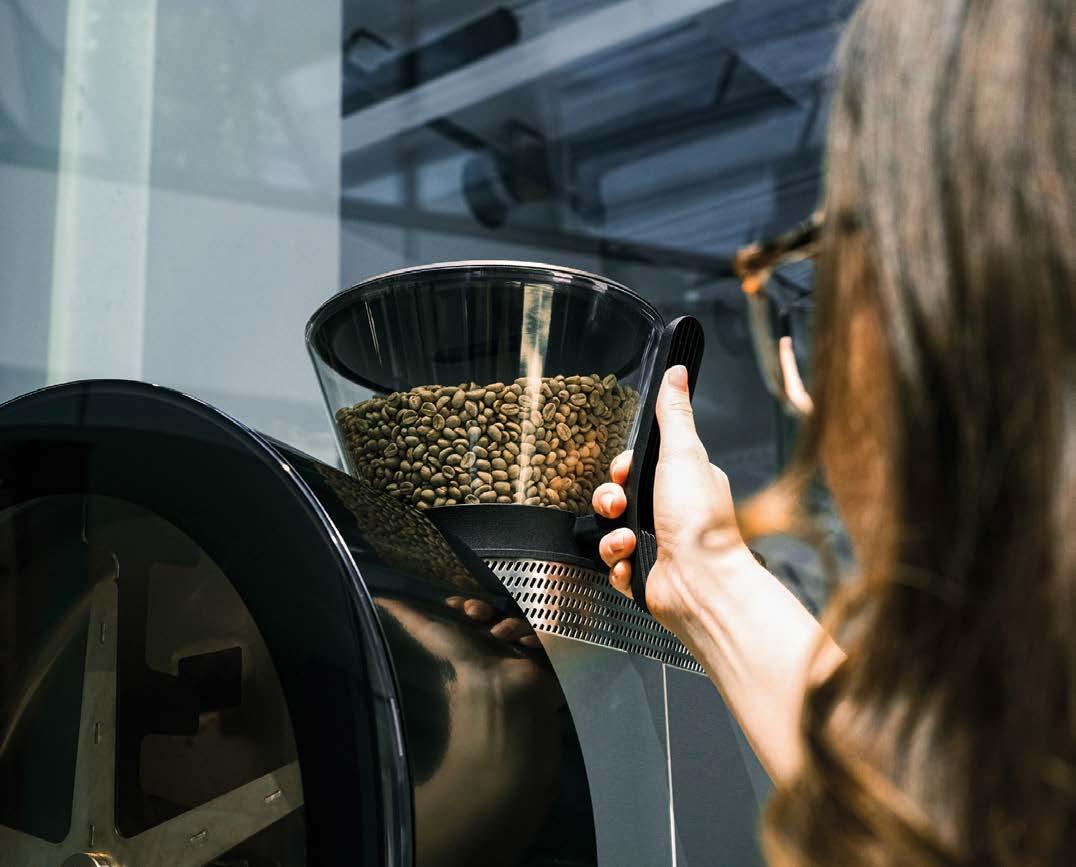
“You can start very easily with the prede ned recipes that come with the machine. You only have to follow four steps: select a recipe on the display, ll in the green beans, press play, and collect the roasted beans at the end of the roasting cycle. Over time, users can develop more knowledge, cupping the co ee they know and love, and then thinking, ‘Maybe I want this to be a bit fruitier,’ and adjust the recipe. ey can do that.
“Recipes can also be transferred to the roaster via the cloud connection from any
connected device, including mobile phones and computers. We want to show how much this product is actually capable of, and how it’s useful from beginner level up to professional.”
Roasting co ee is typically a loud, hot process. A er all, it involves heating a space to potentially well above 200 degrees Celsius before removing that hot air out.
Della Zoppa says one of the major challenges of scaling Mika was ensuring it could be operated on a countertop without overpowering a space with heat and noise.
“One of the key challenges was de nitely the air exhaust system,” she says. If you look at other roasters, especially bigger ones, they’re o en quite heavy and space consuming. Our air exhaust system needed to t into a footprint of about 60 centimetres by 50 centimetres, which was a challenge, but we gured it out.
“We also implemented a precise air ow and heat management system. Fitting all of that into such a compact product was demanding.
“Now we’re testing the rst devices in the market – they’re already installed in co ee shops and roasteries and are being tested every day. I’d say we achieved what we set out to do. Our goal was to keep the roaster as small as possible but still make it as professional in performance as we are used to with our ermoplan co ee machines.” is ability to problem-solve, Della Zoppa says, is typical of ermoplan.
“ ermoplan is very well known for its know-how in the development and production of fully automatic co ee machines. Up until now, innovation in fully automatic machines has been our core,” she says.
“One step led to another, and we were able to help the startup Mika to develop its product. With our R&D department,
we accompanied them on their journey and, as the story progressed, we were then able to take over the project and Mika as a product in total.
“ at’s how we, as ermoplan, have enlarged our product range. We’ve gone from fully automatic co ee machines a little step back in the co ee value chain to also making tabletop co ee roasters now, a kind of natural evolution for us.”
A er being unveiled at Host Milano 2025, the full capabilities of Mika were rst properly showcased at World of Co ee Brussels, where the World Roasting Championship just so happened to be taking place.
In addition to all the passionate enthusiasts and innovators present in Belgium’s largest city, the world’s best roasters were on hand to not only compete but check out the best Mika had to o er.
“World of Co ee Brussels was the perfect stage for us. With the global roasting community gathered in one place, we had the opportunity to showcase two brandnew Mika roasters at the centre of the action – a unique opportunity we couldn’t pass up.”
“World of Co ee brings together all the co ee enthusiasts, innovators, and very passionate professionals from across the sector – baristas, roasters, and many more. at’s exactly where we see our future customers,” says Della Zoppa.
“World of Co ee is also very important for us because we already know this event quite well. Since 2024 we have been providing the Black&White4 Competizione as the o cial World Latte Art Championship machine.”
As to whether Della Zoppa believes tabletop roasters like Mika are the future, she says it ties into supporting two major trends being seen in the co ee industry.
“We see that co ee shops are increasingly struggling to create a unique experience for their customers and to di erentiate themselves from others. We see a clear
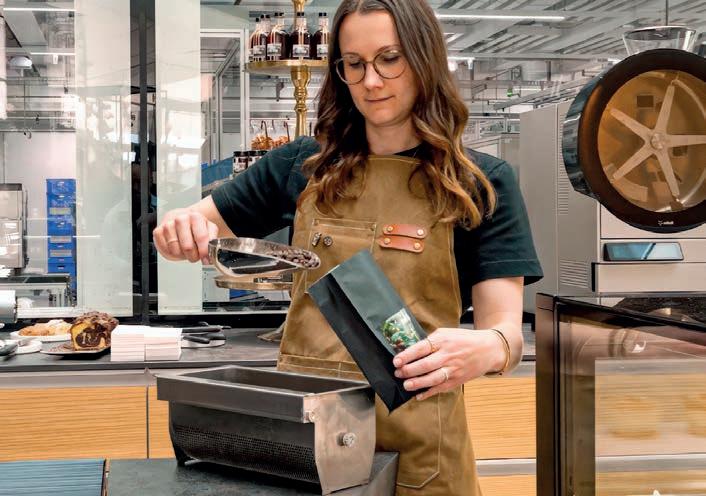
need for roasting co ee directly in front of customers, and therefore a big opportunity. at’s the direction we are going,” she says.
“I also strongly believe Mika can change how people think about co ee and freshness, and even how they think about farming and origin.” GCR
For more information, visit thermoplan.ch/en/products/mikafi
Get more value from your spent beans with the Integrated Extraction System



Japan’s AMAZING COFFEE details how Franke Mytico helps scale premium coffee quality, operational efficiency, and omotenashi without losing the human connection at the counter.
PREPARING COFFEE in a modern café is no longer only about delivering a good beverage. Customers expect quality, speed, choice and atmosphere, while operators need to manage labour pressure, training requirements, rising costs and complex peak-hour demand.
At the same time, cafés are judged not only by what is served in the cup, but by the experience surrounding it.
For concept-driven co ee brands, this creates a particular challenge. e more distinctive the brand, the more di cult it can be to scale.
A beverage must taste the same across locations, shi s and teams, but the experience also needs to remain personal, recognisable and emotionally engaging. E ciency matters, but it cannot come at the expense of hospitality.
is is especially visible in Japan, where attention to detail, product consistency and guest experience are embedded in co ee culture. It is also where AMAZING COFFEE, the entertainment-driven co ee brand produced by EXILE TETSUYA, has built a concept that connects co ee with lifestyle, community and entertainment.
A member of the Japanese music group EXILE and the rst Co ee Meister Ambassador of the Specialty Co ee Association of Japan, TETSUYA brings
together his background in entertainment with a genuine passion for co ee quality.
Built on connection
Launched in 2015 from a mobile co ee truck, AMAZING COFFEE was created around the idea of o ering omotenashi through co ee. e Japanese concept is a warm and thoughtful form of hospitality, where a beverage becomes more than a product and turns into a shared moment.
Today, the brand operates ve locations in Japan, alongside corporate employee welfare facilities, collaboration stores and an online shop. Guided by the philosophy ‘AMAZING LIFE with AMAZING COFFEE’, the brand aims to make co ee more accessible, emotional and connected to people’s everyday lives. at emotional dimension is central to the concept. AMAZING COFFEE serves daily café customers, but it is also closely linked to concerts, pop-ups and fan activations.
Large numbers of fans can arrive at once, bringing high expectations, strong emotions and a desire for direct interaction with the brand. In these moments, co ee service must be fast, consistent and personal at the same time, a balance that becomes di cult to achieve when quality depends heavily on individual barista skill.
Before introducing Franke Mytico, the AMAZING COFFEE team faced a challenge familiar to many growing café concepts – the maintenance of premium quality when service is delivered by teams with di ering levels of experience.
Many of the brand’s team members are young entertainment school students pursuing careers as performers. While they bring energy, openness and a strong sense of hospitality, they are not full-time baristas. Developing deep co ee expertise across a constantly changing team was therefore di cult.
Traditional espresso preparation depends on many variables, from grinding and tamping to extraction, milk preparation and daily adjustments. In a dynamic team environment, that level of technical dependency made it harder to maintain the same standard every day. e issue was not a lack of passion, but how to ensure that every cup meets the same standard, regardless of who is behind the counter.
For TETSUYA, the espresso machine also has a symbolic role in this experience.
“For a co ee shop, the espresso machine is the ‘face’ of the establishment. Changing the machine means changing that face. And Mytico’s face – it’s really beautiful,” he says.
The right solution
TETSUYA and the AMAZING COFFEE team were looking for a solution that could protect co ee taste and milk foam quality while making daily operation more practical for a diverse team. e answer had to support speed, consistency and operational simplicity without removing the visible, human side of co ee service.
e AMAZING COFFEE team was not looking simply for automation. It needed a solution that could support premium quality, customer interaction and operational scale while preserving the theatre and emotional connection of the café. When TETSUYA rst experienced Franke Mytico, the t was clear.
According to the project team, he saw in the machine not only a way to serve high-quality co ee, but a platform aligned with the future direction of AMAZING COFFEE: one that considered customers, sta and long-term brand growth.
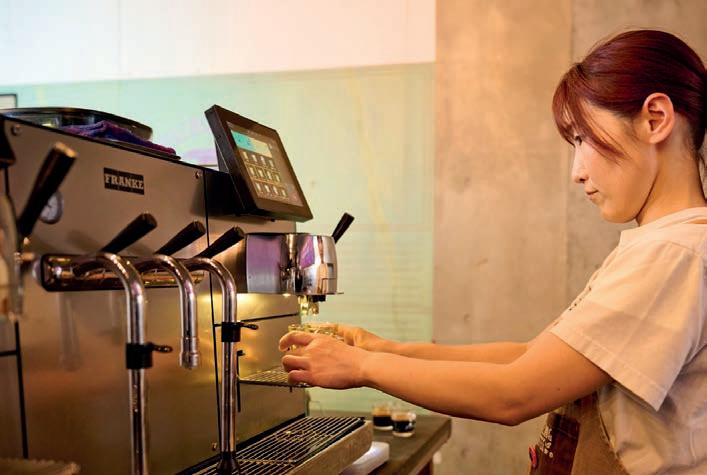
Mytico Due was rst introduced at the Nakameguro store in Tokyo in December 2025 and is now used at key AMAZING COFFEE locations in Tokyo, Osaka and Nagoya. e con guration includes three grinders and two S3 steam wands, supporting the need for beverage quality, exibility and e cient peak-hour service.
Bringing consistency
With Mytico, the AMAZING COFFEE team says it has moved from skilldependent preparation to systemsupported consistency. Sta can deliver the same co ee quality regardless of experience level, while remaining involved in the preparation and customer experience.
Mytico supports reproducible espresso quality and smoother work ows. Its parallel preparation capabilities enable teams to extract two double shots or four single shots at once and prepare two high-quality milk foams at the same time, helping increase throughput during busy periods while maintaining beverage quality. is matters particularly during events and peak café hours, when one sta member may need to manage extraction, milk preparation, customer communication and cashier duties at the same time.
For AMAZING COFFEE, this change has helped ease bottlenecks and reduce pressure on highly skilled sta during busy periods. It has also changed the way new team members learn. Rather than asking them to master every technical variable before they can serve con dently, Mytico gives
sta a clear reference point: a consistently delicious cup.
From there, they can learn backwards, understanding why the result tastes good and how di erent settings, beans and milk choices in uence the beverage.
“Mytico consistently delivers baristalevel quality co ee. Even sta with limited experience can produce high-quality drinks e ciently. at’s genuinely invaluable,” says TETSUYA.
For AMAZING COFFEE, this matters because simplifying the technical burden does not remove the human element. It gives sta more space to focus on guests, while Mytico’s low height helps preserve eye contact and conversation at the counter.
“What surprised me most was how sta interest in co ee actually deepened. We brought in Mytico to make things easier, but instead, sta passion for co ee increased. at was truly unexpected.”
A platform for creativity
e collaboration has also opened new creative possibilities for the menu. Franke and EXILE TETSUYA co-created the limited-edition Mytico Latte, a drink designed to express the connection between Swiss engineering and Japan’s entertainment-led co ee culture.
With multiple bean options and programmable recipes, AMAZING COFFEE can develop seasonal beverages, fan-event drinks and milk or soymilk variations with greater operational stability.
New drinks can be prepared for highvolume situations without compromising consistency, and sta can execute recipes reliably even during busy service. For a
The Mytico was chosen for its ability to serve consistent coffee during high-traffic service times.
brand that wants to keep evolving, this exibility matters because creativity becomes easier to scale.
A wider lesson
What makes the AMAZING COFFEE case relevant beyond Japan is the type of solution it represents. Mytico does not force operators to choose between front-of-house presence and operational support.
Its format leaves space for sta to engage with customers while beverages are prepared, preserving the visible, human side of co ee service. At the same time, its work ow and precision help stabilise quality and simplify execution.
Across many markets, café operators are being asked to do more with less: deliver better beverages, train sta faster, expand menus, reduce waste, serve customers quickly, and maintain a recognisable brand experience.
With Mytico supporting consistent quality and simpler operation, the brand can continue to evolve without losing the identity that made it distinctive in the rst place.
In the end, the collaboration between Franke Co ee Systems and AMAZING COFFEE is not only about improving speed or reducing training time. It is about making meaningful café experiences easier to scale.
At AMAZING COFFEE, the answer is now visible on the counter. GCR
For more information, visit mytico.franke.coffee
After nearly 30 years in Carros, southeastern France, coffee machine manufacturer UNIC has transferred production to Aubusson in the country’s central region.
INAUGURATED IN 2000, Electrolux Professional Group’s Aubusson facility is a state-of-the-art manufacturing hub where precision and scale converge.
Long home to Dito Sama food preparation equipment production, the site has now added another string to its bow, becoming the new global home of all UNIC co ee machine manufacturing from April 2026.
UNIC says this major decision represents a “strategic step designed to strengthen industrial capabilities while preparing the brand for the future of the global co ee market”.
is is echoed by Philippe Zavattiero, Electrolux Professional President Business Area Food Preparation and Beverage, who says this important step is intended to strengthen UNIC’s longterm competitiveness and ability to serve customers with the highest quality and reliability.
“ e Aubusson site is a state-ofthe-art facility o ering a world-class manufacturing environment for producing advanced, high-performance machines to
the highest standards,” says Zavattiero.
“Its increased exibility and capacity enable UNIC to better respond to seasonal uctuations and market demand, enhancing e ciency and competitiveness while supporting sustainable growth and long-term customer value.”
All functions not directly linked to production – including R&D, Sales, Customer Services and Marketing –remain based in Carros, ensuring that full historic know-how and brand heritage are maintained.
So why Aubusson?
Zavattiero notes that when UNIC became part of Electrolux Professional Group, it brought three things: a historical company with a 100-year-long story in co ee; a highend product that’s recognised in the market; and ultimately, a reputable French brand.
Today, those products include the fully automatic TANGO XP, the multi-boiler Stella Epic, and the traditional Aura and Classic co ee machines lines.
“We invested in UNIC, not only to be part of the co ee sector which is strategic to Electrolux Professional, but also into a
French company, and it’s very important that we keep this identity by continuing producing on the French territory and maintaining a French-made product,” says Zavattiero.
He says the Aubusson facility was already recognised as a best-in-class factory within Electrolux Professional, well organised and e cient, with the possibility and opportunity to revise the layout to make space for co ee machine production. ere was also a desire to bring di erent product lines across the portfolio under the same roof.
“ e beauty of this organisation is that we can share common services and have a dedicated product line for commercial services,” says Zavattiero.
All hands on deck
Aubusson’s status as a leading factory is supported by Electrolux Professional’s Plant Food Preparation and Beverage Manager Alexandre Lépée.
With a surface area of around 18,000 square metres, 2,000 of these were freed to make room for the UNIC production line.
Lépée notes the involvement of the local authorities in the Aubusson community, including the mayor, with the company already well-known in the area.
Lépée says workers from the Carros plant were also o ered jobs at the Aubusson site. Various employees took up the opportunity.
“We rely on those experienced workers as a pillar of the production, because they have the knowledge, and we also involve them in training the other people that we’ve hired … we really want to keep the same level of quality, which is very important for our customers,” he says.
“ e Aubusson plant is very well organised – so we’re following the same standards and best practices we’ve established over the last couple of years, and we will apply these to the co ee production line.”
A new chapter
UNIC General Manager Tommaso
Fontana-Rava describes the company in chapters – the rst, its birth in Italy in 1919 and move to France in the 1930s; the second, becoming a nationwide-known company within the French market.
He says the move to Aubusson is the third big chapter for the brand.
e site is now the production home of UNIC’s popular TANGO XP series, a fully automatic espresso machine –enabling it to bene t from advanced manufacturing infrastructure.
“ is move marks a new chapter for the brand – one where, under Electrolux Professional, we see UNIC expanding its global industrial presence and strengthening its position on the world stage in a more sophisticated way,” he says.
Fontana-Rava also expects the move to strengthen UNIC’s scalability – with the chance to increase volume and the speed at which the brand can respond to the market.
“ e premium espresso market is really competitive – we have strong players coming from Italy, Germany, Switzerland, and all of these are well known for e ciency, engineering, precision, and manufacturing capacity,” he says.
“ is means customers will enjoy working with a more reactive company, and it will de nitely allow us to become more competitive; not only because of the heritage, but also because of a new way that we are able to execute our industrial manufacturing.”
Fontana-Rava also notes demand patterns are shi ing and no longer following a predictable seasonal uctuation model.
“We’re seeing that large chains don’t follow these patterns, and they require business partners that can be reactive and fast, and can follow them with expansion,” he says.
Fontana-Rava says UNIC has met demands in key markets, such as the United States and Asia, with the company reacting to business dynamics that occur quickly.
“When these companies suddenly experience a possibility to expand … we need to be a partner that’s ready and equipped to respond. We need to be able to move fast, to increase production, to be exible, to respond with very short lead times,” he says.
As for what’s next, Fontana-Rava believes the Aubusson move is the next phase of growth for UNIC.
“It creates the possibility for us to expand, not only in terms of volumes and production times, but also in terms of new products,” he says.
Fontana-Rava says UNIC is one of the few
manufacturers with the ability to produce traditional and fully automatic machines, and notes the importance for the company to communicate with stakeholders that it will not compromise on the quality of its products.
“ is is what is making UNIC di erent and standing out in the market – the fact we have extremely high-quality products and work with high-quality components,” he says.
“UNIC machines are known for being resistant, and for having a very good co ee extraction … we want to build on this, which is why we have chosen to move the facility.
“Keeping our know-how and excellence, and at the same time being able to expand industrially, I think it’s a unique opportunity – no pun intended.” GCR
For more information, visit unic-espresso.com
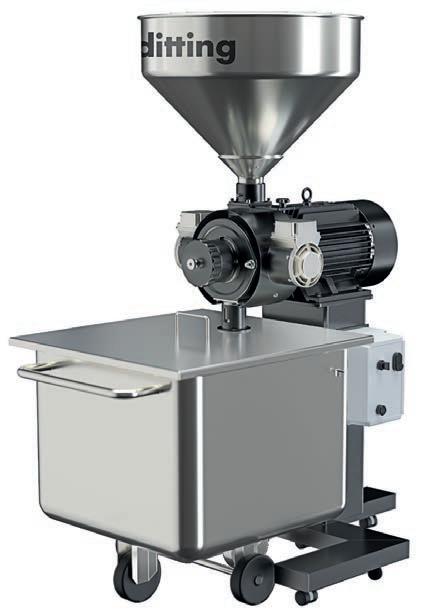
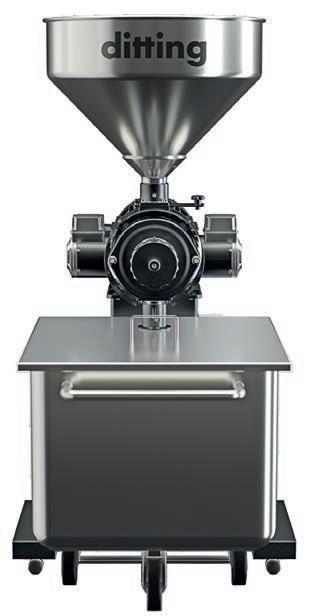
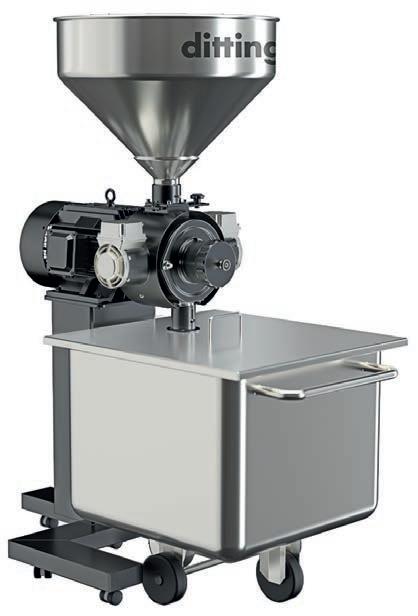
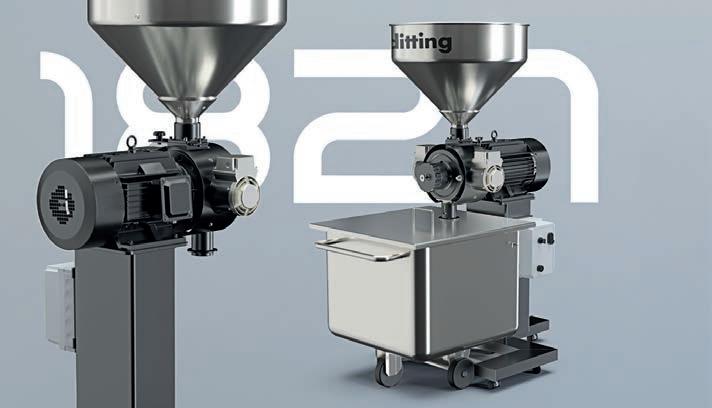
With its connection to a respected name in industrial-scale coffee production, the Di ing 1827 High Volume grinder is responding to increasing variety across roaster portfolios.
FOR A LONG TIME, the Mahlkönig’s DK27 earned near-legendary status inside production roasteries around the world. Known for its durability, grinding consistency, and ability to withstand continuous industrial use, the machine became a trusted workhorse for high-volume co ee operations long before specialty co ee began in uencing the broader production landscape.
Now, that legacy has evolved into a new chapter. Under the stewardship of Hemro Group, the platform has been reimagined as the Ditting 1827 High Volume grinder, carrying forward the DNA of the DK27 while modernising the machine for today’s production realities.
Ziya Boro, Chief Sales O cer at parent company Hemro Group, says the 1827 High Volume presented an opportunity to merge the DK27 “under a brand that was already most closely associated with industrial co ee production”.
“ e DK27 had already built a legendary reputation inside production roasteries worldwide. Long before the transition, it
was e ectively operating as an industrial grinder in every sense of the word,” he says.
Boro notes that over the years, Mahlkönig became increasingly synonymous with the specialty café environment – particularly espresso bars and precision grinding –meanwhile, Ditting maintained a closer alignment with durability, reliability, and high-throughput grinding.
“[ e transition] also created room to focus future innovation speci cally around the realities of modern production roasting: thermal stability during continuous operation, simpli ed maintenance, reduced downtime, and exibility for semiintegrated production environments.”
Boro says the company is convinced the 1827 High Volume sets a new benchmark in industrial co ee grinding.
“It combines the proven reliability of a legendary platform with modern grind consistency, serviceability, and exceptional operational value. at is why we see enormous global potential for this grinder across both established and emerging co ee markets,” he says.
Sign of the times
Beyond brand positioning, this transition re ects the changing nature of production roasteries.
Boro says quality expectations associated with specialty co ee are extending into high-volume manufacturing, placing new demands on grinding technology.
With more producers under increasing pressure to deliver specialty-grade consistency at industrial scale, Boro says this was exactly the environment the grinder was designed for.
e 1827 High Volume has been created to function within the hybrid landscape, supporting production capacities of up to 300 kilograms p/h for medium grind applications, enabling roasters to scale output alongside quality targets.
A signi cant amount of the original grinding DNA also remains intact in the 1827 High Volume, as Boro says the DK27 platform had “already proven itself over decades in demanding production environments”.
“ e core grinding philosophy,
continuous-duty architecture, and large 180 mm burr geometry were all preserved.
ose fundamentals are a major reason the platform earned such a strong reputation in industrial co ee production,” says Boro.
He says this alignment between throughput and precision speaks to a wider shi in the industry, where growth is closely tied to the ability to maintain avour clarity and repeatability at scale.
“We also placed a major emphasis on serviceability. e grinding chamber was designed for extremely fast and simple access, requiring only minimal tooling for cleaning and inspection, while permanently greased bearings signi cantly reduce maintenance complexity and downtime,” he says.
“ e entire service concept was designed around one goal: reducing downtime.”
Consistency across applications
Modernisation e orts have also focused on re ning how the grinder performs under sustained production conditions – Boro says thermal stability represents one of the most important areas of development – with the integration of a surface-cooled motor, dual cooling fans, and a ventilated casing, which help maintain temperature control during long operating cycles.
He says the grinding chamber speci cally was designed for fast and simple operator access, allowing cleaning and inspection procedures to be completed signi cantly faster than many traditional industrial systems. At the same time, the permanently greased bearings eliminate routine lubrication requirements entirely.
“In production environments, maintenance interruptions don’t just a ect one machine – they can impact sta ng, packaging schedules, and delivery timelines across the entire operation,” says Boro.
e 1827 High Volume was also designed to integrate smoothly into existing systems, rather than forcing facilities to redesign production layouts around the grinder.
“ e result is a much shorter maintenance window, less technical intervention, and faster return to production,” says Boro.
e grinder’s ability to maintain calibration under continuous load is also another priority for Ditting.
Boro says the technology combines a highly rigid chassis, precision-machined adjustment components, industrial-grade bearing assemblies, and a high-mass construction designed to minimise
mechanical movement during operation.
For the burrs, Ditting relies on Germanmade con gurations that have proven their strength throughout the DK27’s industrial track record, including standard steel, Turkish steel, and tungsten carbide options, suitable for applications ranging from Turkish co ee to coarse lter grinding.
Boro says the brand has o ered tungsten carbide burrs for many years, and the customer feedback has consistently been positive.
“In high-volume production environments, downtime is o en far more expensive than the components themselves.
at’s where tungsten carbide becomes especially compelling,” he says.
And depending on application and co ee type, Boro says tungsten carbide burrs can signi cantly extend operational lifespan to “several tonnes of co ee” before replacement becomes necessary.
e 1827 High Volume was intentionally designed to simplify daily interaction as much as possible, with straightforward access to the grinding chamber reducing unnecessary complexity during cleaning and inspections, while the built-in overload protection helps safeguard both the operator and the machine during unexpected operating conditions.
“From a training perspective, the work ow is intentionally straightforward. Operators can quickly learn how to adjust grind settings, clear product changes, and perform routine maintenance safely and e ciently,” says Boro.
But ultimately, says Boro, what matters most to operators is repeatability.
And as many roasteries now operate across multiple product categories, Boro says this requires a grinder capable of shi ing between coarse cold brew
pro les, medium retail grinds, and ner applications for single-serve formats.
“If a roastery dials in a grind pro le for retail co ee or cold brew production, they need con dence that the grinder will reproduce that exact pro le hour a er hour, shi a er shi .”
1827 High Volume user Nanning Saigon Co ee Food Co. says the grinder’s coste ectiveness and Hemro’s brand strength were key factors in their purchasing decision for the grinder.
“Consistency and repeatability of grinding are indispensable for our production … its mobility brings great convenience, allowing us to move the grinder to di erent working spots as needed,” says the company.
e 1827 High Volume is not simply a replacement for the DK27, highlights Boro, but presents the next evolution of a platform that has “already earned enormous trust within the industry”.
“Our focus was on modernising that proven foundation around today’s production realities: higher quality expectations, greater operational exibility, easier serviceability, reduced downtime, and a highly competitive overall value position,” he says.
As Boro explains, “the co ee industry no longer accepts a compromise between industrial throughput and premium grind consistency.”
“With the 1827 High Volume, we are giving roasters a platform that delivers both – reliability at scale, with the precision modern specialty co ee demands.” GCR For
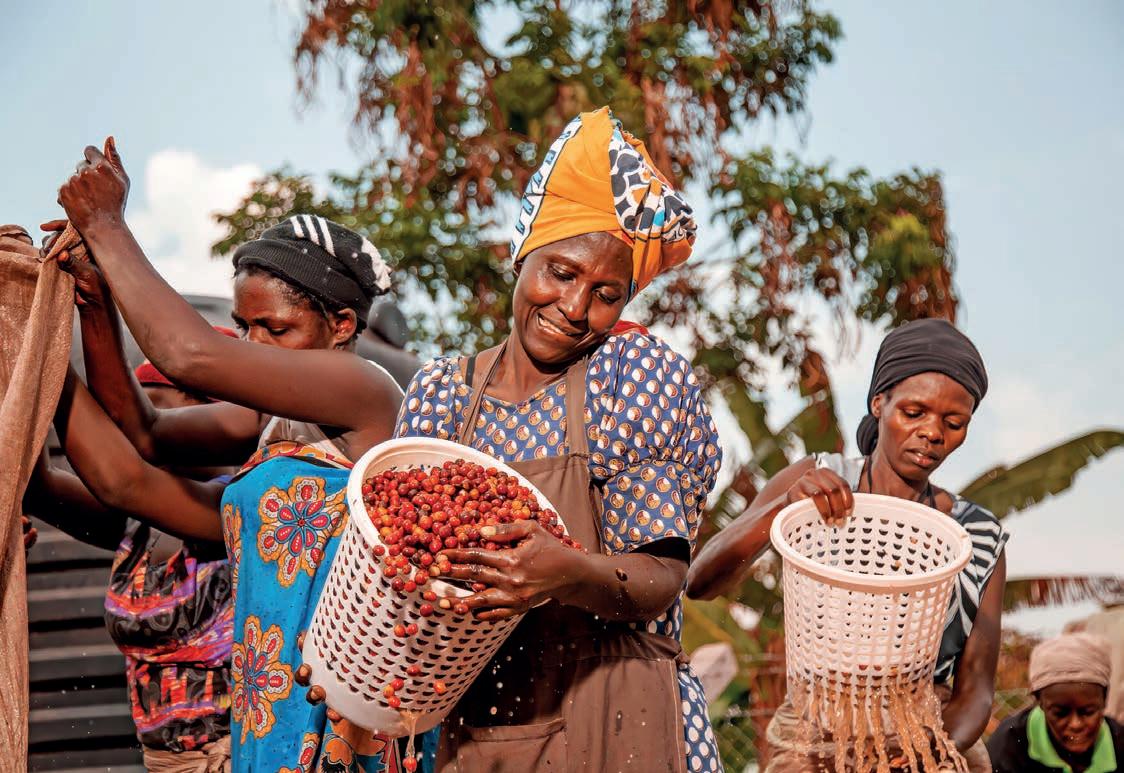
Uganda is already the largest producer of coffee in Africa, but its government wants to more than double its capacity to 20 million 60 kilogram bags by 2030 – an ambitious plan but one that’s within reach.
THERE’S A CERTAIN romanticism about co ee in East Africa that’s hard to nd anywhere else in the world.
It is heralded as the birthplace of co ee, which is a signi cant point of pride for those in the region. East Africa gave the world humanity, and it gave us co ee – a pretty in uential combination.
Where Arabica is well-known as having its ancestral roots in the ancient forests of Ethiopia, its near neighbour to the southeast, Uganda, is celebrated for being the birthplace and native homeland of Robusta, where it originated in the equatorial rainforests of the Lake Victoria crescent.
As climate change and co ee diseases continue to threaten Arabica production around the world, Robusta is fast coming into fashion. One only needs to point to the establishment of the rst ever Robusta avour wheel in 2025 as an indication of the rapidly changing perception of the traditionally less popular bean. ere have been multiple turning points in Uganda’s rise to major player on the global co ee map, from the full liberation of its co ee sector in the 1990s that ended price xing, centralised
purchasing, and export restrictions, to the launch of a national replanting program in 2013.
is target of 20 million bags produced by 2030, though, could be the most audacious goal yet.
The Pearl of Africa
Gordon Katwirenabo oversees boosting not only the export gures, but the perception of Ugandan co ee, to the world. Working with the Ministry of Agriculture, Animal Industry, and Fisheries as Assistant Commissioner in charge of co ee quality assurance and value addition, he’s playing a central role in the changes being rolled out across the country.
“Uganda is a very amazing origin. It is the most beautiful country in Africa; we call it the Pearl of Africa,” he says.
“Currently, we are the number one co ee exporter in Africa, and the sixth largest producer of co ee in the world. Our production is close to 10 million 60 kilogram bags, and more than 95 per cent of that co ee is exported.
“Last year, we exported around 8.3 million 60 kilogram bags of green co ee,
earning about US$2.3 billion. Co ee is a very strategic commodity in Uganda, contributing almost 20 per cent of our GDP.”
is gure of 8.3 million bags of co ee is a stark increase from 3.5 million bags in 2017.
According to Katwirenabo, that increase in quantity over the past decade has not come at the expense of quality.
“I am also happy to say that we are currently ranked third best in the world in terms of co ee quality by the Co ee Quality Institute (CQI) in the United States, which speaks volumes,” he says.
“Uganda is predominantly a Robusta producing country, with around 80 per cent Robusta and 20 per cent Arabica.
“We proudly regard Uganda as the birthplace of Robusta co ee. Robusta originated from the forests in the western part of Uganda, near the border with the Democratic Republic of Congo. at is part of what makes our Robustas so special and unique.”
at uniqueness does not only stem from the history behind Uganda as a co ee origin, but the unique terroir found in its producing regions.
“Another factor that makes our co ee unique is that our Robustas are grown at high altitudes, some between 1,200 and 1,500 metres above sea level,” says Katwirenabo.
“ at special microclimate makes them sweet, fruity, and creamy, with a well rounded body that is particularly suitable for espresso.”
20 million bags of coffee In the context of world co ee production, 20 million bags is not an insigni cant target.
According to the US Department of Agriculture, the 2025/2026 harvest forecast has Brazil producing more than three times that gure at 63 million bags, with Vietnam next at 30.8 million.
en, however, there is a signi cant drop o to Colombia at 13.8 million bags. Twenty million would place Uganda as the third-largest producer in the world, ahead of Colombia, Indonesia, and far ahead of Ethiopia.
Katwirenabo says a change in the perception of co ee as a crop, and the resulting importance placed on growing the industry, has helped position it for a period of scalability.
“Co ee is recognised as a strategic crop, and the government has put in place a number of initiatives,” he says. “One of the key frameworks is the National Co ee Roadmap, launched in 2017 by His Excellency the President of the Republic of Uganda, Yoweri Kaguta Museveni.
“ e roadmap is the vehicle to drive the sector from 3.5 million 60 kilogram bags in 2017 to 20 million 60 kilogram bags by 2030. Since then, we have already moved from 3.5 million to around 10 million 60 kilogram bags of production. We believe that by 2030, we can reach the 20 million bag target.”
Within this roadmap, Katwirenabo says several drivers of growth have been identi ed.
“First, there is a strong planting program, with the government providing free seedlings to farmers to expand production,” he continues.
“We have also invested heavily in research, developing high yielding, more productive varieties. At the same time, we continue to promote value addition, both through better processing methods that can produce high end specialty co ees, and through roasting, grinding, and selling nished co ee products in Uganda and abroad.
“ is helps create additional motivation
for farmers to grow more co ee and care for their gardens.”
Uganda gained its independence from the United Kingdom in 1962, and some of the trees that are still producing the Robusta that is being exported were being utilised as a crop while it was still under English rule.
While co ee trees can live for up to a century, it is common for commercial plantations to replace trees a er 20 to 30 years, a er yields decline.
Maturation takes about three to four years for the trees to achieve, so if Uganda is to reach this 20 million bag target, Katwirenabo says now is the time to either replace these colonial-era trees or o er more help to farmers continuing to cultivate them.
“Another important initiative is our Rehabilitation and Rejuvenation (R&R) program. Some of our co ee trees are very old – over 60 years, dating back to the colonial era. Remember, Uganda is the birthplace of Robusta co ee, and many of these trees have been in the ground for a long time,” he says.
“ rough the R&R program, the government supports farmers with organic
fertilisers, pruning tools and equipment, and co ee speci c extension services. Each district has a co ee extension o cer providing tailored advice.
“ is helps improve productivity, ensures that co ee meets international standards, and supports compliance with sustainability requirements.
“Age and condition of farmer’s gardens and co ee trees is a cert important factor to support Ugandan producers in the coming years.
As Katwirenabo mentioned, Europe, has long been the main importer of Ugandan co ee, with Italy in particular enjoying strong relationships with Ugandan producers.
It is, however, important to target new markets – and he says some of the world’s most rapidly evolving co ee cultures could be hotbeds of Ugandan co ee consumption in the future.
“To reach our production targets and secure better incomes for farmers, we are expanding into new and niche markets. Europe remains our main destination, but
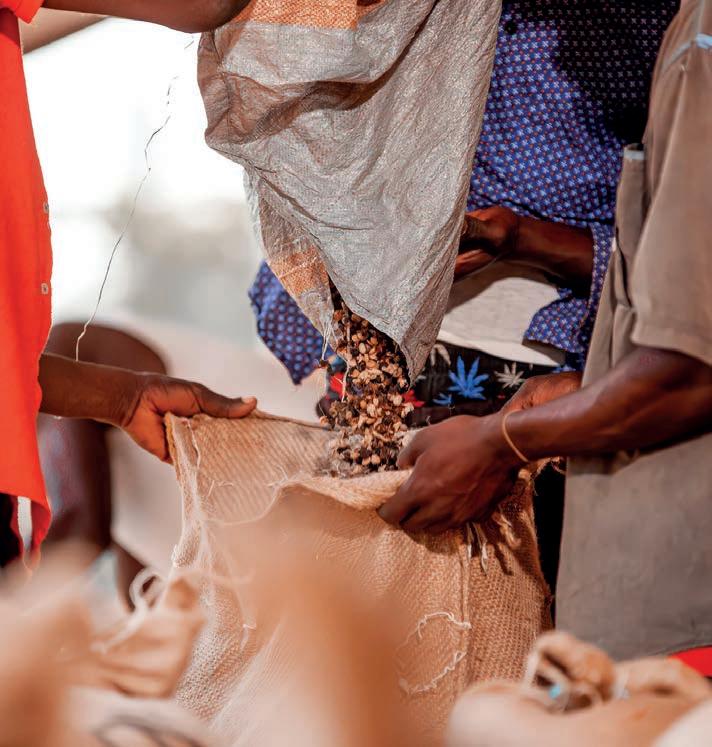
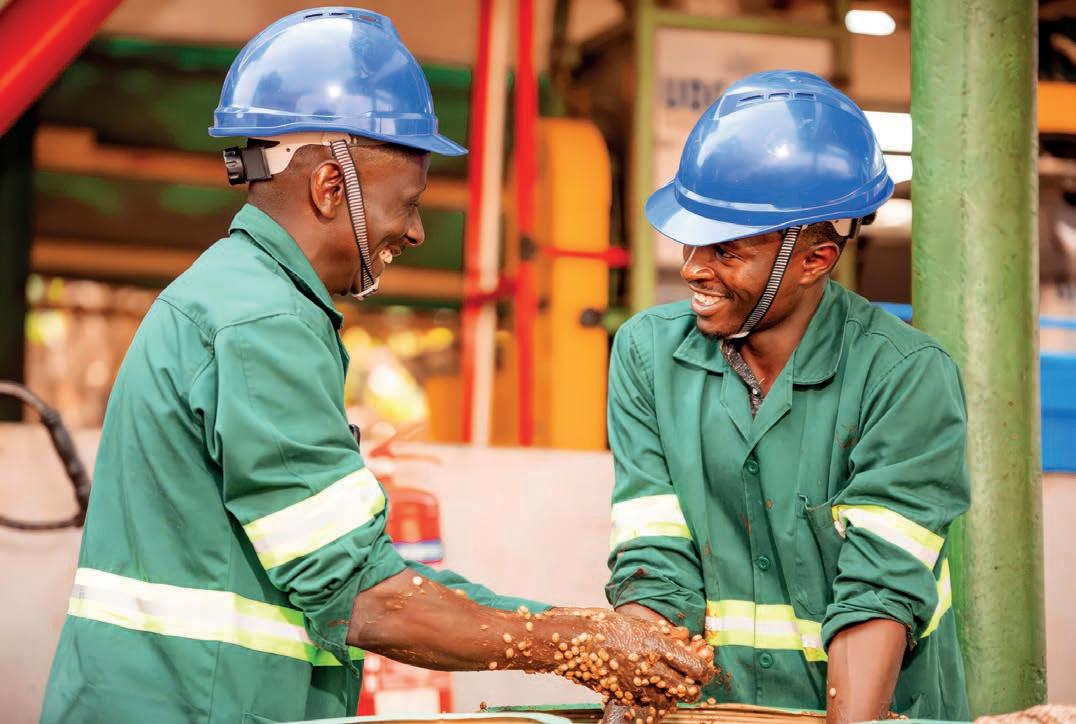
we are now moving more strongly into the Middle East, especially the UAE,” he says.
“We see Dubai and the Emirates as key markets, with a growing number of co ee consumers who have the disposable income and appreciation for high quality, o en organic and sweet co ees like Uganda’s.
“We are also targeting China, which we consider a very important strategic partner. e population is large, and the number of people with the income and interest to consume co ee is rising.
“ e Government of Uganda has even opened an o ce in China and deployed sta there speci cally to market and promote Ugandan co ee. at is how strategic the Chinese market is for us.”
Ibero Uganda, a subsidiary of Neumann Ka ee Gruppe, is one of the major exporters of Ugandan co ee.
Konrad Gürtler, Co-Managing Director of Ibero Uganda, says he is seeing this broadened international interest in Ugandan Robusta rsthand.
“Honestly, Ugandan Robusta is still relatively underestimated around the world,” he says.
“Markets such as Europe, which holds 70 per cent of the demand share, know
Uganda for a higher quality Robusta, but that it comes with increasing logistical challenges and a higher price.
“However, in recent years Asian markets are showing signi cant interest in East African co ee, Ugandan amongst them – especially China which has enforced a zero-tari policy for imports from East African countries making its co ee imports highly attractive.”
Participation in international trade shows, such as the Melbourne International Co ee Expo (MICE) and World of Co ee is also critical to expose more people to the potential of Ugandan co ee.
“We are also participating in international shows to create what we call structured demand. By attending events and fairs, we can link producers directly with importers and roasters, especially in Europe and other markets, and in so doing reduce the in uence of middlemen,” says Katwirenabo.
“ is kind of structured linkage helps ensure better prices and more sustainable relationships.”
e burgeoning co ee tourism industry is also a key target for Uganda to continue to fund its industry.
“Uganda is a peaceful country – we have
enjoyed stability for almost 40 years – and it is home to unique mountain gorillas and stunning landscapes,” he says.
“We are excited by the idea that visitors could combine gorilla tracking with co ee experiences: for example, visiting co ee farms, roasting co ee in the wilderness near a family of gorillas, and truly connecting with both our nature and our co ee origins. is is a very special experience that we believe will appeal to many international visitors.
“Uganda enjoys sunshine and rainfall throughout the year, which supports co ee production and makes our countryside very beautiful. I would like to invite more people to consume Ugandan co ee. As I have said, it is sweet, unique, and sustainably produced.”
Ugandan Robusta, to those who know it, is seen as one of the best in the world, according to Gürtler.
“Ugandan Robusta remains a premium Robusta along with co ee from India when compared to other origins such as Brazil, Indonesia, and Vietnam,” he says.
Main indicators for quality yields can
be related to all processes from plant to roasting drum, but at origin the focus lies on harvest time and good agricultural practices amongst Uganda´s predominant small holders. Furthermore, drying and milling processes, as well as the timely and e cient inland transport are important factors.
“Ultimately, it all comes down to the farm level where quality will be determined with ripening and harvesting timing and the right blend of farm care and inputs to ensure high quality yields.”
“Seedling input, tree age, and overall good agricultural practices are key to maintain high quality output.
“Uganda is blessed to have not one annual crop per year, but two. Providing the right understanding around maintaining farms and harvesting at the right moment enable farmers to have good yields twice per year is important.”
Besides the importance of continuous e orts in improving agricultural practices and farmer’s awareness for such, Gürtler believes the improvement of logistics within the country will help aid the continuing rise
over the next four years and beyond and expose even more people to the qualities of Ugandan co ee.
“Uganda has almost no local consumption except for some demand out of the tertiary sector. Most of its production is moved out of the country. Because of this, infrastructure is key,” he says.
“As landlocked country one of the biggest limitations right now are the country’s road and rail networks. Uganda must continue to invest in roads, highways, railways, and other means of moving goods in and out to maintain and grow its role in the global value chain.”
“ e ambitious target to move 10 million-plus 60-kilogram bags of co ee out of Uganda must be enabled via respective logistical routes.
“Today all goods move via a one lane road between Kampala and Mombase, exposing movement of goods to long transit times and risk of delays reaching vessels in time. As one of the top three export goods and its increasing importance for the Ugandan economy co ee export highly depends on the underlying infrastructure setup.”
From a government perspective, Katwirenabo says the focus will be on driving value addition to all parts of the domestic value chain, especially farmers, to create signi cant social transformation.
Looking ahead, the Government of Uganda is strongly focused on value addition, he says.
“Historically, many farmers have not bene ted as much as they should because there has been limited value addition, marketing, and branding. We are now driving a value chain and value addition agenda to ensure that the farmers who produce this co ee earn more from their crop, can pay school fees, support their families, and enjoy genuine social transformation through co ee,” says Katwirenabo.
“Ultimately, we see co ee as a way to build bridges and friendships. Co ee is creating a bond between Uganda and countries around the world, and it will be very exciting to see what we can achieve together in terms of sustainable development, farmer livelihoods, and high quality co ee in cafés and homes.”
GCR


Grinding and packaging are moving toward systems defined by precision, adaptability, and integration – and IMA’s integrated line is rising to the challenge.
IN SINGLE-SERVE co ee systems, grind quality is o en considered inseparable from extraction performance.
Every variable within the particle size distribution (PSD) contributes to how water moves through the co ee bed, in uencing resistance, contact time, and avour expression.
As a result, a more re ned understanding of how particle behaviour in uences the brewing system is becoming key to industrial co ee grinding.
Nicola Panzani, CEO at IMA Petroncini and Sales Director at IMA Co ee Hub, says an increasingly important aspect in industrial grinding is the transition from ‘grind size’ to ‘engineered particle distribution’.
“Today, the objective is not simply producing ner or coarser co ee, but engineering a PSD that delivers stable hydraulic behaviour, predictable extraction, and repeatable sensory performance across millions of single-serve units,” he says.
Panzani says IMA’s XTREME GRIND series re ects this transition through a multi-stage roller grinding architecture, designed to control fracture dynamics at each stage of the process.
“ e multi-stage architecture progressively reduces particle size through successive grinding passages, allowing fracture propagation to occur in a more predictable and controlled manner. is signi cantly reduces the uncontrolled generation of ultra- ne particles, while maintaining a narrow and stable PSD.” e grinder series was speci cally engineered to provide highly controlled and repeatable PSD, where even small granulometric variations can signi cantly a ect hydraulic resistance, extraction kinetics, and brewing consistency, which become critical in single-serve applications. e importance of balance for compression forces, roller di erential speeds, corrugation geometry, and grinding gaps also remains central for IMA.
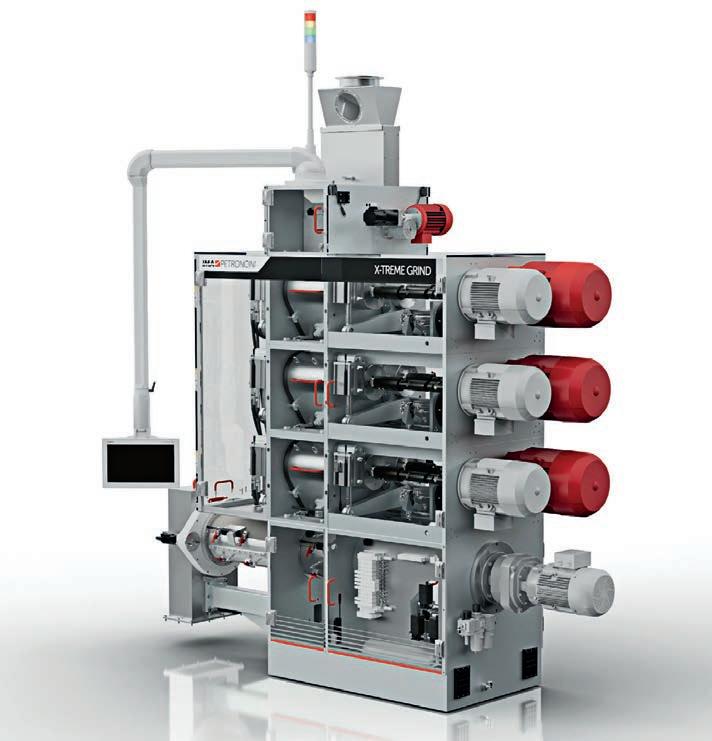
Panzani says that by distributing the size reduction progressively across multiple roller pairs, XTREME GRIND can produce more uniform particle distributions with reduced span and controlled nes content.
“ is is particularly important for capsules and pods, where excessive nes can increase hydraulic resistance, create local over-extraction phenomena, or even contribute to clogging during brewing,” he says.
“At the same time, excessive coarse fractions may reduce extraction yield and compromise cup consistency.”
By operating the paired rollers at di erent peripheral speeds, the system introduces a
IMA’s XTREME GRIND series reflects a transition from ‘grind size’ to ‘engineered particle distribution’ through a multistage roller grinding architecture.
controlled shear component in addition to compression stress.
Panzani says this enables crack propagation within the roasted bean structure to occur along more predictable paths – improving PSD control and limiting random nes generation.
“In the primary grinding stages, deeper and wider corrugations promote controlled bean fracture and e cient material feeding. In the downstream stages, ner corrugations progressively re ne the granulometry and stabilise the PSD while limiting uncontrolled secondary fracture,” he says.
“ e combination of these parameters
allows manufacturers to tailor the balance between permeability, hydraulic resistance, extraction yield, and sensory pro le according to the speci c capsule design and brewing target.”
erefore, each stage can contribute to a controlled transformation of the roasted bean, aligning physical characteristics with the functional requirements of the nal brewing system.
As grinding technology advances toward precision and repeatability, packaging systems are evolving in parallel to accommodate new material structures and sustainability priorities.
e single-serve capsule market now includes a wide range of materials, such as aluminium, conventional plastics, and compostable structures, each with distinct physical and thermal behaviours – a variability Panzani says requires process exibility.
And at the centre of this exibility the SYNKRO series’ independent magnetic shuttle transfer system.
“Unlike traditional mechanically synchronised transport systems, each shuttle operates independently while remaining fully synchronised with the process ow,” says Panzani.
“ is architecture allows di erent dwell times to be assigned to each operating station according to the speci c material and process requirements.”
He says this is particularly important when working with sustainable materials, where thermal behaviour, sealing windows, elasticity, and dimensional stability can di er signi cantly from conventional capsule materials.
“SYNKRO enables operators to independently optimise critical parameters such as sealing temperature, pressure, dwell time, cutting timing and precision and capsule handling dynamics,” Panzani explains.
e platform incorporates multiple sealing technologies, including energye cient ultrasonic systems, which provide additional exibility in adapting to the rapidly evolving landscape of sustainable capsule materials.
Preservation of co ee quality during lling also remains a critical aspect of the system. Panzani says the SYNKRO was developed to combine extremely high production speeds – up to 1200 capsules per minute – with highly controlled product handling conditions
designed to preserve co ee quality and aromatic integrity.
A central element of this is the innovative dosing system, speci cally engineered for gentle product handling and dosing repeatability.
“ e lling unit incorporates a precompression phase that compacts the co ee progressively during capsule lling, creating a more homogeneous co ee bed while reducing unwanted stress on the ground co ee,” says Panzani.
“ is controlled pre-compression contributes to improved dosing consistency, a more stable extraction behaviour, a better preservation of the particle structure generated during grinding and reduced variability between capsules.”
In addition, SYNKRO integrates an inline weighing system capable of checking every capsule and automatically feeding correction data back to the dosing unit in real-time.
Panzani says this closed-loop process control ensures “extremely consistent ll weights and product uniformity across long industrial production runs”.
“ e overall objective is not simply high-speed production, but the ability to industrialise premium co ee quality while maintaining the sensory characteristics associated with origin di erentiation and specialty co ee positioning,” he says.
Beyond machine-level functionality, the development of sustainable capsule solutions requires collaboration across the value chain.
IMA’s OPENLab – a global network of technological laboratories and testing areas – represents this joint approach to creating production-ready answers.
“OPENLab was created as a collaborative development environment where co ee producers, material suppliers, and technology experts can jointly test and validate innovative packaging solutions under real industrial conditions,” says Panzani.
“Many co ee producers are highly motivated to adopt more sustainable packaging solutions, but they also face signi cant concerns regarding machinability, product protection, production e ciency, and longterm reliability.
“As a result, customers increasingly look for partners who can support not only machine supply, but also material validation and process optimisation.”
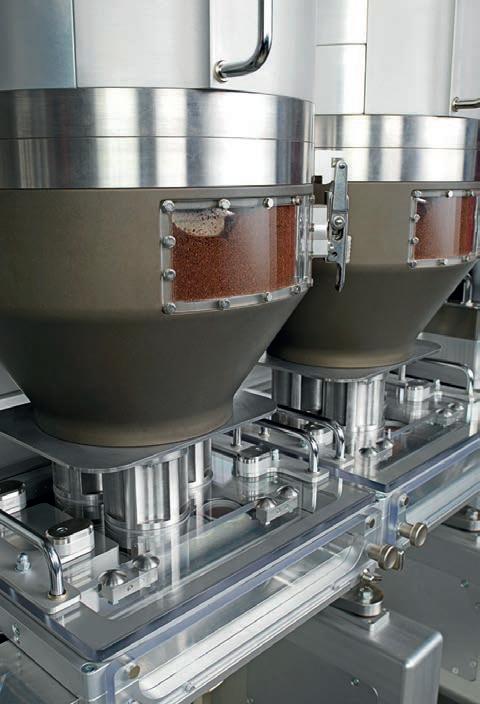
rough dedicated activities, stakeholders can explore how alternative materials respond to processing variables such as sealing conditions, machine con gurations, and production speeds.
“ is approach signi cantly accelerates industrial validation and reduces the risks associated with introducing new sustainable materials into commercial production,” Panzani explains.
Customer feedback has also shaped the model, highlighting the need for practical pathways from concept to industrial implementation.
rough joint testing and shared expertise, OPENLab supports manufacturers in navigating the transition toward new material solutions while maintaining e ciency and product integrity.
Across both grinding and packaging, the industry is moving toward systems de ned by precision, adaptability, and integration.
Engineered particle distribution aligns with exible, material-responsive packaging processes, creating a production environment where each stage can be calibrated to support the next – all working toward the expectations of the nal cup. GCR
For more information, visit imagroup.com/coffee
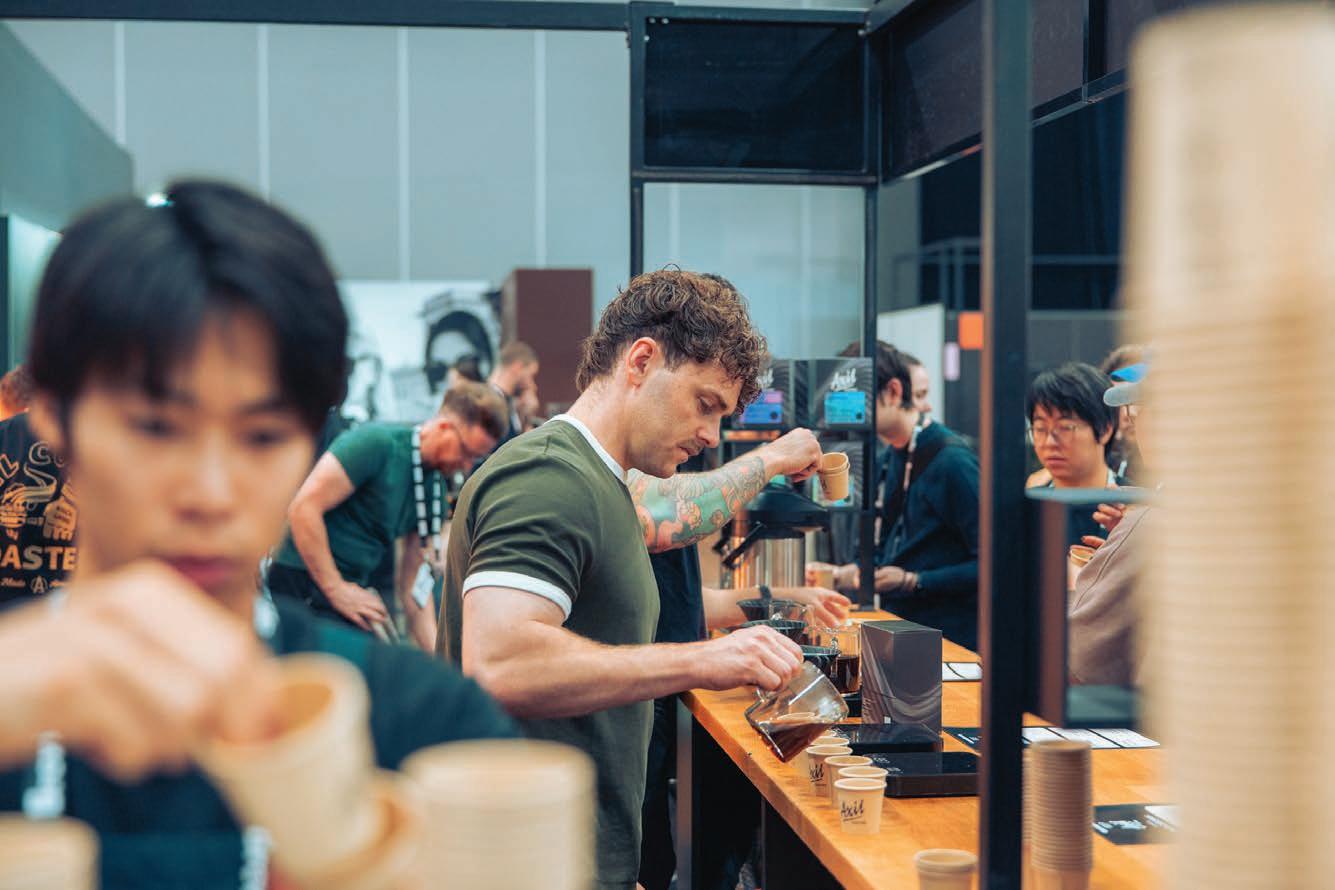
THE WORLD’S DESTINATION FOR COFFEE MELBOURNE CONVENTION AND EXHIBITION CENTRE
4–6 MARCH TWENTY–27
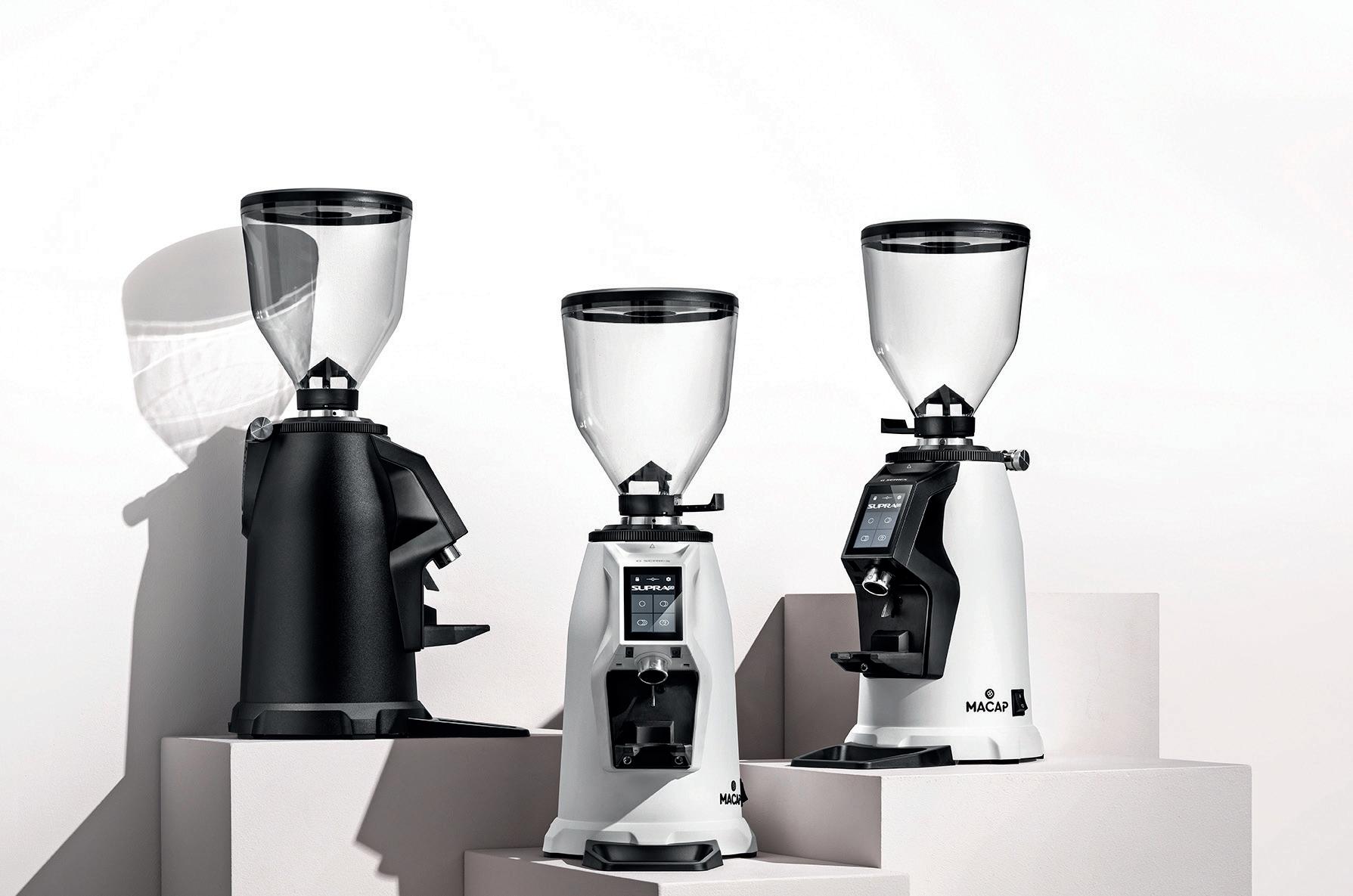
Macap says the Supra G Series was designed specifically to handle peak workloads.
Macap’s Supra G Series is helping coffee chains improve the consistency of extraction, while reducing the operational burden of training staff and ongoing grinder recalibration.
FOR DENIS GIRARDI, more than two decades in the co ee industry have reinforced one lesson above many others: while espresso machines o en attract the spotlight, it is the grinder that can make or break the customer experience across a co ee chain.
In high-volume environments, he says variability can emerge from multiple – and o en unavoidable – sources. But together these factors can snowball to signi cantly in uence cup quality.
“Generally speaking, the variables on the machine side are temperature and pressure. On the grinder side, however, they are the distribution of nes and boulders, as well as dosing accuracy,” says Girardi.
“In larger co ee chains, inconsistency in sta training and preparation is a major
factor, which is further exacerbated by shi rotations. In high-volume co ee shops, rush hours amplify all these variables because they put greater stress on the equipment.”
Girardi, who has worked for some of the world’s biggest co ee brands, is today the Sales Manager and Business Developer of Macap. e Italian grinder manufacturer, founded in 1930 in Venice and present in more than 70 markets, positions itself as a pragmatic partner for co ee chains seeking extraction consistency while controlling operational costs by reducing the need for constant sta training, intervention and recalibration.
He believes the company’s Supra G Series – launched in October 2025 – is the answer to many of these challenges.
“ e Supra G Series was designed speci cally to handle these peak workloads awlessly, maintaining a completely stable output without altering dose or quality,” Girardi says.
“[Consistent grinder performance] is the single most critical point in a co ee shop. [It] has the highest impact on overall drink repeatability when it comes to co ee quality. If you control the grind and the dose at the source, you stabilise the extraction regardless of the surrounding environment.”
In Girardi’s view, a reliable grinder does more than improve extraction. It’s one less thing for venue sta to think about, particularly during busy trading periods. Plus, the “unavoidable variation” in barista skills across di erent shi s or locations
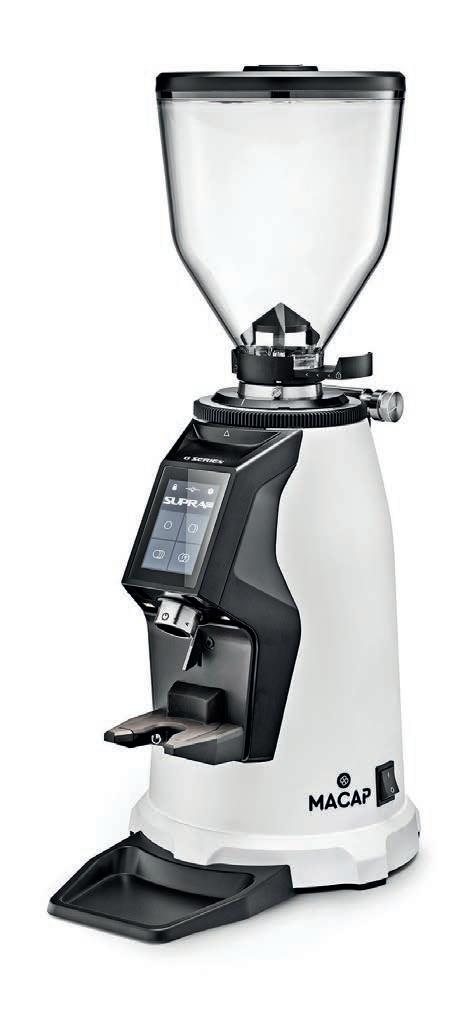
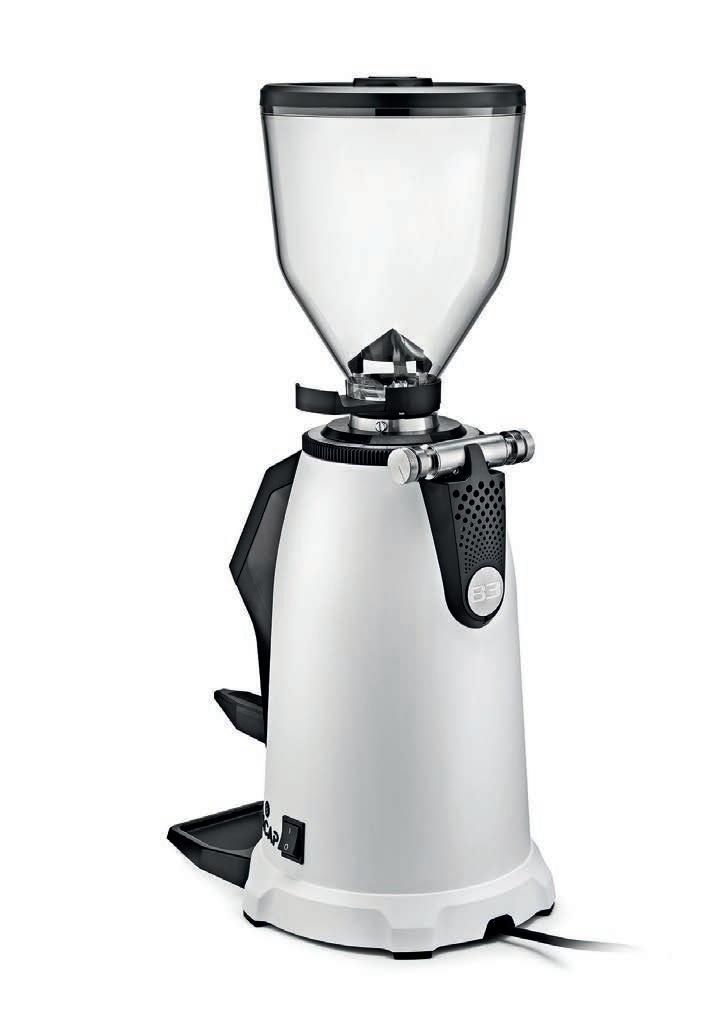
is “e ectively compensated for by the superior reliability and consistency of the grinder’s output”.
With traditional on-demand grinders, Girardi explains that sta training has a heavy focus on their ability to continuously ne-tuning grinder settings throughout the day.
But venues can avoid this with the Supra G Series.
“Achieving excellent grind uniformity – and, above all, gravimetric (grind-byweight) dose reliability – means less co ee waste during the morning dial-in process and signi cantly less reliance on the individual barista’s level of sensitivity and experience,” he says.
“If you utilise a grinder that is virtually una ected by thermal expansion and
temperature uctuations, combined with high power and high-volume capability, the need for manual intervention throughout the day is also drastically reduced.
“ e more the grinder is capable of managing heavy workloads smoothly, the less your sta needs to constantly recalibrate it. And when operator intervention is minimised, this leads to a signi cant reduction in the time and costs associated with sta training.”
So, does the Supra G Series live up to this in real world?
According to Girardi, feedback has been overwhelmingly positive, especially in three areas.
“ e instant tare detection is the fastest on the market, and it by far the most praised feature,” he says.
“Secondly, chains love the u ness of the ground co ee and the complete absence of static electricity. ird is the absolute accuracy of the dose data shown on the display: what you see is exactly what you get in the porta lter.”
While in-cup performance is a top priority for co ee chains, Girardi says these businesses are increasingly seeking equipment that is easier to maintain, standardise and support across multiple locations.
To address this, Macap has built the Supra G Series around a common platform, helping venue owners maintain their grinders more easily, regardless of which model they deploy.
“ e entire Supra line is built on a single, standardised platform available with either 68 millimetre or 83 millimetre burrs, allowing operators to streamline their inventory and use the same spare parts across models,” Girardi says.
“Furthermore, it features our FOS (Fast Opening System), which greatly simpli es daily cleaning, burr replacement and, most importantly, direct access to the anticlumping mechanism, which is typically one of the highest-wear components in any co ee grinder,” he says.
Inside the R&D process
e Supra G Series has been developed through an iterative engineering approach that blends mechanical design, electronics and extensive eld testing.
According to Luca Marchesini – who has more than two decades in the co ee machines and grinders industry – this multidisciplinary process begins with mechanical experimentation on burr geometry.
“ is is where di erent cutting patterns are tested to achieve a precise and repeatable particle size distribution,” he says.
“Alongside mechanical design, signi cant emphasis is placed on high-performance motors, engineered to deliver stable torque and consistent speed under varying load conditions.
“ is is complemented by advanced sensor technology and control electronics, which monitor and regulate parameters such as weight, temperature, and dosing accuracy to ensure consistent output over time.”
Marchesini says these technical developments are continuously validated through sensory testing and barista workshopping, where extraction

quality and taste outcomes guide further re nements.
“Crucially, extensive eld testing in real café environments plays a key role, allowing engineers to assess performance under peak workloads, environmental variations, and daily operational stress,” he says.
“Overall, the process is driven by continuous feedback between engineering precision, electronic control systems, and real-world usability, ensuring both performance and reliability at the highest level.”
Echoing Girardi, Marchesini is excited about how these features translate into tangible outcomes for multi-site venue operators.
He says when grind size distribution is consistent, as with the Supra G Series, extraction becomes more predictable and stable, which can ultimately reduce the need for complex machine features designed to compensate for inconsistency.
“In practical terms, a highly reliable grinder allows cafés to achieve excellent results even with simpler equipment, shi ing the focus from reactive correction to controlled input,” he says.
“A grind-by-weight grinder is the primary step toward significantly reducing staff training costs, as it makes the barista’s workflow much easier when aiming for consistency.”
Luca Marchesini
R&D DIRECTOR
RYOMA GROUP
“Reliable Supra grinder performance plays a key role in controlling costs. When grind output is consistent, baristas need fewer adjustments throughout the day, which reduces wasted co ee during dial-in and minimises the number of unusable shots.
“In addition, lower retention, more stable dosing, correct co ee drop into the porta lter help limit product waste, while consistent results reduce the need for remakes. Over time, this translates into better use of raw materials, improved labour e ciency, and a more predictable cost structure.”
For co ee chains balancing co ee quality with sta ng challenges, Girardi also sees the grinder a pressure point operators can control with relative ease.
“A grind-by-weight grinder is the primary step toward signi cantly reducing sta training costs, as it makes the barista’s work ow much easier when aiming for consistency,” he says.
“It doesn’t necessarily compete against closed, interconnected systems, but it dramatically reduces the operational impact of having or not having highly skilled baristas on-site, providing a highly reliable, standalone control point.” GCR
For more information, visit macap.it
TTR EVO roasters feature a hot-air recirculation system and an eco-design approach that maximises thermal efficiency, with lower energy consumption. By minimising heat loss and optimising roasting efficiency, the TTR EVO achieves substantial energy savings and a reduction in CO₂ emissions Equipped with integrated sensors and digital control systems, TTR EVO roasters enable precise monitoring of roasting parameters and facilite data-driven process optimisation for a modern sustainable coffee production.
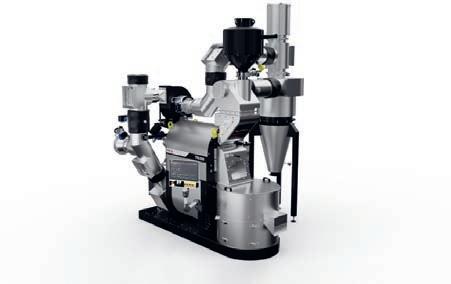
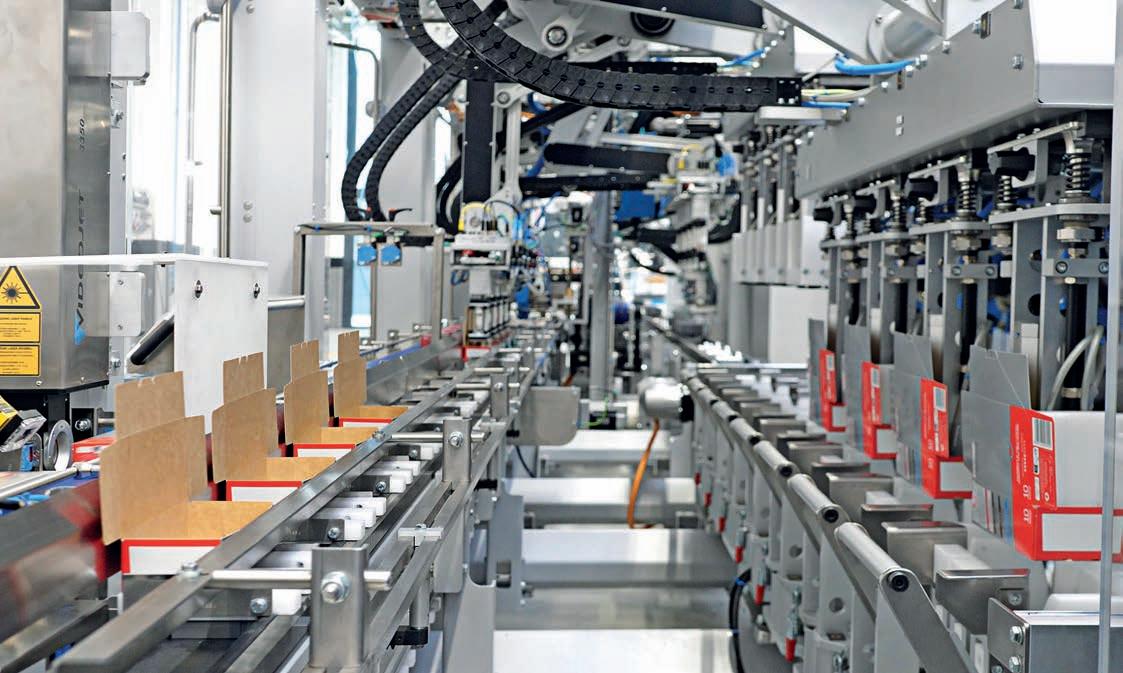
Flexibility and digitalisation are top of mind for Cama as it works to meet the changing packaging needs of the coffee sector.
ITALIAN PACKAGING leader Cama is responding to an industry that is rethinking how products are packaged, protected, and presented.
Over the past few years, the co ee industry has undergone signi cant change, driven by evolving material choices, rising e ciency demands, and the need for greater production exibility, according to Sergio Cornago, Cama’s Sales Manager.
A key development has been the growing focus on waste reduction and the adoption of recyclable materials. is has accelerated a shi in primary packaging, with aluminium increasingly replacing plastic, while alternative recyclable solutions have yet to consistently meet the performance standards required by the market.
Cornago identi es the development of self-protecting capsules as one of the key technical challenges in this transition. Where adequate barrier and protective properties are not integrated into the capsule itself, manufacturers have o en had to rely on
additional outer packaging, with implications for both line e ciency and product quality.
In this scenario, aluminium has emerged as the most e ective solution, o ering a combination of product protection, quality preservation, and enhanced shelf appeal.
Against this backdrop, recent industry engagement at Interpack has provided further insight into how the market is evolving. Cornago highlights renewed customer activity, pointing to increasing con dence across the packaging sector.
A notable trend is the move by larger brands to bring more production in-house, alongside a broader diversi cation of secondary packaging formats. is re ects a wider shi towards both consolidation and greater operational exibility within co ee packaging operations.
Within this ever-evolving landscape, Cama continues to focus on secondary and tertiary packaging applications, covering formats such as bags, capsules, containers, stickpacks, and pods.
“Cama has always had a strong position in secondary and tertiary packaging, with a real focus on recycled cardboard solutions that o er bene ts both in environmental terms and for the end too,” Cornago says. But beyond material selection, the company’s approach is based on collaboration. “What really sets us apart is our ability to work side by side with customers to develop packaging solutions around their speci c needs,” he explains. Flexibility has become a de ning requirement across co ee industry. Increasing product and format diversity demands systems capable of responding quickly without disrupting operations. In response, Cama develops tailored, application-driven systems rather than standardised con gurations, supporting customers with solutions designed
Cama says Industry 5.0 technology must enhance the performance of production systems and strengthen companies’ ability to face change.
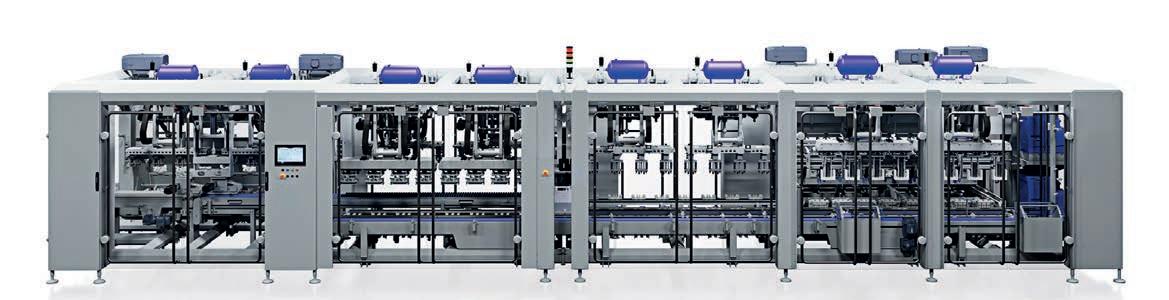
around speci c use cases. is approach applies across a wide range of customers, from smaller operators to major brands, with the objective of aligning packaging performance with broader business goals.
“Every solution is developed around the customer’s speci c needs, and we work closely with them to make sure the nal result ts their production requirements, packaging goals and market positioning,” says Cornago.
In addition to exibility, these systems deliver a range of operational bene ts, including improved accessibility, reduced maintenance requirements, enhanced ergonomics, and consistently high e ciency. ey are also in uencing packaging development itself. rough close collaboration with major brands, Cama has re ned packaging formats to support more premium pack presentation, while maintaining the protective performance required during transport and handling.
Automation and digitalisation have long been a core pillar of Cama’s approach, with the company consistently developing solutions aimed at improving e ciency, reliability, and operational performance across packaging lines.
In recent years, this has been further reinforced through the implementation of Industry 4.0 solutions, enabling full data exchange online consumption, output, and performance, while supporting preventive and predictive maintenance strategies.
As the industry moves towards Industry 5.0 – where the focus extends beyond pure production performance to
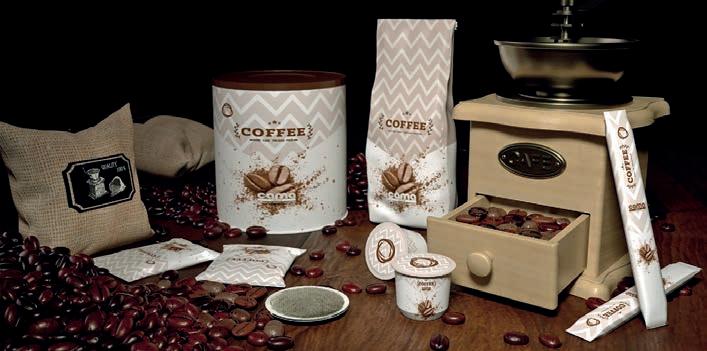
include sustainability, adaptability and improved working conditions – Cama has translated these principles into a practical, application-driven framework through its MEP (Machine Enhancement Program).
Designed as a scalable platform for both new installations and retro t applications, the MEP focuses on optimising the use of materials, energy, time and space. It is structured to enable rapid adoption while delivering measurable improvements in areas such as format changeover, process quality and production continuity.
In this sense, the programme represents a tangible implementation of Industry 5.0 concepts, combining advanced technologies with a strong emphasis on operational e ciency, sustainability and operator support.
e MEP currently integrates a suite of advanced solutions, including Augmented Reality guidance, Digital Twin capabilities, Automatic Format Changeover, Automatic Carton Loading, and Collaborative Palletising, with further modules under development.
is approach re ects a broader vision
in which automation is not only a tool for improving system e ciency, but also a means of enhancing overall process intelligence and enabling more responsive and sustainable production environments.
Within this framework, automation is designed to work alongside operators, improving safety, ergonomics and overall job quality, while reducing repetitive and low-value tasks and enabling personnel to focus on higher-value activities.
As the co ee sector continues to evolve, packaging is becoming a key lever for balancing e ciency, sustainability and product di erentiation. In this context, the ability to combine advanced automation with application-driven design will be critical.
For Cama, the focus remains on delivering solutions that not only respond to current demands but also anticipate the next phase of transformation across the industry. GCR
For more information, visit camagroup.com
Cama Group says it is advancing the adoption of Industry 5.0 in secondary packaging, positioning human–machine collaboration as central to improving productivity, sustainability, and operational performance.
Industry 5.0 “reframes manufacturing around human-centric collaboration with intelligent machines,” combining e ciency with environmental responsibility, according to the company. Cama’s approach focuses on evolving machinery, so ware, and services to improve changeover times, process stability, quality, and energy e ciency across packaging lines. At the core of this strategy is a shi away from replacing labour with automation. Instead, Cama aims to support operators
through collaborative technologies that “remove repetitive work and reduce cognitive load,” enabling workers to focus on higher-value tasks.
e company describes this philosophy as “making sophisticated systems simple,” using intuitive interfaces, contextualised language, and shared goals to bridge the gap between humans, robots, and arti cial intelligence (AI).
Cama says AI has “moved from curiosity to everyday tooling,” enabling automation of repetitive coding tasks while engineers can focus on architecture, safety, and quality.
e technology is also used to produce documentation such as manuals, risk analyses, and declarations of
conformity, improving speed, accuracy, and standardisation.
Alongside AI, data-driven analysis plays a key role in optimising packaging performance. By mapping relationships between environmental variables – such as humidity and temperature – and machine outcomes, Cama enables “better presets, predictive adjustments, and fewer stoppages,” improving overall line stability.
ese innovations are delivered through the company’s Machine Enhancement Program (MEP), a scalable platform for new and existing machines designed to save “materials, energy, time, and space.”
e program aims to deliver measurable gains in production continuity, process quality, and sustainability.
Don’t miss the latest coffee industry news, market reports, must-read features, leader interviews, and more.
Subscribe now to get Global Coffee Report’s free weekly newsletter delivered direct to your inbox.


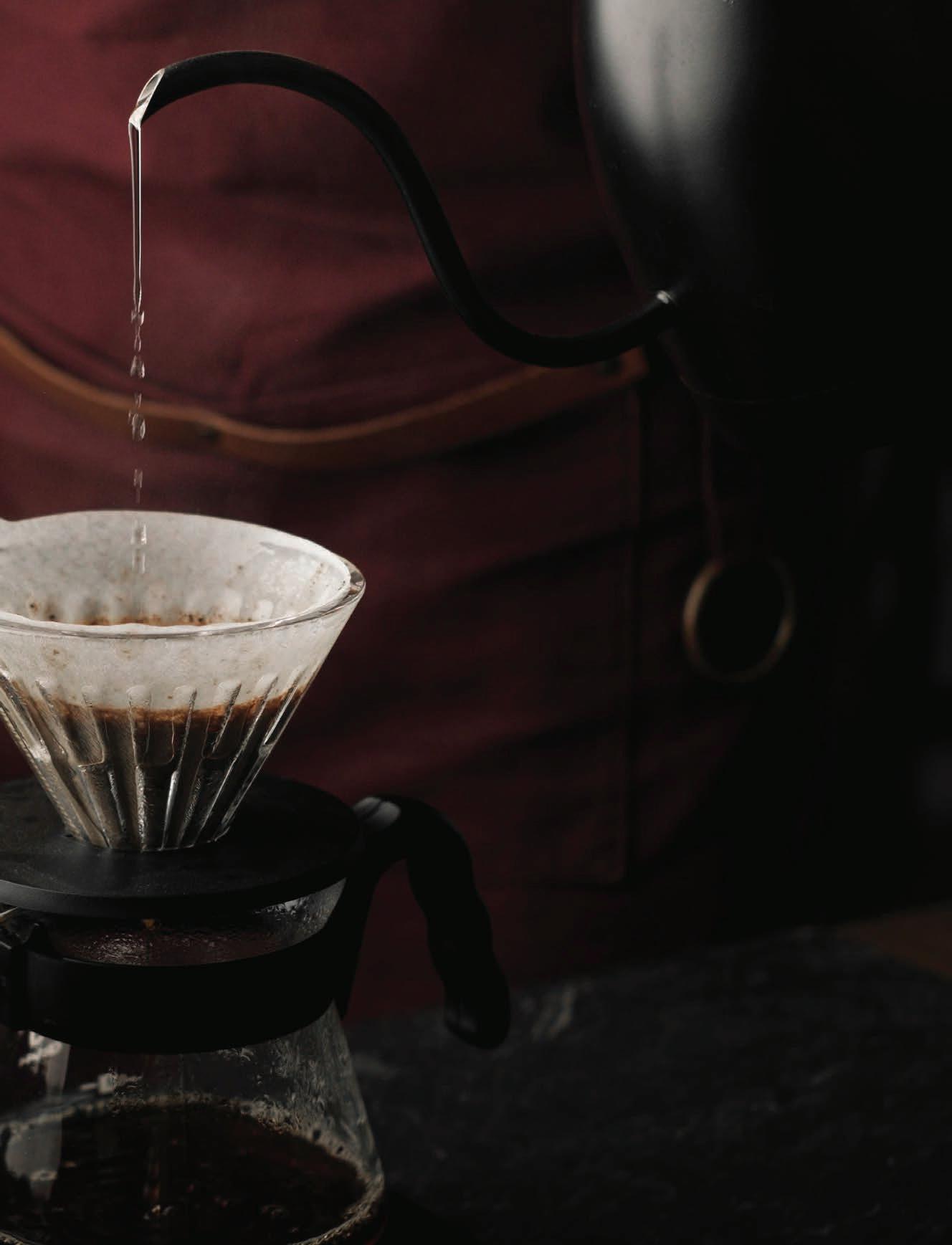
gcrmag.com/newsletter/
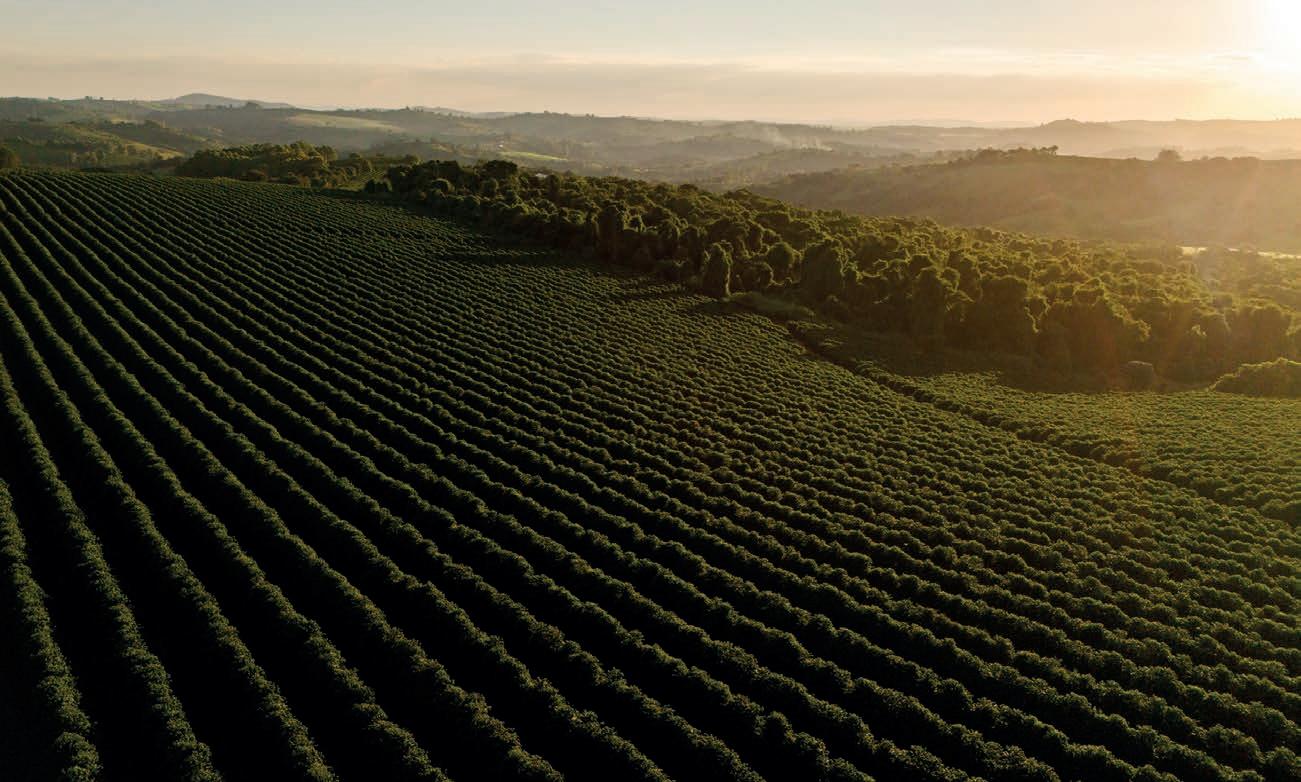
Rabobank highlights a growing uptake of
good agronomic
A new report suggests the next decade is decisive for coffee producing areas responding to climate change. How is the supply chain already adapting?
THE GEOGRAPHY of co ee is changing.
A new report from Rabobank suggests climate change is an active force already redrawing the global co ee map, with around 8 per cent of current Arabica growing areas already classi ed as unsuitable, with projections indicating that could climb to 20 per cent by 2050.
Alternatively, the suitability of current growing areas in Ethiopia is projected to increase signi cantly by 2050, with suitable zones expected to cover 50 per cent of the total area currently under production, expanding into higher elevations and overlapping with existing cultivation areas.
At origin level, producers are increasingly taking resilience into their own hands.
e report highlights a growing uptake of irrigation, good agronomic practices, and agroforestry systems – such as planting trees to help lower canopy temperatures –in Brazil’s Minas Gerais region, the largest co ee producing region in the country.
Camila Bonilla-Cedrez, Senior Specialist F&A Climate & Environmental Risk at RaboResearch, tells Global Co ee Report Brazil’s fast-growing Agtech ecosystem and digitalisation trend is enabling scaling via AI, sensors, and automation platforms,
and that adoption of agronomic practices such as covered soil, non-tillage has been increasing in the world’s largest co ee producing nation.
e expansion of irrigated area in Brazil alone (to ~605,000 hectares by 2040) signals large addressable markets for precision irrigation tech, she says. But there is a caveat: this is not possible everywhere, and environmental costs, such as water usage, should be included in the adoption.
Rabobank has a unique vantage-point, playing a foundational role in the global co ee industry as one of its leading nancial institutions, supply chain nanciers, and industry analysts.
“ rough our conversations with farmers to understand their experiences with di erent adaptation strategies, what consistently emerges is that there is no one size ts all solution,” says Bonilla-Cedrez, highlighting that what works in one region or microclimate may not work in another.
“For example, some farmers have adapted by reducing plant density to lower competition for water, while others report that increasing density helps maintain a cooler canopy and reduce heat stress.
“While some producers have seen clear bene ts from introducing shade trees –
reporting local temperature reductions of 1 to 2°C – others nd that fully shaded agroforestry systems can signi cantly reduce yields and are not economically viable in their context,” she says. e report also notes that greater variability in climate conditions poses risks to supply reliability, with Brazil and Colombia experiencing more volatile yields in recent years due to extreme weather events.
Despite di erences in agrofarming strategies, Bonilla-Cedrez says there is strong alignment on one point: virtually all farmers are transitioning toward new co ee varieties that are better suited to warmer and/or drier conditions.
Future forward
e hunt for climate-resilient varieties is top-of-mind for organisations such as World Co ee Research (WCR).
WCR’s award-winning Innovea Global Co ee Breeding Network – the largest collaborative co ee breeding network in the world – aims to accelerate the development of climate-resilient, high-quality Arabica and Robusta varieties.
With research institutions across Latin America, Africa, and Asia, a network of
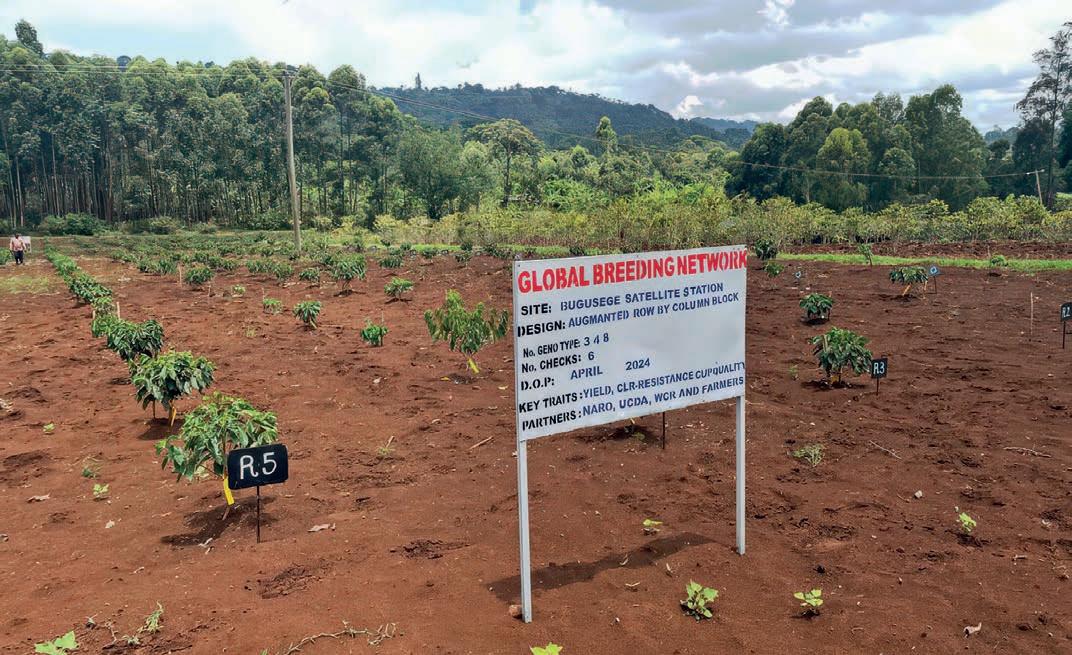
shared data, tools, and genetic materials all go towards increasing the speed of traditional breeding cycles from 20 to 30 years, down to just eight.
WCR CEO Dr Jennifer ‘Vern’ Long says the program treats the globe as a “climate time machine”, planting potential new varieties in multiple countries simultaneously, exposing them to a huge amount of climate variability.
“ e idea is that some places – for example our research farm in El Salvador, which is hot and dry relative to many co ee regions – have a climate today similar to climates predicted for other places in the future,” says Dr Long.
“In e ect, we are testing potential new varieties today in places with tomorrow’s climates.”
A er analysing how the candidate varieties perform, Innovea partner countries narrow down the most promising selections and conduct larger-scale trials, ensuring farmers receive varieties proven to thrive under local conditions.
“Using shared data aggregated from our partner network allows the use of modern genomic tools that help cut years from breeding timelines,” says Dr Long.
She says breeding is essential for combatting climate change as it gives farmers access to trees that can withstand
hotter temperatures, shi ing rainfall, emerging pests and diseases, and other climate stresses while sustaining yields, quality, and livelihoods.
With today’s Arabica production relying heavily on two variety families created over 75 years ago – both resistant to the devastating fungal infection co ee leaf rust – Dr Long highlights the need for updates.
“ e pioneering breeding work done to create those varieties is worth celebrating, but that is a fragile foundation for our $200 billion a year industry – these varieties are decades old now and not very genetically diverse,” says Dr Long.
Innovea therefore created 29 families –creating a large amount of novel genetic diversity – and tests the resulting 5,000 unique variety candidates in a globally distributed testing network.
All the breeding in the Innovea program is done by collecting pollen by hand, but WCR does use genetic information about each tree, combined with eld performance data, to enable it to predict which trees will outperform others.
One of Innovea’s biggest successes to date is the level of collaboration and interaction among the program’s national partners, ranging across Costa Rica, India, Indonesia, Kenya, Mexico, Peru, Rwanda, Uganda, the United States, Vietnam, and Ghana.
e trials of candidate trees are hosted on research stations operated by these partners; who nurture the trees, collect all the data, and make decisions about which trees might eventually become commercialised in their countries based on the needs of local farmers.
e program also incorporates industry feedback – in April 2026, WCR hosted 18 cuppers from 15 member companies to provide extensive sensory analysis of the rst candidates.
“Science is stronger when we do it together. As for the trees themselves – there are over 5,000 candidate trees in Innovea trials right now and more on the way, as Robusta trials become established in 2027,” says Dr Long.
“Better co ee trees grow the entire industry. When better seeds yield more, improve sustainability, and build climate resilience, opportunity abounds: farmers’ livelihoods improve, roasters imagine new products, new consumer markets open.”
For traders, roasters, and importers, adaptation is playing out through diversi cation and deeper engagement at origin.
Key co ee companies are already working at the origin level. Starbucks is testing

hybrid Arabica varieties on innovation farms in Costa Rica and Guatemala, Suca na has mapped over 325,000 farms, and Nestlé has committed US$1.3 billion to regenerative agriculture, alongside other climate adaptation practices.
Technology, such as climate mapping and data, is also helping inform stakeholders across the supply chain.
e ACLIMATAR platform, which provides data required for a range of agricultural industries, including co ee, is one such example in practice.
e platform provides site-speci c climate change risk assessments with corresponding portfolios of priority adaptation practices in West and East Africa and Latin America, providing the ability to visualise climate data available for users’ respective areas, as well as identify speci c actions that respond to local climate hazards.
At a producer level, the co ee&climate toolbox aims to support smallholder co ee farming families and communities to e ectively respond to climate change and increase resilience. e organisation says more than 133,000 co ee farming
households have been trained on climatesmart techniques.
Bonilla-Cedrez says roasters can use climate suitability maps as a forwardplanning tool – helping them anticipate shi s in sourcing regions and think strategically about how their portfolios may need to evolve over time.
Changes in flavour
Rabobank highlights that climate shi s could also alter terroir and originspeci c avour pro les, especially in Latin America.
e report notes that if sourcing moves to new areas, or relies on hybrid blends of beans with di erent avour traits, brand identity and premium pricing could be a ected.
Meanwhile, East African countries could see a strengthening in relevance. e report says changes in the expansion of suitable growing areas could strengthen strategic relevance for buyers seeking “high-complexity pro les and greater supply diversi cation”, but notes this could also increasingly depend on “co-investment

in infrastructure, quality systems, and long-term partnerships to support responsible growth”.
Bonilla-Cedrez says roasters can diversify sourcing toward emerging regions (for example, an expansion in East Africa and Madagascar), develop new blends combining traditional and climateresilient origins, and position products around “climate-adaptive” or “future terroir” storytelling.
“Transparency about evolving origins will be key to maintaining consumer trust,” she says.
Overall, greater collaboration, transparency, shared responsibility, and long-term investment – from nancing on-farm improvements, to supporting research into climate-tolerant varieties – are emerging as de ning features of a more adaptive and resilient industry.
With the next decade marked as decisive for locking in resilient supply chains, industry response is moving toward a more coordinated, future-focused model to not only safeguard supply, but reshape it for a changing climate. GCR

Warsaw, Poland

Evoca Group has released its Carbon Footprint Calculator to the world, helping roasters and coffee chains select equipment aligned with their ESG goals.
THE PATH TO NET-ZERO emissions in co ee is fraught with roadblocks.
e nature of a globally grown crop – o en in rural and isolated corners of the world – coupled with the sheer number of operators across the value chain makes it a di cult prospect to quantify.
Figuring out the amount of Scope 2 and Scope 3 emissions adds another dimension to this, especially when purchasing equipment and machinery. From manufacturing, to transport, installation, and eventually use – it all consumes energy. But without reliable product-level data, it is di cult for businesses to understand where emissions are generated, or where they can act rst.
Evoca Group, a multinational producer of professional co ee and vending machines
with a broad portfolio of brands – including Gaggia Milano, Saeco and Necta – is tackling these issues one step at a time, and has recently released a new tool, called Evoca CFP Calculator – to help companies gain greater awareness of the climate contributions of their equipment choices.
“From the beginning, Evoca’s sustainability journey has been strongly product oriented. We knew that if we wanted to make sustainability truly relevant for our business and our customers, we had to start from the environmental performance of our machines,” says Evoca Group Chief Sustainability O cer, Giusi Bonini.
“ e rst version of the calculator was created as an internal tool to help us understand where the main emissions
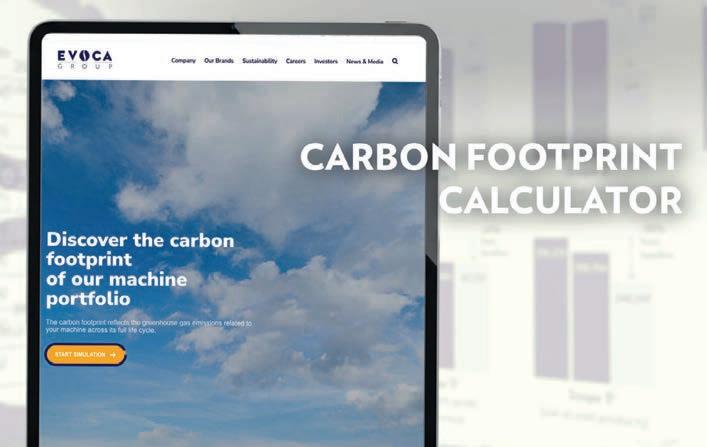
and contributions were generated across the lifecycle of our products and how to give direction to our product sustainability initiatives.
“ e new version builds on that experience: it is more mature, more robust, and designed to make product carbon footprint information easier to use, interpret, compare and share with customers and partners.”
e way the calculator works looks simple. Behind that simplicity is a methodology third-party certi ed in accordance with ISO 14067:2018, the international standard for quantifying and reporting the carbon footprint of a product.
It walks through a simulation where the brand, product, and model are selected, before the machine’s estimated lifespan, operational time, and estimated cups produced per day are input.
en, carbon footprint per cup and energy consumption per cup metrics are calculated, along with the percentages of each phase’s contribution to the total carbon footprint.
In all, it takes just minutes to create robust gures that can help guide purchasing decisions.
“ e calculator estimates the product carbon footprint by looking at the full lifecycle stages of a machine: raw materials and components, manufacturing processes, logistics, use phase and end-of-life management,” says Bonini.
“ e calculator helps customers include environmental performance in their
purchasing decisions, alongside quality, reliability, technical performance and total cost of ownership.
“For operators, roasters and distributors, this means being able to choose equipment that is not only e cient and highperforming but also aligned with their ESG goals and with the growing sustainability expectations of their own customers.”
“It gives them a more concrete basis for conversations that are increasingly moving from broad sustainability claims to measurable data.”
Bonini says one of the major challenges with taking the calculator from internal tool to external readiness was being able to nd reliable data across the full product lifecycle: materials, production, transport, use phase, and end of life.
“For professional co ee equipment, the use phase is especially important, because machines operate for many years and energy consumption can vary depending on usage patterns. e model must be robust, but also practical enough to support real business decisions,” she says.
“To address this variability, Evoca has made its carbon footprint calculator available as an online tool, allowing customers to input their own usage data and obtain results that are more representative of their operating conditions. e calculator uses technical product data such as material composition, energy performance data, usage assumptions, logistics parameters, and end-oflife scenarios.
“Each input contributes to the overall carbon footprint, based on product data and modelled assumptions, with emissions calculated using established emission factors,” Bonini says.
“ e output helps identify where the most signi cant emissions are generated and where improvement opportunities exist.”
e Carbon Footprint Calculator may be the new tool within Evoca Group’s overall sustainability commitments, but it’s far from the rst thing the business has done to further its sustainability goals. is structured approach is supported by internationally recognised frameworks and certi cations, including science-based emission reduction targets validated by the Science Based Targets initiative (SBTi).
Evoca’s progress has been further acknowledged by independent ratings agencies: in 2024, the Group achieved an EcoVadis Platinum rating – placing it
Chief
among the top 1 per cent of companies globally – recognising the strength of its integrated and systematic approach to sustainability and governance.
Within this context, the development of the Carbon Footprint Calculator represents a natural extension of Evoca’s ESG roadmap, adding a further tangible tool to support customers and partners with accurate, veri able data and reinforcing the Group’s long-term commitment to measurable and credible sustainability outcomes, as highlighted by Bonini.
“ e calculator brings together product innovation, climate action and circular economy. e key principle is simple: if you cannot measure it, it is very di cult to manage it, and even harder to improve it” she says.
“It supports our work on emissions reduction, energy e ciency, responsible manufacturing, and material choices. It is not only a reporting tool; it also helps guide product design and development decisions, making sustainability more concrete and embedded in the way we innovate.”
No longer just “nice to have”
For Evoca, the launch of the calculator comes at a time when sustainability is no
longer treated as a “nice to have”. Across the value chain, customers are increasingly asking for robust, veri able data on emissions, energy e ciency, materials and supply chains practices.
is is particularly relevant for professional co ee equipment, where product lifetime, reliability, and energy performance have a direct in uence on both operating costs and environmental impact.
“Evoca operates internationally and plays an important role in the professional co ee equipment value chain. With that position comes responsibility,” says Bonini.
“Being a leader today means more than o ering high-quality and reliable products. It means helping the market towards more e cient, transparent, and responsible solutions.
“For us sustainability and long-term competitiveness go hand in hand. e
Carbon Footprint Calculator is one way to make that connection more visible and more useful for our customers.” GCR
For more information, visit evocagroup.com
THE LATEST INTERNATIONAL COFFEE INFORMATION, DELIVERED TO YOUR DOOR
Global Coffee Report is the leading business magazine covering the international coffee industry. In‑depth features explore on‑the‑ground developments at origin, coffee pricing issues, technology updates, research breakthroughs, and much more.


gcrmag.com/subscribe
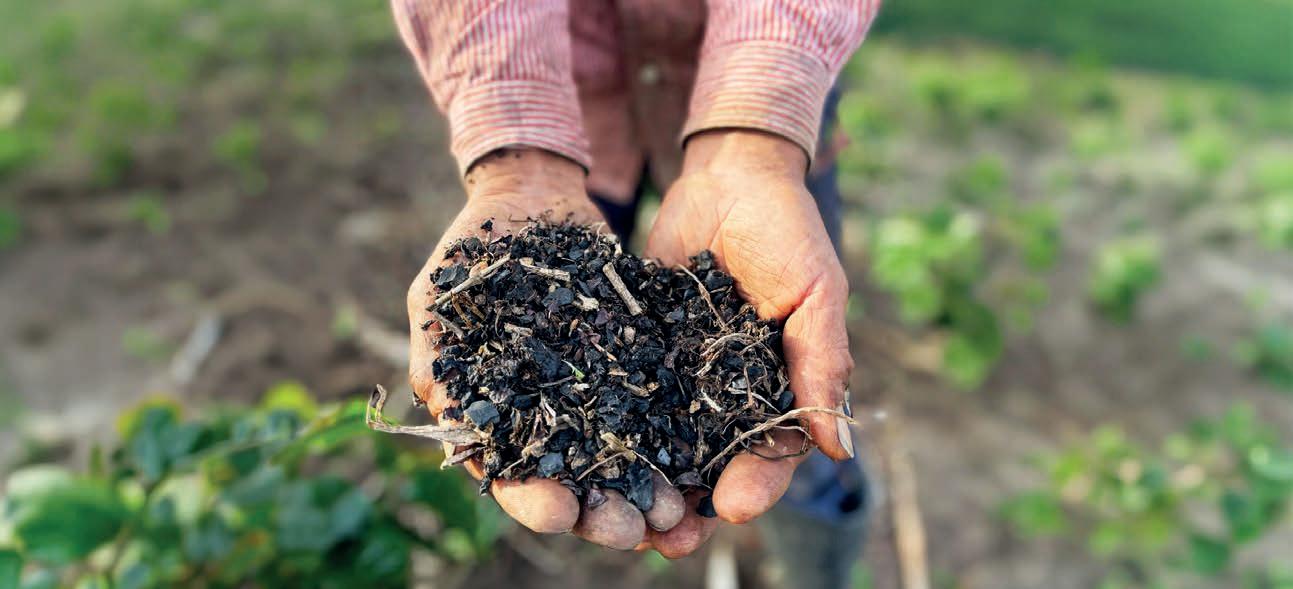
Neumann Kaffee Gruppe and its partners are scaling biochar in Colombia, transforming coffee waste into a super substance contributing to sustainability goals.
ACROSS COLOMBIA, co ee producers are grappling with declining soil fertility and increasingly unpredictable weather, while rising costs of inputs that are becoming harder to absorb.
At the same time, international buyers are raising expectations around traceability, climate resilience, and lowcarbon production.
For Neumann Ka ee Gruppe (NKG), these pressures shape the day-to-day work on farms in the region. rough Colombian group company SKN Caribecafé, it is working with more than 5,000 co eegrowing families across seven departments with the goal of building productive and resilient systems.
Rather than relying on single or isolated interventions, SKN has developed a regenerative model that integrates soil conservation, agroforestry, water management, and biodiversity into its framework.
Within this, the use of biochar sits at the intersection of agronomy, waste management, and climate strategy.
Produced by heating organic material in a low-oxygen environment, agricultural residues, such as woody biomass from pruned co ee trees, are transformed into a stable, carbon-rich substance that can be returned to the soil.
NKG Sustainability Manager, Dr Julius Wenzig, says biochar is one of the most promising innovations currently being explored by NKG and SKN.
ey have partnered with Swiss biochar startup, Cotierra, to scale the regenerative impact biochar can have.
“ e structured development of biochar as an intervention for SKN began in 2024 in collaboration with Cotierra and a German customer, initially as a pilot initiative,” says Dr Wenzig.
“Since then, the approach has progressively matured, expanding in both technical robustness and farmer adoption, and demonstrating strong potential for scaling across origins. What started as a targeted pilot with a limited number of farmers has evolved into an important component of SKN’s eldwork.
“Biochar o ers a solution for managing one of the byproducts that causes signi cant pollution in water sources and soil, while also contributing to a substantial carbon footprint: co ee pulp.
“ rough a controlled pyrolysis process, co ee-related biomass residues are converted into biochar, which, when combined with co ee pulp, creates a valuable soil amendment that can enhance soil health, structure, increase water retention, improve nutrient availability and overall productivity as well as sequester carbon.”
A key factor in the expansion of the pilot has been the decentralised nature of the system. e biochar is produced directly on farms using mobile, coneshaped reactors made by Cotierra and
simpler kilns that can be transported between sites.
“A key advantage of decentral, smallscale biochar technology is the mobility of its reactors, enabling biochar production directly on farmers’ elds,” says Yader José Goyeneche Aponte, who co-leads SKN’s Sustainability Department.
“Two people can load them onto a pickup truck. is elimates the need for centralised biomass collection and processing, making implementation more e cient, accessible, and adaptable to local conditions.”
SKN primarily uses biomass from co ee residues for biochar production, focusing on co ee stems generated during stumping.
Traditionally, this wood is le on the elds to decompose or is used as household fuel.
“It can be used far more e ectively as a feedstock for biochar production,” says Goyeneche Aponte. “ is ensures a reliable and consistent biomass supply, directly linked to existing farm management practices.”
e practices necessary for producing biochar include the producer having at least 5000 co ee stems from stumping stacked and in optimal drying condition, making sure there is enough space for the biochar reactor to be installed – which burns the wood at a temperature of 500 degrees Celsius, and the provision of labour to complete the process.
“Biochar is typically not applied as a standalone input for co ee farming. Instead, it is biologically activated through co-composting with fresh co ee pulp
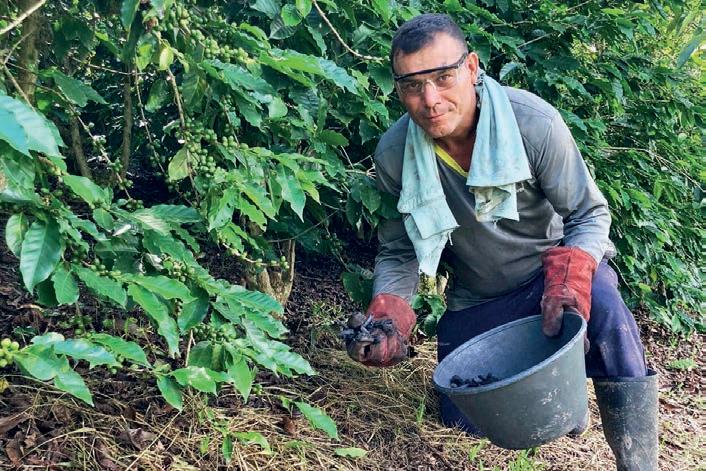
or kitchen waste to produce a nutrientrich organic amendment. e standard activation ratio is four parts fresh co ee pulp and one part biochar,” says Goyeneche Aponte.
“ e mixture is composted for a minimum of six to eight weeks, with an optimal activation period of two to four months to maximise nutrient loading and microbial colonisation.
“ e addition of biochar signi cantly accelerates the composting process; without it, composting co ee pulp can take up to nine months.”
Agronomic benefits
As biochar adoption increases, its value is becoming most visible where it matters most – in the eld.
Across participating farms, improvements are being observed not only in soil condition but also in overall plant performance, providing growers with tangible evidence of its impact.
“We have observed various bene ts, ranging from the plant’s physical characteristics to soil quality and productivity,” says Goyeneche Aponte.
“ e plant’s physical structure appears healthy, with improved colour and leaves in good condition, indicating it is ready for abundant owering.
“ e soil retains moisture and is capable of more e ciently retaining the recommended fertiliser.
“ us, the necessary conditions are in place for improved plant quality and yield. Biochar is not intended to replace fertilisers; rather, it enhances nutrient-use e ciency, improves soil structure, increases
water-holding capacity, and promotes biological activity within the soil.”
ese eld-level observations highlight that biochar delivers the greatest results when used as part of a broader soil management system.
“Biochar is used as part of an integrated soil fertility strategy. It is combined with compost, primarily derived from co ee pulp, as well as with mineral fertilisers and based on soil analysis, if available,” says Dr Wenzig.
“ is combined approach is embedded in a broader regenerative soil management framework that also includes soil conservation practices and targeted nutrient management.
“ e objective is to enhance soil resilience, improve nutrient cycling and water retention, and support sustainable productivity over time, while also contributing to long-term carbon storage.”
By integrating biochar into composting systems and fertilisation strategies, farmers can optimise nutrient availability while improving the long-term health of their soils.
Crucially, these bene ts are ampli ed when biochar is aligned with other regenerative practices already in place across SKN-supported farms.
“ e vast majority of the practices SKN implements are aimed at improving soil health, such as using cover crops like forage peanuts, agroforestry systems that provide shade and leaf cover; in some areas, this creates microclimates, which in turn reduce nutrient leaching and help retain water,” says Goyeneche Aponte.
“ ese practices align very well with
the bene ts provided by biochar, further strengthening the practices we have been implementing for several years.”
e growing interest in biochar is closely tied to its ability to deliver value across multiple levels of the co ee supply chain, from farm resilience to corporate climate strategies. As implementation expands, its role as a multi-functional solution continues to become clearer.
“Biochar o ers signi cant potential for climate change mitigation by serving multiple complementary purposes for di erent stakeholders,” says Dr Wenzig.
“For farmers, it provides a practical solution for organic waste management while improving soil quality, water retention, and productivity. It also increases the resilience against climate change.
“At the same time, it raises awareness of environmentally bene cial practices as it is linked to nancial incentives.”
is dual bene t has made biochar particularly attractive within SKN’s regenerative framework. It aligns with existing interventions while strengthening both productivity and sustainability goals.
“Biochar represents a valuable addition to on-farm technical assistance and supports the good relationship with farmers. It supports the promotion of sustainable agricultural practices, enhances soil health, and integrates well with other recommended agronomic interventions,” says Dr Wenzig.
“Beyond these operational bene ts, biochar also has relevance in the context of carbon management, as it functions as a stable carbon sequestration mechanism.”
However, translating potential into widespread adoption is not without its challenges. While early results have been promising, farmer con dence takes time to build, particularly when introducing new practices that require additional labour and learning.
Despite the bene ts of incorporating biochar into co ee cultivation, Goyeneche Aponte says it will continue to take time for producers to trust its e ectiveness.
“ ere are always reservations and scepticism. One of the main concerns among producers has been the e ectiveness of the application and whether it actually works,” he says.
“Another is the time required to fully implement the practice. In both respects, SKN’s recognition has enabled producers to attend outreach workshops and handson training sessions, as well as visit
demonstration and testimonial farms where the producers themselves demonstrate the bene ts of biochar.”
ese peer-led demonstrations are proving critical in turning early adopters into advocates and gradually strengthening trust within farming communities.
As acceptance and trust increase though, he believes it will become “integral” to the overall sustainability strategy of NKG, according to Dr Wenzig.
“As we continue to scale biochar production across our supply chains, its relevance and contribution to our climate strategy are steadily increasing. We therefore envisage biochar becoming an integral component of our corporate carbon accounting framework going forward,” he says.
“In parallel, we are actively working on aligning with the requirements of the GHG Protocol Land Sector and Removals Standard and exploring how biochar can be robustly integrated into our corporate carbon footprint (CCF).
“To address these challenges, we are actively working with customers and value chain partners to develop robust approaches and shared solutions. is collaborative e ort is essential to ensure that biochar can be credibly accounted for, while at the same time unlocking its full potential as a scalable climate solution in co ee supply chains.”
Taken together, these e orts highlight a broader transition underway – one in which biochar is moving from an experimental practice into a core component of regenerative co ee production, supported by both farmer adoption and value chain collaboration.
Scaling biochar production beyond pilot level it depends on coordinated investment, farmer engagement, and value chain alignment.
In Colombia, this next phase is being driven through a structured partnership between NKG, SKN, and Swiss retailer Migros with its manufacturer Delica.
e six-year initiative, running from 2026 to 2031 in Huila, a department located in the nation’s south-west, is designed to expand access to biochar while embedding it within broader regenerative farming systems.
e program works with about 500 Rainforest Alliance-certi ed farmers across approximately 1500 hectares, with about half directly engaged in biochar production
in collaboration with Cotierra.
“ e initiative focuses on strengthening farmers’ access to biochar alongside agronomic training and technical support,” says Co ee Sustainability Manager at Migros, Clarissa ullen.
“ is combination is critical to ensure long-term adoption and impact.”
Biochar production itself is integrated into a circular system that combines organic waste streams with composting and microbial inputs.
is approach aims to maximise the agronomic value of the material while improving soil health and nutrient e ciency over time.
“Biochar is produced in systems that combine organic residues, composting, and bene cial microorganisms,”
ullen continues.
“ e objective is to improve soil health, enhance productivity, and contribute to carbon sequestration.
“Biochar can help mitigate extreme weather impacts by improving water retention and nutrient availability. is strengthens resilience to both drought and excessive rainfall.”
Recent research by the Sustainable Co ee Challenge found Colombia has among the highest carbon footprints for Arabica Co ee production in Latin America.
As the region’s largest co ee producer behind Brazil, this is a signi cant nding.
“ e project builds on the understanding that regenerative agriculture requires both knowledge and access to inputs and technology,” says ullen.
“Beyond agronomic trainings for farmers, a key component of the partnership is the development of biochar production at scale.
SKN is working with Migros/Delica to scale biochar production. Image: SKN/ Valentina Paredes.
Biochar is produced in integrated systems that combine organic waste streams, composting processes, and the application of bene cial microorganisms.
“ is approach aims to improve soil health, increase nutrient e ciency, and enhance long-term farm productivity, while also contributing to carbon sequestration.” e project is embedded in a broader multi-stakeholder consortium under the Swiss Sustainable Co ee Platform, a joint initiative of the Swiss co ee sector, civil society, research institutions, and the Swiss government.
“ rough its project facility, the platform supports collaborative impact projects that bring together value chain actors to scale sustainable practices in origin countries, with co- nancing provided by the Swiss State Secretariat for Economic A airs (SECO),” says ullen.
“In Colombia, this collaboration is part of the “Alianza Café Colombia” initiative, which promotes regenerative agriculture approaches such as agroforestry, composting, and biochar production in partnership with multiple international co ee companies and development actors.
“By combining technical innovation with farmer-centred support and a pre-competitive, value chain-wide partnership model, the Migros/Delica–NKG collaboration re ects a shared ambition: to make regenerative agriculture scalable and economically viable, while delivering tangible bene ts for farmers and the climate.” GCR
For more information, visit nkg.coffee
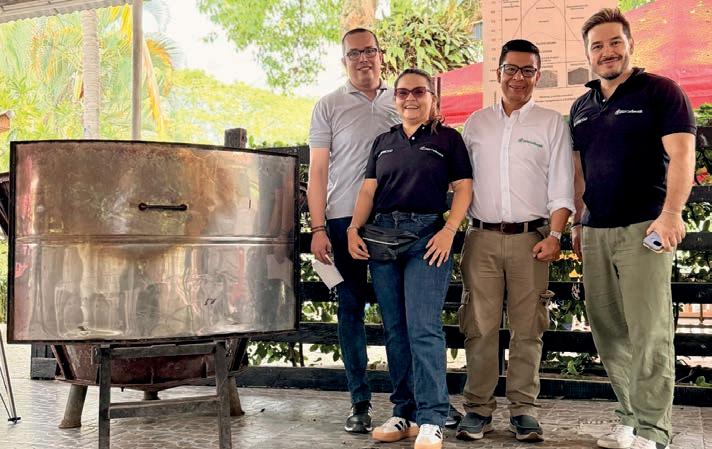
The B Lab Coffee Coalition working groups highlight topics such as supporting recruitment, retention, and engagement across the global coffee sector. Image: Sancoffee.
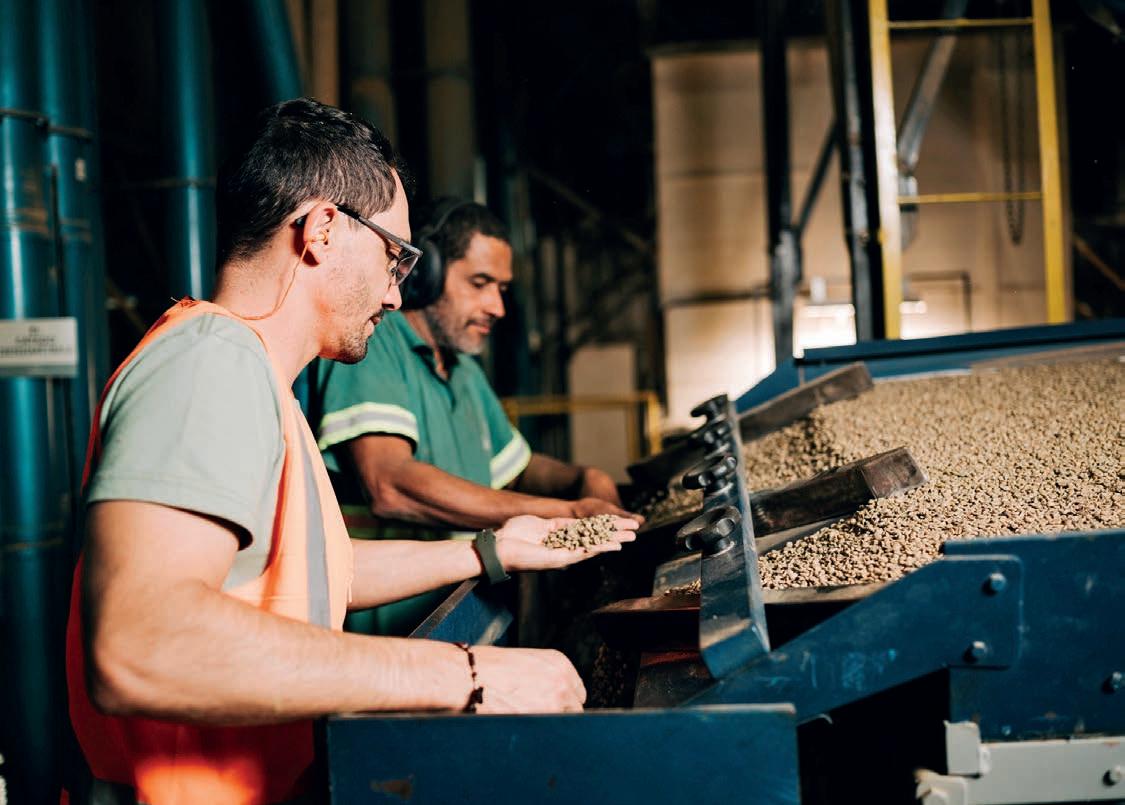
B Corp-certified coffee businesses from around the world are reframing the conversation around collaborative opportunity with a new initiative.
THE GLOBAL COFFEE sector is navigating several pressure points, from geopolitical issues, climate change, to economic volatility.
Yet rather than positioning these challenges as insurmountable, a new coalition is o ering a proactive solution –aimed at strengthening resilience through discussion, teamwork, and lateral thinking.
O cially announced in April 2026, the B Corp Co ee Coalition was formed by seven certi ed B Corporations spanning origin, trade, roasting, and retail –including Sanco ee (Brazil), Cafe Imports (United States), Nomad Co ee Group (Australia/New Zealand), Bettr Group (Singapore), CleverCo ee (Denmark), ViCAFE (Switzerland), and Spring Valley Co ee (Kenya).
B Lab says the coalition was created to provide a dedicated space for members to align on shared priorities, exchange best practices, and develop approaches that strengthen long-term sustainability, resilience, and equity across the co ee sector.
Membership is open to all Certi ed B Corp co ee businesses, with the expectation that broader participation
will deepen its impact and diversify its perspectives.
At the time of writing, it now boasts 20 per cent of all B Corp-certi ed businesses in the industry, with its rst in-person meeting marked for World of Co ee in Brussels this June.
“I could name countless geopolitical issues that we’re facing right now, but I think all of them are giving us examples and the practical instinct of how interconnected we should be.”
Giovana Bressan COMMUNICATION AND COMMUNITY MANAGER B LAB SWITZERLAND
So how did this exciting new chapter for the industry come to be?
Giovana Bressan, Communication and Community Manager at B Lab Switzerland, who is helping coordinate the coalition, tells Global Co ee Report the initiative began a er some founding members were already working together and to tackle challenges they had identi ed in the industry.
“Our role at B Lab is to support beyond certifying and having a standard – we want to support all the companies that are B Corp certi ed in continuing and improving their sustainability performance, improving and promoting their impact,” she says.
“So, we were curious to ask [these companies] – what is it that you’re trying to do?”
e announcement of coalition also coincides with B Lab’s 20th anniversary. Bressan says the nonpro t’s standards for sustainability have evolved dramatically since 2006, including an increase from ve to seven key measures companies must meet for certi cation – existing B Corp businesses need to recertify to meet these standards.
One of these new impact areas focuses on Government A airs and Collective Action, – advocating for policy change, paying fair taxes, and working with others to shi systems towards great social and environmental outcomes.
“When this coalition came, the companies are seeing the potential of action based on our standards. ey’re having a look [those standards] and understanding, ‘Okay, I should partner up, and actually we can do more together’,” says Bressan.
“I could name countless geopolitical issues that we’re facing right now, but I think all of them are giving us examples and the practical instinct of how interconnected we should be.”
Like in many discussions across the industry, a key topic for the coalition is climate change. Bressan says co eeproducing countries are the ones most a ected by climate change, extreme conditions, droughts, and oods.
“ ey need to be resilient – and they can only do that together”, she says.
“I think that’s the scenario we’re currently living, and it pushed the members to want to look out for each other, and to look to learn from each other to exchange on these best practices.”
is exchange of ideas is seen in the coalition’s working groups. Each focus on one shared challenge or opportunity over a de ned period, working towards an outcome that is practical and applicable –such as recommendations, frameworks, or shared ways of working that members can then use within their own organisations.
Bressan says the founding members brainstormed on the topics they could
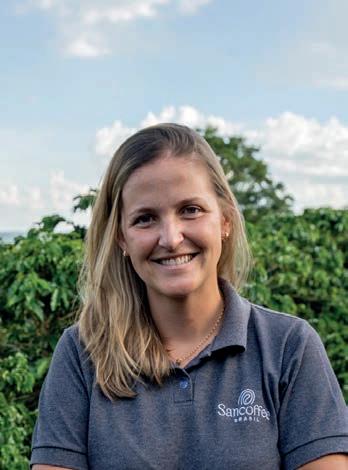
“This plurality is our greatest wealth; it ensures that discussions and solutions never get trapped in a single market perspective, fostering a balanced, empathetic, and horizontal dialogue between origin and consumption.”
Ana Claudia Silva HEAD OF IMPACT SANCOFFEE
tackle – from environmental issues, regenerative agricultural practices, and fair living wages for producers.
e groups are initially focusing on two key areas: ‘From Poverty to Prosperity’, spotlighting the wider conditions that can support strong livelihoods, resilient businesses, and healthy ecosystems; and ‘Purpose-Led Co ee Workforce’, supporting recruitment, retention, and engagement across the global co ee sector.
“It was very deliberate, the order choice for the seven founding members, about having representation from each part of the values,” says Bressan.
A er the working groups have met, the
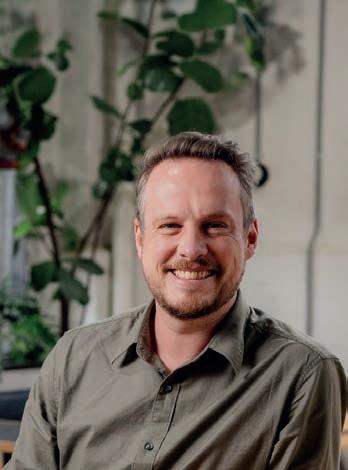
conversation deepens further into tangible metrics and timelines.
And as more coalition members come on board with their own inputs and ideas, the working groups are expected to naturally evolve.
“We want to then decide what subgroups should we have, what subtopics should be high, what timeline do we want to achieve, or know what groups to close,” says Bressan.
With the coalition now rmly out in the world, founding members are enthusiastic at the prospect of seeing it take ight in the months and years to come.
Representing the Australian and New Zealand markets, Nomad Co ee Group Sustainability Manager Nick Percy says almost a year of e ort had gone into the creation of the coalition, and he’s excited to see it expand in the future.
“ is has been about nine months in the works, getting everything set up with the right governance and protections to make sure that not only this coalition creates value for all those involved, but also protects everyone’s privacy,” he says.
“It’s silly to think that any one business has the answers, and we are no di erent. What’s really great about being able to work together in this fashion is that not only is it a global movement, but more importantly, we have a good mix of everyone along the value circle, including producers, retail, roasters and green buyers.”
For Ana Claudia Silva, Head of Impact at Sanco ee – a Brazilian specialty co ee growers cooperative – being a founding member of the coalition was a natural step, “perfectly aligning” with the organisation’s core and mission: to cultivate relationships, harvest trust, and promote prosperity.
“When we look at the pillars of the B Corp Co ee Coalition, we see a global re ection of this exact mission we practice at origin. e coalition was born out of principles such as transparency, equity, and collective action within the co ee value circle,” she says.
“For us, it is impossible to ‘promote prosperity’ in the eld without an integrated global ecosystem that supports the farmers at the base. Likewise, it is impossible to ‘cultivate relationships and harvest trust’ without fostering a transparent, pre-competitive agenda among businesses worldwide.
“Joining forces with other global references in the B Corp movement reinforces our commitment to go beyond
B Lab says the B Corp Coffee Coalition was created to provide a dedicated space to strengthen long-term sustainability, resilience, and equity across the coffee sector. Image: B Lab.
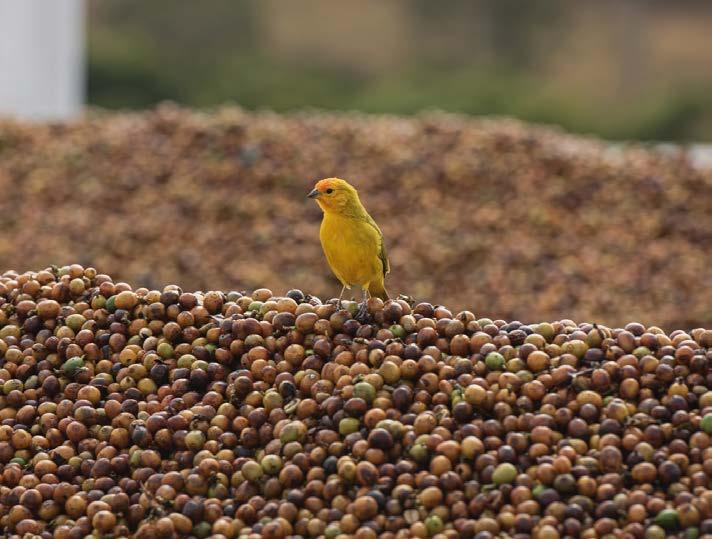
basic sustainability, actively pursuing regenerative leadership grounded in the values we live by every day.”
Silva highlights the genuinely global and cross-sector nature of the coalition “since day one”, something she considers worth celebrating.
“ is plurality is our greatest wealth; it ensures that discussions and solutions never get trapped in a single market perspective, fostering a balanced, empathetic, and horizontal dialogue between origin and consumption.”
Bressan says both long- and short-term metrics are being created to see tangible outcomes for the coalition.
“In the rst year we want to get really active working groups. is is not a passive coalition … we want them to be collaborative, so for us, that’s the main metric – that the coalition is active.”
A ve-year plan is already in view, with the aim of seeing the outputs members are producing, representation at major co ee events around the globe, annual reporting,
and a pilot project that implements one of the coalition initiatives.
“ e [coalition companies] in our network will be able to bring [their knowledge] to the big stages of co ee fairs and conferences to share with other companies that want to learn from them, but to also inspire,” says Bressan.
“From what I’m hearing, a lot of companies feel like they cannot start, or they don’t know where to … and by bringing this inspiration, by showing that this is possible and it is a business model on those big stages, we’ll be able to push the needle a bit that way.”
Ultimately, the most signi cant goal is seeing those initial conversations create long-term change and resilience for the industry.
“ is is a coalition that – in their words –is tackling systemic issues. We would like to then see that what is being proposed on the working group level, and on the coalition level can be used by the rest of the value chain,” says Bressan.
“Whether that will be a blueprint, a di erent framework, or di erent assessments speci cally related to living income for farmers … we want to be able to see that also be used by non-B Corp companies, because that’s how we change the system.” GCR
For more information on the B Corp Coffee Coalition, visit bcorpcoffee.org
Founded by 81 businesses that “chose to be measured di erent”, with thousands more following, B Lab says the B Corp movement was powered into existence by community.
On its 20th anniversary, that global community is re ecting on two decades of impact.
B Corp now spans over 10,700 certi ed corporations across 104 countries and 162 industries, collectively employing more than one million people.
Research drawn from B Lab’s anniversary Impact Report has quanti ed that if all businesses adopted environmental and climate practices at the rate B Corps currently do, global temperature increase could be reduced by 0.5°C by 2100, a signi cant contribution toward the Paris Agreement.
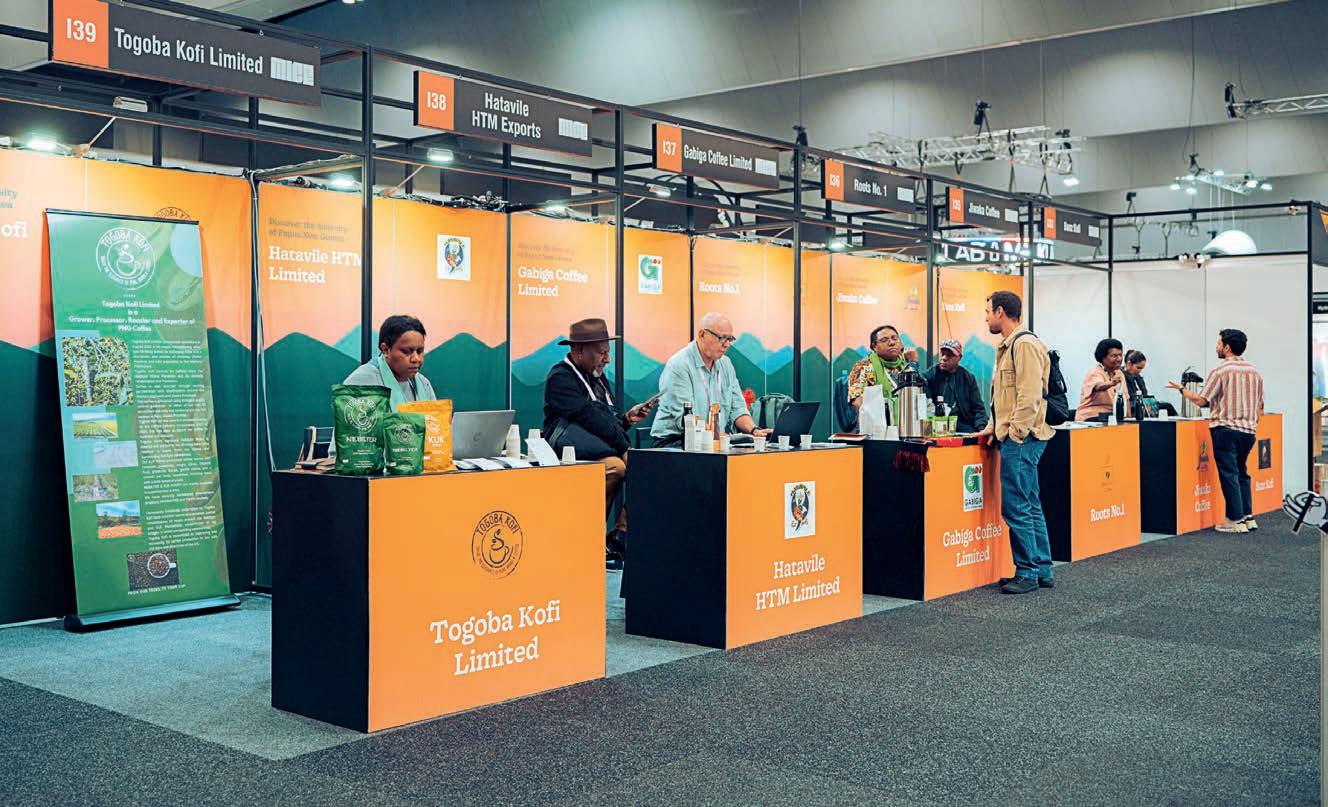
A separate study found that over 95 per cent of B Corps remained in operation during COVID, compared to 88 per cent of comparable rms.
B Lab says the data reinforces that stakeholder governance is not only an ethical choice, but a strategic one.
“Every day, B Corps show that businesses can care for the stakeholders they impact – not just shareholders, but their workers, suppliers, customers, communities, and nature itself,” says Francine Lemos, Board Chair at B Lab.
“ is approach has never been so urgently needed in our society. We know it’s possible. Now it must become the norm.”
e organisation says B Corps are preparing to deepen their commitment to certi cation through “new, more rigorous standards” that will require companies to
meet minimum thresholds across seven Impact Topics, from Climate Action to Human Rights, veri ed by independent, third-party auditors.
“ e next chapter for B Lab is to harness 20 years of momentum to drive broader impact, guided by ve strategic priorities,” says B Lab.
“[ ese include] raising the bar through world-leading standards and trusted certi cation; retaining and growing an ambitious, inclusive global community; deepening collective action across geographies and industries; coordinating advocacy to embed stakeholder governance into law; and building new narratives of success that reshape expectations among mainstream business leaders, policymakers, and investors.”
Trip to Origin was a celebrated new component of MICE26. With the connections it created, it’s returning even stronger in 2027.
IT SEEMS there is something new to enjoy in every edition of the Melbourne International Co ee Expo (MICE). In 2026, one of the leading new experiences was the introduction of Trip to Origin.
With International Trade Centre metrics signalling global co ee consumption is growing 2.2 per cent per year, and global exports valued at about US$38 billion per year, connecting co ee business decisionmakers with producers is becoming increasingly critical to strengthening the industry’s value chain.
is year, a whole corner of the Melbourne Convention and Exhibition Centre was dedicated to fostering these relationships. Co ee importers, producers, and regulatory boards from all over the world converged to showcase their co ees to an audience of Australian and international café owners, co ee roasters, and some of the most discerning co ee lovers on the planet.
Everywhere you turned, there was a new opportunity. From Brazil to Vanuatu, some of co ee’s biggest producing origins were represented alongside smaller nations and rising stars of the industry, all looking to
showcase the unique avours and stories their co ees possess.
All in all, there were representatives at the show from Kenya, Uganda, Brazil, India, Papua New Guinea, Indonesia, Samoa, Vanuatu, El Salvador, and Fiji, alongside importers such as Ahaana Co ee, Ka ebonor, and Southland Merchants, suppliers of co ee from di erent and multiple origins.
is representation came in the form of regulatory bodies such as the Australia PNG Economic Partnership and the Co ee Board of India, to individual businesses including Fijian family-owned social enterprise South Paci c Co ee Company, and Samoa’s Aleisa Co ee.
MICE Education Moderator and Show
Lead, Sarah Baker, says – like other special components of MICE including the Roasters Playground, and Global Co ee Report Leaders Symposium – high quality networking is the name of the game when evaluating the success of Trip to Origin.
Trip to Origin exists to strengthen the connection between producers and café operators,” she says.
“When you’re walking the show oor and you suddenly nd yourself in a cupping
session with representatives from Brazil or Uganda and get to meet the very people that helped produce that co ee – that’s a pretty special moment.”
Uganda is one of the world’s top 10 producers of co ee, with much of its export coming in the form of Robusta – about 80 per cent.
It’s a nation seeking to boost its co ee production and utilise the crop as a vehicle to help li the quality of life for many of its farmers and is looking to new markets to help boost the export of its co ee.
Among Uganda’s representation at the show was Her Excellency Ms Dorothy Samalie Hyuha, Uganda’s High Commissioner in Australia, who travelled from Canberra to take part, alongside Assistant Commissioner for the Division of Quality Assurance and Value Addition, Gordon Katwirenabo, and other co ee producers who ew to Melbourne from Uganda.
e Ugandan stand at MICE featured a range of Natural and Washed Arabica and Robusta co ees, all presented in lter form to enable showgoers to experience the avour notes of some of the East African nation’s most exciting co ees.
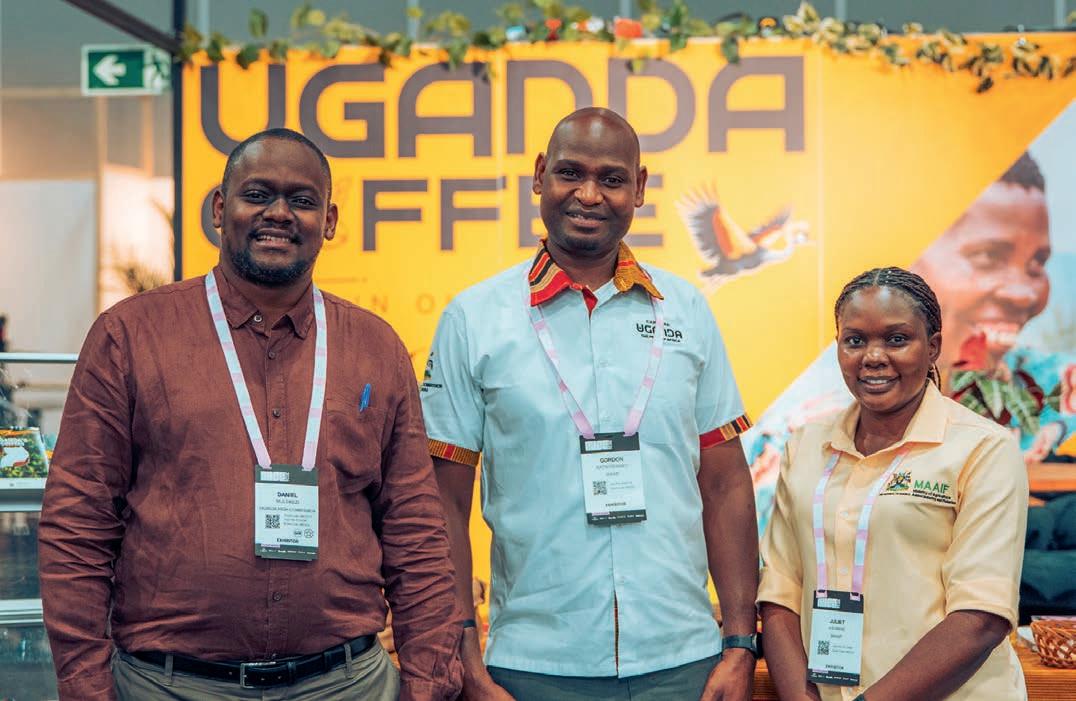
Samalie Hyuha says events like MICE o er a unique opportunity to engage with a range of roasters and decision-makers from all over Australia and the wider Paci c region.
“I’m so very happy the Uganda High Commission could participate at MICE,” she says. It has been wonderful because previously we have come to observe, but we didn’t have the opportunity to join the exhibition.
“We have had an opportunity to tell the success story of co ee from Uganda. Our goal is to enter the Australian market to trade co ee and open ourselves to the Paci c region and the entire world.”
Assistant Commissioner Katwirenabo says the exposure that MICE o ers – to what has traditionally been a small market for Ugandan exporters – is invaluable.
“We want Australians to test our co ee, because we see it as a very strategic and niche market,” he says.
“We feel participating in events such as MICE will go a long way to expose co ee lovers and co ee drinkers to the unique avours in Ugandan co ee.”
e Trip to Origin section also featured a space for cuppings, further educating MICE attendees about di erent co ees
from around the world.
“We had the opportunity to hold a co ee cupping so people could test the co ee of Uganda but also learn that Uganda is one of the leading producers of co ee in the world, and we have di erent volumes of co ee available to export to di erent part of the world,” says Samalie Hyuha.
As well as the cupping, Katwirenabo hosted what he called a “sideline presentation”, where he discussed Ugandan co ee with a watching audience, highlighting the status of production volumes and why people should start sourcing from there.
Having a whole corner of the tradeshow dedicated to building these relationships was a highlight, according to Samalie Hyuha, who says the expo oorplan gave each exhibitor “the opportunity to be a success story”.
“What I enjoyed about this show is the layout of it, and how di erent café players have been in a position to participate,” says Samalie Hyuha.
“You nd the exhibitors who export and produce co ee are here [at Trip to Origin], but the roasters are here, the baristas are here, those who manufacture packaging and machinery are here.”
Looking ahead to MICE27 and beyond, Trip to Origin is likely to become a mainstay, if the immediate judgement from show attendees is anything to go by.
“ e response from the industry spoke for itself. People were genuinely moved by having direct access to the producing countries and being able ask questions about the origin of their co ee,” says Baker.
“ e education piece is everything. Now that Trip to Origin is embedded on the show oor, talks on di erent processing methods, regional avour pro les and the realities of production are reaching a much wider audience.
“Attendees can come learn about the rst part in the value chain they may not have had any prior knowledge in and leave an educational talk or cupping session with a completely di erent understanding of what’s in their cup.
“Bridging that gap and creating greater education across the value chain is so important.”
Now, as things ramp up towards the 2027 show, Baker is excited by the prospect of hosting more producers.
“It was such a privilege to have producers from so many incredible growing regions;
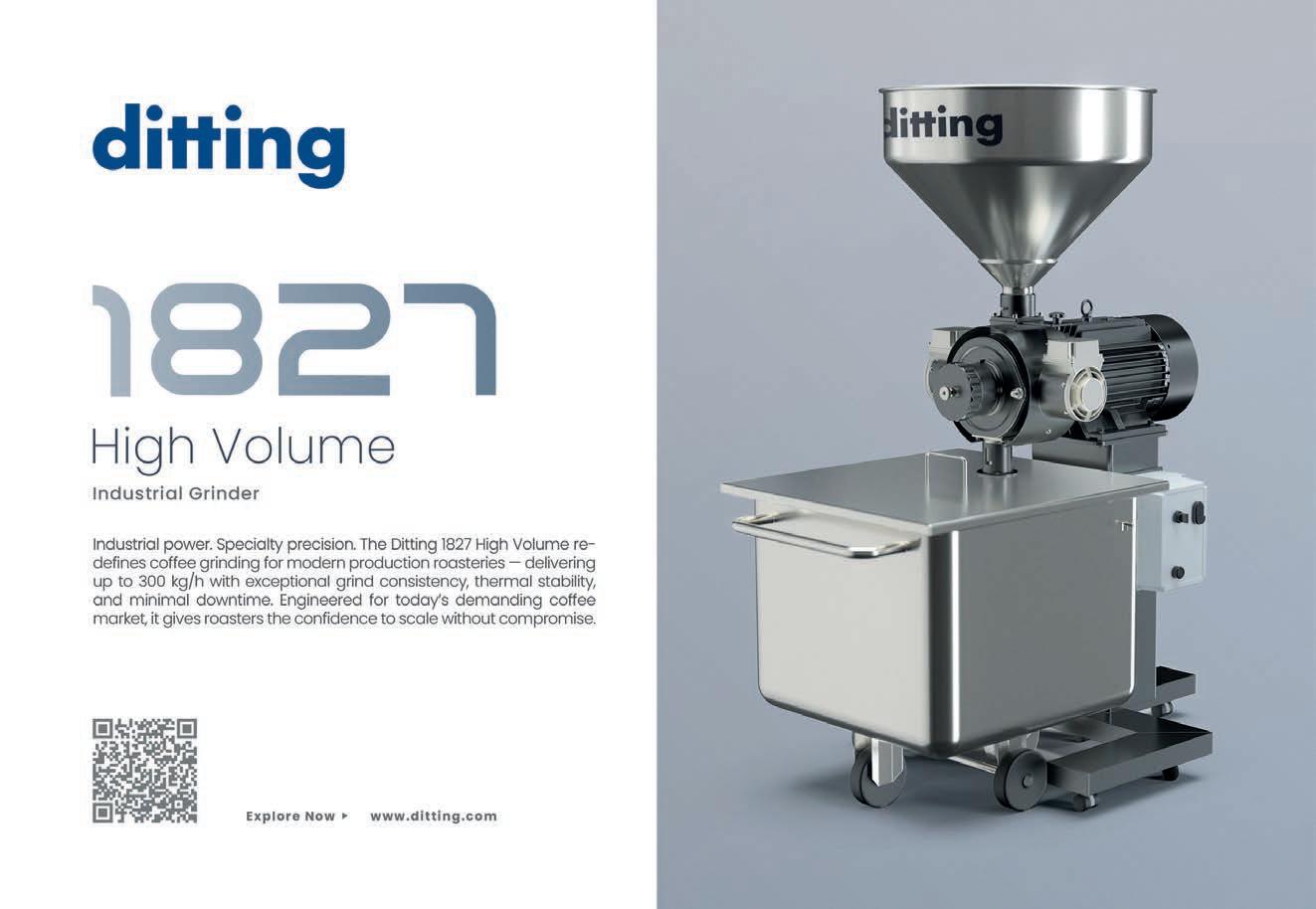
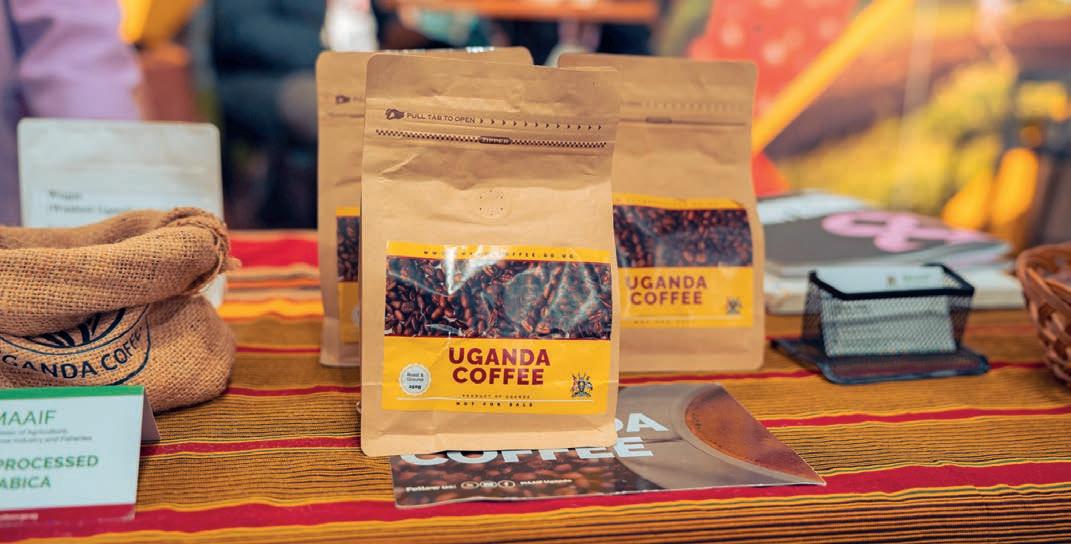
Brazil, Papua New Guinea, Uganda, Kenya, and so many more, all under one roof sharing their stories and their co ees,” she says.
Katwirenabo says growing Australian interest in Ugandan co ee was evident prior to MICE, but he sees the show as a powerful vehicle to further the
relationship between the two nations.
“In the rst quarter of 2025, we imported about 1500 kilograms of co ee to Australia. is year, in the rst quarter that number rose to 3500 kilograms.
“I am looking forward to sustaining that kind of increase in the Australian market and building bridges of friendship through
co ee. I think it will be exciting to see what we can achieve together as far as sustainable development is concerned.” GCR
For more information, visit internationalcoffeeexpo.com
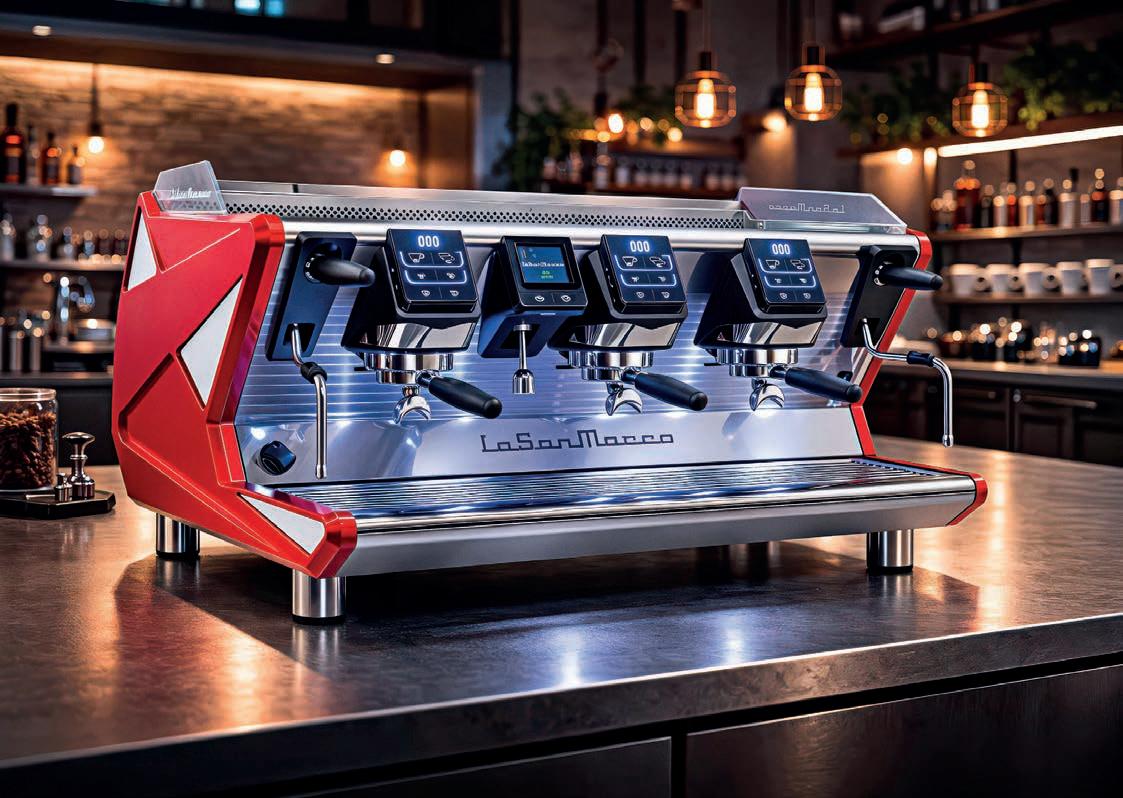
With automation changing the parameters of what baristas can create, SEB Professional Beverage says this presents an opportunity to match the machine to the craft.
WHEN DOES automation support the barista, and when does the machine become the prerequisite for cra smanship?
ese two fundamental questions are what equipment manufacturer SEB Professional Beverage believes are at the heart of co ee machine automation.
According to the company, operators are increasingly deploying di erent machine types within a single location – allocating tasks based on speed requirements, sta skill levels, and the intended customer experience.
A café or hotel, for instance, might feature a manual espresso machine for a more personalised experience, while a nearby automatic machine can complement this and step in to e ciently manage a peak service period.
SEB Professional’s pairing of the WMF espresso NEXT and the recently-acquired La San Marco LA 125 machines aims to formalise this divide, with the distinction re ecting “two di erent professional needs, rather than a hierarchy of quality”.
Giovanni Fucili, Managing Director at La San Marco SEB Professional Beverage,
says baristas using WMF espresso NEXT prioritise consistency, speed, and ease of operation. Meanwhile, users of the LA 125 seek control, precision, and the ability to cra espresso manually.
“Both approaches re ect di erent but equally valid expressions of espresso culture,” he says.
But what makes each machine unique in its own right?
Following La San Marco’s recent international relaunch (Groupe SEB acquired the heritage brand in 2023) it’s now positioned as an “artisanal expression of professional co ee making”.
Fucili says the decision to acquire the brand was driven by a clear ambition: to cover the full spectrum of co ee preparation.
“With La San Marco, SEB Professional adds true cra smanship and heritage –rooted in authentic espresso – to its existing expertise in automation. is allows SEB Professional to act as a complete enabler for every espresso need,” he says.
And with the LA 125 designed for high
volume cafés and premium hospitality venues, SEB Professional says the machine delivers consistent espresso quality – even under peak conditions – while keeping the barista rmly in control.
e group says thermal stability and individually controlled brew groups give baristas con dence and repeatability, and electronic temperature regulation for each brew group – accurate to ±0.1°C –combined with insulated boilers, ensures both extraction precision and energy e cient performance.
Fucili says the LA 125 stands out because it “embodies over 100 years of true porta lter heritage, translated into a modern machine generation”.
“ e LA 125 combines iconic Italian cra smanship with advanced design and technology, o ering baristas full control over extraction while ensuring consistency and reliability,” he says.
“It represents a philosophy where cra smanship remains at the centre of the espresso experience.”
Fucili says La San Marco strengthens SEB Professional’s position in the specialty espresso segment, premium hospitality, and
barista-driven environments, and enhances credibility among professionals who value cra smanship, authenticity, and control in espresso preparation.
Together, SEB Professional says they de ne two complementary approaches to espresso, covering the full spectrum of professional needs.
In fact, an internationally shared service structure already exists to help support the machines across the DACH region (Germany, Austria, and Switzerland).
Fucili says this was the rst area where the joint service approach between WMF and La San Marco was developed, and it now serves as the benchmark and reference model for other regions that are currently being expanded.
“For operators, this means more consistent service standards, faster response times, and access to shared technical expertise, resulting in improved reliability and smoother operations across di erent markets,” he says.
“ is reduces complexity, improves operational e ciency, and ensures a coherent co ee strategy across multiple touchpoints”.
Where the LA 125 puts the barista at the centre of the process, SEB Professional positions the WMF espresso NEXT as a machine that expands who can participate in espresso preparation – without lowering the quality benchmark.
Designed as a fully automatic porta lterstyle machine, WMF espresso NEXT bridges the gap between traditional espresso equipment and super-automatic systems. It retains many visual and operational cues of a classic machine while integrating automated grinding, dosing, tamping, and extraction processes.
For operators, this means the ability to produce espresso-based beverages with minimal training while maintaining a consistent sensory pro le.
And in environments with high sta turnover or limited barista expertise, this consistency can be critical – particularly in high-volume settings such as quick-service cafés, hotel breakfast operations, and convenience-driven retail, where speed and reliability are essential.
e WMF espresso NEXT has been designed to deliver back-to-back drinks with minimal downtime, supporting peak service periods without compromising output quality. Its integrated systems monitor key parameters in real time, with
each shot meeting prede ned standards.
SEB Professional says this level of control can also help operators standardise co ee quality across multiple locations, creating a consistent brand experience. Recipes can be pre-programmed and replicated, reducing the margin for human error while preserving the intended avour pro le.
At the same time, the machine still allows for a degree of exibility. Beverage settings can be adjusted to suit di erent co ee origins, roast pro les, or menu o erings, enabling operators to maintain a tailored approach even within an automated framework.
A key di erentiator of the WMF espresso NEXT is how it applies technology to deliver precision at scale. Automated calibration, pressure control, and extraction timing are designed to work together as part of an integrated system. For multi-site operators, the bene t can extend beyond the cup – reduced training requirements, lower dependency on highly skilled labour, and predictable performance can contribute to improved operational e ciency.
A complementary ecosystem SEB Professional says it does not see automation and cra smanship as contradictory – instead, “they are complementary dimensions of
modern espresso culture”.
In practice, this means operators can increasingly blend both approaches within a single business.
A café could use a traditional machine like the LA 125 for signature drinks and barista-led experiences, while relying on the WMF espresso NEXT for high-volume service periods or secondary service areas. Hotels, for example, can deploy fully-automatic WMF machines for breakfast bu ets and self-service zones, while maintaining a manual espresso machine in their café or lobby bar to deliver a more personalised o ering.
By o ering both with equal depth, SEB Professional customers can choose the approach that best ts their identity and business model.
Fucili adds that every customer and barista can de ne how espresso should be prepared – whether through automation, manual skill, or a combination of both.
“SEB Professional’s role is to provide the tools that make this choice possible, without compromising on quality or authenticity.” GCR
For more information, visit groupeseb.com
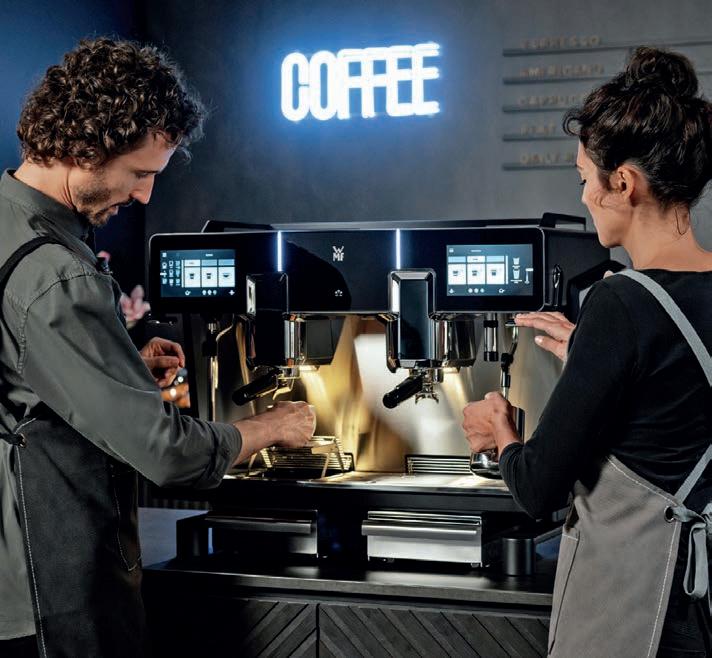
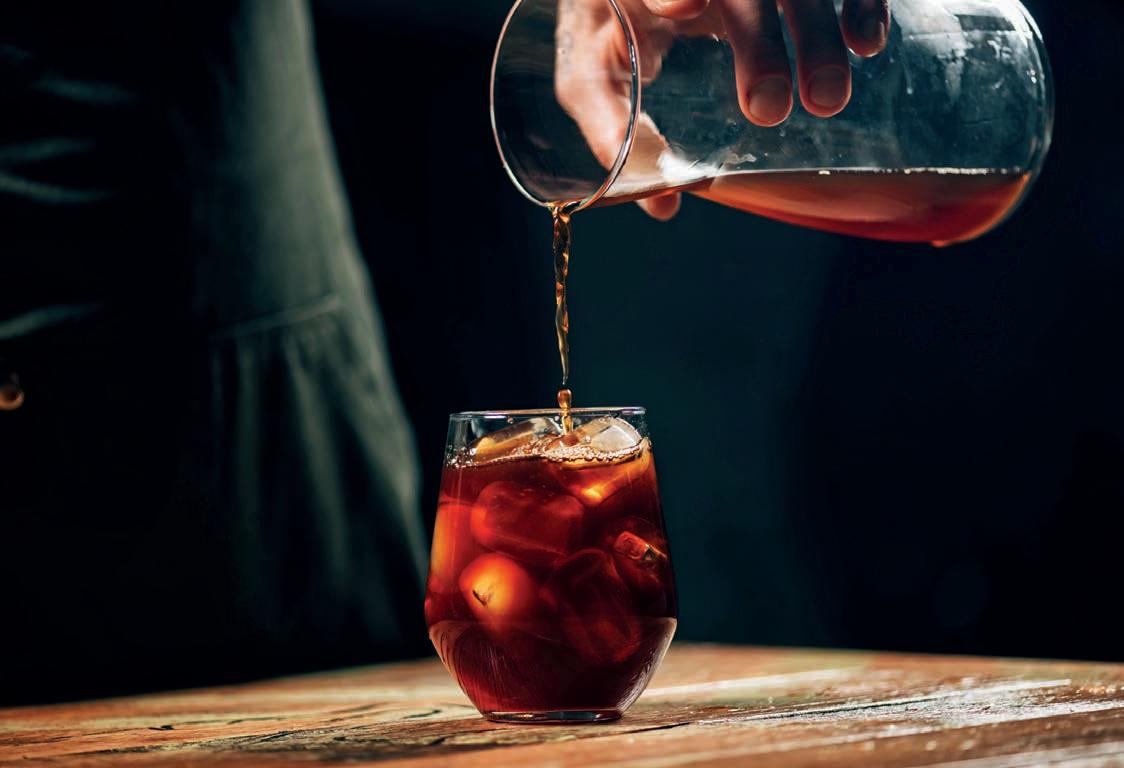
Australian food and beverage technology manufacturer
Flavourtech and its Integrated Extraction System are assisting cold brew coffee manufacturers to capitalise on growing demand.
WHETHER IT BE for a ready-to-drink (RTD) can or an instant powder, Flavourtech – a leader in avour extraction technology – believes the dynamics of the global co ee market are shi ing dramatically.
From the vantage point it has occupied for more than 30 years, the company says it’s clear consumers are no longer settling for at, bitter extracts in these beverages, but instead are looking for the authentic roast and grind (R&G) aroma, rich mouthfeel texture, and premium quality of a baristabrewed cup.
Yet at the same time, manufacturers face tightening margins and an urgent need for sustainable, waste-reducing operations.
Exploring how cutting-edge technology is solving these dual challenges of quality and sustainability, Flavourtech Global Sales Manager Paul Ahn says that although cold brew co ee has exploded in popularity, the traditional batch extraction process leaves “a massive amount of money on the table”.
“When manufacturers nish a standard cold brew cycle, the waste grounds still contain 20 to 30 per cent valuable soluble co ee solids trapped inside the roasted matrix. Historically, this material is thrown
away as a costly waste stream,” he says.
By running these spent grounds through Flavourtech’s Integrated Extraction System (IES), Ahn says businesses can fully extract remaining solids and convert them into a premium liquid concentrate or a soluble instant powder.
is can then either be blended back into existing product lines to boost yields or sold to other businesses as a B2B ingredient.
“It’s a massive win for sustainability and a highly lucrative way to generate more revenue from material that was previously destined for land ll,” says Ahn.
Because co ee is sensitive to heat, traditional extraction systems relying on batch tanks or massive percolation columns subject the co ee to prolonged hightemperature exposure over several hours, with the extended thermal stress resulting in thermal degradation.
Ahn says this thermal stress can destroy the delicate avours, while generating heavy, bitter, and over-extracted o notes, and “ruining the natural mouthfeel”.
To address this, the IES is designed around minimising thermal impact so manufacturers can create the highest quality and best tasting co ee possible.
Two’s company
To achieve these results, Ahn says the IES can be complemented by Flavourtech’s Rotating Disc Column (RDC), a continuous ow contacting device designed precisely to limit thermal exposure.
“While competitive machinery takes hours to extract heavy solids, the RDC completes the entire high-temperature extraction phase in only 20 minutes,” says Ahn.
Ahn explains that inside the RDC, a central vertical sha equipped with a series of rotating ba es moves the co ee slurry in an idealised “plug ow” pattern.
“ is ensures that every single particle of co ee spends the exact same, ultra-short time inside the column,” he says, noting the continuous process ensures time limits are maintained, and all product is treated equally.
e result is an e cient process producing high yields of soluble solids, without baking or damaging the raw material.
“Adding an RDC into an IES line is perfect for processing a slurry of spent cold brew grounds to extract further
value, whether it be soluble solids or co ee aroma,” says Ahn.
But with extraction comes the important task of maintaining the aromas that make up the co ee avour consumers are seeking.
Ahn says the IES avoids aroma loss by splitting the components of the roast co ee bean, capturing the authentic, regional R&G aroma notes upfront at the peak of freshness, which protects them from high downstream temperatures when going through concentration or drying processes.
“[ e aroma notes] are safely locked away in a chilled vessel and then precisely blended back into the liquid concentrate right before nal packaging or spray drying,” he says.
is process also ensures preservation of the natural mouthfeel and texture of the co ee, as grounds are not subjected to hours of thermal cooking – which breaks down natural hydrocolloids, complex carbohydrates, and proteins – resulting in a watery or astringent liquid.
And because the IES operates in-line with incredibly fast residence times, these structural elements remain intact, according to Flavourtech.
“ is preservation of the natural viscosity and lipids of the bean gives the nal RTD beverage, or reconstituted powder, a rich, velvety texture that replicates café-brewed co ee,” says Ahn.
“[ e IES] increases product quality while simultaneously slashing waste. You are commanding a premium market price because your RTD or instant co ee powder retains a barista-like aroma and rich mouthfeel.”
Alongside cold brew co ee, Ahn highlights that the IES can handle other styles of co ee extraction on the same line.
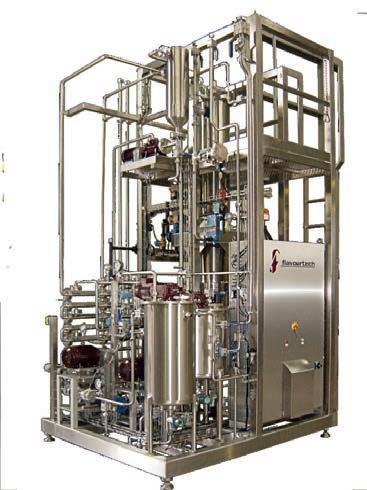
– including black, green, oolong, and delicate varietals such as Darjeeling.
“Just as it does with co ee, it captures the fresh, light, oral top notes of the tea leaf during a brief brewing cycle and pairs it with e cient soluble solids extraction, delivering a full- avoured RTD tea product,” says Ahn.
No wasted potential
With sustainability top of mind for many manufacturers, Ahn says the continuous, automated nature of Flavourtech systems aims to reduce energy consumption, minimise water usage, and make use of waste streams.
He notes the low operating temperatures and short residence times of the IES result in lower energy requirements compared to traditional, long-boiling extraction methods.
“Unlike traditional extraction, which requires batch tanks, manual valves, and complete transfer steps, the IES is an automated, continuous processing line,” Ahn says. “ is allows the system to optimise water usage with a number of additional options, like seal water recirculation and steam condensate return, available.”
e entire process – from raw bean milling and aroma stripping to hightemperature solid extraction and clari cation – can also be operated by a single sta member from a central control screen. Ahn says this saves on labour costs and creates a safer working environment for sta by avoiding manual handling, as well as exposure to hot liquids.
“ e ability of our systems to process slurries and mashes, means we can handle waste streams, like fruit peel, spent co ee grounds and mustard meal, extracting valuable avours, essential oils and active compounds,” says Ahn.
“Manufacturers can extract maximum usable value from raw materials and turn waste into marketable products. Alternatively, they might want to remove undesirable aromas from waste so that it may be used as animal feed.”
With cold brew producers already jumping on board to see how they can maximise value from spent beans, he says the doors are wide open for visitors to try the technology for themselves at Flavourtech’s pilot plants in Australia, the United States, or the Netherlands. GCR
For more information, visit flavourtech.com
e IES is described as a “single, uni ed system” that can be adjusted via automation to handle multiple processing styles, including medium-temperature extraction – optimised for standard RTD bottled and canned co ee lines – and high-temperature extraction, which runs at up to 190°C via the RDC to maximise soluble solids for premium instant co ee powders.
“A manufacturer can produce a RTD co ee line one day and a high-yield soluble co ee powder the next, simply by adjusting user settings on the control panel,” says Ahn.
Outside of co ee, the IES is widely used across the globe for premium tea processing
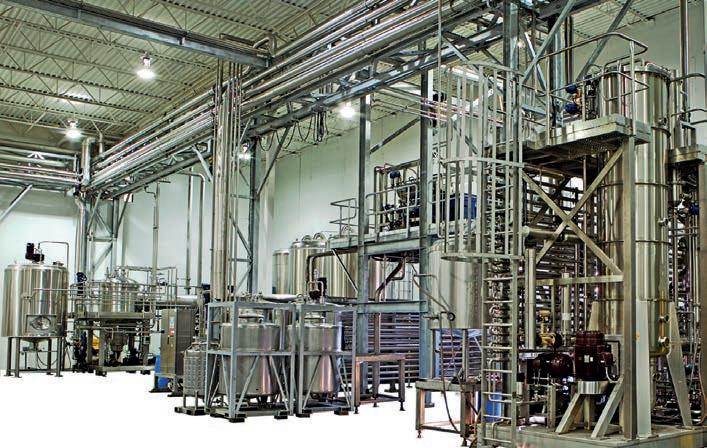
Mikafi brings live co ee roasting directly into cafés and roasteries, transforming every batch into an engaging customer experience.
Designed as a compact table-top roaster with a transparent glass drum, Mikafi enables guests to watch the roasting process unfold in real time while delivering precise and consistent results.
With a batch capacity of 800 grams to 1.2 kilograms and roasting times of nine to 15 minutes, Mikafi combines high performance with low emissions and energy e ciency. Predefined roasting recipes make it easy for beginners to achieve reliable results, while professionals can fully customise roasting profiles and parameters for greater creative control.
Its intuitive touch display, integrated bean cooling system, and mobile, space-saving design make Mikafi a versatile solution for cafés, roasteries, and hospitality venues looking to roast fresh co ee on-site and create memorable co ee moments.
For more information, visit thermoplan.ch
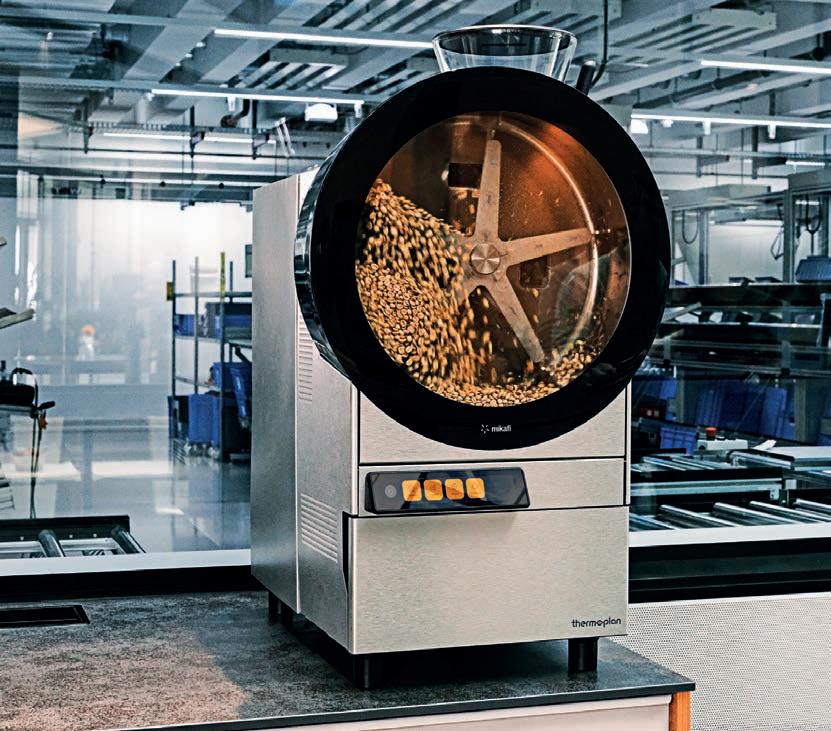

Iced co ee continues to reshape beverage menus worldwide, yet preparing it e ciently remains a challenge for many operators, says SEB Professional Beverage. The manufacturer is streamlining this process with the filter co ee machine WMF 1500 F and its new “Cool Brewed” technology. The system uses a hot pre-infusion, which is followed by an extraction with ambient water to deliver a mild, aromatic co ee experience – served pure, as iced co ee or modern signature drink. Operators benefit from high performance and the consistent quality associated with WMF Professional Co ee Machines.
Whether prepared cold or hot, for single cups or large batches, the WMF 1500 F with Cool Brewed enhances workflow e ciency and speed to serve while expanding drink menus with a wide selection of refreshing options. Instead of hot brewing followed by cooling, after a hot pre-infusion, the co ee is extracted directly with water at ambient temperature – this produces a mild flavour with clear aromatics, very little bitterness and a smooth, rounded finish reminiscent of classic cold brew but with far shorter extraction time. The serving temperature of below 25°C harmonises with the taste profile of cold co ee beverages and slows the melting of ice, improving the overall presentation of these modern drinks.
For more information, visit wmf-coffeemachines.com
IMA says the CE1 delivers outstanding performance and premium filter paper pods, reaching up to 450 pods per minute. Designed for high-e ciency production lines, it combines maximum output with a remarkably compact footprint. Advanced dosing and precise cutting systems ensure uniform co ee distribution, perfect pod shape, and consistent, superior extraction. The entire process runs in a controlled nitrogen atmosphere for optimal product quality, with an integrated recovery system that minimizes gas consumption.
Responding to today’s sustainability demand, the CE1 can handle mono-materials, paper-based outer envelopes, and compostable filter paper pods. The CE1 production cycle can be completed with the integration of a co ee grinder, to be fitted either on the product hopper, or directly on the floor with a conveying system, and of a high-speed case packer.
IMA’s compact and highly e cient solutions are particularly suitable for space-constrained environments, combining performance and flexibility in a minimal footprint.
For more information, visit imagroup.com/coffee

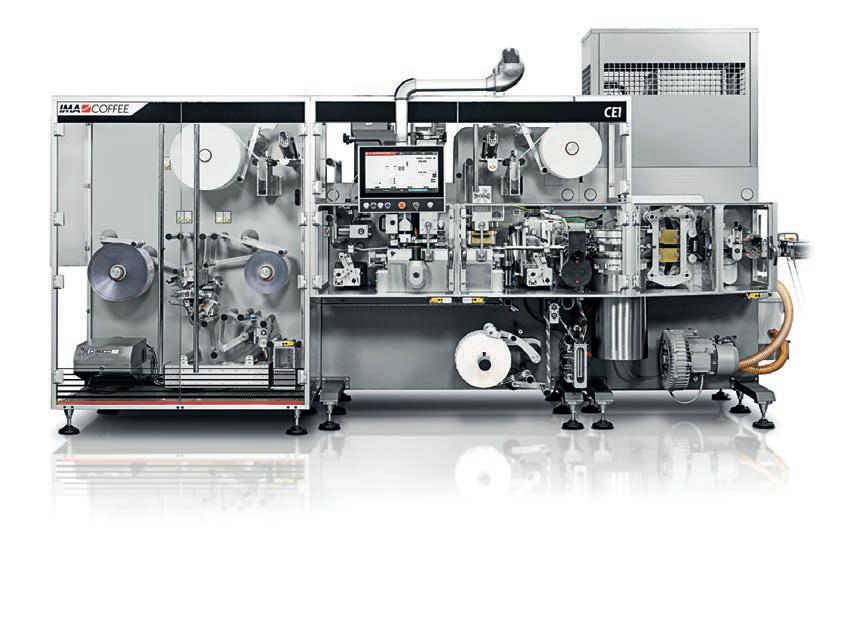
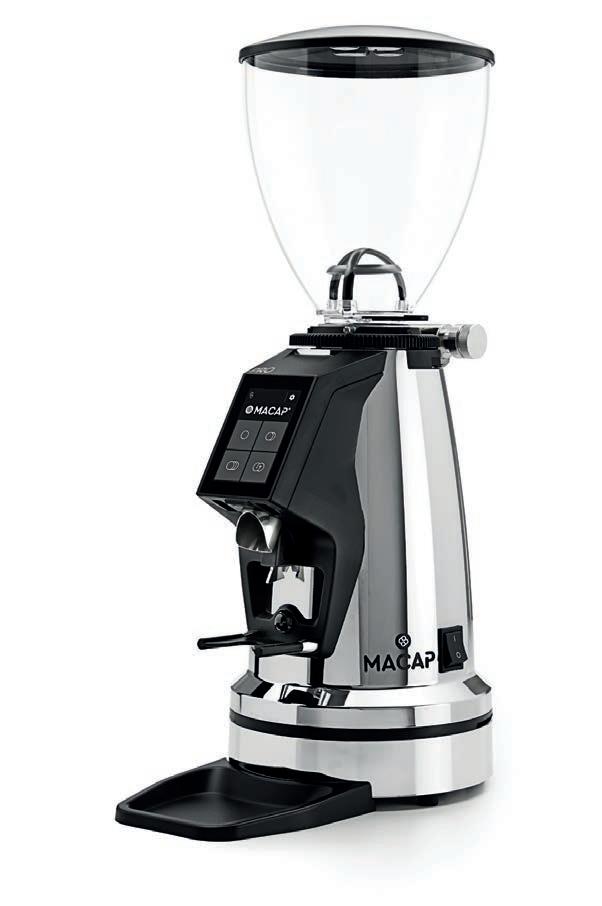
As staple best-sellers in the Macap lineup, the MI 40 and MI 40 Pro represent the ultimate sweet spot where high performance meets optimised investment. Positioned right alongside Macap’s flagship – the ultra-premium Supra and Supra G Series – the MI 40 range serves as the reliable, high-yield workhorse for co ee shops globally.
Developed with the renowned V12 Design studio, these models feature a sleek, contemporary aesthetic paired with Macap’s intuitive, proprietary HMI. Managed via a responsive touchscreen, this digital workflow ensures daily ease of use and absolute dosing consistency.
While the standard MI 40 remains the definitive choice for balancing robust reliability with high cost-e ciency, the MI 40 Pro steps up the pace. Engineered for higher-volume demands, the Pro version features faster dispensing speeds to handle daily rushes with ease.
For businesses looking for a time-tested, high-performance asset without moving up to the heavy-duty scale of the Supra series, the MI 40 range is the undisputed industry favourite –delivering premium digital control and solid Italian engineering where it matters most.
For more information, visit macap.it
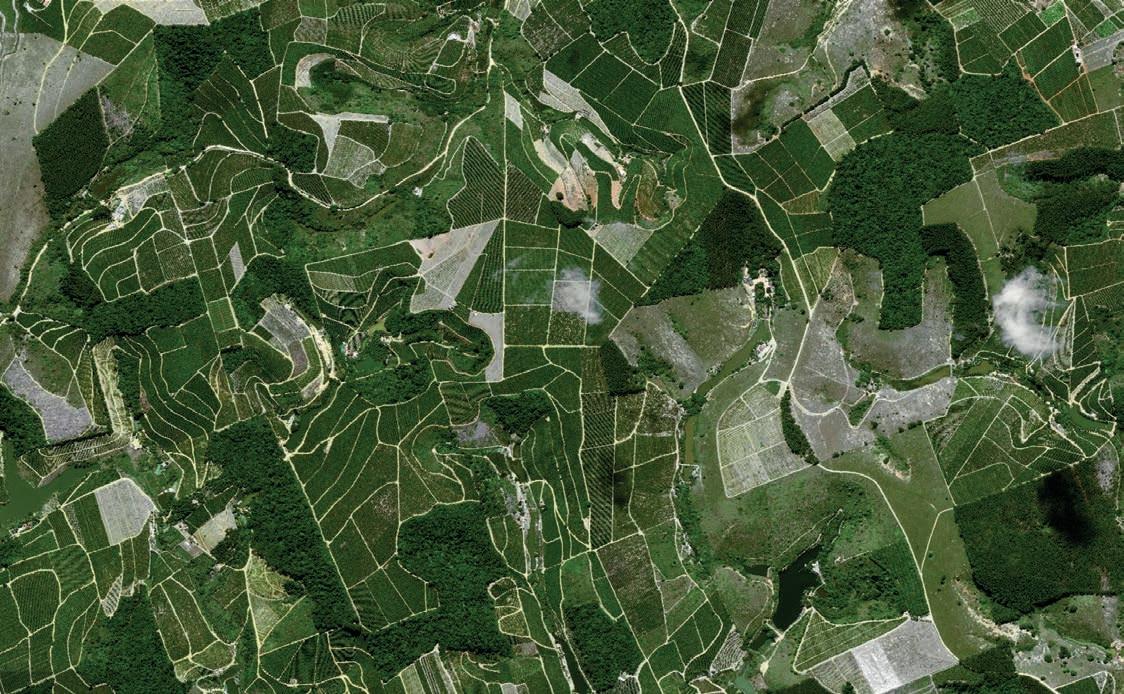
What JDE Peet’s partnership with Airbus and a group of world-leading coffee companies means for deforestation prevention efforts.
ONE OF the biggest roadblocks to the implementation of sustainability policies regarding the prevention of deforestation has been the inability to accurately gauge what’s happening on co ee farms around the world.
It’s been a long-held question mark over the delayed implementation of the European Union Deforestation Regulation (EUDR) – but that could be about to change.
JDE Peet’s – now part of Keurig Dr Pepper – has initiated the creation of the Co ee Canopy Partnership alongside Louis Dreyfus Company, Sucden, Neumann Ka ee Gruppe, Touton, Suca na, and Tchibo, in a bid to put an end to this problem.
rough collaboration with Airbus Space and Defence, the Partnership is set to create the rst ever comprehensive and openly accessible map of global co ee production.
Using Airbus’s satellite technology, co eegrowing landscapes will be mapped to help not only identify areas of forest loss, but to help governments work to prevent future deforestation.
“Leveraging our very high-resolution Pléiades and Pléiades Neo satellite imagery combined with advanced AI capabilities, Airbus helps identify deforestation risk and protect our world’s forests,” says Head of Space Digital at Airbus Defence and Space, Eric Even.
“While simultaneously empowering food
producers and smallholder farmers with transparency and reliable data needed to strengthen their resilience and build a truly sustainable supply chain.”
Starting with a pilot in East Africa covering Tanzania, Ethiopia, Kenya, Uganda, Burundi, and Rwanda which aims to have mapped more than 1.2 million square kilometres of co ee landscapes by the end of June 2026, the lo y goal is to achieve worldwide coverage in 2027.
VP Engagement at JDE Peet’s, Laurent Sagarra, says the Co ee Canopy represents a new era of collaboration in co ee.
“A sustainable co ee industry is one in which co ee production no longer contributes to forest loss,” says Sagarra.
“ e partnership is designed to move beyond fragmented, company-led deforestation initiatives by fostering collaboration at a landscape scale –supporting e orts to map and safeguard co ee-growing regions, not just individual supply chains.”
e Pléiades and Pléiades Neo satellites that will be used for this project, as outlined by Even, are named for an open star constellation located about 440 light-years away from earth.
Pléiades Neo is Airbus’s “leading optical constellation” featuring a pair of identical 30cm resolution satellites.
It can capture imagery of up to one million square kilometres in a single day,
anywhere in the world, with a location accuracy of 3.5m CE90, meaning 90 per cent of the geographic points measured will fall within a 3.5-metre radius of their true location on earth.
e constellation was launched across 2021 and 2022, with the next satellite due to be launched by 2028, a er the Co ee Canopy’s mapping of the world’s co ee farms is set to be completed.
Tchibo Managing Director Corporate Responsibility Pablo von Waldenfals says the involvement of Airbus in the project is critical to overcoming one of the main challenges of preventing deforestation.
“Protecting global forests is essential for climate change mitigation, and our industry has a shared responsibility to ensure co ee is produced without deforestation,” he says.
“A fundamental challenge has been the lack of precise mapping data, which undermines e ective conservation e orts and threatens to unfairly exclude millions of smallholder farmers from the market.
“ e Co ee Canopy Partnership directly addresses this by creating the world’s rst comprehensive, reliable, openly accessible map of co ee landscapes.
“ is serves as a shared public good, enabling the entire sector – from roasters and governments to the farmers themselves – to collectively prevent deforestation, restore landscapes, and secure a sustainable future for co ee.”
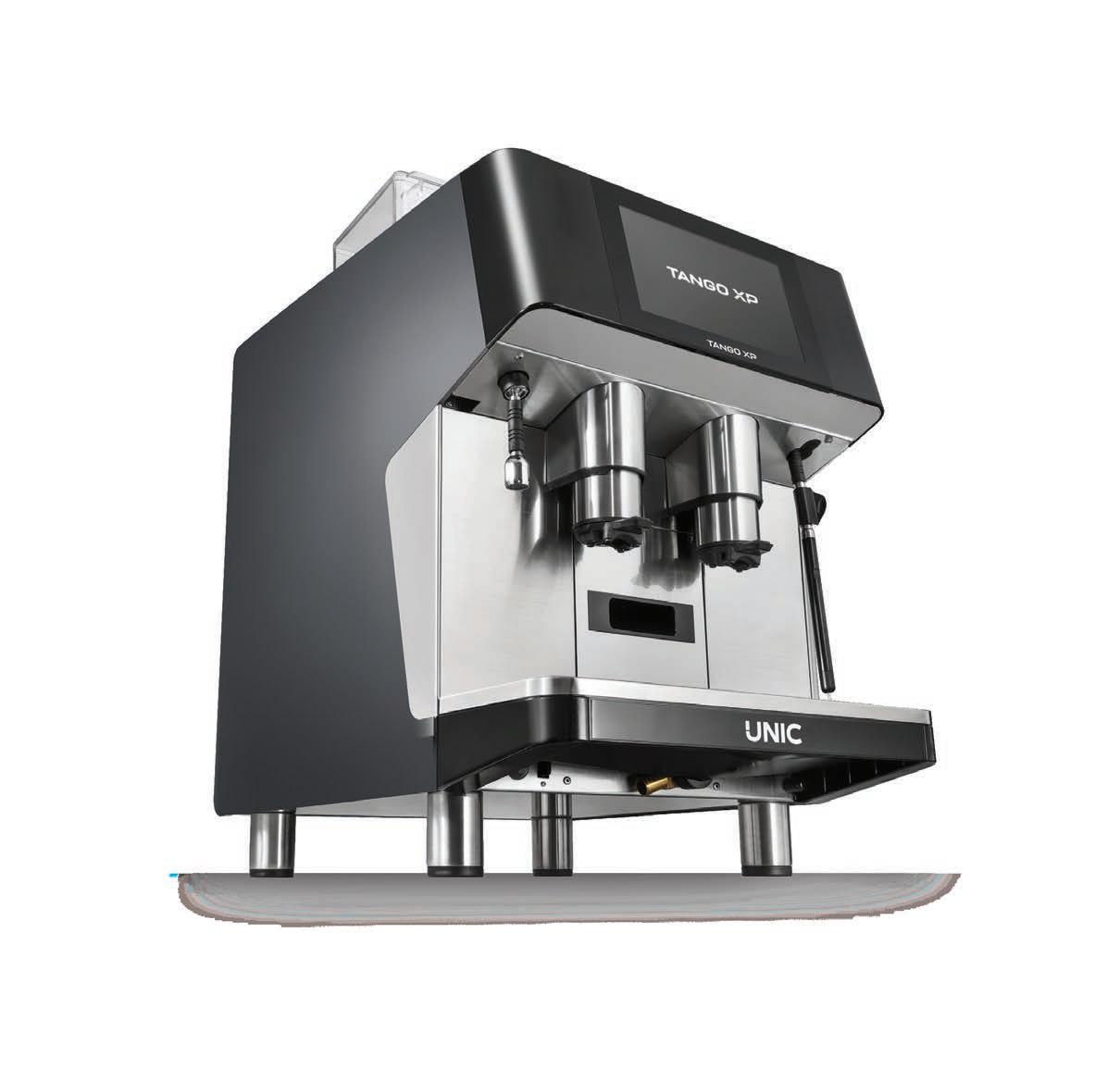
unic-espresso.com

your roast. your coffee. your signature.
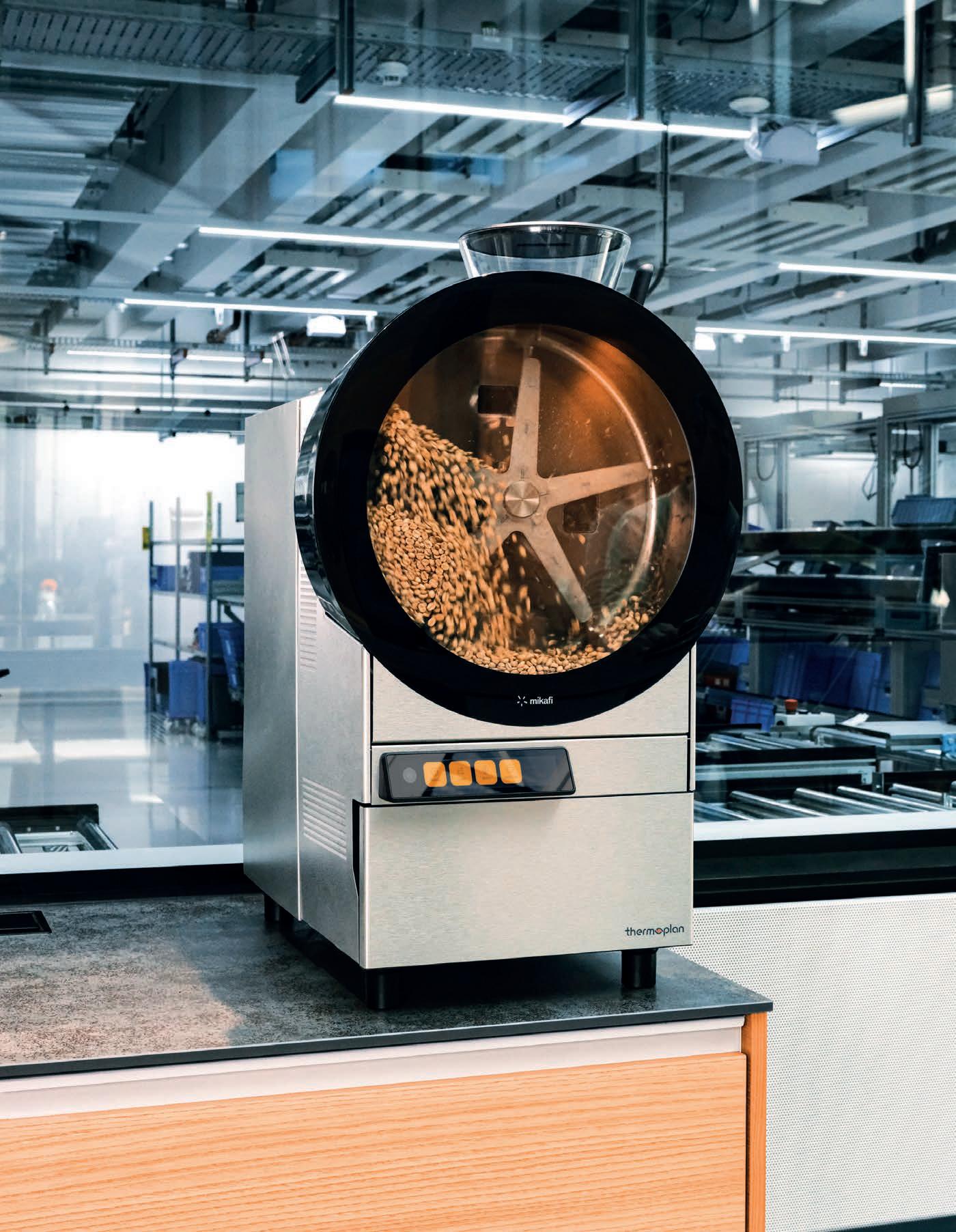
Large glass drum that turns every roast into a customer attraction
INTUITIVE ROAST CONTROL
Predefined recipes or full manual control for every skill level
ADDITIONAL REVENUE STREAMS
Fresh in-house roasting and retail coffee sales