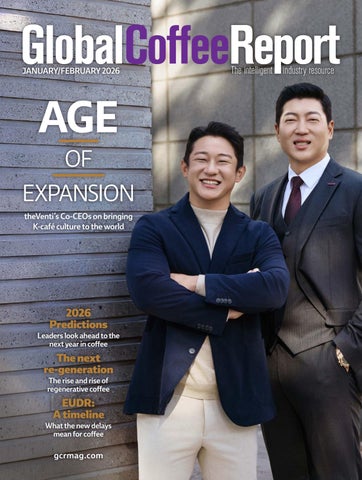
JANUARY/FEBRUARY 2026
AGE
OF EXPANSION theVenti’s Co-CEOs on bringing K-café culture to the world
2026 Predictions
Leaders look ahead to the next year in coffee
The next re-generation The rise and rise of regenerative coffee
EUDR: A timeline
What the new delays mean for coffee
gcrmag.com
CONTENTS JA N UA RY/ F E BRUA RY 2 0 2 6
25 COVER STORY
ROASTING TECHNOLOGY SHOWCASE
10 Age of expansion
theVenti’s Co-CEO on expansion in South Korea and taking on the North American market.
“We define global expansion as not just exporting a store from one country to another – it’s transplanting a K-café lifestyle.”
Choi Jun-kyoung CO-CEO, THEVENTI
42 E-roaster excellence One of Italy’s best-known coffee processing equipment manufacturers is betting big on electrification.
44 Air to the throne How Neuhaus Neotec is leveraging 50 years of experience to better serve specialty coffee roasters.
46 Smart roasting, sustainable future
FEATURES 16 Industry predictions Prominent industry figures discuss their hopes and fears for the coffee world in 2026.
21 Rapid recap From tariffs to trade turbulence, a look back at some of the key moments that shaped the past 12 months.
24 The next re-generation Charting the rise of regenerative coffee and the flow on effects for an under-pressure industry.
35 Deforestation delay
IMA Coffee Hub is leaning into the hot-air roasting revolution through its TTR25 Evo system.
48 Profile builder Software is giving roasters newfound freedom to experiment with profiles before a single bean hits the drum.
INDUSTRY INSIGHTS 27 Primed to thrive Colombia’s 2024-25 harvest is its best in three decades, but there’s more to it than just extra productive plants.
28 Disneyland of coffee
What’s caused the latest hold up of the EUDR, and are coffee companies ready for the end of 2026?
Exploring every nook and cranny of Host Milano 2025 – a show combining tradition with innovation unlike any other.
10
32
32 The rise of Grind-by-Sync Grind-by-Weight has taken the industry by storm since it was first released, but have you heard of its superior cousin?
39 Foundations of flavour Flavourtech on the evolution of processing solutions supporting its prized convenience coffee niche.
50 Creating a Legacy+ How do you take something iconic and make it better? Eversys on the natural evolution that is its Legacy+ line.
52 Melbourne momentum Eyes of the global coffee world are now turning to Australia for the Melbourne International Coffee Expo.
LAST WORD 58 Gassing up to dry out A new Brazilian initiative aims to offer a cleaner and more efficient coffee-drying alternative to firewood.
REGULARS 04 Editor’s note 06 News in brief 56 Marketplace
44 GLOBAL COFFEE REPORT
3
EDITOR’S NOTE GL OBA L C OF F E E R E P ORT
CHIEF EXECUTIVE OFFICER
Christine Clancy christine.clancy@primecreative.com.au
PUBLISHER
Sarah Baker sarah.baker@primecreative.com.au
MANAGING EDITOR
A future to savour
A
LOT CAN HAPPEN in two years:
change in government leadership, the welcoming of children, new iPhone releases, a temporary return to this editor’s column, and the arrival of AI in our personal and professional lives. But two years comes around quicker than you think, and in the case of Host Milano, arguably the world’s biggest coffee equipment tradeshow in Italy, it’s a moment for exhibitors to benchmark their innovation and stress test products before their global unveiling. At this year’s Host Milan, I was fortunate to watch silk cloths, smoke machines, dancing baristas, and rotating platforms aid those big reveals – and rightly so. It takes time, investment and commitment to create products with the power to influence and redirect the course of our industry. If I was to sum up the dominant themes of Host Milano 2025, it would be personalisation and customisation of beverages; use of data and analytics; and convenience and ease of service. I can’t recall witnessing so many fully automatic machines delivering pink, green or purple beverages – with ice – to the appealing lens of iPhones. It seems tea has also found its voice as a worthy member at the dinner table – no longer a distant cousin. And then there’s the use of AI technology that will soon become a useful tool and guide for machine diagnosis, and user beverage solutions. Feel like an afternoon pick-me-up? Or maybe you’re after a soft floral coffee to sip and savour? With AI at the helm, these thoughts could soon be translated into a beverage selection at the touch of a button. Alongside beverage curation is speed of delivery. Many fully automatic machines
4 GLOBAL COFFEE REPORT
have found that balance between in-cup quality, and repeatability. It was interesting to observe the category growing beyond ‘just coffee’ too. It’s a beverage. A business. It’s a solution, and its own broadening category that’s taking an exciting direction and overlaps with so many other markets and segments. With coffee consumption set to grow 50 per cent in the next 10 years, we’re lucky to be in an industry where there’s demand. The challenge will be keeping up. It’s easy to be caught-up in the fanfare of matcha, algave and personalised coffee beverages, but at the heart of it, coffee remains an experience. I saw that experience embraced on many levels: from the way the judges savoured espressos on the World Barista Championship stage, to the thimble of liquid gold and side of sparkling water I received at a historical coffee house, and the care and detail barista mike delivered about the roasting process at the Milano Starbucks Reserve. It was also an experience to connect with industry leader Andrea Illy who praised Global Coffee Report for its industry voice and as a platform to embrace those experiences, in whatever form they take. Host is also a place for connection, just as this publication is. And as we look to a new year and embrace the challenges and predictions for what lies ahead in 2026, let’s remember that it’s connection that coffee relies on most – to its consumers and those who will advocate for its future, pricing and quality – now, and in the years to come. GCR Sarah Baker Editor, Global Coffee Report
Myles Hume myles.hume@primecreative.com.au
EDITOR
Sarah Baker sarah.baker@primecreative.com.au
JOURNALISTS
Daniel Woods daniel.woods@primecreative.com.au Meg Kennedy meg.kennedy@primecreative.com.au
ART DIRECTOR/DESIGN
Daz Woolley daz.woolley@primecreative.com.au
HEAD OF DESIGN
Blake Storey blake.storey@primecreative.com.au
BUSINESS DEVELOPMENT AND SALES MANAGER
Charlotte Murphy charlotte.murphy@primecreative.com.au
CLIENT SUCCESS
Cailtin Pillay caitlin.pillay@primecreative.com.au
COVER IMAGE theVenti
HEAD OFFICE
Prime Creative Pty Ltd 379 Docklands Drive, Docklands, Victoria 3008 p: +61 3 9690 8766 info@primecreative.com.au gcrmag.com
SUBSCRIPTIONS
+61 3 9690 8766 subscriptions@primecreative.com.au Global Coffee Report Magazine is available by subscription from the publisher. The rights of refusal are reserved by the publisher.
ARTICLES
All articles submitted for publication become the property of the publisher. The Editor reserves the right to adjust any article to conform with the magazine format.
COPYRIGHT
Global Coffee Report is owned and published by Prime Creative Media. All material in Global Coffee Report Magazine is copyright and no part may be reproduced or copied in any form or by any means (graphic, electronic or mechanical including information and retrieval systems) without written permission of the publisher. The Editor welcomes contributions but reserves the right to accept or reject any material. While every effort has been made to ensure the accuracy of information Prime Creative Media will not accept responsibility for errors or omissions or for any consequences arising from reliance on information published. The opinions expressed in Global Coffee Report are not necessarily the opinions of, or endorsed by the publisher unless otherwise stated.
Tailor-made technology, driven by innovation Discover Brambati’s experience and continuous research in complete installations for coffee processing.
BRAMBATI S.p.A — via Strada Nuova, 37 27050 Codevilla (PV) ITALY tel: +39 0383 373100 www.brambati.it | info@brambati.it
NEWS in brief
58
The new partnership between the Vitória Coffee Trade Center and ES Gás marks a new step towards modernising the drying process.
AMERICAS Global Coffee Report invites industry leaders to share their thoughts, aspirations, and concerns for the year ahead amid continued market volatility and climate concerns, including: Karl Strovink, CEO of Blue Bottle Coffee, Doug Welsh, Roastmaster of Peet’s Coffee; and Andrea Illy, Chairman of illycaffè. See page 16 From tariffs and trade turbulence to executive changes at the top of some of the world’s biggest coffee companies, 2025 reshaped the entire international coffee value chain.
1600+ locations 4 countries
theVenti’s growth since being founded in 2014.
Whether it be Luckin Coffee’s unstoppable rise or Starbucks selling a majority stake in its Chinese operations for a reported US$4 billion, news out of China dominated coffee consumer headlines for the the calendar year, while the surge in coffee prices to above US$4 per pound and ongoing fluctuation has continued to keep the world watching. Take a look back at some of the biggest news stories for the year and think about what could be coming in 2026. See page 21 Colombia’s coffee sector exported more than 14 million bags of coffee in the 202425 cycle – almost one million more than the previous year and the highest mark in three decades. Favourable weather conditions and productive plants played a critical role in the bloom boom of the past year, but Almacafé has credited a stronger supply chain for creating new opportunities. See page 27
6 GLOBAL COFFEE REPORT
Californian roasting equipment manufacturer Loring Smart Roast has spent years defining the standard for efficient and effective coffee roasting, and now it is introducing a new evolution in how roasters design and refine their profiles on its roasters. After first launching Roast Architect in beta in 2018 to gather real-world feedback from professionals, the company is ready to unveil the fully supported production release – a platform built to streamline experimentation while reducing waste. “Roast Architect gives roasters the ability to do ‘what-if’ analysis in advance and not have to use/waste beans to be able to achieve the desired results,” says President Bob Austin. See page 48 The production of Conilon coffee in Brazil has been steadily rising in recent years, with the coffee varietal’s robustness against disease and climate seeing it gain popularity in regions that have, typically, been Arabica strongholds.
Now, a critical partnership has been agreed upon between the Vitória Coffee Trade Center with the goal of making the coffee drying process cleaner and more efficient. “We are talking about a solution that brings together technology, sustainability, and competitiveness, meeting the demands of the most sophisticated markets,” says President of Vitória Coffee Trade Center, Fabrício Tristão. See page 58
ASIA-PACIFIC With more than 1600 locations in its home market of South Korea and flagship stores in Canada, Vietnam, and Jordan, theVenti is in a significant period of local and international growth. Co-CEO Choi Jun-kyoung speaks to Global Coffee Report about the surge in value-driven Asian coffee chains taking on North America, and why theVenti Is primed to grow in
Hemro has labelled the development of its Grind-bySync grinders as the natural evolution of Grind-by-Weight.
this new, hyper competitive market. “We choose markets where we can enter through value and we can drive repeat purchases through the brand experience we deliver. This framework will continue to guide theVenti’s expansion. We’re taking it one step at a time, but so far, it’s looking good,” says Choi. See page 10 What started as a quest to remove sulphur from grape juice in the wine production cycle has led to a significant shift in the production of instant and RTD coffee, with Flavorutech’s spinning cone column (SCC) technology a central piece in factories around the world. CEO Leon Skaliotis says the equipment has been sold to more than 60 countries with over 120 installations. Asia makes up about 50 per cent of its business – with Europe and the Americas responsible
for the other half – over the past 10 years, all from its hub in regional Australia. “Coffee is our biggest category today – overall, 60 per cent of Flavourtech’s business is in the coffee industry,” says Skaliotis. See page 39 More than 31,000 attendees and 130 exhibitors graced the show floor at MICE2025. With this year’s show the 13th in history and exhibitor investment already higher than where the show finished last year, MICE2026 is looming as bigger than better than ever. With the popular Roasters Playground concept returning for its second year – once again supported by La Marzocco and Riverina Fresh – and a host of new and exciting features to be launched alongside returning favourites, the coffee world will be descending on Melbourne this March. See page 52
48 GLOBAL COFFEE REPORT
7
NEWS in brief
28
Host Milano welcomed 2050 exhibitors at this year’s foodservice show. Image: Host Milano.
EUROPE Löfbergs has taken a new leap forward in the search for better coffee sustainability with its first container of regenerative organic coffee (ROC) certified beans from Nicaragua. With the demand for regenerative coffee trebling in some markets across 2025, Expocacer Commcercial Director Ítalo Henrique believes demand will only continue to rise. “The UK’s US$4.8 billion coffee market is expanding at more than six per cent per year, with specialty coffee growing above 10 per cent and regenerative coffee increasing at an even faster pace,” he says. See page 24 According to Host Milano, attendance at the 2025 edition of the world’s biggest hospitality tradeshow soared. Attendee growth from key regions in Europe (Denmark +45 per cent, Germany +16 per cent) and overseas (Australia +20 per
8 GLOBAL COFFEE REPORT
cent, Brazil +29 per cent, United Arab Emirates +21 per cent, United States +27 per cent) cemented the show as a truly global experience. With more than 2000 total exhibitors, seeing everything Host had to offer was close to an impossible task. Catching the highlights of the coffee sector was a much more manageable goal. Global Coffee Report had a strong presence at the show and reveals some of the highlights that could take the industry by storm. See page 28 Could a single coffee grinder have the potential to save a café $13,500 per year? That’s what HEMRO thinks its Mahlkönig grind-by-sync technology is capable of for businesses around the world. Originally developed alongside La Marzocco, HEMRO Group Global Sales Director Matt Lasek says the software pushes the boundaries of what automation can achieve in the coffee industry. “Automation is the key, but it doesn’t have
to be stuck in a big box where people push a button and the coffee comes out.” See page 32 The European Union (EU) believes up to 10 per cent of the world’s deforestation can be attributed to its consumer activities, but the full implementation of the European Union Deforestation Regulation (EUDR) continues to be pushed back. As voted by the European Parliament in November 2025, the regulation’s timeline has been extended by 12 months for a second time, with enforcement now set for December 2026 for large operators, and June 2027 for micro- and small enterprises.
14.87 million
60-kilogram bags Colombia’s record-breaking coffee production figures in 2024-25.
What has happened since the EUDR was agreed upon in December 2022 that has led to this point? See page 35 Brambati S.p.A has been a leading manufacturer of coffee roasters for more than 80 years, but now the Italian company is championing a new product to meet the sustainability demands of an evolving industry. “If we want to create roasting plants that are efficient, resilient, and ready for the coming decades, we must invest in technologies that reduce environmental impact without compromising performance. Our commitment to electric roasting is part of that vision,” says President Fabrizio Brambati. See page 42
Implementaiton of the EUDR has been delayed a further year, but what has led to this point?
Neuhaus Neotec has been championing hot-air coffee roasting in the commercial sector for five decades. Now, it’s pivoting its focus to specialty roasters with its NEOROAST range to, what Head of Marketing Lars Henkel suggests, great success. “I can honestly say we have never had a customer from the specialty scene leave our lab saying the air roaster is not as good as they would expect.” See page 44 IMA Group, through IMA Coffee Hub, is leaning into the hot-air roasting revolution through its TTR25 Evo hot-air recirculation roaster. With a production capacity of up to 100 kilograms per hour, it’s a machine known for its significantly reduced energy consumption and carbon dioxide emissions through thermal efficiency and airflow
optimisation when compared to traditional roasting methods. “The TTR25 EVO ensures both long lifecycle value and easy maintenance,” says CEO of IMA Petroncini and Commercial Director of IMA Coffee Hub, Nicola Panzani. See page 46 After launching the Lègacy line in 2022, Eversys has taken another leap forward with its technology with the launch of Legacy+ – it’s new range of machines revealed to the world at Host Milano 2025. Marketing Team Leader Ophelié Vergères was charged with revealing the capabilities of the new line at the tradeshow. From more power, added capabilities, and new customisation options, she reveals what led to the development of this new range of fully automatic machines. See page 50
35 GLOBAL COFFEE REPORT
9
Park Su-am (left) and Choi Jun-kyoung (right) founded theVenti after noticing a significant gap in South Korea’s coffee market.
10 GLOBAL COFFEE REPORT
COVER STORY THEVENTI
AGE
OF EXPANSION I
T COULD BE ARGUED coffee is in the
age of the fast-growing, value-driven Asian chain. From the likes of Luckin Coffee in China to Indonesia’s Kopi Kenangan or Thailand’s Café Amazon, a string of franchise brands are rewriting the rulebook governing the consumer coffee world. South Korea’s theVenti is another big name on that list. With its large-sized, low-cost, K-culture brand proposition, it has surpassed 1600 locations in its home market in barely 10 years at the time of writing. Now, it is primed to take its blueprint to the global stage. Current Co-CEOs Choi Jun-kyoung and Park Su-am co-founded the business in 2014. The elementary school friends cut their teeth working for a coffee equipment supply company before bringing theVenti to life in front of Busan National University before a nationwide rollout. Their insight came from a simple observation of the existing Korean coffee market: high prices for small servings. Their answer became theVenti’s core proposition which was proved early by turning around a struggling franchise store. Why it works
With a population of more than 51 million people in a landmass of just over 97,000 square kilometres, South Korea is densely populated. It’s a country home to several major,
quickly scaling café chains thanks to this demographic, but Choi says the growth of theVenti can be summarised in three main pillars. “The first is being a clear competitive edge we possess, the second is we offer a capital-light franchise model for our partners, and the third is we have very strong product capability,” says Choi. “When you are in such a saturated market like coffee, the business proposition becomes even more critical. We built a franchise system with simple recipes and efficient operations that must also be delivery-friendly. “It’s easy to say from day one we established a very clear value proposition of delicious beverages, generous portion sizes, and reasonable prices.” While external pressures like rising coffee prices and labour costs have been threatening global supply chains for months, theVenti has remained fiercely committed to its value proposition. Choi says this is only possible through the brand’s dedication to controlling and simplifying as much as it can in-house. “Keeping costs low is not about enduring the pressures society puts on us, it’s more about designing and structuring and adapting products to fit the customer’s lifestyle,” he says. “We built a system where cost efficiency naturally accumulates by minimising unnecessary expenses. “We hold a firm principle that although
we offer reasonable prices, we never compromise on our quality. This broadens the customer experience and breaks a stereotype that value-focused brands are boring and lack variety. It’s a stigma we have fought very hard against. “Our core philosophy is to return the savings created from this structure directly to the consumer in the form of fair prices. That’s why it’s possible to offer these drinks at such a premium quality and a valuable price.” Underpinning this is theVenti’s investment in ‘Purpleland’ – a R&D lab, coffee farm, roastery, and production line all rolled into one. This 33,000 sqm facility is located in the province of Chungbuk and produces enough coffee and associated ingredients to make about 315 million cups of coffee per year. “We produce all our syrups, liquids, and powders at Purpleland. The factory controls all our core ingredients so we can expand our wide menu range across Korea without compromising taste and consistency. It’s a crucial factor in how we operate the business,” says Choi. “We specifically use BSCA-certified specialty beans in all our stores – not just in Korea. Our signature blend combines beans from Brazil, Colombia and Ethiopia, our dark blend features beans from Brazil, Vietnam, and Colombia, and our decaf option uses Colombian beans. GLOBAL COFFEE REPORT
Images: theVenti.
With more than 1600 stores in its home market of South Korea, locations in Canada, Vietnam, and Jordan, and an impending United States debut, theVenti is taking its K-café lifestyle brand to the world.
11
COVER STORY THEVENTI
Seasonal menus, limited time items, and frequent new product releases have been critical to theVenti’s success.
“From the sourcing stage onwards, we do everything in-house. Since we do everything from A to Z, quality and price can run concurrently.” Owning the trend cycle
While theVenti’s most popular year-round beverages are its basic coffee offerings, it’s a brand that harnesses trends to create new and limited-edition menu items. From a recently announced limited edition strawberry line to seasonal menus and monthly product releases, it’s a key component of not only theVenti’s proposition to consumers, but to the rapidly evolving world of coffee. Choi says trend cycles are shortening, but theVenti continues to identify gaps in the market to keep its customers engaged. “We begin by analysing market trends and look at customer data to define the 12 GLOBAL COFFEE REPORT
flavour and mood the market needs,” he says. “Then, we go through multiple rounds of internal and external evaluation and prototype testing to push the recipes to the highest level possible, because changing the single gram of one ingredient can really alter the entire taste of the beverage. “Then, we standardise ingredients and the manufacturing process so the drink can be reproduced with the same quality in every franchise nationwide and globally. “During seasonal periods we offer fruitor tea-based and collaboration menus, they rapidly rise to be some of our top sellers when they are available. These offer a sense of newness and a firm ‘I must try this’ approach from customers. We want to trigger that psychological factor. It has become a recurring routine where customers will look forward to new seasons and menu launches.”
These non-coffee menus alongside valuedriven ‘traditional’ beverages have become the calling card of many booming Asian chains, some of which are looking outside their home markets for expansion. Choi says although the likes of theVenti, Luckin Coffee, Café Amazon, and Kopi Kenangan share a common denominator, each has succeeded in its domestic market by deeply understanding and meeting consumer needs. “Low-cost categories can grow when they create beverages that become the easiest everyday choice for consumers. When accessibility is high, prices are reasonable, and the taste remains consistent, it becomes natural that consumers will adopt the brand into their daily routine,” he says. “Luckin Coffee maximises purchase convenience through their app-based, strategic platform – it’s a very convenient order and pickup system. Café Amazon has embedded itself into daily movement patterns of the consumers, so they’ve put themselves in places like gas stations and community houses. “Whereas Kopi Kenangan has translated the taste preferences of local consumers really well into their menu and built a grab-and-go system while implementing a delivery-friendly model which allows them to scale urban daily coffee routines at such a remarkable speed. “Each brand and how they approach their business is different but with one common denominator – the ability to capture the high frequency, everyday consumption. That’s what theVenti aims to do as well.” Choi sees theVenti’s limited edition and collaboration menu items as his company’s differentiation factor, on top of a reliable everyday menu. “When it comes to theVenti, it’s reinforcing that same foundation but with our own core values and strengths in terms of large serving sizes, the consensus of taste we offer to our customers, and our agility with trends,” he says. “theVenti has evolved from a brand people drink often to a brand people expect newness from.” North America and beyond
The announcement of theVenti’s expansion into the western region of the United States (US) – it expects the first store to open in Las Vegas later in 2026 – made headlines in November 2025. But it’s not the first expansion outside its home market. With locations already in Canada and Vietnam, and a launch in Jordan at the
tail end of 2025, it is joining the trend of value-first Asian chains expanding into new markets and turning westward in search of growth opportunities. Choi explains the four key criteria theVenti considers before entering a new market. “We define global expansion as not just exporting a store from one country to another – it’s transplanting a K-café lifestyle. When we select a market, we focus less on the size and more on how theVenti can win structurally,” he says. “We evaluate our common criteria into four different pillars. The first is the frequency of daily beverage consumption in that country, the second being the presence of the Millennial and Gen Z populations that drive trends and visual culture, the third being gaps in demand for affordable, premium offerings. “The last is a market’s receptiveness to Korean culture, and how we can broaden Asian trends within that local market.” Those pillars are represented in each of its international markets, from Canada to the Middle East. “Canada is the first country where we launched an overseas branch. It was chosen as a North American test bed because it has such a strong multicultural and Asian community. We interpreted it as a place that has a high openness to Korean-style trend beverages, and we were right,” Choi continues. “Vietnam is a traditional coffee powerhouse, but it is also moving very fast. It’s a very fancy and trend-driven market
that is rapidly growing with younger generations. This made it an ideal flagship to enter the Southeast Asian market, and our location in Ho Chi Minh serves as the regional international flagship. “And with the Middle East and the US – where the convenience beverage category is huge– high inflation has created a structural opportunity for these affordable premium concepts. “We choose markets where we can enter through value and we can drive repeat purchases from customers through the brand experience we can deliver. This framework will continue to guide theVenti’s expansion. We’re taking it one step at a time, but so far, it’s looking good.” theVenti’s Canada launch started in March 2025 with a location in Vancouver – a city with more than 40 per cent of its population foreign-born, according to Canada’s 2021 census. The Korean Foreign Ministry of Affairs also ranks Canada as the fourth-most attractive emigration country for Koreans, behind the US, China, and Japan. This strong multiculturalism and Korean presence played a critical role in theVenti electing to first expand into Canada prior to looking towards the US. “In Richmond, Vancouver, where we launched, there is a very strong Asian community that is highly receptive to Korean trends and culture. This allowed us to test and anchor the model very naturally within North America,” says Choi. “For the US, our expansion will begin on the west coast. It’s a region we see as
having a very high affinity for K-culture and it’s rapidly growing in terms of affinity for fancy and visual beverages and desserts. The urban logistics structure also enables fast replication. “The first US store will be based in Las Vegas. It offers exceptionally high foot traffic, it’s a strong global tourism destination, and it’s heaven for entertainment and consumption. This is a market where the demand for affordable, premium drinking experiences is already very well established, which makes it an ideal test bed to imprint and validate our initial format.” Following Las Vegas, theVenti plans to shift even further westwards into California – namely Los Angeles and San Francisco, areas Choi draws parallels with the market dynamics of Vancouver. “California is very strong in Asian K-culture, and it’s a place where a lot of Asian nationalities – not just Korean – are present. There’s a fast tendency to adapt to these trends,” he says. “The North American entry strategy is not about creating a photogenic first moment or a fancy debut, but it’s about designing an expansion formula for theVenti where we can create, learn, and validate our own strategy to replicate and scale out globally.” Crucial to theVenti’s brand awareness and expansion strategy both in Korea and abroad is its alignment to recognisable figures in Korean culture, the most recent of which is world-famous K-Pop idol, G-Dragon.
theVenti is transplanting its concept to locations in Southeast Asia, North America, and the Middle East.
GLOBAL COFFEE REPORT
13
COVER STORY THEVENTI
Nicknamed the “King of K-Pop”, G-Dragon rose to fame with boy band BigBang before forging his own path away from the group. He is one of the most recognisable faces in Korean celebrity culture. Much like Nespresso with George Clooney, or Starbucks with Ariana Grande, Choi says theVenti’s alignment with G-Dragon comes from a desire to merge the K-Pop star’s fanbase with the business through organic connection. “theVenti needed a partner who could expand its visual and business identity onto the global stage. G-Dragon was a uniquely creative and influential artist who represents South Korea on a global level,” says Choi. “He seemed like a very suitable person to collaborate with, especially because theVenti is still unfamiliar to many overseas consumers. Collaborating with someone whose cultural impact transcends music and allows the brand to be perceived not just as a beverage company, but as a source of lifestyle inspiration. “It’s a partnership designed to spark cultural relevance from Korea to global expansion and elevate the brand’s presence beyond the product itself.” The K-culture difference
There is an elephant in the room regarding theVenti’s global expansion, in that it’s not the only Asian brand looking for new market opportunities. Luckin Coffee has recently opened its flagship locations in Manhattan, New York. Cotti Coffee, at the time of writing, has four locations in California.
Choi says K-culture is a point of difference for theVenti in its global expansion ambitions.
Even Chinese milk tea chain Chagee – seen as a potential competitor despite being less coffee-focused – operates in the US. With the rise of South Korean media in rest of the world through products like Squid Game, Parasite, and K-Pop Demon Hunters, alongside the cultural phenomenon of K-Pop music, the wider world now has a closer affinity to Korean culture. Choi welcomes the competition of
other value-driven Asian chains and sees theVenti’s wielding of Korean culture as an advantage when reaching new consumers. “We see the US market as the home of convenience, but it’s also the market that adopts new global consumption habits really quickly,” he says. “[Luckin Coffee and Cotti Coffee] have a very value-driven model that reinforces Asian affordable coffee chains can thrive in the American market. But we do not want to be seen as just another Asian coffee chain. We want to differentiate ourselves and stand out. “It isn’t about how cheap your drink is, or the price competition. It’s about the distinct K-inspired mood we can provide at the same price point.” Because, like Choi says, theVenti’s expansion isn’t just the exporting of a store concept from South Korea to somewhere else in the world. It’s the transplant of a model that is known to work, roots and all. “We combine the cultural appeal of K-trend beverages with a signature largesize experience. It’s a system that’s been proven in Korea since we launched our first store in 2014,” he says. “Combining the large formats and reasonable pricing with a large beverage range and rapid trend development creates a powerful engine for us to make that affordable, premium, everyday routine in a high frequency market like the US. “We don’t just deliver the flavour and the drinks, we deliver more, and we believe it’s something our competitors cannot replicate. Our goal is to enter markets on that value and remain through that experience.” GCR
theVenti is taking its signature style to the US.
14 GLOBAL COFFEE REPORT
full page a
ROAST ARCHITECT IS HERE .
Pip Heath Patricia Coffee Brewers, Melbourne, Australia
“ Roast Architect is what
roasters who utilize the Loring’s automation need to effectively design and manage their profiles. ”
ROB HOOS
full page ad prime creative roast architect.indd 1
Loring empowers you to take control with every roast. Now, with Roast Architect,
DESIGN YOUR ROAST PROFILES WITH PRECISION. Learn more at Loring.com
12/9/2025 1:26:45 PM
FEATURE I N DUS T RY PR E DIC T ION S
INDUSTRY PREDICTIONS Industry leaders share their thoughts, aspirations, and fears for the year ahead amid continued market volatility and climate concerns. 16 GLOBAL COFFEE REPORT
Andrea Illy Chairman, illycaffè
2025 MARKED the 10th anniversary of
the Ernesto Illy International Coffee Award. What began as a celebration of excellence has evolved into a platform for “sustainable quality”, honouring growers while sharing the agronomic knowledge that makes quality and resilience rise together. Convening the community at FAO in Rome underlined a few simple truths. Field evidence throughout the years showed that regenerative transitions can reduce input intensity while improving quality. At the same time, AI is moving from pilots to practice, with climate-suitability layers, early-warning tools, and in-field decision support that start guiding day-to-day choices for growers. In 2026 our focus will be to scale what works. We will deepen direct sourcing and capacity-building through education, accelerate the adoption of regenerative practices across our supply network and expand the use of AI. On the consumer side, we will continue to connect taste with
origin, explaining why better agronomy delivers better coffee. The theme that will define the year ahead is regenerative quality. This is not a trade-off but a convergence: healthier soils, smarter inputs, and systemic biodiversity produce cups of higher consistency and
refinement, while strengthening resilience to climate variability. Measurement ‘from soil to cup’ will become the competitive standard of the future. The greatest challenges will be volatility and uncertainty. Climate shocks, geopolitical tensions, currency swings, and regulatory shifts will continue to test supply chains. The response must be agility: diversified origins, robust traceability, transparent partnerships with growers, and rapid decision-making enabled by data. My hope for 2026 is market stabilisation to guarantee remunerative levels for farmers, especially smallholders, without destructive price spikes and collapses. A more predictable environment, combined with education and practical tools, will unlock investment in adaptation at scale. If we align agronomy, technology, and long-term collaboration, coffee can remain what it has always aspired to be: a daily pleasure that sustains people, places, and biodiversity.
Vanúsia Nogueira
Executive Director, International Coffee Organization (ICO) 2025 WAS A YEAR of recognition – both for the ICO and for the global coffee community we represent. For the first time, we took part in the UN General Assembly with official observer status, a milestone that signals our growing voice in global dialogue. The FAO Conference formally recognised 1 October as International Coffee Day, elevating a long-standing tradition into an institutional celebration. And at COP30 in Belém, we took part in the global “mutirão” of collective efforts and engaged as an active partner for the first time, providing inputs to shape the COP Action Agenda and ensuring that coffee – its economies, its landscapes, and above all its farmers – was fully represented in conversations on climate and sustainability. These achievements speak not only to the increasing prominence of our organisation, but to the rising centrality of coffee within multilateral processes. This matters, because multilateralism is the path forward. Only by joining forces
– producers and consumers, public and private actors, large and small stakeholders – can we shape a sustainable future for coffee. And as we advance together, it is essential to recognise that coffee farmers remain at the heart of our sector, bearing both the weight of global challenges and the
potential to drive meaningful change. Despite differing priorities, we share common challenges: climate change, evolving regulations, and trade barriers that touch origins and markets worldwide. Because these issues affect us all, they demand collective solutions. In 2026, our guiding principle will be clear and ambitious: coffee is part of the solution. Coffee has always been a catalyst for social, economic, and environmental development and it will continue to be a powerful driver of progress if we harness its full potential. Our focus will be to turn principles into action: translating commitments into concrete policies, partnerships, and investments that strengthen resilience, empower producers, uplift farmers’ livelihoods, protect ecosystems, and create value across the entire chain. By working together, we will ensure that coffee not only adapts to global challenges but actively contributes to sustainable development worldwide. GLOBAL COFFEE REPORT
17
FEATURE I N DUS T RY PR E DIC T ION S
Dr. Jennifer ‘Vern’ Long CEO, World Coffee Research
THE YEAR 2025 DELIVERED unprecedented
disruption to the international coffee sector – from market consolidation and tariff pressures, to the retreat of public investment in agricultural science, to the increasing impact of climate change on supply, pushing prices to historic highs. Against this backdrop, World Coffee Research (WCR) countered negative disruption with a powerful, positive one: the expansion of the Innovea Global Coffee Breeding Network. This landmark accomplishment was recognised as one of TIME's Best Inventions of 2025, solidifying the network's role in futureproofing our favourite crop. The expansion to include robusta breeding – and the addition of Vietnam and Ghana as partners – has brought the network to 11 national partners who together export over 40 per cent of the world's coffee. This collaborative model is the world's largest coffee breeding pipeline, focused on speed, cost-effectiveness, and the technical quality required to ensure
high-quality coffee thrives for generations. In 2026, we deepen our commitment to technical excellence and global partnership with our eleven national research partners and the global community of coffee breeders and scientists. Together, we power the engine that drives progress
in bringing next generation varieties to coffee agriculture. The year ahead will undoubtedly continue to be marked by disruption. Yet in destabilising moments, doing nothing is not an option. Our industry can and must put forward positive solutions. Genetics is one such force – coffee has never before had access to the kinds of varieties now moving through Innovea’s global pipeline. Another is collaboration: solving systemic challenges requires committed, cross-border cooperation and industry leadership in shaping the innovation agenda. My hope for 2026 is that the coffee sector continues to lead boldly into the white space created by disruption – working together to bring the first 100 nextgeneration varieties into national trials and securing a vibrant, resilient future for coffee. In the face of great necessity, industry-led, focused, technically excellent collaboration is how we deliver the tools to define our own destiny.
Karl Strovink
CEO, Blue Bottle Coffee IN 2026, THE COMPANIES that move coffee forward will not be the ones that grow the fastest, but the ones that grow without losing the qualities that make their coffee meaningful. Many businesses can scale. Far fewer can expand while preserving what draws people to specialty coffee in the first place: the craft at origin, the hospitality in the cafe, and the clarity of flavor in the cup. Growth that endures will invite more people into what makes coffee special, not dilute it. Cold coffee has been part of our industry’s conversation for years. The change now is not interest, but expectations. Guests no longer treat cold as a seasonal alternative; they expect it to carry the same integrity and expression as any other preparation. When guests asked for iced lattes, we created NOLA because hot-over-ice espresso didn’t deliver the flavor we believed was possible. More companies will reach similar conclusions: rethink the method when the flavor doesn’t hold up. Real innovation will
18 GLOBAL COFFEE REPORT
come from patience and refinement rather than novelty. Specialty coffee is also evolving to include new flavor combinations. Guests are increasingly drawn to beverages that reflect intention and cultural perspective, not just indulgence. These drinks will become a second language for expressing craft – a way to invite guests into a season, a place, or a point of view. At Blue Bottle, that
often means bringing together Eastern and Western influences in seasonal lattes, offering another way to experience the coffee without overshadowing it. Sustainability will increasingly be defined by what happens at origin. Too often it has been reduced to targets and emissions. Those efforts matter, but they do not address the most important question: what will coffee taste like in the years ahead, and who will still be able to grow it? Healthier soil and stronger plants protect yields and improve expression. Exploring species such as Liberica and Excelsa is not about abandoning Arabica. It is about broadening flavor possibilities and creating more paths for farmers to thrive – a shift that will increasingly define how specialty coffee protects its future. As long as our industry holds onto curiosity about how coffee is grown, how it is expressed, and how people experience it, progress will be measured not by scale alone, but by how deeply we honor what’s possible in the cup.
Doug Welsh
Roastmaster & VP of Coffee, Peet’s Coffee THE INDUSTRY’S CHALLENGE is the
farmer’s challenge, which is climate. I have yet to meet a coffee farmer whose weather is ‘normal’, or reliable in the traditional sense. Deep rains to inspire flowering, consistent rains to develop the beans, relief from rain dries the beans at harvest, and it must all be timed to match the farmer’s means: when she has the neighbour-labour to pick, pulp, process, and, in the opposite season, prune. To this inconvenience, add the injury of diseases like leaf-rust, which flourishes in warmer temperatures. Finally include political unrest and trade uncertainty – and now you have a logistical knot that is unlikely to unsnarl soon. We hope stability returns to the market so farmers can plan and invest with confidence, while the industry continues to deliver quality coffee that consumers love. Prices can be low when farmers are ready to sell their harvest and high when there’s nothing on the tree. With 12.5 million coffee farmers
worldwide – most of them smallholders – the industry depends on their work, and they deserve fair compensation for the crop that makes roasting and retailing possible.
What we should truly hope for is greater stability, ensuring farmers can earn a reliable income without placing an undue burden on coffee drinkers.
Paul Turton – Pact Coffee CEO CEO, Pact Coffee
WE’LL BE DRIVING fast growth across
every channel of the business: subscriptions, business-to-business, grocery, and hospitality. This year, we sourced 60 per cent of our coffee from women or gender-equity groups, and in 2026, we’ll go even further, working with exceptional women growers and continuing to champion gender equity throughout the supply chain. Ultimately, our growth is only possible because of the strength of our product: incredible coffee from the best growers in the world. So, we’re going to make this more accessible than ever, whether that’s on grocery shelves, in hospitality venues, or directly to homes and businesses. With the espresso market booming, a major priority will be introducing more people across the nation to speciality espresso. With climate change reshaping the global coffee industry, long-term, direct-trade partnerships and fair pay for growers will matter more than ever before. Direct trade, skipping the
traditional supply chain and commodity market, guarantees these growers a profitable, sustainable future in their craft, while allowing us to continue to deliver
the best quality coffee to our customers every time. When green coffee prices rise, some roasters are tempted to cut corners by compromising on quality, but those committed to direct, long-term relationships with growers will continue to bring their customers the best beans. Ultimately, fair prices for growers and incredible, freshly roasted coffee are the non-negotiables for us at Pact. Speciality coffee continues to grow at a significant pace, and quality is the core value that sets it apart from the mass market. This presents a significant opportunity: bringing extraordinary coffee, grown by some of the most skilled hands in the world, to more homes, workplaces, cafés, and grocers than ever before. My one hope for the international coffee industry over the next year is that I want to see less greenwashing in the coffee industry. It’s simple: if you don’t know exactly where your coffee comes from, don’t talk about doing good at origin. GLOBAL COFFEE REPORT
19
get tickets MELBOURNE INTERNATIONAL COFFEE EXPO
the world’s destination for coffee
register now 26–28 MARCH 2026 Melbourne Convention and Exhibition Centre
FEATURE YEAR IN REVIEW
Year in review 2025 From tariffs and trade turbulence to executive changes at the top of some of the world’s biggest coffee companies, 2025 reshaped the entire international coffee value chain.
T
here is an incredible variety of reasons as to why 2025 will live long in the memory of the world coffee community. From geopolitical tension playing havoc with the world’s coffee supply chains, to leadership appointments within the industry’s biggest companies, there are few areas that been untouched during the past 12 months. At origin, enduring harvest struggles
in established top tier producers like Brazil and Vietnam showed some signs of slowing down, but global coffee prices have continued to rise. Also, the rise of coffee auctions from Panama to Ethiopia, and everywhere in between, have presented new opportunities for producers around the world. The spread of the Asian coffee market to the western world gathered new pace,
with brands like Luckin Coffee, theVenti, and Cotti Coffee exploding out of their local markets and into new, high-potential regions like the US and Middle East. The consolidation of coffee also reached new heights with a string of mergers and acquisitions, led by Keurig Dr Pepper’s (KDP) US$18 billion deal to acquire JDE Peet’s, with the titans to form two brand new businesses from the merger.
January
February
March
Luckin Coffee broke new ground in Asia with its expansion to Hong Kong and Malaysia. Image: InvestHK.
The new year kicked off with rapidly growing Chinese coffee chain Luckin Coffee launching its first stores in Hong Kong and Malaysia. After signing an agreement to open its first Malaysian outlets one month prior, the brand soft-launched two outlets in Kuala Lumpur in partnership with Hextar Industries Bhd just weeks after opening five stores in one day in Hong Kong. Some of the world’s more established coffee companies were also making significant international moves to open the year, with Nescafé launching its espresso in the United States (US) following the product’s success in China and Australia. The brand hailed it as the first-ever liquid espresso concentrate in the US, the biggest home coffee market in the world.
The new World’s 100 Best Coffee Shops list crowned Toby’s Estate in Sydney as the industry’s leading light. Image: Toby’s Estate.
Toby’s Estate in Sydney was named the best café in the world in the inaugural World’s 100 Best Coffee Shops list and was one of nine Australian venues to be featured on the list. Onyx Coffee LAB in the US was named second, with Gota Coffee Experts (Austria), Proud Mary Coffee (Australia), and Tim Wendelboe (Norway) making up the top five. Arabica prices made history in February, surging to record highs, pushing past US$4 per pound for the first time ever, with this significant milestone just one of many over the course of the year. Starbucks CEO Brian Niccol announced a simplification of the brand’s menu and cutting of 1100 corporate roles as the start of its ‘Back to Starbucks’ initiative.
A rise in home brewing and increased appreciation for coffee are all trends associated with the COVID-19 pandemic. Image: Matthew Algie.
The effects of the COVID-19 pandemic on coffee consumption were laid bare with the release of a new report focused on the United Kingdom (UK). Commissioned by UK and Ireland coffee roaster Matthew Algie, almost half of Gen Z and Millennial consumers reported a change in coffee habits since the pandemic, with most reporting an increase in appreciation for high-quality coffee alongside boosted consumption. Internationally, a seven per cent rise in the value of the McDonald’s brand to US$40.5 billion saw it overtake Starbucks as the most valuable restaurant brand in the world for the first time since 2016, while Luckin Coffee claimed the title of the 2024’s fastest growing brand, according to Brand Finance. GLOBAL COFFEE REPORT
21
FEATURE YEAR IN REVIEW
April
New tariff policy enacted by the United States government turned the international coffee trade on its head. Image: Adobe Firefly/stock.adobe.com
The threat of newly implemented reciprocal tariffs from the US on the international coffee industry were placed on a short-term hold at the start of April, with President Donald Trump announcing via Truth Social that all countries except China would have a 90-day pause on the tax policy. Chinese goods, however, were immediately subject to a 125 per cent tariff, despite the US importing more than US$23 million worth of coffee, coffee husks, and substitutes from the Asian nation in 2023. Italian espresso machine manufacturer Cimbali won a lawsuit in which four Chinese companies were sanctioned by the Shanghai Court of First Instance for “unfair competition”, where they were manufacturing machines that closely resembled the Slayer Espresso model.
May
The new Robusta flavour wheel. Image: Carvalho, F. M., Alves, E. A., Artêncio, M. M., Cassago, A. L., & Pereira, L. L. (2025). Development of a flavour wheel for Coffea canephora using rate-all-that-apply. Scientific Reports, 15(1), 1-19.
Robusta coffee was finally put on par with Arabica in May, at least from the 22 GLOBAL COFFEE REPORT
standpoint that Canephora varietals finally had their own flavour wheel. Developed by a team of researchers led by Dr Fabiana Carvalho, a team of 49 professional coffee graders from Brazil and Switzerland were recruited to evaluate 67 samples in three cupping sessions. A total of 103 descriptors were represented in the new three-tiered wheel. With about 44 per cent of the world’s coffee now Robusta or Conilon, the report states the development of the new wheel is an important milestone for the entire coffee industry. There was good news out of Brazil, with Conab announcing an increased coffee harvest forecast to 55.7 million bags, a 2.7 per cent rise from 2024, largely thanks to a significant boost in Robusta production. Meanwhile, Nestlé invested a further US$75 million into the expansion of its Tri An plant in Vietnam, taking its total investment over 30 years in the region to about US$904 million.
June
Intense coffee leaf rust sporulation. Image: Harry Evans.
Global coffee prices were taking headlines once again in June, but this time for falling figures. The ICE Coffee C Futures contract on 17 June fell more than 2.62 per cent to US$3.35 per pound, the lowest price listed in more than five months. The falling of prices happened to coincide with the publication of the world’s largest ever study into coffee leaf rust (CLR) disease. The World Coffee Research study was published in Frontiers in Plant Science and involved 29 sites in 18 countries using 31 Arabica coffee varieties. No varieties in the study were found to be immune to CLR – which is present in almost all coffee-growing regions in the world – but some showed significant levels of resistance. Varieties with pure
Arabica backgrounds generally showed higher susceptibility. Chinese café group Cotti Coffee also had its sights fixed on coffee origin, signing a Memorandum of Understanding with the Rwandan Ministry of Agriculture and Animal Resources to boost the country’s export market to China.
July
There were calls for further delay to EUDR regulations. Image: Rainforest Alliance.
President Trump’s tariffs continued to lead news cycles around the world, with key origin Indonesia reported to be hit with a blanket tariff rate of 32 per cent and Brazil slugged with a total 50 per cent tariff. A 40 per cent ‘national emergency’ tariff was placed on top of the 10 per cent reciprocal tariff for imported goods from the world’s largest coffee producer, with the White House citing restrictions over social media content and the trial of former President Jair Bolsonaro over allegations he attempted to overturn the results of the country’s 2022 elections as key reasons for the added tax. Lavazza Chairman Giuseppe Lavazza called for the European Union’s Deforestation Regulation (EUDR) policy to be delayed a further year in July, citing a lack of preparation in the coffee industry could cause significant supply chain issues if implemented. He said he believed the proposed regulations could be more damaging to the coffee market than the ongoing US tariffs, with origins like Ethiopia likely to struggle to comply due to clarity around land ownership. The inaugural Faysel Abdosh Signature Auction in Ethiopia saw records tumble for the most expensive coffee ever sold from the nation. Hosted by Testi Specialty Coffee and M-Cultivo, a Sidama Keramo Super Natural lot was purchased by Black Gold Coffee for a record US$1604 per kilogram.
August
The Best of Panama auction shattered coffee price records. Image: Adobe Firefly/stock.adobe.com
Coffee auctions continued to dominate coffee headlines going into August, with the Best of Panama auction smashing the world-record price of a single lot of coffee. A 20-kilogram lot of Washed Geisha grown by Hacienda La Esmeralda was sold for a staggering US$604,080 – or US$30,204 per kilogram – to Dubai’s Julith Coffee Roasters. The lot, which was harvested on 7 April 2025, scored 98 points out of 100 on the specialty scale and was subject to 549 bids at the auction. Money kept moving in August, with one of the largest acquisitions in coffee history also announced. News broke of Keurig Dr Pepper’s reported US$18 billion deal to merge with JDE Peet’s. The all-cash transaction came with plans to separate the companies into two independent, publicly traded businesses, Beverage Co in North America’s refreshment market, and Global Coffee Co, a pure-play coffee company.
September
The new CEO of Nestlé, Philipp Navratil. Image: Nestlé.
The management teams of some of the world’s largest coffee businesses added
some new faces through the month of September, with Lavazza and Nestlé both introducing new faces to the executive teams, while Keurig Dr Pepper named a new United States (US) Coffee President following news of the JDE Peet’s acquisition. Philipp Navratil was named new CEO of Nestlé, replacing Laurent Freixe. After starting his career with the international giant in 2001 he had previously managed teams in Mexico and Honduras prior to being placed in Nestlé’s Coffee Strategic Business Unit in 2020. Lavazza’s organisational restructure added Carlo Colpo as Lavazza Group’s Chief Marketing Officer and Pietro Mazzà as Chief Innovation, Sustainability, and Industrial Relations Officer, while Paola Francesca Sharpa was appointed the Group’s new Chief Digital Transformation Officer. Finally, Keurig Dr Pepper appointed Olivier Lemire as President of KDP US after his long stint with KDP Canada, including four years as President.
October
November
Eric Lauterbach announced he had stepped down from his role as Peet’s Coffee President and CEO. Image: Lauren Segal.
After months of discussion around a potential sale of Starbucks’ Chinese operations, the iconic brand revealed it sold a majority stake in the business to Hong Kong private investment firm Boyu Capital in a reported US$4 billion deal, with the total value of the business reaching more than US$14 billion as a result. Longstanding Peet’s Coffee President and CEO Eric Lauterbach also announced his departure from the business, with Stuart Heflin named as his replacement. US President Donald Trump signed an Executive Order to remove all tariffs on Brazilian agricultural products, meaning coffee – which had at one point been subject to an added 50 per cent import tax – was now cheaper to import into the country. The 10 per cent reciprocal tariffs plus the 40 per cent ‘national emergency’ tariff had been in place since July.
December The coffee world descended on Milan, Italy, in October. Image: Host Milano.
Host Milano was the talk of the coffee world in October, with new and exciting technological innovations from global powerhouse brands including Franke, Cimbali, and Mahlkönig underpinned by a string of incredible events in Milan. A total of 2050 exhibitors from 52 countries were featured at the exhibition. More than 800 events featuring over 3000 contributors were also held, which were headlined by Australia’s Jack Simpson was named the World Barista Champion. Outside the Fiera Milano, TIME recognised World Coffee Research’s Innovea Network as one of the world’s top inventions in 2025, which has since grown to include nations that produce about 40 per cent of the world’s coffee working to breed better coffee for the future.
The European Parliament voted to delay the EUDR another year 402 votes to 250. Image: Symbiot/stock.adobe.com.
The EUDR was delayed by a further year following a decision by the European Parliament. The regulations have also been simplified to reduce due diligence pressures on businesses further along the coffee chain. Costa Coffee expanded its agreement with Emirates Leisure Retail (ELR) to extend their partnership to 2040, with the pair having opened 160 Costa locations in the Middle East together in the past 26 years. GCR GLOBAL COFFEE REPORT
23
FEATURE R E GE N E R AT I V E C OF F E E
Regenerative coffee could be the industry’s next sustainability opportunity. Image: Expocacer.
The next re-generation With the popularity of regenerative coffee rising, could this type of sustainable bean not only be the next great global business opportunity, but help ease pressure on the industry?
T
HE RISE IN environmental consciousness has brought about a new era of sustainable action, spanning everything from large-scale global plans like the Paris Agreement in 2015 to smaller but notable interventions such as investing in renewable energy or curbing deforestation. The coffee industry has been far from immune to this desire to protect the planet – in fact, it has often led the way and continues to do so. The limited number of nations in the bean belt capable of growing coffee plants, plus rising demand for coffee and coffee-based products, beans are already in short supply. Add in worsening environmental factors, prevalence of diseases like coffee leaf rust, and the potential loss of key agricultural land, then the existing headache has the potential to turn into something far more serious – and fast. These changing goalposts have seen a rapid rise in a new type of sustainable initiative in the coffee world – one that is enacted at origin but supported by consumer demand and big coffee businesses: regenerative farming. Regenerative coffee farming diverts from more typical commercial farming methods like clear-cutting trees, single-crop
24 GLOBAL COFFEE REPORT
plantations, and heavy use of chemical fertilisers and pesticides. Instead, practices like cover cropping, shade management, intercropping, and integrated pest management are used to help the land remain healthy and productive moving into the future. Swedish roaster Löfbergs recently passed a milestone in its own regenerative coffee movement by celebrating its first purchase of Regenerative Organic Certified (ROC) coffee from Nicaragua. The roaster has always prided itself on being a leader of environmentalism in the coffee space. Head of Sustainability KajsaLisa Ljudén says comparisons can be drawn between the early modern shift towards regenerative coffee and the rise of organic coffee in the 1990s and early 2000s. “In 1995, Löfbergs was the first to import a container with organic coffee into Sweden. Back then it was new and unknown, and we had no demand for it from customers, but we knew it was important. We wanted to promote these organic practices, and today we’re one of the biggest importers and roasters of organic and Fair-Trade certified coffee in the world,” says Ljudén. “That’s a great example of the industry
leading the demand, and there are parallels here. While we have little demand for this coffee from customers today, we have already discussed it with a lot of our customers and been met with optimism, curiosity, and excitement.” Given Sweden’s reputation as a frontrunner in emerging coffee trends, Ljudén believes Löfberg’s home market holds potential for the product alongside the likes of the United States (US), United Kingdom (UK), and other Nordic nations. The belief in the opportunities of these markets is echoed by Expocacer Commercial Director, Ítalo Henrique. Expocacer is one of Brazil’s largest coffee cooperatives. Located in the powerhouse production region of Cerrado Miniero in the state of Minas Gerais, it has dedicated 21,000 hectares of agricultural land – or, as Henrique puts it, roughly 21,000 football fields – to regenerative coffee production. He says the UK is rapidly emerging as a key market for the product, but others are not far behind. “Europe remains the main market for regenerative coffees, but the United Kingdom is also beginning to show increasing interest in coffees with a sustainable identity,” says Henrique.
Thanks to the commitment of Expocacer’s cooperative members toward integrating regenerative practices into their production processes, the cooperative could expand its supply of Regenagri-certified coffees to the British market by roughly three times in 2025 in comparison to the last year. Market demand also continues to grow through the commercial team’s efforts, as producers maintain their visionary perspective on sustainable production. origin, traceability, and ESG compliance. British buyers are increasingly demanding verifiable sustainability data and full traceability back to the producer, more so than even organic or Rainforest Alliance labels.” Henrique believes this rapid growth seen in the UK market is accelerating ahead of the rest of the world, however as large scale consumer markets conscious of sustainability continue to demand more from their coffee, the call for regenerative products will only increase. “The UK’s US$4.8 billion coffee market is expanding at more than six per cent per year, with specialty coffee growing above 10 per cent and regenerative coffee increasing at an even faster pace,” he says. “We are seeing higher levels of interest, including increasing pre-orders and the adoption of regenerative coffee offerings
by major buyers such as large technology companies, premium roasters, and corporate hospitality groups. “As climate-related risks evolve, it is likely that more companies will look to regenerative supply chains that offer environmental benefits, resilience, and transparency.” In markets like the UK – where coffee consumption is rising to 98 million cups a day and sustainability standards are tightening – Henrique says regenerative practices “meet the moment by ensuring both environmental recovery and supply consistency”. Löfbergs’ landmark ROC coffee purchase came as a result of a trip taken to origin by Ljudén and other members of the roaster’s team. The first beans purchased that met the new requirements came from east Nicaragua, but it was also time in Peru that laid the foundations as something to pursue. Ljudén says the new certification is gaining some traction in Central and South America but is still something of an unknown quantity. “ROC is a new certification. We travelled to Peru and met with multiple co-ops that emphasised the need for organic and regenerative practices. We were shown how climate stress and depleted soils pose a risk
to long-term coffee yield and quality, and how regenerative practices can create more resilience,” she says. “It builds on these organic rules and have added requirements for soil health, fairness for farmers and workers, and animal welfare, and it’s designed to ensure real ecological regeneration, and its greatest potential is as an impact driven tool that goes beyond compliance. “Central America is a real flagship when it comes to these organic and regenerative practices. Everyone is talking about it now, but it’s not a new concept, there are ancient methods from all over the world that promote it. “You especially see small-scale farmers and family farms with multiple crops intercropping and taking care of the land. It’s not that it hasn’t necessarily been noticed by roasters, but it’s difficult to scale.” She says the rise in popularity of regenerative coffee is a natural progression in the type of sustainability and environmental work in the coffee industry. “The industry has talked about and worked with CO2 reductions for a long time, but the focus is generally now more on climate mitigation and resilience. I think that’s why these nature-based solutions, like agroforestry and regenerative coffee, have really gained attention.”
Regenerative coffee practices improve the environment rather than simply maintain it. Image: NtDanai/stock.adobe.com
GLOBAL COFFEE REPORT
25
FEATURE R E GE N E R AT I V E C OF F E E
Henrique and Expocacer agree. He says this shift to more regenerative practices – which restore soil health – as opposed to preventative practices – which only prevent damage without recovering what was lost – is essential to keeping agricultural land healthy and thriving. “Sustainability expectations have evolved from ‘do less harm’’ to ‘restore ecosystems’,” he says. “Regenerative coffee is the natural next step because it measurably improves soil, biodiversity, carbon balance, and longterm farm resilience. “It’s important to highlight that regenerative agriculture is based on practices that restore natural resources, increase biodiversity, protect water sources, and enhance resilience to climate variability,” says Henrique. “It has gained importance as producers seek to strengthen their production systems, improve soil health, and ensure long-term sustainability. These methods can reduce production costs, improve environmental performance, and support higher cup quality.” While Löfbergs is not the only coffee roaster in the world to pursue regenerative
Löfbergs Head of Sustainability, Kajsa-Lisa Ljudén. Image: Löfbergs
coffee as a new initiative, it is one of the largest. Ljudén believes it is the responsibility of those who have the assets to foster a more sustainable industry to do so, but empowerment, not demands, is the way forward.
“There is seldom one single solution to a big problem. I think ROC has a great place in this equation, while the Rainforest Alliance has also come in with its own regenerative certification that we are evaluating. TechnoServe has also done an incredibly interesting study on regenerative coffee that showed the positive effect it can have not only on climate, but the financial health of the farmers as well,” she says. Ljudén believes the companies that invest in these climate-smart and sustainable practices are the ones setting themselves up for long-term success. “It’s been a crazy year with volatile prices and different challenges that there are so many insecurities now. That’s why it’s important to have a long-term focus and keep investing in things like this,” she adds. “It allows us to differentiate and show we are at the forefront and can offer new and sustainable solutions. Our customers expect this from us, but the main benefit is in securing the future of coffee. We need the next generation of coffee farmers to have these resilient systems with continued high yields so they can thrive.” GCR
Continuous production of RTD & Instant Coffee with Flavourtech’s Integrated Extraction System Aroma Recovery - Brewing - Clarification - Concentration
Ask us about Recovering Yield from Spent Grounds
LEARN MORE
about our technologies flavourtech.com
e m
INDUSTRY PROFILE A L M AC A F É
Primed to thrive
Colombia recorded its highest coffee production figures in three decades in 2024-25, and technological advancements its supply chains show no signs of slowing down.
C
OLOMBIA’S 2024-25 coffee productions figures have been historic in the context of the world’s third largest coffee producer. With 14.87 million 60-kilogram bags produced between September 2024 and August 2025, it marks the highest level in more than three decades. It’s a figure that is almost a full one million bags higher than the 13.99 million produced in the previous cycle and indicates there were not only favourable coffee farming conditions contributing to the year, but improvements across the entire supply chain fostering new development. Almacafé, Colombia’s only fourth-party logistics (4PL) provider for the coffee industry, is partnered with the National Federation of Coffee Growers (FNC) and has helped boost the national industry to these record heights. It says a variety of factors contributed to this jump in production. “This achievement was due to improved agronomic factors like renovation and fertilisation, favourable weather conditions, and technical and productive support from the coffee sector,” Almacafé says. “Almacafé’s alignment with FNC has allowed us to strengthen a shared vision for the future of Colombian coffee. “This collaboration with FNC ensures our industrial, technological, and operational capabilities are fully aligned with the needs of producers, the market, and the quality standards of Colombian coffee.” Despite this record-breaking 2024-25 cycle, it is expected this cycle’s harvest will struggle to reach those highs. “The FNC has warned of two factors, the physiological response of the coffee tree after a record year, and heavy rains forecasted that could affect flowering,” says Almacafé. “For this reason, a similar or slightly lower volume is expected, depending on the weather and agronomic management.” That agronomic management is where Almacafé’s contributions to Colombia’s thriving coffee industry come into play. Its mission in recent years has been bringing the technological side of Colombia’s coffee sector in line with its high potential.
Almacafé has been reborn as the engine of Colombian coffee industrialisation. Image: Almacafé.
Not only will this influence farming, says Almacafé. Rather, it is looking to improve the state of the entire supply chain. “Almacafé has been strengthening the supply chain with a more modern vision focused on coffee transformation, driving processes that allow for greater value creation in the country and positioning the industry toward global standards,” it says. “A strong supply chain is essential to maintaining Colombia’s leadership in the global coffee market. Logistical efficiency and industrial capacity are key to preserving quality and ensuring producers receive better returns. “Through our evolution process, we have significantly expanded out industrial and technological capabilities. This has allowed us to build a much more agile, efficient chain prepared for the new demands of the market.” Heading into 2026, eyes will once again be on the large-scale producers of South America to continue supplying high-quality coffee – particularly Arabica – to a world where demand is only increasing. Almacafé says after a 2025 marked by geopolitical tension, rising coffee prices, and general uncertainty, 2026 should be a more balanced prospect. “A more stable coffee sector is anticipated,
along with growth in value-added products, further technification, and the opening of new markets and digital channels, it says. “What differentiates Almacafé is that it has evolved toward a unique model where logistics is integrated with specialised industrial capabilities in coffee. This approach responds to the transformation process and allows us to offer more complete solutions. “The modernisation process underway at Almacafé will drive many of these opportunities, especially in international competitiveness and the development of new business models.” It says there are many strategic projects to keep an eye on from an industrial and logistics capacity in the coming year, including the relocation of modernisation of infrastructure, construction of new storage systems, silos, and wet-processing centres, and Cafenlace – a platform that connects Colombian coffee directly with global consumers. “Each project contributes to a more modern, efficient supply chain oriented toward transformation at origin.” GCR For more information, visit almacafe.com.co GLOBAL COFFEE REPORT
27
EVENTS HO S T M I L A NO 2 0 2 5
More than 110,000 professional operators attended Host Milano 2025. Image: Host Milano.
The Disneyland of coffee The 44th edition of Host Milan has come and gone, but it’s the products and industry connections that will leave a lasting impact. Global Coffee Report details its first-hand experience of a show that has set a benchmark for what’s to come.
A
TTENDING HOST MILANO is the
equivalent to visiting Disneyland theme park for coffee professionals, only this destination features a parade of manufacturers, industry icons, and the pinnacle of coffee competitions. Arriving at the magical coffee land in Rho Fiera elicits a mixed feeling of excitement, anxiousness and eagerness to dive straight in and get acquainted with the 2050 exhibitors at the biggest Hospitality Restaurant and Catering expo in the world. First, it’s a matter of finding your feet, getting through security, and using the travellators and gigantic hall numbers to take your feet where they need to go. For Global Coffee Report, our playground was halls 8, 12, 16, 18, 22 and 24 – home
Fabrizio Brambati (left) officially opens Brambati’s 80th anniversary exhibition. Image: Global Coffee Report.
28 GLOBAL COFFEE REPORT
to every inch of equipment a coffee business needs to take their business from conceptual to reality, medium to large. Our first stop on the five-day marathon was Brambati’s 80th anniversary exhibition. The Italian roaster manufacturer invited customers and friends to celebrate its evolution through imagery and artifacts, complete with a ribbon-cutting ceremony and replica BR 4800 cake to mark the occasion. “Our grandfather started Brambati in 1945 from a small garage. It was the most difficult of times, after the war, with no logistics, no raw materials. Everything was complicated. But it shows that his spirit was there because nowadays we sell [coffee roasting] plants all over the world,”
Brambati Owner Fabrizio Brambati told the crowd. He added seeing Brambati’s history displayed so beautifully, and sharing that legacy with visitors from all the world over filled him with pride. “It was not just a celebration of eight decades of innovation, but a reminder of the passion and dedication that brought us here. The atmosphere was vibrant, and it was rewarding to see how much interest there was in our technology and heritage,” Brambati says. That interest was replicated at Brambati’s stand where its most recent model, the BR 4800 roaster, was on display, as was the company’s modernised logo, BR 60 and BR 5 fully automatic roasters, laboratory sample roaster, KL3-150 and KL3-250 capsule grinders, and KL3-600 roller grinder. Today, Fabrizio says roasters are increasingly looking for solutions that combine quality with environmental responsibility, and Brambati is committed to supporting this vision with its new range of electric roasters (see page 42). Electric roasters had the audience’s attention, with processing plant and roaster manufacturer Neuhaus Neotec also launching its NeoRoast 60E roaster for 20to 60-kilogram batches and 250kw e-power. “We saw great interest in these roasters, which uses a hot-air circulation system instead of mechanical agitators. The result is
IMA’s stand celebrated innovative and sustainable packaging options, like this CA3 paper-pod packaging machine. Image: IMA
gentler roast, precise control over roasting profiles, and an energy-efficient operation,” says Lars Henkel, Area Sales Director at Neuhaus Neotec (for more see page 44). Over to hall 18, IMA showcased a comprehensive lineup of coffee processing and packaging solutions with its commitment to environmental stewardship, digital transformation, and production excellence. Chiara Gasparini, Marketing Coordinator at IMA Coffee Hub, says visitors were impressed by the XTREME Grind’s manufacturing precision and digital control, and TTR25 Evo’s recirculating roasting technology, which improves energy efficiency and roasting uniformity. “Together, they represented a clear example of how we combine process innovation with sustainability,” Gasparini says. “We believe that these two machines meet the industry’s growing need for consistency, efficiency and reduced environmental impact. The XTREME Grind ensures highly stable grinding profiles, while the TTR25 Evo offers reliable, energy-efficient roasting. Both provide roasters with greater process control, lower operating costs and the confidence of achieving reproducible, high-quality results.” Gasparini adds that the push toward smarter, more transparent and eco-efficient processes is opening new opportunities for innovation and collaboration, and IMA is eager to contribute to this evolution with its partners and customers. In the capsule space in hall 18, Rychiger shared its paper pod solutions, coffee sphere production, and even fired up its FS150 capsule filling and sealing machine to demonstrate its high-accuracy, and
Franke’s new-look A line features a strong technical upgrade. Image: Franke.
format change flexibility to the watchful eyes of roaster customers. “There’s a FS 300 version of this machine on its way, which includes Rychiger’s muchloved technology and all its processes. It’s easy to handle and features changes from aluminium to biodegradable capsules, all-in-one,” says Peter Kathriner, Rychiger Senior Sales Manager Food & Beverage. Capsule manufacturer Menshen also demonstrated its commitment to ease-ofuse and reduced environmental impact, displaying its Barista Alu 4.0 aluminium capsules, Barista 2.0 compost range, and new Matryoshka thin wall mono-material capsule that reduces plastic usage by around 30 per cent. Where tradition meets innovation
For many exhibitors, Host was about breaking the mould and giving historic and loved products a modern glow-up. For Franke, the new A Line marked a major evolution of its globally successful classic A Line. The company introduced the
Victoria Arduino released the Record 120 coffee machine to celebrate its 120th anniversary. Image: Victoria Arduino.
next-generation A600 and A800 models, built on a unified platform with significant technical upgrades. “It’s a very exciting moment for us. The classic A Line has been a proven and trusted solution around the world for more than 10 years. With the New A Line, we took everything that made it successful and elevated it with a strong technical upgrade and a contemporary design,” says Marco Zancolò, Franke Coffee Systems CEO. “Customer expectations are rising, and the industry is facing higher operating costs and staff shortages. Our goal is to offer solutions that make daily operations easier, more consistent, and more efficient.” The new A Line delivers easy personalisation, lower operating costs, and a reduced environmental impact. Updates include an improved user interface, enhanced energy efficiency, and a simplified cleaning concept to reduce daily workload. Zancolò highlights that Franke’s in-cup quality and consistency are driven by iQFlow, extracting flavour precisely for
UNIC’s deconstructed Tango XP specialty coffee machine at Host Milano. Image. UNIC.
GLOBAL COFFEE REPORT
29
EVENTS HO S T M I L A NO 2 0 2 5
Host Milano welcomed 2050 exhibitors at this year’s foodservice show. Image: Host Milano.
every beverage. The new FoamMaster system delivers excellent milk foam even at higher temperatures. With PrecisionTemp, operators can set the ideal brew temperature for every recipe. “If you use, for example, three bean hoppers with three different bean types, you can program the recipes depending on the respective bean profile and with different temperatures to basically set the best temperature for that specific coffee. The same applies to tea, where you can pre-set different water temperatures,” Zancolò says. In the Super Traditional space, the most significant release for Eversys was the new Legacy+ and future technology it’s developing around this model. Miranda Caldwell, Eversys Director of Marketing, says the plan is for multiple product extensions over the coming years to ensure Eversys is serving relevant needs. “We’re showing the market that you can have the best quality espresso and milk everywhere, even in environments that are low on space and high on expectations. Great coffee at a petrol station is no longer a myth,” she says. Caldwell adds that she’s excited to see how diverse the coffee drinking world is becoming, and the cultural cross-over in flavour, beverage preferences and drink trends. “It’s an exciting time to be a part of [the global coffee industry] and to create solutions for a changing environment,” she says. Simonelli Group’s presence at Host recognised its history and evolution into the future. Victoria Arduino celebrated its 120th anniversary with the unveiling of its limited-edition Record 120. “It’s a momentous occasion. We wanted to design a machine that honours the shared experience between barista and customer. This machine celebrates our heritage as a brand, but also innovative 30 GLOBAL COFFEE REPORT
design and what’s to come for Victoria Arduino’s future,” says Simonelli Group’s Media and Communication’s Coordinator Sara Gagliesi. Craftsmanship and customisation was also on display thanks to L’Atelier and its hand-crafted back panels on the Eagle One and E1 Prima machines thanks to the work of artisans. Under the Nuova Simonelli umbrella, Appia Vivia was unveiled – a new coffee machine designed to enhance cup quality, simplify operations, and optimise workflow for medium-volume venues. And from the latest acquisition from Simonelli Group, 3Temp, visitors got excited about brewing extraction possibilities. Lots of attention was also on the glass house at Host, with five days’ worth of podcasts diving deep into industry topics with a range of international guests on rotation. Cimbali Group exhibited its new LaCimbali SUPERA, a modular platform
of fully automatic machines that combines versatility and the brand’s Milanese heritage, which dates back more than a century. Thanks to its customised design, every element of the SUPERA has been considered to deliver high-quality results and operational simplicity, from its heated metal coffee group and Dynamic Thermodrive system, to its dual-circuit HQM milk module and automatic washing system. Cimbali Group also launched a renewed LaCimbali M40 with energy-saving features and next-generation thermal systems to deliver “outstanding performance with minimal environmental impact”. In addition, Cimbali Group introduced the Tech Mate AI concept, a platform providing real-time guidance with videos, diagrams, and best aftersales practice information. Think of it as a ChatGPT to troubleshoot your Cimbali machine needs, 24/7. “We are very excited about this launch. We are starting with a selection of models and will gradually extend the tool across the entire range, making it available to our global sales and service network. It will be a truly advanced support system for our customers,” says Jacopo Bambini, Group Marketing Director at Cimbali Group. Beyond coffee
2024 WBC winner Mikael Jasin and 2025 winner Jack Simpson embrace during the WBC trophy presentation. Image: Specialty Coffee Association.
For Swiss manufacturer Thermoplan, its stand embraced the entire coffee value chain thanks to its now ownership of the Makafi roasting brand, and range of fully automatic coffee machines with in-built grinders and simplified screens, including Black&White4 compact, Black&White4 Family live neo, and the Black&White4, which also has capacity to alternate the brewing of coffee to blooming of tea leaves. This machine was a crowd favourite, but equally was the Black&White Competizione model, which in 2024, became the first
super-automatic espresso machine to be selected as the official qualified machine for the World Latte Art Championship. According to Gareth Davies, Head of Coffee Development at Thermoplan, it’s the machine’s espresso consistency that really stands out, on and off, the world stage. “It doesn’t matter how good your milk is. If your [espresso] shot isn’t good, you can’t make latte art, and the Black&White4 Competizione guarantees that espresso consistency,” Davies says. “The thing that makes it most special, is its diversification to be used for commercial outcomes and everyday users. Over at the SEB Professional Beverage range, five multi-brands were celebrated, each celebrating trends, services, and solutions for the coffee world, all under the one roof. At WMF, the office range saw the release of a trio of new machines – WMF Perfection Office, WMF Elevation, and the WMF Peak – for small- to medium-size venues, a sneak peak at the new Elevation 10, launching in January/February 2026 in Asia, and the value of connectivity at the Coffee Connect hub. “Host Milano is a global stage where we share our latest technologies, strengthen partnerships, and inspire new possibilities,” said Martin Zouhar, Executive VP at SEB Professional Beverage. The Schaerer Coffee Soul was also a visitor favourite, of which more than 100,000 units and 1500 customer-specific variants have now been produced, including its Easy Access model to improve accessibility for wheelchair users. UNIC’s stand was a clever display that paid homage to the internal intelligence of its machines. A deconstructed Tango XP became a work of art, showcasing the engineering prowess behind this super automatic machine, ranging from 83-millimeter mega flat burrs to its patented full-metal TANGO brew group. UNIC’s desire to be at the forefront of technology and innovation was evident in its new Tango XP Compact – big innovation in a small footprint. Built for medium-volume, quality-focused venues, this super automatic machine delivers barista-level results with minimal effort. Key features include Weight Calibration System automatic calibration, motorised grind settings, and gear pump technology for customisable pressure profiles. UNIC also used the expo to unveil its collaboration with OhmIQ to tackle energy consumption and heater scaling. “The fact you can reduce your energy
consumption noticeably and in a very big way is directly in line with our strategy at Electrolux Professional because we want to be carbon neutral by 2030. This is definitely a big piece of the puzzle that is going to allow us to reach that objective,” says UNIC General Manager Tommaso Fontana Rava. At the Melitta Professional Coffee Solutions’ stand, its motto ‘Explore the World of Coffee Variety’ came to life with the representation of North American convenience stores, Asian fast-food restaurants, and the warm charm of European bakeries. Each sector celebrated authentic booth designs and regionally inspired coffee creations. “The atmosphere was excellent. The concept of the coffee journey and the wide variety of beverages were very well received by visitors and provided a great deal of inspiration,” says Melitta’s Jenna Buschmann. A highlight was Melitta’s Espresso Sensory Lab with André Eiermann, Global Product Manager Coffee. There, curious visitors could enjoy a multisensory journey and discover the unique flavours of different espresso recipes. Over at Rancilo’s stand, the machine manufacturer achieved a “cozy and dynamic space” featuring the RS1 specialty espresso machine with guest baristas hosting demonstrations and sensory testings with rotating guest roasters. The Classe 5 Crono got lots of attention for its new shot timer, as did the Silvia and Silvia Pro X, paired with Stile SD on-demand professional grinder, and new barista kit for the home market. For
The LaCimbali SUPERA is a modular platform to deliver high-quality results and operational simplicity . Image: Cimbali Group.
smart business solutions, the Kitchen Connect IoT platform demonstrated how it aids Egro customers with data to make informed decisions. Come to play
For Germany’s CUP&CINO, Host Milano was the ideal platform to launch the BaristaOne Touch Series, powered by Latte Art Factory. This machine delivers baristastyle milk – cold or hot – houses three powder baskets, a dual syrup dispense system, and two screens – one dedicated just for advertising. Built for self-serve and behind-the-bar, the BaristaOne Touch Series enables operators to offer a full café menu anywhere, without relying on skilled staff or training. Marco Beverage Systems honoured its latest release, the MilkPal automated, steamless milk solution, and new SYPP beverage dispense system. This model allows for effortless beverage creation with touchscreen activation. It’s designed to help business owners deliver consistent drinks, menu flexibility, and seamless service. Grinder manufacturer Ceado displayed its new trio – REV Steel, REV Titan, and REV Zero grinders – and explained to visitors how each model can impact extraction, beverage selection, aroma profile and flavour outcomes for high-end specialty venues. BibeCoffee demonstrated how its telemetry solutions drive real-time insights and full visibility into brewing parameters. For the first time in World Barista Championship (WBC) history, the on-stage and online audience could watch the live extraction data as it happened. Over five days, WBC baristas battledit-out for the ultimate title of World Champion. After an anxious wait, it was Australia’s Jack Simpson of Axil Coffee who reigned supreme, becoming the fourth Aussie to lift the WBC trophy. And with this crowning and an endless stream of fans awaiting selfies with Jack, the lights dimmed on the competition stage, and Host Milano 2025. Milan is a city of fashion, art and history. It’s home to Leonardo da Vinci’s Last Supper painting, the 2026 Winter Olympics and Campari, but after 44 editions, Milan really is the home of Host. GCR The 45th edition of Host Milan will be held from 22 to 26 October 2027. For more information, visit host.fieramilano.it/en/ GLOBAL COFFEE REPORT
31
TECHNOLOGY PROFILE H E M RO
Mahlkönig’s grindby-sync technology was developed alongside La Marzocco and has been expanded to be compatible with other commercial espresso machines.
The rise of Grind-by-Sync Mahlkönig believes its grind-by-sync technology is the natural evolution of grind-by-weight. What is the difference, and how does it work?
I
F A COFFEE MACHINE is the heart of a café’s operations it could be argued the grinder as the brain. As coffee grinding becomes ever more precise – from burr spacing measured in microns to granule shape – grinders have advanced significantly since Grind-byWeight technology emerged five years ago. One of the most beautiful aspects of coffee, though, is that it stops for no one. In part, that’s what inspired premium grinder brand Mahlkönig to release what’s being described as the next step forward from Grind-byWeight: Grind-by-Sync. Hemro Groups Sales Director for Global Key Accounts – the parent company of Mahlkönig – Matt Lasek, says the equipment manufacturer is preparing to make this technology the new norm in coffee shops around the world. “Grind-by-Sync has been available now to the coffee industry for two years,” says Lasek. “The reason it may feel new to some is simply because cafés and baristas care deeply about the tools they use, and any new technology deserves time to understand. That’s why we introduced Grind-by-Sync as a gentle evolution from Grind-by-Weight. “The customers who’ve explored it and learned how it works really appreciate how
32 GLOBAL COFFEE REPORT
it enhances what they already know and love. From the beginning, we wanted this transition to feel natural and supportive.” A communication station
In the hustle and bustle of a busy café, the coffee grinder and machine must act as a harmonious one-two punch to create the perfect cup. That ‘teamwork’ – connecting the head (grinder) and the heart (coffee machine) – is where Grind-by-Sync has been designed to make a difference. Grind-by-Sync has the potential to create significant cost savings for cafés.
Hemro Group Head of Product Portfolio Marketing Birte Schulz says this synergy is what sets Mahlkönig apart. “When we talk about having the grinder communicate with the coffee machine, the main parameter for that is keeping the grinder as the master of the operations,” says Schulz. “In the grinder you have your recipe and your targets for a specific coffee that is dialled in. You then set a target time for how long you want the brew to take at the coffee machine, and the information on how long the shot was brewed will be fed back into the grinder via our cloud system or cabled solution. “If the shot was too fast or too slow, the grinder will manually adjust the grind size, so the parameters are met.” Software is the superstar
When Mahlkönig introduced the E65S GbW to market, it changed the operations of cafés. As the first Grind-by-Weight grinder, it arguably ushered in a new era of precision in coffee creation. Lasek says the real innovation in the Grind-by-Sync comes in its software, as much of the hardware remains the same as Grind-by-Weight. “Software is becoming more and more at the heart of our products,” says Lasek.
“Grind-by-Sync offers that communicating thread and connectivity from the grinder to the machine, and it’s now answering the main pain points we have seen in the past couple of years on the market. “Much of the grinder is still the same, but we’ve also managed to implement new technologies like automatic grind size adjustments. We now have a motor that monitors and adjusts the burr distances, which makes it as precise and as accurate as machines can be. The Rise of Grind-bySync starts here – this is the innovation leading the way.” He compares the evolution towards Grind-by-Sync to one of the most impactful technologies of the 21st century. “How much has the Apple iPhone changed since it first came out? Yes, it’s had a bit of a facelift, but the real changes are in the software – and it’s the same with Grindby-Sync,” Lasek says. “We’ve taken all the fantastic parts of our Grind-by-Weight hardware and even improved it. Strong hardware will always matter, and we’re proud of how far it has come. What makes this generation special is how the software amplifies that strength – giving customers a product that keeps advancing long after they’ve purchased it.” Schulz says how the new system works makes it easier to upgrade and update with time. “The beauty of this new generation is its flexibility. It performs perfectly as a Grind-by-Weight grinder, just as customers are used to, while offering the opportunity to explore Grind-by-Sync whenever they’re ready. That adaptability is exactly what makes it truly futureproof,” she says. “It’s syncing into our entire ecosystem and allows for automated software updates as well, not like previous years where you had to either change the hardware or call an engineer out with a USB stick. We’ve eradicated that.” With talk of new and exciting software, cloud-based data, and machine connectivity inevitably comes questions around data protection. It’s one of the hot-button topics of this decade, and Schulz says every care has been taken to meet the highest regulatory standards. “We very much care about everyone’s data, and right from the beginning of the development process we made sure we meet the strict European Union’s GDPR [General Data Protection Regulation] standards,” she says. “We’ve ensured we follow all regulations,
it can grow with a business. You can use it as a Grind-by-Weight grinder in your first coffee shop, and then when you expand into two, three, or four locations, it helps manage the business in a far more efficient manner,” she says. “You always have the option of pulling your data and getting the most out of your business. Whether it’s chains, large companies, or small coffee shop owners, this is a technology that we have made sure is futureproof and can be used by everyone in the industry.” Protecting reputations Grind-by-Sync has been available to the market for the past two years. Images: Mahlkönig.
made sure operations are seamless and cloud functionality is uninterrupted. It’s been one of the major points in developing this ecosystem, and we’re making sure we have had the highest level of professionalism in this process.” The cost of carelessness
With so many café markets in which Mahlkönig operates becoming more competitive, the impact on the bottom line is a critical barometer for businesses investing in new equipment. Whether it’s product wastage through inefficient grinding or labour and training costs to use new equipment effectively, every coffee grinder has an outlay beyond the purchase price. Lasek says Grind-by-Sync software has the potential to save cafés thousands, according to Mahlkönig’s in-house waste calculator. “Let’s say, for arguments sake, you pay $30 a kilogram for your coffee. If you change the coffee in a grinder five times per day, each day that grinder will cost you [in labour and product waste], we have found, about $25,” he says. “If you have 1000 stores that’s $25,000 per day, that weekly cost is $260,000 on labour and coffee waste. Yearly, you’re looking at $13.5 million. Even if you have one grinder, that’s still $13,500 for a small business. “When you’ve got one café there are still significant benefits to be seen with this technology. When you’re a medium- or large-sized chain, it becomes incredibly valuable.” That value Grind-by-Sync can add to a business, Schulz says, not only saves money – but helps foster growth down the line. “The neat thing about our technology is
Prior to his career with Hemro and Mahlkönig, Lasek operated three coffee shops over the course of about six years in the United Kingdom. While his time behind the bar may have come to an end, he wishes this technology was around when running his own cafés. “During my years running cafés, I had the privilege of working with many passionate baristas, each with their own style and strengths,” he says. “That experience taught me how valuable it is to have tools that support consistency without taking away the craft. Intelligent automation doesn’t replace the barista – it enhances their work. Grind-by-Sync preserves the artistry and skill of coffee-making, while also safeguarding the quality customers expect from a brand. If this technology had existed back then, I would have integrated it into my shops immediately.” Lasek believes something as simple but effective as Grind-by-Sync helps protect the reputations of everyone involved from bean to cup. “It simplifies the process of consistently making better coffee,” he says. “On its own, the grinder delivers exceptional espresso quality with remarkable precision, thanks to features like the motorised micron adjuster. But when integrated within the entire connected ecosystem, it elevates the coffee experience to a whole new level of excellence. “Roasters invest immense care in producing outstanding coffee—using beans handpicked at altitudes of 2,500 metres and expertly roasted. “With Grind-by-Sync technology, every cup achieves its full potential— delivering exceptional flavour, consistency, and precision.” GCR For more information, visit mahlkoenig.com GLOBAL COFFEE REPORT
33
FEATURE EU DR
The European Parliament voted in favour of delaying the EUDR a further year. Image: Sergii Figurnyi/stock.adobe.com.
EUDR: A timeline The European Union Deforestation Regulation was initially meant to be implemented in late 2024 directly impacting the coffee industry. Why, more than a full year later, are further delays still on the cards?
I
N NOVEMBER 2021, the European
Union (EU) Commission proposed a landmark sustainability and deforestation regulatory document with the intention to change several key commodity markets for the better – the European Union Deforestation Regulation (EUDR). Coffee, among the likes of cocoa, palm oil, beef, rubber, soy, and other products were all to come under remit of these new regulations. As a result, companies wanting to export or sell these products in the EU face mandatory due diligence obligations. Included were requirements to trace these products back to the plot of land they were produced and provide evidence that said land was not subject to deforestation after 2020, and complied with all applicable laws. Originally, the EUDR was slated to come into effect at the end of 2024, but it was delayed 12 months at the request of the Commission to give companies more time to prepare for compliance obligations. At the time of writing, it is looking entirely likely further delays are looming. This news has been met with mixed responses from the coffee industry and wider sustainability sector.
Policy Manager for Forests at WWF European Policy Office Anke SchulmeiserOldenhove made her stance clear, labelling the continued delays as “a complete withdrawal from responsibility towards future generations” and that “all hell will break loose with more simplification” of the regulations. Back in October 2025 multinational food and drink conglomerate Nestlé joined forces with confectionary companies including Mars Wrigley and Ferrero, conservation bodies including the Rainforest Alliance and Precious Woods, and a host of other businesses and notfor-profits, to present a letter to the EU Commission calling on the prevention of further delays to the EUDR. “The company signatories in this letter, together with their value chain partners – including smallholder farmers – have been actively preparing and investing in compliance with the current provisions of the EUDR, which we have consistently supported. These efforts have been made in good faith that the European legislative framework and timeline were reliable,” the letter reads. “The proposed delay puts at risk the
preservation of forests worldwide, will accelerate climate change impacts, and undermines trust in Europe’s regulatory commitments.” Conversely, Lavazza Group Chairman Giuseppe Lavazza called for additional delays in July 2025, stating to reporters its implementation would only add further strain to an industry already beset by global geopolitical issues, and origin countries like Ethiopia would struggle to comply due to clarity issues around land ownership. What is the EUDR?
Deforestation is considered one of the driving factors of the world’s current climate and biodiversity crisis. The EUDR, while a European legislation, looms as having a truly global impact on the coffee industry and its supply chains. The EUDR’s objective is to ensure the listed products Europeans buy, use, and consume do not contribute to deforestation or forest degradation, while addressing all deforestation driven by agricultural expansion to produce these commodities. The United Nations Food and Agriculture Organization (FAO) defines a forest as “land spanning more than 0.5 hectares with GLOBAL COFFEE REPORT
35
FEATURE EU DR
trees taller than five metres and a canopy cover of more than 10 per cent, or trees able to reach these thresholds in situ”. It is hoped, once implemented, it will reduce carbon emissions by a total of 32 million metric tonnes per year and the 10 per cent of global deforestation fuelled by EU consumption. The inclusion of forest degradation in the EUDR is significant. While deforestation covers the conversion of forests to other land use, the definition of forest degradation is murkier as countries have the power to implement their own definitions. FAO defined it – up until 2015 – as forest ecosystems that have lost their capacity to provide goods and services to nature and people, whether it’s through losses like wildlife habitat, watershed protection, or illegal hunting removing wildlife. How is coffee involved?
Coffee is one of several agricultural products included under the EUDR regulations. With the world losing an estimated 18 soccer fields of tropical primary forest every minute – much of which is due to the clearing of land for commercial agricultural use – the EU has elected to pursue the EUDR as a force against the ongoing destruction of forests. The role of coffee in this deforestation is far from insignificant, and its listing as a Deforestation of mountain gorilla habitat in Uganda. Image: Cheryl Ramalho/stock.adobe.com.
36 GLOBAL COFFEE REPORT
“The proposed delay puts at risk the preservation of forests worldwide, will accelerate climate change impacts, and undermines trust in Europe’s regulatory commitments.” OPEN LETTER TO EU COMMISSION
regulated commodity alongside industries like cocoa and chocolate, cattle and beef, soy and animal feeds, and others means every step from farm to European retail shelf will be beholden to the laws once they come into effect. Starting with green coffee exporters and roasters, through to traders and logistics companies, and brands and retailers selling products, industry figures say its implementation will irreparably alter each link in the coffee supply chain. The EU is the world’s largest coffee
consumer, with countries within the bloc consuming between 30 and 32 per cent of global demand, which translates to about 53.7 million 60-kilogram bags per year at an average of about 147,000 per day, according to market research organisation Coffee Business Intelligence (CBI). For comparison, the entire Asia-Pacific region accounts for 25.8 per cent of global demand, with North America (17.5 per cent) and South America (15.8 per cent) significantly behind the EU. The EU’s extensive demand for coffee and related products arms it with the potential to meaningfully combat deforestation and forest degradation globally, from South America to southeast Asia and everywhere in between. The coffee industry’s history of deforestation is perhaps most evident in Brazil, where almost the entirety of the Atlantic Forest has been cleared for agriculture. Coffee was the first product the land was cleared for, according to Coffee Watch. Once home to five per cent of the world’s biodiversity and spanning one million square kilometres, more than 90 per cent of its cover since the 1500s has been removed. FAO estimates 420 million hectares of forest were lost to deforestation between 1990 and 2020. The EU itself, by comparison, spans approximately 423 million hectares.
Brazil’s Atlantic Forest has been ravaged by deforestation over the past few centuries. Image: Marcio I. Sá/stock.adobe.com
What has caused the delays?
The EUDR officially entered into force on 29 June 2023, with a view of being implemented at the end of 2024 after an 18-month phase-in. However it was delayed to the end of 2025 in November 2024 to allow companies more time to align their operations with upcoming requirements while the work on deforestation commitments continued. The postponement was agreed upon by the European Parliament with 371 votes to 240 with 30 abstentions. This first round of delays was eventually confirmed to extend to 30 December 2025 for large EU companies and from 30 June 2026 for micro- and small EU companies, with cattle, coffee, cocoa, palm oil, and soya products all defined as impacted. “Several trading partners repeatedly expressed concerns that operators in their country were not sufficiently prepared to supply commodities or products covered by the EUDR in line with the new rules by 30 December 2024,” a report from AGRINFO states. “The extra 12 months provides a phasingin period to ensure the new rules are implemented effectively. This period will also allow the EU to engage with trading partners that have expressed concerns.” On 26 November 2025, the European Parliament supported the proposal by the European Commission made in September
citing concerns about the capacity of the information systems that would be used to ensure compliance with the EUDR. A submission by Environment Commissioner Jessika Roswall to Member of the European Parliament Antonio Decaro calling for the further postponement of the EUDR was sent on 23 September about the IT system. “Over the last year, the commission has been deploying the IT system in close contact with stakeholders. In this context, new projections on the number of expected operations and interactions between economic operators and the IT system has led to a substantial upward re-assessment of the projected load on the IT system,” the letter reads. “One issue is related to the way economic operators can choose to interact with the IT system to facilitate their operations. Another is related to the obligations placed on downstream operators by the EUDR, despite efforts over the last months to provide simplification to stakeholders. Further factors relate to the high volume of small packages that are imported into the EU, or the impact on the length of replies to operators of various internal checks by the commission or the Competent Authorities of the Member States related to submitted data. “Based on the available information, the commission’s assessment is that this will
very likely lead to the system slowing down to unacceptable levels or even to repeated and long-lasting disruptions, which would negatively impact companies and their possibilities to comply with the EUDR. Operators would be unable to register as economic operators, introduce their Due Diligence Statements, retrieve the necessary information from the IT system, or provide the necessary information for customs purposes where relevant. This would severely impact the achievement of the objectives of EUDR, but also potentially affect trade flows in the areas covered by the legislation.” What’s next?
At the time of writing, full, express confirmation of the EUDR’s further delay is yet to be confirmed, but the European Parliament’s alignment with the European Commission on the potential delay means it is all but certain the EUDR will not be implemented until – at the earliest – December 2026. Large- and medium-sized companies should now expect to comply by 30 December 2026, with SMEs and microenterprises having their timelines further extended to 30 June 2027. The European Parliament voted in favour of these new delays, with the text adopted by 402 votes to 250 with eight abstentions. GCR GLOBAL COFFEE REPORT
37
THE GLOBAL BOARDROOM OF COFFEE SECURE YOUR SEAT Join the world’s best roasters, business operators, and key industry decision makers
27 MARCH 2026
Melbourne Convention and Exhibition Centre
INDUSTRY PROFILE F L AVOU RT E C H
Foundations of flavour
Images: Flavourtech
Flavourtech’s Australian pilot plant allows customers to bring their own products to trial on the company’s equipment.
From its beginnings in wine to leaders in instant and RTD coffee production technologies, Flavourtech is blazing a global trail with processing systems for aroma recovery, extraction, and evaporation – all out of regional Australia.
I
T WAS AN original quest to develop
a solution to remove sulphur from grape juice that led Flavourtech – a leading manufacturer of food and beverage processing solutions – to carve out one of its most important niches today. The convenience coffee market. The company, based in the New South Wales regional hub of Griffith, has grown to help global multinationals elevate the flavour and quality of their products with its sophisticated technologies. It all began in 1987 with its original Spinning Cone Column (SCC) technology for natural aroma recovery and dealcoholisation. Today, it’s a central piece of technology at multiple factories around the world. Subsequent technologies have included: the Centritherm evaporator for the concentration of heat-sensitive and/or viscous products; the Rotating Disc Column (RDC) for extraction of soluble coffee; and the Integrated Extraction System (IES) for the production of ready-to-drink (RTD) and soluble tea and coffee. Flavourtech CEO Leon Skaliotis says the company’s foray into coffee followed the instant coffee boom of the 1970s, when the original team, headed up by founder Andrew Craig, “went up and down the supermarket aisles” to see what other products could be improved upon using the SCC. Instant coffee became a prime target, and led to a meeting with the Bushells factory
in Sydney, where the company sold its first system for coffee production – still in operation today. Skaliotis says the client sampled the aroma coming out the SCC, describing it as a “gamechanger”. From there, Flavourtech travelled to Brazil selling more of its systems to soluble coffee manufacturers. Fast forward to the present, the company now employs staff, agents, and distributors all over the world. Its SCC is a fixture in manufacturing plants across the global instant and RTD coffee industry, helping some of the world’s best known coffee brands extract flavour and aroma that consumers love and expect. “Coffee is our biggest category today – overall, 60 per cent of Flavourtech’s business is in the coffee industry,” says Skaliotis. “We have more than 120 installations of our Spinning Cone Column in the
global instant coffee industry, where they’re capturing and protecting the aroma early on, performing all the necessary heavy temperature processing, and then adding the aroma they captured with our technology back in at the end, enhancing the flavour of the final product.” Flavourtech aims to overcome key challenges in traditional RTD and instant coffee production, such as high heat and prolonged exposure, which can strip away the natural volatiles of coffee’s rich and distinctive aroma. Providing solutions to these issues means customers often acquire multiple Flavourtech systems for various product lines. “Generally, with our equipment, [our customers are] looking at the high-quality end – they’re looking at retaining as much flavour as possible, and producing a product
Flavourtech’s new European pilot plant is based at the University of Wageningen in the Netherlands.
GLOBAL COFFEE REPORT
39
INDUSTRY PROFILE F L AVOU RT E C H
that, for example, brings out the single origin notes of coffee,” Skaliotis says. “We have some customers making instant coffee that is produced from Indonesian, Brazilian, or Ethiopian coffee beans … it’s very unique, and you get the full flavour from that region, which is not generally possible with other systems.” The company also provides a similar processing technology for the iced tea market, with its methods also able to capture the single estate natural aroma of tea. Skaliotis explains that Flavourtech systems are unique in that they can capture aroma and brew the tea and coffee simultaneously through a gentle process, using only steam in a process that takes only 25 seconds. The aroma is then added back at the end of process during the packaging stage. “The impact of this: when a consumer opens up the bottle, or the can, they go, ‘Wow, I can really smell this coffee aroma, or tea aroma’ – that’s what our technology enables,” he says. Alongside its SCC, Flavourtech has developed other technologies benefitting the coffee industry, including the IES: a multistage, continuous process where the roasted coffee bean is milled, aroma is captured, the coffee brewed, and the liquid extract clarified to combine both streams at the end. “The system is automated and only requires one operator, it’s basically a turnkey solution we have installed around the world for iced tea and coffee beverages,” says Skaliotis. The Centritherm evaporator, meanwhile, gently removes water through a one-second heat contact time, allowing protection of active ingredients such as enzymes, proteins, and vitamins, which can be used in fortified coffee products currently gaining in popularity.
“We are able to customise systems to suit specific requirements and solve customers’ processing challenges. In short, our technologies help make better quality products, more efficiently, leading to customer success.” Leon Skaliotis CEO FLAVOURTECH
why it’s an impact destination for our sales, service, and engineering teams, and where a lot of our customers are found.” He notes how Flavourtech has grown with the cold brew segment in recent years, with the spent beans from this process retaining a lot of flavour and soluble solids that can be converted into more RTD or instant coffee products. At a time when coffee prices are on the rise, any ability to extract more from each bag of coffee beans is welcome news to producers. “It’s not just a matter of sustainability – it’s also a matter of profits for those companies … instead of just sending it to landfill, there’s still so much coffee and value in it,” he says. “Coffee producers want to get the most out of their beans, and in that way, be able to reduce the cost of coffee to consumers.”
Aroma around the world
Skaliotis says the company has sold to more than 60 countries, with Asia making up around 50 per cent of business, 25 per cent from Europe, and 25 per cent from the Americas over the last 10 years. He says the installation of the IES in particular has allowed multiple manufacturers to overcome challenges and become market leaders in their territory, highlighting a specific case where a customer in Asia was able to move from a market share position of seventh to an equal leader. “There are a lot of coffee and tea companies in Southeast Asia, and that’s 40 GLOBAL COFFEE REPORT
Open door policy
While Flavourtech’s equipment is well established in the coffee industry – investments of this size require due diligence. The company opens its doors to potential customers on a regular basis. The aim is to have visitors experience an ‘ah-ha moment’ when demonstrating the technology. “They get to taste the coffee that’s being brewed with aroma added back in, and without aroma, so they can see the difference,” Skaliotis says. “When customers come from overseas and we process their own beans through our systems, they get to see exactly how our technology can improve the flavour and aroma of their products.” Many of these trials take place at its Australian headquarters, but Flavourtech has global agents and distributors supporting the business overseas – each helping to multiply those potential ‘ah-ha’ moments. Beyond Australia, the company has two other pilot plants – equipment demonstration areas where customers can bring their own products for trials – in Kansas City, United States, and the Netherlands. The latter is based at the University of Wageningen, a leading food and agriculture university with what’s thought to be the most sustainable laboratory building in the Netherlands. “That pilot plant is a turnstile at the moment; every week we’re conducting trials for customers from all over Europe, because they can just put the product in the back of the truck and drive up to our door,” says Skaliotis. As for what’s next, the company is busy designing miniature versions of its technologies, allowing start-up and boutique manufacturers to also use this
IM
T
IN
Im of pr co m
IM
Flavourtech’s original Spinning Cone Column was a portable unit on the back of a trailer for the wine industry.
im
Flavourtech expanded its Australian manufacturing operations in 2025.
unique equipment. It follows a quiet COVID period for the company that used the downtime to develop a SCC the size of a desk – its original miniaturisation project. “And now that miniature SCC is selling around the world to new and old customers seeking a smaller system so they can do their own trials before incorporating the full-scale process into their factory,” he says. “That was another flashpoint in our journey, in terms of evolving what we do.” Despite its global reach, Flavourtech’s regional roots remain solid – the company was recently awarded the Regional Exporter of the Year award at the 2025 New South Wales Export Awards, and received a Judge’s Commendation at the 2025 Australian Export Awards. In 2025, the company expanded into more manufacturing space – just across the road from its home base – which Skaliotis says will see a 30 to 40 per cent increase in production capacity. “The commitment has always been there by the owners to base themselves [in Griffith], and not to manufacture overseas
– that’s why we’re one of few technology manufacturing companies based in regional Australia. It’s a very strong community feel,” says Skaliotis. This commitment is also prevalent in how Flavourtech works with their customers – Skaliotis says the company makes a considered effort to ensure customers are supported in every step of the equipment acquisition process. “We see ourselves as a long-term partner, which is why we don’t just supply the equipment; we ensure its success through
full commissioning, technical and application support offered by our talented technical and R&D teams,” he says. “We are able to customise systems to suit specific requirements and solve customers’ processing challenges. In short, our technologies help make better quality products, more efficiently, leading to customer success.” GCR For more information, visit flavourtech.com
IMA COFFEE
IMAGINE THIS TURNKEY SOLUTIONS BUILT TO ENHANCE YOUR COFFEE PERFORMANCE
INTEGRATED TECHNOLOGIES, SUPERIOR SUSTAINABILITY Imagine a complete turnkey processing and packaging line for your coffee. From beans reception to endof-line solutions, each machine is interconnected in a digital ecosystem, maximising performance, production efficiency, and ensuring superior sustainability through monitored processing, reduced energy consumption, lower emissions, and with the ability to handle all compostable and recyclable packaging materials. Imagine being able to have all this from one single source. IMA Coffee Hub. Look no further.
ima.it/coffee
GREEN COFFEE SYSTEMS
DEGASSING SYSTEMS
ROASTING SYSTEMS
PRIMARY PACKAGING
GROUND COFFEE SYSTEMS
SECONDARY PACKAGING
END-OF-LINE SOLUTIONS
ROASTING TECHNOLOGY BR A M BAT I
Coffee roasters are embracing electrification. Image: Adobe Firefly/ stock.adobe.com
E-roaster excellence As global roasting operations face pressure to cut emissions and future-proof their plants, one of Italy’s best-known coffee processing equipment manufacturers is betting big on electrification.
T
HERE ARE few industries untouched
by electrification – a movement that’s transforming how factories, plants, and production lines operate. From automotive assembly to food processing, businesses are replacing fossil fuel-based heat and power systems with electric alternatives to improve efficiency, reduce emissions, and take advantage of renewable energy. Coffee roasting is now following suit. Leading coffee processing equipment manufacturers, such as Italy’s Brambati S.p.A., are launching their first generation
Brambati’s headquarters is located in Codevilla, approximately 60 kilometres from Milan, Italy. Image: Brambati.
42 GLOBAL COFFEE REPORT
of fully electric roasters alongside gas combustion models, to use cleaner, easierto-manage energy sources. All without sacrificing operational throughput or cup quality. Brambati says the transition is already under way, with its customers seeking alternatives to nitrogen oxide and carbon emissions inherent to gas burners. The company’s electric platform eliminates those fossil fuel-related outputs, offering roasters a pathway to decarbonise their operations while taking advantage of renewable electricity where available.
Electrification could well prove an inflection point in the company’s rich 80year history. It’s an evolution of a journey that’s prioritised roaster energy efficiency through features like heat recovery systems, smart controls, eco-friendly afterburners, and catalytic converters. A top priority among roasters right now, according to President Fabrizio Brambati, is investing in solutions that pair high performance with environmental sustainability. He believes Brambati has risen to the challenge with its new generation of electric roasters – designed to handle batches from 100 grams up to 60 kilograms of green coffee – with models that might process 120 kilograms and above underway. In short, it means Brambati’s new electric designs can scale for different needs, from small specialty roasters to industrial plants. “The ideal customers are those who have self-generated electrical power like solar panels or wind turbines,” says Brambati, a third-generation owner who runs the company alongside his cousin and Vice President, Andrea. “Second to that are countries where the electrical energy is costing less than fossil-based fuels. And thirdly, countries where governments are incentivising the
transition towards more sustainable and green economies. “The only limitation is the availability of higher electrical capacity.” Consistent and reliable
With the electrification of technology across industries, attention turns to performance. Is the electrical version comparable to traditional methods? Brambati says the company’s electric roasters are capable of meeting the same performance as gas-based models. “There are no differences in consistency and reliability,” he says. “Electrical roasters can be designed to have the same production capacity of gas-based ones, but for now we are choosing to deliver electrical roasters with slightly less production capacity to avoid heavy electrical power demands.” During roasting, operators who switch to electric can expect meaningful energy savings, especially in while in standby mode. Breaking down the technology, Brambati says the electric version of its roasters features a fully electrical heat generator, heated by electrical resistances, instead of mixing ambient and recycled roasting air with combustion gases derived from the oxidation of fossil-based fuels, such as natural gas. In other words, instead of burning gas to make heat, the electric model uses electricity to make heat directly, with no combustion involved. That means there is no production of carbon dioxide, carbon monoxide, or nitrogen oxide generated by the combustion of fossil-based fuels, resulting in a smaller greenhouse gas and carbon footprint. Brambati says it’s important to note that its electric roasters do not eliminate greenhouse gases entirely from the coffee roasting process. “The reason is that many pollutants are due to chemical reactions happening in the roasting process itself, which cannot be eliminated by the use of heating electrical equipment,” he says. “Instead, electrical heaters are reducing roaster emissions, but this is in terms of the emissions generated by the oxidation of fossil fuels – not the emissions generated by coffee roasting.” For roastmasters that eventually adopt this technology, Brambati expects them to adapt immediately. “The human-machine interface and roasting recipes remain the same. The
only difference is that the burners will be powered by electricity, rather than gas, but this is indistinguishable for the roastmasters,” he says. “As customers move to electrical roasting equipment, Brambati will continue to support our customers in any possible way – whether it be through remote assistance, or the presence of our personnel in any part of the world.” Beyond the environmental benefits, Brambati adds that the shift to electric introduces practical safety and building advantages for roasting operations. With electric heaters, roasters avoid the extensive safety mechanisms required for gas systems – from gas detection sensors to ventilation protocols and emergency shutoff devices. “With electric heaters, you don’t need the safety equipment required for gas systems, because you’re not dealing with a potentially dangerous fuel,” Brambati explains. “This removes a layer of
complexity and cost for our customers.” As the global coffee industry contends with rising energy prices, stricter emissions regulations, and growing pressure to operate more sustainably, Brambati believes electrification will continue to play a defining role in how roasteries are built and run. “Across every manufacturing sector, electrification is becoming the common language of progress,” Brambati says. “Coffee is no different. If we want to create roasting plants that are efficient, resilient, and ready for the coming decades, we must invest in technologies that reduce environmental impact without compromising performance. Our commitment to electric roasting is part of that vision – giving customers a cleaner, smarter, and future-proof way to roast.” GCR For more information, visit brambati.it
A render of a new Brambati electric roaster. Image: Brambati.
GLOBAL COFFEE REPORT
43
ROASTING TECHNOLOGY N E U H AUS N E O T E C
A NEOROAST 60 including a catalyzer.
Air to the throne B
ased on the original Roasting by Fluid Bed (RFB) patent of Michael Sivetz, Neuhaus Neotec has been continuously developing and professionalising its (RFB) hot air technology for more than 50 years. The German roasting equipment manufacturer has, traditionally, focused on large roasting companies for whom energy efficiency and life cycle costs are driving factors in decision-making. As a result, it has become synonymous with hot air roasting technology for more than five decades. That focus on large-scale roasteries, however, is shifting, as the company looks to how it can support smaller, specialty roasters, where drum roasting has typically dominated the landscape. 44 GLOBAL COFFEE REPORT
The “myth” that hot air roasting leads to shorter aroma development time has been debunked for several years now, according to Neuhaus Neotec Head of Marketing Lars Henkel, who says there’s a significant opportunity to apply the benefits of this roasting method in the specialty segment. “In the early stages of air roasting, customers wouldn’t accept that faster roasting didn’t equate to lower aroma and taste development, so it was a difficult beginning for air roasters to be seen as a genuine alternative to drum roasting, but that has changed very quickly,” he says. “The industry is looking for efficiency and capacity, and these are parameters where air roasters perform very well. The first specialty companies that took the leap into air roasting clearly saw a big difference
and an advantage not only in these two parameters, but also in flexibility. “We’ve been in air roasting for more than 50 years, so the performance levels of our roasters are in the top tier. We’ve developed special features for the air roasting systems of some of the world’s largest coffee brands.” Henkel says locally established roasters all over the world roast with hot air systems, and that those working with especially high-quality green beans are beginning to recognise the potential of adjusting roasting profiles with more precision with this technique. This opportunity for the specialty sector has prompted Neuhaus Neotec to expand its range of roasters with RFB hot air technology and add the NEOROAST to its stable. With roasting capacities ranging
Images: Neuhaus Neotec.
Why Neuhaus Neotec is boosting its air-roasting capabilities in the specialty coffee sector.
from 120 to 480 kilograms per hour, Henkel says the series offers features specifically tailored to the precise, small-batch roasting requirements of specialty roasters. Characteristics from the large roaster series have been adopted, including the RFB roasting chamber without complex paddle technology, hot air recirculation, PLC control with process visualisation and recipe management. Beans are moved exclusively by a controlled and adjustable airflow, with the absence of mechanical agitators minimising abrasion or damage to the coffee beans themselves. The product temperature is also positioned in the bean bed so that it is constantly covered by the beans to enable an accurate and reproducible roast colour. “We have no moving parts or pedals at all,” says Henkel. “All these elements that damage beans, can cause abrasions on the beans, or even produce breakage, are totally removed. “Without pedals, you have a very homogenous roast, as all beans are in the airstream. From the beginning we have had a very accurate product temperature sensor which controls the curve, and since it is placed within the coffee bed the accuracy of it goes up. “Since we can get those very accurate results without potentially damaging the beans, RFP technology means the final result is consistent across the batch.” In the NEOROAST series, Neuhaus
Neotec also offers three heat source solutions: gas-fired burners, hydrogen burners, and electric heating coils. While Henkel says gas remains the most popular model, Neuhaus Neotec is seeing increasing interest in the electric coils due to not only rising gas prices, but a desire to pursue more sustainable operations. “Gas will remain the dominating source for the next few years, but what’s happening with roasters is similar to what has happened in the automotive industry in that once electric gets a share of the market, it will become larger and larger,” says Henkel. “We were the first in the world to introduce a fully electric coffee plant at an industrial scale, and we make sure our electric coils have the same performance as the gas burner, with means accurate control and a wide range of modulation, and we have proved there is no limitation. “Gas limitations in Europe and around the world, plus the movement to create more sustainable businesses, are giving rise to electric roasters. Thy reduce emissions, and it means you only need to clean the exhaust released by the Maillard reaction of the roasting process.” At its in-house technical centre in Ganderkesee, Germany, interested customers can take part in demonstrations of the NEOROAST’s capabilities, with Neuhaus Neotec also often working with customers to develop roasting profiles that perfectly
encapsulate the characteristics of their coffee. Henkel says this openness about the capabilities of air roasting is a critical step showcasing its potential to customers. “Everybody knows about air roasters nowadays, but we are synonymous with it after these decades of development,” says Henkel. “The first step is to do trials and demonstrations with customers to prove we can back up what we are promoting. “I can honestly say we have never had a customer from the specialty scene leave our lab saying the air roaster is not as good as they would expect, and we’ve even changed the minds of people who are married to traditional drum roasting. “After one day in our lab, where the roasters can play around with the air roasters, they gain a new understanding of it. This is an incredibly important step as we can’t expect customers to start using air roasters if they have never experienced them before.” Neuhaus Neotec applies its years of experience in large-scale roasting plant operations to smaller operations, offering solutions ranging from coffee bag reception and raw material cleaning, to roasting in the NEOROAST, and degassing and grinding roasted coffee. GCR For more information, visit neuhaus-neotec.com
Images: Neuhaus Neotec.
UK private-label and specialty roaster Masteroast operates GOURMET and NEOROAST roasters.
GLOBAL COFFEE REPORT
45
ROASTING TECHNOLOGY IMA
The IMA Petrocini TTR EVO roaster series has been developed with sustainability goals in mind.
Smart roasting, sustainable future
F
ROM MICRO-ROASTERIES to global producers, the coffee industry is increasingly embedding environmental responsibility into core operations. For many modern businesses, transitioning to a more sustainable model is not only a response to external pressures, but also sound business decision-making. IMA Coffee Hub is one of the actors in the roasting space showcasing how technological advancements in roasting and packaging can elevate energy efficiency. The trick, however, is achieving this without compromising product quality. The company realises that if its customers can streamline resource usage, minimise operational waste, and adopt more ethical production methods, then they have the potential to reduce costs while improving brand value and profit margins. Nicola Panzani – CEO of IMA Petroncini and Commercial Director of IMA Coffee
46 GLOBAL COFFEE REPORT
Hub specialising in comprehensive coffee processing and packaging solutions – has observed this transition first-hand. He says both large-scale enterprises and independent roasters are now prioritising sustainability. The former are investing in robust infrastructure and system-wide upgrades while the latter are embracing agile, locally-oriented strategies. “In today’s landscape, quality, sustainability, and traceability have become essential elements in coffee production – especially in large-scale operations,” says Panzani. “There’s a clear shift towards reducing energy waste, selecting environmentally friendly packaging materials, and maintaining high-quality standards throughout every phase of production.” One of the key enablers of this shift, Panzani says, is digitalisation. The ability to gather and analyse data in real time is transforming how coffee producers monitor their operations, allowing them to optimise
every aspect – from sourcing green beans to the final stages of packaging. “With data-driven technologies, producers can fine-tune efficiency, limit their environmental footprint, and scale sustainably,” says Panzani. “At IMA Coffee Hub, we strive to support producers of every size in implementing these strategies, offering innovative and eco-conscious technological solutions. Digital transformation is not just a trend – it’s becoming the backbone of modern coffee production.” Nevertheless, large roasters face several challenges in embedding sustainable practices into their business models. Among these are the uninterrupted integration of new technologies into daily operations, the efficient use of natural resources, and the growing expectation from consumers for environmentally responsible products – all while maintaining economic viability. “Aside from technological investments,
Images: IMA Coffee Hub
Across the coffee supply chain, companies of all sizes are intensifying their commitment to sustainability. A significant part of that commitment starts with how their coffee is roasted.
Images: IMA Coffee Hub
companies need to adopt a long-term commitment to sustainable supply chain management and ongoing process optimisation. Striking a balance between profitability and environmental responsibility is now a strategic priority,” says Panzani. Roasting, in particular, remains one of the most energy-demanding processes in the coffee It means roasteries are increasingly turning to technologies – such as heat recovery systems – that not only reduce energy consumption but help decrease CO2 emissions and support responsible resources management. As environmental regulations grow more stringent, investing in advanced exhaust gas treatment systems becomes a necessary step. In response, IMA Coffee Hub has been investing in a series of innovations to enhance the energy efficiency of its roasting solutions. A notable project is a modular hybrid roasting system for industrial-scale production. This technology combines traditional gas burners with a secondary heating source, offering a higher level of customisation and flexibility. “This solution enables our customers to better calibrate their processes to reduce energy consumption while also cutting operational costs and CO2 output,” Panzani explains. “By combining different energy sources, we can fine-tune the roasting profile and ensure both efficiency and quality.” For smaller-scale operations, IMA has focused on improving the performance of heat recovery systems by design the new IMA Petroncini TTR EVO roasters. Through thermodynamic optimisation, even compact roasters can reclaim and reuse traditional gas heating more effectively, leading to tangible reductions in energy use. The TTR EVO Roasters are designed with a robust structure and technical solutions geared towards high performance, energy efficiency and maximum operational safety, thanks to an engineering approach focused on environmental sustainability throughout the product’s entire lifecycle. Material selection prioritises low-impact, recyclable and long-lasting components, and the design enables quick, targeted maintenance operations, reducing the need for replacements and limiting resource consumption over time, Panzani says. “Special attention has been given to energy efficiency: optimised thermal flows and improved insulation systems
significantly reduce energy consumption during the roasting process, without compromising the quality of the final result,” Panzani says. “By minimising heat loss and optimising combustion efficiency, the TTR EVO achieves substantial energy savings and a reduction in CO2 emissions. “This systemic approach to sustainability enables the TTR EVO to meet the needs of a modern, responsible roasting facility, fully aligned with circular-economy principles and environmental accountability.” Additionally, the roaster is equipped with integrated sensors and digital control systems, enabling precise monitoring of roasting parameters and facilitating datadriven process optimisation. To support precise and consistent management of roasting profiles, the TTR25 EVO is equipped with VIRTUO, an advanced supervision software acting as a true digital partner for the roaster. “Combining an intuitive interface with highly accurate control capabilities, VIRTUO offers a clear real-time view of temperature, pressure and airflow curves, while allowing precise adjustment of the recirculation percentage,” says Panzani. The system enables the storage, recall
and comparison of roasting profiles, as well as the export of all process data for further analysis and reporting. Every stage of the roasting process can be monitored, adjusted and saved, ensuring full traceability both during production and in post-roast evaluation. Designed to guarantee a repeatable, transparent and quality-oriented roasting experience, the company says VIRTUO supports the needs of modern, data-driven and specialised roasting environments. Through its continuous efforts in sustainable innovation, Panzani says IMA Coffee Hub aims to strengthen its leadership in the global coffee equipment market. “Our goal is to remain a benchmark in research, development, and technological advancement for coffee processing,” says Panzani. “Innovation and digitalisation are intrinsically linked with sustainability. They’re the drivers that help optimise production and eliminate waste, leading to a more resilient and responsible coffee industry.” GCR For more information, visit ima.it
The development of the TTR EVO series has come about thanks to a shift in environmental responsibility from the coffee industry.
GLOBAL COFFEE REPORT
47
ROASTING TECHNOLOGY L OR I NG
With Roast Architect, profiles can be designed with confidence, while reducing waste and achieving consistency. Image: Pip Heath, Patricia Coffee Brewers
Building a profile As modern roasting becomes increasingly data-driven, software is giving roasters newfound freedom to experiment with profiles before a single bean hits the drum.
F
EW PROCESSES in coffee are as
delicate – or as decisive – as roasting. Every batch is a dance between heat, airflow, time, and human intuition – and for many roasters, there’s an ever-present challenge to experiment with profiles to unlock a bean’s full potential. It can take multiple, subtle adjustments for roasters to nail the desired profile. In turn, roasters would run a batch, save the results, taste the outcome, and make incremental adjustments before trying again. Eventually they would be satisfied. But as roasting operations have scaled and expectations grown around quality and efficiency, the need for a more predictive, less wasteful way to design profiles became clear. Software platforms like Loring Smart Roast’s Roast Architect are set to transform this process by allowing roasters to model, adjust, and analyse profiles before loading a single bean into the machine. The technology first launched in 2018 in beta format to obtain feedback on how the program helps roasters with profile development and management. After taking this on board, the United Statesbased company announced its commercial release on 8 December 2025.
48 GLOBAL COFFEE REPORT
One of the first major showings will be at the Melbourne International Coffee Expo (MICE) in late March 2026. Speaking to Global Coffee Report, Loring President Bob Austin says the company’s reputation has been built on state-of-theart roasting technology, now producing
“Before profile roasting – and the ability to design roasts in advance – the only alternative was to run a roast and save the profile.” Bob Austin
PRESIDENT LORING SMART ROAST
four machines of varying size and capacity (1.4-70kg) – all with the same single burner convection design Loring is famous for. Other unique selling points of Loring roasters include up to 80 per cent fuelsavings and reductions of greenhouse gases
compared to conventional roasters. Plus, designs that automate several physical tasks, like lifting beans to the hopper – an attribute that can free up more time for high-level activities, whether that be cupping or customer service. Or more energy to develop new roast profiles. Discussing the genesis of Roast Architect available on a Windows-based application (app), Austin says Loring saw demand for a solution that would let roasters design profiles on a PC prior to running roasts. In turn, they would avoid the need to run a roast batch and file that profile away for future use. “Roast Architect allows users to take control of their roasting process with a powerful application built exclusively for Loring roasters. It allows them to design their roasts with confidence, reduce waste, and achieve consistent results every time,” he says. “It eliminates the guesswork, offering more precision, efficiency, and control.” It also enables roasters to modify ‘known profiles’ on their PC ahead of running the next roast based on the results of previous roasts.” Before profile roasting – and the ability to
design roasts in advance – Austin says the only alternative was to run a roast and save the profile. “And modification of this profile was also more difficult as there was not a tool to show the effect on rate-of-rise (RoR) in advance,” he says. “Roast Architect gives roasters the ability to perform ‘what-if ’ analysis in advance and not have to use or waste beans to be able to achieve the desired results.” For Loring customers seeking to integrate Roast Architect into their workflows, it requires a Windows 10/11 PC to install and run the program. The PC loaded with the software then connects to the user interface on the Loring roaster. This connection allows the roaster to view, modify, and save profiles on the PC, then upload to the roaster. Roast Architect can also support the connection to multiple roasters. Performing that ‘what-if ’ analysis enables users to reach a more precise starting point before running a roast, which would traditionally involve feedback from cupping and later modifying for better results. “Pre-design of profiles limits wasted coffee, as well as giving the user a profile management system,” Austin says. Loring Roastmaster, Specialty Coffee Association Authorised Trainer, and roasting consultant Michael de Renouard got to test a pre-release version. “Roast Architect is the best tool for automatic roasting and it just got better. Knowing the Loring roaster performance parameters for a chosen batch size and adjusting the profile design to the nature of the PID controller, the roast execution will always be very consistent,” he says. Rob Hoos, a fellow Loring Roastmaster, consultant, and author of popular roasting theory book Modulating the Flavor Profile of Coffee adds: “Roast Architect is
Profiles can be edited through enterable attributes and a pointand-click curve editor. Image: Loring Smart Roast.
Loring manufactures four roaster models of varying size and capacity. Image: Loring Smart Roast.
what roasters who utilise the Loring’s automation need to effectively design and manage their profiles.” Painless migration
Delving more into the profile design process, Austin says Loring’s Roast Architect means roastmasters can edit profiles through a combination of enterable attributes and a point-and-click curve editor. They can also specify end of roast (EoR), charge temperature, plus more, down to the second. When ready, profiles can be uploaded directly to any Loring roaster on the network. The program also allows direct access and editing of files on the roaster. “Roast Architect allows you to edit and manage files on your roaster from your computer via LAN connectivity, or save works in progress on your PC,” Austin says. “When ready, users can upload their profile from Roast Architect directly to a roaster. Their masterpiece is ready to
roast, and they can also create an archive of all profiles on their roaster, so that there’s always a backup at hand.” For roasters integrating the software, Loring has prioritised “effortless conversion” from their previous roasting profiling platform. Roasters can open and convert profiles from older versions and formats, making it “painless to migrate” to the new program. “It means our customers can upgrade to the latest and greatest, and bring their bestselling profiles,” Austin says. Scott Burchell, Director of Sales and Marketing at Loring, adds: “This release of Roast Architect streamlines the process of designing roast profiles and sharing them between different machines and systems. Plus, the program is compatible with the profiles and recipes they’re already using, so they won’t need to redo any of that work and can just jump right in with the new program.” For Loring, it’s all part of a service that stretches beyond high quality, US-designed and manufactured roasting hardware. “Loring continues to advance the state-of-the-art in roasting technology with continued improvements in both the operation of the roasters, and with supporting software tools like Roast Architect,” says Austin. “We’re looking forward to introducing the fully supported, production version of this software.” Roast Architect will be available with a one-time perpetual license fee of US$399 or as a subscription with a 14-day free trial, then US$9/ month or US$99/ year. GCR For more information, visit loring.com. GLOBAL COFFEE REPORT
49
TECHNOLOGY PROFILE E V E R S YS
Eversys dscribes the Legacy+ line as an evolution from the original range.
Creating a Legacy+ H
OW DO YOU TAKE something iconic
and make it better? That’s exactly what Eversys has attempted to do with the launch of its new Legacy+ machines – the next evolution of the Légacy line first released in 2022. Legacy+ builds on the reputation of its predecessor, maintaining a compact footprint for high-impact in a range of applications, while adding new technology with higher performance to meet the evolving demands of the coffee and hospitality industry. Eversys Marketing Team Leader Ophélie Vergères oversaw the release of Legacy+ to the world at Host Milano 2025. She says the evolved line has been developed to bring better coffee to more places. “The Légacy line has been updated and is now named Legacy+, which we feel clearly emphasises that it represents an evolution of the original range,” says Vergères. “We succeed in offering the core strengths of Eversys – technology, quality, consistency, modularity, and expertise – in a very compact solution. These strengths allow us to deliver true barista-level espresso, cup after cup, while ensuring reliability and ease of service.” In other words, the brand is taking the performance and consistency previously available only in machines designed for high daily consumption and larger budgets and fitting it into a more compact and accessible package.
50 GLOBAL COFFEE REPORT
“That combination of uncompromising quality and size is our true point of difference,” Vergères says. There is more than meets the eye to Legacy+. From a visual aspect, a clear difference is the shift to a slate black colour palette, replacing the previous tempest set. It’s an aesthetic decision, according to Vergères, that gives the machine a more refined and contemporary look. The additions to the Legacy+ line don’t stop with Host Milano though, with a new version that includes a steam wand planned
The Legacy+ line has been released three years after the Légacy.
to be released in mid-2026. “This demonstrates how the Legacy+ family is definitely expanding to meet diverse market needs, with more innovations to come,” says Vergères. Under the hood
The Legacy+ line has been structured around two models, each available in two power configurations – the ‘Coffee Only’ for black coffee and the ‘Coffee and Milk’ that includes automatic milk dispensing capabilities. Both models are available in a standard 10A version, or a more high-performance 16A version designed for increased speed and throughput. Then, for automatic milk, there are two operational styles that can be used. A onestep system Vergères labels as “ideal” for self-service, and a 1.5-step system for staff operation, that enables staff to “pour latte art without advanced frothing skills”. Vergères says the multi-use functionality of the line, in addition to the compact footprint the original Légacy line was famous for, is critical to ensure it can be used in a wide range of settings. “The primary target markets include convenience stores, bakeries, and office coffee solutions (OCS) with limited space and high volume,” she says. “But it is also great for small coffee shops and quick service restaurants (QSR) seeking consistency, speed, and menu variety.
Images:Eversys.
When it was first launched in 2022, the Eversys Légacy line was described as a “next generation product”. Now, three years later, Legacy+ has been revealed to the world.
Images:Eversys.
“The machine’s small footprint is a critical differentiator, making it great for places where counter space is a limiting factor and machine width is an issue. “It is designed for sites seeking a broader variety in drinks and recipes – we can configure it with up to four grinders, two powders in an integrated module, and two milk types.” An exciting debut
In a modern world where most are time poor, it’s tough to create something that sticks long in the memory of those who see it. And in the crowded landscape that was Host Milano 2025 – where the world’s biggest coffee machine manufacturers are all showcasing their latest technological advancements – gaining traction can be tough. Eversys, however, took the natural curiosity of attendees, and piqued it with a range of real-world applications that showcased the abilities of the Legacy+ line. “Host Milano is easily one of the most powerful global forums for the hospitality and equipment sectors. It’s more than just a big event; with over 100,000 visitors from all over the world, it gives us unparalleled reach to industry leaders and potential partners globally,” says Vergères. “For launching the Legacy+, Host was perfect because it allowed us to immediately connect with people through handson engagement. “That gave visitors the chance to get hands-on with the machines right away. We showcased this by putting five Legacy units right at the front of our booth – we wanted to catch their attention, and it worked really well.” This intimacy allowed attendees to truly experience the performance and quality Eversys intended with the machines. “That real-world experience is vital when you’re talking about high-end espresso extraction,” says Vergères. “As we hosted our guests and exchanged ideas, we could also collect instant feedback on our new concepts directly from the people who will be using them.” To illustrate the machine’s versatility, Eversys also hosted a concept they internally called the ‘Legacy+ Party’, where customisation and colour options were on display alongside an interactive menu of colourful drinks the machines could produce. Vergères says the reaction to the launch was overwhelmingly positive.
“We were delighted to see the enthusiasm. The booth was consistently busy, especially the dedicated Legacy+ Party area,” she says. “The machines’ ability to seamlessly produce unique drinks, including options like matcha, ube, and blue spirulina, really captured their attention. People appreciated seeing our forward-thinking approach to innovation and getting a glimpse of how we are expanding our product lines. Ultimately, the machines were successful in generating both curiosity and excitement about the future of high-quality automation. “My personal highlight was seeing the immediate realisation from visitors that the Legacy+ is a truly multi-purpose machine that manages to deliver high quality across the board. “We had so many different profiles of visitors – from small café owners to large chain operators – and they were thoroughly impressed by the coffee quality coming out of such a compact unit.” Meeting demands
With the lifecycle of coffee machines often exceeding 10 years, what has led Eversys to release an upgraded line of machines released earlier this decade? The answer is simple according to Vergères. “The Legacy+ was created to meet evolving market demands driven by two parallel trends: the growing consumer desire for drink variety and the universal need for consistent, premium quality,” she says. “Today’s consumer expects specialty café quality everywhere – from the office to the convenience store. This includes the demand for variety. People are moving far beyond just espresso and latte, they expect a broad menu
that includes alternative milks and fun, personalised drinks. “Crucially, we’ve added a new, more powerful version of the machine that delivers significantly increased productivity. This enhancement includes improvements to the milk module, which now features a higher flow rate and better consistency. “Milk flexibility is also a major trend. To be truly relevant a machine must seamlessly handle various milk types, dairy and non dairy.” It was with these two defining trends, in addition to the growing trend of consumers demanding larger drink sizes, the new additions to the Legacy+ line were considered. “The Legacy+ supports up to four grinders, two types of milks, and two types of powders, enabling a vast range of drinks from one platform,” says Vergères. “This includes everything from espresso and classic milk-based beverages to popular options like matcha, ube, and spirulina latte.” Thinking of the ideal customer profile, Vergères says it is the machine for operators wanting to expand their menu without the complexity or extra equipment. “For example, the integrated powder module and the optional fridge that can be placed below the counter minimise clutter while maximising recipe capability,” she says. The new Legacy+ line will be available from early January 2026, with the steam version expected to become available by the middle of the year. GCR For more information, visit eversys.com
Legacy+ has been designed for the modern, fast-paced hospitality environment. Images: Eversys.
GLOBAL COFFEE REPORT
51
EVENTS M IC E 2 0 2 6
MICE organisers are expecting significant crowds again in 2026.
Momentum into Melbourne T
HE COFFEE INDUSTRY can be
understood through the journey of a single bean – born on tropical highlands in one corner of the world, carried across continents, and shaped by the hands, tools, and ideas of countless people along the way. From the farmer who tends the tree, to the trader taking coffee to consumer markets, and the roasters and baristas who unlock its character, the bean exists in an ecosystem shaped by innovation and relationships. It’s this vast international network that makes global gatherings such as the Melbourne International Coffee Expo (MICE) essential. They’re a place for people who guide that bean’s journey to galvanise relationships, form new ones, and grow their knowledge-base – all in the name of business. When the doors open at the Melbourne Convention and Exhibition Centre on Thursday 26 March, 2026 for three full days, it will mark MICE’s 13th birthday – a maturity that perhaps says as much about the event’s global significance as it does about Australia’s enviable coffee culture. At the heart of that culture is Melbourne.
52 GLOBAL COFFEE REPORT
It’s a place that, according to Siobhan Rocks, General Manager Events at Prime Creative Media, organiser of MICE, is home to one of the most influential specialty markets in the world, known for its uncompromising quality standards, progressive café culture, and appetite for experimentation. Its roasters and baristas regularly set new benchmarks. It’s home to two of Australia’s four World Barista Champions – most recently Jack Simpson who took out the 2025 title. He’s Head of Innovation at Axil Coffee Roasters, one of Melbourne’s best-known roasters and cafés that will be exhibiting at MICE2026. This reputation is why many international manufacturers choose Australia to trial new technologies. Much of that, plus more, will be on display at MICE. Sitting alongside the 150+ exhibitor trade expo will be three educational platforms to help café owners improve their business operations and better understand how to navigate the value supply chain in 2026. After a record-breaking MICE in 2025 – with more than 31,000 attendees and 130 exhibitors – organisers are riding that
momentum with an even bigger show expected for 2026. “Exhibitor investment in MICE is already higher than where we finished last year,” says Rocks. “We’re expecting big crowds again. But it’s also a more diverse show – we’re excited to be welcoming exhibitors we’ve never seen before, so there will be a fresh feel across the trade floor.” MICE attendees can expect to see more companies operating in the technology space, with automation and front-of-house systems high on the agendas of café owners. “Automated order-taking and similar tech is extremely beneficial for hospitality, allowing staff to be more present with customers,” Rocks says. “We’re also seeing growth in complementary categories. Even though it’s a coffee show, there will be a stronger presence of tea, food products, and other items you’d find inside cafés. It’s a more complete trade floor – the whole café ecosystem is being represented beyond coffee machines and beans.” Rocks pinpoints two elements that made MICE2025 such a success. Organisers will lean into these again for the 2026 edition.
Images: Prime Creative Media.
The Melbourne International Coffee Expo is expected to continue its record-breaking streak when the global industry converges on one of the world’s most celebrated coffee cultures in March 2026.
Images: Prime Creative Media.
The first was the Roasters Playground concept that provided roasters half-day slots to showcase their coffees. Supported by La Marzocco and Riverina Fresh again in 2026, it invites strong participation from a vital market segment. “We had just over 30 roasters last year and came close to selling it out. This year it will sell out – we’ll have 36 roasters ready to showcase the latest coffees they’ve been working on,” Rock says. Roasters who invested in the full three days saw benefits. Zest Coffee was one of those, winning Australia’s Favourite Coffee in 2025, with a huge number of people sampling its products. “We’re also trying to create more ways for roasters to be involved if they miss out on those limited spots, including new floorplan opportunities. Cafés are where most people experience coffee, but roasters are behind all of that – they’re really fuelling those great café experiences,” Rocks says. The second factor that made MICE 2025 such a hit was the warmer embrace of a consumer audience. “Even though the focus of MICE is B2B, we deliberately welcomed more consumers because the more educated they are, the better it is for the industry,” Rocks says. “They influence what baristas seek out of beans, and it helps with that education around charging higher prices for coffee – something that many experts believe is necessary in Australia. “Now we’re inviting more people into the tent, ensuring we have a great range of roasters, the best equipment on display, and making the industry more digestible for passionate consumers who might become
The already-sold-out Roasters Playground concept is returning.
business owners one day – or influence what cafés range in the future.” Take a Trip to Origin
Attendees may also leave MICE with a greater appreciation of the work that occurs at origin. This is thanks to a new concept called Trip to Origin that Rocks says “is about completing that story – helping the industry understand what goes into every single cup”. She says the most enthusiastic baristas, roasters, and coffee lovers dream of travelling to origin one day, to see the hard work that goes into growing the best coffee. But few will ever have the chance to connect with farmers at that level. Trip to Origin might be the next best thing. The concept is being introduced following the success of the Australian
Latin American Business Association (ALABC) that occupied multiple stands at MICE 2024. The new dedicated exhibitor section will welcome coffee farmers, green bean traders, coffee boards, and embassies from origin hotspots to address the challenges and opportunities coffee growers face. It’s also a chance to touch, taste, and smell coffee at its source. At the time of writing, representatives from ALABC, the Nepal Coffee Producers Association, Brazil Specialty Coffee Association, and the Coffee Board of India (exhibiting as Coffees of India and bringing in several businesses to share the stand) were confirmed, with more expected. It will feature an education stage built for panel discussions and presentations, interactive tasting areas, and opportunities for direct engagement. “Without farmers, nothing else happens,” Rocks says. “We’re paying homage to the labour behind a cup of coffee – not just the barista’s labour but planting of crops in far-flung places and everything nature throws at our farmers.” Knowledge transfer
Trip to Origin will be new to the trade floor, featuring farmers, green bean traders, coffee boards, and embassies from origin hotspots.
While café owners will be heading to MICE to consider new equipment, suppliers, and services for their business, they can also update their industry knowledge through a comprehensive education program. For international visitors, the GCR Leaders Symposium is billed as a must attend event. It is taking place before doors open on day two (Friday 27 March), and former Global Coffee Report editor Sarah Baker GLOBAL COFFEE REPORT
53
EVENTS M IC E 2 0 2 6
This magazine’s former editor Sarah Baker (left) will be moderating the GCR Leaders Symposium and Café Owners Education Series.
– moderating the four-panel lineup – is excited for its return. “The GCR Leaders Symposium sold out at MICE 2025 – and a big part of that was the way in which we united influential voices from across the global coffee sector,” she says. “This highly anticipated morning event will bring together leading roasters, business operators, and industry decision makers. It’s a chance to zoom out and unpack the trends, opportunities, and challenges shaping the global coffee landscape.” The 2026 program, released in November 2025, features a diverse and forwardlooking panel line-up. One session, Why Size Does Matter? will involve leaders from some of the world’s largest roasters discussing how scale intersects with quality, shifting consumer preferences, and market volatility. Baker says these conversations are critical at a time when “every business, large or small, is navigating constant change”. Another panel, Coffee on the Move, shifts the focus to the quick-service sector, where speed, consistency, and quality are in delicate balance. Panellists will speak to the rapid evolution of drive-through models and automated solutions, and how these innovations are reshaping the way consumers experience convenience coffee. Looking further ahead, Coffee of the Future will explore what long-term supply may look like. “Expect discussion on scientific 54 GLOBAL COFFEE REPORT
research, emerging studies, and alternative coffee options that could support rising global consumption and the continued evolution of the Australian market,” Baker says, noting this is where science and sustainability meet practical business planning. The final session, Global Coffee Outlook, will take the longest view – projecting into the future. This session will examine major trends and market movements set to define the next generation of global coffee. “Where are we headed? What are the opportunities, and where should we be focused for business growth? Panellists will also explore the biggest priorities to ensure Australian businesses aren’t just surviving, but thriving,” Baker says. That Australian coffee context will come into even sharper focus in another educational series Baker is moderating at MICE across all three days: the Café Owners Education Series. Participation and entry to this 22-session program is included in the price of all MICE tickets. While this will have more of a focus on the challenges and opportunities for café owners in the domestic Australian scene, attendees will glean plenty of insights that can be applied in overseas markets. “Australian cafés, especially in Melbourne, are considered cultural institutions, and the expectations for flavour, service, and design are some of the highest anywhere in the world,” Baker says. “For international visitors, Melbourne offers a real-time snapshot of a mature,
highly developed specialty scene – one that continues to shape global trends, from beverage innovation to machine engineering.” Attendees can freely come and go to sessions in a dedicated area on the trade floor. Baker is particularly excited about the 2026 Café Owners Education Series due to the breadth and depth of the content schedule. It will delve into the fundamentals of modern café business ownership, hearing from seasoned professionals about their mistakes and triumphs. Menu diversification and trends will also be debated, covering topics like the cold coffee revolution, matcha movement, coffee’s wellness era, and signature drinks. “Other sessions like How Can Automation Deliver a Premium Experience? and AI in the Café Space will explore how technology can ease operational pressures without sacrificing the human touch,” Baker says. “Similarly, Has the Art of Customer Service Disappeared? will remind operators that even in a high-tech world, the essence of hospitality hasn’t changed. Exceptional service still drives repeat business, staff satisfaction, and long-term profitability.” With the GCR Leaders Symposium and Café Owners Education Series, Baker considers it MICE’s most comprehensive and relevant education program to date. “MICE is where ideas meet practicality,” she says. “It’s where café owners can step back from the day-to-day and see the bigger
picture of where the industry is headed, while picking up actionable tips they can implement tomorrow.” International exhibitors
For international coffee industry suppliers, MICE is one of the most influential platforms to engage high calibre professionals making key purchasing decisions in their cafés and roaster businesses. In the case of ASLAN Coffee Roasters Founder Budiono Ali, it’s a rare opportunity to spotlight the depth and diversity of Indonesian coffee on an international stage. The Sydney-based specialty coffee company started in 2009 roasting coffee before running a café, and building a wholesale business that now sources direct from Southeast Asia’s largest country. Ali says MICE’s audience of serious roasters, café operators, and industry professionals makes it the ideal platform to shift perceptions and advocate for origin diversity. The organisation has exhibited twice before under the Indonesian Trade Promotion Center, but will have its own stand this year sponsored by Bank of Indonesia House of Beans initiative. “Indonesia produces incredible coffee, yet it’s often overlooked in favour of other origins,” he says. “MICE gives our Indonesian farming partners the recognition they deserve on an international stage and opportunity to connect them with potential green bean buyers. It’s one of the most valuable
opportunities to showcase to the Australian coffee industry about the depth and diversity of Indonesian coffee beyond the typical Sumatran offerings,” he says. International exhibitor VortX KleanAir Systems will make its fifth appearance at MICE where members of its American and Australian teams will introduce its third generation Adiabatic Wet Scrubber, the EcoFilter. The EcoFilter is used by hundreds of roasters on six continents to control smoke and odour from every kind of coffee roaster. “VortX will also be presenting a White Paper describing how the EcoFilter safely and effectively meets local and national EPA standards for protecting the local environment without the financial and environmental burdens from using an afterburner,” says Global Sales Executive Daniel Kleist. “Plus, it’s also a chance to discuss with the Australian Government the distinct advantages of our system in light of global warming,” Another long-time MICE exhibitor, Loring Smart Roast, also from the US, says MICE is an ideal opportunity to engage a large part of the coffee industry under one roof. A new version of Loring’s Roast Architect profile customisation software will feature on its booth. In terms of the industry challenges expected to dominate discussions, high input costs to running a coffee business, such as gas, green coffee, and labour may feature highly, says Lachlan Cox-Tuck
from CT Roasting Solutions, Loring’s Australian distributor. “Loring is very well positioned to help coffee roasting businesses reduce some of these costs, such as gas usage with Loring’s highly efficient patented burner design, and precise automation capability which significantly increases operational and workflow efficiencies in the roastery,” he says. In the spirit of progress
Just as a bean depends on every step of its journey to reach its full expression, the industry depends on events like MICE to connect, innovate, and push specialty coffee forward. With an abundance of new products and services – alongside a high impact education program – organisers have big expectations for the event. “Our hope is that exhibitors walk away with genuine leads, new distribution pathways, and long-term partnerships. At the same time, we want purchasers to discover solutions they didn’t even know they were looking for – whether that’s new technology, green coffee, or services that streamline their operations,” says Rocks. “We also want people to leave MICE inspired and with a series of action points to improve their businesses – or more accurately, their livelihoods – for the 12 months ahead.” GCR For more information, visit internationalcoffeeexpo.com
The event is a chance for roasters to showcase their latest coffees.
GLOBAL COFFEE REPORT
55
PRODUCT M A R K E T PL AC E
PRODUCT marketplace BR 4800 Roaster
Image: Brambati.
Brambati S.p.A. is celebrating innovation and progress with its fully automated, next-generation BR Roaster. First unveiled at Host Milano 2025, the BR 4800 model has undergone a full transformation – not only in style but also in its size and technological and mechanical aspects – to deliver higher productivity, lower energy consumption, reduced emissions, and improved reliability. It is now easier to operate and requires less maintenance. This redesign will be applied to Brambati’s other industrial models, ensuring the same benefits across the entire range. Brambati’s new logo has also been integrated into the design. The BR Roaster is designed to give users complete control over the roasting process, allowing them to customise roast profiles to highlight specific characteristics and flavours. Thanks to artificial intelligence and self-learning capabilities, parameters can be fine-tuned in real time during or after roasting. For more information, visit brambati.it
Flavourtech’s small-scale Spinning Cone Column (SCC), with a throughput of 25-115 L/hr, is ideal for R&D applications or small production runs. The unit is now available in two models: the SCC100-C for clarified coffee extracts, and the SCC100-S for slurries of milled roast coffee beans and water. Uniquely, the SCC brews and recovers coffee aroma in a single pass increasing production efficiency and product quality. The SCC100 can be used for both instant and ready to drink coffee products, and its flexibility allows the production of various aroma profiles from the same roasted beans. It can also be used to reconcentrate aroma prior to drying. The new model is easy to use and provides companies the opportunity to develop new high quality coffee products using smaller volumes. For more information, visit flavourtech.com
56 GLOBAL COFFEE REPORT
Image: Flavourtech.
Miniaturised Spinning Cone Column
Image: IMA.
IMA XTREME GRIND Precision, flexibility and productivity are the hallmarks of XTREME GRIND, the new IMA grinder series designed to deliver outstanding grinding uniformity, consistent product quality and maximum operational efficiency. Built on a compact, modular steel frame, XTREME GRIND can be configured with two or three grinding stages, depending on production requirements. Its robust construction ensures stability even at high throughputs, guaranteeing reliability and long-term performance, and an unprecedented level of control over particle size distribution, critical for ensuring consistent flavour extraction and product uniformity across batches. For more information, visit ima.it
Eversys Legacy+
Image: Eversys.
Eversys introduces Legacy+, the bold evolution of its compact all-in-one system for modern, fast-moving environments. Legacy+ is designed to deliver coffee, matcha, chocolate, and chai with barista-level precision thanks to integrated grinders, powder modules, and milk-texturing technology. As consumer demand shifts towards vibrant specialty drinks, Legacy+ has been made to equip operators with the tools to explore new recipes, flavours, concepts. With its emphasis on playful beverage innovation, from classic espresso to creative ingredients, Legacy+ has been created with the goal of fostering memorable experiences in every cup, and exists for the operator’s vision. For more information, visit eversys.com
Image: Loring Smart Roast
S70 Peregrine The S70 Peregrine embodies the quality and precision Loring roasters are known for, with one-bag (70kg) capacity, while still delivering up to 80% reductions in fuel use and emissions. The single-burner design and automated PID system allow users to design and run profiles with consistent results. Loring roasters aim to minimise costly downtime and maintenance, are constructed of stainless steel by skilled craftsmen in California, and are supported worldwide by Loring’s specialised customer service team. The S70 has a fully automated roasting process, and additional automation options. Roasters can also work with a third-party integrator to maximise their roastery’s efficiency using multiple S70 roasters, churning out volume that meets their customers’ demand without compromising on quality, the company says. For more information, visit loring.com
GLOBAL COFFEE REPORT
57
LAST WORD C OF F E E DRY I NG
Gassing up to dry out A new Brazilian initiative aims to offer a cleaner and more efficient coffee-drying technology through natural gas.
58 GLOBAL COFFEE REPORT
Image: Vitória Coffee Trade Center.
W
ITH A GROWING demand for more sustainable, traceable, and competitive coffee production chains, the Vitória Coffee Trade Center (CCCV) and ES Gás – the body responsible for distributing piped natural gas in Espírito Santo – has announced an “unprecedented partnership” to enable the use of natural gas in the drying of coffee in the Brazilian state. The announcement took place in November 2025 during the International Conilon Coffee Fair (FICC) in Jaguaré, northern Espírito Santo. The organisations will join forces to enable a natural gas supply model for coffee drying, supported by what’s described as four strategic pillars: logistics infrastructure, environmental sustainability, beverage quality and standards, and scale and competitiveness. The CCCV – a non-profit association serving as a coffee advisory body to the Espírito Santo government – says the objective is to build a mature, safe, and viable solution that can be progressively expanded to the state’s producing regions. “This partnership marks a milestone for coffee growing in Espírito Santo. We are talking about a solution that brings together technology, sustainability, and competitiveness, meeting the demands of the most sophisticated markets,” says Fabrício Tristão, president of the CCCV. “With natural gas, our producers will have access to a more efficient and standardised drying process, capable of further enhancing the quality of Espírito Santo’s conilon coffee and strengthening its position nationally and internationally.” Modernising the drying process – an essential step to preserving coffee quality – is currently one of the main challenges for producers in Espírito Santo, especially in regions that still use firewood as an energy source. Sun drying is the traditional foundation for most producers, but open-air methods mean farmers repeatedly contend with the area’s high humidity. Other methods include suspended terraces – an increasingly used technique to promote
The new partnership between the Vitória Coffee Trade Center and ES Gás marks a new step towards modernising the drying process.
faster drying – and greenhouse drying, which traps the heat and protects the coffee. The state is the largest national producer of Conilon coffee, and in 2024 recorded its highest coffee export volume in history with 8.4 million bags – including 84 per cent Conilon. The natural gas partnership will bring together technical teams from both institutions to conduct studies evaluating logistics distribution models, priority production hubs, demand analysis, structuring of regional pilot projects, and engagement with producers, cooperatives, and industries. The technology used in the partnership is designed to considerably reduce smoke and soot generated by firewood and husks, creating a safer work environment. It also enables more precise temperature control, offering producers uniform drying, superior quality, and less exposure of the raw bean to direct burning – factors that increase the value of Espírito Santo coffee.
The CCCV has also announced that in 2025, coffee exports from Espírito Santo were expected to reach the second-highest foreign exchange revenue in history, with preliminary data indicating that the state should surpass – after 14 years – US $1.063 billion in exports. The state’s 2025 performance was influenced by low supply level from producers, with larger shipments limited by the competitiveness of Vietnamese Robusta coffee in the international market, in addition to high US tariffs imposed on Brazillian coffee. “When we talk about sustainability, natural gas is not just an energy solution – it is an agent of transformation for the agribusiness sector in Espírito Santo and for the future of our state,” says Fabio Bertollo, CEO of ES Gás. “Natural gas will make the coffee-drying process cleaner, safer, and more efficient, ensuring precise temperature control and preserving the coffee’s quality.” GCR
Image: Vitória Coffee Trade Center.