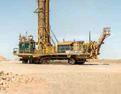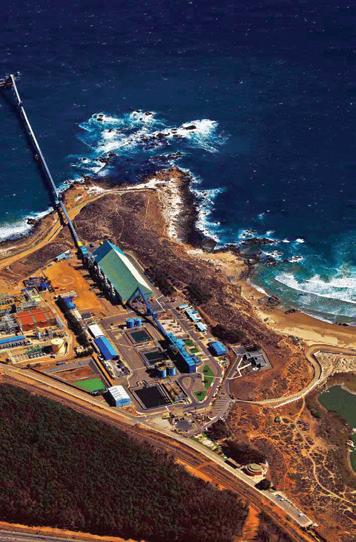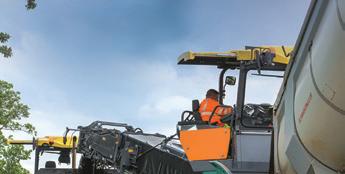

























































































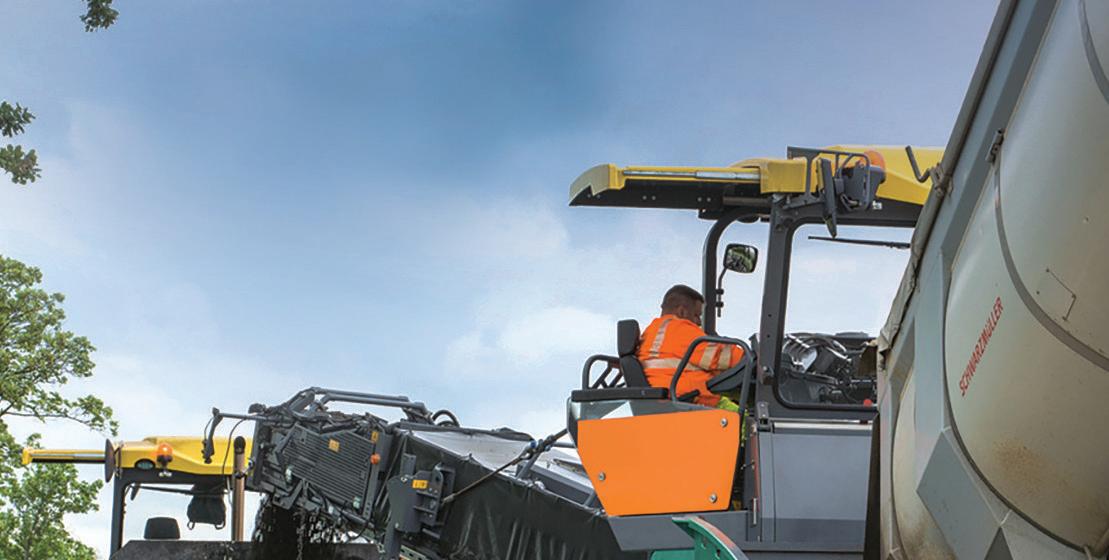
















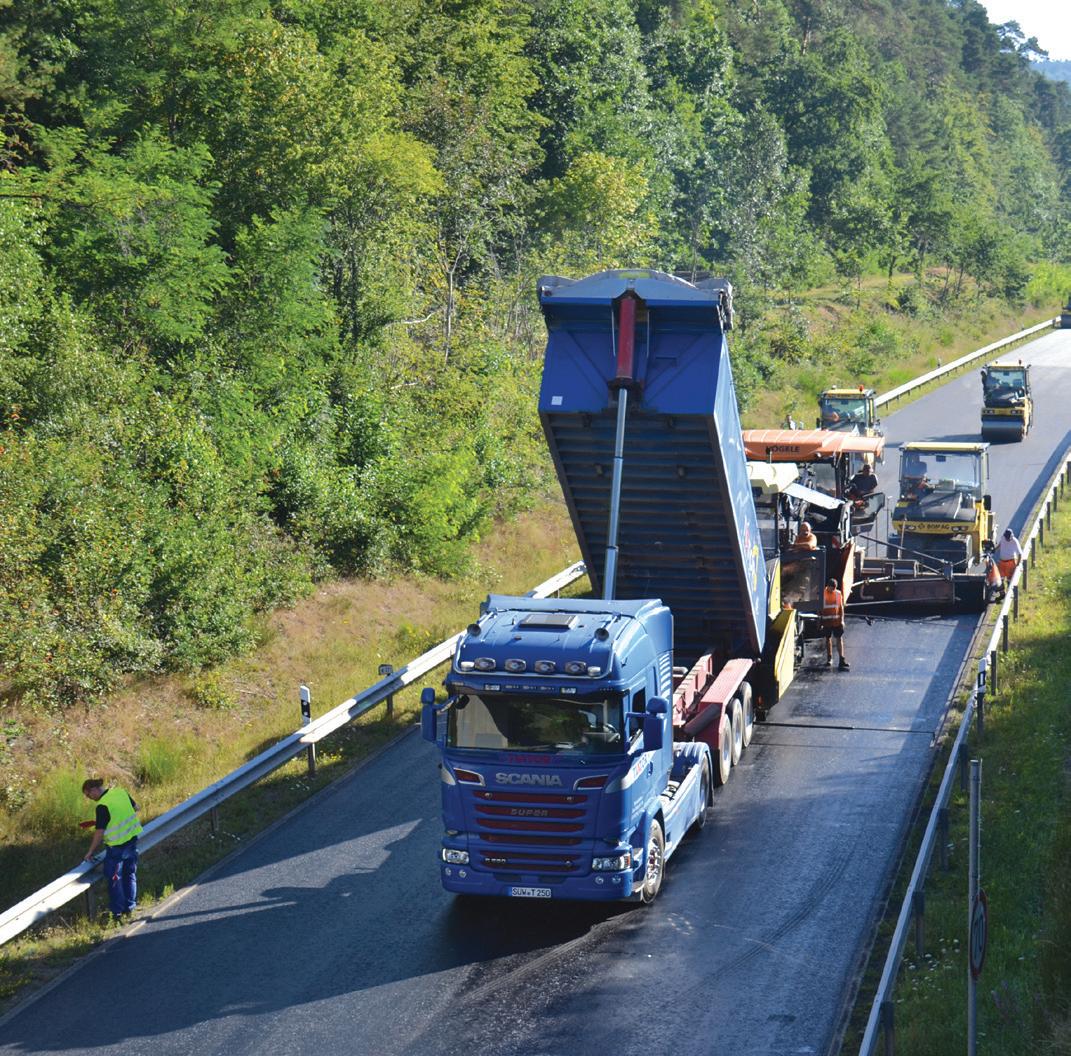
Wirtgen plays an important role p53



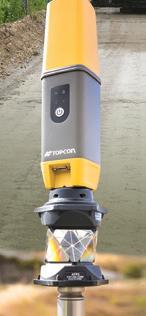
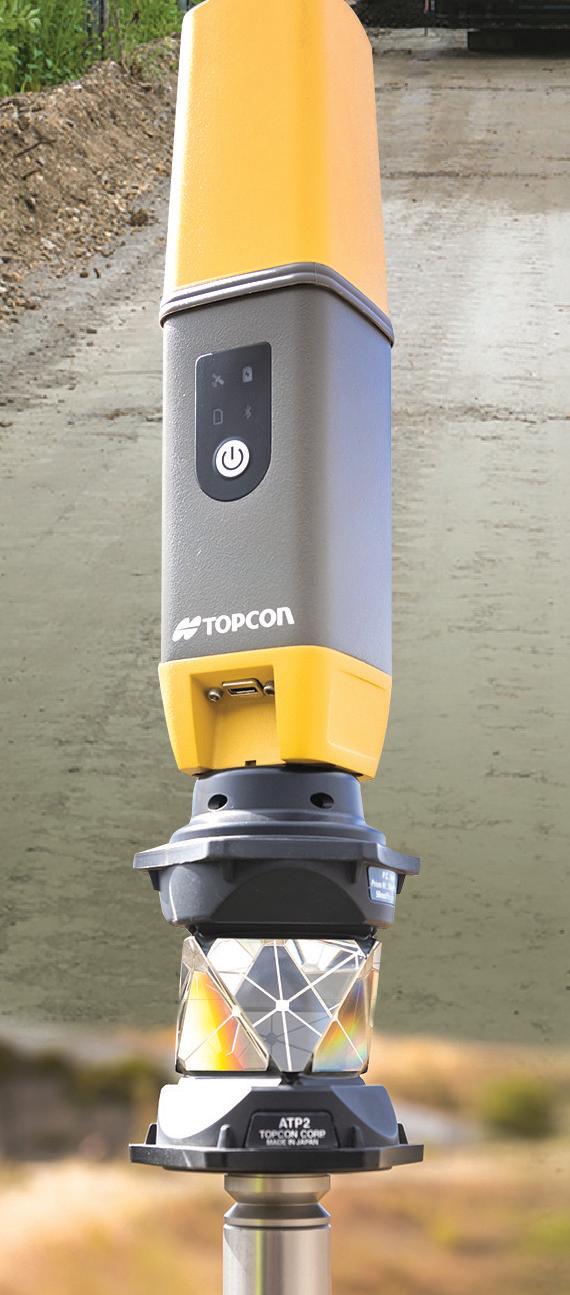
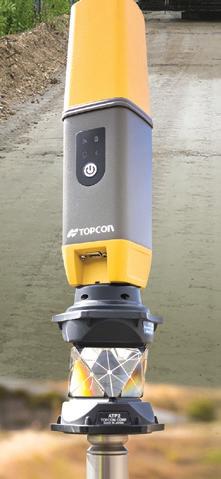
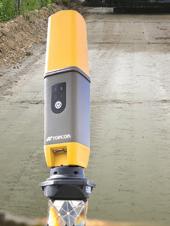
TOPCON’S lightweight GNSS receiver designed for centimetre-level, real-time kinematic accuracy p43






































































































































































































































































































Funding from central government still remains key to the development of new infrastructure projects. While PPPs for tolled highways are proving e ective at attracting international investors, important transport projects do rely on government support. Few governments around the world have the resources available to pay for a major transport project without additional backing. But at the same time, few major transport projects can commence without some government assistance.






is is apparent in the US for example, where a presidential request for US$3.1 billion from congress has been made for the funding to rebuild Baltimore’s collapsed Francis Scott Bridge as well as a number of smaller projects. Similarly, a nance package worth $1.5 billion will be provided by the US Department of Transportation (DOT) for the project to replace the I-5 bridge linking Oregon State and Washington State. is latest package means that the US Federal Government is providing a total of $2.1 billion for the I-5 bridge replacement. Both the Francis Scott Bridge and I-5 bridge replacement projects are deemed of vital importance to the US transport system.
Without the Francis Scott Bridge, thousands of drivers now have to make a lengthy detour that adds signi cantly to journey duration.


"Few governments around the world have the resources available to pay for a major transport project without additional backing"
e 30,000/day drivers who previously used the link to traverse the Patapsco River on I-695 now face a lengthy diversion to use the I-895 crossing instead and which now su ers additional congestion.
Although the I-5 bridge linking Portland in Oregon State with Vancouver in Washington State remains, it is ageing rapidly and in poor condition. ere will be some state funding for the bridge, with Washington State and Oregon State providing around $1 billion apiece for the project.

Connect with me for regular industry related posts and discussions... Global Highways Magazine
Editorial Editor Mike Woof
Deputy Editor David Arminas
Sub-Editor Kevin O'Shea
Contributing
Editorial
Data
Web
Email [initialsurname]@ropl.com
(eg: radshead@ropl.com)

Nor is the process of government funding restricted to the US. Perhaps nowhere is this more apparent than India, where the government is setting out plans for a truly gargantuan transport infrastructure programme. India’s Ministry of Road Transport and Highways is looking to invest $268.44 billion on transport infrastructure and has been seeking approval from the government.
Advertisement Sales
Head of Construction Sales
Graeme McQueen Tel +44 1322 612069
Email gmcqueen@ropl.com
Sales Director Philip Woodgate Tel: +44 1322 612067
Email pwoodgate@ropl.com
Sales Director Dan Emmerson
Tel +44 1322 612068
Email demmerson@ropl.com
UK / Classified, North America
Dan Emmerson
Tel +44 1322 612068
Email demmerson@ropl.com
Italy Fulvio Bonfiglietti
Tel +39 339 1010833
Email bonfiglietti@tiscali.it
Japan: Akiyoshi Ojima
Tel: +81 3 3263 5065
Email: ojima@echo-Japan.co.jpp
Asia / Australasia Roger Adshead
Tel +44 7768 178163
Email radshead@ropl.com






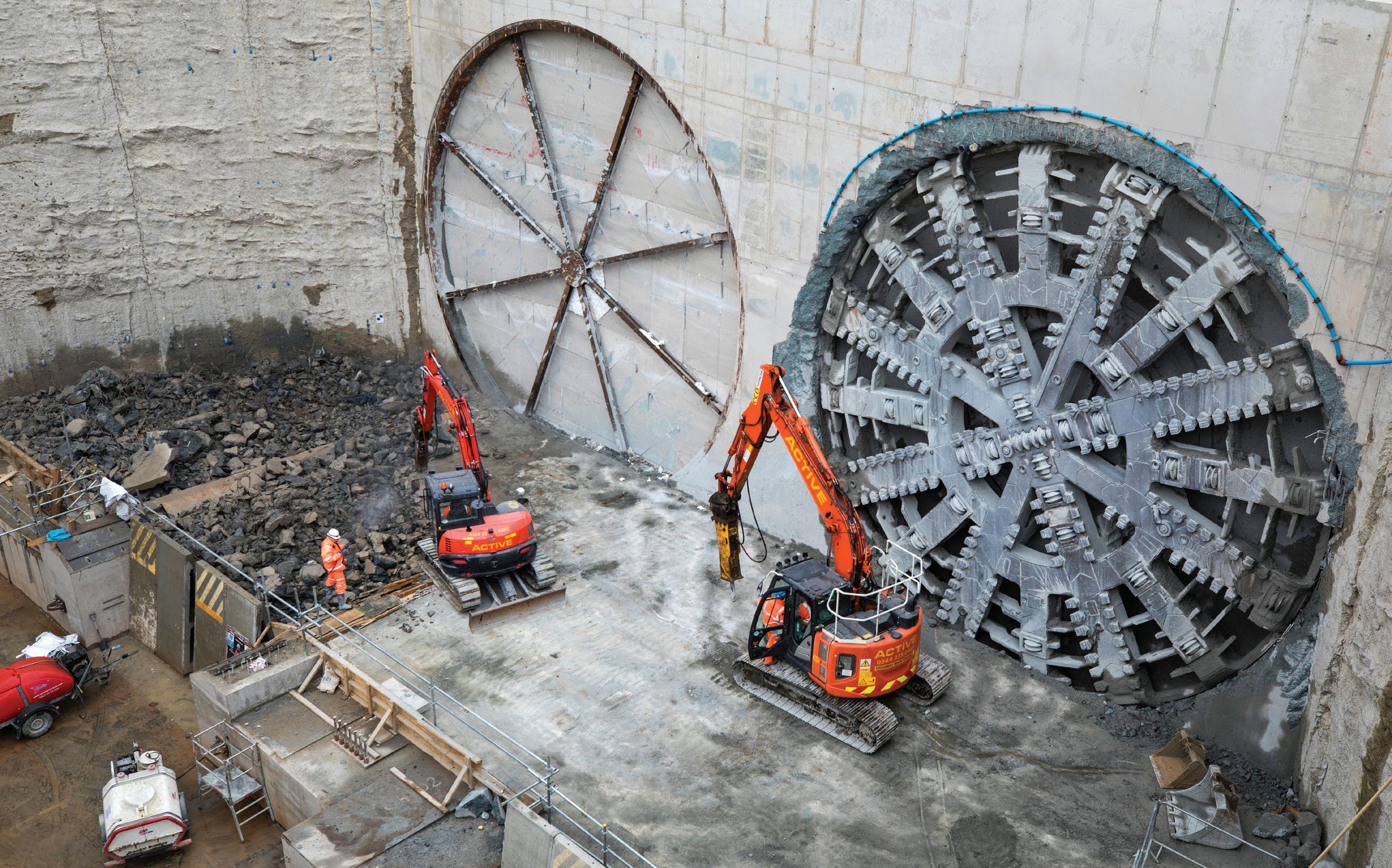
The Silvertown Crossing project in London is benefiting from advanced tunnelling technology – Kristina Smith reports

National Highways employing sophisticated compaction from Caterpillar; electric tippers for Tarmac










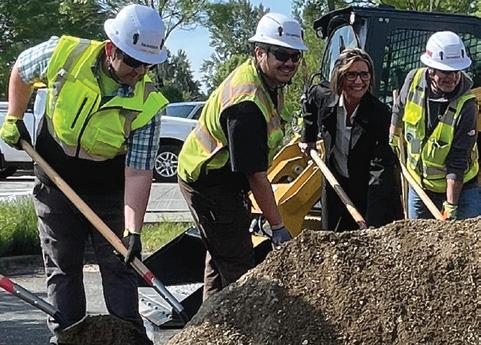

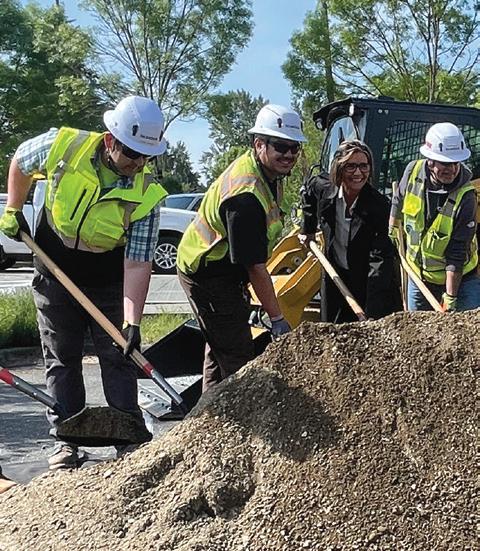
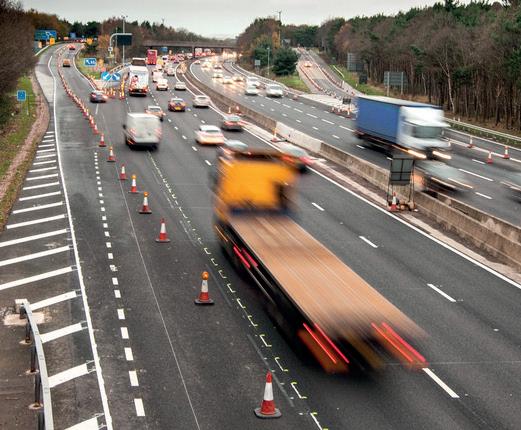
Central government funding is still important for many major highway projects, despite the common use of PPs and other financing modes 06 NEWS
New bridge for Washington DC; US$4 billion for Maryland-Virgina bridge; Africa’s dangerous roads; India’s US$268 billion road expansion; lowering the global road death toll
IRF World Congress 2024 in Istanbul - empowering sustainable mobility; 12th IRF Caribbean Regional conference
Further humorous road-related stories from around the world

AECOM data reveals UK driving o ences; autonomous driving in Germany; new barrier products from Lindsay and Rebloc; weigh-in-motion with Intercomp; Kapsch technology for Brazil; Iris monitoring systems in Italy

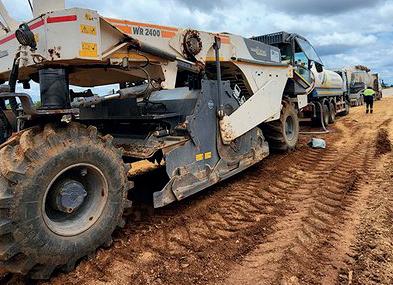
Machines from the Wirtgen Group have carried out a major road recycling project using -in-place technology. See page 53














63 EARTHMOVING
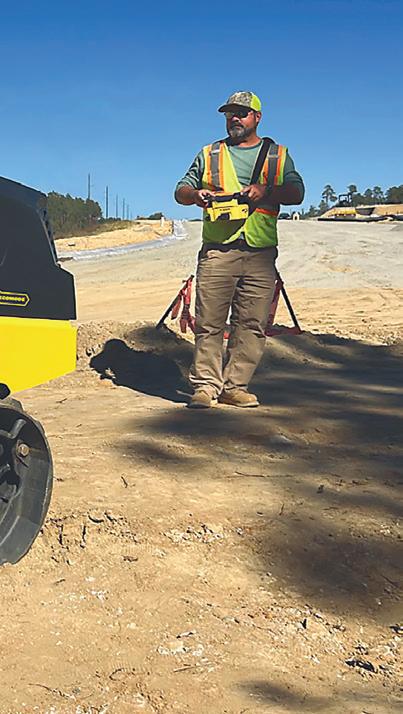

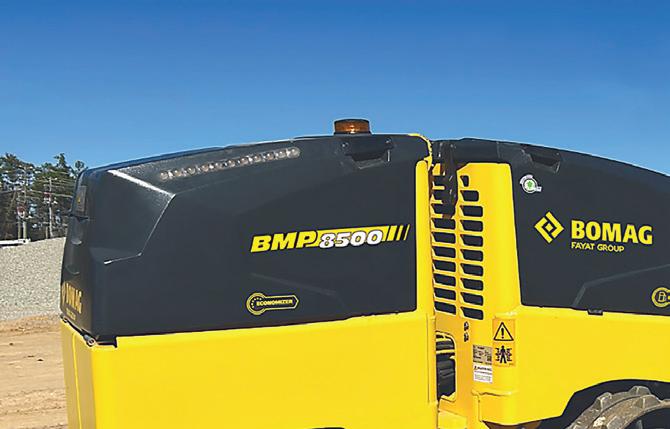
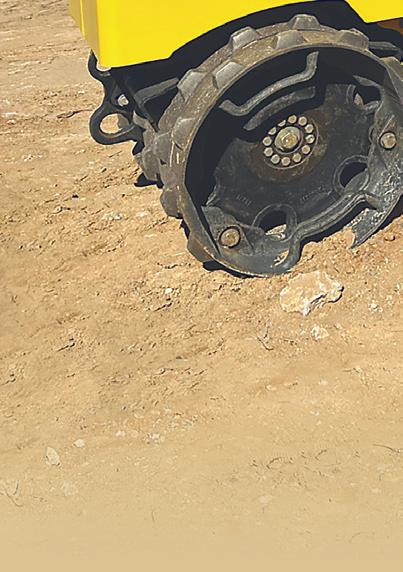
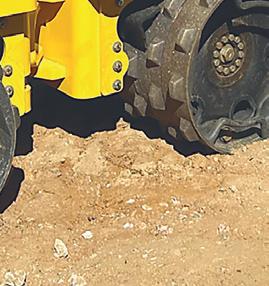
Volvo CE’s new electric loader and excavators; Hyundai’s heaviest ever excavators; Liebherr’s hydrogen fuelled prototype hydrogen loader; intelligent excavators from Develon, Hitachi and Komatsu; Bomag’s remote control compactor
08 THE WORLD IN NUMBERS
Analysing the key factors a ecting the global construction industry

68 MATERIALS
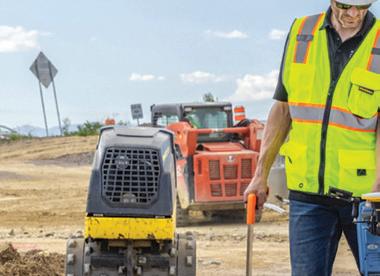
Reactive modification of bitumen o ers advantages over additives that work physically
53
59
43 CONSTRUCTION TECHNOLOGY

36
ASPHALT PAVING
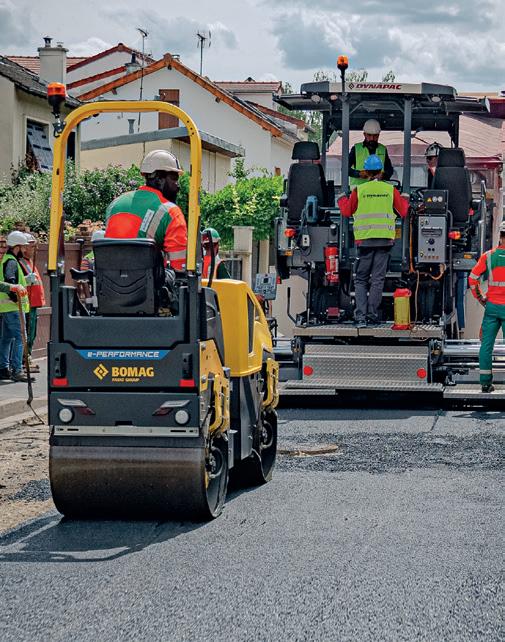
Electric machines resurface road in France; electric asphalt compaction, paving and spraying machines; paving and compacting in a tight space
40
ASPHALT PLANTS
Greener solutions for asphalt plants are helping reduce carbon emissions
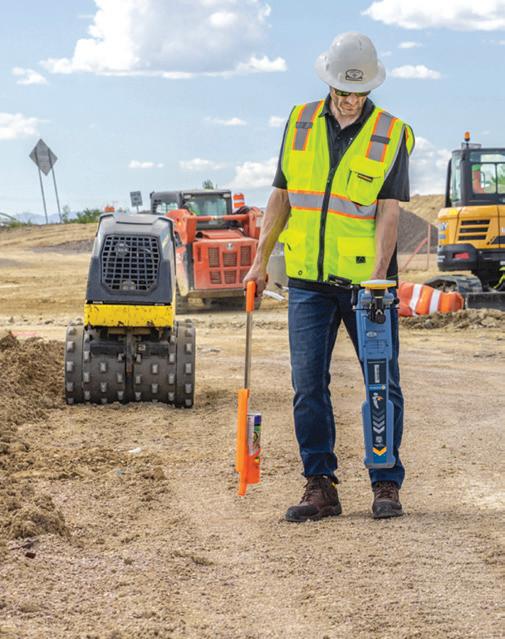

Infrastructure intelligence key to construction says Bentley; Topcon broadens GNSS o ering; Trimble’s machine control and surveying solutions and utilities partnership with Radiodetection; Leica Geosystems widens o ering with acquisition; Topcon’s new facility
48
ASPHALT PLANTS
Innovations in asphalt plant design; Turkish company competing in Europe; hydrogen burners from key suppliers; new plants for UK and Kenya
Machines from the Wirtgen Group have carried out a major road repair on an ageing German autobahn using -in-place technology; reusing waste heat from an asphalt plant; innovative asphalt compaction machines from several of the major manufacturers
A new concrete slipforming machine will o er additional capabilities; using AI to optimise concrete quality; repaving a Missouri highway stretch with concrete; a concrete robot delivering productivity
55
Advances in asphalt compaction machines and technology will deliver higher quality surfaces for contractors and clients

A US$4 billion bridge replacement and highway upgrade project will improve transport between Maryland and Virginia in the US
Africa’s dangerous roads have seen an increase in fatalities between 2010 and 2021. Data from the World Health Organization (WHO) shows that road deaths increased 17% in Africa during this period.

The project is to replace the American Legion Memorial Bridge, which carries tra c on I-495 over the Potomac River, to the northwest of capital Washington DC.
e bridge is struggling to cope with the massive tra c volumes it carries, with delays frequent at peak periods. e bridge is in poor condition and the work is a high priority due to its crumbling concrete structure. Building a new bridge as well as upgrading the highway leading to the crossing is expected to cost in the region of $4 billion.
e plans call for construction to commence on the new bridge in 2026 with the opening due in 2032.
State funding from Maryland and Virginia worth
a total of $1 billion has been pledged for the work in a joint agreement made in 2019 by the two states but the remaining $3 billion will have to come from federal sources. Survey work in the river is being carried out jointly for the project between the Virginia Department of Transportation (VDOT), the Maryland Department of Transportation State Highway Administration (MDOT SHA).

Around 20% of all road deaths in the world occur in Africa, with close to 250,000 fatalities in 2021. Road casualty statistics for vulnerable road users such as pedestrians, cyclists and motorcyclists are particularly worrying in Africa. e WHO data shows that deaths amongst motorcyclists doubled for the 2010-2021 period compared with the previous 10 years.
A huge growth in the number of registered vehicles in Africa accounts for some of the rise in road deaths.

US$1.5 BILLION
A finance package worth US$1.5 billion is being provided by the US Department of Transportation (DOT) for the project to replace the I-5 bridge linking Oregon State and Washington State.
The bridge will span the Columbia River, connecting Portland in Oregon State with Vancouver in Washington State. The addition of this new funding package means that the US Federal Government is providing a total of $2.1 billion for the bridge replacement.

Bangladesh’s new US$1.1 billion bridge
Construction of the new bridge for Kalurghat in Bangladesh is expected to cost nearly US$1.1 billion. e project will bene t from a loan being provided by South Korea, negotiated by Bangladesh’s Economic Relations Division (ERD).
e new bridge will replace a 239m structure that opened in 1930 and is in a poor condition, making it unable to cope with
the tra c it has to carry at present. It has had to be closed at various times to carry out maintenance work, presenting transport headaches for the industries in the area that it serves.
e numerous redesigns have delayed the project, as well as boosting the cost signi cantly. e new bridge is not expected to be ready until 2028.
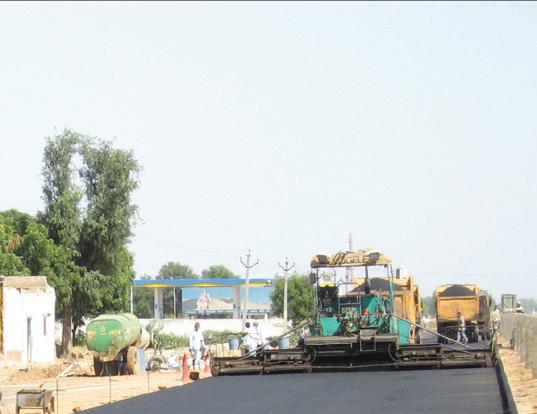



Using the International Road Assessment Programme (iRAP) methodology, road safety infrastructure changes and safer speeds have prevented almost 700,000 deaths and serious injuries in 74 countries since 2016, according to a new paper with Johns Hopkins University published in the respected journal PLOS One.
e paper estimates the likely impact of road improvements in 1,039 infrastructure projects where the iRAP methodology and tools have been used.
Key ndings of the report show the application of the iRAP model will have prevented a cumulative and estimated 699,768 deaths and serious injuries between January 2016 and the end of 2024.
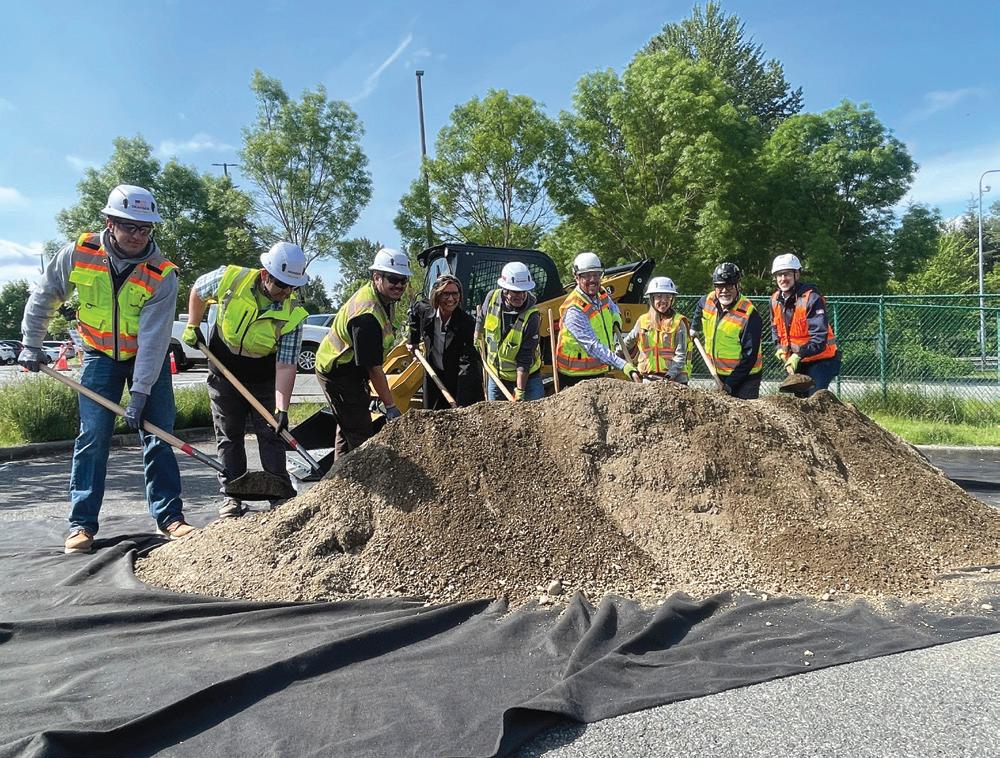
Work is underway on the US$834 million I-405/Brickyard to SR 527 Improvement Project in Washington State. Construction is being carried out by Skanska, which was awarded the package of works by the Washington State Department of Transportation (WSDOT).
The project involves upgrading the 7.2km stretch of I-405 running through Bothell, with the work due for completion in 2028. AECOM is partnering with Skanska as the lead designer for the project.
India is setting out plans for a truly gargantuan transport infrastructure programme
The country’s Ministry of Road Transport and Highways is looking to invest US$268.44 billion on transport infrastructure. Approval is being sought by the Ministry of Road Transport and Highways from the Indian Government.
e Highway Development Plan would see the construction of around 30,600km of roads by 2032. is would involve building 18,000km of high-speed roads.
Tra c congestion around major cities would also be reduced with improvements to 4,000km of routes around these areas.
e programme would also develop India’s international transport routes, improving connections with the country’s neighbours. Tendering for the rst phase of the programme
should be complete by 2029, with the construction work then due to be nished by 2033.
Work is to start on India’s US$488 million Chattergala Tunnel project in the north of the country. e project will be managed by the National Highways Authority of India (NHAI).
e 6.8km tunnel is expected to take four years to build and will replace the Chattergala Pass, which is at an altitude of 3,200m and is prone to closure in poor weather. Once the tunnel is open, it will allow faster and safer journeys between Jammu and Kashmir.
In addition, the NHAI will manage the work for the new National Highway linking Lakhanpur and Doda. e highway will provide a new and faster route for drivers, cutting journey times while boosting transport safety.
e paper projects that by 2044, the existing road treatments will prevent almost 3.2 million fatalities and serious injuries, given the average e ective lifespan of 20 years.


With the software solution from Bomag, construction managers can signi cantly simplify the planning e ort for an upcoming road construction project...
Keep up with latest product launches @Global_Highways
Improvements will include increased express toll lane (ETL) capacity and direct access to state highways.
e Liebherr Group achieved record revenue of €14 billion in 2023. is represents an increase of €1.45 billion, or 11.5%, compared with the previous year. e results are of note given the economic situation worldwide. According to the International Monetary Fund,
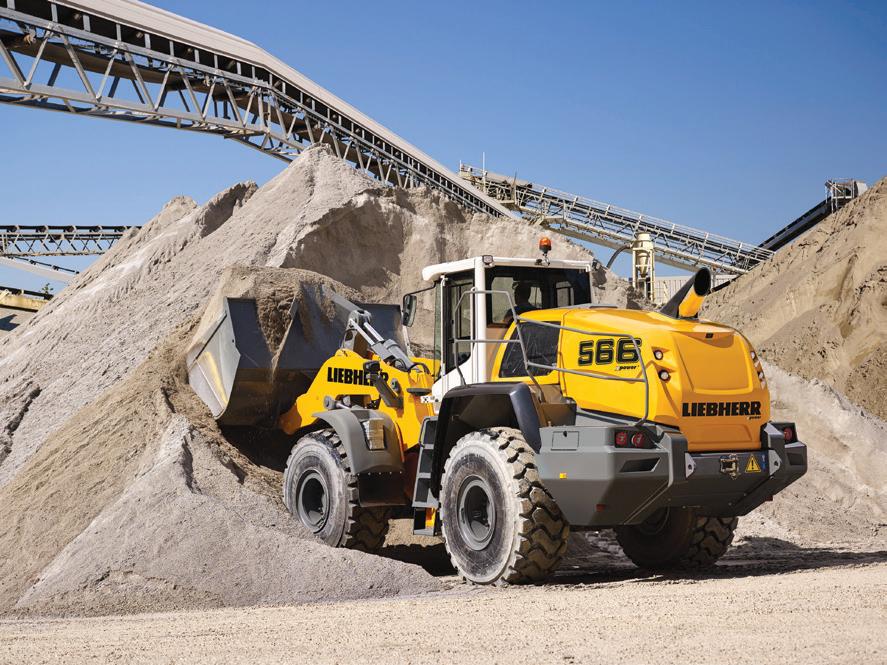
As usual, our research team has prepared a selection of the key factors affecting the global construction outlook. To make the information easier to digest, we have split the infographics into different sections: The Global Economic Outlook; Artificial Intelligence; Global Risks; Cybersecurity; Emissions and Climate Change; Construction Trends; and Infrastructure.
Growth projections by region (percent change)
Source: IMF, World Economic Outlook Update, January 2024. Note: Order of bars for each group indicates (left to right): 2023,2024 projections, and 2025 projections.
Source: OECD Economic Outlook, Interim report, February 2024
Respondents across regions, industries, and seniority levels say they are already using generative AI tools (Reported exposure to generative AI tools, % of respondents)
Source: The State of AI in 2023: Generative AI’s breakout year (August 2023), McKinsey and Company, 2023

Note: Figures may not sum to 100%, because of rounding. In Asia-Pacific, n=164; in Europe, n=515; in North America, n=392; in Greater China (including Hong Kong and Taiwan), n=337, and in developing markets (including India, Latin America, and Middle East and North Africa), n=276. For advanced industries (including automotive and assembly, aerospace and defence, and advanced electronics), n=96; for business, legal, and professional services, n=215; for consumer goods and retail, n=128; for energy and materials, n=96; for financial services, n=437; and for middle managers, n=339. For respondents born in 1964 or earlier, n=143; for respondents born between 1965 and 1990, n=268; and for respondents born between 1981 and 1996, n=80. Age details were not available for all respondents. For respondents identifying as men, n=1,025; for respondents identifying as women, n=156. The survey sample also includes respondents who identified as ‘nonbinary’ or ‘other’ but are not a large enough number to be statistically meaningful.
Inaccuracy, cybersecurity, and intellectual-property infringement are the most-cited risks of generative AI adoption (Generative AI-related risks that organisations consider relevant and are working to mitigate, % of respondents1
Source: Global Survey on AI, McKinsey and Company, 11-21 April 2023
Generative AI adoption.
Looking at the year ahead, do you agree/disagree with the following statements?
Generative AI (tools such as ChatGPT) will be commercially disruptive
1 Asked only of respondents whose organisations have adopted AI in at least 1 function. For both risks considered relevant and risks mitigated, n=913.
The impact of generative AI on productivity. Looking at the year ahead, how likely is it that generative AI will lead to increased e iciency of output production?
The impact of geoeconomic fragmentation. In light of recent geopolitical developments, how likely is it that the next three years will lead to significant...
Source: Chief Economists Survey, World Economic Forum, January 2024
and growing
National risk perceptions in the context of upcoming elections. Which five risks are most likely to pose the biggest threat to your country in the next two years?
Source: Global Risks Report, 19th ed., Insight Report, World Economic Forum, 2024
1st risk in India
Over 1.4bn (nearly 50% internet penetration) head for a general election in April-May 2024
6th risk in the United States
Nearly 340m (92% internet penetration) head for a presidential election in November 2024
8th risk in European Union
Nearly 450m (89% internet penetration) elect the EU Parliament in June 2024
11th risk in United Kingdom
Nearly 68m (98% internet penetration) head for a general election by January 2025
11th risk in Mexico
128m (79% internet penetration) head for a general election in June 2024
18th risk in Indonesia
Nearly 278m (88% internet penetration) head for a presidential election in March 2024
22nd risk in South Africa
Over 60m (72% internet penetration) head for a general election 2024
Russia
Around 145m (88% internet penetration) head for a presidential election in March 2024
Global risks ranked by severity over the short and long term (Please estimate the likely impact (severity) of the following risks over a 2-year and 10-year period)
Source: Global Risks Report, 19th ed., Insight Report, World Economic Forum, 2024







In the next two years, will generative AI provide overall cyber advantage to attackers or defenders?







Does your organisation have the skills needed to respond to and recover from cyberattack?



Data leaks – exposure of personally identi able information through AI


Increased complexity of security governance
Technical security of the AI systems themselves


Emerging technologies will exacerbate long-standing challenges related to cyber resilience
Advance of adversarial capabilities –phishing, malware development, deepfakes

Software supply-chain and code development risk – potential backdoors
Legal concerns of intellectual property and liability


Source: Global Cybersecurity Outlook 2024, Insight Report, World Economic Forum (in collaboration with Accenture), 2024
What are you most concerned about in regards to generative AI’s impact on cyber?





The primary dataset used as the foundational research was a 23-question survey with eight demographic questions, the Global Cybersecurity Outlook Survey, which was launched in June 2023 and ran until October 2023. The World Economic Forum received 204 survey participants from 49 countries.
The cyber skills and talent shortage continues to widen at an alarming rate
Source: Global Cybersecurity Outlook 2024, Insight Report, World Economic Forum (in collaboration with Accenture), 2024
Are resources or skills gaps the biggest challenge for your organisation when designing for cyber resilience?
Global average land-sea temperature anomaly relative to the 1961-1990 average temperature Source: Met O ice Hadley Centre, (OurWorldInData.org), 2023
NOTE: The gray lines represent the upper and lower bounds of the 95% con dence intervals
Global construction machinery market size by country or region 2018-2027
Source: Statista, 2024
World-wide cement production forecast 2030 Source: World Cement Association website, 13/2/24
Global Infrastructure Index 2023, 31 country study Source: May-June 2023, Global Summary, Ipsos 2023/Statista 2024
Q. Still thinking about infrastructure – the things we rely on like road, rail and air networks, utilities such as energy and water, and broadband and other communications – to what extent do you agree or disagree…?
“I don’t think infrastructure in [COUNTRY]...has been adapted enough to cope with future changes in the climate”
% strongly/tend to agree
Most people doubt infrastructure has been adapted for future changes in the climate Source: Global Infrastructure Index 2023, 31 countries, May-June 2023, Global Summary, Ipsos



Figures from the UK’s Department for Transport suggest that there may be more than 50,000 daily instances of people driving while using a hand-held phone
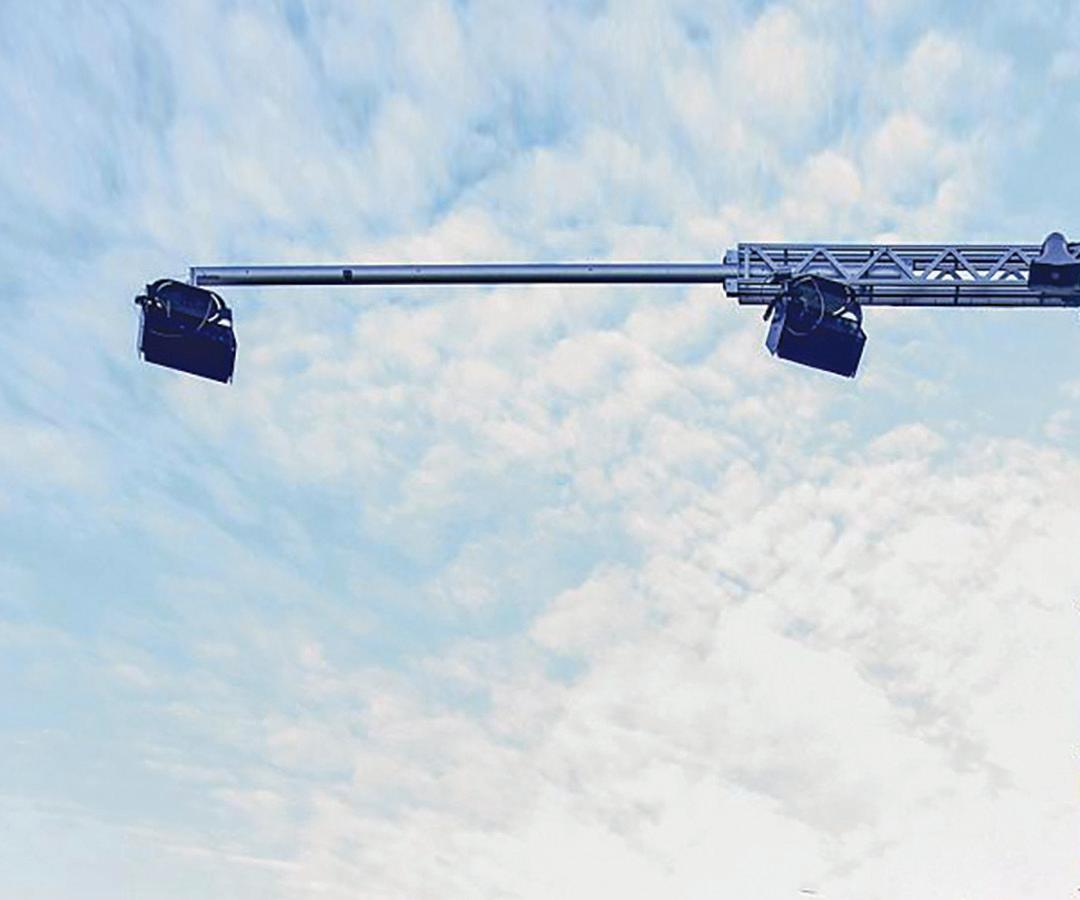
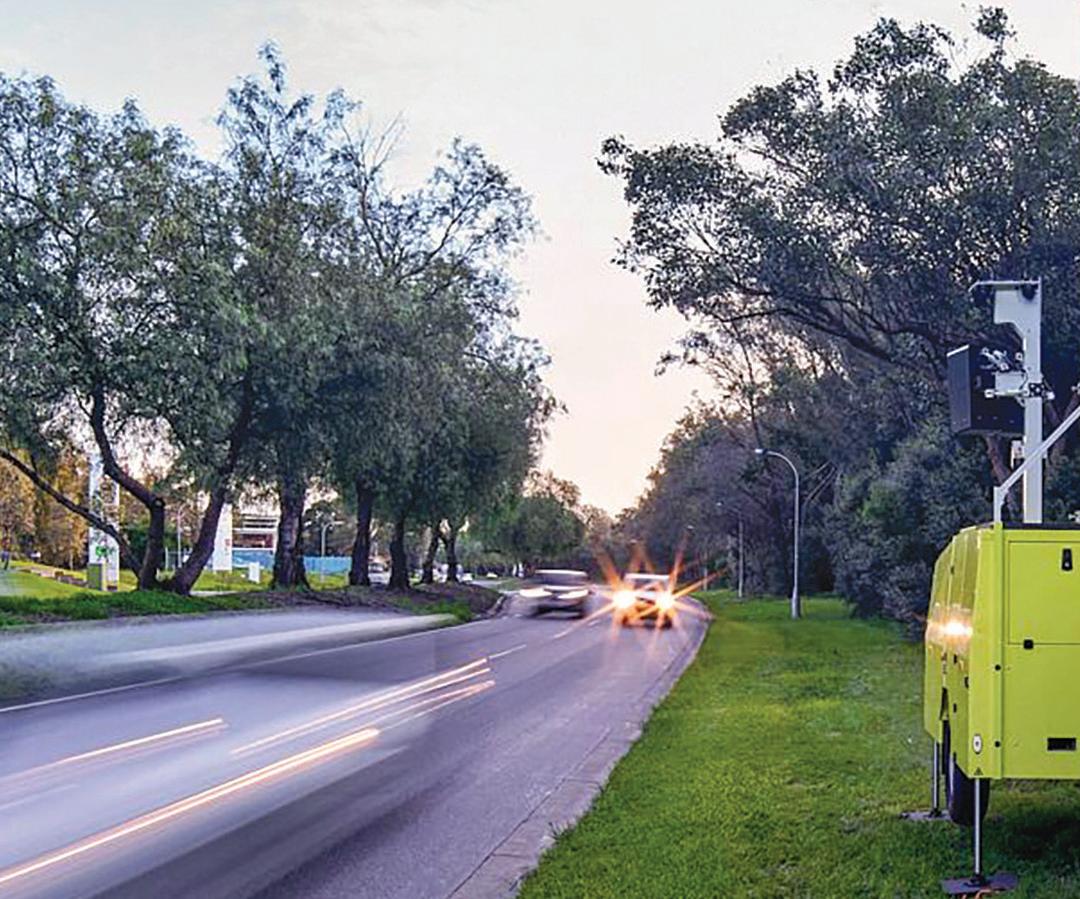

The data collated by the DfT in a project with AECOM, an infrastructure consulting rm, using images captured by technology from Acusensus, an Australian provider of roadside cameras and software, suggests three in every thousand drivers observed on England’s roads are using a mobile phone whilst driving. Meanwhile, the proportion of van drivers breaking the law is three times that of car drivers. e statistics also showed 4.8% of vehicle passengers were observed not wearing a seatbelt.
“Drivers who don’t wear their seatbelt are likely to continue this behaviour throughout an entire journey,” explains Geo Collins, an enforcement expert with Acusensus. “If seen mid-journey [by camera detection] without a suitable restraint, this will probably have been the case all the way. However, hand-held mobile phone use is not usually continuous, so it might happen multiple times during a single journey, but not necessarily at the survey point.”
Because of this, it is possibly misleading to think that more seatbelt violations occur, he said. It is more likely that overall occurrences of distracted driving for any one journey are many times higher than monitored during this survey, which showed 0.3% at any one speci c point on the road.
“Based on the observed violation rates from the surveys, if this was extrapolated across the entire network, it is likely that cars would account for more than 30,000 cases of illegal mobile phone use each day, with a further 20,000 or more cases from vans. is is despite there being only a quarter the number of vans using our roads, compared with cars.”
Collins said that more than 500,000 daily journeys by cars and vans are likely to occur without the driver being correctly restrained. Not wearing a seatbelt is a habitual behaviour that is likely to take place throughout every journey.
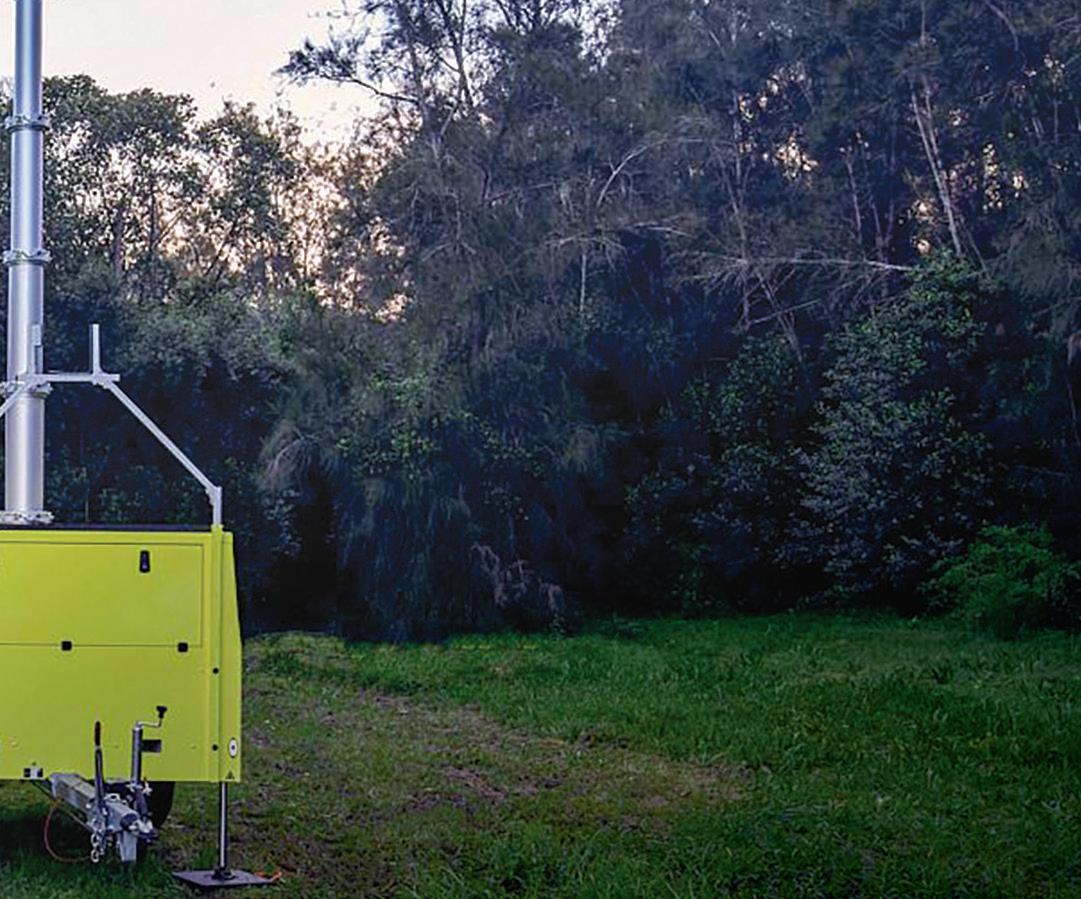
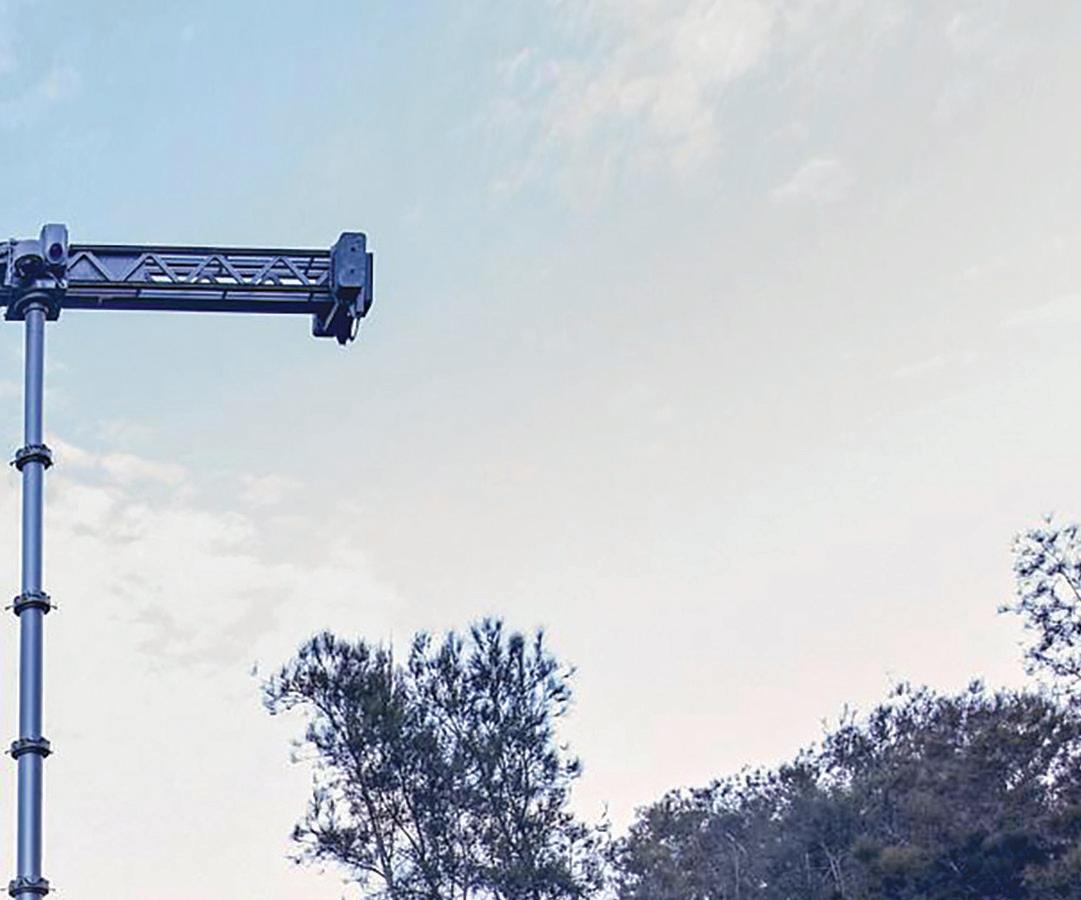
The Acusensus system can be fixed or trailerbased. It captures highresolution, prosecutable evidence of individuals undertaking illegal driver behaviour, 24/7. It operates in all weather conditions - including sun glare - and autonomously captures photographic evidence, automatically detecting illegal driver behaviour. The system hardware is compact, light and unobtrusive, permitting economical deployment on a wide range of pre-existing
infrastructure or a trailerbased solution.
Acusensus says the system detects vehicles travelling up to 300km/h without motion blur and without distortion via high-performance sensor technology. The ‘Heads-Up’ solution can simultaneously capture illegal mobile phone use, vehicle over-speeding via radar point speed detection and/or ANPRbased section control, seatbelt o ences and unregistered/hotlist vehicle detection via ANPR.



“It is important to remember that whilst the vast majority of these journeys end safely, this does not mean that it is safe. e risk of serious injury or fatality is dramatically greater should a collision occur,” he said.
Each site was surveyed on a weekday, either in the morning or afternoon, for a period of six hours. e observations were then analysed by human review. e survey data was collected using Acusensus Heads Up technology, using bespoke roadside cameras to capture clear images through windscreens.
e Acusensus solution can also use arti cial intelligence-based image analysis to ag up likely violations, although this was not used in the DfT
study. is is a new way of gathering the data, which was previously collected by human observation at the roadside in real time.
Collins believes the scale of the risk on UK roads is now alarmingly clear. “Distracted driving and not using a seatbelt are two of the fatal ve risk factors, most likely to lead to serious harm when driving.
e Heads Up technology not only helps to provide this background understanding, but it can also be used to provide violation records that are used for prosecution or education purposes, which has now been successfully carried out by many UK police forces.”

e rst vehicle to operate at Level 4 automation in Germany is driving in normal road tra c in the city of Darmstadt.
Level 4 means that a vehicle moves autonomously - e ectively driverless - within a de ned area. For the rst time, the decision on all driving manoeuvres lies with the vehicle, although for safety there is always a driver on board during test operations.
Under a project named Kira – a German acronym for arti cial intelligence-based regular operation of autonomous on-demand transport - a total of six autonomous shuttles will eventually
"Distracted driving and not using a seatbelt are two of the fatal ve risk factors, most likely to lead to serious harm when driving"
Geo Collins
Enforcement expert, Acusensus
operate in Darmstadt and the district of O enbach. e driving manoeuvres of the vehicles are monitored by technical supervisory personnel. But passengers are not yet riding in the Kira shuttle. Interested citizens can later apply as test users and then book the shuttles via their own app. e project has required a Level 4 test permit from the Federal Motor Transport Authority. Kira involves a company from national rail and transport operator Deutsche Bahn, regional transport agency Rhein-Main-Verkehrsverbund (RMV), Darmstadt’s transit authority HEAG mobilo and the O enbach regional transportation agency Kreisverkehrsgesellschaft O enbach (kvgOF).
e rst trips of the autonomous KIRA shuttles are to test the built-in self-driving system from Mobileye. e map material of the operating area is checked to ensure all data points along the road are correct.
Shuttles that can be ordered as needed - ondemand - can provide improved mobility, especially in rural areas. With drivers, on-demand shuttles are already on the road in 10 areas at RMV. Autonomously and thus without sta on board, such services can also be used nationwide in the future. In the spirit of the transport transition, an intelligent linking of di erent means of transport should enable seamless mobility from door to door that is as exible as your own car.
e operator of the autonomous vehicles is the Deutsche Bahn company DB Regio Bus Mitte, while the Deutsche Bahn company ioki provides the software for booking and route planning. Also, ioki integrates the software components of the various technology partners. As a further partner, Mobileye is providing the software and hardware for the autonomous driving system.
e test and implementation phase will run until the end of this year but an extension is planned. Kira is supported with around €2.2 million from the Federal Ministry of Digital and Transport, with additional support from the German state of Hesse. www.mobileye.com
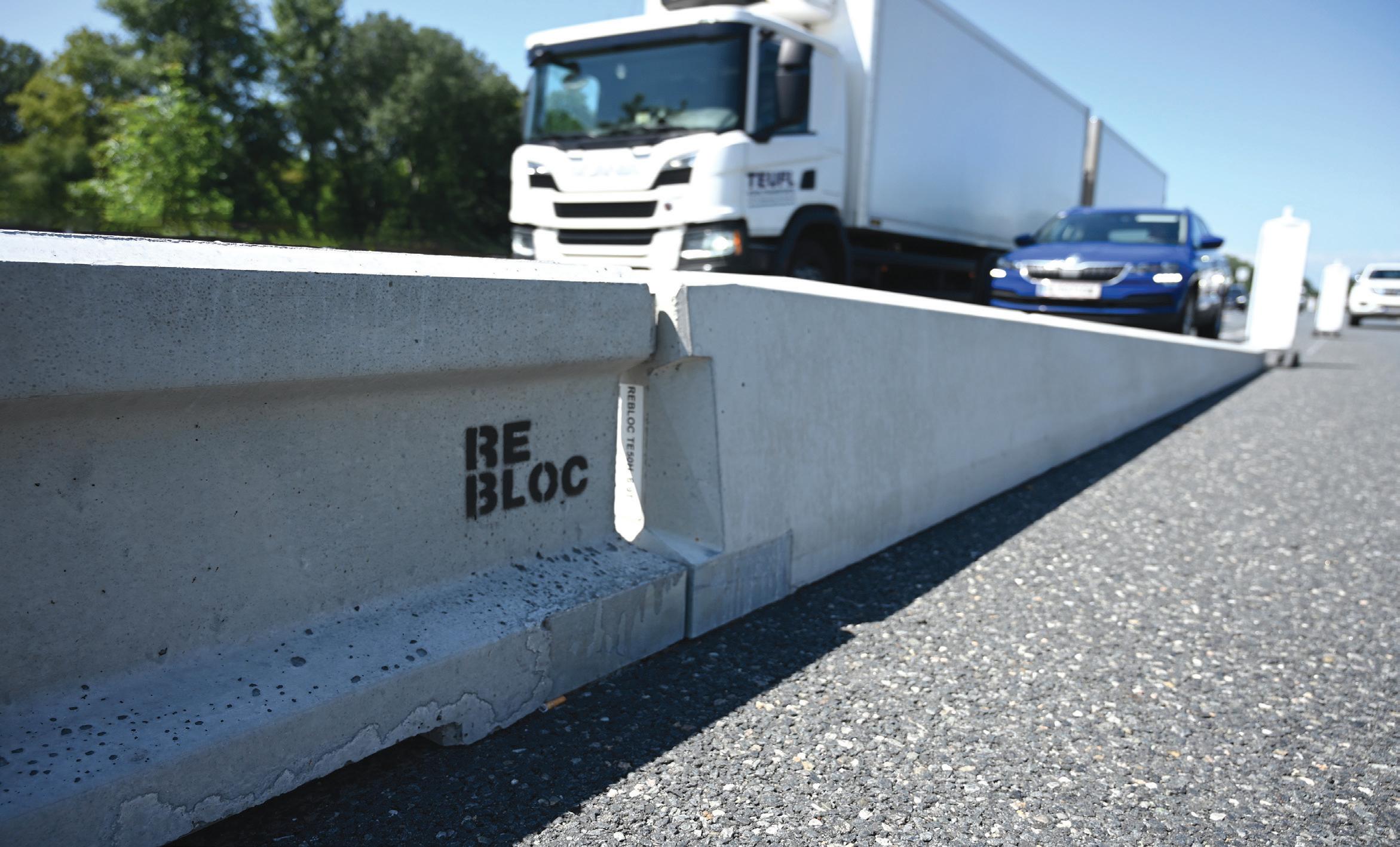

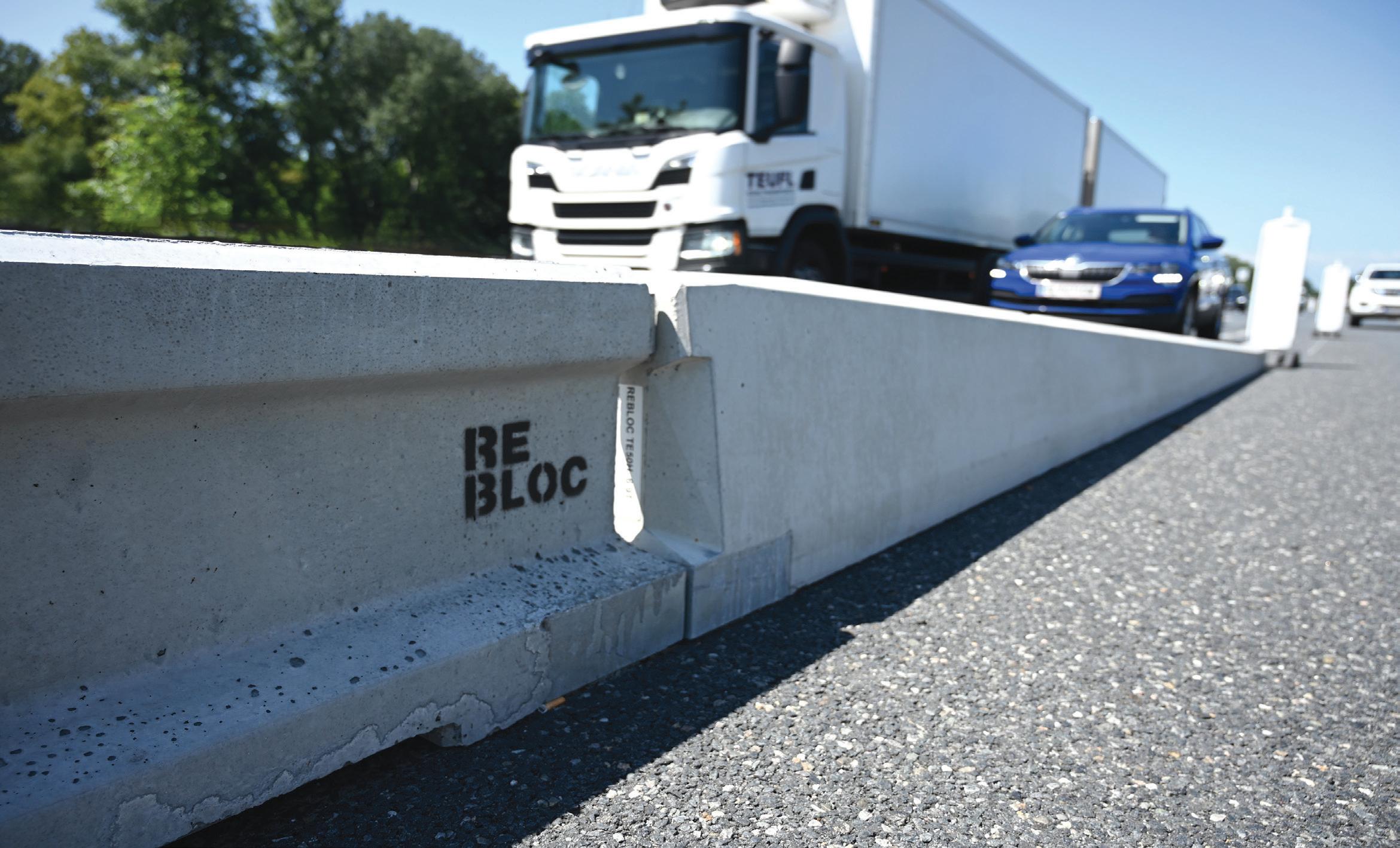
Rebloc has developed an end-terminal for performance class P2A barriers with an impact severity level A designed specifically for tra ic management on construction sites
The end terminal has been successfully tested according to ENV 1317-4 and is particularly suitable for use in combination with temporary vehicle restraint systems.
e company, based in Austria, said that a standout feature of the system is the unanchored setup and the narrow width of only 240mm. e width matches exactly with the width of the connected temporary Rebloc barrier.
Additionally, the end terminal element is integrated into the overall system via the coupling element in a system-compliant manner. It can be used at the beginning and end of the vehicle restraint system without any anchoring into the ground.
anks to the successful 80km/h impact tests, the end terminal is ideal for use in construction areas, according to the company. e key feature is the
ABOVE
Redirecting instead of stopping: Rebloc’s tested end terminal element for temporary vehicle restraint systems
redirecting functionality of the end terminal, which prevents the sudden stopping of the impacting vehicle and gives the following road users enough reaction time.
In congested tra c scenarios where tra c has no alternative routes, the feature is essential in preventing rear-end collisions. is is especially signi cant considering the o cial legal distance regulations and potential liability issues.
It has been successfully crash-tested with a connected temporary T3/W1 system, with no additional anchoring into the ground required. Meanwhile, the narrow width of only 240mm is compliant with the temporary Rebloc vehicle restraint systems. Importantly, it requires low maintenance and is quickly repaired after an impact. End www.rebloc.com
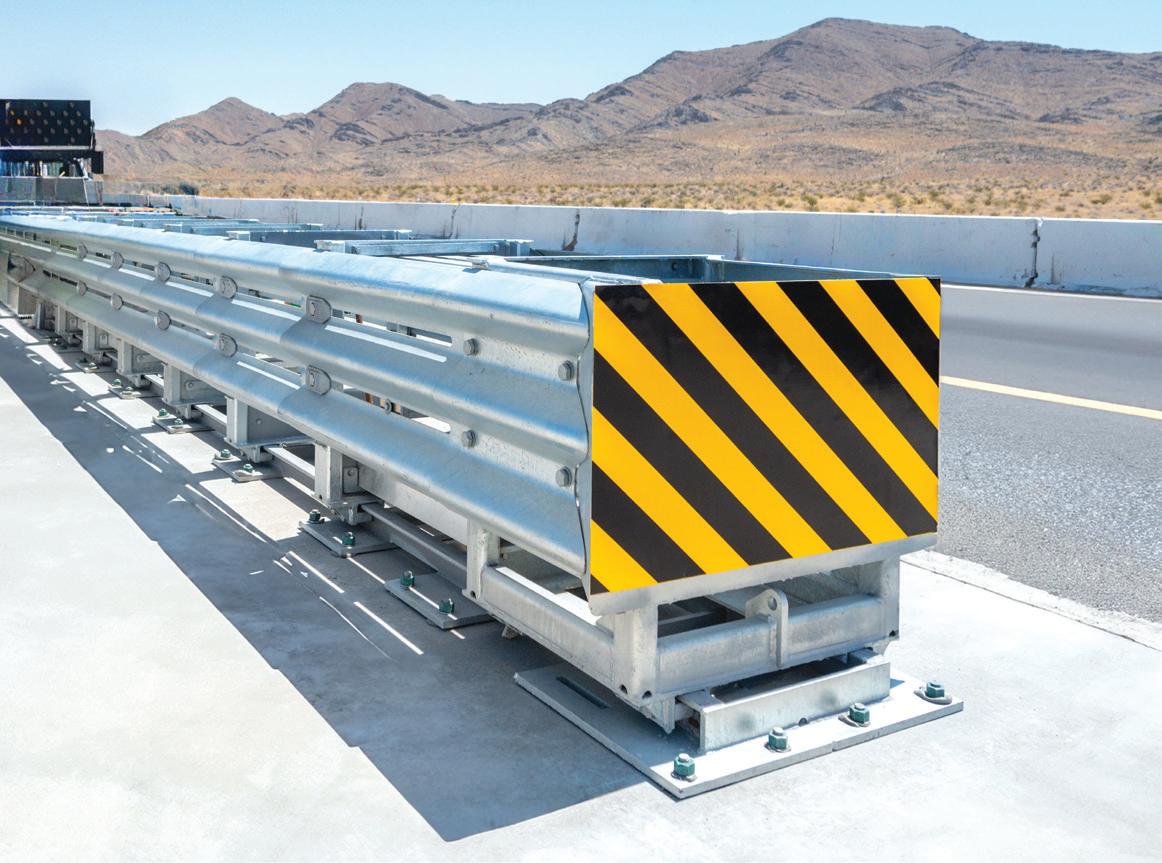
Lindsay recently installed its first unit of its MASH-tested TAU-XR Xpress repair crash cushion, designed for swi installation and rapid repair.
The installation of the TAU-XR is sited in Las Vegas, Nevada, at the intersection of Highway 91 and Great Basin.
Lindsay said that as a severe-duty, lowmaintenance crash cushion, it delivers exceptional, longterm durability and low cost of ownership. TAU-XR ships
fully assembled, allowing for an expedited installation onsite.
The TAU-XR o ers a range of transition options up to 1m, ensuring maximum versatility in design. Lindsay says that what sets the TAU-XR apart is its dualrail configuration and attenuation that enables a straightforward - 30 minutes or less installation process and cost-e ective repairs. www.lindsaycom

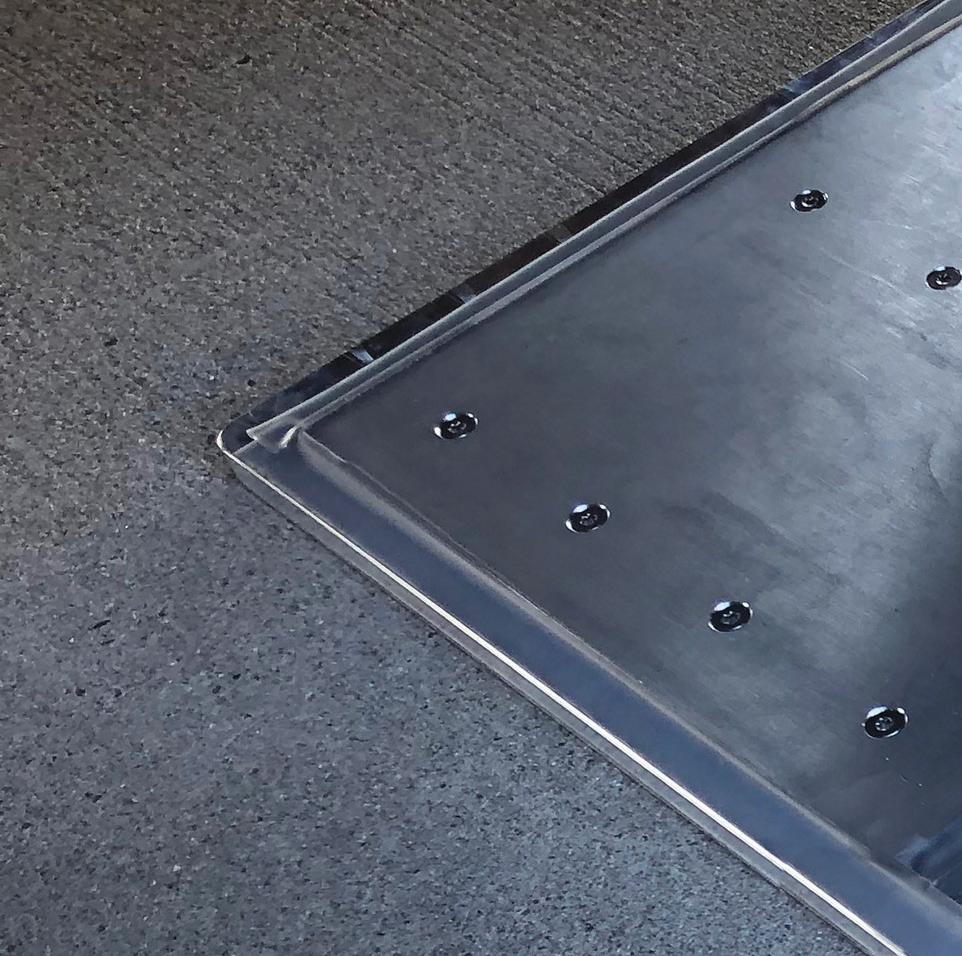

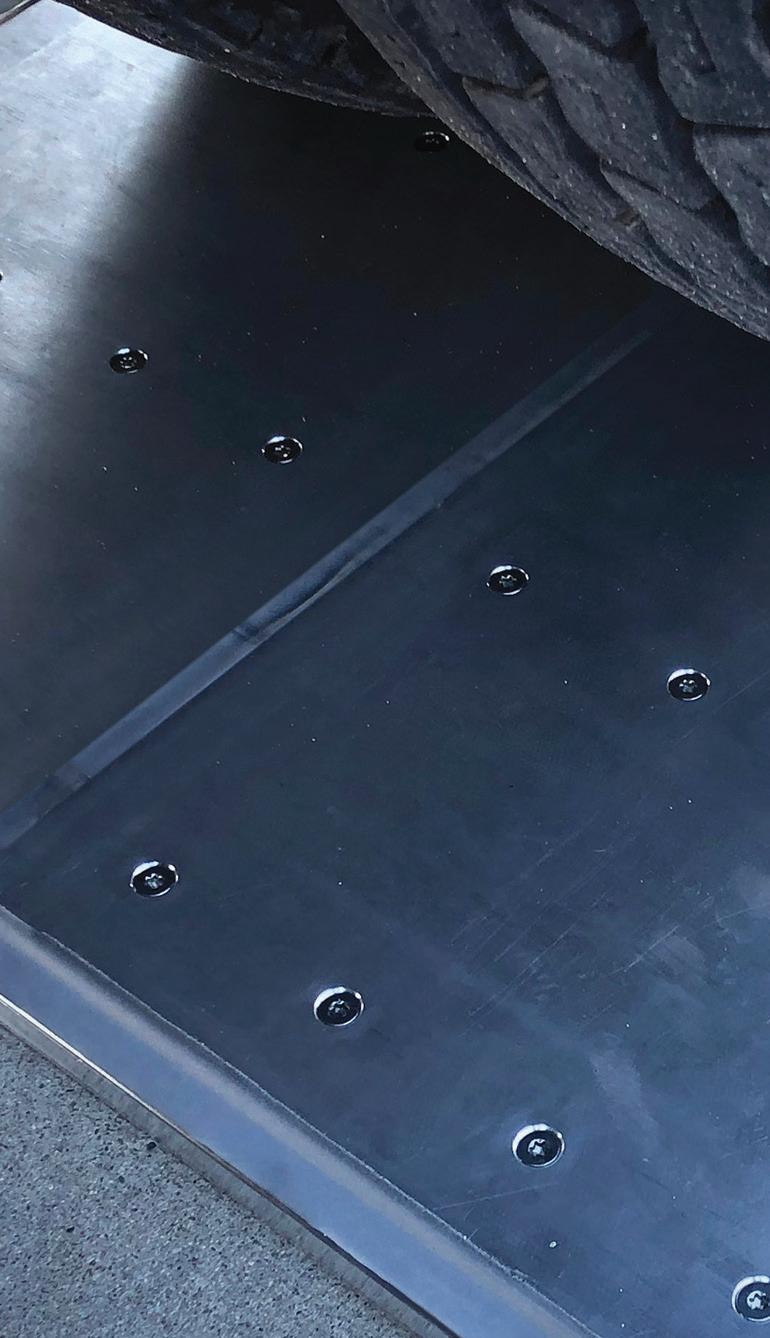
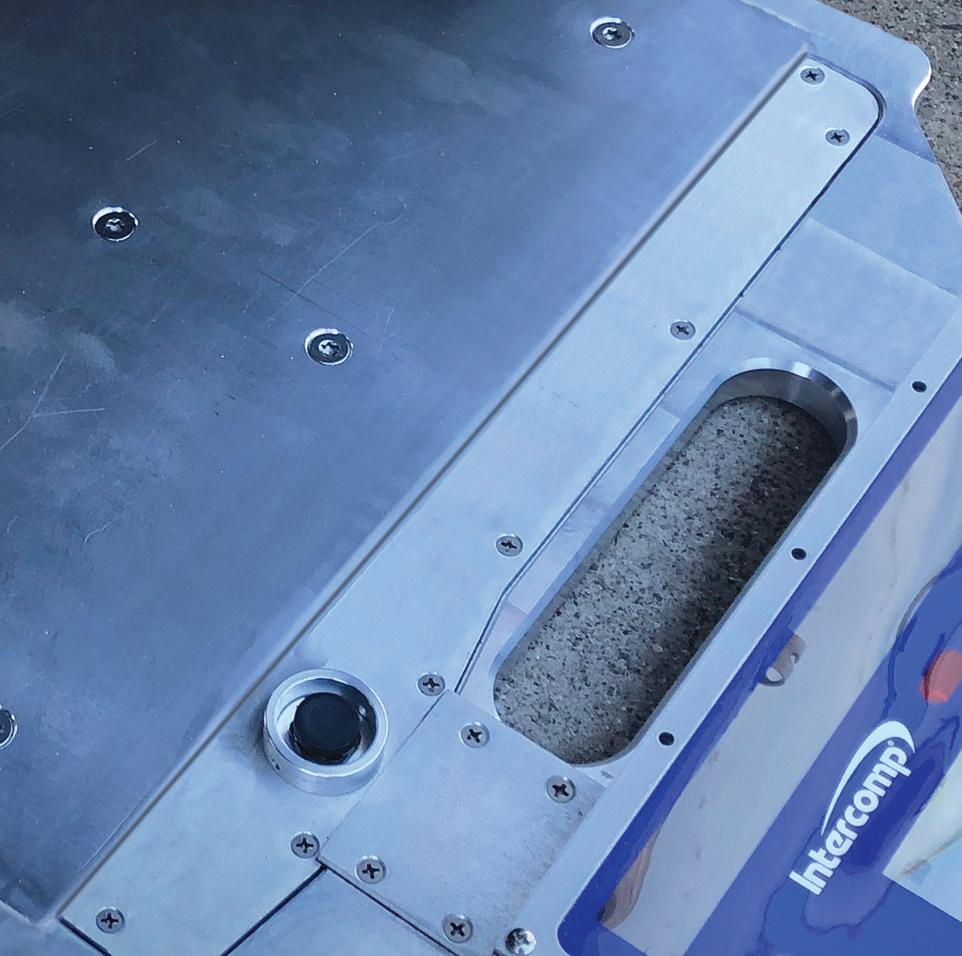
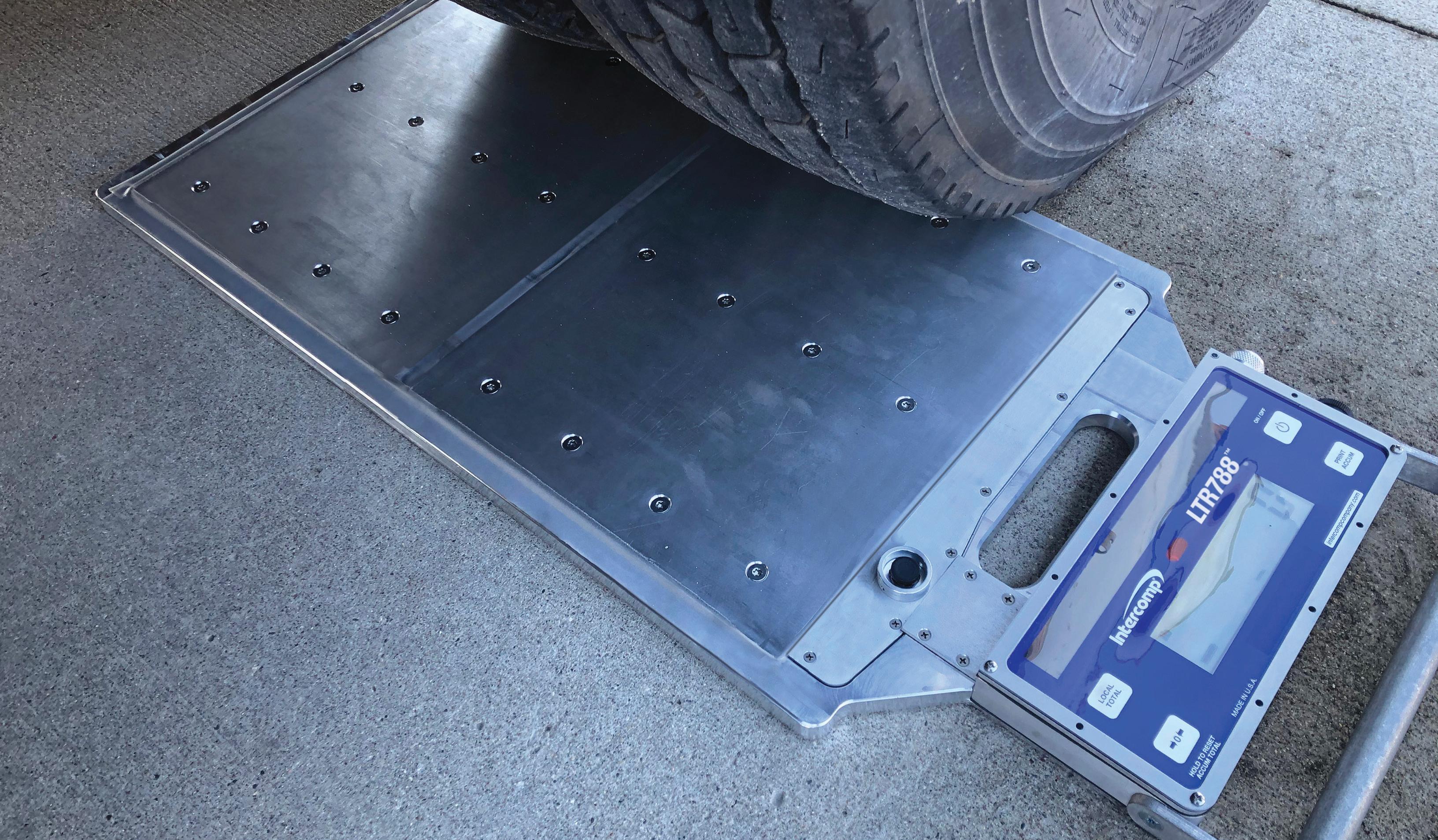
Intercomp, a global manufacturer of portable vehicle weighing and measurement products, has launched the LTR788 Dual Platform Scale, NTEP-certified for commercial vehicle weight enforcement



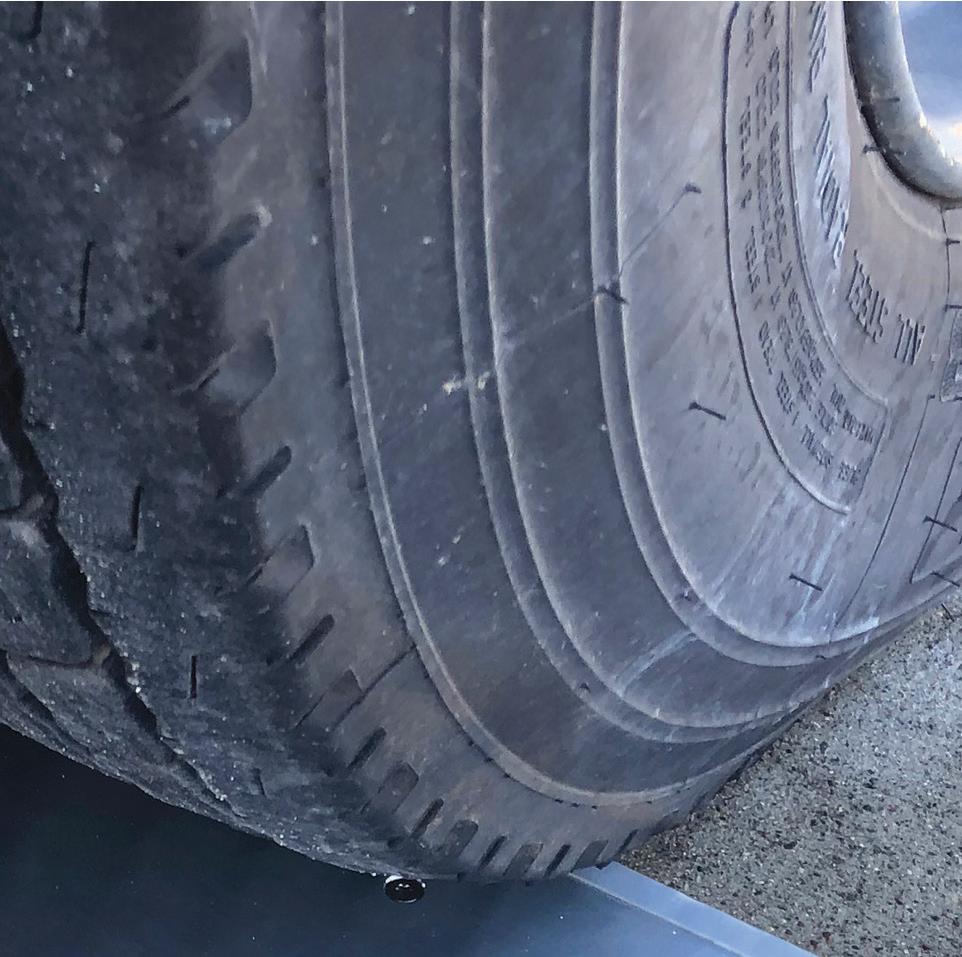
ntercomp created the LTR788 Dual Platform Scale for direct measurement of individual tyre loading in a dual-tyre con guration. Historically, tyre failures within dual-tyre setups have occurred more frequently on inner tyres than outer tyres. However, it was also assumed that individual tyres in a dualwheel con guration carry near equivalent loads. is was because there was no scale which could directly measure individual tyre weights.
It is now possible with the LTR788 Dual Platform Scale to identify and correct unequal weight distribution within a dual tyre con guration by setting the tyre air pressures to properly load both tyres. Using this information, operators will be able to increase road safety and avoid many common equipment failures relating to uneven tyre wear. ey will also save money through improved fuel economy and decreased repair costs.
Proper load distribution through load balancing increases safety by reducing issues related to
ABOVE
The decision on all driving manoeuvres lies with the vehicle, although for safety there is always a driver on board during testing
© Deutsche Bahn AG/RMV/ Arne Landwehr
BELOW
Canadian start-up Iris developed its road monitoring technology on roads in southern Ontario
© Image courtesy David Arminas/Global Highways
Italian concessionaire Milano Serravalle
- Milano Tangenziale will use artificial intelligence and machine learning technology from Canadian start-up Iris group to monitor road conditions.
Milano Serravalle - Milano Tangenziale
- the concessionaire for the A7 motorway, from Milan to Serravalle Scrivia – signed the agreement






with Iris during a ceremony at the Canadian consulate in Milan. Milano Serravalle will adopt IrisGO. The deal was agreed a er Iris won a comparative technology competition done in conjunction with the University of Catania. www.irisradgroup.com


uneven wear, tyre blow outs and accidents involving overturned trucks. Overrated tyres are not only a major safety concern, but they can also cause a cascade of costly equipment failures by putting stress on the other tyres.
Every mile covered by an overrated tyre damages all other inside tyres, reducing tyre longevity. Fuel savings are also a major bene t of proper load distribution that equates to major cost savings through increased fuel milage.
With a platform height of just 22mm, the lightweight and low-pro le design makes the LTR788 easy to move and simple for drivers to position the vehicle. e scale is battery operated and features a solar panel that minimises the need to manually charge the batteries. ese fully electronic, self-contained, low-pro le wheel-load scales can be used in sets of two-to-six scales or alongside single-platform wheel-load scales for commercial vehicle inspection operations.. End www.intercompcompany.com















Swarco UK & Ireland has been awarded a new long-term service and maintenance contract for tra ic signals and signage within five UK local councils. The contract covers the English councils of Bedford Borough, Cambridgeshire county, central Bedfordshire, Luton and Peterborough city.

The contract follows a successful collaboration between the five individual local authorities which began in 2016 when the first contract was awarded to drive e iciencies with shared cost and e ort. The new deal, which starts in September, covers 825

Ribeirão Preto in Brazil is transforming into a “Smart City” through the implementation of an intelligent transportation system from Austrian tra ic management firm Kapsch Tra icCom
Ribeirão Preto is a municipality and a metropolitan area of around 720,000 people in the northeastern region of São Paulo state. e newly installed Kapsch system integrates tra c light control, variable message signs and tra c and infraction monitoring through a network of hardware and software. e ongoing rollout includes the installation of 150 cameras and the upgrade of 200 intersections with intelligent tra c lights along the primary public transport routes in Ribeirão Preto.
Kapsch Tra cCom said the system adapts dynamically to changing tra c conditions in order to optimise tra c ow and enhance the e ciency of public transportation networks.
"Urban centres equipped with precise, high-tech monitoring systems represent the next frontier in city management," said David Niño, systems engineering manager at Kapsch Tra cCom. "Our technology enables city managers to pinpoint and address critical areas through a comprehensive network of cameras." e integration of the camera network enables authorities to more e ectively monitor focal points throughout the city and identify potential vehicular infractions. e company’s open protocol systems are designed for seamless integration, facilitating comprehensive mobility management.
Kapsch's ITS solutions are operational across 10 Brazilian states, including São Paulo, Rio de Janeiro and Rio Grande do Sul, enhancing the performance of roads, tunnels and toll systems.
tra ic signals. It includes all equipment service and maintenance with 24-hour emergency cover, technology supply and installation. In addition, Swarco will supply and install new tra ic signal systems, including controllers, signal heads and signage, across all council-led projects. The contract will also deliver on social value specific to each authority area, providing e ective stewardship of the environment and assisting with meeting the Net Zero carbon reduction target.
www.swarco.com/companies/ swarco-uk-ireland-ltd



The rollout includes installation of 150 cameras and the upgrade of 200 intersections © Maílson Pignata | Dreamstime.com


Kapsch Tra cCom, based in Vienna, has subsidiaries and branches in more than 25 countries and is listed in the Prime Market segment of the Vienna Stock Exchange. In its 2023/24 nancial year, about 4,000 employees generated revenues of €539 million. End www.kapsch.net/en/
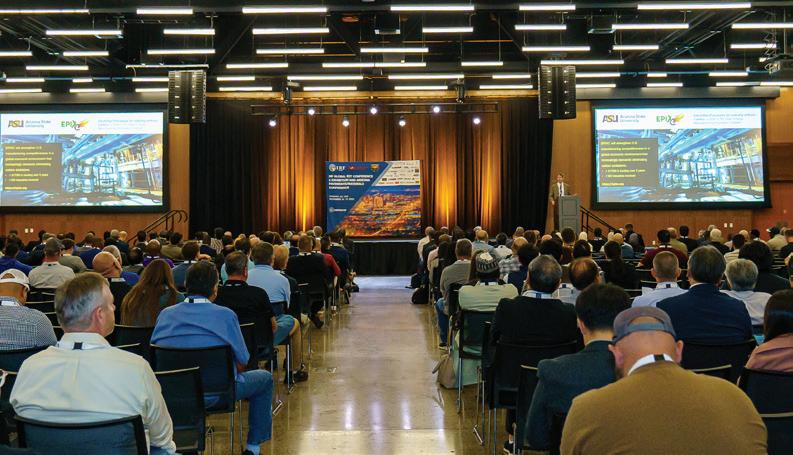
Under the theme "Connecting to Empower Mobility: Roads as Enablers of a Sustainable Future for All", the IRF World Congress 2024 will gather global leaders, industry experts, academia, and diverse public and private stakeholders. Attendees will engage in insightful discussions and collaborative e orts and the event is to be hosted in Istanbul on 15-18 October
The IRF World Congress promises an enriching experience with a comprehensive programme, featuring daily plenaries, specialised and technical sessions, hands-on workshops, training sessions, a ministerial meeting, and technical visits. Attendees will bene t from the insights of over 250 esteemed speakers representing top organisations, including UNECE, TotalEnergies Foundation, European Investment Bank, International Transport Forum, World Health Organization, ASECAP, IBTTA beside industry leaders. Critical issues to be addressed: decarbonisation, sustainable infrastructure, road safety, autonomous mobility, and data management amongst many others. A detailed programme is available on irf2024.irfo cial.org.
On 14th October – a day before the o cial opening of the Congress - the Asian Development Bank (ADB) will host its "Green Roads Workshop – Pathways to Sustainable Mobility". is session will introduce the ADB Green Roads Toolkit, focusing on decarbonisation, climate resilience, water and land management, pollution control, biodiversity conservation, disaster preparedness, sustainable material sourcing, quality of life improvement, and inclusive economic growth.
Participants will learn how to tailor green road measures to speci c contexts, supporting global sustainability goals, including the Paris Agreement and the Sustainable Development Goals.
On 15th October, PAVE Europe (Partners for Automated Vehicle Education) will be holding a special session on “Paving the Way: e Interplay of Technology, Infrastructure, and Society in AV Deployment”. is session will explore the complexities of deploying autonomous vehicles, addressing technological and infrastructural challenges while highlighting the importance of public understanding and societal impact. Key topics will include necessary infrastructure upgrades, smart tra c systems, and V2X communication networks.
On 16th October, ANAS – FS Italy, UNECE’s Global Forum for Road Tra c Safety (WP1), PIARC Italy, and the Union for the Mediterranean (UfM) are coming together to bring an insightful session on “ e Pivoting Role of Transformative Transport Policies in the Euro-Mediterranean Area”. is panel will emphasise regional collaboration in addressing shared challenges and opportunities, promoting sustainable socio-economic growth.
In pursuit of the UN Decade of Action for Road Safety goals, performance measurement for corporate social responsibility has emerged as a promising way to engage the private sector.
Organised by the International Transport Forum (ITF), Fédération Internationale de l’Automobile (FIA), and World Health Organization (WHO), this session on 17th October will explore the value of a framework for assessing the safety footprint of corporate value chains. is will be from the perspectives of government, private companies and nance institutions.
MEETING: DECARBONISED AND RESILIENT TRANSPORT FOR RESILIENT SOCIETIES AND ECONOMIES
e Congress will also welcome Ministers from every continent for a closed Ministerial Meeting hosted by the Ministry of Transport and Infrastructure of the Republic of Türkiye. is high-level gathering will feature roundtable discussions focused on decarbonised and resilient
transport, fostering strategic planning and actionable initiatives for sustainable and resilient transport systems.
EXHIBITION & SPONSORSHIP OPPORTUNITIES AVAILABLE
Valuable sponsorship and exhibition opportunities are still available, providing unparalleled visibility and exclusive access to a selected global audience.
Scan for more information and to register, visit the o cial Congress Website at irf2024.irfo cial.org


Early bird rates available till 15 August.

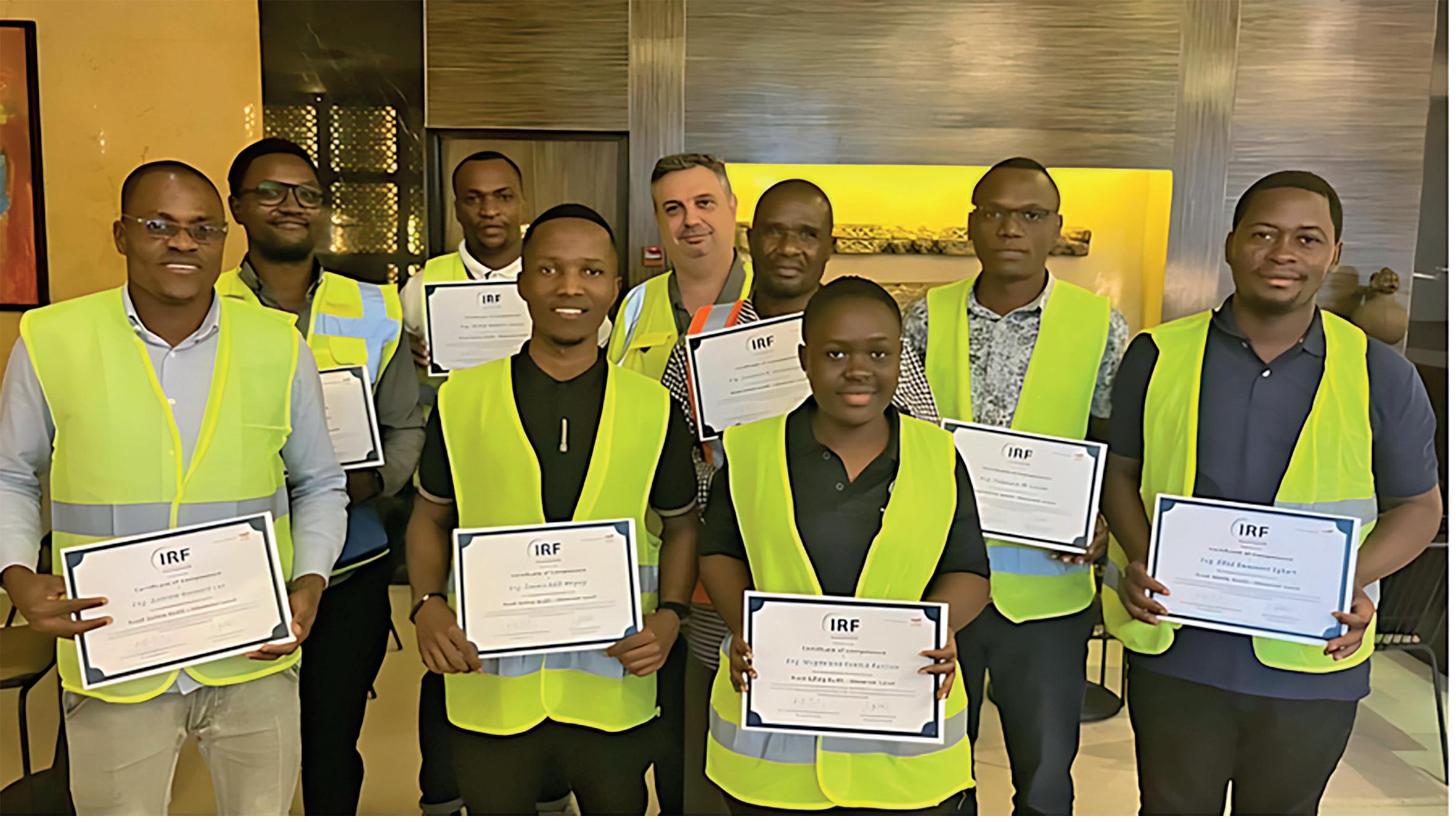
Tanzania has a new set of internationally certified road safety auditors thanks to a new training initiative being delivered by the International Road Federation (IRF) with the generous support from the TotalEnergies Foundation.
Aiming to significantly improve road infrastructure safety practices in Africa and Asia, the initiative will include the delivery of Road Safety Audits training and certification every year - and for the next three years - initially in Tanzania, Uganda and India.
The Tanzania trainingorganised by IRF in collaboration with TanRoads (Tanzania National Roads Agency), was hosted at the National Institute of Transport (NIT) in Dar es Salaam from 3 to 14
June 2024. It saw the participation from a diverse group of professionals representing the Ministry of Works, TARURA, TanRoads, and the private sector, who were carefully selected on the basis of specific entry criteria in order to ensure from the start a qualified cohort.
" roughout the course, participants gained hands-on experience in conducting road safety audits across various road schemes".

The curriculum, consists of ten modules delivered over 60 hours of in classroom theory and practical learning and final exams. Uganda and India are next on
the list. Training is planned to be delivered in Uganda towards the end of August and in India in September. This initiative underscores IRF's commitment to raising road safety audit standards globally. By
empowering professionals and enhancing road safety measures, IRF aims to make significant strides in promoting safer road infrastructure across di erent regions.

and discussions, exploring innovative solutions and best practices for addressing key challenges in Caribbean transportation infrastructure.
Highway Administration, National Transportation Safety Board, UNITAR, universities, and private sector companies shared their expertise on critical themes such as Road Safety, Climate Resilience, and

threat of climate change to the Caribbean's infrastructure. Experts emphasised the urgent need for sustainable solutions to protect regional transportation networks, discussing innovative approaches to developing roads that can withstand extreme weather and adapt to rising sea levels.
Scan for more information about IRF Global events, or visit www.IRF.global
Follow us on social media
Prominent speakers from prestigious institutions, (TMC) operated by PRHTA and Metropistas.
e Caribbean Development Bank and the Inter-American Development Bank presented e ective strategies to enhance climate resilience, bolster regional capacity for emergency response, and support recovery e orts.
As part of the event, IRF Global arranged a technical visit to the Diamond Divergent (DDI) intersection project in Puerto Rico, including a tour of the Tra c Management Center
Participants were impressed by the TMC’s advanced capabilities and recognised its potential to transform tra c ow and signi cantly improve safety in the region.
e International Road Federation (IRF Global) extends sincere thanks to all speakers, participants, and sponsors for their invaluable contributions and support.
We look forward to the next opportunity to gather and continue our shared mission of improving road infrastructure across the Caribbean.




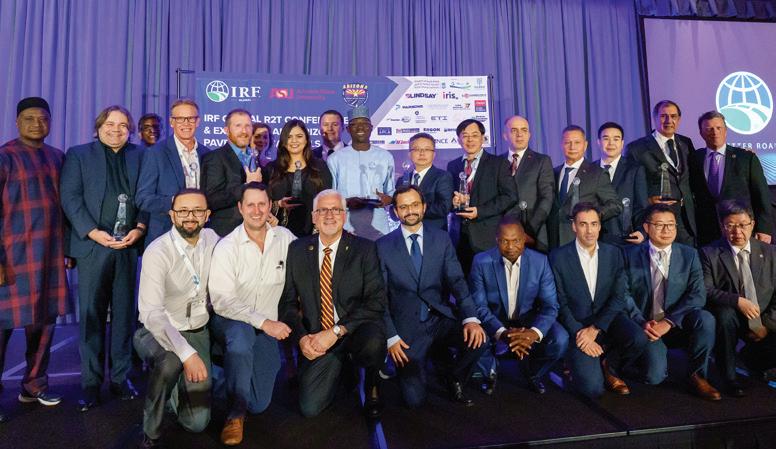
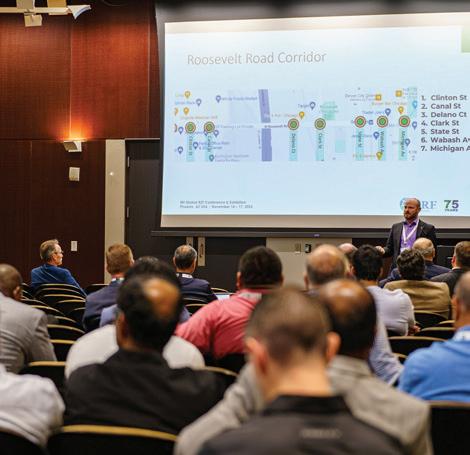
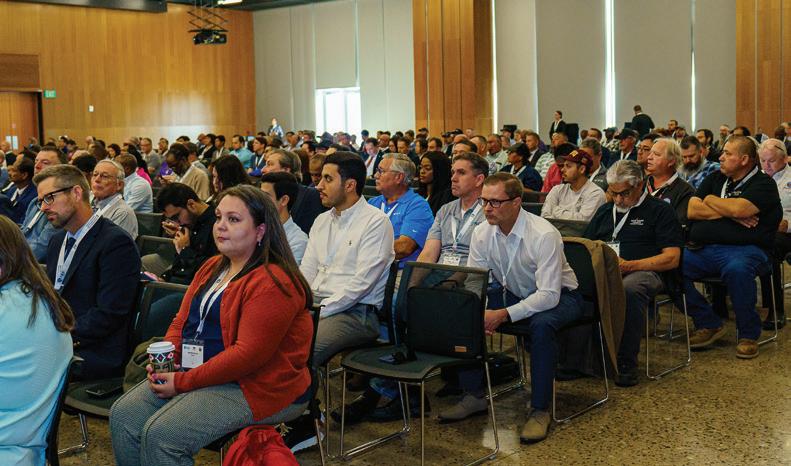
The IRF Global R2T Conference, a pinnacle event for global leaders in roads and mobility, offers a vibrant forum for innovators, decision-makers, and industry professionals. Discover cutting-edge advancements and forge pivotal connections in an environment dedicated to shaping the future of transportation.
Who Will Attend?
• Construction Contractors, Engineers, and Managers
• Equipment Manufacturers, Suppliers, and Distributors
• Highway & Municipal Agencies, Transportation Officials
• Design Consultants and Engineering Professionals
• Transport Research Institutes & University Academics
• Traffic Technology and ITS Specialists

Themes:
• Asset Management & Pavement Preservation
• Emerging Trends in Road and Bridge Construction
• Innovations in Materials and Technologies for Durable Pavements
• ITS & Smart Mobility Technologies
• Road User Charging & Connected Vehicles
• Preparing Infrastructure for Autonomous Vehicles
• Strategies for Decarbonizing Road Transport
• Vision Zero: Aiming for Zero Road Fatalities
• AI & Big Data in Transportation
• New Mobility and Social Acceptance











Kristina Smith REPORTS








The handover of London’s Silvertown Tunnel next year will involve digital assets as well as physical ones. Enabling the flow of information from designers to constructors to asset managers has thrown up some complex challenges for the project’s small but resourceful BIM team. Digitalisation and modelling has played a vital role.


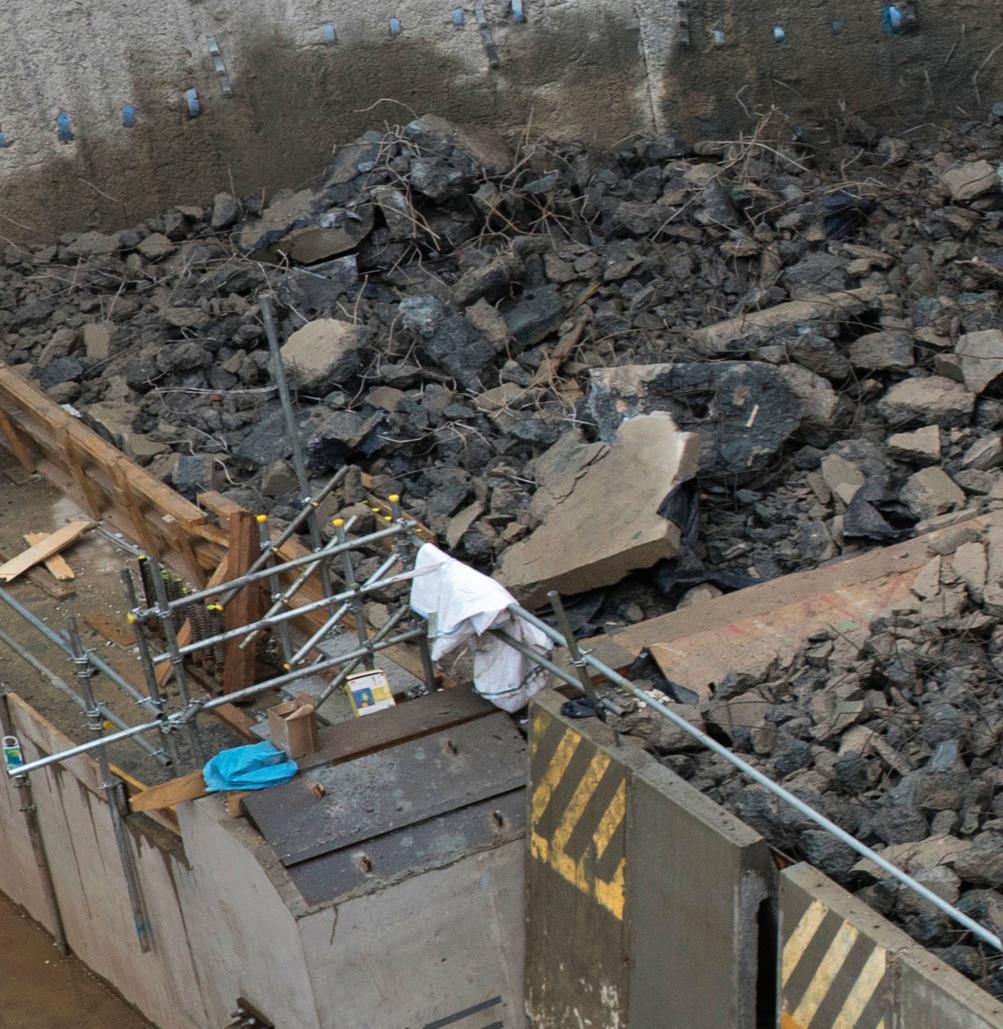
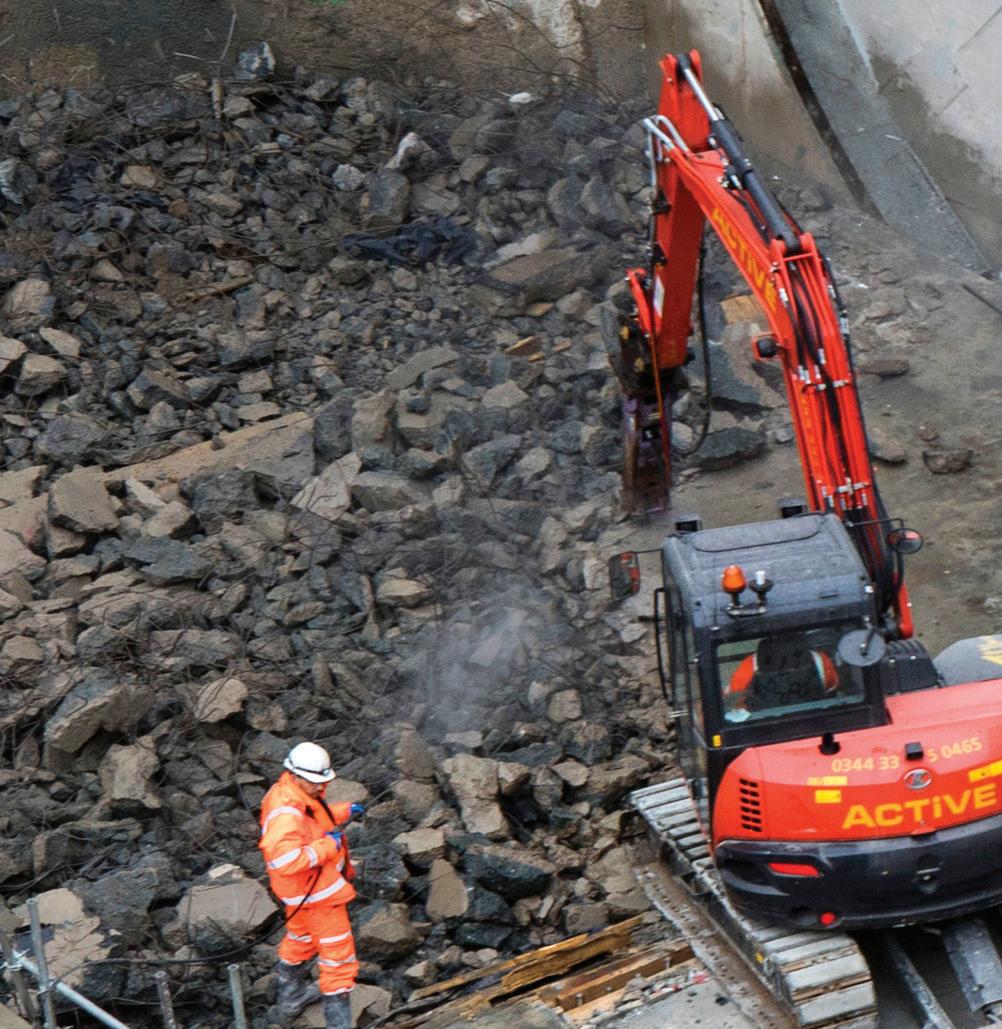
The Silvertown Tunnel in London will be the rst new road crossing of the river ames to be built for 30 years. Running close to the existing Blackwall Tunnel, it crosses from the Greenwich Peninsula on the South side of the river to Silvertown in Newham on the North, so that tra c heading North on the A102 will have a choice of two tunnels.
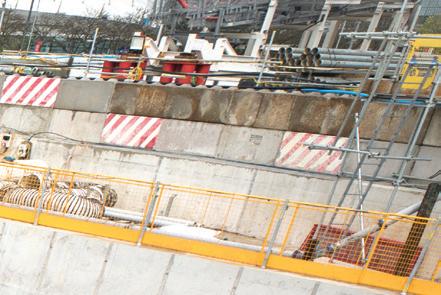
A visit to the project, where construction started in 2020, reveals that it is well advanced. Almost all the civil works have been complete; some sections of road at either end of the scheme and a new footbridge have already been brought into use. With installation of services and systems underway, testing and commissioning is due to begin at the end of 2024 with the new crossing planned for mid-2025.
As that date approaches, the BIM team at contractor Riverlinx CJV (Bam Nuttall, Ferrovial and SK Ecoplant) is moving into a nal, intense phase of work: assembling, gathering and converting the







data that is needed for the as-built digital model, at BIM Level 2, that will be handed over to the operator Riverlinx Special Purpose Vehicle (SPV) and TfL which will be responsible for tra c controls and ows towards and through the tunnel.
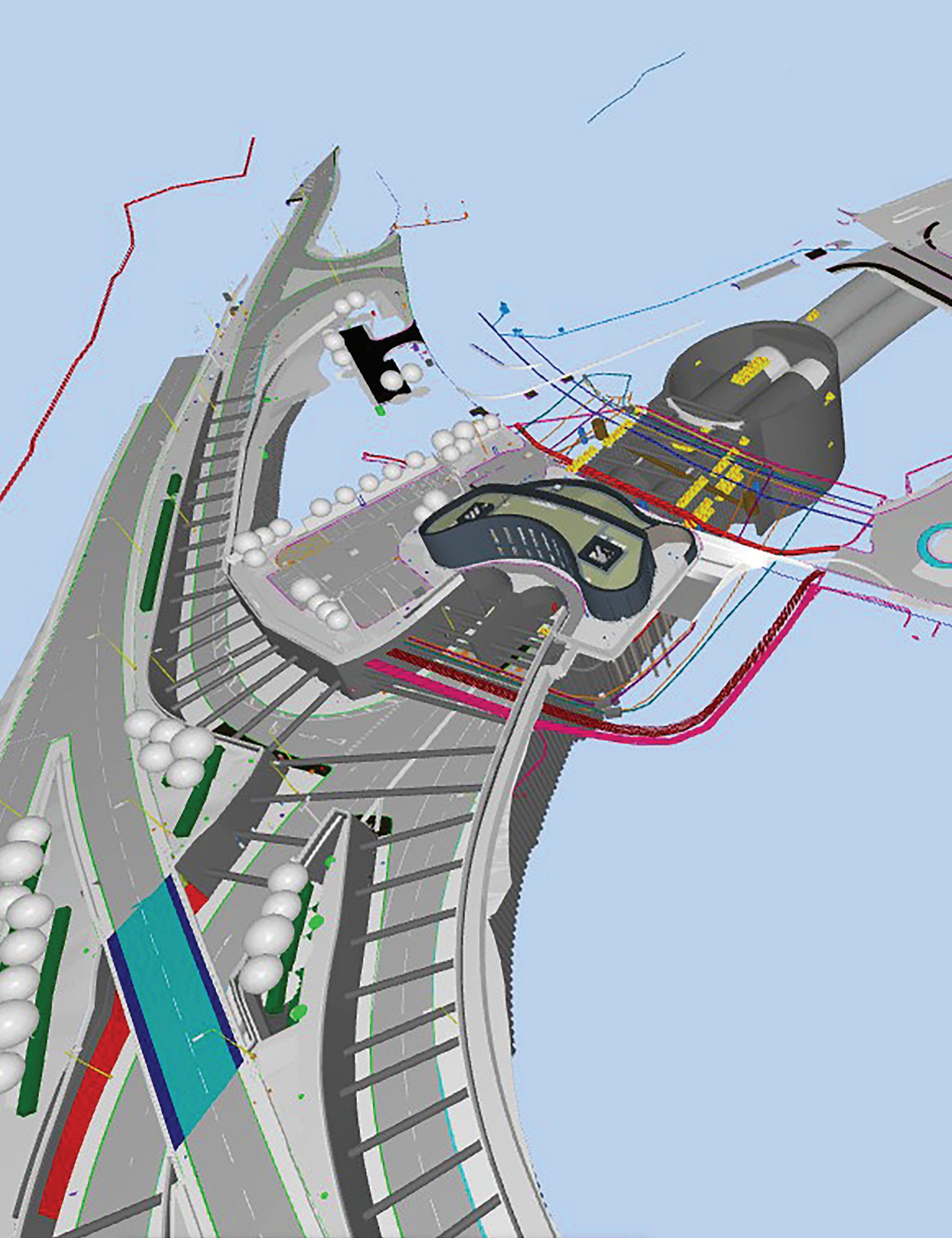
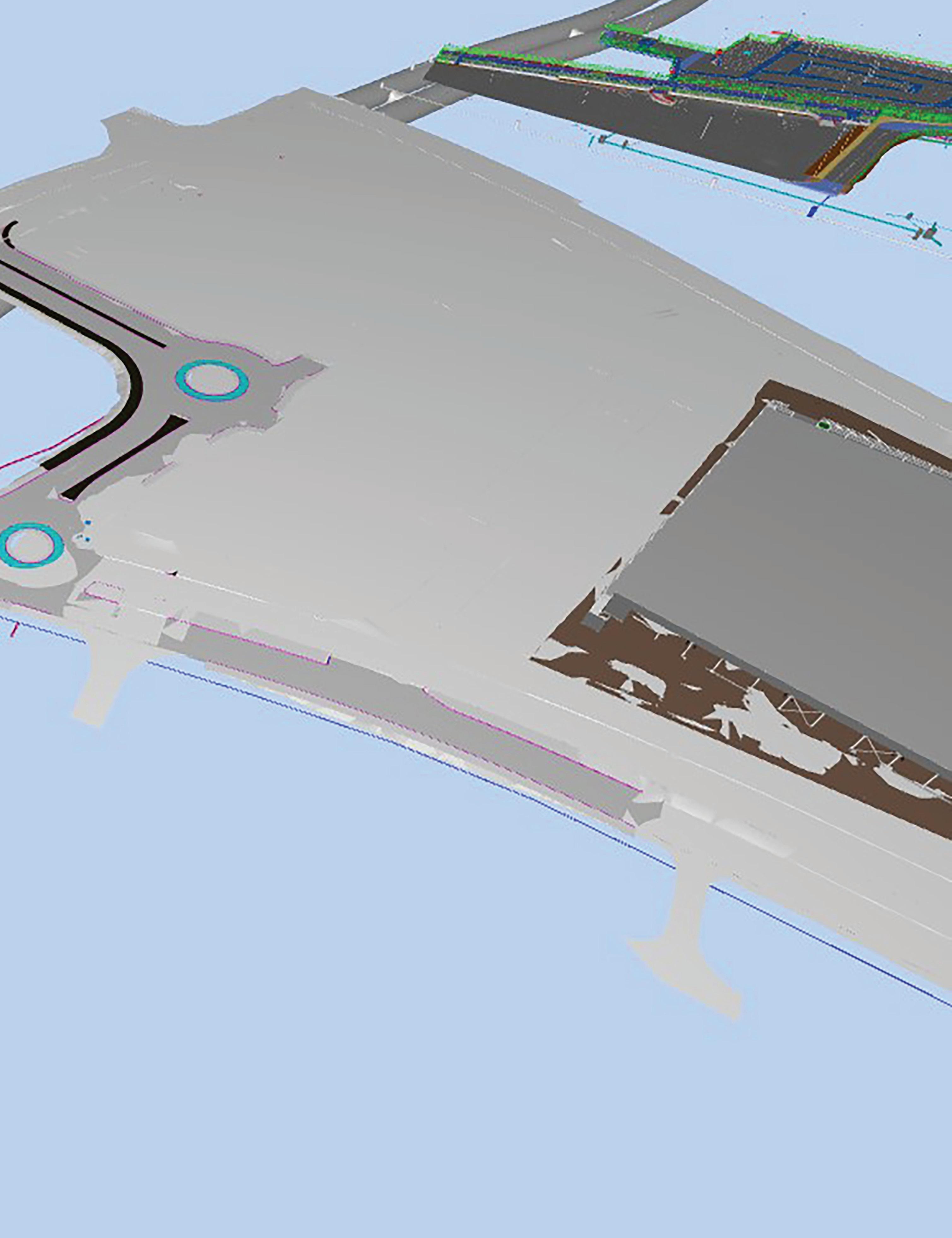
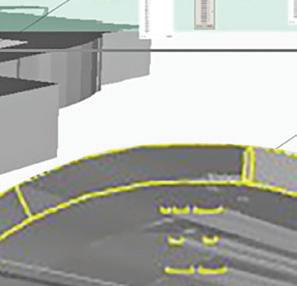
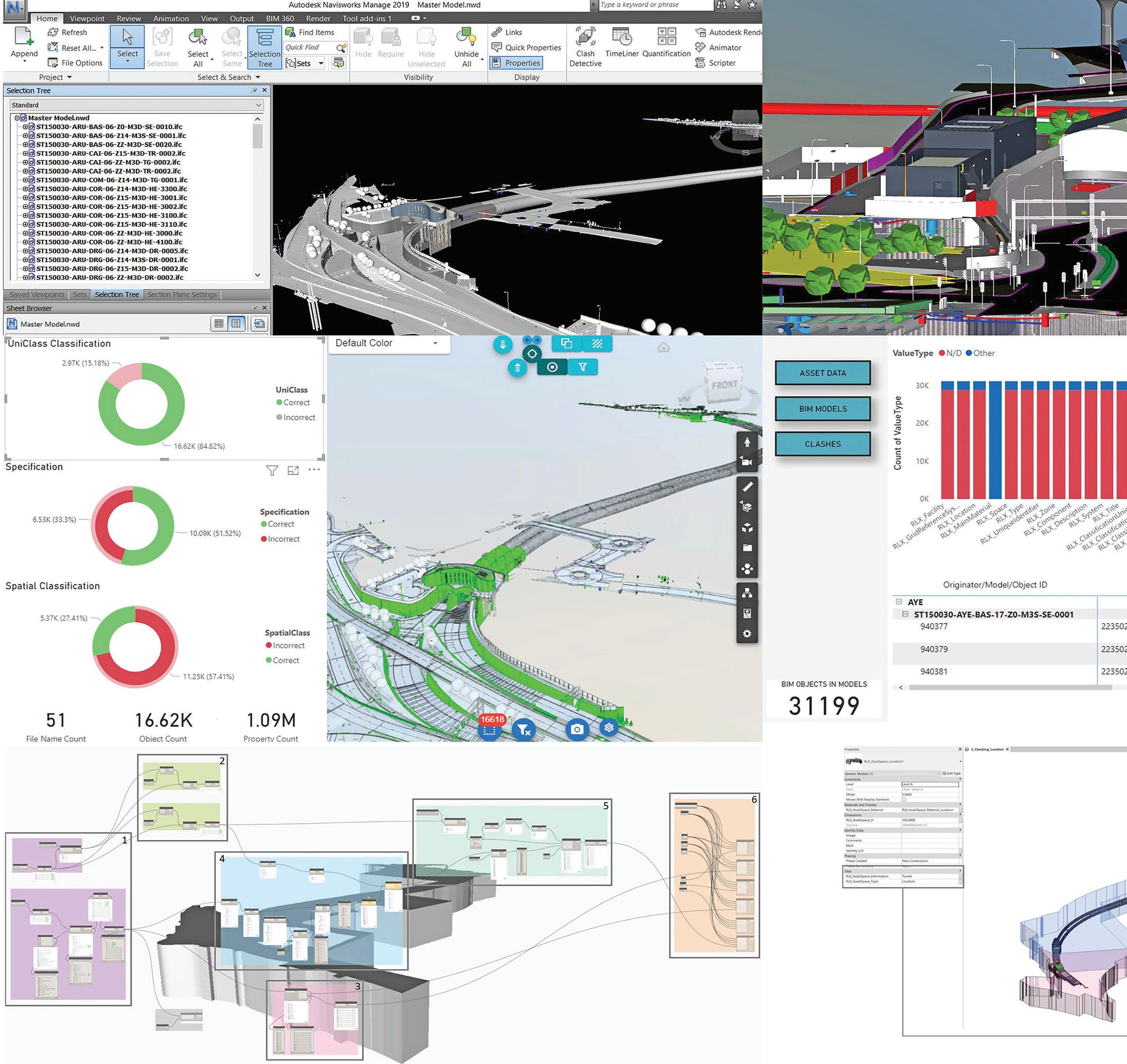
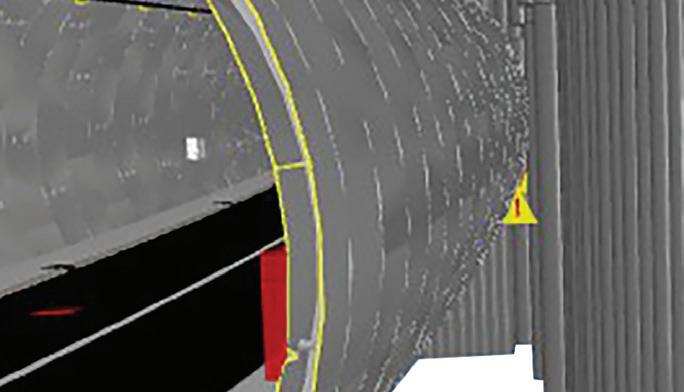
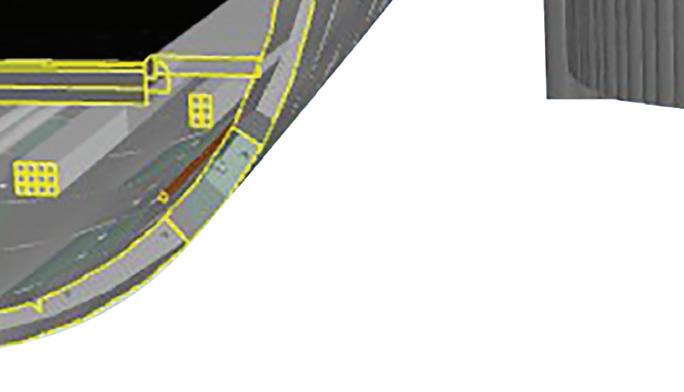
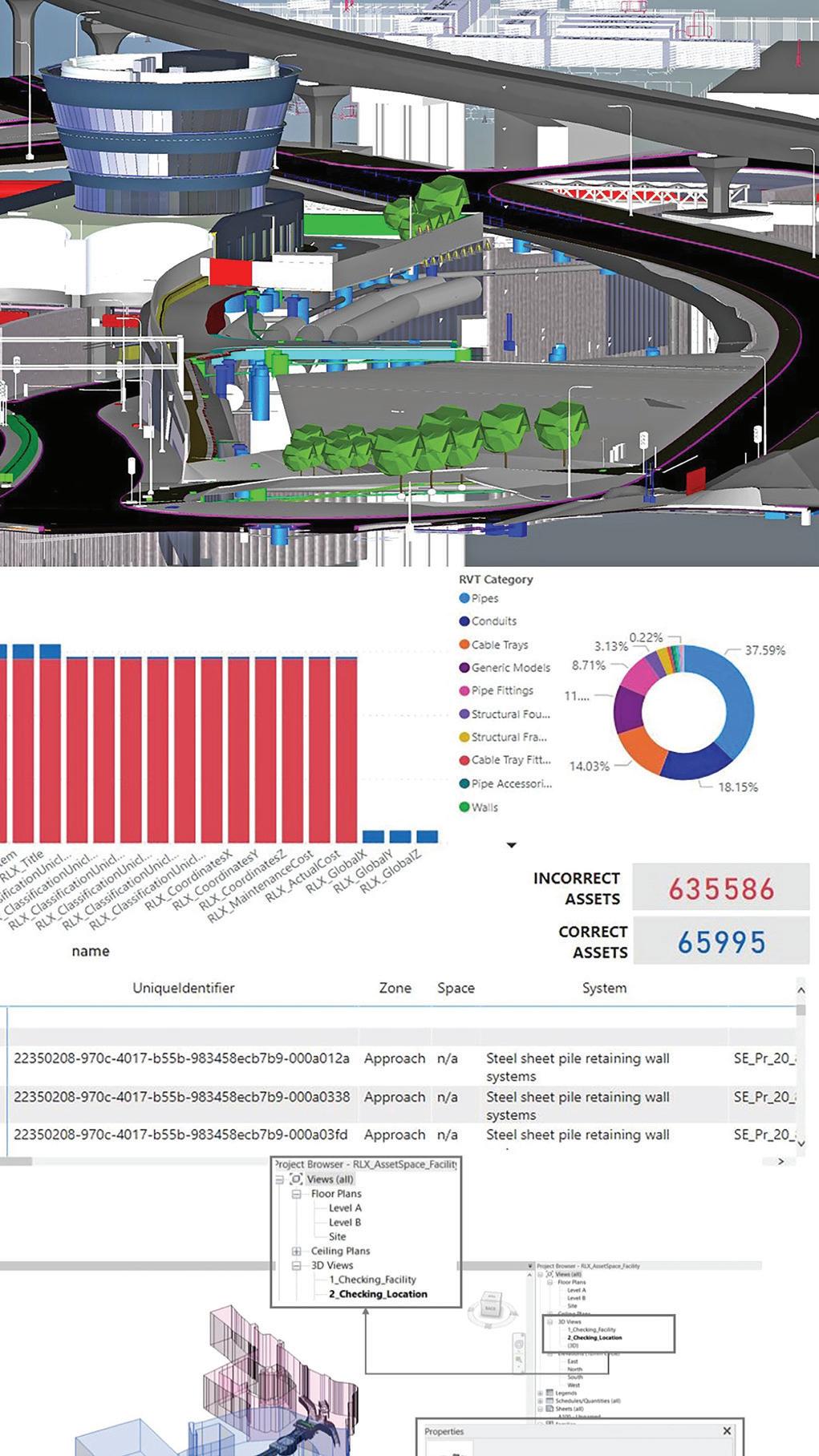
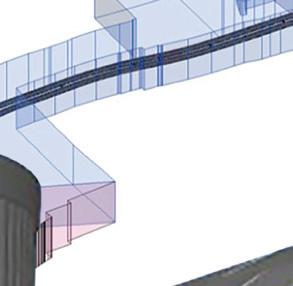
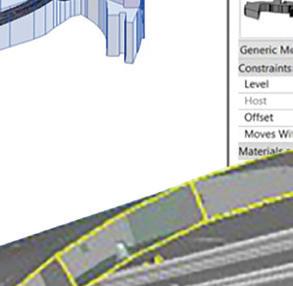
With some models containing up to 40,000 elements making up buildings, structures, highways, and MEP, and each of those elements having multiple parameters, this project boasts around 6 million pieces of data. Over 140 3D models created by multiple design disciplines and specialist suppliers are integrated into a federated BIM model.
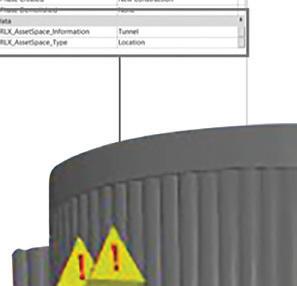
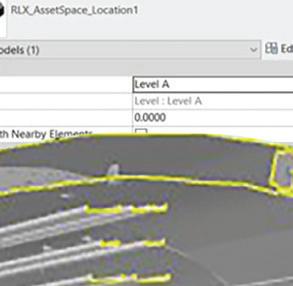
e as-built information must be extracted from these models and put into a form that is compatible with Salesforce - the asset management software Riverlinx SPV will work with - as well as Maximo and BridgeStation, TfL’s preferred system management software.
Although the transfer of data from design and construction into the operation phase of an asset was one of the core aims of BIM when it was rst imagined, this rarely happens in practice. ere are many reasons why it is so di cult to do, including lack of compatibility or interoperability between software,
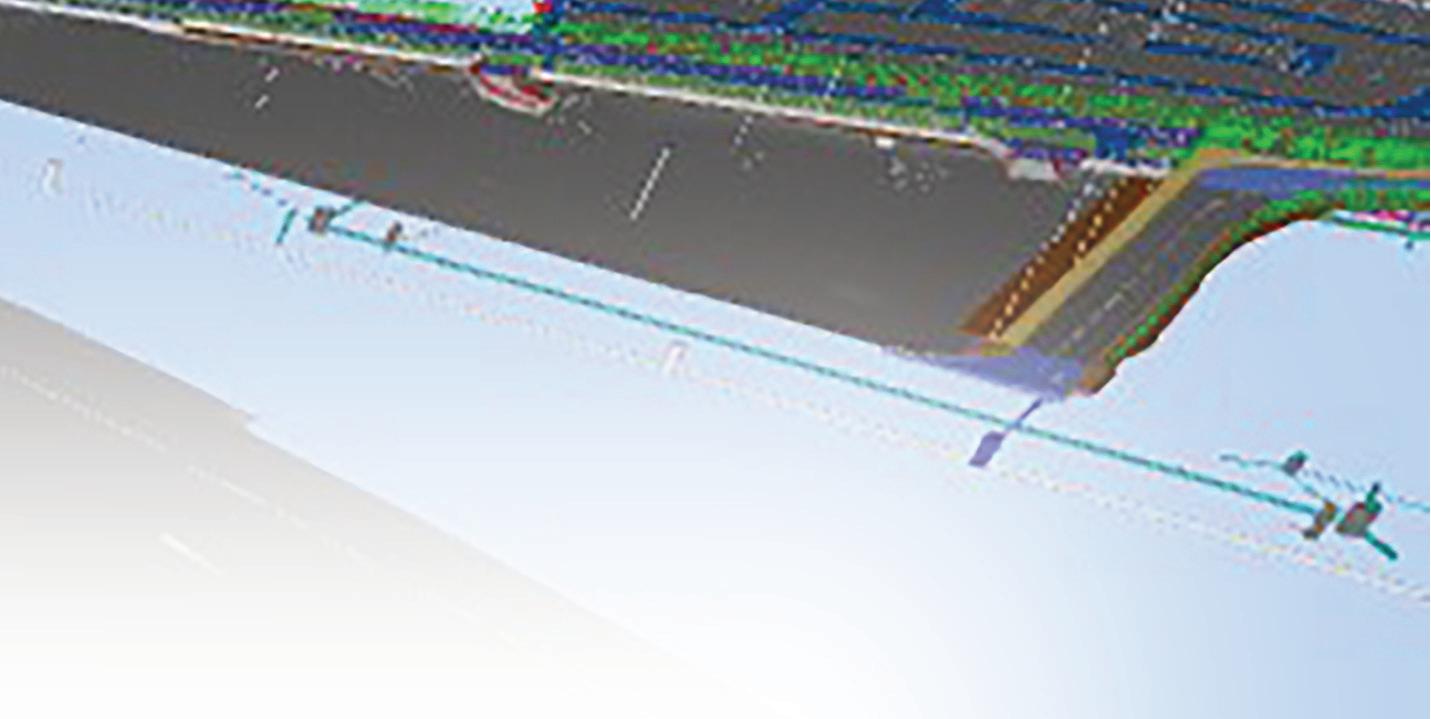



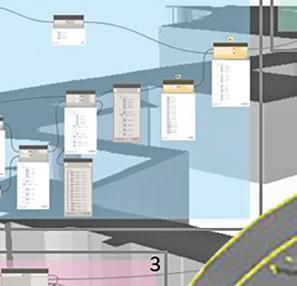
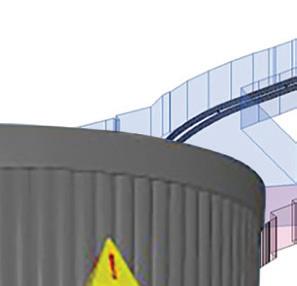
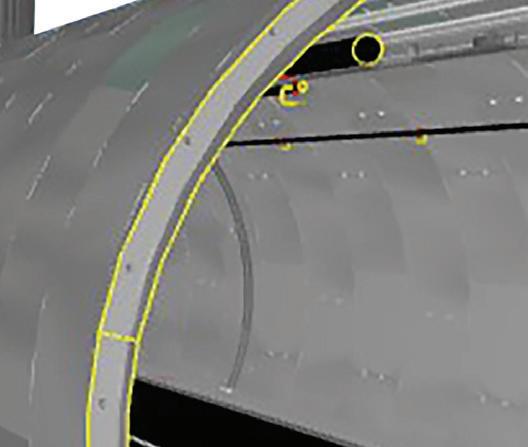
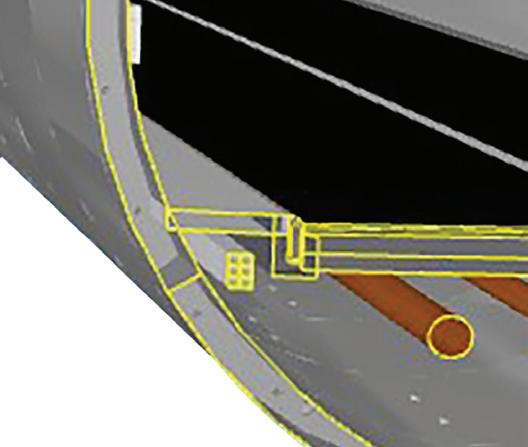
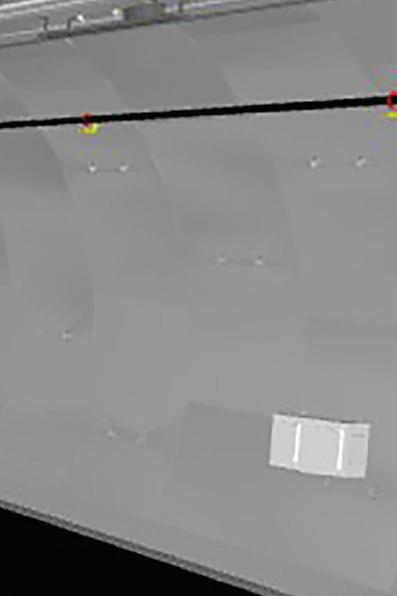
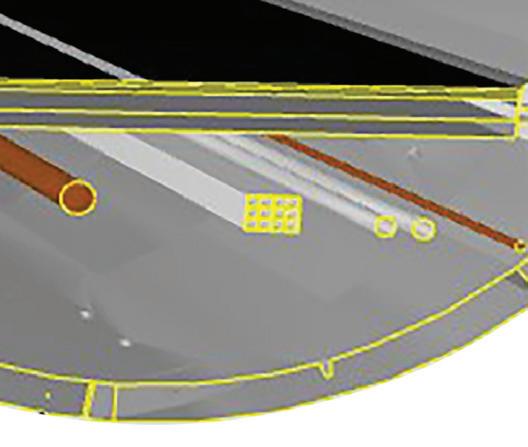
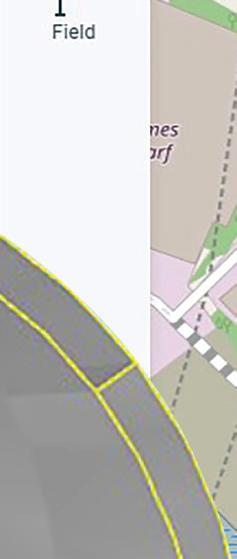
Over 140 3D models created by multiple design disciplines and specialist suppliers are integrated into a federated BIM model


di erent levels of maturity among those contributing information, and asset owners not specifying how they want the information.
"Including not only ‘traditional asset data,’ but more than 140 native 3D models from more than ve di erent types of software in the same asset management system, will be a huge challenge I think," says Riverlinx CJV BIM manager María Fuentes Crespo.
TfL awarded the £1bn, 30-year design-build- nanceoperate (DBFO) contract for the Silvertown Tunnel to Riverlinx SPV in 2019. TfL will introduce tolls on both the Silvertown and Blackwall Tunnels, once Silverlink is open, and will pay Riverlinx SPV for agreed service levels in the Silvertown crossing. is form of procurement, where Riverlinx will

only get a return on its investment once the link is operational, drives the way the project is being managed from top to bottom. “It's not just about the technical assurance or the operational risk mitigation, but the commercial realities of not wanting to delay the project and the time scales involved,” says Nicholas Boot-Handford, programme delivery manager for TfL of his team’s governance role. “ ere are three strands to the risk: operational, technical, and commercial. e role of my team is to make sure all those three strands are held in tension, whilst supporting Riverlinx in making sure standards of safety are as high as possible.”
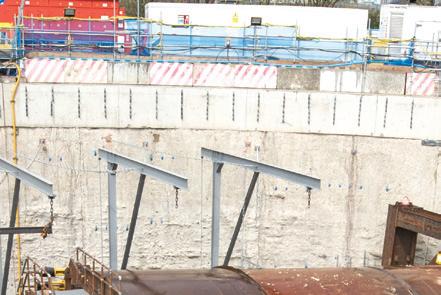
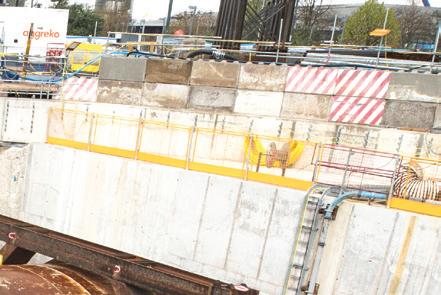
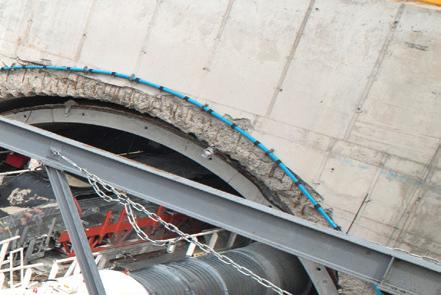
As well as two huge, bored tunnels, the project involves cut-and-cover sections of tunnel, portal and control buildings at either side, approaches, a new pedestrian bridge and overbridge on the Greenwich side, and changes to road layouts on either side. ere will also be a new storage yard for the Docklands Light Railway and a new river wall to enable future housing development.
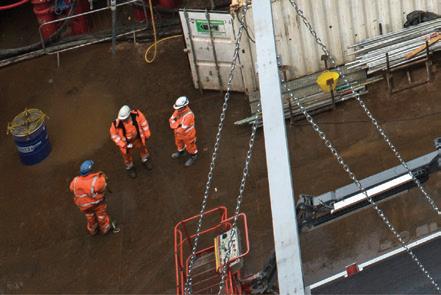
“ ere was a massive amount of work to divert all the utilities that used to run under Dock Road which has moved towards the bank on the Silvertown side, adds Boot-Handford. “And there were also two massive ames Water rising mains to lift up and put over the cut and cover section, whilst doing it all under the DLR and keeping the DLR operational. It was an enormous challenge.”
e installation of services involves mechanical and electrical equipment, plumbing and drainage,










"Including not only ‘traditional asset data,’ but more than 140 native 3D models from more than ve di erent types of software in the same asset management system, will be a huge challenge I think,"

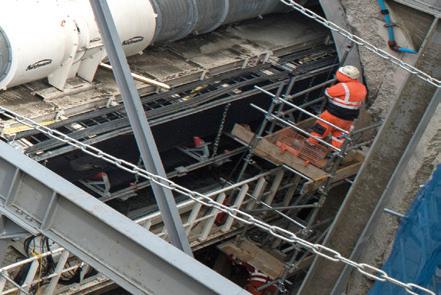
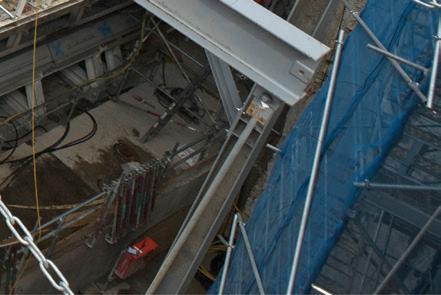






ventilation, re ghting, and security systems and all the associated controls. By the end of February 2024, manholes and drainage had been installed in the tunnel and the invert in lled to road level. e next step was to lay the asphalt.

In selecting the asphalt mix, Riverlinx SPV aims to limit maintenance – and hence costly closures – as well as meeting the speci cation, says Boot-Handford. “ ere's a technical speci cation for the pavement but ultimately there are commercial implications. Were we a traditional client using an NEC contract, the contractor would look to see what the most e cient way is of delivering the client requirement. But Riverlinx also has an O&M requirement to meet. ere are nancial consequences if there are too many closures. at has fed into the design and safety critical infrastructure.”







" ere was a massive
of

amount


For instance, says Boot-Handford, there are hydrocarbon detectors in the drains to pick up fuel spillages quickly and automatically alert incident responses. “A lot of the tunnel control is automated to ensure a fast response,” he says.


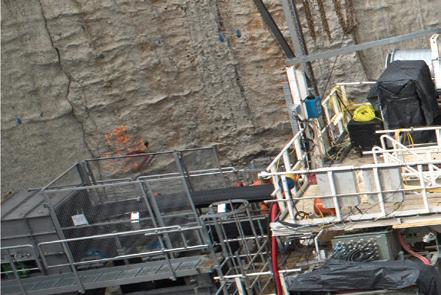
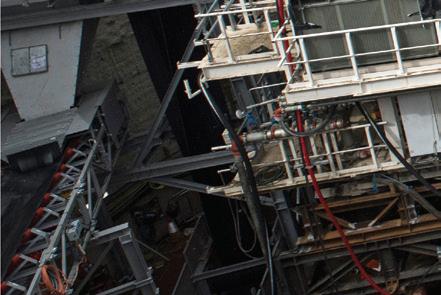
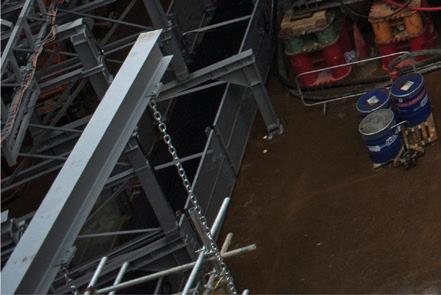
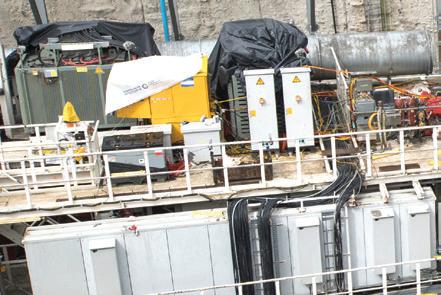
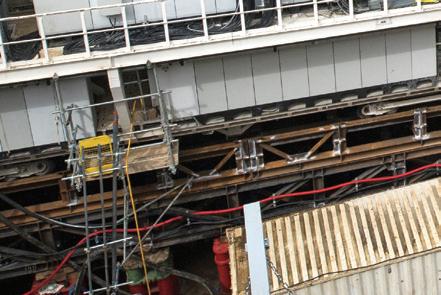
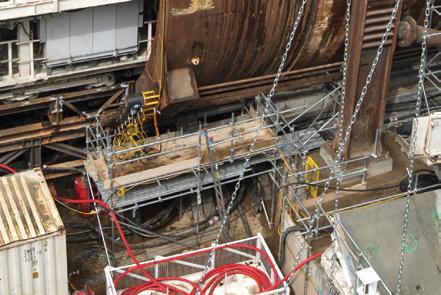
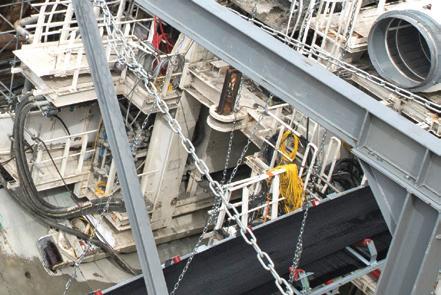
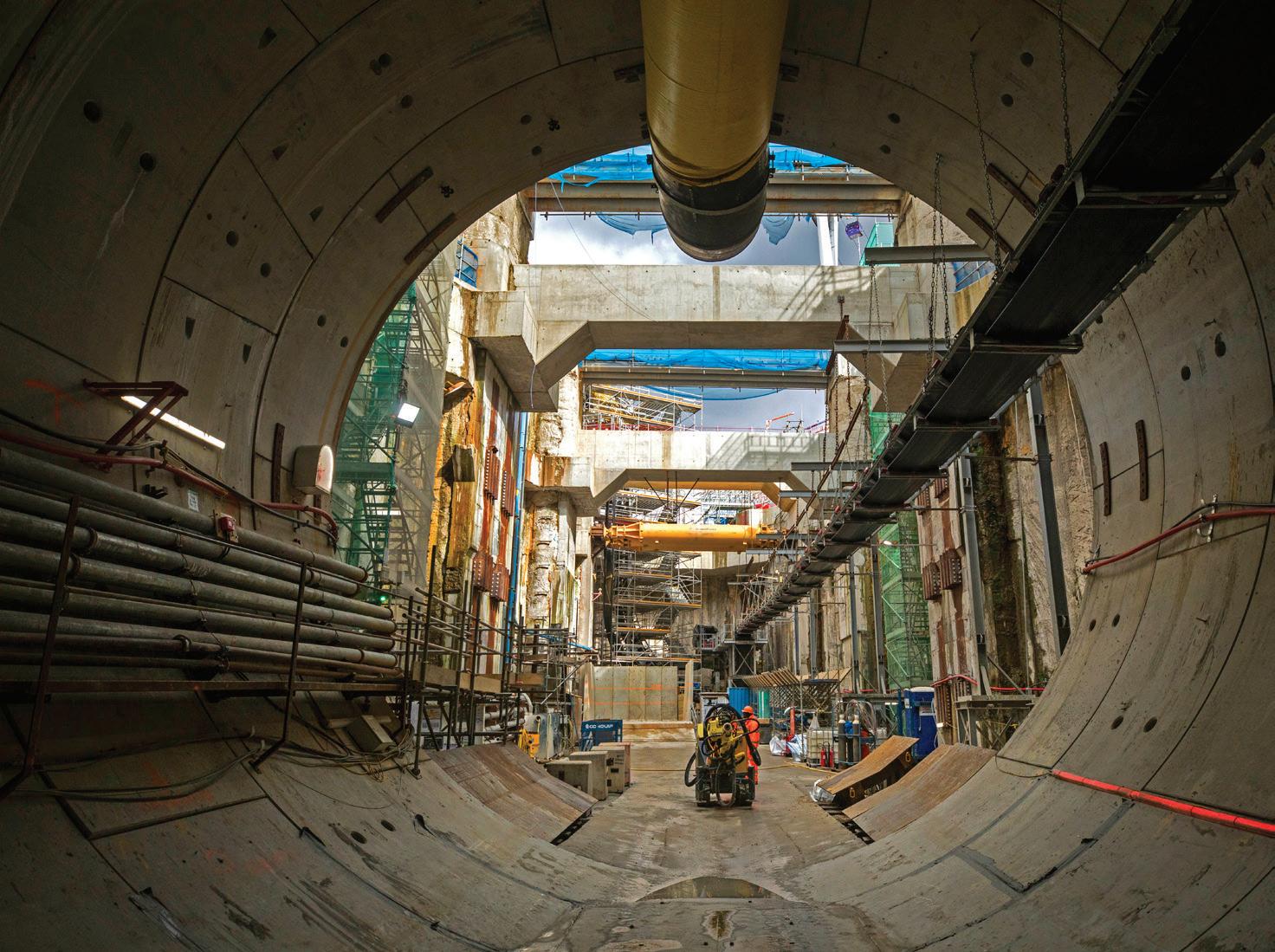
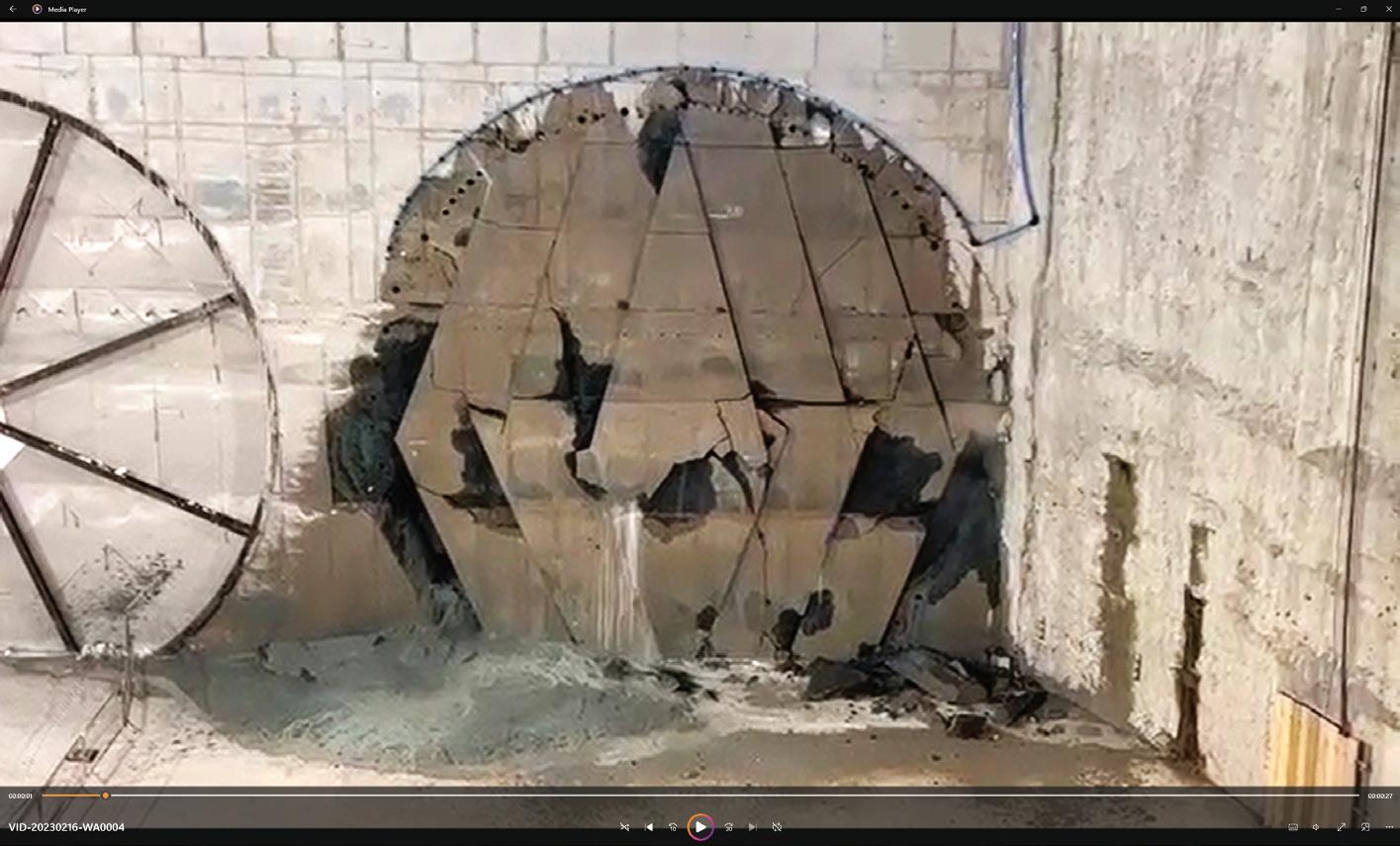
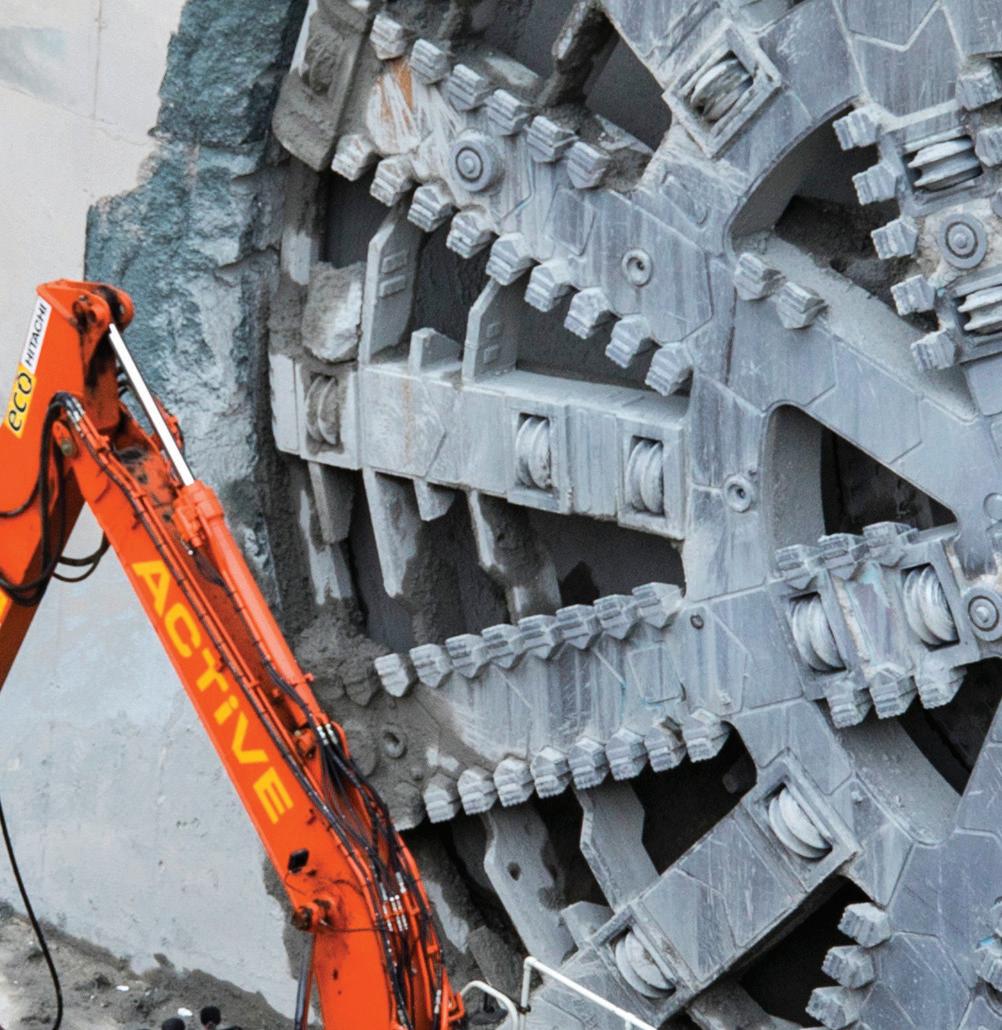
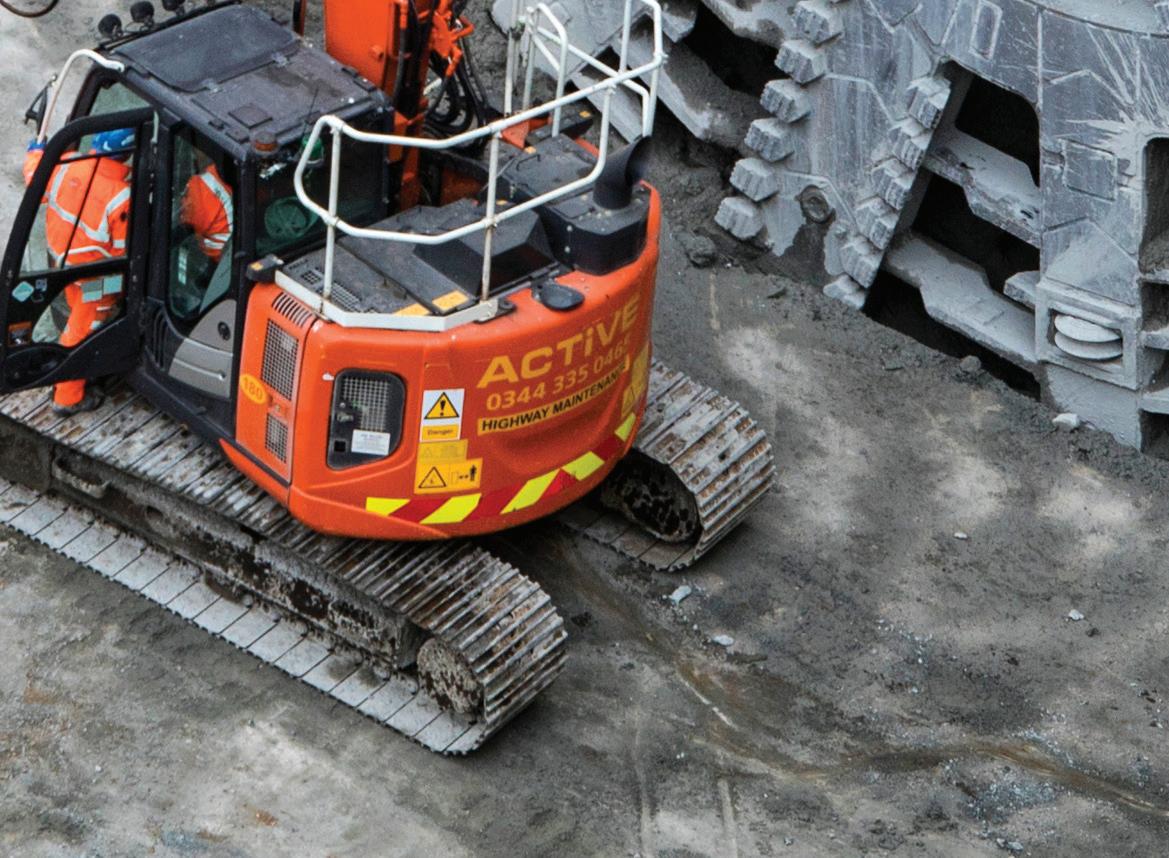
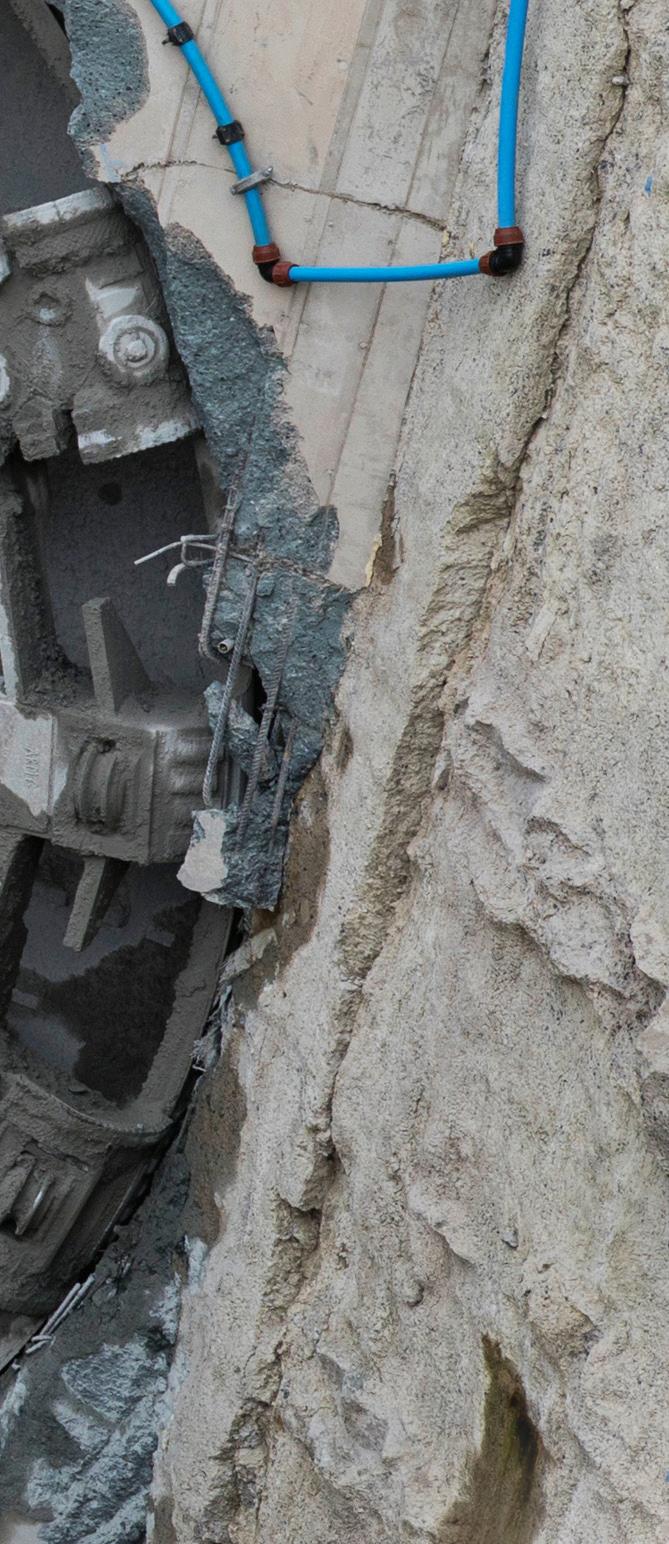
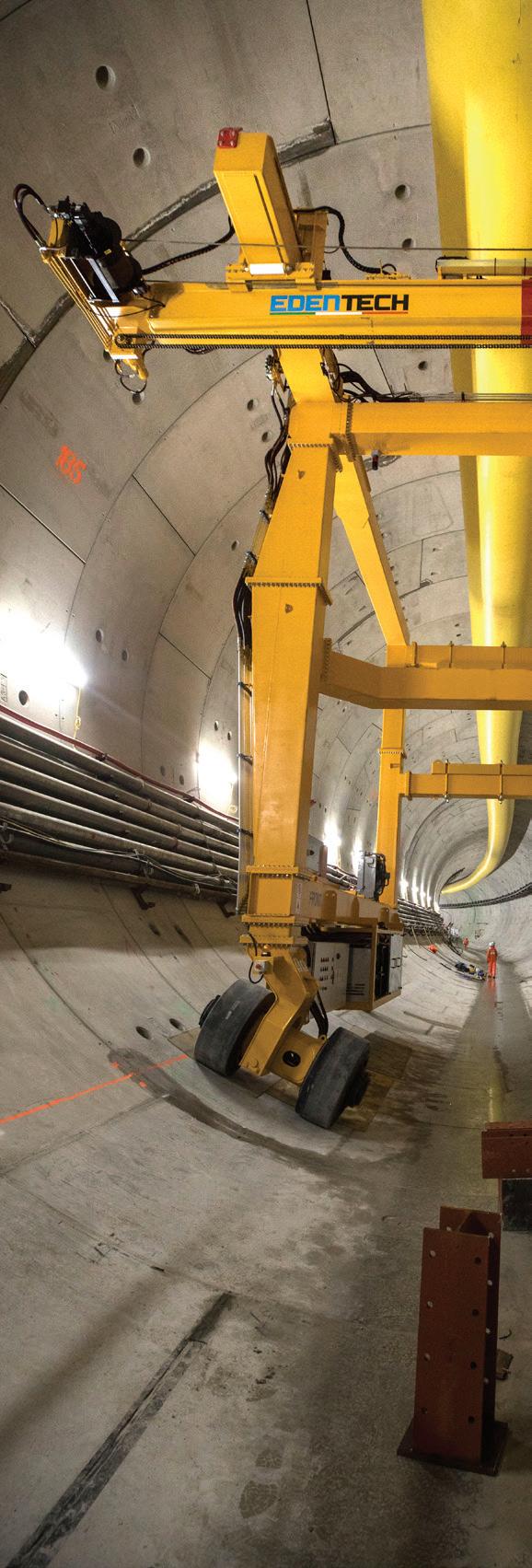
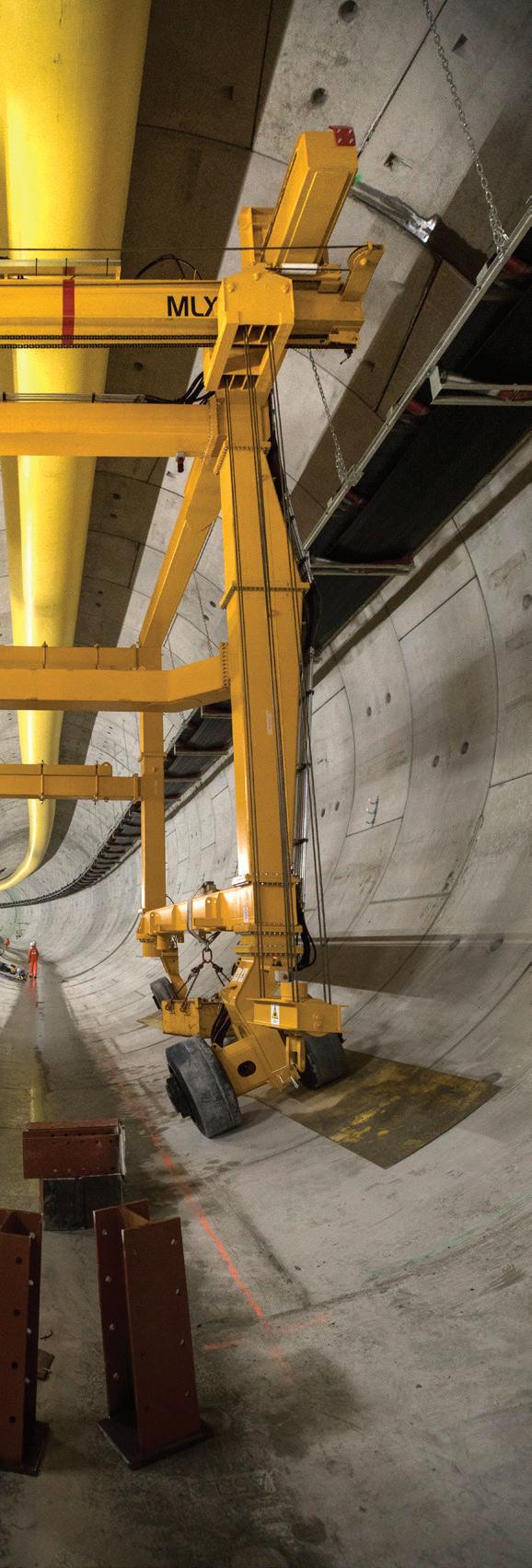
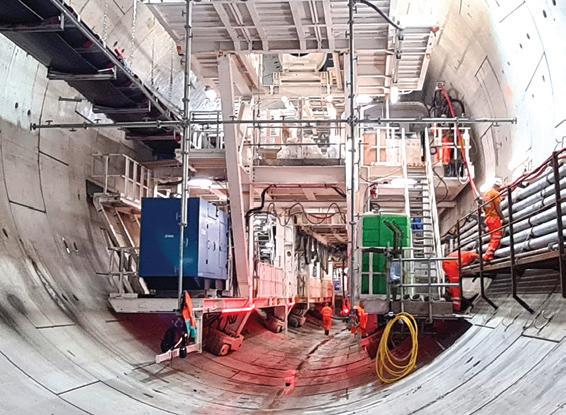
Unlike the Blackwall Tunnel, whose two tunnels were completed in 1897 and 1967, the Silvertown Tunnel will be able to accommodate double-decker buses. is has meant that the Silvertown project required the UK’s largest-diameter tunnel, with an internal diameter of 10.66m and hence the UK’s largest-ever tunnel boring machine (TBM) too: a 10.91m-diameter Herrenknecht earth pressure balance (EPB) machine, named Jill after the UK’s rst female bus driver, Jill Viner.


work to divert all the utilities that used to run under Dock Road which has moved towards the bank on the Silvertown side"

Nicholas Boot-Handford, Programme delivery manager for TfL


Herrenknecht’s data management and visualisation software, Herreknecht Connected, allowed engineers


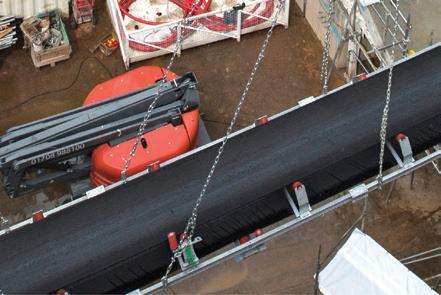
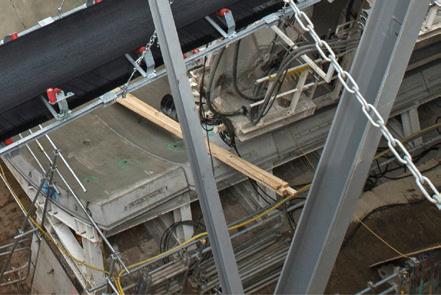
to monitor what was happening remotely at the same time as the pilot driving the TBM. On Silvertown, a rst for Herrenknecht and the project team was incorporating data from the conveyor, which carries excavated earth away from the TBM, into Herreknecht Connected – something that could be deployed on future projects.
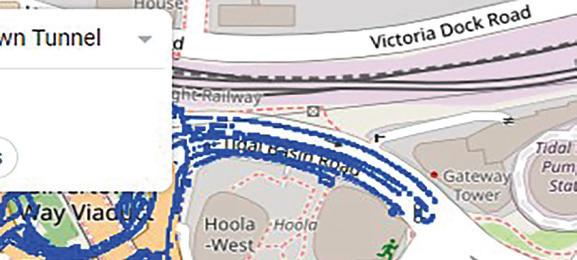
e TBM’s systems have measured and recorded thousands of data points as it bored North to South, before making a U-turn in a huge shaft at Greenwich and boring back again. Fuentes Crespo has automated the extraction of some of the information recorded by the TBM during its journey. As well as helping to


“Unlike the Blackwall Tunnel, whose two tunnels were completed in 1897 and 1967, the Silvertown Tunnel will be able to accommodate double-decker buses ”

create the as-built model, this could also be useful for the construction team in analysing how the build has gone.
In the earlier phases of the project, Fuentes Crespo, and her small BIM team of three people had to grapple with the use of multiple types of BIM software. Designers were using Bentley for the highways and landscape design which accounted for around 35percent of the models and Autodesk (Revit and Civil 3D) for buildings, civil structures, and MEP.

Competing software has not been designed to be

















Scan to watch video








“
e BIM team also presents data to their colleagues in the operations team through Microsoft’s Power BI which visualises data and presents information and graphics ”
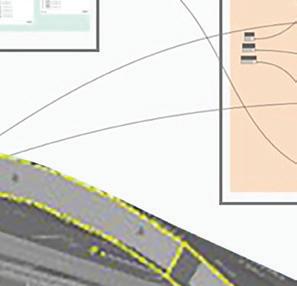
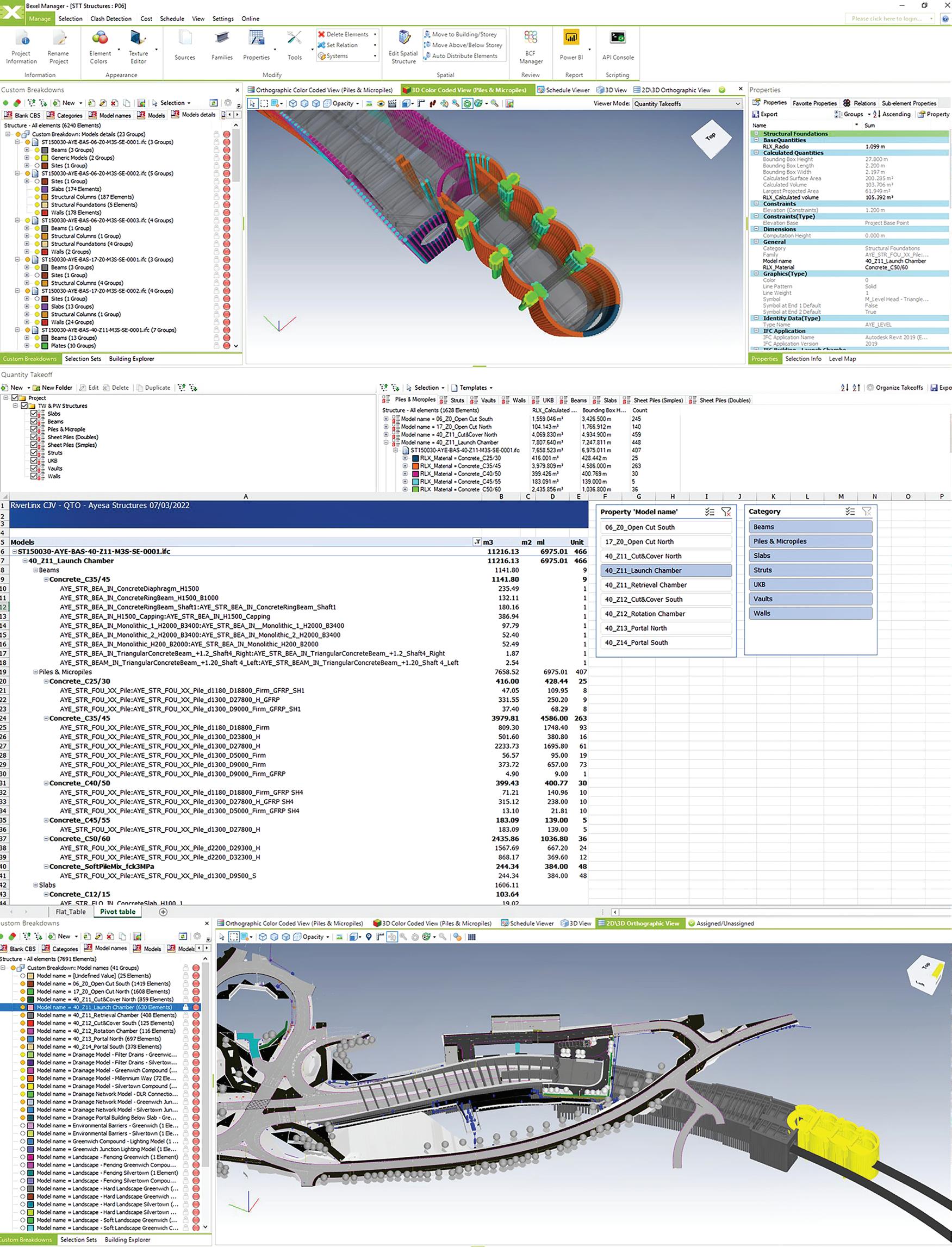
100 per cent compatible which means that Fuentes Crespo had to come up with a workaround. e solution was to use a package called Bexel which allowed the BIM team to combine Autodesk and Bentley models so that design review, take-o s and costings could be carried out. Bexel can extract information from IFC (International Foundation Class) les that come from both Bentley and Autodesk. e BIM team also presents data to their colleagues in the operations team through Microsoft’s Power BI which visualises data and presents information and graphics. More recently, it has introduced the use of Dynamo which is a tool to automate modelling in updating 3D as built models and Dalux, an enormously powerful BIM tool for some on-site quality controls.
“Dalux is used by the construction and quality teams,” says Fuentes Crespo. “It’s a powerful tool and, because the model is in the cloud, I know that if I update anything, they will always be working with the latest version.”
In creating the as-built models, the BIM team is drawing on a variety of sources. For some elements, it will be the fabrication models. Survey details – such as the exact centre line of the tunnel or a laser survey of its lining to show where the joints of the precast tunnel segments are – will also be incorporated. ere is a whole new round of individual models for the mechanical, electrical, and plumbing activities which must be incorporated. “ e theoretical approach is that all the suppliers are able to provide






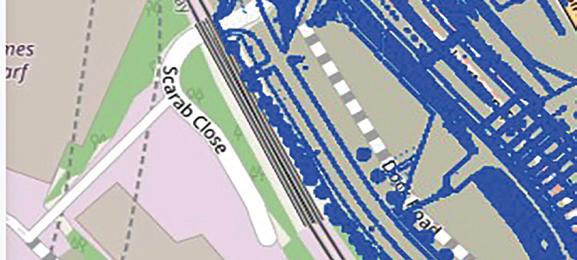
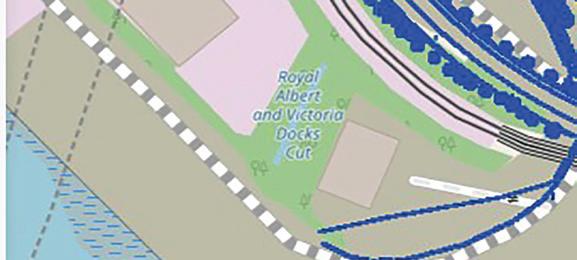
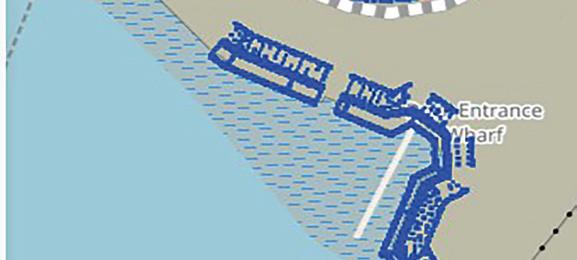





us with a fabrication design model that will plug into ours and then we will coordinate that,” says Jose Luis Rodriguez Sanchez, Riverlink CPV’s engineering manager. “Practically, they are not all able to do that. We have two consultants working with us doing precoordination for the suppliers that are not mature enough to have good modellers.”
One of the issues which has yet to be resolved for the as-built data phase is how different assets will be divided up to be compatible with the Salesforce asset. This might be straightforward for a single item such as a door or a camera, but less obvious for a length of pipe or cabling.
The operational, technical, and commercial challenges highlighted by Boot-Handford are just as apparent for Fuentes Crespo and her team. The nature of this project has driven the BIM team to invest time and resource only in activities that really add value.
“BIM is sometimes about people saying, ‘look what we can do’ but good things only happen when you really need to sharpen the pencil,” says Rodriguez Sanchez. “We don’t have a 4D model. I think we are still years away from that. The industry is not ready to pay for it.” 4D BIM looks good, but it is expensive

to do and would not have contributed to driving the project forward to meet the crucial deadlines.
“I come from a pure BIM background, but in four years here, I have understood that we need to do useful things, not fancy things,” says Fuentes Crespo.
“Every time I have an idea, such as automating the tunnel data, I have to ask myself whether it will be useful. We always have to nd faster ways and more e cient ways to do things.”
is approach has already attracted interest from other parts of the industry. No doubt there will be more to learn from what they do in the nal phases of the project. End " e theoretical approach is that all the suppliers are able to provide us with a fabrication design model that will plug into ours and then we will coordinate that"
Jose Luis Rodriguez Sanchez, Riverlink CPV’s engineering manager





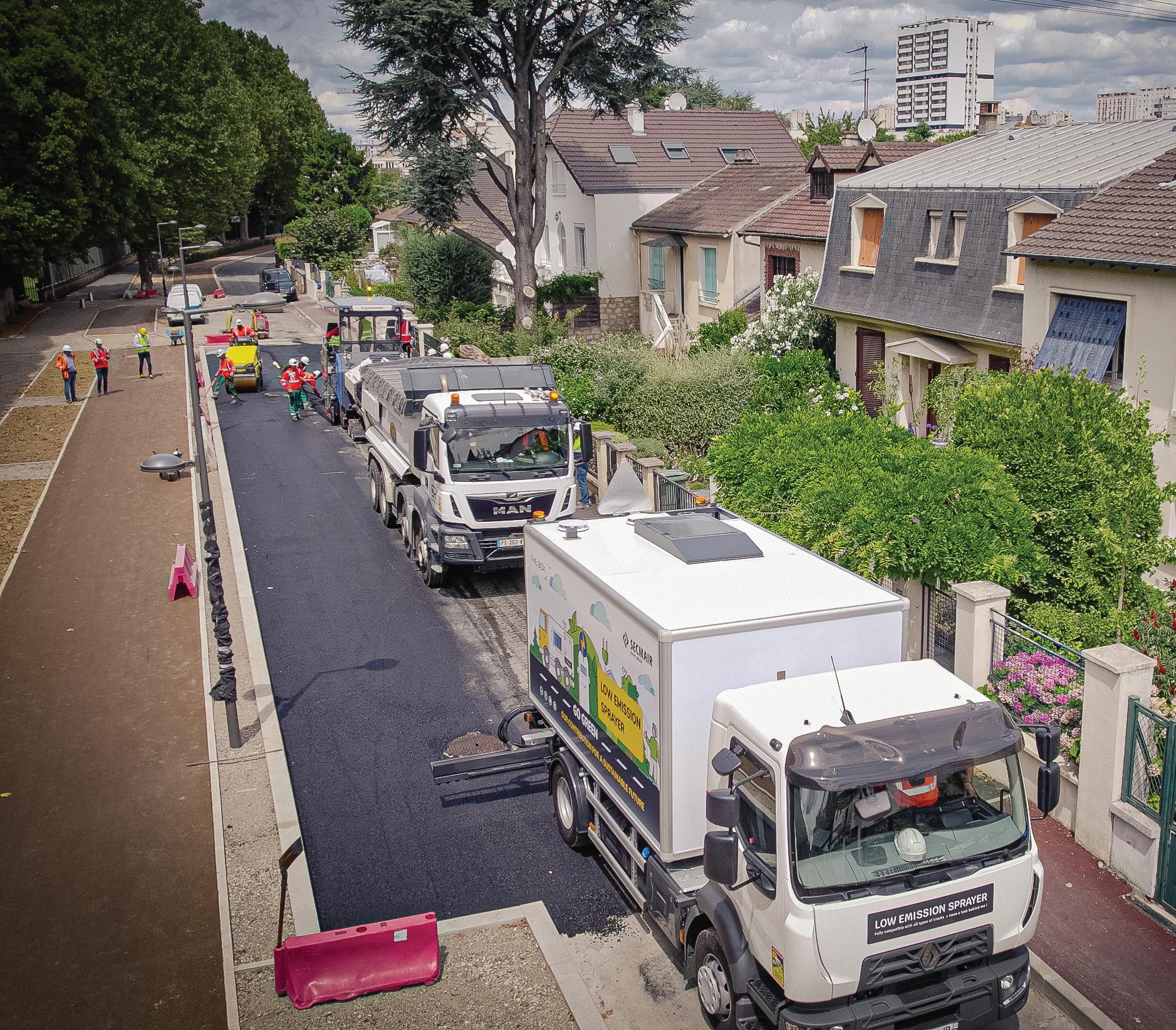
French contractor VINCI Construction has used construction machines from the FAYAT Group to deliver a low-carbon roadworks project using 100% electric equipment
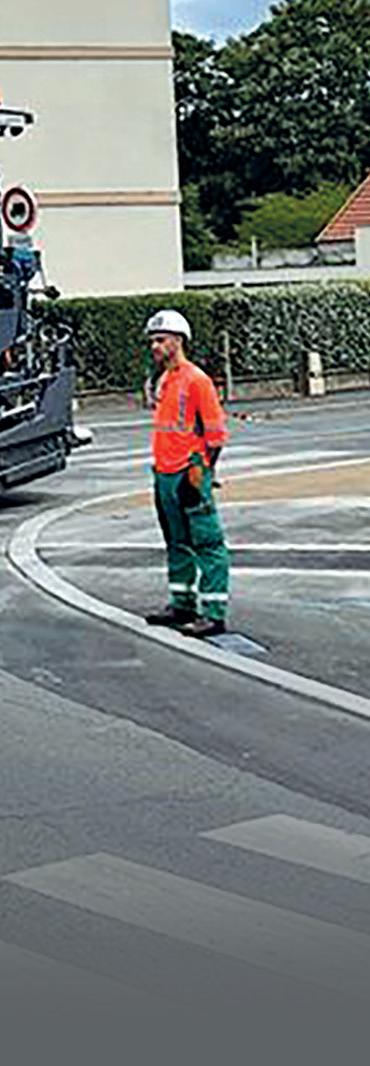
Both VINCI and Fayat believe this to be a world first for a roadworks site. VINCI Construction subsidiary Emulithe carried out the project using 100% electric equipment as part of the works to resurface Rue du Lieutenant-Petit-Le-Roy in ChevillyLarue (Val-de-Marne). The project involved making the street one-way and building a cycle path.
Following two days of familiarisation and training, Emulithe’s teams used – a 100% electric, rechargeable and silent sprayer, paver and roller, reducing
ABOVE
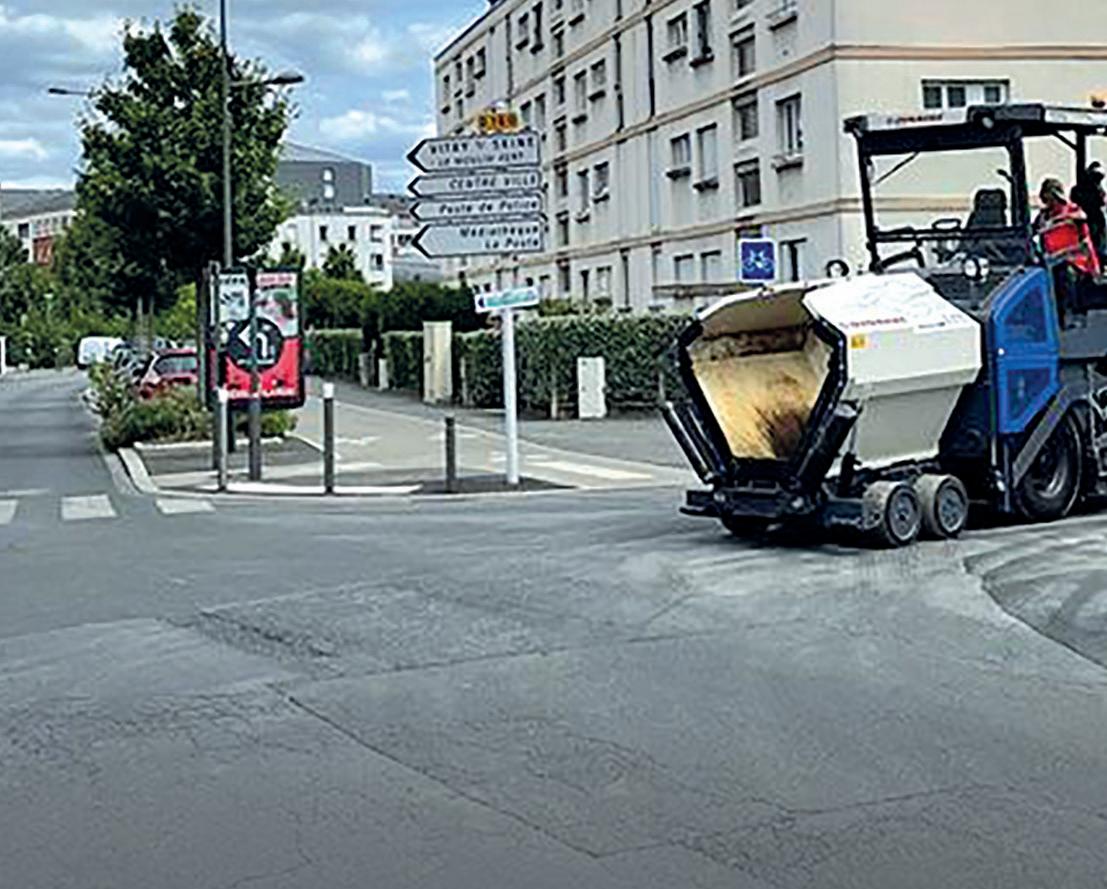
The electric Secmair sprayer headed the paving train used by VINCI Construction subsidiary Emulithe for the job
greenhouse gas emissions and noise pollution compared with those produced by conventional worksite equipment. This was the first time that allelectric models of these three essential roadworks machines had been used on a single worksite.
THE BOX, from Secmair, is a sprayer designed with decarbonisation in mind. It boasts good range and insulation, usability and simple operation – all designed, engineered and manufactured in France.
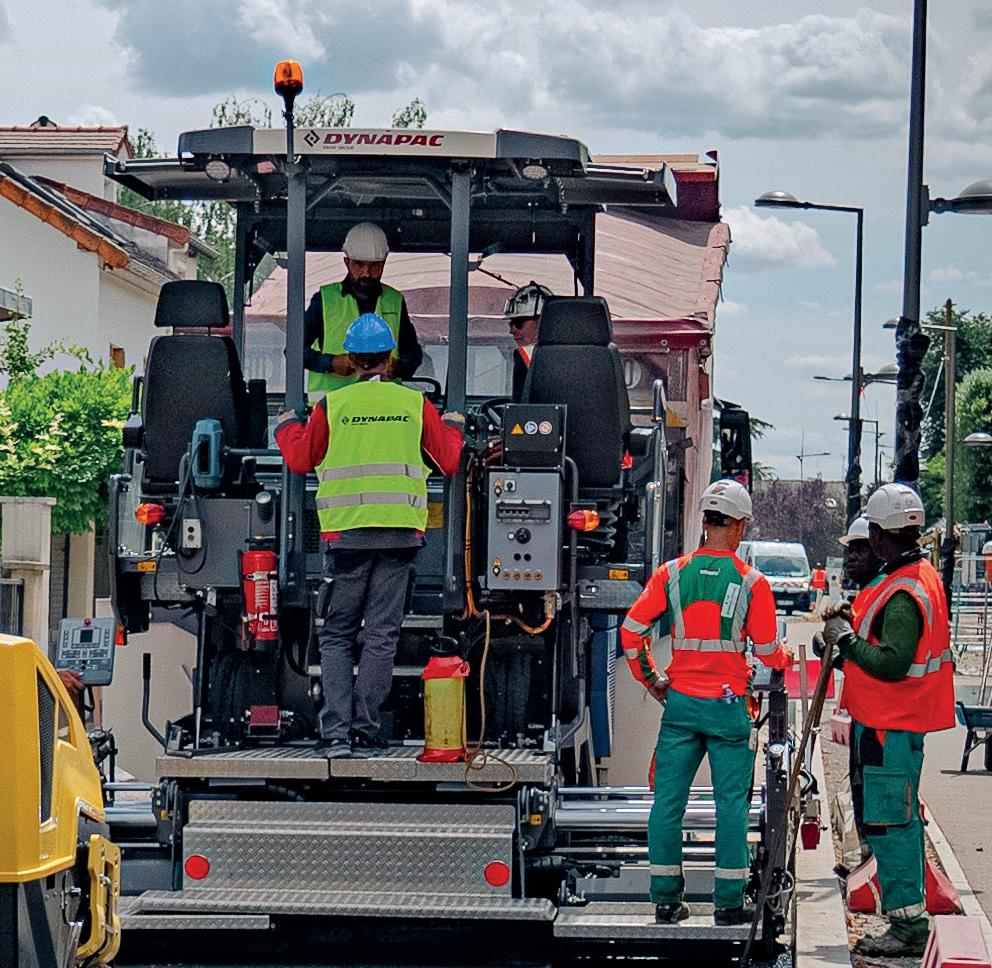
The SD1800W e is the first mass-produced electric urban paver and is manufactured by Dynapac. Its 98kWh battery provides long range and fast recharging. Its low noise level, zero fine-particle emissions and zero smoke emissions make it ideal for urban use and mean it has a much lower carbon footprint.
The BOMAG BW 100 ADe-5 electric roller is rechargeable and equipped with sophisticated battery, motor and inverter technology. The manufacturer has integrated all these components to give the user a smooth and quiet driving experience, with performance matching those of conventional diesel models. Its silent operation and simple information display on the dashboard give drivers visibility and control, making the working day effective and stressfree.
The job provided a suitable opportunity to trial the
Construction has been working for a number of years on implementing measures and developing management tools aimed at reducing CO2 emissions by 40% by 2030
performance of these new electric machines and see how their batteries would last during a working day. It also con rmed the signi cant reduction in CO2 emissions, with this low-carbon worksite saving 0.25 tonnes of CO2-eq/day compared with a worksite using conventional machines.
VINCI Construction has been working for a number of years on implementing measures and developing management tools aimed at reducing CO2 emissions by 40% by 2030. e use of electricpowered vehicles, light equipment, excavators and even lorries on worksites is growing.
VINCI Construction’s trial on a roadworks site of 100% electric versions of three key roadworks vehicles is a further step in its ongoing search for solutions to improve the energy and environmental performance of its operations, with the aim of gradually integrating low-carbon vehicles into its eet. End www.bomag.com www.dynapac.com www.fayat.com www.secmair.fayat.com www.vinci-construction.com
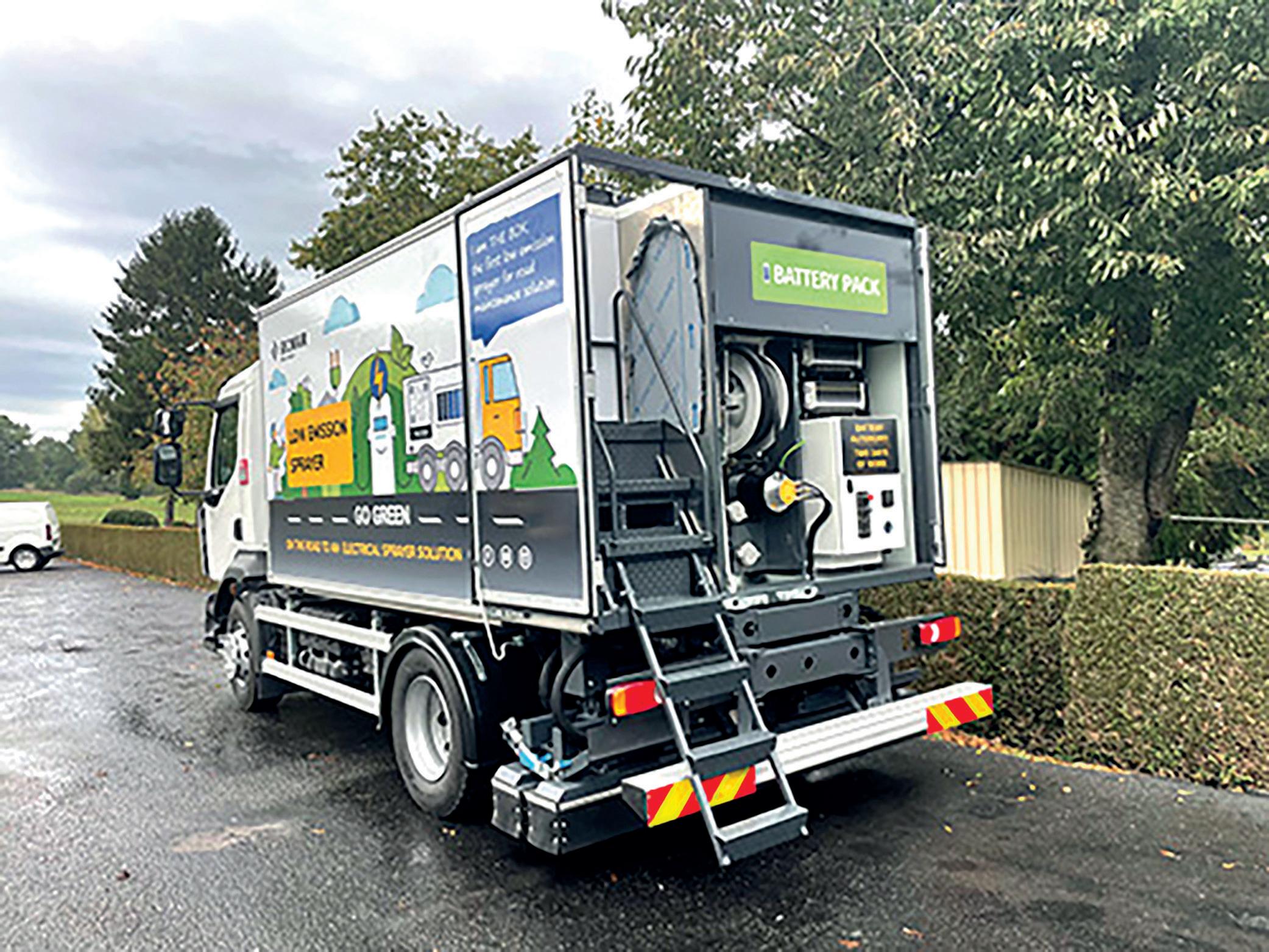
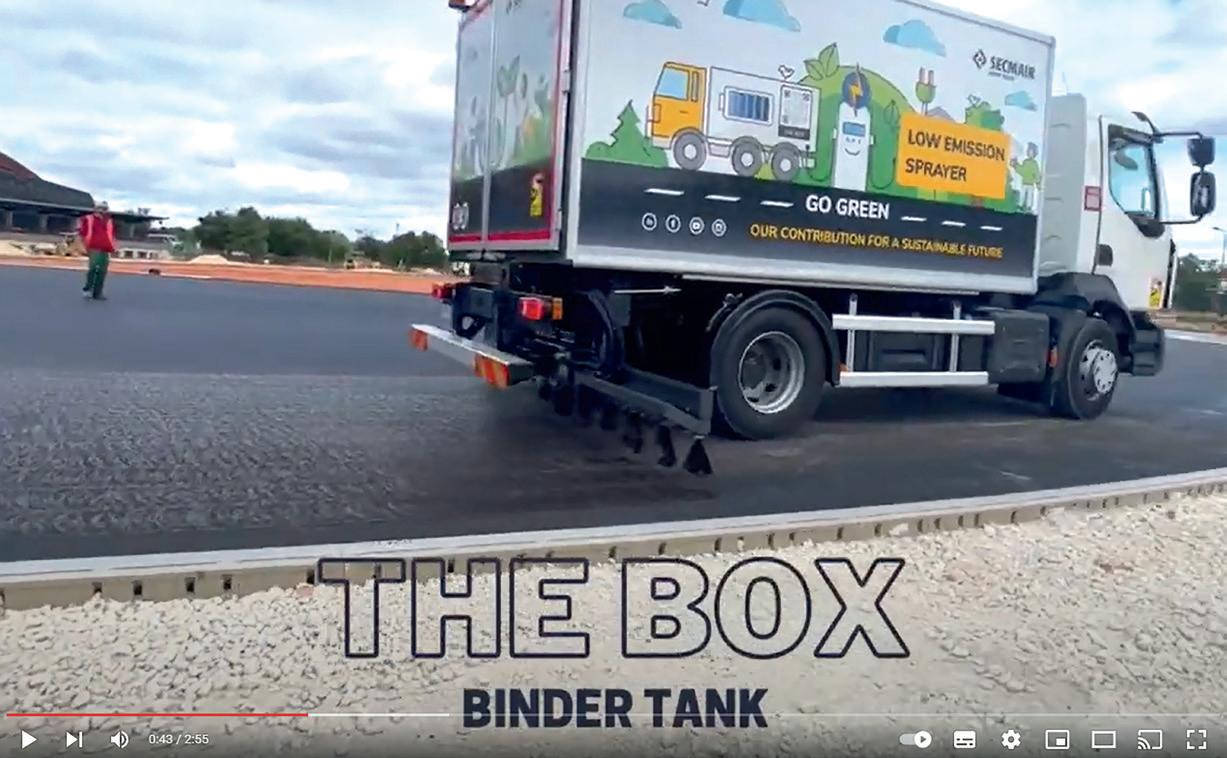
The Secmair sprayer is 100% electric, with no auxiliary engine and no power from the truck engine. Its double thermal insulation allows twice the performance of other solutions according to the firm. This reinforced insulation and suppression of thermal bridges suppress the need to heat the bitumen emulsion which is the main source of CO2 emission on Sprayer . Combined with an electric truck THE BOX can work on jobsites in low emission zones or in urban areas in silence.
Only the onboard computer uses the truck’s battery and the machine o ers 8 hours of working. A solar panel located on the top of the Box adds even more autonomy. The batteries power both the spraybar


and the pump.
This versatile machine can be used for surface dressing and prime coat jobsites and users can spray with a hand lance (15m with automatic reel) or a telescopic spraybar.
The system is said to be simple and fully independent from the truck, while it is also compatible with a standard container and can be mounted on a local truck wherever in the world. As the system is removable, the truck can also be used for other applications.
The operator benefits from in-cab controls with a joystick system for nozzle selection, spraybar position and spraying activation. The dosing is controlled by computer to always apply the right quantities. An ergonomic screen gives access to the di erent information: dosing, spraybar width, working speed and jobsite history. There is also a hand lance with controls at the rear.
The binder circuit features pneumaticallycontrolled, modular valves that are computer controlled from the cab. Mixing of the binder is in the tank and the immersed pump is in permanent contact with emulsion, optimising circulation. Draining the binder circuit allows material to return to the tank and the units features external suction and discharging coupling. The automatic cleaning system cleans out the binder circuit and spray bar a er spraying, returning material to the tank. The user can also carry out complete cleaning of the system using pressurised air.
www.secmair.fayat.com
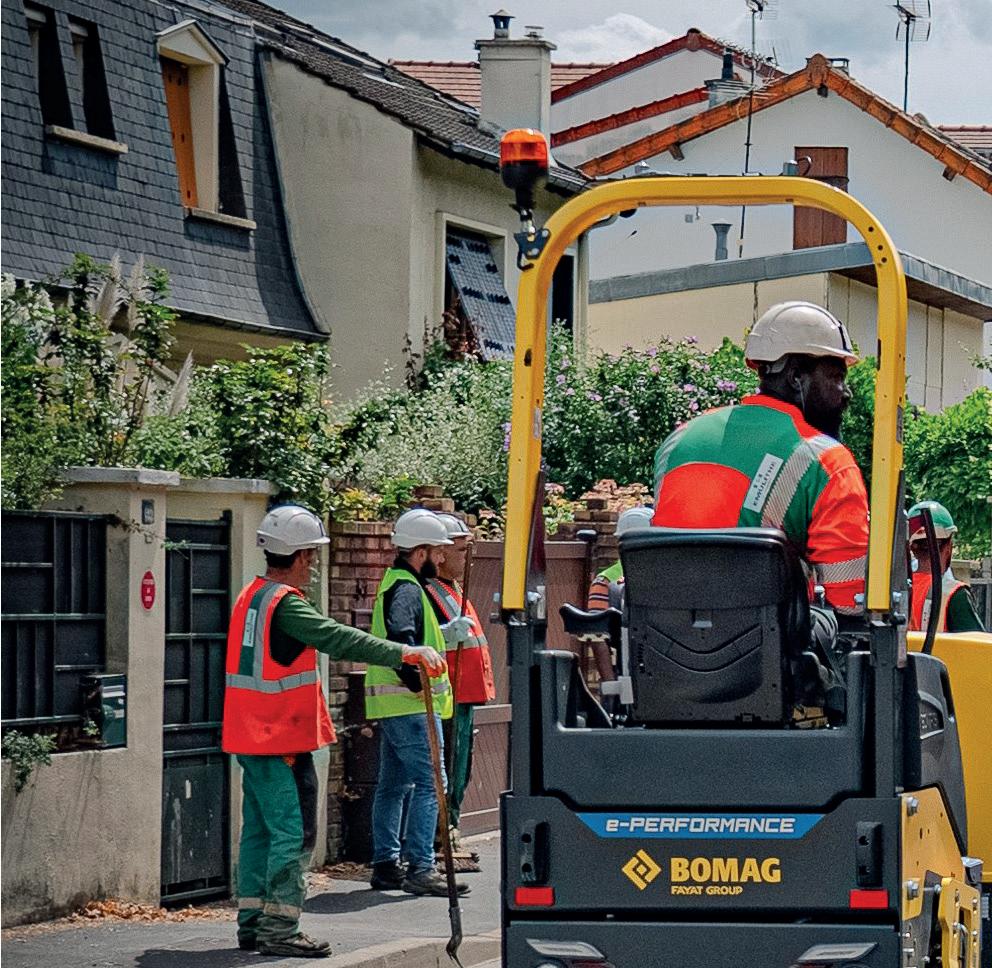

e new light electric tandem roller from BOMAG is designed for compaction and repair work in earthwork and asphalt construction. However, BOMAG says that it is just as powerful as its conventional diesel counterpart.
A major plus is that the electri ed tandem roller produces no ne dust pollution from exhaust gases and emits no CO2. is protects personnel and the environment during operation, factors that are becoming increasingly important when it comes to awarding contracts. At the same time, the new machine stands out for its lower noise emissions.
e use of electric construction machines makes particular sense on urban construction sites, as well as in sensitive areas such as around kindergartens and hospitals.
With the BOMAG BW 100 AD e-5 and BW 120 AD e-5 tandem rollers, a user no longer has to choose between performance and sustainability. e machines deliver the same power as their conventional counterparts and are completely emissions-free. e compact electric tandem rollers suit pavement laying, repair or follow-up work in road construction and landscaping.
Operation is simple as a user simply turns on the ignition to start. e system is self-explanatory, straightforward, uncomplicated and independent of temperature, with no warm-up necessary, A digital colour display with touchscreen is tted that provides useful additional information. e machine is operated as normal using rotary pushbutton switches.
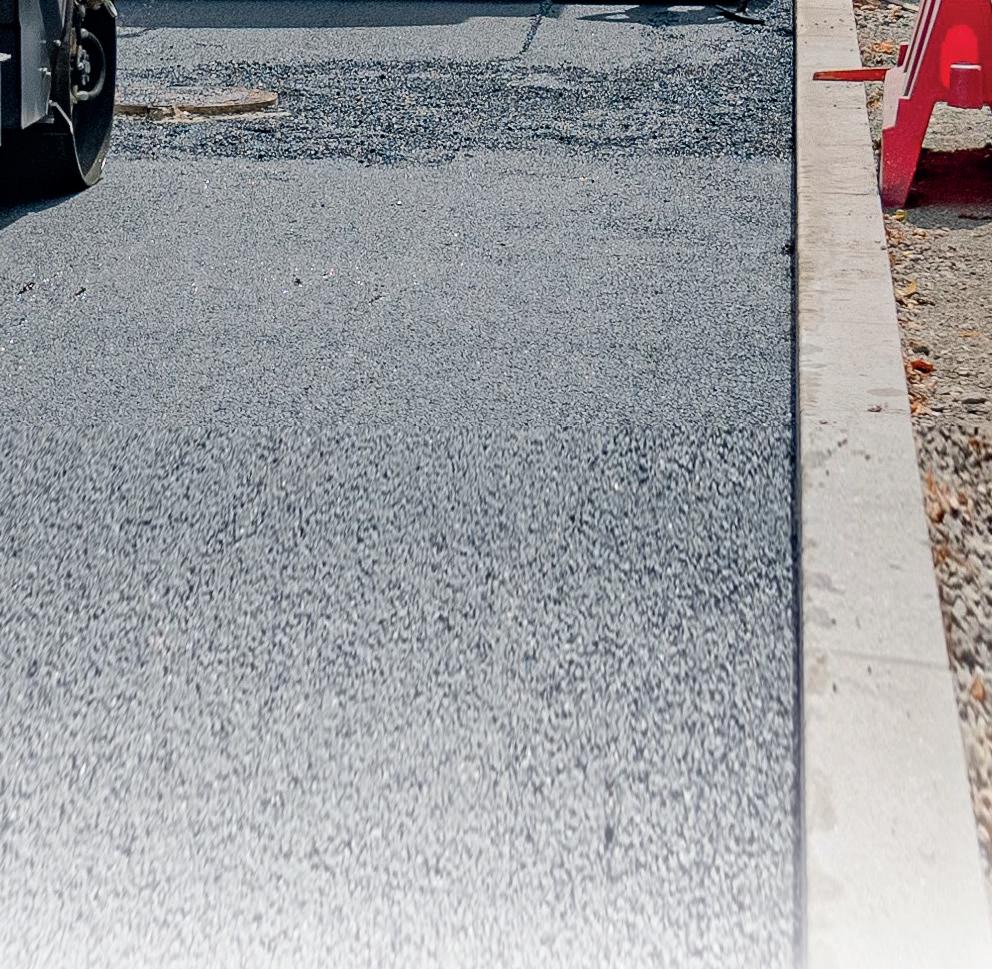
e all-important machine parameters can be seen at a glance. ese include speed, energy requirement, asphalt temperature, compaction progress, operating hours, battery charging capacity, duration and power.
e machine o ers reduced service costs due to maintenance-free electric motors. e tandem roller also recovers valuable energy using regenerative braking.
e tandem roller is equipped with bright LED headlights, while its low noise emissions enable use at night and in sensitive areas. e soft-response travel lever and compact steering wheel allow relaxed working, while the operator has a good overview of the work area. e machine also o ers high comfort due to the spacious operator platform.
e machine is almost silent when driving and much quieter than conventional diesel drives. ere is no issue of environmental impact from exhaust fumes and zero ne dust pollution. e machine is said to suit working in emissions-restricted areas such as city centres and conservation areas, as well as being ideal for use in enclosed spaces such as tunnels or underground garages.
ere are longer intervals between hydraulic oil changes than with diesel machines and the electric motor and battery are maintenance-free. High availability is claimed along with minimal service costs as there are no oil or lter changes for the electric motor.
www.dynapac.com

ABOVE The electric BOMAG compactor worked directly behind the electric Dynapac paver
With the BOMAG BW 100 AD e-5 and BW 120 AD e-5 tandem rollers, a user no longer has to choose between performance and sustainability

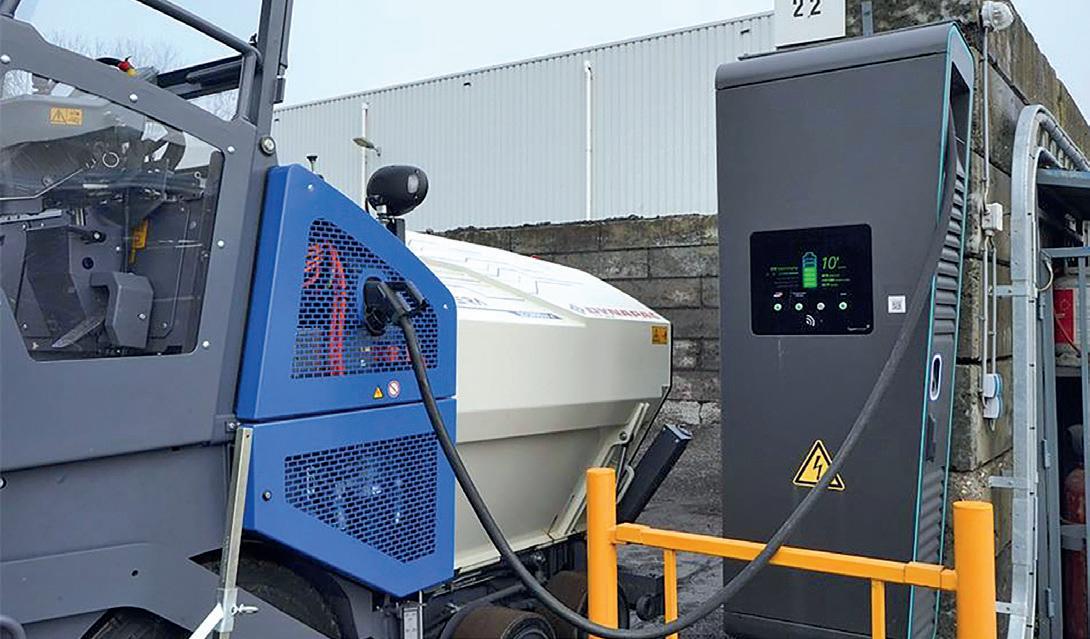
The Dynapac electric paver features a 98kWh lithium-ion battery, and 55kW three-phase permanent magnet synchronous motor (PMSM) that supplies the power and e iciency.
Depending on the type of job, application, and intensity of the work cycle, the SD1800W e o ers up to four hours of performance with one charge. A standard 22kW onboard charger will get
the machine up to capacity at 400V 32A AC in approximately four hours with a Type 2 charger. Due to its high voltage architecture, the SD1800W e is capable of handling charging speeds of up to 80kW, charging the battery from 5% to 80% in less than one hour with a CCS2 charger.
The high voltage electric components: battery; inverter;
DC/DC converter; and electric motor are connected to a high e iciency cooling system. This consists of a bi-directional heat pump with high voltage compressor.
connected to an external power source to save the machine’s battery for prolonged paving operation.
A compaction job for a parking area in Germany posed challenges for the contractor. e work was being carried out for a supermarket carpark in Niederkassel, Germany.
Much of the project required compaction in open spaces where productivity was needed. However, compaction was also needed near the supermarket’s entrance, close to obstacles. at meant the
The electric model delivers a paving capacity of up-to 350tonnes/hour and can pave widths of up to 4.1m with the screed extended. It is possible to preheat the screed while
The SD1800W e o ers comfort, spaciousness, and ergonomics while reducing noise, heat, and vibration. The absence of exhaust fumes is a plus for the operator, crew, and environment, suiting it to use for urban areas.
www.dynapac.com
compaction machine had to be to versatile enough to be productive in open spaces as well as being manoeuvrable enough to operate in tight spots.
e base layer of 120mm necessitated deep compaction output – all while negotiating the close spaces. e base layer consisted of warm mix (AC32 TS), so the compaction window was also tight.
e Ammann ARP 75 Pivot-Steer twin drum compactor was able to meet all the requirements of the job however. e machine has an operating weight of 7.4tonnes, as well as the output needed.
A two-stage vibratory system is standard, with a multiple range of frequencies that helps operators adjust compaction output.
It o ers two frequencies (38-48Hz and 45-55Hz), two amplitude choices (0.68mm and 0.39mm) and two centrifugal options (58-92kN and 47-70kN).
ese settings ensured the roller brought the output necessary to reach the 120mm depth, yet also could be adjusted when working close to the building.
e Ammann ARP 75 has pivot steering with split drums, enabling precise compaction as well as reducing shear forces. e roller also o ers advanced steer-by-wire machine control, which is said to be responsive.
ABOVE
An Ammann twin drum roller has been used to carry out a tricky compaction job in a supermarket carpark
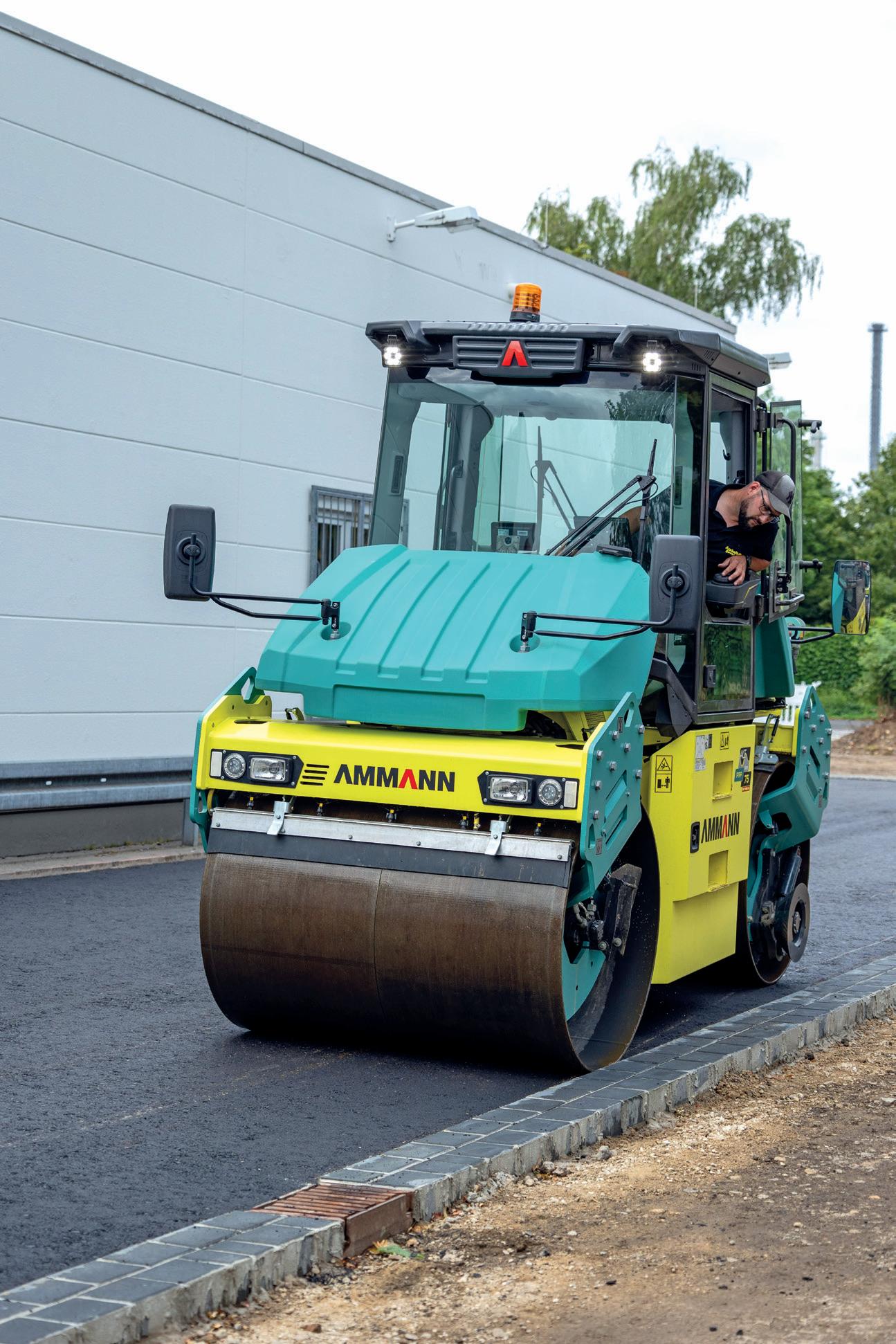
Another handling feature is machine ngertip steering (FTS). is replaces the traditional steering wheel and allows operators to keep both hands on the armrests for improved comfort. An advanced drive lever with smart functions ensured the smooth starts and stops that were useful when paving the parking lot.
www.ammann.com

Ammann is introducing key innovations for asphalt plants


ABOVE
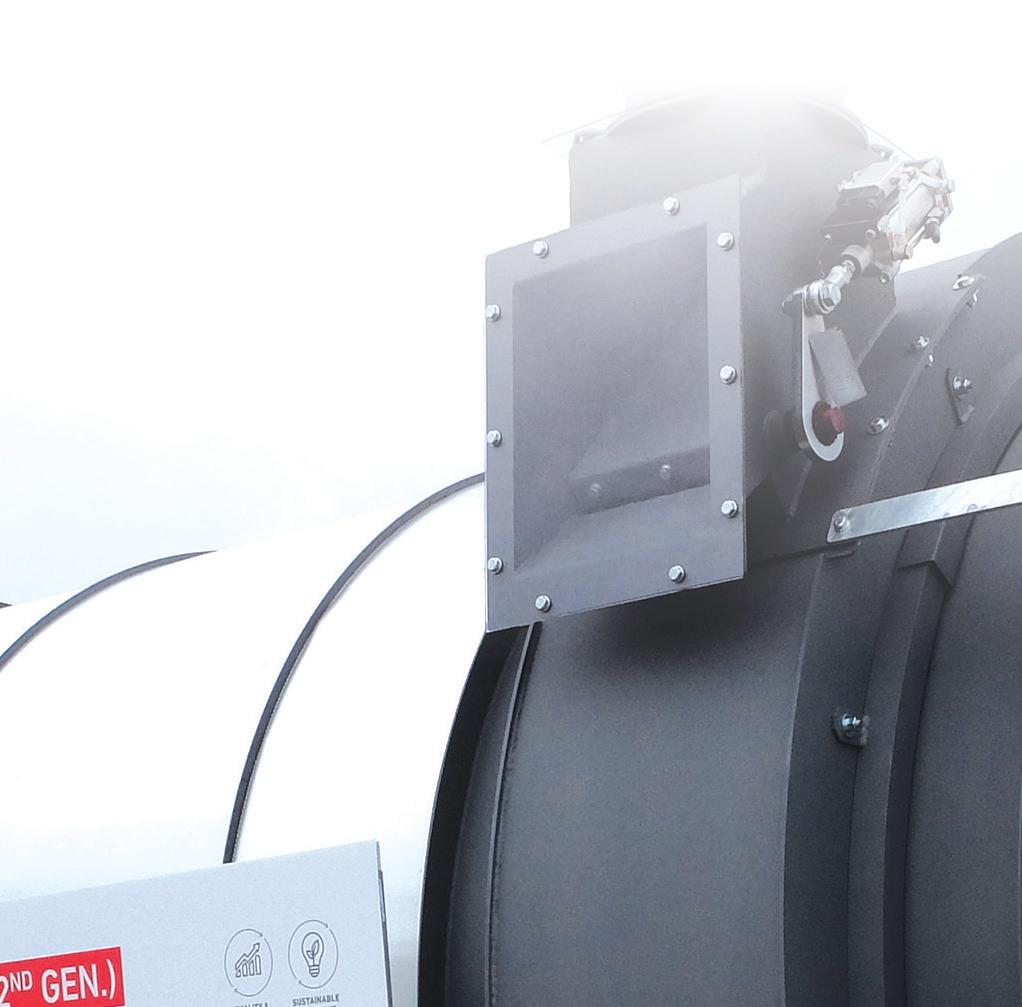
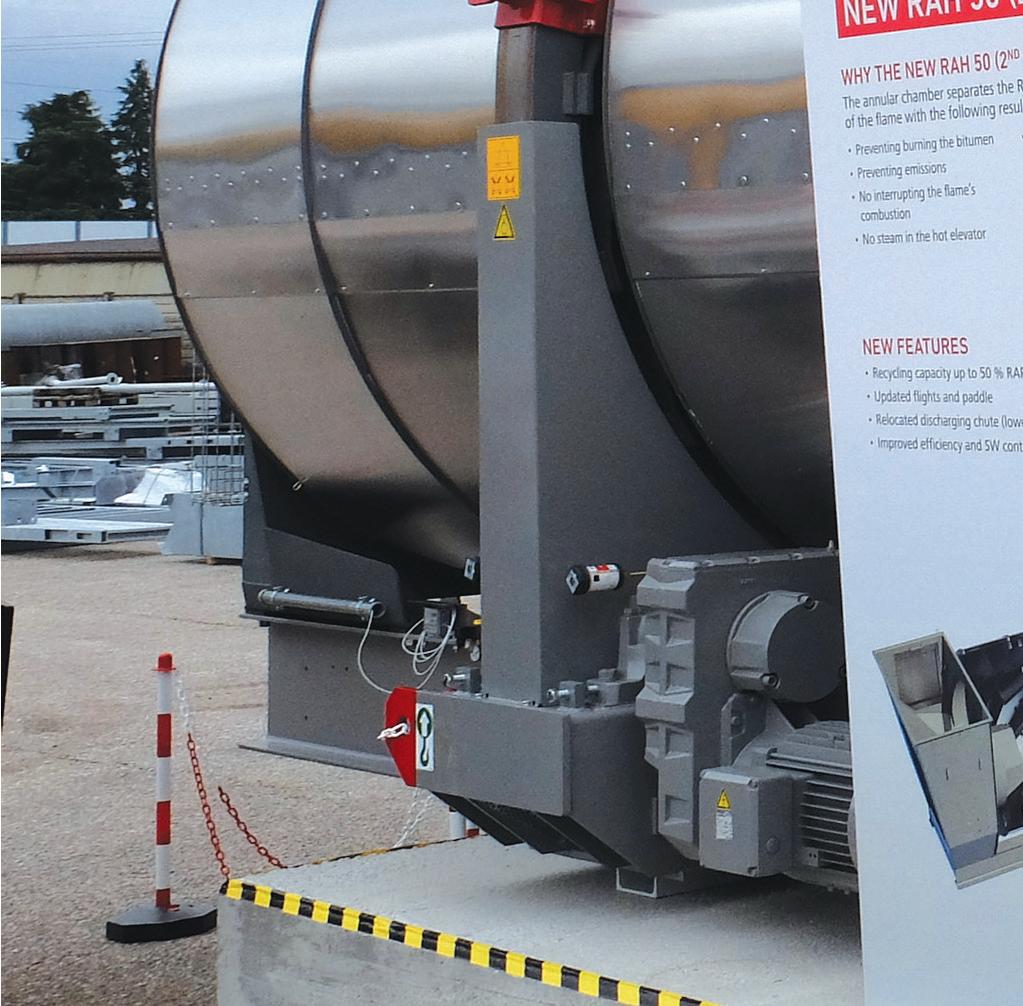
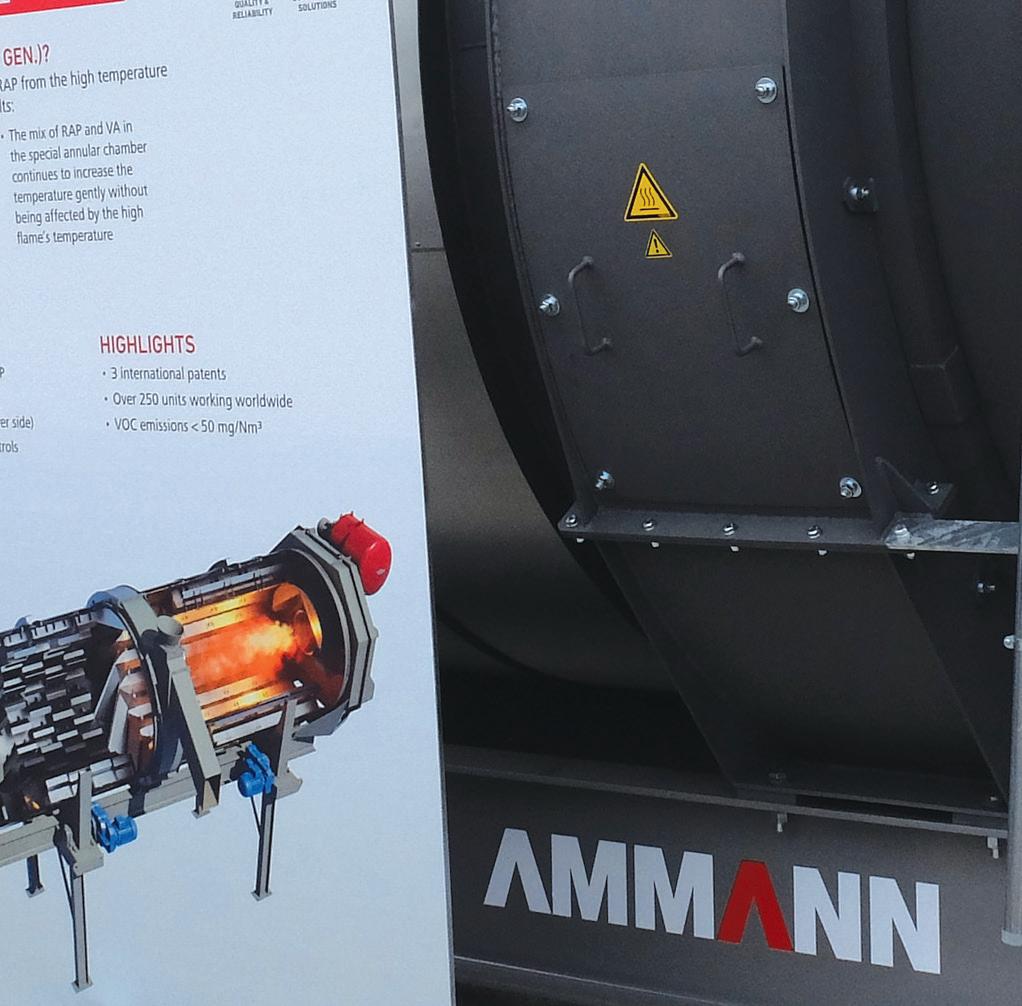
Ammann’s second generation RAH 50 benefits from an improved design that boost thermal e iciency as well as patented features
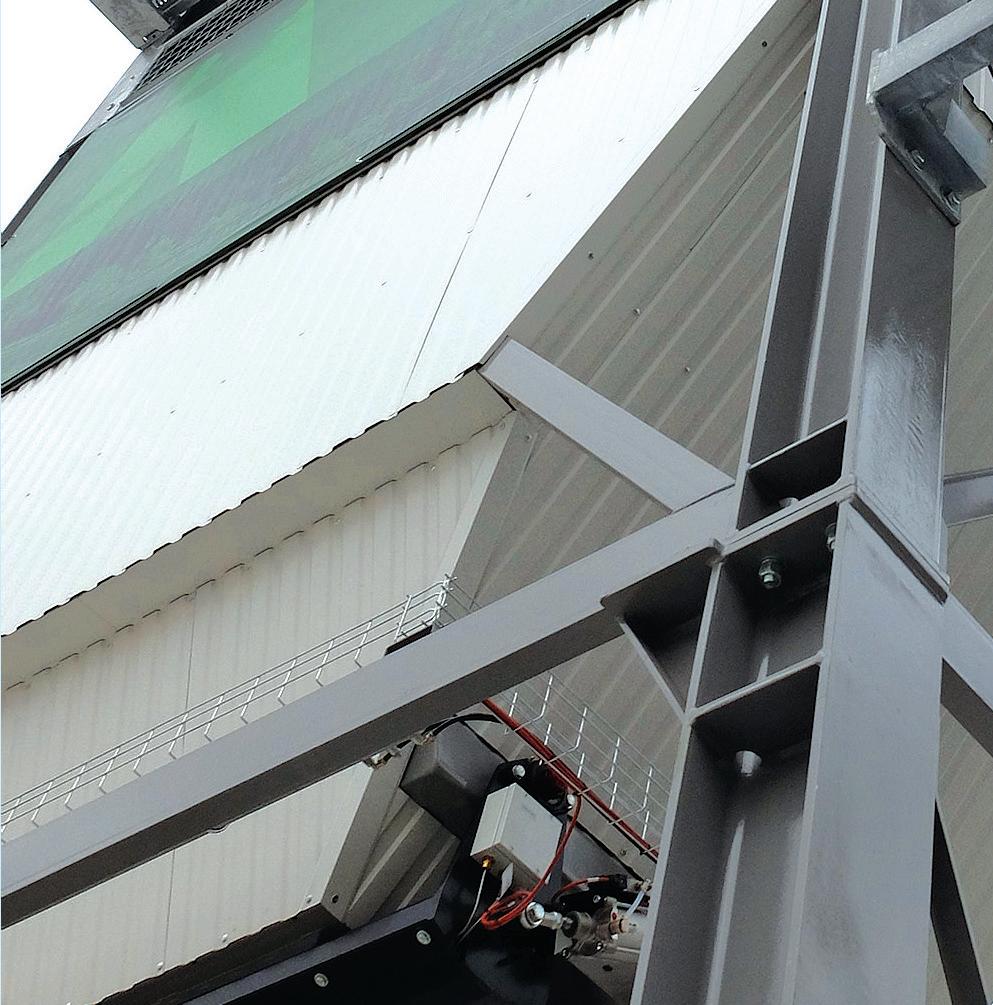
Many of the new systems can be retro tted to existing plants while the rm is also o ering its latest generation asphalt plants with key green bene ts. ese developments come in addition to the rm’s previously-announced innovative hydrogen burner.
Massimo Mezzofanti, Global Marketing
Communications Director at the rm said, “Ammann is not new to sustainability but we have made some signi cant advances.”
At the heart of many of the new plant developments is the improved AS1 control system, which is said to optimise the use of material quantities and energy consumption, as well as the close monitoring of maintenance requirements.
e new systems from Ammann will reduce emissions from conventional asphalt plants. e rm is now o ering its blue smoke treatment (BST) and visual reduction device (VRD), which will cut asphalt plant emissions signi cantly. e BST system address the visible smoke emissions from an asphalt plant, allowing these to meet tougher environmental legislation now being introduced in some countries. Systems to address emissions include increased ltration of the air from the truck loading area. Smoke
is captured, rerouted and reused in the combustion chamber. Filters remove oily particles at several stages. e oil is then condensed and reused. Marzio Ferrini of Ammann added, “All the oil that is captured can be recycled.”
e BST system allows for a more steady ow from the chimney and also helps to boost the e ciency of the plant overall as hot air is recycled within the system rather than escaping through the chimney.
Meanwhile, the VRD system can remove up to 70% of the dust emissions from a plant and can be retro tted to existing plants.
Ferrini commented, “We are working to reduce the environmental impact of an asphalt plant to zero in terms of dust and smoke emissions.”
e rm recently introduced its latest ABA Uni Batch models, which feature environmental solutions throughout, reducing emissions. ese models allow for a high percentage of RAP in the feed. e new lter bag system provides a large surface area for maximum e ciency, while also being simple in design and requiring minimal maintenance.
End
e plants bene t from the rm’s latest AS1 control system, with the UB T0 version producing up to 140tonnes/hour and the larger UB T4 producing from
340-400tonnes/hour.
e rm’s ABC Solid Batch plant is a simpler version of the Uni Batch, but it is still able to handle up to 40% of RAP in the feed.
Ammann is also expanding its range of mobile SOB plants, which initially featured the T1 model only with a capacity of up to 180tonnes/hour. e range now includes the SOB T0 with an output of up to 100tonnes/hour, the SOB T2 with an output of up to 260tonnes/hour and the SOB T3 with an output of up to 340tonnes/hour. ese plants can be o ered in tailor-made versions to suit customer needs while a high degree of component standardisation allows for short delivery and installation times. e units can use up to 40% RAP in the feed.
e smallest of these plants can be transported in just two standard sized shipping containers, allowing it to be delivered to site quickly and also helping to reduce the time needed for commissioning.
Customers also have the choice of the new RAH 50, RAH 60 or RAH 100 mixers, depending on the output required. Separate heating and mixing silos can be added to suit customer needs.
e second generation RAH 50 mixer is now being o ered, allowing the use of up to 50% RAP in the mix for suitable plant installations. Better maintenance access means that the new generation RAH 50 will be easier to service. ree international patents apply to the improved design and the mixer bene ts from new ights and drum, as well as reduced emissions and a more e cient heat transfer to the material. ere is no contact between the material and ame and Ferrini commented, “We are not overheating the virgin aggregates.” End


"We are working to reduce the environmental impact of an asphalt plant to zero in terms of dust and smoke emissions"

Marzio Ferrini
Ammann
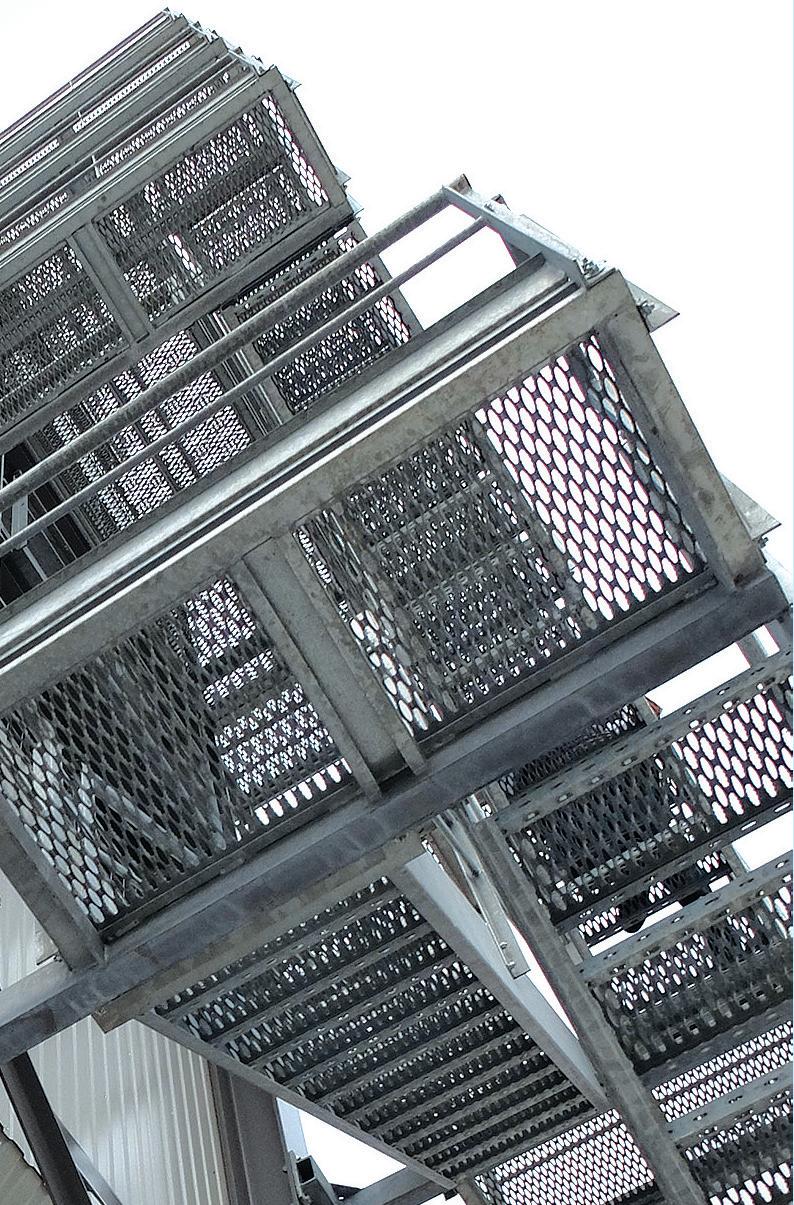




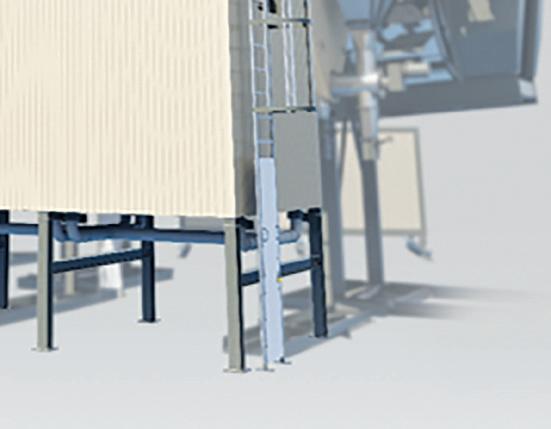

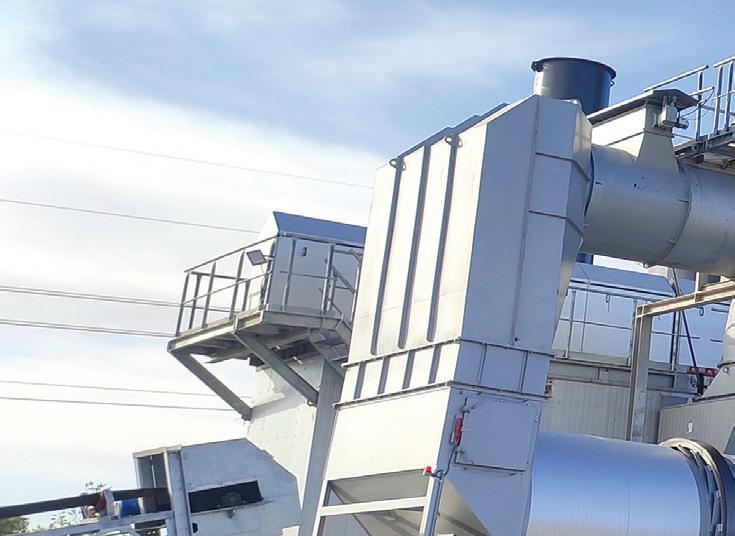
e advanced VRD ltration system from Ammann is able to remove a signi cant level of emissions, as well as being self-cleaning. e Ammann VOC Reduction Device (VRD) reduces volatile organic compounds (VOCs), odours and other organic carbon emissions. It is the rst technology on the market able to self-clean; no lter replacements are needed.

“To have the performance and e ciency of VRD in a selfcleaning system is a signi cant bene t for businesses,” Marzio Ferrini said.
e patented technology means that there is no need for lter replacements and plant uptime is optimised.
e modular VRD system is compatible with virtually every

type of asphalt mixing plant, including those from other manufacturers. e system reduces total organic carbon (TOC), which contains VOCs, by as much as 70% under working conditions.


e VRD removes the TOC. In addition, it makes using RAP greener, as a high percentage of VOCs occur while recycling.
e system only needs a power supply and onsite space for implementation and requires no special software or upgrades. It can be included in the purchase of a new plant and can be retro tted to existing plants, while it is also easy to transport and install. e VRD is a key component of the rm’s Green Plant Initiative, intended to improving the sustainability of asphalt production.

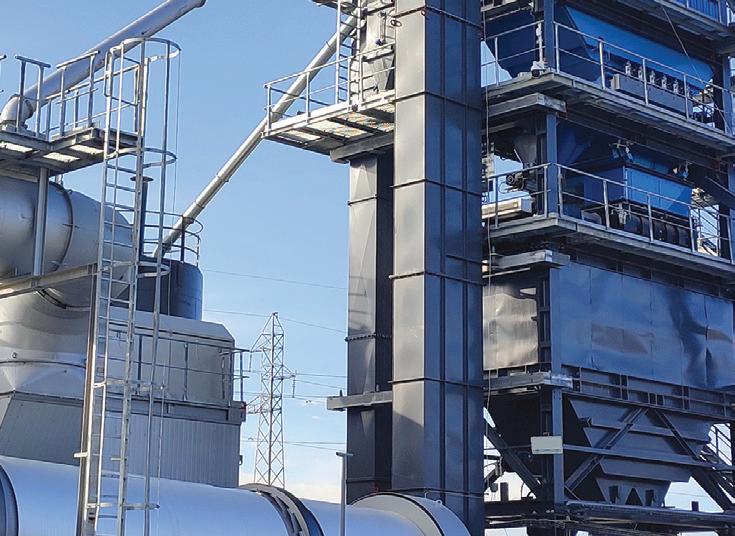
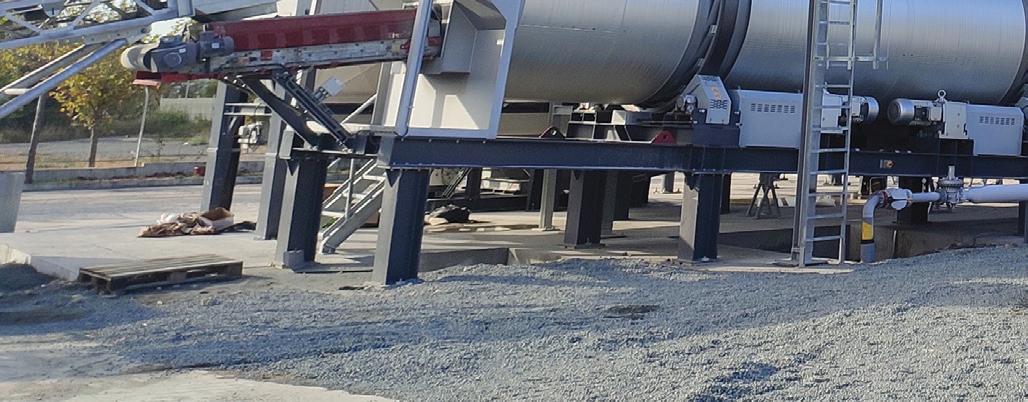
A customer in Bulgaria is achieving good results using an asphalt plant supplied by Benninghoven
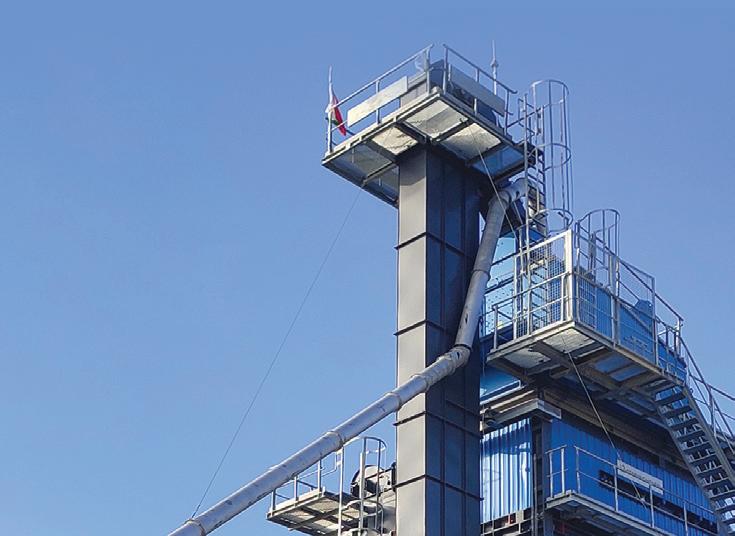
The ECO 4000 asphalt mixing plant is said to be delivering high performance. e plant has proven itself capable of fast installation and a high daily production output in a wide range of road construction projects.
With the Benninghoven machines being supplied and supported in the country by Wirtgen Bulgaria, the rm has its own sales and service support network. e company has been successful in Bulgaria and a number of mixing plants are currently in use throughout the country, as well as a number of polymer and emulsion plants.
With the addition of the ECO 4000 from Benninghoven, infrastructure company Groma Hold added another asphalt mixing plant to its equipment eet. is also includes milling machines, cold recyclers and slipform pavers from Wirtgen as well as Vögele pavers, Hamm rollers and Kleemann crushing and screening machinery.

e fast installation and high production output of 2,600-3,000tonnes/day of asphalt of the rst two ECO 4000 plants were key factors in the construction company deciding to purchase another, identical plant. Other criteria were the option for retro tting optional modules in the future and the range of services available from the local Wirtgen Group subsidiary.

For the latest news, on Asphalt Plants visit the website globalhighways.com
e Benninghoven mixing plants are being used in a number of di erent infrastructure projects in southern, north-western, northeastern and central Bulgaria. Annual production and installation quantities of 1,140,000tonnes of asphalt (2021) document the demand for this material in the southern European country. Examples include the completion of the Struma motorway from So a to the Greek border and the Botevgrad – Vidin motorway section at the Romanian border.
To integrate the national road network into the European transport system, various road construction projects are receiving nancial support from EU development programmes.
To ensure that asphalt production in the Benninghoven mixing plants could start as soon as possible, prompt installation had already been a priority for the rst two ECO 4000 plants at the Stara Zagora and Mezdra sites. Despite great logistical challenges, the plants were installed and commissioned within just 45 days. End www. wirtgen-group.com/en-us/company/ benninghoven/

BELOW
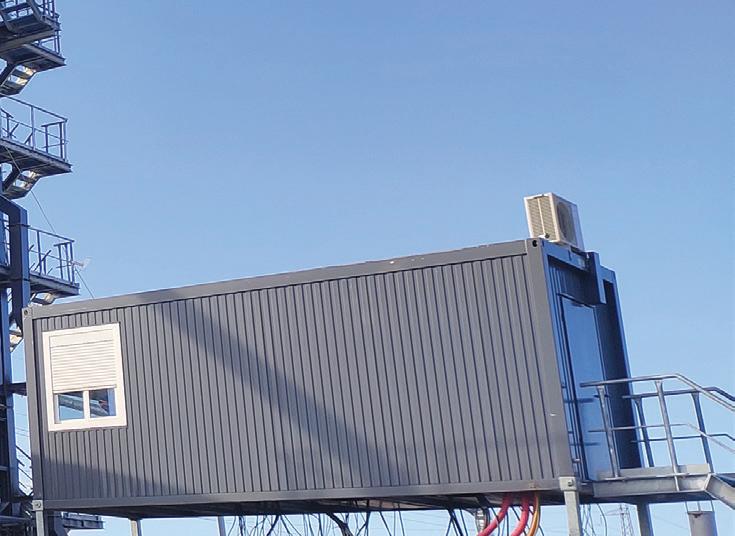
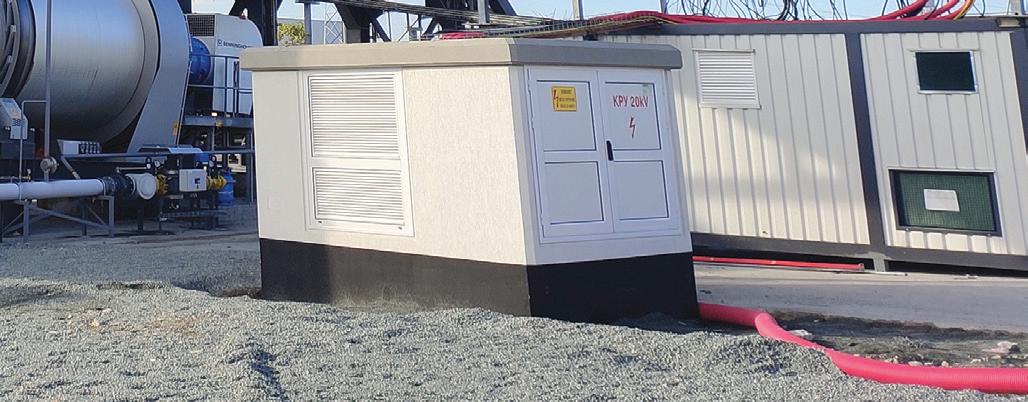
A plant from Benninghoven is providing asphalt for use in road construction works in Bulgaria



Construction so ware specialist Bentley Systems says that infrastructure intelligence is now playing a key role in the industry
According to CEO Greg Bentley, 2023 has been a “groundbreaking year” for the employment of infrastructure intelligence strategies by major rms.
Bentley explained that infrastructure organisations are using technology to overcome the engineering resource capacity gap. A survey of the nalists in the 2023 Going Digital Awards run by Bentley Systems highlighted median savings of 18% to engineering hours saved through the use of digital advancements. Such a saving could help address the challenges stemming from the skills shortage, with fewer engineers entering the industry at present.
According to Greg Bentley, engineering data provides the foundation while digital twins act as the building blocks for infrastructure intelligence.
With iTwin Platform, engineering data in Bentley Infrastructure Cloud (ProjectWise for project delivery, SYNCHRO for construction, and AssetWise for asset operations) can increase infrastructure intelligence over the life cycle of projects and assets. Bentley Systems estimates that the company’s engineering users accumulate at least 100 million new digital components/month within ProjectWise environments. is can deliver infrastructure intelligence bene ts across construction, operations, and maintenance.
Greg Bentley highlighted infrastructure intelligence strategies that organisations are employing to compound the value of their data. is includes reusing digital components, integrating subsurface modelling, and incorporating operational data from


ABOVE
So ware specialist Bentley Systems believes using new technology will deliver greater e iciencies for infrastructure development and maintenance
IoT sensors, drones, and even crowdsourcing. He also explained how Going Digital Awards nalists and organisations in Singapore are accelerating their infrastructure intelligence through the use of AI.
In Singapore, digital twins are used to optimise decision-making and operations. ese include Singapore’s Land Transport Authority (LTA) utilising EMME and DYNAMEQ mobility digital twin software from Bentley Systems for long-term and short-term planning, including operational tra c models for tra c impact and scheme analysis.
Meanwhile, Mike Campbell, chief product o cer said, “Bentley Infrastructure Cloud, including ProjectWise, leverages infrastructure digital twins to unlock data in order to apply AI and accelerate infrastructure intelligence.”
Henry Okraglik, global director of Digital, WSP Australia, explained the bene ts of becoming datacentric through Bentley Infrastructure Cloud. He said, “As we’ve digitally matured, we’ve been able to embrace capabilities from Bentley Infrastructure Cloud to improve construction staging and planning, track and export quantity data across project phases, reduce the need for physical site visits, and more.”
For example, using ProjectWise, SYNCHRO, iTwin, and other Bentley products, WSP was able to reduce modeling time by 60%, increase productivity by 25%, and reduce the carbon footprint by 30% on a rail project in Melbourne.
To introduce the bene ts of digital twins in the design phase, Campbell announced the addition of
iTwin capabilities in Bentley Open Applications, for modeling and simulation, starting with MicroStation. With iTwin capabilities and work ows integrated, Bentley Open Applications will be able to generate digital twins during the design process, enabling users to collaborate in real time, evaluate the impact of changes, reduce rework, and allow infrastructure intelligence.
“Today, digital twins are critical enablers of how infrastructure assets are built and operated. With iTwin-powered capabilities coming to Bentley Open Applications, all our users will also be able to leverage digital twin technology to improve their e ciency and e ectiveness during design,” said Campbell.
Utilising the potential of AI to accelerate infrastructure intelligence, the company highlighted existing analytical AI capabilities, powered by iTwin, for asset monitoring, as well as for generative AI for design. e company says it is committed to help users gain value from engineering data secured in Bentley
Topcon Positioning Systems is broadening its range of solutions in its HiPer family of global navigation satellite system (GNSS) receivers with the introduction of a new o ering.
e latest tool is the HiPer CR, a compact and lightweight GNSS receiver designed for centimetrelevel, real-time kinematic (RTK) accuracy. is system suits use in a wide range of applications in the surveying, construction, extraction and civil engineering industries. e new package joins a portfolio of fuller-featured high accuracy receivers, including the HiPer HR and VR.
e HiPer CR provides multiconstellation tracking, including GPS, GLONASS, Galileo, BeiDou, and QZSS.
It can be used in a variety of con gurations, including as a network RTK rover, in base and rover setups, and integrated hybrid use with a robotic total station.
“When used as a network rover with Topnet Live - the company’s global GNSS correction servicethe HiPer CR will have access to high-quality data corrections to enable increased e ciency and productivity,” said Ray Kerwin, director, global product planning.
“Users can select to use the receiver as part of a Hybrid Positioning system, which means they can use a robotic total station for prism measurements or can switch to GNSS measurement with the HiPer CR for obstructed areas like warehouses, trailers, or buildings. With Hybrid Positioning, users have the versatility to switch between modes quickly, whatever the jobsite circumstances demand,” he said. www.topconpositioning.com
Infrastructure Cloud. At the same time, users will retain access and control for the data used in AI.
Julien Moutte, chief technology o cer, provided examples of generative AI for infrastructure engineering, beginning with an AI agent assisting engineers in optimising site layouts by leveraging designs and data from previous projects. He also showed how generative AI can be applied to minimise time spent on project documentation by automating drawing production.

Scan for more
“We believe iTwin-powered generative AI capabilities will support engineers by augmenting the work they’re already doing. We see iTwin becoming a copilot to support better decision-making, reduce repetitive tasks, and increase design quality. It can help close the engineering resource capacity gap – not
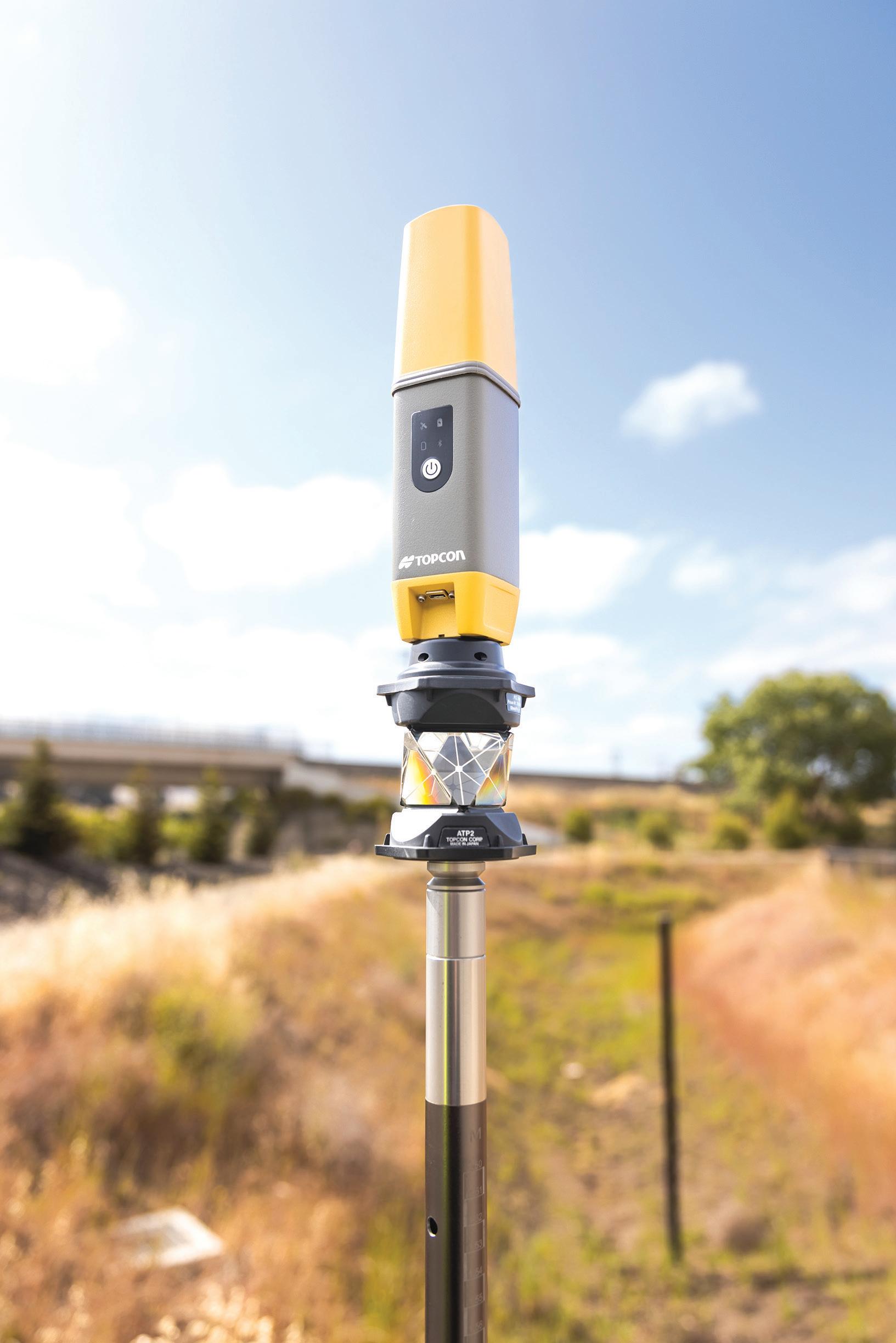
Trimble is introducing an array of technology solutions for machine control as well as surveying
The rm is o ering the sophisticated Roadworks Paving Control Platform for Mills and Cold Planers. is package runs on an Android operating system and allows operators to control cutting depth of the milling drum, to project design speci cations.
e rm says that the software is highly intuitive to use. e system allows operators to meet demanding speci cations on complex projects, minimising overcutting and delivering a smoother surface for airport runways, highways, racetracks and other projects requiring optimum smoothness.
“Complex paving projects such as airport runways and highways have some of the tightest speci cations in construction,” said Kevin Garcia, general manager of Civil Specialty Solutions at Trimble. “Trimble Roadworks for milling and cold planing takes both the guesswork and the re-work out of milling, making it easy for operators to mill precisely to a 3D design elevation. e bene ts of this extend throughout the entire paving process, creating less work for pavers, decreasing asphalt usage, and increasing overall surface smoothness.”
e milling and cold planing software features the same user interface as existing Trimble Roadworks applications. e system is compatible with Trimble WorksManager software, which manages data transfer and tracks construction technology equipment across jobsites, and with Trimble Business Center software, which is used to generate 3D milling plans and
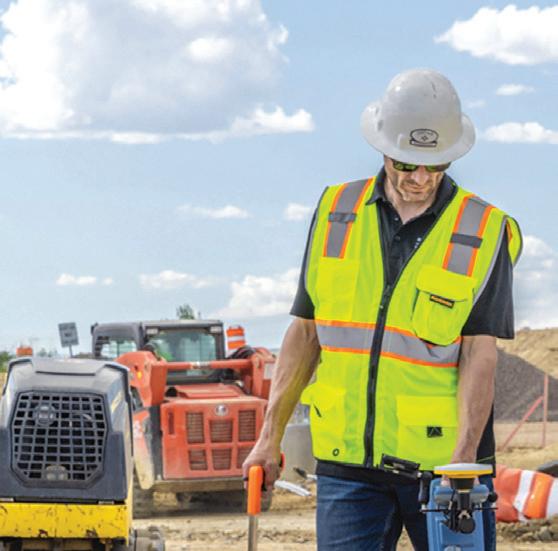
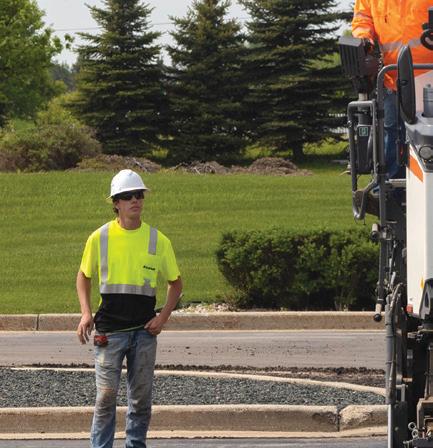
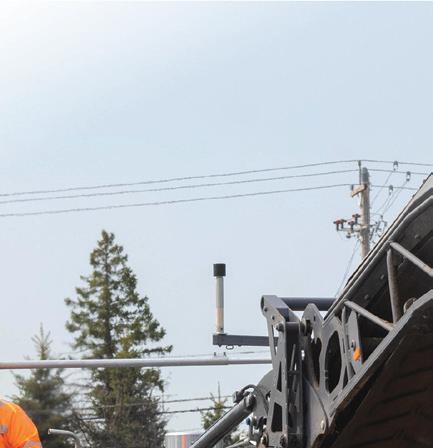
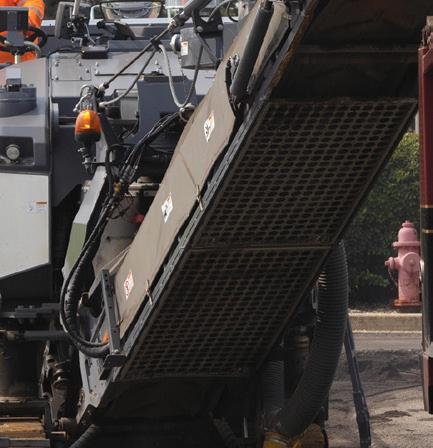
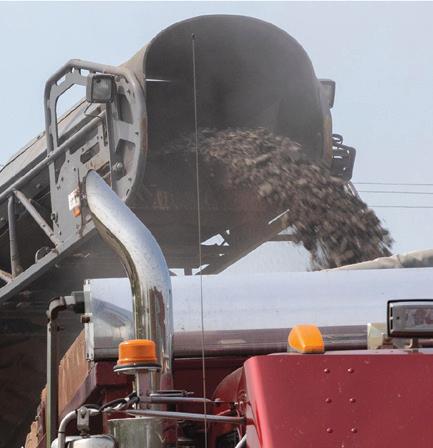
ABOVE: Utilising the new Roadworks Paving Control Platform for Mills and Cold Planers from Trimble allows contractors to meet more precise specifications quickly BELOW: Trimble and Radiodetection have established a collaboration to develop better digital maps of underground utilities

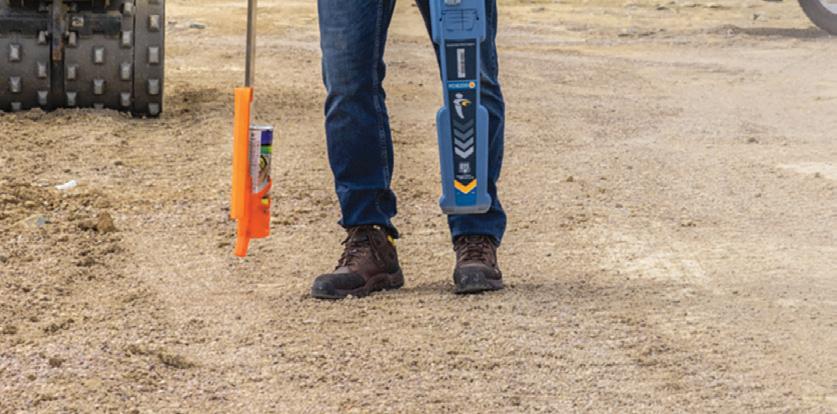
comprehensive production reports.
e company has also developed a cost-e ective machine control package aimed at rms looking to use technology without spending heavily. is system uses the rm’s BX992 receiver and is designed for use with excavators.
e BX992 receiver can be tted to the machine and costs less than other systems on the market. With the BX992 cab-mount receiver and the small and lightweight Trimble Zephyr 3 Rugged antennas, designed to withstand high shock and vibration environments, this con guration costs less than the Trimble Earthworks Grade Control Platform systems, without compromising functionality. End www.trimble.com

Trimble and Radiodetection have established a collaboration to improve the technology used in the utility measurement and mapping process. Through the integration of the Trimble Catalyst DA2 GNSS system and Radiodetection’s RD MapTM+ application and precision locator products, the so ware and hardware integration streamlines utility-locating workflows. This can provide highaccuracy measurement capabilities for the generation of underground utilities maps in a single field operation. Traditionally, field technicians mark their measurements onsite manually or rely

on data entries to provide to o ice sta for map creation a er a site visit. Data collected with the Trimble Catalyst DA2 GNSS system can now be synced with Radiodetection RD Map+ and precision locators that find and mark buried utilities. By streamlining this connection, workers can digitise utility line locations and reduce costly reporting errors. This integration advances utility measurement workflows by giving personnel the capability to accurately represent the utility asset in a digital format. www.radiodetection.com www.trimble.com

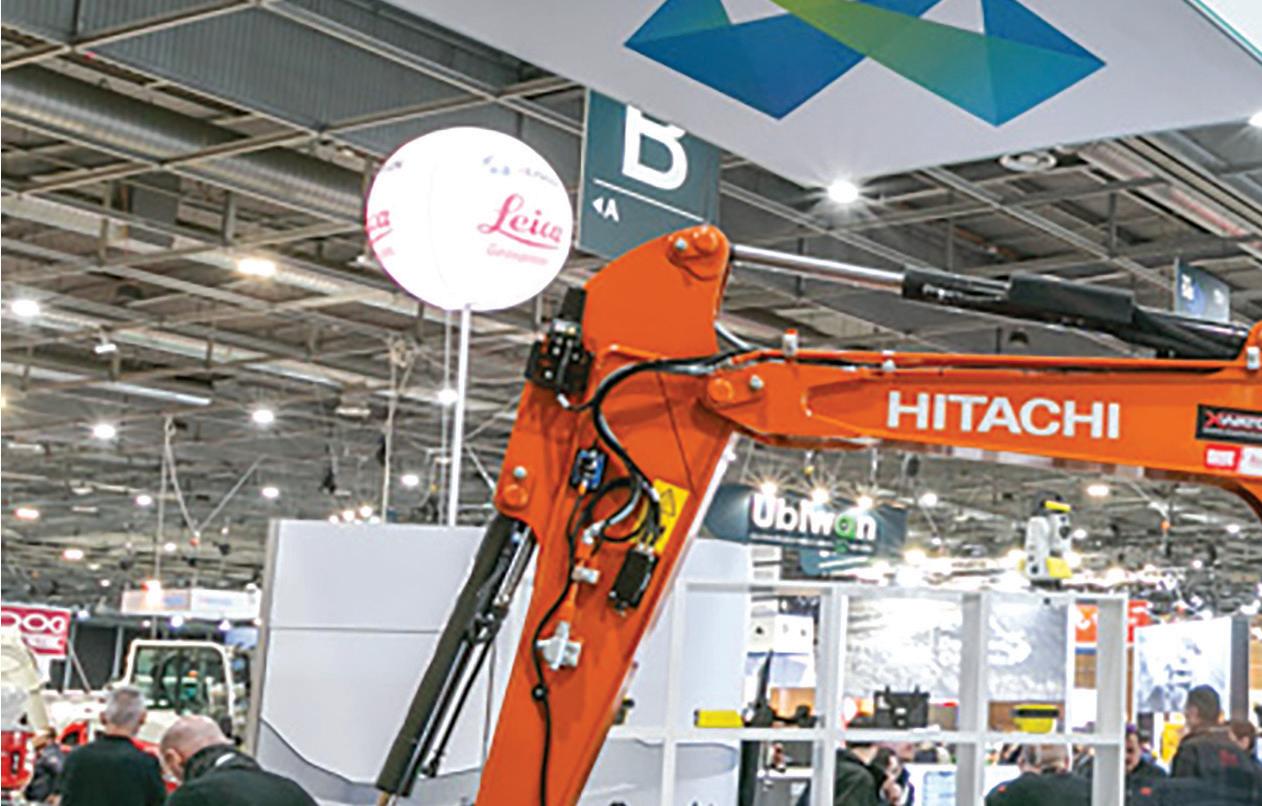
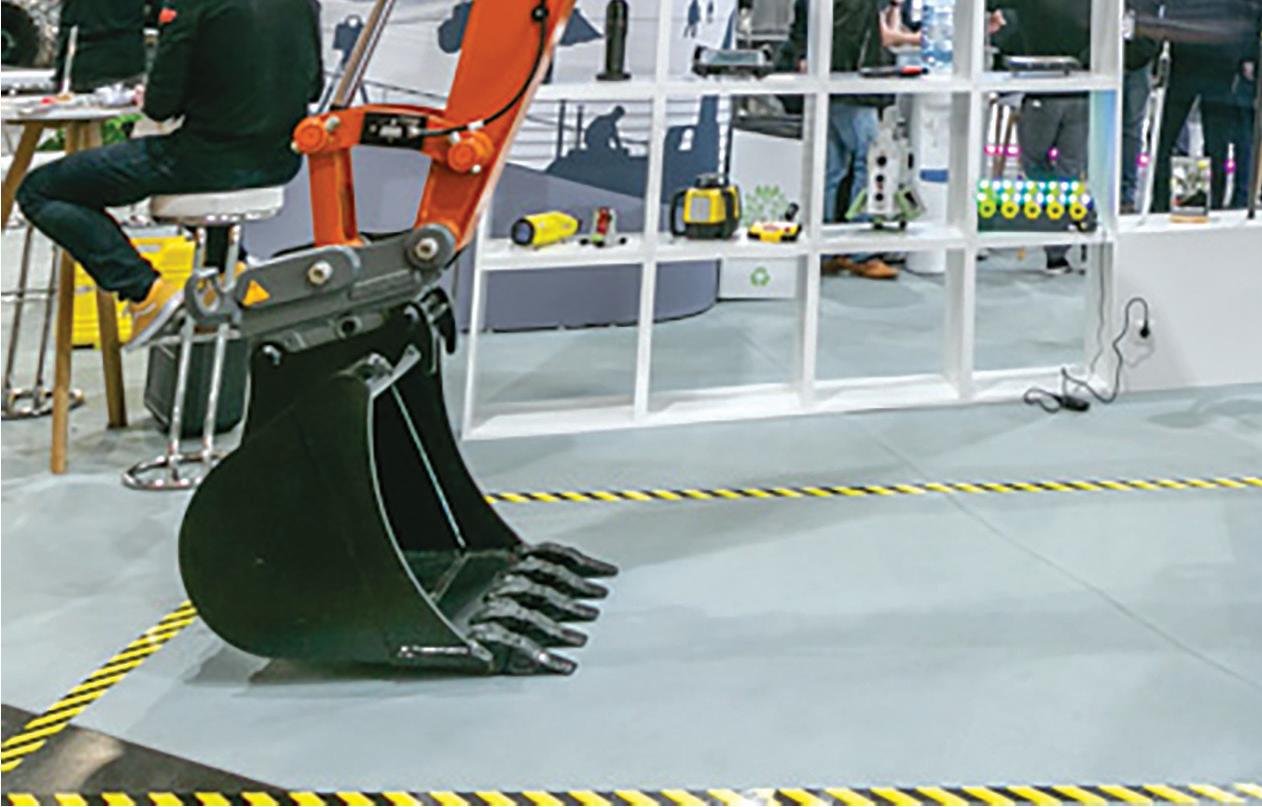
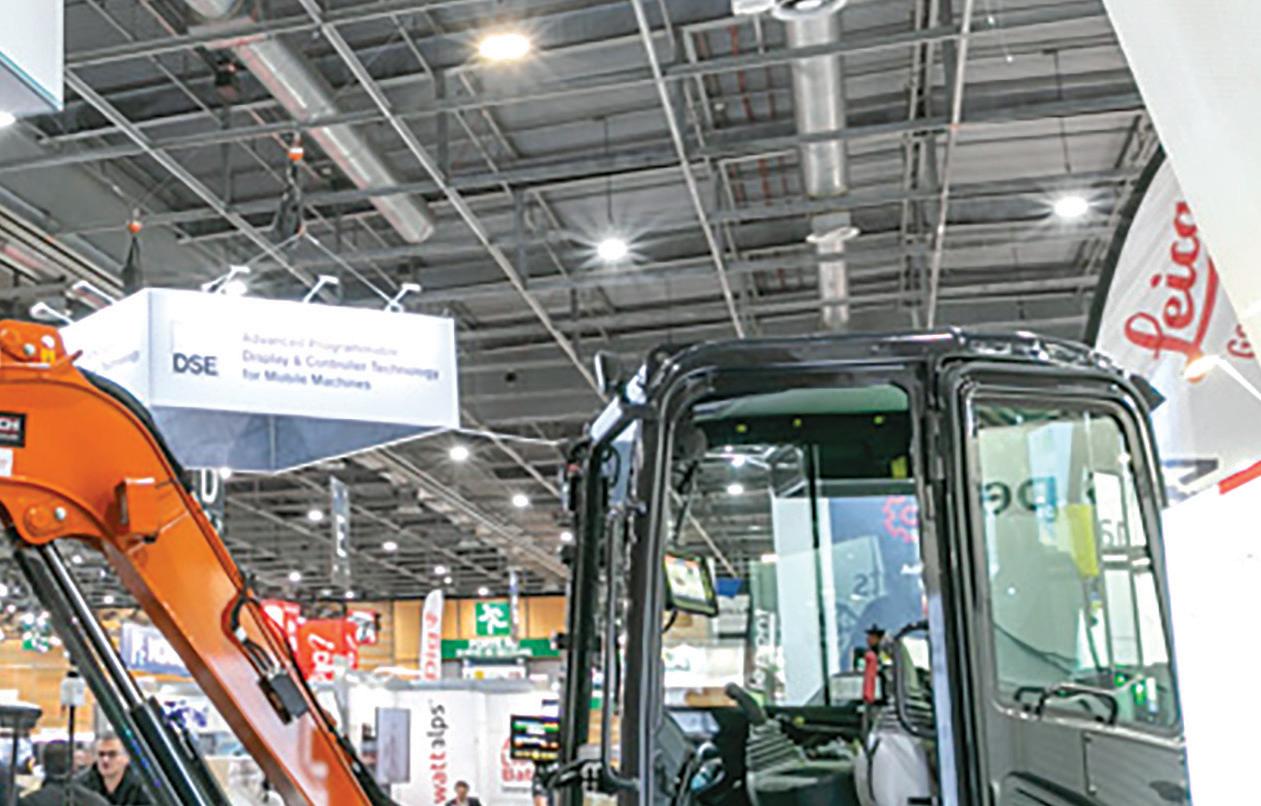
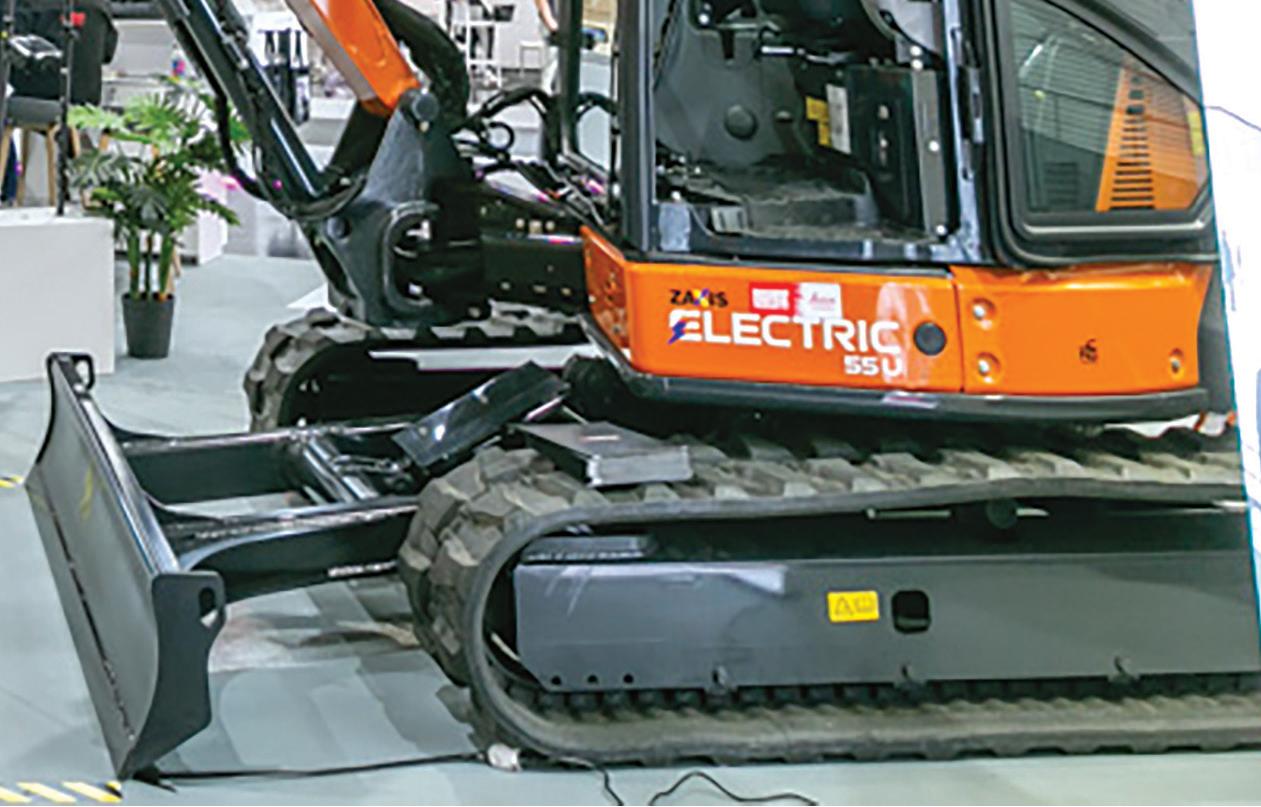
Leica Geosystems is cementing its position in the market for machine control technology with a series of key product introductions and business moves
Perhaps the rm’s most signi cant development has been the move by its parent, Hexagon, to purchase UK company Xwatch Safety Solutions. is strategic move that expands Hexagon’s portfolio and sits neatly alongside Leica Geosystems. Xwatch has been a pioneer in the eld of construction machine safety systems with its XW series, which has features such as height control, slew control, and rated capacity indication (RCI).
e XW Series units help operators set up safe virtual working zones, boosting safety measures around equipment. e strategic move for Hexagon is that it follows the collaboration between Xwatch and Leica Geosystems, already part of Hexagon. is has resulted in the innovative 3D Avoidance Zone system.
Coupling the Xwatch XW Series with the 3D machine control systems from Leica Geosystems means that machine operators can now set out safe zones right across a worksite, without having to reset the technology every time the machine is moved. For


example, when a wheeled excavator is being used on a highway job alongside live tra c, the operator can carry out the job at each area then move the machine and begin working again immediately. e system ensures that the machine only operates within the limits of the safe zone and the boom or counterweight cannot overhang the live tra c lanes.
"Joining Hexagon represents a transformative opportunity for us to push the boundaries of safety technology in the construction industry"
Dan Leaney Director of Sales and Operations at Xwatch Safety
e Xwatch system works with the 3D control from Leica Geosystems to generate a safe working corridor within the restrictions of the highway. And the system disables the machine hydraulics if the operator accidentally moves beyond the safe working zone. is is a signi cant step as it integrates the safety solutions from Xwatch within Hexagon’s range of construction tools to improve risk management and decision-making processes, delivering safer construction environments.
Solutions
Dan Leaney, director of Sales and Operations at Xwatch Safety Solutions commented: "Joining Hexagon represents a transformative opportunity for us to push the boundaries of safety technology in the construction industry. It allows us to leverage Hexagon's global expertise and reach, bringing our cutting-edge safety solutions to a wider audience and
signi cantly impacting worker safety worldwide.
Meanwhile, Leica Geosystems is widening its array of 3D machine control solutions with the introduction of its Leica iCON gps 120. is smart antenna o ers customers a versatile machine control solution.
e new Leica iCON 120 Machine Smart Antenna is integrated into the existing Leica MC1 solution platform and extends the machine control solution to more applications and machine types.
Construction machines such as compaction rollers, which usually require only lower levels of accuracy without heading, can now be equipped with a tailor-made Leica MC1 machine control solution. is allows streamlined operations and consistent work ows between heavy construction equipment that vary in application requirements. Using the Leica MC1 machine control solution allows operators to carry out jobs more quickly and accurately, boosting eet e ciency and reducing waste.
Construction customers can start with a single
GNSS solution using a satellite-based augmentation system (SBAS) or HxGN SmartNet PPP service. If they need higher speci cations, they can upgrade to an RTK solution with low or high accuracy by adding the communication unit Leica CR50. With a second iCON gps 120 Machine Smart Antenna, customers get a full high-accuracy dual GNSS solution with heading.
A key feature of the design is that the antennas can be switched easily between Leica MC1 prepared machines due to the simple quick disconnect system.
“ is solution is more versatile than our previous solution. You can take it from one machine to another and it’s perfect for rental machines. It’s an addition to our range, not a replacement for an existing unit,” according to Tommi Kauppinen, vice president, Heavy Construction, Machine Control Field Solutions at Leica Geosystems. End www.hexagon.com
www.jcb.com
www.leica-geosystems.com
Topcon Positioning Systems is building a new manufacturing facility at Geisenheim, near Frankfurt in Germany.
e facility will be part of the company’s Topcon Electronics operation. e company has an existing production facility at Geisenham, where in-cab displays are made for Topcon’s construction solutions portfolios as well as for global OEM customers.
e new facility represents a substantial investment, expanding manufacturing capabilities and strengthening its presence in Europe.
Unlike the existing location, this facility will be owned by Topcon, allowing for increased production capacities to triple the number of units produced annually. e new facility consolidates all operational buildings under one roof, expanding the footprint to approximately 8.30m2, boosting production e ciency and streamlining operations.


“ e current operation is one of the company’s highest-rated manufacturing facilities, with ISO 14001 and ISO 45001, as well as an IATF automotive certi cation. e testing lab has become a standard for us worldwide,” said Mathias Kühn, senior vice president of Global Operations for Topcon. “ e new facility is designed to support enhanced manufacturing automation, which is key to accelerating production and growth.”
An integral aspect of the new building is its sustainability features.
Topcon prioritises environmental responsibility, and the new facility is designed with cutting-edge sustainability practices, including the use of solar panels, greywater drainage systems, installation of electric vehicle charging points, and nature-




BELOW: Topcon’s new facility in Germany will allow the firm to triple production at Geisenheim
based solutions for ventilation and drainage.
“Sustainability is an important part of the architecture for the new building,” said Simone Dolderer-Heinitz, with Ries+Ries Architekten Ingenieure GmbH, architect on the project. “We use new technologies in our engineering that allow us to completely dispense with heating fuel. For example, the heating and cooling supply is provided by two hot air pumps and photovoltaics on the roof, which are used to partly supply our own electricity. We have green roofs that retain and disperse rainwater.”
Ewout Korpershoek, executive vice president, Topcon Positioning Systems, said, “ e environmentally sound architectural design marks our rst building investment with sustainability in mind from the ground up. e investment underscores our long-term vision for growth and success, re ecting the Topcon values of innovation, quality, and sustainability.”

www.topconpositioningsystems.com




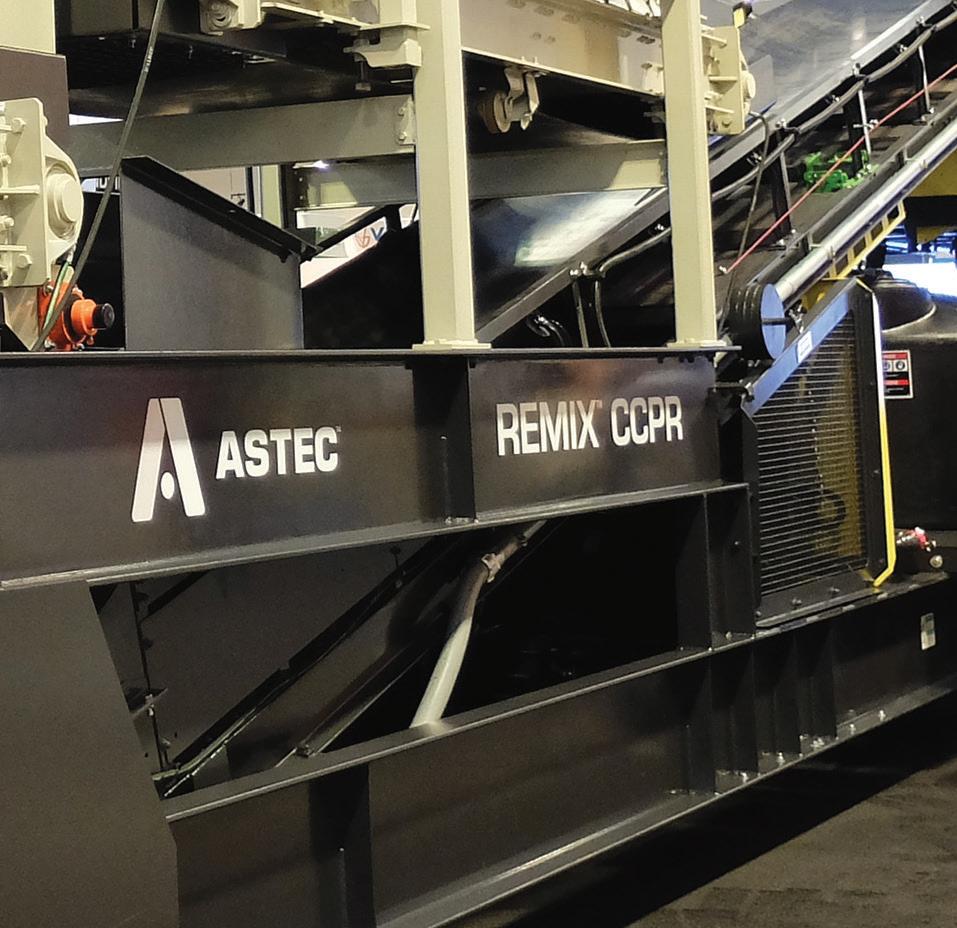



Several of the major manufacturers are o ering key innovations for the asphalt plant segment – Mike Woof writes
The major manufacturers are making key advances in technology for asphalt plants. New fuels, lower temperature asphalt grades and increased use of recycled materials are all helping ensure greater sustainability for asphalt production.
Reduced emissions represent a key development for Ammann’s latest European asphalt plant technology.
e rm’s advanced VRD ltration system from Ammann is able to remove a signi cant level of emissions, as well as being self-cleaning. e Ammann VOC Reduction Device (VRD) reduces volatile organic compounds (VOCs), odours and other organic carbon emissions. It is the rst technology on the market able to self-clean; no lter replacements are needed.
“To have the performance and e ciency of VRD in a self-cleaning system is a signi cant bene t for businesses,” Marzio Ferrini of Ammann said.
e patented technology means that there is no need for lter replacements and plant uptime is optimised. e modular VRD system is compatible with virtually every type of asphalt-mixing plant, including those from other manufacturers. e system reduces total organic carbon (TOC), which contains
ABOVE
Astec’s novel CCPR system is now available
" e new Ammann Alpina plant will be able to produce from 270-540tonnes/ hour of asphalt and features a drum mixer design aimed at North American market needs"
Marzio Ferrini
Ammann
VOCs, by as much as 70% under working conditions.
e VRD removes the TOC. In addition, it makes using RAP greener, as a high percentage of VOCs occur while recycling. e system only needs a power supply and onsite space for implementation and requires no special software or upgrades. It can be included in the purchase of a new plant and can be retro tted to existing plants, while it is also easy to transport and install.
e VRD is a key component of the rm’s Green Plant Initiative, intended to improving the sustainability of asphalt production.
Meanwhile, Ammann is also o ering a continuous type asphalt plant for customers in the North American market. Designed and developed in the US but bene ting from some of the rm’s European technology, the new plant will be manufactured in a new facility Ammann is setting up in the US. e new Ammann Alpina plant will be able to produce from 270-540tonnes/hour of asphalt and features a drum mixer design aimed at North American market needs. Ferrini commented, “We are going to open our new factory and it will be built there.
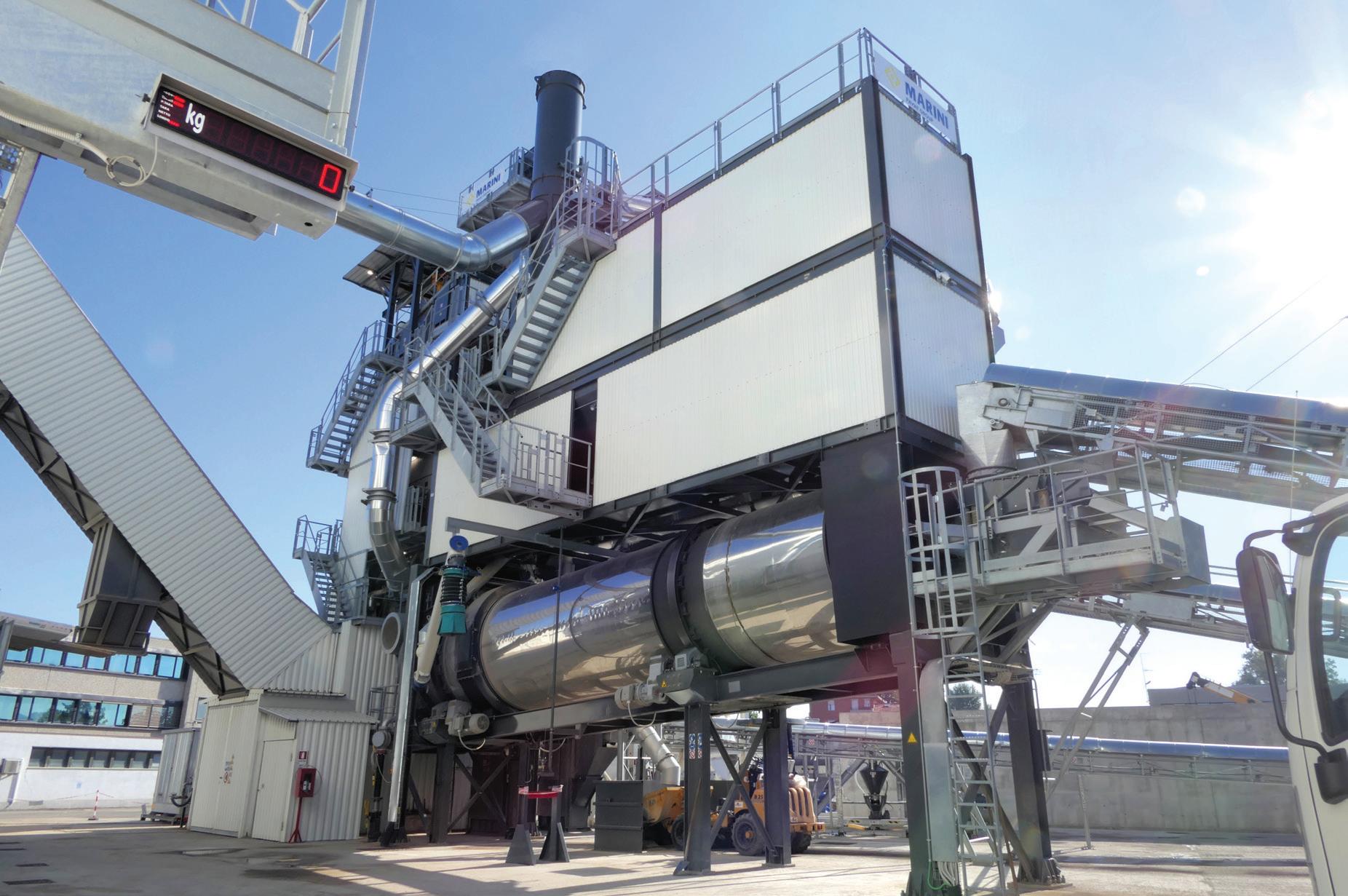
ABOVE
Marini claims high e iciency for its latest
It’s a product speci cally for that market.”
He said that the plant will be able to use su cient percentages of recycled asphalt pavement (RAP) in the feed to meet US market needs also.
Astec Industries is releasing its sophisticated Astec ReMix Cold Central Plant Recycling (CCPR) System, which is able to make e cient use of reclaimed asphalt pavement (RAP) stockpiles.
e CCPR system is said to be powerful and versatile and can produce up to 270tonnes/hour. Featuring
a modular design, the system can be con gured to customer needs, reducing upfront costs and ensuring adaptability. e CCPR system is said to be a reliable performer, featuring proven technology, including the pugmill, foaming system, and controls. Ease of access is said to make the ReMix CCPR system easy to maintain, boosting uptime.
e Cold Recycling Technology is said to help minimise environmental impact by reusing RAP and mixing this at ambient temperatures, reducing the need for both virgin aggregate and energy for heating the mix. is conserves natural resources and lowers carbon emissions.
e Astec ReMix system o ers a range of modular con gurations, providing versatility to asphalt mixing operations. From highly portable setups suitable for changing locations to maximum production con gurations capable of handling large-scale road construction, Astec ReMix CCPR o ers producers the options to meet diverse requirements.
e rm says that its CCPR system is engineered for e ciency and cost-e ectiveness. By maximising the use of recycled materials, it reduces disposal costs associated with RAP and also minimises the need for new aggregate production.
Astec claims that its CCPR system features an intuitive user interface, making it easy for operators to monitor and control asphalt recycling, boosting productivity and reducing the learning curve for operators.
Turkish rm E-MAK is now supplying its asphalt plants to customers in Europe. e rst plant is already commissioned in Bilbao in Spain with a second being delivered shortly
to a customer in the UK. e machine going to the UK is being supplied to a Derbybased rm that has previously concentrated on the concrete precasting and readymix
market but is now widening its operations to include supplying asphalt. e rm is buying one of the E-MAK Express batching plants, which will o er a rated capacity of 160tonnes/hour.
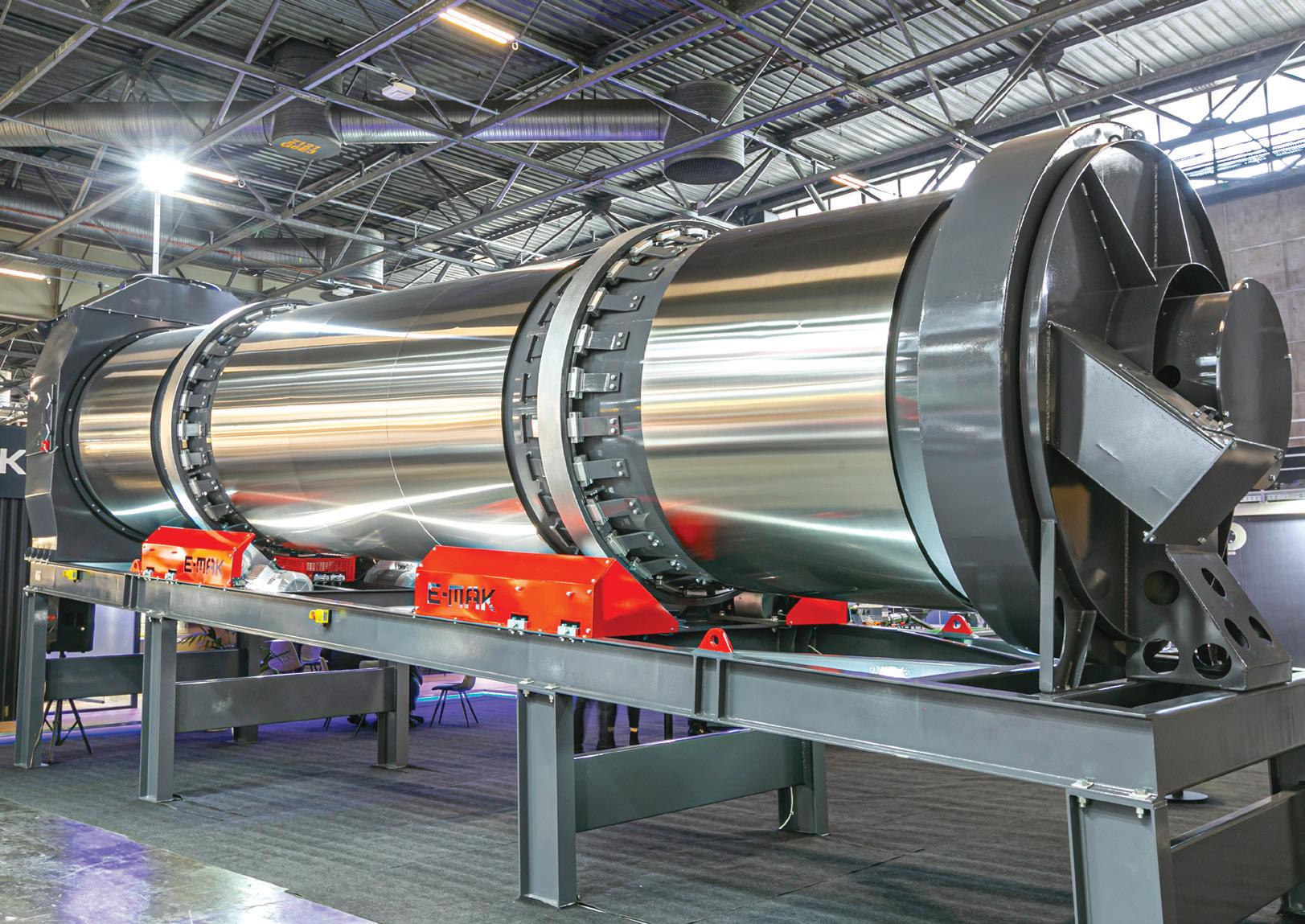
Meanwhile, E-MAK also has high hopes for its proven Challenger aggregates storage system for customers in Europe. is machine can be used to receive large quantities of large aggregates, then crushes and screens the materials before storing them inside. Using the Challenger can make signi cant energy savings for asphalt production as the aggregates are stored in a dry place, reducing the amount of heating and fuel required by the asphalt plant. Ac Emre Gencer at E-MAK commented, “According to our tests you can save a minimum of 38% of energy in asphalt production and that can rise to 62% in winter.”
Given the need to reduce the carbon footprint of materials production for construction, E-MAK believes it has a credible solution that can deliver major bene ts to contractors. www.e-mak.com
New asphalt plant solutions from Benninghoven are also said to lower emissions, with the rm o ering a variety of innovative solutions for increasing sustainability in asphalt production. Considering the entire road construction process from material acquisition and asphalt production to building the roads, companies can save up to 54% CO2 by using these technologies according to the rm.
Benninghoven has considerable experience of using RAP in asphalt mixes and says that this o ers several bene ts. Reusing RAP produced by milling asphalt during road resurfacing is cheaper than virgin mineral from a quarry and already contains bitumen, which saves on the most expensive ingredient in asphalt production.
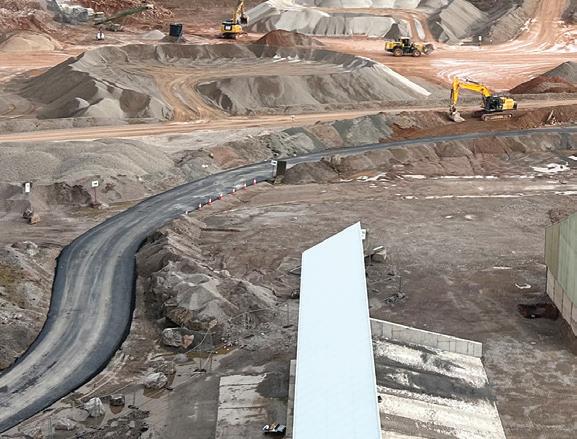

For the latest news, extended features and videos relating to Asphalt Plants visit the website globalhighways.com

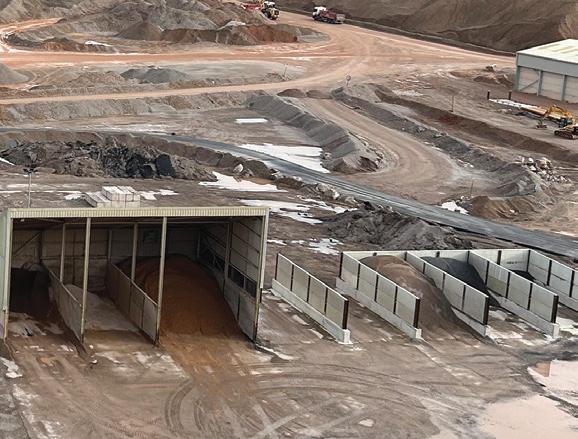
Aggregate Industries has opened a new asphalt plant in the UK to serve Sta ordshire and the surrounding areas as part of a £9 million investment.
e Cauldon plant in the Sta ordshire Moorlands is located next to the company’s Cauldon Low Quarry, which will provide materials.
e investment is the rst new asphalt plant to be built by the company since 2013 and will provide asphalt for ongoing road maintenance and infrastructure projects across Sta ordshire, Derbyshire, Cheshire and the M6 corridor.
Specialist plant supplier Ammann was commissioned to install its Ammann ABP 240 Universal AsphaltMixing Plant which can produce 240tonnes/hour. It is hoped once at full capacity the plant will be capable of producing more than
250,000tonnes/year.

As well as the mixing plant and control room, the site has four bitumen tanks and a range of open and covered materials storage bays with a direct feed into the plant via conveyors. An onsite laboratory will provide technical support and testing facilities for products.
e new plant also has the ability to accommodate high volumes of RAP which can be reused into new products and supply of stone from the quarry will reduce lorry movements and carbon emissions.
Importantly, the inbuilt systems and processes are energy e cient resulting in a 30% reduction in carbon emissions when compared to a traditional asphalt plant, and the latest technology is in place to reduce noise, dust and odours. www.aggregate.com
e rm o ers di erent cold and hot recycling feed systems for this, including the Benninghoven hot-gas generator. is allows up to 100% recycling material to be added, with low emissions.
e Benninghoven REVOC system is a patented innovation and is a retro t solution that supplements existing asphalt mixing plants equipped with one or more recycling systems, reducing the total carbon concentrations in the exhaust gas.
Fuel and emissions can be saved if authorities and owners use reduced-temperature asphalt with a nal temperature of around 120°C. e savings for energy and CO2 can be substantial, 18,000kWh and 6,000kg CO2 are saved during the production of 2,000tonnes of asphalt using this technology.
One important technology for this is a foam bitumen module, which Benninghoven o ers as a retro t solution. Mixing hot bitumen with water multiplies the volume many times and the released surface energy ensures that the binder moistens the mineral during mixing, even at low temperatures, temporarily generating installation properties comparable to those of hot asphalt.
From Marini comes the e cient EvoDryer system, which is said to o er high e ciency and high quality for asphalt batching applications. e drum is now longer and the burner has been redesigned to ensure performance is maximised. A key feature of the recon gured design is with the reduction of blue smoke from the pugmill and discharge areas. is is collected and ltered to minimise emissions.
e air out of the drum is also ltered to reduce emissions, while the hot air is recirculated into the drum, boosting e ciency and reducing fuel consumption. Recirculating the air also reduces the emissions from the plant, a major boost for environmental performance.
Also from the Fayat Group, SAE is o ering a novel cold mix system that is said to o er extra versatility for asphalt plants. e system is said to be adaptable for any plant installation, as long as there is su cient room. A spokesperson for the rm said, “It can be implemented on any asphalt plant from any manufacturer that has any software.”
e unit can allow a conventional asphalt plant to produce a quality cold mix, but at a much lower cost than a dedicated cold mix plant. e spokesperson said, “It’s a very compact design and ts inside a standard shipping container.”
e plant is said to be highly versatile and can use virgin materials or high percentages of RAP in the feed. Water injection, di erent binders and a range of additives can be used to suit the materials and application. By positioning the pugmill next to the plant, this makes the system easier to handle according to SAE and output can be up to 200tonnes/ hour. SAE also says that this plant can help producers meet targets on decarbonising their operations.
e spokesperson commented, “By de nition it is decarbonised because there’s no heating.”. End
www.ammann.com www.astecindustries.com www.wirtgen-group.com www.marini.fayat.com www.sae.fayat.com
interesting
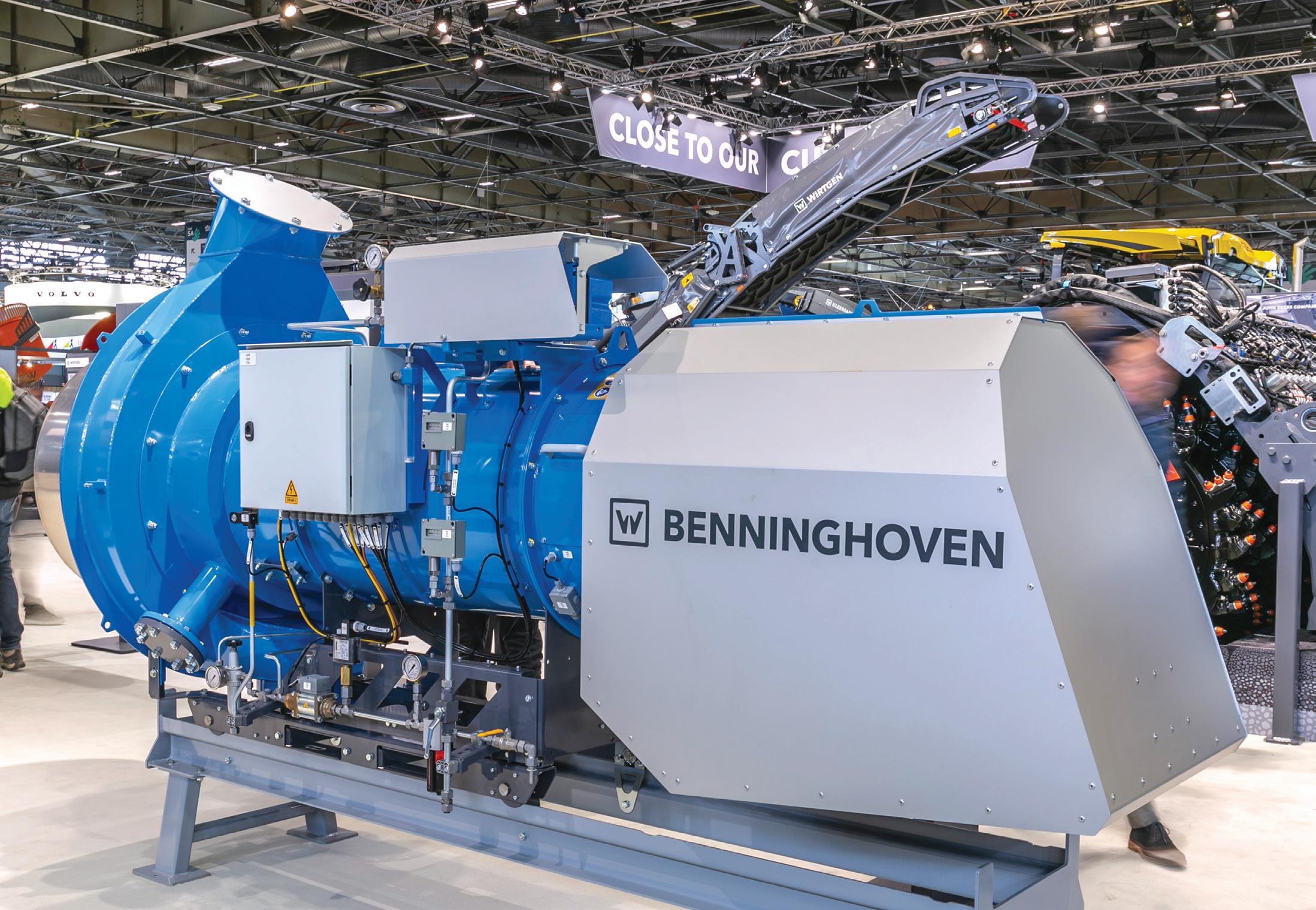
Ammann and Marini have both unveiled burners being developed that can use a mix of fuels as well as up to 100% hydrogen. Meanwhile, Benninghoven has actually begun testing at a plant with its new hydrogen burner.
One of Benninghoven’s customers in Norway has been trialling the rm’s novel hydrogen burner for the production of asphalt.
Benninghoven’s hydrogen burner has an intelligent control system to optimise e ciency during asphalt production. is includes control of the feed systems, including the pressure control section, drying section with burner and burner control. As with the competing units from Ammann and Marini, the Benninghoven burner is a multifuel unit and can use natural gas in addition to hydrogen. It can also use light oils. A novel feature is that it can be set to use any combination of the three fuels, with any percentage of either also, depending on fuel availability.
To make the asphalt production process more e cient, Benninghoven says it has developed a new generation of burners that includes the control and drying system alongside the burner itself. With this system, up to four separate burners can be operated at the same time. is versatile approach increases the
ABOVE
Ammann, Benninghoven and Marini have all developed asphalt plant burners capable of running on up to 100% hydrogen, with the German firm having trialled its technology in Norway
cost-e ectiveness of the plant as an owner can use the best-available energy sources. Switching between fuels or combinations of multiple fuels is done on the y, meaning that no shutdown or downtime is required and with only minimal temperature uctuations in the process. Emissions are kept low when using hydrogen as a fuel, with minimal NOx being produced. e company also says that the power draw has been reduced by 20% while keeping the feed capacity constant. Heat transfer e ciency has been signi cantly improved by maximising the use of the burner space and providing a burner control and geometry that ensures optimum ame production for each fuel. Another signi cant bene t for plant operators is the reduction in noise emissions. Green hydrogen is a sustainable fuel, producing no greenhouse gases and is suitable for the heating process thanks to its high energy density. In many cases, facility operators wanting to start using hydrogen as a fuel experience di culties due to current limitations in their infrastructure. Burner technologies from Benninghoven can be used to equip both new facilities and existing asphalt mixing plants, while retro t solutions can be deployed in plants from other manufacturers. is gives a plant operator
the chance to upgrade to the latest technologies, an important aspect for ensuring economic, sustainable asphalt production and long-term plant operations.
With one unit already in use, the rm is currently in discussions with customers in Europe and the Middle East for a further four units.
Meanwhile, Benninghoven and Ammann have also been taking other steps to address the issue of alternative fuel solutions.
e fuels of the future are attractive when it comes to their availability, as fossil fuels are not only limited, but are becoming increasingly more di cult to produce. is will make it more important that asphalt plant owners select the right technologies to be prepared for the future by using alternative fuels.
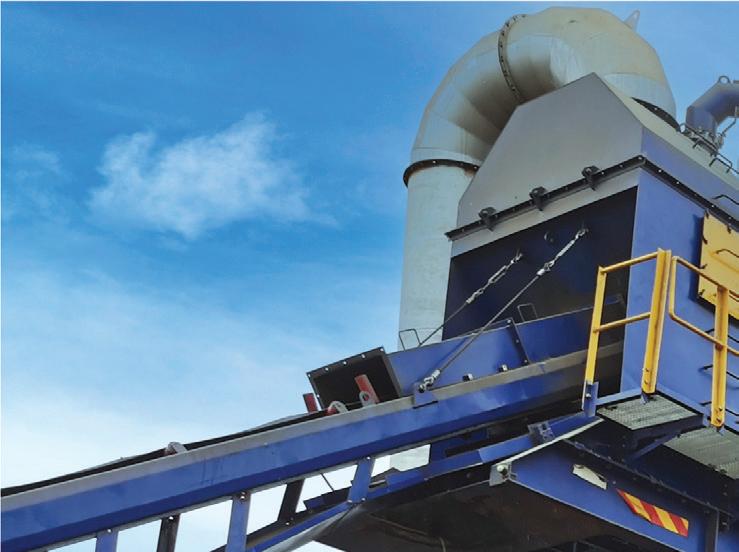
Biofuels can reduce dependency on mineral oil and can be produced from feed such as rapeseed and sugar cane. Meanwhile tall oil, a waste product of sulphate cellulose production can be used also.
Ammann o ers a package of systems that use renewable energy sources or, in some cases, convert a waste product into fuel. e rm says that this conserves natural resources and puts less pressure on land lls.
Wood dust, a waste product from industry, is an important fuel option and is a renewable raw material that can be grown with sustainable methods and can be considered as a carbon neutral fuel.
www.ammann.com
www.wirtgen-group.com
www.marini.fayat.com

Chinese construction firm Power China Group is using a Linnho TSD1500 Asphalt Mixing Plant for two rural road projects in Kenya.
The first project started in Embu City, 125km north-east of Nairobi, Kenya on a 5km rural road project. The project involved road repair to reduce dust in local neighbourhoods, which included removing soil on the roads, replacing materials, and compacting potholes to
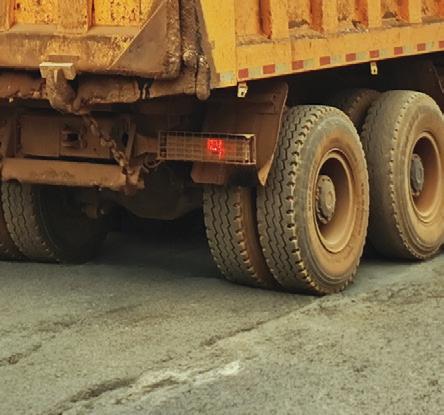
improve accessibility for the local communities.
Once completed, the plant was rapidly disassembled and transported over 400km to a jobsite in Voi, close to Kenya’s south-eastern border. The plant began working on constructing a 12km road section at this new location and is still producing asphalt for this key transportation initiative.
“Since 2010, we’ve been
successfully working with the Lintec CSM and CSD Containerised Asphalt Mixing Plants, so we have full confidence in their capabilities, as well as how economical they are to transport from one location to another,” said a spokesperson from Power China Group. “The Linnho TSD1500 MobileMix asphalt mixing plant takes portability to a whole new level and has enabled us
to react quickly to unexpected situations, while also delivering a healthy revenue stream.”
Despite the Linnho TSD1500’s productivity, the plant can also be dismantled, transported, and reassembled quickly. It o ers an output of 100-120tonnes/hour enabled by its 1,500kg batch size and 45-55 second batch times.
The firm says that its Linnho TSD range has been designed to minimise the time spent to assemble and disassemble. There are four modules, and the sections are mounted on a chassis which conforms to international land transportation requirements. In addition, only prime movers are required for quick mobilisation as heavy cranes or concrete foundations are not needed for setup. This increases the suitability of these hot-mix asphalt mixing plants for short-term projects in remote locations. The plants also feature Linnho ’s proven double screen drum technology. These features make the range ideal for the rugged and complex terrain of Kenya's rural roads. The country has plenty of old roads with poor foundations so renovation and upgrading work demand high-performance, cost-e icient, and reliable equipment. Working conditions are further complicated by frequent rainfall which o en hinders progress at construction sites.
www.lintec-linnho .com

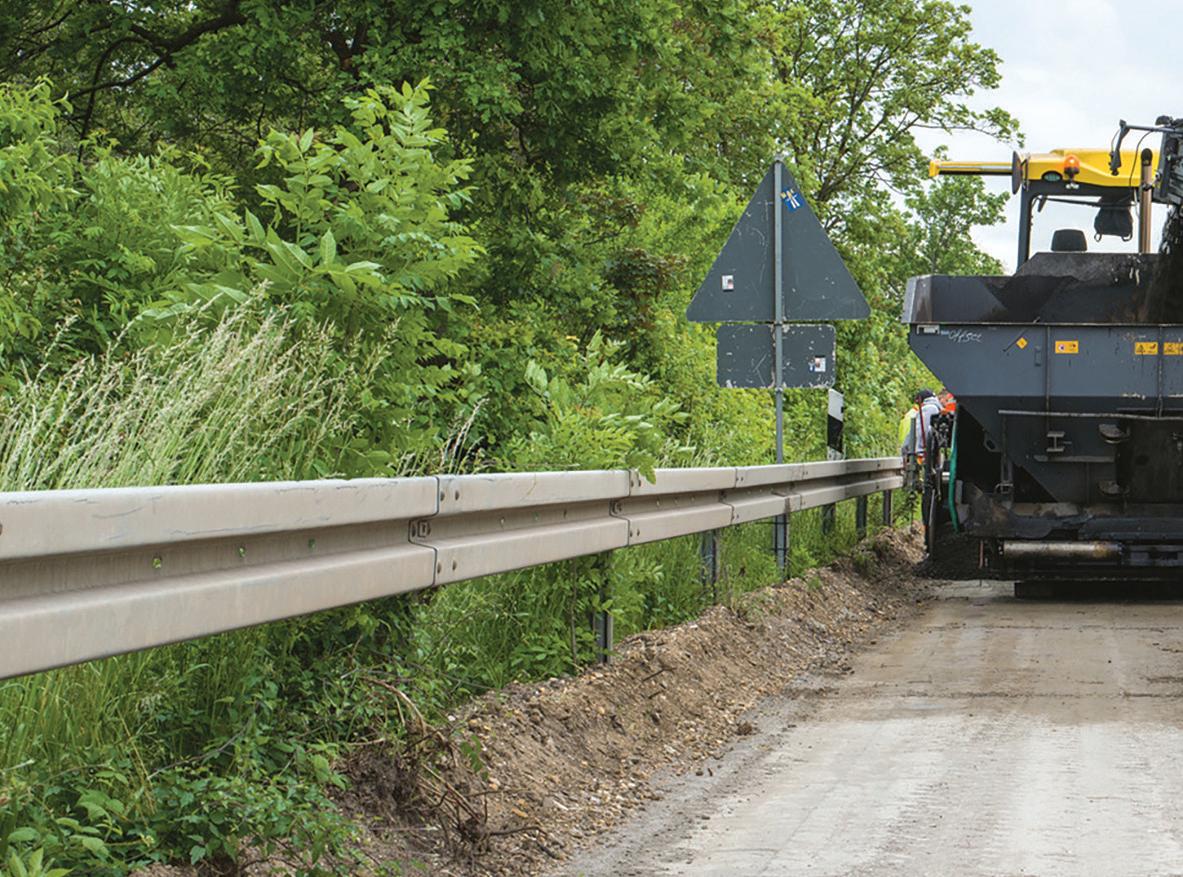
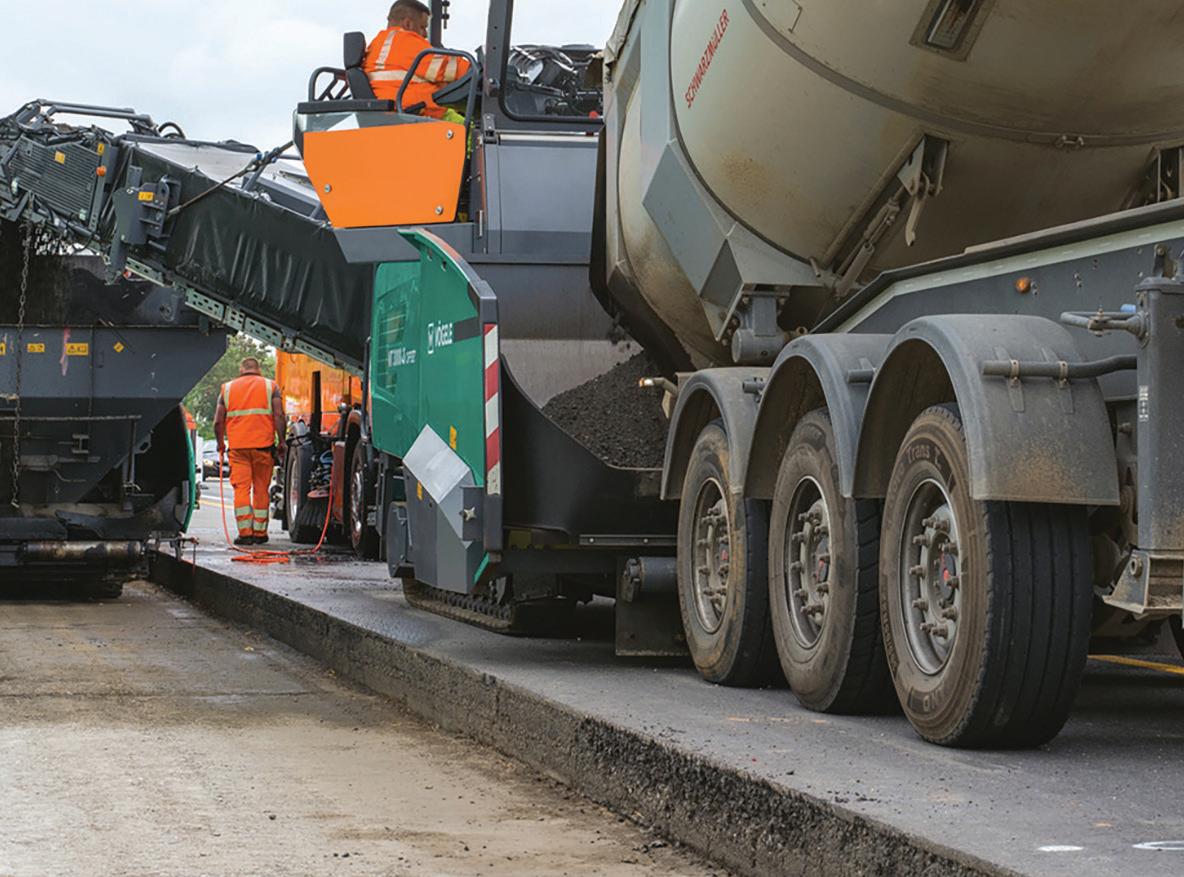


Equipment from the Wirtgen Group has played an important role in a road recycling project in Germany
Equipment from the Wirtgen Group has played a key role in a road surface recycling project carried out on Germany’s oldest stretch of Autobahn. is sustainable cold recycling technique was used to rebuild a 2.5km stretch of the A555 close to the city of Cologne.
Contractor STRABAG opted to use cold recycling with the equipment supplied by Wirtgen as an alternative to employing conventional road construction methods. e heavy tra c volumes using this Autobahn stretch meant that at least two lanes had to be kept open to tra c to prevent congestion.
e work included rebuilding the hard shoulder as a heavy vehicle lane with the highest load class of BK100. Using conventional paving methods, this would have meant milling o , removal and disposal of asphalt layers, stabilising the sub-base, repaving the asphalt base and asphalt binder courses and paving a new asphalt wearing course with the required load capacity.
For conventional asphalt construction, producing the asphalt and transporting the material to site in trucks represent major sources of CO2 emissions.
However, for this job on the A555, the cold recycling method from Wirtgen allowed emissions reduction by

“What Wirtgen is o ering us here with its cold inplant recycling method is an exceptionally advanced process”
Stephan Ehlers Technical manager, STRABAG (Düren Region)
paving the new base layer with bitumen-stabilised material (BSM), produced at 240tonnes/hour in Wirtgen’s KMA 240i mobile cold mixing plant. e high mobility and relatively small footprint of the plant meant that the unit could be set up close to the construction site.
is helped to reduce emissions from material transport. “What Wirtgen is o ering us here with its cold in-plant recycling method is an exceptionally advanced process,” said Stephan Ehlers, technical manager, STRABAG (Düren Region).
e cold mixing plant produced the mix for the BSM base layer using reclaimed milled asphalt with the addition of foamed bitumen and cement. A further reduction of CO2 emissions was due to the cold processing of the mix. e bitumen was delivered at a temperature of 180°C and then processed together with water and air to produce foamed bitumen. is eliminated the need for energy-intensive heating of aggregate fractions or granulated asphalt.
In order to achieve the speci ed degree of compaction, the BSM base layer was paved over the pre-prepared sub-base in two separate layers. To ensure paving was continuous, a Vögele MT 3000-3i
PowerFeeder was employed to transfer the mix to the Super 1900-3i paver. This took care of the true to grade and slope paving of the new base layer to a working width of 3.6m.
The first layer of cold mix paved had a thickness of 160mm and the second layer, paved the next day, a thickness of 100mm. Following pre-compaction with the AB500 screed, each of the cold mix layers was compacted by an HD+ 140 tandem roller and an HP 280i pneumatic-tyre roller from Hamm. On the construction site, the material fulfilled all the requirements previously determined by preliminary testing. As the final step in the process, the BSM mix was overpaved with a new asphalt surface layer (SMA 11 S) with a thickness of 40mm.
The BSM type mix is well established and is used for all load classes. Using BSM for the base layer is becoming increasingly popular in Germany for major roads and highways. Suitability testing of the cold recycling mix for the new base layer on the A555 near Cologne was carried out by STRABAG (Düren
Cold Recycling benefits
– up to:
• 100% lower costs for material disposal
• 90% less transport volume
• 90% lower consumption of resources
• 60% lower CO2 emissions
• 50% reduction of binding agents required
• 50% lower overall costs
• 50% shorter construction time
Region) with the assistance of Wirtgen in its own construction materials testing lab. When appropriately formulated, the mix is suitable for all traffic loads. The quantities of binding agent and aggregates to be added were determined in preliminary trials. Reclaimed asphalt pavement with 25% crushed sand for the filling of fines, plus 1% cement and 2% foamed bitumen, delivered further benefits for the sustainable mix.
As BSM mix can be stockpiled, it also allows versatile site logistics as mix can be produced at any time and stored until required. The mix remains pavable and, in contrast to conventional mixes, does not need to be laid down within a short space of time.
“We can make process flows considerably more effective and faster with bitumen-stabilised material. In view of our expressed commitment to achieving climate neutrality by 2040, we have a vested interest in the further development of what we have learned from this project,” emphasised Ehlers. End
www.wirtgen-group.com
Aggregate Industries is saving money and carbon emissions by using waste heat recovery systems at three of its UK asphalt plants. The installation commences Aggregate Industries’ goal of 10 implementations by the end of 2024, saving a total estimated 1,000 tonnes CO2/year.
The firm worked in collaboration with maintenance contractor Invertec to modify the plants, allowing a reduction in carbon emissions. The technology is being used at the firm’s three asphalt plants in Liverpool, Astley and Darwen. The process harnesses waste heat from the asphalt manufacturing process to preheat air entering the dryer.
The system captures waste heat and extracts thermal energy from the exhaust gases at the optimal locations. A preheating process utilises captured thermal energy to preheat clean incoming air. Directing the preheated air into the dryer then helps to raise the thermal efficiency of the process.
Rory Fulwell, decarbonisation engineer at Aggregate Industries, commented: “By capturing and utilising otherwise wasted heat from the dryer exhaust, we can
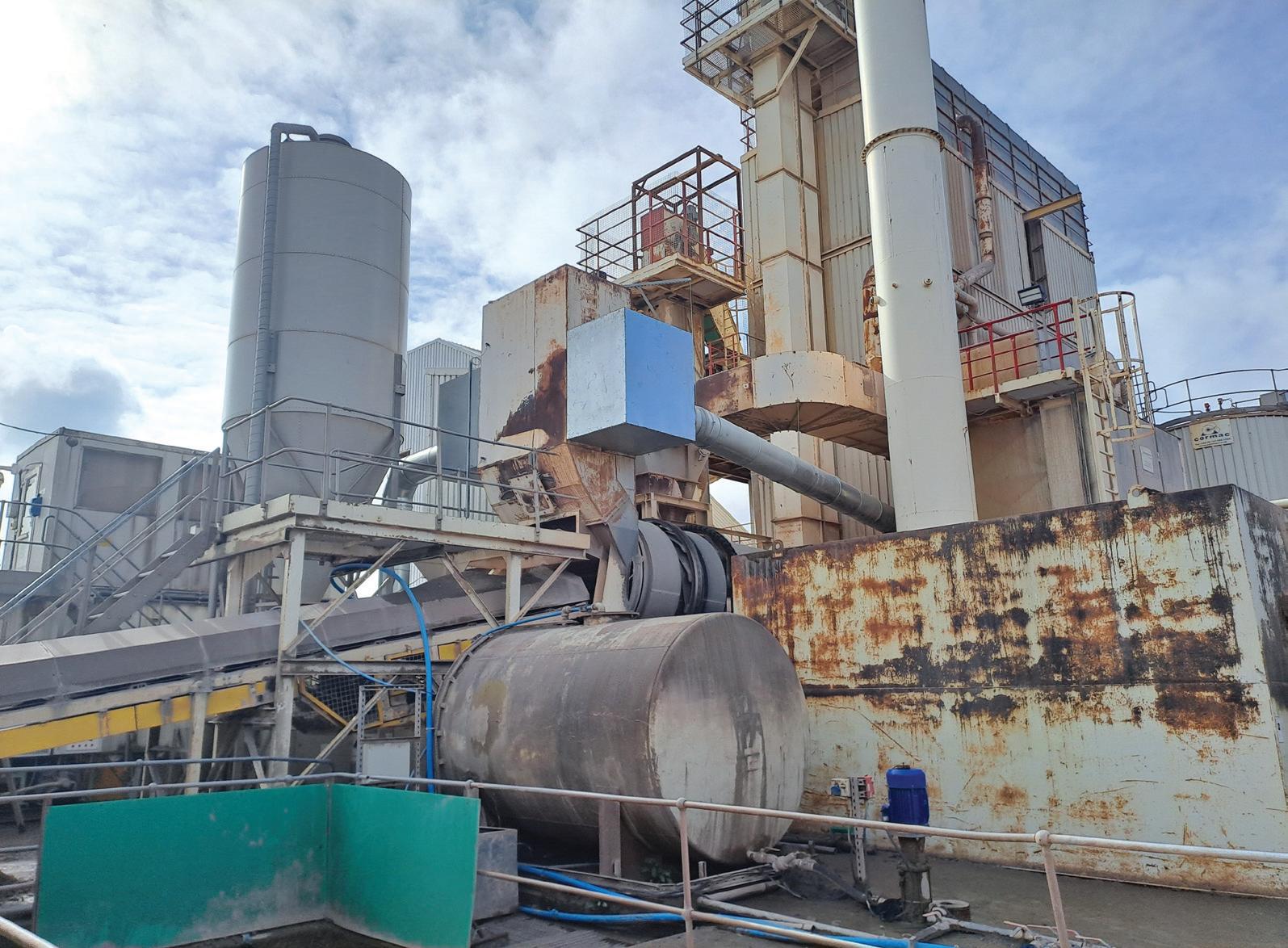
raise the thermal efficiency of the process and reduce fuel consumption and thus carbon emissions. “These simple systems can be retrofitted to most designs of asphalt plant, with potential efficiency gains modelled prior to installation using bespoke data collection and modelling tools.”
The sites have demonstrated promising results, with a 12-15% improvement in fuel consumption when compared to the previous year, with improvements expected to stabilise between 6-10% over
reducing CO2 emissions and running costs for asphalt plants in the UK
the course of the year. Featuring an air-heat exchanger, the heat recovery system uses a semi-self-cleaning design to allow dust and debris to fall free of the exchanger. This is said to offer easy access for maintenance and cleaning, and minimal resistance to flow.
In addition, the system has an intake fan sized to match the blower fan on the burner, steel ducting and a heat exchanger bypass valve.
Rory adds: “By recovering waste heat from the exhaust using a specially designed heat exchanger system, we are enhancing the efficiency of the rotary dryer, which in most cases consumes up to 15 million kWh annually. The new system aims to achieve a 10% reduction in fuel consumption, translating to significant carbon savings. Aggregate Industries
An array of innovative asphalt compaction machines are now coming to market from several of the major manufacturers - Mike Woof writes
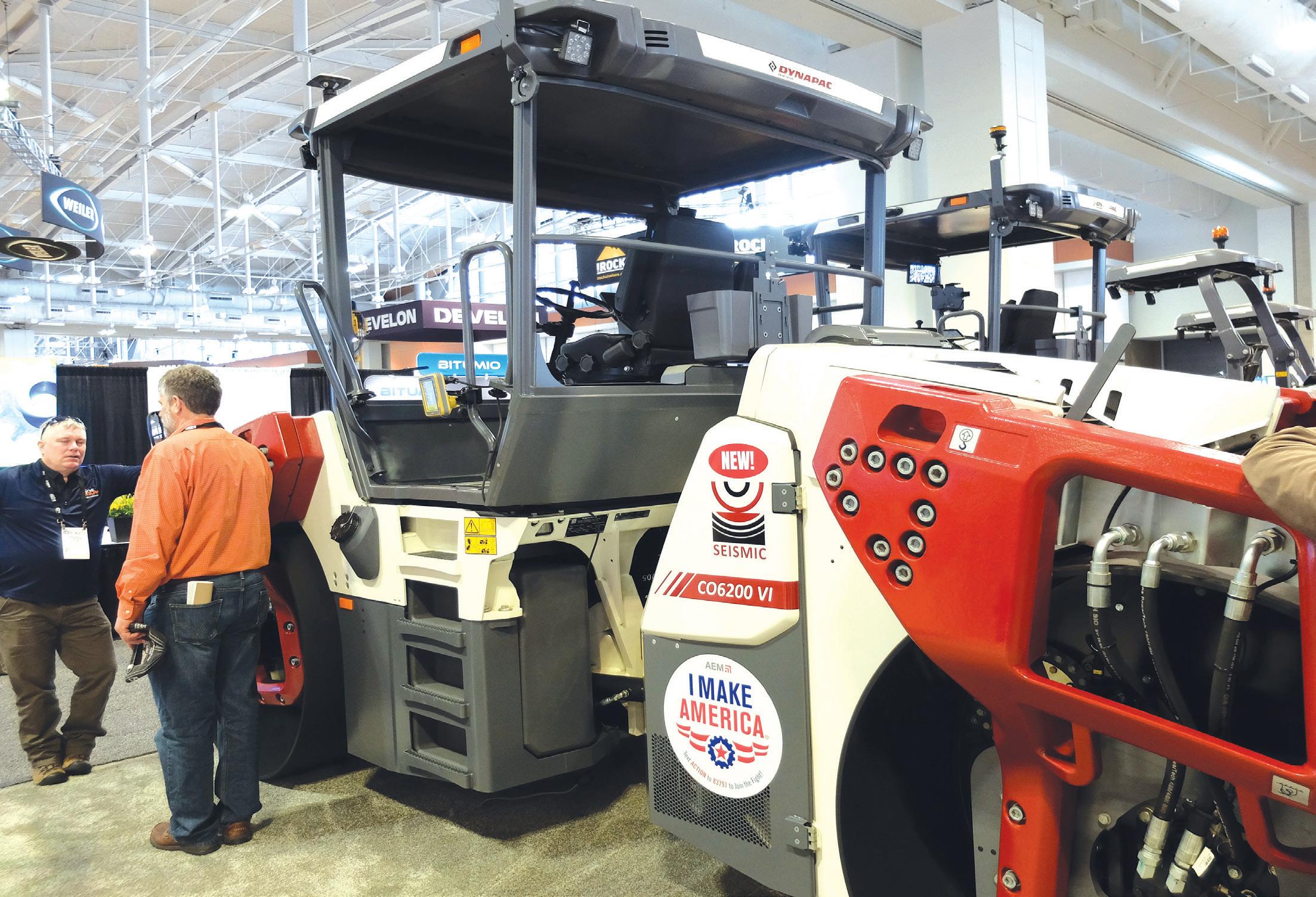
Inow being introduced by several of the major manufacturers, with solutions o ering improved working e ciency and performance.
ree of the most innovative developments for asphalt rollers come from Dynapac, BOMAG and Hamm, although new asphalt compactors are also being introduced by other rms such as Ammann and Caterpillar.
For Dynapac, the key advance is the introduction of its Seismic technology to the asphalt compactor range. is system was rst developed for its single drum rollers for use in earthmoving applications. e technology uses sensors that determine the resonant frequency of the material underneath the drum and then adjust the compaction forces accordingly. e bene t of the system is that it ensures more e cient compaction as the dynamic forces are optimised to suit the working conditions. e system ensures that the work is carried out to speci cation, without risking over-compaction. is reduces fuel consumption as well as the number of passes the machine makes.
Developing this system to meet the needs of asphalt compaction has required more development given
Dynapac’s innovative Seismic resonant frequency compaction system is now available on the CO2200 VICO6200 VI articulated rollers and CX 8C and CX 9C drum steer machines also
temperature. A spokesperson for Dynapac said, “It was more complicated and took ve years of R&D and needed a lot of testing.”
As temperature is a critical factor for sti ness in asphalt compaction and because the material is in layers, the system required heat sensors to be installed and more complex algorithms to be developed. As with the system for soil compaction, the technology allows drum vibration to match the resonant frequency of the asphalt course to provide optimum compaction.
Because the system matches the compaction forces required to the characteristics for a speci c section of surface, it also o ers a key advantage for the asphalt application as the spokesperson said, “We’re matching the mat frequency with the drum and you’re not going to over-compact so you’re not whitecapping. You get your density numbers a di erent way by automatically adjusting the frequency.” is avoids the risk of aggregate being cracked or crushed by compaction forces. He added, “ e seismic system adjusts the frequency every 0.2 seconds.”
e system is now o ered as an option on the new
rigid frame CX 8C and CX 9C models, which have drum widths of 1.5m and 1.7m and weights of 8tonnes and 9tonnes respectively. These models have also now been upgraded to the Generation 6 level seen earlier on the 6, 10 and 13tonne class machine. Meanwhile, it is being made standard on the articulated CO2200 VI-CO6200 VI asphalt compactors also.
Note that to meet French requirements, the CX 8C and CX 9C drum steer machines deliver 0.8mm of amplitude and benefit from larger eccentric weights and reinforced bearings. This French market requirement is now the standard for the CX models. The vibration system itself is conventional though and does not require any special maintenance as the core of the technology is in the control unit, while it is said to be simple for the operator to use.
Dynapac says that other key benefits of the seismic option include reduced operating noise, less vibration for the machine (in turn reducing wear and tear and fatigue for the operator) and lower fuel consumption. The spokesperson said, “We estimate around 10% fuel savings.”
The package is only available for vibration type compactors and Dynapac says that the benefits of the Seismic technology are less applicable to oscillation type machines in any case. This is because the latter are not able to cover-compact an asphalt mat.

Coming to the market soon from BOMAG will be a novel braking system, which will be available on the ROBOMAG BW 154 asphalt roller (as well as the ROBOMAG BW 177 soil compactor). The Emergency Brake Assist system scans the construction working environment in real time and identifies moving and static obstacles and objects. Objects that could be put at risk by the machine's movement are detected by the system. If a collision is imminent, the system slows the machine down to a complete stop. By averting potential hazards, the technology marks a significant milestone in enhancing onsite safety. Recognising its added value, the jury at the INTERMAT Awards in Paris honoured the technology with the prestigious Gold Award in the "Roads, Materials and Foundations Industries" category.
In cooperation with selected customers, BOMAG plans to test the Emergency Brake Assist on various
BOMAG’s new safety braking system for its autonomous machine is being tested onsite and will be available soon
BELOW
Hamm’s latest HD+ 120i V-VIO-2 rollers offers both vibration and oscillation compaction on both drums
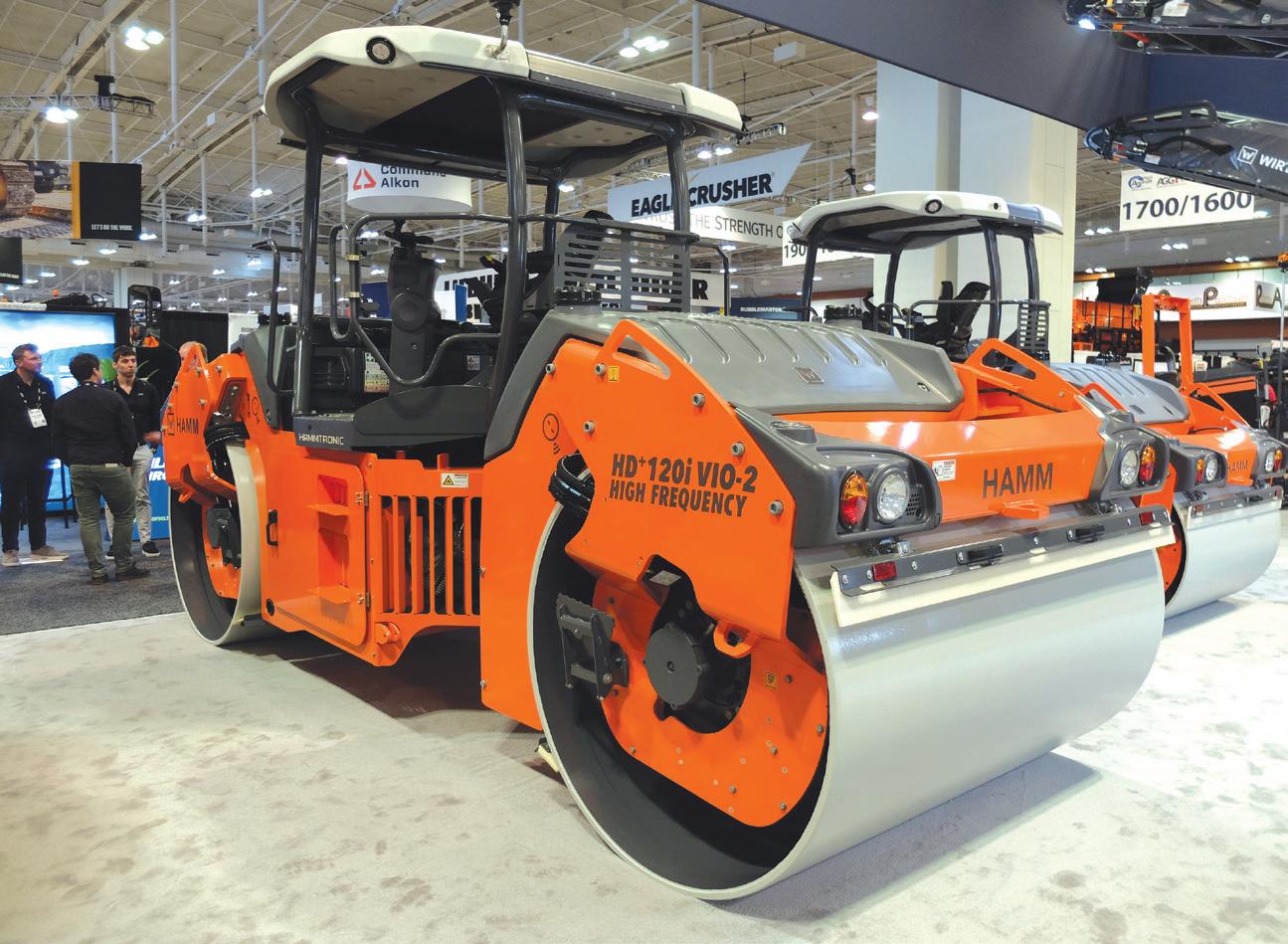
do for mechanical components.
Emergency Brake Assist is compatible with BOMAG's fifth-generation tandem rollers and therefore independent of use beyond just a fully autonomous asphalt roller. As the technology nears production readiness, the final certification is being worked on in cooperation with experts, which is critical when safety-related innovations are involved.
From Hamm comes a new development in the shape of its HD+ 120i V-VIO-2 HF. This innovative compactor offers the benefits of compaction by vibration and oscillation. While other machines (from Hamm and some competitors) have been able to offer this combination previously, they have been restricted to having one drum for vibration and the other for oscillation. However, the new HD+120i V-VIO-2 offers both vibration and oscillation on both drums. This allows the operator to combine the compaction types, depending on the application.
Tim Kowalski, product specialist for Hamm at Wirtgen Americas commented, “We can run dual oscillation or you can have vibration and oscillation.” He said that the operator can set the machine so that it delivers vibration at the front and oscillation at the rear and then switches automatically when it reverses direction. He explained that this better suits the machine to use with new mix types, which can prove more challenging to compact with conventional equipment. The operator can switch easily between vibration and oscillation, removing the need to switch machines or deploy an additional machine and another operator on the construction site.
The 12tonne-class machine is powered by a 115kW diesel that meets Tier 4 Final/Stage 5 emissions requirements and features the firm’s efficient Easy Drive operating concept. Featuring 2m-wide drums, high compaction forces are claimed, along with reliability, durability, productivity and ease of maintenance.
A key feature is the versatility as it offers static
compaction, oscillation and vibration. is versatility means that the same machine can be used for di erent asphalt mixes. e combination of vibration and oscillation delivers fast compaction in fewer double passes, suiting it to nal compaction. High compaction quality is claimed even at increased working speeds. e machine has the latest Hamm cab, o ering good all-round visibility as well as various interfaces to connect telematics systems, eet management systems and digital applications for controlling and
Operators can make use of the bene ts of oscillation for the compaction of joints or compaction in vibration-sensitive areas such as on bridges. Oscillation also allows compaction at low outside temperatures, since a wider temperature range can be used. e system is e ective in preventing particle crushing and over-compaction. It also has bene ts when compacting distortion-sensitive materials and reduces noise emissions and vibrations experienced on and around the construction site.
Aimed at the rental market, Ammann’s new light tandem roller is petrol-powered and features side-free drums that enable compaction in the tight jobsites.
e Ammann ARX 10.1 StV features the Honda GX630 petrol engine rated at 15.5kW. is reduces ownership costs and meets the latest Stage V/EPA Phase III emissions regulations.
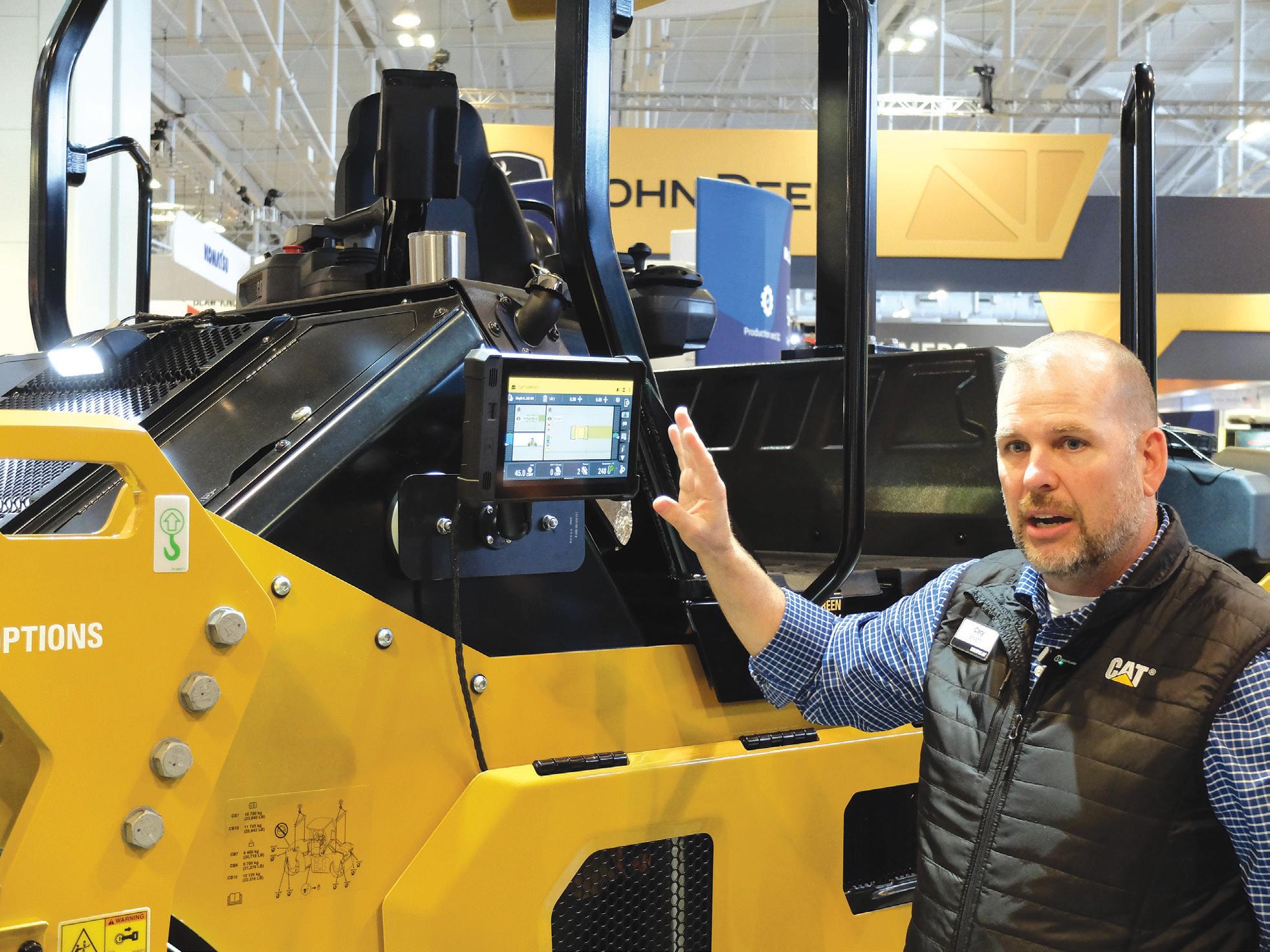
e engine is more compact than the diesel machine, allowing cooling from all sides and helping performance in high ambient temperatures. Petrol is also less expensive than diesel, while there is no need for a diesel particulate lter (DPF) and maintenance of a petrol engine is also less costly than for a diesel engine.
e Ammann ARX10.1 StV has its drum consoles installed from a single side. e drums are supportfree on the right side. is allows compaction work on tight jobsites. Drum working widths are 900mm and drums are installed inline.
Despite the compact size it has powerful hydraulics and both drums have robust drive motors and a negative parking brake mechanism for safe parking when the engine is switched o .
e vibratory system in the front drum can deliver 16.4kN at 76Hz, su cient for a range of duties. e rear drum is static and has no vibratory unit. e pressurised water sprinkling system has a tank capacity of 110litres.
Also new from Ammann is the ARP 75 twin drum roller, which o ers pivot or crab steer functions and is also available as a combi machine with one steel drum and four rubber tyres.
is model is said to be versatile and productive, suiting jobsites where precise steering is a priority.
e new cab is said to o er good visibility and low working noise. Other bene ts include well-designed and positioned water tanks that improve sight lines to all drum surfaces and edges.
e ARP 75 operator station extends beyond the 1x1m rule in both directions, boosting safety.
e machine features the novel Fingertip Steering (FTS) system, which replaces a steering wheel and allows operators to keep both hands on the armrests. A new touchscreen helps operators control machine
"Cat Compact helps operators visualise the mat while recording pass-count and temperature data. e system uses infrared temperature sensors and GPS mapping to keep the operator informed of mat temperatures, machine position, pass-count and pass coverage"
functions and allows easy adjustment of vibration, lights, and the rm’s sophisticated ACEforce package that provides Continuous Compaction Control.
e standard operating width of the ARP 75 is 1.5m, although using crab mode can increase working width and enables compaction close to kerbs and obstacles. Machine working width can be increased slightly to enable compaction around obstacles – or it can be expanded by up to 1.22m to a total machine working width of 2.72m. is improves productivity on long, straight jobsites.
e two-stage vibratory system o ers multiple frequencies to optimise compaction. e ARP 75 has adjustable frequencies ranging from 38-55Hz. It is able deliver compaction output in the range of 47-92kN/ drum.
Power comes from a Kubota V3307-CR-T diesel rated at 54.4kW and that meets Tier 4 Final and Stage 5 emissions requirements, with EGR+DOC+DPF aftertreatment.
ABOVE
Caterpillar’s new BC7, CB8 and CB10 models benefit from sophisticated compaction control systems
Available on the ARP 75 are ACEpro or ACEforce Intelligent Compaction systems. e ACEforce system uses absolute measurement (kB value in MN/m) of compaction results, making it easy to correlate with laboratory tests.
ACEpro is an automated measurement and regulation system. Parameter adjustment is based on continuous measurement of compacted material. Core parameters – such as amplitude and frequency – utilise automatic, stepless regulation.
Both compaction systems are compatible with all major GPS manufacturer´s products to provide mapping and operator guidance.
And Caterpillar is updating its mid-sized CB7, CB8, and CB10 asphalt compactors, with new edgemanagement options, optional cab, optional split drums, and a sophisticated mapping display.
Management of uncon ned edges can help optimise
density and deliver better road quality. e vertical edge created by the cut-o wheel helps provide a stable vertical face for joint matching on the next paving pass. e bevel edge options provide sloped pro les for smoother transitions on and o the paved surface. ree versions are available to meet requirements.
e new mapping display provides a new visual for easier recognition and touchscreen capability for simpli ed setup. Cat Compact helps operators visualise the mat while recording pass-count and temperature data. e system uses infrared temperature sensors and GPS mapping to keep the operator informed of mat temperatures, machine position, pass-count and pass coverage. is system enhances night-time performance, while also capturing data for future process analysis and quality control documentation. A spokesperson for the rm said, “ ese are the rst compactors from Cat with the

Scan for the latest news on compaction globalhighways.com
latest intelligent compaction system.”
e new dual split-drum option on the front drum can help eliminate tears when manoeuvring around obstacles or when compacting tight turns by reducing the speed of the inner drum half. e split drum option bene ts applications that require frequent turning.
e machine also has Caterpillar’s VisionLink system, a cloud-based software application that provides data to a desktop or mobile device, for more e cient eet management. e system shows maintenance needs, machine hours, location, fuel usage, idle time, diagnostic codes and other machine data to a mobile device, desktop or through an API to other software applications. End
www.ammann.com
www.bomag.com www.cat.com www.dynapac.com
www.hamm.eu
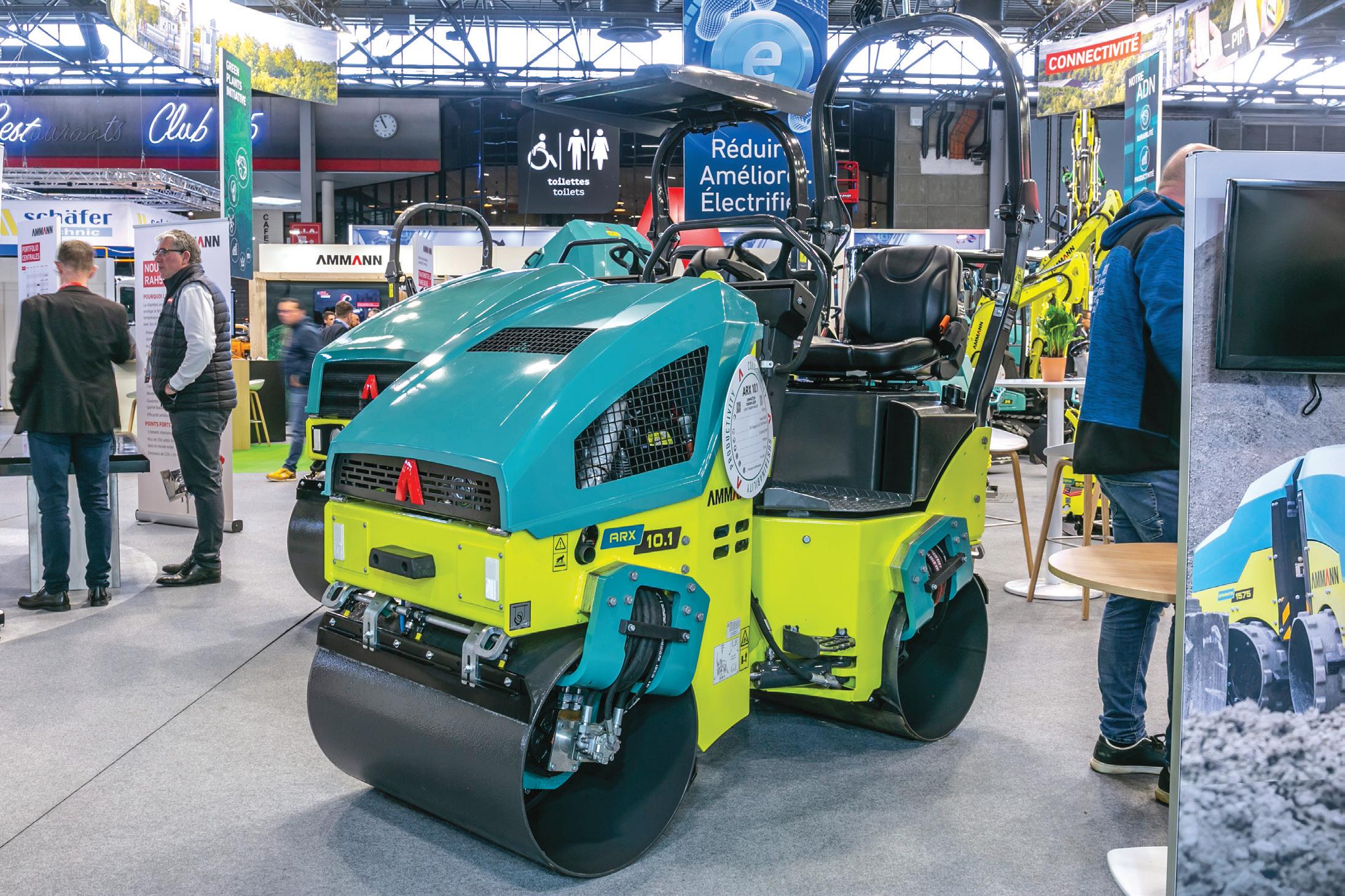
Ammann’s new light tandem roller is petrolpowered and features side-free drums that enable compaction in tight jobsites. e Ammann ARX 10.1 StV features the Honda GX630 petrol engine rated at 15.5kW. is reduces ownership costs and meets the latest Stage V/EPA Phase III emissions regulations. e engine is more compact than its diesel counterpart. e smaller size enables positioning that allows cooling from all sides, helping the machine to perform in hot ambient temperatures.
Beyond size, the use of petrol brings other advantages. Petrol is generally less expensive, so there is likely a cost advantage with every lling of the tank. ere is no need for a diesel particulate lter (DPF) and maintenance of a petrol engine is less costly than for a diesel engine. Petrol is often more convenient for smaller construction companies and rental customers. e Ammann ARX10.1 StV is the only machine on the market with drum consoles installed from a single side. e drums are support-
free on the right side. is allows compaction work on the tightest of jobsites. Drum working widths are 900mm and drums are installed inline.
A powerful hydraulic system is the core of the powertrain structure. Both drums are equipped with robust drive motors that bring high traction, gradeability and speed. e motors are equipped with a negative parking brake mechanism that ensures safe parking when the engine is switched o . www.ammann.com
Power Curbers is developing its 7500-D concrete slipformer to meet customer demand, o ering an industry first with an optional enclosed cab as well as a version aimed at European customers
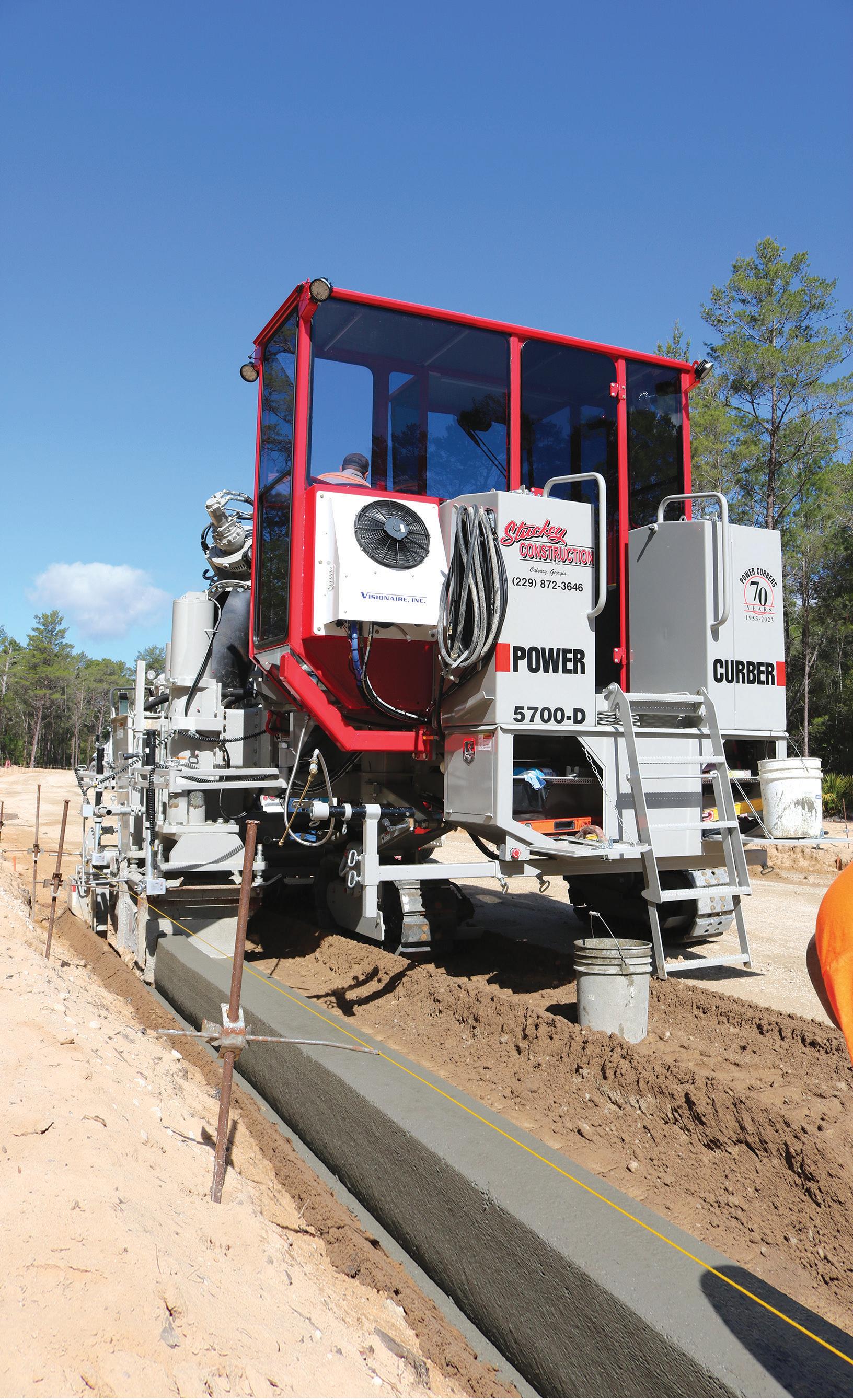
Power Curbers now o ers its 5700-D slipformer with an optional cab, as well as a four leg configuration
The new cab o ers a fully-enclosed operator’s platform with air conditioning and heating to boost comfort during extreme temperatures.
e cab also has a novel glass oor insert, positioned to o er provide visibility of both the mold and the nished concrete. is allows operators to make adjustments as needed, improving precision during a pour. e cabin has two exterior doors, for access to both the front and rear of the machine.
Operators will bene t from a quieter working area with reduced engine noise and the cab also shields the control panel from direct sunlight, maintaining a cooler temperature for switches and reducing glare on the display.
Meanwhile, company president Stephen Bullock said that the rm is also o ering a new version of its successful 5700-D slipformer, particularly for customers in Europe.
e rm has modi ed its existing, three track, 5700-D model to run on four tracks. Bullock said, “ is is just to reach that market that wants a four track machine.”
He said that some customers prefer the perceived stability of the four track con guration, while others are more keen on the tighter turning and more compact features of the three track layout. With this development, Power Curbers is now able to meet both preferences. For ease of transport it has a folding belt conveyor. Other speci cations such as the wide range of molds, the ability to work with stringless controls, its maximum slipforming height or paving width are the same as for the three track machine.
To further boost the versatility of the new 5700-D4, the machine can be switched quickly between paving on the left and right sides. Bullock said that this is another feature often preferred by customers in Europe. However, he added, “It’s available now.”
In addition, Power Curbers has been awarded the 2024 Continuous Improvement Award by the North Carolina Manufacturing Extension Partnership for its manufacturing processes and organisational excellence.
To achieve this, the rm took a deep look into its processes to identify areas of improvement. e company also provided extensive training in lean principles for its employees. ese e orts provided a workplace where the team looks for process improvements.
is process has taken many years, starting with
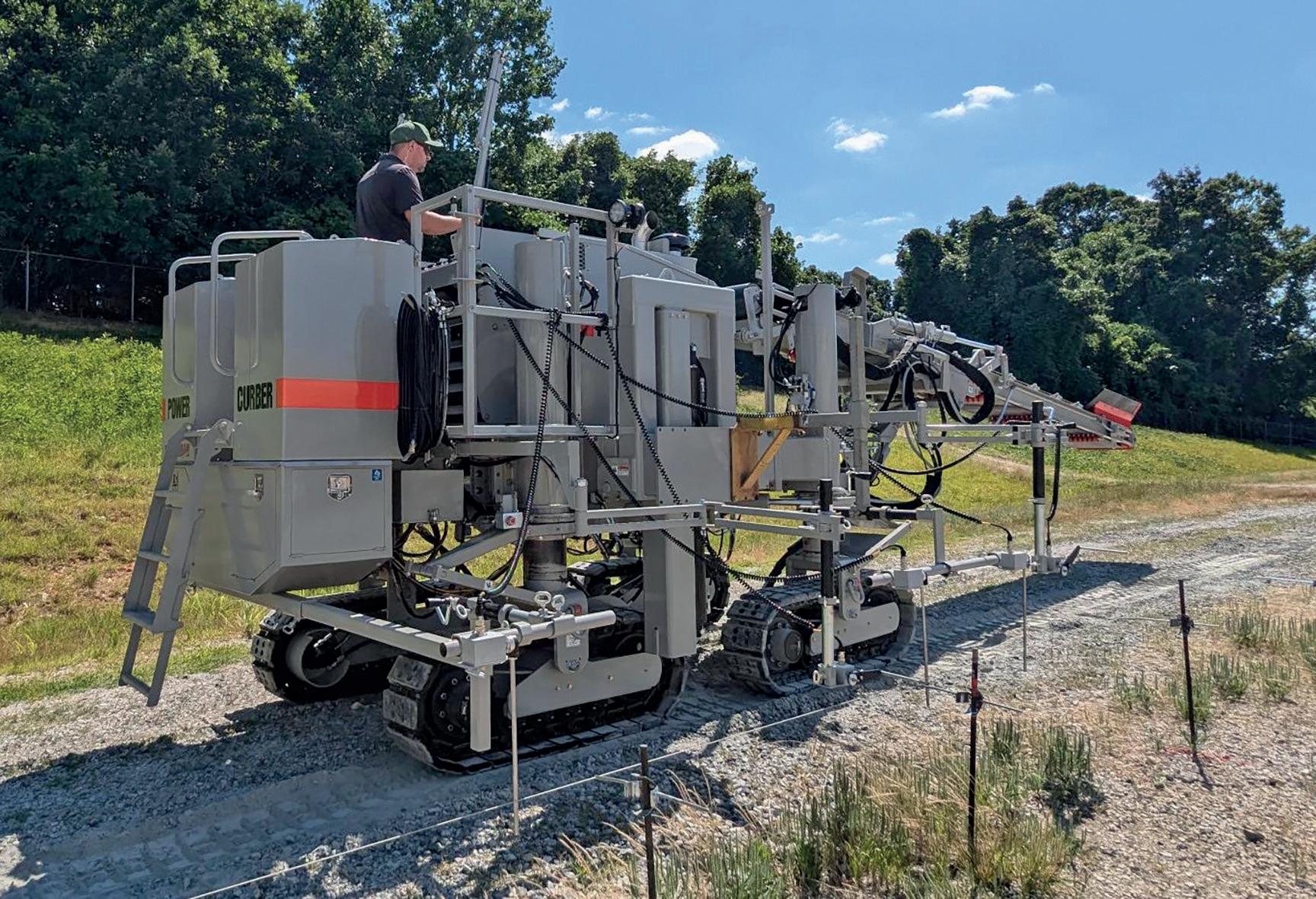
ABOVE : The new
has been undergoing testing
manufacturing and then extending the practices to other business areas, including lean accounting, striving to apply lean principles comprehensively throughout the organisation according to Bullock.
“It took concerted e orts throughout the rst year to embed this mindset across the organisation and gain genuine buy-in. e objective was clear: embracing continuous improvement wouldn’t jeopardise job security but enhance our success,” said Bullock.
By implementing lean tools and practices, Power Curbers improved productivity, safety, and e ciency. Organising and standardising workspaces reduced accidents and increased productivity. e rm also held targeted events to solve speci c problems, which led to quicker deliveries and increased sales.
With lean principles in place, operations became smoother and more organised. e rm improved inventory management and workspace organisation, improving e ciency and cost savings.
“Our inventory management underwent a signi cant overhaul. We realised the cost implications of excess inventory sitting idle on shelves and devised a coherent system to optimise inventory levels. is shift has improved e ciency and re ects our commitment to continuous improvement and operational excellence,” said Bullock.
To ensure these improvements lasted, Power Curbers standardised processes and implemented visual management systems. e rm also continued to nd ways to improve, such as adopting just-intime delivery for parts to streamline production and improve cash ow.
“ e just-in-time approach allows us to streamline our production process, from receiving raw materials to shipping the nished product, ensuring optimal cash ow. By adopting single-piece ow instead of batch processing, we avoid the accumulation of excess inventory and minimise the time between production and payment. is shift has improved our cash ow and overall operational e ciency, contributing to our success,” said Bullock. End www.powercurbers.com
Tarmac is o ering its customers access to advanced AI-enhanced digital sensors that can help to optimise concrete mixes, lower carbon emissions and reduce onsite construction time.
Partnering with Converge, a specialist in construction technology, Tarmac is o ering market-wide access to innovative technology that combines sophisticated wireless sensors with predictive artificial intelligence (AI). The sensors gather real-time data that can be combined with AI modelling to predict concrete strength, speeding up construction projects and reducing carbon emissions.
Tarmac customers will be able to specify the new technology, making it more accessible for small and mediumsized contractors. These firms can benefit from this innovation, which has previously been restricted to teams working on major projects.
It follows an extensive exploration process of Converge's technology by CRH Ventures, the venture capital arm of Tarmac’s parent CRH. This led to a 12-month pilot by Tarmac to assess the solution and its commercial possibilities.
The technology is being made available to all of Tarmac’s concrete customers as part of the company’s new CEVO brand, which is helping procurement teams to make informed
decisions and specify lower carbon concrete mixes and solutions.
The sensors are easy to use at approximately 3-4cm long and clip onto the steel reinforcements around which ready-mixed concrete is poured.
Andrew Campling, head of readymix concrete performance at Tarmac, said: “O ering market-wide access to innovative digital technology is vital as we work towards decarbonising construction. This partnership with Converge means we can o er more innovations to customers as part of our lower carbon CEVO concrete brand.
Raphael Scheps, CEO at Converge, said: “The pairing of CEVO with Converge's sensors and AI technology is a perfect match for concrete decarbonisation. By packaging our technology with Tarmac’s low embodied carbon mixes, contractors can build sustainably with the confidence that they're getting all the performance they need.”
Tarmac’s new CEVO brand has aligned the business’ extensive range of proven and trusted concretes with the leading industry standard ratings provided by the Institution of Civil Engineers (ICE) Green Construction Board Low Carbon Concrete Routemap. www.converge.io www.tarmac.com

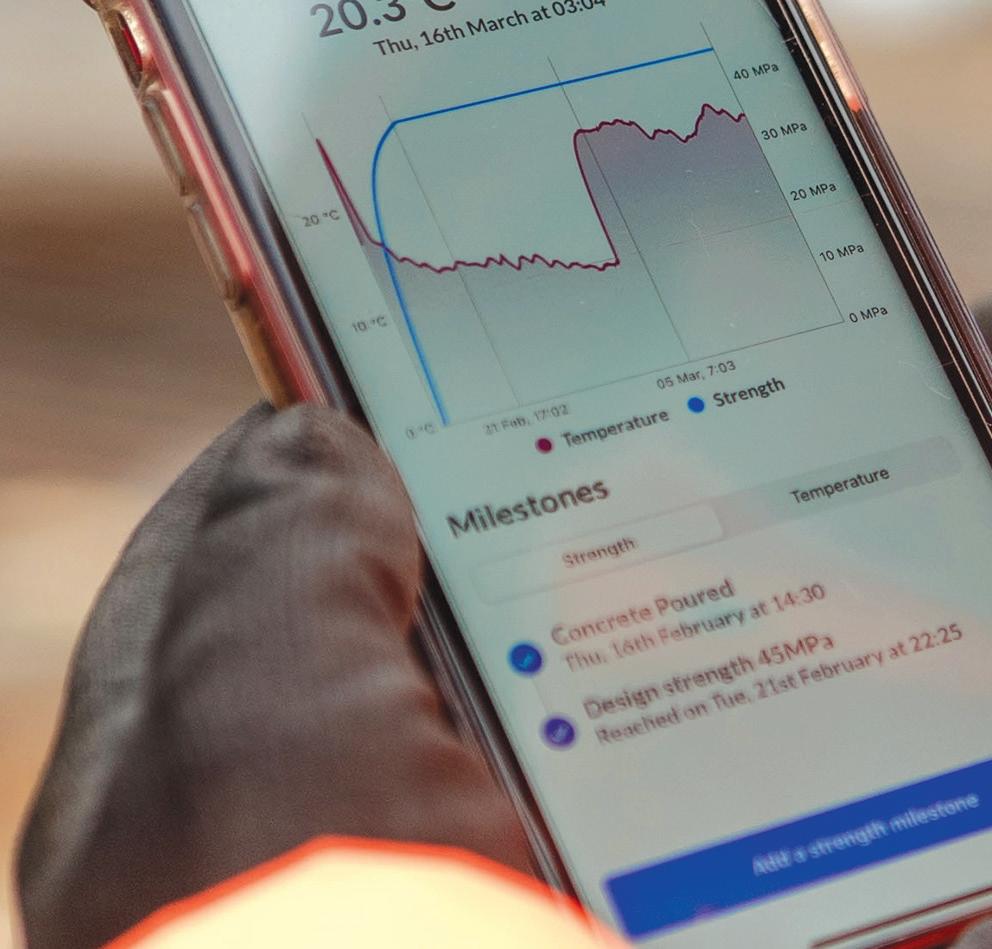



The new AI technology from Converge is being o ered by Tarmac to its concrete customers and can boost quality and e iciency
The contractor, Capital Paving & Construction, was very pleased with the performance of the machine
BELOW: The contractor used the Wirtgen concrete paver to provide a new surface for I-44
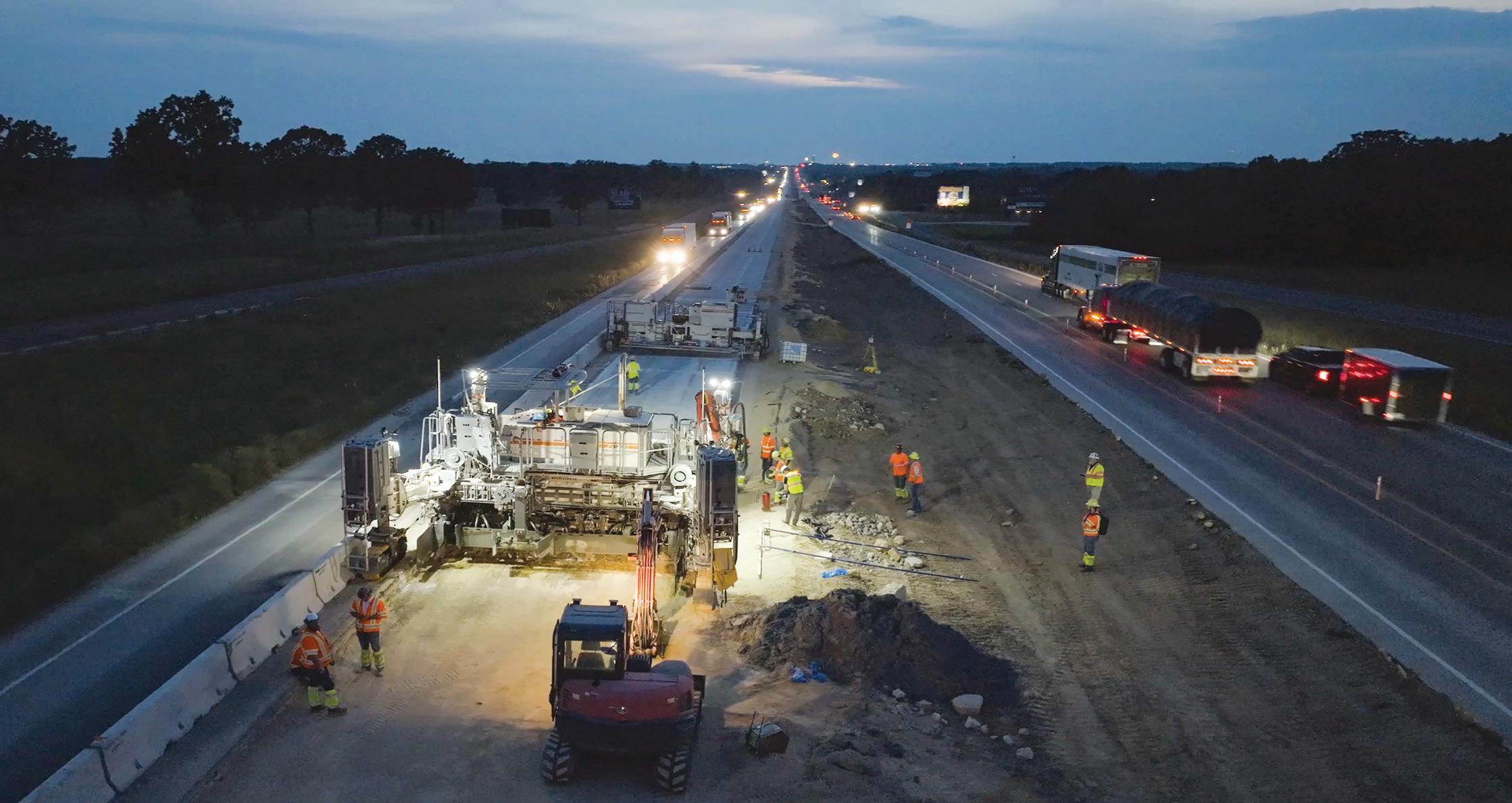
Construction work has been carried on I-44 in the US state of Missouri to improve the surface for drivers. The contractor, Capital Paving & Construction, has been repairing the worn roadway to deliver a smoother, long-lasting surface with better skid resistance.
The firm first had to remove the old concrete surface and then lay a new concrete roadway. For the paving work, the firm opted to use an SP 94i concrete slipformer from Wirtgen that was fitted with a DBI system.
Paving on an interstate highway provides major challenges for construction firms. Tight time frames as well as confined work areas with live tra ic in lanes alongside mean that contractors have to make the most of what working space they have available.
To rehabilitate the lanes, the firm removed the old concrete and rebuilt the roadway in two sections using its Wirtgen SP 94i. The first segment had a total width of 5.8m, while the second segment had a width of 6.7m. Each of these segments consisted of a 3.7m-wide lane and an adjacent shoulder. And in total, the highway was renewed over a length of 13km.
Access to the construction site on the interstate posed a major challenge for this project. Trucks could only unload the concrete
directly in front of the machine, as there was not enough space to feed from the side. Selecting the best equipment for this project was essential. “On this project, we knew we were going to have access issues and that there would be no room for a traditional dowel basket,” said Ryan Porter, senior project manager at Capital Paving & Construction.
“Instead of putting the basket out in front of the paver and tipping over the top of it from trucks, the DBI inserts the dowel bars right behind the mold,” said Tyler Kirchho , Foreman, Capital Paving & Construction. "That makes it easier on the crew and easier for the tipper trucks to get back." In addition to an increase in e iciency compared to paving with pre-placed reinforcement, a high paving quality could
be delivered according to the contractor.
High productivity can only be achieved with machines that o er operators simple, practical and convenient operation. The simpler the control of the machine and the higher the degree of automation of the process, the more time the operator can spend on processing the concrete itself. Even small improvements to the machine can have a major impact on the overall result, boosting working e iciency and allowing for a better and more consistent surface. "What I really like about this machine is the crow’s nest. Our old machine didn’t have that, but this new feature lets me see our bar shooter in action and keep an eye on our vibrators. It provides a great overall view of what we’re
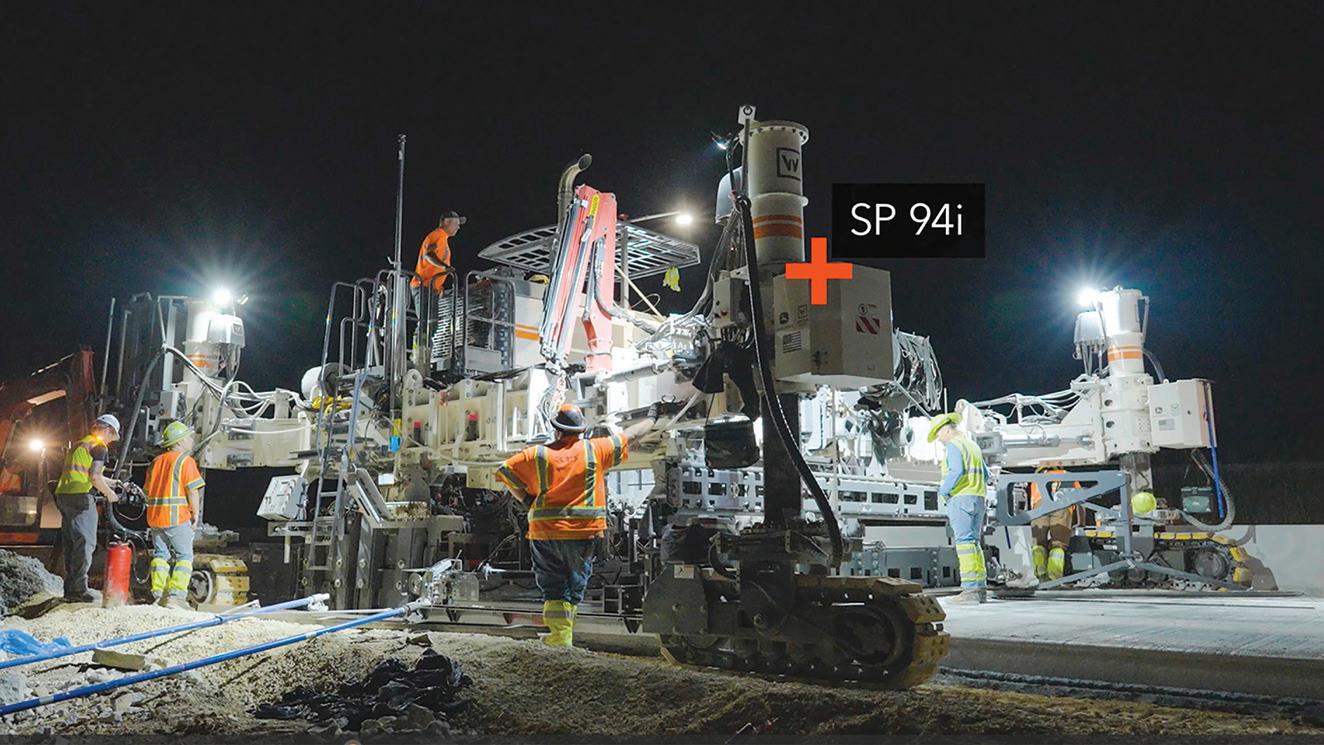
doing," explained Brian Wood, machine operator.
When paving concrete, it is important to ensure continuous operation and avoid interruptions. To ensure a smooth process, the logistics and the paving team have to be well coordinated as this avoids material shortfalls that could result in paving work coming to a halt, with an impact on quality and e iciency. In addition, the machine and all its components must be set up carefully on the construction site. To make sure that the paver was in optimum condition, the Wirtgen Group service and support team assisted Capital Paving with the set-up of the machine. And as Kirchho pointed out: "The support from Wirtgen has been wonderful.“
www.wirtgen-group.com

Specialist contractor DT Read Steel is making good use of an innovative technology for concrete construction on a project in North Carolina. e rm has been using the novel TyBOT machine, a rebar tying robot, for the I-40 Gorge Bridge over Jonathan Creek.
Advanced Construction Robotics (ACR) supplied the TyBOT for the project, the rst time this machine has been used in North Carolina. e TyBOT machine worked alongside the crew from the rebar specialist contractor DT Read Steel, helping to boost productivity on this portion of the I-40 Gorge Bridge, with Kiewit Corporation acting as main contractor for the project.
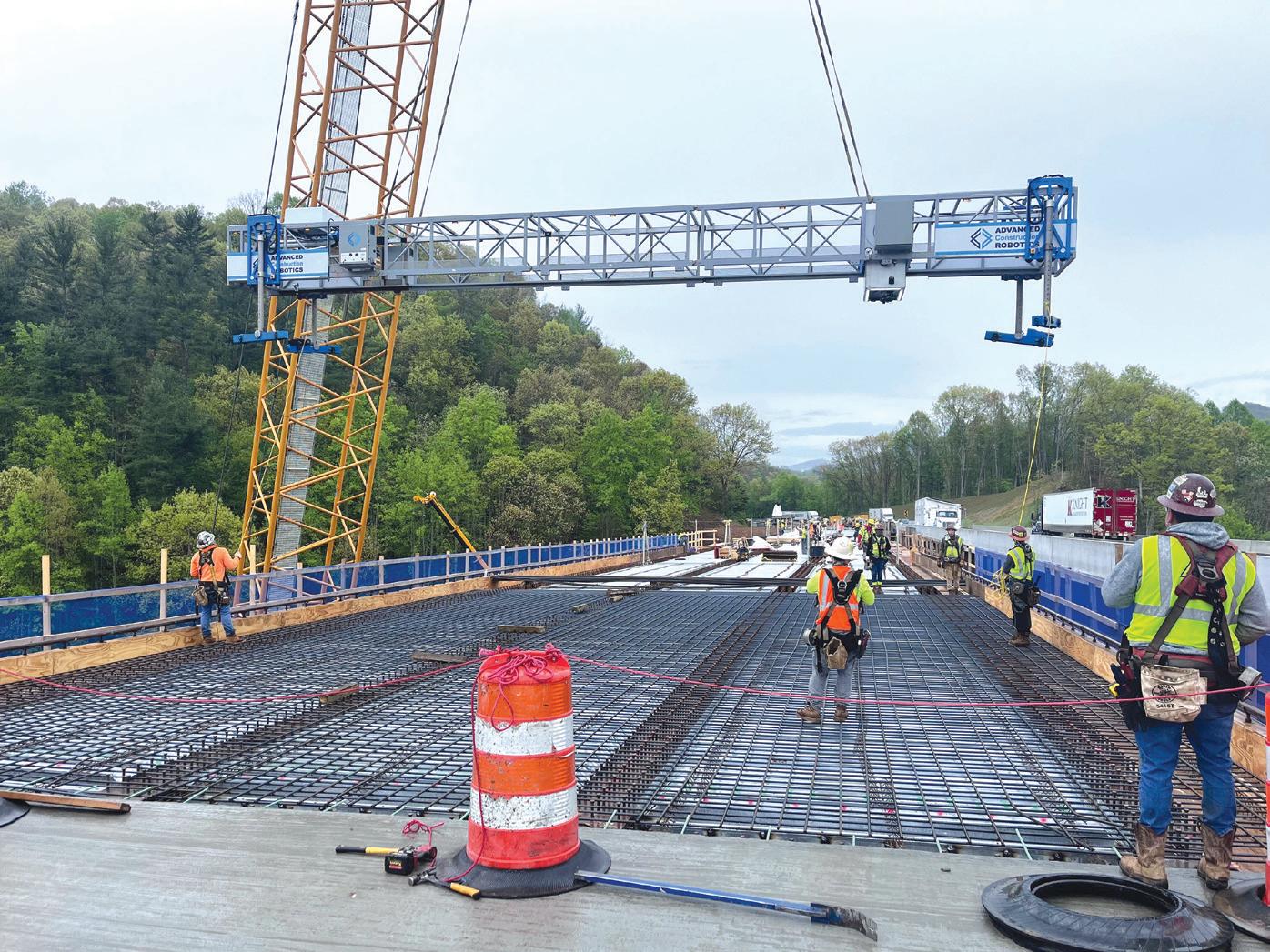
ABOVE
Using the TyBOT machine, DT Read Steel was able to complete 58,215 ties across an area of 2,337m2. e TyBOT is able to tie reinforcing steel at a rate of over 1,100 ties/hour. e machine was introduced by ACR in 2018 and has since won several innovation awards in the construction industry. With the addition of North Carolina, TyBOT has now completed over 4.2 million ties on jobs in 14 di erent states in the US, and on over 60 projects.
DT Read Steel said that its rapid adoption and integration of TyBOT into its workforce demonstrates its commitment to modernising its construction processes, by usilising cutting-edge technology. Already experienced with the TyBOT machine from using it on previous projects, DT Read Steel's crew was able to boost the safety and e ciency for the rebar tying process for the I-40 Gorge Bridge. is swift integration of the TyBOT into its operations highlights the rms pro ciency with modern equipment, marking a signi cant step in workforce development and the ability to operate innovative solutions with minimal downtime.
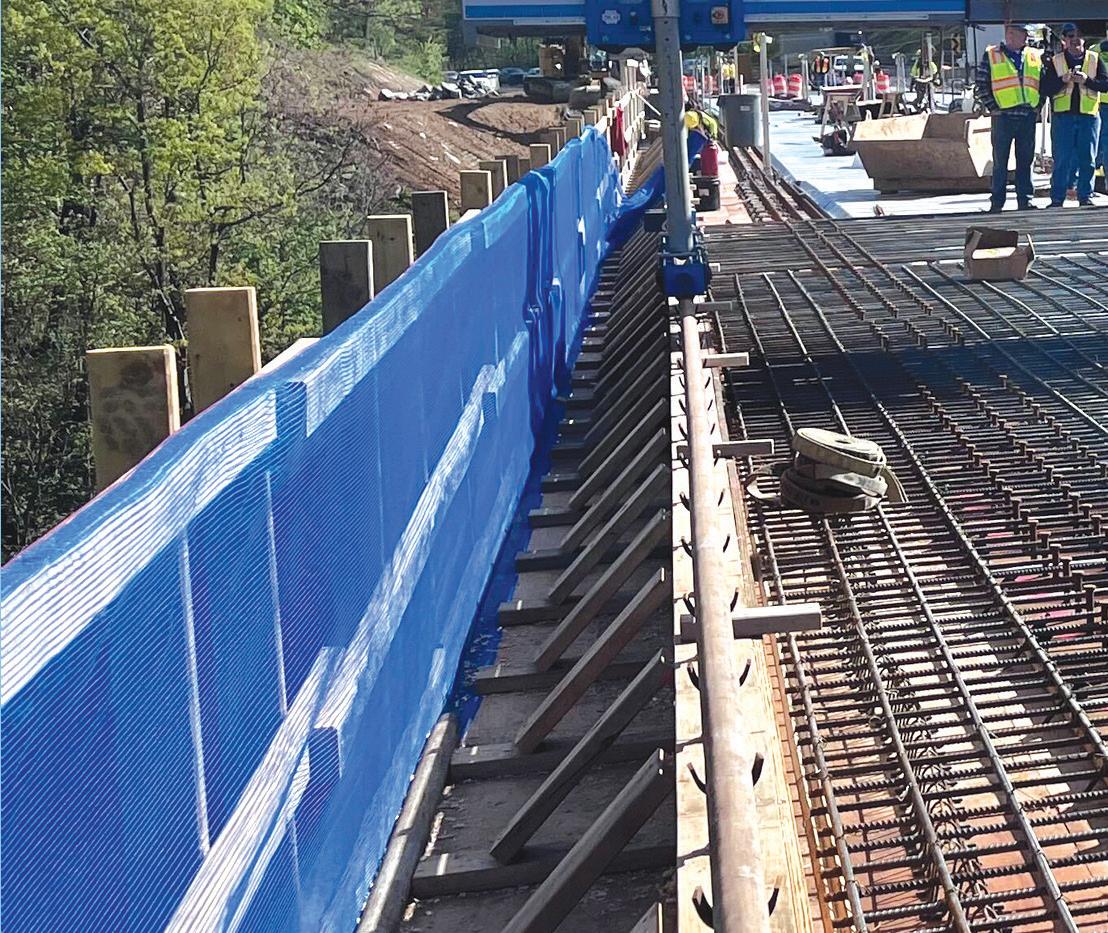
The TyBOT rebar tying robot has been used for the first time in North Carolina, tying rebar for the I-40 Gorge Bridge spanning Jonathan Creek, a project being managed by main contractor Kiewit Corporation
BELOW
Advanced Construction Robots supplied the TyBOT machine to specialist contractor DT Read Steel, as well as providing training
Erick Bowman, area manager at DT Read Steel, expressed his enthusiasm for TyBOT in the rm’s operations and commented, "TyBOT once again proved its value by increasing our productivity and ensuring our team’s safety." He is also pleased about this technology's prospects for their workforce, stating, “Our team’s growing pro ciency with TyBOT continues to pay o , and we're excited to see how this technology will further enhance our future projects. e e ciency and safety improvements are gamechangers, and our crew is embracing the role of ‘Rebar Geek Squad’ with enthusiasm and pride."
“ACR had trained DT Read to use TyBOT, so they were able to make immediate headway on this project without support from our team,” said Danielle Proctor, CEO of ACR. “We're thrilled to see trained repeat clients making a tangible impact on projects and paving the way for a safer, more e cient future in the construction industry. We look forward to more successful collaborations with DT Read.”

Advanced Construction Robotics is dedicated to equipping modern crews with state-of-the-art technology, helping contractors like DT Read set new standards for productivity and quality. TyBOT’s successful completion of the I-40 Gorge Bridge over Jonathan Creek in North Carolina showcases ACR's commitment to innovation as they expand their reach and collaborate with more contractors nationwide. www.constructionrobots.com


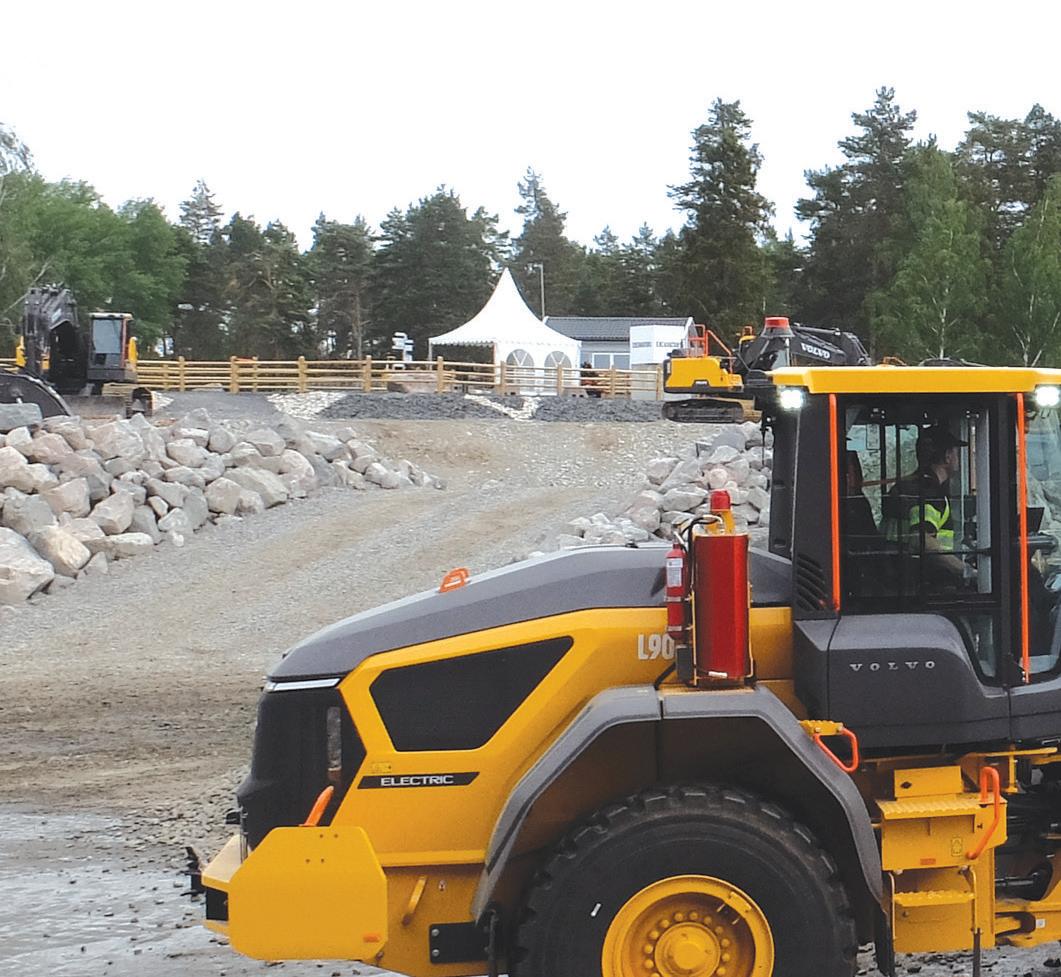
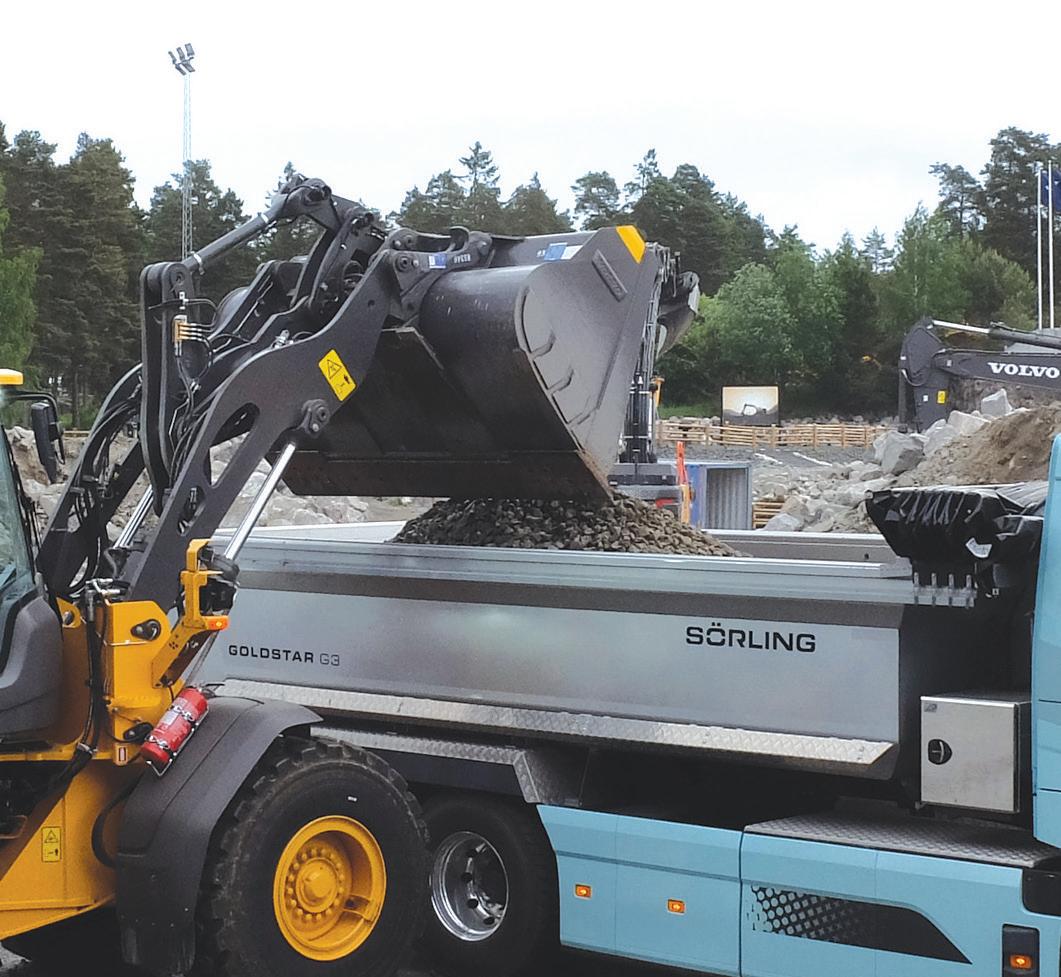

Volvo CE is following a revolutionary path in the market for earthmoving construction machines with its innovative, mid-size electric models – Mike Woof writes
Volvo CE is taking an important step in the earthmoving equipment market with the introduction of innovative, mid-size electric construction machines. While several construction equipment rms now o er compact electric equipment, Volvo CE is cementing its position as a leader in the eld, with two new electric wheeled loaders and a crawler excavator being made available.
e rm is introducing the L120 Electric wheeled loader and L90 Electric wheeled loader as well as the EC230 Electric crawler excavator. ese are the latest construction machines aimed at meeting the needs of customers requiring equipment with zero tailpipe emissions.
e rm claims that these units o er an option for customers looking to decarbonise their operations, as well as o ering lower running costs and comfortable working environments. e machines will allow customers to work in low carbon zones and noisesensitive areas, as well as indoors, but without the need for extra ventilation systems and outside of standard working hours.
Of note is that Volvo CE claims a 65% energy cost reduction on average, as well as 30% less maintenance and zero engine-related consumables. is makes the machines a cost-e ective long term working solution for a worksite. ey also deliver similar performance to diesel machines. And with less noise, vibrations and heat, operators report quieter working conditions, reduced fatigue and the ability to communicate easily.
Elodie Guyot, Head of electromobility sales for

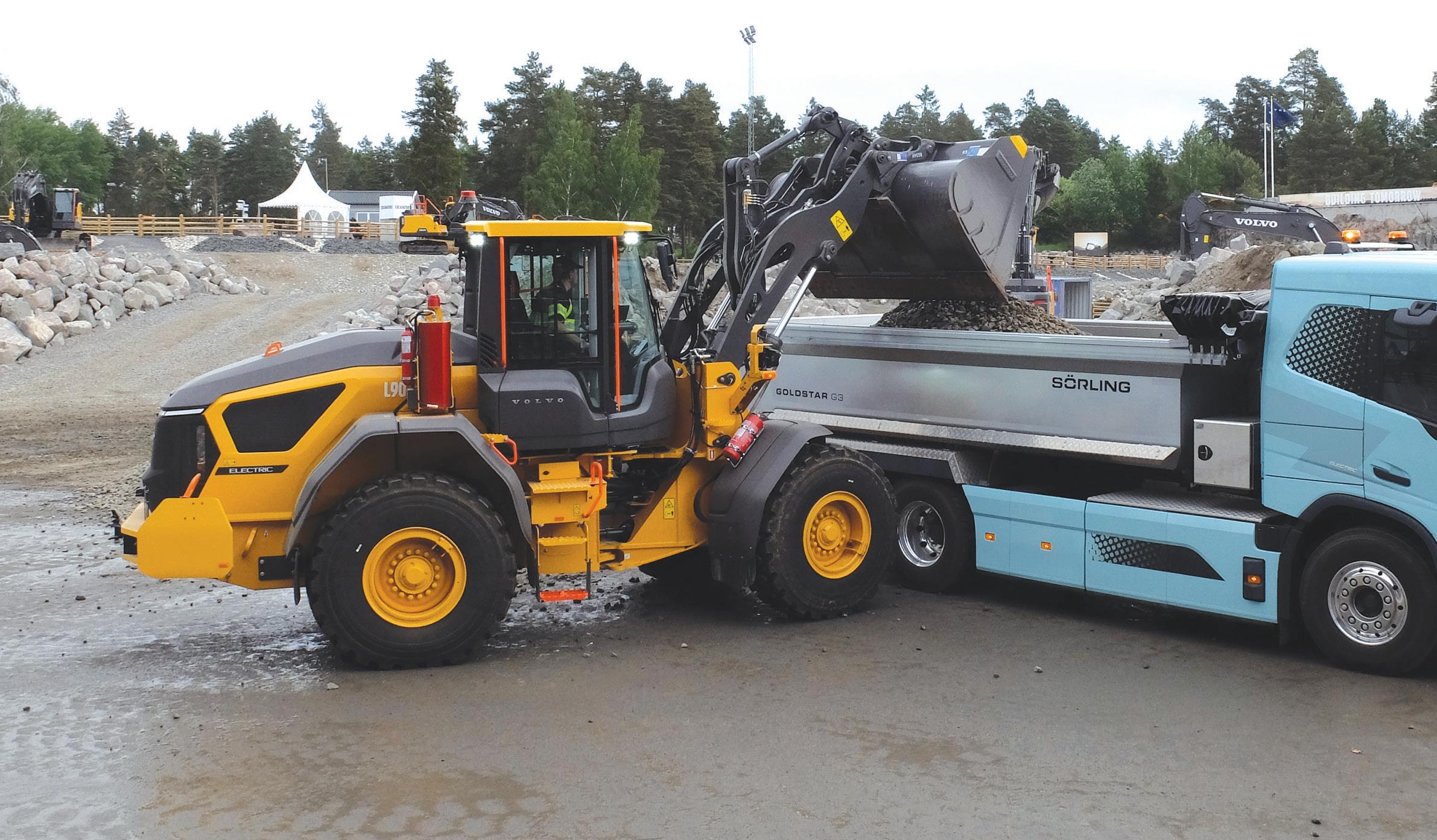
ABOVE
The new L90 Electric wheeled loader o ers quiet, zero emission operation
“Our commitment to building a better world relies on us driving sustainable change across di erent equipment types and size classes"
Elodie Guyot
Head
of electromobility
sales,
Europe at VCE
region Europe at VCE said: “Our commitment to building a better world relies on us driving sustainable change across di erent equipment types and size classes. We already have dependable electric solutions out in the eld across our compact portfolio and a growing part of our mid-size range. We are excited to continue delivering on this commitment now with three medium-sized zero emission innovations, across new lines and sizes, all of which bene t from our industry-leading, high-performing electric technology.”
e new L120 Electric wheeled loader o ers a 6tonne lifting capacity and is suited to use in a wide range of working environments. is model is being made available across select markets in Europe, India, Asia, Latin America and North America from Q4, 2024. e machine can work for 5-9 hours from a single charge for most light and medium-duty tasks, depending on the application and environment. Volvo CE claims that the machine can charge from 10-100% in one hour 40 minutes with a 180kW DC fast charger or Volvo’s PU500 mobile power unit, and in 7 hours with a 40kW DC portable charger, suitable for overnight charging.
Meanwhile the 15tonne L90 Electric has dedicated electric motors for drive and hydraulics, providing full power to both systems. e rm claims a faster response and shorter cycle times than conventional models, largely due to its Volvo-designed transmission, purpose-built for the electric platform and also optimising energy e ciency.
Operators can access functions and settings from the interface, which integrates the Volvo Co-Pilot and rearview camera when tted. e L90 Electric will run for 4-5 hours across most medium-duty applications and a full working day in lighter duties. As with its larger sibling, the electric drive motor on the L90 Electric recuperates energy when decelerating, extending runtime and brake life.
e machine can charge 0-100% in about 70 minutes using a 150kW DC fast charger or PU500 mobile power unit, while its AC onboard cable can power up in 6-7 hours for overnight charging. e L90 Electric will be available to select markets in Europe in 2025.
Meanwhile, the new EC230 Electric crawler excavator bene ts from proven technology used in
BELOW
Hyundai now o ers a 100tonne class excavator in the shape of its HX1000A L model

the existing Volvo CE range. As with the new electric wheeled loaders, the EC230 Electric excavator o ers operators low working noise and vibration. At the same time, the machine o ers responsive hydraulics due to the electric drive system.
e 600V battery has a 264kWh capacity and typically has a run time of 4-5 hours, depending on the application. Despite the battery capacity, the machine dimensions are conventional and the tail swing radius is 2,850mm. Depending on speci cation, the EC230 Electric weighs from 23-26tonnes and is o ered with buckets ranging in capacity from 0.48-1.44m3 to suit the application. End
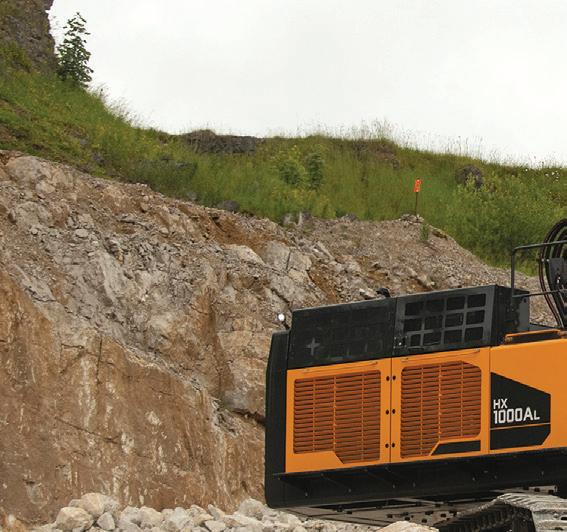
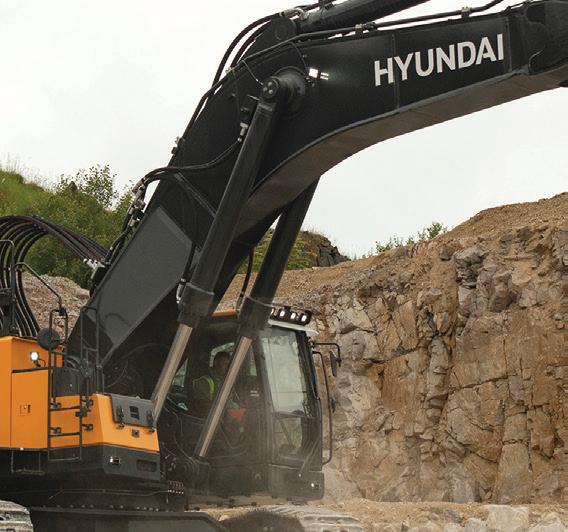



HD Hyundai Construction Equipment is now moving up the size class with its latest o erings for the crawler excavator and wheeled loader segments.
e rm’s new HX800A L and HX1000A L excavators and HL985A wheeled loader are now top-of-the-range models for the company.
e HX800A L is an 80tonne class excavator and the HX1000A L is a 100tonne machine, while the new HL985A loader weighs in at 35tonnes and is designed to work with a 7m3 bucket. All three models bene t from high comfort cabs with low noise and good all-round vision as well as meeting Stage V/Tier 4 Final emissions compliance.
e HX800A L and HX1000A L suit use in bulk earthmoving and infrastructure projects. e HX800A L uses the six-cylinder
Perkins 2506J engine, providing 400kW at 1,800rpm and 2,468Nm of torque at 1,400rpm. e larger HX1000A L is powered by the Perkins 2806J engine, o ering 460kW at 2,000rpm and 2,952Nm at 1,300rpm.
An electronic hydraulic power control minimises fuel consumption, while increasing digging e ciency. It has nine sensors across the machine to calculate the required ow and pump output, optimising e ciency.
e HX800A L is suitable for 4.25-5.24m3 buckets and the larger 100tonne machine will be able to work with 5.4-6.8m3 buckets. e two machines are o ered with a choice of short mass excavation and longer monobooms, and with the option of two dipper arm lengths.
e HL985A loader shares the robust design of the smaller A-Series machines and is powered by the latest Cummins X12 diesel engine, delivering 321kW at 2,100rpm and 2,300Nm of torque at 1,400rpm. at is 10% more power and 20% higher torque than before, with lower fuel consumption and exhaust emissions. e HL985A can be tted with a 6.5m3 or 7.0m3 bucket, with or without teeth and cutting edges.
e loader bene ts from an Eco gauge in the cab, monitoring fuel consumption in real time.
A Smart Power mode reduces fuel use, adjusting engine speed while loading the bucket. Driving through a ve-speed transmission with lock-up clutch, the machine o ers a maximum travel speed of 40km/h. www.hd-hyundaice.com
Liebherr has carried out a demonstration of its new H2 wheeled loader during an event at its Bischofshofen factory. The world's first large wheeled loader using hydrogen as a fuel was demonstrated in public for the first time. The L 566 H from Liebherr is the world's first prototype large wheeled loader with a hydrogen engine. Following studies, this technology was identified as a solution for large vehicles that are di icult to electrify.
www.liebherr.com
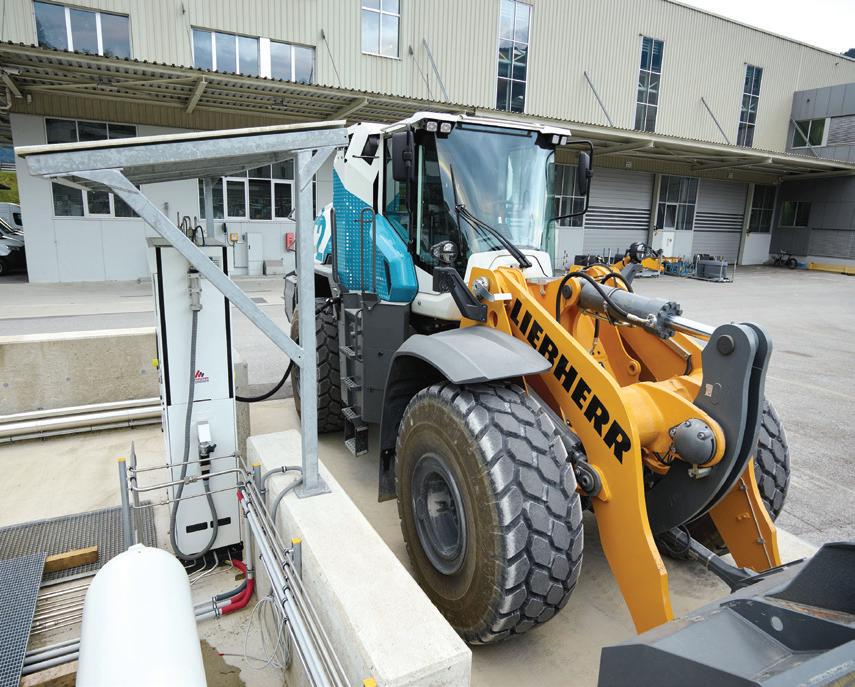
New innovations for the crawler excavator market will boost productiv ity as well as sustainability – Mike Woof writes
The crawler excavator segment of the o -highway machinery market is seeing key innovations coming to market that will help transform the construction industry. New technology can help deliver earthmoving works more quickly and more accurately, while reducing fuel consumption and emissions, boosting sustainability. And several rms are now o ering electric machines, with the bene t of zero emissions.
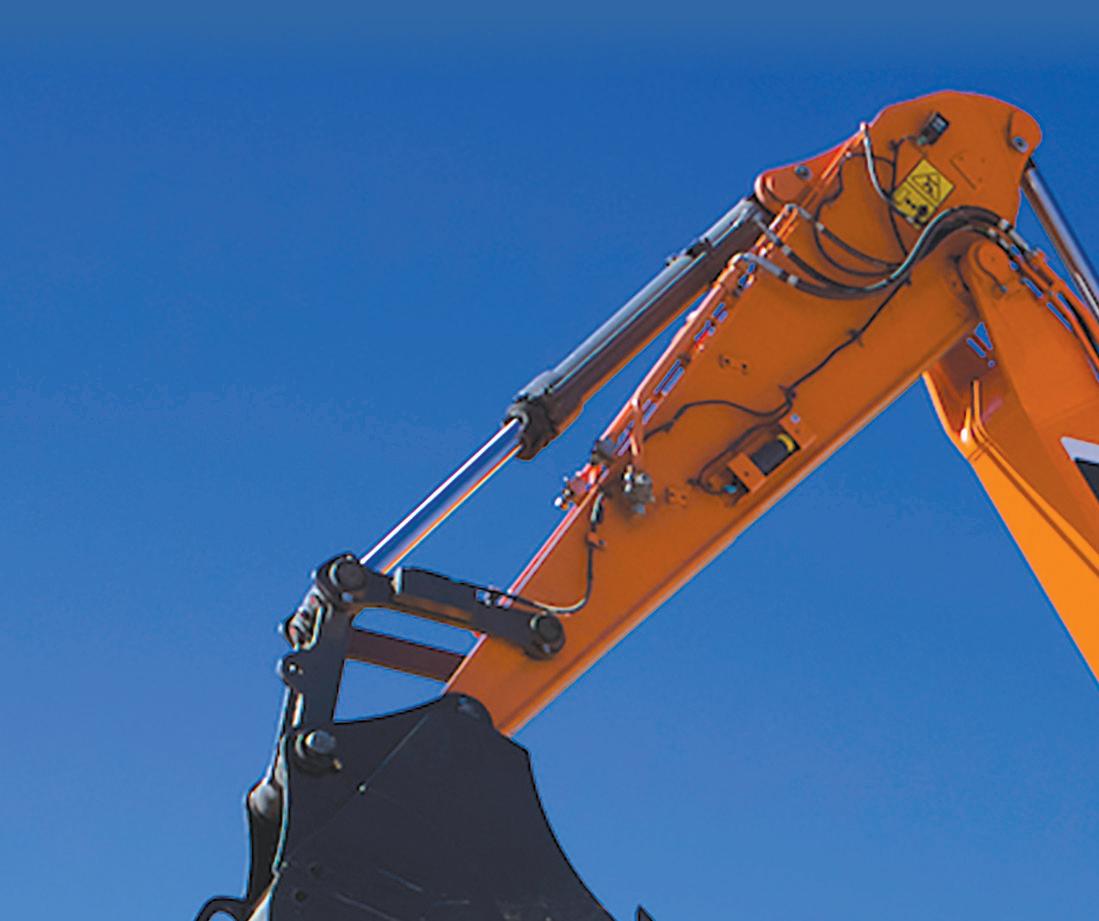
BELOW Develon is now o ering its first ‘smart’ excavator
Komatsu is o ering electric excavators for the 13tonne and 21tonne classes that are powered by lithium-ion batteries. e 13tonne class PC138E-11 electric excavator is being o ered rst in the Japanese market but is being made available for Europe also.
e rm is also introducing its PC210LCE-11 electric excavator in Europe. Komatsu says it is keen to develop a market for electric construction machines in the medium-sized range in Europe, which is why these two new models are so important for the company.

e more compact of the two models is aimed particularly at the rental machine market and is powered by a 225kWh lithium-ion battery and features a integrated cooling system. e high capacity battery in the 13tonner is said to o er a long operating time before requiring recharging, while the machine also has a short tailswing design. e combination of electric power and the short tailswing suits the machine for construction sites in urban areas where space may be limited and the bene t of its zero emissions and low working noise will be a major advantage for users.
e machine has a bucket capacity of 0.5m3, with a tail swing radius of just 1.83m. Weighing in at 15.3tonnes the machine has a 72.5kW motor, as well as its 225.6kWh battery.


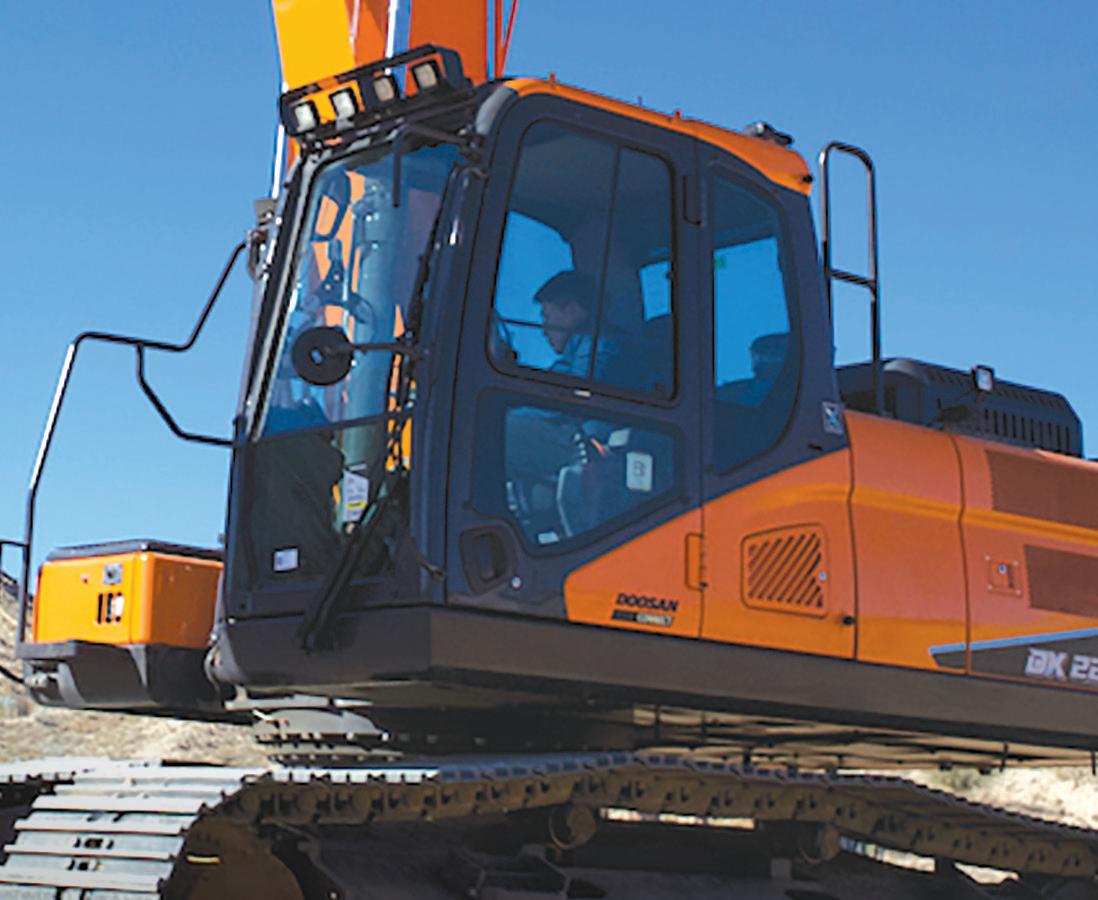





Komatsu is offering the PC138E-11 excavator with a Smart Construction 3D Machine Guidance kit, which helps to optimise working and allow operators to work to grade accurately and more quickly. This is said to be simple and versatile package and offers an accessible way for customers to use 2D and 3D machine guidance. The system can be customised with an array of options, allowing the package to be suited a customer’s requirements.
Meanwhile, Develon is now offering its 23tonne DX225LC-7X, a ‘smart’ crawler excavator. This model is said to help operators work more quickly and efficiently and benefits from advanced features such as Full Electric Hydraulic (FEH) technology. The company says that the new model offers advantages for controllability, versatility, operator comfort, uptime and return on investment. It is also said to deliver increased productivity while retaining the robust structure seen on more conventional models.
As well as the FEH system, other standard features of the DX225LC-7X include integrated 2D machine guidance, semi-automatic 2D machine control, a laser receiver, an E-fence virtual wall and a load weighing system.
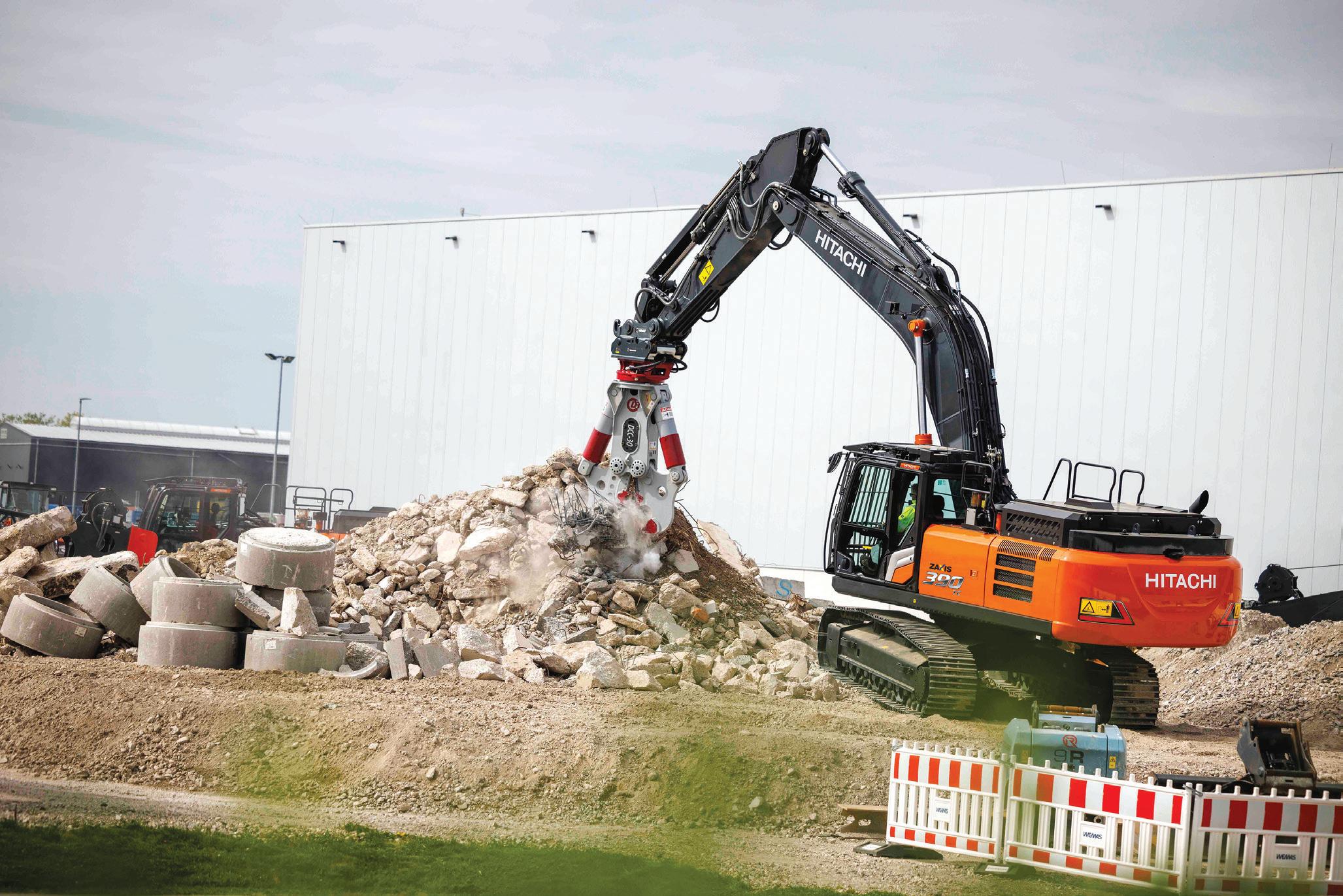
The firm says that its Full Electric Hydraulic (FEH) technology is similar to the D-ECOPOWER VBO (virtual bleed off) system now incorporated on the standard DX225LC-7 model and all Develon crawler excavators from the DX350LC-7 and above. In effect, the FEH is a VBO system without pilot pressure lines. The joysticks and pedals are fully electric, but give the operator the same feeling as hydraulic joysticks.
For the FEH system, an electric signal is sent to the central controller and is more precise and provides faster information. Back pressure and energy loss are eliminated by delivering the exact amount of oil needed, as the system does not use pilot pressure, saving fuel. According to Develon, the FEH system allows a reduction in fuel consumption of 8% compared to the D-ECOPOWER VBO system.
ABOVE
Hitachi’s ZX390TC-7 is a ruggedised excavator for use in challenging applications
BELOW
Komatsu is hoping to build a market for its new electric excavators
When the DX225LC-7X is delivered to the customer, the sensors are already calibrated. The buckets still need to be calibrated but no specific tools are needed for this as the system asks the operator to enter the required measurements, taking around an hour to calibrate three buckets.
The integrated machine guidance system on the DX225LC-7X uses sensors mounted on the front and body to recognise the location of each working device and inform/guide it for the operator. Feedback to the operator is provided through audio and visual displays which allow improved control of the machine in relation to the intended or designed direction of travel. The system will always receive the reference point, even when the machine changes position, without the operator having to reset the reference point every time the machine is moved.

There are three major Machine Control functions, and they can be activated by selecting: Grade Assist; Lift Assist and Weighing; Virtual e-fence.
Grade Assist Mode - On/Off can be set using the instrument panel and joystick. When the Grade Assist mode is set, the boom and bucket are activated in green according to the mode setting in the instrument panel icon.
Bucket Angle Setting - When the Bucket Assist function is activated, the current angle is memorised. When the driver operates the Bucket joystick, the last value is memorised after stopping the operation. When the Bucket Assist mode is on, the Bucket is green on the instrument panel icon.
The Weighing System and Lift Assist function measures and displays the current weight of the bucket as the operator is loading materials and warns the driver when the total loading weight exceeds the target. Power for the machine comes from a six-cylinder DL06V diesel that is Stage V/Tier 4 Final emissions compliant and rated at 129kW.
And Hitachi’s ZX390TC-7 model features a more conventional power system, but is innovative in regard to its high versatility. Hitachi Construction Machinery (Europe) is aiming this machine at use in heavy-duty applications such as demolition jobs.
Although the machine is based on the rm’s conventional ZX350LC-7 excavator, it has been specially adapted to work with larger working tools.
e machine features the rm’s proven Zaxis-7 technology and a Stage V-compliant engine but has a larger boom and bucket cylinders. It also has reinforced linkage, allowing it to carry 5tonne tools, such as hydraulic shears for crushing normally used by larger machines.
e ZX390TC-7 is equipped with a full hydraulic control system, suitable for use with all attachments, which can be changed within seconds from the operator’s seat. For added stability when handling heavy attachments, the ZX390TC-7 undercarriage is 250mm longer than the system for the standard ZX350LC-7. In addition, the ZX390TC-7 features an

additional 1.4tonne counterweight.
To ensure the safety of operators, the machine has side impact protection and a demolition-spec cab with FOPS guard level 2 and high-spec P5A safety glass. Safety is also ensured by the good visibility from the cab, assisted by the 270° view provided by the Aerial Angle camera system.
e structure of the machine is said to be highly rugged, allowing it to cope with heavy-duty applications such as demolition projects. As Hitachi’s quality assurance team approved the modi cations, the new model remains covered by the manufacturer’s warranty and service programmes. End eu.develon-ce.com/en/ www.hitachicm.com/eu www.komatsu.eu Scan for more information on
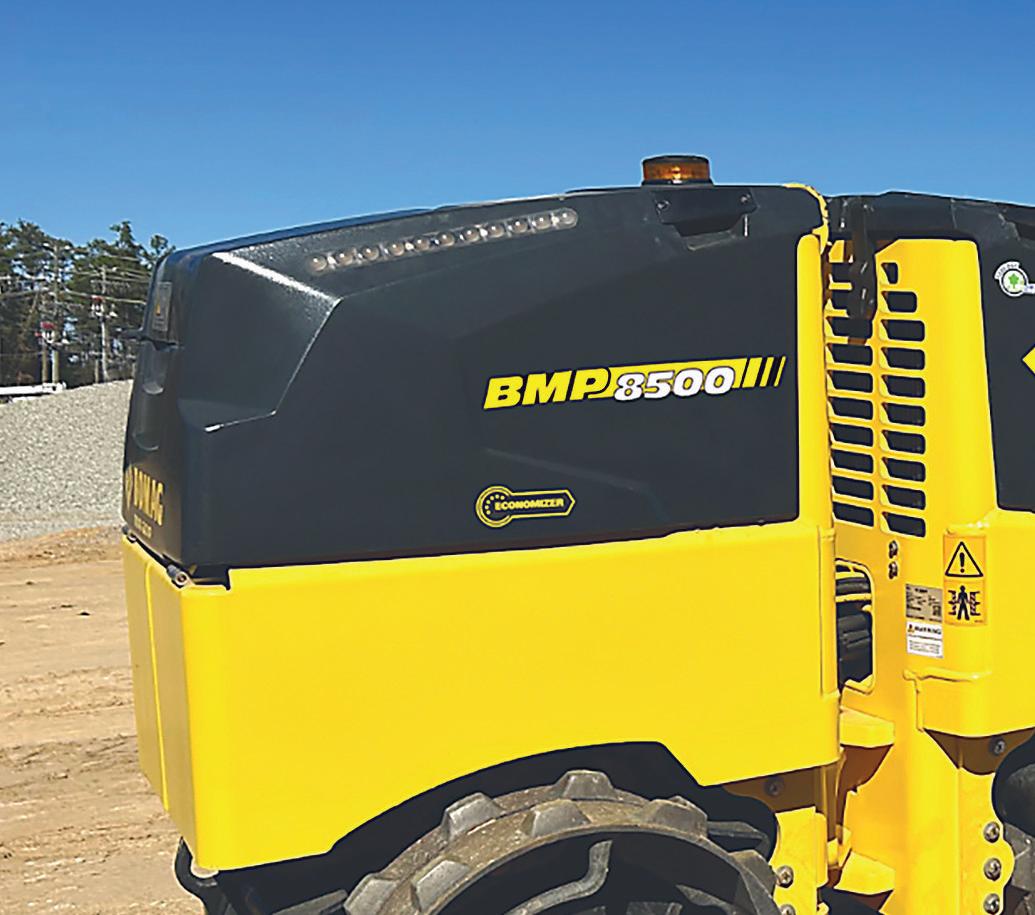

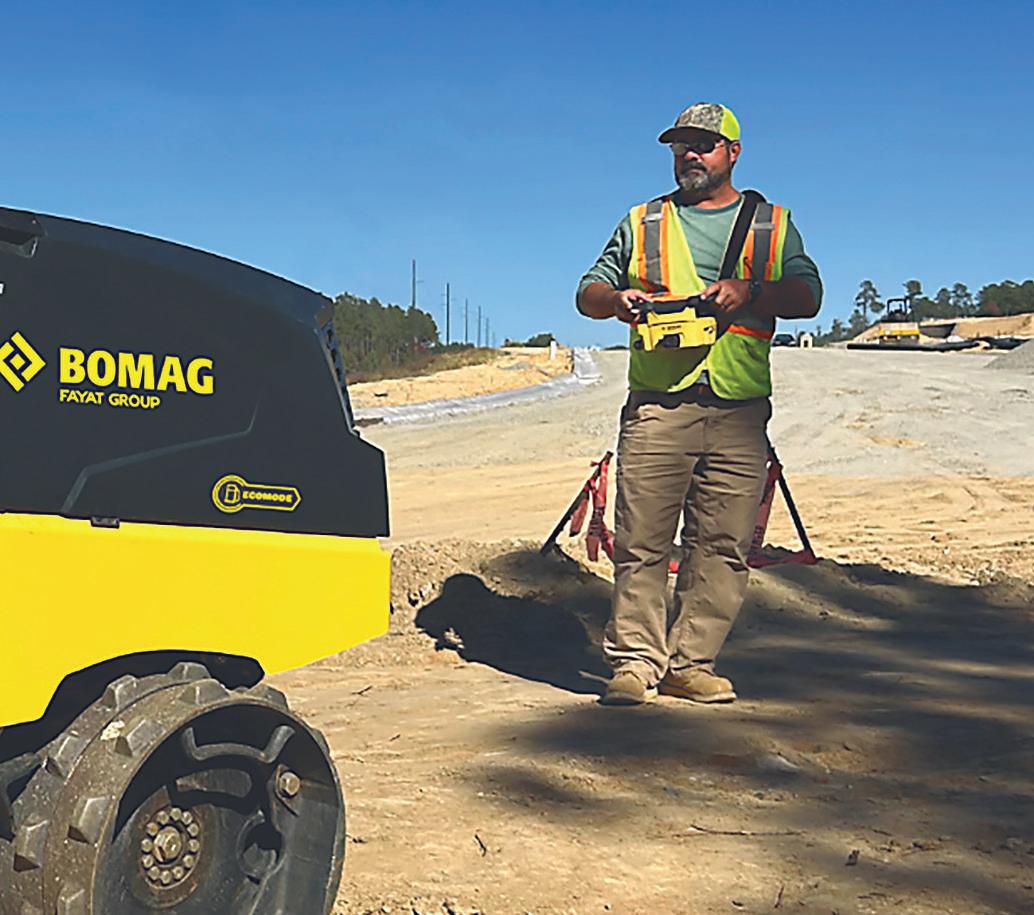
Bomag is introducing a new generation, radio remote-controlled multi-purpose compactor. e BMP 8500 compactor is said to be powerful and robust and features an improved radio control system over previous models.
e rm says that using radio control o ers better performance than infrared systems, which allows multiple units to operate simultaneously onsite. Should a remote control unit go missing, a new unit can be paired without the need for special knowledge or tools. Ergonomically shaped joysticks
make precise control easier and the controller has two batteries that enable a continuous running time of 35-40 hours.
e optional charger allows the second battery to be charged while the machine operates. e charger can also t into the roller's storage compartment.

Bomag's new roller has a variable working width that can be adjusted easily from 610-850mm. e machine
is designed for low maintenance and dependable operation. Encasing the exciter housing prevents water and dirt from entering, which increases reliability. e articulated joint requires no grease nipples, further reducing maintenance requirements. The integrated Bomag Operator Safety System (BOSS) automatically shuts down the machine if it comes too close to the operator. The Bomag Economizer allows operators to identify so spots in the fill and avoid making and unnecessary passes. www.bomag.com


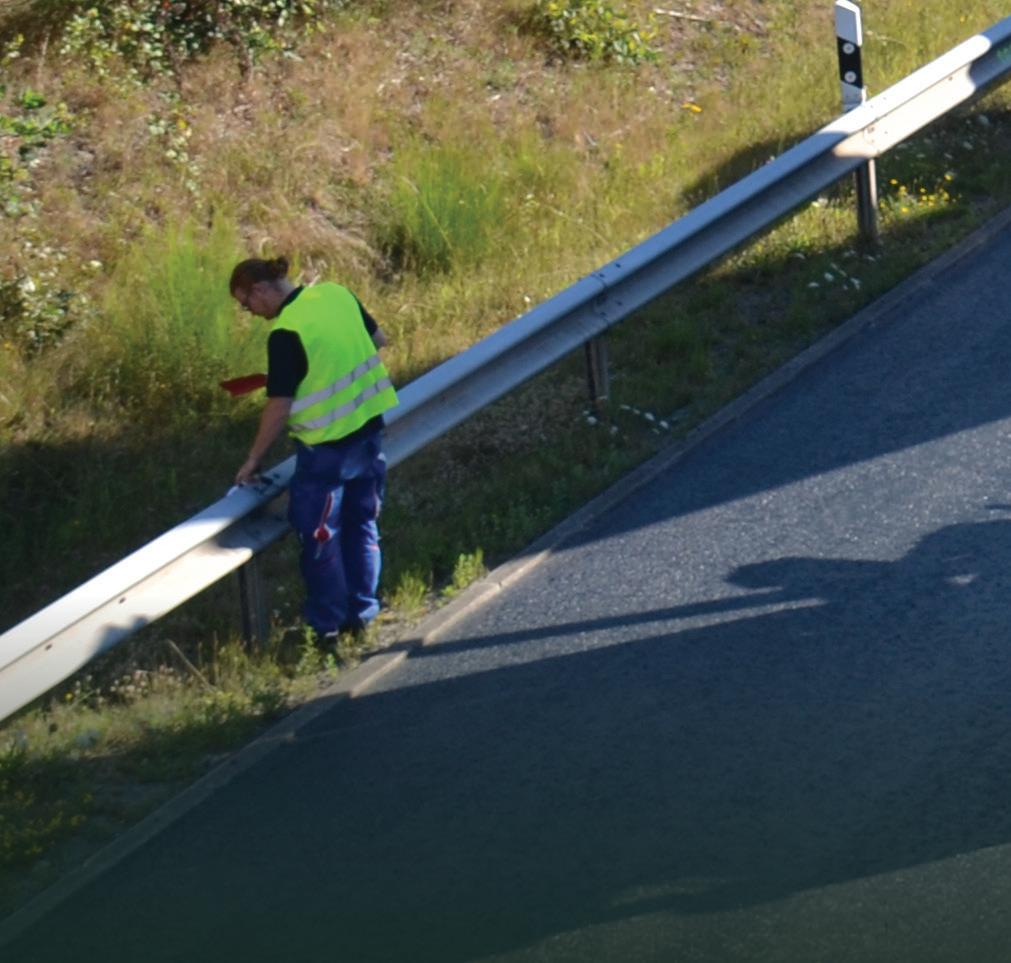

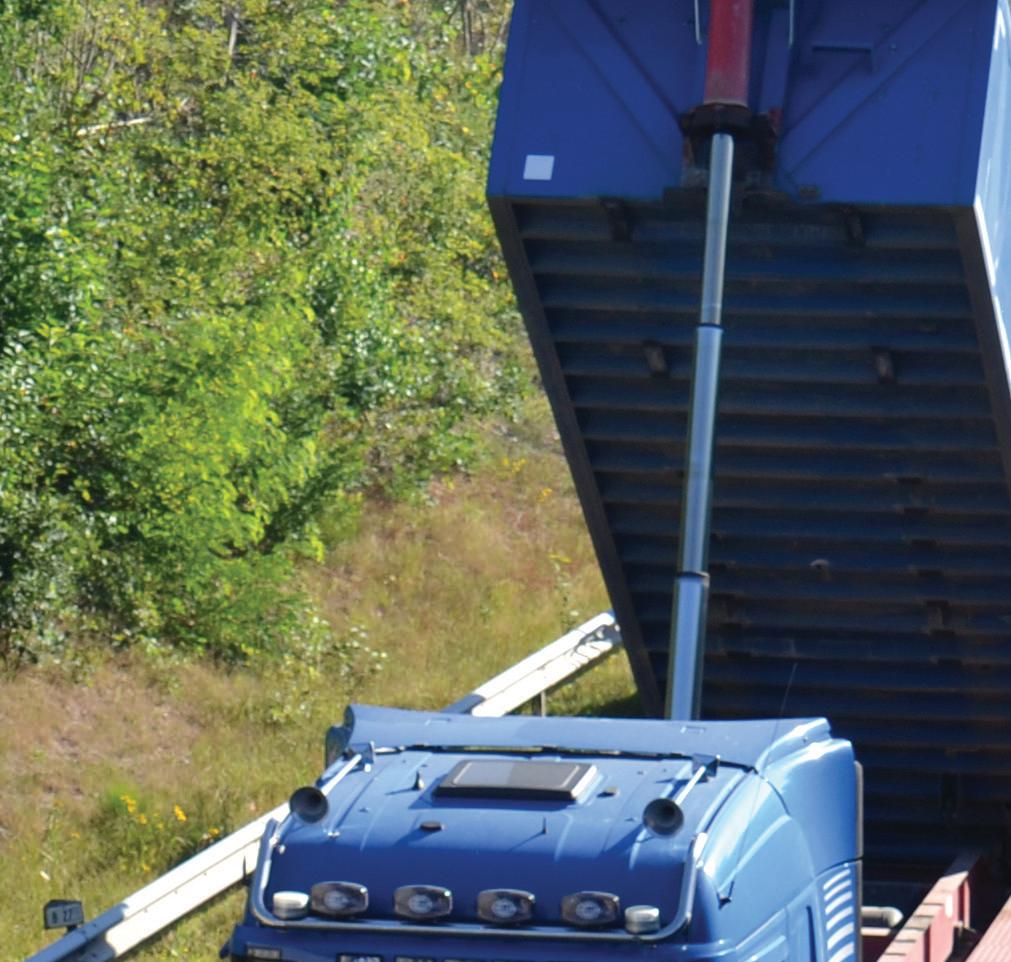
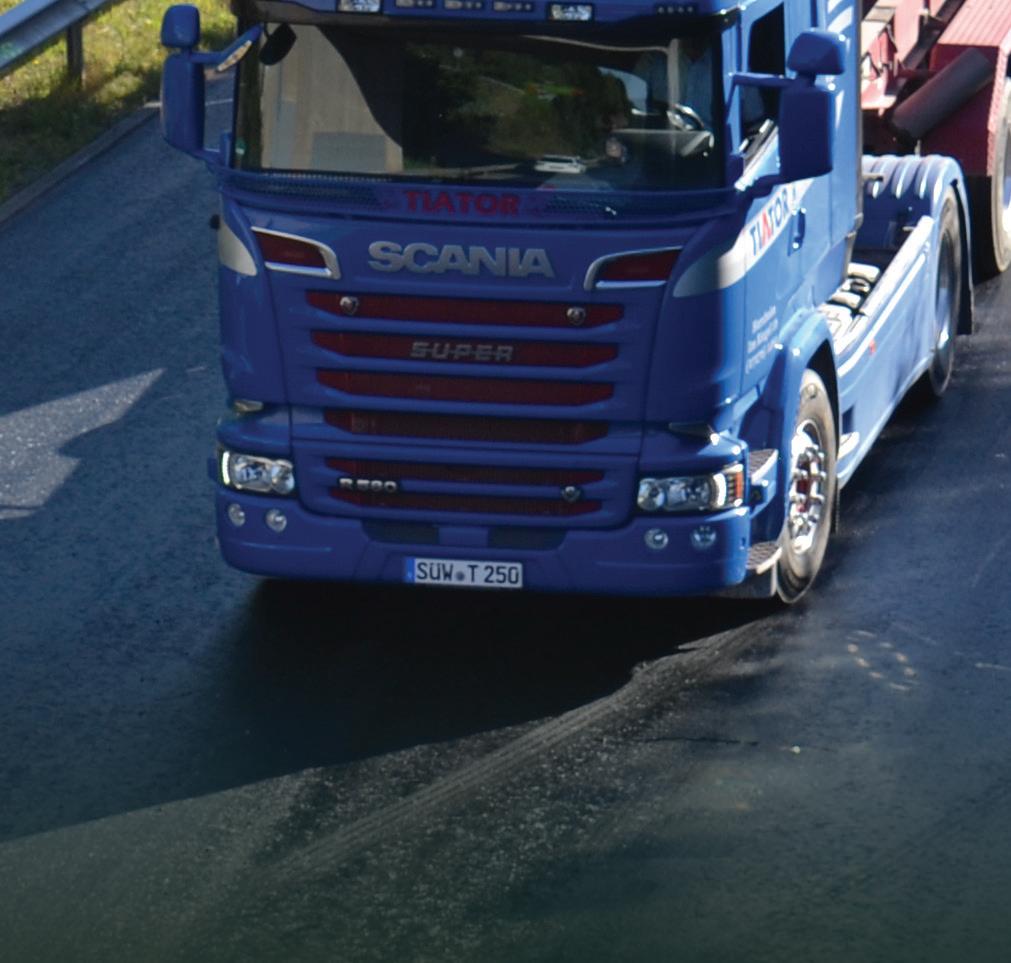
Reactive modification of bitumen o ers advantages over additives that work physically, such as polymers, zeolites, rubber or some rejuvenators. The B2Last additive from the German chemical company BASF is using this new technology with great success, explains Olivier Fleischel*
BASF developed the B2Last additive to improve the property pro le of bitumen using the process of reactive modi cation; bitumen has a broad spectrum of reactive groups that are available for a chemical reaction. Bitumen naturally contains many reactive groups such as ketones, alcohols, thiols, carboxylic acids, anhydrides and others that are part of bitumen. Additional reactive groups are also formed during short-term ageing processes by the addition of oxygen when the asphalt mix is produced. ese chemical groups can also be used for chemical reactions and improve the network density of the resulting polymer based on bitumen constituents.
B2Last changes the morphology of bitumen polar moieties at a molecular level to improve its functional characteristics.
Bitumen oxidation occurs during the asphalt production process, creating new reactive groups. Indeed, the chemical value of oxidised bitumen is
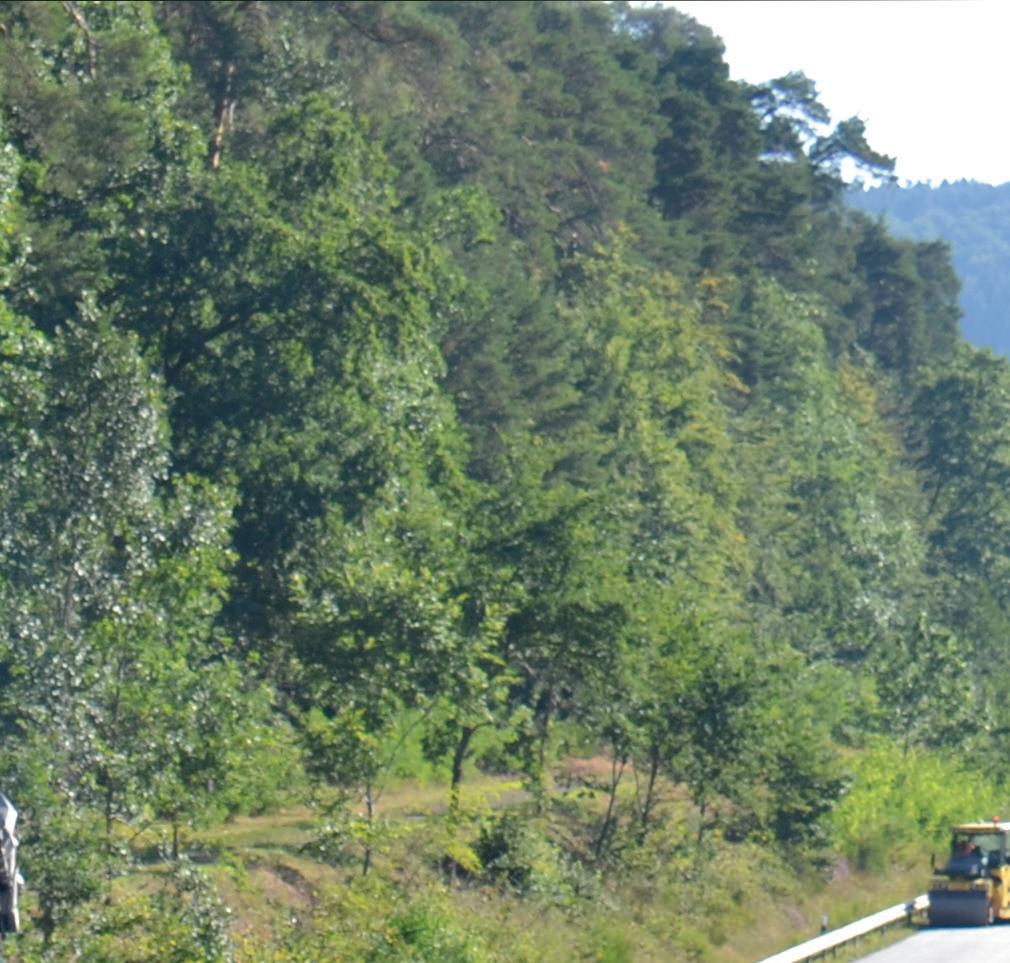
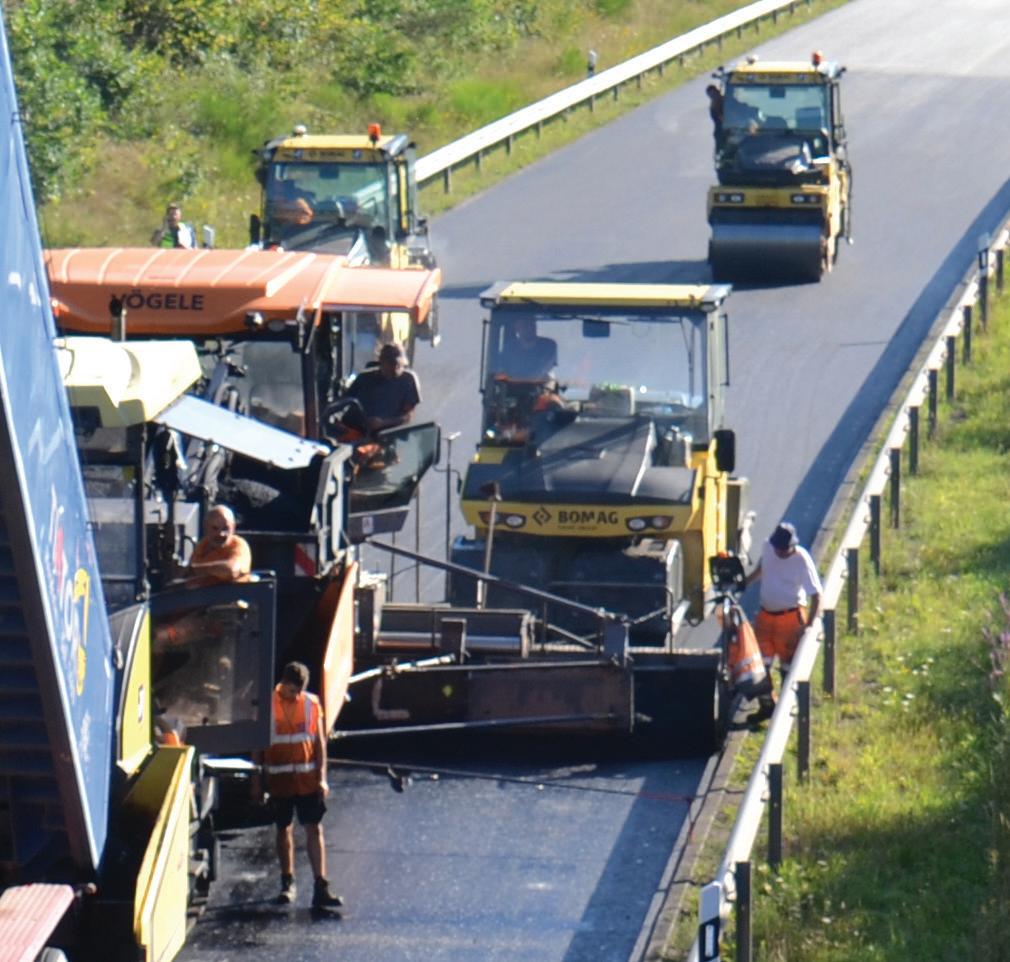
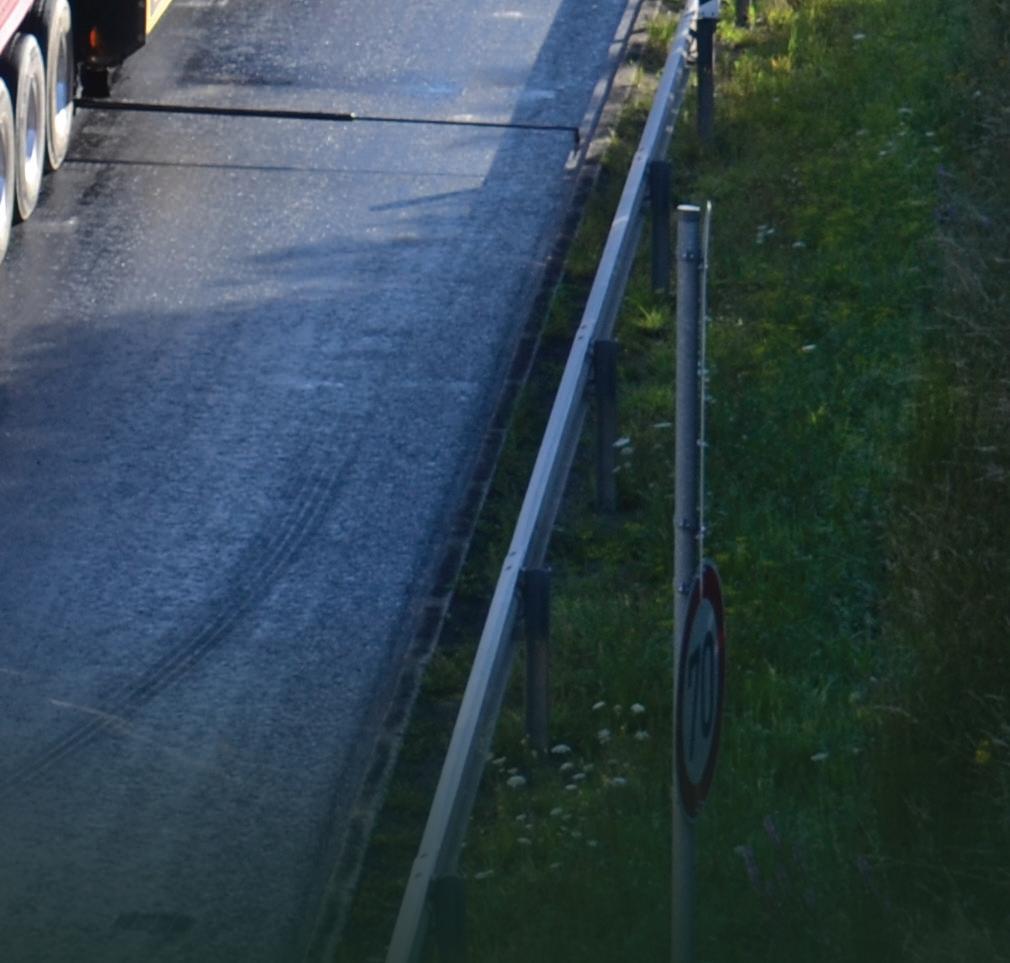


higher than virgin bitumen (in terms of number of reactive species embedded into bitumen polarphase structures). erefore, it could create covalent binding with B2Last. e working mechanism of the new additive has been intensively investigated and veri ed through preliminary work in the laboratory in collaboration with the Institute of Highway Engineering at RWTH Aachen University in Germany. Another objective was to collect comparative data on existing technologies under real-life conditions. is is the only way for future users to assess the possibilities for using reactive modi cation.
An additional opportunity to test such reactive modi cation in practice and compare it directly with polymer-modi ed bitumen arose again in August 2020 on the B270 in Wald schbach, Germany. For the trial (Picture 1), a PEN 50/70 binder was modi ed with 2.5% by wt. of the additive referred to the total binder content (neat binder and the binder content from reclaimed asphalt). e reference section was paved with a mixture produced with a polymer modi ed binder. e same neat bitumen pen 50/70 was used for the polymer modi cation to ful ll the requirements of a typical PmB 25/55-55.
A temperature reduction is possible thanks to the chemical modi cation e ect occurring during the


Picture 1: On the B270 in Waldfischbach, Germany, 4,000 tonnes of WMA (warm mix asphalt) for binder (50% RAP - reclaimed asphalt pavement) and top (30% RAP) layers were produced at lower temperature with B2Last (155°C). Laydown was performed in a temperature range of 120°C to 135°C. The pavement with B2Last achieved similar properties to a typical PmB 25/55-55) (image courtesy BASF SE)

di erent stages of the production and construction with B2Last. e viscosity of the mixture based on B2Last modi cation is similar to the unmodi ed binder at the beginning of the process. e viscosity will increase slowly as the network density increases over time, but still allows a workable material even at lower temperature. e temperature reduction comes with the added bene t of reducing the binder fumes and aerosols during construction and is - at least in Germany - of special interest, since the workplaceexposure limit on a job site will be reduced from 10mg/m3 to 1.5mg/m3. is new regulation regarding occupational limit exposure is supposed to come into e ect at the end of 2024.
No noticeable di culties for the B2Last-modi ed asphalt were noticed (laydown and compaction at 125°C to 135°C), even if the temperature of the mix went down to 120°C to evaluate the limit with B2Last. e material was still workable and easy to compact in a similar way to PmB-based asphalt at higher temperature (laydown and compaction at >145°C).
ereafter, binder tests were performed on the bitumen extracted from the asphalt mixture gathered during construction. e asphalt tests were carried out on cores and beams drilled from roller-compacted plates in the laboratory.
Table 1 presents the results of the binder tests. To evaluate the behaviour in the high-temperature range and assess the rutting stability as well as the modi cation level achieved with B2Last, the following tests were performed: softening point, Binder Fast Characterisation Test (BTSV) and Multiple Stress Creep Recovery Tests (MSCR). First, all variants show a similar softening point. e only exception is the binder from the surface course with B2Last.
e BTSV method delivers two values, the TBTSV and the δBTSV, which represent the hardness and the
modi cation of the binder, respectively. e TBTSV results show a similar trend to the softening point, where the B2Last-modi ed surface layer sample strays slightly from the other three. is is supported by the δBTSV, where the modi cation level of this sample is lower than for the other three (lower phase angle δBTSV corresponds to a higher level of modi cation). However, this di erence for the surface layer with B2Last is due to a lack of RAP content (only 30% in the surface layers). Indeed, while no signi cant di erences are noticeable for PmB in both layers, B2Last-modi ed binder and surface layers are showing a larger gap for the softening point and the BTSV values. e lack of RAP is in uencing the degree of chemical modi cation, and this explains the lower value of the softening point for the surface layer with B2Last, as well as the deviation for the BTSV values.
is general analysis is supported by the MSCR results as well. e recovery values (R%) are higher for the polymer-modi ed variants. is can be expected due to the di erence between the elastomeric polymers of SBS (Styrene Butadiene Styrene) and the chemical crosslinking of B2Last. Nevertheless, aside from the slight di erence with the B2Last-modi ed surface layer sample, the binder layer with B2Last shows a similar behaviour.
To assess the behaviour of the binder at low temperatures, the bending beam rheometer (BBR) was used. Table 1 presents the low-temperature continuous grade calculated using the ASTM D764316 Standard. e low-temperature behaviour is clearly dominated by the creep rate. In both cases, the continuous grade is very similar. It also proves that the chemical in-situ crosslinking reaction in bitumen, while sti ening the bitumen binder, is not signi cantly shifting the low-temperature susceptibility of bitumen. is leads to an increase in the useful temperature
interval of bitumen.
Table 2 shows the results of several asphalt tests. To assess the rutting stability, wheel-tracking (10,000 rollovers with a rubber wheel at 60°C) and cyclic compression tests (cyclic loading, 10,000 cycles at 50°C) were performed. Both tests show that the B2last-modi ed asphalt mix has a better performance against rutting than the reference with PmB 25/55-55. e rut depth (RDAir) and the proportional rut depth (PRDAir) are lower for the B2Last sample in both cases.
A similar e ect can be seen with the strain and strain rate at the end of the test in the uniaxial cyclic compression test. e strain is lower in both cases, but not the strain rate. e strain rate of the B2Last surface layer is slightly higher, which correlates with observations on a binder level. Regarding the lowtemperature behaviour, the results of the thermal stress restrained specimen test (TSRST) show that all variants should have a similar performance.
Almost three seasons later and both surfaces, with a typical PmB and based on B2Last modi cation, are showing no premature damage. Both road sections are behaving identically. e pro le of the road surface was evaluated using pro lographs by Bau Control, in Germany, during the summers 2021 and 2022 (Picture 2). Except in the area close to bridges, no signi cant di erence was observed along the entire road section. In order to obtain the approval and certi cation from relevant local German bodies, the team is now waiting two more years to report ve years of in-service road section based on B2Last.
SUSTAINABILITY ASSESSMENT
To be able to perform the sustainability assessment, a prediction of the service life is required. For this

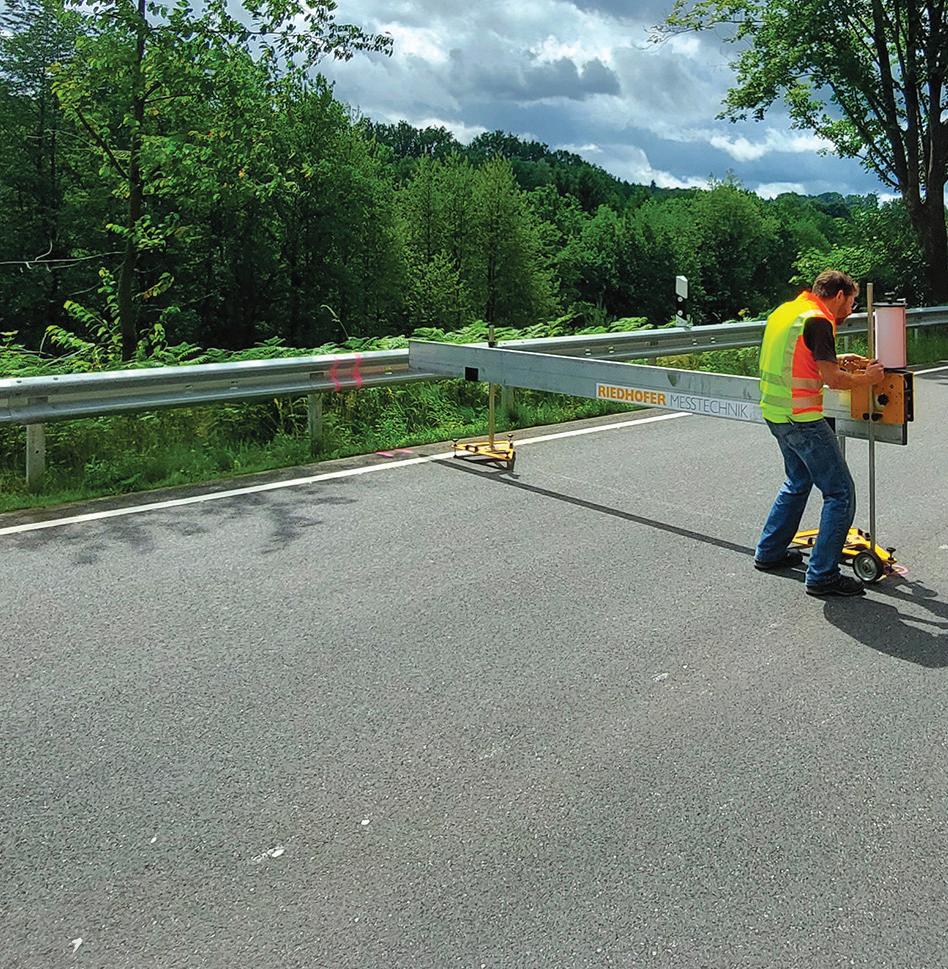

LEFT & ABOVE
Picture 2: Test section
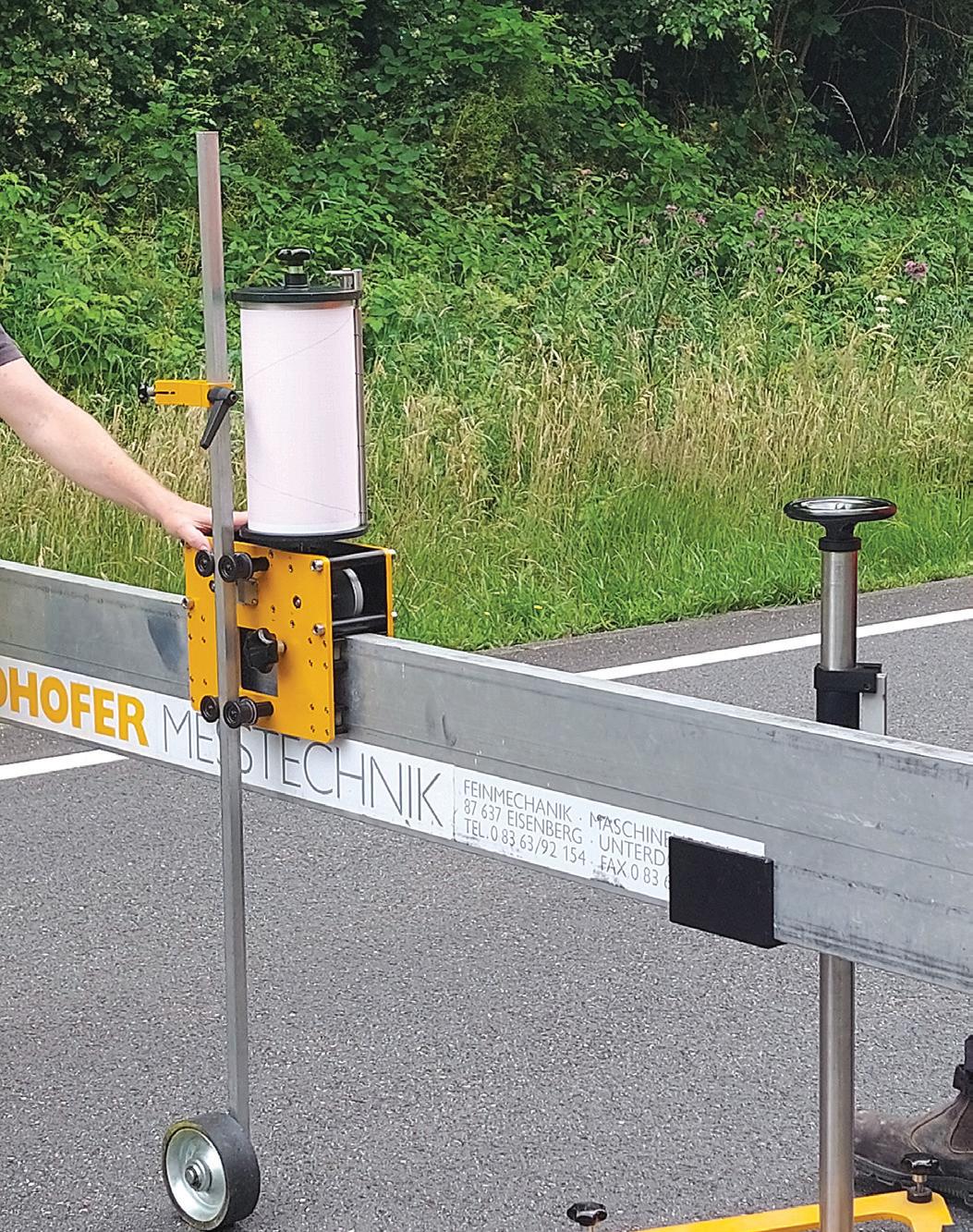
a er two years in-service and the measuring of rutting/surface profile in summer 2021 (images courtesy BASF SE)


guide for asphalt pavements (FGSV – RDO Asphalt 09) was followed. According to this standard, the prediction is done by calculating the resulting deformations at the bottom of the base layer, using the linear elastic multilayer theory (or the nite element method), considering tra c and temperature data. Afterwards, Miner´s Law is applied to predict failure using the fatigue equation of the base layer, which is obtained after thorough laboratory tests.
" e pro le of the road surface was evaluated using pro lographs by Bau Control, in Germany, during the summers 2021 and 2022"
For this analysis, the material properties of an unmodi ed and a B2Last-modi ed base layer were obtained in the laboratory. Calibrated data from FGSV – RDO Asphalt 09 was used for the surface, binder, frost-protection layers, as well as for the soil. Base layers are usually not mixed with modi ed bitumen. However, since the only standardised way to predict service life is through the base layer, this method was chosen.
Based on European standards ISO 14040, DIN EN 15643-4, DIN EN 15643-5, DIN EN 15804, DIN EN 17392, ISO 15686-5 and the following references , the asphalt pavement of a ctitious 3km-long and 14.5m-wide motorway was assessed. A period of 60 years and a discount rate of 3% were considered. During this period, all relevant processes like material extraction, material production, material transport, construction as well as deconstruction were considered to be able to make comparative statements about environmental e ects, construction costs and workplace exposure (Table 3). Based on
Table 3: Considered
the approaches published by Brzuska et al in 2018, the information modules shown in Table 3 were considered. e details of this life-cycle assessment were presented at the Rilem Conference 2020, held in Lyon, France.
Aside from the material properties, tra c and climatic data had to be considered. For the calculations, these values were the same for both layers. e tra c load chosen was an AADT (annual average daily tra c) of 42,500, with a 21% share of heavy tra c vehicles (yearly increase 3%). e design period was set to 30 years and the load collective was taken from FGSV –
RDO Asphalt 09 for a long-distance federal motorway. is translated to 129.2 million equivalent 10-tonne equivalent-single-axle-loads. With respect to the climatic data, the frequency distribution of the surface temperature was taken from the standard for Zone 3, which corresponds to the south of Germany. Variants shown in Table 4 were examined. ese di er only in the choice of binder, which a ects both the lifetime calculated and the manufacturing temperatures.
RESULTS OF SUSTAINABILITY ASSESSMENT
It could be demonstrated that B2Last not only saves energy and, therefore, reduces greenhouse
Figure 1: Global warming potential [tonnes CO2-equivalant] over an observation period of 60 years, di erentiated by layer
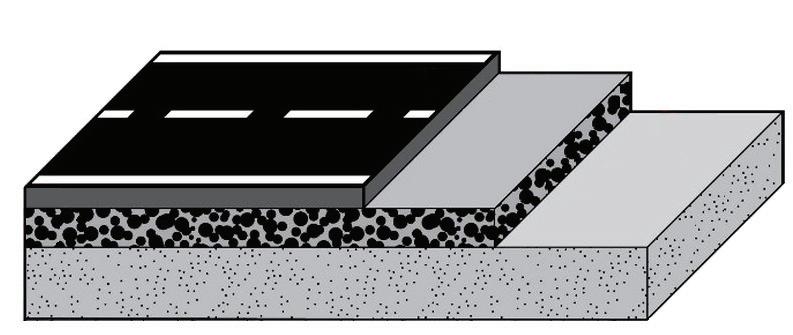


gas emissions (Figure 1), but signi cantly reduces construction costs and exposure of workers to vapours and aerosols during construction. If B2Last is used in all three asphalt layers (Variant 2.1), a total primary energy saving of 41.3%, a reduction in greenhouse gas emissions of 46%, a reduction of 23.7% in construction costs and a reduction of up to two-thirds in the exposure of workers to vapours and aerosols compared to the conventional construction method (Variant 1) can be achieved.

" e pro le of the road surface was evaluated using pro lographs by Bau Control, in Germany, during the summers 2021 and 2022"








If B2Last is used only in ADS and ABS (Variant 2.2), savings of 12.6% of total primary energy demand, 13.8% of greenhouse gas emissions and 7.8% of construction costs, as well as a halving in exposure are achieved. e plausibility of these statements could be veri ed by the systematic variation of signi cant parameters (service life of B2Last layers; production temperature of B2Lastmodi ed asphalt; discount rate) within the scope of sensitivity analyses.
e main reasons for using B2Last are the extended service lifespan, the possibility of reducing the asphalt mixing temperature and the fact that conventional polymer modi cation, which is an energy-intensive process, can be dispensed with.






e reduction of the asphalt production temperature has the advantage of reducing the energy demand and the resulting greenhouse gas emissions, as well as the reduction of the workplace exposure, thereby reducing the health risk for construction workers.
In conclusion, B2Last brings a new type of science from an engineering perspective. In contrast to products that are blended, B2Last is fully reacted; it becomes one with the asphalt. In contrast to other polymeric additives, it is not a two-part system to be stirred continuously.
B2Last is compatible with most bitumen, so is ideal for new pavement construction. It is designed to increase the useful temperature interval (UTI) of bitumen, maintain workable viscosity levels and reduce stripping of the aggregates. All this leads to a more durable pavement.
In many European countries, an increasing number of road authorities are already taking action to increase the use of WMA and recycling end-of-life pavement to reduce emissions. Consequently, B2Last should be viewed as a new way of improving bitumen properties and, when being used at an asphalt mixing plant, being able to ful ll the requirements to produce warm mix asphalt.
In addition to successful paving operations that have been conducted globally, BASF has partnered with the National Center for Asphalt Technology (NCAT) in Auburn, Texas, to conduct a Phase I study as part of BASF’s ongoing programme of B2Last trial evaluation. End
References:
RIGHT
The National Centre for Asphalt Technology’s (NCAT) Test Track in Opelika, Alabama (image courtesy NCAT)
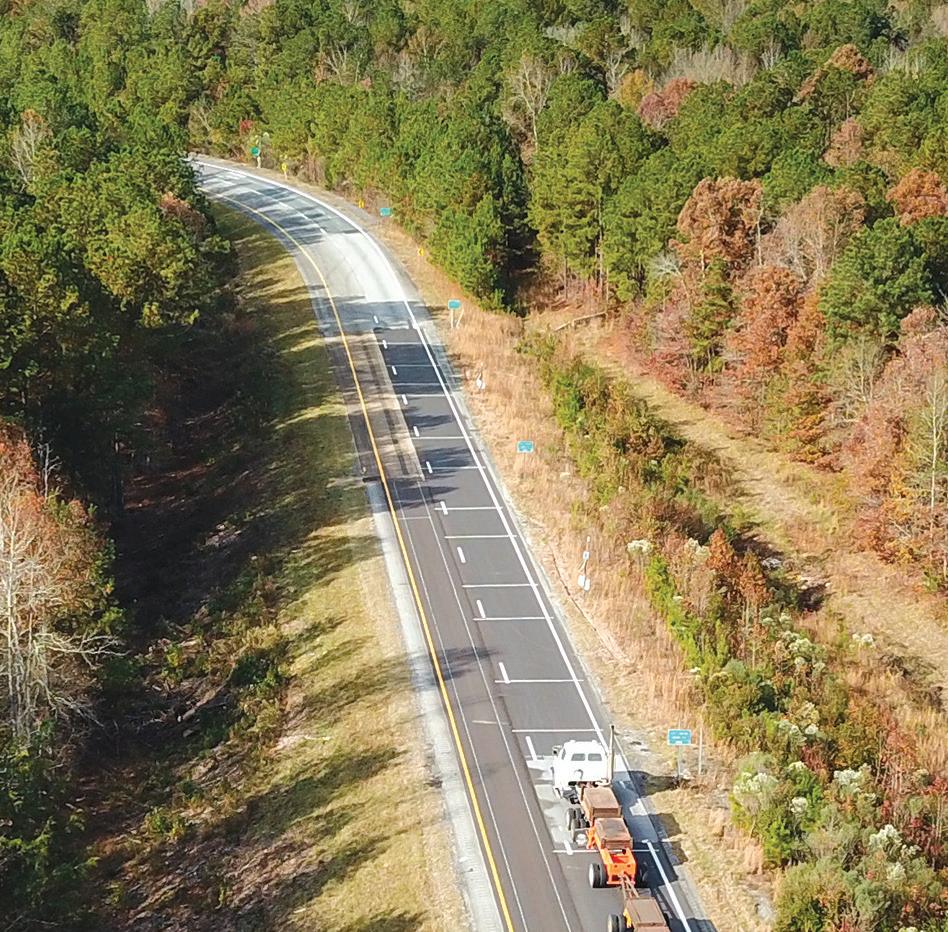

*AUTHORS:

[1] e MAK-Collection for Occupational Health and Safety 2019. Weinheim, Germany: Wiley-VCH Verlag GmbH & Co. KGaA; 2019.
[2] Alisov A, Riccardi C, Schrader J, Cannone Falchetto A, Wistuba MP. A novel method to characterise asphalt binders at high temperatures. Road Materials and Pavement Design 2020;21(1):143–55. https://doi.org/10.108 0/14680629.2018.1483258.
[3] C. Holldorb, A. Brzuska, S. Cypra, M. Oeser, N. Carreno, M. Zeilinger, Sustainability assessment of novel performance enhancing chemical bitumen additive, RILEM International Symposium on Bituminous Materials December 14-17, 2020, Lyon, France.
[4] Gesprächskreis Bitumen: Expositionsbeschreibung Herstellung und Beförderung von Asphalt. https://www. bgbau.de/ leadmin/Die_BG_BAU/Gespr%C3%A4chskreis_ Bitumen/ ExpoHerstTranspAsphalt.pdf. Gesprächskreis Bitumen: Expositionsbeschreibung Einbau von Walzasphalt im Straßenbau. https://www.bgbau.de/ leadmin/Die_BG_BAU/Gespr%C3%A4chskreis_Bitumen/ExpoWalzasphalt.pdf.
[5] Brzuska, A., Cypra, S., Holldorb, C., Stöckner, M.: CO2-Emissionen bei der Straßenerhaltung. Straße und Autobahn (69), 845-853 (2018).
[6] Holldorb, C., Brzuska, A., Cypra, S.: Nachhaltigkeitsbewertung zum Einsatz von B2Lastmodi ziertem Asphalt. University of Applied Sciences, Karlsruhe (2020, unpublished).
Olivier Fleischel (lead author, pictured) has been EMEA (Europe, Middle East & Africa) business development manager for B2Last since 2020. He currently focuses on product implementation in Europe. He holds a PhD in organic chemistry from the Université de Strasbourg in France and has further developed his knowledge on the chemistry of bitumen through chemical modification with reactive crosslinkers.
Antoinette Pretorius is with BTC Speciality Chemical Distribution
Sharon Hayes is with BTC Europe
Nicolas Carreño is with the Institute of Highway Engineering RWTH Aachen
In a new round of trials which started in September 2021, BASF is testing the extremes of asphalt paving with B2Last. The company recently placed a new modified asphalt test section at the National Centre for Asphalt Technology’s (NCAT) Test Track in Opelika, Alabama. A test section (S13) was paved with a mixed formulation. The resulting binder reached the Performance Grade 88-22 (neat bitumen 67-22, increase of 21°C of the Useful Temperature Interval - UTI). The material was applied as part of the phase VIII test cycle and the NCAT track team will run truck cycles for two to three years gathering data. The BASF test section was paved as a complement to the NCAT Additives Experiment Group of test sections. Within the test sections, strain gauges are embedded into the pavement and load plates are embedded into the base and into the bottom of the pavement. These gauges will take readings over the next three years. Full performance profiles of this test section will be available during 2024.
“Functional performance improvement levels can be tailored or made on-demand to meet or exceed flexible pavement specifications,” said Bernie Malonson, B2Last marketing manager for BASF Monomers, North America.
“Since B2Last is a liquid, there are no solids to grind or melt, less energy is required to produce modified asphalt pavements and it supports the American Association of State and Highway Transportation O icials [AASHTO] specifications.”
While specific states vary their authorised materials, B2Last can support both AASHTO M320 and M332 performance grade (PG) specifications. In many cases, modified asphalt producers have noted that they are able to use less B2Last and simplify their formulations.
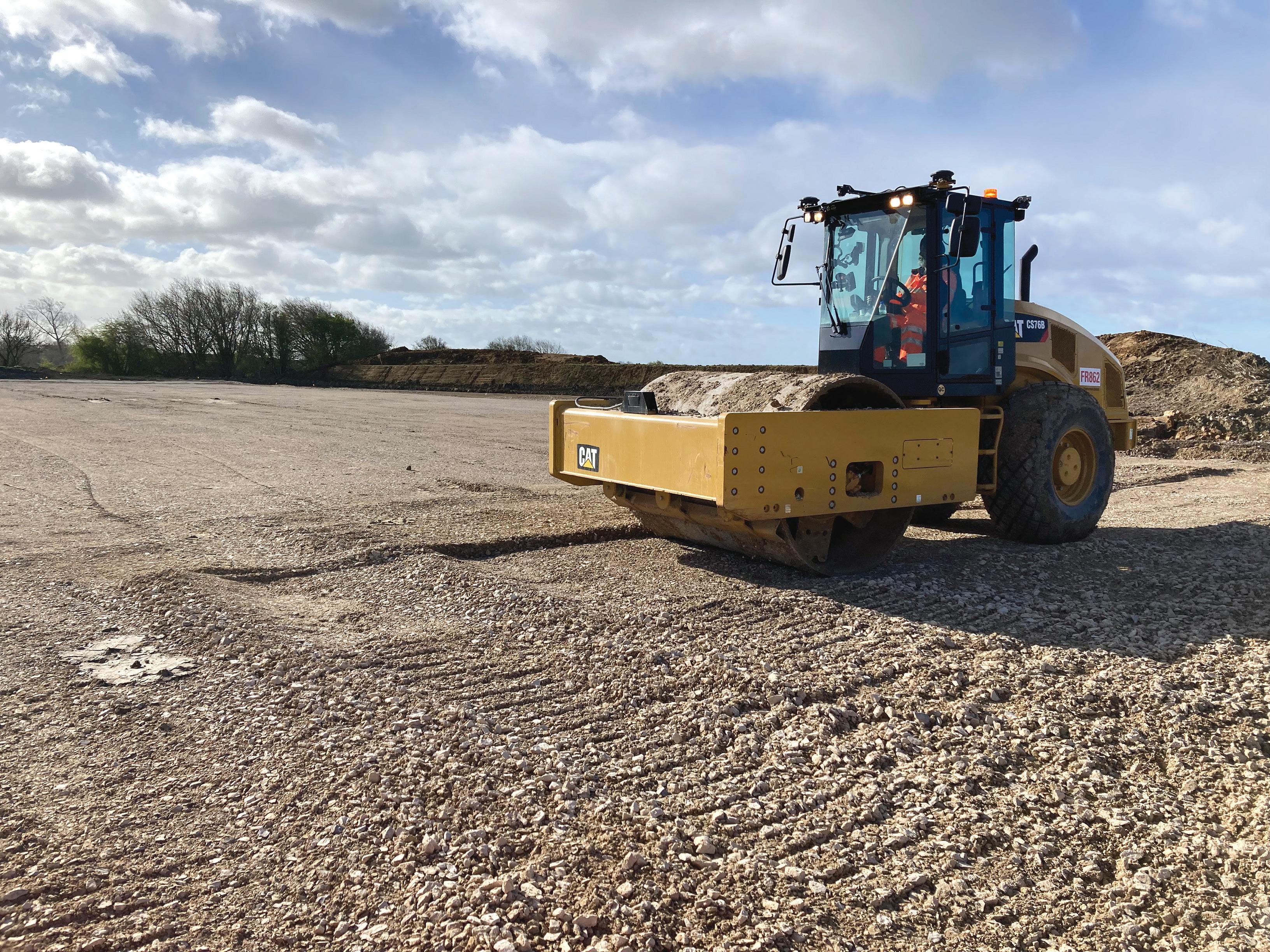
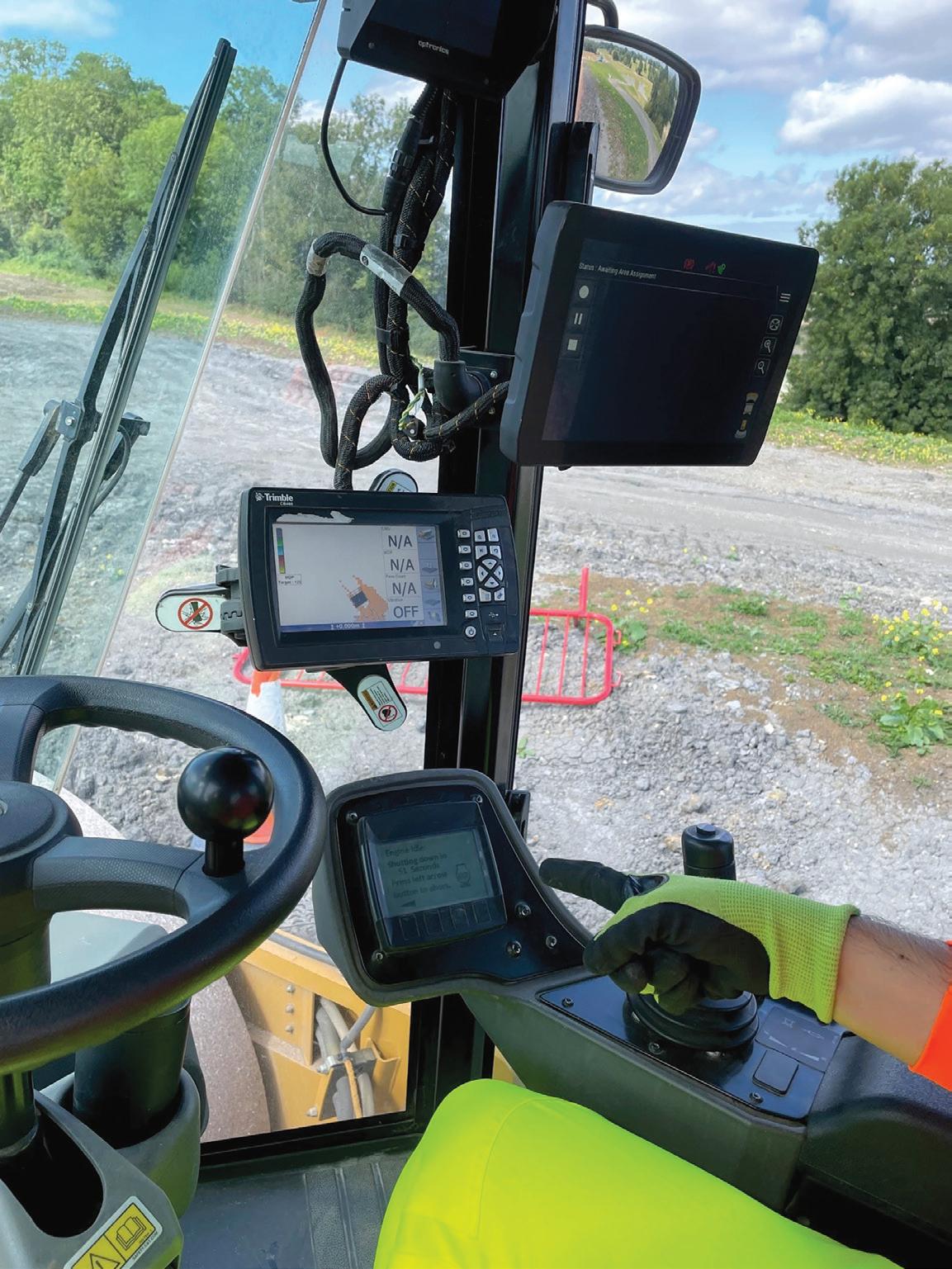
intended to speed up road construction and improve safety. The sophisticated compaction technology is intended to ensure that equipment gets the job done first time, delivering durable foundations for road building.
As part of a commitment to developing and promoting Connected and Autonomous Plant, National Highways teamed up with partners Finning UK & Ireland and Galliford Try to trial the Intelligent Compaction system.
The technology was put to the test on a scheme being carried out by Galliford Try, upgrading a stretch of the A303 to dual carriageway status.
Compaction is one of the first activities to happen onsite so any issues can impact the whole construction programme and increase costs. Using 3D mapping and sophisticated sensors, the technology ensures that the right levels of compaction are achieved and the system will identify
National Highways head of innovation, Claire Hamar, said: “A huge positive that we discovered in the Intelligent Compaction trial was the improved efficiency and environmental benefits - as work did not need to be repeated so, thanks to the reduced fuel use, we had reduced carbon. Not only is the work completed more quickly saving resources and taxpayers’ money but, most importantly, it improves safety and reduces risk.”
The machines used in the trial were fitted with Cat machine drive power technology and Cat compaction meter value. Using these features, the driver was able to set the target depth and compaction level required via a touchscreen in the cab. This enabled the operator to preset the drive functions so the roller was automated and operated within the required parameters. This ensured the task was completed safely and eliminated the need for personnel to be out onsite to check compaction levels. www.cat.com www.nationalhighways.co.uk
UK building materials and construction firm Tarmac has been trialling an allelectric tipper truck in its fleet. This forms part of the firm’s commitment to reach a 30% reduction in emissions by 2030 from a 2021 baseline. Decarbonising equipment is part of Tarmac’s roadmap to net zero.
Working with London-based electric truck manufacturer Tevva alongside Brit-Tipp, which supplied the tipper body, Tarmac began development of the electric tipper truck in 2022. As a result of this collaboration, Brit-Tipp has secured type approval for bodies on the Tevva chassis, speeding up vehicle registration.
Assuming a use cycle of 4,000km/month and a consumption of 1.31kW/hour, the 7.5tonne Tevva electric tipper truck is expected to save over 2.2tonnes of CO₂/ month compared to a diesel model the same size.
www.tarmac.com
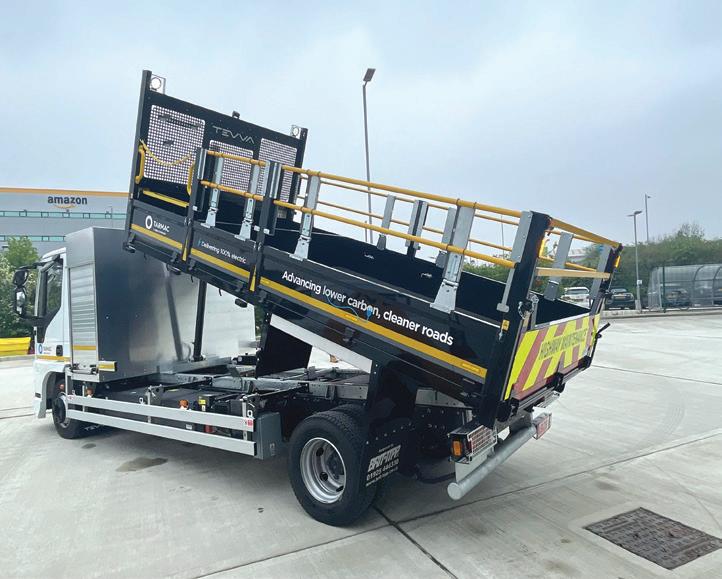



"Our Skidmarks page is highly rated by readers. Your input could help make this page even more entertaining. If you come across any amusing road-related stories, pictures or videos, email me at mwoof@ropl.com"
Mike Woof
A man in the UK lost his temper following a minor collision between his car and another vehicle. e other driver had been at fault of the impact and the two stopped to exchange insurance details. Initially, the man talked with the woman driver but for reasons best known to himself, then became enraged. e woman jumped in her car, fearing attack, and drove away. e man pursued her in his BMW, nally forcing her to stop in the middle lane of the busy M56 motorway. He then jumped on the bonnet of her Kia, damaging it. Police arrived on the scene quickly and arrested the man, adding that it was lucky the incident had not caused a crash. e man was given a suspended sentence as well as a 12-month driving ban.
Drivers travelling along a stretch of the A20 on the south side of London were required for a period to slow down from the previous speed limits for a period. Problems with ooding required the previous speed limit of 50mph/80km/h to be
reduced to 40mph/64km/h to ensure safety. However, a prankster installed a fake sign reinstating the original speed limit. Several hundred drivers have now received speeding nes as a result. Although many have contested the nes, they have been told that as the prankster’s sign was a fake, the nes will stand.
A woman in the UK who complained to the local council about the poor state of the roads in her neighbourhood was astounded when she was told to patch them up herself. Aged 101, she has some mobility issues. Repairing the 21 potholes reported in her street would not be a simple a air.
A man in the US tried to steal a quadbike recently, which ended somewhat unsuccessfully for him. e man jumped onto the quadbike, which had been left unlocked by its owner, then sped away from where it was parked. However, the quadbike

Spellings varied in the 16th and 17th centuries when Shakespeare was alive – image courtesy of Petra Schwimmbeck

clearly had rather more power than the thief was able to cope with and he was unable to steer properly. After colliding with some tree roots, the quadbike was jolted upwards, throwing the would-be thief from its seat. It is not clear whether he su ered injuries from the incident.
A cyclist on the Spanish island of Lanzarote has been causing consternation amongst the locals. e man was seen riding his bicycle while naked, apart from a hat and a small bag, presumably carrying his valuables. People said that this was not acceptable, with one
commenting angrily that the cyclist would be unlikely to be allowed to do this in his home country.
A woman in the UK is regretting her actions at a party that got out of hand. e woman had been drinking heavily and started an argument with another partygoer, which culminated with her throwing a wine bottle at the other person. Fortunately, the wine bottle missed its target and did not cause an injury, however it did hit the windscreen of a parked car and smashed it. e woman was charged with a number of o ences afterwards by the police.
















watch the






video





A car owner in India recently spent around £2,000 modifying his Maruti Suzuki car so that it resembled a helicopter. The man had a mock helicopter tail and imitation rotor blades fitted to the roof of the vehicle. He had hoped to be able to rent the car out for weddings as a special vehicle. However, as soon as he took to the road, he was stopped and had the vehicle seized by local police as they considered the modifications made the car unsafe for other road users. Despite the £2,000 fine he was given, the man is determined to try to find a way to keep his car with its helicopter tail unit and rotor blades. The police however have said that they will only return the car to him if he agrees to remove the modifications.