SEPTEMBER 2026
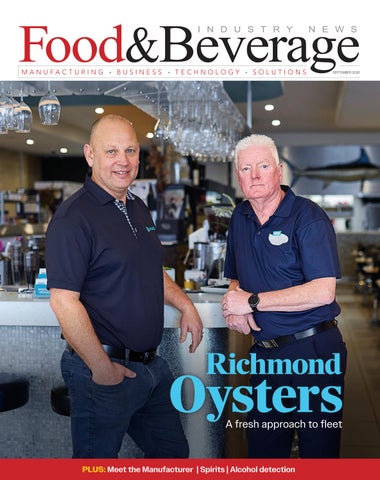
Richmond
Oysters A fresh approach to fleet
PLUS: Meet the Manufacturer | Spirits | Alcohol detection
Cool confidence in one move
Smart builds. Easy finance. Rent. Buy. Repair. Australia-wide. Proudly part of Petit Forestier Group
Eurocold_FB_InsideCover_Advert_Sept2026_P.indd 1
5/8/2026 9:54 am
6 9:54 am
Welcome
CEO: Christine Clancy
The art of working together
Managing Editor: Mike Wheeler Ph: 041 557 2106 mike.wheeler@primecreative.com.au
Assistant Editor: Dae Hong david.hong@primecreative.com.au
Art Director: Michelle Weston michelle.weston@primecreative.com.au
Sales/Advertising: Emma Murphy Ph: 0403 500 544 emma.murphy@primecreative.com.au
Client Success: Cait Pillay Ph: (03) 9690 8766 caitlin.pillay@primecreative.com.au
Cover Image: Eurocold
Subscriptions
Managing Editor: Mike Wheeler
AUS NZ
O/S
1 year subscription 99
109
119
2 year subscription 189
199
209
For subscriptions enquiries please email
subscriptions@primecreative.com.au
M
ost fear change. It is understandable, as moving from a place of comfort to something hypothetical, unfamiliar and uncertain presents risks. As we all can reflect, learning from past mistakes and using them to move forward is a natural process. However, instead of searching for new ways to survive, constantly looking for opportunities to create something new, despite the risks, could be a mindset worth considering. This edition of Food & Beverage Industry News centres around just that, with three Meet the Manufacturers, a research story on detecting illicit alcohol and wider market insights into the spirits industry. After almost 40 years at PepsiCo, manufacturing director of PepsiCo Australia and New Zealand Doug Stakic has witnessed the evolution of The Smith’s Snackfood Company. As it reaches its 95th anniversary this year, its complex operation and mix of automation reflect its long-term capability and ability to evolve. While Smith’s Chips remain a staple in Australian households, the company has continued to invest in expanding its portfolio, creating opportunities to compete across different categories while supporting local jobs. Similarly, Mediterranean food brand Tahini Neri has launched a product in response to shifting market conditions and consumer behaviour. While automation technologies have become a standard part of manufacturing, the company’s founders believe there is still value in the human touch when it comes to preserving the authentic taste of home. The Pure Food Co is another example of pursuing opportunities through innovation. As a food manufacturer specialising in texture modified
foods for aged care residents, its manufacturing processes are centred on safety. The company has introduced new X-ray technology at the end of the production line to provide an additional layer of safety before food leaves its facility. Research around food safety is also developing. Adelaide University researchers are taking a proactive approach to the challenges surrounding counterfeit alcohol with laser-based technology. Through this research, they aim to extend the technology for use across the wider food and beverage industry, including products such as olive oil. Change is not only effective internally, according to Australian Distillers Association chief executive officer Kylie Lethbridge, and Spirits Council of Australia executive director Steven Fanner. The spirits industry faces challenges around excise tax, which affects producers’ ability to develop and scale products while increasing the risk of illicit alcohol entering the market. Lethbridge said the key to success lies in collaboration. By working with supply chain partners, including ingredient providers, the Australian spirits sector can strengthen its position while contributing to the wider economy. The food and beverage industry is already highly interconnected. The next step is for the industry to recognise and embrace it. Once that understanding is established and the fear of change is overcome, collaboration can turn uncertainty into opportunity. Perhaps change does not need to be something we fear. It can be something we can build on to make the Australian food and beverage industry thrive. Happy reading! F
Copyright Food & Beverage Industry News is owned by Prime Creative Media and published by John Murphy. All material in Food & Beverage Industry News is copyright and no part may be reproduced or copied in any form or by any means (graphic, electronic or mechanical including information and retrieval systems) without written permission of the publisher. The Editor welcomes contributions but reserves the right to accept or reject any material. While every effort has been made to ensure the accuracy of information, Prime Creative Media will not accept responsibility for errors or omissions or for any consequences arising from reliance on information published. The opinions expressed in Food & Beverage Industry News are not necessarily the opinions of, or endorsed by the publisher unless otherwise stated. © Copyright Prime Creative Media, 2023
Articles All articles submitted for publication become the property of the publisher. The Editor reserves the right to adjust any article to conform with the magazine format.
Head Office 379 Docklands Drive Docklands VIC 3008 Ph: +61 3 9690 8766 enquiries@primecreative.com.au http://www.primecreative.com.au
Sydney Office Suite 11.01, 11th Floor 201 Miller St North Sydney, NSW 2060, Australia
Printed by: Brougham Press 865 Mountain Hwy, Bayswater VIC 3153 Ph: (03) 9873 5144
www.foodmag.com.au
Food&Beverage Industry News 3
Contents
12
6 News 12 Meet the Manufacturer: The Smith’s Snackfoods Company Manufacturing director at PepsiCo ANZ witnessed Smith’s transformation into a sophisticated operation. 18 Meet the Manufacturer: The Pure Food Co The Pure Food Co made a six-figure investment on X-ray technology to boost food safety. 23 Meet the Manufacturer: Tahini Neri Tahini Neri has grown from a small farmers market operation into a national Mediterranean food brand.
18
28 Refrigerated fleet Eurocold is helping Richmond Oysters keep its trucks on the road while it continues to expand. 31 Financial planning Cash flow management and adaptability are becoming essential for food and beverage manufacturers. 34 Printing Trimatt Systems is offering in-house digital printing to eliminate waste, not reduce it. 36 MICE MICE 2027 aims to elevate the coffee industry with aromatic coffee and a vibrant show floor.
34
38 Australian Pork Limited The latest Food & Beverage Industry News podcast talks about pork within the Australian meat industry. 40 Counterfeit alcohol University researchers are developing a laser-based technology that can detect counterfeit alcohol without opening a bottle. 43 Spirits industry Despite challenges, the spirits industry sees opportunities for domestic growth, exports and collaboration across the supply chain.
38
46 foodpro foodpro 2026 welcomed 10,468 unique visitors through the doors and featured 519 exhibitors. 48 MegaTrans The freight and logistics industry will gather to examine what is shaping more resilient supply chains. 50 AIP The AIP has partnered with Packaging Cockpit to bring packaging specification management software to the Australasian region. 51 New Products
4 Food&Beverage Industry News
www.foodmag.com.au
EARLY BIRD TICKETS SAVE NOW. FOR A LIMITED TIME ONLY.
MELBOURNE CONVENTION AND EXHIBITION CENTRE 4–6 MARCH 2027
MELBOURNE INTERNATIONAL COFFEE EXPO
News
Danantara takes stake in JBS Australia and NZ operations million people in 2024. JBS said its Australian operations will remain a key part of its geographic diversification and provide a platform for expansion into regional markets. “Together with Danantara, we are well positioned to expand our presence across Indonesia and Southeast Asia, strengthen regional protein supply chains, broaden market access, and accelerate the development of Indonesia’s protein sector,” said Gilberto Tomazoni, global CEO of JBS. “This investment is a strong endorsement of JBS Australia’s proven track record in establishing and growing food businesses throughout Australia, New Zealand and around the world,” said Brent Eastwood, CEO of JBS Australia. “Under the structure of the partnership, JBS Australia’s operations remain unchanged – existing management retains dayto-day control, and nothing changes for our 17,000 team members, customers and producer partners.” F
Danantara will acquire a 25 per cent stake in JBS’s ANZ operations.
Image: JBS
Indonesia’s sovereign wealth fund, Danantara Investment Management, will acquire a 25 per cent stake in JBS’s Australia and New Zealand operations as part of a new partnership targeting growth across Southeast Asia. The transaction includes a USD$2.5 billion (AUD$3.5 billion) equity investment from Danantara, giving it a 25 per cent stake in JBS’s Australia and New Zealand operations. The joint venture is also expected to provide a further USD$2.5 billion in investment capacity, bringing the total available capital to up to USD$5 billion. The funds will be used for acquisitions, greenfield investments and other growth opportunities across Indonesia, Australia, New Zealand and Southeast Asia. The partnership is focused on markets experiencing population growth, rising incomes, urbanisation and increasing protein consumption. According to the ASEAN Secretariat, the region had a population of approximately 745
Dairy Code review recommendations to be implemented
Image: FreeProd/stock.adobe.com
The Australian government will implement all eight recommendations from the second review of the Dairy Code, aimed at improving fairness and transparency across Australia’s dairy supply chain. Introduced in 2020, the Competition and Consumer (Industry Codes Dairy) Regulations 2019 is a mandatory code under the
Competition and Consumer Act 2010. It regulates dealings between dairy farmers and processors and provides protections around fair trading and transparency. The government said implementing the review recommendations will give farmers and processors greater flexibility and clarity when applying the Code, while improving
understanding of its requirements. Australia’s dairy industry was worth $5.96 billion in 2024-25 and supports 30,400 jobs nationally. The second review, conducted by the Department of Agriculture, Fisheries and Forestry and handed down in December 2025, assessed the role, impact and operation of the Dairy Code. It found the Code
Australia’s dairy industry was worth $5.96 billion in 2024-25.
6 Food&Beverage Industry News
continues to operate largely as intended and has improved dealings between farmers and processors. “Dairy is a vital industry for our country and makes a major contribution to our economy, and we want to ensure that it continues to grow in a fair and equitable way,” said minister for agriculture, fisheries and forestry Julie Collins. “The Dairy Code Review found the code is working largely as intended and has delivered improved dealings between farmers and processors, and I am pleased to support the findings of this review with work already underway. “The implementation of the review’s recommendations will ensure the Code continues to deliver greater transparency and fairness in how dairy milk is purchased. “Our government will continue to support Australia’s dairy industry and the jobs it supports across the nation.” F www.foodmag.com.au
News
Inghams invests $50 million in two production farms construction of 16 automated production sheds across the two farms, with construction commencing in August 2026 and operations expected to begin in the first half of 2029. Inghams will manage the facilities once construction is complete.
The breeder farms will incorporate technology for egg grading and sorting, including artificial intelligence-based systems to assess each egg produced. The investment is expected to improve operational efficiency and reduce transport costs. The project will also
Inghams has announced an expansion of its Victorian poultry breeding operations through a partnership with ProTen.
support employment in the Charlton community during the construction and operational phases. “This development represents an important investment in our Victorian farming operations and the Charlton community,” said Inghams’ general manager, Farming & Milling, Sheridan Alfirevich. “Building on our long-standing presence in the region, these new state-of-the-art breeder farms will meaningfully expand our national breeding capacity and deliver worldclass animal welfare and biosecurity outcomes. “We are excited about the project and look forward to continuing to grow alongside the Charlton community for many years to come.” “We are pleased to partner with Inghams in creating this state-of-theart facility that will help feed Victoria into the future. We are also very grateful for the support Buloke Council has provided for the project,” said ProTen chief executive officer, James Wentworth. F
Australian microbes could shape premium chocolate flavours Researchers from the University of Queensland have identified the cocoa fermentation process as a key factor influencing chocolate flavour. Working with cocoa growers in Far North Queensland, they found that the microbes involved in fermentation had a greater influence on flavour than either the cocoa tree variety or the farm location. Food chemist Dr Marlize Bekker compared the aroma, flavour and composition of cocoa nibs from Fishery Falls, Mt Etna and Shannonvale. “We had different types of cocoa trees and we thought that would have a big impact on the flavour but the tree’s genotype had a much smaller role to play than the fermentation process itself,” Bekker said. “Whatever is in the environment drives the natural fermentation. Nothing is introduced, www.foodmag.com.au
New findings could support Australia’s growing cocoa industry.
and we know it is critically important for flavour and quality.” The researchers found that local environmental conditions shape the natural fermentation
Image: industrieblick/stock.adobe.com
Image: Inghams
Inghams Group is investing approximately $50 million in two new poultry breeder production farms in Charlton, Victoria, in partnership with ProTen, Australia’s largest corporate meat chicken grower. The project will involve the
process, creating distinctive flavour profiles. Understanding these conditions could allow producers to better control fermentation and consistently develop premium
chocolate. The findings could support Australia’s growing cocoa industry by helping producers differentiate locally grown chocolate in export and premium markets. “It’s a small industry so researchers are able to pick up products from different growers, test them and determine what affect distinct locations have on the flavour profile,” said Charley’s Chocolate Factory chief executive officer and CACAO president Chris. “The study confirmed the mix of microflora present at a location influences the fermentation which is a key part of flavour development.” The research team plans to expand the study by conducting sensory trials to better understand how flavour compounds influence consumer perception and by using metagenomic testing to identify the microbes responsible for flavour development. F Food&Beverage Industry News 7
News
Australia and Vietnam have signed a Memorandum of Understanding (MoU) on Agriculture and Sustainable Development, covering cooperation in areas including agricultural policy, sustainable fisheries and forestry management, biosecurity, food safety and trade. The MoU was formalised during Vietnamese general secretary and President To Lam’s visit to Australia this week. Vietnam is Australia’s eighth largest market for agriculture, fisheries and forestry commodities, with Australian exports to Vietnam worth $2.6 billion in 2025. The agreement builds on the existing relationship between the two countries and follows progress on Australia’s request to reinstate market access for kangaroo and deer meat. The MoU also follows recent market access achievements for Australian products in Vietnam, including blueberries in 2025, worth an estimated $22 million over five years, as well as plums and honey in 2024.
Image: littlewolf1989/stock.adobe.com
Australia and Vietnam sign MoU to strengthen trade
Australian exports to Vietnam were worth $2.6 billion in 2025.
The Australian government said it has recorded more than 285 market access achievements for Australian farmers and producers since coming to government. “Australia is a trusted and reliable supplier of agricultural, fisheries and forestry products to Vietnam because of our well-earned reputation
for providing high quality, safe and sustainably produced goods,” said minister for agriculture, fisheries and forestry Julie Collins. “This agreement demonstrates the strength of our relationship with Vietnam, and it is wonderful to see cooperation like this also result in progress on long-standing
market-access requests that will expand opportunities for Australian farmers and producers to showcase our world-class products on the international stage. “Our government will continue working tirelessly to expand opportunities for our farmers and producers.” F
Image: ChayTee/stock.adobe.com
Research reveals barriers to plant-based meat uptake
Australia remains a large consumer of meat.
8 Food&Beverage Industry News
According to research from Adelaide University, meat eaters perceive plantbased meat as riskier and offering less value than conventional meat, regardless of how it is marketed. Published in the Journal of Marketing Management, the study surveyed close to 1,000 Australian adults in an online experiment designed to reflect the Australian population by age, gender and state. The study examined perceived financial, psychological and time related risks, alongside perceptions of product quality and value for money. “We had expected the advertising appeal to have a stronger overall effect, but for most meat eaters it made little difference,” said lead researcher Dr Cassidy Shaw from Adelaide University’s School of Marketing. “Their existing perceptions of plant-based meat as riskier and offering less value remained the strongest influence on their decisions. This is consistent with what we know about established
attitudes: once formed, they tend to be durable and difficult to change over time.” Dr Shaw was joined by Professor Armando Corsi, Dr David Jaud, and Associate Professors Rebecca Dolan and Steve Goodman. Interest in plant-based meat has grown since 2019 as consumers seek alternatives for environmental, animal welfare and health reasons. Australia remains a large consumer of meat, reflecting established social and cultural preferences as well as uncertainty around the taste, quality and health benefits of plant-based alternatives. The findings support earlier research showing consumers are more hesitant about plant-based meat than conventional meat, while providing further insight into the perceptions influencing those decisions. The researchers said manufacturers should continue improving the taste, texture and overall quality of plant-based meat if it is to gain wider acceptance. F www.foodmag.com.au
News
Canadian and Asian markets lift Australian wine exports Canadian and Asian markets continued to provide growth opportunities for Australian wine exporters, despite softer demand across several of the country’s largest export destinations, according to Wine Australia’s Export Report for the year ended June 2026. Canada recorded the strongest growth among Australia’s top export markets, with export value rising 20 per cent to $188 million, its highest level in seven years, while export volume increased 13 per cent to 69 million litres. Wine Australia manager market insights Peter Bailey said Australia’s performance in Canada stood out against a backdrop of declining wine consumption.
“Canada was a standout performer, with export value increasing 20 per cent to $188 million – its highest level in seven years – and volume rising 13 per cent,” said Bailey. “This growth stands out against a backdrop of declining wine consumption generally in Canada, with Australia’s growth supported by market-share gains following reduced availability of US wines during the Canada and US trade dispute. “This growth momentum softened towards the end of the period suggesting this market-share gain is beginning to stabilise.” Growth was also recorded across several Asian markets outside mainland China. Export value increased in Singapore, Thailand,
Malaysia, Japan, South Korea and Taiwan. Singapore became Australia’s largest Asian export market outside mainland China, while Thailand achieved record export values, supported by demand for premium Australian wines. “Asian markets outside mainland China also delivered strong growth. Export value increased significantly in Singapore, Thailand, Malaysia, Japan, South Korea and Taiwan. Singapore became Australia’s largest Asian market outside of mainland China, while Thailand achieved record export values driven by growing demand for premium Australian wines,” said Bailey. Despite these gains, Australian wine exports declined overall by 7
per cent in value to $2.30 billion and 6 per cent in volume to 598 million litres. The decline was driven largely by weaker demand in Australia’s three largest export markets: mainland China, the United Kingdom and the United States. “While global trading conditions remain challenging, Australia wine continues to perform relatively well in many key markets where it generally maintained or grew its share of imported wine over the past year.” The five largest export markets by value were mainland China ($756 million), the United Kingdom ($340 million), the United States ($229 million), Canada ($188 million) and Singapore ($125 million). F
Image: Angelov/stock.adobe.com
Singapore became Australia’s largest Asian export market outside mainland China.
Image: Asahi Beverages
Asahi beverages appoints chief commercial officer
Brian Phan, chief commercial officer.
www.foodmag.com.au
Asahi Beverages has appointed Brian Phan to the expanded role of chief commercial officer. The role combines the company’s commercial and growth functions as Asahi Beverages responds to changes in the beverages market and seeks to support growth for its customers. Phan has been Asahi Beverages’ chief growth officer for the past five years, overseeing marketing, innovation and disruption, strategy, insights and its in house agency, 1House. “Brian brings to the enhanced chief
commercial officer role his deep experience, astute insight, long-term strategic foresight and exceptional leadership skills,” said Asahi Beverages Group chief executive officer Amanda Sellers. “In his role as chief growth officer, Brian has contributed enormously to the business’ continued expansion over the past five years. “Consolidating our commercial and growth functions into a single function led by Brian will allow us to better support our customers.” Phan’s appointment follows the announcement in May that
Asahi Beverages’ inaugural chief commercial officer Nigel Parsons has been appointed CEO of Asahi Europe International. “Nigel has made an enormous contribution in his roles as Asahi Beverages’ inaugural chief commercial officer and earlier during his four years as CEO of our former Asahi Lifestyle Beverages division,” said Sellers. “I thank Nigel for his leadership, passion and performance focus and wish him the very best for his new role in Prague in the Czech Republic.” F Food&Beverage Industry News 9
News
AI technology grades Australian lentils and chickpeas moves into wider use across the pulse industry. Lentils and chickpeas are traditionally assessed by trained grain graders, who visually inspect
Cropify completed its first commercial lentil harvest in 2025 with grain businesses.
samples for defects, contamination and quality. The results determine the grade assigned to a load and, ultimately, the price growers receive. The technology is already being used to grade lentils and chickpeas, with additional crops in development. The platform has received endorsement from the Grain Trade Australia (GTA) Trading Standards Committee as suitable for commercial consideration by relevant grain supply chain participants. “Every truckload of lentils or chickpeas delivered at harvest represents a season’s work and a year’s income for a grower,” said Cropify CEO and co-founder Anna Falkiner. “The grade it receives determines its value, so sellers need confidence that every assessment is accurate, consistent and objective. “The GTA Trading Standards Committee’s endorsement gives the industry confidence that AI is maturing and is a credible option for the grading of grain. Grain supply
chain participants can consider the adoption of the technology, delivering the same consistent standard of assessment every single time.” Cropify completed its first commercial lentil harvest in 2025 with grain businesses including GrainCorp, Louis Dreyfus Company, ETG Wimpak and Shannon Bros. The company launched its chickpea grading solution in 2026 and expects to deploy up to 25 of its Opal units during this harvest as adoption increases across the Australian pulse industry. Over the past 12 months, Cropify has expanded its operations from South Australia and Victoria into northern New South Wales and Queensland. The company also plans to enter international markets including Canada and the United States. The company has also secured research support from the Grains Research and Development Corporation to further develop its AI grading technology. F
Exploring insect farming for future food ingredients Researchers at Adelaide University, working with the Australian Superintendence Company, Mobius Farms and Fly Farm Australia, are studying how black soldier fly larvae can be farmed to produce protein rich biomass while reducing agricultural waste. The larvae used in the research were produced under controlled commercial conditions using agricultural waste streams. The researchers noted the insects were supplied to support the study rather than for human consumption, which requires separate production systems and stricter standards. The project is assessing how different agricultural by-products affect the nutritional profile of the larvae. Materials under investigation include olive and grape pomace, fermented banana skins and other agricultural waste streams. Early analysis suggests the harvested larvae contain protein levels comparable to conventional 10 Food&Beverage Industry News
meat sources, along with omega 3 and omega 6 fatty acids. PhD researcher Sam Mallard said the research aims to identify more resource efficient ways of producing
alternative protein. “For a long time, the world has relied upon traditional livestock as a source of protein. But with population growth, we need supply systems that Researchers are studying how black soldier fly larvae could deliver a protein that reduces agricultural waste.
Image: Satawat/stock.adobe.com
Image: Cropify
Artificial intelligence will grade Australian lentils and chickpeas commercially for the first time this harvest, as technology developed by Adelaide agtech company Cropify
will not only meet demand, but do so in a sustainable and efficient way,” said Mallard. “If we don’t diversify how we produce protein, we risk higher food prices, greater environmental pressures and increased strain on our global food systems. Exploring alternative sources helps build resilience into the way we feed people. “Our project is exploring how black soldier fly larvae could deliver a protein that not only addresses demand but also reduces agricultural waste.” Researchers are measuring heavy metals, pesticide residues and naturally occurring toxins to understand how contaminants move from feed substrates into the larvae. The team said the data generated could help inform national testing standards and industry guidelines, supporting future regulatory approval of insect derived food ingredients in Australia. F www.foodmag.com.au
News
Australia has helped shape more than 300 new and updated international food standards covering food labelling, food hygiene, food additives, veterinary drug residues, and fish and fishery products at the 49th Session of the Codex Alimentarius Commission (CAC49) in Geneva. A total of 188 countries adopted the standards and guidance at the meeting. Australia co-led new guidance to make precautionary allergen warnings, such as ‘may contain’, clearer and more consistent. The guidance is intended to help people with food allergies make informed choices. Australia also co-led food hygiene guidance on controlling Campylobacter and Salmonella in chicken meat, supporting practical, science-based approaches to managing food safety risks. Tom Black, First Assistant Secretary, Exports and Veterinary Services Division, led Australia’s delegation to CAC49 and attended
in his role as Chair of the Codex Committee on Food Import and Export Inspection and Certification Systems (CCFICS). Black said the outcomes highlighted Australia’s role in developing risk-based international food standards that protect consumer health and support global food trade. “These outcomes demonstrate the value of Australia’s long-standing contribution to international food standards,” he said. “From clearer allergen information for consumers to updated food hygiene guidance that supports safer food production, the standards adopted at CAC49 will help protect consumer health and support fair practices in international food trade.” Codex Alimentarius is the United Nations food standards program run by the Food and Agriculture Organization of the United Nations (FAO) and the World Health Organization (WHO). Its Commission brings countries together to adopt
Codex Alimentarius is the United Nations food standards program run by FAO and WHO.
and update international food standards covering food safety and fair practices in international food trade. The adoption of the standards comes as Australia takes part in two Codex meetings in Geneva. At the 90th Session of the Codex Executive Committee (CCEXEC90), Australia represented the South West Pacific
region and contributed to discussions about Codex’s future priorities and work program. Australia will continue its contribution to international food standards by hosting the 28th session of the Codex Committee on Food Import and Export Inspection and Certification Systems (CCFICS) in Perth from 12 to 17 October 2026. F
Barramundi research gives breeders more control
Image: Rungphailin/stock.adobe.com
University of Queensland PhD candidate Jessica Hintzsche has produced a detailed genetic map of barramundi, identifying differences in how males and females reshuffle DNA during reproduction. The research, conducted at the Queensland Alliance for Agriculture
Barramundi farmers could have greater control over stock genetics.
www.foodmag.com.au
and Food Innovation (QAAFI), found that males and females recombine DNA in different parts of their chromosomes, with no overlap between the sexes. “It gives us the ability to be more targeted in breeding and choose the sex that gives the best chance of
keeping good traits like more robust growth and disease resistance, and separating them from less desirable traits,” Hintzsche said. “It’s also a step beyond genomic selection, allowing us to speed up genetic improvement but still conserve diversity in breeding populations by
focusing on the chromosome chunks created by recombination.” Recombination is the process by which genetic material is reshuffled during reproduction and is important for generating genetic diversity. “In Australian barramundi, females only recombine near the chromosome centromere, while males recombine exclusively at the chromosome ends,” Hintzsche said. “This finding is incredibly exciting because it’s so rare and completely changes how we think about breeding for the species. “Barramundi are unique and can change sex during their lifetime, which means breeders can influence whether a fish becomes male or female and which parts of its genome are passed on.” The research produced linkage maps, including male and female specific maps and a consensus version. The maps will provide a resource for researchers and commercial fish breeders. F Food&Beverage Industry News 11
Image: Alexander/stock.adobe.com
Australia helps shape food standards at Codex meeting
Meet the Manufacturer
Behind the crunch of Smith’s 95-year legacy With nearly four decades at PepsiCo ANZ, manufacturing director Doug Stakic has witnessed Smith’s transformation into a sophisticated operation. Dae Hong writes.
12 Food&Beverage Industry News
www.foodmag.com.au
Meet the Manufacturer
Growers plant a minituber that has been specially selected for the potato chips
www.foodmag.com.au
“Smith’s Snack Foods makes up the biggest portion of our business in Australia,” said Stakic. “I’ve been here a very long time and seen a lot of change over those years.” While the Smith’s brand has remained a constant in Australian households, the company also manufactures products like Red Rock Deli, Doritos, Burger Rings, Twisties, Cheetos and Sunbites. “The portfolio of SKUs over the years has grown to try and meet all the various demands that our consumers want, as well as the demographics is changing in the country, and we are accommodating to different tastes” Stakic said.
The chip making process
Stakic attributed the growing portfolio to the company’s manufacturing processes, which have changed over the decades, with technology playing a key role in improving product quality, consistency and the range of products available to consumers. “When we talk about the products that we make and the amount of emphasis there is on quality and consistency, we ensure that we have consumer satisfaction. That’s really
stepped it up year-on-year,” he said. Advancements in cooking processes, packaging equipment and packaging films have helped extend product quality and freshness, while developments in seasoning and flavours have allowed the business to provide more variety for changing consumer preferences. While consumers may see a simple packet of chips, the manufacturing process behind Smith’s crinkle cut chips involves multiple stages, beginning with the selection of Australian grown potatoes. Stakic highlighted that potatoes are specifically grown for frying, with quality control beginning before the ingredients enter the facility. “All our potatoes are Australian grown. All our oil that we get is also Australian,” he said. Partnering with local farmers, growers plant a minituber that has been specially selected for the potato chips. A minituber is a tiny, diseasefree seed potato grown in a clean lab or greenhouse. Each potato is picked and double checked to ensure freshness and quality. More than 110,000 tonnes of potatoes arrive at manufacturing plants, delivering about 3,000
Manufacturing director at PepsiCo Australia and New Zealand, Doug Stakic.
Food&Beverage Industry News 13
Images: PepsiCo
T
here are a few iconic brands that have been a staple for many Australians, including Vegemite, Arnott’s Tim Tams and Aeroplane Jelly. Another example is Smith’s Chips. Its crinkle cut chips are a familiar part of everyday Australian households, enjoyed as an occasional snack at social gatherings. But what goes on behind the familiar packet? Manufacturing director at PepsiCo Australia and New Zealand, Doug Stakic, joined Food & Beverage Industry News to talk about the evolution of the business as it reaches its 95-year anniversary. “We have a highly automated manufacturing process,” he said. “We have local growers and a workforce supporting production 24/7.” Stakic reflected on his 39 years with the company. He began his career in 1987 at Regency Park in Adelaide with Smith’s Snack Foods, before PepsiCo acquired the business in 1998. Today, he oversees five manufacturing sites across Australia and New Zealand, including Smith’s Snack Foods facilities in Queensland and Adelaide, Bluebird Foods in New Zealand, Obela Foods in Adelaide and Quaker Oats in Perth.
Meet the Manufacturer
truckloads of potatoes annually. “We make sure that the quality of the incoming potatoes is of the highest standard,” said Stakic. Once delivered to the site, the potatoes are washed and peeled through an automated “tumbler”, which has abrasive rollers, before moving through the slicing equipment. “No one is peeling the potatoes manually,” he added. “I always get asked the question about peeling potatoes, but it is a very automated process.” Once entering the processing line, the distinctive crinkle cut shape is created through a specialised slicing system, where potatoes are spun against multiple blades to create the familiar ridged appearance. Following slicing, the potatoes are washed before entering the frying process to remove any scraps or minor particles. Frying is done at Regency Park in Adelaide, PepsiCo’s largest snack manufacturing site in Australia, according to Stakic. It can process approximately up to 3,500 kilograms of potato chips every hour.
More than 110,000 tonnes of potatoes arrive at manufacturing plants.
14 Food&Beverage Industry News
Employees are also responsible for operating advanced equipment, such as unmanned forklifts.
www.foodmag.com.au
Meet the Manufacturer
“It’s a very big fryer,” he said. “You’ve got to see it to appreciate it.” After frying, the chips are then inspected by passing through an optical sorting system that identifies defects, such as overcooked chips that have become darker due to sugar levels in the potato and sent off into the reject lane. While this rarely occurs, Smith’s Snackfood Company employs such technologies as a safeguard for the end product. The product then moves through seasoning systems before being weighed, packed, sealed, date coded and prepared for distribution.
An automated journey
Despite the scale of production, Stakic said the entire process from slicing through to finished product takes approximately 15 minutes. “Everything that I’ve described is fully automated,” he said. “There are no hands or any touching involved.” According to him, the automation journey has developed progressively over the past 15 years, with technology helping the business improve efficiency while supporting
increased production volumes. The combination of equipment advancements and digitalisation has been central to improving manufacturing performance. Rather than relying on one single innovation, Stakic said a range of developments have contributed to the company’s progress. He split the improvements into two halves. “The first is equipment-based packaging machines and fryers that have really moved along with technology and with more controls on how that equipment operates,” said Stakic. “The second phase has been digitalisation to ensure high-quality product through good visibility as to how those chips are coming out and the consistency in that product.”
Testament to the people
Stakic emphasised that automation does not mean removing people from
manufacturing. Instead, employees are responsible for operating and maintaining increasingly advanced equipment, from slicers and packaging machines through to automated palletising systems and unmanned forklifts. “We’ve still got people that look after the slicer blades that have to be changed at a regular frequency,” he said. “The equipment requires people to operate it.” The manufacturing operation is supported by a large workforce, with PepsiCo employing approximately 1,300 people across its Australian and New Zealand supply chain operations. As a 24/7 operation at both Adelaide and Brisbane sites, the workforce has increased alongside the automation journey. Stakic said the diversity and experience of employees remain a key strength of the business. “We have an excess of 40 different
“No one is peeling the potatoes manually. I always get asked the question about peeling potatoes, but it is a very automated process.”
nationality groups working across our two sites,” he said. The business continues to recruit and train employees to work with advanced manufacturing equipment, cultivating a highly engaged workforce. Stakic believes manufacturing experience is not always required when people join the business. Instead, he places emphasis on a workforce that trains its employees. “At the factory level, there’s no prerequisites to come in because we develop and train our employees at the facility to operate the equipment,” he said. He added that the long tenure of many employees reflects the culture within the business, with some team members having spent decades working across Smith’s and PepsiCo operations. “I’ve been here 39 years, but there are a lot of other employees who’ve been here 25, 30, 40 years. That says volumes to the culture that allows people to develop a long-term career. That’s a testament to the people that we have in our business,” said Stakic.
Stakic has spent nearly 40 years at PepsiCo ANZ.
www.foodmag.com.au
Food&Beverage Industry News 15
Meet the Manufacturer
Boosting local
While technology has transformed manufacturing, The Smith’s Snackfood Company focuses on maintaining strong relationships with suppliers and local growers. Alongside potatoes and oil, PepsiCo sources ingredients including corn and rice from Australian suppliers, as well as locally produced cartons. “We work closely with farmers on how we best maximise our resources to support them with, for example, efficiency in water use,” he said. “We partner with them to ensure that they are also profitable in their business, because without them, we don’t exist.” The company works closely with growers to manage challenges including rising costs, fuel pressures and climate conditions. Sustainability initiatives have also extended into PepsiCo’s own operations, with the business encouraging employees to adopt electric vehicles through charging facilities at its Brisbane and Adelaide sites. When asked about what opportunities businesses should look out for, Stakic said supporting local manufacturing will remain important for the future of the Australian food and beverage sector.
“From my perspective, the more we can stay local and support out local businesses and communities, the stronger manufacturing can be within this country,” he said. By supporting local growers and farmers, Stakic said it has helped advance The Smith’s Snackfood Stakic said the automation journey has developed progressively over the past 15 years.
Company as a national manufacturer within the snacks industry. Spending almost four decades watching the company evolve, he said the connection between people, products and manufacturing remains at the heart of the business. PepsiCo has continued investing
in its Australian manufacturing operations, with Stakic noting the business has invested more than $80 million in the Regency Park site over the past five years and plans to continue growing its local footprint. When asked about his favourite product from PepsiCo’s portfolio, he said choosing one would be difficult. While he has a personal connection to Red Rock Deli, which was launched in Adelaide in 2003, he also recalls enjoying Twisties while growing up and recognises the place Smith’s and other brands hold in Australian households. He said that the brands provide for different moments and different occasions. “They all have different moments, different occasions, depends on what you’re doing at the time,” said Stakic. “I love all our products. To put my finger on one product, I’d be doing another one injustice.” As Smith’s reaches its 95-year anniversary, its manufacturing story reflects the evolution of Australian food production itself. From a local snack producer to a highly automated operation, the business has continued to invest in technology while maintaining its relationships with local growers and its people. F
PepsiCo employs approximately 1,300 people across its Australian and New Zealand supply chain operations.
16 Food&Beverage Industry News
www.foodmag.com.au
Mike Wheeler Editor and Host, Food & Beverage Industry News
Max Buontempo Founder, Managing Director and Owner, Roma Foods
Mitchell Taylor Chairman, Taylors Wines
LISTEN NOW The Food & Beverage Industry News Podcast brings you conversations with the people, businesses and ideas shaping Australia’s food and beverage manufacturing sector.
SEARCH “FOOD AND BEVERAGE”
Each episode explores the trends, challenges and innovations influencing the industry, with insights from leaders across production, processing, packaging, sustainability, exports and more.
Meet the Manufacturer
Better meals and care The Pure Food Co’s investment into manufacturing innovation aims to improve food safety and dining experiences for people living with swallowing difficulties.
A
ustralia’s ageing population presents challenges that extend beyond food production. According to director of The Pure Food Co Australia, Chris Deed, many people over the age of 80 require protein intake comparable to elite athletes, despite consuming far less food. However, many older Australians experience dysphagia, or swallowing difficulties, caused by ageing, dementia, Parkinson’s disease or other medical conditions. At the same time, appetite often declines even though nutritional requirements remain high. “We work with aged care residents and hospitals around challenges surrounding nutrition, quality and accessibility of food,” said Deed. “People with swallowing difficulties often can’t get the right nutrition,
which leads to worse clinical outcomes.” The Pure Food Co is a food and nutrition company that specialises in texture modified, nutrient dense meals for aged care residents. Its white paper showed that up to 68 per cent of aged care residents are malnourished or at risk of malnourishment, as most receive insufficient protein and energy to sustain muscle mass and immune function. Moreover, choking deaths in Australian residential care settings have more than doubled due to both resident autonomy and systemic failures in managing swallowing difficulties. Deed’s career spans logistics and FMCG, spending almost two decades working across Coca-Cola Amatil and SPC Australia in sales, marketing, channel management and innovation. Director of The Pure Food Co Australia, Chris Deed.
According to recent reports, choking deaths in Australian residential care settings have more than doubled.
Images: The Pure Food Co
It was during his work with hospitals and aged care providers that he saw an opportunity to address a growing need. After meeting The Pure Food Co’s founders Sam Bridgewater and Maia Royal in 2017, Deed saw an organisation whose values closely aligned with his own, which were improving outcomes for the people consuming the products. “We were really focused on getting better outcomes for people as they age,” he said. “That’s when I jumped across and started the business here in Australia around October 2019.” 18 Food&Beverage Industry News
The Pure Food Co
Since its launch in Australia, the company has expanded rapidly. Today, around 30 per cent of Australian aged care facilities purchase its products. Deed attributes that growth to measurable improvements in resident wellbeing. “When we do it right and we do it at scale, you see that residents get better outcomes, whether that be reductions in weight loss, better skin integrity and even positive changes in psychology because they’re eating better foods and enjoying it more,” he said. www.foodmag.com.au
Meet the Manufacturer
However, the challenge for manufacturers is delivering meals that are nutrient dense, enjoyable to eat and safe to swallow. Residents may also require allergen management, cultural meal preferences or specialised texture levels, creating additional complexity for aged care kitchens. Deed said that while commercial kitchens perform an extraordinary role, they are not designed for high volume specialist manufacturing. “There are so many different things that these chefs need to do,” he said. www.foodmag.com.au
These considerations include allergies, swallowing difficulties, consistency of bite size and moisture, as well as budgetary constraints in environments that lack specialised equipment. When mistakes occur during the preparation of these products, the consequences can be serious. The Pure Food Co aims to address these challenges through consistent largescale manufacturing. “We can do it consistently at scale to reduce risk and ensure the nutrition that you’re getting for residents,” added Deed.
From ingredients to distribution
The Pure Food Co’s manufacturing process begins with carefully managed ingredient handling before moving through batching, cooking and texture modification. Products are then screened to remove any unwanted material before entering a high care environment where they are portioned into trays, vacuum sealed and blast frozen. Freezing the products immediately helps preserve colour, taste and nutritional value while extending shelf life. “Our facilities were built to house
our shaped line which handles all our texture modified food,” said Deed. “This means that everything can be done efficiently and safely.” Distribution is handled through foodservice logistics partners, ensuring products reach hospitals and aged care providers across Australia while maintaining product integrity. Deed highlighted manufacturing and distribution as equally important parts of delivering quality outcomes. The company’s growth has also been underpinned by ongoing investment in manufacturing capability. Food&Beverage Industry News 19
Meet the Manufacturer
X-ray technology
Commercial kitchens are not designed for high volume specialist manufacturing, according to Deed.
When operations first began, products were produced primarily in bulk formats. While taste, colour and nutrition met expectations, presentation lacked consistency. To solve this, The Pure Food Co invested in an automated shaping process designed specifically for commercial healthcare environments. “It was quite bespoke equipment that we brought in, and we came up with some unique shapes for the products,” said Deed. Instead of relying on traditional hand moulding methods, automation enables consistent appearance, portion size and texture across every meal. For texture modified foods, every meal must meet strict texture requirements while remaining visually appealing and nutritionally complete. Since then, manufacturing improvements have continued. “We’re always looking at how we can improve the technology,” said Deed. He highlighted that processes are continually reviewed, tested and refined, with one of the latest
Ingredients are carefully managed before moving through batching, cooking and texture modification.
20 Food&Beverage Industry News
www.foodmag.com.au
Meet the Manufacturer
investments being the installation of X-ray inspection technology at the end of the production line. “It’s a large-scale investment and companies don’t typically have these sitting at the end of their lines,” added Deed. While foreign object detection systems are common in some food manufacturing sectors, Deed said introducing X-ray technology represented another layer of protection as food safety scrutiny intensifies. With a six-figure investment, the inspection system scans all finished meal trays before they leave the company’s manufacturing facility, providing an additional layer of protection against foreign materials such as bone fragments, stone, grit, glass and metal. “It’s the last line of defence,” said Deed. “If everything else went wrong and a little bit of bone got through, that X-ray technology will pick that up and then ensure the safety of the people who are ultimately going to be the consumers of the product. “We’ve had massive improvements over the course of time and we haven’t stopped there. We’ll continue
www.foodmag.com.au
The Pure Food Co is a food and nutrition company that specialises in texture modified, nutrient dense meals.
to look at new ways of improving quality and safety as we grow.”
Changing perceptions
Another one of the company’s biggest challenges is changing perceptions
around texture modified food. “People think of them as mushed up pet or baby food, but it’s not,” said Deed. “It is just as good as any other food. We just need to change the texture so that it is safe for that
individual to consume.” Many people associate texture modified food with blended meals that lack taste or presentation. Deed emphasised that education is just as important as manufacturing.
Food&Beverage Industry News 21
Meet the Manufacturer
Automation enables consistent appearance, portion size and texture across every meal.
“A lot of education can be done to get people to advocate for texture modified foods,” Deed said. The company works closely with chefs, carers and clinical teams, providing training to ensure meals are prepared and served correctly. He said that when staff understand the products and their purpose, residents receive a better dining experience, leading to better food intake and improved nutrition.
Expanding capability
The Pure Food Co now operates across Australia, New Zealand and Europe with around 70 employees globally, including 12 in Australia. Manufacturing currently takes place in France and New Zealand, while beverage production is being developed in Victoria. This reflects the company’s broader strategy of finding new ways to deliver nutrition beyond texture modified meals. “We’re now looking at different formats on how we deliver that as well,” said Deed. Like many food manufacturers, The 22 Food&Beverage Industry News
Pure Food Co faces rising production costs and pressure across supply chains. Rather than focusing solely on price, Deed said value provides a more meaningful measure. Improved nutrition can reduce the need for supplements, support skin integrity and contribute to better health outcomes, lowering costs elsewhere within the healthcare system. “If we deliver excellent food outcomes, we help our customers control their costs as well,” said Deed. The business also continues refining procurement strategies to secure quality ingredients while helping customers manage their own operating costs. As Australia’s aged care sector continues to consolidate, Deed expects manufacturers will need to deliver even greater consistency across larger provider networks. For specialised food manufacturers, scalability is becoming just as important as innovation. “The last couple of years have driven a lot of the success due to the fact that we can deliver a consistent and scalable system to deliver
The company has introduced its X-ray inspection technology at the end of the production line to boost safety.
nutrition and safety,” he said. Beyond producing meals, The Pure Food Co is applying technology, quality systems and food science to improve everyday experiences for people who rely on safe, nutritious food. In a sector where consistency can directly affect health and wellbeing, manufacturing excellence
has become an essential ingredient. “When we see positive outcomes, just that smile on someone’s face, or that family member really engaging and wanting to let us know that it’s really changed the wellbeing of their parent who might be in aged care, that has been the most rewarding bit,” said Deed. F www.foodmag.com.au
Meet the Manufacturer
A taste from home Combining traditional methods with automation, Tahini Neri has grown from a small farmers market operation into a national Mediterranean food brand.
Founders Rikki Goldman and Neri Lipshatz.
www.foodmag.com.au
Food&Beverage Industry News 23
Meet the Manufacturer
Passed down from his grandmother, he was taught the family’s tahini and hummus recipes before bringing the flavours of home to Australia in 2010. At the time, he found it difficult to find authentic tahini dips on Australian supermarket shelves. In the next six years, the business began to develop as Lipshatz perfected his tahini recipe in his garage. By 2017, he made his first batches using a small processor and began selling them with his wife and co-founder, Rikki Goldman. “We both saw a gap in the market to provide really good, fresh tahini to the Australian consumer,” she said. “We stood outside the first Baker Bleu
store in Caulfield North with an esky selling tubs of tahini.” The operation was eventually stopped by the local council, forcing the pair to find another way to build the business. “We had to move on, but that was the start of something,” Goldman added. They moved into farmers markets, where they began selling three products: green tahini, spicy tahini and signature tahini. The markets provided an opportunity to build a loyal customer base while giving the founders direct feedback on their products. Tahini bowls also became popular, with customers returning
each week. The early manufacturing process was far removed from the operation Tahini Neri runs today. Lipshatz would continue working his full-time job while production took place at night, with ingredients taking up space in the kitchen. “I would spread freshly washed parsley all over the kitchen table to dry, leaving no room for Rikki to cook for the whole weekend,” said Lipshatz. Today, Tahini Neri operates from a 1,000 square metre facility in Melbourne and employs around 20 people, with most of its workforce involved in production.
Images: Tahini Neri
W
hat does a typical day for a manufacturer specialising in authentic Middle Eastern tahini, dips, and hummus look like? “The shift starts early at 5am with the team coming in to start production,” said co-founder of Tahini Neri, Neri Lipshatz. Rooted in traditional cooking methods, he described it as a 48-hour production. “We are cooking chickpeas around the clock,” Lipshatz added. According to him, tahini is a staple across the Middle East and is used throughout the day, from breakfast through to dinner.
Tahini Neri specialises in authentic Middle Eastern tahini, dips, and hummus.
24 Food&Beverage Industry News
www.foodmag.com.au
Meet the Manufacturer
Goldman oversees sales and marketing, while Lipshatz is responsible for logistics, operations and manufacturing. The pair remain closely involved in the day-to-day operation as the business continues to expand.
Building an in-house operation
The transition from farmers markets to large scale manufacturing has required investment in equipment and a gradual introduction of automation. Goldman recalled looking at automatic filling machines online during the early days of the business. “We would just dream to be able to afford one of them one day,” she said. “It’s amazing to think that we now have four machines here.” The company now has four filling machines, with automation concentrated largely around the filling and packaging stages.
“Our process has drastically grown – we were hand filling every tub before,” Goldman added. While the business has introduced automation, the production process itself remains more hands on. The company has separate production and filling teams, with mixers, kettles and other equipment used to prepare the products before they move through the filling lines. The balance between efficiency and product quality remains important, particularly when it comes to the texture and flavour of the dips. Lipshatz said maintaining control over the manufacturing process is important because the company is trying to replicate the flavours and textures he grew up with. “The taste comes first, but I believe that’s the full package,” he said. “Texture is also very important – I’m very obsessed with the texture of my product.”
The company’s products are available in more than 1,000 stores.
Chickpeas are slow cooked with small but industrial mixers to have more control over flavour.
Lipshatz is responsible for logistics, operations and manufacturing.
www.foodmag.com.au
Food&Beverage Industry News 25
Meet the Manufacturer
As the business grows, automation is expected to play a larger role, although the founders are not looking to automate every part of production. “There are things we don’t want to completely automate as we want to preserve the unique taste from back home,” Lipshatz added. “We still slowcook our chickpeas, and we still use small but industrial mixers to have more control.” Hummus production begins with chickpeas being soaked one day
before cooking. They are then cooked the following day and cooled before being used to make hummus. The process takes around 48 hours, creating a production cycle that requires planning across multiple days. Tahini is another core ingredient across the range. It is used in the company’s signature, spicy and green tahini products, as well as its hummus range. The company has also recently introduced a spreadable, yoghurt-
based cheese dip called Labneh, adding another product to its portfolio and requiring further changes to the production plan.
Sourcing the right ingredients
Tahini Neri uses a combination of local and imported ingredients. Chickpeas are sourced through an Australian local supplier, and the company has partnered with a farm to source its chickpeas. The company
“There are things we don’t want to completely automate as we want to preserve the unique taste from back home. We still slow-cook our chickpeas, and we still use small but industrial mixers to have more control.”
inspects the size and texture of the chickpeas and carries out test runs. “We do a test run each time before we make a big batch of the hummus to make sure that we’re going to get the right taste and texture,” said Goldman. Using 100 per cent natural Ethiopian sesame seeds imported from the Middle East, Tahini Neri works with a supplier from a small village in the region. The company’s approach to sourcing reflects its broader focus on maintaining an authentic Mediterranean identity while manufacturing in Australia. However, sourcing internationally has also brought challenges. Lipshatz said the time required for raw ingredients to travel from the Mediterranean has increased, creating additional pressure on planning and supply chains. “What used to take 45 days has now extended to almost 90 days,” he said. The company has been able to manage some of these pressures through long-term relationships with farmers and factories involved in producing its tahini paste. Labour costs have also increased in Australia, adding to the pressures facing food manufacturers. Lipshatz highlighted that automation is one way of responding to those pressures while allowing the company to continue growing its production capacity.
Growing the range
Tahini Neri operates from a 1,000 square metre facility and employs around 20 people.
26 Food&Beverage Industry News
Hummus has become familiar to Australian consumers, but Goldman said there is still an opportunity to introduce consumers to a broader range of Mediterranean flavours. Tahini Neri is looking to build on the familiarity of hummus while educating consumers about tahini and its versatility. “People are adventurous and want a bit more differentiation with dips now,” she said. “The rise of Mediterranean flavours in Australia is big and they’re happy to look into other flavours.” Health and nutrition trends are also influencing product development with Goldman adding that consumers are searching for healthier dip options. The company is changing the oil used in its classic hummus from canola oil to olive oil, responding to customer feedback and broader demand for different ingredients. The Labneh range, which has launched nationally through Coles, also addresses growing interest in higher protein foods while providing www.foodmag.com.au
Meet the Manufacturer
another application for the brand’s Mediterranean offering. The company is also preparing to launch a rebrand of its core dips range, with new packaging planned for the coming months. The packaging change will include a paper lid instead of plastic. “We’d have to change a little of the machinery to cater for this change in packaging, but we’d like to contribute to more environmental cues,” said Goldman. For a growing manufacturer, product development therefore involves more than developing a new recipe. Changes to ingredients, packaging and equipment all need to be considered as part of the manufacturing process.
Building a national brand
Starting with an esky outside a bakery and later moving into farmers markets, Tahini Neri’s transition to national retail has been substantial. Yet the founders remain conscious of the risks that come with growing too quickly. Their approach has been to build the business gradually, investing in production capacity as demand increases.
Goldman said customer feedback remains central to that process. “I think if you grow too quickly, you can find yourself in more challenges,” she said. “Listen to your customer feedback. It’s important to have that connection with your customers.” Tahini Neri has expanded beyond its Melbourne origins and is now available in more than 1,000 stores across the two major supermarket chains, while international distributors in Hong Kong and Singapore are providing a pathway into Asian markets. Goldman said the company is continuing to explore opportunities across Asia, while remaining focused on its Mediterranean roots. The founders are also considering opportunities to move into other categories, provided new products remain consistent with the identity of Tahini Neri. “We want to still be unique and believe it is part of our essence to bring taste from the Mediterranean,” said Lipshatz. “I think that’s really important to us,” added Goldman. “While there is opportunity to go cross category, we would like, as a team, to stick with what is truly authentic.” F
Goldman oversees sales and marketing for Tahini Neri.
The food and beverage industry is growing stronger, is your business ready for what’s next? RSM works alongside manufacturers to streamline financial processes, navigate investment decisions, manage changing regulatory requirements and unlock opportunities for expansion. Together, we help build resilient, future-ready businesses positioned for sustainable long-term growth.
For a free consultation, contact: Ross Dixon
National Leader, Manufacturing T 02 6057 3048 E ross.dixon@rsm.com.au rsm.com.au
www.foodmag.com.au
Food&Beverage Industry News 27
Refrigerated fleet
Richmond Oysters supplies a wide range of fresh products and operates a seafood restaurant.
Images: Eurocold
Oysters on the move A managed fleet partnership with Eurocold is helping Richmond Oysters keep its trucks on the road while it continues to expand.
R
ichmond Oysters has come a long way since opening as a small fresh seafood retailer in Melbourne in 1959. What began with fresh fish and oysters from two brothers gradually expanded into takeaway food, wholesale seafood and, eventually, a broader wholesale food business supplying customers across Victoria and interstate. Today, the family-owned business operates 22 trucks and supplies customers with a wide range of products, including fresh seafood, frozen products, dairy, dry goods, smallgoods, meat and poultry. Alongside this, the business also runs its seafood restaurant, offering a diverse product range with an array of seafood on display in the retail cabinet. According to Richmond Oysters operations manager Jim Hall, the business has grown by responding to what its customers need while maintaining the personal service that has been part of the company since its beginnings. “We’ve tried to keep it as a family business, so you can ring and speak directly to the owner,” he said. 28 Food&Beverage Industry News
Hall said the business’s broad selection of products and one stop shop model allow chefs and foodservice operators to source much of what they need from a single supplier. As the wholesale operation developed from its seafood roots, the company moved to a much larger warehouse eight years ago, initially operating with 12 vehicles. “We used to do the wholesale business out of the back of that little shop in a laneway,” said Hall. “It’s grown over the years and so we moved out to a warehouse in Knoxfield.” That fleet has since grown to 22 vehicles as the business has expanded its customer base and product offering. Growth, however, has also created operational challenges, particularly around fleet management.
fleet, it also meant that responsibility for servicing, tyres, insurance, compliance and refrigeration repairs sat with the company. As the fleet expanded, managing those requirements became difficult. “When we need new tires, we take them for service. We need to pay our own insurance and make sure everything is regulated,” said Hall. “It was becoming a full-time job just to
manage these 22 trucks on the road.” Refrigeration maintenance created another layer of complexity. If a refrigerated truck developed a problem, the vehicle had to be taken to a refrigeration service provider, or the business faced the cost of having a technician travel to its site. As more vehicle leases approached their end dates, Richmond Oysters began considering how it could
Managing a growing fleet
For many years, Richmond Oysters managed its vehicles through a combination of ownership and finance arrangements. While this provided the business with control over its
Through the partnership, Richmond Oysters could invest into other technology and infrastructure.
www.foodmag.com.au
Refrigerated fleet
manage the fleet more efficiently while continuing to expand. The company spoke to several fleet providers before selecting Eurocold. “They were pretty hungry to get into the market down in Melbourne,” said Hall. “They came to the party and suited the style that I was looking for.” The relationship began with five trucks. As Richmond Oysters’ existing leases have expired, more vehicles have transitioned to Eurocold’s managed fleet solution. The business now has 16 trucks with Eurocold, with another six or seven vehicles still to transition.
Fleet flexibility
Under the arrangement, Richmond Oysters has access to replacement vehicles when its trucks are unavailable, helping the business maintain its delivery schedule. For a wholesale food operation delivering refrigerated products, this flexibility is critical. A vehicle waiting for a replacement part or undergoing repairs can quickly become an operational problem if it is required for daily deliveries. “If I’ve got an issue, I can ring one of the guys at Eurocold and have another truck here same day,” said Hall.
The arrangement also removes much of the day-to-day fleet management burden from Richmond Oysters. Servicing can be coordinated through Eurocold, while replacement vehicles can be provided when required. Hall said this has allowed the business to focus on its core operations rather than managing multiple fleet suppliers and maintenance requirements.
Building the right vehicles
One of the more complex aspects of the partnership is Richmond Oysters’ fleet requirements, as the business does not rely on a standard refrigerated vehicle configuration. Many of its trucks are custom built with multiple side doors, allowing drivers to access individual orders without having to climb inside the vehicle. Most deliveries involve smaller orders that are hand delivered using trolleys, while larger runs require vehicles fitted with tail lifts. This means the fleet needs to accommodate different delivery requirements and operating environments. Eurocold has worked with Richmond Oysters to develop and modify vehicles to meet these needs. Rather than simply providing
a standard vehicle, the companies have worked through individual specifications, including flooring, shelving, door configurations and lifting equipment. Head of growth & revenue at Eurocold, Robert Smith, said understanding the complexity of Richmond Oysters’ fleet was an important part of the relationship. “When you see a business like Richmond Oysters, you see a longterm business, and with those longterm family-owned businesses, it
takes time to build trust,” he said. The relationship has evolved from supplying vehicles to becoming an extension of Richmond Oysters’ business as it expands into new markets. For example, as demand developed at the company’s Queensland operation, it found that its original vehicle requirements needed to change. “These are the sort of things you don’t realise until you get to that point that you’re going to need something a
Head of growth & revenue at Eurocold, Robert Smith (left) and Richmond Oysters operations manager, Jim Hall (right).
The relationship between Richmond Oysters and Eurocold began with five trucks.
www.foodmag.com.au
Food&Beverage Industry News 29
Refrigerated fleet
Eurocold developed and modified vehicles to meet the company’s needs.
little different,” Hall said. Rather than committing to a fixed fleet configuration, the partnership with Eurocold has allowed the business to adjust its vehicle mix as it learns more about each market. Smith said this flexibility is useful when entering a new state, where the appropriate vehicle size and specification may not become clear until the operation is established. “For Queensland, we’ve given them that flexibility,” he said. “If they had purchased a truck within a short time, that truck would have been invalid to what they’re doing up there. We’ve been able to offer them options to respond to the market and their learnings.”
the Queensland operation has also required investment in warehousing and infrastructure. The core focus for investments like these is to strengthen the quality and service that have established the business. Hall said the company’s reputation continues to be closely linked to its seafood heritage and the Richmond Oysters name. “People know it’s fresh. So, we’ve got to make sure that the quality and the product is still spot on, second to
none,” he said. That focus extends to delivery. Refrigerated vehicles are essential to ensuring products arrive with customers on time and in the condition expected. This means the fleet is not simply a logistics function. It is an important part of maintaining the customer experience that has supported the business for more than six decades. The partnership with Eurocold is an example of how a managed fleet
can support businesses as they look to scale operations while maintaining quality. Smith said the relationship has demonstrated the importance of understanding the customer rather than simply supplying a predetermined solution. “You start to see what a business needs rather than what we want to give them,” said Smith. “That becomes a partnership where you start to build something that’s not just there for a short-term.” F
Money back into the business
Moving to a managed fleet has also changed how Richmond Oysters allocates capital. Instead of having to fund large vehicle purchases and manage the associated maintenance costs, the business has a more predictable monthly fleet expense. “We can put that capital into other technology and infrastructure,” said Hall. “We just opened another new cold room.” Alongside the investment in expanding its cold room capacity, 30 Food&Beverage Industry News
Hall said the company’s reputation continues to be closely linked to its products’ freshness.
www.foodmag.com.au
Financial planning
Keeping cash flowing
R
unning a food and beverage business has its perks – from creative freedom to make delicious foods, seeing satisfied customers returning, and providing nutrition for those in need. However, manufacturers find themselves operating in challenging environments. Interconnected within supply chains, food businesses must balance production costs, logistics, customer demands and market fluctuations. While these factors are difficult to manage, another area requires constant attention. RSM director, Ben Twidale, highlighted that the current
economic climate is creating additional pressure that businesses can no longer afford to ignore. “Manufacturers are facing an uncertain economic environment,” he said. Working closely with manufacturing businesses, Twidale has seen firsthand how external events are reshaping financial decision making across the sector. Recent global events have added complexity to an already difficult operating landscape. Rising fuel costs, geopolitical instability and ongoing cost of living pressures are affecting businesses at every stage of the supply chain.
“When you look at certain recent events, like the impact of fuel increases, there’s obviously the direct impact it has on food and beverage around freight costs,” said Twidale. “It flows and reverberates through the economy. While some of those impacts might not have been apparent at the time, it is starting to feed through now, compressing margins.” Higher transport costs are only one part of the equation. Increased costs for imported goods, packaging materials, ingredients and energy are all contributing to margin pressure. At the same time, consumers facing their own financial challenges are
RSM director, Ben Twidale.
becoming resistant to ongoing price increases. “There’s only so much that businesses can pass on to customers,” Twidale added. The result is a business environment where manufacturers are being forced to reconsider how they operate and explore new ways of protecting profitability.
A healthy cash reserve provides financial security and the ability to focus on solving problems.
www.foodmag.com.au
Food&Beverage Industry News 31
Images: RSM
RSM director Ben Twidale explains why cash flow management and adaptability are becoming essential for food and beverage manufacturers.
Financial planning
While profitability often receives the greatest attention, Twidale believes many business owners focus on traditional financial reports without paying enough attention to cash flow. “The biggest thing is cash flow,” he said. “Everyone loves looking at profit and loss statements and balance sheets, but those two in isolation don’t really help businesses understand where they are.” A business may appear profitable on paper, but if cash is not available when bills are due, that profitability becomes irrelevant. Twidale emphasised that understanding current cash flow, along with forecasting future cash flow, is an important discipline a manufacturer can develop. “You could have a really good profit and loss statement, but if your cash flow is terrible, it becomes irrelevant and you could be out of business tomorrow,” he said. Rather than focusing exclusively on
historical performance, forecasting cash flow over the next month, quarter and even the next 12 months provides business owners with a clearer understanding of future risks and opportunities. This approach allows management teams to make decisions before problems become critical. While past performance can provide lessons, relying solely on historical information can leave businesses exposed when market conditions change rapidly.
Preparing for uncertainty
According to Twidale, most businesses will eventually encounter a difficult period, whether caused by an economic downturn, customer loss, supply chain disruptions or changing consumer preferences. The challenge is ensuring there is enough financial flexibility to withstand those events. “We need to try and prepare for that now,” Twidale said. Part of that preparation involves
building a liquidity buffer that can support operations during periods of uncertainty. He recommended businesses maintain sufficient liquidity to continue operating while implementing necessary changes. “You still need to buy product to go into the manufacturing process, you still have to pay the power bill,” said Twidale. “None of those things stop.” A healthy cash reserve provides financial security and the ability to focus on solving problems rather than constantly worrying about immediate survival. By reducing financial pressure, businesses can respond more effectively and make better strategic decisions.
Diversifying customer base Food and beverage businesses often aspire to secure contracts with major supermarket chains due to the volume opportunities they provide. While landing a large customer can accelerate growth, it can also create dependency.
“You become almost trapped with them,” said Twidale. Retailers such as Woolworths and Coles have considerable purchasing power, allowing them to absorb large product volumes. However, when a business becomes overly reliant on a single customer, it can lose bargaining power and expose itself to considerable risk. “If your business is centred around that one customer, and if they decide they don’t want to take as much product from you, or they don’t like the price that you’re offering, you’ve got to find probably 40 or 50 other customers to fill that same volume,” added Twidale. “You can’t do that overnight.” He noted similar pressures throughout agricultural industries, where farmers often depend on a small number of large buyers. In these situations, customers can effectively dictate pricing, leaving producers with limited options when costs rise. By contrast, businesses with a
Image: sirichai/stock.adobe.com
Cash flow remains king
Twidale said maintaining cash reserves can provide breathing room when challenges arise.
32 Food&Beverage Industry News
www.foodmag.com.au
Financial planning
diverse customer base are generally more resilient. Losing one customer may be inconvenient, but it is unlikely to threaten the survival of the business. “If one customer comes back and says they don’t want to buy from you anymore, it’s not ideal,” he said. “Losing one per cent of your revenue is not going to have a crippling effect on your business.”
Diversifying products
He added that balance is key, as holding excessive cash is not a good investment decision because cash does not generate a good return. Three months may not be enough to implement a fundamental change, but it can provide time to secure external funding and avoid being forced into an unfavourable decision.
Courage to change
While financial planning is important, Twidale said mindset plays an
important role in long term success, highlighting that many founders have invested years of effort into building their businesses, making it difficult to accept that change may be necessary. “What got the business to this point might not be what it needs to go to the next stage,” he said. Business owners often identify closely with the organisations they have built. As a result, big changes can feel personal, even when they
are necessary for growth. For manufacturers facing rising costs, changing consumer expectations and increased competition, flexibility may be the difference between long term success and decline. Twidale said that refusing to adapt can ultimately place the entire business at risk. “Being prepared for change is the key to success,” he said. “We would love to have a conversation and help businesses through it.” F
The same principle applies to product portfolios. Twidale said manufacturers becoming overly reliant on a single product category can be detrimental to the business. Consumer preferences can change quickly, and regulatory or health related developments can have an immediate impact on demand. “If an adverse finding comes out around a particular ingredient within a certain product that is no longer healthy, then you can no longer sell that,” he said. While the solution is providing an alternative, introducing new products takes time, investment and planning. Businesses that already have a diverse product offering are better positioned to absorb market shifts and changing consumer behaviour. Having multiple products and revenue streams provides additional resilience when external circumstances force rapid change. However, diversification is often easier said than done. “It’s often hard for businesses to pivot quickly as speed is everything,” he said. “The quicker you can do something, the less economic risk there is to the business.”
Three-month cash buffer
Maintaining sufficient cash reserves can provide breathing room when unexpected challenges arise. Twidale recommends businesses aim to maintain a cash or liquidity buffer equivalent to around three months of operating costs. The benchmark, he said, is designed to give businesses time to respond when revenue suddenly falls. While revenue may dry up quickly, many costs continue. “Having that liquidity buffer helps guide the business through tough periods and decision makers can focus on implementing change a lot quicker,” said Twidale. www.foodmag.com.au
RSM is an accounting and consulting firm.
Food&Beverage Industry News 33
Printing
Eliminating packaging waste Trimatt Systems is offering in-house digital printing to eliminate waste, free warehouse space and respond faster to changing product requirements.
F
34 Food&Beverage Industry News
Trimatt Systems aims to eliminate waste with its in-house digital printing solution.
Images: Trimatt Systems
or food and beverage manufacturers managing hundreds of stock keeping units (SKUs), packaging can become an expensive source of waste. Minimum order quantities, long lead times and changes to artwork can leave businesses holding large quantities of packaging that may never be used. When packaging becomes obsolete, manufacturers are left with the cost of the material as well as the challenge of finding space to store it. Founder of Trimatt Systems, Matt Johnson, believes manufacturers should take a closer look at how packaging is managed and consider whether holding large quantities of pre-printed materials is still the most effective approach. “Investigate how you’re managing the inventory of your packaging and become more curious about it” he said. Returning from foodpro 2026, a central theme for Trimatt continues to be just-in-time digital printing. Rather than committing to large quantities of pre-printed packaging, manufacturers can keep raw materials on site and produce the packaging they need as required. This can give businesses more control over artwork, production schedules and product launches. Johnson said manufacturers visiting the stand were already aware of the potential to reduce packaging waste and inventory but were also interested in the speed that digital printing could provide. “If you want to create a new design and go to market with it, you can do that within hours,” he said. The approach can be useful for businesses with large numbers of SKUs, as well as manufacturers producing products for other companies under white label arrangements. For these businesses, packaging requirements can change often. A new customer, product variation or artwork update can create the need for different packaging, while
minimum order quantities can result in excess stock. An on-demand approach allows manufacturers to produce packaging closer to the point of use. This addresses problems including inventory levels, warehouse space and waste.
The cost of excess packaging
Trimatt’s research has identified the scale of the issue for some food manufacturers. Johnson said businesses with large numbers of SKUs can hold large quantities of packaging materials, with up to 20
The company supplies and supports its solutions throughout Australia, New Zealand and Asia.
per cent of that inventory potentially ending up as waste. The problem is often connected to minimum order quantities. Ordering larger volumes can provide better purchasing power and a lower unit price, but it can also create a lot of unused packaging. Additionally, artwork may change, packaging dimensions may be altered or a product may be discontinued. When that happens, previously purchased packaging can become unusable. “You’re throwing away money, and you’re not doing the right thing by the environment,” Johnson said. The issue extends beyond the cost of the packaging itself. Manufacturers are also paying for storage, handling and the warehouse space required to hold material that may be discarded. Trimatt’s approach is designed to shift the emphasis from reducing waste to eliminating it. The company’s digital printing and automated packaging solutions allow manufacturers to retain raw materials and produce boxes or bags according to their production requirements. www.foodmag.com.au
Printing
“Businesses can basically buy the raw material, keep it in-house and just produce the boxes they need for the week’s production,” said Johnson. This flexibility removes the need to wait for a new batch of printed packaging to arrive. Instead, immediate changes can be made internally and production can continue.
Risk of errors
Johnson recalled one client that had ordered a container load of packaging from overseas. “They waited 13 weeks for those products to arrive. When they arrived, they opened the container and all the artwork printed on the material was wrong,” he said. The problem left the manufacturer with a large quantity of packaging that could not be used as intended. Once a material has been manufactured, shipped and delivered, correcting a problem can take considerable time and money. Digital printing provides manufacturers with an opportunity to identify problems earlier in the process. “With Trimatt’s in-house digital printing solutions, you can get a proof of what you’re producing in less than a minute,” Johnson said. Traditional printing processes can involve multiple stages, including artwork approval and plate production. While these systems remain widely used, every additional stage can introduce time and potential for errors. By bringing printing in-house, manufacturers can have more visibility over the process from artwork through to finished packaging.
beyond waste reduction, freeing warehouse space that could be used for manufacturing or other productive activities. Johnson added that the proposed system could allow the business to print, fold and glue the required boxes daily rather than storing large volumes of finished cartons. For a manufacturer producing between 2,000 and 4,000 boxes a day, he said the process could be completed within about two and a half hours. “Some businesses could potentially see a return on their capital investment within six or seven months,” said Johnson. “The numbers are compelling.”
Looking ahead
The response at foodpro has encouraged Trimatt to continue demonstrating the potential of inhouse digital packaging production to manufacturers. Johnson highlighted that there are still businesses that have not considered how much their existing packaging inventory is costing them, particularly when storage, waste and obsolete materials are included. He encouraged warehouse and operations managers to look beyond the traditional cost of packaging and examine the broader impact of how it is purchased and stored. “I find there are some businesses
that are extremely curious about managing packaging inventory,” he said. “And those prepared to investigate will be surprised with the savings. “What Trimatt offer businesses is an ability to save inventory space and money, and the ability to eliminate waste, not just reduce it.” Inventory, warehouse space, lead times and the risk of obsolete packaging can set a business back. Trimatt’s approach puts those factors into focus, giving manufacturers another option for producing packaging closer to when it is needed while responding to changing production requirements. F With Trimatt’s solution, manufacturers can have more visibility over the process.
A case for warehouse space
The benefits become more apparent when considering manufacturers with large product portfolios. Johnson described another business with more than 100 SKUs but only three different carton sizes. The company produces approximately 500,000 cartons each year, yet a large portion of its warehouse is occupied by pallets of boxes. “Trimatt have put forward a solution where we can reduce their inventory of boxes of up to 75 per cent,” he said. The impact of the in-house turnkey solution would extend www.foodmag.com.au
Trimatt is an Australian engineering and manufacturing company based in Boronia, Victoria.
Food&Beverage Industry News 35
MICE
Images: Prime Creative Media
The Roasters Playground had more than 34 roasters showcasing their coffees to café owners, buyers and industry professionals.
Coffee year after year From coffee and education to association partnerships and a vibrant show floor, MICE 2027 will once again bring the coffee community together.
C
offee drinking habits are different. Some have a cup in the morning, while others have three throughout the day. Some enjoy soy milk or other dairy alternatives, while others favour a simple black coffee. Some even love to experiment with flavours like matcha and syrups, while others prefer to stick to a traditional flat white. Bringing the diverse sector together is the Melbourne International Coffee Expo (MICE), returning to the Melbourne Convention and Exhibition Centre from 4 to 6 March 2027. The 2027 event follows a strong showing in 2026, where 14,159 unique visitors attended the three-day expo. Café owners accounted for 35.1 per cent of trade attendees, highlighting the role MICE continues to play as a meeting point for businesses making purchasing decisions across the coffee supply chain. With the next event already on the horizon, MICE 2027 will build on the features that have become central 36 Food&Beverage Industry News
to the expo, including the Café Owners Education Series, Roasters Playground and Trip to Origin. MICE at Night will also return for its second iteration, extending the opportunity for café owners and operators to attend after trade hours.
Navigating challenges through education
The event comes at a time when the coffee and café sectors are dealing with a range of commercial pressures. Rising operating costs, staffing challenges, changing consumer preferences and sustainability expectations are influencing decisions across the industry. For café operators, these pressures are making education and access to practical information increasingly important. For suppliers and manufacturers, the expo provides an opportunity to demonstrate equipment, technology and services directly to the people responsible for purchasing decisions. The 2027 program will continue to focus on the issues affecting café
businesses and the wider coffee supply chain. Current topics featured in the program include coffee pricing, sustainability, consumer behaviour, café operations, menu development, artificial intelligence and automation, as well as the changing role of coffee chains in Australia’s café landscape. At MICE 2026, the Café Owners Education Series featured 23 session topics presented by 78 panellists. Discussions covered rising operating costs, café management, consumer trends, sustainability and the changing nature of the café menu. The conversations reflected an industry attempting to balance profitability with changing expectations from customers, regulators and the wider community. Grounded Packaging commercial director APAC Tom Hobbs, whose company was Gold Sponsor of the Café Education Stage powered by BeanScene at MICE 2026, said the discussions catalysed industry collaborations. “My personal highlight was the energy of the coffee community,
seeing attendees openly collaborate on balancing purpose with profitability in a tough economic climate,” said Hobbs. Sustainability was one of the recurring themes, particularly as businesses consider packaging, waste management and the practical implications of environmental claims. “The industry has long suffered from greenwashing jargon like ‘eco-friendly’ without the context of what the material is or whether local infrastructure can handle it,” he added. “Navigating local EPR regulations is incredibly complex for brands as well.” These issues are likely to remain relevant at MICE 2027 as operators look for ways to manage sustainability objectives without adding unnecessary pressure to already tight margins.
Connecting café operators
The role of café owners within MICE is also reflected in the event’s growing network of industry associations. For example, Restaurant & Catering Australia (R&CA) has renewed its www.foodmag.com.au
MICE
association partnership with MICE for a third consecutive year, continuing a relationship designed to connect the expo with the operators it serves. For R&CA national president John Hart OAM, the partnership reflects the importance of coffee and cafés within Australia’s hospitality sector. “Cafés are one of the biggest and most competitive parts of our sector, and coffee sits at the centre of how thousands of our members run their businesses,” Hart said. The Australian Restaurant and Café Association (ARCA) has also come on board as an official Association Partner, adding another connection between the expo and Australia’s café and restaurant operators. “MICE has always been the place where the coffee industry does business, and this partnership sharpens that,” said ARCA CEO Wes Lambert. “It’s a stronger, more direct link between the expo and the people actually making purchasing decisions in cafés across the country, and that’s great for everyone on the show floor.”
The show floor
The exhibition floor remains at the heart of MICE. The 2026 event featured 157 exhibitors covering equipment, packaging, roasting, inspection systems, dairy alternatives, point of sale software and coffee preparation.
The Roasters Playground was again one of the busiest areas, with more than 34 roasters given dedicated half day sessions to showcase their coffees to café owners, buyers and industry professionals. Trip to Origin will also return in 2027, bringing producing countries and green bean suppliers into greater focus. Building on a successful 2026 edition, the expanded stage program will combine origin stories, cupping experiences and supply chain information, giving visitors an opportunity to understand more about where coffee comes from and the factors influencing sourcing and sustainability.
The 14th edition of MICE
MICE 2027 will be the 14th edition of the Melbourne International Coffee Expo and is open for registrations and participation. For exhibitors, the event offers access to café owners, buyers, roasters and other industry professionals looking for products, equipment and partnerships. Exhibition, sponsorship and speaking opportunities are open ahead of the event. Businesses can use the event not only to discover new products but also to assess where the market is heading and what challenges other operators are facing. For café owners, the value lies in
Café owners accounted for 35.1 per cent of trade attendees at MICE 2026.
being able to compare suppliers, investigate new equipment and learn about issues that directly affect day to day operations. For roasters and producers, it provides a platform to build relationships with buyers and operators. For manufacturers and service providers, it offers a direct connection with businesses making investment decisions. The challenges facing the industry are unlikely to disappear before March 2027. If anything, the range of issues being discussed at MICE suggests the coffee sector is becoming more interconnected, with decisions about
costs, technology, sustainability, staffing, menus and sourcing increasingly influencing one another. As this industry is built around relationships, quality and constant change, bringing the supply chain together remains one of the most useful ways to understand what comes next. F For all exhibitor enquiries, please contact Terry Wogan at terry.wogan@primecreative. com.au or call 0417 474 752. Internationalcoffeeexpo.com/ get-involved/
MICE 2027 will be the 14th edition of MICE and is open for registrations.
www.foodmag.com.au
Food&Beverage Industry News 37
Australian Pork Limited
Many piggeries now generate electricity by converting effluent into energy through digesters.
Putting more Australian pork on plates Australian Pork Limited is backing Australian producers through sustainability initiatives, consumer education and stronger country of origin awareness.
38 Food&Beverage Industry News
than beef and lamb, about five times smaller,” said Balzer-Blackstock. “But we are the second most consumed protein in Australia after chicken.” According to Balzer-Blackstock, approximately 85 per cent of Australian pork remains in the domestic market, with the remaining 15 per cent exported, primarily to Singapore. While exports provide opportunities for premium Australian products overseas, the industry’s primary focus remains meeting strong local demand.
A progressive sector
Working with pork producers, BalzerBlackstock emphasised the sector’s openness to innovation. “They’re quite a progressive bunch,” he said. “They don’t just sit on their hands and say, ‘this is the system we have, this will do’.” For example, sustainability is an area where Australian pork producers
have adapted and improved. BalzerBlackstock said many producers have invested in reducing emissions, improving energy efficiency and adopting technologies that enhance both productivity and animal welfare. “The reduction of emissions intensity is around 73 per cent over the last 40 years,” he said. “More than half of the piggeries in Australia utilise renewable energy including solar, biogas and wind.” Many piggeries now generate electricity by converting effluent into energy through digesters, allowing some operations to power their own facilities while supplying excess electricity back into the grid. Technology is also reshaping day to day farm operations. Climatecontrolled housing, improved ventilation systems and precision feeding technologies all contribute to maintaining animal health while improving production outcomes.
“When you go out to a piggery, nine out of 10 are indoor systems,” said Balzer-Blackstock. “Pigs aren’t great under sun. They get sunburned. An indoor system that’s temperature controlled through each stage of the journey keeps them happy.”
APL head of communications, Lylle Balzer-Blackstock.
www.foodmag.com.au
Images: APL
P
ork is a familiar choice at the dinner table, whether it is fresh cuts, bacon or ham. Yet behind the industry sits a sector that is smaller than its beef and lamb cousins yet is one of the nation’s most consumed proteins. Speaking on the Food & Beverage Industry News podcast, Australian Pork Limited (APL) head of communications, Lylle Balzer-Blackstock, said the organisation exists to represent Australian pork producers through research, marketing, policy and communications. For every pig sent to market, producers contribute a levy that funds APL’s activities across the industry. While the organisation operates with fewer resources than some other livestock sectors, Balzer-Blackstock believes that has encouraged a culture of innovation. “The pork industry is a lot smaller
Australian Pork Limited
Rising costs
While sustainability remains a priority, producers continue to face economic pressures that are outside their control. Balzer-Blackstock highlighted how feed grain prices can fluctuate because of international conflicts, extreme weather events and global supply disruptions. Unlike beef, where each animal represents a high value product, pork production depends on volume. Maintaining efficiency across production systems becomes critical to managing costs while remaining competitive. However, one issue that continues to receive attention is Country of Origin Labelling.
Country of Origin Labelling
New research commissioned by APL suggests many Australians want greater transparency about the origin of pork served in restaurants, cafés and other foodservice venues. The findings came ahead of new Country of Origin Labelling requirements for seafood, which took effect from 1 July 2026, requiring foodservice businesses to disclose where seafood products originate. “The seafood journey to Country of Origin Labelling in hospitality is a really fascinating one because it’s such a huge win,” Balzer-Blackstock said. The system, known as the AIM model, requires seafood to be labelled as Australian (A), Imported (I) or Mixed (M). The information must be displayed on printed or digital menus, menu boards or signage within the venue. This is intended to give consumers clearer information about the seafood they purchase when dining out or ordering takeaway. The research showed that almost nine in 10 diners would like to see www.foodmag.com.au
Approximately 85 per cent of Australian pork remains in the domestic market.
Research showed that diners would more likely order pork if it was identified as Australian.
similar origin information provided for pork. More than two thirds of respondents also said they would be more likely to order pork if it was identified as Australian on a menu. According to Balzer-Blackstock, Australia consumes more processed pork products than domestic production alone can supply. As a result, imported pork plays an important role in smallgoods such as bacon, ham and smallgoods. Balzer-Blackstock added that the industry’s objective is not to discourage imported products, but to help consumers make informed purchasing decisions. “We’re not saying you must not buy it,” he said. “But if you knew that the product was made with Australian pork, supporting local jobs, supporting our regions, supporting hardworking producers … maybe you would choose to support your local mate every now and then.” The research also found that 64 per cent of casual dining customers
Image: arybickii/stock.adobe.com
Changing consumer expectations
Image: Monkey Business/stock.adobe.com
He explained that maintaining consistent environmental conditions throughout an animal’s life not only supports welfare outcomes but also contributes to product quality. Feed technology is another area receiving ongoing investment. During a recent visit to a newly constructed feed mill in Western Australia, BalzerBlackstock saw how manufacturers continue refining feed formulations to optimise animal nutrition and growth. “The technology that’s going into thinking of the literal pellets of food that a pig is eating is incredibly informative,” he said.
would be willing to pay more for a meal made with Australian pork, with most respondents indicating they would accept a price increase of up to 10 per cent. Balzer-Blackstock believes country of origin remains confusing for many shoppers, particularly when consumers are making quick purchasing decisions. More transparency and education, he said, would allow consumers to better understand where products originate and the production standards behind them. That discussion also extends beyond supermarkets. BalzerBlackstock said APL would like to see country of origin information become more visible within the foodservice sector, allowing diners to understand whether menu items contain Australian or imported pork. “There is imported pork on the menu that you might not realise,” he said. “It is about giving you that information.”
Consumer attitudes have evolved over recent years, due to the disruptions experienced during the COVID pandemic. According to Balzer-Blackstock, Australians now take greater interest in supply chains, production methods and where their food comes from. While plant-based alternatives attracted attention several years ago, he said APL’s consumer research indicates that demand has stabilised, showing that protein demand remains strong. Consumers are continuing to seek affordable sources of quality protein while managing cost of living pressures. According to Balzer-Blackstock, pork remains well positioned because of its versatility, nutritional value and competitive pricing compared with some alternative proteins. “Vegetarianism and veganism have stayed pretty stable on our data,” he said. “We’re finding pork in retail is in growth. “I think there’s a need for protein in the diet. Consumers are thinking about how they get all the nutrients and all the good stuff in while balancing their bank balance.”
On the dinner table
As the industry continues evolving, Balzer-Blackstock believes Australian pork producers will need to keep investing in sustainability, innovation and consumer engagement. Increasing awareness of country of origin remains one of APL’s priorities, alongside continuing to promote Australian pork as a quality product produced under high standards of animal welfare and biosecurity. With domestic demand remaining strong and consumers placing greater value on transparency, BalzerBlackstock said ensuring Australians understand where their food comes from may become just as important as producing it. “We’ve got a great tagline: Get some pork on your fork,” he said. “Pork is great. It takes on lots of flavours really easily. “In the next five to 10 years, we’d like to continue to increase that consumer demand so we have a place at the dinner table.” F Watch this podcast episode online: https://www.youtube. com/@FoodBevIndustryNews Food&Beverage Industry News 39
Counterfeit alcohol
Shining a light on counterfeit alcohol Researchers at Adelaide University are developing a laser-based technology that can detect counterfeit alcohol without opening a bottle. fluid. It can be hard to detect, as it smells similar to ethanol, found in alcoholic drinks. Additionally, the lack of data makes it difficult to quantify the scale of contamination within the supply chain. Causing hundreds of deaths each year, and leaving people permanently injured, methanol poisoning is common due to the large production and consumption of counterfeit alcohol. “People spike spirits with methanol because it’s cheaper than regular alcohol,” said Mouthaan. “Even a small amount of methanol can cause blindness, and a larger amount can cause a fatality.” However, researchers at Adelaide University believe they have found a way to tackle the problem. Using laser-based technology, they have developed a system that can identify
counterfeit alcohol and detect dangerous contaminants through a sealed bottle, without opening or damaging the product. “The amazing thing is that we’re able to go through the bottle. Yet, the limit of detection that we’re able to achieve for methanol in spirits is a factor of ten below the safety limits,” said Mouthaan. “This really shows that it can be a very useful and beneficial technology, and not just for saving your company money, but it can potentially also save lives.”
Beginnings
The technology builds on research conducted at the University of St Andrews in Scotland in collaboration with Adelaide University’s Centre of Light for Life, opening new possibilities for the wine and beverage industry, extending from
production and logistics through to retail. Mouthaan said that the Centre of Light for Life is directed by Professor Kishan Dholakia. During his time in Scotland, he was approached to solve a challenge facing the Scotch whisky industry. “The Scottish Whisky Research Institute (SWRI) approached Kishan because they had a very major problem,” he said. “When a whisky is sold at auction, there’s a lot of fraud that happens and lots of counterfeiting. “These whiskies can sell for tens of thousands of pounds, so there is a strong incentive for people to buy an expensive bottle, drink the whisky, refill the bottle with something else and then sell it.” The SWRI wanted to know if there was a way to characterise the whisky
Image: lightpoet/stock.adobe.com
C
osting the global beverage industry millions of dollars each year, counterfeit alcohol is illicitly manufactured or substituted to mimic legitimate brands. While these products evade tax, they also bypass regulatory safety controls, posing a serious public health risk. Postdoctoral researcher at Adelaide University, Ralf Mouthaan, recalled a fatal methanol poisoning incident in Vang Vieng, Laos. “This was in November 2024 at the Nana Backpackers Hostel,” he said. “Two Australian teenagers died, but there was a total of six fatalities from that incident. Last time I checked, there’s already been more than 250 fatalities from methanol poisoning alone this year.” Methanol is a toxic alcohol used in products like paint thinners, antifreeze, varnish and photocopier
The research focuses on dark coloured and irregular bottle designs. 40 Food&Beverage Industry News
www.foodmag.com.au
without having to open the bottle, as traditional laboratory testing required bottles to be opened, making authentication impossible for rare collector bottles. “So, this is where the wonder of using light comes in,” added Mouthaan. The research team explored whether light could analyse the contents without disturbing the seal. Working collaboratively with the institute, the work quickly revealed the technology could solve much broader challenges than counterfeit whisky. Other projects include detecting herbicides and pesticides in organic olive oil, as well as authentication work with luxury spirits producer Louis Vuitton Moët Hennessy on Cognac. The same platform is now being investigated for wine authentication through a collaboration with the Australian Wine Research Institute. “This technology is versatile, and we are not limited to detecting methanol in whiskey bottles,” said Mouthaan.
How it works
The designed laser system can detect toxic methanol in unopened bottles, including those packaged in coloured glass. At the heart of the research is a scientific technique known as Raman spectroscopy, a
Image: andrey gonchar /stock.adobe.com
The technology can be extended to detecting herbicides and pesticides in organic olive oil.
www.foodmag.com.au
Postdoctoral researcher at Adelaide University, Ralf Mouthaan.
technique Mouthaan says has been around for decades. The process works by directing laser light at a sample. As the photons interact with molecules inside the liquid, tiny colour changes occur that create a unique molecular fingerprint. This fingerprint reveals what substances are present inside the bottle. The challenge, however, is that ordinary Raman spectroscopy detects the glass bottle rather than
the liquid inside. “If I were to use this technology with a wine bottle, the signature I would get back is that of glass,” he added. “As the laser would interact with the first thing it encounters, which is the glass, I would not get any signature from inside the bottle. That is the challenge that we are addressing.” To overcome this, the research team developed several innovations. The first involved reshaping the
laser beam into a cone rather than a conventional point. This allows the beam to focus inside the liquid while reducing interference from the bottle itself. The second technique is to slightly change the colour of the laser during measurement, enabling the system to distinguish useful signals from background noise. The third, still under development, measures the time individual photons take to return after entering the bottle. Photons travelling deeper into the liquid take longer to return, allowing researchers to isolate information from inside the container. “These are three tricks we use and it’s combining these techniques that allows us to really bring down our limits of detection so that we’re able to detect these trace contaminants,” said Mouthaan. The technology could also benefit from changing packaging trends. As wineries increasingly adopt lighter weight glass bottles to reduce emissions during transport, thinner glass presents fewer challenges for optical analysis. Nevertheless, the research has deliberately focused on difficult bottle designs, including dark coloured and irregular shaped containers, to ensure the system performs under demanding conditions. Importantly for beverage manufacturers, when asked whether repeated laser testing affects the contents of a bottle, Mouthaan said the inspection process was safe. “It is completely non-destructive Food&Beverage Industry News 41
Images: Adelaide University
Counterfeit alcohol
Counterfeit alcohol
and does not change the flavour,” he said. For Australia’s food and beverage manufacturers, the technology offers another layer of product verification as supply chains become increasingly global and brand protection grows in importance.
Ralk Mouthaan and lead author, Ané Kritzinger (right).
Beyond brand protection
Building industry partnerships
Mouthaan said developing the technology is only part of the challenge. Ensuring it reaches industry is equally important. “Part of my job is to write academic papers,” he said. “But if I just publish 42 Food&Beverage Industry News
Methanol is a toxic alcohol that smells like ethanol which is found in alcoholic drinks.
Image: chokniti/stock.adobe.com
While counterfeit products threaten brand integrity, Mouthaan emphasised that the greater opportunity lies in food safety. Rather than relying solely on laboratory testing after products have entered the market, the laser technology could eventually provide rapid screening throughout the supply chain. “In the short term, we would love to commercialise this project and we envisage that you could use it across the entire supply chain,” said Mouthaan. The technology could be used in distilleries or on factory floors and could also be used as part of logistics as products are brought into Australia. “You could check them at border control, and finally perhaps in a bottle shop or in a bar,” he added. Such an approach would allow suspicious products to be identified before reaching consumers while also giving manufacturers additional confidence in product quality. Although the system currently occupies roughly the space of a shoebox, the research team is already working towards a smaller version. Mouthaan hopes future funding will allow this to happen, making it practical for routine inspections across warehouses, distribution centres and retail environments. “I’d like to bring it down to the size of a hard drive, one that can be completely handheld and carried,” he said. “You could walk along a row of bottles and just measure one by one by hand.” Future research may also extend beyond wine and spirits into champagne and even perfume, where high value products make counterfeiting attractive.
an academic paper and leave it, that’s not generating impact and it’s not necessarily useful.” Mouthaan believes research delivers the greatest value when it moves beyond academic publications and into practical applications. The team continues to collaborate closely with the University of St Andrews while expanding partnerships with Australian industry, including the Australian Wine Research Institute.
As the technology matures, Mouthaan is seeking new commercial partners willing to support product development and help bring the platform to market. As food manufacturers face pressure to improve food safety and protect premium brands, technologies capable of verifying products without opening a package will be an important addition to quality assurance systems. For
Australia’s alcohol industry, shining a light inside the bottle may prove one of the most effective ways to protect what is inside, and collaborations like these can boost the sector. “We’re always on the lookout for new collaborators as it is critical for getting research outside of the lab,” he said. “The technology’s home is no longer an academic lab. Its home is out there to be used by the wider industry.” F www.foodmag.com.au
Spirits industry
Strengthening the Australian spirit Australia’s spirits sector is navigating challenges, but industry leaders see opportunities for domestic growth, exports and stronger collaboration across the supply chain.
R
Image: Pixel-Shot/stock.adobe.com
oy Morgan’s 2024 Alcohol Consumption Report showed more than 14 million Australians were consuming alcohol, with wine and ready to drink options among the most popular categories. According to the report, 27.3 per cent of Australians had an appetite for spirits. However, Australia’s spirits sector is at a point where its potential is being weighed against the challenges facing the businesses producing, distributing and selling spirits. Australian Distillers Association (ADA) chief executive officer Kylie Lethbridge and Spirits Council of Australia (SCA) executive director Steven Fanner joined Food & Beverage Industry News to discuss the challenges, opportunities and strength of the sector. The ADA works in partnership with the SCA, formerly known as Spirits & Cocktails Australia. While the two industry bodies have differences in
focus and scope, both share concerns about the current regulatory and taxation framework and the effect it has on the competitiveness of Australian spirits. “We definitely align on our views on needing a more supportive framework at a central level,” said Lethbridge. The ADA represents around 470 members and provides resources, education, training, conferences and other support, working in partnership with state associations to advocate at a state level. Fanner said the SCA is focused on being a political and public advocate for the industry, with a focus on securing more favourable tax treatments for spirits. “We also play an important role in defending the social licence of the spirit sector to operate,” he added. The organisation represents major spirits manufacturers, importers and marketers operating within the Australian market and works with the
ADA to support the broader economic footprint of the domestic sector.
Excise tax
One area constraining the spirits sector is the tax and regulatory environment. “Australia’s alcohol tax regime is very complicated,” said Lethbridge. Spirits are subject to excise based on alcohol content, with the rate indexed to inflation every six months. “We pay the third highest tax in the world,” added Lethbridge. “We also pay the highest tax with more favourable arrangements applied to beer and wine.” According to Fanner, the cumulative effect of the tax increases is placing pressure on businesses and consumers. “$31 of the price that consumers pay for a 700ml bottle of spirits is now going straight to the government in tax,” he said. The high level of excise has
According to Roy Morgan’s 2024 report, 27.3 per cent of Australians who were consuming alcohol had an appetite for spirits. www.foodmag.com.au
Food&Beverage Industry News 43
Spirits industry
Australian Distillers Association CEO Kylie Lethbridge.
Image: Australian Distillers Association
Spirits Council of Australia executive director Steven Fanner.
Image: Spirits Council of Australia
A sector of economic potential
“There’s a lot of ambition to grow the Australian spirits market, both domestically and via export. But there’s a lot of work to be done before spirits gets the same sort of exposure to food markets that wine has built up over many decades.” implications beyond the price paid at the retail counter. For producers, Fanner emphasised that it affects the economics of developing and scaling products, while for consumers it contributes to a higher final price. He believes the current approach is creating conditions that could encourage an illicit market, with legal operators competing against products that avoid some or all of the tax burden. “Increasingly, we’re seeing illicit alcohol gain a foothold in the market,” Fanner added. “This is something that is clearly present and becoming a bigger problem than it has been traditionally in Australia, and the rate of tax on legal products is part of the factors that are driving this.” Australia has traditionally had a strong regulatory framework for food and beverage products, giving consumers confidence that products purchased through legitimate channels have been produced according to required standards. Fanner said the growth of illicit alcohol threatens that confidence. The issue therefore extends beyond tax policy and into food safety, consumer protection and the ability of legitimate manufacturers to compete on a level playing field. “We understand, as we produce alcohol, that it’s important to have regulation,” said Lethbridge. “But 44 Food&Beverage Industry News
Despite the differences in treatment, Lethbridge highlighted the resilience of individuals and distilleries in supporting the growth of the Australian spirits industry. “We’re an extremely fast-growing sector,” she said. “Over the last seven to 10 years, we’ve seen the creation of approximately 700 distilleries across the country.” Of those distilleries, Lethbridge said 50 per cent are in regional and rural areas, providing much needed skilled employment opportunities. “We contribute an estimated $15.5 billion in economic impact annually,” she added. “We support Australian farmers, provide unique visitor experiences and employ approximately 100,000 through the supply chain.”
Fanner also sees economic potential for Australian spirits. According to him, the domestic distilling sector has grown alongside the established international spirits market, creating opportunities for Australian producers to develop products with a distinctly local identity. “Spirits has the potential to be a similar economic and social contributor to wine,” Fanner said. The opportunity is not limited to selling more spirits domestically. Australian distillers could also develop stronger export businesses, particularly as producers build reputations around local ingredients, production expertise and distinctive products.
What now?
The tax debate will continue to be a central issue, but the future of the
we’re asking for a fairer playing field to ensure our sector succeeds.”
Different treatment
Both Lethbridge and Fanner raised concerns that the industry’s tax issues are linked to the different treatment of spirits and wine. Wine is taxed according to its wholesale value, while spirits are subject to excise based on alcohol content. This creates different commercial conditions for businesses operating in each category. Despite the economic potential of the spirits industry, Fanner said that part of the challenge comes down to time. “The spirits sector has the potential to match the economic activity of wine, but it’s a younger industry,” he said. “There’s a lot of ambition to grow the Australian spirits market, both domestically and via export. But there’s a lot of work to be done before spirits gets the same sort of exposure to food markets that wine has built up over many decades.” Due to its long-standing provenance, the wine industry has achieved support from both Federal and State Governments. “Wine is deemed as an agricultural product whereas beer and spirits are considered manufacturers,” said Lethbridge.
Lethbridge believes collaboration will be key for the industry’s growth.
www.foodmag.com.au
Spirits industry
ADA that brings together businesses involved in the grain supply chain. The organisation also works with suppliers to provide opportunities for its members to learn, network and develop commercial relationships. For Fanner, effective advocacy depends on industry participation. The Spirits Council of Australia needs businesses to communicate the problems they are experiencing and contribute to the development of policy priorities. “The Spirits Council of Australia exists to hear the concerns and priorities of the industry and develop a series of strategies and plans to try and create a better environment for the individual companies within that sector to do business,” said Fanner. This approach places collaboration at the centre of the sector’s advocacy efforts. The organisations may have
different roles, but both see value in a more coordinated industry voice. Opportunities exist in domestic product development, tourism, hospitality, local agriculture, innovation and exports. The sector’s regional footprint provides another opportunity, with distilleries supporting local economies and creating connections between agriculture, manufacturing and tourism. The potential is about building an industry that can support
Australian suppliers, create jobs, develop export opportunities and establish a stronger identity for Australian spirits. For that to happen, Lethbridge believes the industry needs to become more connected and continue working collectively. “Despite the challenges, our industry is a fast-growing and resilient one,” said Lethbridge. “I’d like to thank our members who are keeping the sector strong.” F
www.foodmag.com.au
Image: The Len/stock.adobe.com
Image: Malambo/peopleimages.com/stock.adobe.com
Fanner said that the distilling sector has grown alongside the established international spirits market.
Image: flordigitalartist/stock.adobe.com
sector will also be influenced by how producers respond to consumers, how effectively businesses work with their supply chains and how well the industry can communicate its economic contribution. Lethbridge said the health of the supply chain is closely connected to the health of the spirits industry itself. “If we don’t support our supply chain, they won’t support us,” she said. “A healthy supply chain is an indicator of a healthy industry in a circular economy.” The organisation works with businesses throughout the supply chain, including suppliers of grain and other ingredients, packaging providers, logistics companies and insurers. One example is Grainstock, an industry event supported by the
Spirits are subject to excise based on alcohol content, with the rate indexed to inflation every six months.
Food&Beverage Industry News 45
foodpro
A wrap on foodpro foodpro 2026 showcased the technology and ideas shaping the next growth phase of Australian food and beverage manufacturing. allowed visitors to see equipment operating. The Demo Exchange featured live demonstrations from Vemag, Multivac, Scott Automation, CBS FoodTech and Oestergaard. Heat and Control also demonstrated Urschel’s Little Gem Aspire Dicing Machine, producing slices ranging from 2 mm to 20 mm, as well as a variety of strip cuts and dices up to 20 mm. Wiley also showcased process engineering solutions, while packaging manufacturer Detpak displayed its packaging range, including its Auto Punnet for Tomatoes, a finalist in this year’s PIDA Awards. Representing international equipment manufacturers FAM and PND, Summit Machinery demonstrated vegetable cutting systems, with discussions focusing on workplace safety, compact equipment design and production efficiency. The demonstrations also provided an opportunity to show
visitors what is involved in moving food from raw ingredients through to a finished product. “There was a lack of awareness of what’s required to get food on the dinner plate,” said Summit Machinery director Malcolm Sneddon. “Visitors that came to our stand have had an eye-opening experience.” Important discussions at foodpro indicated that investment in food manufacturing is not limited to equipment, due to the broad and interconnected nature of the industry. Blythman highlighted that expansion and upgrades to existing facilities were among the main discussions at the Total Construction stand, with businesses considering both their immediate requirements and future production needs. Planning for additional capacity can become important when manufacturers are already experiencing increased demand. Blythman said one issue manufacturers can overlook when
planning projects is the availability and requirements of power. “Clients often overlook power requirements and availability when planning a project,” he said. Bringing the industry together on one show floor has provided opportunities to answer questions around different solutions while bringing in new topics that can make or break a business. While physical machinery remained an important part of foodpro, digital technology was also increasingly visible across the exhibition.
Automation, software and compliance
Food manufacturers are managing more data, greater traceability requirements and complex production and supply chains. Enterprise software can bring different parts of an operation together, providing businesses with more visibility over production, quality, inventory and compliance.
Images: Diversified Australia
f
oodpro 2026 has wrapped up in Melbourne, bringing together the industry for four days focused on the future of food and beverage manufacturing. Held from 26 to 29 July at the Melbourne Convention and Exhibition Centre (MCEC), the event welcomed 10,468 unique visitors through the doors and featured 519 exhibitors from Australia and overseas, covering processing, packaging, ingredients, food science, beverage equipment, digital manufacturing, logistics and sustainability. However, for Total Construction, the event offered an indication of something broader than interest in new technology. The company’s group general manager, food & beverage group, Rob Blythman, said the confidence of the industry was one of his main highlights from the event. “The most evident highlight for me was the industry’s confidence,” he said. “Many visitors to our stand were upbeat about the future of the food and beverage industry.” Blythman added that many businesses were continuing to see demand for their products grow despite price increases. “Rising costs were a concern, however most felt the demand for their products was still growing regardless of price increases. Expansion and upgrades to existing facility was generally the main discussions,” he said. That combination of cost pressures and continued demand is influencing the decisions manufacturers are making around their facilities. Rather than simply maintaining existing sites, businesses are considering how they can expand production and prepare for future growth.
Technology on the show floor
Across the exhibition, suppliers demonstrated technologies designed to address some of the practical challenges facing food and beverage manufacturers. Live demonstrations 46 Food&Beverage Industry News
The event covered food and beverage equipment as well as digital manufacturing, logistics and sustainability.
www.foodmag.com.au
foodpro
foodpro 2026 welcomed more than 10,000 unique visitors at the Melbourne Convention and Exhibition Centre.
Artificial intelligence was another area of interest across the event. The Innovation Stage included Centric Software’s session, ‘Leveraging AI in Formulated Goods: Accelerating Innovation and Ensuring Compliance’, which examined how AI can support product development while meeting regulatory requirements. The focus on digital technology reflects a wider shift in manufacturing, where software, data and automation are becoming increasingly connected to physical production processes. Innovation at foodpro extended beyond large processing and packaging equipment. Trimatt Systems launched its edible printing technology, ColourStar AQE, with live demonstrations showing logos and images being printed onto marshmallows and biscuits. The industrial printer is designed for high-speed production, with the company stating it can produce between 200 and 300 biscuits per minute. Edible printing also highlights the additional requirements manufacturers face when introducing new technologies into food production. Inks and other consumables need to meet food safety and certification requirements, with Trimatt Systems partnering with www.foodmag.com.au
suppliers to provide Halal and kosher certified inks. The technologies on display demonstrated that investment in manufacturing can take many forms, from individual pieces of equipment to software systems and wider facility upgrades.
Education and connections The Innovation Stage ran throughout the four days, covering topics including automation, robotics, predictive maintenance, sustainable and circular packaging, food safety, traceability, ingredients and alternative proteins. foodpro was also co-located with the AIFST26 Convention on 27 and 28 July, bringing together food science professionals, researchers and manufacturers. The Australasian Institute of Packaging (AIP) hosted training sessions and seminars, while the PIDA Awards Gala Dinner was held alongside foodpro to recognise innovation in packaging design. The event also included the Industry Connect Evening at Melbourne Public on the Yarra, providing exhibitors and visitors with an opportunity to network outside the exhibition floor. The Business Lounge and Industry Hub provided further spaces for meetings, supplier
discussions and connections with industry associations and media partners. Despite the pressures facing the sector, Blythman said the overall mood at foodpro was positive. When asked what he expected the next few years to look like for food manufacturing facilities following the event, Blythman’s response was simple – growth.
FoodTech Sydney
While foodpro 2026 has now concluded, the event has also provided a platform for the next stage of Australia’s food manufacturing events calendar. One of the announcements during the event was the launch of FoodTech Sydney 2027. The new event will bring the food and beverage manufacturing community together at ICC Sydney, scheduled for 17 and 18 August 2027. FoodTech Sydney will become part of Diversified Australia’s food manufacturing events portfolio, alongside foodpro Melbourne and FoodTech QLD Brisbane, creating an annual event schedule across three states. The exhibition will focus on advanced processing and automation, digital manufacturing, ingredients and additives, food
science, quality and testing, and packaging technology. It is targeting more than 100 exhibitors and 2,000 visitors for its inaugural event. The launch attracted interest from exhibitors and visitors at foodpro, with attendees using the event to learn more about FoodTech Sydney 2027 and register their early interest. For Total Construction, the next event will provide another opportunity to continue the conversations that began in Melbourne. Blythman confirmed that the company will attend FoodTech 2026, having signed its stand agreement. “We just signed stand agreement today,” he said. “We look forward to seeing the same level of industry enthusiasm.” While manufacturers are dealing with rising costs and the practical challenges around the workplace, there remains an expectation that demand will continue to drive investment. foodpro 2026 provided a window into that activity, showing manufacturers considering everything from processing and packaging equipment to automation. As businesses plan their next stage of growth, the decisions being made now will shape the facilities and production capabilities of Australian food manufacturing in the years ahead. F Food&Beverage Industry News 47
MegaTrans
Images: Prime Creative Media
The event will show how digital transformation is influencing the way goods are moved, stored and delivered.
MegaTrans kicks off this month With MegaTrans 2026 taking place in September, the freight and logistics industry will gather in Melbourne to examine what is shaping more resilient supply chains.
T
his month, MegaTrans 2026 will bring the freight, logistics, transport and supply chain industries together at the Melbourne Convention and Exhibition Centre. Running from 16 to 17 September alongside Bulk Expo 2026, the event will provide an opportunity for operators, suppliers, technology providers and policymakers to examine the challenges and opportunities shaping the sector.
Food and beverage industry
For food and beverage manufacturers, getting a product out of the factory is only part of the job. Raw materials need to arrive on time, finished products need to reach customers in the right condition, and every stage between production and delivery needs to work as planned. As businesses face ongoing pressure to improve productivity while managing costs, logistics is increasingly being viewed as more than a support function. It is becoming an important part of how manufacturers 48 Food&Beverage Industry News
build more resilient operations. “For the food and beverage sector, MegaTrans aims to provide transport, warehousing and distribution strategies to navigate the pressures,” said Prime Creative Media head of marketing events Molly Hancock. The sector depends on reliable movement of ingredients, packaging materials and finished products, while temperature-controlled logistics, inventory visibility and efficient warehousing can all influence the quality and cost of the final product.
A meeting point for the industry
MegaTrans attracted 4,737 attendees in 2024, with 48 per cent identified as fleet managers and 29 per cent as warehouse operators. The 2026 event will bring together companies from across the freight and logistics sector, with an exhibition covering transport, warehousing, materials handling and supply chain technology. The recently released exhibitor directory features a mix of global
organisations and Australian businesses, giving visitors the opportunity to explore solutions across different stages of the logistics journey. Among the exhibitors are Amazon, DP World, Maersk, UPS, WiseTech Global, Team Global Express, Aramex Australia, Centurion, Visy Logistics, Geek+, HERE Technologies, Geotab, Jungheinrich Australia, Microlise, Powerfleet and Viva Energy Australia. “The breadth of exhibitors provides an opportunity to look at technologies that can be applied across their own operations, from warehouse productivity and fleet visibility to inventory management and transport efficiency,” said Hancock. The exhibition also creates opportunities for ideas to move between industries. Food and beverage businesses share logistics challenges with sectors including retail, manufacturing, construction and mining, and solutions developed for one sector can often provide useful insights for another.
Technology takes centre stage
Digital transformation is influencing the way goods are moved, stored and delivered and how businesses manage their supply chains. FarEye, a global last mile delivery technology provider, has joined MegaTrans 2026 as a Gold Sponsor. The company’s technology focuses on areas including intelligent routing, real time visibility, customer communication and data driven decision making. For businesses dealing with complex distribution networks, these capabilities can help improve delivery performance and provide greater visibility across the movement of goods. “MegaTrans is where Australia’s transport and logistics leaders come together to address the industry’s most pressing operational challenges,” said FarEye associate vice president ANZ Varoun Chadha. “For FarEye, it is an important platform to exchange ideas, build meaningful partnerships, and explore www.foodmag.com.au
MegaTrans
Education will be central, with a conference program covering issues across the supply chain.
The cold chain will also be a focus, with the session ‘Keeping it cool: Inside the evolution of cold chain logistics’ examining advances in refrigeration, temperature monitoring and cold chain technology.
Learning and networking
how technology can make freight and delivery networks more adaptive.” The role of automation will also be highlighted through Geek+, which has joined the event as a Silver Sponsor. Robotics can assist businesses with repetitive tasks and material movement while providing opportunities to improve productivity and make better use of warehouse space. “Geek+ joining MegaTrans signals the pace of change we are seeing across logistics and warehousing. Operators are no longer asking if automation fits, but how quickly it can be implemented in real environments,” Hancock said. For food and beverage manufacturers, where warehouses can handle large volumes of raw materials, packaging and finished products, automation can form part of a wider strategy around productivity, inventory control and labour management.
managing large distribution networks, the transition to lower emission transport is an issue that extends beyond individual vehicles. It can involve fleet replacement, charging or refuelling infrastructure, route planning and changes to the way goods are moved. The wider conference program will also address sustainability across the supply chain. One session, ‘Greener by design: Manufacturing driving sustainability across the supply chain’, will examine how manufacturers are incorporating sustainability into production, packaging and logistics. Rather than treating sustainability as a separate initiative, the session will consider how environmental considerations can become part of everyday operations while businesses look for opportunities to improve efficiency and reduce waste.
Education will be a central component of MegaTrans 2026, with a conference program covering issues including warehouse automation, freight technology, data driven logistics, fleet management and digital transformation. The MegaTrans Main Stage will feature speakers including Andrew Newman from Freight Victoria, Bruno Porchietto from Victoria International Container Terminal Melbourne, Summer Steward from Team Global Express, Stephen Forshaw from Airbus, Mark Mazurek from Linfox and Hermione Parsons from Australian Logistics Council. The Australasian Supply Chain & Logistics Association Conference will also deliver sessions focused on issues affecting the logistics and supply chain sector. Alongside the formal program, the event will provide opportunities for attendees to continue conversations away from the conference stage. Networking Drinks, sponsored by Allotrac, will provide an informal setting for industry professionals, exhibitors, speakers and decision makers to build relationships. For an industry where supply chains often involve multiple businesses and service providers, these relationships can be as important as
the technology on display. The event will also bring policy and industry organisations into the discussion. Austroads and Transport Certification Australia (TCA) have been announced as Industry Engagement Partners, strengthening MegaTrans’ links with organisations involved in transport policy and reform across Australia and New Zealand. Austroads supports work around heavy vehicle access, transport efficiency and road safety, all of which have implications for manufacturers moving raw materials and finished products across Australia.
MegaTrans this month
With the event taking place this month, the timing provides a useful opportunity for food and beverage businesses to take stock of their own logistics operations. Decisions around freight, warehousing and distribution can affect production planning, purchasing, inventory, customer service and ultimately the cost of getting products to market. For food and beverage businesses, a reliable supply chain is not an optional extra. It is part of the process that allows ingredients to reach production lines, products to reach warehouses and finished goods to reach customers. “Technology providers, manufacturers, transport operators, policymakers and industry professionals can compare experiences, examine new approaches and identify opportunities for collaboration,” said Hancock. F
Keeping the supply chain moving
Technology is only one part of the supply chain equation. Infrastructure, regulation, workforce availability and the transition towards more sustainable transport are also shaping decisions for logistics operators and manufacturers. MegaTrans 2026 will feature the VTA Alternative Fuels Summit, which will examine the transition towards cleaner transport solutions. The summit will consider the practical challenges associated with alternative fuels, infrastructure requirements and the pathway towards a more sustainable freight future. For food and beverage companies www.foodmag.com.au
MegaTrans 2026 will run alongside Bulk Expo.
Food&Beverage Industry News 49
AIP partners with Packaging Cockpit The Australasian Institute of Packaging has partnered with Packaging Cockpit to bring packaging specification management software to businesses across the Australasian region. Author Nerida Kelton FAIP, Executive Director – AIP, Vice President – Sustainability & Save Food – WPO
T
he Australasian Institute of Packaging (AIP) has announced a partnership with Packaging Cockpit to provide packaging specification management software to businesses across the Australasian region. The Packaging Cockpit is designed to help companies manage packaging data, assess the technical recyclability of packaging systems and undertake life cycle assessment calculations. The software also provides a data interface between packaging suppliers and brands. AIP executive director Nerida Kelton said the system could be useful for Australian and New Zealand companies supplying products into European markets, particularly as businesses navigate packaging regulations and reporting requirements. “The Packaging Cockpit is ideally suited for Australasian companies that are exporting into Europe, as the system is intuitive, comprehensive and is supported by leading European retailers and brands,” she said. Kelton said the software can assist
businesses that need to manage information relating to the Packaging & Packaging Waste Regulations, including declarations of conformity, technical documentation and packaging supplier specifications. The software is intended to provide a central system for managing packaging information across companies and their supply chains. It incorporates a scientific database and scientific methods to support the assessment of packaging systems and is designed to manage large volumes of data. “The team behind the Packaging Cockpit want to help make the recyclability of packaging systems transparent and help companies to make the right decisions when optimising their packaging portfolio,” said Kelton. According to her, the Packaging Cockpit is intended to be applied both internally within companies and to entire supply chains. It integrates scientific database and methods into the software that is suitable for mass data. The Packaging Cockpit fulfils both PPWR regulations and other
extended producer regulations across. “The calculations can be performed for different countries, allowing country-specific evaluations. In addition, further management functions of the packaging portfolio can be performed,” said Kelton. The ability to evaluate packaging according to different countries is intended to support companies operating across multiple markets, where regulatory requirements can vary. Kelton said the system can also provide companies with a way to establish and organise packaging data before undertaking reporting and other regulatory activities. “The Packaging Cockpit can intuitively manage your packaging worldwide, and most importantly the basic version is available free of charge, which enables brands, packaging suppliers and manufacturers to able to build their datasets and digitalisation of their specifications, in readiness to be able to then undertake their reporting and regulatory requirements. Brands can work with their packaging suppliers to access their data through the
Packaging Cockpit,” she said. The partnership makes the AIP the exclusive partner of Packaging Cockpit for Australia, New Zealand and parts of Southeast Asia. The software is intended to support a range of businesses involved in packaging, including brands, packaging suppliers and manufacturers. By allowing packaging information to be collected and accessed through the same system, the platform is intended to provide greater visibility across the supply chain. For businesses supplying products into Europe, packaging data has become increasingly important as regulatory requirements place greater emphasis on the composition, recyclability and environmental performance of packaging. The AIP said businesses can register their interest in a trial or demonstration of the Packaging Cockpit through the organisation. More information on accessing the basic version and registering interest is available by contacting the AIP at info@aipack.com.au. F
Image: CandyRetriever/stock.adobe.com
The Packaging Cockpit provides a data interface between packaging suppliers and brands.
50 Food&Beverage Industry News
www.foodmag.com.au
New Products
Versatile solution for accurate torque measurement measurement and control technology, automotive manufacturing, tool engineering and specialised machinery. It can be used for testing, monitoring and control tasks where accurate torque data is essential to maintaining product quality and process consistency. Designed for demanding operating conditions, the transducer delivers dependable performance across a variety of industrial environments. Its short axial length reduces installation requirements without compromising measurement capability, making it a practical option for both new equipment and retrofit projects. An optional Transducer Electronic Data Sheet (TEDS) function, compliant with IEEE 1451.4, is also available. This feature simplifies sensor identification and configuration, helping reduce setup time and supporting more efficient system integration.
By combining compact dimensions, continuous rotation capability and high measurement accuracy, the T29 provides manufacturers and engineers with a versatile solution for rotary torque measurement and process control applications.
For further information contact AMS Instrumentation & Calibration Pty Ltd on 03-9017 8225, or Freecall (NZ) 0800 442 743, alternatively on e-mail: sales@ams-ic.com.au or visit our web site at www.ams-ic.com.au
Image: AMS Instrumentation
The INTERFACE T29 slip ring hex drive rotary torque transducer is designed for accurate torque measurement in screw driving systems and other dynamic rotary applications. Combining a compact design with high measurement accuracy, the unit is suited to industrial environments where reliable torque monitoring and process control are required. The transducer features a slip ring design with a drive hexagon and output hexagon socket equipped with a quick action chuck. This configuration allows for integration into existing systems while enabling rapid tool changes and continuous rotation measurement. Its compact construction makes it suitable for installations where space is limited, while high torsional stiffness helps ensure precise torque transfer during operation. The T29 is suitable for process
The Control 800 series of electrochemical converters from optek has been developed to provide continuous pH and conductivity monitoring for biotechnology and food processing applications. Designed for straightforward integration into process skids and control panels, the converters are compatible with both conventional stainless steel installations and single use systems, providing flexibility across a range of production environments. Compatible with optek ACS60 and ACF60 digital conductivity sensors and pH electrodes, the C800 series is available in single and dual channel configurations. Options include systems supporting one or two conductivity probes, as well as a mixed configuration that combines conductivity and pH measurement in a single unit. This allows processors to monitor multiple parameters while reducing installation complexity. The converters feature an intuitive user interface with front panel push button controls and full text menus available in nine languages,
www.foodmag.com.au
simplifying setup and day to day operation. Configuration settings can also be saved and transferred via a front mounted USB connection, allowing multiple instruments to be programmed quickly and consistently across a production facility. Purpose built software supports the calibration and measurement requirements of electrochemical sensors, while multi range conductivity capability enables accurate monitoring across varying process conditions. By combining flexible configuration with simple operation, the C800 series provides processors with a practical solution for maintaining product quality, process control and operational efficiency in demanding manufacturing environments.
Image: AMS Instrumentation
Electrochemical converter supports bioprocess monitoring
For further information contact AMS Instrumentation & Calibration Pty Ltd on 03-9017 8225, or Freecall (NZ) 0800 442 743, alternatively on e-mail: sales@ams-ic.com.au or visit our web site at www.ams-ic.com.au
Food&Beverage Industry News 51
16–17 SEPTEMBER 2026 Melbourne Convention and Exhibition Centre
MOVE STORE OPTIMISE CONNECT 2026
Where the whole supply chain connects. Experience Australia’s largest integrated conference and exhibition dedicated to the transport, logistics and supply chain industry.
Be part of the future supply chain
REGISTER FOR FREE megatrans.com.au