A content rich, comprehensive, buyer’s guide for schools.
www.educationmattersmag.com.au
education MATTERS SECONDARY
026 tember 2 July-Sep
magic of
Bush Camp INSIDE
Jul-Sep 2026
The
How this principal led the resurgence of Rosebud 18 Secondary College
The forces undermining the delivery of respectful relationships education 22
Everything schools need to know when upgrading 48 their gym facilities
Induc
EDITOR’S NOTE
Turning dysfunction into high performance In conversations for this issue of Education Matters, two school leaders referenced the same leadership literature as we got into the weeds of how they built – and in one case transformed – their staff culture. That book – The Five Dysfunctions of a Team – was originally published in 2002 by Mr Patrick Lencioni and remains one of the most definitive guides for building healthy organisational culture. Ms Lisa Holt, Principal of Rosebud Secondary College, and Mr Paul Maher, Regional Director of OneSchool Global in Australia, both spoke of the work in separate interviews for this edition, as I sought to understand the fabric of their school and how they've built their teams. Mr Lencioni’s model is deceptively simple, and really comes down to a pyramid model featuring five se uential pitfalls that prevent groups from reaching their full potential. Breaking these down, often at the root of dysfunctional teams is an absence of trust – where members are unwilling to be vulnerable or admit mistakes. Second is fear of con ict. This is where teams avoid healthy debate in favour of artificial harmony, often at the expense of better decisions. Third is lack of commitment – when people don’t truly buy in, often because they haven’t been heard. Fourth is avoidance of accountability – where peers hesitate to call out underperformance or uphold shared standards. And finally, inattention to results when individual priorities outweigh the collective. In schools, each of these can erode culture. Trust determines whether teachers feel safe to innovate, ask for help or propose new ideas. Healthy con ict leads to stronger decisions that staff buy into. Commitment determines whether whole-school initiatives land consistently in classrooms. Accountability sustains professional standards beyond spreadsheets and policy documents. And a focus on results keeps attention on student outcomes rather than individual performance. The model has been a cornerstone in Ms Holt’s work to turn around Rosebud Secondary College. When she took over in 2017, the school had faced some turbulence in the mid-2010s. Her top priority was to start at the top, to improve the staff culture that would inevitably filter through to students. What stood out was how deliberately the school has embedded Lencioni's model. Even at Prime Creative Media, Education Matters' publisher, where we work across a team of more than 200 people, these same principles underpin how we operate. That’s one of the beauties of Mr Lencioni’s work. Although the book is written for building business culture, the findings are relevant for any organisation strong teams are built on trust, strengthened through healthy challenge, and sustained by accountability to something larger than the individual. Ultimately, these are the ualities that allow organisations to build cultures that are both deeply human and unapologetically high performing. Myles Hume Managing Editor – Education Matters myles.hume@primecreative.com.au
education
MATTERS SECONDARY
www.educationmattersmag.com.au
Education Matters Magazine
education
MATTERS PRIMARY
education
MATTERS SECONDARY
www.educationmattersmag.com.au/subscribe/
Education Matters
education matters secondary
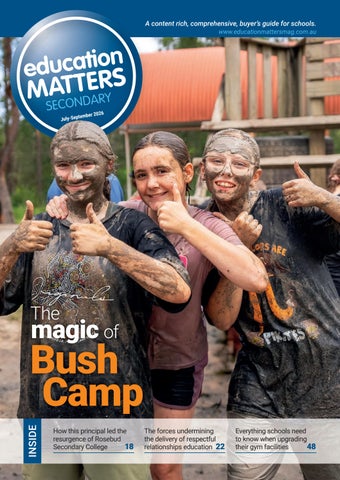
Chief Operating Officer: Christine Clancy christine.clancy@primecreative.com.au Managing Editor: Myles Hume myles.hume@primecreative.com.au Journalist: Meg Kennedy meg.kennedy@primecreative.com.au Head of Design: Clayton Hawley Art Director: Michelle Weston Media Bookings and Advertising: Holly Larkspur holly.larkspur@primecreative.com.au 0422 775 308 Client Success Manager: Sabrina Zor Education Matters is a division of Prime Creative Media Pty. Ltd. 379 Docklands Dr, Docklands, VIC Ph: (+61 3) 9690 8766 Subscriptions Education Matters is available by subscription from the publisher. The rights of refusal are reserved by the publisher. Ph: (+61 3) 9690 8766 E: subscriptions@primecreative.com.au Articles All articles submitted for publication become the property of the publisher. We reserve the right to adjust any article to conform with the magazine format. Cover Image The Great Aussie Bush Camp
Copyright Education Matters is owned by Prime Creative Media Pty. Ltd. and published by John Murphy. All material in Education Matters is copyright and no part may be reproduced or copied in any form or by any means (graphic, electronic, or mechanical including information retrieval systems) without the written permission of the publisher. The Editor welcomes contributions but reserves the right to accept or reject any material. While every effort has been made to ensure the accuracy of information, Prime Creative Media will not accept responsibility for errors or omissions or for any consequenses arising from information published. The opinions of the magazine are not necessarily the opinions of, or endorsed by the publisher unless otherwise stated. All photographs of schools (including students) depicted in feature articles and advertisements throughout this magazine have been supplied to the publisher (and approved) by the contributing school. All material supplied by schools is done so with the understanding that such images will be published in Education Matters and may also appear on the our website: www.edumatters.com.au.
3
CONTENTS // EDUCATION MATTERS
28
40
FEATURES 14 Turning moments into memories
40 Building future-ready STEM skills
26 Rediscover the joy of craft
42 A starting point
The Great Aussie Bush Camp has expanded, now with seven sites.
The kind of career teachers can expect at OneSchool Global.
28 The quality teaching code
Creating room for teachers to review, re ect and refine their craft.
The tech helping schools create more authentic STEM experiences.
Addressing digital literacy as results fall to their lowest levels in two decades.
44 Schools covered
A new generation of modular shelters.
30 Checking out STEM
46 Simplifying procurement
32 The AI sweet spot
48
The CSER National Lending Library.
Andrew Cock on how it can strengthen, not diminish, the profession.
34
ere learnin
a e
i
One of Queensland's biggest schools is finding new ways to integrate VR.
36 Building tomorrow’s innovators Inside the FIRST Lego League.
37 Unlocking exam equity
A handheld device reducing anxiety and improving confidence.
38 Separating fear from the facts Dispelling the myths around AIsupported writing assessment.
4
Officeworks' new education offering.
e l ima e fi o
Westbourne Grammar got more than it bargained for with its gym upgrade.
50 A place to belong
The impact of Aboriginal artwork on school drinking stations.
51 Pathway for potential
A new microcredentials program is helping build workplace-ready skills.
52
REGULARS 3 Editor’s Note 6 News 8 ACARA update 10 ASPA update 12 Teacher’s Voice: Ben Coleman 18 Principally Speaking: Rosebud Secondary College
52 Slide into the perfect excursion
22 Hot Topic:
54 Cool comfort
56 The Last Word 57 Calendar of Events 58 People on the Move
A day out at Funfields theme park.
The ceiling fans making a quiet difference at this Brisbane school.
education matters secondary
Respectful Relationships
NATIONAL EDUCATION NEWS
The social media ban in Australia has had a limited impact, with 78 percent of under-16s still accessing affected platforms and parents left doing much of the enforcement work, according to new research from global data and insights company Pureprofile Limited. Following its first report in December 2025 that found 84 percent continued to access banned social media apps, this second phase of research has gathered perceptions and attitudes towards the ban from 1,025 parents, teachers and young Australians. While support for the ban continues to be high (76 percent vs 73 percent in 2025), 41 percent of under-16s say they ve tried to get around the ban. Parents reported a similar figure, with 43 percent saying their children have made an attempt. More older children have tried to find a workaround versus those that are younger – according to 46 percent of 13-15-yearolds and 49 percent of their parents vs 37 percent of 8-12-yearolds and 41 percent of their parents. This validates the pre-ban scepticism in 2025, 6 percent of all respondents believed children would be able to continue to access social media platforms despite the ban,” the authors stated. A key finding of the report, according to Pureprofile, is that age-verification measures appear inconsistent in both reach and effectiveness. Only 31 percent of children report having undergone face-scanning age verification, and of those, roughly half say they were able to pass as over 16.
Six months in, 78 percent of under-16s still use banned platforms, the report says.
Image: Odua Images/stock.adobe.com
Australia’s social media ban ‘has had limited impact’
With “platforms not managing to block under-16s”, the authors said parents are having to enforce the ban themselves. Over half (57 percent) of parents say they have tried to enforce the ban, while 42 percent of those parents say they found it difficult to do so. Pureprofile CEO Mr Martin Fil said Six months post-ban, the findings suggest many of the concerns raised before the ban have materialised. While support for the policy remains strong, parents are under overwhelming pressure to enforce it fighting to control a highly tech-savvy generation accessing platforms via browser instead of in-app, using their friends’ accounts, signing up with fake birthdays and more." EM
Survey analyses secondary students’ key concerns A new survey has outlined hundreds of secondary students’ honest re ections on their experiences at school. NAB s 2026 Education Insights Report Life at School, found that overall school enjoyment declined in 2025 after a modest rebound in 2024, but students reported improved academic performance across most subjects, particularly in English, Maths and Science. Negative behaviours were recorded to be rising, with greater incidence and exposure to both physical bullying and cyberbullying. Streaming also continues to increase, with 60 per cent of students now placed in ability-based classes. Teacher impact was shown to remain critical, with students valuing those who combine strong subject knowledge with the ability to foster an engaging, supportive classroom environment. The survey represents 400 secondary school students across Australia, spanning every year level and a mix of public, Catholic and independent schools.
6
Mr Dean Pearson, NAB s Head of Behavioural Economics, said that although the research shows many young people are under real pressure, they are also “remarkably adaptable, thoughtful, and hopeful” – an encouraging message for schools. It suggests students are not defined by crisis, but by their capacity to respond when they are supported by adults, trusted relationships and environments that help them feel safe, capable and understood.” Mr Pearson also noted students consistently describe schools as places that can provide structure, encouragement, support and belonging. “They value calm and caring teachers, stronger wellbeing support, practical life skills, fair discipline and more personalised learning. That is a positive message for school leaders it shows that students see schools not just as places of academic pressure, but as places of protection, guidance and possibility,” he said. EM
education matters secondary
w
STRONG STUDENTS
STRONG STATEMENTS School gym fitouts that echo your standard
Ready to build something different?
www.ironedge.com.au
AUSTRALIAN CURRICULUM, ASSESSMENT AND REPORTING AUTHORITY // CEO
ACARA’s NAP-ICTL assessment provides key clues into the underlying trends in Australian students’ ICT literacy skills and knowledge over time. CEO Stephen Gniel analyses the latest performance. The Australian Curriculum, Assessment and Reporting Authority (ACARA)’s National Assessment Program (NAP) provides insights into student learning and drives improvements in education. Through our annual NAPLAN assessments, it measures essential skills in literacy and numeracy. These are the foundational skills that underpin learning and life. Through our NAP sample assessment program, we assess three priority areas – science literacy, civics and citizenship, and ICT literacy – on a three-year cycle. In May this year, the latest of these – the NAP Information and Communication Technology Literacy (ICTL) Report 2025 – provided results from the assessment conducted in May 2025 with a representative sample of students from hundreds of schools across the country. What is tested in the NAP ICTL assessment The NAP-ICTL 2025 – the seventh assessment in this series that started in 2005 – was designed to test students’ ability to use ICT and digital tools appropriately, safely and effectively across a range of realworld contexts. It looked at a broad range of skills including accessing, managing and evaluating information, developing new understandings, applying computational, design and
8
systems thinking, communicating and collaborating, and engaging productively with emerging technologies. Students completed tasks that simulated real life activities, such as creating digital presentations, analysing data, designing algorithms, and responding to scenarios involving online safety and ethical understanding. Although the assessment was focused on assessing ICT literacy, it also drew on a student’s general numeracy and literacy skills. For example, some ICT tasks such as data analysis, multimodal presentations and internet research indirectly assess literacy and numeracy skills. What the report results tell us The results of the NAP-ICTL 2025 Report reinforced what many teachers, as well as parents and carers like myself, know – young people across Australia are enthusiastic users of generative artificial intelligence (AI) and other digital tools. Despite this, the report also showed Australian students’ knowledge and understanding of information communication technology literacy has declined. At the national level, results have fallen since the last assessment undertaken in 2022 and to the lowest levels since the assessment began in 2005. Only 50 percent of Year 6 students and 37 percent of Year 10 students attained the proficient standard. The report also highlighted ongoing
education matters secondary
Mr Stephen Gniel, ACARA CEO.
Image: ACARA
Report shows gaps in ICT literacy skills
educational inequalities and disparities mirroring those in the annual NAPLAN assessments and the other two NAP sample assessments. Female students outperformed male students in both Year 6 and Year 10, which is consistent with previous testing cycles. Students from schools in major cities generally outperformed those in regional and remote schools. Achievement also varied significantly based on parental occupation and education levels. The gap between Indigenous and non-Indigenous students remained substantial. Although these results are concerning, it’s important to know that this issue isn t just confined to Australia. The declining trend in student performance in ICT Literacy has also been observed in other recent international assessments. What the assessment’s survey results tell us Fortunately, there’s more positive news with some results from the survey we run alongside the assessment. When we asked students about their use of digital tools, most of them reported having extensive experience with this. Nearly all students have access to reliable internet services and to their own computer or tablet at home. Our Year 10 students also have a strong level of awareness about online safety. Around nine out of 10 students reported learning at school how to
U
identify and report cyberbullying and image-based abuse. It shows our teachers and schools are doing a great job in helping our young people to develop these important key skills. It’s also no surprise that the survey results showed that generative AI has become a regular part of Australian students learning experiences. Australian school students told us they frequently use of AI tools to support their schoolwork and in generating written content. Year 10 students also reported using AI to help create social media content, presentations and spreadsheet tasks. This clearly re ects the rapid and widespread impact of AI across all aspects of our society. The survey also found most students reported learning how to search for information, identify different types of digital content and assess the trustworthiness of online sources at school.
Where do we go from here The NAP-ICTL 2025 Report shows tech obsession is not the same as tech literacy. Although Australian students are growing up surrounded by technology, they are not automatically becoming ICT literate. Understanding how to use digital tools is about more than just having access to them. Developing ICT literacy skills and knowledge is critical for judging whether an AI response is sound, for knowing what a system is doing with your data, and for participating and analysing rather than just consuming information and content. One of the report s findings backs this up. Students who frequently use productivity tools such as word processing and spreadsheets tend to achieve higher ICT literacy results, highlighting the value of using technology to create, analyse and solve problems. Beyond scrolling, watching Tik Tok and using generative AI, helping students
understand when and how to use these tools responsibly is an increasingly important part of developing digital literacy. Becoming ICT literate is now fundamental to how young Australians will need to learn, work and participate in everyday life. That’s why this report is a clear call to action for all of us who work in the education field. It is our hope that the results will help education sectors and policy makers respond to the challenges of making sure all students are equipped with the knowledge and skills they need in ICT literacy to thrive at school and beyond. The report s findings also highlight the crucial role our teachers and schools continue to play in helping our young people navigate an increasingly digital world. We need to ensure we continue supporting our teachers with highquality training and resources to help them effectively deliver engaging ICT literacy education in classrooms across the country. EM
UNLOCK HIGH-IMPACT STUDENT ENGAGEMENT WITH VR
Mindflight delivers hassle-free, immersive R education. From fully facilitated ncursions to permanent XR abs, s our s, solutions are built specifically for your school.
Curriculum-Aligned: 200+ interactive apps for STEM, Humanities, s Careers, s, s and more. s, Zero IT Overhead: Seamless tech that operates entirely independently of school Wi-Fi. T acher Empowered: On-the-ground facilitation and PD to build your school’s XR Te capacity.
LEARN MORE
AUSTRALIAN SECONDARY PRINCIPALS' ASSOCIATION // PRESIDENT
Agency, authority, autonomy: the rebalancing schools need A shift toward centralisation appears to be underway in Australian schooling. New South Wales replaced Local Schools, Local Decisions with the more centrally directed School Success Model in 2020 (NSW Department of Education, 2020). The ACT, after eight consecutive years of school staffing overspends culminating in a $70 million blowout in 2024-25, is now winding back school autonomy (The Canberra Times, 2025; Region, 2026). After three decades in which school ‘autonomy’ was the reform governments reached for, the pendulum is swinging the other way. The instinct, for school leaders, is to pick a side. We should resist that instinct, because the evidence supports neither pole. The real question is which function belongs where, rather than whether to centralise or devolve. Why autonomy lost favour It is worth asking why governments are retreating from devolution. It may be that the promised results dividend never arrived. There is sensible international evidence showing autonomy lifts achievement in developed, highperforming systems and depresses it in low-performing ones (Hanushek et al., 2013), that autonomy amplifies existing capability, but does not create it. Another reason is likely fiscal. The NSW Auditor-General in 2020 found the department had no adequate oversight of how schools were using needs-based equity funding, around $900 million in 2019 alone, had set no targets for it, and could not demonstrate its impact.
10
Treasuries notice these things, and the Better and Fairer Schools Agreement now ties record investment to ‘evidencebased’ reforms and measurable targets. Governments accountable for that money want their hands back on the levers. A third reason is that a heavier administrative and compliance burden, along with increasing complexity of student need, across disability, inclusion, language background and behaviour, has grown faster than the capacity of individual schools to meet it alone. What was actually devolved The part of the story that is less straightforward is that Australian school autonomy was never implemented in the form the evidence supports. The NSW Government's own evaluation found that Local Schools, Local Decisions was first announced by Treasury under the heading of structural fiscal reform, lacked policy clarity and adequate support, increased the administrative burden on schools, and stripped out the centralised positions, particularly curriculum consultants, that schools relied on (Centre for Education Statistics and Evaluation, 2020). Meanwhile schools received budgets, compliance and financial risk while curriculum mandates were increasingly centralised and driven by a nationalised assessment agenda. This is precisely what secondary leaders themselves report. The most consistent theme across the 278 contributions documented in the report from ASPA's 2026 National Summit,
education matters secondary
Mr Andy Mison, ASPA President.
from leaders in every state and territory, was that agency is the precondition for improvement. Delegates distinguished carefully between agency, the capacity to exercise professional judgement and shape the decisions that affect a school, and authority, the formal power to act in a defined domain. The autonomy reforms confused the two. Leaders were handed authority over functions arguably better centrally supported, while their agency over teaching and learning, the work that matters most to students, remained constrained by workload, compliance and risk. World Bank analyses in 2009 and 2015 are clear that devolution works only as a patient and balanced package, combining managerial autonomy with student assessment and genuine accountability, and that such reforms take years to mature. Judged fairly, perhaps what failed in NSW was implementation.
Image: ASPA
ASPA President Andy Mison argues principals are not seeking less oversight, but stronger system support that builds capability, allocates resources transparently and restores professional agency over the work schools are trained to do.
Centralisation has no stronger case If the evidence for devolution is weak, the evidence for recentralisation is weaker still. Cross-national analysis of PISA 2015 found that greater teacher involvement in decisions was consistently associated with better results (Luschei & Jeong, 2021). I am aware of no system that has lifted its results by taking decisions away from schools and handing them back to head office. What does have a track record is centrally resourced, locally delivered capability-building. Ofsted attributed the London Challenge's success to clarity of purpose, consistent monitoring, and support programmes run by experienced and credible advisers brokered to the schools that needed them (Ofsted, 2010). The centre supplied capability. Schools exercised judgement. More recent PISA evidence illustrates the point. Across systems in 2022, greater school autonomy was associated with stronger mathematics performance chie y
where quality-assurance mechanisms accompanied it: teacher mentoring, classroom observation of teaching practice, and systematic recording of student results (OECD, 2023). The lesson is not that autonomy failed. It is that autonomy works when the system builds the scaffolding around it, and that scaffolding is precisely what Australian implementations under-supplied. The division of labour we should argue for So the frame secondary principals should bring to this debate is a deliberate division of labour. Systems should do what only systems can do: build professional capability at scale, steward resources transparently, supply expert support, and maintain the data infrastructure that shows what is working. Schools should hold what only schools can hold: professional judgement over teaching, learning and the students in front of them. That division is demanding for both parties. It asks departments to rebuild
expert support functions, and it asks to maintain transparency about results and resources as the legitimate price of professional authority. The risk in the current moment is that governments centralise the wrong things, pulling instructional decisions into head office while still under-supplying the capability support. Principals are not asking to be left alone. We are asking to be backed by systems that invest in our capability, resource our schools transparently, and trust the profession's agency over the work it is trained to do. Our members have told us that agency is the precondition for improvement. The evidence says they are right, and our profession should put that position clearly, and together, while these arrangements are being redrawn. EM
NOTE: References are available upon request and in the online version of this article.
TEACHER’S VOICE //BEN COLEMAN
Where sustainability touches almost every corner St Monica’s College Teacher Mr Ben Coleman has received a top sustainability award for his work embedding hands-on environmental learning across the curriculum and transforming the campus into a living classroom.
12
programs, identify opportunities and trial new ideas. We invite staff to pilot projects that can grow into whole yearlevel programs. And anything that works well in my own science or language classes is shared with colleagues.” Mr Coleman realised environmental learning did not need to sit outside the curriculum: it touches almost every corner of learning at St Monica's. In science, students can investigate ecological interactions and climate impacts. Humanities classes can explore First Nations plant knowledge and biodiversity. Art and English classes use the wetlands as inspiration for drawings and poetry. In electives such as Year 9 STEM, where students engage in hands-on challenges including solar vehicles, sustainable house design and water filtration systems. A key part of the program’s success is the popularity of EnviroFriends, which has attracted more than 100 students.
St Monica's College also received a 5-Star Accreditation through the ResourceSmart Schools program – the highest level of sustainability certification awarded.
education matters secondary
But Mr Coleman believes the wetlands and surrounding habitat are the jewel in the school's sustainability crown. “Over several years, students and staff have planted between 500-1,000 plants annually, gradually building a rich ecosystem,” he says. “We started with canopy species, then shrubs, and now we re filling in with grasses and wild owers. Each year we run bioblitz surveys to track biodiversity, and there’s always something new to discover.” The site now features a recreated volcanic grassland, a Miyawaki-style micro forest, bush tucker gardens and a developing permaculture food forest – all serving as a “living classroom” for students across subject areas. “Not everyone wants to pick up litter but students love trying something new – whether it’s using tools like saws and drills to upcycle materials, or working outdoors. If we can make sustainability practical, meaningful and enjoyable, it stays with them.” EM
Image: Ben Coleman
The lunchtime crowd drifts over to the chicken coop. Some students are there to help, others are just curious about what’s going on. Soon, they’re tasting mulberries from a nearby tree, learning how to prune plants, or watching animal enrichment activities take place. For Mr Ben Coleman, Sustainability Coordinator at St Monica’s College in Melbourne’s north, these encounters are often where engagement begins. It’s a philosophy that has helped transform sustainability from a standalone initiative into a defining feature of school life at St Monica's College. It also earned Mr Coleman the Secondary Teacher of the Year award at the 2026 ResourceSmart Schools Awards, Victoria's largest sustainability awards program for schools. Mr Coleman joined St Monica's College in 2010 and two years later became the Sustainability Coordinator, overseeing programs that have embedded environmental education throughout the curriculum and helped establish sustainability as a core part of the school's identity. This success is largely thanks to a long-standing commitment from school leadership, including Principal Mr Hanley OAM, to embed sustainability as a core priority. Sustainability in the curriculum is also supported by the ResourceSmart Schools program, which provides practical tools and guidance. “Embedding sustainability across the school begins with collaboration,” Mr Coleman says. “I work closely with faculty leaders to audit existing
Experience the
joy of teaching Take the next step in your career, with an awardwinning innovative pedagogy, engaged learners and an environment that values your professional growth. With 31 campuses across Australia, a world of opportunities await you at OneSchool Global - from primary and secondary teaching roles, to campus, regional and global leadership opportunities. OneSchool Global educators benefit from: • Smaller class sizes • A healthy work/life balance • Highly engaged and respectful students • Ongoing professional development • Modern, technology-empowered learning environments Find out more about the benefits of working with OneSchool Global and view our current teaching opportunities. oneschoolglobal.com/working-with-us
COVER STORY // THE GREAT AUSSIE BUSH CAMP
Tea Gardens is the largest of seven sites operated by The Great Aussie Bush Camp.
Turning moments into memories
In Term 2 2026, Relieving Principal Mrs Sharnee Klempert stepped away from Tuggerah Lakes Secondary College’s Tumbi Umbi Campus to join her Year 7 students 145km up the road, where she was reminded why school camps are such a vital part of growing up in Australia. Across three days at Tea Gardens Camp – the largest of seven sites operated by The Great Aussie Bush Camp (also known as Bush Camp) – students rotated through a mix of adventure and team-based activities, including high ropes courses, kayaking, archery and ying foxes, alongside a movie evening and the classic nighttime game spotlight . But there was one activity that stood out – the Lost Island Mud Run. This commando-style assault course is almost a rite of passage for students that visit many of the Bush Camp sites, challenging students through a series of obstacles built around mud and water.
14
“When our students go on camps like this, we see both their resilience and confidence grow, Mrs Klempert says. “The staff–student mud run challenge is always a highlight, but it was especially memorable this year due to the involvement of our teachers who were leading the charge. “From there we could see which kids held back, which kids were comfortable being on their own, which kids led in a positive way, and which kids lost control uickly. That one activity gave us a really clear window into social and interpersonal skills, leadership, and where some students need extra support. “Since we’ve been back at school, it’s also been a shared reference point that our teachers and students can look back on when working through behaviour challenges, resilience and problem solving. A long-time advocate of The Great Aussie Bush Camp, Mrs Klempert
education matters secondary
Mrs Sharnee Klempert, Reliving Principal at Tuggerah Lakes Secondary College’s Tumbi Umbi Campus.
has made the organisation her go-to provider across four schools she has led in her career. The professionalism in administration and communication, through to the facilities and outdoor instructors has stood out time and again. In her current role at Tuggerah Lakes Secondary College, she oversees around 740 Year 7-10 Tumbi Umbi Campus students where camps are a key tool for transition, relationship-building, and student development in the early phases of Year 7. That positive impact of The Great
Image: Sharnee Klempert
As schools prioritise wellbeing, resilience and connection through outdoor education, The Great Aussie Bush Camp is meeting this demand with new sites across the eastern seaboard.
Downs is very similar to how we do things, with a great range of activities. “Then, Camp Rumbug is such a beautiful, pretty site looking over Wilsons Promontory. It s in the rainforest it s just a lovely site to go and camp at. And our new site in Queensland – it features a beautiful dam and many great activities, accommodation and facilities. It s also centrally located to Brisbane and Gold Coast schools.
A provider schools keep returning to For Mrs Klempert, the value of Bush Camp is not tied to one standout activity or a single trip, but to the consistency she has experienced across more than two decades of taking students from different schools to the organisation s camps. From the earliest stages of planning through to the final bus ride home, she says the professionalism and reliability
The Lost Island Mud Run, a commando-style assault course, is one of the most popular activities.
Images: The Great Aussie Bush Camp
Aussie Bush Camps is broadening too. Recently, Bush Camp ac uired PGL Adventure Camps, marking a major step in the company s national expansion. It now owns three additional sites, Campaspe Downs (Kyneton, Victoria), Camp Rumbug (Gippsland, Victoria) and Kindilan (Redland Bay, ueensland), growing its portfolio from four to seven locations and entering the Victorian and Queensland outdoor education markets for the first time. CEO Mr Graham Ward says The Great Aussie Bush Camp can now offer outdoor education experiences to over 100,000 young people and teachers each year, cementing its position as Australia s go-to outdoor education provider. Those experiences, Mr Ward says, are vital in a society where young people are dealing with new levels of stress, screen time, and social pressure. Getting outside and experiencing the outdoors is more important than it ever was, he says. “There’s plenty of research out there on the mental health benefits, wellbeing and cognitive development that come from camp experiences, right down to the confidence and essential skills kids can take back into their everyday lives. That’s what we’re really focused on, and passionate about. Mr Ward says being able to offer that to even more young people is an exciting opportunity, with each camp across the Bush Camp portfolio offering a uni ue experience. Until 2025, The Great Aussie Bush Camp only owned sites north of Sydney, but deepened its ties to New South Wales schools by bringing Camp Wombaroo into its fold last year. “That’s always been a key area that we wanted to serve and that’s been a favourite of many customers. It s a beautiful site, just outside of Bowral, and there’s a whole range of customers that we’re now a little bit closer to, giving a Great Aussie Bush Camp experience to south of Sydney, Mr Ward says. “Then in Victoria and Queensland, we’ve always been a keen admirer of the PGL business. Their sites in Victoria are both excellent. The site at Campaspe
The Leap of Faith is one of many highadrenaline experiences available.
education matters secondary
15
COVER STORY // THE GREAT AUSSIE BUSH CAMP
have remained a constant. “There are lots of reasons it’s my preference, she says. Firstly, it s the administration and communication. The office staff are excellent when you re booking, their communication channels are on point, and it’s all very smooth and reliable. Over the years, Mrs Klempert has coordinated camps involving vastly different student numbers, from groups of around 80 students through to more than 230. Each time, the camps have catered to the specific needs, personalities and logistics. “Whatever the group size, there’s always a well-suited campsite: clean, good quality accommodation, wellmaintained activities, and a wide variety of options to choose from, she says. A major strength of the organisation, she explains, is the degree of exibility schools are given when deciding their programs, allowing staff to tailor activities around the needs of their students rather than fitting into a rigid schedule designed by the camp provider. Mrs Klempert says the quality of the camp instructors themselves is perhaps the most defining feature, though.
Students can learn how to kayak at The Great Aussie Bush Camp sites.
16
“The camp leaders who take the groups are outstanding. They have strong interpersonal skills and are very good at spotting which students might need additional support. They frame their language in a supportive, comforting way to encourage students to step outside their comfort ones, she says. “They’re on time, they bring the energy from 6am right through to the evening, getting everyone up, engaged and then wound down safely after activities. That energy is magnetic and provides the spark kids sometimes need. Equally important, Mrs Klempert says, is the level of support provided to teachers during camps, acknowledging that school staff are effectively supervising and caring for students around the clock while away from home. She believes the organisation understands those pressures better than most. “I think that’s a massive reason – alongside everything else I’ve mentioned why schools keep returning, she says. There are Bush Camp leaders with each group, so while school staff are with their groups, there’s a kind of
pressure valve – the teachers don’t have to do all the heavy lifting. They re supported by the camp leaders and that shared load is a major benefit. School staff are also provided quality meals and there’s a staff room where they can access drinks, ice blocks, fruit and snacks during the day. “Staff are giving up a lot and those small things – snacks, a quiet space, good food – are how the camp gives back to staff and helps them cope with being away from home, she adds. Safety and emergency management are also areas where The Great Aussie Bush Camp consistently demonstrates professionalism, giving school staff confidence that incidents will be handled calmly and efficiently if problems arise. “There’s a security guard on site overnight, roaming the grounds, she says. As a staff member, it s reassuring to know there’s someone paid to look after the grounds and respond to emergencies. Built for scale, designed for schools As The Great Aussie Bush Camp expands nationally, Mr Ward says one of the organisation’s biggest strengths
Evening team bonding activities are also a highlight of the camp experience for students.
education matters secondary
remains its ability to cater for schools of vastly different sizes while still delivering a highly structured and personalised experience for students and staff. Supporting that operation is a workforce of more than 300 employees across the company’s camps, the majority of whom are activity instructors working directly with school groups. At the Tea Gardens Camp alone, the organisation employs around 100 staff. “Where other operators may cater for groups of 70 to 80, we can comfortably cater for 300-400, he says. At our Tea Gardens site we have over 1,000 beds – it’s the largest of its kind in the country and there’s nothing quite like it – so we can host multiple schools at the same time, which we’ve been doing for many years. With more than 40 activities spread across the property, schools rarely come into contact with one another. That diversity of activities, he says, sits at the heart of why schools continue to choose Bush Camp. While some students gravitate towards highadrenaline experiences such as high ropes courses and ying foxes, others engage more strongly with initiativebased activities built around teamwork, communication and problem-solving. “We have the largest range of adventure activities, Mr Ward says. It s a tried and tested formula that we use, providing an all-round experience that meets the needs of different kids. At the same time, he says some of the greatest moments occur when students step into activities they would not normally attempt, whether that involves heights, water-based challenges or collaborative problem-solving tasks. But, by the same token, if those kids take it on and build courage and resilience from trying those activities, that’s where the personal growth comes from, Mr Ward says. That balance between adventure, challenge and skill-building, he says, is carefully considered when programs are developed for schools, with the aim of keeping students engaged while exposing them to different types of experiences across the duration of camp.
Camp instructors – rather than school staff – lead the activities, allowing teachers to spend more time connecting with students.
Mr Ward says the organisation also places significant focus on improving the experience for teachers, particularly by reducing the logistical and supervisory burden that can often come with school camps. Camp instructors rather than school staff – lead the activities, allowing teachers to spend more time connecting with students outside the normal classroom dynamic. “That makes it a different experience for the teachers – instead of being the disciplinarian, they’re out enjoying themselves and spending quality time with the kids, Mr Ward says. The night-time supervision across its New South Wales camps – an understated benefit that Mrs Klempert and many other principals appreciate – is planned for Victoria and Queensland too. “What that means is that the teachers can have a peaceful night s rest, Mr Ward says. That s really important for the teachers, and it just takes the pressure off them. Looking ahead, Bush Camp is looking at ways it can improve its offering further. Reducing the administrative pressure before camps begin is one of those areas
education matters secondary
the company is now investing in, with a new digital teacher portal. “It’ll have all the resources schools need, as well as the organisational tools, ahead of camp, Mr Ward says. It s an important project that we’re focused on for all our customers, which we expect to be live within six months. For Mrs Klempert, it is the combination of those elements – strong student engagement, adaptable programming, high quality staff, teacher support and a clear focus on safety – that has kept her returning to The Great Aussie Bush Camp across multiple schools. “Even when I’m at conferences, you ll see The Great Aussie Bush Camp exhibiting, and it’s clear the relationships they have built with school leaders, she says. “Overall, the combination of student experience, staff support, safety and professionalism is why schools keep going back. They know the experience they’re going to get, and it’s why I keep recommending them. EM
For more information, visit bushcamp.com.au
17
PRINCIPALLY SPEAKING // ROSEBUD SECONDARY COLLEGE
A revitalised Rosebud
Few people apply for their first principalship expecting to get the job. Ms Lisa Holt certainly didn t. The then-Assistant Principal at Carrum Downs Secondary College saw the advertised role at Rosebud Secondary College as a chance to test herself. It was a way of finding out whether she was ready to lead a school of her own. I applied as a bit of a litmus test. I didn t expect to get it and then I did, and had this moment of, OK here we go , she says. I love a challenge. I love being in schools. I think schools and teenagers are fabulous. I love the variation of each day. I often talk about how teaching is an extreme sport it s fast, it s dynamic, it s got unusual levels of risk, lots of rapid decision making. The school she inherited in 2017 was no blank canvas. Rosebud Secondary College is a long-established fixture on Victorias Mornington Peninsula. A community centrepiece that had entered some trouble waters, it presented a challenge Ms Holt found impossible to resist. Six years later, the answer to her burning uestion am I ready was emphatic. She was recognised with the Colin Simpson Outstanding Secondary Principal Award as part of the 2024 Victorian Education Excellence Awards, one of the most prestigious accolades
18
Images: Rosebud Secondary College
From a “litmus test” job application to award-winning leadership, Ms Lisa Holt has transformed Rosebud Secondary College through high expectations, strong teams and an approach rooted in cognitive science.
Ms Lisa Holt has been Principal of Rosebud Secondary College since 2017.
for school leaders in the state. I was really proud of that, but also uite shocked, she says. It speaks to the hard work we ve done to create great teams throughout the school. We ve done some hard and brave work over the last four or five years, so it was very much a celebration of that. That same year, the school s Literacy Leader Ms Wendy Coustley was also named Outstanding Secondary Teacher as part of the same awards. It was further validation of the work Ms Holt and her team had done to
education matters secondary
transform a school that faced some turbulence in the mid-2010s, losing its connection to the community. A lot of the community had lost faith in the school, Ms Holt recalls of the time she took over. The actual teaching and learning in the school was strong, but enrolments had dropped and there was a real community perception issue. Most of our staff live in the community, and it was weighing heavily on them. Ms Holt s top priority was to start at the top, with an intentional approach to improve the staff culture that would
inevitably filter through to students. The school s value of belonging was a north star during this time. When we set about building our culture, it sat in the notion that to belong you have to connect, you have to understand the culture, and you have to contribute to the place, Ms Holt says. We set very high expectations on staff in terms of professional learning, and that was very openly intentional. We still, to this day, intentionally do work on trust, positive con ict, accountability, attention to results. We do that work every week with our staff, so we re in a space where we can have rigorous conversation and it not be detrimental to culture. The leadership approach stems from Mr Patrick Lencioni s book entitled The Five Dysfunctions of a Team. Mr Lencioni is widely recognised as a pioneer in the organisational health and team management movement. Every single member of the school, irrespective of their role, has read that book, Ms Holt says. We structured a five year professional learning plan 12 months on trust, next year on healthy con ict, etc. And we spiral it so that we always revisit trust in all our activities. To start
an activity at Rosebud, in a meeting we have a trust card. Staff pull out a card that s about sharing a personal re ection on current work, a strength or vulnerability. It s just who we are it s how we operate. It happens in all our teams.
“We do that work every week with our staff, so we’re in a space where we can have rigorous conversation and it not be detrimental to culture.” - Ms Lisa Holt Building a culture of trust There are a number of norms and behaviours that make Rosebud Secondary College uni ue. Notwithstanding its location on the Mornington Peninsula and the extracurricular opportunities this affords, staff and students share kitchen and workspace facilities to try and create that home away from home and despite there being little cultural diversity, there is significant variation in the socio-economic status of the student community. We ve got young people coming from really af uent families, and we ve got young people coming from really
disadvantaged communities, Ms Holt says. Teaching young people that there are different kinds of people in the world is an important responsibility because they will enter a workforce that won t necessarily re ect what their schooling looked like. But one of the school s standout features, according to Ms Holt, is an approach deeply rooted in cognitive science. It s an area Ms Holt navigates with comfort and familiarity after working as an English, psychology and history teacher during her years in the classroom, including at Lyndale Secondary College and Carrum Downs Secondary College. Whilst supporting students who have challenges regulating comes naturally to me, the cognitive science focus has always allowed me to stretch and challenge all students to reach their academic potential, she says. I d come from a fairly strong learning and wellbeing background and early on, in 2000, I spent 12 months out working in the community sector with disengaged young people, supporting them to get back into school. When she arrived at Rosebud Secondary College, it s clear why Ms Holt
The college is a long-established fixture on Victoria’s Mornington Peninsula.
Literacy Leader Ms Wendy Coustley (left) and Ms Lisa Holt and with their respective 2024 Victorian Education Excellence Awards.
education matters secondary
19
PRINCIPALLY SPEAKING // ROSEBUD SECONDARY COLLEGE
One of the school’s standout features is an approach “deeply rooted in cognitive science”.
was eager to lead a school grounded in cognitive science. The school has worked hard so staff understand the brain and how young people learn, and ensuring this is passed on to students. We wanted to be the school that was unapologetically running an intervention program to address the needs of our young people, particularly around reading, and delivering sound explicit instruction rooted in cognitive science, she says. But we re not getting in the way of young people being able to prepare for their own future. So while there s this very rigorous approach, there s also the uestion How do we teach them how to learn, how to take on the world, how to be employable Ms Holt has strong views that learning is the one thing that can help young people into a life they want, rather than a one they ve been born into. They need to be able to have advocacy for self, and if they need wellbeing or mental health support, they need to learn how to use those systems. We need to come from a space of learning, she says. You can t separate out learning and wellbeing. You need wellbeing to learn, but you also need to be able to learn to have really good wellbeing. I walk that line. But if you asked me to put one foot more in one camp than the other, I d put it in the learning camp, because I think there s just so much power in learning.
20
‘Just enjoy it. What a privilege’ While the Colin Simpson Outstanding Secondary Principal Award was validation of the work Ms Holt has done to transform Rosebud Secondary College, the real test is how the school is engaging with the community. Our students come to us as 11- and 12-year-olds, and with us they become young adults who need to step into the world and know how to take it on. We need to think about what are the core skills to make sure they re ready, but also what are the attributes they re uire. It s also about taking staff on an improvement journey that language is thrown around, it s real education jargon but that s about looking hard at who we want to be, and how we make sure that, as a team, we are delivering the best for the young people in our community. Ms Holt believes the school has reached that point, but the job is never uite done. While enrolments are rising, she says a key tension in public education remains how schools navigate expectations from families. There s always that challenge with people s perceptions of what your school is versus what your school actually is. On one hand we absolutely need parents and carers to be genuine partners with us in supporting young people, but on the other we are the professionals in learning and teaching, and we do have knowledge and expertise that needs to be respected and shared. Leading such a big organisation with expectations from parents, students, staff
education matters secondary
and the system comes with inherent pressure. She keeps herself sharp through books and podcasts listening at 2x speed but at the same time has a way of keeping things in perspective. I take my job seriously, but I don t take myself too seriously, she says. ust enjoy it. What a privilege it is to hang out with teenagers every day and watch them grow and develop and learn. We can get really caught up in the hard parts of the job, but the reality is teenagers are great fun, they re full of energy, and they absolutely need us and I think it s important not to lose sight of that. Ms Holt also spends a lot of time in classrooms, especially on her tougher days. It gives her energy and reminds her of what s important. She s also clear the job is not about having all the answers, but about creating the conditions where others can learn and contribute. It s important to be a learner and accept that you don t know everything and you don t actually need to. You need to create an environment where people feel safe and can learn and can see you learning, she says. When people go into leadership irrespective of their organisation it s about strong strategic planning, being brave enough to have difficult conversations, and being open and transparent so that people feel safe. If you can do those things, you ll build strong teams and culture. People are the single most important thing about a school. EM
NEW SOUTH WALES | QUEENSLAND | VICTORIA
e t i n Ig
Your
Adventure DISCOVER THE FUN HERE
At The Great Aussie Bush Camp, we redefine what a school camp can be! As Australia’s adventure camp specialists, we take you beyond the ordinary, empower you to go further, and inspire you to live large. Across seven locations nationwide, we deliver fully customised outdoor education programs that build confidence, strengthen connections, and create unforgettable memories. Come and experience one of the country’s widest ranges of adventure activities and discover school camps on a whole new level.
HOT TOPIC // RESPECTFUL RELATIONSHIPS
Rethinking respect, sex and relationships in schools Respectful Eelationships Education sits at the centre of Australia’s strategy to prevent gender-based violence, but are inconsistent delivery and limited teacher training undermining its effectiveness?
Teaching Respectful Relationships and Consent education is complex work – and recent evidence raises questions about whether current approaches are fit-for-purpose. In classrooms and within alreadycrowded timetables, educators are expected to navigate varied cultural backgrounds, uneven maturity levels, the in uence of social media and explicit content, and increasing gender and identity diversity, all while addressing deeply sensitive topics. In Australia, the national curriculum positions Respectful Relationships Education (RRE) and Consent Education as part of broader 'Health and Physical Education . The two are closely intertwined, spanning everything from sexual health and puberty through to relationships, decision-making and safety. Consent, emotional literacy, respectful communication, gender norms and the attitudes that underpin equality and safety are also taught. But recent evidence shows the current system is struggling to keep pace with the realities young people face. Some of the most telling insights came from the eighth edition of Australia’s largest study of teen sexual health and relationships drawing on experiences from 4,396 adolescents
22
aged 14 to 1 across the country. The latest Australian Survey of Secondary Students and Sexual Health (SSASH), released on 28 May 2026, showed almost all (92 percent) young people had received RSE at school, yet less than half (45 percent) found it relevant. It also highlighted urgent gaps in consent education, support services and help-seeking pathways for young people, despite significant investment in this space. Coverage of practical information about sex was also mixed, with 44 percent saying they had learned where to get help or support for sexual issues, while only 11 percent had received lessons to answer their practical uestions about having sex. It s in this context that we shouldn t be surprised many young people turn to porn – they are curious to know what sex looks like, Professor ennifer Power, the survey s lead investigator says, re ecting on the findings. What needs to happen is finding ways to direct young people to uality safe online resources. On almost the same day, Our Watch and the University of Melbourne's Youth Research Collective reinforced the urgent need for better uality education. It found young people are forming attitudes about gender, sex and relationships earlier than ever. Romantic
education matters secondary
relationships are commonly beginning between the ages of 10 and 13, sexual activity often starts around age 15, and nearly one in three sexually active young people reported experiencing unwanted sex. Gender-based violence doesn t start in adulthood, says Our Watch CEO Ms Patty Kinnersly. It is shaped by the attitudes, norms and behaviours that young people are exposed to early in life. Effective, well-resourced RRE is a vital step to helping young people deal with that. And therein lies the challenge. The work of Dr Naomi Pfit ner, Director of the Monash Gender and Family Violence Prevention Hub, has shown schools and teachers are generally ill-e uipped, and when RRE lessons aren’t delivered well it can only compound the problem. Preventing violence needs to start early and schools are uniquely placed to equip students with the knowledge and skills to build positive and equal relationships, she says. Teachers are shouldering the bulk of responsibility for delivering this type of education, yet many are doing so without the training and resources they need. Against this backdrop, she’s helped develop Australias first National Respectful Relationships Education
Image: photobyphotoboy/stock.adobe.com
Experts say well-resourced RRE is vital to support Australia's young people.
Framework, which was published on 11 March 2026 with colleagues at Deakin University and the University of ueensland. In the lead up to this work, Dr Pfit ner helped lead a national Rapid Review Survey completed in 2023, and only recently published, to identify how primary and secondary schools in Australia are delivering RRE. It shows three quarters of RRE programs are delivered by internal school staff. Despite this, many teachers have not received professional learning and development and only one in five said their school implements a comprehensive whole-of-school approach. It’s hoped the new National Respectful Relationships Education Framework will help bridge this gap. Dr Pfit ner says it s designed so schools can deliver RRE in line with Version .0 of the Australian Curriculum released in May 2023, which integrated more explicit, mandatory education on consent and respectful relationships. When it comes to respectful relationships – how schools teach this, the pedagogy, and the learning activities that s really important. Our new national framework is about providing guidance for schools on how to deliver high quality and, importantly, evidence based respectful relationships programs, she says. It s wonderful that we now have this explicit focus on consent and respectful relationships in the national curriculum, but if we mandate curriculum, we really have to mandate professional learning. Dr Pfit ner says previous research shows when teachers understand the aims and purposes of RRE, and when they receive professional learning, they’re much more confident and comfortable delivering it and managing disclosures. On the reverse, we also know that where teachers don’t receive training, it can actually have negative outcomes for students. Sometimes they provide contradictory messaging, or even inadvertently reinforce traditional gender stereotypes or rape myths, she says. That s why it s so important that we provide professional development and learning not only for the current workforce,
Image: Naomi Pfitzner
Dr Naomi Pfitzner, Director of the Monash Gender and Family Violence Prevention Hub, says teachers are shouldering the bulk of responsibility for delivering this education.
but also for pre-service teachers, so that when they come into the classroom, they’re actually ready to deliver this content. Where and when to start? RRE is a key pillar in Australia’s national plan to end violence against women and children. The enormity of this task isn t lost on Dr Pfit ner. But ending gender-based violence, she says, requires students and teachers to engage in quite confronting, sometimes uncomfortable and challenging discussions about gender, power, ine uality, and relationships. Yes, we need professional learning, but it works best when all school staff understand why we’re doing this work and why it s so important. I can t emphasise enough the crucial role of school leaders. Numerous studies in Australia and overseas show that strong support and commitment from school leaders is the key to success in implementing respectful relationships education, she says. It s about also looking at your policies and procedures to make sure gender equality and respect are embedded, and ensuring staff model this in and outside of classrooms. This is considered a whole-school approach. It s something that s generally lacking in RRE, with just 20 percent of schools surveyed delivering a comprehensive whole-school approach, according to Dr Pfit ner s work. It might be simple things like: does the school celebrate achievements in arts, maths or literature in the same way
education matters secondary
it celebrates sporting achievements? Is there gender equity among school staff, particularly in leadership roles that young people see? It s about embedding gender e uality in everyday school life. Stakeholders we consulted – nearly 200 of them – told us they needed support to bridge the gap between the policy theory of whole school approaches and what this actually looks like in schools, Dr Pfit ner says. One practical step she suggests for schools is to host parent and carer information nights to bring families into the conversation and explain what’s being taught. Schools can outline what RRE content they’re covering that term, and suggest how parents can continue these conversations at home. Schools said they need practical guidance on how to deliver this policy aspiration. That s a big gap at the moment, Dr Pfit ner says. One of the most telling findings in the Rapid Review Survey showed ‘evaluation’ was the least commonly actioned element of a whole school approach among the schools that participated. Dr Pfit ner says a previous national stocktake of existing evaluations of respectful relationships programs, found some promising, high quality programs exist. But it also highlighted programs demonstrating no impact on young people. Most concerningly, she says some programs showed students came out with greater adherence to problematic attitudes – more likely to support rape myths or rigid
23
HOT TOPIC // RESPECTFUL RELATIONSHIPS
gender stereotypes – after completing the program. That s why evaluation is so important, she says. Firstly, schools can t work out what’s working well for their community and context, and what needs improvement, if they re not tracking it. Secondly, there simply aren t many evaluations in this area, and that’s a major gap. We need to work toward a uality assurance process. The framework is a great start to help guide schools in selecting programs, but schools can’t do this alone. Education systems need to step in and support schools so they can be confident they re implementing evidence based curriculum. Combating manosphere, pornography and more Few people are better placed to connect the threads of gender, respectful relationships and sexuality education than Ms Debbie Ollis. She s an Honorary Associate Professor at Deakin University and has written a number of national frameworks and national resources for schools, particularly in the Victorian education system, during the past 40 years.
The stat she’s most concerned about features in the SSASH study, where only 45 percent of young people found relationships and sexuality education at school relevant. She was involved in a 2016 project that showed students and teachers were completely at odds about what needs to be taught and how when it comes to RSE. Young people do not want a lecture or someone just reading off a PowerPoint. They want engaging activities and approaches that help them explore the social world in which they live, A Prof Ollis says. They re grappling with uestions like What does it mean to be a man What does it mean to be a non-binary young person How do I reconcile my religious framework with what I want and experience? When it comes to sexuality education, they don t want it sugar coated. They want to know the truth. They want us to talk about sex and actually name what it is. There has been plenty of positive progress though. A Prof Ollis says during the past 20 years conversations have moved away from shame and harm, to harm minimisation and now to a sex
Image: Valerii Honcharuk/stock.adobe.com
Families and homes are influential in how young people navigate these sensitive and complicated issues.
24
education matters secondary
positive, strength-based approach with young people. A sex positive approach goes further and acknowledges that one of the reasons people have sex is because it’s pleasurable, it can provide closeness and intimacy, she says. One of the things I ask teachers is: ‘How many of you cover love in your curriculum And they usually don t. Whether you re coming from a sex positive approach like mine, or from a spiritual or religious framework that positions sex only in marriage, love is a universal concept. It s about finding ways to make the learning culturally appropriate in a broad sense for the students you re working with. With respectful relationships, A Prof Ollis says professional development needs to equip teachers with access to the latest research, along with time to explore the issues they’re going to cover with young people. They also re uire skills to deal with difficult uestions, or comments that are homophobic, transphobic or sexist in nature. Compared to when A Prof Ollis began in the gender and violence education space in the early 1990s, she feels the extent of gender-based violence is, in some ways, worse now. The figures continue to overwhelmingly show gender-based violence is perpetrated by men between 18 and 35, and against women, other men and children. The internet, she says, has changed many things due to its anonymity the pressure on young people to look or act a certain way. At the time of writing, 29 women had already died at the hands of an intimate partner in Australia. There’s also the rise of the misogyny and ‘manosphere’ on social media, which frames masculinity around dominance and claims that gender equality has disadvantaged men. Pornography is also a real issue today too. Unless we re going to talk to young people and enable them to explore these issues in an honest way, you can’t blame them for trying to find out what sex is through pornography, says A Prof Ollis. And often that pornography is very negative and is adding to the problem of gender-based violence and constructions of masculinities and femininities.
Ms Debbie Ollis, Honorary Associate Professor at Deakin University.
Image: Debbie Ollis
From one-off lessons to lifelong learning If there is one point on which both Dr Pfit ner and A Prof Ollis agree, it is that respectful relationships and sexuality education cannot be treated as a once-ayear lesson or a curriculum box to tick. Schools are already juggling competing priorities, and teachers face increasing pressure to cover everything from consent and respectful relationships through to online safety, sexual health and wellbeing. The challenge is not simply finding room for these topics, but ensuring they are taught in an accurate and effective way. A Prof Ollis says teachers need clear support to understand how these areas fit together, rather than treating them as separate initiatives. At the moment in Victoria, we ve got the respectful relationships rollout, which is mandated, and a new sexuality education resource I ve been involved in writing, she says. These two overlap, and teachers need practical advice on how to cover the
priorities in this area. Students are often fortunate to receive consistent education in this space through to Year 10, she says, but opportunities can become increasingly limited in the senior years. That s why we ve got to start in primary school, A Prof Ollis says. One good thing about both the respectful relationships curriculum and the updated sexuality education resource is that they’re designed from Foundation through to Year 10. It needs to build so that when students get into secondary school
and are really starting to make sense of these issues. Dr Pfit ner says schools beginning this work should focus first on delivering curriculum in a sequenced and sustained way across all year levels, rather than oneoff sessions or sporadic sessions. ust as importantly, schools cannot do this work alone. Families and homes are hugely in uential in supporting the success of this, Dr Pfit ner says. They often want to have these conversations at home, but they don’t necessarily know what the school is covering or how to talk about it. We need to do this work where students learn, but also where they live and where they play. A Prof Ollis argues that the education of parents and carers and family groups is the missing link in this important work . Schools are already stretch to the limit, yet without parents’ education the divide between home and school will remain, she says. EM
Build. Code. Compete. Bring FIRST LEGO League to your school FIRST LEGO League is a hands-on STEM robotics program where students tackle realworld challenges through teamwork, creativity and problem solving. Using LEGO technology, young people design, build and code robots, build confidence, and bring classroom learning to life.
Curriculumaligned
Hands-on
Collaborative
Ages 9 -16
Learn more at
irstaustralia org irst lego league
ll
e u au
CASE STUDY // ONESCHOOL GLOBAL
Where teachers rediscover the joy of their craft Across 31 Australian campuses, OneSchool Global is reimagining learning and teaching, through a model that’s equipping thousands of young people with life-ready skills – allowing teachers to focus on what really matters. As schools grapple with preparing students for an increasingly complex yet exciting future, OneSchool Global believes the answer lies not in teaching young people what to think, but in teaching them how to learn. At the heart of its 31 campuses across Australia sits its Learning to Learn Framework. It’s a selfdirected approach that places greater responsibility on students to take ownership of their education. Education has evolved significantly beyond the traditional model where teachers simply deliver content and students passively receive it,” says OneSchool Global’s Regional Director of Education for Australia, Mr Paul Maher. “Our goal is to develop young people who are not only academically capable, but genuinely life-ready. That means fostering independence, critical thinking, creativity, problem-solving and the confidence to navigate an
increasingly complex world.” This distinctive and progressive approach has become a defining feature of OneSchool Global, an independent network of schools founded in 1994, which has today grown to more than 120 campuses in 20 countries. It’s one of the reasons OneSchool Global attracts quality teachers seeking contemporary pedagogy, innovative learning spaces and a collaborative approach to teaching. Today, the school employs more than 500 staff in Australia – with Mr Maher himself part of it for the past 22 years, starting as a maths, science and PE teacher before working his way into various leadership roles. “There are many reasons why talented educators are drawn to OneSchool Global,” he says. “Our campuses are purpose-built for modern learning, supported by exible environments and leading technology.
OneSchool Global aims to prepare students for the 21st century workforce.
26
education matters secondary
Just as importantly, there is a strong culture of collaboration where teachers work together to achieve the best outcomes for students." Mr Maher says OneSchool Global also carefully balances operational efficiency with educational uality, maintaining class sizes that are often smaller than those in many government and Catholic schools. “The working conditions for teachers exceed what is typically found in schools in terms of exibility, class si es, and the support they get in professional learning,” he says. Another significant advantage is the partnership we enjoy with our school communities. Families place a high value on education and work alongside our staff to support student success." Redesigned school day One of the features of OneSchool Global's Learning to Learn Framework is that it moves beyond the confines of traditional classroom delivery. Campuses are designed around the innovative concept of Learning Centres, which are exible, technologyrich environments that support its self-directed learning philosophy. The Learning to Learn framework is built around three components: 1. The Assignment: the agreed unit of work covering what's taught, what's self-directed, and how learning is demonstrated 2. The lesson: the teacher-led component, and 3. The study: where the student works independently.
model, another re ection of the modern workplace. Mr Maher says some classes on larger campuses are delivered entirely face-to-face, while others operate in a hybrid format. Some staff teach purely online. Across Years 7 to 12, the timetable is aligned so students across campuses access the same curriculum and learning se uence. "The way we structure Assignments has also been a big game changer," Mr Maher says. "They're mapped out for the entirety of the unit, meaning students can access a whole term's worth of work – and if a teacher is away for a week, students can keep going with their learning. "If a student travels interstate and needs to attend another campus for a couple of weeks, their learning continues without interruption too. Every student is getting the same quality resources, and then it comes down to the quality of the teacher. That's our biggest focus: having the best teachers in the country delivering to as many students as possible." ‘Hungry, humble, and smart’ So how does OneSchool Global attract Australia’s top teaching talent? Mr Maher says it begins by asking whether a candidate displays “hungry, humble and smart” attributes during the interview phase. “We would rather wait until we secure top talent than simply fill a position,” he says. “When teachers join us, we focus on the important tasks at hand: collaborating to create engaging Assignments and teaching in a way that keeps our students engaged.” There’s also the Global Teacher Academy (GTA), OneSchool Global’s internal teaching faculty providing training, networking, and support for all teachers. New teachers undergo a globally consistent induction program, followed by mentorship from experienced teachers. Throughout the year, there are multiple professional development sessions, both in-person and online, covering topics like real-world applications of the Learning to Learn Framework. The GTA is often a key
education matters secondary
Images: OneSchool Global
He says this framework supports not only soft skills, but also academics. More than 0 percent of students who finish Year 12 end up receiving an ATAR score, with the school sitting around the median for Australia (70). OneSchool Global students also perform well above global norms in all three testing areas of MAP Growth testing, which is undertaken by over 13 million students around the world. "We are pleased to see so many students challenging themselves academically and pursuing an ATAR pathway," Mr Maher says. "But most notably, we're seeing an increase in students being selfsufficient, self-directed and more independent learners. We're finding businesses our students eventually go into – particularly over the last five years are saying that life-readiness and work-readiness capabilities have exploded. The students they're getting from our schools that start their career in conjunction with further online learning, are ready to hit the ground running." To understand how students and teachers engage in learning at OneSchool Global, Mr Maher uses the example of a Year 11 maths class. It's structured to ensure students receive the required instructional hours while developing greater independence. Across five periods a week, three of those may be teacher-directed lessons (often face-to-face but also virtually over Zoom) and the remaining two are study periods held in Learning Centres. During those study periods, students are working independently through the unit of work. The teacher is still available in-person, or via bookable online tutorials, but they're not explicitly teaching the whole time. "Students can secure a tutorial with their teacher, as well as with any other teacher in that department across the state," Mr Maher says. "We encourage the online booking system because it mirrors the workplace. We're teaching them those skills to manage their time effectively." To support this, exibility is a hallmark of the OneSchool Global
Mr Paul Maher, OneSchool Global Regional Director of Education for Australia.
part of how its teachers “rediscover the joy of teaching . While there can be pressure in any high-performance environment, Mr Maher says OneSchool Global works smart to avoid unnecessarily high workloads. “A teacher who teaches maths across Years 7, 8, 9, 10 and 11 might only be responsible for creating one Assignment per term. They would then be given four other Assignments to deliver. That’s a key point of difference,” he says. “To support staff further, we also have professional learning groups on a Wednesday afternoon in period six. On this day the teaching day finishes early, and we dedicate in school time for teachers to work on their professional learning. A big chunk of that is Assignment design, but we also run many other bespoke programs.” It all adds up to a workplace that leaves teachers feeling proud and fulfilled. “Most people working for OneSchool Global would speak of a very high quality experience and of the progressive nature of the school,” Mr Maher says. “The digital tools we have access to are vast, and we feel our Learning to Learn Framework is ahead of its time. You can obtain a quality education in each subject area, but at the same time we’re developing those life-ready skills – problem solving, collaboration, independence. EM
For more information on careers at OneSchool Global, visit: oneschoolglobal.com/working-withus/
27
PROFESSIONAL DEVELOPMENT // QUALITY TEACHING ROUNDS
The quality teaching code When Mr Nick Ward, a Deputy Principal at Moruya High School, thinks about professional learning, his mind often turns to his sister, a paramedic in Newcastle, New South Wales. Every shift, she works alongside another paramedic, constantly discussing decisions, re ecting on outcomes and examining how patient care can be improved. Teaching, in Mr Ward’s experience, has traditionally been quite different, with educators spending large parts of their careers working in silos or isolated classrooms. That’s where he believes Quality Teaching Rounds (QTR), developed at the University of Newcastle, can help schools improve teaching quality and therefore student engagement. In short, collaboration, observation and re ection become a normal part of teaching. “As teachers, you often graduate, are placed in a classroom, and you might get observed by a head teacher twice a year,” says Mr Ward, whose many hats also include Head Teacher of Human Society and its Environment, Creative and Performing Arts and apanese. “By adopting QTR, this is breaking down that culture. Our teachers appreciate the opportunity to focus solely on pedagogy, in an evidencebased, structured way, rather than having discussions dominated by reports or behaviour. They re able to re ect on what quality teaching looks like, and some teachers have remarked that it prevents complacency and staleness from creeping in.” Today, more than half of Moruya High School’s teachers are engaged
28
Moruya High School staff taking part in Quality Teaching Rounds. Nick Ward (centre), a Deputy Principal, says teachers are appreciating the rare opportunity to focus solely on pedagogy in an evidence-based, structured way.
with QTR. A relatively small school with 350 students, Mr Ward describes it as a unique public school with seven support unit classes and a wide range of student abilities. Breaking down the QTR process, he says teachers meet in groups of four, with each assigned a specific day to be observed. Each round begins with a professional reading and guided discussion designed to build trust and encourage open dialogue among participants. Teachers then watch a regular classroom lesson taught by one of the participants, taking notes on teaching practice before independently coding the lesson against the QT Model. The day concludes with a collaborative coding discussion, where participants compare observations and re ect on the lesson together. All up, each lesson is coded (one to five) in 18 areas. “After going through QTR, as an individual teacher it may prompt me to
education matters secondary
think about how I can introduce more higher-order thinking into my lesson, or more metalanguage. It makes me re ect on my own teaching practice, Mr Ward says. And it’s a model that works, according to the research. Before QTR was established, the University of Newcastle’s Associate Professor ames Ladwig and Laureate Professor enny Gore developed and refined the T Model, first published in 2003. This foundational model works to demystify the much-debated topic of what constitutes ‘quality teaching’. QTR was created as the mechanism for embedding the QT Model in teachers’ practice. This spurred the launch of the QT Academy in 2020 to support teachers across the world to successfully implement QTR. For more than two decades, the University of Newcastle has undertaken a comprehensive body of research on QT and QTR, and found that QTR positively impacts teaching
Images: Moruya High School
Quality Teaching Rounds professional development is creating breathing space for teachers to review, reflect and refine their craft – regardless of their experience.
quality, improves teacher morale and efficacy, and student outcomes. According to the QT Academy, no other school-based intervention has been so thoroughly tested in Australian schools or amassed such rigorous evidence. It’s the kind of rigour that attracted Mr Ward to TR in the first place and why he began advocating for it to his principal, the school executive, teachers and the P&C. He understands the notion that it’s a potentially confronting, or even intimidating, process for teachers, but the language in the QT Model is carefully designed and the QTR process is respectful and safe. What the T Academy says and they really emphasise this is that it s a focus on the teaching rather than the teacher, and the codes are the means to a rich professional conversation,” he says. Mr Ward also respects the norms the QT Academy promotes. For example, participants don’t discuss details outside of the group and emphasis is on the craft of teaching, rather than the individual. “We’re using the word ‘code’, rather than a one to five scale. So you would say: ‘I’ve coded it a four because in the lesson I saw ...’,” he says. “As teachers, we’ve sometimes been hesitant about somebody coming in to have a look at our class. This is trying to break down those barriers and go indepth on pedagogy, which is something that rarely happens as teachers.”
Supporting early career teachers Moruya High School's QTR journey began in December 2024, when four staff members completed the initial two-day training program, travelling from the NSW south coast to Parramatta. Notably, three of those had studied at the University of Newcastle and were familiar with the program. After forming a professional learning community (PLC) and participating in the rounds themselves, the group was convinced of the program's value while appreciating its face-to-face delivery (it’s also available for online delivery). That PLC began encouraging wider staff involvement, with a further seven Moruya High School teachers linking up with five Narooma High School teachers for a session with the QT Academy’s Quality Teaching Advisers who travelled down to Moruya to conduct a workshop. By the start of 2026, all staff had taken part in a one-day introduction to QTR. While full participation in the rounds remains voluntary, interest has grown rapidly. “Today, we’ve got 30 staff doing QTR across nine PLCs, and for a small school, we’re pleased about that,” Mr Ward says. At the same time, the school signed up for the QT Academy’s federally-funded Strengthening Induction through Quality Teaching Rounds project in 2025. This is about supporting teachers in the early years of their careers by getting them to do QTR in groups of four where there’s a mix of beginning and
experienced teachers. There are now almost 1,200 teachers from 300 schools in every state, territory and sector taking part with a target of 1,600 by mid-2027. According to QT Academy, research on the project shows both early career and experienced teachers are reporting increased confidence and efficacy, reduced burnout, improved wellbeing, with positive effects on retention outcomes. “The school has found QTR to be extremely beneficial for our beginning teachers,” Mr Ward says. “From day one, it provides a clear understanding of what quality teaching looks like in practice. The PLCs also create valuable opportunities for early career teachers to work alongside experienced colleagues, fostering professional growth through meaningful collaboration. “Most importantly, they genuinely enjoy the process the non-judgemental and supportive environment encourages open re ection, shared learning and continuous improvement.” The impact After introducing QTR, Mr Ward says teachers have enjoyed breaking out of their silos and seeing how peers deliver their lessons in other subjects. “One teacher said she’d been teaching the same thing for 10-plus years, and it made her re-think her approach,” Mr Ward says. It challenges an assumption in teaching. “Experience doesn’t necessarily equate to being a better teacher,” he says. “There are some strong young teachers emerging and, regardless of experience, this is providing a platform to have discussions around the practice of teaching. It s a model about pedagogy and it s explicit and that s what teachers ultimately love about it.” EM
For more information, visit:
qtacademy.edu.au/quality-teachingrounds
Today, more than half of Moruya High School’s teachers are engaged with QTR.
education matters secondary
29
AI & INNOVATION // ADELAIDE UNIVERSITY
Checking out STEM A free lending program is opening the door to immersive technologies for schools across Australia.
30
kits also include Wi-Fi dongles and tablets to be paired with devices. Plus, the kits are couriered to and from the schools at no extra costs. According to Dr Vivian, around 60 percent of all loans go to priority schools, including those in regional and remote communities, schools with lower socioeconomic profiles and schools with high First Nations enrolments. “Many teachers tell us that the loan has increased student interest in STEM, with some students proactively using free apps they accessed during the loan from home to continue their learning, and making comments like:
‘I have more curiosity in coding’, ‘I am not scared of AR or VR now’, or ‘It was super cool and fun to do something so different and real . And in an evolving digital landscape, Dr Vivian says students need learning opportunities to use, question, create with and critically evaluate new and emerging technologies. “Practical experiences also help students understand how these technologies work and how they can be applied to solve real problems. Students in the classroom today will be the next generation of professionals thinking about and designing digital
B L M
Since launching in 2016, the CSER National Lending Library has delivered more than 3,200 loans to schools nationwide.
A b a
Image: Adelaide University
A classroom of students coding robots, exploring the human body through augmented reality, or stepping inside a virtual recreation of the International Space Station might sound like the domain of wellfunded schools. However, thanks to a national lending initiative, those experiences are increasingly within reach for schools across Australia – regardless of postcode or budget. The CSER National Lending Library, funded by the Australian Government Department of Education and delivered through Adelaide University's Computer Science Education Research (CSER) group, is helping schools access emerging technologies including robotics, artificial intelligence (AI), virtual reality (VR) and augmented reality (AR) all free of charge. Since launching in 2016, the service has delivered more than 3,200 loans to schools nationwide. Teachers can borrow a technology kit for an entire term at no cost, with curriculum-aligned resources designed to enrich learning across a range of subject areas. “Teachers or schools can request to borrow a kit – ranging from robotics, VR, AR or AI – that teachers can use for the Australian Curriculum: Digital Technologies across Foundation to Year 10, or enhance learning across the curriculum,” says Dr Rebecca Vivian, Project Lead for CSER's National STEM Professional Learning programs. Schools receive a classroom kit with everything required, including lesson plans and activity ideas – also aligned to the curriculum – to get students started. Where re uired, the
education matters secondary
A a t A
J
w
solutions for our future, she says. “A diverse and skilled STEM workforce starts in the classroom, and reducing barriers to participation includes providing equitable access to emerging technologies. It is so important to ensure all children have opportunities to engage with emerging technologies and build digital skills. One of the educators harnessing the opportunity is Ms Cyndi Zoranovic, a teacher at Coutts Crossing Public School in New South Wales. Having borrowed items from the lending library for many years, Ms Zoranovic says the program has helped students with first-hand experimentation with tech. “Back in the day, robotics were integrated as a tool purely for exposure and exploration. However, now that the department have updated the syllabus, it is easier to run lessons side-by-side and allow hands on experiences in a fun way, says Ms oranovic.
“For example, Ozo Bots – which I have used numerous times – align with coding, computational thinking and STEM subjects, such as digital systems and hardware, as well as se uencing. Students just explore and intrinsically learn. For Ms Zoranovic, it’s the access for students to experience robotics and digital devices for the first time, who might not otherwise, that is the highlight. Working with rural students has its challenges and technology is not always the favoured subject. I find especially in smalls schools like Coutts Crossing, the Lending Library has provided increased opportunities for students to upskill,” she says. “Principal Sarah Bathgate has seen a positive impact to STEM lessons and student attendance on a Friday, being my STEM lessons for the week. I think every opportunity these students have helps spark curiosity, build confidence and inspire the ideas that shape their future.
Better writing. Less marking. More impact. AI-powered writing assessment, backed by the proven Seven Steps approach to teaching writing. Assess student writing, track growth over time and get clear, actionable insights that guide your teaching. All built on a method more than 55,000 Australian teachers have trusted since 2005.
Join one of our free literacy webinars:
www.sevenstepswriting.com/free-literacy-events
“Students dig deep and enjoy the unknown. It's all about what a robot can do and how they can make it do something they have instructed or programmed it to do, and students have gained confidence and motivation for STEM and digital literacy. With funding currently secured until the end of 2026, Dr Vivian is encouraging schools to make the most of the opportunity while it remains available. “The Lending Library is a great way for schools with tight budget constraints to try new technologies out across the school and to explore the pedagogical value and possibilities, she says. “If you’ve been sitting on the fence – we encourage you to borrow something and even to partner with other teachers in the school to work together. EM
For more information, visit csermoocs.adelaide.edu.au/ lending-library
See the tool in action Download a free sample report
AI & INNOVATION // ANDREW COCK
Finding the AI sweet spot
Image: Andrew Cock
AI is likely to become as commonplace in schools as email, online learning platforms and digital reporting. The question is no longer whether it will influence education, but how it strengthens, rather than diminishes, our profession.
Mr Andrew Cock, previously Principal of Blackburn Primary School in Victoria, is an active leader in school leadership advocacy. He is currently the President of the Australian Principals Federation’s Victorian branch, representing principal class interests and wellbeing in industrial forums. In his school and professional roles, he champions support, advocacy and improved conditions for educational leaders.
32
Artificial Intelligence (AI) has emerged as one of the most significant developments impacting education in recent times. Like many technological innovations before it, AI presents opportunities and challenges for school leaders. School leaders must be e uipped to navigate its use responsibly, ethically and effectively. The reality is that AI is not a future consideration, it s here and now and is already being used by staff, students and families. The challenge for school leaders is not whether AI will be in schools, but how we ensure its use supports learning, improves efficiency and protects the wellbeing and safety of our schools. Opportunities for school leaders One of the most significant benefits of AI for school leaders is its potential to reduce administrative workload. Principals and assistant principals spend hours drafting communications, preparing presentations, analysing data, reviewing policies and responding to correspondence. AI tools can assist with generating first drafts, summarising lengthy documents and data. Challenges for school leaders While the opportunities are significant, the challenges are e ually important. One of the greatest concerns is the accuracy and reliability of AIgenerated content. AI tools can produce information that appears highly convincing but may be incomplete, outdated or entirely incorrect. Any AI-generated material must be
education matters secondary
carefully reviewed, verified and adapted before being used. Schools across Australia are grappling with how to ensure assessments genuinely re ect student learning while recognising that AI tools are increasingly accessible. Recent examples have demonstrated that students are already using AI in ways that challenge traditional assessment. School leaders must work closely with staff to develop clear expectations, assessment practices and educational responses. There are also legitimate concerns around privacy, security and data protection. Many AI platforms operate outside Australia and may retain information entered into prompts. School leaders have a responsibility to ensure that staff understand risks and that school practices align with departmental policy and legal obligations. Developing critical thinkers in an orld The most important responsibility schools have in the age of AI is ensuring that students are critical thinkers in what is presented to them. While AI can provide instant answers, summaries and solutions, it cannot replace the ability to uestion, analyse, evaluate and make informed judgements. Students need opportunities to ask uestions such as Who created this information How do I know it is accurate What evidence supports this claim Are there other perspectives
F A
C s t c
1 in M e c
I should consider What biases may exist in this response Our goal should be to e uip students with the skills to use it thoughtfully, responsibly and can critically evaluate information and make informed decisions. Leading responsibly in an AI environment The leadership challenge is to support staff to explore AI tools, understand their capabilities and limitations, and develop confidence in their use. Importantly, AI should be viewed as a tool that supports professional practice, not one that replaces it. The relationships that principals, teachers and education support staff build with students, families and colleagues remain at the heart of effective schools. No technology can replace the professional judgement, empathy and human connection that define great educational leadership.
Key reminders for school leaders 1. Establish clear expectations Schools should develop and communicate clear expectations for AI use. Staff need to understand when AI use is appropriate and what professional responsibilities remain with the individual employee. 2. Maintain child safe standards Child safety obligations apply e ually in digital environments. School leaders must ensure that AI use aligns with Child Safe Standards and does not compromise student wellbeing or privacy. 3. Never upload student or staff information This is perhaps the most critical reminder. Staff should never enter personally identifiable student or staff information into publicly available AI platforms. 4. Verify before you trust AI-generated content should never be accepted without review. AI can be an excellent starting point, but it should not be the final authority. The ability to critically
evaluate information is becoming just as important for educators as it is for students. Looking ahead AI is likely to become as commonplace in schools as email, online learning platforms and digital reporting. The uestion is no longer whether AI will in uence education, but how we ensure it does so in a way that strengthens rather than diminishes our profession. As school leaders, our role is to embrace opportunities to improve efficiency, support learning and reduce unnecessary workload. At the same time, we must remain vigilant regarding privacy, child safety, academic integrity and professional accountability. We must continue to develop young people who can think critically, uestion information and make informed decisions. While technology will continue to evolve at a remarkable pace, these human capabilities will remain at the heart of education. EM
FOR SCHOOLS & CAREER ADVISORS
Career-ready skills, before they leave the classroom 120 industry microcredentials designed in accordance with Australia's National Microcredentials Framework — helping every student walk into their first job with confidence.
40 industry pathways — from Hospitality to Cybersecurity Verified digital credentials — instantly shareable Open Badges Free introductory course for every student, every campus School-wide licensing — one flat fee, unlimited enrolments
120
MICROCREDENTIALS
40
INDUSTRY PATHWAYS
$0
COST TO TRIAL
Book a free pilot for your school
Ph: 1300 939 817
certsmart.com.au
learn@certsmart.com.au
AI & INNOVATION // MINDFLIGHT7
Where learning takes flight With almost 3,700 students, around 400 staff, and a reputation among Queensland's highest-performing public schools, standing still is not an option at Kelvin Grove State College. At the inner-Brisbane school, innovation has long been part of the school's identity. The P–12 college is also home to signature excellence programs spanning sport, the arts and academia, including the Queensland Ballet Academy and connections to the Australian Computer Society. As classroom experiences evolve in the face of new technology, Kelvin Grove has identified immersive learning as an area that can help students develop critical 21st century skills in areas like critical thinking, problem-solving and collaboration. To achieve this, one of the school's most recent investments has been in Mind ight7's XR Lab program. It s a portable extended reality platform designed for schools to integrate virtual reality (VR) into everyday teaching, with the added benefit of mobility and independence from internet or power connections. Developed in collaboration with educators, career specialists and students, the XR Lab offers a tailored 12-month program combining VR headsets with a library of immersive learning experiences aligned to curriculum needs. Schools also receive professional development and technical support designed to reduce barriers to classroom adoption. Mind ight7 boasts an expansive and expanding app library with more than 200 applications that offer educators and students a range of interactive, subject-specific experiences to enrich their learning journey. They
34
Image: Kelvin Grove State College
One of Queensland's biggest schools is finding new ways to integrate virtual reality into everyday teaching through Mindflight7's XR Lab.
Kelvin Grove State College has identified immersive learning as a way to help students develop 21st century skills.
can also be exposed to industries they may never otherwise encounter. From a teaching perspective, Mind ight7's AI-powered SmartHub platform can instantly generate curriculum-aligned lesson plans that integrate these VR experiences. Before adopting XR Lab, Kelvin Grove Executive Principal Mr John Thornberry says the college had been experimenting with a different VR platform, but managing the content was creating challenges for teachers, plus there were some security concerns. “So the school was looking for a provider that would streamline the process and add a layer of safety and security for students,” he says. "That's how we came across Mind ight XR Lab. What began primarily in the school's IT faculties is now spreading across other learning areas, with teachers increasingly incorporating
education matters secondary
the technology into lessons to deepen student engagement and understanding. VR increases the number of senses engaged in the classroom. In a typical classroom you re mostly watching and listening. But with VR say in history – you can be immersed in a tour of the Colosseum,” Mr Thornberry says. “Teachers can ask: What do you see? What do you feel? Put yourself in the shoes of a Roman walking through that space. That s how you can extend thinking; students are more immersed in the environment rather than just reading about it or watching slides.” XR Lab is elevating the learning experience in science and visual arts at Kelvin Grove too. In visual arts, the college has a street art crew that can access an app in XR Lab to perform graffiti art. And in science, students can conduct experiments virtually.
Image: Mindflight7
HOW THE XR LAB WORKS Mindflight7 provides a structured process to integrate XR technology seamlessly into a school's framework.
Mindflight7’s team manages the technical on-site setup for a hassle-free launch, with content available through an ongoing subscription.
“Teachers really appreciate this because it saves a lot of setup time, reduces the need for constant access to labs many schools don t have enough science labs – and reduces risks around handling chemicals and equipment,” Mr Thornberry says. In other cases we ve put in a new Indigenous garden walkway, and some of our Year 12 students have created a virtual tour of that space using Mind ight7 s technology. As Kelvin Grove continues to find new ways to integrate XR Lab into everyday learning, it s also broadening the number of students benefiting from the technology. The program has started in the senior school, and now it s filtering down into the middle school (Years 7 ). Based on the experience to date, Mr Thornberry says the school will inevitably need to invest in more cases (it currently has three cases, with 18 headsets), which the school community will welcome, if students are to develop those vital 21st century skills. Take, for example, problem solving. Research by Swinburne University explored immersive virtual reality (IVR) as a tool for this exact skill. In the study, 120 children (aged 7 ) played a River Crossing logic game via board game, tablet or IVR. It found 77.5 percent of IVR users successfully completed the task, significantly outperforming those on tablets (32.5 percent) or board games (30 percent). Additionally, IVR participants reported higher enjoyment and were far less likely to give up. Crucially, the study proved that skills learned in IVR successfully transferred to the physical
world, with students solving real-life puzzles in fewer moves. Mr Thornberry says it s indisputable students can engage deeper when content is delivered through XR Lab. For teachers, the challenge is setting up the lesson with high impact, and finding ways for the technology to stretch learning and thinking. Mind ight7's team has supported this, with teachers accessing “a large library of VR experiences . “But beyond that, the feedback from staff is that they re impressed with the training and support that s been provided,” Mr Thornberry says. Mind ight7 has been very supportive, especially when teachers have re uested specific apps or experiences. They ve been able to upload those apps or purchase them as re uired. There s been a lot of on-the-ground support around managing the hardware and providing professional learning for teachers who needed to upskill in the technology. For other schools looking to invest in an XR program, Mr Thornberry encourages them to identify staff with a 21st century mindset who understand what s re uired to integrate technology to extend learning. “Build those staff up to be your mentors and champions around the technology,” he says. “Get them to showcase how they use it – invite colleagues into their classrooms or have them present at staff meetings. That s how we tend to introduce new technology into schools, and it works well.” EM
education matters secondary
1. Collaboration and curation The company works with schools to understand their goals. Its experts then curate a library of XR programs aligned with their curriculum and student interests. 2. High-end equipment It supplies cutting-edge devices to ensure a high quality experience, significantly enhancing a school's longterm digital capabilities. 3. Setup and expert training Mindflight7’s team manages the technical on-site setup for a hassle-free launch. It provides comprehensive teacher training covering technical operations, content familiarisation and practical classroom integration strategies. 4. Student VR Leaders The company helps identify ‘Student VR Leaders’ to co-own the lab alongside teachers. These students assist with daily operations and provide valuable peer-topeer insights and innovation. 5. Subscription and support An annual subscription provides ongoing access to evolving content, software updates and instantly generated curriculum-aligned lesson plans via Mindflight7’s new AI-powered SmartHub platform. Dedicated on-the-ground and technical assistance are available throughout school hours to ensure a smooth experience. 6. Ongoing development Schools benefit from discounted incursion ‘Flights’ and year-round professional development. These sessions foster educator collaboration and ensure teachers remain at the forefront of immersive learning.
For more information, visit www.mindflight7.com.au
35
AI & INNOVATION // FIRST AUSTRALIA
Building tomorrow’s innovators From coding and robot design to high-energy stakes, a global competition is helping Australian students bring their STEM skills to life.
As schools across Australia look for new ways to engage students in STEM, FIRST LEGO League is giving young people the opportunity to experience robotics through an exciting, teambased competition. Delivered nationally by FIRST Australia – the global youth robotics community’s local arm – the challenge sees students design, build and program LEGO robots to complete missions on a themed competition field. Alongside the robot game, teams investigate a real-world problem, develop an innovative solution and present their ideas to judges. FIRST says more than 650,000 students across 77 countries participate in FIRST LEGO League globally, including more than 10,000 young people in Australia each year. For the 2026 to 2027 season, Australian schools can participate through FIRST LEGO League Founders Edition and the new FIRST LEGO League Future Edition. Designed for students aged approximately nine to 16 years, the Founders Edition combines robotics, engineering, coding, research and
teamwork. Teams build and program an autonomous LEGO Education SPIKE Prime robot, then compete in timed matches where the robot must complete as many missions as possible. The new Future Edition enables students to build digital literacy and AI understanding through curriculumaligned learning using LEGO Education’s latest Computer Science & AI technology. Through collaborative, project-based activities, students explore coding, data, automation and AI while applying their learning to a themed challenge. FIRST says both experiences are designed to make STEM accessible, purposeful and exciting, with students learning through the engineering design process, developing ideas, building prototypes, identifying faults and refining their solutions. “FIRST LEGO League is a robotics competition, but the learning extends far beyond the robot,” says FIRST Australia Manager Mr Will de Lima. “Students are using engineering, programming, creativity and teamwork to respond to meaningful challenges, while building confidence in their ability
Image: FIRST Australia
The FIRST Lego League Challenge combines robotics, engineering, coding, research and teamwork for students.
36
to solve complex problems.” FIRST says the competition also creates opportunities for students with different strengths and interests. Successful teams need programmers and robot builders, but also rely on researchers, designers, presenters, organisers and imaginative thinkers. Teachers don’t need to be robotics, coding or AI experts to get started, with their role guiding the team, asking useful questions and creating an environment where students can investigate and solve problems together. The program can be mapped to relevant areas of the school curriculum and delivered through classroom learning, a STEM club, an enrichment program or an extracurricular activity. Teams can bring their work to regional competitions, where students complete robot matches, present their innovation projects and explain their robot design to judges. While the competition provides energy and excitement, collaboration remains central to the FIRST experience, with teams encouraged to share ideas, support one another and celebrate each other’s achievements. By empowering students to design, build, compete and innovate, FIRST LEGO League is helping schools cultivate the next generation of engineers, programmers, scientists, designers and leaders. Registrations for the 2026 to 2027 FIRST LEGO League season are now open. EM
For more information, visit
firstaustralia.org/first-lego-league or contact FLL@mq.edu.au
education matters secondary
SCANNING PENS // AI & INNOVATION
Unlocking exam equity
Exams can be stressful for any student. The time pressure, unfamiliar questions and the fear of underperforming are common sources of anxiety, even for the most capable learners. For students with reading difficulties or additional learning needs, those challenges are often magnified. Simply accessing and understanding exam questions can become an obstacle before they have the chance to demonstrate their knowledge. At St Patrick s Marist College Dundas, New South Wales, staff recognised that reducing these barriers was critical to ensuring students could approach assessments with greater confidence, independence and focus. One solution making a measurable difference is the C-Pen Exam Reader 2, a handheld device that allows students to scan and hear exam questions read aloud – typically through headphones – helping to ease anxiety and create a more equitable examination experience. Ms Catherine Thompson, Diversity Leader, says the school came across the device from Australian company Scanning Pens in 2023. The school was immediately blown away. Part of her role is ensuring Year 12 students sitting their final HSC examinations can access necessary adjustments and disability provisions. Ultimately, we ve probably had more students taking up this option as a disability provision because they feel
Image: Scanning Pens
At a NSW secondary school, a simple handheld device is helping students with reading difficulties access exam questions more independently, reducing anxiety and improving confidence. The C-Pen Exam Reader 2 is approved for use by all exam boards across the country.
more comfortable using a C-Pen than having a younger student sit with them and read,” she says. The C-Pen Exam Reader 2 features in a range of reading pens by Scanning Pens, which schools can access through a 30-day free trial. Approved for use by all state exam boards across the country, it helps students with reading difficulties independently access assessment questions and complete exams alongside their peers without disruption. Without having to find additional spaces for the provision of readers, exams become a less intrusive and stressful experience for students. Plus, schools then benefit from reduced reliance on support staff or students, lowering exam costs. It also offers a long-life rechargeable battery, ensuring the device functions throughout long exam times. They re the reasons why St Patrick s Marist College has continued to invest in C-Pen Exam Reader 2s each year as budgets allow, with the school now using seven devices. It s been great to see how easily students come into the classroom, grab their C-Pen, sit down, and get on with the exam, Ms Thompson says. It s a very neat product. They re very
education matters secondary
durable, and you can use them across multiple students, so you really get bang for your buck when you buy one.” Working closely with Ms Thompson is Ms Claire Franke, the school s Diversity Teacher. She says most students she works with already have assistive technology in the classroom. In an exam situation, it s important that they re still able to use those kinds of supports. We ve noticed a real uptick in students wanting to use this kind of technology, Ms Franke says. We have at least eight students in each year group who have been offered, and accepted, the use of a C-Pen in an exam situation. “Instead of feeling reluctant, as they sometimes did about having a person sitting next to them reading the script, students now prefer having that control.” And that improved student confidence and independence appears to be translating into stronger outcomes too. We have actually seen an improvement in their results just by using the C-Pens in exam situations, Ms Franke says. EM
For more information, visit scanningpens.com.au
37
AI & INNOVATION // SEVEN STEPS TO WRITING SUCCESS
AI assessment: separating the fear from the facts Teachers are expected to make evidence-informed decisions. Giving them better tools to do so isn’t a threat to professionalism – it is professionalism. And yet, for many school leaders, the idea of AI-supported assessment still gives pause. Will teachers stop reading student work? Will it deskill them? Will it dehumanise the assessment process? Assessment sits at the heart of the teaching and learning cycle, and anything new and potentially disruptive should be examined. However, the right question is whether AI-supported assessment is better than what's happening now, and whether it can enhance rather than replace teacher judgement? Challenging existing practice Teachers have a notoriously poor work/ life balance, doing an average of 12 hours of unpaid overtime a week (Australian Education Union, 2026). Marking and assessment account for a significant share: around 5.2 hours weekly for primary teachers and seven hours for secondary teachers (AITSL, 2025). With administrative burden one of the leading reasons teachers leave the profession, it's worth asking what AI-supported marking could mean for teachers who are already stretched to their limit. It's not just a workload problem; it's a quality problem too. Research into human marking consistency finds human markers sometimes only achieve around 50 percent agreement with each other. Meanwhile, some AI rubric-marking systems have achieved agreement levels above 80 percent (King et al., 2001; Koretz et al., 1992; Li et
38
Mr Ben Lawless teaches assessment at the University of Melbourne and is an independent consultant focusing on learning progressions.
al., 2025). That gap tells us something important: it's not that teachers don't care about assessment quality. It's that the current system doesn't give them the time or training to do it well. Most student writing is assessed against rubrics created by classroom teachers, who generally haven’t received specialist training in writing rubrics or assessment design. The best rubrics are independently validated and psychometrically tested (Pancorbo et al., 2021). Marking using expert-developed, validated rubrics is a significant improvement over what most schools currently do (English et al., 2022). Moreover, many teachers are already using general-purpose AI systems like ChatGPT to support their assessment practices. These systems are far less reliable than purpose-built assessment AI, trained on specific rubrics and
education matters secondary
Ms Sarah Bakker is Head of Education at Seven Steps to Writing Success, helping schools lift writing outcomes with training, resources and AI-powered assessment.
calibrated against expert human judgement. Not to mention riskier. Redirecting teacher time Assessment has four stages: purpose, collection/recording, interpretation and use. In most schools, significant effort goes into collecting and recording data. Time-poor teachers often don’t have much opportunity to then interpret or use that assessment data to improve student learning. AI-supported assessment shifts that focus. When technology handles the repetitive work of collection and recording, teachers have time to concentrate on the stages that make the biggest difference – providing targeted support, planning remedial intervention, extending high achievers and designing engaging lessons.
Images: Seven Steps to Writing Success
Will AI deskill teachers? Will it stop them from reading student work and dehumanise assessment? Mr Ben Lawless and Ms Sarah Bakker dispel the myths around AI-supported writing assessment.
What students actually need The most important factor in assessment is what students do with the feedback. Formative assessment is far more powerful than summative assessment for student learning (Wiliam, 2011), particularly when feedback is explicit, actionable and timely. Many students wait days or weeks to receive feedback on their writing. When it finally arrives, the learning moment has passed. AI-supported assessment makes it possible for students to receive feedback while the work is still fresh, to identify their strengths and weaknesses, and take ownership over their learning. But feedback alone doesn't improve writing. The teaching decisions that follow matter just as much. When teachers can see patterns across a whole class quickly, they can target writing instruction based on student readiness.
Responding to the concerns Will teachers stop reading student work? No, teachers still need to engage with students’ writing to review AI-generated feedback, add their professional observations and make judgements that only they can about their students. AI assessment tools are designed to support, not replace teachers. Will AI deskill teachers? The opposite, in fact. Teachers who engage actively with assessment data – reviewing it, interrogating it, using it to inform their teaching – are exercising professional judgement more deliberately, not less. Will it dehumanise assessment? Less time spent on repetitive marking means more time for activities that enhance student-teacher relationships. The conversations, the conferencing and the teaching moments that follow assessment help turn the data into real impact. The bottom line Technology has always had a place in teaching – and teachers have always been
the ones to decide how, when and why to bring it in. Concerns about AI-supported assessment often overestimate the quality of current practice and underestimate what a purpose-built tool, trained by expert humans, can offer. Marking is, at its core, repetitive and rule-bound. Training AI to handle that work – consistently, quickly and at scale – doesn't replace teacher judgment. It gives teachers the time and information to exercise that judgement where it matters most. EM
As part of Seven Steps to Writing Success's ongoing free literacy events for school leaders and teachers, Ben Lawless is hosting a free webinar in conjunction with Seven Steps to Writing Success – AI & Assessment: A Pragmatic Case for Schools. Find upcoming dates and register at sevenstepswriting.com/ free-literacy-events.
AI & INNOVATION // AVANTIS EDUCATION
Building future-ready STEM skills From exploring the human circulatory system to testing engineering concepts, ClassVR’s latest solution is helping secondary schools create more authentic STEM experiences while giving teachers the tools and support to deliver engaging, practical learning. Science, Technology, Engineering and Mathematics (STEM) education has never been more important. With STEM occupations growing at twice the rate of non-STEM jobs in Australia, secondary school classrooms are developing the workforce we will rely on decades from now. As the country’s former Chief Scientist Dr Alan Finkel AO observed: "Australians who have studied STEM are helping to solve the problems of the future – meeting electricity demand and generation needs, adapting to the changing climate, integrating AI into society and optimising healthcare for ageing populations. Yet preparing students for STEM careers isn't always straightforward. Practical learning often requires costly specialist equipment, complex safety procedures and access to real-world environments that many schools simply can't provide. Virtual reality (VR) is breaking down many of these barriers, with Australian schools increasingly turning to Avantis Education, creators of ClassVR, for educationspecific hardware, content and classroom support. Now, the company is launching EduverseSTEM in August 2026, a ready-to-teach, immersive STEM ecosystem for secondary schools. The solution enables secondary students to explore, experiment and
40
solve real-world STEM challenges through interactive virtual experiences powered by the latest ClassVR Xcelerate headset, offering six degrees of freedom (6DoF). Avantis Education Marketing Manager Ms Stephanie Miles says EduverseSTEM stands out because it brings everything schools need into one integrated solution, eliminating the need to source hardware, curriculumaligned content, management platform and teaching resources separately. “It combines Xcelerate headsets, the ClassVR Portal for classroom management, and a comprehensive library of curriculum-aligned STEM content curated in collaboration with world-class extended reality (XR) content creators into one easy-to-use solution,” she says. “What also sets EduverseSTEM apart is its Gold Standard ProjectBased Learning framework, which structures immersive experiences around authentic, real-world STEM challenges. The result is a complete ecosystem that enables schools to confidently deliver engaging, curriculum-aligned STEM learning from day one, with ongoing support for teachers every step of the way through training sessions and regular webinars. The content is brought to life through Xcelerate – ClassVR’s most advanced headset. Their Xplorer headsets offer 3DoF (three degrees of
education matters secondary
The content through EduverseSTEM is brought to life through Xcelerate – ClassVR’s most advanced headset.
freedom), which track head rotation only; students can turn and look in any direction, making it ideal for immersive exploration and virtual field trips. With 6DoF – available with Xcelerate – the headset also tracks positional movement, so students can walk, crouch, lean, reach and manipulate objects naturally inside the virtual environment, supported by intuitive hand controllers. “For secondary schools and above, that distinction is significant, says Ms Miles. “Older students are often engaged in more complex, applied learning where understanding comes through doing rather than simply observing. Whether practising a laboratory procedure, exploring a construction site, operating equipment or rehearsing a workplace scenario, ClassVR Xcelerate enables authentic, skills-based experiences that would otherwise be difficult, expensive or impossible to provide. “These are exactly the kinds of authentic learning experiences that sit at the heart of EduverseSTEM.” The Xcelerate headset also has a clever design feature to support classroom learning. Its 90-degree ip-up visor allows students to move seamlessly between virtual experiences and face-to-face collaboration, enabling them to discuss ideas with peers and follow teacher instructions without interrupting the ow of learning. “What immersive learning does exceptionally well is allow students to
Image: Avantis Education
rehearse, explore and build confidence beforehand,” she says. “For example, a student can practise the steps of a chemistry experiment multiple times in VR before entering the laboratory or safely explore a hazardous industrial environment that a school could not realistically access. The ip-up visor on Xcelerate was designed with this in mind. A teacher can pause a VR experience instantly
and transition straight back into normal classroom discussion, instruction or practical work. The teacher remains central and the tech simply expands the range of learning experiences available.” Additional features include precise spatial tracking, automatic boundary detection for quick setup, a lightweight and comfortable design for extended use, and secure charging and storage solutions designed specifically for schools. The technology is already being used globally. At the University of Minho in Portugal, an educator recently conducted training for Master's students in Computer Science Education, exploring the pedagogical use of VR and augmented reality in higher education. “The introduction of the new Xcelerate headset was, quite honestly, a real wow moment,” he says. “The exploration of the new features and resources created a very strong impact on the group – the trainees
were visibly impressed, excited, and, at several moments, truly amazed by the possibilities opened up by the device.” As secondary schools seek to equip students with world-ready skills, Ms Miles says EduverseSTEM combined with the Xcelerate headset meets this demand. “Because the framework is genuinely project-based, students are constantly practising the skills employers value most: collaboration, communication, critical thinking, leadership and presentation. They work in teams, divide responsibilities, justify decisions and present outcomes to their peers,” she says. “In other words, students are not simply learning STEM content – they are learning to think and work like future engineers, scientists, healthcare professionals and innovators.” EM
For more information, visit classvr.com
BEAT THE HEAT boost learning – the best decision
for your school in 2026.
DISCOVER A CUSTOM SOLUTION
AI & INNOVATION // DIGITAL TRANSFORMATION TOOL
A starting point to fix digital literacy As digital literacy results among Australian students fall to their lowest levels in two decades, experts Paula Christophersen and Anna Kinnane argue schools need a coordinated strategy, not more devices, to reverse the trend. Twenty years ago, Ms Paula Christophersen was involved in the first NAP-ICTL test to understand the digital literacy of young Australians. Since then, despite the ubiquity of devices across schools and daily life, something uite tragic has occurred. In that year, 2005, 61 percent of Year 10 students were deemed to be at the proficient level. Now, the latest data from 2025 shows just 37 percent are at that standard, she says. These are some of the poorest results since the Australian Curriculum, Assessment and Reporting Authority (ACARA) began testing students general ICT literacy skills and knowledge. “That is telling you a whole range of factors aren t working, aren t complementary, and are pulling things apart, Ms Christophersen says. It re uires a coordinated, wholeschool approach to excel in this area. For example, this means having the school community on board with the digital aspirations as well as students and staff using reliable technology with confidence and competence in their teaching, learning and work practices. Ms Christophersen is one of Australias leading experts in this space. Alongside Ms Anna Kinnane, she was a member of a team who co-authored the Australian Curriculum: Digital Technologies, as well as the Digital Literacy General Capability (SME credibility). Now, the duo have launched the Digital Transformation Tool (DTT), aligned with the Australian Curriculum Version .0, which provides
42
a framework for evaluating digital maturity across four key areas. Several high-profile schools have adopted the tool, treating it as a “digital capability health check . Within this, the digital literacy of students – and how it is taught at the individual school level – is an area the DTT can shed light on, helping school leaders understand their starting point, so they can enact change. Arguably it couldn t come at a more important time. The ACARA data that has Ms Christophersen and Ms Kinnane alarmed comes from the National Assessment Program Information and Communication Technology Literacy (NAP ICTL) online assessment, which paints the clearest picture on the ICT literacy of Year 6 and Year 10 students. Approximately 10,000 students sat the tests. Released on 27 May 2026, the latest 2025 report shows, at the national level, results have fallen since the last assessment undertaken in 2022 and to the lowest levels since the assessment began in 2005. It found 50 percent of Year 6 students attained the proficient standard. This is a decline from 55 percent in 2022, and lower than what was observed in 2011. Meanwhile, 37 percent of Year 10 students attained the proficient standard, which is the lowest percentage observed since the assessment's inception. This is despite most students, especially at Year 10, having extensive experience using digital tools. Nearly
education matters secondary
all students have access to their own computer or tablet at home and reliable internet access. Analysing how we reached this point, Ms Kinnane says it s important to understand digital literacy is a general capability, not a learning area like mathematics, English, science, humanities, business and economics. “The general capabilities include ethical understanding, critical and creative thinking, intercultural understanding, and personal and social capability, as well as literacy, numeracy and digital literacy, she says. “The problem is these general capabilities are meant to be implemented through the learning areas; they are not expected to be explicitly taught on their own. Ms Kinnane says there are four elements in digital literacy: • Creating and exchanging e.g., creating content, and learning how to, communicate and collaborate online • Managing and operating – using devices, peripherals, connecting systems • Practising digital safety and wellbeing • Investigating internet searching, locating and attributing sources. All of these expectations run from Prep through Year 10, however implementation is left to individual schools and curriculum leaders,” she says. We ve seen the good, the bad, and the ugly: some schools run explicit lessons while others assume students
Image: Frame Stock Footage/shutterstock.com
Only 37 percent of Year 10 students attained the digital literacy proficient standard in 2025, new ACARA data shows.
automatically know these skills because they re on devices 24 7, which isn t necessarily the case. While teachers and schools were forced to embrace devices and software like Teams, OneNote and PowerPoint during COVID, both experts feel in many classrooms devices are being used like an expensive textbook . In these cases, students are content consumers, rather than creators. Ms Christophersen says today students generally have a narrow digital literacy skillset. They have depth in areas like social media and image manipulation, but they often struggle with troubleshooting and deeper skills. “Multimodal production and spreadsheet skills have declined dramatically since 2017 for Year 10 students, she says. Students are good at investigating and finding data, but they struggle with the next steps: eliminating irrelevant information, organising data, predicting, and interpreting results. And then theres AI. For the first time, the NAP ICTL included survey uestions about students use of generative AI tools. One in four Year 10 students reported fre uent use of AI to help with schoolwork at school and more than one in five use it outside school. More than 60 percent of Year 10 students and 30 percent of Year 6 students report using AI to generate written content at least once a month. Ms Kinnane says students cannot be AI-literate if they re not digitally literate. Shes concerned that students are using AI tools like internet search engines. “We need explicit lessons to teach what AI is, how it differs from search engines that present information supplied by organisations, and how to critically
evaluate outputs. These skills must be embedded across learning areas and in everyday learning – history, geography classes for example – and not left to the assumption that one subject covers it all. Devices only go so far Few ideas unite Ms Kinnane and Ms Christophersen as much as the notion that access to more sophisticated devices will solve the digital literacy problem. The fact Australian schools are already the third largest consumers of digital tools in OECD countries is evidence of that. They say this must be paired with sound pedagogy. Teachers also re uire confidence through professional development, devices must be reliable, school leadership must have a clear vision, and the community should be involved. “Without these factors aligned, return on investment in technology and time will be minimal, says Ms Christophersen. This is where the DTT can help schools in a clear and consistent manner. The web-based tool comprises a series of well-researched uestions, with some schools labelling it an “audit” of their digital capabilities. It helps to drill down into a school s specific status across the four domains – leading, teaching, managing, and learning – so they can transform digital practices in a context-sensitive way, Ms Christophersen says. Ms Kinnane says it will show what schools are doing well, detailing why they might be outperforming others. “We can also identify schools that need further support, she adds. There could be practical things we can borrow from high-performing schools and implement in lesser-performing schools
education matters secondary
with little to no expense sitting right under our noses. But how can we possibly know if we don t conduct this digital capability health check What s important in all of this, is that the DTT provides targeted, contextualised advice. Recommendations are tailored to the school s context a large independent school in Sydney looks very different from a small regional school in ueensland. Ms Kinnane says a common uestion in the initial stages is whether the school has a digital strategy – in some cases, the answer is no – and in other cases, the existing strategy might need to be updated to re ect changed policies or practices, such as the use of AI in assessment. If teachers understand what is needed to implement digital literacy in classrooms but leadership doesn t support professional learning or funding, the gains aren t sustainable, she says. It also covers things like devices for ancillary support staff, procurement, and whether theres a sustainable process for device updates or for students who don t have devices. You can t address one domain in isolation it re uires a wholeschool approach. Sometimes the DTT exposes a gap in how frontline staff and leadership view their status with digital technology. But importantly, it helps schools understand students digital literacy capabilities, as the NAP-ICTL is mapped against the Digital Literacy General Capability and the Digital Technologies Curriculum. EM
The DTT is now available to all schools. For more information, visit: digitaltransformationtool.com 43
BEYOND THE CLASSROOM // FELTON INDUSTRIES
Felton Industries has schools covered A new generation of modular school shelters is giving schools the ability to expand covered outdoor areas, improving comfort, safety and functionality for staff and students.
to the needs of schools. For several years, the company has been building and supplying skillion shelters available in 3 x 3, 4 x 4 or 6 x 3 options, without the ability to expand beyond that. But Product Marketing Manager Mr Simon Clayton says Felton Industries has been keen to introduce modular design options that allow the shelters to be configured run over longer distances and/or with fewer posts. “Our existing range lacked a modular solution that would allow customers to seamlessly connect units, for example, combining two 3 x 3 structures to create a 6 x 3 configuration. These systems are structurally certified and can extend up to 80 metres in length, all while meeting relevant Australian Standards,” This is an entirely new design developed from the ground up. It has been in development over the past 12
Both designs, including the The MOD Shelter, are structurally certified and can extend up to 80 metres in length.
44
months, undergoing rigorous testing to ensure full structural certification. In addition, we assessed current market offerings and have introduced two new designs that we believe will be highly appealing to schools.” The first of these designs include MOD Shelter, comprising pre-engineered modules that are manufactured separately and then assembled on site to create a complete shelter/walkway. These are available in Slimline Design or Overhang Design options, with modules available in 2.5 x 3, 4 x 4, or 8 x 4 that can be connected across 80 metres. Mr Clayton says the second design is a more premium option called the Mod Deluxe Cantilever Shelter. The main benefits of this design include no front posts for aesthetic appeal, clear sightlines and maximum usable
Images: Felton Industries
In Australia’s varied and often harsh climate, schools are increasingly relying on outdoor infrastructure that can handle sun, wind and sudden rain while still supporting everyday learning and movement across campuses. Shelters have become essential in creating usable outdoor learning environments, extending teaching spaces beyond the classroom and giving students access to fresh air without exposure to extreme weather conditions. At the same time, covered walkways between buildings improve safety and comfort on large school sites, enabling efficient movement across campus in all weather conditions. In many ways, shelters play an understated role in daily school life, but their importance isn’t lost on Felton Industries, which has been developing two new shelter designs to better cater
education matters secondary
The Mod Deluxe Cantilever Shelter features an open design that creates a large, usable space.
space underneath. Felton Industries is producing this design in single unit 4.5 x 4, or two cantilever units connected modularly to cover 9 x 4, which can also be connected to run up to 80 metres. The cantilever design is also available in a custom powder-coated finish to match Avoca Park settings. It can be paired with Felton Industries’ 4m Select and Comfort Grandstands with around 195cm of height clearance from the fourth grandstand tier, providing cover from the elements during sporting or other events. It can also be configured to cover two Jumbo Park Setting sitting tables. “Our four-legged MOD Shelter is rated up to Wind Region C, so it’s suitable for cyclonic conditions,” Mr Clayton says.
The Mod Deluxe Cantilever Shelter features an open design that creates a large, usable space and makes access in and out much easier. It’s rated for Wind Region B, which covers around 95 per cent of Australian conditions. The shelter combines a clean, modern look with strong, durable construction.” Mr Clayton says these shelters will have many applications in schools and, despite only being available since April 2026, there’s been substantial interest. As with all Felton products, they are engineered from durable materials designed to withstand harsh outdoor conditions. These shelters are ideal for walkways, helping keep students protected from both sun and rain as they move between buildings or around the
school, he says. They re also highly versatile, well suited to break and lunch areas, as well as sporting facilities with grandstand seating. They can be used in playgrounds, park-style seating areas, or anywhere people gather, providing shade and protection from the elements.” Beyond that, he says they can be used to create a carport to shade teachers’ cars, as well as to protect sporting equipment, tractors and similar school assets. “In general, schools are looking for modular solutions, where each unit functions as a standard standalone shelter, Mr Clayton says. This means they can install one, two, or three shelters initially, depending on their budget, and then add more over time as additional funding becomes available to expand the covered area.” EM
For more information, visit felton.net.au
BEYOND THE CLASSROOM // OFFICEWORKS
Simplifying school procurement
Keeping a school running requires more than great teaching. Behind every lesson is a steady supply of classroom essentials, learning resources, technology and furniture that help create productive and engaging learning environments. Recognising the growing demands on school procurement, Officeworks Australia's largest supplier of office and stationery products and a trusted partner for schools – has consolidated its education business under a single Officeworks for Education platform. The initiative brings together products, expertise and tailored support to simplify procurement – and even reduce costs – for school leaders, business managers, bursars, teachers and others making key purchasing decisions. Launched in 2026, Officeworks for Education gives schools access to just about everything they need in one place, including everyday school supplies like stationery, art materials, education resources, classroom essentials and cleaning products, as well as technology such as laptops, tablets, printers, and accessories. The range even covers early learning centres, with critical, everyday products including nappies, wipes and gloves. “We’re also helping streamline procurement by offering competitive education pricing, and dedicated support. Plus, schools can access digital textbooks and physical textbooks all in one place, the company says. “Schools and early childhood education and care (ECEC) centres
46
Image:Officeworks
Officeworks for Education has launched, giving schools access to thousands of products, backed by tailored support and education pricing. The program helps schools source everything they need for their classrooms, including thousands of textbooks and digital resources.
partnering with Officeworks for Education have access to special pricing on over 2,000 products. Once your account is set up, your pricing is clearly shown when you browse or shop online, making it easy to stay on budget while still getting quality supplies for students and classrooms.” One of the major benefits of partnering with Officeworks for Education is access to a dedicated team who can tailor solutions. “We have education business specialists who know schools and ECEC centres inside out, from early learning to Year 12, Officeworks says. They take the time to understand the school’s priorities and provide tailored solutions for every student, educator and classroom need. From curriculum resources to classroom furniture and tech, we re here to make learning easier, every step of the way.” A key feature of Officeworks for Education is the way it bridges physical and digital learning materials through its Box of Books platform. It gives students and educators access to e-books, interactive digital resources, and physical textbooks from more than 100 publishers. It even integrates seamlessly with most school Learning Management Systems. It allows schools to create tailored booklists combining publisher titles and
school-created resources, all accessible through a dedicated online portal. The platform supports both online and of ine learning, offering tools for highlighting, note-taking, and interactive features across most devices,” the company says. “Users can simply sign in through the school portal, view their personalised booklist and order schoolbooks online. Users can also choose to buy physical textbooks for delivery, access digital editions almost instantly, or both. Whether you're looking for primary school books or senior secondary textbooks, you can find and order everything online through your school portal.” Rather than managing multiple suppliers across different categories, Officeworks for Education is making purchasing simpler, more efficient and more cost-effective for schools. “With one destination for everything schools need, from stationery and classroom essentials to tech and interactive resources, Officeworks for Education has your school, or centre, covered all year round with an exclusive range combining quality, value and convenience, all in the one place,” the company says. EM
For more information, visit
officeworks.com.au/campaigns/ officeworks-for-education
education matters secondary
10346_E
BUILD THE NEXT GENERATION OF INNOVATORS
A COMPLETE STEM ECOSYSTEM FOR IMMERSIVE LEARNING
EXPLORE
DISCOVER
DESIGN
CREATE
Reimagine STEM education with immersive, hands-on learning experiences. Explore impossible-to-access environments and phenomena, conduct virtual investigations and experiments, and empower students to apply their knowledge to solve real-world challenges.
NEW FOR T HI AUGU S ST
See EduverseSTEM in action Schedule a free demonstration today classvr.com | schools@classvr.com
10346_EduverseSTEM Education Today Advert_0726_FV1.0.indd 1
15/07/2026 08:47
BEYOND THE CLASSROOM // IRON EDGE
The ultimate school gym Westbourne Grammar School wanted more than a gym upgrade. Working with Iron Edge, it transformed an under-utilised space into a modern strength and conditioning facility catering to the school’s diverse needs. If there’s one thing Mr Brandan Barlow has learned in his time as a strength and conditioning coach, it’s that designing a gym for a school is very different to a commercial facility. “Particularly when the space needs to safely accommodate large groups, varying experience levels and multiple styles of sessions throughout the day,” he says. “Schools should consider how the facility will support physical education (PE) classes, athletic development programs, team sport sessions and recreational student use, while still accommodating students across a range of ages and abilities. “My advice would be to work with a provider who understands how a school strength and conditioning environment operates. Mr Barlow serves as the Head Strength and Conditioning Coach at Westbourne Grammar School, which recently reconfigured its gym layout and invested in a suite of new equipment. The co-ed independent school in Melbourne’s west wanted to transform an “under-utilised facility” into a space
48
that could be used and enjoyed by the entire school community. Due to the bespoke nature of the work, Westbourne engaged the services of Iron Edge. The Melbourne company was founded in 2002 by accomplished athlete and personal trainer Mr Rick Ravensdale who is credited with bringing the kettlebell to Australia. The company is a supplier of strength and conditioning equipment and specialises in gym fitouts for schools and other organisations across Australia. Drawing on this expertise, Iron Edge worked closely with Westbourne to optimise the layout and ensure every square metre of the facility was put to effective use. “Working with Iron Edge has been fantastic,” Mr Barlow says, “and their guidance around maximising the available space has clearly contributed to the outstanding facility we have today. Echoing these sentiments, Ms Bianca Bull, Westbourne’s Director of Health and PE, says what stood out is Iron Edge’s ability to understand the
education matters secondary
Westbourne Grammar School worked with Iron Edge to revamp its gym.
unique needs of a school environment. “When investing in facilitates like this, it’s key to start with your educational and student-development goals rather than focusing solely on equipment. The most successful facilities are those that are designed around how students learn, train, and engage within the space,” she says. “Iron Edge took the time to learn about our programs, our students, and the way the space would be used on a daily basis. Their expertise throughout the planning and design process ensured the facility was both functional and future-focused. They were collaborative, responsive, and provided practical recommendations that helped maximise the available space while maintaining a high- uality finish. The collaboration culminated in a layout that allows Westbourne to run up to three PE classes simultaneously. It can accommodate up to 75 students at one time completing a combination of cardio, machine-based, free weight and barbell focused sessions. While the equipment is as versatile as it is durable, there’s also an aesthetic appeal with the school’s emblem featured on mats and weights throughout. “It creates a facility that students are proud to use,” adds Mr Kieran O’Dwyer, Westbourne’s Facilities Manager. “The professional environment helps build
enthusiasm for physical activity and supports students at every stage of their fitness journey.
Images: Iron Edge
A facility for every student When students attend Westbourne, the school wants to ensure each individual can access a structured strength and conditioning environment, whether they are developing foundational movement skills to become healthier and fitter versions of themselves or pursuing elite sport. Through its PE curriculum, the Association of Co-educational Schools (ACS) sports program and opportunities to work with a strength and conditioning coach, Mr Barlow says students develop movement competency and training knowledge to lead active and healthy lives during their time at Westbourne and beyond. “We also recognise the important role physical activity plays in supporting confidence, resilience, mental wellbeing and academic performance,” he says. “One of the most rewarding parts of my role is seeing students grow in confidence, develop training independence and begin asking deeper questions about how to get the most out of their training and recovery.” Ms Bull says the school therefore wanted to create a contemporary training environment that re ected the uality of Westbourne’s physical education, sporting and wellbeing programs.
“As student interest in athletic development continues to grow, we recognised the need for a facility that could safely accommodate larger groups while providing access to high-quality equipment," she says. "We also wanted a space that would allow us to better educate students about movement competency, injury prevention, athletic development, and lifelong fitness habits. Theres also the added benefit of appealing to families seeking a wellrounded educational experience for their children, says Mr Matthew Healy, Director of Sport at Westbourne. “Parents and prospective students are looking for schools that provide outstanding opportunities both inside and outside the classroom, recognising the important role that sport and physical activity play in student development,” he says. “These facilities also support staff wellbeing and contribute to a positive workplace culture. They re ect the value the school places on health, wellbeing and lifelong participation in physical activity, strengthening the experience of the entire school community.” ere confidence ro Mr Barlow says of the biggest strengths of the upgraded gym is the variety and versatility of the equipment.
The school was able to customise its fitout with its emblem featured on mats and weights throughout the gym.
education matters secondary
Whether a student is learning foundational movement patterns such as squatting, hinging, pushing and pulling, or progressing towards more advanced barbell exercises, he says the space caters for many experience levels and training goals. “If I had to identify the most-utilised pieces of equipment, it would be the squat racks, cable machines and dumbbells,” he says. “Their versatility allows students to perform a broad range of exercises and progress or regress movements depending on their confidence, competency and individual training goals.” As a result, the facility has become much more than just a gym; it is a space where students challenge themselves, build confidence and develop a strong sense of community. It also provides opportunities to switch off from the pressures of school life and adolescence. “A welcoming and supportive training culture has developed within the space, with regular gym users encouraging friends to get involved and participate in sessions together,” Mr Barlow says. “It’s rewarding to witness the way experienced Year 12 students mentor younger students by helping them with technique, form and training advice. It creates a strong sense of community within the gym and allows students to pass on what they have learnt to the next generation of student leaders.” For other schools considering a gym refurbishment, she says it’s important to think long-term, and invest in versatile, durable equipment that can accommodate a range of ages, abilities, and program types. It’s also imperative to work with a provider who understands the education sector, noting that Iron Edge’s understanding of the nuances between school and commercial facilities had a significant impact on the final outcome. “The end result is a facility that not only looks impressive,” Ms Bull says, “but genuinely enhances the learning and training experience for our students.” EM
For more information, visit ironedge.com.au
49
BEYOND THE CLASSROOM // CIVIQ
More than a drinking water station, it’s a place to belong Aboriginal artwork is transforming school drinking stations into everyday opportunities for cultural learning, connection and healthier hydration habits.
The artwork catches students before the story even starts. Bold colours catch their eye. Flowing lines pull them in. Symbols spark curiosity and invite a closer look. Suddenly, the water station no longer sits in the background. It belongs. It becomes part of the school’s story. Then the questions start: Who made this? Which Country are we on? Why does water matter here? That’s where the real value starts. Aboriginal artwork brings identity, culture, memory, and a strong connection to Country. When that meaning lives on a drinking water station, it becomes part of daily school life. Before class. At recess. After sport. Each refill becomes a small moment of connection to water, to place, and to the stories held in the artwork. For schools, that transforms what a water station means. It still delivers
clean, easy access to water. Now it also builds pride, sparks curiosity, and puts culture at the heart of school life. Seen, used, and valued every day. That idea shaped Civiq's exclusive Aboriginal artwork collection with Mr Luke Penrith. Luke Penrith’s exclusive collection Mr Luke Penrith’s artwork gives schools a strong starting point. He is a proud artist of Wiradjuri, Wotjobaluk, Yuin and Gumbaynggirr heritage. His collection – comprising six pieces – explores connections between people, place, water and Country. “I hope these artworks encourage students to embrace healthy habits, make sustainable choices, and appreciate the beauty and importance of water," he says. "It's about building
Image:Civiq
Aboriginal artwork on drinking water stations can bring identity, culture, memory and a strong connection to Country at schools.
50
education matters secondary
a connection to our environment and understanding our role in protecting it." Working with local Aboriginal artists Then some schools go further, working with a local Aboriginal artist to create a custom panel that re ects their own Country, language group, school values or community story. The best projects start with respect. They ask which Country the school is on, who should be involved, what story the artwork should carry, and how students will learn its meaning. It creates more than a beautiful panel. It gives the school community a shared project, a local story and a visible reminder of respect for place. Why the impact lasts Across hundreds of school hydration projects, there's a similar pattern: when a station feels like it belongs, students notice it, use it and take pride in it. A poster comes down. A campaign week ends. The water station stays. Book a free hydration review with Civiq's team to choose the right station, explore artwork options, and plan a hydration upgrade the whole school community will be proud of. Mention EM26 to receive a Free Aboriginal Art Panel upgrade from Luke Penrith’s exclusive collection on ualified orders. EM
For more information
Email: sales@civiq.com.au Phone: 1300 600 300 Visit: civiq.com.au/em26
CERTSMART PATHWAYS // BEYOND THE CLASSROOM
Pathway for potential
For many young people, securing a first job can be challenging enough without experience or recognised workplace skills. As employers increasingly seek evidence of both work experience and education, CertSmart Pathways Founder Christian Marchegiani rose to the challenge. Drawing on a mixed background in education and health, including roles with the Australian Football League (AFL) and National Rugby League (NRL), Mr Marchegiani saw an opportunity to help students strengthen their employability while still at school. The result is CertSmart Pathways, a microcredentials platform designed to provide students with industry-recognised learning and tangible evidence of skills before they enter the workforce. Recognised by the Australian National Microcredentials Framework, the platform offers courses across 40 industry categories from hospitality and aged care, through to beauty and defence. Delivered entirely online, each course takes about three hours to complete, making it easy for students to fit alongside existing school commitments. Courses consist of three lessons and culminate in a certificate and digital badge. Students can add the badge to a CV or LinkedIn profile and share it directly with prospective employers, who can then view the skills and learning outcomes attached to the credential. As schools continue to explore alternative pathways that complement traditional academic and vocational options, Mr Marchegiani believes microcredentials are playing a vital role in helping bridge the gap between education and employment.
It s encouraging that schools are starting to embrace the microcredentials as an alternate pathway students can obtain while achieving their high school certificate, he says. It means when they put their CVs out for part-time or casual employment, they ve actually got something to show for it. One school already trialling the approach is Warakirri College in New South Wales. Principal Ms Carolyn Blanden says the platform enhances the school s existing careers education offering by providing students with verified, portable evidence of workplace readiness. The school is currently exploring access to students across its five campuses and Distance Education program a roll-out that would make verified microcredentials available to one of the most diverse secondary student cohorts in New South Wales. CertSmart Pathways sits alongside what we do, rather than replacing any of it, says Ms Blanden. “For a school like Warakirri, where many of our students face real-world employment challenges from day one of their job search, we hope that having
a program that produces verified, meaningful credentials will be a genuine addition to what we can offer. Ms Blanden says that anecdotally, the school is beginning to observe a shift in how students approach career planning conversations. Students who previously found it difficult to articulate their value to an employer are beginning to approach those conversations with more clarity and more confidence. Looking ahead, Mr Marchegiani believes microcredentials can re ect changing expectations around learning and skills development for today s young people. They want to learn something, and they want to learn it uick. Employers will most likely see they ve completed microcredentials, and it shows that they re willing to learn and explore different skills, he says. If employers are willing to adapt to this, it can definitely open up their selection pool. EM
For more information, visit certsmart.com.au
Image: insta_photos/shutterstock.com
A new microcredentials program is helping students build workplace-ready skills before they leave the classroom.
CertSmart Pathways was founded to help young people prepare for an ever-evolving workforce.
education matters secondary
51
BEYOND THE CLASSROOM // FUNFIELDS
Slide into the perfect school excursion From thrill rides to relaxed water attractions, Funfields offers schools a ready-made destination for excursions that bring students together, encourage connection and create shared experiences outside the classroom.
Images: Funfields Theme Park
After a year of learning, growth and dedication, St Mary’s Coptic Orthodox College in Melbourne marks the end of the year with a genuine highlight on the school calendar the annual Funfields theme park excursion. “Our Principal Mrs Germaine Saad’s vision has always been to celebrate the achievements of our students while strengthening the relationships and sense of belonging that define our college community,” says Ms Mervet Boulos, the college’s Deputy Principal of Staff and Students. “She wanted our students to conclude the academic year on a positive and memorable note, recognising all they had accomplished together. It has become a much-loved tradition that students genuinely look forward to each year.”
52
Funfields is the ultimate theme park in Whittlesea, in Melbourne’s north, offering a mix of waterslides, thrill rides and other attractions across 15.7-hectares. At St Mary’s Coptic Orthodox College, the timing of the excursion is intentional. It serves as a symbolic conclusion to one academic year before the final two weeks of Term 4, which are dedicated to the college’s Head Start Program. This is where students commence their learning for the following academic year, meeting their new teachers, building relationships with classmates, becoming familiar with new expectations, and receiving their holiday learning program. By separating the celebration from the academic transition, students return refreshed, confident and well prepared
The park features everything from high-adrenaline waterslides and gravity-defying rides to heated wave pools, a lazy river and classic amusement-style attractions.
education matters secondary
to launch into the next stage of their learning journey. Each year, St Mary’s Coptic Orthodox College takes around 400 Year 7–11 students by bus in what has become a seamless experience, from initial planning through to the final bus departure. Funfields is a magnificent venue and we have built a wonderful relationship with the team over many years,” Ms Boulos says. “The park is hired exclusively for our students, creating a private event with dedicated activities and support from both Funfields staff and our own staff. It is always a fantastic day and one that students genuinely look forward to.” Funfields reserves selected days in October, November and December exclusively for school groups. In addition to private excursion days it hosts exclusive Year 12 Celebration Days, which are attended by schools including St Mary’s Coptic Orthodox College. The program is one of several excursion options available, with Funfields catering to a range of year levels and purposes, from curriculum-linked learning experiences and student reward days to end-of-school celebrations and fully exclusive private events. Mr Zac Jansen, Guest Relations Assistant Manager at Funfields, says safety is one of the most important factors schools consider with excursions. "Schools want students to have an exciting and memorable day, but they also need confidence that the experience is safe, well-organised and easy to manage," Mr Jansen says. "That's one of the reasons schools
Students can experience signature land-based rides such as the Voodoo fullloop pendulum.
continue to return to Funfields year after year. We provide a professionally-managed environment with trained staff, established safety procedures and extensive experience welcoming schools, allowing students to enjoy a day of fun while giving teachers and school leaders peace of mind." Ms Boulos says the success of the excursion each year also comes down to the ease of working with the Funfields team, with planning often beginning 12
water play and family-friendly rides, ensuring there is something for all ages. For thrill-seekers, standout attractions include the Supanova waterslide – a large-scale, neon-lit ride combining speed, banking turns and sudden drops – alongside signature land-based rides such as the full-loop pendulum experience. At a more relaxed pace, students can oat along the heated la y river or spend time in the wave pool, creating a balance of excitement and downtime that adds to the sense of a shared end-of-year celebration. Having returned year after year, Ms Boulos says Funfields is a standout excursion for the college in many ways. “From planning and the day of the event, to booking new dates, the whole process is very easy,” she says. “The only thing I would caution other schools is to avoid booking on the day I want!” EM
months in advance to secure preferred dates. But it s Funfields commitment to safety that stands out. On arrival at Funfields, all students and staff participate in a safety induction outlining park rules, safe behaviour, ride restrictions, emergency procedures, and the locations of exits, first aid facilities, and assembly areas,” she says. “Students are reminded to follow staff instructions, remain with their allocated groups, report any concerns immediately, and attend designated meeting points. Staff maintain active supervision and conduct regular headcounts throughout the excursion.” Funfields offers a wide range of attractions across seven themed areas, blending water-based fun, thrill rides and relaxed spaces. The park features everything from highadrenaline waterslides and gravity-defying rides to heated wave pools, a lazy river and classic amusement-style attractions. Younger students can also enjoy gentler
For more information, visit funfields.com.au
Digital Transformation Tool Teaching
s Re
o
Ad
es
min
Managing
istrati
on Technica
l Sk
ills
Pe
da
go
gy
se
ice
s
As
me
ct
ss
Connection
ulum Pro fe Lea ssiona l rnin g
ure En
vi
ro
n
m
en
AI
Start Now:
Digital Capability
Cult
Use the Digital Transformation Tool to get a clear picture of where you are at now, so you can allocate resources to areas that need it the most.
Curric
s
nt
You can't begin to improve your school's digital capability without first understanding where you are currently positioned.
c ur
Leading
Pra
Starting your journey.
Learning
t
AI
Lit
era
cy
www.digitaltransformationtool.com
Digital Literacy
l ita ies Dig log o hn
Tec
BEYOND THE CLASSROOM // BIG ASS FANS
Cool comfort Soon, Cannon Hill Anglican College will have more than 100 ceiling fans installed across its campus – and for every project, there’s one manufacturer it continues to trust.
one of the key reasons why CHAC has invested in ceiling fans across its 1,350-student campus. For the past eight years, the Prep to Year 12 school has installed more than 140 fans from Big Ass Fans, an American manufacturer with a local presence in Eagle Farm Brisbane. As the school has upgraded its infrastructure previously featuring outdated ceiling fans, it has replaced these with Haiku fans from Big Ass Fans’ residential range, with 32 more units to be installed in the coming months as part of an eightclassroom refurbishment. “We’ve worked with Big Ass Fans for so long because they’ve been the most efficient fans we ve identified in terms of their cooling capabilities, their aesthetic design, their simple capacity
Haiku I fans in Cannon Hill Anglican College classrooms are helping students remain cool and comfortable. The school has more than 140 fans from Big Ass Fans.
54
to run, the ongoing support we’ve had from the company, and just their general appeal,” Mr Philip says. In the 2026 summer, Brisbane’s mean temperature was 30.2 degrees Celsius, with its hottest day recorded on 26 January at 37.1 degrees Celsius. “But it’s the humidity that’s the killer,” Mr Philip says. “Having that air circulation makes a significant difference. While each room is equipped with air conditioning, the fans provide an added cooling benefit which I’m told creates a two-degree difference just by having air move across the classroom. “It also means we don’t need to run our air conditioning at such a low temperature, which has added savings from an energy efficiency point of view. Typically, there are four fans
Image: Big Ass Fans
In Brisbane, summer temperatures can climb into the mid-30s, but it is often the city's trademark humidity that takes the greatest toll. The combination can leave classrooms feeling stuffy and uncomfortable, creating an environment that makes it harder for students to concentrate and engage with learning. For schools like Cannon Hill Anglican College (CHAC) in the city’s inner east, maintaining comfortable learning spaces is about more than convenience. Research has consistently shown that student wellbeing, attention and academic performance can depend on the physical environment, particularly during periods of extreme heat. Mr Justin Philip, Director of Facilities and Operations, says it’s
education matters secondary
installed per room, which have been configured so they can all be operated with a single remote. Haiku fans also feature SenseME Technology, which uses built-in motion, temperature, and humidity sensors to automatically adjust fan speed. It has a max speed of 200 revolutions per minute and operates at less than 35 decibels at max speed. Mr Philip says newer classrooms at CHAC are designed with windows that can be opened either side. The Haiku fans help improve ventilation across the space. “Certainly, our primary campus is very appreciative of them,” he says. “They can open big glass sliding doors, run the ceiling fans, and it just makes life that much more comfortable in the classroom. As Director of Facilities and Operations, Mr Philip’s role is to ensure everything behind the scenes runs smoothly so teachers can focus on delivering the best outcomes for students.
He’s supported by a six-person property services team, managing grounds maintenance, repairs, building upkeep and event set-ups – handling everything from mowing lawns and fixing walls to changing light bulbs and preparing spaces for exams. It also means he works with many external providers. He says Big Ass Fans stands out for several reasons. We ve found them to be very efficient and effective,” he says. “They’ve been able to turn orders around far quicker from a delivery point of view than I’ve had from other suppliers – sometimes within a week of ordering benefitting by the fact they ve got a warehouse here in Brisbane,” he says. “Often they can diagnose any issues from just a video sent to their support team, and they’ve been able to help us rectify any minor issues, and they’re covered by a warranty (generally five years for Haiku fans).” For Mr Philip, however, the value of
the fans ultimately comes back to the experience of students and staff. In a climate where heat and humidity are a constant reality, creating comfortable classrooms is a simple but important way to support learning outcomes. “Schools are busy places and there are always competing priorities for where you invest your resources,” he says. “But if students and teachers are comfortable, they're better able to focus on what they're there to do. That's why we've continued to invest in the fans over the years. “At the end of the day, they're a product that works. They've improved comfort across our classrooms, helped us manage energy use more effectively and have been backed by excellent support. For us, it's been a very worthwhile investment.” EM
For more information, visit: bigassfans.com/au
All
FREE FOR YOU TO ACCESS
3 FREE PROGRAMS. 2 DAYS OF INSPIRATION & NETWORKING Interactive Seminars for teachers delivered by experts in teaching & learning Sessions supporting both the youngest learners and educators at the beginning of their careers
Sessions exploring ideas and concepts for imagining classrooms of the future
FREE +150 EXPO EXHIBITORS
Discover technology, resources & services for educators and schools from 150+ exhibiting companies
DON’T MISS VICTORIA’S PREMIER K-12 CURRICULUM FOCUSED EDUCATION EVENT nationaleducationsummit.com.au
THE LAST WORD // LEE J. MAVIN
How to get teenagers writing Heading when they don’t want to… Heading Sydney teacher Introduction textand author Lee J. Mavin highlights the role of storytelling developing critical thinking skills in primary and Introductionintext middle years education. Sub heading
For reluctant writers, confidence is often the biggest barrier.
56
Image: Quality Stock Arts/shutterstock.com
Start with why it matters Creative writing is not an optional extra. It’s part of the senior English curriculum, and for students who continue through to Year 12, it becomes something they are formally assessed on. Yet students often don’t see it that way. Positioning creative writing as a skill that is just as important as essay writing helps reframe its value early. When students understand that
storytelling is something they will be expected to develop, they are more open to engaging with it. Make it visible and rewarding Teenagers are highly motivated by recognition. Simple initiatives can make a significant difference. A short story competition with meaningful prizes, a public awards ceremony, or publishing student work in a school magazine can transform writing from a private task into something worth striving for. Give students a reason to care, and many of them will. ild confidence ro po i i e feedback For reluctant writers, confidence is often the biggest barrier. Focusing first on what a student has done well, before offering suggestions for improvement, creates a safer space to experiment. The goal is not perfection, it’s participation. Once students begin writing freely, their skills naturally follow. Start with what they already love The biggest shift happens when students stop trying to write what they think they should write, and instead write what they know. The key is tapping into their interests. Ask what subjects or activities they enjoy, then build a narrative around that world. A student who loves sports might write a diary entry before a big game. A performer could explore the moment before stepping on stage after losing their voice. A science enthusiast might create a story about an experiment gone wrong.
education matters secondary
Image: Lee J. Mavin
Body copy - no indent Body copyknows Every teacher EM the look. You set a creative writing task and are met with blank stares, slumped shoulders, or outright resistance. For many students, writing feels like a chore before they ve even picked up a pen. But it doesn’t have to be that way. As both a teacher and a writer, I’ve spent years finding ways to shift that reaction – from developing motivational tools, to narrative tips and plot guides. It can turn reluctance into engagement, and in some cases, even excitement.
When students write within familiar territory, they already understand the language, the stakes, and the emotion. The barrier to starting disappears. Give them a way in Sometimes, all students need is a starting point. Prompts like 'Time to Make the Team', 'My First Slam Dunk' or 'I Woke Up and School was Exactly How I Wanted' can unlock ideas quickly. Once they begin, the momentum often takes over. Unlocking imagination in students This approach works across a wide range of learners, from younger students to ESL learners, and even those who are typically disengaged. Because at its core, it isn’t about forcing creativity, it’s about meeting students where they are, and giving them permission to explore it. When that happens, something shifts. The resistance softens. The ideas come. And the classroom begins to look very different. You may not turn every student into a writer overnight, but you might just turn a few frowns into something else entirely. EM
For more information, visit leejmavin.com
CALENDAR
To list an event in our calendar, email myles.hume@primecreative.com.au Image: APPA
AUGUST National Science Week 15 – 23 August scienceweek.net.au Bullying No Way: National Week of Action 17 – 21 August bullyingnoway.gov.au Children’s Book Week 22 – 28 August cbca.org.au National Skills Week 24 – 30 August nationalskillsweek.com.au Australian Primary Principals Association National Conference 31 August – 3 September, Canberra appaconference.com.au
This year’s Australian Primary Principals Association National Conference is taking place 31 August to 3 September in Canberra.
OCTOBER
National Education Summit 3 – 4 September, Melbourne nationaleducationsummit.com.au
SEPTEMBER
Indigenous Literacy Day 7 September indigenousliteracyfoundation.org.au
Educate Plus International Conference 1 – 4 September, Brisbane educateplus.edu.au/conferences
R U OK? Day 10 September ruok.org.au
Media Literacy Week 24 – 31 October medialiteracy.org.au Australian International Education Conference (AIEC) 27 – 30 October, Sydney aiec.idp.com World Teachers’ Day (Australia) 30 October worldteachersday.edu.au National Water Week 2026 19 – 25 October nationalwaterweek.org/get-involved
NOVEMBER
The National Education Summit is returning to the Melbourne Convention & Exhibition Centre 3–4 September.
education matters secondary
Image: National Education Summit
National Recycling Week 9 – 15 November recyclingnearyou.com.au/ nationalrecyclingweek Remembrance Day 11 November awm.gov.au/commemoration/ remembrance-day
2027 - MARCH Australian Inclusive Schooling Conference (AISC) 18–19 March, Townsville
57
EDUCATION MATTERS
People on the Move Welcome to People on the Move, Education Matters’ bulletin to keep the Australian education sector updated on new appointments and personnel changes.
Christine Lucas to head ACC Victoria Mrs Christine Lucas has been appointed inaugural Executive Principal of Australian Christian College (ACC) Victoria, in a newly created role. Bringing experience in Christian and independent education, Mrs Lucas most recently served as Head of School Services at Independent Schools Victoria, supporting more than 230 schools. She has also held leadership roles as a principal, campus principal and senior government education official. She will provide strategic leadership across the ACC Victoria network.
Appointed to lead Riverlea Park campus Xavier College has made experienced educator Dr Sandra Hewson its inaugural Campus Principal of its new Riverlea Park campus in South Australia. Opening in 2027, the campus will initially cater for Reception to Year 6 before expanding through to Year 12. Dr Hewson will commence in Term 3 following her tenure as Principal of St Mark's College, Port Pirie. She will lead the new campus, ensuring Xavier College's values, culture and educational approach are embedded from the outset.
Holy Family Principal confirmed Ms Theresa Redgwell is now the permanent Principal of Holy Family School, Indooroopilly, bringing a leadership style centred on connection, care and community. Her priority is fostering a safe and welcoming environment where every student feels valued and a strong sense of belonging. She also emphasises the importance of visible leadership, open communication and strong relationships with students, families and staff in building a thriving Catholic school community.
Image: Australian Christian College Victoria
Image: Xavier College
Image: Holy Family School
Luke Bennett appointed to new specialist school Mr Luke Bennett has been appointed Principal of Officer Brunt Road Specialist School (interim name), ahead of the Victorian school's opening in Term 1, 2027. With 15 years' experience across the United Kingdom and Australia, Mr Bennett brings expertise in inclusive education and school leadership. The new specialist school will cater for up to 144 students. Mr Bennett will lead the establishment of an inclusive, high-performing school culture focused on wellbeing, explicit teaching and strong community partnerships.
Joining Mornington Secondary College Adam Slater has been appointed Principal of Mornington Secondary College and will commence in Term 3. He's an experienced school leader with tenrues as an Assistant Principal and Acting Principal at Rosebud Secondary College and Patterson River Secondary College. The college says is appointment will help build on its existing strengths while fostering an inclusive environment where students, staff and the wider community can thrive.
New head of tertiary education commission Professor Barney Glover AO has been appointed Chief Commissioner of the Australian Tertiary Education Commission (ATEC), the new national body tasked with strengthening Australia's higher education sector. A respected university leader, Prof Glover will oversee efforts to improve skills development, research translation and support for future industries. He is joined by commissioners Ms Fiona Nash, Mr David Coltman and Dr Stephen Duckett, Universities Australia announced.
Image: Brunt Road Specialist School
Image: Mornington Secondary College
Image: Australian Tertiary Education Commission
If you’d like to tell the sector about a new person in your school, company, institute or not-for-profit, please send the person’s name, position, image and a short description about their role to editor Myles Hume for consideration at myles.hume@primecreative.com.au.
58
education matters secondary
Teachers want support. (It’s even better when it’s free)
Bring QT to your school.
Induction-full-page-ad-FINAL.indd 1
27/03/2026 1:11:51 PM
education MATTERS SECONDARY
From classroom essentials to digital textbooks, everything your school needs is now in one place. With just one sign-in, access digital textbooks and interactive learning resources through our Box of Books platform.
to learn more
Big Ideas, Low Prices
Jul-Sep 2026
Textbooks and learning essentials, sorted Scan here