A content rich, comprehensive, buyer’s guide for schools.
www.educationmattersmag.com.au
education MATTERS SECONDARY
r 2026 Decembe October-
Oct-Dec 2026
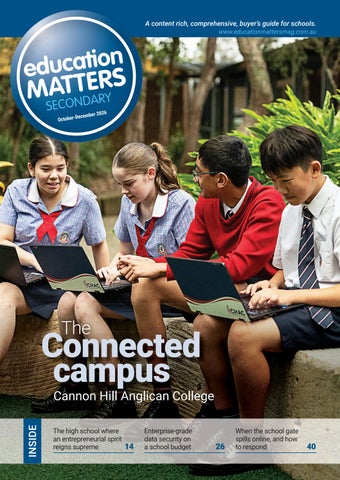
The
Connected campus INSIDE
Cannon Hill Anglican College
The high school where an entrepreneurial spirit 14 reigns supreme
Enterprise-grade data security on a school budget
26
When the school gate spills online, and how to respond
40
Outdoor furniture built for everyday student life.
1800 834 016
EDITOR’S NOTE
A little respect In education, as in life, very little is achieved alone. Schools are built on relationships – and when those relationships are strong, young people can thrive. When they are strained, the ripple effects can be felt throughout a community. That idea has emerged repeatedly across recent editions of Education Matters. We have examined how schools help students develop healthy relationships, explored the role respectful relationships education (RRE) can play in preventing gender-based violence, and considered the growing challenges schools face when interacting with parents. Last edition, we looked at RRE and the critical role schools play in helping young people understand respect, consent and healthy behaviour. As Monash University's Dr Naomi Pfitzner explained, those lessons cannot be left to chance. Teachers need the training, resources and confidence to deliver them effectively. This edition, we examine another side of the same conversation. Our Hot Topic feature explores the growing issue of aggressive and abusive behaviour towards school leaders and staff. While most interactions between parents and schools remain positive and productive, the latest Australian Principal Occupational Health and Wellbeing Survey suggests a troubling trend. More principals are reporting threats, intimidation and bullying, with some describing these experiences as an “increasingly normalised” part of the job. That should concern all of us, especially as these issues bleed into the online world more frequently. As Australian Federal Principals Association Victorian Branch President Mr Andrew Cock notes, schools dedicate significant time on these issues. Yet the expectations we place on young people must also apply to adults. Parents have every right to question decisions, raise concerns and advocate for their children. Schools expect that because accountability is a vital part of education. But accountability and aggression are not the same thing. Most would agree no teacher or principal should tolerate intimidation, harassment or personal abuse. A safe school is not only one that protects students. It must also be a safe workplace for the people who work in them. In many ways, as Mr Cock points out, the school gate has moved online. Difficult conversations that once happened face-to-face can now unfold across emails, social media posts and community forums, often with little opportunity for nuance or understanding. Our expectations of respectful behaviour must move into these environments too. Ultimately, how can we expect children to model respectful relationships if some of the adults around them struggle to? Young people notice more than we often realise. They observe how adults respond to disagreement, manage frustration and navigate challenging conversations. Those everyday interactions become lessons in themselves. Schools understand that disagreement is inevitable. They are complex organisations made up of diverse communities, perspectives and expectations. The objective is not to eliminate conflict altogether, but to ensure that when it occurs, it is handled with respect, dignity and a shared commitment to finding solutions. Happy reading! Myles Hume Managing Editor – Education Matters myles.hume@primecreative.com.au
education
MATTERS SECONDARY
www.educationmattersmag.com.au Education Matters Magazine
education
MATTERS PRIMARY
education
MATTERS SECONDARY
www.educationmattersmag.com.au/subscribe/ Education Matters
education matters secondary
Chief Executive Officer: Christine Clancy christine.clancy@primecreative.com.au Managing Editor: Myles Hume myles.hume@primecreative.com.au Journalist: Meg Kennedy Head of Design: Clayton Hawley Art Director: Michelle Weston Media Bookings and Advertising: Holly Larkspur holly.larkspur@primecreative.com.au 0422 775 308 Client Success Manager: Sabrina Zor Education Matters is a division of Prime Creative Media Pty. Ltd. 379 Docklands Dr, Docklands, VIC Ph: (+61 3) 9690 8766 Subscriptions Education Matters is available by subscription from the publisher. The rights of refusal are reserved by the publisher. Ph: (+61 3) 9690 8766 E: subscriptions@primecreative.com.au Articles All articles submitted for publication become the property of the publisher. We reserve the right to adjust any article to conform with the magazine format. Cover Image Cannon Hill Anglican College Copyright Education Matters is owned by Prime Creative Media Pty. Ltd. and published by John Murphy. All material in Education Matters is copyright and no part may be reproduced or copied in any form or by any means (graphic, electronic, or mechanical including information retrieval systems) without the written permission of the publisher. The Editor welcomes contributions but reserves the right to accept or reject any material. While every effort has been made to ensure the accuracy of information, Prime Creative Media will not accept responsibility for errors or omissions or for any consequences arising from information published. The opinions of the magazine are not necessarily the opinions of, or endorsed by the publisher unless otherwise stated. All photographs of schools (including students) depicted in feature articles and advertisements throughout this magazine have been supplied to the publisher (and approved) by the contributing school. All material supplied by schools is done so with the understanding that such images will be published in Education Matters and may also appear on the our website: www.edumatters.com.au.
3
CONTENTS // EDUCATION MATTERS
14
36
FEATURES 24 The rhythm of CHAC
A single solution is unifying a Brisbane school community.
26 Data security on a school budget
Schools face enterprise-grade security demands on limited budgets, writes Andrew Moore.
28 Evolving with education
Ricoh is addressing schools' growing cybersecurity, automation and demands.
30 Click and collect
PaperCut is helping schools adapt to modern printing needs.
32 A better use of time
Timetabling expertise is putting time back in school leaders' hands.
34 Behind the numbers
Data analysis is turning achievement data into actionable insights.
36 A league of their own
Free resources, funding and support are bringing Aussie Rules to schools.
38 Flourishing is a trajectory, n t a sna s t
Andrew Murray outlines four end-ofyear choices to prepare for 2027.
4
40 When the school gate s ills nline
As parent concerns move online, schools face new challenges, writes Andrew Cock.
42 Learning the logic
Hands-on professional learning is demystifying arti cial intelligence.
44 The future in focus
Helping students thrive amid change was a focus of the 2026 Melbourne National Education Summit.
44
47 School's out, planning's in Early expert consultation can maximise summer upgrades.
48 Strength by design
As school gyms evolve, how can schools balance competing demands?
50 Science behind the spin
ir ow analysis guided a ydney school's approach to fan installation.
52 Beating the booklist burden
Multiple learning formats are adding complexity for schools.
53 A world of skills to explore
Students can see 60 industry skills in action next June.
education matters secondary
REGULARS 03 Editor’s Note 04 Contents 06 News 10 ACARA update 12 ASPA update 14 Principally Speaking: Seaton High School
17 Teacher’s Voice: Mr Justin Virly 18 Hot Topic: Aggressive parents 54 The Last Word 57 Calendar of events 58 People on the move
Behind Every School Day. The technology that keeps teaching, learning and school operations moving. From connected learning spaces and smarter workflows to cybersecurity, IT services and everyday document processes, Ricoh helps schools simplify and support the technology behind every school day.
Scan here to discover Ricoh for Education
Audio Visual | Workflow & Automation | Cybersecurity | IT Services | Print & Document Solutions
13 RICOH | ricoh.com.au
NATIONAL EDUCATION NEWS
NSW acts on AI in HSC assessments The NSW Government has moved to tighten assessment rules for senior students, announcing new limits on take-home Higher School Certificate (HSC) tasks amid growing concerns about the impact of artificial intelligence (AI) on student learning. The changes come amid an urgent review by the NSW Education Standards Authority (NESA), commissioned by Deputy Premier and Education Minister Ms Prue Car, to examine safeguards for assessment integrity as AI use accelerates in schools. The move is significant because half of a student’s HSC result is based on school-based assessment. Under existing rules, schools determine how much of that 50 percent is assessed through take-home tasks and how much is completed in class. Under the new arrangements, schools will be restricted to one take-home assessment task, worth no more than 15 percent of the schoolbased assessment component. The rule will apply to current HSC students and students commencing Year 11 in Term 1, 2027. Ms Car said the government was acting quickly in response to growing concerns about AI's influence on learning. “The purpose of schooling extends beyond producing an assessment task. It is to
build knowledge, judgement, resilience, and critical thinking over time. If students rely on AI to bypass that learning process, we risk undermining both their education and the integrity of the HSC,” she said. “We need to act now as the evidence continues to emerge. It is better to put sensible safeguards in place while we fully understand AI’s long-term impact on student learning.” According to the NSW Government, the review will examine the growing evidence of AI’s effect on students’ cognitive development and consider how assessment methods can better safeguard authentic student work. NESA has also been asked to develop a common approach to help schools identify inappropriate AI use in assessments. r aul artin said “We have a moral obligation to the students and teachers of NSW to protect the learning process, the integrity of assessments, and to maintain confidence in the HSC credential.” Schools will continue to use a variety of assessment methods, including examinations, oral presentations and process diaries. HSC major works will remain exempt from the restrictions, as will some assessment tasks linked to major works across creative arts, technologies and English Extension 2 courses. EM The new rule will limit schools to one take-home assessment task worth no more than 15 percent of the school-based assessment component.
Image: nadezhda/Adobe Stock
“We have a moral obligation to the students and teachers of NSW to protect the learning process, the integrity of assessments, and to maintain confidence in the HSC credential.” Mr Paul Martin, NSW Education Standards Authority
6
education matters secondary
NATIONAL EDUCATION NEWS
“It’s the period when the brain is most susceptible to addiction, which they can then carry for life. Our study shows that teenage boys may benefit from targeted support.” Dr Lauren Gardner, University of Sydney
Australian secondary students are experimenting with multiple nicotine products, with new research revealing significant overlap between the use of vapes, cigarettes and nicotine pouches. The study, published in the Australian and New Zealand Journal of Public Health, found more than one in 10 teenagers surveyed had tried e-cigarettes, while smaller but concerning numbers reported using tobacco cigarettes and nicotine pouches. Researchers said the findings highlight the need for stronger efforts from all levels of government to prevent nicotine addiction among young people. Led by the Matilda Centre for Research in Mental Health and Substance Use at the University of Sydney, the research described as one of the largest and most recent examinations of lifetime nicotine product use among ustralian adolescents. Researchers found more than 12 percent of participants had used e-cigarettes in their lifetime, almost 6 percent had used tobacco cigarettes and 3.5 percent had used nicotine pouches. Compared to females, males had nearly three times greater odds of nicotine pouch use and over one and a half times greater odds of cigarette use. Nicotine pouch use was reported by 4.8 percent of males, compared to 1.5 percent of females, while tobacco cigarette use was reported by 6.9 percent of males and 4.1 percent of females.
Researchers found more than 12 percent of participants had used e-cigarettes in their lifetime.
Image: smile35/stock.adobe.com
Australian teens ‘mix and match’ nicotine products, study finds
Lead author Dr Lauren Gardner, Senior Research Fellow at the Matilda Centre for Research in Mental Health and Substance Use, said the findings underscored the need for targeted prevention and support strategies. “The teenage years are a critical period for preventing nicotine use – it’s the period when the brain is most susceptible to addiction, which they can then carry for life. ur study shows that teenage boys may benefit from targeted support,” said Dr Gardner. “Many teens who have used one nicotine product have also tried others, so we need effective prevention strategies that address shared risk factors for nicotine use more broadly, rather than focusing on just vaping or smoking.”EM
OpenAI, Meta unveil new safeguards for teens pen and eta have announced a series of new protections for teenagers, reflecting growing scrutiny of how young people interact with artificial intelligence (AI) and social media platforms. pen has launched hat for eens, a dedicated e perience for users aged 13 to 17 that aims to promote healthy AI use and support learning outcomes. f pen 's systems estimate a user is under 18, or they register an age between 13 and 17, they will automatically be placed into the new experience. The platform includes Study Mode, which uses guiding questions and step-by-step assistance to help teenagers understand material. ther features include homewor reminders that can detect when a student may be trying to shortcut an assignment, as well as quizzes, learning visualisations, and optional study hours that parents or teens can schedule. pen said hat for eens would be available in ustralia from 8 September.
8
Meanwhile, Meta has announced a sweeping package of protections for under-18 users of Instagram and Facebook as part of an agreement with a bipartisan group of US attorneys general. The changes include a default two-hour daily time limit across both platforms that can only be disabled with parental permission, along with a Night Mode that blocks access to key platform features between midnight and 6am. Meta will also introduce a School Mode, muting notifications by default between 8am and 3pm, while regular prompts will encourage breaks after periods of continuous use. Teen users will also have the option to switch to a nonalgorithmic feed, while likes and reactions will be hidden by default. Meta is also expanding existing restrictions on appearance-altering effects, announcing it will block teens from using extreme makeup filters in addition to cosmetic surgery filters. EM
education matters secondary
2026_Sc
Login Login with Single Sign-On
2026_Schoolbox_EducationMatters_Ad_October2026.indd 1
28/9/2026 1:40 pm
AUSTRALIAN CURRICULUM, ASSESSMENT AND REPORTING AUTHORITY // CEO
What the 2026 NAPLAN results tell us Australia’s annual NAPLAN assessments measure essential skills in literacy and numeracy. These are the foundational skills that underpin learning and life. Each year, at the Australian Curriculum, Assessment and Reporting Authority (ACARA), we publish the national NAPLAN results which include national, state and territory breakdowns, as well as data grouped by student background, gender, language background other than English and location and data on participation. The purpose of NAPLAN is clear. It is the only national assessment that allows us to see whether young Australians are developing critical literacy and numeracy skills using a national objective scale. It provides valuable evidence that helps teachers, school leaders, education authorities and governments understand what is working and where additional support is needed. The overall national picture in the 2026 NAPLAN National results remains broadly stable and consistent with the results from the previous three years. This year’s results continued to show some encouraging patterns of improvement identified last year as well as reinforcing those areas where further attention is required. Across all year levels and assessment areas, about two-thirds of students achieved results at the “Strong” or “Exceeding” proficiency levels. This reflects a strong level of achievement for students, meeting challenging but achievable benchmarks, and shows that many students are developing the skills and knowledge expected for their stage of schooling. Around one in 10 students were identified as being in the “Needs additional support” category. This
10
reminds us that it’s crucial to continue helping those students who may be finding literacy or numeracy challenging. They deserve particular attention because intervention in secondary school can still make a significant difference to their educational outcomes. At the secondary school level, one of the most positive findings in this year’s results is the continued improvement in numeracy among Year 7 and 9 students. The national average numeracy scores in Years 5, 7 and 9 are now the highest since 2023 when new proficiency levels were introduced. We also saw a solid increase in the number of Year 7 and 9 students achieving at the highest proficiency level, ceeding . Around 29,000 additional Australian students are performing at this the highest level in 2026 compared to 2023. This shows that more students are not simply meeting expectations but are excelling against national standards. It’s a positive sign that our education systems are helping more young people develop the numeracy skills and knowledge they need to succeed in the future. Another pleasing result was the continuing progress in numeracy for our Indigenous students this year. There was a reportable increase, from 2023 to 2026, in the percentage of Indigenous students achieving at the “Exceeding” level in numeracy at both Years 7 and 9. In addition, the average numeracy scores for Indigenous students in Years 5 and 7 were at the highest level since the scale was reset in 2023. This pattern of improvement in Year 5, 7 and 9 numeracy is testament to the exceptional work of our amazing teachers, principals and school staff across Australia, as well as the
education matters secondary
Mr Stephen Gniel, ACARA CEO.
commitment shown by parents and carers and the students themselves. The 2026 NAPLAN secondary school results also highlighted some other areas that deserve our close attention. Reading and writing remain significant priorities across secondary education. The average reading scores in Years 5, 7 and 9 are lower than in 2025. We also saw a slight increase since 2023 across all year levels in the proportion of students requiring additional support in reading and writing. These trends highlight the importance of maintaining a strong focus on literacy throughout the secondary years, not just during primary schooling. It was also disheartening to see disparities persisting over the years in the attainment of students from our regional and remote areas, Indigenous students and those from a disadvantaged background. This must be a continuing focus for all of us working in the education sector in the coming years. In preparing for this year’s results release, we had to contend with the impact of two disruptions during the test window period. A technical issue with the national NAPLAN platform affected the first day
Image: ACARA
NAPLAN results show improvements in national secondary school numeracy levels alongside areas for continued attention, says ACARA CEO Mr Stephen Gniel.
Image: Chinnapong/stock.adobe.com
Reading and writing remain significant priorities across secondary education, writes ACARA CEO Mr Stephen Gniel.
of testing this year. The disruption early in the morning impacted schools largely on the east coast of Australia and affected only the writing test and only students in Years 5, 7 and 9. Despite this, the national average scores in writing remained similar to last year. However, as the disruption varied in its impacts for students and schools, we have included a caveat on the 2026 writing results for students in Years 5, 7 and 9 in the national reporting which notes that the results should be interpreted with care given the disruptions. The low Tasmanian participation in NAPLAN 2026, due to industrial action in government schools, was far below ACARA’s technical data standard for the
accurate reporting of results. Therefore, education ministers agreed not to report Tasmanian state-level NAPLAN results. It’s very disappointing that we don’t have this year’s state level NAPLAN results for Tasmania. For education authorities and affected schools in Tasmania, it means we can’t report on the changes from previous years’ results. As we reflect on the 2026 NAPLAN results, it’s evident that the overall picture remains one of steady performance, with continuing signs of growth in some key areas. It’s certainly heartening to see to the sustained progress in numeracy among upper primary and secondary students. However, as some of the other secondary
WHERE CHAMPIONS START TRAINING
school results show, what remains vital is ensuring every student, regardless of background, gender or location, has access to the right support to continue to develop their literacy and numeracy skills. NAPLAN is a snapshot in time, but its impact is long-lasting. By measuring and comparing achievement across all Australian schools, it gives us a better understanding of where students are at and where we need to provide additional support, so all our students are developing the literacy and numeracy skills that are essential in everyday life. EM
To learn more about the results, visit acara.edu.au/naplanresults. To keep up to date with ACARA’s work on the Australian Curriculum, the National Assessment Program and the reporting on schooling in Australia, follow them on Facebook or LinkedIn and subscribe to its regular ACARA Update e-newsletter at acara.edu.au/news-and-media/ subscribe-to-acara-update.
TRANSFORM YOUR SCHOOL GYM
School gym fitouts that build futures
WWW.IRONEDGE.COM.AU
AUSTRALIAN SECONDARY PRINCIPALS' ASSOCIATION // PRESIDENT
Parsing PISA 25
Image: arrowsmith2/shutterstock.com
PISA, the OECD's Programme for International Student Assessment, tests the reading, mathematical and scientific literacy of 15-year-olds across more than 90 countries and economies every three years, and Australia has taken part since 2000. The 2025 results were released in early September, and the volume of commentary already in circulation is a reminder that a single results day rarely supports the sweeping conclusions drawn from it in the first 48 hours. Readers are better served by those who work with this data for a living than by the headline cycle. Dr Sally Larsen at the University of New England, a panellist at the ACER forum on the 2025 results, has previously found that of the four largest
12
standardised assessments Australian students sit, PISA alone shows a systematic long-term decline, a useful caution against generalising from one instrument to a verdict on the whole system. It’s hard to resist a bandwagon though, so what follows is ASPA's own reading. The 2025 PISA results show Australian 15-year-olds continuing a decline in reading and mathematics that has now reached the lowest levels recorded since Australia joined PISA in 2000, while science performance held steady. Australia also remains above the OECD average across reading, mathematics, science and computational problem solving, with a larger share of both top performers and students meeting minimum proficiency
The 2025 PISA results show Australian 15-year-olds continuing a decline in reading and mathematics.
education matters secondary
Mr Andy Mison, ASPA President.
than the OECD average. PISA measures aggregate performance across a system educating more than 4 million secondary students. It cannot isolate the effect of any single policy, program or teaching practice from other factors such as funding, staffing, cohort composition and a dozen other variables. When commentary attributes a national movement, up or down, to one intervention, the claim should come with the analysis to support it. The equity findings need the same care. The gap between Australia's most and least advantaged students narrowed in science from 2015 to 2025, in line with an OECD-wide trend. At face value, that looks like progress. It narrowed because the highestperforming students' scores fell, not because the lowest-performing students' scores rose. In anticipation of pundit commentary to come, citing the narrowing gap as evidence of improving equity, without noting how it occurred, is the kind of unsupported causal claim we should be wary of. Truancy in Australia is running at nearly double the OECD average: 44 per cent of students reported skipping a full day of school in the fortnight before testing, against an OECD average of 22 per cent, a figure that has risen steadily since 2018. Reported bullying also increased, reversing a decline recorded between 2018 and 2022. Disciplinary disruption in science classrooms remains above the OECD average, though it has improved since 2015. PISA does not test causes, and we cannot explain rising truancy and
Image: ASPA
Mr Andy Mison, President and Executive Director of the Australian Secondary Principals’ Association, explains why the latest PISA results demand caution, context and local judgement.
bullying, and a still-difficult disciplinary climate, purely through a schoolbased lens. Youth mental health, the increasingly unhinged digital realm, pandemic-disrupted routines, and costof-living pressure on families are all live in the broader debate about adolescent wellbeing. It is reason enough to be wary of any response that assumes better pedagogy, or a different curriculum, will resolve engagement and behaviour trends shaped by forces well beyond the school gate. What does this mean for practice? We should treat attendance as a leading indicator, not a compliance metric. A truancy rate double the OECD average, rising for seven years, is a big signal about learning conditions. Schools already investing in engagement and reengagement are on the right track. We must also keep building consistent, whole-school behaviour systems. This is achievable: disciplinary climate in Australian science classrooms has improved since 2015, though it has further to go, and it will not close through
curriculum change alone. This is a leadership and culture task as much as a teaching one, and it depends on the staffing stability principals need to sustain it. PISA and NAPLAN should be treated as diagnostic inputs to be read locally, not as a directive to adopt any single external program. School leaders are best placed to interpret national data against their own cohort evidence, and they need the professional latitude and the time to do that well. Local judgement, grounded in professional context, is the right starting point. We should also give more deliberate attention to instilling a love of reading in young people, at home and at school, and that will likely mean rebalancing how devices are used in both settings. Reading results are now at their lowest recorded level, at the same time as Australian students report using digital devices at school for learning for 2.6 hours a day, well above the OECD average of 1.7, and 39 per cent report frequent digital distraction in class. PISA cannot establish
that one explains the other, but the debate over how much of a young person's day is spent on a screen rather than a page, in class and at home, is already well under way. Protected reading time, library investment and teachers who model reading for pleasure are within a school's control. So is a considered position on devices in the classroom. Neither will work in isolation from what happens at home. Much of what shows up in these figures starts outside the school gate; no principal can resolve cost-of-living pressure on families or the effect of a screen on a teenager's sleep. What schools can do is put effort where our local evidence and professional judgement lead us: school community morale and culture, engagement, behaviour, staffing stability and decisions close to the classroom. Australia's schools remain comparatively strong by international standards. Keeping them that way, and closing the gaps that remain, depends on the same unglamorous, evidence-led work principals do every day. EM
PRINCIPALLY SPEAKING // SEATON HIGH SCHOOL
Leading with engagement At Seaton High School, where entrepreneurial spirit reigns supreme, Principal Mr Richard Abell believes authentic learning and student engagement are key to success in and beyond the classroom.
As a principal, Mr Richard Abell understands the impact teachers can have on a student's future. It's a lesson that stems from his own school experience. “If I go right back to when I first started, I was in Year 12, and career development wasn't really a thing in those days,” he explains. Yet amid the uncertainty of choosing a path after school, one educator stood out.
“I remember at the time I had a really inspirational physics teacher, Mr Spehr,” says Mr Abell. “I thought, you know, I can do that. That's the job I'd like to do.” Over time, that motivation evolved into a strong belief in the benefits of a public education. Mr Abell says he made the choice to deliberately go into the sector, as he felt “very strongly” about the importance of a public education system to meet the needs of all students.
Images: Seaton High School
Seaton High School Principal Mr Richard Abell says students achieve the best outcomes when they are genuinely engaged in their learning.
14
education matters secondary
“The more I did it, the more I felt connected to that notion of inspiring young people to learn and get the outcomes that they are capable of,” he says. By his mid-20s, Mr Abell found himself in an acting leadership position, beginning his school leadership journey. Engagement at the centre Since becoming principal of Seaton High School in South Australia in 2012, one belief has guided his leadership: students achieve the best outcomes when they are genuinely engaged in their learning. Operating since 1964, the co-education school services Adelaide’s western and beachside suburbs and facilitates more than 900 students from Years 7 to 12. In 2018, the school received a $20 million facility upgrade, including a new two-storey building, an Entrepreneurial Hub, and refurbished buildings and sports facilities. “Student engagement leads to effort and commitment to their learning, and that has a whole range of benefits around wellbeing, connection to school and relationships,” he says. “Ultimately, it impacts their ability to be successful academically and in their pathways beyond school. Getting that right is critical because, for so long, schools focused more on compliance than engagement.” The same philosophy underpins Mr Abell’s approach to staff development. He believes lasting change requires schools to invest in the people implementing it. Rather than continually pushing reluctant students through curriculum requirements, says Mr Abell, teachers and leaders can work alongside learners who are actively invested in their education – thus making the profession significantly more rewarding.
“It’s about investing both time and resources to give leaders and staff the support to develop and challenge their own thinking, as the starting point,” he says. “We allocated additional time so they could focus on that development. Ultimately, it comes down to valuing their time, valuing their input and understanding what they need to make those changes happen.” Learning in the real world Engagement is also central to Seaton’s broader learning model, which Mr Abell believes is one of the factors that distinguishes the school. Among the school’s unique academic offerings is its Wednesday program, where all Year 10 and 11 students participate in a full day of authentic, real-world learning. While achieving their South Australian Certificate of Education (SACE) subjects, students take part in applied learning experiences, delivered in partnership with community organisations and industry groups. More recently, the school has partnered with Flinders University so that completion of these packages, and a co-designed Year 12 subject, can provide students with direct access to university pathways and over degrees. Industry and community partners work alongside Seaton teachers to deliver authentic learning opportunities across subject areas including sports industry, food futures, environmental science, visual and
Developing entrepreneurial mindsets Another unique aspect of Seaton is its designation as an Entrepreneurial
Specialist School – just one of five in South Australia – thanks to State Government startup funding. The school offers four specialist entry programs: Students with High Intellectual Potential (SHIP), emerging technologies, visual art and innovation and dance. Alongside the programs, all learning from Year 7 to 12 is structured around the development of entrepreneurial capabilities and dispositions. For example, in Middle School, the school has moved away from short rotations through individual subjects, in favour of giving students longer, more meaningful opportunities to explore subject nodes as interconnected disciplines. Mr Abell says the approach helps students understand how subjects such as drama, music and visual arts influence and complement one another when undertaken within the node ' he rtistic orld'. “Sensibly, this aligns with the work the current State Government has on the statement of purpose for public education, which is focused on dispositions and capabilities – not just content,” says r bell. “There’s still a place for what most people would consider ‘traditional learning’. It’s not all thematic or project based. Explicit teaching remains an important part of the equation, but the real value comes from how those different approaches connect and work together.”
education matters secondary
15
performing arts, modern media, community connection and advanced technology. Importantly, students receive SACE credit for this work. “Applied learning is one example where we try and structure, as much as we can, our learning across the school in framework where it's about authenticity,” says Mr Abell. “It enables the student to say, ‘okay, well this is important because I can see how this applies outside, or potentially inside the school,” he says. “They’re thinking, ‘I'm not learning this because I might need it one day. I'm learning it because it's useful now.’” Mr Abell says the goal is to not only provide students with subject content, but help them develop the skills, capabilities and dispositions to become successful. “In the past, people talked about things like project based learning in a fairly crude sense, and the response was often, ‘Well, that’s fine, but when are they going to do the real learning so they can get into university?’ There was always this notion of a trade off,” he says. “We’ve actually shown students in these programs get equal, if not better, academic results than they do in a standard classroom environment, while engaging in authentic and rewarding learning.”
Seaton High School is one of five Entrepreneurial Specialist Schools in South Australia.
PRINCIPALLY SPEAKING // SEATON HIGH SCHOOL
Year 8 students complete a self-directed project aligning with their interests.
Mr Abell acknowledges that implementing the model also comes with its own logistical challenges. While the ideal is for multiple teachers to work collaboratively with larger groups of students, staffing and organisational realities sometimes require compromise. To help students transition into secondary school, Year 7 students also undertake a semester-long subject called ‘Induction, Immersion and Connection’, designed to equip them with the practical skills, knowledge and habits needed to successfully begin secondary school. The curriculum also includes several key developmental milestones. One example is the Year 8 ‘Personal Venture’ program, where students apply their capabilities through a self-directed entrepreneurial, community-based or passion project aligned with their interests. Mr Abell says the theme of developing those capabilities happens throughout all their learning from Year 7 through to ear . While traditional academic benchmarks remain important, Mr Abell believes schools must adopt a broader view of student success. “Literacy and numeracy are incredibly important,” he says. “We still have lots of programs to make sure students develop the literacy and numeracy they need, because you can't be successful if you're not literate or numerate.”
16
But, in his view, those skills alone are not enough. “If we focus our school systems on just producing students who have literacy, numeracy and possess knowledge, I think we're failing them,” he says. “The school system, higher education institutions and industry tell us we need students who are literate and numerate, yes, but they must be able to work in teams, have good communication skills and can work collaboratively. “If we're not doing that as a school, we're not setting them up for success.” Again, Mr Abell credits a dedicated staff team at eaton who share the same vision. “You can't do those changes if people don't believe in it,” he says. “You've got to have the right support processes in place for staff, so they can see the school values that, and in turn, it values them. We’ve got to help them develop their thinking as well.” Creating conditions for success For Mr Abell, effective leadership begins with establishing a clear, shared vision for the school. Once that direction is understood, he says leaders can focus on identifying staff strengths, passions and areas of expertise, creating opportunities for individuals to lead initiatives and shape the school’s future. “People will come to you with ideas about what we could do, and you can
education matters secondary
also go to leaders who have huge strengths in particular areas and ask, ‘How can we use that? How can we build something around it?’,” he says. “It's about developing people and supporting people. You can’t do it all yourself, but you can create the conditions so that people are able to thrive in their roles, which means they're going to be producing programs and working with students, who are then able to thrive.” Mr Abell believes school success rests on two key pillars: an absolute need for effective, high-quality, innovative teaching and learning programs, alongside sound organisation and student management processes. “It doesn’t matter how good your teaching and learning programs are, if those structures and processes aren’t in place, they’re not going to work,” he says. For aspiring school leaders, Mr Abell’s advice is to stay focused on a clear purpose and remain committed to it. “Decide what's important. Don't just work within your own experience and knowledge. Look at the research. Look at the facts. Look at what other people are doing, and what’s working,” he says. “Don't flip flop between different initiatives. Come to a position of saying, ‘This is what I think is the core of what we need to do. “Decide on what that is, and then stay the course.” EM
JUSTIN VIRLY // TEACHER’S VOICE
Revelling in real-world learning Ask Mr Justin Virly what first inspired him to become a teacher, and his answer reflects the optimism and authenticity that have become hallmarks of his career. “I’ve always enjoyed school and think fondly about it from high school and primary all the way back to kindergarten,” he says. “I don’t remember ever having a teacher I didn’t like.” Growing up in Canada, he remembers admiring teachers who spoke not only about education but about lives filled with travel, family, writing and personal passions. “I distinctly remember feeling that a lot of my high school teachers must just have the best lives.” Today, as a Senior Economics and Junior Humanities Teacher at Brisbane State High School, Mr Virly is helping nurture that same positive experience for a new generation of students. Known for teaching almost exclusively economics and for his deep involvement in the school’s senior economics program, he has become one of Queensland’s most recognisable advocates for the subject. Yet what truly sets him apart is his ability to make economics relevant, engaging and deeply human. For Mr Virly, economics is far more than graphs, formulas and exam results. “It’s how the world works and therefore unlocks a way of understanding and processing the most practical, interesting and pressing of life’s issues,” he says. Whether students go on to become a doctor, journalist, guitarist or professional tennis player, he believes an understanding of economics will help them navigate life with greater confidence and perspective. That passion is evident in his classroom approach. While economics can carry a reputation as a difficult
Image: Justin Virly
Queensland Economics Teacher Mr Justin Virly’s passion for his subject expertise echoes through his approach to teaching.
Brisbane State High School Economics Teacher Mr Justin Virly has become one of Queensland’s most recognisable advocates for the subject.
subject, Mr Virly deliberately moves the focus away from memorisation and towards discussion, debate and critical thin ing. “Glossaries, rules, definitions and acronyms or formulas take a backseat to fostering habits of debate, questioning and empathy,” he explains. Real-world issues such as inflation, renewable energy, housing affordability and migration provide fertile ground for exploration, giving students opportunities to examine competing viewpoints and challenge each other s assumptions. “Teenagers love disagreeing,” he says. “They love arguing and pointing out that there are other valid alternatives and sometimes controversial points of view.” Equally important is helping students develop confidence in themselves as learners. Mr Virly believes confidence is often misunderstood as success, when in reality it comes from learning to persevere through difficulty. “We don’t build confidence in our kids by ensuring they succeed,” he says. “We build confidence in them by helping them see that there is something in front of them they find difficult, they’ll
education matters secondary
most likely be able to figure it out.” Even if they cannot, he adds, students need to know “they’re still safe and we’re still with them”. Mr Virly’s commitment to students and the profession recently earned him a nomination for a Queensland College of Teachers (QCT) Award, recognition he describes as both humbling and validating. “It really meant a lot,” he says. “This type of recognition from people who truly work with me day to day, and know my students, helps provide a bit of reassurance that I’m helping and doing a bit of good.” Despite his achievements, Mr Virly remains grounded in a simple philosophy about teaching. “You cannot have students learning from a teacher whose heart isn’t in it,” he says. He encourages educators to trust their instincts, embrace their individuality and create classrooms that reflect who they are. “Great teaching ultimately comes down to the teacher being themselves and honing their craft in a way that is most meaningful to them.” EM
17
HOT TOPIC // PARENT-SCHOOL RELATIONSHIPS
Zero tolerance: Managing aggressive parent behaviour School leaders are increasingly on the frontline of hostility from a minority of parents. Fresh research reveals the personal and professional toll, alongside expert advice so schools can better protect their staff. Few leadership positions are as diverse as that of a school principal. One hour might involve supporting a student in crisis, the next mentoring staff, engaging with families or setting longterm strategy for the school. It is one of the reasons many principals love the job. No two days are ever the same. Yet beneath that lies a growing level of pressure. Principals are contending with complex mental health issues, workforce shortages, increasing compliance obligations and community tensions, all while working an average of 53.9 hours a week. According to national survey data, 99 percent work what are considered “dangerously long hours every week”. Adding to that burden is a rise in
18
irrational and aggressive behaviour from parents and caregivers. For Emeritus Professor Phil Riley, who launched the Australian Principal Occupational Health and Wellbeing Survey 15 years ago, the trend is deeply concerning. "The principal is the canary in the coal mine: their health and wellbeing are a good proxy for the health of the school,” he says. If that is true, the latest findings raise an important question: what happens when school leaders themselves no longer feel safe at work? While most parent-school relationships remain constructive, the survey highlights how principals are exposed to threats and violence more frequently now compared to 2011, with
education matters secondary
exposure to aggression becoming “disturbingly normalised” in that time. It’s a problem Prof Riley has seen in the data, and experienced first-hand. Before moving into academia where he researched the overlapping fields of psychology, education and leadership, he spent 16 years in the classroom, with four of those as a principal. “I did experience a couple of incidents where people tried to physically threaten me because of decisions I’d made,” recalls Prof Riley, who’s now an Honorary Professor at Deakin University with expertise in education leadership. “What I learnt from that experience is that teachers and principals are constantly dealing with highly emotive situations. After all, the most important thing in most people’s lives is their
Image: WavebreakMediaMicro/stock.adobe.com
Principals are exposed to threats and violence more frequently today compared to 15 years ago, data shows.
children. It’s a tricky space to navigate, and educators take that on – they know that’s part of the job. “What they don’t sign up for is an unsafe workplace. Police officers accept physical danger as part of their role; principals and teachers don’t. Yet they can still find themselves in similar situations because emotions are running so high.” With 2,044 school leaders participating, the Principal Occupational Health and Wellbeing Survey, conducted by Australian Catholic University (ACU), is now considered the most comprehensive and representative study of its kind in ustralia. It shows experience of physical violence surged from 27.3 percent in 2011 to 47.8 percent in 2025. Threats of violence jumped from 37.9 percent to 53.7 percent over the same period. To gain greater traction with policymakers, in 2025 the survey for the first time quantified lost productivity due to the problem. It found 2 percent of principals now report exposure to offensive behaviour with an estimated annual cost of managing offensive behaviours to the education sector exceeding $200 million. On average, principals suffer $25,495 per year in lost productivity based on an analysis of their income, hours worked and time spent dealing with behaviours, including physical violence, threats, bullying, cyber bullying and se ual harassment. “Sadly, the number of parents who
All-caps emails at 11pm While those experiences prompted Prof Riley into thinking about the health and wellbeing of Australian principals, it was later in his career – while leading a mentoring program for first-time principals in Victoria – that the idea for the Australian Principal Occupational Health and Wellbeing Survey crystallised. During break times, he was hearing
education matters secondary
stories about how tough life was becoming in schools, with the mentors expressing concern about what the new principals would walk into. “I thought, ‘bloody hell – what’s going on here?’ And that’s when I started the survey in 2011.” Today, the survey is led by Professor Theresa Dicke, Program Lead for the Educational and Developmental Psychology Program, within ACU’s Institute for Positive Psychology and Education (IPPE). Professor Herbert W. Marsh, part of the IPPE, is also a Chief Investigator, working with several other investigators such as Associate Professor Paul Kidson, Course Coordinator (Master of Educational Leadership) at ACU’s National School of ducation. A/Prof Kidson says schools have a clear set of expectations and codes of conduct when parents want to lodge a complaint, grievance or seek clarification. However, an increasing number feel those rules don’t apply to them. All-caps emails at 11pm (that expect a response by 8am the next day) are one example. He also recalls a principal dealing with “a very litigious, vexatious and aggressive parent” who they thought about while lying awake at night. “She said to me: ‘I had to work out how
The Australian Principal Occupational Health, Safe ty, and Wellbeing Survey:
15 YEARS OF DATA
Image: ACU
Image: Phil Riley Emeritus Professor Phil Riley says there’s been a shift in how parents respond when something goes wrong at school.
perpetrate violent acts in schools has been increasing year on year. And it’s not just the number of incidents, but also the severity,” Prof Riley says. “We need to spare a thought for the leaders who are trying to protect the children and the staff they are responsible for proactively. Until Australia acknowledges the root causes of violence and sets about addressing them at every level of society, principals will be forced to make tough decisions.” State governments are also recognising the magnitude of the issue. Victoria, Queensland and New South Wales have each committed over $100 million to tackle the problem. Lately, the Victorian Government moved to strengthen School Community Safety Orders, giving principals and the department greater powers to handle damaging behaviour towards employees, including on social media and messaging platforms. “The other big shift I’ve seen over my lifetime is in how parents respond when something goes wrong at school,” Prof Riley says. “When I was a child, if I’d behaved poorly, the school would call my parents and the adults would make a decision in the best interests of the child. “A lot of that has changed now. Parents are much more likely to immediately take the child’s side. That attitude has crept into all facets of schooling.” The other big change has been social media and chat groups, which can act as echo chambers on contentious issues, with algorithms that promote negativity and outrage. “I’ve heard stories from principals who arrive at work to find 150 parents gathered on the school oval in a meeting they knew nothing about – all organised over the weekend on social media, based on an assumption that the principal was in the wrong and that action needed to be taken,” Prof Riley says.
ANNUAL REPORT 2025 DATA
The Australian Principal Occupational Health and Wellbeing Survey, considered the sector’s most comprehensive survey of its kind, paints a sobering picture about exposure to violence, stress and workload among principals.
19
to keep that person out of my house at night,’ metaphorically speaking,” he says. “Unfortunately, we're seeing an increasing number of parents and caregivers coming with the assumption that the school has made the wrong decision – and it isn’t until it’s mentioned it’s all on CCTV footage that they change their stance. “What sort of breakdown of civil discourse has occurred to reach that point And it takes a toll on principals. In the recent survey, 54.4 percent of school leaders reported seriously considering leaving their roles. “Wouldn’t it be better if they had that time and emotional energy to put into positive learning experiences and improving the school?” A/Prof Kidson says. “It becomes not just an issue for the individual principal and the physical and emotional toll it takes on them, but it has a deteriorating effect on the culture of the school generally.” A/Prof Kidson and Prof Riley agree the trend is part of a societal shift. Whether it’s in an aeroplane or café, businesses have been compelled to remind patrons to treat their staff with courtesy and respect. Factors like rising living costs are creating background stress, and it’s harder for busy parents to build trust and rapport with teachers through casual interactions. “In the ‘good old days’, a lot more parents could wander down and have a chat with the teacher in the playground at pick-up time or drop-off time, and you often nipped a few things in the bud that way,” Prof Riley adds. It’s a sentiment Professor Jane Wilkinson concurs with. As a Professor in Educational Leadership at Monash University, she was the lead author of Invisible labour: Principals’ emotional labour in volatile times, published earlier in 2026. The study, led by Monash University in collaboration with Deakin University and the University of Sydney, draws on 285 critical incident testimonies from 248 principals and reveals what researchers describe as a “growing and normalised culture of violence directed at school leaders . The research examined the emotional and physical toll of escalating violence on principals’ health and wellbeing, with female principals facing disproportionate
20
Image: Jane Wilkinson
HOT TOPIC // PARENT-SCHOOL RELATIONSHIPS
Monash University Professor Jane Wilkinson says schools appreciate having greater powers through community safety orders.
levels of harassment and gendered violence. More than half of Australian public school principals have experienced physical violence, verbal abuse, gendered violence or sexual harassment at work. Prof Wilkinson says today people are generally more aware of how to exercise their democratic rights and speak up. “But they have to be balanced against the school’s professional responsibility to educate in a way that is appropriate for all children,” she says. One of the big tensions principals face is balancing the duty of care for an individual with their obligations to the broader group. A child might come from a traumatised background, which plays out in inappropriate behaviour at school. “Principals understand that trauma and want to support the child, but they also have to keep everyone else safe,” Prof Wilkinson says. “This is just one illustration of how individual, family and school interests intersect.” She says it has become tougher for parents. Families are more isolated and often under intense economic pressure. “And that can feed into how parents respond to schools,” she says. “I’m not excusing poor behaviour, but we have to recognise children’s needs are more complex, communities are more fragmented, and the kinds of social supports that used to exist – such as churches and other community institutions – have weakened.” How to respond While this article will explore the ways schools can respond formally, and on their feet, Ms Angela Falkenberg, President of the Australian Primary Principals Association (APPA), says it needs to
education matters secondary
start with parents. She took a hiatus from teaching to work in healthcare where it was shown when a nurse or doctor was abused, it affected their performance. “We don’t seem to challenge the idea that because someone is frustrated, it’s OK to be mean or abusive. They need to realise that children are impacted because that teacher is less productive in the aftermath. They’re not their most attentive, best selves, and it’s not just the emotional impact but also the time it takes away from planning and teaching to fill in forms, write critical incident reports etc,” she says. “Schools do not have time to co-regulate an adult. We would like adults to be mindful of their responsibility to manage their own emotions and self-regulate.” APPA and schools have developed scripts for managing aggressive behaviour so principals aren’t scrambling in the moment, which can translate into the secondary school setting. For example: • “I can see you’re angry, and I’ve heard what you’ve said. I’m going to need some time to think about it. Can you give me that time?” • “I’d like to pause you there, because it’s really important we maintain respectful communication – for everyone’s sake.” • “All staff, like anyone in any workplace, have the right to be safe and respected. If a conversation crosses into being personal, aggressive or harassing, that’s not something we can overlook, regardless of intent.” Schools should also clearly point out there is a process “we know will work” that deals with such matters. Ms Falkenberg has another rule: “if a parent sends more than a paragraph in an email, it needs to become a conversation.” On an angry phone call, Prof Riley suggests the principal begin responding before hanging up mid-sentence, rather than ending the call while the parent is speaking, making it appear to be a technical fault rather than a deliberate hang-up. “Sometimes they feel they’ve vented enough and don’t ring back. Sometimes you can say, ‘We got cut off,’ but often the heat will have gone by that point,” he says. “In person, I also encourage principals to have a clipboard and write everything down. This is usually a more effective strategy than asking the parent to wait. By
taking notes you are demonstrating you are taking the complaint seriously, and by slowing down because you need to write everything down, you are controlling the pace and hopefully the temperature of the interaction. When the situation spirals out of control, schools can also turn to the law. A/Prof Kidson says in New South Wales non-government schools have been instigating the Enclosed Lands Act while government schools have been taking similar moves to institute Community Safety Order-style powers for principals. Victoria is also looking at stronger powers that would allow principals to ban adults from school grounds, related places or from contacting school staff when necessary. “When it gets to the point where you need to invoke a legal instrument … lots
has gone wrong along the path – and that's what's sad,” says A/Prof Kidson. Prof Wilkinson says principals don’t use these orders often but they value having them on when all avenues have been e hausted. “It’s important principals feel supported by their department in using such measures where necessary, and that caregivers and community members understand they can’t behave however they like on school premises,” she says. “We need to take a collective deep breath and invest in the proactive work of building relationships, articulating what respect looks and feels like, and supporting staff and communities with the time, training, and structures to do this work properly,” she says. “Combined with clear guidelines and firm boundaries around unacceptable
behaviour, that kind of investment could go a long way towards bringing the temperature down.” Ms Falkenberg says APPA and other associations are pushing for a pilot of professional supervision – or mandated reflective practice – for principals, similar to how psychologists and social workers debrief on the challenges of their work. Prof Riley has worked with leaders in the Northern Territory and Victoria with this exact approach. “It was very successful. Principals felt much more in control of their work life. It didn’t change the burden of work – they were still doing 50 or 60 hours a week – but they felt more in control in those difficult situations with tough parents particularly, but also difficult kids and difficult staff members,” he says. EM
Image: La Trobe
Researchers use robot ‘parent’ to prepare teachers for difficult conversations Researchers at La Trobe University are using a robot driven by artificial intelligence (AI) to better prepare teachers to deal with challenging conversations in schools. The university said the talking “social robot” known as Fletch has been programmed to mimic a disgruntled parent and allows teachers to rehearse intense situations before confronting them in their workplace. Researchers interviewed experienced teachers to gain insights into their real interactions with challenging people. Scenarios include one parent concerned that their child’s grades have dropped and another disputing their child’s suspension. According to La Trobe, Fletch then adopts personas from these scenarios and reenacts the situations with training teachers, using AI to modify its reactions based on the teacher’s responses. Fletch will primarily be used to prepare the university’s pre-service teachers before they enter the classroom, with a number of Victorian schools also signing on to train their existing staff. “Exposure to verbal aggression contributes to stress, burnout and difficulties in retention, further compounding teacher shortages,” Lead Researcher Professor Therese Keane said. “This project addresses a gap by equipping pre-service and early-career teachers with practical strategies and confidence to de-escalate challenging interactions, helping them enter the profession better prepared to build positive partnerships with families.” Fletch will initially be rolled out in several schools in Melbourne but Professor Keane hopes to expand the research. education matters secondary
21
SCHOOL AND DATA MANAGEMENT // SCHOOLBOX
Mr Peter Holmes, Head of Faculty – Science, with Cannon Hill Anglican College students who now access learning via Schoolbox.
The rhythm of CHAC Faced with fragmented communication and inconsistent systems, Cannon Hill Anglican College needed a single solution to unify its school community, using a gradual approach to make it central to everyday school life. At Cannon Hill Anglican College (CHAC), no two days unfold in quite the same way. For Deputy Principal Ms Holly O’Sullivan Williams, that constant activity is part of what makes school life so special at the independent Anglican coeducational school in Brisbane. “The school to me is a place of hyperactivity. There’s always Cannsomething going on, whether it's sport, music, debating, let alone what's happening in the classroom,” she says. Sitting at the heart of its surrounding suburb, the college has developed a strong community feel. But keeping a community that busy connected is no small task. Information is constantly being shared, updated, stored and acted upon. With more than 1,300 students from Prep to Year 12, CHAC needed a better way to streamline learning, bring its community together, and keep everyone on the same page. That search led to Schoolbox, an Australian technology platform that brings together learning management
24
systems (LMS), a community portal and pastoral care into one place. Plus, Schoolbox enables ‘white-labelling’, so schools can brand it as their own, creating a sense of culture and identity. In the case of CHAC, its Schoolboxenabled platform is called CHAC Home and – after a gradual rollout during the past four years – it has transformed the way the school operates day-to-day. “The problems we were seeking to solve emerged from a gap in parent communication,” says Ms ullivan illiams. “Previously, there were loads of different methods. So whether that was through email, letters or Microsoft Teams, it became confusing for parents to know where to expect the next piece of communication. “Teachers were storing content and information in their own way. But again, all faculties were dealing with items in a different manner. “For students, every time they walked into a classroom, there was a different platform they were having to search for
education matters secondary
information. That was the impetus for us to look at a solution that was going to bring those three stakeholders to a place where they could find everything they need to know about CHAC.” Along for the journey Most principals will know that transformation of this magnitude requires a considered change management approach. After all, the apps, platforms, and communication lines that teachers, students, and parents were accustomed to were being replaced. This naturally comes with questions around whether change is being enacted for change s sa e. “Today, Schoolbox is central to the rhythm of CHAC,” says Ms O’Sullivan Williams, noting that it is now embedded across communication, teaching, learning and assessment at the college. “It’s the first place staff go each morning, whether they’re checking the calendar or seeing what learning is planned for students. It's also the first
get the most out of the platform.” Underpinning this is a “continuous relationship” with Ms Krystal Goudge, CHAC’s own Schoolbox School Engagement Manager. “She's our hotline that we can call up and ask: we really want to have this in Schoolbox. Can you help us?,” adds Ms O’Sullivan Williams. Ms Goudge, a former teacher who understands the pain points of schools, can often point the school in the right direction, drawing on the experience of working with 80 other schools across the country. But for more complicated queries, she can tap into the developers and experts at Schoolbox. She thinks of herself as a daily problem solver. “In fact, I encourage schools to bring their problems to me,” Ms Goudge says. “The team that supports me in my role as a School Engagement Manager is super important, because I can't know everything. “For example, as we go down the path
“Schoolbox isn't something that you set up and you walk away from. It’s something we’re continuously improving upon, bringing in new features and making sure that we continue to upskill the teachers to be getting the most out of the platform.” Ms Kat Upton, Cannon Hill Anglican College
of AI, there are a lot of technical things that schools want to take into consideration to ensure the safety of information. The team that I have supporting me within our product and infrastructure team has been able to step into meetings with the IT team here at CHAC to make sure all of their technical uestions have been answered, so they feel supported in ma ing the right decision. The thing that impressed Ms Goudge the most at CHAC was the staff who drove the Schoolbox implementation, armed with a sense of enthusiasm and desire to improve the experiences for teachers, staff and parents. “It's not one singular person. They are always bringing things to their steering committee. I think that is a key pillar to success,” she says. “They were looking for a partnership, and that ultimately spells out success when it comes to implementation. ‘It's on CHAC Home’ So now Schoolbox is part of the CHAC fabric, what has changed? One of the most noticeable shifts has been a shared language around the platform. “It's become part of the way we communicate. Any time someone is seeking information or updates, you’ll hear ‘It's on CHAC Home. That's where you'll find it’,” says Ms O’Sullivan Williams. “It’s taken some time, but people are increasingly engaging with it, and now we’re hearing people say ‘I posted it on ome . For Mr Peter Holmes, the college’s Head of Faculty – Science, CHAC Home –
Images: Schoolbox
point for students in their homeroom. They have time that's allocated to check what their day looks like. And then for parents as well, it is now their first port of call. But it didn’t happen overnight. Teachers are already fatigued with evolving policies and legislation, as Ms O’Sullivan Williams points out, so the college intentionally took a “gentle” approach that started by clarifying the issues, and then taking staff along for the journey. “Before making a change that is significant to a school, the first thing you need to consider is why you're making the change. For us it was communication,” she says. “The second thing is being transparent about what you’re trying to achieve. We were keen to avoid a situation where a small group suddenly returns saying, ‘We’ve found the answer, it’s going to be great, just follow us’. It needed to come from a place of: this is the feedback we've got. This is what we understand to be a concern for many people. Here are some solutions. Have a look at them. “And then, ordinarily, if everyone's working together with that same goal and understands the why, they will hopefully end up in the same destination.” A big part of that was asking Ms Kat Upton, CHAC’s Digital Projects Officer, to drive the implementation, and become the school s interface with the choolbo team. CHAC also established teacher champions for different aspects of the rollout, and a steering committee to decide on big decisions and keep things moving forward. “Prior to Schoolbox, one of the biggest challenges we faced was getting the right information to the parents in a timely manner. Being a P–12 school, the requirements of parents in the primary school are very different to those in the secondary school,” says Ms Upton. “We needed a solution that could integrate with our existing software providers in our edtech stack. Schoolbox was the clear frontrunner. “But what impressed me with Schoolbox was that implementation wasn’t the end of the journey. It was just the beginning. Schoolbox isn't something that you set up and you walk away from. It’s something we’re continuously improving upon, bringing in new features and making sure that we continue to upskill the teachers to
Kat Upton, CHAC Digital Projects Officer, (left) worked closely with Schoolbox School Engagement Manager Krystal Goudge during- and post-implementation.
education matters secondary
25
SCHOOL AND DATA MANAGEMENT // SCHOOLBOX
Students and families can track progress in real time with teachers continuously writing reporting comments into CHAC Home.
powered by Schoolbox – has become his first port of call each morning. “As a teacher, you come in and everything is there for you in terms of the daily notices, staff updates and so on, he says. “For teachers, it means being able to deliver learning and assessments in a consistent format, ensuring what students see is the same across all classes. “I find that it also removes a lot of the uncertainty, particularly for students. They know they can go to the one place and find all the information they need in a neat and presentable way.” Now, assessment happens via CHAC Home too. There, teachers continuously put in their reporting comments, giving up-to-date access to how a student is progressing. “Every time there's a piece of assessment that's done, it's marked right there,” says Ms O’Sullivan Williams. “Because the information is visible to both students and parents, there’s far greater transparency around progress and achievement. That has reduced the volume of emails and phone calls from parents asking how their child is tracking.” When students are in class, Ms O’Sullivan Williams says it’s easing “the cognitive switch” between tasks. “These days, students are often switching between OneNote, a maths
26
textbook, an online textbook, a podcast, or whatever it may be. Every time we're asked to do that, it's doing something to our brains,” she says. “It's a cognitive switch, and every time we're doing that, it’s wasting time. If we can have something in one place that minimises that for each student, a parent or a teacher, that's gold. And that's where see choolbo ma ing a difference for us. More broadly, Ms O’Sullivan Williams says she can already see how the entire school community is better informed about key events, messages and concerns. Schoolbox also helps CHAC with new rules around the right to disconnect, establishing clear communication windows that help protect staff, students and parents while setting expectations around response times. Ultimately, Ms Upton says it is about clearing the way so students and teachers can have enriched learning opportunities. “They don't need to be bogged down with understanding the rules about submitting an assessment or finding information about the school disco,” she says. “If we can make life easier for parents, students and teachers, streamlining those administrative tasks so that they can focus on the learning and getting the most out of their time here, then we've done our jobs.”
education matters secondary
Connected, consistent, possibilities Looking ahead, CHAC is only starting to delve deeper into the possibilities of Schoolbox. Marking is one area the school sees a clear opportunity, plus greater use of components like Social Stream, available on a class homepage, allowing students to leave comments, lin s, images, video and files. There’s also Collab Docs, which allow multiple users to work together on a document, editing or contributing to it, with the goal of creating a single final version through collaboration. “That’s one of my favourites,” says Ms O’Sullivan Williams. “That's our next piece, looking at the teaching tools that can be better utilised that are engaging for students. It’s this mindset that makes CHAC such a standout choolbo case study. It’s part of the reason why the college played host to the recent Schoolbox South East Queensland User Forum, where 160 educators using the platform in the region gathered to hear updates from the company and to learn how other schools had optimised the platform for their own needs. “It’s a great way to get best practice out there. And that's the bit that I absolutely love about the Schoolbox community. Everyone is always so willing to help each other out,” Ms Goudge says. “One of the statistics I enjoyed sharing at the user forum is that we have delivered 119 feature requests that have come directly from the educator community since our last user forum in 2025. “That means that we are listening to our customers. They are the people at the coalface using the product, and we need to deliver them a product that is meaningful to them.” If Ms O’Sullivan Williams was to describe Schoolbox’s impact in three words, she would start with “connected” – across the entire school community. “Another word is ‘consistent’. You consistently know where to find things. You don't have to search. And the more you use it, you realise how consistent it is as a tool,” she says. “And the third thing would be ‘possibilities’, in that there are still so many possibilities that we haven't embedded yet that we’re excited about.” EM
For information, visit schoolbox.education
GET MORE FOR YOUR SCHOOL AFL Schools Membership connects educators with practical tools, funding opportunities and experiences that support learning, participation and whole-school engagement
GET ACCESS TO RESOURCES
Curriculum-aligned classroom and practical tools from Foundation to Year 10.
PROFESSIONAL LEARNING
Opportunities that help educators build confidence and capability.
GRANTS
Funding opportunities that can support equipment, participation and school activity.
PROGRAMS AND REWARDS
Connect with AFL programs and competitions, then climb through the loyalty program tiers
Become an AFL Schools Member PLAY.AFL/SCHOOLS
SCHOOL AND DATA MANAGEMENT // ANDREW MOORE
Data security on a school budget
Image: Andrew Moore
Boards want enterprise-grade everything; finance hands over a school budget. Nowhere does that gap close faster than in data security, writes Andrew Moore, Managing Director at AKM Solutions.
Andrew Moore is Managing Director of AKM Solutions, a governance, risk and board advisory consultancy. A former school Chief Operating Officer, he led Australia's first K–12 ISO/IEC 27001:2022 and ISO/IEC 42001 certifications and presented this material at EDUtech Australia in 2026. 26
Every school business leader knows the tension. In one breath, the board, the principal and the department heads want it all: 99.9 percent uptime, enterprise-grade security, 24/7 support, the latest technology. The next breath brings the same three words: "we're a school". Behind that phrase sits the real constraint – limited capital, a shrinking operating budget, competing priorities, a small IT team and legacy systems that still need to run. The good news is that gap closes without compromising on protection – it just takes smarter delivery. And data security follows a rule that works unusually well in a school's favour. Foundations before strategy Before any of this works, four things need to be in place. A rolling five-year capital plan – you can't phase what you haven't planned. A licence and software register – I've never run that audit without finding money sitting in unused or overlapping subscriptions. A current network diagram. And an honest map of your team's skills, backed by trusted partners who can fill the gaps. For data security, the network diagram earns its place first. Student devices, IoT door locks, CCTV, HVAC and lab equipment often sit on the same network, and a proper audit almost always turns up devices nobody knew existed. You can't secure what you can't see.
education matters secondary
The 80/20 rule of school cybersecurity Cybersecurity feels overwhelming on a small team with a tight budget. But roughly 80 percent of your protection comes from 20 percent of the effort and cost. You don't need a security operations centre or penetration testing to be well defended – you need six fundamentals, implemented well: multi-factor authentication; regular software patching; email security and spam filtering; endpoint protection; regular, tested backups; and basic securityawareness training. Multi-factor authentication is the single biggest return on investment. For a few dollars per user, it blocks the overwhelming majority of automated attacks – Microsoft's own data puts the figure at 99.9 percent – and it's frequently already included in the education licences most schools hold. Patching closes the known vulnerabilities that most breaches exploit. Email filtering targets phishing, still the number one attack vector. And a backup is only real once you've tested the restore: most schools have backups; far fewer have proven they actually work. The constraint here is rarely money. Enterprise-grade endpoint protection now ships with the operating system. DNS filtering that blocks malicious sites is available at no cost. Free security-awareness curricula are offered to all Australian schools, and authenticator apps typically ship with
Image: terovesalainen/Adobe Stock
Andrew Moore says multi-factor authentication can stop the attacker moving laterally to other systems.
those same education licences. A password manager costs only a few dollars per user each year. The genuinely expensive controls – advanced threat detection, dedicated security operations, forensics and full-time security staff – are where enterprises spend most of their budget, and they are not where a school should begin. A ransomware near-miss Consider a real scenario. The email filter flags a phishing message; a staff member clicks it anyway, and ransomware begins encrypting files – the moment every business manager dreads. From there, the controls do their job. Multi-factor authentication stops the attacker moving laterally to other systems. Daily cloud backups enable a full recovery within four hours. And because staff had been through security-awareness training, they report the incident immediately. Those controls cost the school a few thousand dollars a year, all up. Had the school been unprepared, the cost – ransom, recovery, downtime, reputational damage and penalties under the Notifiable Data Breaches scheme – would have cost significantly more.
That is the entire business case for the fundamentals, made by a single incident. Wrap security in sound management Two management disciplines make the technical work stick. The first is to phase everything – crawl, walk, run. Sequence matters more than speed. A simple priority matrix, plotting impact against urgency, shows what is nonnegotiable now (security vulnerabilities, outages, compliance) and what can be planned, sequenced or parked. It also gives you a defensible way to say "not yet" to competing requests. A major system such as a new Enterprise Resource Planning (ERP) or learning management platform needn't land in a single budget year; the same total spend staged over three or four years keeps cashflow manageable, lets users adapt and spreads the risk. The second is to build vendor partnerships, not purchase orders. Treating suppliers like a supermarket – cheapest price, buy, move on – leaves value on the table. A partner who understands your school, your strategic plan and your constraints offers better pricing and terms, and advocates for you internally.
education matters secondary
Ask for education pricing every time; it can save meaningful funds. Commit to multi-year terms in exchange for a discount. Use consortium buying through sector bodies to reach enterprise pricing. And remember that even a small budget carries leverage: offer to be a reference site, provide a case study or run a pilot. Vendors need social proof too. Start in 90 days None of this requires a large budget – it requires intent and sequencing. In the first 30 days, audit your current controls, switch on multi-factor authentication everywhere, and actually test a backup restore. In the next 30, consolidate vendor relationships, build your priority matrix and begin security-awareness training. In the final 30, negotiate your first partnership deal, plan your first phased project, and document the wins for your board – they need to see progress. Enterprise-grade data security is not the preserve of organisations with enterprise budgets. Get the fundamentals right, sequence the rest and partner well, and any school can protect its people and its data on the budget it actually has. EM
27
SCHOOL AND DATA MANAGEMENT // RICOH
Evolving with education A longstanding association with print has made Ricoh a familiar presence in Australian schools for decades. Yet the company’s ambitions extend far beyond office printing solutions. From cybersecurity and managed IT services to workflow automation and audio-visual technologies, Ricoh is steadfast on helping schools manage the growing complexity that comes with modern educational environments. As schools operate within expanding digital ecosystems, rising compliance and increasing pressure on staff resources, Ricoh National Marketing Manager Lisa Tierney says this shift has fundamentally changed the nature of conversations the company has with the education sector. "Print remains a really strong part of our business, and it's something we're incredibly proud of. We have a lot of heritage in that space, but today we're a much broader technology services organisation,” explains Ms Tierney. “We're focused on how technology can make organisations easier to operate, easier to secure, and easier for people to work within,” she says. Ricoh's expanding technology portfolio sits alongside a long-established presence in Australia. Celebrating its 90th anniversary in 2026, the company has supported education customers through decades of technological change, from paperbased administration through to cloudconnected learning environments. Ms Tierney says Ricoh's longevity reflects its ability to evolve with changing customer needs. "What's interesting about Ricoh is that we've been around globally for 90 years and in Australia since 1967, and supporting education customers throughout that time, she says. “I think a big part of that longevity comes from our ability to evolve alongside our customers and respond to the challenges they're facing.”
28
Images: Ricoh
Ricoh is building on its storied heritage to help schools address emerging challenges across cybersecurity, automation, IT management and audio-visual technology.
With school IT teams stretched, staffing levels can often remain unchanged.
Confronting common concerns Mr Kapilash Sivapragasam, Ricoh's Digital Services – National PreSales Manager says the company is hearing four consistent concerns from education providers: cybersecurity, limited IT capacity, administrative burden and technology fragmentation. “Schools have more connected users, devices and systems than ever before, and they're holding incredibly sensitive information about students and staff,” says Mr Sivapragasam. “As more technology gets layered into the environment, there's often uncertainty around whether everything is secure and who ultimately owns that responsibility. Concurrently, many school IT teams are being stretched – complex platforms, cloud applications and interconnected devices continue to be introduced, yet staffing levels often remain unchanged. “They're being asked to do more with
education matters secondary
less, and we're seeing that pressure across a lot of schools,” he says. Administrative teams are experiencing similar pressures. Behind the classroom sits a large volume of processes that require approvals, compliance checks and ongoing record eeping. “When you think about enrolments, approvals, excursion forms, permissions, finance processes like accounts payable, and then the compliance requirements that sit over the top of all that, it can consume a significant amount of staff time. That's something we're hearing quite consistently from schools,” says r ivapragasam. Over time, schools often purchase different systems to solve specific needs. Individually those technologies may perform well, but collectively they can become difficult to integrate, support and govern.
Smarter school systems Ricoh’s ‘Behind Every School Day’ approach is designed to enable learning and school operations by making technology easier to manage, secure and use across the school environment By bringing together capabilities across workflow automation, managed IT services, collaboration technologies and print, the company says it can help schools reduce complexity and create more connected, efficient and secure learning environments. “From a workflow and automation perspective, schools handle a huge amount of work that's really about information moving between people, systems and documents, says r ivapragasam. The goal, he says, is not to replace staff but to help them spend more time focusing on higher value activities. An example in action is the Ricoh Education Digital Worker (R.E.D.), a robotic process automation solution developed specifically for schools. R.E.D. integrates with school management systems and can automate repetitive processes such as student enrolments, data entry and administrative workflows, helping minimise errors and reduce manual handling. “Given the capacity pressures schools are already facing, the goal of workflow automation is to reduce administrative workload and free staff up to focus on the work you actually need a human to do,” says Mr Sivapragasam.
Securing a connected campus Mr Sivapragasam says Ricoh approaches cybersecurity as part of the broader technology environment, rather than treating it as a standalone consideration. “Schools are managing staff devices, student devices, cloud platforms, networks, printers, and a growing number of connected endpoints,” he says. “Even technologies like audiovisual systems, which once sat outside the network, are now connected and need to be secured as well.” This interconnectedness means vulnerabilities can emerge in places that may not traditionally have been considered part of the cybersecurity landscape. “Our role is to help schools understand where their risks are, because if you don't know where the gaps are, it's very difficult to know what to fix. That starts with assessing the current environment and security posture, then identifying areas that need attention,” says r ivapragasam. “From there, we can provide managed security services, implement controls around identity, access and infrastructure, and support the ongoing management of the environment. “Most importantly, though, we look at cybersecurity as part of the overall technology ecosystem rather than something that sits in isolation." The distinction between IT, audiovisual
technology and cybersecurity continues to narrow. Devices that were once standalone equipment are now connected to networks, managed through software and accessed by multiple users. "Take something like an interactive display. Not that long ago, it was simply AV equipment and sat outside the network. Today, it has an operating system, a network connection, applications, firmware and user accounts,” explains Mr Sivapragasam. “It needs to be managed and secured just like any other connected device. That's creating risks that some schools may not even be aware of." Mr Sivapragasam also notes a misconception among schools and smaller organisations that they're not big enough to be a target, which she says is not necessarily the case in today s environment. “Attackers aren't just targeting large enterprises; they're looking for any vulnerability they can exploit. That's why it's so important for schools to understand their risks and take a proactive approach to cybersecurity, regardless of their size." On the horizon Ensuring technology systems work together effectively, remain secure and be managed efficiently is where Ms Tierney believes Ricoh can provide the most value. "When it comes to education, the biggest opportunity is helping schools simplify an increasingly complex technology environment. Schools are managing more technology than ever before, often with lean IT and administrative teams and limited resources,” she says. “The value of having a partner is having someone who understands how all those different pieces fit together. “As schools become more technologically complex, our role is really about helping simplify that complexity and making the technology easier to manage and support.” EM
For information, visit ricoh.com.au
The Ricoh Education Digital Worker (R.E.D.) integrates with school management systems.
education matters secondary
29
SCHOOL AND DATA MANAGEMENT // PAPERCUT
Click and collect From new devices to security requirements, PaperCut is helping schools adapt to modern printing needs.
Even as education becomes digitalised, with students and teachers increasingly accessing content online and on screens, printed material still plays a critical role in how a school functions each day. Australian-developed software company PaperCut has spent over 25 years helping schools reduce waste, control costs and adapt to evolving technology environments. It all began when Co-Founder Chris Dance worked in information technology at a high school and regularly saw recycling bins near photocopiers filled with uncollected print jobs. “Effectively, the original mission was what we describe as ‘crafting sustainable environments’,” explains Mr Matt Coad, PaperCut Head of Self Hosted Software and Sales & hannel . “Where paper comes in, we describe ourselves as the Swiss Army Knife of anything related to printing.
“We never want a print job to be left on a photocopier, or go directly into the bin. Over time, it built into the company it is today, which is a global business.” Described as “printer-brand agnostic”, Mr Coad says PaperCut can work with effectively any printer, regardless of brand. The print management software features secure print-and-release functions, print tracking and reporting, and the ability to print from a range devices – from iPad, laptops to mobile phones. While the role of printing in schools has remained relatively consistent, the way it is managed has changed significantly over the past two decades, Mr Coad says. “Historically, if we go back to 10 to 15 years ago, everyone felt like they were printing too much,” he says, noting colour printing was particularly e pensive. For schools, he says, this often led
to a greater focus on monitoring print usage and providing students with clear printing allocations. “In a typical primary school, students generally don’t print a lot. When you get into Year 6 to Year 12, printing is a service that students need – but if you have unfettered access to printing, students will probably print as much as they want,” says Mr Coad. For education, he says, this traditionally led to putting a monetary cost against a print job, such as $5 worth of printing each term. With PaperCut, the system can point out to a user they’d be better off printing their large job in black and white, or a bigger printer. “A message might pop up and say, ‘Hey, this job’s going to cost the school $2.50. If you printed it in black and white, it would actually cost 25 cents. Do you really need it in colour?’” Another popular feature of PaperCut software is ‘Find-Me printing’, enabling
Australian-developed software company PaperCut has spent over 25 years helping schools adapt to evolving technology environments.
30
education matters secondary
Images: PaperCut
documents throughout the print process. “[The print jobs] remain encrypted regardless of where they move through the network, and they're not unencrypted until the very last step of when they get sent to the printer,” he says.
The growing adoption of cloud-based identity management systems has led to demand for sophisticated print solutions.
users to send print jobs to a single queue and release them from whichever printer is most convenient. “The benefit is that the job's not coming out when you're not there, so there’s no waste. You know exactly what it's going to cost you because it tells you on the screen and you’re getting charged,” explains r oad. Beyond changing printing habits, schools are also navigating a more complicated technology landscape. “In a school, some have bring your own device (BYOD), or some have managed devices. Suddenly, you might have students with varying settings on their device, where ultimately the printing might not work, or they can’t get a valid print driver, just because of the laptop they have,” he explains. Mr Coad points to Microsoft's Windows Protected Printing (WPP) mode – a security setting designed to create a more consistent printing experience by limiting third-party printer drivers. This implementation, expected to be enforced by Microsoft some time in 2027, could lead to significant changes to how printing works with Windows devices. Mr Coad also notes the growing adoption of ARM64 chipped-devices, commonly found in Snapdragonbased laptops. He says these are attracting interest from schools due to factors such as their long battery life, but can create compatibility challenges for some traditional print environments. To overcome these issues, the PaperCut server automatically detects what type
of device a user is using and installs the correct printer driver. Administrators can then manage driver compatibility through a single console, reducing the need for manual fixes and saves time. A cloud connection The growing adoption of Microsoft 365 and cloud-based identity management systems has also increased demand for more sophisticated print solutions. In response, PaperCut developed PaperCut Hive, a cloud-first platform designed to simplify print management in modern education environments. Rather than relying on traditional print servers, Hive integrates directly with cloud identity platforms such as Microsoft Entra ID and Okta, enabling schools to manage users, devices and access through existing systems. With schools still requiring capabilities such as print quotas, tracking and reporting, Mr Coad says Hive gives the flexibility to choose a fully cloud-based approach or a hybrid model that keeps print jobs on site. “We can have a minimal infrastructure solution and keep the jobs local, or we can have a zero-infrastructure solution and send jobs to the cloud – it all comes down to the customer's level of comfortability with which option they go for,” he says. Security is another consideration as schools continue moving services into cloud-based platforms. Mr Coad says Hive supports modern authentication methods, including multifactor authentication, while encrypting
education matters secondary
A system-wide approach “In the next couple of years, printing is going to get really complex with changes coming to printing from Microsoft and Apple, and customers are going to need products like PaperCut to navigate through these changes and remove a lot of disruption for users,” says Mr Coad. He also notes technology purchasing and deployment decisions are being made at a broader organisational level. “Whether it’s the state education department, a Catholic diocese or an independent schools association, we’re increasingly working with larger groups to design solutions that can be rolled out across entire networks, rather than having separate conversations with individual schools,” Mr Coad says. “We provide the platform, and our partners provide the on-the-ground implementation support to configure the product the way the customer needs, and the outcome they need.” This approach can help education systems establish consistent technology standards while supporting the needs of individual schools – and the feedback is already coming in. “So many customers came up to us at the EDUTech expo this year and said, ‘We have PaperCut, we love it, it solved this problem for us’ – whether it be printing from iPads or student quotas, or ‘we reduced our printing by 30 percent’.” Looking ahead, Mr Coad expects printing to remain part of the education environment, even as technologies continue to evolve. “Printing won’t go anywhere. It is more complex right now because of factors outside of its control – from Microsoft changes, technology changes to consumer devices. “I think education will potentially increase its need for printing, which means there's still a need for print management and control of printing.” EM
For information, visit papercut.com 31
SCHOOL AND DATA MANAGEMENT // TIMETABLE IQ
A better use of time Specialist timetabling expertise is giving school leaders back one of their most limited resources.
Few documents can shape a school year more than the timetable. It determines which subjects can run, what classes students are allocated to and when these run throughout the day. It determines the equity of teaching loads across a faculty and the density of a teacher’s day. It can also be the difference between having an enjoyable day at school or a poor one, for both the student and teacher. Yet behind every functioning schedule can sit a process that consumes hundreds of hours of planning, consultation, modelling and problemsolving. Precious hours that principals, assistant principals and other school leaders don’t have. It is a challenge Timetable iQ Founder Ms Janice Edwards knows all too well. Beginning her career as a primary teacher before retraining as a secondary mathematics teacher, Ms Edwards was once responsible for timetabling a school of more than 1,600 students. At the time she started timetabling with a spreadsheet version of the pinboard in her office before moving onto timetabling software. She later moved into the business sector, with two decades in both education and education technology. She has supported more than 1,000 schools with their timetabling needs. In July 2026, Ms Edwards launched Timetable iQ as an independent consultancy. "There was a gap in the support schools were requesting, an opportunity for me to branch out on my own and provide a personalised offering for schools. Since launching, the feedback
32
Behind every functioning timetable can sit a process that consumes hundreds of hours of planning, says Timetable iQ Founder Ms Janice Edwards (left).
from schools is that Timetable iQ is exactly what they needed," she says. Drawing on experience that spans new school builds, timetable modelling, training and on-site support, Ms Edwards says a massive amount of strategic thinking sits behind what many people see as an administrative task. Ms Edwards positions the service as an extension of a school's existing leadership team, assisting from line construction and timetable development through to training, workshops and emergency support. Ms Edwards has seen firsthand how resource demands can vary significantly from one school to the next. “The larger the school, the more complex its operations can become. However, even smaller schools often face challenges they do not anticipate because of limited resources,” she says.
education matters secondary
“When you look at timetables across different schools there are considerable differences between Australian states and even school types, with independent, government and Catholic school teachers approach their timetabling in their own way.” For Ms Edwards, this means an external perspective can bring solutions a school would not otherwise see, drawn from how others have solved the same problem. The puzzle problem Ms Edwards describes timetabling as a jigsaw puzzle: every constraint has a particular shape, and each must land in the right place before the picture works. She says the mapping must happen “well before anyone starts building the timetable itself” – beginning with schools understanding their own
Image: Timetable iQ
to hire an additional teacher to cover them, costing, on average, around $100,000 a year per teacher.” While software platforms can undertake considerable processing, Ms Edwards says there are still many unique variables a school can have. She says effective timetabling still depends on asking the right questions before construction begins. “It is one reason human oversight remains central to successful timetabling, despite ongoing advances in software and automation,” she says. Before Timetable iQ collaborates with a school, the consultation process examines the structure of the school itself, ahead of any timetabling work.
structure, and knowing how to code that structure into whichever software program they are using. Knowing when and how to apply particular formats and rules at each stage of a build, she says, is something both new and experienced timetablers struggle with. “Line construction carries the most consequence. Subject lines must be weighed against the structures already in place at other year levels. Line construction determines whether subjects work together with the right resources available at the right times – a question that becomes acute for subjects needing specialist rooms and specialist teachers,” says Ms Edwards. “Get it wrong and the consequences are often budgetary, not just logistical. Missteps at this stage can be the difference between fitting subjects within your existing teacher allocation or having
Lifting the load Another major focus is reducing the workload for the timetablers throughout the entire school year. “Starting in Term 2, Timetablers are already thinking about the following year’s timetable,” explains Ms Edwards. She notes that changing student preferences, workforce transitions and enrolment growth mean schools are regularly reassessing courses, staffing and resourcing, a process that involves considerable strategic planning and number-crunching. “Available software can often manage some issues easily, like replacing a teacher in the timetable. However, entering that extra Year 7 class will mean not only an addition of the core classes but also a reworking of tech groups,” explains s dwards. “If you have not done it before, you are learning the software and the structures at the same time – and there is rarely time to do either properly.” Ms Edwards says school leaders are managing timetable responsibilities alongside broad leadership portfolios, teaching commitments and day-to-day operational demands. The pressure that follows can be significant and sometimes overwhelming. "On more than a few occasions I've met teachers in distress because they are not coping with competing priorities or timelines and the pressure to provide an error-free timetable quickly. Many timetablers are working late at night, very early in the morning, on weekends or during school holidays.”
education matters secondary
School budget realities have also shaped Ms Edwards’ approach to establishing the business. "Having experience in school leadership, I understand how difficult it can be to manage competing financial demands. I built Timetable iQ with tailored support packages with lower price points, so a school can access timetable support whatever their circumstances.” Getting it right in draft The ultimate measure of success, Ms Edwards says, is when any wrinkles are ironed out in the drafting stage and there is no one knocking on the door as soon as the timetable is completed. "Give it to your head teachers and get them to evaluate it. They will see things you cannot – a teacher without the right classes for their expertise, a practical subject in a room that cannot support it, one teacher carrying all the difficult classes,” she says. “Faculty knowledge catches what the data cannot, and then you have their feedback before you ever do any final publishing. Even then, timetables remain living documents, subject to staffing changes and unexpected challenges. “Typically, on the last day of school, the timetabler is running around still making changes to the following year's timetable. There would not be one school that finishes a timetable in November, and starts the new year with the same one,” she says. For schools approaching the latter stages of timetable planning, Ms Edwards’ advice is straightforward. "Do not spend precious hours wrestling with something you do not understand. Seek help, whether that is your timetable provider or an external consultant,” she says. Ms Edwards says although most timetable software packages have support teams and should be a first port of call when help is required, external consultants are the next best option for support, with an unbiased point of view and the time to properly understand the school. “I just hate to see schools struggle when they don't need to.” EM
For information, visit timetableiq.com.au 33
SCHOOL AND DATA MANAGEMENT // JANISON
Behind the numbers A data analysis platform is helping schools uncover the trends and opportunities hidden within student achievement data.
Data is rarely in short supply for school leaders. Often, it only becomes meaningful when deciphering the information that matters, what it reveals about student learning and how it can be translated into genuine improvement. That sits at the heart of the PostSecondary Academic Measure (PSAM), a platform developed by Academic Assessment Services (AAS) combining senior secondary results, scaling results, ATAR outcomes, forecasting and assessment analysis to help schools better understand student achievement. For AAS’ Head of School Assessments & Partnerships Ms Kim Elith, and Chief Psychometrician Dr Paul Montuoro, they see data as a tool that helps schools ask better questions about teaching, learning and student outcomes.
PSAM emerged from requests from schools seeking greater visibility into senior secondary outcomes, particularly around scaling. “We saw a gap in the market in New South Wales. Schools weren’t getting scaled marks, and they were coming to us saying, ‘Could you extend the Year 10 testing to some sort of Year 12 analysis that includes scaling?’,” says r ontuoro. “We started with a really basic service: a reverse engineered scale so schools could finally see scaled marks for students they’d worked with for years. “From there, it’s grown into a whole suite of analyses that help schools understand how each cohort is actually performing. Today, schools can submit their
Higher School Certificate (HSC), Victorian Certificate of Education (VCE), Queensland Certificate of Education (QCE) or International Baccalaureate (IB) results alongside student ATARs, creating a more complete picture of learner achievement. According to Ms Elith, access to ATAR data has significantly strengthened the depth of analysis available to schools. “What’s changed is that schools can now download ATARs directly from the Universities Admissions Centre (UAC), Victorian Tertiary Admissions Centre (VTAC) or Queensland Tertiary Admissions Centre (QTAC), if students give permission. That’s really enhanced the dataset we’re working with, because we can see the full end of school credential for every student.” This longitudinal analysis can
Image: Monkey Business Images/Shutterstock
PSAM combines various results and ATAR analyses to help schools better understand student achievement.
34
education matters secondary
Humans at the centre One of the biggest lessons of PSAM’s development, says Dr Montuoro, has been that recognising technology alone rarely provides the comprehensive answers schools are seeking. “At first, we thought PSAM was ‘the website’ – the product. But over time we realised there is added value in the consultation,” he says. “Schools love sitting with us – sometimes for an hour, sometimes two days straight – going deep into the data. Our job is to connect our understanding of the data with their understanding of their students. That’s what colours it in.” Ms Elith adds the PSAM website is highly interactive, requiring schools to remember the student behind the data. “On a graph there might be a single dot, but that dot has a story. It might be a student who’s been in learning support since Year 7, with multiple interventions and a support teacher in the room. “For that student, the result might represent a huge collaborative effort and a genuine celebration,” she says. Although scaling can be top of mind for students when picking their final year subjects, Ms Elith says she consistently returned to three guiding principles when advising students on senior secondary pathways: “do what you love, do what you’re good at, do what you need for the future you want”. “Scaling is irrelevant if you’re not doing what you love and what you’re good at. Forcing yourself into a subject that doesn’t fit you won’t magically produce a better outcome. Dr Montuoro acknowledges that although many schools are focused on improving ATAR outcomes, student-
Image: Janison
create opportunities to move beyond individual results and examine broader patterns across cohorts, subjects and learning programs. Drawing on her experience in school leadership, Ms Elith says the platform helped her build strategic improvement plans with heads of department. “It lets you see the gap between what a student has the potential to do and what they actually achieve, and then ask: what do we need to do differently in our teaching, our resourcing and our support for diverse learners, so they really meet that potential?”
PSAM provides insights into how various departments are performing, targeting improvement where they are needed most.
centred decision-making and datainformed planning can coexist. “I’m an odd psychometrician – my hero is [the American psychologist] Carl Rogers – so I’m all about person-centred learning. We also recognise that high performing schools are often chasing higher ATARs – they want efficiency in how students get there,” he says. “We recently did a retrospective analysis for one school that changed the way they advised Year 10 students, using AAS testing to stream them into more appropriate English and maths courses. “That change alone produced about a 1.6 point increase in ATAR over two years – and we then performed statistical analyses to show this was not just an anomaly. Many of the platform’s capabilities have also originated directly from conversations with educators. “A principal or head of department will say, ‘can you look at the data from this perspective?’. We go and build something and it becomes a staple part of the platform. That’s happened repeatedly,” says Dr Montuoro. “Without those ‘crazy ideas’ from schools, PSAM simply wouldn’t exist in its current form. It really has been built in partnership with them.” Identifying opportunities A significant area of growth for PSAM has been forecasting. Dr Montuoro says PSAM began as a “retrospective, post-mortem tool”, but internal questioning led to looking towards forecasting throughout the year.
education matters secondary
“Schools now send us their internal assessment data – SACs and SATs in Victoria, for example – and we match that to historical final scaled marks. We’ve built machine learning ensembles that quite literally predict the future, and they’re highly accurate,” he says. “Right now, we’re approaching Term 4. Demand for forecasting is overwhelming, because schools can see which students are on track and which ones need intervention before it’s too late.” He says forecasting is less about prediction and more about identifying opportunities for support. “Forecasting lets us say, for example, ‘here’s a student we’re predicting will get a scaled 42 in specialist maths, but their Year 10 profile suggests they’re capable of a 45 or 46’. That gap tells the school there potentially needs to be intervention there. Alongside forecasting, growth in the artificial intelligence (AI) space is also a key priority. “We are currently at a fork in the road because as PSAM gets bigger, our consultation capacity can be limited. And we feel, for both ethical and commercial reasons, that it should be made available to more schools,” Dr Montuoro says. This avenue is a Model Context Protocol server (MCP), which enables AI to link through a pipeline to a school’s data, and is about to be launched in schools. “We’ve effectively cloned ourselves. It’s a specialised AI agent, trained and guided by us, powered by around 70,000 words of our own organisational knowledge,” says Dr Montuoro. “It’s not just plugged into the data, but fenced by our expertise, so schools can ask questions and get genuinely informed answers.” Although the specialised AI work is the future of PSAM, Dr Montuoro stresses the human element of PSAM’s offerings can’t disappear. “The AI will be the base, and then schools can still come to us when they hit a knotty problem,” he says. “It’s important that the human interpretive layer stays in the picture.” EM
For information, visit academicassessment.com.au/psam 35
CURRICULUM // AFL SCHOOLS
Image: AFL Schools
AFL Schools has developed lesson plans that can be adapted to different learning environments.
A league of their own Free resources, funding and professional support are helping schools bring Aussie Rules football and learning together. Few sports are as deeply embedded in Australian life as the AFL. Through its dedicated school program, the league is helping deliver learning outcomes that extend well beyond the boundary line. At its heart, AFL Schools is designed to make life easier for teachers. The program provides free education resources, funding opportunities, professional learning and practical support that enables schools to deliver meaningful AFL experiences – regardless of location, resources or existing connections to the game. Through its membership program, schools gain access to a suite of resources incorporating themes such as teamwork, communication, resilience, emotions, mental health and wellbeing, helping students develop skills that can be applied both on and off the field. As teachers strive to balance curriculum demands with student
36
engagement, the resources are intentionally developed to be implemented with minimal preparation. “Ultimately, it’s the pathway for schools to either have our staff come out and deliver footy, or to be supported in delivering AFL within their own curriculum,” says National Schools Lead Ms Madi Crowley-Long. While football remains the vehicle, the learning outcomes stretch well beyond sport. The program has been informed by national and state education authorities, drawing on guidance from the Australian Curriculum, Assessment and Reporting Authority (ACARA) and the Victorian Curriculum and Assessment Authority (VCAA), as well as evidence-based frameworks including the Australian Professional Standards for Teachers and the Framework for Improving Student Outcomes (FISO). “It’s designed to be ‘pick up and
education matters secondary
play’ so teachers don’t have to worry about the detail. They can pick up a lesson plan and run with it. Within those lessons there are ‘change it up’ ideas and differentiation options as well,” says Ms Crowley-Long. With student experience levels varying significantly from school to school, AFL Schools has developed lesson plans that can be adapted to different learning environments. “We’re a nationwide sport – or we certainly aspire to be – but we’re not yet the number one sport of choice in every state,” she says. “Because of that, our lesson plans are designed to be scalable. Teachers can adjust them depending on the students’ skill level and familiarity with the game.” Support for teachers is another key element of the membership program. AFL Schools provides introductory videos, skill cards and practical teaching resources that help educators confidently deliver AFL activities, such as NAB AFL Auskick, even if they have little or no background in the game. “The idea is to break the game down and simplify it, so that even if a teacher hasn’t played or taught AFL before, they’ve got the tools, and the confidence, to teach it effectively.”
Access made easy Schools can also apply for grants to support access to football – whether that’s equipment, funding for casual relief teachers or help getting to events. “We also have a loyalty system and rewards for schools that engage with AFL activities, along with professional learning events and recognition through Teacher of the Year and School of the Year awards,” explains Ms Crowley-Long. Recognising AFL can be unfamiliar territory for many students and teachers – particularly in regions where football is not traditionally dominant – AFL Schools has focused on creating inclusive experiences that enable students to participate safely and confidently. “In primary schools especially, we lean on our Auskick and NAB AFL Superkick program,” says Ms Crowley-Long. “A lot of the activities aren’t traditional sporting drills where students stand in long lines repeating the same skill. Instead, they’re game-based activities – meant to be fun, with everyone touching the footy a lot,” she says.
Safety and confidence-building are central to that approach. Ms Crowley-Long says many of the primary-school activities are tackle-free or non-contact, so students feel they can play safely. Feedback from schools suggests that approach is resonating. “Teachers often comment on how accessible our program is and how engaging the experience can be,” says Ms Crowley-Long. “We’re fortunate to be a well-resourced sport, so our staff can go out to schools – especially those that are new to AFL – and support that first experience.” Beyond participation, AFL Schools also seeks to strengthen connections between schools and the broader football community. The program connects schools with local and elite clubs, creating pathways for students interested in continuing their involvement with the game. “Community is really important for AFL as a whole, and I think the schools program reflects that,” says Ms Crowley-Long. “The majority of the 18 elite clubs run
their own programs in schools, or they engage with us when we’re delivering activities in schools. That really helps build fans for the game and not just participants as well, which is a big positive.” Looking ahead, the program continues to evolve in response to changing educational needs, technology and industry trends. Curriculum resources are regularly reviewed and refined, while new formats are being developed for secondary schools. “There’s the ongoing reality that teachers are time-poor. We’re always asking: how can we make everything as accessible as possible and keep improving the quality? Whether that’s staffdelivered programs or lesson plans,” says s rowley ong. “Our vision is to make sure high-quality football experiences are accessible for every school in Australia.” EM
For information, visit play.afl/schools
BEAT THE HEAT boost learning – the best decision
for your school in 2026.
DISCOVER A CUSTOM SOLUTION
EXPERT CONTRIBUTOR // ANDREW MURRAY
Flourishing is a trajectory, not a snapshot There are four key end-of-year choices for educators to set themselves up for 2027, writes Mr Andrew Murray.
Mr Andrew Murray is a former Secondary School Principal and currently a PhD Candidate at Australian Catholic University, researching the flourishing of school leaders. Drawing on more than 30 years in education, his work asks how leaders can sustain themselves in demanding and complex environments without losing their sense of purpose. Often described by those who work with him as a ‘horse whisperer’, Mr Murray brings a calm, perceptive, and deeply human approach to his work. He helps leaders name what is really happening beneath the surface, make sense of complexity, and find more sustainable ways to lead. In 2026, he will join Boston College as the International Research Fellow, where he will engage with a global community of doctoral researchers. Andrew is the author of the popular book Faith, Flourishing and Wellbeing. 38
There is a particular optimism that comes with a new school year. The diary is clean, the classroom is organised and the inbox is briefly under control. The weather is warm and we still have memories of the family holiday and Christmas. We tell ourselves this will be the year we stay ahead of the marking, answer emails at sensible hours, protect our boundaries and become the calm, organised educator we hoped to be. Then school starts. Within weeks, students need us, meetings multiply, unexpected issues appear and the carefully constructed system begins to wobble. If we want 2027 to feel different, the best time to prepare may be before 2026 ends. These final weeks give us something useful: evidence. We know where our energy went, which practices helped, who sustained us and which parts of the work still carried meaning. That matters because flourishing is a trajectory, not a snapshot. A great day at school can sit inside a pattern that is exhausting us. Equally, a difficult week does not mean we are failing to flourish. The more important question is whether the way we are living and working is sustainable across time. What supports us today should leave something available for tomorrow. So before the year ends, here are four choices that can help create better conditions for 2027. Carry forward what supported you Teachers are good at identifying what went wrong. We consider data. We review lesson plans. We remember the difficult class, the lesson that fell flat or the meeting that consumed an afternoon. We spend less time
education matters secondary
studying what genuinely helped. Think back across the year. When did you feel able to do good work without being completely consumed by it? Perhaps it was planning alongside a colleague rather than alone. Maybe a particular class reminded you why you teach. Perhaps you had protected time to prepare properly, used your strength, tried something new or watched a student finally understand something they had struggled with. Look at the conditions around those moments. Choose two or three things worth taking into 2027. Keep sharing resources with the colleague who saves you time. Protect the lunchtime walk that restores your attention. Keep one evening free from schoolwork. Helpful moments become more valuable when they become sustainable patterns. Remove one source of friction Small frustrations consume surprising amounts of energy when they repeat across a year. Searching again for the same document, recreating a resource you are sure you made last term, arriving on Monday without a clear sense of priorities, or agreeing too quickly to something that will make Thursday night miserable. Choose one source of friction and make it easier before you leave. Create the template. Organise the folder. Share the resource. Put recurring dates into the calendar. Have the conversation that will remove some uncertainty next year. December does not need to become an organisational overhaul. I have learnt to be suspicious of plans that depend on a future version of me becoming a fundamentally
A A
different human being. Plan instead for the person who will actually return in 2027. Protect the relationships that sustain you Some of the most important moments in a school are remarkably ordinary. A colleague puts a coffee on your desk after a difficult morning. Someone quietly sends you the resource you were about to spend an hour creating. You walk into the staffroom carrying a problem and leave ten minutes later able to see it differently. These moments rarely appear in strategic plans, but they matter. Teaching is deeply relational work. Our capacity to continue doing it well is shaped by the quality of the relationships around us. Trust, belonging and reciprocity help make demanding work sustainable. Think about the people who helped you carry 2026. Stay connected with them. Keep sharing resources. Protect the friendship where you can say, ‘I am finding this difficult,’ without having to perform competence. And offer some of that to others. Notice when somebody has gone quiet. Share something that saves them
twenty minutes. Over time, these small encounters become culture, and culture becomes part of the conditions in which people either flourish or struggle. Decide what you will leave in 2026 A new year naturally draws our attention towards what we will start: a new routine, a better system, another goal. Preparation also requires letting go. Every school year accumulates responsibilities, habits and expectations. Some still deserve our energy. Others have simply followed us from term to term. Perhaps there is a task someone else could now learn. Maybe answering emails late at night has become normal. Perhaps you have become the default person for something that could be shared. Maybe your automatic answer to every request has become yes. Teachers cannot control every condition of their work. Leadership, staffing, workload and school culture all shape what is possible. Personal organisation cannot repair unreasonable expectations.
There are usually still some choices available at the edges. Use one. Leave something in 2026. Before you finish, bring the four choices together: What supported me this year? What can I make easier? Who helps me carry the work? What am I ready to leave behind Then make a few decisions and let the year end. The holidays do not need to become another project for improving yourself before school starts. Rest belongs within the trajectory of flourishing too. It restores capacity, reconnects us with people and places beyond work, and creates some distance from the relentless immediacy of school life. When you return in 2027, pay attention again. Notice what is working. Adjust what is not. Protect the relationships that sustain you. Use the agency you have. Flourishing is built across days, terms and years. The aim is not simply to flourish today. It is to create a way of living and working that gives you a reasonable chance of flourishing tomorrow as well. EM
A world of skills All in one place 2027 WorldSkills Australia National Championships & Skills Show CO-LOCATED WITH
Explore
60 skills, from hospitality to cyber security. Live, national competition, three days.
Learn
Co-located with the Careers & Employment Expo.
Try
Adelaide Showgrounds June 3 - 5, 2027 Free entry | Scan to register
Try’aSkill hands-on activities,guided by industry experts. CO-LOCATED WITH
EXPERT CONTRIBUTOR // ANDREW COCK
When the school gate spills online As parent concerns unfold on Facebook and WhatsApp groups more frequently, schools are facing a difficult balancing act: protecting staff from online harassment while ensuring parents remain free to question and challenge decisions.
Mr Andrew Cock, previously Principal of Blackburn Primary School in Victoria, is an active leader in school leadership advocacy. He is currently the President of the Australian Principals Federation’s Victorian branch, representing principal class interests and wellbeing in industrial forums. In his school and professional roles, he champions support, advocacy and improved conditions for educational leaders.
40
For generations, the relationship between families and schools has been central to successful schools. Parents will not always agree with the decisions schools make, nor should they be expected to. Questions, concerns and even robust disagreement are part of a healthy school community. What has changed is the way some of those disagreements are now e pressed. Increasingly, a concern that might once have resulted in a telephone call, meeting or conversation at the school gate is instead being taken to email, Facebook, WhatsApp or another online forum. Within minutes, a relatively straightforward issue can become public. For principals and teachers, the consequences can be significant. Research and media reporting have been warning about this problem for several years. In 2022, The Guardian reported that almost 90 per cent of NSW school leaders surveyed said parent-led “social media hate campaigns” were affecting their wellbeing and consuming their time. School leaders described relatively minor issues escalating online and subsequently requiring hours to resolve. Four years later, the issue had certainly not disappeared. In many schools parents are increasingly turning to unofficial WhatsApp groups and other social media channels where school decisions, teachers, principals and sometimes individual students can become subjects of discussion. These forums can undoubtedly serve a positive purpose. They allow parents to connect, organise activities, share reminders and build community.
education matters secondary
These groups can also quickly become echo chambers – one parent raises a concern. Another adds a similar experience. Someone repeats something their child has said. Assumptions become accepted as facts and, before long, a narrative develops about a teacher, principal or the school without anyone contacting the school. It’s not just the parents, too – at the secondary level students can also play a role in inappropriate online behaviour towards school staff. The difficulty for schools is that they often cannot publicly correct misinformation. Student privacy, employee confidentiality and departmental processes mean principals cannot simply enter a discussion and explain the other side of the story. The result is an extraordinary imbalance: a school employee can be publicly criticised while being professionally prevented from defending themselves. The human cost It is easy to dismiss online commentary as simply “social media”, however for the person being discussed, there is nothing virtual about the impact. Reading comments questioning your professionalism, integrity or competence is not something that can necessarily be switched off when you close your laptop. This creates a genuine psychological health and safety issue and it also creates workload. Every allegation needs • to be considered • screenshots taken or forwarded • teachers seek support • complaints arrive from people who
Image: tete_escape/shutterstock.com
Mr Andrew Cock says the school gate has moved online, so expectations of respectful behaviour must move with it.
have read online discussions • regional and departmental advice may be needed • records must be maintained • meetings occur • responses are drafted. Time that should be spent leading teaching and learning is instead consumed managing the fallout from conversations occurring on platforms over which the school has no control. Victoria's response is important Victoria's School Community Safety Order Scheme has, since 2022, provided principals with powers to respond to harmful, abusive, aggressive or threatening adult behaviour. Importantly, the Victorian Government announced in 2026 that it intended to strengthen these protections following a review of the scheme. This included examining protections relating to social media behaviour and reducing the administrative burden associated with issuing safety orders. Historically, protections focused heavily on what occurred physically at school or through school-controlled communications. Yet harassment does not suddenly become harmless because it occurs in a private Facebook or hats pp group.
If someone repeatedly targets, intimidates, abuses or threatens a teacher or principal online, the impact follows that employee through the school gate. At the same time, safety orders must remain a proportionate response rather than becoming the first response to disagreement. The existing Victorian framework appropriately regards them as a last resort. The overwhelming majority of parents work constructively with schools. We must be careful not to characterise legitimate criticism, advocacy or disagreement as aggression simply because it makes us uncomfortable. But there is an equally important line that must be drawn. We also need to stop rewarding the pile-on Schools themselves need clear and consistent processes. Parents should know where concerns should be directed and how they will be handled. Staff should know they will be supported when unreasonable behaviour occurs. Schools should resist the temptation to respond instantly to every social media post simply because someone has demanded an immediate answer. Where serious online behaviour occurs, however, schools should document it carefully. Screenshots, dates,
education matters secondary
correspondence and records of previous interventions may become important if behaviour escalates. Principals should also seek departmental or professional advice early rather than carrying these matters alone and perhaps most importantly, school communities need to rebuild confidence in direct conversation. Respect must work both ways Schools rightly spend considerable time teaching young people about respectful relationships, cyberbullying, digital citizenship and responsible online behaviour. Adults must meet the same standard. Teachers and principals accept accountability as part of their profession. They make difficult decisions every day and occasionally they will get things wrong. Parents must always have accessible avenues to raise concerns and challenge decisions. But accountability cannot mean accepting intimidation, harassment or personal attacks as simply part of the job. A safe school is not only a safe place for students. It must also be a safe workplace for the people who teach and lead them. The school gate has moved online. Our expectations of respectful behaviour must move with it. EM
41
PROFESSIONAL DEVELOPMENT // ADELAIDE UNIVERSITY
Learning the logic Educators are demystifying the use of artificial intelligence in schools with the help of hands-on professional learning.
42
and how schools could support its responsible use. The full-day workshop at Adelaide University combined theory with practical activities, with participants guided through classroom lessons, exploring the differences between predictive and generative AI, and receiving teaching resources they could immediately implement. Ms Rowe says the hands-on aspect was a valuable part of the training activities. "One of the most engaging parts of the training was the opportunity to train and test a machine learning model using images to solve a real world problem. We taught the model to distinguish between apples and tomatoes, similar to an application used in a supermarket, and then evaluated how accurately it could identify each item. t helped us
develop a deeper understanding of how the technology wor s, she says. The experience also highlighted a disconnect many schools are currently navigating. hile students may have access to AI tools outside school, opportunities to engage with them in structured educational settings can be limited. "We are fortunate to have a specialist technology teacher at our school. igital Technologies remains a relatively new curriculum area, having been introduced in Australia in 2015," says Ms Rowe "Many teachers are still building their knowledge and understanding of how to teach this area effectively. has been instrumental in supporting educators in this space by developing high-quality professional learning resources that are freely available to all teachers.
T i
T tu e le
The Experience AI workshop was developed by the Raspberry Pi Foundation and Google DeepMind.
education matters secondary
Image: Adelaide University
Artificial intelligence (AI) has fast become a main gateway to how students access information, complete tasks and engage with digital technologies. As schools navigate what this means for teaching and learning, many educators are looking for guidance on how to introduce AI concepts in ways that are practical, age-appropriate and grounded in critical thin ing. For Ms Penny Rowe, Assistant Principal at Colonel Light Gardens Primary School, those discussions are becoming more prevalent. "AI is something we've been talking about and using as staff, and I was keen to deepen my understanding of what it means for students within an educational conte t, she says. As part of her role leading digital learning initiatives, Ms Rowe attended an Experience AI workshop, delivered by Adelaide University’s Computer Science Education Research (CSER) group, to strengthen her understanding of emerging technologies. The professional learning program was developed by the Raspberry Pi Foundation and Google DeepMind as a response to growing recognition that AI literacy is becoming an important aspect of overall digital literacy. The training is being made available in Australia at no cost, courtesy of oogle.org. “As part of my role as a school leader, one of my responsibilities is supporting teachers with digital learning across the school. was een to further develop my understanding of AI in an education setting so that I can better support our teachers, students and families," says s owe. While AI had already emerged as a tool to help staff reduce workload, Ms Rowe wanted clearer insights into how it could be approached in the classroom, what students could be learning
S w
Confidence through understanding For CSER Project Manager Ms Susie Barber, the need for education is paramount. “AI literacy is a critical skill for everyone and with the portable nature of technology, very few people are immune to AI in their flow of information, she says. She says the Experience AI program aligns with work CSER has been undertaking since 2019, focusing on the need for a skilled workforce in a world of . he program highlights the need to help students understand not only how AI-powered tools work, but also how to question and evaluate the information they encounter. “Through Experience AI students will learn to recognise AI as a data driven tool, moving past the ‘magic’ of AI by demonstrating these systems are computer products built on vast quantities of data,” she says. Ms Barber notes the program also helps students learn to avoid anthropomorphism – the attribution of human traits, emotions, intentions or behaviours to non-human entities – by replacing human-centric terms
such as ‘thinks’, ‘listens’ or ‘understands’ with “accurate systems-based vocabulary” such as ‘predicts’, ‘processes data’ or identifies patterns . Other key learning areas include understanding and mitigating bias by investing how data and societal bias can enter machine learning models at any stage of development and evaluating the safety and accountability of . “The ubiquitous nature and proliferation of AI makes it critical to support teachers to feel confident in teaching young people how AI works, and to develop their skills to assess it critically and question the validity and value of what they might encounter at school and in their everyday lives,” says s arber. For those who may be unsure, Ms Barber says being informed and demystifying AI is the first step in understanding how to navigate the rapid pace of change and find opportunities for quality learning e periences. Early feedback suggests the professional learning model is resonating with participants. lobally, perience has
Take the guesswork out of improving ATAR results. The Post-Secondary Academic Measure (PSAM) ATAR Analysis Platform turns complex assessment and scaling data into clear insights, to help educators see what’s driving performance and where small changes could lead to stronger results.
See what your school’s data reveals with a free PSAM trial. Scan the QR code to request a free trial
already surpassed one million downloads and is used in more than countries. CSER reports 96 percent of workshop attendees agreed the training increased their knowledge of AI concepts, while the same percentage reported increased confidence in teaching those concepts. For Ms Barber, success in Australia would involve broad uptake of the program and increased teacher confidence, leading to stronger student understanding of concepts. Ms Rowe’s advice to educators considering an AI professional learning program is simple ust do it. “People’s views are sometimes shaped by fear rather than understanding. he better we understand how it works, the better equipped we are to establish reasonable limits and have informed conversations about its safe and ethical use. EM
For information, visit csermoocs.adelaide.edu.au/ professional-learning/artificialintelligence-in-schools
PROFESSIONAL DEVELOPMENT // NATIONAL EDUCATION SUMMIT
The National Education Summit offered two days of professional learning across a range of education-focused conferences and seminar streams, with more than 150 exhibitors.
The future in focus From AI and assessment to wellbeing and adaptability, key voices at the 2026 Melbourne National Education Summit explored how schools can help students thrive amid rapid change. The 2026 Melbourne National Education Summit brought together educators, school leaders, wellbeing specialists, researchers and technology experts to explore one of the most pressing questions facing education today: how can schools prepare young people for a future that is changing faster than ever before Held at the Melbourne Convention and Exhibition Centre from 3 to 4 September 2026, the Summit offered two days of professional learning, discussion and practical insights across a range of education-focused conferences and seminar streams, with more than e hibitors. The Summit reported a 24 percent increase in total visits compared with . While topics ranged from artificial intelligence (AI) and student wellbeing to future-focused learning and educational leadership, a common thread ran through many presentations: technology may be transforming education, but the human elements remain fundamental. Preparing for tomorrow Opening the conversation around the future of education was clinical
44
psychologist Mr Andrew Fuller, who challenged delegates to think beyond today's classrooms and consider the realities students will face in the decades ahead. His presentation, Setting Our Students and Ourselves Up for 2040, explored the unprecedented pace of technological change and what it means for schools. “Our great-grandparents’ lives spanned from horse drawn carriages to space travel. hat our lifespan will see is remarkable, and the rate of acceleration is accelerating, he said. According to Mr Fuller, educators are living through only the earliest stages of a transformation that will reshape both wor and learning. e ve seen about . percent of potential changes occur in our lifetime, and 70 percent of what we do in front of a keyboard now … will be obsolete,” he said. "While we need to approach this with care, we also need to ensure we don't miss the opportunities that can bring to our students. therwise we ris a division in our society between the AIempowered and the displaced. Rather than viewing this future with apprehension, Mr Fuller encouraged
education matters secondary
educators to embrace adaptability. “What that means is the rate of change means that we’re all going to be perpetual newbies. Amid emerging technologies, workforce shifts and changing student needs, for education, argued Mr Fuller, the focus must be less on preparing students for specific jobs and more on equipping them with transferable capabilities that allow them to navigate constant change. He outlined the mindsets, skills and toolsets required to develop future skills, including the AWARE mindset: adaptability, wellbeing and regulation, active contribution, relationship-focused wor and ethical thin ing. daptability is the big one. hange is going to be normal – we need the ability to take setbacks as feedback, not as a personal verdict on whether I’m smart or not, and we need to be comfortable with ambiguity because it’s going to be fairly ambiguous. Mr Fuller also cautioned that every major technological breakthrough has brought both opportunities and unintended conse uences. “Writing preserved wisdom, but also enabled the proliferation of
Understanding anxiety Student wellbeing also remained a key focus throughout the event, with educator and author Dr Jodi Richardson presenting Anxious Minds, Future Classrooms: Why Progress Isn't One Size Fits All. Dr Richardson began by reframing anxiety as a normal human experience rather than something to fear. er session highlighted the direct link between emotional regulation and learning outcomes. “We cannot learn when we are an ious, and our students can't either. When anxiety rises, the part of the brain responsible for executive function disconnects. t's not accessible. earning cannot happen when the nervous system is dysregulated. “When a person is anxious, they're more likely to see an interaction with a peer or a teacher as negative rather than neutral, even when it was neutral, because the brain is scanning for threat. “The brain doesn't care if we're happy or educated it cares if we're safe. hat's why safety, relationships and regulation have to sit at the heart of our classrooms. For educators managing increasingly complex student wellbeing needs, Dr Richardson offered a practical framework built around three steps: pause, perspective and progress. “If you're not regulated, the student in your company can't borrow your calm,” she said. “That's why the first step in my
Ms Ella Clifton and Phonics Australia Manager Alison Haimes.
Images: Lucas Dawson/National Education Summit
propaganda. rinting spread science, but also religious wars. ocial media created great connection, but in the process it was a catalyst for envy and comparison and an iety. nd may amplify human flourishing, but it may also create human dependency. The challenge for educators, Mr Fuller suggested, is not whether technology should be embraced, but how schools use it to help students to become wiser people. “I think we will have all students on learning journeys that are individualised and personalised, probably not developed by educators, but developed partly by AI, partly by students and partly by parents,” he says. “There’ll be a division in the society between the AI-empowered and the AIdisplaced, and we want to minimise that for as many of our people as we possibly can.
Mr Gus Humpries and Phonics Australia Manager Alison Haimes.
Victorian educators honoured at National Education Summit Awards Two standout teachers were recognised at the Melbourne National Education Summit Teacher Awards, with Ms Ella Clifton from Casey Grammar School and Mr Gus Humphries from Caulfield Grammar School taking out major honours. Ms Clifton was awarded the Innovation in Teaching Teacher Award, recognising her commitment to innovative teaching practices and student learning. Just 18 months into her teaching career, as Senior Economics teacher and Wellbeing Mentor, Ms Clifton has developed original curriculum resources, collaborated with universities and professional associations, and created engaging learning experiences that connect classroom concepts to real-world issues. Mr Humphries received the Outstanding Leadership Teacher Award for his contribution to educational leadership and the positive impact he has made within his school community through coaching, collaboration and professional learning. As the driving force behind Q4T, a coaching program implemented across multiple campuses, Mr Humphries has helped create opportunities for teachers to share expertise, reflect on practice and continually strengthen their impact in the classroom. framework is about you, the educator, ta ing a beat and a breath. erspective is asking, 'What's the function of this behaviour hat is it communicating '. rogress is about helping that young person re-engage with strategies that actually work for them, not a one si e fits all approach. Humanity at the centre Continuing the discussion on emerging technologies, Mr Chris Mills, Founder and Managing Director of Strategenics, delivered Australia's educator-led AI revolution: sovereignty, pedagogy and the future of learning. While acknowledging AI's growing capabilities, Mr Mills argued that some aspects of education cannot and should not be delegated to technology. The session reinforced a growing belief across the profession that educators will continue to play a central role in helping students develop the interpersonal and
education matters secondary
ethical capabilities required to thrive in an increasingly automated world. “AI is useful for retrieving and regurgitating information, but it cannot teach ethics, values, or leadership, and it cannot develop human udgement, he said. “If we outsource those things to AI – even accidentally – we lose what’s most important for our students. “If you want your teaching career to be more resilient and valuable, don’t focus on information transmission. ocus on the skills students really need: inspiration, mentorship, emotional intelligence, moral development, social learning and individual recognition. This was echoed by Dr Tim Kitchen, who used his session The Human Advantage – how teaching & learning is changing in an AI-rich world to encourage educators to move beyond questions of restriction and focus instead on how technology can improve learning.
45
PROFESSIONAL DEVELOPMENT // NATIONAL EDUCATION SUMMIT
2027 National Education Summit dates Brisbane: 27 to 28 May 2027 | Brisbane Convention & Exhibition Centre Melbourne: 19 to 20 August 2027 | Melbourne Convention & Exhibition Centre Adelaide: 2 to 3 September 2027 | Adelaide Convention Centre Perth: 28 to 29 October 2027 | Perth Convention & Exhibition Centre For Dr Kitchen, AI has not created new challenges for education so much as e posed e isting ones. “The rise of AI has exposed, not created, existing challenges in our education
system. t has made long standing issues harder to ignore, such as traditional assessment tasks that reward recall, reproduction and polished final products over actual learning, he said.
Rather than focusing solely on what students produce, he challenged educators to place greater emphasis on how they thin , investigate and arrive at conclusions. He suggested that incorporating local context, community knowledge and authentic problem-solving into assessment design can encourage deeper learning while reducing reliance on AIgenerated outputs. The arrival of generative AI, he argued, also presents an opportunity to reconsider the broader purpose of education. he purpose of education is shifting. When information and generated content are instantly available, education must place greater emphasis on helping students to ask worthwhile questions, evaluate evidence and challenge assumptions,” Dr itchen said. “Our job is to encourage learning and thinking, not just getting work done at a particular point in time. EM
For information, visit nationaleducationsummit.com.au
WHY EXPERTISE MATTERS LESS TIMETABLING STRESS, MORE SCHOOL FOCUS.
Curriculum
Staffing
Students
Rooms
Compliance
Time
A timetable isn’t just a schedule. It is the operating plan for your school. Specialist expertise brings curriculum, staffing, student choice and teacher workload into balance. REVIEW • BUILD • IMPLEMENT • SUPPORT
Wellbeing
Constraints
Independent timetabling expertise for Australian schools
BOOK YOUR FREE TIMETABLING CONSULTATION Call 0407 431 361
timetableiq.com.au • support@timetableiq.com.au
Image: Felton Industries
FELTON //BEYOND THE CLASSROOM
Successful school infrastructure projects can often begin long before installation day.
School’s out, planning’s in
Early expert consultation can help schools maximise summer upgrade projects. The summer holiday period can offer schools a valuable window to complete big infrastructure upgrades that are difficult to undertake while students are on campus. For outdoor furniture and shelter specialist Felton Industries, it’s one of the busiest times of the year, with schools looking to enhance learning, wellbeing and community engagement through thoughtfully designed outdoor spaces. According to Felton Industries Queensland Account Manager Ms Tina Leko, successful projects often begin long before installation day. She says early discovery meetings and site inspections are critical, regardless of a project's size, as conditions on site can reveal challenges that are not visible on plans or photographs. “Early meetings let us say, ‘This might not work the way you’re imagining right now,’ and then work with the school to fix or prepare the area before installation,” says Ms Leko. By walking through a site with school representatives, Felton can identify preparation work required and discuss how the area will support students and staff in the long- and short-term.
Budget considerations are naturally part of those discussions. Ms Leko says schools are often working within tight financial constraints, but a broad product range enables the company to present alternative solutions that achieve similar outcomes at different price points. In some cases, projects can also be delivered in stages, allowing schools to prioritise the most important elements first and complete additional works as funding becomes available. Rather than focusing solely on a school's budget, Ms Leko says the goal is to provide options that balance cost, functionality and aesthetics. She recalls visiting a school that approached Felton looking for seating around a tree. However, after discussing how teachers and students would use the area, the conversation evolved into the creation of a dedicated outdoor learning space incorporating products from Felton’s Caring for Country range. “I pulled up the website and explained that the range comes with lesson plans and resources, so it’s not just seating, it becomes a proper learning space.” Further discussion revealed a full circular seating arrangement would obstruct sight lines for some students.
education matters secondary
Instead, a more effective layout featuring three benches positioned in front of the tree was developed. “That all came from me simply popping in, saying hello, and asking, ‘How do you want to use this space?’ The project went in a completely different and much better direction,” Ms e o says. With the school year moving quickly, Ms Leko encourages schools to begin planning summer projects as early as possible. Even if next year’s budgets are released late, an initial site visit or online consultation can help schools make informed decisions and avoid rushed outcomes. Felton’s involvement does not end once a project is delivered. Tina regularly returns to completed sites to observe how spaces are being used and gather feedback from students and staff. “That ongoing feedback,” Ms Leko says, “is what turns a one-off project into a long-term relationship and helps us keep improving what we offer.” EM
For information, visit felton.net.au 47
BEYOND THE CLASSROOM // IRON EDGE
For schools considering a major gym upgrade, balancing competing priorities across departments can prove a challenge on already tight budgets.
Images: Iron Edge
Strength by design As the role of the gym evolves, how can schools balance the demands of modern facilities? Once viewed as a collection of fitness machines housed in a dedicated room, modern school gym facilities have become flexible learning environments to help support curriculum delivery, athletic development and broader student engagement. For schools considering a major upgrade to their gym, balancing competing priorities across departments, sporting programs and leadership teams can prove a challenge on already tight budgets. So how can a vision for a modern gym be translated into a practical and costeffective facility? According to Mr Dylan Bickley, Senior Sales Manager at fitness equipment provider Iron Edge, the evolution in design reflects changing expectations around how students train and learn. “A decade ago, most school gyms were hotel style . ull of machines, without any real open space, he says. “Now they have multiple racks, weightlifting platforms and turf showcasing their school emblems.
48
For schools seeking long-term value, Mr Bickley believes strategic planning is one of the most important factors influencing pro ect success. Decisions around equipment, layout and functionality must address the needs of both current and future users. Adding further complexity is the diversity of students and programs a single facility must accommodate. “It needs to suit the requirements of different age groups, multiple classes and various sporting teams: from Aussie Rules football, rugby, swimming, rowing to soccer. hey all have slightly different wants and needs, he says. Another commonly overlooked consideration is understanding teaching and coaching requirements before finalising the design. “We spend time understanding how school coaches want to run their programs. t s something that s easily missed – but it’s key to building a training space that supports the needs of both the students and coaches.
education matters secondary
Mr Bickley encourages schools to engage openly with suppliers about financial constraints from the outset. ell your gym e uipment supplier your budget. e can help ma e recommendations on where money can be saved, and where it should be spent to hit those important numbers and deliverables. Once all stakeholders are considered, the timing of an installation also requires careful planning. s the pro ect timeline needs to cause as minimal disruption as possible, gym installations usually need to ta e place during school holidays. a ing all of the above into consideration is ey. t ron dge, it s about understanding the needs of each individual school and leaning on our decades of experience in the industry,” r ic ley says. Selecting equipment that matches the needs of the school community, rather than adopting a one-size-fits-all approach, is another key consideration, says r ic ley.
he same gym may need to introduce younger students to foundational movement patterns while simultaneously supporting senior students involved in structured strength programs. “It’s important to ask: do [the students] need 10kg barbells and technique plates? Do they need big open space to teach Year 7 students basic hinge and squat patterns? Do they also need to cater for Year 12 athletes lifting heavier weights? It's these small considerations that streamline budgets, he says. Room to move While equipment selection is often a major focus, facility layout can be where mistakes occur. ncluding open areas can support teaching, group instruction, movement skill development and changing program re uirements over time. “It’s great when we get sent a floorplan with squares and labels, but that doesn’t always take into account the extra space needed, says r ic ley. ou need space for students to safely load barbells and work around each other, otherwise it doesn t function well. For schools facing space constraints – particularly in established campuses where new facilities must fit within existing footprints – compact and modular solutions can be a suitable option. Mr Bickley says compact-sized racking and wall-mounted systems could help improve functionality without significantly increasing floor space re uirements. “Choosing modular equipment is great as
Mr Dylan Bickley, Senior Sales Manager at Iron Edge, encourages schools to engage openly with suppliers about financial constraints from the outset.
it s easily e panded on. dding additional squat racks, bars and plates for example is a simple way to accommodate more students, he says. “Compact double sided Iron Cages are popular with schools because they offer two lifting stations plus plate storage in roughly a 1m x 1m zone – helping to ma imise floor space. Wear your colours Beyond functionality, gym design can also contribute to school identity and supporting student engagement. “Having an elite training space customised to showcase the school colours and emblems is powerful, says r ic ley.
“Not only does it get the best out of students and build a huge sense of school pride in them, but it can also be a big recruiting tool for sporting schools. “It adds weight and credibility to their training programs and gets attention from future parents and students ali e. Ultimately, Mr Bickley believes thoughtful design can play an important role in encouraging participation among students with different interests and abilities. “A strategically designed elite space is welcoming, encouraging and motivating for all students. eedbac from schools we’ve designed custom equipment for is that it’s created a huge sense of pride in the students, he says. For schools considering a gym upgrade or new facility over the next year, his advice is straightforward: begin the planning process early. tart conversations now. et a rough list of equipment, get a quote and get options, he says. By preparing multiple funding and implementation scenarios, school leaders can enter discussions equipped with practical options and clear visualisations of what the pro ect could achieve. “Arm yourself with a wish list, scaled back and phased approaches so that when you meet with the key decision makers, you re ready. EM
For information visit, ironedge.com.au
Gym design can contribute to school identity and support student engagement.
education matters secondary
49
BEYOND THE CLASSROOM // BIG ASS FANS
Big Ass Fans' Powerfoil X4 HVLS fans were identified as the best option to ventilate St Pius X College's multipurpose hall.
Science behind the spin When St Pius X College set out to improve conditions in its multipurpose hall, evidence-based airflow analysis helped identify a solution suited to the space.
In large school facilities that serve a range of educational and sporting functions, creating comfortable environments is paramount, yet not easily achieved. For St Pius X College in Sydney, finding a solution for heat, humidity and airflow challenges in its multipurpose hall came down understanding exactly how air would move through the space before any climate control measures were selected and installed. That evidence-based approach became a key reason the school selected Big Ass Fans, whose proprietary SpecLab computational fluid dynamics (CFD) software models realworld performance before purchase. According to Big Ass Fans, an American company with Australian operations based in Queensland, the platform creates a digital model of a building using dimensions, structural features and obstructions, then predicts airflow speed, direction and thermal performance to help determine the most effective solution. For project decision-maker Mr
50
Simon Dixon, that scientific process stood apart from other proposals when St Pius X College’s Parents & Friends Association were looking at mar et options. “The school has two main halls. The first is a particularly large space with two basketball courts inside. We use it for basketball, but also for education – we set up tables in there and run HSC exams and trials,” he says. “It’s a very large, multi-function room, and when they’re running all the sport in there – basketball and other activities – it just gets hot.” The challenge was not limited to temperature – moisture accumulation also created additional issues during periods of wet weather. “On rainy winter days or rainy summer days, you’d have hundreds of boys walking in for their exam or their game, and the hall would get damp very uic ly. Like many schools, the association examined several options. Air conditioning was one possibility, but operational costs and environmental
education matters secondary
considerations prompted the team to look elsewhere. “Air conditioning units are not that good for the environment, and they’re an ongoing expense to the school. These fans are just big motors that spin around, they don’t generate heat, and once they get going, they’re very power efficient. Projection for performance The SpecLab platform enables engineers and facility managers to model airflow patterns throughout a building before installation, accounting for dimensions, layouts and physical obstructions. By simulating different fan sizes, placements and configurations, facilities can see projected airflow performance and identify potential hot spots before committing to a solution. The software analyses how air moves throughout a facility and compares the performance of different fan configurations before installation, helping facilities avoid overdesigning or undersizing a system.
“They’re not high revving – it’s not like a helicopter taking off. They just sit up there uietly doing their ob. Following installation, one unexpected outcome was the impact on moisture management and maintenance. surprising byproduct was how uic ly the hall now dries out. If there’s any moisture, we turn the fans on and it dries almost immediately. It’s actually reduced the maintenance on the surface of the hall – it’s been less of a cleaning issue as well. The changes have also affected how the facility is used throughout the year. “Previously, on the big summer days, no matter how many doors and windows you opened, there are days with no breeze and the boys would just sit there and bake in the heat,” Mr Dixon says. “We’d even have to assess whether it was too hot to run a particular activity in the hall and be very mindful of that. “Now, it doesn’t matter how hot it is outside, we can run everything we
want to. Having that constant airflow and not a confined, stuffy space has been a really strategic change in that environment, whether they’re doing exams or playing sport. Most importantly, the solution has performed as expected over time. “We haven’t had any problems with the fans. They’ve been reliable, and they’ve made a massive difference to the environment in the hall,” he says. For schools who might be considering the investment, Mr Dixon encourages them to prioritise thorough, on-site assessments when evaluating ventilation options, rather than relying solely on phone conversations or email proposals. “Get [the vendor] on site,” he says. “For each particular room, you want them to walk the space and show you what the best airflow solution is.” EM
For information visit, bigassfans.com/au
Image: St Pius X College
For St Pius X, that translated into a highly detailed site assessment, which impressed the school. “Big Ass Fans came out and set up flag points all over the hall – they looked a bit like those advertising flags you see out the front of shops. They put them all around to demonstrate where the airflow was needed,” says Mr Dixon. The analysis continued even post-installation. “After the fans were installed, they brought the flags back and showed that at each of those points there was airflow. They also provided airflow diagrams and thermal diagrams, so we could actually see the change in air movement and temperature after the installation.” According to Mr Dixon, the validation gave the school confidence that the recommendations were based on measurable performance over assumptions. “A lot of the other vendors just said, ‘We know what you need and we’re 20 percent cheaper,’ but they didn’t really put any science behind it. Big Ass Fans came in and showed us the science, the thermal readings, the airflow – and I think that’s what made the difference for us.” The scientific modelling also influenced the final system design. “Some of the other solutions were talking about putting in four fans, but we only needed two [for the hall]. That’s much better for us from a maintenance and checking point of view.” Reliability was another important consideration. “Part of our criteria in selecting them was their reputation and reliability. These fans are high up on the ceiling – you’d need a scissor lift to get up to them – so you don’t want to be going up there all the time. Reliability was critical for us.” “For us, across the school, energy efficiency and environmental impact are really important, so we were prepared to pay a bit more for something that would be reliable and efficient.” The physical characteristics of the installed Powerfoil X4 HVLS fans also contributed to their effectiveness within the large volume of the hall. “These fans are massive. Because they’ve got such a big span on the blades, once they get going they don’t have to spin fast to push all the air around,” Mr i on says.
Big Ass Fans’ scientific process stood apart from other proposals when St Pius X College’s Parents & Friends Association were looking at market options.
education matters secondary
51
BEYOND THE CLASSROOM // OFFICEWORKS
Beating the booklist burden As learning materials are accessed in multiple ways, managing them has become increasingly complex for schools. It’s one of the pain points Officeworks for Education is working to solve with its Box of Books platform.
Image: Monkey Business Images/shutterstock.com
In the classroom of yesteryear, a school booklist was generally confined to a stack of printed textbooks that students lugged around in their bags and stored in lockers. Today, school librarians, business managers, bursars and resource managers oversee a far more complex ecosystem involving physical texts, e-books, digital subscriptions and interactive learning resources – all of which need to be accessible on demand so students can go about their school day uninterrupted. And for many families, preparing for the new school year has traditionally meant dedicating a day to chasing down booklists, comparing suppliers and ensuring every title arrives before term begins. These challenges are what Officeworks set out to address with the launch of Officeworks for Education. It’s a dedicated platform designed to streamline procurement while providing schools and parents with easier access to everything from classroom essentials and technology to learning resources. A standout feature for secondary schools is Box of Books, a secure school digital platform Officeworks says is “changing the way students, parents and
52
educators access learning resources”. It’s designed to be “fast, flexible and built for modern classrooms”, putting everything schools and parents need in one place for simplified ordering. Drawing content from more than 100 publishers – including big names like Cengage, Cambridge University Press, Jacaranda, Pearson and Oxford University Press – it gives students and educators access to e-books, interactive digital resources and physical textbooks. Plus, it integrates seamlessly with most school learning management systems. The convenience and breadth of products were a key motivator for St Peter's Girls' School in South Australia to adopt Box of Books. "Ease of access is equally important,” says the school’s Head of Library and Information Services. “All our resources are now available through the Box of Books digital platform, and this has made such a significant difference as all connections to educational content and platforms are housed in the one place." One of the conveniences Officeworks for Education has built into Box of Books is its single sign-on function.
Schools can create booklists tailored to their preferences, choosing from a catalogue and adding school-specific texts such as guides or term cards. It enables instant access to content from publishers without the trouble of multiple logins. There’s also a Parent Purchase function, so parents can buy books and stationery supplies in one go – and then opt for click and collect or home delivery. “Because our Box of Books digital platform delivers learning materials with a single sign-on, it also means students can study anywhere, parents can support learning at home, and teachers can manage resources effortlessly,” Officeworks says. “It works with your current systems to provide a smooth experience for every school, and supports both online and offline learning, offering tools for highlighting, note-taking, and interactive features across most devices.” As schools wind down for the year and plan for 2027, Officeworks for Education wants to position itself as a key partner in education, helping reduce administrative load for school leaders while providing easy access to the learning resources. “With one destination for everything schools need, from stationery and classroom essentials to tech and interactive resources, Officeworks for Education has your school or centre covered all year round with an exclusive range combining quality, value and convenience, all in the one place,” the company says. “Plus, with competitive business pricing, consolidated invoicing, simple online ordering and flexible delivery, we’ve made it easier for schools and parents to tick off their back-to-school to-do list.” EM
For information, visit officeworks.com.au/campaigns/ officeworks-for-education
Box of Books is a secure school digital platform Officeworks says is “changing the way students, parents and educators access learning resources”.
education matters secondary
WORLDSKILLS // BEYOND THE CLASSROOM
A world of skills to explore
For schools, the opportunity to attend the WorldSkills Australia National Championships & Skills Show is much more than seeing top performers across industries engaged in competition. Across three days at the Adelaide Showgrounds, students can see skilled careers in action, explore different industries, speak with experts and take part in Try’aSkill activities. That creates something career information alone cannot always provide: exposure. What do you want to do when you leave school? It’s an important question we ask young people from a relatively early age. It is a fair one too, but it can also be difficult to answer when a student’s understanding of the working world is largely shaped by the careers they already know. Some occupations are naturally more visible than others. Students see teachers every day. They have a broad understanding of what doctors, builders or chefs do. But there is an enormous world of skilled careers beyond the occupations they regularly encounter. Cyber security. Mechatronics. Refrigeration. Cabinetmaking. Jewellery. Welding. Industrial mechanics. Hairdressing. Automotive technology. The list goes on. We can tell students these careers exist. We can provide course guides, websites and information about different pathways – all of that matters. But there is a difference between reading about a skill and seeing
someone perform it at a high level. There is a difference between hearing about an industry and speaking to someone who works in it. And there is a difference between knowing that a pathway exists and having the opportunity to try something for yourself. That is why exposure is so critical. Young people can only seriously consider the options they know about. For schools, careers advisers and families, the challenge is therefore not simply giving students more choices. It is helping them better understand what those choices actually look like. That means creating more opportunities for students to see skills in action, meet the people behind different industries and experience the work for themselves. At WorldSkills Australia, we see the impact of that exposure regularly. Our competitions recognise skills excellence, but they also provide a window into the breadth, creativity and technical capability that exists across vocational education and s illed careers. When a young person sees someone close to their own age competing in cyber security, cookery, carpentry or jewellery, the conversation changes. A career that may previously have felt abstract suddenly becomes tangible. They can see the concentration, problem solving, creativity and technical expertise involved. They can ask questions. They can understand what excellence in that skill actually loo s li e. That is what makes the 2027 National
Image: WorldSkills Australia
From June 3-5 2027, the WorldSkills Australia National Championships & Skills Show will bring around 60 skills together in Adelaide, giving students the chance to see skilled careers in action, meet industry experts and try skills for themselves, writes WorldSkills Australia CEO Mr Trevor Schwenke.
Trevor Schwenke, WorldSkills Australia CEO.
Championships & Skills Show such a valuable opportunity for schools. It brings a world of skills together in one place and gives students the chance to explore pathways they may never previously have considered. The goal is not that every student leaves knowing exactly what career they want to pursue. The opportunity is for them to leave knowing more than they did when they arrived, including the careers that exist, the skills those careers require, and the different ways they can continue learning after school. And, for some, a clearer picture of a future they had not previously considered. As we help young people navigate the question of what comes next, we should continue asking whether they have access to the right information. But we should also ask something equally important: have we given them enough opportunity to see what is possible EM
To register your school for the WorldSkills Australia 2027 National Championships & Skills Show, visit worldskills.org.au/programs/national-championships/2027-national-championships-skills-show/ education matters secondary
53
Image: Lyn Stone
THE LAST WORD // LYN STONE
The literacy crisis begins at university Before asking schools to fix literacy, Australia should ask whether universities are equipping teachers with the knowledge to teach it, writes Ms Lyn Stone, educational linguist, author and founder of Lifelong Literacy. Every few years Australia rediscovers that too many children are leaving school without strong reading, spelling and writing skills. Reviews are commissioned, schools are encouraged to adopt new approaches and teachers are expected to solve the problem. What receives remarkably little scrutiny is the institution responsible for preparing every new teacher who enters the profession: the university. Over the past three decades I have worked with thousands of teachers in Australia and overseas. One comment comes up with astonishing regularity: ‘Why didn't anybody teach us this at university?’ Sometimes the conversation is about spelling. Sometimes it is about sentence construction or handwriting. Increasingly, it is about English orthography and the knowledge needed to explain how our writing system works. These are not specialist topics. They sit at the heart of literacy instruction. One of the things that concerns me most is the reaction teachers often have to relatively straightforward information. I can define a linguistic unit such as a
grapheme or a phoneme and watch a room of experienced teachers suddenly realise they have never been given a precise explanation of some of the most fundamental concepts in literacy. I can explain how words are built and how we remember them, and people respond as though they have uncovered some hidden body of knowledge. They haven't. This information has been sitting in linguistics and cognitive science for decades. There is nothing mysterious about it and there is nothing preventing it from forming part of every initial teacher education course. Teachers should, of course, continue learning throughout their careers. Every profession expects that. Professional learning exists to deepen knowledge, refine practice and keep pace with new developments. It should not be the place where graduates first encounter the foundations of the writing system they are expected to teach. The consequences extend beyond individual classrooms. When teachers leave university without a secure understanding of written English,
Image: Syda Productions/Adobe Stock
Lyn Stone believes Australia needs an independent inquiry into initial teacher education in literacy.
54
education matters secondary
S
E
•
• schools become vulnerable to every new commercial product wrapped in the latest terminology. A buzzword appears in the research literature and before long there is a kit, a program or a package promising to solve the problem. Sometimes the resources are excellent. Sometimes they are not. The difficulty is that teachers and school leaders without the underlying knowledge are placed in the impossible position of evaluating claims they have never been actually taught to evaluate. I see the consequences regularly. Principals contact me after investing significant amounts of money in resources that have failed to deliver what was promised. They are trying to understand why the program didn't work and what they should do next. Those conversations are rarely about the quality of a single product. They reveal a deeper problem: the system has not equipped enough people with the knowledge needed to distinguish sound educational practice from persuasive marketing. Australia has spent decades debating how literacy should be taught in schools. It is time we paid equal attention to how literacy is taught in our universities. I believe we need an independent inquiry into initial teacher education in literacy, with a clear expectation that every graduate should leave university with a secure understanding of the writing system they will spend their career teaching. Teachers deserve that preparation, schools deserve graduates who are ready for the classroom, and children deserve nothing less. EM
•
•
Co ho
SUBSCRIBE TODAY
Every week you will receive...
• The latest news in education • Discussion of key issues • Innovative products and resources • Rich content that is highly valuable to education professionals Scan the code to sign up today
Contact: Holly Larkspur holly.larkspur@primecreative.com.au
powered by Education MATTERS
THE LAST WORD // JACQUELINE GRAHAM
Putting stories before lessons As reading achievement declines, author Ms Jacqueline Graham argues that helping children see themselves in stories may be one of the most impactful ways to build a lifelong love of reading. There is something special about watching a child recognise their own world in a book. Maybe it's a character who lives in a weatherboard house, catches the bus to school, kicks a footy around the backyard or spends weekends at their grandparents' place. Maybe they live in the bush, beside the beach, in a country town, on a cattle property, in a remote community or in the middle of one of our cities. Whatever it is, there is that moment of recognition: I know this place. I know people like this. And I think that matters. Australian children have access to more stories from around the world than ever before, and that's a wonderful thing. I want our kids reading stories from Britain, America, Japan, Africa, Europe and everywhere in between. But I also want them reading stories from home. And right now, getting Australian children reading matters more than ever. New PISA 2025 results show Australian reading performance has fallen again, dropping seven points since 2022 and 37 points since 2000. Almost one in four Australian 15-year-olds now falls below the OECD's baseline Level 2 reading proficiency. There will never be one simple answer to a problem like that. But I do think we need to ask not only whether children are reading, but whether we're putting stories in front of them they actually want to read. I want a child growing up in regional Australia to know their town is worth writing about. I want children in the cities to discover that Australian childhood doesn't stop at the edge of the suburbs. And I want country kids to find books where rural life is simply life, not always treated as something unusual that needs to be explained. There is no single
56
Australian childhood, and I think our books should reflect that. Growing up in Darwin is different from growing up in Hobart. Life in suburban Brisbane is different from life on a cattle station in western Queensland. Some Australian children speak English at home and others grow up surrounded by several languages. Families look different, communities look different and childhood itself can look very different depending on where you are. Which is exactly why we need more Australian stories, and perhaps most particularly, we need more stories about regional and rural Australia. So much of Australian life happens outside our capital cities, yet children growing up in those communities don't always see enough of themselves in the stories put in front of them. Those stories deserve to be told simply because they're good stories. That's important, because I think we sometimes make the mistake of treating Australian children's books as teaching tools first and stories second. Of course, books can teach children an enormous amount. But a children's book shouldn't have to earn its place by coming with a worksheet. Sometimes a book can just be funny, or exciting, silly, sad, adventurous, strange or beautiful. And if it also happens to show that child something about the country they live in, that's even better. Australian stories can introduce children to places they may never have visited. A city kid can imagine life in a tiny country town. They can meet bilbies and bowerbirds, flooded rivers and dusty roads. They can encounter Aboriginal and Torres Strait Islander cultures and stories, and the many migrant cultures that are part of modern Australia. They can discover that the country
education matters secondary
they live in is much bigger and more complicated than the little piece of it they see every day. But perhaps most importantly, Australian stories can tell children that their own lives are worth putting on the page. That's especially important when we're trying to get children excited about reading. You can't force a child to love reading. But you can put the right story in front of them. Sometimes that connection comes because a book takes them somewhere completely fantastical. Other times it's because something feels wonderfully familiar, the language, the humour, the landscape, the family, the characters or simply the way people talk to each other, and the child thinks, This feels like us. That's a powerful thing for a book to do. None of this means Australian children should only read Australian books. Quite the opposite. Books are one of the great ways children discover how enormous the world is. But while they're discovering everybody else's world, I'd like them to discover a little more of their own as well. Most of all, I want them to have Australian books that they love, not because somebody has told them those books are important, but because they can't wait to turn the page or learn about the next adventure. A child should be able to open a book and discover the world, but every now and then, they should also be able to open one and think: 'that's my world'. EM
CALENDAR
EDUtech is returning to Sydney in 2027 in June.
OCTOBER
NOVEMBER
2027 – JANUARY
MAY
Children’s Week
International STEM Day
International Day of Education
24 October – 1 November childrensweek.org.au
8 November qut.edu.au/about/faculty-ofscience/insights/stem-daysin-2026
24 January unesco.org/en/days/education
National Education Summit Brisbane
24 – 31 October medialiteracy.org.au
Australian International Education Conference (AIEC) 27 – 30 October, Sydney aiec.idp.com
World Teachers’ Day (Australia) 30 October worldteachersday.edu.au
National Water Week 2026
Image: Illume Learning
19 – 25 October nationalwaterweek.org/getinvolved
The Australian Inclusive Schooling Conference will take place in March 2027 in Townsville.
National Recycling Week 9 – 15 November recyclingnearyou.com.au/ nationalrecyclingweek
Remembrance Day 11 November awm.gov.au/commemoration/ remembrance-day
FEBRUARY Safer Internet Day
JUNE
9 February esafety.gov.au/safer-internetday
EDUtech Australia
MARCH
9 – 10 June, Sydney edutech.net.au
Australian Inclusive Schooling Conference (AISC) 18 – 19 March, Townsville inclusiveschoolingconference. com.au
Image: FAMILY STOCK/stock.adobe.com
Media Literacy Week
27–28 May nationaleducationsummit. com.au
Image: Prime Creative Media
To list an event in our calendar, email myles.hume@primecreative.com.au
International STEM Day is celebrated annually on 8 November to promote education and career paths in science, technology, engineering and mathematics.
education matters secondary
57
EDUCATION MATTERS
People on the Move Welcome to People on the Move, Education Matters’ bulletin to keep the Australian education sector updated on new appointments and personnel changes.
Christopher Bell to drive digital learning at Flinders Matthew Flinders Anglican College has welcomed Mr Christopher Bell as Head of Learning Technologies in the Secondary School. Mr Bell joins after a distinguished career in leading technology integration and enhancing teaching and learning outcomes. The College said his expertise will directly benefit students and staff, while preparing learners through innovative curriculum delivery and educational practices.
Tony Mordini takes education expertise to state level After six years as Principal of Melbourne High School, Dr Tony Mordini will join the Victorian Department of Education as a Principal Adviser. Dr Mordini will contribute to student wellbeing and education outcomes across Victoria. Announcing his decision, he said, “Arriving at this decision has been one of the most difficult I have ever made professionally.” Dr Mordini said he was excited to help shape policy that benefits students across the state.
Image: Matthew Flinders Anglican College
Image: Melbourne High School
Terrie Jones chosen to lead Melbourne Girls Grammar Melbourne Girls Grammar has appointed Mrs Terrie Jones as its next Principal following an extensive national and international search. Mrs Jones will become the school's 13th principal when she commences at the beginning of Term 1, 2027. In accepting the role, she said she was honoured to lead a school renowned for its strong community and reputation in girls' education.
Dr Sandra Hewson appointed to lead Riverlea Park campus Xavier College has made experienced educator Dr Sandra Hewson its inaugural Campus Principal of its new Riverlea Park campus in South Australia. Opening in 2027, the campus will initially cater for Reception to Year 6 before expanding through to Year 12. Dr Hewson will commence in Term 3 following the conclusion of her tenure as Principal of St Mark's College, Port Pirie.
Kingsway Christian College finds next leader Mr Matthew Lovell will be the next Principal of Kingsway Christian College, commencing January 2027. A respected Christian leader and the current Dean of Secondary, Mr Lovell has played a pivotal role in shaping the college's culture, wellbeing and academic excellence. His deep faith, strong leadership and commitment to Christ-centred education make him exceptionally well placed to lead Kingsway into its next chapter, the school said.
Image: Melbourne Girls Grammar
Image: Xavier College
Image: Kingsway Christian College
Westminster names Brad Snell as seventh Principal Westminster School has appointed respected South Australian educator Mr Brad Snell as its seventh Principal following an extensive international search. Currently Acting Principal of Wilderness School, Mr Snell will commence in January 2027. Chair of School Council Craig Need said Mr Snell stood out for his educational leadership, strategic capability and progressive approach to teaching and learning. Image: Westminster School
If you’d like to tell the sector about a new person in your school, company, institute or not-for-profit, please send the person’s name, position, image and a short description about their role to editor Myles Hume for consideration at myles.hume@primecreative.com.au.
58
education matters secondary
Myles Hume Host & Editor, Education Matters
LISTEN NOW
SEARCH “ E D U C AT I O N M AT T E R S A U S T R A L I A”
Lisa Holt Principal, Rosebud Secondary School
Andrew Fuller Clinical Psychologist and Author
The Education Matters Australia podcast is the principal’s playbook for leading a better school. Targeted at primary and secondary leaders, it goes beyond the headlines to explore practical leadership insights, expert perspectives and real-world advice on everything from staff wellbeing and school culture to pedagogy, technology and AI.
education MATTERS SECONDARY
From classroom essentials to digital textbooks, everything your school needs is now in one place. With just one sign-in, access digital textbooks and interactive learning resources through our Box of Books platform.
to learn more
Big Ideas, Low Prices
Oct-Dec 2026
Textbooks and learning essentials, sorted Scan here