SUNGROW | BESS
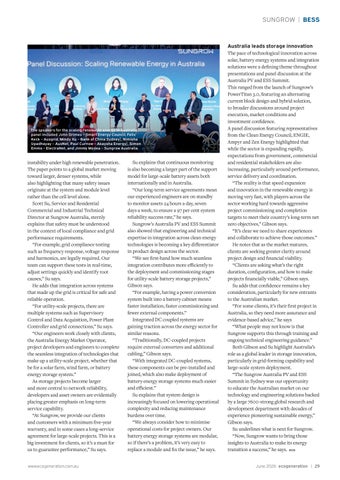
The speakers for the scaling renewable energy in Australia panel included John Grimes – Smart Energy Council, Felix Keck – Ausgrid, Mindy Xu – Bank of China Sydney), Nimisha Upadhayay – AusNet, Paul Curnow – Akaysha Energy), Simon Emms – ElectraNet, and Jimmy Modea – Sungrow Australia.
instability under high renewable penetration. The paper points to a global market moving toward larger, denser systems, while also highlighting that many safety issues originate at the system and module level rather than the cell level alone. Scott Su, Service and Residential Commercial and Industrial Technical Director at Sungrow Australia, sternly explains that safety must be understood in the context of local compliance and grid performance requirements. “For example, grid compliance testing such as frequency response, voltage response and harmonics, are legally required. Our team can support these tests in real-time, adjust settings quickly and identify root causes,” Su says. He adds that integration across systems that made up the grid is critical for safe and reliable operation. “For utility-scale projects, there are multiple systems such as Supervisory Control and Data Acquisition, Power Plant Controller and grid connections,” Su says. “Our engineers work closely with clients, the Australia Energy Market Operator, project developers and engineers to complete the seamless integration of technologies that make up a utility-scale project, whether that be for a solar farm, wind farm, or battery energy storage system.” As storage projects become larger and more central to network reliability, developers and asset owners are evidentally placing greater emphasis on long-term service capability. “At Sungrow, we provide our clients and customers with a minimum five-year warranty, and in some cases a long-service agreement for large-scale projects. This is a big investment for clients, so it’s a must for us to guarantee performance,” Su says. www.ecogeneration.com.au
Su explains that continuous monitoring is also becoming a larger part of the support model for large-scale battery assets both internationally and in Australia. “Our long-term service agreements mean our experienced engineers are on standby to monitor assets 24 hours a day, seven days a week, to ensure a 97 per cent system reliability success rate,” he says. Sungrow’s Australia PV and ESS Summit also showed that engineering and technical expertise in integration across clean energy technologies is becoming a key differentiator in product design across the sector. “We see first-hand how much seamless integration contributes more efficiently to the deployment and commissioning stages for utility-scale battery storage projects,” Gibson says. “For example, having a power conversion system built into a battery cabinet means faster installation, faster commissioning and fewer external components.” Integrated DC coupled systems are gaining traction across the energy sector for similar reasons. “Traditionally, DC-coupled projects require external converters and additional cabling,” Gibson says. “With integrated DC-coupled systems, these components can be pre-installed and joined, which also make deployment of battery energy storage systems much easier and efficient.” Su explains that system design is increasingly focused on lowering operational complexity and reducing maintenance burdens over time. “We always consider how to minimise operational costs for project owners. Our battery energy storage systems are modular, so if there’s a problem, it’s very easy to replace a module and fix the issue,” he says.
Australia leads storage innovation The pace of technological innovation across solar, battery energy systems and integration solutions were a defining theme throughout presentations and panel discussion at the Australia PV and ESS Summit. This ranged from the launch of Sungrow’s PowerTitan 3.0, featuring an alternating current block design and hybrid solution, to broader discussions around project execution, market conditions and investment confidence. A panel discussion featuring representatives from the Clean Energy Council, ENGIE, Ampyr and Zen Energy highlighted that while the sector is expanding rapidly, expectations from government, commercial and residential stakeholders are also increasing, particularly around performance, service delivery and coordination. “The reality is that speed expansion and innovation in the renewable energy is moving very fast, with players across the sector working hard towards aggressive project commissioning and completion targets to meet their country’s long-term net zero objectives,” Gibson says. “It’s clear we need to share experiences and collaborate to achieve those outcomes.” He notes that as the market matures, clients are seeking greater clarity around project design and financial viability. “Clients are asking what’s the right duration, configuration, and how to make projects financially viable,” Gibson says. Su adds that confidence remains a key consideration, particularly for new entrants to the Australian market. “For some clients, it’s their first project in Australia, so they need more assurance and evidence-based advice,” he says “What people may not know is that Sungrow supports this through training and ongoing technical engineering guidance.” Both Gibson and Su highlight Australia’s role as a global leader in storage innovation, particularly in grid-forming capability and large-scale system deployment. “The Sungrow Australia PV and ESS Summit in Sydney was our opportunity to educate the Australian market on our technology and engineering solutions backed by a large 7600-strong global research and development department with decades of experience pioneering sustainable energy,” Gibson says. Su underlines what is next for Sungrow. “Now, Sungrow wants to bring those insights to Australia to make its energy transition a success,” he says. June 2026 ecogeneration | 29