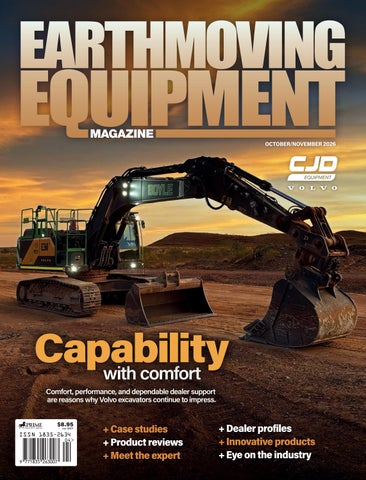
Capability with comfort Comfort, performance, and dependable dealer support are reasons why Volvo excavators continue to impress. $8.95
inc GST
Real productivity starts with the right machine.
Built to help operators get more done, every day. From compact excavators to large construction equipment, Komatsu machines are designed to deliver the performance, reliability and efficiency businesses depend on, because real productivity starts with equipment built for the job. Explore the Komatsu Construction & Utility range today.
1300 566 287 komatsu.com.au
A compact US-made Laser-Grader next to a bigger counterpart, a John Deere 672GP, both fitted with Leica MC1 machine control. See more on pages 27-28. Image: C.R. Kennedy
Welcome Ray Chan Editor
Technology is moving too quickly for anyone to assume that the machine they bought a few years — or even a few months — ago is the same one in terms of capability today. Updates and new systems can unlock possibilities that users may not even realise are available. Modern equipment is becoming increasingly sophisticated. New developments in machine control, connectivity, automation, monitoring, and efficiency are continually changing the way equipment can be operated and managed. For owners and operators, keeping up with those developments is no longer simply a matter of curiosity, but essential to ensuring they are getting full value from the machinery they have purchased. After all, earthmoving equipment represents a significant capital investment. Businesses spend substantial amounts acquiring machines, and understandably expect those assets to deliver productivity, efficiency, and reliability in return. Yet the latest technology can only provide those benefits if people understand how to use it. That is where events such as Smart Iron, organised by Hastings Deering, prove their worth. They give customers the opportunity to get closer to the technology, see new developments in action and, perhaps most importantly, speak directly with the people who understand how the equipment and its systems work. A feature buried in a machine's software or an update that goes unexplored can represent a missed opportunity for improved productivity or efficiency. Read more about the event inside. Smart Iron is about more than displaying impressive machinery. It is about education, engagement, and helping customers understand how to turn technological advancement into practical benefits on the job site. Elsewhere, we turn our attention to a reclamation project in Queensland, where a trio of LiuGong machines is helping to rehabilitate an old sand mine. As might be expected, the backfilling task is arduous, and involves working in muddy conditions where equipment can get bogged and often needs to be extricated. Read how the combination of dozer, forklift, and loader works together to ensure that the environmental project is carried out with as little fuss as possible: an achievement so impressive that it has made the recycling company consider converting its entire fleet to the LiuGong brand. We also head to South Australia to report on how a civil contractor has grown to a team of more than 220 full-time staff in a short period, delivering landscape construction and maintenance projects from cities to regional locations.
4 EARTHMOVING EQUIPMENT MAGAZINE | www.earthmovers-magazine.com.au
The business has recently rebranded, marking a new phase of expansion backed by Caterpillar equipment supplied by local dealer Cavpower. More than anything, the growth demonstrates the power of a strong and durable relationship behind both parties, with the construction company reliant on the support and the servicing that have kept pace with its growth. Over in Melbourne, we see the value of 3D grading for a residential earthworks contractor specialising in site cuts, cut-and-fill earthworks, and medium-density construction projects. Traditionally, operators relied on 2D PDF house plans, physical measurements, and manual site marking to establish building footprints before excavation could begin. This process required additional time on site and ongoing level checks throughout the excavation process. Grading with 3D supports a more digital workflow, with operators able to use design information within the system to guide excavation activities and complete house pad work with greater consistency. In other news, we had the opportunity to visit the headquarters of Merlo in northern Italy, where we looked beyond the machines and into the business behind them – its manufacturing operations, engineering capability and ambitions for the years ahead. Merlo has built its reputation around the development and manufacture of telehandlers and specialised equipment, with an emphasis on engineering and product development. The visit provided an insight into how the company is preparing for the next stage of its growth, from expanding its global presence and refining its product range to investing in the technologies that will shape its machines in the future. We spoke with key members of the Merlo team about the company’s manufacturing philosophy, its approach to innovation, and where it sees the industry heading. We also explored what its international growth plans mean for Australia, including the products, support, and capabilities that could become important to local customers. And that’s all just the tip of the earthmoving mound. Our regular features include topics on machine control, plant insurance, dealer profiles, equipment maintenance, industry events, and a range of innovative products designed for the earthmoving industry. Add to that the informative contributions from our industry partners, and you have a reading package to keep you occupied for hours. Happy digging!
WHEREVER THE NEED, WE’VE GOT YOU COVERED GLOBAL LEADER
NATIONAL NETWORK
LOCAL SUPPORT
Working a lunar surface may still be many moons away but who really knows? However one thing you can be sure of is that wherever you are, XCMG has you covered with a dedicated dealer network and an expansive machine range engineered by a global leader.
Now’s the time to contact your XCMG dealer and discover just how much value XCMG can bring to your business.
xcmg.net.au 1830XCMG
Earthmoving Equipment Magazine is published bimonthly by Prime Creative Media Pty Ltd.
CEO Christine Clancy Head of Sales Andrew Morrison Editor Ray Chan ray.chan@primecreative.com.au Brand Manager KahChi Liew kahchi.liew@primecreative.com.au 0421 474 407 Production Editor Michelle Alder michelle.alder@primecreative.com.au Art Director/Design Daz Woolley Subscriptions P. +61 3 9690 8766 subscriptions@primecreative.com.au Website www.earthmovers-magazine.com.au
Copyright
Earthmoving Equipment Magazine is owned by Prime Creative Media and published by John Murphy. All material in Earthmoving Equipment Magazine is copyright and no part may be reproduced or copied in any form or by any means (graphic, electronic or mechanical, including information and retrieval systems) without written permission of the publisher. The editor welcomes contributions but reserves the right to accept or reject any material. While every effort has been made to ensure the accuracy of information, Prime Creative Media will not accept responsibility for errors or omissions, or for any consequences arising from reliance on information published. The opinions expressed in Earthmoving Equipment Magazine are not necessarily the opinions of, or endorsed by, the publisher unless otherwise stated. © Copyright Prime Creative Media, 2026.
ON THE COVER
Articles All articles submitted for publication become the property of the publisher. The editor reserves the right to adjust any article to conform with the magazine format. Head Office 379 Docklands Dr, Docklands VIC 3008 P: +61 3 9690 8766 info@primecreative.com.au www.primecreative.com.au Sydney Office Suite 11.01, 201 Miller St, North Sydney, NSW 2060
Capability with comfort Comfort, performance, and dependable dealer support are reasons why Volvo excavators continue to impress. $8.95
inc GST
earthmoving_equipment_mag Earthmoving Equipment Magazine Earthmoving Equipment Magazine
For one Western Australian contractor, Volvo excavators have proven themselves where it counts — on the job.
6 EARTHMOVING EQUIPMENT MAGAZINE | www.earthmovers-magazine.com.au
10 On the cover 15 Meet the expert 20 Industry leaders 24 Industry auctions 27 Machine control 30 Industry insurance 32 Business and finance 36 Leadership profiles 39 Equipment maintenance and service 42 Innovation leaders 47 Machinery maintenance 50 Plant protection 52 Dealer profiles 58 Special events 68 Case studies 90 Equipment and product reviews: excavators 100 Innovative products 118 Eye on the industry 127 Industry events 134 National Association of Women in Construction 135 NexGen The recent Smart Iron event in Queensland blended technical learning about Caterpillar equipment with industry camaraderie, featuring expert operator demonstrators, top-tier audio-visual displays, and a regional community atmosphere. See pages 58-61. Image: Prime Creative Media
136 Civil Contractors Federation Queensland 137 Allied Earthmovers Association
www.earthmovers-magazine.com.au | EARTHMOVING EQUIPMENT MAGAZINE 7
MOVING YOUR MACHINERY WITH US
JETLAND LOADING RAMPS ARE
NOW AVAILABLE FOR PICKUP IN BRISBANE, QUEENSLAND. JETLAND is a leading supplier of high strength & heavy duty Aluminium loading ramps in Australia. High quality raw material and safety testing systems ensure a safe and reliable product. No manufacturing delays, all ramps listed
online are in stock at our warehouse in Mordialloc, Victoria.
We can also supply Custom
built ramps - made to your specifications for your particular needs.
Free Delivery
Australia wide.
0420 815 988 jetlandramps@gmail.com Rear 211-219 Boundary Road Mordialloc Vic. 3195 18 Reis St, Woolloongabba QLD. 4102
jetlandramps.com.au YOUR SAFETY IS OUR PRIORITY
FROM APRIL 2027
HITACHI BECOMES LANDCROS
Zaxis-7
YOU’RE IN CONTROL.
Be in control with the 7 Series excavators and wheel loaders. hcma.com.au
For Western Australian contractor Boyle Civil, choosing equipment comes down to what happens once the machine gets to work.
One of Boyle Civil’s Volvo E Series excavators. Images: CJD.
Nathan Boyle is quick off the mark when anyone asks him what he thinks of the latest generation of Volvo excavators. The owner of Boyle Civil doesn’t have to rely on a specification sheet. He runs Volvo excavators spanning D, E and now F Series machines in his fleet, alongside equipment from other manufacturers. Nathan said that gives him and his operators a good reference point. “The operators know the older machines. They know what they liked about them. And when something changes in a new model, they’re the ones spending enough hours in the seat to know whether that change actually makes a difference,” he said. With three of Volvo’s latest F Series excavators now in the business, Nathan said some of those differences were obvious. “The new cabs and the appearance are the main ones you notice before you start driving it,” he said. “Then once you start driving it, it’s the hydraulics and the comfort.” For a contractor whose equipment can be working long shifts and operating a long way from home in Western Australia’s Pilbara, those things matter. They’re part of what determines whether a machine earns its place in the fleet.
From D to E to F
Boyle Civil’s history with Volvo gives Nathan a perspective that only comes from operating successive generations of equipment.
GPS, machine technology, and connectivity work together to make Volvo excavators powerful digging machines.
10 EARTHMOVING EQUIPMENT MAGAZINE | www.earthmovers-magazine.com.au
Following on from the D and E Series machines in the line-up, he now owns three of the latest F Series excavators. Having them working within the same business gives Nathan’s team the chance to see what’s genuinely changed from one generation to the next. With the F Series, one of the biggest differences he has noticed is in the hydraulic configuration. “The hydraulics are a big one in the new F,” he said. “They’re good, responsive, and smoother than the E Series machines the operators already know.” To someone sitting outside the machine, the hydraulic response can sound like just another detail on a product disclosure statement. For the operator, it’s something they’re feeling through the controls all day, whether digging, loading, trimming, or positioning the machine. But when Nathan talks about the F Series, he doesn’t spend much time quoting specifications. He talks about how the machines feel, about what his operators tell him, and about what his operators notice. Ask someone who isn’t an operator what matters in an excavator, and they might start with horsepower, operating weight, or digging
Two Boyle Civil EC360 excavators, with distinctive livery.
performance. Ask someone who’s going to spend 12 hours sitting in one, and the conversation gets a little different. With the F Series, Nathan said the operators notice the cab almost immediately. “They like the new layout, the cab, and how it’s presented. They like the modern buttons and pieces, and then the shape of the machine,” he said. Once they’re working, that first impression is followed by the controls, hydraulic response, and smoothness. It’s feedback Nathan listens to, as his operators are the people living with these machines every day. “Something that seems like a small detail during a walk-around, such as comfort, can become pretty important after eight, 10 or 12 hours in the seat,” Nathan said.
The 12-hour test
Boyle Civil doesn’t operate an exclusively Volvo fleet. That makes Nathan’s comparison particularly useful. His operators have access to other brands, and they move between machines. Sometimes Nathan hears about the difference afterwards. “Sometimes they’ll say they have a sore back, but you never get it out of the Volvo,” he said. It’s not a measure you’ll find in a machine brochure, but at the end of a 12-hour shift, it might be one of the measures that matters most. “They’re not perfect, but Volvos also probably have one of the most comfortable cabs out there that you can buy,” Nathan said. “I’m not trying to sell Volvo equipment. I’m a
contractor who owns it, runs it alongside other brands, and hears directly from the people who operate it. For me, the test is what happens in the real world.” Cab layout, seating, controls, hydraulic response and overall smoothness all contribute to that experience. Individually, they can seem like small things, but across a long shift, they’re not. When good operators are hard to find and harder to keep, what you ask them to sit in every day matters.
Looking good
There’s another side to Nathan’s machinery that has nothing to do with hydraulics or cab comfort: he likes his gear to look good. That’s apparent when he talks about how the new F Series machines present themselves, but it goes beyond simply liking the shape of a new excavator. Nathan knows people notice his machines. “Our machines look very good when they go out the door, and they’re spotted everywhere,” he said.
Nathan Boyle believes Volvos have one of the most comfortable cabs of machinery brands in the industry.
www.earthmovers-magazine.com.au | EARTHMOVING EQUIPMENT MAGAZINE 11
A Volvo ED550 excavator at work on one of Boyle Civil’s projects.
There’s a certain amount of pride behind that statement. For Boyle Civil, a machine isn’t tucked away once it leaves the yard. It’s travelling on the road, arriving at jobs, sitting alongside other contractors’ equipment and working in front of clients. Nathan believes that the presentation of that equipment says something about the business running it. Having well-presented machines is part of the standard he sets for Boyle Civil, and when those machines are Volvo excavators carrying the business’s name, the two become fairly easy to recognise. That visibility also puts another responsibility on the machine.
Doing the job
Looking good is one thing. Once it gets to the site, it still has to do the tasks. The evolution from Boyle Civil’s earlier Volvo machines to the latest F Series isn’t confined to the cab and hydraulics. The way civil contractors use machinery has changed, too. GPS, machine technology, and connectivity have become increasingly important, particularly in detailed earthworks where accuracy matters. The excavator is no longer operating in
isolation. The operator, machine controls, positioning technology, and project information all work together. For Boyle Civil, that technology sits alongside the fundamentals that haven’t changed: reliability, operator experience, and having a machine capable of doing what is expected of it. When those machines head north, another part of the equation becomes more important.
Support beneath the steel
The Pilbara changes things — equipment can be working a large distance from the people, parts, and resources that would normally be close at hand. A machine issue close to a major branch and a machine issue on a remote project aren’t the same thing. Getting things right the first time matters. When something does go wrong, Nathan wants someone to answer the phone, communicate with him, and get on with finding a solution. That’s where the story moves beyond the Volvo itself and into the relationship behind it. Nathan has dealt with CJD Equipment for
Boyle Civil owns a number of Volvo machines in its fleet.
12 EARTHMOVING EQUIPMENT MAGAZINE | www.earthmovers-magazine.com.au
about five years, building relationships with his representative, Anthony Brown, and others across the business. His assessment of CJD is much like his assessment of the machinery: it’s practical. “They mightn’t get everything right, but they’re responsive and they communicate well,” he said. It’s not the sort of polished endorsement that normally comes out of a marketing department. That’s precisely why it means something. Nathan runs machinery for a living. Things happen. Machines work hard. Requirements change. Problems have to be solved. What matters to him is what happens next. As Boyle Civil’s Volvo fleet has evolved, its relationship with CJD has grown with it. That doesn’t happen because somebody signs a purchase order. “It takes time to build that relationship,” Nathan said. “I believe that everything’s a twoway street.” Nathan doesn’t expect CJD to carry all of the responsibility for making that relationship work. “If I wasn’t responsive and respectful to CJD, I don’t think I would get that back,” he said. If Boyle Civil expects its suppliers to communicate, Nathan believes his business has to communicate too. If he expects people to respond when he needs something, he needs to be responsive when they need something from him. Respect has to work both ways. There is another connection Nathan recognises. Every time one of his machines heads out to work, it’s carrying more than the Boyle Civil name. “I’m also selling CJD’s brand and Volvo’s brand,” he said. “Our machines look good when they go out the door, and they’re spotted everywhere.” It’s an unusual comment from a customer, but it says a lot about the way Nathan views the relationship. He takes pride in the machines — Volvo built them, CJD supplies and supports them, and Boyle Civil puts them to work. Ultimately, Nathan said everyone has something invested in how they perform and how they’re seen.
VOLVO THE OPERATORS CHOICE VOLVO 360F
“The new cabs are very good. Once you start driving it, it’s the hydraulics and the comfort.”
Nathan Boyle | Owner, Boyle Civil Contracting
People buy a Volvo because downtime costs more than repayments. Because good operators stay longer. Because every productive hour matters.
IF YOU KNOW, YOU KNOW Three EC360FL3s. One owner who knows exactly what he wants from an excavator.
SAFETY Protecting people on every site.
Big Enough to Trust, Small Enough to Care @CJDequipment
Fuel Efficiency Built to perform. Built to last.
Contact your local branch cjd.com.au | 1300 139 804
Re-sale value Lrrem ipsum dolor
CJD Equipment has a national supply network and 24/7 service
SUPPORT Support you can build on.
TAKE CONTROL OF YOUR FUEL COSTS
WITH THE CAT® FUEL EDGE PROGRAM.
With the Cat® Fuel Edge Program, if your machine exceeds the agreed fuel burn level*, you’ll earn Cat® Credits^ to help offset the additional fuel cost. Available when you purchase a qualifying Cat machine with VisionLink™ enabled from a participating Cat dealer. Find out more at cat.com/fuel-edge-au or contact your local Cat dealer.
NSW/ACT WesTrac 1300 881 064 QLD/NT Hastings Deering 131 228
VIC/TAS William Adams 1300 923 267 SA Cavpower 08 8343 1600
WA WesTrac 1300 881 064 NZ Terra 0800 93 39 39
*Available at participating Cat dealers, which may not be all Cat dealers in Australia. Applies only to purchases of new select excavation and earthmoving machines with VisionLink™ enabled from participating Caterpillar dealers. This Program is designed to demonstrate Caterpillar’s and the dealer’s confidence in the fuel consumption efficiency of Cat machines. Enrolment in the Program is completely voluntary and at dealer’s and customer’s discretion. Contact a participating Caterpillar dealer for details about qualifying machines and the agreed fuel burn level. Please contact your local dealer for more information about this offering. The Program is only available for the original purchaser of the machines and cannot be transferred with the machines to any subsequent purchasers. Terms and conditions of this program are revised annually, please contact your local dealer for more details. ^For more information on Cat® Credits, please visit cat.com/catcredits. Cat Credits can be spent on parts, service, repairs, rentals and more at participating Cat dealers. VisionLink is a trademark of Caterpillar Inc., registered in the United States and in other countries. © 2026 Caterpillar. All Rights Reserved. CAT, CATERPILLAR, LET’S DO THE WORK, their respective logos, “Caterpillar Corporate Yellow”, the “Power Edge” and Cat “Modern Hex” trade dress as well as corporate and product identity used herein, are trademarks of Caterpillar and may not be used without permission.
The Cat Fuel Edge Program aims to help operators manage their fuel costs.
Stay in control of your fuel costs with the Cat® Fuel Edge Program. With fluctuating fuel prices putting pressure on operating costs for many earthmoving businesses across Australia, solutions that can help improve fuel efficiency are key. Caterpillar is continuously expanding the ways in which it supports its customers through its machinery and technology options. These help construction companies improve productivity on site while using less fuel. Caterpillar is complementing this offering with the Cat® Fuel Edge Program.
per hour on average than the committed fuel consumption threshold during the first 24 months from the date of delivery.
Caterpillar has identified the fuel consumption threshold as the rate of fuel consumption (expressed as litres per hour) considered to
Stand apart
The Cat Fuel Edge Program is designed to give Cat machinery buyers peace of mind that their fuel consumption is what they expect it to be. The Cat Fuel Edge Program entitles customers who purchase a qualifying Cat® machine from a participating Cat dealer — with Cat VisionLink™ enabled — to Cat® Credits* if their new machine consumes more fuel
If a machine uses more fuel than the committed fuel consumption threshold, Cat Credits* are offered.
www.earthmovers-magazine.com.au | EARTHMOVING EQUIPMENT MAGAZINE 15
NEXT-DAY PARTS. TWO-DAY REPAIR . GETTING YOU BACK TO WORK .
ASK YOUR DEALER ABOUT THE SERVICES COMMITMENT EXCLUSIVE TO CAT ® CUSTOMER VALUE AGREEMENTS.
BECAUSE EVERY MINUTE MATTERS
YOU DESERVE A PLAN TO PROTECT THEM ALL.
NSW/ACT WesTrac 1300 881 064 VIC/TAS William Adams 1300 923 267
QLD/NT Hastings Deering 1300 952 701 WA WesTrac 1300 881 064
SA Cavpower 08 8343 1600
*Applies to maintenance, wear and common parts and repairs. Available from participating Cat dealers, which may not be all Cat dealers in Australia. Contact your dealer for details. © 2026 Caterpillar. All Rights Reserved. CAT, CATERPILLAR, LET’S DO THE WORK, their respective logos, “Caterpillar Corporate Yellow”, the “Power Edge” and Cat “Modern Hex” trade dress as well as corporate and product identity used herein, are trademarks of Caterpillar and may not be used without permission.
Cat Credits can be spent on parts and service.
be representative of the expected fuel burn or consumption rate (in typical Australian operating conditions) for that model of a qualifying machine. Machine fuel consumption can be viewed on the VisionLink website www.vl.cat.com or on the VisionLink mobile application. If a machine exceeds the agreed level of fuel burn, Cat Credits* will be earned to help offset the additional fuel costs. Cat Credits can be spent on parts, service, repairs, rentals and work tools online at parts.cat.com or in person at participating Cat dealer and Cat Rentals locations. This program covers a range of small, medium and large excavator models, wheeled
excavators, articulated trucks, medium and large wheel loaders, medium dozers, motor graders and track loaders. With various qualifying models from across these machinery families being included in the Cat Fuel Edge Program, customers have a range of new machinery options available to take advantage of this offer. To see the full list, visit: www.cat.com/en_AU/campaigns/ awareness/fuel-edge-au.html Eligible Cat machines will have their fuel consumption monitored by Cat dealers, and a report will be sent quarterly to show the average fuel consumption in litres per hour compared to the threshold given at delivery. If the machine has consumed more, Cat
Credits will be earned at the agreed value per litre over the threshold — it’s that simple. Give your business an edge with the Cat Fuel Edge Program. Contact your local Cat dealer now for more information or visit cat.com/fuel-edge-au for full T&Cs. VisionLink is a trademark of Caterpillar Inc., registered in the United States and in other countries. * If your machine exceeds the agreed fuel burn level, you will earn Cat® Credits to help offset the additional fuel cost. Cat Credits are available from participating Cat dealers in Australia only. New Zealand customers will be issued with a parts credit. For more information on Cat Credits, please visit cat.com/catcredits
The Cat Fuel Edge Program includes machinery from across the range.
Caterpillar is committed to supporting its customers across the life of the machine.
www.earthmovers-magazine.com.au | EARTHMOVING EQUIPMENT MAGAZINE 17
MORE THAN ACCESS. YOUR TOTAL SOLUTIONS PROVIDER.
4008
D601AHG
METROHYBRID
One Partner. Total Site Solutions. At JLG, we deliver more than access equipment. We provide end-to-end site solutions designed to keep your projects moving. From access and material handling to lighting, our equipment is built to perform in the demanding conditions of earthmoving, civil construction and infrastructure. Whether you’re working on a major project, developing a site or keeping your fleet moving, JLG has the equipment and expertise to support your operation from the ground up.
SALES | SERVICE | PARTS
Discover the full range now Australia 131 JLG www.jlg.com.au
www.ausa.com/en-au/
DEERE.COM.AU/EN/MOTOR-GRADERS/
SCAN TO LEARN MORE
60 YEARS OF INNOVATION, GROUNDED IN PURPOSE. NEVER IDLE For more than 60 years in the Motor Grader business, we’ve been putting our customers first. That’s why our new P-Tiers puts operator comfort front and centre. Expect productivity to move to the next level thanks to upgraded cab amenities that compliment superior machine engineering… advanced tech and automation for premium performance; fully integrated SmartGrade for greater accuracy; and Premium Circle to eliminate wear and adjustment delays! Check out the new P-Tier Motor Graders and take your productivity to the next level.
P-TIER
MOTOR GRADERS
1708JHNDRE
Contractors are looking at better fuel efficiency of heavy equipment as a way of controlling operating costs. Rising fuel costs are putting renewed pressure on Australia’s construction industry. Recent ABS data from the June 2026 Business Conditions and Sentiments survey shows 85 per cent of construction businesses were negatively impacted by fuel prices or availability, while 87 per cent of those reporting increased operating expenses cited fuel prices as a contributing factor. Komatsu Australia’s National Business Manager for Construction, Mark Boyes, said the current environment is putting a renewed focus on hybrid excavators — a technology the company has been developing for almost two decades. Komatsu introduced the world’s first commercially available hybrid hydraulic excavator in 2008 in response to rising fuel prices, and today its hybrid technology still provides contractors with a way to reduce fuel consumption and emissions without compromising productivity. "When fuel prices rise, even small improvements in fuel efficiency can make a difference to the bottom line,” Mark said. "Hybrid technology takes that a step further because it allows us to recover energy that would otherwise be lost and put it back to work. Customers can reduce fuel consumption while maintaining, and in some applications increasing, the productivity and performance they expect from their excavator.” Komatsu’s hybrid system captures energy generated as the excavator’s upper structure decelerates during slewing, converting it into electricity and storing it in an ultra-capacitor. The recovered energy is then used to assist the
Komatsu’s hybrid excavator range includes the 23t HB215LC-3.
machine during operation, reducing demand on the diesel engine. Applications involving frequent, repetitive slewing therefore provide more opportunities to recover and re-use energy. "If you’re working a stockpile and loading trucks, you’re continually digging, slewing, unloading, and slewing back again,” Mark said. "That repetitive cycle is where hybrid technology can come into its own. The more opportunities the machine has to recover energy through the slew cycle, the greater the potential benefit.” Komatsu customer Andy Divall from Goulburn-based civil contractor Divall’s Earthmoving has experienced those benefits Komatsu’s hybrid system captures energy generated as the excavator’s upper structure decelerates during slewing, converting it into electricity and storing it in an ultra-capacitor.
firsthand. He purchased Komatsu’s first hybrid excavator in Australia in 2008 and has continued to use hybrid machines within his fleet, particularly for crushing applications. "A standard excavator might burn around 16 litres of fuel an hour, while the hybrid can do the same work on around eight litres,” he said. "That’s about a 50 per cent reduction in fuel burn in the right application.” Komatsu’s hybrid excavator range includes the 23-tonne HB215LC-3 and the 38t HB365LC-3, both designed to deliver fuel savings while maintaining the reliability, productivity, and quality of build expected from Komatsu excavators. "There’s no single fuel-saving figure that applies to every work site, but when a hybrid is working in an application that plays to the strengths of the technology, the savings can be substantial,” Mark said. "That’s what makes understanding the customer’s operation so important. It’s about putting the right machine into the right application and helping them get the greatest possible return from the technology.” While the construction industry’s focus on lower-emission machinery continues to grow, Mark said the immediate economic case for hybrid equipment is equally important. "With fuel costs putting pressure on contractors, we’re encouraging our customers to consider where hybrid excavators could fit within a fleet and deliver savings,” he said. "For the right application, you’re using less fuel to get the same job done, and that’s good for both the customer’s bottom line and their emissions.” Learn more about Komatsu’s hybrid excavators at: www.komatsu.com/en-au/ technology/power-solutions/hybridexcavators
20 EARTHMOVING EQUIPMENT MAGAZINE | www.earthmovers-magazine.com.au
Gunlake Quarries is building for the future with Komatsu.
Gunlake Quarries has turned to Komatsu machinery to support the next phase of its growth, investing in seven HD605 rigid dump trucks for its Marulan quarry in New South Wales. The new trucks take Gunlake’s Komatsu fleet to 10 machines and build on a partnership founded on machine reliability, performance and local support. Gunlake Quarries forms part of the Gunlake Group, an Australian, family-owned quarrying and concrete company drawing on five generations of industry experience. Since opening its Marulan quarry in 2010, the business has grown into one of Australia’s largest independent quarry and concrete producers. The Marulan operation supplies aggregates, road base, drainage materials and civil construction products to its own concrete batching plants and to external customers across greater Sydney and regional NSW. The quarry employs about 80 full-time staff and continues to expand its capabilities to meet growing infrastructure demand. It has played a key role in several major infrastructure projects, including the M4 upgrade, Rozelle Interchange and the Western Sydney Airport development, supplying more than 400,000 tonnes of material for the new runway construction. According to Gunlake Quarry Manager Sam Ramsay, reliable equipment is critical to maintaining productivity across an operation of this scale. “With capacity to produce up to 4.2 million tonnes per year, we need machines that can perform every day, safely and reliably, while giving operators confidence when they’re behind the controls,” he said.
Seven new HD605s have joined Gunlake’s fleet.
“We already had a Komatsu PC450LC-8 and a PC200LC-8M0 excavator, which kicked off our relationship with the brand. Then when we were looking to refresh our ageing haul fleet, they were very competitive in the market. But it wasn’t just the purchase price. The quality of the build, the serviceability of the machines and the feedback from both operators and fitters all played a role in the decision to add more Komatsus to our fleet.” The new HD605s represent a technology upgrade for the quarry. Moving from older equipment to new-generation machines has delivered improvements in operator comfort, machine monitoring and fleet management.
Gunlake’s fitters have welcomed easier servicing.
“The comfort levels are much better for operators and systems like Komtrax have given us greater visibility across the fleet, particularly around fuel monitoring and machine utilisation – which is particularly important in the current environment,” Sam said. The practical design of the machines has also been well received by Gunlake’s maintenance team. “We get good feedback from our fitters around accessibility to filters, hoses and service points,” Sam said. “It’s clear the machines have been designed with serviceability in mind, which makes a real difference when it comes to maintenance.” While equipment performance remains important, Sam said the support behind the machines is equally valuable. “The Komatsu team has been open, honest and easy to work with,” he said. “Our fleet is still relatively young, so we haven’t had to lean heavily on support yet, but any minor issues we’ve had have been dealt with quickly and professionally.” With the quarry continuing to expand, Gunlake expects additional fleet investment will be required in the years ahead. “The business is consistently growing and machinery always has a lifecycle,” Sam said. “At some point equipment needs to be upgraded or replaced, and based on our experience so far, Komatsu will definitely be in the mix for future acquisitions.” As more and more infrastructure projects are announced across NSW and demand for materials grows, Sam said the new machines set Gunlake up for its next phase of growth. “Overall, these machines are helping position us for the future,” he said. “We’re focused on running a safe, efficient and reliable quarry operation, and Komatsu has been a good partner in helping us achieve that.”
www.earthmovers-magazine.com.au | EARTHMOVING EQUIPMENT MAGAZINE 21
SELL WITH US
For more information, visit us at pickles.com.au
Since 1964, Pickles has been building a business legacy atop a rich country heritage. As a trusted partner for big and small operators across Australia, we’re dedicated to unearthing value with every sale. With an expansive national reach of dozens of branches and close to a thousand Australian staff members, Pickles has the manpower online and on the ground to keep things moving.
Secure value with Pickles Industrial
Numerous global and local pressures in 2026 meant there was a steady demand for quality latemodel inventory. Images: Pickles
In its latest forecast, Pickles explores the next outcomes for the market. After a rocky start in the first half of 2026, created by a combination of geopolitical conflicts, the Australian industrial sector is aiming for solid ground after year’s end. 2026 was defined by supply chain resets, high interest rates, and caution in consumer spending, which caused market fluctuations that required Pickles to shift toward finding a balanced equilibrium that suits the needs of buyers and vendors alike. While Australian businesses have been impacted by a year of high fuel prices, delays in supply, and inflated manufacturing costs, a slow return to normality was inevitable. Going forward, with the used industrial market facing greater certainty as we close out the year, attention is shifting to the next phase of recovery. Having been in operation for over 60 years, Pickles is used to navigating market
fluctuations and the last decade has cemented an ability to keep sales and services moving, regardless of rain, hail, pandemic, or conflict. With 2027 around the bend, Pickles breaks down the factors most likely to influence the used industrial market in the coming months.
Supply and lead times
Prolonged geopolitical conflict had ramifications that were undoubtedly felt worldwide in the first half of 2026. In the Australian industrial market, the impact on lead times and global supply constraints was immense, with diesel, freight, and manufacturing input costs increasing across the country. Original Equipment Manufacturer (OEM) assets saw a surge in demand and higher price points, which meant that lead times became extensive for buyers. As the year has progressed, buyers have found relief in the
24 EARTHMOVING EQUIPMENT MAGAZINE | www.earthmovers-magazine.com.au
steady stream of late-model used inventory, gaining the benefit of more accessible entry costs and immediate availability to suit their project needs.
Cautious spending
Despite our industry facing a more certain future, caution remains among buyers seeking to ensure the best bang for buck. This is where the secondhand market is acting as a relief valve for businesses juggling the demands of borrowing rates, inflation, and overall costs. Businesses are finding encouragement from the secondhand market and, instead of halting operations, are continuing to see the benefit of purchasing high-quality, pre-owned machinery. Moreover, with the Australian dollar fluctuating and overseas OEM equipment proving a pricey investment, local secondhand options are offering instant price relief.
Trust in legacy gear offers advantage
Dependence on legacy Australian industrial gear that meets operational needs and can accommodate supply chain delays is proving a reliable option for businesses. Amidst economic headwinds, locally available equipment has offered buyers a competitive advantage, as the push for functional secondary equipment and machinery allows businesses to maintain consistency and projects to be completed faster.
Government investment in civil works
The Australian government has recently committed a record $242 billion to the civil sector through the five-year Major Public Infrastructure Pipeline (MPIP). Despite this, construction works remain slow going. A shortage of labour has played its part in slowing down project delivery in regional areas, however global supply chain issues and OEM costs remain a challenge for the industry to overcome. Temporary adjustments and contingency funding have alleviated the stress for businesses, but it remains to be seen whether the added confidence will create a
major shift for Australia’s construction sector as the year rolls to an end.
Construction demand
The demand for housing construction will likely impact the availability of assets, with the affordability and accessibility of quality, used gear set to impact decision-making. Buyers are becoming increasingly selective and favouring affordable secondary options as they adjust to high development costs and the lack of access to OEM stock. With Australia’s population growing by the day, we’re expecting to see contractors and manufacturers relying heavily on the secondary market to bypass costs and long wait times as construction slows down.
Compliance and maintenance concerns As Australia’s industrial market resets following a difficult period between February and May, buyers are having to consider ESG (Environmental, Social, and Governance) compliance and the longevity of used equipment going forward. Although new assets are proving a costly investment with slow lead times and supply chain disruptions,
secondhand machinery can lack fuel-efficiency and electrification features that conflict with climate disclosures. For vendors, maintenance of secondhand assets is essential to securing a satisfying sale. Poor maintenance shortens equipment lifecycles and accelerates disposal, and buyers are becoming increasingly conscious of these factors when choosing the asset to suit their needs. While reusing equipment reduces upfront manufacturing demand, secondhand machinery may lack modern compliance tools, raising the risk of workplace hazards. As confidence returns in the industrial market in 2026, a shift from cost control to asset renewal and optimisation is becoming a priority for operators. Ultimately, this year has demonstrated that flexibility is essential to finding a balance in a secondhand industrial market. With the state of the market becoming clearer, Pickles remains essential through connecting growing asset supply with strong national buyer demand and maximising vendor outcomes. To get in contact with a Pickles expert, visit us at pickles.com.au. Legacy Australian industrial gear that meets operational needs and can overcome supply chain delays is continuing to prove a reliable option for businesses.
www.earthmovers-magazine.com.au | EARTHMOVING EQUIPMENT MAGAZINE 25
Complete awareness on-site. Learn more about xwatch solutions xwatch.com.au
REDEFINED SAFETY WITH 3D AVOIDANCE ZONES The XW Series creates a total safe working envelope around the machine and operator enabling the control of the machine’s height, slew and rated capacity indication. This comprehensive system covers every eventuality when considering both operator and machine safety, offering complete peace of mind.
XW1
XW2
XW3
XW4
XW5
Height Control Slew Control Rated Capacity Indicator (RCI)
VIC (Head Office) 03 9823 1533 | NSW 02 9552 8300 | QLD 07 3862 6210 SA 08 8410 0533 | WA 08 9489 8500 | TAS 03 9823 1850
sales@crkennedy.com.au | survey.crkennedy.com.au
A compact grader fitted with 3D machine control is enabling grading in tight access areas with as much precision as its bigger counterparts. A US-made grader is becoming popular for work in restricted spaces by combining a small footprint with automated blade control and the ability to work directly from digital design models. The machine is manufactured by P. Ronci Machine Company in Smithfield, Rhode Island. Its origins date back to 1976, when Leo Paradis developed the Mini-Grader after identifying a need for a compact machine that could operate in confined areas while still providing accurate grading. Laser technology was added in the early 1980s, and the machine was rebranded as the Laser-Grader in 1982. Today, the model has found applications ranging from sports fields and tennis courts to building sites, floors, driveways, and other projects where a precise finished surface is required. Instead of bringing a full-size motor grader into an area where access may be restricted, the Laser-Grader provides a compact sixwheel-drive grading platform designed for fine grading. Its articulated configuration and small dimensions allow it to manoeuvre around a site while its blade performs the final trimming and shaping work. That combination becomes enhanced when conventional laser guidance is replaced or supplemented by 3D machine control.
From laser level to digital model
Traditional laser grading establishes a reference elevation using a rotating laser. A receiver on the machine detects the laser plane and the grading system uses that data to determine whether the blade needs to move up or down. Three-dimensional machine control takes the concept further. Rather than relying solely on a physical laser plane, the machine can work from a digital terrain model representing the finished surface. The machine control system knows where the grader is on the site, compares its position with the digital model and determines where the cutting edge needs to be.
Craig Beddell on his Laser-Grader. Images: C.R. Kennedy
That is where Leica Geosystems comes into play, with a machine control platform like its Leica MC1. This 3D system has been designed to guide and automate heavy construction machinery. It compares the design model with the actual position of the machine’s cutting edge and provides the operator with a live representation of progress. The system can also automatically control the position of the cutting edge. For a grader, that means the operator is not simply trying to interpret a grade indication and manually position the blade. The hydraulic control system can automatically adjust the blade to follow the designed surface. At the heart of the Leica installation is the relationship between the machine, positioning sensors, hydraulics, and digital model. The project design is converted into a digital surface that the machine-control system can interpret. Positioning information tells Leica MC1 exactly where the grader is operating, while sensors establish the orientation and position of the machine and blade. Leica MC1 then compares the actual blade
position with the design surface. If the blade is too high, too low, or needs to follow a changing slope, the system calculates the required correction. With automatic blade control, hydraulic functions make those adjustments without the operator having to continually manipulate the blade controls. The operator remains responsible for driving the machine, controlling the work area and managing material, while the machine-control system takes much of the precision work out of blade positioning. Leica’s grader solutions are designed around this principle. Its iCON grade systems can provide 2D guidance or 3D control, with the MC1 platform automatically controlling grading machines to help operators achieve the required surface.
The Australian experience
One of the Laser-Graders has been imported into Australia by Victorian excavation business Beddell Earthmoving, with the machine put into use recently at a project for Mawson Constructions.
Grading being carried out by the Laser-Grader with Leica MC1 control system.
Mawson Constructions General Manager Alan Tonks with a Leica total station mounted on a tripod. The electronic surveying tool maps landscapes and precisely marks construction sites.
www.earthmovers-magazine.com.au | EARTHMOVING EQUIPMENT MAGAZINE 27
A close-up of the control assembly, wiring, hydraulic lines, and solenoid valve blocks of the Laser-Grader.
The Leica Geosystems GNSS/GPS smart antenna receiver on the Laser-Grader.
The compact mini-grader was used alongside a much larger John Deere 672 heavy-duty sixwheel-drive grader, forming a striking visual of two graders of differing sizes working together. Operator Craig Beddell said the company had always been a strong advocate of spatial technology, adopting GPS systems since 2012. For this project, both machines were fitted with Leica MC1 machine control and were working from the same 3D models, which were created using Leica survey equipment and transferred to the machines. “The John Deere provides the size, power and blade capacity expected of a conventional heavy-duty motor grader,” Craig said. “The Laser-Grader takes the opposite approach, using its compact dimensions and purposebuilt grading configuration to work in areas where a larger machine may be less convenient.” Yet, from a machine-control perspective, both can work to the same digital design. That means the small grader does not have to be treated as a less sophisticated alternative. With the Leica MC1 GPS control system, it becomes another precision tool within the digital construction workflow. Craig said that fine grading can be a timeconsuming part of a project. “The volume of material being moved may be relatively small, but achieving the required finished level can involve numerous passes,” he said. “Operators need to establish where material needs to be removed, where it needs to be placed and how the finished surface changes across the site.” Traditionally, this can mean repeated surveying and checking. The machine makes a pass, the grade is checked, adjustments are made and the machine returns for another pass. On a complex site, the process can become a cycle of checking and correcting. Leica MC1 3D machine control changes that workflow by giving the machine a continuous digital reference. “Instead of waiting for someone to tell the operator that the blade is too high or too low, Leica MC1 provides that information in real time and, when automatic control is enabled, makes the correction,” Craig said. “The potential productivity gains are
particularly relevant to a compact grader because the machine is already intended for precision work rather than bulk earthmoving. “Fewer unnecessary passes can mean less machine time, less fuel consumption, and less disturbance of the material. It can also reduce the amount of material that needs to be imported or removed because the machine is working towards the designed surface rather than relying on repeated visual or manual checks.”
One model, different machines
The Mawson project also demonstrates another benefit of having the graders working within the same digital environment. The LaserGrader and John Deere 672 could work from the same design model, meaning the data did not have to be recreated for each machine. The models were delivered to both machines over the air through Leica ConX, a cloud solution and web-based interface that shares and visualises positioning, reference models, and constructed data in real time. It creates a common digital workflow between the survey information and the machines working on site. That interoperability becomes increasingly valuable as contractors operate mixed fleets. A project might involve an excavator doing the bulk excavation, a dozer moving and spreading material, a larger motor grader handling broader areas, and a compact grader completing detailed work around structures or within tighter spaces. If those machines can access the same digital design, the project becomes less dependent on transferring information manually between machines and operators. Leica MC1 is intended as a common machine-control platform across different types of construction equipment, with the company’s systems able to be configured for graders, dozers, excavators and other applications.
The importance of the installation
Craig said he used the team at C.R. Kennedy & Company – Geospatial Division to fit the MC1 system to the compact Laser-Grader, including the specialist joysticks and components required to provide full automatic blade control.
28 EARTHMOVING EQUIPMENT MAGAZINE | www.earthmovers-magazine.com.au
“They were great,” he said. “They came and set it up, working through the configurations and where to mount the system and controls. “It’s all flowed pretty smoothly and we haven’t had a lot of hiccups with it. We’ve already done about 1600 hours on it. “The machine does not need to be one of the largest or newest graders on the market to benefit from 3D control. “With the appropriate sensors, hydraulic interfaces, positioning equipment and software, a specialist compact grader can become part of the same digital machine-control workflow.” The Leica system can be configured to suit different levels of operator involvement, with manual guidance and automated blade control providing flexibility depending on the application and operator preference. In a manual configuration, Leica MC1 provides the operator with real-time guidance to the required design surface. The system shows the operator where the cutting edge is positioned relative to the target grade, allowing the operator to make the necessary blade adjustments using the machine controls. This provides the benefits of 3D positioning and digital grade information while retaining direct control of the blade. It can be useful for operators who prefer to make their own adjustments or for applications where conditions require greater hands-on control. Craig said he preferred automatic blade control, with the Leica system taking a more active role. “MC1 continuously compares the actual blade position with the digital design and automatically commands the machine’s hydraulic system to raise, lower or adjust the blade as required,” he said. “The operator remains responsible for driving and positioning the machine, while the system handles the fine blade movements needed to follow the designed surface. This can reduce the amount of manual correction required and help maintain a consistent grade across the work area.” On a compact grader such as the LaserGrader, that combination allows the operator to retain control where judgement is important, while letting the machine-control system handle repetitive precision adjustments.
SANY SY155U
COMPACT FOOTPRINT. MASSIVE THROUGHPUT. Looking for an excavator that can navigate tight spaces, load high-sided trailers, and handle the relentless pace of a 24/7 operation without breaking a sweat, or your budget? The SANY SY155U is engineered for confined worksites. Whether you’re working inside a transfer station or managing a crowded yard, the SY155U delivers the power of a conventional excavator with the agility of a compact machine.
WHY CHOOSE THE SY155U: •
Zero Tail Swing: Swing with confidence, minimising the risk of striking objects or other equipment in confined spaces
•
Built-in Durability: A reinforced structure and heavy-duty guarding comes as standard
•
Operator Comfort: A climate-controlled cab with high-visibility glass
1300 788 757 www.cea.net.au/sany
BRISBANE - MACKAY - ROCKHAMPTON SYDNEY - NEWCASTLE - ADELAIDE - PERTH
Weather events can happen when least expected, so operators need to consider their heavy machinery insurance needs year-round. Image: xy/stock.adobe.com
When the weather goes wild, it pays to know whether your insurance cover is ready for the worst. For businesses across earthmoving, construction, agriculture and related industries, mobile plant and equipment can be the engine room of the operation. But some operators still go without adequate insurance cover or insure their plant and equipment for less than today’s market value. That can be a costly gamble at any time of year. But the stakes rise during Australia’s catastrophic weather (CAT) season, typically from around September to April, when tropical cyclones, flooding, and bushfires can cause damage to plant and equipment and put machinery and livelihoods at risk. NTI’s National Product Manager for Mobile Plant, David Kidd, said businesses shouldn’t underestimate the importance of having appropriate insurance in place for their operations and equipment. “Climate change isn’t helping,” David said. “We’re seeing more tropical cyclones and lowpressure systems occurring more regularly, and moving further down the east coast, causing more flood-related incidents and claims. “If you’re not having a wet season in the CAT period, chances are you’re going to have a dry bushfire one.” Of course, Mother Nature doesn’t always stick to the calendar. Disaster events can happen when least expected, which means operators need to consider their heavy machinery insurance needs year-round. “Some businesses may not feel a need to insure their plant because historically they haven’t had to make a claim,” David said. “Insurance can be easy to neglect, particularly in the current economic environment. People are experiencing hardship, and the need to insure their equipment can be pushed to the back burner. “However, more and more principals and head contractors are now requiring their contractors
and subcontractors to have insurance while they’re on site.” When a business relies on one or two key pieces of machinery to keep moving, adequate equipment insurance can protect more than the machinery itself. “For example, if an entire business depends on, say, two machines and one of them is down, it can have a major impact on productivity, and potentially half the income is gone. Having insurance may provide an essential safety net for a business,” David said.
NTI Yellow Cover
With more than five decades of insurance experience, NTI brings expertise to mobile plant and machinery cover. Through its Yellow Cover product offering, NTI provides Mobile Plant and Equipment Insurance for a range of businesses, from owner-operators through to enterprises working on major infrastructure projects. The cover is backed by a team that understands the specialised risks faced by businesses operating plant and heavy machinery, with options tailored to different types and sizes of operation. For businesses heading into the upcoming CAT season, NTI’s Mobile Plant and Equipment Insurance doesn’t exclude coverage for natural disasters such as cyclones, floods, and bushfires. If a flood leaves your excavator looking more like a submarine, the policy is designed to have your back. “As we approach the higher risk of adverse exposures that come with a CAT season — tropical cyclones, storms, floods and bushfires — Yellowcover policy holders can have adequate coverage and support if they are affected by any of these exposures,” David said. “Protecting customers’ equipment and getting them back to work quickly, whether by repair,
30 EARTHMOVING EQUIPMENT MAGAZINE | www.earthmovers-magazine.com.au
replacement, or cash settlement, is NTI’s main priority. We’ve taken our experience, an innovative approach, and local expertise across the country to deliver a policy for your mobile plant and equipment. “If you’re an owner-operator, earthmover or civil contractor, work in a quarry or a mine, or are into farming and agricultural operations, then have a look at our Yellow Cover offering. “We offer coverage for the mobile plant and equipment hire industry as well, with tailored coverage for specific operational needs if required. Add to this our Accident Assist service, our MPE Repairer Network, and essential local knowledge from capital cities to regional centres across Australia, which automatically includes access to NTI’s claims solutions, providing a lifetime guarantee on authorised repairs.” When the weather turns, the last thing you want is your business sitting idle while you work out what happens next. If you’d like to learn more, check out NTI at www.nti.com.au/yellow-cover or contact your insurance broker. NTI Limited ABN 84 000 746 109 AFSL 237246. Policy terms, conditions, limits, exclusions and underwriting criteria apply. This article contains general information only and does not take into account your objectives, financial situation or needs. When making decisions about our insurance, consider the PDS and TMD at www.nti.com.au. Insurance products are provided by National Transport Insurance, a joint venture of the insurers CGU Australia Pty Ltd trading as CGU Insurance ABN 62 004 478 960 AFSL 700014 and AAI Limited trading as Vero Insurance ABN 48 005 297 807 AFSL 230859 each holding a 50% share. National Transport Insurance is administered on behalf of the insurers by its manager NTI Limited ABN 84 000 746 109 AFSL 237246.
At NTI we’ve always been successful in finding new ways to keep our customers truckin’, shippin’ and diggin’. With specialist insurance and roadside assistance products designed to protect Australian businesses and families, NTI is the specialist our customers can count on in their time of need.
Insurance products are provided by National Transport Insurance, a joint venture of the insurers CGU Australia Pty Ltd trading as CGU Insurance ABN 62 004 478 960 AFSL 700014 and AAI Limited Trading as Vero Insurance ABN 48 005 297 807 AFSL 230859 each holding a 50% share. National Transport Insurance is administered on behalf of the insurers by its manager NTI Limited ABN 84 000 746 109 AFSL 237246.
For an earthmoving contractor, a shift from dealing with the bank to working with a finance broker has provided the flexibility to renew its machinery line-up, add equipment, and keep an eye on future purchases.
HRV Earthmoving Director Rob Harvey says buying equipment has never been about signing a cheque and putting another machine in the yard. Every machine has a job to do, and every finance decision needs to leave enough room for the next acquisition. That approach has helped the Victorian and Western Australian contractor build a growing fleet of Caterpillar graders, dozers and excavators, backed by its own float and the ability to move equipment to jobs wherever the work takes it. Rob has been operating plant for about 24 years and has been running his own business for more than 10. In that time, graders have become a particular speciality. HRV is now up to grader number five — a Cat 150 motor grader — while Rob personally has owned eight graders since starting the business. But while Rob is comfortable behind the controls, he admits he wasn’t always as cosy when it came to dealing with finance brokers. In the early days, he said that he was always encouraged to approach banks as a first option, and didn’t know many people who used good loan specialists.
Finance friends or foes
When an opportunity came up to expand the business, Rob sat down with the local bank, went through the figures and received what he believed was the green light. “I flew to Queensland, found the machine and did the deal,” Rob said. Then came the phone call that changed his view of machinery finance. “When I rang the bank branch manager to ask where the supplier should send the invoice, I was told the bank could no longer proceed,” he said. “I walked back into the dealership like I’d just been kicked.” Burnt by the experience, Rob sought an alternative. Someone suggested he speak to a finance broker. That is where MFG Finance became part of HRV’s growth story.
Beyond the cheapest rate
Rob first met MFG Finance Director James Allan at a Queensland yard. What impressed him wasn’t a slick sales pitch, but the fact that James got on a plane and turned up in person. “I have people ringing me every week trying to sell me finance and sell me the dream,” Rob said. “But I’m old-fashioned. It has to be a handshake. I make a lot of decisions on gut feeling, and everything I’ve built has been based on relationships. James is a down-toearth people person.” The relationship has developed from there, with Rob impressed by James’ attention to detail and willingness to understand what HRV is trying to achieve.
Rob Harvey (left) with James Allan and the Cat 150 grader. Image: MFG
“James is very thorough in every deal and wants to make sure my success is his success,” Rob said. That means looking beyond the headline interest rate. “You can go and get the cheaper rate, but the old saying is that the poor man pays twice. Cheaper isn’t always better,” Rob said. As an example, MFG secured options for HRV from two major banks. Together, they chose the second-cheapest option, which was only slightly more expensive but offered automatic approvals of up to $500,000 after 12 months of good repayment history. By choosing that lender, HRV was effectively putting an additional funding pathway of up to $500,000 on ice, ready to use if and when another asset was needed, without having to go through the full financial disclosure process again. “That flexibility matters in earthmoving, where the window between winning a project and needing a machine can be extremely short,” Rob said. “When a client wants a piece of equipment on a project, time is your worst enemy. Knowing James has the approval ready means that when we need another machine, it’s a quick phone call and then we go shopping.”
Customer care
James said his approach was based on a similar principle: understand the business before trying to finance it. That means getting out of the office. Recently, the MFG team flew from Sydney, hired a car and headed into regional Victoria to meet Rob, inspect his equipment, and try out the new Cat 150 grader that MFG had helped finance. “It was great to see the new machine we had financed for Rob, spend time with him at the family property,” James said. He said that meeting customers face to face provided a clearer picture of their businesses. “It’s one thing to sit in an office looking at financial statements, talking to banks, and doing the number crunching. It’s different when you meet clients, spend time with them, and understand what’s important to them,” James
32 EARTHMOVING EQUIPMENT MAGAZINE | www.earthmovers-magazine.com.au
said. “It gives us insights we can’t get from behind a desk. It enables us to position their business to banks in ways that otherwise aren’t possible.” In HRV’s case, that understanding is important as the fleet goes through a period of renewal. “Rob’s fleet is going through an update, with some older assets coming off and being replaced by new equipment,” James said. “We’ve been assisting with that rollout, as well as financing additional equipment required for the business’ growth.” That makes MFG less of a transaction-based financier and more of a sounding board as HRV decides what equipment it needs next. Rob said he can call James with an opportunity or a requirement, with James working through the finance before coming back with an answer. “I can ring James anytime and he’ll answer, whether it’s five in the morning or six at night,” Rob said. “He’s always contactable and has our best interests at heart.”
A dealership for the decades
While MFG is helping provide the financial flexibility behind HRV’s expansion, the machines themselves are supplied and supported by William Adams, Caterpillar’s Victorian and Tasmanian dealer. Product Specialist Stuart Bell, based in Traralgon and covering eastern Victoria, has known Rob since meeting him when he was operating a D7 for a local logging contractor about 20 years ago. Rob's latest Cat 150 all-wheel-drive grader is the third Cat 150 Rob has purchased through the William Adams branch. It is also the last grader from that particular series, with Caterpillar now transitioning to its nextgeneration platform. “I’ll keep working on Rob,” Stuart said. “With a bit of luck, we’ll have one of the next-generation models under him within the next year or two.” Stuart said Rob had demonstrated a willingness to keep evolving. “You can identify a good operator,” Stuart said. “The way he operates, together with the 3D technology he has adopted, is impressive. In this industry, you have to move with the times.” Stuart has welcomed the opportunity to work alongside MFG. The HRV deal was the second transaction he had completed with James, who he said had been straightforward to deal with. What particularly stands out is James’ desire to “get out and meet people”. “You don’t particularly see many finance brokers putting boots on the ground,” Stuart said. “It’s always good to put a face to the name. Doing business is easier when you know the person on the other end of the line.”
Bespoke Global Freight Solutions A one-stop-shop for all your logistics needs, providing seamless and efficient services from start to finish.
Simplify your logistics supply chain, connect with us to find out how easy it can be. Australia sales@kenter.com.au 07 3733 1600
New Zealand sales@kenter.co.nz 09 871 4677
kenter.com.au
ONLY A 10% DEPOSIT REQUIRED!
E10, E17 & E20 EXCAVATORS
0% FINANCE OVER 36 MONTHS
*
*0% over 36 month finance is offered on new Bobcat E10, E17 and E20 excavators on a chattel mortgage with 10% deposit required, followed by equal monthly repayments and no balloon. Finance is subject to credit approval and is only available to approved ABN holders. Not available in conjunction with any other offers. Terms and conditions apply. For further details, contact Clark Equipment.
Distributed by
1300 736 848 www.bobcatofaustralia.com.au
STRICTLY LIMITED TIME ONLY!
SELECTED EXCAVATORS
SAVE $10,000 WITH A FACTORY REBATE *Saving applies to selected Develon DX140LCR, DX225LC-7M and DX300LC-7M excavators. Factory rebate by way of discount on machine at time of sale. Not available in conjunction with any other offers. Terms and conditions apply. For further details, contact Clark Equipment.
1300 736 848 www.develonequipment.com.au
Distributed by
*
With a market developing around electrification and site analytics, CJD Equipment executive general manager construction Grayden Leaver talks about current challenges and opportunities for machinery buyers across Australia. Having worked for CJD Equipment for nearly 15 years, Grayden Leaver is now in the role of executive general manager for construction, taking a lead on sales, as well as parts, service, and administration of the construction machinery line of Volvo machinery across Australia. With Volvo having released several new machinery lines over the past year and continuing to build on its alternative fuel program, Grayden said it’s a period of significant change for the industry. However, it’s also one that offers opportunities for efficiency gains and cost saving. “Over the past two to three years, what’s made Volvo stand out is the leadership position that they’ve taken around sustainability,” Grayden said. “They have publicly announced targets and timelines and have been very proactive in partnering with a number of businesses around the world, be that batteries – supply, usage and disposal – or hydrogen fuel cell development. “This means that there’s a product range and ongoing development in a lot of areas that are interesting to a lot of our customers. “In Australia the market in general is probably not as developed as Europe is in terms of their pathway down that whole sustainability journey, but moving forward Volvo is really standing out in that space.”
Electric options
CJD Equipment has been offering a couple of electric machines from Volvo in recent years, including the 1.8-tonne ECR18 Electric and 2.5t ECR25 Electric mini excavators, and the 4.9t L25 Electric compact wheel loader. Grayden said that these have been a good starting point to introduce electric machinery
CJD Equipment led a customer visit to Volvo HQ in Sweden recently. Images: CJD Equipment
to different aspects of the industry, with many businesses beginning to explore the opportunities that electric machinery could offer in their operations. By bringing these Volvo machines into Australia, he said that CJD Equipment is playing a key role in helping construction, mining, waste management, quarrying and other heavy industries understand how electric alternatives could fit into their workflows. “The sales volumes aren’t large at the moment, but in specific markets, electric machinery really fits the bill,” he said. “Outside of those specific markets, we CJD Equipment executive general manager construction Grayden Leaver.
frequently have conversations with our customers around where e-mobility is going, and we’re seen as being a trusted source within the industry as that area develops. We are playing a part in helping to give our customers a greater understanding of the different directions they could go in and the opportunities out there. “Late last year we launched the electric L120 Electric loader and there’s been a lot of interest around that. I think the larger the machinery gets, the more applicable to electric it can be. We’ve now put out our first handful of electric L120s into different applications, so it still comes down to the right fit for the right customer at the right time. “There are definitely some Australian customers that are leading the way and being proactive in moving into that space, whereas others are still working out what that may look like for them in the future. There isn’t a one-size fits all answer. Our job is to partner with our customers to work through what they want to achieve, the challenges that will come with it, and what we can do collectively to solve those problems.”
Market challenges
With diesel prices having been volatile over the past year, fuel costs have been an ever-present pressure for machinery owners. This is prompting many business owners to consider electric machinery from a total cost of ownership perspective, Grayden said, but it is just one part of the equation when running a business. For fixed sites in particular, such as mines 36 EARTHMOVING EQUIPMENT MAGAZINE | www.earthmovers-magazine.com.au
and quarries, a major focus is how they can measure site production, improve machine efficiency and maximise profits through using data analysis. CJD Equipment uses Volvo’s Site Solutions software to provide its customers with data and insights from across the business, to help identify areas where productivity gains can be achieved. “Volvo Site Solutions gives our customers the data they need to be safer, more efficient and more productive,” Grayden said. “It gives them live data so they can map their sites. They can integrate incoming road trucks so they know when these are going to arrive. They can track all of their loaders and see what they are doing. From an administrative point of view it’s a significant benefit. “It goes beyond just picking things up and putting things down and moving materials from one place to the other. The challenge is how do we help our customers make their businesses more efficient. “We’re seeing a much larger call for technology and software offerings to achieve this, particularly in mining and quarrying, but increasingly in waste and recycling as well. We’re also seeing greater demand for fleet management and site visibility in agriculture.”
Hands on
Earlier this year CJD Equipment took several of its Australian customers to Volvo’s facilities in Sweden to showcase the range of machinery on offer, and get a glimpse of what is in the development pipeline. Grayden said this was an opportunity for CJD customers to get into machines they may not have seen before, and have a demonstration of their capabilities. “We went to Volvo’s articulated hauler factory and had the opportunity to use the demonstration tracks and trial all the machines,” he said. “We toured Volvo’s engine and wheel loader factories, and we had a day in Eskilstuna at the customer centre, which provided the
The tour of Volvo’s facilities gave customers the opportunity to test machinery and gain insights into upcoming releases.
opportunity for everybody to operate any machine that Volvo has as well as showcase soft offerings, new products, and so on. “New products shown this year for our market were the electric L120 and electric L90. They highlighted the electric A30 and A40 haulers for the first time and were available to test, and we also saw the new compact excavator products. “As Volvo had such a big launch here over the past 12 months with the F series excavators, the K series loaders, and the J series haulers, it was a good opportunity to be able to see all of those and try them out in the same place. "It was a good wrap-up of the previous 12 months.” The next Volvo release to reach Australia will be the EC230 20t electric excavator, which should be available to customers by the end of the year. The new compact excavator line-up may also be making an appearance in the first quarter of next year. “We’re having a lot of discussions around the new haulers because production is limited, so we can’t stock them at the moment, but they are potentially available for customers in Australia,” Grayden said. “Then it’s just the finishing touches, mostly on the K series loaders at the smaller end. There will be a staggered release over the next six months, although the larger K series models are already available in Australia.” Upcoming Volvo releases include the EC230 20t electric excavator and a new compact excavator range.
Next steps
Looking back over the previous year, it’s been a busy time for both Volvo and CJD Equipment, with Grayden saying the delivery of CJD Equipment’s first electric loader – the L120 – being a standout milestone for the business earlier this year. The upcoming release of the electric EC230 excavator and new compact excavator range will also be exciting additions to the line-up. Grayden also points to recent success by a team of CJD Equipment technicians that are competing this month at the Volvo Masters Challenge in Eskilstuna in Sweden. “We won the Volvo Masters Challenge for our region, and our team of guys from Queensland will be competing at the world final in Sweden,” he said. “That’s really pleasing to have a group of guys that have worked really, really hard to get themselves through the qualifying rounds and get a chance to compete against the world’s best.” He said this was an example of how CJD Equipment is investing in its next generation of technicians and service staff. “Apprentices are a very important part of what we do,” he said. “What’s equally important is having experienced management teams in your service departments and technicians on your floor and in the field that really want to take apprentices under their wing and buy into their development. “It’s our people that help us stand out. That’s certainly been part of the reason I’ve been here for 15 years. “There’s very much a ‘can do’ approach, and the feedback we get from our customers is that they genuinely feel connected to us. They’re not just a number within our network. “Our branch network is strong and we’re continuing to develop that as well. We want to make it easier for customers to be able to get to us and speak to us, and for us to get to them. We want to be the partner of choice for our customers and continuously develop those relationships. “Our people care about what they do and who they work for, so the fact that they’re proud of what we represent and proud of who they work for goes a long way.” For more information on CJD Equipment and the Volvo range, visit: www.cjd.com.au
www.earthmovers-magazine.com.au | EARTHMOVING EQUIPMENT MAGAZINE 37
AAPKA24N
Easy to Operate with simple water refill or hose filling, no refrigerants & minimal maintenance Huge in Performance delivering high powered, energy efficient cooling to quickly ventilate For Sheds, Warehouse & Workshops where traditional cooling methods are impractical or cost prohibitive Fully Mobile with sturdy lockable castor wheels
Beat the heat with Alemlube Automotive Premium & Alemlube Automotive Mobile Evaporative Air Cooling A powerful, energy-efficient cooling solution designed for warehouses, workshops and demanding industrial environments. Delivering high volumes of airflow, these units feature an oscillating fan and adjustable swing louvres to help spread refreshing cool air throughout your work area. Completely mobile with sturdy lockable wheels and a rugged one-piece moulded polyethylene housing, they’re built to handle tough working conditions while remaining easy to position wherever cooling is needed.
AAPKA30
AAKA15
Features And Benefits Creates a cooler more productive workplace Suitable for warehouses & workshops where traditional cooling methods are impractical and cost prohibitive Environmentally friendly Almost maintenance free Polyethylene housing will not crack and is rust & leak proof Digital display panel & remote control with 24-hour timer Easy to read water level sight tube gauge Easy to refill water inlet or use 3/4" hose fitting Large castors with brake
www.alemlube.com.au | info@alemlube.com.au *For Warranty Policies & Terms and Conditions, visit alemlube.com.au
AAKA10
The AAPKA30 can generate up to 23,000m3 per hour, combining powerful air movement with the energy efficiency associated with evaporative cooling.
The AAPKA24N is suited for larger workspaces, producing up to 13,000m3 of airflow per hour.
Too hot in the warehouse? Alemlube offers powerful evaporative cooling solutions for a range of workplaces. In the heat of summer, keeping workers comfortable and focused in workshops, warehouses, and factories can become a challenge. Hot, stuff y working environments can make physically demanding work more difficult, affect concentration and productivity, and create additional workplace health and safety concerns, particularly where employees are working around vehicles, tools, machinery and equipment. For many large commercial and industrial spaces, conventional air-conditioning is not a practical solution. Cooling an entire workplace or factory with refrigerated air can be expensive to install and operate, while large open areas, frequently opened doors and high ceilings can reduce its efficiency. A more comfortable working environment can support concentration, productivity and safer working practices, particularly during periods of extreme heat. For employers, the challenge is finding a cooling solution that balances performance, operating costs, practicality and environmental considerations. Alemlube’s Automotive Premium and
Alemlube Automotive ranges of evaporative air coolers are designed for these types of applications. Using water evaporation to cool incoming air, the units provide an alternative to refrigerated air-conditioning for large working environments, with models available for different workspace sizes and cooling requirements. The range now includes four mobile evaporative air coolers. Two Alemlube Automotive Premium units — the AAPKA30 and newly released AAPKA24N — are joined by two Alemlube Automotive units, the AAKA15 and AAKA10.
It also consumes less electricity, making it an option for businesses looking to cool working areas without the energy demands associated with conventional air-conditioning. Evaporative cooling is suited to environments where the air is hot and humidity is relatively low. Water consumption varies according to the relative humidity of the day, while adjustable fan settings allow users to control airflow to suit the conditions and working environment. The result is a cooling method that can reduce energy consumption compared with refrigerated air systems.
No refrigerants
The latest additions to Alemlube’s evaporative cooling range extend mobile cooling to smaller workspaces and targeted applications. The AAKA10 Alemlube Automotive Mobile Evaporative Air Cooler is designed for workshops, work areas and other spaces where cooling is required in a particular location. Powered by a 240V/50Hz, 120W motor with six speed settings, the AAKA10 uses a 35cm fan to produce airflow of up to 3500 cubic metres per hour. It is suitable for cooling areas of up to approximately 30 square metres.
All Alemlube evaporative coolers use the natural cooling properties of water to provide a flow of cooler air. Warm outside air is drawn through watermoistened cooling media inside the unit. As the water evaporates, heat is absorbed from the air, lowering its temperature before the cooled air is distributed into the working area. Unlike refrigerated air-conditioning systems, evaporative cooling does not rely on chemical refrigerants.
The new additions
www.earthmovers-magazine.com.au | EARTHMOVING EQUIPMENT MAGAZINE 39
Powered by a 240V/50Hz, 120W motor with six speed settings, the AAKA10 combines flexibility with efficient operation.
The AAKA15’s mobile design means that it can be moved around a workshop or industrial area as conditions change.
The unit features an oscillating fan with adjustable swing louvres, helping distribute cooled air across the working area rather than directing it in a single direction. Its 41-litre water tank provides operating capacity, with maximum water consumption of approximately three litres per hour, depending on ambient conditions and operating settings. The AAKA10 is designed for easy movement, with sturdy lockable front wheels allowing it to be positioned beside a workbench, vehicle, machinery or another area requiring cooling. Stepping up in capacity, the AAKA15 Alemlube Automotive Mobile Evaporative Air Cooler delivers airflow of up to 4800m3 per hour, making it suitable for areas of up to about 60m2. The AAKA15 features a 42cm fan and a 240V/50Hz, 200W three-speed motor. Like the AAKA10, it incorporates an oscillating fan with adjustable swing louvres to distribute air around the workspace. A 45L water tank provides operating capacity, while maximum water consumption is about 10L per hour, depending on humidity, fan speed and cooling requirements. The AAKA15’s mobile design allows it to be moved around a workshop or industrial area as conditions change.
Premium powerhouses
For larger workshops, warehouses and industrial environments, the Alemlube
Automotive Premium AAPKA24N and AAPKA30 evaporative air coolers provide higher airflow volumes. The AAPKA24N produces up to 13,000m3 of airflow per hour, while the larger AAPKA30 can generate up to 23,000m3 per hour. Both models are designed for commercial and industrial applications, combining highvolume air movement with the lower energy consumption associated with evaporative cooling. Their oscillating fans and adjustable swing louvres distribute airflow across the working environment, while the mobile design allows the units to be positioned according to changing requirements. This is useful in workshops and warehouses where work areas can change throughout the day. Rather than cooling an entire building, businesses can direct airflow towards employees and active work zones.
Built for the workshop
Industrial workplaces demand equipment that can withstand regular use, and Alemlube’s evaporative coolers have been designed with durability and practical operation in mind. The units feature a one-piece moulded polyethylene housing that is rust-resistant, leakproof and designed to resist cracking, helping reduce maintenance requirements. Large castors and sturdy lockable wheels make the units easier to move, while the
40 EARTHMOVING EQUIPMENT MAGAZINE | www.earthmovers-magazine.com.au
construction is suited to workshops and other industrial environments. Depending on the model, operating features include digital display controls, remote control operation, timer functionality, water-level sight gauges and convenient water-filling options. The design also reduces the number of complex components compared with refrigerated air-conditioning systems, providing a relatively simple approach to workplace cooling and maintenance.
Industrial ceiling fans
Alemlube’s cooling solutions extend beyond evaporative air coolers. Its Automotive Premium range also includes four industrial ceiling fan models, providing high-volume, low-speed air distribution for open areas. Industrial ceiling fans can be effective in spaces with high ceilings, helping circulate large volumes of air throughout the workspace. Used independently or alongside evaporative cooling, industrial fans can improve overall air movement and help create more comfortable working conditions. The combination of targeted evaporative cooling and high-volume, low-speed air distribution gives businesses additional options when developing a workplace cooling strategy. For more information, visit: www.alemlube.com.au
Built to move more 28 tonnes of payload. 360 hp of Liebherr power. Engineered for demanding terrain. The Liebherr TA 230 Litronic articulated dump truck delivers the performance, traction and reliability to keep material moving — wherever the job takes you. TA 230 Litronic Powerful. Robust. Ready. www.liebherr.com.au
Liebherr Australia
Liebherr Australia Pty Ltd • Phone: 1800 033 300 • em-sales.las@liebherr.com www.linkedin.com/company/liebherranz • www.facebook.com/LiebherrAustralia www.instagram.com/liebherrAustralia
RTL’s Liebherr fleet at Loy Yang.
At Loy Yang, RTL’s Liebherr fleet is turning operator comfort, cycle speed and support into measurable performance on a production-critical site. When an earthmoving contractor has spent more than three decades on the same major mining operation, machines are judged on what they deliver at the coalface, not what the brochure promises. RTL Mining and Earthworks has worked at Loy Yang in Victoria since the company was formed in 1992, while its shareholders’ involvement reaches back to construction of the mine in the 1980s. The operation runs 24 hours a day, seven days a week, supporting a mine that supplies coal to two power stations which, according to RTL General Manager
Owen Cavanough, provide about half of Victoria’s baseload electricity. RTL’s workforce of just under 50 rises by another 70 to 90 people during peak periods. Its remit covers mining and civil earthworks, roads, drainage, fire services, pipelines and the precise shifting and alignment of the conveyor systems that carry coal from the bucket-wheel dredges. For Owen, longevity comes from refusing to coast. “We never take our clients for granted,” he said. “We’re constantly innovating to provide them with added value.”
A fleet chosen to work
That approach now includes 12 Liebherr TA 230 articulated dump trucks and PR 756 and PR 766 dozers. The PR 766s support the mine’s tail stackers by spreading and compacting overburden, while the PR 756s handle general operations, civil works and spoil work. Specialist attachments also allow the dozers to hook onto conveyor rail infrastructure and reposition it accurately. Owen said the hydrostatic drive is central to the dozers’ performance, giving operators accurate steering under full load without sacrificing pushing power. The response from the seat has been equally direct. “The comment I keep hearing from our operators is, ‘These things really can push,’” Owen said. The PR 766s use wider-than-standard tracks to handle Loy Yang’s soft ground. Owen said the change has improved access and reduced the frequency of machines becoming bogged. Rear winches add another layer of protection when conditions deteriorate. Comfort matters as much as traction on a round-the-clock site. “They’re quiet and they’re efficient,” Owen said.
The view from the cab
Owen Cavanough, General Manager at RTL Mining and Earthworks.
42 EARTHMOVING EQUIPMENT MAGAZINE | www.earthmovers-magazine.com.au
Machine operator Jacob Baker spends around seven hours of a typical shift in a dozer. “The pushing strength of the Liebherr dozers is unreal,” he said. “They’re built for pushing and handle the conditions here really well.” The hydrostatic system took some
familiarisation, but Jacob said his opinion improved with time behind the controls. On the mine’s soft ground, he also values the footprint and weight distribution. “They just seem to handle it, no worries,” he said.
When speed drives value
The commercial story is clearest in RTL’s TA 230 fleet. Owen said RTL selected the trucks after a performance and cost-benefit analysis against competing machines. Availability came first, with extended service intervals a major factor, followed by performance and operator comfort. Once the trucks went to work, cycle speed became the standout. Owen said the TA 230s are faster over comparable conditions than other trucks previously used at Loy Yang, improving productivity and lowering the bankcubic-metre rate for the client. “The performance of the TA 230s has supported us to secure additional work from our clients,” he said. Owen identified the recurring operator feedback as comfort, speed and performance in tough conditions. Long shifts over rough mine roads put vibration, bumps and control placement firmly in the safety equation. “They spend a lot of time in them,” he said, “and they need to be getting out of them fresh every day.”
Support under pressure
Ryan Marshall, Liebherr Australia’s Victorian Area Sales Manager, said the relationship began about three and a half years ago with discussions around 30-tonne-class trucks. The objective was a configuration suited to Loy Yang. “We didn’t start out to just sell RTL any piece of equipment,” Ryan said. “We wanted to make sure that we were selling the right piece of equipment that was fit for purpose and fit for this site.” That support was tested when front tyres Liebherr PR 766 dozers working at Loy Yang.
A Liebherr TA 230 being loaded at Loy Yang.
showed distress during haul runs of about 14 kilometres. “Liebherr replaced all front tyres on all of our trucks to ensure that we didn’t have any safety concerns,” Owen said. With Loy Yang operating 24 hours a day, seven days a week, machine availability is critical to RTL’s operations. Owen said service and support must match the demands of a site where downtime can have significant production impacts. Liebherr maintains consignment stock in an onsite shipping container tailored specifically to RTL’s TA 230, PR 756 and PR 766 fleet, ensuring parts required for scheduled servicing and unexpected repairs are readily available. The support is backed by Liebherr’s Victorian service team, as well as factory specialists who conduct machine inspections and condition assessments throughout the equipment lifecycle. Remote diagnostic capability also allows Liebherr technicians to monitor machine data, assist with troubleshooting and help
identify issues before they affect productivity. “Liebherr Australia has really stepped up and provided us with the support we need,” Owen said.
Let the operators decide
Owen’s advice to contractors considering new fleet is to put operators in the machine before making the call. Liebherr arranged access to dozers before RTL bought its fleet, and Owen said the operators returned with a “totally different view” after driving them. “If you’re considering a Liebherr fleet, drive the machines. Get your operators to jump in one,” he said. At Loy Yang, that trial has translated into faster haulage, capable pushing, greater access in soft ground and support that has stood up when required. For Owen, it also fits RTL’s longstanding aim to keep improving the service it delivers. “In order to be competitive, you must be at the cutting edge of technology and equipment.”
Loy Yang mine and power station at sunrise.
www.earthmovers-magazine.com.au | EARTHMOVING EQUIPMENT MAGAZINE 43
MACHINE REPAIR PARTS to suit CAT®, KOMATSU®, VOLVO®, HITACHI® & OTHER BRANDS
POWER TRAIN
FRAME & CHASSIS ENGINE
SWING
FILTERS HYDRAULIC
FINAL DRIVES
ELECTRICAL
FIND OUT MORE www.itrpacific.com.au | 1300 820 214
BRISBANE
MACKAY
SYDNEY
MELBOURNE
8 Distribution Dr
1/1 Broadfield Rd
Yatala QLD 4207
Paget QLD 4740
Orchard Hills NSW 2748
Broadmeadows VIC 3047
07 3807 9188
07 4805 6588
02 8608 1144
info@itrpacific.com.au
info@itrnq.com.au
info@itrnsw.com.au
9 Business Street
2/1 Dozer Dr
ADELAIDE
PERTH
KALGOORLIE
Kilburn SA 5084
Welshpool WA 6106
Kalgoorlie WA 6430
03 8301 9500
08 7286 2222
08 9479 4800
08 9035 6600
info@itrvic.com.au
info@itrsa.com.au
info@itrwa.com.au
kalgoorlie@itrwa.com.au
4/555 Churchill Rd
334 Treasure Rd N
23 Darcy Ln
FMS Group’s Load Roller Replacement Stands at the factory. Images: FMS Group
FMS Group maintenance equipment solutions are helping mining operations improve safety, reduce downtime, and take control of excavator maintenance.
When a mining-class excavator comes offline for planned maintenance or an unexpected repair, the downtime clock starts immediately. For operations built around high equipment availability, the challenge isn’t about just completing the maintenance task. It’s more about completing it safely, efficiently, and with as little disruption to production as possible. FMS Group has developed a range of
The Load Roller Replacement Stands are designed to simplify the change-out process for replacing load rollers on mining excavators.
purpose-built maintenance solutions around this challenge, including its Load Roller Replacement Stands, Load Roller Replacement Jigs, and Hydraulic Power Packs. Each product addresses a different part of heavy equipment maintenance, but together they share the same objective: give maintenance teams safer, more controlled and more efficient ways to complete demanding work.
Load Roller Replacement Stands
Replacing load rollers on large hydraulic excavators can be a problematic maintenance task, particularly when conventional methods introduce additional set-up, handling, and machine downtime. FMS Group’s Load Roller Replacement Stands have been engineered for miningclass hydraulic excavators, with configurations available for machines ranging from about 200 tonnes through to 1000t. The system is designed to simplify the change-out process and reduce the work required before replacement can begin. In most applications, load rollers can be replaced without removing the track pads once track tension has been released. Two sets of stands can also be used together, allowing maintenance teams to work across the load rollers simultaneously. This creates an opportunity to reduce machine downtime during major planned maintenance and shutdown activities. Safety has also been considered in the design. Integrated timber sleepers provide the load point between the stand and track pad, increasing friction and reducing the potential for machine movement compared with steelon-steel contact. FMS Group’s Load Roller Stand solution is supplied with engineering certification covering large mining-class excavators.
www.earthmovers-magazine.com.au | EARTHMOVING EQUIPMENT MAGAZINE 47
A daily pre-start meeting held by the FMS team, where work scopes, site conditions, hazards, and responsibilities are reviewed before work gets underway.
power for a range of excavator and shovel maintenance tasks. Available in DHPU-50 and DHPU-110 configurations, they can support everything from bucket changes and attachment movement to undercarriage, slew and brake system applications. Designed to make maintenance quicker, safer and easier, the system gives operators greater control when positioning and aligning heavy components. A cordless pendant enables remote operation, helping reduce exposure around the machine while allowing precise movement when it matters. Available in different configurations and with machine-specific installation kits, it provides mining maintenance teams with controlled hydraulic power where and when it’s needed.
Engineering the process
Load Roller Replacement Jig
Supporting the Load Roller Stands is FMS Group’s Load Roller Replacement Jig, developed in-house for both planned shutdowns and unscheduled load roller replacements. One of the challenges during installation is positioning a heavy roller accurately enough to achieve bolt alignment. Rather than relying on repeated manual adjustment, the jig provides the operator with the ability to rotate and move the load roller laterally. Used with a forklift attachment, it allows the roller to be shifted and positioned during removal and installation. Removable adaptors can also be supplied where required to stabilise different roller configurations. When the jig is used in conjunction with FMS Group’s Load Roller Replacement Stands, maintenance teams can efficiently replace load rollers without removing the track pads. For mining operations, the value extends beyond making one maintenance task easier. Better control over component positioning can help reduce manual handling exposure while creating a more repeatable process for both scheduled and breakdown maintenance.
Hydraulic Power Packs
FMS Group’s Hydraulic Power Packs extend maintenance capability beyond the undercarriage, providing external hydraulic
A hydraulic mining excavator elevated on large FMS hydraulic jacks in the Bowen Basin.
48 EARTHMOVING EQUIPMENT MAGAZINE | www.earthmovers-magazine.com.au
What connects these products isn’t that they’re pieces of maintenance equipment. These solutions present a different approach to the maintenance task itself. Instead of accepting difficult handling, excessive set-up or unnecessary exposure as unavoidable parts of maintaining large mining equipment, FMS Group engineers tools around the work that needs to be completed. • Load Roller Stands create a purpose-built platform for the change-out; • Load Roller Replacement Jig improves control of the component during removal and installation; and • Hydraulic Power Pack provides controlled hydraulic functionality when the machine itself may be unavailable or when an external power source provides a safer maintenance method. Together, they can help mining maintenance teams address three priorities that directly affect equipment availability: safety, efficiency, and control. For operations where every hour of excavator availability matters, improving how maintenance is executed is as important as improving the component being maintained.
Protecting assets with the right plant and machinery insurance is as important as maintaining the equipment itself.
Australia’s construction, civil, and resources sectors rely heavily on plant to deliver projects across complex operating environments, making plant and machinery insurance an important part of risk management. However, in practice, many insurance placements are approached as a transactional requirement rather than a structured risk decision. This can create misalignment between how plant is used, what contracts require, and how insurance responds at claim time. A better approach is to treat plant and equipment insurance as an extension of risk management, not a standalone purchase.
Establish risk profile
UAA National Underwriting Manager Gary Woodhams said that before engaging the insurance market, it is critical to clearly define how plant is deployed within the business. This step includes: • Nature of operations (civil, mining, infrastructure, utilities, specialist contracting); • operating environments, whether urban, regional, remote, live sites or brownfield sites (sites with existing structures or services already in place); • movement of equipment between sites and transport exposures; • utilisation model: wet hire (equipment supplied with an operator), dry hire (equipment only), internal use or a mix of these; • operator profile, including subcontractor involvement; and • interaction with other contractors and third parties. “A consistent issue across commercial plant insurance and heavy plant insurance placements is that policies are structured based on simplified or generic assumptions,” Gary said. “In reality, plant operates across multiple environments, under varying contractual conditions, and with different levels of operator control. “If these variables are not clearly articulated at placement, policy response can be inconsistent when tested.”
Asset schedules
For plant and machinery insurance, an accurate asset schedule forms the basis of the cover. Requirements include: • Make, model and serial number; • year of manufacture and specification; • attachments and ancillary equipment; • modifications or specialised configurations; and • market value of each item. “In the current environment, where supply chain constraints and demand fluctuations impact pricing, market value can shift quickly,” Gary said. “Underinsurance can be a common
issue, particularly where replacement cost assumptions are often outdated. “Regular review of asset schedules is essential. That review supports an accurate payout at claim time and reduces the risk of a valuation dispute. It also gives insurers greater confidence when underwriting the risk.”
Understand exposure
While physical damage to plant is the core of plant and equipment insurance, it is only one part of the exposure. A properly structured mobile plant and equipment insurance program should also consider: • Transit risk between sites; • theft from unsecured or temporary locations; • theft by hirer; • recovery costs (including bogging and retrieval without damage); • hired-in plant responsibilities; • working risk, meaning damage caused by plant while it is operating, as distinct from damage to the plant itself; and • broader financial impact of downtime. “For plant hire operators, theft by hirer is critical,” Gary said. “Standard policies may exclude loss where equipment is not returned or is misappropriated under hire arrangements. Without a specific extension, this risk can sit with the owner.” Plant is not always operating in isolation. Equipment frequently interacts with structures and partially completed works, materials being lifted or installed, live services and infrastructure, and third-party property and public areas. This creates exposure beyond damage to the plant itself. Key considerations include lifting operations and associated liabilities, working risk (damage caused by plant during operation), operation in public or high-traffic environments, and interface risk with other contractors and stakeholders. In these situations, the distinction between plant and machinery insurance and liability policies becomes critical. “Misalignment can create situations where contractual responsibility exists and physical damage has occurred, yet the insurance response is unclear or disputed,” Gary said.
Risk management
Gary said insurers are taking a more disciplined view of risk. Underwriting considerations include: • Operator competency, licensing and training; • maintenance and inspection regimes; • safety systems and incident history; • site security and theft mitigation; and • fleet utilisation and exposure profile. “A well-documented risk profile makes more insurers willing to offer terms and can support broader cover. It also positions the business more favourably at renewal,” Gary said.
50 EARTHMOVING EQUIPMENT MAGAZINE | www.earthmovers-magazine.com.au
Policy structure
Not all commercial plant insurance policies are structured the same, and differences are often only evident at claim time. Areas requiring careful consideration include: • Market value vs agreed value basis of settlement (market value pays what the item was worth just before the loss; agreed value locks in a set figure when the policy starts); • inclusion or exclusion of mechanical and electrical breakdown; • scope of cover for attachments and auxiliary equipment; • geographic limits and off-site use; and • excess structures (the amount the insured contributes towards each claim) and sublimits (lower caps that apply to particular types of loss). Contract terms relating to hired plant, indemnities and liability assumptions should also be reviewed to ensure insurance arrangements align with contractual obligations. Beyond physical damage to plant, consideration should also be given to financial protection extensions that address the broader commercial impact of loss. “Covers such as business interruption, loss of revenue, and increased cost of working can play a role in protecting cash flow where key equipment is out of service,” Gary said. “Where equipment is specialised, highly customised or difficult to source, an agreed value basis of settlement may be more appropriate than market value. This provides greater certainty of outcome at claim time and reduces potential valuation disputes. “Two policies can appear comparable on a high-level review but respond differently under loss conditions. The detail in wording, extensions, and structure is what ultimately determines the outcome.”
Engage a professional risk adviser
A broker should be engaged early as a professional risk adviser to ensure alignment between operational risk, contract obligations, and insurance structure. They can identify gaps, recommend appropriate extensions and provide clarity around coverage limitations. “UAA specialises in mobile plant and equipment insurance across the construction, civil and resources sectors. Our experience working with contractors, brokers, and plant operators gives us an understanding of the risks businesses face and the insurance solutions that help manage them,” Gary said. “Engaging your broker as a professional risk adviser, supported by specialist underwriting capability such as UAA’s, ensures that coverage is structured with intent, not assumption. Early, informed input at the point at which decisions are made can materially improve placement quality and claim outcomes.”
Work on the SRL project has demanded a high level of integrated technology to get the most out of machines like the Kobelco SK225SR-7 excavator. Images: Kobelco
Integrated technology remains key to ensuring safety on increasingly complex worksites. On major infrastructure projects, managing the interaction between people and mobile plant remains a critical safety challenge. As worksites become more complex, technology is providing operators with greater visibility and situational awareness around the machine. The Suburban Rail Loop’s (SRL) Glen Waverley project demonstrates a practical example. Operating onsite was a Kobelco
SK225SR-7 excavator equipped with an integrated suite of machine, safety and positioning technologies.
A complete equipment solution
The excavator is one of 10 SK225SR-7s ordered by Focus Machinery from Melbourne Tractors. The package reflects a broader shift in how plant is being specified for major infrastructure
projects: considering the equipment, technology and safety requirements as one complete solution before the machine reaches site. That approach is particularly relevant on confined infrastructure sites, where excavators, drill rigs, trucks, support plant and ground crews can operate within closely managed work zones.
10 Kobelco SK225SR-7s were delivered by Melbourne Tractors to Focus Machinery.
52 EARTHMOVING EQUIPMENT MAGAZINE | www.earthmovers-magazine.com.au
Integrated camera, GPS and AI safety technology
The Kobelco package combines the factoryfitted Eagle Eye camera system with GPS and integrated payload scales by Aptella, alongside AI-powered pedestrian detection technology designed to identify personnel within the excavator’s operating area and alert the operator. “These systems don’t replace competent operators, exclusion zones, traffic management plans or the site controls already in place,” Focus Machinery Managing Director Jerry Nipper said. “What they do is give the operator another layer of information, so the decision they’re making is a better-informed one.” For Focus Machinery, the technology is only one part of the specification. The process starts with understanding what the project needs the equipment to achieve, then defining the complete package required to support that outcome.
Specifying the complete package
“We know productive outcomes start before the equipment arrives on site,” Jerry said. “At Focus Machinery, we start by understanding the project’s objectives. That’s often much more than equipment supply alone. "From there, we specify the right equipment, attachments, technology and safety controls so the project’s objectives are met from day one. Melbourne Tractors supports us by delivering that equipment fully configured, tested and ready to go straight to site.” For the 10 Kobelco order, Focus Machinery specified the requirements as a complete equipment package, with Melbourne Tractors delivering the excavators configured, tested and ready for deployment.
Melbourne Tractors worked with Focus Machinery to understand the project's requirements and deliver the right solution.
Configured, tested and ready for site
This approach reduces the amount of installation and commissioning required once equipment reaches site and gives operators and technical teams an opportunity to become
familiar with the systems during handover. For contractors working to demanding infrastructure schedules, that preparation has a practical benefit. Several machines from the order were able to leave the yard and enter operation the following day, with the required technology and safety systems already in place. The result points to a wider evolution in construction equipment.
The connected excavator
Modern excavators are becoming connected work platforms, combining hydraulic and mechanical capability with cameras, Global Navigation Satellite System positioning, machine control, payload measurement and AI-assisted safety technology. It is also changing how equipment is specified. Selecting the right base machine remains important, but increasingly the focus is on the complete package - how the equipment, attachments, technology and safety systems work together for the application.
Looking ahead
With Kobelco the right equipment comes with the complete package including attachments, technology and safety systems.
Technology alone will not eliminate site risk. But when the right systems are specified, integrated and prepared before deployment, they can give operators and project teams better information at critical moments. The future of site safety will not come from a single breakthrough technology. It will come from smarter equipment, better integration and greater consideration of safety and operational readiness before the machine reaches site. www.earthmovers-magazine.com.au | EARTHMOVING EQUIPMENT MAGAZINE 53
Four Hänel Lean-Lift towers have expanded JCB distributor Adaptalift’s parts capacity, paving the way for faster and more efficient parts supply across Australia. With Adaptalift announced earlier this year as a new distributor of JCB machinery across the country, there has been major investment by the dealer to expand its capacity and service offering to JCB customers. July saw the opening of Adaptalift’s flagship facility in Truganina, west Melbourne, which showcased the extensive JCB offering now available. Behind the scenes there have also been exciting developments to parts storage and management at the site. Adaptalift Group General Manager – Parts Jason Hodder said the business has invested over $1 million into building its parts capacity, which will allow Adaptalift to best support JCB as it moves into a new era of growth in Australia. Overseeing parts and warehousing nationally, Jason has a team of 75 staff dedicated to the smooth transition of parts in and out of Adaptalift’s facilities. With the latest warehouse technology and a new approach to storage, he said that this investment forms the foundation for Adaptalift’s evolution into being JCB’s national dealer. “Our focus with JCB parts is to get the product available quickly,” Jason said. “We want to make sure that this transition across to Adaptalift is seamless. “We want to ensure that we make a good first impression and that customers are seeing this as a good change. We certainly don’t want to be having delays. “With our new warehouse system, this means we have the product available and we’re able to turn it over quickly. It’s not just getting the product out the door; how we get it in the door and through the system is equally as important. Infrastructure and distribution are core to our approach, alongside staff training.”
Adaptalift Group General Manager – Parts Jason Hodder with one of the four Hänel Lean-Lift towers. Images: Adaptalift
Storage innovation
Adaptalift’s new warehouse layout has taken an alternative approach to expanding into additional shed space. Instead of adding more rows of shelving, Adaptalift has decided to build upwards. Four nine-metre-tall Hänel Lean-Lift towers are bringing an automated and vertical storage system that removes the need for vast warehouse space, for forklifts or telehandlers to fetch pallets from high shelving, and for staff to repeatedly bend down and pick up heavy parts. The parts are stored inside the enclosed towers of the Lean-Lift. When items are required, a staff member sends a request,
and the parts are delivered automatically to the access area for processing. This reduces the time spent locating and moving parts, which means orders can be processed faster. The Lean-Lifts also maintain an up-to-date inventory. “The new lifts have allowed us to expand our storage and distribution footprint significantly,” Jason said. “We can now keep a lot more stock and process it faster. This means we are better structured and we can provide even better service. “We’re currently holding about $20 million worth of inventory. Initially we have about 10,000 stock-keeping units of JCB product, The Lean-Lift towers use an automated system to recover parts and deliver them to a central picking location.
The new towers allow Adaptalift to expand its parts storage upwards, rather than requiring more floor space.
54 EARTHMOVING EQUIPMENT MAGAZINE | www.earthmovers-magazine.com.au
which will increase over the next six to 12 months. “We’ve now received our initial major stock order, which is four 40-foot containers of stock — a substantial volume to then process into our network. These lifts make that a lot easier.” Each Hänel Lean-Lift tower can hold up to 40 tonnes of parts. With the four towers in Adaptalift’s Melbourne warehouse, it can store up to 160 tonnes. Each tower has a compact footprint of three metres by three metres, taking up far less space than the previous system. Staff no longer have to walk around a warehouse to locate parts and transport them back to the packing location, and as the floor space doesn’t have to be expanded to increase the storage capacity, there are cost savings as well as productivity gains. “What we’re effectively doing is increasing our storage capacity by using the air up above us, rather than having to compress our footprint on the ground,” Jason said. “The towers bring a lot of our parts distribution operations together into a small area. Rather than our warehouse staff having to walk from one end of a warehouse to the other and back, most of the picking operation now happens in one small area. That means we can pick a lot more product and distribute a lot more product than we did before. “Another great thing is that there’s no manual lifting involved, which is good for the staff. They no longer have to bend down and pick up parts – everything’s at an ergonomic height. Our staff really enjoy using the systems.” Jason said that, along with the automated picking and ergonomic packing station for staff, the towers also provide the additional benefit of keeping the parts cleaner compared to being stored on open shelves. “The quality of the products remains higher because they are now stored in sealed towers,” he said. “The products stay in great condition because they’re virtually dust free. Everything ages when it’s on a shelf, but this way they stay cleaner and more presentable.” The central delivery point means warehouse staff can work at an ergonomical height rather than needing to bend down and lift parts from shelves.
The new system makes locating and preparing parts for packing far more efficient.
Customer benefit
When asked what changes JCB machinery owners will see moving forward now the new distribution agreement with Adaptalift is up and running, Jason said the investment in Adaptalift’s distribution network and warehousing will bring greater access to, and security around, spare parts delivery. He said the expansion of spare parts capacity will have a clear benefit to metro areas such as Melbourne, but regional areas will also see greater parts access and are a major focus for Adaptalift moving forward. “We’re confident in our inventory planning systems, which will allow us to really zone in on areas and support them specifically with parts needs,” Jason said. “It’s one thing to have the parts available in
Melbourne, but the feedback we’ve been getting is that customers want the parts close by. “WA, for example, is a large market for JCB and it’s a large state, so they want the parts there for a quick turnaround. Our goal is to provide individual states and regional areas with fast parts supply that exceeds our customers’ expectations.”
Next steps
Adaptalift’s investment in its warehousing is being complemented by JCB’s own investment in a Melbourne warehouse, which is currently underway. Jason said the commitment being shown by both the manufacturer and Adaptalift will provide assurance to both existing Australian JCB customers and those exploring the JCB offering for the first time. “We’re making sure that our stock’s correct and that we get the product in and out of our warehouses as quickly as we can,” Jason said. “In doing that we are building confidence with our customers that we are here for the long term to support them. “We’re a family-owned company and extremely proud of that, but that doesn’t mean we’re a small player. We’re a big player with a big footprint. “The investments we have made show that, and we want to use the rest of this year and beyond to show our capabilities and show the customers how committed we are and how serious we are about making a positive impact moving forward. “We don’t just want to take this on and have it cruise along. We want to improve it. We want to grow it. We want to give the customers the best service they’ve ever had from JCB.” For more information, visit www.adaptaliftjcb.com.au
www.earthmovers-magazine.com.au | EARTHMOVING EQUIPMENT MAGAZINE 55
Adaptalift Riverina GM Michael Douglas and Adapftalift CEO Lindsay Whiffen. Images: Adaptalift.
As Adaptalift establishes itself as a JCB dealer across Australia, its subsidiary Riverina Lift Trucks has rebranded to Adaptalift Riverina with a launch event in September The Adaptalift Riverina JCB launch event took place on September 18 in Griffith, NSW, celebrating the launch of JCB at Adaptalift Riverina. Adaptalift bought Riverina Lift Trucks (RLT) in 2024, which was originally set up by Robert Cappello in 1983 selling material handling machinery in the Riverina and Goulburn Valley regions of NSW. RLT has continued to supply new, used and rental equipment from its two locations in Griffith and Wagga Wagga. The launch event now sees it rebranded to Adaptalift Riverina as Adaptalift positions itself as a new national dealer of JCB equipment across Australia.
The launch event saw equipment displays and live demonstrations, a parts and service showcase, an operator station, and information on JCB’s Livelink fleet management and Adaptalift’s Connect systems. There was also a prize giveaway, with one lucky winner being gifted a flight to the UK and a tour of JCB HQ. Adaptalift executive general manager David Brunt, speaking at the Adaptalift JCB partnership launch event in Melbourne earlier this year, said that the dealership agreement is a milestone for Adaptalift. “Historically we've been a materials handling business for a long time, and we've been
looking for a construction equipment partner for a number of years,” he said. “Having the opportunity to partner with a reputable brand like JCB was a no-brainer for us. “We're bringing in a full range of JCB equipment, so everything from small skid steers all the way up to our big wheel loaders and beyond, a whole new sales team and dedicated techs to support the product.” For more information on Adaptalift Riverina, visit: www.adaptaliftriverina.com.au An extensive JCB lineup is now available in the Riverina region.
Customers were given a chance to try out machinery at the event
56 EARTHMOVING EQUIPMENT MAGAZINE | www.earthmovers-magazine.com.au
A Cat® 140 Motor Grader and a Cat® CR Mini Excavator go through their paces at the Smart Iron event. Images: Prime Creative Media
Hastings Deering’s Smart Iron event connected Caterpillar users with the latest machine features and their real-world applications.
More than 60 customers and operators from across Hastings Deering’s territory in Queensland and the Northern Territory travelled to a Caterpillar demonstration event aimed at informing users of the latest upgrades to the company’s machinery. This was the second such initiative, with the first held in 2024. Named Smart Iron 2.0, it was once again held at the Townsville property of project management and plant hire company Diamond Excavators. By providing extensive “stick time” rather than traditional classroom lectures, the event offered contractors the opportunity to experience Caterpillar’s connected digital ecosystem in a practical environment. The two days blended technical learning with industry camaraderie, featuring expert operator demonstrators, top-tier audio-visual displays, and a regional community atmosphere.
Closing the productivity gap
Hastings Deering Executive General Manager of Construction Industries Sebastian Banks said the event aimed
to ensure that Caterpillar’s onboard technology “made it directly into the hands of operators where it matters most”. “When we deliver the machinery to our operators and our customers, we train them in the latest technology, but it’s easy to forget some of that,” he said. “To ensure that they know exactly what’s happening at any given time, we put on this event. We want to make sure that they’re not just sitting and learning the theory about what the technology can do, but learning how they can apply the technology in their day-to-day lives.” He said that Australia had helped lead the way in adopting Caterpillar technology since the launch of the Next Gen machine line-ups in 2019. “Hastings Deering is dedicated to staying at the forefront of that movement,” he said. “We know that it’s hard out there. Trying to get people, the right type of operators and the right skills is difficult. “Using our technology makes these operators stronger, better and more productive, and it closes the productivity gap that we’ve got in
All Caterpillar and Hastings Deering staff who attended the event.
58 EARTHMOVING EQUIPMENT MAGAZINE | www.earthmovers-magazine.com.au
our construction industries at the moment.” Sebastian said the relationships were longterm partnerships rather than one-off sales transactions. “Caterpillar invests heavily in research and development, building a connected digital ecosystem,” he said. “By having 50 to 60 business owners and operators attend this event, learn the technology, and take those skills back to teach three or four colleagues on their own sites, the productivity benefits extend across the entire industry.”
Under the spotlight
Hastings Deering Manager for General Construction Industries George Brown said Smart Iron was a customer-dedicated event that unified technology, machine features, application specialists, and subject matter experts in one location. “Smart Iron was designed to build capacity for our customers,” he said. “Modern job sites demand more productivity, less waste, and better efficiency. That’s ultimately what
The Cat 315 hydraulic excavator fitted with a Cat Tilt-Rotator System.
this event does for our customers and the equipment on show.” Beyond individual machine features, George highlighted the event’s live digital integration. A dedicated VisionLink Station pulled real-time telemetry from the fleet working around the site, streaming operational data onto laptops and screens. “To see that information and data from a job site back into an office situation, so people can manage their job sites and their businesses, is extremely powerful,” he said. Hastings Deering GCI Sales Business Manager Greg Vaughan was on hand to provide insight into several of the machines demonstrated at Smart Iron, highlighting the technology and design changes that are shaping Caterpillar’s latest equipment.
Cat 140 Motor Grader
Among the machines on display was the Cat 140 motor grader, part of Caterpillar’s Next Generation motor grader range. Greg said this latest version of the motor grader offerings represented a redesign of the platform compared with the previous generation. “The Cat 140 is the first of the new models to arrive in Australia, with the 150 and 160 models scheduled to follow later in the year,” he said. “One of the changes is the introduction of Caterpillar’s High Performance Circle (HPC) as standard equipment. The system replaces the previous top-adjust circle arrangement and is designed to reduce maintenance requirements. “The HPC utilises a standard, massproduced assembly — specifically the rotating mechanism from a 320-class excavator — to reduce manufacturing costs and simplify parts replacement. It reduces the maintenance on the circle by about 70 per cent.” For operators and fleet owners, the reduction in circle maintenance is especially beneficial in applications where graders accumulate high operating hours and regular circle servicing forms part of the machine’s maintenance regime. The operator station has also undergone a major redesign. Greg pointed to the new cab and the increased visibility it provides, particularly towards the rear of the machine and down towards the edges of the blade. The 140 is also available with all-wheel drive, an option that was not previously offered on the model. Technology forms another important part
of the new grader platform. The models are offered with a Tier 3 option and arrive as 3D-ready machines, with Caterpillar’s mastless 3D Grade hardware installed. “We can simply turn on the licensing for that machine should the customer want a 3D-enabled machine,” Greg said. The approach provides customers with a machine prepared for 3D machine control without requiring the complete hardware installation to be undertaken later. Safety technology has also been incorporated into the redesigned platform. Greg highlighted the upgraded camera systems and object and people detection capabilities, which are designed to help identify objects around the machine and detect people moving within its operating environment.
Cat 730 Dump Truck
The Cat 730 articulated dump truck was another Next Generation machine demonstrated at Smart Iron. While the 730 retains much of the mechanical architecture of its predecessor, Greg said the latest model represents an upgrade from the operator’s safety perspective. “The cab has received updated touch screens and a cleaner layout, giving operators a more straightforward view of the machine’s functions,” he said. “Safety technology has also been upgraded, including 360-degree camera
systems, people detection, and dynamic rollover protection. “For an articulated dump truck working around loading equipment, haul roads and stockpiles, visibility and awareness are critical considerations. The technology fitted to the 730 is intended to provide the operator with a clearer picture of the machine’s surroundings while also improving the way information is presented inside the cab.” The machine also provides the operator with payload information. “You can see your payload system through a dedicated payload screen, and it can also cycle through different functionality as you load and haul or do dump cycles,” Greg said. The result is an operator environment in which the information needed for loading, hauling, and dumping can be accessed through a more intuitive interface.
Cat 980 Medium Wheel Loader
The Cat 980 medium wheel loader showcased Caterpillar’s factory-integrated Advanced Payload system, which is available as a legalfor-trade payload system. “We are the first OEM to offer a legal-for-trade payload system installed from the factory,” Greg said. A legal-for-trade weighing system is one that has been approved and certified for use in commercial transactions where the
The Cat D5 dozer comes with a non-line-of-sight command station.
www.earthmovers-magazine.com.au | EARTHMOVING EQUIPMENT MAGAZINE 59
measured weight forms the basis of a charge or payment, subject to the applicable regulatory requirements. For businesses selling or charging for material by weight, this can remove the need to rely on a separate third-party weighing system. “This reduces cost, while having that integrated payload system also increases our accuracy at all levels,” Greg said. The system incorporates a dedicated payload screen, giving the operator direct access to the information required during loading operations. “Caterpillar has been working on it for a long time, so you have that dedicated payload screen which gives us the option to certify and make it legal for trade,” Greg said. For operations where production is measured by tonnes moved, accuracy can have a direct bearing on efficiency. Knowing the payload being carried can help operators avoid underloading trucks, while also reducing the likelihood of exceeding target payloads.
Cat 255 Compact Track Loader
Greg said the Cat 255 compact track loader has been available for a couple of years and is the largest-selling single model that Caterpillar does. “Now the latest version has an increased cab size by about 26 per cent, making more space for the operator,” he said. The increase in cab volume is intended to give operators a more spacious working environment, an important consideration for machines that can spend long periods carrying out repetitive tasks across construction, landscaping, earthmoving and other applications. The 255 also receives increased hydraulic horsepower, providing an additional performance gain over the previous machine.
An aerial view of part of Diamond Excavators’ demonstration grounds.
“We’ve seen sales of the Cat 255 CTLs really skyrocket. They’ve been well received in the market,” Greg said.
Cat 315 Excavator
The Cat 315 hydraulic excavator demonstrated another aspect of Caterpillar’s approach to machine technology, with a Cat Tilt-Rotator System (TRS) fitted to the excavator. The set-up allows the attachment to tilt and rotate, giving the digger greater flexibility when positioning buckets and other attachments. Greg said the system has been designed to simplify installation and operation, with customers able to order the machine with upgraded joysticks. “What that means is it’s really plug-and-play. You don’t have an additional screen inside the cab,” he said. Instead, the functions are integrated through the excavator’s existing monitor, reducing the number of additional components and controls required in the operator station. “It’s all done through the machine’s monitor and the tilt sensor comes from the factory, so there’s reduced complexity when installing those systems,” Greg said. The TRS system can also be integrated with Cat Grade technology, allowing the tilt-rotator and machine control systems to work together. “That integrates with a Cat 3D grade system as well, so you get them all to work together with the Cat solution,” Greg said. For operators working on grading, trenching, battering or other applications where attachment positioning is important, the ability to combine tilt and rotation with machine control can provide greater flexibility without requiring the operator to constantly reposition the excavator.
Event attendees were able to take part in a bonfire chat discussion session.
60 EARTHMOVING EQUIPMENT MAGAZINE | www.earthmovers-magazine.com.au
Cat D5 Dozer
Among the technologies demonstrated at Smart Iron was the remote-control capability fitted to the Cat D5 dozer. Caterpillar has extensive experience with remote-controlled and autonomous equipment in mining, and Greg said that the Cat MineStar Command for Dozing technology is now being applied to construction environments. The D5 demonstrated at Smart Iron was fitted with a non-line-of-sight command station. Rather than sitting inside the dozer, the operator controls the machine from a remote station comprising a seat and the associated machine controls. “The operator uses the cameras on the machine to simply operate that machine without having to have a line of sight to it,” Greg said. “Using the cameras, the operator is able to move around the site safely.” Greg said the remote system does not restrict the functionality of the dozer. “They can operate all the functionality of the machine. There’s nothing that machine can do that the operator can’t do from the remote station,” he said. The technology is already being deployed with customers in hazardous applications representing one of the clearest opportunities. “The application that we’ve seen immediately taken up is obviously in situations where it would be dangerous to put an operator,” Greg said. That could include work involving dangerous materials or sites presenting conditions where placing a person inside the cab creates an unacceptable level of risk. “Cat’s been doing this remote-controlled automation for many years. It’s common in mining, but we’re now seeing that technology trickle into construction,” Greg said. An important feature of the system is that remote capability does not permanently transform the D5 into a dedicated remote machine. The underlying dozer remains a standard machine, with a kit able to be installed when remote operation is required. “It’s not some special remote-control machine that is different from a standard D5,” Greg said. “We have a kit that we can take off another machine and put onto that machine. Any dozer can have that kit put on it and run it.” That flexibility means the machine can also return to conventional operation. An operator can get into the cab and use the dozer normally, with the remote system able to be activated when required.
The new Cat 140 Motor Grader comes with Caterpillar’s High Performance Circle as standard equipment.
From the frontline
For the operators who sit in the cabs every day, Smart Iron 2.0 provided access to technology training that is rarely available on active commercial jobs. Dustin Poole of Diamond Excavators spoke about what the event meant to machine operators working on the front lines. “To have this sort of exposure to Cat technology is helpful,” he said. “It’s great for people like me who are in the machines every single day. Having events like these is really important because on a normal job site, you wouldn’t generally get this sort of training. “You’re thrown straight into a machine and you don’t necessarily get the exposure to some of these technologies on a normal job front.” Dustin said he was impressed with the pace of Caterpillar’s software updates and how much easier modern machines are to control. “Cat technology is moving so quickly. It’s awesome to see the new features that they’re adding every single day,” he said. “Events like today are so helpful because they keep you up to date with everything they’re doing. The way they’ve changed the interface on the actual machines, it’s just getting easier and easier every year.” Dustin commended the community spirit generated by bringing operators together in regional Queensland. “It’s great to have other people that are interested in the same thing coming together,” he said. “Everyone meshes and gels together, and we bounce off each other with questions. “It’s awesome that Hastings Deering comes out to regional Queensland and does something like this.” Another impressed attendee was Cameron Blake, owner and Managing Director of Blake Machinery Group, a family-owned business on the Sunshine Coast. “We’ve got mining operations in Far North Queensland and rent out civil equipment in South East Queensland,” he said. “We run a fleet of about 100 Cat machines. We rely heavily on Caterpillar, its products, and its backup. “This includes the network of people we use, from purchasing to the supply of the parts to maintain our machines, and making sure they’re available for our customers every day of the week. “At Smart Iron, we appreciated the chance to
George Brown (left) in discussion with Dustin and Shane Poole.
view the latest Caterpillar equipment and the technology that’s being used on the machines to showcase what’s now available, as well as the different specifications and how our customers may benefit from the equipment that Hastings and Caterpillar are supplying in the market.” Cameron loved the excavator line. “I’m impressed with the new rotating tilt hitch and the features that machine now has that I wasn’t aware of, but I’m grateful for the opportunity to see that,” he said. Meanwhile, Black Cat Civil server manager and machine control specialist Liam Thompson said he was surprised by how much Caterpillar’s technology and machine design had evolved since his previous visit two years ago. He said he expected some changes but was surprised by the extent of the upgrades across Caterpillar’s equipment and technology range. “I was deliberating whether to come up or not because I was wondering how much could possibly change in the past two years,” he said. “I got around all the tents and had a look around, and it turns out pretty much everything’s had an upgrade.” One of the technologies that immediately caught Liam’s attention was the remote system, which provides the ability to operate a dozer remotely. He described it as something he had not previously experienced or seen in widespread use. He also highlighted the ability to access
the machine’s electronic Operation and Maintenance Manual (OMM) through the touchscreen monitor. Caterpillar confirms that hydraulic excavators can provide the electronic OMM on the in-cab touchscreen, giving operators access to information covering safety, maintenance, operation, and warranty matters without having to locate a paper manual. “Something so simple actually makes a difference, especially for the guys in the machine and even the guys working around it as well,” he said. For operators, having the relevant information available at the machine can make it easier to understand functions and maintenance requirements without interrupting work to find a separate manual. He was also impressed by the way Caterpillar’s operator-assist and grade-control technologies, including automatic grading functions and bench-height information, are being incorporated across its equipment range, and by the move to make these tools available across more machines. “I haven’t had a go on the grade yet, but everyone’s been raving about that. The new design is simpler, looks neater, looks tidier, and the servicing is simpler as well.”
Get smart
Diamond Excavators owner Shane Poole had the final word on the event. “Looking to the future, if you’re not upskilling the people you have on hand at the present moment, I think you’re ignoring the capability of each machine,” he said. “What technology is bringing forward now is helping the operator in every aspect. “With the amount of money invested in these machines, you need to keep up with the upgrades, and it’s nothing hard. “It’s having that ability to acknowledge what the machines have, and taking that on board a little bit at a time on each job site.” Shane said he regarded it as “a big thing” to have Caterpillar and Hastings Deering organise such an event in a regional area. “Attendees can fly into Townsville and be here within 10 minutes,” he said. “They’re not travelling for an hour or an hour and a half to get on site.”
www.earthmovers-magazine.com.au | EARTHMOVING EQUIPMENT MAGAZINE 61
The trip introduced new Merlo dealers to the product and showcased updates to the range.
The spiritual heart of leading equipment manufacturer Merlo headquarters are located in Cuneo, in the beautiful Piedmont region of northern Italy. Merlo Australia flew several local dealers there to glimpse the engine room of its passion and innovation. Australian and New Zealand Merlo dealers were invited to Italy recently to visit the Italian manufacturer’s facility in Cuneo and get a behind-the-scenes look at how Merlo’s machinery is built. With over 90 per cent of Merlo components designed and manufactured in-house, the event gave the dealers the opportunity to see the manufacturing process and gain insight into ongoing research and development.
Merlo’s first telehandler model was developed in 1981 after Amilcare Merlo saw a tractor modified with a telescopic boom, with the company subsequently becoming best known for its telehandler range as it expanded its reach. Merlo global event manager Mattia Bodino.
Merlo’s growth
Now selling machinery in over 80 countries worldwide through a network of over 600 dealers, Merlo Group operates eight subsidiaries in Europe, USA and Australia. Merlo HQ remains in the town where it all started over 100 years ago. Cuneo – a city located in the north west of Italy near the border with France – is where Giuseppe Merlo set up his ironworking shop in 1911. Over the decades the business expanded into construction and industry, developing machinery for cement works, paper mills and hydroelectric power generation. In the 1960s it started developing lifting and transport systems, with the company’s flagship product, the DBM concrete mixer, joining forklifts and cranes. 62 EARTHMOVING EQUIPMENT MAGAZINE | www.earthmovers-magazine.com.au
Now, Merlo offers telehandlers for a variety of industries, including electric models, alongside tracked carriers, specialist machinery and attachments. In 2005, Merlo opened its first distributor by establishing Merlo Australia in Perth and its new now-HQ in Sydney in 2012. Merlo Group Australia managing director Michael Lombardo said Merlo Group Australia establishing its Australia subsidiary in 2012 was a major milestone for the company as it looked to establish a greater presence in the Australian market. "Over more than 20 years in Australia, establishing Merlo Group Australia and taking control of our own distribution has been a defining milestone. It has strengthened our connection with dealers and customers and proven to be a highly successful model. "I genuinely believe we offer one of the best telehandlers on the market. Our challenge is to ensure that the market recognises the quality, capability and value that Merlo brings." When it comes to adapting its products to meet Australian requirements, Michael points to the stringent workplace safety standards in NSW and Merlo’s commitment to designing and manufacturing machines with operator safety at the forefront.
All Merlo machinery is built at its factory in Cuneo.
"Visibility from the cabin, the integrated load management system, along with the spacious cabin design are clear differentiators,” he said. “We want our operators to feel comfortable and confident when operating a Merlo for hours at a time."
Centre of manufacturing
All of Merlo’s machinery is manufactured at its Cuneo facility before being shipped worldwide. The 337,000 square metre site employs around 1700 people and has seen investment from Merlo in recent years to greater automate production. In 2025, Merlo produced 7000 machines with 79 per cent of these exported. Merlo global event manager Mattia Bodino said having the one focal point for manufacturing means the company can ensure the quality of the finished product, no matter where in the world it ends up. “This is the only factory we have in the world,” Mattia said. “Every machine being delivered to Australia, New Zealand, Canada, or wherever in the world is produced here. This means we can concentrate all of our know-how and development that is being carried out daily.” Mattia said that Merlo’s focus on its production process and the level of control it has over the finished machinery is a key point of difference for the manufacturer in the market. “One of the biggest investments for us in the last few years has been in automation
and improving of the quality of the production process. Now we have systems that automatically manage the logistics, while every production step has its own quality inspection system. “If step B finds a problem on a piece, this goes automatically back to step A to solve the problem. This means we are problem solving in real time. “In a factory this size, where we produce
thousands of pieces for each machine, that has delivered significant advantages in terms of efficiency and quality.” This evolution is also being seen with the breadth of machinery options that Merlo is bringing to the market, including the electric EW25.5 telehandler. Mattia said that this electric offering is forming a new platform for production as Merlo looks to how industry demands are changing. Merlo is expanding its presence in Australia by signing up new dealers.
www.earthmovers-magazine.com.au | EARTHMOVING EQUIPMENT MAGAZINE 63
The visit gave dealers a hands-on opportunity to try out the machinery.
“Electric machines in terms of being zero emission is a major focus, but we are also looking at the efficiency of the machine,” he said. “Our approach is 360 degrees, so we’re not just looking at building electric machines, but also electric components for our machines. “The goal for us is to have a 30 per cent more efficient machine. It doesn’t matter if it’s electric or not. With a modular concept, electric power would be an option on the machine. “With cost being the big issue right now, efficiency is the answer to make a machine more profitable for a customer.”
rotating cab for 360-degree operation is also seeing a 2026 upgrade with a remote-control option, pedestrian detection cameras, longer frames and an engine option that improves engine cooling and fuel consumption. “In the telehandler space we’ve started to get some traction, and now we’ve got some improvements that will be ideal for the market, especially in the arbor space,” Chris said. “The Turbo Farmer range will see a third generation released, which will be fantastic for farmers, along with a hyper compact model. This can be pulled on a trailer behind a ute for
Offering showcase
Merlo Australia national sales manager Chris Wilson says the aim of the dealer visit to Italy was to introduce Merlo’s factory to a number of new dealers that have recently been added to its network. “In the last six months, we’ve appointed new dealers,” he said. “So, we’ve brought over guys from Airpower in Darwin and Supergroups in Melbourne, as well as a couple of our older dealers, so they can see the site and how things are manufactured.” The visitors also heard about new products coming out from Merlo and their relevance to the Australian market. The Turbo Farmer range will see an upgrade in visibility from the cab by 85 per cent compared to the current generation, with a redesign of the upper protection grill giving the operator full visibility of the load when lifting materials at height. The first step up to the cab has also been redesigned so it is positioned further out to improve access. The ROTO range of telehandlers that have a
example, so will open up Merlo to that threetonne and below market.” Merlo export business manager Francesco Brondino has been working with Merlo Australia since 2013, managing the distribution network across the Asia Pacific and United States. He said that Merlo has taken the time to ensure that all products manufactured at its Italian facility have the custom options and attachments required by the Australian market. In terms of areas of growth, he sees agriculture as offering strong opportunities as Merlo prepares to bring in new models. “Globally the construction sector is moving more and more towards rental,” he said. “The rental industry is a price-driven environment, which is not our preferred battlefield. “For me, agriculture is a market that shows constant growth. At the end of the day, people will always need food, so the agricultural industry, whether it’s crops, cultivation, or animals and livestock, is essential. “We are also looking at niche applications such as arboriculture. That’s a strong industry with huge growth at the moment.”
Dealer feedback
Merlo export business manager Francesco Brondino and Merlo Group Australia managing director Michael Lombardo.
64 EARTHMOVING EQUIPMENT MAGAZINE | www.earthmovers-magazine.com.au
One of the new dealers that attended the trip to Italy was Airpower director Jack Rau. Distributing Merlo telehandlers in the Darwin and Palmerston region of the Northern Territory, Jack is the third generation of his family to run the business. His first trip to Merlo’s factory, Jack said that what stood out to him was the fact that Merlo is still family-run and is producing what he said are forward-thinking and innovative products.
Merlo’s DM9 dumper has been a flagship for the company.
“For us we have both construction and agricultural customers, so we stock models with the cab suspension, which is unique to Merlo,” he said. “This suits the ag guys doing hay contracting as well as the bigger construction companies that are doing defence work in the Territory.” Victoria-based Supergroups recently took on Merlo for the state east of Melbourne. With plans to open a new branch in Traralgon in January 2027, owner James Tibos said Merlo is part of the company’s growth strategy. A standout from the visit was understanding how Merlo undertakes the majority of production itself in-house. “It’s very impressive to see it in person,” he said. “If they want to improve a machine, or they get customer feedback, they can make the change themselves. They’re not relying on another supplier. “We’re seeing opportunities for Merlo in the rental market in Melbourne and we’re excited to introduce the product into that space.” STM brand specialist Shannon Nicholson added that it was “fantastic to see everything that’s happening here” at the factory, with the “quality of the build and the pride they take in putting the machines together” being particularly impressive. Queensland’s Allclass was represented by Jayden Arndell who said that the dealer had only been selling Merlo machinery for six to eight months leading up to the trip. The visit therefore was a way for him to gain valuable
technical knowledge about the brand’s range. “It’s been very informative and it’s been a fantastic experience,” he said. For Source Machinery managing director Barry Murphy this was a return visit to Cuneo, with his dealership having offered Merlo machinery since 2013. However, he said that there is always new innovation to look forward to. “I’ve been to the factory a number of times but it’s always changing and always impressive,” he said.
“Merlo doesn’t stay still. They are always looking for the next innovation, the next change, the next efficiency. “There is a constant desire to get feedback from their customer base and dealer network to find out what people want and how they can offer it. “That’s what sets Merlo apart for me; they are actively looking to get more information from their customers to produce new solutions.”
Merlo is well known for its telehandler range.
www.earthmovers-magazine.com.au | EARTHMOVING EQUIPMENT MAGAZINE 65
From left: Cavpower Senior Marketing Specialist Aayushi Seth, Cavpower Territory Manager Marcel van Aalst, Outside Ideas Operations Manager Dylan Thomson, and Cavpower Territory Manager Andrew Weinert. Images: Prime Creative Media
A partnership with one of the country’s largest equipment dealers has brought lasting security and support to this growing construction business. For SA and VIC-based civil construction, structural concreting and commercial landscaping business Outside Ideas, the decision to standardise much of its compact earthmoving fleet around Caterpillar equipment has been about more than the machines themselves. Behind the fleet is a long-running relationship with South Australian Caterpillar dealer Cavpower. Outside Ideas first purchased a Cat 226B2 Skid Steer in 2008. In the 18 years since, the relationship has resulted in the purchase of 90 Caterpillar machines, with further equipment already on order as the company continues to modernise its fleet. Outside Ideas Operations Manager Dylan Thomson was there for the first Caterpillar machine and has seen the partnership go from strength to strength. “I’ve overseen 90 Cat purchases since I’ve been at the company and it’s all been through Cavpower, which has been fantastic,” Dylan said. “We trust Cat machines, and Cavpower, as the South Australian distributor, has been fantastic for our ideas. We use them because the reliability and resale of the machines are exceptional.”
Today, Outside Ideas has more than 260 full-time staff across its operations, while the wider group has grown since the acquisition of Convic Skate Parks. Its fleet includes 65 units of earthmoving equipment, alongside trucks and other vehicles, taking the total asset count to more than 200. Having a dealer that understands the business, responds when machines need attention and can provide access to parts, servicing, rental and fleet management tools has become an important part of keeping projects moving. “We need to rely on the best products available and Caterpillar provides that,” Dylan said. That confidence extends beyond the machines themselves. For Outside Ideas, its relationship with Cavpower means it can turn to one dealer for support across its growing fleet.
Beyond the machine
One of the advantages of the relationship is the breadth of support available. Parts availability is important when a fleet is spread across Victoria and South Australia and machines are working on tight project programs. Outside Ideas uses parts.cat.com (PCC) to support its operations,
68 EARTHMOVING EQUIPMENT MAGAZINE | www.earthmovers-magazine.com.au
while Cavpower’s local parts inventory provides another layer of availability. Cavpower Territory Manager Marcel van Aalst said minimising downtime is a crucial part of supporting Outside Ideas. “For us at Cavpower, it’s very important to help them to maintain that high standard of quality with new machines and new technology we bring out,” he said. “Avoiding downtime is everything to them. Not only is it important that we bring them the appropriate machinery, it’s also very important on the back end to make sure that the uptime is as good as possible.” For a contractor, that can have a direct impact on reputation. For Outside Ideas Service Manager David Wieloch, PCC makes life easier. “I use PCC for ordering all my planned maintenance kits, which is nice and easy,” David said. “You just scroll straight down. All our machines are on file. We select what machines are due for a service and I can select what filters are required for the required service. It makes my life really easy and it’s nice and quick.” Cat Rentals also gives Outside Ideas flexibility
when demand exceeds its owned fleet. Rather than permanently increasing the size of the fleet to cover occasional peaks, the business uses rental equipment as a short-term supplement. “They know exactly what we need. Very rarely do they not have what we need. We use it when we’re very busy on site or when our whole fleet is going,” Dylan said. Cat Rentals is relevant to a business working across multiple disciplines and project types, where equipment requirements can change considerably from one contract to the next. Fleet visibility is another part of the equation. VisionLink provides Outside Ideas with visibility of machine utilisation and helps with service scheduling across multiple concurrent sites, supporting a more structured approach to managing a growing fleet. Cavpower Product Support Representative David Roberts, who oversees the Outside Ideas account, said the practice of looking after the company’s machines is a constant process. “They could order parts in their own time and we have also assisted them by setting up regular parts deliveries to their workshop,” he said. “If there was emergency freight required for an urgent part or a repair, we’d organise that emergency freight outside of the regular delivery times to get them going.” Together, those services mean the dealer relationship is not simply about purchasing a machine and taking delivery. It becomes an ongoing support system around the asset throughout its working life.
Selected around the work
The ongoing support system is reflected in Outside Ideas’ current Cat fleet, where different machines have distinct roles. The Cat 301.5 Mini Hydraulic Excavator is an example of equipment selected for access rather than outright size.
Outside Ideas Operations Manager Dylan Thomson.
For landscaping and civil contractors, some of the most challenging excavation work can occur when there is simply not enough room to deploy larger equipment. Commercial sites can contain existing structures, services and other assets that restrict machine movement. For Outside Ideas, that makes the smallest excavator in the group a specialist productivity tool rather than simply a scaled-down version of a larger machine.
The workhorse
If the 301.5 is about access, the Cat 305 CR Mini Hydraulic Excavator is much closer to a fleet workhorse. The 305 CR is one of Outside Ideas’ core machines, handling much of its day-to-day civil work. Its applications include trenching, bulk excavation, service installation, pad preparation, and general site development. At about five tonnes, the 305 CR provides a balance between digging performance and Cavpower provides a consistent service for its machines to minimise downtime for clients.
transportability, while its compact-radius configuration allows it to operate effectively on constrained commercial sites. The machine’s tight tail swing is particularly relevant to Outside Ideas’ urban and commercial work, where working space can be restricted by buildings, roads and other site infrastructure. The 305 CR’s Stick Steer system allows operators to move from conventional travel controls to joystick-controlled travel and blade operation, helping reduce physical effort during long shifts. Its load-sensing hydraulic system and variable displacement piston pump provide smooth operation and auxiliary flow for attachments, increasing the range of work the machine can perform. The operator environment has also been considered, with ergonomic controls, a next-generation colour LCD monitor and airconditioning options for cabbed machines. Outside Ideas has purchased 90 units from Cavpower over the course of their partnership.
www.earthmovers-magazine.com.au | EARTHMOVING EQUIPMENT MAGAZINE 69
Outside Ideas and Cavpower have built a strong partnership over almost two decades.
When the job gets heavier
When the 305 CR reaches its limits, Outside Ideas steps up to the Cat 308 CR Mini Hydraulic Excavator. The 308 is an eight-tonne class machine designed to deliver greater digging depth, lifting capacity and breakout force. Outside Ideas uses it for heavier civil work, deep trenching and higher-risk environments where additional performance is required. The machine retains a compact-radius configuration, allowing it to work close to structures, walls and roadside projects without requiring the footprint of a larger excavator.
Power comes from the Cat C3.3B turbo diesel engine producing 69.5 net horsepower, with automatic engine idle and shutdown functions helping reduce unnecessary fuel consumption. Its load-sensing hydraulic system and electronic variable displacement piston pump provide high main pressures and auxiliary flow of up to 131 litres per minute for demanding attachments such as hammers and augers. The Stick Steer system brings the same operator-focused approach found on the 305, while the sealed and pressurised cab provides improved air conditioning, suspension seating, adjustable wrist rests and the option of a next-
generation touchscreen monitor. Grouped daily check points can be accessed from ground level through wide-opening service panels, allowing routine checks to be completed quickly.
Versatility across the job site
Compact Track Loaders are central to Outside Ideas’ approach because of the variety of tasks they can perform. The Cat 259D3 is used across almost every site, with its attachment compatibility allowing it to switch between earthworks, material handling, site clean-up, pad preparation and finishing work. The independent torsion-bar track suspension absorbs shock loads, reduces pitching and helps retain material when the machine is travelling over rough terrain. The vertical-lift design provides strong midrange reach and digging performance, making the 259D3 suited to tasks including truck loading, grading and earthmoving. Power comes from a turbocharged Cat C3.3B diesel engine producing 74.3 gross horsepower, while two-speed travel helps the machine move quickly between work areas. The machine’s electro-hydraulic system can recognise compatible Smart Attachments and automatically adapt machine controls to suit the tool, meaning one loader can effectively become multiple specialised machines.
More capability Outside Ideas has Cat skid steers, excavators, wheel loaders and much more in its fleet.
70 EARTHMOVING EQUIPMENT MAGAZINE | www.earthmovers-magazine.com.au
The Cat 279D3 Compact Track Loader follows the same philosophy but provides another option where additional capability is required. The 279D3 is powered by a turbocharged Cat C3.3B DIT engine producing 74.3 gross
horsepower and has two-speed travel capable of reaching up to 13.3 km/h. Smart attachment integration broadens the machine’s capabilities, while automated functions such as self-levelling, return-to-dig and work tool positioning streamline repetitive cycles. Operator comfort has also been addressed, with a wider-opening entry door and an additional 76mm of space between the joystick pods. Feedback from operators plays a role in purchasing decisions. “The feedback we give Caterpillar, which they definitely take on board each time there’s a new model that comes out, is about the usability of the controls for our machine operators,” Dylan said. “It certainly helps our operators to operate the machines exactly how they should, but with the added benefit of the technology that Cavpower gives us with the Caterpillar machines.”
Cavpower’s “above and beyond” service has built strong partnerships with businesses like Outside Ideas.
Stepping up
At the larger end of the equipment mix is the Cat 950 GC Wheel Loader. Where the compact loaders provide flexibility across individual job sites, the 950 GC brings heavy-duty material handling capability for applications including general construction, stockpiling and truck loading. Its Cat C7.1 engine incorporates Engine Idle Management and automatic idle shutdown to reduce unnecessary fuel consumption during stationary periods. Load-sensing hydraulics further improve efficiency by directing hydraulic flow and pressure when required, while reducing system heat. The operator environment is designed around straightforward operation, with intuitive controls, a suspension seat, all-around visibility and integrated climate control. The comfort and, most of all, safety of each machine are critical to Outside Ideas. “It’s important that we complete these projects in the safest possible manner whilst having Cavpower’s Marcel van Aalst and Outside Ideas’ Dylan Thomson.
a sustainable footprint on the places where we’re working,” Dylan said. “The safety aspect is extremely important for our guys to come to work and go home in the same state.” The 950 GC’s Z-bar linkage delivers strong breakout forces and dump clearance, supporting the machine’s role across a range of work tools and quick-coupler applications.
Built for the next stage
For Outside Ideas, the equipment strategy is ultimately tied to where the business is heading. For Dylan, Cavpower goes “above and beyond”. Recently, Outside Ideas wanted to test out Caterpillar’s new 285 Compact Track Loader.
Even though it was not available yet, Cavpower got Outside Ideas a special look. “They sourced one they’d sold locally and with their relationship with that customer, we were able to go and have a look at that machine ourselves,” Dylan said. “That made the decision for us to buy that 285.” The recent rebrand brought Landscape Plus Victoria under the Outside Ideas name, while the company has continued to expand beyond conventional landscaping. For Dylan, the quick response to the needs of the job site and the regular reliability of Cavpower’s team of mechanics provide an exceptional partnership. “The combination of both helps us as a company to keep our machines going. The biggest part of having a reliable machine is to make sure that they keep going with little downtime,” he said. The decision to stay with Cavpower for almost two decades reflects another part of the fleet equation: residual value. The resale value of Cat equipment has consistently been high and is a contributing factor in Outside Ideas’ regular fleet turnover. For Outside Ideas, those factors are now wrapped into a long-term relationship with Cavpower. “Our future’s with Cat and we love working with them and look forward to all the models and the new next gens that come out,” Dylan said. As the company continues to grow, that relationship is set to remain an important part of its equipment strategy. For more information, visit: www.cavpower.com
www.earthmovers-magazine.com.au | EARTHMOVING EQUIPMENT MAGAZINE 71
15–16 SEPTEMBER 2027 Melbourne Convention & Exhibition Centre
A civil and commercial construction event Building Australia’s future, together The must-attend event where decisionmakers, innovators, and suppliers connect to shape the future of construction
Book your stand
convergeexpo.com.au
Hutcheon & Pearce in Sydney stocks a range of motor graders, dozers, loaders, ADTs, excavators, backhoes and skid steers. Images: Prime Creative Media
Hutcheon & Pearce is supporting one of Australia’s busiest construction markets. Sydney never stands still. From major infrastructure projects and urban development through to civil construction, quarrying and site preparation, contractors across Greater Sydney rely on equipment that can perform day after day under demanding conditions. But having the right machine is only part of the equation. The quality of dealer support behind that machine can make all the difference.
Since being appointed as the authorised John Deere Construction & Forestry dealer across most of New South Wales and Northern Victoria, Hutcheon & Pearce has brought more than 70 years of machinery experience and a customer-first approach to the construction industry. Backed by a network of 20 branches, more than 230 qualified technicians, and more than 100 field service vehicles, the
Hayden Cox won the John Deere 2026 Construction & Forestry Technician of the Year Award.
74 EARTHMOVING EQUIPMENT MAGAZINE | www.earthmovers-magazine.com.au
family-owned business is focused on helping Sydney contractors maximise uptime and keep projects moving. For Peter Dover, Construction Sales Manager for Hutcheon & Pearce, the opportunity is about bringing a premium level of support to one of Australia’s most important construction markets. “Sydney is one of the most demanding construction environments in the country. Contractors are working to tight deadlines, managing complex projects and can’t afford unexpected downtime. Our role is to provide the equipment, expertise and support that keeps customers productive every day,” Peter said. “What sets Hutcheon & Pearce apart is the scale of our support network combined with a genuine commitment to customer relationships," added Sean Harrington, Sydney Service Manager. "Whether it’s a planned service, an urgent repair or advice on getting the most from a machine, we’re committed to being there when our customers need us.” While John Deere machines are recognised globally for their durability and performance, Hutcheon & Pearce believes the real value comes from the support customers receive throughout the life of the machine. The dealership has invested heavily in specialist training, tooling, infrastructure and people to ensure contractors have access to expert advice and fast response times when they need it most.
From large civil contractors delivering major infrastructure projects to smaller operators managing local developments, the team works closely with customers to understand their business and provide support tailored to their operation. For Sydney contractors, that local presence can be just as important as the machine itself. With access to a broad network of branches, mobile service technicians and technical specialists across NSW, customers can draw on resources well beyond a single dealership location. The result is a support network designed to respond quickly, minimise disruption and help keep projects on schedule. “Construction businesses need more than a machine supplier; they need a partner they can rely on,” Peter said. “Our focus is on building long-term relationships by understanding our customers’ operations and helping them get the best possible return from their equipment investment.” That support includes more than traditional service and repairs. John Deere’s Connected
Support technologies allow Hutcheon & Pearce to proactively monitor machine health, helping to identify potential issues before they become costly problems. Through the John Deere Operations Center, customers can access machine utilisation data, diagnostic alerts and fleet insights in real time. Combined with Connected Support, Expert Alerts and Remote Diagnostics, the technology allows dealers to identify potential failures early, troubleshoot issues remotely and, in some cases, resolve problems without sending a technician to site. John Deere’s Machine Health Monitoring Centre continuously analyses data from thousands of connected machines around the world, identifying patterns and developing preventative maintenance protocols that help dealers and customers stay ahead of potential issues. The result is a smarter approach to equipment maintenance, where problems can often be addressed before they impact productivity. “The construction industry is becoming
increasingly connected, and our customers are seeing real benefits from that technology,” Peter said. “Instead of waiting for something to fail, we can often identify developing issues and work with customers to schedule maintenance before it impacts their operation. It’s a smarter approach that helps maximise uptime and reduce the stress of unplanned breakdowns.” John Deere’s technology offering also includes machine-control and automation features that help contractors improve job-site productivity, operator confidence and consistency. Features such as Motor Grader automation systems can reduce operator workload while allowing less experienced operators to become productive sooner, helping contractors address ongoing skills shortages while maintaining high standards of performance. Parts availability is another area where Hutcheon & Pearce is helping Sydney contractors stay productive. With access to genuine John Deere parts, remanufactured components and aftermarket solutions for
Hutcheon & Pearce holds an extensive range of parts at its Sydney location.
www.earthmovers-magazine.com.au | EARTHMOVING EQUIPMENT MAGAZINE 75
John Deere's latest 672 P-Tier Motor Grader, fitted with SmartGrade 3D mastless grade control, is in the final stages of heading out to its new owner.
mixed fleets, customers have the flexibility to choose the right solution for their machine, budget and stage of ownership. Backed by a state-wide branch network and dedicated parts specialists, Hutcheon & Pearce can quickly source and deliver components to help minimise downtime. When paired with Connected Support technologies and remote diagnostics, the team can often identify potential issues early and ensure the correct parts are available before a technician arrives on site. “Having the right part available at the right
time can make all the difference on a busy project,” Sean said. “Our customers need confidence that when support is required, we can respond quickly and help get them back to work with minimal disruption.” For Sean, the combination of local expertise and connected technology is changing the way dealer support is delivered. “In this industry, uptime is everything. Every hour a machine is out of action can impact productivity and project timelines,” Sean said. “That’s why we’ve invested heavily in our people, parts and diagnostic capabilities.
Our technicians are supported by powerful diagnostic tools and direct access to John Deere’s machine monitoring systems, which means we can respond faster, arrive better prepared and often resolve issues more efficiently than ever before.” When on-site support is required, Hutcheon & Pearce’s extensive field service network ensures technicians can quickly mobilise to customer locations. Supported by one of the largest service teams in the region, customers benefit from factory-trained technicians, mobile service trucks, technical field specialists and a dedicated TECSight team focused on maximising machine performance and uptime. “Customers want a partner who understands construction,” Sean said. “When a machine needs attention, they want quick answers, experienced technicians and minimal disruption to their business. That’s what we’re focused on delivering every day.”
Proving grounds
Hutcheon & Pearce highlights that successful partnerships are about much more than providing the latest machines.
76 EARTHMOVING EQUIPMENT MAGAZINE | www.earthmovers-magazine.com.au
This expertise was recently put to the test at the annual John Deere Technician of the Year Awards in Brisbane. These awards celebrate the technical skills required to keep essential machinery operational across agriculture, turf, construction, forestry, and parts. The 30 award finalists were put through a series of rigorous tests at John Deere’s headquarters in Crestmead over two days, with a panel of experts determining this year’s top talent. True to form, Hayden Cox from the Hutcheon & Pearce Sydney branch took out the Australian & New Zealand Construction & Forestry Service Technician of the Year award.
Hayden has been working on John Deere machinery for more than four years. “My role at Hutcheon & Pearce entails going out to site and repairing, diagnosing and maintaining various construction machinery,” Hayden said. “It’s been good to get my head around a different range of machinery and see a different side to things that I would have walked past before. I’ve learnt a lot about these industries because of these machines. “What I enjoy about this role is meeting our customers and seeing their satisfaction when we get their machines back up and running. At the end of the day, it’s their livelihoods, it’s their machines, and they count on them to be operational. “Winning the Construction & Forestry award is pretty special to me. It’s the third time I’ve attempted it, so it’s great to finally take it away.” For Hutcheon & Pearce, the awards are also a reflection of the technical capability supporting customers across its network. Today’s construction machinery demands technicians who can work across mechanical systems, electronics, diagnostics and connected technology, while also understanding the conditions in which equipment operates. Hayden’s success is an example of that skill set, built through experience servicing machines in the field. The result reflects an investment in developing technicians with the practical knowledge and technical expertise
With more than 100 field service vehicles, Hutcheon & Pearce technicians are where you need them.
to keep equipment working across a range of applications. As Sydney’s construction sector continues to grow, contractors are looking for more than simply a machine supplier. They want a trusted partner that can support their business with premium equipment, the latest technology and responsive service. By combining the strength of John Deere’s construction equipment with the personalised
support of a family-owned Australian dealership, Hutcheon & Pearce is helping Sydney contractors get the most from their investment and stay productive in one of the country’s most demanding construction markets. In construction, success isn’t measured by the machine sitting in the yard. It’s measured by the work it gets done. That’s where the right dealer partnership can make all the difference.
Hutcheon & Pearce brings more than 70 years of machinery experience to the construction industry.
www.earthmovers-magazine.com.au | EARTHMOVING EQUIPMENT MAGAZINE 77
TAP PNG
into
Turn connections into business
26-27 May 2027
The Sheraton Port Moresby Stanley Hotel & Suites
BOOK YOUR STAND!
The Kobelco SK850LC at work for LTE Construction Group. Images: Prime Creative Media
LTE Construction Group has turned to Melbourne Tractors and Kobelco to step up its excavator fleet for larger production work. LTE Construction Group, based in Hoppers Crossing, Victoria, started off with one excavator and a truck, and over the span of 25 years, has grown exponentially. But developing the business out into quarries and carrying out rock extraction works created a need for a larger production machine.
Historically, LTE has run machines no bigger than 50 tonnes. However, the business’ expansion meant an upgrade was overdue, so it turned to Kobelco dealer Melbourne Tractors for a solution. “We need high-performance machines,” LTE General Manager Benjamin Patrick said. LTE has worked with Melbourne Tractors for 20 years.
“Kobelco was a no-brainer for us. They’ve serviced LTE throughout Melbourne. The Kobelco SK850LC-10 has given us that next level of performance out on the jobs that we’re doing here, helped us acquire business, and improved production and reliability.” Benjamin said LTE has developed into a sizeable civil infrastructure business working across Victoria and Queensland due to reliable clients and the support received by Kobelco and Melbourne Tractors. “We couldn’t have grown the business without having such reliable, high-quality machines that have supported us along the way,” he said. With work including large basements and foundation piling, it’s easy to see why high power and performance are needed for these heavy-duty jobs. The SK850LC is Kobelco Construction Machinery Australia’s largest productionclass excavator and features high power and efficiency capabilities. With a base operating weight of 80,800kg, the SK850LC is built to withstand the rigours of the toughest job sites around the world and takes durability to the next level. It has undergone extensive development and testing in demanding quarry and mining conditions to validate its performance and durability, and has proven itself across job sites worldwide.
www.earthmovers-magazine.com.au | EARTHMOVING EQUIPMENT MAGAZINE 79
Two years ago, LTE used the 85-tonne machine to complete a four-level basement solid rock job in Cremorne, and the team was pleased with the results. “To be honest, I don’t think we would have been able to complete the job without it. The fuel efficiency was amazing; so was its productivity and speed. We didn’t even require a hammer,” LTE Operational Manager Nemanja Maric said. “The 50-tonne machine requires a hammer to break down the rock. With the SK850LC, we just used a ripper to break and remove material.” For the solid rock jobs LTE completes, the SK850LC provides the efficiency the business needs, and LTE plans to keep using the machine on future projects. “We picked up a big job in Melbourne on Burnley Street, Richmond. It’s a 4500m2 site, and this machine will be efficient for that,” Nemanja said. “We’re trying to eliminate the other machines that we have in the fleet because of the power of the SK850LC.” Today, LTE operates about 60 Kobelco excavators across its businesses. The machines range from 8 to 85 tonnes, with the majority falling between 23 and 50 tonnes.
“We purchased our first Kobelco in 1998 and they have proven to be high-quality machines with reliability being key,” Nemanja said. “They are comfortable machines to operate and can handle all of Melbourne’s geotechnical conditions, ranging from sands and clays to high-strength basalt. They are also competitively priced within the premium excavator market.” In recent years, Melbourne Tractors has begun selling the Kobelco SK850LC in Australia, with a couple now working across Melbourne. Melbourne Tractors salesman Simon Gillespie, who has been with the business for 12 years, said one of the machine’s best features is its fuel economy. “The SK850LC has an arm interflow system, which has an inline hydraulic system, leading to less hydraulic resistance and better fuel economy,” he said. “The machine runs with 5000-hour intervals on the hydraulic oil changes. It has the retractable undercarriage for transport, which can be spread out for better stability on site and has the geoscan satellite tracking system.” A variable-geometry turbocharger also contributes to lower fuel consumption, and a new selective catalytic reduction system
80 EARTHMOVING EQUIPMENT MAGAZINE | www.earthmovers-magazine.com.au
decreases NOx emissions by 80 per cent to provide low operation emissions. Simon said the SK850LC is “beyond great” from a maintenance perspective and “very user friendly” when it comes to serviceability, with easy access to all major components through the machine’s compartment doors. “For the operator, the SK850LC has a very quiet cabin and great operator comfort with upgraded seats, Bluetooth entertainment, and a very comfortable operating environment,” he said. “Operator feedback is telling us it’s very smooth and easy to operate. A few guys have said it feels like you’re operating a 50-tonner, not an 85-tonner.” Operators can select the best operation mode for the job at hand, with three work modes to choose from — H-mode, S-mode and ECO-mode — allowing for minimum fuel consumption while enhancing digging efficiency. From the comfort of the cabin, the operator can also pre-set multiple attachment settings. The SK850LC comes factory equipped with bi-directional primary auxiliary hydraulics, along with proportional hand-controlled tilt/rotate piping and quick hitch piping as standard.
LTE continues to rely on Melbourne Tractors for equipment support and servicing.
The Kobelco SK850LC-10 adds production capacity to LTE’s fleet.
The air suspension seat, combined with a 25 per cent reduction in lever control force, reduces operator fatigue during long hours of operation in the SK850LC, while added climate control outlets and a spacious cab interior provide a comfortable work environment. The high level of pressurisation in the large, sealed cab keeps out dust and ensures a quiet environment for the operator. When things do go wrong or machines need servicing, Benjamin said the team at Melbourne Tractors is exceptional. “This is very important to us because we can’t afford any downtime on our projects. Downtime means money, and these guys understand that,” he said. “That’s why we continue our strong relationship with Kobelco and Melbourne Tractors.”
A prime example of going the extra mile was when LTE company owner Nick Maric was starting off in the business, which was quite small at the time. He was running into his first basements and had one of the Kobelco machines. Unfortunately, it had an engine malfunction and was outside of warranty. He called Ken from Melbourne Tractors, telling him he urgently needed to get some repair works done. They came out, had a look at the machine, and saw that it needed a new engine, and that engine was going to have to be shipped from overseas. “It was going to take one to two weeks, and one to two weeks in our game is a hell of a lot of time,” Benjamin said. “There’s a lot of contractual issues that come with that, and LDs and so forth.
The SK850LC combines high power with fuel-efficient operation and operator comfort.
www.earthmovers-magazine.com.au | EARTHMOVING EQUIPMENT MAGAZINE 81
LTE uses the SK850 for demanding rock excavation works.
“So, Ken took the motor out of one of his new machines, serviced it and installed it in that Kobelco. He had it up and running within a day or two. “Nick’s never forgotten that Melbourne Tractors always went the extra mile, and that’s why we’ve stuck with them.” For 20 years, LTE has dealt with Melbourne Tractors. The two businesses share similar values, with both being family-owned and run. “We work closely with LTE in providing the best support possible,” Simon said. “We know downtime is a massive thing on the major projects they’re doing, and we always try our best to get to any issues as soon as possible.
“Melbourne Tractors, along with Kobelco Australia, hopes to expand our relationship with LTE and continue growing together.” To improve machine uptime, like all Kobelco heavy excavators, the SK850LC is equipped with the Kobelco K-Assist system, a remote diagnostic and troubleshooting system that allows a local Kobelco dealer to support the machine remotely and respond quickly when issues arise. The system provides real-time and historical monitoring of key operational data from the engine and hydraulic systems. It also enables the Kobelco dealer to perform diagnostic testing and upload machine software remotely, without the need for a technician to be present,
82 EARTHMOVING EQUIPMENT MAGAZINE | www.earthmovers-magazine.com.au
helping identify issues sooner and reducing potential machine downtime. Looking forward, LTE is booked and busy with upcoming projects and new purchases. “We just bought five brand new 50-tonners for a project we have in Brisbane and the Gold Coast,” Nemanja said. The Kobelco SK850LC was not bought merely because LTE wanted a larger excavator. Quarrying and hard-rock work created a production requirement beyond the practical ceiling of its established 50-tonne fleet. This step up to 85-tonnes has positively impacted LTE’s performance, production and reliability, making hard work that much easier.
AUSTRALIA’S #1 SELLING HEAVY EXCAVATORS.
AGAIN.
When it matters most, Kobelco delivers. Every day, every job, every year. Specialising in excavators since 1930, our Japanese engineering is continuously proven in Australian conditions—delivering machines that work harder, last longer, and keep you productive. Whether working on confined urban sites or in harsh quarry environments, every Kobelco is built with the precision and legendary reliability that have made us Australia’s #1 selling heavy excavator brand*. When downtime isn’t an option and performance is everything, choose Kobelco.
kobelco.com.au | 1300 562 352 *PowerStats Construction Equipment Industry Australia sales statistics, full year 2025.
The LiuGong LD26D dozer trialled so well that Wholesale Sands had no hesitation in buying it. Images: Prime Creative Media
A trio of LiuGong machines is impressing with their performance for a Queensland-based sand mining and recycling company. Machinery is used for a straightforward job at Wholesale Sands & Recycling: to keep the material moving. At the company’s Jacobs Well site, trucks arrive, material is shifted and stockpiled, and old mine workings are progressively rehabilitated, even when the weather turns the ground to mud. With little room for equipment that cannot perform, the progression of LiuGong machines through the Wholesale Sands fleet is a sign of confidence in the brand. It started with a forklift for the company’s sand-bagging operation, and developed into the use of a dozer working on reclamation duties. Now the business is putting an 870T wheel loader through its paces. Site and Operations Manager Geoff Gumley said the machines have already demonstrated their worth in different parts of the business. Wholesale Sands has been supplying sand and soil products to South East Queensland’s building industry since 1990,
with the company’s projects having developed alongside the region. The sand-mining operations over the past 25 years created a lake covering more than 40 hectares at Jacobs Well. Today, a 28ha section is being backfilled as part of the rehabilitation process. The site accepts approved products by the truckload under a licensed operation and strict environmental guidelines. Its location also provides access to the M1, with its proximity to the motorway an advantage for customers. “It’s an old sand mine that we’re rehabilitating, and we’re progressively returning it to natural elements through the filling,” Geoff said. “We’ve also got a sand mine over at Norwell, adjacent to Jacobs Well, where we produce high-end sands for the state.” The Jacobs Well operation presents its own challenges, particularly when the weather changes. “With the backfill and mud, trucks don’t like wet conditions,” Geoff said. “We are often
84 EARTHMOVING EQUIPMENT MAGAZINE | www.earthmovers-magazine.com.au
involved in pulling out bogged trucks. We get a lot of traffic, so it can become a nightmare. The machinery that we have must play a part in freeing the trucks and making sure the job gets done.” That environment provides a proving ground for the equipment, particularly the dozer.
A dozer that does the job
Wholesale Sands already had two other brands of dozers when LiuGong dealer Construction Distribution Australia introduced Geoff to the LiuGong LD26D. The 24,000kg model comes with 203Kw of power and a 7.8m3 blade capacity. Its specification includes a high-torque powertrain, heavy-duty undercarriage, and blade-control system intended for demanding ground conditions. The machine was demonstrated to Wholesale Sands before being purchased. For Geoff, the appeal was less about complexity and more about getting the fundamentals right.
“We now have three bulldozers, LiuGong being the latest one,” he said. “We’ve had it for about two months. “It’s a good machine. The telematics is such that whenever we have had any issues, the main workshop knows about them immediately, and that’s with me sitting in the seat. “I’ve had phone calls where I’ve been driving it, and I’ve been told to go and fuel up because I’m running low. This behind-the-scenes side makes LiuGong machines a valuable part of the fleet.” The LD26D has also impressed Geoff through its ability to get on with the basic task of shoving material. “The LD26 is a good size machine for what we’ve got here. It’s a machine that will push all day long, and it’s great on fuel. The rippers on the back are a bonus as well,” he said. “It’s well-engineered. Everything is straightforward, including the greasing and grease lines. Even the way it glides over the mud, considering its weight, is impressive.” Productivity is another factor. Geoff said the LD26D can carry a substantial amount of material in front of the blade while maintaining the speed required to work efficiently around the site. “The blade tilt is good, and we can get seven to eight cubic metres behind the blade when it’s doing a good push,” he said. “With the amount of traffic we get through here, second and third gear are pretty well run off their feet, and it still pushes fine in second. “You can do final trimming with it, too. It’s quick across the floor.” Geoff was impressed with the machine’s operator environment. “It’s comfortable and has creature comforts and settings you can adjust,” he said. “Most controls are touchscreen, down to the radio, and you’ve also got the side dial, so everything
The CLG2035H-R forklift helps Wholesale Sands dispatch between 40 and 150 bags a day from the operation.
is easy to access while you’re operating. “You don’t have to stop and go through menus. You can just reach across with your right hand and everything is at your fingertips while you’re still operating and pushing dirt.”
A forklift that saves time
The first LiuGong machine to enter the Wholesale Sands fleet, the CLG2035H-R forklift, works at the Norwell sand-bagging operation. Wholesale Sands can dispatch between 40 and 150 bags a day from the operation, and the model was taken on as a second machine to save time when loading trucks and handling bagged sand. The 5.4t vehicle is powered by a 3.3l Yanmar diesel engine and is designed for material handling applications where manoeuvrability and operator comfort are important. Geoff said its usefulness comes down to how quickly it can get through the daily work. “We can send anywhere between 40 and 150
bags out a day, so it’s a good little set-up as we try to get our foot in the door of the industry,” he said. “The truck drivers and staff love it. It’s capable, quick around the floor, and has all the features we need.” Wholesale Sands also worked with the LiuGong workshop to equip the machine for its particular operating requirements. “The LiuGong team decked it out with various mod cons, safety equipment, a fire extinguisher, emergency stops, and a two-way radio,” Geoff said. “One of the things I liked is the way the fork tines could be adjusted to suit different pallets. You just pull the lever and move them in or out. No more getting out of the seat. It’s beautiful.”
Get a load of that
The latest LiuGong addition, the 870T wheel loader, weighs 26t, produces 280hp from its Cummins engine and is equipped with a 4.2m3 bucket. Designed for applications including quarrying,
An aerial view of part of the reclamation site.
Geoff Gumley (left) with Wayne Reichow.
www.earthmovers-magazine.com.au | EARTHMOVING EQUIPMENT MAGAZINE 85
The forklift was the first LiuGong machine in the Wholesale Sands fleet.
mining, stockpiling, and material handling, it is being trialled at the company’s Norwell operation. Geoff has already put the machine to work tidying the floor and loading trucks. “The 870T has all the bells and whistles and plenty of settings. You can do everything you need to do through the computer, and it has power,” he said. The loader is also fitted with L5 tyres, rather than the L3 tyres that are fitted on most competing products. An L5 tyre performs well in harsh, abrasive
environments because it features an extradeep tread and tougher rubber compounds, providing cut resistance, puncture protection, and longer wear life on sharp rock. “It’s a good-looking machine. I know that’s not the main consideration, but it’s nice and big, with all the safety equipment and the features in the cab,” Geoff said. “The air conditioning is beautiful, especially in the Queensland heat. “It has great push power and a good bucket size. Ours has a quick hitch, so we can use multiple implements, and it has auxiliary hydraulics as standard.”
The 870T wheel loader comes with sturdy L5 tyres.
86 EARTHMOVING EQUIPMENT MAGAZINE | www.earthmovers-magazine.com.au
The 870T is being used across a range of jobs at Norwell, which make its versatility one of its most useful characteristics. “We have an array of different jobs we can use it for, including stockpiling, load-out, and sales loading. We do a lot of screening and have our bagging plant and bagging operation, so there are multiple functions,” Geoff said. “I’m looking forward to putting it to the test a bit more in the near future. I’m sure we’ll have no issues with it, just like we haven’t with the LD26D.”
Steadfast support
For Wholesale Sands, the equipment is only one part of the equation. At a site where machinery plays a central role in moving material and keeping trucks flowing, downtime can quickly affect the entire operation. That makes access to service support an important part of the purchasing decision. Geoff said CDA has given him confidence that the machines will be supported when they need it. “Customer service and after-sales support have been phenomenal. I haven’t had any issues with that, and communication is really good too,” he said. “There’ve been rare occasions after hours when issues have arisen. I’ve had to make a couple of quick phone calls, and the team picks up the phone and talks you through the problems. “They get the laptop, do what they need to do, and on one occasion it was rectified within 20 minutes of the phone call. We were back into it.
The loader makes light work of reclamation duties at the site.
“We’ve got quite a few machines, and we can’t afford for them to stop and break down. We need to keep them going.” CDA operates a wide support network with branches in Brisbane, Sydney and Melbourne, each with a fully equipped workshop, supported by field-service teams. For CDA representative Wayne Reichow, that infrastructure is an important part of what the company offers its customers. Responsible for the LiuGong earthmoving range — including excavators, front-end loaders, graders, dump trucks, rollers, forklifts, dozers, and material handlers — Wayne has worked in earthmoving equipment sales for 19 years. “Support after the sale is a critical consideration for equipment buyers. Hand on heart, CDA provides that with excellence,” he said. “That’s what customers are looking for. That’s what we provide.” Wayne’s relationship with Wholesale Sands began with the forklift and subsequently developed through the dozer demonstration. “I’ve known Geoff for a while now. The first machine they purchased from me was the allterrain forklift,” he said. “Geoff came into the yard, and I introduced him to everyone in the workshop, as well as our after-sales team, branch manager, and parts manager. “Geoff then bought the LiuGong forklift for the sand-bagging section of the business and absolutely loved it. “We then started talking about dozers because they already owned two other brands. We went out on site, had a look at them working, and had a good discussion about the LiuGong LD26D, which was a step up in size from what they had. “We then progressed to a demonstration with Geoff for a week. CDA is more than happy to let customers test these machines out for themselves. “Geoff had the dozer on site for a week, and it performed so well that he purchased the machine.”
For Geoff, Wayne’s approach has been as important as the machines themselves. “Wayne is a local boy from the area, and we met over at Norwell. We just clicked,” he said. “His communication was good. You get some people who just keep handing you information, but Wayne knows when to talk and when to give you time. “When you’ve got questions or you’re not sure about a machine, he’ll touch base on everything. “He’s easy to deal with and easy to communicate with. There’s not a time when he hasn’t picked up the phone, and if he hasn’t, it’s within 15 or 20 minutes, and I’ll have a return call or message letting me know what’s going on. “I’ve got a lot of time for him, and I’m sure we’re going to be mates for a long time.”
The forklift has been fitted with features such as safety equipment, a fire extinguisher, emergency stops, and a two-way radio.
A LiuGong fleet?
The relationship gives Wholesale Sands access to a LiuGong range that extends well beyond the three machines currently in its fleet. The breadth of LiuGong earthmoving equipment provides operators with the opportunity to consolidate machinery across multiple categories through one manufacturer and dealer relationship. LiuGong is also expanding its electric equipment offering, with electric machines available across a growing selection of categories. For contractors and materialhandling businesses looking to reduce emissions, noise or fuel use in appropriate applications, the ability to introduce electric equipment into the same broader machine range provides another option. At Wholesale Sands, however, the immediate focus is on the 870T. The loader now has to demonstrate that it can handle the variety of jobs required at Norwell, just as the LD26D had to show its value at Jacobs Well, and the CLG2035H-R had to prove itself around the bagging operation. That gradual approach is consistent with the way Wholesale Sands has built its relationship with LiuGong and CDA. There has been no wholesale fleet replacement and no single-machine decision made in isolation. Instead, each machine has been given a job, put to work, and assessed on its ability to deliver. But Geoff reckons the experience so far has created enough confidence to look at what could come next. “I’m confident it’s going to be like this for the next lot of machinery we go through with them. I trust the guys and the machines to do the job and do it confidently,” he said. “They’re definitely pointing us in the right direction, and we’re going to lead the way with the LiuGong fleet as it grows.”
www.earthmovers-magazine.com.au | EARTHMOVING EQUIPMENT MAGAZINE 87
The biggest range of OTR, TBR & Ag tyres & wheels for the Mining, Transport, Construction & Ag sectors OTR Tyres supply earthmover, agricultural, truck, bus and light vehicle tyres and rims from 6” through to 63” in diameter, to blue chip mining, civil contracting, road transport companies, agricultural dealerships and end users. We maintain a healthy inventory of new and used earthmover tyres of critical sizes and have the ability to custom manufacture Australian Made wheels in our 16 locations Australia wide.
SALES PHONE: 1300 OTR TYRES
For any enquiries please visit www.otrtyreswheelsaxles.com Perth | Mildura | Yatala | Brisbane | Emerald | Mackay | Mount Isa | Gladstone | Sydney | Muswellbrook | Karratha | Port Hedland | Kalgoorlie | Geraldton
0.99 FINANCE
OWN IT NOW. 6 MONTHS PAY LATER. 36 MONTHS
%*
UP TO
DEFERRED PAYMENT*
Right now, you can secure 0.99%* finance for 36 months with up to 6 months deferred payment* on select Cat® Excavators. This offer is subject to finance approval and ends 30 November 2026. Don’t miss out. Contact your local Cat dealer for a quote. NSW/ACT WesTrac 1300 881 064 QLD/NT Hastings Deering 1300 868 538 VIC/TAS William Adams 1300 923 267
SA Cavpower 08 8343 1600 WA WesTrac 1300 881 064
*Terms and conditions apply. Offer available for Australian customers only. For details visit https://www.cat.com/en_AU/promotions/finance/low-financing-new-small-excavators.html © 2026 Caterpillar. All Rights Reserved. CAT, CATERPILLAR, LET’S DO THE WORK, their respective logos, “Caterpillar Corporate Yellow”, the “Power Edge” and Cat “Modern Hex” trade dress as well as corporate and product identity used herein, are trademarks of Caterpillar and may not be used without permission.
ELIGIBLE MODELS SMALL EXCAVATORS 315, 315 GC MEDIUM EXCAVATORS 320, 320 GC, 323, 325, 330, 330 GC
LiuGong’s F Series of excavators covers a broad range of applications and operating requirements. LiuGong’s latest generation of excavators, the F Series, is gaining traction in the earthmoving and material production market. Designed to meet real operator needs, the F Series brings together fuel efficiency, operator comfort and automated features to support performance on site. With 14 diesel models and a range of electric excavators available in Australia, the F Series ranges from the 1750kg 9017F ZTS mini excavator with zero tail swing through to the 122,000kg 9125F at the top end — offering options for contractors across landscaping, construction, waste and recycling, demolition, road building, quarrying and more. “By focusing heavily on fuel efficiency, simplified maintenance, and rapid cycle times, these machines are built to directly lower your total cost of ownership,” LiuGong Product Expert Johnny Inferrera said. “The F Series shows that power does not have to come with a large operational price tag.” Here we take a more in-depth look at two examples from LiuGong’s excavator offering: the 913F CR and 933F tracked excavators.
913F CR
Sitting within the 14,700–16,500kg operating weight range, the 913F CR arrived in Australia earlier this year and has already drawn crowds at events such as Diesel Dirt & Turf in Sydney, where it was showcased in the demo zone. Its compact design features a minimum turning radius of only 1.52m, which makes it stand out for work in constrained urban sites, demolition zones and other areas where machinery movements have to be tightly controlled. “From a financial perspective, this compact design acts as insurance against costly site accidents,” Johnny said. “Your operators can swing and work confidently right next to live traffic or structural walls without the risk of expensive property damage or machine downtime.” A Cummins F3.8 Tier 3 engine offers net power of 69.5kW/93.2hp and has been
The 913F CR is a newer addition to the F Series lineup.
designed without exhaust gas recirculation to make it simpler and cheaper to maintain. This is matched with a hydraulic system that offers a maximum flow of 117 litres per minute, which means the 913F CR can offer the power needed by contractors to handle digging, lifting and earthmoving tasks. “Power, Standard and Economy modes allow operators to match machine output to the task,” Johnny said, “while automated features like auto-idle and automatic engine shutdown ensure you never waste money burning fuel while the machine sits idle. “With a standard 0.55 cubic metre bucket and 89.8kN of digging force, the 913F CR means operators can do more with a smaller machine. “There’s also a Power Boost feature that can temporarily increase the bucket force to 96.9kN. This breakout force allows the machine to rip through rock or hard clay on demand, keeping your projects moving forward without needing to swap attachments.” Inside the pressurised and sealed ROPS cab, the 913F CR has been designed for operator comfort with an air-suspension seat, height adjustment options for the seat and consoles, and a large 8-inch high-res LCD touchscreen control panel. For maximum operator visibility, both the 913F CR and the 933F have a 360° camera system
fitted as standard to provide comprehensive around-machine awareness.
Step it up
If you need more digging power, the 933F 34-tonne excavator provides what Johnny says is “excellent bulk efficiency for sites where it comes down to the cost per tonne shifted”. Built for bulk earthworks, quarries and waste processing, the 933F comes with a 169kW/226hp Cummins QSB7 Tier 3 engine paired with a 266L/min max flow hydraulic system. “This setup allows the machine to fill a 1.6 cubic metre bucket with 203kN of digging force, filling haul trucks in fewer passes and drastically lowering your fuel consumption per cubic metre moved,” Johnny said. “With a 10,653mm maximum digging reach and a 7,300mm digging depth, operators can finish deep excavations or trim high batters while repositioning the tracks far less often, reducing wear and tear on the machine.” Combined with 320kN of drawbar pull and a 5.5km/h travel speed, the 933F represents “a rugged, dependable investment built to keep your large-scale projects running ahead of schedule and well under budget”. For more information, visit: liugongaustralia.com
The 34-tonne 933F excavator is suitable for a wide variety of applications.
The 913F CR has a standard 0.55 cubic metre capacity bucket.
90 EARTHMOVING EQUIPMENT MAGAZINE | www.earthmovers-magazine.com.au
BUILD YOUR FLEET THE SMARTER WAY.
COMPLETE RANGE. NATIONAL SUPPORT. BUILT FOR AUSTRALIA.
ELECTRIC • WHEEL LOADERS • EXCAVATORS • DOZERS • ROLLERS • SKID STEERS • GRADERS
liugongaustralia.com.au
TOUGH WORLD. TOUGH EQUIPMENT.
You can have a straightforward excavation in front of you, but if the machine can’t physically get into the work area, then the job can’t be done. There’s a point on almost every tight-access job where the machinery choice becomes important. A narrow side gate, a fence running along the boundary, an established garden, or a building sitting just a few metres away can completely change what makes sense on site. The XCMG XE17U has been designed for the kind of work where access is often part of the challenge. It is small enough to work in confined spaces while providing the excavation capability needed for a range of construction, landscaping, civil, and utility applications. The advantage of a compact excavator becomes obvious when arriving at a site where every centimetre matters. A narrow access point or tight working area can quickly rule out a larger machine, regardless of how capable it might be. The XE17U is designed for those situations, giving operators the ability to get into restricted spaces and still have the capability to get the job done once they’re there.
Where the work is
Residential construction and landscaping present challenging access conditions, particularly when work is being carried out around existing structures. A backyard may require excavation for a pool or retaining wall, drainage may need to be installed alongside an existing property, or site preparation may be required within a narrow space between a building and the boundary. While the work itself may be relatively straightforward, the available space can influence which equipment is suitable for the job. Bringing a larger excavator onto a restricted residential site can create additional challenges, from limited access through to
The swing boom of the XE17U can be offset, so the operator doesn’t always need to position the machine in line with the area being excavated. Images: XCMG
manoeuvrability around existing structures and finished surfaces. This is where a compact excavator can offer an advantage. The XE17U features a retractable undercarriage that allows the machine to reduce its width for restricted access before extending again once it reaches the working area. With a minimum width of about 990 mm, it can access areas where bigger equipment may not be suitable. Once on site, its compact dimensions continue to work in the operator’s favour, particularly where space is limited and the machine needs to be positioned close to buildings, boundaries, or other obstacles. Rather than requiring the work area to be adapted to accommodate a larger machine, the XE17U is designed to work within the conditions of the site.
The narrow XE17U is designed to get into restricted spaces and still have the capability to get the job done once it is there.
92 EARTHMOVING EQUIPMENT MAGAZINE | www.earthmovers-magazine.com.au
For contractors working across residential construction, landscaping and other confined applications, that flexibility can make equipment selection simpler. Access is often one of the first considerations on a job, and having a machine capable of working within those restrictions can open up applications that may otherwise require a different approach.
Room to work
Getting into a tight space is only half the problem. Once the machine is there, the operator needs to be able to work without constantly worrying about what the machine is going to hit. This is particularly important around houses, fences, retaining walls, gardens and other existing structures where there isn’t much tolerance for getting things wrong. The XE17U’s zero-tail-swing design is well suited to these environments because the rear of the machine remains within the track width, helping the operator work in confined areas without the back of the excavator swinging beyond the tracks. That becomes useful when the machine needs to turn or reposition in a tight working area. Instead of needing a clearance around the rear of the machine, the operator can work within the space available and concentrate on the excavation itself. The swing boom adds another layer of flexibility. Because it can be offset, the operator doesn’t always need to position the entire machine directly in line with the area being excavated. On a job where a wall, fence or building prevents the machine from sitting where the user would ideally like it, that ability can make the difference between an awkward job and a manageable one.
The rear of the machine remains within the track width, helping the operator work in confined areas without the back of the excavator swinging beyond the tracks.
More than digging
Excavation is the starting point, but contractors rarely spend an entire day doing exactly the same thing. A landscaping project can involve removing material, preparing ground, trenching and grading, while a residential construction job may move between excavation, drainage, and general site preparation. That’s where having a versatile compact excavator becomes useful. The XE17U can be used across a range of applications, with attachments allowing the machine to be adapted to different types of work. It comes with buckets and a ripper, giving operators equipment suited to a range of everyday excavation and ground preparation tasks. The advantage is that the machine doesn’t have to be reserved for one particular job. It can move with the work. For a contractor, that can make a difference to how useful a machine becomes over the course of a year. Equipment that can be used across different jobs is easier to justify than something that spends most of its time waiting for a specific project.
The awkward jobs
There are plenty of jobs that sit in a middle ground. They may not make sense to do entirely by hand, but they don’t justify bringing a full-sized excavator onto a residential or restricted site. Anyone who has spent hours digging by hand knows how quickly a supposedly small job can turn into a long day. A compact excavator changes that equation. The XE17U can provide the mechanical capability to take on those tasks while still being small enough to work within the limitations of the site. For landscapers and smaller contractors, that can open up work that might previously have been more difficult to quote or complete profitably. Think about a drainage trench running along the side of a house, preparation work for a new retaining wall, or excavation in a backyard where there is no room for a conventional excavator to operate comfortably. The amount of material might not be enormous, but the conditions make the work difficult. That’s where compact equipment makes sense.
Right-sizing equipment
There is a natural tendency in construction to look at the biggest machine that could possibly do the job and assume that it will therefore be the best choice. Sometimes it is. But there is a difference between having more capacity and being better suited to the site. A larger excavator may be able to move more material in a single cycle, but if access is difficult, manoeuvring is restricted or the machine can’t work close enough to the excavation, that extra capacity isn’t necessarily useful. A compact excavator works differently because the machine itself is part of the solution to the access problem. That’s why the XE17U can be useful for contractors who regularly move between
construction sites and smaller residential or commercial projects. Rather than treating every job as though it has the same requirements, the contractor can match the machine to the environment.
Finding the work
For an owner-operator, one of the most important questions when considering equipment is how often it will be used. A machine needs to earn its place in the fleet. The XE17U’s compact design means it can be used on jobs where larger equipment isn’t suitable, while its range of applications means it isn’t limited to one particular type of work. A landscaper could use it on a backyard project, then take it to another site for drainage or ground preparation. A builder could use it for residential excavation and trenching, while a civil contractor could put it to work in a restricted urban environment. The machine doesn’t have to wait for a major project to become useful. That is important because a lot of contracting businesses are built around smaller jobs that happen regularly rather than one big project every few months. Having equipment that can turn up and be useful across those jobs is a different proposition from having a machine that only makes sense in a particular set of conditions.
In the seat
The XE17U has been designed with an operator environment that includes a ROPS/FOPS canopy, adjustable seat and colour display, while service access has also been considered in the machine’s design. Those details don’t necessarily grab attention when you’re comparing excavators, but they become more important once you’re using the machine regularly. Good visibility matters when working close to existing structures. Comfortable controls matter when spending hours in the seat. Straightforward access to service points matters when routine maintenance is part of keeping the machine working. The operator is the one making the decisions all day, so the machine needs to make that job as straightforward as possible.
Compactness is king
Walk onto a residential construction site, a landscaping project or a smaller civil job these days and there’s a good chance there’ll be a compact excavator working away. That’s no accident. The machines have found a useful place in the industry because they solve a practical problem. They provide excavation capability without demanding the amount of space that larger machinery requires. As construction moves further into established residential areas and increasingly confined urban environments, that becomes more relevant. The sites are often getting tighter. There are more existing structures, more services to work around, and more finished surfaces that need to be protected. Contractors still need to get the work done, but they also need equipment that can operate within those constraints. Construction equipment is often judged by size and capacity because those things are easy to compare. But anyone who has actually had to get machinery into a difficult site knows that the numbers don’t tell the whole story. A machine that can get through the gate can be more useful than one that can’t. A machine that can turn without hitting the fence can save time and damage. A machine that can work alongside a building without needing half the site cleared around it can make the job easier. That’s the role the XCMG XE17U is designed to play. It’s compact, but there’s a reason for that compact size. It allows the machine to go into places where larger equipment becomes difficult, while still giving the operator the capability needed to get through the work. Maybe that’s the best way to look at the XE17U: not as the little excavator sitting at the edge of the fleet, waiting for a small job, but as the machine you reach for when the site is difficult, the space is cramped, and you need equipment that can actually work with the space you’ve got. Sometimes the job doesn’t need a bigger excavator. It needs the right one.
www.earthmovers-magazine.com.au | EARTHMOVING EQUIPMENT MAGAZINE 93
HUNTER VALLEY MINING EXPO
Be there from the beginning
Register for the inaugural Hunter Valley Mining Expo
REGISTER
FOR FREE
Brought to you by the organisers of
Newcastle Entertainment Centre, Broadmeadow, NSW 19-20 May 2027
Combining might with manoeuvrability, the Hitachi | LANDCROS ZX135US-7H is finding a place in fleets looking for more from a mid-size excavator. Earthmoving businesses value equipment that can work productively in confined spaces, handle a range of attachments, and deliver consistent performance across civil, construction and infrastructure applications. One such machine that has established itself for those reasons is the Hitachi | LANDCROS ZX135US-7H excavator, a model that has become more of a valuable fleet asset than just a digger. The -7H is the latest generation of a series that has been part of the Hitachi excavator line-up since the early 2000s. According to Hitachi | LANDCROS National Product Manager – Mid Size Excavators Stuart Marriott, it is the most versatile model in the company’s mid-size excavator range. “It’s used across roadworks, residential and commercial construction, rail, drainage, demolition, and material handling. It is also popular with rental companies because it can be supplied into a range of applications,” he said. That breadth of use is important in a market where contractors are increasingly expected to move machines between projects and applications, rather than dedicate individual machines to a single task.
Built around versatility
The Hitachi | LANDCROS ZX135US-7H is a short-tail-swing excavator designed to combine the capability expected from a machine in the 14- to 17-tonne class with a footprint suited to more restricted work sites. The machine features 78.5kW of rated engine power, and an operating weight of 14,200 to 16,700kg. When purchased in long arm configuration, its maximum digging reach extends to 8.85m, while maximum digging depth is up to 5.98m. That combination provides a useful middle ground for Australian contractors. The machine has enough physical capability for demanding earthmoving and civil applications, while retaining the manoeuvrability required where site space is restricted. “The compact upper structure makes it relevant to urban construction, drainage and road projects, where working room can be limited by buildings, traffic, services, and other site constraints,” Stuart said. “The overall build quality and finish of the machine set a high standard, while the strengthened undercarriage increases durability.”
Comfort counts
The Hitachi | LANDCROS ZX135US-7H supports ease of entry and operator comfort through an upgraded cabin designed to improve machine control while reducing fatigue. The package includes more room, LED lighting, USB power, a smartphone holder, Bluetooth
The short-tail-swing Hitachi | LANDCROS ZX135US-7H excavator combines the capability of a machine in the 14- to 17-tonne class with a footprint suited to tight work sites. Image: Hitachi Construction Machinery Australia
hands-free connectivity, and DAB radio. Sound isolation has also been improved to create a quieter operating environment. Visibility is another area of focus. The machine incorporates Hitachi’s Aerial Angle camera system and an LCD monitor to give the operator awareness around the machine. “One of the things you cannot list in the specification section of a brochure is how easy this machine is to operate,” Stuart said. “The hydraulic valve is matched to the pumps and pilot controls, which makes the machine smooth to control. The weight is also distributed effectively throughout the machine, giving it excellent balance.” There are two variable-displacement axial piston main pumps, with a maximum combined main-pump oil flow of 234 litres per minute. When hydraulic attachments are used, that capacity provides the flexibility to configure the excavator for different jobs rather than relying solely on a standard digging bucket. Stuart said the auxiliary hydraulic flow and pressure were among the machine’s strengths. “They allow a range of tools to be used,” he said. “The output can also be adjusted through the controls integrated into the console and dash, making it straightforward to fine-tune the hydraulic performance to suit the application.” Operators across demolition, drainage, and civil construction tell us they do their best work on a Hitachi | LANDCROS where the same excavator can move from digging to handling or attachment work during the course of a project.
Efficiency under scrutiny
With fuel prices on the rise, Hitachi | LANDCROS has engineered the engine to deliver the power required for demanding excavation while avoiding unnecessary fuel use. The result is a machine that can spend long days on site without turning fuel consumption into an outsized operating cost. Hitachi | LANDCROS’s HIOS V technology is designed to reduce hydraulic losses by
directing oil flow where it is needed, rather than unnecessarily returning excess oil to the tank. This improves hydraulic efficiency while maintaining the responsive operation and digging performance expected from a machine in this class. “High engine output and breakout forces make this machine a powerhouse on the work site,” Stuart said. “In many applications, it can outperform bigger competitive machines.” Efficiency is only part of the operating-cost equation, however. Ease of maintenance and access to service support also influence the overall cost of ownership. Hitachi | LANDCROS has improved groundlevel access for daily checks on the ZX135US7H, while service accessibility has been designed to simplify routine maintenance. Stuart said these details contribute to the machine’s appeal to contractors who need to keep equipment working rather than sitting in the workshop. “Improved ground-level daily checks and overall service accessibility make the Hitachi | LANDCROS ZX135US-7H easy to service and maintain,” he said.
Connected to the fleet
The ZX135US-7H is supported by Hitachi | LANDCROS’s ConSite technology, which monitors machine performance and provides reports through mobile applications. ConSite Oil, ConSite Shot and ConSite Pocket provide functions covering equipment tracking, maintenance and inspection monitoring, operating information, and machine health. As well, Hitachi | LANDCROS provides servicing, repairs, major component changes and rebuilds, maintenance and repair contracts, oil analysis, and fixed-price servicing through its national network of company-owned workshops and mobile field service units.
Beyond the purchase price
Price remains an unavoidable consideration when buying machinery, especially for smaller contractors and businesses competing for work on tight margins. Yet the lowest-priced machine on the market is not necessarily one with the lowest cost of ownership. “The Hitachi | LANDCROS ZX135US-7H may not be the cheapest option, but when you consider performance, reliability, backup support, operating costs, resale value and how long the machine will last, the initial savings from buying a cheaper brand can quickly disappear,” Stuart said. “Purchase price is only one component of the financial equation. Fuel consumption, productivity, attachment versatility, maintenance requirements, service support, residual value and the machine’s working life all contribute to the eventual cost of ownership.”
www.earthmovers-magazine.com.au | EARTHMOVING EQUIPMENT MAGAZINE 95
With more than five decades of manufacturing experience, a local subsidiary in Dandenong South, and a product range developed around Australian applications, SDLG is building for the long term.
A selection of SDLG equipment representing the company’s range for different applications. Images: SDLG
Australia’s construction equipment market asks manufacturers to serve many different kinds of work. A machine may be needed for a metropolitan civil project, a regional road, a quarry, a farm, a landscaping contract, or a high-volume material-handling operation. Distance, heat, dust, transport requirements, and long working days all influence the choice. For SDLG, responding to that variety starts with an industrial foundation developed over more than five decades. Shandong Lingong Construction Machinery Co Ltd was established in 1972 and has grown into an international construction equipment manufacturer. Its portfolio covers wheel loaders, excavators, motor graders, rollers, compact equipment, new-energy machinery, and related components. This breadth allows the company to approach a market through complete application needs rather than a single product category. The company’s brand promise, Reliability in Action, describes a practical set of priorities: dependable performance, straightforward operation, efficient work, serviceability, and value throughout the working life of a machine.
Those goals are supported by manufacturing operations, engineering resources, and product platforms that can be adapted for different markets and operating conditions. Scale alone, however, is not the objective. The value of a manufacturing base is its ability to match equipment to the work. Material density, site access, attachment requirements, transport limitations, operator expectations, and expected duty cycles all need to be considered before a machine is selected. That application-led approach is central to the way SDLG is developing its Australian offering. A multi-category portfolio also gives product teams a base of experience to draw on. Lessons from loading, excavation, grading, and compaction applications can inform decisions about structures, hydraulics, operator environments, and maintenance access. For Australian customers, that creates a manufacturer relationship that can develop with the job, from compact equipment for access-restricted work to larger machines required as project volumes and production demands increase.
An Australian footprint
SDLG Machinery Australia Pty Ltd was established in July 2025 and operates from Dandenong South, Victoria. The 1756-square-metre site includes office space, an equipment display yard, machine storage, and a parts warehouse. It provides a local point of coordination between the Australian market and SDLG’s manufacturing and product organisation. The subsidiary supports equipment planning, product information, marketing, warehousing, and communication with regional partners. The facility also provides capacity for local machine and parts storage, while complete equipment can be coordinated for delivery to destinations around Australia. This closer presence helps SDLG understand how products are being used and which configurations are relevant to local work. Sales and service teams support customers through direct sales, rental arrangements and the dealer network, and are available to discuss flexible cooperation models suited to different operational and commercial needs. That feedback is important in a
Inside an SDLG production workshop in China, where construction equipment is manufactured and assembled.
An SDLG L9100H wheel loader working in a material-handling project.
96 EARTHMOVING EQUIPMENT MAGAZINE | www.earthmovers-magazine.com.au
market as geographically diverse as Australia. Requirements identified by customers and dealers can be communicated to product teams, helping the company consider attachments, maintenance access, operator preferences, transport dimensions, and future product priorities. The Australian operation therefore acts as a practical link between global capability and homegrown application knowledge.
A range of completed SDLG machines at the company’s manufacturing campus in Linyi, China.
A product range for Australia
SDLG is continuing to develop a product matrix around the core Australian applications of construction, mining, roadbuilding, agriculture, and material handling. Wheel loaders, excavators, motor graders, rollers, compact equipment, and newenergy products form the principal families, creating a progression from small generalpurpose machines to equipment for heavier production work. The compact end of the range is intended for confined construction sites, landscaping, property maintenance, utilities, agriculture, and jobs where manoeuvrability and attachment versatility are essential. Excavators then extend from sub-two-tonne mini machines for restricted-access work to tracked machines with operating weights above 50t for bulk excavation and heavier earthmoving. The wheel loader portfolio similarly moves from compact hydrostatic equipment with rated loads below one tonne to heavy loaders with rated loads up to 10t. This range supports general loading, agricultural handling, sand and aggregate yards, quarry applications, and demanding production tasks. Rather than promoting size alone, the emphasis is on matching loader capacity, bucket selection, and machine configuration to the material and cycle requirement. For road construction and infrastructure, rollers provide compaction capability for earthworks and pavement preparation, while motor graders support formation, levelling, drainage work, and road maintenance. Together with loaders and excavators, these families allow a contractor to discuss an equipment combination across the sequence of a project instead of treating each machine as an isolated purchase. SDLG is also developing electric and hybrid equipment as customers consider loweremission and energy-efficient operating solutions. Australian availability and final configurations will be introduced selectively, taking account of application suitability, local standards, charging or energy requirements, and the support arrangements needed for each product.
Developed for conditions
Australian work sites commonly combine high utilisation, elevated temperatures, dust, rough ground, and a strong demand for machines that can perform more than one task. SDLG’s product planning for the market therefore focuses on reliability, operator comfort, productivity, and ease of maintenance.
The objective is equipment that can work consistently while remaining practical to inspect, service, and operate over long shifts. Localisation also extends beyond general durability. Product configurations must consider Australian regulatory and emission requirements, road-work practices, site safety expectations, and established customer operating habits. Cab or canopy options, visibility, controls, cooling performance, filtration, tyres, buckets, attachments, and working equipment can all influence whether a machine is suited to its task. In mining earthworks and quarry applications, the priority may be structural durability, loading efficiency and safe operation around other equipment. Road and infrastructure projects place greater emphasis on control, consistent compaction, and access to service points. Agriculture, landscaping, and general construction often require manoeuvrability, quick changes between tasks, and a flexible choice of attachments. SDLG’s portfolio allows each conversation to begin with those working conditions.
Practical solutions
For customers, a product catalogue is the beginning rather than the end of the selection process. The right solution depends on the material to be moved or excavated, the available working space, the required output, the attachments involved, and how the machine will be transported, serviced and maintained. SDLG Australia’s sales and service teams, together with its dealer network, use these considerations to identify the appropriate equipment category, size class, and locally available specification. The selection process also needs to consider long-term operation. Straightforward daily checks, convenient service access, and a comfortable operating environment can have as much influence on whole-of-life value as headline performance figures, particularly when machines are working long shifts or in demanding conditions. Understanding the application from the outset helps customers select equipment that
is better suited to both the job and the way their business operates. Local support is an important part of this process. SDLG currently has seven dealer operating locations across Victoria, New South Wales, Queensland and Western Australia, providing regional points of contact for equipment enquiries, delivery, and aftersales service. Customers can also discuss their requirements directly with SDLG Australia, including options for direct purchase, rental or supply through a dealer. The subsidiary’s local sales and service teams work with customers and dealers on product selection, technical enquiries, warranty and service coordination, while maintaining communication with SDLG’s manufacturing and product teams. Experience gathered from Australian customers and dealers also helps guide future product planning. A machine that performs well in one application may require different attachments, cooling or filtration packages, transport dimensions, or maintenance arrangements in another. Communicating this feedback to SDLG’s product teams helps the company evaluate which configurations are most relevant to Australian conditions and determine the sequence in which products should be introduced to the market. This application-led approach is intended to make the expanding SDLG range more practical for Australian customers. The objective is not simply to offer the largest possible catalogue, but to introduce equipment and configurations that suit local industries, operating conditions, and commercial requirements. In short, SDLG’s Australian presence is developed around three connected strengths: global manufacturing and product capability, a local subsidiary, and a growing sales and support network. Together, these elements support the company’s long-term objective of providing reliable, safe and efficient equipment solutions while continuing to strengthen local product knowledge, customer service, and market capability. For more information, visit au.sdlg.com.
www.earthmovers-magazine.com.au | EARTHMOVING EQUIPMENT MAGAZINE 97
The SK500XDLC-10 has been engineered for extreme-duty environments.
When it comes to heavy excavators, Kobelco has established a strong presence in the Australian market. According to PowerStats data*, Kobelco has sold more heavy excavators than any other brand in the country. Backed by Japanese engineering and more than 90 years of excavator innovation, the company has built its reputation around a commitment to fuel efficiency, productivity and reliability. As an excavator specialist since 1930, Kobelco has continued to refine its machines to meet the demands of customers and changing work sites. Today, its heavy excavator range spans versatile short radius machines through to conventional and extra heavy-duty excavators designed for some of Australia’s most demanding applications.
A familiar sight on site
A standout within the Kobelco heavy excavator range is the SK135SR-7, ranking as Australia’s number-one-selling heavy excavator in its class for 13 consecutive years*. Its popularity comes down to a combination of short radius versatility, durability and low operating costs. With average fuel consumption of just 7.4 litres per hour, a heavy-duty boom, arm and undercarriage, and a Tier 3 engine requiring no AdBlue or DPF, the SK135SR-7 is engineered to keep operating costs down and productivity up. Kobelco’s unique iNDr (Integrated Noise & Dust Reduction) cooling system also helps
Kobelco’s heavy excavators are backed by Japanese engineering.
98 EARTHMOVING EQUIPMENT MAGAZINE | www.earthmovers-magazine.com.au
prevent dust and debris from entering the cooling package — an important consideration when working in tough Australian conditions. Operator comfort is another key focus. Inside, the SK135SR-7 features Kobelco’s Series 7 cabin, providing a spacious, quiet working environment with wide visibility and intuitive controls. The cabin has been designed around the operator to help reduce fatigue and provide greater comfort throughout long working days.
Short radius versatility
Kobelco has a long history of short radius excavator development, first introducing the SR concept in 1996. The design provides a smaller working footprint, allowing machines to work effectively in confined areas while maintaining the performance expected from a heavy excavator. That philosophy extends well beyond the SK135SR-7. The SK225SR-7 and SK235SR-7 bring Kobelco’s short radius concept into the 23 to 25-tonne class. Both are powered by a 127kW Tier 3 engine, delivering 22 per cent more torque than the previous models while eliminating the need for DPF or AdBlue. Durability has also been strengthened, with reinforced arm and bucket cylinders and increased arm plate thickness. Combined with smooth hydraulics, strong lifting capacity and stability, these machines are designed to deliver the versatility required across a range of applications. Inside, operators benefit from Kobelco’s Series 7 cabin, including a Kobelco-branded Grammer air suspension seat, 10-inch colour monitor, DAB+ radio, Bluetooth and hands-free telephone functionality.
Big capability, smaller footprint
Taking the short radius concept to another level is the SK380SRLC-7 — Kobelco’s largest short radius excavator. With a base operating weight of about 37 tonnes, the SK380SRLC-7 demonstrates that a reduced tail swing doesn’t have to mean reduced capability. Despite its size, the machine has just 305mm of tail overhang, helping it work effectively in restricted spaces where a conventional excavator of a similar weight may be less suited. Powered by a 210kW Isuzu engine, the SK380SRLC-7 combines smooth hydraulics and stability with strong digging and lifting performance. Heavy Lift mode is available when additional lifting capacity is required, while Power Boost provides an instant 10 per cent increase in power for demanding digging. For large-scale road construction, infrastructure, utilities and other applications where space can be at a premium, it brings together the capabilities of a large excavator with the versatility of Kobelco’s short radius design.
Built for extreme duty
For applications where durability is paramount, Kobelco’s XD Series takes heavy-duty construction even further. The SK380XDLC-10 and SK500XDLC-10 have been engineered for extreme-duty environments, making them suited to quarrying, heavy infrastructure and other demanding earthmoving applications. Rather than simply adding guarding to a standard excavator, Kobelco has incorporated structural reinforcement into key areas of the XD machines. The boom, arm, underbody and undercarriage have all been strengthened to withstand the additional stress and wear associated with harsh working environments. The SK500XDLC-10, for example, features factory-fitted triple-plated hardened steel across key structural sections of the boom and
The SK235SR-7 is powered by a 127kW Tier 3 engine.
arm, a full-length rock guard along the dipper arm, reinforced track components and a heavyduty steel underbody guard. It delivers average fuel consumption of under 28 litres per hour in typical Australian heavy digging conditions, demonstrating that Kobelco continues to refine its machines to meet the demands of changing work sites.
*PowerStats Construction Equipment Industry Australia sales statistics, full year 2025.
increased strength and digging performance don’t have to come at the expense of fuel efficiency.
Going bigger with the SK850LC
At the top end of Kobelco’s production excavator range sits the SK850LC, the largest production-class excavator offered by Kobelco in Australia. With a base operating weight of 82 tonnes, the SK850LC-11 is built for applications requiring high production and digging capability. Its 15.6 litre turbocharged and intercooled Isuzu engine produces 382kW of power, providing the muscle required for heavyduty excavation while maintaining a focus on operating efficiency. The SK850LC has operated in demanding quarry and mining environments around the world, with the current generation particularly suited to Australian quarrying, mining operations and large-scale civil infrastructure projects. From versatile short radius machines to conventional and extreme-duty excavators, Kobelco’s heavy range has been developed to meet a diverse range of Australian applications. Across the range, the focus remains the same: Japanese engineering, fuel efficiency, operator comfort, productivity and “Legendary Reliability”.
www.earthmovers-magazine.com.au | EARTHMOVING EQUIPMENT MAGAZINE 99
On Queensland’s Moreton Island, a building company has found a machine that balances transportability with the muscle needed on site.
Island destinations make for memorable holidays, with beaches, resorts, and accommodation separated from the constraints of the mainland. Yet behind those buildings is a less visible challenge: how to construct them when there is no bridge connecting to the island. For contractors, getting machinery, materials, and equipment across the water can be as important as the project work itself. Barges and sea carriers provide the link, but space and payload are limited, making machine weight a critical consideration. The heavier the equipment, the less that can be transported on each trip. On Moreton Island, one builder believes it has found the right balance: a machine light enough to be transported to the sandy landform, yet capable enough to handle the lifting and material-moving duties demanded by construction work.
Momentum at Moreton
Dwellings on the tourist attraction range from holiday houses and waterfront properties to more rustic retreats. Many of them were erected by builder JCBS, a business that evolved from a combination of construction experience, specialist equipment, and a willingness to tackle the logistics of working in a remote environment. JCBS operates from Brisbane and specialises in high-end construction and logistics. The company’s work extends across metropolitan and remote South East Queensland, with its projects including residences in the Bay Islands and other intricate builds. For the JCBS owner and director, who wants to be referred to as simply John, construction is a family tradition. “I started as a carpenter and then became
a builder. I just like building houses,” he said. “My father was an architect, so buildings and construction have always been part of our family.” The business has been operating since 1993, initially developing a concept for steel-framed houses before expanding into the construction work it undertakes today. That work has also created a need for its own machinery. “We build our own designed houses,” John said. “That requires machinery such as forklifts and cranes. We work at the high end of construction and a lot of it involves machinery and access equipment, which is why we use telehandlers a lot.” JCBS has completed hundreds of projects since inception, several of which take place away from the mainland, including Moreton Island, where it has established about 20 buildings. “Moreton Island is very remote, and the conditions can be rough,” John said. “It can be tricky getting building materials and equipment over there, and it is expensive.” The buildings JCBS works on are a far cry from temporary structures. The company’s island projects include high-end residential homes designed and engineered for the demands of remote environments, adding another layer of complexity to the construction process. JCBS’s fleet currently comprises four telehandlers, three excavators, and three trucks. For Moreton Island work, however, the size and weight of the equipment are just as important as its lifting capability. That is where the Bobcat TL25.60 has made an impression. The model, released in Australia in April this year, was selected with the constraints of island logistics firmly in mind. “I purchased it for a couple of reasons,” John
said. “It was the lightest machine in its class and was also probably the one best suited to Australian conditions. It is a unique machine, and while I have had other brands previously, this Bobcat is a beauty.” The weight of the machine is important because JCBS uses its own barge, which John designed and built to support the company’s island operations. “The Bobcat is just built for the barge,” he said. “It is nice and small and light, so we put it on the vessel, take it over to the island, use it to load the barge, do a couple of runs and then bring it back on the last run.” The boat has a maximum capacity of about six tonnes, making every kilogram of machinery important. “The telehandler weighs about 4.7 tonnes,” John said. “The heavier the telehandler, the less other stuff I can carry. It is perfect for Moreton Bay because it is lightweight and my barge can only take so much weight. “Its best feature is mainly how light it is for its power. The power-to-weight ratio is the biggest thing.” Bobcat positions its telehandler range for demanding construction and agricultural applications, with the TL25.60 designed around the requirements of Australian work sites. The machine uses a 75hp (55.2kW) Bobcat D24 diesel engine and does not require the diesel exhaust fluid AdBlue, reducing the problems associated with operating and maintaining equipment in remote locations. Its construction also reflects the conditions expected on Australian job sites, with a heavyduty, fully shielded chassis designed to protect key components from dust, debris and impacts. Equipment on the island stays there for as long as the job requires it, meaning machinery has to be capable of performing multiple
The Bobcat TL25.60 being ferried by the JCBS custom-made barge. Images: JCBS.
100 EARTHMOVING EQUIPMENT MAGAZINE | www.earthmovers-magazine.com.au
roles and standing up to the conditions. The TL25.60’s ability to work with different attachments adds to its usefulness, with hydraulic quick-hitch options allowing equipment such as pallet forks, buckets, augers, sweepers, and trenchers to be changed according to the job. That versatility suits the varied requirements of construction, where a telehandler can move materials one day and perform a different handling task the next. The TL25.60 was supplied through Clark Equipment’s Brisbane branch by National Product Manager Donald Goodall. According to John, the support provided after the sale has been as important as the machine itself. “I’ve only had it for a few months, and service has been excellent,” he said. “If there are any problems, Donald and his team are quick to respond and are happy to come out and have a look as soon as the machine is off the barge.” The swift response is valuable when equipment is working in a remote location. A machine problem on a mainland project can already cause delays. On an island job, the logistics of getting parts, technicians, or replacement equipment across the water adds unwanted complications. With Clark Equipment’s Bobcat support network extending across metropolitan and regional Australia, JCBS is assured of access to parts, servicing, and technical expertise. The relationship with the brand is likely to expand. The TL25.60 has not only met JCBS’s requirements, but it has also changed John’s view of the brand. “This Bobcat was the first, and I am really impressed with it,” he said. “I will be buying more Bobcats in the future, probably a bigger one to replace an existing telehandler from another brand. “There’s a market for a telehandler of this size.” Donald said the size of the TL25.60 was a reason for its popularity.
The TL25.60 works with different attachments, such as pallet forks, buckets, augers, sweepers, and trenchers.
The telehandler is typically the first machine on the island site to move material around, and the last machine off the site.
“Rental companies represent about 30 per cent of the market for overall telehandler sales, and 60 per cent of the market for machines of this size, so we expect them to punch the TL25.60 out to many construction sites,” he said. “These telehandlers will be the first machine on site to move material around, and the last machine off the site.” Versatility is a key theme of this telehandler, with it able to replicate the performance of multiple machines in one package. “This telehandler can do anything a skid steer is capable of, plus extra, because of the lifting height capabilities,” Donald said. “If you’re looking for an all-terrain forklift, this machine will do the job with the advantage that you can run extra attachments.” The compact nature of the telehandler increases its manoeuvrability in tight spaces,
making it suited to a range of applications. “The turning radius of the telehandler is 3.23m, which I believe is 12 per cent better than anyone else on the market currently,” Donald said. Like all Bobcat R-Series machines, the TL25.60 telehandler boasts the same cabin, which features smart joystick control of the boom, machine speed, direction, and attachments – all within operator reach. An interactive display allows operators to access a variety of functions, including the different steering modes and a reverse camera. The enclosure also includes a longitude load management indicator that is within the operator’s line of sight, which Donald said was contrary to many competing brands, where it is located below the dash. By having it within the driver’s view, they can comfortably see the indicator while lifting their load, instead of looking down, thus increasing safety. While the telehandler itself is compact, the cabin is spacious with glass screens that provide excellent visibility, a feature which has been appreciated by John. “It is the largest cab on the market for this size of machine,” he said. “I can’t stress how lovely it is for the operators when they sit inside.” Donald said that having had a relationship with Bobcat for many years, Clark Equipment offers knowledge of the manufacturer’s products, which “goes a long way when customers are enquiring about equipment”. “Clark Equipment is also a family-owned company and has been since the 1940s. My father was with the company for 30 years and I’ve been with the company for 16 years, so the business is very much family-orientated, and you have that sense of belonging,” he said. “I’m excited about the release of the Bobcat TL25.60 telehandler in Australia. For me, in my role as national telehandler product manager, it’s been a three-year process to get this machine into Australia, and I think once people sit in this machine, they’ll be sold.”
www.earthmovers-magazine.com.au | EARTHMOVING EQUIPMENT MAGAZINE 101
Peak machinery performance starts from the ground up, with rubber tracks and undercarriage components designed for durability, stability, and reliable operation. From baking outback soils and abrasive gravel to wet coastal mud, Australian job sites regularly push earthmoving equipment to its limits. For contractors and fleet managers operating mini-excavators, compact track loaders, and track dumpers, downtime isn’t just an inconvenience: it directly impacts the bottom line. While engines and hydraulics often steal the spotlight in tracked machine maintenance discussions, the undercarriage is often ignored, yet it can endure up to 50 per cent of overall wear-and-tear costs.
The undercarriages of tracked equipment can contribute to more than half of the machine’s wear and tear. Images: TVH
Made for Australia
Not all rubber tracks are created equal. Modern earthmoving applications demand tracks that combine operational comfort with structural integrity. TVH’s range of rubber tracks, featuring the TotalSource brand, has been engineered to withstand the toughest job-site conditions. Reinforced with continuous steel belts, the tracks come with tensile strength and cut-andtear resistance. The continuous steel cord design eliminates weak points, extending the track’s lifespan even in the most demanding situations. Recognising that no two job sites are identical, TVH offers a variety of rubber track solutions tailored to specific equipment and terrain, including: • Mobile Aerial Work Platforms (MEWPs): MEWPs feature non-marking tracks that are ideal for indoor renovation work, finished floors, and sensitive paved surfaces. • Compact Track Loaders (CTLs): CTLs are available with different tread patterns to suit the application. Block treads offer versatile traction for general construction, soil and mud, while multi-bar treads help protect delicate turf, landscaped gardens and golf courses. Zig-zag treads provide maximum grip on steep inclines and slick, wet clay conditions.
Beyond the rubber
Worn sprockets or misaligned idlers are a recipe for track failure, even with a new set of rubber tracks. To protect track investments, undercarriage systems must be maintained as a whole. TVH supplies a suite of compatible undercarriage components: • Drive sprockets are precision-machined to match track pitch, reducing premature tooth wear and preventing track jumping. • Track rollers (top and bottom) are sealed and lubricated to endure dirt ingress, ensuring smooth rotation. • Front idlers and tension units are built to maintain track tension and absorb heavy impacts across uneven ground. For contractors using steel-tracked machinery in areas requiring street protection, TVH offers clip-on, bolt-on, and chain-on rubber pads, allowing operators to transition onto concrete or asphalt without surface damage. TVH offers rubber track solutions tailored to specific equipment and terrain.
Compatibility with brands
Finding the exact fit across a diverse fleet can be a logistical bottleneck. TVH makes this easy by being a single-source supplier for more than 20 earthmoving brands, including Bobcat, Caterpillar, Kubota, Takeuchi, Yanmar, Kobelco, Komatsu, Case, Hyundai, JCB, John Deere, and Volvo. TVH’s online portal contains a Make & Model search tool. This allows users to identify the correct track dimensions and undercarriage parts, taking the guesswork out of ordering.
Local stock, fast delivery
When a track breaks, every hour waiting for parts costs money. TVH supports Australian contractors with inventory and distribution centres across the country: • Nationwide distribution is supported by local warehousing and branch hubs across Queensland, NSW, Victoria, SA, WA, and Tasmania. • Next-day delivery in up to 95 per cent of cases helps provide rapid turnaround. • Expert support is offered by a team of product specialists who are on hand to guide fitment and troubleshooting. Whether managing a single mini-excavator or maintaining a national fleet of track loaders, regular undercarriage inspections and quality parts are the key to smooth and profitable operations.
Explore TVH’s 500-plus-page Tracks and Undercarriage Catalogue, check realtime stock and pricing, or place orders 24/7 at tvh.com. 102 EARTHMOVING EQUIPMENT MAGAZINE | www.earthmovers-magazine.com.au
WWW.TVH.COM
GET ON THE RIGHT TRACK.
DOWNLOAD OUR NEW CATALOGUE:
OVER 20 BRANDS AVAILABLE INCLUDING:
Bobcat - Case - Caterpillar - Doosan - Hyundai JCB - John Deere - Kobelco - Komatsu - Kubota Takeuchi - Volvo - Yanmar and many more
TVH AUSTRALIA PTY LTD • HEAD OFFICE BRISBANE
ABN 67 117 701 587 • 60 Bernoulli Street • Darra QLD 4076 • Australia T +61 7 3717 3222 • info.au@tvh.com • www.tvh.com
BRISBANE
735 Boundary Road Richlands QLD 4077 T +61 7 3277 0877 brisbanesales@tvh.com
ADELAIDE
62–64 Wingfield Road Wingfield SA 5013 T +61 8 8359 1155 adelaidesales@tvh.com
MELBOURNE
216 Atlantic Drive Keysborough VIC 3173 T +61 3 9544 6622 sales.au@tvh.com
PERTH
2/15 Colin Jamieson Drive Welshpool WA 6106 T +61 8 9358 2200 perthsales@tvh.com
SYDNEY
4/463 Victoria Street Wetherill Park NSW 2164 T +61 2 9756 6677 sydneysales@tvh.com
From tight construction sites to expansive developments, articulated dumpers offer a practical way to transport and place material where access, manoeuvrability, and load control matter. AUSA articulated dumpers are built to move materials safely, efficiently, and precisely across virtually any job site. Their articulated design allows operators to place and distribute material accurately while minimising repositioning, helping to maximise productivity with every load. The dumpers are versatile yet compact, purpose-built for demanding environments. From small construction projects to large-scale site development and golf course construction, AUSA has dumpers equipped for the jobs. With the addition of AUSA’s articulated dumpers to its portfolio, parent company JLG has reinforced its ability to play a role in the construction cycle, from earthworks and site preparation through to materials handling, access works, and finished builds. All AUSA articulated dumpers are backed by JLG’s local service, parts, and finance solutions (hire, purchase and leasing). No matter what a business needs, JLG makes every load count.
1.5t range
The 1.5t range is AUSA’s most compact line of dumpers, available with three different payloads and configurable with a high-tipping skip or a swing skip. These models are suited for municipal works, landscaping projects or small demolitions, situations that require highly manoeuvrable vehicles that are compact in size. Thanks to their permanent 4WD, they can handle narrow terrain and steep slopes. Key features: • Ergonomic joystick that controls the movements of the skip and the transmission; and • axles with final epicyclic gearing that provides improved traction. Available models: • D150AHA; and • D150AHG.
The AUSA DR902AHG reversible dumper is built for challenging terrain, combining versatile performance, operator visibility and all-terrain capability. Images: JLG
3.5t range
The 3.5t line of articulated dumpers is designed for major earthworks in urban and intercity settings, or in private projects. The range features a strong powerto-weight ratio, making the machines manoeuvrable and allowing them to easily cope with steep slopes. All components have been designed for quick and simple maintenance with minimal downtime. Key features: • Seat belt with a buckle sensor and a seat with a presence sensor that prevents the machine from being used without the operator on the seat with the seatbelt latched; and • negative braking, which is automatically engaged when the engine is turned off. Available models: • D350AHG.
4t range
Versatile, flexible, and compact, the D450AHG is an all-terrain vehicle that meets the most demanding payload requirements. This articulated dumper offers one of the most competitive payload-to-price ratios in the market. Key features: • 4.5t payload and 180-degree swing skip; and • capable of easily transporting up to 2670 litres. Available models: • D450AHG.
6t and 10t range
The 6t and 10t articulated dumpers have the highest payloads and are designed for large-scale earthworks, especially on intercity construction sites and in open civil work spaces.
The AUSA D350AHG is suited to earthmoving, construction and infrastructure applications.
The AUSA D1001AP is a robust, versatile machine built to handle demanding work sites.
104 EARTHMOVING EQUIPMENT MAGAZINE | www.earthmovers-magazine.com.au
Both models are powerful and robust, equipped with the latest technology to reduce fuel consumption. Each model features a digital display in the driver’s cab that provides all the machine’s real-time information, allowing users to perform self-diagnostics without the need for any external tools. Key features: • Smart Stop, an automated function to turn off the machine’s engine when not in use for improved cost efficiencies (optional add-on); • easy-to-access internal components to reduce maintenance costs; and • limited-slip differential on both axles for offroad drive. Available models: • D601AHG; • D601APG; and • D1001APG.
6t and 10t reversible dumper range
The 6t and 10t reversible articulated dumpers allow the entire driver’s cab to turn 180 degrees, giving the operator a clear view of their surroundings. This system also allows front-wheel drive, reducing the number of manoeuvres and increasing load-moving speed. AUSA’s reversible dumpers are equipped with technology to reduce fuel consumption and increase operator awareness. Key features: • Access to the driving position on both sides of the machine; • ECO mode to automatically regulate the RPM to ensure low consumption and reduced maintenance costs; and • a digital dashboard for easy access to The AUSA D151AHG is a compact dumper used in confined work sites and comes with four-wheel drive and a swivel skip for flexible unloading.
The nine-tonne AUSA DR902AHG reversible dumper was made for infrastructure, large-scale construction, and earthmoving projects.
machine information and self-diagnostic features. Available models: • DR601AHG; and • DR1001AHG.
Global portfolio
JLG acquired AUSA at the end of 2024, boosting its ability to meet a broader range of customer needs with compact, purposebuilt equipment designed for demanding environments. Recognised for its compact all-terrain dumpers, rough-terrain forklifts and telehandlers, AUSA brought nearly seven decades of innovation and industrial know-how to the JLG portfolio. It strengthened the company’s access segment’s reach, capabilities, and customer
solutions across core and adjacent markets, including construction, material handling, agriculture, landscaping, and specialty applications. AUSA’s 250,000-square-foot manufacturing facility in Barcelona, Spain, its global network of 370 team members, and more than 600 points of sale worldwide have extended JLG’s operational footprint and market depth. JLG President Mahesh Narang said AUSA’s culture of innovation and quality aligned naturally with JLG’s own values and long-term strategy. “Our combined capabilities, market leadership positions, and complementary product offerings provide a more comprehensive solution to address market needs, expand our operational footprint and unlock growth opportunities worldwide,” he said. The focus of the AUSA D151AHG is on ease of operation and maintenance in tight access locations.
www.earthmovers-magazine.com.au | EARTHMOVING EQUIPMENT MAGAZINE 105
In the competitive landscape of organic material processing, efficiency and end-product quality are paramount.
Based in Maryborough, Queensland, Carbonchip Group has established itself as a specialist in converting raw wood residue into high-value products. Serving key sectors across its home state and beyond, the company transforms timber waste into essential commodities: furnace fuels engineered as coal replacements, certified soft fall surfacing for children’s playgrounds, specialised ginger growth media utilised by ginger farms, and premium animal bedding. To support its processing operations and address a growing demand for high-grade output, Carbonchip maintains a robust fleet. Managed under the leadership of Operations Director Brendan Mahnken, working alongside shareholder Mark Blackberry and sales manager Adrian Fletcher, the enterprise operates 17 heavy machines, five excavators and loaders, one screen, and a transport division of nine trucks in single and B-double configurations, complete with walking floors and tautliners. At the heart of Carbonchip’s heavy processing capabilities are its flagship Tigercat assets: a Tigercat 6050 Carbonizer and its newest addition, the heavy-duty Tigercat 6900 Grinder.
Single-pass precision
The acquisition of the 6900 Grinder marks an upgrade for Carbonchip’s operational throughput. Designed for high-capacity material reduction and mulch production, it delivers versatility across tough timber applications. Brendan said the objective behind the investment was to meet escalating market demand without sacrificing operational speed or product standard. “Our primary reason for acquiring the grinder was to keep pace with the growing demand for our product while producing a high-quality
Pictured at the Carbonchip facility, the Tigercat 6900 Grinder is a heavy-duty, upswing horizontal grinder engineered for maximum production, extreme durability, and long component life. Images: Onetrak
finish in a single, efficient pass. Eliminating the need to double-handle or re-grind material saves crucial hours and reduces operational costs,” he said.
Features fit for forests
The Tigercat 6900 Grinder is a heavy-duty, upswing horizontal grinder engineered for maximum production, extreme durability, and long component life. Powered by a high-output Caterpillar C32 engine delivering 1200hp, the machine provides consistent volume-per-hour throughput even in demanding conditions. Key engineering highlights include: • Upswing rotor configuration: The high-speed upswing rotor design optimises cutting efficiency and material discharge, ensuring consistent sizing in a single pass. • Pivoting upper assembly: The grinder’s upper frame pivots on the heavy-duty 5 Series undercarriage. This allows operators to adjust the infeed angle and discharge height for long or short materials without requiring outriggers, simplifying transport on lowboy trailers. • Rugged simplicity and drive design: Featuring a simple rotor drive/belt arrangement, the machine ensures smooth operation while
standing up to Australia’s hard, highly abrasive timber species. • Serviceability: The split hog box design opens hydraulically for full access to the rotor and screens. Ground-level toolbox access allows service technicians to safely climb to working platforms without carrying heavy tools. • Monitoring: Standard RemoteLog telematics and LogOn local Wi-Fi monitoring give operators real-time access to production and diagnostic data from the job site. “Compared to other grinders on the market, the 6900 operates smoothly and delivers outstanding volume throughput per hour,” Brendan said.
Onetrak the way
Carbonchip’s investment in Tigercat machinery is reinforced by its partnership with dealership network Onetrak, specifically the team at Caboolture. “We will definitely be buying more Tigercat machinery, as well as continuing to invest across the Onetrak product line,” Brendan said. “Our relationship goes back more than 20 years to the beginning of Onetrak. The aftersales support from the Onetrak Caboolture team is outstanding, and they consistently go above and beyond to keep our fleet running.”
Wood being fed to the 6900 Grinder, which delivers outstanding volume throughput per hour.
106 EARTHMOVING EQUIPMENT MAGAZINE | www.earthmovers-magazine.com.au
A new ride-on sweeper has become the pride of the fleet in a fast-expanding Victorian distribution business.
Arnhem Pet Products has recently opened a 4000-square-metre, purpose-built supply centre to service a niche segment of the annual $4 billion pet food industry. It has fitted out the new warehouse with new racking and integrated a new Toyota Material Handling Australia (TMHA) reach forklift and TMHA order picker, all managed by a specialised stock control system. Most importantly, it has bought its first floor sweeper. “Our food products are imported, already packaged for retail, so presentation is vital,” said Jayde Growcott, Arnhem co-owner. “The warehouse is sealed to keep dust to a minimum, and at the end of each shift, it is swept with our battery-electric ride-on sweeper. It’s so popular there’s competition amongst our warehouse staff to use it.” The Toyota S28B Ride-on Sweeper has become a symbol of the success of the startup company, which Jayde and his business partner, Waruna Seneviratne, began in a small 300-square-metre shed eleven years ago. The partners have moved four times, growing the business and increasing its capacity each time. Now they’ve designed and built their own premises in Pakenham, 50km east of the Melbourne CBD, where they receive products from international sources and distribute them to companies across Australia. The pet industry has become big business, with the specialty pet food sector growing rapidly as owners seek high-quality nutrition solutions for their animals, even on a breed-bybreed basis. Ethically sourced materials and full traceability of product origin have become industry bywords and requirements. Arnhem has partnered since the outset with specialist supplier TMHA to provide forklift and pallet jack solutions appropriate to the company’s expanding size. “We still have our first 1.8-tonne counterbalance forklift, our single most expensive machinery purchase at the start of our company,” Jayde said. The fleet has now grown to eight, including
The Toyota S28B has become a favourite among Arnhem staff. Images: TMHA
a combination OSE120CB forklift-order picker recommended by TMHA to streamline product selection in the new warehouse. “We import from six locations throughout the world, and while there aren’t a huge number of products, our customers can choose from up to 450 stock-keeping units,” Jayde said. “Our customer order sizes could vary from a handful of items up to a semi-trailer load depending on their needs. “The flexibility of Toyota’s OSE120CB order picker has substantially sped up the process. It enables the operator to easily step off to manually pick an item in the most efficient possible manner and with a view to optimising operator ergonomics.” Specialised racking within the warehouse provides 3000 pallet spaces to a height of eight metres. In an industry in which shelf life matters, turnaround time from order to transshipping is less than 48 hours, demanding high efficiency in material handling. All Arnhem’s material handling machinery is battery electric. “It reduces noise and emissions within the warehouse, which is essential to meet
A new TMHA reach forklift forms part of Arnhem’s expanded fleet.
108 EARTHMOVING EQUIPMENT MAGAZINE | www.earthmovers-magazine.com.au
expectations within our industry,” Jayde said. “We designed the warehouse to accept pallets and containers in a separate, dedicated area open to trucks 24/7. The area can accommodate up to six shipping containers simultaneously. Our forklifts then perform the transfer.” Jayde said demand for pet food in Australia will exceed $4 billion in 2026, with about 80 per cent sold through large supermarkets. Arnhem services the remaining 20 per cent of the market, comprising three specialty chains and multiple independent retailers. “There’s a lot of competition, but also a lot of specialty demand, which is why we are constantly sourcing products that meet the needs of an increasingly sophisticated market,” Jayde said. One of Arnhem’s many lines is sourced from a company in Iceland, which trawls and processes cod, herring, wolffish, and salmon for restaurants, then produces offcuts for pet food snacks. “It’s a long way from our start-up, which we began without product or, for that matter, customers. We’d hand-deliver the products ourselves and sell to local retailers,” Jayde said. “It was the first time I’d worked for myself, and with a family of three young daughters, now four, it was something of a leap of faith.” Now his eldest daughter, Charlie, is part of the Arnhem team. For Jayde, the arrival of the company’s Toyota S28B Ride-on Sweeper was symbolic. “In our previous warehouses, we used two big brooms and a dustpan,” he said. “When we built this new warehouse, we agonised over whether to go to the expense of laying diamond-polished concrete in our office and administrative area, but we did. “Then we had the warehouse floor poured and finished with a power trowel to guarantee a super-smooth surface. Presentation is important. “In so many ways, the ride-on sweeper is the icing on the cake.” For more information, freecall 1800 428 438 or visit www.toyotamaterialhandling.com.au
The OSE120CB order picker has sped up product selection at Arnhem.
DIG OUT A GREAT DEAL. FINANCE FROM
2.99%
*
TAKEUCHI TRACK LOADERS AND HUSKI SKID STEERS
3.99% FINANCE FROM
*
TAKEUCHI EXCAVATORS AND CRAWLER DUMPERS
Proudly backed nationally by Toyota Material Handling Australia, Takeuchi and Huski earthmoving and construction equipment are rugged, dependable, and productive. They provide exceptional value and outstanding performance, measured by their longevity in the field. And right now, there’s never been a better time to buy a new Takeuchi or Huski with finance from just 2.99%* across a great range of Takeuchi and Huski products. To dig out a great deal contact Toyota Material Handling today. *Finance offer is based on a chattel mortgage on 12, 24 or 36 month term with no balloon, repayments made monthly in advance, minimum upfront deposit equivalent to 10% of the purchase price including GST. 3.99% interest rate on new Takeuchi excavators and tracked dump trucks. 2.99% interest rate on new Takeuchi tracked loaders and Huski skid steer loaders. Accessories included. Loan structures outside of the above, may attract other interest rates. Credit provided by TMHA Finance ABN 56 611 706 784 to approved Australian business applicants only (GST registered). Offer valid on orders from 01/07/2026 to 30/11/2026 while stock lasts. Order must be placed and finance must be approved by 30/11/2026. Settlement and equipment delivered before 31/01/2027. Toyota Material Handling Australia Pty Limited and, or TMHA Finance reserves the right to change, extend or withdraw any offer at any time. Terms, conditions, fees and charges apply.
BAC K E D BY
1800 425 438 toyotatakeuchi.com.au
A new range of demolition attachments has been released for concrete processing, material separation, steel cutting, recycling, and scrap handling. Rammer has launched a new range of demolition tools designed to give contractors a broader selection of attachments, bringing demolition technology together with in-house manufacturing and the company’s focus on quality, reliability, and performance. The first release includes rotating pulverisers, static pulverisers, scrap shears, grapples, and a multiprocessor, covering applications from primary and secondary demolition through to recycling and material handling. Rammer Global Sales Director Milan Ilmavirta said the release was the beginning of a demolition tools portfolio, with further products and developments planned. “Rammer is recognised for its hydraulic breakers. With the introduction of Rammer demolition tools and our own manufacturing, we are strengthening our position in the market and offering our customers a portfolio of highquality attachment solutions, built the Rammer way,” he said.
The Rammer Static Pulveriser is built to process substantial concrete volumes efficiently. Image: Rammer
The Rammer Multiprocessor combines multiple demolition functions in a single attachment.
Productivity and versatility
For demolition contractors, attachment performance comes down to how much productive work can be completed during a shift. The new Rammer range has been developed with material processing and productive working cycles in mind. On applicable models, faster opening and closing cycles help reduce time between operations, while hydraulic rotation enables the operator to position the attachment accurately without repeatedly repositioning the carrier. In practical terms, these features can help contractors process more material while reducing unnecessary machine movement and downtime. Attachment utilisation is another important consideration, particularly for contractors working across a variety of demolition and recycling projects. The five product families included in the initial release cover different stages of the demolition process, from concrete demolition and pulverising through to steel cutting, sorting, and scrap handling. Some attachments can also perform several roles. Rotating pulverisers, for example, can be used for primary and secondary demolition as well as concrete processing and material separation, allowing the same attachment to remain productive across several stages of a project. The multiprocessor provides an even broader level of flexibility. Interchangeable jaw kits allow the attachment to be configured for crushing, pulverising, cutting and sorting. For contractors, this versatility can increase attachment utilisation while potentially reducing the number of dedicated tools required across applications.
Rammer Scrap Shears allow operators to process steel and scrap efficiently while maintaining precise control.
Built for demanding conditions
Supporting material recovery
Serviceability
Backed by Rammer support
Demolition places heavy demands on attachments, with abrasive material, high loads, impact, and debris all part of normal operation. The Rammer range incorporates durable Hardox steel construction and protection for critical components to support reliable operation in these conditions. The focus is on maintaining dependable performance over the working life of the attachment. That reliability can have a direct effect on project profitability. On tightly scheduled demolition projects, avoiding unplanned interruptions can be as important as achieving high production rates. Whole-of-life cost is important when contractors assess attachment investments. Purchase price is only one part of the equation. Wear component life, serviceability, maintenance requirements, spare parts availability, and downtime can have a considerable impact on the cost of owning and operating an attachment. On applicable Rammer products, wear components including teeth, blades and pulverising plates can be replaced on site, helping return the attachment to productive work without extensive rebuilding. Reversible and multi-edge blades can also extend usable wear life before replacement is required.
110 EARTHMOVING EQUIPMENT MAGAZINE | www.earthmovers-magazine.com.au
Material recovery plays an important role in modern demolition projects, where separating valuable materials can improve environmental outcomes and project economics. The Rammer demolition tools range supports the processing, separation, sorting, and handling of different materials generated during demolition. Concrete, for example, can be processed and separated from reinforcing steel, allowing the materials to be directed into their respective recycling streams. The ability to combine demolition with effective material separation can help contractors improve processing efficiency while maximising the recoverable value of material leaving the site. The demolition tools are also supported through Rammer’s established dealer network. Customers will have access to product documentation, spare parts, technical support, and service to keep attachments operating at their peak throughout their working life. Reliable parts availability and service capability help reduce uncertainty around ownership and minimise the risk of extended downtime. More information: Contact the Rammer authorised dealer network in Australia atwww.rammer.com/ en/contact-us/Dealer-map or www. attachmentspecialists.com.au/rammer
New Rammer® Demolition Tools
BUILT FOR DEMOLITION. BACKED BY RAMMER. Rammer has introduced a new range of demolition tools for demanding demolition, recycling and material handling applications.
The range includes: • Rotating Pulverisers • Static Pulverisers • Scrap Shears
Rammer Quality from the Ground Up Manufactured in-house and built around proven demolition technology, the range combines durability, productivity and serviceability with the quality and support associated with the Rammer name. Built with durable HARDOX® steel and designed for efficient performance, long service life and application versatility, Rammer Demolition Tools are made to keep working in tough conditions.
• Grapples • Multiprocessor
Find the right Rammer demolition tool for the job. Speak with your local Rammer dealer today.
Scan for the authorised Rammer dealer locations in Australia: QLD | NSW | VIC | SA | WA | NT or visit rammer.com
Atlas Copco’s HiLight range is capable of illuminating areas from around 3000m2 to more than 6000m2. Images: Atlas CEA
When work continues after dark, effective lighting is more than a matter of visibility. The right choice of high-mast lighting can influence site safety, productivity, and operating costs, as well as keep crews and equipment working through the night. For construction, civil works, mining, infrastructure, and various projects, Atlas CEA offers a range of Atlas Copco HiLight lighting towers designed around those demands.
on the job rather than the support equipment. Fuel efficiency becomes important when a project requires multiple towers operating for long shifts. Small differences in hourly consumption can accumulate over hundreds or thousands of operating hours, making the lighting tower’s running cost an important consideration alongside its purchase price.
More light, less waste
Hybrid power
Lighting performance is measured by more than the number of lamps fitted to a tower. The spread and quality of illumination are equally important, particularly on sites where poorly directed light can leave working areas in shadow while wasting light elsewhere. Atlas Copco’s HiLight range is capable of illuminating areas from around 3000m2 to more than 6000m2, depending on the model and operating conditions. The units are designed for average illumination levels of between 10 and 20 lux. LED technology is central to the system. The lamps use directional optics to distribute light where it is needed, while their long service life reduces the frequency of lamp replacement. LED lamps used across the HiLight range can have operating lives of more than 30,000 hours, depending on the model.
Where users want to reduce diesel consumption without sacrificing the flexibility of an engine-powered unit, hybrid technology is an option.
Solar on site
The diesel option
In remote and heavy-duty applications where access to mains electricity is limited, dieselpowered towers remain a practical solution. The HiLight B7+, for example, has a listed fuel consumption of 0.65 litres per hour, while the M7+ is rated at 0.7l per hour. The diesel models are designed to provide extended operating periods from a tank, reducing the need for frequent refuelling and helping keep attention
The HiLight BI+4 combines lithium-ion battery technology with a low-consumption diesel engine. Its hybrid operating system can reduce engine runtime, while hydraulic mast operation and electric mast rotation simplify deployment. The model has a 1500-hour service interval when operating in hybrid mode, helping reduce maintenance requirements as well as engine running time. Used in applications where lighting demand varies throughout a shift, hybrid operation can provide an advantage. Rather than running the engine continuously, the system can draw on stored electrical energy and use the diesel engine when required. That approach can translate into lower fuel consumption, fewer engine hours, and reduced maintenance over the life of the machine.
The HiLight B7+ diesel tower provides extended operating periods from a tank, reducing the need for frequent refuelling.
112 EARTHMOVING EQUIPMENT MAGAZINE | www.earthmovers-magazine.com.au
The HiLight MS4 and MS5 solar-powered towers provide an alternative to conventional diesel units. The MS5 uses solar panels to charge lithiumion batteries and powers four 150W SMD LED floodlights. It can provide illumination across up to 5278m2 at an average of 20 lux, with a minimum autonomy of 16 hours at full output and up to 85 hours when dimming and ECO modes are used. With no diesel engine required for operation, the solar system eliminates fuel consumption during normal use. It also provides a solution for locations where noise, emissions, or fuel logistics are a concern. The MS5 incorporates an ECO Controller that monitors and manages operation, including automatic start-stop based on ambient light levels. Its solar panels use maximum power point tracking to optimise charging, while the
panels can continue charging in parallel if one is affected.
Plug in and light up
At sites where mains electricity is available, an electric tower can remove the need for an onboard engine altogether. The HiLight V3+ E-LED is a 240V plug-andlight unit designed for applications including construction, roadworks, and outdoor events. It uses four LED lamps and directional optics to provide coverage of up to 3000m2 at an average of 10 lux. The manually operated mast extends to 5.5m, while the unit’s steel frame and polyethylene bumpers are intended to withstand the demands of regular site use. Its electric-only configuration means there is no diesel engine to fuel or service, while the long-life LED lamps reduce maintenance requirements.
Built for site life
Lighting towers spend much of their working lives outside, often in environments where dust, weather, transport and repeated relocation are unavoidable. Several HiLight models incorporate Atlas Copco’s HardHat canopy, designed to protect internal components while providing access for servicing. The canopy is made from polyethylene and is designed to resist corrosion, cracking, ultraviolet exposure, and temperature extremes.
The HiLight V3+ E-LED is a 240V plug-andlight unit designed for applications including construction, roadworks, and outdoor events.
The HiLight hybrid towers combine lithium-ion battery technology with a low-consumption diesel engine.
The mast is an important part of the package. A tower needs to provide sufficient height to spread light effectively while remaining practical to deploy, transport, and reposition. Depending on the model, the HiLight range uses manual or hydraulic mast systems, with some models allowing the lighting assembly to rotate so that operators can change the illuminated area without relocating the entire machine.
Atlas CEA supports the Atlas Copco portable energy range through its extensive branch network across Australia, with major service centres and a wide parts offering. The tower range: • HiLight B7+: Diesel • HiLight BI+4: Hybrid • HiLight M7+: Diesel • HiLight MI+6: Hybrid • HiLight MS4: Solar • HiLight MS5: Solar • HiLight V3+ E-LED: Electric, 240V mains supply
Support beyond the machine
For equipment that keeps a night shift productive, service back-up forms part of the purchasing decision.
ATLAS COPCO
GENERATORS - LIGHT TOWERS- COMPRESSORS RELIABLE POWER WHEN IT MATTERS MOST.
RUGGED, PORTABLE, AND JOB-READY
DESIGNED FOR TOUGH ENVIRONMENTS & DEMANDING WORKLOADS.
Atlas Copco’s extensive range of generators, light towers and compressors are engineered for maximum uptime while providing uncompromising efficiency in the toughest environments. Whether you need reliable onsite power, precision-engineered air flow, or high-intensity illumination, our equipment delivers the sustainable performance and rugged durability your project demands.
PH: 1800 733 782 www.atlascea.com.au
www.earthmovers-magazine.com.au | EARTHMOVING EQUIPMENT MAGAZINE 113
Glendun Group’s Cat 773 haul truck was rebuilt through the Cat Reman process. Images: Hastings Deering
Queensland’s Glendun Group turned to Hastings Deering to rebuild a Cat® 773 haul truck Watching Glendun Group machinery at work you wouldn’t know that one Cat 773 haul truck has been completely rebuilt by Hastings Deering. Earlier this year, Hastings Deering suggested doing a rebuild to Glendun Group owner Cahal Carey as a cheaper alternative to buying a new machine, and the project went seamlessly. Earthmoving Equipment Magazine found out
more about the Cat Reman strategy and how this proved to be a cost-effective option for the busy Queensland operator.
Consolidating the fleet
From its base in Narangba on the South East Queensland coast, Glendun undertakes crushing and screening contracts across Australia.
Glendun crushes, screens and transports aggregate for road construction and concrete. Starting in 2012, Carey and his ex-business partner grew the business from one machine doing jobs in Brisbane to a fleet including around 15 Cats. “We’ve been using Cat haul trucks since our business started, but over the last two years we’ve started moving all of our earthmoving equipment to Cat models,” he says. “All of our crushers have Cat engines as well. “It’s just the service that you get from Cat and the availability of spare parts. We work in a lot of remote spots and it’s easy to get access to what we need with Caterpillar.” Covering Cat 350 and 336 excavators, 982 wheel loaders, a 745 articulated haul truck and the 773 rigid truck, Glendun has been supported in its fleet evolution by Caterpillar dealer Hastings Deering’s Caboolture branch. With 18,000 hours on the 773, Carey says the time had come to look into replacing the model. This was when Hastings Deering suggested an alternative – a Cat Reman rebuild.
Cat Reman strategy
Certified Cat parts are used to rebuild Cat machines.
114 EARTHMOVING EQUIPMENT MAGAZINE | www.earthmovers-magazine.com.au
The Cat Reman process sees Caterpillar reclaiming used parts and components, remanufacturing them to match the specifications of new Cat products and then using these to rebuild Cat machinery. For Carey, this offered a more economical
option to selling the truck and buying a replacement. “With Hastings we got a fully certified Caterpillar rebuild with warranties, so it’s more cost-effective to do that at least once, if not twice, over the lifespan of this equipment,” he says. This was the first machine that Carey had rebuilt and he says the journey was seamless from start to finish. “Hastings has all the parts sitting in their workshop before the dump truck actually gets there, so whatever it needs, it’s there,” he says. “This meant there were no hold-ups and waiting to order the parts. Hastings gave us a timeframe, delivered it back to site when they said they would, and we’ve had no problems with it since.” Hastings Deering product support representative Nathan Hewlett says the Cat Reman strategy offered the best outcome for Glendun – allowing the company to plan for the machine downtime in advance and extend the lifespan of its machinery. “We completed a certified powertrain and hydraulic rebuild, which is everything from the engine and transmission to the torque converter, wheel ends and diff,” Hewlett says. “With Cat Reman you have a remanufactured engine that’s built and warranted by Caterpillar,
Hastings Deering worked with Glendun Group to quickly get the truck back up and running.
ready to swap into a machine. Having Cat Reman parts available means you save weeks of work, minimising the downtime of the truck.”
Efficient turnaround
For Carey at Glendun, his first machinery rebuild through Hastings Deering couldn’t have been smoother and is emblematic of his overall experience buying and operating Cat machinery. The Cat Reman Strategy offered him the option of rebuilding rather than replacing
his 773 haul truck; saving money and time. “Being a contractor, reliability is everything,” Carey says, “and that’s what we get from Hastings Deering – reliability, safety and support. “The service is second to none – better than we’ve seen from anybody else. We’re extremely happy with Hastings Deering. From the initial purchase through to delivery and afterservice they look after us all the way through. As long as they keep doing what they’re doing, we’re happy.”
The Cat Reman process offers an alternative to buying a new truck.
www.earthmovers-magazine.com.au | EARTHMOVING EQUIPMENT MAGAZINE 115
The SANY SY155U incorporates a reduced tail-swing design, giving contractors greater flexibility when working in tight areas. Images: Prime Creative Media
When choosing an excavator, reliability, price, warranty, and dealer support are some of the factors to consider when deciding if the machine earns its place in the business. TantiWorx Director Travis Tanti believes his new SANY SY155U excavator is one of the best buys he’s made, already proving itself after only two months in the fleet. Based in the Hawkesbury, TantiWorx operates across the Sydney region, undertaking excavation, civil works, retaining walls, earthworks, and a range of building and hardscaping projects. The family-run business also works in farm construction, with capabilities ranging from land clearing and dam construction to equestrian facilities. TantiWorx grew from a background that made machinery a natural part of Travis’ working life. His father worked in excavation, and he was around earthmoving equipment from childhood. He later moved into the building industry, working for a building company before deciding in 2020 to return to the type of work he enjoyed most. In that period, he also owned a building business, providing him with the knowledge and experience to take on projects such as swimming pools and tennis courts. “I started the business with a Mack truck and a five-tonne excavator,” Travis said. “Today we have a multi-machine operation, including the SANY and four other excavators, a skid steer, a roller, float truck, three-tonne tipper and bogie tipper.” The company’s work is similarly varied. Among its notable projects has been extensive work at Sydney Zoo, while TantiWorx has also built an 800-metre sand track for racehorses. The SY155U joined the fleet only recently, following a conversation between Travis and CEA territory sales representative Anthony Storey. “Anthony persuaded me to take a closer look at the machine, with the excavator’s warranty an important part of the equation,” Travis said. “The four-year, 6000-hour warranty was enough to convince me.”
For an owner operating machinery in a competitive contracting environment, that assurance matters. “I look for reliability in any machine. Warranty and price are important to me, particularly when the cost of everything is so high. I also value the service and the way the representative looks after me,” Travis said. His early experience with the SY155U has reinforced that decision. The excavator has been put to work on a 600-metre-long batter, where its combination of power and stability has been useful for sustained earthmoving work. It has also been used for sandstone retaining work, giving the machine an opportunity to demonstrate its versatility beyond bulk excavation. The SY155U is built around a 16,000kg operating weight and a three-litre Isuzu AR4JJ1XASC engine producing 77.5kW of net power. Its hydraulic system uses positive flow control with pilot control and two axial-piston variable-displacement main pumps, with maximum operating flow listed at 2 x 124 litres per minute.
The SANY SY155U has impressed since joining the TantiWorx fleet.
116 EARTHMOVING EQUIPMENT MAGAZINE | www.earthmovers-magazine.com.au
The excavator also incorporates a reduced tail-swing design, giving contractors greater flexibility when working around buildings, infrastructure and other constraints. Its 1500mm tail-swing radius and machine width of 2490mm provides a reduced tail swing suited to jobs where space is limited, while the machine has a maximum digging depth of 5468mm and ground-level reach of 8338mm. The model also features a backfill blade, quick-coupler plumbing to the end of the stick and dual auxiliary circuits, expanding the range of attachments it can accommodate. Those specifications translate into practical capability for a contractor such as TantiWorx, where no two projects demand the same combination of digging, trimming, material handling, or retaining work. “The machine has made a positive impression from the operator’s seat,” Travis said. For operators spending long days in the cab, SANY ensures a comfortable operating environment with intuitive controls and a large monitor. “It is spacious and comfortable inside; there is plenty of power, and it is very strong and stable. I cannot fault it,” Travis said. Ultimately, the SY155U has represented more than the latest addition to TantiWorx’s growing fleet. “It is a machine that has quickly moved into productive work, backed by a warranty and dealer relationship that gave us the confidence to make the investment,” Travis said. “With a diverse project portfolio and a business built around keeping equipment working, that combination of capability, reliability, and support is central to the machine’s place in the line-up.” The early verdict has been sufficiently positive for Travis to already be considering further SANY purchases. “We’ll be looking at a five-tonne excavator in the near future, with a three-tonne roller also under consideration.”
Built on almost three decades of specialist knowledge and a dedicated machinery dismantling operation, UKW Spares is entering its next phase of growth.
UKW customers will have access to ITR products such as undercarriage components, final drives, engine parts, and other machinery solutions. Image: ITR
USCO ITR Group has acquired UKW Spares, marking a new chapter for the Australian aftermarket parts specialist. For UKW, the move is an opportunity to build on its experience while giving customers access to a range of products, greater resources, and the global capabilities of the USCO ITR Group, which has more than 35 years of experience in the OEM and aftermarket earthmoving components industry. Today, the company operates 16 production centres and 93 distribution centres, employs more than 2500 people and serves customers across 174 countries. Its global manufacturing and distribution network provides access to broad product development, manufacturing, logistics, and technical capabilities. Becoming part of this global network creates opportunities for UKW to offer customers more without losing the specialist knowledge and customer focus that have defined the business. Established in 1996, UKW Spares is an Australian supplier of new, used, and remanufactured machinery components, with a focus on Komatsu and Hitachi equipment. The business currently holds more than 22,000 parts and has developed knowledge across earthmoving machinery and its components.
Part of UKW’s offering is its dedicated dismantling operation. The business has recycled more than 300 machines, with its workshop sourcing late-model machines to maintain a strong and up-to-date inventory of used components. This capability provides customers with another option when sourcing parts, alongside new, rebuilt, reconditioned, and serviceexchange components. That combination of parts knowledge, dismantling expertise, and a broad inventory is now complemented by ITR’s aftermarket portfolio. Through the wider ITR Group, UKW customers will have access to products including undercarriage components, rubber tracks and pads, ground engaging tools, final drives, engine parts, hydraulic and transmission components, attachments, tyres, and other machinery solutions. For customers, this means more choice from a single supplier. For UKW, it means the ability to support existing Komatsu and Hitachi customers across a range of their machinery requirements. The acquisition also provides UKW with access to ITR Pacific’s established Australian footprint, with branches in Brisbane, Mackay, Sydney, Melbourne, Adelaide, Perth, and
Kalgoorlie, supported by local stock, industry specialists, and national freight capabilities. UKW can also draw on the global ITR supply network when customers require specialist or less common components. The combination of local inventory and international manufacturing and distribution provides greater flexibility in sourcing parts and supporting equipment uptime. While the business has changed ownership, UKW’s knowledge of Komatsu and Hitachi machinery remains at the heart of what it does. Joining ITR is not about moving away from that expertise, but giving UKW the scale, product depth, and resources to build on it. The acquisition represents the next stage in the evolution of the UKW business. With UKW combining its specialist expertise with ITR’s global manufacturing capabilities, product range, and Australian distribution network, customers can look forward to more parts, options, and access to support. In an industry where downtime can have a significant impact on productivity, reliable access to the right parts matters. As part of the ITR Group, UKW Spares is better positioned than ever to help Australian earthmoving operators, contractors, workshops, and fleet owners keep their machines working.
www.earthmovers-magazine.com.au | EARTHMOVING EQUIPMENT MAGAZINE 117
Telehandlers are used in substation construction to move items such as transformers, steel structures, and cable reels. It is essential that they are designed to operate precisely and safely in such high-risk environments. Working on power rooms and structures demands a combination of construction expertise, precision, and equipment capable of working safely in some of the most constrained environments on a civil construction site. It’s a common scenario for civil contractor FRR Cinel, whose primary current focus is on electrical infrastructure, particularly the construction and redevelopment of substations. Based in Laverton North, Victoria, the business has developed a civil construction capability spanning earthworks, road construction, drainage, electrical and communications infrastructure, commercial and industrial buildings, and domestic construction. Director Ralph Cinel said the company has operated for more than 40 years, with the family business now heading into its third generation. “Although we’re a civil construction company, we’re also builders. We build the substations and terminal stations all over Victoria,” he said. That work can involve constructing new stations or rebuilding existing facilities, as well as distribution and zone substations that form an important link between high-voltage transmission infrastructure and the electricity network supplying surrounding suburbs. FRR Cinel’s own project portfolio includes transmission and distribution projects such as the Tullamarine, North Brighton, Keysborough and Broadmeadows zone substations. Its work can encompass bulk earthworks and excavation, structural concrete, feeder conduit reticulation, control rooms, transformer enclosures, drainage and pavement construction. Projects can take place on greenfield sites or within existing operating stations, where crews may need to work around live overhead and underground services. It is an environment in which equipment selection matters.
FRR Cinel’s primary focus is on the construction of electrical infrastructure.
Compactness counts
FRR Cinel operates Kobelco excavators from 1.2 tonne all the way up to 38 tonne, alongside graders, water carts, rollers, and dump trucks. Ralph said among the most valued machines were the telehandlers, with the business recently replacing its first two purchased around eight years earlier with two new ones from dealer Melbourne Tractors. Ralph has remained loyal to one brand: Merlo. He said the telehandlers, old and new, have become fundamental to the way his crews work. “The Merlos are an important part of this business, especially because of their low profile and compact design,” he said. That compact format becomes valuable inside substations, where overhead electrical lines can hang lower than those encountered along roads. The two Merlo TF27.6s are used for a combination of lifting, loading and material handling duties. Equipped with forks, jibs and
Two Merlo TF27.6s are used for a combination of lifting, loading and material handling duties.
118 EARTHMOVING EQUIPMENT MAGAZINE | www.earthmovers-magazine.com.au
buckets, they can move materials around the site, lift and position loads, and work as compact loading machines where a larger loader would struggle to gain access. “The ability to perform several roles from the same machine is particularly useful when working around the dense infrastructure of a substation,” Ralph said. “A telehandler can move into a restricted area, pick up a load with forks, position materials using the boom and attachments, or assist with loading excavated material. “The TF27.6 dimensions are central to its usefulness. We chose those machines because they’re small and nimble. We can get into areas where large ones can’t.”
Precision where it matters
The Merlo TF27.6 is a compact telehandler with a maximum lifting capacity of 2700kg, a lifting height of 5.9 metres and a maximum reach of 3.3m. It is powered by a 75hp engine, with a compact package designed to provide materialhandling capability without demanding excessive space. For FRR Cinel, those characteristics influence how the machines can be used on site. “The Merlos are accurate and precise with lifting, and very smooth,” Ralph said. “You can make adjustments and they can lift quicker. It’s actually an amazing bit of equipment.” That precision is important when positioning materials around electrical structures, where operators need to understand exactly where the machine, boom and load are in relation to the surrounding infrastructure. Visibility is another quality Ralph likes. “You can see right around the cab, which is important for safety,” he said. “Being able to see electrical infrastructure and what’s around you at all times is very important.” Merlo’s compact telehandler design places emphasis on the operator environment, with the TF27.6 featuring an ergonomic cab layout,
air conditioning, a steering-wheel reverse shuttle that is also incorporated into the joystick, 180-degree cab entry, and features including EPD Eco Power Drive and implement recognition. Boom suspension is also available. Ralph remembers what the company used before buying its first telehandlers. “We used backhoes and front loaders with forks on the front,” he said. “I will never, ever go back to that. I am lost without my Merlo telehandlers.” Ralph said the TF27.6 gives the operator the reach, visibility, and manoeuvrability associated with a purpose-built telehandler, while retaining the compact footprint required by FRR Cinel’s sites.
FRR Cinel Director Ralph Cinel and Melbourne Tractors Territory Sales Manager Shaun Pollard.
More than a machine
While the TF27.6s have earned Ralph’s confidence, his loyalty to Merlo is not based on equipment alone. The relationship with Melbourne Tractors has been equally important. FRR Cinel has been dealing with Melbourne Tractors for more than a decade, and Ralph purchased his Merlo telehandlers and Kobelco excavators through the dealership. “They’re just brilliant,” he said. “The service department is fantastic. They play a big part in maintaining and servicing all my equipment. They’re a multi-skilled service agent.” Melbourne Tractors has operated in Victoria since 1983 and supports construction and earthmoving customers from its Somerton and Dandenong branches. Its equipment portfolio includes telehandlers, excavators, positracks, skid steer loaders, site dumpers as well as all the attachments available for the construction industry. For a contractor working on critical infrastructure, after-sales support is not a secondary consideration. Machine availability, servicing, and parts support can directly affect project schedules. Ralph said that was why he looked at the complete package rather than simply the purchase price. “I’m very loyal in the way I operate, and I stick with the brand if the backup and service are good and the equipment is reliable,” he said. “Number one, the machines are Merlo. The Merlo telehandlers have stood out for their ability to undertake a range of tasks on site.
Number two, the service and backup are impeccable. That’s everything.” He said while cheaper machines were available, buying equipment is about more than the initial saving. Reliability, parts availability, and dealer support also contribute to the real cost of ownership. “You need to see the whole picture, not just the price or the cost,” he said.
Built into the future
FRR Cinel has reached a point where its workload is providing a strong forward outlook, with Ralph saying the company is booked out for the next two and a half years on its substation projects.
That makes dependable equipment even more important. The two Merlo TF27.6 telehandlers are already working every day, and Ralph expects their numbers to grow. “I’ll definitely get more Merlos as an addition or replacement,” he said. “At this point in time we’ve got two, but I reckon I need one more. “I’ll be going straight to Melbourne Tractors for that. I’ve always been with them and Merlo. If you deal with people who look after you and the equipment is good, why change?”
The power of partnership
Melbourne Tractors General Manager Peter Keley said that in the four decades that the company has been in the machinery industry, it has formed strong partnerships with suppliers. “Merlo is our key partner in the telehandler market,” he said. “The Merlo product presents very well, and the enhancements to the products over recent years have made them even more desirable.” He said Merlo in Australia placed emphasis on service and sales training along with product backup. “The Melbourne Tractors group is always an active participant in every initiative that Merlo puts forward,” he said. “Merlo always supports its customers to the highest levels by ensuring they always have the right machine for their needs, and that any downtime is kept to a minimum.” The Melbourne Tractors Group is continuing to invest in the industry. To better service the needs of customers in the Ballarat and surrounding areas, it recently opened a new state-of-the-art facility at the Ballarat branch.
www.earthmovers-magazine.com.au | EARTHMOVING EQUIPMENT MAGAZINE 119
When standard solutions could not meet the challenge of transporting a heavy crane, one company delivered a custom-built, heavy-duty answer tailored precisely to the job. Imagine you have to transport a 12 tonne crane on the back of a truck. How do you get the machine onto the carrier? Graham Lester of Precast Concrete Solutions was faced with that dilemma because he could not find loading ramps strong enough to bear the weight. The answer came in the form of a custommade solution from Jetland Loading Ramps. A piece of machinery may be suited to its intended task, but getting it safely onto a truck or trailer is another matter altogether. Finding loading ramps with the right combination of length, strength, and portability can be difficult, particularly when the equipment falls outside the capacity of standard products. Based in Queanbeyan, near Canberra, Precast Concrete Solutions serves the road, traffic and construction infrastructure sectors. Founded by director Graham in the early 2000s, the company manufactures a broad range of precast concrete products, including road barriers, panels, and other specialised concrete solutions. It also works with major builders and civil engineering businesses, meaning reliable equipment and efficient logistics are fundamental to its operations. The company’s machinery fleet reflects the scale and diversity of its work. It includes rough-terrain and all-terrain cranes, telehandlers, semi-trailers, smaller trucks and elevating work platforms: essentially a range of equipment used in the manufacture, handling, and installation of precast concrete products. With much of that equipment needing to be transported by truck, that created a problem when it came to the company’s 12-tonne Linmac crane. “It’s similar to a Franna crane, and it needs to be regularly moved between work sites. But before it could get there, the crane first had to get onto the truck,” Graham said.
The Linmac crane being moved up the ramps.
The custom-made 20t loading ramps. Images: Jetland Ramps
“That was easier said than done. “I was looking for 20t ramps to load the Linmac for transport. I found it was impossible to find suitable loading ramps because the machine was so heavy.” The challenge was locating a ramp that had sufficient capacity to provide the company with confidence when loading a substantial piece of machinery. According to Graham, other suppliers could not provide what he needed. “Nobody else would do that. They all stopped at about nine to 12t,” he said.
Built for the job
Graham found Jetland Ramps on-line about a year ago and contacted the company to discuss the problem. What followed was a tailored approach. Rather than asking Precast Concrete Solutions to adapt its operations to a standard ramp, Jetland designed and manufactured ramps to suit the application. The result was a set of ramps engineered to a 20t design and measuring four metres in length. “Jetland custom-made the ramps,” Graham said. “They’re well-built and strong enough to carry the heavy weight of the crane.” Jetland provides a range of loading ramps of various specifications that cater for most requirements. But it also boasts custom-built solutions for businesses with more specialised needs, including varying lengths, widths, and load capacities. For Precast Concrete Solutions, that flexibility was the difference between continuing the search and finding a workable answer.
Strength without sacrifice
The ramps supplied to Precast Concrete Solutions needed to withstand the demands
120 EARTHMOVING EQUIPMENT MAGAZINE | www.earthmovers-magazine.com.au
of loading a heavy crane, while still being manageable enough to accompany the equipment from job to job. Graham said Jetland’s ramps have delivered on both fronts. “The ramps are excellent for the job and portable,” he said. “They are easy to transport. We pull the ramps up onto the truck after using them.” Jetland’s range is designed around achieving a balance between robust construction and practical handling. The heavy-duty loading ramps are manufactured from high-quality materials and designed to provide reliable performance in demanding Australian conditions. When a 12t machine is moving up a ramp, quality is not an optional extra. Jetland places particular emphasis on strength, durability, and safety. Its loading ramps feature design elements such as anti-slip surfaces and safety pins intended to provide secure traction and stable positioning during loading and unloading. The company also offers a 12-month warranty on its heavy-duty loading ramps. “A lot of my other equipment needs those high-capacity ramps, so we’re very happy that Jetland were able to help us because I couldn’t find anybody else,” Graham said. He said the ramps were competitively priced and praised the ease of dealing with the company. “The team was very accommodating and looked after us well,” he said. “Communication was easy and good. They made commitments and followed them through.” Graham said he was considering adding another set of ramps to his operation. “I’d only go to Jetland because of the product and their helpfulness.”
The JCB team celebrates the record. Images: JCB
UK manufacturer JCB has set a new world land speed record with a hydrogen-powered vehicle. JCB’s Hydromax vehicle has averaged 406.320 miles per hour (about 654 km/h) in a land speed record attempt at the Bonneville Salt Flats in Utah, USA — the fastest a hydrogen internal combustion car has travelled. On the first run, it recorded an average speed of 400.623 mph, followed by 412.135 mph on its second go. Driven by Wing Commander Andy Green, the twin-engined, 32-foot car completed the two runs required under FIA rules — one in each direction within an hour — beating the previous FIA-officiated hydrogen internal combustion benchmark of 185.5 mph set in 2004. The record is subject to official ratification by the Fédération Internationale de l’Automobile (FIA), the global governing body for motorsport. In doing so, JCB Hydromax surpassed the 350.092 mph world diesel land speed record set by JCB Dieselmax — also driven by Andy, on the same salt pan in August 2006. Twenty years on, JCB has beaten its own benchmark with an engine that produces no carbon dioxide at the tailpipe. The speed also exceeds the 303 mph hydrogen fuel cell mark — making JCB Hydromax the fastest hydrogen-
powered vehicle of any kind in history. The achievement was made using two of JCB’s production-based hydrogen digger engines, producing a combined 1600 brake horsepower and manufactured at the company’s engine factory in Derbyshire, UK. They are the same engines now powering JCB machines and equipment rolling off production lines in the UK as part of the company’s £100 million hydrogen program. JCB Chairman Anthony Bamford has led JCB’s hydrogen engine project and came up with the idea of a hydrogen world land speed record bid early last year. “This record was set by production-based engines, the same engines powering JCB diggers right now. That is the point of JCB Hydromax: it shows hydrogen works, and it works today at the highest level with zero emissions,” he said. Andy is the fastest man on earth at 763.035 mph, and the only person to break the sound barrier on land. He said Bonneville was the spiritual home of the world land speed record, and JCB Hydromax had written itself into that history. “The car was terrific — stable, strong and
fast. Setting a world land speed record with hydrogen power is a huge privilege. It is an achievement by a world class team and superb technology,” he said. JCB Engineering Director Ryan Ballard, who is leading the project, said the engineering team took a hydrogen digger engine and made it the fastest of its kind on earth. “This has been an amazing challenge from the outset of the it being set in February last year. We came here fully prepared, and the car delivered,” he said. FIA President H.E. Mohammed Ben Sulayem, said the milestone showcased how innovation, performance, speed, and sustainability went hand in hand. “Motorsport has always been a catalyst for technological progress pushing the boundaries of what is possible. This new land speed record continues this tradition, showcasing the potential of hydrogen combustion for the future of sustainable mobility,” he said. The record comes ahead of the October opening of JCB’s new $500 million factory in San Antonio, Texas, which will employ 1500 people manufacturing machines for the US market.
Andy Green with the Hydromax.
The JCB Hydromax uses two hydrogen internal combustion engines, each tuned to 800hp.
www.earthmovers-magazine.com.au | EARTHMOVING EQUIPMENT MAGAZINE 121
Alto Construction Equipment is now offering XCMG machinery across Sydney and surrounding areas Alto Construction Equipment was established as a specialist division of the Alto Group and officially launched from its Mount Kuringgai facility in April 2026. Alto Construction Equipment is now offering XCMG machinery in Sydney. The Alto Group has operated since 1956 and is best known for automotive sales, servicing, finance and customer support. Its interests also extend into farming, livestock operations, thoroughbred breeding and horse racing. The Altomonte family established Corumbene Stud in 1980. This has given the Group practical experience with heavy machinery and an understanding of equipment reliability, efficiency and responsive support.
XCMG partnership
Alto offers an extensive range of XCMG equipment, including mini, compact-radius and heavy production excavators; skid-steer and compact track loaders; graders; tandem, singledrum and multi-tyre rollers; wheel loaders; and 30 to 45-tonne class articulated dump trucks. The range supports applications from landscaping, plumbing and compact urban works to road construction, major civil projects, waste handling, quarrying and mining. When asked why Alto Construction Equipment chose to align itself with XCMG, Alto Group general manager Sam Coghlan said that the manufacturer combines a global manufacturing reach with a strong commitment to growth in Australia. “As one of the world’s largest construction machinery manufacturers, it offers a range extending from compact earthmoving equipment to machinery for major construction, quarrying and mining applications,” Sam said. “Alto was attracted by the quality and breadth of the range, XCMG’s investment in research and development and its use of proven components. “XCMG also recognises that success in Australia requires more than competitive pricing. Customers need parts, technical
Alto Group general manager Sam Coghlan.
expertise and responsive aftersales support. Its commitment to building a long-term Australian presence aligned closely with Alto’s approach.” Alto Construction Equipment is XCMG’s authorised Sydney and key-accounts dealer, operating from 26 Beaumont Road, Mount Kuring-gai. Its primary focus is metropolitan and greater Sydney, supporting civil, infrastructure, quarry, waste and key-account customers. Alto can also assist projects across greater New South Wales in cooperation with XCMG Australia and its broader dealer network.
Experts you can trust
Alto’s approach is summed up by the phrase: “Built for real work. Backed by Alto.” Although Alto Construction Equipment is new, it is backed by a family-owned Australian group with 70 years of experience in sales, finance, customer care and aftersales support. “The sale of a machine is viewed as the beginning of the relationship,” Sam said. “The team aims to understand the job, help customers select appropriate equipment and provide parts, servicing and technical assistance throughout the machine’s working life. “Alto aims to be straightforward, dependable
Alto Group offers XCMG machinery from across the range, from mini excavators to articulated dump trucks.
122 EARTHMOVING EQUIPMENT MAGAZINE | www.earthmovers-magazine.com.au
and responsive, whether helping an owneroperator purchase one machine or supporting a major fleet.” Sam said that machinery buyers are considering the total value rather than purchase price alone. “They need productive, fuel-efficient and reliable equipment that is comfortable to operate over long working days,” he said. “They also require dependable parts and technical support because downtime is one of the largest costs in an earthmoving operation. “XCMG meets these expectations by combining competitive pricing with modern design, strong performance and proven componentry."
Customer support
The breadth of XCMG's range means Alto can support a landscaper seeking a compact excavator as effectively as a contractor requiring several machines for a major project. Sam said that the mini excavator range is particularly relevant to Sydney. The XE19U, XE35U and XE55U suit contractors requiring compact dimensions without compromising on the machine’s digging performance. For larger civil projects, the XE155UCR and XE235UCR feature compact-radius designs suited to constrained urban and roadside worksites. The 27-tonne XE235UCR combines strong production capability with reduced rear overhang. The XC968 electric wheel loader offers customers in waste, recycling and materials handling an opportunity to explore loweremission equipment. At the heavier end, the XDA45U articulated dump truck provides a 41-tonne payload for demanding quarrying, mining and major earthworks applications. “The early response has been encouraging,” Sam said. “Customers are increasingly familiar with XCMG’s global scale and are interested in comparing its machines with established brands on performance, operator experience and value."
A year on from its launch, Tilly’s Pull and Push Stick Rake is proving its place in the field.
When Tilly’s Crawler Parts released the Pull and Push Stick Rake, it introduced a simple idea to a category that had not changed much in years; give operators a rake that works both ways. A year on, with the attachment now proven across land clearing, agricultural, and civil sites throughout Australia and New Zealand, it remains a practical addition to the excavator attachment market. Traditional stick rakes are one-way tools. Operators push material into position, then have to reposition the machine or the attachment to deal with anything that needs pulling back. It works, but it is inefficient, and inefficiency on a clearing site adds up fast in fuel, time, and wear. Tilly’s dual-direction design removes that limitation. The rake pushes and pulls without a change of attachment or a repeat pass, cutting down on repositioning and giving operators more control over how material is handled and sorted.
Built for the job
The value of the dual-direction rake is less about novelty and more about time saved on ordinary days. Contractors clearing large sites and farmers maintaining boundaries both report the same thing: fewer passes, less machine repositioning, and a rake that suits operators regardless of experience level. As one operator put it after using the attachment on site: “It’s a simple change that saves us time every day.”
Where it earns its place
The rake has found a home across a range of applications: land clearing, vegetation management, stick and debris raking, firebreak preparation, and general agricultural and civil work. It is available in 2000mm and 2750mm widths for 20 to 30-tonne excavators, which covers most of the mid-size fleet contractors already run.
The attachment is available in 2000mm and 2750mm widths.
Tilly’s Pull and Push Stick Rake works in both directions. Image: Tilly's
Product snapshot • Functionality: Dual-direction operation, push and pull • Applications: Land clearing, vegetation management, debris raking, firebreaks, agricultural and civil projects • Sizes available: 2000mm and 2750mm widths
Built to last
Like every attachment in the Tilly’s range, the stick rake is built from heavy-duty materials designed to handle sustained work in forestry, agriculture, and civil construction. A year of field use has not changed that assessment — this is an attachment built for repeated hard use, not occasional jobs.
Part of a bigger picture
The Pull and Push Stick Rake sits within Tilly’s wider attachment portfolio, alongside rippers, grabs, compaction wheels, hydraulic thumbs,
• Machine suitability: 20 to 30-tonne excavators • Key benefits: Reduced downtime through efficient material handling and improved operator control • Region: Available across Australia and New Zealand through Tilly’s Crawler Parts and other rake configurations supplied across Australia and New Zealand. It is a range built on the same principle the stick rake demonstrates well: attachments should solve problems on site, not just add a new option to a catalogue. With land clearing, vegetation control, and firebreak preparation showing no sign of easing across Australian and New Zealand sites, the demand for attachments that combine functionality with reliability is not going anywhere. Twelve months in, Tilly’s Pull and Push Stick Rake continues to answer that demand with a straightforward idea.
The rake is designed for a range of agricultural and civil applications.
www.earthmovers-magazine.com.au | EARTHMOVING EQUIPMENT MAGAZINE 123
A lifelong fascination with heavy machinery has evolved into a children’s adventure book in which earthmovers become the unlikely weapons in an alien invasion. It began with a boy, a bulldozer and a Perth construction site. Australian cinematographer and filmmaker Dean Head grew up in Perth with an enthusiasm for heavy machinery that was difficult to disguise. After school, he would wait for council workers to finish for the day, then climb aboard the abandoned dozers, excavators, and steamrollers, happily imagining himself at the controls. Dean went on to work at Channel Nine in Perth before embarking on a career that took him across Hong Kong, China and international film productions for more than three decades. His cinematography credits include Transformers: Age of Extinction, Lara Croft Tomb Raider: The Cradle of Life, Rush Hour 2 and Spy Game. He has also directed work for UNICEF involving Jackie Chan. Yet, amid the international film sets and Hollywood machinery, the fascination with machinery itself never disappeared. Instead, it became the basis for a story.
When machines become monsters
Inspired by the movies he worked on, Dean penned a feature film script called Earth Movers: Determined Kids vs Evil Aliens, the concept for which was conceived during a mundane daily routine. While commuting between Malaysia and Hong Kong, Dean was teaching English to his partner’s two-year-old daughter. Every day on the drive to play school, they passed construction sites dominated by towering cranes. Looking at the massive, menacing industrial diggers and pulverisers — machines with toothlike attachments resembling sharks — Dean had a cinematic epiphany: what if these beasts came to life and attacked humans? The project took a detour when the COVID-19 pandemic hit. Undeterred, Dean poured his creative energy into adapting the screenplay into an e-book, often working 17-hour days. The result is an adventure that borrows some of the ingredients of movies like Harry Potter, Transformers and Super 8, while giving them a distinctly Western Australian setting. The story moves from the historic streets and port of Fremantle to the remote gold-mining town of Youanmi and the red landscapes around Kalgoorlie. The protagonists are three 11-year-old best mates: Millie (a First Nations girl), Jimmy (a Chinese-Australian boy), and Richie (an Aussie boy). Things go wrong when the trio decides to hold an international trick-driving competition using massive mining vehicles in Youanmi. Evil extraterrestrials launch a lightning-based attack, taking remote control of the giant earthmoving diggers and dump trucks to terrorise
Dean Head at work (Left). The cover of the e-book (Below). Images: Dean Head
the state. Possessing no magical powers, the kids must rely on grit, teamwork, and their physics teacher to outsmart the high-tech invasion.
Morals behind the movers
Beneath the alien invasion and runaway mining equipment, Dean has built a story that conveys a more serious message. The three central characters come from different cultural backgrounds, yet they’re mates, and their friendship is uncomplicated. Dean uses their relationships to explore cultural connections, including similarities between First Nations and Chinese mythologies and their respective traditions surrounding the sky, thunder, and lightning. A First Nations elder provides a moral compass, while smaller moments — such as Jimmy teaching his friends how to use chopsticks — allow cultural differences to become part of the story rather than a lesson imposed upon it. The book also addresses bullying, racism, respect for women, and family unity, with those themes woven into the dialogue and action rather than presented as lectures. Dean has added educational elements. Interactive hyperlinks within the e-book lead young readers to glossary terms covering subjects including geography, space exploration, and geology. Even the origins of gold become part of the learning experience, with the story exploring the connection between precious metals and the cosmos. Dean said the underlying message was resilience. “The children are confronted by machines vastly larger and more powerful than themselves, controlled by an enemy they barely understand. Their response is not to give up,” he said.
124 EARTHMOVING EQUIPMENT MAGAZINE | www.earthmovers-magazine.com.au
The book carries a quotation used with permission from the estate of Winston Churchill: “Never ever, ever, ever, ever give in.”
From book to big screen
Earth Movers has already travelled further than its fictional heroes. The e-book is available internationally through Amazon and Apple Books and has reached readers in dozens of countries. It has even appeared on a 10-storey LED billboard in New York’s Times Square. Dean said the paperback's large print and dialogue-driven format have also encouraged families to read it together, with parents and grandparents taking on different characters and voices. Having gained literary approval from the Chinese government and enthusiastic feedback from young readers worldwide, Dean has not given up on his dream of steering the adventure back to its original destiny: the silver screen. Pre-production activities are under way for the movie adaptation, which will be filmed across WA, showcasing the state’s history, unique landscapes, and blue skies to global audiences. Copies of the e-book are available at: Amazon: amzn.asia/d/j9a2U1K Apple: books.apple.com/au/book/id6451130756
OTR Tyres Wheels Service supports hard rock and underground coal mining. Image: bejo/stock.adobe.com
OTR Tyres’ underground mining offering combines specialised wheels, rims, and tyres with a design philosophy centred on durability. Underground mining is commonplace in Australia’s resources sector, placing demanding requirements on the equipment used below the surface. Among the main components facing the greatest pressure are the wheels, rims and tyres, forced to contend with confined working areas, heavy loads, and harsh operating conditions. To cater for these rugged circumstances, OTR Tyres Wheels Service has developed an underground product range for hard rock and coal mining applications. OTR Tyres director Darryl Bentley said the company’s approach focuses on design and construction, including wheel profiles, material selection, and product finish, with the factors considered in relation to the surroundings in which the wheels will operate. Safety is another consideration, given the tight-access areas in which underground machinery operates, and the loads placed on wheel assemblies. “For operators and tyre service personnel, maintaining wheel and rim integrity is an important part of equipment maintenance,” Darryl said. Changes to Australian Standards, including
AS4457.1, have also placed greater emphasis on wheel and rim testing, repair, and safety across the mining industry. OTR Tyres has incorporated a number of improvements into its underground products with these requirements in mind. “One such addition is the reverse-fit wheel, which positions the lock ring towards the inside of the wheel,” Darryl said. “The configuration is intended to provide an additional safety measure in underground applications, particularly when tyres are being serviced.” The company also offers bash ring technology, which extends the gutter section of the wheel to provide additional protection to the assembly, helping shield the gutter and lock ring from damage that could occur during operation. Another feature is OTR Tyres’ integrated Surloc system, an engineering solution designed to be fail-safe. This means that even if the lock ring is not seated correctly during assembly, the design prevents the build-up of hazardous energy. In a multi-piece rim assembly, this can be crucial for preventing failures and explosions, which are safety risks during tyre inflation. Darryl said underground operators had
OTR supports underground operations with product and service capabilities designed to extend equipment uptime. Image: Michael Evans/stock.adobe.com
previously been hesitant to adopt connection systems due to concerns that lightweight components could be damaged. However, the robust integrated Sur-loc design provides an additional safety measure for tyre technicians during fitting, helping address those concerns.
More than wheels
OTR Tyres’ underground offering extends beyond the manufacture and supply of wheels and rims. It also supplies underground application tyres from a range of manufacturers, including Bridgestone, Michelin, Goodyear, Aeolus and TerraTyre. The combination of wheels, rims and tyres allows the company to cater for a range of underground equipment, from graders and drill rigs fitted with smaller 20-inch wheels through to underground haul trucks. The ability to manufacture and repair products locally is another part of the offering. Where a particular wheel or rim is not available from existing inventory, OTR Tyres can draw on its Australian manufacturing and repair facilities to produce or repair the required component. That provides an alternative for mining operations dealing with specialised applications or equipment outside standard inventory requirements. “If we don’t have it, we can build it for you,” Darryl said. The breadth of OTR Tyres’ underground offering reflects the diversity of the sector itself. Rather than treating hard rock and coal mining as separate markets, the company has developed a product and service capability designed to address the common requirements of underground equipment, while accounting for the demands of individual machines. For operators, that means access to wheels, rims, and tyres through a single supplier, supported by local manufacturing and repair capability where required.
www.earthmovers-magazine.com.au | EARTHMOVING EQUIPMENT MAGAZINE 125
NavVis has expanded its range of professional reality capture tools.
NavVis provides reality capture hardware and software solutions to build accurate, up-to-date digital twins of large-scale sites like industrial plants and manufacturing facilities. The company has introduced NavVis CLX, an agile handheld capture device that complements NavVis MLX and NavVis VLX. NavVis CLX is designed for high-volume, everyday documentation, making professional reality capture accessible across teams and projects while accelerating access to reliable as-built data. NavVis CLX features dual LiDAR architecture that supports comprehensive data capture, producing clean, low-noise point clouds for downstream documentation workflows. It is designed for companies managing high volumes of routine as-built documentation, as well as surveying and reality capture firms with mixed project portfolios where high-precision scanners may be unnecessary or inefficient. Applications include area referencing, site assessment, quantity surveying, LOD200 Scanto-CAD/BIM and 2D drafting. Dr Georg Schroth, CTO and co-founder of NavVis, said the device bridges a critical gap in the market. “For the first time, we are combining the everyday usability, speed, and scalability required for high-volume documentation with the quality and reliability that companies expect from high-end devices,” said Georg. “This innovation addresses the trade-off between accessibility and efficiency and professionalgrade results, giving teams a faster path to reliable data at a lower cost of ownership and operations.”
they have captured the data they need before leaving the site. The resulting data supports downstream documentation, helping teams move efficiently from capture to deliverable. Compact, lightweight and adaptable, NavVis CLX can be used in occupied, confined and hard-to-reach spaces. Its straightforward operation makes it easy to deploy across teams, helping companies expand capture capacity and complete more projects with the same resources.
From capture to deliverable
Integration with IVION Processing and IVION provides a continuous workflow from capture through processing to usable data. IVION Processing turns each capture into registered, ready-to-use data, while IVION helps teams manage project data and deliver it to customers in an accessible way. Teams and their customers can explore, measure, verify, and share reality data, or stream point clouds directly into Revit to author CAD or BIM.
Built for reliable, everyday capture
NavVis CLX combines a lightweight design with dual LiDAR technology.
Professional data capture on every site
NavVis CLX gives companies faster access to professional as-built data. Dual LiDAR combined with live 2D and 3D coverage feedback gives users confidence that The handheld NavVis CLX supports fast, flexible data capture on site. Images: NavVis
126 EARTHMOVING EQUIPMENT MAGAZINE | www.earthmovers-magazine.com.au
NavVis CLX combines lightweight design, ergonomics, and reliability in one device. Key features include: • Dual LiDAR for complete, reliable capture: Two strategically positioned LiDAR sensors provide complementary fields of view supporting more comprehensive capture across environments as well as stable SLAM tracking. • Live 2D and 3D coverage feedback: Realtime visualisation on the integrated screen lets operators see their capture progress and identify potential gaps before leaving the site, reducing the risk of costly revisits. • Clean, low-noise point clouds: Documentation-grade data provides a reliable foundation for downstream workflows including area referencing, site assessment, quantity surveying, and LOD200 Scan-toCAD/BIM. • Flexible capture for different environments: Use NavVis CLX with the included pole for elevated or difficult-to-reach areas, or with the optional harness for hands-free operation or extended scanning periods. • Efficient field-to-deliverable workflow: NavVis CLX, together with IVION Processing and IVION, connects capture with processing, access and downstream use, helping teams move faster from the site to usable as-built data. By combining reliable capture, documentation-grade data and an efficient end-to-end workflow in a cost-effective device, NavVis CLX gives companies a practical way to scale reality capture across more projects. Teams can increase capacity and complete routine documentation efficiently while keeping specialist equipment and expertise focused on the projects that require them most.
Converge Expo puts project delivery at the centre of Australia’s construction conversation. Australia’s booming construction pipeline is creating opportunities for the industry to grow, innovate, and deliver the country’s projects. As the sector continues to evolve, there is an opportunity to find new approaches to productivity, workforce participation, resource management, procurement, and project delivery that can help the industry deliver better outcomes. These issues will be part of the focus at Converge Expo 2027, returning to the Melbourne Convention and Exhibition Centre on September 15-16, aiming to equip the industry better in achieving its goals. Bringing together the civil and commercial construction sectors, Converge gives industry a place to learn from each other, discover practical solutions, and tackle the challenges standing in the way of successful project delivery. The conference will be shaped around a series of key industry themes, including taking action on productivity stagnation, confronting the delivery gap, building resilience in delivery, and driving a coordinated response. The program will also examine the role of emerging technology through applying AI in construction, while exploring what the civil and commercial construction sectors can learn from each other as project models, expectations, and delivery challenges continue to evolve. With sustainability continuing to influence the way major projects are planned and delivered, Converge will look at applying global lessons in sustainability and how international approaches can be translated into the Australian market. People and capacity will be another discussion point, with a session on expanding the workforce examining how the industry can address workforce constraints through greater participation from women. Meanwhile, a panel on rethinking procurement and contracting will consider how changing procurement models and risk
Converge Expo will discuss a series of industry themes, including taking action on productivity stagnation, and building resilience in delivery.
allocation are influencing project outcomes, while another on making better project decisions will examine how clients are responding to constraints by reassessing project scope, timing, and expectations. Prime Creative Media Head of Marketing – Events, Molly Hancock, said the themes reflect the conversations the industry needs to be having as Australia enters a period of construction and infrastructure delivery. “Having projects in the pipeline is only one part of the equation. The challenge is making sure the industry has the people, capacity, and capability to deliver them,” she said. “We wanted Converge to focus on that challenge. The purpose is not to talk about what is happening in construction, but to equip the people delivering projects with the knowledge, connections, and solutions they need to respond.”
Converge Expo will bring together contractors, engineers, developers, consultants, government representatives, project owners, and suppliers, providing a dedicated environment to discover solutions and connect with the construction industry. Converge will also be introducing the Contractor Hub, a dedicated space on the show floor for contractors to connect with exhibitors and attendees. This feature creates face-toface opportunities with the people responsible for delivering Australia’s major construction projects. If you’re in the construction field delivering major projects, looking for solutions, or helping shape the future of construction, get involved with Converge Expo 2027. Visit here to register your interest, explore exhibiting opportunities or find out how you can get involved.
The Contractor Hub is a dedicated space on the show floor for contractors to connect with exhibitors and attendees.
www.earthmovers-magazine.com.au | EARTHMOVING EQUIPMENT MAGAZINE 127
Australian & New Zealand Construction & Forestry Service Technician of the Year Award Winner Hayden Cox (left) with John Deere customer support manager Isabella Burke, Hutcheon & Pearce CEO Tom Hensgen, and John Deere managing director Tammo Wagner.
John Deere has shone the spotlight on its best technicians at a gala event in Brisbane. The skills, knowledge and commitment of Australia’s leading John Deere technicians and apprentices were celebrated at the sixth annual Technician of the Year Awards. Spanning agriculture and turf, construction and forestry, parts, and emerging talent, this year’s award recipients represent the expertise and dedication that keeps John Deere customers up and running, across both sides of the Tasman. The announcement of the winners follows judging at John Deere’s headquarters in Crestmead, south of Brisbane, where 30 finalists across five categories were put to the test over two days of rigorous challenges. John Deere Australia and New Zealand Managing Director, Luke Chandler, said the winners reflected the depth of technical expertise and commitment to customers found throughout the John Deere dealer network. ”Across every category, our winners demonstrated outstanding technical knowledge, practical skill and a strong commitment to supporting our customers and the industries they serve,” he said. Taking out the Australian Agriculture & Turf Service Technician of the Year award was Brady Gunter from Hutcheon & Pearce in Wagga Wagga. A true all-rounder, Brady has experience with three trades and working as a jackaroo behind him, bringing diverse skills and first-hand experience to his role as a Service Technician at Hutcheon & Pearce. ”The thing I enjoy most about being a tech is going to work and learning every day, the technology is forever evolving, and each day is a challenge,” he said. ”I like to think of my customers as mates, so
looking at how I’ve helped them out through the years, I don’t see it as a job.” Brady grew up in Port Macquarie and began his career as a mobile plant technician, completing a Certificate III in Mobile Plant Technology. In 2020, he swapped the workshop for the yards at Toms Lake, a 120-year-old Merino sheep property in the New South Wales Riverina. With that perspective behind him, Brady joined Hutcheon & Pearce in Finley and later transferred to Wagga Wagga in 2022. Since then, Brady has added a Certificate III in Agricultural Mechanical Technology and a Certificate III in Automotive Electrical Technology, making him a triple qualified tradesman. He has also achieved Master Technician status, reflecting his appetite for growing his capability on complex machinery. The John Deere Australian Parts Technician of the Year was Ashley Ralph from Brandt and based in Launceston. A key to Ashley winning the award comes from her background as a qualified diesel mechanic and commitment to building relationships with customers at the Launceston branch. When Ashley finished high school, she had her sights set on a career as a lawyer, but an innate desire to understand how things work and the opportunity to complete certificates in automotive and engineering during her first year of college put her on a different path. ”I’m quite out there once you get to know me, but it’s out of my comfort zone to be a part of this experience because I tend to be a bit of a homebody,” she said. ”We’re a close-knit branch and supportive so I’m proud of myself for entering the Awards and
128 EARTHMOVING EQUIPMENT MAGAZINE | www.earthmovers-magazine.com.au
putting myself out there, and it’s just an honour to be a finalist.” Ashley’s enthusiasm for John Deere equipment was evident when asked whether there was a machine or part she found particularly intriguing. ”I have two favourites — the skidder and the feller buncher, which work hand in hand. They’re awesome to see at work,” she said. ”On the construction side, graders are pretty cool, and the work they can do with John Deere technology now is insane.” Sydney’s Hayden Cox was judged the John Deere Australian & New Zealand Construction & Forestry Service Technician of the Year for his work with Hutcheon & Pearce. From a childhood in south-west Sydney spent tinkering with cars and motorbikes after school and on weekends, a career in the machinery industry has been the perfect fit for Hayden. He has been working on John Deere machinery for more than four years, joining Hutcheon & Pearce Sydney in Penrith in 2025 as a field service diagnostic technician after completing his apprenticeship as a mobile plant technician. During his apprenticeship he further upskilled by undertaking a Certificate II in automotive air-conditioning and a Certificate III in automotive electrical, while working on a range of construction and forestry equipment for customers up and down New South Wales. ”It’s been good to get my head around a different range of machinery and see a different side to things that I would have walked past before. I’ve learnt a lot about these industries because of these machines,” Hayden said. ”There’s something different every day and the satisfaction you get from the customers’
Australian & New Zealand Parts Apprentice of the Year Lauren Lester.
faces when you get them back up and running — it’s their livelihoods, it’s their machines. They count on them to be up and running.” The John Deere Australian & New Zealand Service Apprentice of the Year was Kyle Burns from Emmetts in Horsham. A seamless career transition after 20 years as an automotive electrician has highlighted the skill and adaptability of Kyle Burns. ”Making the change was a little scary, but I came on board and it’s been life changing,” he said. ”I love helping people and when I can get their equipment up and running again, they are so grateful, and that’s rewarding.” Initially employed as an agricultural electrical technician, Kyle decided to expand his skill set and commenced a dual trade in heavy diesel. He quickly developed the skills to operate effectively in a busy workshop, and was recently appointed Apprentice Workshop Lead for a group of five apprentices, given his natural mentor and leadership qualities. Kyle’s hobby of rewiring old cars has a lot in common with his weekday job as a service apprentice, but they’re light years apart in terms of engineering advancement. ”My current project is rewiring a 1955 Chevrolet Bel Air for a friend, and the car couldn’t be more different from the giant 9RX
Series Tractors that come into the workshop at Emmetts,” he said. Coming from a non-agricultural background, Kyle has been struck by the importance of supporting farmers, with his work giving him a strong sense of purpose and pride. From Toowoomba, RDO Equipment’s Lauren Lester won the John Deere Australian & New Zealand Parts Apprentice of the Year award. Machinery parts technicians aren’t typically known for their musical skills, but second-year apprentice Lauren likens working with her team to performing with the community orchestras she’s been part of over many years. ”When you’re playing in a band, you can’t have percussion, brass and woodwinds all playing at different tempos and different speeds, and it’s the same in our parts team,” she said. ”If we’re not doing our job, we can’t get the customers the parts they need to fix their machines and get harvesting or planting, so it’s important we all work together to get the whole operation moving.” Lauren first started at RDO as a highschool student working part-time in reception on weekends and school holidays. After graduating from school, she initially enrolled in a teaching degree, before realising her career path was back at RDO.
Australian Agriculture & Turf Service Technician of the Year Brady Gunter.
Australian & New Zealand Service Apprentice of the Year Kyle Burns.
Working in a busy environment, Lauren helps support about 50 team members across service technicians, apprentices and coordinators, and is known for her determination to see that the right parts are supplied at the right time to keep her customers up and running. In future Lauren would like to combine her love of learning, her desire to teach and her growing knowledge of machinery, by becoming a trainer for up-and-coming technicians. John Deere Australia and New Zealand Director, Aftermarket and Customer Support, Steph Gersekowski, said this year’s finalists epitomised the diverse range of career pathways available to people pursuing technical careers across John Deere and its dealer network. ”The work we have seen over the past few days, and the work we know occurs in the field, is reflective of the investment made in continuous learning to develop our industry’s best technicians and parts professionals,” she said. ”Our finalists and winners have come from a range of backgrounds, be that straight from school or a career change later in life, and each is committed to building on the opportunities created through advances in technology and innovation, to keep their customers, industries and communities up and running.”
Australian Parts Technician of the Year Ashley Ralph.
www.earthmovers-magazine.com.au | EARTHMOVING EQUIPMENT MAGAZINE 129
Brianna Parisi, Caterpillar Marketing Coordinator; Greg Monk, Cat Product Consultant; Glen Evans, Cat Product Consultant; Joshua Purchase, William Adams Sales Representative; and Sahan Perera, Cat Marketing Communications Consultant
Caterpillar recently made its debut at an AFAC conference, bringing the technology and capabilities of the Cat 938 wheel loader to an audience responsible for Australia’s emergency response operations. Emergency management equipment is judged by more than its ability to perform a task. It needs to be dependable, safe, adaptable, and capable of working effectively when conditions are unpredictable and the consequences of failure can be serious. That makes AFAC’s annual conference a natural setting for Caterpillar to demonstrate how technology is changing the role of heavy
equipment in emergency management. AFAC is the national council for fire and emergency services in Australia and New Zealand, responsible for creating synergies across the emergency management sector. This year, for the first time, Caterpillar exhibited at the AFAC event, joining emergency management professionals, first responders, industry leaders, researchers, and technology
providers at the Melbourne Convention and Exhibition Centre. Held in August, AFAC26 brought together people from across Australia and around the world to exchange knowledge, examine emerging challenges, and explore equipment and technologies designed to improve emergency preparedness, response, and recovery. For Caterpillar, participation represented more than an opportunity to display a machine. It provided a platform to engage directly with a sector in which operational requirements intersect with the capabilities of modern construction equipment. At the centre of Caterpillar’s display was the Cat 938 small wheel loader, a machine combining power, manoeuvrability, operator assistance, and safety technology for applications where versatility and control are important. Product specialist Greg Monk was at the exhibition to take visitors through the machine and explain how its technology can support operators working in demanding environments.
Facts about AFAC Greg said that simplifying maintenance can support operational readiness.
130 EARTHMOVING EQUIPMENT MAGAZINE | www.earthmovers-magazine.com.au
AFAC26 featured more than 100 expert speakers, while the exhibition brought together national and international brands, manufacturers and suppliers
displaying equipment, technology and services. Although AFAC is held in Melbourne, its reach extends well beyond Victoria. Its audience reflects the national and international nature of emergency management, with delegates coming together to consider challenges that do not stop at state or national borders. The exhibition covered a range of capability areas, including equipment, personal protective equipment, fleet, workforce, community risk reduction, response operations, and fire safety. It also provided exposure to technologies addressing areas such as artificial intelligence, prediction, and detection. That breadth is important to Caterpillar. Greg said that emergency services and associated organisations may require equipment for tasks such as vegetation management, access preparation, debris removal, material handling, site rehabilitation, flood response, disaster recovery, or general infrastructure support. “The circumstances can vary enormously, yet the common requirement is for machines that can be deployed safely and productively when they are needed,” he said. “Caterpillar’s first appearance at AFAC reflected an intention to engage with a sector where machine capability and technology can play an increasingly important role.” The timing was also appropriate. AFAC26 was built around the theme Leading Together: Integrity, Inclusion and Impact, with the conference examining how collaboration, diverse perspectives, and innovation can shape the future of emergency management. Greg said that Caterpillar’s presence fitted naturally into that discussion. “Technology is most useful when it helps people make better decisions, operate more safely, and achieve more with the equipment available to them,” he said.
Technology takes centre stage
Greg said the Cat 938 provided an opportunity to demonstrate how contemporary wheel loader technology had moved beyond basic loading and carrying. The 938 is powered by a Cat C7.1 engine
The cab features automatic temperature control, loweffort joystick controls, and an adjustable suspension seat.
producing a rated gross power of 191hp (143kW), while operating weight is about 16.1 tonnes. Bucket capacities range from 1.9 to 5m3, giving the machine the flexibility to work across a range of material-handling applications. While those figures provide the foundation, it is the technology integrated into the machine that gives the 938 its relevance to an audience such as AFAC. “The machine is designed around the principle of making the operator more effective, rather than simply adding technology for its own sake,” Greg said. “The result is a wheel loader that can combine conventional machine performance with systems intended to improve efficiency, control, safety, and consistency. “One of these technologies is Cat Payload, which provides on-the-go weighing to help operators achieve target loads. Rather than relying solely on estimation, the operator can monitor payload information while loading, helping avoid overloading, underloading, or misloading.” For emergency management applications, the value of accurate payload information extends beyond productivity. Greg said knowing how much material is being moved can help operators work with
Programmable joystick controls allow operators to tailor the machine to the work being performed.
greater consistency when handling aggregates, soil, debris or other materials. “In situations where equipment may be supporting recovery or rehabilitation activities, the ability to monitor loading operations can provide an additional level of control,” he said.
Operator technology
Greg said technology is most effective when it simplifies rather than complicates the job, and the 938 had been developed around that philosophy. “For example, the cab features automatic temperature control, low-effort joystick controls, and an adjustable suspension seat,” he said. “Caterpillar has also incorporated an operator environment with sound suppression and hydraulic cylinder damping to provide smooth and predictable machine control. “The machine is equipped with an eightinch touchscreen and jog dial, allowing key functions to be accessed from within the cab. Programmable joystick controls further allow operators to tailor the machine to the work being performed.” For an emergency management audience, operator comfort has a practical dimension. Personnel may be required to spend long periods in equipment, sometimes in challenging weather and working conditions. Reducing unnecessary physical effort and providing clear access to machine information can help maintain operator concentration over extended shifts. The 938 also incorporates an Operator Not Present system, which helps isolate the machine when the operator leaves the cab, together with seatbelt notifications. These features form part of a broader approach to machine safety rather than relying on operator awareness alone. Visibility is another area where technology has assisted. “The 938 can be specified with a multi-view camera and rear object detection, giving operators additional information about what is happening around the machine. A front-view camera is also available,” Greg said. “For operations involving personnel, vehicles, and machinery working in close proximity, the
www.earthmovers-magazine.com.au | EARTHMOVING EQUIPMENT MAGAZINE 131
Greg outlines the inclusion of telematics system VisionLink with the Cat 938, which tracks realtime machine location, operating hours, fuel levels, fault codes, and payload data.
ability to improve visibility around the machine can be an important part of managing risk.”
Coping with conditions
Emergency management rarely takes place on perfectly prepared ground. Floods, storms, fires, and other events can leave surfaces uneven, soft, wet, obstructed or otherwise difficult to negotiate. The Cat 938 addresses changing ground conditions through a range of drivetrain and traction technologies. Greg said that Auto Wheel Torque automatically adjusts rim pull to reduce tyre spin and tyre wear. The machine also
features an automatic differential lock, while the drivetrain incorporates a hydrostatic transmission with electronic control. Caterpillar’s Hystat operator modes provide different powertrain settings to suit operating requirements, while creeper control allows the operator to adjust ground speed independently to support more controlled work. “These systems work together rather than operating as isolated features,” Greg said. “The objective is to give operators greater control over the machine while allowing the technology to assist with traction, power delivery, and efficiency. The loader comes with a front-view camera.
132 EARTHMOVING EQUIPMENT MAGAZINE | www.earthmovers-magazine.com.au
“That is relevant when equipment is deployed outside its conventional operating environment. “A wheel loader used for routine material handling may spend most of its working life in predictable conditions. A machine supporting emergency response can encounter something very different. “Its value lies partly in being able to adapt to changing circumstances without compromising operator control.”
Built-in efficiency
Fuel efficiency is another area where the 938 uses technology to reduce unnecessary consumption. The machine incorporates an Auto Engine Mode designed to reduce fuel consumption at low idle, while its adaptive engine technology automatically adjusts engine speed in response to operator input. The system is intended to optimise productivity while minimising fuel burn. Meanwhile, extended service intervals are designed to reduce maintenance requirements and operating costs. Caterpillar has increased the service interval from 500 to 1000 hours after the initial service. “The significance of these features becomes clearer when viewed through the lens of fleet utilisation,” Greg said. “Emergency organisations need equipment available when circumstances demand it. Reducing fuel consumption and simplifying maintenance can support operational readiness, while digital monitoring can provide fleet managers with greater visibility of machine condition and use.”
An interested conference attendee tried out the controls of the Cat 938.
The 938 includes Product Link Elite, providing connectivity between the machine and Caterpillar’s digital ecosystem. The trend is toward equipment that is not simply operated, serviced and parked, but also connected and monitored throughout its working life.
Safer productivity
Greg said that Caterpillar’s approach reflects a shift across the equipment industry, where productivity and safety are no longer treated as competing priorities. The 938 is more than a wheel loader with technology added to it. It is a machine in which the technology has been integrated into the way the operator works. “That distinction is important when equipment is being considered for emergency management,” Greg said. “During routine operations, there may be time to compensate for inefficiencies, make repeated adjustments, or work around equipment limitations. During emergency response or recovery, those opportunities can be reduced. “Equipment needs to provide capability without creating additional complexity.”
More than a machine
The Cat 938 may have been the physical focus of Caterpillar’s AFAC display, yet the message extended beyond the wheel loader itself. The machine illustrates how equipment is becoming increasingly connected, automated, and responsive to the operator. It combines conventional wheel loader capability with
payload measurement, traction management, operator assistance, machine connectivity, enhanced visibility and systems designed to improve efficiency. “Caterpillar’s first appearance at AFAC26 also represented an important step in building relationships beyond its traditional customer base,” Greg said. “The event provided a meeting point for people who operate in environments where
safety and preparedness are paramount, and where equipment can be called upon to perform when circumstances are far from ordinary. “That made AFAC26 an appropriate venue for Caterpillar to demonstrate its approach to technology: practical systems designed to support people, improve machine performance, and provide greater control over complex operations.”
The Cat 938 was shown at the AFAC Conference, the first time Caterpillar participated at the event.
www.earthmovers-magazine.com.au | EARTHMOVING EQUIPMENT MAGAZINE 133
Freecity Construction won the Allyship in Action Industry Challenge.
One initiative is turning workplace culture goals into measurable progress in the construction industry.
Cathryn Greville Chief Executive Officer National Association of Women in Construction The strong momentum generated during the recent Industry Challenge phase of the National Association of Women in Construction’s (NAWIC) Allyship in Action initiative shows how turning intention into action supports culture change, with 65 organisations taking part and 2,600 people enrolled. The three-month challenge, which finished on 23 July, invited organisations across Australia’s construction and built environment sector to complete the program’s online Male Allies Training and demonstrate leadership in building safer, more respectful and inclusive workplaces. The online training is part of NAWIC’s threeyear, $5 million Allyship in Action: Transforming Culture to Attract and Retain Women project. Funded by the Australian Government’s Building Women’s Careers Program, the project is being delivered in partnership with ADCO Constructions, CPB Contractors, the Australian Workers’ Union and Holmesglen Institute. Freecity Construction was named the winner of the challenge, achieving 100 per cent completion within the first six weeks after enrolling its entire construction team. Laing O’Rourke Australia, Duratec, Mott MacDonald and our project partners CPB Contractors and ADCO Constructions were also among the organisations with the highest number of completions. The Allyship in Action project also includes Male Allies On-site Training, which trains trade-based workers in allyship practices; the Ambassador Program, which aims to train change agents across all genders to model inclusive workplace standards; and
the Sponsorship Program, which pairs highpotential women with senior leaders who actively advocate for participants’ progression into leadership. Culture change in construction isn’t a women’s issue; it’s a sector issue and requires everyone, including men, to step up. The challenge isn’t just about finding workers for an industry facing a skills shortage; it’s about building workplaces that are fair, inclusive and respectful, where talented people from all backgrounds want to stay. Women currently make up less than 13 per cent of Australia’s construction workforce, with only around 3 per cent working on the tools — a huge and currently untapped resource. Allyship in Action is designed to close that gap by engaging men as active participants in driving cultural change. Allyship in Action Senior Project Manager Greg Belle said the project is one of the largest government investments in construction culture change globally, and it’s built on evidence, not aspiration. “Male allyship isn’t complicated — it’s small
things done consistently by the majority who have the power to shift the culture,” he said. “This isn’t about blame — it’s about awareness, accountability and lifting the standard. The barriers women face range from everyday assumptions and behaviour through to systemic issues that limit opportunity and progression. “The training provides real-life scenarios to unpack what the data shows and what women working on site actually experience. It explores how workplace culture directly impacts safety, wellbeing, performance and retention and why getting it right matters for everyone in the workplace.” Participants said the Male Allies Training course was insightful and helpful, providing practical, evidence-based tools to navigate real workplace situations with confidence. The training helps participants speak up early, respond to inappropriate behaviour and set the standard on site and within their teams. One participant recommended the program to anyone looking to step up and drive change: “Yesterday I completed the NAWIC Male Allies Program, and it was incredibly eye-opening. It provides a profound look into the everyday experiences and comments our female counterparts face in the construction industry.” Another participant said: “I found it very informative and thought-provoking, particularly in reflecting on my own actions, whether I would call out certain behaviours, and how past workplace environments compare with the inclusive culture we should be creating.” Our online Male Allies Training Course is free, open to all men across the building sector and easy to complete in five short online modules of about 30 minutes each — accessible anytime, on any device. Join our Allyship in Action project as we break down barriers, challenge outdated attitudes and create more opportunities for women.
NAWIC’s Greg Belle and Freecity Construction’s Lawrence Zheng celebrated the win.
Learn more and register at www.nawic.com.au
134 EARTHMOVING EQUIPMENT MAGAZINE | www.earthmovers-magazine.com.au
Female participation in construction is often discussed as a future goal. At Bank Street Park in Pyrmont, that goal is already becoming reality. Participants gained hands-on experience across a range of construction trades.
Lauren Fahey Executive Director NexGen
Image: Supplied by Infrastructure NSW
We need more people in construction. With ongoing skills shortages and a growing pipeline of infrastructure and housing projects, increasing female participation isn’t just a diversity initiative; it’s a workforce solution. More women are expressing interest in construction careers, and they’re bringing fresh ideas, different ways of thinking and strong communication skills that add value on site and across project teams. Delivered by BESIX Watpac for Infrastructure NSW, Bank Street Park is the first public green space to be delivered as part of the NSW Government’s revitalisation of the Blackwattle Bay precinct. It is also the first project in New South Wales to proactively work towards a stretch target of 50 per cent women’s participation across the project lifecycle. As a NSW Government Women in Construction pilot project, Bank Street Park is challenging long-held perceptions about who belongs in construction and what the future workforce can look like. For those of us working directly with women looking to enter the industry, initiatives like these are important because they create something many people need before they can consider a career change — a genuine opportunity. One of the initiatives underpinning Bank Street Park’s 50 per cent stretch target is the Ignite HER Pathway Program, created to support women exploring careers in construction by providing training, industry exposure and direct connections to employers and industry partners. The women completed a combination of classroom and practical training, gaining qualifications in WHS, hand and power tool operation, and machinery and equipment operation. They also developed hands-on skills in bricklaying, paving, irrigation, levelling and concreting, providing exposure to a range of construction trades. The results speak for themselves. The program attracted strong interest, with more than 80 applications received. Following an information session attended by 30 women, 15 participants were selected to take part in the program and all 15 graduated, achieving a 100 per cent completion rate.
While completion rates are often measured as a statistic, for me, this represents something much more meaningful. It represents 15 women who chose to challenge themselves, step outside their comfort zones and back themselves in an industry where women remain underrepresented. Throughout the program, we saw confidence grow, skills develop and barriers begin to break down. Some participants arrived with little knowledge of the construction industry, while others were looking for a fresh start or a pathway into stable, meaningful employment. What they all shared was a willingness to learn and a determination to create new opportunities for themselves. What has been rewarding is seeing the industry respond. Employers, contractors and subcontractors have engaged with participants, shared their knowledge and opened doors to potential career opportunities. As the program concludes, some of the women are now exploring employment pathways across the industry, ranging from apprenticeships and traineeships to entry-level and specialist roles. That outcome is what programs like this are designed to achieve.
Bank Street Park demonstrates that change doesn’t happen simply because targets are set. It happens because organisations make a deliberate commitment to creating opportunities, testing new approaches and investing in people. BESIX Watpac’s involvement in this project, alongside Infrastructure NSW and the NSW Government Women in Construction program, demonstrates what can be achieved when workforce participation objectives are embedded into project delivery from the outset. The project is not only creating a new waterfront destination for the community but also creating pathways that have the potential to positively impact careers for years to come. Most importantly, the success of Ignite HER Pathway belongs to the women themselves. Their commitment, resilience and enthusiasm throughout the program have been inspiring to witness. They showed up every day ready to learn, to grow and to embrace opportunities that, for many, once felt out of reach. I could not be prouder of what they have achieved: 15 women started, 15 women completed, and now 15 women are taking their next steps toward careers in construction.
www.earthmovers-magazine.com.au | EARTHMOVING EQUIPMENT MAGAZINE 135
CCF QLD is continuing to advocate for the industry by championing excellence in projects and submitting to the development of a Building Code in Queensland. It has been a busy and successful quarter for CCF QLD. Our advocacy efforts are producing results, and our events and other activity for CCF QLD have been setting records. This quarter commenced with a record 600 attendees at the annual CCF QLD excellence awards. Winners across the People, Project and Training categories were exuberant, which contributed to the high energy. Congratulations to all the winners. These projects do not happen without the project teams who contributed their efforts, skills and experience to deliver outstanding results. The innovation demonstrated and challenges which were overcome to deliver these projects can only be described as exemplary. As a society, we are increasingly asked to deliver more for less and the innovation shown by project teams in their planning and execution and embracing technology is excellent. The industry has more to give to the delivery of complex civil infrastructure, but our clients need to start accepting more risk. Some of the execution we saw couldn’t have even been conceived of 20 years ago, let alone built. The Minister for Transport and Main Roads the Hon. Brent Mickelberg MP was pleased to be in attendance and very complimentary of the state of the industry. Hosted by Ben Davis and Olympia Kwitowski, the night was, overall, a roaring success and we look forward to building on this success again next year. Sandwiched into this quarter was the budget and resultant Queensland Transport and Roads Investment Program (QTRIP) briefing. There is a 35 per cent bump in QTRIP against
last calendar year to $55.9 billion over four years and a total state capital budget of $119 billion. CCF QLD is working with all industry stakeholders to bridge the challenges in delivering the current pipeline. In terms of advocacy this quarter, there has been a strong focus on the underlying theme of productivity. This is a topic where many different threads need to be pulled in order to deliver tangible outcomes. There has been a strong focus on industrial relations, with a concerted push for a Building Code to help shore up the industrial environment on government sites is compliant with federal workplace law. The key elements to this are the protection of freedom of association, the protection of enterprise bargaining, genuine agreement with the appropriate bargaining agents and, critically, ensuring that all enterprise agreements are registered with the Fair Work Commission. Industrial relations disruption stems from a variety of factors in the sector, and one we are keen to see put to bed, at least partially, is the demarcation between unions as to their rights of representation. Our submission to the proposed Building Code was incredibly thorough, and was underpinned by a few basic principles: • no new imposts upon contractors • ensuring that compliance with Federal Law is a requirement to tender on government projects • ensuring that contractors have the flexibility to dictate their own industrial relations arrangements with the workforce. We are hopeful that the Code will ensure
136 EARTHMOVING EQUIPMENT MAGAZINE | www.earthmovers-magazine.com.au
industrial harmony as the state moves towards the Olympics. More broadly, I am pleased to see the Young Leaders Committee beginning to take shape and provide significant input into our organisation. As a lifelong construction worker, and someone who is truly passionate about the industry, it is great to see the future taking shape. The CCF QLD State Conference held on the Gold Coast was a roaring success and the growth of CCF and its importance as an organisation to the wider community was underscored by the Deputy Premier attending to personally open it. The role civil contractors are playing in the broader vision of the government is critical. I said at the Awards the value statement for our industry is “it all starts with a civil contractor”, which reflects the critical enabling role our members play. Essentially our society would not operate unless underpinned by the civil construction sector. The finalists and winners of our awards clearly demonstrated this. Damian Long Chief Executive Officer Civil Contractors Federation Queensland
Scan here to learn how CCF QLD can support your civil construction journey.
Golden Bu c
Owner operators continue to benefit from shared knowledge, support and opportunity. t ke
est. 19 87
Ann Callaghan Manager Allied Earthmovers Association
Jack Hardy and Nathan Saroufim from AEI Transport Insurance present AEA member Jason Spiteri with the lucky door prize donated by the company. Images: AEA
It was serious business at the AEA AGM in August.
Re-elected President Grahame Konemann presents Vince Oliveri with his new member pack.
Newly elected Treasurer Paul Vella proudly sports the AEA mascot logo on his machine on site.
For nearly 40 years, the Golden Bucket Allied Earthmovers Association (AEA) has been doing what it was originally created to do — helping, supporting and looking after the people who make the earthmoving industry tick: And that means owner-operators. Over the years, the Association has helped members navigate the ups and downs of running an earthmoving business. We’ve shared information, provided education and training, helped members find work, and provided a network of people who understand what it’s like to be out there doing the job. We’ve also seen some great success stories. Young operators who joined the Association when they were just starting out have been given a bit of a leg up — learning from people who had already been there and done it, finding opportunities, making contacts and getting a better understanding of how to run a business. Some of those young operators have gone on to build businesses so successful that they have actually outgrown the Association’s Constitution and are now too big to qualify as operating members. We believe that’s a pretty good problem to have.
everyone tries to avoid — not ours. Every year there seems to be genuine excitement around the AGM, with plenty of members keen to get involved and help with the background work that keeps the Association moving. It’s an indication of the strength of the Association. Members don’t just turn up — they want to be involved.
Still here for the owner-operator
Keeping everyone up to date
AEA remains an Association run by and for the owner-operator. We aren’t a club dominated by large construction companies or corporate interests. Our members are the people who know what it’s like to own the machine, find the work, pay the bills and then jump in the cab and do the job. But that doesn’t mean we don’t value the bigger players. We welcome large businesses and organisations into the Association where they can benefit from — and contribute to — the relationship. We believe there is plenty of value in bringing different parts of the industry together.
A well-attended AGM
Our latest meeting was our Annual General Meeting (AGM), and again we have an enthusiastic Board ready to get stuck into the year ahead. AGMs can sometimes be the meeting
Education has always been an important part of what AEA does, and that continues today. Of course, every now and then we need to revisit issues we’ve covered before. That’s simply part of having new and younger members coming into the industry. Even those of us who have been around for a while need a refresher from time to time. Rules, regulations and entitlements change, and it’s easy to miss something when you’re busy running a business. Our next meeting is a great example. We’ll be bringing members up to date with the Long Service Corporation and long service entitlements for construction workers. It’s important information for every member — not just the newcomers. That’s one of the benefits of coming along to Association meetings. You don’t have to constantly think about what information you should be looking for, what rules may have
changed or what you might have missed. We do the groundwork for you. You turn up, have a feed, catch up with your mates, listen to what’s happening and walk away knowing a little more than you did when you arrived.
A helping hand
Being a member of an Association like AEA is a bit like having another you helping to run your business. You can’t possibly know everything. You can’t keep up with every change in legislation, every new opportunity, every training option or everything happening across the industry. But collectively, we can. That’s what being part of a group of likeminded operators is all about. We share information. We ask questions. We help each other out. We make contacts. We learn from each other. Sometimes, simply having someone who understands the challenges of the industry can make all the difference. After nearly four decades, the Association is still going strong — and we’re looking forward to celebrating our 40th anniversary with the same spirit that has kept it going all these years. If you’re an owner-operator and you haven’t joined yet, why not maximise your opportunities? Give us a call and find out what membership can do for you. For more information, call 0416 110 024 or email office@goldbucket.com.au
www.earthmovers-magazine.com.au | EARTHMOVING EQUIPMENT MAGAZINE 137
YOUR OPERATORS KNOW THE DIFFERENCE HIGH PAYLOAD
6x6 traction
On Board Weighing
Move more material in every cycle
Confident control across demanding terrain
Accurate payload data from every cycle
Spacious cab
built to perform
power the delivers
Comfort, visibility and control through long shifts
Proven strength for demanding Australian conditions
Performance that holds strong under load
A45 Payload: 42,000kg Eng Power: 350kW Tray Volume: 25.5m³
CHOOSE THE HAULER THAT FITS YOUR OPERATION
Articulated Haulers
VOLVO A25 Payload: 25,000kg | Eng Power: 235kW Tray Volume: 15.3m³
VOLVO A30 Payload: 29,000kg | Eng Power: 265kW Tray Volume: 17.8m³
VOLVO A40 Payload: 39,000kg | Eng Power: 350kW Tray Volume: 24m³
VOLVO A45 Payload: 42,000kg | Eng Power: 350kW Tray Volume: 25.5m³
VOLVO A50 Payload: 45,000kg | Eng Power: 385kW Tray Volume: 27.8m³
VOLVO A60 Payload: 55,000kg | Eng Power: 495kW Tray Volume: 33.6m³
BACKED NATIONALLY BY CJD EQUIPMENT Big Enough to Trust, Small Enough to Care @CJDequipment
Contact your local branch cjd.com.au | 1300 139 804
CJD Equipment has a national supply network and 24/7 service
BIG THINGS START HERE.
EXPERIENCE THE CAT® COMPACT DIFFERENCE. A range of advanced machines with integrated technology. The service and support to give your business room to grow. And all the genuine Cat® parts and attachments you need. Experience it all through the Cat dealer network. Offer ends December 31. Call 1300 BUY CAT (1300 289 228) or visit cat.com/offers-au
*20% deposit, fees apply. Available on selected equipment to approved business applicants. For full terms and conditions, visit cat.com/offers-au © 2026 Caterpillar. All Rights Reserved. CAT, CATERPILLAR, LET’S DO THE WORK, their respective logos, “Caterpillar Corporate Yellow”, the “Power Edge” and Cat “Modern Hex” trade dress as well as corporate and product identity used herein, are trademarks of Caterpillar and may not be used without permission.
0.99
%*
FINANCE 36 MONTHS
*Approved applicants only, terms apply.