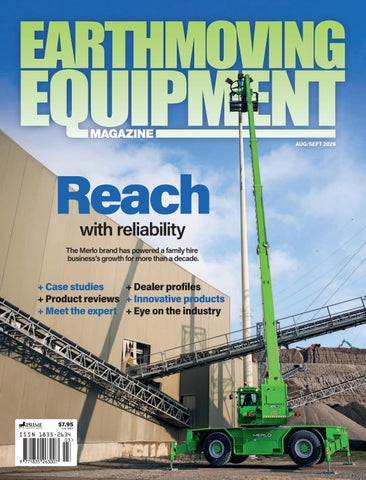
AUG/SEPT 2026
Reach with reliability
The Merlo brand has powered a family hire business’s growth for more than a decade.
+ Case studies + Dealer profiles + Product reviews + Innovative products + Meet the expert + Eye on the industry
$7.95
inc GST
Real productivity starts with the right machine.
Built to help operators get more done, every day. From compact excavators to large construction equipment, Komatsu machines are designed to deliver the performance, reliability and efficiency businesses depend on, because real productivity starts with equipment built for the job. Explore the Komatsu Construction & Utility range today.
1300 566 287 komatsu.com.au
This fleet of Hitachi excavators decked out in blue is proving indispensable for a Hervey Bay plumbing specialist. See story on page 100. Image: Hitachi Australia
Welcome Ray Chan Editor
Spatial technology is changing the way contractors approach construction and earthmoving, helping project teams deliver work with attention, efficiency, and less rework. As digital design data moves seamlessly from the office into the field, contractors today have more control over how work is set out, checked, and completed, with precision built into the process from the start. In this issue, we look at some examples of how this technology is helping to complete tasks with greater accuracy than before. Leica iCON build construction software, for example, has been developed to streamline positioning tasks while increasing speed and correctness throughout the construction process. Surveying can be straightforward when working on a square or rectangular building, but the challenges increase when structures feature curves, unusual angles, or complex shapes. Leica iCON allows users to take digital design files directly into the field, providing control over when and how critical elements are positioned and set out. It is a prime example of how spatial technology is becoming an integral part of the construction workflow. Machine control is also evolving beyond mere geolocation. CHC Navigation’s technology demonstrates how ease of use, workflow integration, and return on investment are important considerations for earthmoving contractors. While preciseness remains fundamental, the greatest value of machine control can come from the cumulative improvements it delivers across projects — reducing the need for repeated checks while lifting productivity and enabling operators to achieve the required results consistently. From there, we head to Outback Queensland, perhaps the last place you would expect to find the sort of rigour associated with highly controlled construction environments. Yet SITECH Solutions has helped bring advanced satellite navigation and machine control technology to a 250,000-hectare organic beef station, where a consultancy group is constructing a private airstrip to standards that would satisfy the most exacting civil aviation engineer. The assignment requires meticulousness down to the millimetre and centres on Trimble Earthworks, a grade control platform that transforms heavy machinery into construction tools. On this airstrip, precision is critical, with exactness
4 EARTHMOVING EQUIPMENT MAGAZINE | www.earthmovers-magazine.com.au
minimising material movements and ensuring the finished surface meets the required specifications. Elsewhere in the issue, our cover story turns to the equipment hire sector and the role telehandlers play in supporting construction activity in Canberra and surrounding regions. Starting with a fleet of electric scissor lifts servicing the ACT’s construction industry, a family business has evolved into a specialist independent equipment hire provider that has focused on one particular type of machine: the telehandler. For that company, that priority is inseparable from Merlo. Today, 25 of its 30 telehandlers carry the badge of the green machines, reflecting a partnership that stretches back about 25 years. The relationship continues to thrive, with the decision to invest in the brand based on reliability, customer confidence, and long-term value. In other news, JCB’s partnership with Adaptalift Group has stepped up a gear, with its official launch highlighting a shared focus on customer support and nationwide coverage. Customers, industry representatives, and company executives gathered at Adaptalift’s new facility in Truganina to mark the beginning of the collaboration and view JCB’s equipment offering. The launch even featured excavators performing a synchronised dancing routine. We were there to report on the event and what the partnership means for customers. We also bring you a range of case studies from across the country, examining how equipment and technology are being used by businesses to tackle specific challenges and initiatives. This edition features Komatsu machines working for a NSW contractor, John Deere equipment supporting a WA company, Kobelco excavators in the hands of a plumbing specialist, Dieci telehandlers transforming a Sydney warehouse operation, and Cat mulchers taking on demanding vegetation management work in Far North Queensland. There is plenty more to explore, from equipment insurance and water truck solutions to innovative products and dealer profiles. And, as always, we bring you the latest news from our industry partners, covering the developments, products, and people that move the earth — sometimes quite literally — across Australia’s construction and earthmoving sectors. We hope you enjoy the read.
WHEREVER THE NEED, WE’VE GOT YOU COVERED GLOBAL LEADER
NATIONAL NETWORK
LOCAL SUPPORT
Working a lunar surface may still be many moons away but who really knows? However one thing you can be sure of is that wherever you are, XCMG has you covered with a dedicated dealer network and an expansive machine range engineered by a global leader.
Now’s the time to contact your XCMG dealer and discover just how much value XCMG can bring to your business.
xcmg.net.au 1830XCMG
Earthmoving Equipment Magazine is published bimonthly by Prime Creative Media Pty Ltd.
CEO Christine Clancy Head of Sales Andrew Morrison Editor Ray Chan ray.chan@primecreative.com.au Brand Manager KahChi Liew kahchi.liew@primecreative.com.au 0421 474 407 Production Editor Michelle Alder michelle.alder@primecreative.com.au Art Director/Design Daz Woolley Subscriptions P. +61 3 9690 8766 subscriptions@primecreative.com.au Website www.earthmovers-magazine.com.au
Copyright
Earthmoving Equipment Magazine is owned by Prime Creative Media and published by John Murphy. All material in Earthmoving Equipment Magazine is copyright and no part may be reproduced or copied in any form or by any means (graphic, electronic or mechanical, including information and retrieval systems) without written permission of the publisher. The editor welcomes contributions but reserves the right to accept or reject any material. While every effort has been made to ensure the accuracy of information, Prime Creative Media will not accept responsibility for errors or omissions, or for any consequences arising from reliance on information published. The opinions expressed in Earthmoving Equipment Magazine are not necessarily the opinions of, or endorsed by, the publisher unless otherwise stated. © Copyright Prime Creative Media, 2026. Articles All articles submitted for publication become the property of the publisher. The editor reserves the right to adjust any article to conform with the magazine format. Head Office 379 Docklands Dr, Docklands VIC 3008 P: +61 3 9690 8766 info@primecreative.com.au www.primecreative.com.au Sydney Office Suite 11.01, 201 Miller St, North Sydney, NSW 2060
ON THE COVER
Reach with reliability
The Merlo brand has powered a family hire business’s growth for more than a decade.
$7.95
inc GST
earthmoving_equipment_mag Earthmoving Equipment Magazine Earthmoving Equipment Magazine
The Merlo brand has powered a family hire business’s growth for more than a decade.
6 EARTHMOVING EQUIPMENT MAGAZINE | www.earthmovers-magazine.com.au
10 On the cover 16 Meet the expert 20 Industry leaders 24 Industry auctions 27 Machine control 30 Industry insurance 32 Business and finance 35 Logistics leader 38 Equipment maintenance and service 44 Innovation leader 47 Water truck solutions 50 Hire solutions 52 Dealer profile 67 Case studies 98 Innovative products 132 Eye on the industry 134 Industry event 136 Construction and Mining Industry Group 137 NexGen 138 National Association of Women in Construction 139 Civil Constructors Federation Queensland A Cat® 315 excavator equipped with a Cat HM2615 Forestry Mulcher makes light work of clearing dense vegetation in Queensland. See story on page 88. Image: Prime Creative Media
140 Allied Earthmovers Association
www.earthmovers-magazine.com.au | EARTHMOVING EQUIPMENT MAGAZINE 7
MOVING YOUR MACHINERY WITH US
JETLAND LOADING RAMPS ARE
NOW AVAILABLE FOR PICKUP IN BRISBANE, QUEENSLAND. JETLAND is a leading supplier of high strength & heavy duty Aluminium loading ramps in Australia. High quality raw material and safety testing systems ensure a safe and reliable product. No manufacturing delays, all ramps listed
online are in stock at our warehouse in Mordialloc, Victoria.
We can also supply Custom
built ramps - made to your specifications for your particular needs.
Free Delivery
Australia wide.
0420 815 988 jetlandramps@gmail.com Rear 211-219 Boundary Road Mordialloc Vic. 3195 18 Reis St, Woolloongabba QLD. 4102
jetlandramps.com.au YOUR SAFETY IS OUR PRIORITY
Zaxis-7
YOU’RE IN CONTROL.
Hitachi Construction Machiner y Australia
Be in control with the 7 Series excavators and wheel loaders.
Long-term confidence in one equipment brand can shape not only a hire fleet, but also the way a business supports its customers for years to come. Starting with a fleet of electric scissor lifts servicing Canberra’s construction industry, family business Asset Construction Hire (ACH) has evolved into a specialist independent equipment hire provider for the ACT region. The company now offers more than 1000 individual hire items across almost every category of construction and industrial equipment. Along the way, it has mainly used one type of equipment: telehandlers. For ACH, that dependence is inseparable from Merlo. Today, 25 of the company’s 30 telehandlers wear the distinctive Merlo badge, reflecting a partnership that stretches back to 2011 and continues to underpin construction projects across Canberra and surrounding regions. According to ACH General Manager Hunter Cocks, the decision to invest in Merlo has always been about reliability, customer confidence, and long-term value. “ACH invests in trusted and reputable brands. We stock Merlo equipment, which has proven to be reliable and well-supported,” he said.
Local beginnings
ACH’s story began in 2010 when Canberra builder Peter Leemhuis identified a gap in the hire market. Following the acquisition of a local equipment hire company by a national operator, he recognised that Canberra builders were losing access to a supplier that understood the unique needs of the region’s construction industry. Rather than accept the change, Peter decided to create an alternative. Initially purchasing elevated work platforms for his own construction projects, he realised the machines could continue generating value after each project was completed. A sales representative was
brought on board to hire the equipment to other contractors, laying the foundations for what would become Asset Construction Hire. Born and raised in Canberra, Peter understood the value of local knowledge, trusted relationships, and responsive service. Those principles remain embedded within the business today. Now celebrating its 15th year, ACH remains locally owned by fourth-generation builders and has grown into an independent equipment hire company, while retaining its familybusiness culture.
in Fyshwick, enabling it to offer a range of equipment readily available to contractors, tradespeople, and DIY customers. The move reflected the company’s continued investment in customer service rather than fleet size. “We’ve invested heavily in making hires as easy as possible,” Hunter said. “Using cloud-based booking systems, modern payment technology and
Beyond access equipment
Although elevated work platforms formed the company’s original focus, customer demand quickly drove diversification. Today, ACH provides equipment across a range of other applications, including telehandlers, forklifts, earthmoving and material handling equipment, landscaping machinery, and general hire products. In 2022, the company expanded its capabilities with the opening of a purpose-built General Hire branch
The Merlo machines are used for tasks such as material handling, along with loading and unloading. Images: ACH
10 EARTHMOVING EQUIPMENT MAGAZINE | www.earthmovers-magazine.com.au
A Merlo P40.17 being delivered to the ACH facility.
streamlined customer processes, ACH focuses on getting customers onto site quickly rather than creating unnecessary administration.” Behind the scenes, that customer experience is supported by about 40 local employees: experienced in-house mechanics, mobile service technicians, account managers, and administration staff who ensure equipment remains available, reliable, and well-maintained.
Supporting every stage
While the public can hire equipment from ACH, construction remains the company’s core market. ACH enjoys relationships throughout Canberra’s building industry and supports
Master Builders ACT as a Premium Partner, while being a naming rights sponsor of the organisation’s Excellence Awards. The company supplies equipment to all sectors from sole operators through to major commercial construction companies. “Our business model isn’t just about supplying equipment,” Hunter said. “It’s about supporting customers first and foremost. Our team is always available to answer questions, provide advice and guidance, and help when times are tough. “Technicians respond quickly to breakdowns, mechanics maintain fleet reliability, and staff work closely with customers to ensure the right machine is selected for each application.”
The rise of the reacher
As Canberra’s construction industry expanded, so too did demand for versatile material handling equipment. Telehandlers became an important part of ACH’s fleet because of their ability to perform multiple lifting, loading, and positioning tasks with a single machine. “They’re ordinarily the first thing onto a construction site and the last thing off,” Hunter said. “Whether unloading deliveries, lifting structural steel, positioning roof trusses, transporting palletised materials across rough terrain, or assisting with finishing works, telehandlers have become indispensable across construction.
The ACH fleet includes a Merlo Turbofarmer TF30.9 telehandler.
www.earthmovers-magazine.com.au | EARTHMOVING EQUIPMENT MAGAZINE 11
The Merlo P25.6 features hydraulic stabilisers that provide greater stability for safe, confident lifting.
A Merlo P25.6 compact telehandler used for its lifting capacity in construction.
mechanic team and also our ability to service, repair, and repaint equipment as needed.” From that first investment, the fleet has steadily expanded. Today, ACH operates Merlo P25.6, P36.10, P40.17, P40.17E and TF30.9 models, meaning the brand now accounts for more than 80 per cent of the company’s telehandler fleet. That level of commitment reflects years of positive ownership experience combined with customer demand. “Our clients have advised that they preferred Merlo machines on site,” Hunter said.
On the move
“Our 30 machines range from compact 2.5-tonne, six-metre units through to powerful 4t, 17m machines, including diesel and electric models.” The machines are used for tasks such as material handling, structural steel placement, pallet movement, loading and unloading, high-rise construction, low-density residential developments, and various industrial projects. Complementing the fleet are numerous
attachments including jibs, sweepers, and specialist lifting accessories that further expand machine versatility. The first Merlo entered the ACH fleet in 2011. “That machine, a Merlo P25.6, remains operational today,” Hunter said. “Its longevity is testament not only to the quality of the equipment, but also to ACH’s own maintenance standards. “It is still serving us thanks to the work of our
12 EARTHMOVING EQUIPMENT MAGAZINE | www.earthmovers-magazine.com.au
For a hire company, machine uptime is everything. Breakdowns affect multiple stakeholders, from the hire company itself to builders, sub-contractors and project schedules. “The Merlo reliability, accessibility of parts, support, training, and ease of maintenance — those qualities directly translate into better outcomes for customers,” he said. “Reliable equipment reduces downtime, while simple diagnostics enable technicians to quickly identify and resolve issues should they occur. “The availability of replacement parts minimises disruption, ensuring machines spend more time earning revenue on site rather than sitting idle in workshops.”
Familiarity breeds productivity
Another advantage of maintaining a consistent fleet is operator familiarity. Hunter said many builders regularly request Merlo machines because operators already know the controls and machine behaviour. That familiarity reduces induction time and helps maintain productivity. ACH’s Merlo fleet is continually working across a variety of projects. From major commercial developments and apartment towers through to residential housing, infrastructure upgrades and industrial facilities, the machines perform lifting and material handling tasks every day. “Their versatility allows contractors to maximise utilisation while reducing the number of specialised machines required on site,” Hunter said. “The repeated hiring of the same machines by long-term customers provides perhaps the strongest endorsement of their performance. This proves the Merlos are meeting customer expectations and performing well.”
priority whenever new fleet investments are considered. “That partnership complements ACH’s own workshop capabilities, allowing the business to maintain high fleet availability while providing customers with confidence that any issues can be resolved quickly,” he said.
Investing for the future
As construction activity continues throughout Canberra and surrounding regions, ACH expects its telehandler fleet to remain one of the company’s most important equipment categories. “The growth of the telehandler fleet has been
essential to the business’ success,” Hunter said. “It complements our investments into forklifts and other material handling gear, so we can be sure to stock the right kinds of equipment for the variety of projects that our customers are undertaking.” Hunter said that Merlo has become an important part of ACH’s story — not just because the machines perform well, but because they deliver the reliability, versatility, and customer confidence that ACH demands from its investments. Hunter’s advice to other hire companies considering Merlo is straightforward: “Do it — they are great units.”
Strong support
Currently sourcing its Merlo equipment through STM in Sydney, ACH places importance on after-sales service. Hunter praised the parts availability and support from the dealer, which he said was a
The greatest of all time? This agricultural Merlo P27.6 telehandler boasts a panoramic cab designed for visibility.
On-site versatility is why Merlo Telehandlers are popular in the ACT construction industry.
www.earthmovers-magazine.com.au | EARTHMOVING EQUIPMENT MAGAZINE 13
Every CVA is backed by expert Cat dealer support and genuine Cat parts. Images: Caterpillar
Cat® Customer Value Agreements give machinery owners the confidence of expert support to maximise uptime and keep work moving. In an industry where every hour of downtime carries a cost, predictability isn’t a luxury, it’s non-negotiable. Caterpillar describes Customer Value Agreements (CVAs) as an open door to easy ownership: a flexible way to manage equipment and maintenance needs, giving businesses the
confidence that their equipment will perform at its best on every job. Whether a Cat machine was bought from a dealer or reseller, operated as a single unit or a full fleet, and maintenance handled by the owner or left to the dealer, there’s a Cat CVA designed to match the work.
Cat CVAs help owners take a proactive approach to maintenance.
Every new Cat CVA includes a Services Commitment, giving confidence with promised next day availability on maintenance, wear and common repair parts1, so equipment can be kept working without delay. For CVAs that include dealer-performed repairs, this commitment extends to common repairs being completed within two days or when scheduled2. If either applicable commitment isn’t met, the business will earn Cat Credits*, giving greater certainty on parts, repairs and uptime.
For owners who maintain their own equipment
Prefer to handle servicing in-house? This option is built for that. Owners receive planned maintenance parts timed to their service intervals, complete with step-by-step instructions tailored to their specific equipment and schedule. Add an annual inspection, an Equipment Protection Plan (EPP) on new machines, and ongoing fluid health monitoring, and they have a complete self-service package backed by Caterpillar’s expertise.
For complete, end-to-end support
Ready to hand over the spanner? Add dealer labour to the CVA and let expert Cat technicians take care of everything: from inspections and S·O·SSM Fluid Analysis to 16 EARTHMOVING EQUIPMENT MAGAZINE | www.earthmovers-magazine.com.au
Add dealer labour to the CVA and let expert Cat technicians take care of everything from inspections and fluid analysis to ongoing condition monitoring.
ongoing Condition Monitoring and routine maintenance. It’s full peace of mind, delivered by the Cat dealer network that knows the equipment best.
Trust and reliability
Every CVA is backed by expert Cat dealer support and genuine Cat parts. VisionLink™ delivers real-time equipment insights; from operating hours, location, fuel usage and
maintenance alerts straight to your fingertips. Fluid health analysis tracks the condition of oil, fuel and coolant to flag potential issues before they lead to unplanned downtime on site. If you already own Cat equipment and want to safeguard critical components, CVAs for Ground Engaging Tools and Undercarriage provide targeted options to extend component life and reduce repair costs.
A proactive approach to ownership
Cat CVAs help owners take a proactive approach to maintenance, with a long-term plan that absorbs the unforeseen hiccups and reduces total cost of ownership across the machine’s lifespan. Backed by Caterpillar’s expertise and genuine Cat parts, machinery holds its value for longer and stays more productive for the business. CVAs bring parts delivery, inspections and highly responsive service together to help maximise uptime and the bottom line.
Find the Cat CVA that fits
No two operations are the same, and the CVA shouldn’t be either. Talk to your local Cat dealer today to build a CVA around your equipment, your workload and the way you like to work. Discover why more owners are choosing the certainty of a CVA to keep their business moving. For more information, visit: www.cat.com/en_AU/support/ maintenance/customer-valueagreements/construction-cvas/ services-commitment.html
The Cat CVA includes a Services Commitment, giving confidence with promised availability of maintenance, wear and common repair parts.
1 Next Day response is by the end of the next business day after initial contact or the customer’s requested Order Need-By-Date. 2 Second Day response is provided by the end of the second business day from initial customer contact, with calls outside dealer business hours considered received at the start of the next business day. * All Cat Customer Value Agreements (CVAs) include a maintenance parts availability commitment. CVAs with dealer labour include technician response and repair parts commitment. There can only be an unmet parts availability commitment or an unmet service commitment under a CVA, not both. Dealer participation may vary. Subject to restrictions and availability. See your participating Cat dealer for details.
www.earthmovers-magazine.com.au | EARTHMOVING EQUIPMENT MAGAZINE 17
*Offer available on selected products and one order only. Offer expires 11:59pm, 1 September 2026. Please see full terms and conditions at www.vivaenergy.com.au/shoptandc
DEERE.COM.AU/EN/MOTOR-GRADERS/
SCAN TO LEARN MORE
60 YEARS OF INNOVATION, GROUNDED IN PURPOSE. NEVER IDLE For more than 60 years in the Motor Grader business, we’ve been putting our customers first. That’s why our new P-Tiers puts operator comfort front and centre. Expect productivity to move to the next level thanks to upgraded cab amenities that compliment superior machine engineering… advanced tech and automation for premium performance; fully integrated SmartGrade for greater accuracy; and Premium Circle to eliminate wear and adjustment delays! Check out the new P-Tier Motor Graders and take your productivity to the next level.
P-TIER
MOTOR GRADERS
1708JHNDRE
The Divalls fleet includes this Komatsu PC220, a mid-sized hydraulic crawler excavator used for construction work. Images: Komatsu Australia
From its first Komatsu excavator to a fleet of 75 machines, Divalls Earthmoving has built a long-standing partnership with Komatsu based on reliability, support and trust. Goulburn-based family business Divalls Earthmoving has been a consistent user of Komatsu’s technology solutions and machinery for many years, beginning in the early 1990s with a single PC220-6 excavator.
According to Managing Director Andy Divall, that first machine gave the business “no reason to change”. “The reliability, the warranty, and the support all spoke for themselves. People often ask why Jack (left) and Andy Divall with a Komatsu PC170LC-11 excavator.
20 EARTHMOVING EQUIPMENT MAGAZINE | www.earthmovers-magazine.com.au
we keep buying Komatsu and the answer is simple: when something works, you stick with it,” he said. Established more than 55 years ago, Divalls has grown into a civil contractor with a fleet of 75 machines working across regional New South Wales. Today, it employs 350 people and delivers civil construction, renewable energy, quarrying, farming, and mining projects across the state, using Komatsu excavators, wheel loaders and dump trucks. This has led Divalls to continue investing in Komatsu equipment, with machines working across local civil works, quarry operations and renewable energy developments, including wind farms and the Snowy Hydro 2.0. It recently added a new PC220LCi-12 excavator with intelligent Machine Control 3.0 (iMC 3.0) to its fleet and reported an improvement in performance. The model’s cab has been designed as a comfortable, technology-enabled, and efficient working environment for operators. “The PC220LCi-12 is a step up for us in terms of the technology. It’s faster, more intuitive,
A pair of Komatsu excavators carrying out heavy-duty earthmoving, construction, and quarry work for Divalls.
and more operator-friendly, especially when it comes to training new operators, who can learn on the machine more quickly,” Andy said. The relationship with Komatsu also extends to the next generation. Divalls’ associated businesses, Advanced Civil and Rail, led by Andy’s son Jack, and Waugh Brothers, led by Jake Waugh, have also invested in Komatsu equipment. “When you’re working on remote projects, reliability is critical. Our machines need to perform day in, day out, and we know our Komatsus can do that,” Jack said. “We recently added one of the new WA475-10 wheel loaders and found the technology and fuel efficiency strong enough that we now have two in our fleet.” Reliability is supported by Komtrax, Komatsu’s remote monitoring and fleet management system, which Divalls uses to manage machines working across multiple sites. “Komtrax gives us a picture of what’s
happening across our fleet, no matter where the machines are working. We can see how they’re being used, monitor machine health, and stay on top of maintenance before issues become major problems. With so many machines working across different sites, having that visibility helps us keep the fleet productive and make better day-to-day decisions,” Jack said. Andy said the ongoing relationship with Komatsu is based on both the machines and the level of support. “The sales, service and Smart Construction teams stay closely involved with our business and are available when we need them. We know if we pick up the phone, someone will be there to help,” he said. Sustainability is another area where Divalls has been quick to adopt new technology. Driven by Andy’s focus on reducing environmental impact, the business has trialled the Komatsu PC210LCE-11 electric excavator and continues to invest in hybrid excavators.
A Komatsu PC138US used by one of Divalls' associated businesses, Advanced Rail and Civil.
“I’m always looking at ways we can work smarter and cleaner, and partnering with Komatsu has allowed us to explore new technologies that support that,” he said. “The hybrid excavators were a logical choice, particularly in crushing applications where they deliver measurable fuel savings. A standard excavator might burn around 16 litres of fuel an hour, while the hybrid can do the same work on around eight litres. That’s about a 50 per cent reduction in fuel burn in the right application.” Having visited Komatsu’s manufacturing facilities in Japan, Andy said seeing the production processes firsthand aligned with his experience over decades of ownership. “When you’ve seen how they’re built and then watched them perform on site year after year, it gives you even more confidence,” he said. “We’ve been buying Komatsu for a long time because they’ve never given us a reason to change. That’s a relationship we intend to maintain.” Divalls noticed a big step up in speed and intuition with the new PC220LCi-12 with iMC 3.0.
www.earthmovers-magazine.com.au | EARTHMOVING EQUIPMENT MAGAZINE 21
SELL WITH US
Secure value with Pickles Industrial
c
As Australia’s auction leader, our priority at Pickles is to maximise value at every turn. That’s why we’re the preferred partner of businesses across the country, who gain access to an extensive network of competitive buyers and an expansive digital presence. Whether you’re offloading excess assets or realising maximum returns, Pickles is ready to steer you to success.
Find what you need at pickles.com.au
Renewable vehicles are suited to mining industries because the operational environment mitigates issues with range and charging. Images: Pickles
The used equipment industry is being transformed by demand for sustainability-driven machines. Across the industrial sector, sustainability goals are driving a shift toward the adoption of renewable machinery and alternatively powered equipment. Driven by mandatory climate reporting, supply chain decarbonisation, and occupier net-zero targets, businesses are responding to regulatory and customer sustainability requirements. In particular, the transport industry is being reshaped by this shift, with the incorporation of hybrid (HEV) and electric vehicle (EV) truck and transport models increasing. Though the current sustainability model indicates that progress will be gradual, the increasing use of HEVs and EVs, along with the evolving market for retrofitting second-hand green equipment, is evidence of the change. Even as the high initial costs for new green assets — and the limitations posed by a lack of eco-friendly infrastructure — have slowed the spread of emission-free vehicles, the opportunities are growing. In addition, increased competition and original
equipment manufacturer (OEM) participation have led to price reductions in electric trucks, with the market maturing over the past two years. Smaller brands entered the market first and saw a return on their risk-taking, which led to major OEMs entering the space and prompting an increase in production. As a result, prices halved for the trucks, making them more accessible and accelerating uptake. Where Australia is seeing the most progress in eco-friendly implementation is in fixed-route applications such as urban delivery, waste collection, and mining. In these industries, predictable routes and closed environments make EVs and HEVs more practical. The vehicles operate on fixed routes and return to base regularly, ensuring reliable charging and operational predictability. In mining, renewable vehicles are suited because the operational environment mitigates range and charging concerns. There is a growing demand for HEVs and EVs in the transport sector, especially for
24 EARTHMOVING EQUIPMENT MAGAZINE | www.earthmovers-magazine.com.au
hybrid trucks within the small-to-medium rigid categories. For many major retailers in Australia, these are becoming popular as a transitional solution due to their reliability and operational flexibility. In this space, large operators benefit from government and corporate incentives that offset the financial losses from rapid depreciation, making it more viable for them to adopt green fleets. Generally, electric trucks depreciate in value within a few years, but this creates opportunities for smaller operators to acquire affordable, used green vehicles, often supported by government or corporate subsidies. For a long time, the cost of renewable trucks was so high that making the transition was unattainable, but with the expansion of models available on the market, particularly with affordable options, this has changed. Many OEMs out of Asia have begun producing models, which has created a competitive market for renewable trucks, which will help keep prices down as these assets
trickle down into the used marketplace. This price deflation has happened in the past two years and is expected to continue for the next few to come. The efforts taken to remove these economic barriers support Australia embracing an electric future going forward. The availability of grants and financing for large and small operators seeking to adapt to the transition is increasing. While these grants were originally big amounts handed out to large-scale operations, the industry is seeing more financial opportunities set up to fund smaller businesses to move to renewable projects as sustainability gets embraced. Although confidence is growing in renewables, the expansion of infrastructure will be a slow process. This is despite the fact that investment is being made in developing refuelling and charging infrastructure along the eastern seaboard, with the Federal Government’s $500 million “Driving the Nation” fund backing the Australian Renewable Energy Agency’s ambitions for the future of the country and industry. Beyond the speed at which Australia is developing infrastructure to support green initiatives, the country’s distances, sparse population, and remote locations make it difficult to deploy and support large numbers of renewable vehicles. Often, infrastructure investment is harder to justify in Australia than in densely populated
The transport industry is being reshaped by the shift towards sustainability and the use of electric vehicles.
regions, with OEMs deterred by Australia’s small size and isolation, and therefore more willing to invest in larger, more accessible markets like Europe. An uplift in interest in sustainable equipment and machinery has also naturally occurred in the wake of recent geopolitical tensions. While the full extent of Australia’s dependence on importing petroleum from overseas has been exposed, it has left businesses seeking
alternative solutions to challenges in the short term. What this means for the long term is uncertain at this stage, with investment into infrastructure that supports green initiatives moving slowly, relative to Australia’s overseas competitors. If you’re looking for further insights, get in touch with a Pickles expert by heading to pickles.com.au. There is a growing demand for hybrid trucks within the small to medium rigid categories.
www.earthmovers-magazine.com.au | EARTHMOVING EQUIPMENT MAGAZINE 25
Complete awareness on-site. Learn more about xwatch solutions xwatch.com.au
REDEFINED SAFETY WITH 3D AVOIDANCE ZONES The XW Series creates a total safe working envelope around the machine and operator enabling the control of the machine’s height, slew and rated capacity indication. This comprehensive system covers every eventuality when considering both operator and machine safety, offering complete peace of mind.
XW1
XW2
XW3
XW4
XW5
Height Control Slew Control Rated Capacity Indicator (RCI)
VIC (Head Office) 03 9823 1533 | NSW 02 9552 8300 | QLD 07 3862 6210 SA 08 8410 0533 | WA 08 9489 8500 | TAS 03 9823 1850
sales@crkennedy.com.au | survey.crkennedy.com.au
From high-rise developments through to civil infrastructure, digital construction technology is helping businesses improve productivity while maintaining quality standards.
The Leica iCON site excavator system supports compact excavators equipped with swing booms, tiltrotators, and tilt buckets. Images: Leica
Construction projects are becoming complex, placing demands on contractors to deliver work accurately, efficiently, and with minimal rework. Leica Geosystems’ iCON range comprises products designed for these challenges, offering positioning technology that supports a spectrum of construction applications. Whether it’s vertical construction, civil engineering, or large-scale earthmoving, the Leica iCON platform is designed to simplify workflows, improve accuracy, and provide contractors with greater control over project delivery. At the centre of the range is Leica iCON build construction software, developed to streamline positioning tasks while increasing speed and precision throughout the construction process. Its flexibility allows contractors to apply the same technology across multiple disciplines, making it suited to commercial building projects, complex structural work, and intricate infrastructure developments. For civil construction and heavy earthmoving applications, the Leica iCON site platform extends those capabilities by delivering machine guidance and positioning solutions designed for demanding field environments. It can be configured across a variety of construction equipment and project types, giving contractors a scalable solution that adapts as business requirements evolve. The Leica iCON site excavator system is a
good example of this versatility. Optimised for excavation work, it supports compact excavators equipped with swing booms, tiltrotators, and tilt buckets, helping operators complete earthmoving tasks with greater efficiency and accuracy. It can be used in conjunction with a range of iCON field controllers, while the new GNSS
receiver and communication device are designed specifically for compact machines, allowing greater flexibility to adjust to different sites and project requirements. Overall, the Leica iCON suite’s blend of speed, performance, and enhanced accuracy, coupled with its adaptability, supports modern construction management and execution. Leica systems can be used in conjunction with a range of iCON field controllers.
www.earthmovers-magazine.com.au | EARTHMOVING EQUIPMENT MAGAZINE 27
Expanding beyond
Leica Geosystems is solely distributed throughout Australia by C.R. Kennedy. According to C.R. Kennedy Segment Manager – Building Construction Bernie Edmonds, many customers initially invest in Leica iCON for a single purpose before discovering the technology has wider applications throughout their business. “You see examples of it all the time,” he said. “All the Leica iCON products used on construction machinery are based on the same system originally designed for vertical construction. The base hardware is similar, as are the core mapping applications.” Bernie said this common platform allows businesses to transfer knowledge between different project types without having to learn new systems. “There’s a lot of crossover with the software as well,” he said. “If your business knows how to use it in a vertical construction context, chances are you’ll be able to translate that for use by a foreman on a civil infrastructure job.”
Example in action
Victorian construction and building services company Haddarco provides an example of how the technology can evolve within a business. The company originally adopted Leica iCON to improve building set-out, before expanding its use into landscaping, external works, and civil construction activities as confidence in the system grew. Since 1965, Haddarco has delivered projects across the commercial, education, community, medical, and aged care sectors. As project designs have become increasingly sophisticated, Director Mohammed Haddara said the business found itself relying on external surveyors for critical set-out and positioning work.
The curved structures of the ICOM building were easy to survey, thanks to the Leica software. Images: Haddarco
That dependency became evident during construction of the first stage of the Islamic College of Melbourne (ICOM) project in Melbourne’s west during 2021. “Surveying can be straightforward if it’s a square or rectangular building, but when the structure is curved or an odd shape, things get more challenging,” he said. “We had to get surveyors in for various elements of each project, costing us money and time having to wait for them to arrive.” When Haddarco secured the second stage of the project in 2022, the company decided to implement the Leica iCON surveying system. The impact was immediate. Using Leica iCON, Haddarco’s project teams could take digital design files directly into the field, giving them complete control over when and how critical project elements were positioned and set out. “It saved us so much time and was extremely accurate,” Mohammed said. “We input all the
drawings into the system and our fabricator then made up his own 3D model, which was checked against the drawings and then confirmed.” The technology has since become standard across Haddarco’s operations. Project teams now rely on Leica iCON for set-out on every project, reducing the time previously spent measuring and establishing grid lines. Beyond the productivity improvements, the digital workflow has also reduced the potential for human error during layout, helping minimise costly rework and unnecessary material waste.
Support builds confidence
Mohammed said the performance of the Leica iCON system was matched by the support provided by C.R. Kennedy throughout the evaluation, purchase and implementation process. “The service was what truly got us over the line to purchase the Leica iCON,” he said. “C.R. Kennedy brought the system to our site for a demonstration and even allowed us to keep it for a few weeks as a trial. “We started using it and loved it, so leased the unit for another month, and received awesome technical advice along the way, either immediately over the phone or from a C.R. Kennedy technician who would come out the next morning and show us how to use it. “There was support there before we even purchased the Leica iCON, and when we purchased the system, they supported us even more. After that, we were completely convinced that investing in the Leica iCON from C.R. Kennedy was the right move.”
Fit for the future
Haddarco inputted all the architectural drawings for the ICOM project into the system.
28 EARTHMOVING EQUIPMENT MAGAZINE | www.earthmovers-magazine.com.au
C.R. Kennedy supplies the Leica iCON range through a national network of more than 260 staff located across Melbourne, Brisbane, Adelaide, Sydney, Hobart, Perth and Cairns. With digital construction continuing to reshape the industry, Leica iCON is providing contractors with a flexible technology platform capable of improving accuracy, productivity, and efficiency across every stage of construction.
ONLY A 10% DEPOSIT REQUIRED!
E10, E17 & E20 EXCAVATORS
0% FINANCE OVER 36 MONTHS
*
*0% over 36 month finance is offered on new Bobcat E10, E17 and E20 excavators on a chattel mortgage with 10% deposit required, followed by equal monthly repayments and no balloon. Finance is subject to credit approval and is only available to approved ABN holders. Not available in conjunction with any other offers. Terms and conditions apply. For further details, contact Clark Equipment.
Distributed by
1300 736 848 www.bobcatofaustralia.com.au
STRICTLY LIMITED TIME ONLY!
SELECTED EXCAVATORS
SAVE $10,000 WITH A FACTORY REBATE *Saving applies to selected Develon DX140LCR, DX225LC-7M and DX300LC-7M excavators. Factory rebate by way of discount on machine at time of sale. Not available in conjunction with any other offers. Terms and conditions apply. For further details, contact Clark Equipment.
1300 736 848 www.develonequipment.com.au
Distributed by
*
When it comes to reducing downtime, the value of a specialist mobile plant and equipment repair network cannot be underestimated. When a machine stops on site, it can feel like the clock starts ticking along with the costs. For contractors, owner-operators, plant hire businesses, quarry operators, and earthmovers, mobile plant and equipment (MPE) is often the backbone of the business, and that’s why the repair pathway matters. NTI’s MPE Repairer Network was developed to connect customers with accredited specialist repairers who understand the complexity of working machinery, and the urgency of getting equipment back on the job. For equipment owners, the repair process can matter just as much as the insurance policy behind it. It’s not only about whether a claim is paid, but also how quickly the machine is assessed, how accurately the damage is scoped, and whether the repairer understands what’s at stake when equipment is off the job. As NTI’s National Manager, Repairer Networks, Adam Craft, explains, the network was built with operators front of mind. “These machines are relied upon by contractors, owner-operators, plant hire businesses, and farmers. We know how critical this equipment is to our customers, so we’ve built a network that prioritises speed, quality, and trust,” he said.
Why specialist expertise matters
Downtime is rarely simple. One damaged machine can affect an entire job sequence, with flow-on impacts for labour, project timing, and income. Adam said this was one reason NTI placed such a strong emphasis on the repair pathway. “The goal isn’t just to repair the damage, but to reduce friction throughout the process,” he said. “Our MPE Repairer Network is part of this approach, helping customers manage disruption and get back to work, on average, nine days faster than competitors.”* Adam said damage isn’t always obvious at first glance. What may appear to be a straightforward repair can reveal deeper structural, hydraulic, or electrical issues once the machine is inspected. “Identifying those issues early is critical,” he said. “Missed damage, or the wrong repair method, can lead to delays, repeat work, or ongoing performance concerns.” That is why NTI’s network is built around accredited repairers who must meet strict criteria, demonstrate technical capability, and align with the company’s customer-first approach. “We’ve handpicked experienced, professional repairers who are not only among the best in the business, but who understand the urgency of getting businesses moving again,” Adam said. “These repairers don’t just fix machinery; they help get livelihoods back on track.” For many owners, much of the repair process happens out of sight. Before machinery reaches
Missed damage on equipment can lead to delays or ongoing performance concerns. Image: NTI
a workshop, it may need to be recovered from a difficult or remote location. From there, the damage is assessed, parts are sourced, a repair scope is prepared, and claim requirements are worked through. Each step impacts how quickly the machine returns to work. RD Williams has been a specialist MPE repairer and NTI partner for more than 20 years. Its General Manager, Fred Carlsson, said experience and preparation made the difference. “We’re dealing with highly specialised machinery, and we understand what’s at stake,” he said. “It’s about delivering trusted, high-quality repairs with the speed and professionalism our industry needs to keep moving.”
Setting the benchmark
By working with repairers who understand MPE and NTI’s claims expectations, repairs are better coordinated from the outset. For NTI customers, that means clearer communication, fewer unnecessary delays, and greater confidence that the repair is managed by people who understand the equipment
30 EARTHMOVING EQUIPMENT MAGAZINE | www.earthmovers-magazine.com.au
and how important it is to the business. When a machine is off the job, every hour matters — and a specialist repair network can help make those hours count. To learn more, visit www.nti.com.au/ insurance/mobile-plant-equipment or speak to your broker about specialist insurance. 2026 NTI Limited ABN 84 000 746 109 AFSL 237246. Policy terms, conditions, limits, exclusions and underwriting criteria apply. This article contains general information only and does not take into account your objectives, financial situation or needs. When making decisions about our insurance, consider the PDS and TMD at www.nti.com.au. Insurance products are provided by National Transport Insurance, a joint venture of the insurers CGU Australia Pty Ltd trading as CGU Insurance ABN 62 004 478 960 AFSL 700014 and AAI Limited trading as Vero Insurance ABN 48 005 297 807 AFSL 230859 each holding a 50% share. National Transport Insurance is administered on behalf of the insurers by its manager NTI Limited ABN 84 000 746 109 AFSL 237246. *Based on independent research conducted in 2020.
At NTI we’ve always been successful in finding new ways to keep our customers truckin’, shippin’ and diggin’. With specialist insurance and roadside assistance products designed to protect Australian businesses and families, NTI is the specialist our customers can count on in their time of need.
Insurance products are provided by National Transport Insurance, a joint venture of the insurers CGU Australia Pty Ltd trading as CGU Insurance ABN 62 004 478 960 AFSL 700014 and AAI Limited Trading as Vero Insurance ABN 48 005 297 807 AFSL 230859 each holding a 50% share. National Transport Insurance is administered on behalf of the insurers by its manager NTI Limited ABN 84 000 746 109 AFSL 237246.
James Allan (left) and Daniel Salajan. Images: MFG
MFG's range extends
from earthmoving machinery to aircraft and specialised manufacturing equipment.
For earthmoving businesses, access to equipment finance can be the difference between standing still and securing the next opportunity. As machinery costs rise and project pipelines expand, operators are seeking finance partners who understand not only lending, but also the realities of running a heavy industry business. That knowledge sits at the heart of MFG Finance, a specialist equipment finance brokerage that helps businesses acquire the plant, machinery, and equipment they need to grow. Established in Sydney in 2022 as Machine Finance, the company has evolved into a national operation serving clients across Australia. In May this year, the business rebranded to MFG Finance, reflecting the expansion of its client base beyond its original earthmoving roots. MFG works with businesses across construction, earthmoving, mining, transport, aviation, manufacturing, agriculture and farming, while remaining focused on one area of expertise: equipment finance. The company was founded by James Allan, who said it delivered a comprehensive, experienced, strategic and technical finance solution to growing businesses. “We specialise in heavy equipment finance for businesses from start-ups to corporatesized firms that utilise finance to buy plant and equipment,” he said.
Industry expertise
James’ pathway into finance began long before the launch of MFG. When he was 18 years old, he secured his first professional role with a national forklift leasing and sales business, where he was introduced to the world of equipment acquisition, leasing, and finance. The experience sparked an interest that would shape his career. He moved into finance, beginning as a cadet before progressing into credit analysis and later equipment finance broking. Those early years provided invaluable technical knowledge. “The five years in credit saw me working on the technical side of finance where my job was to review client financials, taxes, banking and debt spreads, as well as negotiating approvals with banks and understanding lender policy,” James said.
“This gave me insight into the finance world and a skillset unmatched by many brokers, who often join the industry without first spending time learning how to fully review a business financially.” After more than a decade working within large equipment finance brokerage firms in Melbourne and Brisbane, James established his own business, bringing with him an established client and referral network. Today, MFG operates from offices in Sydney and Melbourne, with Melbourne-based partner Daniel Salajan joining the business in 2025 before becoming a shareholder. Together, the pair support businesses nationwide, frequently travelling to meet clients face-to-face on work sites, in workshops, and in boardrooms.
Filling a gap
The origins of MFG stem from James’ belief that many business owners were not receiving the level of strategic support they required from traditional lending channels. He had observed that much of the finance industry was focused on transaction volume and new business acquisition, often at the expense of deeper client relationships. “I noticed the traditional finance broker and business banker model in Australia can often be sales-driven and volume-focused,” he said. “We launched MFG with the intent of becoming a firm that could fill that gap.” Rather than focusing on monthly sales targets or transactional lending, MFG positions itself as a long-term finance partner for its clients. The company works closely with businesses to understand their growth plans, lending capacity, and future equipment requirements, helping clients develop funding strategies well before a machine purchase is required. “We operate more like an independent outsourced equipment consultant to our clients,” James said. “Our time is focused on servicing existing clients and those who want to work with us.” That approach allows MFG to assist businesses in understanding how lenders assess financial performance, helping operators prepare for future growth opportunities and larger funding requirements.
32 EARTHMOVING EQUIPMENT MAGAZINE | www.earthmovers-magazine.com.au
“We can talk shop on a deeper level with our clients,” James said. “We can help them see their business through the lens of how the banks will.”
Every stage of growth
MFG supports businesses ranging from owner-operators purchasing their first machine through to enterprises generating more than $100 million in annual turnover. The company offers a range of equipment finance products including chattel mortgages, leasing, and rent-to-own structures, tailoring solutions to individual business circumstances. “One area of growing demand is preapproved equipment funding facilities, often referred to as master asset finance limits,” James said. “These facilities provide businesses with approved funding ceilings that can be drawn upon throughout the year as new equipment requirements arise. “Rather than seeking lender approval for every individual purchase, operators can access funding quickly when opportunities emerge.” For businesses managing fleet growth, major projects or expanding work programs, this can provide flexibility and certainty.
Heavy support
From excavators and wheel loaders to trucks, aircraft and specialised manufacturing equipment, MFG has developed expertise across a range of asset classes. That experience allows the company to understand not only the financial side of equipment acquisition, but also the operational realities of the industries it serves. According to James, equipment finance should do more than facilitate a purchase. “The right finance strategy can support business growth, improve cash flow management, and provide operators with the confidence to pursue larger opportunities,” he said. Many of MFG’s long-term clients have grown alongside the business itself. “Many of our clients have had exceptional growth and we have grown successfully with them in a true partnership,” James said. “We haven’t looked back.”
@mfgfinance.au
Bespoke Global Freight Solutions A one-stop-shop for all your logistics needs, providing seamless and efficient services from start to finish.
Simplify your logistics supply chain, connect with us to find out how easy it can be. Australia sales@kenter.com.au 07 3733 1600
New Zealand sales@kenter.co.nz 09 871 4677
kenter.com.au
Kenter Logistics is positioning itself to manage the complex, time-critical freight required for Brisbane’s Olympic building and infrastructure program. Delivering venues, rail upgrades, roadworks, athlete accommodation and urban renewal for the Brisbane 2032 Olympic and Paralympic Games will put pressure on heavy industry suppliers, civil contractors, and building product manufacturers. Steel, machinery, precast elements, plant and specialist equipment will need to move between ports, project sites, regional yards, and metropolitan staging hubs, often under tight shutdown windows and with little room for delay. Out-of-gauge (OOG) freight and project cargo will be central to this logistics task, as contractors move oversized bridge components, structural steel, tunnelling equipment, and earthmoving and materials handling machinery in and out of South East Queensland. In this environment, suppliers will need logistics partners that can plan movements end-to-end, handle heavy and abnormal loads, navigate regulatory and port requirements, and respond when project schedules change.
Count on Kenter
For more than 25 years, Kenter International Logistics has specialised in national and international shipping and heavy machinery logistics, moving complex assets for mining, civil infrastructure, construction and other heavy industries. From its base in Brisbane, the business provides freight forwarding services spanning roll-on/roll-off (RORO) and heavy shipping, project cargo management, port transport, heavy haulage, customs and quarantine, warehousing and supply chain support. As Kenter Managing Director Emily Jackman explains, these capabilities are relevant to the Olympic infrastructure task: • RORO and heavy cargo: Kenter manages the international and coastal movement of
Emily Jackman, Managing Director of Kenter International Logistics, which specialises in moving complex assets for heavy industries. Images: Kenter
machinery, vehicles and oversized equipment, providing advice on regulations, port handling and vessel selection so assets arrive when projects need them on site. • Heavy haulage and port transport: Once a consignment arrives in Australia, Kenter’s heavy haulage and port transport services move it from wharf to laydown yards or project sites, using specialised equipment and experienced operators to manage high weights, unusual dimensions and access constraints. Project management is another part of the service, with Kenter coordinating multi-stage freight programs involving multiple suppliers, ports, modes and delivery locations. “For Olympic-related works, this means Kenter can integrate international sourcing
Kenter will be busy helping heavy industry suppliers, civil contractors, and building product manufacturers in the lead-up to the Brisbane Olympic Games. Image: Monkeystockphoto/stock.adobe.com
of steel, machinery, and components with domestic transport legs, staging and site delivery, aligning freight execution with contractors’ construction sequencing,” Emily said. Kenter’s service mix covers sectors that will be involved in the Brisbane Olympics pipeline, including civil and infrastructure, construction, mining, earthmoving, machinery, and heavy industry. “The company’s container freight expertise, combined with its experience in higher-risk shipments, enables it to manage both everyday palletised freight and specialised project shipments for the same customer base,” Emily said. “Suppliers of heavy industry parts and machinery — from OEMs and dealers to independent parts distributors — benefit from Kenter’s understanding of how downtime impacts project schedules. “We routinely move excavators, loaders, cranes, haul trucks, processing equipment and associated components into and out of Australia, highlighting the growing global demand for quality Australian machinery across mining, civil and industrial projects.” As Brisbane prepares for the Olympics, this experience positions Kenter to: • Coordinate the import and export of machinery and components in line with construction program milestones; • support trade in used and new equipment for contractors expanding fleets to service Olympic works; and • move specialist or oversized plant for shutdowns, commissioning and temporary works associated with Games infrastructure.
www.earthmovers-magazine.com.au | EARTHMOVING EQUIPMENT MAGAZINE 35
Components can be held in Brisbane Logistics’ warehouse, picked, and packed as orders are received.
Complementary coordination
Kenter’s capabilities extend beyond global freight and project movements through its sister company, Brisbane Logistics, a 3PL specialist offering warehousing, cross-docking, distribution and freight services in the Brisbane market. 3PL stands for third-party logistics, the practice of outsourcing an organisation’s distribution, warehousing and fulfilment operations to an external company. Instead of handling shipping internally, a business sends inventory to the 3PL’s facility, which then picks, packs and ships orders to customers on the brand’s behalf. While Kenter focuses on end-to-end freight forwarding, heavy haulage and project freight, Brisbane Logistics provides the local 3PL services, including receiving containers, unpacking, pallet handling, storage, picking, packing and distribution. For suppliers managing Olympic-related demand, this combination provides an integrated model. “Kenter manages the international and domestic freight components, including customs, quarantine, port transport, heavy haulage and project planning,” Emily said. “Brisbane Logistics manages local warehousing, staging and last-mile delivery across Brisbane and surrounding regions, with services tailored to clients that need containers received, unpacked and dispatched quickly to multiple customers or sites.” This 3PL capability is relevant for: • Building materials and finishes suppliers that need general pallet sizes and stock in Brisbane for just-in-time deliveries to multiple Olympic and non-Olympic projects; • Heavy industry parts and component suppliers that require centralised storage, order fulfilment and delivery to workshops, depots and construction sites across South East Queensland; and • National and international brands that want a Brisbane hub to receive imported freight, hold inventory and manage distribution during the Olympic build years. “Brisbane Logistics offers services from receiving containers and unpacking through to full-service picking/packing/distribution services, giving suppliers the flexibility to scale storage and distribution as project demand fluctuates,” Emily said. “By integrating this with Kenter’s freight forwarding and project cargo management, customers gain a continuous chain from an overseas factory or an Australian manufacturer through to the warehouse shelf and, ultimately, the project gate.”
Delivery readiness
As Olympic works intensify, the final leg of the journey — getting freight from port or warehouse to site when cranes, crews and road closures are booked — becomes important in the supply chain. Kenter’s port transport, heavy haulage and distribution services, combined with Brisbane Logistics’ last-mile and same-day delivery capability, are designed to meet this demand. Kenter’s experience coordinating high-risk
loads such as steel — where concentrated weight, specialised lifting requirements and interaction between heavy equipment and personnel create operational complexity — also supports planning for safe, compliant lastmile deliveries in constrained construction environments. For heavy industry parts supply, this means components can be held in Brisbane Logistics’ warehouse, picked and packed as orders are received, and moved to workshops, depots or project sites as required. For OOG and project freight, Kenter can plan specialised last-mile moves that fit narrow access windows, coordinate with project teams and comply with local road and safety regulations.
The Olympic build
Australia’s position as a sourcing destination for machinery and industrial assets, combined with the scale of the Brisbane Olympics program, will increase attention on the region’s logistics networks. As a freight forwarder and project logistics partner, Kenter operates across sectors including oil and gas, renewables, mining, civil and infrastructure, construction, earthmoving, machinery and heavy industry, giving it experience in working with complex, scheduledriven projects. The company’s stated purpose — to design “effortless global freight solutions for everyday people” — is supported by a personalised, hands-on approach tailored to each client’s operational requirements. “Kenter’s news and insights platform demonstrates an understanding of the macro trends shaping its clients’ decisions, including the dynamics of international machinery markets and emerging trade measures that impact sourcing strategies,” Emily said. “This broader perspective will be important as suppliers weigh up sourcing, lead times, and freight risk in the years leading into the Games.”
36 EARTHMOVING EQUIPMENT MAGAZINE | www.earthmovers-magazine.com.au
Championing excellence: Women in Industry Awards
Kenter’s preparation for the Brisbane Olympics logistics task sits alongside its support for the broader transport and industrial community, including through its support of the Women in Industry Awards, run by Prime Creative Media. The company was a sponsor of the Excellence in Transport award, joining other sponsors in recognising women whose leadership and contributions are influencing manufacturing, engineering, construction, energy, resources and logistics. The Women in Industry Awards provide a national platform to recognise women working across traditionally male-dominated sectors and to highlight role models for the next generation of professionals entering these fields. “As a sponsor, Kenter aligns itself with values such as equal opportunity, professional development, and the removal of barriers that have limited women’s participation in industrial careers,” Emily said. “By supporting the Excellence in Transport category, we are championing women who improve safety, efficiency, innovation and customer outcomes across freight, logistics, and transport operations — the disciplines that underpin our own service offering. “This involvement is more than a branding exercise; it reflects the company’s recognition that a resilient, future-ready logistics sector depends on attracting and retaining diverse talent with a wide range of perspectives and skills. “In the context of the Brisbane Olympics, where transport and logistics performance will be under intense national and international scrutiny, backing initiatives like the Women in Industry Awards reinforces Kenter’s view that excellence is as much about people and culture as it is about fleets, systems, and infrastructure.”
*
SANY MINI EXCAVATORS Power, Precision and Comfort for Every Job SY18U INCLUDING: • • • • •
Hydraulic Hitch 300mm GP Bucket 450mm GP Bucket 900mm Mud Bucket Ripper
FROM JUST:
$28,990
*
+ GST
CHECK OUT GREAT DEALS ACROSS THE RANGE! SY16C • • • • • •
SY20C CAB
5 Yr/4,000 Hr Warranty Mechanical Hitch 300mm GP Bucket 450mm GP Bucket 900mm Mud Bucket Ripper
• • • • • •
FROM JUST:
$27,990
$37,990
+ GST
• • • • • •
• • • • • •
FROM JUST:
*
SY35U CANOPY
SY26U CANOPY
5 Yr/4,000 Hr Warranty Hydraulic Hitch 300mm GP Bucket 450mm GP Bucket 900mm Mud Bucket Ripper
• • • • • •
FROM JUST:
$53,990
+ GST
$44,990
+ GST
+ GST
• • • • • • •
$55,990
*
+ GST
5 Yr/4,000 Hr Warranty Hydraulic Hitch 300mm GP Bucket 450mm GP Bucket 600mm GP Bucket 1200mm Mud Bucket Ripper
FROM JUST:
$69,990
1300 788 757 www.cea.net.au/sany BRISBANE - MACKAY - ROCKHAMPTON SYDNEY - NEWCASTLE - ADELAIDE - PERTH * Terms and conditions apply, see website for full details.
*
SY50U CAB
5 Yr/4,000 Hr Warranty Hydraulic Hitch 300mm GP Bucket 450mm GP Bucket 1100mm Mud Bucket Ripper
FROM JUST: *
FROM JUST:
*
SY35U CAB
5 Yr/4,000 Hr Warranty Hydraulic Hitch 300mm GP Bucket 450mm GP Bucket 1100mm Mud Bucket Ripper
5 Yr/4,000 Hr Warranty Hydraulic Hitch 300mm GP Bucket 450mm GP Bucket 1000mm Mud Bucket Ripper
*
+ GST
The AlemQube AQT 56-7 tank in use. Images: Prime Creative Media
With fuel management requirements becoming more complex, bunded tank systems are valued for their ability to enhance safety and operational efficiency. Effective fuel management goes beyond storage, with productivity, security, compliance, environmental protection, and cost control dependent on having the right equipment and systems in place. That’s why Alemlube’s AlemQube range of self-bunded diesel tanks is proving a reliable solution, providing safe liquid containment for industries like agriculture, mining, and transport. The double-walled, tank-within-a-tank
design eliminates the need for costly external structures, preventing spills and leaks while adhering to Australian Standards. Earthmoving Equipment Magazine visited two Queensland businesses to find out more about why they loved using the AlemQube tanks. In both cases, the delivery and design of the tanks had been facilitated by Michael Clack, Projects and Installations Manager for Alemlube in Australia and New Zealand.
Marshal Masters of Project Haulage fills up a vehicle from the AlemQube tank.
38 EARTHMOVING EQUIPMENT MAGAZINE | www.earthmovers-magazine.com.au
In for the long haulage
Out of the suburb of Yatala, Project Haulage Australia operates a demanding 24-hour transport business, running general freight — specialising in oversized cargo — between Brisbane, Sydney, Melbourne, Adelaide, Perth, Darwin, and all throughout Queensland. With trucks operating around the clock, fuel supply is critical. Spearheading the operations are General Manager Craig Jones and Workshop Manager Josh Smith. “We have grown exponentially over the past six years,” Craig said. “I oversee the day-to-day running of the business, from the operational side to keeping on top of compliance and the finances. It's a family business, so everyone wears a few hats. “Josh heads up the Maintenance Department, overseeing everything from standard servicing to breakdowns. He's also across EWDs, safety and compliance, and works closely with me on the legal side of the transport industry, not only ensuring all vehicles are maintained to the highest standard, but also making sure drivers understand their responsibilities, load restraint guidelines, and day-to-day transport legalities.” The team chose an AlemQube AQT 56-7 model, comprising a 56,000-litre diesel tank coupled with a 7000l AdBlue compartment. Modern heavy vehicles are increasingly equipped with Selective Catalytic Reduction (SCR) systems that require AdBlue, the ureabased fluid injected into the exhaust stream
Project Haulage runs oversized loads between Brisbane, Perth, Darwin, Adelaide, and Cairns. With trucks operating around the clock, fuel supply is critical.
to reduce harmful nitrogen oxide emissions. Without AdBlue, many modern trucks will eventually de-rate or cease operating altogether. By integrating diesel and AdBlue storage into a single unit, the AQT 56-7 ensures that users can replenish both fluids on site, eliminating unnecessary trips for filling. The tank design also enables the business to comply with safety procedures and policies. “Some of the challenges that we face include states not having the same rules, or if they change rules, they don’t tell us, so we constantly have to check the various permits and gazettes,” Josh said. “Obviously everything’s got to be maintained to a high level.” Michael said that having a self-bunded tank on site keeps the company compliant with local regulations and keeps it in line with environmental requirements. “A self-bunded tank is designed to store hazardous liquids like fuel, oil, or chemicals safely. The inner tank holds the liquid, while the outer tank acts as a protective outer shell to contain any spills, leaks, or overfills,” he said. “A fully self-bunded tank is enough to satisfy all the local government requirements.” Craig said one of the standout features of the Project Haulage installation is the integrated keypad and fob system. “We’ve set it up in a way that the drivers have got their own unique pin codes,” he said. “We can lock down drivers to only be able to fill up certain vehicles or certain assets.” Michael said the system was one of the tank’s
Craig Jones (left), Michael Clack, and Josh Smith with the AlemQube tank at the Project Haulage site.
greatest strengths. “It makes tracking and traceability of all of the fuel usage second to none,” he said. “Every drop that is dispensed into a truck, a forklift, or one of their fleet vehicles is all logged on the database with the vehicle registration number, the user, time, date, and how much was dispensed.” The data is transmitted via a Wi-Fi antenna mounted on top of the tank, allowing staff to monitor usage from the office. “They can sit in there and take a look at the dashboard, look at who’s been using fuel when and where,” Michael said. For Craig, the security advantages are substantial. “The set-up prevents incidents such as fuel
theft,” he said. “There’s just no way that the AlemQube product can allow that.” Josh said the company can even prevent drivers from accidentally filling vehicles that do not require AdBlue. “With the system, we can raise or lower daily limits as well as lock out AdBlue for the guys who don’t need it, so they can’t accidentally fill up a truck with AdBlue,” he said. Craig said the cost of the tank was more than justified when eventual savings were considered. “For example, we transport commercial pontoons for one of the largest pontoon manufacturers in the world, Bellingham Marine,” he said. “We moved more than 100 loads to the
www.earthmovers-magazine.com.au | EARTHMOVING EQUIPMENT MAGAZINE 39
Gavin Michalowsky with the AQ1000 AlemQube tank.
The mechanical diesel transfer dispenser with an auto nozzle mounted on the purpose-designed external mounting system that is welded to the AQ1000.
through it. Even at just an average of 10 cents a litre, that’s still $45,000 of savings.”
Easy install
Hobart Marina in the past two years. That involved crane loading in Brisbane, and making sure the drivers have adequate hours to get down to Port Melbourne in time to get the trailers on for a barge booking. “Once they’re in Devonport, we’ve got to make sure that the local crew in Hobart can come up and get those trailers off the barge and get them down to the site to make sure that they meet specific times for loading into the water. “The crane times are specific because tide times will change every day and you have to consider low tides versus high tides. Everything’s
got to be so well timed from A to B.” Craig said Project Haulage used to lease a tank off a fuel supplier for these jobs. “The price of the tank was factored into the price of the fuel that they would deliver to us,” he said. “We were really tied down to one fuel supplier, and the price of bulk fuel was astronomical. “Buying your own tank does look like a big figure at the start, but when you sit down and actually work out the figures, it pays itself off in under a year in the volumes that we go through. “We’ve only had the tank for a few months and we’ve done a little over 450,000 litres
40 EARTHMOVING EQUIPMENT MAGAZINE | www.earthmovers-magazine.com.au
Josh said the installation process was seamless. “We picked our tank up from Alemlube,” he said. “They had cranes on site ready to put the tank straight onto one of our drop deck extendable trailers. “I think it was done in about an hour and a half. “We had two Alemlube representatives here, including Michael, who helped the fuel calibration and set up the networking for us as well. “All we had to do was hand over a laptop, and they put all the software on that. It’s all wirelessly connected to our system so we can monitor it as we please.” Michael was involved “all the way from the initial conversation to the design”, ensuring that the tank had the correct amount of AdBlue and diesel that Project Haulage wanted. “And then when the installation was happening, Michael was the man on the ground and he did a lot of the networking and programmed the tank up for us,” Josh said. Michael said Project Haulage approached Alemlube about a year ago to engage its services to organise the on-site diesel refuelling solution. He, Craig, and Josh had an in-depth conversation about their needs, the size of the tank, flow rates, and “anything that was relevant to how their business functions”. “From that we were able to spec this particular model tank,” Michael said.
Trevor Pratt of Project Haulage operating the digital fuel management keypad on the AlemQube tank.
That level of support has continued long after commissioning. “We’ve had technicians here quickly whenever they’ve had any questions,” Michael said. “One of the most important things is always being there for the customer when they need that support or advice.” Craig was enthusiastic about working with Michael and the team at Alemlube. “Their commitment has been fantastic. Call them any time, day or night, and they’ll answer,” he said. “If there was ever a problem, they’d be down here the following morning or even that day to fix it. If we have any questions, they get it sorted.” Josh said it wasn’t just the tank — Project Haulage used many other Alemlube products through its workshop. “For instance, every one of our trucks are fitted out with Alemlube auto greasers as well,” he said. “We would definitely recommend Alemlube to others. They’re good to deal with and have a large range of products. If you’re looking at more than just a diesel tank and want other liquid management and workshop solutions, it’s a one-stop shop.”
Looking Sharpe
Meanwhile, in the neighbouring vicinity of Virginia, Sharpe Engineering relies on a smaller AlemQube tank to keep its operation moving. The manufacturer serves the oil, gas, mining, and defence sectors, with forklifts operating up to 15 hours each day. Rental Distribution Manager Gavin
Michalowsky recalled the difficulties before installing the tank. “Basically we were constantly running out of the diesel, going up to the service station, filling up jerry cans,” he said. “Some of the challenges we face include lead times from vendors from overseas. “We get a lot of bar stock and casing components from China and blowout preventer parts from the US, which are critical safety valves used in the oil and gas industry to seal, control, and monitor oil and gas wells to prevent blowouts. “In these sectors, they need the products as soon as possible, particularly in emergencies. “Having a tank has alleviated a lot of this stress, as there’s no downtime for loading trucks and so forth. It’s been a lifesaver.” Today, productivity has dramatically improved. “It’s at 100 per cent because the forklifts are moving all the time,” Gavin said. “The filling operation is so easy: pick up the handle, put the hose in, fill the tank, hang it up, it’s done. “We’re using maybe about 300 litres in two weeks. There’s no wasting time waiting on diesel.” Sharpe Engineering uses an AQ1000 model featuring a mechanical bowser arrangement. “It’s part of the AQ range: the AQ and AQB series,” Michael said. “The AQ has a protective hatch, while the AQB uses a lockable bay with the pump installed inside it to offer added security.” Michael said these smaller tanks, spanning capacities from 1000 to 5000 litres, are suited to agriculture, construction, and mining applications.
Features of the tanks include: • Multiple suction and fill ports; • return lines; • ventilation and emergency vents; • spare ports for remote filling points; • dipsticks and sight glasses; • document holders; • lockable lids; • forklift pockets; • lifting lugs; and • provision for remote piping arrangements. “It’s easy to check how much diesel is in the tank so we can let our supplier know how much we need,” Gavin said. “The tank is probably the best product we have in the business.” Gavin was as effusive as Craig and Josh from Project Haulage about the relationship with Michael and the Alemlube team. “Installation involved one quick phone call. They had service guys out to assemble it and test it,” he said. “The relationship’s good and they respond quickly to emails and phone calls trying to get things sorted.”
Wait, there’s more
Michael has been with Alemlube since 2016 and oversees the AlemQube range alongside workshop design and installations. He said that beyond fuel storage, Alemlube supplies automatic lubrication systems, pumps, hose reels, and complete workshop fit-outs. “We’re here to help any time that clients need further requirements on not only diesel storage and dispensing, but any of the other products.”
www.earthmovers-magazine.com.au | EARTHMOVING EQUIPMENT MAGAZINE 41
FUEL YOUR PRODUCTIVITY SERIES NEW FROM ALEMLUBE
Introducing AlemQube Self Bunded Diesel Fuel Tanks, the smart solution for onsite diesel storage. AlemQube tanks deliver safe, compliant, diesel storage to keep your equipment running and your operation moving - by putting fuel where you need it most. AlemQube tanks are above-ground, relocatable, fuel storage solutions with double-walled self bunded construction - eliminating excavation, external bunding costs, and installation complexity.
Two configuration options - AQB Series with integrated equipment bay, or AQ Series with surface mounting options 1,000L to 5,000L capacities Double-walled self bunded construction - Prevents leaks, eliminates external bunding costs Built for harsh conditions - Mild steel with corrosion-resistant coating Above-ground design - Fast installation & relocatable Fully compliant - AS1940-2017, UL142 & AS1692 standards 5-year warranty Custom decals available Suitable for diesel & oils (not aviation fuel or AdBlue®)
AQB Series and AQ Series Models available in different configurations Contact your Alemlube representative for more information
www.alemlube.com.au
AQ4000-2 ALEMQUBE SELF BUNDED 4,000L DIESEL FUEL TANK
info@alemlube.com.au
14058
14058 2037_LFR_140_R930_Gen8_2024_05 Australia 225x295 V03.indd 1
29.07.2026 9:56
The Liebherr R 938 offers strong fuel efficiency, low noise levels, and solid performance. Images: Liebherr Australia
Contractors are looking beyond purchase price and investing in machines that deliver long-term productivity, fuel efficiency, and reliability. Moving millions of cubic metres of material across Australia’s infrastructure projects leaves little room for error. For Australian soil management company Lantrak, every machine in its fleet must deliver reliability, fuel efficiency, and productivity day after day to avoid downtime on civil projects. That’s why the business continues to invest in Liebherr excavators, with the Generation 8 Liebherr R 938 now an important part of its fleet. According to Lantrak Chief Executive Officer Gary Liemant, selecting the model was about more than buying another 38-tonne excavator. It was about investing in a machine capable of reducing operating costs while maintaining the production rates required across the company’s diverse project portfolio. Lantrak provides bulk earthworks, material management, and transport solutions, supporting infrastructure and civil construction projects throughout the country. Its work demands equipment that performs under demanding conditions while moving substantial volumes of material every day. “We were looking for a machine that offered strong fuel efficiency, low noise levels, and solid overall performance,” Gary said. “The Liebherr R 938 stood out as a model that suited the demands of our operation.”
Three decades of partnership
Gary said that equipment purchasing decisions are influenced by longstanding supplier relationships. “We’ve worked with Liebherr for more than
30 years, so we know the equipment,” he said. “The R 938 is fuel-efficient, quiet to operate, and competitively priced.” This relationship is supported by Liebherr’s ongoing development of its crawler excavator range. The Generation 8 R 938 replaces the previous R 946 with a redesigned platform that changes operator comfort, machine performance, and efficiency. Operating in the 37.2 to 39.05t class, the excavator is powered by a 220kW (299hp) Liebherr engine and offers a digging reach of up to 19 metres with bucket capacities from 1.9 to 3.0 cubic metres, making it suited to bulk excavation and large-scale earthmoving work.
Operator acceptance
Introducing a high specification brand with more selective market presence into any fleet can be met with scepticism from operators accustomed to other manufacturers. “Some operators were initially hesitant because Liebherr isn’t as common as some other brands, but once they’ve spent time in the machine, they don’t want to go back. In many cases, they request to operate the Liebherr,” Gary said. The feedback reflects Liebherr’s focus on operator comfort. The Generation 8 cab has been redesigned with revised ergonomics, increased visibility, intuitive controls, and a suspended pneumatic seat to reduce fatigue during long shifts. The excavator also incorporates sensorcontrolled engine speed management,
44 EARTHMOVING EQUIPMENT MAGAZINE | www.earthmovers-magazine.com.au
automatically lowering engine revs when hydraulic demand decreases and responding when joystick inputs resume, which helps reduce fuel consumption while maintaining responsiveness. For contractors operating extended shifts on infrastructure works, these changes support operator satisfaction and sustained productivity over the day.
Hydrostatic drive
Among the machine’s features, one is a highlight for Lantrak. “The hydrostatic drive is a standout feature,” Gary said. “It removes many of the mechanical components found in traditional drivetrains, which improves efficiency and contributes to the machine’s performance and reliability.” Hydrostatic technology has been a core part of Liebherr’s engineering approach. By simplifying power transmission and reducing mechanical complexity, the system delivers smoother operation while lowering wear on components. For businesses focused on long-term ownership costs, fewer mechanical components can reduce maintenance requirements and support reliability throughout the machine’s service life.
Reliability and uptime
On infrastructure projects, idle equipment affects more than production targets. Delays can impact transport scheduling, project timelines, and customer commitments.
The hydrostatic drive removes many of the mechanical components found in traditional drivetrains.
The Generation 8 cab has been redesigned with revised ergonomics, increased visibility, and intuitive controls.
“Reliability and uptime are critical to our business,” Gary said. “We’re moving volumes of material on demanding projects, so equipment needs to perform every day. The R 938 has done that.” The Generation 8 platform has been engineered with durability in mind, incorporating structural components, simplified service access, and monitoring systems that help maximise machine availability. Combined with Liebherr’s hydraulic systems and heavy-duty undercarriage design, the excavator is built to withstand the environments encountered on civil construction projects.
Operating costs
Fuel consumption is one of the most closely monitored operating expenses for civil contractors, as fleets work extended hours across multiple projects. For Lantrak, the impact has been immediate. “We’ve seen fuel savings, in some cases up to
10 litres per hour,” Gary said. “The hydrostatic drive also helps reduce operating and maintenance costs over the life of the machine.” These results align with Liebherr’s published fuel consumption figures, which place average operating consumption at about 20 litres per hour under typical conditions, supported by the engine management systems and hydraulic optimisation. In a sector where productivity influences profitability, Gary said dependable equipment is central to delivering projects efficiently. “Productivity comes down to having machines that perform day in, day out,” he said. “The R 938 delivers the output we need while reducing fuel consumption and operating costs, which helps us remain competitive and deliver value to our clients.”
Beyond the purchase price
Gary said that purchase price represents only a small proportion of a machine’s
lifetime ownership costs. “The fuel savings, lower maintenance requirements through the hydrostatic drive, and reliability all contribute to a lower total cost of ownership over the life of the machine,” he said. “That long-term approach aligns with Lantrak’s philosophy of investing in equipment that performs throughout its operational life, rather than focusing on initial acquisition costs.” Dealer support becomes equally important once equipment enters service. Gary said Liebherr has demonstrated its support over many years. “Liebherr has backed its products — even outside of warranty, it’s continued to support us when needed,” he said. “That directly influences future purchasing decisions. “Even the best equipment needs support. Having a supplier that responds quickly, keeps parts available, and stands behind the product gives us confidence when making fleet investment decisions.”
The R 938 is fuel-efficient, quiet to operate, and competitively priced.
www.earthmovers-magazine.com.au | EARTHMOVING EQUIPMENT MAGAZINE 45
MACHINE REPAIR PARTS to suit CAT®, KOMATSU®, VOLVO®, HITACHI® & OTHER BRANDS
POWER TRAIN
FRAME & CHASSIS ENGINE
SWING
FILTERS HYDRAULIC
FINAL DRIVES
ELECTRICAL
FIND OUT MORE www.itrpacific.com.au | 1300 820 214
BRISBANE
MACKAY
SYDNEY
MELBOURNE
8 Distribution Dr
1/1 Broadfield Rd
Yatala QLD 4207
Paget QLD 4740
Orchard Hills NSW 2748
Broadmeadows VIC 3047
07 3807 9188
07 4805 6588
02 8608 1144
info@itrpacific.com.au
info@itrnq.com.au
info@itrnsw.com.au
9 Business Street
2/1 Dozer Dr
ADELAIDE
PERTH
KALGOORLIE
Kilburn SA 5084
Welshpool WA 6106
Kalgoorlie WA 6430
03 8301 9500
08 7286 2222
08 9479 4800
08 9035 6600
info@itrvic.com.au
info@itrsa.com.au
info@itrwa.com.au
kalgoorlie@itrwa.com.au
4/555 Churchill Rd
334 Treasure Rd N
23 Darcy Ln
The 165t TowHaul lowboy mining float being delivered on a trailer. Images: FMS Group
FMS Group has completed two major equipment builds showcasing the depth and versatility of the company’s engineering and fabrication. They're not sights you see every day along the roads in Central Queensland: a 121kL Ground Force water tank module being transported one day, and a 165-tonne TowHaul lowboy mining floal being delivered on another week. But the two items couldn’t be more different in scope and application. One is a precision water management solution engineered for mine dust suppression and infrastructure support. The other is a heavy-haul recovery and transport asset purpose-built for moving some of the industry’s largest machines. Together, they reflect FMS Group’s position as a one-stop shop for specialised mining and heavy industry equipment.
From there, the build was customised to suit the client’s needs, including: • A tailored spray system configuration; • a dedicated lighting package; • integrated camera systems for improved operator visibility; and • safety access platforms and handrailing systems designed for safe, compliant access. Once complete, the tank will be transported to the customer’s own workshop for final fit-out,
before heading into operation in the Hunter Valley region of New South Wales — extending FMS Group’s manufacturing reach beyond its Queensland base.
Engineered for mining
Running in parallel was the build of the mining float, complete with gooseneck, designed for a Central Queensland mining client. The float was engineered to transport dozers
The mining float was engineered to transport dozers and drills around site.
Built to standard and spec
The water tank module was designed by Ground Force Worldwide and manufactured by FMS Group under licence, as the exclusive Australasian dealer for the Ground Force product range. Fabricated at FMS Group’s workshop in Mackay, Queensland, the tank was built to relevant Australian standards and tailored to the customer’s operational requirements. At its core, the tank uses Ground Force’s semi-elliptical main structure and internal baffling system — a design pedigree that has been tried and tested across mining operations for controlling water surge and maintaining vehicle stability during operation. www.earthmovers-magazine.com.au | EARTHMOVING EQUIPMENT MAGAZINE 47
The tank uses Ground Force’s semi-elliptical main structure and internal baffling system.
and drills around site — heavy, high-value machinery that demands a purpose-built solution rather than an off-the-shelf trailer. What sets this unit apart is its customdesigned folding ramp system. Traditional lowboy float loading often requires groundworks or manual handling to bridge the gap between ground and deck. By engineering folding ramps directly into the float, FMS Group has removed that need entirely — reducing both the operational footprint and the manual handling risk associated with loading and unloading heavy equipment. The float has been paired with a Cat 793D
truck, and the gooseneck configuration gives the unit a secondary capability: recovering other dump trucks that experience mechanical issues in the field. Rather than relying on tow straps or additional recovery equipment — which introduces risk through manual handling and line-of-fire exposure — the TowHaul unit can load and transport an immobilised truck out of the field directly. It was this dual capability, combining primary haulage with safer recovery operations, that drove the client’s decision to select the TowHaul solution. The build spanned eight weeks. Manufacturing of the float began at the
The TowHaul’s gooseneck configuration enables the unit to recover other dump trucks that experience mechanical issues in the field.
TowHaul workshop in Montana, US, before the unit was shipped to FMS Group in Australia for final assembly, upgrades, and commissioning — bringing together international engineering with local delivery expertise.
Safety and quality
While the Ground Force water tank and the TowHaul lowboy float serve different functions on site, both projects reflect the same priorities that define FMS Group’s approach to equipment manufacturing: engineering to relevant standards, customising to the client’s operational needs, and designing with safety — particularly around manual handling and line-of-fire risk — built in from the outset. The delivery of both builds concurrently, across different specifications, standards and supply chains, highlights the scale and flexibility of FMS Group’s workshop and engineering teams. It’s a reflection of the company’s capability as a provider of end-to-end equipment, fabrication, and maintenance solutions for the mining and heavy industry sectors across Queensland and beyond. FMS Group looks forward to seeing both units enter service and continuing to support its clients with equipment engineered for the realities of Australian mining operations. For more information on FMS Group’s equipment and product range, including Ground Force water trucks and TowHaul lowboy trailers, visit www.fms-group.com.au.
48 EARTHMOVING EQUIPMENT MAGAZINE | www.earthmovers-magazine.com.au
Delivering the Best...Every Time
ONE PARTNER. FULL SCOPE. PROJECT SUCCESS. Complex projects don’t need more contractors - they need one. FMS Group Turnkey Solutions deliver end-to-end execution under a single accountable partner. Shutdowns. Upgrades. Infrastructure. Less risk. Less downtime. Total control.
One PO. All in-house.
Visit Website to Learn More
As demands grow, companies are seeking equipment partners who can simplify project delivery, reduce administrative inefficiencies, and provide expertise that helps keep projects moving. From transport corridors and urban developments to utilities and renewable energy projects, contractors are delivering complex works across wider geographic footprints and tighter delivery schedules. For more than 75 years, many businesses have looked to Kennards Hire, which has been evolving alongside the industries it serves. What began as a one-man equipment hire business in 1948 has grown into a large Australasian hire provider, with more than 220 branches and sites across Australia and New Zealand. Today, the family-owned company is expanding its role beyond traditional equipment supply, positioning itself as a project partner that helps contractors access the machinery, expertise and support required to deliver major civil, transport, utilities, infrastructure and construction projects. Central to that strategy is a significant expansion of its earthmoving and compaction capability.
Making the earth move
The demand for reliable access to earthmoving equipment has grown as major infrastructure and civil projects increase in size and complexity. Recognising this shift, Kennards Hire has established a dedicated Earthmoving & Compaction business unit focused on supporting contractors with the machinery, specialist knowledge and support required across every stage of a project. The expansion has been accelerated through the acquisition of Solution Plant Hire, which has added more than 200 pieces of earthmoving and compaction equipment to the company's fleet, along with a team of experienced specialists who strengthen the business's technical capability. Contractors can now access an expanded range of equipment including 35 tonne excavators, heavy-duty rollers, wheel loaders, water trucks, and specialised attachments, providing solutions for everything from bulk earthworks and site preparation through to final compaction and project completion. Leading the new division is General Manager Craig McMahon, whose appointment brings additional industry expertise to the business. “Major infrastructure projects often span multiple sites and require consistent performance over long time frames,” he said. “What we're focused on is removing the friction by giving customers access to the right equipment, backed by the right expertise, at the scale they need to keep projects moving. “It’s not about having more equipment: it’s about having the capability behind it. We’re working closely with customers to align fleet deployment to project requirements, ensuring
Kennards Hire supports contractors with the machinery and support required for major projects. Image: Kennards Hire
they have support from site preparation through to final compaction.” The creation of the dedicated business unit reflects Kennards Hire’s investment in people, capability and fleet depth, ensuring customers can access specialist knowledge alongside the latest equipment.
Alternative to ownership
For contractors working across multiple projects or regions, hiring equipment can offer advantages over ownership. Access to a large and modern fleet provides the flexibility to scale equipment requirements up or down as projects evolve, without the capital expenditure associated with purchasing machinery outright. Hiring also allows contractors to utilise the latest equipment and technology while reducing the maintenance, storage and fleet management responsibilities that come with ownership. This flexibility is particularly valuable on major infrastructure projects where equipment requirements can change rapidly across different stages of delivery.
End-to-end specialist solution capability
As infrastructure projects continue to grow in scale, equipment accessibility is only one part of the equation. Contractors also need confidence that fleet availability and technical support will be maintained throughout long project timelines. According to Kennards Hire's General Manager Fleet David Schurman, project teams are looking for partners that can provide both equipment availability and operational support. “Project leads don’t want to be dealing with multiple suppliers and are recognising the benefits of having everything at their disposal under one organisation,” he said.
50 EARTHMOVING EQUIPMENT MAGAZINE | www.earthmovers-magazine.com.au
"Contractors are seeking strategic partnerships rather than transactional supplier relationships. “While dry hire remains at the core of our business, our customers are looking to us for more than equipment alone; they see us as a trusted project partner.” Kennards Hire is responding by engaging with customers earlier in the project life cycle, helping identify equipment requirements, fleet strategies, and deployment plans before construction begins. This collaborative approach can help improve project certainty, reduce procurement complications, and ensure equipment requirements are aligned with project objectives from day one. For project teams requiring broader support, customers can also access Kennards Hire's Specialist Solutions offering, including Water Management, Temporary Fencing, Site Mobilisation Compounds, and Power & Renewables. These integrated, turnkey solutions combine equipment, specialist expertise, compliance, installation and project management support to help streamline project delivery through a single partner. The model is supporting major infrastructure projects across Australia and New Zealand, including the Sydney Fish Market redevelopment, Adelaide's T2D Project, Dunedin Hospital in New Zealand, and Newcastle's Throsby Creek Footbridge. Together, the expanded Earthmoving & Compaction business and Specialist Solutions offering enables Kennards Hire to support customers from planning through to demobilisation as a single project partner. "We are positioning ourselves to support the next generation of infrastructure projects across Australia and New Zealand,” David said.
KH3434_0526
Whether you’re delivering civil infrastructure, managing large-scale construction sites, or undertaking complex excavation works, our fleet of 1-35T excavators, dumpers, skid steers, wheel loaders, compactors and rollers, is built to support projects of every scale and at every stage.
BROWSE OUR RANGE OF EARTHMOVING & COMPACTION EQUIPMENT
The CASE B Series offers various size classes. Images: CASE
CASE Construction Equipment’s B Series skid steer loaders combine enhanced comfortability and visibility with impressive power to help contractors increase their productivity. Whether working on urban construction sites, civil projects or rural developments, Australian skid steer loader buyers are increasingly turning to CASE Construction Equipment for the versatility and productivity of its machinery lineup. With the right attachment, these compact yet powerful machines can be used across a variety of applications. CASE has seen demand for its skid steers from not only earthmoving and civil contractors, but also hire companies, councils and even farmers.
Built on more than 50 years of engineering excellence and field know-how, CASE B Series skid steers offer the most comfortable and advanced operator environment ever produced by the brand – a result of CASE’s continual drive to improve its machinery around the areas which matter most to operators and contractors. A wide range of sizes are available in the B Series to suit any contractor, from the smallest SR130B – with a 2,344kg operating weight, 48hp (36 kW) engine and 590kg rated
The smallest model is the SR130B.
52 EARTHMOVING EQUIPMENT MAGAZINE | www.earthmovers-magazine.com.au
operating capacity – through to the largest SV340B – boasting a 4,136kg operating weight, 90hp (67kW) engine, and a 1,545kg rated operating capacity.
Ultimate comfort
Since skid steer operators spend long hours in these machines – often in tight or busy job sites –significant emphasis in the B Series design has been placed on comfort, with the aim of reducing operator fatigue. This is why CASE B Series skid steers are renowned for having one of the largest cabins in the market, if not the largest, featuring increased headroom and a wider lap-bar, low entry threshold and air suspension seats on selected models to absorb shocks and ensure a smoother ride. A fully sealed and pressurised cabin – on select models – also keeps out dust and reduces noise, while the controls are easily reachable for the operator. A product expert from CASE Construction Australia says these features make a real difference for operators who spend a lot of time in the machines. “The cabin is one of the strong points of the CASE skid steer range,” the product expert says. “The machines have a roomy operator environment, good visibility around the machine, and a control layout that is easy to get comfortable with. “Contractors are looking for machines that are
easy to operate, productive and flexible enough to handle different types of work, and the current CASE range is aimed at meeting that demand with a simple but reliable design.”
Enhanced visibility
Another key theme of the B Series design is enhanced visibility. This is evidenced through an eight-inch (20.3cm) LCD multi-function display, a cab-wide rearview mirror and a diamond-shaped roll-over protection system, which reduces blind spots and provides a wider, clear field of view around the machine. A large back window, low rear hood and reverse camera improve visibility further. This all leads to operators working more confidently and safely around people, buildings, trucks or other machines on site, increasing accuracy and productivity. The product expert from CASE Construction Australia says feedback from customers is that they can truly feel the visibility difference when sitting in a CASE skid steer loader. “Compared with square-style cabin designs, the CASE cabin feels more open and gives the operator better awareness of what is happening around the machine,” the product expert says. “It helps reduce the boxed-in feeling you can get in some skid steers and gives the operator a better view of the working area. A diamond-shaped ROPS moves with the eyeline downward when looking at the dirt or the ground, whereas a square-shaped ROPS limits visibility and disrupts this downward vision.”
Tailored options
Every job has its own requirements, which is why it’s critical the machinery chosen is equipped to succeed. CASE’s B Series skid steer loaders are available with various options to meet any customer needs and ensure they can tackle the job at hand with ease. One of the options is 360-degree lighting, which can significantly improve job-site safety by illuminating the immediate area and making the skid steer highly visible to other workers. It also can provide productivity gains by enabling operation in low-light conditions or at night. A dash personal identification code is also offered on selected models to eliminate the chance of unauthorised engine starts and improve onsite security. The option between radial lift (on SR models) and vertical lift (on SV models) further tailors the CASE skid steers to match specific jobsite needs. “Radial lift is better suited to digging, pushing, grading and general earthmoving work,” the CASE product expert says. “It is a good option for contractors doing site cuts, clean-up work, landscaping and applications where the machine is working at ground level. “Vertical lift is better for customers who are doing loading and material handling work with forks. It gives better reach and height, so it suits applications like loading trucks, handling pallets, stacking material and general yard work.” All CASE skid steer loaders are designed with
The largest skid steer loader is the SV340B.
Increased headroom and a wider lap-bar feature in the cabin.
CASE skid steers are offered with the option of radial lift or vertical lift.
serviceability in mind, ensuring maintenance can be undertaken quickly and easily, so downtime is minimised. Easy access to daily service points, which are grouped together, along with remote mounted filters, make it simple to maintain CASE skid steers at their maximum efficiency. When you match the comfortable cabin, straightforward operating environment and
advanced features with productivity-enhancing horsepower and various size classes for every job – CASE B Series skid steers allow contractors and operators to get more done every day. For more information on the CASE B Series skid steer loaders, visit casece.com/en-au/oceania
www.earthmovers-magazine.com.au | EARTHMOVING EQUIPMENT MAGAZINE 53
The JCB guard of honour at the launch event. Images: Prime Creative Media
JCB’s partnership with Adaptalift Group has moved from announcement to action, with the official launch highlighting the companies’ shared focus on customer support and nationwide coverage. Dancing JCB diggers helped set the tone as Adaptalift Group officially launched its new partnership with the global equipment manufacturer at the dealer’s Truganina headquarters in Melbourne’s west. The event followed April’s signing ceremony, when JCB announced Adaptalift Group as a key Australian dealer. Customers, industry representatives, and company executives gathered at the new facility to celebrate the beginning of the collaboration and view JCB’s equipment range. Addressing attendees, JCB international sales
director Jose Luis Gonçalves said establishing JCB Australia as a wholly owned subsidiary this year forms part of the company’s strategy to expand its presence in the local market, with experienced dealer partners playing a central role in that strategy. “With such a wide portfolio, it is critical that we have the proper dealers,” he said. “This allows us to be present in locations across Australia, and we can invest in supporting them. “With Adaptalift having depots across the country, this means we are close to key areas
A JCB 55Z-1 mini excavator with a hydraulic grab attachment demonstrated its prowess at the event.
54 EARTHMOVING EQUIPMENT MAGAZINE | www.earthmovers-magazine.com.au
to ensure that we can provide customers with everything they require.” Visitors were able to inspect machinery from across JCB’s construction equipment portfolio, including telehandlers, scissor lifts, mini excavators, wheel loaders, tractors, and skid steers. The event featured a choreographed demonstration by two members of JCB’s Dancing Diggers team, Matthew Lucas and Nigel Walker, who travelled from the United Kingdom to perform alongside JCB regional sales manager Matt Shingler. The synchronised display demonstrated the machines’ coordinated operation during the launch. Adaptalift JCB Executive General Manager David Brunt said the event marked the company’s expansion beyond its materials handling business into construction equipment. “We’ve been looking for a construction equipment partner for a number of years,” he said. “When the opportunity came to partner with a reputable brand like JCB, it was a nobrainer for us. “We’re bringing in a full range of JCB equipment — everything from a small skid steer all the way up to a big wheel loader and beyond. As well, we have a new sales team and technicians to support the product.” In a pre-recorded address, JCB Deputy Chairman George Bamford reinforced the importance of the Australian market to the manufacturer. He said Adaptalift’s familyowned heritage closely aligns with JCB’s own family-run business, with the partnership
supporting JCB’s expansion in the Australian market. JCB Regional Sales Manager Matt Shingler said the company recognises that customers want a good return on their investment. “They want the machine that works well, works for long hours, has little downtime, and is easy to service and repair if needed,” he said. “There’s a difference between somebody who buys a fleet of machines and hires them out and somebody who buys a machine and sits in it for eight hours a day. “They both have different needs and we meet them. For example, look at the cab on any JCB product. We look after the operator. There’s a nice, comfortable space, along with strong visibility. This is useful particularly in confined spaces, with the operator able to see where the machine is and what’s close by. “You get less damage on the machine, less damage to objects, and increased safety on site.” Jose said the launch also coincided with JCB’s continued investment in its Australian subsidiary. “JCB has completed 80 years of history and, in that time, grown to become one of the largest players in construction and agricultural equipment,” he said. “We are starting a new journey in Australia. Since the beginning of the year, every week we have more people joining the company to make sure that we give our customers the best support. “We are building a community to bring you great products with innovation and quality.” Jose said Australia remains one of JCB’s most important international markets, with the country ranking well among the world’s construction equipment markets. “While markets such as the United States and China operate on a much larger scale, Australia continues to deliver annual demand of around 20,000 to 30,000 machines,” he said.
Regional dealer network
JCB followed up the launch with its regional dealer conference in Sydney, bringing together
Adaptalift’s expansion into construction equipment includes products such as this JCB 215T vertical-lift compact track loader.
regional dealers to launch its strategy that focuses on getting the brand closer to customers. In Australia, this has meant shortening the chain from factory to customer by taking direct control of importation, alongside strong investment in building and supporting the dealer network. JCB’s product range is now bigger than at any point in its 80-year history. UK Managing Director Agriculture, John Smith, said the product range includes features designed to improve machine performance and productivity. “JCB is a British brand that's premium positioned and designed for tough, tough conditions, and Australia's certainly got those,” he said. “When you buy a JCB, it's a pure JCB.
All of the componentry on it is designed by ourselves, backed up by ourselves. “The company's international sales team sees opportunity for growth in Australia, by expanding beyond its traditionally strong product categories. “While JCB has established positions in telescopic handlers and backhoe loaders, we believe there is potential across its construction equipment range. This includes excavators, mini excavators, wheel loaders, skid steer loaders, and specialist equipment such as power generation products, access platforms, and site dumpers. "Australia is a market where we need to be successful. Having a strong dealer, as we have with Adaptalift, will make the difference and be the driving force behind that success." JCB’s Dancing Diggers wowed the crowd with their synchronised routine.
Adaptalift Group Executive Chairman Peter Whiffen (right) with his son Lindsay, the Chief Executive Officer of the company.
www.earthmovers-magazine.com.au | EARTHMOVING EQUIPMENT MAGAZINE 55
With all AME products
5 Year Warranty
Strong, Durable Products
Our Tilting Quick Hitches are built to last the toughest tasks with durability and strength. With a 5-year warranty, we stand confidently behind our products. Trust in our products to deliver performance & reliability!
Australian Made & Operated
We're an Australian company through and through, dedicated to supporting our local industry and economy. By choosing our products, you're backing Australian innovation and quality.
For more information, you can contact or visit us 0417 368 085 admin@ametqh.com 9-11 Ferguson Drive, Quoiba TAS
www.ametqh.com
Driven by a focus on value and support, a WA hire business is expanding its fleet with LiuGong wheel loaders to improve project efficiency. Founded by Richard and Mary Chapman in 1990, All Excavator Hire (AEH) has grown into an enterprise supplying machinery services to mining, civil construction, infrastructure and rehabilitation projects across Western Australia. Today, their son Matt oversees daily operations alongside Paul Siggery, managing a fleet that services projects stretching from Perth through to Shark Bay, Broome, and the Pilbara and Kimberley regions. “We do wet and dry machinery hire, along with heavy haulage,” he said. With machinery operating across some of the state’s most remote and harshest locations, AEH said reliability, productivity, and strong dealer support are critical when investing in new equipment.
Built around performance
AEH operates a mixed fleet comprising LiuGong, CASE, Hitachi, and Volvo equipment. While some projects specify particular brands as part of contract requirements, Matt said most purchasing decisions ultimately come down to two key considerations: price and backup. “Service and parts support are important,” he said. That focus on value and support has helped drive AEH’s growing fleet of LiuGong wheel loaders, with the business currently operating a 19-tonne LiuGong 856H, a new LiuGong 33t 890T loader, and a recently purchased LiuGong 23t 870T loader.
At work in Shark Bay
The 890T wheel loader is being used on a mineral sands project near Shark Bay. After a couple of months on site, the machine is approaching its first 100-hour service interval and has received positive feedback from operators and site personnel. “They love it, and operators are happy,” Matt said. The machine is currently loading road trains, but its workload is expected to increase when a new processing plant comes online. Once that is operational, the 890T loader will spend 10 to 12 hours per day feeding the plant.
Paul Siggery (left), Angelo Francesca, and Matt Chapman inspecting LiuGong machines. Images: McIntosh & Son
“For AEH, the machine’s performance is proving what we were looking for,” Matt said.
Why LiuGong
When comparing loader options, Matt and Richard evaluated available machines before making their decision. The LiuGong range stood out for its modern design and operator-focused features. “We came and had a look. The LiuGong had more features in the cab and that’s what operators want, that little bit of comfort,” Matt said. The purchase of the 890T was also influenced by the performance of AEH’s existing LiuGong 856H wheel loader. The machine has spent the past two years supporting projects for the state’s Main Roads Department, loading road trains, handling gravel, and contributing to shoulder-widening works throughout WA. “The loader has proven itself within AEH’s own operations and through sub-hire arrangements to other contractors,” Matt said. Exposure to the 856H has also helped introduce several businesses to the LiuGong brand. According to Angelo Francesca, Perth Sales Representative for LiuGong dealer McIntosh & Son, AEH has played a role in showcasing LiuGong equipment to other contractors throughout the state.
AEH’s new LiuGong 890T is already proving its worth on site near Shark Bay.
58 EARTHMOVING EQUIPMENT MAGAZINE | www.earthmovers-magazine.com.au
“The more people see it working, the more it opens up their eyes to the product,” Angelo said. AEH has machines working across a range of projects throughout WA, from mine rehabilitation works at Argyle, West Angelas, Paraburdoo, and Brockman 4, to civil construction and infrastructure projects in Wyndham, Broome, and Cape Leveque. Some machines have remained on rehabilitation projects for more than two years, providing consistent utilisation. The spread of work highlights the versatility of the company’s fleet and its ability to support clients across different industries and regions.
Dealer support
While machine performance remains important, Matt believes in the value of strong dealer backing. His relationship with McIntosh & Son has reinforced the importance of having a dealer willing to support customers when unexpected issues arise. He said McIntosh & Son has helped minimise downtime in the past by supplying alternative equipment while replacement components were sourced for a machine. “For a business operating across remote projects with strict deadlines, that level of support helps keep machines working and projects moving,” he said. With the Shark Bay mineral sands contract being extended, AEH has added the LiuGong 870T loader to its fleet. It will replace a machine that was cross-hired to support production requirements. Fitted with a quick-hitch, the loader will provide flexibility across multiple applications, such as loading, fork work, and general material handling. To view any of the LiuGong range in action, contact Angelo at McIntosh & Son, Perth, via a.francesca@mcson.com.au, or call 0459 275 494.
BUILD YOUR FLEET THE SMARTER WAY.
COMPLETE RANGE. NATIONAL SUPPORT. BUILT FOR AUSTRALIA.
ELECTRIC • WHEEL LOADERS • EXCAVATORS • DOZERS • ROLLERS • SKID STEERS • GRADERS
liugongaustralia.com.au
TOUGH WORLD. TOUGH EQUIPMENT.
ADT Australia has been appointed national distributor for Danish machinery manufacturer Hydrema. After more than 12 years representing Hydrema in Western Australia, ADT Australia will now distribute the brand across the country, supported by a network of authorised dealers. For customers in earthmoving, civil construction, infrastructure, rail, quarrying, mining support, and equipment hire, the move provides access to Hydrema machinery along with local sales, parts, service, and technical support across major regions. ADT Australia has worked with Hydrema in WA for more than a decade, developing knowledge of the machines and their applications. Over that time, the company expanded its product advice, parts supply, technical support, and aftersales service — experience that now supports Hydrema’s national distribution strategy. ADT Australia Managing Director Darryl Moore said the appointment was a natural progression. “We have seen first-hand the quality, versatility, and reliability these machines deliver to Australian operators,” he said. “Being appointed national distributor is a proud moment for our team. Our focus is now on building a dealer network that gives customers support throughout the ownership experience.”
Built for demanding applications
Hydrema equipment is used in applications where compact dimensions, low ground pressure, manoeuvrability, and versatility are required. The product range includes articulated dump trucks, articulated water carts, wheeled excavators, hi-rail excavators and dump trucks, backhoe loaders, and application-specific machinery. These machines are suited to Australian
ADT Australia has been a WA dealer for the past 12 years. Images: ADT Australia
industries including road construction, subdivision development, bulk earthworks, quarrying, rail maintenance, local government, mining services, utilities, infrastructure, and plant hire. ADT Australia’s national strategy will focus on ensuring customers have access not only to the machinery but also to the support required to keep it operating in Australian conditions. “Australian customers expect more than just a machine,” Darryl said. “They need equipment that is suited to the application, parts availability, responsive servicing, and dealers who understand the conditions their customers are working in.”
National network
As part of the national rollout, ADT Australia has appointed authorised dealers across the country: STM Trucks & Machinery in New South Wales, Melbourne Tractors in Victoria, and Brisvegas Machinery in Queensland, while
Hydrema’s products include the Hydrema 912GS dump truck.
60 EARTHMOVING EQUIPMENT MAGAZINE | www.earthmovers-magazine.com.au
ADT WA continues to look after customers in the west. Each was selected for its local market knowledge, industry experience, and ability to provide sales and aftersales support. STM Trucks & Machinery Group Sales Manager Mark Morris welcomed the move. “STM Trucks & Machinery is proud to be part of the Hydrema national dealer network and support customers across NSW with local sales, service, parts and product expertise,” he said. Melbourne Tractors General Manager Peter Keley was also positive. "The business looks forward to introducing more Victorian customers to the Hydrema range and supporting them with practical, responsive dealer support," he said. Brisvegas Machinery Branch Manager Jenny Dunn said Queensland was a strong market for heavy equipment, civil construction, quarrying and infrastructure. "We look forward to continue bringing Hydrema solutions to customers throughout the state," she said. Between them, the dealers give customers access to new machine sales, demonstrations, application advice, genuine parts, warranty assistance, workshop servicing, field service and technical guidance — with ADT Australia backing the network through product training, technical assistance, parts inventory, warranty administration, factory liaison, and sales and marketing support. “Our experience as a state dealer has provided us with a strong foundation,” Darryl said. “We understand the machines, the customers, and what it takes to support equipment in the field. Our role now is to share that knowledge with our dealers and ensure customers receive consistent and professional support wherever they are located. “We are excited to work with our dealer network to grow Hydrema’s presence and provide Australian customers with reliable machinery, practical advice, and dependable backup.”
NOW SUPPORTED BY A NATIONAL AUTHORISED DEALER NETWORK ACROSS AUSTRALIA Contact your local authorised dealer for the full range of Hydrema earthmoving equipment, parts and support.
PERTH
SYDNEY
(08) 9434 4566 www.adtaustralia.com.au
(02) 4647 4488 www.stm.com.au
MELBOURNE
BRISBANE
(03) 9303 5777 www.melbournetractors.com.au
(07) 3217 0630 www.brisvegasmachinery.com.au
HUNTER VALLEY MINING EXPO
The Inaugural Hunter Valley Mining Expo Coming May 2027
WANT TO LEARN MORE?
Brought to you by the organisers of
Newcastle Entertainment Centre, Broadmeadow, NSW 19-20 May 2027
CJD Equipment’s team is heading to the final in September. Images: Volvo CE
CJD Equipment has secured a place in the Volvo CE Masters 2026 World Final, with a team of technicians heading to Volvo CE HQ in Sweden. Team CJD Equipment from Australia has prevailed over a pool of tough competitors to move through to the Volvo CE Masters 2026 World Final. After an intense competition at the Volvo Maroc facility in Casablanca, Morocco, Team CJD Equipment claimed victory at the 2026 Region International Final, along with ETS Ltd from Ukraine. The team – made up of technicians Sam Newton, Daniel Heffernan and Carl Porter, spare parts specialist Ethan Cavallaro, and led by training and safety manager Alvin Roger DuPont – will head to the world final this September in Eskilstuna, Sweden. There, they will compete against top-performing teams from Volvo CE regions around the world, including Europe, Asia, China, North America, Latin America, and India. The competition pitches teams from across Volvo CE’s International dealer network against each other in an event designed to test technical competence and teamwork. After progressing through three online qualification rounds focused on Volvo knowledge and technical capability, seven top-performing teams advanced to the regional final in Casablanca. The in-person final challenged participants across five competition stations featuring
practical and theoretical tasks, including machine diagnostics, troubleshooting, product knowledge and teamwork under pressure. Throughout the competition, the teams from Australia and Ukraine stood out for their precision, collaboration, and ability to perform consistently at a high level — reflecting the strong standards customers experience every day in the field and workshop. The CJD Equipment team members said the competition was a great way for them to test
their skills against other technicians from Volvo CE dealerships around the world. “This was the highlight of my career to date,” Sam said. “It was a proud moment for myself and my family, as my father is also a mechanic who worked for a Volvo/Mitsubishi car dealership for many years. “The gala dinner was a night to remember and I’m proud of the team for getting through to the final.”
Nearly 3000 people from around the world participated in this year’s Volvo CE Masters competition.
www.earthmovers-magazine.com.au | EARTHMOVING EQUIPMENT MAGAZINE 63
Daniel said competing against the best teams internationally, as well as being pushed to complete new challenges in the regional final in Morocco, proved to be a valuable experience. “One of the new model machines was one we had never worked on before,” he said. “New machines have different ways of diagnosing things, as they have different systems, components, and wiring. So we are always learning new ways of how to use, diagnose, and rectify these systems. We never stop learning.” Carl said a Volvo EC260FL3 crawler excavator that had a slow boom fault proved a significant test for the team. “We hadn't had much to do with these control valves so it was difficult to formulate a diagnosis strategy for this fault, but eventually we did get close to solving the fault as a team,” he said. “During the first few minutes of each stage we allocated roles to each member of the team, which helped us all stay on track, along with good communication through the diagnosis process. “Communication and teamwork proved the most valuable tools we had as we all have different skillsets, so we tried to play to those.” Alvin said the Masters competition was “a fantastic opportunity” for technicians to showcase their skills and challenge themselves professionally. “We are happy to be one of the teams qualified for the world final,” he said. “We want to understand our strengths and continue improving, because it helps us develop further and strengthen the areas where we can become even better.” Looking ahead to the final, the team said
The final challenged participants across practical and theoretical tasks, including machine diagnostics and troubleshooting.
having a cool head and a strong plan for each event will be key to their approach. “I’m looking forward to talking with different teams from around the world and overcoming more challenges as a team,” Carl said. “The lesson I'll take from Casablanca is to try and stay calm and don't let the pressure get to me.” The previous world final in 2024 was won by Team Funky Mechanics from KSS Korea, which defeated SMT Netherlands. In 2026, about 3000 individuals participated in the competition. Volvo CE Masters Global Lead Jan Fogelberg said the Volvo CE Masters was built around the real-world challenges technicians face every day.
Members of Team CJD Equipment receive their award.
64 EARTHMOVING EQUIPMENT MAGAZINE | www.earthmovers-magazine.com.au
“From solving complex machine issues to working efficiently under time pressure, the competition highlights the expertise, dedication, and teamwork required to support customer productivity and uptime,” he said. “I congratulate CJD Equipment and ETS Ltd for qualifying for the World Final.” “The teams demonstrated impressive technical expertise and teamwork throughout the challenges,” he said. “The event in Casablanca has been fantastic, and I would like to thank Managing Director Goran Travancic and the Volvo Maroc team for hosting the Region International Final at their facility. "Their support has been key to making this event a success.”
Long Undercarriage, Heavy Duty Boom + Arm Standard
Best in Class Cabin. Quiet, Safe & Comfortable
Increased Digging Force and Lifting Capacity
Factory HRV, 2-Way Aux + Tilt Piping & Case Drain
ADVANTAGE
F Series FROM 14 TO 50 TONNE
More Built-in
Choose your BONUS $7500 parts & 3yr/6000-hour FULL service credit
OR extended warranty
Volvo Excavator Sales Campaign Terms and Conditions: Customers can choose one of the following options: warranty bonus, which includes a 3-year/6,000-hour Full Machine warranty upgrade, or a $7,500 Parts & Service credit to a CJD trading account. Either Option will be included with every new 14–50 tonne Volvo excavator purchased between 1 January 2026 and 30 June 2026. All eligible machines must be delivered to the customer on or before July 31, 2026, to be eligible for the bonus. The full machine warranty is limited to 3 years or 6,000 operating hours from the date of delivery and applies as per standard Volvo warranty terms and conditions.
Big Enough to Trust, Small Enough to Care @CJDequipment
CONTACT YOUR LOCAL BRANCH FOR MORE INFORMATION CJD.COM.AU | 1300 139 804
CJD Equipment has a national supply network and 24/7 service
The Apollo-e 26.6 is Dieci’s first electric telehandler. Images: Prime Creative Media
The Dieci Apollo-e 26.6 electric telehandler marks an evolution in warehouse machinery, offering quieter and emission-free operation. With demand growing for quieter and cleaner machinery, Dieci is investing in the future with its first fully electric telehandler in the Australian market – the Apollo-e 26.6. For Australian machinery repairer AWD Australia, the addition of the Apollo-e to its fleet was the first time it had used an electric telehandler. To see how the Apollo-e 26.6 has seamlessly joined operations at AWD Australia’s busy Sydney warehouse, Earthmoving Equipment Magazine joined Dieci Sales Manager Bob Mules and AWD Australia NSW Service Manager Ryan Pedro on site.
“The Apollo-e 26.6 marks a new era in materials handling for Dieci,” Bob said. “As Australia’s first fully electric Dieci telehandler, it delivers zero-emissions operation without compromising the performance, lifting capability, or reliability the brand is renowned for. “Having the Apollo-e in a live warehouse environment like this at AWD Australia, you
can see how well it performs in day-to-day operations.” The Apollo-e 26.6 telehandler has a maximum carrying capacity of 2.6 tonnes and a lift height of 5.73 metres. The traction motor has a power rating of 25hp (19kW) and the hydraulic motor has a power rating of 30hp (22kW). A dedicated electric hydraulic motor
Fleet evolution
AWD Australia has been offering machinery servicing and repair across Australia for nearly 30 years. With its headquarters in Sydney and branches in Brisbane, Melbourne, and Perth, the company specialises in engineering and adapting products to meet local construction machinery requirements. At its Prestons warehouse on the southwestern edge of Sydney, a fleet of handling equipment is used to stack, transport, and load a variety of machinery parts for construction and lifting brands. Joining the team on site at the beginning of July, we watched an electric Dieci Apollo-e 26.6 telehandler manoeuvring loads in a busy workspace where precision and safety are vital.
AWD Australia's NSW Service Manager Ryan Pedro (left) and Dieci Sales Manager Bob Mules.
www.earthmovers-magazine.com.au | EARTHMOVING EQUIPMENT MAGAZINE 67
The Apollo-e 26.6 delivers a maximum lift height of 5.73m and up to 3.3m of horizontal reach.
achieves a hydraulic flow rate of 62 litres per minute, maximising manoeuvrability and lifting power. For AWD Australia, the Apollo-e 26.6 was an attractive option because it could be operated indoors with zero emissions, but still delivered the lifting capability needed to maintain efficient operations. “Here at AWD Australia, we have a large range of equipment and parts moving through the warehouse every day, so efficiency, safety,
and reliability are really important to keeping the operation running smoothly,” Ryan said. “The biggest advantage is the zero-emissions operation. Because we use it inside the warehouse, there are no exhaust fumes, creating a cleaner and more comfortable environment for our team. “It’s also noticeably quieter than a diesel machine. That makes a real difference during a busy day and improves communication throughout the warehouse.”
Performance
For businesses used to diesel-run machinery, the switch to electric can raise concerns around whether battery-powered equipment can perform at the same level. This hasn’t been a concern at AWD Australia, with Ryan saying that the Apollo-e 26.6 delivers “smooth power, responsive controls and plenty of lifting capability for our daily requirements”. “One misconception around electric equipment is that performance may be
The Apollo-e 26.6 was developed to provide an alternative to traditional diesel-powered telehandlers. 68 EARTHMOVING EQUIPMENT MAGAZINE | www.earthmovers-magazine.com.au
compromised,” Bob said. “The Apollo-e 26.6 has been engineered with dedicated electric drive and hydraulic systems, delivering instant torque, smooth operation, and consistent boom performance.” The Apollo-e 26.6 delivers a maximum lift height of 5.73m and up to 3.3m of horizontal reach, giving operators the versatility required for a range of lifting applications. “The compact footprint and tight turning circle give us excellent flexibility when handling stock,” Ryan said. “Whether we’re loading, unloading, or positioning pallets at height, the machine has the reach and lifting performance we need. “The compact design allows us to work comfortably in tighter warehouse spaces while still maintaining excellent visibility and control.” Three steering modes – two-wheel steer, four-wheel steer and crab steer – offer greater flexibility for different worksite conditions. For AWD Australia, the combination of smooth operation and responsive controls has been a standout from operating the Apollo-e. “Because it’s fully electric, you get instant power exactly when you need it,” Ryan said. “Another real advantage is that the drive system and boom functions operate independently. Unlike a diesel machine, you’re not relying on engine RPM to maintain hydraulic performance, so the lifting functions stay smooth, precise and consistent throughout the job.”
Charging options
The Apollo-e 26.6 has multiple charging options for Australian worksites: • 240V industrial socket; • 415V three-phase socket; • Mode 3 EV fast charge socket; and • External fast charger. All charging points are positioned for easy access and can be used with the bonnet
The electric drivetrain means quiet, emission-free operation that is ideal for indoor work.
closed to improve safety and protect against tampering. With a modular battery system, the Apollo-e 26.6 can be configured to match job requirements. Businesses can scale battery capacity for longer runtime or lighter operation – giving them the flexibility to work smarter and stay productive longer. “Customers can choose either a single or dual battery configuration to suit their operational needs,” Bob said. “If required, a
second battery can easily be added to a single battery configuration later as your business or workload grows.” Ryan said that flexibility was one of the first things that AWD Australia asked about when deciding to take on the Apollo-e 26.6. “The dual battery configuration really appealed to us because it best suits the way we operate,” he said. “We also purchased a spare battery, giving us the flexibility to quickly swap batteries during overtime shifts or whenever charging isn’t readily available.” Another advantage is charging flexibility, with the Apollo-e 26.6 offering charging using standard 240V industrial power, three-phase power, an EV charging station or an external fast charger. “This makes integration into existing operations straightforward,” Bob said. “Depending on the charging solution selected, the Apollo-e can be recharged in as little as one hour with the optional fast charger, in around 2.5 hours using 415V three-phase power, or in about five hours from a standard 240V power outlet.” Ryan said that charging the telehandler had been easily integrated into AWD Australia’s warehouse operational schedule. “The charging options provide flexibility and allow us to schedule charging around our workflow without disruption,” he said.
Easy operation
The multifunction joystick allows operators to control multiple boom functions simultaneously.
For a machine to be successful, it needs to be comfortable to sit in for long periods of time, be easy to maintain, and have clear, intuitive controls so employees can quickly get up to speed with operating a new system. Bob said these considerations were front of mind for Dieci when creating its first electric telehandler. www.earthmovers-magazine.com.au | EARTHMOVING EQUIPMENT MAGAZINE 69
Ryan said that the Apollo-e 26.6 provides “smooth power, responsive controls and plenty of lifting capability for our daily requirements”.
“One of the biggest ownership advantages of the Apollo-e 26.6 is its simplified maintenance requirements,” Bob said. “With no diesel engine, fuel system or engine servicing requirements, customers can significantly reduce routine maintenance costs and associated downtime, increasing their productivity. “The multifunction joystick allows operators to
control multiple boom functions simultaneously while maintaining precise machine movement.” The feedback from the AWD team has been positive, with the joystick making operation of the Apollo-e smooth and easy to learn. “The joystick system is fantastic,” Ryan said. “Everything is intuitive and easy to control. “The proportional controls allow multiple
There are multiple charging options available and a modular battery system to expand the Apollo-e’s range.
70 EARTHMOVING EQUIPMENT MAGAZINE | www.earthmovers-magazine.com.au
boom functions at the same time, making the machine precise and easy to operate. Once operators jump in, they become comfortable very quickly.” The Apollo-e 26.6 is backed by a comprehensive three-year/3,000-hour warranty, supported by Dieci Australia’s national sales and service network. Bob said that the Apollo-e 26.6 is proof that businesses no longer need to choose between sustainability and performance. “With fully electric operation, flexible charging options and genuine Dieci lifting capability, it’s helping Australian businesses take the next step in materials handling,” he said. After a successful debut at AWD Australia, Ryan said that he had no hesitation in recommending the Dieci Apollo-e 26.6 to other businesses considering a switch to electric telehandlers. “The Apollo-e 26.6 delivers all the capability you’d expect from a diesel telehandler, with the benefits of zero emissions, lower noise, and lower operating costs,” he said. For businesses looking to explore the advantages of electric telehandlers in their operations, Dieci can provide expert advice on how the Apollo-e can best be utilised. “The Apollo-e 26.6 was developed to provide customers with a genuine alternative to traditional diesel-powered telehandlers,” Bob said. “With a fully electric transmission, zero exhaust emissions and significantly reduced noise levels, it’s ideally suited to warehouses, manufacturing facilities and environmentally sensitive worksites.” For more information, contact Dieci Australia on 1300 888 479 or visit: www.dieciaustralia.com.au
APOLLO
26.6
ALL- ELECTRIC POWER. ZERO COMPROMISE. The Dieci Apollo-e 26.6 telehandler brings the future of lifting to Australian worksites with powerful all-electric performance and zero emissions. Designed for tight environments and indoor applications, this compact telehandler delivers a 2.6 tonne lift capacity and 5.73 metre max lift height while operating quietly and efficiently. A high-performance lithium battery system, responsive electric drive and Dieci’s renowned engineering combine to deliver exceptional precision handling, lower running costs and cleaner operation on modern job sites across construction and industrial sectors.
Max Capacity:
Max Lift Height:
Max Speed:
Rated Power:
2,600 kg
5.73 m
24 km/h
Traction - 25 hp Hydraulic - 30 hp
Contact Dieci on 1300 888 479 or visit www.dieciaustralia.com.au
The compact footprint of the Cat 255 allows operators to take material exactly where it needs to go. Images: Jamie Gray Videography
Some equipment trials are so successful they end not with a return, but with a purchase order. New Zealand earthmoving contractor McKie Contracting believes investing in new equipment is about more than adding another machine to the fleet. Every purchase must improve efficiency, increase versatility, and position the business for long-term growth. That philosophy is behind why the company chose to invest in a Cat® 255 Compact Track Loader (CTL). After initially trialling the machine on one of its landscaping projects, owner Reece McKie realised it was transforming the way his team worked. What started as a demonstration soon became an indispensable part of the fleet. “We demoed a Cat 255 machine in December and January, and we decided we couldn’t do without it,” Reece said. “We purchased it and we love it. It’s been great on site.”
Rural beginnings
Based in Taupiri, North Waikato, McKie Contracting has delivered earthworks across rural, residential, commercial, and industrial sectors. The business began servicing the agricultural community, carrying out earthmoving work for local farmers. “We’re an earthworks business,” Reece said. “We specialise in rural, commercial, and industrial earthworks.” Like many successful contractors, the company’s workload has evolved as it grew.
“We started on the rural side, like digging drains for farmers and the like,” Reece said. “Now we do more residential, working for builders doing house sites.” Today, McKie Contracting provides services that include site preparation, drainage, subdivisions, landscaping, bulk earthworks, excavations and civil construction support. The company’s ability to work across multiple sectors has created a diverse workload that demands equipment capable of adapting to changing site conditions. That versatility drove the decision to add a compact track loader to the fleet.
Finding a better way
The Cat 255 was put to work immediately on a residential landscaping project in Clevedon. Initially, the work was progressing using conventional equipment. “We started this job off with just a little digger and little truck,” Reece said. “But that was way too slow.” Like many residential projects, access presented challenges. Material had to be transported through confined spaces while maintaining productivity and minimising manual handling. “We needed something that was a bit quicker, but more efficient, and could move something from one side of the site to the other and not have us waiting,” Reece said.
72 EARTHMOVING EQUIPMENT MAGAZINE | www.earthmovers-magazine.com.au
Rather than simply increasing machine size, McKie Contracting wanted a compact solution capable of navigating tight residential sites while still delivering solid lifting performance. The Cat 255 proved to be exactly that. Following the demonstration period, Reece had little hesitation in acquiring the machine outright. “The operators love it. It’s so comfortable to drive and the lifting power is fantastic. It’s just a great machine,” he said. One of the biggest advantages the company discovered was how quickly the Cat 255 reduced labour-intensive tasks. Before purchasing the CTL, McKie Contracting relied on hired machines or manual labour to move materials around restricted sites. “Previously, before we bought the CTL, we used to hire them,” Reece said. “Now that we’ve bought it, we can utilise it in so many more areas than what we thought.” That increased capacity has had an impact on profitability. “The CTL on this job has helped us cut down on labour costs,” Reece said. “Before we got the CTL, we were spending a lot of time with wheelbarrows literally down the side of the house trying to get dirt in.” Instead, the compact footprint of the Cat 255 allows operators to take material exactly where it needs to go.
The machine’s lift height enables McKie Contracting to lift material over the top of fences.
Reece McKie was so impressed with the Cat 255 that he had no hesitation in buying it outright.
For a contractor working across multiple residential sites, reducing manual handling can shorten project timelines while improving workplace safety. Reece said the business had previously attempted to use larger trucks for the tasks, but access restrictions became the limiting factor. “We were trying to use six-wheelers before and they just wouldn’t fit,” he said. “By comparison, the Cat 255’s compact dimensions allowed the team to maintain productivity without compromising accessibility. It’s only two metres wide and we can get into some really tight spaces that we couldn’t before.”
Compact class
Although compact in size, the Cat 255 delivers performance that rivals the bigger machines. One feature that particularly impressed Reece was the machine’s lift height, which proved invaluable on the Clevedon project, where new fencing was being installed around the work area. “We’re getting fences built around us constantly, so being able to lift over top of those and get the dirt into where it needs to be was a great advantage,” Reece said. The Cat 255’s vertical lift design is engineered for applications requiring greater lift height and reach. Compared with previous-generation models, the machine has been redesigned with improved linkage geometry that enhances loading performance while maintaining stability throughout the lift cycle.
The additional lift capability provides operational flexibility for contractors regularly loading trucks, handling pallets, or placing materials over obstacles. Reece said it had changed the way the business approached loading tasks. “What stands out to us about the 255 CTL is the fact that we can load a six-wheeler truck over the side easily,” he said. “Importantly, achieving that performance no longer requires
stepping into a higher machine class. We don’t have to go to that next level of machine to get the height.”
Engineered for stability
Beyond lifting performance, Reece said the Cat 255 inspires confidence because of its stability. Modern compact track loaders are expected to perform tasks traditionally handled by larger wheel loaders or excavators. Stability therefore
www.earthmovers-magazine.com.au | EARTHMOVING EQUIPMENT MAGAZINE 73
The cab has been enlarged to provide more space for operators.
becomes critical, particularly when working on uneven terrain. Caterpillar has completely redesigned the undercarriage and chassis architecture of the Cat 255. Combined with a longer wheelbase, optimised weight distribution and a torsion suspension system, the machine delivers improved ride quality while maintaining traction and stability across uneven ground. “The innovation that has been put into this has been great, not only in the lifting, but also the stabilisation of it with its lower centre of gravity,” Reece said. “Our operators immediately notice the difference. They love that they can go on an angle on a site and feel so much more stable.”
Comfort is king
While performance and productivity were key reasons for purchasing the Cat 255, Reece said one of its biggest strengths is something less tangible: operator satisfaction. That’s a result of the Cat 255’s revamped CTL platform. The cab has been enlarged to provide more space for operators, while the controls have also been refined to deliver smoother operation and reduced effort throughout the working day. Combined with lower noise levels and excellent ergonomics, the result is a machine designed to maximise productivity without sacrificing comfort. Construction businesses recognise that The Cat 255 is used across a range of applications, maximising utilisation and improving return on investment.
74 EARTHMOVING EQUIPMENT MAGAZINE | www.earthmovers-magazine.com.au
comfortable operators are more productive operators. Machines that reduce fatigue help maintain concentration throughout long working days, ultimately improving both efficiency and safety. “The cab comfort and performance smoothness keep the operators happy. They love it over everything else that we’ve hired,” Reece said. “It compares favourably with every compact track loader the company has previously hired. And if you keep the boys happy, they’ll work hard for you.”
Practical technology
Reece said many of the Cat 255’s greatest strengths lie in the practical technology built into the machine. One feature he particularly appreciates is the reversing camera. Enhanced visibility is important on busy construction sites, particularly where multiple trades are working in confined residential environments. The Cat 255 also incorporates Caterpillar’s latest electronic architecture, providing improved machine diagnostics, more responsive controls and simplified servicing. The hydraulic system delivers strong attachment performance while allowing operators to precisely control the machine during delicate landscaping or finishing work. “Whether handling buckets, forks, trenchers, or numerous other work tools, the machine’s hydraulic capability enables contractors to complete a variety of tasks using a single carrier,” Reece said. “That versatility has become increasingly valuable for McKie Contracting. Rather than owning multiple specialist machines for individual tasks, the company can use
An aerial shot of the restricted spaces at the housing project.
the Cat 255 across a range of applications, maximising utilisation and improving return on investment.”
Paying for itself
Reece said the combination of reduced labour, faster material movement, and increased versatility has delivered measurable gains across projects. Instead of relying on additional labour to move material manually, the Cat 255 enables one operator to complete work that previously required several people. Likewise, by eliminating repeated machine hire, McKie Contracting now has immediate access to a machine that can be deployed whenever and wherever required. “On a business level, the Cat 255 has helped us by cutting down on so many labour costs,” he said. “Those savings quickly flow through to project profitability. The margins are just so much better now.”
Moving forward
Like many contracting businesses, McKie Contracting has no intention of standing still. The company continues to expand its customer base and the scale of projects it undertakes, requiring continued investment in equipment that supports sustainable growth. “In our business, we’re looking to scale and grow,” Reece said. “Having experienced the benefits of the Cat 255, we will almost certainly continue future fleet expansion with Caterpillar equipment. “The next step in our business is probably to get a Cat 315 hydraulic excavator — a 15-tonne machine with zero swing.” Beyond that, Reece sees Caterpillar and
Terra Cat remaining integral partners in the company’s future. “We know Terra Cat will always have our back and they’ll have everything we need to grow in the future,” he said. As the business continues to grow from its rural roots into increasingly diverse commercial and residential markets, Reece said choosing the Cat 255 was the best decision he’s made. “I couldn’t recommend it more to landscapers who are looking at buying one of these,” he said. “It has become an essential productivity tool that is helping us work smarter today, while laying the foundation for growth in the years ahead.”
Backed by Terra Cat
While the machine itself has impressed, Reece said the purchase was equally supported by the relationship McKie Contracting has developed with Caterpillar dealer Terra Cat. “Dealer support can be just as important as machine capability. Fast parts availability, responsive service, and knowledgeable staff all contribute to minimising downtime and protecting productivity,” Reece said. “The best part about dealing with Terra Cat is they’ve got that system behind them to get the parts.” “We have the peace of mind that they’ll be able to sort out any problems that you have with your machine. It is a relationship that has been built on trust.”
The Cat 255 delivers improved ride quality while maintaining traction and stability across uneven ground.
www.earthmovers-magazine.com.au | EARTHMOVING EQUIPMENT MAGAZINE 75
AFGRI Equipment Construction and Forestry Sales Representative Paul Casagrande (left) with Picton Civil Workshop Manager Josh Silver. Images: Prime Creative Media
Western Australia’s Picton Civil continues to invest in John Deere machinery thanks to the brand’s build quality, reliability and support from local dealer AFGRI Equipment. For more than 50 years, Picton Civil has delivered earthmoving, civil and mining solutions to the South West region of Western Australia. Throughout this time, the familyowned and operated business has made a commitment to complete projects on time, within budget and to the highest of standards. This philosophy extends to all company capabilities, including wet and dry plant hire
and demolition, along with heavy and bulk haulage. Over the years, Picton Civil has played key roles on projects of all sizes, with a machinery fleet that now includes about 170 different pieces of equipment. While many brands make up the mixed fleet, the company has found John Deere to be its brand of choice. We recently joined Picton Civil on the Picton Civil runs 18 John Deere machines.
76 EARTHMOVING EQUIPMENT MAGAZINE | www.earthmovers-magazine.com.au
Bunbury Outer Ring Road project to see how its newest dozer is making a difference.
Origin story
Picton Civil’s close relationship with John Deere’s WA dealer, AFGRI Equipment, began seven years ago when the business needed to add another grader to its fleet. In search of a suitable machine, Picton Civil Workshop Manager Josh Silver, who is responsible for day-to-day machinery operations and equipment purchases, attended a demonstration of a John Deere 670GP held by AFGRI Equipment. The opportunity to step into the cabin and trial the machine solidified its fit for the business, marking Picton Civil’s first purchase from AFGRI Equipment in 2019. “The whole process was executed seamlessly from the initial quote to delivery,” Josh said. “From that point, AFGRI showed a genuine interest in what we do and how we go about our business. They constantly kept us up to date with machinery that was becoming available in Australia and the different options that may be suitable for our outfit.
The product support from AFGRI Equipment has been a key reason why Picton Civil has invested heavily in John Deere machinery.
“The relationship has just grown from there. They’ve had the answers, we’ve got multiple options at any time, and the ongoing support, both through sales and product servicing, has been excellent.” Today, Picton Civil runs 18 John Deere machines from AFGRI Equipment, including wheel loaders, compact track loaders, graders, dozers, and an excavator. Josh said John Deere’s build quality, serviceability and unmatched product support from AFGRI Equipment have proved to be a success. “That’s purely come down to the support from AFGRI, but also the interest from John Deere themselves,” he said. “The reps often fly over to see the people on the ground and get their feedback. This is taken on board and it’s noticeable in the next model, I don’t think you can put a price on that. “Both AFGRI and John Deere take an interest in supporting and maintaining that relationship and it’s a great path to be on.”
second ‘L’, we didn’t bother looking anywhere else,” he said. “The first two dozers had built a solid track record of what we were going to get with the P-Tier model. “It’s our first LGP, which has the latest SmartGrade technology and the wider undercarriage, which better handles the wet weather here.” The 22,275kg John Deere 850 P-Tier boasts a 168kW (225hp) engine and Josh said it offers a step up in the level of comfort compared to the 850L models. A specialised undercarriage also features on the new 850 P-Tier model, which was built with extra-wide tracks to prevent it from sinking in wet, soft and muddy terrain, while the 850L
models are equipped with a wide, long-track (WLT) undercarriage. These configurations have helped the dozers to excel in the terrain of WA’s Bunbury Outer Ring Road project, a new 27-kilometre fourlane highway, which is diverting about 15,000 vehicles per day from local Bunbury roads to ease traffic congestion. Josh said the highway was mainly built through farmland and low-lying wet areas, which needed a huge amount of material imported, spread and shaped by Picton Civil’s dozers to allow for construction. Despite the project already being complete, Picton Civil’s dozers have since been delivering drainage works alongside live traffic. “The John Deere dozers came into their
Fantastic trio
Picton Civil’s most recent purchase from AFGRI Equipment has been a John Deere 850 P-Tier low ground pressure (LGP) dozer, the first of its kind to be sold into WA. The machine serves as an upgrade on an older dozer from a different brand. Josh said the decision to acquire this model was heavily influenced by the success of Picton Civil’s two John Deere 850L dozers. “We’ve had an excellent run out of our first 850L and still are, so when we required a
Picton Civil has two John Deere 850L dozers.
www.earthmovers-magazine.com.au | EARTHMOVING EQUIPMENT MAGAZINE 77
The Bunbury Outer Ring Road project was built through farmland and low-lying wet areas, where Picton Civil’s dozers have been delivering drainage works. The 850L models are equipped with wide, long-track undercarriages.
“It sounds like a minor detail. However, rolling up to a machine to complete a valve set, knowing that there won’t be any bonnets, DPF assemblies or filter housings needing to be removed in order for us to be able to reach the rocker cover gets a huge tick from our maintenance team and also reduces the downtime immensely.” He said another standout feature of the John Deere dozers has been the power they provide on the ground and their pushing capabilities while maintaining smooth blade functions. “This feature with the VPAT (variable pitch angle tilt) blade gives us a machine that can bulk out any amount of dirt in a cut-to-fill project one day then show up and trim a v-drain, batter or road the next day, leaving nothing but a few grouser marks behind,” Josh said. own with their ability to push out endless loads of sand, limestone and gravel, as well as completing finishing works to drains and batters across the entire project,” Josh said. Key to these works has been John Deere’s factory-integrated SmartGrade grade control technology, which features on each of Picton Civil’s dozers. This technology transforms Picton Civil’s dozers into automated grading machines, which follow the site design to help operators achieve finished grade faster, with greater accuracy and less rework. “The SmartGrade system has proven to be quite operator friendly,” Josh said. “We’ve got a lot of older operators that can shy away from that, but it’s very adaptable and easy to use.”
Proven performers
With more than 12,000 hours already accumulated across Picton Civil’s three John Deere dozers, Josh said they have proven to be highly efficient, with an average fuel burn of 15 litres per hour. In addition, he said the machines are designed and built with the operator and field technician in mind. “John Deere has managed to build a machine meeting Tier 4 final standards, where all maintenance can be completed without the removal of excess covers and components, softening the blow for the mechanic who is normally the afterthought and left to make do,” Josh said.
78 EARTHMOVING EQUIPMENT MAGAZINE | www.earthmovers-magazine.com.au
Aftersales support
While the quality and reliability of John Deere’s equipment have been important factors in Picton Civil’s decision to continue investing in the brand, Josh said the aftersales support from AFGRI Equipment has been the key driver. “AFGRI has given us a massive amount of confidence in John Deere’s construction machinery and their dealer network with their consistency, support and the continued interest they show towards the growth of our business,” he said. Getting machinery serviced and acquiring parts from AFGRI Equipment has been a seamless process, enabling Picton Civil to minimise downtime and continue to serve its clients.
Picton Civil has been able to acquire parts from AFGRI Equipment seamlessly.
“They have ordered and flown parts overnight on a Friday from the East Coast and made sure someone was available to process and deliver to us on the Saturday morning,” Josh said. “Whether it’s been a hydraulic oil cooler, differential assembly, drive coupling or turbocharger, we have always had what we need.” Having one point of contact for all its components, from drivetrain and undercarriage to the SmartGrade system, has also been a game changer for Picton Civil. “With a large fleet and small support team, we find ourselves utilising third parties to assist with the smooth running of our business,” Josh said. “Knowing that, no matter the issue, AFGRI have the desire, product knowledge and right people to minimise any downtime, anywhere, is a positive for us.” This is something AFGRI Equipment prides itself on, knowing that for many of its customers like Picton Civil, downtime isn’t an option. To minimise this, AFGRI Equipment Construction and Forestry Sales Representative Paul Casagrande said the dealer has made a heavy investment in technical expertise and spare parts. “At the end of the day, we’re not just selling machines, we’re supporting machines and building long-term relationships with customers like Picton Civil,” Paul said. “John Deere provides the perfect machinery for all the terrain and rough climate conditions that we have in Australia. “One thing we're proud of at AFGRI is the support we provide after the machine has been
delivered to the customer. Having the right people, parts and technical expertise available when it's needed is critical. “Hopefully this relationship with Picton Civil will continue long into the future.”
The next chapter
Having built such a close relationship with AFGRI Equipment, Picton Civil expects John Deere’s machinery to continue to be central to its growth.
“AFGRI and John Deere have given us no reason to look elsewhere as our fleet continues to grow,” Josh said. “After purchasing the first SmartGrade 850L WLT dozer and the first SmartGrade 850 P-Tier LPG dozer in Australia, I wouldn’t mind adding the first 850 E-Drive dozer to the list when the opportunity arises.” For more information, visit deere.com.au/en or afgri.com.au
Picton Civil expects John Deere’s machinery to continue to be central to its growth.
www.earthmovers-magazine.com.au | EARTHMOVING EQUIPMENT MAGAZINE 79
Professional yet simple, your one-stop construction solution partner! MCNAV TX73 3D Guidance System for Excavators
TX73
CHC Navigation ANZ 6 Stockyard Boulevard, Lidcombe NSW 2141, Australia Marketing@chcnav.com I Mobile: +61 484 666 605 I www.chcnav.com
LiftRite Area Sales Manager – North Michael Adamson (left) and VTPG Project Manager Chris Harrison. Images: Prime Creative Media
Perth’s VT Plumbing Group has made Kobelco its machinery brand of choice. With two mini excavators recently delivered and more orders on the way, we joined the team on the site of a new school to find out how Kobelco and dealer LiftRite stand out from the pack. Based in the Perth suburb of Malaga, plumbing contractor VT Plumbing Group (VTPG) has been expanding its Kobelco fleet, with the recent addition of two SK17SR-6 mini excavators from Kobelco Perth dealer LiftRite Hire & Sales. Joining a 14-tonne Kobelco SK140SRLC-7 and five-tonne Kobelco SK55SRX-7, VTPG has the four Kobelco machines working together on the development of a school in Yanchep, north of Perth. In early June, Earthmoving Equipment Magazine joined VTPG on site to see the machines in action and find out why the business keeps choosing Kobelco.
Working in sync
VTPG was co-founded by Steve Tompsett and Jake Veaudry in 2019. Speaking about his background in construction, Steve said after completing an apprenticeship in plumbing, he went on to work as an estimator and then a manager. Steve was put in a position which prompted him to decide as to whether to open his own business or continue working for others. “I decided I was going to make use of the four years I put into management and open up VTPG with Jake,” he said. Over the past seven years, VTPG has grown to
include 42 staff, with the business undertaking commercial plumbing work across the Perth metro area and over to Rottnest Island. “The majority of our work is in construction,” Steve said. “We have a maintenance division, but as far as construction goes it's purely commercial, so a lot of schools, bars, restaurants, office buildings, industrial facilities, and larger apartment blocks. “A fair portion of our work is in the ground, so installing stormwater drainage, deep sewerage, fire services, water mains, and so on.” In Yanchep, where Earthmoving Equipment Magazine shot the accompanying video for this feature, VTPG is working on Stage 1 of the building of St Matthew’s Anglican School. Located on 12 hectares, Stage 1 covers the construction of the Junior School, administration office, Early Learning Centre, play areas, a block containing the canteen and library, an oval, and a hardcourt. Further stages will see the construction of a Middle School, Senior School, and additional facilities. VTPG has been on site since March installing deep sewerage, stormwater provisions, and fire and drinking water services. Steve said that Stage 1 will run through to the end of November and is typical of the type of building work taking place in the area. “Yanchep was an existing coastal suburb that
is now essentially within Perth’s reach,” he said. “It’s now becoming a suburb of the city, which means there’s a lot of development taking place with services like this school being required as it grows.” The decision to buy two new SK17SR-6 mini excavators from LiftRite was prompted by the demands of this project and the expectation that VTPG will subsequently undertake Stages 2 and 3 as the development progresses. “The mini excavators are doing the prelay work, so things like bathroom and amenity drainage,” Steve said. “They’ll be doing some of the water servicing ground works. “The SK55SRX-7 is doing the deeper runs, so some of the main sewer and fire service installations, and then the SK140SRLC-7 is predominantly doing the civil stormwater works and deep sewers. “We’re working down in layers. The 1.7-tonners are useful up to about a metre deep, and then the five-tonner is for work between a metre and 2.5m in depth. For anything deeper than that you want to be in the 14-tonner, so that could be for a soakwell, for example.”
Growing the fleet
VTPG’s first Kobelco purchase, the SK55SRX-7, resulted from a recommendation by an acquaintance. Steve said it has been a strong
www.earthmovers-magazine.com.au | EARTHMOVING EQUIPMENT MAGAZINE 83
The Kobelco SK140SRLC-7 carries out stormwater works for the Yanchep project.
The SK55SRX-7 was VTPG’s first Kobelco purchase.
performer in the company over the past couple of years. “I knew somebody who had a few Kobelcos and they’d sent them up north to the mines,” he said. “They’d been there a while and stood the test of time. I thought: if they can last up there, they’ll do well down here for our work.” When asked why VTPG had chosen to focus on Kobelco as its core brand for earthmoving equipment, Steve said that the good relationship with LiftRite and the strong performance of his original SK55SRX-7 were key factors when buying more Kobelco models.
“For us, buying more Kobelcos provides continuity with servicing and performance management of the fleet,” he said. “By having one brand we can learn more about the machinery, how to take care of it, and, ultimately, get a longer-lasting result. “They've been super reliable so far. We’ve had the SK55SRX-7 for five years and we've had the SK140SRLC-7 for a couple of years, and they've both been great.” He said the recent addition of two SK17SR-6 mini excavators was prompted by the needs of the school project, with the smaller machines
84 EARTHMOVING EQUIPMENT MAGAZINE | www.earthmovers-magazine.com.au
giving VTPG the capability to undertake shallow trenching, water service installation, and prelay work more effectively. The SK17SR-6 has a compact body with zero overhang at the front or back, a 10.1kW Yanmar engine, self-cleaning tracks that can retract to 950mm, a maximum digging depth of 2,210mm, a bucket digging force of 15.2kN, a dozer blade that can be extended or retracted, left and right access to the cab, and easy access to maintenance areas. “We reflected on the machines we were hiring and the 1.7-tonne SK17SR-6 was perfect for us,” Steve said. “They are one of the simpler machines on the market, which we like.” The purchase of the SK140SRLC-7 was prompted by the desire to have a permanent mid-range excavator in the fleet, rather than hiring machinery. Steve said this model was a good size that could handle a variety of jobs. “Our largest machine at that point was a fivetonner, so we looked at what we'd hired, and we’d had a 10-tonne and a 20-tonne on hire for quite some time,” he said. “We thought – if we're going to buy one, let's get something in the middle, because that can do what we’d been using the 10-tonne and 20-tonne machines for. It’s worked well for us – the boys fight sometimes over who can drive it.” The SK140SRLC-7 excavator has a 73kW Isuzu engine and a digging cycle time that has been reduced by 12 per cent compared to the SK135SR-2 model. Its bucket digging force of 105.4kN has been increased by 17 per cent compared to the previous model. The integrated noise and dust reduction cooling system (iNDr) is a filter that blocks
An integrated noise and dust reduction cooling system blocks dust and debris from entering the cooling system.
dust and debris from entering the cooling package, preventing clogging and improving performance. LiftRite Area Sales Manager – North Michael Adamson, who has been working with Steve and the VTPG team to support the Kobelco machinery, says the iNDr system is a plus for operators working in dusty conditions. “The system is a mesh screen that goes over the radiator, protecting it from fine material that can build up over time,” he said. “The guys don't need any tools on site to get into it. So, for the daily check, you just open up the door, pull out the mesh screen, and give it a clean.” The Tier 3 engine requires no diesel particulate filter or AdBlue, which is also a positive for contractors. “The no AdBlue is a feature across most of the Kobelco range, from one-tonne machines up to 50 tonnes,” Michael said. “This means operators don’t have to worry about getting AdBlue on site.” In the cab, an operator can adjust the height of the attachment control levers, while three cameras provide visibility to the rear and each side of the machine. The short tail swing of the SK140SRLC-7 has been a standout benefit for Steve and his team, making operation on busy sites easier and safer. “With the short tail swing, it means we don’t take up as much space,” he said. “You can't control the size of every project. Having the same functionality as a larger machine but a smaller swing when you’re on a busy site with a lot of other tradies around is great, particularly from a safety point of view.”
VTPG Project Manager Chris Harrison said he was one of the first operators to use the SK140SRLC-7 when it was delivered and was impressed with the cab. “The first thought was how much space was in here,” he said. “The layout made it easy to just sit back, dig holes and put in some soakwells. “Another thing with the 14-tonner is how easy it is to operate. There’s no delay with the hydraulic controls. When digging around live services, not having a delay is crucial, so it’s been a huge thing for us to see how responsive it’s been.”
Kobelco and LiftRite
Steve said the ongoing relationship with LiftRite has been excellent, with Kobelco standing out as a brand for its range of options, consistency in quality, and performance on the ground. Across the models in VTPG’s fleet, the ease of operation has been a standout, which gives the team confidence in the quality of the work produced. “The Kobelcos are quite responsive, but not too responsive,” Steve said. “With some machines they're very jerky – you tap the stick and suddenly you’ve spun halfway around. The
VTPG recently bought two new SK17SR-6 mini excavators to join its existing Kobelcos.
www.earthmovers-magazine.com.au | EARTHMOVING EQUIPMENT MAGAZINE 85
The purchase of the SK140SRLC-7 was prompted by the need for a mid-range excavator in the fleet.
Kobelcos are smooth to operate, which you need for accurate trenching, and to avoid causing damage to things you shouldn't be hitting. “We’ve found that they perform better than other brands of excavators. There are cheaper brands out there that get used for hire machinery, and they start to become a bit of a nuisance. They’re just gutless. The feedback from my operators on the Kobelcos has been great. “Having several Kobelcos also means my staff don't have to figure out different controls each time they get into a new machine.” Overall, Steve said that he’s found LiftRite, and Michael in particular, easy to communicate with, which has underpinned the ongoing success of the relationship between them. “I turn away if I feel like someone's trying to pull the wool over my eyes, and they're not like that,” he said. “For me, being able to have a normal conversation and say – this is what we're looking at, this is roughly when we're going to be looking for it – is a big bonus. We're often at the mercy of winning contracts, or builders being up to program, which can affect our plans for when we need machinery. Therefore, we need that flexibility. “In turn, LiftRite will let us know when they have a shipment coming in, when that machinery is expected to be gone, and what the next opportunity will be. I get the info that I need so there are no surprises. “Everyone’s aware that it’s not an easy climate, so the more info that's provided, the better chance everyone has to succeed. They don't sell you a dream that they can't deliver.”
VTPG was impressed by the spaciousness of the SK140SRLC-7’s cab.
86 EARTHMOVING EQUIPMENT MAGAZINE | www.earthmovers-magazine.com.au
Michael echoed this sentiment, saying that being able to visit VTPG on site, watching the work taking place and speaking with the operators directly has been beneficial in understanding VTPG’s requirements. “VTPG has been very accommodating in allowing me to see the work that they do,” he said. “Even the apprentices are very switched on. It's been amazing watching what they do. “We're already in talks about getting more equipment on site for the boys. It's an amazing journey, an amazing process, and we have a very good relationship moving forward.”
Strong future
With plans for further fleet expansion underway, Steve said that the partnership with Kobelco and LiftRite aligns with VTPG’s plans for growth and commitment to producing high-quality work for his clients. “We’re taking a sustainable approach to building a good business that'll last for decades to come,” Steve said. “We want to provide a great culture for our staff where they can build their careers and enjoy working with us along the way. “We're not here to make a quick dollar, we’re setting this up to be the best that we can be and provide an environment where people are safe, they enjoy coming to work, they feel a part of the team, and we can all go somewhere together.” For more information, visit: www.kobelco.com.au
AUSTRALIA’S #1 SELLING HEAVY EXCAVATORS.
AGAIN.
When it matters most, Kobelco delivers. Every day, every job, every year. Specialising in excavators since 1930, our Japanese engineering is continuously proven in Australian conditions—delivering machines that work harder, last longer, and keep you productive. Whether working on confined urban sites or in harsh quarry environments, every Kobelco is built with the precision and legendary reliability that have made us Australia’s #1 selling heavy excavator brand*. When downtime isn’t an option and performance is everything, choose Kobelco.
kobelco.com.au | 1300 562 352 *PowerStats Construction Equipment Industry Australia sales statistics, full year 2025.
The Cat 315 excavator with a Cat HM2615 Forestry Mulcher makes clearing dense vegetation a breeze. Images: Prime Creative Media
A Cat® 315 excavator equipped with a Cat HM2615 Forestry Mulcher has proven to be a flawless combination for J&R Grego Group in tropical Queensland. Across Far North Queensland (FNQ), the J&R Grego Group is synonymous with professional, efficient earthmoving and material-handling solutions. What began as a family stonemasonry business is now an operation encompassing transport, quarrying, concrete, civil construction, erosion control, land clearing, and plant hire, supported by a fleet of trucks and machinery. Based in Kuranda, north-west of Cairns, the J&R Grego Group services customers throughout the Tablelands and the wider FNQ region. According to director and operator Ronny Grego, the company’s growth has been driven by a willingness to invest in “the right people and equipment” while expanding its capabilities to meet customer demand. “We own a parcel of land where we supply raw materials and landscaping supplies, a fleet of trucks, and an assortment of different machinery for hire to service the residential, commercial, and construction industries,” he said. “We also do erosion repair, soil stabilisation, and remote mobile concrete batching.” The breadth of these services reflects solid growth, but the company’s story began far more modestly.
Family foundations
J&R Grego Group was built through determination, experience, and a willingness to embrace new opportunities. The business traces its origins back to 1991, when Ronny’s father and brother John purchased their first skid steer to support the
The Cat HM2615 mulcher processes vegetation without sacrificing performance.
88 EARTHMOVING EQUIPMENT MAGAZINE | www.earthmovers-magazine.com.au
family’s stonemasonry and landscaping work. “They bought their first Cat skid steer to help them with their projects and also to use it on the farm. They were sick of rolling rocks by hand and wheelbarrow,” Ronny said. “There were only a handful of compact loaders around Cairns back in those days.” That machine became more than another piece of equipment. For a young Ronny, it represented the beginning of a passion for machinery. “At the time I was only eight years old,” he said. “I couldn’t wait for my brother to come home from school, so I could jump on his lap and drive the machine up and down the street because I couldn’t reach the pedals.” Those early experiences developed into practical skills. “By the age of 12, I mastered the machine by doing odd jobs on the farm every weekend,” Ronny said. Working alongside his father in the family business provided the experience, while reinforcing the importance of hard work and versatility. After spending several years in the trade, Ronny and John looked for opportunities to diversify.
The Cat 315 excavator's hydraulic system is engineered to maintain consistent oil flow under varying loads.
John (left) and Ronny Grego with Paulie Courtenay next to the Cat 315 and HM2615 hydraulic mulcher.
“Working with our father and being a stonemason for a number of years to the age of 22, I — along with John — bought our first tipper and dog, and worked for local companies on site on hourly hire,” Ronny said. That investment marked the beginning of the transport division that has since become a cornerstone of the business. As demand grew, the brothers expanded into earthmoving. “We slowly upgraded from one machine to a variety of machinery where today we have a modern fleet of trucks, excavators, the latest skid steers, and an assortment of attachments to ensure we can tackle an array of jobs," Ronny said. The philosophy of continually reinvesting in newer, more capable equipment has remained central to the company’s growth.
Best fleet forward
J&R Grego Group’s move to broaden its civil and construction offering to include material supply has provided customers with access to quarry products and landscaping materials directly from its Kuranda base. Combined with transport capabilities and the equipment fleet, this integrated model allows the business to manage projects from initial site preparation through to final completion. It is an approach that has proved valuable
across FNQ, where projects require contractors capable of delivering multiple services without relying heavily on sub-contractors. “We have a total of 80 units in the fleet,” Ronny said. “They comprise 20 trucks, 10 excavators, a grader, loaders, skid steers, and a vast array of attachments.” The mixed fleet reflects years of experience in selecting machines for different applications.
While different brands continue to play roles within the business, Cat equipment has become an essential component of the fleet as J&R Grego Group expands into new applications. “We own three Cat skid steers, one being the latest 285 with rippers. Also we have two Cat rollers and two Cat excavators, and one Cat backhoe,” Ronny said. The company’s Cat machines are utilised
www.earthmovers-magazine.com.au | EARTHMOVING EQUIPMENT MAGAZINE 89
An aerial view of the tough wooded environment at the Kuranda project.
Paulie (left) and Ronny take a closer look at the Cat HM2615 mulcher.
across numerous projects, including civil construction, subdivision work, land clearing, compaction, final trimming, and environmental rehabilitation. Their versatility enables operators to move efficiently between different job types while maintaining high levels of productivity.
Much of a mulchness
One of the best examples of this approach can be found on a rural residential development near Kuranda, where we caught up with Ronny. The project involved transforming
uncleared bushland into a build-ready site while minimising environmental impacts. “The project is an uncleared property where we are going in to clear the scrub,” Ronny said. “Then we are removing the stumps and proceeding with building a house pad.” Rather than burning or removing vegetation, the cleared material will be mulched on site. The process not only reduces waste but also creates mulch that assists with erosion control and environmental management, which is important in FNQ’s high-rainfall conditions.
90 EARTHMOVING EQUIPMENT MAGAZINE | www.earthmovers-magazine.com.au
“We’ll be clearing 2000 square metres for the pad. The customer wanted us to clear the whole block, and mulch it all for future use,” Ronny said. Achieving this efficiently relies on pairing the right attachment with the right excavator. For the Kuranda project, J&R Grego Group chose a Cat 315 excavator equipped with a Cat HM2615 Forestry Mulcher. The compatibility between the excavator and attachment had already delivered impressive results in demanding conditions. Ronny said the business first bought the Cat machines two years ago after Cyclone Jasper hit the region. The severe weather created demand for vegetation management and land rehabilitation, making the forestry mulcher a timely investment. Since then, the attachment has become an important part of the company’s capability across construction and environmental projects. Ronny said matching the excavator to the attachment ensures maximum performance while reducing stress on both components. The combination of these units maximises the performance of the carrier and the attachment, with the excavator’s hydraulic system providing the power, flow, and control needed to get the best from the mulcher. At the heart of the pairing is hydraulic
compatibility. The Cat 315 delivers the high flow and pressure required to drive the mulcher at optimum rotor speed, allowing it to efficiently process trees, dense scrub, undergrowth, and vegetation without sacrificing performance. Rather than simply providing raw power, the excavator’s hydraulic system is engineered to maintain consistent oil flow under varying loads, ensuring the mulcher continues operating smoothly even when tackling heavier material. “Oil flow comes straight back to the teeth pretty fast,” Ronny said. “I’ve had previous mulchers and skid steers that would overheat quickly up here, with the humidity and the heat, and it would take a long time for oil to come back to the head. "We’d have to bog down, wait a few minutes, cool the machine down, and get going again. With the 315, I don’t have to do that.” The excavator’s electro-hydraulic system also gives operators precise control over attachment functions. “Smooth modulation of hydraulic flow enables the operator to feather the mulcher into material, reducing shock loads on both the excavator and attachment while improving cutting efficiency,” Ronny said. This level of control also minimises rotor stalling and helps maintain productivity across changing ground conditions. The Cat HM2615 is designed to take advantage of the 315’s auxiliary hydraulic capabilities.
The attachment’s hydraulic motor and internal components are matched to the excavator’s output, ensuring power is transferred from the machine to the rotor. The balanced hydraulic relationship reduces energy losses, improves fuel efficiency, and allows more of the excavator’s available horsepower to be converted into mulching performance. “The responsiveness of the machines makes them so easy to use,” Ronny said. “You can turn the machine off, reposition it, and then turn it back on and start mulching again instantly. “The speed of mulching is important for business; the Cat 315 lets us get more done in a day.” Integrated hydraulic management further enhances the package. The Cat 315 can be programmed with dedicated attachment settings, allowing operators to store hydraulic flow and pressure parameters for the HM2615. Once configured, the excavator automatically delivers the correct hydraulic performance each time the mulcher is connected, reducing set-up time while helping protect the attachment from incorrect settings. Equally important is the design of the 315 itself. The Cat 315’s counterweight stays much closer to the width of the tracks during rotation, reducing the risk of striking nearby objects, vehicles or personnel when slewing. It also allows operators to work alongside roads, buildings, fences, and existing infrastructure. The compact upper structure also enables
the machine to dig, swing, and load trucks in confined areas without sacrificing stability or lifting performance. “The 315 excavator’s reduced swing enables us to get into tighter areas and properties, without having to worry about scraping the counterweight,” Ronny said. “The reduced-tail-swing configuration is valuable throughout FNQ, where many projects involve confined residential blocks, environmentally sensitive areas, or challenging terrain.” In addition, the Cat 315 retains a long reach and digging force, thanks to its carefully engineered boom and stick geometry. “It can get higher into the trees and knock the tops off, while giving us a bit of extra power and support,” Ronny said. The machine is designed to provide strong breakout forces and bucket control while maintaining smooth, predictable movements. This allows operators to perform everything from bulk excavation to precision trenching and final grading with the same machine. “Previously, with other machines, it would have taken me four or five days for this housing task,” Ronny said. “Using the Cat equipment, I’d probably knock this over in about two.”
Expert advice
The package was not assembled by chance. Ronny credits the expertise of Hastings Deering Sales Representative for North Queensland, Paulie Courtenay, for ensuring the excavator and forestry mulcher The Cat 315 excavator and Cat HM2615 mulcher work harmoniously to get clearing done with minimum fuss.
www.earthmovers-magazine.com.au | EARTHMOVING EQUIPMENT MAGAZINE 91
The long boom reach of the Cat 315 enables operators to get higher into the trees.
complemented one another perfectly. “We purchased the mulcher and the excavator at the same time from Hastings Deering Cairns,” he said. “Rather than simply selling equipment, Hastings Deering and Paulie worked with us to understand the intended application before recommending the most suitable combination. “The upfront service from Paulie was great, with him advising on what machinery and attachments worked well.” The purchasing experience did not end once the paperwork was signed. Ronny said Hastings Deering’s support throughout delivery and commissioning reinforced the company’s confidence in the Cat brand. “From purchasing to parts to Hastings putting the complete unit together, the process was fantastic,” he said. “Reliable parts availability and technical support are important for contractors operating in regional and remote areas, where equipment downtime can quickly impact project schedules and profitability. “Every time there’s a slight issue or I can’t work the computer out on the machine or there’s just a little hiccup, Paul is onto it, with service from Hastings Deering calling us straight away. "Within an hour or so, everything’s sorted and dusted, and we’re back into the job. “Having confidence that support is available when required allows businesses like J&R Grego Group to keep projects moving and maintain commitments to customers.”
Speaking at the project site, Paulie said his sales territory covered the whole of Cape York: “a very large area with diverse needs for machinery”. “I’m a diesel fitter by trade, having done my apprenticeship with Hastings Deering in Cairns. So it gave me a good insight into the machines I’m selling and supporting,” he said. “With the Grego Group, we try and get them the right machine for the right job, which is sometimes not easy because the jobs change and the requirements change. “Some of the machines are used for 200 hours a year, others up to 2000 hours a year. “When Ronny and I first started this conversation about a mulcher and a machine, I offered two different styles of mulchers: one option used a standard rotor with teeth, while the other featured bite-limiting ribs behind each cutting tooth. These ribs restrict the cutting depth into the timber, resulting in finer and more evenly distributed mulch. “In the dense vegetation and vines of FNQ, you can get stuff wound up around your drum, and then the operator would have to get out of his cab to clear the drum. So we chose the standard configuration of mulcher, and that matched perfectly with the flow rate of the 315. “Ronny bought the machine and the mulcher as a unit together, and in effect he had a rig that could do mulching easily. Just press one button and it all works. No more mixing and matching of mulchers and loaders.” As a testament to the variable conditions in the region, the rain was pouring down when we visited the Kuranda location.
“We’ve had two metres of rain around Cairns this year,” Paulie said. “But you can be out west where it’s bone dry. You could be on the coast and get 500mm of rain a day. We have to be adaptable and make sure that we can help customers with their needs.”
More to come
Paulie said it was important to help J&R Grego Group become more productive. “They rely on us for servicing and for maintenance. The mulcher has a two-year warranty and the Cat 315 has a three-year one,” he said. “We focus on building relationships and making sure that the customer is getting what they want, so they can do their job while we support them.” For its part, J&R Grego Group has no intention of keeping the fleet dormant. “Paulie seems to have everything we’ve needed for our operations,” Ronny said. “I think I’ve nearly got every attachment under the sun for our Cat skid steers, which are all paired up well with the machines, and everything just seems to flow and work well.” Ronny said that growing customer demand across transport, civil construction, environmental works, and material supply continues to create opportunities for expansion. “Caterpillar is expected to play an increasing role in that future. We are in talks about purchasing more Cat machinery from Paulie and Hastings Deering,” he said.
92 EARTHMOVING EQUIPMENT MAGAZINE | www.earthmovers-magazine.com.au
CAU1
0.99 FINANCE
OWN IT NOW. 6 MONTHS PAY LATER. 36 MONTHS
%*
UP TO
DEFERRED PAYMENT*
Right now, you can secure 0.99%* finance for 36 months with up to 6 months deferred payment* on select Cat® Excavators. This offer is subject to finance approval and ends 30 September 2026. Don’t miss out. Contact your local Cat dealer for a quote. NSW/ACT WesTrac 1300 881 064 QLD/NT Hastings Deering 1300 868 538 VIC/TAS William Adams 1300 923 267
SA Cavpower 08 8343 1600 WA WesTrac 1300 881 064
ELIGIBLE MODELS SMALL EXCAVATORS 315, 315 GC MEDIUM EXCAVATORS 320, 320 GC, 323, 325, 330, 330 GC
*Terms and conditions apply. Offer available for Australian customers only. For details visit https://www.cat.com/en_AU/promotions/finance/low-financing-new-small-excavators.html © 2026 Caterpillar. All Rights Reserved. CAT, CATERPILLAR, LET’S DO THE WORK, their respective logos, “Caterpillar Corporate Yellow”, the “Power Edge” and Cat “Modern Hex” trade dress as well as corporate and product identity used herein, are trademarks of Caterpillar and may not be used without permission.
CAU1032 HEX Finance Q3 EEM press 295x225_02.indd 1
28/7/2026 9:58 am
Three of Cono’s Komatsu machines working together: the D71PXi iMC Dozer, the PC138US-11 excavator, and the HM300 articulated dump truck. Images: Prime Creative Media
A NSW contractor believes that choice of machinery partner is as important as the equipment itself when working on complex civil projects. From Sydney Metro and the Western Harbour Tunnel to Western Sydney Airport and hyperscale data centres, Cono Services has made its mark on some of New South Wales’ biggest projects. It has evolved into a business operating more than 150 pieces of equipment across the state, and has also expanded into Queensland. Today, the Botany-based contractor provides complete civil construction packages in both states, encompassing bulk earthworks, detailed excavation, demolition, utilities, road construction, and site preparation for some of Australia’s largest Tier 1 and Tier 2 builders. As the company’s capabilities have grown, so too has its investment in equipment wearing Komatsu colours, with the manufacturer becoming one of Cono Services’ preferred machinery partners. Managing Director Colm Phibbs said the relationship was built on machinery that was reliable, backed by dependable support. “We bought our first Komatsu around seven years ago. At the time we were looking for a machine that was sturdy, economical to run, and strongly supported. It ticked all those boxes,” he said. “Once you’ve had a good experience with a manufacturer, it’s easy to keep coming back. The machines have been fantastic, our operators enjoy working in them, and we’ve had good service when we’ve needed it.
“Buying a machine is one thing, but it’s how it’s supported over the next 10,000 hours that really matters.”
People power
Cono Services began with a solitary excavator and a commitment to forge lasting relationships with clients. “I started Cono with Noelle Keogh in 2013,” Colm said. “Like most businesses, it started small, with plenty of hard work and a willingness to take on opportunities. “I wasn’t trying to build one of the biggest civil companies in Sydney — I just wanted a good one. “From there, we grew to include a second and third machine, added some people, and started to get together an office team that included supervisors, project managers, construction managers, general managers, and operations managers. “From day one, every dollar went back into the business. We invested in equipment, and relationships with our clients. As those partnerships grew, so did the size of the projects we were trusted to deliver. "Clients choose us because of our people, our ability to solve problems, and our commitment to delivering projects safely and on time." Initially providing plant and operators, the company expanded into delivering complete civil construction packages. Today, Cono’s clients include Australian
94 EARTHMOVING EQUIPMENT MAGAZINE | www.earthmovers-magazine.com.au
infrastructure contractors such as John Holland, CPB Contractors, Gamuda, Acciona, Webuild, Multiplex, Laing O’Rourke, and AW Edwards. “Every project brings different challenges, and that’s one of the things I enjoy most about the industry,” Colm said. “No two jobs are ever the same.”
Fleet built for productivity
Supporting those projects is a fleet of more than 150 machines. The equipment ranges from compact 1.7-tonne excavators through to 70t models, alongside dozers, graders, articulated dump trucks, wheel loaders, rollers, and water carts, plus a range of specialist attachments including hydraulic hammers, rock saws, and Xcentric rippers. “Owning our fleet gives us control over quality, availability, and delivery,” Colm said. “It means we can respond quickly to our clients and keep projects moving without relying on equipment availability elsewhere.” Cono’s Komatsu fleet includes PC138US, PC228, PC290, PC360 and PC490 hydraulic excavators, D71PXi Intelligent Machine Control (iMC) dozers, GD655 graders, and HM300 articulated dump trucks. Each machine has been selected to suit different stages of earthmoving and civil construction projects, allowing crews to work across varying site conditions.
A Komatsu PC360 excavator loading into an HM300 truck.
“As the business grows, Komatsu continues to be one of the brands we invest in,” Colm said.
Machines working together
We caught up with Colm and his team at one of Cono’s current civil earthworks jobs — the Stabling and Maintenance Facility (SMF) for the Parklife Metro consortium delivering the Sydney Metro – Western Sydney Airport project — where various Komatsu machines contributed to an integrated production cycle. The task involves bulk earthworks, haul road construction, trimming, and preparing the site for the next phase of development. Rather than banking on one standout machine, Cono relies on the entire fleet operating as a coordinated system. “It’s a good example of how multiple machines work together to deliver a quality outcome,” Colm said. “We’ve been here for the past 18 months. Every machine has a role to play, and when you’ve got the right equipment and experienced operators working together, productivity naturally follows.”
GD655 Grader
Once earthmoving equipment has shifted material into place, the Komatsu GD655 grader moves in to create finished haul roads and final site levels. “For Cono, maintaining quality haul roads is about more than appearance,” Colm said.
The D71PXi incorporates integrated GPS machine control technology from the factory.
“Properly graded roads improve drainage, reduce wear on haul trucks, enhance safety, and allow every machine on site to operate efficiently. “The grader is responsible for trimming, shaping haul roads, and achieving final levels. Good grading keeps haul roads safer, improves drainage, and makes every other machine on site more productive. “The GD655 gives our operators excellent visibility and precise control, allowing them to produce a high-quality finish.” Designed for heavy civil applications, the GD655 combines pulling performance with
accurate blade control, making it capable of rough grading and precision finishing.
D71PXi iMC Dozer
Among all the Komatsu machines in Cono’s fleet, one stands above the rest for Colm. “The D71PXi is probably one of my favourite machines in the fleet,” he said. The iMC dozer incorporates factory-fitted integrated GPS machine control technology. Operators can work from three-dimensional design models, automatically controlling blade movements to achieve accurate grades. For contractors delivering earthworks packages,
www.earthmovers-magazine.com.au | EARTHMOVING EQUIPMENT MAGAZINE 95
The Komatsu GD655 grader combines pulling performance with accurate blade control.
the technology delivers gains in both efficiency and accuracy. “The integrated iMC technology reduces survey requirements, eliminating unnecessary rework,” Colm said. “It saves time, moves less material, and delivers a better result.” Reducing unnecessary passes also lowers fuel consumption and machine wear while helping projects stay on schedule.
PC138US-11 excavator
Compact enough to work in restricted spaces while retaining impressive lifting capability, the Komatsu PC138US-11 has become one of the most versatile machines in Cono’s fleet. “Its short-tail swing design allows operators to work safely alongside structures, traffic corridors, and other machinery without sacrificing stability,” Colm said. “It’s fuel-efficient, reliable, and gets used on a
huge variety of our projects.” Like many modern Komatsu excavators, the machine combines smooth hydraulic performance with low fuel consumption, making it suitable for detailed excavation, service installation, and finishing work.
HM300 articulated dump truck
Earthmoving productivity depends on keeping material moving. For Cono, the Komatsu HM3005 articulated dump truck performs that task every day across demanding ground conditions. “The HM300 moves volumes of material all day, every day, often in difficult ground conditions,” Colm said. “It’s comfortable for the operator, performs well off-road, and keeps the whole earthworks operation moving. If the dump trucks stop, the rest of the site usually isn’t far behind.” With permanent six-wheel drive, excellent traction and high payload capacity, the HM300 enables excavators and dozers to work efficiently by maintaining a constant flow of material around the site.
More than machinery
Cono Services’ entire fleet operates as a coordinated system.
96 EARTHMOVING EQUIPMENT MAGAZINE | www.earthmovers-magazine.com.au
While reliable equipment remains essential, Colm said strong dealer support ultimately determines whether a fleet continues delivering on its tasks. Cono purchases all of its Komatsu equipment directly through Komatsu Australia and has
Komatsu Sales Development Lead Renato Larosa (left), Colm Phibbs, Cono Services Operations Manager Mark Hewson, and Justin Bell.
Each machine in Cono’s fleet, such as this PC360 digger, has been selected to suit stages of construction projects.
developed a close working relationship with the manufacturer over many years. “They’ve grown alongside us and have always been responsive whenever we’ve needed support,” Colm said. “Whether it’s purchasing new equipment, servicing, parts or technical advice, they’re easy to deal with and understand our business. I think that’s important because good relationships are what this industry is built on.” For contractors, machine breakdowns can quickly affect productivity, schedules, and costs. In this regard, Colm said reliable aftersales support has been one of the biggest reasons Cono continues investing in Komatsu. “I have a good relationship with Komatsu Territory and Account Manager Phil Lister. He looks after us,” he said. “The great thing about Komatsu is that it’s not caught up in being part of a big global brand; they’re almost like a family-style business. I can ring Phil when we have a problem, and he heads to the people needed to get a problem solved. “Their servicing is reliable, parts availability has been excellent, and they’ve always understood the importance of minimising downtime. “When you’ve got machines working every day on major projects, having that level of support behind you makes a difference.” That support extends well beyond the initial purchase. “For us, buying the machine is only the
beginning of the relationship,” Colm said. “What really matters is how you’re supported over the life of that machine, and Komatsu has consistently delivered. “They’ve built reliable equipment, but they’ve also built relationships with their customers. At the end of the day, business is about people. We’ve enjoyed working with the Komatsu team over the years, and they’ve played a part in helping us grow the business.” Komatsu Australia Account Manager Justin Bell said he had been dealing with Cono for the past five years, a period in which the business has been taking on more projects. “Some of them are challenging, involving working in harsh conditions, and have tested the Komatsu equipment,” he said. “What’s important for Komatsu Australia is that we select the right machine for the job. “Over the years, we’ve worked with Cono
Services to ensure the equipment, attachments, service offering, and technology are suitable for their needs. It’s about productivity, reliability, and safety.” Justin said the partnership between Komatsu Australia and Cono Services was based on open communication, collaboration, and trust. “We’ve seen Cono Services grow their business over the years, as they take on more and more projects,” he said. “I think we’ve helped them with the right tools and the solutions to win those contracts. “We’re providing technical support, ensuring that the machines are reliable and productive so they can complete their projects. “Cono Services realises it’s not about the initial purchase of the new machine, but more about the life cycle of that machine, the operating costs, as well as the maintenance, which add up to productivity and reliability.”
www.earthmovers-magazine.com.au | EARTHMOVING EQUIPMENT MAGAZINE 97
Reece Kilgannon (left), Troy Maguire, Sam Coombe, and Marc Mesiti, TJM. Images: CEA
A group of SANY excavators has impressed so much that its owner now plans to switch its entire fleet to the brand. Sydney-based TJM Earthworks has an appetite for projects that others might consider too difficult. Whether it’s working in tight-access environments, delivering rail infrastructure projects, undertaking demolition and tunnelling works, or even supporting film productions, the company looks to find solutions where others see obstacles. The business has applied that mindset to its equipment fleet, with a recent acquisition of four SANY excavators that could lead to a complete fleet transition. According to TJM Site Manager Reece Kilgannon, the company’s first experience with the SANY brand has exceeded expectations and reinforced confidence in the manufacturer’s future role within the business.
Hard yakka
TJM traces its origins back to the early 2000s when founder Troy Maguire joined forces with his father Garry to establish the company. “Garry had been a truck driver for many years, and Troy had always loved trucks and machinery,” Reece said. “During school holidays, Troy would go to work with Garry in the truck and decided from a young age that this was what he wanted to do.” After completing a plumbing trade, Troy pursued his ambition of running his own earthmoving business. Together, the father and son purchased a tipper and an excavator and began building what would become a specialist earthworks contractor in Sydney.
Today, TJM services Greater Sydney on a daily basis while also delivering projects throughout New South Wales and Queensland. The company is drawn to jobs that demand innovative thinking and expertise. “We specialise in projects that require out-ofthe-box thinking and an attitude that no matter the job, there is always a way to do it,” Reece said. That capability has seen TJM involved in an inventory of major infrastructure works, including the M4 Motorway Upgrade, New M5, NorthConnex, Sydney Light Rail, Central Station Upgrade, Moorebank Intermodal, The Northern Road Upgrade, Northwest Rapid Transport, Hornsby Stabling Rail Yard, and the Southwest Freight Line. The company has also built credibility within the film and entertainment industry, contributing equipment and expertise to productions including Mad Max: Furiosa, The Fall Guy, Peter Rabbit 1 & 2, Three Thousand Years of Longing, NCIS Sydney, and several Netflix productions.
Workplace diversity
Supporting such a project portfolio requires a versatile fleet. TJM operates 29 machines and trucks, ranging from compact excavators through to larger earthmoving equipment, hi-rail machines, specialised transport vehicles, and a Posi-Track loader. The fleet includes excavators in classes ranging from one tonne through to 35t, allowing
98 EARTHMOVING EQUIPMENT MAGAZINE | www.earthmovers-magazine.com.au
the business to move between confined urban projects, rail works, demolition applications, and large-scale civil construction. Recent additions to that fleet include the four SANY machines: SY10U, SY17U, SY19E electric, and SY35U. They represent the company’s first investment in the SANY brand, but the experience has been sufficiently positive that discussions are under way regarding future purchases. The machines have been put to work across a range of specialist projects. “The electric excavator is currently excavating under a two-storey residential building with a ground-floor café in Freshwater,” Reece said. “It has removed carbon monoxide fumes from the project and allowed us to avoid setting up extraction fans throughout the site.” The compact SY10U has also proven its worth in one of TJM’s hallmark applications: ultratight-access excavation. “The SY10 has been used on a project in Collaroy with less than 10 millimetres of clearance on each side to navigate through to the work area,” Reece said. For TJM, the decision to purchase SANY equipment came down to more than simply price. “In today’s economy, trying to find the ideal machine with cost, warranty, and performance considerations can be quite a daunting task,” Reece said. “The SANY machines have blended everything required into a package with the consumer in mind.”
Power, comfort and serviceability
Since TJM took delivery, the machines have impressed operators and management alike. For Reece, three key attributes stand out: the servicing accessibility, power, and comfort. “The excavators are smooth to operate, with larger operator cabins than other brands on the market,” he said. The compact SY10U has been a particular surprise. “Normally you would find a 1t machine lacking some power and stability because it has to be built around such a small platform,” Reece said. “The SY10U is more like a 1.7t excavator but with the same small footprint. It has power and stability within that small frame but doesn’t compromise on operator comfort.” The biggest revelation has been the performance of the SY19E electric excavator. While electric machinery continues to gain traction across the construction industry, TJM initially approached the technology with caution. “We would have never thought that we would buy a fully electric excavator,” Reece said. However, any concerns quickly disappeared once the machine arrived on site. “The SY19E has an enormous amount of power,” he said. “With a rock saw, normally a 1.7t excavator spins it a little slow. The electric machine spins the blade as if you were operating it with a 3t excavator.” The machine’s battery performance has also exceeded expectations. “It’s smooth, quiet and powerful, and what surprised us the most is how long the battery lasts,” Reece said. “A quick 40-minute charge during lunch is all you need to keep it going all day.” For urban projects where noise, emissions and confined working conditions are considerations, the electric machine is delivering practical benefits alongside environmental advantages.
The electric SY19E has impressed with its power, quiet operation, and long-lasting battery performance.
“The communication and service have been second to none,” Reece said. A visit to CEA’s Sydney facility reinforced confidence in the brand’s long-term commitment to the Australian market. “CEA and SANY have invested millions into stocking service kits and parts in Australia,” Reece said.
“I believe there will never be an issue with SANY.” The success of TJM’s first foray with SANY has already sparked discussions about the next stage of fleet renewal. “We are looking to upgrade our entire fleet to SANY machines and have been in talks about what to get next,” Reece said.
Good relations
While other manufacturers offer competitive products, Reece said the overall ownership experience helped separate SANY from the field. “Other brands do offer comparable machines at reasonable prices, but some lack customer service and the ability to develop a long-term relationship,” he said. The company’s SANY machines were bought through CEA Sydney, with sales representative Samuel Coombe prominent in the decisionmaking process. “We have known Sam for six or seven years now,” Reece said. “But we had never bought anything from him until these SANY machines.” What stood out wasn’t persistent sales pressure, but genuine relationship-building. “Sam still communicated with us throughout the years, not as a salesman, but like a mate, touching base and having a quick chat about life. He’s a legend,” Reece said. That relationship translated into confidence when it came time to make a purchasing decision. Since taking delivery, TJM says support from both CEA and SANY has been outstanding.
The SANY excavators have helped TJM carry out excavation in ultra-tight-access areas.
www.earthmovers-magazine.com.au | EARTHMOVING EQUIPMENT MAGAZINE 99
The fleet of Hitachi excavators decked out in blue. Images: Hitachi Australia
Hitachi equipment is usually orange, but CA Plumbing’s blue fleet proves that colour is only skin deep when it comes to reliability and power. When CA Plumbing founder and sole owner Corey Abood looks across a job site in Hervey Bay, the company’s Hitachi equipment is easy to identify. There's no mistaking the fleet. Finished in CA Plumbing's distinctive blue, the machines are a deliberate extension of the company's brand—a strategic decision by Corey to differentiate his business in an increasingly competitive market.
While Hitachi's iconic orange will become part of the LANDCROS story in 2027, the blue machines have become synonymous with CA Plumbing. “I wanted to stand out from everyone else,” Corey said. “Winning work is competitive, and building a recognisable brand helps. People know the blue machines are ours.” The approach reflects the thinking Corey has applied since establishing CA Plumbing in 2018.
One of CA Plumbing’s Hitachi ZX360 36t tracked excavators.
100 EARTHMOVING EQUIPMENT MAGAZINE | www.earthmovers-magazine.com.au
After completing a plumbing apprenticeship, he moved into civil construction. His interest in earthmoving also developed through a lifelong involvement in motocross, which brought him into contact with people working in the earthmoving industry and helped shape the direction of his business. As CA Plumbing secured more work, the company needed machinery capable of supporting its expanding operations. In 2021, Corey purchased his first Hitachi excavator, a 6.5-tonne model, through local sales representative Antony Moore. The purchase marked the start of a relationship that has continued as the business has expanded. “I haven’t looked back since,” he said. Five years after that first investment, the company’s machinery fleet is supporting civil infrastructure work across the Hervey Bay region. CA Plumbing now employs 22 people and works on subdivision developments, installing underground infrastructure including stormwater, sewer, and water mains. One current project is expected to provide several years of work, with about 70 residential lots already approved amid potential for further development. Hervey Bay’s population growth and demand for housing are contributing to continued construction activity across the Fraser Coast Regional Council area, which is producing around 2000 new homes each year. For civil contractors, the increase in development
A range of CA Plumbing’s Hitachi excavators, big and small.
creates opportunities, while also placing greater importance on the ability to meet project schedules and deliver work consistently. Corey said achieving that comes down to reliability. Across five years of owning Hitachi excavators, he said the fleet has not experienced unforeseen downtime. “They’ve been incredibly reliable,” Corey said. “I haven’t had a machine go down once in the past five years of owning Hitachi excavators.” As a contractor working across long-term subdivision projects, equipment reliability has a direct impact on planning and productivity. Machines that remain available for work help crews maintain schedules and reduce the risk of delays caused by unexpected repairs. Operator comfort is another factor Corey considers when selecting equipment. “Without doubt, they’re the most comfortable machines to operate,” he said. “I’d call them Tier 1 for operator comfort.” That consideration has become more relevant as CA Plumbing has expanded its workforce. The company’s equipment is used by a growing number of operators, making the working environment an important part of its approach This ZX225-5 excavator has accumulated more than 4000 operating hours.
to retaining staff and supporting day-to-day operations. “When I put new operators into one of our machines, you can see how stoked they are to be hopping into a premium model. They’re always happy to operate a Hitachi any day of the week,” he said. Corey said providing a workplace where people are comfortable and satisfied has become important. “The business continues to grow, and it’s important to me that our people are comfortable and satisfied coming to work every day. Hitachi products definitely help create that workplace culture,” he said. For Antony, who has worked with Corey since the purchase of the first excavator in 2021, the company’s growth has been driven by a goal-driven approach to business and equipment investment. “From day one, Corey had a clear vision for where he wanted to take the business,” he said. “He’s built a reputation on professionalism, quality workmanship, and investing in the right equipment. Seeing the fleet grow over the years has been fantastic, and it’s been a privilege to be part of that journey.”
Antony said equipment reliability has implications beyond machine availability. “Corey understands that reliable machinery isn’t about keeping a machine running, but more about keeping projects on schedule, supporting his operators and giving customers confidence that he’ll deliver on what he promises,” he said. One of the machines in the CA Plumbing fleet is a ZX225-5 excavator that has accumulated more than 4000 operating hours. The machine continues to work on site, providing an example of the service life the company has achieved from its equipment. “It’s still going strong,” Corey said. “We’ll probably look at upgrading it in the near future, but it’s been an outstanding machine.” With subdivision projects underway across the Fraser Coast region, maintaining access to dependable equipment remains an important part of CA Plumbing’s operations. The company is also preparing for the transition from Hitachi to LANDCROS, a change Corey said will not affect his approach to the machinery. “I’m not fazed,” he said. “The machines will stay the same, manufactured in Japan, and that’s all that matters to me. It’s just a name change and nothing to lose sleep over.” Antony said the transition will also maintain the focus on equipment supply and local support. “As we transition to LANDCROS, partnerships like the one we’ve built with Corey are exactly what this business is about,” he said. “The name may be changing, but our commitment to supplying equipment backed by local service and support remains the same. We’re proud to continue supporting businesses like CA Plumbing as they grow.” As development continues across Hervey Bay and the wider Fraser Coast region, demand for civil contractors to install the infrastructure required for new residential communities is expected to remain part of the local construction market. Corey expects to play a big part in that evolution, thanks to his focus on investing in Hitachi equipment that can support the work, providing a suitable environment for employees, and delivering projects to the required standard.
www.earthmovers-magazine.com.au | EARTHMOVING EQUIPMENT MAGAZINE 101
A single electric wheel loader working on one mine provides an opportunity to assess battery-electric equipment in Australian mining conditions.
The prototype XCMG XC9260E Battery Electric Wheel Loader. Images: XCMG Australia
Some machines arrive with a specification sheet. Others arrive with expectations. Later this year, the first prototype XCMG XC9260E Battery Electric Wheel Loader destined for Australia will roll into the Pilbara for a six-month testing period at Fortescue’s mining operations. While it may be a single machine, the trial extends beyond one mine site. It is an opportunity to test how battery-electric equipment performs in the Pilbara’s demanding
mining environment and, in doing so, help support future equipment development. Australia has been recognised as a proving ground for heavy equipment. If a machine can withstand the high temperatures, abrasive dust, and continuous production schedules of the Pilbara, it has demonstrated its capability under demanding conditions. The arrival of the XC9260E marks the beginning of a production trial. This is not a controlled demonstration or a showroom
The loader’s reduced vibration and an ergonomically designed workspace contribute to reduced fatigue.
102 EARTHMOVING EQUIPMENT MAGAZINE | www.earthmovers-magazine.com.au
display. It is a real-world trial where performance, reliability, and productivity will determine success. Preparation for the Pilbara trial is underway. Recently, Fortescue CEO Dino Otranto visited XCMG’s headquarters in Xuzhou, China, where he tested the XC9260E at the company’s proving grounds. Rather than inspecting the machine, he climbed into the cab and operated the batteryelectric loader, gaining an insight into what operators in WA can expect later this year. Following the demonstration, Dino said the loader delivered strong performance and a comfortable operator environment, and that he looked forward to seeing it begin work in the Pilbara. It was a reminder that the conversation around battery-electric equipment has evolved. Today’s discussions are no longer centred on reducing emissions; they’re about whether electric machines can deliver the productivity, durability, and operator experience demanded by modern mining. For XCMG, the machine has undergone several years of engineering, testing and development. The XC9260E has been designed to demonstrate that electrification can meet operational requirements. While the powertrain differs from a traditional diesel machine, the expectation remains the same: deliver consistent performance, maximise uptime, and keep production moving.
Fortescue CEO Dino Otranto (middle) with staff at XCMG's headquarters in China.
Electric drive systems offer characteristics that are different from those of diesel systems. Maximum torque is available instantly, providing smooth acceleration and responsive performance throughout the loading cycle. Operators benefit from predictable power delivery, while the absence of engine noise creates a quieter and more comfortable working environment. It is a different operating experience but one that many operators notice from the moment they enter the cab. Operator comfort is another consideration for mining equipment. Mining operators spend long shifts behind the controls, often in challenging conditions. Reduced vibration, lower cabin noise, and an ergonomically designed workspace can all contribute to reduced fatigue and improved concentration over the course of a shift. These characteristics will also be assessed during the Australian trial. Of course, comfort alone will never define success in mining. The next phase of evaluation begins when the XC9260E arrives in the Pilbara. Across six months of operation, the prototype will be exposed to the conditions that have made WA’s iron ore region a demanding operating environment for mining equipment. High temperatures, fine dust, continuous operating schedules, and production pressures leave little room for error. Every machine is assessed against operational requirements, regardless of the technology that powers it. Rather than evaluating performance in a controlled environment, Fortescue and XCMG will gather operational data under genuine production conditions. Every loading cycle, every shift, and every hour of operation will contribute to a better understanding of how battery-electric wheel loaders perform in large-scale mining. The data collected will extend well beyond a single prototype. As mining companies continue investing in lower-emission operations, practical experience becomes an important resource. Real-world data helps engineers refine machine design, supports future infrastructure planning, and provides confidence for mining companies considering the next generation of equipment. Australia has often been an early adopter of mining technology. Autonomous haul trucks, remote operations centres, and advanced fleet management technologies have all become part of everyday mining because companies were willing to trial new ideas under real operating conditions. Battery-electric equipment is now following that same path.
Dino was eager to view the cab of the loader.
XCMG produces other electric machines, like this XCMG GR350EP heavy-duty motor grader designed for mining.
For XCMG Australia, the arrival of the XC9260E is part of the company’s batteryelectric equipment program. It reflects the company’s continued investment in advanced equipment, engineering, and partnerships that help support equipment development. Engineers, operators and technical teams from both organisations will work together throughout the evaluation period, assessing not only the machine’s productivity, but also how well battery-electric technology integrates into day-to-day mining operations. The findings will help inform future product development while contributing to the broader
conversation around the future of heavy mobile equipment. This isn’t about delivering a new wheel loader to Australia. It is about putting new technology to work in one of the world’s most demanding mining environments and allowing operational results to determine its suitability. When the XC9260E begins work later this year, the results will provide data on how battery-electric wheel loaders perform in large-scale mining and whether they can meet the productivity, operator comfort and loweremission requirements of Australian mining. For XCMG Australia, the evaluation begins with the prototype machine.
www.earthmovers-magazine.com.au | EARTHMOVING EQUIPMENT MAGAZINE 103
A pedestrian warning system has been put into use at a Queensland mining complex to minimise the risk of people working near mobile equipment. In mining, serious incidents can occur involving interactions between vehicles and pedestrians, which makes the control of these interfaces a focus of site safety programs. To mitigate these incidents, RCT – Powered by Epiroc has introduced its Pedestrian Alert System, or PAS, a component in a set of controls that includes exclusion zones, traffic management plans, and operator training. The most recent PAS installation was at a Northwest Queensland mining and smelting site, covering multiple machine types such as forklifts, skid steer loaders, cranes, and backhoes. These machines operate in areas where personnel are on foot, such as processing plants, workshops, and laydown yards. The system is designed to improve operator awareness by detecting people within the camera field of view and issuing real-time alerts inside the cab. This approach supports the site’s procedures, which specify defined exclusion zones around mobile plant and require operators to respond when those zones are breached. PAS uses camera-based intelligence to identify human-like forms rather than relying on tags or other wearables. This is consistent with emerging industry practice, where AI-based detection systems mounted on vehicles are used to monitor blind spots and close-proximity areas. The RCT system allows configurable detection zones so that distance thresholds can be matched to the risk profile of each application — for example, tighter zones for low-speed plant in congested areas and wider zones for equipment with reduced visibility. Alerts escalate as a person moves closer to the machine, using visual indicators and audible alarms to prompt the operator to stop or adjust their movements. A site representative said the primary
The system alerts operators when someone enters a 3m exclusion zone.
PAS uses camera-based intelligence to identify human-like forms. Images: RCT – Powered by Epiroc
objective for installing PAS was to manage interactions between people and mobile equipment in line with existing procedures. “The system alerts operators when someone enters a three-metre exclusion zone, as required by our site procedures,” he said. During implementation, the RCT Mount Isa team worked with site personnel to adapt the system to local operating conditions. On selected machines, external audio and visual alarms were added to supplement in-cab alerts, ensuring that operators and nearby personnel could detect warnings in high-noise environments. This is relevant in mining and smelting contexts, where background noise from plant and processing equipment can mask
conventional alarms. The site reported that the configuration was adjusted over time as the team observed how the system performed in day-to-day work and refined the set-up based on those observations. “PAS is designed for use in demanding industrial settings and has been deployed on a range of mobile plant,” the spokesman said. “Systems of this type are intended to operate alongside other controls such as line-of-sight requirements, speed limits, physical barriers and supervisor oversight. “Pedestrian detection does not replace the need for formal traffic management plans or operator competency, but it provides an additional layer of information to support decision-making in real time.”
On selected machines, external audio and visual alarms were added to supplement in-cab alerts.
104 EARTHMOVING EQUIPMENT MAGAZINE | www.earthmovers-magazine.com.au
EEM
GET THE COMPETITIVE
EDGE Simple, flexible machine control you can swap between dozers, scrapers, compactors and CTL attachments. Contact us today to learn more
aptella.com EEM Full Page Advert August 2026.indd 1
28/07/2026 11:26:14 AM
Tigercat has released three new mulchers to meet the demand for vegetation management equipment across Australia. The arrival of the M726G, 760B and 480B mulchers from Tigercat provides Australian contractors with purpose-built solutions covering a range of land clearing applications. Although each machine has been developed for different operating environments and production requirements, they share a common design philosophy centred on durability, efficient power transfer, operator comfort, and ease of maintenance.
The M726G has been developed for commercial land clearing and right-of-way applications. Image: Onetrak
Meeting vegetation challenges
Vegetation control has become a specialised sector of the construction and land management industry. Contractors are expected to work efficiently across a variety of environments, from dense regrowth and timber stands through to steep roadside embankments, utility easements, and remote mine sites. The work often takes place in harsh conditions, with high ambient temperatures, airborne dust, uneven terrain, and extended operating hours, placing demands on both operators and equipment. Purpose-built mulchers have become an attractive alternative to conventional clearing methods because they allow vegetation to be processed in situ, reducing the need to burn, transport, or dispose of cleared material. The resulting mulch also assists with erosion control and nutrient retention, while enabling sites to be prepared more efficiently for their next use. Whether the objective is reducing fuel loads ahead of bushfire season, creating access for new infrastructure, clearing fence lines or preparing land for agricultural expansion, productivity depends on machines that can continue working consistently in difficult conditions.
M726G
The Tigercat M726G has been developed for commercial land clearing and right-of-way applications, making it suited to vegetation management along roads, rail corridors, transmission lines, and pipelines. It is also suited to clearing standing timber, heavy scrub, and storm-damaged vegetation. Powered by a 275 kW (370 hp) Tigercat FPT engine, the M726G features an attachment pump that delivers high hydraulic flow to the mulching head, allowing consistent cutting performance when processing dense vegetation. Its high-capacity cross-flow cooling package includes a hydraulically driven cooling fan that automatically adjusts speed according to operating conditions, before periodically reversing to remove accumulated dust and debris. In Australian environments where fine dust can quickly compromise cooling efficiency, this feature helps maintain operating temperatures
while reducing maintenance interruptions. The machine also incorporates a standard boom float system that allows the attachment to follow natural ground contours automatically. This improves productivity when working across uneven terrain, reducing operator input while maintaining a more consistent cutting height. An optional multifunction hydraulic system and quick-attach boom adapter enable the M726G to be converted into a feller buncher, allowing contractors to utilise the machine across forestry and vegetation management applications as workloads change.
760B
The Tigercat 760B has been designed as a high-horsepower carrier capable of powering mulching and subsoiling attachments. The machine is suited to post-harvest forestry clean-up, commercial clearing projects, and extensive vegetation removal programs where high production rates are required. At its heart is a Tigercat FPT C13 engine producing up to 424 kW (569 hp) in Tier 2 configuration, providing the hydraulic power needed to operate attachments requiring up to 358 kW (480 hp). The standard Tigercat 4061-30 mulching head has been engineered to maximise power transfer while reducing belt slip. Reinforced side covers, field-serviceable wear liners, and Tigercat's proprietary carbide tooth and holder system are designed to improve durability when working through abrasive vegetation and timber. An automatic variable-speed fan with reversing cycle helps manage airborne debris while improving fuel efficiency, by adjusting cooling performance according to operating requirements. The operator's station has been designed
106 EARTHMOVING EQUIPMENT MAGAZINE | www.earthmovers-magazine.com.au
to support extended working days, featuring a climate-controlled cab, heated and cooled air-ride suspension seat, ergonomic joystick controls, and an LCD touchscreen for machine monitoring and function adjustment.
480B
The Tigercat 480B has been developed as a tracked mulcher capable of maintaining productivity across challenging terrain. The machine is intended for large-scale right-of-way construction and site preparation projects where traction, stability, and climbing performance are critical considerations. Its closed-loop track drive system delivers strong tractive effort while the oscillating undercarriage helps maintain ground contact across rough terrain, rocky ground, gullies, and uneven slopes. The high-lift boom geometry allows operators to reach vegetation on steep embankments and in drainage channels, expanding the machine's capability beyond level ground applications. Power is delivered through the Tigercat 4061 Series mulching head, available in either 406125 or 4061-30 configurations. The hydraulic attachment circuit is capable of powering attachments requiring up to 355 kW (475 hp), providing contractors with flexibility across varying vegetation densities and project requirements. Where uptime matters Across all three new models, Tigercat has placed considerable emphasis on build quality, simplified servicing, and cooling efficiency. Thoughtful component layouts, accessible service points, heavy-duty chassis construction, and cooling systems designed for dusty environments all contribute towards maintaining productivity during extended operating periods.
Onetrak
Keeping equipment operating at peak performance starts from the ground up, making tyre management important for reducing downtime and maintaining productivity.
OTR Tyres carries out tyre repairs, replacements, and maintenance at the point of failure. Images: OTR Tyres
Tyre failure remains one of the most common causes of unplanned downtime across construction, earthmoving, and civil contracting operations. When an excavator, wheel loader, articulated dump truck or grader is taken out of service, project schedules can quickly be affected. On busy work sites, even minor delays can have an impact on productivity, costs, and project delivery. OTR Tyres helps address this challenge through on-site tyre services designed to get machinery back to work quickly and safely. By carrying out tyre repairs, replacements, and maintenance at the point of failure, the business eliminates the need to transport equipment off-site, helping contractors minimise downtime and keep projects moving. This approach also supports improved tyre performance and asset management over the long term. With structured servicing and maintenance programs in place, operators gain greater visibility into tyre condition and wear patterns, reducing the likelihood of unexpected failures. Operating a national network of 16 locations across Australia, OTR Tyres can deploy on-site tyre service teams to metropolitan, regional and remote project sites. This footprint enables the company to support construction, earthmoving, infrastructure, quarrying, mining, agriculture, and transport operations wherever they are located. Purpose-built OTR Tyres service vehicles are
equipped for demanding field conditions and carry specialist equipment required for heavyduty tyre work. This includes hydraulic lifting systems, bead breakers, inflation cages, torque tools, and safety-rated handling equipment. These capabilities allow technicians to perform tyre repairs, replacements, and fitments on site across a broad range of machinery, from compact construction equipment through to large earthmoving fleets. By servicing equipment where it operates, contractors can reduce reliance on external workshops and simplify maintenance scheduling. OTR Tyres technicians undertake structured training programs and operate under strict safety and procedural standards. This ensures the correct fitting, inflation, and torquing procedures are applied to every machine and application, helping maximise tyre performance and service life. Beyond responding to breakdowns, OTR Tyres places an emphasis on preventative maintenance. Programs include routine inspections, pressure monitoring, tread wear assessments, and tyre rotation scheduling designed to identify issues before they develop into costly failures. For construction and earthmoving businesses, this proactive practice can deliver benefits including improved fleet reliability, reduced operating costs, and greater equipment availability. These maintenance programs are enhanced
108 EARTHMOVING EQUIPMENT MAGAZINE | www.earthmovers-magazine.com.au
OTR Tyres’ footprint enables the company to support operations wherever they are located.
by data-driven insights that allow operators to monitor tyre performance over time. Access to accurate tyre data supports informed maintenance planning, replacement scheduling, and asset management decisions, helping improve overall fleet utilisation. OTR Tyres complements its service capability with a national supply network, including tyre brands such as Michelin, Bridgestone, Goodyear, Continental, Toyo, Aeolus and TerraTyre. This flexibility helps ensure the right tyre is available when required, reducing delays associated with sourcing replacement products. The company also invests in technology and service innovation, including digital inspection tools, monitoring systems, and predictive maintenance solutions. These developments are becoming valuable as construction and infrastructure projects grow in scale and complexity, and as fleet operators adopt more data-driven maintenance strategies. Demand for rapid-response on-site tyre support continues to increase as contractors seek to maximise equipment uptime and productivity. OTR Tyres' national reach, technical expertise, and integrated service model position the company to meet these requirements across the construction and earthmoving sectors. To find out more, contact your nearest OTR Tyres branch today.
The biggest range of OTR, TBR & Ag tyres & wheels for the Mining, Transport, Construction & Ag sectors OTR Tyres supply earthmover, agricultural, truck, bus and light vehicle tyres and rims from 6” through to 63” in diameter, to blue chip mining, civil contracting, road transport companies, agricultural dealerships and end users. We maintain a healthy inventory of new and used earthmover tyres of critical sizes and have the ability to custom manufacture Australian Made wheels in our 16 locations Australia wide.
SALES PHONE: 1300 OTR TYRES
For any enquiries please visit www.otrtyreswheelsaxles.com Perth | Mildura | Yatala | Brisbane | Emerald | Mackay | Mount Isa | Gladstone | Sydney | Muswellbrook | Karratha | Port Hedland | Kalgoorlie | Geraldton
AMG Solutions prepping one of its machines with guidance systems from CHC Navigation. Images: CHC Navigation
Machine control has evolved beyond positioning accuracy, with ease of use, workflow integration, and return on investment becoming considerations for earthmoving contractors. Across Australia’s civil construction industry, contractors are under pressure to complete projects more efficiently while managing rising operating costs, tighter delivery schedules, and ongoing labour shortages. Experienced operators remain difficult to find, survey teams are often stretched across multiple projects, and the cost of equipment, fuel, finance, and materials places pressure on project margins. At the same time, project owners increasingly expect tighter tolerances, better documentation, and faster delivery across applications ranging from subdivisions and drainage through to bulk earthworks, road construction, and final trim. According to CHC Navigation Senior Account Manager for Machine Control (Australia and New Zealand) Jino Carandang, these pressures are changing the way contractors evaluate construction technology.
“Machine control is no longer judged simply by how accurate it is,” Jino said. “Contractors want to know whether it will help them complete work more efficiently, reduce rework, and fit into the way their business already operates.” While GNSS positioning, digital terrain models, and in-cab guidance have become familiar technologies across much of the industry, Jino believes the next stage of machine control is less about adding features and more about making systems easier to implement and use. “Simplicity is becoming just as important as capability,” he said. “Construction sites are already complex environments. Operators need information that is easy to interpret, supervisors need machines working productively, and business owners need confidence that adopting new technology won’t disrupt their workflows.”
Beyond positioning accuracy
While machine control has been promoted for its ability to improve excavation accuracy, Jino said its greatest value comes from the cumulative improvements it can deliver across a project. “Every unnecessary survey call-out, every disturbed peg, every design update that doesn’t reach the operator quickly, and every cubic metre of over-excavation affects productivity,” he said. “On their own, those issues may appear small, but across weeks or months they can have an impact on project costs.” Minor inefficiencies can compound in civil construction. A trench excavated deeper than required can mean additional bedding material, more compaction, further survey verification, and additional machine time. Reworking a building pad consumes fuel, labour hours, and equipment availability that could be directed elsewhere. Jino said that providing operators with live design information inside the cab helps reduce many of these interruptions. Rather than relying solely on pegs or waiting for repeated grade checks, operators can monitor cut, fill, and design position continuously while excavation is taking place. “Surveyors remain an essential part of the construction process, but technology enables them to focus more of their time on quality assurance, verification, and project control instead of routine set-out work,” he said.
Making digital construction accessible Designed for excavators, the TX73 3D Excavator Guidance System calculates the precise position of the bucket in real time.
110 EARTHMOVING EQUIPMENT MAGAZINE | www.earthmovers-magazine.com.au
CHC Navigation develops positioning, navigation and mapping technology across surveying, construction, agriculture, marine, and robotics applications.
Within construction, the company has focused on developing machine control systems that are practical for contractors across a range of project sizes. “Our objective has been to develop technology that delivers the capabilities contractors expect while remaining straightforward to install, learn, and operate,” Jino said. “For many businesses, reducing implementation time and training requirements is as important as the technical specifications.” That approach is reflected in the company’s TX73 3D Excavator Guidance System. Designed for excavators, it combines dual GNSS receivers with inertial measurement unit (IMU) sensors to calculate the precise position of the bucket in real time. The system continuously compares its position with the digital design surface, providing operators with live excavation guidance from inside the cab. According to Jino, the benefit extends beyond displaying design information. “The operator can immediately see where the attachment sits in relation to the finished design,” he said. “That allows them to make informed decisions while the excavation is taking place, rather than relying entirely on external checks.” The system has been developed for applications including trenching, drainage, road formation, batter construction, foundation excavation, and bulk earthworks, where maintaining grade accuracy can reduce rework.
Designed around practical workflows
While positioning accuracy remains fundamental, Jino said usability has become equally important. “Advanced technology only delivers value if operators are comfortable using it,” he said. “The interface needs to be intuitive enough that operators can concentrate on the excavation rather than navigating complicated software.” The TX73 features a simplified user interface together with support for multiple coordinate systems and common digital design workflows. Construction projects are rarely static. Design files change, machines move between work areas, and support may be CHC Navigation provides installation and operator training for its products.
The TX73 was commissioned for use by West Coast Civil for a project at Perth Airport.
required while production continues. To accommodate these realities, the system includes LTE, Wi-Fi and Bluetooth connectivity alongside USB and cloud-based data transfer, giving contractors flexibility in how they manage design files and updates. The system also supports widely used survey and design formats including XML, JXL, CAL, LOK, CSV and DXF, allowing contractors to integrate machine guidance into existing workflows without changing established processes. “The easier it is to move information between the office and the machine, the sooner operators can get back to productive work,” Jino said.
Support beyond installation
As machine guidance becomes more widely adopted, Jino said technical support has become as important as hardware performance. “Buying the equipment is only one part of the process,” he said. “Successful implementation depends on installation, calibration, operator training, and ongoing technical support.” In Australia, CHC Navigation works with specialist machine control businesses including AMG Solutions and Machine Control Solutions to provide installation, commissioning, operator training, and technical assistance. Jino said local support helps contractors adopt
new workflows with greater confidence. “Machine control affects operators, supervisors, surveyors, and project managers,” he said. “Having experienced people available to support those teams helps businesses realise the benefits much sooner.”
The next stage
Machine control has become common across Australian earthmoving and civil construction over the past decade. Jino reiterated that the discussion is shifting away from whether the technology works and towards how easily businesses can adopt it. Contractors are looking for systems that improve productivity while integrating smoothly into construction practices, regardless of project size. Jino said that trend will continue as digital construction becomes more widespread. “Considerations such as ease of implementation, practical workflow integration, ongoing support, and return on investment are becoming just as important as positioning accuracy itself,” he said. “The technology has reached a point where capability is expected. “What differentiates one system from another is how straightforward it is to use every day, and how effectively it supports the people operating the machine.” CHC Navigation machine control solutions being installed on West Coast Civil’s excavators.
www.earthmovers-magazine.com.au | EARTHMOVING EQUIPMENT MAGAZINE 111
Noel and Claire Rooney with their Develon DX140W. Images: Clark Equipment
It’s not just performance that matters when buying new equipment. A competitive purchase price can provide flexibility to invest in value-adding upgrades. Look out across Queensland-based civil contractor LPP Civil & Plant’s yard and you’ll see a shiny, new addition: a Develon DX140W wheeled excavator, the first machine from the manufacturer to join the business’ fleet. The purchase is a reflection of the company’s philosophy that each piece of equipment must deliver reliability, efficiency, operator comfort, and long-term value to support its growing workload. The acquisition represents not only an investment in productivity and operational efficiency, but also the beginning of what the company hopes will become a long-term partnership with the Develon brand.
Strong foundations
LPP Civil & Plant is a civil construction and plant hire company based in the coastal suburb of Thornlands. Since its establishment in 2013, it has delivered infrastructure, earthworks, utilities, haulage, and heavy machinery solutions throughout the South East of the Sunshine State. Founded by Noel Rooney and his wife Claire, the business was born from Noel’s experience in the construction industry. Having operated his own construction company in Ireland, he relocated to Australia with a vision of continuing to provide the same level of workmanship, reliability, and service that had earned the trust of clients overseas.
The new excavator was delivered by Clark Equipment’s Acacia Ridge branch.
112 EARTHMOVING EQUIPMENT MAGAZINE | www.earthmovers-magazine.com.au
Together, Noel and Claire built LPP Civil on family values, a commitment to quality, and a hands-on approach to customer service. Those principles continue to underpin the company’s operations, helping drive growth while maintaining relationships with clients, employees, and the communities it serves. “We are about building the infrastructure that keeps Queensland moving,” Noel said. “That motto remains a fitting description of a business that delivers a broad range of services including civil infrastructure, excavation, plant hire, haulage, retaining walls, drainage, water and sewer utilities, demolition, concrete works, asphalt, turfing, and heavy diesel maintenance.”
Major projects
Over the years, LPP Civil has been involved in a range of infrastructure developments across the region. “Among our projects is the SWP Flagstone to Beaudesert Pipeline, a 35-kilometre pipeline project involving creek crossings, concreteencased road crossings, pump station structures, and building preparation works,” Noel said. “We have also delivered sewer network upgrade works for GCI Solution, contributed to the Gold Coast Light Rail Stage 3 project, and undertaken water installation and civil packages including concrete structure preparation, landscaping, and electrical works. “Current projects include further works on the light rail development and utility upgrades across the Sunshine Coast. “Supporting these projects requires
dependable machinery capable of working across diverse applications and multiple job sites.”
Valued versatility
LPP Civil operates about 36 pieces of owned plant and equipment, giving the business the flexibility to carry out a range of civil construction and earthworks projects. Its fleet includes excavators ranging from 1.7 tonnes to 25t, tipper trucks from 2t units through to truck-and-dog combinations, service and tool trucks, a hook-lift bin truck, a prime mover with flat-deck float trailer, rollers, track loaders, dumpers, and water carts. “Maintaining ownership of a substantial fleet allows us to mobilise quickly, reduce reliance on hired equipment, and support multiple projects across the region,” Noel said. As workloads continued to grow, fleet expansion became an important part of the company’s strategy. When the time came to add another machine, LPP Civil evaluated its options before selecting the Develon DX140W. Mulling over the choice at the office desk, Noel said several factors influenced the decision. “Apart from the power of the machine itself, competitive pricing was a consideration in an economic environment where contractors are focused on controlling operating costs while maintaining productivity,” he said. With fuel representing one of the largest operating expenses for civil contractors, the DX140W’s ability to deliver strong performance while minimising fuel consumption made it an attractive proposition. Noel was also rapt with the DX140W’s spacious cab environment and smooth lever controls, which help improve operator experience and reduce fatigue during long working days. “In an industry where skilled operators are difficult to find and retain, comfort and usability are becoming important considerations when selecting new machinery,” he said.
The DX140W is one of the strongest and most productive wheeled excavators in its class.
Doosan DX140W wheeled excavators, before the company rebranded to Develon,” he said. “Having seen their performance firsthand, he felt confident in the capability of the machine and wanted to explore whether it would be a good fit for his own operation. “Initially, Noel was looking for indicative pricing on a civil-specced machine fitted with a standard bucket. From there, we worked through his requirements and discussed how the machine could be configured to suit the type of work LPP Civil undertakes. “Noel researched the market and obtained quotations from several manufacturers before making his decision. He wanted to understand how the Develon brand was evolving, what new technology was available, and how the latest machines compared with competitor offerings. “His priority was finding a machine that
Painless purchasing
The new excavator — with a 360-degree engcon hitch — was purchased in May this year through Clark Equipment’s Acacia Ridge branch, with sales representative Andrew McLeod overseeing the transaction. “The experience reinforced confidence not only in the machine itself, but also in the support network behind it,” Noel said. “Communication throughout the purchasing process was exceptional, with Clark Equipment making the acquisition seamless from start to finish. “Strong aftersales support, parts availability, repairs, and ongoing communication remain critical considerations for contractors investing in new machinery. Positive experiences in these areas influence future purchasing decisions as much as machine performance itself.” Andrew said Noel was already familiar with the Develon product when he first approached Clark Equipment. “Noel’s brother’s business had operated two
The 360-degree rotating and tilting engcon attachment.
delivered strong performance, excellent reliability, and a competitive purchase price. Ultimately, he saw the Develon as the best overall fit for his business.” Andrew reiterated the features of the DX140W: the ZF transmission and axles, a versatile two-piece boom, spacious operator cabin, smooth hydraulic performance, userfriendly controls, comfort, visibility, and ease of operation. “Where the DX140W stands out is its combination of breakout force, lifting capability, and hydraulic power,” he said. “It’s one of the strongest and most productive wheeled excavators in its class.” Andrew expanded on the value proposition offered by the machine. “The competitive purchase price allowed Noel to further customise the excavator to suit his business, including custom paintwork, company signage, additional lighting, and most notably, the installation of the engcon tilt rotator,” he said. “The supplied and fitted attachment package was valued at about $70,000 plus GST. These systems are becoming common on civil and road construction projects throughout Australia, as they expand the machine’s capabilities. “With a 360-degree rotating and tilting attachment, operators can grade, shape, trim and position materials with precision, often reducing the need to reposition the machine. Combined with the mobility of a wheeled excavator, the result is a versatile machine that can perform tasks traditionally undertaken by excavators and wheel loaders separately.” For Noel, the positive experience has meant that while the DX140W is the first Develon machine to join the LPP Civil fleet, it is unlikely to be the last. “The purchase is the beginning of a broader relationship with Clark and we intend to grow both our fleet and partnership with Develon in the years ahead,” he said.
www.earthmovers-magazine.com.au | EARTHMOVING EQUIPMENT MAGAZINE 113
Low-noise, high-torque drum cutter technology is reshaping how contractors tackle tough materials in sensitive environments. As urban expansion continues to push construction and civil works closer to existing infrastructure, contractors are under pressure to deliver precision results without disruption. They’re being asked to do more in tighter spaces, often alongside existing infrastructure, using traditional methods that don’t give control or the precision required in those environments. According to QLD Rock Breakers Sales and Service Manager Peter Muirhead, this is where drum cutter technology is gaining ground. He said SIMEX Drum Cutters are designed to handle a range of applications and offer a controlled, high-torque cutting solution for trenching, rock and concrete profiling, tunnelling, demolition, and even underwater works. “Drum cutters offer a more controlled approach to tough materials. You are not relying on impact – you are cutting, which gives operators far greater accuracy and consistency,” Peter says. “They excel in conditions where materials are too hard for standard excavation tools yet not suited to impact breaking. “One of the biggest advantages we are seeing is the ability to work in sensitive areas without causing disruption. Low noise and minimal vibration make a real difference on urban and infrastructure projects.”
Precision where it matters
Peter said that when the job calls for a clean finish, especially in profiling or trenching applications, drum cutters come into their own. “You get a level of precision that’s difficult to achieve with other methods,” he said. A recent European landfill project in Bossarino highlights this capability. Contractors were tasked with profiling rock walls to enable the installation of waterproof geomembranes, work that demanded material reduction and precise finishing. The Bossarino task deals with the disposal of non-hazardous special wastes, recovery
SIMEX Drum Cutters offer a cutting solution for tasks such as trenching, rock profiling, tunnelling, and demolition. Images: SIMEX
and recycling of materials, and production of electricity from organic residues. Using a SIMEX Drum Cutter mounted on a Hitachi ZX350LCN-6, operators were able to achieve the required surface quality while maintaining productivity in fractured rock conditions.
Performance and reliability
Featuring SIMEX-patented technology, the direct drive displacement hydraulic piston motor offers high torque, enabling operators to consistently bore through the toughest materials without losing power. “Direct drive motor configurations eliminate the need for routine lubrication, reducing maintenance demands while improving reliability in harsh surroundings,” Peter said. “Protective features such as integrated filtration and protection from pressure peaks protect the hydraulic system from any external impurities and safeguard both the attachment and the carrier. “With replaceable anti-wear plates and mechanical gaskets fitted on the drums, the equipment will also be safeguarded from dust,
Operators at a European landfill used a SIMEX Drum Cutter to achieve the required surface quality while maintaining productivity in fractured rock conditions.
114 EARTHMOVING EQUIPMENT MAGAZINE | www.earthmovers-magazine.com.au
allowing the drum cutters to work submerged either in the ground or in water up to a maximum depth of 30 metres.” From a design perspective, optimised drum positioning and frame geometry improve the total working width and material flow. Milled material is discharged from the trench without getting stuck in the structure, and the symmetry of the frame also allows the hoses to be hooked up at the sides and front. The ability to rotate the cutter head 90 degrees further enhances versatility, allowing operators to adapt to different applications.
Versatility across the fleet
The drum cutters come in a range of models for excavators between 2.5 and 75 tonnes, running from the 40-horsepower (30kW) unit with a 15.1kN cutting force, to the 250hp (185kW) one with a 128kN cutting force. They can be used to cut through varied degrees of rock hardness of up to 85MPa. Their quiet operation and low vibration emission (less than 87dB) make them ideal when working near sensitive areas such as residential zones, hospitals, schools, bridges, and other existing infrastructure. “As work sites become more constrained and expectations around precision and environmental impact increase, we are seeing drum cutters bridging the gap between heavyduty material removal and precision finishing,” Peter said. For more information, contact your local SIMEX dealer: • Walkers Hammers (VIC, SA, TAS): walkershammers.com.au • Groundtec (NSW): groundtec.com.au • QLD Rock Breakers (QLD, NT): rdw.com.au/qld-rock-breakers • Total Rockbreaking Solutions (WA): totalrockbreaking.com.au Contact details on attachmentspecialists. com.au/simex
TF
DRUM CUTTERS
SMOOTH OPERATOR Calculate Your Production; Use SIMEX online tool to estimate hourly production and identify the most suitable TF model for your excavator and material type.
Built for demanding earthmoving applications, SIMEX TF Drum Cutters deliver controlled, high-torque cutting for trenching, rock and concrete profiling, tunnelling, demolition, dredging and underwater works. Engineered to perform where conventional excavation systems are too weak and percussion tools have little effect, they provide a precise and efficient alternative in tough conditions.
Compatible with excavators from 2.5 to 70t
Designed for urban environments, their quiet, low-vibration operation makes them ideal for use near sensitive areas such as residential zones, hospitals, schools, bridges and critical infrastructure. SIMEX TF Drum Cutters excel in finishing applications, where high precision, minimum disturbance and optimum aesthetic result are required. Key Benefits: • Precise, controlled cutting • Low noise and vibration • Reliable, low maintenance operation
SIMEX TF Drum Cutters provide precise, low-impact cutting ideal for challenging materials and sensitive urban environments.
Scan for Simex dealer locations in Australia: QLD | NSW | VIC | SA | WA | TAS | NT or visit attachmentspecialists.com.au/simex
From a humble start-up to an established business, a garage door specialist has counted on Toyota equipment to keep its operations moving. A long-term Toyota Material Handling Australia (TMHA) customer in Tasmania has used the reliability and performance of the manufacturer’s forklifts to help it grow over the course of nearly two decades. Garage Door Solutions, based in the Launceston suburb of Prospect, was first established in 2006 as a one-man operation run out of the garage of owner Paul Crisp. It’s now evolved into a business employing 12 people. Providing services for residential and industrial customers, Garage Door Solutions has long been a TMHA customer, with Paul purchasing his first Toyota forklift second-hand in 2013. He’s stuck with the brand ever since. “As a young business starting out, I bought a second-hand 1.8 tonne machine,” he said. “I think it had about 8000 hours on it. I’ve still got that one — it’s never missed a beat and has been so reliable.” The long-term durability of his forklift meant that when the time came to expand his business further, Paul went back to Toyota to acquire a larger, new 2.5t 8FG25 unit to help with the installation of taller and heavier industrial garage doors. “This Toyota has a 5.5 metre mast, which is needed for our high roller-shutter doors,” he said. However, the new unit presented a logistical challenge for Garage Door Solutions, as transporting the 8FG25 to onsite installations required the hire of a tilt tray truck, adding additional logistical legwork for the company. To come up with a solution, Paul worked with his local TMHA Branch Manager, Rob Cornwell.
The 2.5t 8FG25 unit helps with the installation of taller and heavier industrial garage doors. Images: TMHA
After extensive consultation, Paul settled on an 8FG15 forklift, which was specified to meet the requirements of the on-site installation of doors, while making travel easier. “I wanted to be able to tow a forklift behind our ute and keep it under 3.5t,” Paul said. “I got a 1.5t forklift with a 5m mast. Rob kept the weight down for me, and we had a trailer built so we can tow it for our smaller roller doors and industrial projects that we do. “We don’t have to get a tilt tray truck like we do with our 2.5-tonner. We had a trailer specially built as well, so the 1.5-tonner goes on the trailer. We can tow it behind our 4WDs.
Toyota forklifts have been a mainstay of Garage Door Solutions since 2013.
We get the 2.5-tonner on a tilt tray only for our bigger jobs.” Paul said working with Rob and his team helped make the purchase process easier by collaborating to determine the specifications that would work best for the business. “He worked with me on features such as masts, heights, weights, what I could take off to keep us under weight limits. He was great to deal with,” he said. The three Garage Door Solutions forklifts are not only used for remote installations, but also work at the warehouse, unloading and storing the doors before loading them onto a fleet of utes to send out to job sites. Paul said that it was important for his business to use products that provide consistent and reliable performance, which is why Toyota has been his first choice for equipment. “I’m someone who doesn’t mind spending extra money to buy good gear that I know will be trouble-free,” he said. “We’ve never had an issue with a forklift, and the buying process with Toyota and the communication with Rob has always been good. “It comes down to buying a good quality machine, and knowing I’ve got a person I can contact and build a relationship with. If there was an issue, I know Rob and the team would help me out, and those are the things I look for with anyone I deal with in business.” Garage Door Solutions has plans to expand its business with a second warehouse, where it expects the original 1.8t unit will continue to provide years of dependable use. For more information, freecall 1800 425 438 or visit www.toyotamaterialhandling.com.au
116 EARTHMOVING EQUIPMENT MAGAZINE | www.earthmovers-magazine.com.au
DIG OUT A GREAT DEAL. FINANCE FROM
2.99%
*
TAKEUCHI TRACK LOADERS AND HUSKI SKID STEERS
3.99% FINANCE FROM
*
TAKEUCHI EXCAVATORS AND CRAWLER DUMPERS
Proudly backed nationally by Toyota Material Handling Australia, Takeuchi and Huski earthmoving and construction equipment are rugged, dependable, and productive. They provide exceptional value and outstanding performance, measured by their longevity in the field. And right now, there’s never been a better time to buy a new Takeuchi or Huski with finance from just 2.99%* across a great range of Takeuchi and Huski products. To dig out a great deal contact Toyota Material Handling today. *Finance offer is based on a chattel mortgage on 12, 24 or 36 month term with no balloon, repayments made monthly in advance, minimum upfront deposit equivalent to 10% of the purchase price including GST. 3.99% interest rate on new Takeuchi excavators and tracked dump trucks. 2.99% interest rate on new Takeuchi tracked loaders and Huski skid steer loaders. Accessories included. Loan structures outside of the above, may attract other interest rates. Credit provided by TMHA Finance ABN 56 611 706 784 to approved Australian business applicants only (GST registered). Offer valid on orders from 01/07/2026 to 30/11/2026 while stock lasts. Order must be placed and finance must be approved by 30/11/2026. Settlement and equipment delivered before 31/01/2027. Toyota Material Handling Australia Pty Limited and, or TMHA Finance reserves the right to change, extend or withdraw any offer at any time. Terms, conditions, fees and charges apply.
BAC K E D BY
1800 425 438 toyotatakeuchi.com.au
AME Tilting Quick Hitches offers lessons from four decades of building and repairing hydraulic attachments across Australia.
Over the past four decades, AME Tilting Quick Hitches has designed, manufactured, and repaired thousands of hydraulic attachments for contractors. As a result, AME is well-versed in what happens after the sale. AME General Manager Kurt Millwood said he’s seen attachments arrive in the workshop after decades of reliable service, while others have required major repairs much earlier than expected. “We’ve rebuilt cylinders, repaired structural damage, replaced worn components, and helped contractors get back to work as quickly as possible,” he said. “It’s also why we’re proud to have made tilting quick hitches that are still in use after more than 40,000 hours, with many having been transferred between multiple machines throughout their working life.” After that time in the workshop, he said one finding has become clear: the cheapest attachment to buy isn’t always the cheapest attachment to own. “When contractors compare attachments, the purchase price is often the easiest figure to focus on,” Kurt said. “But in our experience, it’s one part of the equation. The real cost of an attachment is measured over years of operation through its reliability, productivity, maintenance requirements, and the support available when something eventually wears out. “Those are the factors that determine whether an attachment becomes an asset to your business, or an unexpected expense. “When an attachment fails, most people think about the repair bill. In reality, that’s often the smallest part of the cost. “The excavator may be sitting idle. Operators are waiting. Other trades may need to reschedule their work, and project timelines begin to drag out. Depending on the job, a single breakdown can have a ripple effect across an entire site.” Kurt said that if replacement parts aren’t available, or specialist repairs are required, that downtime can quickly become more expensive than the repair itself.
The best attachment investment is one that helps machines achieve more on site, such as this precisionengineered AME tilting quick hitch. Images: AME
Like any piece of heavy equipment, regular servicing isn’t about extending the life of an attachment, but about reducing the likelihood of costly downtime when the machine is needed most. No hydraulic attachment is maintenance-free, Kurt said. “Regardless of the manufacturer, every attachment will eventually require replacement
Productivity adds up
Wear is inevitable, but not repairs
More often than not, equipment doesn’t suddenly fail. “Most major repairs are needed for something minor that has been allowed to wear for too long,” Kurt said. “Pins gradually loosen, bushes wear, seals deteriorate, and hydraulic hoses age. None of these happen overnight, but left unchecked they can place additional stress on surrounding components and lead to much larger repairs. “Some of the biggest workshop jobs we’ve completed started as maintenance items that could have been addressed much earlier.”
parts, servicing or repairs. The difference is often what happens next,” he said. “Can you source parts quickly? Is technical support available when you need it? Can repairs be completed locally? How long will your machine be off the job? “These questions don’t usually come up when you’re comparing brochures or quotes, but they can make a significant difference to the total cost of ownership over the life of the attachment.”
AME tilting quick hitches enable excavator attachments to tilt up to 35 degrees, which is useful for tasks such as grading, shaping slopes, and working on uneven terrain.
118 EARTHMOVING EQUIPMENT MAGAZINE | www.earthmovers-magazine.com.au
Reliability is one part of the equation. The right attachment should also make the operator’s job easier. Smoother operation, less machine repositioning, predictable performance, and reduced fatigue all contribute to greater productivity across the course of a day. “Those improvements might seem small on a single project, but over many operating hours they add up to savings in time, fuel and labour,” Kurt said. “Sometimes the best investment isn’t the attachment with the lowest purchase price; it’s the one that helps your machine achieve more every day it’s on site. “Every business has a budget, and every purchasing decision involves balancing cost with value. But after decades spent designing, manufacturing, and repairing hydraulic attachments, we’ve found that the best buying decisions are rarely based on the lowest upfront price.
AME hitches are made from high-strength Bisalloy Steel to enable them to handle harsh conditions with ease, from rocky ground to clay soils and extreme weather.
“Instead, they’re based on the lowest lifetime cost.” Kurt said that before purchasing the next attachment, consider: • How easy will it be to service? • Can replacement parts be sourced quickly? • What support is available if something goes wrong? • How much could downtime cost my business? • Will this attachment still be performing reliably years from now? “The purchase price is paid once, while the
AME hitches allow for precise control over the angle at which the attachments are tilted, helping to achieve accuracy in landscaping, trenching, and material handling.
cost of owning the attachment is paid every day you use it,” Kurt said. “When you consider reliability, serviceability, productivity and long-term support, you give yourself the best chance of making an investment that continues to deliver value for years to come.” For AME Tilting Quick Hitches, that philosophy underpins every product it builds. The company’s reputation has been earned over decades by designing and manufacturing attachments that continue to perform in some of Australia’s toughest working environments.
The right attachment makes the operator’s job easier through smoother operation, less machine repositioning, predictable performance, and reduced fatigue.
Across the civil construction, mining and earthmoving sectors, AME excels in producing robust tilting quick hitches, with many units remaining in service after tens of thousands of operating hours. When it comes time to purchase your next attachment, it’s worth looking beyond the figure on the invoice. “While the lowest price may be tempting, investing in a quality attachment built to maximise long-term performance can deliver far greater returns over the life of the machine,” Kurt said.
Longevity is an important consideration when buying hitches. AME tilting quick hitches are still operating after more than 40,000 hours in use.
www.earthmovers-magazine.com.au | EARTHMOVING EQUIPMENT MAGAZINE 119
A new excavator attachment can crush and screen pulverised demolition concrete directly at the point of demolition.
Finland-based material processing attachments manufacturer ALLU has released its Concrete Bucket, which enables contractors to process demolition materials where they are generated. This improves workflow, reduces transportation, and supports efficient material recovery across demolition and recycling projects. As construction and demolition industries prioritise operational efficiency and sustainable material management, contractors seek equipment that minimises handling while maximising the value of recoverable materials. Demolition sites commonly produce large volumes of mixed waste, including pulverised concrete, reinforced concrete, brick, asphalt fragments, soil, and steel contamination. Processing these materials on-site can reduce hauling requirements, simplify logistics, and allow reusable aggregates to be produced efficiently for future construction applications. The ALLU Concrete Bucket has been developed to allow contractors to crush and screen demolition material using the excavator already operating on the job site. Rather than transporting debris to a secondary crushing facility or bringing in additional processing equipment, operators can complete material processing directly where demolition activities are taking place. This approach lifts productivity while reducing equipment movements, and supports more streamlined project execution, particularly on urban projects or locations where available space is limited.
Designed for demolition
Made for excavators in the 25 to 45-tonne operating class, the ALLU Concrete Bucket accepts feed material measuring up to 300 millimetres and produces finished aggregate in either 0–50mm or 0–100mm sizes, depending on the selected counter blade configuration. Under suitable operating conditions, the attachment is capable of processing as much as 100tof material per hour, providing contractors with a practical solution for handling demolition waste while reducing reliance on off-site processing. ALLU Finland CEO Peter Grönholm said the company focused on developing equipment that responds to the needs of contractors working in demanding environments. "Our goal has always been to develop equipment that enables customers to process materials where the work is taking place," he said. "The ALLU Concrete Bucket continues that commitment by helping contractors improve efficiency, reduce unnecessary material handling, and recover materials directly on site." The attachment has also been engineered for reinforced concrete applications where steel
The bucket crushes and screens demolition material using the excavator already operating on the job site. Images: ALLU
contamination is commonly encountered. During operation, reinforcing steel and rebar can pass through or be separated as materials are processed, helping maintain continuous production while reducing interruptions that can occur when processing contaminated demolition waste. This allows contractors to process a range of demolition materials without compromising productivity. Unlike conventional jaw crusher systems, the bucket uses rotating drums equipped with replaceable carbide picks working together with a counter blade structure to crush and screen material. This design promotes a consistent material flow while reducing oversized concrete into reusable aggregate suitable for recycling, backfilling, road construction, and other civil engineering applications. The rotating drum technology has
been developed to withstand demolition environments while providing reliable performance throughout extended operating periods. Replaceable wear components allow routine maintenance to be completed at the job site, helping contractors reduce downtime and keep equipment in service without lengthy interruptions.
Supporting sustainability
Growing demand for sustainable construction practices encourages greater recovery and reuse of demolition materials. Producing reusable aggregate directly at the demolition site can reduce transportation requirements, lower fuel consumption associated with hauling materials, and decrease dependence on external crushing facilities. These help contractors manage projects more efficiently while supporting environmental objectives within the construction and demolition sectors. By combining crushing and screening functions into a single attachment, the solution provides contractors with greater flexibility while reducing the need for additional processing equipment on site.
About ALLU
The attachment uses rotating drums equipped with replaceable carbide picks.
120 EARTHMOVING EQUIPMENT MAGAZINE | www.earthmovers-magazine.com.au
For more than 40 years, the family-owned company has developed innovative solutions for screening, crushing, mixing, stabilizing, and recycling materials, helping customers improve productivity while maximising resource recovery. Through its international dealer network, ALLU supplies equipment to contractors and industrial operators in markets around the world.
A new warranty on Miller quick hitches and quick tilting hitches gives dealers and end users long-term protection. Through its partnership with earthmoving attachment manufacturer Miller Australia, ITR Pacific has introduced a five-year warranty covering parts and labour costs for Miller quick hitches and quick tilting hitches. The warranty aligns with warranty periods offered on many earthmoving machines, allowing dealers to offer machines and attachments under similar coverage arrangements. The five-year term exceeds the warranty period commonly offered on comparable attachment products in Australia. The program provides defined coverage for repairs involving parts and labour during the warranty period. ITR Pacific Director Graeme Lehmkuhl said the company aims to support dealers by supplying attachments and providing warranty coverage that can be included as part of a machine and attachment package. “This extended warranty gives customers five years of coverage for eligible repairs involving parts and labour costs, helping reduce uncertainty around ownership and maintenance of attachments during the warranty period,” he said. The warranty announcement follows the partnership between ITR Pacific and Miller Australia announced last year, which expanded the availability of Miller products across Australia. Through ITR Pacific’s branch network in Brisbane, Mackay, Sydney, Melbourne, Adelaide, Perth and Kalgoorlie, the partnership has increased stock holdings and production of quick hitches and buckets. This has contributed to broader product availability and support across multiple regions. The five-year warranty is available through ITR Pacific’s national branch network. For more information about the warranty program, contact ITR Pacific on 1300 820 214, or visit itrpacific.com.au/contact-us.
ITR Pacific supplies the attachments and tools needed to stand out in a competitive market. Images: ITR Pacific
More information
ITR Pacific is part of the USCO ITR Group and operates warehousing and workshop facilities across Australia. Its product range includes undercarriages, ground-engaging tools, replacement parts, rubber tracks, tyres and earthmoving attachments. Established in 1978, Miller Groundbreaking is a privately owned company supplying attachment products to earthmoving equipment manufacturers including Caterpillar, Hitachi, Volvo and JCB, as well as independent dealers and end users in multiple markets. The company develops and manufactures earthmoving attachment products, including quick hitches and related equipment.
The five-year warranty covers all parts and labour costs.
www.earthmovers-magazine.com.au | EARTHMOVING EQUIPMENT MAGAZINE 121
Choosing the right lubricant isn’t simply a maintenance task; it’s a performance strategy. In construction, every minute of uptime matters. Harsh environments, demanding workloads, and tight deadlines mean equipment is constantly pushed to its limits. Yet, when machinery and equipment stop, projects stall. With 43 per cent of construction companies reporting breakdowns linked to ineffective lubrication and 73 per cent of companies citing more training required for maintenance teams1, the challenge isn’t keeping equipment and machinery running; it’s protecting productivity and profitability. Using the correct, high-quality lubricants across engines, transmissions, hydraulic systems, and greased components can unlock operational savings. Although lubricants account for just one to two per cent of maintenance budgets, optimising a lubrication program can reduce operating costs by up to 30 per cent1. It’s a small investment that delivers powerful results: improved efficiency, extended equipment life, and more uptime where it matters most.
Shell Driveline
Shell’s Driveline lubricant range is designed to help construction businesses do exactly that. Engineered to meet the needs of the whole machine, the portfolio brings together products that work harder for longer in equipment used for earthmoving, load transport, levelling, compacting, and digging, including equipment from OEMs such as Caterpillar, John Deere, Volvo, and more. Shell combines global experience with research and development led by more than 200 scientists and engineers. Through Viva Energy Australia, the Shell Lubricant Macro Distributor for Australia, this expertise is delivered locally so construction companies can confidently choose the right lubricants for their equipment.
Shell Gadus
Shell Gadus adds value to equipment and machinery by offering wear protection, extended grease life, reduced maintenance costs, and optimised system efficiency and performance, especially for operators navigating the energy transition. Shell Gadus greases are supplied with properties that support low- to high-load applications and rotating speeds. The NLGI grade provides a measurement of a grease’s consistency, ranging from 000 for fluid to 6 for block greases. Viva Energy Technical Specialist Silvana Farrugia said that when choosing a grease, it is essential to consider four key properties: thickener type, base oil viscosity, additives, and NLGI Consistency (National Lubricating Grease Institute). “These properties are indicated in the naming convention for each Shell Gadus product,” she said.
Right: Shell Gadus greases are supplied with properties that support low- to highload applications and rotating speeds.
Optimising a lubrication program can reduce operating costs by up to 30 per cent. Images: Viva Energy Australia
Engine oils
Transmission and axle fluids
Hydraulic fluids
Grease
SHELL RIMULA
SHELL SPIRAX
SHELL TELUS
SHELL GADUS
Latest-generation technology to deliver improved resistance to wear, deposits, and oxidation. Versatile enough to bring the convenience of a single oil, suitable for virtually all engine ages and vehicle types.
Greater reliability for less downtime and enhanced wear protection. Smooth and noisefree operation. Recognised by equipment manufacturers.
Increased productivity, with extended oil life and system efficiency.
Consistent performance over longer periods. Lasting protection.
The Shell Gadus range is also suitable for single-point lubrication systems. Single-point lubrication systems provide a controlled, continuous release of lubrication to components that require timed, frequent grease at intervals in machinery and equipment. They can be used in challenging-to-access locations or at remote sites and can operate in extremely controlled or harsh environments.2 “Like other machinery and equipment, common operating issues affecting lubrication include contamination and thinning lubrication due to unstable pressure and temperature,” Silvana said.3 In the Shell Gadus S3 range, Shell Gadus S3 V220C 2 holds an NLGI GC-LB classification, one of the industry’s highest performance classifications. It was also the first to be certified against the NLGI High-Performance Multiuse (HPM) certification in 2021, with dual holding to +HL tag. This means not only that the grease has an enhanced level
of performance in the heavy-load-carrying category,4 but also that it is water-resistant, can operate in low temperatures, and offers enhanced resistance to saltwater corrosion.5 Other benefits include mechanical stability even under vibration conditions, making it suitable for use in vibration sieves and also in quarry applications. It is important for businesses to understand the critical role that greases play in construction machinery to help minimise equipment downtime.
Choosing the right lubrication
Businesses seeking real-time support can receive a free consult on what lubricant is optimal for their machine through the Viva Energy Technical Help Desk line (Shell Specialists). Call 1300 134 205 Email technicalhelpdesk @vivaenergy.com.au
Sources: 1 Source: Shell Global Construction Industry Report 2019. 2 https://www.machinerylubrication.com/Read/32355/inspecting-a-single-point-lubricator https://www.dropsana.com/blogs/common-issues-in-lubrication-systems-how-to-solvethem/#:~:text=Incorrect%20Readings,%2C%20and%20air%20bubbles/cavitation. 3 https://baartgroup.com/single-point-lubricator-how-to-maximize-bearing-reliability/ 4 https://www.shell.com/business-customers/industrial-lubricants-and-specialty-fluids-for-business/news-andmedia-releases/2021/shell-announces-gadus-s3-grease-as-first-and-only-nlgi-dual-certified-grease-on-themarket-globally.html 5 https://www.machinerylubrication.com/Read/31994/nlgi-launches-high-performing-multiuse-grease-certification
122 EARTHMOVING EQUIPMENT MAGAZINE | www.earthmovers-magazine.com.au
The JCB Mini Excavator range is now available through Adaptalift JCB, backed by nationwide sales, service, and parts support.
From tight residential builds and civil infrastructure projects through to landscaping, utilities, and equipment hire, JCB mini excavators are valued for their versatility on Australian worksites. Now available nationally through Adaptalift JCB, the JCB Mini Excavator range delivers the durability, operator comfort, and productivity that have made JCB a recognised construction equipment manufacturer. Comprising nine different models ranging from 1.8 to 10 tonnes, the range includes conventional and zero tailswing models designed to maximise performance in confined working environments, while maintaining stability and digging performance. Whether used for trenching, landscaping, site preparation or lifting and placing, there is a JCB mini excavator suited to most applications.
The JCB 18Z-1 mini excavator is suited to working alongside buildings and roadways where space is limited. Images: JCB Adaptalift
Built for Australian work sites
JCB has developed its latest generation of mini excavators with a focus on five key priorities: performance, durability, safety, operator comfort, and lower total cost of ownership. High power-to-weight ratios, responsive hydraulics, and controllability enable operators to complete more work with greater precision, while robust steel bodywork and heavyduty boom construction help withstand the demands of harsh Australian conditions. Zero tail swing models such as the 18Z-1, 25Z-1, 35Z-1, 50Z-1, 55Z-1, 85Z-2 and 90Z-2 are suited to working alongside buildings, fences, and roadways where space is limited, allowing operators to work without compromising productivity or safety. For greater digging performance, lifting power and stability, the standard swing 86C-2 and 100C-2 are available. The spaciousness and all-round visibility of this 35Z-1 mini excavator cab interior make operating it a breeze.
Operator needs in mind
Operator productivity starts with operator comfort. Across the JCB Mini Excavator range, spacious cabs, ergonomic controls, and allround visibility help reduce fatigue during long working days. Features such as adjustable suspension seating, intuitive control layouts, and refined hydraulic performance provide smooth, precise operation across a range of applications. Routine servicing has also been simplified, with wide-opening engine covers, and easy access to daily maintenance points helping minimise downtime and maximise machine availability.
Safety as standard
JCB's engineering philosophy places emphasis on protecting operators and machine investment. Features including the exclusive 2GO hydraulic safety isolation system, automatic machine health checks, Follow-Me-Home work lights, and robust pressed-steel body panels help improve on-site safety while reducing the likelihood of accidental damage and unnecessary repair costs. Long service intervals and protected hydraulic components further contribute to lower operating costs throughout the machine's life cycle.
Backed by Adaptalift JCB
One of the advantages for Australian customers is the parts, service, and support network that stands behind the machine. Following Adaptalift Group's appointment as the new national JCB dealer, customers now benefit from access to more than 15 branches, 26 service locations, and over 200 mobile service vehicles across Australia, supported by genuine JCB parts and factory-trained technicians. In addition, all JCB Mini excavators delivered through Adaptalift come with a four-year, 4000hour JCB extended warranty and connection to JCB Livelink to help owners monitor and manage JCB machines remotely. For contractors, councils, civil businesses, and equipment hire fleets, this means faster response times, greater parts availability, and the confidence that expert support is never far away. For more information on the JCB Mini Excavator range, visit www.adaptaliftjcb.com.au www.earthmovers-magazine.com.au | EARTHMOVING EQUIPMENT MAGAZINE 123
Rise of the Phoenix transports trucks and heavy vehicles across Australia. Images: Rise of the Phoenix
Heavy vehicle transport business Rise of the Phoenix relies on Jetland’s range of heavy-duty ramps to safely load and unload its cargo. Without trucks, Australia stops. It’s a popular slogan that indicates the importance of road freight to the nation’s supply chain. One business that understands this all too well is Rise of the Phoenix, which has more than 20 years of experience safely moving trucks and heavy vehicles across Australia. It’s not just any common carrier though, as the family-owned and operated business claims to be the country’s only transport provider capable of taking loads of up to six trucks at five metres high. Chief Operations Officer John Riani said this point of difference has helped grow Rise of the Phoenix into the powerhouse it is today. “I believe we are the largest truck floating company in the country due to the sheer number of trucks we can transport at a time,” he said. “We have a main yard in Brisbane
because we have a contract with Volvo trucks in Wacol, and we also have a yard in Melbourne, as we have a contract with DAF and Kenworth.” With the capacity to transport multiple trucks at once, Rise of the Phoenix can move more with fewer journeys – helping to reduce emissions and fuel consumption while offering competitive pricing for its customers. “In the past, one of the options for transporting trucks was to drive them to their destination, because the height restrictions didn’t allow these types of trucks to go on top of a trailer,” John said. “The only other option was to use heavy haulage companies, which were expensive and could only take one item at a time. We’ve changed that part of the industry to take multiple trucks in one go and make it more affordable for customers.”
Jetland’s loading ramps help ensure safe loading and unloading of Rise of the Phoenix’s cargo.
124 EARTHMOVING EQUIPMENT MAGAZINE | www.earthmovers-magazine.com.au
While truck transportation is the bread and butter of the business, John said Rise of the Phoenix has started to dip its toes in the heavy machinery space. None of this would be possible without the use of Jetland’s loading ramps, which ensure safe loading and unloading of cargo on and off Rise of the Phoenix’s trailers.
Steady solution
A different loading ramp supplier was previously used by Rise of the Phoenix, but this brand only offered one size and length, which quickly proved to be an issue. This led the business to have a meeting with Jetland in Melbourne, where Rise of the Phoenix could see the product range in person, before switching to the brand as its preferred loading ramp supplier.
Jetland ramps are equipped with anti-slip surfaces and safety pins.
“I think the initial purchase was three or four sets,” John said. “It has now been four years since we started using them and they’ve been awesome ever since – we use them for just about all our trailers now.” Today, Rise of the Phoenix has around 25 sets of Jetland’s loading ramps and John said the number continues to grow with more sets on the way. Available stock is not an issue either, as John said Jetland always has more than enough on hand, allowing Rise of the Phoenix to pre-purchase the ramps it requires without experiencing long delivery times. “If we need a ramp on Saturday, I’m able to ring the Jetland team so we can send someone to pick them up, and it’s not an issue,” he said. “We’ve even offered to stock Jetland’s ramps at our yard in Brisbane, so we can pick them up there, if needed.”
sizing,” he said. “We were able to buy a set of six-metre ramps from Jetland. They were the only brand that had them in stock and were able to supply them.”
For more information on Jetland’s loading ramps, visit jetlandramps.com.au, or to learn more about Rise of the Phoenix, head to riseofthephoenix.com.au
Strength personified
All Jetland ramps are crafted using raw materials that enable them to withstand the harshest Australian conditions and safely load and unload some of the largest machinery and vehicles. Given the importance of safety in this process, Jetland ramps are equipped with anti-slip surfaces and safety pins to ensure maximum traction and a stable, secure platform. This makes the loading and unloading process for Rise of the Phoenix as easy as possible. “We couldn’t do our job without these ramps,” John said. “They’re light for the capacity that they can withstand. We’re buying ramps with a 12-tonne capacity, and our drivers can handle them with ease.” The loading ramps aren’t limited to just trucks and machinery, with their versatility also helping Rise of the Phoenix with its new caravan business unit. To facilitate the transportation of these vehicles, John said the business used taller trailers that required a different loading and unloading angle compared to the trucks. “This would have been a problem with our previous supplier as they were limited in their
Rise of the Phoenix has around 25 sets of Jetland’s loading ramps.
www.earthmovers-magazine.com.au | EARTHMOVING EQUIPMENT MAGAZINE 125
For more than a century, Repco has provided the automotive sector with the parts it needs, helping to support industries that power the nation. From civil construction and fleet management to plant hire, heavy trucks, government contractors and more, Repco understands the role these operations play and is committed to helping keep equipment performing at its best. The commercial earthmoving industry demands robust, reliable parts and services designed to withstand harsh environments, heavy workloads, and tight project timelines. Repco delivers exactly that. Its commercial team brings decades of industry experience combined with technical expertise to help identify the right products and solutions tailored to each fleet and machine. The range includes products needed for maintenance and emergency repairs, such as additives, adhesives, heavy-duty batteries, bulk oils and lubricants, filtration systems, electrical components and lighting, fuel and storage solutions, hoists, workshop equipment and tools, cleaning products, consumables, and communication devices. With such an inventory, Repco provides reliable parts that maximise uptime and reduce costly delays on the job site. The company operates Australia-wide, with a network of more than 300 stores and dedicated team members in every state and territory. This local presence, combined with national scale, enables quick responses to customer needs, whether sourcing a hard-to-find part or providing on-the-ground technical support. Collaboration with maintenance crews and fleet managers allows for the development of tailored solutions that meet operational challenges. The focus is on supporting equipment life cycles by streamlining parts procurement, ensuring stock availability, and delivering expert advice when it matters most. In today’s competitive commercial earthmoving industry, efficiency and uptime are paramount. To support this, Repco also offers digital workshop solutions designed to boost productivity and profitability. Its flagship digital platform, Navigator Pro, is accessed by more than 10,000 Australian workshops daily, making it quick and easy to locate parts and technical information. This real-time, user-friendly system allows workshop teams to process more jobs per day by providing fast access to product data, technical guidance and ordering capabilities, 24/7. Integrating these tools into workshops enhances customer interactions, reduces guesswork, and saves valuable time that can be spent on servicing and maintaining fleets. Repco is committed to delivering responsive, dependable service across Australia. A team of dedicated customer development managers provides personalised support tailored to each business. Whether identifying the right product, troubleshooting issues, or advising on best maintenance practices, they are ready to assist wherever operations take place.
One of Repco’s products: a heavy-duty tyre changer with wireless controls. Images: Repco
Above: Repco offers this heavy-duty CCD wheel alignment system. Left: Repco’s range includes this 8.2-tonne wireless mobile column lift.
Reliability, attentive listening, and collaborative problem-solving underpin the partnerships established to keep businesses moving forward efficiently. Partnering with Repco provides access to more than a century of industry expertise, as well as its product range, digital tools, and a nationwide support network dedicated to serving the commercial earthmoving sector.
126 EARTHMOVING EQUIPMENT MAGAZINE | www.earthmovers-magazine.com.au
To discuss how Repco can provide tailored solutions and expert advice, contact a dedicated Commercial Customer Development Manager today. Alternatively, send enquiries to commercialenquiries@repco.com.au for assistance in keeping operations productive and profitable.
Gets you goin’ TOOLS & EQUIPMENT
Side Quest participants used virtual reality headsets. Image: Adelaide University
Researchers are exploring how humans, robots, and construction materials could work together to build future habitats on the Moon. PhD candidate Albert Rajkumar, a space architect from the Adelaide University’s Andy Thomas Centre for Space Resources, is investigating the role that building materials may play in lunar construction. While most discussions focus on human supervision and robotic execution, Albert believes construction materials should also be considered active participants in the process. “In most discussions around lunar construction, humans and robots are key, as the human interprets, supervises and intervenes, while the robot executes,” he said. “But I’m currently exploring the idea that the building block, like a brick, is not a passive part of the process, but an active agent in construction.” The research examines how humans might collaborate with robotic systems when construction takes place remotely rather than on-site. Albert said future lunar construction would likely occur with human operators located far from robotic builders, creating new challenges for communication and decision-making. “This poses new challenges. But it is where extended reality (XR) can help reconnect human perception and decision-making with robotic construction happening at a distance,” he said. “With that in mind, it’s important to explore why understanding material behaviour is as valuable as user interfaces and robot autonomy.” The concept has been explored through a series of academic papers, including research presented at the International Astronautical Congress in Sydney last year. Rajkumar also tested the ideas during this year’s Australian Rover Challenge at the University’s Roseworthy campus, through a project known as Side Quest. Participants wore virtual reality headsets and supervised a robotic arm tasked with stacking blocks to build the tallest tower possible within a simulated lunar habitat environment. “We wanted to demonstrate how robotics and extended reality would work for the purpose of construction,” Albert said. “This allowed people to see first-hand how robots, people, and architectural artifacts can work together in this way.” The project has also helped foster collaboration with researchers working in robotics, artificial intelligence, machine learning, and extended reality technologies. Albert is now expanding the research through a larger-scale experiment at the university’s CRATER facility at Roseworthy, where a more life-sized habitat will be constructed. “In the long term, we hope this research helps lay the groundwork for how humans and robots might build together, both in space and here on Earth, and uncover what this new architecture might look like,” he said.
TOOLS
Specialty Tools Powered Tools Hand Tools
EQUIPMENT
Vehicle Lifting Garage Equipment Workshop Lighting
DIAGNOSTIC Scan Tools Multimeters Circuit Testers
SPECIALIST Brake Service Tyre and Wheel Air Conditioning
commercialenquiries@repco.com.au 133 227
www.earthmovers-magazine.com.au | EARTHMOVING EQUIPMENT MAGAZINE 127
Tilly’s Crawler Parts grows its people, not just its business.
Walk through Tilly’s Crawler Parts’ Toowoomba facilities any day, and you’ll likely find a schoolbased apprentice working alongside someone who’s clocked more than three decades on the job. You might meet a former work experience student who never left, or a migrant worker who arrived with an overseas trade certificate and is now studying for a diploma in supply chain management. This mix isn’t an accident. It’s the result of a philosophy to build careers, not just rosters.
School-based apprentice mechanic Jett is enjoying honing his skills with Tilly’s. Images: Tilly’s
Every age, every stage
Tilly’s workforce spans the spectrum of working life: mature-age apprentices retraining for a second career, school-based apprentices juggling study and trade skills, and work experience placements that have turned into permanent roles. It’s a pipeline that starts as early as high school and, for many, doesn’t end until retirement. That range is no coincidence. It’s built on partnerships with local schools including Toowoomba Grammar, St Joseph’s, Wilsonton State High, and Downlands College, plus ties with TAFE and Business Connect, giving young local people a structured way into a trade and a career. The results speak for themselves: long service isn’t the exception at Tilly’s but the norm, with current staff having accumulated more than 400 combined years of service. For a business now part of a larger global operation through USCO ITR, that tenure is proof that scaling up doesn’t have to mean losing what made the culture worth staying for.
Training as a retention strategy
There’s a saying used in HR circles as a defence for under-investing in staff: “Train them and they might leave.” Tilly’s takes the opposite view, one championed by General Manager Lance Hinrichsen: “Don’t train them, and they might stay.”
Lance’s philosophy is straightforward. A good manager builds a team strong enough that their exit will not create a disruption to the business. Succession planning is baked into how people are developed from day one. You’re only as good as the people around you. That philosophy shows up everywhere. The administration team pursues diplomas and professional development. The sales team has completed Dale Carnegie training, known for building relationship-selling skills rather than pushy tactics, which is part of why sales team retention has stayed strong. Warehouse staff have access to pathways from Certificate III through to diplomas in business management, supply chain, warehousing, and health and safety. Much of this training happens on site, in a training facility that allows for group sessions, one-on-one coaching, or hands-on practice, removing barriers to upskilling such as travel or waiting for the next intake.
Danial is one of Tilly’s mature-age apprentice mechanics.
Reflecting the community
Tilly’s has also built a track record of employing skilled migrants, starting with two, and growing to five staff from diverse cultural backgrounds today. Three of them have become Australian citizens since joining the team, a milestone Tilly’s has been proud to support them in achieving.
The bigger picture
None of this happens by chance. It’s the product of a business that sees people development as a core strategy, not a nice-to-have. Whether someone walks through the door as a work experience student or a tradesperson retraining later in life, Tilly’s approach is the same: invest in them properly, and they’ll invest their career in you. It’s why apprentices become long-serving tradespeople, why migrant workers become citizens and colleagues, and why so many staff never feel the need to look elsewhere.
Tilly’s believes in employing skilled migrants, such as welder/fabricator Haron.
128 EARTHMOVING EQUIPMENT MAGAZINE | www.earthmovers-magazine.com.au
A NSW-based excavation company has found one brand of screening bucket indispensable for recycling and moving materials. Located in the semi-rural Sydney suburb of Pitt Town, LJD Civil delivers civil construction work while looking for smarter, more efficient ways to operate. Like many contractors, the business had been faced with the challenge of disposing of mixed waste material from excavation projects. Rising disposal costs, lost productivity, and the time required to process material were all impacting the bottom line. That all changed when the business invested in a Remu screening bucket, supplied and supported by ONIS Equipment Group. After more than two and a half years of ownership, LJD Civil said the attachment has become one of the most valuable tools in its fleet, delivering savings, improving productivity, and creating opportunities to reuse material that would previously have been treated as waste. Prior to buying the Remu screening bucket, LJD Civil either transported mixed material directly to waste facilities or returned it to the yard where it was processed using a manual sieve bucket. The process was labour-intensive, time-consuming, and inefficient, with material requiring multiple passes before it was suitable for reuse. Depending on the type of waste, a single 10-wheeler load could cost more than $1500 in disposal fees. While some material could occasionally be recovered, much of it ultimately ended up as waste because processing it wasn't economical. The Remu screening bucket changed that workflow. Instead of sending everything to landfill, LJD Civil now transports material back to its yard, screens it through the bucket, and separates reusable material from waste. Clean fill is then redeployed on future projects, reducing disposal costs while creating value from material that previously generated no return. Within the first six to 12 months of ownership, the Remu bucket had paid for itself through reduced tipping fees alone. Beyond the financial return, the attachment has streamlined operations by allowing staff and machinery to focus on productive work instead of processing material by hand. One of the biggest advantages has been the ability to maintain productivity between major projects. During quieter periods, the team can screen stockpiled material in the yard, ensuring equipment and personnel remain productive, while preparing reusable material for upcoming jobs. LJD Civil currently screens material to a -15 mm specification,
producing clean fill suitable across civil construction applications. While the system does not eliminate every component of the waste stream, it reduces the volume of material requiring disposal through improved separation and recovery. Reliability has also been a standout feature. LJD Civil has not needed to replace any component on the screening bucket. Routine greasing and scheduled servicing have been all that has been required, with the original rotors still fitted and no hard-facing necessary to date due to the soft materials being processed. Regular servicing is carried out alongside maintenance of the host excavator, and whenever support has been required, the experience has been straightforward and professional. LJD Civil said it had never experienced technical issues requiring emergency assistance, giving confidence that the equipment will continue to perform when needed. Looking ahead, as production grows, the business aims to buy a larger Remu screening bucket for its 23-tonne excavator to increase processing capacity while maintaining the same efficient operating model. For other contractors considering whether to invest in screening equipment, LJD Civil said they should consider how much mixed waste was currently costing their business. For LJD Civil, answering that question led to an investment that has reduced operating costs, increased productivity, created reusable products from waste material, and delivered a rapid return on investment.
LJD Civil Director Luke Duff (left) with ONIS Equipment Group Director Liam King. Image: Remu
www.earthmovers-magazine.com.au | EARTHMOVING EQUIPMENT MAGAZINE 129
Remote Australia is the last place you’d expect accurate GPS control, but SITECH Solutions has succeeded in bringing precision technology to the Outback. In the sprawling cattle country of regional Australia, where the nearest parts supplier can be a two-hour drive away and the nearest city even further, a Caterpillar 315 excavator is breaking new ground — literally. On an organic beef station spanning about 250,000 hectares, Airport Consultancy Group (ACG) is building a private airstrip to a standard that would satisfy the most exacting civil aviation engineer. The technology making it possible arrived in the cab of a ute driven by SITECH Solutions support technician Matt Leonard, who had
clocked close to 1000 kilometres before the working week had properly begun. The project centres on Trimble Earthworks, a grade control platform that transforms heavy machinery into instruments of surgical precision. On this airstrip, precision is not merely desirable; it’s financially critical. ACG Director Craig Halliday puts it plainly: “We’re chasing millimetres.” Where roads and ports require a more lenient tolerance of between 10 and 15mm for pavement levels, Craig’s specification is +0/-5mm. The reason is straightforward. The
Matt Leonard, pictured at a recent Trimble Dimensions Offsite Bootcamp, a hands-on training and demonstration environment for Trimble construction technology. Images: SITECH Solutions
130 EARTHMOVING EQUIPMENT MAGAZINE | www.earthmovers-magazine.com.au
design specification requires a tight tolerance to ensure optimal ride performance for aircraft. It is the kind of tolerance that separates conventional earthmoving from precision construction, and it is exactly the scenario where Trimble’s Universal Total Station (UTS) system earns its place on the machine. Unlike standard GPS or GNSS-based grade control, which can be affected by atmospheric
Cat machinery at work ensuring a perfect final trim on the airstrip, thanks to the Trimble Earthworks grade control platform.
interference and satellite geometry, a UTS uses a ground-based total station to track a prism mounted on the excavator, delivering subthree-mm accuracy in real time. A UTS provides accuracies of less than three mm, and Trimble Earthworks works with both GNSS and UTS configurations, offering flexibility and versatility depending on the demands of the project. For final trim work on an airstrip surface destined for sealing, it is one of the most viable options. The relationship between ACG and SITECH Solutions began five years ago in Port Macquarie, when Matt fitted out a Caterpillar 150 motor grader with Trimble Earthworks on a full UTS set-up. That grader is still running the same configuration today. As the company’s work expanded, Matt remained the go-to for Craig. That ACG has chosen to anchor its relationship not just with a technology brand, but with a specific technician, speaks to the kind of trust that Matt has generated. ACG is not a small regional contractor — it operates across Australia, the Asia-Pacific region and internationally, with a team that includes PhD-qualified pavement engineers,
senior electrical engineers specialising in airport lighting, and airside safety officers. The company holds ISO 9001 quality accreditation and ISO 45001 health and safety certification, and has delivered projects for defence, civilian aviation, and mining-sector aerodromes. Craig boasts more than 20 years of airfield pavement construction experience, including managing projects at Sydney Airport and overseeing the RAAF Base Williamtown Ordnance Loading Aprons project. For the airstrip project, Monday was spent behind the wheel, driving for 12 hours. Tuesday was 12 hours on site, with the excavator positioned just 20 metres from his accommodation. A parts run to Emerald, two hours each way, completed the install. By Wednesday, Matt was on the site training the machine operator on the newly commissioned system, and also revisiting the grader to ensure everything remained calibrated and up to date. By Thursday morning, he was planning a 3am departure to make it home by Friday. This the reality of field support in construction technology, and it is one the industry rarely documents.
The technology itself attracts attention. The person who drives it to site, installs it in the heat or the freezing cold, sources the missing component from a regional town, and then patiently walks an operator through every function before leaving, tends not to. Although Matt is in his 13th year with SITECH, he said he was still learning, and remains cleareyed about what that means for the profession. “Anyone that sits there and says ‘I know everything’ is wrong. The depth of knowledge required to do this work well is not something that can be shortcut,” he said. “It takes about two years before a new technician is capable of operating independently across the range of situations the role presents. The skills are teachable, but the timeline is not compressible.” The airstrip is taking shape, measured to +0/3mm across 1.2km of Class 2.1 crushed on-site pavement material. When the surface is sealed and aircraft begin landing safely, passengers probably won’t think about the 1000km drive, the 3am departure, or the parts run through the outback. But the runway will be there, true to +0/3mm, because Matt and the teams at SITECH Solutions and ACG made sure of it.
The Trimble Universal Total Station tracks a prism mounted on the machine, delivering sub-three-mm accuracy in real time.
www.earthmovers-magazine.com.au | EARTHMOVING EQUIPMENT MAGAZINE 131
The owners of Queensland civil contractor QH&M Birt have donated $40 million to motor neurone disease research. Already having donated more than $100 million to charities in the past two years, Brisbane couple Quentin and Kylie Birt recently pledged $40m to Neale Daniher's FightMND foundation, which is dedicated to raising awareness and funding vital research to find treatments and a cure for Motor Neurone Disease (MND). Inspired by the advocacy work undertaken by AFL great Neale Daniher, who suffered from MND and passed in May, the Birts said the footballer “had the guts” to stand up for an important cause and they would like to do the same. “He’s one extraordinary Australian,” they said to Channel 7 at the AFL Big Freeze match that took place earlier this year. “He just did his thing better than all of us put together.” The Birts said that they hoped that their donation would help aid FightMND’s efforts to find a cure for the disease. The Big Freeze match is held each year to raise funds and awareness of MND, organised by charity FightMND. It was inspired by the Ice Bucket Challenge that went viral on social media. FightMND was co-founded in 2014 by Neale, who played for AFL team Essendon between 1979 and 1990 before moving into coaching. He was diagnosed with MND in 2013 and appointed a Member of the Order of Australia in 2016 for his efforts in raising awareness of MND. He was then promoted to Officer of the Order of Australia in 2021 and named Australian of the Year in 2025.
QH&M Birt
Quentin Birt started his civil construction business QH&M Birt in 1973 with “a station wagon, a wheelbarrow and a shovel” and a contract for a carpark in Moorooka for Australia Post. Now the business operates across Australia on large Tier 1 projects in civil construction and mining. The company’s stamp is on a vast array of projects across the country: from Groote Eylandt in the Gulf of Carpentaria with a project creating a tailings storage facility for GEMCO,
Quentin Birt at the delivery of his 100th scraper in 2021. Image: Hastings Deering
to construction of one of the final sections of Cooroy to Curra Highway in Queensland, to BHP’s Olympic Dam in South Australia. It’s a long journey from Quentin’s very first jobs: excavating a carpark for Australia Post in Brisbane’s southern suburbs, and later creating a small road at Queensland University’s St Lucia Campus, which led to a 10-year working relationship. “There have been hundreds of jobs, so it is difficult to really think of one as a favourite or the most challenging,” he said. “The University job is a standout, along with a dam in Croydon, the Amrun Mine development for Rio Tinto, Eliwana Rail for FMG, and the Toowoomba Second Range Crossing.” To help meet the tasks required of these jobs, QBirt boasts one of the largest privately-owned
scraper fleets in Australia, with its size putting it among the top five in the world. The Brisbane-based entrepreneur has bought 415 machines from Hastings Deering since buying his first Caterpillar motor grader in 1976, and says he’s no longer surprised by any advances in technology. His 100th was secured in 2021. “The advancements in communication, survey, materials handling, hydraulics, etc are enormous,” Quentin said. “The scraper is a specialised unit, which can cut and load material, transport, then place in a select manner.” For more information on FightMND, visit: fightmnd.org.au
QH&M Birt has one of the biggest civil earthmoving fleets in Australia. Image: QH&M Birt
132 EARTHMOVING EQUIPMENT MAGAZINE | www.earthmovers-magazine.com.au
Work has begun on Volvo Construction Equipment’s new excavator factory in Eskilstuna, Sweden.
While many industrial companies are choosing to move production abroad, Volvo Construction Equipment (Volvo CE) continues to invest on its home soil. A new excavator factory, set for completion in 2028, will enhance the company’s competitiveness and reaffirm Sweden’s role as a strong industrial nation. The investment is expected to create jobs and drive growth in the Mälardalen region, while also supporting Europe’s innovation and industrial capacity in a competitive global market. Volvo CE has been a cornerstone of Swedish industry for nearly 200 years and continues to make long-term investments in the country. Today, around 40 per cent of the company’s total production hours are based in Sweden. The SEK 700 million investment in Eskilstuna forms part of Volvo CE’s strategy to build closer to its customers and strengthen its regional presence. In recent years alone, the company has invested more than SEK 9 billion in industrial capacity and its retail network across Europe. Swedish prime minister Ulf Kristersson and deputy prime minister Ebba Busch made the symbolic first dig at the new site recently, using an electric excavator. During the visit, they had the opportunity to test-drive wheel loaders and articulated haulers, before stepping behind the controls of Volvo CE’s electric 23 tonne excavators to help kick off work on the new factory. “It really feels like coming home. I’m pleased to be here today and show how this proud heritage is being carried forward,” said Ulf, who grew up in Eskilstuna. “I strongly believe in the close dialogue between business and politics that we have in Sweden”. Ebba said the machines had literally built this country – from roads and mines to cities. “At a time of increasing uncertainty, competitiveness is not just an economic
Ulf Kristersson in front of the EC230 Electric, one of the excavator models that will be assembled in the new factory in Eskilstuna.
Turning the sod: Martin Lundstedt (left), Ebba Busch, Ulf Kristersson and Melker Jernberg. Images: Volvo CE
issue. It is about independence, resilience, and the ability to build our future with our own resources,” she said. “Today, Volvo CE is writing the next chapter in Sweden’s industrial history – one that inspires and looks firmly to the future.” Eskilstuna already hosts Volvo CE’s global headquarters, its largest research and development centre, and the sales organisation for Europe, Africa, the Middle East and Oceania, as well as a component factory – making it a central hub for the company’s operations. With the new factory, Volvo CE will manufacture all its key products in Sweden: articulated haulers in Braås, wheel loaders in Arvika, excavators in Eskilstuna, and cabs in Hallsberg. Volvo CE President Melker Jernberg said Sweden had been a natural part of Volvo CE’s industrial journey for nearly two centuries.
“We are proud to continue making major investments that strengthen both Sweden and Europe on the global stage. By investing in new excavator production in Eskilstuna, we are strengthening our global competitiveness while creating jobs, developing technology, and reinforcing our strong industrial base in Sweden," he said.
Meeting growing demand for excavators
The investment strengthens Volvo CE’s position in a competitive global market, in which excavators represent the largest and most important segment within the construction industry. The European market for larger excavators has grown by 50 per cent since 2010, and demand is expected to continue to increase. The new facility in Eskilstuna will cover about 30,000 square metres and feature mixed module assembly for both electric and combustion engine crawler excavators in weight classes ranging from 14 to 50 tonnes, with an annual production capacity of up to 3500 machines. Local production will also result in shorter lead times, reduced supply chain disruptions, and lower transport emissions. Access to excavators is also an important part of society’s civil preparedness. AB Volvo President Martin Lundstedt said that investments in industrial capacity and skills were essential to the competitiveness of both the Volvo Group and Europe. “The establishment in Eskilstuna strengthens our presence in Europe and contributes to the development of both Sweden and our company,” he said.
www.earthmovers-magazine.com.au | EARTHMOVING EQUIPMENT MAGAZINE 133
Develon is currently designing nextgeneration machinery. Images: Prime Creative Media
The 2026 Perth Tradie Expo highlighted tools, products, and machinery for tradies, contractors, and DIY enthusiasts. The three-day Perth Tradie Expo brought together more than 200 brands showcasing the latest tools, machinery, earthmoving equipment, commercial vehicles, workwear, training services and business solutions, while offering visitors access to exclusive
end-of-financial-year deals and product demonstrations. A major drawcard was the opportunity for attendees to see emerging technologies and equipment firsthand, with exhibitors including suppliers of construction,
transport, and earthmoving solutions. The event also featured recruitment and training opportunities, expert industry advice, and a community-focused atmosphere with free parking, with gold-coin entry supporting charity. Since 1983, JLG has specialised in access and lighting equipment, with several products on show at the event.
At the Repco stand were the company’s Commercial/Industrial Business Development Manager Wayne Mollenoyux (left) and Customer Development Manager Teagan Stareczek.
134 EARTHMOVING EQUIPMENT MAGAZINE | www.earthmovers-magazine.com.au
Total Rockbreaking Solutions Sales Manager Adam Leece (right) and Parts and Tools Coordinator Brett Alison with a Rammer rockbreaker and a Simex drum cutter.
A Hitachi Zaxis 48U with new LANDCROS branding — a short-tail-swing mini excavator popular for tight urban job sites.
ASV Sales and Service has partnered with Wacker Neuson to distribute its machinery in Western Australia.
Brooks Hire General Manager Nathan Femener with an XCMG XE215LC excavator for sale.
Inside the Tradie Pavilion, Alemlube displayed its latest products designed to boost workshop efficiency and overall performance.
WesTrac Sales Representative Trevor Hearne shows off the Cat 255 Compact Track Loader.
www.earthmovers-magazine.com.au | EARTHMOVING EQUIPMENT MAGAZINE 135
The six recipients of the scholarships. Image: CMEIG
Six trade apprentices have been awarded scholarships to help further their careers.
The Construction and Mining Industry Group (CMEIG) has announced the inaugural recipients of its Trade Support Scholarships, recognising six apprentices building their careers in the construction and mining equipment industry. The scholarship was established to support apprentices and trainees — employed by CMEIG member organisations — who are experiencing financial hardship or cost-of-living pressures while completing their qualification. Each recipient will receive a $2500 scholarship, along with access to mentoring and industry support networks designed to help them stay on track, complete their training, and build long-term careers in the industry. CMEIG CEO Frank Gili said the scholarships reflect CMEIG’s commitment to supporting the next generation of skilled tradespeople. “Skilled apprentices and trainees are critical
to the future of Australia’s heavy industries, and we have a responsibility not only to attract talented people into these careers, but to help them succeed once they’re here,” he said. “Cost-of-living pressures can make completing a trade more challenging, particularly for those in the early stages of their careers. These scholarships are about helping remove some of those barriers, while also connecting recipients with mentors and industry networks that can support them as they develop their skills, complete their qualification, and become the skilled tradespeople our industry needs.” The inaugural CMEIG Trade Support Scholarship recipients are: • Jed Wood, Hitachi; • Kane Sommerville, WesTrac; • Hayden Volraat Dye, Liebherr; • Ally Ricketts, Komatsu; • Bella Coggin, Komatsu; and • Emily Otter, Construction Equipment Australia. Three scholarships are supported by CMEIG, while the three female scholarships are delivered in partnership with Tradeswomen
136 EARTHMOVING EQUIPMENT MAGAZINE | www.earthmovers-magazine.com.au
Australia, a not-for-profit organisation that aims to increase the representation of women in skilled trade roles and create safe workplaces for everyone. Tradeswomen Australia CEO Clea Smith congratulated each of the inaugural scholarship recipients. “We know that financial support, mentoring, industry connections, and a sense of belonging can make a real difference to completing an apprenticeship and building a long-term career in the trades,” she said. “Tradeswomen Australia is proud to partner with CMEIG on this initiative and congratulate its leadership. “As the peak body for the construction and mining equipment industry, CMEIG is helping shape a more inclusive future for the sector. Initiatives like this demonstrate the role industry can play in removing barriers, supporting women apprentices, and building the skilled workforce Australia needs.” Frank said completing an apprenticeship or traineeship takes focus, resilience and support. “We congratulate each of this year’s recipients and look forward to seeing them continue to grow their skills and careers,” he said.
NexGen shows young women they belong in an industry that has traditionally overlooked them. Images: NexGen
The future workforce isn’t waiting to be found. It’s waiting to be shown what’s possible.
Lauren Fahey Executive Director NexGen For years, I’ve heard the construction industry say the same thing: “We can’t find enough people.” But I don’t believe we have a talent shortage. I believe we have a perception problem. Every day, thousands of young people are making decisions about their future without understanding what our industry has to offer. Parents are encouraging careers they know and trust, teachers are doing their best to guide students through an ever-growing list of options, and careers advisers are helping shape futures with the information they have available. If construction isn’t part of that conversation, we can’t be surprised when students choose another path. That’s why NexGen exists. We don’t wait until someone is looking for a job. We start much earlier, meeting students where they’re making life-changing decisions and engaging parents, teachers, and careers advisers because they are some of the biggest influencers in a young person’s career journey. During Term 2 alone, NexGen connected with more than 12,000 students, parents, teachers, careers advisers, and job seekers across New South Wales. Each interaction was a chance to change a perception, challenge the idea that construction is only about trades, and introduce people to an industry filled with innovation, technology, sustainability, leadership, creativity, and opportunity. Construction isn’t just building roads, schools and hospitals; we’re building careers. One of the things I love about our work is
that we don’t promote one type of person or career. We promote possibility. We show young women they belong in an industry that has traditionally overlooked them. We show young men there are careers far beyond what they’ve grown up believing construction looks like. We introduce students to project management, engineering, surveying, estimating, environmental management, digital technology, communications, finance, and other professions that keep our industry moving. We create opportunities for people from diverse backgrounds, job seekers looking for a fresh start, and those who never realised construction could be their future. That’s how you build a stronger workforce: not by competing over the same people, but by inspiring the next generation before they’ve made up their minds. The organisations that support NexGen understand something important. They’re not
sponsoring a careers presentation; they’re investing in the future of their own workforce. Every school we visit, every work experience placement we facilitate, and every conversation we have helps build the pipeline our industry needs. The return on that investment extends far beyond one business — schools, families, and communities benefit. The entire construction industry benefits. When more people understand the opportunities our industry offers, everyone wins. The workforce challenges we face won’t be solved overnight, but they also won’t be solved by waiting for people to come to us. We need to go to them, tell better stories, challenge outdated perceptions, and inspire young people to see themselves in our industry. The future workforce isn’t waiting to be found; it’s waiting to be shown what’s possible — exactly what NexGen will continue to do.
The next generation should be exposed to all work opportunities before they’ve made up their minds.
www.earthmovers-magazine.com.au | EARTHMOVING EQUIPMENT MAGAZINE 137
Tarrsha Watkins and some of the parents employed by Indigo Commercial. Images: NAWIC
Paid parental leave is a workforce tool that ensures workers don’t have to leave their industries.
Cathryn Greville Chief Executive Officer National Association of Women in Construction In construction, where women remain underrepresented, paid parental leave keeps skilled people in the sector rather than pushing them out when they start a family. At NAWIC, we see pregnancy as one of the biggest risk points for losing experienced women from our industry, and that’s not just a personal cost — it’s a workforce crisis we can’t ignore. Construction companies that offer strong parental leave and flexible work know this is about retaining talent and project continuity, not charity. Australia cannot afford to turn the clock back on paid parental leave, least of all in an industry facing skills shortages and ambitious infrastructure and housing targets. Our Offsite, Not Out of Mind national campaign aims to change how the construction industry treats pregnancy, parental leave, and the return to work using an evidence-based and solutions-driven approach. We’re focused on having constructive conversations with industry, government, and unions about what parents in construction need — including stable, high-quality childcare, flexible work options on and off site, and
policies that keep women connected to their careers. The campaign features regional roadshows, stories from construction industry workers, and access to resources, including ‘Action Packs’ to make the parental leave process easier to navigate for workers and employers. Working with our NSW Chapter members, our regional roundtables — the first held in Newcastle in July — are also bringing together local employers, unions, training providers, and community leaders to discuss how best to
138 EARTHMOVING EQUIPMENT MAGAZINE | www.earthmovers-magazine.com.au
support parents and carers in construction and related trades. We’ve launched #ParentingOutLoud — a space for real stories from people in construction about what the current culture looks and feels like. To change culture, we have to talk about what’s actually going on. Paynters People, Brand and Communications General Manager Sarah Rose, WT (Australia) National Director and National Infrastructure Sector Lead Sam Mendoza, and PROTEK WA Managing Director Tarrsha Watkins are featured in our stories. In telling her parental leave story, Sarah said getting it right starts before leave begins, with “one honest conversation, no assumptions, and the grace to let the plan change when parenthood does what it always does”. Sam said he had felt the pressure to keep the parenting side of his life quiet at work, but “the most important thing I can do is talk about it: talk about being a dad, the challenges and the victories, make it normal, make it part of who I am”. For Tarrsha, recognising the need for flexible work hours for parents after the birth of her second child led her to launch Indigo Commercial to provide site-ready labour with working hours built around the school day. “Indigo manages the shift patterns so that working parents fit within clients’ standard operational hours, jobs are completed on time, and productivity holds,” she said. Read their stories, and access our Off Site, Not Out of Mind campaign materials at www.nawic.com.au. And if you have a story to share, we want to hear it. Sarah Rose features in NAWIC’s #ParentingOutLoud story series.
The Queensland budget allocates $9b for improving safety on the Bruce Highway. Image: Queensland Department of Main Roads
Queensland’s State Budget for 2026–27 has created a record pipeline of investment into the state’s transport infrastructure.
I’m pleased to see critical investments made in the recent Queensland Budget at a pivotal time for the state. This budget delivers the necessary investment to manage Queensland’s growth. An almost 35 per cent increase in funding over the forward period is to be commended. This is an extra $14 billion supporting jobs, growth, and productivity across the length and breadth of the state. I congratulate the Queensland government on delivering the productive investment in infrastructure that will support 33,000 jobs and grow our economy now and into the future. This is the kind of investment our state has been crying out for for years, and this will help our state maintain our lifestyle while our population increases.
I am pleased to see continued investment in the Bruce Highway, as well as new projects in the growing Southeast. The $9b commitment to the Bruce Highway Targeted Safety Program is critical to regional Queensland’s future, just like investments in the Wave and Gold Coast Faster Rail are transformative for the South-east of the state. Being a decentralised state has both advantages and disadvantages, and we believe the right balance has been struck here around investment in all regions. Faster transport to and from Brisbane for residents on the Gold and Sunshine Coast will be a driver of new economic opportunities, as will a safer Bruce Highway. These investments will help ensure the generational dividend the Olympics is set to provide is shared equally across Queensland. We will continue to work with the government to make sure barriers to the efficient delivery of infrastructure are broken down. We need to make sure that productivity is supported at every opportunity through the supply chain to deliver infrastructure on time and on budget. Damian Long Chief Executive Officer Civil Contractors Federation Queensland
The budget provides significant investment for rail transport. Image: Naylya/stock.adobe.com
Scan here to learn how CCF QLD can support your civil construction journey. www.earthmovers-magazine.com.au | EARTHMOVING EQUIPMENT MAGAZINE 139
Golden Bu c
As new safety standards take hold across the industry, managing the deadly hazard of silica dust is a shared legal responsibility for both PCBUs and owner-operators. t ke
est. 19 87
Ann Callaghan Manager Allied Earthmovers Association One topic that is dominating conversations on work sites is RCS dust — respirable crystalline silica dust, commonly known as silica dust. With increasing awareness of the health risks associated with exposure, the industry has seen changes in the way this hazard is managed. Your PCBU (Person Conducting a Business or Undertaking) has a legal duty to provide a safe workplace and minimise the risks associated with RCS. But the responsibility doesn’t stop there. As an owner-operator, you also have a duty to take reasonable care of your own health and safety, as well as that of others working around you. Across the industry, fit-tested respiratory protection is becoming standard practice, Safe Work Method Statements (SWMS) are being updated, and businesses are reviewing their work practices to ensure appropriate control measures are in place. Silica dust is just one example of the many challenges today’s owner-operators must navigate. Running an earthmoving business involves much more than operating machinery. On any given day, a small business owner might also be the truck driver, workshop manager, WHS officer, first aid officer, scheduler, administrator, bookkeeper, accountant, and customer service representative. Then, after all that, there’s still family, friends and everything else that comes with everyday life. It’s no wonder the workload can feel overwhelming. That’s where the Association comes in. We are a community of like-minded owneroperators who understand what it’s like to run an earthmoving business because we’re doing it ourselves. Our role goes beyond providing practical resources such as insurance, training, compliance documents, and business opportunities. We also offer something equally valuable — the support that comes from people who understand the everyday pressures of the industry. Need to know about new regulations?
AEA member Steven Stringer from R&M Stringer repairs a washout at Katoomba with his Case CX60C excavator. Images: AEA
Steven Stringer at the old Coca-Cola factory at Coalcliff, NSW, attends to bog holes formed along the rail line.
Wondering where material can be legally tipped? Unsure whether your paperwork is compliant? Chances are another member has already faced the same challenge and can point you in the right direction. Sometimes the most valuable resource isn’t a document — it’s being able to pick up the phone or ask a question and get an answer from someone who’s been there before. Our Association exists to make running an earthmoving business less stressful. It’s a place where members can ask questions, share experiences, stay informed, and support one another through the changes affecting our industry.
Meeting wrap-up
Our most recent meeting welcomed a new member from the Central Coast, along with a group of visitors who wanted to see what the Association is all about. Membership continues to grow every month, and it’s encouraging to see younger owneroperators joining our ranks. They represent the future of our industry, and we’re pleased to help support them on their journey. As always, industry issues were high on the
140 EARTHMOVING EQUIPMENT MAGAZINE | www.earthmovers-magazine.com.au
agenda. Fuel prices remain a concern for many members, while several reported that larger projects had been delayed over recent months. Despite these challenges, it’s encouraging to hear that most members are continuing to keep their machines working and their businesses moving forward. Members are also making excellent use of our Group Chat system, which has become a valuable way of sharing information across the network. For those who prefer more traditional communication, messages can still be distributed by text through the Association office. If you’re an owner-operator looking for support, practical advice and the opportunity to connect with others who understand the realities of the earthmoving industry, why not come along to one of our meetings? We’d love to meet you. Membership applications can be completed online at www.goldenbucket. org.au, or you can call 0416 110 024 for more information. After all, none of us should have to navigate the minefields of running a small business alone.
16-17 September 2026 Perth Convention & Exhibition Centre
GET TICKETS
Register today
Unlocking the future of mining from the west
waminingexpo.com.au
Hear from
Built Around The Operator. Engineered For Production. Performance Starts in the Seat Operator Control
Lower Fuel Burn
Smart Systems
Precision you feel, not fight
Move more tonnes with less fuel across every shift
Reduce downtime with real-time machine monitoring
All-Terrain Stability
Safety By Design
Proven Durability
Confidence across every surface
Clarity, visibility and control
Engineered for harsh Australian conditions
Speak with your local CJD Equipment specialist CJD.COM.AU
“The Volvo L260K has improved fuel efficiency and operator comfort across our quarry operation.” Bairnsdale Quarries l260K Weight: 34,000 - 39,000kg Eng Power: 309kW Bucket Volume: 5.3 - 10.2m³
MEET THE LINEUP
VOLVO L90H Weight: 14,500 - 17,300kg Eng Power: 137kW Bucket Volume: 2.2 - 7m³
PRODUCTION WHEEL LOADERS
VOLVO L110H Weight: 18,000 - 20,700kg Eng Power: 191kW Bucket Volume: 2.6 - 9.5m³
VOLVO L120H Weight: 19,000 - 21,600kg Eng Power: 203kW Bucket Volume: 2.6 - 9.5m³
VOLVO L150K Weight: 24,100 - 25,600kg Eng Power: 223kW Bucket Volume: 3.4 - 14m³
VOLVO L180K Weight: 27,000 - 28,400kg Eng Power: 250kW Bucket Volume: 3.7 - 16m³
HEAVY QUARRY PRODUCTION
VOLVO L200K HL Weight: 35,000 - 40,000kg Eng Power: 250kW Grapple: 3.4 - 4.3m³
VOLVO L220K Weight: 31,200 - 33,100kg Eng Power: 279kW Bucket Volume: 4.3 - 16m³
VOLVO L260K Weight: 34,000 - 39,000kg Eng Power: 309kW Bucket Volume: 5.3 - 10.2m³
VOLVO L350H Weight: 50,000 - 56,300kg Eng Power: 395kW Bucket Volume: 6.2 - 12.7m³
BACKED BY CJD EQUIPMENT’S NATIONAL SERVICE AND SUPPORT NETWORK. Big Enough to Trust, Small Enough to Care @CJDequipment
Contact your local branch cjd.com.au | 1300 139 804
CJD Equipment has a national supply network and 24/7 service
NG CLEARING DIGGING LOADING GRADING MULCHING CUTTING MOVING BORING PILING MOVIN NG CLEARING DIGGING LOADING GRADING MULCHING CUTTING MOVING BORING PILING MOVIN NG CLEARING DIGGING LOADING GRADING MULCHING CUTTING MOVING BORING PILING MOVIN
GET LOADS DONE.
LIFT MORE* † 24% increase in rated operating capacity for the Cat 255, when compared to the Cat 259D3. Based on 255 model with 1730mm low profile bucket, 400mm wide track, 75kg operator, enclosed cab, mechanical suspension seat, manual coupler, full fluids and external counterweights. 35% Rated Operating Capacity: 1,223kg. 50% Rated Operating Capacity: 1,747kg.
LIFT HIGHER* § Increase in machine lift height for the Cat 255, when compared to the Cat 259D3.
MOVE MORE*
MORE COMFORT*
‡13% increase in engine torque for the Cat 255, when compared to the Cat 259D3.
C AT® C O M P A C T T R A C K L O A D E R S
¶ 22% increase in internal cab space for the Cat 255, when compared to the Cat 259D3.
To learn more and request a demo, contact your local Cat® dealer or visit cat.com/ctl-au NSW/ACT WesTrac 1300 881 064 QLD/NT Hastings Deering 1300 868 538 VIC/TAS William Adams 1300 923 267
SA Cavpower 08 8343 1600 WA WesTrac 1300 881 064 NZ Terra 0800 93 39 39
*To find out more, visit cat.com/ctl-au © 2026 Caterpillar. All Rights Reserved. CAT, CATERPILLAR, LET’S DO THE WORK, their respective logos, “Caterpillar Corporate Yellow”, the “Power Edge” and Cat “Modern Hex” trade dress as well as corporate and product identity used herein, are trademarks of Caterpillar and may not be used without permission.
CAU0862 CTL CAT A4 Press EEM 01.indd 1
1/7/2026 10:41 am