The issue of equity is high up the agenda in the ITS world, and that is reflected in the Congress programme. Ensuring that all communities have access to transport services, and that a variety of perspectives are included in the ITS industry, are urgent topics here.
“Transportation is all about human rights: you connect people to amenities, to opportunities,” Mehri Mohebbi, transportation equity program director at University of Florida Transportation Institute, told Daily News. “If some communities are not considered when plans are being made then we are missing a large part of the equation.”
ITS America has convened a global forum today – the invitation-only Gender Equity & Transport Workshop – on the importance of empowering women in transport in order to empower all women.
In a session yesterday called Advancing Women, Advancing Transportation, Jannet Walker-Ford, market leader, transit & rail at WSP USA, cited a survey which said that women were three times more likely than men to worry about their safety when on public transit: service reliability, trip planning, station ambassadors and ‘good old CCTV’ can all help, she said.
Reflecting on the industry’s change of emphasis, Bonnie Crawford, general manager, Umo Mobility at Cubic Corporation, told Daily News: “In transit we’ve been focused on the system – not on the service, the communities we serve. The previous way of focusing on just the mechanics of mobility was leaving swathes of people behind.”
“We have done things wrong for so long,” concludes Mohebbi. “But you can start doing things differently at any time: it’s never too late.”
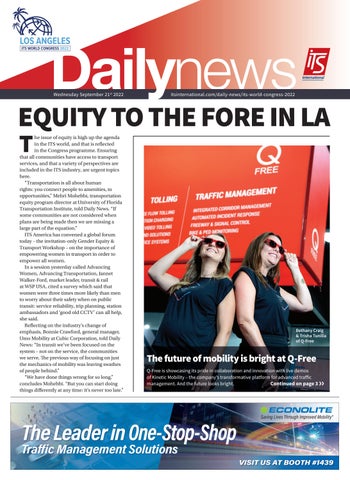
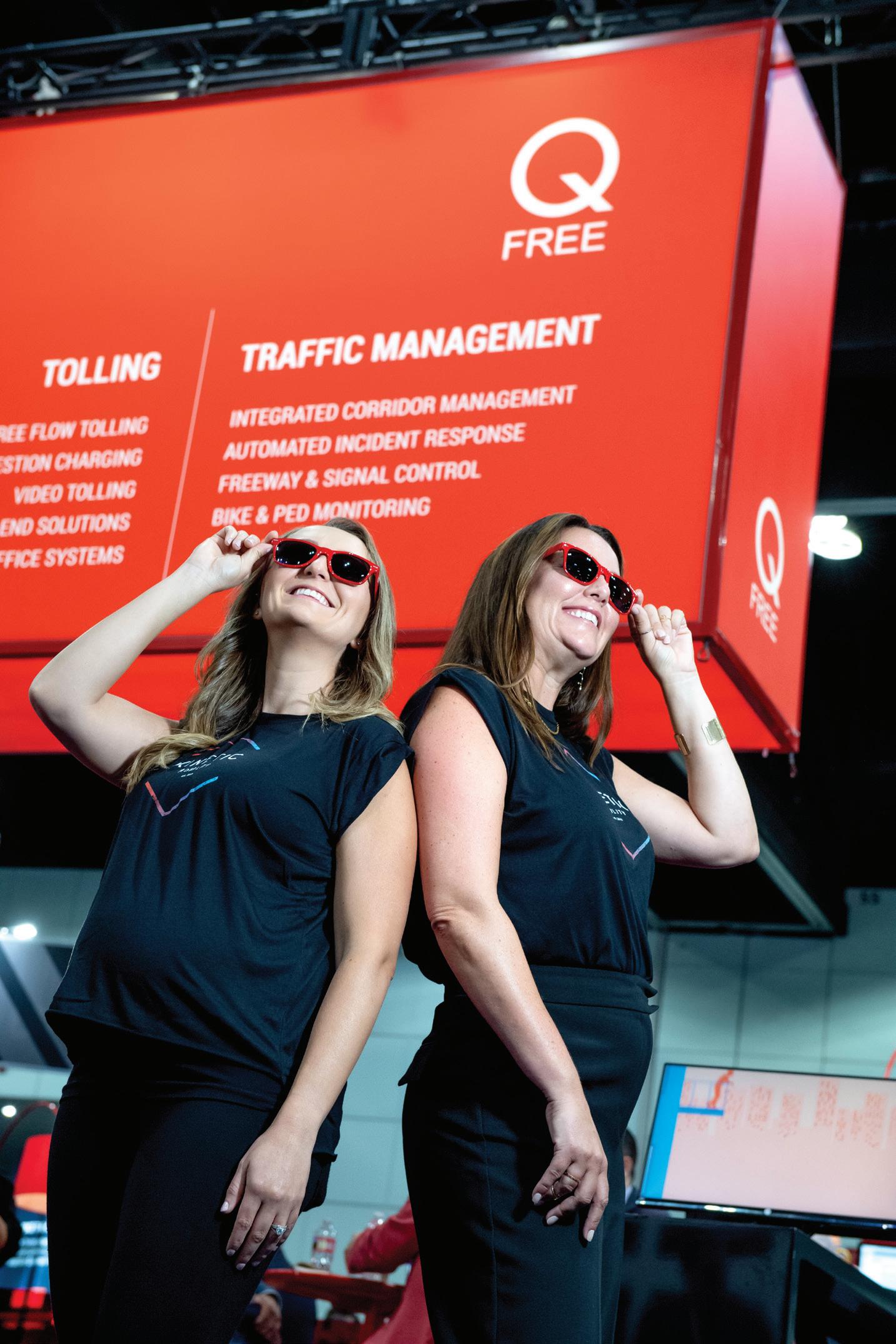
Bethany Craig & Trisha Tunilla of Q-Free
THE CLEAR CHOICE FOR TRAFFIC MANAGEMENT
Google extends innovation to the public sector
Google is bringing the power of simplicity and analytics to the public sector. The same technology that is behind Google Search, Maps, YouTube and other Google products is being applied to support public sector agencies in their strategic mission areas.
As Google Public Sector’s Head of Industry Solutions, Monali Shah, says: “Technology and innovation don’t need to be risky. Google is at a point where there have been so many proven examples of better insights for decision-making, less
manual work, lower costs and higher job satisfaction.”
For instance, Hawaii DOT is taking an integrated approach to insights for climate resilience, safety and equity. These insights are supporting prioritisation of investments and transparent communication with the public.
Utah has used Google technology to streamline business processes and drive efficiency. And Colorado has created an advanced analytics platform for connected vehicle data, work zone exchange and
traffic operations. According to Shah, these agencies are taking bold and practical steps forward to meet the challenges of today and to be ready for the future.
So how can agencies bring the network and scale of Google to their transportation agency? “It boils down to our ability to ingest any type of data source at scale, then rationalise that data via a single pane of glass, by DOT discipline or functional area,” Shah said.
▶ Meeting Room 304C www.google.com
The future of mobility is bright at Q-Free
Unlike competing systems that are largely disparate, stitched together systems masquerading as a single solution, Q-Free says the new Kinetic applications were all built on a common, modern platform. The single, web-based platform brings traffic management data, tools, and teams together to tackle challenges across local, intercity, regional, and statewide operations. This allows users
the unrivalled opportunity to deploy a solution focused on overarching mobility goals rather than traditionally siloed operations.
“Simply speaking, Kinetic Mobility helps traffic operators make better decisions more efficiently and consistently,” said Q-Free ATMS EVP of Technology Dan Skiffington. The system was designed to help operators maintain a bird’s-eye view of
system health, respond quickly and consistently to real-time conditions, and improve overall performance through rich analytics and insights.
“Ultimately, our system was designed by users for users,” Skiffington stated. “Each of our four new applications being introduced at the show – event management, sign control, video management, and traffic counts – have a shared interface
reducing the learning curve, expediting response times, and improving road safety.”
Best of all, the platform is scalable and technology-rich making it accessible to agencies of all sizes. To boot, Kinetic applications are available as software as a service (SaaS), lowering the price of entry and ongoing maintenance costs.
▶ Booth 1047
www.q-free.com
Monali Shah of Google
YUNEX UNVEILS CUTTING-EDGE BLADE SOLUTION
Yunex Traffic is displaying new products that will upgrade the utility of both ATC cabinets and ATMS solutions.
The company is unveiling its new ATC, Blade. This has what Yunex describes as a massive quad-core processor that allows the device to store and analyse large data sets. It also allows for third-party applications to be downloaded on to the controller so it can become an an edge computing device, handling tasks such as traffic detection.
Blade also incorporates features such as a seven-inch touch screen, dual power supplies, WiFi access and customisable analytics for detailed traffic assessment.
Yunex has taken around 18 months to develop Blade, with the first working example having been completed immediately before the show.
The company is also showing for the first time a new suite of solutions for traffic management. The new products – Yutraffic Studio, Sitraffic Co ncert and Sitraffic Symphony – steadily increase the number of features they contain. Studio is the base unit, with Concert and Symphony adding more capabilities.
Studio is described as a Cloud-ready, realtime traffic control and management system that goes beyond basic ATMS functions of changing traffic lights by detecting traffic or changes in environmental conditions.
Concert collects traffic data from multiple sources to create a basis for implementing new strategies. It can handle large quantities of data, including information from third parties and allows the management and control of several traffic zones, including city centres, urban freeways or entire counties.
Symphony focuses on complex urban traffic management and can be customised for multiple operators to ensure real-time congestion and incident response.
Concert is Yunex’s current traffic management system, while Symphony is a next-generation system. Both Symphony and Studio will be available in 2023.
▶ Booth 1003
www.yunextraffic.com
ITS AUSTRALIA PLANS FOR GLOBAL SUMMIT
ITS Australia will expand the reach of its Summit 2023 in Melbourne following expressions of interest in attending from companies outside Australia, the organisation says.
Demand for the event, which takes place from 29-31 August 2023, has arisen in part from the
greatest infrastructure spend in Australia since the Second World War.
ITS Australia says international ITS firms have their eyes on planned developments in roads and tunnels, with future tolling and ITS contracts up for grabs,
particularly in the eastern states of Queensland, New South Wales and Victoria.
The organisation adds that it has had ‘positive conversations’ about widening the reach of Summit 2023 with a number of international delegates at ITS World Congress in Los Angeles.
Among other things, ITS Australia has been showcasing its members’ participation in the Australian Integrated Multimodal EcoSystem, focused on connected vehicles, at the Congress.
▶ Booth 939 www.its-australia.com.au
Iouri Nemirovski of Yunex
INTRODUCING THE MK6
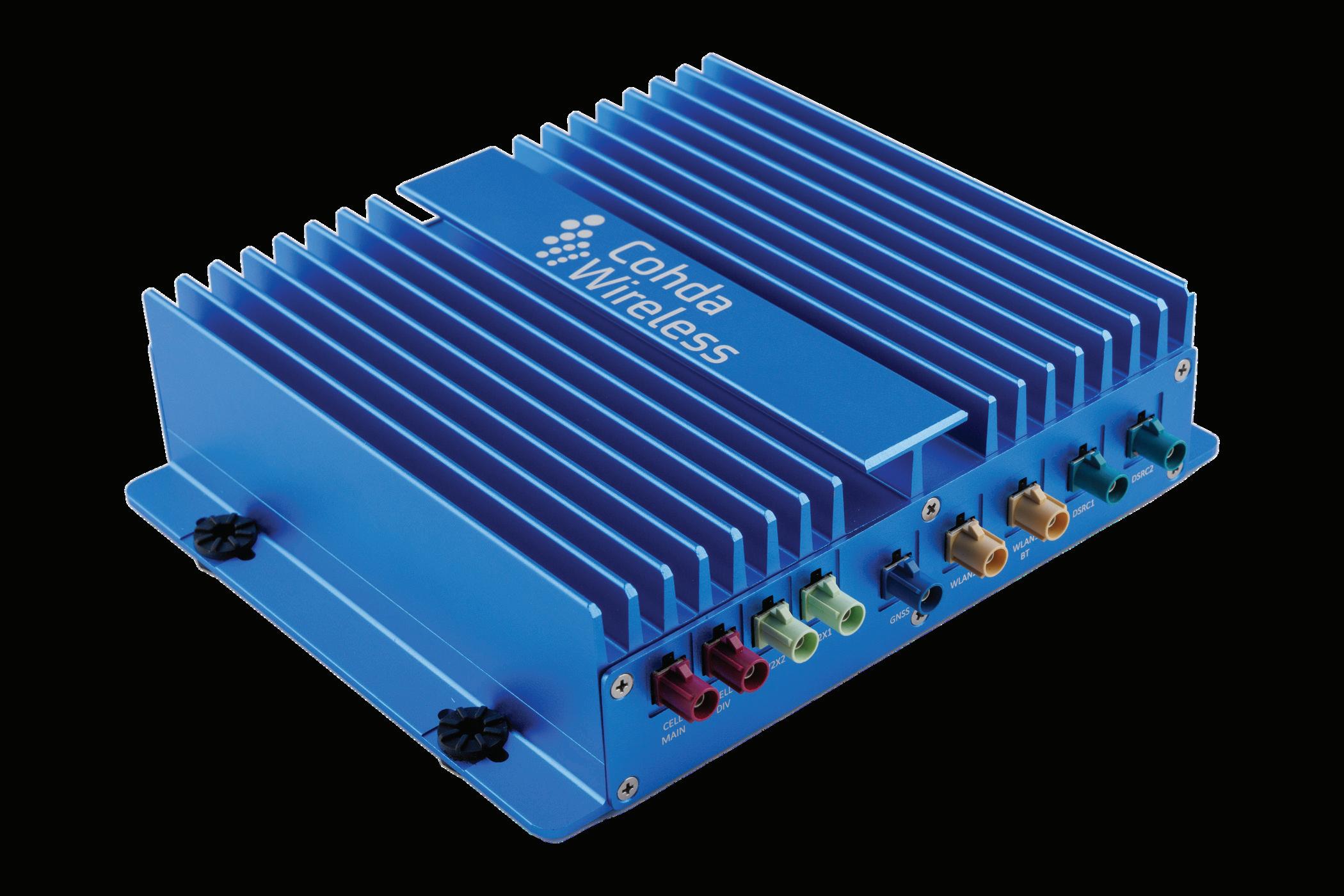
Cohda's new MK6 OBU offers a robust, secure foundation for intelligent transport systems of the future supporting your technology choice of C-V2X or DSRC.
The MK6 is the world's most advanced V2X device incorporating:
DSRC with 2x NXP RoadLink® SAF5400 chipsets
C-V2X with Qualcomm SA515 chipset supporting 3GPP R15
Cellular 5G NR with fallback support for 4G (LTE Cat 19)/3G/2G
Wi-Fi 802.11 a/b/g/n/ac
Bluetooth v5.1
Visit: ITS Australia Booth #939
Email: inquiry@cohdawireless.com
EDI celebrates innovation success
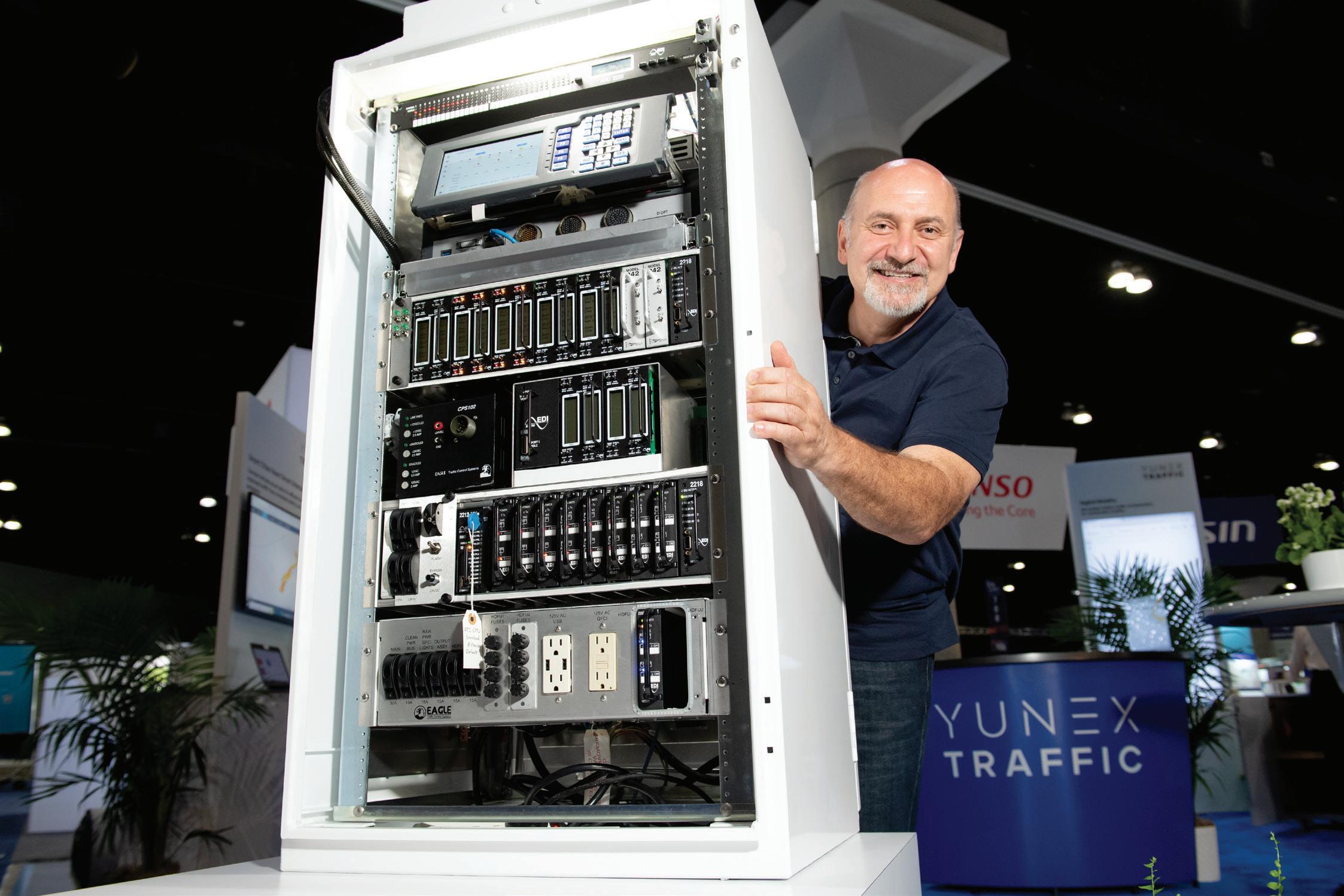
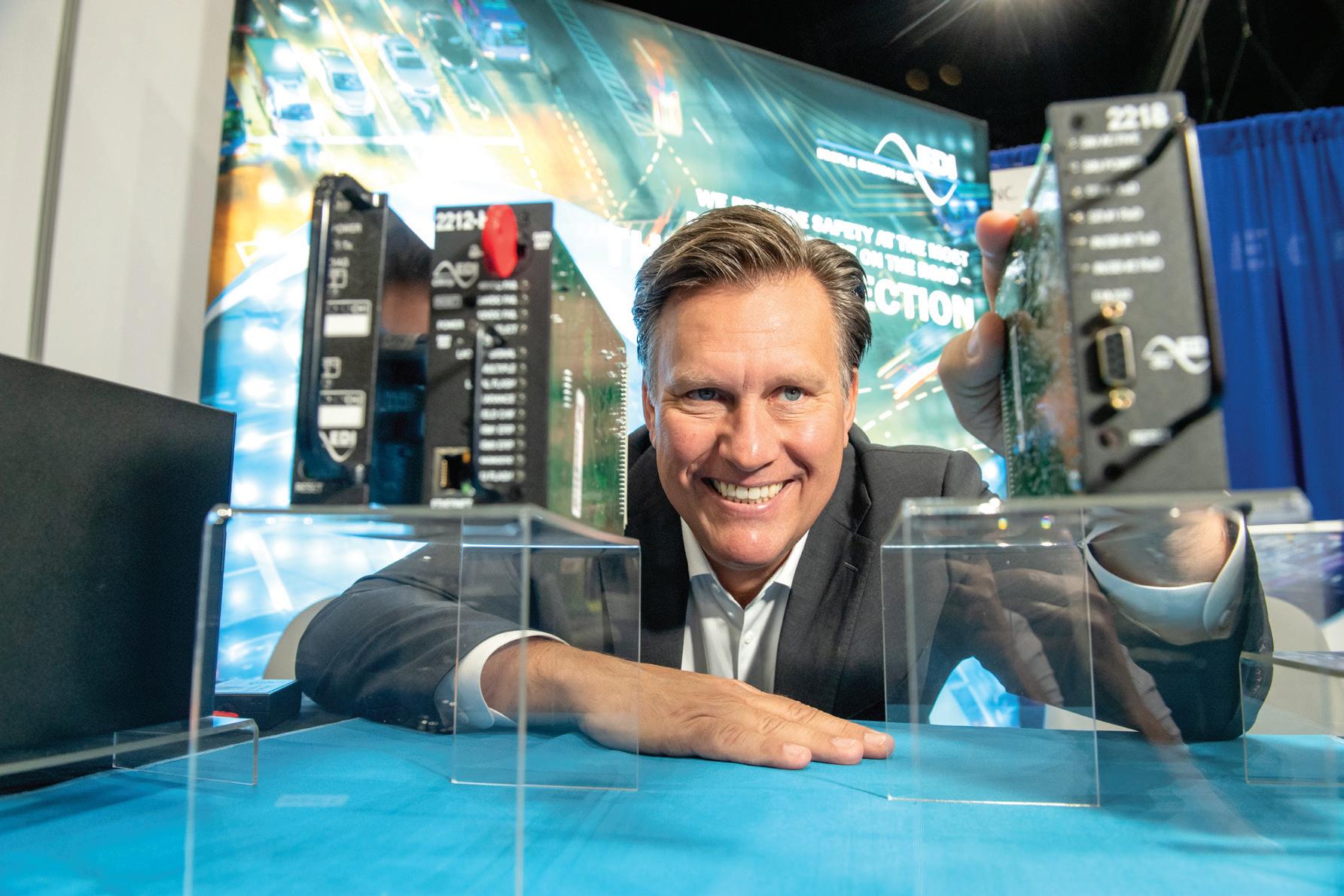
EDI is inviting visitors to help celebrate more than 6,000 ATC cabinets sold to date. Over 50 agencies have adopted the standard, including large innovative cities like Los Angeles and Montreal. EDI says ATC has had the fastest adoption rate of any cabinet standard in history.
With safety devices installed in over 350,000 intersections across North America, EDI expertise helps bring transportation to a new level with safer, smarter, greener technology.
Use of the innovative ATC solution can modernise ageing infrastructure, reduce traffic congestion, improve air quality, and enhance mobility and safety to support Vision Zero.
The Advanced Transportation Controller (ATC) traffic cabinet is designed to support smart city technology and multimodal transportation, including bicycles, pedestrians, automobiles, parking, rail, transit, and freight.
The latest and most-capable standard ATC will easily operate from simple, to large complex
intersections. Innovative agencies are requiring more capabilities and signal performance data from their connected intersections, and ATC can tackle it all.
As EDI points out, safer, smarter, greener ATC technology
provides better control of traffic signals. ATC is designed to simplify the complex and everexpanding roadway capabilities.
The Smarter – 32 channel ATC standard can replace all cabinet types: NEMA TS-1, NEMA TS-2, ITS, and Caltrans 33X. ATC
smart city technology like V2X, enhanced connectivity, more powerful I/O and lower energy, adapts to each agency’s unique needs and promotes LED usage and solar applications.
▶ Booth 1661
www.editraffic.com
SWARCO TEAMS WITH MICROTRAFFIC TO TACKLE NEAR-MISS INCIDENTS
Austria’s Swarco is teaming up with Canadian start-up MicroTraffic to improve safety at intersections through analysis of near-miss incidents. Near-miss situations involving vulnerable road users are now integrated into Swarco’s MyCity urban mobility management suite by using new software by MicroTraffic.
The two companies forged a relationship following this year’s Intertraffic Amsterdam event, when MicroTraffic won a challenge posed by the Swarco Innovation Hub.
The prize included an invitation to a concentrated week’s work in the Tyrolean mountains to develop the integration of near-
miss analyses in MyCity jointly with Swarco specialists via a rapid prototyping approach.
“We are seeking innovative approaches to prevent injuries and fatalities,” said Swarco CEO Michael Schuch. “Teaming up with a start-up allowed us to implement the feature in MyCity through a great team effort in an agile process taking less than a week.”
“We are excited to work with Swarco because of their commitment to road safety and innovation on a worldwide scale,” commented MicroTraffic’s CEO, Craig Milligan.
The ‘MyCity Near Miss’ prototype combines MicroTraffic’s near-miss data with
MyCity’s map visualisation and connectivity. The prototype is being implemented in Wolverhampton (UK), Los Angeles and Pasadena using real data, where users are able to see the risk level of their intersections.
MicroTraffic calculates near-misses and their kinetic energy, together with the types of road users involved. The value of nearmiss data is to provide cities with accurate road safety information on their intersections and allow them to take proactive measures, such as reprogramming the signal phases.
▶ Booth 1139
www.swarco.com
Dr. John Shearer of EDI
Rekor unveils new traffic data collection system
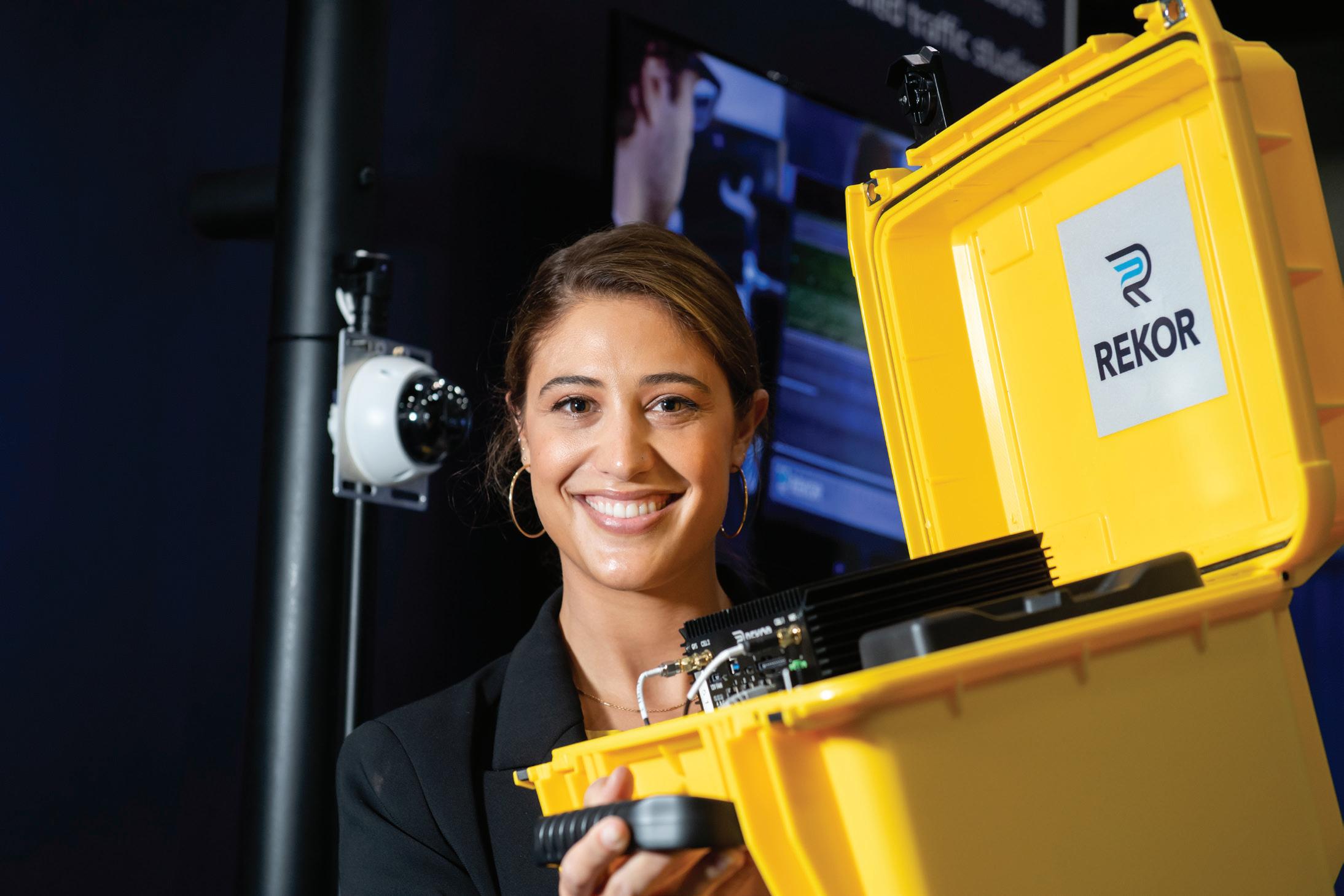
Rekor unveiled its new nonintrusive traffic data collection system on the showroom floor at ITS World Congress in Los Angeles.
Easily transported and deployed in less than 15 minutes on the side of the road, the Rekor Edge Flex eliminates the need to dig up the roadway to embed loops and other sensors – saving time and budget while minimising traffic disruptions.
Powered by artificial intelligence (AI) and machine learning (ML), the Rekor Edge Flex collects and transforms highspeed roadway data directly on the device
for secure, high-quality and holistic traffic insights in real time.
A Cloud-based analytics dashboard enables faster and more accurate decision-making for transportation planning, roadway engineering and traffic management.
The system’s high-quality, highresolution video analytics accurately classifies vehicles and collects other traffic management data – such as vehicle speed, vehicle volumes, and traffic patterns. This helps agencies identify vehicle type and tonnage, determine
instances of electric vehicles and estimates greenhouse gas emissions.
According to Maria Kolar, a marketing manager for the company, the Rekor Edge Flex will be deployed over the next several months by several transportation departments across the U.S. Southeast – some of which will be installed in parallel deployments with legacy loop deployments to give the company and its early customers a chance to test accuracy.
▶ Booth 1803 www.rekor.ai
TOYOTA UNDERLINES GREEN COMMITMENT
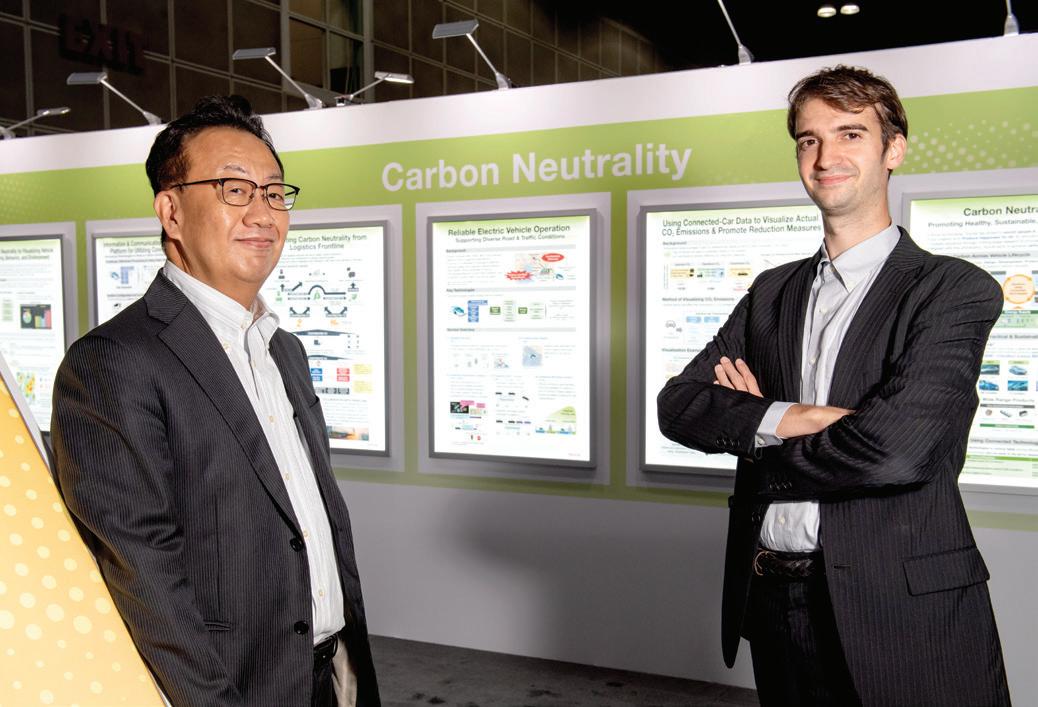
Toyota has declared carbon neutrality as one of its top corporate initiatives, aligning its green and sustainability goals with the Japanese government’s goal of achieving carbon neutrality countrywide by 2050.
According to Masaho Suzuki, group manager, business strategy, Toyota will achieve its carbon neutrality goals by reducing carbon across the vehicle lifecycle, by providing a wide range of practical and sustainable products and by creating solutions using connected technologies. Toyota is working with a variety of partners – including Denso and Aisin, two other exhibitors at ITS World Congress – to meet these goals and broaden its impact on the environment. One of the
company’s strategies will be to use connected vehicle data to track and visualise actual CO2 emissions and promote reduction measures. This includes better charge planning, deceleration support, predictive
SOC control and automated switching between EV and HV modes based on remaining charge, predictive traffic and road conditions.
Getting a better handle on increased commercial traffic
volume due to the explosion of delivery services and other logistics services is also a priority for Toyota. Jean Sebastien Boire, a manager with the company’s Mobility as a Service (MaaS) business unit, is working with Isuzu, Daihatsu and Suzuki to use vehicle data to improve vehicle capacity utilisation, optimise routes and take advantage of re-routing around incidents and congestion.
Working with frontline workers in shipping and distribution centres in Japan, Toyota and its partners are creating solutions to smooth out and resolve these logistics bottlenecks as a way to achieve its carbon neutrality goals.
▶ Booth 803
www.toyota.com
Maria Kolar of Rekor
Masaho Suzuki (left) & Jean Sebastien Boire of Toyota
GridMatrix insights improve congestion and emissions
GridMatrix, an SaaS start-up established in 2021, provides a software-approach to reducing congestion, emissions and traffic accidents. To help achieve this, GridMatrix’s machine-vision algorithm takes data out of existing infrastructure sensors and processes their streams in realtime.
The dashboard platform visually presents this data to allow users to easily gain insights to improve their cities. This and much more will be explained at the company’s booth on Wednesday when GridMatrix chief executive Nicholas D’Andre will also be speaking on a panel about vehicle electrification.
▶ Booth 1651 www.gridmatrix.com
have to stop at the side of the road and type in the messages. That’s an unnecessary risk.”
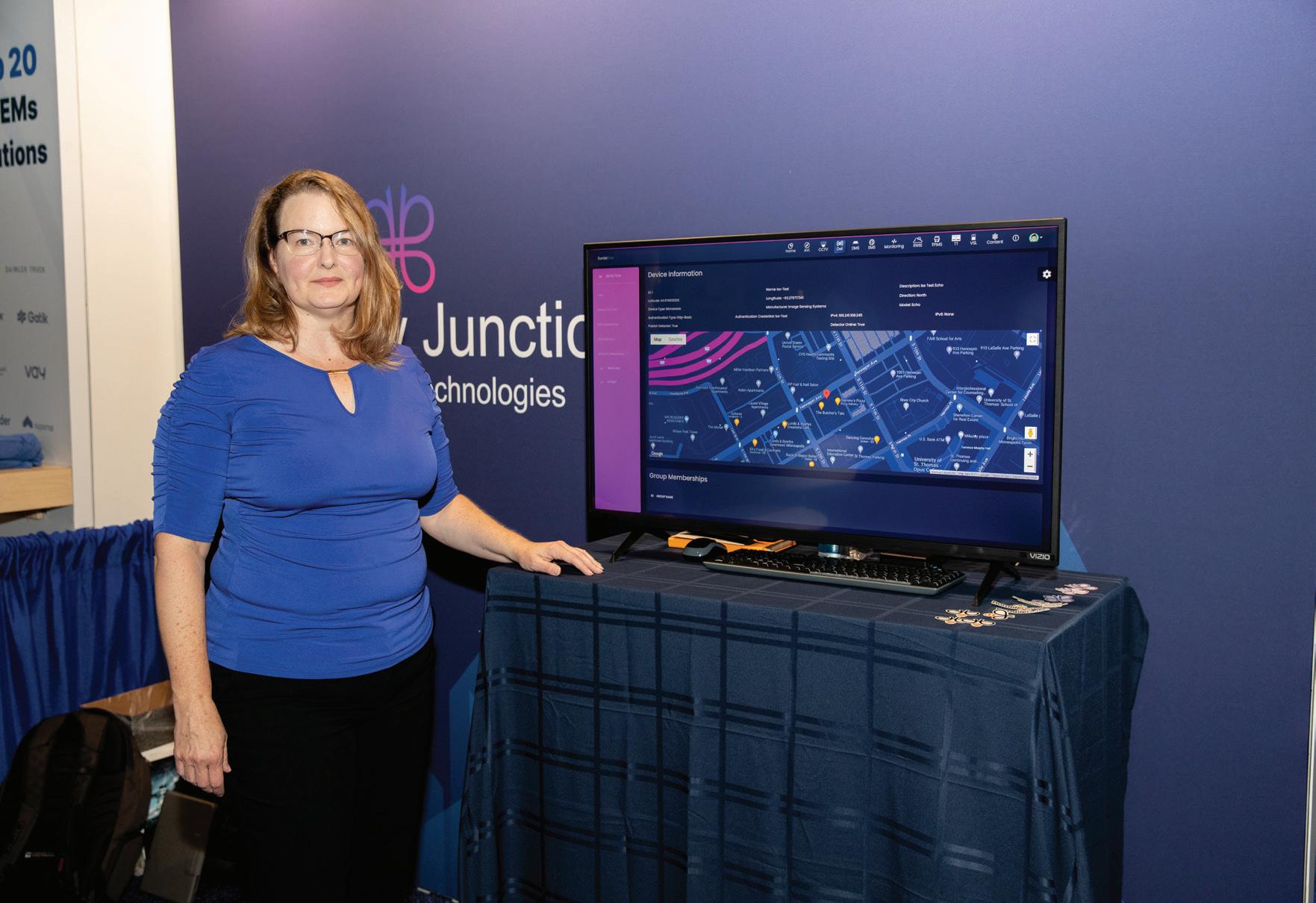
Butterfly’s new ZoneAware system works by detecting a GPS sensor either installed on the work vehicle, or on workers’ safety vests.
“We detect when workers enter the workzone and we would automatically turn on the variable message signs or adjust the speed limits. When all the workers have left the zone, we would reverse the sign changes.”
BUTTERFLY’S ZONEAWARE SYSTEM TAKES FLIGHT
It’s ironic, but workers preparing to carry out repairs to make roads safer put themselves at risk as they change signs to alert motorists to their presence.
“What happens at the moment is that
workers go out to do construction work and to change messages [on roadside traveller information systems] or turn the signs on,” said Cory Beimesche, CEO of Butterfly Junction Technologies. “To do that, they
The company is also demonstrating its BumbleDrive system, an advanced traffic management system that can tie together devices such as CCTV monitoring, travel time calculations and weather detection systems.
“We take any connected device and orchestrate it. We have a dashboard where we can do automated workflow orchestration between devices.”
Other systems can do this, but not without extensive customisation, added Beimesche. “It really comes down to ease of integration.”
▶ Booth 537
www.butterflyjunctiontech.com
Nicholas D'Andre (left) & Madison Harris of GridMatrix
Cory Beimesche of Butterfly Junction Technologies
Detection and data for intelligent transportation systems
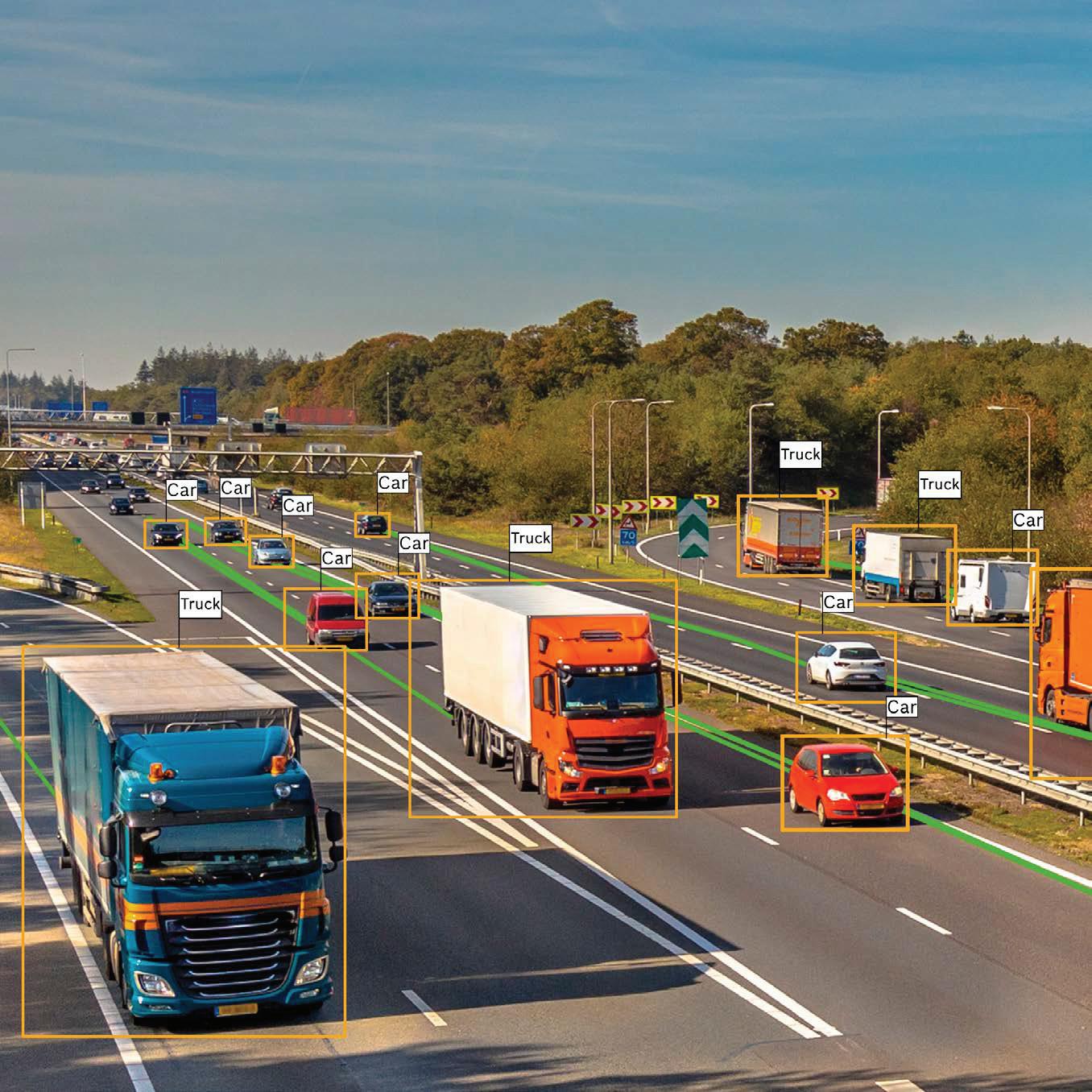
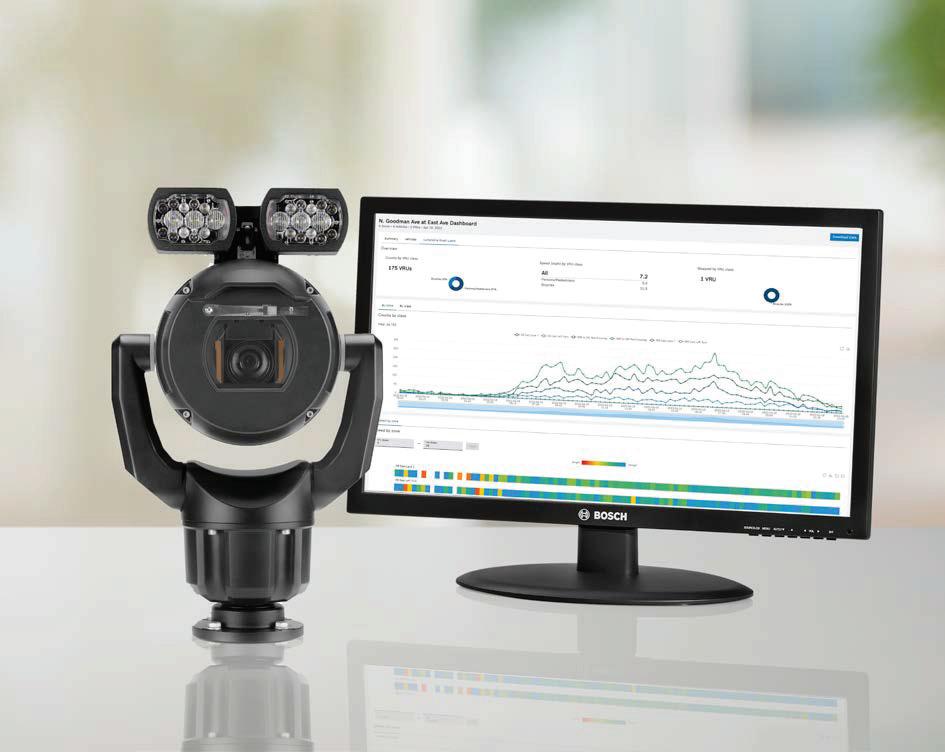
Bosch empowers you to build a safer transportation ecosystem with highly-accurate AI-driven video analytics solutions. Bosch cameras with embedded neural network-based video analytic detectors for ITS deliver automatic incident detection and data on roadway usage and traffic flow for better highway and urban infrastructure planning.
Learn more at booth #1413 or visit https://bit.ly/BoschITSsolutions
CONNECTED BY DESIGN
Leaders of the digital transformation, we deliver disruptive solutions.
Today's Schedule Day 3 CONGRESS PROGRAMME
Today’s congress programme is packed full of content across all aspects of ITS and mobility. Although tomorrow’s programme will be comparatively short, there are some sessions you might like to consider. Here is a selection of sessions that will be taking place today and tomorrow
With the onset of the Covid-19 pandemic, goods providers scrambled to accommodate the newly heightened demand for online orders and to-home deliveries. Trends and Developments in Freight and Last Mile Logistics: Preparing for the New Normal (08:00 - 09:30 Room 404B) is an opportunity for attendees to familiarise themselves with the evolving shifts in logistics and emerging methods for alternative last-mile delivery. While addressing regulatory, legislative, and safety concerns, this panel will identify preliminary actions that can best prepare states and urban centres for this new normal, considering equitable and resilient solutions.
Current Status and Issues of V2X in the US and Europe (08:00 - 09:30 Room 406B) provides an industrial viewpoint of international cooperation on deployed and actual operational V2X systems, as well as their future extensions, following the directions of each government.
International Forum session Automated Vehicle Policy (13:00 - 14:30 Room 411) will review the international standards and guidelines applied to automated vehicle technologies, demonstrating the similarities, differences, and opportunities to align international policy on this issue.
Current Status of ITS Radiocommunications
In The World (13:00 - 14:30 Room 406A) features representatives from ITU-R, Europe, the United States, Japan, and automotive industry companies who will share trends, achievements, and challenges regarding
radiocommunications for connected and automated vehicles and advanced ITS in the world.
Agencies that participate in the Connected Vehicle Pooled Fund Study, entities involved in CV pilot deployments, automakers involved in connected vehicle research and application development, security credentialing organisations, and other stakeholders entities have tangible work underway to bring this promising technology into beneficial and largescale reality in the near term. Presentations in Getting Across the Finish Line: Making Connected Intersections Ready for Broad Use (15:00 - 16:30 Room 406B) will focus on how this work is moving forward, identify tools that will be made available, discuss operational realities, and cite specific examples of field deployments where progress is being made and demonstrated.
Cooperative Intelligent Transportation Systems (C-ITS) has been around for a long time; however, its integration with transport management is not well established.
Multimodal Transport Management and Operation Considering C-ITS (15:00 - 16:30 Room 406A) will look at the international landscape and discuss how C-ITS should be integrated with transport management and operations. It will look at different countries’ experiences and issues in introducing C-ITS on its own merit and potentially how to increase the chance of C-ITS introduction through different means, including integration with transport management as well as providing value as a data collection platform.
Today’s Plenary
Today’s Plenary Session is titled Transportation Decarbonization, Equity, and Technology – How ITS Advances a Sustainable and Socially Just Future (10:00 – 11:30 Plenary Stage). This panel will discuss the evolution of how state, cities and countries are approaching the intersections of transportation decarbonisation, the rise of mobility on demand, attention to equitable, accessible transportation options, and how further deployment of technology can meet global climate, health, and equity goals. Experts from the transportation, technology, and energy sectors will discuss how they are collaborating to support and deploy ITS solutions to achieve these goals and what challenges remain.
Panellists include Shailen Bhatt, senior VP - Global Transportation Innovation and Alternative Delivery, Aecom; Adele Beachley, executive director, SCATS/ Transport for NSW, Australia; Toks Omishakin, secretary, California State Transportation Agency (CalSTA); and Margaret Anderson Kelliher, director of Public City Works, City of Minneapolis.
Continued
Today's Workshops
A lack of consensus surrounding what constitutes an ITS profession has major impacts on the ability to train, recruit and retain ITS professionals. The workshop, The Future of the ITS Workforce: Preparing for a Zero Emission Future (08:00 – 11:00 Room 409A) will address this crucial topic using a combination of presentation, small group problem solving, and application of identified solutions to a case study.
This third 5G connectivity workshop (13:00 – 16:00 Room 409A) will lay the grounds for the deployment of 5G for seamless connected and automated mobility (CAM). The workshop starts with an overview of current and upcoming (OEM) developments of 5G and CAM before deepdiving into the most suitable use-cases for CAM and their associated timelines. Next, an analysis of the stakeholders and co-creation towards benefitting the expected values of these use-cases is discussed. Values include but are not limited to traffic management,
energy consumption, as well as safer and more comfortable driving. As connectivity is a key enabler, the audience will be guided into seamless and cross-border 5G solutions for vehicular-to-everything (5G-V2X), covering both short- and long-range communication.
In the concluding part of the workshop, experts will discuss how stakeholders could deploy 5G technology for the envisioned use cases to fulfil their own business and common societal interests by ensuring CAM is adequately supported.
Thursday Schedule Day 4 CONGRESS PROGRAMME
During the next few decades, the number of vehicle miles travelled in the US is forecast to increase by more than 20%. This will increase fossil fuel consumption and associated air pollution, even with the growth of electric vehicles. Because it will take multiple decades to fully decarbonise mobility, public and private-sector stakeholders must pursue broad-based, multidimensional opportunities to minimise carbon emissions. Sustainability and Intelligent Transportation Systems (ITS) – Practical Examples of how Technology is Making a Difference (08:00 – 09:30 Room 406B) will shed some light on unique ITS/ technology-oriented initiatives that are making a difference on sustainability.
Next Generation in Multi-Modal Corridor Management (08:00 - 09:30 Room 407) will provide an overview of several recent nextgeneration corridor management projects which are using advanced technologies such as connected vehicles, machine learning, incentivization, and real-time decision support system to meet the mobility needs of their corridors, regions, and states.
Special interest session The “6-R’s of 5-G” - 5G Basics for ITS Professionals (10:0011:30 Room 405) will explain the technology and explore the very best practices via an innovative 12-part approach. Additionally, it will highlight how ITS professionals are creating resiliency in critical intelligent ITS infrastructure; ensuring healthy RF radiation levels; generating millions in new revenue; installing and leasing excess city fibre optics for cash; leasing streetlights and traffic signal masts as transmitter sites; improving traffic signal coordination and telecommunications; and setting aesthetic standards futureproofing ITS infrastructure with fibre optics.
Test Results from Next Generation Vehicleto-Everything (V2X) Communications Technology (13:00 - 14:30 Room 404B) will present results from V2X communications testing performed by US Department of Transportation and European Commission experts who will further discuss conclusions for connected and automated vehicle deployers.
Thursday’s Plenary
Thursday’s Plenary session is titled A Smarter, Digital Future– How ITS Technology Serves as the Digital Backbone to Delivering Opportunity to Communities (10:00 - 11:30 Plenary stage) will feature panellists who will share examples of how regions are addressing transportation challenges and investing in technology to improve outcomes for their communities.
Panellists include Joost Vantomme, CEO, Ertico-ITS Europe; Beth Kigel, NTSB national practice consultant, director of smart and connected solutions and vice president; Hasan Ikhrata, CEO, San Diego Association of Governments (SANDAG); and Tilly Chang, executive director, San Francisco County Transportation Authority.
The road to smarter traffic management.
Real-time situational awareness with intelligent traffic solutions Collecting traffic data in real-time gives you reliable insights into what’s happening on the roads. By combining high-quality video from IP cameras with ITS-specific analytics and applications, the camera can become the ultimate sensor in ITS, turning raw data into useful intelligence.
To see how intelligent traffic solutions can help you, visit axis.com/traffic
RoboSense targets safer autonomous driving
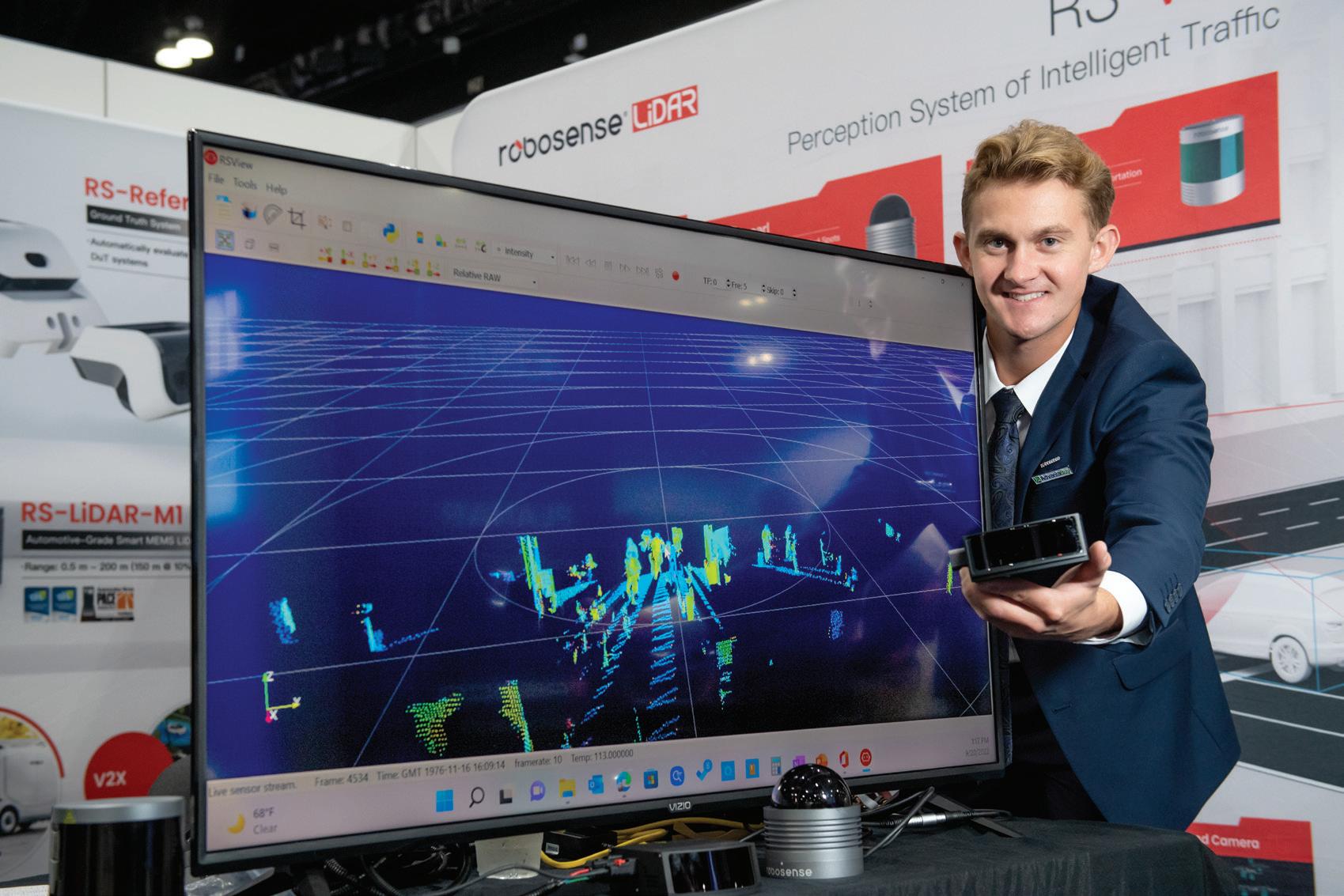
RoboSense is showing its RS-V2X system that combines Lidar sensor technology with AI point cloud perception software. The system is designed to give autonomous vehicles an overhead view of roads and intersections, facilitating the rapid development of new infrastructure for intelligent transportation and ensuring the safety of autonomous driving.
The Shenzhen, China-based company is showing its latest RS-Ruby-80V Lidar that looks down from gantries to detect traffic. Compared with previous generation Lidar models, the RS-Ruby-80V is 50% smaller in both volume and weight, while the detection range for 10% low reflectivity has improved by 12.5%.
RoboSense says that the new Lidar can operate for sustained periods in temperatures of -40C and resists interference from other Lidars and ambient light.
The new system combines this with the AI point cloud perception software to give useful data to a self-driving car. The data can also be used for smart city ITS solutions.
▶ Booth 1848 www.robosense.ai
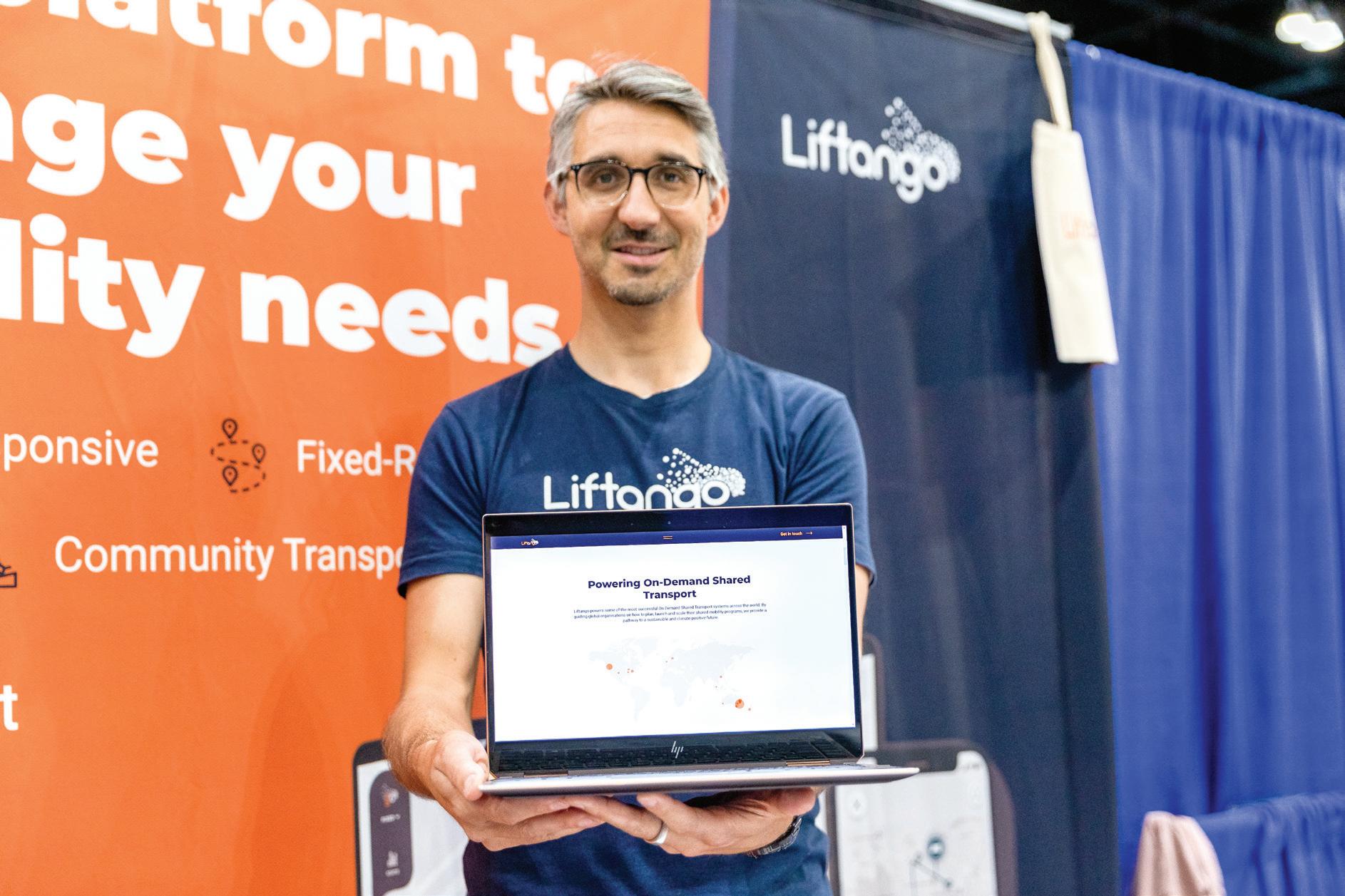
ITS is nothing if there is not equitable access to shared transport. This requires a dynamic technology platform to maximise flexibility for riders, improve operational efficiency for providers and create better connections across transportation networks. Liftango’s suite of products does it all, as visitors to the company’s booth will see.
Liftango’s demand-responsive transit on-demand technology allows mobility providers to offer flexible mobility solutions that can fully integrate with existing fixed route networks. It can identify and exclude known fixed-route transit corridors within ‘Demand Responsive Transit zones’, offer truly guaranteed advanced bookings and empower riders to design a journey that best suits their needs.
Meanwhile, Liftango Labs uses proprietary processes and comparative benchmarking to develop service model recommendations, feasibility studies, and transit network analysis reports. This will help providers simulate, design, and deploy the next shared mobility project with confidence.
▶ Booth 643 www.liftango.com
Trystan Eeles of Liftango
Samuel Dalke of RoboSense
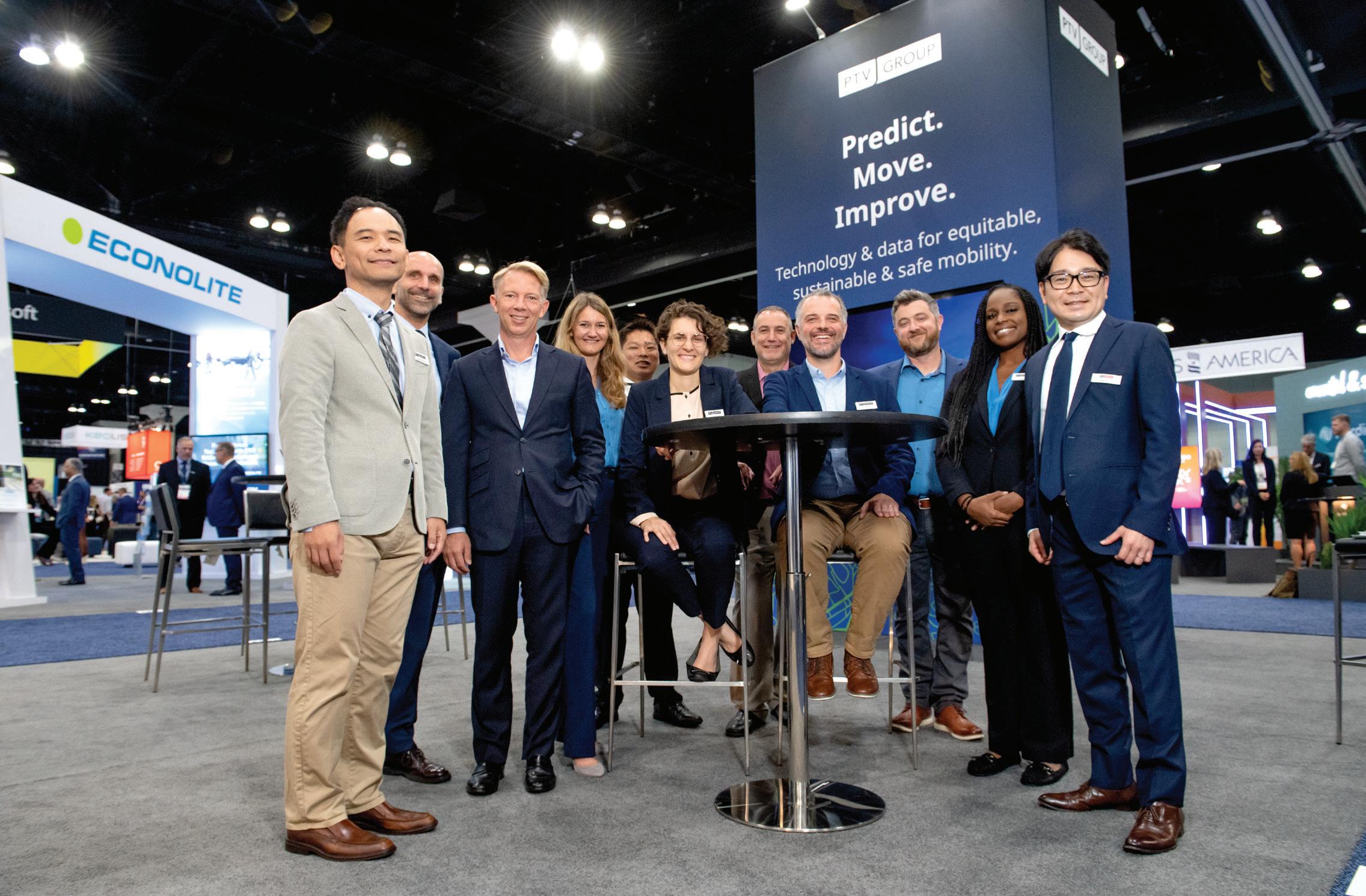
PTV is here in LA to present its latest solutions for real-time data analysis, visualisation, modelling, and simulation.
Visitors to the PTV Group booth will discover how nextgeneration traffic management helps to improve traffic flow and capacity, and thus increase road safety, air quality and sustainability in cities.
Future-orientated cities like Taichung, Vienna and Rome already rely on PTV’s realtime solution which combines innovative machine learning techniques with proven dynamic traffic modelling. Thanks to this combination, PTV Optima enables operators to manage the entire traffic network and make reliable traffic forecasts up to 60 minutes in advance.
Real-time traffic management will also be the topic of two dedicated PTV presentations in the summit programme from 8am to 9.30am on Wednesday.
Technical session TS34 –How Technology Impacts Transportation I – will feature Chiara Cianella, manager professional services – real-
PTV’S NEXT-GEN TRAFFIC MANAGEMENT
time mobility, who will speak about the Quantification of the Impact of Big Events on Traffic with PTV Optima. She will be followed by Lorenzo Meschini, VP product management realtime mobility, who will present a methodology to properly
handle actuated signal plans within macroscopic dynamic traffic simulation.
Additionally, visitors to the PTV stand can also expect exciting in-stand sessions every day on real-time traffic management, solutions for
improved air quality together with Bosch, and the #transmove project in which PTV is developing an innovative, AIbased traffic forecasting tool for the city of Hamburg, Germany. ▶ Booth 1539 www.ptvgroup.com
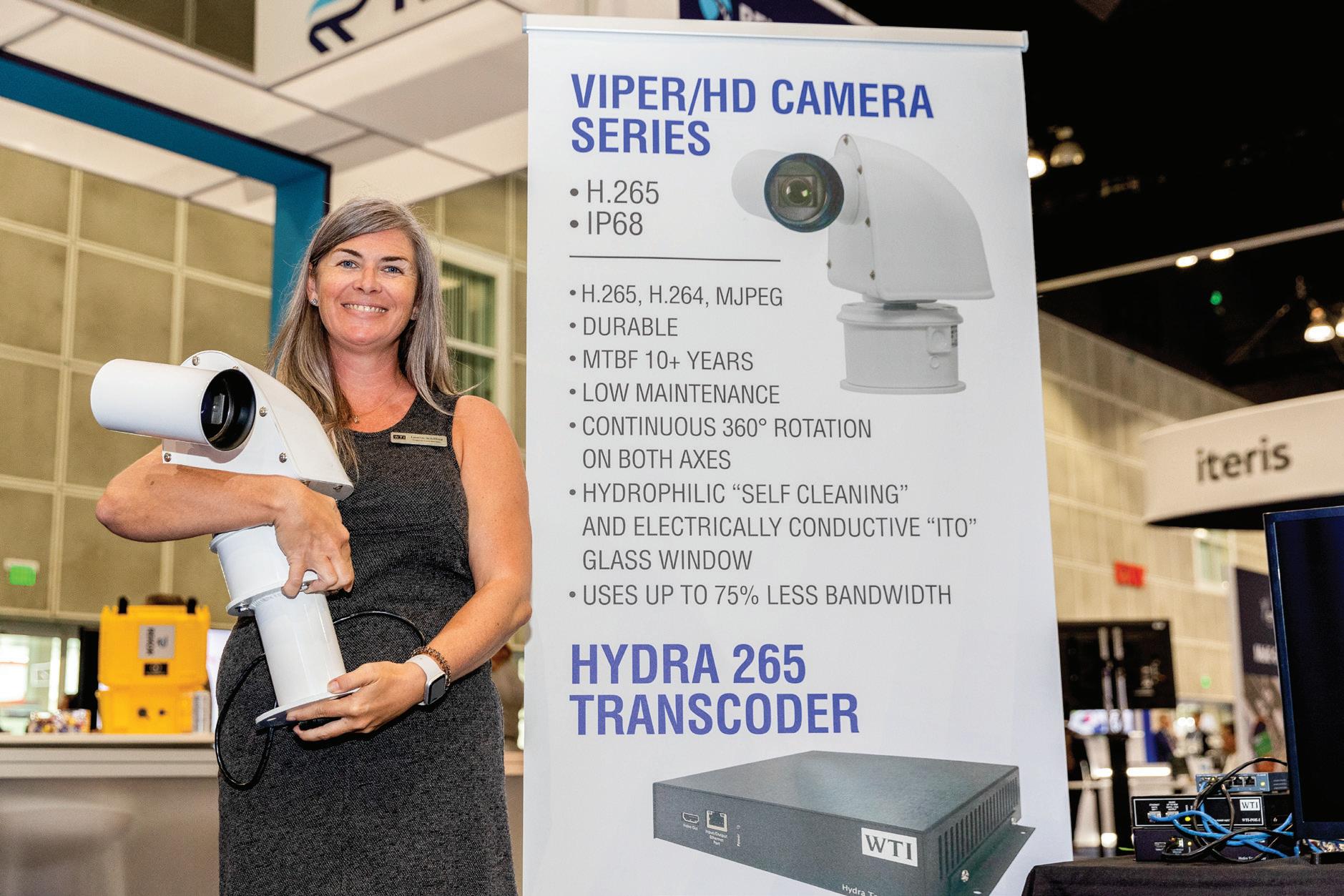
WTI’s Viper camera takes bite out of maintenance
regularly planned cleaning. In addition, a brake option for high winds can also lock cameras in place, eliminating the need to reposition cameras after storms or other
Schilling also draws attention to the cameras’ mobility as another cost-saving feature, pointing out that the camera can be deployed, set up and configured quickly. It can even be installed on emergency vehicles to provide monitoring capabilities on the move.
Manufactured locally in Ventura, Calif. and introduced to the market last year, the Viper H.265 HD30L traffic camera is currently deployed by state department of transportations, cities and county governments across the US — including in Texas, Florida, Alabama, California and other
PTV CEO Christian Haas (third left) with the entire PTV team
Lauren Schilling of WTI
Geotab shows trio of software solutions
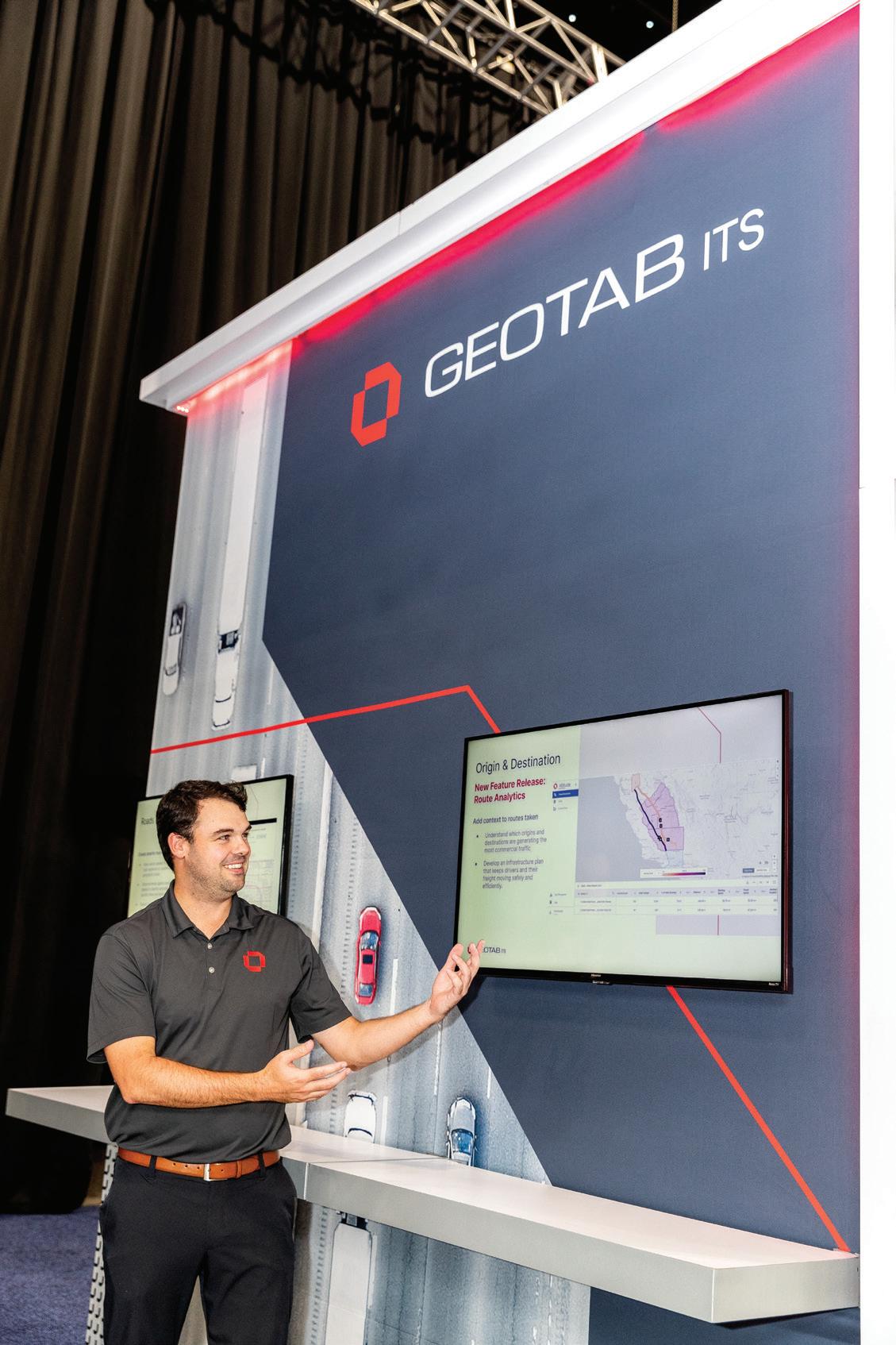
First-time visitor to the World Congress Geotab is showing several software products that it has developed in recent months to help classify vehicle behaviour. Route Analytics (RA), Stop Analytics (SA) and Updated Vehicle Vocation Classifications (UVVC) are all now part of the company’s portfolio.
Geotab, based outside Toronto, Canada, launched its Geotab ITS division to leverage its data for fleet customers and to provide transport insights to government agencies and commercial clients.
For organisations running an Origin and Destination
(O&D) analysis, for example, the company’s RA software will showcase the most popular routes between two points. SA will show whether they stop en route – perhaps for food or toilet breaks – or drive straight to their destinations.
UVCC involves Geotab’s teams using the raw data it collects and using machinelearned algorithms to calculate whether vehicles are involved in long-haul journeys or short-haul trips for ‘last mile’ deliveries.
This data is provided in anonymous format – although results can be broken down into heavy, medium or light cargo vehicle classes, individual
IN FOCUS FAST WITH MERIT LILIN
vehicles are not identified –to organisations such as city authorities, state DOTs or consultancies that can use the information for freight
planning, said Jamie Wilson of the company’s business development team. ▶ Booth 431
www.geotab.com
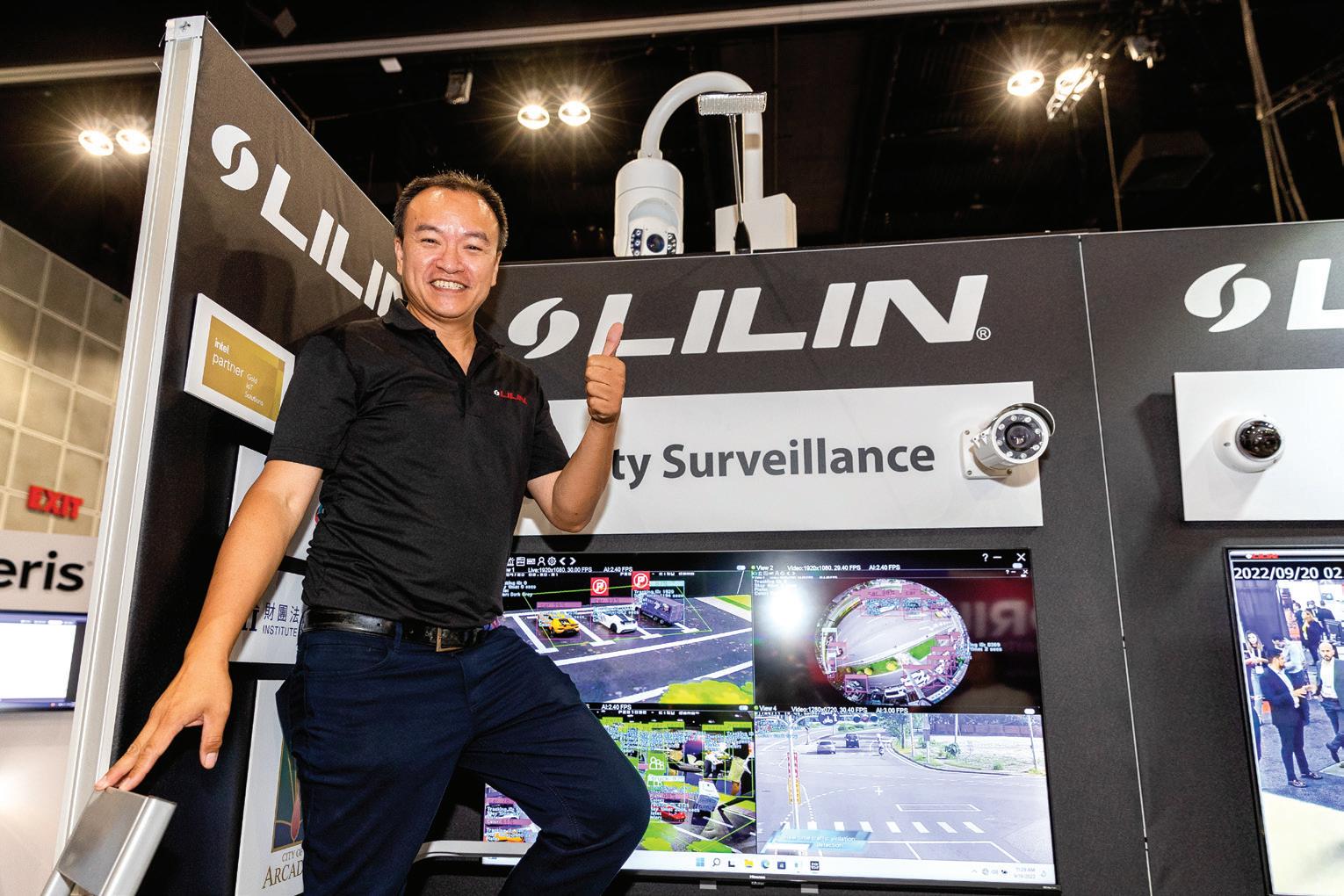
At the booth of Merit Lilin, look up and you’ll see looking down on you what the company says is the world's first 4K AI traffic camera equipped with the latest Yolo AI. The Yolo - ‘you only look once’ - algorithms ensure super-fast and extremely high resolution images.
The camera – the S7R5588EX30 - can track objects after identifying them and then trigger various behavioural modes, such as loitering or perimeter crossing. At the same time, since different AI models can be loaded in the application field. Recognition type of objects can be unlimited and the application can be more diverse and flexible.
For traffic monitoring, the camera can identify vehicle type, such bus or sedan car, the manufacturer and the colour of the vehicle. When identifying humans, the technology is not limited by the human pose. It can be successfully determined by squatting, running, jumping or standing still.
The S7R5588EX30 has a fine pedigree at Merit Lilin. For law enforcement, the Merit Lilin Z7R8082EX30 camera is essential for getting a clear picture. It can zoom up to 30 times and when combined with a wide-angle model, it can play a close-up effect.
Meanwhile, highway authorities can rest assured that there are no undetectable licence plates if the Z7R8182X10 camera is deployed. It can distinguish colours, characters, states and numbers and recognise speeds up to 60mph. It supports allowlists, block-lists and visitor lists and even records events and integrates third-party ticketing systems.
www.meritlilin.com
Jamie Wilson of Geotab
Harry Yang of Merit Lilin
Hold real-time control over your entire mobility network.
With PTV Optima, traffic control centers get the full picture of mobility. Never lose sight of what is happening on your streets by relying on the real-time traffic management software for multimodal networks. Use detailed traffic forecasts and monitoring dashboards to best manage congestion, road closures and construction sites, and to accurately simulate the network performances. Why should you do so? You will instantly take the right measures to avoid disruptions and make sure to optimize your network’s efficiency.
Experience our solutions at #ITSWC2022 at booth 1539 and #JointheConversation
VANJEE LIDAR AIMS TO IMPROVE TRUCK SAFETY
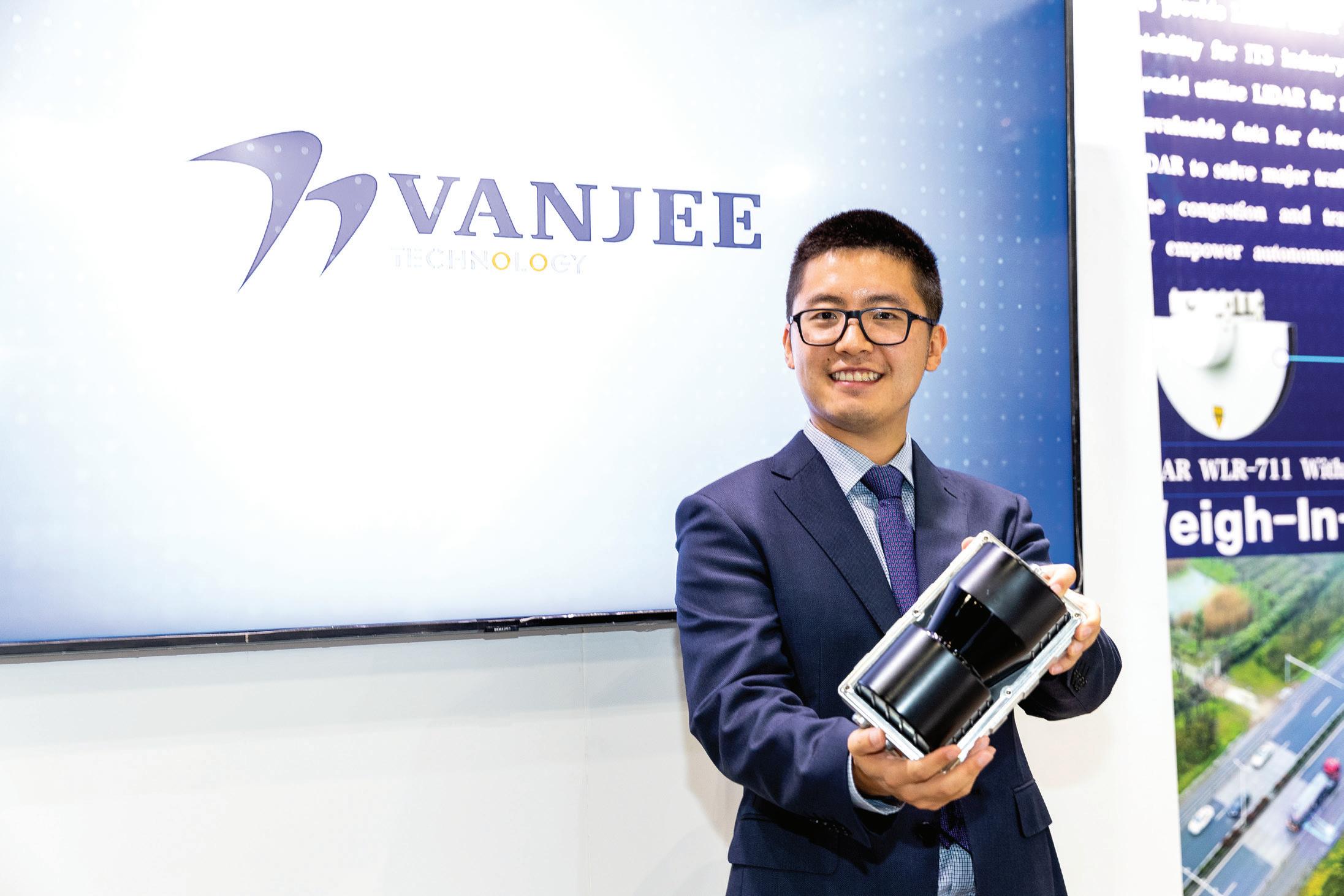
Chinese company VanJee is showing off its high-quality Lidar WLR-711 sensor specifically designed for vehicle classification, traffic data collection and vehicle dimension measurement. This data is crucial for automatic tolling, safety and compliance and infrastructure planning.
According to Zhao Zhai, the company’s business development director, one of the most critical applications for the Lidar sensor is measuring vehicle height – data that can be used to identify oversized trucks that are travelling toward low-clearance bridges and tunnels.
“This is a very big problem in underdeveloped countries around the world,” Zhai said. “We can help prevent damage and save lives.”
In addition, VanJee enables automatic tolling applications through vehicle classification. The sensor creates a 3-D point cloud of each passing vehicle before matching it to a variety of baseline 3D models—achieving up to 99% classification accuracy between sedans, hatchbacks, SUVs, vans, enclosed trucks and trucks with different numbers of axles. Integrated with automatic licence plate recognition, accurate vehicle classification ensures that
drivers are charged appropriately when passing through a tolling gantry.
The Lidar WLR-711 sensor is also used to collect traffic data – including traffic volume, vehicle class and speed – used for traffic research, monitoring, operation, infrastructure planning and congestion measurement.
Originally developed 10 years ago, the Lidar WLR-711 sensor is deployed in dozens of countries around the world—including the EU, Indonesia, Thailand, Japan, Russia and Brazil.
▶ Booth 1039 www.vanjee.net
Lanner teams with Hailo on smart cities solution
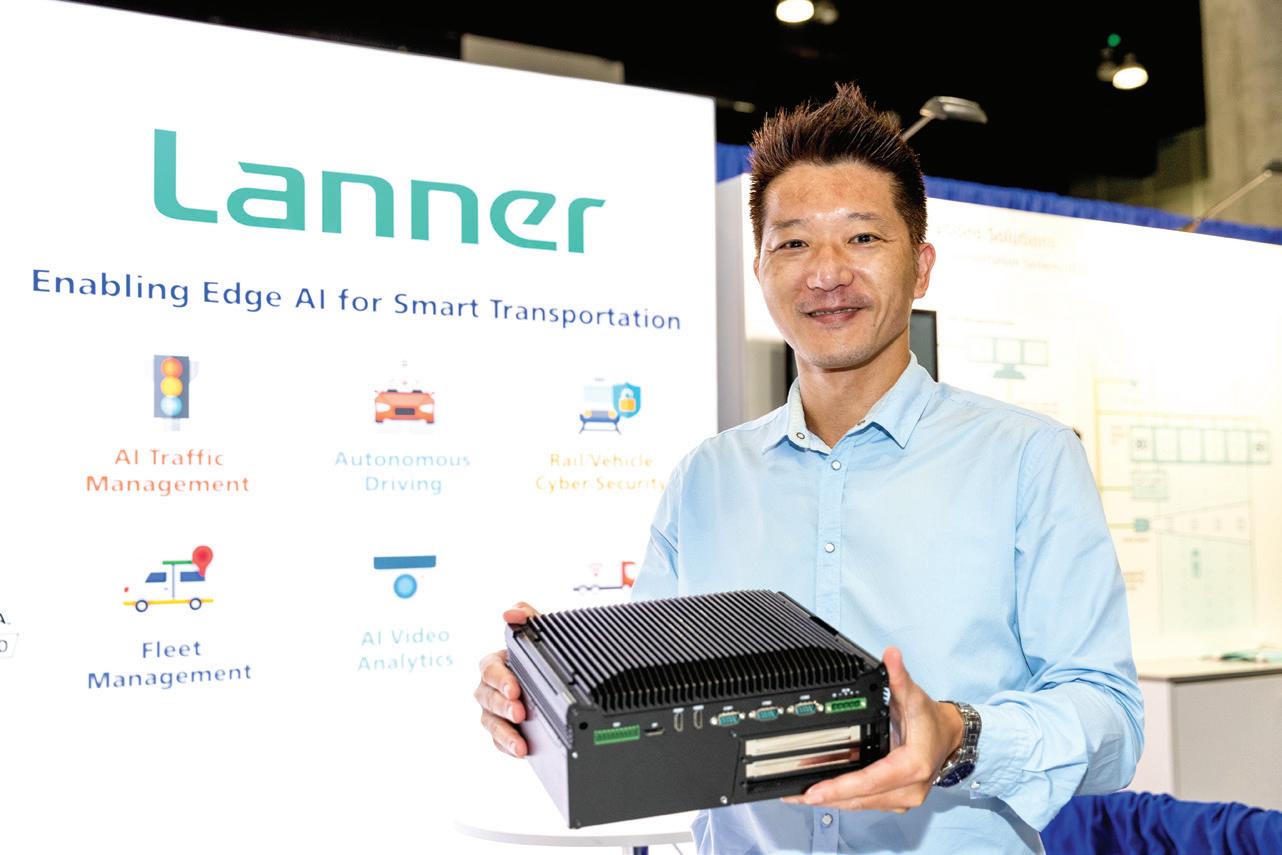
Lanner Electronics is showcasing the LEC-2290H, an AI-powered traffic video analytics and monitoring system for smart cities, at ITS World Congress in Los Angeles this week. Lanner collaborated with leading AI chipmaker Hailo to design and create the edge AI appliance which can be mounted anywhere from lighting poles, buildings or smart poles deployed across the city. According to the company, pushing AI to the edge of the network allows traffic management and monitoring applications to become independent from the performance, networking and
security challenges associated with Cloud computing.
The LEC-2290H features a rugged computer embedded with an industrial-grade AI acceleration card powered by up to six Hailo 8 processors. Featuring wide operating temperature, low power consumption (35W) and ultrahigh Tera Operations Per Second (156 TOPS), the rugged edge AI appliance enables multi-stream AI video analytics for traffic management applications such as adaptive traffic lights, vehicle prioritisation, parking access and detection, and electric tolling.
▶ Booth 1819 www.lannerinc.com
Zhao Zhai of Vanjee
Gary Chien of Lanner
EVERY JOURNEY MATTERS
We know transportation is personal.
Visit us at Booth 1723, and let’s discuss advancing mobility together.
Getting from Point A to Point B is part of your everyday life. Now it’s time to get you there smarter, safer, and more efficiently. cubic.com/transportation
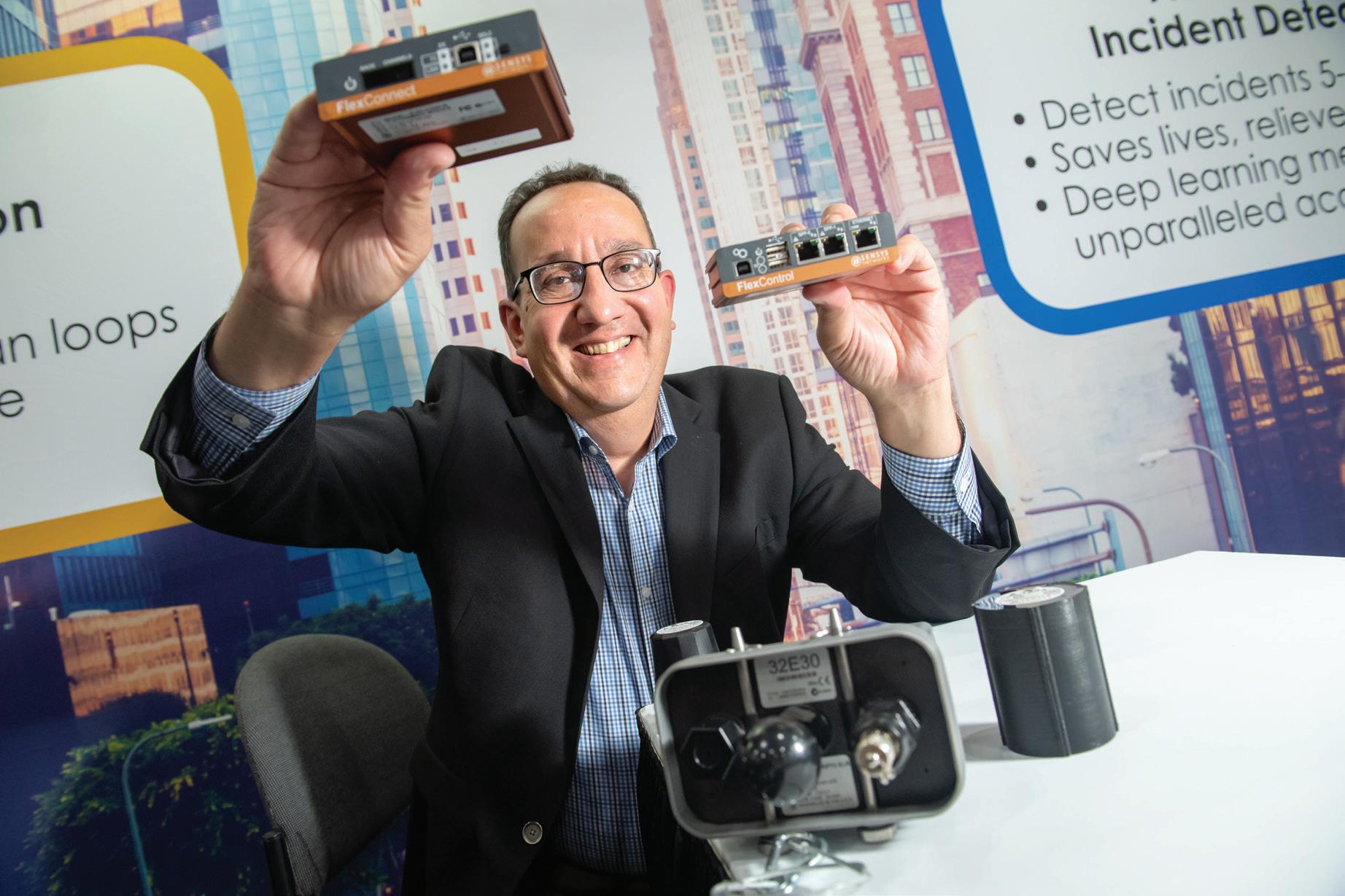
Sensys Networks goes local to keep delivering
With global demand for many components and raw materials outpacing supply, the ITS industry has not been spared by supply chain shortages and delays – affecting transportation agencies and their projects.
However, Sensys Networks based in Berkeley, CA, has successfully pivoted to local suppliers and streamlined its supply chain to mitigate these supply issues and aggressively reduce lead times.
This also means that wireless traffic detection equipment from the company complies fully with the recent Buy America requirements of the 2021 Infrastructure Investment and Jobs Act and qualifies for federal funding via the FHWA.
“By localising most of our manufacturing, we are far less susceptible to supply chain disruptions that have plagued so many others,” says Brian Fuller, president & COO of Sensys Networks. The benefits for US transportation agencies are clear: shortened lead times, less planning uncertainty, improved inventory availability, and potential access to Buy America federal funding – all while supporting manufacturing jobs in the US.
With the global supply chain issues likely to linger and with federal funding on the table, Sensys says there has never been a better time to support and leverage domestic providers for traffic projects and maintenance.
▶ Booth 1814 www.sensysnetworks.com
SICE SAYS IT ALL WITH SIDERA
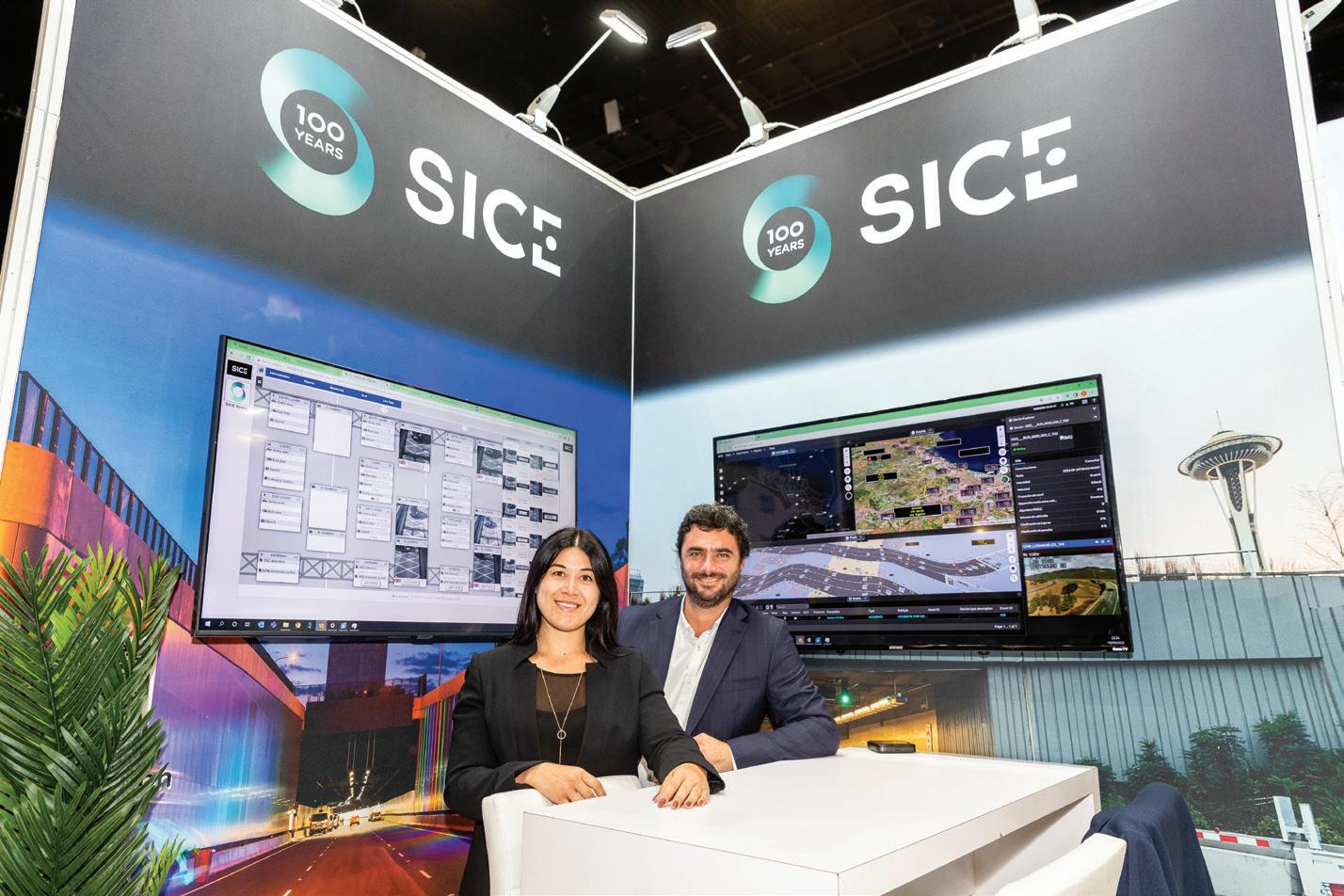
SICE’s flagship centralised traffic management system Sidera now manages all the company’s ITS equipment on more than 2,500km of roads and 340km of tunnels worldwide. In fact, Sidera handles data for some of the world’s most iconic and complex infrastructures. These include the Calle 30 in Madrid, the WestConnex tunnels in Sydney, the Seattle Tunnel in the US and the Stockholm Bypass.
Sidera’s main features – all visually explained at the company’s booth – include a unified graphic user interface enabling operators to monitor and control all critical systems. The system is scalable and upgradable. Modular and expandable architecture makes it easy to add technological advances and new functions as well as integrates it with third party tools, a wide range of databases and any type of device.
Standardisation is a key feature for this integration. Sidera follows internationally approved standards to reduce the risk of incompatibility between different systems, devices and applications.
For security, there is built-in redundancy of servers and communication networks. There is also multi-language support in terms of multi-language Human-Machine Interface which can easily incorporate new languages if required.
▶ Booth 631 www.sice.com
Brian Fuller of Sensys Networks
Natasha Thomas & Francisco Malagon of SICE
THE CHIPS ARE DOWN FOR AUTOTALKS
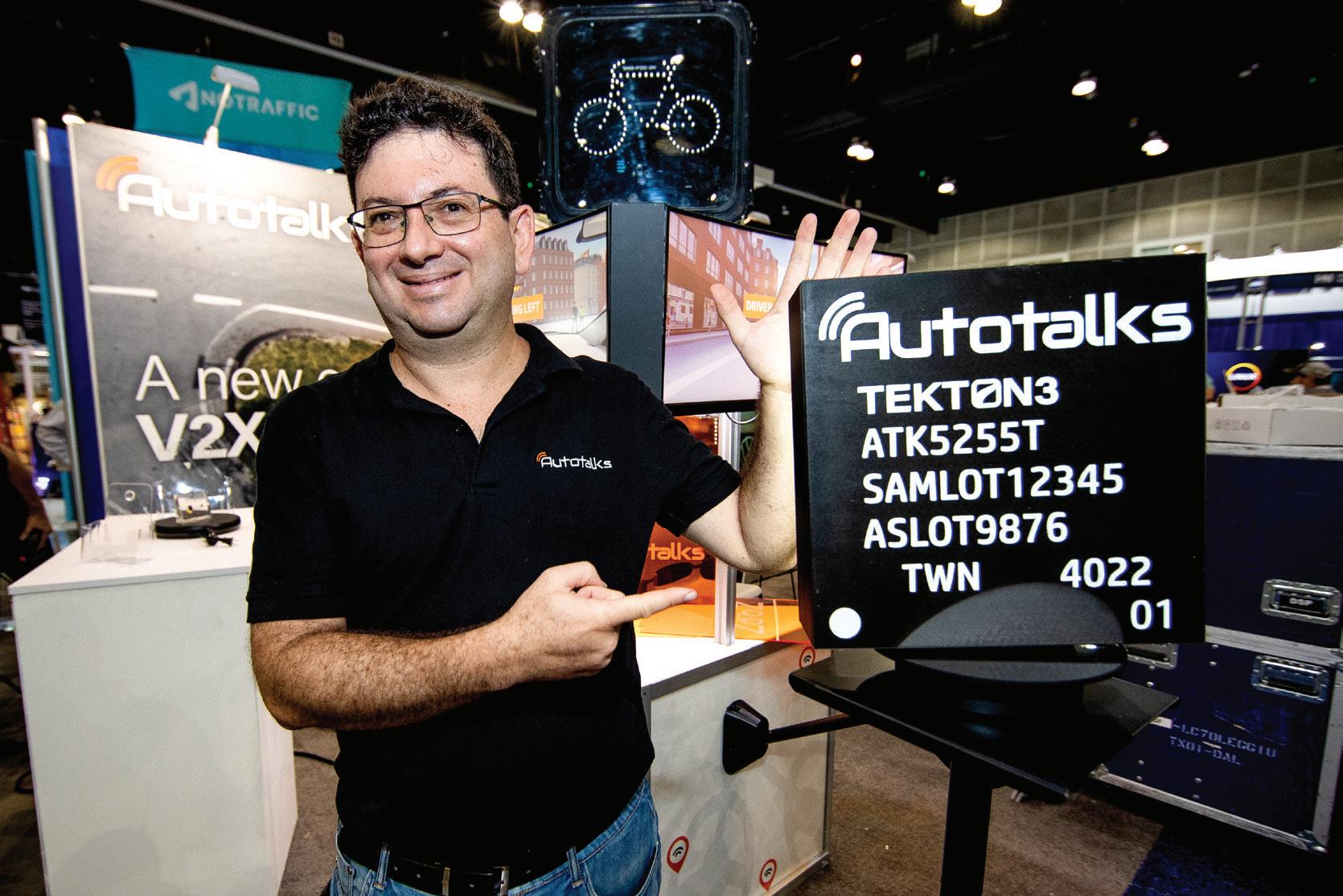
Autotalks launched its new third generation chipsets TEKTON3 and SECTON3 at ITS World Congress in Los Angeles this week. Designed to support all upcoming Vehicle to Everything (V2X) requirements, the devices are the world’s first chipsets that support both Day 1 scenarios and 5G C-V2X for Day 2 scenarios. According to the company, the chipsets are also the first Functional Safety certified V2X chipsets designed according to ISO26262 ASIL B—certifying them to be used in automatic braking applications. They have also been awarded for series production of a passenger car by a major automotive OEM. First samples are expected to be available in early 2023, and the first cars equipped with the new chipsets are set to be available in 2025.
The new chipsets are designed to support all upcoming V2X requirements in both DSRC and C-V2X communication technologies—including the latest 5G C-V2X and IEEE802.11bd. They also support concurrently full backward compatibility to any Day 1 vehicle where each vehicle reports its own data using either DSRC or LTE-V2X as well as Day 2 use cases
where vehicles are also required to report all information detected by its sensors for “sensor sharing” or “cooperative perception”.
The chipsets will embed ultra-lowlatency V2X Hardware Security Modules
(eHSM) and hardware acceleration of line rate security verification. TEKTON3 also includes an optimised CPU scaled for Day 1 and Day 2 V2X stack execution.
▶ Booth 723
www.auto-talks.com
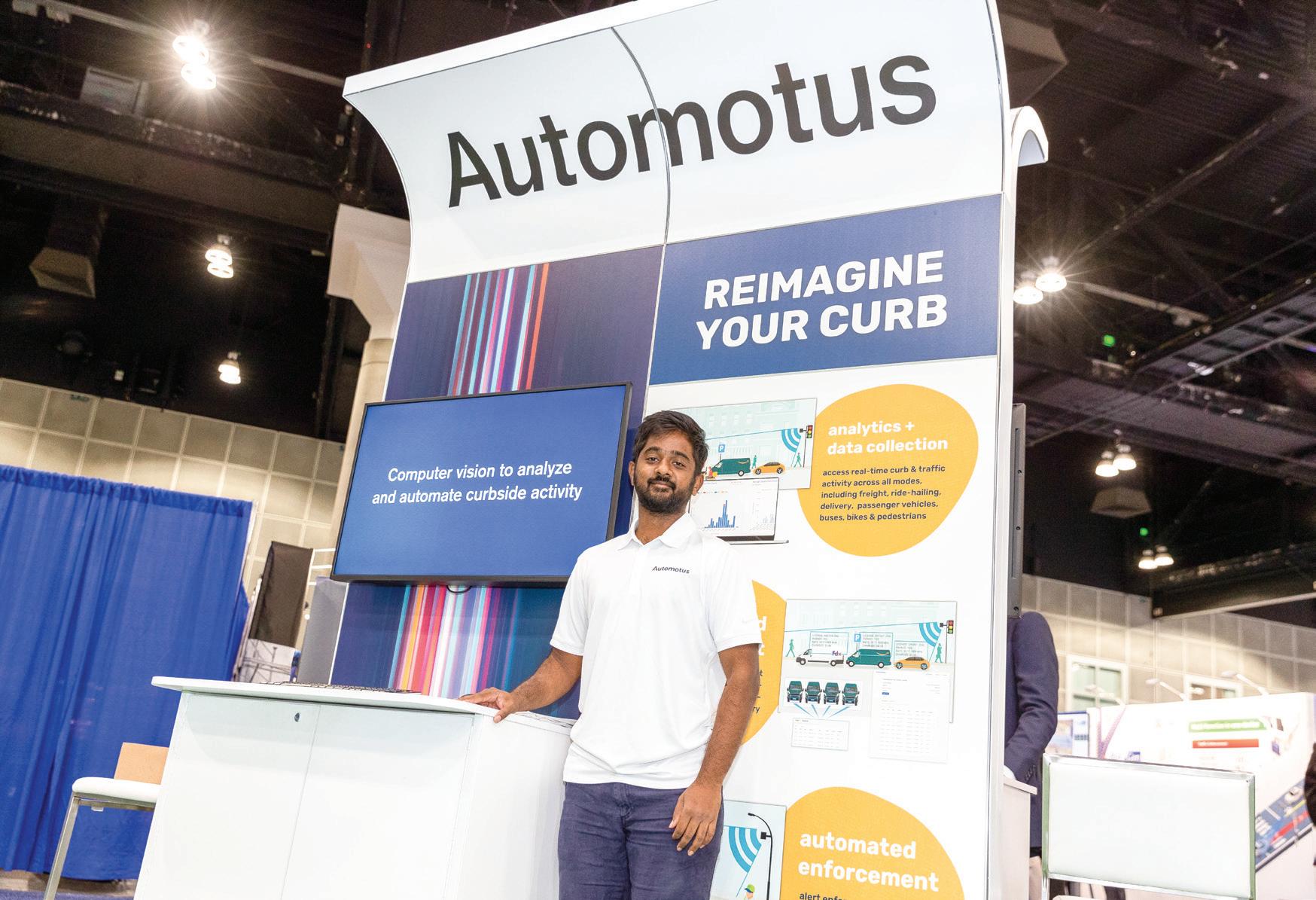
Automotus
enables
Smart Loading Zones
Automotus has developed management solution that runs on cameras equipped
citations for fleet operators.
of 30 frames per second to support automated vehicle detection and licence plate reading (ALPR) –allowing agencies to collect real-time comprehensive kerb activity data, enforce parking violations and automatically invoice drivers for the exact amount of time they spend at the kerb. Each camera also contains an embedded processing unit and cellular data chip to protect user privacy and keep infrastructure adjustments minimal.
Vehicles must go through a free, one-time registration via digital wallet for permitted access to the Smart Loading Zones. Fleet managers can also register multiple vehicles at once. Once registered, drivers can pull into any Smart Loading Zone and begin loading or unloading while Automotus technology identifies the vehicle and automatically charges the user’s digital wallet.
▶ Booth 2127
www.automotus.co
Ashwin Mohan of Automotus
Jeffrey Fefer of Autotalks
Iteris ClearGuide helps agencies improve safety and mobility by turning large amounts of complex transportation data into insights for smart, data-driven operations and planning decisions.
Leverage performance reports, trend maps and congestion hotspot analyses
Prioritize projects and measure their benefits
Fix operational issues before they become complaints
No more manual data collection
Join us at Booth 1603 for in-booth demonstrations on Iteris software, sensors and consulting solutions for improving mobility, safety and equity.
“The first step to recovery is getting out of the sense of denial that somehow people love driving”
Los Angeles, host of the 2022 ITS World Congress, is a city where the only constant is change, says Seleta Reynolds of LA Metro. Adam Hill asks her about car dependency and the challenges of ensuring transportation works for everyone
Seleta Reynolds has a new job. After several years as general manager of Los Angeles Department of Transportation (LADoT) she has just stepped over to the other side of the fence in the City of Angels to become chief innovation officer at LA Metro.
She will oversee Metro’s Innovation Office, with a focus on preparing for the 2028 Olympic and Paralympic Games in LA, updating Metro’s strategic plan and implementing new pilot programmes.
“It was an opportunity that was just too good to pass up because I have always felt strongly that LADoT is a fantastic place to test out and pilot new ideas - but Metro is the agency that can take those things to scale across the county,” Reynolds explains.
The benefits of universal basic mobility
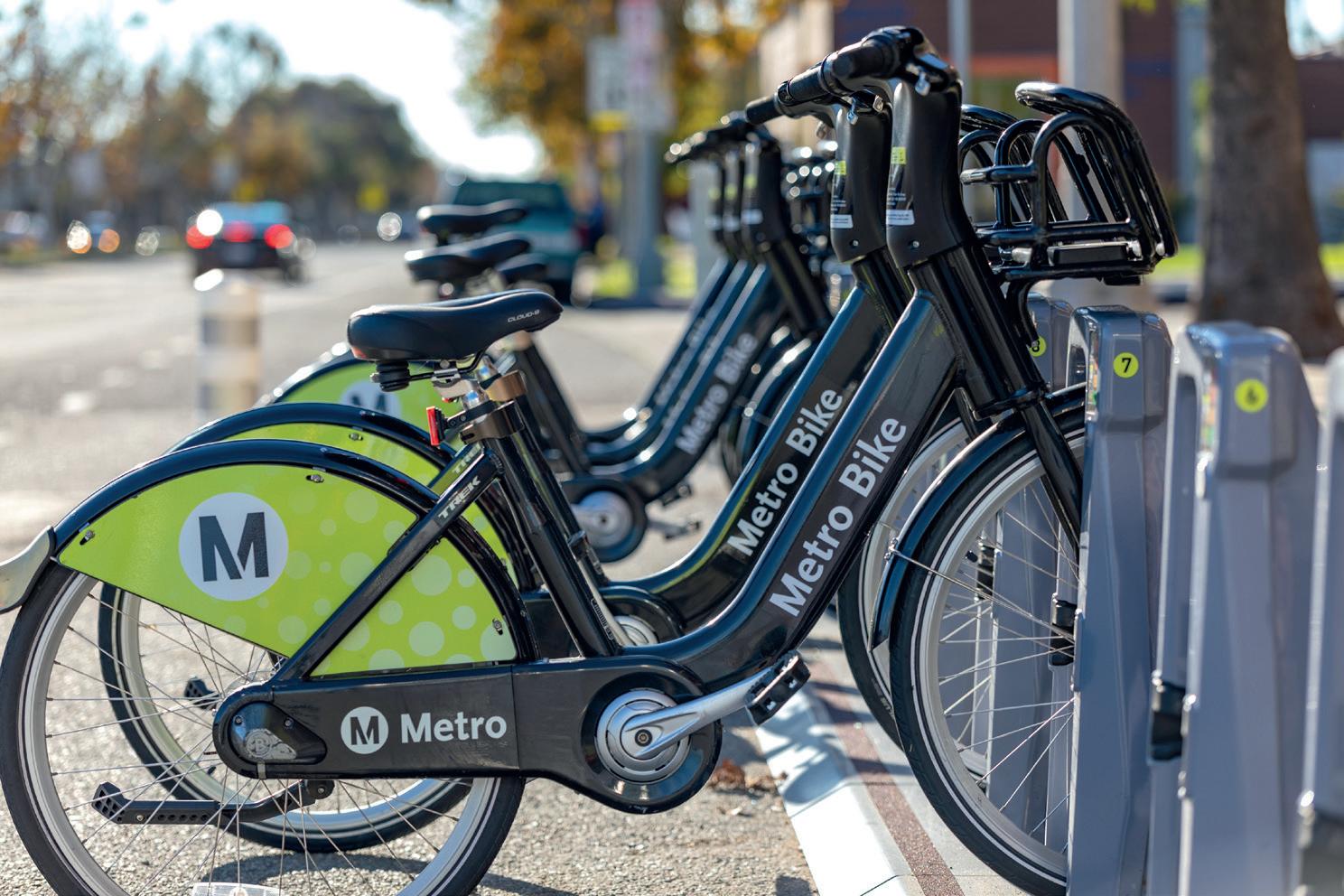
The universal basic mobility pilot in South LA is one of these, with some residents given $150 a month for a year to spend on transport services. This is about much
more than transportation, she says: “I'm very much talking about an anti-poverty measure, I'm talking about climate action, I'm talking about racial equity, I’m talking about public health. Transportation is really the reason why people cannot get to jobs, education, opportunity, and the system that we've created does not deliver equal dividends to everyone.”
If you have the money to buy and run a car, then “the mobility system works okay for you”. “But if you can't afford a car, don't have access to credit, it leaves you behind,” she continues. “When you look at the way that we've allocated funding for public transit, and allocated road space between cars and people who aren't travelling by car, it's not equitable. And when you look a little closer at the neighbourhood where this impact is felt most deeply, you start to see other inequities at play.”
She cites research which found you could reach 12 times as many jobs in an hour by car in LA County as you could in an hour by transit. “These huge inequities in the
transportation system are playing out as inequities in other places, and especially in Los Angeles, where we have crushing homelessness and people falling into poverty and having their economic mobility stripped away on top of the public health crisis that we have on our hands, with traffic crashes, and poor air quality,” she says.
“It’s clear that transportation really needs to change what we measure and how we measure it - and how we how we measure success.”
As well as physical infrastructure – the South LA pilot includes redesigning streets to include transit priority and bike lanes “to rebalance the playing field as far as the actual physical space of the streets” – there are services, like an electric car-sharing programme “so that people can actually get access to an electric vehicle [EV] on demand when they need it, to serve a variety of trips”.
There is also digital infrastructure –specifically, the mobility wallet through which people access their $150 a month
Seleta Reynolds
which will have a phased roll-out between autumn 2022 and the first quarter of 2023. There is also a community infrastructure element: training, so that people can learn how to repair EVs and e-bikes in preparation for jobs in a green economy. A community advisory board is on hand to hold the authorities accountable and make sure that the services created are actually useful and do not unintentionally create barriers to access.
How can we advance equity?
How, then, is equity of access to be achieved? “The biggest challenge for many of us who've been working in transportation for a long time is that we've been so focused on the fight to correct the status quo, the overreliance on driving,” she says. This means elements such as protected bike lanes, Vision Zero interventions and transit-only lanes have been the focus in progressive transportation in American cities for the last 15 years – “but we haven't yet really been clear about what the right role for the car really is”.
That being the case, she thinks the provision of widely-available, affordable and accessible, reliable and safe EVs and e-bikes for community use, along with the mobility wallet, “are the two most important things that we're going to do”.
Some observers might see a contradiction in making cars part of the solution, but Reynolds is adamant. “The fact remains that land use in LA, like most American cities, is a post-World War Two separation of uses that's created a situation where surface transit is going to continue to struggle to connect people to where they need to go in
a timely way,” she says. “So while the transit system catches up, we have got to make sure that we give people access to carswithout getting ourselves into a situation where people must own cars in order to be successful. That's the trickiest part and I think that's the part that I'm most interested in.”
A change in mindset is required. Although outsiders might think of Los Angeles as the archetypal temple to the automobile, Reynolds is not convinced that it is so very different from many other urban areas.
“Actually LA is not really an outlier when it comes to US cities; you think about Houston, Dallas, Cincinnati, any of those cities that are not ‘legacy rail’ cities like Washington, DC or New York, or maybe
“When you look at the way that we've allocated funding for public transit, and allocated road space between cars and people who aren't travelling by car, it's not equitable”
even San Francisco,” she points out.
In fact, American cities were built around walking and cable cars, she says: “It's the reason why we still have a lot of these very wide streets that we're now recovering from our car dependency hangover and really rethinking what the space allocation is on the streets.”
This history is important, not least because it proves LA was not always so cardependent; but “there are a lot of invisible subsidies for driving that actually create an over-reliance on cars”.
Olympics gives LA unique window Congestion pricing, and making transit “either free or very affordable”, will be crucial in altering the status quo. “Those kinds of things are going to be essential to changing the way that people get around for good,” Reynolds says. “We have a unique window in the arrival of the 2028 Olympic Games that gives us a really interesting moment to do things that people might not normally be willing to allow us to do, like time-restricted deliveries freight movement, congestion pricing, things like a network of transit-only lanes throughout the city, that might allow people to get a glimpse of a different way of getting around and a different way of life. But the first step to recovery is getting out of the sense of denial that somehow people love driving and there's no way to change the city. The fact is that one of the only constants in cities and transportation is change. And so we have to keep looking for the right levers.”
• This is an edited version of an interview which first appeared in ITS International
Sensys Networks’ local supply chain qualifies for Buy America funding
Supply chains and patience have been stretched thin. That’s why we’re sourcing local manufacturers to:
• Shorten lead times
• Improve inventory availability
• Meet Buy America requirements
We offer the fastest, easiest way to have accurate and reliable detection.
To learn more about loop replacement, visit sensysnetworks.com/betterthanloops
Visit us at booth 1814
SWRI fuels young people’s passion for STEM topics
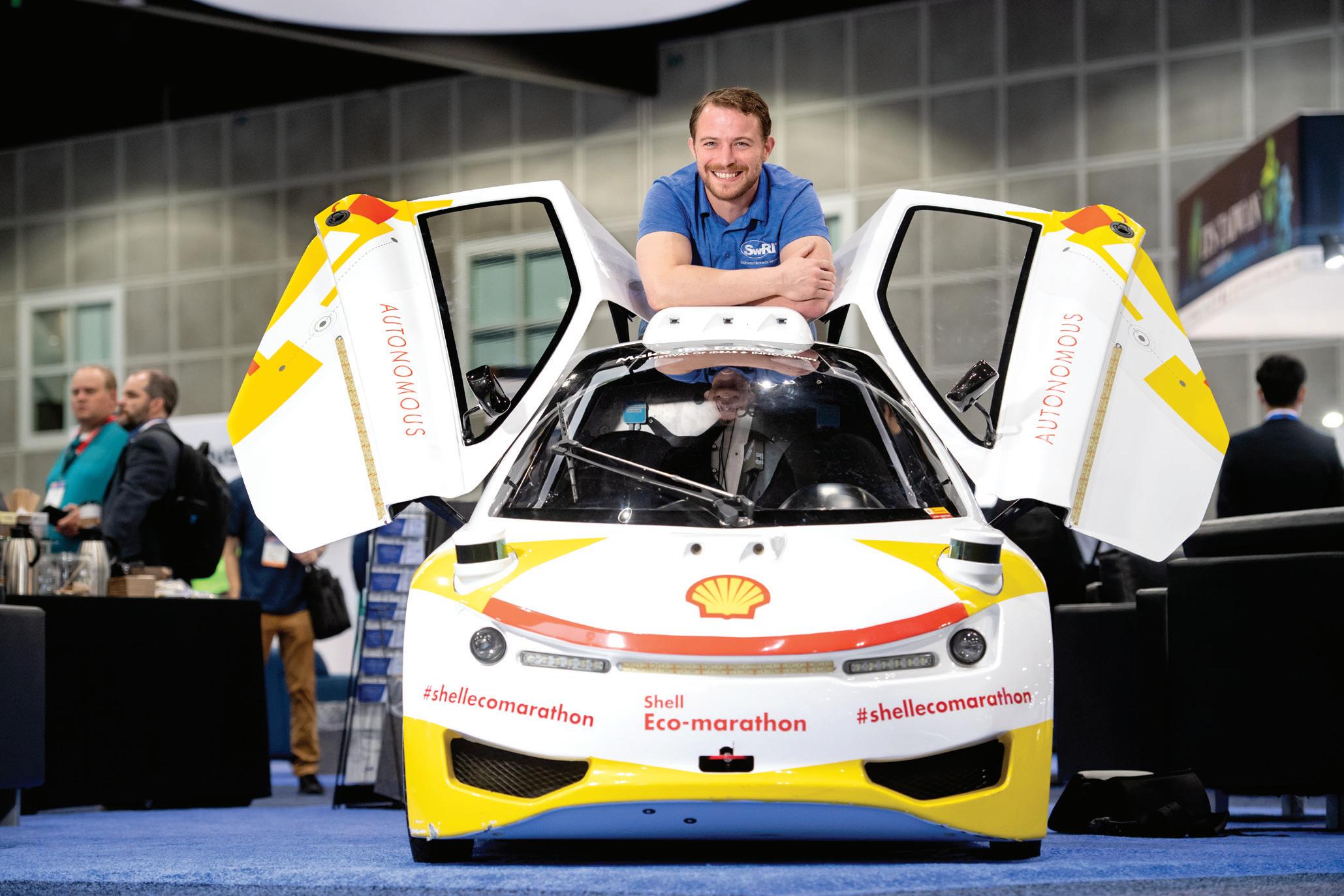
Asmall car on the Southwest Research Institute (SWRI) booth aims to spur young people’s interest in STEM topics and further the cause of autonomous vehicles.
The white and yellow hatchback, with distinctive vertically opening doors, was developed by SWRI as a platform for different software stacks that can guide the vehicle and avoid obstacles such as other vehicles or pedestrians.
It is taking part in the annual Shell EcoMarathon event, which seeks to eke out the maximum possible mileage from a set amount of fuel. Previous winning entries have achieved more than 1,000 miles per gallon (mpg), but have been basic in the extreme and have often scarcely resembled cars. The SWRI hatchback is somewhat more practical and can achieve around 500mpg.
“It’s a fully functional vehicle,” said SWRI assistant project manager, Daniel Rossiter. The car’s interior, housed inside a lightweight fibreglass shell, is still basic but can carry two people. It is powered by a small petrol engine.
To navigate successfully, the testbed has front and rear Lidar sensors, plus cameras giving 360o coverage. The vehicle’s ’brain’ that interprets input from the sensors and transforms it into steering commands, is underneath the rear hatchback. The software is hardware-agnostic.
however, greater attention has been placed on the software that enables it to operate autonomously.
In past years, the emphasis in the event has been on the physical engineering of fuel-sipping vehicles. More recently,
The vehicle and the wider project aims to foster an interest in STEM subjects. “The vision is that students can build their own
software stack and run it in the real world, to see if it works,” said Rossiter. Timescale for the first such software being loaded into the vehicle is the next year or two.
▶ Booth 1123 www.swri.org
INVISION SHOWS THE WAY WITH VOD SYSTEM
Invision has automated the way transportation agencies and road operators count passengers in vehicles with its new Vehicle Occupancy Detection (VOD) system. According to the company, the solution is easy to deploy on roadsides or in the median with no on-site tuning, providing a fully automated, mobile solution with 99% accuracy that can be moved between sites as needed.
“We see our product as an enabler of new policies that will disrupt the transportation
and tolling industries,” the company said in a statement. “Everyone agrees that we need to find better ways to address congestion, reduce greenhouse gas emissions and improve safety, but tools have been, to some extent, outdated in our opinion.”
The ability to automate vehicle occupancy detection enables dynamic tolling decisions based on occupant counts rather than vehicle-level statistics—creating new options for policy makers and road operators.
Invision’s VOD system follows the company’s vision to empower devices out in the field—such as remote cameras and other sensors—to use artificial intelligence (AI) and machine learning (ML) to interpret the world around them without relying on costly hardware or Cloud connections. And, because processing is done on site, agencies and road operators can ensure the privacy of vehicle occupants.
▶ Booth 1053 www.invision.ai
Daniel Rossiter of SWRI
■
■
■
■
AEye’s platform is the only intelligent sensing solution for ITS with AI-driven, software-definable lidar at its core.
• – Customizable performance modes for any ITS application
• – Across countless mounting and mechanical constraints
• – High quality data at range in all lighting and weather conditions
• – Sensor operating system is upgradable to meet future requirements
No summertime blues for Gewi
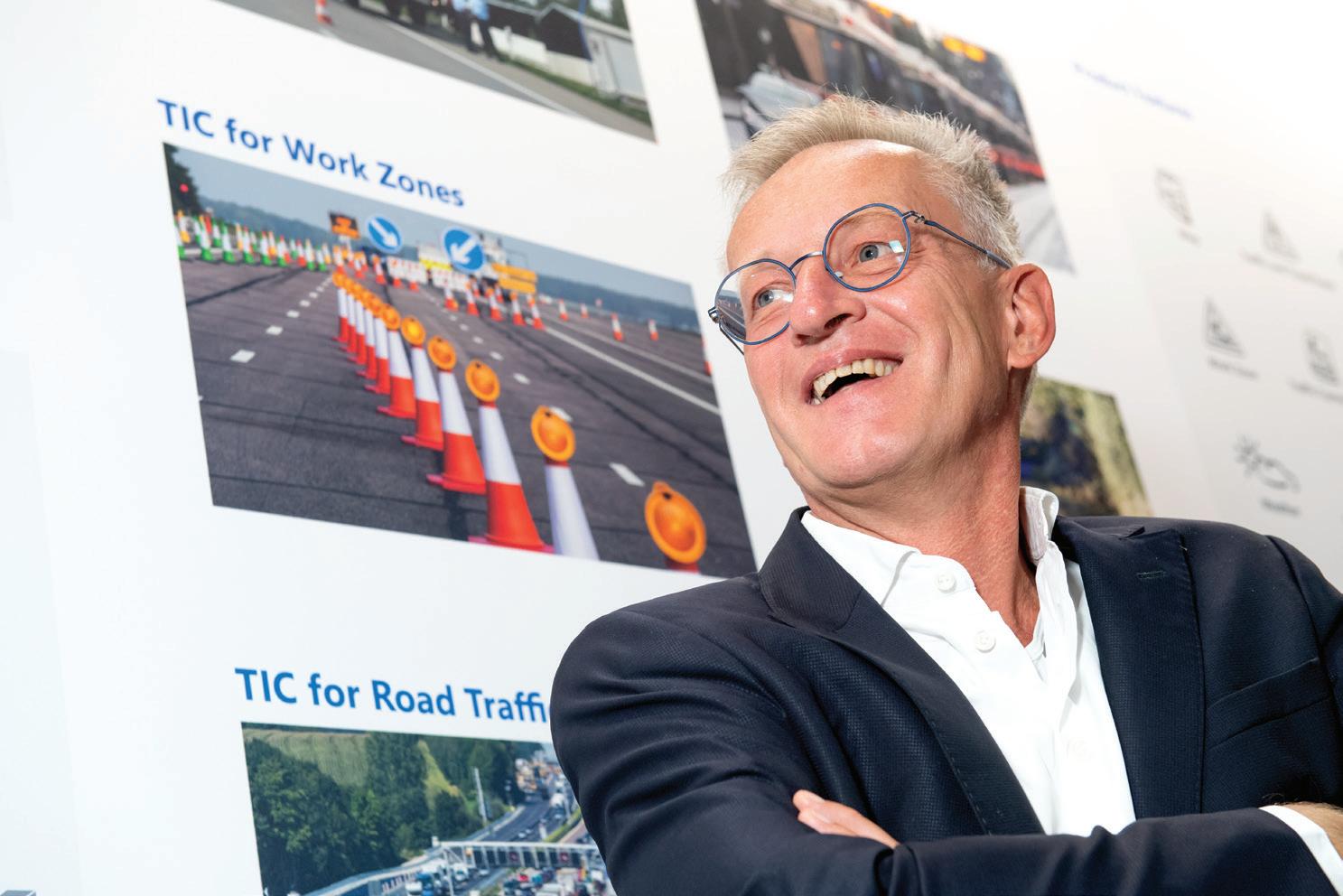
Canada’s Quebec City, with a population of round 550,000, has a specific challenge when it comes to building new roads and maintaining existing ones. Harsh winter weather means roadworks have a short window of opportunity – April to October at best. During these summer months there can be upwards of 2,000 sets of roadworks, causing major traffic snarls.
TIC for Work Zones is a software solution from the German software company Gewi. It uses configurable, predefined steps to define exactly what work will be done, when and where. The all-inone system handles every aspect, from a request for works, through
Hagen Geppert of Gewi
analysis, to permit generation and sharing the information. By using a single system, comprising many solutions delivering the information across multiple channels, the chance of discrepancies, conflicts and omissions are greatly reduced.
The solution can automatically import permit requests from other systems being used, with data being harmonised and, if required, improved by the operator. Work zones are highly coded and geo-referenced so the solution automatically detects conflicts.
The solution not only exports permit documents, but also outputs to websites and social media in multiple
languages to sat-nav systems, connected vehicles and systems supporting the USDoT WZDX standard. Work zone data can even be used to issue fines for works being carried out without a licence or feed the 911 emergency telephone number system to save lives – emergency vehicles can find the best route to the incident location.
▶ Booth 1043 https://gewi.com
ITS DIARY DATES FOR 2023
As a fabulous 28th ITS World Congress 2022 in Los Angeles begins to draw to a close, thoughts turn to next year’s ITS events.
The ITS America 2023 Annual Meeting runs from 24-27 April in Dallas-Fort Worth, which is the fourth-largest metro area in the US by population.
The meeting will bring together the community of intelligent transportation professionals to network, connect, and form partnerships in an environment of education, technical tours and demonstrations exploring solutions and emerging technologies to enable better future mobility.
Dallas Area Rapid Transit already has the US’s longest lightrail network, and Mobility 2045, a long-term plan for multimodal transportation development in Dallas-Fort Worth, has $136.4 billion in funding.
In the autumn, the 29th ITS World Congress will take place on 16-20 October 2023 in Suzhou, China, which is located 100km from Shanghai. Organised by ITS Asia-Pacific, delegates can expect conference sessions, exhibitions, demonstrations and social events.
RADAR DETECTION
Superior Traffic Detection Accuracy and Reliability
Econolite’s EVO RADAR™ sensor is designed for all approaches, which helps to reduce travel times and traffic congestion, while increasing safety at intersections for pedestrians, cyclists, and motorists. The EVO RADAR™ sensor solution is ideally suited for a variety of intersections, using a 110-degree field-of-view designed to cover two approaches with a single sensor. EVO RADAR™ provides situational awareness at every intersection.
A true global platform for cross-industry cooperation
Visit booth 419 to learn about the 5G Automotive Association (5GAA). It is a global, cross-industry organisation of companies from the automotive, technology, and telecommunications industries (ICT), working together to develop end-to-end solutions for future mobility and transportation services
Created in September 2016, 5GAA has rapidly expanded to include key players with a global footprint in the automotive, technology and telecommunications industries. This includes automotive manufacturers, Tier 1 suppliers, chipset and communication system providers, mobile operators and infrastructure vendors. 5GAA is now gathering more than 125 members from the automotive, technology and telecommunications industry, that includes 14 of the top 15 global automakers and nine of the leading 10 international mobile network operators. This rapid expansion has generated a trustworthy global platform for cross-industry cooperation.
Collectively, 5GAA members have developed ready-to-deploy innovative connected vehicle technology to support the urgent need for wide-scale deployment of C-V2X technology in the US. As traffic fatalities reached a 16-year high in 2021, there is an overwhelming consensus throughout the transportation community that rapid deployment of C-V2X is imperative to the safety of America’s roadways, for vehicles, passengers and vulnerable road users (VRUs).
“Everyone at 5GAA has a stake in the realisation of this objective,” says Maxime Flament, chief technology officer, 5GAA. “People or objects that are part of the connected mobility ecosystem have, in some way, the possibility to create, send and receive information which can contribute to safer, smarter, and more sustainable journeys. This is not limited to connected cars; a truly connected mobility ecosystem can only be called such if it is diverse, inclusive, trusted, and welcoming.”
The 5G C-V2X ecosystem
On a global scale, automakers are moving forward with C-V2X deployment. Companies like Ford and General Motors are leading the line in the Chinese market, where transportation authorities have announced plans to ramp up C-V2Xpowered smart infrastructure deployments significantly. Nearly 17,000 roadside units are expected to be deployed by the end of this year, and predictions are that 160,000 and almost 390,000 roadside units will be deployed by the end of 2025 and 2030, respectively.
This global rush towards deploying safety C-V2X measures stems from motor vehicle crashes killing an estimated 42,915 people in the US in 2021, a 10.5% increase from the previous year. This is the highest number of traffic fatalities since 2005, and the most significant annual percentage increase in fatalities since the US Department of Transportation began tracking this data in 1975. NHTSA estimates another 7% increase in fatalities in Q1 of 2022 compared to Q1 2021.
The National Highway Traffic Safety Administration (NHTSA) predicts that the safety applications enabled by V2X technologies could eliminate or mitigate the severity of up to 80% of non-impaired crashes, significantly reducing the nearly 37,000 lives lost and three million injuries that occur on US roadways.
C-V2X technology is set to revolutionise the mobility ecosystem and the way drivers interact with the world by developing an overall transportation industry that is safer, greener and more efficient for vehicles, road users and the surrounding infrastructure.
Defuse critical situations
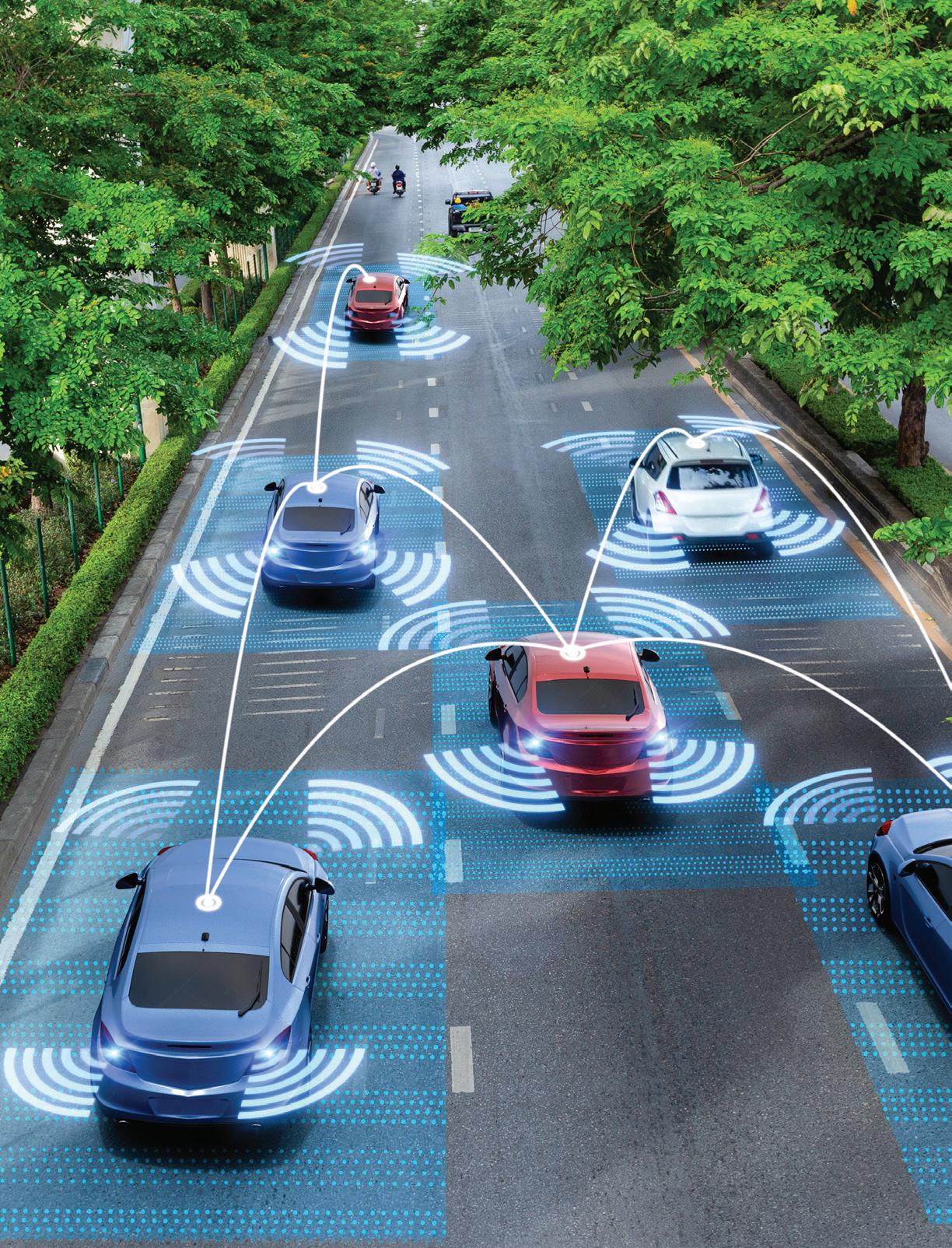
Cooperative driving, enabled by direct and network-based, responsive communication between all traffic participants through 5G and C-V2X, aims to prevent road incidents and traffic congestion. This connectivity is intended to help defuse critical situations such as turning, passing on rural roads, or merging into acceleration lanes. According to the 5GAA roadmap, 5G will also enable the mass deployment of new, advanced use cases for cooperative and automated driving by the late 2020s, for example dynamic intersection management, complex interactions with VRUs, or teleoperated driving.
Together with its members, 5GAA has embraced digital transformation and is creating opportunities for transportation innovation. Its goal is to develop end-to-end solutions for future mobility that improve traffic efficiency, driving comfort and road safety to ensure a secure and sustainable transportation ecosystem.
Booth 419 https://5gaa.org
Maxime Flament
Jogan ensures no hiding place for driving offenders
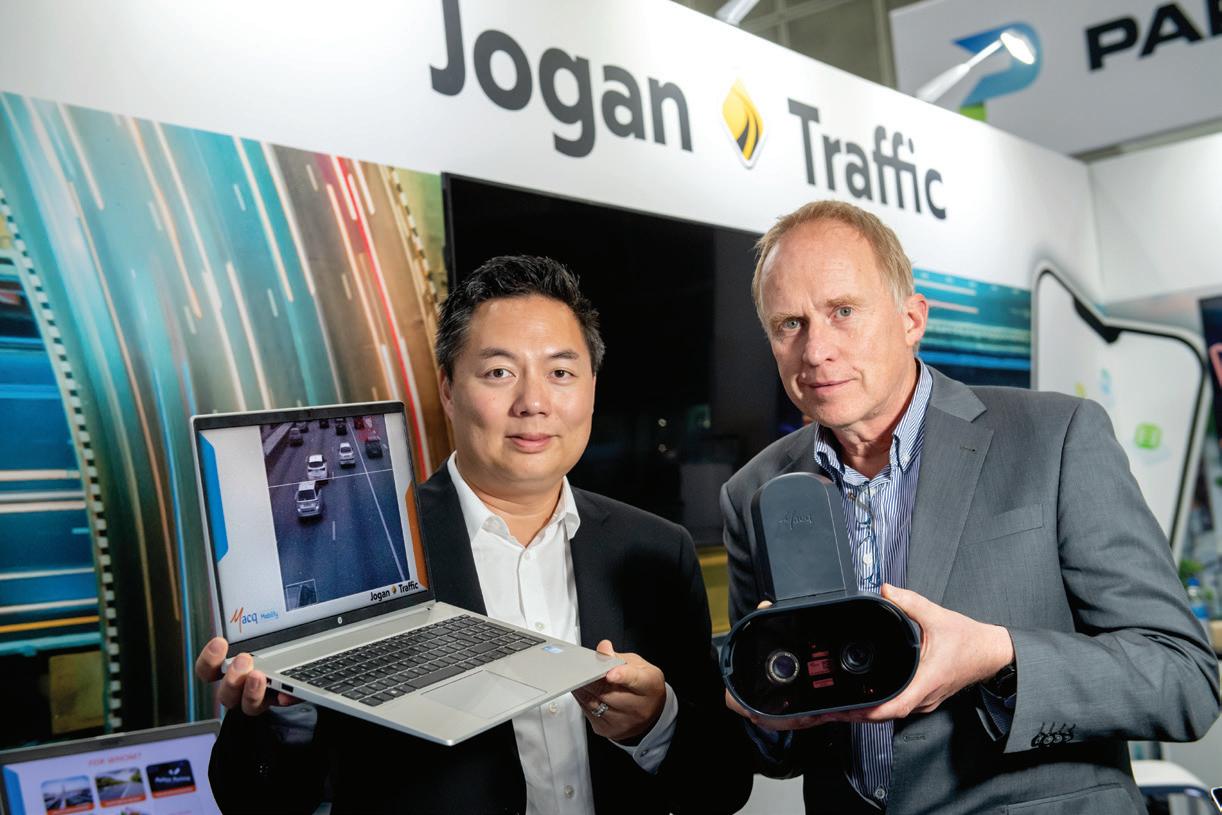
There’s no hiding now for drivers and front seat passengers who aren’t wearing seatbelts or are using their phones while driving. The latest addition to the QCAM range of optical imaging cameras has a colour polarised lens that sees clearly into the front seat of vehicles.
It’s another step in the right direction, explains Dan Dietrich, president of Jogan Traffic and with more than 20 years international experience in the imaging sector. “The future is to extend this technology so we can see straight into the back seat as well,” he says.
Jogan Traffic has partnered with Belgian manufacturer Macq Mobility to bring the QCAM5 and other cutting edge European technologies to the
North American market. The QCAM5 ANPR camera delivers unprecedented number plate recognition capabilities. It can operate across up to four lanes
and differentiates all vehicles –cars, trucks, buses, motorcycles, bicycles, trams – as well as people.
Moreover, it integrates a
‘Make and Model’ recognition feature, as well as a ‘vehicle colour’ characterisation. Both features are invaluable in finding vehicles and closing the gap in similar product offerings. These features, when available, typically require additional hardware and software.
The QCAM5 camera is also calculates an instantaneous speed estimate for each vehicle travelling within its field of view. The physical unit is small and blends in discreetly with its urban surroundings. Moreover, a miniaturised motor within the support arm allows remote alignment, removing the need for an aerial lift truck for final mechanical setup.
▶ Booth 1507
https://jogantraffic.com /qcam-5
POLARA ENABLES SAFER CROSSINGS FOR THE VISUALLY IMPAIRED
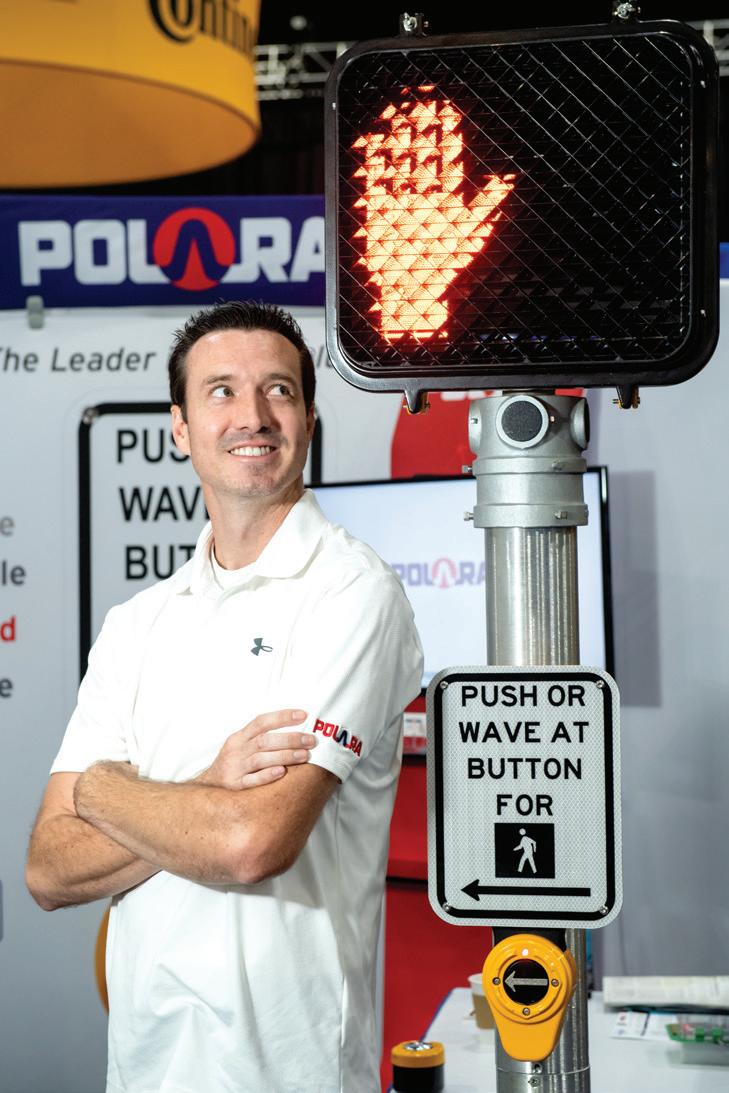
Polara Enterprises is expanding into international markets with its iNS Accessible Pedestrian Signal (APS), designed to make pedestrian crossings easier to negotiate for the visually impaired.
The company has landed a contract in Guayaquil, Ecuador and is aiming at India. However, one of its fastest-growing markets is New York, which has recently released a citywide mandate to replace pedestrian signals at every intersection within 10 years.
“From a pedestrian’s standpoint, we’re the only one that has a pedestrian-facing application for a mobile phone,” said chief operations officer, Brandon McGaffey. The iNS is compliant with the Americans with Disabilities Act (ADA).
The system works by the APS sending a signal to a blind person’s mobile phone as they near a suitably equipped pedestrian
crossing, with the sound getting louder as they approach. It also gives the visually impaired person audible notice of the street and intersecting street.
The pedestrian chooses the road they wish to cross and presses a button on their phone to place a call to the traffic controller.
When the lights change to ‘Walk’, an alert is sent to the pedestrian’s phone, with the countdown also communicated audibly.
The APS also has a no-touch button to trigger the system, with the pedestrian waving their hand over it, should they wish to trigger the APS in that way.
“The goal is to give someone who is visually impaired the exact same information as someone who’s sighted,” explained McGaffey.
▶ Booth 716 www.polara.com
Brandon McGaffey of Polara Enterprises
Dan Dietrich & Francois Macq of Jogan
Safer, smarter, greener ATC technology provides better control of traffic signals. ATC is designed to simplify the complex and ever-expanding roadway capabilities. ATC enhances multimodal including bicycles, pedestrians, automobiles, parking, rail, transit, and freight. ATC smart city technology like V2I, enhanced connectivity, more powerful I/O and promotes lower energy LEDs. Not all intersections are the same – ATC Smart Technology adapts to each agency’s unique needs – One Technology for All.
See all the power of ATC at www.editraffic.com/atc-cabinet
SWARCO McCain
INNOVATION HAS NO LIMITS
Embedded in a global family of brilliant, innovative minds and extensive resources in road safety and traffic management, SWARCO McCain sustainably keeps 21st century traffic in motion.
Get ready for a new look now!
With its new name, SWARCO McCain Inc. is excited to usher in its parent company’s global branding. Keep an eye out for the latest updates in ads, product materials, the McCain website, and so much more.