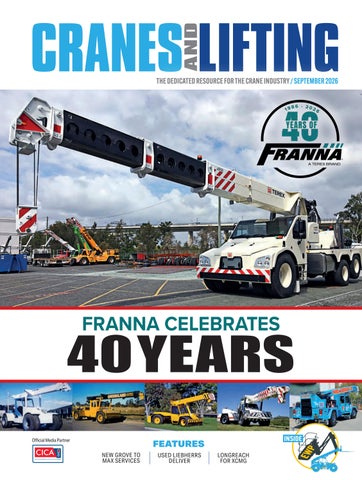
Cranes and Lifting
THE DEDICATED RESOURCE FOR THE CRANE INDUSTRY / SEPTEMBER 2026
September 2026
FRANNA CELEBRATES
40 YEARS Official Media Partner
INSIDE
FEATURES NEW GROVE TO MAX SERVICES
USED LIEBHERRS DELIVER
LONGREACH FOR XCMG
We’re more than a service provider — we’re a true partner in keeping your operations moving. From heavy industry and mining in the Pilbara to marine and infrastructure projects on the East Coast, our team of expert technicians and parts specialists deliver around-the-clock, on-site support you can count on.
OUR SERVICES Mobile crane repairs & diagnostics Marine & offshore crane servicing Labour hire (short and long-term) Nationwide parts sourcing & logistics 24/7 emergency breakdown response
With operations based in Karratha (WA) Perth Metro (WA) Sydney (NSW) & SEQ (QLD), we offer rapid mobilisation and local expertise to meet the demands of Australia’s most challenging worksites. NEW DIRECTION. EXPANDED CAPACITY. SHARPER FOCUS.
As CCS enters a new chapter of national growth, we’re investing in the people, systems, and scale to support major projects, port authorities, and private fleets across Australia.
CALL (02) 8750 0107 EMAIL info@completecranesolutions.com.au VISIT completecranesolutions.com.au
Karratha Workshop - WA Pilbara Region - WA Perth Greater Region - WA Kalgoorlie - Boulder - WA Sydney Workshop - NSW Sydney Greater Region - NSW Brisbane Greater Region - QLD
IN THIS ISSUE
Cranes and Lifting Magazine
cranes_and_lifting
Cranes and Lifting
45 64 H igh Access Group
The High Access advantage.
67 D ieci Australia
Leading the way in rotational technology.
70 A ltequip
18 6
F ranna – A Terex Brand
40 years of building a lifting icon.
Built for bigger jobs.
72 Z oomlion 34 A ndromeda
Building the future of Superflex.
10 C ICA CEO Report
37 C rane Connection
12 C ICA
40 B orger Cranes
15 C ANZ
43 T RT
Training the future workforce.
Crane Quest 2026.
Learning from the toughest moments.
18 T itan Cranes
Coming back home with a bigger fleet.
20 L EEA
When standards become optional.
23 Converge Expo
Returning in 2027.
27 U AA
Setting up Mobile Plant and Machinery Insurance.
30 E nerpac
Precision lift with Enerpac SyncHoist.
32 G rove
New Grove for Max Services.
www.cranesandlifting.com.au
New XCMG for Longreach Cranes.
Borger continues investment strategy. Decades of proven reliabiilty.
EWP & Telehandler features
Engineering the future of access.
74 M CT Equipment
Magni perfectly matched lifting for construction sites.
77 L iebherr Australia
Liebherr Used Cranes experience significant growth.
81 R egatta Registers
The future of lifting equipment checks.
46 Bronto Skylift
84 P otain
52 Lincon
86 R ichie Bros
55 Hijsen
89 C omplete Crane Solutions
Strengthening product and service offering in Australia.
Raising the standard in truckmounted access. Smarter access on modern construction sites.
58 Tadano
Reliability has a new shape.
61 Niftylift Australia
The right machine, backed by the right support.
Potain Power Solutions energy systems for emerging markets.
A landmark fleet sale for the crane industry. Expanding service and support throughout the Pilbara.
SCAN
TO SUBSCRIBE TO OUR NEWSLETTER September 2026 CAL / 3
FROM THE EDITORIAL TEAM Published by:
WELCOME TO THE SEPTEMBER ISSUE OF THE MAGAZINE FOLLOWING 30 YEARS IN THE LIFTING
industry, servicing many Victorian industry sectors with a ‘state of the art’ crane fleet, it was surprising to learn that Metcalf Crane Services had decided to divest its assets. Managing Director Tim Metcalf said the decision allows the business to focus on its other ventures, including Metcalf Heli Services. “After 30 years building this business, the decision to divest the fleet wasn’t one I took lightly – but the time felt right to focus on our other ventures, including Metcalf Heli Services,” he said. A number of Victoria’s leading crane hire business owners learned their trade at Metcalf Crane Services and I am sure there are many who will join us in wishing Tim all the very best for the future. It would appear the crane sector has entered a ‘transitional period’ as we learn more very established businesses are considering exiting the industry and realising the value of fleets the owners have built over many decades. The expansion of crane businesses through strategic acquisition continues and in some cases, this will facilitate access to interstate markets.
We applaud the Crane Industry Council of Australia (CICA) for the Crane Quest 2026 initiative. Delivered by the NSW Department of Education’s Regional Industry Education Partnerships (RIEP) program in partnership with CICA, Crane Quest saw students swapping the classroom for hands-on experiences – climbing into the crane simulator, learning the fundamentals of dogging and rigging, seeing the cranes up close. These types of initiatives are critical if we are going to attract the next generations to our industry. As always, the team at Cranes and Lifting has worked hard to bring you what we hope will be a useful and informative issue of the magazine and we hope you enjoy the read. Boom Up!
Chairman John Murphy E: john.murphy@primecreative.com.au CEO Christine Clancy E: christine.clancy@primecreative.com.au Publisher Sarah Baker E: sarah.baker@primecreative.com.au Managing Editor Lisa Korycki E: lisa.korycki@primecreative.com.au Editor Simon Gould E: simon.gould@primecreative.com.au T: 0404 865 109 Assistant Editor Danny D’Cruze E: danny.dcruze@primecreative.com.au T: 0429 187 751 Business Development Manager Emily Schlegel E: emily.schlegel@primecreative.com.au T: 0466 317 555 Client Success Manager Ben Sammartino E: ben.sammartino@primecreative.com.au
Simon Gould Editor, Cranes and Lifting
Art Director Bea Barthelson
Image: Ritchie Bros.
More than 100 cranes and support assets are being offered through Ritchie Bros.’ Marketplace-E
4 / CAL September 2026
379 Docklands Drive, Docklands VIC 3008 T: 03 9690 8766 www.primecreativemedia.com.au
Imaging Assistant Paul Breen Subscriptions T: +61 3 9690 8766 E: subscriptions@primecreative.com.au
The Publisher reserves the right to alter or omit any article or advertisement submitted and requires indemnity from the advertisers and contributors against damages or liabilities that may arise from material published. © Copyright – No part of this publication may be reproduced, stored in a retrieval system or transmitted in any means electronic, mechanical, photocopying, recording or otherwise without the permission of the publisher.
www.cranesandlifting.com.au
13738-2
There’s nothing more on 4 LTM 1120-4.2 The longest boom on four axles at 66 metres – particularly powerful with a lifting capacity of 120 tonnes, especially when fully raised. Global mobility and convenience thanks to Hillstart Aid, ECOmode, ECOdrive, VarioBallast and VarioBase. Nothing more is possible on four axles! www.liebherr.com
Mobile and crawler cranes
13738-2008_LWE_066_LTM_1120-4.2_2025-ENG-Australia-200x265-v01.indd 1
18.06.2026 12:09
UP FRONT / FRANNA – A TEREX BRAND
40 YEARS OF BUILDING A LIFTING ICON For 40 years, Franna has helped define Australia’s pick-and-carry crane sector, evolving alongside the people who built and supported it.
THROUGH THE STORIES OF EIGHT LONG-
serving employees, Cranes and Lifting explores how decades of experience, customer relationships and continuous improvement have shaped one of Australia’s most recognisable crane brands. Craig Hain grew up in the crane industry, he was the youngest crane operator to obtain his open crane ticket, before being lured away from the operator seat to Franna through his family’s connection with the business before forging his own career. Stephen Marsh never intended to build a career at Franna. In early 1988, his wife, Maryanne, had been flown from Longreach to Brisbane for emergency medical care while expecting their first child. Stephen needed work close to the hospital so they could spend mornings and evenings together. Franna happened to be nearby. What started as a practical decision has turned into a career spanning almost four decades. Across the business, stories like Stephen’s are remarkably familiar. Danny Black joined straight out of The first Franna.
6 / CAL September 2026
university, expecting to build a career as a mechanical engineer. Mark Ellis joined the production line in 1992. He had little interest in assembling machinery at the time, but the opportunity would eventually turn into a 34-year career. Mark Tanner arrived as a graduate engineer. Warren Ross, Alex Peters and Lee McKenna, all started their journey as apprentices. Collectively, they have spent well beyond two centuries with the company. Their careers help tell the story of Franna’s growth. This year marks 40 years since Franna Cranes Pty Ltd was formed, which was when Franna really entered production. During that time, the Australian-built pick-andcarry crane has become an industry icon, finding its place across construction, mining, infrastructure and industrial sites around the country. Over four decades, the Franna name has become synonymous with the evolution of Australia’s pick-and-carry crane. From the early 8, 10 and 12-tonne models that established the concept, the range expanded through over 30 new models, such as the
MAC25, before evolving into today’s line-up of the AT22-2, AT24 US, MAC25-5, AT44 US and flagship AT40-2. For Danny Black, General Manager of Franna, the journey started almost by accident. “I actually started here two days after my last university exam,” Danny said. “I was studying mechanical engineering and, like most graduates, I probably dreamed of one day working in an elite engineering team like Formula One. I knew nothing about cranes, but quickly realised Frannas are a mechanical engineer’s candy store. There are so many different engineering disciplines wrapped into one machine.” That fascination never disappeared. Joining Franna in November 1989, Danny entered a business that was still family-owned and manufacturing a product unlike anything else in Australia. “I was fortunate enough to get in front of such passionate customers very early,” he said. “They’re the people who have really made our product what it is today. Listening to their challenges and suggestions helped shape how we designed and improved the cranes.” He said, “We’ve got a lot of long-term employees who are just as passionate about the product and want to see our customers succeed. When something goes wrong, our approach is to fix the problem first and work out why later.” Across engineering, service, training and sales, that customer-first mindset comes through clearly. Franna’s longest-serving employees describe the business less as a manufacturer than as a team. Stephen has watched that team evolve for 38 years. When he started on the production floor in 1988, the business was considerably smaller. Teams built complete crane assemblies themselves, collected components from the stores and often worked across multiple areas of production. Cross-training www.cranesandlifting.com.au
Images: Franna – A Terex Brand
Franna celebrates selling its 1000th crane.
wasn’t unusual. It was simply how the business operated. “I’d never seen a Franna before,” Stephen said. “I was fascinated by how versatile the cranes were. One of my strongest memories is being trained across all the subassemblies and eventually being able to assemble a complete crane on my own.” That curiosity soon extended beyond the production line. As new models were developed, Stephen became involved in research and development, prototype work and testing before moving through a variety of roles supporting production and service. Today, as Service Transformation Coordinator, he works across safety, tooling, digital processes, facilities, fleet management and national service support. The role is vastly different from where he started but the purpose isn’t. “The one thing that has stayed constant is our customer focus and the support we provide,” Stephen said. “I never really planned to build a career. It just evolved. I enjoy supporting our products, our customers and the Franna team.” Like Stephen, many have worn multiple hats. Craig Hain’s career is perhaps the best example, he was Franna’s longest tenure employee, starting in 1987. His connection www.cranesandlifting.com.au
with Franna stretches back further than his own employment. His father, Brian Hain, and business partner Lou Parolin purchased the Franna concept from its original inventor Dave Francis in 1986, making the family closely connected to the brand’s growth during its formative years. Craig’s own career has taken him through almost every corner of the lifting business. He started as a diesel fitter in service, before moving into crane demonstrations, domestic sales, export markets, dealer support, crawler crane commissioning, heavylift cranes sales manager and sales leadership across several Terex product lines. Each role added another layer to his understanding of both the product and the industry. Looking back, however, Craig measures success differently. Now retired, he reflects, “I think it’s the great team of people within the business who all came together to ensure the best outcome for the customers and our products. I’ve been very fortunate to work with those people.” Mark Ellis, who retired earlier this year from his role as National Parts Manager after almost 34 years with Franna, followed a similarly varied path. He started on the production line in 1992 before moving through stores, spare parts, purchasing,
branch operations and aftermarket management. For Mark Ellis, taking those opportunities rather than following a fixed career path became one of the biggest lessons of his time at Franna. “I always said to people, if you’re asked to do something, don’t just look at it for the money,” he said. “Look at it as an opportunity and the ability to learn something, because you never know where it might take you.” The connection between employees and customers appears throughout Franna’s history. It’s something Danny believes has become part of the company’s culture. “I started in what was a family business,” Danny said. “We became part of Terex ten years later, but I think that family culture has stayed.”
OWNING PROBLEMS, WORKING TOGETHER
The philosophy of tackling problems head-on and working as a team continues to influence how the business supports customers long after a crane leaves the production line. Few people understand that better than National Service Manager Mark Tanner. Like Danny, Mark Tanner joined Franna as a graduate mechanical engineer more than three decades ago. One of his first projects was working on the MAC Series, including September 2026 CAL / 7
UP FRONT / FRANNA – A TEREX BRAND
the MAC25, a crane that remains one of the pivotal products in its line-up. Since then, his career has followed the product through every stage of its development. Today, he oversees national workshops, warranty, product support and training while supporting machines built decades apart. “We support cranes from the late 1980s right through to the latest machines leaving the factory today,” he said. During that time, Mark Tanner has watched Franna evolve from relatively simple mechanical machines into sophisticated cranes with advanced safety systems, complex drivetrains, onboard electronics and digital customer support. Safety has changed significantly. “The Dynamic Load Moment Indicator was a big step forward,” Mark Tanner said. “It gave operators much better visibility of what the crane was doing and where its limits were. With the AT40, introducing hydropneumatic suspension was another major step in improving how the machine performed on the road.” The introduction of features such as the Dynamic Load Moment Indicator and Safety Radar have fundamentally changed how operators interacted with the crane. At the same time, advances in suspension, powertrains and onboard electronics have transformed the driving experience while helping Franna meet increasingly demanding regulatory and customer requirements. Mark Tanner remembers when technical advice largely meant a phone call or faceto-face visit. Today, customers rely on digital systems, online portals and remote support, while the business backs those tools with national service teams and afterhours assistance. One initiative stands out in his memory. “Introducing 24/7 product support was probably one of the biggest improvements. It meant customers could reach us almost any time they needed help. For them, keeping a crane working is critical. Being available when something goes wrong makes a real difference.”
THE LEARNING NEVER STOPS
For Technical Trainer Warren Ross, the product has been both a classroom and a 8 / CAL September 2026
career. He joined Franna as an apprentice in 1995, spending his first two years building cranes on the production line before moving into the service department. It was an introduction that allowed him to understand every component before working on machines in the field. “It was a good way to learn everything about them inside and out,” Warren said. Over the next three decades, he worked across field service, product support and remote mining operations before taking on his current role as technical trainer. Today, he spends much of his time travelling between Brisbane, Sydney, Melbourne and Perth, developing training programs for service technicians, production staff, apprentices and customers throughout Australia and overseas. It is a role that reflects how much the product has changed. When Warren started, Franna’s range was relatively straightforward. Over time, higher-capacity models, advanced electronics and increasingly sophisticated software transformed the cranes into far more complex machines. “I’ve got to keep learning as well. I work closely with engineering and product support because nobody knows everything. There’s always something new.” That willingness to keep learning is something Warren believes has helped Franna retain people for decades. “We’ve got quite a few employees around the 30-year
mark who all started as apprentices. It’s good for Franna because people really get to know the product rather than moving from job to job.” Every new technician Warren trains inherits decades of practical experience, ensuring the lessons learned over thousands of service calls continue to be passed on. Mark Ellis saw the same cycle during his career, watching people move from stores and apprenticeships into increasingly senior positions. “That’s the lesson I still give people today: take the opportunity and learn from it,” he said. “We’ve had apprentices stay for 25 or 30 years and people come through stores into parts and other roles. “You don’t know where that first opportunity might take you.” That same progression has shaped the career of Alex Peters, Service Manager WA. Like Lee McKenna, Alex joined Franna in 1999 as an apprentice. Unlike many apprentices, however, he admits he had no idea what a Franna crane actually was. “I remember getting the phone call saying I’d got the apprenticeship. I was excited, but I didn’t even know what a Franna was. Then once someone pointed one out, I started seeing them everywhere,” Alex said. His career at Franna has taken him from production to field service, product support, the Middle East and eventually Western
Warren Ross congratulated for completing 30 years at Franna.
www.cranesandlifting.com.au
Franna’s 5000th crane sold in 2021.
Australia, where he now leads Franna’s service operations.
FEEDBACK FROM THE FIELD
Looking back, Alex believes one factor has made the biggest difference: having direct access to the people designing and building the cranes. “If we identify something that can be improved, we can speak directly with engineering and management. Our opinions are listened to. After being here for so long, your experience is respected.” That direct link between the field and the factory remains one of Franna’s greatest strengths. Danny sees that connection as one of the reasons Franna has continued evolving while remaining true to its original purpose. “It starts with the product,” he said. “The original concept was innovative because it moved away from a tractor crane and became a purpose designed and built, highway capable pick-and-carry crane. But it hasn’t stopped there. We have to keep listening to customers and understanding what challenges they’re facing.” Lee McKenna, who looks after field service and product support in northern Queensland, has spent nearly three decades receiving direct feedback from customers. Lee supports customers spread across some of Australia’s most demanding operating environments. His workshop might be a mine site one day and a www.cranesandlifting.com.au
sugar mill the next. He’s travelled throughout the country, worked on machines in remote locations and watched electronics become just as important as mechanical expertise. Despite the advances in electronics and software, Lee believes the company’s greatest strength is the same: keeping customers working.
BUILT WITH TRUST
Listening to Franna’s employees, it quickly becomes clear that trust is one of the defining characteristics of Franna’s culture. Employees trust each other. Customers trust the people supporting their cranes. And the business trusts experienced staff to make decisions that keep customers operating. For Danny, that culture has become just as important as the engineering itself. “I think we’ve managed to keep that family culture. It’s harder as businesses grow, but it’s something we’ve tried to hold onto. Our industry is built on relationships.” It is a sentiment Mark Ellis shares after seeing his own career span almost the entirety of Franna’s 40-year history. “Franna has been an awesome company, and to say I’ve worked for an iconic Australian company for almost 34 years is absolutely amazing,” he said. “People don’t just say pick-and-carry crane. They say they want to use a Franna. I’m glad I’ve been part of that.”
Perhaps that explains why so many careers have lasted well beyond what anyone expected. Stephen never planned to stay for nearly four decades. Alex didn’t know what a Franna was when he accepted his apprenticeship. Lee simply wanted an opportunity. Mark Tanner arrived as a young graduate engineer. Mark Ellis took a job on the production line without knowing where it might lead. Craig grew up around cranes before building his own career within the family legacy. Danny dreamt Formula One might be his calling. Instead, they all found themselves helping build one of Australia’s most recognised lifting brands. Along the way, they’ve watched the company move from a family-owned manufacturer to part of a global organisation. They’ve seen mechanical systems replaced by advanced electronics, new safety technologies introduced and product ranges expanded to meet changing customer expectations. Yet they define Franna less by milestones than by teammates, customers, apprentices, problems solved, customer’s success and relationships built over decades That may be the most remarkable achievement of all. Forty years after the first Franna crane rolled into service, the brand is still defined not only by the machines it builds, but by the people who stand behind them. September 2026 CAL / 9
CICA PRESIDENT’S REPORT
TRAINING THE FUTURE WORKFORCE One of the greatest challenges facing our industry is ensuring we have the skilled people to deliver projects safely.
pipeline of infrastructure, energy and construction projects ahead of us and cranes are central to almost every one of those projects. Without competent crane operators, doggers and riggers, those projects simply cannot proceed safely or efficiently, so the state of our future workforce is not just an industry issue; but an economic one. A highly skilled workforce underpins productivity, because well-trained workers make better decisions, work more efficiently, identify hazards earlier and, importantly, pass their knowledge on to the next generation. Over the past two decades, the way High Risk Work Licence (HRWL) training is delivered has changed significantly. I remember when the Rigging Certificate in South Australia changed to the 5-to-7-day Registered Training Organisation (RTO) course in the mid 1990s. In the mid-2000s reforms moved HRW licensing to an RTO-based, competency model and reduced the earlier certificate-style system. Around the same time, the traditional logbook system, which documented workplace experience before licensing, was phased out. The intention was to improve access to training, but it has also produced some unintended consequences. Training quality now varies considerably between providers. There is no nationally prescribed minimum course duration, concerns have been raised about predictive testing practices, and oversight of training organisations has been inconsistent. While some providers deliver excellent training, the current system does not always provide confidence that every new licence holder has received the same depth of practical experience. At the same time, our workforce is
10 / CAL September 2026
ageing, and a significant proportion of crane operators, doggers and riggers are expected to retire over the next 10 to 15 years. That represents a substantial loss of experience and practical knowledge unless we prepare the next generation. Training the future workforce cannot be left to training organisations alone. As an industry, we need to be prepared to invest in mentoring, supervision and giving new entrants meaningful workplace experience. Warren Buffett’s observation that “Someone’s sitting in the shade today because someone planted a tree a long time ago” is particularly relevant to our industry, because the benefits of investing in people are rarely immediate, but they are essential for long-term success. There have been several attempts to establish a sustainable traineeship model for the crane industry. While
Marcus Ferrari
Images: CICA
AUSTRALIA HAS AN UNPRECEDENTED
progress has been made, widespread adoption has proven challenging. CICA is continuing to explore what a practical national training model could look like, that develops competence, supports employers and gives new
“Without competent crane operators, doggers and riggers, those projects simply cannot proceed safely or efficiently, so the state of our future workforce is not just an industry issue; but an economic one.”
Training the future workforce cannot be left to training organisations alone.
www.cranesandlifting.com.au
entrants a genuine pathway into the industry. To help shape that work, we are asking members to contribute their views through our National Training Model survey found in this issue. If you haven’t already done so, I encourage you to scan the QR code and complete the survey, because you are best placed to tell us your experience and insights, and this will help ensure any future model reflects the realities of our industry. Building the future workforce also starts long before someone applies for their first job, so over recent months, CICA has continued to promote careers in the crane industry at careers expos, schools and regional events across the country. Introducing young people to the diverse career opportunities available in our industry is a very important part of building the workforce pipeline. Finally, our State Branch Annual Meetings have now concluded, and I would like to sincerely thank everyone who has volunteered to serve on their branch committees. These roles require considerable time and commitment, and they are undertaken for the benefit of the industry as a whole. I also want to acknowledge those who have stepped down after serving their branches. Your contribution has helped strengthen CICA and the industry, and it is genuinely appreciated.
Image: sunnypicsoz-Geoff Childs
Marcus Ferrari CICA Board President
CICA BOARD Marcus Ferrari – President
Thomas Webber
Karli Sutherland – Vice President
thomas@cica.com.au
Communications Coordinator
Danny Adair – Director Danny Black – Director
Michelle Verkerk
David Solomon – Director
Executive - Communications and
Anthony Grosser – Director
Special Projects
Andrew Esquilant – Director
michelle@cica.com.au
Grant Gjessing – Director Justina Blackman
CICA OFFICE Patrick Cran Chief Executive Officer 0488 004 274 ceo@cica.com.au
Executive - Member Events and Engagement 0403 717 626 justina@cica.com.au Shane Coupe
Julie Turner Board Secretary julie@cica.com.au Alice Edwards Road Technical Engineer 03 8320 0440 alice@cica.com.au
CraneSafe & CrewSafe Administrative Assistant Officer 0491 047 134 shane@cica.com.au Timothy Weir CraneSafe Technical Officer tim@cica.com.au
Loreta Lukic Office Manager 0490 356 041 loreta@cica.com.au
0494 658 614
Damien Hense Senior Executive Road Poilicy 0488 007 575 damien@cica.com.au
Mulgrave Vic 3170
Unit 10, 18–22 Lexia Place, Phone: 03 9501 0078 Email: admin@cica.com.au Website: www.cica.com.au
For information, please visit our website or call the CICA office.
www.cranesandlifting.com.au
September 2026 CAL / 11
CICA TRAINING
Images: CICA
Crane Quest was delivered by the NSW Department of Education’s Regional Industry Education Partnerships (RIEP) program in partnership with CICA.
STUDENTS GET BEHIND THE CONTROLS AT CRANE QUEST 2026 Interactive crane experiences show what the industry is all about.
CRANE QUEST 2026 VISITED HIGH
schools in Newcastle, Blayney, Bathurst in July and August and will visit Wollongong in September, seeing students swapping the classroom for hands-on experiences – climbing into the crane simulator, learning the fundamentals of dogging and rigging, seeing the cranes up close and hearing from industry professionals. Delivered by the NSW Department of Education’s Regional Industry Education Partnerships (RIEP) program in partnership with the Crane Industry Council of Australia (CICA) 12 / CAL September 2026
and regional crane companies, Crane Quest gave Year 10 and 11 students an opportunity rarely available outside the industry. With Australia facing strong demand for skilled construction workers and Jobs and Skills Australia forecasting around 2400 additional crane, hoist and lift operator jobs each year, the event is designed to show students that a career in the crane industry is far more diverse, technical and rewarding than many realise. The students also heard about the wide range of careers available
beyond operating a crane, from rigging and lifting operations through to supervision, planning, maintenance and specialist technical roles. As major infrastructure, renewable energy and construction projects continue across regional New South Wales, and Australia more broadly, attracting the next generation of skilled workers has never been more important. Special thank you to Wheeler Cranes and Services, Central Cranes and Borger Cranes for providing cranes and personnel, providing the students with an experience they’ll never forget. www.cranesandlifting.com.au
During Crane Quest students were able to climb into the crane simulator, learn the fundamentals of dogging and rigging and see cranes up close.
IS THERE A CASE FOR A NATIONAL TRAINING MODEL? CICA is keen to hear your thoughts on a National Training Model that is cohesive in both structure and delivery. CICA wants to understand the hurdles that your business is facing when it comes to investing in a future-ready crane workforce.
WHAT’S ALREADY IN PLACE: A NATIONAL LICENSING SYSTEM, WITH LIMITATIONS Crane operators, doggers, and riggers across Australia must hold specific High Risk Work Licence (HRWL) and undergo accredited training. Thanks to national harmonisation, the licensing system is broadly consistent across states, with mutual www.cranesandlifting.com.au
recognition of licences enabling workers to operate across borders. However, there are significant disparities in the training and assessment processes that lead to those licences – particularly in the content delivered by Registered Training Organisations (RTOs) and the way competency is verified. This creates a frustrating experience for new entrants to the industry, who may find the pathway to qualification unclear or inconsistent depending on their location. This confusion discourages participation and slows down the development of a muchneeded pipeline of skilled workers.
SURVEY – “HAVE A SAY”
CICA is seeking member feedback on the proposed CICA National Training Model. The proposed model is designed as a 36-month, five-stage training
pathway to support the development of crane industry trainees through workplace-based learning, supervised experience, electronic logbooks and staged review. The model is not intended to replace high-risk work licensing, employer responsibilities, site-specific training or company procedures. Instead, it aims to support a more consistent national approach to developing skilled, capable and work-ready crane personnel. Your feedback will help CICA understand whether the model meets member needs, where improvements may be required, and whether members are interested in supporting a pilot program. September 2026 CAL / 13
P.A. Construction Equipment Pty Ltd (Pace Cranes) was established in 1987 to provide the construction industry with an independent Australian owned and operated crane sales, crane service and crane spare parts organisation. For over 38 years Pace Cranes have offered premium quality equipment to the Australasian market with a dedicated and unrivalled service, supported by specialist technical advise across the full range of equipment sold.
Mini Crawler Cranes
Mobile Cranes
Knuckle Boom Cranes
Electric Cranes
Telescopic Crawler Cranes
Crawler Cranes
Crawler Cranes
Duty Cycle Cranes Electric Pick & Carry Cranes
Glass Manipulators
Industrial Carriers
pacecranes.com.au
+61 2 9533 5411
Glass Lifting Devices
Bi-level Multi Loaders
sales@pacecranes.com.au
u
CANZ CEO REPORT
Images: CANZ
LEARNING FROM THE TOUGHEST MOMENTS
The crane industry is very good at sharing its successes. We celebrate complex lifts, innovative equipment and projects delivered safely under challenging conditions. What we have traditionally been less comfortable sharing are the times when something has gone seriously wrong, says CANZ CEO Sarah Toase. THAT BEGAN TO CHANGE AT THE 2026
Crane Association of New Zealand Conference, when three respected industry leaders stood up and spoke openly about fatal incidents they had experienced from three different perspectives: as an investigator, a leader responsible for the site and a company owner. These were not easy stories to tell. Each speaker revisited an event in which a person lost their life, explained what had happened, acknowledged where responsibility lay and, most importantly, shared what they had learned. It takes courage to speak publicly about an event that may represent one of the worst moments of your professional life. There is reputational risk, personal discomfort and the possibility of judgement from others. By standing up, these leaders demonstrated that improving safety requires us to move beyond protecting our individual organisations and begin protecting the industry collectively. Their honesty also reinforced an important message: serious incidents do not only happen to careless people or poorly run businesses. They can happen within experienced teams and reputable organisations. Often, the conditions that contribute to an incident will also exist elsewhere in the industry. If those lessons remain within one company, every other business must discover them independently –sometimes through another serious www.cranesandlifting.com.au
incident. Sharing them gives others the opportunity to recognise similar risks and strengthen their systems before someone is hurt. This kind of industry-wide learning is already common in other highrisk sectors. Incidents and near misses are analysed, de-identified where appropriate and distributed so organisations can test the findings against their own operations. The purpose is not to apportion blame or expose businesses. It is to ask: Could this happen here? What controls do we have? Are they genuinely effective? What needs to change? Research and guidance from safety regulators support this approach.
Sarah Toase CEO CANZ
more practical solutions because it involves the people who understand how the work is actually performed. It can strengthen trust, encourage workers to report hazards and near misses earlier, reduce repeated
“CANZ now intends to build on the leadership shown at the conference by developing an online incident-sharing portal for the crane industry.” Learning organisations look beyond their own experience, communicate lessons widely and implement recommendations promptly. Effective learning can reveal weaknesses in systems and controls, preserve knowledge that might otherwise be lost when people leave, improve worker engagement and help organisations identify warning signs before they lead to harm. The benefits extend beyond safety statistics. Open learning can produce
mistakes and support more efficient work planning. A stronger control may prevent an injury while also avoiding equipment damage, delays, investigations and disruption for clients. CANZ now intends to build on the leadership shown at the conference by developing an online incident-sharing portal for the crane industry. The portal will provide a structured way for companies to submit incidents, near misses and the lessons arising from them. Information will be reviewed September 2026 CAL / 15
CANZ CEO REPORT
Mike Brown, Transport Specifications Limited presents during the CANZ Conference and Exhibition.
and, where necessary, de-identified before relevant learnings are regularly shared with CANZ members. The focus will be on what occurred, the contributing conditions, what was learned and the practical steps other businesses can take to reduce the likelihood of recurrence. For CANZ, this initiative is directly connected to our role of making it easier for members to do business. Health and safety improvements should not require every company to start from scratch. Most crane businesses operate under significant commercial pressure, and smaller companies may not have dedicated teams to monitor emerging trends or investigate incidents occurring elsewhere. CANZ can bring this information together, turn it into accessible industry guidance and help members apply the lessons within their own operations. Making it easier to do business does not mean lowering expectations or removing responsibility. It means giving 16 / CAL September 2026
“Making it easier to do business does not mean lowering expectations or removing responsibility. It means giving members better information, practical tools and access to the collective experience of the industry so they can make sound decisions more efficiently.” members better information, practical tools and access to the collective experience of the industry so they can make sound decisions more efficiently. For the portal to succeed, it will require trust and participation. Businesses must be confident that information shared for the purpose of improving safety will be handled responsibly. Just as importantly, the industry must recognise that acknowledging an incident is not evidence of failure. Refusing to learn from it would be. The three leaders who spoke at our conference have taken the first – and hardest – ––step. They showed that
openness about what went wrong can become an act of leadership and a contribution to the safety of people they may never meet. CANZ now wants to make that contribution easier for others, creating an industry in which difficult experiences become shared knowledge, shared knowledge becomes stronger controls, and stronger controls help ensure our people return home safely. Thank you to Brian Perry Civil, New Zealand Crane Hire and Transport Specifications Limited for sharing your knowledge and expertise for this session at the 2026 CANZ conference. www.cranesandlifting.com.au
THE BIGGEST THING WE LIFT IS STANDARDS We’ve got a great fleet. And that’s no accident. We’ve invested a lot of money in making sure our equipment is modern, safe and capable. And we’ll continue to invest. Because we want to make sure that the quality of our people is matched by the quality of the equipment we bring to site. We have over 60 cranes available. With lifting capacity from 10 to 500 tonnes.
WWW.TITANCRANES.CO.NZ WWW.TITANCRANES.CO.NZ || 0800 0800 848 848 262 262
IN FOCUS / TITAN CRANES
‘FEELS LIKE COMING HOME’ Titan Cranes is returning to a market it knows well.
THE COMPANY HAS ACQUIRED AUCKLAND-
based NZ Crane Hire, re-establishing a permanent presence in New Zealand’s biggest crane market after more than a decade away. For General Manager Vaughan Clark, however, the acquisition wasn’t about simply getting bigger,it was about strengthening Titan’s lifting capability where demand is highest while making better use of its fleet across the country. Vaughan said the logic behind the deal was straightforward. Titan had been looking to strengthen its presence in the upper North Island, while NZ Crane Hire had established a solid business in Auckland but needed greater lifting capability.
18 / CAL September 2026
“We saw a real opportunity in the top of the North Island. They needed a bit more horsepower in their fleet and we could provide that. When you looked at the two businesses, they just fitted together,” Vaughan said. Once integrated, the combined fleet will comprise around 80 cranes, ranging from small taxi cranes through to Titan’s 500-tonne crawler. Rather than purchasing large numbers of new machines, Vaughan said the focus will be on repositioning equipment already within the business. The acquisition also marks a return for Titan. The company previously operated in Auckland before withdrawing after
the Global Financial Crisis (GFC) of 2007-2009, a decision Vaughan said was necessary at the time. “We had a really good operation there before the GFC,” he said. “Some tough decisions had to be made to keep the business moving forward, so we sold the cranes, sold the property and stepped away. Coming back now feels a bit like coming home.” That history has already resonated with people across the industry. “We’ve had former employees contact us asking if there are opportunities to come back,” Vaughan said. “One comment on our announcement really stuck with me. Someone wrote, ‘You should never have www.cranesandlifting.com.au
The acquisition marks Titan Cranes’ return to Auckland and sets the foundation for its next phase of growth.
Images: Titan Cranes
A recent train recovery completed by Titan Cranes.
left’. It was one of our old staff, and it reminded us of the reputation Titan had built in Auckland.” While the additional fleet will expand Titan’s capability, Vaughan said integrating people is the priority over integrating equipment. The days immediately following the announcement were spent meeting NZ Crane Hire employees and working through employment offers. “They were understandably nervous at first,” he said. “Once we sat down and talked everything through, everyone started to relax.” That measured approach will continue as the businesses are brought together. “We’re expecting the full integration to take around six to eight months,” Vaughan said. “We’re not going to rush it. NZ Crane Hire has built a strong reputation and customers know the business. www.cranesandlifting.com.au
“We saw a real opportunity in the top of the North Island. They needed a bit more horsepower in their fleet and we could provide that. When you looked at the two businesses, they just fitted together.” “We’ll take the time to do it properly.” Established in 1965, Titan Cranes has grown from a five-crane operation into one of New Zealand’s leading crane hire and heavy lifting businesses, supporting projects across construction, infrastructure, energy and industry. For Vaughan, though, the acquisition is less about adding another location than it is about putting the business
in a stronger position for the future. “It gives us a permanent presence in Auckland again, a broader fleet to work with and more flexibility across the country,” he said. “Most importantly, we’re bringing together two businesses that have known each other for a long time. That gives us a really good foundation to build on and grow.” September 2026 CAL / 19
WHEN STANDARDS BECOME OPTIONAL IN REALITY, AUSTRALIA AND NEW ZEALAND
have extensive information sets covering all manner of Standards, codes of practice, manufacturer requirements which collectively support the entire lifting industry ecosystem. The challenge facing our industry today is not the absence of requirements. It is the inconsistent application of them and working out which one supersedes another. As LEEA continues the development of its new Code of Practice for the Safe Inspection of Lifting Equipment (COPSILE), extensive consultation has been undertaken ranging from with OEM manufacturers, end users, safety regulators, and LEEA members across Australia and New Zealand. While feedback has covered a broad range of topics, one issue has emerged consistently: testing and verification practices are not being applied uniformly throughout the market. That finding should concern everyone involved in the lifting equipment supply chain. At its core, the lifting industry operates on assurance. Every person involved in a lifting operation relies on a chain of decisions made long before a load is ever connected to a crane. Equipment is manufactured, inspected, tested, verified, certified and ultimately supplied to a workplace with the expectation that each step in that process has been completed correctly. The integrity of the system depends upon confidence that the documentation accompanying the equipment accurately reflects the work that has actually been done. This is where standards play a critical role. Standards establish the minimum requirement. They are developed through extensive consultation involving industry experts, engineers, regulators, manufacturers and users. They represent an agreed benchmark for acceptable practice and 20 / CAL September 2026
provide a framework through which compliance and safety can be assessed. Importantly, Standards are not law. In many circumstances they remain voluntary documents unless they are specifically identified by a client ordering that item in accordance with said Standard. However, because it’s known that Standards are voluntary, it’s sometimes misunderstood to mean that compliance is optional. While a business may not always have a legislative obligation to comply with a particular Standard, those same Standards are routinely relied upon as evidence of accepted industry practice when incidents are investigated. The consequences of that distinction become particularly important when testing and certification are involved. A test certificate must never be viewed as administrative paperwork. It is a formal declaration that a specified activity has been performed in accordance with a defined requirement. That certificate provides assurance that the process has been completed and that the outcome has been recorded accurately. Yet feedback received during the development of COPSILE suggests that there are situations where this level of assurance cannot always be taken as given. Industry participants have raised concerns about inconsistencies in testing regimes, and that documentation does not always provide a clear picture of what verification activities have actually occurred. In some cases, there appears to be blatant disregard to what Standards say. Questions are now being raised about whether the verification process being described on a certificate genuinely reflects the work that has been completed. This is not simply a technical issue. It is a credibility issue. The lifting industry relies heavily on trust. Site supervisors
Images: LEEA
One of the most common misconceptions in the lifting equipment industry is that safety failures occur because there are insufficient standards, inadequate guidance, or a lack of technical knowledge, writes Justin Boehm, Lifting Equipment Engineers Association’s (LEEA’s) Regional Manager, Australia and New Zealand.
Justin Boehm, LEEA’s Regional Manager, Australia and New Zealand.
trust suppliers. Employers trust inspectors. Workers trust that the equipment they are using has been assessed correctly. Asset owners trust that competent persons have exercised sound judgement before certifying equipment fit for service. If confidence in certification begins to erode, the consequences extend far beyond the organisation that issued the paperwork. Poor practice creates pressure throughout the entire market. Businesses that invest in competent personnel, calibrated testing equipment, quality management systems and robust traceability processes carry a genuine cost for doing things correctly. LEEA members are audited on their processes to ensure compliance to the industry Gold Standard. When others reduce or avoid those requirements while continuing to issue documentation that appears equivalent, they create an uneven playing field and undermine confidence in the industry’s assurance framework. They also put workers directly in harms way. The reality is that when an incident occurs, investigators rarely focus solely www.cranesandlifting.com.au
LEEA
Equipment is manufactured, inspected, tested, verified, certified and ultimately supplied to a workplace with the expectation that each step in that process has been completed correctly.
on the certificate itself. They look for the evidence behind it. They want to understand what testing occurred, how it was performed, who conducted it, whether the equipment used was suitable and calibrated, and whether the certification accurately reflects the activities undertaken. Where records are incomplete, inaccurate, or misleading, the questions become significantly more difficult to answer. It is also worth recognising that there is a substantial difference between making an error and knowingly representing something that has not occurred. If documentation states that testing has been undertaken when it has not, the implications can be severe. Particularly where a serious injury or fatality is involved, the falsification or misrepresentation of records may expose individuals and organisations to significant legal consequences. www.cranesandlifting.com.au
None of this suggests that the industry has a widespread compliance crisis. Far from it. The overwhelming majority of organisations operating within the lifting sector take their responsibilities seriously. They invest in training. They maintain quality systems, and maintain calibration records. They document their work appropriately and understand that certification carries both professional and moral responsibility. The industry’s safety performance over many years has been built on the commitment of these organisations and the professionals who work within them. However, as highlighted above, there remains inconsistency in how some requirements are interpreted and applied. This is precisely why the development of LEEA’s new industry Code of Practice for the Safe Inspection of Lifting Equipment is so important. COPSILE is not designed to create a new regulatory framework. Rather,
it seeks to provide practical guidance that supports consistency, competence and professional judgement throughout the inspection and verification process. By establishing internationally agreed common expectations and promoting recognised good practice, it aims to strengthen confidence in inspection outcomes and improve consistency across the industry. Ultimately, safety is not achieved by the existence of a raft of documents alone. Safety is achieved when information is understood, applied consistently and supported by competent people making informed decisions. Anything less weakens the assurance framework that workers, employers and asset owners rely upon daily. The lifting industry has worked hard to build its professionalism and credibility. The development of COPSILE represents an opportunity to strengthen both. September 2026 CAL / 21
50m
50m
60m
16m
66.5m
76m
Benz E5
Mercedes-Benz 360kW/1600rpm
360kW/1600rpm
66m
66m
75m
25.7m
91.3m
43m
360kW/1600rpm
390kW/1600rpm
Mercedes-Benz 390kW/1600rpm
9
NO STANDING UNDER
THE BOOM
150kW/1800rpm
Peter Lawgall (QLD, NT, NSW, ACT) M: 0411 256 388 E: Peter.lawgall@tuttbryant.com.au
Cummins 149kW/2200rpm
Todd Alexander (VIC, SA, TAS)
M: 0448 957 700 E: todd.alexander@tuttbryant.com.au
Daniel Avard (WA)
M: 0419 099 835 E: Daniel.Avard@tuttbryant.com.au
www.sanyglobal.com
IN FOCUS / PRIME CREATIVE MEDIA
Image: Prime Creative Media
Converge Expo is back in 2027, bringing the civil and commercial construction sectors together for two days of projects, partnerships, insights and opportunities.
CONVERGE EXPO RETURNS IN 2027! Following a highly successful first event in 2025, Converge Expo will return to the Melbourne Convention and Exhibition Centre for two action-packed days in 2027.
www.cranesandlifting.com.au
HELD ACROSS TWO DAYS IN SEPTEMBER
2025, the inaugural Converge Expo welcomed more than 5000 attendees from across Australia and beyond, firmly establishing itself as a mustattend event for the civil and commercial construction sectors. Molly Hancock, Head of Marketing – Events at Prime Creative Media said the response to the first Converge Expo exceeded expectations. “Seeing Converge Expo come to life in 2025 was incredibly rewarding,” Molly said. “Bringing more than 5000 people through the doors confirmed there is a real appetite for an Australian-owned event that genuinely connects the civil and commercial construction sectors.” Scheduled for 15–16 September 2027, the event is set to return bigger and better, expanding on everything that made its first edition a success.
Converge was designed to help the civil and commercial construction sectors secure more projects. It connects the companies, ideas and solutions that shape how projects are planned, funded and delivered. “Converge 2027 is designed to give attendees the insight, tools and connections they need to secure their next projects,” Molly said. “One of the ways Converge will do this is through the Contractor Hub. This new feature brings contractors onto the show floor, creating rare faceto-face access to the people shaping upcoming projects. “It provides opportunities to build the relationships that lead to winning projects.” Across the exhibition hall, exhibitors will showcase the latest products, services and technologies. From asset management and construction September 2026 CAL / 23
IN FOCUS / PRIME CREATIVE MEDIA
More than 5000 people attended the inaugural Converge Expo.
to transport machinery, software, engineering and maintenance, every solution on display equips attendees with practical tools and insights to secure and deliver their next projects. Through the conference program, attendees will hear from respected industry experts sharing practical insights on procurement, delivery models and market trends to help attendees strengthen bids and stay competitive when pursuing projects. “Every session in the program is designed to give businesses the knowledge and strategies they need to succeed. Attendees leave better equipped to compete for, and win, their next projects,” Molly said. “We will also be introducing a new matchmaking program, Converge Connect, where contractors and subcontractors connect through curated meetings to discuss project opportunities and form the partnerships needed to secure upcoming projects.” 24 / CAL September 2026
Networking will be a key focus at the 2027 event, with dedicated networking events such as Welcome Drinks and an Awards program will provide an informal setting to meet those within the industry, helping attendees build the connections that lead to new opportunities and successful projects.
Those interested in exhibiting are encouraged to secure their stand early and position their business at the centre of project opportunities. Want to be part of the action? Secure your stand at Converge Expo 2027 before everyone else. For more information visit https:// convergeexpo.com.au/getinvolved/ New for 2027: Contractor Hub brings contractors and industry together on the show floor.
www.cranesandlifting.com.au
Across the global lifting industry, companies are facing real challenges...
90 %
say operators will need new skills in the next 12 months
60 %
report gaps in knowledge, safety behaviours, or legal compliance
79 %
struggle to recruit skilled lifting operators
8.9t @ 133m 60m main boom 136m Max Tip Height
When others reach their limit We’re just getting started
Undisputed 6-Axle Champion NEW GMK6450-1 REmains REACH OUT NOW FOR A SI D E-BY-SI D E COMPARI S ON Undefeated 450t Capacity 79m Luffing Jib 12.8t @ 121m 8.9t @ 133m 60m main boom 136m Max Tip Height
AND SEE THE DIFFERENCE FOR YOURSELF.
When others reach their limit We’re just getting started
REACH OUT NOW FOR A SIDE-BY-SIDE COMPARISON AND SEE THE DIFFERENCE FOR YOURSELF.
MANITOWOC AUSTRALIA
0417 674 019
INFOANZ@MANITOWOC.COM
MANITOWOC AUSTRALIA
0417 674 019
INFOANZ@MANITOWOC.COM
IN FOCUS / UAA
SETTING UP MOBILE PLANT AND MACHINERY INSURANCE
Australia’s construction, civil and resources sectors remain heavily reliant on plant to deliver projects across increasingly complex operating environments. Across construction, civil works and mining, plant and machinery play a vital role in keeping projects moving. PROTECTING THOSE ASSETS WITH THE
right plant and machinery insurance is just as important as maintaining the equipment itself. In this context, plant and machinery insurance plays a central role in risk management. However, in practice, many mobile plant and equipment insurance placements are approached as a transactional requirement rather than a structured risk decision. The result is often misalignment between how plant is used, what contracts require, and how insurance ultimately responds at claim time. The more effective approach is to treat plant and equipment insurance as an extension of operational risk management, not a standalone purchase.
ESTABLISH YOUR OPERATIONAL RISK PROFILE FIRST
Before engaging the insurance market, it is critical to clearly define how plant is actually deployed within the business. This step is fundamental and includes: • N ature of operations (civil, mining, infrastructure, utilities, specialist contracting) • O perating environments (urban, regional, remote, brownfield or live sites) • M ovement of equipment between sites and transport exposures • U tilisation model (wet hire, dry hire, internal use or mixed) • O perator profile, including subcontractor involvement • I nteraction with other contractors and third parties A consistent issue across commercial plant insurance and heavy plant insurance placements is that policies are structured based on simplified or generic assumptions. In reality, plant often operates across multiple www.cranesandlifting.com.au
environments, under varying contractual conditions, and with different levels of operator control. If these variables are not clearly articulated at placement, policy response can be inconsistent when tested.
ASSET SCHEDULES – IMPORTANCE OF ACCURACY
For plant and machinery insurance, an accurate asset schedule forms the basis of your cover. Key requirements include: • M ake, model and serial number • Y ear of manufacture and specification • A ttachments and ancillary equipment • M odifications or specialised configurations • M arket value of each item In the current environment, where supply chain constraints and demand fluctuations impact pricing, market value can shift quickly. Underinsurance remains common, particularly across heavy equipment insurance, where replacement cost assumptions are often outdated. Regular review of asset schedules is therefore essential. It supports: • A ccurate indemnity at claim time • R educed dispute around valuation • G reater insurer confidence in underwriting
UNDERSTAND THE FULL SCOPE OF EXPOSURE
While physical damage to plant is the core of plant and equipment insurance, it is only one part of the exposure. A properly structured mobile plant and equipment insurance program should also consider: • T ransit risk between sites • B roader financial impact of downtime
• Th eft from unsecured or temporary locations eft by hirer (particularly relevant for • Th plant hire businesses) • R ecovery costs (including bogging and retrieval without damage) ired-in plant responsibilities • H • D amage caused during operation (working risk) For plant hire operators, theft by hirer is a critical exposure. Standard policies may exclude loss where equipment is not returned or is misappropriated under hire arrangements. Without a specific extension, this risk can sit entirely with the owner. Where cover is available, insurers will typically expect: hire agreements • Robust erified customer identification processes • V • C redit assessment and tracking controls • E vidence of asset monitoring where appropriate This is a clear example of where policy coverage and operational controls must align.
LIFTING, WORKING RISK AND THIRDPARTY EXPOSURE
Plant is not always operating in isolation. Across construction and civil environments, equipment frequently interacts with: • S tructures and partially completed works • M aterials being lifted or installed • L ive services and infrastructure • Th ird-party property and public areas This creates exposure beyond damage to the plant itself. Key considerations include: • L ifting operations and associated liabilities • W orking risk (damage caused by plant during operation) September 2026 CAL / 27
IN FOCUS / UAA
Image: hxdyl from Getty Images pro. Source: Canva.com
Protecting assets with the right plant and machinery insurance is just as important as maintaining the equipment itself.
• O peration in public or hightraffic environments • I nterface risk with other contractors and stakeholders In these situations, the distinction between plant and machinery insurance and liability policies becomes critical. Misalignment can result in scenarios where: • C ontractual responsibility exists • P hysical damage occurs • B ut insurance response is unclear or disputed
INSURER EXPECTATIONS AND RISK MANAGEMENT
The plant and machinery insurance market has evolved, with insurers now taking a more disciplined view of risk. Key underwriting considerations include: • O perator competency, licensing and training • M aintenance and inspection regimes • S afety systems and incident history • S ite security and theft mitigation • F leet utilisation and exposure profile 28 / CAL September 2026
This is particularly relevant in heavy plant insurance, where both asset values and loss severity can be significant. A well-documented risk profile: • Improves access to capacity • Supports broader coverage options • Positions the business more favourably at renewal
POLICY STRUCTURE: WHERE DIFFERENCES EMERGE
Not all commercial plant insurance policies are structured the same, and differences are often only evident at claim time. Areas requiring careful consideration include: • M arket value vs agreed value basis of settlement • I nclusion or exclusion of mechanical and electrical breakdown • S cope of cover for attachments and auxiliary equipment • G eographic limits and off-site use • E xcess structures and sub-limits • A lignment with liability policies and contractual obligations
Beyond physical damage to plant, consideration should also be given to financial protection extensions that address the broader commercial impact of loss. Covers such as business interruption, loss of revenue and increased cost of working can play a critical role in protecting cash flow where key equipment is out of service. In addition, public liability exposures and tools of trade risks should be assessed alongside plant coverage to ensure alignment across all operating interfaces. Where equipment is specialised, highly customised or difficult to source, an agreed value basis of settlement may be more appropriate than market value. This provides greater certainty of outcome at claim time and reduces potential valuation disputes. Two policies can appear comparable on a high-level review but respond very differently under loss conditions. The detail in wording, extensions and structure is what ultimately determines outcome.
WHY CONTRACT TERMS MATTER
Plant exposures are often influenced by contract terms. Common contractual obligations include: • R esponsibility for hired-in plant • A ssumption of liability for damage to third-party property • I nsurance requirements linked to indemnities • J oint insured or principal-controlled insurance provisions If plant and equipment insurance is not structured with these obligations in mind, contractors can inadvertently assume uninsured or unmanageable risk. Bringing operational teams, legal advisers and insurance brokers into the conversation early can help avoid misunderstandings and ensure insurance arrangements reflect the contractual risks being taken on.
H
ENGAGE YOUR BROKER AS A PROFESSIONAL RISK ADVISER
Your broker should be engaged as a professional risk adviser, not simply for placement. Early involvement ensures alignment between operational risk, contract obligations and insurance structure. A specialist broker can identify gaps, recommend appropriate extensions such as www.cranesandlifting.com.au
Al In Pr
theft by hirer, and provide clarity around coverage limitations. UAA specialises in mobile plant and equipment insurance across the construction, civil and resources sectors. Our experience working with contractors, brokers and plant operators gives us a practical understanding of the risks businesses face and the insurance solutions that help manage them.
WHEN CLAIMS PUT YOUR POLICY TO THE TEST Claims within mobile plant and equipment insurance are rarely straightforward and often involve multiple contributing factors. Common claim scenarios include: • Th eft from site with disputed security conditions • N on-return or theft by hirer under hire arrangements • D amage during transport or loading unloading • A crane damaging lifted goods during operations
• Equipment bogging requiring recovery • A drilling contractor losing drill string downhole while operating • Damage to third-party property during use • Multi-policy claims involving plant and liability sections These examples highlight that losses often extend beyond simple plant damage. They can involve: • Contractual responsibility • Third-party exposure • Overlapping policy sections The outcome of a claim often depends on more than simply having cover in place. How the policy is structured from the outset can make all the difference when it’s time to make a claim.
CHOOSING THE RIGHT PLANT AND MACHINERY INSURANCE
Effective plant and machinery insurance is not simply about having cover in place.
SUPERFLEX SLINGS
Heavy-duty lifting solutions up to 168T
It is defined by structure, alignment and detail, ensuring policies reflect operational reality, respond to contractual obligations and address the full scope of exposure. Equally, engaging your broker as a professional risk adviser, supported by specialist underwriting capability such as UAA, ensures that coverage is structured with intent, not assumption. For contractors and plant operators, the difference between a policy that works and one that creates problems is rarely price. More often, it comes down to the quality of the advice, the alignment of risk and the decisions made before the policy is ever needed. Disclaimer: This article contains general information only. It does not constitute professional advice and should not be relied upon as such. Readers should seek independent advice relevant to their circumstances.
“Your First Choice In Lifting”
Superflex Slings Superflex Strops Steel Flat Woven Slings Dean-0 Slings Also available: Industrial Rubber Products sales@andind.com.au
02 6760 3773
IN FOCUS / ENERPAC
PRECISION LIFT FOR ITER CENTRAL SOLENOID WITH ENERPAC SYNCHOIST Enerpac SyncHoist lifting technology has played a vital role in the final assembly of the world’s largest pulsed superconducting electromagnet at ITER in the South of France. Lifting the top module of the ITER Tokamak Central Solenoid with the Enerpac SyncHoists.
PLACEMENT OF THE FINAL 110-TONNE
central solenoid module brings the solenoid to its full height of 17.8 metres, allowing engineers to complete the solenoid’s final operating configuration. The ITER central solenoid is a powerful magnet at the heart of the ITER tokamak that acts as a massive transformer, initiating, driving, and maintaining the electrical current required to sustain the fusion plasma. When fully assembled with its support structure and instrumentation, the central solenoid will weigh 1000 tonnes 30 / CAL September 2026
and be roughly the height of a fivestorey building. It will have a stored magnetic energy of 6.4 gigajoules and a maximum field of 13 tesla. The central solenoid module was lifted into position using one of the ITER Assembly Hall’s overhead cranes. Below the hook, the module was connected to a sling and two Enerpac SyncHoist synchronous sling adjusters. Mounted directly in line with the rigging, the SyncHoists allowed the lift operator to precisely monitor and adjust each lifting point independently.
ACCURATE SYNCHRONOUS CONTROL
After being raised above the five modules that were already stacked, the 110-tonne component was lowered into place between busbar leads with clearances of just 50 millimetres on one side and 65 millimetres on the other. “Each module had slightly different clearances and the final module was particularly interesting because it’s the top module and required a unique installation path and a rigorous metrology effort to avoid the busbar leads from the two previously installed modules,” said Carl Cormany, the ITER superconducting engineer who supervised the operation. “We’re happy with how the lifting operation went and having the six modules in place is a major accomplishment.” The completed stack is a landmark moment for the ITER project. Now the central solenoid has reached its full height work can begin on the final assembly connecting piping, installing instrumentation, assembling the tie plate system that will provide structural support, and compressing the stack into its final operating configuration. These activities are expected to continue for more than a year.
ENERPAC SYNCHOIST
The Enerpac SHAS (SyncHoist Autonomous System) is a belowthe-hook sling adjuster (hydraulic turnbuckle) which typically includes multiple specialised hydraulic cylinders mounted directly in line with the rigging. The operator can move from one to four SyncHoist cylinders at the same time, the same distance (Synchro Mode) or different distances (Tilting Mode), www.cranesandlifting.com.au
Images: ITER
always in a synchronous way. In this way it enables a single crane to precisely position heavy and unbalanced loads. The standard Enerpac SyncHoist range includes cylinders with 55-tonne, 85-tonne and 110-tonne lifting capacities and plunger strokes of one and 1.5 metres with high precision lifting accuracy of +/- one millimetre over the full stroke. Via wireless or wired communications, the operator can precisely monitor and adjust each cylinder independently. For ITER, the SyncHoist features an individual Preload mode permitting the operator to set different load targets per cylinder. For super accurate lowering movement to land a component into position a special Lowering mode has been developed. For more information about the Enerpac SHAS visit www.enerpac.com.
“The standard Enerpac SyncHoist range includes cylinders with 55t, 85t and 110t lifting capacities and plunger strokes of one and 1.5 metres with high precision lifting accuracy of +/- 1 millimetres over the full stroke.” ABOUT ENERPAC
Enerpac is a global market leader in high pressure hydraulic tools, controlled force products, portable machining, on-site services and solutions for precise positioning of heavy loads. As a leading innovator with a 110-year legacy, Enerpac has helped move and maintain some of the largest structures on earth. When safety and precision matters, elite professionals in industries such as aerospace, infrastructure, manufacturing, mining, oil and gas and power generation rely on Enerpac for quality tools, services and solutions. For more information, visit www.enerpac.com. www.cranesandlifting.com.au
Lowering the top module onto the Tokamak’s Central Solenoid.
Precise positioning of the top module on the Central Solenoid using the Enerpac SyncHoists.
September 2026 CAL / 31
IN FOCUS / GROVE AND MAX SERVICES
NEW GROVE FOR MAX SERVICES
MAX Services recently took delivery of a new GROVE GMK6300L-1, a 300 tonnes capacity all terrain. Managing Director Mark Kuhn explains the background to the purchase. “WE’VE GOT A NUMBER OF PROJECTS
the crane and compared like for like with other brands, we could see the Grove presented a better crane package and a better deal,” said Mark. The GMK6300L-1 features an 80-metre main boom that can lift 14 tonnes at a 28 metre radius when fully extended. It also has a 12/21 metre bifold swingaway jib that can be adjusted hydraulically from five degress to 40d degrees. The crane includes an Allison transmission with a hydraulic retarder for better driving performance and efficiency, along with LED work lights and a boom head camera system. A number of features on the GMK6300L-1 stood out for Mark including the MEGATRAK® suspension system. “Having the extra capacity and boom length on a six axle carrier was certainly attractive. But in the past, I have had a tremendous run with Grove’s Images: Grove and Max Services
on in various industry sectors and like everyone else we are being asked to tender for work and contracts all of the time. We sat down at the end of last year and looked at pipeline of potential work and there were a number of projects, particularly in the renewables and energy sectors, which would require a crane of this capacity. “We had an ageing six axle 250 tonner in the fleet and we could see an opportunity to replace this. We haven’t had a new Grove in the fleet for some time, and I met Richard Swaine, ANZ Sales Manager, Manitowoc Cranes Australia when he first joined the organisation. “It was apparent from the first meeting, that Richard was a decent fellow, he knew his product and he was passionate about the Grove brand. As we went through the specifications of
Grove’s Richard Swaine with Mark Khun.
32 / CAL September 2026
Megatrak suspension system. We were also in the midst of examining a joint venture with a New South Wales crane hire business which operates the same model crane so it made sense from that perspective, and we had some projects which featured power line maintenance which involved negotiating steep mountainous country. I felt the Megatrak system suited this type of terrain perfectly,” said Mark. According to Grove, the Megatrak suspension system is the best off-road driveline available on the market today. Its revolutionary design features an independent hydro-pneumatic system with hydraulic lockout acting on all wheels. The suspension can be raised 170 millimetres or lowered 130 millimetres, both longitudinally and transversely, and features an automatic levelling system for on-highway travel. Mark goes on to discuss the after sales service and support MAX Services received following the purchase of the GMK6300L-1. “Danny Hall (Senior Crane Technician) was here for the handover of the crane and conducted the training. He was very thorough and had a number of our heavy lift operators attend as well as our rigging crews. “When it comes to the servicing of our cranes, we are fairly self-sufficient but Danny is a good guy and we value his input. In the past he has really helped when it comes to technical issues relating to the Groves we’ve previously operated. Feedback from the operators and crews has been positive, they’ve enjoyed the training and everyone loves the machine.” He explains how MAX Services will continue its investment in new equipment to service the increasing demand from project work, especially www.cranesandlifting.com.au
The GMK6300L-1 features an 80 metre main boom that can lift 14 tonnes at a 28 metre radius when fully extended.
“We are focused on strengthening our position in South Australia’s renewable energy sector, especially wind farms and the maintenance of wind turbines.” in the renewable sector. “Traditionally, we have been recognised as an ideal ‘lifting partner’ when it comes to project-based work and a large percentage of our revenue comes from these types of contracts. We remain strong in the oil and gas fields with work taking us up through South Australia and into South West Queensland. “The infrastructure being built in Adelaide provides terrific opportunities but working on projects in civil infrastructure hasn’t really been our thing. We are focused on strengthening our position in South Australia’s renewable energy www.cranesandlifting.com.au
sector, especially wind farms and the maintenance of wind turbines. We won’t be limited geographically and there are likely to be opportunities over the borders, so we are investing in more cranes and supporting equipment,” he said. “Currently TRT is manufacturing three road train trailer sets, including one of the new heavy lift model we have coming, and also one for the GMK6300L-1. These are lightweight and specialised road trains which other crane hire businesses are successfully utilising. The demands from the various industry sectors we service continue to change, as does the competition we
OTHER KEY BENEFITS OF THE MEGATRAK® INCLUDE: • I ncreased ground clearance for off road capabilities compared to any traditional solid axle crane •A reliable suspension system • E xcellent job site manoeuvrability with all-wheel steering •C ommonality among almost all models •A driveline that remains aligned at all times •A steering linkage system that is protected against damage •C onstant tyre contact for equal tyre wear •R educed maintenance face from other craneage suppliers,” Mark said. “We will continue to invest in our fleet to ensure we have the right equipment to meet these changing demands and the new Grove GMK6300L-1 is an important part of this strategy.” September 2026 CAL / 33
IN FOCUS / ANDROMEDA INDUSTRIES
BUILDING THE FUTURE OF SUPERFLEX Images: Andromeda Industries
From hand splicing wire rope out of a Land Cruiser in the early 1960s to manufacturing thousands of metres of Superflex cable each year, the journey of Superflex is far from over.
Andromeda Industries has built a proactive and dedicated engineering team, with everyone constantly thinking of new ideas to expand and improve its Superflex range.
34 / CAL September 2026
WHAT BEGAN AS A ONE-MAN OPERATION HAS
grown into a dedicated team of 16 people, all committed to designing and manufacturing lifting solutions from their facility in Moonbi, New South Wales. The idea of Superflex originated with the demand for a lifting solution that combines the flexibility of a synthetic sling but also the strength and durability of wire rope. Born was Superflex Cable. Manufactured from 912 individual steel wires, compared with approximately 216 wires in conventional wire rope, Superflex delivers exceptional flexibility without compromising strength. This unique construction has enabled Superflex to become the preferred choice for some of Australia’s most demanding lifting applications. From renewable energy projects and major infrastructure developments to mining, civil construction and offshore operations. The change of ownership within the last two years has also been a significant milestone for Andromeda and their Superflex story. Under the leadership of Company Director Annette Williams, Andromeda Industries has embraced a renewed vision focused on strengthening the Andromeda and Superflex brand, expanding into new markets, while also investing in the future of Australian manufacturing. “For a while it felt like we were stuck in the ’80s, but with the help of our National Business Manager, Geoff Bower, we’ve managed to revive Andromeda and its name in the market, especially the name of Superflex,” Annette said. “We’ve invested a lot of time, money and energy into creating a consistent brand and making sure we’re present in the market. That investment has proven to be extremely effective.” The factory is home to a range of purpose-built manufacturing equipment, much of it designed and constructed in house by the company’s own engineering team. These one-of-a-kind machines have enabled Andromeda to manufacture products that cannot simply be replicated using conventional production methods. “We’ve built a proactive and dedicated engineering team, with everyone constantly www.cranesandlifting.com.au
thinking of new ideas to expand and improve our Superflex range,” Annette explains. “I’ve been with the company for more than 20 years, so it’s refreshing to hear new ideas and see the enthusiasm people have for where the business can go.” This forward-thinking culture is being driven not only from within the workshop, but also by the conversations taking place in the field. As National Business Manager Geoff Bower spends much of his time working directly with customers across Australia, he has a clear understanding of where the lifting industry is heading and the opportunities that lie ahead for Superflex. “We’ve had a significant number of customers reach out expressing interest in larger capacities within our Dean-0 range,” Geoff said. “Civil construction continues to grow, and the scale of the components being lifted is increasing with it. We want to ensure our product range evolves alongside the industry’s requirements.” The feedback from customers has become a key driver in Andromeda’s product development discussions. While the company sees strong potential to expand into larger Superflex products, it is equally committed to ensuring that growth is achieved safely and effectively. “We’ve already begun discussions with our engineering team about what the next generation of Superflex could look like,” Geoff explains. “As the size of the slings increases, so does their weight. Although Superflex is considerably more flexible than conventional wire rope, larger assemblies still become physically demanding for our team to manufacture. Before introducing new machinery capable of producing these larger products, our priority is reducing manual handling throughout the workshop and creating safer, more efficient manufacturing processes.” Export market expansion has also become a key part of Andromeda’s long-term strategy. While the company has historically supplied customers throughout Australia, the demand for Superflex overseas continues to grow as more international markets recognise the benefits of Australian manufacturing and engineering. “We’ve already seen strong growth in our export markets, with export sales increasing www.cranesandlifting.com.au
Stephen Taylor operates Orbital Square Plaiter No.1 to produce Andromeda Plaited pulling-in-rope for Transfield Ltd.
from approximately two per cent of total revenue in the previous financial year to 7.5 per cent in the most recent financial year,” said Accounts Manager Brooklyn Williams. “For a small Australian manufacturer, that’s something we’re incredibly proud of. It is proof that there is genuine international demand for Australian-made lifting solutions and gives us confidence to continue investing in export opportunities.” Over the past 12 months, Andromeda has expanded into new international markets including China, Norway, Singapore, Papua New Guinea and Germany, strengthening the company’s global footprint and introducing Superflex to new industries around the world. That momentum is set to continue, with Andromeda recently selected by Investment NSW to once again represent Australian manufacturing on an international trade mission, this time in Indonesia. “This is a very exciting opportunity for us that could be very rewarding,” Brooklyn said. More than 60 years after its humble beginnings, Superflex continues to evolve while remaining a trusted name in today’s lifting industry.
Splicing an eye in plaited wire rope for power line pulling is both skilful and physically demanding work.
Although the core products ultimately remain unchanged, their proven performance and reliability have stood the test of time. Looking ahead, Andromeda Industries has a clear vision for the future, with plans to expand the Superflex range, invest in innovation and continue its growth both in Australia and overseas. It is a testament to the strength of the original design and the enduring value of Australian manufacturing. September 2026 CAL / 35
EXPERTS IN MOBILE PLANT INSURANCE
For over 50 years, UAA’s award-winning Mobile Plant and Machinery insurance solutions have powered the cranes and lifting industry - trusted by professionals who keep Australia moving. We are known for our extensive knowledge, operational capability, and capacity to cover a diverse range of plant and machinery across numerous industries. Our seasoned claims team has access to a network of experienced industry repairers, assessors, and suppliers who are well-regarded for their high-quality service.
www.uaa.com.au
SCAN BELOW TO FIND OUT MORE:
Images: Longreach Cranes
IN FOCUS / THE CRANE CONNECTION, XCMG AND LONGREACH CRANES
Damian Panetta, Longreach Cranes.
REACHING UP AND OUT WITH XCMG For almost two decades, Longreach Cranes has been providing all types of lifts for the residential markets throughout Sydney and as far south as Wollongong. Recently, Owner and Director Damian Panetta took delivery of a 30-tonnes capacity XCMG XCT30G4-1AU truck crane supplied by distributor The Crane Connection.
ESTABLISHED IN 2008, LONGREACH
Cranes has thrived in the competitive Sydney market by focusing on the building of new homes and servicing the residential market with all types of construction related lifts, including the installation of pools and spas. Along with the new XCMG 30 tonne capacity truck crane, Longreach Cranes fleet includes: • 20t Terex Franna • 20t Kato City Crane • 22t Terex Franna • 28t Tidd • 30t Tadano Truck Crane • 40t Demag City Crane • 50t Liebherr City Crane • 55t Tadano All Terrain Crane • 60t Liebherr All Terrain Crane Like almost every crane owner, Damian said he wouldn’t have half www.cranesandlifting.com.au
the business he has today without good crews. “We have a wide range of experience in our crews which includes youngsters, who have joined us with very little or no experience, though to industry stalwarts who have 40 plus years experience in the industry. Some of the more experienced team members have been with us a long time and I like to put this longevity down to the fact that they are working with the best allocator and best boss in the industry,” joked Damian. “We work very closely as a team and take a positive ‘can do’ attitude approach to every lift big and small. From day one, we instil this attitude with every team member which keeps them motivated and we encourage
them to look at ways of upskilling and progessing their careers within the business,” he said. Damian was looking to add a truck crane to the Longreach fleet when he spoke to Anthony Davis about the XCMG XCT30G4-1AU truck crane. “I’ve known Anthony and Ben for 16 years and I’ve purchased a number of cranes from them during that time. They are really experienced and I trust their advice and judgment when it comes to purchasing cranes. I was really interested to learn that they had been appointed the distributor for XCMG and when Anthony mentioned he had the truck crane arriving in his yard my ears pricked up. “Anthony invited us to his yard to test drive the crane and we spent the day putting it through its paces and we September 2026 CAL / 37
IN FOCUS / THE CRANE CONNECTION, XCMG AND LONGREACH CRANES
XCMG’s XCT30G4-1AU truck crane features the G-Star cab which is ergonomically designed to provide the operator with a comfortable working environment.
were impressed. It was a nice looking crane, it’s great to drive, well priced and it has terrific lifting capacity for a 30 tonnes capacity crane. We purchased the crane and it has performed really well and I would highly recommend XCMG and the truck crane to anyone,” said Damian. XCMG’s XCT30G4-1AU truck crane has a 30 tonne lifting capacity and features 11.1 metres to 36 metres of main boom plus 8.3 metre fixed jib and meets road registration requirements across Australia. The four-section U-shaped boom has a 0° lifting operation mode, making it highly adaptable for highfrequency construction scenarios such as infrastructure construction, housing construction and forestry. The G-Star cab is ergonomically designed to provide the operator with a comfortable working environment. The steel enclosed cab is tiltable up to 38 / CAL September 2026
20 degrees providing the operator an enhanced view of the lift. The cab also features safety glass with no blind spots, an openable windshield, and a 20 millimetre thickened, transparent roof window. Damian goes on to discuss the
provide excellent service and support to the cranes they sell. “They are investing in spare parts, and their team of technicians are being trained on the various models coming into the country. The service provided to us during the sale of the XCMG truck
“XCMG’s XCT30G4-1AU truck crane has a 30t lifting capacity and features 11.1m to 36m of main boom plus 8.3m fixed jib and meets road registration requirements across Australia.” service provided by Anthony Davis and his team at The Crane Connection. “As I’ve mentioned, I have known Anthony and Ben for many years, they are very experienced in what they do and incredibly knowledgeable about cranes. I know they will be excellent for the XCMG brand and they will
crane was second to none and now that The Crane Connection is the distributor for XCMG, I have more confidence around after sales service and support. In all the time I have worked with The Crane Connection, they have only ever been a phone call away for advice and support, no matter what the issue.” www.cranesandlifting.com.au
Quality cranes from XCMG Cranes Registration preparation for all states In house painting services
Your new home for
XCMG Cranes Sales & Service
NSW ACT QLD
XCMG XCT30G4-1AU 30t Truck Crane
Max Rated Lift Capacity 30t Main Boom: 4-section, 36 m Jib: 8.3 m Fixed In Stock Available now
XCMG XLC110MC 110T Crawler Crane
Maximum Lifting Capacity: 110 t Main Boom Length: 13–64m Fixed Jib Length: 7–19m Maximum Boom + Jib: 52m + 19m 1.8t @ 62m Radius
Arriving July 2026
www.craneconnection.com.au Anthony Davis | 0407 220 584 Andrew Whyte | 0457 758 212
02 9672 1682 43 Holbeche Road Arndell ParkNSW 2148 Australia
IN FOCUS / BORGER CRANE HIRE
BORGERS CONTINUE INVESTMENT STRATEGY
Borger Crane Hire and Rigging Services recently confirmed the latest results of its significant and ongoing investment strategy. Andrew Esquilant, Borger’s Chief Executive Officer, discusses how the business continues to invest in internal capabilities. Borger’s Glendenning facilities in Kilto Crescent, will remain the centre for taxi crane services, accommodating cranes ranging from small three-tonne mini crawlers through to 150-tonnecapacity all terrains.
“AS THE BUSINESS CONTINUES TO GROW, WE are increasingly aware of the importance of ensuring we have the right resources in the right locations to provide the high levels of responsiveness and service our customers have come to expect from Borger Crane Hire,” said Andrew. “Our focus has always been on our customers, ensuring our fleet represents the latest technology and lifting solutions and that the facilities we operate from are capable of servicing what has become a demanding 24 hours a day, seven days a week business. “Some time ago we secured a block of land in Kingswood in Western Sydney. The facility features a 40,000-square-metre yard which will be dedicated to our Project
40 / CAL September 2026
Division. This facility will accommodate, maintain and service our crawler fleet. “More recently, we secured another facility in Arndell Park, again in Western Sydney, and this will accommodate our Heavy Lift Division and our larger-capacity mobile cranes from 250 tonne capacities and upwards. Our Heavy Lift Division is responsible for servicing various industry sectors including infrastructure, renewables and project work in the resources sector. “Our Glendenning facilities in Kilto Crescent, will remain the centre for our taxi crane fleet, accommodating cranes ranging from our small three-tonne mini crawlers through to 250-tonne capacity all terrains. It will also remain the centre for our
accounts, finance and legal teams as well as our service and maintenance departments. Our core safety team will also remain and continue to support the occupational health and safety teams present in every branch.” Managing the demands of an ever increasing fleet has led to one of the Kilto Crescent facilities being converted into a workshop facility as well as a new spray booth. “We’ve built our first bay in the workshop with two bays to come, and the spray booth has been certified and signed off. It is a substantial spray booth capable of handling some of our larger cranes and components. The workshop, under the guidance of Chris Jones, will be operating www.cranesandlifting.com.au
Images: Borger Crane Hire
The Kingswood facility features a 40,000 square metre yard which will be dedicated to Borger’s Project Division and the crawler crane fleet.
24 hours, seven days a week servicing and maintaining our fleet, supporting our people and ultimately our customers. We will be announcing further developments in due course, and these will include a sandblasting booth to help with repairs and maintenance,” said Andrew. He goes on to explain the importance the Borger business places on being a 24/7 business. “From a service and maintenance perspective, operating 24/7 is an immense step forward for the business. Compliance remains a significant topic for our business and the industry in general and maintaining our fleet of 220 trucks and trailers, and 330 cranes plus all the www.cranesandlifting.com.au
associated lifting equipment, is a major undertaking. “Our customers expect the very best from Borgers and wherever possible, the very best is what we try to deliver, all of the time. That means our cranes are kept in the best condition possible, our toolboxes, chains, slings, spreader bars etc. are maintained and inspected to best practice standards, so our crews can be confident that when they get to site, they are ready to set up and start work in the knowledge they will have everything they require. “Within the crane sector, Borgers has become a strong brand, and the Borger family continues to invest heavily in the brand. Investing in new cranes and the
latest technology is one thing, but it needs to be constantly maintained. Investing in these new facilities provides us with the opportunity to focus on and grow our Projects and Heavy Lift divisions and continued investment and ongoing upskilling of our staff will serve the business well into the future,” said Andrew. “We have made a significant commitment to our apprenticeship program and every six months we bring another apprentice mechanic into the scheme. Again, this is another investment in the future of the business, and we are constantly examining ways to meet our own expectations and also those of our customers.” September 2026 CAL / 41
1,000+
330+
SKILLED PROFESSIONALS
cranes
LIFTING THE UNLIFTABLE REACHING THE UNREACHABLE Your project, our full force SYDNEY HEAD OFFICE
KINGSWOOD
MUSWELLBROOK
CENTRAL COAST
SINGLETON
36 Kilto Crescent, Glendenning NSW 2761 Phone: 1300 760 760 Email: allocations@borgercranes.com
3/19 Copeland St, Kingswood NSW 2747 Phone: 02 9832 1044 Email: kingswood@borgercranes.com
20 Strathmore Rd, Muswellbrook NSW 2333 Phone: 02 5542 0077 Email: muswellbrook@borgercranes.com
8 Ainslie Close, Somersby NSW 2250 Phone: 02 4346 4262 Email: centralcoast@borgercranes.com
28 Enterprise Crescent, McDougalls Hill NSW 2330 Phone: 02 5504 5525 Email: singleton@borgercranes.com
GLENDENNING
NEWCASTLE
BOTANY
GOLD COAST
BRISBANE
SUNSHINE COAST
40 Kilto Crescent, Glendenning NSW 2761 Phone: 02 9832 1044 Email: allocations@borgercranes.com
209 Old Maitland Rd, Hexham NSW 2322 Phone: 02 4961 3002 Email: newcastle@borgercranes.com
46 McCauley St, Matraville NSW 2036 Phone: 02 9666 6366 Email: botany@borgercranes.com
6 Hutchinson St, Burleigh Heads QLD 4220 Phone: 07 5588 5158 Email: goldcoast@borgercranes.com
119 Brownlee St, Pinkenba QLD 4008 Phone: 07 3333 5513 Email: brisbane@borgercranes.com
65 Enterprise Drive, Kunda Park QLD 4556 Phone: 07 5445 4900 Email: sunshinecoast@borgercranes.com
IN FOCUS / WALZ GROUP, TRT AND KOBELCO
ll
.com
Images: Prime Creative Media
S
Walz Group’s 250-tonne Kobelco CKE2500 is handling heavy structural lifts at Alpha HPA’s HPA First Facility in Gladstone.
DECADES OF RELIABILITY THAT KEEPS GOING
Raw lifting capacity wasn’t enough for Stage Two construction of the HPA First Facility in Gladstone.
WITH HEAVY MODULES TO INSTALL ACROSS
a large site, Walz Group needed a crane built to move efficiently, adapt on the fly and perform consistently throughout the job. The answer was already in its fleet. Walz Group selected its 250-tonne Kobelco CKE2500 crawler crane to carry out the installation of key structural components, including three pipe racks weighing between 40 and 62 tonnes. Supported by TRT Australia, Kobelco’s distributor across Oceania, the crane has become a central part of the structural mechanical and piping works on the project. Project Manager Patrick Sheehan said the nature of the site made the crawler crane the obvious choice. “Our scope covers structural steel, mechanical and piping installation across a fairly large site,” Patrick said. “We knew we’d be moving around regularly, so having a crawler crane that could reposition without www.cranesandlifting.com.au
the repeated pack-up and set-up required with an all-terrain crane made it the right fit for the job.” The Alpha HPA Stage Two facility will be the world’s largest single-site manufacturing facility for high-purity aluminium materials, supplying products for applications including semiconductors and advanced electronics that require high-performance materials and effective thermal management. Walz Group’s scope includes installing tanks, pipework and heavy modules across the expanding industrial site. For the lifting work, the CKE2500 has been configured with a 48-metre main boom and an 18-metre fixed fly. According to Patrick, that single configuration has comfortably handled every lift required so far. “We’ve completed more than 30 lifts above 30 tonnes during this stage of the project, and today’s 62-tonne pipe rack is
our heaviest lift to date,” he said. “We’ve been able to do all of that without changing the boom configuration, which has been a real advantage for us.” The flexibility of the crane extends beyond its current setup. The CKE2500 can be configured with main boom, long boom, fixed jib and luffing boom arrangements, allowing contractors to adapt it to changing site requirements. Should future work demand a different configuration, additional boom sections can be added to extend the main boom to around 70 metres. That versatility is one of the reasons Walz Group continues to rely on Kobelco crawler cranes across major industrial projects. “We’ve got a number of these cranes in our fleet, and they’ve proven themselves over many years,” Patrick said. “They’re simple to operate, the lift charts are straightforward, and they give us the flexibility we need across different projects.” September 2026 CAL / 43
IN FOCUS / WALZ GROUP, TRT AND KOBELCO
Patrick Sheehan, Project Manager at Walz Group, on Alpha HPA’s Stage Two construction site of the HPA First Facility.
The company has operated Kobelco crawler cranes for decades, beginning with the 7150 before expanding its fleet with multiple 250-tonne machines. For Patrick, that long history has been built on reliability as much as lifting capability. “They’ve developed a proven track record for us,” he said. “They’ve continued to deliver reliable performance, they’re easy for our operators to use, and they consistently provide the lifting capacity we need on projects like this.” Operator familiarity is another benefit. Rather than adapting to unfamiliar systems between projects, crews can move onto a crane they already know well. “Our operators enjoy working with these cranes because they’re uncomplicated,” Patrick said. “The controls and lift charts are familiar, so they can focus on the lift itself.” Beyond its lifting performance, the CKE2500 is designed to support efficient site operations. The crane features an independent hydraulic system that enables multiple crane functions to operate simultaneously, helping deliver smooth and precise control during critical lifts. A self-erection system also reduces the need for additional equipment during assembly and disassembly, while the operator’s cab has been designed with visibility and 44 / CAL September 2026
comfort in mind for long working days on site. Supporting Walz Group’s fleet is TRT Australia, which became Kobelco’s distributor for Australia, New Zealand and the wider Oceania region in 2020. Alongside supplying Kobelco crawler cranes, TRT provides parts, technical support and engineering assistance for customers operating the equipment across the region.
little more than routine servicing throughout construction of Alpha HPA’s Stage Two facility. “We look after the crane, and it looks after us,” he said. “Apart from normal maintenance, we haven’t had any major issues with it during this project.” As construction progresses, the crawler crane will continue supporting the installation of critical infrastructure across the site. For Walz Group, its
“They’ve continued to deliver reliable performance, they’re easy for our operators to use, and they consistently provide the lifting capacity we need on projects like this.” Patrick said that support has strengthened Walz Group’s long-standing confidence in the brand. “We’ve built a good relationship with TRT and their parts department,” he said. “They’ve been very supportive, and we also have access to the modelling software we need for lift planning and checking. That gives us confidence when we’re preparing for these larger lifts.” While major lifting projects inevitably place significant demands on equipment, Patrick said the CKE2500 has required
selection was based on experience rather than experimentation. “When we looked at the project and the amount of lifting involved, choosing this crane was a straightforward decision,” Patrick said. “It’s been well suited to the work from day one, and we’re expecting it to continue delivering for the rest of the project.” TRT’s role goes beyond supplying the crane. With that backing in place, Walz Group can focus on what matters: delivering Alpha HPA’s facility safely, lift after lift. www.cranesandlifting.com.au
PERFORMANCE
BEYOND TOMORROW
THE IMPORTANCE OF ELEVATED WORK PLATFORMS AND TELEHANDLERS IN THE LIFTING SECTOR
IN FOCUS / BRONTO SKYLIFT
BRONTO SKYLIFT STRENGTHENS ITS PRODUCT AND SERVICE OFFERING
Bronto Skylift is expanding its presence in Australia with the arrival of new high-reach access platforms and the opening of a dedicated factory-supported service centre in Brisbane, Queensland. Getting Bronto’s HLA models to Australia has been a long process of collaboration between Off Road Trucks Australia, the local Tatra agent, Bronto Skylift experts in Finland and Australia and the Tatra factory in the Czech Republic.
service centre, will enable us to provide our customers in Australia and New Zealand with better solutions and support than ever before,” said Teemu Lintula, VP of Services & Access Business at Bronto Skylift.
PRODUCT OFFERING
Mid height 40-70 metre XR models are already well established in Australia and New Zealand, while higher 90 and 104 metre HLA models are now bringing new reach for demanding applications.
SERVICE CAPABILITY
The new Brisbane service centre supports local delivery, training, maintenance and spare parts, major repairs, refurbishments and rebuilds, as well as rapid technical support and remote service
HIGH-REACH PRODUCTS FOR DEMANDING AUSTRALIAN APPLICATIONS
TOGETHER, THESE DEVELOPMENTS
strengthen the company’s ability to support customers across the full lifecycle from product selection and delivery through to maintenance, training, spare parts and technical support, as well as refurbishment, rebuilds and upgrades to extend the lifespan of older equipment. For more than 50 years, Bronto Skylift has been designing and manufacturing high-reach aerial work platforms for global markets in two main categories; rescue 46 / CAL September 2026
and firefighting applications and industrial applications. Today, Bronto Skylift remains recognised for some of the world’s tallest and most capable work platforms, including a firefighting unit with a vertical reach of 112 metres. In Australia, Bronto Skylift has built a strong presence over decades with longstanding local partner GFS AUNZ Pty Ltd which trades as Bronto Skylift AUNZ. “Long-standing industry expertise of our local partners, combined with new, factory-level service capabilities at our
According to Peter Wellspring, Technical and Training Manager for Bronto Skylift, one of the most prominent Bronto models in Australia and New Zealand is the 70-metre S70XR. There are currently several S70XR units operating in Australia, alongside multiple model predecessors, the S70XDT. Many of them are supporting power line infrastructure construction but are also commonly used, for example, in wind farms. The S70XR offers significant outreach and cage capacity for demanding work at height. Its 3.6-metre-wide extendable cage can lift up to 600 kilograms while a standard, non-extendable cage can lift up to 700 kilograms. The units also feature full radio remote control operation from the ground via a tablet, enabling the operator to view the Bronto control screen and operate from a safer distance when working in environments where falling objects may be a risk. www.cranesandlifting.com.au
One of the most prominent Bronto Skylift models in Australia and New Zealand is the 70-metre S70XR.
www.cranesandlifting.com.au
Images: Bronto Skylift
Bronto units can also be specified with dual-stage wind rating capability. With the flick of a switch, the unit de-rates its chart to allow operation in wind speeds up to 21 metres per second. Peter notes that Bronto is hoping to increase the use of elevated work platforms instead of cranes with man cages as a substantially safer and more stable choice for various applications. Smaller XR models, including the S47XR and S56XR, are also used across a range of industries in Australia and New Zealand. These units are generally fitted to Scania 6x6 or Scania and Tatra 8x8 chassis and are used in applications such as telecommunications, tree lopping, general industrial maintenance, commercial window cleaning and painting – to name a few. The next major step for the region is the arrival of Bronto’s extreme height HLA models. The soon-to-be-introduced S90HLA offers 90 metres of vertical reach and will be mounted on a seven-axle Tatra T158, while the S104HLA offers 104 metres of reach and will be mounted on an eight-axle Tatra T158. The HLA models have already received positive feedback, particularly from the wind farm industry for blade and turbine maintenance, as well as from the power line sector where structures are increasing in height. The HLA’s have been in the global market for years, but the Australian road regulation has kept them outside Australia. Until now.
The S104HLA offers 104 metres of reach and will be mounted on an eight-axle Tatra T158.
COLLABORATION BEHIND THE S104HLA
Bringing the S104 HLA to Australia has required a long period of collaboration and engineering work. Peter said work to make the Bronto S104 HLA road legal has been underway since 2013. The process included discussions with the National Heavy Vehicle Regulator, chassis design work based on international experience, and cooperation with Tatra, Off Road Trucks Australia, Bronto Skylift experts in Finland and Australia and the Tatra factory in the Czech Republic. The eight-axle Tatra solution helps spread the load considerably, and two of the chassis have been produced. The Bronto S104HLA was mounted in Finland in early July and is now in testing phase. Due to the specialised nature of the chassis, Tatra sent its own engineers to Bronto’s factory in Finland so that any necessary adjustments
could be made immediately. “Getting Bronto’s HLA models to Australia has been a long process of collaboration between Off Road Trucks Australia, the local Tatra agent, Bronto Skylift experts in Finland and Australia and of course the Tatra factory in the Czech Republic. But we are confident that all the effort and cooperation will be worth it and can’t wait to deliver these to our customers,” said Peter.
NEW SERVICE CENTRE STRENGTHENS NATIONWIDE LIFECYCLE SUPPORT
Alongside the expansion of its product offering, Bronto Skylift is ramping up a dedicated service centre in Brisbane, Queensland. Together with local service partners, the Bronto Skylift Service Centre is designed to bring factory-level service offering closer to the growing population of Bronto units across Australia and New Zealand. Based on Bronto’s Life Cycle Services approach, the centre will support customers from the sale of a unit through to regular maintenance, technical support to refurbishments, rebuilds and upgrades. According to Peter, the new centre will significantly improve how Bronto Skylift serves and supports its growing customer base, including the capability to fully refurbish and rebuild units and replace chassis when required. Local spare part inventory will substantially increase the quick availability of critical parts. The service centre will also provide a higher level of support for Bronto’s network of service partners across the region. September 2026 CAL / 47
IN FOCUS / BRONTO SKYLIFT
For more than 50 years, Bronto Skylift has been designing and manufacturing high-reach aerial work platforms for global markets.
Having a factory-owned service facility gives technicians better access to the same technical information available to Bronto technicians in Finland, reducing delays caused by time differences and repeated communication. “The new service centre is also designed to support our service partners with better access to our technicians, technical training, as well as service and operational training and access to our parts holding, which is greatly increased. The common target is to provide quicker and better service to end users in Australia and New Zealand,” said Peter. The Brisbane facility includes a 2400-square-metre facility with an eight-metre central roof height, allowing a truck to be set up inside the workshop and booms to be removed and units to be stripped indoors. The site also includes 770 square metres of additional covered area and almost 3000 square metres of hard stand for product testing. The centre will also play an important role when new units arrive in Australia. New units will come off the wharf in Brisbane and go directly to the service centre, where they will be unwrapped, checked, tested and inspected before moving to the relevant chassis organisation for pre-delivery inspection and finally handed over to the customer.
DIGITAL SUPPORT, UPTIME AND TRAINING
The cornerstones of Bronto Skylift’s service philosophy are safety and uptime. Computerised Bronto units in Australia and 48 / CAL September 2026
New Zealand are equipped with connectivity to mobile network to enable remote diagnostics, support and operational insights. For units operating outside the mobile phone network, there is a Starlink-based system available. Safety and cyber security remain central to remote access. According to Peter, access is provided through a secure, encrypted, and password-protected network. Bronto Skylift also continuously monitors cyber security
BRONTO SKYLIFT S104HLA • Australian Road Legal Spec • Working height 104m • Working outreach up to 33m • Extendable Working Cage, SWL 600kg • Travel height 4.45m • Travel length 17.29m • Travel width 2.55m • GVW 80,000kg by the operator with no need to wait on parts or support. When a customer uses a component from the kit, they are invoiced for that component, and the service centre automatically replaces it. The kits also include fitting instructions, with Bronto able to remote in and manage calibration. The new Service Centre will also expand the training capabilities for operators and technical professionals. Operator trainings will utilise a virtual simulator designed to build hands-on familiarity before operators step onto a unit. Simulator exercises will complement, rather than replace, hands-on trainings and enable first-timers to ramp up skills
“The new service centre is designed to support our service partners with better access to our technicians, technical training, as well as service and operational training and access to our parts holding, which is greatly increased.” and makes necessary updates to connections under digital service agreements. Bronto One, the web portal combining all crucial data into one interface, enables a service manager to look up a specific unit and view its service history, review open issues and make recommendations to help resolve them. Customers can also easily use Bronto One to find self-help, manuals, usage data, service history and insights related to their operations. One popular service to secure uptime has been the Bronto Uptime Kit, which includes a core base of parts stored in a case specifically made for the truck. This way the critical part stock is always carried with the unit and can be replaced on site
with zero safety hazards. Bronto Skylift, together with the entire service network, will substantially develop the entire training offering further in the coming years.
SAFETY ABOVE ALL, PERFORMANCE BEYOND TOMORROW
Bronto Skylift is strengthening product availability, lifecycle support and service network for customers across Australia and New Zealand. The efforts provide all Bronto Skylift customers with a stronger local infrastructure designed to keep the high-reaching equipment operating safely, efficiently and reliably in decades to come. www.cranesandlifting.com.au
f
PEGASUS 360° 50.21 FULL ROTATION, FULL POWER, ONE SMART SOLUTION When it comes to reach, rotation, and all-in-one capability, the Dieci Pegasus 50.21 leads the pack. This heavy-duty telehandler delivers a 360° continuous rotation and a massive 5,000 kg lift capacity, built to take on the biggest jobs in construction. With a lift height of over 20 metres, it combines the functionality of a crane, boom lift, and telehandler into one highly adaptable machine. From tunnelling to tower construction, the 50.21’s range of smart attachments and built-in stability systems ensure precision, safety, and maximum productivity—wherever the job takes you.
Max Capacity:
Max Lift Height:
Total Weight:
Max Power:
5,000 kg
20.50 m
17,540 kg
104 kW (139 hp)
Contact Dieci on 1300 888 479 or visit www.dieciaustralia.com.au
Safety above all
TER E N VIC NI R O E W S NG SO NE I NE! EN A P B O IS BR CEN
IN FOCUS / LINCON AND PALFINGER
PALFINGER RAISES THE STANDARD IN TRUCK-MOUNTED ACCESS
Imagine inspecting a wind turbine 100 metres above the ground,or carrying out maintenance on a live transmission line in the Australian outback, or positioning a basket with millimetre precision between buildings amidst a bustling CBD. THESE ARE THE CHALLENGES MODERN
truck-mounted elevated work platforms are designed to conquer. Palfinger truck-mounted elevated work platforms have earned their long-standing reputation for combining innovative European engineering with practical, operator focused design. In Australia, that reputation has been built over more than two decades through a close partnership with LinCon Hire & Sales, which became the Australasian agent for German manufacturer Wumag Elevant 22 years ago. The partnership evolved through Palfinger’s acquisition of Wumag’s aerial work platform division in 2008; a strategic move that significantly strengthened the company’s position in the global access platform market. Palfinger is Australia’s leading premium truck-mounted access platform.
Today, Palfinger Platforms Australia carries on that legacy by combining world class access technology with Australian technical expertise and nationwide support. Palfinger Platforms Technical Sales Manager, Tony Fish said the success of the partnership between Palfinger and LinCon is a result of more than 20 years of collaboration. Undoubtedly, a unit’s working height will always grab the headline on a spec sheet, but experienced operators know that productivity is determined by more than just impressive reach. A characteristic that defines the Palfinger Platforms experience is their operator focused design philosophy. Rather than requiring operators to adapt to different control layouts between machines, Palfinger has maintained a consistently designed
A characteristic that defines the Palfinger Platforms experience is their operator focused design philosophy.
BENEFITS • The maximum possible range/outreach is always available, no resetting cage load estimates. • Optimal utilisation of space. • Advanced proportional controls, lightweight boom construction and sophisticated hydraulic systems all contribute to improved productivity on site. 52 / CAL September 2026
control panel configuration throughout much of its product range. Operators can step from a compact 18-metre mounted platform to one of the largest truckmounted platforms, and be presented with a familiar control environment, resulting in a smoother transition across the fleet. Equally important is the intuitive control of hydraulic function ramping and movement speeds through the machine’s display. Smooth, predictable movements improve precision, reduce fatigue and help operators work confidently around sensitive infrastructure. This ease of operation is underpinned by a suite of intelligent engineering. The Palfinger Range Optimizer continuously calculates the safest and most efficient working specifications by considering basket load, stabiliser position and machine inclination, allowing operators to maximise the machine’s capability without compromising safety. No need to program into the computer the estimated cage load expected in the cage, the range optimiser is continually calculating the pressure within the lift cylinder, comparing it with the cage load to allow absolute maximum outreach for the actual cage load. Tony said, given a choice, the astute operators will always select the Palfinger platform. “G’day Tony, I can’t tell you enough how nice these new Palfinger P480s mounted on SCANIA’s are, absolutely stunning units and a joy to operate,” is a common theme of the feedback Tony receives from customers. Australia’s access industry is incredibly diverse. Telecommunications, mining, renewable energy, maintenance, arboriculture, local government, and major infrastructure projects all present unique www.cranesandlifting.com.au
www.cranesandlifting.com.au
Palfinger Platforms Technical Sales Manager,Tony Fish.
As platforms become larger and more specialised, transporting them safely around Australia has become an increasingly important part of the customer experience.
Images: LinCon and Palfinger
challenges in a range of environments. To meet those demands, Palfinger offers one of the broadest truck-mounted ranges available with an access platform portfolio spanning some of the widest reach ranges in the industry. The product family extends from a compact nine-metre ute-mounted platform through to the remarkable WT1000, capable of reaching 103 metres on a specialist carrier. That breadth allows customers to select equipment specifically matched to their application rather than compromising with a one size fits all solution. As Australia’s infrastructure expands and projects become increasingly complex, the demand for specialised truck-mounted platforms is expected to continue growing. Supplying world class equipment is just one part of the equation. Australia presents unique challenges, from remote project locations and harsh operating environments through to long transport distances and specialised customer requirements. Supporting sophisticated access equipment requires more than simply delivering a machine, it requires ongoing technical expertise, servicing and logistics. Palfinger Platforms Australia is supported by LinCon’s national network. This partnership provides customers with access to factory-trained technicians, Australian integration expertise and local after sales support. LinCon’s technicians receive specialist factory training and support customers nationally through multiple service locations in almost every state. That capability has been refined over more than two decades and continues to evolve and improve alongside the equipment itself. Factory training gives LinCon technicians the extra knowledge and confidence to ensure the platforms are being maintained to the factory standard expected by LinCon. Palfinger has noted also the commitment LinCon has with the product, hence the long-lasting relationship. As platforms become larger and more specialised, transporting them safely around Australia has become an increasingly important part of the customer experience. Recognising this, LinCon has recently introduced a dedicated heavy haul float. The investment strengthens the company’s
ability to transport large platforms and other specialised equipment Australiawide, supporting interstate deliveries, fleet relocations and complex logistics while reducing reliance on third party transport providers. For customers, it means greater control over delivery timelines, improved responsiveness and a seamless experience. For LinCon it represents another step towards a fully integrated support solution; from sales and engineering through to servicing, technical support and transport. Success in the access industry is determined by more than just impressive reach. Customers are looking for full lifecycle support; intelligent engineering, positive operator experience, safety, and efficiency. For Palfinger Platforms Australia, that philosophy has guided more than two decades of partnership with Australian industry.
By combining global engineering with local expertise, the business continues to set the bar on what operators can expect from modern truck-mounted access equipment. As Australia’s infrastructure needs grow, Palfinger Platforms Australia is positioned to support the next generation of projects, delivering equipment designed not just to reach greater heights, but to support operators work smarter. The sales side of the business is through Access Equipment Sales (AES) –an online platform designed to supply customers with all their height safety requirements. The AES team has been in the access industry for a long time and as a member of the Elevating Work Platform Association, has far reaching abilities to source and supply any brand, make, model (new or second hand) EWP a customer may require. For further information contact sales@ accessequipmentsales.com.au September 2026 CAL / 53
FROM
BASKET TO WINCH CHANGING THE GAME
Hijsen Australia supplies the largest spider lift fleet in the country. Purpose-built machines that switch between personnel access and material lifting in minutes.
54M MACHINES 43M MACHINES 33M MACHINES
READY FOR YOUR NEXT CHALLENGING PROJECT? Call 1800 445 736 or visit hijsen.com.au
IN FOCUS / HIJSEN
SMARTER ACCESS ON MODERN CONSTRUCTION SITES Images: Hijsen
Construction sites are becoming complex. Tighter spaces and stricter safety requirements are changing how contractors approach working at height.
FOR HIJSEN, THOSE CHANGES ARE CREATING
opportunities for large spider booms to take on work that has traditionally been handled by wheeled boom lifts or even mini cranes. Hijsen Director Jim Dawson explains that the conversation is no longer just about reaching greater heights. It is increasingly about using the right machine for the conditions on site, particularly where space is limited, ground conditions are challenging or lifting and access requirements overlap. Jim said that Hijsen has noticed a steady demand for its large spider booms from the telecommunications and power transmission industries for some time. However, it is now seeing a growing demand in the construction market. Jim explains that spider booms occupy the space between traditional self-propelled elevated work platforms (EWPs) and truck-
Spider lifts use tracked undercarriages and outriggers to work safely on uneven ground while managing ground pressure.
mounted elevated work platforms. Mounted on tracks and operating on outriggers, they offer capabilities that are difficult for conventional wheeled machines to match. “The safety aspect is really the key,” Jim said. “The machine can manage its working envelope dynamically. You can put each outrigger in a different position and manage point loading and pressure the same way you would with a crane.”
MANAGING GROUND PRESSURE
On many construction projects, engineers specify allowable ground loading tolerances before equipment is permitted onto site. Depending on the project, that may involve engineering assessments geotechnical reports or testing of suspended slabs. Because spider lifts operate on outriggers, the pressure beneath each outrigger can be managed through appropriate dunnage in much the same way as a mobile crane. Left: Dynamic load moment indicators automatically adjust the working envelope, based on each outrigger’s position, for safer operation.
www.cranesandlifting.com.au
“The machines are lighter than a wheeled boom,” Jim said. “We can reference the mobile crane code of practice and get the outrigger pressure below the required point or deliver whatever the engineer has specified.” He also points to another practical safety benefit. Once a spider boom is set up, it remains stationary during operation.
BUILT-IN SAFETY SYSTEMS
Modern spider booms also incorporate safety technology that automatically adjusts their operating limits. Each machine uses a dynamic load moment indicator (LMI). If one side of the machine is operating with narrow outriggers while the opposite side has a wider footprint, the system automatically reduces the operating envelope where required. “You’ll get your full working diagram on the wide side and it’ll be reduced on the narrow side,” Jim said. “The operator can’t override that. It will only function within an envelope that is safe.” September 2026 CAL / 55
IN FOCUS / HIJSEN
Spider lifts offer a compact solution for sites where space is limited and access is challenging.
300 kilograms to 1000 kilograms. The company’s fleet ranges from 33-metre to 54-metre spider booms, with high-capacity baskets and variable outrigger bases. The machines are based across Brisbane, Sydney and Melbourne, supported by dedicated transport vehicles, including quad-axle semi-trailers for the largest units. Rather than competing with larger cranes on maximum lifting capacity, Jim believes the machines excel where moderate loads need to be lifted to significant heights. “Our machines are generally only expected to lift between 300 kilos and one tonne,” Jim said. “That allows us to use much longer boom lengths than a mini crane would normally have.” He explained that a 54-metre spider lift offers 52 metres of boom while still being capable of a tonne to 45 metres and 500 kilograms to full height. Similarly, the company’s 33-metre spider lifts can lift 300 kilograms to more than 30 metres, making them suitable for many steel and facade installation tasks. “Most mini cranes are only ever being asked to lift a few hundred kilos,” Jim said. “For those types of jobs, we can often achieve greater height and reach.”
EXPERIENCE BEHIND THE EQUIPMENT
A DIFFERENT APPROACH TO CONSTRUCTION WORK
While Hijsen has built its business around telecommunications and power infrastructure, construction is becoming an increasingly important part of its workload. Jim said, builders are recognising the benefits of machines that occupy less space while providing greater flexibility on busy sites. “Big spiders booms take up less space than a wheeled boom lift,” he said. “We can set up out of the way and leave the flat areas available for other trades instead of putting the machine in the flattest spot.” 56 / CAL September 2026
Hijsen is also seeing more opportunities in structural steel, facade installation and other specialised construction work where conventional equipment may struggle. “The team in Sydney is putting up steel with one of our 33-metre spiders and using it as a mini crane,” Jim said. “I think that’s pretty interesting because a lot of crane companies aren’t aware of what we can do to assist them.”
MORE THAN JUST AN ACCESS MACHINE
One of the unique aspects of the Hijsen fleet is that its spider booms can also perform lifting work. All machines can operate as a crane with lifting capacities from
Operating outrigged equipment requires a different mindset from conventional EWPs, which is why Hijsen places considerable emphasis on operator experience. Rather than relying solely on EWP backgrounds, the company’s crews come from the crane industry. “All of our guys are crane operators,” Jim said. “That’s really important because outrigged machines require a level of knowledge that largely comes from cranes. Standard EWP operators aren’t generally used to managing outriggers, ground pressures and setting up in restricted areas.” That experience allows crews to work confidently across a wide variety of projects. “It’s always something different,” Jim said. “One day they could be inside a stadium, the next day up a mountain. They might be providing access under a bridge one day and lifting on top of a building the next. There’s a lot of diversity in the work.” www.cranesandlifting.com.au
IN FOCUS / TADANO
RELIABILITY HAS A NEW SHAPE
For decades, Tadano has been one of the world’s leading crane manufacturers. But that reputation is no longer the whole story. TADANO HAS EXPANDED ITS FOOTPRINT
That strategy has been supported through a series of acquisitions. Japanese manufacturer Nagano Industries, now operating as Tadano Utilities, has strengthened the company’s access equipment offering, while Italian manufacturers Oil & Steel and Valla have expanded the portfolio with spider lifts, truck-mounted elevated work platforms and specialised electric lifting equipment. Takehiro said Nagano was already the market leader in Japan before joining the Tadano Group. “It was really a hidden gem,” he said. “Now, by combining that product quality
“When we zoom out from what the machine actually is, it’s a device that somebody has purchased and placed their trust in,” Mike said. “They rely on that machine to make a business, so they need someone they can trust.” That trust, he said, has been earned through more than 100 years of engineering experience and an unwavering focus on minimising downtime. “Tadano has built that reputation over more than 100 years in lifting,” he said. “Downtime means lost revenue, especially
“Our technicians already understand hydraulics, mechanics, software, control systems and structural engineering.” with Tadano’s global network, including Australia, we’re able to introduce those products into new markets.” While the strategy has been developed at a global level, its success ultimately depends on how it is delivered locally. Mike Atherden, Business Development Manager at Tadano Oceania, said the company’s move into access equipment builds on the same principles that have underpinned its crane business for generations.
for smaller businesses, so quality and product support are incredibly important to us.” Rather than building a separate support structure for its access equipment business, Tadano has leveraged the national service network already established through its crane operations. With fully equipped branches across Brisbane, Sydney, Melbourne and Perth, the company is able to support its
Images: Tadano
across the broader access sector with a wide-ranging portfolio of elevated work platforms designed to tackle specialised applications. That strategy was on display at HIRE26 in Sydney, where Tadano highlighted its growing access equipment range. The expansion is not a recent change in direction. According to Takehiro Kusumoto, Chief Executive Officer and Managing Director of Tadano Oceania, it has been part of the company’s long-term global strategy for more than a decade. “The target was set in 2010 to become number one in lifting equipment,” Takehiro said. “That includes access platforms and aerial work platforms. The acquisitions and investments we’ve made over the past decade have all been made to achieve that goal.” Rather than relying solely on the cyclical crane market, Tadano has deliberately broadened its portfolio to create a more balanced business capable of supporting customers across multiple lifting sectors. “When the crane market is down, access equipment may already be recovering. Expanding into access helps stabilise our business while allowing us to provide more complete solutions for customers,” he said.
Tadano’s access range includes platforms capable of carrying up to one tonne in the basket, opening new possibilities for lifting and access work.
58 / CAL September 2026
www.cranesandlifting.com.au
Image: Prime Creative Media
expanding range using technicians already experienced in complex hydraulic systems, electronics, structural engineering and machine diagnostics. “Our technicians already understand hydraulics, mechanics, software, control systems and structural engineering,” Mike said. “Those core skills transfer directly into aerial work platforms, spider lifts and the other products we offer.” That capability is reinforced through dedicated training programs for both employees and customers. “We also have a dedicated training manager in Australia whose role is to upskill both our internal teams and our customers, making sure operators and service technicians get the most from every machine,” Mike said. While much of the access market focuses on standard boom lifts and scissor lifts, Tadano is targeting applications where customers require more specialised equipment. www.cranesandlifting.com.au
Tadano is taking its reputation for reliability beyond cranes and into a growing range of specialised access equipment.
One example is its aerial work platform range capable of carrying one tonne in the basket. “We can offer that one-tonne lifting capacity on truck-mounted platforms, tracked platforms and wheeled platforms,” Mike said. “We think that opens up the market in a number of different ways, and we’re looking forward to seeing how customers use that capability.” For Mitchell Orupold, Technical Sales Engineer at Tadano Oceania, the real value lies in adapting those products to suit Australian operating conditions. “In Australia we don’t just want one standard truck,” Mitchell said. He recently worked with a mining customer that required a fourwheel drive machine complete with rollover protection, specialised access arrangements and compliance with sitespecific standards. “My background is engineering, so my role is to understand the customer’s
requirements and take away the burden of trying to figure it all out,” he said. “Give me the problem and I’ll give you a solution.” Rather than asking customers to adapt to a standard machine, Mitchell said Tadano’s approach is to understand the application first before recommending the most appropriate solution. That relationship continues well after delivery. “As soon as we’re aware of an issue, we’ll mobilise,” Mitchell said. “We’ll send service staff, use our product support technicians to diagnose the problem and, if necessary, Mike and I get involved at an engineering level.” Mike added that local engineering support has become increasingly important as customers find new applications for Tadano’s expanding access portfolio. “We’re here to work with customers to meet whatever requirements the site, industry or regulators have,” he said. September 2026 CAL / 59
POWERFULL ALL-ROUNDER AC 3.060-2
50m boom | 69m max tip height | Best-in-class 6.8t line pull | 3.71m transport height Tadano has developed its new AC 3.060-2 as a powerful and flexible taxi crane that, thanks to its quick setup capability, can easily handle several jobs in one day – setting new standards in its class in terms of line pull and overall height.
Scan to Learn More
Lower Operating & Transport Costs
Lift More Where Others Can’t Best-in-class 6.8t line pull and a 69m maximum tip height delivers exceptional performance for lifting over structures, rooftops and obstacles.
Built for Tight Access Sites At just 3.71m overall height, 2.55m wide and 9.49m carrier length, the AC 3.060-2 is ideal for confined construction sites, warehouses and industrial facilities.
WWW.TADANO.COM.AU I 1300 823 266
©Tadano Ltd. 2026. Tadano is a registered trademark of Tadano Ltd. or its subsidiaries.
Travel within a 12t axle load limit while carrying 4.2t of counterweight, a 20t single sheave hook block, and payload onboard, reducing the need for additional transport and support equipment.
ck of
& ts
©Tadano Ltd. 2026. Tadano is a registered trademark of Tadano Ltd. or its subsidiaries.
le le d, rt nt.
THE RIGHT MACHINE, BACKED BY THE RIGHT SUPPORT After 25 years in Australia, Niftylift has learnt that success in the local market is about far more than offering another boom lift.
Niftylift showcased its latest boom lifts and hybrid technology at HIRE26.
AUSTRALIAN CUSTOMERS WORK IN
conditions that can vary dramatically from one job to the next. Some projects demand zero-emission equipment for indoor work, while others require machines that can spend days on remote construction sites where charging infrastructure simply isn’t available. For Niftylift Australia, that means building a product range around flexibility, while ensuring customers have the technical support to get the most from their investment. Those priorities were on full display at HIRE26 in Sydney, where the company showcased several additions to its elevated work platform (EWP) portfolio and, just as importantly, spent time helping customers better understand the machines and the support available behind them. “We thought we knew everybody in the hire industry, obviously we don’t,” said John King, Managing Director of Niftylift Australia. “We’ve had new people come onto the stand that we’ve never met before.” For John, one of the biggest outcomes of the exhibition wasn’t simply displaying equipment. It was having face-to-face conversations with customers. “To be able to take them through several products and explain the ins and outs of those products is giving them a far better understanding. Now they’re keener to buy than ever,” he said.
BUILT FOR THE WAY AUSTRALIANS WORK
Electrification continues to gain momentum globally but John believes Australia’s operating environment demands greater flexibility. www.cranesandlifting.com.au
Images: Niftylift Australia and Prime Creative Media
ht
IN FOCUS / NIFTYLIFT AUSTRALIA
Niftylift continues to see strong demand for hybrid boom lifts that combine electric operation with the reassurance of an onboard diesel engine when required. “Our hybrids are perfect for that application because you’ve got a machine that you can run on the electric or hybrid power plant. You can use it indoors, you can use it outdoors. It really is the Swiss Army knife of EWPs.” That versatility has made the hybrid range the company’s best-selling powertrain for boom lifts in Australia. “It gives customers that environmental tick, but they’ve still got that backup of a diesel engine if they need to.”
John said this has become particularly important on larger construction projects, where charging infrastructure is not always practical or reliable. “If they charge it every night, they can run it on electric forever and a day. But where they’ve got no charge, they can run it as a hybrid powertrain.” Rather than pushing a single technology, Niftylift’s approach is to offer customers the powertrain that best suits their application, whether that’s diesel, electric or hybrid. Overseas, the company has also begun developing hydrogen-powered machines for markets where emissions regulations are advancing more rapidly. September 2026 CAL / 61
IN FOCUS / NIFTYLIFT AUSTRALIA
Niftylift used HIRE26 to highlight new additions to its EWP range and discuss the evolving needs of Australian customers.
The latest range has been designed to suit different applications, from confined spaces and suspended slabs to rough-terrain worksites.
“We learnt a lot. We clearly made some mistakes, so we went to the Mark II system. We got the customer feedback, put it into the new system and made a superior product.” “Different markets want different things,” John said.
MACHINES DESIGNED FOR DIFFERENT JOBS
The latest additions to Niftylift’s range reflect that philosophy. At HIRE26, the company highlighted the updated HR12 family, with each model developed for a specific application. The HR12 Narrow Electric delivers a 12.1-metre working height while maintaining a compact 1.5-metre width, making it suitable for confined workspaces. The HR12 Low Weight, weighing just 2.5 tonnes, can be transported behind a vehicle capable of towing 3.5 tonnes, providing a practical solution for suspended slabs and projects where transport weight is a key consideration. Niftylift also showcased its new HR12 4x4 Hybrid, bringing the hybrid technology already proven in its larger boom lifts into the 12-metre class. “We’ve always done the 12 4x4 as a bienergy machine, but we’ve decided to do it as a hybrid,” John said. “It’s more fuel efficient, it’s better utilisation of the machine, and 62 / CAL September 2026
because we’re a company that does hybrid, it was just a natural progression.” Alongside the boom lifts was the TrackDrive 120T, designed for rough terrain and restricted access. With long tracks for improved stability and the ability to tackle steep gradients, it provides another option for customers working in demanding conditions.
SERVICE BEYOND THE SALE
While the equipment attracted attention, John believes Niftylift’s biggest point of difference is the support that comes with it. That was evident at the show, where the company brought not only its sales team but also a service engineer, giving customers direct access to technical expertise. “We’ve talked about doing some more training with customers,” John said. “When we deliver a machine we’ll do a handover, and if they want to, we’ll get our service engineer down. He can spend half a day taking them through the ins and outs of the machines. That’s all part of the service.” For regional customers, that level of support can make a significant difference.
Rather than simply delivering a machine, Niftylift aims to ensure operators understand how to use and maintain it, helping them maximise uptime and productivity from day one.
EXPERIENCE DRIVING INNOVATION
Niftylift’s emphasis on support is backed by decades of product development. The company has spent more than 15 years refining its hybrid technology, using customer feedback to improve each generation of machines. “We learnt a lot. We clearly made some mistakes, so we went to the Mark II system. We got the customer feedback, put it into the new system and made a superior product,” John said. That process of continuous improvement extends beyond powertrains. John, who also sits on Australia’s AS 1418 standards committee, said Niftylift designs its machines to meet some of the toughest international requirements, allowing equipment to be used across multiple global markets while maintaining high safety standards. www.cranesandlifting.com.au
Fo CA
Gen2 HYBRID 4X4
HR 17 HYBRID
HR 28 HYBRID HR 21 HYBRID
SAFE RELIA BLE ADAPTA BLE + Lightweight Chassis + On-Board Diagnostics
+ Telematics As Standard + 41% Lower Fuel Consumption + Digital Control System + Outstanding Safety Technology + Multi-award Winning + Designed And Built In UK + Australia-Wide After-Sales Service
For our full range and to find out more CALL: 1300 4 NIFTY EMAIL: SALES@NIFTYLIFT.COM.AU
25 YEARS
IN AUSTRALIA & NEW ZEALAND
IN FOCUS / HIGH ACCESS GROUP
THE HIGH ACCESS ADVANTAGE
High Access Group backs Ruthmann to tackle Australia’s biggest access projects. AUSTRALIA’S TRANSMISSION, RENEWABLE
energy and major infrastructure sectors are demanding more from elevated work platforms (EWPs) than ever before. It’s no longer just about reaching greater heights. High Access Group believes that’s where its investment in Ruthmann truckmounted elevated work platforms will make the difference. Over the past decade, the company has steadily built one of Australia’s largest Ruthmann fleets, and that investment is about to take another step forward. New 75-metre machines are scheduled to join the fleet this year, while 90-metre platforms are expected to follow next year, giving High Access Group one of the country’s broadest truck-mounted EWP offerings. For Paul Matthews, National Business Development Manager at High Access Group, the decision to continue investing in Ruthmann is driven by the changing needs of customers working on large-scale projects. “We’re targeting transmission projects and, eventually, wind farms,” Paul said. “Those projects are getting bigger and more demanding, so we need equipment that gives customers more capability while keeping productivity high.” High Access Group was founded more than 20 years ago and today operates across access equipment, electrical services and civil construction. While the business offers a broad range of equipment, its Ruthmann fleet has become a key part of its strategy as larger infrastructure projects emerge across Australia. That relationship began after Director John Newton visited the Intermat trade show in Paris looking for new equipment. Originally intending to inspect other manufacturers, John instead found himself drawn to Ruthmann’s engineering and design. The visit resulted in the purchase of the first Ruthmann
64 / CAL September 2026
High Access Group is expanding its Ruthmann fleet with new 75 metre and 90 metre truck-mounted EWPs for Australia’s largest infrastructure projects.
truck-mounted elevated work platform to enter the Australian market and laid the foundation for what has become a longterm partnership. Today, High Access Group’s Ruthmann fleet ranges from 33 to 57 metres, with the next stage of expansion already underway. The arrival of the new 75-metre units will give customers access to equipment suited to some of Australia’s largest transmission and infrastructure projects. Looking further ahead, the company is preparing to introduce the first road registered 90-metre Ruthmann platforms, extending its capability even further. While height attracts attention, Paul believes outreach is often the more important factor on site. “Our 57-metre Ruthmann has more side reach than what many traditional 70-metre machines offer,” he said. “If the job doesn’t actually need 70 metres of height, customers can still
achieve the reach they need with a smaller machine.” That capability can translate into practical benefits for contractors working around transmission towers, substations and other complex assets, where lateral reach is often more valuable than simply extending vertically. The T570 HF’s Highflex boom design allows operators to complete more work from a single setup while remaining on a more compact three-axle chassis. The larger T750 HF builds on that with up to 75 metres of working height, 40 metres of lateral outreach and a 600-kilogram basket capacity, allowing multiple personnel and equipment to be lifted in a single operation. The upcoming T900 HF models are expected to extend those capabilities even further. With a working height of 90 metres, up to 42 metres of lateral outreach and a 600-kilogram basket capacity available throughout the full working height, www.cranesandlifting.com.au
Image: High Access Group
The Ruthmann T750 HF delivers up to 75 metres of working height, 40 metres of outreach and a 600 kilogram basket capacity.
the machines have been designed for transmission networks, renewable energy projects and other applications where both height and outreach are critical. Paul said the equipment’s usability is just as important as its specifications. “They’re very user-friendly machines,” he said. “The systems are straightforward, they’re stable to operate and, from our experience, they’ve been very reliable.” That experience is backed by decades of operating some of the industry’s
High Access Group supports its Ruthmann fleet with in-house servicing and stocked spare parts to minimise downtime.
www.cranesandlifting.com.au
“Our 57-metre Ruthmann has more side reach than what many traditional 70-metre machines offer.” leading truck-mounted elevated work platforms. Toby Marshall, Queensland Manager, at High Access Group, along with John have accumulated more than 40 years of combined experience as operators across the major brands available in Australia, giving them a strong understanding of how different machines perform in realworld conditions. “We’ve operated just about every major brand on the market,” Toby said. “From our experience, the Ruthmann machines have proven exceptionally reliable. They spend more time working, they’re a pleasure to operate, and that’s reflected in the feedback we receive from customers as well.” Reliability has become an increasingly important consideration as projects move into remote locations where downtime can have significant consequences. Rather than relying solely on external support, High Access Group has built its own technical capability around the Ruthmann fleet. The business maintains stocks of commonly used spare parts across its depots and carries out the majority of servicing and repairs internally, allowing equipment to return to work as quickly as possible.
John has seen that commitment first-hand. “We had an issue late one afternoon,” he said. “I flew up to Townsville that night, as we had the replacement part in stock, repaired the machine and had it back working ready for an important crane lift the following morning. “The priority is always getting the customer operating again with as little downtime as possible.” That reflects the company’s broader philosophy of backing premium equipment with in-house expertise rather than simply supplying machines. Alongside the larger Ruthmann platforms, High Access Group also operates a wider range of access fleet that includes compact Isoli truck-mounted platforms, Teupen Spider Lifts up to 39 metres, as well as more than 100 pieces of access equipment allowing it to support projects ranging from urban maintenance through to major transmission and utility work. As Australia’s infrastructure pipeline continues to grow, High Access Group sees its investment in larger truck-mounted platforms as a longterm commitment rather than a shortterm expansion. September 2026 CAL / 65
SAFE ACCESS. GREATER HEIGHTS. BETTER SOLUTIONS. High Access Group delivers specialised access solutions from 33 to 90 metres, combining industry-leading Ruthmann technology, experienced operators and nationwide capability for complex projects.
When the job demands greater height, reach and capability, High Access Group delivers. Our specialised Ruthmann truck-mounted EWP fleet ranges from 33 to 90 metres, providing exceptional working height, outreach and versatility for demanding projects across Australia. Supporting the energy, utilities, renewables, telecommunications, infrastructure, industrial and maintenance sectors, we provide more than equipment, we provide complete access solutions. Backed by experienced operators, nationally integrated HSEQ systems and a commitment to safety, reliability and operational efficiency, High Access Group works closely with clients to keep projects moving. From routine maintenance to major infrastructure, we’re equipped to reach higher and deliver better. High Access also provides a comprehensive range of access hire solutions, including scissor lifts, knuckle booms and other specialised access equipment to support projects of all sizes across a range of industries.
Need to reach higher?
Talk to High Access Group about the right access solution for your next project. Paul Matthews 0491 217 462 National Business Development Manager
IN FOCUS / DIECI AUSTRALIA
Images: Dieci Australia
The Dieci Pegasus 50.21 features 360° rotation, 20.5 metre maximum reach with a maximum lifting capacity of 5000 kilograms.
LEADING THE WAY IN ROTATIONAL TECHNOLOGY With the needs of construction sites constantly changing and a focus on reducing management costs and improving machine productivity, Dieci’s Pegasus 360° range of rotational telehandlers is designed to meet the evolving requests of industrial customers.
www.cranesandlifting.com.au
THE PEGASUS 360° MODELS, INCLUDING THE
Pegasus 50.21, are designed to travel and lift with maximum stability and safety on level ground and off-road. An excellent selflevelling system, adaptive loading software and programmable height and slew limiters, eliminate the risks caused by difficult ground and site conditions. The Pegasus family outperforms other telehandlers in terms of reach, thanks to the turret rotation. The wide range of available attachments allow customers to perform the functions of a telehandler, a crane and an aerial platform with just a single machine: the whole construction site in the customer’s hands. The Dieci Pegasus 50.21 features 360 degree rotation, a maximum reach of 20.5 metres with a maximum lifting capacity of 5000 kilograms. Bob Mules, National Sales Manager, Dieci Australia discusses the versatility of the Pegasus 360° range. “The Australian lifting industry is under constant pressure to complete projects faster, safer and with fewer machines on
site. The Dieci Pegasus 360° range has been designed to meet exactly those challenges by combining the capabilities of a telehandler, crane and elevated work platform into one highly versatile machine,” he said. “For many lifting contractors, the Dieci Pegasus 360° range isn’t about replacing a crane, it’s about filling the gap between traditional telehandlers and larger lifting equipment. Its ability to rotate continuously through 360 degrees means operators can pick, place and position loads without constantly repositioning the machine, saving valuable time on every lift.”
360 DEGREE CONTINUOUS ROTATION
This unique design allows the machine to rotate a full 360 degrees from a fixed position, enabling it to pick and place loads in a complete circle without moving the entire machine covering up to an operating area of 1034 square metres. Safety has always been a priority for Dieci, said Bob. “Features such as adaptive load management, programmable height and September 2026 CAL / 67
IN FOCUS / DIECI AUSTRALIA
A wide range of attachments are available for Dieci’s Pegasus 50.21 including man baskets, winches, hooks and jibs to cover all areas of the worksite.
slew limiters, automatic outrigger monitoring and operator assistance systems provide lifting contractors with greater confidence when working in demanding site conditions.
ADVANCED TECHNOLOGY
The technological capabilities featured in the Pegasus 50.21 allows for all electronic control units to constantly monitor the machine’s systems, feeding information back to the fully integrated colour TFT (thin film transistor) instrument cluster. This cluster displays all vital information including engine revolutions per minute(RPM), travel speed and working boom configuration in real time, giving the operator all the feedback necessary to operate seamlessly and safely.
DIECI PEGASUS 50.21’S EASY MANOEUVRING
Enhanced soft motion system makes all boom movements easy to control, reducing speed on approaching the physical limits or in pre-alarm conditions. The hydrostatic transmission, complete with a servo controlled two-speed gear box and constantly varying hydrostatic drive, guarantees top-end speed and low-end torque. The Inching Pedal is an essential control that allows travel speed to momentarily slow down or come to a stop while still offering maximum power to boom functions 68 / CAL September 2026
to increase precision and productivity for delicate operations.
MAXIMUM SAFETY
The Roll-Over Protective Structure (ROPS) and Falling Object Protective Structure (FOPS)-approved cab is designed with a safety cell to provide maximum safety to the operator at all times. Dieci telehandlers comply with AS1418.19 / 10896.1. The ‘deadman sensor’, combined with operator presence sensor in the seat, prevents accidental operation. Dieci Pegasus 50.21’s feature height and slew limit technology that is designed to prevent collisions, and by setting operating limits in all directions, provide absolute precision for operators. It also delivers stability and precision at extreme working heights, enabling safe travel and lifting operations both on wheels and when supported by outriggers, on level ground and off-road. The load capacity adjusts automatically according to the position of the outriggers and in the event of an overload, the system stops all aggravating movements.
MAXIMUM BOOM PRODUCTIVITY
The reinforced boom is made of high resistance steel with load-sensing and flowsharing distributors that offer simultaneous
movements for more efficient work. Oscillation of the rear axle is automatically locked when the boom is raised and the turret is rotated more than five degrees.
ABSOLUTE COMFORT WITH ITALIAN DESIGN AND STYLE
The Dieci Pegasus 50.21 features a combination of comfort and functionality. The large, curved windows of the cab offer a complete 360 degree outside view with uninterrupted visibility and integrated LED work lights allow better visibility at night. Soundproofing, an adjustable steering wheel (height and depth), storage compartments and accessories such as the air suspension seat, enable operation in total comfort. Bob Mules views Dieci’s Pegasus range as a multi-functional tool capable of performing numerous tasks. “One of the biggest advantages we see for crane operators is the flexibility of the attachment range. By simply changing attachments, the Pegasus can perform lifting, material handling, personnel access and specialised site tasks without bringing in additional equipment,” he said. A wide range of attachments are available for Dieci’s Pegasus 50.21 including man baskets, winches, hooks and jibs to cover all areas of the worksite. “As labour shortages continue across Australia’s construction sector, machines that can perform multiple functions are becoming increasingly valuable. The Pegasus enables one operator to complete a broader range of tasks while maintaining the precision and control required for complex lifting applications,” said Bob. “The Pegasus 360° has proven itself across commercial construction, precast installation, industrial maintenance, mining and infrastructure projects worldwide. Australian contractors are recognising that investing in versatile lifting equipment delivers greater utilisation and a stronger return on investment throughout the life of the machine. “Our customers aren’t simply buying another telehandler, they’re investing in a highly capable lifting solution that expands what a single machine can achieve on site. That’s exactly why the Pegasus continues to gain momentum across the Australian crane and lifting industry.” www.cranesandlifting.com.au
Australasian agent for Palfinger Platforms • Family-owned business • Largest Truck Mounted EWPs in Australia • Market Leader • Project Specialists OUR VALUES Honesty | Reliability | Punctuality
Complimentary site inspections
1300 774 586 • LINCON.COM.AU
NOTHING IS OUT OF RE AC EVERYTHIN H, G IS POSSIBLE
IN FOCUS / ALTEQUIP
BUILT FOR BIGGER JOBS
Reaching 100 metres is one challenge. Designing a machine that can do it while remaining practical for Australian conditions is another.
Altequip continues to grow its range of specialist access equipment for the Australian market.
THAT WAS THE THINKING BEHIND
Altequip’s latest project: the Socage 100TJJ mounted on a Tatra 14x14 chassis. Rather than simply extending the company’s product range, the new machine has been developed to target the growing demand for ultra-high access equipment across major infrastructure, transmission, mining and renewable energy projects. For Altequip Managing Director Curtis Morley, the move into the 100-metre category is a logical step. “We know the demand is there,” Curtis said. “When you look at the infrastructure projects that are planned across Australia, there is a definite demand for specialised machines like this. We wanted to make sure we have an option that fits that market.” Altequip worked closely alongside Italian manufacturer Socage to develop a configuration tailored specifically for the Australian operating conditions. Robbie English, Sales Manager, Altequip said, “We’ve worked closely with Socage on the design. It isn’t simply a European machine brought into
70 / CAL September 2026
Australia. The design has been developed specifically for this application.” The partnership with Socage also reflects a long-term relationship between the two businesses, allowing Altequip to influence the design from inception rather than adapting an existing machine after production. One of the key decisions was selecting the Tatra 14x14 chassis. While the overall working height attracts attention, Curtis believes a significant advantage lies underneath the 100 metres of boom above. Australia’s transport regulations, long travel distances and remote work sites place different demands on access equipment compared with many overseas markets. The Tatra platform allows the machine to remain within Australian dimension and axle weight requirements while providing un-parallelled offroad capability needed on large infrastructure projects. “We can mount the 100-metre machine on the Tatra 14x14, which gives us a more compact package, compared
to some other options in the market,” Curtis said. “There are both chassis and weight savings.” Part of this has been from the innovative engineering department in Socage always seeking to improve the product. A major internal project within Socage in recent times has been to find ways to save weight on existing models while improving capability with enhancements to cage capacity, lateral side reach and enhanced safety features as standard. Curtis said the machine has been designed to operate as a Special Purpose Vehicle, allowing it to travel on Australian roads without many of the transport limitations associated with other large pieces of equipment. “The goal is that it can be driven where it needs to go,” he said. “You’re not adding extra transport requirements every time you move between jobs.”
EASE OF USE
Curtis said another advantage comes from maintaining consistency across www.cranesandlifting.com.au
Images: Altequip and Prime Creative Media
the broader Socage TJJ range. From the operator’s perspective, the control philosophy remains the same whether they’re using a smaller 35TJ platform or stepping into the new 100TJJ. “There are seven different models in this range and they all operate exactly the same way,” Curtis said. “Once someone is familiar with one of our TJ or TJJ machines, they’re already familiar with the complete operating system.” That common operating platform is designed to reduce training requirements while allowing businesses to move operators between different machines within the range more easily.
NOT JUST HEIGHT
Beyond height, the machine has also been specified with features aimed at large infrastructure work. The platform offers a maximum working height of 100 metres and a horizontal outreach of up to 40.5 metres. A 600-kilogram platform capacity allows multiple workers and equipment to be carried at height, while the optional 1500-kilogram hydraulic winch expands the machine’s capability beyond traditional access applications. The boom uses Socage’s telescopic boom and jib configuration and incorporates the company’s proprietary electronic safety systems, automatic working envelope management and stabilisation controls to maintain safe operation across different site conditions. Curtis believes the strongest opportunity lies with companies already supporting Australia’s largest infrastructure projects. “Transmission line projects, wind farms, mining, major civil works. Those businesses are already operating large fleets and this type of machine perfectly complements what they’re already doing,” Curtis said. He also believes in the potential among major crane businesses that are increasingly offering broader lifting and access solutions to customers. “A lot of those businesses already understand the value of specialist www.cranesandlifting.com.au
Altequip believes demand for specialised high-access equipment will continue to grow.
equipment, just take a look at some of the incredible machines they already operate,” Curtis said. “This becomes another capability they can offer alongside their existing operations.” According to Curtis, the engineering work, working envelope, chassis selection and final product development have all been completed in close collaboration with Socage.
LONG-TERM SUPPORT
Projects requiring that level of access are relatively few compared with
the broader access industry, and customers are typically making longterm fleet decisions rather than shortterm purchases. “This isn’t a machine you build in volume,” Curtis said. “It’s a specialist piece of equipment for businesses that know exactly what they need. “We’re excited to see the first unit in Australia in the near future.” Rather than chasing volume, the company has focused on making sure it has the bespoke capability ready when those conversations begin. And those conversations have already begun. September 2026 CAL / 71
IN FOCUS / Z00MLION
ENGINEERING THE FUTURE OF ACCESS The elevated work platform (EWP) industry is changing quickly. Electrification is replacing diesel and connected machines are becoming standard.
AT THE SAME TIME, DEMAND CONTINUES TO
grow as infrastructure projects, renewable energy developments and industrial construction gather pace around the world. During a visit to Zoomlion’s dedicated EWP manufacturing facility located in Zoomlion Smart City in China, Cranes and Lifting spoke with Overseas Product Manager, Zoomlion Access, Toby – Shizhe Chen about the trends shaping the industry and how the company is responding. While technology is driving much of the change, Toby said markets such as Australia are also pushing manufacturers to deliver better products, faster service and stronger long-term support. Large-scale infrastructure investment remains one of the biggest contributors, with highways, bridges, utilities and major construction projects creating steady demand for access equipment. At the same time, tighter workplace safety regulations are encouraging contractors to replace older machines with newer, Zoomlion has electrified more than 90 per cent of its aerial work platform portfolio.
72 / CAL September 2026
compliant models. Labour shortages are also changing how projects are completed. “As skilled labour becomes harder to find, more contractors are replacing traditional scaffolding with mechanised access equipment to improve both safety and productivity,” Toby said. Urbanisation continues to support demand, particularly across AsiaPacific, where high-rise construction remains strong. Toby also pointed to the rapid growth of rental fleets, making access equipment available to a much wider range of customers than ever before. Looking ahead, he expects three major shifts to define the next phase of the industry. The first is electrification.
Electric machines already account for more than half of new EWP sales in many developed markets, and Toby expects that trend to continue as cities tighten emissions requirements and fleet owners focus on reducing operating costs. Zoomlion has been investing heavily in this transition for several years. The company introduced its first lithium-ion powered scissor lifts in 2019 and has since expanded its electric range to more than 100 models across seven product categories, covering working heights from four to 51 metres. Today, more than 90 per cent of its aerial work platform portfolio has been electrified. Toby said the challenge was not simply replacing diesel engines with batteries.
“As skilled labour becomes harder to find, more contractors are replacing traditional scaffolding with mechanised access equipment to improve both safety and productivity.” “The focus has been on improving both safety and battery endurance,” he said. “Through our own technologies and partnerships with leading battery, motor and electronic control suppliers, we have developed electric equipment that delivers reliability and durability in demanding operating environments.” The second major shift is digital connectivity. For rental companies operating hundreds or even thousands of machines across multiple locations, keeping track of equipment has become increasingly complex. Connected machines, telematics and remote diagnostics are now playing a much larger role in day-to-day fleet management. www.cranesandlifting.com.au
Images: Zoomlion
Connected IoT technology allows Zoomlion EWP users to monitor fleets remotely, diagnose faults and improve equipment utilisation.
Every Zoomlion access machine is supplied with built-in internet of things (IoT) hardware that uploads operational data to the cloud. Fleet managers can monitor equipment remotely, diagnose faults, carry out software updates and identify potential issues before they become major breakdowns. “Connected technology removes many of the challenges associated with managing equipment across different regions,” Toby said. “It allows rental companies to reduce costs while improving operational efficiency.” Artificial intelligence (AI) is also expected to play a larger role in the years ahead. While fully autonomous access equipment is still talk of future, Toby believes AI will first be applied to predictive maintenance, smart safety systems and equipment management. Using sensors and intelligent software, future machines will be able to identify potential faults before failures occur, improve maintenance planning and reduce downtime. Beyond technology, Toby said rental companies continue to focus on two www.cranesandlifting.com.au
key measures: utilisation and total cost of ownership. Improving both requires more than simply building reliable machines. Zoomlion has developed a full lifecycle fleet management platform, allowing customers to monitor equipment usage and identify idle machines that can be reassigned to other projects. “The goal is to improve equipment utilisation while lowering the total cost of ownership. That comes from product design, digital management, local service and ongoing customer support working together,” he said. Australia has become an important part of that strategy. “Compared with many international markets, Australia has some of the highest standards for both equipment specifications and service response,” Toby said. “Every machine supplied into Tier 1 construction needs to meet strict requirements, and when breakdowns occur they must be resolved quickly.” He believes the country’s investment in transport infrastructure, industrial
facilities, logistics centres, data centres and renewable energy projects will continue to create opportunities across the EWP sector. In response to that, the commitment to local support is already shaping Zoomlion’s Australian business. Javel – Jianwei Liu, Country Manager, Zoomlion Australia-New Zealand said the company is expanding its national footprint with regional centres, workshops, training facilities and spare parts warehouses. “Our target is to reach any machine within four hours and have 95 per cent of spare parts available locally,” Javel said. “The key for us is organising the right service team to deliver a high level of support.” Ben Johnson, Regional Manager of New South Wales, Zoomlion AustraliaNew Zealand said the Australian market also provides valuable feedback that helps shape future products. “We’re not just here to show machines,” he said. “We’re here to get critical feedback that can help improve future designs and performance of the equipment.” September 2026 CAL / 73
IN FOCUS / MAGNI AND MCT EQUIPMENT
Images: Magni and MCT Equipment.
The Magni RTH rotating telehandler has established itself as a practical alternative to a city class crane across a wide range of applications.
MAGNI’S PERFECTLY MATCHED LIFTING FOR CONSTRUCTION SITES The Magni RTH and Magni TH rotating telehandlers provide perfectly matched lifting solutions for construction sites.
The Magni TH is ideally positioned to manage scaffold handling, general material transport and rear bar support to the rotating telehandler.
AS WESTERN AUSTRALIA’S CONSTRUCTION
and civil sectors continue to evolve, contractors are seeking equipment solutions that deliver more than just lifting capacity. Tight project schedules, restricted access, and increasing labour pressures mean machines must now provide versatility, efficiency and measurable productivity gains. In this environment, the combination of Magni’s RTH rotating telehandlers and TH fixed telehandlers is proving to be a highly effective on-site solution. Working together, they form a perfectly matched lifting system designed to keep 74 / CAL September 2026
M
S d o e
T
M lin
St co in lo
www.cranesandlifting.com.au
projects moving without interruption. The Magni RTH rotating telehandler has established itself as a practical alternative to a city class crane across a wide range of applications. Ideally suited to construction projects, precast yards, steel erection and shed installation, the RTH delivers the reach and lifting performance typically associated with a crane, while retaining the flexibility of both a telehandler and an elevated work platform. With 360-degree continuous rotation and stabilising outriggers, the RTH can lift, slew and place loads from a single position, significantly reducing the need for constant machine relocation. This is particularly valuable on narrow or tight-access sites where crane setup space is limited or where ground conditions restrict larger equipment. Rather than mobilising separate machines for lifting, access and material handling at height, the RTH provides an integrated solution that
streamlines operations and increases productivity. However, productivity on site is not determined by one machine alone. Efficient workflow depends on consistent material movement and eliminating downtime between lifts. This is where the Magni TH fixed telehandler becomes an essential complement to the RTH. The TH is ideally positioned to manage scaffold handling, general material transport and rear bar support to the rotating telehandler. By feeding materials directly to the RTH and supporting crews on the ground, the TH keeps the primary lifting operation uninterrupted. Instead of tying up a high-capability rotating machine with routine handling tasks, the TH ensures the job continues moving efficiently. This coordinated approach allows each machine to operate within its strengths. The RTH undertakes precision lifts, high-reach placement and complex structural tasks, while
the TH manages logistics, scaffold distribution and ongoing site support. Together, they reduce bottlenecks, minimise idle time and maintain steady project momentum. For Western Australian contractors navigating complex builds and constrained sites, the integration of Magni’s RTH and TH telehandlers represents a smarter way to approach lifting – one that prioritises flexibility, coordination and performance on all construction job sites.
Learn more about Magni’s RTH & TH range:
Magni Rotating Telehandlers – From 5-tonne capacity to 13-tonne capacity: https://mctequip.com.au/ product-category/magni/rotatingtelehandler/ Magni Telehandlers – From 3-tonne capacity to 7-tonne capacity: https://mctequip.com.au/productcategory/magni/telehandlers/
Inspection
More than just a pre-start checklist
Frame and Cabin Counterweight Attatchment - Security
StartSafe is comprehensive tool designed to streamline your crane operations, enhance safety, and ensure accountability.
Load Charts
Controls
TAILORED
VISIBLE
Machine specific checklists are in line with the CraneSafe program.
Photos tell the story.
StartSafe streamlines the process for collecting pre-start information, with instant data retention to a central location for the crane owner to access.
When a faulty item is recorded by the operator, the maintenance team is notified of the issue by email, which includes photo evidence of the fault. This also assists with gathering major inspection data.
Windows
PREVIOUS
NEXT
Images: Liebherr and Superior Cranes
IN FOCUS / LIEBHERR USED CRANES AND SUPERIOR CRANES
Superior Cranes has purchased both new and used Liebherr cranes over the past four years. Availability and quality are major factors behind the purchasing decisions.
LIEBHERR USED CRANES EXPERIENCE SIGNIFICANT GROWTH
The introduction of new Australian Design Rules (ADRs) in July 2025 has reshaped Australia’s used crane market. For Liebherr-Australia, years of preparation for the regulatory changes are now paying off, with the company’s Used Cranes division experiencing significant growth as customers seek cost-effective alternatives to new machines without compromising on quality, compliance or support. TOM GRADY, LIEBHERR-AUSTRALIA’S
National Used Crane Manager for Mobile and Crawler Cranes, said the company prepared for the changes in advance and invested heavily to ensure it was ready when the new requirements came in. “With the ADRs now in force, the responsibility is on manufacturers to ensure used cranes meet the required standards, particularly around emissions,” said Tom. “We invested heavily ahead of the ADR changes and we’re now seeing the benefits of that preparation. Demand for local used cranes has increased substantially and we’ve expanded the business to support that growth.” While trade-ins remain an important part of the operation, Liebherr-Australia has broadened its approach to include sourcing and purchasing cranes directly from customers. “We still trade cranes as we always have, but we’re also buying www.cranesandlifting.com.au
cranes from customers looking to free up capital or restructure their fleets. That’s created opportunities for both us and our customers,” he said. A key advantage for Liebherr-Australia is working closely with the global Liebherr network in Germany, the United Kingdom, the Netherlands and the United States. According to Tom, strong relationships with overseas colleagues allow the Australian team to identify the right machine for the right customer, whether the crane is located locally or overseas. “We work closely with our international used-crane teams and have a strong understanding of what suits the Australian market. Currently, we’re sourcing a number of cranes from Germany, the Netherlands and the UK. “These are typically late-model cranes with low operating hours, low-kilometre and well-priced cranes.”
The appeal of used equipment extends beyond purchase price. Liebherr views its Used Cranes division as a complement to new crane sales, with more customers considering certified used machines as a viable alternative to purchasing new equipment. “If a customer can purchase a ‘nearnew’ crane, receive the same support and reliability as a new machine, and save money in the process, it’s easy to understand why used cranes are becoming so popular,” said Tom. The company’s used crane department has experienced year on year growth since 2018, but growth has accelerated in recent years. “We’ve experienced around 20 per cent growth year on year for some time, but over the past two years the business has effectively doubled,” said Tom, “We’re now selling a used crane a week.” September 2026 CAL / 77
IN FOCUS / LIEBHERR USED CRANES AND SUPERIOR CRANES
Once a suitable crane is identified, Liebherr follows a structured process. “When we find a crane, depending on which facility it’s from, it will go back through our vigorous repair and testing program. Receival inspection and testing will be carried out, required components will be retrofitted and refurbishing work completed before final testing is completed to ensure the machine is in full working condition. “We can paint the crane ex-factory if it suits, or we can paint the crane in-house throughout some of our facilities in Australia. We now have four full-time painters located at our Erskine Park facility in Western Sydney where we have a ‘state of the art’ spray booth. The investment in this facility is helping to speed up the process of delivering imported as well as locally purchased cranes. We also have Liebherr paint booths in both Adelaide and Melbourne which we support utilising our in-house painting team in Erskine Park,” said Tom. Depending on the age of the machine, Liebherr may also complete a refresh program or undertake the full 10-year major inspection process.
To support increased demand, LiebherrAustralia has expanded its Used Cranes division with additional personnel focused on administration, compliance and service coordination. “Michelle is our Sales Administrator, who manages the administrative and accounts side, while James, our National Used Crane Coordinator provides national oversight of used crane sales. “Whilst I’m negotiating the overseas and domestic deals, Michelle and James help manage everything in between as they know exactly what crane has been purchased and how it has been sold. They ensure service records, inspection history and compliance requirements are properly managed,” said Tom. “Whether the crane is an LTM 10302.1 through to an LTM 1200-9.1, an LG, or a crawler crane, our process remains the same. Every machine receives the same attention to detail.” Importing cranes into Australia involves much more than simply purchasing equipment overseas. Biosecurity requirements, ADR compliance, registration
approvals and transport logistics all need to be managed. According to Tom, cleanliness is one of the most critical aspects of the importation process. “No crane comes into Australia unless it has gone through a strict cleaning process. We provide detailed documentation covering the cleaning and treatment work completed overseas. The authorities know the high standard Liebherr set when we import a crane and that helps streamline the process.” Liebherr-Australia also manages road registration requirements across all Australian states and territories, as well as New Zealand. “We want customers to know exactly what they’re getting and what it will cost when they take delivery. We handle the compliance, importation and registration requirements,” said Tom. A further point of difference is the commercial model. “We purchase the crane and take on the risk. Customers are only required to pay a minimal deposit and settle the balance when the crane is delivered,” said Tom.
(LtoR) Luke Henry (Superior Cranes), Tom Grady (Liebherr-Australia) and Lachie Stinson (Superior Cranes).
78 / CAL September 2026
www.cranesandlifting.com.au
Demand for local used cranes has increased substantially and Liebherr has expanded the business to support that growth.
One customer taking advantage of Liebherr’s approach to used cranes is Superior Cranes. Director, Lachie Stinson has purchased both new and used Liebherr cranes over the past four years and said availability and quality are major factors behind his purchasing decisions. “We have a large number of Liebherr cranes in our fleet, and we’ve purchased several used units through Tom and his team,” said Lachie. “While the savings are important, so is the ability to access quality equipment when you need it.” Superior Cranes has acquired multiple used Liebherr all terrains, including, LTM 1030-2.1, LTM 1060-3.1, LTM 1070-4.2 and LTM 1350-6.1 models. A significant advantage, according to Lachie, is the confidence that comes with buying a used Liebherr. “Liebherr provides a six-month warranty, which gives you peace of mind. If there’s an issue, the support is there.” He said communication and the www.cranesandlifting.com.au
relationship with Tom Grady have been factors when purchasing a used Liebherr. “Tom is always on top of things and easy to deal with. Sometimes I’ll call him looking for a particular crane and other times he’ll let me know what’s becoming available. “When I needed a 350-tonne crane, he sourced the LTM1350-6.1 for us. On another occasion he contacted me about an LTM 1070-4.2 he was bringing in for stock, and I jumped on it straight away.” For Lachie, the combination of equipment quality, support and manufacturer backing makes used Liebherr cranes a compelling option. “I’m sure most Liebherr customers will say the same thing, the people there are excellent to deal with, the quality of the cranes, new and used, are world class and the after sales service and support is second to none. The quality of the used cranes we have received has been amazing; you would think they were brand new. Tom and his team make the entire process straightforward and transparent. It also helps that they are pleasure to deal with.” September 2026 CAL / 79
Altequip: The Exclusive Socage EWP Agent for Australia. As highly experienced Travel Tower and Spider Operators ourselves, we know firsthand the importance of quality and reliability when working at heights. Altequip is proud to bring the premium Italian brand Socage’s EWP products to the Australian market.
This includes their innovative range of Raptor Spider machines, which deliver exceptional lifting capacity and versatility up to the impressive Truck Mounted TJJ100 100m.
INES MACH M 14 FROM M TO 100
Altequip
Sales, Service & Parts 1800 762 243 sales@altequip.au www.altequip.au @altequip
IN FOCUS / REGATTA REGISTERS
Images: Regatta Registers
AI-assisted inspections are set to further streamline the way businesses identify, record and manage lifting equipment.
THE FUTURE OF LIFTING EQUIPMENT CHECKS
Keeping lifting equipment and heavy assets compliant has traditionally meant juggling spreadsheets, paper records and countless reminders. REGATTA REGISTERS BELIEVES THERE IS A
better way. The digital asset management and lifting equipment platform continues to evolve, with new customers coming on board, growing interest outside Australia and a new artificial intelligence (AI)-assisted feature nearing release that aims to further simplify inspections. Marly Pena, Marketing Manager at Regatta Registers said the business is now focusing on customer growth after refining the software. “I feel like we’re finally coming out of the beta phase,” she said. “At the same time, we’re developing AI assistance for the lifting equipment registers to make inspections even quicker and easier for users.” The upcoming feature is designed to reduce the amount of manual data entry www.cranesandlifting.com.au
inspectors perform every day. Rather than entering every detail individually, users will be able to scan a lifting product, allowing the system to recognise identifying information and populate much of the register automatically. Marly said lifting equipment can often be difficult to identify because tags become worn or dirty on busy worksites. “The AI will be able to scan a product, recognise as much information as it can and determine whether that item already exists in the register or whether it’s a new item. It will help fill out the information much more quickly, especially because lifting equipment is often used in harsh environments where tags aren’t always easy to read.” The company expects the feature to be available soon, adding another layer of automation.
A SIMPLER PATH TO COMPLIANCE
While new technology attracts attention, Marly said the biggest advantage remains reducing the administrative burden associated with managing inspections. Instead of relying on spreadsheets, businesses can receive automatic reminders for inspections, view upcoming maintenance requirements and access compliance records through a single platform. “It might seem easier to stay with Excel spreadsheets at first, but moving to a digital process reduces a lot of time in the office. The system reminds users when an asset is due for inspection, shows what is compliant, what is coming up and what needs attention. “Once the information is entered, it saves a lot of time and stress because everything is there whenever you log in.” September 2026 CAL / 81
IN FOCUS / REGATTA REGISTERS
The platform also allows businesses to assign inspections to individual personnel, monitor workloads and keep track of inspection schedules through an integrated calendar.
DESIGNED AROUND THE INSPECTION PROCESS
Regatta Registers combines two core functions within a single platform: lifting equipment registers and broader asset management. Users can create digital registers for lifting gear while also managing maintenance schedules for assets such as cranes, forklifts, elevated work platforms and other equipment. Custom inspection forms can be created for different asset types, including daily pre-start checks, weekly maintenance and annual inspections. Operators simply complete the relevant digital checklist, record pass or fail results, upload photographs where required and submit the inspection. “The system remembers the information from previous inspections, so users only need to update what has changed. It’s really just a few clicks to
Regatta Registers Marketing Manager, Marly Pena.
82 / CAL September 2026
complete an inspection, and everything stays attached to that asset.” The software also stores inspection histories, allowing users to review previous maintenance records instantly whenever required.
QR CODES ON THE JOB
One of the platform’s practical features is its QR-code functionality. “Every asset receives its own QR code. An inspector simply scans it and all the required forms appear straight away. They can complete the inspection, upload photos if something has failed and submit everything on site. It makes inspections much faster and much easier to manage.” The completed inspections are automatically recorded, with photographs and comments attached to the final report. For Marly, one of the biggest advantages of digitising inspection records
is being prepared whenever compliance documentation is requested. Rather than searching through filing cabinets or spreadsheets, users can access inspection histories almost instantly. “The biggest benefit is being audit ready. If an audit happens, users can simply open the app and immediately view or send inspection records. Compliance is about making sure inspections and maintenance have been completed, and having that information available so quickly gives businesses real peace of mind.” The company is also placing strong emphasis on data security, with privacy policies in place and cloud infrastructure designed around recognised security standards.
GROWING CUSTOMER CONFIDENCE
As more companies adopt the platform, Regatta Registers is receiving practical
“The biggest benefit is being audit ready. If an audit happens, users can simply open the app and immediately view or send inspection records.” feedback from users working across the crane and lifting industries. Marly said service providers have responded positively to the software, particularly because it allows them to manage inspections across multiple customer fleets. The onboarding process has also remained relatively straightforward, with online workshops, face-to-face training and ongoing support helping new users transition from manual systems. Beyond Australia, Regatta Registers is exploring opportunities in South America while continuing discussions around future international expansion. “We’re also looking at AI because we think that’s the direction the industry is heading. As long as the system can identify the item, it can assist inspectors and reduce the amount of manual work required. Our goal is simply to make inspections faster while keeping the process as accurate and straightforward as possible.” www.cranesandlifting.com.au
15–16 SEPTEMBER 2027 Melbourne Convention & Exhibition Centre
A civil and commercial construction event Building Australia’s future, together The must-attend event where decisionmakers, innovators, and suppliers connect to shape the future of construction
Book your stand
convergeexpo.com.au
IN FOCUS / MANITOWOC AND POTAIN
MANITOWOC LAUNCHES POTAIN POWER SOLUTIONS ENERGY SYSTEMS FOR EMERGING MARKETS The self-contained Potain Power Solutions provide energy support for the demanding duty cycles and peak power requirements of tower cranes.
MANITOWOC HAS LAUNCHED POTAIN
Image: Manitowoc and Potain.
Power Solutions, a new range of energy storage systems to support tower crane operations and reduce the reliance on generators or unstable local power infrastructure. They are suitable for a host of applications, from remote offgrid projects to urban jobsites, where their clean, silent operation helps meet strict noise and emissions regulations.
The systems are purpose-built for the demanding operational needs of tower cranes. Unlike conventional battery systems, Potain Power Solutions are built to handle the high-intensity duty cycles and peak power demands of heavy lifting applications. The systems are available to customers across Asia-Pacific, the Middle East, India, Africa, Latin
America, and other emerging markets. They offer a range of output capacities, including 135 kilovolt-amps (kVA) and 270 kVA configurations, up to larger capacities exceeding 375 kVA. The systems integrate across the Potain tower crane range, from entry-level models to larger specialised cranes, while also supplying power for additional jobsite equipment. Engineered to support high-rate discharge and peak current demand during hoisting, the systems help cranes maintain full lifting performance and operating speeds without voltage drops or power interruptions. They also provide grid stabilisation and uninterruptible power supply (UPS) functionality to help protect the crane’s electronics during unstable power conditions or outages. Potain Power Solutions include advanced liquid cooling technology to maintain stable battery performance in high-temperature, high-humidity environments. They’re designed for easy forklift handling and can withstand vibration, impacts, and the rough movements associated with transport and jobsite relocation. Their compact footprint means the systems can be transported and redeployed efficiently. Intelligent energy management can reduce fuel consumption by up to 70 per cent compared with conventional diesel Left: The compact of Potain Power Solutions means the systems can be transported and redeployed efficiently.
84 / CAL September 2026
www.cranesandlifting.com.au
Y N
12
generators. In pure electric operating mode, the diesel generator can be replaced entirely. The easy-to-maintain systems offer quieter operation and zero on-site emissions, offering a benefit in urban environments with strict environmental and noise regulations. “Potain Power Solutions help tower crane owners move toward smarter, more independent construction sites by maintaining peak productivity regardless of local infrastructure gaps. By drastically reducing the reliance on diesel generators, they lower daily operating costs and help users meet their sustainability targets,” said Robin Chen, new product development manager at Potain. “The launch of Potain Power Solutions reinforces Manitowoc’s commitment to supporting customers in emerging markets with technology that helps maximise the efficiency of their crane fleets.”
Potain Power Solutions include advanced liquid cooling technology to maintain stable battery performance in high-temperature, high-humidity environments.
“Potain Power Solutions help tower crane owners move toward smarter, more independent construction sites by maintaining peak productivity regardless of local infrastructure gaps.”
YOUR SUCCESS , OUR SPACE NOW BIGGGER & BETTER! 125-129 STATION ROAD SEVEN HILLS NSW 2147
20,000 ͅ
MANITOWOC SYDNEY
2,000 ͅ WORKSHOP
GROVE
POTAIN
Manitowoc Australia 0417 674 019 infoANZ@manitowoc.com New Zealand 0800 878 695 cranes@trt.co.nz
2,200 ͅ WAREHOUSE
960 ͅ OFFICE
Manitowoc Australia 0407 967 444 infoANZ@manitowoc.com New Zealand +61 407967444 infoANZ@manitowoc.com
12,000 ͅ HARD STAND
IN FOCUS / RITCHIE BROS.
Image: Ritchie Bros.
More than 100 cranes and support assets are being offered through Ritchie Bros.’ Marketplace-E.
A LANDMARK FLEET SALE FOR THE CRANE INDUSTRY
Complete fleet dispersals are uncommon in the Australian crane industry. When they do happen, they often attract strong interest from buyers looking for quality equipment with a known operating history. THAT IS THE CASE WITH THE SALE
of the Metcalf Crane Services fleet, which has brought more than 100 assets to market through Ritchie Bros.’ Marketplace-E platform. Rather than a traditional auction, the equipment is being offered on a Buy Now or Make an Offer basis, giving buyers the flexibility to secure individual machines or expand their fleets with equipment from a single owner. The sale marks the next chapter for Metcalf Crane Services after
86 / CAL September 2026
three decades in the lifting industry. Managing Director Tim Metcalf said the decision allows the business to focus on its other ventures, including Metcalf Heli Services. “After 30 years building this business, the decision to divest the fleet wasn’t one I took lightly – but the time felt right to focus on our other ventures, including Metcalf Heli Services,” Tim said. “We’ve worked with Ritchie Bros. across multiple channels for more than 15 years, so I
know the fleet is in good hands to find a new owner.” The fleet includes a broad range of cranes and support equipment, with several high-capacity all terrain cranes among the standouts. These include a near-new 2023 Liebherr LTM 17509.1, a 2012 Terex Demag TC2800-1, a 2019 Tadano Demag AC500-8 and a 2023 Tadano AC 7.450-1. According to Ritchie Bros., the lineup reflects the type of equipment used on major infrastructure projects across the rail, road, wind and water sectors. www.cranesandlifting.com.au
“This is a significant fleet coming to market, headlined by some of the largest capacity cranes we’ve brought to Marketplace-E. The 2023 Liebherr LTM1750-9.1, an 800 tonne all terrain crane, is the flagship of the sale – a near-new unit with only 464 hours on the clock.” “This is a significant fleet coming to market, headlined by some of the largest cranes we’ve brought to Marketplace-E. The 2023 Liebherr LTM1750-9.1, an 800 tonne all terrain crane, is the flagship of the sale – a near-new unit with only 464 hours on the clock. It’s joined by a 2012 Terex Demag TC2800-1, a 600 ton all terrain crane with a 138 m main lattice boom and 192 m total system length, a 2019 Tadano Demag AC500-8, a 500 ton all terrain crane with a 90 m luffing jib, and a 2023 Tadano AC 7.450-1, a 450 ton all terrain crane with just 10,055 km travelled. Together, they reflect the calibre of equipment needed to service rail, roads, wind and water infrastructure at scale. Buyers globally will have the chance to buy assets that have been well cared for and put to work on major projects. We’re proud to be trusted with managing this sale for Tim and his team,” Dom McGlinchey, APAC Sales Director at Ritchie Bros. said. For buyers, one of the biggest attractions is the opportunity to purchase equipment from a single fleet that has been operated and maintained by one company. In a market where new equipment can involve long lead times and significant investment, established used machinery continues to attract strong demand. Metcalf Crane Services built its reputation delivering lifting services across rail, road, wind, water and telecommunications projects, while also providing specialist helicopter lifting through Metcalf Heli Services. The company’s equipment has supported major infrastructure projects throughout Victoria and beyond. The fleet remains available for inspection at Ritchie Bros. facilities in Geelong and Yatala, as well as Metcalf Crane Services’ sites in Somerton and Dandenong South. Buyers interested in the sale can contact the Ritchie Bros. Marketplace-E specialists on +61 7 3184 4355 or email mpespecialistsapac@ritchiebros.com. They can also contact Regional Sales Manager Cody Irvine on +61 474 418 818 or Senior Territory Manager Neil Mayhew on +61 419 730 074.
Platinum Sponsor
Strategic Sponsor
28 - 30 October 2026 Hunter Valley, NSW
Metcalf Crane Services Complete Dispersal
2023 Liebherr LTM1750-9.1 800 ton 18x8x18
2025 Grove GMK5250XL-1 250 ton 10x6x10
2019 Terex Demag AC500-8 500 ton 16x8x14
2022 Grove GMK5250XL-1 250 ton 10x6x10
2019 Terex Demag AC-220-5 220 ton 10x6x10
2019 Terex Demag AC130-5 130 ton 10x6x10
2023 Terex Franna AT40 40 ton 6x4
2018 Grove GMK3060 60 ton 6x4x6
2021 Liebherr LTM1060-3.1 60 ton 6x6x6
2024 Liebherr LTM1040-2.1 40 ton
2023 Tadano AC 7.450-1 450 ton 14x8x14
2019 Terex Franna AT40 40 ton 6x4
Marketplace-E Specialist
T: +61 7 3184 4355
E: mpespecialistsapac@ritchiebros.com
Neil Mayhew | Senior Territory Manager | Central Victoria | Southern NSW
M: +61 419 730 074
ironplanet.com.au/metcalf-crane-services
n
ces
EXPANDING SERVICE AND SUPPORT THROUGHOUT THE PILBARA Since establishing its operation in Karratha in 2020, Complete Crane Solutions (CCS) has experienced unprecedented demand from the crane sector for its service and support capabilities.
Complete Crane Solutions currently operates 18 service vehicles throughout the Pilbara, with more to come.
AS A RESULT, IT HAS SIGNIFICANTLY
expanded its operations throughout the Pilbara region. CCS Managing Director Josh John explains more. CCS started its service and support operations in Karratha in November 2020 with two utes and two mobile technicians. As a result of the demand from crane hire businesses and also crane operations throughout Western Australia’s resources sector, a permanent workshop was established in Karratha in May 2022. “We knew there would be demand for the brand of service and support we provide, but we were under prepared for how quickly the market would respond. Within two years, we had opened a dedicated workshop in Karratha, and we have continued to add to our capabilities since,” said Josh. Currently, Complete Crane Solutions’ Karratha facility features 600-square-metres of workshop with a 10 tonnes capacity overhead crane. Depending on the sizes, it can accommodate four cranes at any one time. Outside of the workshop, there is 7000-square-metres of hard stand used for testing cranes that have been serviced and or refurbished, and for working on larger capacity cranes which don’t fit into the workshop. “Currently, our facility is capable of completing a simple service all the way through to a major 10 year inspection. The team also manages insurance work on damaged cranes. We recently made a significant investment in the workshop www.cranesandlifting.com.au
Images: Complete Crane Solutions
n
IN FOCUS / COMPLETE CRANE SOLUTIONS
September 2026 CAL / 89
IN FOCUS / COMPLETE CRANE SOLUTIONS
Complete Crane Solutions started its service and support operations in Karratha in November 2020 with two utes and two mobile technicians.
having added specialist tooling and cylinder benches providing us with capabilities to re-seal and repair in house various types of cylinders we see on a day-to-day basis. This investment is designed to speed up the servicing process enabling us to get the customer’s crane back to work as quickly as possible, which is what it is all about.”
EXPERIENCE IN THE CCS TEAM
CCS’s Karratha team is led by experienced industry technician Bryden Pillage and includes 18 technicians, many of whom are well qualified having received factory training from either crane manufacturers, construction equipment manufacturers or both. Four members of the team are locally based with the rest operating on a fly-in fly-out (FIFO) basis. The team also includes two apprentices which Josh explains is an important strategy for the longevity of the business. “We have been operating an apprenticeship program across our business from its inception. We believe it is important to create pathways into the crane industry for youngsters and CCS provides a great opportunity to understand cranes from 90 / CAL September 2026
‘the ground up’,” said Josh. “We currently have two apprentices in the Karratha team including Digby Ellis, who has been working in the team since we started in the Pilbara. Digby will be the first to come through our apprentice program from start to finish to become a fully qualified technician. We’ll keep an eye out for young Digby, as we believe he has a very bright in the industry.” According to Josh, the mobile service capabilities of CCS remains a key focus. “We currently operate 18 service vehicles throughout the Pilbara with more to come. CCS started out as a mobile servicing business, it’s in our DNA and it’s what we like doing,” he said. “The Pilbara is a massive region with numerous remote operations, and we are constantly examining the best way to manage the requirements of our customers across the region whilst ensuring our technicians are providing an optimum return for the business. “Over the years, we have developed a solid base of customers, and we work repeatedly on their fleets. Communication is the key in this business, and we have excellent lines of communication with our
customers. This is important to ensure we minimise the amount of return trips wherever possible keeping costs down for our customers. “For example, before we send a technician to attend a breakdown we will check to see if the crane is close to its next service, and if it is we will conduct the service at the same time. When we know one of our technicians will be in a particular area, we’ll alert other nearby customers so the costs can be shared wherever possible. “We understand that mobilising heavy equipment thousands of kilometres to come to our facility for repairs is not economically viable, especially when we can manage the same repair on site, on most occasions,” Josh said. “To ensure our mobile technicians are ready and prepared we fit out our service vehicles with Wurth consumables and commonly used parts. If we know a specific part is required, our Parts Manager Dan will ensure it is ordered and on the vehicle before the technician leaves for the job. Customers reading this article who might have questions about or require help with parts, please reach out to Dan at dyuill@ccs-group.com.au www.cranesandlifting.com.au
Cranes and Lifting
September 2026