Cranes and Lifting
THE DEDICATED RESOURCE FOR THE CRANE INDUSTRY / NOVEMBER 2026
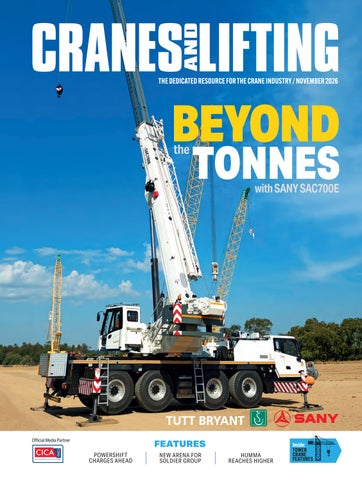
BEYOND the
TONNES with SANY SAC700E
November 2026 Official Media Partner
FEATURES POWERSHIFT CHARGES AHEAD
NEW ARENA FOR SOLDIER GROUP
HUMMA REACHES HIGHER
Inside: TOWER CRANE FEATURES
EXPERTS IN MOBILE PLANT INSURANCE
For over 50 years, UAA’s award-winning Mobile Plant and Machinery insurance solutions have powered the cranes and lifting industry - trusted by professionals who keep Australia moving. We are known for our extensive knowledge, operational capability, and capacity to cover a diverse range of plant and machinery across numerous industries. Our seasoned claims team has access to a network of experienced industry repairers, assessors, and suppliers who are well-regarded for their high-quality service.
www.uaa.com.au
SCAN BELOW TO FIND OUT MORE:
IN THIS ISSUE
Cranes and Lifting Magazine
cranes_and_lifting
Cranes and Lifting
43 4 E ditor’s Letter 6
T utt Bryant Equipment Upfront
Built for the Australian market.
10 C ICA CEO Report
Celebrating CICA’s National Conference and Exhibition.
12 C ICA Holding Redlich
Notifying the regulator of crane incidents.
16 C ANZ
Working through regulatory change.
19 L EEA
Western Australia, home to the most significant lifts.
32
22 F ranna
57 P owershift
25 G rove
61 G eneral Cranes
28 O ffRoad Trucks
64 S oldier Group
Growing with Franna. A deep dive into Grove’s Hybrid®. Celebrating three decades of success.
30 P ace Cranes
Maedas perfect for facades.
32 B aden Davis Crane Connection
New XCMG 120t all terrain revealed.
35 M embrey’s Transport & Crane Hire Opening the doors to a new chapter.
38 E nerpac
Enerpac’s new Tandem E-Mover Skates.
41 T utt Bryant and SANY
Sany’s thrive in Marine infrastructure environment.
Tower Crane Features 44 P otain/Urban Cranes
Perth’s massive hospital project.
48 V TS Cranes
A unique plan for a unique site.
51 E verwilling Cranes
Beyond the mobile crane.
54 W A Universal
Powering WA’s biggest builds.
www.cranesandlifting.com.au
A powerful solution for site demands.
On a journey of growth. Taking the next big leap.
67 Z oomlion
Listening on the ground.
70 L iebherr Australia
Investing in next generation cranes.
73 C ranePower
CranePower’s E-Gen Series.
76 L VL80
Elevating heavy lifting.
78 U AA
Managing better claims outcomes.
80 X CMG
TRT’s plans for XCMG.
82 D RA
Reach makes the difference.
85 R egatta Registers
A new phase of growth.
SCAN
TO SUBSCRIBE TO OUR NEWSLETTER November 2026 CAL / 3
FROM THE EDITORIAL TEAM Published by:
WELCOME TO THE NOVEMBER EDITION OF CRANES AND LIFTING MAGAZINE ACCORDING TO THE RECENT RIDER
Levett Bucknall’s (RLB) Crane Index, Australia’s construction market has reached a new high, with a record 896 cranes recorded across the country in Q3 2026. Oliver Nichols, Rider Levett Bucknall’s Oceania Director of Research and Development, commented: “The latest RLB Crane Index® highlights continued strength across residential and non-residential construction, while also revealing significant differences between Australia’s major construction markets. Melbourne recorded its highest-ever crane count, the Gold Coast reached
•
•
•
•
•
nationwide, up 6.7% from Q1 2026 T otal construction work reached a record $318 billion in 2025, up 3.8% on 2024 S ydney remains the nation’s largest market with 336 cranes, followed by Melbourne (224), the Gold Coast (82) and Brisbane (80) M elbourne surpasses its 2019 peak, driven by residential and data centre activity e Gold Coast reaches a record Th 82 cranes and continues to outnumber Brisbane S ydney eases from 346 to 336 cranes as residential activity softens
“Data centres, health infrastructure and major transport projects are providing important sources of activity across several markets. The rise in crane numbers comes as input costs climb.” a new record, and strong growth was also recorded in Canberra, Perth, the Sunshine Coast and Wollongong. Sydney, by contrast, recorded a further decline in crane numbers, primarily reflecting softer residential activity.” Data centres, health infrastructure and major transport projects are providing important sources of activity across several markets. The rise in crane numbers comes as input costs climb. RLB’s Q3 2026 Construction Market Update found that diesel, freight, concrete and other petroleum-linked materials have increased following the re-escalation of the Middle East conflict. So far, competitive tender conditions mean contractors are absorbing much of the rise, limiting the pass-through to tender prices in most cities.
KEY POINTS IN THE LATEST RLB CRANE INDEX®: •
A record 896 cranes operating
4 / CAL November 2026
•
G rowth broadens to Perth (48), Canberra (28), the Sunshine Coast (16) and Wollongong and Shellharbour (32).
In this issue, we continue our focus on tower cranes with comprehensive coverage of this dynamic industry sector. We celebrate a ‘dream realised’ with Craig Membrey and examine the impact hybrids will have on the industry. As always, the team at Cranes and Lifting has worked hard to bring you what we hope is an interesting issue of the magazine and we hope you enjoy the read. Booms Up.
Simon Gould Editor, Cranes and Lifting
379 Docklands Drive, Docklands VIC 3008 T: 03 9690 8766 www.primecreativemedia.com.au Chairman John Murphy E: john.murphy@primecreative.com.au CEO Christine Clancy E: christine.clancy@primecreative.com.au Publisher Sarah Baker E: sarah.baker@primecreative.com.au Managing Editor Lisa Korycki E: lisa.korycki@primecreative.com.au Editor Simon Gould E: simon.gould@primecreative.com.au T: 0404 865 109 Assistant Editor Danny D’Cruze E: danny.dcruze@primecreative.com.au T: 0429 187 751 Business Development Manager Emily Schlegel E: emily.schlegel@primecreative.com.au T: 0466 317 555 Client Success Manager Ben Sammartino E: ben.sammartino@primecreative.com.au Art Director Bea Barthelson Imaging Assistant Paul Breen Subscriptions T: +61 3 9690 8766 E: subscriptions@primecreative.com.au
The Publisher reserves the right to alter or omit any article or advertisement submitted and requires indemnity from the advertisers and contributors against damages or liabilities that may arise from material published. © Copyright – No part of this publication may be reproduced, stored in a retrieval system or transmitted in any means electronic, mechanical, photocopying, recording or otherwise without the permission of the publisher.
www.cranesandlifting.com.au
THE LONGEST BOOM
ON 5 AXLES With the longest boom and high capacities combined with a small footprint and excellent maneuverability, the GMK5250XL-1 pushes boundaries. The Grove single-engine design with the latest emission levels reduces the operating costs due to 30% lower diesel consumption compared to previous-generation models.
250 t
78.5 m
60000 kg
109 m
IN FOCUS / SANY AND TUTT BRYANT EQUIPMENT
The SAC700E can lift 5.2 tonnes at a 20-metre radius with 15 tonnes of counterweight, fully extended outriggers and 360-degree operation.
EVOLVED FOR THE AUSTRALIAN MARKET SANY all terrain cranes have been operating in the Australian market for a number of years, with Tutt Bryant Equipment serving as the manufacturer’s national distributor and authorised dealer. SINCE EARLY 2021, TUTT BRYANT EQUIPMENT
has been responsible for the nationwide sales, parts distribution and service support for SANY’s crane range. Its role spans all terrain and rough-terrain cranes, lattice and telescopic crawler cranes, and truck-mounted cranes. Over that time, more SANY cranes have entered Australian fleets, giving the manufacturer a clearer understanding of the market’s demands. Australia’s all terrain crane sector has its own distinct characteristics, particularly in the 60- to 80-tonne class, where customers focus not only on maximum lifting capacity but also on whether a crane suits the day-to-day operating model of a taxi crane business. For a taxi crane, maximum lifting capacity is only one number. What really matters is how much counterweight the crane can carry on the road, how quickly it can set up its outriggers and counterweight, how strong the load chart is at commonly used working radii, and how quickly it can pack up and move to the next job. These are practical considerations for Australian crane owners and operators, including customers purchasing and operating SANY equipment through 6 / CAL November 2026
Tutt Bryant Equipment. SANY has used its experience in the Australian market to inform the development of the new SAC700E. According to the manufacturer, the crane is not simply an existing platform with a few additional features, nor is it just another 70-tonne all terrain crane. It was developed around the operational requirements of the taxi crane market. SANY believes the SAC700E is its strongest taxi crane to date.
MORE THAN JUST 70 TONNES
The SAC700E is a four-axle, 70-tonne all terrain crane featuring a six-section, 50-metre main boom, with a maximum lifting height of 66.5 metres when configured with the main boom and jib. On paper, a 70-tonne capacity and 50-metre main boom are not unusual. For a taxi crane, however, the real question is how useful the entire load chart is under actual working conditions. Some earlier all terrain cranes may have offered a respectable maximum lifting capacity, but under typical Australian taxi crane conditions – particularly at medium to longer radii and with longer boom
configurations – their available lifting capacity was not always as competitive as the market required. One of the key development priorities for the SAC700E was therefore to improve usable lifting performance across a broader working range. With 15 tonnes of counterweight, 100 per cent outrigger extension and 360-degree operation, the SAC700E can lift 5.2 tonnes at a 20-metre working radius on its fully extended 50-metre main boom, 2.6 tonnes at 30 metres, and 1.1 tonnes at a 40-metre radius. These figures illustrate why lifting capacity at practical working radii is important when assessing a crane for everyday taxi crane work. For operators sourcing equipment through Tutt Bryant Equipment, the crane’s performance across its working range is a key consideration alongside its headline capacity.
TAKING MORE COUNTERWEIGHT TO THE JOB
For Australian taxi crane operators, roadability is a key factor influencing fleet efficiency. With 525 tyres, the SAC700E can carry 10.8 tonnes of www.cranesandlifting.com.au
Images: SANY
counterweight and relevant hook equipment on board while keeping axle loads within 12 tonnes. Where higher axle loads are permitted, the crane can travel with the full 15 tonnes of counterweight. This allows the crane to travel to site in a configuration closer to what it will actually need, reducing reliance on additional support transport. For crane owners evaluating SANY equipment through Tutt Bryant Equipment, this carrying capacity can be an important factor in assessing how a machine fits into their fleet and operating model. The final road-going configuration will always depend on local registration, axle load limits and permit requirements. However, from a machine design perspective, the SAC700E places counterweight-carrying capability at the centre of its taxi crane concept.
SANY’s SAC700E was developed around the needs of the Australian taxi crane market, with Tutt Bryant Equipment supporting its local distribution.
Key specifications include: • • • •
M ercedes-Benz engine Z F transmission K essler axles H eated and cooled seats
GREATER FLEXIBILITY ON RESTRICTED SITES
For taxi crane operators, site conditions are rarely perfect. Road edges, buildings, fences, existing equipment and access lanes can all restrict the space available for outrigger deployment. The SAC700E features a variable outrigger system that allows each of the four outriggers to be extended to different positions depending on site conditions. The control system then calculates the available lifting capacity in real time based on the actual outrigger positions and slewing angle. When all four outriggers cannot be extended to 100 per cent, the operator can still make effective use of the available space and achieve the highest permissible lifting capacity within the system’s safe operating limits. The crane also provides six steering modes, including on-road steering, all-wheel steering, crab steering and various independent steering. These options give operators greater flexibility when positioning or manoeuvring around a job site.
FASTER SET-UP ON SITE
For a taxi crane, set-up time is productivity. When a crane is moving between multiple www.cranesandlifting.com.au
November 2026 CAL / 7
IN FOCUS / SANY AND TUTT BRYANT EQUIPMENT
Where higher axle loads are permitted, the SAC700E can travel with its full 15 tonnes of counterweight.
jobs in a day, saving even 10 or 15 minutes on each set-up can add up to a significant improvement in overall efficiency. The SAC700E is equipped with automatic counterweight installation and removal, with counterweight combinations of 4.5, 6.8, 9.3, 10.8, 12.8 and 15 tonnes. The system also features automatic counterweight recognition, allowing the crane to identify the installed configuration and reducing the likelihood of errors caused by incorrect manual input. For the operator, this reduces the number of set-up steps. For the fleet owner, it also helps reduce the risk associated with incorrect configuration settings. These functions form part of SANY’s approach to making the SAC700E more practical for frequent mobilisation and changing job requirements. This practicality is important to the operators and customers supported by Tutt Bryant Equipment.
REMOTE CONTROL GOES BEYOND THE OUTRIGGERS
Wireless remote control is another important area of development on the SAC700E. Traditionally, remote control functions on mobile cranes have often focused primarily on outrigger set-up. The SAC700E takes that concept further. From outside the crane, the operator can control individual or single-side outrigger beam extension and retraction, outrigger jack movement and one-touch levelling. The remote control can also operate major crane functions, including boom telescoping, luffing, slewing and hoisting. Auxiliary functions include counterweight lifting and 8 / CAL November 2026
lowering, jib movement, sidestep operation and cab positioning. This means many set-up and testing tasks can be completed from a position with a better direct view of the crane and its surroundings.
SMARTER, BUT NOT FOR THE SAKE OF BEING SMART
The SAC700E is equipped with SANY’s latest SICON2 intelligent crane control system. SANY’s approach is that intelligence should not simply mean adding more screens or electronic functions. A genuinely useful intelligent system should help the operator complete the job more efficiently and safely. SICON2 brings together functions such as variable outrigger control and automatic counterweight recognition with real-time operating data, risk warnings, equipment monitoring and fleet management. The boom system also offers one-touch telescoping. Once the operator initiates the function, the system can automatically manage the boom telescoping sequence while coordinating winch height, reducing the need for continuous joystick input. For Tutt Bryant Equipment, the SANY SAC700E represents another model in the manufacturer’s range designed around the requirements of the local market.
THE OPERATOR IS PART OF THE DESIGN
SANY has also recognised the importance of operator acceptance in the success of a crane. A machine may perform well on paper, but if an operator spends eight to ten hours a day in an uncomfortable cab, works with poor visibility or deals with unnecessarily
complicated controls, it is unlikely to become a favourite within the fleet. The SAC700E features a new-generation driver’s cab and operator’s cab. The carrier cab includes an air-suspension seat, a 12.1-inch display, electrically heated mirrors, a reversing camera, reversing sensors, and heating and cooling. The operator’s cab can tilt from 0 to 20 degrees and includes a 10.1-inch LMI display, electronic joysticks and an adjustable seat. Legroom has also been increased by 30 per cent compared with the previous generation. These features address the environment in which operators travel, set up and carry out lifting work over long shifts, complementing the crane’s lifting performance and operational functions. The thinking behind the SAC700E is simple. It needs to travel to site carrying a useful amount of counterweight and equipment, perform strongly at practical working radii, set up efficiently and make it easier for the operator to complete multiple jobs throughout the day. This represents an evolution in SANY’s approach to all terrain crane development, informed by several years of experience in the Australian market. The manufacturer is no longer asking only how much a crane can lift at maximum capacity, but how much work it can complete in a day. The SAC700E was developed around that question. The SAC700E’s introduction expands the SANY crane range available to Australian customers through Tutt Bryant Equipment’s national sales, parts and service network. Beyond equipment distribution, the wider Tutt Bryant Group also operates SANY crawler and mobile cranes through its Tutt Bryant Heavy Lift & Shift division, deploying equipment on major mining, energy and infrastructure projects across Australia. This gives the broader group a role both in bringing SANY cranes to the Australian market and in using the manufacturer’s equipment in lifting operations. The SAC700E itself remains the result of SANY’s product development and its focus on the requirements of the Australian taxi crane market. www.cranesandlifting.com.au
P
M E
50m
50m
60m
16m
66.5m
76m
Benz E5
Mercedes-Benz 360kW/1600rpm
360kW/1600rpm
66m
66m
75m
25.7m
91.3m
43m
360kW/1600rpm
390kW/1600rpm
Mercedes-Benz 390kW/1600rpm
9
NO STANDING UNDER
THE BOOM
150kW/1800rpm
Peter Lawgall (QLD, NT, NSW, ACT) M: 0411 256 388 E: Peter.lawgall@tuttbryant.com.au
Cummins 149kW/2200rpm
Todd Alexander (VIC, SA, TAS)
M: 0448 957 700 E: todd.alexander@tuttbryant.com.au
Daniel Avard (WA)
M: 0419 099 835 E: Daniel.Avard@tuttbryant.com.au
www.sanyglobal.com
CICA PRESIDENT’S REPORT
CICA’S NATIONAL CONFERENCE AND EXHIBITION
Images: CICA
Marcus Ferrari CICA President.
display line-up looks impressive with the technology enabling lifting solutions available, and I’m looking forward to having face-to-face conversations with the manufacturers and suppliers. The Lift of the Year Awards will be another standout, these entries beautifully showcase the complex, challenging and impressive lifts being carried out across Australia. A big thank you also to Cranes and Lifting for sponsoring these awards once again. Don’t forget to keep next year’s awards in mind when planning your projects. A special thank you goes to Terex Franna, our Platinum Sponsor this year. This is a very special 40 milestone year of Franna, and a testament to the innovation, dedication and hard work of the many people who have contributed to their story, both past and present. This month CICA is launching the updated Member Portal and App., so make sure you head along to the CICA webinar on 18 November, to learn how you can best benefit from these member resources. CICA is also moving toward a Special Interest Group (SIG) model to make our Association more member-led,
AT THE TIME OF WRITING THIS THE CICA
Conference in the Hunter Valley is still three weeks away, so I’m assuming by the time you’re reading this, you’ll have had an amazing time if you attended. I know Sue and her team from WISE Connections and Justina and the Crane Industry Council of Australia (CICA) team are always on point with their organising and procuring quality speakers and experiences. I’m always blown away by the expertise and professionalism of those in our industry and looking at the program, I’m sure this will be evident in spades. This year’s crane and equipment
10 / CAL November 2026
www.cranesandlifting.com.au
more responsive and more focused on the issues that matter to different parts of the crane and lifting industry. SIGs are not another layer of governance, but a way of getting more expertise, ideas and member participation into CICA without making the organisation more bureaucratic. This is something you’ll be hearing about more and more as we move toward 2027. Finally, this issue of Cranes and Lifting is dedicated to tower cranes, again, a fitting focus given the critical role they play in construction. Tower cranes have long been a marker of growth and development, helping bring major infrastructure and construction projects to life. Their presence on the skyline reflects the critical role our industry plays in supporting Australia’s growth – this issue is a great opportunity to showcase the unique place and work being done by tower cranes. I hope you enjoy the issue.
CICA BOARD Marcus Ferrari – President Karli Sutherland – Vice President Danny Adair – Director Danny Black – Director David Solomon – Director Anthony Grosser – Director Andrew Esquilant – Director
The Lift of the Year Awards will be another standout, these entries beautifully showcase the complex, challenging and impressive lifts being carried out across Australia.
CICA OFFICE Patrick Cran Chief Executive Officer 0488 004 274 ceo@cica.com.au
Alice Edwards Road Technical Engineer 03 8320 0440 alice@cica.com.au Loreta Lukic Office Manager 0490 356 041 loreta@cica.com.au Damien Hense Senior Executive Road Poilicy 0488 007 575 damien@cica.com.au Thomas Webber Communications Coordinator thomas@cica.com.au
CICA National Conference Exhibition Hall.
www.cranesandlifting.com.au
Justina Blackman Executive - Member Events and Engagement 0403 717 626 justina@cica.com.au
Grant Gjessing – Director
Julie Turner Board Secretary julie@cica.com.au
Marcus Ferrai CICA Board President
Michelle Verkerk Executive - Communications and Special Projects michelle@cica.com.au
Shane Coupe CraneSafe & CrewSafe Administrative Assistant Officer 0491 047 134 shane@cica.com.au Timothy Weir CraneSafe Technical Officer tim@cica.com.au 0494 658 614 Kelly Tran Events Coordinator 0494 658 615 kelly@cica.com.au Nicholas Beashel Crane Crew Competency Officer 0491 134 533 nick@cica.com.au
Unit 10, 18–22 Lexia Place, Mulgrave Vic 3170 Phone: 03 9501 0078 Email: admin@cica.com.au Website: www.cica.com.au
For information, please visit our website or call the CICA office.
November 2026 CAL / 11
CICA AND HOLDING REDLICH
KNOWING WHEN TO NOTIFY
Failing to notify the regulator of crane incidents can carry significant WHS penalties Do you know when a near miss involving a crane triggers notification obligations? We examine notification obligations, penalties for non-compliance and key safety considerations for crane owners and operators. ARE YOU AWARE THAT CRANE
malfunctions, load failures and the associated near misses can trigger notification and site preservation obligations under Work Health and Safety (WHS) legislation, even where nobody is injured? For persons conducting a business or undertaking (PCBUs), the difficulty is often recognising when an incident crosses the line from an internal safety incident to one that must immediately be notified to the relevant regulator. This issue is particularly relevant in crane operations, where a dropped load, structural failure or crane malfunction can expose workers and others to a serious risk even if, by good fortune, the relevant area is clear when the event occurs and no one is harmed as a result of the incident. This article examines a prosecution demonstrating the consequences for a PCBU that fails to notify the regulator of a notifiable incident, and the safety systems and reporting processes that can help organisations identify, escalate and respond to potentially notifiable incidents.
THE OBLIGATION TO NOTIFY
Under section 38 of the model work health and safety laws, a PCBU must ensure that the regulator is notified immediately after becoming aware of a notifiable incident arising out of the conduct of the business or undertaking. Notification must be by the fastest possible means, either by telephone or in writing. A notifiable incident includes the death of a person, a 12 / CAL November 2026
serious injury or illness, or a dangerous incident. Importantly, a dangerous incident does not require an injury to have occurred. Certain failures or malfunctions of plant, including incidents involving the collapse, overturning, failure or malfunction of plant that exposes a person to a serious risk, may therefore be notifiable even where everyone walks away unharmed. Notification is only one part of the immediate response. WHS legislation also imposes site preservation obligations following notifiable incidents, subject to limited exceptions, so that the incident site is not disturbed before an inspector attends or directs otherwise. PCBUs should therefore treat notification and site preservation as connected parts of the incident response process.
FAILURE TO NOTIFY CAN BE COSTLY
A NSW District Court prosecution demonstrates that a failure to promptly notify the regulator of dangerous incidents can develop into multiple WHS offences and significant fines, even where no one is injured. Modco Homes Pty Ltd (Modco
Homes) was the builder and principal contractor at a multi-storey construction site in Wollongong. It had control of a tower crane and employed a qualified crane operator to operate it.
First incident
On 12 July 2021, the operator left the crane and its remote control unattended during a break without lifting the hook block high enough to clear the building. The crane slewed and the hook block, lifting chain and hoist rope struck the building across several levels. Nobody was injured. SafeWork NSW was not immediately notified of this incident, nor was the site preserved.
Second incident
Approximately 90 minutes later, the crane was used again without first being inspected, despite the employer’s own procedure requiring inspection following an uncontrolled event. During a lift involving two skip bins, the hoist rope failed and the bins and hook block fell approximately five storeys. Again, nobody was injured and SafeWork NSW was not immediately
Key details – Duty of PCBU to Notify Regulator of Safety Incidents Duty holder
PCBUs in all Australian jurisdictions
Duty to notify
PCBUs must notify the relevant regulator of the occurrence of the death, serious injury or illness of a person, or dangerous incident arising out of the conduct of their business or undertaking. See examples of dangerous incidents below.
Timing of notification
Immediately after the PCBU becomes aware of the incident
Penalties for non-compliance
In NSW, for FY26-27, the maximum penalties for non-compliant PCBUs are: • F or an individual: 121 penalty units ($15,531.66) • F or a body corporate: 607 penalty units ($77,914.52) Please note that the maximum penalties differ between each jurisdiction. www.cranesandlifting.com.au
Images: Holding Redlich
From left to right: Michael Selinger; Michael Hope; Hannah Pang, (Holding Redlich)
Caution – incidents of these nature may be notifiable The fall or release from a height of any plant, substance or thing. For example, anything being handled or suspended by a crane, including a load, lifting attachment, hook block or other object, may be notifiable if it is dropped or released from height and exposes a person to a serious risk or injury. The collapse, overturning, failure or malfunction of, or damage to, any plant. For example, an uncontrolled slewing or movement of a crane, the failure of a hoist rope, brake, boom, outrigger or other load-bearing component, the overturning or partial collapse of a crane, or the failure of a safety, warning or control system may be notifiable where the incident exposes a person to a serious risk of injury. The collapse or partial collapse of a structure. For example, a crane or dropped load striking a building and causing part of a wall, floor, or temporary structure to collapse may be notifiable where a person is exposed to a serious risk of injury. notified of the second incident, nor the site preserved.
Third incident
The following day, the incident site was disturbed when the crane operator began retrieving the hook block from the skip bins that had fallen during the second incident. In doing so, the operator stood on an unprotected balcony edge without using fall protection or fall arrest equipment, creating a further safety risk.
SAFEWORK NSW PROSECUTION
SafeWork NSW became aware of the incident after receiving anonymous notifications in respect of the above and other safety issues on site, which resulted in SafeWork NSW investigating, and ultimately prosecuting, Modco Homes. The court imposed fines totalling $225,000 across six offences, comprising: www.cranesandlifting.com.au
(a) t hree fines of $60,000 for breaches of section 19(1) of the Work Health and Safety Act 2011 (NSW) (WHS Act) (being the general duty on a PCBU to ensure, so far as is reasonably practicable, the health and safety of workers), relating to each of the three incidents; (b) a $15,000 fine for failing to notify the regulator under section 38(1) of the WHS Act in relation to the second incident; and (c) t wo fines of $15,000 for failing to preserve the incident site under section 39(1) of the WHS Act, relating to the first and second incidents. Each fine reflected a 25 per cent reduction for the defendant’s guilty plea.
DO YOUR SAFETY SYSTEMS FACILITATE INCIDENT NOTIFICATION COMPLIANCE? Safety incidents which result in serious injury are typically escalated quickly, as such incidents are circulated widely
across an organisation, resulting in the applicable worker, safety manager and/or director making contact with the appropriate authorities, including SafeWork NSW. Issues may arise where injuries are only minor, or there is no injury at all stemming from the safety incident. Such incidents may remain within a particular site, crew or contractor group and never reach the person within the organisation assigned as being responsible for determining whether notification is required. By the time the safety manager or senior management becomes aware of the incident, if at all, the statutory requirement for immediate notification will likely be unable to be achieved. Accordingly, incident notification should form part of the organisation’s broader safety management system rather than depend on individual workers, managers or directors understanding the technical definition of a notifiable incident. Inductions, toolbox talks, SWMS, incident reporting procedures, contractor onboarding, supervisor training and emergency response processes should make clear that workers and contractors must promptly escalate crane failures, dropped loads, near misses and other potentially serious events. Within this ongoing training, workers should be encouraged, and regularly reminded, to err on the side of reporting and escalating any near misses or safety incidents within the organisation. The decision about whether an event is legally November 2026 CAL / 13
Image: amorn/adobestock.com
CICA AND HOLDING REDLICH
Certain failures or malfunctions of plant, that exposes a person to a serious risk, may be notifiable even where everyone walks away unharmed.
notifiable can then be made promptly by the appropriate person within the organisation, with access to the necessary information and advice. Clear reporting pathways should also ensure that near misses and other safety incidents move beyond the site level and are communicated through the business, including to senior management and directors, to ensure that all due diligence and other safety obligations are able to be properly complied with and adhered to.
POTENTIAL AMENDMENTS TO NOTIFICATION LAWS
Watch this space. In December 2025, Safe Work Australia published amendments to the model WHS laws that will broaden incident notification requirements. The changes have not yet been adopted into state and territory WHS laws and will only take effect in a 14 / CAL November 2026
jurisdiction once locally implemented, which may take some time to occur. The amendments include expanded categories of dangerous incidents and new notification requirements for violent incidents and work-related suicide or attempted suicide. PCBUs should monitor developments in each relevant jurisdiction and be prepared to review their incident escalation and notification processes as implementation approaches.
address, on an ongoing basis, incident notification requirements and processes to workers. Such measures are critical not only to ensuring compliance with incident notification obligations but, as Modco Homes demonstrates, can also help prevent further safety incidents by identifying deficiencies in site practices and controls and promoting more effective safety management and governance.
KEY TAKEAWAYS
Authors: Holding Redlich Partner Michael Selinger, Special Counsel Michael Hope, and Lawyer Hannah Pang.
PCBUs should ensure that workers and contractors know what types of safety incidents must be escalated, who within the organisation must be contacted following a safety incident, and that potentially notifiable incidents are to be reported immediately. This outcome can be achieved by ensuring your safety systems properly convey and
Disclaimer The information in this article is of a general nature and is not intended to address the circumstances of any particular individual or entity. Although we endeavour to provide accurate and timely information, we do not guarantee that the information in this article is accurate at the date it is received or that it will continue to be accurate in the future.
www.cranesandlifting.com.au
Crane Capacity
2.98t x 2.5m
Max. Working Radius
Max. Lifting Height
12.16m x 0.26t 12.52m
MC305C-5 Crane / Outrigger Interlock System Programmable Moment Limiter Multi Outrigger Mode Digital Feedback Remote Control 4 Fall / 2 Fall Hook Block EU Stage V Compliant Engine Available with Searcher Hooks Electric Motor Power (option)
pacecranes.com.au +61 2 9533 5411 sales@pacecranes.com.au
Image: Zuyeu Uladzimir/shutterstock.com
Crane technology and automation are changing the way lifting operations are planned and undertaken.
NEW ZEALAND’S CRANE ACOP MOVES FORWARD
New Zealand’s crane industry presses ahead with a long-overdue safety code rewrite. NEW ZEALAND’S CRANE INDUSTRY IS
operating in the middle of a significant period of regulatory change. For the Crane Association of New Zealand (CANZ), however, one thing is certain: the long-awaited rewrite of our Approved Code of Practice for Cranes needs to happen, and it will. For Australian readers, New Zealand’s Health and Safety at Work Act 2015 (HSWA) is broadly the equivalent of Australia’s model Work Health and Safety framework. Sitting beneath that legislation are regulations 16 / CAL November 2026
and Approved Codes of Practice, or ACOPs, which provide practical guidance on how duty holders can meet their legal obligations. Our current Crane ACOP dates back to 2009, predating HSWA itself. WorkSafe New Zealand acknowledges that its current crane guidance has not been updated to reflect the present legislation. A rewrite has therefore been overdue for some time. CANZ had deliberately held back from undertaking a full rewrite while
New Zealand’s overarching crane industry regulations were expected to change. There was little value in producing a major new industry document only to find that the regulatory framework underpinning it had moved underneath us. Then the landscape changed again. New Zealand’s Ministry of Business, Innovation and Employment (MBIE) has indicated through our engagement, that the work being undertaken through the ACOP, can itself help inform future regulatory change. www.cranesandlifting.com.au
Rather than waiting for every piece of regulation to be settled first, there is now an opportunity for industry knowledge and contemporary practice to help shape what comes next. That fits squarely with another major change happening in New Zealand. From 1 April 2027, amendments to HSWA strengthen the role of ACOPs and expressly allow industry groups, employer organisations and other sector representatives to develop draft ACOPs for consideration by WorkSafe and ultimately the minister. New ACOPs will also carry a stronger “safe harbour” effect: where a duty holder follows the relevant actions in an ACOP for a particular risk, they will be treated as having met their legal duty for managing that risk. That makes getting the Crane ACOP right particularly important. It also changes how we are approaching its development. CANZ began consultation with industry by taking the existing ACOP apart: what still works, what no longer reflects modern crane operations, what is missing, and what needs to change. Those workshops produced a substantial body of technical information and industry feedback. That work has not been superseded and we are certainly not starting again. What has changed is our understanding of how the next stage should be undertaken. During our initial consultation, the framework for industry-led ACOPs was itself being refined. At the CANZ Conference in July, we explained to members that we would need to adjust our approach as more information became available. Since then, direct one-to-one engagement with WorkSafe has provided further guidance on the structure, consultation and development process expected for a contemporary ACOP. The next phase will therefore begin with another series of industry workshops, but with a different purpose. The first workshops told us what needs to change. The next will www.cranesandlifting.com.au
help determine how the new ACOP should deal with it. The information already provided will form the foundation. Our technical writer will use that material, alongside further WorkSafe engagement, to develop the structure and content of the new document. Industry will then have further opportunities to test the draft before it is released more widely for consultation. This more iterative model matters because regulation and guidance can no longer afford to move at the pace they once did (that of the proverbial snail). Technology is advancing rapidly. Crane technology, digital systems, communications, automation and data are changing the way lifting operations are planned and undertaken. Artificial intelligence is accelerating that change again. An industry guidance document that takes years to update risks being behind the industry almost as soon as it is published. One of the real opportunities in
Images: CANZ
CANZ CEO REPORT
Sarah Toase CEO CANZ
future Parliament. That is the reality of undertaking a significant industry project during an election cycle. But CANZ will not allow political uncertainty to become an excuse for inaction. Whichever parties form the next government, and whoever occupies the Beehive, New Zealand’s crane industry
“New ACOPs will also carry a stronger ‘safe harbour’ effect: where a duty holder follows the relevant actions in an ACOP for a particular risk, they will be treated as having met their legal duty for managing that risk.” an industry-led ACOP model is to create a much closer relationship between those doing the work and the guidance governing how that work is done. It provides a pathway for industry expertise to be captured more quickly and for guidance to evolve as equipment, practices and risks evolve. Of course, there is one other small variable in the mix: New Zealand goes to the polls on 7 November. A change of government can bring a change of policy direction, and reforms due to commence in April 2027 could still be revisited by a
still needs a modern, practical and credible Approved Code of Practice. Our members need it. The wider construction and infrastructure sectors need it. Most importantly, the people planning, managing and undertaking lifting operations need guidance that reflects the work they are actually doing today. Governments may change. Regulations may evolve. Technology certainly will. Alongside that, CANZ will keep industry moving too and the ACOP is our number one priority. November 2026 CAL / 17
LEEA
COLLABORATION, COMPETENCY AND INDUSTRY CHANGE:
WHAT WE HEARD IN PERTH
FROM MINING AND RESOURCES TO
construction, ports and infrastructure, the state is home to some of the country’s most significant lifting operations and some of its most complex safety challenges. It was therefore a fitting location for a visit by Ross Moloney, Chief Executive Officer of LEEA, who travelled to Perth in September to meet with members, industry stakeholders and end users as part of a week focused on engagement, collaboration and industry development. While the visit centred around a Western Australian member event, the broader objective was to better understand the issues facing industry locally and to provide direct insight into several significant initiatives currently being progressed by LEEA globally and throughout the Asia-Pacific region. The visit also reinforced the value of face-to-face engagement at a time when the lifting industry continues to navigate workforce shortages, increasing regulatory scrutiny, evolving technology and growing expectations around competency and assurance. For many attendees, the opportunity to hear directly from Ross provided a valuable connection between local industry concerns and the broader direction of the organisation. It also highlighted the increasing importance of Western Australia to LEEA’s activities and the wider lifting industry. A key feature of the visit was the LEEA Member Meeting held in Perth on 15 September. The event brought together existing members, prospective members and industry representatives for a series of presentations and discussions covering both international developments and local priorities. www.cranesandlifting.com.au
From mining and resources to construction, ports and infrastructure, WA is home to some of the country’s most significant lifting operations and some of its most complex safety challenges.
The agenda included updates from LEEA headquarters, consultation on the developing COPSILE initiative, discussion on member assessment processes, end-user engagement and broader industry issues. The event was deliberately structured to encourage open discussion and engagement rather than simply delivering presentations. By bringing together a mix of member and nonmember organisations, attendees were able to exchange experiences, discuss current challenges and gain greater
Image: LEEA
Western Australia has long been at the forefront of Australia’s heavy lifting sector.
insight into how industry expectations continue to evolve. One of the major themes during the week was the importance of stronger engagement with end users. Historically, industry associations within the lifting sector have focused heavily on manufacturers, suppliers, inspectors and service providers. While these groups remain critical to maintaining safe lifting practices, there is increasing recognition that end users also play a significant role in influencing behaviour, purchasing decisions, November 2026 CAL / 19
LEEA
competency requirements and overall safety outcomes. This formed a major component of discussions throughout the Perth program, with presentations examining how greater involvement from end users can help strengthen lifting safety across entire supply chains. The concept aligns closely with the industry’s broader move toward shared responsibility, where safety outcomes are not viewed solely as the responsibility of one organisation but rather as a collective obligation involving equipment providers, contractors, project owners and operational personnel alike. Another important topic of discussion was COPSILE, a developing initiative designed to further support consistency and confidence across lifting operations. Consultation remains an important part of its development, and Perth provided an excellent opportunity to gather feedback from those working directly at the coalface of industry. Western Australia provides a unique perspective in this regard. The state’s extensive mining and resources sector operates some of the largest and most demanding lifting activities in the country. As a result, organisations based in the region often encounter practical challenges that can provide valuable insight when developing future guidance and industry programs. These conversations demonstrated the willingness of industry participants to engage constructively in the development of new initiatives while ensuring they remain practical and relevant to operational realities. Outside the member event itself, the visit incorporated broader industry engagement activities. Discussions were held around the Safer Together Cranes and Lifting Working Group, providing an opportunity to discuss shared safety objectives and the importance of collaboration between industry bodies, end users and service providers. The week also included former Regional Manager of Australia and New Zealand – Justin Boehm speaking on a panel at the WA Mining Expo on the future of mining and how lifting will 20 / CAL November 2026
play a critical part. The event enabled conversations with organisations from across the resources sector and broader industrial supply chain. These interactions highlighted a common theme that emerged repeatedly during the visit: organisations continue to value practical guidance and competency-based approaches to safety. While equipment standards, inspection requirements and regulatory obligations remain fundamental, many industry leaders expressed a growing concern around maintaining workforce capability and ensuring that knowledge is retained as experienced personnel leave the industry. The issue of competency featured prominently across many conversations. As projects become larger and more technically complex, the demand for skilled personnel continues to increase. At the same time, organisations face ongoing pressure to attract, develop and
Whether through forums, industry working groups, standards development or professional associations, stakeholders increasingly understand the value of sharing experiences and learning from one another. This willingness to collaborate is particularly important given the pace of change facing industry. New technologies, digital inspection systems, evolving customer expectations and changing regulatory frameworks all require organisations to remain adaptable. Maintaining a strong industry network and access to reliable technical guidance has therefore become increasingly important. As the Perth visit concluded, one message stood out above all others: the lifting industry continues to recognise the importance of engagement. Whether through industry associations, working groups, conferences or member meetings, professionals want
“Consultation remains an important part of its development, and Perth provided an excellent opportunity to gather feedback from those working directly at the coalface of industry.” retain appropriately trained workers. This challenge is not unique to Western Australia, but it is often magnified by the scale and intensity of many operations within the region. For LEEA, these discussions reinforced the continued importance of education, training and competency development. Industry expectations continue to move beyond basic compliance toward demonstrable competence and continuous improvement. The organisations that perform best are increasingly those that invest in developing people as well as maintaining equipment. Another observation from the visit was the strong appetite for collaboration across the sector. Although organisations may compete commercially, there remains widespread recognition that safety improvements benefit everyone.
opportunities to discuss challenges, learn from peers and contribute to the future direction of the sector. For LEEA, the visit reinforced the value of maintaining a strong presence within the Western Australian market and continuing to engage directly with members and end users. For industry participants, it provided an opportunity to contribute their perspectives on issues that will shape lifting safety and competency for years to come. In an industry where safety, reliability and trust remain essential, those conversations may prove just as important as any presentation delivered throughout the week. Through continued collaboration, open dialogue and a commitment to raising standards, the Australian lifting industry remains well positioned to meet the challenges and opportunities that lie ahead. www.cranesandlifting.com.au
02 9679 8333
43 Holbeche Road, Arndell Park NSW 2148
MOBILE CRANE REPAIRS
DRY HIRE AVAILABLE
NO DOWNTIME
while your crane is being repaired!
Components Exchange Program
Engines / Gearboxes
Differentials / Transfer Cases
Boom Sections / Flyjibs
Service Exchange Hydraulic Cylinders
Bare / Glazes Cabs Upper and Lower
Extent of Repair Services
Mechanical
Structural
Painting
Machining & Line Boring
Engine & Transmission Overhauls
WIRECO Rope Distributor
IN FOCUS / FRANNA AND WANNEROO CRANE HIRE
Frannas have been part of Wanneroo Crane Hire’s journey from day one, with the fleet continuing to grow and evolve alongside the needs of their customers.
GROWING WITH FRANNA
For Wanneroo Crane Hire Managing Director Clayton Robinson, growing the fleet has always been closely tied to the people around him: his family, the team representing the business on site and the clients trusting them to get the job done. FRANNAS HAVE BEEN CENTRAL TO
that journey, from an initial dry hire investment to a broader crane business with the capacity to support increasingly demanding work. Clayton came into crane hire through powerline construction. More than 20 years working closely with management and crews gave him an understanding of what customers need on site and the responsibility that comes with supplying the equipment and people they rely on. “I had wanted to build something for myself and my family for some time,” he said. “Working in powerlines, I had seen how useful Frannas were. We started by purchasing one for dry hire. It went out almost straight away, and as demand grew, we invested in more equipment.” Clients then began asking for more than a crane on hire. They wanted Wanneroo to supply the people and manage the lifts, 22 / CAL November 2026
opening the way for the business to develop its wet hire services. “That growth came from listening to our customers,” Clayton said. “We were getting enquiries about work they needed help with, and we wanted to be able to support them. Those relationships have shaped the way we have grown.” Today, Wanneroo’s Franna fleet ranges from 15 tonne to 40 tonne, supporting wet and dry hire across a broad mix of work. The cranes remain a mainstay of the business, from residential lifts through to construction, power infrastructure and mining applications. Investment in larger capacity mobile cranes has broadened that capability further. As Wanneroo has become able to take on larger lifts and a wider scope of work, demand for its services has increased. The growing fleet has helped the business meet existing clients’ changing
requirements while creating opportunities to work with new customers. “Adding larger cranes means we can help clients with work we previously couldn’t cover ourselves,” Clayton said. “It gives them more reasons to come to us, and it has brought more enquiries and opportunities. The important part is making sure we have the people, planning and support behind the equipment to deliver.” That is why Clayton sees fleet investment as a commitment to clients and staff. Increasing capacity goes hand in hand with improving fleet presentation, bringing in newer equipment and building the support needed to keep the business reliable as it grows. “Our customers are putting their trust in us,” he said. “When we invest in the fleet, we are investing in our ability to look after them. We also want our operators to feel proud of the equipment they turn up www.cranesandlifting.com.au
Images: Wanneroo Crane Hire
Recent additions to the Franna fleet include the AT22-2, MAC25-5 and AT40-2. The newer models sit alongside proven machines that continue to perform an important role, including a 15 tonne Franna still delivering for the business.
in and confident in the support they have behind them.” Recent additions to the Franna fleet include the AT22-2, MAC25-5 and AT402. The newer models sit alongside proven machines that continue to perform an important role, including a 15 tonne Franna still delivering for the business. Clayton values the familiarity operators have with Frannas, while recognising the importance of proper training when introducing newer equipment. He said Robin Ghosh, Crane Sales Manager at Terex Franna, went above and beyond through the sales, delivery and handover process, including supporting crew training. “Our operators have a lot of experience with Frannas, but new equipment still needs a proper introduction,” he said. “The support during handover was important. We want our crews to understand the machine and its systems so they can get the best from it.” For Clayton, the people operating the cranes are just as important as the investment in the fleet. Their attitude, www.cranesandlifting.com.au
communication and presentation influence the client’s experience every day. “The operator is the person our customer sees on site,” he said. “We want people who take pride in their work, communicate well and look after the customer. A good machine needs a good team behind it.” His aim is to build a workplace where people enjoy their jobs, feel comfortable raising questions and know that management will support them. As the business expands, he wants enough depth in the team to maintain service and allow people to take leave without placing unnecessary pressure on others. “We are working with our people every day, and I want them to know they can talk to us and get a straight answer,” Clayton said. “I wouldn’t ask someone to do something I wasn’t prepared to do myself. The team has helped us get to this point, and looking after them matters to me.” The acquisition of Ashburton Crane Hire has been another significant step. Bringing the businesses together has added client relationships, equipment and opportunities,
with Wanneroo operating from Wangara and High Wycombe. With Wanneroo established in 1986 and Ashburton in 2005, the businesses bring a long history of serving Western Australian customers. Clayton wants that history and those relationships to remain part of the business as it develops. “Bringing Ashburton and Wanneroo together has given us more opportunity to support clients,” he said. “There are relationships there that people have built over many years. We want to look after those customers and give them confidence in where the business is heading.” As demand grows, Clayton’s focus is on building a sustainable business that can keep its commitments to customers and provide a positive future for its staff. “Frannas have been part of our journey from the beginning, and they will continue to be important,” he said. “The fleet will keep developing as our clients’ needs change. For me, the measure of that growth is whether we are delivering for our customers and building a business our people are proud to be part of.” November 2026 CAL / 23
Images: Grove
IN FOCUS / GROVE HYBRID
The GMK5150XLe offers multiple charging options; Diesel Regeneration, multiple AC possibilities, and high-voltage DC charging for ultimate flexibility.
GROVE PURE HYBRID® Zero compromise. Grove’s hybrid built for the real world. EVERYONE WANTS TO TALK ABOUT THE
electric future, but there’s one problem. A 150-tonne all terrain crane isn’t a passenger car. It weighs between 50 to 60 tonnes. It travels significant distances on public roads. It works wherever the next lift takes it. And when it arrives, it has one overriding job: perform. So perhaps the industry is asking the wrong question. Instead of asking, “How do we make an all terrain crane fully electric?”, Grove asked something far more practical: “Where does electricity actually make the crane better?” That question led to the Grove GMK5150XLe and to a very different philosophy of electrification.
GROVE PURE HYBRID®
Electric power where it delivers the greatest advantage. Diesel where range and independence matter. And intelligent integration between the two. No dependence on a charging network. No sacrificing the fundamental capabilities of an all terrain crane. And, most importantly: Zero compromise. www.cranesandlifting.com.au
A 60 TONNES PROBLEM THAT BATTERIES ALONE DON’T SOLVE
Battery technology is advancing rapidly, but physics remains physics. An all terrain crane starts with an engineering challenge very different from that of a car, van or conventional construction machine. The GMK5150XLe is a road-going machine weighing around 50 to 60 tonnes depending on the state, carrying the boom, some counterweight, of course the chassis, and operating systems necessary for a crane capable of lifting up to 150 tonnes. To propel a machine of this size electrically over meaningful highway distances requires an enormous amount of stored energy. And stored energy means batteries.
BATTERIES MEAN WEIGHT
For an all terrain crane operating within strict overall vehicle and axle-load limits, that creates a simple problem: every kilogram devoted to additional battery capacity is another kilogram the crane carries everywhere it goes. So, Grove asked another straightforward question:
Does it really make sense to carry a massive battery around all day just to make 60-tonnes of crane travel long highway distances electrically? Its answer was no. Instead, Grove designed a system where diesel and electricity each do the job they are best suited to do. Diesel provides range. Battery power provides zero localemission crane operation. The onboard generator provides charging independence and intelligent integration connects it all. That’s not electrification for the sake of electrification, that’s engineering.
THE CRANE THAT DOESN’T WAIT FOR THE GRID
Here is perhaps the biggest difference between Pure Hybrid and many alternative approaches. The GMK5150XLe doesn’t need the jobsite to solve its energy problem, that’s important. Across Australia, contractors are under increasing pressure to reduce emissions and noise and demonstrate more sustainable construction practices. But once heavy equipment becomes dependent on external electrical power, the conversation quickly turns to infrastructure. Is sufficient power available? November 2026 CAL / 25
IN FOCUS / GROVE HYBRID Electrification becomes far less compelling if achieving it means significantly reducing crane performance, and that is an important issue for the industry.
Is temporary power required? Does additional infrastructure have to be installed? And what happens at the next job? That might be manageable for a machine that spends its working life in one location. An all terrain crane doesn’t. It could be working on a CBD construction site today, an industrial shutdown tomorrow and a remote infrastructure project next week. The GMK5150XLe has been developed around that reality. Its hybrid system combines a 180 kilowatt-hour (kWh) battery, electrically driven superstructure and 170 kW generator integrated into the carrier. It can take power from an external electrical supply, but crucially, it will normally recharge its battery while travelling. That changes the equation completely. Drive to the job charging the battery. Travel between jobs charging the battery. External power available? Use the battery or plug it in. No suitable charging infrastructure? Keep on working. Instead of demanding that every construction site adapt to the crane, Grove designed the crane to adapt to the job. That is a very different kind of electrification.
WORK TODAY. CHARGE WHERE IT MAKES SENSE
Pure Hybrid isn’t about replacing one dependency with another, it’s about giving the crane owner options. Where external electricity is available, use it, where it is economical, take advantage of it. Where it isn’t available, don’t let that stop the crane working. The GMK5150XLe offers multiple AC charging possibilities, with optional highvoltage DC charging providing further flexibility. But the important feature isn’t simply the charging connection. It’s about 26 / CAL November 2026
choice. Charge while travelling, plug into grid power when it makes commercial sense, use onboard generation when required. Or just use it as a traditional diesel power crane. Arrive on site with stored electrical energy ready to operate the crane. The technology works around the crane business, rather than asking the crane business to work around the technology.
diesel-powered figures. There’s no reduced lifting capability simply because the crane is operating electrically and assumption that sustainability has to mean sacrificing productivity, because environmentally responsible lifting still needs to be commercially productive lifting. Hybrid technology shouldn’t make the crane less of a crane, it should make a great crane better.
ZERO EMISSIONS. NOT ZERO PERFORMANCE
AND THEN GROVE ADDED E-BOOST
Here is where electrification meets commercial reality. Crane owners don’t make money from the size of the battery, they make money lifting. What matters? Utilisation, cycle times, operating speeds, operator productivity and ultimately, completing the lift safely and efficiently is what matters. Electrification becomes far less compelling if achieving it means reducing crane performance. Externally powered electric systems can result in considerably slower operation than comparable diesel-powered crane functions. Based on the figures considered here, plug-in operating performance reductions can range from about 30 per cent to 60 per cent, with battery operation potentially reaching around 90 per cent. For most applications, that’s a compromise crane owners simply may not want to make. Grove approached the problem from the opposite direction. The objective was not merely to make the GMK5150XLe capable of operating electrically. The objective was to make it operate electrically without taking away the performance customers expect from a Grove. In some operating parameters, performance has even demonstrated improvements over the conventional
This is where the Pure Hybrid concept gets really interesting. The electrical system isn’t only there for zero local-emission lifting, Grove puts that electrical power back into the driveline. During driving, and particularly during acceleration, electrical energy can assist the conventional powertrain, which Grove calls E-Boost. The result? Up to 30 per cent faster acceleration with an additional 1000 Newton-metre (Nm) of driveline torque during acceleration. Think about that in real-world Australian conditions. A 150-tonne all terrain crane entering a motorway needs to build speed confidently and changing gradients demand strong driveline performance. Moving a heavy crane through traffic means acceleration isn’t merely a specification on a data sheet, it matters to the driver. Instead of the battery becoming dead weight whenever the crane is on the road, Grove makes that stored energy work. The electric system doesn’t just make the crane cleaner, it helps make the crane perform better.
DIESEL HELPS ELECTRIC. ELECTRIC HELPS DIESEL
This is perhaps the simplest way to understand the GMK5150XLe. It isn’t a diesel crane carrying around some batteries and it isn’t an electric crane carrying around www.cranesandlifting.com.au
an engine, it’s a system where each energy source supports the other. On the highway: Diesel provides range and independence. While travelling: Diesel replenishes the battery through the integrated generator. When more acceleration is required: Electric power assists the diesel driveline through E-Boost. Then, when the crane reaches site: Stored electrical energy operates the electrified superstructure. Think about that relationship. Diesel provides range. Diesel charges electric. Electric assists diesel. Electric operates the crane. Each source of energy is used where it delivers the greatest benefit. That’s what a genuine hybrid should do.
UNDERNEATH IT ALL, IT’S STILL A GROVE
The technology story is impressive, but arguably the most important point is that none of it changes what this machine fundamentally is, a serious 150-tonne Grove all terrain crane.
The GMK5150XLe retains:
• 1 50 tonne maximum capacity. • 6 8.7m seven-section MEGAFORM® TWIN-LOCK® main boom. • 1 0x6x10 MEGATRAK® carrier, Mercedes-Benz engine. Customers aren’t being asked to buy an environmental experiment, they’re buying a Grove. The difference is that now they have an additional source of energy and another level of operating flexibility. For CBD construction, hospitals, infrastructure, industrial facilities, data centres, night works and other projects where noise and emissions increasingly matter, that flexibility could become a serious commercial advantage.
GROVE PURE HYBRID® BRINGS THE STRENGTH TOGETHER. With the GMK5150XLe you get:
• Z ero local-emission lifting using battery power
• • • • • • • • • • • •
Full 150-tonne lifting capability Electrically driven superstructure 180 kWh battery Charging while travelling Integrated 170 kW generator External AC charging capability Optional high-voltage DC charging E-Boost with up to 30 per cent faster acceleration An additional 1000 Nm of driveline torque during acceleration Diesel range and operational independence Electric operation when emissions and noise matter 100 per cent Grove all terrain performance underneath it all
But perhaps the most important benefit isn’t on the specification sheet, you don’t have to build your crane business around the charging infrastructure. The crane brings the solution with it. Grove Pure Hybrid. Zero compromise.
Inspection
More than just a pre-start checklist
Frame and Cabin Counterweight Attatchment - Security
StartSafe is comprehensive tool designed to streamline your crane operations, enhance safety, and ensure accountability.
Load Charts
Controls
TAILORED
VISIBLE
Machine specific checklists are in line with the CraneSafe program.
Photos tell the story.
StartSafe streamlines the process for collecting pre-start information, with instant data retention to a central location for the crane owner to access.
When a faulty item is recorded by the operator, the maintenance team is notified of the issue by email, which includes photo evidence of the fault. This also assists with gathering major inspection data.
Windows
PREVIOUS
NEXT
IN FOCUS / OFFROAD TRUCKS
Offroad’s first fleet delivery in 2006 was to drilling company Boart Longyear, pictured here outside Offroad’s former premises in Maddington, WA, where the company was based for 20 years.
THREE DECADES OF TATRA AND OFFROAD TRUCKS AUSTRALIA
An article about Tatra’s unconventional truck design caught the attention of the late Larry Gill 30 years ago. It led to a partnership between Czech manufacturer Tatra and Offroad Trucks Australia that has since put specialist trucks to work in some of Australia’s toughest operating environments. LARRY WAS WORKING IN MINING EQUIPMENT valuation and auctions when he read about Tatra’s unconventional approach to building trucks for extreme terrain. He immediately saw potential for Australian mining and heavy-duty applications. Discussions with the factory in Kopřivnice in Czech Republic resulted in the establishment of Offroad Trucks Australia and the beginning of Tatra distribution in Australia. The first truck arrived in 1997 and secured an early contract with Robe River Mining. That truck remains in service on a Western Australian farm. From the outset, Larry recognised that specialised trucks working in remote Australian operations required equally specialised support. Offroad Trucks Australia established a policy of maintaining comprehensive local parts inventories, informed by Larry’s own experience of operating equipment and waiting for parts. Offroad Trucks Australia now provides parts support through facilities in Perth and Mackay, Queensland. A Brisbane depot is scheduled to begin operating by the end of 2026. 28 / CAL November 2026
Leadership passed to Larry’s daughter, Amber Gaden, following his death four years ago. Amber had worked across the business since she was 18 while completing a commerce degree. She has since overseen a major expansion of Offroad Trucks Australia’s facilities and Tatra’s presence across mining, construction, energy, fire and emergency applications. The engineering concept behind Tatra’s trucks remains central to that growth and sets the vehicles apart from conventional heavy trucks. Instead of a traditional chassis, Tatra uses a central load-carrying backbone tube with independently suspended swing axles. This allows individual wheels to respond to
Above: The first truck arrived in 1997 and is still operating today on a farm in Gingin WA.
severe terrain while maintaining traction and reducing the twisting loads transferred through the vehicle and its body. The modular design also supports specialised configurations, ranging from conventional 4x4 and 6x6 trucks to multiaxle vehicles engineered for mining and energy applications. Tatra currently offers two models in Australia. The Tatra Force is available in 4x4 and 6x6 configurations and is particularly suited to fire and emergency operations. It is powered by a 400 horsepower (hp) Cummins Euro 6 engine and uses an Allison automatic transmission, combining extremeterrain capability with systems developed for emergency applications. The Tatra Phoenix provides a broader heavy-duty platform and has significantly increased Tatra sales in Australia. PACCAR MX engines offer outputs of 400, 483 or 530hp, paired with a ZF 12-speed automated transmission or an optional Allison automatic. The latest Phoenix also uses the DAF XD cab, adding contemporary safety, comfort and driver-assistance technology to Tatra’s established off-road driveline. The Tatra vehicles the company supplies www.cranesandlifting.com.au
S S
H u
En re en
A In
Images: Offroad Trucks Australia
are warranted to operate at their nominated full Gross Vehicle Mass (GVM) throughout their working life, including in offroad applications. “A 43-tonne GVM Phoenix will carry that everywhere as long as it’s on the road,” Amber said. “There are no percentages applied to warranty for off-road or extremeduty allowances.” Growth has also prompted investment in Australian infrastructure. Offroad Trucks Australia’s purpose-built 20,000 square metre headquarters at Forrestdale, south-east of Perth, includes a 1500 square metre, 10-bay workshop and a 2000 square metre parts warehouse. The facility can accommodate some of Tatra’s largest multiaxle configurations. The relationship between Offroad Trucks Australia and Tatra now extends beyond distribution. Australian operating requirements have influenced factory developments, including automatic
Larry on the Tatra test track in 1996, during his first trip to the Tatra facility.
transmissions and optional Falling Object Protective Structure (FOPS) and Roll-Over Protective Structure (ROPS) protection, while Tatra engineers regularly work with the Australian organisation. The next chapter may be electric. An all-electric Tatra prototype is undergoing field testing in Europe, with an Australian evaluation vehicle expected in early 2027. Plans call for testing in Pilbara conditions to assess the durability of the driveline and other systems in extreme heat before any
SUPERFLEX SLINGS
decision is made on Australian availability. The business continues to follow Larry’s belief that there are “no problems, only solutions”, with a focus on helping customers keep equipment operating in remote and difficult conditions. Amber said, “We are not focused on getting bigger and bigger. Our future grows from our legacy. It’s about doing what we do, doing it well, and supporting our customers so they never want to leave Tatra, or Offroad Trucks Australia.”
“Your First Choice In Lifting”
Heavy-duty lifting solutions up to 168T Enginereed for strength, safety and reliability in the toughest industrial enviroments.
Superflex Slings Superflex Strops Steel Flat Woven Slings Dean-0 Slings Also available: Industrial Rubber Products
sales@andind.com.au
SCAN ME!
To view our full range and specs
02 6760 3773
www.andromedaindustries.com.au
IN FOCUS / MAEDA AND SRG GLOBAL FACADES
MAEDA’S PERFECT FOR FAÇADES SRG Global Facades manages the installation of façades for major projects across Australia and New Zealand. Site Supervisor Paul Buckley explains how the business relies on Maeda mini crawlers for the installation process. a maximum working radius of 12.16 metres and a maximum lifting height of 12.52 metres, making it one of the most capable compact cranes in its class.
Additional features include: • • • • • • •
SRG Global Facades has been operating Maeda mini crawlers for a number of years.
“WE’VE BEEN OPERATING MAEDA MINI
crawlers supplied by Pace Cranes for a while, and these include the MC305 and 285s models. With the amount of work we have in the pipeline, we needed to increase our craneage capabilities and so we recently ordered and took delivery of three new MC305C-5s. We have previously owned and operated Maeda 305s and 285 so the new cranes are designed to both update the fleet and expand our capabilities,” said Paul. 30 / CAL November 2026
MAEDA MC305C-5
One of the standout features of the MC305C-5 is its fully digital wireless remote control. Being able to stand beside the crane while operating provides a much better perspective of the lift. It provides a dogman-like view of the lift and surrounds and allows operators to focus on every angle and every movement instead of being tied to one position. The MC305C-5 lifts 2.98 tonnes at 2.5 metres, has
C rane outrigger interlock system P rogrammable moment limiter Multi-outrigger mode Digital feedback remote control Four-fall/two-fall hook block EU Stage V compliant engine Optional Searcher Hook
Paul elaborates on the reasons why SRG Global Facades likes owning and working with Maeda mini crawlers. “Maeda mini crawlers are reliable and rarely break down, and that’s why we continue to invest in them. They are a known brand with proven performance over a long period of time. Construction sites benefit from Maeda mini crawlers supporting the work of larger structural cranes like tower cranes and mobiles as they have the ability to get into places left behind, manoeuvre into tight and narrow workspaces and lift. The variable outrigger settings are a key feature for this type of lifting. “Maedas are user friendly, and we like the simplicity of moving from one crane to another and from model to model. They thrive in confined spaces and with the Maeda Searcher Hook they can work even closer to obstacles and soffits. Our operators are well trained on the Maedas and they like to operate them,” he said. For service and support, SRG Global utilises the services of Rob Manders from MaintenX Australia. “Rob and MaintenX came highly recommended from Pace Cranes. We’ve www.cranesandlifting.com.au
Images: SRG Global
SRG Global’s Facades offers comprehensive facade design, testing, and certification services, including curtain wall installations and facade restoration.
“They thrive in confined spaces and with the Maeda Searcher Hook they can work even closer to obstacles and soffits.” taken him on and we’re actually giving him quite a bit of work and keeping him quite busy with the refurbishment of the older models we have, plus keeping the new cranes up to speed and up to date with all the servicing,” said Paul. “We’ve got a great relationship with the team at Pace Cranes. I frequently speak with Michael Cawston and David ‘Chalky’ White and they are always asking how the cranes are performing and to see if we need www.cranesandlifting.com.au
anything. It is very obvious that they actually care about their customers and their business, and they are quick to resolve any issues that we might have, however minor. “If there’s any information that we need, they’re very easy to get to and if you don’t get them straight away, they’ll get back to you as soon as they possibly can. As far as we are concerned, the partnership we have with Pace Cranes and Maeda suits our business perfectly.”
Operators find the Maedas intuitive and easy to operate.
November 2026 CAL / 31
IN FOCUS / CRANE CONNECTION AND XCMG
The XCMG XCA120G7’s 66 metre, seven-section high-strength main boom features smooth telescoping with strong lifting charts and outstanding reach.
CRANE CONNECTION DEBUTS XCMG 120 TONNER A major attraction during CICA’s National Conference and Exhibition was the debut of XCMG’s XCA120G7-1AU.
THE 120 TONNES CAPACITY ALL TERRAIN
generated plenty of attention from visitors to the Crane Connection and XCMG exhibit. The XCMG XCA120G7-1AU is a 120-tonne all terrain crane engineered to meet Australian operating conditions, delivering exceptional lifting performance, long reach, and reliable operation across construction, infrastructure, industrial, 32 / CAL November 2026
and major project applications. Combining high-capacity lifting with true all terrain mobility, the XCA120G7-1AU is ideal for contractors requiring a powerful crane capable of efficient road travel while maintaining excellent stability and precision on demanding worksites. Built with premium driveline components, advanced hydraulic systems,
and a heavy-duty multi-axle carrier, the XCA120G7-1AU delivers outstanding productivity, safety, and whole-of-life value for large-scale lifting operations.
KEY FEATURES AND BENEFITS
The XCA120G7-1AU’s 120 tonnes rated capacity makes it ideally suited for major construction, precast concrete, steel erection, www.cranesandlifting.com.au
www.cranesandlifting.com.au
The maximum counterweight is 31.5 tonnes, built up from eight slabs allowing for a variety of configurations.
Images: Crane Connection
infrastructure, and industrial lifts. All terrain capability makes for strong highway travel performance combined with excellent offroad mobility. The 66 metre, seven section highstrength main boom features smooth telescoping with strong lifting charts and outstanding reach. The 66 metres of main boom, plus fly jib options, mean the XCA120G7-1AU offers excellent lifting height and working radius flexibility. The main boom is topped by an 11.65 to 18.5 metre bi-fold swingaway extension which can offset by up to 40 degrees. The advanced electro hydraulic control system offers smooth, precise and efficient crane operation. The premium powertrain features a Mercedes engine driving a 12 forward – two reverse speed ZF 12 TraXon transmission, with the three rear axles all driven, while all wheel steering is standard, as is a retarder. The independent suspension system avoids the need for full width axles and is similar in overall concept to that used by Grove. Depending on tyres, the crane has an overall width of 2.75 metres, and the overall length is just over 14.3 metres. The maximum counterweight is 33 tonnes, built up from eight slabs allowing for a variety of configurations. The chassis was designed and manufactured by XCMG, made of high strength steel. The finite element analysis method is used to carry out simulation analysis and calculation of all working conditions. The manufacturing process is inspected to stringent specifications to ensure strength and stability during the bearing process. The outriggers have up to five working widths, from fully retracted to 3.83, 5.0, and 5.9 metres or a fully extended seven metres. The full dimension steel structure luxury cab has a spring connection structure and a rear damper. It is also equipped with electrically operated window lifters, air suspension adjustable seats, electric heating and adjustable rearview mirrors, a steering wheel adjustable in four directions, DVD navigation and a large screen liquid crystal display. The combined central control panel is
reasonably arranged in an arc, presenting a human-oriented design. The crane comes with an LED combined lamp, multifunction steering wheel and central locking system with remote controller. The interior adopts PVC hot pressing technology and one key, while humanmachine interaction with the UI interface is upgraded. A heater, air conditioner and audio system are standard. Anthony Davis, Director at Crane Connection had this to say: “We thought the arrival of XCMG’s XCA120G7-1AU would cause a stir and we were right. With its 120 tonnes capacity it is in the ‘sweet spot’ for taxi crane hire and we’ve had numerous enquiries from crane hirers up and down the East Coast. “Since we’ve been the distributor for
XCMG, we’ve sold a significant number of cranes of all types and capacities, including lattice booms, tele crawlers and all terrains and customers are really happy with them. They comment on the quality of the cranes, the performance and also how positively operators respond to the cranes,” said Anthony. “We’ve been selling and supporting cranes for a long time now and it’s exciting to be involved with XCMG. We have high levels of parts availability and our technicians are receiving factory training on each of the models as they arrive. “What really excites us is the amount of product development happening with XCMG and the products that are in the pipeline. We are looking forward to releasing details of these developments as and when we can.” November 2026 CAL / 33
DRY HIRE AVAILABLE LTR1220 / LTM1350 / LTM1250 / LTM1055 / AT22 MAC 25SL / AT40 / STEEL & TIMBER BOGMATS ** AVAILABLE NOW – SANY SCC400TB **
View our brochure
“We offer nationwide heavy haulage transport services across all of Australia”
Jordan Jansz 0417 336 733 dryhire@mtch.com.au
1300 ALLCRANES 03 9554 4000
www.membreys.com.au
Images: Prime Creative
IN FOCUS / MEMBREY’S TRANSPORT AND CRANE HIRE
After 37 years in the business, Craig Membrey says the new office fulfils a long-held personal ambition.
MEMBREY’S OPENS THE DOORS TO A NEW CHAPTER
Craig Membrey has spent 37 years running the family business from offices that were never quite what he wanted. Now, a new office building at Membrey’s Transport & Crane Hire’s Dandenong yard has given him something that he has worked towards for years, and he is opening the gates to celebrate. MEMBREY’S TRANSPORT AND CRANE
Hire will hold a public open day on Sunday 13 December, bringing customers, suppliers, industry friends and families together to mark the launch. “Hard work pays off. I’ve been in the business 37 years, in old offices, so this has been part of one of my dreams,” said Craig, Managing Director of Membrey’s. The team has been working out of the new Victorian building for a few months now. The Dandenong site itself has been home to the business since June 2012, and the company has continued to grow around it. Membrey’s now also has yards in
www.cranesandlifting.com.au
Pakenham, Clyde and most recently expanded into Yatala, Queensland. Versatility and meeting customer requirements have always been a focus for Membrey’s and the ability to offer storage from its various locations, as well as all types of equipment for dry hire, means it is at the forefront of the customer market. “Business has been very strong. We haven’t missed a beat, so we’re looking forward to going into the next year and the year after,” Craig said. The open day has been on Craig’s mind for considerably longer than the office project. People have been asking him to hold one for about 20
years. This time, he decided to make it happen. Craig’s 60th birthday celebration in 2024 brought together about 300 friends, family members and people from the crane and transport industries at Melbourne’s Fox Classic Car Collection. He hopes the office launch will have a similar atmosphere with a much larger crowd. “If it runs as good as my birthday, I’ll be very happy,” he said. Plans include displays of Craig’s pride and joy, the fleet of trucks and cranes, food vans and children’s rides. He is encouraging visitors to bring their families and spend time at the November 2026 CAL / 35
IN FOCUS / MEMBREY’S TRANSPORT AND CRANE HIRE
Membrey’s has operated from its Dandenong yard since June 2012, with additional yards in Pakenham and Clyde.
yard and meet the Membrey family. Suppliers have also been invited to set up trade displays. The displays would give visitors another reason to explore the yard and meet people from across the industry. Commemorative jumpers and merchandise are being planned for the event. An artist has been commissioned to draw the new building with two trucks out the front, creating a design tied directly to the occasion. Opening hours were still being finalised at the time of the interview. It’s a family business through and through. Craig’s father, Jack, started Membrey’s in 1962, and Craig took over in 1989. Now the third generation is on the way, with Craig’s son, also
The new office launch will bring together customers, suppliers, industry colleagues and families for a public open day.
36 / CAL November 2026
named Jack, joining the family business after completing Year 12. Craig wants him to undertake business training and learn from the people around him. Jordan Jansz, the Chief Operations Officer at Membrey’s will help guide Jack as he finds his place in the company. “I want to sit back and enjoy watching Jack come through the business,” Craig said. That prospect has given Craig
fresh motivation. He hopes Jack will eventually take the company to its 100year milestone, supported by the team that has helped build it. “I’ve got an amazing team. I wouldn’t be where I am now, and I thank all my good staff who have stuck with me and supported me,” he said. The open day, though, is a side note for a business that is quietly and successfully steaming along. The ability to combine transport, crane hire and
“They’re not ringing two different companies, a transport company and a crane company. They give us one purchase order, and we supply it and make it happen.” various access equipment solutions, in one place, at one time, has always been the difference between Membrey’s and its competitors. “They’re not ringing two different companies, a transport company and a crane company. They give us one purchase order, and we supply it and make it happen,” Craig said. The new office is the latest result of that work. On Sunday 13 December, Craig will share it with the people who have helped him get there, and welcome others to see the business for themselves. www.cranesandlifting.com.au
IN FOCUS / ENERPAC
ENERPAC’S NEW TANDEM E-MOVER SKATES Enerpac announces new Tandem E-Mover skates for synchronised positioning of bulky heavy loads. ENERPAC HEAVY LIFTING TECHNOLOGY
Images: Enerpac
has expanded its E-Mover skates portfolio with the introduction of the Tandem E-Mover EMLSD25. Operating in tandem pairs, the E-Movers are synchronised into a single coordinated system for moving and positioning heavy and bulky loads in confined, lowclearance environments. At the core of the new E-Mover is Enerpac Sync-Drive technology. It utilises a camera-based 360 degree angle and lifting stroke detection alongside real-time, inter-unit communication across up to four E-Mover EMLSD25s, allowing the E-Mover skates to communicate and operate as a unified, highly coordinated transport platform. “The E-Mover EMLSD25 skate enables safe, precise horizontal positioning of large, bulky equipment within confined industrial environments with unmatched control and safety,” said Carsten Daft, Senior Product Manager,
At the core of the new E-Mover is Enerpac Sync-Drive technology.
38 / CAL November 2026
Enerpac Heavy Lifting Technology. “Capable of scaling capacities up to 800 kilonewton (kN), the integrated E-Mover skate features a compact chassis housing drive, steering, lifting, control electronics, and efficient lithium battery power management.”
ADVANCED OPERATOR CONTROL
The EMLSD25 skate incorporates an integrated 70 millimetre hydraulic lifting cylinder, enabling operators to safely lift and align loads without high-risk vertical lifting. The remote-control interface features a high-visibility colour display providing live telemetry, including real-time sensor values, load balance, traction, lifting height, and system diagnostics. Battery-powered, the zeroemission EMLSD25 operates quietly with approximately four hours of runtime and fast-recharge capability.
The complete Enerpac E-Mover EMV80SD system includes two E-Mover EMLSD25 skates, two MLSR20B100 follower skates and two remote controls. Operators have the option to use either a single E-Mover for smaller jobs up to 500kN or synchronise both E-Movers to increase capacity up to 800kN for larger, bulkier moves. When using two E-Movers, the second remote control provides a monitoring and safety function, for example, when the load obscures the view of the main remote control operator.
PRECISION MANOEUVRABILITY
Preset functions align multiple E-Movers to a shared coordinate system enabling synchronised tandem movement. In addition, lifting controls are integrated with movement controls for safe incremental raising or lowering of loads
“The E-Mover EMLSD25 skate enables safe, precise horizontal positioning of large, bulky equipment within confined industrial environments with unmatched control and safety.” with continuous monitoring feedback. Equipped with dual electric drive motors, gearboxes, and multisteering modes including zero-radius turning, carousel, crab, and dualaxis steering, the EMLSD25 skate can navigate restricted workspaces with extreme precision. Safe operation is built in. Shared safety logic continuously monitors the EMLSD25 skate operating parameters, issuing automatic warnings or halting movement if parameters are exceeded. For more information on the Enerpac E-Mover EMV80SD system, visit www.enerpac.com www.cranesandlifting.com.au
Preset functions align multiple E-Movers to a shared coordinate system enabling synchronised tandem movement.
IN FOCUS / SANY AND TUTT BRYANT
Images: SMC Marine
A significant amount of our projects involve cranes operating from barges which Sany has covered.
SANYS HELP DELIVER MARINE INFRASTRUCTURE
For more than 25 years SMC Marine has been designing, developing and delivering major marine construction projects across the country. MORE RECENTLY, SMC MARINE HAS RELIED
on a range of Sanys, supplied and supported by National Distributor, Tutt Bryant Equipment, to assist in delivering these projects which include the new Sydney Fish Market. Elio Franchi, SMC Marine’s Plant Manager discusses the capabilities of the crane fleet he is responsible for. “A high percentage of the projects we undertake are government funded and we work on anything from wharfs and jetties through to the construction of harbour infrastructure. One of the iconic projects we’ve been involved in is the Sydney Fish Market. “SMC Marine was responsible for the removal of the old foundations and the installation of the new ones, and as the project progressed we were engaged on other aspects of the project and ended up working on the entire build, literally until the roof went on,” said Elio. www.cranesandlifting.com.au
SMC Marine operates on a national basis with offices based in Sydney, Cairns, the Northern Territory and in Western Australia. “We have been operating a fleet of Sanys supplied and supported by National Distributor, Tutt Bryant Equipment. The business has a long-standing relationship with Peter Lawgall, Tutt Bryant’s Business Development Manager (Cranes) and his team, as well as representatives from Sany. “Up until recently, we were one of the biggest buyers of Sany cranes and we continue to remain loyal to the brand as a result of the performance of the cranes we operate and the service and support we receive from both Tutt Bryant and Sany, which is beyond reproach. “Both Tutt Bryant and Sany are very reactive. They work quickly to fix any issues we might have, and they’ll bend over backwards to make that happen. We’ve got a very good relationship with the crews
at Tutt Bryant, from spare parts and after sales, to service and maintenance as well as with Peter and the sales team,” said Elio.
Currently SMC Marine is operating a fleet of Sanys which include:
• S CC400TB – 40 tonnes capacity telescopic crawler • S RC600T – 60 tonnes capacity rough terrain • T wo X SCC1000A – 100 tonnes lattice crawler • S CC2000A – 200 tonnes lattice crawler • S CC3200A-1 – 320 tonnes lattice crawler • S CC3200T – 320 tonnes lattice crawler Elio discusses the performance of the Sanys. “The overall performance of the Sanys has been excellent. Any breakdowns or issues are generally fairly minor, and the general servicing and maintenance issues that can pop up with any crane, are November 2026 CAL / 41
IN FOCUS / SANY AND TUTT BRYANT
SMC Marine has relied on a range of Sanys, supplied and supported by National Distributor, Tutt Bryant Equipment, to assist in delivering these projects which include the new Sydney Fish Market.
relatively inexpensive compared to the legacy brands that are around, and their performance is on par with those brands. “Over the years, we’ve been working with representatives from the Sany factory and also Tutt Bryant regarding the development of products. We operate a SCC320A-1 and also a SCC3200T, both are 320 tonners. The SCC3200T is the later model and there are significant differences and improvements in the latter. “With the newer SCC3200T, the boom features a better design. Sany and Tutt Bryant are examining ways to improve the products. We’ve had meetings with them where we’ve been through the defects and problems that we had with the cranes, and it’s all minor stuff, but they had a large team in our meeting, and they took notes on every single thing down to paint scratches. They are very detailed when it comes to improving the product and they are keen to know what other sizes and models we might need. They are undergoing some research and development for us on that as well,” said Elio. Sany’s SCC3200T is capable of lifting up to 320 tonnes with a lifting moment of 2000 tonne-metres. Powered by a robust Cummins Europe Stage V engine, this crane delivers 298 kilowatt (kW) of power 42 / CAL November 2026
and 2169 Newton-metre (Nm) of torque. Its expansive boom system, extendable to 87 metres, combined with various jib configurations including fixed and luffing options, offer unprecedented versatility on the job site. The SCC3200T is packed with advanced safety features, crucial in the demanding Australian market. These include a sophisticated Load Moment Indicator (LMI), real-time CCTV systems for comprehensive site oversight, and over-hoist and over-release protections. Furthermore, the cranes offer efficient selfassembly capabilities, significantly reducing setup time and labour costs.
A significant number of SMC Marine’s projects require cranes operating from barges, which Sany has covered, said Elio. “Each Sany model is supplied with a special lift chart which is on board the machine, and this calculates the lift, including up to a three degrees list,” he said. “In our opinion, Sany is manufacturing increasingly advanced equipment which suits our business. It is impressive to see how proactive the teams from Sany and Tutt Bryant are when it comes to developing their products and our team at SMC Marine look forward to developing the relationship.”
Over the years, SMC Marine has worked with representatives from the Sany factory and also Tutt Bryant regarding the development of products.
www.cranesandlifting.com.au
EIGHT CRANES, ONE VISION: BUILDING WESTERN AUSTRALIA’S NEW WOMEN AND BABIES HOSPITAL
IN FOCUS / URBAN CRANES AND POTAIN
EIGHT CRANES, ONE VISION: BUILDING WESTERN AUSTRALIA’S NEW WOMEN AND BABIES HOSPITAL
At Murdoch in Perth’s southern suburbs, an important health infrastructure project is rising skyward. Above the construction site, eight Potain tower cranes dominate the skyline, creating a symbol of progress as the new Women and Babies Hospital begins to take shape. THE WA GOVERNMENT’S NEW WOMEN
and Babies Hospital Project will expand services and choice for women, newborns and families across Western Australia. Located within the Fiona Stanley Hospital precinct, the project is expected to create more than 1400 jobs during construction before opening in 2029. While the hospital will ultimately deliver modern healthcare facilities, today it is being progressed by an extraordinary crane operation led by one of Western Australia’s fastest-growing lifting specialists, Urban Cranes. Webuild, appointed as managing contractor, is delivering the landmark project.
A POTAIN SKYLINE ABOVE PERTH
Visitors approaching the Fiona Stanley
Hospital precinct cannot miss the impressive collection of tower cranes surrounding the project. At the heart of the site stands a Potain MCT385 topless tower crane, surrounded by seven Potain luffing-jib cranes – a combination of MCR505’s and MR418 – which stand boldly together on the Murdoch site. The crane fleet has been supplied and erected by Urban Cranes, Perth’s rapidly growing crane rental specialist and one of Australia’s largest Potain tower crane owners. The Potain MCT385, with its 20-tonne capacity and topless design, provides exceptional lifting capability while simplifying crane coordination in a multi-crane environment. Surrounding luffing-jib cranes provide
URBAN CRANES’ LARGEST STAGE YET
Images: Urban Cranes and Potain
The Potain MCT385 with its 20-tonne capacity and topless design, provides exceptional lifting capability while simplifying crane coordination in a multi-crane environment.
44 / CAL November 2026
precise load placement and minimal oversailing, enabling multiple cranes to work efficiently within the footprint of the hospital development. The result is a carefully choreographed lifting operation capable of supplying concrete, reinforcement steel, formwork, jumpform systems and structural components precisely where they are needed across the rapidly evolving site. Now that all tower cranes at the Women and Babies Hospital site are installed, they are being used to support major structural works as construction accelerates. The cranes are fully electric, contributing to a more sustainable construction process, according to the Office of Major Infrastructure Delivery.
Few companies understand the significance of the hospital project better than Urban Cranes. Over the past three years, the Perth-based company has expanded dramatically, growing its business nearly four-fold while building a reputation for delivering complex lifting solutions on major infrastructure, commercial and industrial developments. The new Women and Babies Hospital represents another major milestone in that journey. The close working relationship developed between Urban Cranes and Webuild has created a strong platform for successful project delivery. With construction activity increasing www.cranesandlifting.com.au
The close working relationship developed between Urban Cranes and Webuild has created a strong platform for successful project delivery.
“The scale, complexity and sheer volume of lifting activity require absolute confidence in both the equipment and the people behind it.” significantly throughout 2026, both organisations see the project as a showcase for modern tower crane technology, planning and execution. The scale of the lifting requirement extends far beyond the tower cranes alone. Supporting the vertical construction program is an impressive fleet of Grove all terrain cranes that continue to play critical roles across the project lifecycle. “The new Women and Babies Hospital represents exactly the type www.cranesandlifting.com.au
of project our company has been preparing for. The scale, complexity and sheer volume of lifting activity require absolute confidence in both the equipment and the people behind it,” said Drew Wright, Director Urban Cranes. “It’s a credit to the Urban Cranes team and the Webuild project team working together to make a tower crane operation of this scale happen. Potain tower cranes have been a cornerstone of our growth strategy,
and this project demonstrates what can be achieved when world-class Potain crane technology is matched with strong partnerships and meticulous planning.”
THE GROVE FLEET POWERING THE BUILD
Before the first floor slab could be poured or the first vertical structure erected, the project’s lifting plan required one of Australia’s most capable all terrain cranes. Urban Cranes’ Grove GMK6400, a 400-tonne all terrain crane, was selected to erect the tower crane fleet that now dominates the Murdoch skyline. The GMK6400’s strong boom and jib combination provided high lifting November 2026 CAL / 45
IN FOCUS / URBAN CRANES AND POTAIN
The scale of the lifting requirement extends far beyond the tower cranes alone. Supporting the vertical construction program is an impressive fleet of Grove all terrain cranes that continue to play critical roles across the project lifecycle.
capacity and versatility, making it ideally suited to assembling the eightcrane installation safely and efficiently. Now that the tower cranes are operational, Urban’s mobile crane fleet continues to support the construction program.
BUILDING A HOSPITAL FROM THE GROUND UP
Construction is progressing well throughout 2026. Construction updates issued by the project team show foundation works progressing rapidly, with piling and pile cap construction completed. Significant milestones have already been achieved. In May 2026, the first major concrete pour was completed. Around 2200 cubic metres of concrete – more than two thirds of an Olympicsized swimming pool – was poured over more than 12 hours. The pour helps support the 12-storey main block’s lifts and stairwells. 46 / CAL November 2026
What was once a cleared construction site is rapidly transforming into a landmark healthcare facility.
MORE THAN A CONSTRUCTION PROJECT The new Women and Babies Hospital represents much more than a major building project. For the Western Australian
of Grove mobile cranes, Potain tower cranes, and Potain Power Battery Solutions working together on one of the most complex construction sites in the country. The use of eight Potain tower cranes working in unison above Murdoch reflects more than engineering achievement. It reflects collaboration,
“The use of eight Potain tower cranes working in unison above Murdoch reflects more than engineering achievement.” Government, it will deliver a new landmark hospital project. For Webuild, it is one of the company’s most significant Australian healthcare projects to date. For Urban Cranes, it demonstrates the capability of a locally-owned lifting specialist to deliver on projects of significance. And for Manitowoc, it showcases the combined strength
planning and confidence in a project that will eventually serve Western Australian families. As the structure continues to rise throughout 2026 and beyond, the cranes of Urban Cranes will remain at the centre of the action, helping transform an ambitious vision into a reality. www.cranesandlifting.com.au
GET THE URBAN CRANES ADVANTAGE TOWER CRANE HIRE Urban Cranes is Western Australia’s largest tower crane provider, with quality equipment, in-house engineering, project management, and operations support, we deliver seamless solutions that assist our clients deliver projects safely, efficiently, and on schedule.
To learn more about our Tower Crane services, or to get a quote for your project, contact Urban Cranes! DREW WRIGHT DIRECTOR 344 Gnangara Road, Landsdale WA 6065 0437 058 441 drew.w@urbancranes.com.au
urbancranes.com.au
IN FOCUS / VTS TOWER CRANES & HOISTS
WATERFRONT BRISBANE: A CRANE PLAN SHAPED BY THE SITE
The Waterfront Brisbane development is being delivered by John Holland, on behalf of Dexus, at the former Eagle Street Pier site. It will include two office towers, a riverfront retail precinct and expanded public space along the Brisbane River. The North Tower is on track to achieve a 6-Star Green Star rating. Waterfront Brisbane’s crane configuration has been shaped by the site’s tight footprint, riverfront location and top-down construction method.
48 / CAL November 2026
THE PROJECT ALSO PRESENTS A DEMANDING
lifting task. Construction is planned in two stages, with below-ground work across the whole site and the first tower progressing while the second tower’s podium is brought up to level five. VTS Tower Cranes & Hoists is supplying the tower cranes for the project. The site sits between Eagle Street and the river. Soft river mud extends to approximately 20 metres below surface level, with strong rock further below. Flood and perimeter walls will be built using a diaphragm wall system. To support those walls during excavation for the threelevel basement car park, the project uses a top-down construction method: the ground slab is cast first, allowing excavation and construction of the basement levels beneath it. Work on the tower can proceed above ground at the same time. That sequence means the crane foundations must allow excavation beneath or around them. It also creates a substantial early lift. The Stage 1 podium, approximately 24 metres above ground, is supported by columns of up to 24 metres in height. Including lifting gear, the columns weigh up to 64 tonnes. Three Yongmao tower cranes have been selected: two STL 420s, designated TC 1 and TC 2, and one STL 1600, designated TC 3. The STL 420s are 24-tonnecapacity cranes, while the STL 1600 has a maximum capacity of 64 tonnes. TC 1 was erected as an early works crane with a 40-metre boom, allowing it to lift up to 24 tonnes. Once most of the diaphragm wall and column reinforcement cages had been delivered and installed, it was reconfigured with a 50-metre boom. That increased its coverage while retaining a maximum lifting capacity of 18 tonnes. Founded on large-diameter bored piers, the crane is positioned on the southern side of the building and will service the main tower up to level 55. It uses Eagle Street www.cranesandlifting.com.au
Images: VTS Cranes
The two STL 420 cranes have a 24-tonne maximum capacity, while the STL 1600 can lift up to 64 tonnes.
as its material pick-up area. The STL 1600, or TC 3, has a different initial task: lifting the large steel columns from Eagle Street and placing them within the building. It is positioned within the lift shafts. Yongmao redesigned the crane to accommodate a minimum 35-metre boom, shorter than its standard 40-metre minimum, so it could make the required column lifts. TC 3 sits on a two-metredeep steel grillage bolted to the capping beam of the lift shaft foundations, allowing excavation below the crane. TC 2 is positioned on the Eagle Street side of the building. It will be externally climbed to service the tower up to Level 55. Its grillage is anchored to the ground slab and perimeter wall and supported on struts, allowing excavation for services after installation. TC 2 will initially have a 60-metre boom to reach the riverside boundary. The flight path limit also affects the crane configuration. Before the final climb, the booms will be shortened to 40 metres so the jib tips remain within the RL 274-metre limit when the cranes are fully climbed and luffed to their minimum radius. Once the heavy columns supporting the level five podium are www.cranesandlifting.com.au
installed, TC 3 will be dismantled and moved to the southern end of the site, near the existing Waterfront building. It will then be fitted with a 65-metre boom, giving it a lifting capacity of 13.5 tonnes at that configuration. From its second position, the crane will be able to reach the water treatment plant behind the existing building and lift from barges on the river if required. At the new location, TC 3 will stand on a pile cap supported by four large-diameter piles. This arrangement allows basement excavation beneath the pile cap. Its main tasks will be lifting spoil from the topdown excavation and assisting with Stage 2 construction up to level five. Three hoists are also planned to move workers and smaller materials through the site. On the Eagle Street side, Hoist 1 will be a single-cage, high-speed unit with a 3.8-metre cage and a 2.8-tonne capacity. A rolling tie connected to the jump form will provide access to the formwork, and the hoist will service every lift lobby. Hoist 2, on the southern side, will have twin high-speed cages measuring 4.2 metres, each with a 2.7-tonne capacity. The larger cage floor area will accommodate glass panels for the curtain wall façade. Ties
Above:The basement and top-down construction sequence require crane foundations that allow excavation to continue beneath or around them.
at every floor will also allow the hoist to service the working deck when required. The third hoist will be a single-cage, high-speed unit on the riverside of the building. It will service every floor, including the working deck, in an area where the first floor slab is at Level 5, about 24 metres above ground. A separate tower crane mast fixed to the ground slab will provide lateral support for the hoist tower. November 2026 CAL / 49
Engineered for excellence The HC-L series from Liebherr represents the next generation of high-performance luffing jib cranes, designed to meet the challenges of modern construction sites. Innovative ballast solutions and robust hoist units ensure maximum reliability and safety, while advanced control technology enables intuitive operation. With a well-thought-out design, these cranes optimize space and efficiency, making them ideal for confined construction projects. www.liebherr.com
Luffing jib cranes
IN FOCUS / EVERWILLING GROUP
Images: Everwilling Cranes
Everwilling Cranes has developed its tower crane operation in response to customer demand for the same service standards it provides with its mobile fleet.
TOWERING ON SERVICE
Everwilling Cranes may be better known for its mobile fleet, but its tower crane operation has quietly developed into an important part of the business. TOWER CRANES WERE NOT ORIGINALLY
intended to become a major part of Everwilling Cranes. The business entered the sector around 10 to 15 years ago after customers familiar with its mobile crane crews began asking whether Everwilling could provide the same support on tower crane projects. Everwilling Group General Manager Steve Allen said the company initially responded by sending some of its mobile crane dogmen to work around tower cranes. That approach soon created another problem: the business was taking people away from its own mobile fleet. The solution was to build a tower crane capability of its own. “We had a good reputation in mobile cranes for being good workers,” Steve said. “A few clients reached out and asked if we would do towers because they liked our guys working around tower cranes.” The first tower crane was purchased for Everwilling’s own Smithfield
www.cranesandlifting.com.au
yard. It gave the team a way to load counterweights, platforms and other equipment without waiting for mobile cranes to return after a long day on site. Steve and Operations Manager Vaughn Collings obtained their tower crane tickets and operated it themselves when required. Soon after the crane was installed, a customer asked to dry hire it. Everwilling took it down, sent it to the job and later returned it to the yard. A building company then approached Everwilling about supplying a crane for one of its projects. From there, the tower operation gradually expanded. Today, Everwilling has multiple towers across three or four tower crane projects at a time. The fleet includes luffing and flat-top cranes, with its largest unit a 20-tonne luffer. The company has deliberately kept that side of the business relatively compact. “We have a select group of skilled people who have been working with us almost from day one, and they are still providing their services to date.”
That consistency has become an important part of the offer. Steve said repeat customers often know the individual crews they want working on their projects, rather than simply asking Everwilling to supply a crane. The current workload reflects the type of market Everwilling wants to operate in. Recent and upcoming tower crane work includes school, residential and other construction projects at Rose Bay, Mascot, Bradfield and Waverley in New South Wales. Steve said the business is mainly focused on small to medium tower crane projects and established tier-two builders rather than chasing the largest tower cranes operating on major developments. That approach is also changing how Everwilling builds capacity. Rather than continually purchasing tower cranes, the company has started working with other crane businesses, dry hiring their equipment and placing Everwilling crews on the project. The crane owner can look after erection, November 2026 CAL / 51
IN FOCUS / EVERWILLING GROUP
Everwilling’s loading platform fleet has grown to around 200 units, manufactured, maintained and repainted at its Smithfield facility.
servicing and maintenance, while Everwilling manages the crane for the customer once it is operating. It allows Everwilling to take on appropriate projects without continually expanding the space required to store tower cranes between jobs. Steve said tower cranes and loading platforms have both been particularly busy this year, following a period when activity was considerably quieter. The connection with loading platforms stretches much further back. Founder Gordon Henderson previously recalled receiving a call many years ago from a customer asking whether he could supply landing platforms. At the time, he did not have any and knew little about the product. Instead of turning the enquiry away, Gordon asked how many were required, how long they were needed for and what the customer was prepared to pay. He took the opportunity and worked the rest out from there. That decision eventually developed into Everwilling’s loading platform business, which Steve describes as “Gordon’s baby”. The operation now has around 200 platforms, with the equipment manufactured, maintained and repainted at Smithfield. Everwilling also works with an engineer on its own platform designs. Its platforms use a ratchet system designed so one person can move the 52 / CAL November 2026
platform in and out using a handle. The fleet includes 2.2-metre-wide platforms designed to work within a standard scaffold bay and 3.3-metre options for projects using screens. Everwilling has also developed a platform specifically for handling prefabricated bathroom pods on high-rise projects.
can sometimes overshadow its tower crane operation. Unlike a mobile crane, which carries the crane company’s branding prominently, a tower crane on a construction site will often display the builder’s name. “I don’t think people understand that we do both a lot of the time,” Steve said.
“While the platform operation runs independently, it can also support the tower crane business.” While the platform operation runs independently, it can also support the tower crane business. Steve said the two can be packaged together where it makes sense for the customer. One challenge for Everwilling is simply making the market more aware of that broader capability. Steve believes the company’s long history in mobile cranes
As Steve put it, the tower crane operation started for much the same reason as many other parts of Everwilling: to provide a level of service customers were asking for. “That whole start-up was just around providing service that other people weren’t providing,” he said. “That’s what we hope we still do.” The company typically manages three or four tower crane projects at a time, focusing on small to medium-sized developments.
www.cranesandlifting.com.au
M
A WILLINGNESS TO WORK and a pride in doing so
MOBILE CRANES | TOWER CRANES | PANEL INSTALLATION | LOADING PLATFORMS
02 9892 3377
www.everwillingcranes.com.au
VISIT OUR WEBSITE
IN FOCUS / WA UNIVERSAL
BIGGER CRANES, BROADER CAPABILITIES New hospital projects are putting WA Universal’s latest tower cranes to work, while a broader role in rigging and site power is shaping the company’s next stage of growth. WA UNIVERSAL IS FOCUSED ON PUTTING
its recent fleet additions to work with around 36 to 38 of its tower cranes working across a mix of projects. Managing Director Aaron Holding is also looking beyond the cranes themselves, taking on more of the work that surrounds each one, from supplying battery power to installing structural steel and precast elements.
HOSPITALS DRIVE THE PIPELINE
Closer to home, hospital construction is providing a substantial pipeline of work. WA Universal will supply four Comansa tower cranes to the Peel Health Campus project in Mandurah for Built: two CML800s and two CML560s. Aaron expects them to remain on site for about 12 months. Another three new CML560s are allocated to Osborne Park Hospital for Webuild, with an expected deployment of about two years. The company has also secured work on the Royal Perth Hospital expansion for Lendlease, where it will
54 / CAL November 2026
supply two tower cranes. The projects call for different lifting arrangements. Peel Health Campus will use structural steel and decking extensively, while Osborne Park is a more conventional build, including in-situ concrete and some precast elements. Aaron sees the CML560s becoming an increasingly useful part of the fleet as construction methods and lifting requirements evolve. “They didn’t quite need cranes as big as what we offered, but for me it was about using that opportunity to bring in those larger units,” Aaron said. “I think the CML560s are going to be the workhorse around Australia going forward.”
A SHIFT IN HOW WA BUILDS
That view is shaped by a broader change Aaron is seeing across Western Australia: more builders are using structural steel, decking and precast components to reduce the amount of concrete poured on site. The trend suits WA Universal’s wider capabilities. Once the company
has secured a tower crane contract, Aaron said builders can find it simpler to add further scopes through the existing relationship. “Getting the contract vetted and over the line for a particular scope of works is usually the hardest part,” Aaron said. “From then on, it’s very easy for them to add variations to someone who can deliver further scopes for them.” A desalination plant under construction in Perth’s north shows how that works on site. WA Universal has two large hammerhead tower cranes supporting conventional construction, alongside rigging work involving precast and structural steel. At one point, the company had both tower cranes and seven mobile cranes working on the project. The two hammerheads are scheduled to move from the desalination plant to a social housing development in Ellenbrook. There, WA Universal’s scope includes tower cranes, battery power and rigging for the precast and structural steel package.
www.cranesandlifting.com.au
Battery investment is becoming a significant part of the business. WA Universal is supplying battery systems on both the Peel Health Campus and Osborne Park Hospital projects, using units from Crane Power and Blue Diamond. Aaron has 11 Crane Power units and three Blue Diamond units in Perth across different models, with another two on order, and has also purchased another P300 from Crane Power. Technical support is central to those purchasing decisions. Tower cranes play a critical role in construction schedules, so the ability to diagnose and resolve a power issue quickly matters. “The guys supplying the units are very technically aware of their own product and able to help us with problem-solving or a breakdown,” Aaron said. “That gives us confidence that we can deal with situations that arise on the job.” He said builders have also responded well to the compact size of Crane Power’s units, particularly where space is limited.
Images: WA Universal
INVESTING IN BATTERY POWER
WA Universal has around 36 to 38 tower cranes working across projects in Western Australia.
BACKING THE FLEET WITH PEOPLE
Supporting a growing fleet requires investment in people as well as equipment. WA Universal has promoted a lead technician to tower crane manager, giving him responsibility for the division, WA Universal combines tower cranes, mobile cranes and rigging services to deliver integrated lifting packages for construction projects.
and brought in two new electricians who are being trained. An experienced electrician employed by Comansa is also spending six months with the company to gain product experience before moving to the eastern states. Aaron said Comansa’s local technical support helps the business obtain engineering information for custom crane configurations, including freestanding arrangements using different mast combinations.
WHAT COMES NEXT
Further fleet investment will follow confirmed demand. WA Universal is considering a project in 2027 that could require six CML800s, but orders have not been placed and the development remains www.cranesandlifting.com.au
subject to the client’s commitment. Queensland is another possibility. Aaron sees an opportunity to offer builders there the same combination of services, and is considering an alliance or acquisition that would provide established relationships in the market. “I think there’s a big opportunity there for businesses such as mine that can do a little bit more than just supply tower cranes,” Aaron said. “I’ll probably look at acquiring another business over there as a way to build on existing relationships.” The next step is to take the capability already developed in Western Australia and apply it to new opportunities: larger cranes backed by the people, power systems and rigging services needed to support them. November 2026 CAL / 55
EXCEEDING EXPECTATIONS WA Universal is Westerns Australia’s preferred rigging, crane and transport provider. We serve a wide array of industries, including construction, mining, energy and infrastructure, offering solutions tailored to the specific needs of each sector.
FLEET
OUR FLEET OF 70 PLUS CRANES INCLUDES MOBILE, TOWER AND MINI CRANES WHICH MEANS WE ARE EQUIPPED TO HANDLE PROJECTS OF ANY SIZE OR COMPLEXITY.
CAPABILITIES
WITH THE CAPABILITY TO MANAGE COMPLEX LIFTING AND TRANSPORT CHALLENGES WE ENSURE EVERY PROJECT IS COMPLETED TO THE HIGHEST OF STANDARDS.
Contact Aaron Holding, Managing Director today and see how WA Universal can exceed your expectations 0409034793 | aaron@waurc.com.au
FOLLOW US
LEARN MORE wauniversal.com.au
IN FOCUS / POWERSHIFT TECHNOLOGIES
RETHINKING POWER ON SITE
A tower crane can demand hundreds of amps at peak, yet spend much of its working day drawing a fraction of that load. Powershift Technologies has built a rapidly growing business around solving that mismatch. supplies mobile battery energy storage systems (BESS) on a hire basis, with construction forming the core of its customer base. Its systems are now powering everything from individual cranes and hoists to complete construction sites. The scale-up has been quick. Powershift deployed its first battery at the end of 2024 and has just received its 100th unit into the fleet in October 2026. Fleet utilisation has remained above 80 per cent, while the business has expanded across Victoria, New South Wales, Queensland, South Australia and New Zealand. Co-Founder and Chief Executive Officer Sandra Brodie said the growth followed an extensive period of research before the company entered the market. “I spent 12 months travelling around the world looking at what others were doing in this space to understand what the real market opportunity was,” Sandra said. She spent significant time in Europe, including with a Netherlands-based company that are world-leaders in deploying mobile battery solutions across construction and other applications. Australia, she believed, presented a similar opportunity that was largely untapped. “We’ve got plenty of large-scale fixed batteries here in Australia, but mobile batteries were still in their infancy when we started,” she said. “We decided that if we were going to do this and aim to lead the temporary power market in Australia, we had to bring in the world’s best technology.” Convincing the market was the next challenge. “The first 12 months of our journey were very challenging in trying to convince people to shift from the traditional diesel generator into batteries,” Sandra said. “Like anything, people were hesitant to
www.cranesandlifting.com.au
Sandra Brodie on site with Hindmarsh and Load28 looking at realtime battery data.
try something new and, in their minds, largely unproven.” Once projects began providing a track record, attitudes changed. Powershift now has several hundred projects behind it, giving the company a growing bank of rich information about how cranes and other construction equipment use power in real operating conditions. That data has become central to how Powershift sizes its systems. Rather than simply matching a battery to the maximum demand of a crane or piece of plant, the company assesses how equipment will operate across the site. Data collected from previous projects is fed into its in-house engineering model to help determine the right system for each job. “We don’t take a one-size-fits-all approach,” Sandra said. A community housing project for Buildcorp in Woolloongabba, Queensland,
Images: Powershift
THE AUSTRALIAN-OWNED COMPANY
demonstrates the approach. The site had an estimated peak demand of around 580A from a 200A tower crane, 110A hoist, 220A concrete boom and general site power. Powershift deployed one of its P300 batteries that charged from just 63A of the available 80A temporary building supply and powered everything on site. The alternative would have been at least one 350 kilovolt-amperes (kVA) diesel generator. Jonathon Williams, Senior PM, Buildcorp said, “Powershift were excellent in helping us size exactly what we needed and worked closely with us and our electrical contractors throughout the entire process. Their ongoing support has also been outstanding – they monitor the unit 24/7, are highly responsive, and work with us whenever site conditions change.” The company’s fleet ranges from compact systems designed for highpeak equipment such as cranes, hoists November 2026 CAL / 57
IN FOCUS / POWERSHIFT TECHNOLOGIES
Powershift P300 unit installed on a crane gantry.
and booms to larger units capable of supporting multiple loads across large construction sites. That means the conversation can also extend beyond the crane. Sandra said customers will sometimes approach Powershift simply looking for a way to power a crane, only for the team to identify other equipment that can be incorporated into the same temporary power solution. In Maroochydore, Paynter Dixon’s 19-storey development required power for two 220A tower cranes, two 120A hoists, a jump form, site amenities, temporary distribution boards and dewatering. Two different battery systems were configured together to manage the different loads while reducing the need for continuous generator operation. “Powershift batteries are changing the way we power our projects,” Brogan Archer, Site Manager, Paynter Dixon. For crane hire businesses, another important part of the model is that they do not necessarily need to become battery specialists themselves. Powershift works with developers, builders, electrical contractors, crane original equipment manufacturers (OEMs) and crane hire businesses. Their hire model 58 / CAL November 2026
Powershift worked with Load28 and Hindmarsh on the temporary supply, cabling and connections before commissioning the system. Hindmarsh Project Coordinator Jacob Lucey described the company’s first use of a battery system on a South Australian project as “seamless”. He said once installed it became “one less thing” for the site team to worry about. That is exactly the response Powershift is aiming for. “The best feedback we can get is that the customer forgot the unit was there,” Sandra said. “That’s perfect for us because we’re doing all the work in the background and they don’t have to think about it.” Powershift carries out the initial technical assessment, works with electrical contractors through installation and commissioning, and provides ongoing maintenance and support. Systems are
“The best feedback we can get is that the customer forgot the unit was there,” Sandra said. “That’s perfect for us because we’re doing all the work in the background and they don’t have to think about it.” is flexible to cater to customers’ differing needs. In some cases, the crane company retains the customer relationship while Powershift manages the battery system behind the scenes. “We are specialists in managing our battery systems, it’s what we live and breathe,” Sandra said. “So it works well when we partner with crane companies. We look after the battery for you, you look after the crane, and then end-customer gets exactly what they need.” That model is already being used on crane projects. On a Hindmarsh project in South Australia, Powershift supplied a 300kVA battery system to support a tower crane and two twin hoists. Load28 said the system was operating at less than 50 per cent capacity, giving the team confidence that it could fully cycle their crane and hoist without concerns about running out of power. The project also demonstrated the importance of planning and support.
monitored remotely 24/7, allowing the team to track loads, identify issues and, where required, make adjustments remotely. This is also backed by technicians on the ground and its own national spares program. The company is also selective about the equipment entering its fleet. It currently works with selective manufacturers and performs deep assessments into component quality, system durability, software and infield performance before procuring units. Safety forms a critical part of that process. Systems must comply with relevant Australian and New Zealand electrical and safety standards, and builtin fire suppression systems are a nonnegotiable across the fleet. Despite the pace of expansion, Sandra sees the current fleet as an early stage in Powershift’s growth. “We’re aiming to triple the units in the next couple of years,” she said. “We’re not slowing down.” www.cranesandlifting.com.au
POWER YOUR BUILD AND BEYOND Australia and New Zealand’s largest and most diverse mobile battery fleet. More fleet. More capability. More ways to power your project. More than just a battery. Powershift delivers the complete temporary power solution: the right unit, the technical expertise, and a team that backs you from start to finish.
POWER YOUR NEXT PROJECT WITH POWERSHIFT POWERSHIFT.TECH
| 1300 705 793
BUILD HIGHER. BUILD FASTER. BUILD POTAIN. With over a century of lifting expertise, Potain tower cranes deliver unmatched performance, reliability, and safety on every jobsite. Engineered for efficiency and built to last,Potain cranes help you build further, higher, and with complete confidence.
MCR 815 K64 Max capacity
64 t
Max radius
70 m
Max tip capacity
3t
MCR 505 J25 Max capacity
25 t
Max radius
65 m
Max tip capacity
4.7 t HIGH CAPACITY
MAXIMUM REACH
PROVEN RELIABILITY
EASY MAINTENANCE
MCR 305A H25 Max capacity
25 t
Max radius
60 m
Max tip capacity
3t
PA375PRO Rated power
375 kW
Peak power
450 kW
BUILT ON HARD WORK AND HONESTY
General Cranes continues to invest in new tower cranes through its partnership with Favelle Favco.
At 16, George Micevski was earning $50 a day doing concrete work. More than three decades later, he is helping lead a crane business with a fleet of more than 100 tower cranes. THE PATH BETWEEN THOSE TWO POINTS
was not planned. In 1990, George had little interest in staying at school. His father gave him a simple choice: continue studying or find a job. He chose work and started in concrete, often spending entire days on concrete pours for very little money. What he lacked in enthusiasm for school, he Images: General Cranes
5
IN FOCUS / GENERAL CRANES
At 16, George Micevski started working on concrete jobs, earning $50 a day.
www.cranesandlifting.com.au
quickly found in the workplace. General Cranes General Manager George Micevski said one lesson from his father has stayed with him throughout his career. “My father always said to my brother and I growing up, go out and earn your money honestly. If you earn it honestly, nobody can take that away from you. That has stuck with me, and it lines up closely
with the way Guy Caelli, the Director and owner of General Cranes has always run his business. Honesty remains as one of the company’s core values,” he said. George eventually established his own concrete pumping business and worked as a subcontractor. That brought him into contact with Caelli Constructions, where Guy Caelli was one of the directors. A few years later, Caelli Constructions bought what George recalls was one of Melbourne’s largest concrete pumps at the time. Guy needed someone to operate it and George’s name came up as he was out of the industry at the time. Initially, he was not interested. “At first, I knocked it back. Then Guy asked me to meet with him and showed me what he had purchased, and, at the time, it was the biggest concrete pump in Melbourne. I thought, ‘OK, I’ll give that a go,’ and that was really where the next part of the journey started,” George said. He joined Caelli Constructions in 1997 and worked his way through the business. As the plant fleet grew, so did his responsibilities. He moved from operating the concrete pump to managing the concrete pumping operation, before taking responsibility for the company’s November 2026 CAL / 61
IN FOCUS / GENERAL CRANES
The company’s tower crane fleet has grown by more than four times since George joined General Cranes in 2011.
tower and mobile cranes as Plant Operations Manager. That transition introduced him to a different side of construction, but his approach remained largely unchanged. “I just wanted to keep improving and build the equipment side of the business. There were differences between concrete pumping and cranes, but the work ethic carried across. You learn the equipment, understand what the project requires, invest in the best equipment and keep looking for ways to do it better,” George said. The biggest change came in 2011, when Guy acquired the tower crane operation from Boom Logistics, which would become General Cranes, and asked George to join him. Expansion has come through steady investment as well as a series of acquisitions – the acquisition of the LCR Group tower crane fleet in 2012 and then Select Cranes in Melbourne, along with the purchase of crane fleets from Lend Lease and Multiplex in Sydney. The company also continues to invest in new tower cranes from partner Favelle Favco, “Since we started here it has been pretty much non-stop. There has always been another opportunity, another fleet or pathway,” George said. “We started with about 24 cranes and today we are at more than 100, so the 62 / CAL November 2026
business has changed significantly over that time.” George points to the people around him as a major reason General Cranes has been able to expand while maintaining its capability. Some employees remained with the business through acquisitions, bringing years of knowledge and experience with them. “We also keep investing in the best people as I believe this is as important as having the best equipment,” he said. Until recently, that included a rigger Dougie, who retired after about 40 years in the industry. “He was one of those guys who would start at six in the morning and just keep going. You don’t come across people like that all the time. Having experienced people who understand the work and are prepared to pass that knowledge on has been very important for us,” George said. That experience is now being complemented by a younger group coming through the company. “We have managed to gain some good young guys who are stepping up. There are always challenges bringing younger people into the industry, but we have a group that has really taken to it, and they are doing well. A few have been given more responsibility and have really excelled,” he said.
General Cranes has about 80 direct employees, with the workforce increasing towards 100 depending on the number of tower crane crews required. For George, that combination of experienced hands and younger workers is central to the next stage of the business. So continues to invest. General Cranes recently added a 450-tonne mobile crane with a long boom configuration that George sees as well suited to tower crane work. The company is also looking to strengthen the middle of its mobile fleet, where George sees an opportunity between its 40-tonne and larger capacity machines.
GROWTH OPPORTUNITIES
Growth outside Victoria is also on the agenda. The business has a presence in Queensland and services Adelaide from its existing operations, but George sees potential to pursue selected larger projects interstate rather than trying to compete across every part of the market. “We are looking interstate, but around specific projects. We don’t need to compete with everybody on every job. If some larger projects come through that suits our equipment that’s where we would like to be involved,” he said. It is an approach that reflects the business George has helped build: keep investing, keep improving and move when the right opportunity appears. www.cranesandlifting.com.au
LEADING LIFTING SOLUTIONS General Cranes offers vast experience on large scale projects including highrise residential, commercial and infrastructure backed by the performance and reputation of the Favelle Favco brand.
CAPABILITIES Project risk management plan is established before the delivery of the tower crane and includes safe work method statements. EXPERIENCED CREWS General Cranes employs only qualified and experienced workers holding Work Safe high risk competency endorsements to establish, operate and maintain the tower crane fleet. AUSTRALIAN QUALITY MANAGEMENT STANDARDS General Cranes maintains systems for compliance to the Australian quality management standard AS/NZS ISO 9001 and safety management standard AS/NZS 4801.
General Cranes has worked on high profile projects in Melbourne, Brisbane and Adelaide. Contact us today and see how we would be your ideal partner on your next project.
General Cranes / Melbourne T. +61 3 9369 1222 | E. info@generalcranes.com.au General Cranes / Brisbane T. +61 7 5577 4455 | E. info@generalcranes.com.au
IN FOCUS / SOLDIER GROUP
Soldier Group is preparing to establish a permanent Queensland operation, with Brisbane set to become its second major hub.
BUILDING THE NEXT CHAPTER Soldier Group is preparing for a major push into Queensland, but for Founder and Director Paymaan Shahrokhey the goal is not simply to replicate what the business has built in Sydney.
64 / CAL November 2026
THE PLAN IS TO BE SELECTIVE, FOCUS
on larger projects and build the Queensland operation around longterm relationships. Brisbane has also been part of Paymaan’s plans for some time. He grew up in the city before moving to Sydney, where Soldier Group was established and developed into the business it is today. “I’ve always been a Brisbane boy,” Paymaan said. “I grew up in Brisbane my whole life. I made the move to Sydney for a bit of a change and ended up here for nine years building the business.” Family eventually brought him back. Paymaan relocated his family to Brisbane around 18 months ago and has since been splitting his time between Brisbane and Sydney. The broader business move has been in planning for about a year, including market research and preparations for a permanent Queensland operation.
The timing also lines up with the increasing level of construction activity expected in Queensland as Brisbane prepares for the 2032 Olympics. Sydney will remain Soldier Group’s main hub. Paymaan describes it as the
Soldier expects to have about 15 tower cranes operating in Brisbane as its Queensland operation develops.
www.cranesandlifting.com.au
www.cranesandlifting.com.au
Images: Soldier Group
place where the company developed its systems, workforce and operating model. Queensland will take a slightly different approach. “For me, it’s all about quality, not quantity,” he said. “I don’t want to spread myself too thin and then go in there and perform badly. We’re picking and choosing jobs and going with some very good clients and some fantastic projects.” That strategy is already shaping the type of work Soldier is pursuing. The company is targeting large, longer-term developments rather than smaller, shortduration jobs. Paymaan said several of the projects already secured involve between two and five tower cranes and are expected to run for two to three years. Soldier will also provide crane crews on those projects. One upcoming project includes a roughly 50-storey development on the Gold Coast, where a Soldier crane is expected to reach around 180 metres. The fleet itself represents a sizeable investment. Soldier expects to have around 15 cranes operating in Brisbane as the Queensland business develops. Almost the entire fleet will consist of new cranes, with only one machine having previously completed a project. The first Queensland project is expected to begin in mid-November, with the crane installation marking the formal start of operations. Further
Soldier Group is targeting larger, longer-term developments rather than pursuing every available project in Queensland.
projects are scheduled to begin from the first quarter of 2027. Until then, Soldier is using the time to establish its yard, systems and local team. A key part of that process has been bringing commercial manager Matt Parata into the Queensland operation. “The biggest thing for the Queensland division was securing Matt,” Paymaan said. “He comes with a wealth of knowledge and experience. He’s a great team player, he fits in very well with our culture and I know he can run Queensland the way we need it run.” Paymaan believes the business is entering Queensland from a much stronger starting point than when Soldier was being built in Sydney. “We’re starting from a much better position,” he said. “Before, it was just myself and there was a lot of learning to do and a lot of mistakes, which we learnt from. Now we’ve got somebody with the experience and knowledge who can help guide the ship where it needs to go.” The same thinking has been applied to the workforce. Soldier has already established relationships with Brisbane-based crane crews, with some workers travelling to Sydney in recent months to work alongside Soldier’s existing teams and
become familiar with its cranes and operating methods. That means the Queensland crews will not be starting from scratch when work begins locally. Initially, the Queensland business will focus on tower cranes and crane crews. Paymaan said traffic control and hoist operations could follow as the operation becomes established. The Queensland fleet will continue Soldier’s relationship with Zoomlion. Paymaan said manufacturing and delivery schedules are being finalised, with the company generally seeking at least four months’ notice from clients where a new crane needs to be manufactured, shipped and prepared for a project. Despite the scale of the planned fleet, Paymaan said the focus remains on controlling the pace of growth. Soldier wants to build relationships with a smaller group of clients, support their pipeline of work and grow alongside them. “We’re the new kids in town and everybody wants to see what we’re going to do and what we’re made of. All eyes are on us. We have to come in there and perform the way we need to perform.” November 2026 CAL / 65
Soldier Group has built its reputation across Greater Sydney delivering tower crane hire, experienced crane crews and traffic management through a single accountable partner. Now we're bringing that same model to Brisbane. Getting the job done with Soldier Group.
IN FOCUS / ZOOMLION
A CLOSER LOOK AT THE AUSTRALIAN TOWER CRANE MARKET
Australia may represent a relatively small part of the global tower crane market, but Zoomlion sees it as an important region to showcase the quality of its products, service and future development. Vice President of Zoomlion, and General Manager of Zoomlion Tower Crane, Mr Huang Jianbing to Australia. He travelled through Melbourne and Queensland, met existing and prospective customers, visited projects and spent time with the company’s local operations. It was Mr Huang’s second visit to Australia in the past two years. In 2025, he made his first dedicated visit to Australian clients in his capacity as the person in charge of Zoomlion tower cranes. This time, the purpose went well beyond customer meetings. Mr Huang wanted to see how Zoomlion tower cranes were performing in Australian conditions and take feedback directly to the company’s research and development (R&D) and service teams in China. “We want to get more information to improve our after-sales service and new model design,” Mr Huang said. “We can take that information back to our R&D and service teams. That is very important for my visit to Australia.” The visit builds on a strategy Mr Huang discussed with Cranes and Lifting during an earlier meeting at Zoomlion’s tower crane manufacturing facility in Changde, China. There, he described Australia as an important market because of its demanding safety requirements, operating conditions and customer expectations. Being on the ground provided an opportunity to see those requirements first-hand. Mr Huang met customers including VTS Tower Cranes & Hoists and Soldier Group, with the discussions covering equipment already operating locally as well as future requirements. He said developing those relationships starts with www.cranesandlifting.com.au
Mr Huang visited Melbourne and Queensland, meeting customers, prospective customers and Zoomlion’s local team.
giving customers a clear understanding of Zoomlion’s R&D, manufacturing and after-sales capabilities. In several cases, Australian customers have also travelled to China to see the company’s operations in Changsha and Changde. “The first step in building a good and lasting relationship with a customer is understanding their needs and requirements,” Mr Huang said. Visiting Australian sites allows Zoomlion’s engineering team to better understand what local contractors need from tower cranes. One of the clearest differences is the prevalence of luffing jib cranes. Restricted urban sites and tight working envelopes
Images: Zoomlion
THAT IMPORTANCE RECENTLY BROUGHT
make luffers particularly important in Australia. At the same time, projects are requiring greater lifting capacities, while contractors remain focused on equipment that can be erected, dismantled and maintained efficiently. That is influencing the products Zoomlion is preparing for the market. During his visit, Mr Huang discussed the L1600, a larger luffing jib tower crane that Zoomlion plans to introduce locally, as well as an even larger model under development. He said the company is also looking at electric drive technology as part of the development of its larger luffing cranes. November 2026 CAL / 67
IN FOCUS / ZOOMLION
Mr Huang with Paymaan Shahrokhey, Soldier Tower Cranes Director.
The equipment is being considered against a changing Australian construction pipeline. During his time in Melbourne, Mr Huang saw major developments including large commercial buildings and data centres, sectors he believes could create opportunities for higher-capacity tower cranes. But capacity alone is not the priority. Mr Huang said reliability, longevity and ease of installation also remain important considerations, particularly 68 / CAL November 2026
where labour and downtime carry significant costs. “In the Australian market, there are strict safety regulations and high standards for quality control. We also focus on reliability and long working life. We want to make installation and disassembly easier in the safest way possible, because that can save our customers time and costs,” Mr Huang said. Safety sits at the centre of Zoomlion’s tower crane development, while product design increasingly considers the entire
operating life of the crane, from transport and erection through to maintenance and eventual dismantling. Technology is becoming another part of that equation. Zoomlion is developing artificial intelligence (AI)-assisted systems, digital controls and greater communication between machines working on the same site. Mr Huang described a longer-term concept in which equipment can share information and use digital models of a site to help identify lifting areas and potential risks. The company has already undertaken testing of some of these systems in China and other working environments, but Mr Huang sees their introduction as a gradual process. Despite the focus on new technology and larger cranes, Mr Huang repeatedly returned to one subject during the Australian visit: service. In his view, advanced equipment only delivers value if customers can keep it working. That means having technicians, parts and technical support available when required. “All of that is product and features, but in my opinion the most important thing is service,” Mr Huang said. Zoomlion has been expanding its Australian presence to support that objective, including local spare parts, training and service capabilities. Mr Huang said the company’s Australian operations are intended to demonstrate that Zoomlion is not simply supplying machines into the country but establishing a longer-term local presence. “We have invested and hired local employees in Australia. They can communicate with our customers and collect information for our headquarters. The Chinese and Australian colleagues work together to make our service team stronger,” Mr Huang said. That feedback loop perhaps best explains why Mr Huang’s visit matters. Spending time on Australian sites and speaking directly with the people operating and supporting the equipment is an important part of the process. www.cranesandlifting.com.au
AUSTRALIA’S MOST RELIABLE CRANE AND HOIST HIRE COMPANY
SPECIALISTS IN VERTICAL TRANSPORTATION SERVICES Modern tower cranes, hoists and lifting equipment, ready for hire or contract lifting. One team from planning and engineering through to installation, servicing and dismantle, with safety first on every job. Backed by a reputation for premier customer service.
LEARN MORE www.vtscranes.com.au
CALL 07 3279 6611
IN FOCUS / LIEBHERR AUSTRALIA
THE NEXT CHAPTER IN LIEBHERR’S TOWER CRANE GROWTH
Liebherr-Australia’s investment in a new generation of tower cranes is now taking shape on construction sites across the country. A brand new 620 HC-L 18/36 has become the first crane erected on a test bed designed, fabricated and built by Liebherr’s local team, creating a dedicated setting to develop the expertise behind its growing crane capability.
THE ARRIVAL OF THE 440 HC-L 18/36 AND
620 HC-L 18/36 marks the next stage in the division’s rental fleet expansion, bringing greater lifting capability and more flexibility to demanding projects. At Pinkenba in Brisbane, that progress extends beyond the fleet. A brand new 620 HC-L 18/36 has become the first crane erected on a test bed designed, fabricated and built by Liebherr’s local team, creating a dedicated setting to develop the expertise behind its growing crane capability. It is a fitting starting point for the facility. The 620 HC-L represents the next generation of equipment entering Liebherr’s Australian fleet, while the training program reflects Liebherr’s commitment to bringing international factory expertise and practical knowledge transfer directly to Australia. Around the crane, colleagues from across the region gathered to develop the skills that will support the fleet’s continued growth. The scene brings together two parts of Liebherr’s Australian growth, the cranes and the expertise that supports them.
FROM INVESTMENT TO CAPABILITY
“We’ve spent the past few years modernising and growing the rental fleet, with a focus on equipment that gives customers more options,” said Damien Laforest, Divisional Director, Tower Cranes, Liebherr-Australia. “Seeing these new models working in Australia is an important step. Alongside that, we’re investing in the facilities and knowledge needed to support the fleet as it grows.” Liebherr expects its Australian rental fleet to exceed 100 units in early 2027. The majority of the fleet comprises of luffing jib cranes, with investment encompassing the 440 HC-L, 620 HC-L and larger 710 HC-L. The division’s reach is expanding too. Operations at Para Hills now service South Australia, while Zero Fifty is Liebherr’s tower crane rental dealer in Victoria. The network provides local rental support across Queensland, New South Wales, the Australian Capital Territory, Victoria and South Australia. For customers, fleet growth and wider coverage work together: more equipment choices, with support closer to where the cranes are needed. 70 / CAL November 2026
www.cranesandlifting.com.au
THE NEXT GENERATION TAKES SHAPE
As Australian projects become taller, denser and more complex, customers are increasingly looking for cranes that combine lifting performance with the flexibility needed to operate in constrained environments. The 620 HC-L 18/36 has been developed with these demands in mind, bringing substantial lifting capacity together with the geometry designed for restricted construction sites. In single-fall operation, it offers a maximum capacity of 18 tonnes. In two-fall operation, that increases to 36 tonnes and at full 65 metre working radius, the crane can lift 7.55 tonnes. With the specified 24 HC 630 tower system, it can achieve a freestanding height of up to 74.3 metres. The same tower system can also be used with the 440 HC-L, providing compatibility between the models.
simplify transport, preparation and erection, helping improve efficiency throughout the crane’s lifecycle from delivery through to project completion. It is the combination of these characteristics that makes the new generation relevant to complex urban projects. The investment gives Australian project teams access to different combinations of capacity, reach and site flexibility, supported by the manufacturer’s local rental business.
A LOCAL FACILITY WITH INTERNATIONAL CONNECTIONS
At Pinkenba, the focus extends beyond equipment specifications to the people who work with them. The recently completed test bed provides Liebherr-Australia with a dedicated environment for practical training, product familiarisation and knowledge sharing. More importantly, it creates an opportunity to bring factory expertise directly to Australia, allowing local teams to access the latest product knowledge without relying on overseas training programs. Its first training session, held in September 2026, was coordinated by
“A larger fleet gives us more choice when working through a customer’s requirements.” The 620 HC-L achieves an out of service position of approximately 12 metres, while the 440 HC-L can achieve as low as 10.7 metres. “The out of service topic is an increasingly important consideration for many projects.” Damien said. “Many sites are dealing with oversailing and nearby structures, but this improvement also creates more freedom on tower location, increased working coverage and a lot easier for multi-crane planning which can result in fewer cranes.” Beyond site geometry, Liebherr’s latest generation of luffing cranes incorporates a range of engineering developments. Alongside increased lifting performance, both the 440 HC-L and 620 HC-L incorporate aramid fibre guying ropes, reducing dead weight while making more lifting capacity available for the load. Their designs also www.cranesandlifting.com.au
Images: Liebherr
“A larger fleet gives us more choice when working through a customer’s requirements,” Damien Laforest said. “Expanding our coverage means we can bring that choice to more projects, supported by people who understand the equipment and the local market.”
specialists from Liebherr-Werk Biberach and attended by participants from Hong Kong, Singapore, New Zealand, Sydney and Brisbane. The training combined theory with practical instruction in assembly, crane adjustments, calibration and maintenance of the new 440 HC-L and 620 HC-L models. Working together, technicians assembled the 620 HC-L and used it for the practical lessons. The dedicated test bed gave each participant time to complete the crane’s calibration procedure, including an overload test, without the scheduling pressures of an active construction site. For the visiting service technicians and technical trainers, the highlight was seeing colleagues from different countries come together to assemble the crane, while exchanging knowledge with the experienced Brisbane team.
Above: New 620 HC-L 18/36, riggers finishing off installation in preparation for factory training.
“One of the greatest benefits of the facility is the ability to bring international expertise directly to Australia,” Damien said. “It allows our people to work alongside factory specialists, develop a deeper understanding of the latest equipment and share experiences from different markets.” The exchange works in both directions. While participants gain direct access to factory knowledge, visiting specialists are also exposed to the challenge and requirements of projects throughout the Asia-Pacific region. “As cranes become larger and more sophisticated, ongoing training becomes increasingly important,” Damien said. “This facility gives us the ability to develop that knowledge locally while remaining closely connected to Liebherr’s global network.” The result is a practical link between international expertise and local delivery, ensuring that investment in new equipment is matched by investment in the capability required to support it. As Liebherr-Australia’s rental fleet grows, the Pinkenba test bed brings the investment into focus. Larger cranes, a wider rental network and practical training are developing together, building the division’s capacity to support Australian projects from equipment selection through to the work on site. November 2026 CAL / 71
The world’s most power-dense mobile battery unit. Engineered for tower cranes and general site power.
cranepower.com
75/150/300/600kVA
IN FOCUS / CRANEPOWER
CRANEPOWER’S E-GEN SERIES POWERS AHEAD CranePower started with a vision to make the world’s most power dense mobile battery system for tower cranes.
INITIALLY, CRANEPOWER CREATED THE
CP-300, a compact 300 kilovolt-amperes (kVA), 28 kilowatt-hour (kWh) battery system that powered tower cranes and hoists across Australia and New Zealand. Customer feedback quickly highlighted a desire to expand the use of the technology around the construction site. So, keeping the same design methodologies, CranePower developed a true diesel generator replacement designed for both tower crane and power rental companies. The product line is called the E-Gen Series, as CranePower designed it to look and feel like an electric generator. The concept is simple – nearly all urban sites have access to mains power, but they don’t have the ability to deliver high peak power. The E-Gen takes this low input power and delivers instantaneous high peak power when needed. This means power can be more efficient and ultimately cheaper. The E-Gen Series carries with it all the engineering design principles as the CP-300 – compact, high-power density, quality and reliability. The E-Gen Series covers a wide power range – 75kVA/128kWh | 150kVA/85kWh | 300kVA/85kWh | 600kVA/171kWh. These can be paralleled together into almost any configuration too, allowing customers to build different-sized power systems.
shown an amazing level of curiosity to the extent that site managers are monitoring the data usage through CranePower’s Remote Monitoring System, purely out of interest and fun.
The main benefits customers are experiencing with CranePower includes:
1. Reliable power with little to no down time (>99.9% on average). 2. I ncreased revenue, as costs aren’t being burnt away and handed to large petroleum companies offshore. 3. Z ero noise pollution. 4. No diesel fumes.
5. Heavily reduced maintenance schedules (compared to diesel generators). 6. Space savings on sites, 7. Compact and lightweight, making it easy to transport to, from, and around site. 8. O ver 500,000 data points captured every 24 hours, providing an indepth understanding of how their construction site is using power, 9. Easy to use, with a plug-and-play interface, and a three-button setup. 10. Ability to charge with single-phase or 3-phase inputs.
Three tower cranes required three of CranePower’s E-Gen300 power systems, capable of peak power delivery of 300kVA and jammed into a tiny 900 x 1480 x 1335 chassis, installed at the base of each crane.
In the past 12 months, CranePower has deployed over 100 battery systems across Australia and New Zealand, and the response has been fantastic. Asset owners are very happy with the performance and the increased offering they can provide their customers. Personnel onsite have www.cranesandlifting.com.au
Images: CranePower
DEMAND FOR CRANEPOWER TECHNOLOGY
November 2026 CAL / 73
IN FOCUS / CRANEPOWER
Using three E-Gen300 units, the site was able to sit the power source directly below each crane. These have since recorded 371 cumulative days of 100 per cent uptime on-site, totalling 38,540kWh of output and seen peaks up to189 kVA.
With a significant increase in the demand for electric tower cranes, the demand for reliable, sustainable power sources has increased heavily. “Batteries are the natural next step in this process, as electrification of construction site machinery (not just tower cranes) becomes more prominent, it’s the power infrastructure around the site that needs to keep up,” said CranePower Business Development Manager David Smith. “Lines companies are the limiting factor, and providing the peak power necessary to keep up often falls back on a diesel generator anyway, which is rather silly when you think about it – in many ways it feels like one step forward, one step backwards. The E-Gen just takes a small single-phase or 3-phase mains supply, which is frequently available, and delivers high peak-power. Small feed in, high peak out. Simple.” CranePower has recently setup up operations in Australia, with the hiring of 74 / CAL November 2026
a general manager and technical support staff. This will help support customers far more closely, providing things like presales and post-sales support.
WHEN THEY SAY SIZE DOESN’T MATTER
When you’re constructing a 19-storey accommodation building in the heart of intercity Perth that’s situated directly above a major underground train station, you don’t just pick the biggest power system in the catalogue and call it a day. Getting the size right, matters, and CranePower is proving they can deliver big power with small packages. Using three Comansa luffing cranes, size, weight, and placement were critical factors in making this project successful. While several 10-foot container-based power systems were considered, concerns around access blockages, transport headaches and installation difficulty meant construction company BUILT knew it needed to think smaller when powering the cranes.
The solution was simple. Spec each crane with one of CranePower’s E-Gen300 units. Capable of 300kVA peak power delivery and squeezed into a tiny 900x1480x1335 chassis, the decision was made easy by the fact that only the E-Gen was capable of being installed at the base of these cranes. The E-Gen300 attached to the primary Comansa CML310-24t near the site access leaves ample space for machinery and equipment to manoeuvre around site. The E-Gen300 was also able to take over responsibility for powering the site offices, lunchrooms and sheds without taking up additional space. This unit has since delivered a whopping 24,853.3kWh total output, seen peaks of 158kW and maintained an average State of Charge of 78 per cent. A secondary Comansa CML310-24t sat on a site corner next to an additional access point, which left limited space for a power source. For a 10-foot container system to be used, it would have needed to be placed outside the site boundaries, which wouldn’t have been viable. In contrast, the E-Gen300 was simply placed below the crane mounting and has since delivered 6,649.6kWh with peaks of 131kW and 236.7A. And for the Comansa CML190-18t mounted at the centre of the building, overhead restrictions made the E-Gen300 the perfect option as the unit could be placed at the base of the crane, making cable management easier and freed up valuable space on the north side of the site. The E-Gen300 can easily be moved with an on-site telehandler. Combined, the three E-Gen300 units boast an impressive 100 per cent uptime over 371 cumulative days and have saved the project a substantial $159,867.32 AUD in equivalent diesel costs* to date.
ON ANOTHER PERTH SITE
The Multiplex site manager said, “We can’t find enough praise for your E-Gen feeding our tower crane. So compact and light, quick to charge, it is a fantastic solution for all temporary power requirements on the building site. Our electrician is equally impressed.” www.cranesandlifting.com.au
Heavy Lifting Elevated Precision-engineered crane solutions for the nation’s most ambitious builds.
P 1300 633 377 E sales.admin@lvl80cranes.com.au
IN FOCUS / LVL80
CRANES ELEVATING HEAVY LIFTING
Following the acquisition and consolidation of crane fleets over the past decade, LVL80 Cranes is now recognised as a leading tower crane provider up and down the Australian East Coast, and in New Zealand. Chief Executive Officer, Kelvin Liew and his team have worked diligently to position the business as a market leader across the nation. LVL80 CRANES OPERATES ONE OF
Australia’s largest fleets of tower cranes, with dedicated yards, equipment and personnel across the country. Kelvin has developed his industry experience by delivering landmark projects with the nation’s leading builders, and is now at the helm of LVL80 Cranes, one of the fastest growing tower crane companies in the country. “For myself and my team, a large element of the journey thus far has involved restructuring, rebranding and corporatising the business and the fleet,” Kelvin said. “This has involved implementing new policies, procedures and frameworks designed to optimise the business from top to bottom, and we’ve also focused on reshaping the culture within the organisation. 76 / CAL November 2026
With each state operation, LVL80 Crane has dedicated teams which include managers, yard staff, riggers, technicians, parts and a support network.
“Today, we operate one of, if not the largest tower crane fleet in the industry. We operate from a broad footprint of facilities which includes operations in Queensland, New South Wales, the Australian Capital Territory, Victoria, South Australia and New Zealand. “With each state operation, we have our own dedicated teams which include managers, yard staff, riggers, technicians, parts and a support network. “From our perspective, LVL80 doesn’t just rent equipment, we help
shape and support outcomes for our clients,” said Kelvin. “Prior to the acquisition, 100 per cent of my work was in the Tier One space, and we have been focused on steering the new business towards this space. We understand the standards and attention to detail that demands and keep that focus in everything that we do. “As a result of the different approach we’ve taken with the business, we have now opened the door to the Tier 1 space in New South Wales and are pleased to see how excited everyone is for us.” www.cranesandlifting.com.au
Images: LVL80 Cranes
LVL80 Cranes is one of the few crane providers actively investing in a loweremission fleet and smarter logistics.
“At LVL80 Cranes, we are focused on engaging with quality partners and their projects early and collaboratively to provide the best possible solutions and outcomes.” LVL80 Cranes is one of the few crane providers actively investing in a loweremission fleet and smarter logistics. “We are always examining ways to minimise site time, reduce fuel impact, and integrate clean technology wherever possible. Our company ethos is based on www.cranesandlifting.com.au
the belief that strength today shouldn’t cost tomorrow,” said Kelvin. “Electric cranes are a great addition to the industry and we believe they will be increasingly adopted, especially on Tier One construction sites where the reduction of carbon footprints
and emissions will continue to be a significant focus. “At LVL80 Cranes, we are focused on engaging with quality partners and their projects early and collaboratively to provide the best possible solutions and outcomes. “Our mission is to provide the best product and service possible, which we do, as well as to attract and retain good people. A tower crane, and a business, is only as good as the people running it and the people you do business with.” November 2026 CAL / 77
IN FOCUS / UAA
WHEN EVERY MINUTE COUNTS How preparation and early action lead to better claims outcomes.
IN THE CRANE AND LIFTING INDUSTRY,
incidents can have significant consequences. Whether it’s a crane rollover, equipment fire, theft from a worksite or accidental damage to specialised machinery, the financial impact can be substantial. Just as importantly, downtime can quickly affect project schedules, productivity and client commitments. While no business plans for a loss, the way an incident is managed in the hours and days that follow can have a significant impact on the outcome. Drawing on decades of experience managing heavy equipment claims, UAA’s Executive General Manager, Claims and Procurement, George Grasso, and Claims Operations Manager VIC/TAS, Mitch Campbell-Grey, say the best claims outcomes are often determined long before a claim is ever lodged.
THE REAL TEST OF INSURANCE
For many businesses, insurance is something that sits in the background until something goes wrong. It’s only when a major incident occurs that the true value of a policy is tested. As George explains: “A policy is a promise, but a claim is when that promise is put into action.” The claims process is often the first time a business owner experiences the practical side of their insurance program. In those moments, speed, communication and access to specialist expertise become critical. For crane and lifting businesses, where equipment values can reach hundreds of thousands or even millions of dollars, the stakes are particularly high.
“Clients judge the claim not just on the outcome, but on the experience of getting from start to finish.” A crane sitting idle while investigations are undertaken, replacement machinery is sourced or repairs are organised can affect project timelines, contractual obligations and customer relationships. This is why efficient claims management isn’t just about the settlement. It’s about helping businesses return to normal operations as quickly as possible.
WHY EARLY NOTIFICATION MATTERS
One of the most important factors influencing a successful claim is how quickly the insurer is notified. Early notification allows specialist resources to be deployed quickly and enables investigations to begin while evidence is still available. Mitch recalls a recent claim involving a crane that caught fire while travelling on a major road.
The broker notified UAA within hours of the incident occurring, allowing assessors and fire investigators to be appointed immediately. Despite the complexity of the loss, the claim progressed efficiently and was settled within a relatively short timeframe. “The key reason for success wasn’t because the claim was simple. The difference was that we were notified early and instructions were issued quickly.” In the heavy equipment sector, where specialist investigations are often required, early engagement can significantly reduce delays.
PROTECTING EVIDENCE AFTER AN INCIDENT
One of the biggest challenges insurers face when assessing machinery claims is the loss of critical evidence. Following a breakdown, fire or impact damage, businesses naturally want to get equipment repaired and back into Unlike many standard insurance claims, crane and lifting equipment losses often involve highly specialised machinery and technical investigations.
EVERY CLAIM HAS TWO COSTS
When equipment is damaged or stolen, many businesses initially focus on the direct financial loss. However, Mitch said the broader impact is often just as significant. 78 / CAL November 2026
www.cranesandlifting.com.au
Images: UAA
Above: George Grasso, UAA’s Executive General Manager, Claims and Procurement.
Above: Mitch Campbell-Grey, Claims Operations Manager VIC/TAS.
service as quickly as possible. However, commencing repairs too early can sometimes create complications. George said preserving evidence is one of the most important things equipment owners can do following a loss. “Preserving that evidence is a really key point. It’s very difficult to reverse engineer damage once important evidence has been removed.” Damaged components, photographs, maintenance records and incident details can all play an important role in determining what happened and ensuring a claim proceeds smoothly.
biggest contributor to a successful claim outcome,” said George. Accurate records not only assist insurers during the assessment process but can help establish asset values and minimise disputes.
GOOD RECORDS MAKE CLAIMS EASIER
Preparation can dramatically improve claim outcomes. Businesses that maintain detailed equipment records often experience fewer delays because critical information is readily available when needed.
Important records include: • • • • • •
Asset registers Purchase documentation Service and maintenance histories Inspection records Photographs of key equipment O perator and training records where relevant
“The best claim is one that is well prepared before it even happens and preparation before a loss is often the www.cranesandlifting.com.au
WHY MACHINERY CLAIMS CAN BE COMPLEX
Unlike many standard insurance claims, crane and lifting equipment losses often involve highly specialised machinery and technical investigations. Determining the cause of a fire, structural failure, mechanical breakdown or collision may require input from engineers, specialist assessors, manufacturers and forensic investigators. According to Mitch, businesses sometimes become frustrated when additional information is requested. However, these investigations are not about creating obstacles. “It’s about ensuring that the claim is assessed and settled correctly while protecting the client’s interests.” Complex equipment claims often require a detailed understanding of the incident, operating conditions, maintenance history and available evidence before decisions can be made confidently.
COMMUNICATION DRIVES BETTER OUTCOMES One of the strongest themes to emerge from UAA’s claims experience is the importance of communication. Businesses are generally understanding when an investigation takes time, particularly
if they know why delays are occurring and what steps are being taken. What creates frustration is uncertainty. “People can often accept delays. They can accept investigations and unfavourable outcomes. But what they do tend to struggle with is silence, uncertainty and not understanding what’s happening with their claim,” said Mitch. Regular updates, clear explanations and realistic expectations can significantly improve the experience for equipment owners during what is often a stressful period.
LEARNING FROM EVERY INCIDENT
Claims should not simply be viewed as isolated losses. Every incident provides an opportunity to strengthen future operations. Investigations often reveal valuable insights into maintenance practices, risk controls, operating procedures or insurance arrangements. George believes the most successful businesses use claims experiences as learning opportunities. “The best claims don’t just result in a payment. They lead to better conversations, better risk management and ultimately a stronger, more resilient client.” For crane and lifting operators, these lessons can help reduce future losses, improve safety outcomes and strengthen business resilience.
A SHARED GOAL
The crane and lifting industry operates in a high-value, high-risk environment where equipment reliability and uptime are critical. While no one can prevent every loss, preparation, record keeping, early notification and effective communication can all contribute to better outcomes when incidents occur. As Mitch concludes: “The best claims outcomes are achieved when insurers, brokers and clients work together as partners.” When that partnership is supported by preparation and proactive communication, businesses are better positioned to recover quickly, minimise disruption and get back to doing what they do best. November 2026 CAL / 79
IN FOCUS / XCMG AND TRT
TRT’S TOWERING XCMG FOCUS
TRT recently announced it would represent XCMG across a range of products including all terrain cranes, rough terrain cranes, crawler cranes, tower cranes, truck cranes and port handling equipment. THIS RELATIONSHIP PROVIDES CUSTOMERS
greater choice and access to a broader range of lifting solutions across New Zealand and Australia. TRT Australia’s General Manager Neil Webb discusses the opportunities presented by XCMG tower cranes. XCMG was the last manufacturer to enter the hydraulic luffing market with models. They’ve been very diligent, watching what the other manufacturers are doing.
80 / CAL November 2026
“TRT decided to represent the XCMG brand and its product portfolio, including tower cranes, because we saw the relationship as a natural extension of our capabilities. We know there are a number of established brands operating in the tower crane sector, including Chinese
manufacturers that are making significant inroads into major international markets. “For TRT, the opportunity wasn’t simply about adding another product to our portfolio. It was about finding the right manufacturer and products that align with our focus on providing customers with the right solution, backed by second-tonone after-sales service, support and parts availability. These are the fundamentals of building strong, long-term customer relationships,” said Neil. Neil has experience with XCMG having visited the factory 20 years ago. “I spent two weeks in the XCMG factory in 2006, examining multiple products, including tower cranes. On the return visit earlier this year it was hard to comprehend the transformation. The significance of the investment XCMG has made in the design and manufacturing processes and the level of automation and technology involved in the product development is phenomenal. All these advancements provided us with the high levels of confidence in the high quality of XCMG’s products,” he said. By combining XCMG’s manufacturing capability with TRT’s established service network, customers gain access to competitively priced lifting solutions backed by local support throughout the equipment lifecycle. XCMG is one of the world’s largest construction machinery manufacturers and has established a significant global tower crane footprint, with equipment operating on major residential, commercial, infrastructure and industrial projects around the world. Across Australia and New Zealand, XCMG tower cranes are already working on construction projects, providing TRT with confidence that the product range is suited to local operating conditions and market requirements. TRT believes the combination of XCMG’s www.cranesandlifting.com.au
Images: TRT and XCMG
By combining XCMG’s manufacturing capability with TRT’s established service network, customers gain access to competitively-priced lifting solutions backed by local support throughout the equipment lifecycle.
manufacturing strength and engineering capability with TRT’s proven sales, service and parts support network will provide customers with a compelling new option in the tower crane market. He goes on to explain what the industry can expect to see from the XCMG tower crane range. “Initially, we will be bringing in electric hydraulic luffing cranes including the XGLH200-12S. This model was deliberately chosen because in Australia we use a lot of two, three and four fall hooks. It free stands at up to 56.4 (HUH) metres and is perfectly designed to operate on small footprints on sites with over sailing or air right issues. “They’re not designed for big lifting capacity, they’re just designed for residential construction with 30 metres to 50 metres hook height and on a small footprint. “XCMG was the last manufacturer to enter the hydraulic luffing market with models, so they’ve been very diligent, watching what the other manufacturers are doing. Hydraulic luffing cranes are the biggest growth market for tower crane manufacturers especially in the larger markets such as the United Kingdom,” said Neil. TRT will be offering XCMG electric Flat Tops as well. www.cranesandlifting.com.au
“The range of Flat Tops will start at 32 tonnes capacity and go up to as much as 200 tonnes. The larger capacities are ideal for data centre construction and that type of application and there’s really only one competitor in that market so we thought it was an appropriate time to enter that space,” said Neil.
Hydraulic Luffing Range Available from TRT
• XGLH200-12S with 12 tonnes capacity
Luffing Range Available from TRT
• X GL350E-20/25S for 20t and 25t capacities • XGL450E-25/32s with 25t and 32t capacities • XGL550E-32/36S with 32t and 36t capacities • XGL2000-100S with 100t capacity • XGL3600-150S with150t capacity
Flat Top Range Available from TRT
• X GT6515E-10S1 for the 10tonnes capacity • XGT370E-16/20S1 for the 16t and 20t capacities • XGT600E-32S for the 32t capacity • XGT1050-50S for 50t capacity • XGT1380-64S for 64t capacity • XGT1750-80S for 80t capacity • XGT2230-100s for 100t capacity Flat Top range capacities extend beyond
1000 tonnes in the broader XCMG tower crane portfolio. As the population of XCMG tower cranes grow, so will TRT’s commitment to after-sales service and support. “We understand that supporting the XCMG tower crane business with after-sales service is critical, as it is with any piece of equipment. Across TRT in Australia and New Zealand, we are developing the knowledge and capability of both our sales teams and technicians so they fully understand the XCMG tower crane product range,” said Neil. “XCMG also has personnel based locally who will work closely with TRT to support customers. This provides an additional level of confidence, with customers benefiting from direct manufacturer support together with TRT’s local expertise, service capability and parts network. “This includes comprehensive training and parts support for every crane delivered, providing customers with confidence that their investment will be fully supported. TRT has been selling and supporting capital equipment for 59 years, and our approach to the XCMG range will be no different from how we support the extensive range of equipment already operating throughout Australia and New Zealand.” November 2026 CAL / 81
Images: Crane Lift Australia
IN FOCUS / DRA GROUP
Extra boom reach helped Crane Lift Australia lift from ground level onto the elevated road along Footscray Road on the West Gate Tunnel project.
HUMMA EARNS ITS PLACE Extra boom reach made a practical difference for Crane Lift Australia on the West Gate Tunnel project. Crane Lift Australia now operates five Humma 35 Mk3 pick and carry cranes following its latest purchase.
82 / CAL November 2026
WORKING ALONG FOOTSCRAY ROAD, ITS
Humma 35 Mk3 pick and carry cranes could lift from ground level onto the elevated road, giving the company another way to handle work on the project. That experience helps explain why Managing Director Greg Abbonizio has continued buying the model. Following its latest purchase, the Melbourne crane hire business now has five Humma 35 Mk3 cranes in its fleet. “The machines fitted our business and the sites we were working on,” Greg said. “The machine is compact but has capacity, and that’s probably the better way to put it.” Greg founded Crane Lift Australia in 2010, building the business through long hours and a fleet that initially included second-hand cranes. The company is now based in Laverton North, with mobile cranes ranging from 16 tonnes to 250 tonnes. Its current work includes the Suburban Rail Loop and various construction projects. The Humma fleet sits within that broader operation, giving Greg a pick and carry option he has come to know over several years. www.cranesandlifting.com.au
The relationship began around 2019, when Greg had the opportunity to try a demonstrator. A job involving concrete barriers in a confined tunnel had prompted the company to look for a crane that could work within the available space. The demonstration gave Greg a chance to assess the Humma on the work his business needed to do. He purchased the first machine after deciding it suited the fleet. “The machine was available for a demonstration, and we got to grab it and work out that it was going to fit our fleet,” Greg said. “Then we purchased the first one.” Since then, the company has added more of the same model. Greg does not limit the Humma to one particular type of project, but the Footscray Road section of the West Gate Tunnel project stands out as an example of where its reach proved useful. “We did have an advantage on the West Gate Tunnel project, where the extra boom length allowed us to get up onto the elevated road,” Greg said. “We were able to lift from the ground to the elevated road. That was down Footscray Road, not the higher sections.” Greg’s assessment of the crane also takes in the time operators spend travelling between jobs. He said the machines were comfortable on the road and attributed their stable feel during operation to a low centre of gravity. Support from Peter Dalla Riva and the Humma team has been good, Greg said. That relationship has continued beyond the purchase of individual machines, with a recent factory visit giving him a look at what the manufacturer is developing next. During the visit, Greg inspected the 55-tonne Humma and viewed the new generation of machines. He was impressed by the larger crane and could see a place for increased lifting capacity as the loads businesses handle continue to grow. “Everything just keeps getting bigger, so the answer is yes,” Greg said, when asked whether he expected more fleets to adopt that capacity. The updated cab layout also caught his attention. Greg had not operated a new-generation machine, but liked what he saw in the dashboard, steering column and computer screens. “I did like the new layout of the dash and the steering column, and the new-generation computer screens,” Greg said. “I didn’t operate one, but I had a look at the instrumentation, the layout and the new features.” The factory visit gave Greg a chance to see how the range is developing. His latest addition continues the approach established with the first demonstration: choosing a crane that fits the sites, loads and day-to-day work of Crane Lift Australia. www.cranesandlifting.com.au
More that just a 'Green Sticker'
CraneSafe is Australia's leading crane maintenance assessment program.
90 %
say operators will need new skills in the next 12 months
60 %
report gaps in knowledge, safety behaviours, or legal compliance
79 %
struggle to recruit skilled lifting operators
IN FOCUS / REGATTA REGISTERS
BUILDING MOMENTUM IN THE FIELD New customers, faster onboarding and practical additions for inspectors are moving Regatta Registers beyond its launch phase and into wider use.
Images: Regatta Registers/Adobe firefly
Marketing Manager Marly Pena said customer feedback is guiding the next stage of Regatta Registers’ software development.
LAUNCHING SOFTWARE IS ONE THING.
Getting it into the hands of inspectors and making it work in the field is the harder test. Regatta Registers is now moving through that stage, adding customers while refining the platform around the way lifting businesses operate. The company has recently brought customers on board in various Australian states and interest is also building in Colombia, where the platform’s Spanishlanguage capability is supporting its entry into a new market. Regatta Registers’ Marketing Manager Marly Pena said the business had seen a noticeable improvement in adoption as the platform became more stable and customers began using it in day-today operations. “We have customers in Newcastle, Melbourne, Brisbane and Papua New
www.cranesandlifting.com.au
Guinea (PNG), and they are happy with the system,” Marly said. “That is a big step for us. The platform is performing better, and we are continuing to improve it as more people use it.” The growth marks a shift from the platform’s pre-launch and early release stages. Its focus now is on supporting two closely related uses: lifting equipment inspections and broader asset management. Marly said Australian and PNG customers had shown stronger interest in the lifting equipment workflow, while prospective Colombian customers were particularly interested in managing assets and service requirements. Recent development has centred on making work faster for inspectors in the field. Artificial intelligence (AI)-assisted functions are available through the mobile app, while voice recognition allows a
user to search for an item by speaking its identification number. This can reduce the need to type while wearing gloves or other personal protective equipment. Regatta Registers plans to extend that capability so inspectors can dictate more information, including an item’s identification number, description and capacity. The team is also investigating RFID tag (radio frequency identification) reading, but Marly said development would remain guided by field feedback rather than adding functions without a clear use. “We do not want to keep building ideas that might not work in the field,” she said. “We listen to customers, take their feedback on board and try to resolve issues as quickly as we can. The aim is to make the software easier to use and build from what customers actually need.” The asset management side brings November 2026 CAL / 85
IN FOCUS / REGATTA REGISTERS
AI-assisted functions and voice search are designed to make equipment inspections faster and easier for field crews.
inspection records, scheduled tasks and supporting documents into one view. A business can create daily pre-start checks, weekly or monthly inspections, and service forms linked to time, kilometres or operating hours. Registration, insurance and other documents can also be stored against an asset, with reminders attached to their expiry dates. Each asset can be assigned a QR code. A code placed on a truck, crane or other machine allows a driver or inspector to scan it, open the relevant form and submit a check through the app. The completed form is then added to the asset’s history, giving administrators a clearer record of what has been done and what is due. The same structure can support a contractor servicing equipment for several customers. Assets can be organised by customer and site, with individual forms, documents and reminders attached. It can also be used internally by an owner managing its own fleet. 86 / CAL November 2026
“If something is creating frustration, we take it seriously. Customers can call or email us, and we can look at their account and support them straight away.” Marly said onboarding had highlighted a different challenge for small operators. A sole trader may benefit from a digital system but struggle to find time to set it up while also completing inspections, reports, invoicing and site work. Regatta Registers is responding by offering administrative support alongside the software. “A one-person business is often doing everything,” Marly said. “They are inspecting, reporting and handling the administration, so it can be difficult to stop and learn a new system. We can help with the setup and ongoing admin, allowing them to focus on site work and getting the job done.” For larger businesses, onboarding can be handled by an administrator who sets up users and workflows. Regatta Registers
offers a one-month trial with access to the platform’s features. Rather than loading hundreds of assets and users immediately, the team starts with a smaller sample so the customer can test the system in its own operation before expanding it. Marly said a branded account could be established within hours once the required company information, user details and signatures were supplied. The team also helps build forms and remains available during onboarding to address problems directly. “We are focused on providing a solution,” she said. “If something is creating frustration, we take it seriously. Customers can call or email us, and we can look at their account and support them straight away.” www.cranesandlifting.com.au
Built Australian – Built Tough _The only Australian made range of Pick & Carry Cranes _Fully fabricated and manufactured in Australia _Australian owned _Field proven lowest operating costs of all Pick & Carry Cranes _Highest levels of safety with class leading innovation _2 year warranty _15 year / 15000hr Major Inspection
P. +61 8 9417 2300 | E. sales@dragroup.com.au DRA Group, 31 Cutler Road, Jandakot WA 6164 hummacranes.com.au
Cranes and Lifting November 2026