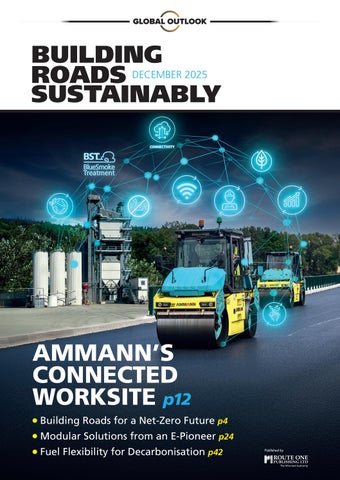
BUILDING ROADS DECEMBER 2025 SUSTAINABLY
AMMANN’S CONNECTED WORKSITE p12
Building Roads for a Net-Zero Future p4
Modular Solutions from an E-Pioneer p24
Fuel Flexibility for Decarbonisation p42
Published by
Built on Accuracy. Driven by Innovation.
Confidence Starts with Precision From roads to bridges and everything in between, your work lays the foundation for stronger communities. Our technology is designed to bring more accuracy, less rework, and better results—so you can keep building with confidence.
Scan the QR code for expert paving solutions and elevate your infrastructure projects. See how we can help you boost your productivity and profitability today.
Learn more at topconpositioning.com
Introducing the RD-M2— our fastest road scanner yet, built for highway speeds
CONTENTS 04
24
12
27
SUSTAINABILITY STRATEGY Tarmac on building roads for a netzero future
CHARGING FORWARD Electrification solutions from DIMAAG are coming to the industry
AMMANN CONNECTED WORKSITE Bringing together all pieces of the puzzle to create one coordinated workflow
SUSTAINABILITY DEFINED Christian Bode, product manager for hot-mix recycling at Wirtgen Group
04
30
14
EFFICIENCY AND PRODUCTIVITY Liebherr on solutions for modern road construction
3D PAVING SYSTEMS New technology for geomatics and paving from Topcon Positioning Systems
14
18
SIMEM MIXING PLANTS Mobility and efficiency in the world of concrete
ELECTRIFICATION OF HEAVY EQUIPMENT The drive towards offering electric construction-machine solutions
VOLVO CONSTRUCTION EQUIPMENT Leading the way towards zeroemission construction
42
20
BUILDING ROADS SUSTAINABLY
In association with
Editor: Mike Woof
ADVERTISEMENT SALES
Contributing Editor: David Arminas
Sales Director: Graeme McQueen Tel: +44 1322 612069 Email: gmcqueen@ropl.com
Production Manager: Nick Bond Office Manager: Kelly Thompson Managing Director: Andrew Barriball Chairman: Roger Adshead Data & Marketing Manager: Alan Cansick
ENGINE OVERLOOK/ FUEL-AGNOSTIC - CUMMINS Beau Lintereur outlines the need for a diverse portfolio of available solutions
Italy: Fulvio Bonfiglietti Tel: +39 339 1010833 Email: fulvio.bonfiglietti@gmail.com Asia/Australasia: Roger Adshead Tel: +44 7768 178163 Email: radshead@ropl.com
Sales Director: Dan Emmerson Tel: +44 1322 612068 Email: demmerson@ropl.com
Published by
Head of Digital: Sarah Biswell
December 2025
THE MEASURE OF PROGRESS Alex Lamers of Ammann Group
36
20
Designers: Simon Ward, Andy Taylder
33
ADDRESS Route One Publishing Ltd, Second Floor, West Hill House, West Hill, Dartford, Kent, DA1 2EU United Kingdom Tel: +44 (0) 1322 612055 Fax: +44 (0) 1322 788063
© Route One Publishing Ltd 2025
03
B U I L D I N G R O A D S S U S TA I N A B LY
S U S TA I N A B I L I T Y S T R AT E G Y
BUILDING ROADS FOR A NET-ZERO FUTURE
I
Infrastructure can sometimes be viewed as a fixed asset - a backdrop to economic activity rather than a dynamic contributor to environmental change. Yet, as the UK intensifies its efforts to meet net-zero targets by 2050, the role of infrastructure, and roads in particular, is being redefined emergencies and National Highways committing to decarbonisation across the strategic road network, the pressure to innovate is mounting. The challenge is multifaceted. Roads must be durable, safe, and cost-effective, but they must also be low carbon, resource-efficient, and future-proof. Achieving this balance requires more than incremental change. It demands a fundamental shift in how we think about infrastructure, from design and materials to delivery and maintenance.
Roads are no longer just conduits for transport; they are increasingly seen as opportunities to embed sustainability, resilience and innovation into the built environment. The environmental impact of road construction is significant. Asphalt, the material that underpins much of the UK’s highway network, contributes around 15% of the total emissions associated with road building and maintenance. This figure is not just a statistic, it’s a call to action. With more than 300 local authorities declaring climate
December 2025
04
B U I L D I N G R O A D S S U S TA I N A B LY
December 2025
05
B U I L D I N G R O A D S S U S TA I N A B LY
S U S TA I N A B I L I T Y S T R AT E G Y
CEVO Asphalts: A systems-based approach to decarbonisation Tarmac’s CEVO Asphalts represent a response to this challenge, not as a single product but as a platform for sustainable road building. CEVO Asphalts are built on the principle that meaningful carbon reduction requires a systems-based approach, one that integrates material innovation, process efficiency and lifecycle thinking. Central to CEVO Asphalts is the use of biogenic binders. These binders are derived from renewable plant-based sources, replacing traditional petroleum-based bitumen. This substitution significantly lowers the embodied carbon of asphalt. The binders trap and store carbon dioxide, effectively turning the road surface into a carbon sink. And, because CEVO asphalt is recyclable, most of this carbon remains locked away, contributing to long-term climate benefits.
December 2025
Warm-mix asphalt technology is another cornerstone of CEVO. By reducing the temperature required for production and laying, this method lowers energy consumption and associated emissions. Tarmac has been a pioneer in warmmix technology and CEVO builds on this legacy, integrating warm-mix processes to further enhance sustainability and operational efficiency. The increased use of recycled asphalt planings (RAP) adds another layer of environmental benefit. By reusing materials from existing road surfaces, CEVO reduces the demand for virgin aggregates and bitumen. This not only conserves natural resources but also supports circulareconomy principles, creating a more sustainable lifecycle for road materials. The integration of RAP also contributes to cost savings and reduces the environmental footprint of extraction and transportation.
06
B U I L D I N G R O A D S S U S TA I N A B LY
A WIRTGEN GROUP COMPANY
Automated compaction to target value SMART COMPACT IN EARTHWORKS
March 03 – 07, 2026 Visit us!
WIRTGEN AMERICA, Inc. live in Las Vegas / USA Las Vegas Convention Center Booth: S5134
CLOSE TO OUR CUSTOMERS. Automated compaction until the desired target value is reached? Smart Compact makes it possible. How does it work? Based on highly precise compaction measurements, Smart Compact constantly adjusts the compaction force depending on the ground conditions. The result: high process reliability, no over-compaction, no jump operation, fewer passes, lower diesel consumption. www.hamm.eu HAMM AG · Hammstr. 1 · D-95643 Tirschenreuth · Tel +49 (0) 9631 80-0
S U S TA I N A B I L I T Y S T R AT E G Y
Asphalts alongside other sustainable measures, including electric construction equipment and optimised logistics. The project achieved an 75% reduction in carbon emissions compared to conventional methods, without compromising performance or durability. This outcome was not the result of a single innovation but of a coordinated strategy that brought together advanced materials, lowcarbon equipment, and collaborative planning. The A64 trial demonstrated that net-zero roads are not a distant aspiration but a present-day possibility. It also highlighted the importance of partnership. National Highways provided a clear mandate for sustainability, while Tarmac contributed technical expertise and materials innovation. Together, the organisations showed that meaningful carbon reductions are achievable when stakeholders align around shared goals. Beyond the technical achievements, the A64 project served as a model for how infrastructure delivery can evolve. It showed that sustainability can be embedded into every stage of a project from design and specification to execution and evaluation. It also underscored the value of transparency, with carbon savings tracked and reported at the project level.
Together, these innovations can reduce the carbon footprint of asphalt materials by up to 45% compared to traditional hot mix. When combined with low-carbon construction practices, such as the use of electric vehicles and plant, CEVO has helped achieve carbon reductions of up to 80% on major projects. These figures are not theoretical; they are grounded in real-world application.
Process innovation and lifecycle thinking While CEVO Asphalts address the material side of road construction, Tarmac’s PAVE Technology Solutions extend the sustainability conversation into design and delivery. PAVE incorporates innovations in pavement design, construction techniques, and automation to improve energy efficiency and extend asset life.
The A64 trial: A blueprint for net-zero roads The A64 resurfacing trial in North Yorkshire, delivered in partnership with National Highways, offers a compelling example of CEVO in action. This project was designed to test the feasibility of delivering a low-carbon road using CEVO
December 2025
08
B U I L D I N G R O A D S S U S TA I N A B LY
S U S TA I N A B I L I T Y S T R AT E G Y
The role of data and digital tools As sustainability becomes a central priority, transparency is increasingly important. To support better decisionmaking, Tarmac is launching a digital carbon calculator that allows clients to quantify emissions and track savings at the project level. This tool will help shift the conversation from aspiration to evidence, making carbon a visible and measurable metric in infrastructure planning. The availability of accurate data empowers clients to make informed choices and supports the development of more accountable and effective sustainability strategies. It also enables benchmarking, continuous improvement and alignment with broader environmental goals. Digital tools are not just enablers; they are catalysts for change. They allow organisations to move from reactive compliance to proactive leadership, embedding sustainability into core business processes.
By optimising ride quality, enabling echelon paving, and integrating automated systems, PAVE enhances construction quality and durability. This reduces whole-life maintenance needs and lowers emissions over time, supporting more resilient and cost-effective infrastructure. Lifecycle thinking is essential to achieving net zero. It requires a shift from short-term performance metrics to long-term environmental and economic outcomes. Roads must be designed not only for immediate use but for future adaptability, maintenance and renewal. PAVE supports this shift by embedding sustainability into the fabric of infrastructure delivery.
"The rest of the industry must now follow suit, not just by adopting new materials, but by embracing new mindsets" December 2025
09
B U I L D I N G R O A D S S U S TA I N A B LY
S U S TA I N A B I L I T Y S T R AT E G Y
The transition to net zero will not be linear. It will involve experimentation, iteration and learning. But the foundations are already in place. The technologies exist. The results are proven. The urgency is real. Policy, regulation, and industry leadership Policy will play a critical role in accelerating the adoption of low-carbon road solutions. Clear guidance from government and agencies like National Highways can help standardise best practices and reduce uncertainty. Incentives for innovation, investment in research, and support for pilot projects can further catalyse progress. At the same time, regulation must be flexible enough to accommodate emerging technologies and approaches. The road to net zero will be shaped by continuous innovation, and frameworks must be designed to evolve alongside it. Industry leadership is equally important. Organisations must be willing to take risks, share knowledge, and invest in long-term sustainability. The most successful transitions will be those that combine technical excellence with strategic vision.
Scaling innovation across the sector The A64 trial and CEVO Asphalts offer a blueprint for sustainable road building, but scaling these solutions requires industry-wide alignment. National Highways has already taken a bold step by mandating warm-mix asphalt as the default surfacing material. The rest of the industry must now follow suit, not just by adopting new materials, but by embracing new mindsets. This shift involves more than technical adjustments. It requires a cultural transformation in how infrastructure is conceived and delivered. Procurement frameworks must evolve to prioritise carbon performance. Design standards must reflect the realities of climate resilience. And collaboration must become the norm, not the exception.
December 2025
A vision for the future of roads Roads are more than infrastructure; they are reflections of our priorities. As we confront the climate crisis, we must ask what kind of legacy we want our highways to leave. CEVO Asphalts and the A64 project show that sustainable road building is not a distant goal, it is a present-day possibility. But possibility must become practice. The industry has the tools, the knowledge and the urgency. Now it needs the will. Let us build roads that serve not just the journeys of today, but the futures we hope to create. www.tarmac.com
10
B U I L D I N G R O A D S S U S TA I N A B LY
Spend less. Shift more. Smile even more. W I T H T H E N EW G E N E RAT I O N O F VO LVO W H E E L LOA D E R S
With quality you can count on, renowned fuel efficiency and safe ty, as well as smart technology to support your work and save fuel, the new generation Volvo Wheel Loaders neve r back down. On top of that, they offer a best-in-class operator environment that will keep your team pro ductive and happy ― even on the toughest worksites.
Learn More
bit.ly/NewGenVolvoLoaders
AMMANN CONNECTED WORKSITE
CONNECTED WORKSITE FOR COHESIVE ROADBUILDING For onsite operations efficiency, Ammann’s Connected Worksite brings together all pieces of the puzzle to create one coordinated workflow
December 2025
12
B U I L D I N G R O A D S S U S TA I N A B LY
AMMANN CONNECTED WORKSITE
The communication works both ways. The mixing plant receives real-time information about the truck locations, which helps plan further production and loading.
Connected Worksite, a new digital solution from Ammann, integrates all phases of the road construction process and identifies efficiencies at every step - thus enhancing profitability. In collaboration with Q Point, the digitalisation experts, Ammann offers an integrated solution that improves the efficiency, transparency and sustainability of the entire asphalt-related process.
Paving and compaction Monitoring of mix temperatures is essential to ensuring high quality. With Connected Worksite, crews know the temperature of the mix at each stage - during production, as it leaves the plant, when it’s in transit, when it arrives, when it’s in the hopper, when it’s behind the screed and during compaction. Ammann Compaction Expert (ACE), Ammann’s proprietary Intelligent Compaction system, also provides control and guidance. ACE can be supplemented by a cloud-based solution that enables the exchange of information between machines. The data also can be viewed online.
The accessible technology can be used for the entirety of a project or during specific phases: • • • • •
Construction planning and order management; Planning and production at the asphalt plant; Loading and delivery of materials; Paving and compaction; Thorough documentation.
Connected Worksite brings together all pieces of the puzzle to create one coordinated workflow. This advanced communication streamlines each phase of roadbuilding and ultimately brings operational efficiency and cost savings.
Thorough documentation Continuous documentation offers valuable insights into all phases. The data helps uncover opportunities for improvement - and at an early stage while adjustments can still be made. At a later date, a detailed history can be shared with clients as needed. www.ammann.com
Construction planning and order management Customer orders are provided digitally and monitored in real time. Orders can be transmitted as binding or non-binding, which the plant can immediately accept, reject or respond to in more detail. Changes can be made from an office computer or a mobile device from any location. If needed, each instruction is recorded for further review. Planning and production at the asphalt plant Connected Worksite uses the digital orders to create a production schedule that is automatically transferred to the plant’s control system. This optimises material usage and ensures tight deadlines are met. Operating and production data and batch protocols can be analysed centrally, even if multiple control systems are used. Loading and delivery of materials As new mix is weighed, the system captures and transmits the appropriate delivery data to the truck driver and the construction team. This allows those at the jobsite to time their work to match the delivery of the mix.
December 2025
13
B U I L D I N G R O A D S S U S TA I N A B LY
3 D PAV I N G S Y S T E M S
INCREASING EFFICIENCY New technology for geomatics and paving from Topcon Positioning Systems is delivering greater efficiency, helping to boost sustainability for major projects. Ron Oberlander, senior vice president of Geomatics Platform at Topcon, and Brian Lingobardo, senior director for Intelligent Paving at Topcon, discuss advances in technology that will help construction deliver better sustainability Improving the efficiency of operations is key for connected construction. Improving accuracy and productivity while addressing clash detection and reducing the need for reworking and waste from operations can not only speed delivery and boost quality but also improve sustainability. It is a simple fact. Less waste means fewer CO2 emissions. The use of positioning technology in construction has increased in recent years, becoming more democratised and spreading out from use only in certain segments or with larger contractors. Systems are now used in a vast array of applications and with contractors of all sizes, while usability and versatility have been improved. For Topcon, remaining at the forefront of technology and investing in research and development are crucial. But the company has also been keen to ensure that its systems can interact with other technologies. Oberlander commented that Topcon’s previous president and CEO, Ray O’Connor, had a vision that took the company forward. “Ray O’Connor wanted an open architecture and interoperability among our systems and the industry.” And he added that this forward-looking approach will continue now that Ivan Di Federico has taken over as CEO, “Ivan Di Federico is an innovator, always looking 10 years
December 2025
14
B U I L D I N G R O A D S S U S TA I N A B LY
December 2025
15
B U I L D I N G R O A D S S U S TA I N A B LY
3 D PAV I N G S Y S T E M S
ahead. It’s inspiring to have him leading as he gives us freedom to work ahead. He’s putting in a new organisational structure, Topcon 2.0. Topcon is preparing for what is coming.” The need for an open architecture across industry is acute and there is a recognition that a contractor may have mixed fleets of connected construction tools as well as construction machines. Oberlander said: “We build the software application for who is using it, then recover the data. We ingest that data to glue it in the system to provide a seamless workflow for our customers.” And he added that being able to communicate with the key software providers such as Autodesk or Bentley Systems is also vital. Oberlander explained that there are no data silos when using technology from Topcon. “We can take the data from Topcon geomatics solutions to construction easily as it’s the same ecosystem.” A Topcon GPS receiver on a dozer may look different from the unit being used on a tractor. “The core Topcon fundamental technology is used across all platforms making the user experience seamless,” he said. However, Oberlander said that the hardware tools for connected construction technology from the major players are all fairly similar in what they do. But he said that factors such as functionality, ease of use and service support are more important, commenting: “How do we make the software functional and make it easier to get that job done? It’s about the software experience. The user shouldn’t be concerned on how the software works. They just want to get the crew out and get the job done. We need to simplify the functionality to make that easier.”
December 2025
16
The company has been offering 3D systems for concrete and asphalt paving for a considerable period now and has the experience of both segments to offer intelligent and sophisticated systems, with new platforms coming to market. Topcon developed technology for asphalt paving initially and then added concrete-paving systems to its portfolio a decade ago
He said that Topcon is also making products that are easier to service and maintain, as well as offering greater functionality. Oberlander added: “Topcon 2.0 is not just about markets we’re going into. It’s also about innovative products and improving quality. It’s a revamp of Topcon culture.” Geomatics plays a key role in the construction industry. Oberlander said: “Geomatics is the beginning, during and end of any project. You need to know where to build that bridge, tunnel, road or building. When the work is done, the client comes and inspects it using geomatics.” The firm has made a heavy investment into AI and Oberlander said that fitting AI tools on devices such as a total station means that it can learn users’ habits, allowing an improvement in working over time. He explained that while the surveyor has to put in feature codes, the AI software would recognise what tasks are being carried out and also be able to remember the tasks that have been carried out so far. Meanwhile, Lingobardo said that Topcon is continuing to develop its offering for the concrete-paving and asphaltpaving markets. The company has been offering 3D systems for concrete and asphalt paving for a considerable period now and has the experience of both segments to offer intelligent and sophisticated systems, with new platforms coming to market. Topcon developed technology for asphalt paving initially and then added concrete-paving systems to its portfolio a decade ago. He said: “Depending on the application, Topcon offers various solutions.” The Millimeter GPS and SmoothRide technologies have been used widely in asphalt paving, being wellproven in applications with a need for premium quality such as racetracks, airport runways and major highways.
B U I L D I N G R O A D S S U S TA I N A B LY
3 D PAV I N G S Y S T E M S
the precision and efficiency of slipforming operations. The system uses both GNSS for horizontal accuracy as well as a rotating laser for vertical accuracy. One laser can control multiple machines and also provide elevation feedback to grade checkers, at the same time. Lingobardo said that this system is popular in industry. “It’s accurate and it’s easy to set up.” Meanwhile the new MC-Max system includes updated system hardware including a new display. It simplifies the user experience while adding functionality to the customer's investment. A key development is the modular sensor stack that can be used for all applications. Lingobardo commented: “This technology is a market differentiator. It simplifies the user experience while adding functionality to the customer's investment.” MC-Max also includes new software features such as virtual ski for asphalt and milling applications. The function can be used to improve the road surface without requiring a design. The user can set the ski length and the system will average the depth or thickness in real time, improving workflow efficiency and the longevity of the road surface. “Workflows and the integration of construction and geomatics technologies aimed at enhancing sustainability and efficiency continue to evolve,” Oberlander said. “Precision is important to every contractor in the way they approach their projects. At Topcon, we're committed to driving precision innovations forward. We believe Topcon 2.0 will help our customers reach their goals not only in building a better world, but also in leaving a sustainable future for the next generation.” www.topconpositioning.com
Further advances continue to be introduced for concrete and asphalt paving and Lingobardo continued: “We’ve recently introduced an update of our intelligent compaction system.” He explained that the system monitors factors such as positioning, the pass count and surface temperature and commented: “We're excited for its impact in the market.” The package is more advanced than previous generation technology but at the same time, is also less costly, has fewer cables and is easier to install. Lingobardo said: “It includes a new wireless tablet giving the operator mounting flexibility.” He continued: “All of our platforms are being updated now.” An advanced kerb and gutter system offers accurate concrete placement. Millimeter GPS can be used to increase
December 2025
X 17 X
B U I L D I N G R O A D S S U S TA I N A B LY
SIMEM MIXING PLANTS
BISON - MOBILITY AND EFFICIENCY IN THE WORLD OF CONCRETE Simem’s Bison range includes three main models - Bison 250, Bison 300 and Bison 600 - capable of producing 200, 300 and up to 600 tons per hour, respectively At Bauma 2025, Simem presented the new Bison 600, part of its line of highly mobile and innovative mixing plants, confirming its leadership in the readymix concrete sector with solutions that combine technology, flexibility and sustainability. The Bison range includes three main models - Bison 250, Bison 300 and Bison 600 - capable of producing 200, 300 and up to 600 tons per hour, respectively. This versatility allows the plants to meet the demands of projects of varying scale, from large infrastructure works to local renovation and maintenance interventions.
MAIN IMAGE: Simem’s commitment to sustainable construction is demonstrated through real-world projects, such as the Bison model deployed by Colas Croatia on the DC1 Section 013, the Udbina Bypass project
December 2025
18
B U I L D I N G R O A D S S U S TA I N A B LY
Simem’s commitment to sustainable construction is demonstrated through real-world projects. A notable example is the Bison model currently deployed by Colas Croatia on the DC1 Section 013, the Udbina Bypass project. The high-speed road between the Croatian capital Zagreb and Split on the Dalmatian coast is one of the most heavily trafficked in the country. The plant supports cold in-plant recycling technology, which allows existing pavement materials to be reused directly on site, significantly reducing the need for new raw materials and transportation. More than 8,000 tons of cold recycling have already been produced so far. This approach helps cut CO2 emissions and promotes a circular construction economy, demonstrating how the latest generation of Simem Bison plants combines innovation, efficiency and environmental responsibility in real infrastructure projects. With the Bison range, Simem reaffirms its vision to provide the concrete sector with mobile, versatile, and sustainable solutions, capable of meeting the challenges of modern construction with Italian technology and environmental awareness. More information is available at: https://simem.com/plants/supermobileplant-bison
One of the strengths of the line is the aggregate bins (Bison Bins), which can be configured with three or four compartments or in a modular combination to optimally adapt to the client’s specifications and the materials used. Material mixing is handled by Simem continuous twin-shaft mixers, designed and built in-house at the Minerbe (Verona) plant. These mixers ensure consistent homogeneity, high dosing precision and long operational life, even under the most demanding working conditions. Another distinctive feature of the Bison range is its exceptional mobility. All plant components are designed to be transported on standard flatbed trucks, without the need for special permits, and can be installed quickly, even in construction areas without prior civil works. The integration of telescopic legs and horizontal cement silos enables a simple, safe and fast assembly in order to reduce production start-up times. Plant management is fully automated thanks to the Simem Automation control system. This ensures accuracy exceeding 98% in material dosing and complete traceability of every production cycle. Bison plants are also modular and configurable, allowing the addition of components or accessories according to the specific requirements of each project.
December 2025
19
B U I L D I N G R O A D S S U S TA I N A B LY
V O LV O C O N S T R U C T I O N E Q U I P M E N T
LEADING THE WAY TOWARDS ZERO-EMISSION CONSTRUCTION Achieving zero-emission construction does not have a simple answer. It demands a broad toolkit of solutions to assist customers at different stages of their sustainability journey. By pursuing a multi-technology strategy, Volvo Construction Equipment (Volvo CE) is at the forefront of this movement, offering a comprehensive pathway to more sustainable construction
December 2025
20
B U I L D I N G R O A D S S U S TA I N A B LY
V O LV O C O N S T R U C T I O N E Q U I P M E N T
With global population growth and rapid urbanisation, the demand for construction – whether roads, housing, or infrastructure - is on the rise. However, Volvo CE understands the critical need to employ more sustainable ways of working to minimise the environmental impact of the construction industry. Approximately 90% of the sector’s climate impact comes from the operation of its machines, and this is exactly why this should be a key area of focus for sustainability efforts. Embracing a multi-technology strategy While battery-electric machines have a pivotal role to play, Volvo CE firmly believes that no single solution can decarbonise the industry. Different customers, markets, segments, and regions will require diverse solutions. Recognising this, Volvo CE has committed to a multitechnology approach that includes: • • • • •
battery-electric machines, grid-connected technologies, hybrid solutions, hydrogen fuel cells, internal combustion engines powered by renewable fuels, and more.
large-scale building, demolition and industrial-machine handling – delivering zero-emission, quiet, efficient, and low-vibration performance for a safer working environment for operators and the public. Grid-connected solutions eliminate downtime For static, repetitive tasks such as material handling in the waste and recycling industry, grid-connected machines provide an ideal solution. Machines like the EW240 Electric Material Handler connect directly to the grid via a cable, eliminating the downtime associated with refuelling or recharging and enabling continuous operation. Like their battery-electric counterparts, grid-connected machines substantially lower noise, vibrations, and heat, while eliminating exhaust emissions. This can open the door
"The journey is underway, but faster progress is needed."
This strategy also recognises that customers are at varying stages in their sustainability journey, emphasising the importance of offering a variety of solutions to meet their specific needs and challenges. Expanding battery-electric solutions Since launching its first compact electric machines in 2019, Volvo CE has continued to lead the way with an everexpanding range of electric machines. Today, this growing portfolio includes compact electric excavators and wheeled loaders, mid-size electric excavators, large electric wheeled loaders and an electric wheeled excavator. Volvo CE has recently added its largest battery-electric machines to date: the A30 Electric and A40 Electric articulated haulers, the first of their size class in the world. And to accelerate the transition to electric power, Volvo CE offers a variety of charging solutions, including mobile power units for reliable on-site energy access for both Volvo and non-Volvo equipment. Battery-electric machines offer a readily available solution for customers looking to cut carbon emissions. In fact, many of Volvo CE’s electric machines are already being used successfully in a wide variety of applications - from urban construction and agriculture to indoor operations,
December 2025
The hybrid EC400 excavator is part of Volvo CE’s multi-technology strategy
X 21 X
B U I L D I N G R O A D S S U S TA I N A B LY
V O LV O C O N S T R U C T I O N E Q U I P M E N T
The Volvo CE EW240 Electric Material Handler connects directly to the grid via a cable, enabling continuous operation
for new business opportunities because they are perfect for noise-sensitive areas, both outdoor and indoor, low-carbon zones, and for operation during unsociable hours.
emissions thanks to pioneering hydraulic hybrid technology that harnesses and stores energy generated by boom movement for reuse. For greater efficiency across all solutions, Volvo CE’s machines utilise motion-energy recuperation and efficiency, for example when the operator is decelerating, helping to recover energy that can be re-used.
The continued role of internal combustion engines While Volvo CE envisions a future dominated by zeroemission technologies, internal combustion engines still have a role to play, especially in remote areas lacking grid access. Here, engines powered by renewable fuels like biodiesel and HVO (hydrogenated vegetable oils) are viable alternatives. Volvo CE’s machines can operate on these biofuels with no modifications, proving a solution today that enables customers to significantly reduce their greenhouse gas emissions. Biofuels, derived from renewable sources like plants and waste, offer a lower carbon footprint compared to traditional fossil fuels. With its largest product-portfolio overhaul in decades, Volvo CE has also improved the fuel efficiency of models like the new-generation Volvo excavators , which are up to 15% more fuel-efficient.
Exploring hydrogen fuel cells for heavy-duty applications In scenarios demanding heavy-duty solutions, where batteries may not be the right power source due to the sheer number and weight needed to supply sufficient power, Volvo CE is exploring hydrogen fuel cell technology. Unlike batteries that store electricity, fuel cells make their own electricity onboard via an electrochemical process using stored hydrogen. While a promising complement to battery technology, advancing hydrogen infrastructure, particularly green hydrogen supply, will be key to harnessing its full potential. The construction industry is undergoing transformative change. The journey is underway, but faster progress is needed. With its multi-technology strategy, Volvo CE is spearheading this transition, providing a diverse range of solutions to meet the demands of today, while preparing for the challenges of tomorrow, supporting customers at every step of their sustainability journey. n www.volvoce.com
Hybrid models offer increased efficiency Moreover, Volvo CE is expanding its portfolio of hybrid models, including the new-generation EC260 Hybrid and EC500 Hybrid excavators. These new models deliver up to 20% better fuel efficiency and a 15% reduction in CO2
December 2025
22
B U I L D I N G R O A D S S U S TA I N A B LY
CONSTRUCTION WORKFLOW PLANNING
Connected Worksite – The Digital Path to Sustainable Roadbuilding. Ammann and digitalisation expert Q Point jointly provide an integrated solution for all phases of the asphalt process. This combination improves efficiency, transparency and sustainability.
For additional product information and services please visit : www.ammann.com MMP-3188-01-EN | © Ammann Group
Connected Worksite
ELECTRIFICATION SOLUTIONS Electrification solutions from California firm DIMAAG are coming to the construction industry. Mike Woof reports machine also has the option of autonomous control. According to the firm, the MWCS offers a fast, and practical way to charge off-road electric work vehicles. It features innovative technology for high-power, fast charging on a mobile vehicle. The machine is intended for off-highway use at construction sites, quarries or mines, but has been developed to be extremely rugged, allowing it to cope with tough conditions. Aimed at use with heavy machinery such as construction or quarry equipment, DIMAAG’s MWCS offers the potential to address power-supply challenges in the field.
California-based DIMAAG is pushing the envelope for the off-highway equipment sector, developing innovative electrification and charging solutions. At the bauma construction machinery exhibition in Munich in early 2025, the firm unveiled its novel mobile charging solution, the Mobile Megawatt Charging System (MWCS) at the Komatsu Electrification Display. This innovative machine can boost the versatility of electric construction machines. A novel rough-terrain vehicle, the MWCS can drive itself to charge electric equipment at their point of use when required. Remote control is fitted but the
December 2025
24
B U I L D I N G R O A D S S U S TA I N A B LY
C H A R G I N G F O RWA R D
“Our autonomy is specifically designed for off-road use. You have to have smart navigation that understands the environment.”
The 4WD, independent traction control unit is effectively a giant booster battery on wheels according to the company. With 1MW fast-charging capability, this can recharge an electric construction machine in just 15 minutes, while an operator takes a periodic break. The unit itself can then be recharged overnight for use again the following day. DIMAAG says that the unit benefits from its patented active thermal-management technology that boosts safety and life-cycle to deliver improved total cost of ownership. The company also claims that its MWCS offers manoeuvrability in tough off-road conditions including high gradients, and can charge multiple machines onsite. Deepak Pingalay, chief commercialisation officer at DIMAAG, said “Our autonomy is specifically designed for off-road use. You have to have smart navigation that understands the environment.” However, the MWCS is just one of the company’s advanced technologies. In addition to the headquarters in Fremont, California, the firm also has a facility in Bengaluru, India, that focuses on software development and machinelearning systems while it has a facility in Japan that specialises in application engineering for autonomy and robotics. Pingalay explained that the firm started as an AI company, but has since broadened its scope, now specialising in electrification solutions, AI, autonomy and robotics. Ian Wright, a former co-founder of Tesla, is the engineering brain behind the technology and working with DIMAAG he wants to make an impact in the electrification of off-road vehicles. He added that the company can offer technology development and fast prototyping and added, “That significantly shrinks the development time for our customers.” The company has many patents while its experience with AI has been of benefit and Pingalay said, “We also use AI in battery-pack design and battery management.” Kubota, the Japanese multinational, was a customer for DIMAAG’s AI technology at first but then asked the California firm to help fully design an autonomous electric tractor. This was made ready quickly and Pingalay said, “Kubota’s EV tractor benefited from a fast, highly accelerated development process.” In addition to the autonomous electric Kubota tractor, DIMAAG has also developed a swappable fast-charging electric power package for a mini excavator from Hitachi, a ground-care machine, an off-road buggy and an electric generator. The firm has also developed electric solutions for demolition equipment while some projects are underway
December 2025
Deepak Pingalay DIMAAG chief commercialisation officer
Equipped with six modules, the ground care machine can run all day, though just two are sufficient for shorter term operation
25
B U I L D I N G R O A D S S U S TA I N A B LY
C H A R G I N G F O RWA R D
with other machine manufacturers at the moment, although these are not being revealed at this stage. The electrification solution for Hitachi is based on one of its zero-tailswing mini excavator models. Sadha Kameswaran, vice president business development at DIMAAG, explained: “Hitachi gave us good CAD models so we were able to see the space available clearly and deliver a prototype vehicle to them in 12 weeks.” The prototype was exhibited at the bauma show in Munich in 2025. The firm has fitted a battery pack with six swappable modules in the Hitachi ZX17 mini excavator, although it can operate with just two of the units if required. Kameswaran said, “We worked with the engineering team to keep the zero tailswing and it is being launched in the market by Hitachi in 2027.” The power systems have been developed along modular lines. Pingalay said, “Companies want standard solutions that go across several industries.” This is why DIMAAG has developed the swappable battery systems. These could be offered by a rental firm as part of the service for customers as data from the batteries can be monitored continuously, providing alerts ahead of
time when a new unit will be required. The inverter and motors have been designed and developed by DIMAAG. The power systems have been proven already in other machines. The battery modules weigh 18kg apiece and each module delivers 10kW power, so with 12 of the units, this can deliver 120kW power. With 12 modules, the battery-pack capacity will be 24kWh. DIMAAG’s electric technology features an important innovation that is key to the system and Kameswaran said, “We have a unique cooling technology that’s all integrated.” DIMAAG’s innovative DC-DC converter units are said to be significantly more compact than those of any competing systems, being just 20% of the average size. This is because of the advanced cooling system that the firm has developed. However, development of the MWCS concept continues. The autonomous charging machine unveiled at bauma carries a 220kWh battery pack but the firm will offer a newer version with a different chassis and a battery pack capacity of 300kWh. Kameswaran said, “It will be able to charge a 20 tonne excavator in 15 minutes.” n www.dimaag.ai
BELOW: The versatile battery system is modular, allowing it to power an array of machines such as this off-road buggy
BELOW: The relocatable charging package can be used with a variety of machines
December 2025
26
B U I L D I N G R O A D S S U S TA I N A B LY
S U S TA I N A B I L I T Y D E F I N E D
SUSTAINABILITY: A LONG JOURNEY There is much talk about achieving ‘sustainability’ but what is it exactly is it and how does a company know it is achieving it? For an insight into what it means for the road construction sector, Global Highways sat down with Christian Bode, product manager for hot-mix recycling at Wirtgen Group December 2025
27
B U I L D I N G R O A D S S U S TA I N A B LY
S U S TA I N A B I L I T Y D E F I N E D
Thank you for taking the time to discuss sustainability. First of all, how does the Wirtgen Group define sustainability? For the Wirtgen Group, sustainability is an integral component of its corporate principles. This is from development and design phases of products through to all stages of the value chain, up to and including the use of the machines on projects around the globe. Our customers very much appreciate the expertise we contribute. The efficient use of resources within the context of a closed-loop economy is becoming increasingly important in road construction. There is also a need for further action in view of the growing demands for climate protection. Asphalt recycling makes a significant contribution to costefficiency in road construction, the conservation of natural resources and the reduction of CO2 emissions.
Layer-by-layer milling produces homogeneous milled material and enables clean separation of material from surface courses, binder courses and base layers. This is the basis for high recycling rates with simultaneously consistent product quality. In addition, precise water management ensures a reduced moisture content of the reclaimed asphalt pavement material. This influences the RAP addition rate and reduces the energy required for subsequent heating of the asphalt granulate in the mixing plant. During processing, gentle handling in the screening and crushing phase largely preserves the original grain-size distribution. The material flow in processing leads to an improvement of homogeneity and thus enables consistent quality. The subsequent mixing technology in modern Benninghoven asphalt-mixing plants with a recycling drum and a hot-gas generator allows RAP addition rates of up to 100% and a reduction of the emissions of volatile organic compounds [VOC] to below 50mg/m³. Bitumen heating takes place exclusively via hot gases without flame contact. This influences the bitumen properties in the reclaimed asphalt and further improves environmental compatibility, as its long-term durability leads to the generation of less waste over time. The Wirtgen Group offers digital solutions that collect key data. For example, the fuel consumption of individual machines in the customer’s fleet, and then visualises the data on a single platform, the John Deere Operations Center. This already enables a holistic overview of numerous aspects within a complex process.
“Optimised recycling management enables a reduction of both costs and emissions”
Is there too much emphasis on specific climate goals and too little about reduction in material use? Many discussions focus heavily on CO2 reduction goals, while concrete material and resource efficiency often receive too little attention. But that is exactly where we have big and immediately realisable savings potentials. In conventional road rehabilitation, raw material makes up almost three-quarters of the costs. Furthermore, close to 80% of CO2 emissions are attributable to raw material and material processing. Optimised recycling management enables a reduction of both costs and emissions. The majority of customers have clearly defined goals. The achievement of climate goals and the conservation of valuable resources go hand in hand. The production of raw material for road construction - in particular bitumen and mineral aggregates - has a significant impact on emissions. The consideration of the entire ‘rock-to-road’ process chain plays a decisive role in the achievement of a sustainable solution. n www.wirtgen-group.com
Is it increasingly difficult or easier to measure progress towards achieving sustainability? Both the Wirtgen Group and its customers have defined specific and measurable parameters. This enables the identification and management developments. The parameters can be found everywhere: from the proportion of renewable energy in the manufacturing process, fuel consumption or water use of the machines, noise levels or the proportion of recycled materials used. All this has a significant impact on the potential for saving valuable resources. The Wirtgen Group offers a wide range of solutions for this: Kleemann plant setups offer a variety of options for recycling construction materials. The asphalt-recycling technologies from Benninghoven increase the recycling rate of reclaimed asphalt pavement (RAP) in mixing plants. A particular focus here is set on asphalt recycling management. At the Wirtgen Group, this is the interaction of Wirtgen cold milling machines, Kleemann crushers and screening plants and Benninghoven asphalt-mixing plants. December 2025
28
B U I L D I N G R O A D S S U S TA I N A B LY
COMPREHENSIVE ROAD ASSESSMENT AT TRAFFIC SPEED.
iPAVe® is the pinnacle of pavement assessment and management technology. Operating at highway speeds with exceptional accuracy and efficiency, it empowers you to make informed decisions about your road networks at both structural and functional levels.
Reach out to us to discuss your pavement assessment requirements
+61 385 956 000 info@arrbsystems.com
arrbsystems.com
EFFICIENCY AND PRODUCTIVITY
EFFICIENT SOLUTIONS FOR MODERN ROAD CONSTRUCTION The road construction industry is facing increasing cost pressures, rising fuel prices, and stricter environmental requirements. In this context, the efficient and sustainable deployment of construction machinery plays a central role in project success
December 2025
30
B U I L D I N G R O A D S S U S TA I N A B LY
The PR 756 crawler dozer at work on a road construction site, pushing and grading material with precision and efficiency
ensures particularly quiet operation, a crucial advantage when working near traffic routes or residential areas. The revised electronically controlled hydrostatic drive with Eco Mode promises even higher fuel efficiency. Reducing fuel consumption remains one of the most effective levers for both the environment and cost management. Moreover, the drive system can operate without modifications using alternative fuels such as HVO, making it highly practical for contractors seeking to reduce emissions while maintaining proven performance.
Modern technology offers a variety of solutions to increase productivity, reduce operating costs, and ensure long-term value. These range from advanced assistance systems and hydrostatic drive technology to digital fleet management and alternative fuel compatibility. While long-term innovations remain important, contractors are particularly interested in solutions that deliver immediate benefits without compromising future potential. Machines that combine practical efficiency, environmental performance, and operator support offer decisive advantages on today’s road construction sites.
Advanced Assistance Systems for High-Precision Road Construction Modern assistance systems significantly extend the PR 756’s capabilities in road construction, especially for surface creation and path grading. These systems support precise blade control and grading without the need for complex
The Liebherr PR 756 – Efficiency and Performance for Road Construction The Liebherr PR 756 crawler dozer demonstrates how modern machinery can combine productivity, efficiency, and precision for road construction projects. Its Silent Design
December 2025
31
B U I L D I N G R O A D S S U S TA I N A B LY
EFFICIENCY AND PRODUCTIVITY
By combining reduced fuel consumption with advanced assistance systems, the PR 756 addresses two key efficiency levers in road construction: sustainability and operational productivity.
external GPS machine controls. The dozer enables active blade stabilization during fine grading as well as automatic blade positioning for creating 2D surfaces. In combination with the highly controllable hydrostatic drive and optimised centre of gravity, this results in exceptionally high grading speeds and accurate results. Contractors benefit from faster project execution and reduced rework, achieving both productivity and highquality surfaces.
Operator-centred Design for Maximum Productivity Despite advances in technology, the machine operator remains central to achieving optimal efficiency. The PR 756 cab is designed with comfort, ergonomics, and an intuitive Human-Machine Interface (HMI). Excellent visibility, low vibration, and ergonomically positioned controls allow operators to work safely and productively throughout long shifts, ensuring high-quality work and efficient project execution. www.liebherr.com
Efficiency and Transparency Through Digital Solutions Long-term experience shows that Liebherr’s current generation of hydrostatic drives, combined with advanced digital technologies, delivers higher efficiency than other modern drive concepts such as diesel-electric systems. Customers report potential cost savings of up to 35,000 euros per year, depending on application and operational conditions. The LiDAT fleet management portal, where equipped, provides access to updated operational data, including machine location, operating hours, fuel consumption, and service intervals. This digital transparency supports efficient fleet management and enables contractors to plan and monitor operations effectively. Additionally, the Liebherr Fuel Savings Calculator allows for direct comparisons with existing fleets, offering a reliable overview of potential savings.
ABOUT THE LIEBHERR GROUP The Liebherr Group is a family-run technology company with a highly diversified product portfolio. The company is one of the largest manufacturers of construction equipment in the world. It also provides high-quality, user-oriented products and services in a wide range of other areas. The Liebherr Group includes more than 150 companies across all continents. In 2024, it employed more than 50,000 staff and achieved combined revenues in excess of 14 billion euros. Liebherr was founded by Hans Liebherr in 1949 in the southern German town of Kirchdorf an der Iller. Since then, the staff have been pursuing the goal of achieving continuous technological innovation and bringing industry-leading solutions to its customers.
The Liebherr PR 756 crawler dozer in action with the ripper attachment, efficiently breaking and loosening material in a quarry environment.
December 2025
32
B U I L D I N G R O A D S S U S TA I N A B LY
THE MEASURE OF PROGRESS
SUSTAINABILITY EQUALS COMMITMENT Sustainability is about commitment on many levels. Alex Lamers, head of Product Management Machines and ESG officer (Environmental, Social and Governance) at Ammann Group, explains what it means to his company and customers •
Thank you for taking the time to discuss sustainability. First of all, how does Ammann Group define sustainability? Ammann views sustainability as a commitment to creating plants, machines and processes that minimise environmental impact. We also consider the safety of those on the jobsite and at Ammann manufacturing facilities as the ultimate sustainable priority.
•
• Is it increasingly difficult or easier to measure progress towards achieving sustainability? Not surprisingly, the answer is both. First of all, why is it becoming easier? For Ammann, having clear, timed targets is an essential way to measure sustainable progress. In other words, to have a target of ‘achieving X’ by the ‘timeframe Y’ is a good measuring tool:
December 2025
•
33
When standards, for example for emissions, are mandated, our goal is always to go above and beyond - something we consistently achieve. We are convinced that we will reach our target of using 50% of renewable electricity by 2035 much earlier than that year. Besides this, we want to reduce by 2035 also our Scope 1 and Scope 2 CO2 emission levels by 30%. By 2050, we are committed to using 100% renewable electricity and achieving net-zero Scope 1 and Scope 2 CO2 emissions [see below]. External benchmarking is another method. Tools like EcoVadis [see below], which recently awarded Ammann a ‘Committed Badge’, provide standardised frameworks and outside validation. Receiving such a certification is a meaningful measurement.
B U I L D I N G R O A D S S U S TA I N A B LY
THE MEASURE OF PROGRESS
Secondly, why is it not becoming easier? • Sustainability includes resource use, waste reduction, recycling processes and longer-term impacts that can be difficult to compare and quantify. • There is not a single universal metric that captures all aspects of sustainability. • Long-term effects are difficult to measure. It can take decades for the impact on an ecosystem to surface. • Ammann has promoted work safety through many innovations such as Birds-Eye View [BEV] for machinery, which helps operators observing their working area to detect objects and avoid collisions on the jobsite. The Ammann Safe Brake Assist [ASA] is an active safety assistant system designed to prevent collisions. It’s hard to quantify the accidents prevented by these systems yet the importance can’t be overstated.
“Consider using HVO [hydrotreated vegetable oil biofuel] for machinery as well as for plants”
Is there too much emphasis on specific climate goals and too little about reduction in material use? Ammann is following the four-pillar approach according to the CECE [Committee for European Construction Equipment], which means improving machine/plant efficiency, process efficiency, operation efficiency and exploring alternative-energy sources. Assistant functions like the line assist on asphalt rollers or burner control on asphalt plants will impact several mentioned topics. Using low-temperature asphalt will have an impact not only on asphalt production - where Ammann has been working for a long time on a solution with foam bitumen or adding additives - but also the process and operation efficiency on the job site must be increased. The ABG Pavers using adjustable double tamper solutions will definitely provide the same or even better quality road surface but with reduced operation times, whereas the ACE Pro solution helps reduce compaction time for an optimally compacted road. Ammann is a leader in the provision of solutions using reclaimed asphalt , with up to 100% use in some cases, minimising the use of primary resources. As well as alternative-energy sources such as battery and electric power to reduce CO2 emissions from machines, there are other options. Consider using HVO [hydrotreated vegetable oil biofuel] for machinery as well as for plants. Wood dust or hydrogen burners are also viable as alternative-energy sources. There are many solutions for increasing safety and efficiency on construction sites through participation in the Autonomous Operation Cluster [AOC] and, as already mentioned BEV and ASA. n www.ammann.com
December 2025
EcoVadis is a globally recognised sustainability-rating platform that assesses a company’s environmental, social and ethical performance. It evaluates four themes: Environment, Labour/ Human Rights, Ethics and Sustainable Procurement. By analysing policies, actions and results, EcoVadis delivers a scorecard that highlights strengths and areas for improvement, enabling businesses to benchmark their performance and drive continuous improvement. Companies provide basic information, including industry, size and location, to tailor the assessment to their specific context. A customised questionnaire is completed, requiring documented evidence to support responses. This ensures the assessment reflects actual practices and performance. EcoVadis analysts review the submitted information, considering both internal documentation and external sources, to evaluate the company's sustainability management system. Companies receive a scorecard with scores ranging from 0 to 100, along with badges (platinum, gold, silver, bronze) that recognise their sustainability achievements. Meanwhile, EcoVadis badges and medals help simplify sustainability for stakeholders. For procurement teams, they offer a quick way to screen suppliers. For investors, they provide a snapshot of risk and performance. And for customers, they build trust and brand value. More information is available at: https://transformacy.co.uk/articles/how-does-the-ecovadisscoring-work
Scope 1, 2 and 3 emissions are greenhouse gases that are released across an organisation’s entire value chain. Scope 3 emissions are the most complex, as they are released before and after a product is delivered or consumed.
34
B U I L D I N G R O A D S S U S TA I N A B LY
N
EIEPTIO FBRSCR
SU
!
STAY AT THE FOREFRONT OF GLOBAL ROAD INFRASTRUCTURE INNOVATION Global Highways is your premier source for cutting edge information about road, bridge and tunnel design, planning, construction and maintenance. Stay informed on the latest advancements in the industry with our in-depth reports, expert interviews, and exclusive insights. 2025 VOL. 6
globalhighways.com
DESIGN, CONSTRUCTION, MAINTENANCE & MANAGEMENT OF THE WORLD’S ROAD NETWORKS
www.globalhighways.com
ROAD
www.globalhighways.com
Q4 2025 ISSUE 11
DIGITALISATION
BUILDING ROADS DECEMBER 2025 SUSTAINABLY
IN CONSTRUCTION A N A LY S I N G
T H E
L AT E S T
T E C H N O L O G Y,
P R O D U C T S
&
S E R V I C E S
TECHNOLOGY A N A LY S I N G
T H E
L AT E S T
T E C H N O L O G Y,
P R O D U C T S
&
www.aggbusiness.com
CONSTRUCTION EQUIPMENT AND TECHNOLOGY 2025
S E R V I C E S
UNIQUE CONTENT AND INSIGHT FOCUSED ON KEY TRENDS IN THE GLOBAL CONSTRUCTION EQUIPMENT AND TECHNOLOGY MARKET FROM THE INDUSTRY’S BEST-INFORMED AND MOST INFLUENTIAL SOURCES
Uploading designs straight to machines
BASF’S ASPHALT MODIFICATION WITH BUTONAL MB 5126 p4
Published by
Asphalt sphalt paving
Trialling new technology
AMMANN’S CONNECTED WORKSITE p12
PURCHASING TRENDS: THE IMPACT OF MILLENNIALS AUTOMATING OFF-HIGHWAY MACHINERY PREDICTIVE MAINTENANCE BECOMES MAINSTREAM FACTORS OLD AND NEW DRIVE NORTH AMERICAN RENTAL MARKET CONSTRUCTION EQUIPMENT MANUFACTURING ADOPTING AI AT PACE THE DRIVE TO ELECTRIC CONSTRUCTION MACHINES EMBRACING A MULTI-TECHNOLOGY STRATEGY
Building Roads for a Net-Zero Future p4
Modular Solutions from an E-Pioneer p24
Fuel Flexibility for Decarbonisation p42
p22
p46
p49
Published by
Benninghoven MULTI JET burner in Norway
Dynapac’s Seismic Asphalt compaction system
FAE’s RPL/EX-45 road planer in Finland
Open interfaces will allow interchangeability of data
Digitalisation drives greater efficiency for all construction projects
Key figures from Bentley Systems discuss the industry ecosystem for construction
Innovations in earthmoving Key Project: Canada’s new bridge
Published by
SCAN QR CODE TO REGISTER FOR YOUR FREE SUBSCRIPTION! What you’ll get by registering:
6 ISSUES PER YEAR EXCLUSIVE INTERVIEWS IN-DEPTH PROJECT REPORTS THE LATEST INDUSTRY NEWS EXPERT EQUIPMENT REVIEWS PREMIUM CONTENT 4 GLOBAL OUTLOOK REPORTS BI-WEEKLY DIGITAL NEWSLETTERS
WWW.GLOBALHIGHWAYS.COM
E L E C T R I F I C AT I O N O F H E AV Y E Q U I P M E N T
THE DRIVE TO ELECTRIC CONSTRUCTION MACHINES There is a definite drive towards offering electric construction-machine solutions from manufacturers. Mike Woof reports More and more construction machinery manufacturers are now offering electric machines in their product ranges. At the recent bauma 2025 construction and quarry machine exhibition in Munich, Germany, there were many new pieces of equipment on show featuring electric rather than diesel power. As with the automotive sector, the construction machinery firms are seeing the need to meet net-zero targets and address climate change, with electrification of machines being a key tool. A wide array of manufacturers including Ammann, Bobcat, Case, Caterpillar, Cifa, Develon, the Fayat Group, Hyundai, Komatsu, Liebherr, LiuGong, SANY, Volvo CE and the Wirtgen Group unveiled new electric machines, either in production or prototype format. There will be demand for electric construction machines. Projects such as the UK’s Lower Thames Crossing will provide a massive opportunity for electric earthmoving equipment as the contracts from client National Highways have stipulated that no diesel machines will be allowed
December 2025
onsite. It remains to be seen how many other major construction infrastructure projects in Europe or elsewhere will have similar requirements. And the availability of electric wheeled loaders and excavators has become common in the compact and midisize classes. But one of the most notable launches for the electric machine segment at bauma 2025 was for Volvo CE’s new ADT models. These have come fresh on the heels of Volvo CE launching its new articulated hauler range. The firm says that deliveries for the new A30 and A40 battery-electric machines will commence in 2026 in selected markets, with a full roll-out of these models globally in 2027 and 2028.
36
B U I L D I N G R O A D S S U S TA I N A B LY
Electric rollers offer quiet operation and high working efficiency
December 2025
37
B U I L D I N G R O A D S S U S TA I N A B LY
E L E C T R I F I C AT I O N O F H E AV Y E Q U I P M E N T
He continued: “Our industry can do better and demand in the industry can do better.” And he asked, “Why don’t we demand sustainable solutions in procurement processes?” Charging infrastructure will take time to be ready to meet the demand from consumers and Jernberg concedes that it will also take time for the market for electric construction machines to develop, “My best guess is the end of the decade maybe?” But the Volvo Group is not being deterred. Anna Müller is president of Volvo Penta and said, “We have integrated electric solutions into different machines.” Apart from the battery-electric equipment from sister company Volvo CE, the machines include an asphalt paver, a mobile crusher and a drilling rig made by different manufacturers. She said that the firm is offering a range of modular site power solutions that can be used for recharging equipment or running site power.
The electric ADTs have a large battery that is fixed on the machine and according to Volvo Construction Equipment president, Melker Jernberg: “In a normal application, it’ll run for five hours.” Apart from the electric motor and battery system in place of the diesel engine and fuel tank, the electric A30 and A40 retain the conventional hydraulics, driveline and axles of the diesel variants, which will allow production on the same assembly line. According to Jernberg: “It’s possible to make a machine with electric actuators but, so far, it’s not even close for working life, efficiency or weight. I think it will come but hydraulic systems have developed enormously over the years and are fantastic.” However, Jernberg says that take-up for these innovative electric solutions is not as quick as the Volvo Group would like. He commented “The transformation is underway slower than needed.”
Volvo says that deliveries for the new A30 and A40 battery-electric machines will commence in 2026
December 2025
38
B U I L D I N G R O A D S S U S TA I N A B LY
E L E C T R I F I C AT I O N O F H E AV Y E Q U I P M E N T
Volvo CE and its sister firms Volvo Penta and Volvo Trucks are by no means the only companies looking ahead to an electric future. The Ammann Group is investing heavily in new technologies that will help reduce the environmental impact of construction and to achieve net zero. HansChristian Schneider is CEO of the Ammann Group and says that electrification will assist the construction industry in delivering sustainability although he recognises that this will come at a cost to customers, with sales of electric machines remaining low at present. He said: “The break-even points are not as attractive as expected.” He does think that the total cost of ownership on electric machines is something customers should recognise. Customers typically keep machines in their fleets for 8-10 years. Analysing the running costs of an electric machine in comparison with a diesel unit over time reveals a benefit for the total cost of ownership with an electric unit. Schneider commented: “We’ve done the research and after 3½ years or so, the electric ones become cheaper. We did this on the small electric roller which we’ve had in the range for 1½ years now.” Schneider said that the lower cost of electricity for recharging versus fuel costs is a key factor. He also said that with an electric machine, maintenance is considerably cheaper as there is no need to change filters or engine oil. However, Schneider acknowledged that in Europe, for example, there is a dependency on energy and that energy is expensive. He also recognises that there are issues with the electricity grid in much of the developed West, with under-investment over many years that will hamper the more widespread use of electric machines.
Bobcat has also recognised the need to invest in lowcarbon technologies and the firm has developed electric machines for its range. Product manager Robert Husar said that the firm has been working on electric drives for its telehandler models, which replace the hydrostatic drives with electric motors, increasing overall efficiency. Overall, Bobcat is developing various technologies, depending on the product type and customer usage. He continued: “In terms of market acceptance, we know the electric machines do provide some value to customers.” However, Bobcat’s sales of fully electric machines remain low at present, and he said, “If you look at the sales, it’s been a challenge to justify the investments.” Bobcat has recognised though that there will be an uptick in the market for battery-electric machines at some point and he added: “You have to be ready for it.” He explained that electric equipment does have benefits in terms of safety as well as reduced working noise. However, he continued that customers do have reservations with the residual value of electric machines and due to one factor in particular: “We’re seeing a lot of changes in battery technology.” Fuel usage of compact equipment such as mini excavators does not figure largely in the trend towards electric models for this segment, with regulations or subsidies having more of an effect on customer decisions. Husar commented that across Europe, there are now around 300 low-emission zones, most of which are in cities. But he added that there are no unified regulations on low-emissions requirements, meaning that supplying equipment to meet local demand can be a challenge.
Electric-power options have been available for some time now for the crushing and screening equipment segment
“When it comes down to 1.5x the cost of a diesel machine, electric models will sell strongly.” Jean-Claude Fayat FAYAT Group president
December 2025
39
B U I L D I N G R O A D S S U S TA I N A B LY
E L E C T R I F I C AT I O N O F H E AV Y E Q U I P M E N T
“You need imagination, dedication, but also you need to invest in your ideas” LiuGong’s grader represents the firm’s advances in the electric-machine segment
Zeng Guang’an LiuGong chairman
1.6 hours and allows normal working conditions from 6-10 hours. Meanwhile, the large-capacity lithium-iron phosphate battery is safe and durable. Its development also demonstrates how new technologies and imagination go hand in hand in today’s R&D. For example, when the Chinese government took concrete steps to support electric-vehicle development back in 2014, he understood that this could also be done for LiuGong’s machinery. “You need imagination, dedication, but also you need to invest in your ideas. This is most important for the long-term success of new technologies,” he said. Apart from LiuGong’s electric grader and Volvo CE’s electric ADT, other stand-out electric machine innovations at bauma 2025 included the modular power system from ZQUIP, part of Moog Construction, and LiuGong’s electric dump truck. ZQUIP and CASE collaborated to demonstrate how traditional diesel-hydraulic machinery can become zeroemissions machines with swappable energy modules that eliminate concerns about battery range. A CASE CX210ZQ and a CASE WX155ZQ concept excavators were on show, featuring electric-power systems from ZQUIP. Moog engineers convert a machine by removing its diesel engine and installing a modular conversion kit containing one, two, three or more energy modules. ZQUIP also has a newly developed hybrid module that operates as zero-emissions or hybrid, depending on the job and grid availability. The operator controls this option from
Jean-Claude Fayat is president of the FAYAT Group and says that the firm has been investing in new technologies and that the group is now offering a number of electric machines in its portfolio. But Fayat said that these advanced electric machines are still a niche product, with a low takeup. “For me, it’s still slow. The sales are still low.” The firm has developed electric machines to be ready for the demand when it comes but Fayat said that the high cost of the units still puts off many customers who still stick to conventional diesel equipment for the most part. This will change in time and he said, “When it comes down to 1.5x the cost of a diesel machine, electric models will sell strongly.” Fayat said that the company can benefit from the knowledge and experience gained from China’s automotive sector, which has been encouraged to develop electric vehicles by the Chinese Government. China’s automotive sector has benefitted from some subsidies for electric vehicle R&D projects. Mass manufacturing of batteries and electric drives, as well as the crossover of this technology into the construction machinery sector, will help reduce costs and make electric construction machines more attractive to customers in the future. LiuGong’s chairman, Zeng Guang’an, said that the company’s commitment towards the future of batteryelectric vehicles in the construction sector is exemplified by its new 4280DE motor grader, as well as the firm’s DR50CE rigid dump truck aimed at the 50tonne class. The batteryelectric grader’s battery pack provides fast charging within
December 2025
40
B U I L D I N G R O A D S S U S TA I N A B LY
E L E C T R I F I C AT I O N O F H E AV Y E Q U I P M E N T
construction machines. The California-based firm has developed a novel rough-terrain vehicle that can drive itself to charge electric machines when required. The firm says that the MWCS provides a fast, and practical way to charge off-road electric work vehicles. This brings innovative technology in high-power fast charging on a mobile vehicle, offering versatility for customers. Targeted for use with heavy machinery such as construction or quarry equipment, DIMAAG’s MWCS offers the potential to address power-supply challenges in the field. The 4WD unit is effectively a giant booster battery on wheels according to the company. With 1MW capability, this can recharge an electric construction machine in just 15 minutes, while an operator takes a periodic break. The unit can then be recharged overnight for use again the following day. The firm says that the unit benefits from advanced thermal-management technology that boosts safety and lifecycle to deliver improved total cost of ownership. The company also claims that its remote-controllable vehicle offers manoeuvrability and can charge multiple machines, with autonomous control available as an option.
the cab, significantly improving the use of a ZQUIP machine, explained Rob Bauer, engineering manager for ZQUIP. “Our work with ZQUIP and Moog is about innovating the way job sites and construction vehicles operate for the betterment of everyone,” said Franco Invernizzi, vice president and global head of strategy at CNH CE, maker of CASE machinery. “The CX210ZQ and WX155ZQ models complement the electric offering we have available today, focused on the compact segment. The ZQUIP solution allows us to quickly expand our reach to those customers that have a need for larger, zero-emission heavy equipment.” “We can convert virtually any make or model of dieselhydraulic construction vehicle in the world,” said Holger Pietzsch, director of business development for ZQUIP. “Whether you’re an OEM, dealer, or construction company owner, these concept vehicles prove off-highway machines can run on swappable energy modules not unlike the way consumers power a variety of rechargeable hand tools.” Meanwhile, a mobile charging solution, the Mobile Megawatt Charging System (MWCS) is now available from DIMAAG-EV. This can deliver extra versatility for electric
The novel mobile charging solution from DIMAAG-EV offers versatility for onsite recharging of electric construction machines
December 2025
41
B U I L D I N G R O A D S S U S TA I N A B LY
ENGINE OVERLOOK/FUEL-AGNOSTIC - CUMMINS
FUEL FLEXIBILITY: THE FOREFRONT OF CONSTRUCTION DECARBONISATION
Z
Zero-emissions solutions are an ongoing focus for the construction sector, but increasingly efficient internal combustion engines continue to play a central role. Beau Lintereur, executive director global off-highway segments and aftermarket at Cummins, outlines the need for a diverse portfolio of available solutions that can facilitate different demands and different stages of energy transition
The need for decarbonisation continues to grow and manufacturers around the world are focused on creating future-ready power technologies. In construction, potential zero-emission solutions include battery-electric drivetrains and hydrogen fuel cells. But these technologies don’t come without their own unique challenges in application, largely around varying levels of available infrastructure and costs. Against this context, Cummins and other manufacturers have seen a continued demand for engines grow globally across different construction markets. In many ways, this is unsurprising. Internal combustion engines continue to play a critical role in construction around the world, with many original equipment manufacturers (OEMs) and end users still depending on engine power to deliver projects. However, these are not the same old diesel engines that have been running for the last 100 years.
December 2025
42
To understand why engines are so popular, it is important to consider how combustion technology has evolved and continues to do so, to become more efficient in its current generation than ever before and with abilities to utilise alternative fuels. It is also important to appreciate the legislative requirements for those within the construction industry. Powering towards an energy transition As we can see from the evolving CARB Tier 5 standards in the United States and EU Stage V legislation in Europe, ambitious targets are being set to reduce emissions like nitrogen oxides (NOx) and particulate matter (PM). These regulations require OEMs to cut engine emissions within defined timeframes, and can require changes across entire fleets.
B U I L D I N G R O A D S S U S TA I N A B LY
"Construction sectors often operate in remote environments, where charging or refuelling options for zero-emission vehicles are challenging" December 2025
43
B U I L D I N G R O A D S S U S TA I N A B LY
ENGINE OVERLOOK/FUEL-AGNOSTIC - CUMMINS
RIGHT: The Cummins next-gen X15 engine for off-highway
In sectors like construction, where heavy-duty vehicles are an essential part of day-to-day operations, these regulatory pressures are aimed at driving OEMs toward alternative fuel solutions. So, why isn’t the industry simply transitioning to batteryelectric or hydrogen fuel cell solutions? While battery-electric and hydrogen fuel cell technologies are an option for decarbonising OEM vehicles, there are several factors adversely impacting this transition. The need for fuel flexibility and operational continuity, especially in industries such as heavy-duty transport and construction, isn’t yet fully practical. Construction sectors often operate in remote environments, where charging or refuelling options for zero-emission vehicles are challenging. Additionally, current infrastructure limitations, such as battery range, payload constraints, refuelling times and the different types of vehicles in a fleet, mean that a one-size-fits-all solution is difficult to find.
with a better design, whereby its fuel filter and oil drain now both share the same replacement interval, common service items can occur simultaneously, which results in less downtime and improved maintenance planning for fleets. Capabilities to support remote monitoring and diagnostics also reduce maintenance downtime, with over-the-air (OTA) software updates helping to maintain engine health in a cost-effective way. In summary, the argument for contemporary diesel engine technology is a compelling one for construction OEMs: here is a dependable power solution, that can operate in any application around the world, with performance and fuel-economy benefits that end users demand. From an emissions perspective, these latest generation products are also compliant with European Stage V standards and with better fuel economy comes an accompanying emissions reduction. Looking ahead, how then can combustion technology continue to develop further and generate greater emissions savings?
Next-generation advanced diesel Developments in diesel engine technologies are already making their mark internationally. To see evidence of this, we can look at the performance of Cummins’ latest X15 and assess what these mean in practice. The Cummins X15 has 20+ ratings that range from 400-700 hp (298-522 kW) and peak torque up to 2360 lb.-ft. (3200 Nm), all achieved in a smaller housing and with 10% better fuel economy than previous generations. The X15’s fuel injection delivers precision and combustion control at ultra-high pressures, which in tandem with the newly optimised HE550 Wastegate turbocharger creates a dependable transient response and increased altitude capabilities for vehicles. With a maintenance-free breather and no exhaustgas recirculation system, OEMs can expect up to 1000hour service intervals from the X15, which means less overall maintenance costs being required. Coupled
December 2025
Taking the HELM™ A key advancement in combustion technology can be seen in the development of fuel-agnostic engine platforms. These platforms, such as the Cummins HELM™ series, are designed to run on a range of fuels; including diesel, HVO/biodiesel, natural gas and hydrogen.
44
B U I L D I N G R O A D S S U S TA I N A B LY
ENGINE OVERLOOK/FUEL-AGNOSTIC - CUMMINS
Cummins believes fuel-agnostic combustion engines have great potential as part of the global energy transition. In support of that, the manufacturer is committing to develop its B, L and X engine platforms to be compatible with a variety of current, and future, low- and zero-carbon fuels.
These engines share a common base engine design and require only minor adjustments on the assembly line to be tweaked for use with different fuels. The Cummins HELM™ and other fuel-agnostic engine platforms offer a familiar technology and viable solution for OEMs to facilitate an energy transition, without the need for radical vehicle redesign or large order commitments. Taking the Cummins B6.7H as example, this engine delivers up to 290hp (216 kW) with a 1200 Nm peak torque using the same transmission, cooling and hydraulic systems as today’s modern diesel engines, but utilising hydrogen as fuel. The B6.7H shares a huge amount of commonality with diesel engine equivalents, reducing install complexity for OEMs, but with hugely significant emissions savings. Even when not used for hydrogen, this fuel-agnostic range can generate benefits. Using HVO as fuel, obtained by processing lipids such as vegetable oil, tallow, or used cooking oil, can deliver significant reductions in greenhouse gas emissions compared to diesel ‘from well-to-wheel’. Contemporary engine aftertreatment can also ensure Stage V compliance and air-quality improvements compared to previous diesel generations.
Fuel-agnostic approach to power The fuel-agnostic approach taken in the HELM™ platform reflects a wider belief across Cummins about the future of power solutions. This belief is that a fuel-agnostic, tech-neutral approach is required for an effective energy transition across all global industries. There is no single solution that can decarbonise every application around the world. Instead, what we need is a diverse portfolio of available solutions that can facilitate different demands and different stages of energy transition. Within the construction sector, we see this philosophy manifest in the types of applications that are adopting new technologies sooner than others. It’s clear that modern battery-electric solutions can be suitable for inner-city mini-excavator applications, but this same technology might not yet be suitable for heavy-duty applications - with heavier duty cycles and less access to regular charging infrastructure. Likewise, hydrogen fuel cells provide high power density and zero emissions, but require very stable operating conditions to work most effectively, as well as suitable supply chains domestically in countries of operation to fully benefit from sustainable fuel production – therefore vehicles operating in dusty, bumpy and isolated operating conditions might struggle today in application. These technologies will improve over time the more they are used, and so too will the associated costs and accessibility. Combustion engines can play their part in this transition too whilst powering essential industries. For example, hydrogen combustion engines provide diesellike performance and the more these engines are used, the more available hydrogen fuel will become at a more affordable price – this benefits both hydrogen combustion engines and fuel cell uptake across the industry in the long term, as barriers to entry are reduced.
BELOW: The Cummins B6.7H hydrogen engine
December 2025
X 45 X
B U I L D I N G R O A D S S U S TA I N A B LY
“CONEXPO-CON/AGG OFFERS A UNIQUE OPPORTUNITY TO SEE THE LATEST INDUSTRY TRENDS, INNOVATIONS AND TECHNOLOGY.” PAYNE + DOLAN | WAUKESHA, WI
TAKING CONSTRUCTION
TO THE NEXT LEVEL. MARCH 3-7 / 2026 / LAS VEGAS / NEVADA
269,000 net square meters of exhibits 139,000 Attendees 2,000 Exhibitors 150 Education Sessions
REGISTER at conexpoconagg.com Save 20% with promo code AD20 CECA2026_Payne+Dolan_210x297.indd 1
6/22/25 9:12 AM