Circulation and distribution queries: 03 9690 8766 info@bigrigs.com.au
EDITOR James Graham: 0478 546 462
Trucking company fined $550k over unsafe load
A WA trucking company has been fined $550,000 for failing to properly secure a load on one of their trucks that was later involved in a fatal collision.
R.G.R. Road Haulage Pty Ltd pleaded guilty to failing to ensure that the health and safety of other persons was not put at risk by their work and was fined in the Perth Magistrates Court on April 13.
WorkSafe WA did not claim that R.G.R. caused the death, however said the company did play a part in the incident by failing to ensure the proper restraining of the boom of the
Truckin in the Topics/Spy on the Road: Alf Wilson, 0408 009 301
David Vile, Graham Harsant, Geoff Middleton, Jonathan Wallis, Tim Oakes.
Big Rigs National Road Transport Newspaper is published by Prime Creative Media. It is the largest circulated fortnightly truck publication in Australia with 22,248* copies per fortnight.
*Average circulation per issue in 2025
water pump that rotated to the other side of the highway during transport.
WorkSafe WA said three mining and construction services companies – Resource Operations and Maintenance Services Pty Ltd, Diverse Management Services Pty Ltd and Technologies International Group Pty Ltd (trading as Welltech) – were also fined a total of $770,000 over the same incident in October 2025.
These three companies provide services to the civil mining and construction industry, and WorkSafe said all played
a role in the construction of earthworks at a mine in the Pilbara.
The mine operator requested Resource Operations to provide a water pump known as a “MegaFill pump”, which was procured by Diverse Management from Technologies International Group, the hire company.
When this work was completed, Diverse Management engaged R.G.R. Road Haulage to transport the pump back to Perth. It was demobilised by Diverse Management workers.
Diverse Management work-
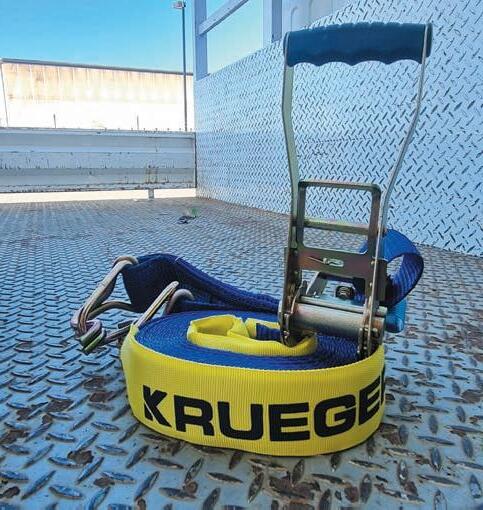
ers placed a ratchet strap over the intake boom for transport, but WorkSafe claimed they did not attach the chain or the travel bolt, creating a risk that the boom could rotate during transport.
The pump was later loaded onto a semi-trailer, with the travel strap in place. However, WorkSafe alleged that no strap was placed over the entire pump and checks were not made to see if the travel mount bolt or holding chain had been applied to the intake boom.
When the truck was travelling towards Perth on Great Northern Highway, WorkSafe
said the ratchet strap securing the intake boom failed and the boom became unrestrained.
At around 9.27pm on July 25, 2022, WorkSafe said the intake boom of the pump struck and killed the driver of a truck travelling in the opposite direction just north of Meekatharra.
WorkSafe Commissioner Sally North said the incident was a tragic reminder of the importance of ensuring a load that has a part that can rotate is appropriately restrained. Big Rigs approached R.G.R. Road Haulage for comment.
Defective converter dolly taken off the road
AN operator has received a defect notice for a convertor dolly and prime mover during a recent Programmed Vehicle Inspection in Toowoomba.
National Heavy Vehicle Regulator (NHVR) Safety and Compliance Officers (SCOs) identified defects that included major brake failure and damage to the chassis.
An NHVR spokesperson said, “No penalty infringements were issued; however the convertor dolly was prohibited from use until the defects were repaired.
“Safe and well-maintained heavy vehicles are critical to a safe, productive and
reliable transport industry. NHVR reminds operators when presenting a vehicle
es control, increases the
poses a massive risk to other road users.”
A Programmed Vehicle Inspection is a periodic safety check in Queensland, which is required to ensure compliance with minimum safety standards. They are conducted by the NHVR on behalf of the Department of Transport and Main Roads (TMR) and are mandatory for registration and ongoing operation (unless exempt). To prepare your vehicles for inspection, NHVR advises heavy vehicle operators to ensure the vehicle is u nladen, clean, in a roadworthy condition and reg-
The case for higher productivity vehicles
BY DANIELLE GULLACI
AS diesel prices soared to record highs, there’s been a renewed focus on how higher productivity vehicles can help operators run more efficiently.
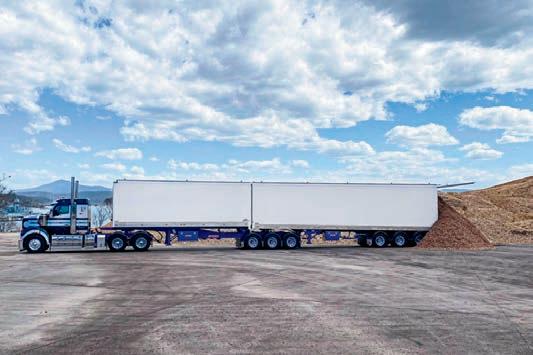
Several trials currently underway are allowing triple road train combinations to access parts of the road network that weren’t previously possible under existing route restrictions.
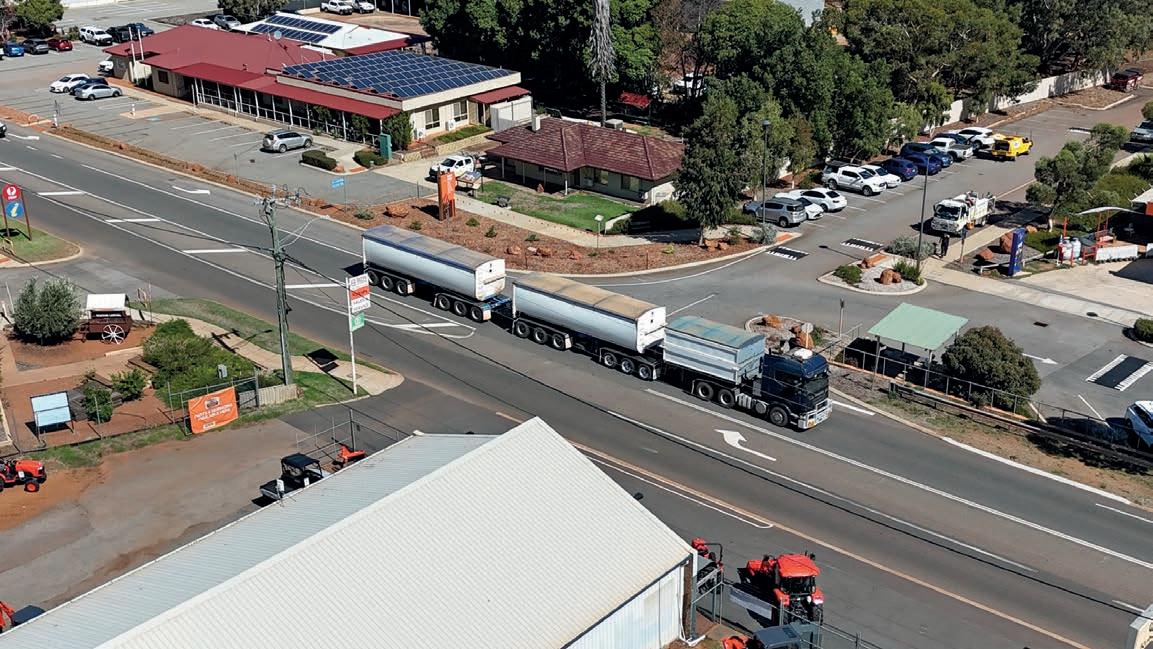
In Western Australia, a threemonth trial, started in early April, sees 53.5m triple-trailer road trains allowed along a key stretch of the Great Northern Highway in the Wheatbelt –between Wubin and Muchea.
Albeit with strict conditions – including vehicle safety requirements like an electronic brake system (EBS) on all trailers; and drivers needing a minimum three years’ experience driving vehicles of this length.
Previously, triple-trailer road trains weren’t permitted to
travel further south than Wubin, around 265 kilometres from Perth, before needing to be broken down. Vehicles meeting requirements for this trial can now operate right down to Muchea, about 51 kilometres north of Perth.
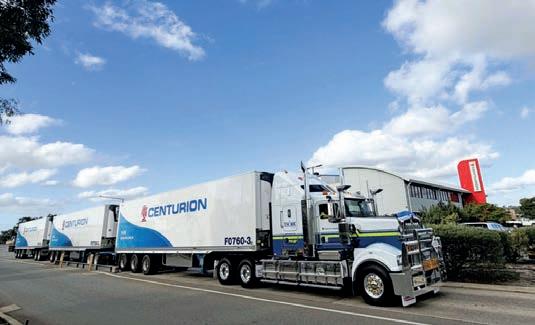
Taking this another step further, Centurion recently began a three-month trial, with its triple-trailer road trains now permitted into Perth, along the Great Northern Highway – rather than having to be split up at Wubin. The first triple set off from the company’s Perth Airport depot in late April.
While supportive of these trials, Cam Dumesny, Western Roads Federation (WRF) CEO, said governments need to make them more applicable on a broader level.
“At face value, these trials are great – they eliminate the dog runs. It means less truck movements to deliver the same freight task. However condi
tions placed on the trials probably need to be reconsidered.”
Dumesny continued, “Some of the requirements, like EBS on all trailers, were appropriate when access was opened up at Greenmount Hill years ago because it’s a steep descent. What the government has done is translate those Greenmount Hill conditions to Wubin, when it’s not really applicable.
“Australia is one of the most increasingly unproductive nations in the world. Our governments need to place a greater focus on safely improving productivity.”
An example Dumesny pointed to are the restrictions at Fremantle Port, which doesn’t allow for higher productivity vehicles, in contrast to trials currently underway over east.
“Allowing higher productivity vehicles at Fremantle Port is a no brainer,” believes Dumesny. “Instead, we’re stuck with archaic requirements that don’t allow anything bigger than a 27.5 metre combination – that only fits three 20 ft containers instead of four 20 ft or t wo 40ft containers. With 40 ft containers being predominant in WA, operators are stuck having to run more trucks.”
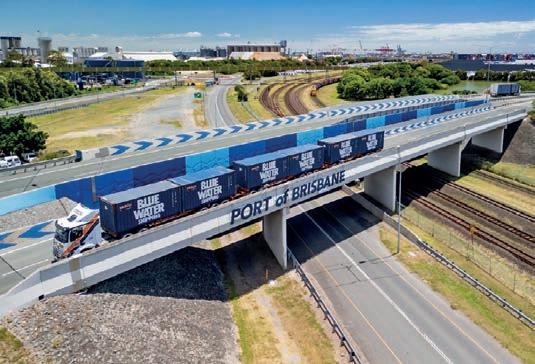
At the same time, Port of Brisbane has been involved in trials with several freight operators over the past 12 months.
Working together with the National Heavy Vehicle Regulator (NHVR), Port of Brisbane is taking part in on-
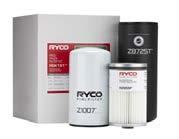
BE RYCO READY WHEN YOUR FLEET OWNS THE ROAD
When you choose Ryco, you’re not just buying a filter; you’re buying industry leading quality, round-the-clock technical support, innovative solutions, and unparalleled expertise.
This means that when a truck is serviced utilising Ryco filters, fleet managers can be confident their warranty is protected, whilst reducing downtime and maintenance costs. Contact Ryco to discuss your fleet’s requirements. fleetsupport@rycofilters.com
So, when you need to get the job done, be Ryco Ready.
road trials for five new higher productivity vehicles, granted permits to operate on defined routes within Fisherman Islands, under strict safety and operational conditions.
Operators involved in these trials include MEDLOG, currently operating B-triples; South East Queensland Hauliers trialling electric A-triples, Super A-doubles, and Heavy A-doubles; and Arrow Transport, now using A-triples.
Yet as Gary Mahon, Chief Executive Officer at the Queensland Trucking Association (QTA), pointed out, other freight corridors right around the state are still being constrained by current restrictions.
“The industry is in dire need of progressive thinking in terms of access to the road network,” Mahon said. “There are gains being made here and there, but what we really need is progressive development and gains of substance, Australia-wide.”
Mahon spoke of the pressing need for change for vehicles entering Brisbane from the Pacific, Warrego and Cunningham highways. “Right now, you can run through New South Wales, into Victoria and across to South Australia at 36.5 metres, but coming up towards Queensland along the Pacific Highway, operators have to split down once they reach Chinderah.
“You can’t bring these combinations into Queensland. We’ve been advocating on this
issue for quite some time and to date, haven’t seen any progress.
Queensland is basically out of step with the rest of the eastern seaboard,” Mahon continued.
“At the Warrego Highway at Bremer River Bridge, there’s still no real indication whether there will be any access change once repairs are complete.”
Mahon also pointed to issues at Gatton, with reports of operators having to wait up to two hours to access the breakdown pads because it’s so busy.
“There is a high level of activity at the Gatton breakdown pads, with operators having to break down combinations or make them up – it’s also substantially increasing the amount of trips on that corridor because of all the dog runs.
“We’d also expect AB-triples of 42.5 metres to be able to run out from the Warrego to access the Inland Freight Route through to Townsville, but they can’t. In terms of freight
corridors in Queensland, there are limitations for this industry that are of real significance.”
There’s no doubt that current higher productivity trials are giving some operators great gains in efficiency, but the fact remains that existing route and access restrictions continue to hamper much of the industry.
“These trials are all a step in the right direction,” Dumesny added. “A good toe in the water, but we need to commit to the swim.”
At issue deadline, the National Heavy Vehicle Regulator announced another boost for productivity, with a fasttracked national notice that raises General Mass Limits to align with current Concessional Mass Limits. Under the changes, expected to come into play this month, overall mass limits will increase by 1 tonne for combinations below 55 tonnes, and 2 tonnes for combinations above 55 tonnes.
of Brisbane
The first triple-trailer road train to operate from Centurion’s Perth Airport depot. Image: Centurion
$1bn blitz slammed as band-aid fix
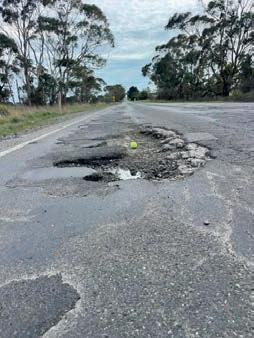
VICTORIA has launched what it’s calling the biggest road maintenance blitz in the state’s history, with more than $1 billion committed to tackling potholes and deteriorating road surfaces.
The so-called “Better Roads Blitz” is aimed squarely at the growing backlash over crumbling roads, particularly in regional areas where freight operators say conditions have reached breaking point.
The latest budget allocation of $1.04 billion is expected to fund widespread repairs, resurfacing works and emergency maintenance, with around 70 per cent of the spend directed outside metropolitan Melbourne.
Under the new package, road crews will be tasked with repairing up to 200,000 potholes and removing a similar number of graffiti tags, alongside broader works including traffic light repairs, sign replacement and emergency road fixes.
The program also includes a $36.9 million clean-up blitz across 10 of Melbourne’s busiest freeways, including the Monash, West Gate and Hume corridors.
Transport Minister Ros Spence said the focus would be on maintaining existing infrastructure while delivering targeted upgrades in high-use areas. She noted that regional roads, which carry heavy freight and agricultural traffic,
would be a priority.
Many, however, are calling Premier Jacinta Allan’s announcement little more than pre-election sweetener that falls well short of what’s really needed.
Regional Cities Victoria (RCV), which represents the 10 largest regional cities in the state, says it is nowhere near enough to fix regional roads, a claim backed up by road contractors who said escalating costs had wiped out the value of the government’s increased funding.
RCV chair Ben Blain said the $1 billion was “just a band-aid on a bullet hole”.
“Most of our regional arterial roads are reaching the end
of their design life. They don’t just need patching, they need rebuilding,” he said.
“This is what happens when you keep putting band-aids on roads that are structurally failing.
“It’s more expensive in the long run, and it’s putting safety and productivity at risk right now.”
Livestock and Rural Transporters Association of Victoria Chief Operating Officer Alina Hawkins said the government needed to focus on “undertaking good quality maintenance, rather than quick fixes”, given the state of the roads.
Hawkins said greater investment was needed, considering the wealth generated from the
freight load carried on Victoria’s regional roads.
The Allan government’s announcement comes after sustained political pressure from Opposition Leader Jess Wilson, who has been running a campaign accusing the government of neglecting road conditions.
She even shared social media footage of herself filling potholes in Melbourne’s election-sensitive Nepean electorate, using the stunt to highlight what she described as worsening infrastructure across the state.
Opposition roads spokesman Danny O’Brien said Monday’s $1.04 billion road funding announcement was “a little late from a government that has abjectly neglected our roads”.
“It’s now trying to make Victorians believe they’ve had a conversion on the road to Damascus,” he said.
“Victorians know we’re the pothole capital of the nation and this pre-election announcement will be seen for what it is - a stunt, not a real solution.”
Personalised plates masking rego loophole for rorters
UNSCRUPULOUS operators are using personalised number plates to mask widespread misuse of primary producer registrations in Victoria, according to multiple industry sources.
Following Big Rigs’ recent report into alleged rego loopholes, more operators have come forward claiming the problem is far bigger than first thought – and costing the state millions in lost revenue.
At the centre of the issue is the use of primary producer registration on trucks operating as full-time freight vehicles, including B-doubles
running general linehaul. By registering under the concessional scheme, operators are believed to be saving up to $11,000 per B-double, per year, and even more on larger combinations.
“This is way bigger than they realise; livestock, grain, log trucks all running on PP,” said Big Rigs reader Chris Smith.
“NHVR told me they know of a company with 60-plus regos all on PP and due to a loophole in the PP wording there isn’t much they can do.”
Smith said that if the Victorian Government worked out
how much revenue they were losing, “I’m damn sure it would be changed overnight”.
“Bring back the actual PP number plates and stop these guys hiding behind personalised plates and everyone would be better off.”
Another Victorian operator, who spoke on the condition of anonymity, concurred with Smith’s statements and backs his call for a crackdown on personalised plates. They claimed to know of one medium-sized fleet in regional Victoria running around 20 trucks on primary producer
plates, yet the majority of their work is carting cattle as a commercial operation.
“I worked out they should be paying around $352,000 in registrations each year, but I believe it’s something like $48,000,” the operator said.
The fleet owner rang the National Heavy Vehicle Regulator’s confidential hotline to alert them of the alleged rego rort but said they were told it was a VicRoads issue.
“They said thanks very much, but we can’t do much, we need to refer it to VicRoads.”
The operator also said the fleet in question was running a large number of the primary producer registered trucks with personalised number plates, making the misuse harder to detect.
“If he’s running primary producer he’s probably also claiming the agriculture fuel credits as well.
“When you’re doing your fuel tax credits, instead of claiming you’re on the highway all the time, they can claim they’re an agriculture farmer and get 50.8 cents per litre back on fuel.”
Another reader said the registration issue has been going on for years.
“The NHVR and government organisations have always turned a blind eye to this.
“They will fix it when one of these trucks has a smash and seriously injures someone.”
The NHVR told Big Rigs it is aware of concerns regarding the potential misuse of registration schemes, including primary producer regos.
“We work closely with state and territory road transport authorities to monitor compliance and respond to intelligence and reports of suspected non-compliance,” a spokesperson said.
with repairing up to 200,000 potholes. Image: LRTAV
Contract push for highway fix ramps up
TRUCKIES facing major detours across the Blue Mountains could be a step closer to relief, with a proposed fix for the Victoria Pass cracking imminent, said Transport for NSW (TfNSW).
A select group of just over 20 Australian and international companies with major infrastructure experience were given until May 1 to submit their proposals for a solution.
As we were going to print, TfNSW told Big Rigs they were anxious to have a contract signed to begin work on the Great Western Highway trouble spot as soon as possible.
“Delivery timelines and how soon we can make this happen for the community are a key consideration,” said Transport
for NSW Deputy Secretary Matt Fuller. “We want to be pushing ahead with a solution in weeks, not months.”
Fuller stressed to the experts that nothing was off the table when it comes to finding a solution to the cracking at Mitchells Causeway that has cut off a major freight route between Greater Sydney and the state’s Central West since early March.
Fuller also said representatives were told all solutions must reinstate the highway with at least the same number of lanes and load capacity as it had prior to closure.
TfNSW said that since increased cracking was detected, teams have carried out a comprehensive program of investi-
standing of current site conditions,” Fuller said.
“We shared that the bedrock steps down lower under the westbound lane than the eastbound one, but importantly the lower bedrock layer is sound.
gations to understand what is happening.
“Since we detected the acceleration of cracking and increased movement in the causeway we have undertaken drilling, coring, investigative piling, seismic testing and the installation of extensive monitoring equipment within the road, retaining walls and underlying ground which have delivered a thorough under-
“This provides a foundation for a safe and suitable solution along the current alignment –which is the quickest way to restore this critical east-west link.”
Summary of key investigation findings at Mitchells Causeway:
• The causeway fill is varied, mainly made of sand, with voids and boulders.
• Lower bedrock is more sound than that at the base of the causeway.
• Bedrock is 2-4 metres lower
under the westbound lane than the eastbound lane.
• Movement is mainly impacting the western wall.
• Movement within the causeway has continued since it was closed to traffic and it remains unsafe for traffic.
• A sphalt surface layers are around 250mm-300mm deep with thin and minimal base layers between it and the causeway fill.
• Multiple full depth cracks rapidly appeared in the asphalt between March 5, when the eastbound lane was closed, and the full closure to both east and westbound traffic on the causeway overnight on March 8.
Earlier last month, the state’s Minister for Roads and Regional Transport, Jenny
Early lane choice vital for harbour crossing
TRUCKIES
operating through Sydney’s Warringah Freeway are being reminded of major permanent traffic changes that will directly impact overheight and dangerous goods movements from early May.
With the slip lane from the middle lanes to the harbour bridge now permanently closed, drivers will now need to make their decision about travelling on either the bridge or the tunnel much earlier, with the final deci-
sion point located just after t he Miller Street overpass, alongside the new Western Harbour Tunnel portal (currently under construction).
A s they come south from the Gore Hill Freeway/ Lane Cove Tunnel, truckies should move into the left lanes (if they’re not already) at the West Street overpass to go to the bridge. The final decision point is the Miller St bridge at Cammeray, about 1km earlier. The exception to this
is during peak hour traffic times (around 5.30am–9.30am), where they can get to the bridge in the far right southbound lane. This will be marked by changing directional signage. Access via the Ernest Street southbound on-ramp has also been overhauled. The ramp will now provide access to the Sydney Harbour Tunnel only.
Drivers needing to access the bridge lanes will need to use the Falcon Street on
ramp or Miller Street onramp instead. This ramp positions you in the outer lanes of the freeway, which gets you to the Sydney Harbour Bridge.
Further complicating movements, the southbound tunnel lanes themselves will be off-limits to any vehicle exceeding the 4.4-metre height limit, reinforcing the requirement to remain in bridge-bound lanes well before reaching North Sydney. The broader upgrade is
D ISRI SEATS
SYDNEY
510 Victoria Street, Wetherill Park NSW 2164 Ph. 02 9756 6199, email: isri@isri.com.au, www.isri.com.au
BRISBANE
designed to streamline traffic flow, improve safety and reduce merging conflicts across one of Sydney’s busiest corridors, said Transport for NSW (TfNSW).
“However, for truck operators, the changes will remove some of the flexibility previously available when navigating this complex interchange,” TfNSW added.
“Missing a lane early could now leave overheight drivers with limited options to correct course before reaching
Aitchison said getting the road reopened was her top priority, although it was now clear the section of highway would be closed for longer than three months.
“But I am not going to put a figure out there because that would be irresponsible.”
Shadow Transport Minister Paul Toole said the people in the Central West of the state feel abandoned.
“They feel as though it’s a very city-centric government … a government that wants to build and invest in the infrastructure in the city, but forget about regional communities,” he said.
“It is like shutting down the Sydney Harbor Bridge. If that was the case, heaven and Earth would be moved to reopen it.”
restricted infrastructure.” TfNSW urges operators to review updated route maps.
Unit 2/13 Hinkler Ave, Rutherford NSW 2320 email: sales@hvss.com.au www.isri.com.au
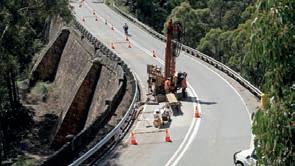
A contract for a fix to the problem is expected to be signed soon. Image: TfNSW
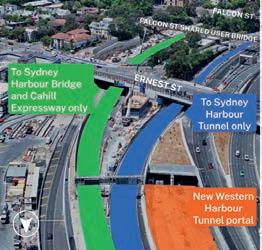
OSOM and DG vehicles must not use the Ernest St southbound onramp to the Warringah Freeway. Graphic: TfNSW
FUEL CRISIS
Fuel levy order ‘creating mayhem’
S TEVE Shearer’s fears over a rushed fuel recovery order appear to be playing out, with early signs it may create more confusion than relief for struggling operators.
The South Australian Road Transport Association Executive Officer said the order was a lready “creating mayhem” at the coalface, particularly among smaller operators who may have been led to believe it guarantees full recovery of soaring fuel costs.
“It’s already creating mayhem because it’s creating a lot of false expectations by some, particularly smaller operators, who’ve probably been told by the union, and others, that it’s all fixed and you’re going to get all your fuel money,” Shearer said.
“Some of them will, but it’s going to depend on a whole bunch of things.”
Shearer, who sits on the SA Premier’s roundtable on the fuel crisis, said the announcement had also left industry sector leaders with more questions than answers.
At the heart of Shearer’s concerns is the gap between how the order is being interpreted
by different players in the supply chain – and how it may actually function in practice.
He pointed to mounting tension between major corporate clients and their suppliers, with some large retailers already pushing back on price increases tied to fuel costs.
Using supermarkets as an example, Shearer said some are refusing to accept higher prices from producers, effectively forcing those costs back down the chain onto transport operators.
“They’re telling their growers… ‘we’re not putting our prices up, therefore we’re not going to accept increases from you, you’re going to have to absorb the increased fuel prices from your transport operators’,” he said.
Shearer labelled that approach “un-Australian and unconscionable”, warning it threatens the viability of the very suppliers those companies rely on.
Compounding the issue is ambiguity within the order itself, particularly around how existing contracts are treated, said Shearer.
While the Fair Work Commission has indicated the in-
tent is full cost recovery, Shearer said the wording allows for different interpretations, creating a loophole that some corporate clients may exploit.
“There’ll be quite a few customers who will read the order and say, ‘this doesn’t apply to us because we’ve got an existing arrangement,’ and they’ll continue to screw their transport operators,” said Shearer.
In theory, Shearer said, existing arrangements should still be adjusted to ensure full cost recovery. In practice, however, enforcing that outcome may prove difficult.
A key weakness lies in the dispute resolution process. While operators can take disagreements to the Commission, Shearer said the system relies heavily on cooperation from both parties.
If conciliation fails, arbitration is only possible if both sides agree – a major sticking point.
“For those corporate clients who decide to be hard-nosed, it’s going to be very difficult for people to actually make them do the right thing.
“The Commission can only arbitrate if both [parties]
agree… you can say, ‘sorry, you’re wrong, I don’t agree,’ and that’s the end of it,” he said.
Shearer said the practical implications are significant. Operators who push too hard risk losing work altogether, particularly in contracts that don’t guarantee freight volumes.
“Unless the contract you gave me was one that guarantees work, as distinct from being a contract that’s just about the rate, you just don’t give me any more work,” said Shearer, describing the potential fallout of disputes.
For many, that creates a lose-lose scenario – accept under-recovery of fuel costs, or risk damaging commercial relationships.
A s a result, Shearer believes some businesses will inevitably fall through the cracks.
“Quite a few people are going to lose out; some will be transport operators who don’t manage to get full cost recovery,” he said.
“Either way, it’s going to harm businesses and who knows where it’s going to end up.”
The Australian Trucking Association (ATA) said it supported the order before the
Commission, while proposing amendments to make it clearer and more workable.
ATA Chair Mark Parry said the final order was a powerful and necessary response to Australia’s unprecedented fuel crisis.
“Small and medium sized trucking businesses cannot keep Australia’s freight moving at rates that do not recover their fuel costs,” Parry said.
“The industry’s business as usual contractual arrangements have served us well and will serve us well in the future. But they’re not working for many operators under the emergency we face.
“I urge every trucking business to read the order, talk to their financial adviser and seek the necessary rate adjustments.”
In the hearings, the ATA raised concerns about clause 4.2 of the draft order, which requires primary parties to take reasonable steps to ensure that secondary parties engaging owner-drivers adjust the rates they pay to cover the increased cost of fuel.
“The ATA proposed removing the clause, on the grounds
Interest-free loans backfire for many truckies
TRUCKIES have been quick to air their concerns over the interest-free loan lifeline to help operators through the fuel crisis.
Applications for the loans, which are part of the $1 billion Economic Resilience Program, opened on April 20 and can be submitted for the next six months.
But truckies told Big Rigs that it’s not the silver bullet that many had hoped it would be.
Regional NSW owner-driver
Adam Craig said access was an immediate barrier to many in the industry, with just seven banks signed up for the program at deadline for this issue.
“One thing that irks me about this is that it’s gone all the way up to people that their annual turnover is $100 million,” he said.
“But with this billion-dollar package, why on earth didn’t the government support small fleets, small operators, with 15 trucks and below, or maybe
even 10 trucks and below.”
Craig also raised concerns about which industries are included in the federal government’s $1 billion Economic Resilience Program, saying some sectors appear out of place.
Blue Mountains owner-operator David Bailey, of Bailey Brothers Haulage, said he was one of the first to apply but was quickly knocked back by ANZ.
“They inform me that my business does not meet their
regular business lending criteria,” he wrote in an open letter to industry and Labor politicians.
“What is the point of having an Economic Resilience Program if the very businesses it is meant to support still have to satisfy bank lending criteria that were never designed for crisis support?”
Bailey said leaving the lending decision to participating banks creates a serious risk that the businesses most in need of
support will be the least likely to qualify.
“If a transport operator is part of a critical supply chain, has been materially impacted by the fuel shock, and can remain viable with temporary breathing room, that should be the central test.
“If the practical test is still whether a bank is comfortable enough to approve the file, then this is not really a resilience program.
that it would be administratively burdensome. Given that the order has a dispute settlement clause, we argued that there was no need to require primary parties to police the operation of the clause,” Parry said.
“The commission retained the clause, while providing that it does not apply to a small business primary party that is not a road transport business. Earlier in the hearing process, the commission also pared back the requirement from all reasonable steps to reasonable steps.”
Parry said the Fair Work Ombudsman will need to provide industry with clear guidance about what are reasonable steps.
“The ATA will provide the commission with any evidence we receive about issues with the clause when it reviews the order after its first month of operation.”
“It is a subsidised loan product for the least damaged applicants.”
“The businesses at the sharp end of this crisis are the ones with depleted reserves, cashflow stress and arrears caused by the very disruption the program was created to address.”
Shearer said the fuel levy order was already “creating mayhem” at the coalface. Image: Gilles Paire.stock. adobe.com
Truckie Adam Craig, inset, raised concerns over the interest-free loans. Main image: Prime Creative Media
FUEL CRISIS
KNOWN as the Road Trans port Contractual Chain Or der – Fuel Cost Recovery 2026, the order sets legally enforceable rules requir ing fuel cost increases to be passed through the entire sup ply chain — not absorbed by transport operators alone.
It’s the first order made under the federal government’s new “Fairer Fuel” reforms, which were introduced specifically to fast-track intervention during crises like the current fuel spike.
• Transport companies must pass that increase on
Who the order applies to The order applies broadly across the road transport industry and its supply chains.
This includes:
• Primary parties — typically large clients like retailers, manufacturers, miners and construction firms
• Secondary parties — transport companies, fleet operators and logistics providers
• Contractors and “employee-like” workers operating within those chains.
Importantly, the rules apply across the contractual chain — not just direct transport providers — meaning responsibility sits with everyone involved in moving freight.
The key rule: pass on fuel costs
At the heart of the order is a simple requirement: Fuel cost increases must be passed through the chain.
Primary and secondary parties are required to adjust their transport rates at least fortnightly (twice per month) to reflect changes in fuel costs. That means:
• Clients at the top must pay
• Contractors and drivers must ultimately receive compensation
• Secondary parties are specifically required to pass on any increases they receive — ensuring the adjustment flows all the way down to the operator level.
What it means in practice
For the first time, the order effectively forces major customers to share the pain of fuel price spikes.
Instead of operators negotiating individually – often from a weak position – the system creates a structured, enforceable mechanism.
It also prevents cost-shifting behaviour, where increases might otherwise be offset elsewhere in contracts.
In simple terms: If diesel goes up, freight rates must follow and that increase must reach the people actually buying the fuel.
Rate requirements
Primary and secondary parties can adjust rates by:
• Changing the rate or a component of the rate
• Introducing a fuel incre-
• Making a direct reimbursement or offset of money spent on the increased cost of fuel, or
• A ny combination of these three measures.
When the rules apply
The order took effect on April 21 and overrides other minimum standards while in force.
However, it is designed as a temporary emergency measure.
The fuel recovery obligations will stop once the national average diesel price drops below $2 per litre, based on Australian Institute of Petroleum data.
The Commission will also review the order in late May and then reassess it every three months.
Disputes and enforcement
The order is legally binding, meaning businesses must comply.
If disputes arise, parties must first attempt to resolve the issue themselves. If that fails, the matter can go to the Fair Work Commission
The Commission can step in through mediation, conciliation or arbitration. Failure to comply can lead to
Get it
EDITOR JAMES GRAHAM
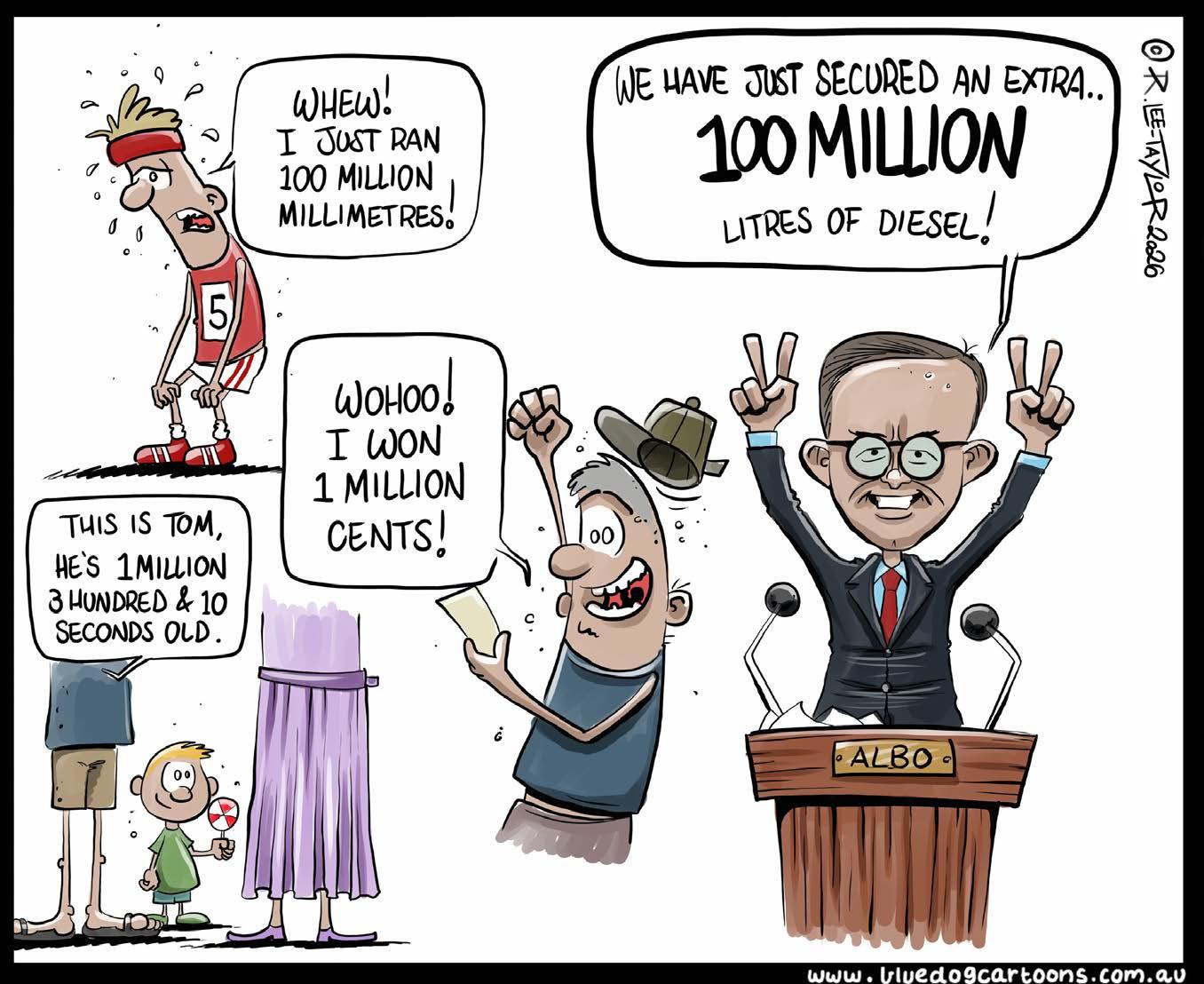
Not when that shipment –100 million litres – barely covers a day’s national demand. Yes, more ships are on the way, but they are still only band-aid fixes for a country that is one of the highest users of diesel on a per dollar GDP basis, with consumption about three times as high as the US and Japan.
Only 13 per cent of our diesel is refined domestically, making Australia the world’s biggest importer of diesel, and leaving us dangerously vulnerable to market volatility. Sadly, it’s the truckies, the ones who keep the country moving, who are paying the biggest price. If this crisis has shown us anything, it’s that fuel security is national security.
That means making serious investment in domestic refining, expanded storage, and a longterm strategy, not headline-grabbing shipments.
HOT WEB TOPICS
Fuel crisis lifelines not enough
TRANSPORT operators have voiced their concerns around the “cost-saving” measures being put in place by governments to assist the industry with high fuel prices.
An overwhelming response from many Big Rigs readers is that they are simply not enough.
As Shane Black put it, “Not only are the business owners putting their nuts on the line financially but they are responsible for the thousands of employees that they employ, families that rely on that employment so they too can feed their families and have a lifestyle.” Black also pointed to the many hours operators have
spent making sure their business grows, pays its debts and is able to survive these financial hardships.
For Peter Collins, fuel was previously costing him $1200 a week and it rose to $2200.
“Some customers refuse to pay a percentage fuel levy, as other businesses are not charging them anything,” he said.
While Shaun Orchard shared his fears for the industry, “Said to my wife a few weeks ago that this will be worse than Covid as this government is too slow to help. You get that when you have no idea what you’re doing.”
Trevor Warner added, “The current government had ab-
solutely no control over this. Business cannot absorb the current costs. The math doesn’t math. Australia has systematically deconstructed our liquid energy sector over decades.”
Support for visa crackdown
AUSTRALIAN Border Force (ABF) officers and the National Heavy Vehicle Regulator (NHVR) are cracking down on visa rorters, with blitzes conducting visa checks, identifying potential migrant worker exploitation and detaining unlawful non-citizens. In Victoria, officers even identified an unlawful non-citizen driving a heavy vehicle who had been in Australia unlawfully for over 12 years.
According to Nick Marshall, “Freight owners have an obligation to make sure they have a valid licence, not a picture of one or a photocopy, an actual physical license. Chain of responsibility.”
Enforcement before road upgrades?
THE Western Australian Government is investing an additional $339.9 million in road infrastructure and enforcement, in a bid to help improve road safety – as part of the WA State Budget 202627, handed down on May 7.
Included in the spend is regional heavy vehicle compliance blitzes, new fixed road safety cameras and major upgrades to the Great Northern Highway.
It’s being funded by a special purpose account that “reinvests safety camera fines into road safety initiatives across the state”.
The news however has left some in the industry scratch-
ing their heads, with many arguing there should be a greater focus on fixing roads than blitzes and cameras.
“If any of the states’ regulators want to impress the industry, they would pressure their employer to create truck worthy roads for the nation’s freight task and provide more well maintained parking areas for managing fatigue,” Russel Walsh wrote when the story was shared online.
“What a joke. Fix the roads first and stop trying your hardest to steal more of our money,” said Mal Coley.
for better roads but overseas trips for transport boffins and their mates.”
“Fixing the roads would also contribute to road safety,” said Craig Angus.
Andre Maertens added, “Nothing to do with safety, all about revenue collecting, not
Ghiyom Nawaf agreed, “Far too many unscrupulous fleet operators and dodgy employers out there. Some of those major companies using them are either complicit or grossly negligent, in turning a blind eye.”
Others believe the move should have come much sooner. “Bit late fellas,” said Brett Tol. “The industry is crying out for drivers. The blame must also go to the companies that employ these drivers without any form of in-house training.”
Christian Hargreaves agreed, “So why did it take this long? Should have happened 15 years ago.”
Russel Walsh added that this crackdown was “better
late than never,” adding that it should go even further. “The next thing they need to target are the big corporate trucking companies that own driver training and licensing businesses. They are hot shotting their new international drivers into MC licences in as little as 5 days then sending them.”
Interest free loans slammed
TRUCKING operators
feeling the pinch due to the fuel crisis can now apply for a two-year, interest-free loan, providing they are existing customers with one of six initial participating banks.
However many operators are sceptical about how this will assist operators who are already struggling.
“How’s it help when you still have to repay it? Is the interest free part meant to be the exciting part?” asked Trent Schaeffer. “By operators doing no wrong in their business operations the option the government is offering is having
to go into more debt to keep moving! Makes perfect sense.”
Ben Talbot shared a similar view, “When in trouble always apply for more debt, makes 100 per cent sense.”
As did John Roberts, “So instead of going belly up owing $5 mil. Ya can drag it out to 7.5.”
Melissa Wheeler also agreed, “Worst idea ever! Getting a loan at a time like this is silly… If you can’t afford it don’t do it!”
Earl Squirrelson said, “What a joke hey, can’t afford to keep our trucks/the country running, but hey, lend me
some money we can’t pay back! Our government is f**king ridiculous!”
Added Graeme Nicholson, “The industry needs more debt like a hole in the head. Just make 7-day payments law for everyone and this would help with cash flow.”
Townsville-based operator
Jason Tuttle says the fuel crisis has already forced him to park one truck up.
Image: Jason Tuttle
Multi-agency crackdowns are expected to ramp up over coming months. Image: ABF
Town says bypass long overdue
BY DANIELLE GULLACI
A local council says the $275 million Bindoon Bypass can’t come soon enough –with temporary measures allowing 53.5 metre road trains through the Western Australia town further highlighting a longstanding issue.
The Bindoon Bypass is a 64-kilometre section of the Great Northern Highway, being constructed between Chittering Roadhouse and New Norcia.
The northern section has been progressively constructed in stages since 2021, with the most recent 7km section opened in early April.
However, it’s the southern section that will actually have an impact for the community of Bindoon, and work on that stretch hasn’t begun.
The 46km southern section will run from the existing Great Northern Highway at Chittering Roadhouse, to the west of Bindoon, and rejoin Great Northern Highway north of Calingiri Road.
To date, route selection, planning works and approval have progressed, but we’re yet to see shovels in the ground.
Melinda Prinsloo, CEO of the Shire of Chittering, told Big Rigs that the Bindoon Bypass is long overdue.
In response to the fuel crisis, the WA Government recently allowed larger road trains a long a stretch of the Great Northern Highway in the Wheatbelt, as part of a threemonth trial.
While the decision hasn’t created a new issue for Bindoon, Prinsloo says it’s highlighted a problem that’s been sitting there for years. “Bindoon is still operating as a freight route, even though it was never meant to do so indefinitely,” she said.
“Every time freight productivity increases – whether that’s longer vehicles, heavier payloads or different configurations – the impact is felt straight away by the town.
“That shows up in noise, vibration and disrupted sleep
BINDOON IS STILL OPERATING AS A FREIGHT ROUTE, EVEN THOUGH IT WAS NEVER MEANT TO DO SO INDEFINITELY.”
MELINDA PRINSLOO
for residents, particularly at night. Bindoon’s Great Northern Highway is effectively its main street, with homes, businesses and community facilities right on the road.”
As Prinsloo continued, the community didn’t expect progress on the bypass to take as long as it has. “We understand projects are staged, but what people experience is year after year of larger trucks, more movements and more night-time activity while the solution always seems just over the horizon,” she said.
Prinsloo acknowledged that the latest section of the bypass opening is welcome progress, however reiterated, “That’s the northernmost part of the project, up near New Norcia. It’s nowhere near the Bindoon townsite, and it doesn’t divert any traffic away from town yet.
“The section that actually bypasses Bindoon (the southern section) is the part that really matters for residents, safety and amenity, and that’s still to be built.”
As Prinsloo added, “Speed limits come up a lot, but they don’t get to the root of the issue. Even with perfect compliance, a heavy truck travelling metres from someone’s bedroom window at night is still disruptive.”
From the Shire of Chittering’s perspective, the bypass has always been the solution.
“It’s the only thing that genuinely removes the risk, rather than trying to manage it with temporary measures,” Prinsloo added.
“This isn’t just about Bindoon. The Shire of Chittering includes the Muchea Industrial Park, a strategically important industrial and logistics precinct for the region and the state. Its success depends on efficient, high productivity freight access.
“At the moment, Bindoon is such a bottleneck that long road trains coming from the north can only operate as far south as Wubin. That creates real inefficiency. It adds cost, fuel use, emissions and extra truck movements. And ironically, without the bypass, that inefficiency is absorbed by industry.
“The bypass is what properly connects those dots. It protects Bindoon as a community and allows Muchea Industrial Park to operate the way it’s intended. As a modern, efficient industrial hub.”
Veteran truck driver Cam Deans is based in the Wheatbelt region and regularly travels through Bindoon. “All trucks travelling northwest or from Perth to Darwin
have to drive through Bindoon on the Great Northern Highway,” he said.
Deans says that while Bindoon is a beautiful place, it is one of the least truck friendly towns in the state.
“There’s no parking for heavy vehicles,” he said. “And about 8-kilometres north you start to climb Bindoon Hill. It’s not the biggest of hills but is a decent challenge in a road train with some weight on.”
Deans shared a different view to that of the Shire of Chittering. “I’m not a fan of bypasses unless there’s a real safety issue,” he said. “These towns need to embrace transport and build sites that encourage us to stop there.
“As truck drivers, we pass through a lot of these towns on the daily and I’d prefer to be able to support the region I’m in.
“Mukinbudin in WA’s Wheatbelt is a prime example of how and where to build a heavy vehicle rest area in a regional town.”
Back on the road after health scare
BY DANIELLE GULLACI
AFTER being sidelined for the past eight months, Victorian based truck driver Lynn Werchon Haysom is finally back on the road – doing her weekly two-up run from Melbourne to Perth with husband Tony Haysom.
A truck driver for over 35 years, 68-year-old Lynn is lucky to be alive after suffering from two burst brain aneurisms in August 2025. Thankfully, Lynn made a full recovery and within months was back to her usual self.
However, as a result of the terrifying ordeal, Lynn lost her licence for medical reasons and faced a nervous wait to get back in the driver’s seat.
Lynn had to pass a driving test, first in a car, and then a truck, both with a driving instructor and occupation-
al therapist, before her MC licence was reissued in early April.
Since then, she hasn’t been able to wipe the smile off her face.
“It’s such a relief,” said Lynn. “The thrill of getting back on the road has just made me so, so happy. I’ve been given a second chance at life.
“My occupational therapist Cinamon Bohr was with me in the truck as I’ve worked to get my licences back. She’s a beautiful caring lady and also has her HC licence.”
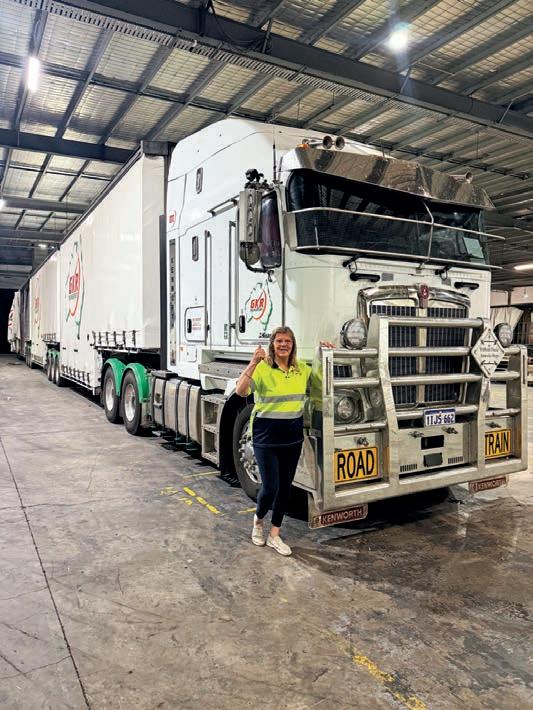
Lynn and Tony are now back at their previous role at GKR Transport, pulling B-triples and AB-triples from east to west – and they’re back in the same 2025-model Kenworth K220 they previously drove too.
The Wangaratta-based couple was only at GKR for around 12 months, when
Lynn was forced off the road. Additionally, Tony made the decision to give up driving to be there for his wife during her recovery.
“Tony has been off as well for the past eight months. I made him stay home with me because even though I’m fine now, I’m still scared to go to sleep at night without him here. If he wasn’t here with me when the aneurisms burst, I wouldn’t be here today,” Lynn revealed.
“I’ve had three scans since then and I’m all clear and I have regular checks to make sure it stays that way.”
Lynn has spoken very highly of her employer, with the team there very supportive the whole way through. “Everyone at GKR has been fantastic. Even those based in Perth have been messaging me and giving me a call to see how I’m tracking. They were
keen for us to come back to work,” she said.
With the excitement of getting back to doing the job she loves, Lynn joked that it’ll be hard to get her away from the wheel. “I can’t wait to get back into it all. I don’t think I’ll let my husband drive now – I’m not getting out of the driver’s seat!”
Lynn has been running Melbourne to Perth on and off for over a decade and really enjoys that route. “Especially driving across the Great Australian Bight,” she said. “Even if Tony drives that stretch, I’ll be sitting up taking in the view of the ocean.”
She added that she’s still got plenty of trucking left in her too. “I just turned 68 in April and people keep telling me it’s time to retire. I’m not ready to give this up – I’ll retire when I’m ready to,” said Lynn.
“I’m more than ready and
doon Bypass. According to a spokesperson, “Development activities for the southern section are ongoing, with the timing for construction subject to environmental approvals.”
In the meantime, with no completion date for the Bindoon Bypass in sight, Prinsloo said, “Without it, Bindoon continues to absorb freight impacts it was never meant to carry permanently, and industry continues to operate less efficiently than it should.”
The Shire of Chittering is eagerly awaiting work to begin on the southern section of the Bindoon Bypass. Images: Melinda Prinsloo
New T909 looks old school cool
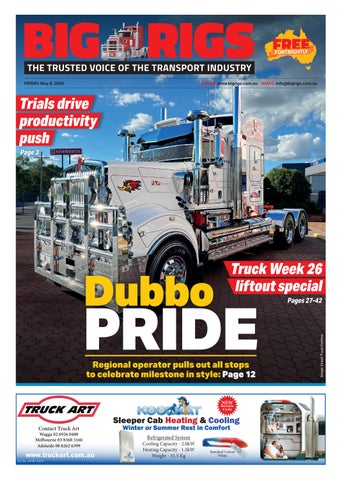
To celebrate his company’s 20th anniversary, this Dubbo based small fleet owner has pulled out all stops for his specced up new ride.
BY DANIELLE GULLACI
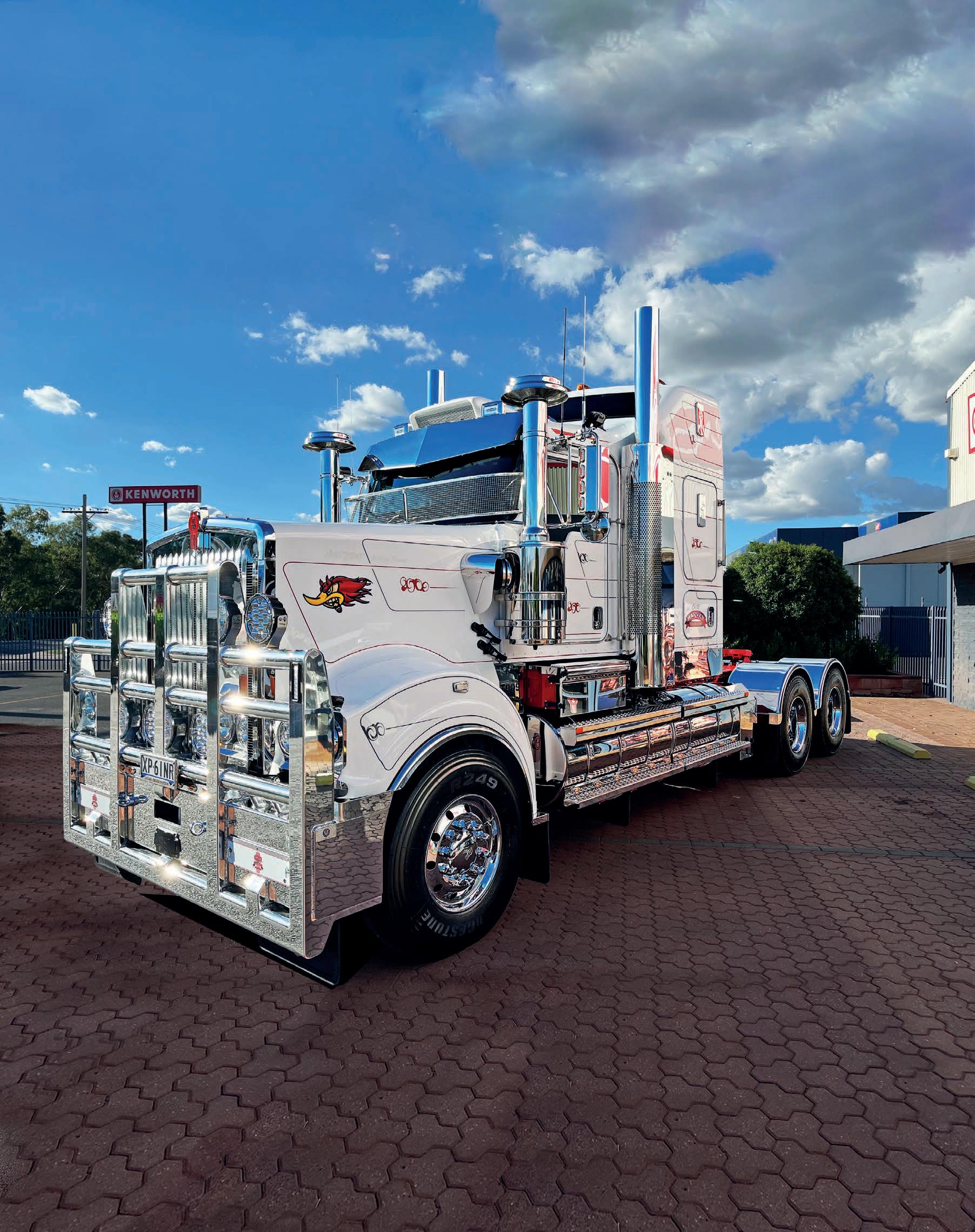
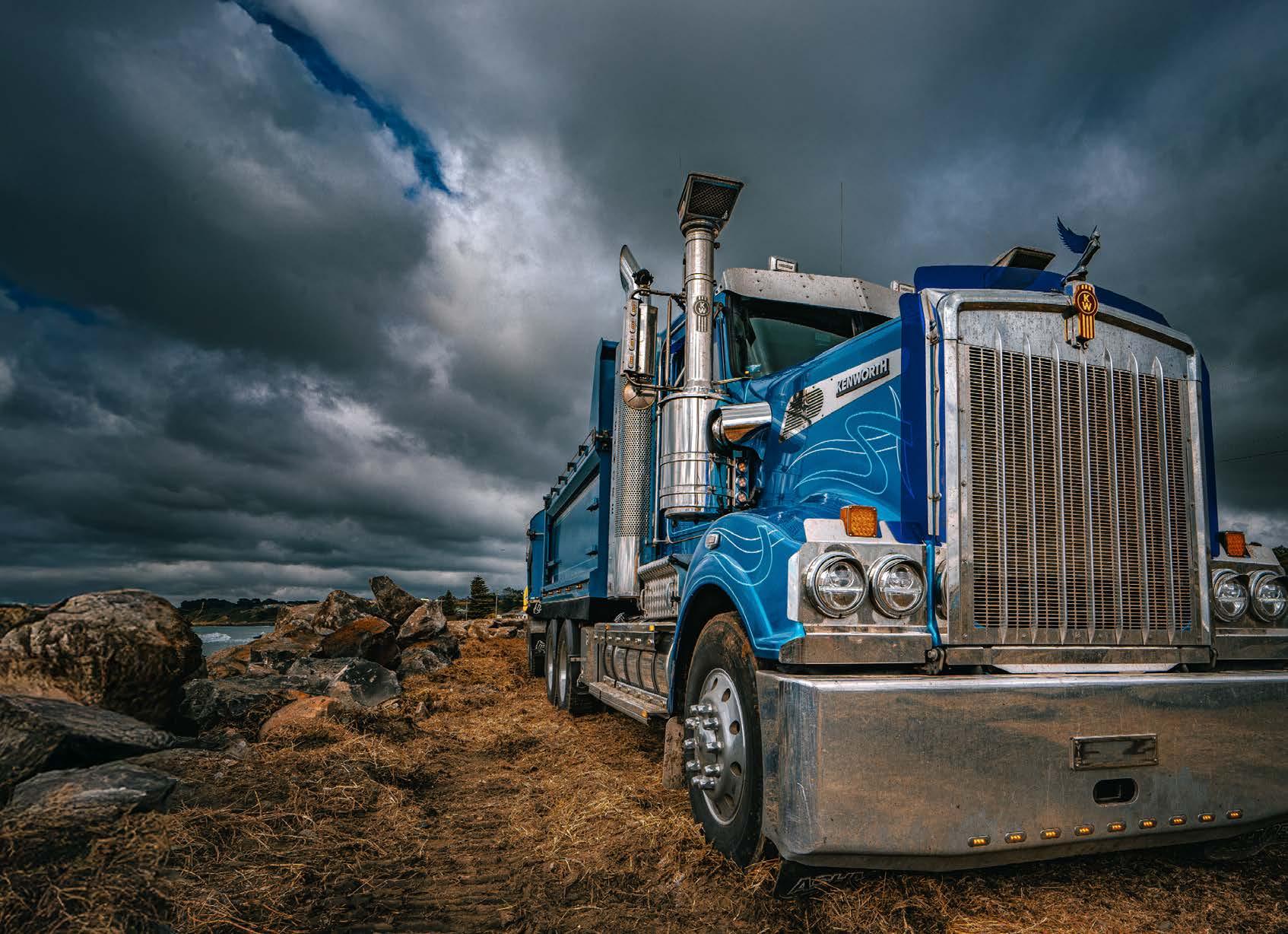
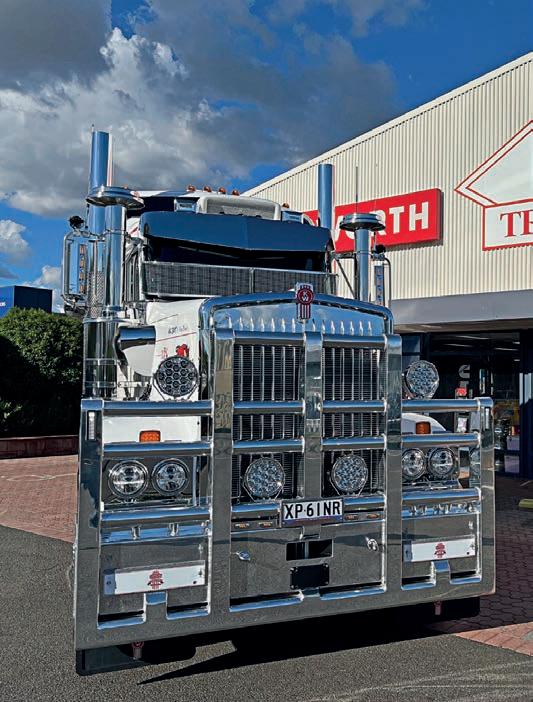
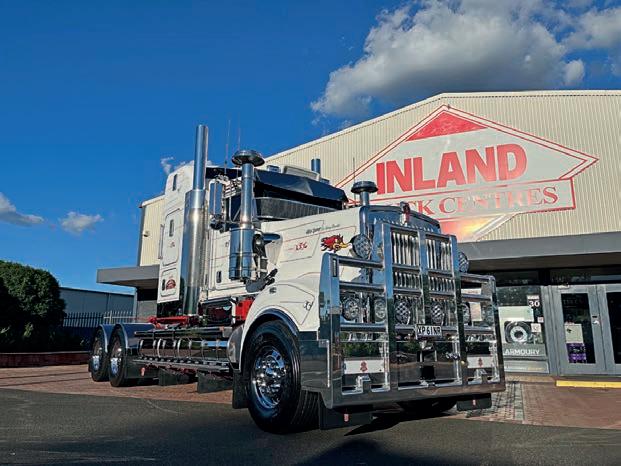
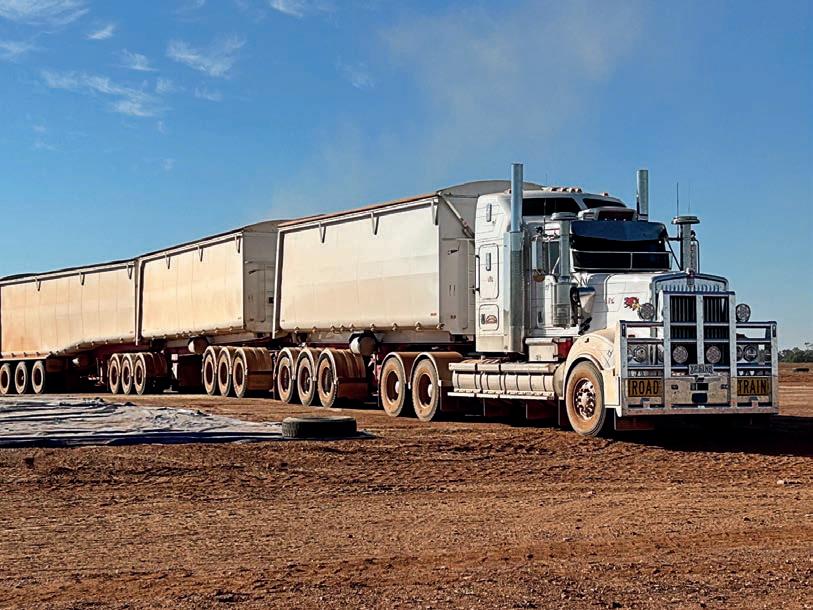
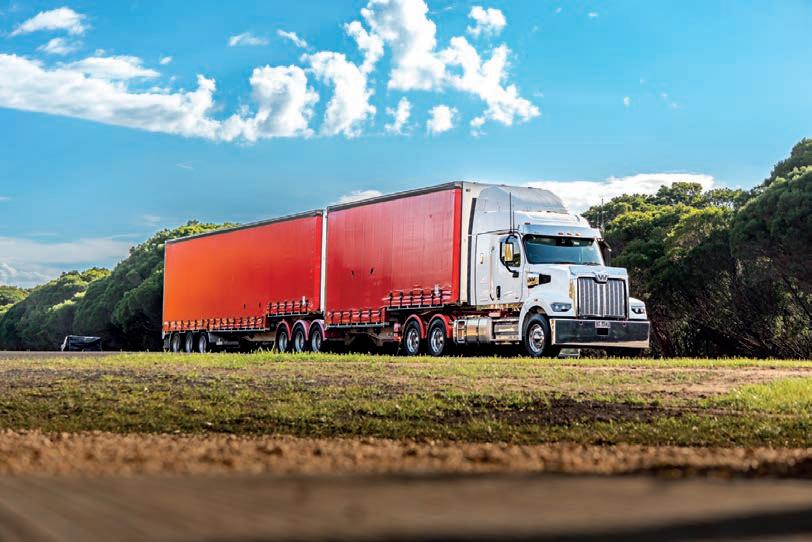
HAND painted scrolls, lines and Woody Woodpecker, blinged up chrome and more make this Kenworth T909 stand out from the pack.
Purchased by Geoff Harvey, who runs Dubbo-based G & R Harvey Haulage, together with his wife Robyn Harvey, the truck hit the road in early April – with Geoff behind the wheel. Geoff, 53, has named the truck ‘Hell Bent and Glory Bound’ and says he couldn’t be more stoked with how his new ride has turned out.
Like many who catch the trucking bug, Geoff was around trucks from an early age, with his father, grandfather and uncle all involved in the transport industry.
During school holidays, he’d be around the trucks, any chance he got.
“I guess I just like the big shiny trucks,” said Geoff, who got his truck licence at 21 and hasn’t looked back. “I did a heap of different driving jobs over the years, working for different blokes – a lot of it was interstate. I went all over, even across to WA.” It was back in 2006 that Geoff decided the time was right to go out on his own and buy his first truck, and with that G & R Harvey Haulage was born. “That truck was a second hand Kenworth T404 and pneumatic cement tanker. I bought that with a contract I did for about six to seven years.”
Since then, Geoff has had a few trucks in his fleet, with the number changing over the years, depending on demand.
Currently, he has three recently purchased Kenworths – the new 2025-model T909 he drives, pulling an AB-triple to cart things like grain and fertiliser, together with a T609 and a T604. “It’s all tipper work – just myself and two other drivers. I’ve only recently bought the other trucks, so one bloke has been with me about five months and the other about six weeks,” explained Geoff. closer to home where possi
ble. I don’t travel interstate as much as used to. The work is mainly throughout New South Wales, but we’ll also travel into Queensland and Victoria when we need to.”
In fact when Big Rigs called, Geoff was in the truck, travelling through a small town called Fifield, in Central NSW, on his way to pick up a load of grain.
The flash new T909 replaces Geoff’s older T909, a 2013-model called ‘Hillbilly Deluxe’.
“I wanted to do something to celebrate our 20 years so thought it was a good time to buy myself a new truck. The other one was also getting older,” he said.
Powered by a 600hp Cummins X15 E5, pulling out 2050lb/ft of torque, and paired with an Eaton 22 series manual transmission, Geoff says his new set of wheels is great to drive. The ISRI Pro leather driver’s seat is comfortable, while the 50inch bunk provides ample space on those longer trips, when needed.
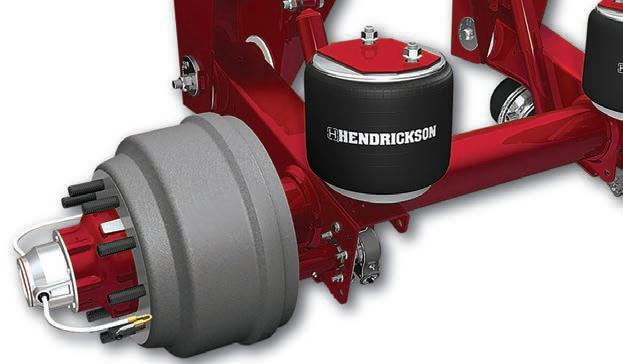
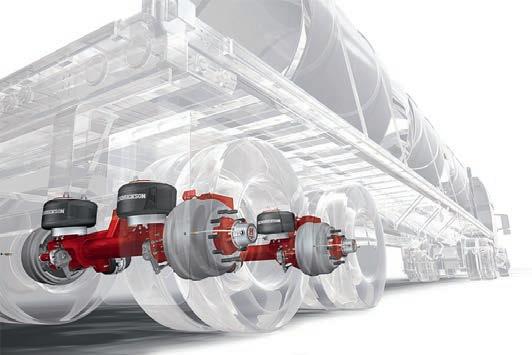
Other features include a full double chassis rail, Hendrickson PRIMAAX suspension rated to 131 tonne GCM and a Meritor RPL driveline with 7.3 tonne steer axle.
Asked how he came up with the truck’s name ‘Hell
day and thought that worked for the new one.”
As for the tough-looking character on either side of the bonnet, he said, “I saw a picture of Woody Woodpecker one day and thought that would look really cool. David Petty from Monster Signs in Dubbo hand-painted that, along with the scrolls and line work. I was originally going to just put stickers but he talked me into getting it done like that. He did it all by hand and it’s turned out great.”
stick engraving too. David and his team worked over the Christmas period to complete the traditional scheme on the truck – with a video they shared on Facebook racking up over 2 million views, before the truck was even handed over.
Monster Signs was also responsible for the custom
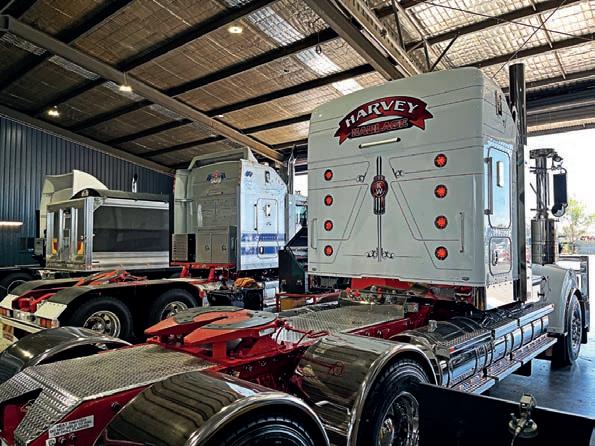
Armoury Group was responsible for the chrome work, adding custom stainless steel touches such as the wrapped tanks, bunk trim and drop visor, special order toolbox lids with Legend treads, low mount smooth drive guards, stone guard roof lights, rear sleeper flush lights and chrome wheels.
“Armoury did all the stainless for me. It’s the first time I’ve used them and they were really good to deal with. I worked with Nick Waddell at Inland Truck Centres to work out what we were going to do and then Armoury Group helped us bring it all to fruition,” Geoff said.
Armoury Group Project Manager, Nathan Greentree, said it was a pleasure working with Geoff Harvey on his special anniversary build. “While it did take longer than originally expected, we were very pleased to deliver this truck to Geoff and the team at Inland Trucks Dubbo looking so good. With a
combination between Armoury standard parts, along with a few parts tailor made specifically to suit Geoff’s needs, we ensured this classic white cab/red chassis combo still manages to stand out from the crowd.”
As Nick at Inland Truck Centres added, “This build really was a team effort. Each supplier went above and beyond to ensure the finished product was first-class.”
While AJ’s supplied the bull bar, Dubb Vegas Detailing brought out the mirror shine on the steps.
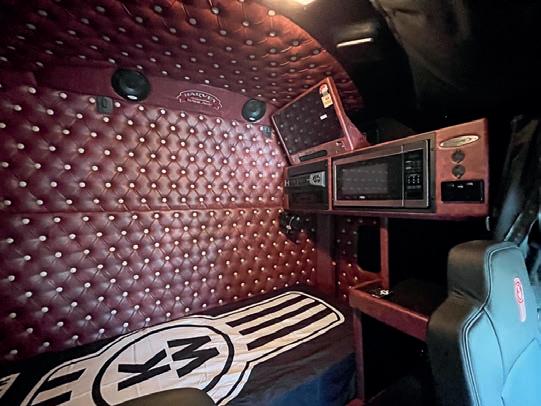
Then inside, Kenworth was responsible for the crimson diamond pleated leather interior, offset with sandstone buttons, with ‘Harvey Haul-
age’ factory embroidered on the rear sleeper panel. Custom Air completed the interior fit-out, with a special order crimson trimmed under-bed panel with Slave AC system outlets, TV, sound bar, microwave, inverter and a Custom Air diesel air conditioning system. Seeing ‘Hell Bent and Glory Bound’ come up as well as it has, Geoff couldn’t be more thrilled with the end result. “My wife tells me this truck will be the last one I buy, but you never know,” he laughed. “After all these years I still enjoy driving and getting to meet new people. The work changes every day – it’s always different places and different people.”
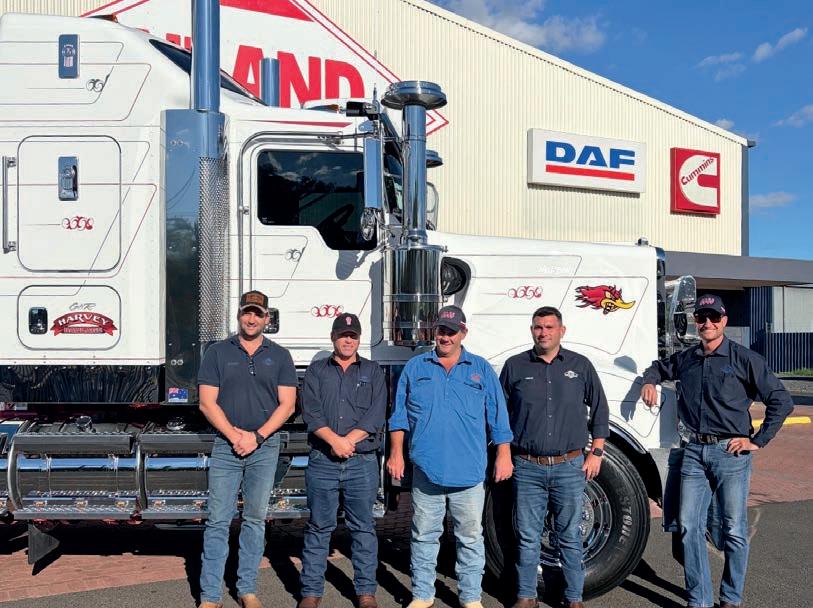
[L-R] Brandon Murray, Dealer Principal Inland Truck Centres (ITC) Central West; Jason Soper, Service Manager ITC Dubbo; proud owner of the truck Geoff Harvey; Logan Penton, Parts Manager ITC Dubbo/TRP Parkes; and Nick Waddell, Sales Representative at ITC Central West.
The new 2025-model T909 is powered by the 600hp Cummins X15 E5. Images: Inland Truck Centres
Inside, there’s crimson diamond pleated leather and sandstone buttons, with Custom Air completing the fit-out.
Armoury Group added the chrome work, along with rear sleeper flush lights.
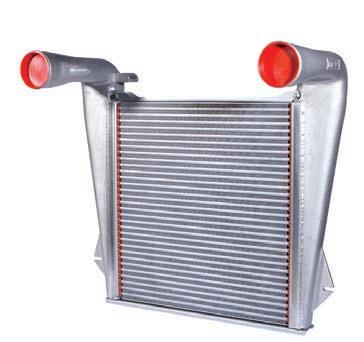
I Designed and manufactured in Australia for Australian conditions I Unique silicone grommet system provides leak free operation & extended service life I Greater vibration & load handling, eliminating premature failures
TRP1504392-1 $2,195 $2,395 Used on Kenworth models: T350/ T359/T401/T601
TRP2306049-1 $2,395 $2,595 Used on Kenworth models: T404/ T604/T650
TRP1615726-1 $2,395 $2,595 Used on Kenworth model: K108
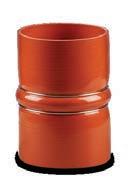
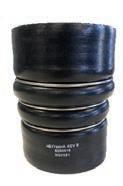
TURBO HOSES
TRP1405115-1 $2,395 $2,595 Used on Kenworth models: T904/T950/C500/T409/ T409SAR/T659/T909/C509
TRP1706053-1 $2,595 $2,795 Used on Kenworth models: T650/T904/T408/T608/ T658/T908/C508/T609/T409SAR/T409/T659/T909/ C509 /T403
TRP1604892-1 $2,395 $2,595 Used on Kenworth models: K100/K104
HE8716 $49 $69
dia 4” to 4”, length 6” double hump
HE8761XL $49 $69 Inside dia 4” to 4.5”, length 7”
HE8701 $59 $79
Inside dia 4” to 4”, length 8”
HE7735HR $69 $89 Inside dia 4” to 4.5”, length 6”
TRP1704836-1 $2,095 $2,295 Used on Kenworth models: K108/K104
TRP7291000-1 $3,095 $3,295 Used on Kenworth model: K200
WHEEL SPACERS
MEMBERS $34.95 NON-MEMBERS $49.95
TRPWS002 20” X 4” corrugated
TRPWS003 20” X 4.25” corrugated $50
NON-MEMBERS FROM $349
8-22-285B3 $299 $349
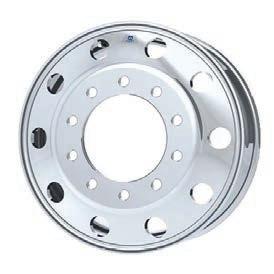
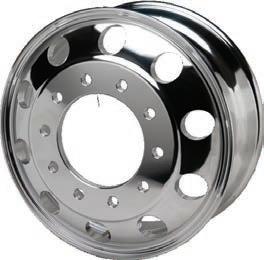
22.5” X 8.25”, 285 X 10 PCD, buff finish
8-22-285P3 $339 $389 22.5” X 8.25”, 285 X 10 PCD, polished both sides
8-22-335P-32MM1 $329 $379
DAF 22.5 x 8.25, 335.75 X 10 PCD, 32mm bolt hole, polished (inside & outside)
8-22-335P1 $379 $429
22.5” X 8.25”, 335.75 X 10 PCD, 26mm bolt hole, polished (inside & outside)
SEE IN STORE FOR COMPLETE RANGE
Euro smarts take on American muscle
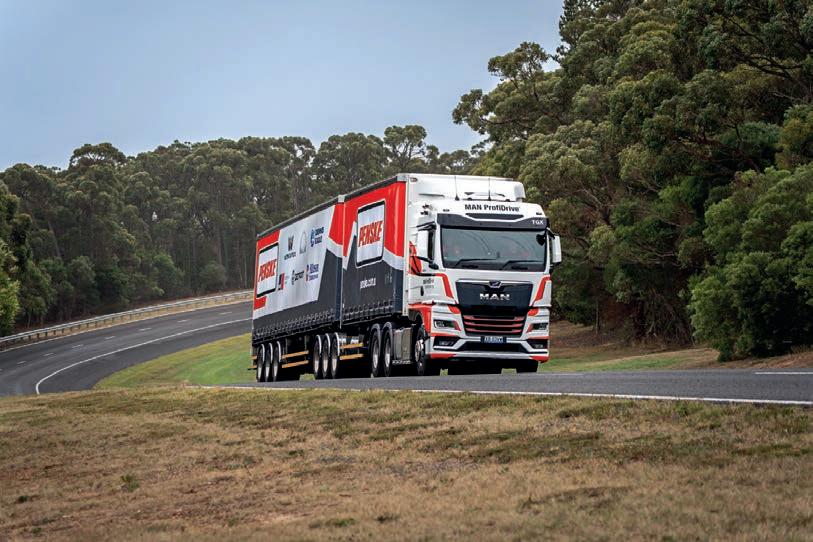
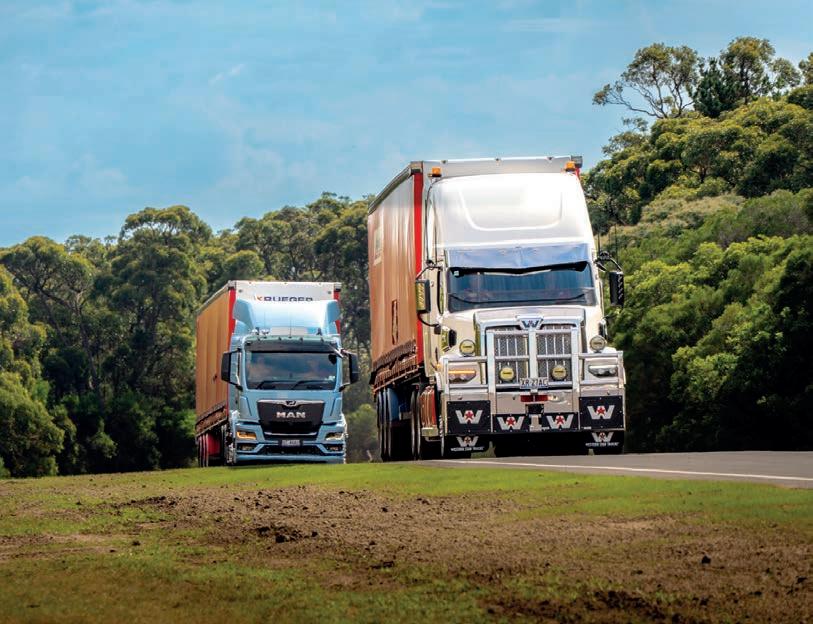
Back-to-back testing of MAN and Western Star trucks reveals two very different driving experiences at the AARC test track in Anglesea.
BY GRAHAM HARSANT
“DON’T touch the brakes!”
This was the instruction from Penske’s Steve ‘Gibbo’ Gibson as I head at speed toward a mock-up of a car on the road in front of us at the AARC test track near Anglesea, Victoria.
I’m at the wheel of a MAN hauling a laden B-double and as we draw closer another B-double – a Western Star – pulls out onto the track in front of the stationary ‘car’.
The car alone was enough to put the gyps up me, but the thought of trashing that and ending up colliding with the side of that B-dub was enough to rob me of any courage and I swerved at the last second.
It wasn’t as though I was worried about the trucks, af ter all they weren’t mine. But I was extremely worried for my life. As it happened, the MAN decided I was an idiot and stopped for me anyhow.
“Can I have another go?’ I asked, that lost courage being counteracted by fellow journos and Penske people having a laugh at my expense.
Around the track we went again and sure enough, as we got close (still too close for my liking) the truck did its thing: warning beeps followed by the application of its brakes and we pulled up to a standstill in double quick time – BEFORE we hit said ‘car’.
Hopefully you will never be in a position where this occurs, but it’s there should the need arise. This is just one part of the MAN’s arsenal of safety features and what is a beautiful truck to drive in all respects, both in the way it handles and the interior appointments which are standout.
I’ve been invited by Penske to trial not only MAN, but also some Western Star variations, a golden opportunity to play with two entirely different type of truck.
We have the modern cabover Euro with its plush ride and clever packaging of space up against the big American WS 49X Stratosphere with its 72” bunk, also modern I hasten to add.
All up there were five MAN variants all the way up to 640Hp/3000nM and three WS – the Stratosphere mentioned above, plus a 48X/36”bunk/B-double and a 48X/day cab/single.
On this day all were auto versions but the Western Stars can of course be had with Eaton’s finest.
People have asked me over the years what truck I’d buy if I was in the market and I’ve always mentioned two Euros that stand out for me. I’ve now added MAN to that shortlist.
Of course, they have every conceivable safety feature as standard – as do most trucks these days – including the aforementioned emergency braking.
They are well built, quiet, and powerful and have a classy interior - very tasteful and reminiscent of (parent compa-
ny) Volkswagen products in its upmarket presentation.
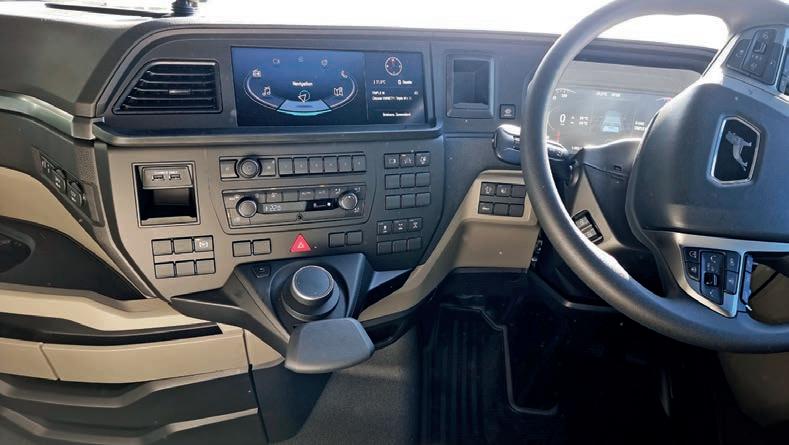
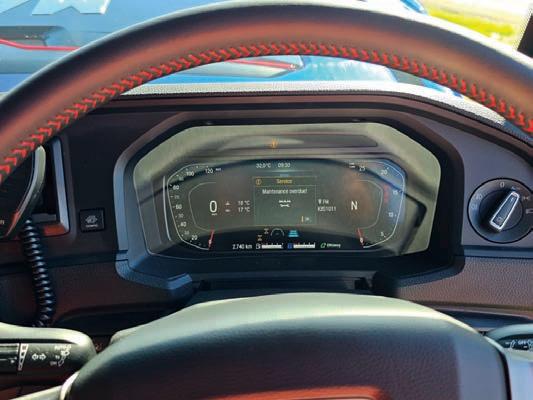
The function buttons on the steering wheel are possibly the simplest and most efficient I’ve come across. Then there’s the piece de resistance in the multi-media screen control.
Falling to hand on the left, under the screen is a palmsized flap. Pull it back to reveal a knurled knob and you’ve uncovered Smart Select. This controls every function of the multi-media screen.
No more taking your eyes off the road to try and hit the correct icon and no smears all over the screen. The only truck in the world to have this system, Smart-Select is a game changer. In collaboration with Rudolph Diesel, MAN produced the world’s first diesel engine back in 1924 – which still works by the way – so it’s fair to say that they know what they’re doing in this department. Mated to a 12-speed gearbox developed with ZF the loaded truck powers along and changes cogs seamlessly.
Whether you’re in a 520 (here in Oz as a test bed), 540 or 640Kw powered version, these trucks feel more powerful than the figures suggest. As well as driving on substantially flat circuit at the AARC, I a lso take the ‘back’ road which has steep inclines and descents and these trucks perform more than admirably under all conditions.
There’s so much more to go through with the MAN product that I couldn’t hope to cover here, but if you’re in the market for a Euro you must add these to your shopping list.
I know an operator who has been virtually a one-brand
man his whole life. I saw him behind the wheel of a MAN recently and expressed my surprise. He’s bought four of them! Not a bad testimonial. Penske also rent these trucks so there’s a way to give one a really good test drive.
Now it’s the Yank’s turn and I start with that Stratosphere mentioned above. Firstly, there’s no fear of claustrophobia in this truck, such is the space around the driver. If you’re driving ‘The Paddock’ then this is the truck for you. Indeed, you have the ‘lower south 40’ behind the driver’s seat. You could put your wife, girlfriend and mistress in the back and drive to Perth. By the end of the trip, they still wouldn’t have tripped across each other.
From a table and chairs to double bunks to massive storage this truck delivers a home away from home.
The free revving DD16 in the 49X puts out 600hp and 2700Nm and in this case drives though a 12 speed AMT effortlessly hauling it’s loaded single trailer around the track.
Shame Penske didn’t hook up a road train to play with as that is one market the 49X is aimed at.
The driving feel behind the wheel of the WS is totally different to the MAN but not in a bad way. Climb into the cab and the triple rubber sealing around the door requires a firm pull to shut them.
You won’t get any bulldust into this cab driving across the country. The dials are just that, giving that oldstyle American ambience in a modern interpretation and
complemented with an array of physical switches as well as steering wheel controls.
The ride feels firmer but the ISRI seat takes care of that. This is the toughest and most rigid truck WS has produced, including extra cross beams in the floor for the Aussie market.
The cab is raised high above the tanks to aid air flow and cooling of both motor and cab.
Given the loads this truck is expected to haul in Aussie conditions, Western Star delivers the goods, pun intended.
Of course, you have a bonnet in front of you but vision over and around it in this 49X is very good – and even better in the 47X and 48X where it drops away and is a little shorter.
Similarly, vision around the C-mount large side mirrors is excellent. You can literally
hang of these mirrors, and the door pockets for that matter, just two illustrations of the strength built into these trucks.
From there I climb aboard a 48X in B-double set up and a 36-inch bunk. This is a model designed expressly for the Australian and New Zealand markets and offers a choice of DD13 of DD16 donks, depending upon your needs.
This version has a multi-media screen and dash panel borrowed from its Daimler parent and that’s no bad thing. These are supplemented with plenty of switch gear arrayed in three panels of four switches.
These can be swapped around to suit an individual driver’s needs and/or taste - just as they can in the 49X. The cab still exudes plenty of American charm though. Pulling a B-double? No trouble.
On the safety front Western Star is up right up there with the MAN so whichever brand you chose, you know you’d be as safe as technologically possible.
These Western Stars offer a real alternative to the other American-style offerings on the market and you’d be doing yourself a disservice if you didn’t try them out before committing your hardearned.
I know you’re going to be asking which did I prefer, the American or the European? I love the space, the looks and the ‘masculinity’ of the Stars.
I love the fine details such as the Smart Select in the MAN. Push comes to shove, for me it’s probably the MAN TGX 26.640……or the 49X Stratosphere with its massive dance floor.
OK, if I really have to choose. It’s the…
Our test driver was invited to try and crash the MAN...and failed. Image: Penske Australia
The MAN dash is easy to read. Image: Graham Harsant
Every truck – and car for that matter – should have a multimedia control like this one in the MAN. Image: Graham Harsant
Australia
Golden Mack’s new chapter
A slice of Aussie trucking history has been saved from the scrapheap and is back on the road where it belongs after a stunning restoration.
BY DAVID VILE
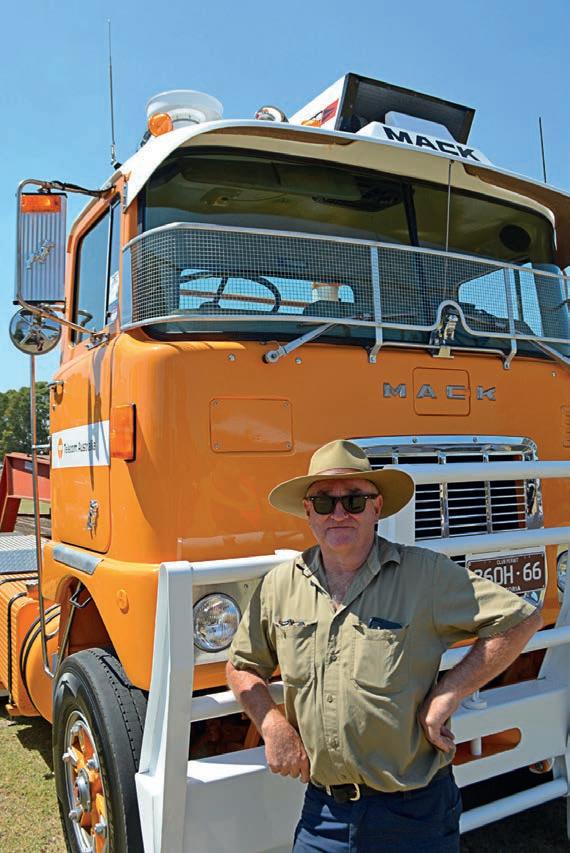
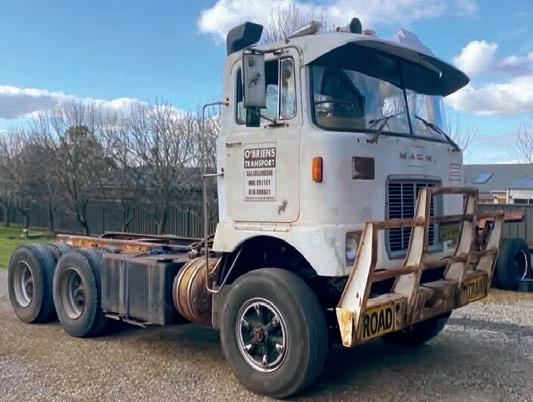
“I don’t like cabovers really, I bought it with other things in my mind to do with it, but it was too good being such an original truck it would have been a shame to destroy its history.”
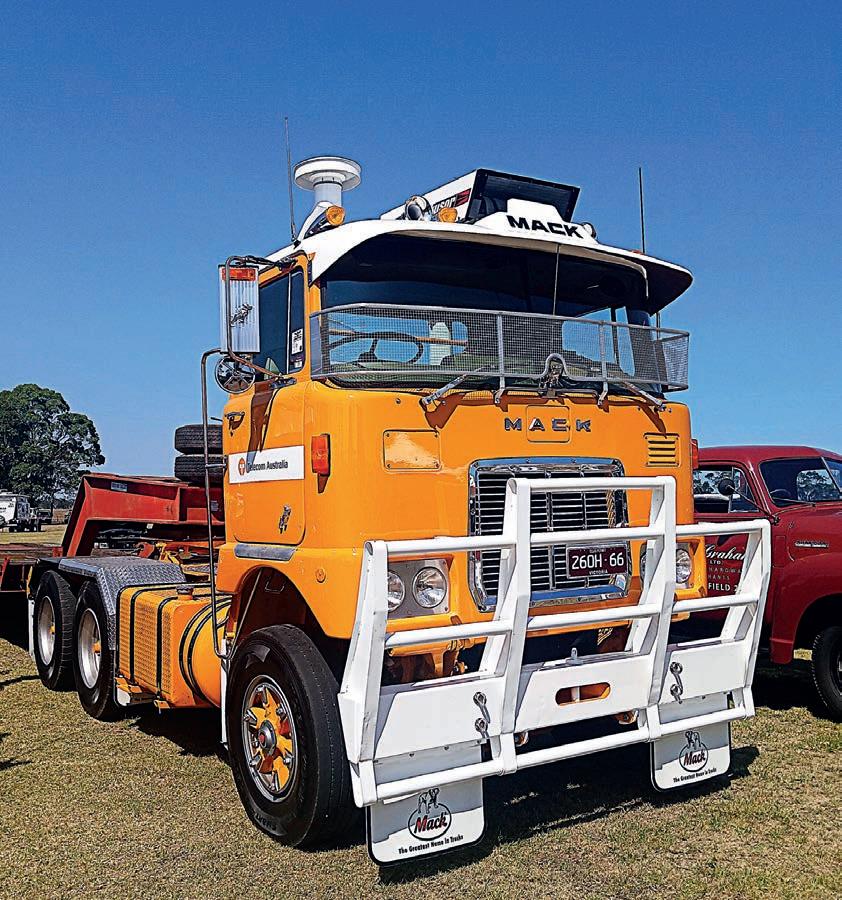
With that thought process, Graeme Fenn’s Mack FR786 was saved from the becoming a donor parts truck and today, in its distinctive ‘Telecom Gold’ colours, has been beautifully restored to add another chapter to its 50-year lifespan.
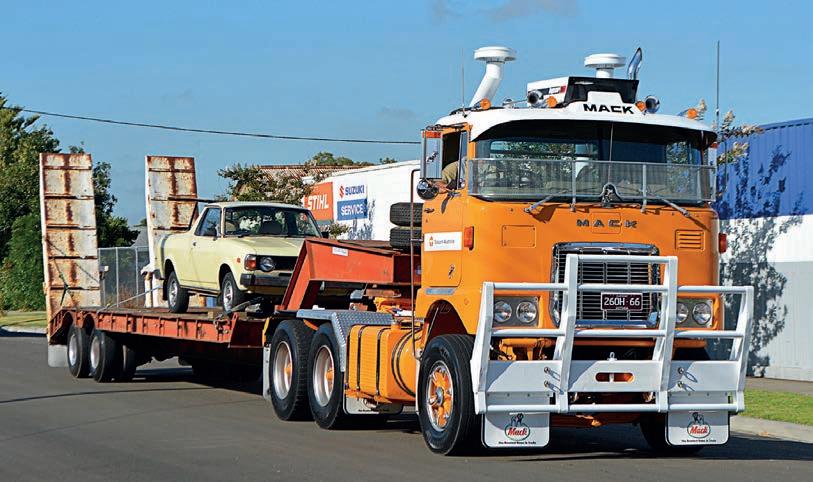
After being spared from an unfortunate fate, the towering cabover Mack has only recently turned a wheel again, with the truck making its return to the road in the parade and show at the Heyfield Timber Festival in February this year.
For Graeme, who is based at Traralgon, his association with the FR started when he was looking to upgrade his single-axle Mack R-Model tray truck.
“I’m an R-Model man really. I found it with the idea of taking the rear end out of it and putting it under the R-Model but it was too good to wreck given its history, so the plan from day one was to keep this as original as it was to when it came out of the factory,” he said.
The truck came into Graeme’s possession out of Kongwak in Gippsland, but prior to that it had been up at Gulargambone in New South Wales, where it had been working hard pulling road train grain tippers during harvest.
Doing a bit of sleuthing work with the help of Mack specialist Gary Richards, the Mack’s back-story soon unfolded.
“I was told when I bought it that it was originally a Telecom float truck, so I contacted Gary Richards and I got the build sheet,” recalled Graeme.
“This one was part of a group Telecom order – they bought 22 of them between 1976 and 1978. This one was sold out of Sydney in 1976 in a group of 4, and runs a 285hp Coolpower, 9-speed gearbox and 44 diffs, with a 5.13 ratio which would have been ideal for heavy haulage and float work. It is a heavy spec with deeper chassis rails and so forth, being a government department it would have been spec’d to suit the job.”
As it stands today, all the componentry (aside from the gearbox which was swapped at some stage for another 9-speed Mack unit), presents how it came off the assembly line and given the work it would have done, has stood the test of time.
“You see pictures of them working in all sorts of places, Cape York and the Northen
Territory and so forth – they would have worked it hard pulling D7 bulldozers and breaking new ground where they hadn’t been before. They were a bit of a legend in their time,” he said.
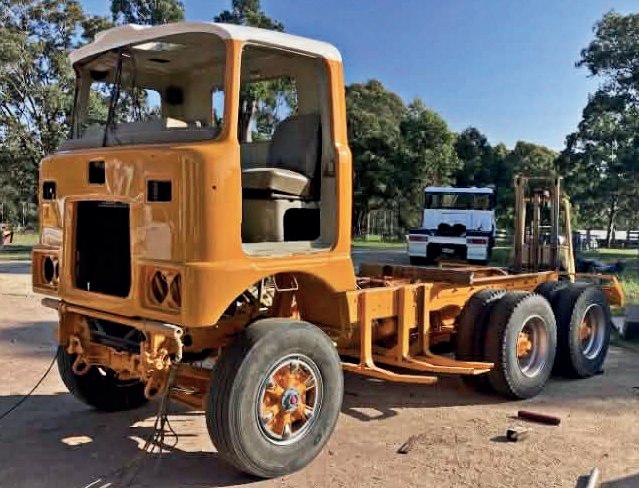
With his plans sorted, Graeme sent the Mack over to Bairnsdale where the restoration was undertaken by Michael Barton.
While not a full strip-down, the Mack was still given a comprehensive refurbishment and overhaul.
“Michael had it for about 14 months. We didn’t do a full rebuild with the cabin and all off, we pulled the rear diffs out and sandblasted the chassis and so forth before painting it. It didn’t have any rust in it, having been in dry country would have been a better environment than up north or over on the coast somewhere.
“We bought new doors and rubber seals and done up the
seats. Sometimes ideas balloon a bit but once you start, you’re committed.
“We did a few things we probably didn’t need to do. We put a Red Dot air conditioner on the roof but had to camouflage it to make it look like a Kysor!” he said with a grin.
When Graeme bought the Mack, it was painted white, but soon the distinctive Telecom colours were being applied to both the cabin and chassis. “It’s actually called ‘Telecom Gold’, and that colour is still on the Mack paint chart,” he said.
“It really is a bit of Australian heritage, for when they changed the name from Telecom Australia to Telstra they went to plain white trucks.”
The Mack was towing a Brentwood bogie float, which by happy coincidence, was also originally a Telecom asset. “I got on to it at Warrnambool, it’s a Brentwood
and it was bought by Telecom in 1987, so when I saw it come up for sale, I grabbed it. It is also going to be restored - it needs a few new boards and sandblasting, but I will get it painted up to match - one project at a time”.
With both Macks in the shed at home they are a quite a contrast to the Volvo Graeme runs today on tipper work out of Matthews Quarries, with his trucking journey starting in Heyfield over 40 years ago.
“I bought a 1418 Benz and went carting logs; I upgraded that to a V10 Benz then stepped into a Kenworth T650 carting paper out of Maryvale. Currently I have got the Volvo but have had a few Kenworths in between - I always loved Macks but never owned one until I got the R-Model and then the FR,” he said.
Along with the Brentwood trailer on the list for an overhaul, Graeme also has another project waiting at home.
WE BOUGHT NEW DOORS AND RUBBER SEALS AND DONE UP THE SEATS. SOMETIMES IDEAS BALLOON A BIT BUT ONCE YOU START, YOU’RE COMMITTED.”
“I have a 1413 Benz in the shed which was my uncles log truck and the one I got my licence in. It is similar to a 1418 but has a shorter bonnet. I must get started on it… I was going to do it up, but this Mack came up and took up all my money!” he smiled. For now, he is happy with where the Mack is at and having put the FR on club registration is looking at getting it out to a few more events.
Given the number of people checking it out at Heyfield it will certainly be a drawcard at shows in the future.
“There’re a few little things to do with it yet but it really was too good to destroy a bit of Australian history. It was a lot of hard work, but it’s come up really well and I am very happy with the result.”
With its ‘Telecom Gold’ paint applied the Mack was well on its way to being restored.
The Mack prior to its restoration by Michael Barton.
The ex-Telecom Brentwood trailer is next on the list for an update.
Graeme Fenn with the Mack at the Heyfield show. Images: David Vile
ELEVATE YOUR BUSINESS, NOT YOUR OVERHEADS.
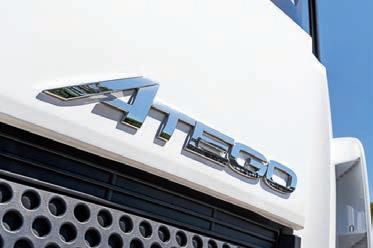
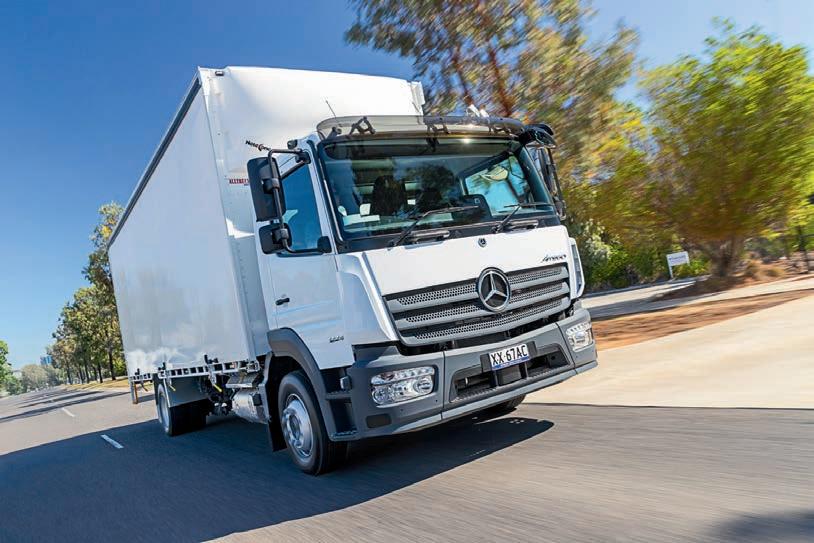
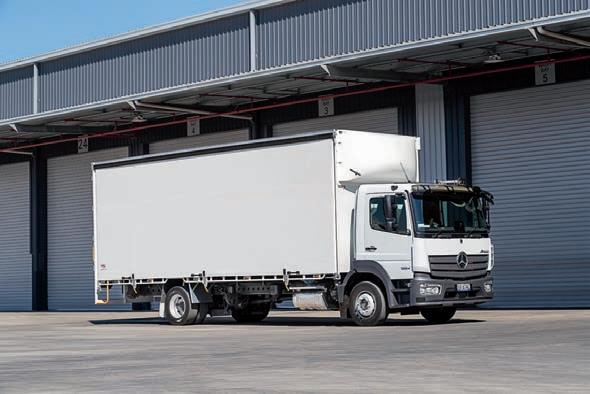
The new Mercedes-Benz Atego delivers real value for your business. Suitable for a wide range of applications, including metro and regional distribution, Atego brings advanced active safety as standard to support drivers in busy operating environments. Backed by a proven Euro VI engine and the legendary fuel efficiency of Mercedes-Benz Trucks, Atego is ready to elevate your business.
Alliance power drives Condor comeback
The new partnership between Volvo and Isuzu breathes new life into this medium-duty workhorse built for modern urban freight tasks.
BY GRAHAM HARSANT
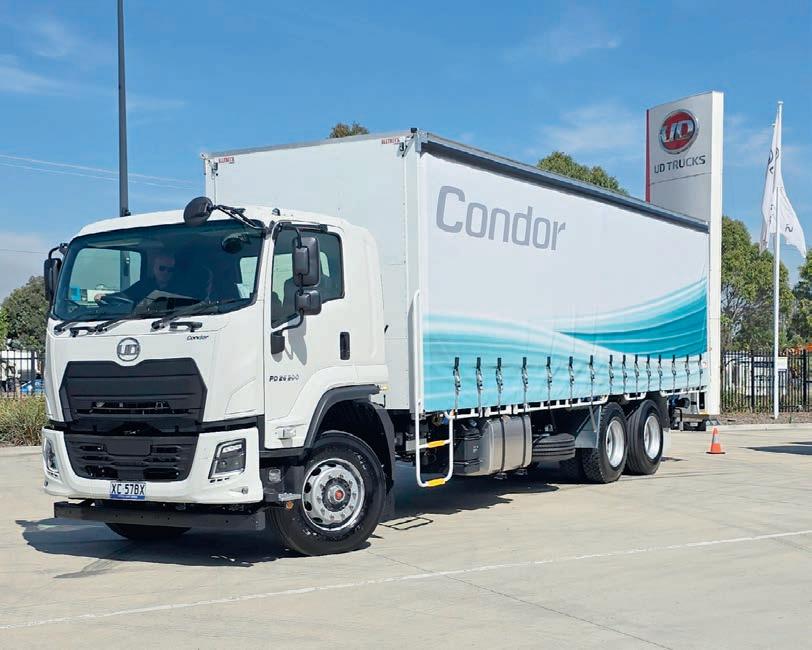
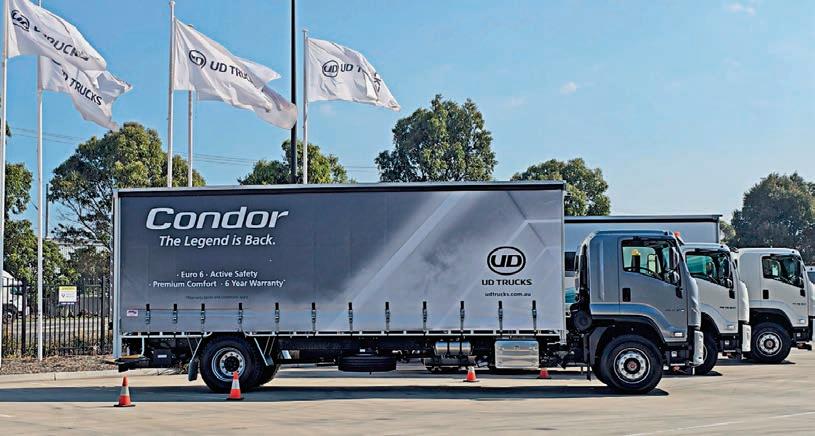
THE Condor name goes back to the 1970s and had always been a popular nameplate throughout UD’s history.
Replaced with the medium-duty Croner for a while, the Condor is back as the first product of the strategic alliance between Volvo and Isuzu.
As you may be aware Volvo Group sold UD to Isuzu Motors a couple of years ago.
First announced in 2019, the businesses have been slowly working through the divorce and now we have the Condor as the first collaborative product of Isuzu/UD.
So why am I with Volvo man, Matt Wood as I climb in the Condor for a test drive?
Because Volvo Group has retained the Australian rights to sell the brand in this market – sort of like Burger King/ Hungry Jacks.
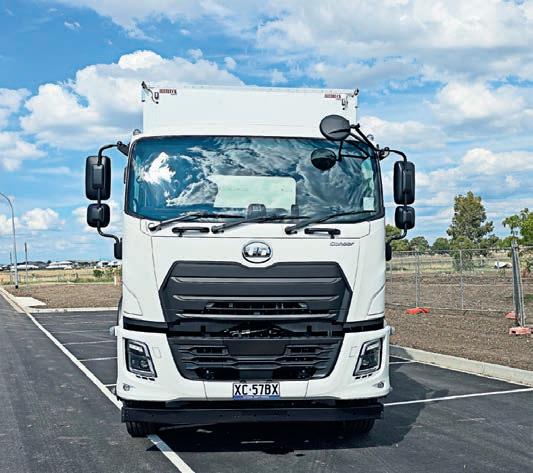
Whilst the cabin is taken from the new Isuzu F-Series the Condor looks distinctly UD, thanks mainly to its corporate grill.
There is a different bumper below the waistline with the headlights incorporated into it rather than above as on its F-Series cousin.
Inside, the trucks also share DNA but the Isuzus are so new that most would see this as totally different.
The interior is nicely laid out and has Volvo-derived infotainment and specific UD branding and features. There is an approved and reasonably well-padded sleeping berth.
You wouldn’t want to live in it but if you got stuck somewhere you could have a snooze.
The passenger seat folds flat providing a table of sorts, as does the middle seat. The driver’s Isri seat is very comfortable; heated and cooled with inbuilt fans.
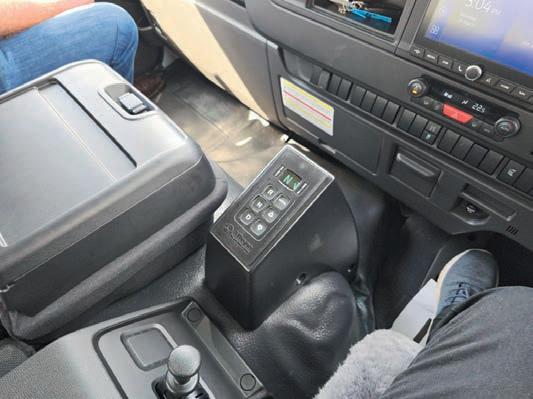
The cup holder for the driver is placed fairly low down which raised a question mark in my mind until I realise that nobody wants their hot coffee spilled over an electronic transmission selector.
Product sharing is nothing new with car manufacturers having done so forever.
The difference here is that both companies are in effect
which I drove recently is a mighty truck so they’re not going to reinvent the wheel. I guess it comes down to brand loyalty – which UD has in spades – and/or looks.
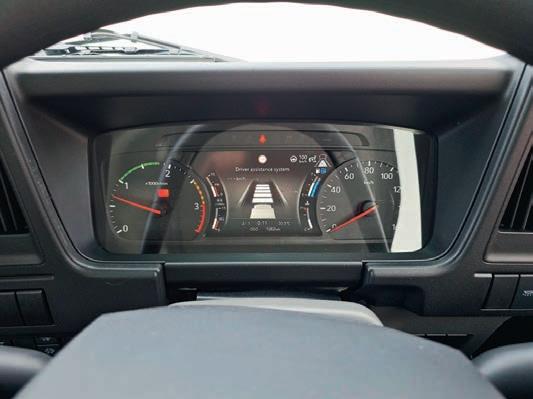
On the safety front the truck offers the full suite: AEB, Proximity alert, Adaptive cruise, Blindspot monitoring and Lane departure warning.
The steering has Active Lane Keeping and out on the highway it will follow the markings.
There are automatic wipers and headlights, so everything you would expect from an automotive perspective is in this truck as a safety feature, including dual airbags which is of great importance as this is a truck which will often carry more than one person.
The motive power in this 14-pallet curtain sider 6x4 (PD model) Condor is a Japanese assembled Cummins.
With a displacement of 6.7 litres, the inline six cylinder turbo diesel engine produces 300hp (220kW) and 1070NNM of torque paired with an Allison six-speed automatic transmission.
This is a robust combination. It is Euro 6 which means it uses EGR and SCR, using AdBlue which cleans up the nitrous oxide in the exhaust, like every other truck on the market today.
Fun fact, for better or worse depending upon your outlook: UD was actually the first truck manufacturer to
AdBlue system back in 2004.
The reality is that these medium-duty trucks work where people live. It is the workhorse of the urban supply chain and you want the cleanest trucks where people live and work. With that in mind we take the Condor for a drive in and around Melbourne’s picturesque industrial west, one of the areas where a truck like this would live.
The first thing I notice is how light the steering is at low speed which is going to be handy in places where it would likely spend its days.
There is a rear camera and two more down each side so your view around The Condor is as good as you are going to get, making backing into tight spaces and parking a breeze.
This test truck was carrying a four-tonne payload and pulled off from the line very smartly, surprising me given the engine’s displacement. I have no doubt that it would perform admirably if loaded to its maximum 10 tonnes.
Engine noise in the cabin is well muted making for a pleasant working environment.
The 6 -speed Allison MD3560 transmission has been used by UD in the medium-duty segment for a long time.
It is tried and proven to be reliable and has great shift patterns working in concert with the power/torque bands
Suspension in this PD version is sprung on the front and air on the rear. The ride is very supple with bumps and potholes barely noticeable. There is the option of steel suspension on the PD which offers a lot more articulation if needed.
After enjoying the industrial scenery, we head out onto the Western Ring Road and up the Hume to test the Condor at highway speeds where it performs impeccably, being unperturbed by some sudden wind gusts and big bangers passing by.
It is a pleasure to drive, and it does everything you could ask of it. The steering is light but direct, it soaks up bumps as well as any truck on the market, the air-conditioning works brilliantly, the gearbox is seamless.
We know it has a close cousin in Isuzu, but I think this truck as a character of its own. I can say that, having driven that company’s products just a couple of days earlier.
The Condor is available in PK (4x2), PW (6x2) and the PD tested here, and of course you can add what you want on the back of the chassis.
You could do a lot worse than to get into one of these.
If a medium-duty truck is an essential part of your business, then it’s worth putting the Condor on your list. You won’t be disappointed.
In fact, I suspect you will more than like it.
UD CONDOR PD 26 300
ENGINE: DB6A-TCC
POWER: 300hp at 2200rpm
TORQUE: 984Nm at 1000rpm
TRANSMISSION: Allison 3500 Series
GVM: 26,000KG
TARE WEIGHT: 7070kg
SEAT: Premium ISRI
SAFETY FEATURES: SRS driver and passenger airbag, lane departure warning system, advanced emergency braking system, distance warning system, full speed range adaptive cruise control, electronic vehicle stability control, front underrun protection system, and more.
STANDARD WARRANTY: Six years, 500,000km, or 8000 hours, whichever is first.
No tripping after dark.
Allison 6 speed is tried and true.
The equally impressive PK Condor (4x2) also flies the flag for UD.
WA operator wins big in Isuzu giveaway
ISUZU Australia Limited (IAL) has announced the winner of its major truck giveaway, a competition launched in celebration of the all-new MY25 Isuzu truck range.
Western Australia based Kevin Hort of KTB Contractors is the lucky winner of an incredible prize package that includes a brand-new Readyto-Work NLR 45-150 Traypack with a generous accessory pack, Isuzu merchandise, a three-year Total Service Agreement, all topped-off with a VIP Experience to the V8 Supercars Adelaide ‘Grand Final’ for Kevin and three lucky guests, which took place last year.
Kevin has built a longstanding career in the building and construction industry, contributing to a diverse portfo-
dential earthmoving projects across the state.
A long-time Isuzu customer, Kevin said the win came as a complete surprise. “I was amazed, excited and pleased all at once. I’ve never really won anything of that magnitude before,” he said.
“When they told me I’d won, my first reaction was, ‘you’re shi**ing me’… I just couldn’t believe it,” he laughed.
Head of Marketing and Customer Experience at Isuzu Australia Limited (IAL), John Walker, said the giveaway was conceived as a meaningful way to mark a significant milestone for the brand while giving back to the customers who underpin its success.
“The launch of our all-new
one of the most important chapters in our history, so we wanted to celebrate it in a way that genuinely resonated with our customers,” John said.
The giveaway was first launched as part of Isuzu’s official public unveiling of its new range at last year’s Brisbane Truck Show – which John says offered an important moment to get these trucks in front of the people who use them every day.
“This giveaway brings that story to life. It shows exactly who the MY25 range is built for and how it supports real Australian operators.,” John added.
“Kevin’s a fantastic example of that, and we are delighted to be handing over the keys.”
Representing the latest evolution in the brand’s product
offering, the Traypack showcases advancements in safety, efficiency, and driver-focused design, reflecting extensive development informed by real-world operator feedback.
Traypack models are powered by the Isuzu 4JZ1-TCS engine, a four-cylinder unit producing 110 kW (150 PS) at 2,800 rpm and delivering 375 Nm of torque between 1280 and 2800 rpm.
“Our new range has been engineered with a clear focus on what matters most to our customers,” John continued.
“That means improved safety systems, refined driveability, and a cabin environment that prioritises comfort and ease of use during long hours on the road. It is a truck designed not just to perform, but to support the people behind the wheel.”
Kevin, who has owned and operated a string of Isuzu vehicles throughout a career spanning four decades, praised the latest model.
“I’m in the process of winding down my business, but I’ve had eight Isuzu trucks over my time, and they’ve always delivered for me. The backup and service through Major Motors here in Perth has been first class all the way through,” he said.
“I’ve got to say, the new little Isuzu is an absolute delight to drive. The new transmission is wonderful and has made a huge difference.
“It’s a beautiful little truck, every bit as good as the promos I’d read about the new model.”
According to John, “The response to both the competition and the new range has been extremely encouraging.
“We’ve seen strong engagement from existing customers as well as new audiences who are taking a closer look at what Isuzu has to offer.”
John added that the giveaway underscores Isuzu’s ongoing commitment to supporting Australian businesses, particularly in industries where reliability and efficiency are critical.
“Construction, trade, and logistics businesses form the backbone of our customer base, and they operate in demanding conditions every day,” he said.
“Our goal is to provide equipment that helps them do their jobs more effectively, safely, and comfortably. Initiatives like this are one way we can acknowledge that partnership and say, ‘thank you’.”
Reflecting on the broader prize experience, Kevin said the additional elements made the win even more memorable.
“It was absolutely awesome. Especially the Supercars experience over in Adelaide. It was first class, really well organised and we had a fantastic weekend,” he said.
“They made us feel welcome. It was a great experience, especially as a lifelong petrol head and motorsports fan.
“I’m extremely grateful. I couldn’t have wished for a better retirement present.”
The prize includes a brand-new Ready-To-Work NLR 45150 Isuzu Traypack with a generous accessory pack, Isuzu merchandise, a three-year Total Service Agreement and a VIP Experience to the V8 Supercars Adelaide ‘Grand Final’.
An ode to the truck that started it all
A lovingly restored 1943 GMC truck is a look back at where it all started for Barro Group, now celebrating its 80th anniversary.
BY DANIELLE GULLACI
STILL family owned and operated, Barro Group was founded in 1946 by David Barro – after moving from the Veneto region of northern Italy to Melbourne.
Recognising a booming construction industry, David decided to get into the concrete game, building his business completely from scratch.
David was soon joined by his brother Marc. They both bought homes on adjoining land in Ringwood – and operated their business from there. Then in 1953, they purchased a block of land, also in Ringwood, and established their first Pronto Concrete plant.
Initially the company’s operations were centred around placing concrete, however by 1956 this had expanded into transporting concrete, as the first dark green trucks fitted with concrete agitators began rolling out the gates.
The first truck was a second hand 1943-model GMC. A former US military truck, the 2.5 tonne vehicle was also left-hand drive.
From that first truck, the fleet quickly multiplied, as did the number of facilities – with the brothers opening their first quarry in 1962.
Today, Pronto Concrete –part of several companies and trading names that form Barro Group – operates across Victoria and Queensland, with 25 concrete plants, 15 quarries and a fleet of around 350 concrete agitators.
Across its other business divisions, including Mountain View Quarries, Presto Transport, and Flintstones Building & Garden Supplies, the business runs a f urther 200-plus trucks –predominantly tippers and pneumatic tankers.
Together with an experienced executive management team, today Barro Group is operated by David’s children Raymond Barro, who serves as Managing Director, and Rhonda Barro, an Executive Director, and Raymond’s son Dominic Barro, who brings Barro Group into its third generation. Now serving as General Manager of Barro Group’s building and landscaping supplies division, Dominic officially joined the company seven years ago but has been around the family business all his life.
“As a kid, I’d go to the concrete plants on the school holidays, batch concrete, wash the trucks and head out into the city jobs with the agi drivers,” said Dom.
“Before I came on board here, I went and worked elsewhere for about two and a half years. I think the best thing I did was to go and work first externally, to have an unrelated party teaching and managing you.”
Paying homage to where the business started, Domi-
nic set out several years ago to find an identical truck to the one his grandfather originally owned. As he quickly found though, it proved much more difficult than what he first expected.
“I was trying to track down a truck like this for years –it had to be the exact same model as our original truck,” he said.
After about five years of searching for the right truck, Dominic thought his luck had changed. He got a tip-off that a military vehicle collector in New South Wales’ R iverina region, named Kevin Purcell, had the exact truck he was looking for. The only problem was that he had no interest in selling it.
After Kevin’s passing around three years later, his entire collection of military vehicles, firearms and collectables were put to auction – including the 1943 GMC. The Barro family were successful in the auction and took delivery of the rare truck in 2021.
The truck had just 55,000 miles on the clock – and it’s taken a lot of work to bring it back to its former glory.
“It was in pretty poor condition. Rust had to be cut out and the interior was gone. It had obviously been out in the weather at some stage of its life,” said Dominic.
“It was bloody hard to find parts too. I was lucky to source a lot of original components, still in their original boxes, that belonged to collectors. I got some in Ballarat, some in Daylesford.
“We wanted to pay hom-
age to the original truck and make it as identical as we could. The engine had to be completely rebuilt. Obviously brake lines and things like that are new, but we’ve tried to keep it as original as possible.”
From start to finish, it took around two and a half years to complete the restoration.
The Barro workshop did as much as could be done inhouse, with Transport Body works in Ravenhall painting the truck.
The concrete agitator barrel is a replica of the original, built by A & A Di Medio & Son in Dandenong South.
“We had the barrel built on a 1:1 scale of the original –we worked out all of the di mensions based on photos, so there was a bit of guessti mation involved there, but I think we got it spot on,” re vealed Dominic.
“From old photos, if we knew how long a particular part was, we were able to work back and measure out the barrel.”
The restoration was fully completed late last year and Dominic is now hoping to get the truck fully registered so it can be driven out on the road. “It’s all fully working, including the barrel. It gets up to about 60km/h – possibly close to 70km/h.”
In celebration of Barro Group’s 80th anniversary, the old GMC will be on display at CMV Truck and Bus in Derrimut throughout May. Dominic is also hoping to bring the vehicle to a few truck shows, including the Al-
Truck Show in June.
exandra
Barro Group Managing Director Raymond Barro, Dominic Barro who heads up the company’s building and landscaping supplies division, and Executive Director Rhonda Barro.
The restoration took around two and a half years to complete and features many original components
Pronto Concrete currently runs a fleet of around 350 concrete agitators. The truck was completely stripped back and rebuilt.
their hands on it in 2021.
Concrete’s 21st anniversary. Images: Barro Group
The first Pronto Concrete truck – a 1943-model GMC – was purchased in 1956.
Atego delivers where it matters most
A refined, practical package from Mercedes-Benz that more than holds its own in a crowded segment, discovers our test driver.
BY GRAHAM HARSANT
THE 12-pallet, rigid truck market is a crowded one in Australia with every manufacturer from Japan and Europe offering a vehicle in this space for you to consider.
Mercedes-Benz is no different with their Atego S-Cab offering.
The truck comes in two driveline specs: the 1224 tested here is 12-tonne GVM and its 7.7 litre engine puts out 240hp/1,000Nm via a 6-speed PowerShift transmission.
The 1427 is 14-tonne GVM and the same engine is uprated to 270hp with the same torque through an 8-speed ‘box.
Of course you can specify what you want on the cab-chassis with many of these trucks being used as tippers, car carriers, et al. With a GCM of 34,000kg (and a PTO as standard) there is plenty left to tow a substantial trailer.
The Atego has been around since 2016 with the intervening years seeing constant refinement and improvement of the product.
Chief among these is safety with the truck having a driver’s airbag, light and rain sensors, Lane keeping, Attention, Active Brake, Stability Control, and Front and Sideguard assist.
These last two give 270-degree protection to other road users: pedestrians, cyclists and vehicles and obviously save
the panels on your Atego from coming to grief. Triangles in the A pillars turn orange to alert you of the presence of the above.
Cruise control is standard but it’s not of the adaptive type I’m told, because of the price sensitivity of this market.
That said, it can be ordered as an option and is the only truck in this segment to make it available.
From the outside the truck presents as ‘ruggedly hand some’ with its square face bro ken up by wind deflectors on either flank.
Apart from that silver three-pointed star, the grill and (three-piece) bumper are unpainted, again due no doubt to price considerations but also to reduce repair costs should the worst eventuate.
THE ATEGO IS BUILT TO A PRICE, BUT IT DOESN’T CUT CORNERS IN THE THINGS THAT COUNT. AND THE THINGS THAT COUNT MAKE IT A VERY GOOD TRUCK.”
Overall it is a distinctive look that won’t be mistaken for anything else.
Inside the truck we find a work-like interior as befitting this segment. That said, everything is screwed together nicely and as I find out on the drive is squeak and rattle free.
Steering wheel and wand controls will be familiar to anyone who’s driven a Benz and are as good as they get. In front of the driver the dials are plain and very easy to read.
Sitting atop the dash within easy reach is the large multi-media screen and behind it a rub
ber lined shallow receptacle to throw odds and ends, together with a couple of cup holders.
There is space for three with the middle, high backed seat folding forward to offer a work bench and more cup holders.
A feature of this S-Cab is the space behind the seat where there is more than enough room to throw a day bag, lunch box or extra tools.
All-in-all you have a worklike cabin, but you’ll appreciate the thought that has gone into the little things.
Driving the truck and all the Mercedes attributes come to
Steering is light and very precise, the engine retardation works very well, the driver’s seat is comfortable with great lateral and back support, and noise suppression is not Actros class but still very good.
The turning circle is brilliant. For a 12-pallet truck I even went as far as to call it minute, to my passenger.
The Atego is built to a price but it doesn’t cut corners in the things that count. And the things that count make it a very good truck.
The Atego has undergone constant refinement since 2016.
Atego doesn’t cut corners.
The numbers indicate 12 tonne and 240hp.
Great fuel economy on weekly run
This owner operator has pulled out all stops to turn his new Scania R 620 V8 into his very own dream truck.
DRAWING inspiration from European Scania owners who are deep into personalisation of their rigs, this owner driver wanted to build a stand-out V8 to match the best seen overseas.
Highly customised and accessorised, Chris Bonnitcha’s new Scania R 620 V8 has been turning heads out on the road, thanks to a stunning Mountain Grey paint job, scroll work and lashings of stainless steel.
The Sunbury, Victoria, based owner-driver of CRB Roadtrans, pulls a refrigerated B-double filled with fresh or frozen produce for Southern Refrigerated from Melbourne to Brisbane on a regular basis.
Chris has been running interstate off and on since 1998, a long with a couple of stints as a diesel mechanic. He decided to go out on the road under his own name in 2021 and hasn’t looked back, enjoying the freedom of the road as he clocks up the kilometres.
“Compared with working as a mechanic, as a driver you’re sitting down all day, you don’t get dirty, it’s not hard, and no one is looking over your shoulder asking if the job’s done yet,” he said.
Recently, Chris transitioned from his initial purchase of an American truck to a 16.4-litre V8 Scania following a long-standing admiration for the Swedish brand.
“My previous truck did 1.7 million km, and it was good to me, but I was sick of changing gears manually and the rough ride, and I always had my heart set on a Scania, and the difference is very noticeable,” Chris said.
At 61 years of age, Chris added, “I reckon I have about five years left behind the wheel so thought now was the time to make the change.”
Since taking his new Scania to the road, Chris has noticed its fuel consumption is much better than in the previous truck. “With the price of fuel, that’s critical. Running between 55-65-tonnes, I am seeing an average of around 2.32.4 km per litre which is about half a kilometre more than I had from the old truck. That’s a significant saving for the kilometres I cover, year-on-year,” he added.
“The lowest fuel consumption I have seen was 1.9 km/l coming from Brisbane to Melbourne at 65-tonnes gross, and the best I have had is 2.8 km/l at 31-tonnes. I guarantee anyone who buys a Scania, you’ll get two kilometres to a litre without even trying.”
Chris added that the engine’s torque output has also made a huge difference. “It just digs in and pulls. As the motor has clocked up more kilometres, it has improved, and now after around 140,000 kilometres, it just powers up the hills as if there’s no weight on the back.
“It’s almost as if the engine reaches milestones and something opens up. It’s like you just twist the fuel pump and it’s got a bit more power. I’m going up hills now in one gear
higher as the kilometres increase.
“I’ve also experimented driving at 95 km/h instead of at 100 and I can see there’s a considerable fuel saving possible. Despite the slower speed, there’s a negligible difference in journey time, so I’m still well within the hours,” Chris continued.
“I bought the Scania for fuel economy, it’s money in my pocket.”
Chris is also a fan of the Sca-
nia Eco Roll function that on a downhill allows the truck to roll out of gear, but then seamlessly reengages when the throttle is reapplied. This also helps to save fuel.
“I’ve seen Erskine Park to Tarcutta driving at 95 km/h reduce my fuel use to 143-litres for just over 400 kilometres,” he said, explaining that he was running empty at the time at a GCM of 31-tonnes.
“The gearbox is beautiful, it’s very, very smooth, you don’t
Already very customised, Chris has a few more things he’s planning on
rails. I can go into bends without backing off like I would have done in the old truck.
There’s no body roll, nothing.
It’s very controlled. The steering is light and direct, and it is also much easier to reverse a double onto a dock. Plus, the mirrors are really good for reversing and they are moved away from the body, so you get good vision at intersections.
“The cab is really comfortable to live in, day-in, day-out, and I am away in the truck for extended period.”
even know you’re changing gears. The extra torque and the gearbox give you marginally better journey times because you’re quicker up the hills, but critically when you get to the end of the day you’re not stuffed.
“It’s a much more relaxed drive. And entry and exit from the cab is much easier too.”
Behind the wheel, Chris has noticed the stability even at speed and says the steering is fantastic. “It’s like a train on
The new Scania V8 is equipped with a TV in the back, a fridge and freezer under the bunk and an additional 15-litre Brass Monkey freezer mounted under the cab, and a 24-volt oven
“Sometimes I can be away for a month at a time, but when I pull into Melbourne my wife will come by to restock the freezer if I don’t have time to come home,” Chris added.
“True, it’s not the biggest bunk out in the market. But unless you’re King Kong, mate, there’s plenty of room in there. And like I was always told, the
bunk is there for sleeping, you spend most of your time driving, that is where you want the comfort,” he said.
“The bunk is comfortable, and warm enough at night in the winter and, I don’t need the diesel heater like I did in the old truck. That was an ice block. In the Scania you don’t feel the cold because they’re insulated,” Chris said.
“Quite often a truck’s pulled up next to me at the truck stop with an Icepack running right outside my bunk, and I didn’t even know it was there until I opened the door the next morning. You couldn’t hear his bunk cooler running. That’s how good they are.
“You don’t buy a Scania for the bunk, you buy one because it’s comfortable, it’s reliable, it’s fuel economical, and it pulls like a train. The torque will get you up over that hill quicker than anyone,” he said.
From the outside, Chris’ grey dream machine looks fully customised, but as ever with these passion projects, there’s always a little more to do to get the truck looking spot on.
“I have a little bit more to go,” Chris conceded. “I’ve done the stainless wings on the back with the lights, the tank skirts and the (very expensive) rear hubcaps, and wheel covers for the front. I’ve got stainless mirror covers, load lights, and bullets and shiny horns on top of the roof and the big sun visor. The visor came from a Dutch company that has opened up in New Zealand.
“I fitted most of this stuff myself, but if you come back in six months you’ll see a lot more done to it. I’ve got a vision for the truck, but it has to be tasteful. TFI did the paint for me, and they did a great job. The stripe is my design, I looked at some European trucks, and I liked that, it’s different,” he said.
Chris Bonnitcha went out on his own as an owner operator in 2021. Images: Scania
The new Scania R 620 V8 has already clocked up over 140,000 kilometres.
Chris has been super impressed with the truck’s exceptional fuel economy.
Chris’ regular run is from Melbourne to Brisbane, and he says the truck is super comfortable.
Finished off in Mountain Grey, the truck features scroll work and lashings of stainless steel.
getting done.
Spotlight on people behind freight task
FROM May 11-18, Truck Week 2026 will put the spotlight where it belongs: on the people who keep Australia moving.
This year, Truck Week is not about one central show or a single headline event. It is a national week of local events, workplace activities and community initiatives taking place right across Australia.
Some will be public. Some will be internal. Some will involve schools, local communities or elected representatives. Others will be as simple as a BBQ in the yard, a depot morning tea, a workshop walkthrough or a quiet effort to recognise the people on the ground.
Not just the trucks. Not just the freight task. The people. The drivers. The technicians. The workshop teams. The warehouse staff. The people in depots, factories, yards and offices. The apprentices coming through. The businesses backing them. The families behind them.
In an industry used to putting its head down and getting on with the job, Truck Week is a chance to pause, briefly, and recognise the skill, effort and professionalism that keep the country supplied every day.
Nobody needs to be told that plenty of businesses and families across the transport sector are doing it tough. That reality is there already, and there is no need to overcook it here.
But that is also part of why Truck Week feels timely: not as a distraction, but as a practical reminder that people still matter, pride still matters, and community still matters.
A week that fits the real world
Heavy Vehicle Industry Australia Chief Executive Todd Hacking says Truck Week is designed to be inclusive, achievable and grounded in the everyday reality of the industry.
“It is not just for major operators or big public events,” he said. “It is for businesses and organisations of every size, in
every part of the country, with activities that suit their own people, workplaces and communities.
“Some events will be outward-facing. Others will be quiet, local and internal. Both matter.”
National Heavy Vehicle Regulator CEO Nicole Rosie adds that Truck Week provides an important national platform for recognising the critical role of the heavy vehicle industry.
“As Australia’s regulator for heavy vehicles, the NHVR is proud to support initiatives like Truck Week which highlight and celebrate the professionalism of the heavy vehicle industry, and our shared commitment to safer roads and a resilient freight network,” she says.
“It’s an opportunity to recognise the people, safety, leadership and innovation that keeps freight moving right across our country, while helping communities better understand the modern heavy vehicle industry and the essential role it plays in our future.”
That broader recognition matters too. Truck Week is not only about what happens inside the gate, but about helping the wider community better understand the people and capability behind an industry that is essential to everyday Australian life.
Opening the gate
Across the country, participants are being encouraged to shape Truck Week in ways that suit their people and communities.
For some, that will mean connecting with local schools, helping young people better
understand road safety around heavy vehicles, or simply giving them a clearer picture of how Australia moves.
For others, it might mean inviting local councillors, state MPs or federal representatives in for a depot tour, workshop visit or a cup of coffee and a conversation, helping local decision-makers better understand the businesses and people in their own electorate.
Elsewhere, Truck Week will provide a platform for wellbeing and community initiatives, including Healthy Heads in Trucks & Sheds activations and Truck Week’s Personal Preventative Maintenance campaign, a practical reminder for people across the sector to take their own health seriously and not leave warning signs unattended.
Again, the tone is deliberate. This is not about lecturing anyone. It is about meeting people where they are.
A genuinely national effort Truck Week 2026 is also being backed by a growing group of industry organisations committed to advancing people, safety and innovation across road transport.
That support includes the Australian Trucking Association, Australian Skin Cancer Foundation, Healthy Heads in Trucks & Sheds, Heavy Vehicle Industry Australia, the National Bulk Tanker Association, the National Road Safety Partnership Program, NatRoad, the Queensland Trucking Association, the South Australian Road Transport Association, TransafeWA and Transport Women Australia, and many other industry
organisations and individuals.
The Australian Trucking Association has backed Truck Week 2026, with CEO Matthew Munro previously highlighting its value in promoting the industry and its career pathways.
“We’re excited to be partnering with HVIA on Truck Week 2026 to help promote trucking careers to young people and career changers,” he said.
“The trucking industry is an essential part of Australian communities, homes and businesses, and offers a vari-
ety of fulfilling, high paying and secure career pathways, including entrepreneurial opportunities.”
That is part of the story, but not the whole story.
Truck Week is not a recruitment campaign in disguise.
Nor is it about pretending the industry has no challenges. It is about showing the broader picture more clearly: the professionalism, resilience, innovation and everyday contribution of an industry that is too often only noticed when something goes wrong.
Most of the time, the job
gets done with little fuss. Freight turns up. Shelves are stocked. Workshops keep fleets moving. Factories build what is needed. Warehouses, yards and offices keep the whole system ticking over. Truck Week is a chance to acknowledge that quiet competence, and the people behind it.
Because Truck Week was never meant to be about putting on a performance. It is about recognising the people who keep Australia moving, and making sure they know they are seen.
Put your health first, before it’s too late
IF we’re going to keep showing up through life’s ups and downs, we need to look after ourselves - and each otheralong the way.
That is not always easy in an industry like ours, where long hours, stress, shifting schedules and everyday pressures can make it all too easy to put health on the backburner.
But that is exactly the thinking behind Truck Week 2026’s Personal Preventative Maintenance campaign: a practical, industry-shaped call to stop putting our own health last.
The campaign is aimed right across the sectorwhether you are behind the wheel, in the depot, the warehouse, the workshop, the factory or the office.
As the campaign material puts it, your body is your prime mover. Service it.
The campaign focuses on five simple areas to start with:
• Pressure Gauge - blood pressure and cholesterol
• Bodywork - skin check
• Fuel System - bowel screening (45+)
• Oil Analysis - prostate
• Steering & Alignmentmental health
Personal Preventative Maintenance is a Truck Week initiative developed by HVIA, in partnership with the Australian Skin Cancer Foundation, Get Yourself Checked, the Heart Foundation, Healthy Heads in Trucks & Sheds and SiSU
Health Group.
This campaign has been shaped by the realities of life and work across the transport and logistics sector, where health can too easily slip behind the next job, the next deadline or the next run.
A message grounded in experience
For former transport operator, Australian Trucking Association Chair and Healthy
Heads in Trucks & Sheds director Geoff Crouch, that conversation is deeply personal.
Geoff knows what it is to put things off. He also knows what it is to get a second chance.
He recalls his first heart attack at just 39 years of age. He had the symptoms, but not the one many people associate most strongly with a heart attack: chest pain.
He felt unwell, had pain in his jaw and arm, and spent the night assuming it would pass.
It was only after initially declining an appointment with a locum doctor, then changing his mind, that he went in and was told he had in fact suffered a major heart attackwhat they call a widow-maker, or a silent heart attack. Then, just three years ago, he found himself back at the GP with blood pressure “through the roof” and other symptoms he could have downplayed.
This time, he did not pretend everything was fine. He told the truth, followed the advice he was given, and ended up undergoing a double bypass - but he came through it.
That lived experience shapes the way he talks about health now.
“It’s not a badge of honour to say that: oh, I don’t go to doctors, I haven’t been to a doctor in years,” Geoff says.
“That’s not a badge of honour. That’s a death warrant.”
Moving past the myths
It is a striking line, but it lands because it speaks directly to an attitude many in this industry recognise. Stoicism can be a strength. So can resilience. But those traits can a lso become excuses for delay, denial or unnecessary risk. That is especially true when outdated assumptions and myths remain in circulation. Geoff is blunt about that too, particularly around men’s health.
“Blokes are terrified of the dreaded finger up the bum; there needs to be education,” he says. “It’s a blood test, people!”
That matters because prostate cancer is one of the most common cancers affecting Australian men – but when detected early, it’s highly treatable.
At the same time, this campaign is not about lecturing people or pretending access is always simple.
Don’t wait for the perfect time Truck Week recognises that circumstances vary widely. Some people have supportive employers. Some do not. Some can get in to see a trusted GP quickly.
Others are juggling long hours, changing schedules, family pressures, distance from home, or the simple reality that a booked appointment can fall apart when work shifts unexpectedly. Those barriers are real, and
the campaign needs to be honest about them.
That is why the message is broader than just “see your GP”.
Your GP or health professional is the best place to start.
Don’t wait for the perfect time.
Use the next chance you get.
That next chance might be your regular doctor. It might be another GP. It might be a health check, a screening test, a telehealth consult, or simply taking the first available appointment instead of putting it off again.
What employers can do
The same practical mindset applies to employers.
Geoff is clear that health cannot be treated as entirely an individual issue when businesses also shape the environment people work in.
Operators may not be able to solve everything, but they can make it easier - or harder - for people to act.
“Do not put obstacles in the way of our employees getting medical checks,” he says.
That is not just a moral point. It is a practical one. Healthier people are more likely to stay safer, work better and remain in the industry longer.
Geoff puts it in simple terms when talking about scheduling around medical appointments: “What’s more
important, that one trip or someone’s life?”
The next step is ours That question goes to the heart of the campaign.
Personal Preventative Maintenance is not about perfection. It is not about asking everyone to suddenly become health fanatics.
It is not about ignoring the pressures people are under. It is about moving past the mythology that says you should only act when something becomes impossible to ignore.
In an industry that prides itself on keeping Australia moving, this is a reminder that staying fit for work and
5 simple areas to start with:
• Pressure Gaugeblood pressure and cholesterol
• Bodywork - skin check
• Fuel System - bowel screening (45+)
• Oil Analysis - prostate
• Steering & Alignmentmental health
Delivering vital mental health support
HEALTHY Heads in Trucks & Sheds (Healthy Heads) is set
to deliver a strong, visible presence across Australia during Truck Week 2026, bringing mental health support directly to people working in the road transport and logistics industries through a coordinated, nationwide program of on-theground activations.
With a footprint spanning from Western Australia to the east coast, Healthy Heads will meet drivers and people working across the supply chain
where they are, at truck stops, depots, roadhouses and major industry events, reinforcing the importance of mental health and wellbeing across one of Australia’s most critical sectors.
In Western Australia, Healthy Heads outreach vehicle, the DAF LF “Roadie” will travel between major partner sites and truck stops, offering free health checks and informal wellbeing conversations for drivers.
These sessions are designed
to be accessible, practical and stigma-free, giving drivers the opportunity to engage in a way that feels natural within their working environment.
At the same time, on the east coast, the organisation’s wellknown Kenworth truck “Kenny” will undertake a high-profile journey aligned with key industry moments and advocacy opportunities.
Kenny’s schedule includes supporting R U OK? in Trucks & Sheds Day activations at Ampol sites, followed by a vis-
it to Parliament House during Budget Week, where Healthy Heads will advocate for increased investment in mental health support for the sector.
The truck will then continue its journey south to participate in a Drive Day in Torquay in partnership with KnorrBremse, before heading north again for an activation at the Ettamogah Rail Hub with WHG.
The journey also includes stops at BP roadhouses to connect directly with driv-
ers, before concluding in the Hunter Valley at HVIA’s TruckShowX, one of the industry’s flagship events.
The scale and reach of the Truck Week program reflects the commitment of Healthy Heads to providing practical, frontline support while also elevating awareness of mental health challenges faced by those working in transport, warehousing and logistics.
Healthy Heads CEO Naomi Frauenfelder said Truck Week represents an important
opportunity to connect with industry in a meaningful way.
“I am proud of the national coverage Healthy Heads delivers from east to west coast, and Truck Week is the perfect opportunity for our team to be on the road in support of industry,” she said.
“By meeting people where they are, we can have real conversations, provide practical support, and continue to build awareness of the importance of mental health across our sector.”
fit for life starts with not leaving your own warning lights unattended.
Truck Week’s Personal Preventative Maintenance campaign sets out five simple
checks as a starting point. The next step is ours. Your GP or health professional is the best place to start. Don’t wait for the perfect time. Use the next chance you get.
The new campaign recognises that drivers’ demanding work schedules make it tough to find time to get a health check.
THE heavy vehicle industry has never lacked strong women. What it has often lacked is enough visible pathways, enough connection points, and enough support to help more women see a future for themselves in the sector and build lasting careers once they get here.
That is the thinking behind HVIA’s Women’s Network, a new initiative designed to support women across HVIA member organisations and help create a more inclusive, better connected heavy vehicle industry.
Importantly, this is not a network for women only. It is for anyone who wants to champion a stronger and more diverse sector, and who recognises that attracting and retaining talented women is not a side issue, but part of building the industry’s future workforce.
At its heart, the initiative is
about practical support and shared progress. It aims to connect people, encourage collaboration, share success stories and highlight the real opportunities that exist across the heavy vehicle sector, from workshops and manufacturing to dealerships, parts, logistics, corporate roles and leadership.
That matters because the
Opening door wider for industry talent
Network as one way to help bridge that gap. Not by competing with the good work a lready being done elsewhere, but by adding another layer of connection and support that is tailored to HVIA’s membership and the broad mix of businesses that make up the heavy vehicle sector.
Breakfast at TruckShowX in the Hunter Valley. The event is intended to bring people together, celebrate women in the sector, and build the sort of connection that can lead to real momentum over time.
For the Big Rigs audience, the message is simple: this is about making sure the heavy vehicle industry is a place
challenge is still very real. While the industry has made progress, there is still a clear gap between where we are and where we could be.
For many businesses, the issue is not willingness. It is knowing how to make change stick, how to build the right culture, and how to ensure capable people feel welcomed, supported and able to advance.
The network will provide a platform to share stories of women already making their mark in the industry, while also encouraging member organisations to learn from each other about what works. Sometimes that might mean highlighting a successful internal program. Sometimes it might simply mean creating opportunities for conversation, visibility and peer support.
Truck Week 2026 will help shine a light on that ambition, including through the HVIA National Women’s Network
where more good people can see a future. That is good for businesses, good for workforce capability, and good for the long-term strength of the sector. And if we want more talented women to choose this industry, stay in it and thrive in it, that is something worth backing.
New work program creates practical pathway for women
VOLVO Trucks Australia, WomenCan Australia, Wodonga TAFE and Transport Women Australia have launched a joint training, licensing and job placement program aimed at bringing more women into transport careers while helping strengthen the industry’s future workforce.
Following a successful pilot under the Iron Women banner, the partnership was formally launched at CMV
Truck & Bus in Derrimut and is focused on removing barriers, building confidence and creating clear pathways into work.
It is the kind of practical initiative the heavy vehicle industry needs more of — identifying a challenge and getting on with the job of solving it.
Women remain significantly under-represented in truck driving roles, making up just 4.4 per cent of the national
driver pool. Research commissioned by Volvo Group Australia identified key barriers including access to the right licences (36 per cent), concerns about physical strength (34 per cent), and perceptions of a blokey culture (33 per cent).
Most telling of all, 76 per cent of women surveyed said they had never even considered the industry as a career option. That presents both a challenge and an opportunity.
For an industry needing more skilled people and stronger pipelines into the future, there is little sense drawing from the same narrow talent pool if capable people are being overlooked simply because no clear pathway exists. This new partnership aims to address that directly by providing targeted training and licensing pathways, wraparound support, mentoring and job placement opportunities. It has also been designed as a scalable model that can be used by regional and met-
ropolitan employers across freight and logistics.
WomenCan Australia sup ports women into new career pathways, including those who have been out of the workforce due to caring responsibilities, family violence, migration and settlement, or other barriers to education and training. Those women bring experience, re silience and potential that any industry would value.
Through the program, par ticipants will have access to accredited training through Wodonga TAFE, along with industry connections, support and mentoring through Transport Women Australia and Volvo Trucks.
“Right now, Australia simply does not have enough qualified drivers to keep our freight moving, and we cannot solve that challenge if we keep drawing from the same small talent pool,” said Jane Humphreys, Vice President, People and Culture, Volvo Trucks Australia.
“By partnering with WomenCan Australia, Wodonga TAFE and Transport Women Australia, we are opening the road to secure, skilled transport careers for more women and building a stronger, more sustainable driver workforce for the long term.”
Programs like this matter because they are grounded in real outcomes. They help people into work, give employers
access to new talent, and show that transport can offer genuine careers for those prepared to step forward. They a lso reflect the broader spirit of Truck Week — an industry prepared to back itself, invest in people and create its own future. No single initiative solves every workforce challenge, but practical pathways like this are exactly how progress is made.
Shining the light on people quietly building the future
TRUCK Week 2026 is not only about creating new events. It is just as much about recognising, honouring and celebrating the outstanding work already taking place across Australia’s heavy vehicle industry.
From grassroots training programs in regional communities to national wellbeing campaigns, safety forums, school activations, technology showcases and workforce initiatives, Truck Week helps bring these efforts into the spotlight.
That spirit is reflected throughout the Truck Week calendar, which features mental health and wellbeing campaigns, safety forums, careers programs, school visits, community open days, innovation
showcases and networking events designed to strengthen the industry and connect with the wider public.
It also means celebrating people who are quietly building the future every day.
Few examples capture that better than Heather Jones and the Pilbara Heavy Haulage Girls program in the Pilbara. Created to provide proper hands-on training pathways for new drivers, the initiative has helped train more than 200 women and dozens of young men, pairing learners with experienced operators in real working conditions.
Jones says the future of the industry depends on welcoming fresh thinking and backing the next generation.
“If we bring new mindsets
and young people into the industry - that truly think differently, we can change a lot of the issues we have.”
It is practical, industry-led workforce development at its best.
Her motivation came from her own early experiences entering the industry with little guidance. Rather than complain, she built a pathway for others - exactly the kind of leadership Truck Week aims to recognise.
Jones also speaks passionately about the opportunities transport can offer.
“I absolutely love it, it’s such a fantastic place to work as well.”
Across the country, similar stories are unfolding every day. Businesses are investing
in safer fleets. Operators are trialling smarter technolo gies. Employers are improv ing mental health support.
Trainers are helping young people enter the industry. Families and communities are opening their gates so others can better understand the role trucks play in mod ern life.
Truck Week simply gives these efforts a bigger stage. Because the industry de serves to be known not only for what it moves, but for how it cares for people, improves safety, embraces innovation and keeps lifting standards.
The trucks may keep Aus tralia moving - but it is peo ple, programs and pride that keep the industry moving forward.
member organisations. Images: HVIA
already making their mark in the industry.
Jane Humphreys, Vice President, People and Culture, VGA.
Volvo has joined the program aiming to bring more women into transport careers.
Heather Jones from Pilbara Heavy Haulage Girls.
IF Truck Week is about recognising the people who keep Australia moving, then the 2025 HVIA National Awards winners offer a timely glimpse of the industry’s future - and of the talent already helping to build it.
Across three very different stories sits one clear theme: the heavy vehicle industry’s future will be shaped not only by better technology, but by the people willing to learn it, teach it, make it and back others to succeed.
The sky’s the limit
That was certainly evident in the story of 2025 HVIA Heavy Vehicle Specialist Trades Apprentice of the Year Isaac Rooney.
Isaac impressed judges not just with his technical ability, but with the leadership, initiative and professionalism he has already shown early in his career.
While completing his apprenticeship with Volvo Commercial Vehicles, he
was recognised as someone already moving ahead in leaps and bounds across the business - contributing ideas, building trust and showing the kind of maturity that marks him as one of the industry’s brightest emerging talents.
For Isaac, the sky really does seem to be the limit.
Grow your own
It was equally evident in HVIA’s recognition of CMV Truck & Bus, which took
Timely glimpse of industry’s future
out the 2025 HVIA Nation al Workforce Development Award for its “Grow our own” program.
With a 20-year apprenticeship pathway, SMART goals for staff, and a dedicated training facility at Derrimut, CMV’s approach shows what long-term workforce development looks like when it is embedded in business culture rather than treated as a side project.
The investment is practical, structured and visible - from in-house technical training and tailored development programs to a deliberate focus on retention, progression and creating collaborative, job-ready teams.
Pilbara superstar
Then there is Chalee Hollandrose, HVIA’s 2025 National Apprentice of the Year - a superstar by any measure, even if she would probably be far too humble to describe herself that way.
nation that feels distinctly shaped by her upbringing in the Pilbara. She entered the industry after a bad experience getting her car repaired and deciding she would rather learn to do the work herself. She applied for an apprenticeship with Cummins the very next day.
From a small branch in Port Hedland, she went on to be signed off seven months early, undertake placements in Perth and Adelaide, build connections right across the business and emerge as a powerful role model for other young people considering the trade.
Yet what comes through most strongly is not ego, but authenticity, work ethic and a willingness to keep learning.
As Chalee put it, the industry needs “more recognition like the awards” and more awareness that “if you want to do
Together, these stories say something important for Truck Week.
ture leaders do not emerge by accident. They are shaped by businesses that invest in training, by workplaces that create genuine pathways, and by an industry culture prepared to value curiosity, effort and ambition. That is one of the reasons Truck Week matters. It gives the industry a platform not only to celebrate trucks, equipment and logistics, but to put the spotlight on the people building careers right across the sector - in factories, workshops, depots, dealerships, warehouses, offices and training rooms around the country.
They show that attracting talent is only part of the task. Keeping that talent, stretching it, trusting it and celebrating it matters just as
For an industry often defined by its skills shortages, these award-winning stories offer something more constructive than hand-wringing. They offer a blueprint. Back your people. Build real pathways. Recognise excellence. And give the next generation a reason to believe this them.
New QTA podcast shines spotlight on trucking talent
QUEENSLAND’S road freight industry is powered by people – and this Truck Week 2026, their stories are taking centre stage.
The Queensland Trucking Association (QTA), through Transport Workforce Futures, is launching Roads to Success – a new five-episode video podcast series showcasing the real people, pathways and opportunities driving Queensland’s transport and logistics sector forward.
Transport Workforce Futures provides advisory support to Queensland’s transport and logistics industry on jobs, skills and workforce planning.
Created to attract new entrants, the podcast series highlights personal success stories that showcase Queensland’s emerging driving talent and the impact of workforce development and training.
With short-form episodes of around 7–8 minutes, Roads to Success features Queensland truck drivers who have transformed their careers through
QTA-supported training initiatives, alongside a fleet recognised for its award-winning training program.
Hosted by Justin Thompson, Industry Engagement Manager – Road Transport and Warehousing, the series explores authentic people, businesses and career journeys from across the industry. Viewers will hear from Driving Futures pre-apprentices starting out on the road, drivers who have upskilled to expand their career options, and participants sharing insights into mental health and psychosocial risks in the workplace.
The series also features female drivers, career changers, and a fleet using training to strengthen leadership, safety and productivity outcomes. Together, these stories reveal the human side of transport and demonstrate how targeted workforce development initiatives are delivering real results for Queensland’s road freight sector – improving safety, supporting retention and building
p Truck Week 2026 celebrates the people who keep Australia moving, and Roads to Success is a natural addition to that conversation. The series complements the official Truck Week program while encouraging people of all ages to consider a career that truly puts them in the driver’s seat.
The podcast is also the first in a broader pipeline of initiatives designed to showcase oppor-
tunities across transport and ogistics, positioning QTA and Transport Workforce Futures
leased weekly during Truck Week, supported by teaser clips in the lead-up to launch. Episodes will be shared across social media channels and promoted through HVIA Truck Week activities.
This initiative builds on QTA’s long-standing leader-
port and Logistics, QTA plays a key role in informing government on critical skilling and training priorities, while designing and delivering practical workforce programs.
These initiatives include pre-apprenticeship pathways
such as Driving Futures, the Heavy Vehicle Driver Program, and Think.Act.Drive — a new program helping drivers bettercess, dropping in May. Real people. Real drivers. Real reasons to choose a career on the road.
For more information visit qta.com.au/skills-training and qta.com.au/workforce-planning.
Virtual show and shine launches in Truck Week 2026
AS part of Truck Week 2026, Haulmax Tyres is bringing the industry together with a national Virtual Show & Shine, giving operators, fleets and owner drivers the chance to showcase their trucks to the entire country. Built for the realities of Australian roads and applications, Haulmax Tyres understands that every truck tells a story. From linehaul to livestock, civil to regional and bulk haulage, this competition is about celebrating the trucks that work hard every day and the people behind them.
Entering is straightforward. During Truck Week, partic-
ipants simply post a photo of their truck on Instagram, follow and tag @HaulmaxTyres, and include the campaign hashtag #HaulmaxShowAndShine.
To help share the pride as part of the national Truck Week conversation, entrants are also encouraged to tag #truckweek26.
Each entry should include a short description of the truck, its application, and where it operates. Whether it’s a meticulously maintained prime mover or a tough, work-ready unit straight off the job, every entry represents the pride of the industry.
A range of categories en-
sures all applications are recognised, including Linehaul, Livestock, Bulk, Civil, Regional and Best Presented Working Truck. A dedicated People’s Choice award will also give the wider industry the opportunity to get involved and support their favourite trucks.
Entries will be reviewed by a Haulmax Tyres judging panel, with finalists featured across Haulmax Tyres social channels following Truck Week. From there, the industry will have the chance to engage, vote, and celebrate the standout trucks that represent the best of Australian transport.
Alongside the Virtual Show & Shine, Haulmax Tyres and partners will also be hosting Truck Week events across Australia, bringing the industry together on the ground. To find out when we’ll be in your area, stay tuned to our social channels and the official Truck Week website, truckweek.com.au, for further details.
Winners will receive a range of prizes, including a major prize for the overall winner, merchandise, and national recognition across Haulmax Tyres platforms.
If you take pride in your truck, now is the time to show it off to the world.
Celebrate the standout trucks that represent the best of Australian transport.
Chalee Hollandrose, HVIA’s 2025 National Apprentice of the Year.
2025 HVIA Heavy Vehicle Specialist Trades Apprentice of the Year Isaac Rooney. Images: HVIA
From in-vehicle driver coaching to advanced collision prevention, we have a comprehensive ecosystem of solutions to manage any heavy truck fleet in the country.
TCA Certified and NHVR-aligned maintenance management.
EWD, fatigue management, and fuel tax credits tracking, built in.
AI-powered video telematics, in-cab coaching, and real-time driver alerts for a safer fleet.
Real-time GPS vehicle tracking, mass management & RIM/TMA scheme enrolment, routing, and 24/7 fleet visibility.
DEPARTURE
WHEN Jenny Fellows talks about road safety, she speaks from lived experience – as a parent, a regional business owner, and someone who has spent decades alongside the transport industry.
Jenny and her husband Paul run Fellows Bulk Transport in Deniliquin, but her contribution reaches well beyond their own operation. Over time, she has helped develop a driver education and “sharing the road” program for local high school students that has since gained national recog-
nition. Jenny recently shared her story with Shane Jacobson on How Ya Travellin’, produced by proud Truck Week partners Healthy Heads in Trucks & Sheds.
Her story is a reminder that meaningful community engagement often starts with one person deciding to do something practical.
Starting with a simple question
The program began with a simple concern. Jenny was teaching her own children to drive and questioning
Safety message from cab to classroom
whether young people were really being prepared for the realities of the road - especially when sharing it with heavy vehicles.
“There are more cars on the road than planes in the sky,” she told Shane Jacobson, reflecting on how little structured driver education exists for learner drivers compared to aviation.
Rather than waiting for a solution, Jenny took the idea to her local high school. When nothing immediately materialised, she helped organise something herself, bringing together the school, emergency services, police and health professionals.
Getting students into a truck
One of the most powerful elements of the program is also the simplest.
“We get them in a truck,” Jenny said. From the cab, students can see blind spots, understand braking distanc es, and appreciate the size and weight of heavy vehicles in a way no classroom expla nation can fully replicate.
The message is practical and memorable. As Jenny
mirrors, I can’t see you.”
Even if only one student leaves with a better understanding of how to position themselves safely around trucks, she believes the effort is worthwhile.
Truck Week’s new school event kit is designed to support exactly this kind of practical engagement, giving businesses and industry participants resources they can use to create safe, useful and well-considered activities with local schools during Truck Week.
Making consequences real
The broader driver education day goes further, walking students through realistic crash scenarios involving emergen-
cy services, hospital pathways and police procedures. The aim is not shock for its own sake, but helping young people understand how distraction, inexperience and poor decisions can change lives in an instant.
Respect for professional drivers
A consistent theme in Jenny’s work is respect for professional drivers and the skill they bring to the road.
“They’re not just truck drivers - they’re professional drivers,” she said. “The skill that it requires to drive these vehicles is incredible.”
Helping young people understand that professionalism, she believes, is part of improving road safety and behaviour.
An approach others can adapt
Importantly, Jenny is clear that this kind of engagement does not need to be perfect or highly resourced. It can grow from local relationships, practical ideas and people willing o contribute.
“I’d be more than happy to help anybody shortcut the
first few years that we took,” she said.
That spirit sits comfortably at the heart of Truck Week. Jenny’s story shows how school engagement can build understanding, improve safety awareness and give young people a more informed view of the industry.
For those inspired to do something similar, the Truck Week 2026 school event kit is now available at truckweek. com.au to help turn that intent into action.
Truck Week 2026 helps connect industry with schools
ACROSS Australia, schools are always looking for meaningful ways to link classroom learning with the real world. At the same time, many students see trucks every day but may know little about the people behind them, the role they play, or how closely freight movement connects to everyday life.
That is where Truck Week can help.
As part of Truck Week 2026, organisers have developed a new Event Kit: Connect With Your Local School Community - a practical resource designed to make it easier for businesses to engage schools in
T RUCK Week is a chance to celebrate the people, businesses and communities that keep Australia moving.
It is also a valuable opportunity to get local councillors, state MPs and federal MPs through the gate and show them what your business actually does.
For many elected representatives, a Truck Week visit may be one of the few natural chances they get to step inside a transport yard, workshop, warehouse or factory, meet the people on the ground, and see first-hand what that business contributes to the local community. That matters.
A simple invitation to a depot tour, workshop walkthrough, morning tea, coffee or BBQ can do more than fill a spot in the diary. It can
a positive, well-organised and locally relevant way.
The aim is not to turn operators into presenters or ask businesses to create something elaborate. It is simply about opening the door to genuine community connection.
That could mean helping students better understand road safety around heavy vehicles. It could mean giving young people a clearer picture of how Australia moves. It could mean showing that behind every truck is a team of people working across depots, workshops, warehouses, offices, factories and countless other roles.
For schools, those experi-
ences can support learning in areas such as geography, economics, agriculture, engineering, technology and community awareness. For industry participants, it is a chance to contribute in a practical way while helping students understand an essential part of modern life that often goes unnoticed.
Truck Week is not about asking businesses to become polished hosts or public speakers. It is about making participation achievable.
That is why the School Community Event Kit is being designed as a simple guide with practical planning support,
help local decision-makers better understand the scale, diversity and importance of the heavy vehicle, road freight and logistics industry in their own electorate.
It puts faces to the workforce. It shows that this is not some abstract sector people only talk about when there
is a problem. It is a local employer, a local customer, a local supplier and a local contributor to community life.
For businesses, that kind of connection is worth having. It builds visibility. It creates recognition. It helps local representatives better understand the pressures facing the
ready-to-use templates and common-sense considerations around safety, school liaison and event organisation. The intention is to reduce friction and help good ideas happen. Importantly, this is not a recruitment campaign in disguise.
While some students may naturally gain an interest in future pathways, the bigger purpose is broader than that.
It is about helping young Australians better appreciate how goods reach communities, how industries stay connected, and why safe, efficient freight matters to everyday life.
industry, but also the pride, professionalism and capability that exist across it. And it reminds them that while road freight supports the national economy, it is made up of businesses embedded in suburbs, towns and regions right across Australia.
Many of those businesses are small and family-run. Many have been serving their communities for decades. Many employ local people not only in driving roles, but across depots, warehouses, workshops, factories, administration, sales and support functions.
Truck Week provides a positive and practical reason to open the door and tell that story.
Importantly, this does not need to be formal or complicated. In many cases, the
best visit is the simplest one: a short tour, a coffee with the team, a quick look around the operation and a conversation about what the business does and who it supports.
This is not about turning operators into lobbyists. It is about helping local representatives see the people and businesses behind an industry that keeps Australia moving.
To make that easier, Truck Week has developed a practical event kit to help participants with the what, why and how. It includes guid-
ance on who to invite, how to find them and templates that make it easy to reach out. In other words, the heavy lifting has been done. That leaves participants free to focus on the opportunity itself: making a local connection that can outlast Truck Week and help their community better understand the role this industry plays every day.
Visit truckweek.com.au for more information and a template to get you started.
Operator Paul Fellows talks to students about fatigue distractions and the importance of having a safety vest in your glove box. Images: HVIA
Students experiencing what it is like to be in a truck.
Inside the ‘Steering the Future’ Trailer, experiencing simulator training.
Hands on training.
Queensland’s Assistant Minister Employment and Training, Amanda Stoker, at last year’s Brisbane Truck Show.
WHAT’S IN YOUR ENGINE?
Your Mack is built to perform—tough, reliable, and ready for demanding conditions. Every component plays a vital role in helping maintain that performance. Mack Genuine Parts are engineered specifically for your Mack, delivering a precise fit and reliable performance you can count on. Tested to meet strict standards, they’re designed for seamless integration and dependable operation across a range of applications.
What’s in your truck matters. Help keep your Mack performing at its best. Choose Mack Genuine Parts*.
Real stories, real results on show in NSW
IF the current global fuel crisis has you seriously considering alternative fuels – or at t he very least how you can improve fuel efficiency and reduce costs, then you can’t afford to miss the TruckShowX 2026 conference and expo in the Hunter Valley, NSW, on May 18-19.
Over two days, you will benefit from exclusive presentations from the biggest line-up of the trucking industry’s prime movers ever a ssembled sharing first-hand how they are embracing the latest innovations, technologies and processes to reduce operating costs (especially fuel), boost productivity and cut emissions.
• L earn how Centurion Transport is leading the way in integrating battery electric heavy-duty trucks into its metro operations.
• Discover how AJM Transport is saving thousands from its deployment of Geotab’s artificial intelligence capabilities.
• Share in Viva Energy Australia’s insights into trials of renewable diesel with part-
ners including Cleanaway.
• Hear about TR Group’s pioneering decarbonisation initiatives, including battery electric and hydrogen f uel cell vehicles.
• Discover how Team Global Express’s ‘Depot of the Future’ has slashed energy costs and emissions.
• L earn how Wettenhalls and FBT Transwest plan to detect fatigue before it happens using WHG’s FleetPREDICT technology.
• Understand why Divall’s Earthmoving and Bulk Haulage is looking to embrace powered trailers.
• L earn how Multiquip Poultry has cut 40 minutes from a 480km trip hauling 36 tonnes using a battery electric truck.
• Discover how Sunswap’s solar-powered trailers have delivered a 43 per cent reduction in TCO for key customers.
• Hear how HW Richardson Group has cut AdBlue use and emissions using its unique dual-fuel system.
• L earn how Toll Group
is overcoming barriers to accelerate the uptake of heavy electric trucks by local customers.
• Join in the conversation on brake technologies and steps forward with leading industry operators Frasers Livestock Transport and Borchtrans.
To be held at Rydges Hunter Valley in regional New South Wales, the TruckShowX 2026 program will a lso include an expo showcasing technology, equip-
ment, and services across a range of new areas, a unique ‘Drive Day’ opportunity to get behind the wheel of the latest truck models from leading manufacturers, and for the first time, a trailer display.
Tickets to the event –staged by the organisation behind the Brisbane Truck Show – are very limited and selling fast, so secure your spot today by visiting truckshowx.com.au.
Test drive the latest leading-edge trucks
TRUCKSHOWX 2026 will feature a unique Drive Day Program providing a rare opportunity to experience an on-road test drive of the latest low- and zero-emissions vehicles on offer in Australia. The driving opportunities will take place on the incredible roads around the event’s host venue, Rydges Resort
Hunter Valley, over the twoday conference period. Thirty-minute drive experiences are available to registered ticket holders.
TruckShowX 2026 attendees have the unique chance to get behind the wheel (or be a passenger) in a range of trucks, from battery electric -
AMID the serious sessions addressing the future of the heavy vehicle industry, TruckShowX 2026 will also offer plenty of opportunities for socialising and networking with industry colleagues.
K icking off the activities will be a special golf day to be held on Sunday, May 17 on the beautiful greens of the Rydges Resort Hunter Valley Golf Club.
Join us for nine holes of fun, frivolity and some serious golf (and networking). Registration commences with a BBQ lunch from 11am with a shotgun start from 12.30pm. Limited spaces are still available.
From the golf course greens
we head to the rolling green hills of the award-winning Brokenwood Wines for TruckShowX 2026’s opening networking event from 6-9pm.
Sponsored by AutoSense, the event will include an hour of wine tasting upon arrival followed by two hours of networking, delicious food prepared by Executive Chef Sam Alexander (previously owner/ chef of Yellowbilly Restaurant). Buses will transport you to and from Rydges Resort.
HVIA is pleased to announce that Dan Repacholi, Labor Member for Hunter and Special Envoy for Men’s Health, will open the event and join attendees for an
cles to hybrid diesel-electric and diesel-hydrogen units –and even fuel-efficient diesel models. Among those on offer are:
• Volvo FH16 powered by Change Fuel Technologies’ innovative dual-fuel system that injects hydrogen into an existing diesel engine, which it claims reduces carbon emissions by up to 50 per cent without compromising operations, routes, distances or payloads.
• Daimler Truck Australia’s pioneering Fuso eCanter, Australia’s first all-electric, zero-emission truck, which offers a sustainable choice for eco-friendly transport and urban deliveries; and its Mercedes-Benz eActros 300 4x2 12-pallet tautliner with an 18-tonne GVM 1
suitable to longer-distance haulage with a range of up to 300km.
• Hino 300 Series Hybrid Tilt Tray and Hybrid Pantech, which the manufacturer claims can deliver up to 22 per cent fuel and emissions reductions with no recharging or range limitations.
• UD Quon CD360 62R 6x2 rigid from Eurocold featuring a highly-efficiency engine and ECO features that reduce fuel consumption, lower costs and minimise environmental impact.
• K RW Hydron’s Shacman Quantum H53 hydrogen fuel cell truck featuring a 240kW SinoHytec fuel cell, an integrated electric powertrain and drive axle assembly that reduces weight, and can support a gross
evening of networking.
A member of the House of Representatives Standing Committees on Climate Change, Energy, Environment and Water, and Industry, In-
mass of up to 53 tonnes.
• Chinese manufacturer DeepWay’s battery-electric Star 6×4 600C, a heavy-duty truck that claims a longhaul range of 300-500km.
novation and Science, he was appointed Australia’s first Special Envoy for Men’s Health in May 2025, to shine a national spotlight on the health challenges facing men and boys.
• Foton’s eAumark S, an allnew electric truck boasting a battery capacity of 100kWh and a GWM of 8,500kg.
“TruckShowX is a fantastic opportunity to bring the industry together here in the Hunter,” he says.
“This event is not only about innovation and technology, but also about the people who power this industry every day. As Special Envoy for Men’s Health, I’m particularly focused on supporting the wellbeing of workers in sectors like transport, where long hours and time away from home can take a toll.
“It’s encouraging to see industry and organisations working together to support safer, healthier and more sustainable workplaces.”
The social activities continue throughout the two-
Limited spots are available in TruckShowX 2026’s Drive Day Program, so act today to secure your place at truckshowx.com.au/ drive-day.
day show, with the highlight Monday evening’s ‘Hi Vis In The Hunter’ themed networking evening.
To be held from 6-10pm in the pergola at Rydges Resort, the event will feature Eat Street-style food tents, cool tunes from a local musician, plus fun activities including oversized games such as Jenga and Connect 4. Create some glow stick jewellery and snap some memories in our photo booth.
Sponsored by Geotab, the event will be held outside so bring a jumper – especially if you are from Queensland! Dress code is “Hi Vis” (bright colours, neon, glow in the dark).
The team at Divall’s is looking to embrace powered trailers. Images: HVIA
Centurion is leading the way in integrating battery electric
TGE’s ‘Depot of the Future’ has slashed energy costs and emissions.
Before the conference begins, there is a special golf day to be held on Sunday, May 17. Scan the QR code above for the full event program.
Volvo will have its FH16 on show, powered by an innovative dual-fuel system.
MORE POWER, MORE CAPABILITY, MORE SOLUTIONS TO KEEP YOUR BUSINESS MOVING.
The Hino 700 Series is engineered for operators who demand proven reliability, advanced safety, superior technology, and operational efficiency, all in a versatile heavy-duty truck. The expanded range now offers increased power, more transmission options, and greater adaptability across a wider range of applications. Featuring the most comprehensive Hino SmartSafe package ever, and the trusted, all-encompassing support of Hino Advantage, the 700 Series is the intelligent choice for fleets that work hard and want to stay ah ead. Find out more at hino.com.au
Early adopters headline ‘TruckGPT’ session
ARTIFICIAL Intelligence is steadily making its mark on the trucking industry, and early adopters are already leveraging its incredible benefits to deliver real-world productivity, safety and efficiency gains.
Industry leaders Allotrac, WHG and Geotab are set to showcase their technologies and the wins that have been delivered for their customers at TruckShowX 2026’s special ‘TruckGPT’ session, taking place on the morning of the event’s opening day.
HVIA is pleased to have secured AI transformation and industry expert Sarah Balmer, Founder and CEO of Balmer Agency, to moderate the session, help the presenters unpack their technologies, and guide attendees through understanding the incredible benefits available.
“AI is a massive opportunity
more so than ever before,” she says.
“I know AI overwhelm is real, but with AI that works, so are the gains. It’s no longer a matter of if AI is coming, it’s a matter of when.
“In the current environment, AI can’t be delegated or ignored, those who get ahead are those that are moving now,” she adds.
A mong the session highlights will be a presentation by leading haulier AJM Transport and technology provider Geotab exploring the cost savings available through the clever use of AI.
Geotab’s AI-driven capabilities transform massive volumes of connected vehicle data into actionable insights across crucial operational areas, including predictive maintenance alerts, proactive driver safety coaching, and powerful tools to optimise -
tional efficiency.
In one simple and quick interaction recently, Geotab’s AI bot was able to rapidly identify a series of long dwell times for AJM Transport’s pickup operations. Once uncovered and analysed, they provided an opportunity for the operator to be reimbursed, which returned tens of thousands of dollars to the operator in that month.
Geotab’s Alkan Ciftci explains more: “Artificial intelligence is no longer just an industry buzzword; it’s a highly practical, revenue-generating tool for the modern fleet. We look forward to showing exactly how it translates to the bottom line alongside AJM Transport,” he says.
“For years, the challenge for fleets hasn’t been gathering data—it’s been making sense of it. What we are demonstrating at TruckShowX is how AI completely changes the game. By allowing operators to interact intuitively
with their fleet data, we are turning complex telematics into instant, actionable insights.
“Our work with AJM Transport perfectly illustrates the power of AI in the real world. When you can use AI to quickly uncover operational inefficiencies – like costly dwell times – and immediately turn those into recoverable revenue, the ROI becomes undeniable. We’re excited to unpack exactly how fleets can achieve this.”
Another case study set to generate much interest will focus on the use of AI to address the risk of fatigue amongst heavy vehicle drivers.
Transport operators Wettenhalls and FBT Transwest will join technology provider WHG on stage to unpack and explore the company’s AI-powered driver fatigue management solution ‘FleetPREDICT’.
WHG’s FleetPREDICT system is a scientifically validated
fatigue management solution, which utilises a Garmin smart wearable, a mobile application and a patented fatigue prediction algorithm to detect biometric signals and conduct predictive analysis into driver fatigue.
The solution provides real-time alerts to drivers before they reach critical fatigue levels, supporting safer outcomes on the road.
“FleetPREDICT gives drivers a science-backed ear ly-warning tool without cam eras or invasive monitoring. With advances in AI, wear able technology and connect ed platforms, we’re at an ex citing crossroads where these innovations converge to pre vent fatigue before it becomes a risk,” WHG’s Director of Operations Dylan Hartley explains Naturally, these capabilities have caught the attention of fleets like Wettenhalls and FBT Transwest, which will outline their experience and
expectations for the technology.
They are joining fellow participants Linfox and Team Transport as selected operators in the national FleetPREDICT trial, which is funded by the National Heavy Vehicle Regulator’s Heavy Vehicle Safety Initiative.
The evidence from the trial is set to shape industry guidelines and build confidence in the adoption of smart wearables in fatigue management.
“The national trial marks a significant step forward in uniting industry leadership with advanced wearable technology to address fatigue risk at scale,” Hartley says.
“The calibre of operators participating reflects a clear industry commitment to driving meaningful safety outcomes. By combining real-world operational insight with predictive technology, this trial is positioned to set a new benchmark for fatigue management in Australia.”
NSW expo showcases cutting-edge tech
TRUCKSHOWX 2026 is set to give attendees an exciting opportunity to get hands-on with the latest in trailer technology and energy-saving innovations, with six leading trailer makers exhibiting in the brand-new trailer expo area.
Market-leading trailer manufacturers from all over Australia will converge in the Hunter Valley for the event. Queensland-based Akaal Semi-Trailers will join South Australia’s VE Motion, Victorian manufacturers Barker Trailers and Freighter Group, and refrigeration experts Protran Solutions and QTRS.
While the trailer types on display and the freight sectors they are best suited to differ, the manufacturers are all well-aligned with the event’s ‘Driving The Future’ theme, with several focussing on saving energy and responding to the global fuel security crisis. Specifically, VE Motion will showcase its game-changing powered-axle trailer, fresh from its recent public launch. Protran Solutions and QTRS will bring their unique solar-powered
ing advantage of Australia’s abundant sunshine to respond to cooling demands.
To see what’s on offer from Akaal, Barker, and Freighter, best head to the trailer expo area on day one of the show!
“Australian manufacturing is alive and kicking, and our exceptional trailer industry produces world-beating equipment,” Adam Ritzinger, HVIA’s Chief Technical Officer and TruckShowX Program Manager, says.
“I am exceptionally proud that we’ve been able to provide a platform for market-leading trailer innovations at TruckShowX 2026.”
play, TruckShowX’s tech nology and trade expo will return for the 2026 event, featuring more than 30 unique and exciting market leaders from all sectors of trucking and commercial transport. Companies will be showcasing the latest in trailer equipment, future energy, telematics, powertrain technology, vehicle charging, safety systems and more – aligned perfectly with TruckShowX 2026’s theme of ‘Driving The Future’.
A highlight of the 2024 event, the expo was the place to be for attendees, both
cal conference sessions and during the breaks, offering unparalleled networking and learning opportunities. With almost double the number of exhibitors as the 2024 expo, industry experts from leading organisiations will again be on-hand to explain and unpack their technologies and services over a coffee or a meal.
Market-leading trailer manufacturers from all over Australia converge in the Hunter Valley.
WHG’s Director of Operations Dylan Hartley.
Cummins will be showcasing their latest technology over the two days.
Protecting margins from rising fuel costs
RISING diesel costs are squeezing Australian fleets.
The good news is that driver behaviour, maintenance and route planning still account for up to 30 per cent of your fuel spend. Telematics gives you the tools to act on all three.
Australian diesel prices hit record highs in early 2026 and remain high.
For fleet operators, controlling the variables you can address has never been more important.
Driver behaviour is the single largest controllable factor in fleet fuel consumption. Analysis by the Massachusetts Institute of Technology found that speeding, rapid acceleration and harsh braking can reduce fuel economy by 15-
30 per cent at highway speeds and by as much as 40 per cent in stop-and-go traffic.
For a heavy vehicle fleet running long-haul routes across Australia, even modest improvements translate to savings. By driving at 90km/h instead of 100km/h, you can reduce fuel use by nearly 10 per cent.
Across a fleet of 50 trucks each covering 200,000 kilometres per year, a 10 per cent improvement in fuel efficiency at today’s diesel prices represents annual savings in the hundreds of thousands of dollars.
Telematics platforms track speeding, harsh braking and acceleration, excessive idling time and RPM management. This data feeds into
driver scorecards that identify coaching opportunities to support drivers in building habits that protect both safety and the bottom line.
“Rising fuel prices continue to place pressure on Australia’s transport sector, making fuel efficiency a growing priority for heavy vehicle fleets,” said Andrew Hintz, Associate Vice President, Heavy Transport Australia at Geotab.
“The operators who are getting ahead right now are the ones using real-time data to coach their drivers and address inefficiencies before they compound.”
Idling is one of the most common and overlooked sources of fuel waste in commercial fleets. Research conducted for the NSW Environment Protection Authority found that a heavy-duty truck engine consumes 2-4 litres of fuel per hour while idling. For a fleet of 30 trucks where each vehicle idles for an average of 45 minutes per day, that adds up to between 16,000 and 33,000 litres of diesel per year, all to go nowhere.
Telematics systems monitor idle time for each vehicle in real time and can trigger alerts to drivers when they ex-
ceed set thresholds. Fleets that implement idle reduction programmes through telematics typically achieve a 30 per cent reduction in unnecessary idling, delivering immediate and measurable savings.
Predictive maintenance is emerging as one of the most effective strategies for improving fuel economy across heavy vehicle fleets. Unlike traditional fixed-interval servicing, predictive maintenance uses real-time vehicle and engine data to identify potential faults before they affect performance or cause unplanned downtime.
In heavy transport, increasingly complex trucks mean that small issues – such as underinflated tyres, misaligned axles, clogged fuel and air filters, and faulty electrical sensors – can quickly increase fuel consumption.
Telematics connected to Controller Area Network (CAN) Bus systems and Tyre Pressure Monitoring Systems (TPMS) allow fleet managers to monitor these indicators in real time and detect issues early.
On average, it takes two weeks for a driver to report a dashboard warning. With
predictive maintenance, problems are flagged and addressed before they erode fuel efficiency or escalate into costly breakdowns.
“Predictive maintenance is an important strategy that helps operators boost fuel effi ciency,” added Andrew.
“With increasingly com plex trucks, faulty electrical sensors or small mechanical issues can quickly increase fuel consumption. Telematics gives fleet managers the visibility to catch these problems early and keep heavy trucks running efficiently.”
Route optimisation can also help to reduce fuel costs. The fastest route on a map is not always the most fuel-efficient one. Route optimisation tools analyse variables including traffic conditions, road gradient, vehicle load and stop patterns to identify paths that minimise fuel consumption while still meeting delivery schedules.
Industry studies consistently show that route optimisation can reduce fuel costs by 10-15 per cent.
For Australian fleets operating across vast distances, even small percentage improvements per trip add up
across hundreds of journeys each year.
Telematics platforms track fuel usage, time on road and route adherence in real time. This data allows fleet managers to compare planned versus actual routes, identify deviations and continuously refine dispatch decisions to reduce unnecessary kilometres and fuel burn.
To learn more about how Geotab’s telematics solutions can help your trucks operate more efficiently, head to geotab.com/au.
Driver behaviour is the single largest controllable factor in fleet fuel consumption. Images: Geotab
Electric charging network takes shape
Australia’s first shared truck charging network is under construction, built around making the economics work for fleet operators.
THERE’S no shortage of people talking about electric trucks in Australia. Conferences, reports, roadmaps, pilot programmes – the conversation has been going on for years. But if you’re running a fleet, talk doesn’t move freight.
NewVolt is an Australian company that has spent seven years doing less talking and more building. Right now, on a site in Laverton North in Melbourne’s west, civil construction is underway on what will be the first charging hub in a network purpose-built for trucks. Not cars. Not vans.
It’s the first of three sites across Melbourne – in the west, north, and south-east –covering the freight precincts where trucks actually operate, and it’ll open late this year. All three will be delivering through 2027. Together, they form Stage 1 of the NewVolt Network, backed by $25.3 million in co-funding from the Australian Renewable Energy Agency (ARENA).
But here’s the part that matters most to a fleet operator: this isn’t just about plugs and concrete. A significant portion of that funding –around $10 million – goes specifically towards bridging the cost gap between an electric truck and its diesel equiv-
alent. NewVolt calls it the TCO subsidy. In plain terms, it means that for foundation customers on the network, the economics of running an electric truck can stack up at parity, or better against diesel today – not in five years or when battery prices come down, but right now.
As Rainer Knobloch, Co-Founder and COO at NewVolt explained, “We know operators aren’t going to switch to electric because someone tells them it’s the right thing to do. They’ll switch when the numbers work. That’s what we’ve spent seven years building – a model where the cost of running an electric truck on our network can match or beat diesel. That’s the only conversa-
tion that matters.”
The NewVolt Network is what’s known as shared-use, open-access infrastructure. Any fleet can use it. You don’t need to own the chargers, you don’t need to upgrade your depot, you don’t need to negotiate with your electricity retailer or worry about whether your landlord will let you install a transformer. You sign a charging services agreement with NewVolt, and you get guaranteed, scheduled access to fast charging, powered by renewable energy, at a fixed, predictable price. For plenty of operators, that last point matters as much as anything. Diesel prices have been volatile for years and the broader fuel security picture in Australia isn’t getting any more comfortable. Electric trucks charging on Australian-sourced renewable energy take that risk off the table entirely. No exposure to global oil markets or fuel surcharges to pass through to customers. Just a known, stable energy cost that operators and shippers can plan around.
The sites themselves are designed around how trucks actually work. These aren’t repurposed car charging stations with a longer cable. They’re purpose-built for heavy vehicles; featuring drive-through bays, secure
facilities, driver amenities, and charging speeds from 400 kilowatts through to megawatt-class capability as the technology matures. It’s the kind of infrastructure that a professional driver expects when they pull in.
“The trucks are available and the business case keeps getting better,” said Anthony Headlam, Co-Founder and CEO, NewVolt. “What we hear from operators is consistent: make it simple, make the numbers work, and don’t make me explain to my customers why their freight is late. That’s what we’ve built, a network they can rely on and a commercial model that works, so fleets can start their transition confidently.”
NewVolt’s model has been shaped by the realities of the Australian freight industry, rather than being imported from overseas or designed in a boardroom. The company has been working with operators, truck OEMs, leasing companies, and industry bodies since 2019 to understand the barriers that actually hold fleets back: depot constraints, grid access, upfront truck costs, and the uncertainty of being an early mover. The network is designed to address each of these challenges.
And Melbourne is just the start. NewVolt has plans for
Sydney, Brisbane, and the Hume and Pacific Highway corridors – the backbone of Australia’s east coast freight task. The vision is a national network of charging hubs at the locations where freight moves, built and scaled as the market grows.
For operators who’ve been watching and waiting, the practical question is straightforward: What does it actually
take to get started? NewVolt’s answer is a single charging services agreement. One contract that covers access to the network, energy pricing, and – for foundation customers – access to the TCO subsidy that brings the cost of an electric truck in line with diesel. NewVolt handles the infrastructure, the energy, and the complexity. The operator handles what they’ve always handled: moving freight.
“Seven years ago, we said Australia would need this network,” added Rainer. “People told us the market wasn’t ready. We started developing it anyway. Today, the trucks are here, the funding is confirmed, and the concrete is going in the ground. If you’re a fleet operator thinking about electric, come and talk to us. We’re on your side of this.”
Come and find NewVolt at TruckShowX or to learn more, visit newvolt.com.au.
NewVolt Core Team (L-R): Anthony Headlam, Rainer Knobloch, Bo Christensen and Andy Evans.
NewVolt National Network Plan.
NewVolt Stage 1 Network – Melbourne.
NewVolt Site05 Concept – Barnawartha.
Faster
With five dedicated repairer networks across heavy motor, trailers, light vehicles and now plant and equipment, NTI makes it easier to get you back on the road and back to work faster. Our repairers share our values, meet strict quality standards, and have automatic authority to start repairs straight away. It’s all part of how we keep our customers moving.
Keeping you moving with trusted repairers, nationwide.
In the fast lane with NTI
WHEN a Mitsubishi Fuso arrived at City Panelbeaters in Bayswater with a crushed cabin, it set the stage for a repair that would demand practical problem-solving, industry expertise and decisive action to stop a long wait from becoming a major setback.
The family-owned workshop has been part of Perth’s transport landscape since 1970, with a purpose-built facility and a team of technicians who rebuild everything from prime movers to light commercial vehicles. Their customers range from major fleets and mining operators to owner-drivers who’s livelihoods rely on one truck.
For years, they’ve worked closely with NTI as part of the Premium Repairer Network. The trust that premium repairers have earned means when an NTI customer’s vehicle arrives in their workshop, they have automatic authority to begin work immediately.
“Having that support means we can get moving straight away,” owner Carlo Rossi said. “It saves downtime, and it means our customers aren’t sitting around waiting for paperwork.
“It allows us to fast-track and streamline the process,” added Operations Manager Stefan Kuvekalovic, “and roll out the red carpet for NTI customers. With the green light NTI have given us, we can push their customers straight to the front of the line.”
A daunting delay
This collaborative approach would prove critical when an NTI customer’s Mitsubishi Fuso arrived with significant cabin damage. “The cab was beyond repair,” Stefan said. “It had copped a really nasty hit.”
The only option was to replace the cabin. The workshop was aware of stock
tacted the dealer to source a replacement, they braced for bad news.
“It looked pretty grim,” Stefan said. “We were told it could be four to six months. With repair and fit-out time added, the truck could have been off the road for seven months.”
For owner-drivers and smaller operators, that kind of delay can be catastrophic.
“If the wheels aren’t turning, they’re not earning,” Car lo said. “We’ve seen people who operate on a fine-line budget, and if they’re hav ing a bad run, it could send them broke.”
Calling in the cavalry
With the timeline looking bleak, City Panelbeaters sought help from NTI Parts.
Senior Parts Auditor Simon Dalgliesh was already on site assisting with another repair when he heard the details, and he immediately under-
“If it were my vehicle, and someone told me it’d be off the road for a considerable period, I know how I’d feel,” he said.
Simon called on NTI’s national supplier network to minimise the timeframe as far as reasonably practicable. “We look for alternatives, and we explore every option.”
Years spent building supplier relationships and a strong understanding of parts availability across the country meant he knew exactly where to start making calls.
“That’s the benefit of the network that NTI has access to,” Simon explained. “We have the ability to reach out to suppliers around the country, and so many different options to help get vehicles
back on the road quicker.”
Within roughly thirty minutes, Simon had utilised his connections to track down a compatible replacement cabin. It was delivered within seven days; a dramatic turnaround from the delay originally forecast. That changed the entire trajectory of the repair and had the truck back on the road in three weeks. For the customer, the relief was immediate.
Sharing the load
For City Panelbeaters, this outcome reinforced the value of having an insurance provider who understands the pressures of long lead times.
“There’s a big difference between NTI and other insurance providers,” Carlo said.
“Others don’t have a specialised parts team working in the background. NTI get involved early. They hear our call, and they do everything they can to help.”
In this case, half an hour on the phone meant a job that might have sat idle for six months was completed in three weeks, and a business that could have been pushed to the brink was able to keep moving.
Any references to claims response times, repair timeframes or outcomes in this article are based on individual circumstances, there are no guarantees as to timeframes. Actual timeframes and outcomes will vary depending on the nature of the claim, parts availability and other factors.
1947 Chevrolet unveiled for truck raffle
A custom-built 1947 Chevrolet Maple Leaf truck, brought back to life with modern engineering, is the latest vehicle to be restored and raffled to raise funds for Motor Neurone Disease (MND) research.
Finished off in a red and black paint scheme, and nicknamed Ruby, it’s the ninth vehicle to be raffled by Australia’s largest transport and logistics specialist insurance provider, NTI, in support of the MND and Me Foundation.
Since 2017, NTI has raised over $3 million for vital research, with 100 per cent of funds going directly to the
official NTI Research Grant for MND.
Powered by a Hino 4-litre turbo diesel engine and built on Hino 4x4 running gear, Ruby combines vintage character with modern performance, continuing NTI’s tradition of transforming classic trucks into one-of-a-kind collector’s items.
The truck comes equipped with front and rear disc brakes supported by an anti-lock braking system, vehicle stability control, and traction control to enhance handling and driver confidence. An exhaust brake adds further control, complemented
by a robust multi leaf spring suspension setup designed for durability.
Powered through a 6-speed manual transmission, the truck is built for practical capability, and includes a 6-tonne electric winch and a 3.5 tonne tow bar.
Inside, modern comforts are seamlessly integrated, including electric windows, air conditioning, a touch screen media system, and a reversing camera, making this classic truck as functional as it is distinctive.
NTI CEO Janelle Greene said the organisation is proud to continue its commitment
to funding research aimed at finding a cure for MND.
“Every day, MND claims the lives of two Australians, and another two are diag nosed. That’s why this work is so important,” Janelle said.
“NTI became involved with MND after our former CEO, Wayne Patterson, was diag nosed with the disease and later passed away. Wayne is widely regarded as the leader who created the modern NTI, and we wanted to honour his legacy in a meaningful way.
“Our approach of restoring and raffling classic trucks has brought together our people, partners, customers and the broader community in an incredible show of support.
“To have raised more than $3 million for MND research is something everyone involved should be immensely proud of.
“I think Wayne would be amazed and humbled by what this initiative has achieved. It’s a legacy that continues to drive us forward.”
MND and Me Foundation CEO Jane Milne said the partnership with NTI continues to have a profound impact on those living with the disease, and their families.
“Our mission is to care and to cure. We support people and their families and carers from the moment they are
diagnosed through to end-oflife care,” Jane said.
“This can include everything from equipment and home modifications to psychological and grief counselling.
“On the research side, consistent funding through the NTI MND Research Grant has been critical, enabling leading institutions such as the University of Queensland, the Queensland Brain Institute and the Clive Berghofer Medical Research Institute to undertake vital work in the search for a cure or effective treatments.
“That certainty of ongoing funding allows researchers to get their teeth stuck into large-scale, meaningful projects that can truly make a difference.”
‘Ruby’ will be on display at upcoming regional events including Downunder Beachfest, Caloundra in May, and Cooly Rocks On in June, before the raffle is drawn at the NTI Townsville 500 on Sunday July 12, 2026.
To purchase tickets or for more information, please visit raffletix.com.au and search ‘NTI MND’.
Simon Dalgliesh, NTI’s Senior Parts Auditor. Images: NTI
Restored and highly customised, this 1947 beauty is a great looking truck from every angle.
Keep things moving when cash flow slows
AS fuel pressure intensifies and broader conditions remain challenging, transport operators are being asked to manage rising costs while keeping their businesses moving. That strain has become increasingly visible across the sector, with insolvencies rising and financial pressure continuing to weigh on operators.
Transport operators don’t stop because cash flow is tight. Trucks still need to move, staff still need to be paid, and operating costs continue to fall due long before your customer payments are due.
For businesses looking to improve cash flow timing, invest in equipment and re-
duce exposure to bad debts, the right finance structure can make a real difference.
Stop waiting for slow-paying customers W hen sending invoices out, most operators aren’t expecting to see payments coming in for at least 30 days. However, wages, fuel, mainte-
nance and supplier costs still need to be covered during that window.
Invoice Finance helps businesses unlock working capital from outstanding invoices, giving them access to funds well before their customers pay. Rather than waiting for payments to come through, businesses can use that capital to cover day-to-day costs, ake on more work, or simply create more breathing room.
For operators managing
FOR OPERATORS
MANAGING REGULAR OUTGOINGS AND TIGHT
MAKE A MEANINGFUL
regular outgoings and tight timing between jobs, that can make a meaningful difference. It also provides reassurance if jobs stop coming in for a period of time due to dips in customer confidence.
More ways to fund your next move
Equipment Finance can support transport businesses in a few different ways. It may be used to fund the purchase of a truck, trailer or other equipment, raise capital against the assets a business already owns outright, or refinance existing loans to create a more suitable structure.
For operators managing cost pressure, that can mean more flexibility to invest in the business, unlock capital or review existing debt without putting further strain on day-to-day cash flow.
Protect your cash flow if a customer cannot pay When waiting for customers to pay their invoices, cash flow can already be under pressure. But what happens if the customer does not pay at all?
A bad debt is money your business is owed but may never recover because the customer has gone insolvent and cannot pay. In transport, that risk is especially relevant at the moment, with insolvencies continuing to weigh on the industry. Debtor Protection alongside Invoice Finance can help reduce the impact if a customer defaults, giving operators another layer of protection when trading on terms.
Finance that supports the business behind the wheel
Delayed customer payments, rising costs, equipment needs, and bad-debt risk can all put pressure on a transport business at the same time. The right financial structure can help operators respond more confidently by improving cash flow, supporting investment, and adding another layer of protection where needed. With Invoice Finance, Equipment Finance and Debtor Protection, Earlypay helps transport businesses stay better positioned to manage pressure and keep moving.
Learn more at earlypay. com.au/transport.
Invoice Finance helps businesses unlock working capital from outstanding invoices. Images: Earlypay
Businesses can use Invoice Finance to cover day-to-day costs, take on more work, or create more breathing room.
Common questions on insurance in super
MOST super funds, including Team Super, offer a range of insurance options designed to protect you and your family in the event something happens to you. If you’re a Team Super member and have a super account, this insurance is automatically added when you become eligible (and you can change or cancel it at any time).
If you haven’t needed to make a claim before, you may not have given much thought to exactly what type of cover you have or how much, and whether it suits your needs. In this article, Team Super answers some common questions that people ask about insurance through super.
1: Is it worth having insurance?
Life insurance provides a financial safety net for you and your loved ones. It can help you keep up with medical costs and living expenses if you get sick or injured, as well as enabling your family to maintain their standard of living if you pass away. If and how much cover you’ll need depends on your personal situation. Team Super offers members:
• Death and Terminal Illness (DTI) Cover – provides a lump sum payment if you die or become terminally ill.
• Total and Permanent Disablement (TPD) Cover –
provides a lump sum payment if you’re unlikely to ever work again due to an illness or injury.
• Income Protection (IP) insurance – provides a temporary income if you’re unable to work due to an illness or injury.
Team Super tip: Under the law, super funds will cancel insurance on inactive super accounts that haven’t received contributions for at least 16 months. Your super fund should contact you before your insurance is about to end.
2: Dangerous occupations
While most super funds offer insurance cover to their members, they may not cover people working in a job that’s considered ‘dangerous’. If you work in transport,
mining, or a related industry, jobs commonly excluded from insurance cover include miners, truck drivers, loaders, mechanics, flight crew, store persons. At Team Super, our insurance caters for members working in such high risk or ‘dangerous occupations’, who can find it hard to obtain adequate and reasonably priced insurance elsewhere, due to their jobs.
3: How much does insurance cost?
The cost of your insurance depends on the type and amount of cover you have, as well as other factors including your age, gender and smoker status (as applicable). For Team Super members, it also depends on which insurance Division you’re in and the type of job you do. One
of the main benefits of insurance through super is hassle free payments – your insur ance is easier to manage as the premiums are automat ically deducted from your super account, so you don’t need to worry about budget ing or making payments.
4: Can I change my cover?
Yes! You can (and sometimes should) change your cov er, as it’s not set and forget. A nd things like your salary and the type of job you have can have flow on impacts to how much you pay and what you’re covered for. Team Super members can update their insurance at any time to change things like your Occupation Group or reducing or cancelling your cover. You can also apply for new insurance or top up your
existing cover; or take advantage of special offers to increase your cover (if eligible within a specified period).
Remember, it’s important to regularly review your insurance cover to ensure it’s right for your needs.
Already a member of Team Super?
You can view and manage your insurance online. Simply grab your member number from your last statement and log in via teamsuper.com/login.
Not yet a member?
Learn about the benefits of
joining Australia’s top specialist fund for transport, energy and mining.
Visit teamsuper.com/join.
Team Super is Team Super Pty Ltd AFS licence 246864, the trustee for the Team Superannuation Fund. Refer to the PDS and TMDs on Team Super’s website at teamsuper.com when considering if their financial products are right for you. Any financial advice in this article does not take into account your financial situation, needs or objectives, and you should consider these factors before taking any action.
Most super funds, including Team Super, offer a range of insurance options designed to protect you and your family in the event something happens to you.
Save fuel with hydrogen on demand
H2BOOST is helping operators save fuel in the range of 8 to 20 per cent, by producing hydrogen generated on demand – without having to replace your existing diesel engine.
As rising diesel prices continue to have a big impact on transport operators, H2Boost offers a carbon emissions reduction technology that pays for itself – and contributes to increased productivity and profit for your truck or your fleet.
H2Boost is a self-contained technology that produces hydrogen on demand for controlled delivery to internal combustion diesel engines. It reduces fuel consumption and carbon emissions, while boosting efficiency – and im proving performance by in creasing torque.
panies to reduce their car
bon footprint, the system provides an economically sustainable solution for truck operators to take action today.
H2Boost’s electrolysis uses demineralised water to produce hydrogen.
W hile older electrolysis systems required a caustic catalyst, which is highly corrosive and represents a health risk, the H2Boost system is completely chemical free.
H2Boost is powered by low electrical input drawn from the truck’s engine while it’s in operation. The hydrogen supplements the diesel fuel to create a cleaner and more complete combustion process. The amount of hydrogen produced is optimised
sophisticated way, scaled to apply to multiple applications,” explained General Manager at H2Boost, Roger van der Lee.
The H2Boost unit is com pact and robust, designed and built to withstand de ployment in Australia’s harsh operating environments. The unit does not store any hydrogen nor have any reli ance on a pressure vessel. It is a retrofit unit which is not intrusive on the host engine and the engine is not depen dent on H2Boost.
H2Boost’s highly efficient power unit, coupled with a sophisticated electronic con trol unit, produces variable a mounts of hydrogen to opti mise the combustion process
it’s a perfect fit for trucking. Along with heavy transport, other markets for H2Boost include mining, heavy industry, generators, marine
which the client can access online 24/7 via a dedicated portal.
H2Boost offers a no risk trial, backing up its claims to re-
is supplied on a full service model and warrantied in Australia.
To learn more about how
As the system is applicable to large diesel engines and any industry that consumes large volumes of diesel fuel,
The cost of counterfeit and non-genuine parts
FOR fleet operators trying to manage rising operating costs and budgets, the temptation to purchase lower-priced replacement components is understandable. However, when it comes to engine parts, the cheapest option can often become the most expensive.
The growing global market for counterfeit and non-genuine engine components is creating serious challenges for the transport industry, and Cummins is actively stepping up efforts to pro-
tect customers from the risks these products pose.
Counterfeit goods are estimated to be a US$500 billion per year industry globally, with engine components increasingly targeted by sophisticated counterfeiters.
These components have become increasingly difficult to identify even for experienced technicians. Modern counterfeits often replicate the appearance of genuine products, copying packaging, labelling, barcodes and even QR codes, so that the
parts appear legitimate at first glance. As a result, many customers unknowingly purchase imitation products believing they are genuine Cummins parts.
Due to the enormity of the issue in Australia, Cummins is actively working with the Australian Border Force to help identify and stop counterfeit shipments entering the country, to protect consumers and prevent inferior products from reaching the market.
The primary driver behind
counterfeit and non-genuine parts is cost. These products are typically sold at a lower price point because they are produced without the same level of engineering, material quality, precision manufacturing or the testing required for genuine components.
The consequences can be significant.
Poorly manufactured parts can cause rapid wear, increased fuel consumption, excessive emissions and reduced engine performance. In some cases, they can also present safety risks if substandard materials fail under oad.
A real-world example involved a mine operator that nstalled what appeared to be genuine fuel injectors purchased through a third-party upplier. After installation across the 15 engines, the fleet began experiencing increased fuel consumption, educed performance and visible exhaust emissions.
A Cummins technician later confirmed the injectors were counterfeit.
The short-term savings quickly disappeared once the engines required repairs and lost productivity.
To help combat this growing issue, Cummins has introduced a parts labelling ystem incorporating hologram technology to verify uthenticity.
Holograms provide an advanced form of brand protection because their visual
effects cannot be easily replicated using conventional printing methods.
The Cummins label features a Cummins specific hologram and QR code, allowing customers to scan the label and verify the authenticity of the product through a dedicated online verification platform.
The system provides customers with a simple and reliable way to confirm they are purchasing genuine parts before installation.
While authentication technology is an important step forward, the safest way to ensure parts are genuine remains purchasing through Cummins branches or authorised dealers.
Parts sourced through these channels are approved and warranted by Cummins and supported by the company’s extensive service networks
across Australia and New Zealand.
This ensures customers receive components that meet Cummins engineering standards and are backed by full warranty coverage.
For operators, counterfeit parts can put both the equipment and businesses at risk.
W hile the initial purchase price may appear attractive, the long-term consequences can include increased downtime, expensive repairs and reduced engine life. By choosing genuine components and purchasing through authorised channels, fleets can ensure their engines continue operating as designed – safely, efficiently and reliably.
In the world of heavy transport, where reliability drives profitability, protecting your engine with genuine parts isn’t just good practice, it’s smart business.
H2Boost
Expert hands. Genuine parts. Keeping your Cummins engine performing at its best. Images: Cummins South Pacific
From our warehouse to your engine – Cummins Genuine Parts you can trust.
Bridging the gap between today’s diesel powered productivity and tomorrow’s clean energy future.
Our hydrogen-on-demand system improves combustion efficiency, reducing diesel consumption while integrating seamlessly with existing vehicles and workflows. No operational disruption, no new infrastructure — just lower running costs from day one.
What This Means for Your Operation
H2Boost delivers tangible, operational benefits:
Increased fuel economy
Improved torque and power response
Lower CO₂ emissions
Cleaner engine oil and reduced engine wear
Reduced NOx output
Huge reduction in diesel particulate matter emissions
All benefits are achieved while continuing to run standard diesel fuel.
Proudly supporting Reader Rigs
Share your truck pics to win with Shell Rimula
SHELL Rimula has partnered with Big Rigs in a big way – so there are even more reasons to send in your best truck shots.
Each month, the Big Rigs team will choose a #PicOfTheMonth, with the lucky winner receiving a $500 Shell Coles Express Gift Card.
Keep an eye out for our regular posts on the Big Rigs Facebook page, calling for your best truck photos and add yours in
the comments, or email them direct to danielle.gullaci@ primecreative.com.au for your chance to win the main prize.
Don’t forget to include a brief note about the truck and where the photo was taken. We’ll feature some of the best photos in each print edition of Big Rigs, with one winner announced each month.
Keep those amazing truck pics coming!
Congratulations to Pic of The Month winner Darren Sheen, who snapped this cracking sunrise shot just south of Goulburn, a $500 Shell Coles Express voucher is on its way.
A ripper of a shot from Johnny Quici of the Western Star on a dusty outback road.
Darcy Kirley snapped this nighttime shot, northbound at Tullamore, NSW.
Gary Morton heads eastbound on the Great Central Road in WA.
Bear Graham says sunsets in Port Hedland are always stunning.
Luke Curtis took this great photo of the Kenworth on the westbound ramp onto the M4 in NSW.
A cool pic of this Wintrans Haulage setup, snapped near Adelaide by Shane Winter.
Mitchell Gow got this amazing photo heading northbound at Eumungerie, NSW.
A glorious WA sunrise, captured by Jordan Blenkinsop in the Wheatbelt.
Reggie Shepherd snapped this ripper pic at Julia Creek, Queensland.
Ann-Marie Hicks shared this awesome shot of two RTA cattle road trains at Daly Waters in the Northern Territory.
Great shot from Tyson Staben, snapped after unloading 24 tonne of barbed wire at a station in the NT.
Tex Sheppard got this cool shot of the 6900 Western Star just out of Coober Pedy, SA.
Look at that sky – an incredible shot of the Linfox setup snapped by Louise Fuller.
Catching up with an old friend on the road
Over a cuppa, long-time Tassie truckie Barry Clarke reminisces about his lifetime experiences in and around trucks.
BY JONATHAN WALLIS
ROUGHLY 10 years ago, at Mood Food, north of Kempton, we first met Barry Clarke, from Oatlands, when he rolled in with a load barley on his way to the Cascade brewery at South Hobart.
He was driving Richard Ward’s Stirling at the time, and over a cuppa and a bite to eat, a good and lasting friendship was then formed.
So, it was a great pleasure to catch up with him and his off-sider Catherine Anderson, when they were delivering a load of firewood in Collinsvale the other day.
Barry was driving his 2007 Isuzu F55 550 4x4 which he has had now for six years, and which is pretty well ideal for the work he does cutting good quality firewood out in the bush, often in icy/snowy and boggy conditions, then delivering it to customers both in the country, and also in the city.
He told us: “I have had a number of trucks in my day, but this one definitely suits the work I do as well as handling the changeable weather and conditions.”
Over a cuppa Barry shared some reminiscences about his lifetime experiences in and around trucks and cutting wood.
“I started doing wood out in the forests when I was just three years old, tagging along with Dad, so you might say it is now well and truly in my blood,” said Barry.
“I remember once when I was only a little tacker Dad got bogged about 15 miles away from home, so we start ed walking, but then he had to carry me.
“But as luck would have it, we came across two cows on the track, miles from nowhere. Whilst I was a brave little fel low, I was for some reason scared of cows! Without wast ing a second, he put me up on his shoulders and piggy backed me until I was quite sure the cows had gone.”
Later, at school, after lessons had finished, Barry would take a billy cart up Oatlands Hill and bring it home with sticks and bark and bits of firewood and whatever else he could pick up that Mum could use or Dad could add to his load.
On leaving school Barry bought his first truck, a Toyo-
ta Dyna for $4500 and started cutting and delivering his own wood up in the Midlands.
“I got my semi licence at 20 and decided to expand my horizons and went off to the mainland doing Melbourne-Sydney-Brisbane-Adelaide, doing general and any-
thing that came up, for about three years.
“A great experience but I was always a bit homesick for Tassie and in particular the forests.”
On coming home Barry did a wide variety of truck driving, helping his Dad out with the wood in between jobs.
“Then, when he hung up his boots, I took over the business, but I also seasonally went carting grain for Richard Ward, which I have been doing now for 23 years, and with no long service leave!”
Barry also did bit of work with woodchips into Triabun-
na, and carried a wide range of general from wool to logs and vintage army vehicles.
It’s an ongoing interest, and Barry is proud of a collection at home.
“On the personal side I have been married twice, and have five great [now all grown up] children, Barry Junior, Lisa, Sarah, Alice and Suzanne.
Barry is a top mechanic working for the army, but he comes out every now and then and gives me a very welcome hand in the forest.”
About 15 years ago Barry had to go into hospital, and during that time he happily met Catherine, a relief nurse from New Zealand, who was over here on a working holiday.
“We hit it off together right from the start. So much so in fact, that before long, she gave up nursing and has been off siding with me ever since.”
CUTTING WOOD IS HARD WORK, BUT OUTDOORS WITH NATURE, AND AN HONEST WAY TO MAKE A LIVING, AND IT CERTAINLY HAS ITS REWARDS.”
Barry adds that the bush is great, and it has been kind to him over the years, an environment he has always enjoyed, and a fair outdoors lifestyle plus heaps of job satisfaction.
“Cutting wood is hard work, but outdoors with nature, and an honest way to make a living, and it certainly has its rewards. I am certainly settled here now with Catherine by my side! I guess I am looking forward to keeping going for as long as I am able.”
Barry says life out on the road has changed a hell of a lot since he first got into it.
“But I reckon it is still a good occupation for a young fellow, or girl, though getting a start is still maybe the hardest part, and getting harder all the time.
“Sadly, now days there are a lot of regulations and book work to keep up, But I can’t think of another job that would offer the same amount of job satisfaction, and it certainly offers quite a good living wage as well now days.
“So, as you can see, Catherine and I are both happy and we are in no hurry to hang up our boots.”
Barry snr, Grandad and Barry jnr.
Two Studebakers, which are part of Barry’s military collection. A load of wool on the UD, which Barry also used for livestock and general freight at Oatlands.
Barry drove for Don Gangells Transport for a few years, here behind the wheel of a 4800 Atkinson 8V92, loaded with sheep at Inverlaken and headed to Devonport.
The late Bill Fish beside Barry snr’s truck with tractor on the truck and Studebaker on the trailer in the mid-1970s.
Barry on the tray of the Bedford loading wood. He swapped his Toyota Dyna for the Bedford as he wanted a bigger, more reliable truck.
TRAILER FEATURE
KEITH’s new RX technology
FOR agricultural-products haulers, efficiency and uptime are essential to profitability. Many of these loads are well suited to KEITH Manufacturing Co.’s new two-cylinder RX2 system, designed specifically for lighter-duty bulk agricultural service. KEITH Manufacturing Co., a longtime WALKING FLOOR innovator, developed the RX Technology platform to meet the needs of bulk agricultural transport.
RX rethinks drive-unit performance, reliability, and maintenance to move more material with less downtime. Within the lineup, the RX2 is tailored to lighter-duty agricultural service, providing fast unloading, lower weight, and reduced maintenance, while the RX3 delivers greater power and durability for heavier or more demanding agricultural applications and mixed-use fleets.
A new foundation for reliability
RX Technology is KEITH’s first major redesign in more than a decade. Over decades of field service, KEITH’s engineering team identified issues that compromise longterm drive performance, including corrosion, difficult component replacements, and environmental stressors such as heat and contaminated oil. The RX platform addresses these challenges directly.
Adjustment-free, easyto-maintain design
Legacy systems used threaded rods and adjustable switching valves that required careful calibration and often introduced variability over time. Misalignment, corrosion, or wear could cause improper cycling. The RX design removes these adjustable elements, helping ensure consistent operation and reducing longterm maintenance demands.
A key improvement is the RX’s cartridge-style check valve architecture. Each car-
tridge can be accessed and replaced quickly with a single wrench, minimising downtime and simplifying routine service, an advantage for agricultural fleets that operate continuously during harvest, feed production, or compost cycles.
Managing heat, a significant cause of system failure
Hydraulic heat is a silent threat. When oil temperatures climb, seals soften, efficiency drops, and wear accelerates across the system.
RX Technology tackles this vulnerability with integrated heat sensors, automatic over-temperature switches, and early intervention that shuts the system down until oil temperatures return to a safe level. Instead of running until failure, the RX platform intervenes early, helping extend drive life and prevent cascading failures.
RX2: Faster, lighter, simpler, designed for agricultural haulers
The RX2 Drive Unit introduces a two-cylinder moving-floor drive. By re-engineering the hydraulic sequence, KEITH created a drive that unloads faster and weighs less without sacrificing durability. The RX2’s efficient hydraulic cycle enables rapid discharge of grain, feed ingredients, compost, fertiliser, and similar materials. This speed advantage can translate into more loads per day and reduced congestion at receiving areas.
The RX2 uses an 80 per cent moving/20 per cent stationary slat layout to maximise push force while minimising drag. This reduces hydraulic strain, improves energy efficiency,
and contributes to longer floor life—important for fleets hauling abrasive agricultural materials such as compost or feed blends.
Cleaner, safer operation
RX Technology includes a high-flow filtration system that keeps oil cleaner and reduces contamination. The simplified hydraulic pathway
contains fewer leak points and fewer parts overall, reducing maintenance cost and time spent diagnosing issues. For fleets with multiple trailers or high annual mileage, these design changes help reduce total cost of ownership.
WALKING FLOOR systems are already a safer alternative to tipping trailers. RX Technology enhances this with
more intuitive controls, including electric control architecture with optional manual override and single-action commands that simplify training and help reduce operator error in busy agricultural yards.
CleenSweep for a faster, cleaner turnaround
For bulk agricultural residuals, particularly fines, com-
post, and soil or feed blends, cleanout can be labor-intensive. KEITH recommends pairing the RX2 with its CleenSweep tarp system, which automatically draws a tarp across the floor during unloading. This reduces leftover material, improving safety and reducing time spent inside trailers.
RX3: Higher-capacity power for demanding applications
While the RX2 is the primary solution for lighter-duty agricultural service, the RX3 offers greater power and durability for higher-density loads or more demanding duty cycles, with its standard three-cylinder design.
RX Technology represents a new era in KEITH’s WALKING FLOOR engineering. For agricultural-products haulers facing rising demand, tight schedules, and complex operating environments, the RX2 delivers a practical and powerful solution: faster unloading, simpler maintenance, smarter controls, and greater long-term value. Together, the RX2 and RX3 give agricultural fleets the flexibility to match drive technology to their materials, routes, and duty cycles.
A close-up view of the RX2 drive unit shows its innovative two cylinder design, engineered for faster cycling and quicker unloading compared to traditional three-cylinder systems.
GP Truck Products raising the standard
AT GP Truck Products, we believe the transport indus try should always keep mov ing forward.
Truck and trailer operators expect a lot from their equip ment. Components need to be reliable, durable and ready to perform in tough Austra lian conditions. We believe suppliers need to keep im proving as well, not only in the products we supply, but in the way those products are made.
That thinking is behind our move to modern trivalent coating technology across se lected standard steel fittings and CLIPLOCK coupling components.
For many years, the traditional yellow chromate finish has been a familiar sight across the heavy vehicle industry. It became widely recognised on plated steel fittings used in pneumatic and air brake systems because it delivered dependable corrosion protection and became an accepted industry standard.
But no standard should stay the same forever.
Manufacturing technology has continued to improve, and modern trivalent coat-
the application of corrosion preventative coatings.
For us, this change is about more than how the product looks.
Some customers will notice a silver finish replacing the traditional yellow appearance on selected products, but the important details remain the same. Material specifications, dimensional accuracy and corrosion protection standards are unchanged.
W hat has changed is the process behind the product. We see that as a positive step forward. In our indus-
through. Small changes in materials, coatings and manufacturing methods all help lift standards over time. That matters when these products are used every day. Steel fittings and pneumatic components operate in harsh environments where moisture, road grime, vibration and constant use can take their toll. Reliable corrosion protection remains critical to long term performance, especially in trailer and air system applications where dependability is essential.
Across Australia, transport equipment is exposed
o a wide range of operating conditions. Long distance highway work, wet weather, coastal environments, dust and constant road spray can all place pressure on components over time. In these onditions, consistency in manufacturing and dependable corrosion protection are ot optional. They are exor fleets and workshops, continual product improvement can also deliver benefits hat are not always obvious at first glance. Better manufacturing processes help create dependable fitment and con fidence that the product will p
installed and put into service. Those details matter when equipment downtime costs time and money.
At GP Truck Products, we do not believe in doing things the same way simply because they have always been done that way. Our job as a supplier is to keep reviewing products, processes and new technologies so we can continue delivering components that meet the needs of a modern transport industry.
The move to trivalent coating technology reflects that pproach. herever we can. Because the future of heavy
TRAILER FEATURE
Updated HELLA DuraLED prime rear lamps
SINCE its founding in 1899, HELLA has been a supplier of automotive Original Equipment for over 120 years. Originating in Germany, HELLA Australia was one of the first international branches of the company.
With vast experience and technical knowledge to support manufacturers and specialists across truck, trailer, coach, municipal and emergency response sectors, HELLA is committed to reducing vehicle downtime and increasing efficiency, productivity and sa fety.
As of 2022, HELLA and Faurecia have consolidated into the resulting FORVIA – the now seventh largest automotive supplier worldwide. Both brands share an innovation driven culture and are guided by a shared vision for a sustainable future. FORVIA has the expertise and passion to shape the future of mobility in line with the trends transforming the automotive industry.
HELLA Australia has earned its reputation as a trusted partner in the truck and heavy vehicle industry, delivering robust lighting solutions that are designed to minimise vehicle downtime. HELLA Australia
specialises in providing light ing technologies that enhance s mance on the road. The deliv ery of quality and safety has always been core to the business’ value proposition. The extensive product range includes head lamps, tail lamps, beacons, work lamps, interior lamps, and auxiliary lighting solutions designed to meet the specific needs of commercial vehicles.
HELLA’s innovative DuraLED rear lamp range, manufactured in New Zealand, showcases this commitment to truck and heavy vehicle lighting solutions.
“The DuraLED was revolu-
tionary for the markets when e launched them around 28 years ago,” said HELLA New Zealand Head of Product Management, Craig Beavis. The range incorporates the latest LED technologies with extremely durable materials to create rear lamps that produce top performance and lasting reliability.
HELLA’s Australian and New Zealand operations have a strong and incredibly valuable partnership of over 50 years. The DuraLED range is developed and manufactured in New Zealand with a reputation for innovation and an uncompromising approach to quality. That’s why some of the
first DuraLED lamps manufactured in 1998 are still in use today!
From new technological developments, comes HELLA’s latest addition to the DuraLED rear lamp range.
“DuraLED PRIME has gone through so many testing programs,” Craig added. Ensuring that they will carry the DuraLED name properly and be a top performing product on the roads.
Featuring a new design, the DuraLED PRIME rear lamps stand out on the road and showcase a clear lens and modern look. A particularly striking feature of the new rear lamps is the distinctive glowing body taillight function. This glowing body is integrated into all three main lighting functions – brake, tail and indicator – and ensures a unique nighttime look. The lamp also offers unique customisation features such as a choice between flashing or horizontal swiping indicators. Trucks and trailers on the road will be recognised by their HELLA taillights, providing a point of difference on the road.
The new rear lamps are built according to the “Fit & Forget” design construction. They
are sealed, maintenance free and impress with exceptional durability and a lifetime warranty. Once you fit your DuraLED PRIME rear lamps you won’t have to constantly check and maintain them. The new models are an interchangeable, retrofit replacement for the original DuraLED and DuraLED-S, for seamless upgrading to the next generation. With a choice of a 2.5 metre cable or built-in DT connector enabling an easy plug-and-play mounting.
They are also fully interchangeable with the DuraLED-S series, allowing for seamless upgrades and integration. By ensuring this interchangeability, HELLA confirms it is committed to
sustainability and creating long lasting products. The entire HELLA DuraLED range has a lifetime warranty guarantee, giving you the confidence that HELLA will stand the test of time. With the new features and modern sleek design, the DuraLED PRIME rear lamps are sure to be a lighting choice for trucks and trailers that wish to stand out on the roads.
For more information, contact HELLA Australia at i nfo.au.hella@forvia.com or 1800 061 729 or visit the DuraLED PRIME product site at hella.com/soe/ -
TRAILER FEATURE
Hyva solutions to suit your loading needs
JOST has hosted a special event together with GLT to showcase Hyva’s range of Hookloaders and Skiploaders.
Held at the GLT Trailers facility in Carole Park, Queensland, on Friday, April 17, the event gave customers a chance to see the Hyva Hooks and Skips up close and fully fitted up.
This comes after JOST’s acquisition of international hydraulics solutions provider, Hyva, in early February last year, and the subsequent appointment of GLT as an authorised fitting and service dealer for Hyva Hookloaders
It’s a partnership that JOST says has been a perfect fit.
“GLT is widely recognised for its engineered, high quality builds and exceptional finished product. As a premium brand, it aligns naturally with Hyva’s premium offering,” said JOST State Manager for Qld, NT & PNG, Kirsty Dragon.
“Our customer event generated strong interest, attracting both truck OEMs and operators alike.”
The JOST and GLT partnership combines Hyva’s proven lifting technology with GLT’s in-house design,
ing capability to create systems that are purpose-built for the customer’s operation – not just bolted on.
As a globally recognised brand, Hyva is known for its engineering quality, reliability and safety performance, particularly in demanding operating environments like Australia.
event was the Hyva 2.0 Skip loader, one of the most ad vanced Skiploaders currently a
build and fit out for this spe cific Skiploader model, which
field with IBS Skips. Skiploaders are a highly versatile piece of equipment, playing a crucial role in various industries, including construction, waste management and recycling. Hyva’s Skiploader range offers lifting capacities of 8 to 16 tonnes
lessly load, secure, unload or Hyva Skiploaders come complete with a top bar and-
ders for additional protection
Hyva has built its container handling systems and tipping solutions on proven strength, durability, and reliability, helping waste management companies operate safely, efficiently, and with minimal downtime. Our world-class feature set enables equipment to be configured for different waste streams, vehicle types, and operating environments.
A Hyva 26-62-SK Hooklift purchased by KD Anderson was also on display.
At the event, customers were given the opportunity to see Hyva Hooks and Skips up close and fitted up. Images: Hyva
TRAILER FEATURE
FUEL prices are back in the spotlight – and not in a good way. They’re volatile, climbing, and putting real pressure on fleets and owner-drivers across the country.
But while most of the conversation focuses on the price at the pump, there’s a more important question worth asking: Are you getting the most out of every litre you burn?
Because real efficiency isn’t just about fuel – it’s about how effectively you use it. It’s not just fuel – it’s the whole setup
When people think about fuel economy, they usually jump to engines, aerodynamics, or driver behaviour. And yes, all of that matters.
But there’s another factor that often flies under the radar: weight.
The heavier the vehicle, the harder the engine has to work, and the more fuel it consumes. It’s simple physics.
What’s less obvious though, is how reducing weight can do more than just lower fuel burn – it can actually improve how much you earn per trip.
Where efficiency becomes measurable
This is where the conversation moves from theory to proof. Track testing comparing steel and aluminium wheels –conducted under controlled, constant-speed conditions in line with European regulatory standards – has shown clear, measurable gains.
The results:
• 0.29 litres saved per 100 kilometres
• 1.29 per cent reduction in overall fuel consumption
Carry more, run less
Switching to lighter components, like aluminium wheels, reduces your vehicle’s tare weight. That opens the door to something every operator cares about: payload.
More payload means more product moved per trip. And when you can carry more, you don’t need to run as often to deliver the same volume.
It’s a subtle shift, but a powerful one: fewer trips, fewer k ilometres, less wear and tear – and ultimately, less fuel used to move the same amount of freight.
On paper, that might seem modest. But out on the highway, it tells a different story.
Take a typical Brisbane to Melbourne linehaul run, around 1700 kilometres. That 1.29 per cent improvement translates to roughly 4.9 litres of fuel saved per trip. At current diesel prices, that’s close to $9 saved every run.
And this is where it starts to scale.
For a single truck running consistent linehaul routes, this can mean around $4400 in annual fuel savings. Across a 100-truck fleet, you’re looking at potential savings of $440,000 per year.
As Michael Nichols, Commercial Director at Alcoa W heels, puts it: “It’s easy to overlook small percentages, but in transport, small efficiencies multiply fast. When you apply that saving across every kilometre, every trip, and every vehicle, it becomes a meaningful commercial advantage. That’s the power of reducing weight – it delivers real results, day in and day out.”
Rethinking efficiency
Maybe it’s time to shift the question. Instead of asking, “How do we reduce fuel consumption?” ask, “How do we move more freight with the fuel we’re already using?”
That’s where lightweight solutions start to make a real difference – not just in theory, but in measurable, repeatable outcomes.
Why it starts with the wheels
W heels might not be the first place operators look when thinking about efficiency, but they should be. They’re one of the simplest components to upgrade, and
Here’s a smarter way to stay ahead Providing drivers with greater control
TRUCK Art Trailers remains at the forefront of custom livestock trailer manufacturing and has acted on the key issues reported by heavy vehicle owners and drivers: maintaining tyre pressures, minimising loss time through punctures and tyre blowout, and reducing the risk to other road users through serious tyre loss via delamination and shredding.
Truck Art Trailers has implemented an innovative approach to mitigating these major issues through a selection of Automatic and Constant Tyre Inflation Systems. These systems use unique in
well as stopping any potential impact on other tyres following a catastrophic blowout.
The ability of the Vigia Automatic Tyre Inflation system (for prime movers) to support three separate customer determined inflate/deflate pressures, places far more control in the hands of the driver and an enhanced ability to reduce driver fatigue.
Tyre pressure management and associated risks are not isolated to the trucking industry, as it also impacts the larger passenger vehicles used in the public domain where public safety, liability and reli
Western NSW has provided significant insight into the effectiveness of the Vigia NM464 Automatic Tyre Inflation System designed for use on prime movers.
The vehicle tyres were inflated and deflated to a variety of pressures many times without stopping the vehicle and without any loss of steering sensitivity or change in vehicle control.
On all occasions, the drivers involved reported the vehicle settling as tyre pressures were lowered to accommodate the rough terrain.
Perhaps the most significant
vehicle and the trailer being towed, particularly in the mud.
As the tyre pressures in the prime mover were lowered to suit the terrain, the vehicle remained on track with good grip. The towed vehicle without the Vigia Automatic Tyre Inflation System skipped across the gravel road and reacted violently to the continuous undulations, especially on the 200km Menindee gravel road.
The tyre pressures were also further reduced to gain grip in a dry bog and then muddy situation. An excellent tool for drivers leaving the blacktop and venturing into farm and
one of the most effective ways to reduce weight without compromising strength or durability.
And when that change contributes to better payload, fewer trips, and lower fuel use, it becomes more than a spec choice, it becomes a strategy.
The bottom line
Fuel prices will always fluctuate. That’s the nature of the industry.
But efficiency? That’s something operators can control. By reducing weight, increasing payload, and getting more out of every trip, fleets
can take a more proactive approach to managing costs, no matter what the market is doing.
Carry more. Run less. Save more That’s where the real advantage lies.
Contact us at the Howmet Wheel system on 1800 955 191. You can also drop us an email at alcoawheels. sales@howmet.com or visit alcoawheels.com.au. Also, don’t forget to follow Alcoa on Facebook at alcoawheelsaustralia for all the latest updates.
The testing followed Constant Speed Test Runs (CST), based on Annex VII of Commission Regulation (EU) 20172400, along with additional fuel consumption validation.
questionable tyre grip environments.
On-road performance of the Vigia Automatic Tyre Inflation system proved without doubt the system’s ability to provide far more control in harsh environments, with an enormous reduction in incab vibration and associated driver fatigue.
To allay potential driver and tyre fitter concerns regarding removal and reinstallation of the Vigia system following a catastrophic blowout, the system was removed and reinstalled while in the Ivanhoe area in NSW, in the mud and dust, to replicate the worst possible situation. The system
was removed in 30 seconds without any special tooling and replaced within 40 seconds using a 15mm spanner. A definite plus for the driver and tyre fitter.
Customers now request the Vigia Tyre Inflation System to be fitted and retrofitted to their vehicles. It has become quite clear that both owners and drivers are now more heavily focussed on driver and public safety as well as the significant cost savings experienced through having a Vigia Tyre Inflation System fitted to the vehicle.
For more information, visit truckart.com.au.
Alcoa Dura-Bright Wheels are lightweight and durable. Images: Howmet
Vigia Tyre Inflation fitted to a bus.
Vigia Tyre Inflation fitted to a prime mover. Images: Truck Art
Trailers making light work of unloading
SINCE being launched more than 18 months ago, ahead of their official public debut at Brisbane Truck Show in May last year, Haulmark Trailers’ live bottom trailer range can now be found operating across the country.
Developed in conjunction with Canadian company Gincor, these live bottom trailers have been built to suit the demanding needs of the Australian landscape.
Available in a variety of sizes and configurations, from rigid bodies through to road train spec, Haulmark’s live bottom trailers suit a wide variety of tasks.
Their exceptional heat retention makes these trailers well suited to transporting asphalt/ hot mix, typically used in road construction, however they can also be used for a wide range of other bulk products.
“These trailers are predominantly designed for hot mix and asphalt because of their ability to insulate and retain heat,” explained National Sales and Marketing Manager at Haulmark Trailers, Mark Crossling. “The ones we currently have out in the field are mainly working in road construction.”
been manufacturing trailers for over 60 years – since the company was first started back in 1963. Its broad range of trailers for the livestock, earthmoving, mining, construction and general freight sectors are renowned for their rugged reliability and durability, even in some of the harshest outback terrain.
So when the decision was made to expand the offering into the live bottom trailer space, it needed to be a product that lived up to the same standards and reputation. That’s where the partnership with Gincor comes in. The
manufacturing of vocational vehicles – including dump truck bodies, truck mounts, snow and ice equipment, flat decks, van bodies, heavy haulage trailers and, of course, live bottom trailers.
With its live bottom trailers, Haulmark imports the bodies from Canada and then fits them up locally with axles, suspensions and other components, to build them into an Australian trailer that suits our unique operating environment.
The live bottom floor trail-
ers are fully remote controlledfer to use the manual override.
The trailers feature Gincor’s unique anti-binding fork on the roller chain assembly drives, aimed at reducing downtime and costly repairs. The anti-binding fork is strategically positioned in proximity to the roller chain sprocket to prevent the chain from doubling backwards and binding during operation.
These live bottom trailers are manufactured in sizes ranging from 29 to 34 cubic metres, depending on specifications and the bigger models
can achieve payloads of up to 35 tonne.
According to Mark, “The feedback we’ve been hearing from our customers about these live bottom trailers has been really positive, both from the operational side of it, as they’re very easy to use, and in terms of their overall performance.”
He added that the rigid models of these live bottom trailers came into the fold more recently, following demand for local council applications.
These include 15ft rigid live bottom floor bodies to go on single drive trucks.
of those up as a demo locally here in Adelaide, to demonstrate to councils,” Mark said. Haulmark has various demo models of its live bottom trailer available in Adelaide, Syndey, Brisbane, Darwin and Townsville. Demo models can also be sent to Melbourne for customers wanting to see them for themselves. “It gives customers the opportunity to take these trailers out and see how they work,” said Mark.
“Once people try these live bottom trailers, we’re finding that they quickly see the benefits.”
For more information about your trailer needs, visit the website at haulmark.com.au.
ranging from 29 to 34 cubic metres.
HAULMARK WELCOMES NEW PRODUCT TO ITS TRAILER RANGE
A safe and efficient option for the cartage of Asphalt / Hotmix and a extensive range of bulk materials
TRAILER FEATURE
Future-proofing fleets
GONE are the days of lingering technical issues across trailer fleets. Knorr-Bremse Diagnostics, an advanced platform for Australian fleets and workshops, is the resolution for monitoring trailer performance and identifying problems before they escalate further.
Knorr Bremse’s new diagnostic environment was designed to meet the latest cybersecurity and Software Update Management System (SUMS) regulations in Europe which impose stricter requirements on OEMs and workshops when modifying or updating electronic components.
Developed in partnership with market-leading provider of diagnostics tools for the commercial vehicles sector, Cojali, it is based on the user interface and workflow concept of Jaltest Diagnostics – a software that has already proven its worth.
“Knorr-Bremse Diagnostics plays a critical role in assisting servicing and repairs by enabling fast and accurate fault identification,” said KnorrBremse Australia Product and Marketing Manager, Andrea Limmer. “Technicians can quickly pinpoint issues and take targeted action.”
Knorr-Bremse’s platform combats the misconceptions often associated with diagnostics by offering modular, application-specific solutions that can be tailored to different fleet and workshop requirements. Rather than a one-size-fits-all approach, customers can select the level of capability they need and expand as their operations evolve.
“A common misconception is that trailer diagnostics require a large, all-in-one investment,” Andrea added. “In reality, solutions are modular. Fleets can choose anything from trailer-only diagnostics to more comprehensive setups, depending on their needs. This flexibility makes
trailer diagnostics far more accessible and scalable than often assumed.”
Knorr-Bremse Diagnostics is offered as a subscription service and can be obtained in two variants: Knorr-Bremse Diagnostics Add-on, which is used to enhance existing installations of the multi-brand Jaltest Diagnostics software with original Knorr-Bremse specified diagnostics functions and authored content; and Knorr-Bremse Diagnostics as a standalone version, which is relevant for customers who need only a solution for diagnosis of KnorrBremse systems.
The platform provides a number of key benefits to end users. Firstly, it can improve diagnosis coverage by using functions for systems that are exclusively supported by the software. It also ensures reliable repairs by taking advantage of KnorrBremse’s system know-how and technical expertise, while reducing repair times by using one tool for both truck and trailer diagnostics. Additionally, it requires less training to onboard users who are already familiar with the Jaltest Diagnostics software and acts as one solution for the diagnosis of trailer, truck and bus systems.
“Knorr-Bremse Diagnostics empowers fleets to perform in-house diagnostics, giving teams the tools and insights to address issues quickly,” Andrea said.
“It also provides them with access to technical information and regular updates.”
Users can also use KnorrBremse Diagnostics to diagnose the new generation of Knorr-Bremse iTEBS X for trailers which will be launched in the Australian market later this year. Furthermore, Knorr-Bremse Diagnostics integrates with the new Online Configuration Tool (OCT) – a cloud-based configuration platform which makes it possible to carry out
parameter modifications and control unit replacements in compliance with the latest cybersecurity and SUMS legislations in force.
For trailer servicing, KnorrBremse Diagnostics primarily correlates with special and auxiliary tools from the OEM that support maintenance of Trailer Electronic Braking Systems (TEBS), brake actuators, air disc brakes and related components. KnorrBremse’s workshop tools are an extensive portfolio designed to support the aftermarket and repair process.
Made up of solutions inspired by the market and developed in cooperation with leading companies, they cover a whole range of products such as the Trailer EBS Modules Tool Kit, Air Disc Brake Tool Kit, Release Tool Kit for Raufoss couplings, Brake Disc Measuring Gauge, Clutch Compressor Tool Kit, Special Bayonet Ring Cartridge Tool, Adjustor Indicator Tool Kit, pipe markers and so much more.
“The TruckServices specialised tool for TEBS modules is a reliable helper in the workshop, and makes every day work simpler, more efficient and more ergonomic,”
A ndrea said. “Many services are easier and faster with the Knorr-Bremse release tool case, such as removing and refitting electrical connections and loosening and tightening power supply.”
Workshop tools from KnorrBremse TruckServices ensure repairs and maintenance are completed as quickly and reliable as possible. This passes on further advantages (such as increased efficiency, productivity and reduced downtimes) to operators and completes an extremely comprehensive offering on KnorrBremse’s part.
“Having the right equipment is key,” Andrea said. “Knorr-Bremse TruckServices makes this wish a reality with a broad range of re-
sources that are developed by professionals, for workshop professionals.”
According to Andrea, Knorr-Bremse has received positive feedback on both its diagnostics platform and tool offering.
This is based on the extensive range of operational advantages they present.
“Industry feedback highlights that Knorr-Bremse Diagnostics is intuitive and user-friendly, making it easy for technicians to adopt,” she said. “As a globally recognised platform with a proven track record, it has consistently delivered reliable performance over many years.”
This is also due to the fact that Knorr-Bremse Diagnostics is not only backed by the industry prowess it has refined over many years but further supported by its partnership with Cojali, a market-leading developer of diagnostic tools.
“Knorr Bremse provides exclusive, manufacturer specific
diagnostic functions, ensuring the tool reflects their proprietary system knowledge,”
Andrea explained. “This includes OEM level functions not available in generic tools, allowing more accurate, reliable diagnostics and repairs.
“But Knorr Bremse doesn’t just collaborate with Cojali. It has acquired a majority stake in the company, meaning the diagnostics platform is supported by integrated development between the OEM and the global leader in multibrand diagnostics.”
This article was first published in Trailer Magazine
With special tools and auxiliary tools from Knorr-Bremse TruckServices, repairs and maintenance are fast and reliable. Images: Knorr-Bremse.
Knorr Bremse Diagnostics: a new era of commercial vehicle diagnostics, integrated into Jaltest Diagnostics.
TRAILER FEATURE
Balanced trailers save fuel and tyres
THERE’S no doubt there are some good-looking rigs out there. But bling doesn’t make you money. Who offers moneyback guarantees on shiny smokestacks or pretty lights? You can spend thousands on the shiny stuff, but does it make your rig perform any better? Atlas Balance Company has chatted to some operators with fully balanced trailers.
Steer tyres, drive tyres and trailer tyres are all made with black rubber. Why treat a truck differently from your own car? We always balance our vehicles all the way around. Balance your truck’s drive tyres, driveline, axles and diff to eliminate friction.
Roads destroying tyres
Michael Rowe Jnr and Michael Rowe Snr run Rotec Diesel and Springlea Transport in Victoria’s Western District. Michael Jnr said the roads out there are in a pretty poor state. “Built in the 60s, for older trucks, with a skinny lane (no shoulder), all left hand tyres were scalloping out badly, on all our trucks. By 40,000 kilometres our tyres were destroyed.
“As a diesel mechanic, I can see tyre wear with Atlas bal-
on trailers and similar kilome tres on the steers, and the tyres look awesome. Trucks are never maintenance-free, but with Atlas Balance Rings, they are extremely maintenance-friendly,” he continued. “At 10,000 kilometres even on these roads, the tyres still had the moulding nipples. I’m really happy with that. When you ring Atlas Balance, you always get owner Simon McQuillan. He has such pride in his product and is passionate about saving us money.”
Michael Jnr said that super-singles and Atlas Rings have been fitted to their Kenworth. “We got a brand new set of trailers from Sloanebuilt, went with the better axle brand and fitted Atlas Balance Rings and AIR CTI. It made
metres, he said the tyres were ridiculously smooth, with no scalloping and no uneven tyre wear.
“We don’t undercut prices, but we’re fair, and do it well,”
Michael Jnr continued. “We continue helping out a mate when he’s broken down at no cost, because someone will
-
do that for me too. Yes, it’s nerve-wracking with the fuel prices, so we need to work together.”
Of complaining and grandstand ‘coaching’, Michael said, “You can’t win sitting in the grandstand. Not sure about Atlas? Call me!”
Fortnightly maintenance now just prescribed maintenance
Michael Snr reported, “The blokes at the tyre shop in Geelong questioned why we put Atlas Balance Rings on the drive tyres. I replied that it’s what my son wants, and they will run smoother.
on wet bitumen, no shudder from uneven surfaces on the turn, with smooth power delivery to the road every time – reducing maintenance to just prescribed maintenance.”
The move has resulted in no broken shock absorbers, no broken shock mountings, no broken brake boosters, no broken air lines, and no adjusting wheel bearings.
“All these things were normally a fortnightly issue,” said Michael Snr.
Michael Jnr had these Sloanebuilt trailers built from a workshop mindset and 20 years’ experience.
Crazy fuel prices?
Reduce trailer friction
With crazy prices at the bowser, there’s a greater need to balance all your wheels. If you’re not aiming for a well-balanced truck to reduce the friction and drag coefficient on the engine, you probably haven’t thought it through. Average drag coefficient (cd) is 0.608 for a truck, with the drag coefficient increasing to 15.8 per cent, when a trailer is attached. More drag means more power required, more fuel, and less dollars making it to the bottom line.
Knorr-Bremse Diagnostics
A New Era of Diagnostics for Commercial Vehicles
Improve Diagnostic Coverage
Gain access to diagnostic functions for systems exclusively supported by Knorr‑Bremse Diagnostics, ensuring deeper insights and more accurate troubleshooting.
Next-Generation Compatibility
Built on a state‑of‑the‑art diagnostic platform, the hardware is compatible with ECUTalk and ACOM AE, ensuring seamless integration with your existing systems.
Flexible Software Access
A subscription‑based model gives you the freedom to choose the access level that best fits your operation.
Future-Ready Design
Engineered to support the next‑generation iTEBS X, providing long-term value and scalability for evolving fleet requirements.
“Two weeks later, the tyre wear was flat across the face of the tyres and perfectly round. Traction was excellent
“The balance rings are perfection in action, fine tuning a robust 91-tonne beast,” said Michael Snr.
Mick Smith at Millin Transport is a heavy haulage specialist, hauling loads from 26 to 63 tonnes. The trailer fleet ranges from 13.5 to 21.9 metres in length, including extendable drop-decks. Mick fitted out eight prime movers and all the trailers with Atlas Balance Rings, after it was suggested by Beaurepaires.
“Our work is long runs, 3000 to 4000 kilometres. We get much better tyre wear now,” Mick said.
Matt Swan at Geelong Truck & Steering is a long time Atlas Balance Rings distributor and supporter. He’s helped customers double tyre life and decrease fuel usage. Matt looks after DRT Logistics (Damorange Refrigerated Transport), a major refrigerated transport company in the Geelong region. DRT services Australia’s east coast, often using Geelong Truck & Steering for maintenance. They’ve noted their FTE quad fridge is saving 70 litres per week Sydney to Melbourne.
Learn more at atlasbalance. com.au or call 1300 228 527.
For more information, contact us at cvs.aus@knorr-bremse.com or call 1300 309 991
| truck.knorr-bremse.com/en/au/ |
TRAILER FEATURE
Fuel prices rising, efficiency matters most
DURING this high fuel price environment, Hendrickson is stepping up to help fleets reduce operating costs by making proven efficiency upgrades more accessible.
Through a range of tailored fleet support packages, Hendrickson is offering key efficiency solutions at a significantly lower price point, helping transport operators improve efficiency where it matters most.
Fuel prices continue to place heavy pressure on margins across the trucking industry. Since the escalation of the Middle East conflict in late February, diesel prices have surged, intensifying cost pres-
sures for fleets already operating on tight margins.
In response, Hendrickson is partnering with fleets to help offset these challenges through its efficiency solutions range.
As Sam Abulughod, Executive Manager – Sales & Marketing at Hendrickson Asia Pacific, explained: “Fuel costs are placing very real pressure on fleets today. There’s a role Hendrickson can play by partnering with fleets to improve efficiency where it truly counts.
“We stepped back, looked across our portfolio and have identified the Hendrickson solutions that can make a genuine difference. Making these proven efficiency solutions more accessible to operators felt like a small but meaningful way we can support our fleets.”
Even small inefficiencies can significantly impact the total cost of ownership of vehicles and fleets. As an example, incorrect or uneven tyre pressure can increase rolling resistance, leading to higher fuel consumption and accelerated tyre wear. As an example, on a Melbourne–Brisbane run, a tyre that’s just 5 psi under inflated can effectively drag
for several kilometres. That added drag can translate directly into unnecessary fuel consumption and accelerated tyre wear.
Hendrickson’s TIREMAAX PRO and TIREMAAX PRO-LB are advanced automatic tyre pressure control systems. They automatically maintain optimal tyre pressures across all wheel positions, actively inflating, relieving and equalising tyres in real time.
For trucks carrying varying or diminishing payloads, the TIREMAAX PRO-LB system further optimises pressure based on the load, helping fleets maintain efficiency in all conditions.
These systems help fleets improve fuel efficiency, extend tyre life and protect their bottom line by keeping tyres at the right pressure, at the right time.
From a maintenance point of view, the systems also help to extend service intervals for tyres and reduces the risk of costly roadside service due to tyre failures.
Along with special rates on TIREMAAX PRO and TIREMAAX PRO-LB, Hendrickson is also offering sup-
port on its lightweight drum brakes and lift axle solutions, allowing transport operators to reduce their operating costs even further.
While TIREMAAX PRO and TIREMAAX PRO-LB automatically maintain optimal tyre pressures – lightweight drums and lift axles further reduce drag and unnecessary fuel burn when conditions allow.
Hendrickson’s lightweight drum brakes are approximately 19kg lighter per axle, with lighter trailers being more efficient.
“Weight matters more than people often realise,” said Sam. “Moving to a lightweight drum brake setup can remove around 100 kilograms across a B -double combination. That gives fleets a choice: use that as extra payload or simply stop hauling unnecessary weight. Either way, reducing dead weight is a simple and effective way to improve overall efficiency.”
Sam added that the Under Beam Lift (UBL) kit is a simple add-on and another efficiency solution in Hendrickson’s toolkit.
“Liftable axles are one of those solutions that deliver
immediate, real world benefits. When an axle isn’t required, lifting it reduces rolling resistance and tyre wear, which directly cuts unnecessary fuel burn. It’s a simple concept, but over long distances and high utilisation, those savings add up very quickly for fleet operators,” he said.
By combining these proven products, operators can enjoy real savings by reducing rolling resistance, cutting unnecessary fuel burn, lowering tare weight, and minimising tyre wear without changing how your fleet operates. Speak with your trailer
OEM or your Hendrickson representative to learn more about options and availability, along with how Hendrickson can help you improve fuel efficiency across every kilometre.
Hendrickson’s lightweight drum brakes are around 19kg lighter per axle.
Images: Hendrickson
TIREMAAX PRO and TIREMAAX PRO-LB are advanced automatic tyre pressure control systems.
Taking pride in flashy T909 Tough times for operators
WHEN you see the flashy Kenworth T909 driven by Brad Young parked up, you can tell that he takes pride in its appearance.
That was evident when I saw the 39-year-old cleaning the windows with a chamois at the BP Cluden Roadhouse.
The 2025 Kenworth was sparkling clean and Brad also admitted it had been washed the day before. “I like to keep it looking good,” he said.
Brad drives for BJ Richards out of Brisbane and he had just carted groceries from there for Townsville.
A truckie since 2012, Brad likes stopping at the Moorlands Roadhouse in NSW.
“The food is good and I enjoy steak, salad and chips,” he said.
As for the worst road, Brad said most of the Bruce Highway needed attention.
“From the Gympie Bypass to Cairns is bad.”
Having said that, Brad does enjoy driving on east coast roads rather than inland.
“The scenery is much better, while there isn’t much to see inland. I travelled to Perth
recently and it was boring,” he added.
Regarding rest areas, Brad thinks more are needed where trucks can park under the shade of trees.
Outside work, Brad loves four-wheel drive trips and camping. One of his best spots is a gorge near Monto.
As for rugby league, Brad barracks for reigning premiers the Brisbane Broncos.
For the record I would rate Brad’s Kenworth as the best presented I had photographed in months.
COSTS had doubled for Central Queensland owner operator Tim VanItallie, when fuel prices went t hrough the roof because of the Middle East conflict.
“Fuel costs are hitting us hard,” said Tim, 43.
Based at Biloela, Tim was driving a Kenworth SAR when Big Rigs saw him having a brief break at the Townsville Port Access Road hook-up pad.
“I have brought general freight up from Brisbane and stopped off at Bowen,
and the Burdekin, before coming into Townsville with deliveries.
“I also have a backload of general for south.”
Of Dutch descent, Tim said he has been an owner operator for seven years and had previously been a farmer before making the move into trucking.
Tim doesn’t have a favourite roadhouse but says he keeps a gas cooker with him which ensures he has good meals when away.
“I love steak and some-
Outback tough. Highway ready. Shell Rimula keeps you
times will try and stop at a pub for a meal,” he said.
The friendly driver added that the worst road he gets along is the Leichhardt Highway between Miles and Banana.
As for rest areas, Tim likes pulling over at “quiet ones” on his trips.
“I like the central Queensland area and other towns such at Emerald and Yeppoon,” he said.
Work takes up most of his time and Tim said he doesn’t have any major hobbies.
moving wherever the job takes you
Fuel thefts continue to hit operators
AN employee of a large company which has numerous trucks has told Spy about a ram raid on the depot by fuel thieves.
The location was beside a remote road in a large country town and occurred during the night.
“They smashed through the fence and were trying to siphon fuel from trucks and cars here,” she said.
Despite breaking open locks on fuel tanks, the culprits escaped with what was estimated to be a few hundred litres.
“They just caused damage for not much fuel and it really traumatised the workers here,” she said.
Spy heard the grubs also raided other businesses in the area in a suspected stolen vehicle.
Fuel theft disgrace
From the Ingham area of north Queensland comes reports of diesel theft from several trucks, which certainly makes you angry.
One involved somebody who siphoned 1000 litres of the precious fuel whilst the driver was asleep.
What was even more annoying was that when the driver woke up, he found the remaining 600 litres had been removed and had flowed onto the ground.
The driver had fuelled up the previous day and at more than $3 a litre a loss like that is hard to sustain.
Desert roadhouse’s truck barbecue
An iconic 1959 Austin Loadstar Mk III – which has been lovingly restored and converted into a camp barbecue – holds pride of place at the remote Tobermorey Station and Roadhouse in the Northern Territory.
It is located over the Queensland border just 1.5 kilometres off the Plenty Highway in the Northern Territory desert and is about a three-hour drive from Boulia.
One of the highlights during a stop there is the famous Meathouse Bar, home of an iconic Camp Truck Firepit.
The Austin was rescued from retirement and turned into a fully functioning firepit and barbecue by past team member and boilermaker extraordinaire Danny Girdler.
The firepit is lit daily through the winter months and is the perfect spot to gather round and watch the sun go down.
Spy spoke to Chloe Myles who runs the roadhouse and caravan park with her husband Jack.
“Visitors just love the truck firepit and we get lots of travellers stopping here including some trucks,” Chloe said.
The old Austin will be of high interest amongst historical vehicle buffs.
“We have groceries at the shop and visitors purchase pies and sausage rolls as well,” Chloe said.
The 850km long Plenty Highway connects Boulia in Western Queensland with the Stuart Highway, just 60 kilometres north of Alice Springs in the Northern Territory.
The Plenty Highway is partly unsealed and the Roadhouse and Caravan Park is located in Anatye.
The roadhouse offers diesel and ULP 91 fuel, souvenirs, packaged meals, and basic shop items, making it a convenient base for travellers exploring the Central Desert region.
Locked in a roadhouse toilet
It was early in the morning just after dawn when Spy received a call from irate veteran owner-driver Laurie Seery.
A ged 74, Laurie has been a driver for five decades. When he called on April 10, he was furious.
“I had been locked in a roadhouse toilet for about 15 minutes,” Laurie said.
Charters Towers based Laurie had fuelled up at a coastal roadhouse the night before and parked there overnight.
Laurie said that at about 7am he walked over to the toilet for a call of nature and pushed the door open. However, when he tried to leave, he found that the door had been locked.
“I went through my mobile phone to get the number of the roadhouse to ask someone to let me out but no answer for some time. The worker was busy. After 15 minutes I was let out and I was absolutely angry,” Laurie said.
In conclusion Laurie had this to say, “In more than 50 years driving, this had never happened to me before and I hope it doesn’t ever again.”
Laurie said he has been told that being unable to open an ablutions door from the inside is a breach of building code laws.
“What happens if there is a fire and somebody is stuck inside,” he said.
Another toilet dilemma
Over in WA, an interstate driver was “busting for a call of nature” which was hampered by a failure to find a parking space.
The irate South Australian based driver said he drove around for 40 minutes in the Perth area and could not find a space to pull over.
“Empty trailers took up all of the spaces and some had been there for weeks I was told. It is terrible,” he said. Finally, he found a spot off the highway and was able to relieve his situation.
Trailers and trucks parking up for long periods at rest areas is a major problem in WA.
It was a Mount Isa truckie who told Spy about the roadhouse and unique barbecue.
Rocky Cape Roadhouse
Early in the morning is a busy time for staff at Tasmania’s Rocky Cape Roadhouse with around 20 trucks stopping.
Located along the Bass Highway about 40km from Smithton, the roadhouse opens at 4am on weekdays and at 5pm on the weekend.
Owner Amali Johnston has been there for two years and said that it had 13 staff.
“They are all locals with some younger ones and others who have been here for a long time. We would have at least 20 trucks come in the morning early and they order coffee, sandwiches, savoury toast, egg and bacon muffins and other things,” Amali said. Amali added that a wide variety of trucks pulled up including log, livestock, general freight and mineral carriers. It closes at 7pm and a lot of trucks stop there after the morning rush.
There are clean customer toilets, and parking near the roadhouse, which is also community minded, raising money for charities such as the Cancer Council.
Springsure rest area
A rest area at Springsure in central Queensland seems to be popular with drivers.
One southern driver sent Spy a pic of his Kenworth and a Western Star transporting demountable buildings which were parked there.
There was space for road trains, and the parking area was just off the highway.
Springsure is located 68km south of Emerald and 764km northwest of Brisbane.
It is situated in a valley at the southern end of the Gregory Highway and the northern end of the Dawson Highway, forming part of the Great Inland Way.
Blitz around
Mount Barker
Reports have found their way to Spy about a blitz on speeding around Mount Barker in Western Australia.
Some truckies have been breached according to my informants.
Mount Barker is situated on Albany Highway 363km southeast of Perth and 50km north of the city of Albany. It is a busy region with many road transport movements daily.
The coastal town of Denmark is around 55km by road to the southwest and the timber centre of Manjimup is 160km west via the Muir Highway.
Gloves a must after injury
A young driver has vowed to wear gloves from now on after a serious injury to a finger whilst checking a load at a breakdown pad.
“I didn’t have any gloves on and got a big splinter of wood into a middle finger and the pain was awful,” he said.
Luckily the lad was able to get a lift to the emergency ward at a local hospital in a town which was far away from his homebase.
“I spent seven hours at the hospital and they wanted to take me to theatre to remove it, but I asked could they remove it before that and they did. It required lots of stitches and I have never felt such pain in my life,” he told Spy. So, from now on gloves will be a vital item when checking his loads.
Truck brooms popular
This may be a bit of menial information to some readers but Spy found it intriguing that a lot of truck drivers these days carry brooms during their travels.
These are used for a variety of tasks including sweeping dead insects off windscreens and general cleaning of exteriors.
In the last months Spy has seen at least 12 drivers hard at work at either roadhouse parking spots or rest areas with their broom.
Spy has asked several of them if he could snap a pic of them doing the cleaning.
Alas a common answer has been no, with a quite hilarious answer from one.
“If my wife seen a picture of me holding a broom she would task me with doing the housework when I am at home. And I don’t want that,” the driver said.
Captain crosses finish line
Simon ‘Captain Australia’ Hervey has completed a 15,000km walk around the country, during which he raised more than $160,000 for children with cancer.
“The support from the truckie community has been nothing short of wonderful –they are knights of the road if you ask me,” he told Spy.
Simon left his home at age 15 to escape a domestic situation and walked from Brisbane to Sydney to live with his grandma.
“Since then I have had three sons of my own – youngest child at three was diagnosed with stage four head and neck cancer and given six months to live. Had a long shot treatment option, took it, beat the cancer but was broken,” Simon said.
“To come back I dressed as superhero Captain Australia and walked Brisbane to Melbourne in Covid time raising $165,000 for the Kids Cancer Project – Captain Australia’s Big Walk.
“So much good came from the work that I felt I had to do more, so I set out on Captain Australia’s Big Lap and did Brisbane to Melbourne again but kept going – Adelaide, Nullarbor, Perth, Broome, Darwin, Mount Isa, Townsville and now headed back to Brisbane,” he said.
restored and converted into a camp barbecue at Tobermorey Roadhouse in the NT. Image: Chloe Myles
Trucks parked at the Rocky Cape Roadhouse. Image: Alf Wilson
Veteran truckie Laurie Seery who got locked in a roadhouse toilet. Image: Alf Wilson
“Australian Truck Radio is my trucking radio station. So many great trucking tunes with loads of industry news. I lock it on and leave it on all day long!”
ASH ANDERSON
TRUCK INSTRUCTOR, DYNAMIC TRUCK SCHOOL
Eyes forward, hands on wheel Fair fuel cost recovery
FUEL prices are breaking the road freight industry. Not because diesel is expensive, but because too many at the top of the supply chain still refuse to accept who should pay for it.
Every operator knows the reality. Diesel is not a discretionary cost. You cannot choose to use less of it when prices spike, and you certainly cannot negotiate with global oil markets.
Yet when fuel prices surge, the expectation is often that trucking businesses, contractors and owner drivers will simply wear the increase. That mindset is unfair and is undermining the long term viability of the industry that keeps Australia moving.
For years, Australian Road Transport Industrial Organisation (ARTIO), has warned that pushing fuel risk down the contract chain would inevitably reach breaking point.
A s National Secretary of ARTIO, I have raised these concerns directly with regulators, government and industry leaders, backed by consistent advocacy from state based associations, including the Victorian Transport Association (VTA). That breaking point has now arrived.
Global volatility, geopolitical conflict and supply disruptions have driven diesel prices well beyond what most freight rates were ever designed to absorb. Margins that were already thin have all but disappeared. Some operators are cutting corners out of necessity. Others are walking away altogether. This is not a sign of inefficiency or mismanagement; it is the predictable outcome of a system that refuses to align costs with responsibility. That is why the Fair Work
Commission’s recent decision on fuel cost recovery matters, and why the industry should pay close attention.
The Commission’s Contract Chain Order recognises a long established but too often ignored truth: when unavoidable costs increase, the freight rates paid throughout the supply chain must reflect that reality. Expecting those at the bottom - frequently with the least bargaining power - to absorb the shock is neither sustainable nor safe.
This outcome followed a joint emergency application by ARTIO and the Transport Workers’ Union, supported by strong representations from industry bodies such as the VTA.
While employer organisations and unions do not always stand shoulder to shoulder, this was one of those moments where the consequences of doing nothing were too serious to ignore.
Without intervention, escalating fuel costs would continue to drive business failures, increase safety risks and destabilise supply chains that every Australian depends on.
From ARTIO’s perspective, the principle is straightforward. Freight operators must be able to recover genuine, unavoidable costs incurred on behalf of their customers. Fuel sits at the top of that list. It is dictated by international mar-
kets, not business decisions made by operators behind the wheel or in the depot.
The Commission’s decision places responsibility where it belongs: across the entire contract chain. Major freight customers, including retailers, manufacturers, miners and logistics principals, are now required to engage in regular fuel price reviews and ensure that freight rates reflect real diesel costs. That is not radical. It is realistic.
Fuel levies and transparent surcharge mechanisms are not new ideas. They have long been promoted by ARTIO and reinforced by the VTA through its engagement with members and customers alike.
Many responsible parties already apply them successfully. The issue has been inconsistency and, in some cases, resistance, from those insulated from the true cost of keeping trucks on the road.
When operators cannot recover unavoidable costs, the consequences ripple outward – increased safety pressures, reduced investment, driver shortages and unreliable supply chains. These are not abstract risks; they are real outcomes playing out across the industry today.
Fair fuel cost recovery is not a special concession. It is the minimum condition for a safe, viable and sustainable road transport industry.
FOR those of us who live behind the wheel – professional truck drivers, fleet managers, logistics and safety professionals – the road is our office and often our second home.
As this year’s primary National Road Safety Week (NRSW) focus is “Minimising Distraction,” this theme is a plea for a recalibration for Australia’s heavy vehicle industry. NRSW is not just an awareness campaign, it is a call for transformation. Distraction has evolved. Two decades ago, the concern was tuning a radio or eating a meal, or even telling your partner to “shut it!” but today, the cab is a rolling high-tech nerve centre: GPS rerouting, Electronic Logging Device prompts, dispatch messaging, and of course, our personal smartphones. But at 100km/h, three seconds of inattention means travelling the length of a football field blind. No distraction is worth risking a life.
For me, this truth is personal, because for me and my family, we carry a permanent reminder of what happens when someone is distracted, because back in February 2012 my daughter Sarah, was killed by a distracted truck driver.
That devastating loss is why the organisation SARAH exists, and we know that with 1300 people killed each year and over 40,000 serious injuries, we all have a lot to do to get everyone home safe.
It might have been a truckie who killed my daughter, but despite my family’s grief, we have chosen partnership over blame. Amongst other organisations, we work with trucking and logistics companies to improve safety for a ll road users, including our truck drivers themselves. And by the way, I have two sons with heavy vehicle licences!
The theme “Minimising Distraction” is deliberately active. For logistics companies, this begins with policy. Too many fleets still permit hands-free calling, yet cognitive distraction significantly reduces awareness of surrounding traffic and those on and beside the road ahead.
The brain cannot attend to merging vehicles or a child running onto the road while planning a response.
Over the past decade, best practice firms have implemented enforceable measures: locked in-cab mobile storage, mandatory “do not disturb” modes, and route planning that eliminates mid-trip GPS adjustments.
Real-time AI dashcams detect distraction events, not to punish drivers, but to trigger alerts and create coaching opportunities. Forward-thinking dispatchers queue non-urgent messages for scheduled rest breaks, recognising that a driver’s primary job is to drive, and keep everyone safe.
At SARAH, we have seen AI technology’s power firsthand working with telematics partners such as Powerfleet and Intellifleet. Powerfleet’s AI systems analyse driver behaviour in real time ... not just flagging harsh braking, erratic steering, and visual or cognitive distraction, but being aware of what is happening on the road ahead. These tools enhance, not replace, professional judgment.
I a m also proud of the road safety commitment of our Principal Partners, Altus Traffic, Toll Group, Rio Tinto, and Telstra, all of whom operate substantial heavy vehicle fleets. These industry leaders have embedded d istraction-minimisation into their safety DNA, using telematics data for targeted coaching and route optimisation.
Our Principal Government Partners across State Transport and Main Roads have a lso thrown their support behind this campaign. By embedding “Distraction Minimisation” into their own road maintenance and traffic response fleets, they lead from the front.
We realise that truck drivers are frontline heroes and
National Road Safety Week 2026 offers a platform for personal pledges.
We are proud that through our interactions with industry, whether through training and/or toolbox talks, drivers have told us that SARAH’s choice of collaboration over condemnation, coupled with our mantra of actively looking after all those on the road a head, has been a powerful instrument in shifting mindsets… of truck drivers and the public alike!
For logistics managers, accepting the importance of minimising distraction has also meant rethinking unrealistic schedules. Importantly, fatigue and distraction are t wins. When a driver is running behind, the temptation to glance at a phone skyrockets. Building buffer time into routes, rewarding safe driving over rapid delivery, and fostering a culture where a driver can say “I need to pull over” without penalty are not soft measures, they are survival strategies.
National Road Safety Week 2026 arrives at a critical moment. Unfortunately, distraction-related crashes continue, and heavy vehicles are overrepresented in fatal incidents. So, it is essential to remember that we share the roads with families, cyclists, pedestrians, road workers and school kids. So, this week, make a conscious choice.
Silence the phone. Lock the screen. Set your GPS before the wheels turn. If something matters, pull over. The load will get there, but only if you do, and only if no one else is adversely affected. My hope is that National Road Safety Week 2026 will be remembered for a measurable drop in distraction-related near hits.
So, eyes forward. Hands on the wheel. Mind on the road. Everything else can wait. And when you get home, consider going to roadsafetyweek.com.au and make your personal pledge to avoid distractions and actively look after those on the road ahead.
The reason is simple: Everyone has a right to #GetHomeSafe to their loved ones ... Every Day ... No Exceptions!
Freight operators must be able to recover genuine, unavoidable costs incurred on behalf of their customers. Image: Rafael Ben-Ari/stock.adobe.com
SAFETY ADVOCATE
GENERAL KNOWLEDGE
12 Tanned animal skin (7)
13 What are aggregates of people ruled over by emperors (7)
14 Which long, slender pieces of tallow are burnt to give light (7)
15 Who questions the validity of something (7)
16 To supervise, is to do what (7)
Award recognises industry contribution
MUCH respected truck driver, trainer and founder of Pilbara Heavy Haulage Girls, Heather Jones, has been honoured for her leadership and exceptional contribution to the transport industry.
She received the coveted Trish Pickering Memorial Award during Transport Women Australia Limited’s (TWAL) Driving The Dream Conference – held from April 16-18 in Melbourne.
Heather, who also gave the opening address to the conference as a keynote speaker, said she was “deeply hon-
oured” to receive the accolade – which came as a complete surprise.
The Trish Pickering Memorial Award was established to recognise women who are dedicated to improving the transport industry and who have made an outstanding contribution over a long period of time.
It celebrates independence, strength, leadership, encouragement of others, and being a role model.
With over 35 years as a heavy vehicle driver, Heather has operated everything from tankers and oversized
loads to 100-tonne floats and higher productivity vehicles – all while raising her daughters on the road and challenging stereotypes at every turn.
Heather is also a certified Driver Trainer, nationally recognised Road Safety Advocate and passionate mentor. She has dedicated her career to elevating professional driving as a respected, skilled and sustainable career pathway.
Her industry contribution has not gone unnoticed, winning numerous awards across her career, along with being inducted into the Transport Hall of Fame in 2015.
Congratulating Heather on the award win, TWAL said, “Heather represents what great leadership looks like in action – achieving meaningful results through vision, ersistence, strength, and the example and support she provides to others.
“Heather is a strong believer in paying it forward, living the very purpose of this ard: to support and uplift others, just as she herself was supported along the way. She is living proof of what can be achieved when people are given a chance, and when strong foundations are built for others to follow.
“Through her leadership, mentorship, and unwavering commitment to the industry, Heather continues to inspire
and create pathways for the next generation. Congratulations Heather – your impact is significant, your work is far from done, and your legacy continues to grow.”
Another award presented on the night was the Young Gunnette Award, taken home by heavy vehicle breakdown technician Rachael Heufel.
“Consistently delivering under pressure, her strong diagnostic ability and customer-first approach continue to challenge perceptions in a traditionally male-dominated industry,” said TWAL.
“Her work ethic, resilience and passion for the transport sector are helping drive the industry forward, making her an incredibly deserving recipient of this award.”
During the Conference, the 2026 recipients of the TWAL Driving the Difference scholarships were also revealed:
• Jen Vella, TransCrane
• Chloe Hunt, StarTrack
• Brittany Grech, Divalls
Bulk Haulage
• Chelsea Moen, Australian Glass Group
• Mandy Solar, Followmont Transport Daimler Truck Australia
Pacific has backed this pro gram, which offers a unique opportunity for women to enter the transport indus try or to upskill to advance themselves in their chosen transport related field, since 2019.
“Daimler Truck is proud to work with TWAL to help enrich the transport and logistics sector and help more
women make their way in this field,” said Daimler Truck Australia Pacific President and CEO, Daniel Whitehead.
“We’ve been thrilled to see the difference that past scholarship recipients are making in the industry. They are a great endorsement of the initiative.”
Daimler Truck Australia
Pacific Head of Marketing and Communications, Dr Stefanie Tralaggan, presented certificates to the scholarship recipients at the conference.
“It was an honour to present the certificates to the 2026 scholarship recipients and hear about their amazing work,” she said.
“Each one of them is achieving great things already and we are so pleased to be able to help them advance even further in the industry.”
Heather Jones has spent over 35 years as a heavy vehicle driver, establishing Pilbara Heavy Haulage Girls in 2014. Images: TWAL
[L-R] Daimler Truck Australia Pacific Head of Marketing and Communications, Dr Stefanie Tralaggan; Mandy Solar, Followmont Transport; Chelsea Moen, Australian Glass Group; and Brittany Grech, Divalls Bulk Haulage; with TWAL Chair Coralie Chapman. Absent: Jen Vella, TransCrane, and Chloe Hunt, StarTrack. Image: Daimler Truck
Young Gunnette Award winner Rachael Heufel (right).
Go-getting truckie takes the plunge
Having recently gone out on her own, this young owner operator is hoping she’ll eventually be able to take new drivers under her wing as her business grows.
BY DANIELLE GULLACI
UNLIKE many other truck drivers, 22-year-old Clare Temby didn’t grow up around trucks and hadn’t even con sidered it as a career option until she was around 18.
It was a former truck-driv ing partner who exposed her to the world of trucking, and since taking to the wheel she hasn’t looked back.
Clare got her HC licence back in April 2023 and up graded to her MC in August 2025.
After time spent living in Wodonga and driving for companies that included
Temby’s Contracting officially launched in April 2025, and Clare bought her own truck a few months later. “I went into business with my partner, who already had a truck – a 2006 Western Star Constellation. I bought a 2004 Western Star Constellation and a road train set – so we now have two trucks, two flat tops, a dolly, a drop deck and a two-deck stock crate.”
Easter Group Pty Ltd
and Adelaide Based)
• Maintaining an impressive Fleet
On offer are permanent full time, part time, casual and roster positions including weekend work, paid leave entitlements and public holidays. Drivers need to be available for weekend work as scheduled for work falling across the 7 days of the week. The successful Applicant will:
• Hold a current MC licence (minimum two years)
• Have knowledge of the HVNL and Load Restraint
• Be professional
• Be reliable
To apply for the Driver positions please contact Operations Manager by emailing your resume to
Definitely no show pony, Clare’s Western Star has put in the hard yards throughout its working life.
“I absolutely love this truck – it’s done over 1.7 million kilometres. I know the motor was replaced in 2014.”
Clare was lucky enough to be able to track down her Western Star’s original owner during a recent Queensland trip to find out its backstory.
As she explained, “It originally came over from the States and was purchased brand new by Whitbournes Transport. Then there was a fella I’ve seen out on the road and he called me up to tell me he had bought that truck from Whitbournes with 400,000 kilometres on it. There’s another truck just like it out there, so it has a twin.”
When Clare spoke with Big Rigs, she was on her way home from Emerald, the furthest she’d travelled in the truck to date. “This delivery is for a contract I’ve just started, delivering pine posts out of Mount Gambier. There’s quite a few smaller operators working on that at the moment.”
Clare says she’s happy to go anywhere and everywhere the work takes her. “I do a lot of
hay and machinery, as well as some stock work, but it’s literally anything – as we say: if it fits, it shifts!”
Asked how she’s found the move from company driver to owner operator, Clare responded, “I used to rely on a message at about 4pm in the afternoon, now I’m the one who has to look for the work, which can be hard.”
Clare has also just employed a new driver who will drive the other Western Star – 25-year-old Carissa Welch.
“She’s coming from Sydney, has her HC licence and is familiar with general.
“It’s exciting but also a little nerve-racking because I
Commenting on her future plans for the business, Clare said, “I don’t want to go big, I just want to be loyal to my drivers. If I could eventually work my way up to three trucks and three drivers, I’d be happy.
“When I first came into this industry, it was hard because I wasn’t born into it. I was very lucky at my first job with Millthorpe Transport, because they all took me under their wing. I think it’s important to ask questions and a lways take advice.
“I want to be able to do that for other people too. For those wanting to get into trucking, I hope I can help them realise that they don’t need to be born into it to give
We are a family owned and operated company who carry bulk agricultural commodities mainly throughout Queensland and Northern New South Wales.
We are seeking a Tow Operator to pull our PBS approved aluminium late model Adouble tipping trailers.
We have long term figures that will be available to applicants during an interview. Our business was established in 1996 and over that time we have built up a large client base over which we source our work.
Carting a load of pine posts from Mount Gambier to Emerald.
WHEN PERFORMANCE MATTERS.
ATRO and Meritor are excited to announce a partnership offering a range of heavy-duty polyurethane truck parts. Exclusive features include durable, easy to install and service rotating pin torque rods and high-temp engine bay components. ATRO products are available through Meritor distributors across Australia, New Zealand and ASEAN.
The ATRO Advantage
Products
ATRO’s engineering team has designed specific polyurethane compounds to optimise performance on each part— including our exclusive High-Temp engine parts.
Quality
ATRO polyurethane parts are resistant to oil, grease, salt, and abrasives. When compared to rubber parts, ATRO Parts are more durable and reliable and reduce lifecycle costs.
Engineering
Polyurethane is stronger than rubber, and wears less with reduced friction at the surface. With ATRO, you’ll have a longer life on your parts—and less downtime for your fleet.
Best Warranty in the Industry
Need peace of mind? No problem! ATRO parts come with a 2-year unlimited km warranty.
For more information on our range of ATRO parts, please contact your local Meritor distributor.