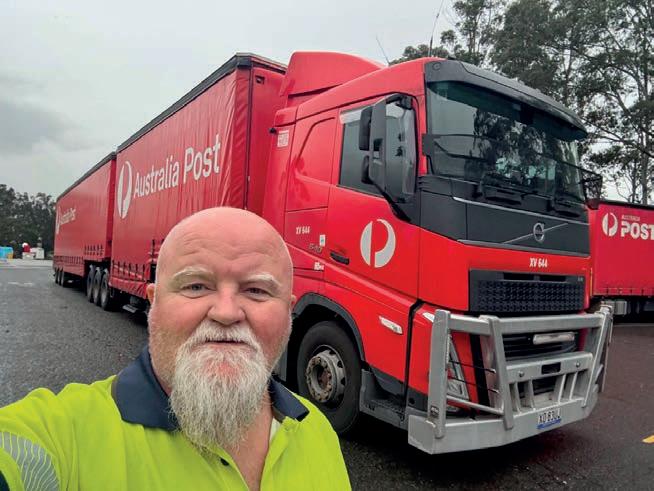
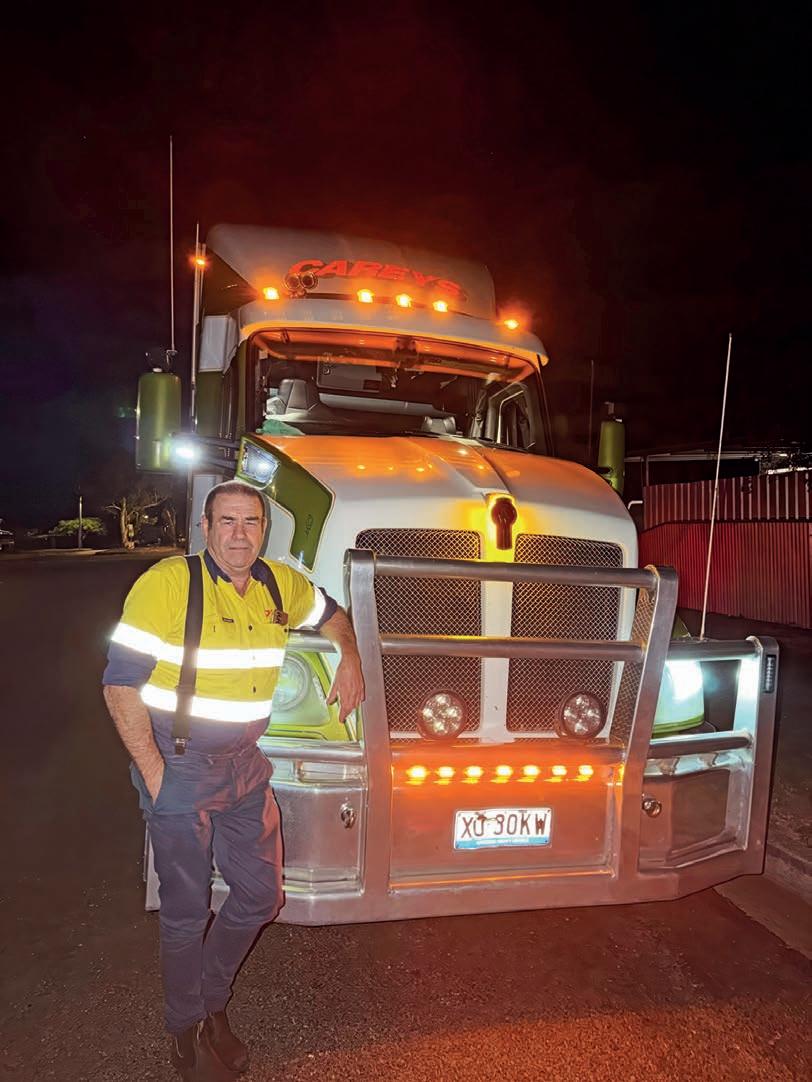
Truckin in the Topics/Spy on the Road: Alf Wilson, 0408 009 301
David Vile, Graham Harsant, Geoff Middleton, Jonathan Wallis, Tim Oakes.
Big Rigs National Road Transport Newspaper is published by Prime Creative Media. It is the largest circulated fortnightly truck publication in Australia with 22,248* copies per fortnight.
*Average circulation per issue in 2025
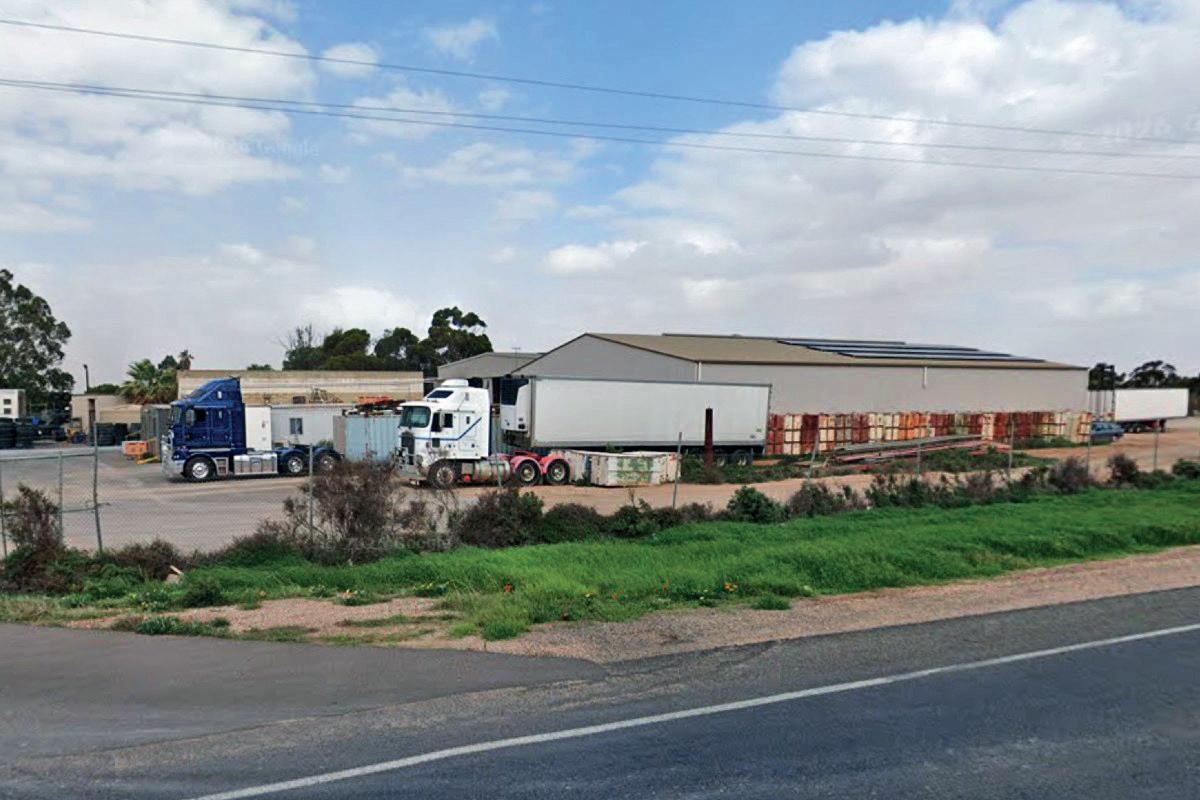
THE future of South Australian business Chris Evans Transport is in the hands of administrators after the sudden death of its sole director and shareholder in April.
Jane Evans, 69, and her husband Chris Evans, 68, were rushed to hospital on April 21 after the Dodge ute they were travelling in allegedly struck a gate while attempting to board the Lyrup Ferry to cross the Murray River.
Jane died a short time after arriving at hospital.
Jane’s death prompted a series of legal steps, including the appointment of administrators, SV Partners, to oversee the company which runs a fleet of 30 prime movers, employs about 25 staff and is known for delivering primary produce between Riverland, Melbourne and Adelaide.
The validity of the admin-
Administrators steer future of SA family fleet Regulator opens access to intercept outcomes
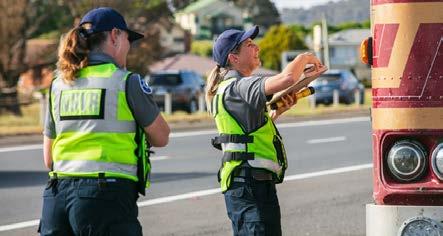
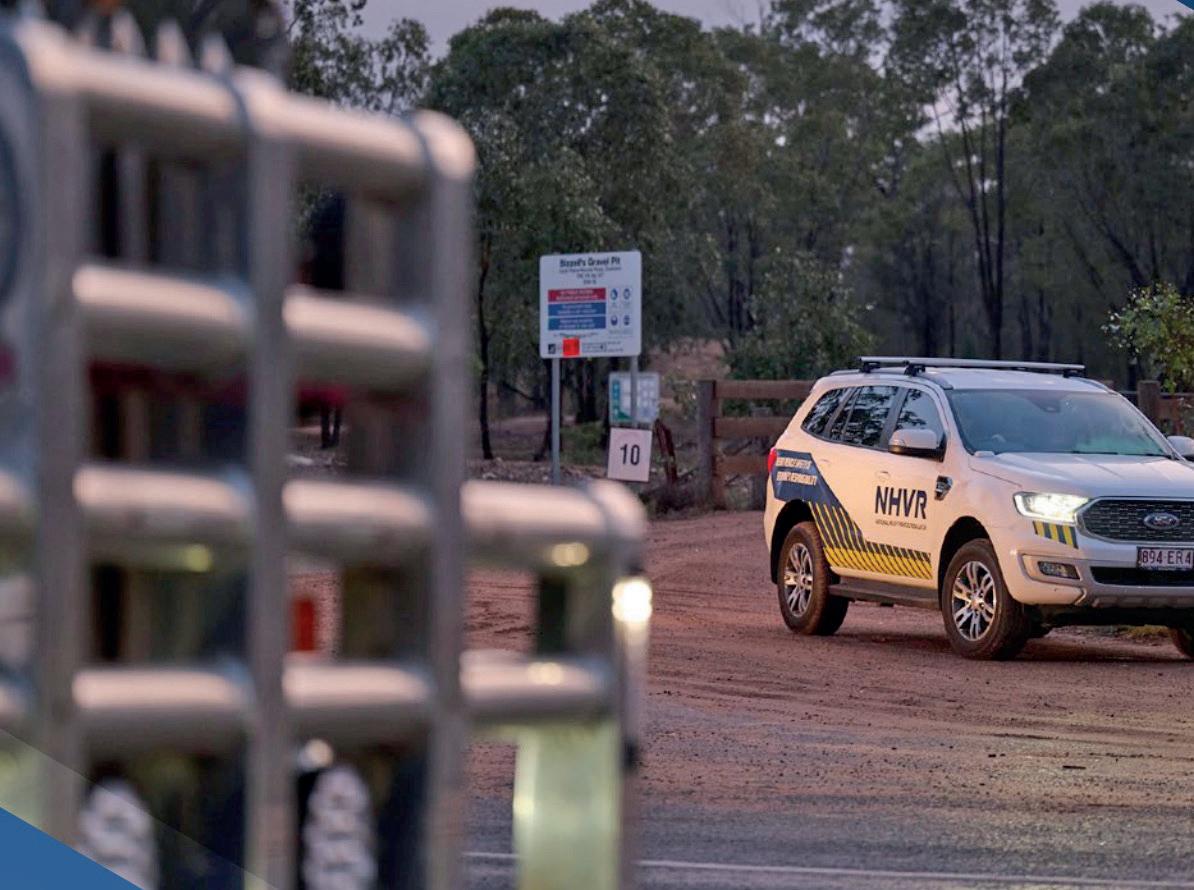
THE National Heavy Vehicle Regulator (NHVR) says operators can take a more proactive approach to managing their safety with the wider release of one of its new online tools.
The regulator says its free Intercept Outcomes Tool (IOT) provides users with visibility of intercepts and outcomes on their vehicles, arming operators with data to better manage their safety risks and
istrators’ appointment was questioned by Chris Evans and his legal team, prompting administrators to seek confirmation of their footing via
a Federal Court Hearing on June 5.
The Federal Court Judge’s ruling, released on June 9, confirmed the administrators’
appointment would stand.
SV Partners administrator Matthew Ormsby was quoted in The Advertiser on June 11 as saying the Court decision
maintain their fleets.
Earlier this year, the NHVR gave accredited operators within its NHVR Go platform initial access to the tool, which is now available to all industry.
NHVR Chief Operations Officer Paul Salvati said industry feedback on the IOT had been positive since it first launched in April.
“Operators are reporting seeing significant value in
the tool as it enables them to view intercepts and outcomes before their drivers return to base, when previously they would not have been made aware so quickly and sometimes, not at all,” Salvati said.
“Following industry feedback, we made some enhancements to the platform to make it easier for operators to access this information. Now we have released this tool to a much wider audience.
“By giving operators important intercept information in a timely manner, we can help them be proactive and rectify any non-compliance issues or trends quickly.”
The IOT allows registered operators to view details of NHVR-conducted intercepts and outcomes involving vehicles linked to their NHVR Go account. This also includes date and time of intercepts, state location and offence cat-
would enable the administrators to take next steps.
“The business is trading as normal and we’re now looking to sell the business,” Ormsby said.
“We haven’t formally started the process yet, but we’ve had a lot of people interested in the business and we will continue those discussions,” he said.
Big Rigs approached SV Partners for further comment, with none received at the time of publication.
Court proceedings arising from the April 21 incident continued on June 15 when Christopher Robin Evans appeared in Berri Magistrates Court charged with causing death by careless driving and driving unlicensed.
He did not enter any pleas and the case was adjourned to July.
egory and intervention type if an offence is detected.
It provides information including vehicle registration number, VIN or chassis number, and where available, the vehicle make and model. All information is de-identified to protect driver privacy, with NHVR-issued compliance data updated every 24 hours to ensure operators are working with accurate, current information.
August 1, 2026
Truckie fears law changes miss the mark
BY JAMES GRAHAM
VETERAN truckie Rod Hannifey fears that the changes to the Heavy Vehicle National Law (HVNL) from August 1 could push drivers out of the industry and make recruitment even harder.
Hannifey has questioned the justification for significant increases to some penalties, along with proposed fatigue management changes that he believes will make compliance more difficult without improving road safety.
The long-time industry advocate said he was particularly concerned about proposed penalty increases relating to fatigue and work diary compliance, arguing the financial consequences could be devastating for drivers and their families.
“I cannot see any justification for the level of increase,” Hannifey told Big Rigs
“Would you have $10,000 to pay a fine? I don’t know too many truck drivers that would.”
He said penalties of that magnitude would affect far more than the individual driver.
“If someone gets one of those
fines, it’s not just the driver, it’s going to be their wife and kids who won’t be able to eat, or they won’t be able to pay their bills. Where are you going to turn up with that sort of money?” he said.
Hannifey also fears some of the proposed offences could be open to interpretation by enforcement officers.
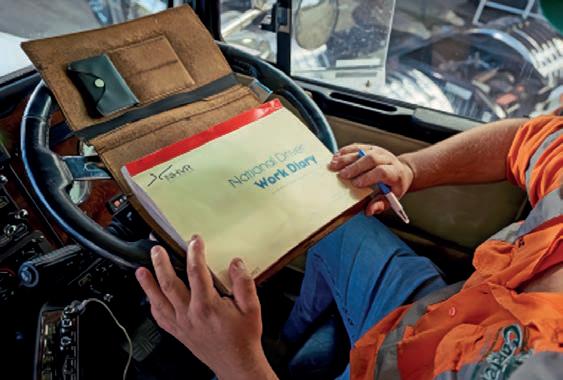
He pointed to penalties for false electronic work diary entries of up to $8000, questioning how drivers would be able to defend themselves if minor discrepancies were deemed deliberate breaches.
“What happens when you’re driving down the road, you’re busting for a piss, you pull up, you run into the loo, you come back out and think, ‘That was 10 minutes ago, I’m not giving that away’, and you write your time back 10 minutes?” he said.
“How do they not say, anything that doesn’t match to the second is a false entry? So, I cannot see any justification for the level of increase.”
Hannifey believes the changes that see some penalties rise as high as $26,610 risk worsening the industry’s ongoing driver shortage by making trucking a less attractive career option.
“We can’t get drivers now,” he said.
“Do you think anybody is going to want to drive trucks if they believe they could be facing a $26,000 fine?
“This is going to scare people from entering the industry.”
Drawing on his own experiences on the road, Hannifey said drivers are often judged against rules that fail to account for circumstances beyond their control.
“I can’t control the people who load me. I can’t control the delays in the traffic coming out of Melbourne. I can’t control the potholes,” he said.
He recently found himself arriving at a rest stop with only minutes remaining before reaching his legal work limits after being delayed by traffic and road conditions.
For Hannifey, the central issue is not opposition to safety reforms but a lack of consultation and transparency around how the changes were developed.
“They don’t consult with us, and they don’t listen to us. If they turn around and say we got 5000 fatigue-related offences last year and that’s their reasoning, then we want a breakdown of those 5000 of
fences. We want to know how many were trivial and how many weren’t.”
Hannifey said a major concern is the new HVNL fatigue management requirement contained within recently released templates.
From August 1, the National Heavy Vehicle Accreditation Scheme (NHVAS) is transitioning to the Heavy Vehicle Accreditation (HVA) scheme. This will also see the phasing out of Basic Fatigue Management (BFM) and Advanced Fatigue Management (AFM) accreditation. These will be replaced with a single Alternative Compliance Accreditation – Fatigue (ACA-F).
The NHVR said applying for ACA-F requires a safety management system to be developed and implemented through General Safety Accreditation. Hannifey said the changes seem to require drivers operating under the BFM 14-day rule to take a minimum 30-hour reset break that includes a midnight-to-6am period, potentially extending time off the road well beyond 30 hours.
“If you get home at 12.05am on a Friday night, that reset doesn’t start until midnight
Saturday,” he said.
“You could end up sitting at home for 60 hours and again, there is no reason, there is no justification. I’ve never heard of anything that justifies that change. I don’t know why 24 hours is not enough and it went to 30. We were never told or asked about this 30hour rule.”
He said he now intends working with his employer, Rod Pilon Transport, to
develop a bespoke table that could potentially be adopted more broadly.
“It’ll go out to our drivers, and we will apply for it as soon as we can, maybe within the next three weeks, as a trial.”
NHVR has confirmed that operators may also develop their own bespoke table for assessment. Turn to pages 12-13 for more details on the changes ahead.
Interstate driver Rod Hannifey says he can’t see the correlation between the penalty increases and improving safety. Image: Sarah Barnsley
August 1, 2026
Shearer says don’t rush HVNL changes
A leading Australian trucking official says operators should resist pressure to rush into the new Heavy Vehicle National Law (HVNL) accreditation system, warning there are still too many unanswered questions.
With the new framework due to begin on August 1, Steve Shearer, the Executive Officer of the South Australian Road Transport Association (SARTA), said many operators remain confused about what the reforms will mean in practice and are taking a cautious approach.
He believes most accredited operators will delay moving to the new Heavy Vehicle Accreditation (HVA) scheme for a s long as possible while the industry works through the practical implications.
“I think the vast majority of accredited operators are taking the smart decision to delay transition for as long as they can,” Shearer told Big Rigs
“Everybody is looking at the new standards and scratching their head thinking, ‘What does this actually mean? What do I actually have to do?’”
Among the biggest concerns are the interaction between the new accreditation stan-
dards, safety management systems and the Master Code.
Operators are questioning what documentation they will need, which controls must be implemented and how compliance will ultimately be judged.
Shearer said SARTA is advising members not to become early adopters unless absolutely necessary.
“Don’t rush,” he said.
“Let’s see how it works for other people first. Let’s see what wrinkles get ironed out.”
He said many operators will have between 12 months and two-and-a-half years before they are required to transition and should use that time wisely.
accreditation itself.
customers and legal advisers are already beginning to de mand evidence that transport
providers comply with the Master Code and emerging safety expectations, despite the new arrangements not yet being fully implemented.
He fears some customers could begin imposing additional audits and compliance requirements on smaller operators.
“We’re saying, ‘Hang on, the law doesn’t start until August 1, and many operators won’t transition for another couple of years,’” he said.
“The Master Code is guidance, not mandatory, but some client’s corporate advisors and lawyers are starting to imply something different. The test in the HVNL remains that
a re in the Master Code.”
The changes surrounding psychosocial hazards and mental health obligations are also creating uncertainty.
Shearer said operators are now being asked to consider issues that extend well beyond traditional fatigue management requirements.
“Today, fitness for duty is largely about whether a driver has had proper rest and sleep,” he said.
“Under the new regime, people are asking how operators a re supposed to assess somebody’s mental health, financial pressures or personal circumstances.”
He said smaller family operators could struggle to understand exactly what is expected of them.
“We’ve got mum-and-dad operators with a couple of trucks. They’re not set up like airlines or large corporations.”
At the same time, industry anger over proposed increases to HVNL penalties continues to grow.
Shearer said members remain deeply frustrated by the scale of some of the increases.
“Everybody’s really pissed off,” he said.
“Most people are seeing it
as a money grab.”
Shearer said increasing penalties alone would not improve compliance and large penalties could create unintended consequences, particularly for drivers facing significant financial pressure.
He said a substantial fine issued early in a trip could leave a driver worrying about household bills and family finances for days while still behind the wheel.
“The enforcement system has just ripped away half of their wages and then the NHVR talk about psychosocial risks and mental health, after just adding significantly to the driver’s mental health issues,” he said.
SARTA has argued for a more graduated approach, where repeat offenders face escalating penalties while genuine mistakes attract lower-level sanctions.
Shearer also believes regulators should focus more heavily on education and collaboration.
“If they work with operators who are willing to improve, that could be very positive,” he said.
“But at the moment, there’s a perception that the NHVR is
determined to carry out some public hangings to send a message.
“In our view they’re missing an opportunity to work with operators and help them improve.”
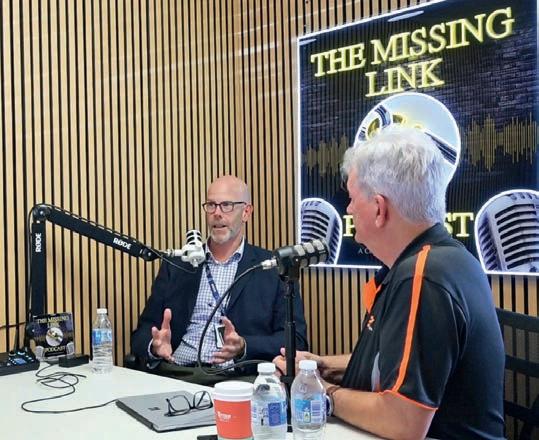
Shearer, however, was encouraged by the recent comments made by Paul Alsbury in a recent episode of Copy Southbound’s The Missing Link Podcast, on which he also appeared.
The NHVR’s Executive Director Statutory Compliance told listeners that the regulator is now introducing a team to work with operators to introduce the right systems.
“So not investigators, they’re people with a different set of skills, and in relation to highrisk operators,” Alsbury said.
“Going in and just having a good look at their safety management systems, the systems, processes, practices that they have in their business to manage risk.
“I often think if you don’t have a safety management system, whether it’s called a safety management system, or it’s called something else, how are you discharging your primary safety duty under the Heavy Vehicle National Law?”
$1300 diary fines ignite industry debate
BY JAMES GRAHAM
A NSW operator says a driver fined $1300 for work diary errors highlights the gap between promised reforms and the continued punishment of minor administrative mistakes.
True Ross-Sawrey, Business Manager at Ross Transport and Director of her own small tipper fleet, TR Business Services, said the driver was fined on the M7 by the NSW Highway Patrol on June 12 for allegedly failing to write his BFM number on the front page and a “misleading work diary” entry.
Police alleged the latter ticket was due to the line connecting a work period to a rest period being not completely joined, even though the work and rest times themselves were correctly recorded, countered Ross-Sawrey.
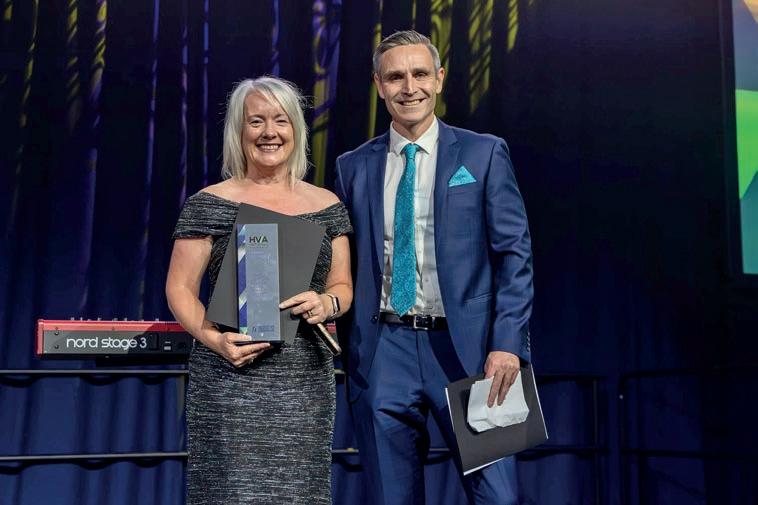
“This is exactly the type of overzealous enforcement that frustrates drivers and pushes good people out of the industry,” the Women in Industry Excellence in Transport winner wrote on the Ross Transport Facebook page.
“The industry is crying out for practical, risk-based en-
forcement. Instead, drivers are being punished for clerical errors that have absolutely no bearing on fatigue management or road safety.
“It’s no wonder so many drivers are fed up.”
The incident comes as operators try to understand the practical implications of the new Heavy Vehicle National Law framework and accreditation changes being rolled out from August 1.
Ross-Sawrey told Big Rigs that uncertainty rather than opposition was driving much of the industry’s concern.
“I guess there’s probably still a bit of worry from the driver’s perspective and our operators, just because we haven’t really seen it play out yet,” she said.
“I don’t think fines are an accurate representation for safety.
“I think things like administrative errors, and things like that, should not be a fine.
“I make administrative errors. Every week I’d make some sort of error that’s minor and doesn’t affect the end outcome of doing my job, or the safety of running the business.”
Ross-Sawrey also questioned whether omissions such as
failing to complete a section of a diary, not recording a particular detail or failing to total hours should attract significant financial penalties when the driver’s work and rest history could still be clearly understood.
“If you can clearly see what they’ve done, the locations they were at and the times they’ve worked, I just see the other errors that come with it as unreasonable,” she said.
Ross-Sawrey said the incident had strengthened her belief that police should not be responsible for enforcing many heavy vehicle-specific laws, arguing that the National Heavy Vehicle Regulator (NHVR) is better placed to deal with work diaries, fatigue and compliance matters.
She said her dealings with NHVR officers had become increasingly education-focused in recent years, but questioned whether highway patrol officers, who deal with a broad range of policing duties, had the same level of heavy vehicle knowledge.
“The NHVR enforcement team have a lot more education around heavy vehicles, maintenance, mass and fatigue. I just think they’re in a
better position to comment on that. Our interactions over the last couple of years have been a lot more education focused with the NHVR, and we haven’t got stupid fines for stuff like that.
“They have made significant improvements in the way they deal with drivers and their onroad compliance.”
Ross-Sawrey said she believed many administrative issues could be resolved through education rather than enforce-
D ISRI SEATS
SYDNEY
510 Victoria Street, Wetherill Park NSW 2164 Ph. 02 9756 6199, email: isri@isri.com.au, www.isri.com.au
BRISBANE
and move on if there was no underlying safety risk.
“If there’s no direct link to safety, why are they getting applied?
“If they’re clearly breaching their hours, GPS time and stuff like that, it’s a very different situation.”
A lthough Ross-Sawrey said many operators were still trying to understand how the H VNL changes would work in practice, she believes some reforms could prove benefi-
THIS IS EXACTLY THE TYPE OF OVERZEALOUS ENFORCEMENT THAT FRUSTRATES DRIVERS AND PUSHES
GOOD PEOPLE OUT OF THE INDUSTRY.
the stated intention to place less emphasis on minor work diary errors. She also expects electronic work diaries to help reduce administrative mistakes.
Ross Transport has already moved a significant portion of its fleet onto EWDs and hopes to have all vehicles transitioned within the next year.
“I’ve got nine or 10 now using an EWD and hopefully by next year we’ll have the whole fleet over,” she said.
“Purely from the administrative errors, I think it would save my drivers a lot of money and save us a lot of time.”
Unit 2/13 Hinkler Ave, Rutherford NSW 2320 email: sales@hvss.com.au www.isri.com.au
Third-generation operator True Ross-Sawrey, left, with her grandmother Fran and father Ross. Image: Ross Transport
Excise extension softens blow, says ATA
TRUCKING operators are to receive a month-long reprieve at the bowsers, with the fuel tax credit rate also remaining unchanged during that period.
A 32 cents per litre (cpl) excise reduction introduced in April in response to rising prices following the Iran conflict had been due to end on July 1.
But the federal government announced late last month that it would extend the relief for a further month, albeit at the reduced rate of 16 cpl.
The heavy vehicle road user charge, which was reduced to zero, will rise to 16 cpl until August 2, but operators can claim the same fuel tax credit rate of 20.6 cpl that has been in place for the last three months.
Fuel tax credits for heavy vehicles operating on public roads are calculated by subtracting the road user charge from the fuel excise rate.
From July 1, the temporary rates of 36.6 cpl excise and 16 cpl road user charge produce a credit of 20.6 cpl.
The staged reduction in fuel excise discounts is designed to avoid another round of panic buying, as motorists stock up on cheap fuel in the final weeks before the price cuts end.
“By tapering off the fuel tax cut, this will also help to manage demand at service
stations towards the end of the month,” the federal government said in a statement.
ATA CEO Mathew Munro said the extension recognised that trucking businesses would have had difficulty managing such a large increase.
“There are trucking businesses teetering on the brink, a nd such a large jump could have been disastrous for them,” Munro said.
Ben-Ari/stock.adobe.com
“Trucking businesses and their customers will still face an increase in the effective tax rate on fuel, but it will be more manageable.
“The ATA would have preferred to see the full reduction extended until the crisis is completely over, but the government’s decision will soften the blow and give it the scope to extend the timing of further increases if there are delays in the US-Iran negoti-
ations under the MoU.”
The Australian Logistics Council (ALC) also welcomed the decision to extend f uel excise relief through July, saying the measure will provide immediate relief for freight transport operators.
ALC CEO Dr Hermione Parsons said the reduction in the Heavy Vehicle Road User Charge for July was particularly important for road freight operators, including
smaller businesses with limited capacity to absorb sudden f uel price increases.
“Road freight connects ports, farms, warehouses, shops, hospitals, construction sites and households,” Dr Parsons said.
“Every Australian relies on freight, whether they see it or not. Keeping freight costs under control is part of keeping household costs under control.”
ALC said the July extension is welcome, but temporary relief must sit alongside longer-term work on fuel security and supply chain resilience.
“This is relief, not a solution,” Dr Parsons said.
“Fuel markets remain volatile, and freight businesses are still carrying higher operating costs.
“Australia needs a stronger framework for managing fuel disruption.”
The Queensland Trucking Association agreed that the excise extension is welcome relief, but also not a longterm solution.
“Fuel remains one of the biggest and most unpredictable costs for road transport operators. Temporary reductions help, but they do not address the structural challenges facing the industry,” said QTA CEO Gary Mahon.
“Road transport needs a
clear future-proofing plan that deals with fuel security, fair cost recovery, and practical support for operators to assess alternative fuels and low-emission fleet options.
“The industry cannot plan, invest or transition on shortterm relief alone. Road transport keeps Australia moving. It needs policy certainty that reflects that essential role.”
According to price comparison app FuelRadar, the current national average price of diesel at deadline for this issue was 190.4 cpl.
The terminal gate price is even lower. The Australian Institute of Petroleum reported on June 7 that the weekly average national terminal gate price for diesel for the week ending June 5, 2026, fell to 189.7 cpl, below the $2 per litre levy trigger.
This meant the fuel cost recovery obligations were no longer triggered from June 7, according to the Fair Work Ombudsman.
The Fair Work Commission (FWC) is currently considering whether the fuel cost recovery obligations should again apply following the recent price movements.
On Friday, June 19, the FWC issued a statement and invited submissions from affected parties to inform its decision. Submissions were due to close by 4 pm (AEST), Friday, July 3.
10 more green reflector sites in NSW
NEW South Wales has opened 10 more green reflector rest area sites for truckies along sections of the Golden and New England Highways in the Upper Hunter region.
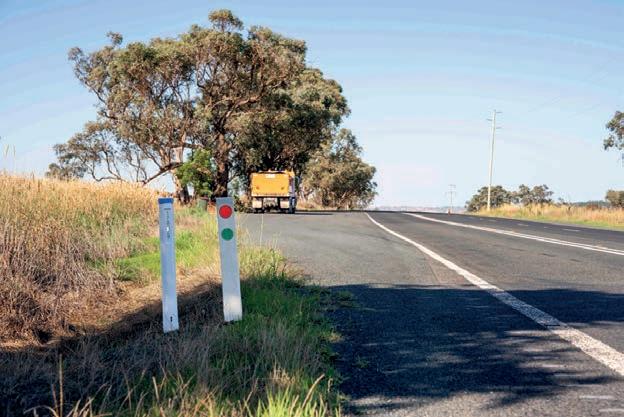
The green reflector markers
– a concept first devised by truckie Rod Hannifey – are installed on roadside guideposts at the approach to informal heavy vehicle rest areas, providing drivers with a simple visual cue that a safe place to pull over is nearby.
The sites use a 3-2-1 guidepost system, with three green reflectors warning of a stopping bay 500m ahead, two at 250m and one marking the entrance.
The latest sites are located at:
• Golden Highway: 6 kilometres east of Denman
• Golden Highway: 4 kilometres east of Mount Thorley
• Golden Highway: 10 kilometres east of Warkworth
• New England Highway: 6 kilometres west of Ardglen
• New England Highway at Liddell
• New England Highway: 14 kilometres west of Liddell
• New England Highway: 18 kilometres west of Liddell
• New England Highway: 4 kilometres east of Muswellbrook
• New England Highway: 3 kilometres north of Wingen
• New England Highway: 1 kilometre south of Murulla
The rollout builds on the installation of 14 green reflector sites across southern NSW last year and forms part of the Minns government’s commitment to improving safety and rest opportunities for heavy vehicle operators across the state. Hannifey said last year that more green reflector sites was a big win for heavy vehicle drivers.
“Green reflector sites have made a real difference out on the road. Another driver told me it had saved their life. It’s such a simple idea, but it’s already saving lives,” Hannifey said.
“There just aren’t enough rest stops for truck drivers across Australia, so this initiative in NSW is a huge help. It gives drivers a clear signal of where they can safely pull up and take a break.
“This project is definitely welcomed by the industry, and we’re looking forward to seeing more of these sites rolled out over time.”
The work is being delivered through the NSW Government’s $11.9 million Heavy Vehicle Rest Stop Minor Works Program, which is upgrading rest areas across the state through improved lighting, pedestrian safety measures, signage and amenities.
The NSW Government said it will continue working closely with industry to identify further opportunities for new reflector sites and improvements to heavy vehicle rest areas across the state.
Work has also started on $1 million of upgrades to both the eastbound and west-
Ravensworth rest areas at Maude, NSW.
A joint spend from the Australian and NSW governments will deliver new toilet blocks, improved lighting and better amenities, said Transport for NSW (TfNSW)
Both sites expected to be completed by late August, weather permitting. TfNSW said one rest area will remain open throughout the work.
Meanwhile, the $2.4 mil lion upgrade of the south bound Kyeamba Gap East Rest Area between Tarcutta and Holbrook on the Hume Highway is close to comple tion, with the area expected to reopen on July 31.
The work will transform an existing basic stop into a modern facility featuring toilets, disability accessible amenities, picnic areas, im proved lighting, two heavy vehicle parking lanes, drain age upgrades, new signage and upgraded safety barriers.
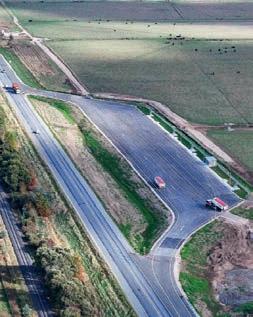
In other rest area news for truckies, the new Curra Rest Area on the Bruce Highway north of Gympie in Queensland officially opened on June 19.
Located at the Curra interchange, the facility includes parking for up to 25 cars and 16 heavy vehicles, as well as toilets, picnic shelters, ac-
cessible amenities and an off-leash dog area. With the opening of the new facility, the Department of Transport and Main Roads told Big Rigs it will close the existing Gunalda rest area to the north, which no longer meets current design standards or capacity needs.
New Tassie rest area opens for truckies
A new heavy vehicle rest area in Tasmania has opened on the Bass Highway, west of Westbury, with a second to begin construction later this year.
The newly opened eastbound rest area features capacity for up to 15 heavy vehicles, toilets, bins, shelter, lighting, and a deceleration and slip lane for ease of access. It is located between
Exton and Hagley.
Tenders for construction of the second rest a rea, that will be located on Bass Highway, Devonport-bound, closed on June 24. Once constructed, this rest area will feature space for another 15 heavy vehicles, along with toilets and other facilities.
Both projects are funded under the Safer Local Roads
and Infrastructure Program, with the Australian Government committing over $9.6 million and the Tasmanian Government committing the remaining funding for a combined total of over $12 million for t he two projects.
“By investing in much-needed rest stops, we will ensure that our truckies get home safely to their
loved ones,” said Federal Minister for Regional Development, Local Government and Territories, Kristy McBain MP.
Tasmanian Minister for Infrastructure and Transport, Kerry Vincent, added, “The Westbury heavy vehicle rest area provides our state’s heavy vehicle operators with a new space to pull over, rest, and recharge
on the key freight route between Devonport, Launceston, and Hobart – and the feedback from drivers has been positive already.
“This new facility demonstrates the Tasmanian Government’s commitment to delivering rest areas that support mandatory rest breaks for heavy vehicle drivers travelling on Tasmania’s major freight routes.”
bound
Industry groups said temporary relief must sit alongside longer-term work on fuel security and supply chain resilience. Image: Rafael
Truckies now have 10 more parking bays in the Upper Hunter.
Spread
EDITOR JAMES GRAHAM
The technology is improving and major fleets are beginning to roll out battery-powered trucks, helped by government grants and infrastructure funding. Yet for the owner-driver or small family fleet, the hurdles are still too high. The biggest issue isn’t whether EVs can do the job. It’s whether smaller operators can afford the risk. Purchase prices remain high, charging infrastructure is limited and there is still no established second-hand market. The large transport companies can trial new tech across multiple vehicles and absorb the costs if things go awry. Smaller operators don’t have that luxury.
Support has largely flowed towards the big end of town, while thousands watch from the sidelines. If governments want wider adoption, they need to help the little guy too.
Letters to the Editor
AS the wife of a truck driver, I am appalled by the latest increases in penalty fees being imposed on drivers across Australia.
Many of these fines relate to what are often minor administrative errors – mistakes that workers in almost any industry could make during the course of a busy workday.
Simple errors such as a spelling mistake, an incorrect date, or a line not being perfectly ruled can now result in penalties that seem completely disproportionate to the offence.
I understand that laws and regulations exist for a reason, and I fully support fatigue management and road safety.
There are times when officers may exercise discretion and issue a warning for an honest mistake, but that is not always the case. The law is the law – I understand that.
What concerns me is the growing financial burden being placed on an industry that is already under immense pressure.
Truck drivers are constantly dealing with tight schedules, rising operating costs, delivery deadlines, compliance requirements, and the ongoing challenge of securing and maintaining contracts.
For many operators, simply making a living has become
a rat race. The last thing they need is another financial blow for minor paperwork errors that have no direct impact on road safety.
Fatigue management is important, but how are drivers expected to properly rest when they are carrying the weight of these pressures every day?
The constant fear of making an administrative mistake, combined with the financial consequences, creates additional stress not only for drivers but also for their families. It becomes a chain reaction of worry, both emotionally and financially.
We want our drivers to be well-rested, focused, and safe. We want them concentrating on what they do best – driving and keeping Australia moving. Sadly, trucking is no longer the industry it once was. Many
families no longer encourage their children to enter the profession because they see the pressures, risks, and increasing burdens faced by drivers every day.
Truck drivers deserve respect, support, and fair treatment – not another kick while they’re already carrying the load for the rest of the country.
Because the reality is simple: WITHOUT TRUCKS, AUSTRALIA STOPS!!
Yet it often feels like drivers are only recognised when the shelves are empty, freight stops moving, and the country starts to feel the consequences.
Our truck drivers deserve better.
My family and friends deserve better.
Lisa Milnes-Thurling
MANY of my school holidays in my formative years were spent in the company of my grandfather, while he traversed the boundaries of the various Riverina sheep stations where he worked, applying animal husbandry to the livestock.
Time moved much slower in the 1960s and life was often a series of repetitive rituals from the early morning rise, the milking of the house cow, the cooked breakfast, the harnessing of the horse and sulky and choosing of the working dogs for the day’s work.
A non-negotiable ritual was stopping for lunch at precisely midday and tuning the transistor radio to the local ABC for the Country Hour.
Even test cricket had to stand aside when the Country Hour commenced. While the ABC is often criticised nowadays as a woke and leftist broadcaster the Country Hour has always catered to a strongly conservative rural audience and conveyed relevant information about market trends for livestock and grains and other agricultural commodities as well as the all-important weather predictions and reports.
Fast forward 60 years and I still often find myself adhering to those often-neglected rituals by tuning the truck radio into the Country Hour, as I did on
Monday, June 1.
I was intrigued to hear Victorian presenter Warwick Long convey to his audience that it was World Milk Day and the commencement of the Victorian Dairy Conference.
Most importantly, it was also the day when the major milk processors and factories released the minimum prices that would apply to purchases of milk from suppliers and farmers for the next 12 months.
These prices could vary between the various processors and factories but would give farmers and suppliers a starting point to negotiate the best outcomes for the coming 12 months.
It strikes me as being beyond ironic that when an organisation as conservative as the dairy industry can accept that a minimum price for their commodity is an essential part of the bargaining process and a beginning for negotiations, that the transport industry, so often portrayed as being dominated by tough and resilient operators can go into a complete and shivering meltdown any time that the need for the introduction of any sort of a minimum rate is proposed.
Immediately the spectre of the reincarnation of the Road Safety Remuneration Tribunal
(RSRT) is invoked and strikes fear and trepidation into a largely misinformed demographic.
I was gratified to read veteran owner-driver and columnist Frank Black, in your sister publication, OwnerDriver in the June issue brave enough to extol that while certainly not perfect, the RSRT recognised the link between operating costs, safety and fair pay. As far back as the legendary Razorback blockade, the need for a “fair and equitable rate” was recognised as being the most important in the list of grievances presented by the delegation and while the blockade successfully led to the removal of road tax, that was well down the list of grievances.
In a world far removed from the rituals of the 1960s, if our industry has not developed the maturity to have the discussions about rates without descending into the crazy angst and aggression of 2016, then we will continue to subject ourselves to being exploited by a customer base that holds no fear from any notion of chain of responsibility obligations intent on keeping us divided and conquered.
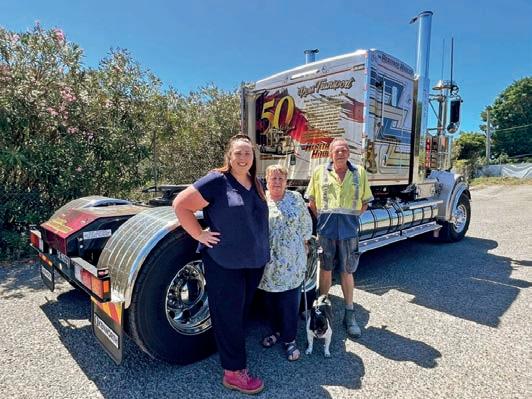
The couple has a long history in road freight transport. Image: Lisa Milnes-Thurling
IN BRIEF
UD welcomes new VP Volvo Group Australia (VGA) has appointed Cameron Bettany as Vice President, UD Trucks and Government Sales and Marketing.
The appointment brings together responsibility for UD Trucks and Government Sales under a unified leadership structure, reinforcing the company’s commitment to strengthening the UD Trucks brand, deepening government engagement, building strategic partnerships, and delivering sustainable long-term growth.
Bettany has been successfully leading UD Trucks Sales and Marketing in an acting capacity alongside his Government Sales portfolio, providing stability, continuity, and strong commercial leadership across both functions.
New Chinese light-duty DFAC Trucks has officially launched its Captain 45 range in Australia and unveiled a dealer network that will support the brand’s rollout across the country.
Distributed by the Australian-owned KRW Motor Group, the Chinese manufacturer has entered the market with a 4.5-tonne light-duty truck aimed at tradies, owner-drivers and small fleets looking to step up from utes and vans.
The Captain 45 is available in cab chassis form or as a locally developed WorkReady alloy tray variant, with introductory driveaway pricing from $59,995 and a seven-year, 250,000km warranty.
Able to be driven on a standard car licence at 4.5 tonnes GVM, the truck can also be upgraded to a 6-tonne GVM for operators holding a light rigid licence.
$190m congestion fix
NSW has announced an additional $190 million in the NSW Budget to the Windsor Road upgrade at Rouse Hill.
The road is used by over 30,000 motorists each day, with the upgrades aiming to help reduce congestion, by easing traffic pressure on local roads, improving safety and ensuring quicker and more reliable journeys.
The NSW Government’s contribution to the Windsor Road upgrade totals $200 million, matching the federal government’s $200 million commitment to the $400 million project.
Upgrades include intersection improvements and widening Windsor Road between Mile End Road and Commercial Road to three lanes plus a bus lane in each direction
Route’s $18.3m upgrade
Road safety upgrades have been completed along a key freight route in South Australia’s south-east, as part of the $18.3 million Southern Ports Highway Project.
The busy freight route between Robe and Clay Wells Road, Bray, has received a range of upgrades, including shoulder widening, vegetation management, pavement rehabilitation and resealing.
Safety barriers have also been installed along this section of the highway.
Linfox rolls out 26 heavy-duty electric trucks
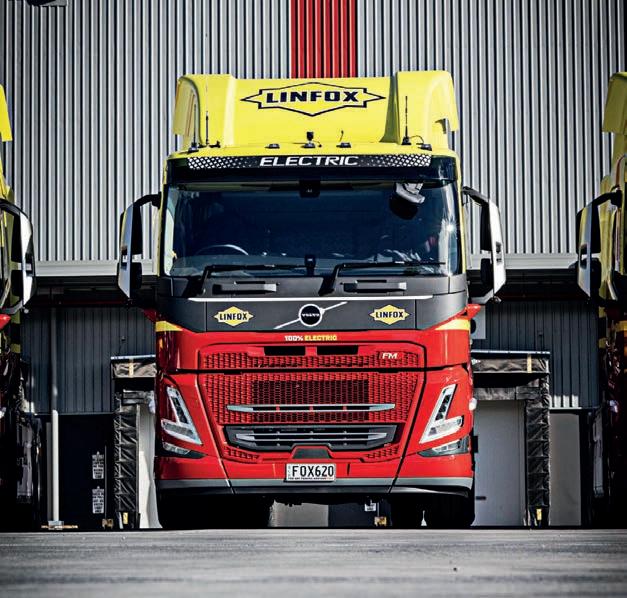
AUSTRALIA’S biggest private logistics company is rolling out a fleet of 26 heavy-duty Volvo electric trucks across Melbourne, Brisbane and Adelaide on some of the country’s busiest urban freight routes.
Linfox said it is putting the first of its battery-powered FM prime movers into service on heavy-hauling duties, including food and beverage distribution and integrated rail transport, it was announced last month.
The trucks will cover about 500km a day, replacing diesel vehicles on existing freight routes. Initial deployments will operate from Linfox’s Laverton North hub before expanding to Willawong in Queensland and the Adelaide rail freight terminal. The fleet will be supported by 25 chargers across the three sites.
Linfox said it will deploy 10 BEVs at Laverton North, six at Adelaide Railhead, and 10 at Willawong.
It’s expected that each vehicle will operate between two to three shifts per day, with charging scheduled overnight and between shifts. The charging infrastructure will be tailored to each site’s specific conditions and electric supply capacity.
The BEVs will service existing Linfox customers under current contractual agree-
ments. Deployment will focus on high impact use cases such as food distribution with refrigerated trailers, beverage transport, and integration with intermodal freight operations.
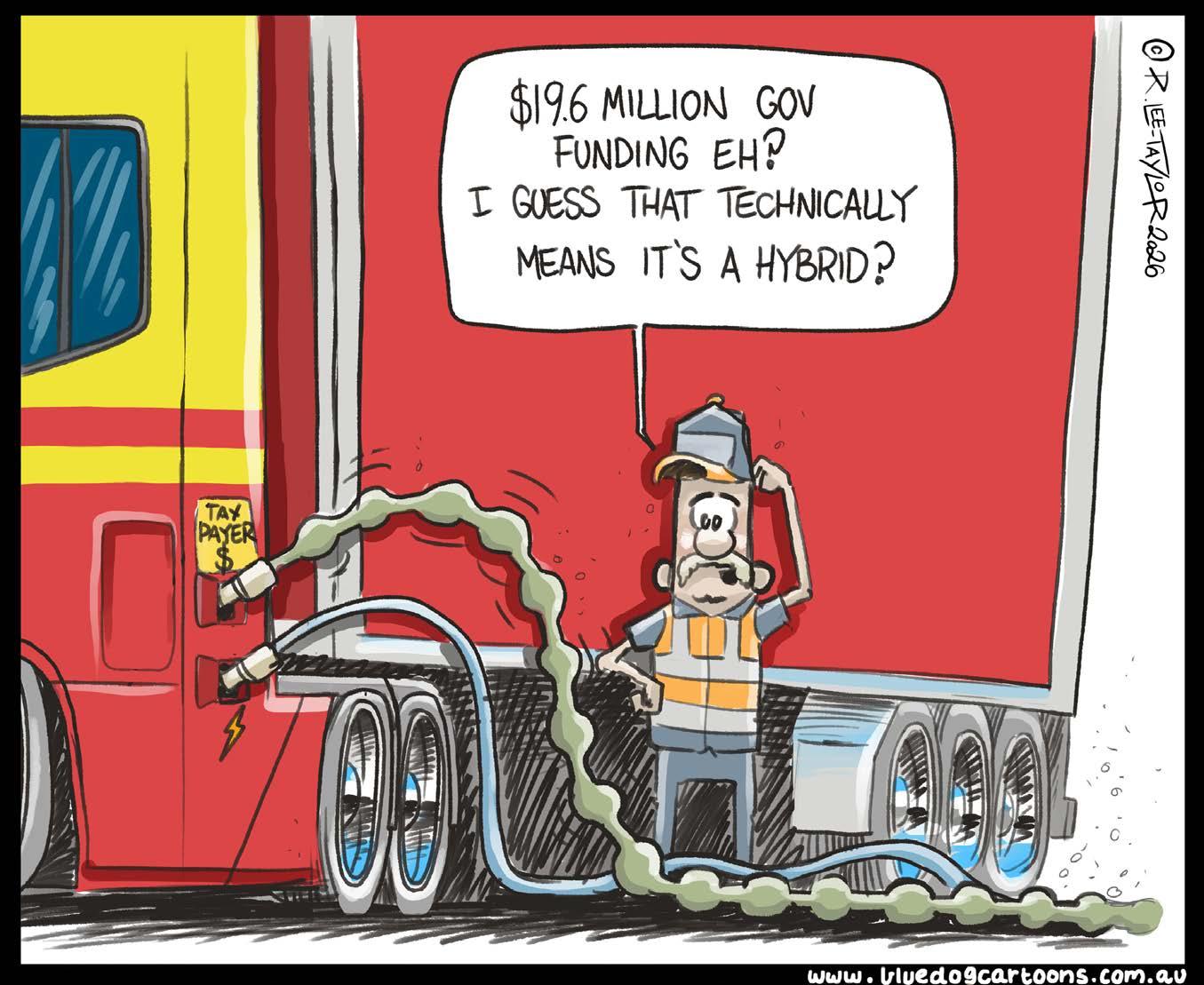
The rollout is part of Linfox’s heavy truck electrification project which is backed by $19.63 million from the Australian Renewable Energy Agency (ARENA) through its Driving the Nation Program.
The taxpayer-funded program includes targeted funding for heavy battery electric vehicles and charging infrastructure.
Minister for Climate Change and Energy Chris Bowen said the new electric truck fleet would help cut diesel bills, lower transport emissions and prove heavy haulage has a strong electric future.
“This investment in electric trucks, fast chargers and onsite solar systems could deliver the biggest cut to Linfox’s f uel use, emissions and running costs in its seven-decade history,” Minister Bowen said.
“When Linfox put in the biggest order for electric trucks in Australia, it was already the best decision for the future of the business and the 24,000 people it employs.
“And while governments across Australia continue
to secure Australia’s supply of diesel and exhaust fluid, Linfox has taken a huge step to secure its energy security and consistently low running costs – today and for decades to come.”
Minister for Infrastructure, Transport, Regional Devel opment and Local Govern ment Catherine King wel comed Linfox’s investment.
“Freight is the backbone of the Australian economy, but it has historically been heavi ly exposed to global fuel mar kets,” King said.
“Getting trucks on the road that are powered by electric ity will ensure costs are more consistent for consumers and make our supply chains more resilient.”
Linfox has been among the pioneers of electric truck ing in Australia, using Vol vo electric trucks to deliver beer and refrigerated goods around Melbourne since 2021.
Earlier last year, the company was given the green light from Transurban and the Department of Transport and Planning to expand the access of its Volvo electric prime movers on Melbourne’s road network.
“Linfox is excited to partner with Volvo in driving the f uture and leading sustainable logistics in Australia. Further electrifying our fleet sets the standard for us and
our customers and the entire industry,” said Linfox Executive Chairman, Peter Fox, at a 2025 handover event in Brisbane.
“As a proud Australian company, it is our great pleasure to take ownership of the first Australian-made heavy duty electric vehicles.”
According to media reports published this week, an internal memo from Linfox founder Lindsay Fox advised
staff that his son Peter Fox would retire as Executive Chairman of Linfox Logistics Australia and New Zealand and Linfox International. Peter Fox will be replaced by former Department of Defence secretary Dennis Richardson at the Australasian arm of the transport and logistics empire, and by former EY tax partner Trevor Hughes at Linfox International.
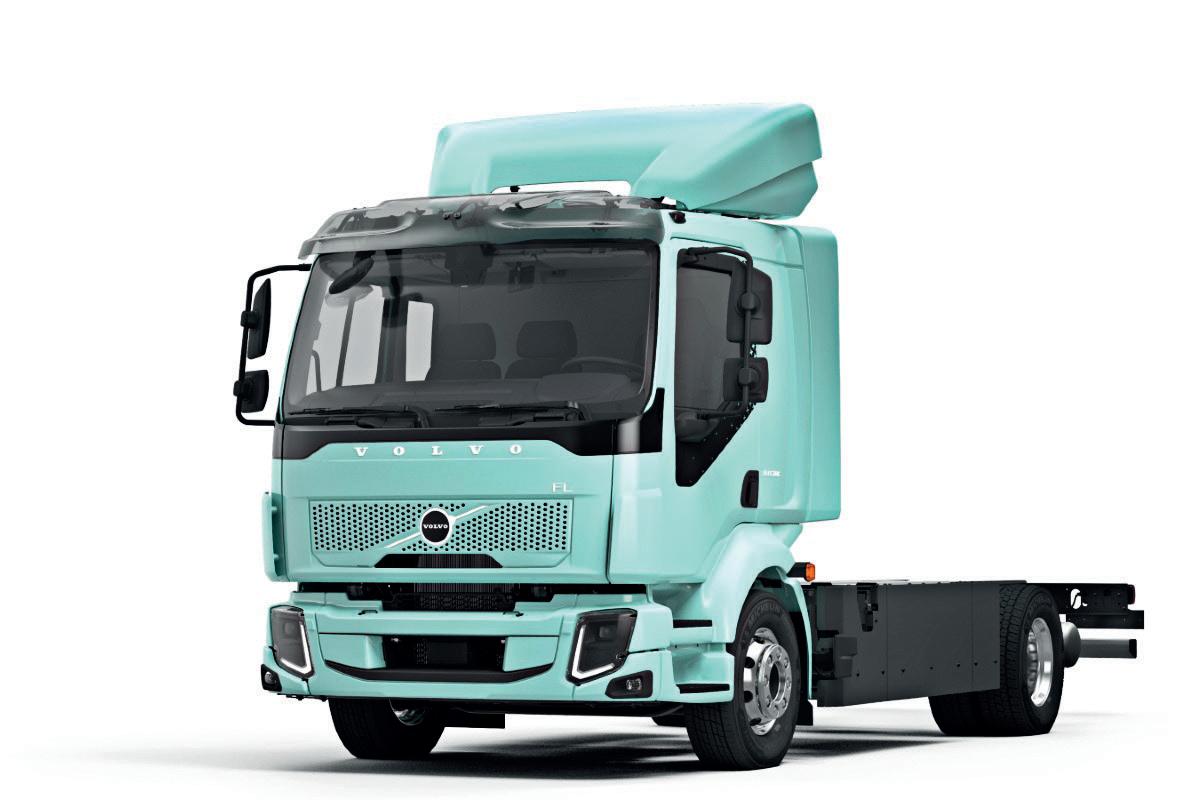
Volvo unveils lighter FL Electric for city work
and
4×2 rigid is the lightest elec
tric truck currently offered by Volvo in Australia and is designed to open up new opportunities in metropolitan distribution and act as a complement to the existing medi
Volvo says the latest FL Electric, which is available to order now, features a city-friendly, narrower 2400mm-wide cab and new lithium iron phosphate (LFP) battery technology, providing operators
try point into low-emissions transport.
The truck is fitted with 175kWh LFP battery packs and can be charged in as little as one hour using a 150kW fast charger. Power comes from a 180kW electric driveline paired with a two-speed automated transmission.
Wheelbase options range from 3800mm through to 6500mm, allowing the truck to be configured for a variety of body applications.
Volvo Trucks Australia Vice President Sales and Marketing Tom Chapman said the new model would provide operators with a practical pathway into electric transport.
“This new truck provides an attractive cost-effective entry to low-emissions final mile and urban distribution roles,” Chapman said.
“The option of LFP batteries provides a tough and robust energy storage option for operators that need flexibility in charging solutions.”
Volvo Group Australia Director of E-Mobility Solutions Tim Camilleri said the truck had been developed to meet growing demand for improved payload and productivity in urban freight operations.
“Many operators are chasing both payload and productivity and we feel this truck delivers both these attributes while retaining the same levels of safety and quality that the Volvo brand has become synonymous with,” Camilleri said.
Camilleri added that financing initiatives aimed at reducing the upfront cost of electric vehicles were helping make the technology more accessible to transport businesses.
“Thanks to the support of the Clean Energy Finance Commission and Volvo Financial Services, the barriers to entry are now much lower with our Electric Ready Lease. Meaning all businesses, regardless of size, can opt to go electric.”
ELECTRIC road freight operator New Energy Transport (NET) says it will have up to 20 electric prime movers on Australian roads by the end of 2026 after securing an initial $5 million funding boost to accelerate its expansion plans.
The Sydney-based company announced last month that the funding round, backed by investors including Jekara Group and facilitated by net
zero advisory firm Pollination, will be used to deploy the electric fleet and six mobile ultra-fast charging units across key freight corridors in NSW.
According to NET, the charging infrastructure can be installed and operational within 16 weeks, allowing the company to move more quickly than traditional fixed-site charging projects. The chargers are mounted
on frames rather than permanently fixed to the ground, enabling them to be relocated as freight demand shifts.
Co-CEO Daniel Bleakley said the company had seen increasing demand from major freight customers seeking lower-emission transport options.
NET claims the initial fleet and charging network will be capable of delivering up to 10,000 kilometres of
fully loaded linehaul freight movements each day, while reducing diesel consumption by around 2.5 million litres annually.
The announcement forms part of the company’s broader plans to establish a national electric freight network. Central to those plans is a proposed heavy electric trucking depot at Wilton in NSW, which NET says was recently selected under the federal
government’s Investor Front Door program as a project of national significance.
The depot is expected to open in late 2027 with capacity for 50 trucks initially, expanding to 200 vehicles over time.
NET is also pursuing plans for a network of electric freight depots linking Adelaide, Melbourne, Sydney, Canberra and Brisbane by 2031.
VOLVO Trucks Australia has expanded its local electric truck range with the launch of a new lighter-duty FL Electric aimed at urban freight
last-mile delivery operations.
The latest FL Electric features a city-friendly, narrower 2400mm-wide cab. Image: Volvo Trucks Australia
The Volvo FM Electric trucks will cover about 500km each day. Image: Volvo Group Australia
What to know about the amended
HVNL
Just weeks out from the updated Heavy Vehicle National Law, Big Rigs looks at some of the biggest changes and what they’ll mean for your business.
BY DANIELLE GULLACI
WITH the commencement date of the amended Heavy Vehicle National Law (HVNL) locked in as August 1, 2026, Big Rigs spoke with the National Heavy Vehicle Regulator (NHVR) to break down how the changes will impact transport operators and drivers.
Those changes have been on the table since the National Transport Commission (NTC) commenced a review back in 2019.
The review resulted in the Heavy Vehicle National Law Amendment Bill 2025 and the Heavy Vehicle National Amendment Regulations 2025, which were passed without amendment by Queensland Parliament on November 18, 2025.
The aim of the HVNL review was to update the existing law to improve safety and productivity across Australia’s heavy vehicle industry.
As we move closer to launch, there are still many questions around how the changes will work in practice.
According to Paul Daly, NHVR’s Director of Strategic Policy, the amended HVNL aims to bring the legislation in line with today’s freight needs – which have changed substantially since the current iteration of the HVNL was put into practice back in 2013.
“What we’ve done is look at legislation that is over 10 years old to understand where the industry is going, while reducing some of the regulatory burdens and roadblocks operators face, without compromising safety outcomes,” he said.
“When the review process started back in 2019, the legislation was six years old, so the NTC and NHVR have looked at what was working, what wasn’t, how certain aspects can be improved, and how we can provide less bureaucracy, while at the same time improving safety.”
For the past 12 months, Daly says the NHVR has worked towards a July 2026 commencement. “Because the HVNL is an applied law scheme, all jurisdictions had to vote in favour. We made it clear that the start date for the amended HVNL would come two months after the last vote came in – that happened in late May,” explained Daly.
“Now that all the jurisdictions have ticked that off, it gives us a two-month window to get everything in place –that includes ensuring that the industry is aware of and understands the changes, and what they need to do to remain compliant.”
The HVNL will continue
to operate across Queensland, New South Wales, Victoria, South Australia, Tasmania and the Australian Capital Territory.
Some of the major changes are centred around fatigue management, accreditation, Safety Management Systems (SMS), updated length and mass requirements, and Performance Based Standards.
Here’s a breakdown of how the HVNL changes will impact operators.
Mass and length
Changes to mass and dimension limits aim to improve freight productivity, support safer technologies, and align with modern freight operations.
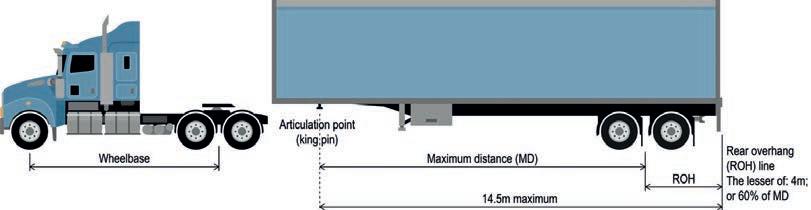
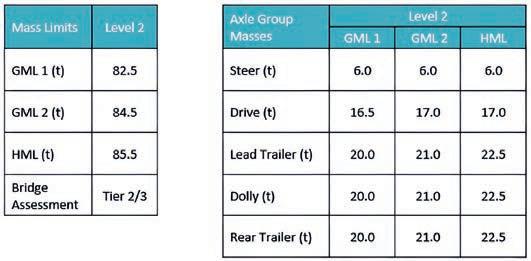
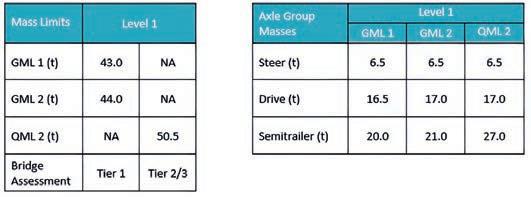
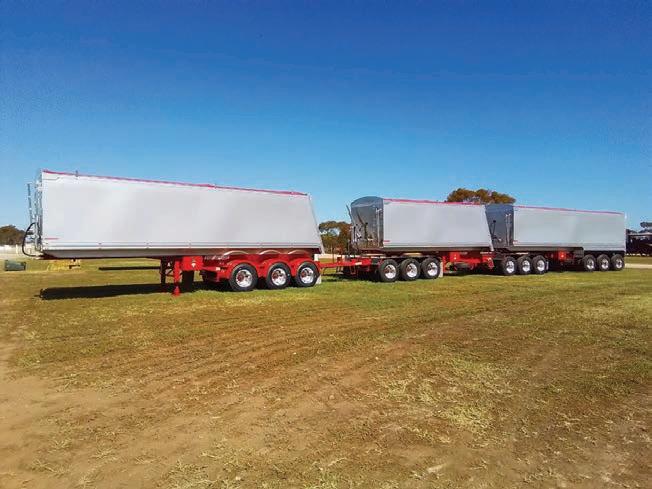
General Mass Limits (GML) are being increased to align with current Concessional Mass Limits (CML). This means vehicles under 55 tonne will be able to carry 1 tonne of extra weight, and those over 55 tonne can carry an additional 2 tonnes, without the need for any additional accreditation or permits. These changes will apply to trucks, however buses will be exempt from accessing the increased GML.
“This is about improving productivity. There is no point in purchasing new trucks if you can’t carry what it’s capable of carrying. These changes apply to trucks operating on general access,” said Daly.
“It’s a very straight line – if
you currently have accreditation just for mass, unless it’s for Performance Based Standards (PBS) purposes, you may no longer require a permit. General access vehicles benefit in the extra tonnage they can carry, while receiving some regulatory burden relief.
“We’ve found that the networks are capable of handling the extra weight and the industry is calling out for greater productivity. This is about creating a safe and productive industry.”
Along with increased weights for general access vehicles, these will also benefit from increased length. The current maximum length of 19 metres for general access
vehicles will be increased to 20 metres.
“With changes in technology and innovation, today’s vehicles are safer than what trucks were previously. By allowing 19-metres to become 20-metres for general access vehicles, you could have a longer trailer or a larger sleeper. It allows operators to run a longer combination on the general access network,” explained Daly. He also hinted that although there are no changes to B-double length limits coming into play from August, this is likely to happen in the next iteration of changes – either later this year or early next year.
Additionally, updated HVNL requirements accommodate new emissions standards for new heavy vehicles, aligning to the Euro 6 standard. These vehicles incorporate additional and more advanced emissions systems. As a result, they are generally heavier than equivalent Euro 5 and earlier models.
As part of the changes to the HVNL, new Euro 6 steer axle masses will be introduced. Euro 6 vehicles may have up to 500kg additional mass distributed across the steer and drive axles, provided a 315mm tyre is fitted to the steer axle if this axle is loaded to more than 6.5 tonnes and no manufacturer ratings are exceeded.
“These mass changes assist with Euro 6 coming in, as these are heavier vehicles, so this allows for that without people having to apply for extra permits.”
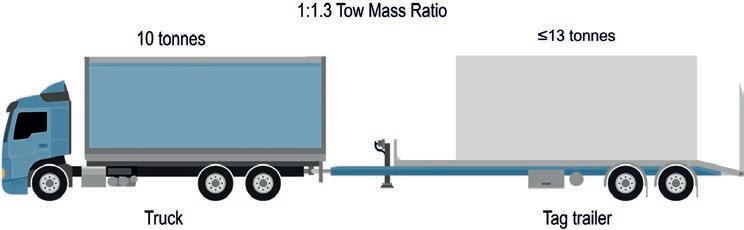
The Mass, Dimension and
Loading (MDL) Regulation will remove the previously prescribed 1:1 tow mass ratio. The new tow mass ratio will be 1:1.3.
What’s an SMS and will I need one?
Well, that depends. If you are a heavy vehicle operator seeking a form of heavy vehicle accreditation, then yes, you will need to have a Safety Management System (SMS) Standard in place.
An SMS is a ministerially-approved standard that provides defined auditable evidence requirements focused around five key areas:
• Leadership and Commitment
• R isk Management
• People
• A ssurance, Monitoring and Improvement
• Safety Systems
“An SMS is compulsory for any operator seeking accreditation – and accreditation itself will be changing considerably,” said Daly. “It needs to be approved and audited by the NHVR. Once an operator has that, they can then apply for their accreditations.”
Accreditations and fatigue
The current National Heavy Vehicle Accreditation Scheme (NHVAS) will transition to the new Heavy Vehicle Accreditation (HVA) scheme. The H VA introduces a new tiered accreditation framework: General Safety Accreditation (GSA) and Alternative Compliance Accreditation (ACA).
GSA is the core accreditation requirement, required to access maintenance, mass and fatigue accreditations; while ACA provides flexible alternative compliance pathways.
It’s important to note that operators can continue operating under NHVAS until it expires, or request to renew it ahead of the new HVNL scheme starting. What this effectively means is that there is a transition period of up to three years – and during that time, we’ll have both the NHVAS and HVA running concurrently.
The NHVR will communicate directly with operators to ensure they are aware of their accreditation expiry dates and have adequate time to access available transition options.
Daly describes the transition from NHVAS to HVA as “a soft launch”.
“For example, if you have accreditation expiring on September 15, 2028, then it’s still good up to that date. You can run on your current accreditation until August 1, 2029, so long as it doesn’t
Heavy
expire before then,” he said. “So everyone doesn’t need to change over straight away.
“We’ve spoken to every operator with accreditation expiring between now and the end of this calendar year, and invited them to come to us to seek to maintain the accreditation they have. If they complete the process to maintain their accreditation before July 31, they can have another two years on their accreditation.
Alternatively, they can let it expire and move to the new HVA on August 1, or ask for an administrative extension up to a maximum of three years.
“But under the law, they have to ask for it. This gives operators more time to get all their ducks in a row. Instead of transitioning now, they can sit tight for a bit and wait until they have a handle on what’s what.
“Especially now, with all that’s been going on, there are operators worried if they will still be around in the next few months due to rising costs –so changes to administrative law is the last thing on their
shared by some in the indus try about these new powers.
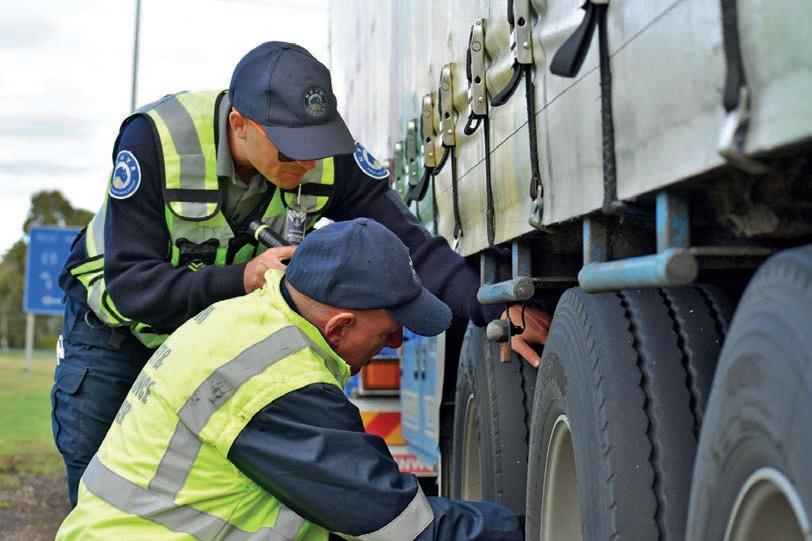
“I’ve been asked how NHVR’s Safety and Compliance Officers (SCOs) will enforce this. The answer is they’ll be doing exactly what they are already doing,” said Daly.
“If they see an obvious sign you are unfit to drive, they will take action. If they don’t see any obvious signs, they won’t be taking any action.
“For example, if a driver is falling out of the cab or they are clearly incoherent, SCOs have an obligation to take action on that. Outside of that, our officers aren’t going to be making drivers walk in a straight line or touch their nose.”
they currently have, to come in and see us by July 17 so that they can maintain that.”
Fitness to drive – sorting fact from fiction
‘Unfit to Drive’ is a new safety duty where drivers must not drive if they are unfit for any reason – such as being impaired by physical or mental illness, injury, drugs, alcohol or fatigue.
The duty not to drive while impaired by fatigue or unfit applies to drivers of all heavy vehicles over 4.5 tonnes –not just those operating fatigue-regulated heavy vehicles.
While a person must not drive while unfit, parties in the Chain of Responsibility (CoR) must also ensure their
Effectively, says Daly, it’s really business as usual in this area. “What’s been happening for the past decade will continue happening, we’re just shining more of a light into it in our legislation.
“In the current HVNL, the Unfit to Drive law currently only talks about fatigue. That’s now being expanded under the amended law, to include being unfit to perform your duties for any reason, as it already states in the Workplace Health and Safety Laws which apply whether you’re a carpenter, bricklayer or a hairdresser. What these changes have done is formally bring it into our legislation.”
Daly pointed to some examples of what may constitute being unfit to drive: “Some obvious ones are you wake up in the morning with a
days,” he said.
“The Unfit to Drive duty goes beyond physical unwellness and also extends into mental fitness to drive. Many operators have a checklist for truck drivers before they get into the vehicle. They’ll now expand on that to include mental fitness to drive – and if an operator deems a truck driver to be unfit to drive, they need to take action.”
What to know around fatigue
The biggest change under the fatigue banner is that the Alternative Compliance Hours (ACH) standard replaces both Basic Fatigue Management (BFM) and Advanced Fatigue Management (AFM). NHVR says it’s a more flexible, performance-based model – which can be more tailored to suit operator needs.
Operators will be able to select work and rest hour arrangements that suit their operations within approved limits, including through templated Tables of Hours based on existing BFM and common AFM-equivalent arrangements.
The regulator says templated work and rest hours are based on schedules that have been used successfully by industry.
To make the move across to ACH, there will be a corresponding template to switch across from BFM and templates for some of the most popular AFM standards.
“But for those who want truly bespoke fatigue accreditation, they can do that too. Operators will now have greater flexibility.”
Changes are also being made to the written work diary (WWD) to align with the amended HVNL, including simplified record-keeping requirements and the inclusion of new fatigue accreditation terminology and provisions.
The updated WWD will be available from August 1, and progressively introduced as existing stock is depleted, with drivers able to continue using current diaries until completed (even if this is after the amended HVNL commences).
The NHVR is also working
with Transport Certification Australia (TCA) to develop a coordinated, staged program of improvements to Electronic Work Diaries, aligned with upcoming HVNL reforms.
Changes to fines
With the rollout of the new HVNL will come new and updated penalties. There are 71 fines that are changing when the amended Act commences on August 1 – with 21 of the fines decreasing and 50 fines increasing.
PBS – what changes?
Not a lot really. Daly says changes impacting the Performance Based Standards (PBS) Scheme are predominantly administrative, as opposed to operational changes.
“Most of the changes for PBS are being handled in-house –so if you have a permit to run an approved combination on a particular road, you’ll still be able to do that on August 1,” he said.
Accreditation will no longer be required for CML.
This condition will no longer appear on Vehicle Approvals (VA) issued after August 1, 2026.
Importantly, existing VAs do not need to be updated. VAs issued before August 1, 2026 will continue to be valid and operators will still be able to access the road network under those approvals.
For these legacy VAs, any references to CML should be
read as GML, meaning operators can continue operating without needing changes to their approval documentation.
Accreditation will still be required for PBS combinations such as split-axle and quad axle combinations and for certain combinations at HML masses. Due to the three-year transition period, the conditions on VAs issued after August 1 will state operators with either NHVAS or HVA are deemed compliant.
Final word
While the amended HVNL will be coming into effect from August 1, 2026, not all the changes will have an immediate impact.
For newly launched accreditations under the new Act, operators will have until their current accreditation expires to transition.
In effect, elements from both the current HVNL and the new amended version will be operating simultaneously, until all operators move across to the new system.
“The NHVR is spending a lot of time through June and July talking to operators and doing webinars, as there is a lot to take in,” said Daly. “But we’ll be there if people need to ring and ask questions, as we’re trying to make this transition as seamless as possible for operators.”
Policy Paul Daly.
Vehicle National Law Reform
Mass tables updated to meet HVNL requirements.
Testing the Daimler diesels at Mt
From rugged Atego 4x4 adventures to the flagship Actros ProCabin, we put the latest lineup through its paces in a day packed with mud, muscle and innovation.
BY GRAHAM HARSANT
“THIS is a car track. We shouldn’t be bringing a truck along this route,” said my Daimler companion in the cab.
I am at the Daimler Drive Series at the Mt Cotton test track, near Brisbane, and I’m looking at a deeply rutted, muddy track winding through a forest of trees.
I’d also watched the previous driver damage one of the side mirrors trying to weave his way between two of them.
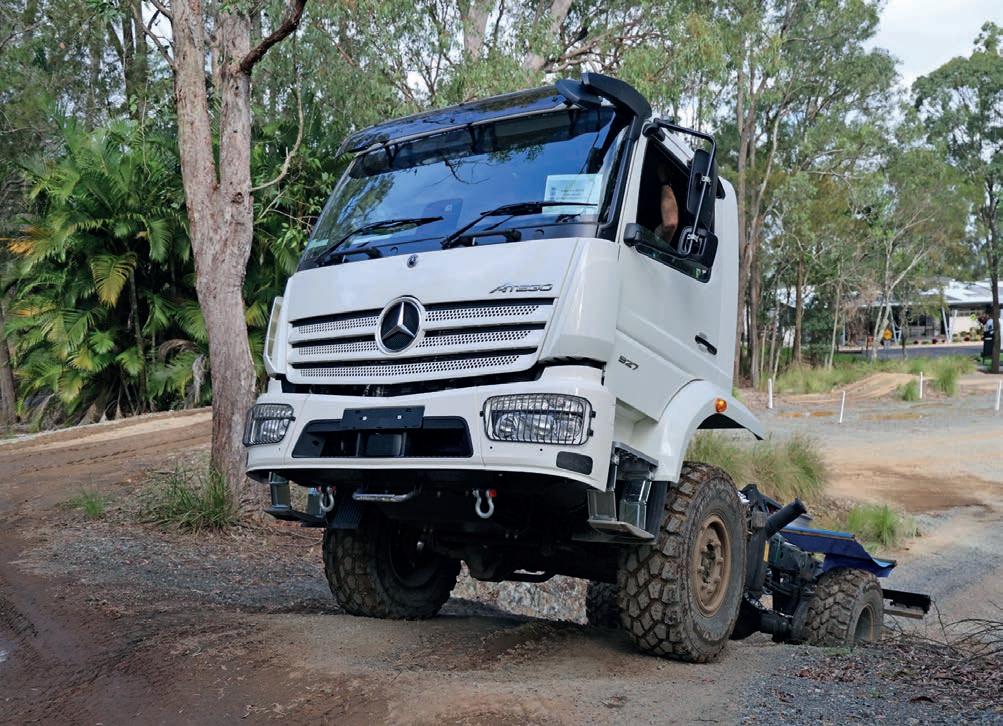
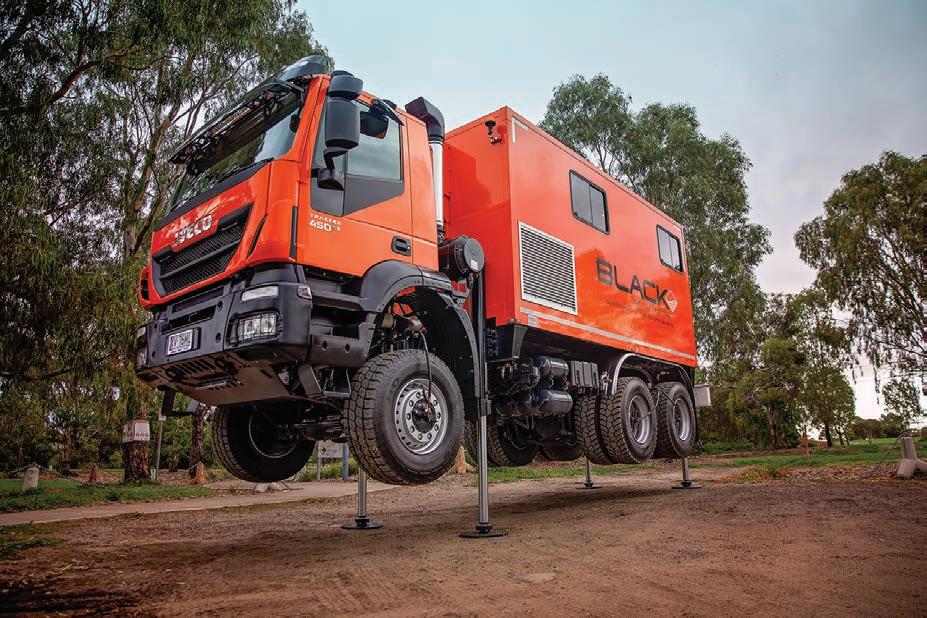
I’m in a Mercedes-Benz Atego 927 AF 4x4 with a cab width of 2.3 metres and a wheel base nearly 3 metres long and I know is that this is not going to go around this track like a GQ Nissan Patrol.
I step up into the cab via cleverly designed hinged steps that will swing out of the way of whatever they may hit.
Underneath me is a 7.7-litre inline Euro 6 diesel with 200kW and 1100Nm.
Putting that power through the diffs is, in this case, an Allison 6-speed auto ‘box. An M-B gearbox is also available but I’m told that firefighters, SES and some other bodies won’t have anything other than the Allison, so in the light of ‘the customer is always right’, Daimler is happy to oblige.
Into drive, release the old-fashioned handbrake and off I go, slipping and sliding down the initial drop before hanging a right through those
mirror-shattering trees without inflicting further damage to them.
There’s a decent drop coming up and I touch nothing, letting the engine brake and compression do the work for us.
Around a sharp corner between another couple of trees with muddy ruts up to and sometimes past the wheel rims. This is not the shortest 4x4 in the world, and as I manoeuvre the front around the corner, I look in the remaining good wing mirror and see that the right rear tyres are going to take the tree out on that side – or vice versa.
“Don’t worry,” says my companion. “The back wheels will come around. Just drive straight and you’ll see the wheels will drop into the ruts and we will just let it walk around the tree.” And he is right.
Logs, bogs, rocks: this truck makes short work of everything the track throws at us.
Faced with a 45-degree incline, put the rear diff lock on and just mosey on up (and down). This is the best fun
I’ve had in a truck, like ever!
“Is there anywhere this couldn’t go?” I ask.
“I reckon it’s about 80 per cent as capable as a Unimog,” was the immediate answer.
“And no-one could use those to their full potential.”
It’s worth noting that these trucks come out of the factory with ‘lagging’, meaning all the air and electrics are insu-
lated; a requirement for fire engines.
I finish my run and proudly have done no more than dislocate a tail light cluster from its bracket.
“No worries. We’ll advertise it as ‘Executive Driven’, LOL.”
That drive was my last in a day where I’d been behind the wheel of multiple models and specifications in the Daimler Truck Drive Series line-up.
I’d started the day in an
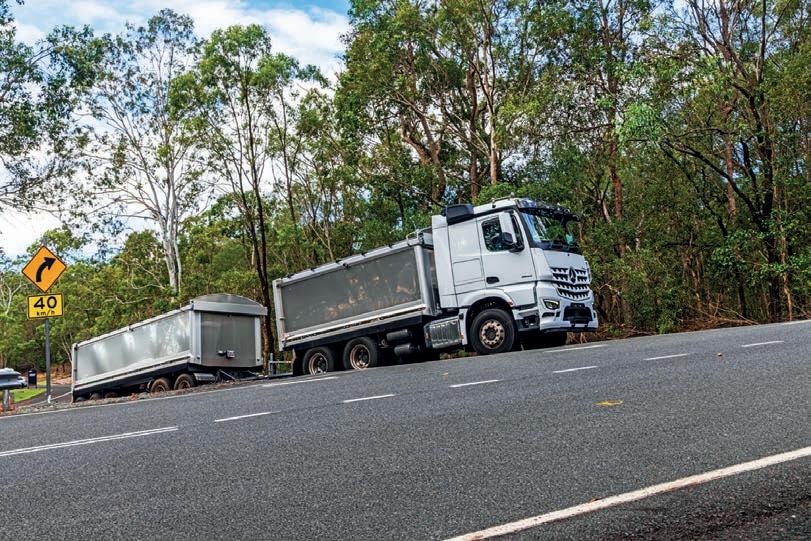
Arocs 6x4 tipper and dog loaded to 49 tonnes. This truck has 530hp and 2600Nm with MB’s 12-speed AMT and all the safety bells and whistles, including Side Guard Assist – pioneered by Mercedes and protecting pedestrians who may be unseen from the driver’s seat.
These trucks will spend their days with bods wandering around in close proximity so kudos to the company for its inclusion.
While the Mt Cotton track is not very long, it provides plenty of hairpin bends, sweeping corners, steepish hills and drops, together with flat running.
Drive this truck the right way, using the three-stage engine brake or occasionally manually changing the gear with a simple flick of the RH column, and you can do the full circuit without touching the brakes at all.
will hold the truck for three seconds, whilst a decent push on them will hill-hold for 20 minutes. If you’re silly enough to forget and climb out of the truck, it will automatically put itself in Park.
There’s three-leaf parabolic suspension on the steers with eight-bag air on the rears. The truck rides so smoothly that I initially thought it was air all round. All in all, it’s a top tipper if you spend your days in this line of work.
There followed drives in a Fuso Shogun 530 Tipper and a Freightliner Cascadia 116 with the same engine. They all have their own personalities and all drive equally well. Of course the Cascadia is bonneted for those to whom this layout appeals.
Of note is that the tipper controls are incorporated into the dashboard rather than, as is often the case, on a pedestal between the seats – ergonomics being the name of the game.
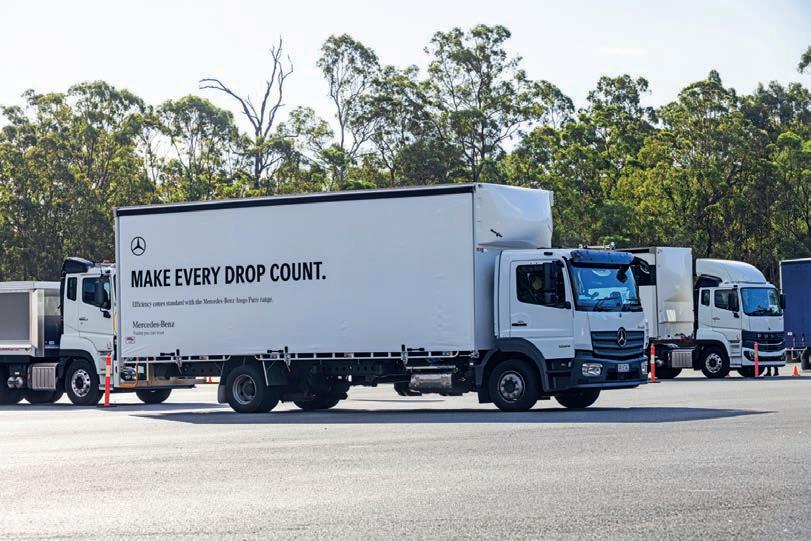
Having had my fill of tippers, I move on to an Atego 1224 4x2 rigid with a tautliner body, followed by a bunch of semi-trailer set-ups from the three brands.
At stops, a tap on the brake
Want a lot of space? Go for the Cascadia 126 with its bunk offerings up to 60” and its 16 litre OM 471 offering up to 600hp. This is the truck to throw multiple trailers behind and cross the Nullarbor.
Want something Japanese?
There’s the brand new Fuso Shogun with its horses upped from 510 to 530, a new front end and minor interior upgrades – perfect for local and intrastate work, with the ability to haul a B-double if needed.
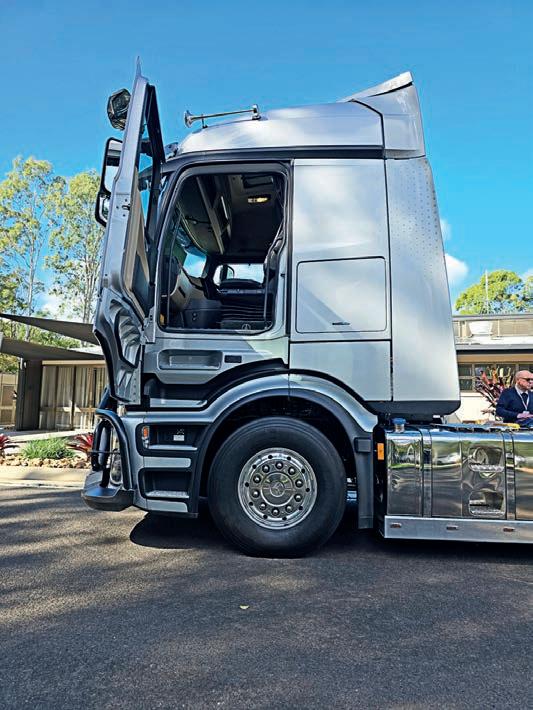
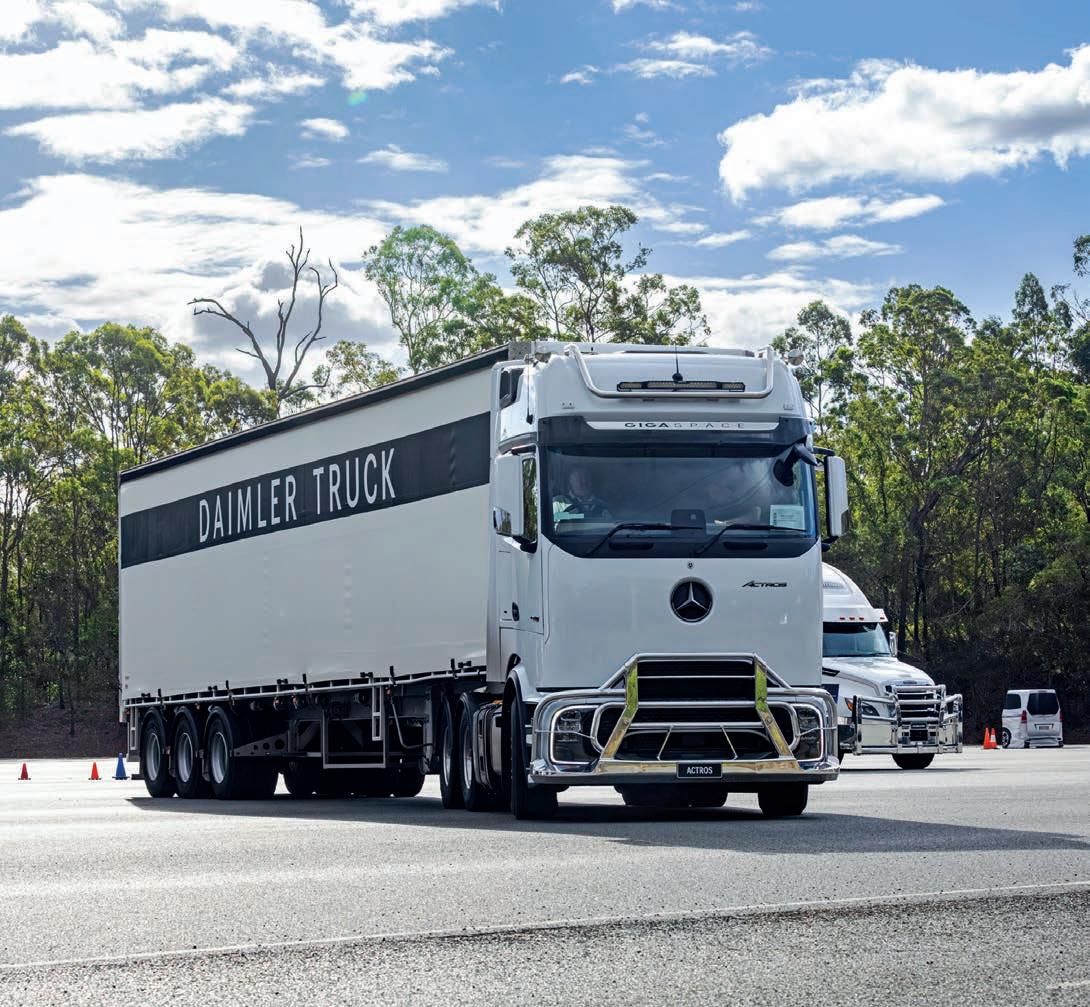
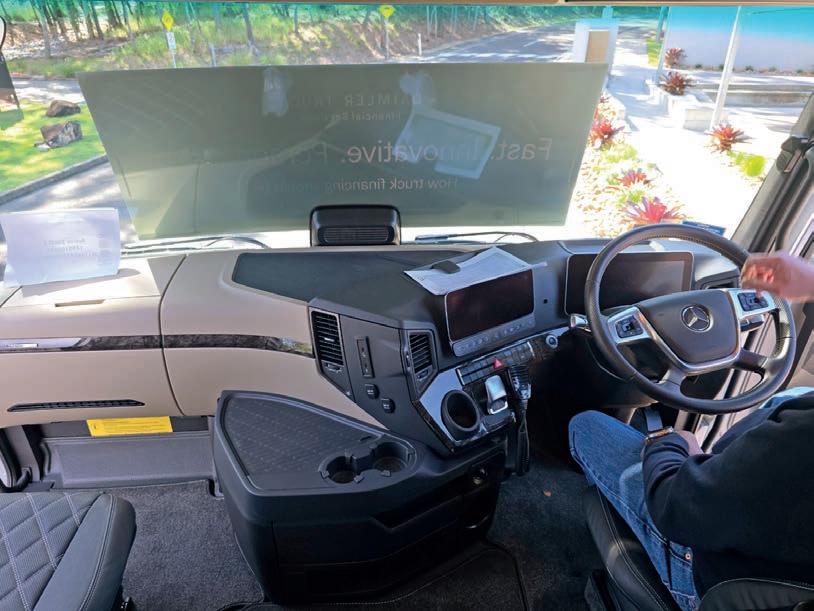
Then there’s my favourite, the new Mercedes-Benz Actros 2663 ProCabin. Mercedes passed out drink coasters at the Brissie Truck Show that stated, ‘The Bigger the Truck, the Closer to God’. Climb up and up and up into this truck and you’re rubbing shoulders with the
Big Guy – 625 prancing po-
Arocs tipper and dog makes light work of its 49 tonnes.
Atego 4x2 rigid will get the deliveries done.
nies superbly matched with 3000Nm of torque, its 12 speed AMT knows what gear to be in all the time.
Thanks to topographic maps it knows the roads ahead and which of those gears to be in before you do. Should there be a road that you travel which is unmapped, the truck learns it! Minute attention to design aerodynamics means it sips fuel judiciously whilst being rated at a GCM of 106,000kg. The interior is unmatched in the truck world for sumptuousness in a cabover. The lane-keeping steering is better than anything I’ve driven.
The seats are as good as your favourite lounge chair, the ergonomics as good as any and oh, the serenity! If you want to be transported to another place while you’re transporting, this is the truck.
Lastly, and just before I hop into that Atego 4x4, I run around the track in a Fuso Canter 615 wide body – but positively tiny after the Actros. This truck is a ripsnorter for the tradie with heaps of get up
strap loads down through it to the rails, rather than over
bending or pulling the sides
where I started this story in the Atego 4x4. I so want to have a play in the Unimog and explore that extra 20
Atego 927 AF 4x4. Goes places others fear to tread.
Serving Queensland for two decades
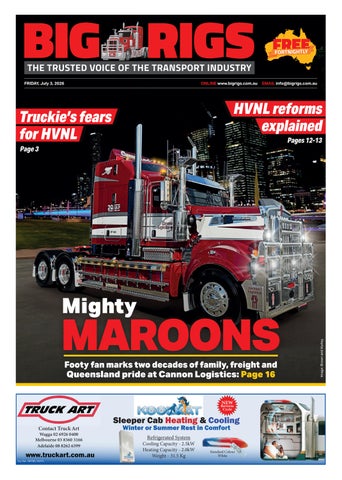
Over the past 20 years, this transport operator has grown his company from the ground up, with two sons now working by his side.
BY DANIELLE GULLACI
ZAC Popov was just 19 years of age when he got his start in the trucking industry.
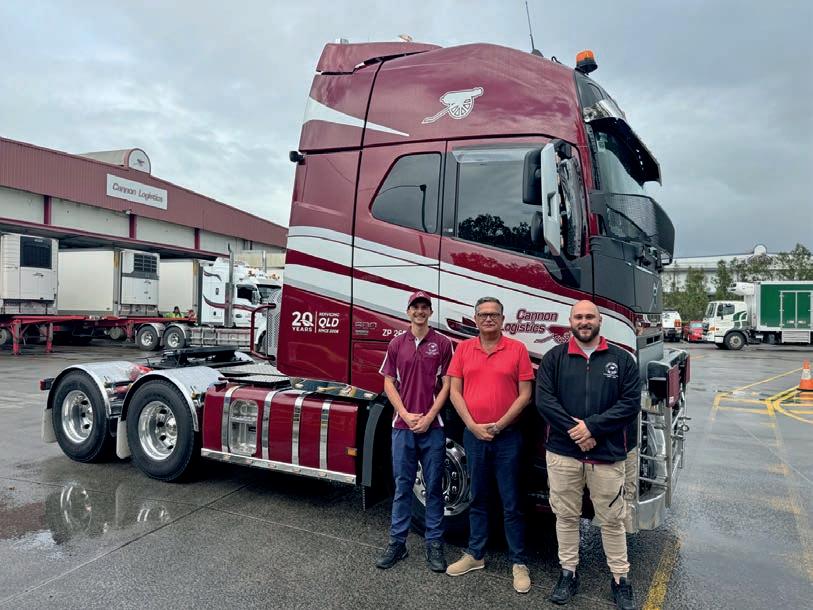
That move planted the seed for a lifelong career in transport, including starting his own business, Cannon Logistics, in 2006.
“I worked for a large multinational cold storage business, across a number of roles including admin, dock and operations, and management positions,” said Zac, who is now 55.
“I did that for 15 years, then I broke away and started out on my own with a few of my own trailers and a few tow operators, and I built it all up from there.”
Specialising in refrigerated transport from Brisbane and across Queensland, including into the harsh terrain of western Queensland, Cannon Logistics has continued to go from strength to strength.
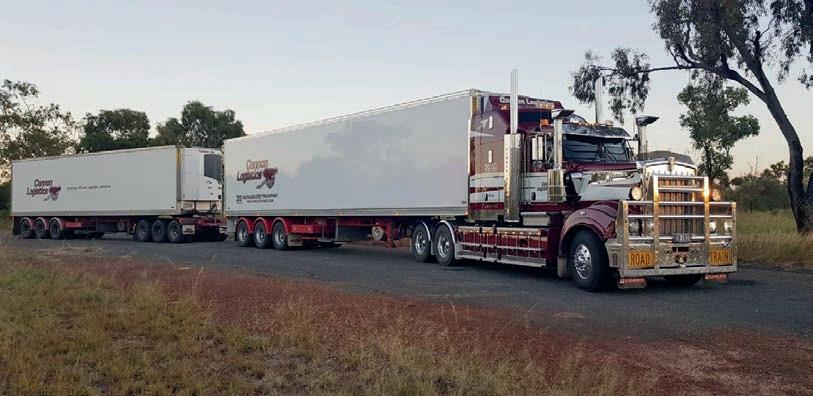
Within his first two years in business, Zac built up to a fleet of 13 trucks and 15 trailers. Fast forward to today and the fleet consists of 34 prime movers and over 60 trailers, predominantly operating as B-doubles and road trains.
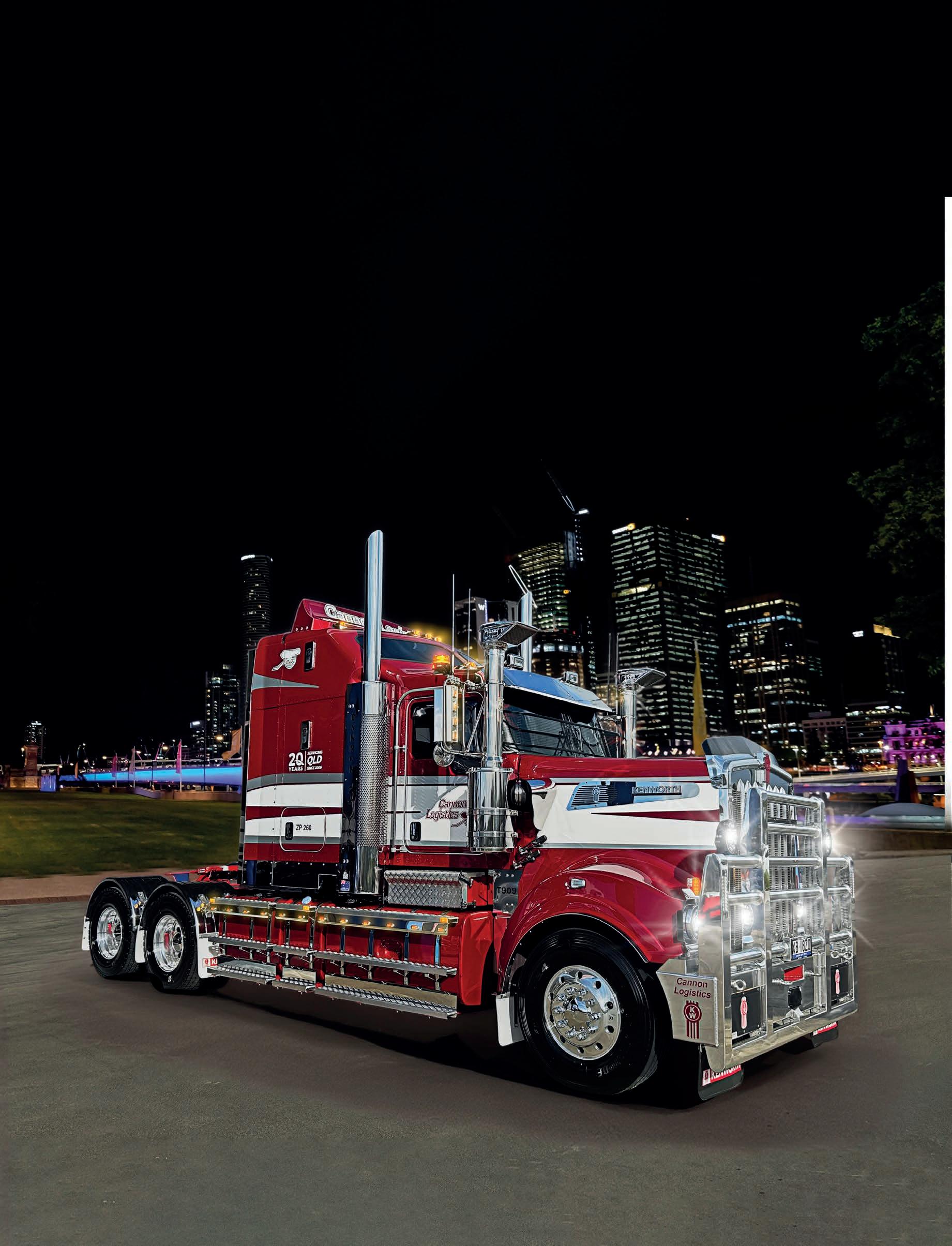
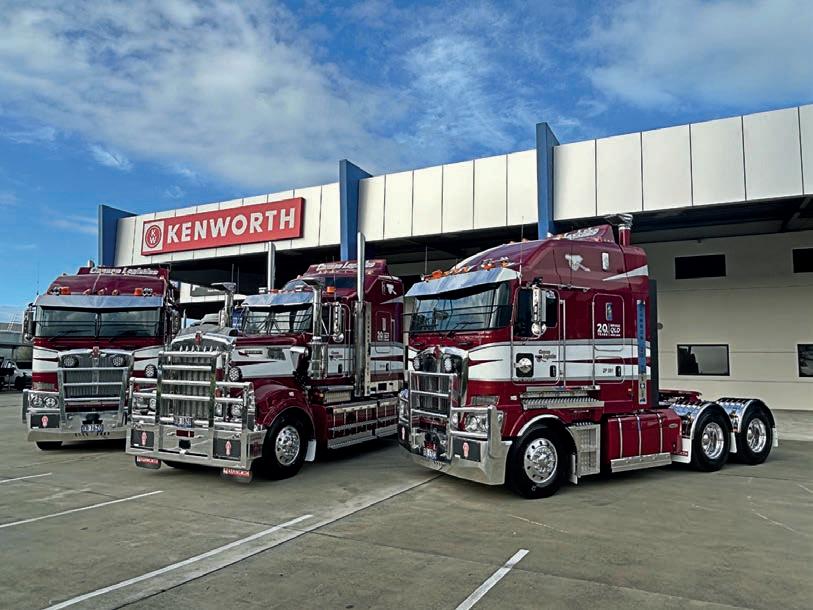
Queensland born and bred, Zac is a loyal supporter of the state’s rugby league team, the Queensland Maroons, and therein lies the reason for the colour choice for his fleet’s livery – maroon and white, of course.
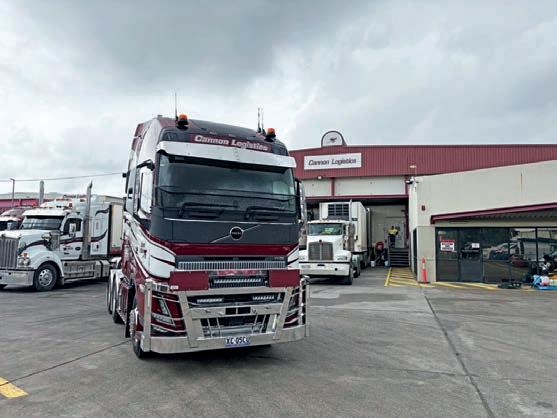
As for the name, that’s derived from where the business started, the Brisbane suburb of Cannon Hill. Though, it’s now located around 10 minutes down the road at Lytton, in the Port of Brisbane.
When Zac bought the Lytton building, he says there was one major problem with it. It was light blue, the colour of his beloved team’s arch-rivals, the New South Wales Blues – and he couldn’t have that.
“So, I had to get it all painted before we moved in,” he laughed.
These days, the Cannon Logistics fleet can be found operating from Brisbane and through western and central Queensland.
“We travel all the way from Roma through to Mt Isa, from Emerald through to Bowen, along the east coast from Gympie to Yeppoon and everywhere in between all of those areas,” added Zac.
Refrigerated transport remains the company’s bread and butter, with about 80 per cent of the work revolving around temperature-controlled freight. The remaining 20 per cent, says Zac, is general palletised freight.
As he explained, Cannon Logistics expanded its reach quite early on in the piece.
“At first, we were looking after the Gladstone and Bundaberg area and soon expanded to service Rock-
hampton and Yeppoon.
“It was in 2008, when the mining industry got going again, that I got my first contract delivering through central Queensland. That’s how we expanded to service that region, as well as western Queensland.
“Cannon Logistics moved into those areas on the back of mining industry growth, supplying food services and accommodation companies contracted to the mines. We carry all sorts of refrigerated freight, including meat, produce and seafood, and also cater to the retail and food service industries too.”
Zac takes a great deal of pride in his fleet, with trucks
typically replaced around every five years or so, and trailers typically turned over at the six-to-seven-year mark.
For the prime movers, it’s predominantly Kenworths, along with a number of Volvos and MANs; while the trailers are typically MaxiCUBE with Thermo King refrigeration units.
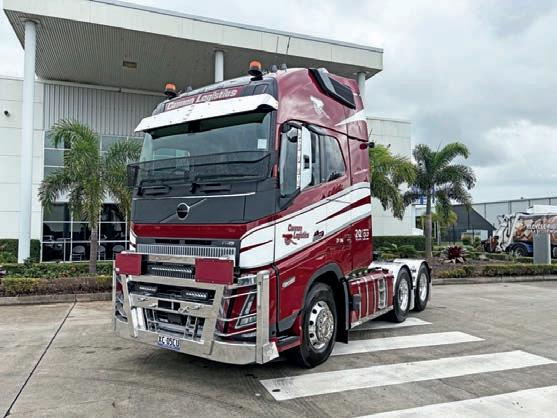
Among the newest trucks joining the fleet this year are five 600hp Euro 6 Volvo FHs, delivered across May and June, before the end of the financial year, and three new Kenworths delivered at the start of May.
Road train-rated to 110 tonnes, the Volvos all feature the spacious Globetrotter
sales team worked with Zac to customise these rigs, adding all the special touches –including the words “Cannon 20 yrs” laser-cut into the truck exhaust guards, and inside, special leather embroidery on the seats, door panel, and back sleeper panel, completed by PACCAR Australia.
XXL cab, I-Shift automated transmissions and crawler gear.
These Volvos were purchased through VCV Australia’s Wacol branch, with some of the finishing touches including LED headlights, stainless steel guards and Cannon Logistics 20th anniversary logo. While the Kenworth delivery included two new K220 2.8 Aerodynes and a T909 with a 50-inch Aero integrated sleeper, with all three of the trucks featuring Cannon Logistics 20th anniversary logo, along with a number of other features to mark the milestone.
Purchased through Brown and Hurley Caboolture, the
The Kenworths – all used to service western and central Queensland – are powered by Cummins X15 Euro 6 565hp engines, with RTLO 22918 manual transmissions, and are road train rated to 97 tonnes.
Asked what he attributes to the company’s growth and success, Zac listed a number of important factors – stability of staff, with many employees having been with Cannon Logistics for many years; offering consistent and reliable service to customers; being competitively priced; and being flexible and available to call on any time.
“We take a great deal of pride in looking after our cus-
tomers. There are a lot of longterm customers, many who have been with us since the very start,” said Zac, proudly adding that his sons have also joined the business, bringing Cannon Logistics into its second generation.
“My eldest son Mladen looks after local fleet operations, and my youngest son Dilan works here too, washing the trucks and trailers,” said Zac. On his plans moving forward, Zac had just four words to sum it up: “Steady as she goes.”
Acknowledging the challenges many operators are facing in the current climate, Zac added: “It’s a wild world out there at the moment. We just need to keep doing what we do best.
“Right now, we’re not looking for any significant growth. We’re happy to work with our customers on micro growth alongside them – and if things do pop up that require additional resources, we’ll look at things from there.”
Embroidery is found throughout the cabin interiors of all three Kenworths.
The colour choice for the fleet and building was inspired by the Queensland rugby league team.
The new T909 is powered by the 565hp Cummins X15 Euro 6. Image: Brown and Hurley
BUSINESS SOLUTIONS
Helping customers run a smarter, more informed business.
CAPPED PRICE SERVICING
Plan ahead and manage operating costs.
CONNECTED FLEET SOLUTIONS
Real-time visibility and connected support with Hino-Connect telematics.
SAFETY, RELIABILITY AND UPTIME
Providing businesses with confidence through reliable transport solutions and dependable aftersales support.
To
FINANCE AND OWNERSHIP SOLUTIONS
Tailor made finance solutions to meet business needs and future growth.
GENUINE PARTS AND SERVICE NETWORK
Backed by Hino Genuine Parts, factory-trained technicians and a national support network.
Truck driver, 72, prepares for next chapter
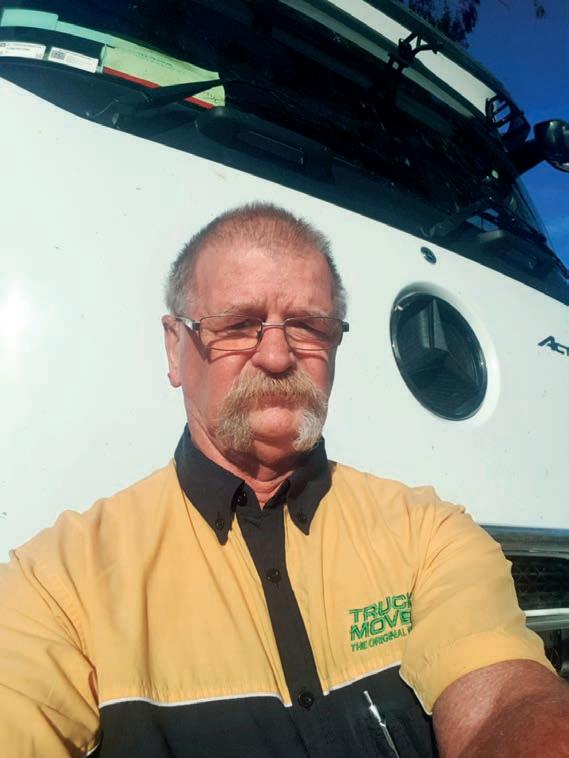
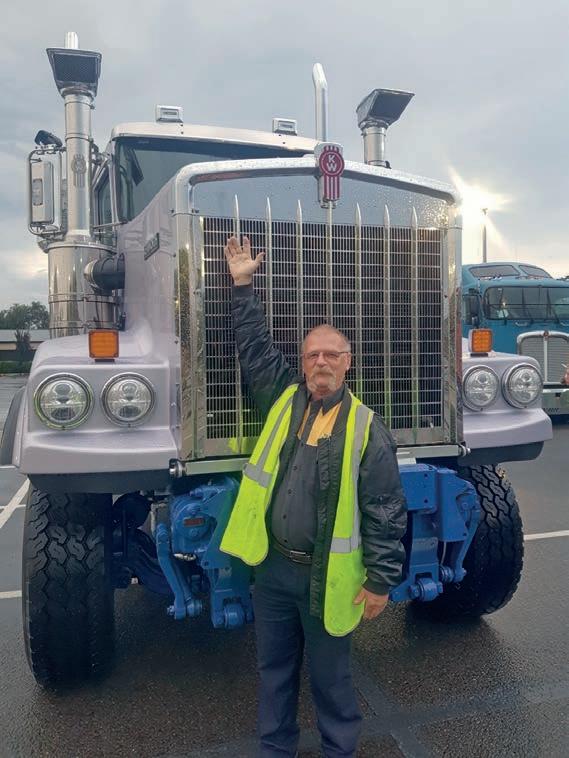
As this veteran truck driver prepares to retire from the “best job” he’s ever had, he’s looking forward to ticking a few things off the bucket list.
BY DANIELLE GULLACI
FOR Rob Beattie, 72, there was never any question about where his life would lead. “I grew up as a passenger in a truck from when I was a baby. Dad’s truck was the family vehicle – we used it for everything,” said Rob.
His father Ted ‘Wozzle’ Beattie taught him all there was to know. “Back then, that was your apprenticeship and it started when you were a kid. Unfortunately, you can’t do that now. With trucking, it’s either in your blood or it’s not.”
And for Rob, it was definitely in the blood. Along with his father being a truck driver, his grandfather and uncle were too.
Based in Melbourne, Rob got his official start in trucking at 18 – well, legally anyway. “My father was a truck driver so I started learning when I was old enough to steer by myself, at about 12 or 13. We went out on the highways when no one was looking,” he laughed.
Rob’s first job was transporting cars throughout Melbourne in a Ford D-Series. Career-wise, he’s come full circle. Over the years Rob’s done general and refrigerated freight, both locally and interstate. For close to 21 years, he’s worked for Truck Moves Australia, transporting trucks and other vehicles right across the country.
“Back when I started there were no heaters, no power steering and no radios unless you fitted one. That old D-Series was pretty basic compared to the new Mercedes-Benz I’m driving at the moment for delivery to Perth,” Rob said.
His entire career has been centred around driving trucks, apart from around five years spent managing a car service centre – though that was short-lived. “I got married and thought I’d try something different but the call of the road gets you eventually.
“You either like truck driving or you hate it; there’s no in between. It’s a good industry to be involved in. You make a lot of friendships along the way. I see people today that I met 30 years ago – sometimes it can be a long time between visits.”
The role with Truck Moves Australia sees Rob transport trucks from point A to point B.
“Over 90 per cent of the
work is delivering new trucks. We do all the work for Daimler Trucks, we do Scanias, some Kenworths, you name it, we drive it. Sometimes it’s cars and utes too. I took a ute to Darwin a few weeks ago,” explained Rob, who estimates he’s had the opportunity to drive over 2000 different trucks.
It’s a role that comes with many perks. “Sometimes we get to drive new truck models before they’re even released, and they’ve got all the latest technology. When I started out, a 135hp truck was considered powerful, now you’ve got trucks up at 700hp with all these mod cons we never would have dreamed about back then.”
Due to the nature of the work, each week is very different. “This role is never boring. I’m going to Perth this week, who knows where I’ll be next week. I’ve been to Darwin, Cairns, Perth, Port Hedland and everywhere in between –the only state I haven’t been to is Tasmania.
“There’s no loading or unloading. You do the paperwork, fuel up, hop in the truck and away you go. Then once you’ve completed the delivery, you get to stay in a motel and fly back home – which is great for the frequent flyer miles too!”
Rob has clocked up millions of kilometres on the road throughout his trucking career. “At one stage I was doing about 6000 kilometres a week, running Melbourne to Sydney and Adelaide. The kilometres add up when you think about it.”
In all his years on the road, Rob said, “This is the best job I’ve ever had in my life and my boss Matt Whitnall would be one of the best bosses to work for.”
Asked what initially attracted him to Truck Moves Australia, Rob said he had his own truck and decided to sell it. At the time, he was delivering cars around Melbourne.
“Fuel went from 80 cents to $1.35 a litre virtually overnight. The person I was working for wouldn’t take on a fuel levy, so I decided to sell.
“I saw an ad in the paper for a driver to deliver new trucks and trailers. I thought that sounds like me, so I rang up and they took my name down. I got the job and I’ve
been there ever since.”
It’s never an easy decision to walk away from a job you genuinely love, but for Rob, he knew the time was right for retirement – and he plans to finish up with Truck Moves Australia by the end of July.
“It’s been fun. It’s the camaraderie and you’re doing something different every day. It’s not like a driver on a regular route, you see something different all the time, and get to talk to differ-
ent people. A lot of the time you’ll go to the same dealers, so you build a rapport.
“It’s been 50-odd years of fun really. I’ll miss the camaraderie. I’m travelling with two other drivers to Perth now.
We can stop for a meal and a laugh, and we can all poke fun at each other.
“I still look forward to coming to work every day, but you have to retire sometime.
“You need to enjoy life and there’s things I want to do.
‘There’s life after work’ is what
I keep getting told. The secret to retirement is to keep your self busy.”
Once Rob makes his final highway run in the truck, he’s looking forward to spending more time with his family –especially his six grandkids –and perhaps his first overseas trip.
“I have six grandkids from seven years old down to six months. They keep you young.
I don’t know who causes the biggest trouble, Pop or the grandkids!” he laughed. “You
get to spoil them, and that’s Rob also plans on using some of his frequent flyer miles on a trip to the United States. “I’ve never been out of Australia –so I need to get my passport,” he revealed. “I was supposed to go to America a few years ago but then Covid hit. I want to go and see the Sprint Car races in Knoxville – that’s been on the bucket list for a long time. It happens in August so hopefully I can go next year or the year after.”
Throughout his entire trucking career, he’s made life one big adventure.
Rob Beattie has worked with Truck Moves Australia for almost 21 years. Images: Hannah Ashby
No two days – or two vehicles – are the same, with around 90 per cent of the work being delivering new trucks.
unloading – only getting trucks from point A to point B.
Rob estimates he’s had the opportunity to drive over 2000 different trucks, of various makes and models.
An electric Windrose truck he transported.
Proudly supporting Reader Rigs
Share your truck pics to win with Shell Rimula
SHELL Rimula has partnered with Big Rigs in a big way – so there are even more reasons to send in your best truck shots.
Each month, the Big Rigs team will choose a #PicOfTheMonth, with the lucky winner receiving a $500 Shell Coles Express Gift Card.
Keep an eye out for our regular posts on the Big Rigs Facebook page, calling for your best truck photos and add yours in
the comments, or email them direct to danielle.gullaci@ primecreative.com.au for your chance to win the main prize.
Don’t forget to include a brief note about the truck and where the photo was taken. We’ll feature some of the best photos in each print edition of Big Rigs, with one winner announced each month.
Keep those amazing truck pics coming!
Congratulations to Pic of The Month winner Kevin Bemrose, who snapped this great shot at the Farmers Across Borders Hay From WA charity run, a $500 Shell Coles Express voucher is on its way.
Tony Brown caught this great moment, heading southbound out of Kowanyama, Queensland.
A cool pic from Erin Pereira, snapped while travelling southbound at Narrabri, NSW, loaded with pineapples for Melbourne.
Bede Skewes snapped this scenic shot, carting bulk bitumen for the Plenty Highway upgrade in the NT. Bryan Burman got this great shot while parked up at Marla, SA.
Robo Jordo pulling a big load in the Pilbara, WA.
Ian Lawrence snapped this great pic, just south of Leinster, WA.
David Tuckey snapped this pic after unloading three trailers of fertiliser just south of Katherine in the NT.
David Wall shares a cool angle at Camooweal, Queensland, heading for Darwin.
Thomas Alexander Galleghan unloads at Dalby, Queensland.
Peter Bullen snapped this eye-catcher at Yorkeys Crossing, SA, while waiting to cross load cattle.
Luke Selvage enjoyed an awesome morning in Vulcan State Forest at Oberon, NSW.
Another ripper shot from Bryce ‘Baldy’ McGahey, this time snapped at Dugald River Mine, Queensland.
Truckies’ memorial rises above controversy
BY GRAHAM HARSANT
THE word had spread that this year’s Victorian Truck Drivers’ Memorial on the King’s Birthday weekend would not be preceded by a convoy, as has become the popular norm over the past few years.
This writer received more than one piece of correspondence expressing disappointment and indeed, anger that it was not going ahead.
A phone call to the memorial organisers assured me that this was not of their doing so the origin of this ‘misinformation’ remains clouded in mystery.
It eventuated that those who’d heard the missive, in the main disregarded it – including the Yarck CFA who’d turned up as usual to provide brekkie and coffee.
After all, the roads are public and who is to tell a truck driver that he cannot place a banner or dedication in whatever form upon his truck and drive it to wherever he wishes. And so they did.
Next year we hope the numbers in the convoy grow as a mark of respect to loved ones, the trucking industry and the memorial.
Proceedings were opened by Murrindindi Mayor, Cr Damien Gallagher followed with an excellent address by
Peter Anderson, CEO of Victorian Transport Association.
There followed speeches from two brave ladies whose families have been touched.
Firstly, came Khristine Abaya, remembering Ron Bunker.
“Some of us here are all incredibly fortunate to have known Ron. Whether as a friend, family member, mentor, or through his generosity to others, he left a lasting impression on everyone he met, through his warmth, his integrity and his quiet determination to make things better for those around him.
“Ron’s journey in transport began in 1959 at just 17, driving through the harsh outback South Australia, an experience that shaped his resilience and character.
“Working alongside family, he helped build the foundations of Bunker Freight Lines, later expanding the business nationally from Melbourne through Adelaide, Sydney, Alice Springs and Brisbane, all the while proudly preserving the company’s name and values throughout its growth.
“Ron was a true pioneer. He was among the early operators of road trains into Western Australia, helping shape the future of transport in this country. His vision, innova tion and deep understanding of the industry set him apart.
But it was his character that defined him.”
Khristine said the 2004 inductee into the Shell Rimula Hall of Fame was a tireless supporter of the road transport industry, giving not only financially, but also of his time, his voice and his energy.
“He believed in progress, in safer roads and in standing up for drivers. He supported industry associations and pushed for meaningful regulatory change, always with the greater good in mind.”
Then followed Kylie Gordon whose son, Braedyn passed at just 24.
“Today we are here to honour and remember my son, Braedyn Lindsay Patric Gordon – a.k.a. Quaks.
“Braedo was our only son. He had only just celebrated his 24th birthday a week prior to his passing. Braedo was involved in an horrific collision, a driver failing to adhere to a stop sign, resulting in their vehicle colliding into the front steer axle of Braedo’s truck.
“The truck veered to the left leaving the road and colliding with a tree where he died instantly from the impact. The driver that caused Braedyn’s death walked away with minimal injuries.
“Braedyn left behind myself, his father David, his three sisters, Teagan, Kelsea, Tahlia, and many family and friends.”
Kylie went on to talk of Braedyn’s involvement with the Tongala Football/Netball club and other sporting bodies where he had deep involvement and made many long-lasting friendships. A non-drinker and a non-smoker he was always the one to make sure his friends and family got home safe after a night out.
“Braedo started working at the young age of 12, helping around Julian Brennes farm. Once old enough he graduated to a school-based apprenticeship. He had a great love for cattle and big machinery which helped lead him to his final career choice of transport.
blokes, he started applying for jobs before he even had his license.
“One of those was Rich River Trading and Transport who patiently waited for him to get his licence and then offered him a position. Hedley and Jon were good employers to Braedyn, which he truly appreciated.
“He loved his job and had a good group of mentors who taught him well, illustrated when he graduated his license to HC and then to MC, passing both tests with ease.
his dream to drive larger trucks but sadly those dreams never happened. His life was shortened by no fault of his but rather by just doing what he loved.
“Like most keen young
“Braedyn had to wait until he was 25 before he could transition into the bigger trucks. He was very keen to progress and felt that time was moving too slow. It was
“It is a struggle every day not having Braedyn here with us. We just wish we could see him, talk to him, hold him and never let go. We are so proud to honour Braedyn here today. Forever in our hearts.” As always, the memorial was an outpouring of emotion and memories, mixed with the camaraderie that is so prevalent in the trucking industry. It is places such as the Victorian Truck Drivers’ Memorial that draw the industry together in a way that few other events can.
Chantelle Colafella with the tribute to her father, Paul.
Khristine Abaya spoke of Ron Bunker on behalf of the family.
Kylie and David Gordon with a picture of beloved son Braedyn.
Commans.
The Bunker group paying homage to Ron.
Despite rumours to the contrary, the convoy went ahead as planned. Images: Graham Harsant
Lights on the Hill Convoy to return in 2027
ORGANISERS of the annual Lights on the Hill Convoy at Gatton have announced that the October event will not go ahead this year, citing ongoing economic pressures across the transport industry.
The decision was revealed in a live video message recorded at the Lights on the Hill Memorial last month, with organisers describing the move as a difficult but necessary choice after extensive discussions with members of the trucking community.
“As much as it’s going to hurt us saying this, we just want to let the trucking community and the local community that supports us know that this year we will not be running our Saturday convoy event,” organisers said.
They explained that current economic conditions facing transport operators played a major role in the decision.
“After talking to a lot of the trucking community and the current economic times that we’re living in, we think that running an event like this is just going to put too much pressure on the transport industry,” they said.
While disappointed by the decision, organisers stressed the long-term future of the memorial event held this year on October 4 at Lake Apex Park in Gatton remained their priority.
Organisers confirmed that merchandise sales and commemorative activities will continue. A merchandise container will be set up at the memorial site, while pre-orders for this year’s shirts are now open online and close on July 7. A commemorative book is also being produced, featuring those remembered on the memorial wall.
Organisers of the popular Deniliquin Truck Show and Industry Expo have also decided on a revamp to its annual event this year.
While it will proceed with the Deniliquin and District Wall of Fame inductee dinner and memorial service as normal on September 19-20, the Saturday truck show and expo
The committee said the format would be reviewed, with a return planned for 2027. Other events to mark in your calendar this year include:
JULY
Casino Truck Show
July 31-August 1 Casino, NSW casinotruckshow.com.au
Held over two days, the Casino Truck Show is a community event that showcases the transport industry, held in the heart of Casino’s CBD. The 2025 event attracted an estimated 40,000 people on the Saturday, who got to see 550 trucks.
AUGUST
Lowood Truck Show
August 15
Lowood Showgrounds, Qld
Held in the small town of Lowood, the annual Lowood Truck Show promises to be a fun-filled day for the entire family, with an epic display of trucks, entertainment, stalls and food vendors. Visit the event’s Facebook page for more information.
Wondai Truck Show
August 22
Wondai, Qld
Held in conjunction with the Wondai Show, this popular Queensland event has a category for every truck, and this year is offering a Truck of the Show prize of $1000. Whether you’re entering your pride and joy or coming along for a great day out, the Wondai Show Truck Show is one event you won’t want to miss, promise organisers. For more information, search Wondai Truck Show on Facebook.
SEPTEMBER
Queensland Mack Muster
September 12
Mount Archer, Qld queenslandmackmuster. com.au
Billed as a new chapter in Queensland’s proud trucking heritage, the inaugural event is proudly supported by a naming rights partnership with Old Skool Mack Parts. The
delivered by the Woodford Lions Club, kicks off with a gala dinner on the Friday evening, followed by a charity convoy the next morning, a show and shine and full day and night of entertainment. Camping is permitted at the Archer Falls Airfield venue on the Friday and Saturday nights, allowing exhibitors and visitors to stay on site and enjoy the full weekend experience
MegaTrans
September 16-17
Melbourne, Victoria megatrans.com.au
Returning to the Melbourne Convention and Exhibition Centre, MegaTrans is Australia’s largest integrated conference and exhibition dedicated to the logistics and supply chain industry. MegaTrans provides a unique platform to explore the innovations, equipment, and services that will shape the future of logistics.
OCTOBER
Camp Quality
Convoy Perth October 4
fundraise.campquality.org.
au
Camp Quality Convoy Perth moves to a new venue for 2026. Supporters can cheer on the convoy, as they travel a 50km route through the streets of Perth, followed by a free Family Festival packed with entertainment and experiences catering for the entire family. There will be food vans, kids’ rides, face painting, roving entertainment, live music, fundraising awards ceremonies, and of course a Show ‘n’ Shine.
The Heritage Truck Association of Australia will host this event, featuring a wide display of heritage trucks, tractors and cars, as well as trade stalls. On-site camping is available for exhibitors and stall holders.
Convoy for Kids Sydney October 25
bury Showground convoyforkids.com.au
Hundreds of truckies are again expected to take part to help raise funds for the NETS Ambulance Service and Kidzfix. Participants marshal at Sydney Dragway at Ferrers Road Eastern Creek from 5am and Roll the Convoy at 7am. Spectators are advised to be at the showground by 7.30am to watch the convoy roll in – it is a great sight! The kids will love it!
Ulvertsone Truck Show
October 31
Ulvertsone Showgrounds, Tas
Held as part of the Thank You Day Show, the Ulvertsone Truck Show runs from 9am until 3pm, raising money for Beyond Blue and New Mornings. Entry is by donation, and there will be prizes and giveaways throughout the day. Visit the event’s Facebook page for more information.
NOVEMBER
NatRoad Connect
November 5-6
The Star, Gold Coast, Qld natroad.com.au/events-networking/conferences
NatRoad Connect 26 brings the industry together at The Star to send a clear message: “Success isn’t luck. It’s built on high standards, shared responsibility, and leadership that lifts everyone.” The event incorporates a two-day conference and the NatRoad Industry Gala Dinner, where the NatRoad Awards will be presented.
Raising money for Camp Quality, the convoy starts and finishes at Maitland Showground, where a free family festival will be held, packed with entertainment and experiences for the whole family. There will be food
vans, rides, face painting, roving entertainment, live music, fundraising awards ceremonies, and of course the opportunity to cheer on the returning convoy and check out all the trucks at the show ‘n’ shine once the convoy returns.
Returning once again in November, this event brings together truck enthusiasts, families, and the local community to remember Dane Ballinger and celebrate the trucking industry he loved. Come and see the huge range of trucks on display, from old classics to custom rigs. There will be truck show awards, live music, kids’ activities and more.
Illawarra Convoy
November 15
Illawarra, NSW illawarraconvoy.com.au
Touted as the largest truck and motorbike convoy in the Southern Hemisphere, the Illawarra Convoy raises funds for individuals and families affected by potentially life threatening medical conditions, together with charities that work with these people, and local hospitals.
Castlemaine Rotary Truck Show
November 28-29
Campbells Creek, Vic castlemainetruckshow.com
This is an annual family-friendly event that celebrates the important contribution of the trucking industry and raises funds for community. The 38th annual show featuring judging categories, sponsor and trade displays, food, drinks and activities for the whole family.
• Have you got an event you’d like included in the next Save the Date? For a free listing, email all the details to editor@primecreative.com.au.
Lawrence Photography
The Lights on the Hill Memorial will take place on October 4 at Lake Apex Park. Image: LOTH Memorial
Shining the wheels and polishing the steel
After “losing the lot” in the devastating 2009 bushfires, this determined family team has never been busier running their successful detailing business.
BY DAVID VILE
“WE’LL make you stand out!” is the motto of Twin City Truck Detailing, and it is the primary aim of the owners, husband and wife team Mick and Kim O’Brien, to ensure every truck that leaves their Albury workshop is doing exactly that.
From humble beginnings, the business has gone from strength to strength, today providing heavy vehicle polishing and detailing services across a wide area, along with a retailing division selling a growing range of truck care products and accessories.
Setting up their current enterprise heralded somewhat of a shift for the couple, who had been associated with road transport since the 1980s, as Mick explained.
“I started driving trucks when I was 19 and then started with Ansett Freight Express when I was 20, and we ran overnight express for 34 years.
“It was the ‘old’ Ansett, and then TNT took over, then Toll. We had a crack at running our own trucks, Kim spent a long time driving and she used to run our B-double between Melbourne and Sydney – we had a large shed and everything set up at Mt Disappointment, just near Broadford.”
Unfortunately, the couple were one of the many victims of the Victorian Black Saturday bushfires in 2009, with their two trucks the only things to come through unscathed.
“We lost the lot – the only things we had left were the trucks which a couple of blokes came and got out of the way.
“We got going again and I had a couple of really good drivers who took the trucks and they took control of everything, got their own loads, arranged the servicing.
“Glenn Elliott was servicing one of my trucks weekly, Frank Gattuso was doing the servicing of the other one – you really can’t thank people enough for those sorts of things and it kept our minds on what we had to do which was hard.”
The couple eventually sold up from Broadford with Mick doing road train work and also working out of Broome running the supply truck across northern Australia for touring company Outback Spirit.
6x4 trailer with a little cage on it as a mobile business and started building up our customer base.”
Fast forward to the current day and Twin City Truck Detailing runs two trailers kitted out with all the tools of the trade, along with a physical workshop in North Albury.
“It got to the point where Kim came on because I had so much work on. We got Kim trained up on paint and a lot of the pre-delivery work we do; we took the next step and moved here into the workshop in 2025 and have just about outgrown it already.
lot of trucking activity, a lot of trucks come into the workshop for a refresh.
Given that polishing and applying the shine can be somewhat of a time-consuming process, Mick reckons that there is literally a lot of ‘devil in the detail’ in getting a good result for the customer.
“Bailey is a much better polisher than me - he can smash out a bull-bar in half a day. But it can take up to 8 to 10 days to fully detail a truck, for example a truck might be four or five years old and come in from doing harvest work for an overhaul, so we will go right through it.
“You might get a truck that has never been done and you need the steps and tanks taken off it so it all takes time. It can take around five hours for a ‘quick wash’ as we get into every corner, even if we have to get in and pull the shrouds off the exhausts it makes a big difference.
“To do a simple wash and degrease, do the tyres and windows, it can still take the best part of a day.”
The retail side of the business has expanded considerably since the establishment of a show/sales room at the workshop selling a range of Omikron detailing products along with their own ‘Addicted to Shine’ range of products, including polishing cloths and washing mitts. General accessories such as chrome hubcaps, tank straps and mirrors are also available with Mick and Kim planning to expand the range in the near future. Along with taking their business direct to the customer, Mick and Kim are present at a number of truck shows and events promoting their services and retailing their products.
“I would supply the fuel and food for all their camps along the Canning Stock Route, into the Kimberleys and in Arnhem Land – the co-ordination they had was incredible,” said Mick.
“We were deciding what to do next and I came up with a stupid idea – I thought we would go detailing trucks!
A desire to work for themselves was the catalyst for getting their venture off the ground seven years ago.
“My trucks have always been immaculate, and I always put a lot of time and effort into keeping them clean. We started out with just a
“We go from bumper to bumper and do anything on the way, paint, alloy, stainless, and interiors. We do a lot of ground up refurbishments and also a lot of the pre-delivery work for CMV (Volvo/ Mack) and Twin City Truck Centre (Kenworth/DAF) getting new trucks ready to go,” explained Mick.
Along with team member Bailey Baseden, the team service out to a range of around 250 kilometres, and with Albury–Wodonga a hub for a
“We do a few local shows and set up our marquee; our polishing kits are always a good seller. We also generate a lot of work out of going to shows, even if it might be six months later.
“We are always very busy here in the lead-up to shows like Alexandra and Casinoover the last few weeks (prior to Alexandra in June) we have had three or four trucks here at a time needing things done with them,” Mick said.
With a solid workload and a dedicated team, along with potential for further growth, it would seem that Mick (and Kim) made a good decision when swapping a steering wheel for a buffing wheel and a polishing kit for their startup business in 2019, with Mick putting a tick in the ‘job satisfaction’ box.
“You do get a truck in a bad condition and, if you put the time into it, it really makes a difference – the pressure that is on you the morning the customer is coming to pick up their truck, and they are blown away with the result. When they drive out it’s the best feeling in the world.”
The Twin City Truck Detailing team: Mick and Kim O’Brien, with Bailey and Tegan Baseden and kids Harvey, Freya and Carter. Images: David Vile
The Keam Fertilisers Mack Super-Liner is one of many trucks to have had the Twin City Truck Detailing treatment.
“You put the time into it, it really makes a difference”: A Western Star before its makeover.
The finished product: The Westen Star after getting a bullbar to bumper overhaul.
Scania V8 muscle powers Central Concrete
With their trucks running six days a week between the quarries and plant, the company turned to a badge it knows it can rely on to keep the wheels turning.
THE modern world of construction runs on readily available concrete, and delivering this, in small or large batches, is what drives Central Concrete Australia.
Sydney-based and family-owned, it’s a relatively new business that nevertheless has more than 50 years of experience behind it.
The company recently opened a new concrete plant in Miranda, with another in development, aiming to feed the insatiable appetite for concrete for everything from domestic renovations to new builds as well as multi-million-dollar infrastructure projects.
With last mile delivery via agitators of varying sizes under control, for the transportation of bulk product from quarry to concrete works, business owner Marcus Muscat made the decision to switch from sub-contractors to running his own fleet.
“The bulk deliveries of sand and gravel from the quarries to our plant is best undertaken by our own trucks and our own drivers, because we like to keep our finger on the pulse at all times. I like to be self-sufficient, and our aim is to provide a positive customer experience for our clients,” Marcus said.
“We have had sub-contractors but now with our own drivers and trucks we can be assured of on-time deliveries.”
The trucks run six days a week, between the quarries and the plant, so reliability is crucial.
“Reliability is very important to us,” added Marcus, “as well as safety, for our drivers and other road users, especially because the trucks operate in congested areas. So, visibility and manoeuvrability are key. We have found Scanias cope best with our work, as we run 26-30 metre combinations.
“We’ve got a team of reliable drivers, and I think that is because they’re driving good, safe trucks, as well as working in a good team environment and being treated well.
“Our company believes in
treating each other like family, and you get out what you put in.”
The company started off with a second-hand Scania prime mover, an R 620 V8, after the team had heard good things about Scania and how the trucks perform.
“This truck had only around 100,000 kilometres on it when we got it, and it has been a good and reliable truck for us,” said Marcus.
Since then, Central Concrete has added two new R 620 V8s pulling two Sloanebuilt bogie A-double tipping trailers at up to 74.5-tonnes GCM, along with another recent addition, a new R 770 V8 which will be pulling up to 85.5-tonnes, using a larger set of tri-axle trailers.
“The new 770 is an amazing vehicle, it has cut 30-45 minutes off the trip and the driver says it’s an absolute powerhouse up the hills. He’s really impressed with the performance,” Marcus said.
The trucks are on the road for long hours, so driver comfort and acceptance are critical elements to foster safety and keep drivers happy.
“We have been using Scania’s Fleet Management portal to keep a close eye on how the vehicles are performing, from a fuel perspective and also driving styles. We can see that the new Scanias are reducing our running costs on fuel, and we have them on the Repair and Maintenance contracts as well, which gives us predictable operating costs,” added Marcus.
“Scania also monitors the vehicles and schedules servicing for us, so we spend less time worrying about the trucks and more time focusing on our business.”
With the new concrete plant operating for just on 12 months now, for Central Concrete, business is growing.
Marcus revealed they are now looking at a second location to help spread their market coverage.
“People see us. We know we supply a good service, a good
“WE’VE GOT A TEAM OF RELIABLE DRIVERS, AND I THINK THAT IS BECAUSE THEY’RE DRIVING GOOD, SAFE TRUCKS, AS WELL AS WORKING IN A GOOD TEAM ENVIRONMENT AND BEING TREATED WELL” MARCUS MUSCAT
product, and that goes a long way,” he said. “Customers are happy, so from that recommendations flow. We do tender for some bigger jobs but mostly it’s word-of-mouth about our service that is powering our growth.
“One of the important Scania benefits for us is nighttime servicing. The workshop gives us a loan car, so when we drop the trucks off after a shift, the driver can get home or back to the depot, and then when the truck is serviced and ready, we can collect the truck ready for the next day’s run.
“When you run six days per week, the efficiency or the cost saving by not losing a day to maintenance is a measurable benefit. Getting good productivity from the fleet is important to us,” Marcus continued.
Routine maintenance is tied to Scania’s uptime promise – aimed at reducing unplanned downtime, which has a cost well beyond the cost of repair. No operator wants to disappoint their customer with a non-delivery, especially when there are many secondary costs to the customer being kept waiting for supply.
Scania Prestons Account Manager, Butch Quin, who supplied the trucks to Central Concrete Australia, says that all factories demand efficient supply of raw materials to keep costs under control and customers happy.
“Central Concrete Australia relies on regular and
predictable supplies of sand and gravel arriving so that ready-mix concrete can go out at the appropriate time, because there are so many people waiting on the delivery of the ready-mix to site.
“Scania has been growing its footprint in the supply side of the concrete industry, because our trucks are tough enough to pull the heaviest loads and reliable and durable.”
Butch says driver comfort and safety are other key elements that are non-negotiable in today’s construction industry.
“As well as low emissions and reduced running costs, and the Scania V8 is the perfect solution to construction supply transportation.”
Butch says the Central Concrete Australia trucks will be instantly recognisable in their smart black paint
and matching Sloanebuilt trailers.
“A growing number of construction industry operators have been switching to Scania for the same reasons as Marcus and his team: Scania trucks are built for the toughest jobs, they’re safe and they’re easy to drive especially in congested and confined locations, and they make commercial sense in terms of total operating economy.”
The Scanias are used to transport bulk product from quarry to concrete works.
The Scanias are used to pull 26-30 metre combinations. Images: Scania Australia
Company driver Jordan Sinclair is a big fan of the new Scania V8s.
Helping businesses fill skills shortages
MANY businesses are feeling the effects of a chronic shortage of diesel mechanics and other heavy vehicle workshop trades, which has created significant skills gaps across the industry.
As seen in recent media coverage, regional employers are increasingly looking to international workers to fill these roles.
Julia Sweeney at Australia Wide Migration is dedicated to guiding employers through the legal requirements and options available for sponsoring migrant workers.
Australia Wide Migration’s aim is to support businesses by providing clear, professional advice and practical solutions for navigating Australia’s migration system.
W hether you’re considering sponsoring an international worker, seeking to have your business approved to sponsor, or facing the challenge of a sponsorship refusal, Australia Wide Migration is there to help.
Julia, based in Macksville on the Mid North Coast of New South Wales, has extensive experience assisting individuals and families with complex visa matters, reviews, and appeals.
Her background in both private practice and government roles with the Department of Home Affairs enables her to offer expert
WHILE THE MIGRATION PROCESS CAN SEEM COMPLEX, HAVING THE RIGHT SUPPORT MAKES ALL THE DIFFERENCE.”
JULIA SWEENEY
guidance at every step.
“I help employers understand the process of sponsoring skilled workers,” Julia said.
“There’s a lot of misinformation out there about jobs being taken from locals, but the transport industry is facing an acute shortage of tradespeople.
“Skilled workers are essential to keep businesses afloat and viable.”
The Federal Government’s Skilled Occupations List allows people from overseas to apply for visas in a range of in-demand professions.
While truck drivers are not currently included in the List, diesel mechanics, boiler makers, welders, and many other trades critical to heavy vehicle businesses are on the List.
Julia said that for truck drivers, there is a legal, but highly technical, pathway that requires special company approval.
“We understand that some employers may feel over-
cially given recent reports of sham contracting and worker exploitation,” Julia said.
“That’s why we will ensure things are done the right way.”
She said the first step for any business wishing to sponsor a migrant worker is to apply to the Department of Home Affairs for approval.
The application process requires businesses to provide:
• Complete disclosure of company information
• Financial viability documents (profit and loss statements)
including the number of Australian citizens and permanent residents
• Disclosure of any adverse information connected with the company
On the other side of the equation, the worker’s skills must be assessed.
“If they do not receive a positive assessment, they will not be eligible to apply for a visa, and the employer will not be able to sponsor them,” Julia said.
The migration process can be nuanced and challenging, which is where the experience of Australia Wide Migration’s team shows through.
“At Australia Wide Migration, we’re committed to supporting you at every stage,” Julia said.
“While the migration process can seem complex, having the right support makes a ll the difference.
Julia said the firm charges an initial one-hour consultation fee of $300 which will be credited to the future professional fees if clients engage Australia Wide Migration to lodge an application.
“Consultations can be by phone/Teams or face-to-face (by arrangement and limited to the Mid North Coast of NSW).
“We will assess your eligi-
of costs and disbursements.
“Communication and confidential information disclosed to Australia Wide Migration is protected by legal professional privilege.
“We look forward to assisting you with your migration and sponsorship needs, and to helping your business
tate to contact us to discuss your specific situation or to book a consultation at a time that suits you.”
To find out more about how Australia Wide Migration can help your company, contact Julia Sweeney on 0427 248 607, email julia@australiawidemigra-
The skilled migration process is tricky
Bridging the gap between today’s diesel powered productivity and tomorrow’s clean energy future.
Our hydrogen-on-demand system improves combustion efficiency, reducing diesel consumption while integrating seamlessly with existing vehicles and workflows. No operational disruption, no new infrastructure — just lower running costs from day one.
What This Means for Your Operation
H2Boost delivers tangible, operational benefits:
Increased fuel economy
Improved torque and power response
Lower CO₂ emissions
Cleaner engine oil and reduced engine wear
Reduced NOx output
Huge reduction in diesel particulate matter emissions
All benefits are achieved while continuing to run standard diesel fuel.
IF you could take water, run it through a process to create hydrogen gas, add it to your engine’s air intake and noticeably improve the kilometres travelled per tank of diesel fuel, would you do it?
In a world where carbon reduction and zero emission transport is becoming the ultimate goal, H2Boost is offering transport operators a product and service that moves the profit dial in the right direction, without the costly outlay of buying an electric truck.
The product is a retrofit hydrogen on demand unit, easily added to existing trucks, that uses advanced electrolysis technology to convert demineralised water to hydrogen.
The hydrogen created is then added to the air fuel mix to create a cleaner and more efficient combustion process.
H2Boost General Manager Roger van der Lee said it could take as little as a half a day to install the converter where a suitable mounting location was available on the truck, or a prefabricated bracket had been created in advance.
“The mechanical requirement is to mount the unit (8 bolts), run the hydrogen gas line to the air intake tube and install the supply nozzle,” Roger said.
“This requires the remov-
al of a section of air intake tube just before the turbo, which is usually a rubber elbow, fixing the nozzle in the tube wall and reinstating the elbow.
“The electrical requirement is route power cables to the battery, a switch activation line to the oil pressure gauge and a line to the engine CAN bus. This must be done by a qualified auto electrician.”
As the usage rate for demineralised water is typically one litre for every 30 hours of operation, refills are infrequent depending on the tank size chosen.
Roger said while the electrolysis process has been used in heavy industry for many decades, technical advances including the elimination of chemical catalysts, state of the art electronics and remote data capture meant H2Boost product was now able to offer a cutting-edge product to
market in a more affordable, full-service, lease model designed for transport operators.
“We are offering a no risk opportunity to fleets to add to their profit through reduced fuel usage and longer service intervals,” he said.
“The cost of the fully maintained lease is designed to be less than the operational cost savings gained”.
“Businesses get a carbon emissions reduction solution to promote against their ESG responsibility, and the solution is funded from the opex budget, so no capex is required.”
While data from the new H2Boost products is still being collated, Roger said anecdotal information and feedback from early adopt
ers of electrolysis technology indicated fuel savings of between 8 and 17 per cent are achievable.
He said independent testing of similar systems in the market had found the addition of hydrogen to the fuel mix has created large reductions in DPM (Diesel Particulate Matter) and soot residue in the engine oil.
The reduction in DPM reduces the load on the truck’s SCR exhaust systems, with the potential to reduce AdBlue usage.
H2Boost realises seeing is believing and is offering a free trial to fleets keen to understand how the technology
could help their business.
“We are offering a no risk, no cost trial (other than cost retrieval for the installation),” Roger said.
“If the unit does not deliver on the agreed objective for the trial, we remove it.”
“Results would be achieved within two months – or less if the operator has accumulated historical data which can be responsibly compared to data recorded with the H2Boost unit fitted.”
For more the on free trial and H2Boost call 1800 422 667, email sales@h2boost. com.au or check out their website at h2boost.com.au
CEO Scott Smith, left, and Roger van der Lee from H2Boost: Hydrogen on Demand. Image: Prime Creative Media
DRIVER PROFILES 31
Childhood obsession turns into career
BEN Rice, from South Australia, is a bloke who has spent the past 19 years in the towing industry and now manages heavy operations for one of the country’s largest towing fleets.
Ben works for Dial A Tow, a business with an impressive footprint across South Australia.
The fleet consists of 145 tilt trays, six tandem HR tilts, 18 heavy recovery tow trucks and four semi tilts, making it one of the biggest towing operations in the state.
Like many truckies, Ben’s passion started long before he ever held a licence.
“As a kid I always loved trucks and towing things behind my bike. Once I got my car licence, I had a trailer hooked up all the time,” he laughed.
Nearly two decades later, that childhood obsession has become a successful career.
Today, Ben spends his days responding to breakdowns, recovering damaged vehicles and managing the challenges that come with heavy towing operations.
His current truck of choice is a Kenworth T610 SAR, a truck well suited to the demanding work he undertakes every day.
What keeps Ben passionate about the industry after 19 years is the unpredictability of the job.
“The variety. No two jobs are ever the same and there’s always a challenge.”
Unlike many transport sectors where the freight remains largely the same day a fter day, towing presents a different puzzle every shift.
From roadside breakdowns to complex recoveries, every call requires a different approach and often a different solution.
While Ben clearly enjoys the challenge, he’s also quick to acknowledge that towing can expose drivers to some difficult situations.
“In my game, the toughest part would be going to accidents that haven’t turned out so well.”
It’s a side of the transport industry that many people never see. Tow operators are often among the first people
to arrive at serious crashes, dealing not only with damaged vehicles but also the emotional impact of difficult scenes.
When he does get the opportunity to enjoy a good run behind the wheel, Ben says South Australia’s north and Riverland regions are hard to beat.
“Up north or the Riverland of South Australia would have to be my favourite places to drive.”
Like any experienced driver, Ben also has a couple of favourite stops along the way.
“Spud’s Roadhouse at Pimba is a great stop when heading north, and the brickie at t he Nullarbor Roadhouse is always good.”
Despite the long hours and challenging recoveries, Ben says helping people is what keeps him coming back.
“The feeling of helping people when they need it.”
Looking ahead, his goals remain simple.
“Hopefully still on the same path, helping others in need and making sure every-
one gets home safely.”
W hen asked about the biggest issues currently facing t he road freight transport industry, Ben points to rising costs and increasing red tape.
“Fuel prices and owner-drivers struggling day to day, along with over-regu-
lation within the transport industry.”
For newcomers looking to enter the industry, his advice is straightforward.
“If you have a dream in transport, take the chance. We learn from our mistakes and only come out stronger. Give it a go and hard work pays off.”
“You’ll find me
Office with amazing views and family for company Australia Post delivers on job satisfaction for Terry
LIKE many in the industry, Daryl Redden, owner-operator of Deniliquin-based DJR Tilt Tray & Transport, didn’t start driving trucks straight out of school.
In fact, he didn’t get his truck license until he was 40 years old, proving it’s never too late to chase something you’re passionate about.
Daryl’s journey into transport began while helping a mate on the farm. Spending time around heavy machinery quickly sparked an interest that soon turned into a career. Six years later, he’s built his own transport business and hasn’t looked back.
Operating an Iveco Eurocargo 150E28, Daryl’s work is incredibly diverse.
“If it fits, it ships,” he laughs.
From wheeled and tracked machinery to 20-foot containers, transportable buildings, agricultural equipment and palletized goods, no two days are ever the same.
When asked what he enjoys most about the job, Daryl’s answer was simple.
“It’s an office with a fantastic view.”
The freedom of the road, travelling with his son or partner, and doing something he genuinely loves are what keep him motivated.
“You’ve got to love what you do because some days you don’t,” he says with a grin.
Like many owner-drivers, Daryl says the toughest parts of the industry are time away from home on larger jobs, deteriorating road conditions and
ever-increasing fuel prices. gerous in a lot of places, and fuel prices just keep climbing. The knock-on effect is everything else goes up too. It’s a vicious cycle.”
While he doesn’t have a favourite highway, Daryl enjoys routes that offer good scenery and particularly likes mountain roads.
“They’re challenging in the old girl, but that’s part of the fun.”
When it’s time for a break, you’ll often find him pulling into Purtill’s Ampol in Deniliquin for what he describes as an awesome feed, or stopping at the Yass Service Centre, which he rates highly for both facilities and food options.
As for why he chose to run his own business?
“Earning a dollar and not working for someone else.”
It’s a mindset shared by
many small operators who value independence and backing themselves.
Looking ahead, Daryl hopes to continue growing DJR Tilt Tray & Transport, with plans to upgrade trucks and expand the business in the future.
His advice for anyone thinking about becoming an owner-driver is straightforward:
“Just do it. Will it be scary? Yes. But it’ll be worth it. Better to have a crack and fail than spend your life wondering what could have been.”
W hen he’s not behind the wheel, Daryl enjoys spending time with mates, firing up the BBQ and enjoying a cold beer and good company.
It’s this down-to-earth attitude, combined with a willingness to have a go, that’s helping build a successful small transport business in regional Australia.
TERRY Patten, from New castle, NSW, is a driver with 30 years of experience behind the wheel and a genuine ap preciation for the career that’s kept him on the road for three decades.
Terry currently drives for Australia Post, transporting mail and parcels across NSW and beyond.
Over the years he’s worked in a variety of transport roles within the organisation, building a career that has seen him spend the last 20 years operating B-doubles.
His journey into trucking came through what he de scribes as a natural progression within Australia Post.
“Working for Australia Post there are various roles and pathways. I’ve worked in many different areas of transport within the corporation over the years.”
Today, Terry drives a Volvo, running routes including Newcastle to Sydney, Newcastle to Tamworth, Newcastle to Kempsey, and Newcastle to Coffs Harbour
When asked about his current role, Terry doesn’t hesitate.
“It’s the easiest driving gig you can get.”
He speaks highly of both the equipment and conditions provided by Australia Post.
“The Volvos are comfortable, our gear is good and the conditions are great.”
After 30 years with the company, it’s clear Terry still enjoys coming to work each day and values the environment
Australia Post has created for its drivers.
One thing that stands out is the pride he takes in the job and the company. In fact, Terry recently helped his niece get started within Auspost, continuing a tradition of introducing family members to an industry that’s given him a rewarding career.
When asked what he enjoys most about trucking, the answer is one many drivers can relate to.
“Just being on the road driving alone, listening to whatever I want. It’s the freedom.”
Like every trucking job, there are still challenges.
However, Terry is quick to point out that drivers at Australia Post aren’t under the
pressure that many operators face.
“We aren’t pushed. Our trip times are very cruisy.”
In an industry where deadlines and unrealistic schedules can often create stress, having achievable run times is something Terry greatly appreciates. Away from work, Terry describes himself as a simple family man. He enjoys four-wheel driving, camping, spending time with his wife, kids and dogs, catching the footy and sharing a cold beer with mates.
After three decades in transport, what keeps him coming back is simple, a good workplace, quality equipment and a genuine love for being out on the road.
Terry drives a Volvo, running a variety of routes out of Newcastle, NSW. Image: Terry Patten
When he’s not behind the wheel of a tow truck or managing operations from the office, Ben enjoys spending time outdoors.
camping, four-wheel driving, fishing with mates or heading to Adelaide Oval to watch the footy.”
Ben with the prize for Best Looking Tow Truck at the White Hill Memorial event. Image: Ben Rice
‘Grandfather’ of road has plenty to offer at Carey’s
AGED 70, veteran driver
Garry King drove numerous him “Grandfather”. “They also call me lots of
On rest areas, Garry doesn’t stop at many because he usually does a run of no more than six hours duration and
Taylor
A great view from the Isuzu office window for Darren
Tenace drives an Isuzu for Cairns-based Neta Tires and Wheels in a beautiful area of Far North Queensland.
“I do like stopping at the
Over the years, Garry has overcome adversity in the form of bad health but has got over those setbacks and will have an opportunity to retire
“I don’t know about that yet and maybe I will just slow down and do some local
Garry also keeps in close contact with his former army -
The 57-year-old was heading along the Captain Cook Highway when Big Rigs saw him pull up at a rest area.
It was at Craiglie near Port Douglas and Darren was on the way to Mossman just up the highway.
“It is a good job, and I get around to many places up this way,” Darren said.
areas and even an electric barbecue.
when Big Rigs saw him.
Darren said the trusty Isuzu was a reliable truck and suited the work he does perfectly.
In his recreation time Darren likes playing golf.
Craiglie is located 10km from Mossman and the rest area there has parking for trucks, clean toilets, shaded
It is a great and welcome stop for drivers as the 70km stretch of the Captain Cook Highway has few other places to stop.
Especially with all of the roadworks in progress.
Neta Tires & Wheels is a family-owned business which started operations in 1961.
dreaming of next big Road
works the only spoiler for William
The 42-year-old Taylor works for Drains and Haulage and was transporting a demountable building.
“I picked it up from a site along the Palmerston Highway and am taking it back to ATCO in Townsville,” he said.
Cardwell.
“I lost a wide load flag along the way and have to replace it,” he said.
After a 30-minute stay at seaside Cardwell, Taylor took off heading south.
Taylor said most of the Bruce Highway was a challenge to drive along.
“The section around Tully is
Outside work Taylor enjoys an idyllic lifestyle and often spends recreation at a family hut beside Plantation Creek in the Burdekin which is abundant with fish and crabs.
“I chase Mangrove Jack fish and the whiting are running hot at the moment,” he said.
Taylor follows the reigning NRL premiers, the Brisbane Broncos.
IN his travels around the Far North of Queensland in his Toyota truck, William Munro gets to enjoy some of the most scenic views.
Aged 27, William works for Cairns company Hard As Scaffolding and travels far and wide around the north.
I saw William when he was stopped at a rest area at Craiglie beside the Captain Cook Highway.
With William was an assistant and the pair was carrying caffolding for nearby Port Douglas.
“I get up north from Cairns to Mossman and Port Douglas and also around the Atherton Tablelands and it is great country. I also get down to Townsville sometimes and up to the Palmer Rivers area and Cooktown,” he said.
Having said that William mentioned that road works along the Captain Cook Highway caused delays.
But he realises that the work is required for safety and will be good when completed.
When he gets time off, William enjoys fishing especially
on the reefs off Cairns where he catches coral trout and sweet lip.
Those species of fish are much sought after and in demand and fetch high prices when sold at interstate markets. But they are in plentiful quantities in waters around the Great Barrier Reef with anglers having to abide by a number to take home.
William’s skills at catching them would be the envy of truckies around Australia who list a hobby as fishing. And there are thousands.
VETERAN driver Darren
Taylor Coburn had stopped in his DAF in the main street of Cardwell.
William Munro works for Cairns company Hard As Scaffolding.
Darren Tenace drives an Isuzu for Cairns-based Neta Tires.
“Australian Truck Radio is my trucking radio station. So many great trucking tunes with loads of industry news. I lock it on and leave it on all day long!”
ASH ANDERSON
TRUCK INSTRUCTOR, DYNAMIC TRUCK SCHOOL
Truckies’ hidden gem rest area revealed
LOCATED at the convergence of Kennedy Highway and Malanda Atherton Road
idyllic Gallo Park rest area is a great place for truckies to have a break.
Spy came across the rest area which is just up the road from the Mobil Atherton Roadhouse and found it had clean toilets, shaded areas and a circular turning area.
So, it is highly accessible for trucks and there were several parked there the day I came across it.
One was a Ballina Removals Transport Kenworth and the driver was doing some maintenance on a trailer.
He was busy and didn’t want his photo snapped but urged me to take one of his rig.
Just up the highway at Malanda I spoke to a local truckies who said that the rest area was popular.
“But it is a hidden secret to many outsiders who pass this area and we want to keep it for us,” he said with a grin.
A good NSW rest area
Lilyvale Rest Area eastbound on the Barrier Hwy about 90km west of Cobar is another stop that some truckies have told Spy which suits them.
Many truckies heading east from Broken Hill and Wilcannia towards Cobar use it.
There is also a rest area on the western side.
It is a good distance from the road and is an expansive, providing firm ground and ample room for dozens of vehicles of all sizes, from the biggest rigs to compact campervans.
There are toilets and rubbish bins but little shade other than under a few trees and small covered area.
block outside and inside said he liked it when in the area.
“Yep, good parking westbound and eastbound. Lots of trucks stop there and it is 13 hours from Brisbane and 10 hours from Adelaide,” he said.
On the negative side there is no drinking water fit for human consumption and no mobile phone service.
Highway fire alarm
As Spy was heading down the notorious Gillies Range in north Queensland some motorists were alarmed to see a bush fire close to the road with some flames over it.
There were workers there in orange coloured high vis clothes and they seemed to have it well and truly under control.
It was about 3pm on June 3 but there was no fire engine in sight.
As I drove slowly in a queue of vehicles, smoke crossed the range road making visibility almost nil.
But it did clear quickly in less than a minute.
At the bottom of the range as Spy headed towards Gordon vale I stopped at the Mountain iew Hotel, where motorists
were telling others that it was a bush fire, and not to drive that way.
“I think they have been doing back burning up the Gillies,” one informed local drinker told them.
So, Spy checked it out officially the next day and discovered that Parks and Wildlife officers had conducted planned back burning Alerts had been posted on the Gillies Range Facebook page advising motorists to expect short delays for two days a long the bottom 3km section of the Gillies.
Muddy rest area after rain Gadooga Road which is between Brewarrina and Hebel in NSW needs urgent attention according to some truckies who have contacted Spy.
“Some parts are okay, but the bad sections are terrible and need fixing,” one driver said.
A rest area between the towns has also been the subject of conversation amongst drivers.
Some have said the parking area is mostly dirt surface and becomes a nightmare after rain.
“It is one big bog of mud af
ter decent rain,’ another said. The rest area does have a toilet and seats so that is something. If the weather is fine. Bagooda is 20km south of the Queensland border and Hebel.
Covid around again
Spy hears on the road transport bush telegraph that drivers from various areas have contracted Covid in recent weeks.
A young NSW driver and committed music buff who went to a concert in Melbourne ended up with a dose.
“I am aged 30 and it knocked me around a fair bit. So, I reckon it would be worse for older people,” he said.
The good news for him is that he recovered after five days and is ready to return to the driver’s seat to carry stone and citrus fruit from an orchard.
A couple of Darwin drivers also ended up with Covid and they traced it to watching a football match amongst a fairsized crowd.
Down in Tasmania Spy heard that some drivers from Devonport and Burnie also had Covid.
Street parade trucks popular
Seven prime movers took part in the 48th annual Charters Towers Motor Show and Swap Meet and their drivers had a great time.
The venue was the Charters Towers Showgrounds from June 5 to 7 and featured two street parades.
Participated trucks were from Ballard Transport, Blenners, Atlas Transport, Nortrans and a privately owned cattle truck.
Dippy Southern drove the Blenners truck and said thousands lined the main street of Charters Towers for the first street parade.
“That was along Gill Street and people waved and kids reacted big time to the trucks honking our horns,” Dippy said.
At the completion of the event the trucks drove up the main street again.
Gill Street was where parts of the movie the “Irishman” was filmed.
Outback stop has genuine Australiana
Truckies who stop at the historic Blue Heeler Hotel at outback Kynuna not only receive good service and a friendly atmosphere but also a liberal sprinkling of genuine Australiana.
L ocated along the Landsborough Highway between Winton and Cloncurry, it is owned by a family which used to run McBride Trans-
there. I spoke to manager Megan Hearne, who along with husband Gary, are the hosts.
“It varies how many trucks we get here – sometimes it is 15 a day and other days can be 10. But we cater for them and the owners really know what they want,” Megan said.
Drivers from livestock carriers Curleys and RTA are often there and Megan said their favourite food was rump steak with vegies and chips.
One of the truckies told Spy that if the pub was closed and they were hungry, Megan would go out of her way to prepare them a cooked meal.
“We are open seven days a week from 10am to whenever there is nobody here within our allowed hours,” she said.
For many years Spy used to travel annually to the Blue Heeler Hotel to cover a popular outback festival.
Many road transport companies would enter teams in novel events such as an outback surf carnival on a dirt surface with no water, tug a wars and hay rolling contests.
The legendary publican was a lady named Barbara Mathews and later by the Henjak family, and truckies would stop in the nearby parking area and have fun. There would be trucks of most makes parked nearby with drivers from far off places like the NT and southern Queensland having a break.
“The lack of the water was made up for by the froth on the beer. There may not be much water out here in the drought but the tidal activity of the beer is awesome,” one driver Andrew told me at the time.
That event was cancelled a while back due to floods in the area, but Megan said it would probably start again next year.
Funds raised went to the RFDS or other charities.
ne of the McBride sons, Matthew is still a longhaul -
ter being told by numerous ruckies they enjoy stopping
Kynuna is rich in history which includes connections to the famous Australian folk song “Waltzing Matilda”. Just up the highway is the equally famous McKinlay Hotel where part of the first Crocodile Dundee movie was filmed.
The Lilyvale facilities are popular with truckies.
Truckies always get good service at the Blue Heeler.
The Atherton rest area which locals describe as a hidden gem. Image: Alf Wilson.
The Ballina Furniture Kenworth parked there. Image: Alf Wilson.
The fire beside the Gillies Highway range road. Image: Alf Wilson.
Rural operators deserve greater support
governments to continue investing in the infrastructure and policy settings that allow these businesses to operate safely and productively.
areas are not simply transport priorities, they are economic necessities.
REGIONAL freight and logistics operators play an indispensable role in Victoria’s economy and the broader national supply chain.
Every day, thousands of trucks move agricultural produce, manufactured goods, f uel, construction materials and consumer products between regional communities, ports, distribution centres and metropolitan markets.
Their work connects producers with customers, supports businesses of every size and helps keep Australia’s economy functioning efficiently.
That reality was front and centre during the Victorian Transport Association’s recent Regional Forums in Horsham, Wodonga and Sale, where operators, regulators and industry stakeholders came together to discuss road safety, compliance, workforce challenges and the future of regional freight.
The forums highlighted not only the vital role regional transport businesses play, but also the pressing need for
Regional Victoria is home to some of Australia’s most productive agricultural and industrial regions. From the grain fields of the Wimmera to the manufacturing centres of the North East, to the agricultural and energy sectors of Gippsland, freight operators are responsible for connecting producers to domestic and international markets.
Their role extends far beyond simply moving goods. They support local jobs, sustain regional communities a nd help ensure consumers across the country have access to the products they rely on every day.
Yet regional operators face unique challenges. Longer transport distances, ageing road networks, increasing compliance requirements, workforce shortages and growing traffic volumes all place pressure on businesses that are already operating in highly competitive environments.
One of the clearest messages from the forums was the importance of continued investment in freight infrastructure. Well-maintained roads, safer intersections, upgraded bridges, additional overtaking lanes and fit-forpurpose heavy vehicle rest
Infrastructure that improves freight efficiency reduces costs for businesses, enhances supply chain reliability and delivers benefits across the broader economy.
Safety must remain at the centre of this investment.
Regional freight operators travel hundreds of thousands of kilometres each year, often on roads shared with local communities, tourists and agricultural machinery.
Every improvement in road design, freight route planning and heavy vehicle safety technology contributes to safer outcomes for drivers
ply chains continues to grow, operators need access to modern regulatory frameworks a nd technology that support efficient freight movement.
The forums provided important updates on upcoming changes to the Heavy Vehicle National Law, helping operators understand future obligations while ensuring regulations continue to support safe and productive outcomes.
The discussions also highlighted the growing role of telematics, data and emerging technologies in helping operators manage compliance, improve fleet performance and strengthen safety outcomes.
ration between industry and government.
We were pleased to bring together representatives from the Department of Transport and Planning, Victoria Police, the National Heavy Vehicle Regulator, the Transport Accident Commission, WorkSafe Victoria and W HG Telematics, alongside local operators and industry leaders.
Their participation provided valuable insights and demonstrated a shared commitment to improving safety, compliance and productivity outcomes for regional transport businesses.
The freight industry does not ask for special treatment. It asks for practical policies,frastructure investment that
THE FREIGHT INDUSTRY DOES NOT ASK FOR SPECIAL TREATMENT. IT ASKS FOR PRACTICAL POLICIES, SENSIBLE REGULATION AND INFRASTRUCTURE INVESTMENT THAT RECOGNISES THE ESSENTIAL SERVICE IT PROVIDES.
recognises the essential service it provides. Supporting regional freight operators means supporting farmers, manufacturers, retailers and consumers.
It means supporting regional jobs and economic growth. Most importantly, it means recognising that a strong regional freight sector is fundamental to a strong Victorian and national economy.
As the conversations in Horsham, Wodonga and Sale demonstrated, regional operators are ready to meet the challenges of the future. Governments and policymakers must now ensure they have the tools, infrastructure and support needed to keep Australia moving safely and efficiently. The economic prosperity of our regions, and the nation, depends on it.
The Heavy Vehicle National Law is changing from
To help industry prepare for the changes, the National Heavy Vehicle Regulator (NHVR) has delivered a series of online industry information sessions outlining the key reforms and what they will mean in practice for operators, drivers and transport businesses.
Each session is succinct, informative and responds directly to industry questions. Recordings are available, making it easy to revisit key topics or share information across your organisation, whether it’s relating to Mass, Dimension and Loading changes, the new Heavy Vehicle Accreditation scheme, or fatigue requirements.
Visit the NHVR website to watch the sessions and access further guidance: www.nhvr.gov.au/hvnl
VTA COMMENT
PETER ANDERSON CEO, Victorian Transport Association
Facts, not fear about HVNL fine changes
THERE has been plenty of noise on social media about the upcoming Heavy Vehicle National Law (HVNL) fine changes.
I understand why drivers and small operators are concerned. Nobody wants more unfair fines, more roadside “gotcha” enforcement, or more pressure on an industry already doing it tough.
But we also need to be honest about what is actually changing.
Some social media posts are only showing the biggest maximum penalties. They are not explaining whether those figures are court maximums or roadside fines, who the offences apply to, or which penalties are actually going down.
That matters.
The HVNL penalty review looked at 349 offences. The outcome included 50 penalty increases and 21 penalty decreases. So, this is not simply a case of “all fines are going up”. Some are going up. Some are going down. Some apply to drivers. Others are aimed at operators, schedulers, consignors, customers, loading managers and other parties in the chain.
Court maximums are not roadside fines
The first thing we need to clear up is the difference between a court maximum penalty and a roadside infringement.
A court maximum is the highest amount a court can impose. It is generally reserved for serious cases, repeat offending, deliberate conduct or worst-case examples.
That is not automatically the amount a driver receives at the roadside.
Where an offence is infringeable, the roadside fine is generally 10 per cent of the court maximum. But some of the largest figures being shared online do not have roadside infringements listed. That means they are not ordinary roadside tickets.
So, when someone posts a $26,610 penalty without explaining what it is, who it applies to, and whether there is a roadside infringement, they are not giving drivers the full picture.
The biggest increases are aimed at serious conduct
The largest increases are not aimed at spelling mistakes or ordinary paperwork slips.
They are mainly aimed at fatigue risk, false records, tampering, false transport documents, commercial pressure and deliberate non-compliance.
For example, the duty of a driver to avoid driving while fatigued increases from a current maximum court penalty of $8000 to a new maximum court penalty of $26,610.
There is no roadside infringement listed for that offence in the review table.
A new duty to avoid driving while unfit to drive also carries a maximum court penalty of $26,610, again with no roadside infringement listed in the review table.
False or misleading fatigue entries, false representation about work records, removing pages from a work diary and tampering with an approved electronic work diary all increase from $13,310 to $26,610.
These are serious increases, but they are aimed at serious misconduct.
There is a world of difference between a driver making an honest diary mistake and someone deliberately falsifying records or tampering with a work diary.
Some increases are aimed at the chain, not just drivers
Another point being missed is that some of the large penalties are Chain of Responsibility offences.
Prohibited requests and prohibited contracts increase from $13,310 to $26,610. These offences are aimed at people or businesses who request, direct, pressure, contract or arrange work in a way that encourages breaches of the HVNL.
That could include operators, schedulers, employers, prime contractors, customers, consignors, consignees and contract managers.
These are not ordinary roadside fines for a driver making a minor mistake. They are aimed at unsafe commercial pressure.
False or misleading transport documentation and false container weight declarations also increase from $13,310 to $26,610. These offences can apply to parties such as consignors, packers, receivers, loading managers, responsible entities and operators. Again, this is not about
WHEN SOMEONE POSTS A $26,610 PENALTY WITHOUT EXPLAINING WHAT IT IS, WHO IT APPLIES TO, AND WHETHER THERE IS A ROADSIDE INFRINGEMENT, THEY ARE NOT GIVING DRIVERS THE FULL PICTURE.
spelling mistakes. It is about false freight or weight information that can create real safety, mass and loading risks.
Some roadside fines are going up
We should not pretend every change is good news.
Some roadside fines are increasing.
Vehicle standards compliance increases from a current maximum court penalty of $3980 and roadside infringement of $398 to a new maximum court penalty of $8000 and roadside infringement of $800.
HML route and permit condition offences also increase from $3980 and a $398 roadside infringement to $8000 and an $800 roadside infringement.
Failing to carry a work diary increases from a current maximum court penalty of $8000 and roadside infringement of $800 to a new maximum court penalty of $13,310 and roadside infringement of $1331.
Some enforcement direction offences also increase from $8000 and an $800 infringement to $13,310 and a $1331 infringement. These include directions to move a heavy vehicle, produce a heavy vehicle for inspection, or leave a heavy vehicle.
These are real increases and operators need to know about them.
Minor fatigue breaches are going down
This is the part missing from much of the social media outrage.
Not all fatigue penalties are increasing.
Minor fatigue breaches are being reduced.
The NHVR Fatigue Reference Card tool explains what fatigue breaches are categorised as minor, substantial, severe or critical, depending on the work and rest option being used.
For minor breaches under standard hours, BFM, AFM and exemption hours, the penalty decreases from a current maximum court penalty of $5300 and roadside infringement of $530 to a new maximum court penalty of $3980 and roadside infringement of $398.
That is a direct reduction in the roadside fine from $530 to $398.
Some examples of minor solo driver breaches under standard hours include working more than 5.25 hours in 5.5 hours, more than 7.5 hours in 8 hours, more than 10 hours in 11 hours, or more than 12 hours and up to 12.75
hours in 24 hours.
Other minor solo examples include exceeding 72 hours and up to 73.5 hours in 7 days, exceeding 144 hours and up to 145.5 hours in 14 days, or having less than 7 hours stationary rest in 24 hours.
Under BFM, minor solo examples include working more than 6 hours in 6.25 hours, more than 8.5 hours in 9 hours, more than 11 hours in 12 hours, or more than 14 hours and up to 14.75 hours in 24 hours.
These are lower-level fatigue breaches. They are not the same as knowingly driving while fatigued.
Industry has argued for years that minor technical fatigue breaches should not be treated the same way as serious fatigue risk. These changes recognise that difference.
Some paperwork fines are also going down
There are also reductions for lower-risk administrative and paperwork offences.
The return of an HML permit decreases from a current maximum court penalty of $5300 and roadside infringement of $530 to a new maximum court penalty of $2000 and roadside infringement of $200.
Keeping a relevant document while operating under a work and rest hours exemption notice decreases from $3980 and a $398 infringement to $2000 and a $200 infringement.
Keeping a copy of a permit while driving under a work
and rest hours exemption also reduces to a new maximum court penalty of $2000 and roadside infringement of $200.
Driver electronic work diary filled-up notification requirements decrease from $3980 and a $398 infringement to $2000 and a $200 infringement.
Some work diary record-keeping retention offences decrease from $8000 and an $800 infringement to $5300 and a $530 infringement.
That does not remove the offences, but it does reduce penalties for a number of lower-risk administrative matters.
What about spelling mistakes and admin errors?
There is no blanket rule that says a driver can never be fined for a spelling mistake.
But the direction of the reform is clear: minor work diary and record-keeping errors should be treated more fairly.
The intent is that authorised officers will have broader ability to issue warnings for a wider range of breaches, including fatigue record-keeping. That matters.
There is a major difference between a spelling mistake, formatting error or minor diary entry error, and a false work diary entry, removed pages, altered records or tampering with an electronic work diary.
Honest mistakes should be treated proportionately.
Deliberate dishonesty should be treated seriously.
NRFA’s position
The NRFA supports fair, practical and proportionate enforcement.
We support strong action against anyone who deliberately creates safety risk, falsifies records, tampers with diaries, pressures drivers or misleads the regulator.
But we do not support honest drivers and small operators being punished unfairly for low-risk administrative mistakes.
The real test of these changes will not be the numbers printed in the law. The real test will be how the law is enforced on the roadside.
If authorised officers use warnings and education for genuine administrative mistakes, and reserve heavy penalties for risk, dishonesty and deliberate non-compliance, then these changes may be a step in the right direction.
But if minor paperwork errors continue to be treated as easy fines, industry will rightly push back.
Drivers deserve facts, not fear.
Some fines are going up. Some are going down. Maximum court penalties are not the same as roadside fines. Some of the largest penalties are aimed at parties across the chain, not simply drivers at the roadside.
The NRFA will continue to hold government and regulators to account, but we should do that with the full picture.
Some of the largest penalties are aimed at parties across the chain, not simply drivers at the roadside. Images: NHVR
The HVNL penalty review looked at 349 offences. Some work diary record-keeping retention offences decrease.
INDUSTRY ADVOCATE
GLYN CASTANELLI
GENERAL KNOWLEDGE
Celebrating those who make a difference
NOMINATIONS are now open for the 2026 Heavy Vehicle Industry Australia (HVIA) National Awards to be presented at the HVIA Gala Dinner in December.
HVIA says a nomination in one of the categories below is an opportunity to acknowledge the people who make a difference, share the work your business is proud of, and help tell a stronger story about the capability, professionalism and future of the heavy vehicle industry.
Following a record number of nominations in 2025, including strong support for several new award categories, the awards have become an increasingly important opportunity to recognise excellence
recognise that work national ly, but it starts with members taking the time to nominate the people and projects that deserve to be seen.
“We know those stories are out there, and we are encour aging every member to look across their business and start their nominations.”
The awards are open to HVIA members and provide opportunities for both com panies and individuals to be recognised, whether they are emerging in the first stag es of their careers or already leading teams, programs and businesses.
Nominations can be made by visiting hvia.asn.au/ hvia-national-awards and close on Friday, August 7.
whether as mentors, trainers, advocates, supervisors or leaders who help others thrive.
Industry Leadership In Workforce Development
The Industry Leadership in Workforce Development Award recognises HVIA member organisations that are building the skilled workforce our industry needs for the fu-
is may include structured apprentice programs, school engagement, mentoring, partnerships, workplace inclusion nitiatives or broader strategies that help attract, develop and retain people in the heavy vehicle industry.
or technologies to market to improve performance, safety, productivity, efficiency or sustainability.
W hether it is a component, system, vehicle, trailer, piece of equipment or enabling technology, this award celebrates the ingenuity helping Australia’s heavy vehicle industry meet the demands of the modern freight task.
SELF BUNDED FUEL STORAGE TANKS
Sustainability
We manufacture and install precision engineered self-bunded fuel storage tanks and refuelling solutions for mining, heavy industry, construction, freight and logistics, agriculture, aviation and fuel retailing to name a few.
Safety Innovation Award
The Safety Innovation Award recognises new products, systems, practices or workplace solutions that are improving safety outcomes across the heavy vehicle industry. From workshop improvements and operational systems to on-road technolo-
Kate Evans from Cummins South Pacific with her Industry Workforce Champion Award for 2025 presented by Truckline General Manager Eddie Hanaphy. Image: HVIA
True Ross-Sawrey recognised for transport excellence
ROSS Transport Business Manager True Ross-Sawrey couldn’t wipe the smile from her face after hearing her name called out as the winner of the Excellence in Transport trophy at the Women in Industry Awards in Sydney.
Posting on social media pages the following day, True said the achievement carried extra significance because her grandmother Fran won the same award in 2022.
“So, it was very humbling to be following in her footsteps,” True wrote.
True said the June 18 night was also special because she genuinely didn’t expect her name to be called given the calibre of finalists across all categories. She also thanked Transport Women Australia Limited for putting her name forward.
She faced a strong line-up of finalists in her category including: Alexandra Bosnjak (Argon & Co), Ilaria Giovannetti (Rohlig Australia), Ronda Irvine (Asahi Beverages), Jing Liang (Yokogawa Australia), Jacqueline Madsen (Transport for NSW), Orlane Mortimer (Wollongong Crane Trucks), Priya Perera (V/Line Corporation), Kattie Risk (Billirrawarra Trucking & Training) and Sarah Singh (Elite Transport Solutions).
“I was very, very excited. I was dancing like a happy penguin,” True later told Big Rigs a fter learning of her win.
“I was very shocked. There
were so many incredible women in every category.”
The award came just weeks after True was named as a finalist for Woman of the Year Award at the Australian Trucking Industry’s annual awards.
While disappointed not to win on that occasion, she said the experience helped put the latest recognition into perspective.
“There’s always going to be a winner, but there are no losers in awards. Making it as a finalist was amazing in itself.”
True, who also runs her own small tipper fleet, TR Business Services, said she’s incredibly passionate about the transport industry.
“I love the people, the resilience, and the sense of community that exists throughout our industry. Every day I have the privilege of working along-
side people who keep Australia moving, and being able to advocate for an industry I care so deeply about is something I never take for granted.
“A huge thank you to my husband, family, friends, colleagues and everyone who has supported me along the way.
As a mum to young twins, there are definitely days when balancing everything feels like a challenge, so this recognition means more than anyone will ever know.”
Transport industry representatives claimed three of the 15 awards presented at the Darling Island Wharf gala dinner.
Joining True among the transport industry winners were Caitlin Barlow of JATEC Transport, who won Rising Star of the Year – 30 Years and Under, and Karlie Zec of Tiny Tins, who took out the Women in Leadership category.
The evening culminated with the presentation of the program’s highest honour, the Woman of the Year Award, which is chosen from the winners of the 15 nominated award categories. Taking home the premier award this year was Brooke Adamson, Manager Process Operations at Newmont.
“Without a lot of sponsors and advocates for myself, giving me the confidence to put my name forward and know I could do it, I wouldn’t be here tonight. So thank you for this. I am incredibly honoured,” Brooke said in her acceptance speech.
Following a record number of nominations and attendance of more than 350 industry professionals, supporters, and guests at the gala dinner, the 2026 awards marked the largest event since the program’s inception.
Molly Hancock, Head of Events Marketing at Prime Creative Media, praised the high calibre of this year’s nominations and reflected on the growing influence of the awards in championing achievement, leadership, and innovation.
“Every nominee and finalist has demonstrated excellence in their field, a commitment to delivering outstanding results, and a determination to make a positive difference within their organisation, industry and community,” she said.
The full list of 2026 Women in Industry Awards winners is:
• Tradeswoman of the YearShannen Jeffery, Newmont
• Women in LeadershipKarlie Zec, Tiny Tins
• Mentor of the Year- Laura Canning, Komatsu
• Excellence in TransportTrue Ross-Sawrey, Ross Transport
• Excellence in MiningBrooke Adamson, New-
• Business Development Success of the Year- Yuan Yuan, Sykes Group
• Excellence in Health and Medicine- Dr Sarah Crowe, OOXii
• Marketer of the YearCaroline Luczynski, SM EC
• Excellence in EnergyLouise Bishop, Zinfra Operations
• Excellence in Construction- A lysse Reedy, Fulton Hogan Construction
• Excellence in Manufacturharline Siccardi, afety Advocacy AwardSarah Barnbrook, Away xcellence in Engineering-
True Ross-Sawrey with her Excellence in Transport trophy at the Women in Industry Awards. Image: Prime Creative Media
WHERE BRAKING STARTS & STOPS
MERITOR® GENUINE BRAKE SHOE KITS FOR HEAVY DUTY TRUCKS
Used on more than 2 million brake assemblies each year, our brake shoe kits exceeds FMVSS 121 standards for stopping performance.
Premium quality, proven performance, and a friction family you can trust.