




CONTACT US
Address:
Address:
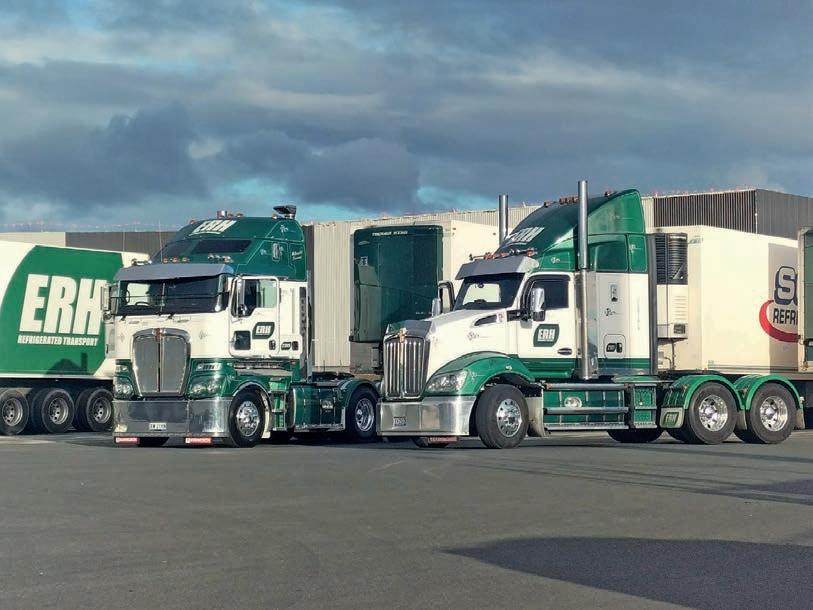
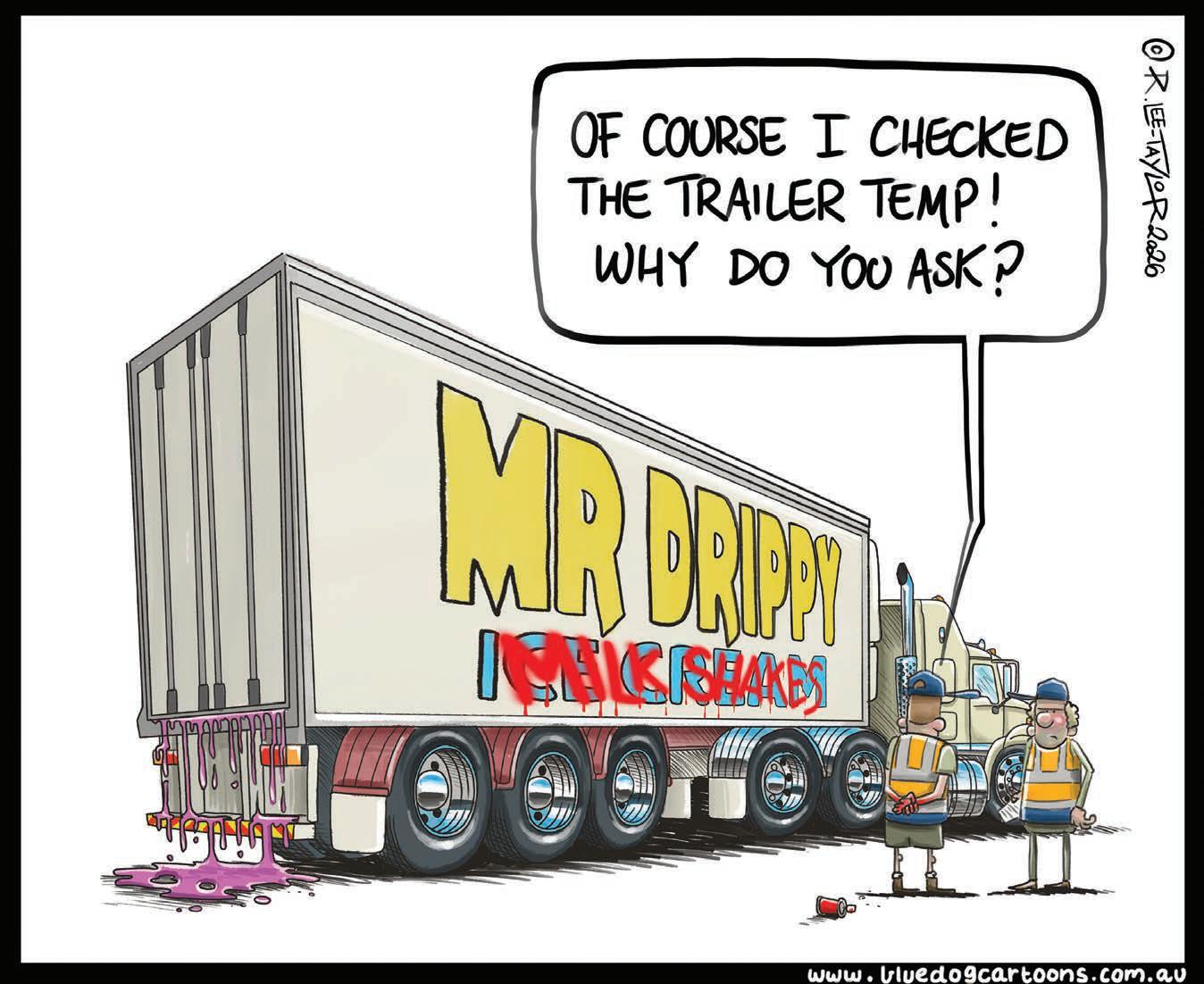
A linehaul truck driver sacked after a refrigerated load of ice cream worth $73,796 was destroyed has lost his unfair dismissal claim at the Fair Work Commission (FWC).
The FWC ruled that while Jeremiah Manly’s employer, ERH Refrigerated Transport, fell short on procedural fairness, there was a valid reason to terminate the driver’s employment.
DESIGN Alejandro Molano
Treena Heit: 0403 626 353
treena.heit@primecreative.com.au
CLIENT SUCCESS MANAGER
Katharine Causer: 0423 055 787
katharine.causer@primecreative.com.au
CONTRIBUTORS
Truckin in the Topics/Spy on the Road: Alf Wilson, 0408 009 301 David Vile, Graham Harsant, Geoff Middleton and Jonathan Wallis.
Big Rigs National Road Transport Newspaper is published by Prime Creative Media. It is the largest circulated fortnightly truck publication in Australia with 22,248* copies per fortnight.
*Average circulation per issue in 2025
The case centred on a December 3, 2025 trip between Wagga Wagga and Melbourne, where Manly collected a refrigerated load of ice cream from a cold storage facility at Truganina before returning to Wagga Wagga.
The trailer was required to be set at minus 22 degrees Celsius, however throughout Manly’s journey it remained at around minus 1 degree.
By the time the error was detected and the temperature remotely corrected by ERH’s night manager in the early hours of the following morning, the entire load had defrosted and was unsalvageable.
ERH told the FWC the cargo was worth $73,796, with disposal costs of about $30,000, taking the total loss to more than $100,000.
ERH terminated Manly’s employment over the phone on December 8, paying him in lieu of notice. He subsequently lodged an unfair dismissal application under the
Fair Work Act.
During the hearing, Manly, who had worked for the company since 2022 and estimated he’d made 600 similar runs, maintained he believed he had correctly set the trailer temperature but could not explain why the setting had not “taken”.
He also argued that he was not solely responsible for the spoiled load, noting that the cold storage facility allegedly had a policy not to begin loading trucks unless the temperature in the trailer was at least -12C. He also said that a secondary driver who had been tasked with driving the ice cream onwards from Wagga Wagga to Sydney had also been fired.
Sloan found there was no evi dence of any refrigeration unit
fault and said the telematics records showed the temperature remained incorrect throughout the trip until it was remotely adjusted.
Even if Manly had attempted to enter the correct setting, the commissioner found he had failed to carry out basic checks during the journey.
The ruling noted Manly acknowledged during the hearing that he had six opportunities to verify the trailer temperature, including before departing Wagga Wagga, while at Truganina and after returning to Wagga Wagga.
While acknowledging others involved in the transport task may also have had responsibilities, Commissioner
own conduct because he had failed to set the trailer to the correct temperature and failed to check it during the journey.
The FWC, however, also found that Manly’s error was a “one-off” mistake and he had an otherwise stable employment record.
“Mr Manly’s conduct on December 3, 2025 cannot be seen as part of a pattern of negligence or noncompliance with ERH’s requirements,” Commissioner Sloan said.
A lthough ERH ultimately succeeded, the commission was critical of its dismissal process.
Evidence showed the decision to terminate Manly had a lready been made before a December 8 phone meeting at which he was asked to explain
MR MANLY’S CONDUCT ON DECEMBER 3, 2025 CANNOT BE SEEN AS PART OF A PATTERN OF NEGLIGENCE OR NONCOMPLIANCE WITH ERH’S REQUIREMENTS,” COMMISSIONER SLOAN
employee be told the reason dismissal is being considered and be given an opportunity to respond before any final decision is made.
cedural fairness requires an
He said providing an opportunity afterwards would be “ like shutting the stable door after the horse has bolted”. However, the FWC concluded the procedural flaw was not enough to overturn the dismissal because Manly had been unable to offer any explanation for the refrigeration failure, either during the dismissal meeting or later at the hearing. In the end, Commissioner Sloan found the company had a valid reason to dismiss the driver and, despite the lack of procedural fairness, the dismissal was not unfair.
“I find that Mr Manly’s dismissal was not harsh, unjust and unreasonable. His application is dismissed,” the commissioner said in his conclusion.
ERH Refrigerated Transport was contacted for comment.
This strategic acquisition strengthens Ellison Haulage’s growing operations while enabling Dave and Karen of Whordley’s Bulk Haulage to successfully transition to their next chapter. Considering selling, valuing or buying a transport business? Contact

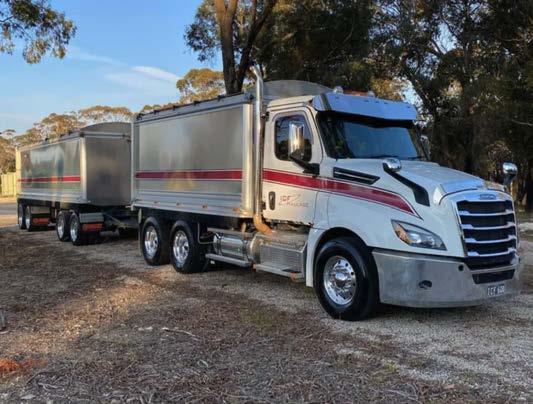
THE collapse of Lithgow-based ICF Haulage has been described as a major blow for the region already reeling from the long-running closure of the Victoria Pass section of the Great Western Highway.
Fourteen jobs have been lost at the family-owned business that had operated from Lithgow since 1999, building a reputation in quarry haulage and the transport of sand, gravel, road base and aggregates across NSW.
According to the company’s website, it ran a fleet of tipper trucks and quad-dog combi-
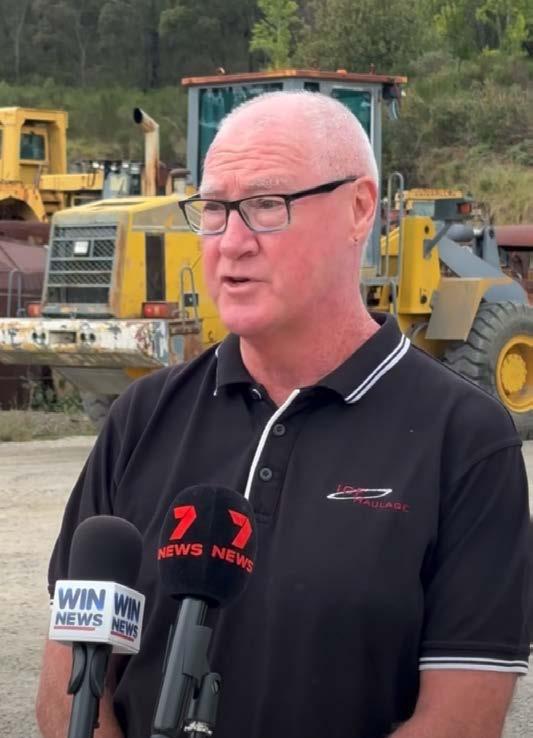
A published Australian Securities and Investments Commission (ASIC) notice said Salea Advisory’s Sule Arnautovic and Jessica Peri were appointed as administrators to Hipco Pty Ltd, which trades as ICF Haulage, on July 9. Independent Federal Member for Calare Andrew Gee has blamed the company’s collapse on the prolonged closure of the Great Western Highway at Victoria Pass since March this year, and fears more could follow with a fix still months away from completion.
for Lithgow and for the entire region,” Gee said.
Gee said businesses had repeatedly warned governments they could not survive while the highway remained closed without meaningful financial assistance. In April, Gee stood alongside ICF owner Ian Fitzgerald at the company’s Lithgow depot, warning that businesses were “on borrowed time” unless additional support was provided.
“Now we have yet another once-vibrant local business closing its doors because of government negligence,” Gee said.
ment inaction,” Gee said.
Speaking to Big Rigs, Salea Advisory administrator Jessica Peri confirmed there was now no prospect of the business continuing to trade.
“Unfortunately, the company has ceased trading and all of the staff have been terminated,” Peri said.
“The company was not in a position to continue to trade, so the company was placed into administration voluntarily by the directors.
“We ceased trading the business on our appointment and terminated all the staff.”
“The collapse and closure of ICF Haulage, which is now in administration, is a tragedy
“There is a human cost to every business that goes to the wall because of this. Fourteen local jobs at ICF have now been lost, and another successful enterprise has disappeared before our eyes.”
Gee renewed calls for both the NSW and federal governments to establish an ongoing financial assistance package for businesses affected by the highway closure, arguing the support should mirror JobKeeper-style assistance introduced during the Covid pandemic.
“ICF Haulage is not the first business to fold because of this debacle, and tragically, it won’t be the last. Unless something changes, more businesses will close, more jobs will be lost, and more business owners, staff and their families will pay the price for govern-
Peri said the company was expected to enter liquidation within about four weeks after the voluntary administration process, with administrators now focused on realising the company’s assets for creditors.
She said administrators had explored whether the business could be sold as a going concern but there simply wasn’t a viable pathway.
“Unfortunately, we were unable to continue to trade the business due to insufficient resources,” Peri said.
“The viability of the business wasn’t there, so the decision had to be made to shut down the business.”
Peri said the assets included about 10 trucks and a similar number of trailers, which would now be sold as part of the administration process.
The administrator said the full extent of the company’s
debts was still being determined ahead of the initial creditors’ meeting, with between 40 and 50 trade creditors identified so far.
“We should have a further idea in the coming week after our initial creditors meeting,” Peri said.
The collapse also leaves uncertainty around employee entitlements.
Peri said eligible workers may be able to access the Federal Government’s Fair Entitlements Guarantee Scheme, but warned it does not cover unpaid superannuation.
“It’s still too early to say whether there’ll be funds available for the superannuation at this stage,” she said.
Peri said initial investigations indicated the prolonged Victoria Pass closure had been one of several factors contributing to the company’s downfall, alongside prolonged peri-
ods of bad weather and rising fuel costs.
“Historically bad weather impacted the ability to trade, the road closure, Victoria Pass, and also increasing fuel prices is what the initial indicators appear to be,” she said.
“But our investigations are still ongoing.”
Road Freight NSW CEO Simon O’Hara had earlier said trucking businesses were spending hundreds of dollars more on individual trips due to lengthy detours, increased fuel use, additional driver hours and higher operating costs.
RFNSW welcomed the NSW Government’s support package for small businesses announced by Minister for Small Business Janelle Saffin, but said grants of up to $10,000 would not reflect the losses being experienced by many transport operators.


A Queensland transport company and its director have been fined a combined
$100,000 following a landmark National Heavy Vehicle Regulator (NHVR) prosecution over repeated breaches of prohibition notices.
The company was fined
$80,000 and its director
$20,000, with court convictions recorded this week against both parties on all charges relating to breaches of the notices.
According to the NHVR, the prosecution marks the culmination of a significant regulatory response to a highrisk operator and follows the regulator’s first use of court
injunction powers to prevent continued non-compliance.
Consistent with its policy, the NHVR has not identified the company or director involved in the prosecution.
Big Rigs understands the prosecution related to three prohibition notices issued to the company and one issued to the director between February 2 and March 6 this year.
Big Rigs also understands the company is no longer trading.
In March this year, the NHVR announced it had secured a Supreme Court injunction preventing the company and its director from operating after they repeatedly ignored prohibition notices.
The actions follow the detection of more than 200 mechanical faults and almost 70 offences across the fleet over two years.
NHVR Executive Director of Statutory Compliance Paul Alsbury said the company’s compliance history demonstrated a clear disregard for safety obligations.
“The company had 16 heavy vehicles inspected from their fleet and each one was found to be defective,” Alsbury said at the time.
Alsbury said the outcome sent a clear message to the heavy vehicle industry.
“This result sends a clear message to industry that the
NHVR takes safety risks seriously and will pursue regulatory action until those risks are addressed,” Alsbury said.
“Where operators choose to continue placing road users at risk, the NHVR will use all tools available to stop that behaviour.
“This case proves the consequences can be significant, and that any perceived monetary benefit to flouting safety rules and regulations will be impacted by court-imposed outcomes.
“This includes the handing down of substantial financial penalties for both the company and its director personally.” Prohibition notices can be
issued by authorised NHVR officers to immediately stop an activity that poses an im minent or immediate safety risk. The notices remain in force until the identified safe ty issues have been remedied.
The NHVR said it issued 23 prohibition notices to compa nies and individuals during the past financial year as part of its strengthened focus on the highest-risk operators.
Alsbury said the prosecution reinforced that every party in the chain of responsibility could be held accountable for deliberate non-compliance.
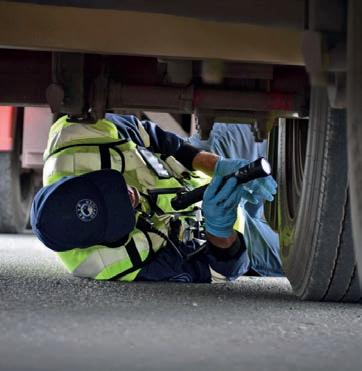
“The NHVR is prepared to take appropriate action where safety risks justify it,” he said.
ALMOST one in 10 heavy vehicles intercepted during a recent national enforcement operation were found either speeding or fitted with illegally modified speed limiters.
Operation Quicksilver brought together the National Heavy Vehicle Regulator (NHVR) and state police agencies in a coordinated national crackdown on speeding and speed limiter tampering.
A s part of the operation, officers from the NHVR performed more than 2000
intercepts, resulting with a national non-compliance rate for speeding and speed tampering of 9.6 per cent.
NHVR Chief Operations Officer Paul Salvati said in a particularly concerning case, one heavy vehicle had allegedly been found with its speed limiter modified to allow speeds of up to 250km/h. Salvati acknowledged that while the heavy vehicle industry was doing it tough at the moment, there was no excuse to put people’s lives at risk.
“Any large, heavy vehicle travelling even a few kilometres above the speed limit can mean the difference between life or death,” Salvati said.
“Speeding is the number one factor in the Fatal Five and has far too big of an impact on Australia’s road toll.
“Tampering with a heavy vehicle’s speed limiter to increase speed capacity is not only illegal but poses a major safety risk to the driver and all road users.”
Operation Quicksilver
marked the first time the NHVR has run a national, coordinated speed and speed limiter tampering campaign with policing agencies in New South Wales, Queensland, South Australia, Tasmania and Victoria taking part.
In Victoria, there were two bus intercepts – one which exceeded the speed limit by 25km/h and another by 15km/h. A further two heavy vehicles were caught speeding in work zones, travelling 30km/h and 10km/h
over the speed limit.
Salvati added that if a driver feels under pressure by their employer to exceed speed limits, there are other options like confidential reporting that must be used rather than resorting to an unlawful tactic.
“Where people’s lives are being risked, NHVR officers won’t hesitate to take action like grounding fleet or prosecuting drivers or operators,” he said.
“This is an issue we take very seriously, and it’s im-
portant all of industry does so as well.
“Anyone who might be concerned a vehicle has been tampered with, including drivers, operators, mechanics, manufacturers or members of the supply chain, should speak up.”
Any members of industry concerned about a vehicle that may have been tampered with are encouraged to contact the NHVR’s Heavy Vehicle Confidential Reporting Line on 1800 931 785.
THE Victorian Transport Association (VTA) has called on the City of Melbourne to engage directly with the freight industry on concerns about heavy vehicle movements on inner-north roads.
V TA CEO Peter Anderson said the council’s calls for additional restrictions after revelations that the number of trucks on inner-north streets had reportedly tripled since the West Gate Tunnel’s opening highlighted the need for genuine consultation between all parties.
“The transport industry shares the community’s expectations for safe, efficient and well-managed roads,” Anderson said.
“However, discussions about freight movements must reflect the realities of how Melbourne’s road network operates. Trucks can only travel on roads that are legally available to them and operators are required to comply with strict laws and regulations governing heavy vehicle movements.”
Anderson said City of Melbourne Lord Mayor Nick Reece’s framing of the industry as using local streets “ like highways, putting our community at risk” is inflammatory, irresponsible, and self-serving, and failed to recognise the extensive safety measures undertaken across the industry.
“Safety is and always will
be the transport industry’s highest priority,” Anderson said.
“Operators invest heavily in driver training, vehicle maintenance, fatigue management systems, compliance programs and new technologies designed to protect drivers, other road users and the wider community.
“Professional drivers understand the responsibility that comes with operating heavy vehicles and take that responsibility extremely seriously every day.”
The VTA said the public debate had highlighted a concerning lack of engagement with the industry despite freight operators possessing detailed operational knowledge about freight demand, delivery requirements, network constraints and route selection.
“The freight industry has not been consulted by City of Melbourne on the concerns raised publicly, despite being directly affected by any proposal to further restrict truck movements,” Anderson said.
“If there is a need to discuss changes to road access arrangements, those conversations should occur around a table with industry, councils and government agencies, not through competing headlines.”
The VTA noted that the debate comes at a time of significant financial pressure on
transport operators, who are contending with rising fuel prices, increased registration and permit fees, higher toll charges and broader inflationary pressures affecting labour, insurance, maintenance and compliance costs.
Road operator Transurban introduced a new heavy vehicle toll point on the West Gate Freeway late last year, charging a minimum $20.41 for a single trip or $51.02 for a 24-hour pass for trucks.
“Many transport businesses are operating on tight margins while doing everything possible to minimise cost increases. Ultimately, higher freight costs flow through the supply chain and affect the price of goods and services across the economy,” Anderson added.
“Every supermarket shelf, construction project, medical facility and manufacturing business depends on the efficient movement of goods.
“The high standard of living Australians enjoy is supported by a freight network that works around the clock to keep communities supplied. As Melbourne grows, freight deserves a seat at the table. The best outcomes will come from consultation, not confrontation.”
The City of Melbourne said its preliminary monitoring following the opening of the West Gate Tunnel has confirmed increased truck movements on some local roads,
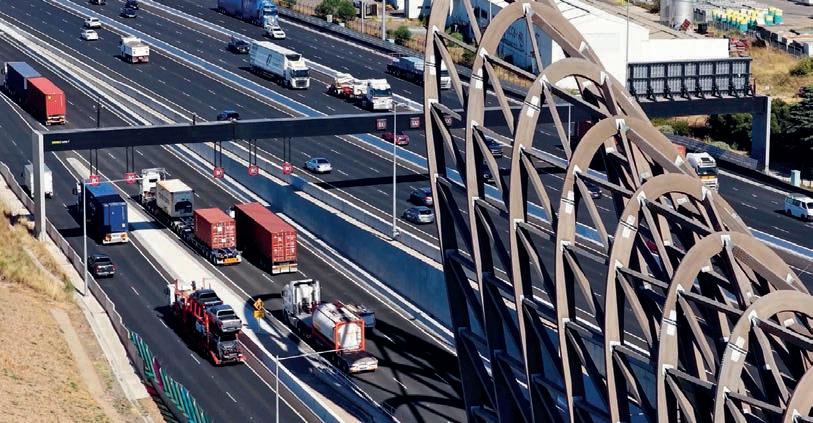
particularly in Kensington, prompting calls for new truck bans and other mitigation measures.
The report says the council has been working with the Department of Transport and Planning (DTP) through the Transport Amenity Program (TAP), which monitored traffic volumes, speeds and heavy vehicle movements for six months after the tunnel opened.
While traffic patterns generally aligned with expectations, Kensington emerged as an exception, the council said. According to its report, Kensington has experienced an increase in truck movements along Epsom Road and Kensington Road as a result of the West Gate Tunnel. Its data showed some trucks
SYDNEY
510 Victoria Street, Wetherill Park NSW 2164 Ph. 02 9756 6199, email: isri@isri.com.au, www.isri.com.au
BRISBANE
were using local streets to bypass higher-order roads, while heavy vehicles travelling through North and West Melbourne and Carlton were largely sticking to the arterial road network. Preliminary findings also identified a three-fold increase in six-axle articulated vehicles on Epsom and Kensington roads.
The council notes that analysis suggests some heavy vehicles may be avoiding toll points on the West Gate Freeway and West Gate Tunnel by using local roads to reach their destinations. It says further work is underway to identify measures that will ensure trucks use designated freight routes and reduce the impact on surrounding neighbourhoods.
To address the issue, council
officers plan to seek DTP approval for truck bans on sections of Kensington Road and Epsom Road, introduce turning restrictions at the Kensington Road–Epsom Road intersection, correct advisory truck route information that currently directs freight through Kensington, and continue investigating further truck restrictions across the municipality.
The DTP said Kensington Rd would remain an official route for heavy vehicles, especially for those heading north from Dynon Rd or making local deliveries.
“We are continuing to work with the City of Melbourne to monitor traffic along Kensington and Epsom roads as movement patterns evolve,” a department spokesman said.


3/120 Gardens Drive, Willawong QLD 4110 Ph. 07 3275 2044, email: sales@isribrisbane.com.au, www.isribrisbane.com.au
BRISBANE NORTH
1/259 Cullen Av, East Eagle Farm QLD 4009 Ph 1300 11 4774, email: seats@isrinb.com.au, www.isrinb.com.au
MELBOURNE
Unit 1/569 Somerville Rd, Sunshine West VIC, 3020 Ph. 03 9311 5544, email: sales@isrisunshine.com.au, www.isri.com.au
MACKAY
110 – 120 Maggiolo Drive, Paget QLD 4740 Ph. 07 4952 1844, email: admin@isrimky.com.au, www.isriseatsmackay.com.au
PERTH
408 Welshpool Rd, Welshpool WA 6106 Ph. 08 9362 6800, email: info@mmtisri.com.au, www.mmtisri.com.au
DARWIN
Mobile Sales and Service
Ph. 08 8927 0986, email: info@isridarwin.com.au, www.isridarwin.com.au
NEWCASTLE/HUNTER VALLEY
Ph 02 4932 0600,
Unit 2/13 Hinkler Ave, Rutherford NSW 2320 email: sales@hvss.com.au www.isri.com.au


ELECTRIC road freight
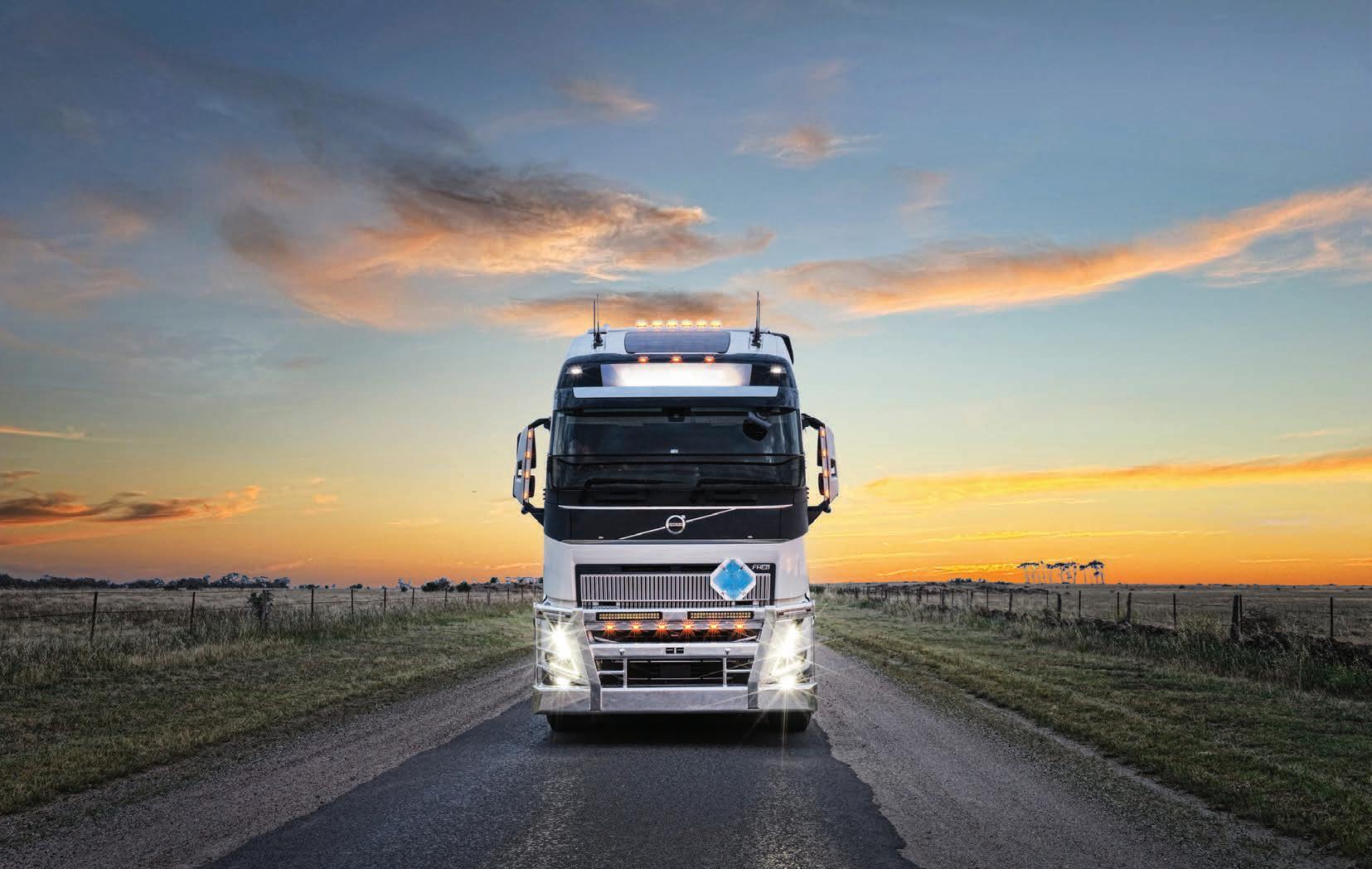
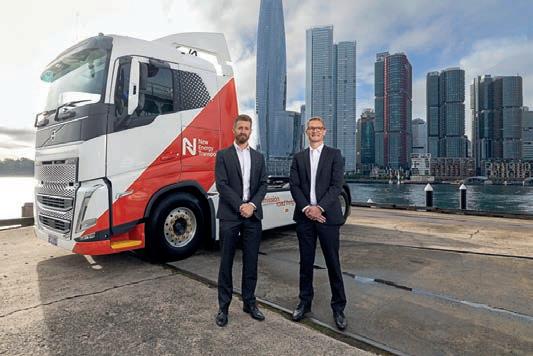
startup New Energy Transport (NET) has taken delivery of its first Volvo electric prime mover, with consumer goods giant Unilever signing on as the company’s foundation customer.
The Volvo FH was officially handed over at a ceremony on Sydney Harbour and immediately entered commercial service, hauling consumer goods on weekday runs from Unilever’s distribution centre at Ingleburn to customer sites across metropolitan Sydney.
The Electric FH has a range of up to 400km and can be charged from 20 per cent to 80 per cent in around 60 minutes, which Volvo says is great for depot charging or planned stops.
The delivery is also NET’s first truck financed under Volvo Financial Services’ new arrangement with the Clean Energy Finance Corporation (CEFC), designed to reduce the cost of leasing heavy electric trucks.
The truck is one of 11 Volvo electrics that NET plans to deploy over the next 12 months as part of its Rapid Deployment Plan, which aims to have 20 electric trucks and six mobile charging units operating before the end of 2026.
The plan is backed by an initial $5 million equity raise supported by Jekara Group and facilitated by Pollination.
NET Co-CEO Fredrik Pehrsson said securing Unilever as the company’s first customer was a significant endorsement.
“New Energy Transport is proud to be partnering with Unilever and Volvo to make electric heavy road freight a reality in Australia. This is a major milestone as we take the keys to our first truck and bring our first customer onto the road,” he said.
Pehrsson said Volvo’s national dealer and service network would provide confidence around vehicle uptime, while Unilever’s commit-
ment demonstrated growing confidence in zero-emission freight.
“Electric road freight means lower costs, greater reliability and a real cut in emissions, and it’s brands like Unilever that will drive the shift at scale, decarbonising their supply chains while delivering greater efficiency,” he said.
Unilever Australia and New Zealand Head of Corporate Affairs and Sustainability
Brooke Sprott said reducing emissions from heavy freight remained one of the company’s biggest supply chain challenges.
“Decarbonising heavy freight transport is one of the most complex challenges in our supply chain, and it’s not something any company can solve alone,” Sprott said.
“That’s why we are proud to be a foundation partner of New Energy Transport and utilise their first heavy
electric prime mover in Australia.”
Volvo Trucks President Roger Alm said the partnership demonstrated how collaboration between manufacturers, financiers and operators could accelerate the transition to lower-emission transport.
“This partnership with New Energy Transport shows how the transition to lower-emission transport is moving forward through collaboration,”
A lm said.
Volvo Group Australia
President Martin Merrick said the project united “a customer ready to lead, a freight operator ready to invest, and a truck partner with proven technology and support in place”.
NET is also progressing plans for what it says will become Australia’s largest heavy electric trucking depot at Wilton in south-west Sydney.
Selected under the federal
ELECTRIC ROAD FREIGHT MEANS LOWER COSTS, GREATER RELIABILITY AND A REAL CUT IN EMISSIONS, AND IT’S BRANDS LIKE UNILEVER THAT WILL DRIVE THE SHIFT AT SCALE, DECARBONISING THEIR SUPPLY CHAINS WHILE DELIVERING GREATER EFFICIENCY,” FREDRIK PEHRSSON
Door program, the depot is expected to open in late 2027 with capacity for 50 electric trucks initially before expanding to 200 vehicles over time.
The company ultimately plans a network of electric freight depots linking Adelaide, Melbourne, Sydney, Canberra and Brisbane by
THE Victorian Transport Association (VTA) is calling for expressions of interest from transport operators who would like to trial an electric truck in their business for no upfront cost.
The VTA’s Victorian Electric Heavy Vehicle Trial (VEHVT), in partnership with the Victorian Government and other industry stakeholders, is pitched as a practical, industry led initiative designed to help freight and logistics operators assess how electric heavy vehicles can perform in real world operations.
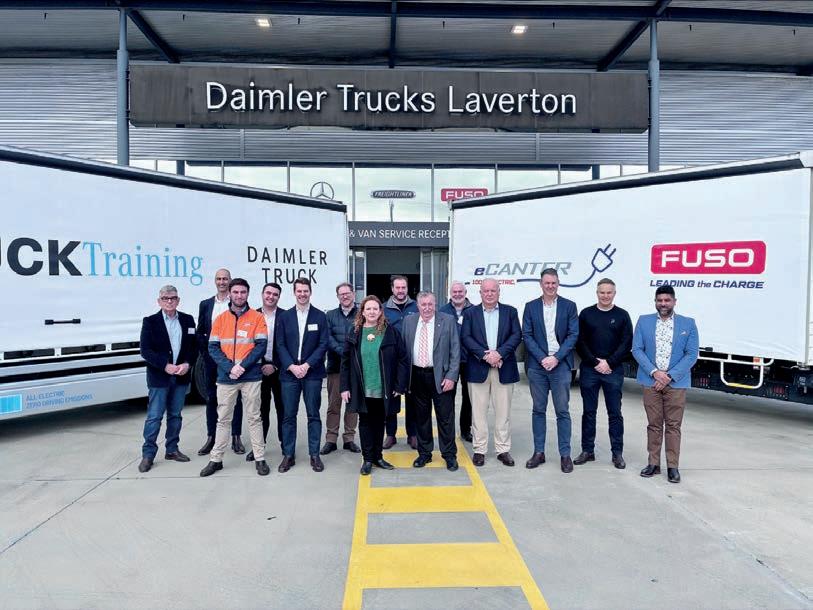
The $1.5 million project was officially launched earlier this month at Velocity Truck Centres, Laverton, a project partner who will oversee the distribution of the trucks being used for the two-year trial.
They include the Chinese-made Sany, and the Fuso
eCanter and Mercedes-Benz eActros from Daimler Truck, another trial partner.
Melbourne’s Cahill Transport is the first participant in the trial and Big Rigs understands its eActros evaluation vehicle is already making a positive impression for its practicality and ease of use.
The company said it is sending the eActros further each day with no issues; and that the driver is ‘loving’ it.
“We know the cost of fuel is hurting our freight operators which is why rolling out these programs will help freight businesses cut costs, boost efficiency and modernise their fleets for the future,” said Victoria’s Minister for Ports and Freight, Melissa Horne.
The trial also supports the Victorian Government’s Freight Plan 2025–2030: Victoria Delivers, which empha-
sises innovation and evidence based transition pathways.
The VEHVT is focused on tangible outcomes for industry, including:
• Hands on experience with electric heavy vehicles in live freight operations
• Real world performance and suitability data
• Insights into integrating charging into freight and depot operations
• Support for businesses assessing readiness for future EV adoption
Vehicles are supplied under structured agreements for a minimum trial period of one month, with longer trials encouraged to maximise learning.
V TA CEO Peter Anderson said the trial reflects long standing advocacy for informed, evidence based decarbonisation.
Government for recognising the scale of the decarbonisation challenge and for supporting freight operators with meaningful, hands on programs,” Anderson said.
“The VTA has consistent-
informed transition so that freight companies can adopt cleaner technologies when it makes operational and commercial sense.
“While this shift will take years, the most important step is beginning with knowledge, clarity, and a plan.” Expressions of Interest for the VEHVT are now open here, with the VTA encouraging operators to participate and help shape Victoria’s lower emissions freight future.
JANUS Electric says it has secured about A$55 million in new North American business within days, with its contracted order book growing from 45 to 112 diesel-to-electric truck conversions following a series of major US fleet orders.
The ASX-listed company, based in the NSW Central Coast, announced last week that four new California fleet operators have placed conditional orders worth about A$45 million, just three days after revealing an expanded A$10 million commitment from existing customer Ability Tri-Modal.
The latest news lifts Janus Electric’s United States order book from 20 to 87 truck conversions and increases its North American total to 112, comprising 87 conversions in the US and 25 in Canada.
The four new customers –Golden State Express, WE-
HACO, Tradelink Transport and King Fio Trucking – have collectively ordered 67 diesel-to-electric truck conversions, 77 swappable battery packs and four Janus Charge & Change Stations. The orders have a combined gross contract value of about A$45 million.
Janus said the orders build on the momentum created by Ability Tri-Modal, which increased its own commitment from four to 20 truck conversions through an additional order for 16 conversion kits and 18 swappable battery sets worth about A$10 million.
The company believes California’s incentive programs are playing a significant role in accelerating demand for the diesel to electric conversions. According to Janus, qualifying operators can access combined Hybrid and Zero-Emission Truck and Bus Voucher Incentive Pro-
gram (HVIP) funding and Port of Los Angeles grants worth about US$166,000 per truck, reducing the net cost of a diesel-to-electric conversion to close to zero. Additional funding may also be available for battery systems and charging infrastructure.
Janus CEO and Managing Director Ben Hutt said the company had seen rapid commercial momentum in the US market.
“Securing signed orders from four additional California fleet operators immediately after Ability Tri-Modal expanded its commitment demonstrates the strong commercial momentum building in our US business,” Hutt said.
He said the latest orders broadened Janus Electric’s customer base and provided important commercial validation for its battery-swap technology.
“Our focus is now on scaling production and converting this order book into delivered vehicles and longterm recurring revenue.”
While the US business is expanding rapidly, Janus also reported progress in Canada and Australia.
The company confirmed the first commercial phase of its Canadian partnership will begin with five truck conversions, 15 swappable battery packs and two charging stations scheduled for delivery by November, before a planned second stage involving another 20 conversions.
In Australia, Janus said it has signed a memorandum of understanding covering eight mining road train conversions and received a letter of intent from a repeat customer for another five trucks.
However, the company said Australia’s incentive framework was less supportive
is booming for Janus in the US.
than California’s because diesel-to-electric conversions are not consistently recognised alongside new zero-emission trucks, limiting the pace at which potential projects can become firm orders.
Most of the newly announced US orders remain conditional on approval of California incentive funding and, in some cases, financing arrangements before production and deliveries commence.
Janus expects first North American deliveries to begin in the fourth quarter of 2026 before ramping up through 2027.
IN a commonsense win for truckies driving through NSW, the state government has finally scrapped one of the most annoying rules.
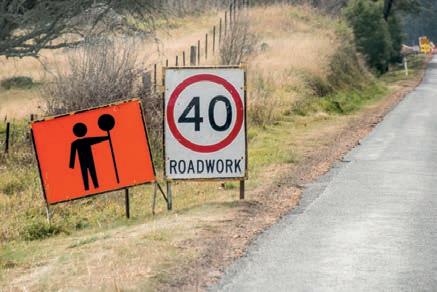
Truckies no longer have to slow down to a 40km/h crawl through roadworks or construction sites after-hours.
Speed reductions in construction zones must be removed during non-work hours, when it is safe to do so.
If there are no workers on site and out of work hours, the road work speed limit will be increased, as long as it is safe for motorists and pedestrians.
“The Minns Labor Government has delivered on our commitment to remove
unnecessary road work speed limits outside of construction hours, helping keep traffic
moving, while maintaining safety,” said Minister for Roads and Regional Transport Jenny Aitchison.
“Motorists across NSW deserve to spend less time stuck in unnecessary traffic and more time with family and friends, which is why we have made this important change.”
Aitchison stressed that this does not mean any weakening of any rules around safety at the sites. She said protecting construction workers and motorists around worksites is critical.
“But as everyone has experienced, leaving speed restrictions in place outside of construction hours often slows
down traffic movement. This change will help traffic keep moving, reduce frustration for motorists and make journeys across the state more efficient.”
Before the election Labor argued that enforcing roadwork speed limits after hours dramatically impacted drivers in the bush, where speed limits could drop from 100km/h to 40km/h even when no work was being done.
NSW now joins Victoria and South Australia in allowing normal speed limits to resume at roadworks when there are no workers on site and it is safe to do so.
In another overdue speed limit change in the state, the National Heavy Vehicle Regulator (NHVR) says that from July 1 new PBS permits issued for eligible vehicles over 26 metres will no longer include the previous 90km/h speed restriction.
However, the regulator stressed that existing permits issued before July 1 will continue to carry the 90km/h restriction until they are amended or replaced.
Operators wanting the condition removed from an existing permit will need to apply for a permit amendment through the NHVR.
The NHVR also reminded
industry that all other permit conditions remain in force and drivers must continue to comply with posted speed limits, road rules and any specific conditions attached to their permits.
The change aligns permitted PBS vehicles over 26 metres with the general heavy vehicle speed limit arrangements in New South Wales and is expected to simplify permit conditions for many operators.
The update is the latest in a series of changes affecting the PBS scheme and comes ahead of broader Heavy Vehicle National Law reforms due to commence on August 1.
TRUCKIES should have safer journeys along the Golden Highway near Cassilis, NSW, with the rollout of a radar system that lowers the speed limit as traffic is detected on highway side roads, says Transport for NSW (TfNSW).
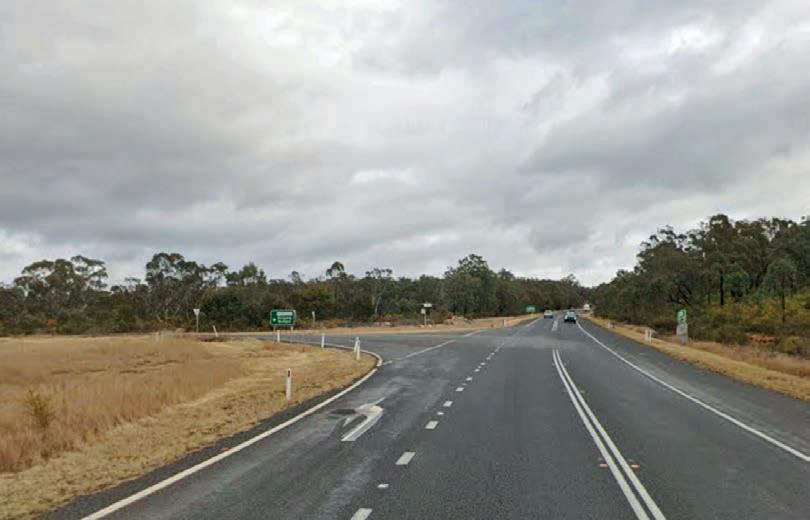
The Rural Intersection Speed Zone (RISZ) system – the first of its kind to be trialled in NSW – will soon be switched on at the intersection of Ulan Road and the Golden Highway near Cassilis, between Merriwa and Dunedoo.
Using radar, the system detects vehicles approach-
ing the intersection on Ulan Road and temporarily lowers the speed limit on the Golden Highway from 100km/h to 70km/h using Variable Speed Limit Signs.
TfNSW said the reduced speed creates safer gaps in traffic, giving drivers more time to react and allowing vehicles entering the highway –particularly trucks – to merge more safely before the speed limit returns to normal.
Designed specifically for rural intersections, TfNSW said RISZ aims to reduce the likelihood and severity of crashes while avoiding the need for permanent speed
reductions on high-speed roads.
While similar systems have been used in Victoria, and other jurisdictions, for several years, this is the first trial of its kind in NSW. The trial will start in early August and will run for 12 months.
“I’m very pleased this new technology, designed and built in NSW, will be trialled in the Upper Hunter, a region home to significant freight movement and busy road corridors,” said state Roads Minister Jenny Aitchison.
“This is just one of the Smarter Highway trials the Minns Labor Government



is rolling out across regional NSW – harnessing technology to address known issues












EDITOR JAMES GRAHAM
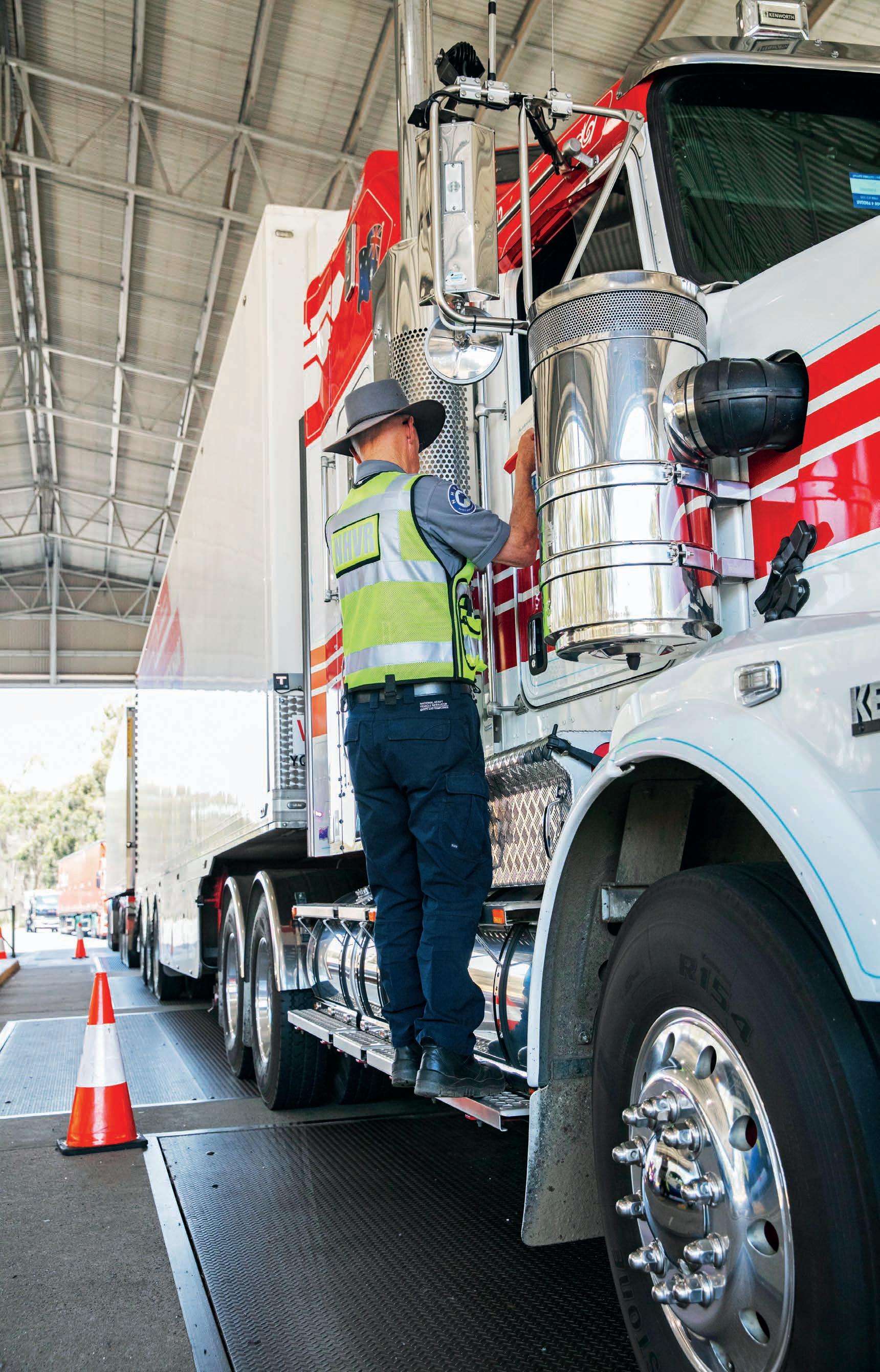
in more than a decade comes into effect from August 1.
If you’ve been following our coverage and online conversations over recent months, you’ll know there’s been no shortage of questions.
We’ve done our best to decipher some of those new rules that are causing the biggest concerns, but we know many still remain. That’s understandable. Any major reform takes time to bed down, and only once the laws are operating in the real world will we k now how some of the finer details play out.
In the meantime, turn to pages 16-18 for our special 11th-hour guide covering key changes and practical tips, and the National Heavy Vehicle Regulator’s response to some of the biggest myths that surfaced in the build-up.
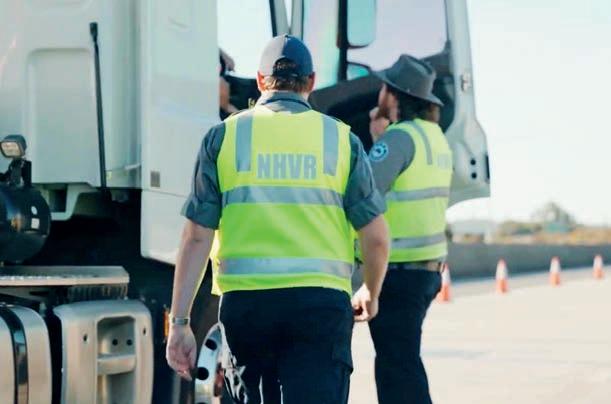
AFTER we put your biggest fears and concerns to the National Heavy Vehicle Regulator about the new unfit to drive duty coming into effect from August 1 many of you were still sceptical about its impacts.
“Still don’t trust them,” wrote Niell Graham on our Facebook page. “It’s a bit like the EWD, a lot of the older inspectors don’t really understand the technology and just simply swipe while I’ve noticed that the younger in-
spectors who understand the technology will check times when an entry was made and where etc.
“There will be two types of inspectors; ones who have been doing the job for a long time and know what to look for and those who go by what’s written down on a piece of paper and if the driver they are interacting with doesn’t tick one of the boxes on their paper list, they will be deemed unfit.”
Peter Edwards believes that the law is still open to inter-
When I pull up before I get out and stretch and have a bit of a yawn, does that make me [unfit], in the officers’ eyes? Well, I’m just having a stretch to get the blood
I know one bloke who is an older bloke never wore sun-
Got pulled up by the mermaids on the Beef Road and ecause he had red eyes they deemed that he was tired and told him to pull up for seven hours. No shower, nowhere to go to the toilet.”
Craig Morris, meanwhile, questioned the law’s legality:
“I wouldn’t be too worried fellas, they don’t have a legal right to stop you, if you’re a fully licensed driver and
registered and had a medical done for your company, or self for owner drivers.
“The industry wonders why we’re all getting out of the job and can’t attract anyone into the industry.”
Thomas Stonehouse said it’s not the NHVR officers drivers should be worried about.
“It’s the young gun highway patrol officers who are rubbing their hands together for their interpretation of this law.
“Brace yourself for groundings and court appearances and huge fines with their favourite judge.”
Curtis Riley wrote that he had a trained sleep specialist who advises and assesses him every year.
“NHVR staff are not my approved sleep specialist, and look forward to taking them to court for practicing as a medical specialist without the university and industry approved qualifications, and implore every driver to sue them when they place anyone under a fatigue diagnosis.”
Added Keith Morrell: “If they can’t tell us exactly what they are looking for, how can we manage this ourselves? There needs to be clear guidance on this rule.”
Everyone will be hungry; no door-to-door delivery. No medical supplies. See if you get them on time.
“Petrol and diesel to country areas? Yeah, right.
Ya reckon there are people who are complaining now about stock in shops. Wait till it’s moved by rail.”
Ty Baskerville thinks it’s already too late: “Tell me what ther industry can you go to work make a spelling mistake or forget to draw a line and it costs you $20,000 in fines.”
James Rume believes authorities just don’t care.
“Too many people think the government cares. They don’t. Someone will always try and do the job.
THE Bored Neurotic Housewives’ recent column asking the tough questions about the future of Australia’s freight industry in the wake of record closures and looming fine increases also sparked plenty of lively debate.
Ian Young wrote that if companies don’t stand together, then the writing is on the wall.
“A driver can’t stop, I think we could all agree, but companies need to stand strong and say, ‘enough is enough’. Fark, do something different for a change and stop as a united front, that way no
one can come and take your freight. REMEMBER IF TRUCKS STOP THEN GET THE POLYWAFFLES to sit down and listen.
Bob Morphew said the haulage industry is still like the wild west.
“I was told it’s impossible to police (by a constable). The amount of drivers that get stopped is such a small percentage. And the authorities k now who they’re targeting... 49 countries in the EU under the same system.”
Gary Davis said things will only get worse when everything is shipped by rail.
“A new company each week, run for a while then fold up, start again. Doesn’t bother them.”
Glenn Burkin implored authorities to stop treating the industry as criminals.
“We are only trying to do our jobs.”
Lindsay Ward hopes tougher chain of responsibility laws will weed out those taking shortcuts, forcing rates to improve, along with better pay for professional drivers.
“This is what the transport industry might need to get rid of all those soft cocks who want to be truck drivers.”
Visy Logistics has been select ed as Coopers Brewery’s sole linehaul provider, managing more than 2000 interstate freight movements annually from Adelaide to key markets including Melbourne, Syd ney, Brisbane and Perth.
The partnership is antici pated to meet the same distri bution network with six per cent fewer truck movements each year, thanks to a long term investment from Visy Logistics in new technology and assets.
Visy Logistics has invested in 32 new assets, including prime movers and B-double combinations, and created 17 new roles across South Australia, including experienced linehaul drivers, administrative and supervisory positions.
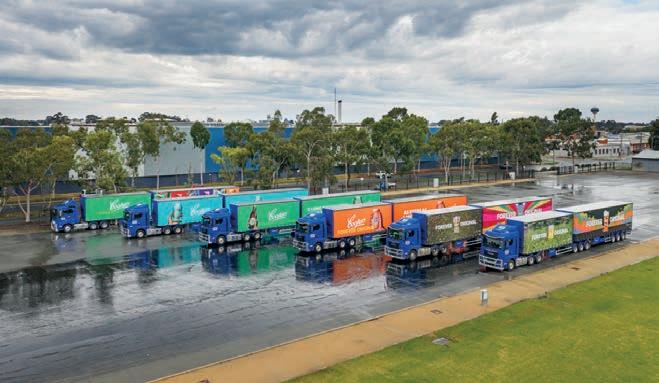
tions that safeguard product quality in all weather conditions.
The national linehaul partnership includes:
• Modern trailer configura-
trailer stairs.
• Enhanced safety technologies, including roll stability systems, guardian seeing machines, and retractable
• Improved payload capacity, with 36-pallet trailer configurations replacing the standard 34-pallet equivalent – a six per cent increase in product on every trip that
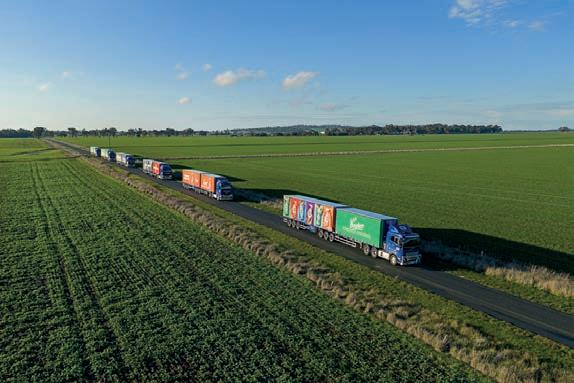
reduces the number of journeys required.
• Euro 6 prime movers that reduce fuel use by five per cent compared with previous-generation Euro 5 vehicles.
• R ail and coastal shipping services into Western Australia – cutting transport emissions with fewer trucks and reducing the number of kilometres travelled.
Michael Shearer, Managing
Director – Coopers Brewery said Coopers beer sales are growing right across Australia and this partnership with Visy Logistics will help ensure the company’s product continues to reach local bottleshops, pubs, clubs and the end consumer as efficiently and reliably as possible.
Wayne Boxshall, President – Visy Logistics Australia said Visy Logistics is excited to partner with a great Australian business built on quality, family values, and generations of experience.
“By finding a way to meet Coopers’ Australia-wide distribution network with less truck movements, Visy Logistics has found a solution the takes trucks off the road, facilitates future growth and saves money for an iconic Australian brand,” Boxshall said.
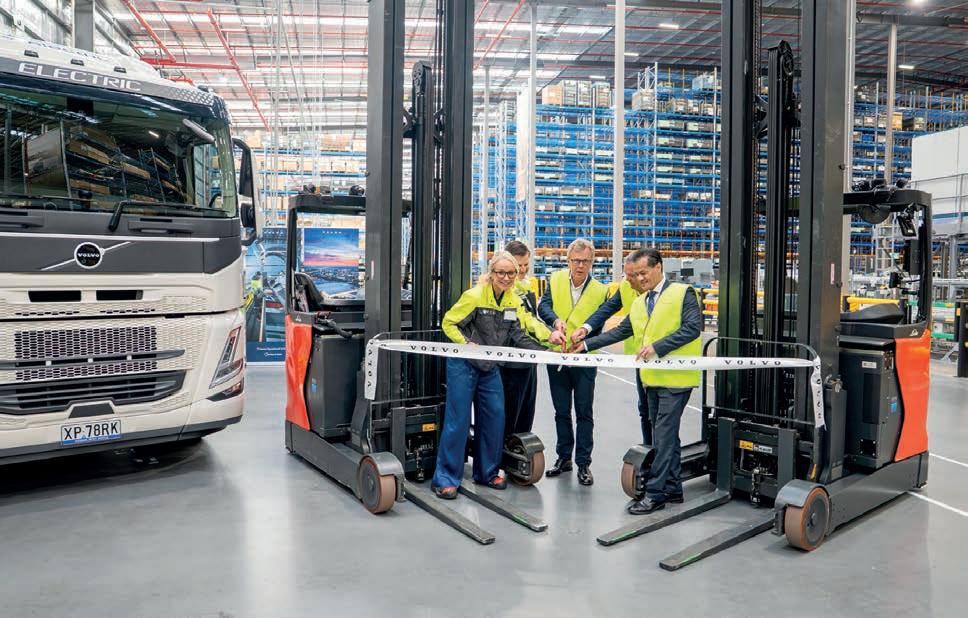
the last five decades.
At 21,000 square metres, the new facility is twice the size of the previous site and has capacity to hold 72,000 distinct Stock Keeping Units (SKUs), including traction batteries and Battery Electric Vehicle (BEV) specific components to support evolving fleet needs.
Managing the scale and complexity of this many parts is Volvo Group Australia’s new Automated Storage and Retrieval System.
A first for Volvo Group globally, this computer-controlled technology uses ultra-high density storage techniques to maximise the use of space, automatically retrieve the parts and deliver them directly to the operator at their console.
The days of walking long distances and climbing shelves are over, as the centre includes purpose-built cranes that sit within the racking and remove the need for manual
handling. These support the lift and extend into the aisle to place parts on a pallet.
Volvo Group Australia President and CEO Martin Merrick said this technology alone provides greater parts availability, reduced lead times, and improved first-time fill rates.
Importantly, the system significantly reduces movement, bending, and manual lifting. Combined with other ergonomic features such as height-adjustable workbenches, anti-fatigue matting and a comprehensive fleet of Material Handling Equipment, the centre makes operator safety and comfort a focus.
“Improving our teams’ work environment has been a key driver of this project,” said Merrick.
“We’ve made improving ergonomics a high priority, and equipment of this level of sophistication makes a massive
difference to the working conditions of our people.”
In keeping with Volvo’s focus on sustainability, the centre has been built from the ground up as a 5-Star Green Star facility.
“The centre has been designed as a 5-Star Green Star facility, supporting Volvo Group’s sustainability ambitions and high standards for energy efficiency and indoor environment quality,” said Merrick.
The new Sydney Distribution Centre forms part of Volvo Group’s broader investment of close to $400 million in Australia over the past 18 months, including strategic investments in distribution, retail and capability.
“This centre will strengthen support for customers in freight, public transport, marine and industrial segments, helping improve parts availability and customer uptime
across Australia and New Zealand,” said Merrick. Roger Alm, President of Volvo Trucks, cut the ribbon at the opening.
“The Sydney Distribution Centre is the first of its kind anywhere in Volvo Group’s global operations and it is an important step in strengthening our support for customers in Australia,” said Alm.
“It brings together safety, quality and efficiency to improve parts availability, enable faster service and enhance uptime – keeping trucks on the road where they belong.
“With the new centre, we are creating a stronger logistics network, ready to support both today’s vehicles and the next generation of transport solutions. I am very pleased to see this investment come to life, and I want to thank the Australian team for making it happen.”


Breadalbane fatality
A truck driver was killed in twotruck crash on the Hume Highway on July 17.
Police have been told the road train had broken down on the Hume Highway near Breadalbane when a B-double carrying aerosol cans collided with the rear of the truck.
The driver of a road train – a 31-year-old man – was treated at the scene for minor injuries, before being taken to Yass hospital for mandatory testing.
Police are appealing for anyone with dashcam footage or information to come forward and contact Goulburn Police or Crime Stoppers on 18000 333 000.
Early works are gathering pace on the long-awaited Muswellbrook Bypass, with utility relocations underway, the main construction tender now down to a shortlist, and foundation work already completed on part of the future route.
Around 20,000 vehicles travel through Muswellbrook, NSW, each day, with heavy vehicles accounting for about 13 per cent of that traffic.
Once complete, the New England Highway upgrade will divert more than 2500 trucks away from the CBD and provide a free-flowing 100km/h alternative route for through traffic.
In a July update on the $381 million project, Transport for NSW said electrical utility relocation work began late last year and will continue through to the end of 2026.
Rest area closed for six months
The South Tomingley Rest Area on the Newell Highway is closed for up to six months due to ongoing work to realign the highway for Alkane’s Tomingley Gold Extension Project.
Alkane is realigning an 8.1km section of the Newell Highway south of Tomingley to support the expansion of Tomingley Gold Mine in Central West NSW.
Alkane said this realignment is needed to safely divert traffic around the growing mining operations.
TfNSW said temporary toilet facilities will be installed for the duration of the closure at the North Peak Hill Rest Area, about 11km south of the South Tomingley Rest Area.
Bruce Rock expands
Trailer builder, Bruce Rock Engineering has acquired Australian Compressed Air Foam Systems (CAFS) manufacturer, Quitfire, bringing the specialist fire suppression technology business into its operations as part of its ongoing growth and diversification strategy.
Bruce Rock Engineering said it has worked with Quitfire’s CAFS technology for several years and the acquisition will allow it to bring the manufacturing of the systems in-house.
The move reportedly strengthens the trailer builder’s capability to deliver Australian-made fire suppression solutions for trucks and mobile equipment across a range of industries.
BY KRISTY SPEIRS
WHEN a serious heavy ve hicle incident occurs, most operators focus on the im mediate priorities such as:
• Ensuring people are safe.
• Cooperating with emer gency services.
• Supporting drivers and em ployees.
• Protecting the company from operational disrup tion.
W hat many companies do not appreciate is that from the moment a serious in cident occurs, a regulatory investigation may already be underway.
Whether the incident in volves a fatality, serious in jury, major collision, fatigue concerns, mass breaches, loading issues, or suspected breach of primary duty is sues, decisions made in the hours and days following the event can significantly impact the course of the investigation.
The investigation starts long before charges are considered
One of the most common misconceptions is that legal advice is only needed once charges have been filed.
In most cases by the time charges are filed, investigators may have spent months gathering evidence, conducting interviews, analysing documents, downloading electronic records, and examining compliance systems, policies and procedures.
Often the most important evidence is obtained in the early stages of an investigation.
That is why obtaining legal advice early can be critical.
Understanding your rights and obligations
Following a serious incident, companies and individuals may receive requests for information from investigators.
• These requests can take various forms, including:
• Requests for records and documents;
• Requests to participate in interviews, whether under caution or pursuant to compulsory statutory powers;
• Notices issued under section 569 of the Heavy Vehicle National Law (HVNL) requiring information or documents to be produced.
Understanding the distinction between a record of interview conducted under caution and an interview conducted under statutory compulsion is critical. The extent to which a person is required to answer questions, the protections available to them, and the potential use of any information obtained can differ considerably.
Many operators make the mistake of assuming all interviews are the same. They are not. Early legal advice can assist individuals and businesses to understand their rights and obligations before engaging with investigators.
Understanding what information must be provided, what information may be protected, and the consequence of non-compliance is important.
Every situation is different.
• Sometimes full cooperation is required.
• Sometimes legal professional privilege may apply.
• Sometimes a person may have a right to decline to answer certain questions.
• Obtaining advice before responding can help ensure obligations are met while protecting legal rights.
Section 569 notices are serious
Investigators frequently utilise powers under section 569 of the HVNL to compel
the production of information and documents.
It should be noted that failure to comply can itself constitute an offence.
However, receiving a notice does not mean that a prosecution will necessarily follow.
It does mean the companies and operators should carefully assess:
• W hat information is being sought;
• W hether the notice has been properly issued;
• Potential legal risks arising from the material provided;
• W hether legal professional privilege may apply to any documents.
Many businesses make the mistake of treating these notices as routine administrative requests. They are not.
They are mostly a significant step in a regulatory investigation.
Internal investigations matter
Following a serious incident, companies/businesses should also consider conducting an internal review of the circumstances.
The purpose is not to assign blame.
The purpose is to understand what occurred, identify risks, preserve evidence, and ensure appropriate corrective action is taken.
Importantly, operators
should ensure records are preserved and relevant information is secured.
Investigators may later examine:
• Driver records;
• Induction records;
• Fatigue records;
• GPS data;
• Maintenance records;
• Rosters and Schedules;
• Training records;
• Drug and alcohol testing records;
• Policies and procedures;
• Previous non-compliance reports.
What may appear insignificant immediately after an incident can later become a critical piece of evidence.
The investigation may continue for months
Many National Heavy Vehicle Regulator (NHVR) investigations continue for an extended period before any charging decision is made.
During that time investigators may:
• Conduct interviews;
• Obtain expert reports;
• A nalyse electronic data;
• Examine company systems and policies;
• Consider the role of executives and managers.
The reality is that most prosecutions are not built overnight.
They are built progressively over many months.
Having legal guidance throughout that process
allows businesses to understand where the investigation is heading and respond ppropriately at each stage.
Primary duty investigations focus on risk
Importantly, investigators are often not examining the collision itself.
The focus is on the circumstances that existed before he incident occurred.
Primary Duty offences under the HVNL are riskbased offences.
Investigators may examine whether systems, supervision, training, monitoring nd compliance processes were adequate before the event occurred.
Questions often include:
ere known risks identified?
ere concerns escalated? ere breaches investigat-
• Were compliance systems actively used?
• Were policies implemented in practice?
The investigation frequently focuses on the systemic issues that existed before the incident rather than the incident alone.
Early advice can make a significant difference Every serious incident is different.
However, one principle remains consistent.
The earlier legal advice is obtained, the better positioned a business is to understand its obligations, protect its legal rights, and navigate what can become a lengthy and complex investigation.
By the time charges are filed, the investigation may have been underway for many months.
The most important decisions are often made long before anyone steps into a courtroom.
If your business is involved in a serious heavy vehicle incident, obtaining early legal advice should be considered part of your incident response plan.
About the author: Kristy Speirs is a Special Counsel with Acorn Lawyers practising in criminal, regulatory and transport law. She is a former principal prosecutor with the NHVR and has extensive experience in complex investigations, prosecutions and chain of responsibility matters.
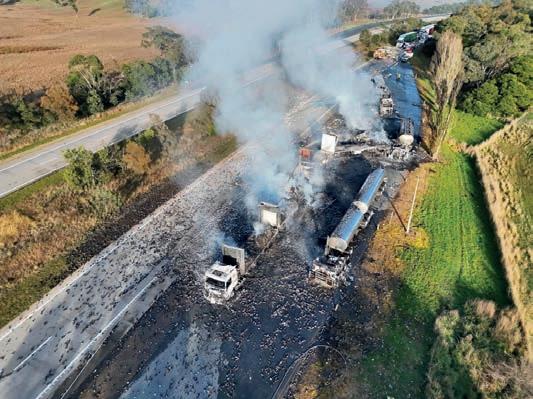
A truck driver has been charged with negligent driving following a multi-truck crash in the NSW Southern Tablelands last month.
The 28-year-old was driving one of the six trucks involved in the explosive crash at the Windmills Rest Area, northbound on the Hume Highway at Breadalbane on June 30.
All six trucks were destroyed by the fire, which NSW Police alleged began when began when two trucks collided and caught fire, be-
fore spreading to four trucks that were parked in the rest bay.
One of the trucks was carrying eight tonnes of butane cans, another was transporting resin, a third contained memory foam, and a fourth was transporting alcohol, which Fire and Rescue NSW said fuelled the explosion.
NSW Ambulance treated six male drivers for minor injuries at the scene, with two of the drivers, aged 23 and 28, taken to Goulburn Hospital for mandatory testing.
Officers attached to The Hume Police District commenced an investigation into the circumstances surrounding the crash, with assistance from the Crash Investigation Unit.
Police said initial investigations suggest two trucks collided and became alight, before the fire spread to four other trucks that were parked at the rest bay nearby.
Following inquiries, a 28-year-old man was served a Future Court Attendance Notice, charged with neg-
July 14.
EURO 6 SINCE 2021 6-CYLINDER SIDEGUARD ASSIST
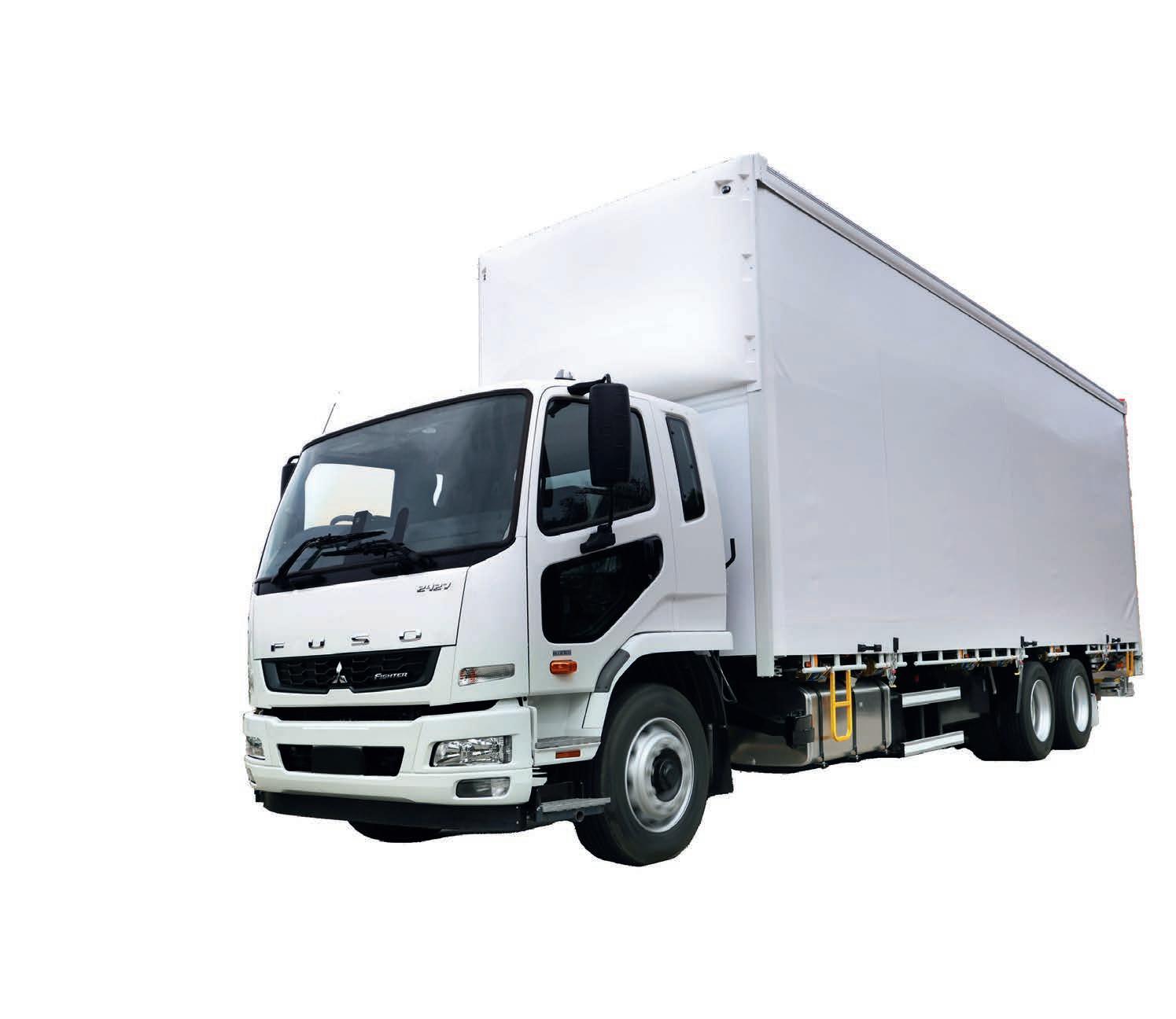
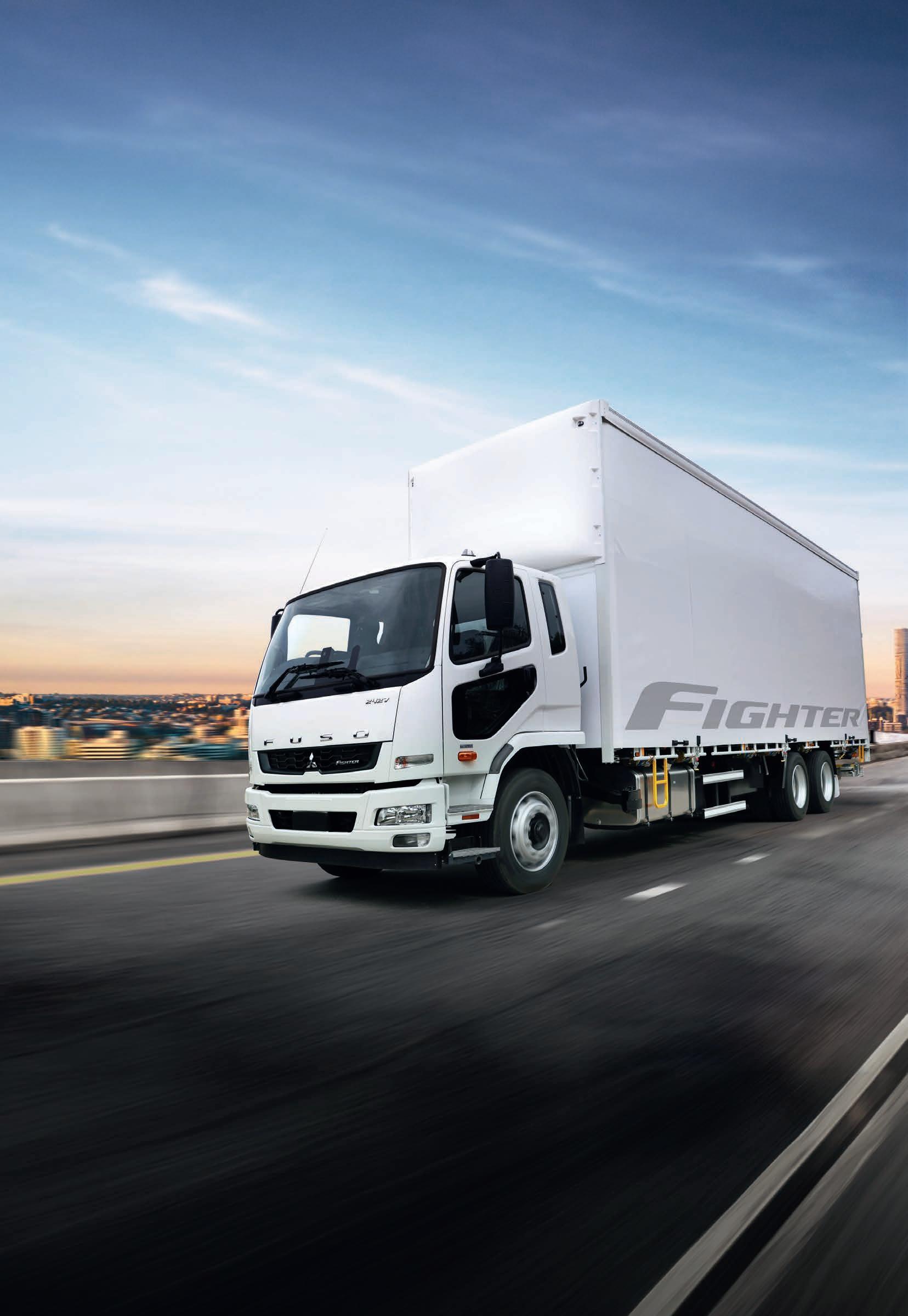
When you need a job done, it’s the Fighter you need in your corner. Having pulled the Euro 6 punch in 2021, the FUSO Fighter has been fighting the emissions fight for years. Add to that the knockout combo of 6-cylinder pulling power, full Allison Automatic and Sideguard Assist ^ across most models means the Fighter punches above its weight against its rivals in a range of applications. All backed by a 5-year * warranty and 5-year * roadside assistance, the Fighter is set to go the distance. Learn more at your authorised FUSO dealer or visit fuso.com.au/fighter
When this truckie finds herself sitting in the queue waiting for her tipper to be loaded she has plenty of great memories to keep her company.
BY GEOFF CROCKETT
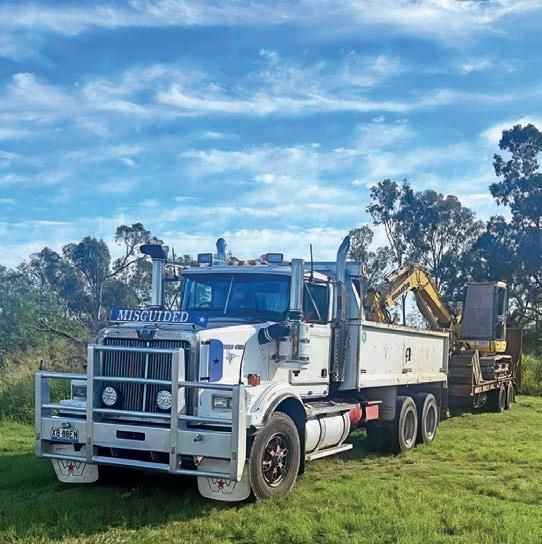
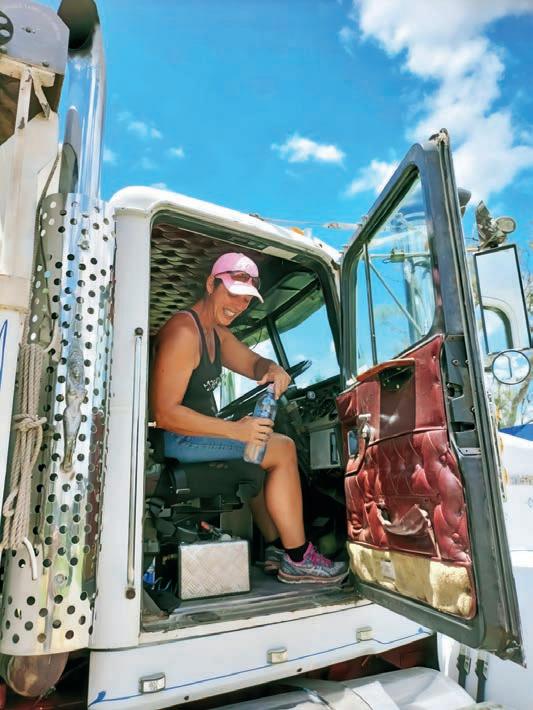
TRUCK driver Michelle McMillan’s journey to the driver’s seat of her 1991 Western Star FX is a little different to most.
Michelle didn’t grow up in a transport family or spend her childhood in the passenger seat counting the kilometres between roadhouses.
Rather, she grew up travelling the country as a security officer, following the tours of famous musicians and sports stars, working the gates, and vetting the crowds.
There were a lot of world-famous celebrities who impressed her and she has some great stories to share about her time in the security game, including a stint manning the VIP tent on an international surfing tour.
“Anyway, a surfing great comes to the door, and he didn’t have his accreditation on him, and I said, ‘No, sorry, you can’t come in here’,” Michelle says.
“And next thing, one of the promoters comes from nowhere – ‘No, no, he can go wherever he likes’.”
Michelle says the promoter grabbed the accreditation she had on the lanyard around her own neck and pointed to the photo of the surfing legend next to the event name.
“Guess what? I didn’t do the VIP tent the next day. I got stuck out on the beach doing the beach running instead. You can’t know everything.”
She said the long hours, uncertain shifts and on-call nature of security work became the norm during a career that
person you could ever meet.”
“I used to work at a 5-star hotel in the city (Brisbane) and she came back from her concert.
“Anyway, the boss rings up and says, ‘You know, we’ve got all those people outside in the street and the front foyer area’.
“They all knew that she was staying there in the penthouse, and these people obviously couldn’t afford tickets to the concert.”
Michelle says she expected the singer would arrive at the hotel via the less obvious VIP entrance to avoid the crowds, but she opted not to go that way, saying she wanted to meet her fans.
“She didn’t have to do this, but this is what gave me new respect for her.
“She turned up, still in her concert gear, brought her limo around, parked out the front, got out of her limo, and went around to every single person that was out there waiting for her.
She’s about five foot five (inches) – I felt like Gigantor next to her. She was so down to earth and lovely, and spent time, you know, a good five minutes with every single person.”
Michelle started working in security after a brief stint working as a vet nurse volunteer at the RSPCA after she finished school.
She says she found the nature of that environment depressing, particularly the way some humans treated their animals.
“After one tough day, I was telling a female friend about, she suggested I investigate doing security. Back then the
ways, plain clothes work in department stores, concerts, football matches, cricket events, and tours of various kinds.
After nearly 30 years in the game, she found herself leading the security team at a large shopping centre, not too far from her 40-acre home base at Tamborine.
It’s a job she said has become more dangerous, and after her team was faced with tackling youths armed with knives, she, and her soon-to-be husband Wal, decided it might be time for a career change.
“So, he asked me one day, did I want to drive a truck? Hell yes!! Which truck?”
“I was told no automatic license, you will be getting an open license, the one to drive a crash box, that way I could drive any truck, including his, from time to time.”
So, Michelle, then 48, took truck driving lessons and started out on the next stage of her career.
Her 1991 Western Star FX was bought from Wal’s second cousin, who also has a 1996 Western Star. It sat at home for a few months after Michelle got her license as she worked up the courage to take it out on the road.
Eventually Wal threw her the keys and told her to just take it for a drive, put some fuel in it, and come back home.
“So, I did. I drove all the way out through Beaudesert, through the back way, around the hills, around the corners. And then I parked, went to Woolworths, got some groceries, came back. That’s what girls does, don’t they? When they have trucks, they go and do the grocery shopping.
“Then I came back home, and he goes ‘good, so you’re used to it, right? You’re working tomorrow’. OMG”.
The next day was an onsite for a construction site job.
Michelle said leaving home that first morning was daunting, the fog was like pea soup, and it was 5am in winter.
“That was a baptism of fire. I could hardly see the traffic lights, let alone the car headlights in front. Let’s just say it was a slow start.”
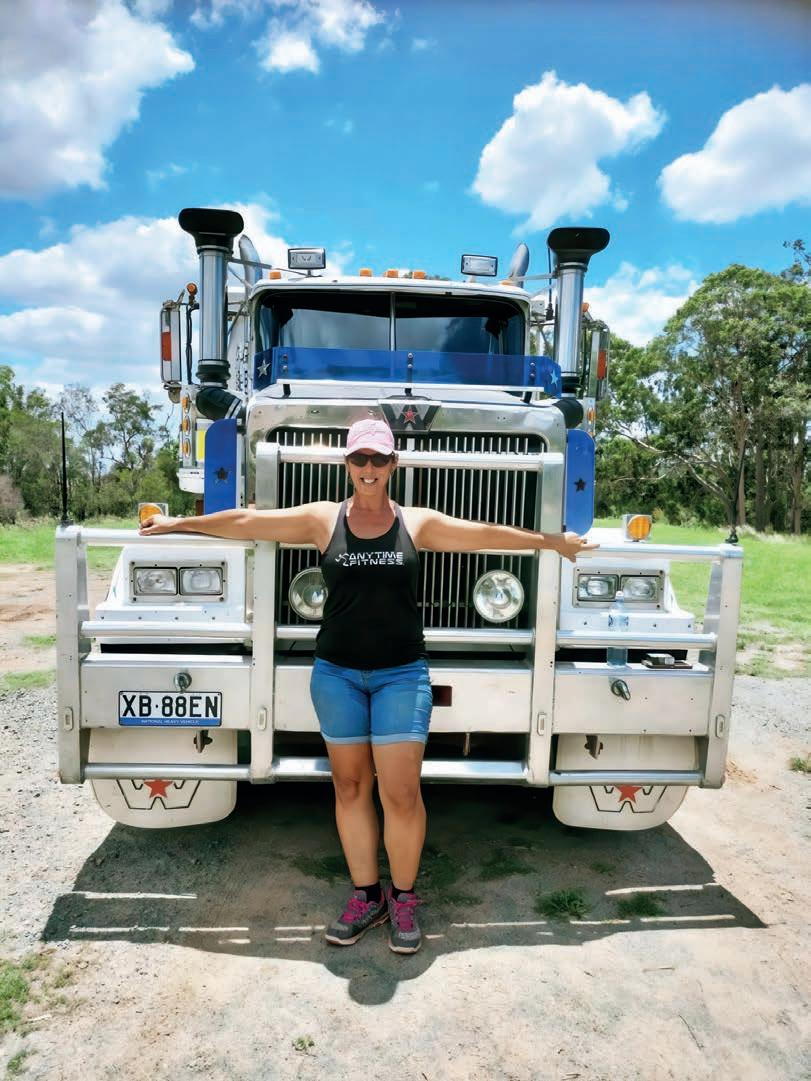
“Considering I had never driven machinery or reversed trailers/ horse floats, or caravans. I think I am not doing too bad.”
With her HR license Michelle says she sometimes drives the tipper with a dog trailer in tow, however an MC license and bigger trailers are on her list of things to do.
Asked for her thoughts on training and truck driving for women Michelle says her experience has been positive, with plenty of support from other truckies and a great training experience, helped along by the fact she was able to pay off the cost of the training over a few months.
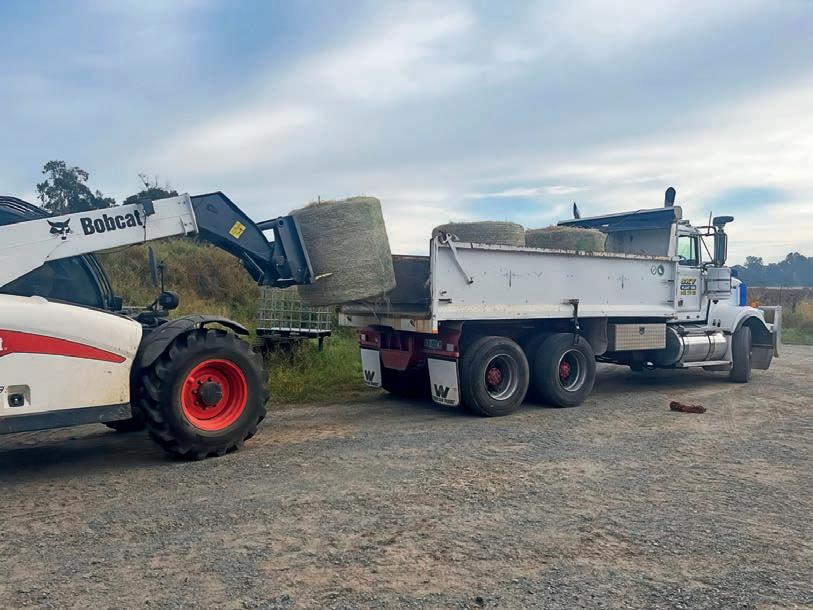
Her’s is the sort of work that requires the truck to reverse down tight access areas, to prop up on the side of a hill and tip the soil over the edge to fill a hole, or to climb up
“One of the many things I love, and I am very fortunate, is that I work with a great crew of other drivers who have all given me tips and tricks. I do have to give a shout out to Wal, Shaun, Scotty, Clayton, and Neil who have shown me the ropes their advice has been priceless.
“The other great thing I love is that my truck is my office and you’re never in the same place, you’re always in different places every time, meeting new people. Whether it’s at customers, on their properties, or you know, working for civil mobs.”
Michelle says it’s a “little bit sad” that there are not more women driving trucks, noting that truck driving doesn’t have to be about driving the biggest truck possible, as there is plenty of demand in the industry for drivers of all sizes of vehicles.
“There are women out there quite capable of being able to do it, just give it a go and do it. Seriously, you’ll absolutely
love it. Plus, the people you work with, the guys in the industry now are so forthcoming and welcoming.”
Does she miss the thrill of the security gig?
“I have been asked to come back several times, but I am over the industry,” she said.
“I’m glad I’m out of it. I’ve got friends of mine that are still in it, I’ve heard some bad stories, unfortunately. Yeah, one of them being a person I used to work with who was stabbed. I have a new career and I’m loving it.”
As for the name on the front
Michelle’s truck, Misguided Girl, she says there’s a double meaning, and it was better than her first suggestion of “Dirty Old Bird”.
“When Wal and I first got together and he couldn’t be-
lieve me that I was in love with him – he’d say - ‘poor misguided girl’. And when I first started driving, I got lost a few of times, never trust GPS!”
As for what’s next, Michelle says she and Wal are kept busy with their property, which includes horses, two dogs, one cat, and chooks to look after. Not to mention the home brewing set up. There’s also a big birthday to plan for in October, and their wedding in 2027.
On the truck driving front Michelle says she’ll keep driving her Western Star while the work’s around, then eventually she’d like to spend the time to do it up and roll out to a truck show or two, but that’ll be something for retirement, which “a little while off”.
In a year of milestones, this Melbourne truckie reflects on an incredible health transformation, a lifelong love of trucking and his hopes for the next generation.
BY JAMES GRAHAM
IT’S a big year of celebrations for Melbourne-based truckie Mark Sheridan.
In July he was expecting to welcome his third grandchild, by October he’s hoping to have shed 40 kilograms in just 12 months after making health a priority, and in November he blows out 60 candles.
The festivities continue on the work front too, with Mark celebrating his 45th year in the industry.
It’s been a varied and eventful career for Mark, but one achievement stands above all others – a spotless driving record. No crashes. No incidents. No blemishes on his licence.
“I’ve never had a thing go wrong,” said Mark.
“I’ve got a completely clean record. I think I’m doing something right if I haven’t had an incident or an accident after all these years.”
That philosophy has carried the Melbourne-based AJM Transport driver from a teenage labourer on the docks to one of the industry’s respected veterans.
Today, Mark hauls Toyota car parts from Melbourne to Coolac each night, before returning with Hyundai car parts. By week’s end, he’ll have covered around 5500 kilometres as part of AJM’s tightly coordinated express network between Melbourne, Sydney and Brisbane.
The routine suits him perfectly.
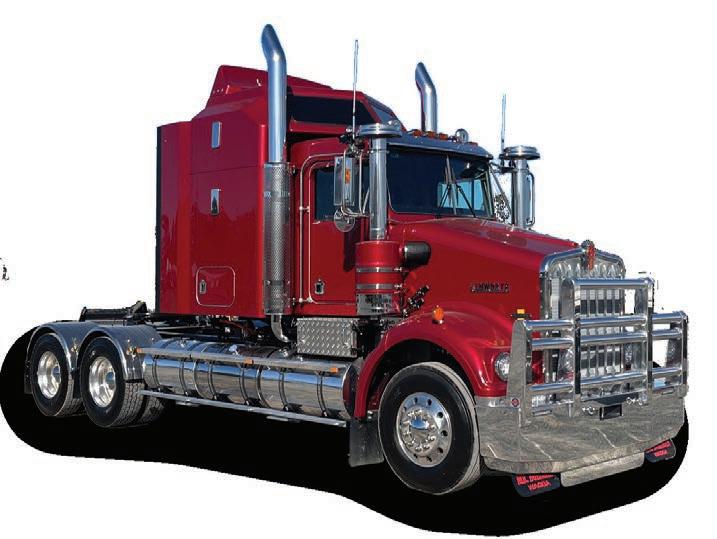
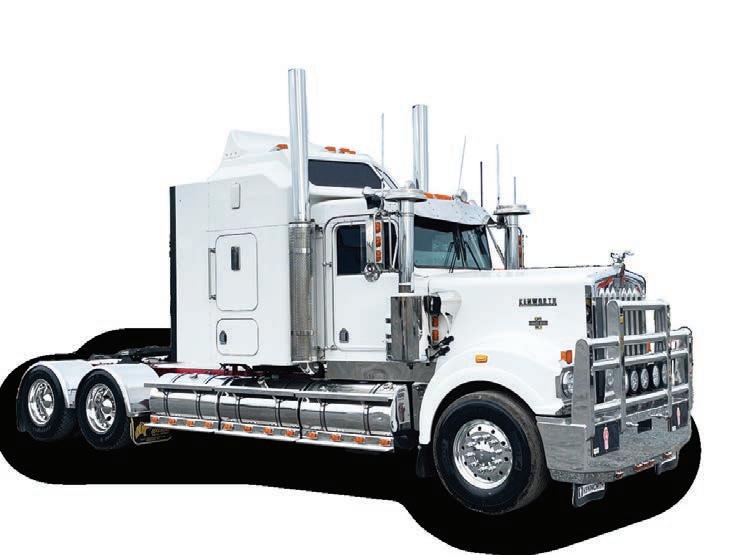
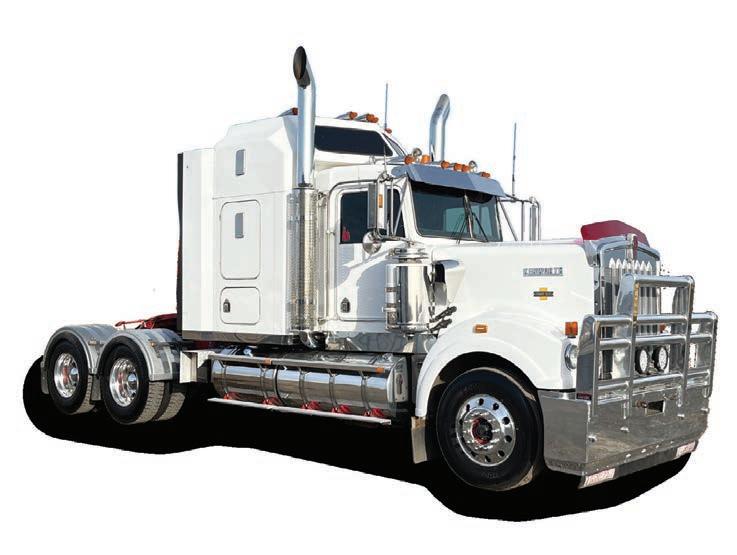
He climbs into a Kenworth K200 B-double that he has gradually made his own, heads north each afternoon, swaps trailers, turns around and is back home before dawn.
The steady, stress-free role has also allowed Mark to focus on his health after his weight ballooned to 127kg and he battled diabetes and “out-of-control” sleep apnoea.
Mark speaks warmly about AJM Transport, where he’s been for around six years now, praising owner Anthony Mansell for trusting his
drivers and leading from the front.
“He’s a cracking fella,” said Mark, 59, who has committed to another five years at AJM before hanging up the keys.
“He gets out on the road himself once a week. He leaves you alone, doesn’t stick his nose in.
The only time you hear from him is if he wants you to know something or you’ve done something wrong.”
That respect goes both ways.
After briefly leaving the company last year to try road train work in Western Australia, AJM was waiting with open arms when he returned.
He had always wanted to experience hauling quad road trains around Port Hedland, but the opportunity came shortly after the death of his father, Pat.
The grief proved overwhelming, and without his family around for support, Mark pulled up stumps earlier than he’d planned.
“My dad and I were extremely close,” he said.
“I didn’t just lose my dad, I lost my best mate, so it hit me pretty hard.”
Returning to AJM was another reminder that trucking, despite its solitary hours, remains a people business.
That sense of belonging has been with Mark since day one.
His introduction to transport came courtesy of his father, Pat, a highly respected TNT General Manager whose name was well known throughout Victorian transport circles.
Mark laughs when recalling his own school days.
“I wasn’t too good at school, got in too much trouble so he pulled me out and put me to work on the docks as a labourer,” he admitted.
From there he learned the ropes the old-fashioned way.
He worked the rail yards, drove forklifts and, after gaining his truck licence at 18, became a company driver.
By the age of 20 he had bought his first truck – a
Kenworth cabover purchased from a retiring subcontractor, Ian Shell.
His father immediately gave him the opportunity to become an owner-driver, a role he enjoyed for the next 10 years.
Over the following decades
Mark experienced almost every corner of the transport industry.
He owned multiple trucks as a subbie and even stepped away from driving to test himself in management.
But despite proving himself in the office – and later as a cameraman for Fox Sports for six years – the road kept calling him back.
“I wanted to see whether I could put my hand to something else,” he said.
“I knew I could do management, but I definitely prefer driving.”
He has no regrets about returning to the driver’s seat.
The paperwork, regulations and responsibilities attached to management no longer appeal.
“At my age, I don’t think I want all that over my head.”
If there is one thing Mark has noticed across four-and-ahalf decades, it is how much the industry has changed.
Not all of it, he believes, has been for the better, but he still gets annoyed when he hears blokes bagging the industry.
“If you put your mind to it and work it properly, it’s a bloody good-paying job.
“The rules and regulations that have hit us have been the downfall to the industry.”
Mark believes many of the safety concerns he sees are linked to the growing influx of overseas drivers entering the industry.
“I concentrate a lot more on the road now, compared with what I used to.
“In the last five years my alertness on the road has doubled.”
Today, the father-of-four also worries about where the next generation of drivers will come from.
He believes the industry isn’t doing enough to promote itself.
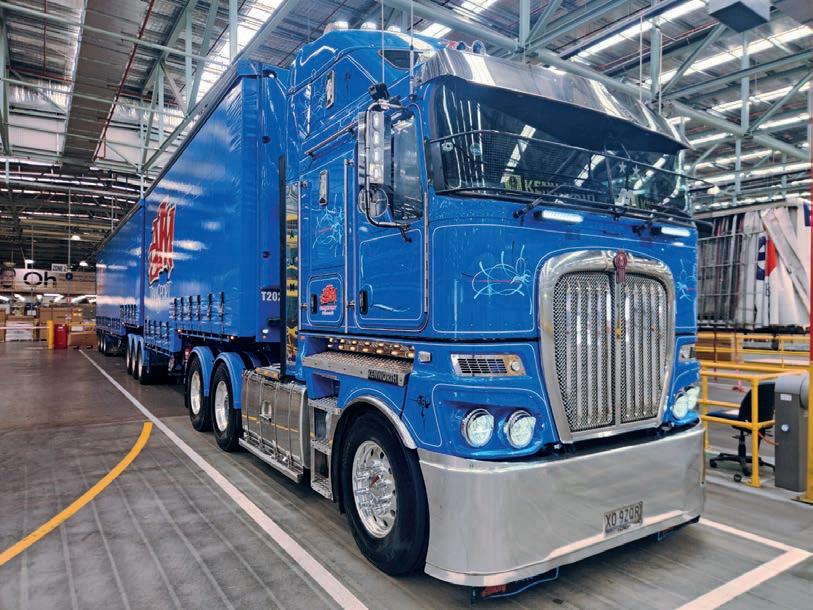
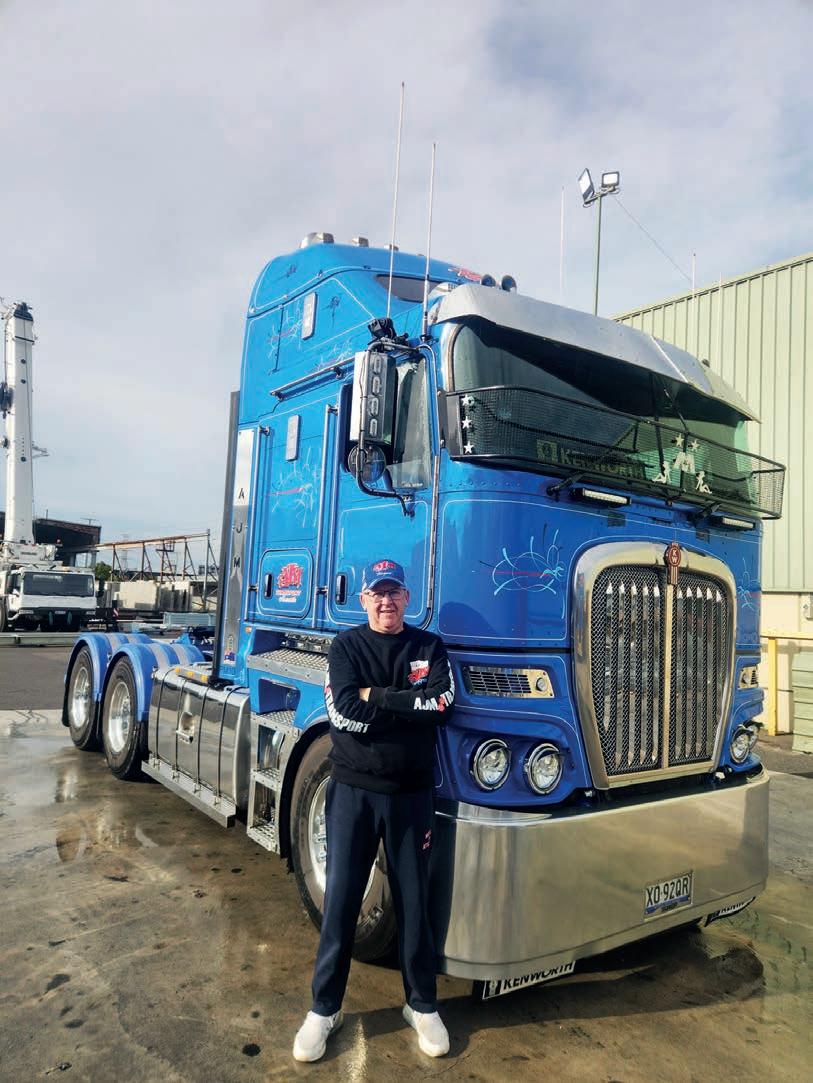
“I don’t think we’re out there enough,” he said.
“Why can’t we have a truck with a simulator that goes into schools?
“Let kids jump behind the wheel, sit up high and see what we experience.”
He also believes transport businesses should be creating clearer career pathways.
Rather than expecting young people to jump straight into heavy vehicles, Mark says they should begin in the yard.
Whether it’s loading trailers, learning restraint systems, operating forklifts or understanding weight distribution, every task builds valuable knowledge.
“That’s the first stepping stone,” he said.
“You’ve got to learn how to strap a load, load a truck and understand where the weights go.”
It’s the same practical education his father gave him nearly half a century ago.
Mark also believes education should continue throughout a driver’s career.
Instead of simply punishing mistakes, he says operators should focus more on teaching.
“When I was managing, if one of my blokes made a mistake, I didn’t show them the gate, I educated them.
“We don’t do anywhere near enough of that in our industry.”
That willingness to mentor others extends well beyond the depot.
Earlier this year, Mark entered his first truck show – the hugely successful Alexandra Truck Show – and loved every minute of it.
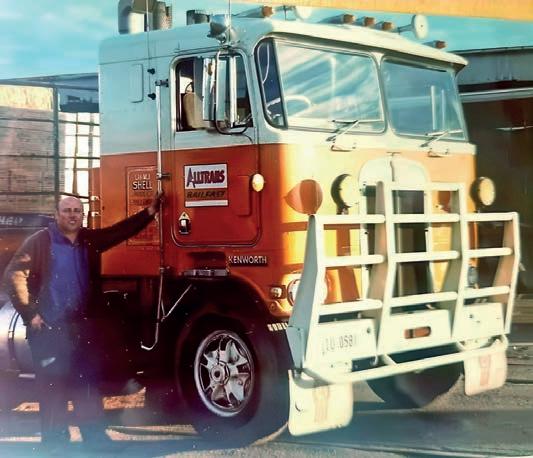
“The trucks were phenomenal. Absolutely beautiful.
“It’s the first truck show I’ve ever gone to and I absolutely loved it.”
What struck him most wasn’t the chrome or the horsepower. It was the camaraderie.
“You’d walk down the street, and blokes would stop you and say, ‘I’ve seen you on the road,’ or ‘Do you remember me?’
“It was fantastic.”
He enjoyed it so much he’s already planning to enter more shows, with Castlemaine next on the agenda.
Away from truck shows, Mark also helps organise AJM’s involvement in Geelong’s Convoy for Kids.
The event holds special meaning after he and his wife lost one of their children.
“Once the boys got me involved in that, me and my
wife said we’ll never stop going to that.”
For Mark, giving back has become an important part of trucking life.
Mark wears his pride and professionalism on his sleeve, hoping it might rub off on his younger colleagues.
“I take a lot of pride in my truck. It’s immaculate,” he said.
“I’ll go around and pick up rubbish, clean drains in the truck wash and make sure it’s ready for the next bloke.
“You make your job what you want to make out of it.”
Rather than seeing those extra jobs as chores, Mark views them as an investment in the next generation.
“I do it in the hope that some young bloke comes along, sees me doing it and thinks, ‘If it’s good enough for him, then it’s good enough for me’.”


Cummins



I Provides 240V AC power from a 12V DC battery source I LCD display shows power draw, voltage and battery capacity I Dual 240V

1S2000
vehicles up to 16 litre
and




The National Heavy Vehicle Regulator breaks down the key law changes, last-minute checks and common
should know.
AFTER years of consultation, planning and industry engagement, the amended Heavy Vehicle National Law officially takes effect from August 1, bringing important changes for operators across Australia.
For many operators, the lead has involved reviewing the National Heavy Vehicle Regulator (NHVR)’s guidance and support material, attending information sessions, forums and toolbox talks, and plenty of discussion about what the changes mean for their business.
Now, the focus shifts from understanding the reforms, to ensuring your operation is ready for day one.
Here are six key checks to help ensure you are HVNL ready.
1.Make sure your safety practices are documented
You don’t need a formal Safety Management System (SMS) to operate under the HVNL, but you should be able to demonstrate how you identify and manage safety risks.
For small operators, this can be simple. Make sure you have:
• A short statement outlining your commitment to safe operations
• Clear responsibilities for safety decisions
• A process for reporting incidents, defects and near misses
• Records showing how you identify hazards and manage risks
Even though an SMS isn’t mandatory for non-accredited operators, adopting these practices strengthens your safety management and reduces risk.
These documents don’t need to be formal – a notebook, phone notes or basic templates are all acceptable ways to document this information.
The amended HVNL places a stronger focus on identifying
foreseeable risks before they become safety issues.
Before commencement, review your risk register or safety records and consider whether they cover:
• Fatigue risks – long shifts, night driving, tight schedules and customer expectations
• Vehicle risks – tyres, brakes, lights and load restraint equipment
• Loading risks – who is responsible for loading, how loads are secured and loading site hazards
• Route risks – weather conditions, detours, traffic conditions and infrastructure hazards
Your risk register does not need to be lengthy. It should clearly identify the risks relevant to your operation and the controls you have in place to manage them.
3. Check your maintenance and inspection processes
Every operator has a responsibility to ensure their vehicles are maintained to a safe standard.
Before August 1, check that you have:
• A n up-to-date maintenance schedule
• Daily inspection or prestart records
• A process for reporting and repairing defects
• Evidence that critical defects are repaired before vehicles return to service Records can be electronic or paper-based. The key is that they are accurate, current and accessible when needed.
4. Understand the fatigue changes
One of the key HVNL changes is the strengthened duty on all drivers of heavy vehicles over 4.5 tonnes not to drive while fatigued or otherwise unfit to drive. This may be due to physical
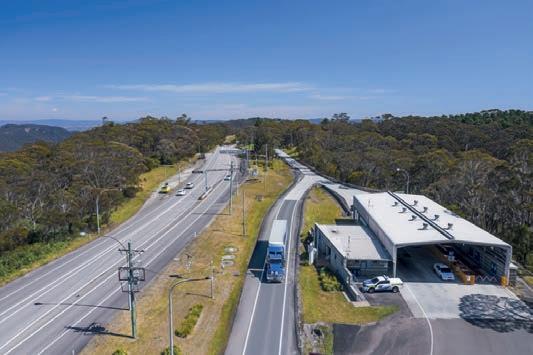
Before commencement, make sure drivers, workers and contractors understand the changes relevant to your operation.
or mental health conditions, temporary illness, injury, or the effects of alcohol and other drugs.
Operators must ensure their business practices do not cause or encourage a person to drive while unfit and must empower them to stop driving when necessary. Importantly, the changes do not mean every driver will need to start using a Written Work Diary.
The existing Written Work Diary thresholds remain unchanged and drivers who are currently required to complete a work diary must continue to do so.
5. Prepare for the move to Heavy Vehicle Accreditation (HVA)
If you currently hold accreditation under the National Heavy Vehicle Accreditation Scheme (NHVAS), your accreditation remains valid until expiry.
However, NHVAS accreditation does not automatically transfer to the new HVA scheme.
Operators should begin preparing early by:
• Reviewing HVA requirements
• Building or strengthening their SMS
• A llowing enough time for an HVA application to be assessed before NHVAS expiry
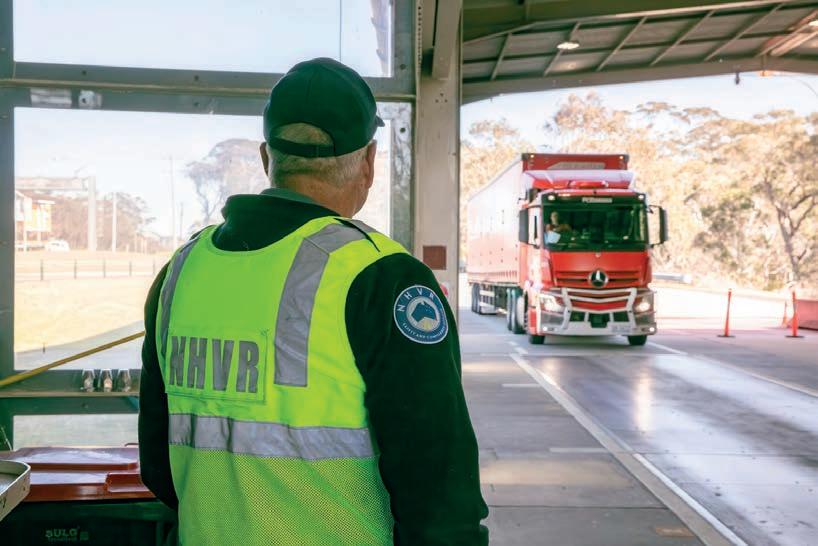
• Understanding the new accreditation options, including General Safety Accreditation and Alternative Compliance Accreditation NHVAS operators can continue making changes to their accreditation, including adding or removing vehicles and drivers, until their accreditation expires.
6. Brief your staff and organise your records
Before commencement, make sure drivers, workers and contractors understand the changes relevant to your operation, including:
• Fatigue and fitness-to-drive responsibilities
• Written Work Diary requirements
• Mass, dimension and loading changes
• Load restraint responsibilities
• W hat to do if something goes wrong Additionally, make sure you can easily access key records, including maintenance documents, work diary pages, inspection records, risk assessments, incident reports and driver briefings.
Find the latest guidance
Having clear, simple, everyday safety practices in place will help you manage the risks of your transport activities and meet your primary duty under the HVNL.
If you can show how you manage risks, maintain your vehicles, communicate with your drivers and other third parties, and challenge unsafe behaviours and instructions, you’re already aligned with the intent of the amended law.
The NHVR has published a range of guidance material to support operators, including resources on HVA, fatigue, Written Work Diaries, Safety Management Systems, and mass, dimension and loading changes.
Visit nhvr.gov.au/hvnl to access the latest resources and implementation support. If you need further information, contact the NHVR Contact Centre on 13 NHVR (13 64 87).
Myth 1: ‘Unfit to drive’ only means fatigue. The duty not to drive while fatigued or otherwise unfit to drive is broader than fatigue alone. Drivers and operators should consider other factors that could affect a person’s ability to drive safely, including physical or mental health conditions, temporary illness, injury, or the effects of alcohol and other drugs.
Myth 2: You only need to act when someone is obviously unsafe.
Good safety management is about identifying risks early and taking action before they result in harm. Operators should have processes in place to identify when a driver or worker may not be fit to perform their duties safely.
Myth 3: Small operators don’t need to make changes.
The amended HVNL applies to all heavy vehicle operators, including owner-drivers and small businesses. The scale of your operation does not remove your safety responsibilities.
Myth 4: Every driver will need to start using a Written Work Diary.
All heavy vehicle drivers have a duty not to drive while fatigued or unfit. However, existing Written Work Diary thresholds remain unchanged.
Myth 5: NHVAS accreditation will automatically transfer to HVA.
NHVAS accreditation does not automatically roll over to the new HVA scheme. Operators will need to apply before their current accreditation expires.
Myth 6: Every heavy vehicle can now operate at 20 metres.
The increased length limit applies only to specified heavy vehicle combinations and conditions. It does not automatically expand network access or apply to all vehicles.
Myth 7: You don’t need to keep records if you’re a small operator.
If hazards are identified, actions are taken or safety discussions occur, keep a record. Simple notes, checklists, maintenance records and briefing records help demonstrate that safety is actively managed.
Myth 8: ‘We’ve always done it this way’ is a defence.
Past practice does not necessarily mean a process remains safe or compliant. The amended HVNL reinforces the importance of identifying risks and regularly reviewing how they are managed.
Myth 9: Safety is only the driver’s responsibility. Drivers play a critical role, but schedulers, managers, supervisors, customers, loaders and contractors may also have duties if their decisions influence transport activities.
Myth 10: Every penalty has increased. While penalties have increased for some serious safety offences, a number of lower-level administrative penalties have been reduced. It is also important to distinguish between maximum court penalties and roadside infringement notices. Maximum court penalties apply only in the most serious cance and conduct that creates significant safety risks.
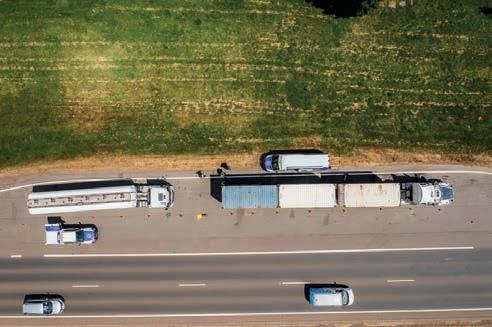

THE National Law (HVNL) has finally arrived. After years of consultation, drafting and de bate, industry now begins the real test; not of the legislation, but how consistently it is interpreted and enforced.
As with any significant piece of work, there will be the inevitable period of adjustment, as industry, regulators, and
enforcement agencies become familiar with the new way of operating under these changes.
Dealing with such changes is to be expected when a new law is introduced, with ambiguity and interpretation often colliding with operational reality. he question, however, is how those interpretations are going to affect drivers on the roadside.
I have often found National Heavy Vehicle Regulator NHVR) Safety and Compliance Officers (or SCOs as hey’re commonly known) to be fairly reasonable in their application of legislation. Often, they also have a strong understanding of the policy intent that sits behind the legislation. The concern I have is more centred on how state police agen-
cies may interpret the legislation.
The HVNL creates a unique enforcement environment. Police officers throughout participating jurisdictions have broad powers to stop heavy vehicles, conduct inspections and issue infringement notices.
At the same time, the NHVR is responsible for administering the legislation and is often the agency responsible for prosecuting offences before the courts.
This arrangement raises an interesting question. Where uncertainty exists about the meaning of a legislative provision, whose interpretation should industry rely upon?
In most cases, the driver will be stuck with whatever interpretation is used by whomever is enforcing on the roadside,
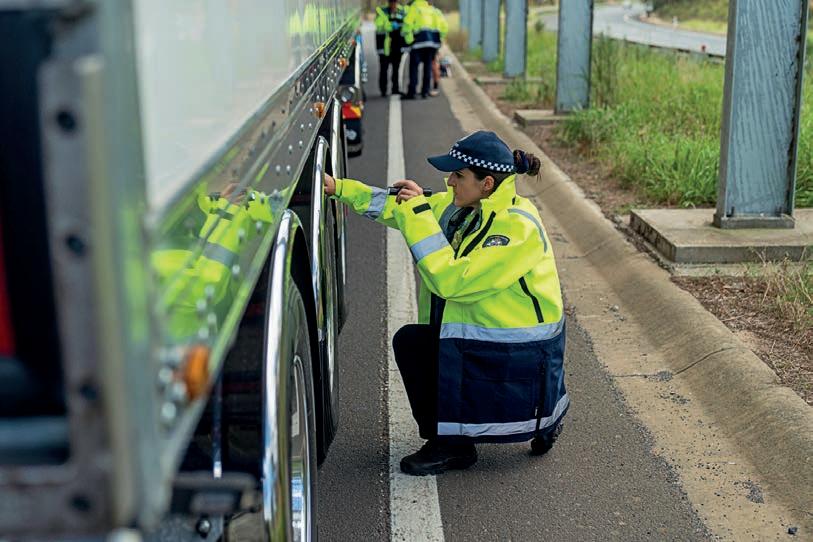
which is far from ideal.
It is in this space that uncertainty, fear and frustration can grow. This is especially so as social media heaps fertiliser onto such discussions, allowing myths and falsehoods to rampage unchecked.
This is not simply an issue that can be fixed by adjusting the legislation, which could take months anyway. Compliance depends upon predictability.
Operators should be able to build systems with confidence that the standards they are working toward or operating under are the same standards applied during roadside enforcement.
If authorised officers adopt different interpretations of the same legislative provision, drivers are left attempting to comply with uncertain expectations rather than a consistent legal framework.
Working under the shadow of continual uncertainty is no way for people to work effectively or safely.
In practice, relatively few infringement notices are challenged before a court. For many drivers and transport operators, the cost of obtaining legal advice, preparing a defence, attending court and potentially losing productive work time is considerably greater than the amount of the penalty itself. Consequently, many infringement notices are paid without the underlying legal interpretation ever being tested, simply because it’s less stress to do so.
This is not a criticism of those
who choose to pay an infringement. It is often a commercially rational decision.
However, it does raise an important question. If disputed interpretations are rarely examined by courts, how can industry gain confidence that laws are being applied consistently?
The answer cannot simply be challenging every infringement. That is just not realistic. Instead, consistency should begin with those responsible for administering and enforcing the legislation.
Where the NHVR has published guidance, adopted a policy position or issued formal advice regarding the practical application of the HVNL, there is a strong argument that enforcement agencies should apply the legislation consistent with those positions, unless and until a court determines otherwise.
That approach provides certainty for industry, promotes nationally consistent enforcement and reduces the likelihood of competing interpretations developing at the roadside.
None of this diminishes the important role performed by police, and nobody is arguing that the contribution by police to road safety is not significant.
However, consistent enforcement is fundamental to ood regulation. A national
national regulator has already established an accepted policy position.
As the new HVNL matures, there will undoubtedly be opportunities for courts to clarify areas of uncertainty.
Until then, the transport industry is entitled to expect that t hose responsible for enforcing the legislation are applying the same interpretive framework as the agency charged with administering and prosecuting it.
If nationally consistent enforcement cannot be achieved under the current model, perhaps it is time to reconsider the model itself.
Australia already recognises that highly specialised areas of law are often best enforced by specialist agencies rather than general policing bodies. Environmental regulation, workplace safety and biosecurity all rely heavily on specialist regulators exercising their own enforcement functions.
Given the complexity of the HVNL, is it time to ask whether heavy vehicle enforcement should move further in that direction?
Ultimately, confidence in the Heavy Vehicle National Law will not depend solely upon the words enacted by Parliament. It will depend upon whether those words are interpreted consistently, applied fairly and enforced uniformly across Aus thout consistency, even the best drafted legislation will struggle to earn the confidence of the industry it was designed

ONE of the amendments to the Heavy Vehicle National Law (HVNL) commencing on August 1, 2026 has attracted very little attention. It relates to improvement notices. An improvement notice may be issued where there is or has been a breach of the HVNL.
The notice identifies areas at risk of breaching the HVNL in your business operations and requires you to take steps to
address the issue.
Improvement notices were considered to be an educative and persuasive enforcement option and it was used instead of prosecuting the company.
That protection is being removed.
Clause 123 of the Heavy Vehicle National Law Amendment Bill omits s 573(3), allowing an improvement notice and a prosecution to proceed at the same time.
The explanatory speech states: “Improvement notices will be supported by amendments that allow for the commencement of prosecution in serious c ases for the same conduct, allowing for more flexible and effective compliance responses.”
What does this mean?
From August 1, 2026, the National Heavy Vehicle Regulator (NHVR) can:
(a) issue an improvement notice requiring an operator to remedy alleged non-compliance; and
(b) commence a prosecution arising from that very same conduct.
Previously, an improvement notice generally represented the end of the enforcement response, provided the notice was complied with.
My expectation is that improvement notices will now be used more frequently and, in some cases, at the beginning of an investigation rather than at its conclusion.
Operators should no longer assume that receiving an improve-
ment notice means the matter is effectively over, instead the investigation is likely just starting.
From a strategic perspective, an improvement notice is no longer simply a direction to rectify compliance issues. It may also provide an early insight into the aspects of your operations that the NHVR considers warrant prosecution.
It is a relatively small legislative amendment that has received very little attention, but it has the potential to materially change the NHVR’s enforcement approach.
I have worked on both sides of the justice system, I have seen how investigations are built, how evidence is assessed and how prosecution decisions are made. That experience now
TO help operators strengthen their safety management systems and prepare for the new Heavy Vehicle Accreditation (HVA) scheme, the National Heavy Vehicle Regulator (NHVR) has developed two new digital tools.
An NHVR spokesperson said the Risk Register Builder will help operators and other Chain of Responsibility (CoR) parties create a practical, business-specific risk register using the NHVR’s Master Code of Practice.
It guides users through identifying hazards, selecting and tailoring controls, assessing risk, and producing a downloadable risk register that can be maintained as a living document.
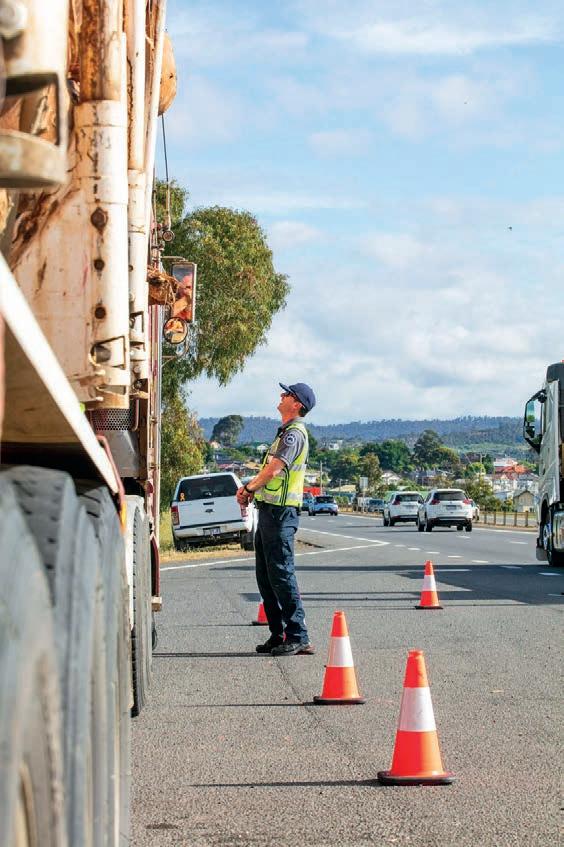
The tool is designed to simplify risk management but does not replace an operator’s responsibility to implement, monitor and review controls or meet their legal obligations.
The NHVAS to GSA Gap Analysis Tool will support operators transitioning from NHVAS to General Safety Accreditation (GSA).
It compares current NHVAS modules against the new GSA requirements, identifies areas that already align, highlights gaps and new requirements, and provides guidance on Safety Management System expectations and the evidence auditors may seek.
“Together, these tools will provide practical, self-service support to help industry transition to the new HVA scheme and build more effective Safety Management Systems,” the spokesperson added. The tools are expected to be released in the coming weeks and will be made available on the NHVR website.
BY CHRIS SMITH
A significant change to the Heavy Vehicle National Law (HVNL) will take effect on August 1, but it has received surprisingly little attention outside compliance circles.
Under the amended law, a person must not drive a heavy vehicle on a road while impaired by fatigue or otherwise unfit to drive.
Being “unfit to drive” can involve physical illness, injury, stress, mental illness or a nother condition affecting a person’s ability to drive safely.
More than fatigue
The existing HVNL already regulates fatigue. The new provisions make it clear a driver can also be unfit because of illness, injury, medication or psychological distress, even if fully compliant with work and rest requirements.
The changes also support a driver’s right to stop when they believe they cannot continue safely.
The message is that commercial pressure must not override safety.
But the changes also create questions for employers and other Chain of Responsibility parties, which must manage foreseeable safety risks within their transport activities.
Where transport and employment law collide
One of the first questions operators are likely to ask is: “How can I make sure a driver is fit if they do not tell me what is wrong?”
That is where transport law begins to overlap with employment, privacy and anti-discrimination law.
Employees do not necessarily have to disclose every diagnosis or detail of their medical history to an employer.
However, a driver cannot ignore a medical condition that affects their capacity to perform the inherent requirements of the job safely.
Employers, meanwhile, cannot demand unrestricted access to a worker’s medical information simply because the person drives a truck. Nor can they automatically exclude someone because of a disability or manageable medical condition.
It will be about whether the business had reasonable systems, recognised warning signs and acted when a genuine risk became apparent.
Following an incident, investigators may ask:
• Did the business have a fitness-for-duty policy?
• Could a driver declare themselves unfit without being punished?
• Were supervisors trained to recognise and escalate concerns?
• Did the operator act on information it already possessed?
• Was medical clearance obtained when reasonably required?
An operator cannot respond
to information it could not reasonably have known.
But it will be much harder to defend a business that ignored an obvious warning, discouraged reporting or pressured a visibly unwell driver to continue.
The grey areas will test the law
Some situations are relatively clear.
A driver suffering a heart attack, serious respiratory distress or severe medication side effects should not continue driving.
What about a migraine?
Grief, anxiety, poor sleep because of a sick child, or medication that may cause drowsiness, but the driver has taken it for years without experiencing that side effect?
These situations may not produce a simple yes-or-no answer.
The relevant question should be whether the condition is affecting that person’s capacity to drive safely at that time.
The NHVR has published guidance on the new obligations, but further guidance, practical experience and eventually court decisions are likely to determine how the provisions operate at the margins.
Will roadside officers assess medical fitness?
Another concern is whether authorised officers will effectively become roadside medical assessors.
They are not doctors and should not be expected to diagnose complex health conditions during an intercept.
However, officers must still respond when a driver appears unable to continue safely.
That could involve observations about the driver’s behaviour, coordination, speech, alertness or physical condition, together with information provided by the driver and the surrounding circumstances.
The difficulty is that appearance does not always equal impairment.
A driver could have a stable medical condition or disability affecting speech or movement.
Those characteristics might initially resemble intoxication, fatigue or an acute medical episode to someone meeting the driver for the first time.
But speaking or moving differently does not automatically make a person unsafe.
Many people with disabilities and chronic medical conditions legally hold heavy vehicle licences after satisfying the applicable medical standards.
The question must remain: can this person operate the vehicle safely today?
It should not become: does this person look or sound different from what the officer expected?
Ensuring officers can distinguish between a stable condition and signs of current impairment will be critical to applying the reforms fairly.
The new provisions should not be viewed in isolation.
In a separate recent prosecution under the existing Chain of Responsibility framework, an earthmoving company was fined more than $1.2 million after a fatal crash involving a driver with serious health problems.
The case was not a prosecution under the new unfitto-drive provisions, which had not yet commenced. However, it demonstrated the potentially severe consequences when a business fails to establish and maintain adequate systems for managing fitness-for-duty risks.
The lesson is that having a policy stored in a folder will not be enough.
A business must be able to show that its system operated in practice.
What operators should do before August 1
Operators should review their systems now rather than waiting for the first investigation under the amended law.
At a minimum, businesses should consider:
• introducing or updating a written fitness-for-duty policy;
• explaining what drivers must report and when;
• using a practical pre-start or self-declaration process;
• establishing a confidential way to report health and medication concerns;
• training supervisors to respond to observable signs of impairment;
• setting out who can remove a driver from duty;
• obtaining medical advice or clearance where appropriate;
• developing suitable returnto-work procedures; rohibiting pressure or re
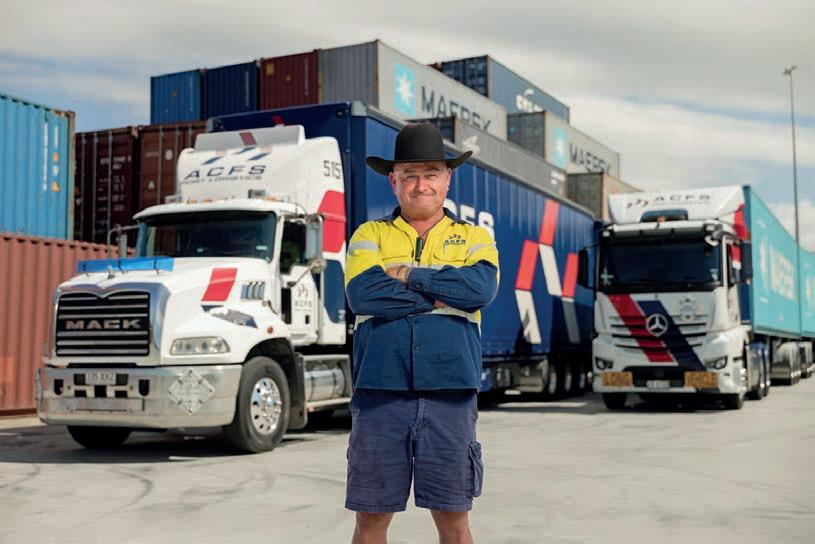
every detail of their medical history. In many cases, the information an operator needs is functional: whether the person can perform the job safely, whether restrictions apply and when the situation should be reviewed.
Small operators should not assume these expectations only apply to major fleets with dedicated safety and human resources teams.
A basic, understood and consistently applied system is likely to be far more valuable than a complex policy nobody uses.
Drivers also have a responsibility For drivers, the message is equally direct.
If you are genuinely unfit, stop.
Tell the operator or scheduler that you cannot continue safely. Provide the information reasonably required to manage the immediate risk and obtain medical advice when necessary.
Do not allow delivery pressure, pride or fear of losing a shift to place you and other road users in danger.
But drivers must also be able to trust that declaring themselves unfit will produce
The real test starts after August 1
The objective behind the reform is sound: safer drivers, sa fer workplaces and safer roads.
Its success, however, will not be determined by the words in the legislation alone.
It will depend on how sensibly operators build the requirements into their businesses, how honestly drivers communicate, and how consistently regulators and enforcement officers apply the law.
The hardest cases will not be the obvious ones.
They will be the migraines,
dence, sound judgement and common sense. August 1 is not just another compliance date. It marks the beginning of a much broader conversation about what fitness to drive means—and how far operators can reasonably be expected to go in managing it.
Chris Smith is a transport communications specialist, journalist and industry a nalyst with more than 25 years’ experience across Australia’s freight, logistics and commercial vehicle sectors. He has worked in transport media, industry, government and the Na ulator, translating complex egulatory and operational issues into clear, practical information for industry
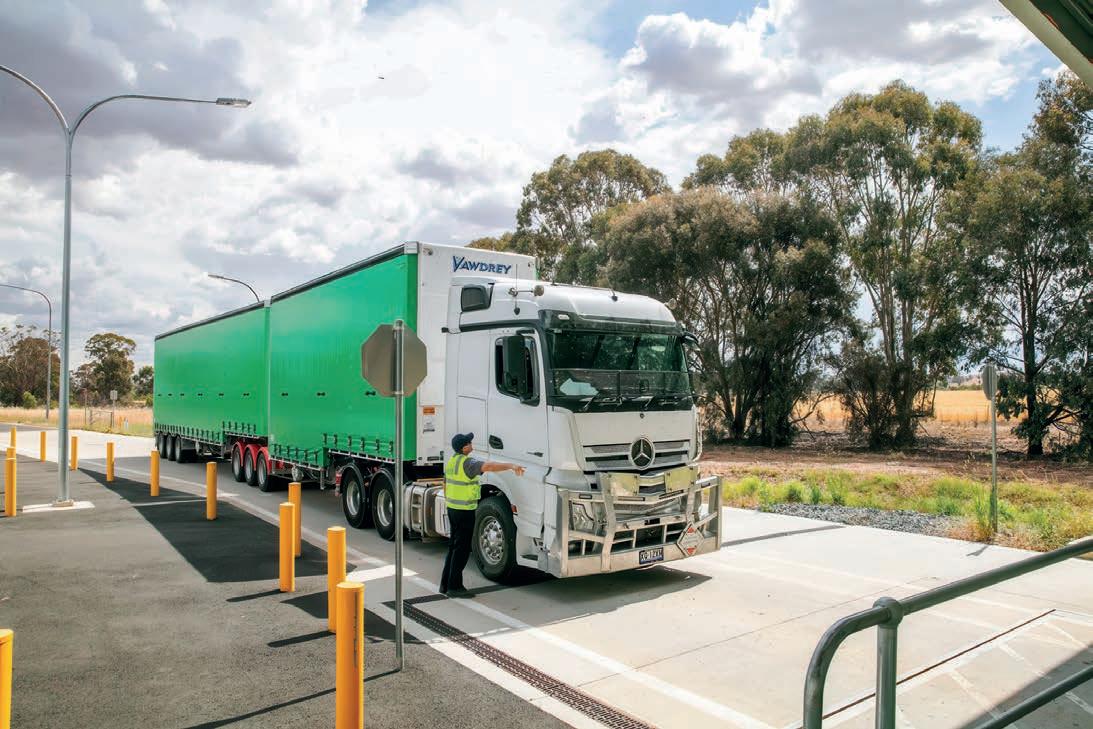

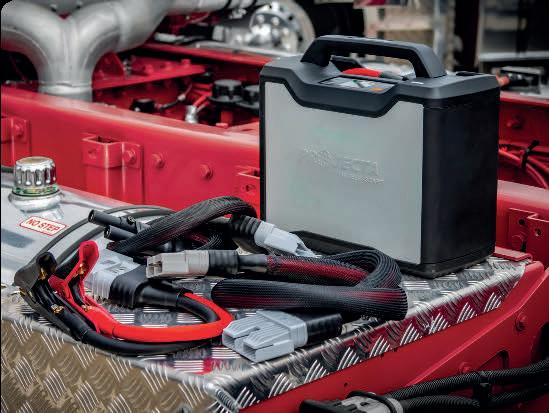




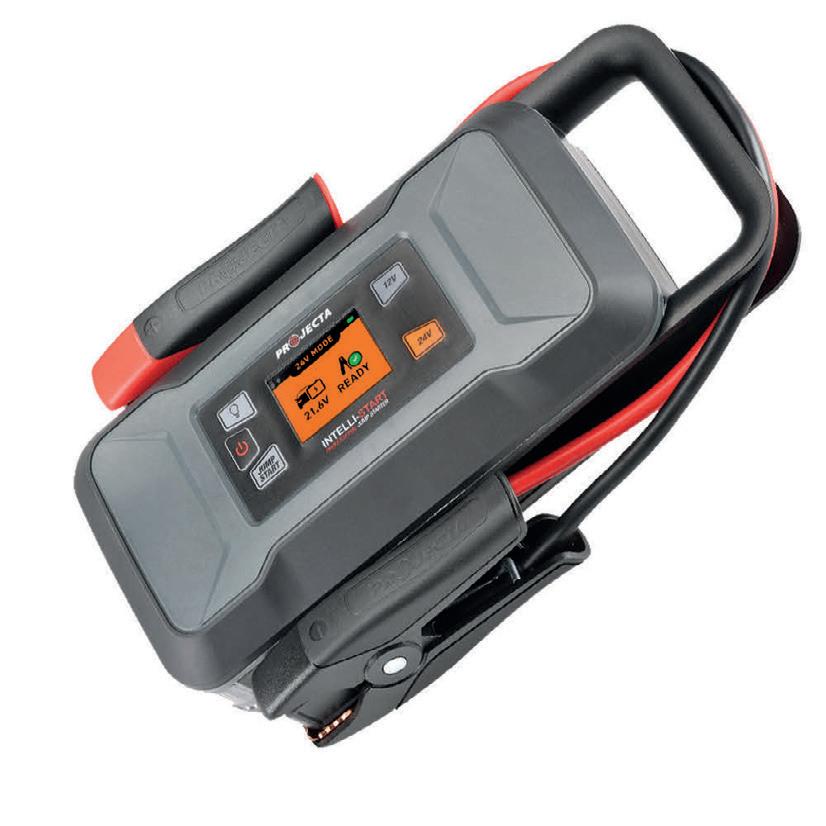
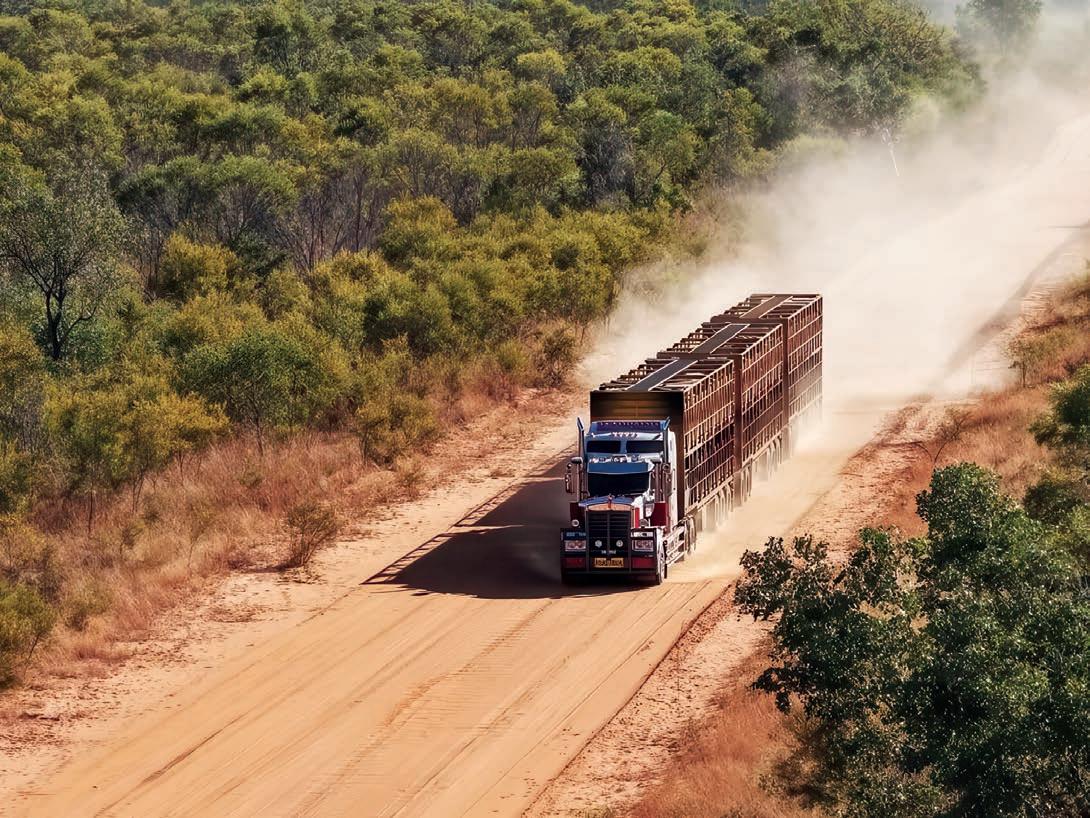
SHELL Rimula has partnered with Big Rigs in a big way – so there are even more reasons to send in your best truck shots.
Each month, the Big Rigs team will choose a #PicOfTheMonth, with the lucky winner receiving a $500 Shell Coles Express Gift Card.
Keep an eye out for our regular posts on the Big Rigs Facebook page, calling for your best truck photos and add yours in
the comments, or email them direct to danielle.gullaci@ primecreative.com.au for your chance to win the main prize.
Don’t forget to include a brief note about the truck and where the photo was taken. We’ll feature some of the best photos in each print edition of Big Rigs, with one winner announced each month.
Keep those amazing truck pics coming!
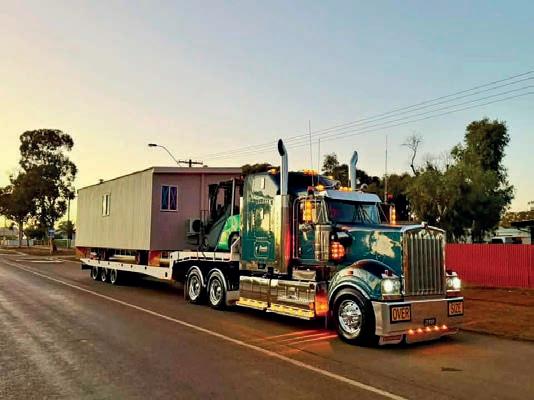
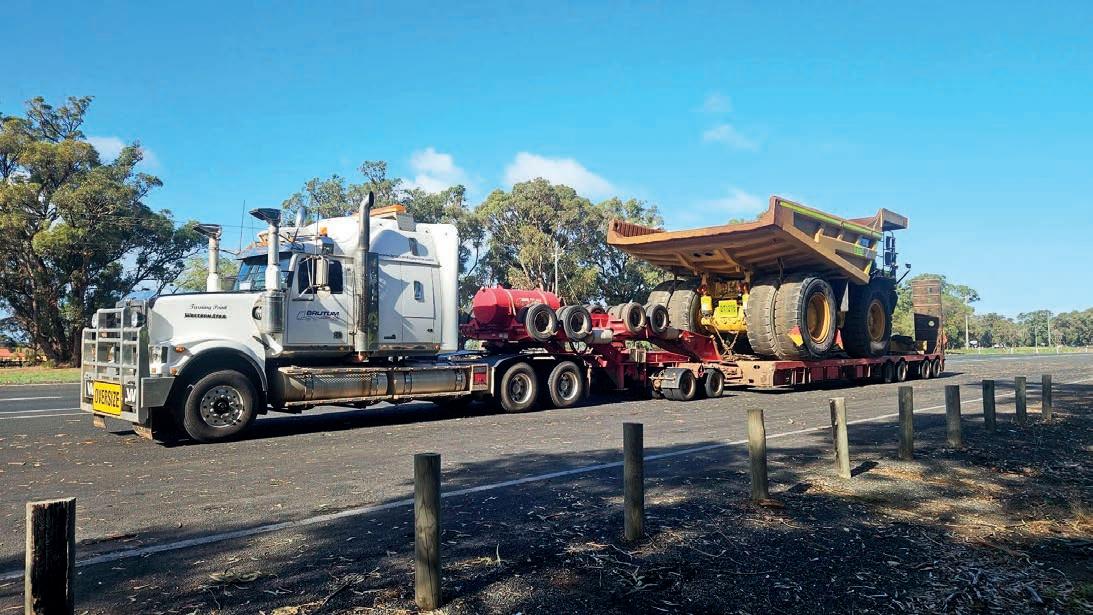
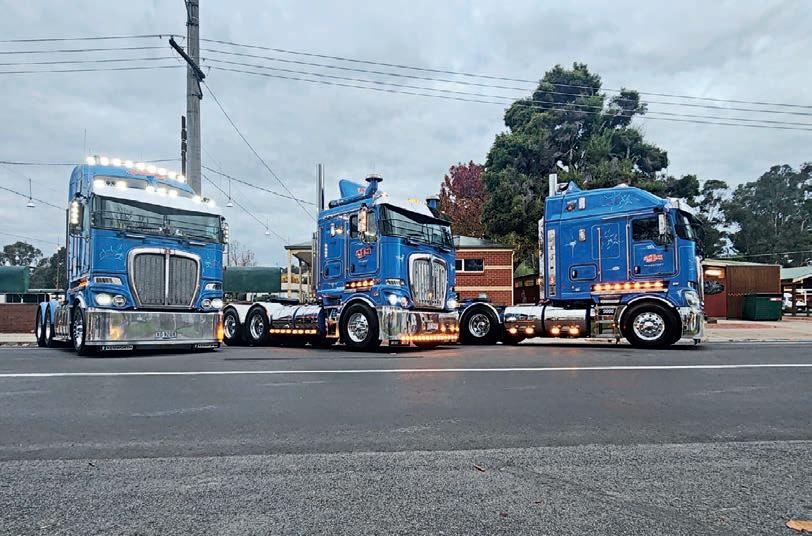
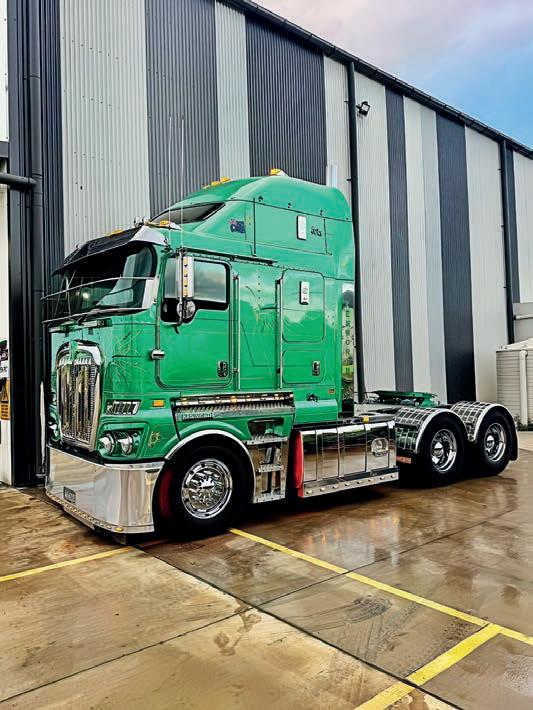
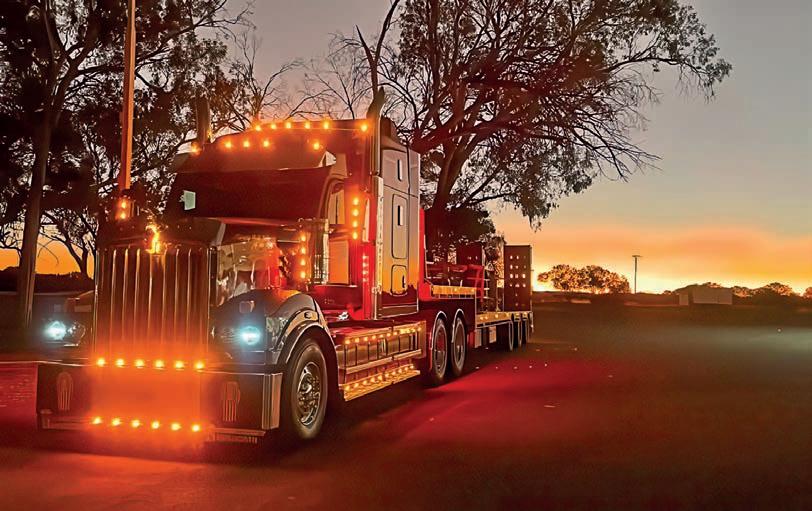
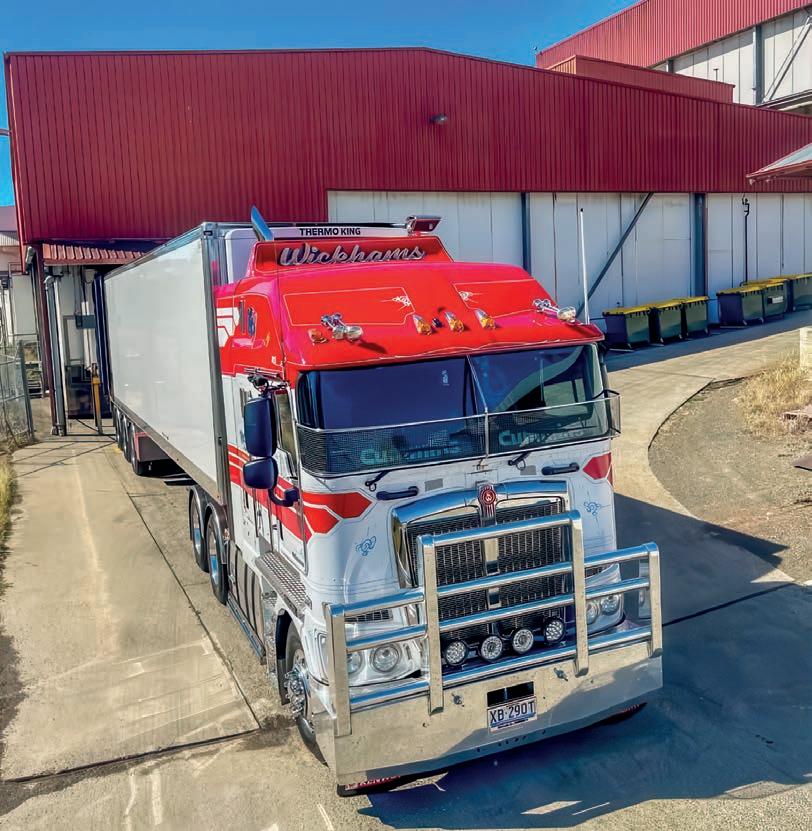
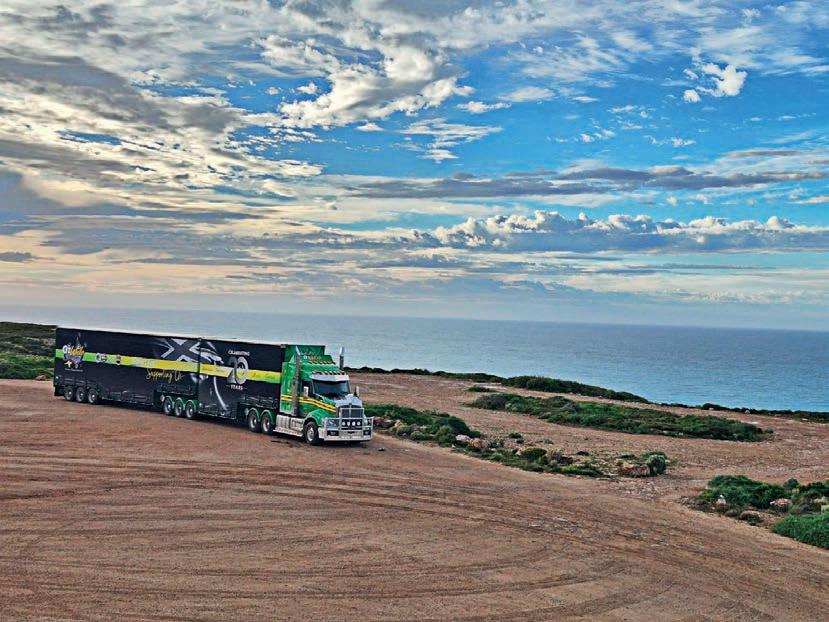
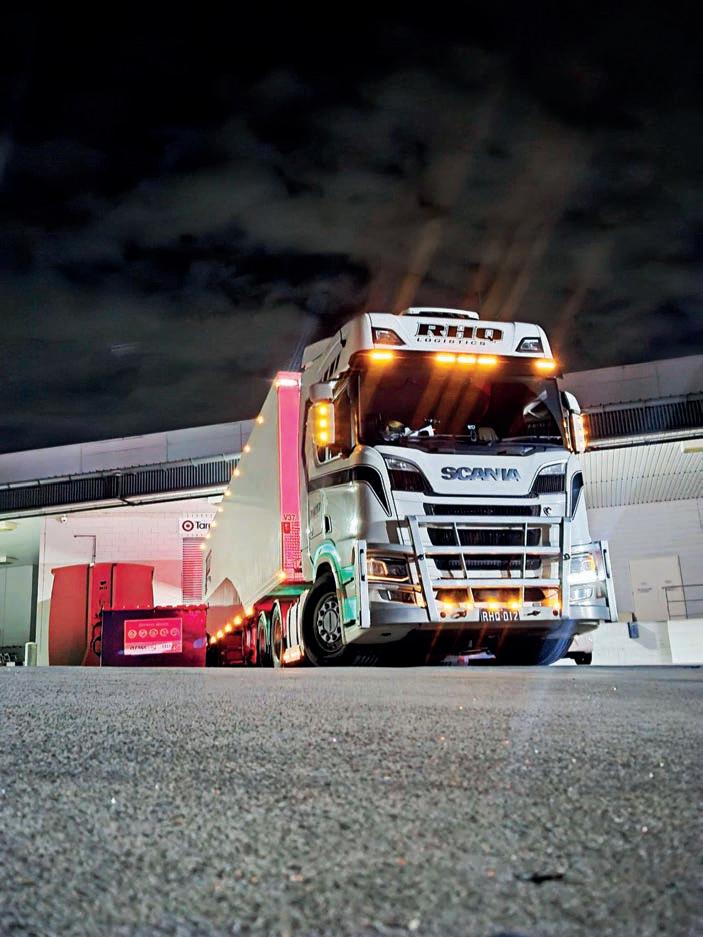
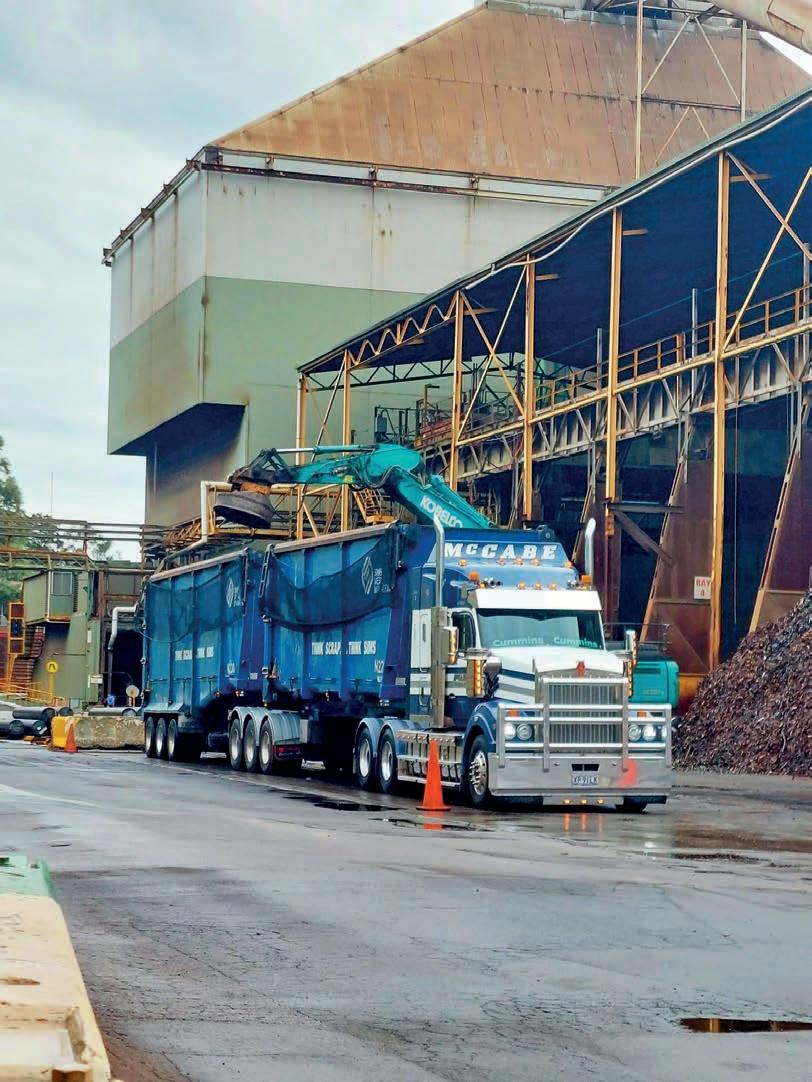
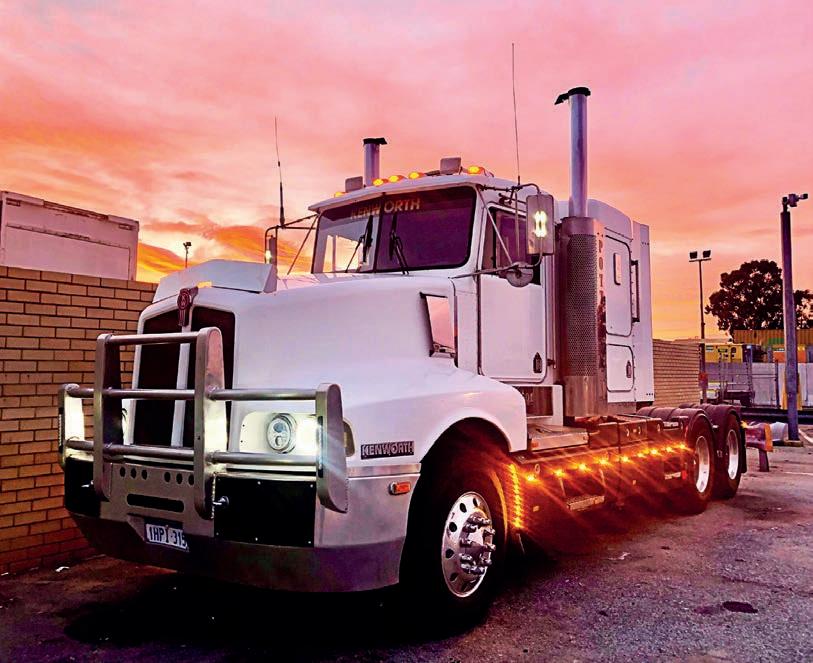
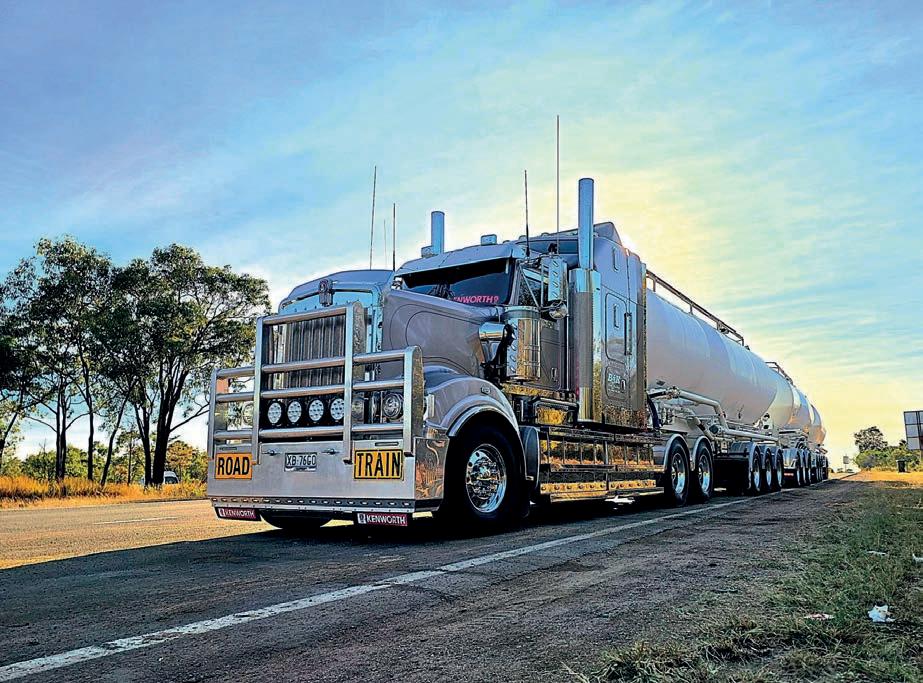
FOR heavy vehicle owners and operators, downtime isn’t just an inconvenience – it can directly impact schedules, contracts and cashflow.
While much of the focus traditionally sits on truck repairs, trailers play just as critical a role in keeping freight moving.
Increasingly, operators are typically seeking the same level of consistency, quality and speed in trailer repairs as they expect for prime movers.
NTI’s Trailer Repairer Network was developed with that need in mind and builds on the success of their long-established Premium Repairer Network for heavy vehicles.
The Trailer Repairer Network extends a consistent, national approach to another key part of operations and compliments NTI’s Local, Light, and
Networks, to deliver a suite of specialist authorised repairers. Adam Craft, NTI’s National Manager Repairer Networks, said the network is about delivering a consistent repair experience across customers’ transport operations.
“Most commonly, operators don’t think of their truck and trailer as separate assets when something goes wrong; they’re part of the same job,” Craft said.
“Our networks support that reality. NTI customers get the same level of service and confidence, no matter what equipment is involved.”
NTI’s Trailer Repairer Network has been developed in collaboration with leading original equipment manufacturers (OEMs), including Vawdrey, Freighter Group, GLT and SCTEG.
to greater confidence in repair quality and consistency.
“The OEM relationships are critical,” Craft said.
“They help ensure repairs are carried out correctly the first time every time, reducing the risk of ongoing issues and helping get trailers safely back on the road sooner.”
Arthur Ozdil, National Service & Repair Manager, Vawdrey, said becoming NTI’s first Trailer Repairer Network partner was a natural extension of Vawdrey’s long-standing focus on supporting transport operators.
As one of Australia’s largest privately held trailer manufacturing businesses, Vawdrey has played a significant role in the design, manufacture and support of trailer equipment for the Australian transport industry.
“Operators need confidence that repairs are being handled
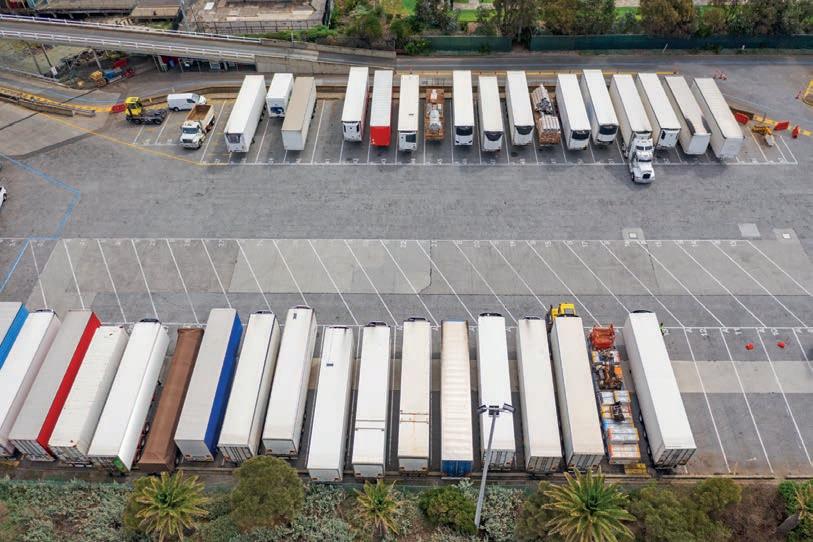
by people who understand the equipment,” Ozdil said.
“We’re proud to support a network that puts quality, safety and practical repair outcomes at the centre.
“For customers, it means their trailers are being repaired by specialists who understand how important that asset is to their business.”
Reducing downtime where it matters
Speed of repair remains one of the biggest priorities for industry, particularly in an environment where tight schedules and high usage typically leave little room for delays.
Craft said NTI’s Trailer Repairer Network helped streamline the claims and repair process with clearer repair pathways, trusted repair partners, and faster assessment and authorisation.
“Downtime is one of the biggest cost pressures our customers face,” he said.
“By working with repairers who understand our expectations and processes, we can help move claims through more efficiently and get equipment back to work sooner.”
Consistency with a national footprint
For operations across multiple regions, consistency in repair quality and service can be a challenge.
NTI’s Trailer Repairer Network addresses this by bringing together approved repairers under a shared set of standards and expectations.
This national footprint helps
AS Hendrickson celebrates 100 years of the walking beam suspension in 2026, the milestone couldn’t be more timely.
As new regulations pave the way for higher mass allowances on modern Euro VI trucks and mass increases under the updated HVNL, operators are looking for smarter ways to maximise payload, productivity and vehicle performance. For fleets running 8x4 rigids, concrete agitators, tippers and vocational trucks, suspension selection is more important than ever.
Enter HAULMAAX® EX
Designed specifically for demanding vocational applications, HAULMAAX EX combines lightweight design, exceptional durability and industry-leading stability to
help fleets take full advantage of emerging productivity opportunities. According to Hendrickson, the suspension is engineered to provide increased capacity ranges and enhanced durability for severe-duty applications. It is approved for demanding vocational uses including agitators, rigid tippers, water carriers and refuse trucks. Hendrickson’s recent engineering modelling of future rigid truck configurations
demonstrated that significant tare weight reductions can be achieved through intelligent suspension specification, which can also improve safety and performance.
In one simulated 8x4 configuration, overall vehicle tare weight reductions exceeding 100kg were identified, creating opportunities for additional payload and improved productivity. For agitator fleets, tipper operators and construction businesses, every kilogram saved on vehicle weight can contribute to increased revenue-earning payload capacity.
Built for severe duty applications
Unlike conventional heavyduty suspensions, HAULMAAX EX uses a unique combination of premium rubber bolster springs and progressive load spring technology. The result is a suspension system that delivers a strong
deliver a consistent standard of service and expertise across the country.
“Whether a customer operates locally or across state lines, they want to know their equipment will be repaired to the same standard,” Craft said.
“That consistency is a key part of what the network is designed to deliver.”
Consistency across the board
As fleets become more complex and operators continue to diversify their assets, the need for connected, end-to-end support is growing.
The combination of NTI’s Premium, Local, Light, Trailer, and Plant & Equipment Repairer Networks reflects NTI’s commitment to industry through the expansion of integrated solutions that service the demands of today’s transport owners.
“For us, it’s about supporting the full transport task,” Craft said.
“By extending our repair networks to include trailers, we’re making sure customers have access to the right expertise across all of their critical assets.” Ultimately, the goal is simple: reduce disruption, improve repair outcomes, and help operators get back on the road with confidence.
In a sector where every hour off the road counts, that kind of consistency and coordination can make a meaningful difference.
To learn more about NTI, go online to nti.com.au or call 1800 684 669.
*This article contains general information only and does not take into account your objectives, financial situation or needs. When making decisions about our insurance, consider the PDS and TMD at www.nti.com.au NTI Limited ABN 84 000 746 109 AFSL 237246.
balance between empty ride quality and fully loaded sta bility. Hendrickson states the progressive load spring auto matically adjusts stiffness as vehicle load increases, help ing maintain stability when carrying heavy loads while still delivering improved ride quality when empty.
For operators, that means:
• Excellent loaded stability
• Improved driver comfort
• Reduced wheel hop
• Greater traction on uneven terrain
• Lower maintenance require ments
A key design advantage is the elimination of traditional centre pivot bushings, helping reduce maintenance and improve long-term durability.
Australian conditions
Whether it’s a concrete agitator navigating urban construction sites or a tipper working in quarries and infra structure projects, Australian vocational trucks face some of the toughest operating conditions in the world.
HAULMAAX EX has been engineered with those challenges in mind. The suspension provides up to 17 inches of diagonal wheel articulation and uses an equalising beam design to distribute loads be-
tween axles, improving traction, mobility and vehicle stability on uneven surfaces. Combined with heavy-duty torque rods and robust rubber spring technology, the system is designed to withstand the punishment of severe-duty operation while helping keep trucks on the road and productive
Positioned for the future
The next generation of Australian rigid trucks will demand more from every component. As mass limits increase and fleets seek greater efficiency, suspensions that deliver payload advantages without com-
promising durability will become increasingly important.
HAULMAAX EX was developed for exactly this environment. For operators wanting to capitalise on evolving regulations, maximise payload opportunities and maintain the durability required for Australian conditions, HAULMAAX EX offers a compelling solution. The regulations are changing. The opportunity is growing. And HAULMAAX EX is ready to help fleets make the most of it.
For more information go to hendrickson-intl.com/en-au.



With five dedicated repairer networks across heavy motor, trailers, light vehicles and now plant and equipment, NTI makes it easier to get you back on the road and back to work faster. Our repairers share our values, meet strict quality standards, and have automatic authority to start repairs straight away. It’s all part of how we keep our customers moving.
Keeping you moving with trusted repairers, nationwide.
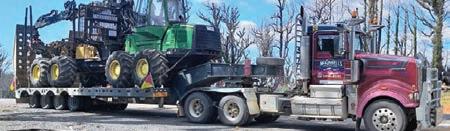
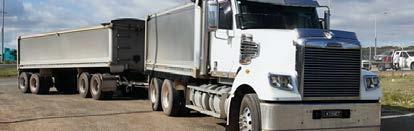
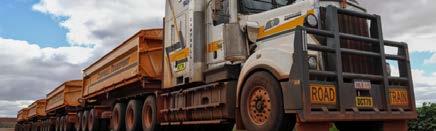
FOR generations of Australian truckies, pride in your rig isn’t just a personal preference – it’s a business model.
You spend hard-earned dollars ensuring your prime mover looks immaculate, from the polished paint work to the gleaming stainless steel mudguards.
But when it comes to the trailers, too many fleets let the team down by settling for cheap, fading, plastic arches. With this edition of Big Rigs turning the spotlight squarely on trailers, it’s time to talk about the missing link in your setup.
If you are running high-quality stainless mudguards on your truck, extending that standard to your trailers isn’t just an aesthetic upgrade – it is a declaration of pride in your fleet, a massive boost to your on-road safety, and a smart long-term investment.
Here are three reasons why Australian-made LELOX stainless steel mudguards are the ultimate choice for your trailing equipment.
1. The Perfect Marriage: Fleet Pride from Bumper to Tail
Let’s face it: plastic mudguards look fine for the first six months. Then the Aussie sun gets to work. They fade, they chalk, they warp, and they start looking tired. When you hook a premium prime mover up to a trailer clad in sun-damaged plastic, the whole combination loses its edge.
Marrying up stainless
LELOX mudguards on your trailer to match the stainless on your truck creates a seam less, professional, and highly aesthetically pleasing combi nation.
Pride in your ride pays divi dends. When a clean, uniform, a ll-stainless combination rolls into a customer’s yard, it speaks volumes about how you run your business. It says you don’t cut corners. It says you respect your gear, which means you’ll respect their freight.
2. A Crucial Shield: Fire Mitigation in Dangerous Goods
While looks will get you no ticed, safety is what gets you home. For those hauling Dan gerous Goods (DG)– whether it’s fuel, gas, or chemicals – the stakes on the bitumen are in credibly high.
Statistics show the vast ma jority of truck and trailer fires originate in the wheel ends, caused by binding brakes, seized bearings, or blown tyres. When a tyre catches fire under a standard plastic mudguard, the plastic quickly melts, accelerates the flame, and allows the fire to lick directly up into the trailer body and the cargo. This is where switching to LELOX stainless steel mudguards becomes a literal lifesaver.
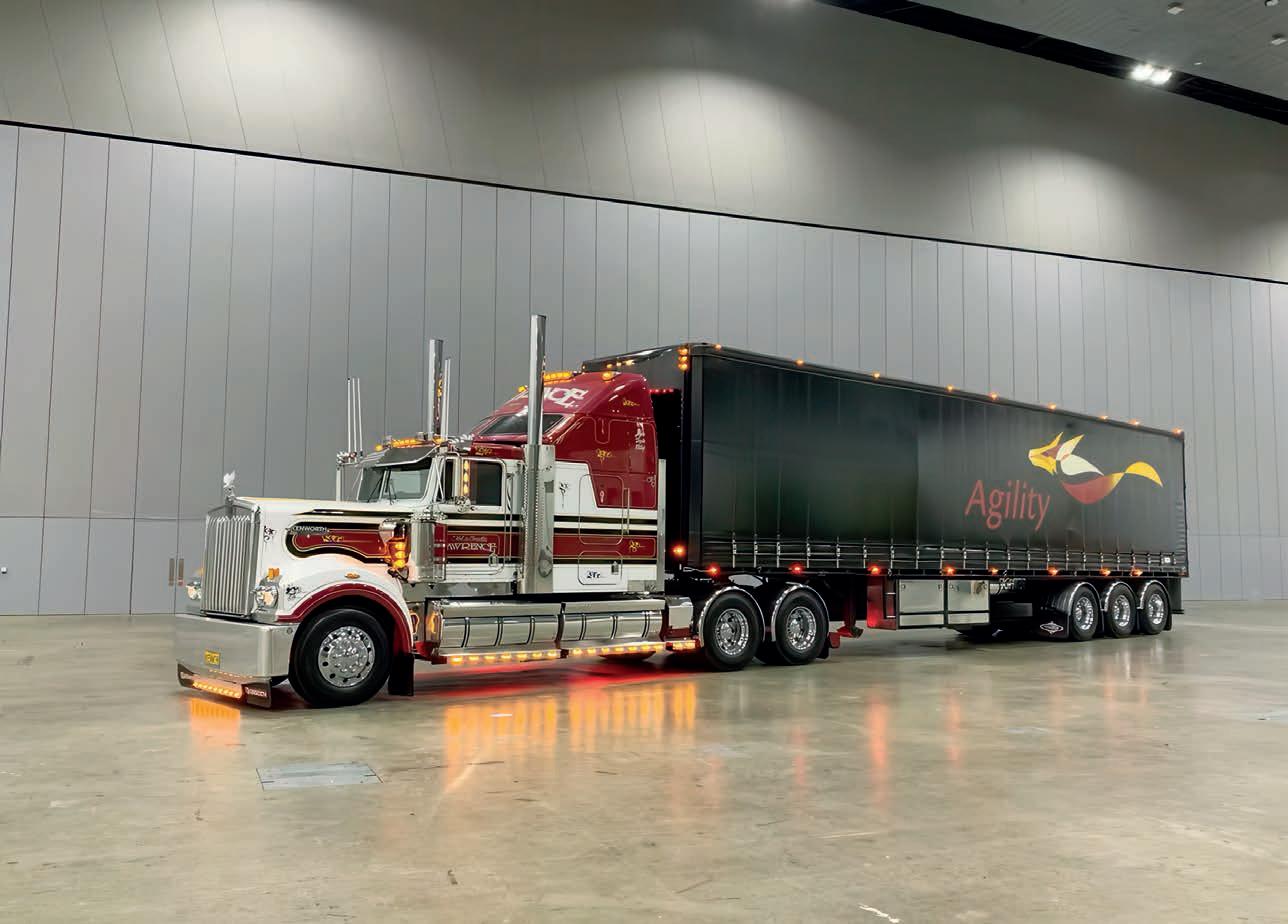
er, or emergency services, time, with those crucial extra minutes created to suppress the fire before it turns into a catastrophic highway explosion. If you are pulling tankers or DG rated trailers, stainless steel guards aren’t just an optional extra; they are a vital layer of risk mitigation.
W hen it comes to fire containment, stainless steel has an incredibly high melting point. If a brake or tyre catches fire, the stainless guard acts as a heavy-duty thermal shield. Stainless steel guards also
3. Engineering That Works: The Perfect Valance Shape
Every truckie knows the frustration of poorly designed mudguards that wreak havoc on your spray suppressants. You either get guards with an awkward angle that lets
precision Australian engineering. Our mudguards are manufactured with the optimum valance shape. This specific curvature ensures that flexible spray suppressants sit perfectly flush next to the tyre. It doesn’t stick out uselessly, and it doesn’t crowd the rubber. The spray suppressant does exactly what it’s designed to do – keep the road vision clear for you and the motorists behind you – without the constant risk of being chewed up by the tread.
The LELOX Bottom Line At the end of the day, your
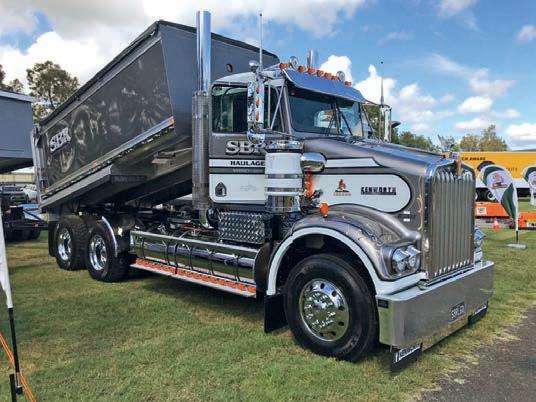
BY PHILL AND FIONA WORLDON
FROM a young age, I just wanted to drive trucks.
2010 rolled around and I began my career driving trucks, gaining valuable experience in the livestock transport industry. I drove for a local business in Gundagai NSW where I gained my experience which I really appreciated.
In 2017 that’s when our business was established, Phill & Fi Worldon Contracting. We had a great opportunity to buy our first truck, a Kenworth 604, and I was fortunate to tow trailers for two local businesses in our area.
A Gundagai family business closed their doors, which opened the doors to us.
We purchased their 4x2 stock trailer. As our business grew, we took on more clients and we then purchased a 2x1 stock trailer.
Our business has taken us around the Riverina, up north to Inverell and down south to Murray Bridge. We are happy to travel anywhere for our clients. As the years have gone on, we felt we needed to upgrade our equipment. With the farm
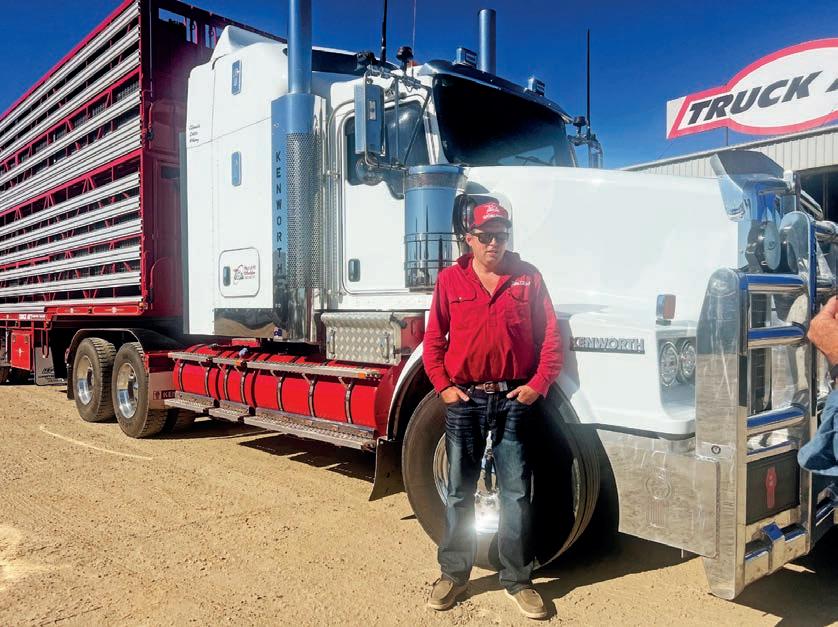
industry here expanding, we thought it best to get a new truck, a Kenworth 659, and a set of B-double trailers. A lot of our clients are growing, which means their stock numbers are growing too.
For the B-double set, we approached Dave from Truck
A rt Trailers in Wagga NSW.
From the very start the customer service was just out of this world. Fiona and I just knew it felt right and thought, let’s lock these trailers in.
Dave was fantastic – so approachable and friendly, and the communication was ex-
ceptional. He was always updating us on where the trailers were up to while getting built.
We had a lot of recommendations from our friends regarding Truck Art Trailers, a lso being a local business we could visit as Truck Art Trailers is just an hour down the
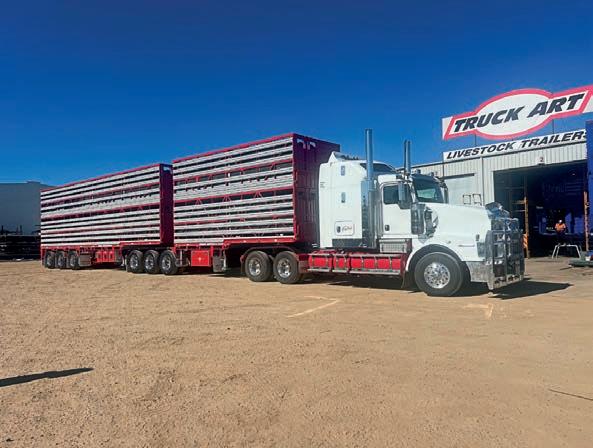
road. To be honest, it’s the little things that work inside the crates that is what sells it.
We really liked how we could custom-build the crate to our liking, especially the composite decks, which makes life a lot easier on the back, the slam shut gates and the stainless steel floors. Overall, it’s an easy operating trailer to use, as we all know we are getting older.
Fiona and I highly recommend Truck Art Trailers to anyone. Once you see, or have an opportunity to use them, you will just be over the moon.
How they work, just makes loading stock a breeze and if you need to change or just a little tweak, Truck Art Trailers will not hesitate to work with you. On the plus side they also have great warranty and after sale service. If you are in need of a trailer, best to get in contact with Dave from Truck Art Trailers.
As a family business with three children, we are very proud of what we have achieved over the years. We are proud to own a B-Double set of trailer’s from Truck Art Trailers Wagga.
WITH this year’s grain harvest fast approaching, now is the ideal time for truck drivers and haulage companies to inspect their tarps before one of the busiest periods of the year begins.
A damaged tarp during harvest can result in costly downtime, unexpected repairs and unnecessary delays when every load counts.
For grain carriers, the last thing they want to worry about is replacing a damaged tarp in the middle of the season, making it important to ensure their tarp system is ready before harvest gets underway.
Australian truck tarp manufacturer Ellis and Sons Group says investing in a high-quality, Australian-made tarps can help operators avoid unnecessary downtime, protect valuable loads and keep trucks moving throughout the busy harvest period.
Ellis and Sons is a family run business that has been operating in the textiles industry for 113 years. The company has been passed down the Ellis family through several gener ations, and during that time, h ing expertise and innovation in
for the transport industry.
Under its brand Tail-Wind Tarps, the company manufactures both roll-over and retractable tarp covers for trucks and trailers from its state-ofthe art factory in Cowra, central western NSW. Its central location meaning it can easily supply tarps to any haulage company in eastern Australia.
Tarpaulin Department Manager Sarah Ellis said, like its longevity in business, the company’s tarps and covers were designed for the “long haul”.
“Replacing a roll-over or retractable tarp on a trailer isn’t everyone’s favourite way to spend a couple of hours, too often. So, we do it once, and we do it right, so it lasts,” she said.
“Our tarps are made from the highest quality 900gsm European PVC material.
“We don’t use the cheaper Chinese or other Asian options out there because we are in this game for the long-haul – and this is what our customers have come to know and expect from us.
and protect their loads”.
Ellis said while they used to best quality PVC on the market, Ellis and Sons still remained competitive in pricing, with their state-of-the-art manufacturing equipment allowing them to produce a high volume of tarps very efficiently, keeping prices down.
She said other things that set Ellis and Sons apart from other roll-over and retractable tarp manufacturers was its offering of a full installation service and its supply of all hardware parts of the tarp systems, meaning customers did not have source these services anywhere else and duplicate their costs.
“For those that are able to get our trucks to us, it is a drivein-and-drive-out service, with tarps fitted perfectly by our experts and tailored to the trailer so the tarp can fully protect the load,” she said.
“We commission our own hardware parts, meaning they are always in stock, and if a customer is in need of a replacement part in a hurry, we can ship it directly to them on
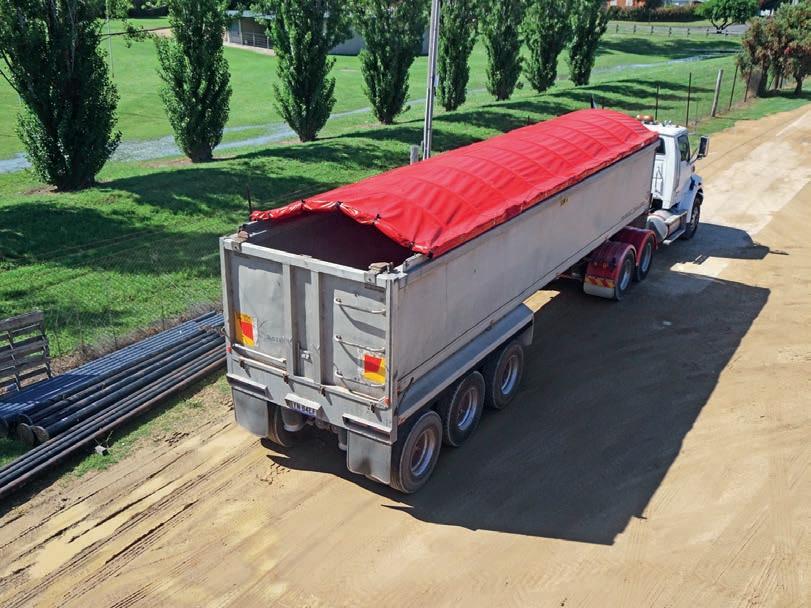
David Knight Transport (DKT) is a family owned and operated business based in the agricultural heart of NSW –Grenfell – and have been a regular buyer of Ellis and Sons roll-over tarps since 2012.
Their tipper trailers frequently travel hundreds of kilometres and even interstate, meaning they rely on roll-over tarps that will protect their cargo and last under rough conditions.
Ellis and Sons roll-over tarp, it’s an install and forget tarp – it’s going to last the distance under rough working conditions,” he said.
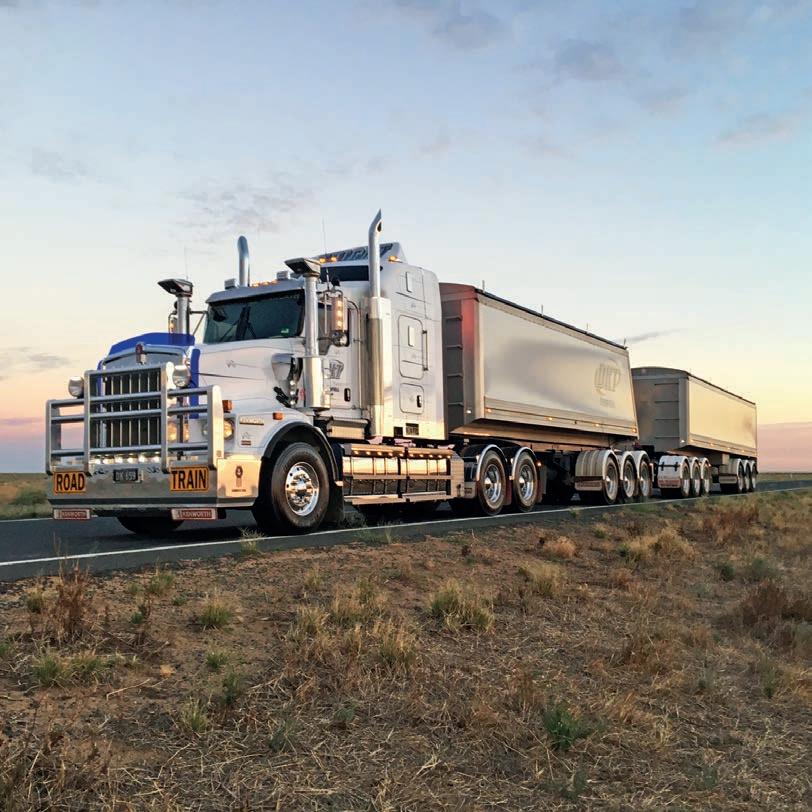
One such customer is David Knight Transport which has been working with Ellis &
Owners David and Rebecca Knight are specialists in the transportation of grains, fertilisers and feed and are the transporter of choice for many larger growers in the region and beyond.
David said he gets, on average, 1/3 more lifespan with an Ellis and Sons tarp compared with the tarps fitted by the manufacturers of his tipper trailers, giving him an added value of 33 per cent.
“I find that when I install an
To find out more about Ellis and Sons Group’s tarpaulin products or to get a quote, call 1800 808 769 or email sales@ellisandsonsgroup. com.au. Alternatively, go online at ellisandsonsgroup. com.au.
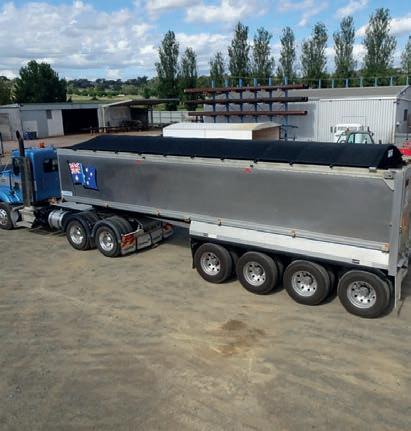

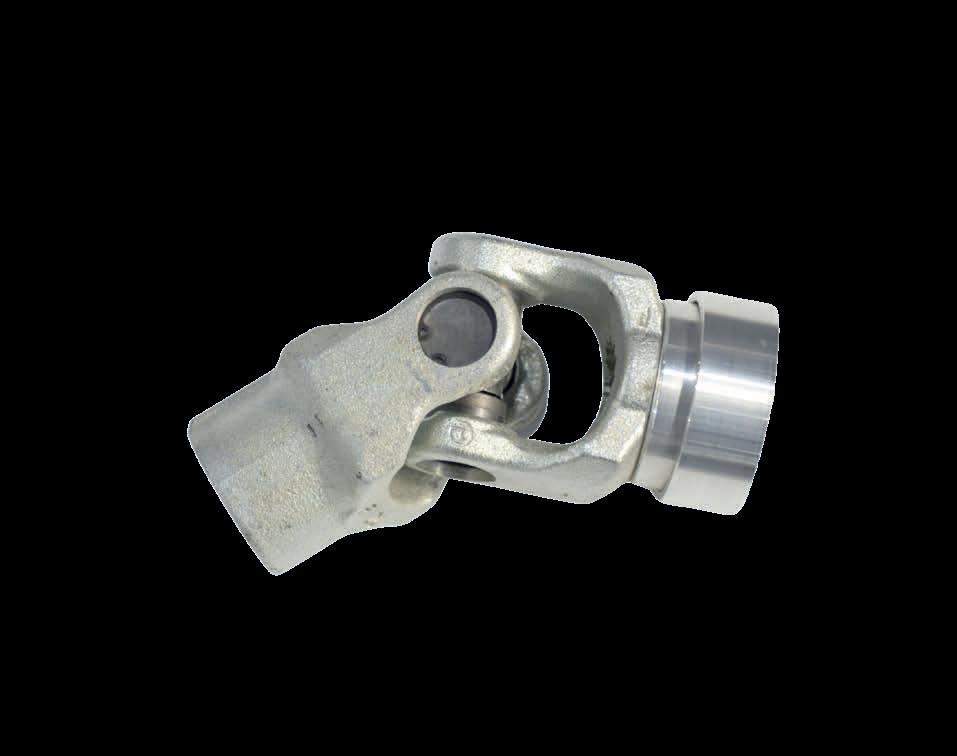
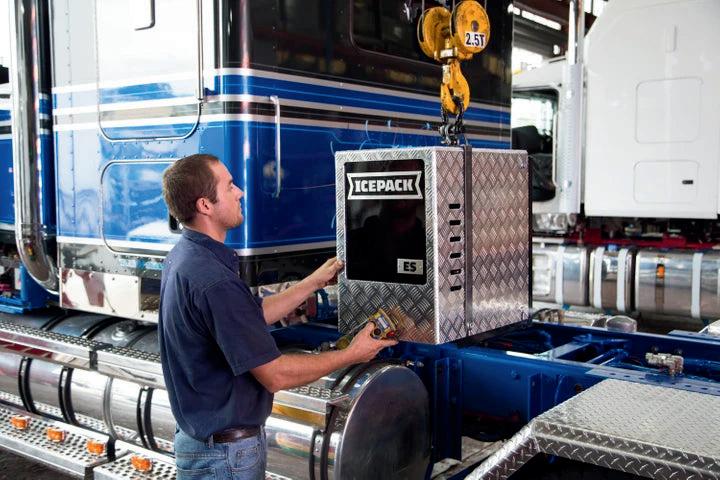




A TRAILER arrives in a workshop needing replace ment airbags.
The axle manufacturer is easy enough to identify. The suspension brand is visible. But which suspension mod el is fitted? What ride height left the factory? Which airbag and shock absorber part num bers does it actually require?
What should be a simple parts enquiry can quickly become phone calls, paperwork, searching old records or physically measuring components.
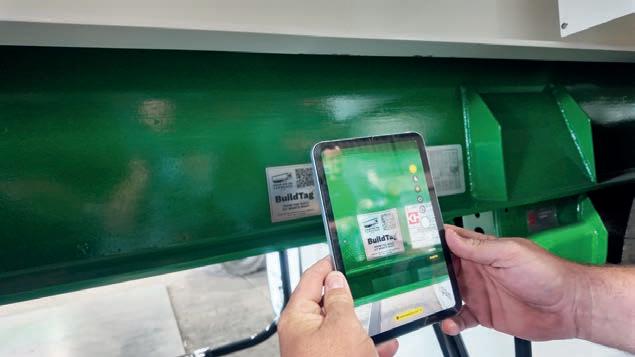
Valuable workshop time is often spent identifying parts before the repair can even begin.
The challenge extends well beyond replacement parts.
Operators regularly need access to owner’s manuals, maintenance information, permits, certificates, service documentation and other important records. Yet much of this information is still supplied in printed form and can easily be misplaced as trailers change ownership, staff move on and fleets expand.
While the transport industry has embraced advances in telematics, safety systems and vehicle technology, trailer information is often still managed using methods that
have changed very little over the past two decades.
The result is unnecessary downtime, delays in identifying the correct replacement parts and frustration for workshops, fleets and manufacturers alike.
Trailer Spec Pro was created to solve this problem.
The company’s BuildTag platform (patent pending) uses a durable QR identification tag permanently fitted to the trailer.
By simply scanning the BuildTag with any smartphone, users can instantly access digital information relating specifically to that trailer. No app downloads. No software installation.
No login requirements for viewing. Depending on the information supplied by the manufacturer, BuildTag can instantly provide replacement part numbers for airbags, shock absorbers, brake drums, brake shoes, landing legs, kingpins, couplings, hoists and many other fitted components.
Rather than relying on visual identification or historical paperwork, technicians can quickly identify exactly what was fitted when the trailer was built.
Where available, BuildTag can also provide access to exploded parts diagrams, maintenance information, spare parts catalogues, OEM man-
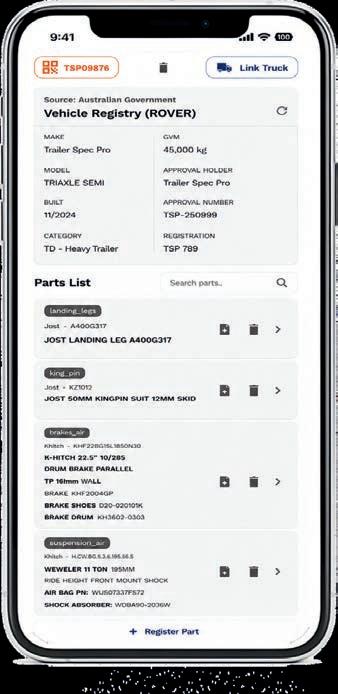
uals, service guides and even tutorial videos supplied by component manufacturers.
The platform also allows permits, certificates, compliance documents, service ecords and other fleet-specific information to be stored igitally against the trailer, ensuring important information remains available hroughout the trailer’s life.
Recognising that every customer has different requirements, Trailer Spec Pro now offers solutions ranging from simple digital documentation through to comprehensive fleet management and f ully branded software platforms.
W hether a business simply wants digital manuals, or VIN-specific component information, enterprise fleet management or a more completely customised white-label solution, Trailer Spec Pro provides a platform that can grow alongside the business.
Importantly, BuildTag can be fitted during manufacture or retrofitted to existing trailers where build information is available, allowing both new and existing fleets to benefit from digital trailer information.
Another more recent development is integration of BuildTag with the Australian Government’s Road Vehicle Regulator (ROVER) system.
Where a VIN is available, BuildTag can provide direct access to publicly available vehicle information alongside the trailer’s digital profile.
Proudly Australian developed, Trailer Spec Pro is built specifically for the Australian trailer industry and is backed by enterprise-grade hosting and security, giving manufacturers and fleet operators confidence that their information is secure, reliable and always available.
Less time searching. Less guesswork. Less downtime. Whether you’re ordering a new trailer or managing an existing fleet, digital trailer information no longer needs to be complicated. Ask your trailer manufacturer to fit a BuildTag during your next trailer build or contact Trailer Spec Pro to discuss retrofitting your existing trailers. Because when a trailer enters the workshop, the goal shouldn’t be working out what’s fitted. The goal should be getting it back on the road.
Phone 0401 954 164, email contact@trailerspecpro.com or find out more online at
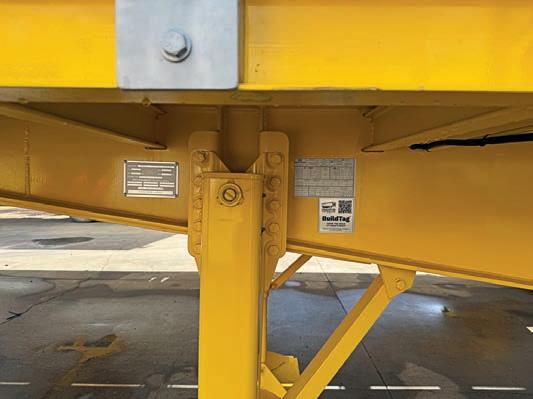
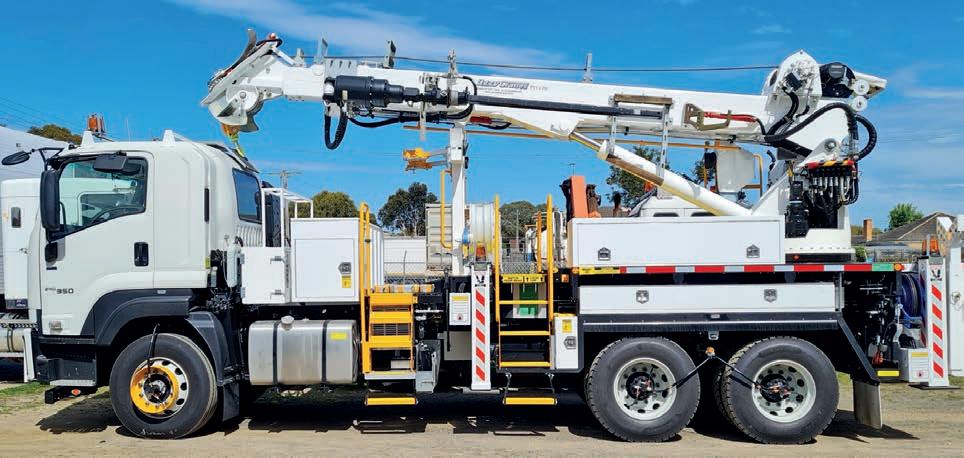
WHEN it comes to looking after the health of the trans port industry, and those who work in it, the challenges are nowhere near straightfor ward.
Sure, there’s the value of con tracts, fuel cost management, and ever-changing regulations to juggle, but there’s also the trucks and trailers to maintain and the need to look after the drivers.
One way to keep drivers healthy is to provide a smooth ride and this is where focusing on the manufacturer’s operat ing recommendations for tyres comes into play.
Poor air pressure manage ment has been shown to affect driver’s health and the safety of vehicles, while also causing damage to the roads transport operators rely on to make a living. For the driver, vibrations mean pain.
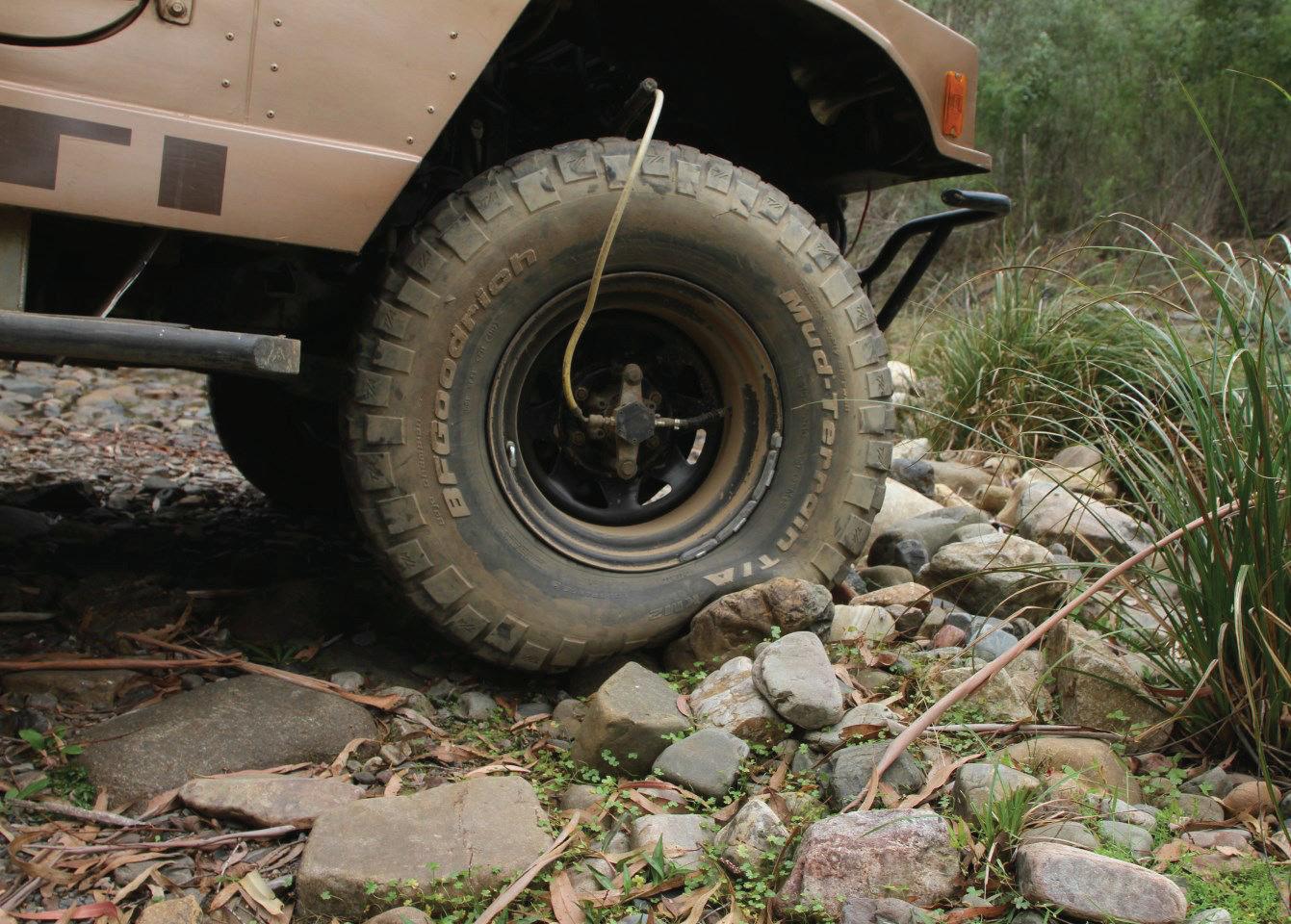
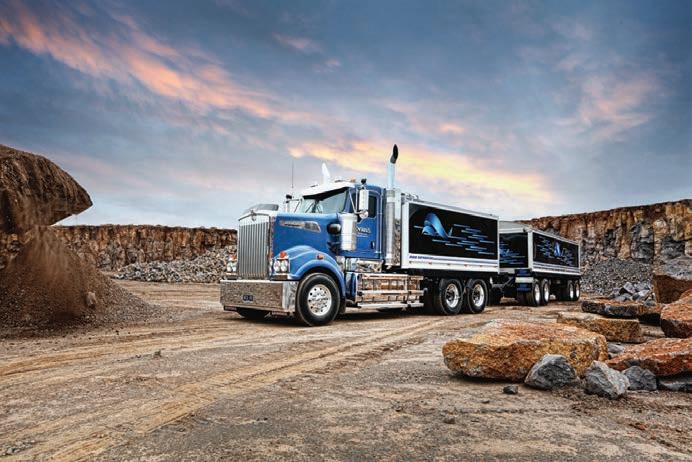

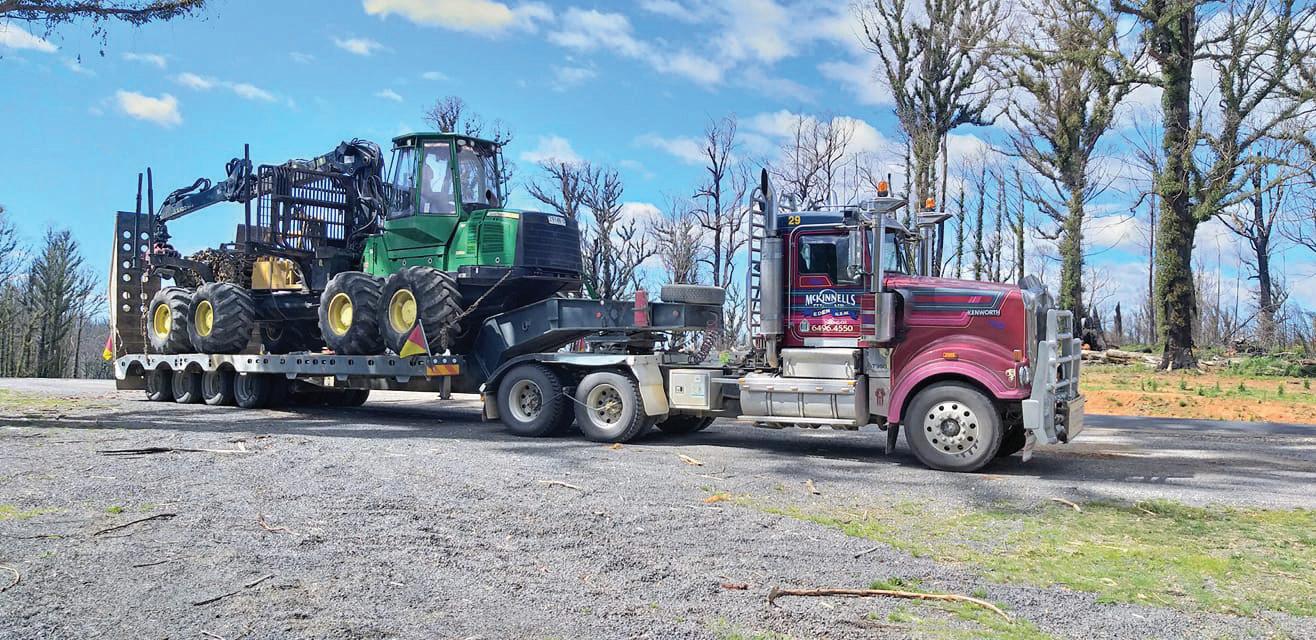
the applied Force. This Force hammers away at our roads and damages them prematurely, leading to the formation of potholes and corrugations.
Whole of body vibration
Whole body vibration (WBV) is a generic term used where any vibration of any frequency is transferred to the human body. It causes or exacerbates other health effects such as lower back pain, motion sickness, bone damage, stomach and digestive conditions, increased driver stress and increased driver fatigue.
The longer a worker is exposed to vibration, the greater the risk of health effects and muscular disorders. Neglecting to consider prolonged vibration as a factor in driver health will affect their capacity and longevity in the job.
Optimal tyre pressure
The benefits of optimising tyre pressure with terrain and conditions are poorly understood.
A s a result, a raft of road infrastructure and travel time benefits are being overlooked.
A n over-inflated tyre will transfer shock from road undulations directly into the vehicle chassis and transmission components, then onwards to the driver and passengers.
Optimally pressured tyres remove many of these deflections before they reach the shock absorbers.
Looking to science, the Potential Energy (equal to the vertical Kinetic Energy caused by the bump) is proportional to
Action to take
The capacity to resolve this issue exist today. The process is simple. A driver needs to take into consideration the load being carried on each axle and then determine the load on each individual tyre. The driver must then consider each axle group separately that is as Steer, Drive or Trailer – each is a separate case. Then contemplate the terrain being travelled. Reference can be made to the manufacturer’s recommended load to inflation tables. Tyres will heat with use causing a rise in the PSI. Best practice is: if the load changes or terrain you need to change pressures.
Is this easy to do?
Frequent pressure adjustments are not feasible where tyre pressures are fixed through traditional wheel valves. It is too difficult and too slow to try. The only practical alternative is to incorporate complete control via a Central Tyre Inflation system. It manages your tyres, like a cruise control can man-
age your speed. Ideal pressures a intervention.
ber Central Tyre Inflation) d their driving requirements and add comfort to their daily drive with a push of a button in the cab.
ability to steer and corner with accuracy and grip.
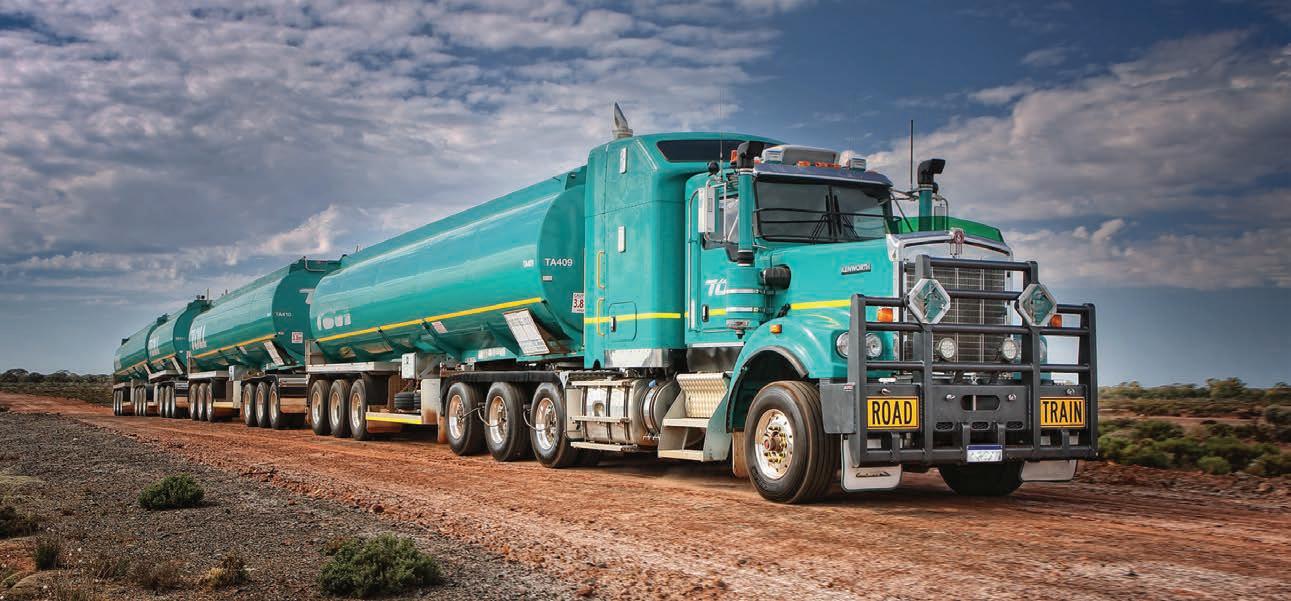


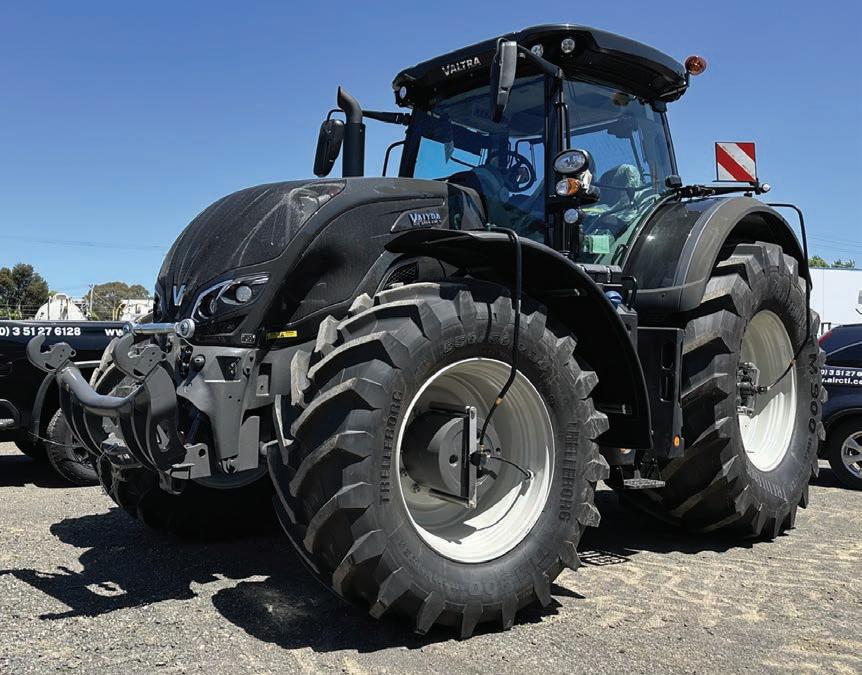
the AIR CTI display, where live pressures are automatically trimmed up and down to match the preferred target pressure.
How AIR CTI helps
AIR CTI is an Australian Made complete tyre management system. It has been tested and exercised over decades of use in Australia’s extreme conditions. Our display unit provides incab visibility of tyre health, on the go. It also comes with a 3 year or 500,000km warranty on the entire system for optimizes tyre pressures to match conditions of operation.
For more information, see aircti.com or phone Global Sales Manager Peter Maher
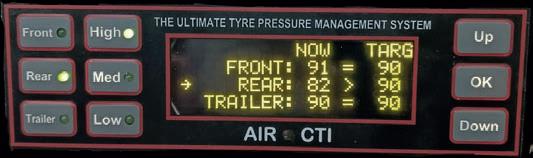

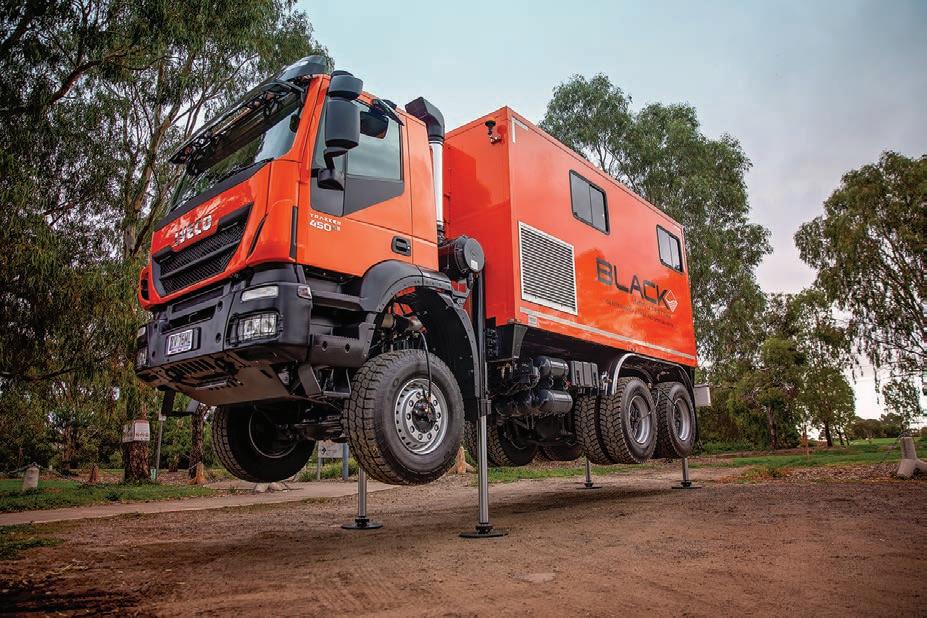


AS preparations begin for another busy grain harvest season across Australia, transport operators are already turning their attention to ensuring their equipment is ready to handle the increased workload.
For many fleets, converter dollies remain one of the most versatile and cost-effective solutions for maximising payload capacity while maintaining operational flexibility.
ABS Trailquip has spent more than two decades supplying Australian transport operators with high-quality converter dollies designed specifically for local conditions.
Its Grain Spec Tandem and Tri Axle Converter Dollies have been developed with reliability, durability, and ease of operation in mind.
During harvest, equipment is often subjected to some of the toughest conditions of the year.
Long hours, demanding schedules, rough access roads, and heavy payloads all place significant pressure on transport equipment.
With these reasons in mind, ABS Trailquip has focused on building a dolly package that combines premium components with the practical features operators value.
Their Grain Spec Tandem and Tri Axle Dollies are fit ted as standard with Trailquip parallel bearing axles and an Australian-made Trailquip air suspension system, deliv ering excellent load sharing, smooth ride quality, and de pendable performance under demanding operating condi tions.
They also feature a JOST turntable, recognised throughout the industry for
its durability and reliability.
Operators can also select their preferred drawbar length to suit individual applications, providing flexibility for a wide range of trailer combinations and operating requirements.
Understanding every fleet has different preferences, ABS Trailquip offers a choice of colour to match existing equipment, along with dual mounting positions for the drawbar.
These options allow operators to tailor the dolly to suit their specific fleet requirements while maintaining a professional and consistent appearance across their transport assets.
Appearance and durability have also been considered, with polished alloy rims fitted both inside and out as standard. Not only do alloy rims enhance the presentation of the dolly, but they also assist in reducing tare weight while maintaining strength and performance.
The dollies are fitted with quality Triangle 11R22.5 tyres, providing dependable service and excellent value for Australian operators and every Grain Spec Dolly is supplied with a Right Weigh Load Scale system, allowing drivers and operators to accurately monitor axle group weights and maximise payload efficiency while remain
Customers can also choose between plastic guards or traditional rubber guards to suit their needs.
One of the key advantages of converter dollies during harvest is the flexibility they provide.
Operators can quickly configure combinations to meet changing transport demands, whether moving grain from farm to storage facilities, transporting product to ports, or servicing regional processing operations.
For the upcoming harvest, the ABS Trailquip Grain Spec Tri Axle Dolly is available from just $48,995 including GST, while the Grain Spec Tandem Dolly
FOR bulk haulers, every min ute drivers spend cleaning out trailers is a minute they are not on the road.
Manual sweeping, blowers and wrestling with tarps slow turnarounds and add risk.
KEITH Manufacturing Co. developed its CleenSweep® tarp system to automate clea nout in WALKING FLOOR® trailers and help keep drivers off the trailer floor.
The KEITH Tarp Catcher™ is the latest addition to that system, designed to keep the tarp where it belongs: out of the load and under control.
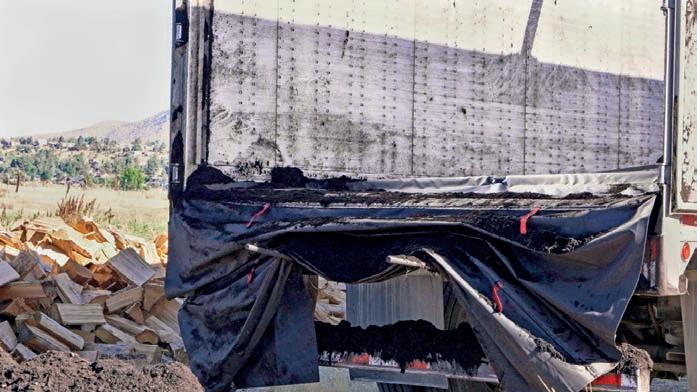
By holding the tarp in position during loading, KEITH Tarp Catcher helps prevent it from dropping into the material stream or getting buried.
That support allows the CleenSweep system to do its job during unloading, sweeping residual material out of the trailer and cutting the time drivers spend on clean-up.
Inside-the-trailer tarp control
In a CleenSweep installation, the tarp runs down the inside of the trailer, with the load resting on top.
As the WALKING FLOOR system moves the material toward the back, the tarp travels a long the floor, pulling fines and leftover product with it. Once the trailer is unloaded, the operator retracts the tarp at the push of a button and is ready for the next job.
trips and falls as they climb in and out of trailers. It can also increase the risk of more serious incidents if loading starts while someone is still inside. By replacing manual tarps and brooms, the CleenSweep system helps reduce the need for people to enter the trailer in the first place.
KEITH Tarp Catcher strengthens that safety benefit. When the tarp stays in place and does not get buried, there is less need for drivers to climb in and free it up before unloading.
For operators, this can mean fewer risky steps on dusty floors and less time working around leftover material.
Catcher helps keep the tarp clear of the load during filling, it supports more consistent cleanout from one job to the next. Drivers can unload, retract the tarp and move on to the next task with less time spent sweeping floors or clearing hung-up fines. In busy yards and transfer sites, that time saving can add up across a fleet.
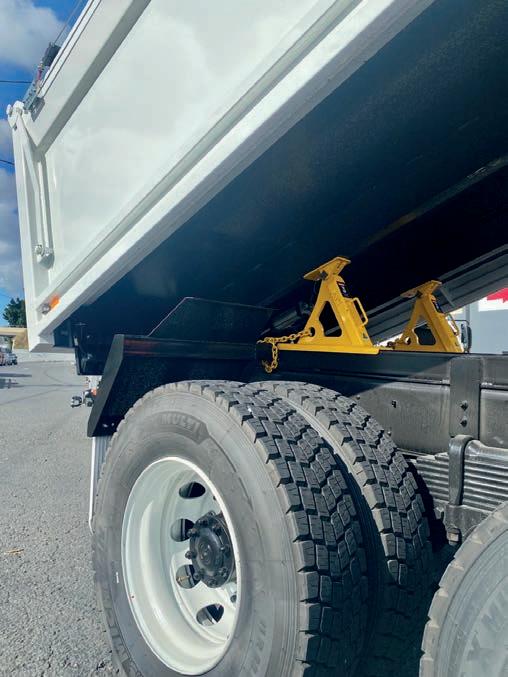
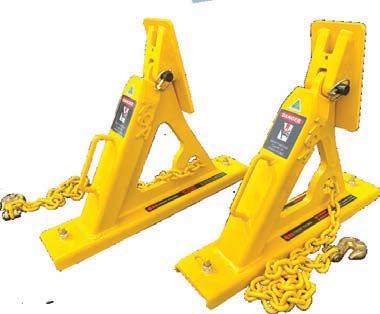


This process depends on good tarp control.
If the tarp sags into the load or is dragged out of position when loading, it can slow unloading and reduce cleanout
KEITH Tarp Catcher is designed to support the tarp inside the trailer so it stays in the orrect path. By managing the tarp during loading, it helps ensure the cleanout cycle runs smoothly when it is time to
Manual cleanout exposes drivers and yard crews to slips,
For fleets, it supports a safer work environment and can help reduce the chance of injury-related downtime.
For operators hauling grain, feed, compost, soil, manure and similar materials, leftover product in the trailer is more than an annoyance. It can slow loading, add extra cleanup time and raise cross-contamination concerns between jobs.
The CleenSweep tarp is designed to pull residual material out with the load, leaving less behind after each run.
Because KEITH Tarp
The CleenSweep system is powered off the same hydraulic supply as the KEITH WALKING FLOOR drive and is engineered for a range of trailer configurations.
KEITH Tarp Catcher is designed to integrate with this setup, working with the tarp as it extends and retracts inside the body.
For trailers that run on tipping platforms, KEITH also offers a lock kit to help secure the tarp during tipping. Together, CleenSweep and KEITH Tarp Catcher give haulers a practical way to automate one of the toughest parts of bulk transport: cleaning out the trailer between loads.
By keeping the tarp out of the load, the system helps drivers stay safer, turn trucks around faster and keep trailers cleaner for the next job.




THERE are many tools an owner driver needs in their kitbag. Alongside their trusty truck, they need to ensure they have all types of loading and unloading gear, the relevant accreditation, bags and safety equipment. Throw in logbooks and other compliance requirements and it can quickly become a lengthy list. Ratchet tie-downs fall into this category, but they are often difficult to forget. When transporting a variety of goods around the daily or weekly runs, tie-downs become an indispensable part of an owner driver’s arsenal. Ensuring these systems are sturdy, safe and dependable is pivotal to running transport operations. Enter Pacific Packaging and TYMATE.
“TYMATE is Pacific Packaging’s dedicated brand for load restraint and securing solutions, built for reliability in transport, warehousing and industrial environments,”
Pacific Packaging Australia
managing director Gary Manais told Big Rigs
“Designed to keep loads stable and controlled, TYMATE products help reduce movement, improve safety and support compliant load handling.
“These ratchet tie-down systems are engineered for strength, reliability and repeat use across demanding transport environments.”
Far too many systems and tools are designed for adjacent industries, with owner drivers then being able to benefit if they used the technology in a particular way. With TYMATE, the ratchet tie-down systems are designed specifically for owner drivers as well as freight operators and logistics teams who need secure load restraint without compromise.
Whether it be for daily deliveries or heavy-duty haulage, TYMATE has been created to keep loads locked in and
moving safely. The TYMATE range is complete for load restraint, strapping and securing applications, made from strong and durable materials that are designed to handle tension and movement.
This provides consistent performance across ratchets, ropes, twines and strapping, offering efficient and easy-touse solutions for fast load securing.
“The key benefits include heavy-duty ratchet mechanisms, high-strength webbing and reliable, repeat-use performance that’s built with transport and logistics operators in mind,” Manais says.
Beyond the TYMATE ratchet tie down range, which comes in red, blue, orange or yellow options, is an extensive support network that is just as trusted as the product itself. As part of the wider Pacific Packaging Australia network, the TYMATE range is backed by the brand’s nation-
al supply network, making it easier to access the sturdy solution wherever you are.
To explore the TYMATE range for trusted load re straint products that help you secure with confidence, shop online at www.pacificpack aging.com.au or speak to the team at 1300 234 235.
“Whether you’re securing pallets for dispatch or man aging loads onsite, TYMATE delivers dependable solutions that keep operations running smoothly,” Manais says.
To find out more phone 1300 234 235 or go to pacificpackaging.com.au.
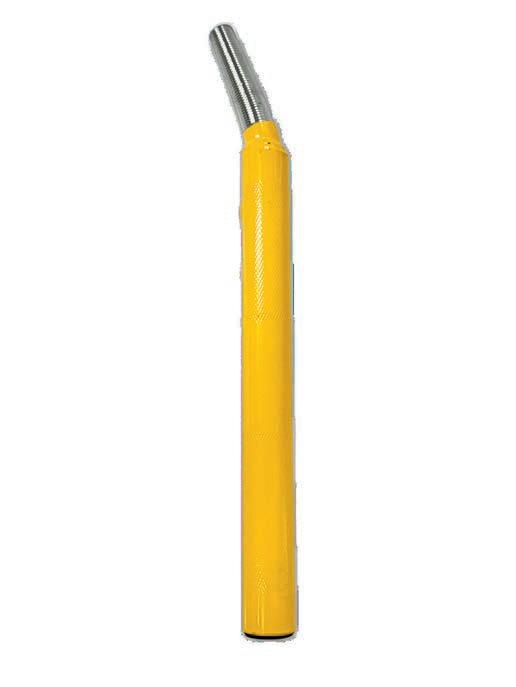
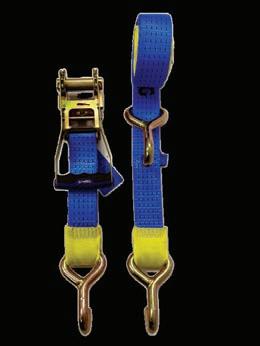
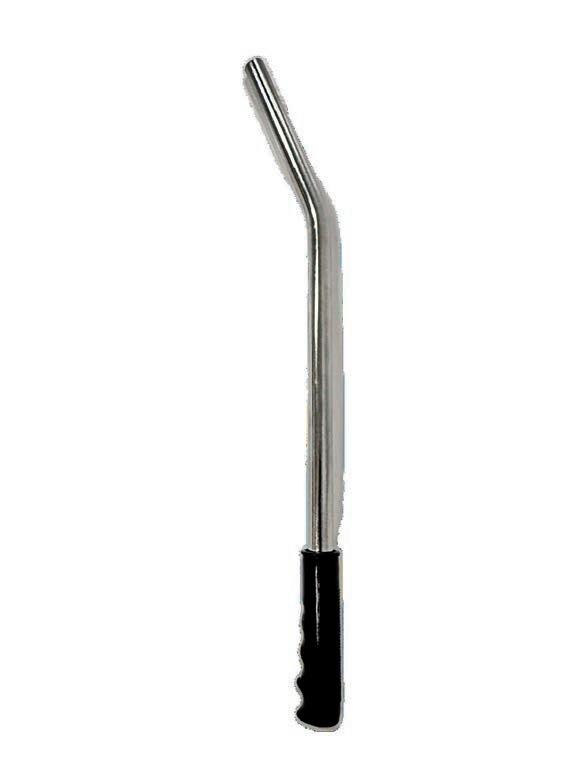
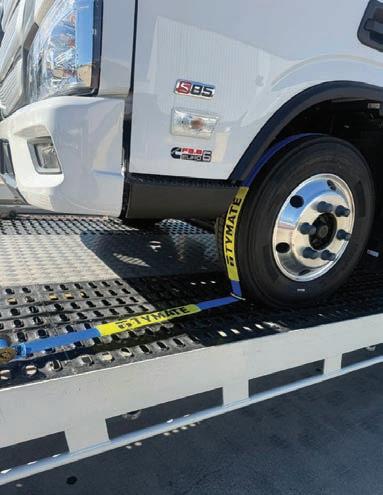
COMMON misconceptions about Australia are that it’s always sunny and hot, and that everything is out to kill you – from spiders, snakes, “drop bears” and sharks, even in the cities. And that we all are tanned surfers living in the outback, even though waves and the ocean are missing.
In fact, of course, most of us live on the eastern seaboard in big cities, and it sometimes gets very bloody cold.
What is true through, is that most of our continent is not covered by major cities, and most miles, well let’s be clear and call them kilometres –actually do take place in the bush, outback and desert.
Those who do most of the driving, truck and bus drivers, are tanned for sure; normally the right arm, above the socks, and below the knees!
Because Australia’s population is so concentrated in coastal cities, the sheer geographic scale of the outback requires a massive web of rural routes.
New South Wales alone has over 169,000km of bush roads, and even prominent inland routes – like much of the 2700km Outback Way – are still gravel.
Unsealed roads can often be damaged by rain, with deep potholes to navigate, mud, and washouts… and those wild creatures that are out to get you?
When you are driving a massive road train, extreme caution is needed at dawn and dusk because kangaroos will inevitably jump the wrong way at the last moment.
So, if you are one of the many frequent users of this vast network of unpaved gravel tracks, dirt trails, and single-lane bitumen highways winding through the bush; how’s a bloke, or a girl, going to make sure the tyres don’t wear out quickly, and your rig is not a wild juggernaut you’re trying to tame.
This month we chatted to a host of rough country drivers who’ve worked it out.
Corbett’s in Jones Hill and Glanmire, up Gympie way in Queensland – have a cattle rig and a fuel tanker balanced with Atlas Balance Rings and are getting an unexpected 110,000km out of their truck tyres working heavy haulage, fuel transport, land clearing, and site construction – and none of that is in easy road conditions.
They say they’ve never seen truck tyres wearing flat and even before.
Peter Betts of Betts Trans port, in Walcha in northern NSW is owner of the incredi ble 780hp Mack Super-Liner, a mongst other rigs, and works with livestock transportation, general freight, construction and mining. Again, he knows rough roads, and he has fully fitted out the Mack with Atlas Balance Rings, to ensure the least vibration, wear and tear, and to maximise the life of his tyres.
Thompsons Cowra Livestock Transport are livestock, har vest, fertiliser, and road gravel fleet specialists. They are Atlas Balance Ring balanced too.
CMT Casis are a fami ly-owned farming and bulk commodity transport company based in the Northern R ivers of NSW. Fully balanced tyres – that’s how they are managing tyre costs. After an accident, one of the drivers requested Atlas Balance Rings on steers and drives.
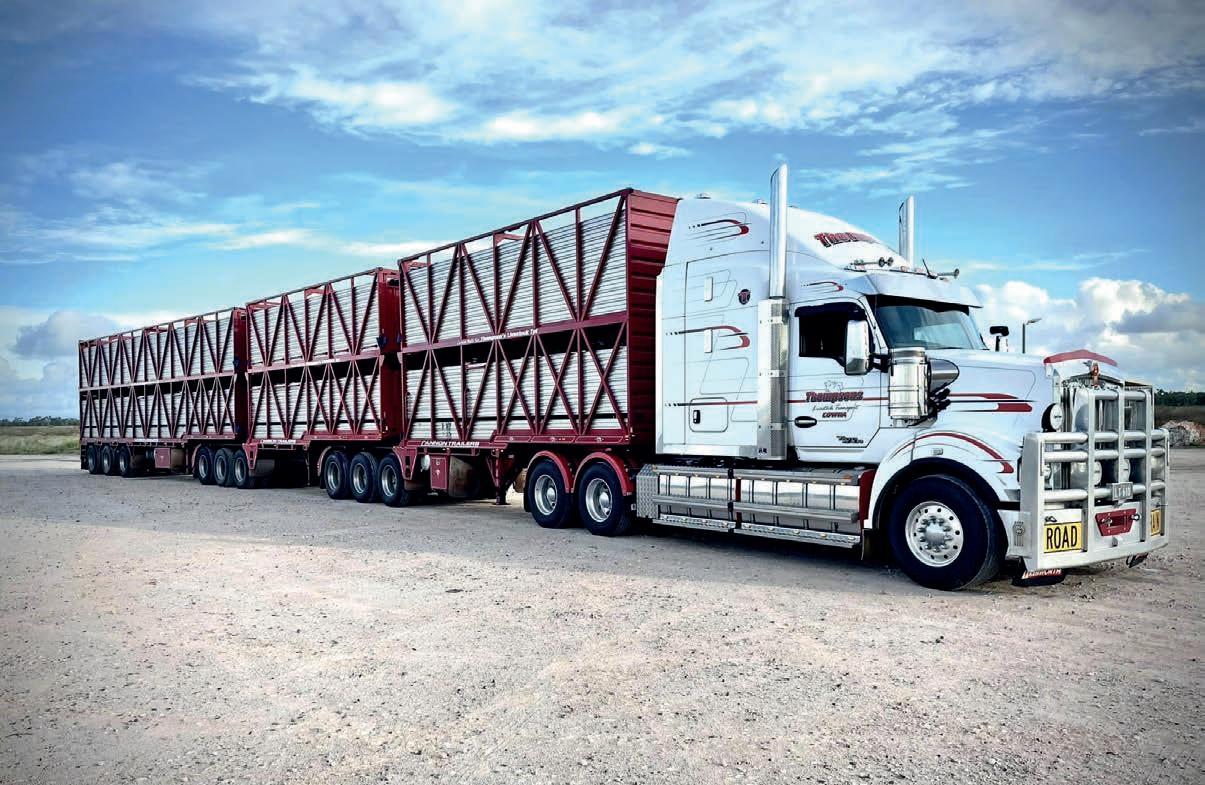
Even though they fitted half worn tyres to get him going again, everyone only expected to get another 20,000km out of them, but the balance rings got rid of the scalloping and they more than doubled the expected tyre life.
Our friends across the ditch in New Zealand know all about tough driving too.
Whilst here is brown and flat, there it’s mountainous and green, one-lane slippery roads, braking and constant sharp turns that eat into tyre life and the budget.
Booths Transport dominate the roads on both the North and South islands, and they
are huge Atlas Balance Ring fans. Initially, Jackson Booth was a non-believer, and his dad said it sounds too good to be true. One after the other they took their first Atlas balanced truck for a drive and saw the light. Mr Booth senior said the difference from before was chalk and cheese, and Atlas balance rings fitment is now mandatory through all the fleet.
Back to the NSW Central Coast, and Michael Galea Crane Trucks lifts and hauls big stuff, and Michael gives Atlas Balance Rings 5 Stars.
“I run Atlas Balance Rings on my crane trucks. Some of my trucks were chewing steer tyres and now wear even all the way down, I definitely recommend,” he said.
All over Australia and New Zealand on rough roads
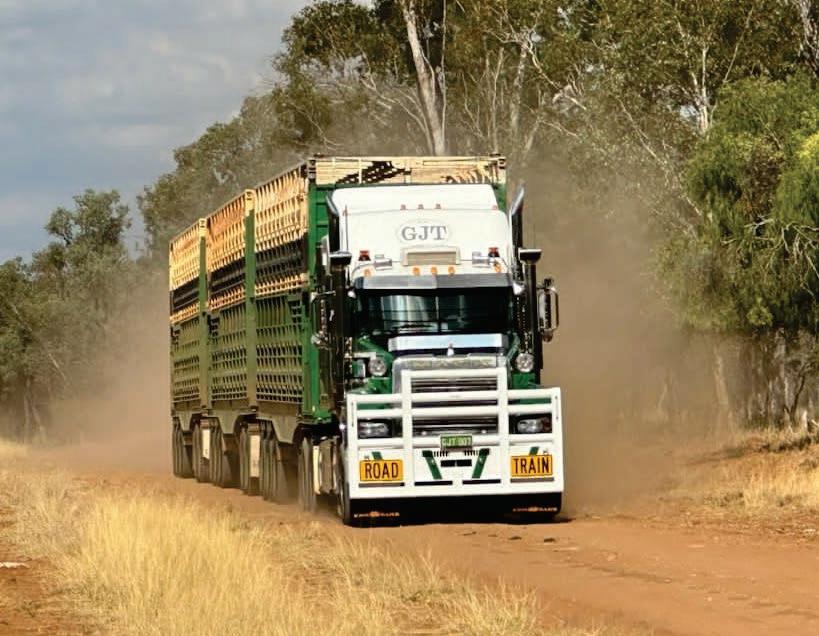

from Biloela to Cowra, Swan Hill, Kalangadoo and the Top End, drivers with ful ly balanced rigs are getting more kilometres from tyres and using less fuel.
Tough conditions? Great! Perfect for Atlas Balance Rings to balance and reduce tyre wear and driver wear.
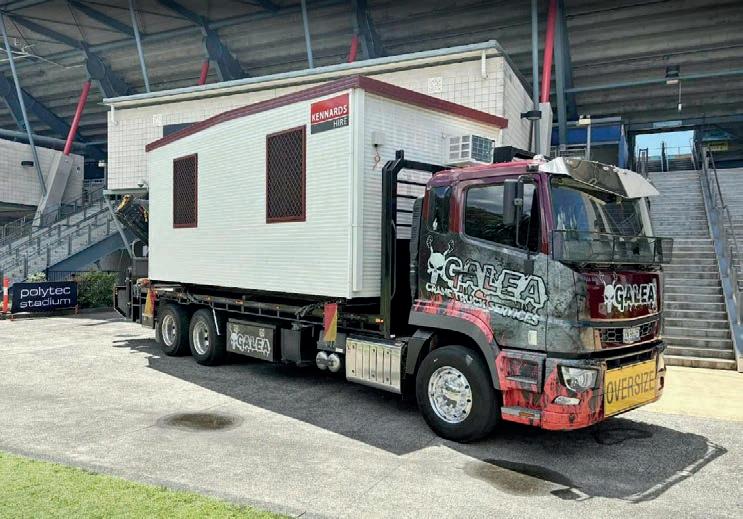
To find out more call us on 1300 228 527 or see atlasbalance.com.au.
on rough roads from Biloela to Cowra, Swan Hill, Kalangadoo & the Top End, drivers with fully balanced rigs are ge ng more kms from tyres and using less fuel. Balance the whole rig for the best results - steers, drives & trailer tyres
Cut your running costs including fuel ! Less component wear, fatigue & back pain ! 17,000 trucks & bus drivers cant be wrong ! 2 Year Warranty
A SPECIALIST manufacturer of livestock trailers, Cannon Trailers prides itself on its quality workmanship – with its product renowned for standing up to anything that gets thrown their way.
As such, every part of part of the build process is carefully thought out – from t he engineering, using the highest quality Australian steel, through to the choice of component suppliers.
“We only use products that have been tested and proven in the field. Australia is the harshest operating environment on the planet. If it’s going to work here, it can work everywhere,” said Joe Cannon, Purchasing Man-
that JOST has been the company’s go-to supplier for fifth wheels – namely the heavy-duty 37CX fifth wheel.
A product well suited to livestock transport, the 37CX features an increased imposed load rating, high D-Value, beefed up casting, and foot cushions ideal for arduous applications, including multiple trailer combinations operating in difficult terrain. The product also features JOST’s special E-Coating, for additional corrosion protection.
Based in Queensland, Cannon Trailers was started by Joe’s brother Blu Cannon, a former livestock driv-
tom built, however the 37CX is the standard fifth wheel we use. We offer clients fifth wheel options from d ifferent manufacturers, but on about 90 per cent of our builds, the fifth wheels are JOST,” said Joe.
“The 37CX is designed with livestock and other heavy duty applications in mind. It has a six-bolt saddle design, rather than the usual four-bolt, giving it extra strength. We’ve had a really good run with this product.”
Along with fifth wheels, Cannon Trailers turns to JOST for its king pin and landing leg needs too.
In terms of support, Joe says JOST’s service has been
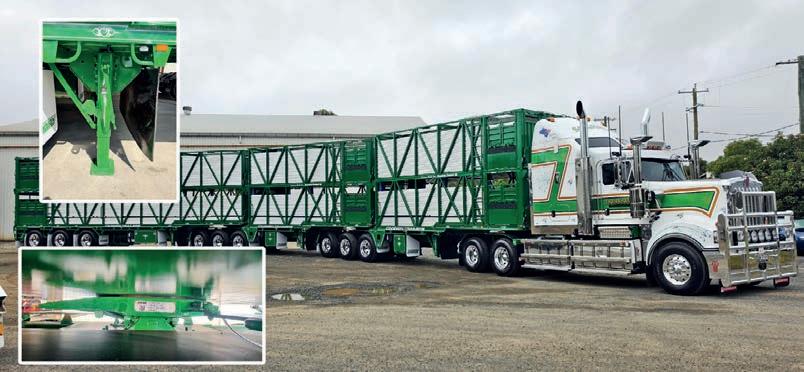
has seen the value in Cannon Trailers and JOST’s products for many years.
Operating for over 20 years, it has two depots, located in Albury/Wodonga and Toowoomba – with its fleet of 35 prime movers and around 85 trailers used to transport cattle mainly across the eastern seaboard, as well into South Australia, the Northern Territory and
B-double trailers from them.
“We turn our trucks and trailers over every six years, and even after that time, these trailers still have a lot of life left in them. I have repeat buyers that keep coming back to buy our used trailers because they know the quality that goes into a Cannon.”
Dom added that he’s used JOST fifth wheels from the
loaded up to our weight limits most of the time. When transporting cattle, with the moving load, it puts a lot of pressure on your fifth wheels, so you really can’t cut corners on fifth wheels in our game.”
The quality and longevity of a Cannon trailer is testament to the workmanship t hat goes into every build, bolstered by the use of only the best quality components.
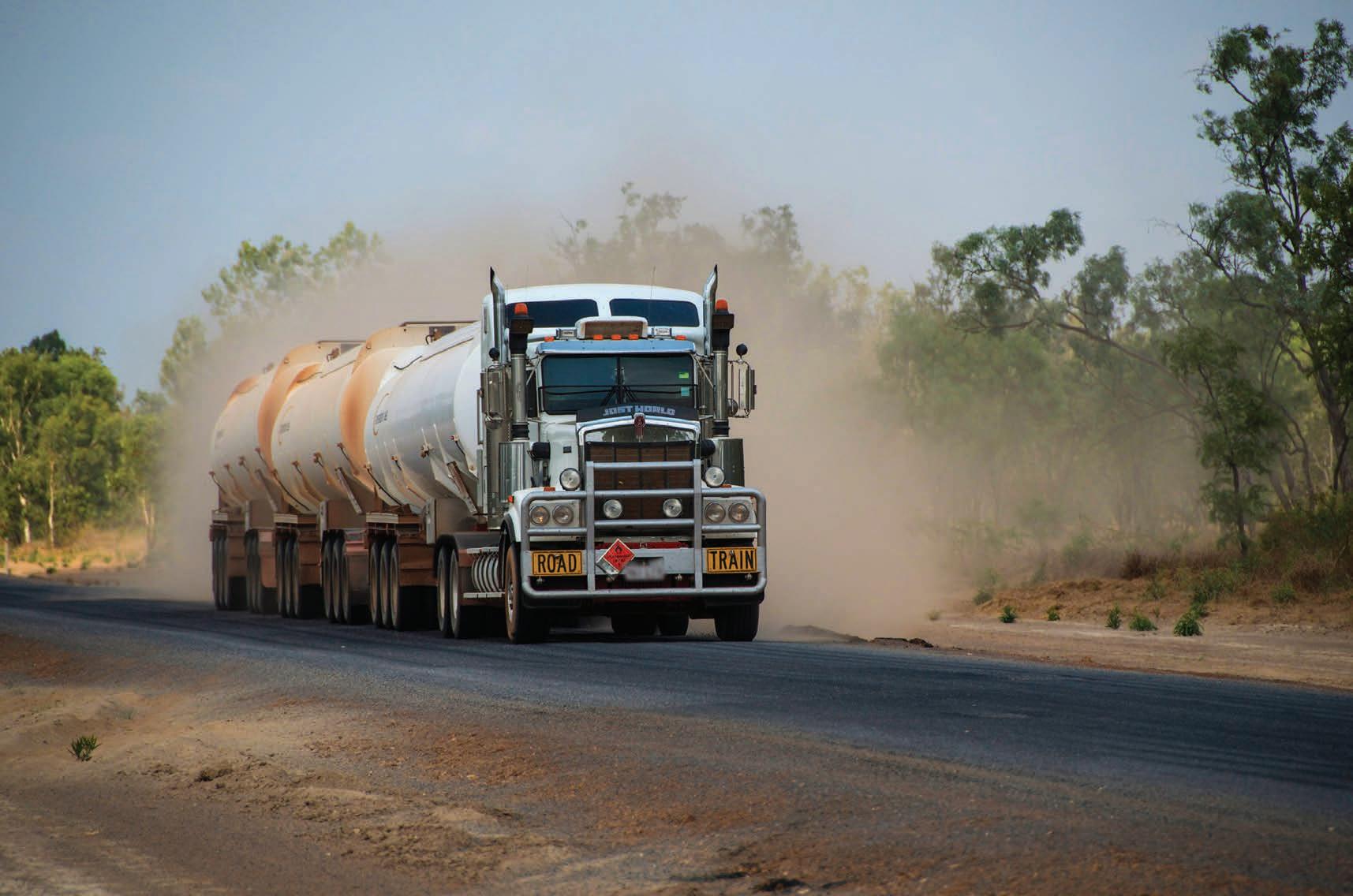

Reliable components help keep trailers moving, loads secure and downtime to a minimum. From fifth wheels and landing gear to hydraulic cylinders, ball races and king pins, JOST and HYVA products are built for demanding transport applications.
WHEN it comes to buying equipment for your truck or fleet, it’s easy to focus on one number – the purchase price.
After all, every transport business is under pressure to manage costs. With rising fuel prices, increasing labour expenses and tighter margins, looking for the lowest upfront cost can seem like the sensible decision.
But is it really the cheapest option?
More and more fleet operators are shifting their focus from purchase price to Total Cost of Ownership (TCO) – a way of measuring what a product actually costs throughout its entire working life.
The reality is that the cheapest product on day one isn’t always the most economical after five or 10 years.
Take wheels, for example.
A wheel isn’t simply something that keeps the truck moving. It influences fuel consumption, maintenance requirements, payload capacity, vehicle appearance and even resale value. When viewed over hundreds of thousands of kilometres, those factors can make a significant difference to operating costs.
One of the biggest contributors to costs is weight.
Lightweight forged aluminium wheels reduce vehicle weight compared with traditional steel wheels.
If you choose Alcoa® Wheels’ 16 kg forged aluminium wheel – one of the
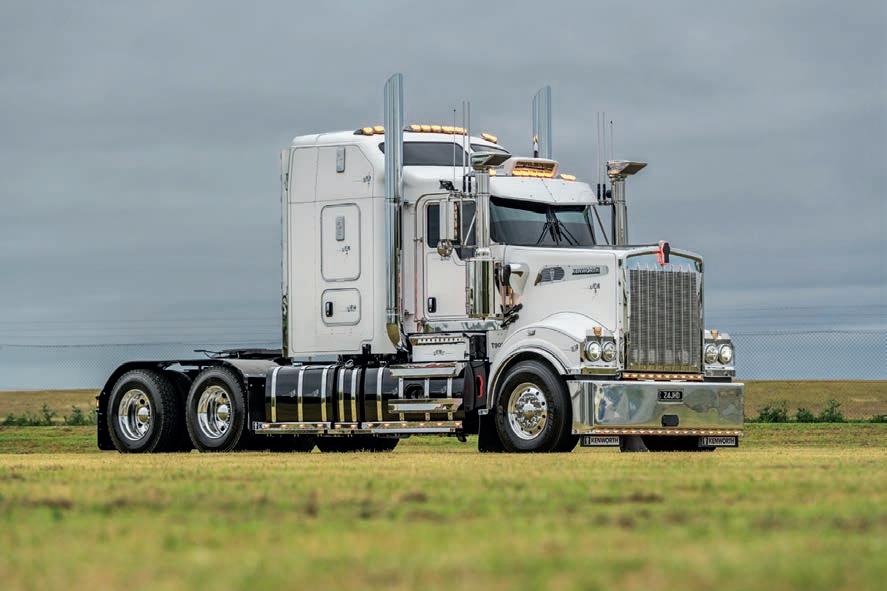
lightest truck wheels available in the industry – you could reduce the weight of a typical prime mover and trailer combination by well over 200 kg compared with conventional steel wheels, depending on the wheel configuration.
That weight saving can be used to increase payload or reduce the overall mass your truck has to carry every kilometre.
That reduction can improve fuel efficiency and increase payload capacity, helping operators move more freight while using less fuel.
Over the life of a fleet, even small improvements in ef-
that’s often overlooked.
Every hour spent cleaning wheels, repairing damage or replacing components is time the truck isn’t earning money. Products designed to withstand Australia’s demanding conditions and requiring less ongoing maintenance can help keep vehicles on the road and workshops focused on essential servicing rather than avoidable repairs. Durability also plays an important role. High-quality forged aluminium wheels are engineered for strength and longevity. Their resistance to corrosion and everyday wear
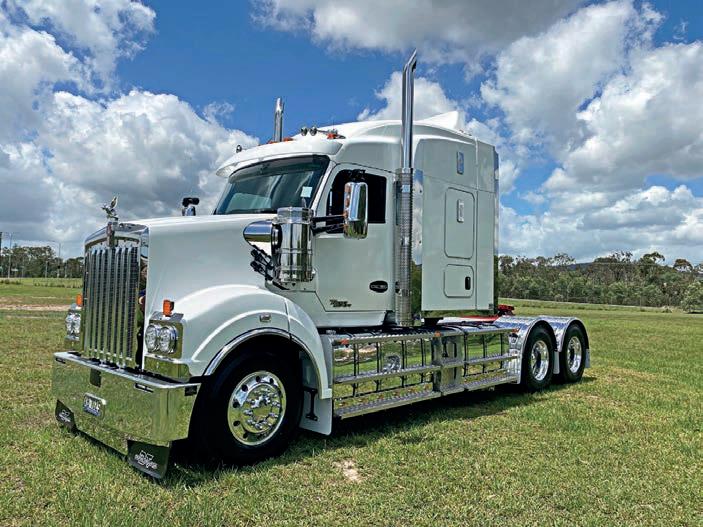
years, reducing the need for premature replacement and contributing to a lower lifetime operating cost.
Then there’s resale value. A well-maintained truck fitted with premium components is often more attractive to the next buyer. Wheels that continue to look professional and perform reliably can help support the overall value of the vehicle when it’s time to upgrade your fleet. Perhaps the biggest saving of all is avoiding downtime.
Unexpected maintenance doesn’t just generate repair bills – it can lead to missed deliveries, disrupted schedules
Investing in quality components from the outset can reduce these interruptions and provide greater confidence that your fleet will be ready when customers need it.
That’s why more transport businesses are asking a different question. Instead of asking, “What’s the cheapest wheel I can buy?” they’re asking, “Which wheel will cost me the least over its lifetime?”
It’s a subtle shift in thinking, but one that can have a significant impact on profitability.
In today’s transport industry, every litre of fuel, every maintenance hour and every day of vehicle availability
price and considering the total cost of ownership helps businesses make smarter investment decisions – decisions that continue delivering value long after the initial purchase. Because the best investment isn’t always the one that costs the least today – it’s the one that saves you the most tomorrow.
Looking beyond the purchase
For more information about forged aluminium wheel solutions, contact Howmet Wheel Systems Australia on 1800 955 191, email alcoawheels. sales@howmet.com, or visit alcoawheels.com.au. Follow Alcoa Wheels Australia on Facebook for the latest industry news, product updates and customer success stories.
MINING companies may soon be able to access a hybrid electric road train power system (HRT) to boost loads and meet the need to reduce Scope 1 emissions.
The innovative road train trailer technology is the subject of a 50/50 joint venture announced on July 14 between MLG Oz Limited’s wholly-owned subsidiary IMS Oz Ventures Pty Ltd and Mick Murray Welding NT Pty Ltd (MMW).
In a statement announcing the venture MLG said the HRT combines a purpose-built power trailer, three heavy-duty electric drive axles and a 200 kWh buffer battery.
It said it will be initially powered by diesel generation, moving to full battery power supply as battery technology advances.
“It is engineered specifically for the payload, duty cycle and remote-terrain demands of Australian off-road mining haulage operations,” MLG said.
“A key advantage of the HRT’s design is its ability to support deployment in remote mining environments without the need for fixed charging infrastructure, providing a practical pathway to lower-emission haulage across mine sites where grid power or large-scale battery charging is not readily available.”
MLG and MMW have a 15year commercial relationship,
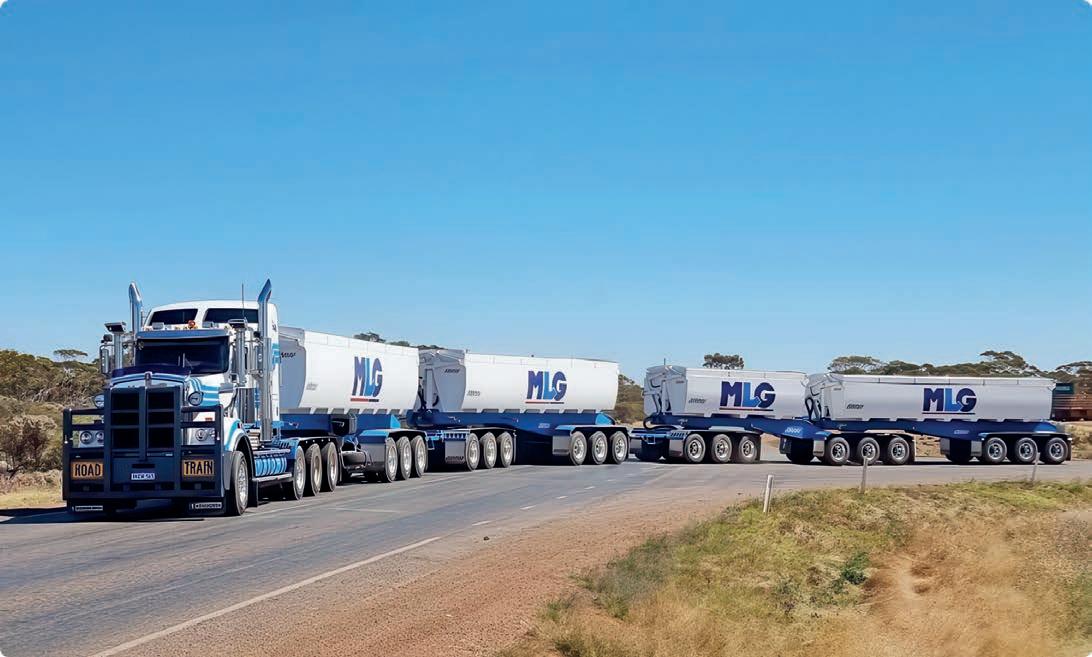
over which MMW has established itself as a key trailer partner to MLG’s Western Australian and Northern Territory operations.
The HRT program is the most significant collaboration undertaken between the companies to date and the JV consolidates the intellectual property developed in relation to the HRT program into the JV entity.
In terms of next steps, the plan is to develop the technology in phases starting with the hybrid diesel prototype which is currently in build, then progress through to a fully battery-electric road train combination.
In its statement MLG said each phase would be subject to Board approval against “defined Phase Gate Criteria” to provide MLG shareholders with a milestone-based capital commitment.
Being able to haul more load with less emissions is also expected to offer a commercial advantage to off-road haulers when it comes to bidding for work via tenders.
MLG said its objectives for the total project are to position it to:
• Deploy higher-payload, lower-emissions equipment into its own fleet at a materially advantaged transfer price relative
to third-party customers;
• Capture 50 per cent of the profit from third-party sales of the Product into the broader Australian mining sector;
• Differentiate its tender offering to clients with published decarbonisation and Scope 1 emissions reduction commitments; and
• Partner with an established and reputable heavy trailer manufacturer, while retaining direct strategic and operational input into the design and development of the technology to ensure the Product is fit for purpose in Australian mining conditions.
• Retain a preferred pathway
to access and deploy the Product within its own fleet.
MLG is investing about $1.2 million in capital into Phase 1of the project.
MLG CEO Max Hatfield said the joint venture was a milestone for the business.
“This joint venture is a defining moment in MLG’s product strategy,” Hatfield said.
“We are investing alongside one of Australia’s most respected trailer manufacturers to build proprietary technology that aims to materially improve payload and emissions performance, two key drivers of efficiency and value within our haulage operations.
“For our clients, our vision is that the Hybrid Road Train could offer a direct pathway to reducing their Scope 1 emissions from heavy haulage, supporting the decarbonisation commitments many have made to their own stakeholders.
“The technology also has the potential to reduce the number of assets required to perform haulage tasks on site, improving operational efficiency.”
Given the environment in which the joint venture partners are already working, Hatfield said it was a natural extension of both of their businesses to deliver smarter solutions for their clients.
“By combining MMW’s proven engineering and manufacturing capability with MLG’s operational insight, client relationships and resources-sector execution experience, the JV is well positioned to progress the technology from prototype through to commercial deployment.
“MLG’s investment is measured, milestone-gated, and directed at building a competitive advantage in our haulage business.
“The 50/50 structure enables shareholders to participate in the commercial upside, both through the deployment within MLG’s own fleet and through third-party sales into the broader mining sector.”
ALL around Australia Haulmark Trailers’ live bottom trailer range can be found toiling away for transport operators tackling a wide range of tasks.
Launched at the Brisbane Truck Show in May 2025 the trailers were developed in conjunction with Canadian company Gincor to suit the demanding needs of the Australian transport landscape.
Developed with exceptional heat retention characteristics the trailers are well suited to transporting asphalt/hot mix, typically used in road construction, however they can a lso be used for a wide range of other bulk products.
The trailers are available in a variety of sizes and configurations, from rigid bodies through to road train spec, to suit this wide variety of tasks.
“These trailers are predominantly designed for hot mix and asphalt because of their ability to insulate and retain heat,” explained National Sales and Marketing Manager at Haulmark Trailers, Mark Crossling.
“The ones we currently have out in the field are mainly working in road construction.”
Haulmark Trailers has been
manufacturing trailers for over 60 years – since the company was first started back in 1963.
It is renowned for its broad range of trailers for the livestock, earthmoving, mining, construction and general freight sectors.
The company’s trailers are known for their rugged reliability and durability, even in some of the harshest outback terrain.
So, when the decision was made to expand their offering into the live bottom trailer space, Haulmark Trailers went looking for a product that lived up to the same standards and reputation.
That’s where the partnership with Gincor comes in.
The Canadian company has more than 40 years of experience and expertise in the custom manufacturing of vocational vehicles – including dump truck bodies, truck mounts, snow and ice equipment, flat decks, van bodies, heavy haulage trailers and, of course, live bottom trailers.
For its live bottom trailers, Haulmark imports the bodies from Canada and fits them up locally with axles, suspensions and other components, to build them into an Australian
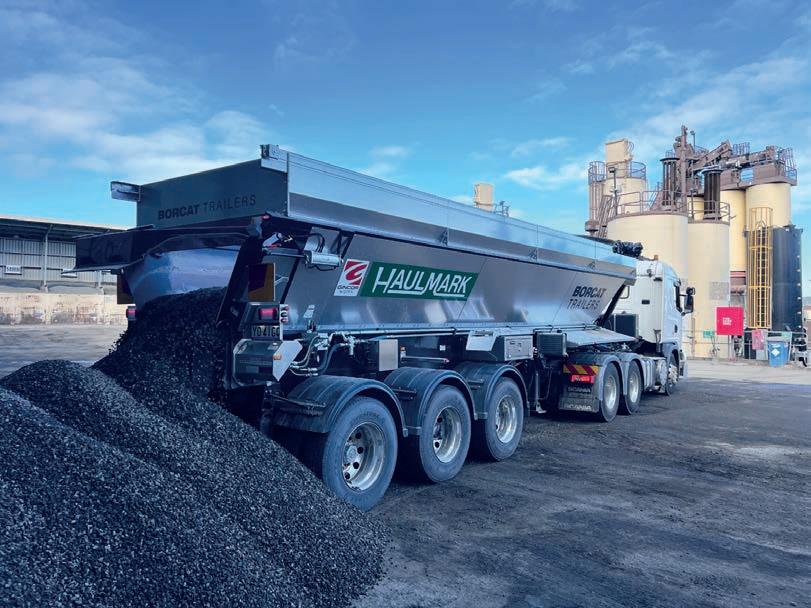
trailer that suits our unique op erating environment.
The live bottom floor trailers are fully remote controlled but can be taken back to manual control for those who prefer to use the manual override.
The trailers feature Gincor’s unique anti-binding fork on the roller chain assembly drives, aimed at reducing downtime and costly repairs. The anti-binding fork is strategically positioned in proximity to the roller chain sprocket to prevent the chain from dou-
bling backwards and binding during operation.
These live bottom trailers are manufactured in sizes ranging from 29 to 34 cubic metres, de-
pending on specifications and the bigger models can achieve payloads of up to 35 tonne.
“The feedback we’ve been hearing from our customers
about these live bottom trailers has been really positive, both from the operational side of it, as they’re very easy to use, and in terms of their overall performance,” Mark said.
He added that the rigid models of these live bottom trailers came into the fold at the start of 2026, following demand for local council applications.
These include 15ft rigid live bottom floor bodies to go on single drive trucks.
“They’re specifically designed around council applications,” Mark said.
Haulmark has various demo models of its live bottom trailer available in Adelaide, Sydney, Brisbane, Darwin and Townsville.
Demo models can also be sent to Melbourne for customers wanting to see them for themselves.
“It gives customers the opportunity to take these trailers out and see how they work,” Mark said.
“Once people try these live bottom trailers, we’re finding that they quickly see the benefits.”
For more information phone 07 3277 3666 or go online to haulmark.com.au.
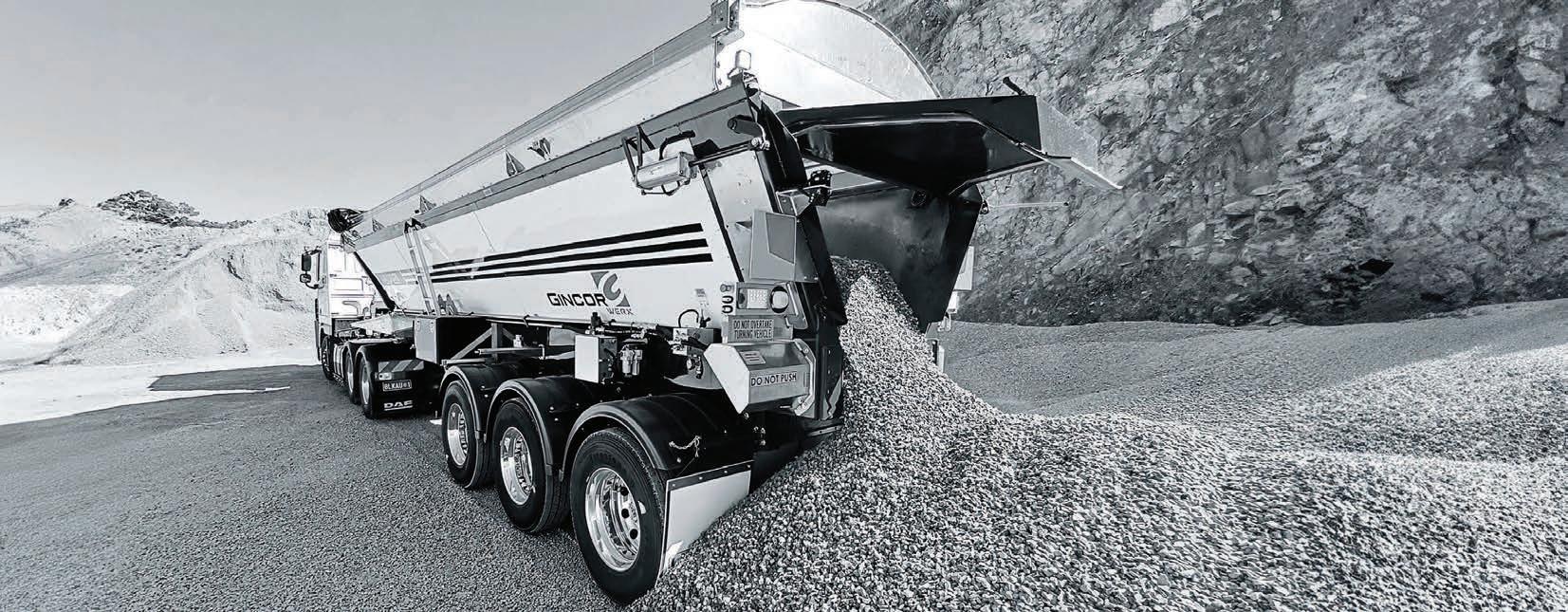

AIR lines take a beating out on the road. Every coupling, every tight turn and every stretch of rough highway wears them down a little more. They are small, inexpensive compared with the rest of the rig, and rarely get much attention until one fails at the worst possible time.
But for fleets chasing better uptime and fewer surprise breakdowns, the humble air line setup is worth a second look.
That is where pairing SUPERCOIL Suzi Coils with CLIPLOCK Trailer Couplings comes in. On their own,
built for what Australian roads actually throw at a truck.
A smaller coil does a lot Suzi coils have not really changed in decades. They do the job, but most are bulky, prone to snagging and place more strain on the air line than necessary.
SUPERCOIL takes a different approach. With a compact 74mm coil diameter, compared with approximately 130mm for many conventional coils, it occupies far less space between the truck and trailer while maintaining excellent flexibility. ith less movement between the truck and trailer, there is less chance of the coils rubbing
against catwalks, chassis rails or other components. That means less wear on the air line, longer service life and fewer workshop replacements.
SUPERCOIL also features an anti-kink design that helps maintain unrestricted air flow while resisting twisting and deformation during normal operation.
Locking In the Connection
An air line is only as good as the coupling holding it in place. A coupling that is not fully engaged is one of the easiest mistakes to make, and one of the most expensive.
Air leaks, damaged fittings and unexpected disconnections often trace back to a connection that was never properly locked.
CLIPLOCK was developed to remove that uncertainty. Its patented locking system provides both positive mechanical retention and an immediate visual confirmation that the coupling is fully engaged.
The stainless steel locking clip will not seat unless the coupling is completely connected. The bright yellow locking cable also allows drivers and workshop staff to confirm the connection during
a pre-trip inspection without second guessing whether it has locked correctly.
Made for Australian Harsh Conditions
Heavy vehicle components do not get an easy life. Water, road grime and constant exposure to the elements all contribute to corrosion over time, making surface protection just as important as mechanical performance.
To help maximise durability, CLIPLOCK couplings feature a Trivalent sealant coating applied over the zinc plating.
The coating provides the same proven zinc corrosion protection, with a minimum coating thickness of 8–12 microns, while supporting a safer surface treatment process during manufacturing.
Combined with precision machining and robust construction, the protective coating helps CLIPLOCK deliver long service life and reliable performance in demanding transport applications.
Two products, one system SUPERCOIL and CLIPLOCK complement each other perfectly.
SUPERCOIL reduces strain
on the air line, while CLIPLOCK helps ensure the connection remains secure. The result is a tidier installation, reduced wear, improved reliability and fewer maintenance headaches throughout the life of the vehicle.
Rather than treating coils and couplings as separate replacement items, fleets can upgrade the entire air line connection system in one step.
Worth the upgrade
Individually, each solves a common problem. Together, they form a complete air line connection system designed to improve durability, safety and reliability. For fleets where every hour of uptime counts, that is an upgrade worth making.
For more information, visit gptruckproducts.com.au or call 03 9580 1811.
Fleets are always looking for ways to improve reliability without adding complexity. This is one of those upgrades that delivers both. A more compact, longer-lasting air line on one side. Positive locking, an easy visual check and excellent corrosion protection on the other.

















































































IF you drop by Freightmaster Semi Trailers’ head office in Burton, South Australia, don’t expect to find a massive production line producing huge volumes of trailers every day.
Rather, what you will find is a core team of expert staff carefully crafting custom made trailers to suit the needs of customers keen to take advantage of the nearly 40 years of manufacturing experience held by the business.
Freightmaster Semi Trailers formed in early the 1980s in Alice Springs as P & J Transport Engineers, manufacturers of Freightmaster Semi Trailers and specialists in repairing and manufacturing semi trailers.
Relocating back to Adelaide in the 1990s, the company changed its name to Freightmaster Semi Trailers and started building a variety of transport equipment, including Road Train Dollies, Chassis Tippers, Drop Decks, Flat Tops, Curtainsiders, Skels, Machinery Tag Trailers and Aluminium Tippers.
These cover a wide range of configurations, including Single Trailers, B-Double and Road Trains.
The business has grown alongside the needs of its cli-
ents, and prides itself on catering for “each and every” customer request, including such things as heavy duty frames, off highway frames, axle and suspension variations.
Having started out repairing trailers the business has a keen focus on ensuring it has the parts and expertise available to back its trailer sales with service and support as required.
The Australian-owned and operated business has built a reputation for quality, durability and customer service.
Freightmaster Sales Manager Brett Stone says the business is driven by its relationships with customers.
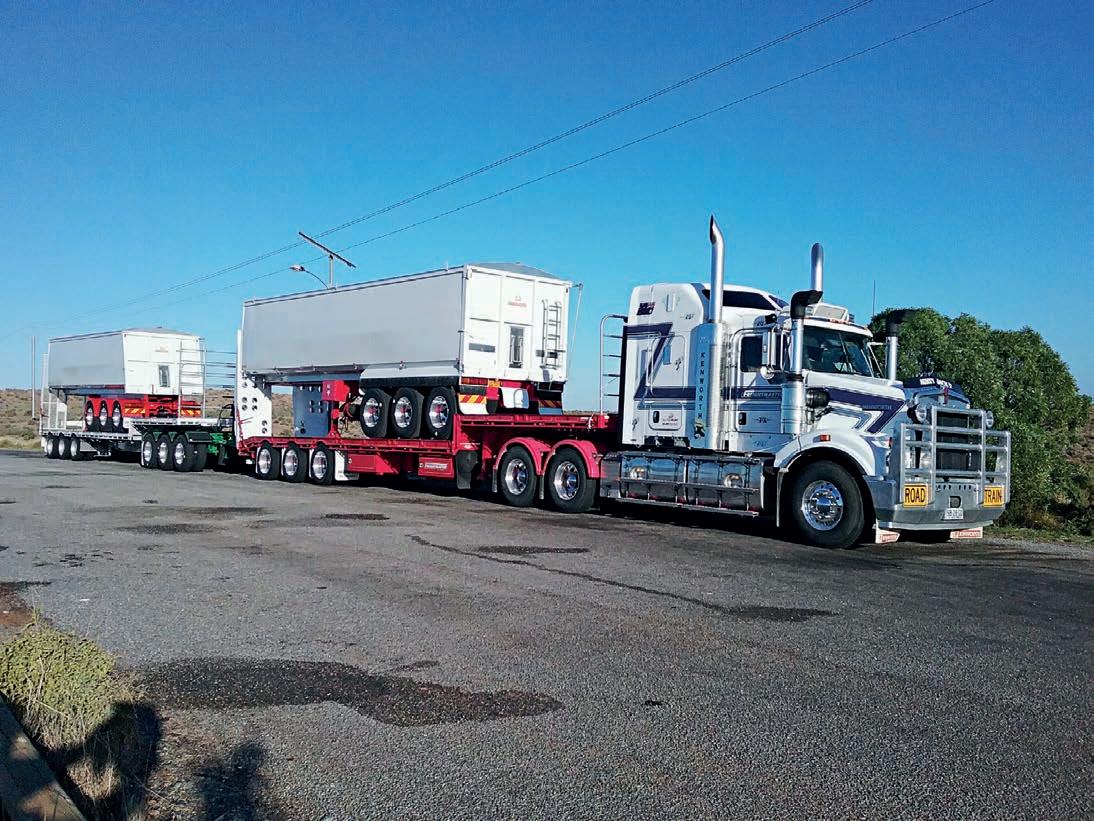
“The company places an company.
“It means we can cater to people’s different needs to ensure they get exactly what they are looking for in their trailer build.”
Its trailers are built from the ground up at Burton, servic-
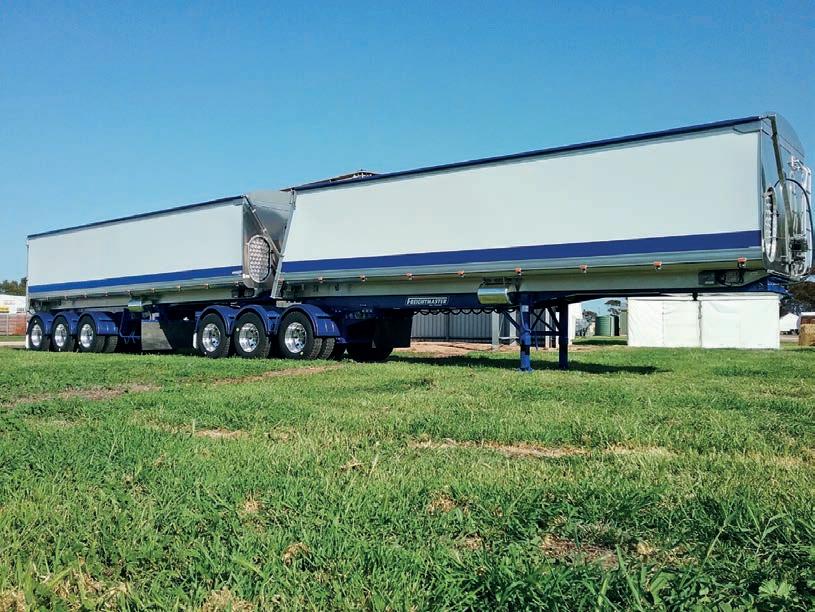
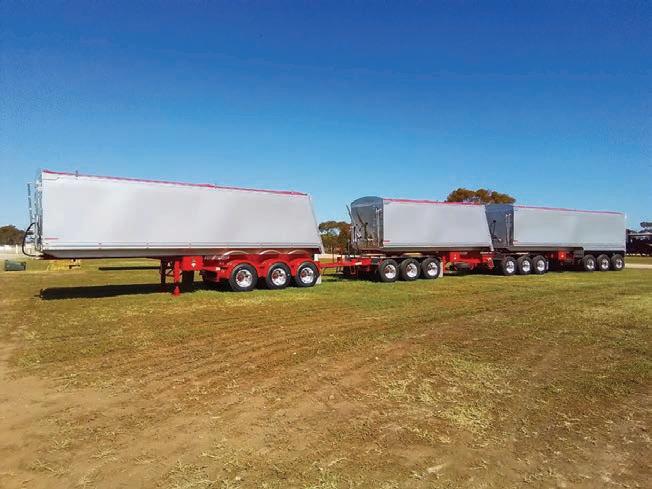
toward specific freight tasks. With changing rules Freightmaster has also found itself producing a higher number of trailers to meet Performance Based Standards (PBS) and maximise productivity for operators, especially in Victoria.
Stock, including a 44 foot Drop
Deck, a 32 foot x 6 foot Steel Chassis Tipper Road Train
Lead, an aluminium B Double Jack Set and a 32’ by 6’7 Tri Axle Road Train Tipper.
Along with its manufacturing facility and workshop in
urton, South Australia –lies are built – Freightmaster as a network of agents located in Perth, Albury, Toowoomba and Bordertown to support Freightmaster’s trailers are delivered to the agent’s or customers by founder Peter Cocks in the company’s Kenworth T409 SAR.
To find out more phone 08 8282 6475 or go online at freightmastertrailers.com.au.




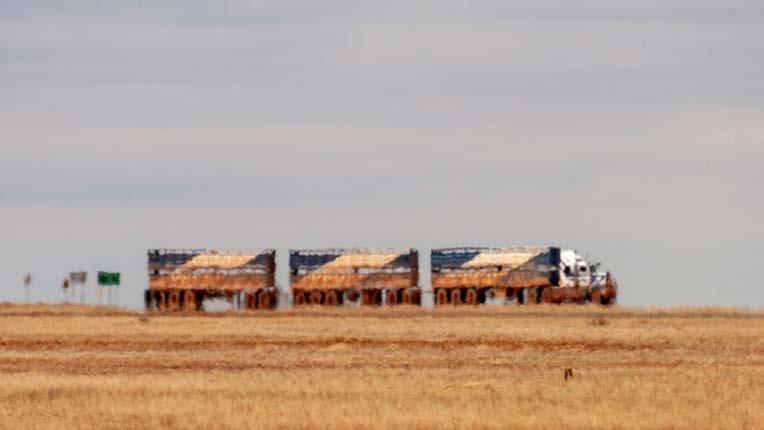
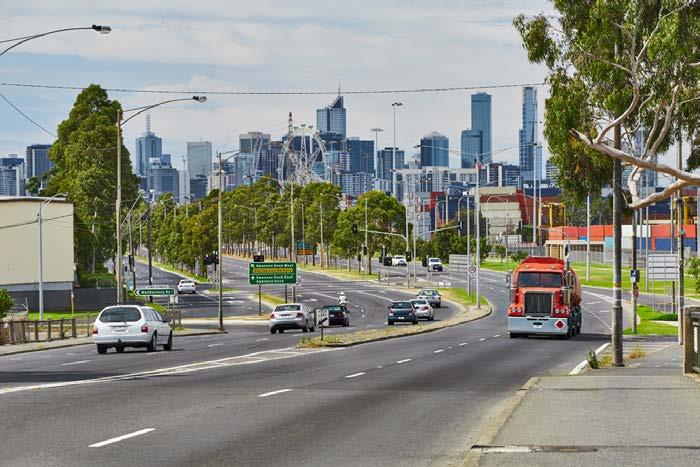

SEB Dicker has built a career around hard work, family, and a genuine love for the transport industry.
Seb drives for his brother’s business, SR Dicker Contracting, and has spent the past 14 years behind the wheel.
Like many truck drivers, his passion for transport started long before he ever held a licence.
“My dad was the transport manager at Towns Haulage when I was a kid,” Seb said.
“I’d go to work with him every chance I got.”
Those early days around trucks sparked something that never faded, eventually leading Seb into an industry he still enjoys today.
These days, no two weeks are ever quite the same. Seb spends much of his time hauling pulp timber and export pine throughout Gippsland and beyond, while also transporting machinery whenever required.
When he’s not on the road, you’ll often find him in the workshop helping keep the fleet running.
“I like the variety,” he ex-
plained. “One day I’m carting timber, the next it’s machinery, and then I might be in the workshop. You never really know what’s happening from one day to the next.”
His main office is a wellkept 2007 Kenworth T650, although he also gets seat time in the company’s Kenworth T909s and T659s whenever the job calls for it.
For Seb, it’s the daily challenges that make trucking rewarding.
“I enjoy not knowing what’s happening from one day to the next. Every day is different.”
Of course, the job comes with its challenges.
“The long hours are tough, and you’ve always got to be aware of the dangers on the road, whether it’s other motorists or the road conditions themselves.”
Living and working in Gippsland has also given Seb an appreciation for some of Victoria’s most scenic roads.
“My favourite stretch would have to be the Great Alpine Road from Bruthen to Omeo.”
Anyone who has driven
that section knows exactly why. With sweeping mountain ranges, tight corners and spectacular views, it’s a road that demands respect while rewarding drivers with some of the best scenery in the country.
When it’s time to pull up for a break, Seb has a clear favourite.
“The Caltex at Charlton. The food’s always good and the showers are always hot.”
It’s the simple things that make life on the road a little easier.
Despite the long hours, it’s the variety of work that keeps him motivated.
“I think it’s the different work all within the one job. It keeps things interesting.”
Looking ahead, Seb has a dream shared by many drivers.
“I’d love to own my own truck one day, but it’s a hard industry to get into, so we’ll see what happens.”
Like many experienced operators, Seb also has concerns about where the industry is heading.
“The quality of drivers and everyone expecting jobs to be
done for nothing are probably the biggest issues.”
It’s a sentiment echoed by plenty of drivers across Australia, with increasing cost pressures and unrealistic customer expectations continuing to challenge operators of a ll sizes.
For anyone just starting out, Seb offers advice that’s simple but incredibly important.
“Don’t rush your jobs, and don’t let anyone push you.”
Taking your time, doing the job properly and never feeling pressured to cut corners is advice that can make a ll the difference in building a long and safe career behind the wheel.
Away from work, family comes first.
“I spend a lot of time with my wife and kids. In the warmer months we’re usually fishing or out on the jet skis, and during winter I enjoy cutting firewood and relaxing at home.”
It’s a reminder that while trucking demands plenty of time and commitment, finding balance away from the road is just as important.
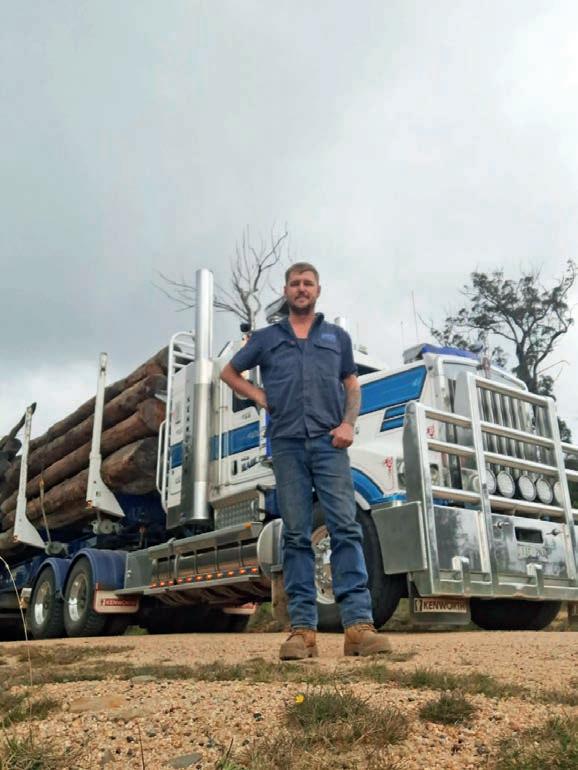
BRIAN Taylor from Yerong Creek, New South Wales, is a truckie who’s spent an impressive 41 years driving interstate and still enjoys every day behind the wheel.
Brian drives for Burkinshaws Transport, hauling wool and general freight in a 2024 Kenworth T909.
Trucking has always been
“It’s all I’ve ever really known,” Brian said. When asked what keeps him in the industry after more than four decades, the answer was simple.
“The lifestyle.”
Brian’s favourite run is the Hume Highway, a route he’s travelled countless times over the years. But like many
behaviour of other road users.
“Dodging impatient motorists.”
He also believes waiting times at major distribution centres continue to be one of the industry’s biggest frustrations.
“Too much time is wasted sitting around, and it’s getting harder to find decent ealthy food on the road.”
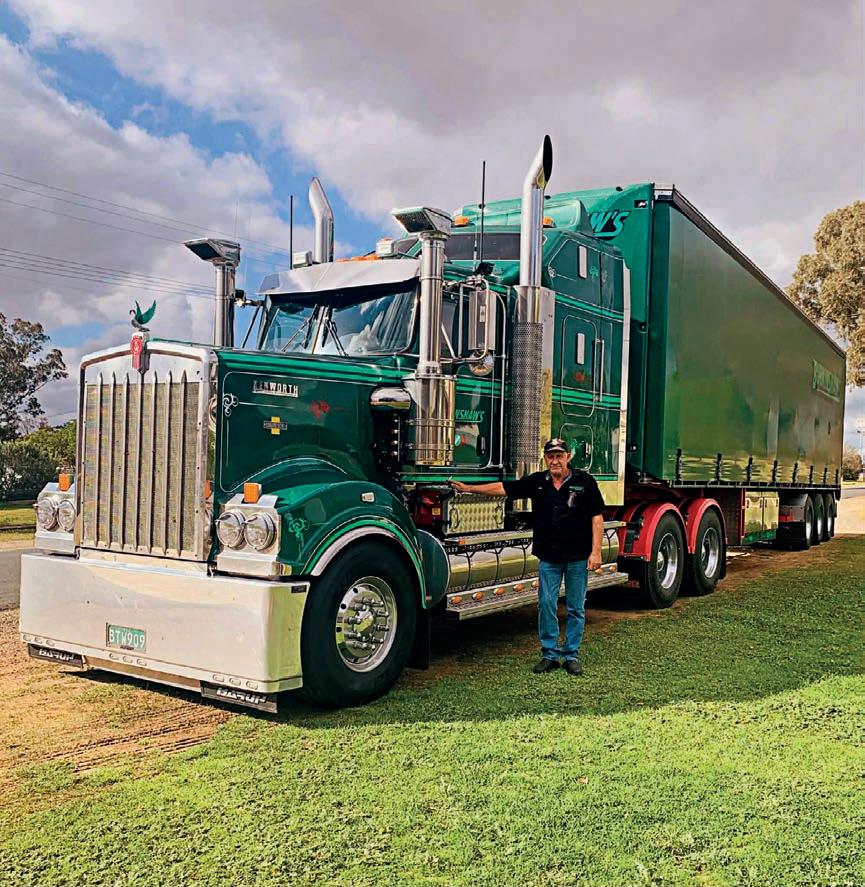
When it’s time to stop for a feed, Brian recommends the
“The meals are good and
Away from work, Brian enjoys restoring his vintage truck and taking his Ford cars to shows and meets, keeping his passion for vehicles alive even when he’s off
Looking ahead, he’s happy doing what he loves and lans to continue driving for
For anyone starting out in the industry, Brian has one
“Never be afraid to ask experienced drivers for ad-
fter 41 years on Australia’s highways, it’s advice hat’s earned through expe-
t’s clear Brian still has the same passion for trucking that first got him into the industry all those years ago.
Drivers like Brian are a great reminder that while the trucks may change, the love of the road never does.
TYSON James, from Mildura, is a young driver proving that passion, determination, and a willingness to learn can take you a long way in a short time.
Tyson drives for GTS Freight Management and has spent the past three years in the industry, with the last two running interstate.
Like many great transport stories, his journey didn’t begin behind the wheel of a prime mover – it started on a forklift.
“I started on the forklift at GTS and watched all the old boys driving these big rigs,” Tyson said. “I remember thinking to myself, I want to be like them.”
There was another motivation too.
“I always wanted to travel Australia but didn’t really have the budget, so I figured I’d kill two birds with one stone.”
It’s a decision he hasn’t looked back on.
These days Tyson spends his time hauling a wide variety of freight, including beer and wine, groceries, glass bottles to wineries, and general freight across Australia’s highways.
He currently pilots a Kenworth, a truck he says he’s proud to call his office.
While the freight changes from load to load, one thing remains the same, the scenery.
“I love the sunsets and being able to see our great country while getting paid.”
Like every interstate driver, Tyson knows the lifestyle
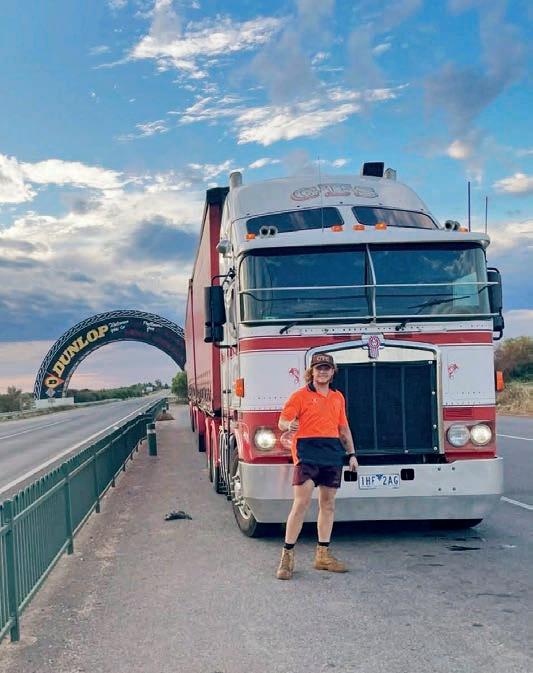
our great country.”
When asked about his favourite stretch of road, the answer came quickly.
“The Pilliga on the Newell Highway.”
And if there’s one place he’ll happily stop for a feed, it’s the Waddi BP Roadhouse along the Sturt Highway.
“Ripper food and just allround great service. They make you feel very welcome.”
Looking ahead, Tyson has his sights set on an even bigger challenge.
“I’d love to be pulling a set of quad road train trailers with the big boys up in WA.”
Despite only being a few years into the industry, Tyson already has some thoughtful observations about where trucking can improve.
“I think the biggest issue currently is there isn’t enough
er truckies every day havinguations they just don’t know how to overcome or problem-solve.”
For anyone considering a career in transport, Tyson’s advice is simple.
“Give it a go. You’re only alive once and you’re a long time dead, so get out and experience our great country.”
W hen he’s not behind the wheel, Tyson’s passion for anything with an engine continues.
“I love anything with a motor. I’m really into drag racing and burnouts, but I’ve also got quite the collection of old Holdens.”
It’s clear Tyson has already found where he belongs, behind the wheel of a Kenworth, watching another Australian sunset roll by while delivering the freight that keeps the country moving.

WHEN
erator Rohan Lindsay was nearing remote Lockhart River Aboriginal community in north Queensland he got the surprise of his life.
“A woman turned up out of the blue and asked could she snap a pic of me and my truck for would not expect that to happen at such an isolated location,” Rohan said.
Lockhart River is located on the east coast of Cape York Peninsula in Queensland, approximately 750–800km north of Cairns, on Lloyd Bay.
Based at Gympie in south ern Queensland, Rohan was driving his Kenworth C509 in a convoy of five trucks.
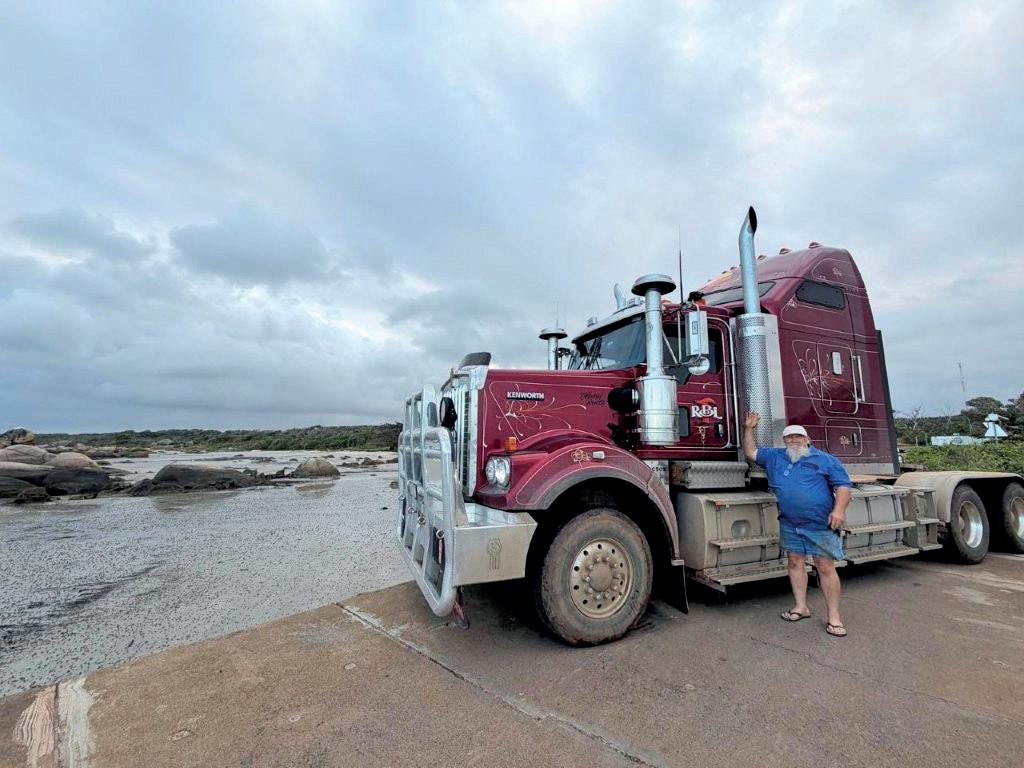
“We transported demountable buildings from Brisbane, and they were for school classrooms at Lockhart River. It was a little bit wet not far from here but the trip was good,” he said.
An owner-operator since 1987, the 62-year-old Rohan said it had been a three-day trip and they travelled with pilot escort.
“I unloaded and spent the night in my sleeper box,” he said.
An avid rugby league supporter who barracks for the high rolling Dolphins in the NRL, Rohan got to watch the second State of Origin game at Lockhart River.
“I went down to the sports club there and there was at least 250 people watching it on a big screen. They were so friendly and welcoming and were glad to see the school buildings arrive,” he said.
Whilst there Rohan had a great experience from a
on for Tropics.
That tickled the fancy of Rohan who himself is a keen photographer.
“Whilst I was at Lockhart River I took lots of pics near the water and of the trucks,” he said.
During his long career travelling the highways and byways, Rohan has worked in every Australian state except Tasmania.
“I hauled throughout the NT for 10 years and have also been to many isolated parts of WA,” he said.
When asked about what the worst road he has been on recently, Rohan answered swiftly.
“It took me 11 hours to travel between Lakeland and Archer River Roadhouse. I was down to 10kmph and 20kmph on some sections. The road has been cut up because of all the tourist season vehicles,” he said.
Outside work, Rohan has his own farm at Gympie which
has 75 head of cattle and grows grass for hay.
“I love it there and have 60 acres ready for hay,” he said.
His favourite roadhouse is the Liberty at Dalby which he said ticks all the boxes for truckies.
“I love a juicy T-bone steak and bought one there with chips and salad for $28 which was great value for money, staff are friendly as well,” he said.
Rohan said he was glad to see fuel prices dropping which would provide relief for operators.
“Before they rose due to the Middle East war I had six weeks supply of fuel in reserve,” he said.
Over the decades Rohan said he had carted for “heaps of different companies” and maintained a good relationship with clients.
“I had never been to Lockhart River before and was treated very well there. They are good people,” he said.
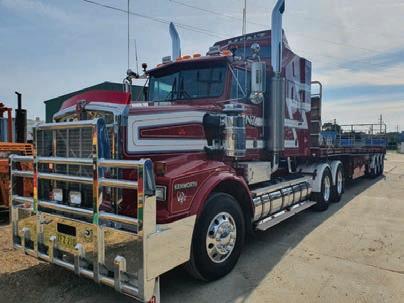
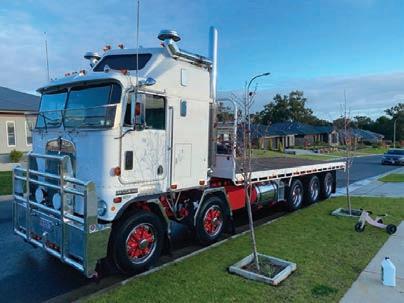
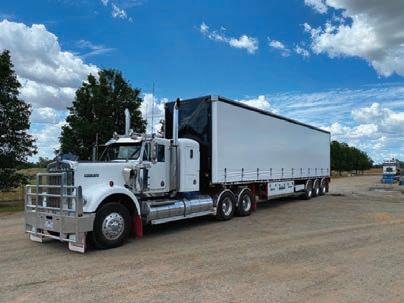
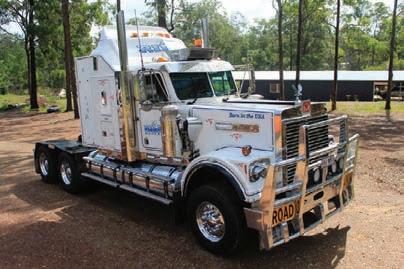

FRIENDLY driver Jim Toohey had just pulled up in his Kenworth outside of the Mourilyan Café in north Queensland when Big Rigs saw him earlier this month.
The 38-year-old Jim works for Blenners and had been to Cowley Beach to pick up pro-
It is going to the Blenners depot,” Jim said.
Jim is based at Innisfail and has been with Blenners for 16
years and loves it. “I started with Blenners around Easter back in 2010 and have been a truck driver since I was 19,” he said.
The worst road Jim gets along is near Moresby where a recent fatality occurred.
Jim likes the café at Mourilyan because it serves good food and he can park out the front.
Outside work Jim enjoys a spot of fishing in the creeks and rivers around Innisfail.
“I am also kept busy with two young sons aged four and seven,” he said. Jim is a parochial North Queenslander who barracks for the North Queensland Cowboys in the NRL. Mourilyan is a scenic town about 9km south of Innisfail along the Bruce Highway. It suffered extensive damage to infrastructure there when Cyclone Larry struck in March of 2006.
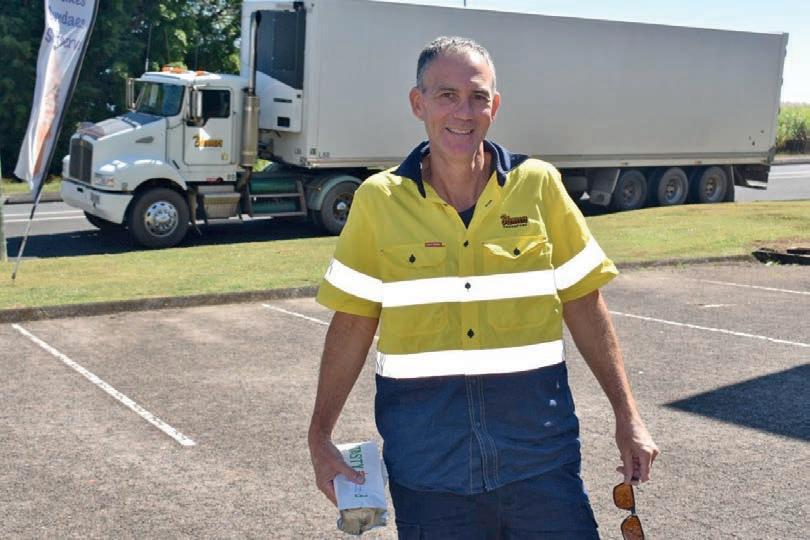
















SOME truckies have reported to Spy that dangerous habits by mainly tourists are causing problems on the Batman Bridge over the Tamar River in Tasmania.
It is a 432m cable-stayed bridge notable for its 91-metre-high A-frame tower and is located 38km north of Launceston, connecting Hillwood on the east with Sidmouth and Deviot on the west.
It links the Batman Highway to the West Tamar Highway and East Tamar Highway and is a busy transport route.
In June this year a 52-yearold George Town woman died following a two-vehicle crash.
Emergency services were called to the scene on Batman Highway near the intersection of Craigburn Road at around 2.55pm.
Drivers who have contacted Spy claim that many car drivers speed across the bridge.
Spy also heard that hidden speed cameras are often placed there.
Overtaking wide loads
Over the past months pilot drivers who escort wide loads around the country have complained about the dangerous habits of some motorists.
A septuagenarian aged pilot escort who was a former longtime truckie said he had saw numerous incidences of car drivers overtaking long wide loads.
“Often that has occurred as the wide load is going around a curve on the road. Many times, that has almost resulted in a head on with a vehicle heading from the opposite direction,” he said.
A nother criticism is that cars will often overtake a wide load as it crosses a bridge.
“That has almost ended in an accident many times,” the pilot said.
Vic
Some truckies who travel the road between Horsham and Swan Hill in Victoria reckons it needs an urgent upgrade.
A NSW driver who negotiated the 230km stretch in July said it was in terrible condition.
“There are single lane parts, and you have to be super careful when going along it,” he said.
The road can be a busy route
for trucks at certain times of the year.
Horsham is 300km northwest of Melbourne and is the 11th largest town in Victoria. Swan Hill is located in a renowned crop growing area especially grapes.
Filthy job solution
One of the most loathed, dirtiest and smelliest jobs truck drivers have is when they have to clean out trailers after livestock has been transported.
It involves hosing out the trailers which have more than a liberal mount of stock droppings and urine on the floors. This task is one that livestock drivers have to do after the animals are unloaded.
One driver who is based at Wodonga just over the NSW border in Victoria who regularly takes cattle interstate has a solution.
“I try and arrive back home at the depot when one of the workers there gets to do the cleaning,” he said.
Spy has seen such tasks being undertaken at sales yards and can report it is not one anybody would relish.
Retired driver’s wealth of knowledge
Received a call the other day from a long retired Victorian driver Bill Vander-Weerden who has golden memories of his time in the industry.
Aged 84, Bill lives at Frankstown South in Victoria and retired 12 years ago.
Bill revealed he become interested in trucks when he was 10 soon after his family arrived from Holland.
“I was taken under the wing of a man who had several trucks and that was it for me.
I wanted to be a driver,” Bill said.
Officially, Bill started driving when he gained his licence at 18 but had some experience before that on properties.
Later on, he would cart hops for beer from farms to breweries in Sydney and Melbourne.
Bill still maintains a huge interest in the road transport industry and over the decades made many friends who he wants to say a big hello to through this column.
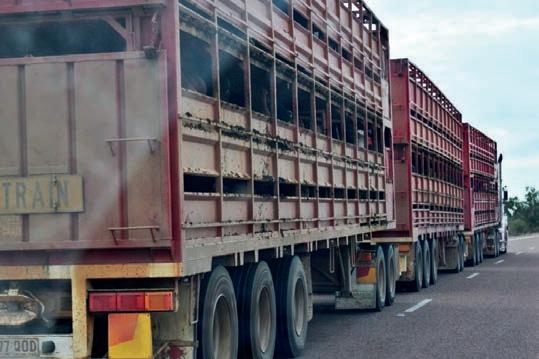
Healthy fruit stop
Numerous truckies are stopping at a pull off area on the Bruce Highway at Gumlu to buy some healthy fruit.
Gumlu is 40km south of Home Hill and 60km north of Bowen and is located in a renowned agricultural area with lots of farms.
The source of the fruit is from a roadside stall, and it is mostly grown on a property near it.
Drivers I saw pulled up at the area just over the highway where two decent sized trucks can park for a short stay.
A NSW driver purchased a seedless watermelon, a pineapple, some red tomatoes, spuds and juicy mandarins.
“I often stop at fruit selling vans located at rest areas in NSW and enjoy a feed of fruit,” he said.
Spy bought some and it was fresh and delicious.
Gym soon at roadhouse
A truckie’s room at Clermont’s Gregory Highway Roadhouse is popular with drivers and some report that a gym is being planned there.
That will be a great asset for drivers who stop there and want to keep fit.
Veteran driver Laurie Seery stopped there recently and was impressed.
“The boss there told me they are going to have a small gym there for drivers and a new toilet block around the side,” Laurie said.
Laurie said he hadn’t been
there for some time and was also delighted with the food he purchased.
“I had a mixed grill for $24 and it was so big I had to get a container from them and took some with me and ate it later. On the way back I purchased a Chicken Kiev and it was huge. Staff were friendly,” he said.
Laurie snapped some pics of the truckie’s room.
Seafood connoisseurs stop
When travelling along the Bruce Highway just south of Bowen recently, Spy noticed a flashy red Kenworth parked beside Rynn’s Seafoods business.
I saw the driver sitting outside the building eating from a plate and wanted to yarn to him and snap a pic.
However, I had to drive up the highway for some way before making a safe U-turn and when I arrived back there he was departing.
But I made enquiries with other truckies who travel that route and several reckon it is a great place to stop.
“You can park beside it and sit down and have a feed. Bowen is renowned for its seafood because it is near the ocean and plenty of trawlers operate from there,” one driver said.
Some told me they loved the mackerel and red throat emperor, calamari, prawns and also the variety of burgers and seafood wraps on offer.
Honest business earns praise
A road transport identity required some repairs to a minor problem for which the cost of parts was very expensive.
He shopped around and went to buy the parts himself and found they would be more than $800.
But one mechanic he knew referred him to Douglas Collision Management in Punari Street at Townsville.
They could do the job and he had to pay the money upfront so they could order the parts from down south.
He was quoted a modest $100 to fix the parts and dropped the vehicle off when the parts arrived.
When he picked the vehicle up this gent got the surprise of his life as he expected to hand over the money for the work above the parts.
“You don’t have to pay today. We didn’t use both parts and we are refunding you $160 from what you paid,” the office women said.
It was duly deposited into his account. “This is a very honest and ethical business and I wouldn’t have had a clue what parts they used. Very happy indeed,” he said.
Humour provided by truckie named Ibis
Drivers parked at a near full roadhouse got some unexpected entertainment from a WA driver who was taking a fatigue break.
This parking area in near a shopping centre and also in close proximity to fast food establishments.
These truckies were having a chat when they saw an Ibis
bird place its long beak inside a discarded food bag which was left in a shopping trolley.
The Ibis shook its head trying to escape the inside of the bag and this animal loving driver thought it may die of Asphyxiation.
The driver rushed to rescue the stricken bird and after a minute or so was able to do so.
But the onlooker found extreme humour in the incident and has now nicknamed the driver “Ibis”. Which he didn’t seem to mind at all.
Vicarious trauma query
Several drivers were sitting in a roadhouse eatery discussing an incident in which a driver was seriously injured.
One fellow in particular was distressed and told the others he had a good mate who had been involved in an accident.
A gent sitting near them who turned out to be an off-duty first responder offered some helpful advice to the gent.
“You may be suffering from Vicarious Trauma which can occur from the emotional and psychological impact experienced indirectly from exposure to another person’s trauma,” he said.
None of the lads had ever heard of the condition and were quick to turn to Mr Google for clarification.
Spy also had no idea what it was and also checked it out. Apparently, it is common among professionals such as therapists, social workers, first responders, healthcare providers, and journalists, or indeed anyone who engages with traumatic material or stories.




In the first of a two-part series, our longest-serving contributor stops to interview four hard-working truckies while on another epic return road trip.
A calm crossing on the Spirit of Tasmania to Geelong and we were once more back on the “Big Island” doing our annual trip to Adelaide via the Great Ocean Road and Coorong route.
Very good to see some old familiar faces, and companies, out on the road, and to observe the professionalism of the small rigid delivery trucks as they negotiated the Great Ocean Road serving the many towns along its impressive length.
Not an easy run.
A great company, and the right truck for the job
Passing by Princetown just past the Otways and on the Great Ocean Road towards the Shipwreck Coast, we were happy to catch up with Ryan Reardon from Hastings on the Mornington Peninsula.
He was driving a Statewide Concrete Products 2018 FYN 350 Isuzu plus side loader and trailer at the time and was busy unloading two 21,500-litre concrete water tanks in the otherwise deserted township of Princetown, after which he would be returning to Hastings. Ryan tells us he has been driving for Statewide Concrete Products for five years now, and he reckons it’s a great job.
“We literally work statewide, here there and everywhere, the equipment is top shelf, and we get to see some pretty interesting and amazing places,” he said.
“I find the Isuzu ideal for the work we do, plenty of power
and comfortable and manoeuvrable for some of the tight places we need to get into.”
Back working for ‘the boss’ and lovin’ it
Nelson is always a good stop between states, and the little store on the river’s edge always stocked plenty of home made take aways and good coffee.
This time, alas, the shop has gone, totally, but we found the BP service station there was a welcome stop anyway.
While there we were fortunate to catch up with Tony McNally from Mount Gambier driving a Merrett’s (from Penola) 2013 T610SAR and towing a Bx2 from “on the SA border” with logs to Portland.
Tony tells us he has been on the road now for 23 years, the last five with Adam and John Merrett.
He told us they took over the business from their father “Snow” some years back now, leaving him more time back on the farm!
“They are doing a great job and I am happy here! On the downside, though, there have been plenty of changes in the industry since I started out driving, not, sadly, all for the better.
“I had set myself up as an owner driver for four years, and was happy doing this, but then Covid came along, and that finished that.
“So here I am back working for “the boss” again, but happily this is working out
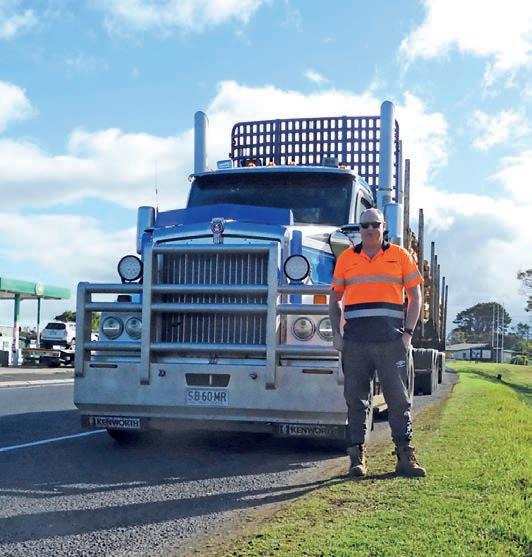
pretty well as they certainly look after their gear and their drivers.”
Whitehead are a great outfit with top gear
Still at the Nelson BP it was good to catch up with Brent Collins from Mount Gambier when he drove in for a quick break in a Whitehead’s 2018 T410, towing a load of wood chips.
He was on his way from Mount Gambier to Portland at the time and told us: “I’ve been here driving for Whiteheads for six months now, and they are a great outfit, top gear and look after you.
“I was driving for Portal before that, and prior to that
I spent seven years running Melbourne to Brisbane for SWF. And I would have to add, I am happy here, both with the job and the outfit.
“I also enjoy the run down here as it is considerably quieter than tearing up and down the highway.”
Back on the road again after health scare
Stopping over in Victor Harbour we were delighted to catch up with our old friend and trucking legend, Dusty Roads, looking fit and well after a run of rough health, and standing proud with his 2024 Ford Ranger Sports Dual Cab ute.
With 35 years on the road,
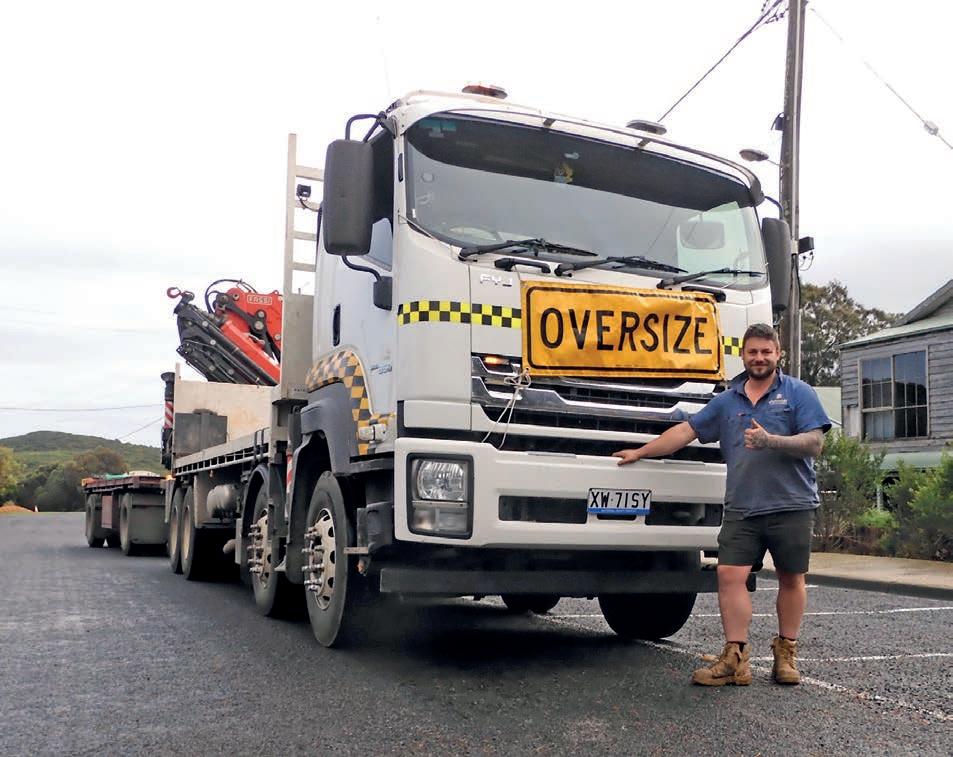
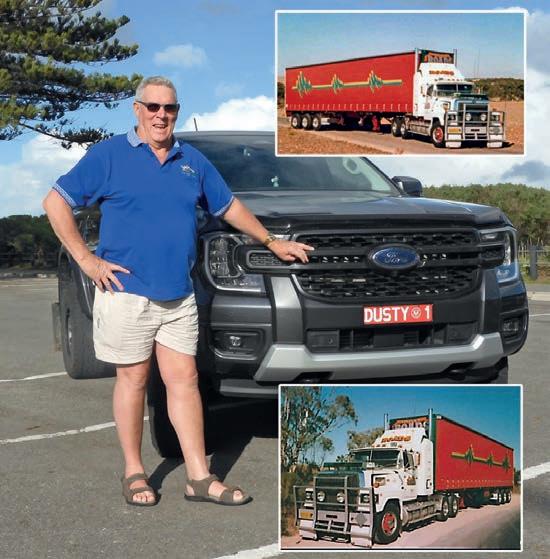
including seven years driving tippers in the Adelaide hills, he spent a good 34 years as an owner-driver, and his white 1988 LTL with its distinctive Southern Cross 45-foot Tautliner, was often seen running interstate.
The LTL had a reliable 460hp Caterpillar motor which had two rebuilds. He told us he had had the truck for 22.5 years with 3.5 million kilometres on the clock.
Sadly, his career came to an abrupt end in 2023 with a cancer diagnosis. But happily, his treatment was successful, and he has decided to make real the urge to get back on the road again, though this time in his Ford Ranger and tow-
ing 15-foot Austrack “Talawana” caravan. The ever-sociable Dusty has amassed a group of like-minded friends including another retired truck driver, Greg, and Jilly Mitchell, from Mildura, doing the same, in fact, and his cousin Jeff Roads. After a quick successful trip away to the Grampians for Jill’s birthday, they are now planning a trip up to the winter warmth of Queensland, and enjoying their retirement together.
He finished by telling us: “Well, I got my licence at 18 and was on the road until I was 65, not a bad run all up, and despite the usual ups and downs, I would do it all again.”
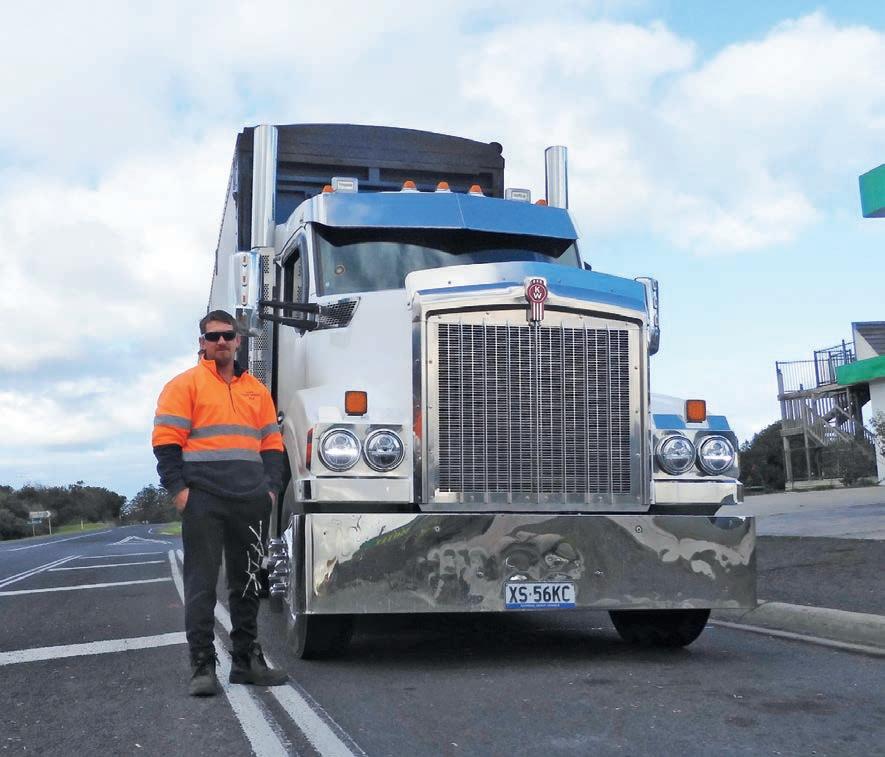
relaxation (7)
13 Abstract part of something, system component (7)
14 Treats with excessive indulgence (7)
15 Domesticated llamas with long silky fleece (7)
16 Faced and withstood something unpleasant, with courage (7)







THE Industry School has confirmed plans to expand into Victoria, with a new Melbourne campus proposed to open in 2027 as it looks to help address skills shortages across a range of industries, including the heavy vehicle sector.
After two decades operating in Queensland, the independent senior secondary school has announced it will establish a campus at 595 Little Collins Street in Melbourne’s CBD, subject to final registration approvals.
The expansion is being led by founding Melbourne principal Nick Harrison, who said
the school would bring its established education model to Victoria by combining Years 10-12 schooling with vocational education and schoolbased apprenticeships and traineeships.
“Our expansion into Melbourne represents more than opening a new campus – it’s about responding to a real need,” said Harrison, Principal of The Industry School’s Sunshine Coast campus.
“We’ve seen firsthand how integrating education with industry creates confident, capable young people who are ready for the workforce. We look forward to partner-
ing with Victorian employers to build a pipeline of future talent.”
The Industry School has built its reputation by allowing students to complete their secondary education while spending part of each week in the workplace, gaining practical skills alongside nationally recognised qualifications.
The model has attracted strong support from industry in Queensland, where the school has developed partnerships across sectors including automotive, engineering, construction, logistics and transport.
The expansion has also been
welcomed by key industry partner Heavy Vehicle Industry Australia (HVIA), which said workforce development remains one of the biggest challenges facing the heavy vehicle industry.
HVIA highlighted the school’s strong focus on connecting students with employers and creating pathways into long-term careers, describing the Melbourne campus as another opportunity to strengthen the future workforce.
The new campus is expected to work closely with Victorian employers to create additional apprenticeship and trainee-
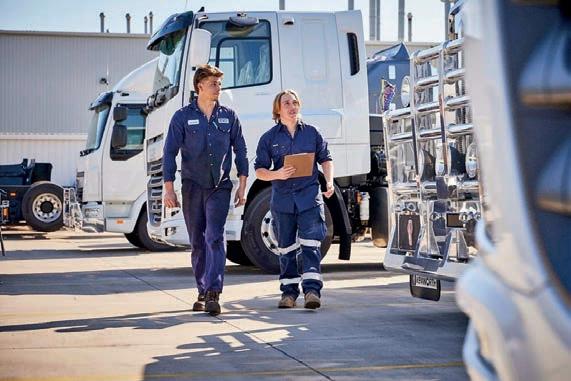
ship opportunities while helping students transition directly from school into industry.
The Industry School says its approach provides students with meaningful workplace experience before they graduate, while giving employers access to young people al ready familiar with real-world work environments.
NOMINATIONS are now
open for one of the industry’s most prestigious honours, the Australian Trucking Association’s annual technical and training awards.
Winners will be announced at the Castrol Awards Dinner on October 14, the climax to the ATA’s Technology and Maintenance Conference (TMC 26) in Melbourne from October 13-14.
ATA chair Mark Parry said the awards recognised the professionalism and dedication of the people keeping Australia’s freight industry moving.
“The ATA’s technical, sustainability and training awards honour the professionalism and dedication of the men and women who keep the industry running behind the scenes,” Parry said.
“We can all learn from their commitment to innovation and to getting the details right, day after day, as our trucks deliver Australia’s freight.”
The Castrol-sponsored Craig Roseneder Award for Technical and Maintenance Excellence recognises individuals
who demonstrate outstanding technical expertise and maintenance skills in the workshop.
Previous winners have included Australia Post’s Scott Gardiner, John Jenkin from Tatiara Truck & Trailers and Shane Pendergast from Air Brake Systems.
The TRUCK TECH Training Excellence Award recognises trucking operators that demonstrate a strong commitment to improving safety through staff training, development and workplace practices.
The new sponsor of this award, TRUCK TECH, is Australia’s leading heavy vehicle maintenance management and repair company for fleets of over 50 vehicles. TRUCK TECH has 140 employees, state-of-the-art fleet maintenance centres in NSW, Queensland and Victoria and 70 mobile field service units along the east coast.
Joining the awards list for the first time this year is the Michelin Australia-sponsored National Sustainability Award, which will recognise operators
that have demonstrated a com mitment to reducing their en vironmental impact.
Nominations for all three awards can be submitted either by the individual, the organ isation involved, or by a third party. Entries close at 11pm (Canberra time) on August 16.
In addition to the three award categories, the ATA will also present its Industry Achievement Award during the October awards dinner. The award recognises an individual or organisation that has devel-
The proposed Melbourne campus is expected to welcome its first students in 2027, with enrolments and industry partnerships set to commence
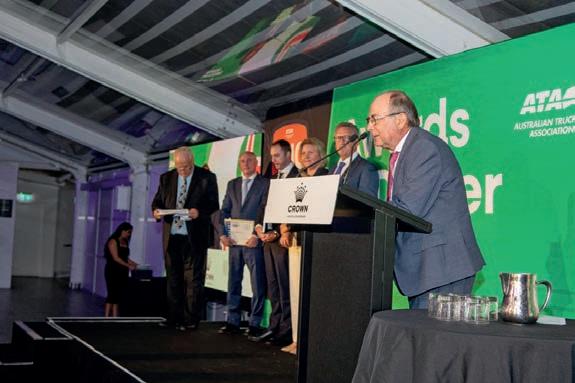
oped and implemented new technologies or procedures that improve safety, efficiency or productivity across the road transport industry.





AROUND 70 emergency services personnel and transport industry representatives joined forces in a major emergency response exercise at Ron Finemore Transport’s Wodonga yard.
The four-hour exercise held earlier this month simulated a serious collision involving a car and a single-trailer fuel tanker, allowing first responders and the transport company to test every stage of a major incident – from the first emergency phone call through to the recovery and decanting of fuel from an overturned tanker.
For Shane Tucker, Ron Finemore Transport’s General Manager – Safety, Risk and Compliance, the timing of the exercise was particularly significant. Less than two weeks earlier, one of the company’s prime movers had been caught up in the devastating multitruck crash at the Windmills Rest Area near Breadalbane on the Hume Highway.
Although the Ron Finemore driver escaped without injury after being asleep during his mandatory rest break, Tucker said the incident highlighted just how quickly transport operators can find themselves responding to a major emergency.
“It just showed us that at any time of the day and night, these
elements of the business can be called upon to act,” Tucker said.
The Wodonga exercise was designed to mirror a realistic rural crash involving dangerous goods, in this case a passenger vehicle colliding with a single-trailer tanker, causing the tanker to roll onto its side and leaving the car’s driver trapped.
Under controlled conditions, a member of the public made the initial emergency call using the number displayed on the tanker before the driver contacted Triple Zero.
Police then established a command centre and coordinated the multi-agency response.
Fire and rescue crews made the scene safe before Volunteer Rescue Association personnel extracted the driver from the passenger vehicle. Once the rescue phase was completed, the emergency response team set up equipment to pump fuel [water was used for the purposes of the exercise] from the overturned trailer.
The exercise brought together representatives from Victoria Police, Fire and Rescue Services in New South Wales and Victoria, the CFA, VRA, St John Ambulance, Ampol and Tasco. Emergency vehicles, specialist equipment and response technology were also displayed.
“Ron Finemore Transport thanks all participating agen cies for sharing their knowl edge and experience, as well as Grealy Motors and Towing for donating the passenger ve hicle used during the exercise,”
Tucker added.
Tucker told Big Rigs the an nual exercises were designed to continually improve emergen cy preparedness across every part of the business.
“We try to do an annual emer gency response exercise,” he said.
“Over Covid we did desk top exercises, but we wanted to take the opportunity to do something hands-on, do some networking and engage with all the emergency services. It gave everyone the opportunity to catch up when it’s not actually an emergency.”
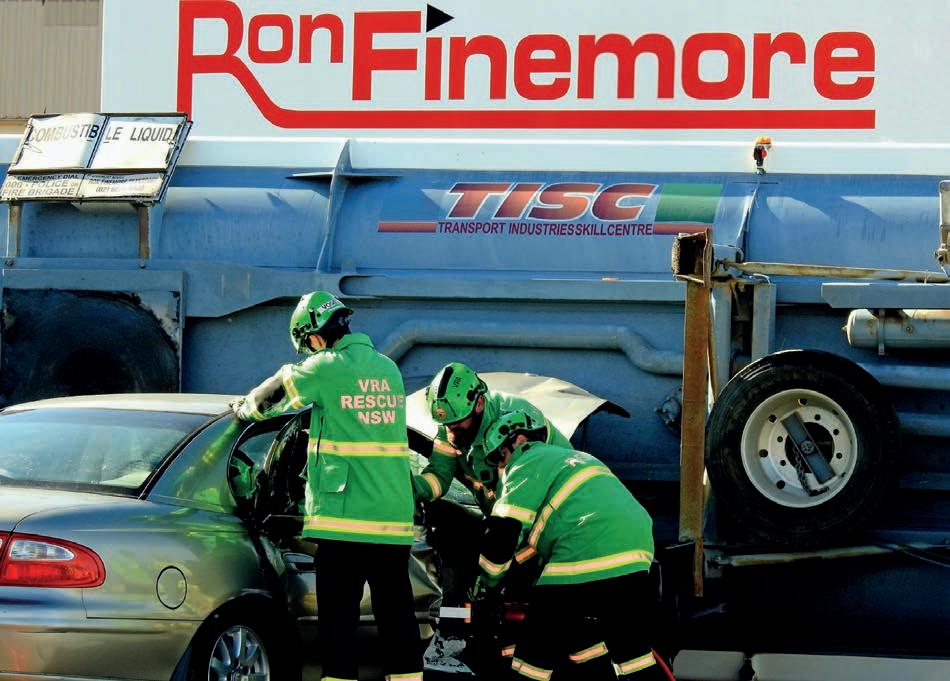
Because the company operates from the Victorian-NSW border, Tucker said bringing agencies from both states together was particularly valuable.
“Especially in rural areas where resources can be limited, they’ve all got to work together,” he said.
The exercise also revealed valuable lessons. Among them were the importance of ensuring specialist equipment is regularly serviced, gathering accurate information as early as possible, and appreciating how long major incidents can
take to resolve. “People probably don’t realise how long these types of events can take,” Tucker said.
“People need to think about food, water and managing staff fatigue.”
Even seemingly minor details can make a difference.
“There’s always an opportunity to improve and learn from these days,” Tucker said.
“Even down to little things like making sure hoses are the correct lengths, and earth leads are functioning and long enough to get
where they need to go.”
Ron Finemore Transport has been running emergency response exercises for about a decade, alternating between fullscale practical simulations and desktop scenarios, depending on the circumstances.
With a fleet of more than 300 prime movers and around 500 trailers, Tucker believes preparation is essential.
“The transport industry is a dangerous industry because there are so many variables,” he said.
“By being prepared and alert, we can try and get everyone home safely.”
He said even smaller operators that don’t have the resources to stage large exercises can still improve their emergency readiness through toolbox talks, clear policies and desktop scenarios.
“Any exercise that helps prepare staff and create awareness will help,” Tucker said.
“It’s really about making sure the staff understand their role and they’re communicated to.”


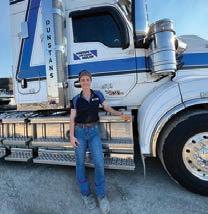
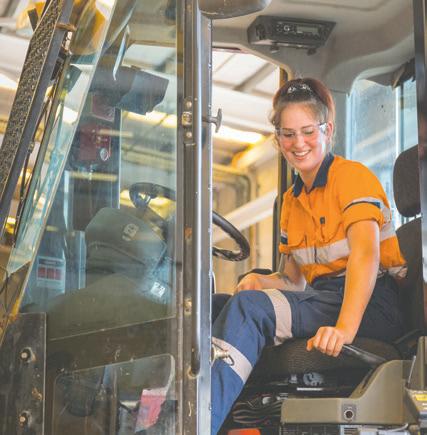

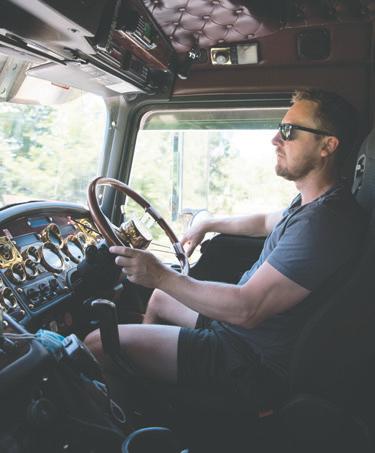

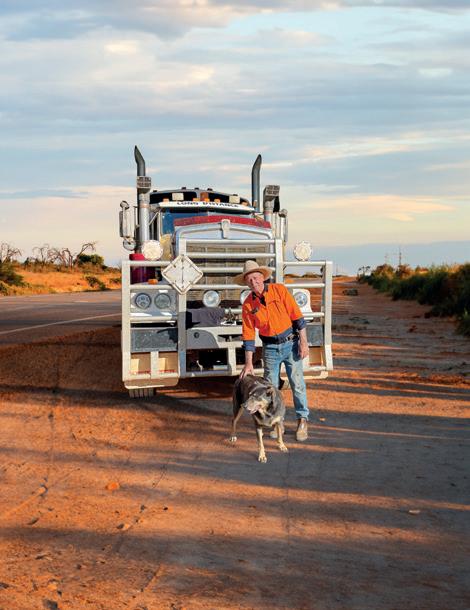










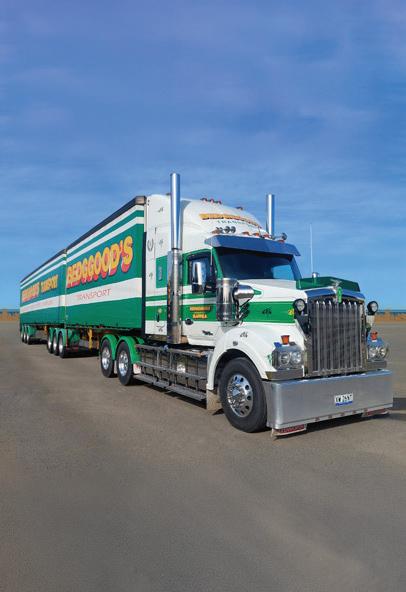
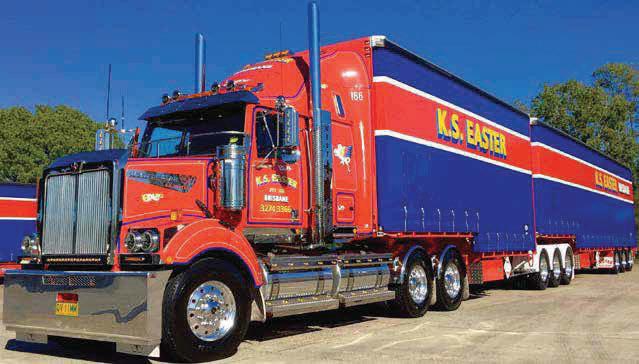
to many companies throughout Queensland, New South Wales, South Australia and Victoria. We are a family owned business, operating since 1976. We currently have the following positions available:
Come and work for us as we are committed to:
• Training and further education
• Your safety
• Maintaining an impressive Fleet


On offer are permanent full time, part time, casual and roster positions including weekend work, paid leave entitlements and public holidays. Drivers need to be available for weekend work as scheduled for work falling across the 7 days of the week.
The successful Applicant will:
• Hold a current MC licence (minimum two years)
• Have knowledge of the HVNL and Load Restraint
• Be professional
• Be reliable
To apply for the Driver positions please contact Operations Manager by emailing your resume to
LOCAL, LINEHAUL & 2-UP DRIVERS WANTED (Brisbane, Sydney, Melbourne and Adelaide Based) WORKSHOP MECHANICS & TYRE FITTERS WANTED (Brisbane based only)
To apply for Mechanic positions please forward your resume to liame
Designed to perform under pressure, our air springs reduce vibration and wear, cuts maintenance and downtime, improves driver comfort and control, and safeguards cargo and vital equipment every kilometre of the journey. For productivity and ride quality, trust Meritor air springs.