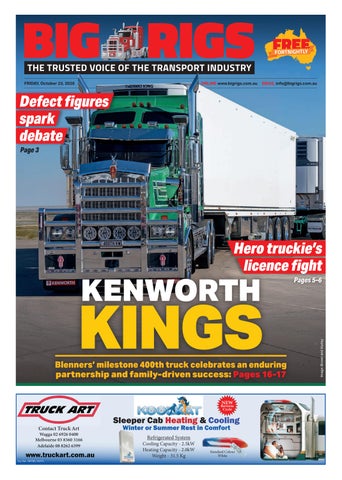
FRIDAY, October 23, 2026
ONLINE www.bigrigs.com.au
Defect figures spark debate
EMAIL info@bigrigs.com.au
Page 3
Hero truckie’s licence fight
KINGS
Blenners’ milestone 400th truck celebrates an enduring partnership and family-driven success: Pages 16-17
2.5kW 2.0kW
Image: Brown and Hurley
KENWORTH
Pages 5–6
2 NEWS CONTACT US Address: 379 Docklands Drive, Docklands VIC 3008 Phone: 03 9690 8766 Email: editor@bigrigs.com.au Web: bigrigs.com.au Accounts: 03 9690 8766 Subscriptions: 03 9690 8766 Classifieds: 0403 626 353 Circulation and distribution queries: 03 9690 8766 info@bigrigs.com.au
EDITOR
James Graham: 0478 546 462 james.graham@primecreative.com.au
SENIOR REPORTER
Danielle Gullaci 0478 844 797 danielle.gullaci@primecreative.com.au
DESIGN
Alejandro Molano – Art Director
GENERAL MANAGER
Peter Hockings: 0410 334 371 peter.hockings@primecreative.com.au
BUSINESS DEVELOPMENT MANAGER Treena Heit: 0403 626 353 treena.heit@primecreative.com.au
CLIENT SUCCESS MANAGER
Katharine Causer: 0423 055 787 katharine.causer@primecreative.com.au
CONTRIBUTORS
Truckin in the Topics/Spy on the Road: Alf Wilson, 0408 009 301 David Vile, Graham Harsant, Geoff Middleton, Jonathan Wallis, Tim Oakes.
Big Rigs National Road Transport Newspaper is published by Prime Creative Media. It is the largest circulated fortnightly truck publication in Australia with 22,248* copies per fortnight. *Average circulation per issue in 2025
FRIDAY OCTOBER 23 2026 BIGRIGS.COM.AU
$80,000 fine after alleged Safe-T-Cam breaches A transport company has been fined $80,000 for allegedly failing to produce the required documents to the National Heavy Vehicle Regulator (NHVR), following a series of Safe-T-Cam fines. The case was heard at Parramatta Court on September 28. The regulator alleges that between February 6, 2026, and May 6, 2026, heavy vehicles owned by the now defunct Ace Brothers Transport were detected in New South Wales, travelling between Safe-T-Cam sites in less than the allowable travel time. “The incident involved five different trucks owned by the operator. These trucks were detected driving between Safe-T-Cam locations in less than the allowable time, which indicated either speeding or drivers
The case was heard at Parramatta Court on September 28. Image: Vera/stock.adobe.com
not taking the required rest breaks,” said an NHVR spokesperson. Notices to Produce were sent to the registered operator of the vehicles identified
by the Safe-T-Cams under Section 569 (2) of the Heavy Vehicle National Law (HVNL). Section 569 gives authorised officers the power to require the production of
documents from a responsible person for a heavy vehicle. “A notice was sent to the operator requiring identification of the driver’s details and production of their work diaries,” the NHVR continued. “The company did not respond to these notices and the issue went before the court.” According to the NHVR, “The company has an extensive history of not replying to any notices sent by the regulator. “The court said the objective seriousness of the offence was mid-range, and there was a need for general and specific deterrence.” Furthermore, NHVR said, “Failing to respond to statutory notices impedes the regulator’s monitoring and
investigation of the industry. “The regulator will commence prosecutions where a party fails to produce evidence. The courts treat these matters seriously.” Ace Brothers Transport, which operated a fleet of 12 heavy vehicles, was placed in liquidation in June with a court appointed liquidator appointed on June 22. “At my appointment the company was not trading and held no vehicles,” liquidator Trent McMillen told Big Rigs. “All truck assets had been either repossessed by financiers and/or were subject to a sale process. “No assets have been realised into the liquidation and accordingly, a dividend to creditors appears unlikely.” Ace Brothers was contacted for comment.
NHVR warns drivers over harvest pressures THE National Heavy Vehicle Regulator (NHVR) is warning against overloading, maintenance shortcuts and fatigue risks as a bumper grain harvest ramps up pressure on truckies and transport operators. Favourable growing conditions in South Australia and Victoria are expected to bring more trucks and farm machinery onto rural roads, alongside supply chain pinch points.
The first barley harvest has already been delivered on the Eyre Peninsula, with Victoria’s season expected to begin soon. NHVR Director Southern Region Paul Simionato said operators should conduct pre-season inspections and daily pre-start checks throughout harvest. “Any potential defects are preventable through effective
maintenance planning and regular inspections,” he said. He also warned against letting pressure to shift grain override fatigue requirements. “The pressure to move this amount of product can tempt operators and drivers to take risks around fatigue, but no load is worth someone’s life.” The NHVR said previous South Australian harvests had produced overloading, mass
breaches and vehicle defects that could have been avoided. Interstate operators are being urged to check each state’s regulations, monitor loads and ensure vehicles are mechanically sound. Grain Producers SA chief executive Brad Perry said the state was heading towards a bumper harvest after two difficult seasons. “When the crop is ready and
the weather window is tight, the pressure to keep moving is real,” Perry said. Perry urged realistic schedules, planned rest and checks of brakes, tyres, lights and couplings. The NHVR’s Grain Transport Safety Network Truck Handbook outlines legal loading requirements and ways to manage compliance risks during grain transport.
AIR BRAKE FITTINGS & COUPLINGS
™
D.O.T / S.A.E STANDARDS CONFORMANCE Australia’s BIGGEST range and stockist of Metric / Imperial Push to Connect and Compression Style D.O.T Air Brake Fittings
CLIPLOCK features a TWO-STAGE locking mechanism. CLIPLOCK The industry standard and the Optional innovative GP LOCKING CLIP & LOCKING GROOVE (PATENT PENDING). CLIPLOCK CLIP LOCK Ensures positive and secure connection
of the Trailer Airline Couplings.
Huge range available. Approved to meet: Australian Design Rules ADR-38/05 DOT FMVSS 571.106, SAE J2494/3, SAE J1131 blanking plugs.
Brass Fittings
Full range of Brass fittings designed to suit North American and European Truck & Trailer Air Brake systems.
FEATURING • Locking Collar • Locking Clip • Visual Lock Indicator
AVAILABLE AT TRUCK & TRAILER SPARE PARTS OUTLETS AUSTRALIA WIDE.
Compliant Standards: ADR-38/05. AUSTRALIAN REGISTERED DESIGN NUMBER 202417225.
SCAN CODE FIND OUT MORE
UNCOMPROMISING PERFORMANCE
Pho n e +61 3 9580 1811 sales@gptruckproducts.com.au www.gptruckproducts.com.au
NEWS 3
BIGRIGS.COM.AU FRIDAY OCTOBER 23 2026
Truck defect figures spark fresh scrutiny
BY DANIELLE GULLACI
IN the first nine months of 2026, the National Heavy Vehicle Regulator (NHVR) says it has already issued 95,632 defect notices. This and a number of other startling figures were revealed at the Technical and Maintenance Conference (TMC) in Melbourne on October 14, during the event’s Technical Q&A session. However Denis Robertson, founder of Roadmaster, urged caution when looking at the figures alone. “I think we’ve always got to be very careful of statistics. From an operator’s point of view, we need to be very conscious of the fact that there’s still a lot of variance in the way some inspectors determine what’s a minor, what’s a major, and what’s a self-clearing defect.” It was reported that in operational intercepts, only 8.3 per cent were considered major – with 60.7 per cent classed as minor, and 31.0 per cent self-clearing. During HVIS/programmed inspections, it’s a similar story – only 5.6 per cent were major, while 76.9 per cent were minor and 17.5 per cent were self-clearing. Peter Austin, Director of Policy Implementation at the NHVR, said the top area the regulator sees defects relate to the consumables on heavy
vehicles. “Maintenance is the number one thing that we see. It’s brake imbalances, excessive wear, brakes that are completely non-operational.” During the session, it was also revealed that 11,015 offences have been detected during on-road enforcement activities in the first three quarters of 2026, with fatigue being the highest detected offence, sitting at 42.6 per cent. When fatigue and mass were combined, these accounted for 63.5 per cent of all offences detected during operational intercepts. According to NHVR Operations Manager Robert Mitchell, “If we’re looking for an opportunity to improve as an industry, they are two fairly significant factors to have a look at.” While agreeing that the fatigue figures don’t look good, Robertson added, “I wonder sometimes whether it’s because there’s a wrong entry in a book or something like that, that’s being collected as a fatigue offence. “The one thing that we need to always recognise is that we’re in this together, and we need to respect each other. As operators, we need to recognise that there is a job for our enforcement people to do. Don’t get back to an us and them approach. Sadly, it’s what seems to be happening more and more
these days on the road. “There’s nothing more distressing for a driver than to be given a penalty for something that is really trivial and nothing to do with safety.” Mitchell conceded that while the system isn’t perfect, it is necessary to help combat fatigue related incidents. “I’ll be the first one to say that a logbook is not going to necessarily tell you what’s tired or not. But we are where we are because of coronial investigations and recommendations, and we’ve got a system that’s doing its best to try and manage fatigue, and there are rules to play by. “Catastrophic things happen. Our job is to try to steer them in the right direction, using the guidelines we’ve got. Certainly, that fatigue stuff doesn’t mean that the driver is impaired by fatigue. But I’ve seen a bunch of instances where what’s described as a minor administrative offence in a work diary is a precursor to a false entry.” Heavy Vehicle Industry Australia (HVIA) Technical Officer Adam Ritzinger also weighed in. “I think we’ve got the opportunity to flip the script on this, and we can do it right. Two thirds of all the offences are fatigue and mass. There are technological solutions that can solve those two problems almost straight away,” he said,
pointing to mass monitoring systems, electronic work diaries (EWDs) and logbook checking systems, which have all been available for a long time. As the operator of a large transport fleet, Robertson shared his view on the way fatigue is monitored. Roadmaster runs approximately 500 pieces of equipment, providing interstate refrigerated transport services. “Fatigue is a big issue, but quite frankly, I think prescriptive driving hours would probably kill more people than it has saved. I’m very serious about that. “Everybody is different. I’m not suggesting for one moment we are allowed to drive more than what we are, but I think there needs to be a lot more flexibility.” Robertson continued, “When the body says I’m tired, you need to be able to pull up. People are unfortunately driving too often to get to a particular place, because that’s when their logbook or their EWD says they need to have a rest.” Mitchell said the review of the Heavy Vehicle National Law (HVNL) will offer greater flexibility. “This is the first iteration. Alternative compliance options are going to be available. We haven’t seen too many of them start yet. There’s going to be a bit of a transition period, but
FRESH AIR FOR THE LONG HAUL Keep your cabin clean and protect your HVAC system from costly repairs and downtime.
SCAN HERE TO FIND A CABIN FILTER FOR YOUR TRUCK
The regulator has revealed the startling number of defect notices issued over the first nine months of 2026. Image: NHVR
ultimately, it’s about offering more flexibility. “The other advantage with the alternative compliance systems that are coming out is that there’s a better, more enhanced backend. The safe-
ty management systems and the orders that go with that will ensure that they’re far more effective and they’ll be used for this purpose. I think there’s a bright future, as far as flexibility is concerned.”
4 NEWS
FRIDAY OCTOBER 23 2026 BIGRIGS.COM.AU
Hawkins seeks closer ties after $60k fine BY JAMES GRAHAM
A $60,000 fine has delivered another blow to Hawkins Transport as the Far North Queensland operator works to rebuild after its fleet was grounded in August. Hawkins Transport was sentenced in Townsville Magistrates Court on October 9 after pleading guilty to eight offences involving breaches of a court-ordered Supervisory Intervention Order. The company’s lawyer Belinda Hughes said no conviction was recorded. Speaking to Big Rigs after the decision, boss Bradley Hawkins said the penalty added to the pressure of lost business and costs from fighting prohibition notices that sidelined his operation in August. But he was determined to carry on and was committed to addressing all the compliance issues before the approaching wet season curtailed earning opportunities. Hughes said the proceedings began with 37 charges carrying a maximum penalty of $2.5 million, before being finalised on eight charges carrying a maximum of $590,000. The National Heavy Vehicle Regulator said seven offences involved failing to present heavy vehicles for required safety inspections, with a total of 38 vehicles not presented. The eighth involved failing to provide copies of
defect notices issued during the order. In her sentencing submission, Hughes argued the offences involved failures to meet reporting and inspection requirements, rather than charges of operating unsafe vehicles. The company accepted its compliance was inadequate but disputed any suggestion it had completely disregarded the order or chosen financial gain over compliance. Hughes attributed the failures to staff turnover and logistical difficulties across remote Queensland depots. The 12-month supervisory order was imposed in November 2024 after the operator was convicted and fined $55,000 for failing to ensure its fleet was adequately maintained, serviced and repaired. According to the regulator, that investigation followed a 2022 crash in Charters Towers involving a heavy vehicle with a potentially dangerous braking system. Defects were also identified on its trailer. NHVR said the court imposed the order after considering the operator was, or was likely to become, a systemic or persistent offender under the Heavy Vehicle National Law. This month’s sentencing concerns that earlier order, following a separate dispute over prohibition notices issued against the company and Hawkins personally on August 14.
As previously reported by Big Rigs, those notices grounded the large Far North Queensland fleet and threatened the future of the nearly 30-year-old business. The notices were lifted on August 26, on the eve of a scheduled Supreme Court hearing, allowing operations to resume after 12 days. Hawkins said around 75 staff were employed when the fleet was grounded. Despite continuing to pay employees during the shutdown, he later reported losing 10-15 workers because of uncertainty about their jobs. The submission put losses associated with the prohibition notices at more than $2.3 million and said 17 drivers had resigned. It reported an August loss of approximately $320,000 against a budgeted profit of approximately $1 million, and said refinancing and operational restructuring were being considered. The Normanton-based business services communities, properties and stations across the Gulf of Carpentaria and Cape York, transporting groceries, general freight and cattle, and undertaking council work. Its role supplying remote communities was recognised during the October 9 proceedings, according to Hughes. After lifting the prohibition notices, the NHVR said Hawkins had agreed to a
[L-R] Hawkins Transport Commercial Manager Helen Calleja, Belinda Hughes, Bradley Hawkins and Abbey Lucht, Hawkins Compliance Manager, in Townsville. Image: Belinda Hughes
Despite the latest setback, Bradley Hawkins remained committed to putting things right. Image: Hawkins Transport
pathway to address its safety concerns. Big Rigs reported the company had eight weeks to have its trucks and trailers inspected. However, the regulator’s latest figures show a high level of non-compliance. As of October 7, the NHVR said it had completed 108 first inspections of the operator’s heavy vehicles. Of those, 92 failed and 16 passed, representing a failure rate of 85.2 per cent. It reported 11 major defects involving 32 major components. The NHVR also cited six known heavy vehicle crashes in 2026 and 111 defect notices, including 35 major notices, issued between January 1, 2025, and August 6, 2026. Executive Director Statutory Compliance Paul Alsbury said operators were legally responsible for identifying and managing risks, including ensuring vehicles were properly maintained and safe. “This case demonstrates the consequences when those responsibilities are not met,” Alsbury said. “Where serious and ongoing safety risks are identified, the NHVR will take the action necessary to protect all road users.” Hawkins said he wanted the regulator to work more
closely with his company to improve standards, “not just worry about waving fines around”. He disputed aspects of the inspection process and wanted clearer explanations of some findings. Documents supplied by the company show removal of a maintenance accreditation sticker listed as a defect item on one notice, but as a note on another. Those notices also recorded faults including cracked windscreens, a seatbelt that would not extend, brake imbalance, an air leak and excessive movement in steering and suspension components. The company said defects identified as not meeting requirements had been rectified. Hughes outlined changes aimed at preventing further failures, including a full-time compliance officer and dedicated health, safety and compliance support since February 2026. The company engaged ComplyAssist in August to develop and improve a Safety Management System, while Hawkins completed Chain of Responsibility and vehicle inspection training. Hughes’ sentencing submission also said regulatory correspondence and inspection
requirements were now coordinated centrally. A fleet management system was being implemented to track vehicle locations, coordinate inspections and enable digital pre-start checks linked to maintenance scheduling. Hawkins acknowledged some inspectors had been helpful and said a planned NHVR visit to Normanton next Tuesday was encouraging. “So that’s a good start,” he said. He said about 30 trucks were operating, with driver shortages also limiting the fleet he could put on the road this year. His focus was working through the outstanding issues. “I just want it right.” Hughes said the conclusion of proceedings should provide an opportunity for cooperation. “I would love to see now this matter is over the regulator working closely with the company to assist in compliance,” she said. “While I see the regulator has listed the compliance issues, it would be great to understand how the company can work with the regulator to improve. “The company is genuinely trying, and the court saw that today.”
NEWS 5
BIGRIGS.COM.AU FRIDAY OCTOBER 23 2026
Highway hero fights to regain truck licence BY JAMES GRAHAM
A truckie honoured for pulling a fellow driver from a burning B-double is fighting to regain his heavy vehicle licence after an eye condition cost him his livelihood. Darren Cooke, whose bravery featured on the Big Rigs cover in 2019, says he has been left financially and emotionally devastated by the cancellation of his MC licence. The 63-year-old Port Stephens driver has diplopia, or double vision, but says prescribed prism glasses correct the problem and allow him to see clearly. His ophthalmologist and optometrist have provided written support for his return to driving. Transport for NSW maintains he does not meet the commercial medical standards. Cooke told Big Rigs his court appeal has been adjourned until mid-December for a full hearing, extending an anxious wait for a driver who has spent about 35 years behind the wheel. Health complications from a gastric sleeve procedure have only added to Cooke’s stress levels – he was due to have corrective bypass surgery on October 12 – but he said he’s not hanging up the keys without a fight. “I’m a lot better off than a lot of other people, but I’m in
shock that they just cancelled me like this,” Cooke told Big Rigs. “My specialists and optometrists are saying there is no reason why I shouldn’t be driving.” Cooke also questions why Transport for NSW allowed him to keep driving for a further four weeks after notifying him of the cancellation. “Why was I allowed to keep driving anything in Australia for a further four weeks if I’m not safe to drive?” asked Cooke, who was carting dangerous goods and BOC gases for Toll. Just seven years ago, Cooke was making headlines for saving another truckie’s life. Driving for Lindsay Australia on the Hume Highway near Yerrinbool in NSW in February 2019, he came across a B-double that had rolled and caught fire. He safely stopped his own truck before pulling the driver from the burning cabin to safety. The rescue earned him a Bridgestone Bandag Highway Guardian Award, recognising professional truck drivers who perform heroic and selfless acts while doing their everyday work. Cooke’s courage inspired Big Rigs to feature the story on the front page of its May 17, 2019 edition under the headline “HERO TRUCKIE”.
He still proudly keeps the coverage and award together in a framed display, a photograph of which forms part of his court material. “I would also like to make clear that I would never knowingly drive if I believed my eyesight made me unsafe,” he wrote in his submission. “My driving history and the recognition I have received within the industry demonstrate how seriously I take the safety of other road users.” Cooke said his current difficulties began about 18 months ago when he woke with double vision. He underwent testing over several months and initially thought his driving career might be over. Then he was prescribed prism glasses. In a September 10 letter included in the court documents, his ophthalmologist reported corrected visual acuity of 6/6 in both eyes and a normal visual field. He noted Cooke reported no episodes of double vision since obtaining his current glasses. “He is safe to have a full licence, provided he wears his prism glasses,” the doctor wrote. His optometrist also supported a conditional commercial MC licence requiring Cooke to wear glasses when driving. Her August 20 report stated he did not experience diplopia
Darren Cooke with his Bridgestone Bandag Highway Guardian Award in 2019. Image: ATA
when looking at objects within the central 20 degrees of his primary direction of gaze while wearing his glasses. However, Transport for NSW declined to change its decision. In a September 4 letter sighted by Big Rigs, the agency acknowledged the optometrist’s report supported Cooke’s suitability to hold a commercial licence. It said subsequent advice from its medical adviser oph-
thalmologist indicated he did not meet the commercial medical criteria in Austroads’ Assessing Fitness to Drive standards. The agency’s position was that, although corrective lenses may manage his double vision, the commercial standards made no provision for someone whose diplopia required lens correction to hold a commercial licence. Continued on page 6
MY DRIVING HISTORY AND THE RECOGNITION I HAVE RECEIVED WITHIN THE INDUSTRY DEMONSTRATE HOW SERIOUSLY I TAKE THE SAFETY OF OTHER ROAD USERS.” DARREN COOKE
ISRI SEATS DEALERS SYDNEY 510 Victoria Street, Wetherill Park NSW 2164 Ph. 02 9756 6199, email: isri@isri.com.au, www.isri.com.au
BRISBANE 3/120 Gardens Drive, Willawong QLD 4110 Ph. 07 3275 2044, email: sales@isribrisbane.com.au, www.isribrisbane.com.au
BRISBANE NORTH 1/259 Cullen Av, East Eagle Farm QLD 4009 Ph 1300 11 4774, email: seats@isrinb.com.au, www.isrinb.com.au
MELBOURNE Unit 1/569 Somerville Rd, Sunshine West VIC, 3020 Ph. 03 9311 5544, email: sales@isrisunshine.com.au, www.isri.com.au
MACKAY
PERTH
DARWIN Mobile Sales and Service Ph. 08 8927 0986, email: info@isridarwin.com.au, www.isridarwin.com.au
When moving Heavy Loads comfort equals Safety. When moving Heavy Loads
WhenEveryday moving Heavy Loads demands are increasing, Safety is important. To achieve Safety you require comfort. comfort equals Safety. comfort equals Safety. Make sure you have an ISRI Seat.
Everyday demands are increasing, Safety is important. To achieve Safety you require comfort. Everyday demands are increasing, Safety is important. To achieve Safety you require comfort. Make sure you have an ISRI Seat. Make sure you have an ISRI Seat. T1/4P-A4-2
408 Welshpool Rd, Welshpool WA 6106 Ph. 08 9362 6800, email: info@mmtisri.com.au, www.mmtisri.com.au
NEWCASTLE/HUNTER VALLEY Unit 2/13 Hinkler Ave, Rutherford NSW 2320 Ph 02 4932 0600, email: sales@hvss.com.au www.isri.com.au
6953653al
110 – 120 Maggiolo Drive, Paget QLD 4740 Ph. 07 4952 1844, email: admin@isrimky.com.au, www.isriseatsmackay.com.au
Seating - on a higher level. Seating - on a higher level. Seating - on a higher level. www.isri.com.au www.isri.com.au
6 NEWS
FRIDAY OCTOBER 23 2026 BIGRIGS.COM.AU
Transport defends tough medical standards From page 5
RESPONDING to questions from Big Rigs, a Transport for NSW spokesperson said the agency cannot comment on the circumstances of an individual matter before the courts. “However, Transport has a statutory obligation to ensure all licence holders are medically fit and competent to hold a driver licence,” the spokesperson said. “Transport assesses fitness to drive in accordance with the national Assessing Fitness to Drive medical standards published by Austroads. These standards are approved by Commonwealth, state and territory transport ministers and are used by driver licensing authorities throughout Australia to support nationally consistent licensing decisions.” The spokesperson added that commercial vehicle drivers are subject to more stringent medical standards than private drivers because of the increased road safety risks associated with heavy vehicles and the potentially more serious consequences of a crash. “Licensing decisions are made on a case-by-case basis and take into account all relevant medical information, including reports from treating health professionals. Transport considers all relevant medical evidence rather than relying on one medical
What the vision rules mean for truckies
Under the current Assessing Fitness to Drive Standards, a person is not fit to hold an unconditional or conditional commercial driver licence if they experience diplopia (double vision), other than physiological diplopia, within 20 degrees of central fixation. While the standards provide a pathway for some private licence holders to be considered for a conditional licence where diplopia is satisfactorily managed with corrective lenses or an occluder, there is no equivalent provision for commercial drivers, even where treatment corrects the double vision, said Transport.
Depending on the medical condition and the applicable standard, additional specialist assessments, medical reviews or other information may be considered as part of the assessment process. However, where the medical evidence confirms a person does not meet the required medical standard, licence conditions, ongoing reviews or practical driving assessments cannot be used as an alternative means of meeting that standard.
Where a decision is made to suspend, vary or cancel a licence, affected drivers are notified in writing and have rights of appeal. The career truckie says he faces an uncertain future if he can’t keep his licence. Image: Darren Cooke
opinion over another. “Where opinions differ, the information is assessed against the applicable Assessing Fitness to Drive standards, which provide the framework for the licensing decision.” The spokesperson said that in unusual or difficult cases, further independent specialist medical advice may also be sought. Cooke said he wants the court to consider whether his individual circumstances justify reinstatement subject to conditions and ongoing assessments. “I am not asking for
road-safety requirements to be ignored,” he wrote. “I completely understand why commercial drivers must meet strict medical standards.” A reference included in his court material describes him as a valued linehaul driver who consistently demonstrated reliability, professionalism and a strong commitment to safety. Cooke said he would willingly wear his prescribed glasses whenever driving and undertake ongoing medical or eyesight assessments. “At 63, I’m going to struggle to get another job – I could lose everything over this.” He also argues the han-
Transport said it will also reconsider a decision if new medical evidence is provided. The commencement date must comply with the applicable legislative requirements.
dling of his case amounts to disability discrimination, a contention he said he intends to raise in his appeal which is now being driven by high-profile transport lawyer Belinda Hughes. “She’s agreed to take me on as her monthly pro bono case and I’m completely stunned and overwhelmed,” Cooke said. “Where do you find the words to thank someone for doing something like that?” Adds Hughes: “These matters are always difficult but we are going to do everything in our power to get Darren back to the job he loves.”
Transport lawyer Belinda Hughes has agreed to take on the truckie’s case pro bono.
BIG GEAR WASHDOWN AUSSIE ULTRA A
Northside Diesel service and repair all makes and models Our services include: • Truck and Trailer service and repair. • We service and repair American, European and Japanese makes and models • Engine Overhauls • Minor and Major Repairs • 24/7 Breakdown service • Advanced diagnostics • VOLVO, MACK and UD service centre • Approved Inspection Station Call in and see us or phone: 07 54954133 www.northsidediesel.com.au service@northsidediesel.com.au 24 Commercial Drive, Caboolture QLD 4510
4000 PSI - 20 LPM FLOW HEAVY DUTY PRESSURE CLEANER More flow means faster cleaning Built tough with 316 SS frame Big Berty pump 18L fuel tank Free Safe Operator Training Course
More WACK with BIG Honda twin cylinder 23HP GX630 engine Give ive Aussie ussie a ccall all now now!!
YOU CAN
CLEAN UP STAY SAFE
G
A
Aussie Aussie Pumps uss pumps om u aussiepumps.com.au a ie .c .a
02 8865 3500
NEWS 7
BIGRIGS.COM.AU FRIDAY OCTOBER 23 2026
NSW roundtable calls for action on sham contracting
TRANSPORT operators have called for stronger action against sham contracting after a NSW Parliament roundtable brought industry leaders, unions and government agencies together to tackle the illegal practice. Convened and chaired by WA Senator Glenn Sterle, the meeting heard frustration from businesses competing against operators accused of avoiding employment costs, alongside updates on investigations and proposals for closer cooperation between regulators. Road Freight NSW CEO Simon O’Hara described the gathering as an important first step for the state, but veteran operator Leigh Smart questioned how much more discussion was needed before enforcement delivered meaningful change. NSW Industrial Relations and Work Health and Safety Minister Sophie Cotsis joined
the talks, which included the Transport Workers’ Union, Australian Taxation Office, Fair Work Ombudsman (FWO) and National Heavy Vehicle Regulator. The National Road Freighters Association, NatRoad, Victorian Transport Association and Australian Road Transport Industrial Organisation were also represented. A FWO spokesperson later told Big Rigs that employers should be aware that the workplace regulator has investigations underway into alleged sham contracting in sectors including road transport. Of the 39 infringement notices it has already issued for unlawful independent contractor advertisements, 25 of those related to road transport entities. The agency also reported 30 investigations referred by external stakeholders and 13 compliance notices involving
worker misclassification, with more than $94,000 recovered for 17 workers. Formal correspondence had also been sent to 99 road transport duty holders outlining due diligence expectations around sham contracting. The spokesperson said that under the Fair Work Act, courts can impose penalties of up to $19,800 for individuals and $99,000 for businesses with fewer than 15 employees. For businesses with 15 or more employees, maximum penalties for each contravention are the greater of $495,000 or three times the underpayment amount. “Employers are on notice that it’s unlawful to mislabel a worker as a contractor when the business doesn’t reasonably believe this,” the spokesperson added. For Smart, however, the central concern was whether authorities were doing enough to
[L-R] Operator Scott Hannah, RFNSW CEO Simon O’Hara, Leigh Smart and RFNSW Chair Austin Vella at the NSW State Parliament. Image: Prime Creative Media
identify workers treated as contractors while operating under arrangements he believed amounted to employment. “There is a simple way to fixing the whole bloody thing,” he told Big Rigs. “There’s a definition put out by the taxation department and there’s a half a dozen questions. “Do you get instruction from one company? Do you work for that company every day? Do they tell you where to go? What do they provide you? “If you get them all wrong, you’re an employee, you’re not a subcontractor. All they’ve got to do is police that.” He said businesses avoiding obligations such as payroll tax, workers’ compensation and employee entitlements gained an unfair advantage of up to 50 per cent over operators doing the right thing. His frustration was echoed by O’Hara, who told the room operators were facing “recession-like conditions” and some were simply walking away from the industry. “This is about our bread and butter, and we need to ensure that we address this at a fundamental level,” O’Hara said. O’Hara told Big Rigs the most encouraging prospect was applying NSW’s approach to supply chain compliance in other sectors to transport. That could mean looking beyond individual contractors to the businesses higher up the contracting chain and exam-
Senator Sterle with Minister Cotsis. Image: Glenn Sterle
ining how workers were engaged and paid. He stressed the idea remained at an early stage but said bringing state and federal agencies together was essential to making progress. “Sham contracting has no place within the freight industry,” O’Hara said. “It’s rife and it’s a scourge – we need to do something about it and this is the first step. It’s incumbent upon us to be able to take this ball forward in meetings like this and say, sham contracting during a cost-of-living crisis is effectively cutting our grass.” O’Hara also urged customers to engage reputable freight businesses rather than treating the cheapest rate as the deciding factor. The room also heard that legitimate subcontracting remained an important part of transport, including for businesses built with owner-driv-
ers who supplied their own capital. Other contributions highlighted difficulties with legislative definitions and the distinction between genuine contracting and employment. Sterle argued the wording used to define contracting needed improvement to close gaps that could be exploited. He also warned exploitation extended across the transport industry and said migrant drivers needed to understand their rights and receive proper training. Sterle later said the meeting had been productive, while acknowledging further work was needed. “There is more work to do, but having industry, unions, regulators and governments sitting around the same table and talking openly about the issues is an important part of getting the outcomes right.”
8 OPINION
FRIDAY OCTOBER 23 2026 BIGRIGS.COM.AU
Action needed
EDITOR JAMES GRAHAM
IT was good to be invited to the sham contracting roundtable at NSW Parliament. Getting regulators, industry representatives and operators around the same table is another vital step in stamping out what many describe as the number one scourge in the industry today. We also have to tip our hat again to WA Senator Glenn Sterle for getting the right conversations going between all the agencies involved. Before he got on board, they all seemed to be rowing in different directions with rogue operators running rampant. Now there at least seems to be the right intent around the table with enforcement underway. The feedback from operators we spoke to however, was blunt: more needs to be done to level the playing field, and fast as increasing fuel prices, and other costs, continue to eat into margins. Patience is clearly wearing thin among those doing the right thing.
What’s hot online
Operator slugged with $80k fine READERS were largely sympathetic toward the now defunct company that copped an $80,000 fine for failing to produce the required documents following a series of Safe-T-Cam fines. Many questioned the camera evidence and whether hefty fines delivered meaningful safety improvements. “You get fined for doing your job,” wrote Ange Trezise. “Doesn’t save lives when you have to stop because you don’t have any time left but feel awake and capable. “Then have to start again when you should be sleeping and tired but need to get to
your destination on time. Only job that penalises you for doing a job well. “They even try to fine you if your truck is off the road too long without an explanation. They should be doing more work checking the licenses and the proper testing and training of the drivers before they are put on the road, not ambush and persecute the drivers that are just doing their job.” Jeff Douglass said he’d like to know by how much they were out. “I got done at Gundagai years ago for one-minute too quick between Marulan and
Gundagai cameras and I drove a speed limited truck.” Niell Graham said it would be interesting to know what camera sites were used to determine this. “That way, we as drivers could check these times ourselves,” he said.
NHVR alleges that five of the company’s trucks were caught out on Safe-T-Cam locations. Image: Alf Wilson
Don’t send our operators broke OUR recent column from LBRCA’s Scott O’Connell warning that tackling the driver shortage also means addressing the financial pressures squeezing transport businesses, sparked more lively debate. “Maybe the industry needs to stop scratching its head wondering where all the drivers have gone and start asking: why the hell would a young person want to become one?” suggested Harry Breeches. “What’s the sales pitch? Long hours, weekends away, bugger-all career progression, filthy truck-stop amenities, nowhere to park, and
customers who treat drivers like they’re an inconvenience rather than the reason their freight actually turned up. “We don’t just have a driver shortage. We’ve got a shortage of reasons to become one.” Jim Kesby reckons operators are cash-strapped because they’re fighting each other for work. “Dropping prices to get work is a sure-fire way to go broke. Why wear your gear out to break even at best?” Peter Edwards took a different viewpoint from others. “Back when they had the safe rates debate, I think a lot of owner-drivers shot them-
selves in the foot when they voted against it. “I truly believe that there needs to be a minimum of a safe rate. Something like a truck driver is getting federal award. But it needs to be a federal award for owner-drivers. And it must not be controlled by the larger companies.”
Transport businesses need to have the financial capacity to employ, train and develop people. Image: LightItUp/ stock.adobe.com
WOULD YOU LIKE TO CONTRIBUTE TO READER CORNER? EMAIL US AT EDITOR@BIGRIGS.COM.AU
Truckie fights weighbridge fine
TRUCKIES were quick to rally in support of Kylie Robinson who missed the weighbridge near Willow Tree, tried to correct her mistake and was still fined $800. “Kankool is a joke,” said Allan Lockhart. “Coming south having to cross over the northbound lane to enter checking station while 30 metres and grossing 85 tonnes. Real safety there. Then having to cross over the northbound lane again leaving the checking station.” Luke Klever said the NHVR should “get off the roof and give her a break”.
“The country relies on professional drivers like Kylie to feed the nation and this woman is as honest as the day is long,” he wrote. Added Marcus Grigsby: How about working on the chain of responsibility laws and including people paying below cost price for freight which is then flowing down through to maintenance being pushed aside by operators working for below cost price!” Dave Henderson believes Kankool is the most dangerous bridge in the country. “Many accidents nearly caused there when we were takin 20 to 24-metre con-
crete poles into there over the years,” he said. “Just started driving past it all the time after that, open or not. Too much hassle getting in. I’m surprised no one’s been killed there. No safety there whatsoever.”
Kylie Robinson, inset, tried to do the right thing after driving by the weighbridge. Images: Kylie Robinson
Truckie’s close call with B-double DASHCAM footage capturing a veteran truckie’s frightening near miss with a broken-down B-double on the Pacific Highway inspired plenty of breakdown tips and similar stories from readers. “Poor bugger, same happened to me years ago northbound out of Kempsey,” said Adam Thurling. “Had absolutely nothing power-wise. Rushed to get triangle and taped a torch to the back corner of trailer and not one person stopped to assist, as per usual.”
Peter Edwards wondered why the driver didn’t have their triangles out. “They should’ve also had their park lights on and hazards going. This could’ve also been avoided too if people had notified people on the UHF,” he said. Troy Holstein said the same scenario also happened to him several years ago. “Just as I was going past the Bangalow entrance northbound. Lost power to everything at 2am. “Rolled it to a stop, stopping half in the en-
trance lane. Couldn’t put hazard lights on, couldn’t call on the UHF. Luckily, I was in a car carrier, ran to the back vehicle, put the lights on and hazard lights on. Then put triangles out.”
The broken-down truck on the Pacific Highway. Image: Sonja White
EFFICIENCY, BY DESIGN. Introducing the Mercedes-Benz Actros ProCabin. Evolution never stops. The Actros ProCabin has been shaped to cut drag and boost your bottom line with ultimate fuel efficiency. Building on recent fuel economy and reliability upgrades, the ProCabin also delivers the comfort and safety levels you expect from Mercedes-Benz Trucks. Contact your Mercedes-Benz Trucks dealer today.
10 NEWS
FRIDAY OCTOBER 23 2026 BIGRIGS.COM.AU
Truckie reveals plans for rest area gyms BY JAMES GRAHAM
A former interstate truckie wants to put gyms and private showers in shipping containers at major rest areas – but first needs to know whether drivers would use them. Highway Health concept creator Tony Pfeiffer is seeking feedback on a proposal for driver recovery hubs offering basic exercise equipment, stretching areas and clean amenities around the clock. Tarcutta is his preferred starting point for a pilot, followed by other busy changeover and parking bays along the eastern freight corridors. The concept remains at the proposal stage, with no facility operating yet and funding still to be secured. Forster-based Pfeiffer, who spent 13 years driving interstate and another four hauling logs, said the idea took shape during a recent trip home from Sydney with his daughter. They spotted an empty space at Wyong Service Centre and began talking about what could fit there. “And we thought, oh, gee, the gym could go really good
there, and something for the drivers to do while they’re having their break or at the end of their day.” By Newcastle, they had worked up a business plan and have since been refining the concept. Pfeiffer has stepped away from driving for now and has a shoulder injury requiring rehabilitation. That experience has helped shape his interest in making exercise facilities more accessible to drivers who spend long periods away from home. He acknowledges that getting tired truckies to exercise during a break could be a challenge but believes some would welcome the opportunity. “In my opinion, there’s a lot more people that are actually trying to make their life a little bit better.” Each hub would be housed in a 40-foot shipping container, combining a basic gym with two private bathroom, shower and changing facilities. The planned exercise equipment includes a bike, treadmill, cable weight machine, stretching bench and free
Each hub would be housed in a 40-foot shipping container. Image: ChatGPT
weights. A leg press could be added if space allows. Pfeiffer envisages room for two people to use the gym comfortably while two others use the bathroom facilities. Air-conditioning, hot water and vending machines stocked with water and protein drinks would also feature. For drivers, the appeal could be as simple as having somewhere comfortable to freshen up. “But it’d be nice to have a place to actually go and have a shower in an air-conditioned environment.” The hubs would be designed to operate off-grid, with battery backup, water storage and wastewater removal.
Pfeiffer estimates each would cost about $140,000 to establish. Regular cleaning and ongoing maintenance would add to operating costs, making sufficient membership support crucial to getting the idea off the ground. Under the proposed model, fleets would pay approximately $10 per registered driver each month. Owner-drivers and drivers whose employers do not participate could take out individual memberships for approximately $15 a month. Pfeiffer said a fleet employing 20 drivers would therefore pay about $200 a month, potentially offering access as an employee benefit even if only
some drivers used it. Secure access would be managed through an app, potentially using QR codes or phone-based entry. A booking system is also being considered to manage demand, although Pfeiffer said the details still need work. Busy sites with good truck access would be the priority, particularly parking areas lacking showers or other amenities. He also sees potential along the Newell Highway, where access to facilities can be limited late at night. Pfeiffer said he had emailed a proposal to Transport for NSW but had not received
a response at the time of the interview. He plans to follow up and approach larger transport companies. Pfeiffer said the concept’s aim is to improve the quality of breaks drivers already take and provide a practical wellbeing resource while they are away from home. Before moving towards investment or expansion, Pfeiffer wants drivers and operators to weigh in on whether the facilities would be useful and the memberships worthwhile. “If a Highway Health facility existed tomorrow at a major truck stop such as Tarcutta, would drivers actually use it?” asks Pfeiffer.
Pfeiffer’s plans for how the hubs will look. Image: Tony Pfeiffer
Action plan to tackle the driver shortage
A national plan to tackle Australia’s truck driver shortage proposes better training support, clearer apprenticeship pathways and practical measures to address the conditions driving truckies out of the industry. Developed by Industry Skills Australia (ISA) – the Jobs and Skills Council for Australia’s transport supply chain industries – in consultation with industry leaders and broader stakeholders, the National Heavy Vehicle Driver Action Plan outlines work across four priorities: promoting driving careers, attracting recruits, improv-
ing training and licensing, and retaining existing drivers. The document cites estimates of 28,000 unfilled truck driving positions in 2024, forecast to reach 78,000 by 2029. The plan sets out proposed actions, although many require further development, funding or government agreement before businesses and drivers will see benefits. One task is to identify, evaluate and document state and Commonwealth funding available for heavy vehicle driver training. Gaps and inconsistencies
will then be raised with funding bodies, including through advocacy for improved funding models and wage support for new entrants while they train. For employers, this could help address the expense of developing recruits before they can work safely and productively. The plan also proposes an online Employer Information Hub bringing together information on funding, incentives, migration pathways and workforce development. It would give businesses a central starting point for finding assistance and un-
derstanding their options. The plan also recognises that a heavy vehicle licence alone does not necessarily prepare someone for employment. Drivers also need training, mentoring and experience, while employers need confidence that candidates can operate safely and efficiently. To address this, ISA proposes focused work with state training authorities, employers, registered training organisations and drivers to improve the rollout and uptake of a national heavy vehicle driver apprenticeship.
Industry bodies, employers, drivers and licensing authorities would also be brought together to determine how licensing arrangements, training, assessment and testing can be further harmonised. Resources would explain qualification and licence pathways and how they connect with career progression. The document proposes a strategy to attract experienced truckies into training and mentoring roles. It also calls for advocacy on pension settings to encourage experienced drivers to continue supporting workforce development.
A national professional development program for heavy vehicle driver trainers would be developed, with options for industry-mandated continuing professional development explored. The Western Australia Transport Association (WATIA), one of the industry bodies to advise on the plan, said it had already been developing and implementing the identified actions for some time. “We’re training people, putting them in trucks, and the numbers show it works,” said WATIA CEO Cam Dumesny.
Buying a new trailer? Equip Your New Trailer with Wheels Designed to Pay You Back
$
$ Increase Profitability
Decrease Maintenance Cost
Drive with Pride
Boost Resale Value
FIND MORE
Specify Alcoa Wheels
For more information: contact us at
1800 955 191
alcoawheels.sales@howmet.com
www.alcoawheels.com.au
Built to Mix Scan to learn more
Purpose-built for Australian construction, the UD Quon 8x4 combines a high-tensile steel chassis with a low tare weight to maximise every load. An outstanding 8.74m turning radius makes light work of tight jobsites, while all-wheel disc brakes and Electronic Stability Control deliver advanced safety when it matters most.
Going the Extra Mile To find out more, contact your UD Trucks dealer on 1300 289 283 or visit udtrucks.com.au
12 NEWS
FRIDAY OCTOBER 23 2026 BIGRIGS.COM.AU
Report examines heavy vehicle crashes While the key cause of heavy vehicle crashes remains unchanged, NTI’s Adam Gibson says work is being done across the industry to help drive down these numbers. BY DANIELLE GULLACI HUMAN factors remain the leading cause of heavy vehicle crashes in Australia, with inattention and distraction, inappropriate speed and inadequate following distances being the highest contributors, accounting for more than one third of all major incidents. That’s according to the National Truck Accident Research Centre’s (NTARC) 2026 Major Incident Investigation Report, released this month, analysing major heavy vehicle incidents in Australia, using data from 2025. The report serves as the country’s most comprehensive analysis of heavy vehicle crashes. It’s the result of a collaborative partnership established by NTI, with the National Road Safety Partnership Program (NRSPP) and the Monash University Accident Research Centre (MUARC). Collectively, human factors accounted for 54.7 per cent of all incidents in 2025. NTI’s Transport Research Manager Adam Gibson says that while human factors have typically seen year on year increases, the 2026 findings did show some positives. The report highlights notable reductions in fatigue related crashes (down from 5.8 to 2.5 per cent), failure to give way (down from 7.9 to 3.1 per cent), and inappropriate vehicle positioning (down by 8.9 per cent). “The rate of human factor incidents did drop slightly, particularly with a decrease in inattention/distraction crashes,” Gibson explained. “Largely though, it’s not returning to historic levels, and the hope is that this represents that we’ve at least achieved a new normal, and we’re not seeing it continue to worsen in terms of frequency.” Inattention/distraction has consistently recorded the highest incident rate, however in 2025 this rate declined sharply, falling from 25 to 17 incidents per 10,000 heavy
vehicles, representing a further 32 per cent decrease compared with the moderate decrease seen in 2024. It accounted for 13.8 per cent of all crashes in 2025. Articulated combinations had the highest inattention/distraction crash rate at 24.2 per 10,000 vehicles. The report defines inattention/distraction as a paired grouping of crash causes in which the incident is determined to result from the driver becoming disengaged from the driving task due to either a specific non-driving-related stimulus (distraction) or a loss of task focus (inattention). At the same time, there have been increases in heavy vehicle crashes caused by inappropriate speed (up 28.9 per cent) and inadequate following distance (up 11.7 per cent). “These figures have both crept up, particularly the inappropriate speed crashes, which are mostly single vehicle rollover crashes,” added Gibson. He also pointed out that inappropriate speed isn’t related to posted speed limit. “This is not about speeding, it’s about an incompatibility between the dynamics of a vehicle and, critically, its load, because the load is a key part of the centre of gravity on a truck. “Inappropriate speed refers to things like the road geometry, the prevailing weather or road conditions and the driver’s chosen speed. If you get any of those wrong, the risk that something could go wrong is very real. Most of these crashes happen when the vehicle is travelling below the posted speed limit.” As the report notes, advisory speed signage is often not designed with heavy vehicles in mind, placing additional responsibility on drivers to interpret safe operating speeds. Why it’s important to correctly understand the difference between inappropriate speed and speeding, says Gibson, is that when it’s
Most inadequate following distance crashes happened in cities.
misinterpreted, it can lead to misdirected regulatory efforts. “That can lead to speed cameras sitting on pieces of road where speeding was never the problem.” Focusing specifically on heavy vehicle occupant fatalities, inappropriate speed was the most prominent contributing cause in 2025. Heavy vehicle occupant fatalities recorded a rate of 1.3 for every 10,000 heavy vehicles. Almost half of these – 48.5 per cent – were attributed to inappropriate speed in 2025. Articulated combinations were shown to have a particularly heightened risk of inappropriate speed crashes, recording both higher rates (28.8 per cent versus 8.6 per cent for rigids) and a greater proportional impact. Inadequate following distance was the third most common contributing factor to heavy vehicle crashes in the latest report, after inattention/distraction and inappropriate speed. It accounted for 11.6 per cent of all major incidents. Following a period of relative stability in this area between 2019 and 2022, both the rate and proportion of inadequate following distance crashes have then risen each year. A particularly sharp rate increase was observed in 2023 compared with 2022, with more modest increases since then. Crashes resulting from inadequate following distance are overwhelmingly associated with the typical scenario in which a heavy vehicle is unable to stop in time when traffic ahead slows or stops abruptly. The data shows that these types of crashes are heavily over-represented in major cities, where 74.4 per cent of all inadequate following distance incidents occurred, despite major cities accounting for 40 per cent of all incidents overall. Among the positive takeouts to come from the latest NTARC report is a reduction in the overall incident frequency, and in the number of losses over $50,000 per insured powered unit, per truck or per prime mover. “The overall incident frequency and the number of major truck crashes has reduced,” said Gibson. “That $50,000 figure was set in 2003 when we started this data series. Once we correct for inflation, that number has a current value of $90,500. So, although the frequency of these crashes crept slightly higher, it’s still not as high as the inflation corrected peak.” While there’s still plenty of
Inappropriate speed contributed to 48.5 per cent of heavy vehicle occupant fatalities in 2025.
Inattention and distraction remained the leading crash cause.
The report revealed positives.
room for improvement, the numbers suggest that there has been stabilisation – and in some cases improvements – across various factors contributing to heavy vehicle crashes. Gibson points to work being done across the industry, including via the various industry associations, driver training and a greater access to resources. “I think we’re on an evolutionary journey,” he said. “There are some pockets of excellence, but there are also a lot of people in the industry criticising driver pathways into the industry, and rightfully so at times. “I think it’s better to explore what the industry is getting right – and there are a number of really great schemes out there.” Gibson spoke of some of the initiatives that are already having a positive impact. “When we were filming the Cunningham’s Gap Steep Descent video with Bill Manton and Wickham’s, Bill as-
NTI’s Transport Research Manager Adam Gibson. Images: NTI
sisted with their QTA aligned driver apprenticeship programme, and spent some time with their apprentice drivers. Recently I met with two of Heather Jones’ former students who are now into their career journey. Wendy Fennell at Fennell Forestry has been doing great work with SARTA. WATIA and the VTA have both done some great work getting government-funded training for new drivers. “These are the types of training we’d benefit from seeing widely available and accessible in transport. So the question then becomes: If we know what good looks like, we’re seeing pockets of good, and we’re seeing the impact of that good, how do we support that at scale? “Because if you’ve ever experienced continuing professional development in any field,
there’s a risk of it becoming perfunctory, and box ticking. We’re seeing that the brilliance of passionate transport people who drive trucks pass on their experience is highly valued and more effective.” • 2026 NTI Limited. This article contains general information only and does not take into account your objectives, financial situation or needs. NTI makes no representations or warranties as to the accuracy, currency, completeness or reliability of the information and, to the fullest extent permitted by law, accepts no liability for any loss, damage or injury arising from the use of, or reliance on, the information in this article. National Transport Insurance is administered on behalf of the insurers by its manager NTI Limited ABN 84 000 746 109 AFSL 237246.
At NTI we’ve always been successful in finding new ways to keep our customers truckin’, shippin’ and diggin’. With specialist insurance and roadside assistance products designed to protect Australian businesses and families, NTI is the specialist our customers can count on in their time of need.
©️ 2026 NTI Limited. General information only. Limits and exclusions apply. When making decisions about insurance, consider the PDS and TMD on https://www.nti.com.au/. National Transport Insurance is administered on behalf of the insurers by its manager NTI Limited ABN 84 000 746 109 AFSL 237246. 10/2026
OCTOBE R 2026
1
OCTOBER O CTOBER
MONTH ONLY!
OFFERS OF RS HOT PRICE!
HT/S Outback Upgrade Kit
$
808
I Upgrade of OEM Specifications I High Temp HNBR (Blue) D-Ring & O-Ring Seals I Red Piston Friction Disc with finned design for increased heat dissipation I Extended service life
Heavy Duty Filter Kit
$
120
MK13555 I Suits Cummins engine ISXe5/X15 I Contains oil filter LF14000NN and fuel filter FF5776
F350080B
Shock Absorbers FROM
Air Filter Element
$
$
181
369
90-2466SP1
90-2466SP1 $369 Suits Neway
I Engine air filter I Suits DAF CF MX-13 Euro 6
90-2466SP2 $459 Suits Primaax
1933740
SEE IN STORE FOR COMPLETE RANGE
HOT PRICE!
Fuel Pre-Filter
$
136
I Fuel-water separator element 1433649
Kingpin Kit
$
135
662101609K I 50mm Kingpin 210kN and bolt kit I Zinc Plating with Trivalent Chromate finish for prolonged corrosion protection
EXTENSIVE DEALER NETWORK AUSTRALIA-WIDE Visit paccarparts.com.au For more details, Freecall* 1800 PPARTS (772 787)
PARTS
THAT GO THE
DISTANCE
SEP - OCT CATALOGUE ALSO OUT NOW! HOT PRICE!
Cab Tilt Cylinder
$
1,095
HOT PRICE!
I Suits K104, K108, K200 K113-92
Sheepskin Seat Cover
$
264
I Quality 25mm pile sheepskin I Suits ISRI 6860/870 seats SK1SR168601BRSB Driver - black
Centre Bearing
$
165
I Drive shaft centre support bearing I Suits 1710 & 1810 series 5003323PAC
Head Light Insert 7”
$
539
Dual Burn technology combines high and low beam when turning on your high beam, effectively increasing the light output on high beam by about 10%
Centre Bearing Slotted
$
119
I Model 8700, EVO 2 PRO I ‘Dual Burn’ I High/low/park with DRL chrome bezel I 12/24V 0556951
I Self aligning, maintenance free sealed bearing with integral deflector shield I Suits RPL 20, RPL 25, RPL 25-SD HCB217PZ
Universal Joint Permalube
Driveline Yoke
FROM
$
345
I Driveline Yoke I RPL 25 Series - 46 Spline I Use KIT RPL25 20 to install 25WYS38-13A
$
225
CP20RPLS1PZ
I Self lubricated Uni joint Assembly with triple lip cup seal CP20RPLS1PZ $225 RPL 20 series CP25RPLS1PZ $295 RPL 25 series
Prices herein are recommended selling prices for both Privileges members and non-members, inclusive of GST. Recommended selling prices in this publication are provided as a guide. Prices may vary at the dealerships. Freight charges may apply. All items have been included in good faith on the basis that goods will be available at the time of sale. Promotion available at participating Dealers from 1 to 31 October 2026 or while stocks last. Images are used for illustrative purposes only.
* Calls from Australian landlines are generally free of charge whilst calls from mobile phones are typically charged based on the rate determined by the caller’s mobile service provider. Please check with your mobile service provider for call rates.
16 COVER STORY
FRIDAY OCTOBER 23 2026 BIGRIGS.COM.AU
Blenners takes the keys to 400th Kenworth More than just a new truck, this T909 is a symbol of growth, success and heritage – and a nod to a longstanding partnership, that’s endured for nearly 40 years. BY DANIELLE GULLACI IN the world of trucking, taking the keys to your 400th brand new Kenworth doesn’t just happen by chance. It takes hard work, determination, and a willingness to adapt to challenges and changing markets. Banana farmer turned transport operator Les Blennerhassett understands that first-hand. Despite huge obstacles along the way, namely a number of cyclones that threatened to derail everything he and wife Judy had built, on more than one occasion, they’ve always come out the other side, stronger and more determined than ever. Last month marked their latest milestone, with Blenners Transport taking delivery of its 400th Kenworth from Brown and Hurley, becoming only the third family-owned company in Australia to do so. While most of the trucks entering the Blenners fleet are now white, every 100th truck is painted in green, the company’s original heritage paint scheme. Powered by a 625hp Cummins X15 Euro VI Performance engine and paired with an Eaton 22 series manual transmission, the new T909 is based at Tully in Far North Queensland. It’s one of 31 Kenworth prime movers used to pull road trains of produce on a dedicated run from Tully to Perth each week. “Blenners Transport is one of the only transport operators carting produce from Far North Queensland into Western Australia. What’s not on a Blenners truck is probably on rail, but a lot of growers prefer road to rail,” said Les. Complete with a 50-inch bunk and plenty of bling, there are several hints that the new T909 is something special. From the words ‘Blenners 400th’ laser cut into the exhaust shields, to the ‘400TH KW’ number plate, and embroidered leather detailing on the seats, door shields and at the back of the bunk. “It’s finished off beautifully,” added Les. Long-time employee, Joe Phillips, who’s been with Blenners for almost 17 years, is the lucky driver to be given the keys to the new truck. Today Blenners Trans-
I STILL GO TO THE TULLY DEPOT EVERY DAY BUT AS I’VE BACKED OFF, ROGER AND BEN HAVE STEPPED UP.” LES BLENNERHASSETT
port runs a fleet of about 260 trucks across its eight Queensland depots: Tully, Mareeba, Mackay, Townsville, Innisfail, Cairns, Rockhampton and Brisbane. Les also revealed that Blenners has recently acquired additional land in Rockhampton and Mackay to grow these depots to allow for future growth. The prime movers are all Kenworths, the rigids are Isuzus and the fridge vans are from FTE. “For the workshop, for maintenance and parts, we find it’s easier to stick with one brand. We’ve stabilised on the most popular brands with the best resale value and for our prime movers, Kenworth has the best total life cost,” explained Les. The linehaul trucks typically put in the hard yards for about six to seven years before retiring into the local fleet for the following few years. “When they’re coming from North Queensland, going to Perth is about 5000km one way, and Melbourne is 3000km one way, so you don’t want anything too old doing those long runs,” explained Les, adding that the business now purchases an average of about 20 new trucks a year. Reflecting on where it all started, 69-year-old Les tells Big Rigs, it’s been quite the journey. Interestingly, Les hadn’t originally set out to make his mark on the transport industry. Instead, he kind of fell into it, operating from an old banana packing shed in Bingil Bay. “I was 25 when I started working for myself as a banana farmer and I cut my first crop in 1980,” he said. “We only had a fortnight turnaround to get the bananas between North Queensland and Sydney. There was a tow operator who carted my bananas but he kept breaking down,” revealed Les. “One day, he asked if I wanted to buy his fridge van. I said, ‘I know nothing
[L-R]: Les and Judy Blennerhassett are taking a step back, as their sons Ben and Roger continue the family legacy. Truck images: Brown and Hurley
The 400th Kenworth is on the weekly Tully to Perth run.
about trucks, I’m a farmer.’ But then I bought my first truck.” That was back in 1988 and without even knowing it, Les had laid the foundations for Blenners Transport which has grown into the biggest banana, mango, avocado and citrus carrier in Far North Queensland, transporting the region’s produce right across Australia. Les’ first truck was a Kenworth T650, purchased through Len Roberts and Tony Burton from Brown and Hurley in Townsville. “Len was the dealer principal and Tony was the salesman. Then Tony became the dealer principal there, and James Meakin is who I deal with now. In 38 years and 400 Kenworths, I’ve only ever dealt with three people at Brown and Hurley, and all
of them came along to the handover of the new truck,” said Les. “We’ve all become good friends over the years. They’re great people to do business with, and a great role model for the Kenworth brand.” As Les explained, “Myself, my brother and a mate had our own banana farms. Between the three of us, we’d fill a van a week with bananas. Slowly I had other banana growers asking me to cart their produce.” Judy added, “Les has always thrived on machinery and has always had the determination and passion to work hard. He has a vision for success and for making things happen – and because of that, they have happened.” She also revealed, “I recall when Les’ father was alive that he tried to talk Les out of
buying our second Kenworth truck. He told him that no one has ever made any money out of trucks. I can only imagine he would be looking down over us smiling now.” Blenners Transport was buying one truck a year for the first five years, before things started to ramp up. “It’s been a bit of a progression,” said Les. “You grow, then it gets a bit quieter, so you chase more clients.” In fact, Les still has Kenworth number five. “I purchased that T650 in 1993. It spent 15 years on local, then we stripped it down and rebuilt it for the truck shows and convoys. I’ve held onto that truck because it’s the same as the original truck I bought in 1988. I tried to get hold of that first Kenworth I ever had, but it had been rolled.
“We stripped down the old T650 and rebuilt and retired her. One of our mechanics, Dippy, is the one who takes it to all the shows – that’s his baby.” In the early years, Les and Judy were building their business empire while at the same time raising their young family. They got married in 1982, welcomed their first son Roger in 1984, their daughter Hayley in 1986 and son Ben in 1992. Despite adding more and more trucks, Les continued his banana farming interests for a long time, however sold off that part of the business entirely in 2009. “It got to a stage where trucks were taking up more of my time. I worked out that transport was my core business, so I leased the banana business and then eventually
COVER STORY 17
BIGRIGS.COM.AU FRIDAY OCTOBER 23 2026
[L-R]: JJ Hurley, Les Blennerhassett, Kev Hurley and Rob Brown at the truck’s handover at Brown and Hurley Townsville.
Special plates for the milestone truck.
Les bought his first truck, a Kenworth T650, in 1988. Historical images: Blenners Transport
Les and Judy at the opening of their Tully depot in April 2003.
Blenners now operates from eight depots across Queensland.
Details throughout the new T909 show it’s something special.
gave it up all together,” he explained. Along with the bananas, Les had also purchased his first sugar cane farm in 1986. “That was after the cyclone, so we had no bananas. I now have 1500 acres of sugar cane farms, and 80 head of cattle.” Up until 2006, Blenners Transport only carted bananas. Then Cyclone Larry hit, devastating banana crops which had been the company’s bread and butter. “By then we were transporting 110 loads of bananas a week. Then along came the cyclone and we were down to only three loads a week.” Les and Judy knew they had to diversify. As Les recalled, “I had been in Mareeba and was approached by a mango grower who asked if I wanted to cart their mangoes. So we got going with that. When you do a good service, they tell their neighbours and
then you grow from there. Now Mareeba is our biggest depot in terms of the number of pallets of fruit we move. “Most of our work is still mainly fruit, with bananas, mangoes, citrus and avocadoes being the four big ones out of North Queensland. We go out to every capital city in Australia,” said Les. He and Judy were joined by their sons Roger and Ben over 15 years ago, bringing their business into its second generation. Roger came on board at the Tully site in 2006, after finishing his apprenticeship as a diesel mechanic at Brown & Hurley Townsville. Starting as a mechanic, he progressed to a workshop manager and is now a director based at the Brisbane depot. There he looks after both the Brisbane and Rockhampton sites, as well as customers across Perth, Adelaide, Melbourne,
The company’s story started at this banana packing shed in Bingil Bay.
Sydney and Brisbane. While Ben began at the Townsville depot in 2014 as a local driver and progressed into manager. He now serves as a director based in Tully, looking after the six North Queensland depots and all the customers within the region. Les says that Roger and Ben began taking over the transport division of Blenners Transport about six years ago. “In the last two years, they’ve taken over the transport side completely, while I concentrate on the sugar cane farms and cattle,” Les said. “I still go to the Tully depot every day but as I’ve backed off, Roger and Ben have stepped up. “It feels pretty good when I can pass the depot in the morning and go straight to the sugar cane farm, without having to put out any fires!” laughed Les.
He says Judy has supported him throughout the whole journey. “Running a business and being in the transport industry requires long hours. It’s 24/7. It has been tough, but she’s been there to keep the stability at home, raising our three children and spending hours in the office over the years. “Now we’re both looking forward to life at a slower pace. We’re hoping to travel more, and to step aside and allow Roger and Ben to take the business to the next chapter.” Having their boys take on the family business is a proud achievement for Les and Judy. “We’ve had people trying to buy us out over the years and I always said it wasn’t up to me, it was up to the boys,” said Les. “My hope is that they keep this business going for the next 20-40 years.”
On this truck, it’s all in the details.
The 300th Kenworth (right) was delivered in 2021, pictured alongside the restored 1993 Kenworth T650.
18 FEATURE
FRIDAY OCTOBER 23 2026 BIGRIGS.COM.AU
A decade marked by growing and adapting This truck driver and heavy diesel mechanic took a chance when they started their business. Now they’re celebrating 10 years, with a special new truck. BY DANIELLE GULLACI FOR some businesses, growth comes from sticking to where it all started. But for others, success is forged through adaptation – or as James Gilbert puts it, “by moving with the times.” A heavy diesel mechanic, who has also spent time driving trucks in the family business, and was born into the transport game, James is one half of the partnership behind Toowoomba-based outfit Darling Downs Haulage. James, 40, and truck driver Matt Gardner, 44, established the company in 2016 after a business proposition was put on the table. As James explained, they started out with one truck of their own – not because they wanted to but because the banks didn’t want to lend them the money for any more. “They saw us as two young fellas who’d never been in business.” The pair share a mutual cousin, Owner and Director of Ezyquip Hire Denis Gardner, and had both been working for him. “I was a mechanic and Matt was driving one of their trucks. I called Denis one day and said I wanted to go out on my own and start a mechanical business. He said he had a better idea and asked if I wanted to take over the transport operations,” James said. “We bought a new Mack Superliner and Drake float from Queensland Truck Centre (QTC) in Toowoomba and had to hire the other three trucks and trailers from Ezyquip for the first 12 months, to prove to the bank that we could afford to run that many trucks. Then we bought those off Eziquip,” he explained, adding that they also bought a brand new truck at the same time, bringing the truck fleet up to five. “When we first started out, 100 per cent of our business was moving Eziquip equipment Australia-wide, and servicing mines in the Northern Territory and Weipa – so we were going out to quite remote places.” Then about two years in, James received a chance phone call. “It was from a previous client of my dad’s,” he said. James’ father Peter Gilbert spent a lifetime in transport, most notably as the owner of Gilbert’s Transport for almost 40 years, until his retirement in 2014. Although, these days Peter can often be found at Darling Downs Haulage, helping out at the depot. That phone call led to James and Matt diversifying from float work and expanding into grain and liquid feed haulage. “We’ve been doing that sort of work for the past seven or eight years and now it’s the biggest portion of our business,” James said. For James and Matt, the success of Darling Downs Haulage has been bolstered by embracing opportunities
The new T659 is used mainly for tanker work. Image: DDH
as they’ve come. About four years ago, this saw the business expand into transporting modular buildings, which has grown into another key pillar of the business. “In 2022, we partnered with Hutchinson Builders to do flood relief work for Lismore in NSW,” added James. “Darling Downs Haulage was the transport company partnering with Hutchinson to deliver flood relief housing. For that project, we moved about 850 transportable buildings in a short period of time. “That led to a good partnership with Hutchinson. Then there was a massive project two years ago for Fitzroy Crossing, where we transported about 90 huts for a school. “Now we also transport these buildings for hospitals and the housing commission. We’re about to start a job for a school being built in Lismore. We’ll take about 130 huts down for that project.” Darling Downs Haulage runs tippers for the grain work, though the decision was made to downsize the tipper fleet in recent times. “When we had good harvests a few years ago, we ran eight tippers, now we’re down to two.” For the tipper work, the trucks travel right across Queensland, New South Wales and Victoria. “The tankers we use to cart molasses would be a fair majority of the work we do now,” James added. “We mainly cart the molasses out of Townsville and Mackay, then down to Toowoomba; and the supplements come from Bundaberg and can go all the way down to Victoria. “You have to move with the times. We float along and get into whatever is going to be the most beneficial to us.” Interestingly, Darling Downs Haulage has moved away from much of the float work that was once the company’s bread and butter. “After 10 years, we’ve sold our floats, so we’ve largely moved away from heavy haulage. That part of the business has slowly dwindled away. We went from six floats to now having none. We are still doing the remote work with our extendable trailers, but the business has moved in a dif-
ferent direction from where we started,” explained James. Earlier this year, the fleet was at its peak with 13 trucks, however now it’s down to 11, all of which are Kenworth prime movers – in a mixture of models. There are two C509s used for the remote work, two SAR Legends, one T409 SAR, and the remainder are T659s, which has become the company’s truck of choice. The newest of these is a T659 delivered in early August to celebrate Darling Downs Haulage’s 10th anniversary. It’s used predominantly for tanker work. “Our first original truck was a silver and blue Mack. We leaned away from that colour scheme for a while and went with a white cab with blue chassis and silver stripe. Recently we’ve gone back to the original colour scheme,” said James. For the new T659, it’s had an extra special treatment due to the 10-year milestone. Most notably the mural on the back completed by local artist Cyclone Airbrush and Graphics. It features one of the company’s A-double tankers in the sugar cane fields of Far North Queensland, with the sugar mill in the background. Then on the exhaust shield are the words “DDH 10 years”. They’ve called the truck “1, 2 Many”, which has a double meaning. “It’s a Luke Combs song and it’s also a funny thing we all say in the transport game about our trucks,” said James, who is stoked with how it’s all turned out. “It looks absolutely unreal.” The new 130-tonne road train rated T659 is powered by a 600hp Cummins X15 engine. It features an 18-speed manual transmission, a 50inch bunk, and runs on Hendrickson’s PRIMAAX heavy-duty suspension. As for the trailers in the fleet, they’re almost all built by Moore Trailers. “All of our tippers, our drop-deck extendables, and the majority of our tankers are from Moore. We like supporting local businesses and they are literally 20 minutes away from our depot,” James said. “I’ve been dealing with Moore for many years through Dad’s business, so we already had the relationship there.” As the business has grown, evolved and changed, one
Darling Downs Haulage Directors James Gilbert and Matt Gardner. Image: DDH
On the back of the new truck is a mural of an A-double in the sugar cane fields of Far North Queensland. Image: Lucy RC Photography
The new T659 was delivered in August to celebrate the company’s 10th anniversary. Image: Lucy RC Photography
thing that has remained constant is that James and Matt are still very hands-on. As he took this call from Big Rigs, James revealed he was in the workshop working on one of the truck’s bearings and brakes; while Matt was unloading a road train at Weipa.
With their first decade of business now under their belt, Big Rigs asked what the future has in store for Darling Downs Haulage. “Hopefully we can keep doing what we’ve been doing for the past 10 years – onwards and upwards, and see
how we go,” said James. “The tanker side of the business has had the most significant growth and the transportable building side has also been growing steadily. The plan is to keep on growing and keep on adapting as the work comes along.”
SEP- OCT 2026
CHECK THE CATALOGUE ONLINE PACCARPARTS.COM.AU/CATALOGUES
PARTS
D2 Governor Valve
THAT GO THE
DISTANCE Mag Pro Torch
$
59
95
$
$
$25
120
MEMBERS
$
SEE IN STORE FOR COMPLETE RANGE
LED Headlight Insert
I Rechargeable LED work light I 60 - 600 lumens I Up to 15 hours battery life
P54-1326-1-001
$
KWMAGPR0 Only available at participating dealerships
MEMBERS
Shock Absorbers MEMBERS FROM
SAVE
$25
350
639
I 7” 12/24V high/low beam I Designed in Australia I Brilliant white light output I Includes adaptor lead for Kenworths I Used on Current Kenworth models P54-1326-1-001 $639 P54-1326-1-002 $634
090-2209SP3B
090-2209SP3B $350 $375 Suits Kenworth front tapered leaf
Tie Rod Ends
$
59.95
$
Rain Cap
$
MK13712 Contains: 1 X oil filter LF14000NN, 1 X fuel filter FF5776, 1 X fuel water separator FS19764 and 1 X air oil separator AS2474
84 .95
2931C/JW
I Stainless steel
2931C/JW $84.95 5”
70-31414-10
Heavy Duty Bottle Jack
$
173
I Hydraulic I 20 tonne I 5 piece handle included I Complies to AS/NZS 2693:2007 Reconfirmed 2017
FROM I Suits Cummins engine ISXe5/X15
14 ea
R230069PZ
R230072PZ $69.95 Suits Meritor front axle MFS73/FL941 - left hand
185
$
70-31414-20 $59.95 ea Universal RTV silicone gasket maker. Qty 1 X 200ml cartridge
R230069PZ $59.95 Suits Meritor front axle MFS66/FG941 right hand
Heavy Duty Filter Kit
FROM
70-31414-10 $14 ea Reinzosil RTV silicone gasket maker Qty 1 X 70ml tube
FROM
SEE IN STORE FOR COMPLETE RANGE
Victor Reinz Silicone Gasket Maker
Victor Reinz® Reinzosil® is a permanently elastic, universal silicone sealing compound that is resistant to extreme temperatures, mineral oils, numerous synthetic oils, lubricants, gasoline, diesel/biodiesel fuels, greases, hot and cold water & detergents.
TO SEE THE KENWORTH LED HEADLIGHT INSERT VIDEO, SCAN THE QR CODE
375
SEE IN STORE FOR COMPLETE RANGE AND APPLICATIONS
P54-1326-1-001
NON-MEMBERS FROM
$
23K KSMA3124515Q $152 $172 Drive “Q” 16.5” X 7”
109
$
KSMA2124707QP
KSMA2124707QP $100 $120 Drive “Q plus” 16.5” X 7”
NON-MEMBERS
$
$20
120
21K
275707
$50
100
MEMBERS
SAVE
NON-MEMBERS FROM
I Hi-temperature O-rings I Weatherproof cap I Ports 1/8” NPT
SAVE
Brake Shoe Kits MEMBERS FROM
MEMBERS
SAVE
NON-MEMBERS
$
HOT OFFER!
MEMBERS
MEMBERS
2932C/JW $94.95 6”
Z68-TP-1001 TO SEE THE TRP HEAVY DUTY JACKS VIDEO, SCAN THE QR CODE
EXTENSIVE DEALER NETWORK AUSTRALIA-WIDE Visit paccarparts.com.au For more details, Freecall* 1800 PPARTS (772 787)
Prices herein are recommended selling prices for both Privileges members and non-members, inclusive of GST. Recommended selling prices in this publication are provided as a guide. Prices may vary at the dealerships. Freight charges may apply. All items have been included in good faith on the basis that goods will be available at the time of sale. Promotion available at participating Dealers from 1 September to 31 October 2026 or while stocks last. Images are used for illustrative purposes only.
* Calls from Australian landlines are generally free of charge whilst calls from mobile phones are typically charged based on the rate determined by the caller’s mobile service provider. Please check with your mobile service provider for call rates.
20 FEATURE
FRIDAY OCTOBER 23 2026 BIGRIGS.COM.AU
Entering a ‘New Generation’ DAF Trucks Australia has unveiled its New Generation truck range, representing the brand’s most significant transformation in over 30 years. The New Generation models
DAF XG The flagship New Generation DAF XG prime mover represents the ultimate expression of long-haul transport efficiency. Developed and built in Australia and powered by the 15-litre PACCAR PX-15 engine, it produces 660hp and 3200Nm of torque. The XG delivers exceptional performance for high-productivity linehaul applications. Its spacious premium cab, comfort, advanced aerodynamics, superior visibility and comprehensive safety package make it a true home away from home for drivers while delivering the productivity and efficiency demanded by modern transport businesses.
[L-R]: 15L 660hp DAF XG, 13L 530hp DAF XF, 11L 450hp DAF XD and 7L 290hp DAF XB. Images: PACCAR Australia
THE New Generation DAF range has been designed from the ground up with all-new cab architecture, advanced safety technologies, improved aerodynamics and greater driver comfort. Much more than just a styling update, it’s designed to deliver a new level of transport efficiency. It was back in 2024 that DAF introduced its flagship DAF XG – the first New Generation DAF model built at PACCAR Australia’s Bayswater facility. Since hitting the road, the XG has received plenty of positive feedback, with operators reporting excellent fuel efficiency, driver satisfaction and productivity. Extensive local validation has demonstrated that the all-new new cab design and advanced aerodynamics deliver real-world transport efficiency benefits. Now, building on the success of the XG, DAF is introducing the XB, XD and XF to complete the New Generation DAF line-up. The range comprises four models, each engineered to serve a broad segment of transport applications. The compact XB, powered by an efficient 7-litre engine, is ideal for urban environments and city distribution. The versatile XD, equipped with an 11-litre engine, delivers flexibility across distribution and vocational applications. The XF, powered by a 13-litre engine, is engineered for interstate freight and long-distance productivity. Then, leading the range is the Australian-made premium XG, powered by a 15-litre engine and designed to deliver the ultimate combination of long-haul efficiency, comfort and performance. “The New Generation DAF range is a significant milestone for PACCAR Australia and demonstrates our ongoing commitment to delivering innovative transport solutions for Australian operators,” said Damian Smethurst, Managing Direc-
tor at PACCAR Australia. “The locally manufactured DAF XG and low-tare DAF XD, built at our Bayswater facility, combine global engineering excellence with Australian manufacturing expertise to deliver outstanding performance, efficiency and customer value.” At the heart of the launch is DAF’s global New Generation DAF theme, “Powering your Success” – reflecting DAF’s belief that great trucks should do more than transport freight. They should help improve customers’ profitability through maximised uptime, reduced operating costs and the ability to attract and retain skilled drivers. According to Andrew Molnar, Director Sales and Marketing at PACCAR Australia, “The New Generation DAF range enables us to provide customers with a transport solution for almost every application, from urban distribution through to interstate linehaul. The result is that customers can choose the right DAF vehicle, support package and transport solution to power their business success. Molnar continued, “The New Generation DAF cab proven in the XG is now shared across the XD and XF, so the same driver comfort, visibility and fuel efficiency we’ve heard from XG operators now extends across the range. That’s a significant advantage for Australian fleets.” The New Generation DAF range delivers superb fuel economy through advanced aerodynamics, highly efficient powertrains, intelligent driveline technology and reduced vehicle tare weights. With lower fuel consumption, optimised vehicle performance and comprehensive uptime support, operators benefit from measurable reductions in total operating costs. Today’s transport businesses rely on attracting and retaining skilled drivers. The
DAF XF The New Generation DAF XF is engineered for operators covering demanding interstate freight routes. Powered by the PACCAR MX-13 engine, producing up to 530hp and 2700Nm of torque, the XF delivers exceptional fuel economy, long-haul comfort and proven reliability. Available in Day Cab, Sleeper Cab and Sleeper High Cab configurations, with 6x2, 6x4 and 8x4 rigid and 6x4 prime mover chassis options. DAF XD Purpose-built for distribution and vocational transport, the New Generation DAF XD delivers versatility across metro and regional operations. Powered by the PACCAR MX-11 engine with outputs up to 450hp and 2500Nm of torque, the XD is available in 6x2, 6x4 and 8x4 rigid and 6x4 prime mover variants. It’s ideally suited to construction, tanker, tipper and intrastate transport applications where performance, safety and flexibility are essential.
The DAF XF and XG are perfect for long haul applications.
Inside the XF cab, designed for driver comfort.
New Generation DAF range also places an emphasis on driver comfort, delivering a first-class cab environment with spacious interiors, premium seating, intuitive controls, low noise levels and exceptional ride quality. By improving the overall driving experience, DAF helps operators improve productivity while supporting driver wellbeing. And as for safety, it’s engineered into every New Generation DAF. Enhanced direct vision, advanced driver assistance systems, intelligent camera technologies and active safety features work together to protect drivers, other road users and customers’ businesses. The result is greater confidence behind the wheel and safer operations across every application. Every New Generation DAF truck is supported by PACCAR’s extensive nationwide dealer network, providing expert sales, service and parts support nationwide. DAF customers benefit from highly trained technicians,
DAF XB The New Generation DAF XB has been designed specifically for urban and metropolitan operations. Powered by the PACCAR PX-7 engine, delivering up to 290hp and 1090Nm of torque, the XB combines exceptional manoeuvrability, low operating costs and outstanding driver visibility. Available in Day Cab and Sleeper Cab configurations with 4x2 rigid variants, the XB is perfectly suited to distribution, local government, construction, refuse and specialised vocational applications where agility and productivity are critical.
The DAF XD interior.
genuine DAF and PACCAR parts availability, 24/7 roadside assistance, customised repair and maintenance programs, PACCAR Connect telematics and PACCAR Financial solutions designed to maximise vehicle uptime and business productivity. New Generation DAF Roadshow From September through to December 2026, the New Generation DAF Roadshow is travelling to DAF dealerships across Australia, giving customers the opportunity to experience the range firsthand. Visitors can see the trucks up close, speak directly with DAF product specialists, learn how the New Generation DAF range can work for their business, and participate in demonstration drives. The roadshow will provide operators, drivers and fleet managers with a unique opportunity to experience the new range in person. To learn when the roadshow is coming to your area, get in touch with your nearest DAF dealer.
The DAF XF is powered by the PACCAR MX-13 engine.
Trucks on demand when you’re in demand
Short and long term rentals available nation-wide to provide relief when you need it the most. PacLease’s growing footprint of commercial truck rental outlets across Australia means we have the vehicle you need, when you need it, where you need it.
Get in touch: paclease.com.au 1800 455 155
We understand the changing demands on your business during seasonal spikes and can provide flexible rental solutions tailored to your requirements.
Melbourne | Sydney | Brisbane | Adelaide | Perth | Hobart | Canberra Mt Gambier | Wodonga | Darwin | Mildura | Shepparton | Horsham | Newcastle
22 FEATURE
FRIDAY OCTOBER 23 2026 BIGRIGS.COM.AU
Torque does the work, power sets the pace In the fourth instalment of our monthly fuel-saving series, our expert driver trainer takes a closer look at how correct gear selection will help you burn less fuel. LAST month we looked at using the truck’s braking systems in the right order and why simply lifting your foot off the throttle can often save more fuel than reaching for the brake pedal. This month we’re going to look at something that creates more discussion at my seminars than almost any other topic - gear selection. It doesn’t matter whether you’re driving a Roadranger, a fully automatic box like an Allison, or the latest European AMT gearbox with enough software to rival a space shuttle, the laws of physics haven’t changed. The trick is understanding what the engine is trying to achieve. Gear Tip 1 – Don’t let the gearbox panic Modern AMTs are remarkable pieces of engineering. They’re continually talking to the engine, calculating vehicle weight, road gradient, engine load, throttle position and dozens of other inputs before deciding which gear will deliver the best combination of performance, clean emissions and fuel economy. Most of the time they make excellent decisions, and you really can select “D” for drive, make sure you don’t hit anything, stay below the speed limits and enjoy the view. But it’s rarely the most fuel-efficient way to drive your truck. One habit I still see is drivers waiting until the truck starts labouring badly on an incline, then burying the throttle to keep up momentum. Too late, and the gearbox usually responds the only way it can. It kicks down a gear, or maybe two or three. You immediately blow the advantage of letting the engine lug down to the baseline of the torque band, because you’ve spiked the revs, boost-
ing fuel flow and of course increasing the noise, all because you were “enjoying the view.” KEY POINT – The technology is superb, but the smartest controller in a truck is not a computer. It’s you. The latest AMTs working hand-in-electron with topographical GPS will do a great job of blending gear selection and torque flow to the terrain and your load. But you know your route, what’s round the corner and over the hill, the weather conditions and the traffic, and can anticipate far more accurately than any current software. So, when you can feel the engine beginning to work harder, use most of the torque band but don’t be shy of dropping a gear, a split or both, or in an AMT using the manual function to select the next lower gear yourself. Of course, if the top of the hill is close, let it lug down to the bottom of the torque band and back off going over the top, gathering momentum on the downhill. But one clean downshift early on a long hill means less throttle, lower fuel consumption and a much happier driveline. Whatever smarts the gearbox has it’s never a substitute for a skilled driver who is on the ball all the time. Tip 2 – Torque is your mate Whenever I ask drivers the difference between torque and horsepower, I usually get half a dozen different answers. Some are surprisingly creative but the simplest explanation I’ve ever found is this. Torque moves the load Horsepower determines how fast you can move it. Think about tightening the wheel nuts on your truck. A
Volvo’s I-Shift lever is simple but hides huge technology.
short shifting spanner might be strong enough, but it’s hard work. Slide a longer pipe over the handle and suddenly the job becomes much easier. You haven’t become stronger you’ve simply increased the leverage. The torque at the socket has increased by a factor of the length of pipe. Your truck’s engine produces twisting force at the crankshaft which is what gets 60 tonnes moving from a standstill and keeps it climbing a hill. When the going gets tough, dropping a gear means you’re “lengthening the pipe.” Horsepower is different because it’s how quickly you can apply that torque. That’s why a Formula One engine produces enormous horsepower but relatively modest torque compared with a modern heavy-duty diesel. One is designed to move a racing car very quickly while the other is designed to move a house. As truck drivers, torque is your best friend and the best, most fuel-efficient drivers learn to stay where the torque lives. Tip 3 – Lower revs don’t mean less pulling power Confirmation of this section heading comes from a surprising source. When Scania released its big-boomer 730hp R-Series it listed 3,500Nm as the peak torque. But the engine software limited torque to 3,300Nm in the first five gears to protect the Opticruise transmission. Many drivers instinctively think higher revs equals more performance, and sometimes they do. But not necessarily torque. On a hill in fifth gear and starting to work harder in the Scania 730, you could change UP a gear and unleash an additional 200Nm of torque. I know, because I tried it and
Allison auto with shifter data.
Gears multiply torque and are critical for mega-loads. Images: David Meredith
the rig went from slowing down to holding speed with a drop in revs that cut fuel consumption. Many heavy-duty diesel engines produce their maximum torque across a relatively broad rev range, and that’s where the engine is happiest and most efficient. Running the engine well above that range simply burns more fuel without necessarily pulling any harder. In fact, many of the latest engines are designed to lug down quite happily before requiring a downshift. Just remember, you see more than the computer and sometimes a gear change before the system responds delivers optimum fuel efficiency. Tip 4 – Roadranger drivers have an advantage Drivers who learned on constant-mesh Roadranger gearboxes often developed mechanical sympathy almost without realising it, because every gear change required planning and every split required timing. You listened to the engine and matched the revs by anticipating the road and traffic conditions. Compound shifting taught generations of drivers to think well ahead of the truck. Here’s how it works; Let’s say you’re heading away from the rest stop fully loaded in 3rd gear low with the splitter engaged. You reach the upper half of the torque band on the rev counter. You’ve already switched the splitter to high so you take off the throttle momentarily and ease it back on so you’re now in 3rd high. Now you move the splitter to low range, ease off the throttle so there’s no torque working the drive and slip the gear lever out of 3rd towards 4th but don’t engage it. Let the revs drop a few hundred and then slip the gear lever into 4th. You’ll then be in 4th low with no clutch and no crunching. “Rinse and repeat.” It requires some practice and finesse with your right foot but saves time, fuel and
Volvo I-Shift has an enviable track record.
The Western Star ‘Aussie One’ show truck with Roadranger.
gearbox stress. In an AMT of course, the box handles all that for you, but you can always intervene to optimise fuel efficiency. Keep the engine working in its sweet spot and don’t chase revs. Chase torque.
Summary Good gear selection isn’t about changing gears more often it’s about changing them at the right time. Anticipate the hill and use the manual function before the gearbox panics into a kickdown. Trust the engine’s torque rather than chasing engine revs and remember that the smoothest drivers are almost always the most fuel-efficient drivers. Whether you’re driving an 18-speed Roadranger or the latest AMT with artificial intelligence making thousands of calculations every second, the principles remain exactly the same. Use the gearbox to keep
the engine where it produces the most useful torque and let horsepower look after itself. You’ll burn less fuel, reduce driveline wear and make every trip just that little bit easier. Things to focus on this month: • A nticipate hills and avoid unnecessary kickdowns. • Let torque do the work instead of chasing revs. • Think one gear ahead, not one gear behind. • If you drive a Roadranger, practise smooth compound shifts rather than rushed gear changes. Next month we’ll look at cruise control, why it’s one of the best fuel-saving devices on flat highways, and why switching it on in hilly country can quietly cost you far more diesel than you realise. Stay Safe.
24 FEATURE
FRIDAY OCTOBER 23 2026 BIGRIGS.COM.AU
Big Island adventures with trucking mates Our roving Tassie reporter wraps up his annual road trip to Adelaide and Melbourne with his final collection of colourful truckie yarns. BY JONATHAN WALLIS SADLY, our annual trip to the “Big Island” had to come to an end. One highlight was a scenic side trip from Horsham down to the Grampians and then up into those spectacular mountains and then down to Ararat via Falls Creek. Here, we apparently drove past our Mildura-based truckie mate Greg Mitchell and Jill, celebrating Jill’s 24th birthday in their caravan, in company including Dusty Roads, but being unaware passed by. We hear that another old friend, Des Meier from Kalari days is also back from WA currently somewhere in Queensland in his BT 50 Mazda ute towing a JB caravan as well, in place of a B-double at this time. In fact, we passed several rigids and delivery trucks along those somewhat precipitous roads, but opportunities to stop were not available. And so, of course, eventually into the maelstrom that is called Melbourne traffic via the West Gate Bridge. This Melbourne is a far cry from the one I once drove Steve Carlton’s Scania around in, with Steve delivering general and butter all over the place. I really dip my hat to those drivers of today coping with the bewildering choice of roads, tunnels, toll roads, and linear car parks called freeways in today’s Melbourne. Going wherever the work is Getting closer to Melbourne we pulled into the Truck stop at Ballan East Bound for fuel and a welcome cuppa. And here we happily caught up with Peter Griffin driving his dad’s 2008 T408 with an XS Cummins up front and towing a 4-deck tri-axle stock crate.
Peter Griffin drives his dad’s 2008 T408 with an XS Cummins up front and towing a 4-deck tri-axle stock crate. Images: Jonathan Wallis
He told us he had picked up a load of sheep from Waubra and was on his way to Cranborne and then wherever. “I’ve been out on the road now for a good 10 years, and that’s all been working for the family, and seriously I can’t complain!” “We go wherever the work is, so I get to see a fair bit of the country. Have been as far north as Queensland and also into South Australia, and I have never had any regrets about choosing driving as a lifestyle, and it’s all been good to me. “I like the truck too; you may have recognised it as it’s an ex-Fred’s from Shepperton and it’s perfect for the job and happily going well! You get a day like this how could you not be happy?”
Plenty of job satisfaction Stopping off for lunch and a good coffee at the always
very busy “Little River (Geelong Bound) B.P.” Truckstop the other day, on our way from Melbourne to Geelong to catch the “Spirit of Tasmania” home to Tasmania, we were fortunate to catch up with Joey Abela from Mentone driving an eye-catching FTW Group K-104, with a Signature Cummins up front and towing a B-double. He was on his way from Dandenong to Norlane with an out-size load of steel at the time, and was accompanied by his cousin, Joseph Abela, driving escort in the company ute. Joey told us: “It’s a family business founded in 2006, and I personally have been here driving for over nine years now, and I love the job, and the job satisfaction it brings. “We are all either cousins or brothers and we all get along so well. Reckon we run top
Driving an eye-catching FTW Group K104, Joey Abela was accompanied by his cousin, Joseph Abela, as escort in the company ute.
Sean Hinds opens a gift from Ian ‘Superduck’ McDonald (pictured inset), and finds a duck for the bonnet of his ute.
Sean Hinds and his FM Volvo on the way to Wagga Wagga.
gear and we keep everything maintained and in best running order, and surely being out on the road on a day like this, is sure heaps better than sitting in an office all day, so no regrets, living life and loving it!”
Sean Hinds and ‘Superduck’ In Melbourne for a couple of days, it was good to catch up with our old mate Sean Hinds from Launceston who was currently based in Melbourne with Gradco, whiling away a bit of time doing airport stuff and mixing it up with the “big boys” running up and down Sesame Street. We were fortunate to catch up with him northbound to Wagga Wagga with a new John Deere tractor behind his Gradco FM Volvo 540hp one fine morning, glad to be free of Melbourne’s traffic. On returning to Hobart, we found a large parcel awaiting us from the legendary Ian ‘Superduck’ McDonald in Warrnambool, containing an assortment of very unique gifts for “Christmas in July”
for both Sean and us. Gifts included calendars, stubby holders, and a number of genuine rubber ducks. Even a bronze angry duck bonnet ornament! Thanks heaps Ian, they were welcome. Ian McDonald is indeed an old school truckie, who started life on the road as an owner driver, if I remember correctly, the next time we caught up with him he was driving for Scott’s of Mount Gambier and then he went to Merri Transport up until they closed and in later years, we found him driving a milk tanker based in Warrnambool. Our mutual friend Tommy Buckle from Colac told us: “In years gone by virtually every roadhouse between South Western Victoria and Adelaide had personalised “Superduck pens”, as well as cups and calendars delivered to them every year for people to use. “Every time he saw you, he would give you a little yellow squeaky duck. Duck (Ian) was a kind gentle giant and would give you the clothes off his back if you needed them.
“Everyone knows whenever Superduck rang, or if you rang him, it was never a 10-minute phone call, it would invariably lead to several hours talking. “Everyone on the highway knew Superduck and still to this day if people know you’re from the Warrnambool area, they ask “do you know Superduck?” And if so, “how’s he going”, and they’d have a story to tell you about him.” Sadly, ill health has seen Ian confined to a nursing home in Warrnambool where he keeps a keen interest in what is going on in the industry. So, we look forward to catching up with him one day and once again, many thanks to the Superduck for his thoughtful gifts! In conclusion it was a great and rewarding trip all round, we couldn’t fault the crew at “Spirit of Tasmania” and it was good to be back in Tasmania on familiar, and notably good roads after some we encountered on the Big Island, and of course catching up with friends and family again for this year.
PERTH FACILITY SHOWN
Hydrosteer, Australia’s largest heavy vehicle power steering specialists, carrying Australia’s largest range of heavy vehicle power steering and commercial vehicle power steering products. The range includes the following:
• New and re-manufactured power steering gears, R.H. Sheppard, TRW/ Ross, ZF Steering Systems, Bosch, JKC, Aisin Seiki and Koyo
• Steering pumps to suit all makes and models. (ZF, TRW, Vickers and more) • IMMI (Formerly VIP) steering wheels
• Steering slip shafts • Australian Made Mitre boxes and R.H. Sheppard. • Drag link assemblies that are made to OEM`s stringent quality specifications. • Oil reservoirs, filters and parts
STEERING SYSTEM SERVICE Hydrosteer have 4 fully equipped workshops in Bayswater Victoria, Laverton Victoria, Maddington W.A., and Wetherill Park New South Wales*. Workshop services include steering system diagnosis, steering system optimisation, full driveway service*, steering gear remanufacturing, pump refurbishment, Dual Control Conversions, LHD to RHD conversions, Road-Rail Vehicles. All completed by qualified technicians with years of experience in heavy vehicle power steering systems. Whatever your heavy vehicle steering system needs are Hydrosteer has you covered, and all our products and services come with a 12 month “No Argument” warranty.
PROUD AUTHORISED SUPPLIERS OF:
Truck & Bus Power Steering Specialist Repair or Replacement (new or refurbished) Steering Gears & Pumps, Drag Links, Slip Shafts, Rod Ends, Seal Kits, Coolers and MORE. Drive in Drive Out Workshop* including steering system optimisation service.
Locations:
• Bayswater Victoria
NEW & EXCHANGE STEERING GEARS
POWER STEERING PUMPS & PARTS
DRAGLINK ASSEMBLIES & ROD ENDS
SLIP SHAFTS & PARTS
STEERING WHEELS
OIL COOLERS
KITS
MITRE GEARS
info@hydrosteer.com.au www.hydrosteer.com.au
Ph. 03 9762 8855 • Laverton Victoria Ph. 03 9314 5000 • Perth WA Ph. 08 9493 5885 • Brisbane QLD Ph. 07 3555 8750 • Sydney NSW Ph. 02 9604 5693 *Full Driveway service not available at these facilities
26 FEATURE
FRIDAY OCTOBER 23 2026 BIGRIGS.COM.AU
Volvo primed to face the flames
Built for tough terrain and crew protection, two new Volvo heavy tankers are bolstering the ACT’s firefighting fleet ahead of bushfire season. BY DAVID VILE WITH another bushfire season approaching, firefighting capability in the Australian Capital Territory has been given a boost with the commissioning of two new Volvo FL Crew Cab Heavy Tankers. With bodywork and firefighting fit-out built by Sydney specialist vehicle manufacturer Alexander Perrie & Co, the first two FL 4x4 Crew Cabs to go into service will see duty with the Gungahlin and Guises Creek ACT Rural Fire Service volunteer brigades. Having been designed with fire-fighting and off-road applications in mind, the practical design and functionality of the FL makes it an ideal platform for rural fire fighting operations. Given the specialised nature of this type of vehicle, the build process is one that needs to combine both operational requirements along with safety of crew members. The first unit built by Alexander Perrie was on display at the recent Australasian Fire and Emergency Service Authorities Council (AFAC) exhibition in Melbourne prior to being commissioned into service in late September as part of the Alexander Perrie display. The company’s Chief Commercial Officer David Vanderhorst gave Big Rigs a background to both the Volvo truck and the firefighting platform. “This is the first Volvo FL 4x4 to hit the market, first of the newer generation with Euro 6 specification, and it comes with a lot of the safety features that we have seen in the lighter/medium end of the vehicle market making its way into heavy vehicles,” he said. The Volvo is powered by the D8K engine rated at 280 horsepower coupled to a six-speed Allison automatic driveline with a two-stage transfer case.
Ready for duty, the ACT Rural Fire Service Volvo on show at AFAC.
Designed and built inhouse by Alexander Perrie, the firefighting unit features a 4000-litre water tank with a Firetail self-priming pump which can deliver up to 1200 litres of water a minute. Having a truck that is somewhat a ‘turn-key’ vehicle in terms of being kitted out is of considerable benefit to body builders, making the manufacturing and fitment process a lot easier, as David explained: “Volvo have really kicked a goal with this, they have produced a nice truck to work on from a body-building concern as it comes out of the factory in a ‘fire spec’, such as with the aluminium tanks, lagging and fire protection on the hoses, brake lines and so forth. “As a result, we don’t have to do a lot with it when we get it – historically we would get a truck in and have to move things like air tanks and so
The first Volvo FL 4x4 to hit the market. Image: Alexander Perrie & Co
forth. It’s been quite refreshing to work on a truck that’s been built for this market. Volvo have put a lot of thought into the base chassis, it’s really ‘fit for purpose’. Building up the base vehicle into a firefighting unit also has to take into consideration factors such as vehicle mass and dimensions, which is important given the time the truck will be ‘off road’. “We are restricted with the weights we can work around, and the Volvo has a 300mm longer cab so we have been able to build the unit without sacrificing centres of gravity and overhang on the service body. “There’s a lot of fine tolerances in body building and there were a few engineering challenges we had to work through. With the bigger cab there was concerns with the height of the vehicle and the perception that would affect the centre of
David Vanderhorst from Alexander Perrie with the Volvo FL 4x4.
gravity, but the tank profile has been kept fairly narrow and we have kept the centre of gravity as low as we physically can,” he explained. Both comfort and safety of personnel were a high priority for the ACT Rural Fire Service, and the Volvo has been fitted out with a full swathe of crew protection equipment including heat shielding and water deluge sprays over the cabin area. “Crew safety was a real factor on the build, and the ACT RFS were open to our ideas, and they have had a lot of input,” David said. “They do a lot of work outside their territory helping out other agencies, so they spend a lot of time out on the road. We took out the rear seating in the cab and have replaced it with bucket seats - the amount of space in the cab allows for storage and everything to have
its home - it’s a real minimalist setup.” Established in 1946 in Sydney, Alexander Perrie is one of Australia’s leading specialist vehicle builders, focusing on the firefighting and emergency services sectors, having turned out over 4700 vehicles in that time. The company undertakes all design and manufacturing inhouse and is also the Australian agent for Bronto Skylift aerial firefighting appliances. With clients including the NSW Rural Fire Service and Fire Rescue NSW, heavy fire tankers such as the Volvo are part of the core business, and David Vanderhorst is confident both the truck and the equipment it has been fitted with will handle the tough working environment it was built for. “These trucks have to last 2025 years and we have spec’d
The Volvo has been well appointed for its operational role with crew safety a high priority.
IT’S BEEN QUITE REFRESHING TO WORK ON A TRUCK THAT’S BEEN BUILT FOR THIS MARKET. VOLVO HAVE PUT A LOT OF THOUGHT INTO THE BASE CHASSIS, IT’S REALLY ‘FIT FOR PURPOSE’.” DAVID VANDERHORST
things up to last with the usability of the systems on the truck and the technology we have incorporated. It’s a really neat and different vehicle - we want it to do its job when it’s needed and I am confident that will be the case.”
TRUCKPARTSUPERSTORE.COM.AU
ALL THE PARTS FOR ALL THE TRUCKS. RDP Diesel Particulate Filters Engineered for Compliance. Built for Reliability. RDP Diesel Particulate Filters provide a reliable replacement solution for Cummins and Detroit-powered vehicles. Designed to support emissions system performance, they help maintain engine efficiency while reducing the risk of costly downtime. Cummins DPF Filter RDPCU5506
RDP Air System 3030 Brake Boosters - 2-Pack RDPBB3030 ONLY
$110 2430 Brake Boosters - 2-Pack RDPBB2430
ONLY
$2,695
ONLY
$108 Detroit DD DPF Filter RDPDE5501 ONLY
$2,970
Wabco Style Levelling Valve RDP4640060020 ONLY
$70
BPW Pads & Rotors
Cleaning Hardware
Disc Brake Rotor SB4309T 10 Stud 285 0308835140
Solvent Spray Bottle 1 Litre JO01SSB
ONLY
ONLY
$374 Disc Pad Kit with Retainer SB4309 0980107960RET ONLY
$330 Disc Pad Kit SB4309T Axle 0980108161
Disc Pad Kit TS2 4309 Axle 0980108731
ONLY
ONLY
$297
$286
Available from over 50 dealers nationwide or online at truckpartsuperstore.com.au
$20 Solvent Spray Bottle 5 Litre JO05SSB ONLY
$38 Foam Gun Spray Kit 1 Litre JOFG01 ONLY
$63
Available from your participating Western Star Dealer. Prices include GST and are valid from 1st Sept - 30th Nov 2026. Prices and specifications are subject to change without notice and do not include freight. Images are for illustration purposes only - actual products may differ from shown. Penske Australia reserves the right -to correct printing errors.
28 READER RIGS
FRIDAY OCTOBER 23 2026 BIGRIGS.COM.AU
Proudly supporting Reader Rigs
Heavy Duty Diesel Engine Oil
Dennis Mckenna snapped this shot in Wagga, ready to head to Brisbane.
Colin Stormonth carts grain from Yorke Peninsula, SA.
Share your truck pics to win with Shell Rimula
SHELL Rimula has partnered with Big Rigs in a big way – so there are even more reasons to send in your best truck shots. Each month, the Big Rigs team will choose a #PicOfTheMonth, with the lucky winner receiving a $500 Shell Coles Express Gift Card. Keep an eye out for our regular posts on the Big Rigs Facebook page, calling for your best truck photos and add yours in
the comments, or email them direct to danielle.gullaci@ primecreative.com.au for your chance to win the main prize. Don’t forget to include a brief note about the truck and where the photo was taken. We’ll feature some of the best photos in each print edition of Big Rigs, with one winner announced each month. Keep those amazing truck pics coming!
Heavy Duty Diesel Engine Oil
Luke Selvage captured this awesome sunrise in Vulcan State Forest, NSW.
Aaron Sonter living on the edge as he crosses the Nullarbor, on his way back from Perth.
John Mulder shared this shot of the Fischers Haulage T909 at Boddington Gold Mine.
Jaydee Craft snapped this cool shot at Dunedoo rest area, carting a load of hay out of Victoria.
Justin Lavers caught this great Sunday night sunset in the Northern Territory.
Tash Hughes snapped this cool pic, among the Desert Oaks in Central Australia.
READER RIGS 29
BIGRIGS.COM.AU FRIDAY OCTOBER 23 2026
Keeping you and your business unstoppable
Heavy Duty Diesel Engine Oil
Heavy Duty Diesel Engine Oil
A ripper shot of the Kenworth road train set-up, snapped by Jakob Batchelor.
Wayne Jantke about to load grain at Penong, SA.
Peter Shiells’ Mack Superliner, loaded with lambs in Western Victoria.
Another great shot from Bryce ‘Baldy’ McGahey, snapped at Cannington Mine, Queensland.
Brad Coulthard snapped this cool shot at Alpha, Queensland.
Ben Hart enjoyed this ripper sunset on the 90 Mile Straight.
30 EVENTS
FRIDAY OCTOBER 23 2026 BIGRIGS.COM.AU
Big hearts and great rigs shine at Temora BY GRAHAM HARSANT
APOLOGIES to Temora. On my way there I posted on Facebook that I’d never been to this town in the outback of NSW. One of the first comments I received back was, ‘It ain’t Outback!’ That word seems to conjure up thoughts of dry, dusty and tumbledown, and this is far from the case with this well-manicured piece of greenery 90km north of Wagga in the Riverina region. To totally refute my insult, Jayson Collins of Collins Truck Repairs had booked me into the Goldtera Motor Inn; welcoming, spotlessly clean and spacious rooms and most importantly with great beds and pillows. So if your truck carks it near Temora, take it to Jayson and stay at the Goldtera while he fixes it. Grovelling over, the reason I’m there is to attend the truck show which Jayson and mate Alan kicked off five years ago and Jase and partner Deb have been running since. As is the case with many country towns, the local Ag & Machinery Show was struggling, and Jayson saw a way to try and help by way of a truck show. “We were sitting on the hill at 10am that first year, five trucks had arrived and I felt sick,” he said. “An hour later there were 50.” This year saw 81 trucks attend, down a little in numbers no doubt due to DJT’s excursion into the Middle East and the resultant price of diesel. But numbers don’t tell a story; the quality and variety of attendees does, and Temora had plenty of both, with sparkling new and patina old.
Proving them all wrong in style One of the latter was the standout to me for more than one reason. Rick ‘Bubba’ Morris is just 21 and owns a 1983 Kenworth K125. Bought from a truck yard in Melbourne five years ago, the 125 is powered by a Cummins 400 Big Cam. Paintwork and the interior are remarkable for the age with Bubba adding some scrolling and a mural on the back: ‘BUBBA’S BANGERS – Never give up’. Those words carry extra meaning when you know that Bubba has spina bifida and that the condition has never stood in the way of him achieving his dream of owning and driving a truck. However, entry to the cab was a bit of a problem and Bubba didn’t want to rely on Dad’s help. So, Dad – also Rick – came up with an ingenious idea. Steps. “We came up with the idea of a step that looked like a toolbox. Originally there was a toolbox behind the old steps. And we wanted to make it look like it was part of the truck. We took the idea to Bubba’s uncle who created this ‘Stairway to (Bubba’s) Heaven’ in just two weeks.” The steps (on both sides) are remotely operated, slide out in 60 seconds and will support up to 250kg. Simply brilliant! Bubba has completed his knowledge test, will shortly go for his licence and we’ve no doubt he’ll succeed because, as Dad and Mum Michelle said, he knows no other way. “They said he’d never walk,” said Michelle. “He’s proved them all wrong. He’s always had that determination and tenacity to prove everyone wrong. Not only can he walk, he can drive a truck too. You
This 1418 Benz has found a home amongst the gum trees.
Jayson Collins and partner Deb.
Rick ‘Bubba’ Morris, his K125 and a genius solution to living with spina bifida. Images: Graham Harsant
Mark Kirby with daughter Lauren and his piece of trucking history.
No photo can do justice to the quality of Des Gibbs’ F600.
Matt McPherson and son Mason, who helped put the winning polish on Dad’s T909.
know, life is what you make it, isn’t it?” We will follow Bubba’s journey with interest. A truck – and name – you won’t forget When a bloke’s name is Zebbity you just have to ask what his parents had against him. “Mum and Dad did a lot of travelling. I think that’s where they picked up the names from. My brother and sister have very unusual names as well,” said Zebbity Cox, who emigrated from England with the family back in ’74. “I use Zeb as it’s easier for people to get their head around.” With that out of the way we move on to Zeb’s truck, a T409 SAR that he drives for Chris and Elise Judd of Judd’s Contracting. “It’s an ex-Parklea Soil &
Sand truck out of Sydney. We’ve had it for just over 12 months now and very happy with it.” Zeb has also only been with the business for a year, after 13 with Temora’s Altora Ag Services. “After 30 years of sleeping in the cab I decided it was time to sleep in my own bed at night, so I grabbed this job when it came up. “It was a bit challenging for the family at first after so long, but they’re used to me now.” Still working hard at harvest time At a truck show, any truck show, you simply cannot walk past a 1980-something Mack Super-Liner. This one happened to be one of the last, produced in 1988 and belongs to Mark Kirby from Clarence, NSW, near Lithgow.
Anyone called Zebbity should be interviewed.
“They’d sorted out all the bugs by then,” he said. “The bugs run away because they’re so noisy.” Mark does a bit of everything. “I’ve got tilt trays, I tow a lot of cars, I do a lot of dog runs for Lawrence Transport over the mountains. They bring their dog trailers over, they don’t like to get their gear dirty and they don’t like it when I catch up to them either.” Buying it 23 years ago, Mark still works the truck hauling tippers during harvest. “It spends half life on the dirt. It’s never been rebuilt and it’s the original red paint which is a horrible colour to keep the polish up to.” Always a Mack man, Mark also has a ’95 CH. In an ‘isn’t it a small world’ moment he informs me that his father had owned the very well-known Jim Ristovichis Magnum 500 Mk II Super-Liner. “Dad did 3 million kilometres in that truck and then sold it back to Jim.” Touching tribute to lost loved ones Des Gibbs owns an unbelievably good 1956 Ford F600 – an ode to his father, Wilfred, brother, Anthony and his cousin. “In 1959, dad had a transport business in Mangoplah, just out of Wagga Wagga. “He had a load of cattle on a 36-foot trailer on the back of one of these, and had a mishap on the Olympic Way, hitting a tree. The trail-
er came forward and it burst into flames. All three were killed along with two cattle. This is in their memory.” Des bought the old farm truck 20 years ago from Holgate’s at Ganmain for $150, restoring it 17 years ago over a period of 18 months to concours condition. Since then the Effy has won 118 awards all over Australia. In a massive understatement, Des said, “It came up better than I thought it would.” No photo can do this truck justice and oh, the sound! Matt keeps proud family tradition rolling Matt McPherson drives for Birkinshaw’s out of Wagga and arrived in a schmick T909. He is the third generation of his family to work for them which could possibly be in the Guinness Book of Records, but certainly speaks highly of the business. They value Matt highly as well, purchasing MAT 909 plates to go with the 18-month-old truck. Matt spends his days pulling singles between Wagga, Melbourne and Sydney and declares the truck, the owners and the job to be the “best work/life balance I’ve ever had.” From new to old, from polish to patina, Temora offered visitors a variety of trucks to pore over and owners/drivers to glean information and history from. I’m glad I made the trip to this ‘outback’ town.
Versatility and productivity
Whether you’re on a freeway in peak hour, or on the highway with just the horizon for company, and you need an optimised load, style, comfort and power, the K220 is the smart choice. Purpose-built for the toughest conditions, its intelligent design, and versatile specification make it the ideal solution for high performance and efficient transport operations. kenworth.com.au
32 EVENTS
FRIDAY OCTOBER 23 2026 BIGRIGS.COM.AU
Trucking community rallies for cause
Among the throngs of shiny trucks and thousands of fans at the recent Kenworth Klassic, our writer discovers a ‘village’ of support for Dolly’s Dream.
Matt Lynch with the T360 Kenworth he’s dedicated to raising awareness. Images: Graham Harsant
Aaron and Carlee Knight rolled in with a mountain of fundraising merchandise.
BY GRAHAM HARSANT
who contacted us and donated money. And most of them were transport related. It just shows you that this industry are just a generous bunch of people and really good characters.” Logan joins us and continues: “I originally saw the Dawson’s Haulage truck, and that gave me the idea of doing a butterfly Agi. It’s been a bit of a work in progress for the past four years to get it on the road, and it’s just had such a great impact since then. “I went through quite a lot of bullying, starting around age 12. I had to deal with it across a few schools, and the online side had a massive impact on me. “So, this is my way of giving back to the young kids that are struggling now. It was also a way for me to put my mental health problems into something, and it definitely helped me arrive at a much better place.” What Logan, Matt and the family are doing is simply fantastic. Logan is a brave, strong young woman. A lot of young people succumb but it’s people like Logan who stand up and say they need to be heard, and that there is help out there for anyone that needs it.
THE Clarendon Kenworth Klassic is a weekend where proud owners of the marque (and other brands) come together to meet new and old friends, to laugh and to make merry. But amongst the fun and frivolity a T360 KW pulls in with an agitator on the back. And that agi is adorned with blue butterflies and the words: Dolly’s Dream – Speak Even if Your Voice Shakes. The truck belongs to Matt Lynch and his Nowra-based Eziway Concrete and stands out, not only because it gleams, but more so for its message. It eventuated that there was a little Dolly’s Dream village in the centre of The Klassic. Dolly’s Dream was established in 2018 by Kate and Tick Everett in memory of
their 14-year-old daughter Dolly, who took her own life after an extended period of bullying and cyberbullying. The organisation provides bullying support, counselling, school workshops and practical resources for young people, families and educators. “My daughter Logan had her own personal experience with bullying, which she endured for quite a few years,” explained Matt. “It took its toll on her, and as she was coming out of those years, this was her way of paying back for what Dolly’s Dream offered her and has to offer, in raising awareness around the issues of bullying, and in particular online bullying. “It had a significant impact on her life and our family. So it was her creation. She pushed me and it took a bit of con-
The eye-catching agi carries a powerful message.
Matt and daughter Logan.
vincing to put butterflies over a perfectly good blue agi, but hey, we got there in the end. It’s been a real hit and it’s certainly got people talking. It’s one special truck.” Matt’s involvement is much more than just running around with a painted-up agi. He, Logan and the family practise what the truck preaches and actively fundraise. “To offer the services that they do, Dolly’s Dream, need money, so that’s part of the gig. We raise money every year, with May the main fundraising month. In the two years that we’ve been doing it, we’ve raised probably close to $280,000. This is just in the local area, from small businesses and the local township. “My wife, Alison has pushed it pretty hard in all the businesses in town. On Dolly Day, they turn their shops blue and plaster all the Dolly’s Dream stuff everywhere. It’s about getting the message out. “Each of those shops have a fundraising jar. Bakeries for example will bake blue donuts, bake blue bread, all that sort of stuff. We had probably 80-odd shops in the town that went blue, which was really cool. “In conjunction with that, we do a golf day, which has been a sell-out each year. As is usual it involves a little bit of golf, a lot of beers, a lot of fun and a lot of fundraising. We’ve raised over $75,000 from each of them just in the one day, and again that comes from the generosity of the local businesses and individuals who support it, which just blew us away. “We thought we might raise $10 or $20 grand if we were lucky, you know, because we’ve never done fundraising before. It caught us by surprise, it really did. But I guess that underlines the problem that we’ve got in our society. “People connected with it, and saw it as a really worthwhile thing. Their kids are going through a hard time; they want to change that so they’re happy to support it.” “In the first year we had support from companies we’d never even done business with,
From work shirts to $1.1 million Next door to Matt’s Agi is a caravan, a large gazebo and a mountain of Dolly’s Dream merchandise. This is operated by Carlee and Aaron Knight. “After hearing of Dolly’s passing, and then seeing her story on social media, I read her story, and it really touched me,” said Carlee. “I was once a young country girl living on a farm, didn’t have any boundaries really. We’d be out with the horses and dogs and not a worry in the world. “I couldn’t understand how that could happen to a young girl like I was. That said, I could see a bit of myself in Dolly. So, I reached out to the social media page that was set up not long after she passed and said I’d like to do something to help.
Carlee is proud of the chance to play her part to help the cause.
Carlee and Aaron’s mudflaps are seen on trucks right across Australia.
“I began by embroidering Dolly’s message on the back of work shirts and donating back. I thought I’d just do it for a month and that if I could give them a couple of $100 towards what they were trying to do, I’d feel that I’d done my bit. “Well, that turned into about $16,000 for the month, which sort of blew me away a bit. After speaking with the organisation again I said, ‘Would you want me to look at doing some more merchandise at no risk to the charity at all?’ “In other words I put the money up because I really believe in this. It just seemed to touch so many people. So what was just a basic shirt and $16,000 has grown to where we now have well over 70 items in the merchandise, and have donated over $1.1 million in eight years. “We’re able to run work-
shops right across Australia in schools and communities to help communities and kids. We also have a parent hub. There’s plenty of easy to access resources on the website. So we encourage parents, kids, and teachers; anyone that is struggling, to reach out. But something that I’m really proud of is a 24-hour bullying support line that we now have available. (13 DOLLY / 13 36 55) “The trucking fraternity is absolutely amazing. The support shown from so many people in this industry is just incredible. So, we even have mud flaps now, and we have trucks right across Australia with ‘Dolly’s Dream, Be Kind’, mud flaps on their trucks. Like it’s really cool.” Carlee is bringing Dolly’s message to the wider public. Continued on page 34
Keep every system running. Reliable DC/DC converters, equalizers & chargers for commercial vehicle applications Modern commercial vehicles depend on a growing number of electrical systems to stay productive and profitable. Eaton power conversion solutions help fleets power critical electronics, support auxiliary batteries, optimize battery performance and reduce the risk of costly electrical downtime across transport, mining, construction and heavy-duty applications.
Protect critical electronics Stable output voltage helps support sensitive vehicle systems and onboard equipment.
Maximize battery life Battery equalizer solutions help balance charging and discharging across dual-voltage systems.
Built for harsh conditions Designed and tested for demanding commercial vehicle environments.
Complete power conversion portfolio Converter, equalizer and charger solutions available for multiple vehicle architectures.
Scan to find the right solution for your fleet
Eaton.com/Vehicle
34 EVENTS
FRIDAY OCTOBER 23 2026 BIGRIGS.COM.AU
A passion for cooking and a great cause From page 32
NEXT in ‘Dolly’s Village’ is one Mick Camilleri. Every year, as those that come to The Kenworth Klassic would know, Mick cooks a mountain of food, and for a donation, big or small, you get to eat. “For the first couple of years I just did it for me and the boys, and then a heap of other people came in as well. “I do a fair bit with Dawson’s, so I said to them let’s turn this into something decent and raise some money for a good cause. And that cause is of course Dolly’s Dream. “Then we got other people on board that donate meat and other bits and pieces. And there’s the help that I get from the girls and all my boys. I couldn’t do it on my own, it’s a team effort. It’s become a family thing – both my own
and my business family.” This is the second year Mick’s done it for Dolly’s Dream. This year he and the team cooked upwards of 500 kilos of the best, tender and most flavoursome meats on Mick’s array of slow cookers and smokers. “I’m just a truck driver with a bit of a passion for cooking, I guess. Well, a passion for cooking, and a passion for a cause. “And along the way we’ve created an atmosphere where people can come and relax. It’s a crazy weekend, but if you can relax a bit and enjoy it, it all helps, you know, mate.”
Rolling billboard raises awareness This story would not be complete without the other piece of ‘The Village’. Mark Inglis is the General Manager of Dawson’s Haul-
Mark Inglis, General Manager of Dawson’s Haulage.
I’M JUST A TRUCK DRIVER WITH A BIT OF A PASSION FOR COOKING, I GUESS. WELL, A PASSION FOR COOKING, AND A PASSION FOR A CAUSE.” MICK CAMILLERI
age out of Albury/Wodonga. Many will have seen the Dawson’s B-double plying the highway adorned with Dolly’s Dream signage. “It all started with Goz (Graeme Dawson). I believe he’d seen the documentary on ABC Television, and was quite moved by the cause. The trailers were conceived in conjunction with Troy Kitchen at Freighter Trailers,” said Mark. “They’d been talking about Dolly’s Dream and they came up with the idea of decking out a B-double set of tautliners for the cause. “Since then it’s gained a lot of popularity and traction. We’ve since become a corporate sponsor of the charity, and we get involved with fundraising events such as this one. All the Dawson’s merchandise proceeds go towards Dolly’s Dream. “Then Mick Camilleri came on board two years ago by
Truckie Mick Camilleri was busier than ever behind the BBQ beefing up the donation pot.
cooking up here at Clarendon and offering food to everybody for a donation and that’s really gone bananas. Mick, he’s an absolute beast. “His hospitality and catering are just second to none. So it’s really turned into something. The amount of people who’ve shown up here over the weekend just to support the cause and eat great food is unbelievable. “It’s (bullying) not really happened to my family, but I can appreciate what others go through, having four kids myself. Sadly it seems to be ‘par for the course’ for being a teenager these days at high school. So we’re here to say no!” The term ‘Legend’ is ban-
Mick’s hospitality and catering are second to none.
died about a little too easily these days, but these good people and the many who are involved with Dolly’s Dream are Legends in the truest meaning of the word.
MY TEAM KEEPS WINNING. Australia’s top specialist fund for transport, energy and mining workers.
Talk to us about super, pension, insurance and financial advice. 13 64 63 | teamsuper.com Issued by Team Super Pty Ltd ABN 70 003 566 989 AFS licence 246864 trustee for the Team Superannuation Fund ABN 16 457 520 308. Refer to the PDS and TMDs on our website at teamsuper.com when considering if our financial products are right for you. Financial planning services are provided by Team Super Financial Advice a trading name of Team Super Services Pty Ltd ABN 49 051 315 014 AFS licence 502700. Past investment performance isn’t necessarily an indication of future performance. Zenith CW Pty Ltd ABN 20 639 121 403 AFSL 226872/AFS Rep No. 1280401 Chant West Awards issued May 2026 are solely statements of opinion and not a recommendation in relation to making any investment decisions. Awards are current for 12 months and subject to change at any time. Awards for previous years are for historical purposes only. Full details on Chant West Awards at chantwest.com.au/fund-awards/about-the-awards
If you or anyone you know is affected by bullying, call 13 DOLLY (13 36 55), or in an emergency call 000. SPEAK EVEN IF YOUR VOICE SHAKES.
BIGRIGS.COM.AU FRIDAY OCTOBER 23 2026
57 names added to Memorial Wall
AT the Lights on the Hill Memorial Service, held on Sunday October 4, around 400 people gathered to pay tribute to those from the transport industry who are no longer with us. The Lights on the Hill Memorial is located at Lake Apex Park in Gatton, Queensland. With 57 names added this year, it brings the total number of people honoured at the site to 1237. This year looked a little different to past events. Organisers took a break from running the usual accompanying convoy and truck show, however told Big Rigs that planning is already underway for the return of the convoy in 2027. The 23rd annual Memorial Service began with the haunting tones of the bagpipes playing the National Anthem, followed by songs and poems. This was followed with all 57 names added to the wall in 2026 read out. Family and friends were given the opportunity to pay their respects at the memorial, with many laying floral wreaths. The Lights on the Hill Committee also laid wreaths on behalf of those who could not attend. Lights on the Hill volunteers also provided a barbeque breakfast and lunch, while children could enjoy free rides provided by Land Transport.
EVENTS 35
The Lights on the Hill Committee at the 2026 service. Images: Dusk Angel Photography
Kara Wilkins from JKA Haulage releases a dove in memory of those lost.
A TYRE COSTS MONEY. A TRUCK STANDING STILL COSTS MORE.
24/7 Truck Emergency Network
24/7 SUPPORT
That’s why eligible Double Coin truck and bus tyres are backed by TEN-24, providing registered vehicles with access to 24/7 emergency tyre support across Australia.
7 DAYS A WEEK
CALL 1800 001 024
36 SPONSORED CONTENT
The purple solution to AdBlue
BACK in 2021, sparked by a national AdBlue shortage during Covid, this business owner set out to find a solution, and with that Purple Industrial was born. “AdBlue was hard to get, and there weren’t a lot of people producing it locally – so I found a niche in the market and jumped on it,” said Andy Kassing. Based in the Brisbane suburb of Darra, Andy runs Purple Industrial, along with Purple Equipment Hire and Purple Trailer Hire. Why the colour purple? “I asked my daughter, who was six years old at the time, what colour I should paint the trailer for my trailer hire business. Her favourite colour was purple, so from that, we’ve kept everything purple,” revealed Andy. At the heart of Purple Industrial is a focus on providing the transport industry with a high-quality product, at an affordable price, with sustainability in mind. From its three sites – the headquarters in Darra, Minto in Sydney and Pakenham in Melbourne – Purple Industrial manufactures its own AdBlue, under strict quality controls. “Purple Industrial started in Queensland, expanded to New South Wales soon after, and more recently, about 12 months ago, we opened the site in Victoria, following many enquiries coming from Melbourne. “When we first started, we were selling about four IBCs
a month. Now we average about 400 IBCs a year.” The company has trucking and farmer customers across the east coast, as well as in South Australia. “We are committed to producing a very high quality product,” said Andy. “I’ve spoken to some customers who had previously experienced issues with their AdBlue. Since switching over to our systems, those problems have gone.” The reason, says Andy, is the purity of Purple Industrial’s product. “The water used in the production process has to be completely contaminant-free. That ensures a pure AdBlue product.” AdBlue, or AUS 32, is made of high-purity urea and deionised water. Andy says poor-quality products lead to a number of issues. “Inferior products mean you use more, it will corrode and rust out the injectors and you can blow the SCR system. It’s a false economy: you might buy it cheaper, but you use more, and replacing the SCR system can cost thousands. “At Purple Industrial, we guarantee the quality of our product.” Purple Industrial sells its locally produced AdBlue in 1000-litre Intermediate Bulk Containers (IBCs) and also supplies 2000-litre pumping stations for AdBlue. “It’s all designed for smaller fleet operators, running anything from one to 12 trucks. With our IBCs, customers can purchase AdBlue at roughly
Purple Industrial offers a solution for smaller fleets, running anything from one to 12 trucks.
FRIDAY OCTOBER 23 2026 BIGRIGS.COM.AU
WHEN WE FIRST STARTED, WE WERE SELLING ABOUT FOUR IBCS A MONTH. NOW WE AVERAGE ABOUT 400 IBCS A YEAR.” ANDY KASSING
$1 a litre, rather than paying up to $2+ at the service stations,” explained Andy. Purple Industrial also has sustainability at its core. While some businesses use IBCs once before they get destroyed or go to landfill, Purple Industrial reuses its IBCs an average of 40-50 times. “It’s a massive cost reduction for us, and we can then pass those savings on to the customer. It means there’s less pollution, so it’s better for the environment – it’s recycling at its best,” added Andy. “When the IBCs come back, they are thoroughly cleaned with neutral water and ready to be refilled with AdBlue so they can go out again to the next customer. “Of course, the IBCs do have a shelf life, but we do our best to reuse them as much as we can. We also keep spare parts on hand to rebuild the frames when we need to.” The other benefit, says Andy, is that customers aren’t having to deal with a stockpile of empty IBCs they can’t get rid of. Late last year, Purple Industrial began offering its IBC pumping stations to customers in south-east Queensland, so they could provide a complete AdBlue solution. Plans are now afoot to soon expand that offering to Sydney customers in the coming months. The pumping system supports 2000-litre lots of AdBlue and is available with either a 240-volt AC or 12-volt DC pump. Purple Industrial installs and sets it up, and it comes complete with plumbing, a 4-metre hose, and a stainless steel nozzle. For more information, visit purpleindustrial.com.au or call Andy on 0448 847 133.
Purple Industrial manufactures its own AdBlue, under strict quality controls. Images: Purple Industrial
The pumping system supports 2000-litre lots of AdBlue.
Purple Industrial ® = registered trading name of Verband der Automobilindustrie e. V. (VDA)
AdBlue
2000L PUMPING STATIONS AVAILABLE FROM
Brisbane, Gold Coast, Gympie, Kingaroy, Dalby
Purple Industrial AdBlue® is Made in Australia.
Andy 0448 847 133
Manufactured within strict specification to meet ISO 22241, DIN 70070
WE SHIP AUSTRALIA WIDE
SPONSORED CONTENT 37
BIGRIGS.COM.AU FRIDAY OCTOBER 23 2026
Truckies tackling highways to hell
WHETHER it’s the country back roads, regional freeways or inner-city streets, the reality is that without trucks and the drivers who transport goods all over this huge 7.68 million square kilometre island continent, Australia would come to a stop. Victoria has taken the prize for apparently having the worst potholes in the country, but it is a fair comment that the amount of money generated by taxation through state and federal bodies should mean we have the same sort of highway network that the USA has.
“That’s not as crazy as it sounds,” said Aussie Pumps Chief Engineer John Hales. “The Americans got stuck into upgrading their road network during the horrible 1930s depression. They had to create jobs, and they did it by building an amazing network of highways and byways that are a lesson of what’s possible to our pollies.”
Improving the roads This isn’t just a matter of convenience. It shouldn’t be seen by our political lords that first class safe roads are some kind
of luxury that a country like Australia cannot afford. Take a look at the $450 billion of exports of minerals, and the $100 billion of expected agricultural exports coming this year and you can see clearly that we can afford to have top class roads across this mighty nation.
So, what’s the problem? The problem apparently is what Clive Cameron called “our political masters” in Canberra, people who “don’t know anything”. That’s probably a bit cruel but close to the point. The reality is, to a
Aussie Pumps’ production run, with high-pressure cleaners rolling off the line. Images: Aussie Pumps
large extent, that truckies are taken for granted. Here at Aussie Pumps, we admire the drivers, but also the industry as a whole. “We’re part of it,” said John. “We build high pressure water blasters, both hydraulically driven for water carts and engine drive and electric motor drive. Our machines are totally different to what we regard as the degenerate European machines’ plastic covers. We also sneer at the tool shops who import container loads of third world pressure cleaners that they know are a
load of junk and will wind up as landfill. “The drivers and owner operators are also always welcome, it brings us closer to the industry and helps us even in our own design criteria when it comes to high pressure water blasters and water carts.” Aussie is an Australian company and proud to be building the best pressure cleaners of their type in the world. Big Rigs readers can contact Aussie Pumps for direction to their red-hot dealers who are proud to sell and support
the Aussie Pumps range of hot wash machines and cold wash units, all with great accessories and best quality. John’s office has a sign on the wall that says, “We design and build machines as if we were going to use them ourselves!” That applies to the machines Aussie Pumps builds for the earthmoving and transport industries. Two essential industries that are often taken for granted. Further information available from aussiepumps. com.au.
No potholes on the tarmac.
Order books open for new 500 Series
HINO Australia has opened orders for its 2027 medium-duty 500 Series, with the range offering standard automatic transmissions, safety technology and telematics across a variety of freight and vocational applications. Available now through Hino dealerships nationwide, the line-up includes 11,000kg GVM FC and FD models and 14,000kg GVM FE models, with standard and crew cab configurations. The trucks retain the A05C 5.1-litre, four-cylinder diesel engine, producing 240hp and 794Nm of low-RPM torque, paired with an Allison sixspeed True Automatic transmission as standard. Hino Australia’s Department Manager of Product Strategy, Daniel Petrovski, said the range had demonstrated its capability in Australian operations since its introduction in 2019. “The Hino 500 Series provides businesses with a dependable, proven medium-duty truck that has demonstrated its capability across a broad range of applications since its introduction in 2019,” Daniel said. “Importantly, it is supported by Hino Advantage, giving customers confidence not only in the truck itself, but throughout the ownership experience.” The Hino 500 Series is pow-
ered by the proven heavy-duty A05C 5.1-litre, four-cylinder diesel engine, producing 240hp and 794Nm of lowRPM torque. An engine Jake Brake is standard across the range and works with the Allison True Automatic transmission to provide enhanced vehicle control and improved downhill control and auxiliary braking performance. “The combination of the A05C engine and Allison True Automatic transmission delivers seamless gear changes with no torque interruptions,
smooth acceleration, and reduced driver fatigue,” said Daniel. “The true automatic transmission also eliminates the need for clutch replacements, helping businesses manage whole-of-life operating costs.” The Hino 500 Series meets Australia’s latest ADR80/04 emissions standards, utilising Japan’s stringent pPNLT exhaust emissions standards, which are equivalent to Euro 6. Electronically controlled full air brakes (EBS) are fitted to FE models, while a wheel
spring park brake is now fitted across the model range, providing enhanced braking performance. The Hino 500 Series range includes FC and FD models at 11,000kg GVM and FE models at 14,000kg GVM, with three Standard Cab variants and two Crew Cab models across the FD and FE ranges. “The Hino 500 Series will continue to appeal to operators in the construction, trade, infrastructure, freight, logistics, towing, waste, excavation, earthmoving and
The 2027 model features a contemporary, ergonomically designed cabin focused on driver comfort. Image: Hino Australia
traffic management industries,” said Daniel. Core body applications for 500 Series include trays, tippers, pantechs, tilt trays, tow trucks and crane trucks, with additional applications including refrigeration, fire and emergency services, council operations and specialised vocational work. “Medium-duty applications can vary significantly from one business to another, which is why flexibility is such an important part of the Hino 500 Series,” said Daniel. The FC models offer a Day Cab, while a Rest Cab with ADR42 sleeper compliance is available on FD and FE models. The Built-to-Go range now includes an FC 3.6 metre Factory Tipper and an FC 4 metre Tipper Pro model, providing ready-to-work solutions for customers requiring minor differences in their tipper capacities and capabilities. The Hino 500 Series features a contemporary, ergonomically designed cabin focused on driver comfort, functionality and ease of operation. The dashboard incorporates large, easy-to-read instrumentation and a central 7-inch Multi-Information Display, while multi-function steering wheel controls place key vehicle information and functions within easy reach. Hino SmartSafe is standard
across the Hino 500 Series range, providing a comprehensive suite of active and passive safety technologies. “We set the benchmark with the advanced safety systems when we introduced the Hino 500 Series in 2019, and they now have years of Australian market experience behind them, giving customers confidence in the level of safety with proven technology,” said Daniel. The 500 Series’ Hino SmartSafe system includes Pre-Collision System with Autonomous Emergency Braking and Pedestrian Detection, Reverse Camera, Lane Departure Warning System and Vehicle Stability Control. Driver protection is further supported by a driver’s SRS airbag and seatbelt pretensioner, while LED headlamps and fog lamps are fitted across the range to enhance visibility in low-light conditions. “The combination of active and passive safety features provides drivers with greater awareness and support across a wide range of operating environments,” said Daniel. Hino-Connect business telematics is also standard across the Hino 500 Series, providing operators with real-time visibility of vehicle utilisation, fuel efficiency, driver behaviour and safety.
38 SPONSORED CONTENT
FRIDAY OCTOBER 23 2026 BIGRIGS.COM.AU
What happens after the truck stops?
IT doesn’t take much to stop a truck. A nail on the highway. A sharp piece of steel hiding in a truck stop. Debris kicked up by another vehicle. Whatever causes it, most operators know the feeling. One minute you’re making good time, the next you’re parked on the shoulder trying to work out what happens next. And that’s when the real cost starts. The tyre itself is only part of the problem. The load still needs to be delivered. The customer is still expecting it to arrive. The schedule doesn’t suddenly disappear because you’ve had a tyre issue. Whether you’re an owner-driver or managing a fleet, every hour sitting still is an hour the truck isn’t earning money. Anyone who’s spent enough time in transport has a downtime story. Maybe it happened on a night run. Maybe it was halfway between towns. Maybe it was a simple repair that somehow turned into half a day of delays. Most of the time, the biggest headache isn’t the tyre itself. It’s the waiting. Waiting for help. Waiting for someone to answer the phone. Waiting to find a service provider in an unfamiliar area. Waiting to get moving again. That’s why more operators
are looking beyond the purchase price when choosing truck tyres. Tread life, durability and performance all matter, but so does knowing there’s support available when things don’t go to plan. TEN-24 is an Australia-wide truck tyre emergency support network designed to help operators when roadside tyre issues bring a trip to a halt. With more than 200 commercial tyre specialists across the country that support the network 24 hours a day, seven days a week, the network is focused on one simple goal: helping you get moving again. For drivers, that means knowing there is one number to call when a tyre problem occurs away from their usual dealer or depot. For fleet operators, it provides a more consistent way to manage incidents across different routes and regions. For Australian operators, that’s important. This isn’t a country where every workshop is just around the corner. Freight regularly moves hundreds or even thousands of kilometres from home. Trucks travel across states, through regional centres and into remote areas where finding the right help can quickly become a challenge. The further you travel, the more valuable support becomes.
TEN-24 is available to any transport operator or fleet. But for fleets and owner-drivers running approved Double Coin truck and bus tyres, enrolment can provide additional benefits that further strengthen the overall value proposition. Like any good contingency plan, it’s something that’s organised well before a tyre issue occurs, not while you’re sitting on the side of the Newell wondering who to call. Double Coin has built its reputation in Australia on delivering dependable commercial tyres that represent strong value for money. TEN-24 complements that proposition by providing support beyond the tyre itself, helping operators prepare for the unexpected. Of course, no support program replaces good tyre management. Correct inflation pressures, regular inspections and selecting the right tyre for the application all remain essential. But even the best-maintained truck can’t avoid every piece of road debris. Tyres can still be damaged. Unexpected events still happen. The difference is having a plan before they do. Because every operator knows tyres cost money. A truck standing still usually costs a lot more.
The Double Coin RLB1 drive-position commercial truck tyre delivers long tyre life and features an aggressive and deep open shoulder tread design that provides a biting grip and solid traction in rain, snow and mud.
Designed for long and medium-distance operations, the Double Coin DC238 delivers reliable traction, durability and performance across steer, drive and trailer applications.
Specialty
SPONSORED CONTENT 39
BIGRIGS.COM.AU FRIDAY OCTOBER 23 2026
Onsite AUS32/AdBlue production
MORE and more major Australian fleets are making the decision to bring their AUS32/AdBlue production in-house – equating to significant cost savings, along with transparent quality control. Australian owned and operated, Multichem is leading the way in production of onsite AUS32/AdBlue, originally known as AUS32, setting new benchmarks in innovation and efficiency. The business offers turnkey containerised systems that put transport operators in control of AUS32/AdBlue supply, quality and cost. By automating key handling and loading functions, Multichem has reduced labour re-
quirements, minimised manual intervention, and created a more streamlined production environment. Recent advancements such as the introduction of Multichem’s Smart Loader system, have transformed the blending process. The Smart Loader is a game changer when handling urea that has become heavily compacted or caked during longterm storage and sea freight. It provides a safe, efficient, and user-friendly method of processing difficult-to-handle urea, significantly reducing manual handling and improving workplace safety. The system is suitable for both new installations and
upgrades to existing AUS32/ AdBlue production plants, allowing operators to improve productivity, safety, and operational efficiency without replacing their entire facility. For Queensland based Blenners Transport, the Multichem system is providing greater control over AUS32/ AdBlue supply for its fleet of almost 160 trucks. As Manager at Blenners Transport, Ben Blennerhassett explained, Multichem was able to deliver a customised solution to best meet their needs. “Blenners first approached Multichem about 18 months ago, with a machine we’d purchased from overseas. We
Multichem provides turnkey, containerised AUS32/AdBlue production. Images: Multichem
Multichem can provide tailored solutions to best suit your fleet’s needs.
were having trouble finding someone locally to help us install the system and get it running,” said Ben. Multichem came to the rescue, modifying the equipment to suit their specifications and getting it up and running. Based at the Tully depot, the system has now been in use for over three months. Ben says that Blenners currently produces 30,000 litre batches of AUS32/AdBlue every three to four weeks. “All of our interstate fleet runs through Tully, so that’s about 130 trucks. The system also services our Mareeba, Cairns and Townsville depots too, so it’s about 160 trucks all up.” Producing their own product has provided Blenners with greater control and visibility over their AUS32/AdBlue costs. “That gives us a great advantage in the market, giving us the best competitive pricing,” added Ben. “It also protects us against supply issues too, like the AdBlue shortage three or four years ago and the shipping crisis impacting the urea process.” Also recognising the benefits of producing AUS32/AdBlue in-house is Exodas, which has installed Multichem’s MC201000 Smart Loader system at its main depot in Yatala, Queensland. The MC20-1000 is available as a self-contained facility inside a 20’ or 40’ shipping container, ready to produce
AUS32/AdBlue from day one. Exodas Workshop Manager Mick Burton says the cost savings offered by the system were a major drawcard. “When Multichem came and showed us what they had, we thought their system would work well with our business model, so we decided to take a closer look,” he said, adding that the price per litre was a big attraction. “The price of producing the product yourself is about a quarter of the price you’d pay at the bowser.” Multichem’s MC20-1000 has been in use at Exodas for about six months. The company is producing about 50,000 litres of AUS32/AdBlue a month, servicing its fleet of approximately 150 trucks across seven depots. “Multichem came and provided the training, so it’s been pretty easy to use. I can’t fault their willingness to help,” added Mick. While trucks at Yatala can fill up at the yard, Exodas sends IBCs of AUS32/AdBlue to its other sites. As Mick explained, producing AUS32/AdBlue in-house allows the business to keep an eye on the quality. “We’ve purchased some bad quality AdBlue from different service stations in the past. If you’re running poor AdBlue, then that can lead to after-treatment issues. With the Multichem system, we can con-
trol the quality, so we believe we’ve reduced the risk of an inferior product going into our trucks.” As a leading Australian business within its space, Multichem continues to invest in refining blending technologies, improving fluid quality, and enhancing system reliability to ensure customers receive a premium AUS32/AdBlue solution every time. Through ongoing innovation and a relentless commitment to excellence, Multichem continues to raise the standard for on-site AUS32/ AdBlue production systems throughout Australia. Take action today Looking for a smarter, more efficient solution for your operation? Now is the perfect time to discover the benefits of Multichem’s latest technology. Mention promotional code MC2027 when you contact our team and receive 15 per cent off products and services. Multichem specialists are ready to assess your requirements, provide expert advice, and deliver a tailored solution to suit your business. Offer available until November 20, 2026. Terms and conditions apply. For more information, please visit multichem. com.au.
40 SPONSORED CONTENT
FRIDAY OCTOBER 23 2026 BIGRIGS.COM.AU
The hidden cost of poor tyre pressure
SUSTAINABILITY can sound like another expense. For transport operators, it doesn’t have to be. In heavy vehicle operations, some of the biggest environmental gains come from doing what good operators already want to do: using less fuel, getting more life from tyres, reducing downtime and avoiding unnecessary damage to roads and access tracks. In other words, wasting less. Tyre pressure sits quietly in the middle of all four.
Efficiency at the bowser When pressure is wrong, the cost is rarely confined to the tyre itself. Underinflation increases rolling resistance, so the engine has to use more fuel to do the same job. Research modelling a fully loaded 40-tonne truck found that tyres around 22-25 per cent below the recommended pressure increased fuel consumption by roughly 1.5-3 per cent, depending on the type of driving. Over a year of heavy vehicle operation, small losses like these add up. Maintaining appropriate tyre pressure helps reduce unnecessary fuel use – which means less diesel purchased and fewer emissions produced. With diesel representing such a significant operating cost, tyre pressure is one of those small details that can have an outsized effect over time. It is also a good example of where commercial efficiency and sustainability overlap. More life from every tyre A real-world commercial truck study comparing vehicles with and without active tyre-pressure monitoring found monitored tyres wore around three times more slowly on average. The monitored vehicles travelled about 179,600 kilometres for every millimetre of tread lost, compared with roughly 56,400 kilometres per millimetre in the unmonitored group. For an operator, that means more useful kilometres from an expensive asset, fewer tyre changes and less exposure to the downtime that comes with tyre problems. For the environment, longer service life means less waste from the tyre itself and less rubber enter-
ing the environment through tread wear. That last point is increasingly relevant. Tyre wear doesn’t simply disappear. Research modelling tyre-wear pathways in the UK estimated 79,500 tonnes of tyre-wear particles entering the waste and environmental system annually, with substantial quantities reaching soils and surface waters. For operators, the more immediate point is simpler: every millimetre of tread unnecessarily scrubbed away is material already paid for. Protecting the roads you rely on For trucks that move between highways and forestry roads, farms, quarries or work sites, the ideal tyre pressure on the bitumen isn’t necessarily the ideal pressure when the surface changes. A 2025 study using a fully laden CTI-equipped logging truck found that lowering tyre pressures increased total tyre contact area from 1.36 to 1.66 square metres – around 22 per cent – while reducing ground pressure. On compacted testroad sections, the difference in rut depth after repeated truck passes was around 50 millimetres in favour of reduced pressures. For forestry, agriculture, quarrying and other mixed-surface work, that isn’t just an environmental benefit – it matters commercially. Rutting can mean grading, gravel, maintenance, restricted access and lost operating time. A road or track that lasts longer is one that is more likely to stay usable.
The right pressure for the job The key is not to run tyres permanently low or permanently high. The efficient pressure depends on load, speed and surface. That’s where central tyre inflation earns its place. Aussie CTI allows operators to maintain and adjust pressures as conditions change, rather than accepting one compromise setting for the entire job. Use higher pressures where rolling resistance matters. Reduce pressure where traction, flotation and surface protection matter. Then change it again when the conditions change.
A Kenworth C509 owned by McEvoy Transport on the Birdsville Track. Images: Aussie CTI
AUSSIE CTI ALLOWS OPERATORS TO MAINTAIN AND ADJUST PRESSURES AS CONDITIONS CHANGE, RATHER THAN ACCEPTING ONE COMPROMISE SETTING FOR THE ENTIRE JOB.” Sustainability is often presented as doing more with less. In transport, that can be very literal. Less fuel. Less unnecessary tyre wear. Less road damage. Less downtime. And when those reductions also lower operating costs, sustainability stops being an extra obligation and becomes what it should have been all along: good business.
An Aussie CTI drive system.
PROUDLY MANUFACTURED AND BUILT IN SOUTH AUSTRALIA SINCE 1986
AUSTRALIAN MADE with AUSTRALIAN STEEL DELIVERY AUSTRALIA WIDE
566 WATERLOO CORNER ROAD BURTON SA 5110 PH: 08 8280 6475 | E: sales@freightmastertrailers.com.au Trailers & Tippers in STOCK, please check our website www.freightmastertrailers.com.au or PH: 0407 829 542
SPONSORED CONTENT 41
BIGRIGS.COM.AU FRIDAY OCTOBER 23 2026
Technology made for a human industry BY ANDY HUGHES
SAFETY, efficiency and productivity are connected. I’ve spent a fair part of my working life around heavy vehicles. From hectic city deliveries to interstate driving and working as a coach captain on runs to the snow, then training drivers and working with operators and the people who train them. Experience has taught me that safely running heavy vehicles is very much about managing risk. Every time a truck or bus leaves the yard there are people, vehicles, customers, schedules and money involved. Most days everything goes as planned. But every now and then it doesn’t.
What if a driver isn’t ready for work? What if an inside tyre is damaged on the blind side, an indicator isn’t working or there’s an air leak? What if something was noticed yesterday but never reported? Small issues can become big problems remarkably quickly. That’s part of what motivated us to develop VOCheck: Digital Vehicle and Operator Checks. The idea didn’t start with technology. It came from years of seeing how things actually work in the real world. Heavy transport is still a very human industry. Drivers use their experience and judgement. Operators know their people and equipment. Problems are often sorted out
through a phone call, a conversation in the yard or a note left for somebody coming on the next shift. But problems arise when important information gets lost along the way. Take the pre-start check for instance. At four o’clock in the morning, when it’s dark, cold and maybe raining, a professional driver still needs to walk around the vehicle and have a proper look at it. It’s a simple routine, but one that can make the difference between identifying a problem in the yard and discovering it on the road. A comprehensive pre-start isn’t just another chore to complete. It’s an important part of managing a vehicle safely. Identifying a problem is the
VOCheck uses a driver’s smartphone to guide them through routine checks. Images: Hughes Training Group Pty Ltd
Tippers built for jobs that demand the best. 03 9311 6124
chrissbodybuilders.com.au
first step. Getting that information to the right person is just as important. For many operators, that process still relies on paper, phone calls, text messages and memory. And for smaller transport businesses, or for companies that operate heavy vehicles as part of their business, there may not be a fleet manager, safety department or maintenance team ready to act. For new and less experienced drivers, knowing what to check and understanding why it matters takes time and experience. A simple, structured digital process can help build that knowledge and encourage good habits from the outset. VOCheck uses a driver’s smartphone to guide them through routine checks and connect what is happening around the vehicle with the people responsible for the operation. Driver Readiness – Vehicle Readiness – Issue & Defect Reporting – Operational Assurance. Fit for Duty, Pre-Start and Post-Trip Checks, licence information, issues and defects can be reported and recorded digitally, giving the operator better visibility of what is happening in real time. Why does that matter? Finding a developing problem early might mean a planned repair rather than a
Information is reported and recorded digitally, giving the operator better visibility of what is happening in real time.
roadside breakdown. Knowing a vehicle isn’t ready before it leaves the yard gives an operator the opportunity to make another plan. Having information available when it is needed means less time chasing paperwork or trying to remember who told whom. And if something does go wrong, there is a record of the checks and information that were reported. VOCheck doesn’t replace the judgement of a professional driver. It helps them record what they’ve found, photograph an issue and get that information to the right person so something can be done about it. That’s the benefit of adopting technology for humans. The old cliché still works:
a digital solution for a real-world problem. We’re not trying to digitise transport for the sake of it or build another all-encompassing fleet-management system. VOCheck won’t remove every operational or regulatory risk. What it can provide is better visibility, better records and better operational assurance. We’re developing simple, practical technology to help solve some very ordinary problems that I’ve seen throughout my working life around heavy vehicles. Because good risk management is simply good business. To learn more or request a demonstration, please visit vocheck.com.au.
42 COLUMNS
FRIDAY OCTOBER 23 2026 BIGRIGS.COM.AU
Fuel security equals freight productivity
VTA COMMENT PETER ANDERSON CEO, Victorian Transport Association
AUSTRALIA’S fuel security discussion is often framed around national security, geopolitical risks and strategic reserves. These are important considerations, but from the perspective of the freight and logistics industry there is another critical dimension that deserves equal attention: productivity. For transport operators, fuel security is not simply about having sufficient fuel available during a crisis. It is about ensuring the nation’s supply chains can operate efficiently every day, supporting economic activity, business investment and the reliable movement of goods across the country. This was a key message in our recent submission to the Commonwealth Government’s consultation on strengthening Australia’s fuel security and resilience. The submission highlighted the direct connection between fuel security, supply chain performance and national productivity.
The freight industry sits at the centre of the Australian economy. Every sector relies on transport. Manufacturers depend on reliable freight services to move inputs and finished products. Retailers rely on consistent deliveries to keep shelves stocked. Agricultural producers need efficient freight networks to reach domestic and export markets. None of this occurs without fuel. While advances in vehicle technology and alternative energy sources continue to emerge, diesel remains the backbone of Australia’s heavy vehicle fleet. As a result, the security, availability and affordability of fuel remain fundamental to the industry’s ability to operate efficiently and competitively. For many transport businesses, fuel represents one of the largest operating expenses. Significant price fluctuations can quickly impact operating margins, particularly in a sector where many companies operate under tight commercial conditions and long-term contractual arrangements. When supply disruptions occur, the effects extend well beyond transport businesses themselves. Increased freight costs ultimately flow through supply chains, contributing to higher costs across the broader economy.
This is why fuel security should be viewed not only as a strategic national objective but also as an economic and productivity policy. Australia has taken positive steps in recent years to strengthen fuel security through strategic stockholdings and initiatives that support domestic refining capability. These measures are important, but fuel security cannot be measured solely by the volume of fuel stored in reserve. A genuinely resilient fuel system requires a coordinated approach across refining, importing, storage, distribution and transport infrastructure. Fuel must not only be available nationally; it must also be capable of reaching businesses and communities when and where it is needed. Infrastructure therefore plays a central role in fuel security outcomes. Ports, bulk fuel terminals, road networks, rail corridors, pipelines and distribution facilities all contribute to the movement of fuel throughout the economy. Any weakness within these networks can create bottlenecks with significant operational consequences for freight operators and their customers. The VTA submission also recognised the importance of maintaining domestic fuel production capability. While Australia will con-
The VTA’s submission highlighted the direct connection between fuel security, supply chain performance and national productivity. Image: Rafael Ben-Ari/stock.adobe.com
tinue to participate in global fuel markets, retaining local refining capacity provides an additional level of supply assurance and helps reduce exposure to international disruptions. At the same time, the industry sees growing potential in alternative liquid fuels and emerging energy technologies. Renewable diesel, biodiesel and other low-emission fuel solutions offer opportunities to strengthen energy security while supporting Australia’s environmental objectives. However, the transition to alternative fuels must be prac-
tical, affordable and commercially viable. Freight operators need policy certainty, investment confidence and adequate infrastructure if these technologies are to be adopted at scale. As Australia continues to examine its long-term energy security settings, it is essential that the practical needs of the freight and logistics sector remain at the forefront of policy discussions. Transport operators are not merely end users of fuel. They are a critical component of the supply chains that keep the economy functioning.
Fuel security is therefore not just about preparing for future disruptions. It is about creating the conditions that allow businesses to invest, supply chains to operate efficiently and freight operators to continue delivering the services on which Australian communities and industries depend. For the transport industry, the equation is simple. Stronger fuel security supports stronger supply chains. Stronger supply chains support greater productivity. And greater productivity ultimately strengthens Australia’s economic competitiveness.
Save your wrist for more enjoyable things. Superchrome alloy wheels wash clean in just 41 seconds, and there's no polishing required. So, you can stop wasting your time on wheel maintenance.
No polishing alloys | Cleans in 41 seconds | Look good all year round Call Superchrome on 02 9060 1610 or visit us at www.superchrome.com.au Scan me
COLUMNS 43
BIGRIGS.COM.AU FRIDAY OCTOBER 23 2026
An SMS may not be mandatory, but managing safety is THE NEW HVNL ACCREDITATION IS UNDERPINNED BY THE NEED FOR ACCREDITED OPERATORS TO HAVE AN SMS IN PLACE AND DEMONSTRATE THAT IT’S EFFECTIVE.”
NHVR SMS EXPERT MATT D’ABBS Chief Safety and Productivity Officer
THE National Heavy Vehicle Regulator (NHVR) is a strong supporter of the use of safety management systems as an effective tool for operators to manage safety risks and compliance. Whilst not mandatory for operators under the Heavy Vehicle National Law (HVNL), the use of SMS is widespread and proven across multiple industries, sectors and regulatory frameworks. The new HVNL accreditation is underpinned by the need for accredited operators to have an SMS in place and demonstrate that it’s effective. Operators obtain benefits – for example exemptions from regulatory requirements – because they have effective SMS systems. This highlights the value of an SMS: it provides foundational structures to support businesses to be able to effectively manage safety, oversee risk and meet compliance requirements. The NHVR is very sup-
The NHVAS to HVA Gap Analysis Tool has been developed to support operators transitioning from the National Heavy Vehicle Accreditation Scheme (NHVAS) to the new HVA scheme, helping operators understand what already aligns with the new scheme, where improvements may be required and what additional evidence may support the transition.
The NHVR is very supportive of SMS frameworks. Image: Siwakorn1933/stock.adobe.com
portive of SMS frameworks and has encouraged their use in a range of circumstances outside of accreditation – in particular, where operators are struggling with compliance or their risk profiles are increasing. In these cases, we are suggesting to operators that they consider putting an SMS in place. We have also been working with operators who have been
identified as medium risk to reduce their risk profile and discussions with these operators often including consideration of the use of an SMS based approach to manage risks. Whilst not required by law, moving to put in place a right sized SMS can be very helpful to operators where they are struggling to meet requirements and looking for support to remain compliant.
To support operators, NHVR has also recently launched two new digital tools to help businesses build risk management capability – the Risk Register Builder and the NHVAS to HVA Gap Analysis Tool. The Risk Register Builder helps operators and other Chain of Responsibility parties create a business-specific risk register using the NHVR’s Master Code of Practice.
Why an SMS? The HVNL requires operators to have an effective and demonstrable way of managing safety risks. These legal obligations mean operators (and their directors) need to be able to demonstrate that they have an effective and safe operating system including effective resourcing and processes in place. That is where an SMS fits. A good SMS brings together the policies, systems, procedures and controls a business uses to manage safety.
It provides a structured approach to identifying risks, putting controls in place, monitoring whether those controls are working and continually improving them. It is an effective way for businesses to manage risk and improve operational performance. If there is an accident, safety issue or breach, NHVR or a court will consider the systems, resources and processes a business had in place, whether they were appropriate to the risks and whether they were being used. For an operator, an effective SMS can provide that evidence. Given the increasing challenges industry is facing, we are very focused on practical support – guidance, templates and digital tools to help businesses develop and implement safety management systems that are proportionate to their operation. There is a raft of material available on the NHVR website and we encourage operators to use it. The legal obligation is to manage safety. An SMS is one of the most effective tools available to help a business do that. So the issue shouldn’t be reduced to whether an SMS is mandatory for compliance. The important question is why wouldn’t you use one of the most proven tools available to keep your employees and the community safe?
44 COLUMNS
FRIDAY OCTOBER 23 2026 BIGRIGS.COM.AU
Making better food choices on the job HEALTH AND WELLBEING KYLIE KARAGICH Clinical Nutritionist and Psychotherapist
WHEN you’re driving long haul, food isn’t always straightforward. You eat where you can stop, when you have time to stop, and sometimes your choices come down to what’s available at the roadhouse. That doesn’t mean you have to eat perfectly. A little planning and a few better choices can make a real difference to how you feel behind the wheel and, importantly, to your long-term health. We’ve all walked into a roadhouse and seen food wrapped in foil sitting in a bain-marie. Food businesses have requirements around safely holding hot food, so this isn’t about assuming that food is unsafe. It’s about looking at all the choices available rather than
automatically reaching for the biggest hot meal. Sometimes a wholemeal meat and salad sandwich, wrap, yoghurt, fruit or another fresh option might suit you better. Many larger service stations now offer a much wider fresh-food selection, making healthier choices on the road easier than they once were.
Think about how your meal will make you feel A very large meal can leave some people feeling sluggish or sleepy afterwards, not ideal when you still have kilometres ahead of you. Rather than relying on one or two enormous meals, consider spreading your food across the day in a way that suits your hunger, health needs and shift. When you can, combine protein and fibre. Think eggs with wholegrain toast, chicken and salad in a wholemeal wrap, Greek yoghurt with fruit and nuts, tuna with wholegrain crackers, or lean meat with plenty of vegetables. Protein supports muscle and helps make meals satis-
A little planning and a few better choices can make a real difference to how you feel behind the wheel. Image: Kylie Karagich
Eating well on the road doesn’t mean never having a pie, burger or favourite roadhouse meal again. Image: Tjeerd/stock.adobe.com
fying, while fibre supports gut health and can help moderate the rise in blood glucose after eating. Choosing meals containing protein, fibre and minimally processed carbohydrates can also provide more sustained energy than relying heavily on refined foods and sugary drinks. Make your truck fridge work for you Most trucks have a fridge these days, so use it to your advantage. While you’re driving during the week, think about what you’d like to take on your next trip. Keep a shopping list on your phone. The day before you leave, allow an hour or two to shop, prepare and portion your food. That little bit of preparation can save money, reduce unnecessary stops and give you more control over what you’re eating. It can be particularly useful if you’re managing high
blood pressure, high cholesterol, diabetes or another health condition where everyday food choices matter. What should be in your truck fridge? You don’t need complicated recipes or five different meals. A few basics can be mixed and matched throughout your trip. Breakfast: Greek yoghurt and fruit, overnight oats, boiled eggs or wholegrain toast. Lunch: Wholemeal sandwiches or wraps with chicken, tuna, egg or lean meat and plenty of salad. Main meals: Prepare a couple of simple favourites, chicken and vegetables, lean mince with vegetables and rice, a homemade pasta dish, stir-fry or even some homemade sausage rolls filled with meat and vegetables. Snacks: Cheese and wholegrain crackers, fruit, unsalted nuts, yoghurt, tuna
or salmon, popcorn, carrot and cucumber sticks, a small portion of dried fruit, sliced fruit cake or a couple of squares of dark chocolate. And don’t forget water. Keep cold water within easy reach and drink regularlythroughout the day. Hydration is important for physical wellbeing and concentration, particularly during hot weather and long shifts. Plan ahead Eating well on the road doesn’t mean you can never have a pie, burger or favourite roadhouse meal again. Foods don’t need to be labelled simply “good” or “bad”. It’s your overall eating pattern that matters. Before your next trip, ask yourself: How many days will I be away? What can I prepare beforehand? What can I keep in the truck for when I’m hungry? When you stop at a roadhouse, take a moment to
look around before choosing. Ask yourself: What could I eat now that’s going to keep me going rather than leave me feeling heavy for the next few hours? I understand that eating well on the road isn’t always easy. Long days, changing schedules and limited choices can often mean you simply eat what’s available. Looking after your health doesn’t require perfection. Sometimes it starts with something as simple as a truck fridge, a shopping list and a couple of hours of preparation before leaving home. Fit to drive reminder Your truck needs the right fuel to keep performing, and so do you. Small, consistent food choices can support your energy, health and wellbeing. Plan ahead, pack what you can, and make the best choice available when you’re on the road.
Don’t forget the operators while fixing driver shortage BY SCOTT O’CONNELL
AUSTRALIA has spent years talking about its truck driver shortage. We are still talking about it. Industry Skills Australia is developing the National Heavy Vehicle Driver Action Plan, with the sector looking for practical reforms around licensing, training, apprenticeships, attracting younger people into transport and creating better pathways into heavy vehicle driving and management. Those reforms matter, and industry wants to see them delivered urgently. But there is an economic reality the sector is grappling with, that the workforce plan isn’t intended to deal with: financial sustainability. That is the connection we risk overlooking. Transport businesses need to have the financial capacity to employ, train and develop people. Australia may be short of drivers, but the businesses expected to solve that short-
age are themselves under growing financial pressure. Rural and regional carriers are dealing with higher fuel costs alongside wages, insurance, finance, maintenance, tyres, registration and compliance costs. The Australian Bureau of Statistics reported that road freight transport prices increased 15.5 per cent in the June 2026 quarter — the largest quarterly increase since the series began in 1997. That figure is not a measure of operator profit. It is a sign of how sharply the cost of moving freight has shifted. Diesel prices have been a major part of that pressure. For many operators, particularly in regional freight, higher diesel costs are not recovered immediately. There can be a significant lag between a price spike at the bowser and any adjustment in freight rates or fuel levies, and in some instances those costs are never fully passed through at all. So even when freight prices rise, that does not automati-
cally equate to margins improving. In many cases, operators are simply trying to recover costs they have already been carrying. That matters directly to financial viability, managing the driver shortage and to the ongoing welfare of all our people in the sector. The International Road Transport Union estimated that around 28,000 heavy vehicle driver positions were unfilled in Australia in 2024. Filling those positions is not just a question of finding enough people willing to drive trucks. Someone still has to employ them. For a transport operator, taking on another driver is not simply a matter of advertising a vacancy. A business needs the financial capacity to pay competitive wages, absorb the cost of any training and supervision, meet employment and compliance obligations, and invest in the equipment that driver will operate. When margins are under
pressure, those are exactly the kinds of investments that get delayed, reconsidered or simply become unattainable. That is why workforce reform and operator viability cannot be treated as separate policy problems.
We cannot achieve the outcomes of workforce reform if the businesses expected to employ, train and develop the next generation of drivers are being asked to absorb ever-higher operating costs without a corresponding improvement in
productivity or commercial sustainability. • Scott O’Connell is the General Manager – Policy & Advocacy, Livestock, Bulk and Rural Carriers Association.
Transport businesses need to have the financial capacity to employ, train and develop people. Image: LightItUp/stock.adobe.com
NEW OFFERING
CASE STUDY VIDEOS Showcase your solutions through powerful real-world storytelling. Connect with decision-makers by putting your products, projects and outcomes into motion. ꞏ 3-5 min hero video, shot & produced ꞏ 10 high-res images from your shoot ꞏ Amplified across e-news & social ꞏ Featured on the newspaper homepage ꞏ Editorial write-up hosted with video ꞏ Full reusage rights, yours to keep
SCAN TO LEARN MORE
BIG RIGS MEDIA
BOOK
TELL YOUR STORY
YOUR SHOOT TODAY
Reach a highly relevant transport industry audience with a video that works as hard as you do.
PETER HOCKINGS 0410 334 371 peter.hockings@primecreative.com.au TREENA HEIT 0421 330 031 treena.heit@primecreative.com.au
46 COLUMNS
FRIDAY OCTOBER 23 2026 BIGRIGS.COM.AU
Prayer won’t fix trucking, but unity might BY BORED NEUROTIC HOUSEWIVES
OFTEN, you hear people wishing you ‘love and light’ from the ‘higher power’. What is the Aussie truck drivers’ ‘higher power’ (apart from the partner at home)? In the home it’s generally our parents or a responsible caregiver that rules the roost. We have a pretty good idea of what is required of us and make our rules of governance appropriately. Then we grow up and realise that Mum and Dad’s rules were often over the top and unworkable in all circumstances. Truckies have a group of 12, the ‘12 Apostles’ – the Commonwealth, state and territory ministers with responsibility for infrastructure and transport – who sit on high pontificating our rules and regulations, but they have never lived in our environment. BUT. When it comes to our drivers, who makes the rules for them? It’s not mum and dad, the National Heavy Vehicle Regulator (NHVR) – they have a rule book to follow, as do the relatives they employ to enforce these rules. Like every family and industry though, some members aren’t very well behaved, others care and guide, some don’t care enough, and others are very competitive. It’s unfortunately the Na-
tional Transport Commission (NTC) – Nana and Grandad, a government entity controlled by a board, with many ‘advisory groups’ that hang off it, that helps create the rules by developing reform proposals for ministers’ consideration. Each of these ‘groups’ have their own agendas to push for the rules that are eventually agreed to and set in stone by even less involved politicians. They also liaise with overseas groups of the same ilk. A lot of money is spent on their research, analysis and meetings… to what end?
Who advises the NTC and to whom is it accountable The infrastructure and transport ministers – a.k.a the 12 apostles – sit at the top of the food chain. But they have ‘advisors.’ People who make the regulatory reform. From the NTC website: “The National Transport Commission (NTC) was established in 2003 with ongoing responsibility to develop, monitor and maintain uniform or nationally consistent regulatory and operational reforms relating to road, rail and intermodal transport. The NTC advises the Infrastructure and Transport Ministers’ Meeting (ITMM) on national regulatory reform development, implementation and evaluation in the Australian land transport sector. ITMM brings together Commonwealth, state and
There is nothing simple about the BS that the Australian truck driver must endure daily let alone understand. Image: Scott Donkin/ stock.adobe.com
territory ministers with responsibility for infrastructure and transport.
Governance and oversight The NTC is also an inter-jurisdictional transport body governed by the Inter-Governmental Agreement for Regulatory and Operational Reform in Road, Rail and Intermodal Transport (IGA), with the Commonwealth, state and territory governments responsible for oversight via ITMM. ITMM monitor the operation of the NTC through a Performance Based Framework, which provides the basis for issuing a Statement of Expectations to NTC Commissioners. All relevant legislative and governance documents as well as information on the NTC’s activities can be found on the National Transport Commission website.” Australian Government freight advisory body The Freight Industry Reference Panel is the Australian Government’s key advisory body for engaging industry in implementing the National Freight and Supply Chain Strategy.
Truckies have their own 12 Apostles. Image: ChatGPT
NHVR advisory bodies Industry Reference Groups include numerous HV industry associations that are
usually also ATA members, and other heavy machinery/ vehicle relevant organisations. The ATA General Council is supposed to have an owner-driver representative and a small fleet representative. These positions have been hard to fill, so are the representatives able to voice their concerns at the same level as full-time association representatives, if the position is filled at all. Does anyone even know how to contact them if they did have an issue they wanted to discuss? How does the coal face make the pundits right up to the NTC listen? The ATA members are present on several industry advisory boards “To help secure its strategic plan objectives, the ATA represents its members through its participation in a variety of relevant government and non-profit advisory bodies, including:” • Safety •H ealth and well-being • Regulation •E conomics and business •T echnical standards • S kills and Workforce •E nergy Productivity • Other key industry groups with observer status – eg: During active ministerial
assemblies, peak transport bodies represent distinct facets of the industry as observers. So much for keeping it simple, but there is nothing simple about the BS that the Australian truck driver must endure daily let alone understand. However, to understand the ‘flow’ of the rules and regulations gives everyone a better idea of how the pundits and the government continually crush hard working truckies. The Transport Workers’ Union helps their ‘subscribers’ as do the industry associations – as they should, but they are such a small percentage. When drivers, owner-drivers, small businesses are asked to do a survey or asked for feedback either by way of a mailout or social media, the industry pundits are fully aware they’ll get minimal response from the coal face. And they are usually right – generally, these requests are ignored by a high percentage of the drivers on the road. For those on the road, we get why they don’t bother, but as we say to the kids, don’t whinge about an outcome if you are not prepared to participate. Given all the confusing options drivers and small busi-
nesses have, it’s no wonder it’s challenging to know where or how to participate in the consultation process. So what can be done to improve the industry and get the message out that things are tougher now, without being safer than in years gone by? It’s illegal to do another Razorback, so drivers are either walking away in droves or praying bloody hard. Prayer is about the only option, apart from maybe a terrible week that results in most drivers having to take sick days all at the same time. With the current financial restraints and hardships however, who can afford not to keep turning them big black 18 wheels? A short term pain for a long term gain? Whatever happens, we all need to stand together and stop trying to tear everyone else down who is trying to make a difference, usually voluntarily, for those doing the hardest yards – the coal face drivers, owner-operators and small business owners. Love and light. • Bored Neurotic Housewives are a passionate group of truckies’ wives and partners doing their bit to lobby for positive changes in the industry.
S TA R T I N G FROM
AVAILABLE IN BRISBANE • SYDNEY • MELBOURNE • PERTH
$1 2 .50
SECURE EVERY LOAD. WITH CONFIDENCE.
Heavy-duty load restraint systems built for Australian transport conditions TYMATE load restraints are engineered for reliable cargo control across transport, freight and logistics applications. From ratchet tie downs and straps to edge protectors and transport accessories, our products are designed for strength, durability and compliance. Trusted by transport operators Australia-wide, TYMATE delivers dependable restraint solutions that help keep loads secure on every journey.
SUPPLIED BY
Speak to our team for reliable load restraint solutions. sales@pacificpackaging.com.au 1300 234 235 pacificpackaging.com.au
Scan to shop the TYMATE range.
We Guarantee To Get Your Rig Steering Like New g the n i c i v r e S for industry years 5 4 r e v o
Power Steering & Alignment Specialist
A Correctly Aligned Truck Can Reduce Fatigue…..
ASK US HOW New Exchange Boxes & Pumps Servicing of Boxes & Pumps Wheel Alignments
* Conditions Apply
23 BLIVEST STREET OXLEY QLD
07 3375 8233
admin@bakerpowersteer.com.au
0413 151 516
www.bakerpowersteer.com.au
48 COLUMN
FRIDAY OCTOBER 23 2026 BIGRIGS.COM.AU
After-hours showers for truck drivers EVEN when it is closed, truckies who arrive at the Black Stump Hotel at Merriwagga in NSW after hours, can have a shower and use the toilet. Several truckies have told Spy that the Black Stump, which is 75km northwest of Griffith and 40km south of Hillston via the Kidman Way, is a great place to stop. Spy spoke to publican of the past 22 years Sharon Stuart, who said lots of trucks carrying grain, hay and demountable buildings pulled up there. “We are open from 11am to 11pm but there is a toilet and shower around the back which truckies can use after hours. It is a service we provide for them. Also, they can make a cup of coffee when the back door is open. I can’t really say how many trucks stop on average but it is a fair few,” Sharon said. She added that they often order lamb cutlets and T-bone steak and a variety of good old-fashioned home-cooked meals. “We have specials on three nights a week and on Tuesdays the T-bone and extras is just $25,” she said. The hotel has lots of parking and employs five staff. Boasting the tallest public bar in Australia, Sharon said patrons may get a surprise at certain times. “A horse with a rider in the saddle can fit into the bar,” she said. Swimming pool bonus at NT roadhouse It gets very hot in the NT and when truckies stop at the remote Barkly Homestead Roadhouse, they can cool down with a dip in the swimming pool.
use the pool which goes towards its maintenance.
Drivers can cool off in a swimming pool at Barkly Roadhouse. Image: Barkly Homestead Roadhouse
The family-owned roadhouse is located at the corner of the Barkly and Tablelands Highways, and is about midway between Camooweal just over the border in Queensland, and Tennant Creek in the NT. Numerous truck drivers have told Spy they enjoy stopping there and long-haul truckie Jason Gavranich said it was a big bonus to be able to use the pool there.
So I contacted the roadhouse and spoke to one of the managers Ashley Terpstra, who said hundreds of truckies stop at the 24/7 business. “There is heaps of parking and we have special toilets and showers just for truckies. They just need the code to gain access,” Ashley said. She added that the roadhouse employs 30 staff and the favourite food for drivers include gourmet steak sand-
wiches, toasties and their famous Barkly burger. “It is huge and includes chips and fills them up and is well priced at $20,” she said. Ashley added that many quads, triples and doubles stopped there as well as cattle trucks. I asked Ashley about the swimming pool and she said it was popular for drivers after a long trip. There is a charge of $10 to
Snake awareness at rest areas A driver who was sitting under a shaded place at a rest area was alarmed when he spotted an aggressive snake slithering towards him. He moved from the seat to ensure he was not bitten and then noticed the venomous snake was actually moving to rubbish, which had been left on the ground next to an overflowing bin. This occurred at a well-used rest area between Cairns and Innisfail. Spy heard that a similar incident took place at the rest area just past the Mingela turnoff along the Flinders Highway. Both rest areas are situated near bush area. The snake breeding season generally occurs from spring to early summer, roughly September to January, coinciding with warmer weather and increased snake activity. So be on the lookout for snakes if you pull up at a rest area. Veteran truck driver Being a senior citizen myself,
Spy was interested when he heard about a 70-year-old woman who is doing parttime driving for a big company. She does part-time work when the company needs her and does a run from Brisbane to Perth. I hear she is based at Dalby in southern Queensland and works out of Brisbane. She does most of the duties and from reports is doing a wonderful job. It’s great to see a company giving a senior citizen a go. Church restoration supported by drivers Spy has heard that numerous Tasmanian truck drivers are amongst people who are participating in raising funds for work on the historical John the Baptist Church at Buckland. Buckland is located 25km south-west of the town of Triabunna along the Tasman Highway. This church was built by convict stonemasons 180 years ago and is located just across the road from the Buckland Roadhouse. Over the years many drivers who have patronised
A truck cruises past the Mingela rest area on the Flinders Highway, where snakes have been active. Image: Alf Wilson
INSURANCE FOR ALL TRANSPORT OPERATORS: • Commercial Motor • Marine Transit • Public Liability
Trucks along the Townsville to Ayr stretch of the Bruce Highway that will be upgraded. Image: Alf Wilson
ICEPACK ES EXTENDED 1000 HOUR SERVICE.
0269 258 788 | tbi@tbiinsurance.com.au Transport & Business Insurance Services Pty Ltd t/as TBI Insurance Services ABN 22 622 458 593 – CAR 126074 as Corporate Authorised Representative of EBN Holdings Pty Ltd ABN 24 635 396 306 - AFSL 518220
Australian Made - Since 1995 As tough as the country you drive over.
WWW.ICEPACK.COM.AU 07 38123344
COLUMN 49
BIGRIGS.COM.AU FRIDAY OCTOBER 23 2026
Black Stump long-time publican Sharon Stuart. Image: Supplied
the roadhouse have walked across to the church grounds to check out the tombstones there, which have the names of deceased citizens. Spy has done that several times during trips to the Apple Isle. A fundraising dinner at Buckland is being held on October 24 to support the preservation of the church. The small church is a significant example of English Gothic architecture. A free return bus will run from Hobart for off duty drivers. Sleep loss due to noise Words were exchanged between two drivers at a pulloff area in South Australia near the WA border. One driver had pulled up in his vehicle and was enjoying a snooze in his sleeper box. Soon after he was woken up by the noise from a refrigerated trailer which had pulled up next to him. So, he challenged the driver of the other truck and a heated exchange occurred. Rather than see the incident develop further the gent who wanted peace and quiet took off to find another place. Spy hears that noise from these trailers often interrupts sleep.
Graders on the Nullarbor Truckies have reported to Spy that numerous graders have been at work near the Nullarbor Roadhouse in South Australia. The roadhouse is situated along the Eyre Highway and is the main route across the Nullarbor Plain between Western Australia and Southern Australia. “There has been a lot of rain in the area and the graders were working on restoring road shoulders,” one driver said. Hundreds of trucks use the route daily and work is sure to be welcomed.
Hopping mad A middle-aged driver who is a lover of animals and also a passionate gardener on his days off, has a dilemma regarding kangaroos which have taken a liking to his yard. This 50-year-old mostly does local delivery work and for many years has tended his backyard garden with loving care. He was also delighted recently when two kangaroos which inhabit a bush area 100 metres away hopped into his yard. This lad had become quite friendly with the roos but then a major problem occurred. They started digging up his garden and damaged an expensive irrigation system
A horse and rider in the public bar. Image: Supplied
which was timed to activate at certain hours, outside those set aside due to water restrictions. However, he hasn’t been able to move them on from his yard and even when they take off, they always seem to return. The solution. Place a load of mulch in the garden and they leave it alone and just lay in the yard. So now he has the best of both worlds. Nice roos there which don’t damage his garden. Road restoration works Stretches of the coastal Bruce Highway and inland Flinders Highway are amongst the roads many truckies nominate as the worst they travel on when they have spoken to Spy.
Department of Transport and Main Roads (TMR) has announced it is delivering road restoration works across state-controlled roads throughout the Ayr, Ingham, Townsville and Charters Towers districts; and also along the Bruce Highway between Townsville and Innisfail. Some work commenced in late September and is expected to continue through to mid-2027. The 110km section of road between Bowen and Ayr has seen many accidents including fatalities occur along it in recent years. Work will also take place off the Bruce, including on Ayr’s Dalbeg Road and Home Hill
Buckland Roadhouse in Tasmania where truckies will participate in fundraising for a historical church across the road. Image: Alf Wilson
Kirknie Road. Along the western Flinders, work will be done along parts of the major route between Townsville and Hughenden. Other work is planned for the Hervey’s Range Developmental Road (Townsville to Battery), Gregory Developmental Road (Belyando Crossing to Charters Towers), and Gregory Developmental Road (Charters Towers to Lynd). Works will include spray seal works, minor stabilisation, removal of silt and debris from drainage structures and culverts, scour repairs, placement of rock protection, reconstruction of roadside concrete protections, backfilling and reinstatement, and
repairing and replacement of drainage infrastructure. Road users are asked to drive carefully through the roadwork sites and follow the directions of traffic controllers. During construction road users can expect partial lane closures and single lane shuttle flow (stop/flow), with manual traffic controllers and temporary traffic lights used outside work hours. Delays of up to five minutes and extending up to 15 minutes for urgent works are expected, with reduced speed limits. Roadworks are generally a pain for truckies but when completed they result in safer conditions.
The Black Stump Hotel in NSW. Image: Supplied
50 TRUCKIE PROFILES
FRIDAY OCTOBER 23 2026 BIGRIGS.COM.AU
Wesley’s following in his dad’s footsteps FOR Tamworth-based truckie Wesley Meehan, the attraction to trucks started on a farm at Willow Tree, watching his dad coax an old petrol Bedford water truck into life. Growing up in the late 1990s and early 2000s, Wesley spent Saturday mornings in the passenger seat from about four or five years old. “It took longer to get the truck started than the water run took,” he laughed. His dad was the farm’s overseer, mainly looking after livestock. During harvest, he was flat out on the chaser bin, filling trucks at the field bins and occasionally taking the farm truck into Willow Tree himself. Between grain trucks coming and going and livestock trucks arriving on Sundays, Wesley had plenty to watch. Riding horses and mustering with his dad planted another seed: he wanted to cart cattle. His pop and uncle were truck drivers too, working across tankers and general freight. “Every time I went to Pop’s farm, there were 500 pictures of trucks on the wall.” Now five years into full-time driving, Wesley works for Bet-
ts Transport of Walcha, steering a 2021 Kenworth T909 and carrying cattle and general freight across Victoria, NSW and southern and western Queensland. His first opportunity came with Carey’s Freight Lines at Tamworth, driving a 2012 Western Star 4800 with 1.7 million kilometres on the clock. “I thought it was the duck’s nuts. It wasn’t a rocket ship, the party hat leaked inside in heavy rain, and it had more rattles than a skeleton in a tin, but I loved it.” He carried chickens, meat, groceries, containers and tarped general freight. It gave him a solid start, although cattle remained the goal. “Fridge vans weren’t really my thing. I didn’t hate them, but I always wanted to cart cattle.” Today, variety is one of the biggest rewards. “Some days you can be in Melbourne peak hour, then a day or two later we’re out at Longreach or Blackall, chin-wagging to someone new.” But this April brought a devastating reminder of the risks.
Wesley lost his younger cousin in a truck crash, only about 10 kilometres from where he was at the time. The pair used to speak three times a day. “He was a young father gone too soon, and I’m also a young father. That really made me think about what I was doing in this industry.” Support from colleagues and drivers he had worked with previously helped him through the aftermath. “Some said little and some said a lot, but just them talking made a difference.” The loss stays with him, particularly when leaving home, but Wesley tries to keep a positive outlook. “You’ve got to keep a positive mind in this game and remember why we do what we do.” Having cut his teeth on the New England Highway, Wesley still enjoys that road, along with the Newell between Goondiwindi and Finley. For a stop, BP Goondiwindi gets his vote for friendly staff, cleanliness and parking. His current favourite feed is the Wellshot Hotel at Ilfracombe, where there is room for a road train out front.
One frustration is logbook paperwork penalties. While he says he has never had a bad interaction with NHVR officers or highway patrol, he questions fines for minor omissions on older pages. For newcomers, his advice is to be patient. “You won’t get a brand-new 909 in the first three months. Work your way up. Don’t try to keep up with the older fellas.” He encourages younger drivers to listen, learn and accept help. “Just sit back, relax and poke along. There are plenty of blokes who will help if you want to learn.” Looking ahead, Wesley jokes about owning “one or five” trucks and would like to try allocating. Away from work, his priority is his wife and their three girls. That means trips to his parents’ farm, teaching the girls to ride horses, or welding in the shed while they enjoy being farm kids. For the boy who once watched his dad start that Bedford, trucks, livestock and family are still at the centre of life.
Wesley works for Betts Transport of Walcha, steering a 2021 Kenworth T909. Image: Wesley Meehan
TRUCKIE PROFILES 51
BIGRIGS.COM.AU FRIDAY OCTOBER 23 2026
Fourth-gen truckie’s dream comes true AT just 20, Queensland truckie Shane Smith has already had the opportunity to drive B-doubles, but his connection to the industry stretches back much further than his licence. A fourth-generation truck driver, Shane grew up around his dad’s trucks, taking every opportunity to climb aboard and go for a ride. Those early days planted the seed for a career he now struggles to imagine living without. “My dad used to own his own trucks, so I’ve been brought up around them,” Shane said. “I jumped in any chance I got with him growing up. Trucking just stuck.” There were other options along the way. Shane earned a certificate in technical engineering, giving him another pathway to fall back on, but the appeal of the road proved stronger. “I would rather be looking out of a windscreen all day than at a computer screen,” he said. “It’s a good backup plan though.” Before he was old enough to get his licence, Shane had the occasional opportunity to get behind the wheel on a station. His working experience later
included four months operating a yard tug, followed by 13 months driving an MR truck, carrying general freight around town and the surrounding suburbs. For the past 15 months, he has primarily driven semis, recently getting the chance to step up to B-doubles while still 20. Now working for a small family-owned company, Shane spends most of his days carting general freight. He also holds his dangerous goods licence and hopes to occasionally help out with fuel deliveries. His regular truck is a 2005 Kenworth T401, powered by a Caterpillar C12 paired with a Roadranger gearbox. While the truck is a big part of the appeal, the people around him make the job enjoyable too. “I love the culture here, being able to have a laugh between the bosses and co-workers,” he said. “Where we tend to pick up and deliver from are usually pretty good also.” For Shane, the toughest part of the job is managing the logbook and making sure each day fits within his legal hours.
“To make sure you’re within your hours and get to where you need to go while keeping it legal, I find more difficult than the driving, especially if you have back-to-back full days,” he said. When the road opens up, his favourite stretch is the Pacific Motorway south of Chinderah, where the green surroundings and scenery make it a standout. For a feed, his pick is the Golden Nugget at Gympie. “I always try to drop in when I get the chance,” he said. “Reasonable prices, good portions and good food.” Looking ahead, Shane hopes to own his own trucks within the next five to 10 years. Despite hearing plenty of warnings about the challenges, it is an ambition he wants to give a fair go. “I know if I don’t at least try, I’ll regret it later on,” he said. “It’s something I’m passionate about, to one day see my name on the side of the truck.” He would also like to see changes in how drivers are treated. Shane believes fines for minor offences can be excessive and feels accident reporting too often puts the
Shane’s regular truck is a 2005 Kenworth T401, powered by a Caterpillar C12 paired with a Roadranger gearbox. Image: Shane Smith
focus on the truck before the circumstances are clear. His advice to other young people wanting to enter the industry is to get out there and chase opportunities. “Door knocking will get you a lot further than just sending in a resume like everyone else,” he said. “Sometimes it’s who you know, not what you know.” Away from work, trucks still
take centre stage. Shane has recently bought a 1987 Western Star to restore, following another hobby designing RC trucks and trailers. That began with recreating his dad’s old combination. He later built a Kenworth T909 model that he displayed at the last Brisbane Truck Show, leading to a personal tour of Kenworth’s Bayswater factory. “I’ll forever be grateful to
Gareth for that opportunity,” he said. “It was absolutely amazing to see.” Whether driving, building models or restoring his Western Star, Shane’s enthusiasm runs deep. “I can’t imagine myself doing anything else, to be honest,” he said. “I love driving trucks, and I would rather be doing something I love than something I hate.”
Fuels, Lubricants, Equipment and Storage Solutions
As the official Shell Lubricants Macro Distributor in Australia, Viva Energy keeps your fleet moving Scan here to view our range of lubricants, equipment and storage solutions vivaenergy.com.au/shoplubricants
Heavy Duty Diesel Engine Oil
52 DRIVER PROFILES
FRIDAY OCTOBER 23 2026 BIGRIGS.COM.AU
Great places to stop
Over 30 years on the road
Simon Harrison drives a Kenworth T909 for Richards Transport. Images: Alf Wilson
Brodie Stubbs drives a Kenworth T909 for Magill Transport.
AN apt description of small fleet owner Jason Gavranich would be a salt of the earth Aussie. That is not surprising considering he spent 30 years in the fishing industry before gaining his trucks. Aged 55, he runs Jason Peter Gavranich Transport based on the Gold Coast and has three trucks which travel Australia wide. Jason was sitting in the cab of his trusty Freightliner Argosy when I saw his truck
and shaded area and is great to have a rest at,” he said. For three decades before starting off as a road transport operator, Jason and his family were involved in the lucrative fishing industry. He worked catching prawns out of Darwin and mud crabs around Hervey Bay in Queensland. I could see how much Jason was enjoying travelling the highways from the huge smile on his face when I snapped his picture.
BASED at idyllic seaside Bowen, Simon Harrison drives a Kenworth T909 for Richards Transport and had just brought frozen chickens from Brisbane to Townsville. Simon, 50, was walking from the BP Cluden parking area to the roadhouse to have a shower but took time out to yarn to Big Rigs. “I like it here because the showers and toilets are clean, staff are friendly and it is located near a major shopping centre with a supermarket,” he said. Simon said the truck was
great and he enjoyed working for the company. “The boss is good and very flexible,” he said. The highway Simon finds the worst to travel along is the stretch of the Bruce Highway between Bowen and Mackay. Regarding rest areas, Simon said that while more for drivers would be great, he did nominate a good one. “It is at Waverley Creek off the Bruce Highway near Sarina,” he said. I asked Simon what he enjoyed about life on the road and he said the banter be-
tween drivers on the UHF radio could be entertaining at times. “You hear some witty characters on the channel,” he said. Simon barracks for the Cronulla Sharks in the NRL season and his favourite food is scotch fillet steak. Outside work Simon likes spending time on his acreage property near Airlie Beach. “I like to relax there when I get time off,” he said. This happy truckie was sporting a gold watch on his wrist which had been a birthday gift for his 50th.
WHEN Big Rigs saw NSW based driver Brodie Stubbs he had parked his Kenworth T909 and was preparing dinner on his gas cooker. Brodie, 49, has been a driver for 32 years and for the past seven has been with Magill Transport out of Parkes in NSW. “The gas cooker was given to me by a son on Father’s Day and is the first one I have had. It is coming in very handy. I purchased these rissoles I’m cooking at the nearby butcher who is just across from the road-
house where I’m parked,” he said. His Kenworth is powered by a 600hp Cummins motor and has an 18-speed Roadranger gearbox. “I love it and it has just 99,000km on the clock,” he said. Brodie had come up empty and was heading to Charters Towers to pick up a load of potatoes for delivery to Brisbane. This experienced truckie added that more rest areas are required for drivers. “The best ones are in South Australia and Victo-
ria, that have facilities,” he said. The worst road Brodie had been on recently was the one between Charters Towers and Clermont. “It is very rough and has only one roadhouse along it at Belyando where I stopped and bought a sandwich,” he said. Brodie barracks for the Bulldogs in the NRL and his most enjoyable food is steak and salad. Having said that, the rissoles he was cooking smelled great.
Jason hooked on trucks after fishing role parked at the BP Cluden late last month. “I am heading down to Longreach to pick up containers for Katherine in the NT. I also have two other trucks,” he said. Like every other operator Jason was highly critical of the high fuel costs. “It cost $5000 a few days ago just for one truck,” he said. Jason likes stopping at the Nullarbor Roadhouse in SA and I asked what his favourite food was.
“It would have to be steak with lots of onion and sprinkled with hot sauce,” he said. In the NT, Jason said it was a pleasure to pull into the Barkly Roadhouse. “It gets very hot in the Territory, and they have a swimming pool in which you can cool off. The staff are super friendly,” he added. More rest areas are required for drivers according to Jason but one he likes is at Cloncurry. “It has a shower and toilets
Jason Gavranich has enjoyed the switch from the fishing industry to trucking.
PUZZLES 53
BIGRIGS.COM.AU FRIDAY OCTOBER 23 2026
GENERAL KNOWLEDGE 1
2
3
4
5
6
7 8 9 10
11
12
13
14
15
16
Across
Down
3 To have slandered, is to have done what (8) 7 What is a call for more (6) 8 To prosecute, is to do what (8) 9 Where are films shown (6) 10 Which people are appointed by others to act as their agents (8) 11 To interfere, is to do what (6) 14 Which small terrestrial isopod is found under stones or logs (6) 17 Name a place where lovers can be together undisturbed (4,4) 18 To ascribe, is to do what (6) 19 When one bewitches, one does what (8) 20 To have baffled, is to have done what (6) 21 To be like a female sibling, is to be what (8)
1 2 3 4 5 6 11 12 13 14 15 16
Name an object of art of a former period (7) To be clothed, is to be what (7) What is a mixture or a medley (7) What is the first letter of a proper name (7) To be the closest, is to be the what (7) Name a kitchen cupboard (7) What are wooden hammer-like tools (7) What are crafty schemes (7) Name another term for family (7) To fulfil desires, is to do what (7) To be free from living germs, is to be what (7) To be made of baked clay, is to be what (7)
17 18
21
3
4
5
6
Across
7
1 5 8 9 10 11 12 15 18 21 22 24 25 28 29 30
8 9
10 11
12
13
14
15
16
17
HARD
18
19
21
20
22 24
25
HARD
29
Garment Probability Incentive Dried plum Eastern ruler Be merciful to Finish Story Henhouse Indicate assent Midday Tribe Unsuitable Meddle Drink Not flighty
Down
23 26
27
28
D R E S S O D D S A M O T I V E I E M I R P R U N E S P A R E P E N D T A L E N O D R O O S T N O O N I I N E P T C L A N T A M P E R E O B E E R S T A I D
EASY
2
30
QUICK CROSSWORD
Fill the grid so every column, every row and 3x3 box contains the digits 1 to 9.
1
Across: 1 Dress, 5 Odds, 8 Motive, 9 Prune, 10 Emir, 11 Spare, 12 End, 15 Tale, 18 Roost, 21 Nod, 22 Noon, 24 Clan, 25 Inept, 28 Tamper, 29 Beer, 30 Staid. Down: 1 Dapper, 2 Emu, 3 Sons, 4 Step, 5 Overt, 6 Demean, 7 Sir, 13 No, 14 Donate, 16 Lo, 17 Edited, 19 Sonar, 20 To, 23 Nips, 24 Cob, 26 Net, 27 Era.
SUDOKU
EASY
GENERAL KNOWLEDGE
A C M A L I G N E D E N C O R E N E R T V L I T I G A T E T R S C I N E M A Q R N O M I N E E S U E G A S E S L A T E R M E D D L E E I A S A A L O V E N E S T E R L I E I M P U T E T H E N C H A N T S T E G F O I L E D C N S I S T E R L Y
20
Across: 3 Maligned, 7 Encore, 8 Litigate, 9 Cinema, 10 Nominees, 11 Meddle, 14 Slater, 17 Love nest, 18 Impute, 19 Enchants, 20 Foiled, 21 Sisterly. Down: 1 Antique, 2 Covered, 3 Melange, 4 Initial, 5 Nearest, 6 Dresser, 11 Mallets, 12 Devices, 13 Lineage, 14 Satisfy, 15 Aseptic, 16 Earthen.
19
1 2 3 4 5 6 7 13 14 16 17 19 20 23 24 26 27
Spruce Flightless bird Male offspring Pace Not concealed Lower in standing Knight’s title Denial Give to charity Behold! Revised and corrected Echo sounder In the direction of Pinches Male swan Fish trap Period of time
AIRBAGS & AIR SUSPENSION LEARN MORE
Parts for every purpose From essential replacement components to suspension assist and air management upgrades, we’ve got your truck covered.
Keep your fleet moving with our comprehensive selection of quality replacement parts.
OEM quality
Reduce
replacement
downtime
Maximise performance
Airbag Man warranty
Firestone air springs
Your next truck is already listed.
Thousands of new and used trucks for sale from dealers across Australia, all in one place. tradetrucks.com.au
Find the truck that fits the work. Browse now
www.tradetrucks.com.au
MERITOR DISC BRAKE PADS ®
As part of an ongoing commitment to provide braking solutions across vehicles of all ages and duty cycles, Meritor are pleased to announce some key updates to its commercial vehicle air disc brake pad program. In response to customer feedback, and following a comprehensive range review, the Meritor brake pad portfolio has been rationalised according to market need, into Meritor Genuine, Premium and Allfit propositions. The realigned offer, provides customers with a clear choice from Genuine OE first fit product to quality aftermarket products:
GENUINE
Designed and developed in conjunction with vehicle manufacturers for Meritor specific brake system applications, the Genuine range of pads are the exact parts fitted as OE.
PREMIUM
Our Premium brake pad range offers a selection of parts with equivalent quality levels to OE. Designed and developed using quality parts and high specification friction material, the Premium range is tailored to application and market need.
ALLFIT
The Allfit brake pad range provides a quality, aftermarket solution at an affordable price.
Whilst the range has undergone some rationalisation, coverage of European truck applications remains at more than 90%, with range development plans underway to further enhance coverage across bus, coach, truck and trailer sectors. To complement the range review, an updated packaging solution has also been developed. The updated cartons in new imagery reflective of proposition, have been designed to: Optimise product storage Aid identification of parts on the shelf through clear brand identification
ECE R90
CERTIFIED