


Address:
Email:

Accounts: 03 9690 8766
Subscriptions: 03 9690 8766
Classifieds: 0403 626 353
EDITOR James Graham: 0478 546 462
james.graham@primecreative.com.au
SENIOR REPORTER
Danielle Gullaci 0478 844 797
danielle.gullaci@primecreative.com.au
DESIGN
Alejandro Molano – Art Director
Daz Woolley – Art Director
GENERAL MANAGER
Peter Hockings: 0410 334 371 peter.hockings@primecreative.com.au
BUSINESS DEVELOPMENT
MANAGER
Treena Heit: 0403 626 353 treena.heit@primecreative.com.au
CLIENT SUCCESS MANAGER
Katharine Causer: 0423 055 787
katharine.causer@primecreative.com.au
CONTRIBUTORS
Truckin in the Topics/Spy on the Road: Alf Wilson, 0408 009 301 David Vile, Graham Harsant, Geoff Middleton, Jonathan Wallis, Tim Oakes.
Big Rigs National Road Transport Newspaper is published by Prime Creative Media. It is the largest circulated fortnightly truck publication in Australia with 22,248* copies per fortnight.
*Average circulation per issue in 2025


THE decision to scrap the longplanned Inland Rail extension to Brisbane must now trigger a rethink of freight infrastructure priorities across the state, warns the Queensland Trucking Association (QTA).
In a pre-budget announcement, Infrastructure Minister Catherine King cited budget blowouts as the reason for the costly project now stopping at Parkes, NSW, about halfway from its origins at Beveridge, on the outskirts of Melbourne.
QTA CEO Gary Mahon said it reshaped the future of freight movement in Queensland and reinforced the state’s dependence on road transport.
“We are now going to move to, for the foreseeable future, a much more road-dependent freight system,” he said.
Mahon said the cancellation of the Brisbane extension meant governments could not delay upgrades to major freight roads servicing southeast Queensland and regional freight corridors.
He singled out the Gore Highway, Cunningham Highway, Warrego Highway and Inland Freight Route as areas now requiring increased investment and urgent attention.
While Mahon said rail would still continue to play an important role where it suited certain
freight tasks, he stressed many Queensland communities and industries would remain heav ily reliant on trucks regardless.
“We are the most decen tralised mainland state. The greater majority of our commu nities are not connected to rail in any case,” he said.
Mahon warned Queensland’s freight productivity was already under pressure, claiming the state had shifted from being a “productivity oasis to a desert” over the past two decades because of increasing restrictions on larger and more efficient freight combinations.

ment to productivity growth.”
He said key infrastructure bottlenecks in Brisbane are severely limiting productivity gains and forcing operators to run more trucks than needed.
Mahon said the cessation of the Inland Rail at Parkes makes bridge replacements “absolutely paramount” to ensure access into SE Qld for larger combinations. He also said that Cunningham Highway should be able to handle an escalation in freight, but with limitations on Cunningham’s Gap, longer combinations would likely have to come via the Toowoomba Second Range Crossing.
“That makes the circumstance we have at Gatton [breakdown pads] feature even

Operators can currently run 36.5m combinations through much of the national freight network from Adelaide to the Queensland border, but are then forced to break them down before entering Queensland.
Mahon said most pundits are estimating freight growth in the next eight years will be around 40 per cent.
“With the lack of productivity decisions being endorsed here that’s going to mean we have to deal with more trucks, rather than reducing those truck trips with more efficient and productive multi-combinations.
Mahon said projects thought to be “detuned” because the rail was coming, are going to have to be revisited, and the Bremer River Bridge crossings – a steel girder bridge (westbound) and a concrete girder bridge (eastbound) – have to be top of that list. “With all of the commen-
and constraints that bridge has put on over the last number of years, it’s self-evident that those two bridges need to be replaced to give us a modern, accessible road system that meets contemporary needs.”
The first 37.5m B-triple was approved for operation in Queensland in July 1997, but progressively over the last 30 years that’s been wound back.
“We can now only operate up to 30 metres running into Brisbane. We’re being told Bremer River can’t accommodate those combinations and we’re getting pushback to say Nerang can’t handle them either. A system limited by those thresholds is untenable in the modern age.”
Mahon hopes some of the money freed up from the Inland Rail investment will be redirected into the road freight network in the state.
The federal government said independent cost assurance
work confirms the bill now exceeds $45 billion to deliver the 1600km Inland Rail project from Melbourne to Brisbane –more than three times the current budget – and it cannot be delivered until at least 2036. At issue deadline, the federal government said it would reallocate $1.75 billion of Inland Rail funding to other national rail upgrades. That will involve upgrades to improve the efficiency of the east coast rail network, and resilience upgrades in high-risk flood-prone sections particularly along the east-west corridor.
Alongside this is a $55 million program to incentivise more freight on trains and ships. John Dornbusch, chairman of InterLinkSQ, a proposed intermodal terminal just outside Toowoomba said the decision was “a disaster”.
“We’ve been working for 25 years under the belief [it will happen],” he told ABC News.
“There is a lesson in that for all businesses out there: do not believe the announcements politicians will tell you about up and coming projects.
“They will find ways to prevaricate, procrastinate and eventually extinguish projects and you will have spent your

Association Chief Executive Officer Gary Mahon welcomed federal plans to bolster diesel storage, but warned there also needs to be a corresponding investment in refineries.
The Albanese government announced a $10 billion fuel security package to establish a 1 billion-litre fuel reserve and ensure there are 50 days of diesel onshore, up from the standard 30.
But Mahon said storage alone will not solve the nation’s growing fuel security concerns.
“What about a goal on refining capacity?” Mahon said.
“We’ve got two refineries, and one nearly burnt down, so what’s the ambition? Three, four?
“At the moment, we’ve only got refining capability of around 20 per cent.
“Moving storage up to 50 days is to be commended, but it still leaves us reliant on an import supply chain.”
Mahon said Australia needed a broader and more complete fuel security strategy that combined larger reserves with stronger sovereign refining capability.
“We should have a correlating ambition to strengthen refining capability,” he said.
“To do that, that means we’ve got to do a bit more work with research and development, tapping oil wells and being a bit more self-reliant so we’re less exposed to import supply.”
Mahon questioned why governments appeared heavily focused on storage targets without setting similar ambitions for domestic fuel production and refining.
“All I’m hearing is storage,” he said. “I’m not hearing any-
thing about improving our sovereign capability for refining along with strengthening our storage capability.”
He said Australia’s reliance on imported fuel remained a major vulnerability, even if additional reserves were established.
“Going from 30 days to 50 days stabilises us a little bit, but we should be matching it with refining capability and being able to supply those refineries with some of our own oil.”
Mahon also pointed to Australia’s declining self-sufficiency levels compared with previous decades.
“Twenty years ago, when Bass Strait was in full swing, this country was up around 90 per cent self-sufficiency,” he said.
“Right now, it’s about 20 per cent.”
Rather than focusing solely on fuel reserves, Mahon said Australia should pursue dual targets for both storage and domestic production.
“Why wouldn’t we have the ambition of moving up to 50 per cent?” he said.
“Fifty days of storage and 50 per cent self-sufficiency. That, to me, sounds like a more stable sovereign capability.”
On the refining front, the federal government has said it will commit $10 million to support “feasibility studies” into new or expanded fuel refining capabilities, to be co-funded with state and territory jurisdictions. The states have already taken steps to secure supply.
In Queensland the government has announced an outback refinery, in the town of Eromanga, could soon expand its capabilities, as the state unlocks the development of Australia’s first oil field in 50 years


at the Taroom Trough.
The first barrels of oil from the Taroom Trough are already making their way into the domestic fuel supply with Shell producing 200 barrels of high-quality crude oil a day, which is being refined at iOR’s Eromanga refinery, and produced into diesel.
Six parcels of state government-owned land have also been earmarked to help restore Queensland’s fuel security.
Under a plan to drill, refine and store fuel locally, the Crisafulli government has asked for industry to bring forward fuel refining and/or storage proposals on government-owned sites and ports in Brisbane, Townsville, Mackay, Gladstone, Abbot Point and Bundaberg.
The new Accelerating Fuel Infrastructure Program, a joint-agency effort between the Office of the Co-Ordinator General and Economic Development Queensland, also includes a statewide audit of other government-owned industrial and port land that could be developed for new oil refineries or fuel storage facilities.
Meanwhile, the Victorian
Transport Association (VTA) also welcomed the Australian Fuel Security and Resilience package, describing it as a significant step towards strengthening Australia’s fuel sovereignty and protecting critical freight and supply chains.
VTA CEO Peter Anderson said the announcement reflects many of the reforms the association has consistently advocated for, particularly reducing Australia’s reliance on fuel imports.
“Building sovereign fuel reserves is an economic and national security issue,” he said.
“For transport operators, continuity of supply is essential. This package recognises that reality.”
The VTA also welcomed the government’s commitment to state and national investments in refining capability, including funding for feasibility studies into new or expanded fuel refining capacity, co funded with states and territories.
“We have consistently called for policy settings that retain and expand domestic refining, beyond simply keeping existing facilities operating,” Anderson said.
“Investment in refining capa-

bility is fundamental to energy sovereignty, price stability and supply chain resilience. We are encouraged to see this acknowledged and supported.”
A nderson said the VTA looked forward to engaging with the Commonwealth Government on the implementation details and ensuring the measures deliver practical benefits for the freight and logistics industry.
“Transport operators understand fuel risk better than anyone,” he said.
“We welcome the government’s consultation commitment and stand ready to work constructively to ensure these reforms strengthen Australia’s fuel security for the long term.”
The Australian Livestock and Rural Transporters Association (ALRTA) also welcomed a billion-litre national fuel reserve but warned the measure will only matter if diesel reaches the regions when supply fails.
“Regional Australia runs on diesel,” ALRTA National President Gerard Johnson said.
“Our members move livestock, grain, feed, fertiliser and farm supplies across long distances every day.
“When diesel runs short, animals do not move. Feed does not move. Farm goods do not move.”
Johnson said livestock and rural transport must be designated as essential users under any drawdown arrangement, with clear rules governing how the reserve is accessed during shortages.
“Fuel must be where rural operators need it,” he said.
“These are not optional trips. They are part of Australia’s food supply chain.”
“The government has made the right call. A strategic national reserve is long overdue and ALRTA commends the commitment to getting it done,” Johnson said.
ALRTA also cautioned against costs falling on small and family-owned transport businesses.
Johnson said the association supported stronger fuel security, provided it was built for regional operators and did not impose extra costs on the businesses that keep rural supply chains moving.
“Fuel security is food security,” he said. “It is also regional security and national productivity.”

QUEENSLAND’S problem
plagued Bruce Highway will receive an $812.5 million investment to deliver Stage 2 works, from Gateway Motorway to Dohles Rocks Road.
This follows a $758.4 million Federal investment in Stage 1, and connecting Moreton Bay and the Sunshine Coast growth areas to Brisbane’s north.
Transport Minister Brent Mickelberg believes the funding falls short, representing a broken promise. In last year’s Budget, the federal government spruiked an 80:20 funding deal for the $9 billion worth of upgrades that were to come for the Bruce Highway. With this latest Budget announcement,
he said the federal government was now funding the project on a 50:50 split with the state.
Other investments include $552 million for the first stages of the Anketell Road Upgrades in Western Australia; and $45 million for safety improvements to New South Wales’ M1.
In contrast, rail has come up trumps with a $3.8 billion investment in the Suburban Rail Loop East in Victoria and $1.75 billion for productivity and resilience upgrades to the national freight rail network.
Commenting on the M1 funding, Road Freight NSW (RFNSW) Chief Executive Officer Simon O’Hara said, “Investments into key freight
corridors such as the M1 are important not only for safety, but also for reducing congestion, improving efficiency and supporting the movement of freight between Sydney, regional NSW and interstate markets.
“Road freight will always remain central to the national supply chain, particularly for regional and last-mile delivery.”
O’Hara continued, “We support investment across the broader freight network where it improves efficiency and resilience, but road transport must remain a priority as freight demand continues to grow.”
But according to the Australian Livestock and Rural Transporters Association (ALRTA),
the government’s announcements fail to provide a serious plan to fix the rural freight roads that keep agricultural supply chains moving – and road funding doesn’t match the scale of the fuel package.
ALRTA says despite $8.179 billion in road investment in 2026–27 and $38.7 billion over five years, there was still no clear plan to prioritise the livestock routes, ageing bridges and saleyard access roads that constrain rural freight.
While the livestock body believes rail has an important role in national freight, they added that livestock and rural freight cannot simply shift modes –with no substitute for heavy ve-
hicle access to farms, saleyards, feedlots and processors.
“That makes targeted investment in regional road freight productivity one of the fastest ways to reduce transport costs and ease supply chain pressure,” said ALRTA National

FROM July 1, two key lifelines – designed to assist operators struggling with rising diesel costs – look set to come to an end, with this year’s Budget failing to mention any extensions. The road user charge (RUC) was reduced from 32.4 cents per litre to zero for three months, from April 1 to June 30. For the same pe-
riod, the fuel excise has been halved from 52.6 to 26.3 cents per litre. The federal government estimates these temporary measures will come in at a cost of $2.9 billion in lost revenue.
Industry bodies including NatRoad have been calling for these measures to be extended while fuel prices remain much higher than they
were just months ago. Not doing so, says NatRoad, will place further pressure on mum-and-dad businesses and send the cost of living soaring.
NatRoad CEO Warren Clark said it was unrealistic to expect a resolution to the Middle Eastern conflict by July, and warned reinstating charges too early would be a major setback for people who
are still under enormous financial strain.
“This is the wrong call and a kick to Australians who are already on their knees,” Clark said.
“We have said over and over, the RUC should be suspended until the end of the year to keep the country going. For many smaller operators, the 32.4 cents per litre saving
from cutting RUC was not a bonus, it was the difference between parking up and staying afloat.
“Our members are already absorbing enormous cost increases across fuel, insurance, finance and compliance. Reinstating the road user charge and increasing fuel excise in just a few weeks will hit small businesses, and their cash-
flow, hardest – making them even less likely to be able to absorb future increases.”
NatRoad warned the measure would inevitably flow through to higher freight costs and increased prices for Australian households and businesses.
“When trucking costs rise, everything costs more,” Clark added.

AUSTRALIA’S truck market continues to ease from the record-setting pace seen a year ago, with April 2026 sales figures revealing softer overall volumes but continued fierce competition across the heavy-duty segment.
The latest T-Mark industry data from the Truck Industry Council shows total truck sales across all categories reached 2871 units in April 2026, down from 3416 units recorded in April 2025, a decline of 15.9 per cent.
Despite the broader slowdown, Isuzu again finished comfortably on top of the national sales charts.
Isuzu delivered 709 trucks during April 2026 to claim a 24.7 per cent market share, however that figure was sig-
nificantly lower than the 992 sales and 29 per cent share it achieved in April last year – a drop of 28.5 per cent.
Hino held onto second position overall with 335 sales in April 2026, almost identical to its 340 sales recorded in April 2025 – a modest decline of 1.5 per cent.
Fuso also posted a relatively stable result, lifting slightly from 242 sales last April to 256 this year, an increase of 5.8 per cent.
One of the biggest yearon-year declines came from Kenworth, despite being the only heavy-duty OEM to notch more than 200 sales last month.
The heavy-duty specialist recorded 208 sales in April, down from 271 during the

same month in 2025, a decline of 23.2 per cent.
Its year-to-date market share is now 20.6 per cent, down from 23.1 at the same time in 2025.
Volvo followed with 167 heavy-duty deliveries in April, narrowly ahead of Isuzu on 158.
Scania continued building momentum in the heavy sector, recording 95 overall sales during April and maintaining a strong presence among premium European brands.
DAF continues to be one of the biggest success stories amongst the heavies, again
recording a lift on its year-onyear numbers with 54 sets of keys handed over in April.
The Bayswater badge now has a market share of 5.7 so far this year, up from 3.1 per cent at the same time in 2025.
The medium-duty category remained firmly dominated by Isuzu, delivering 189 medium-duty trucks in April 2026, giving it more than half the market with a 52.5 per cent share.
Fuso finished second in medium duty with 68 sales, ahead of Hino on 47.
In light-duty, Isuzu also remained the clear market leader with 362 sales, while Hino recorded 226 and Fuso finished with 135.
Year-to-date results also show the market running be-
hind 2025 levels. Isuzu’s year-to-date tally sits at 2701 units compared with 3893 units at the same point last year, a decline of 30.6 per cent. Its overall year-to-date market share has also dropped from 28.3 per cent in 2025 to 22.5 at the end of last month.
Kenworth’s year-to-date total has dropped from 1037 to 828 – down 20.2 per cent – while Volvo has eased from 760 to 701, a decline of 7.8 per cent. Hino and Fuso, however, have remained comparatively steady.
Industry insiders say the softer market conditions are not unexpected following several years of exceptionally strong post-pandemic demand.
Pty Ltd has reluctantly announced its closure after almost 40 years of operating in the Northern Territory.
Established in 1989, Shorelands became one of the Territory’s leading construction companies, before branching out into barge and freight logistics, transport and more.
The company, which lost its founder Arthur Hamilton in 2022, announced it was closing its Darwin-based operation on its Facebook page on
May 2 due to “ongoing estate matters”.
“We wanted to take a moment to speak to you directly, not just as a business, but as people who have genuinely valued your support over the years,” the statement said.
“After 37 years of proudly serving the Territory, Shorelands Pty Ltd has made the difficult decision to cease trading 30 April, 2026, due to ongoing estate matters.
“This business has been more than just work it’s been a lega-
cy. One built on relationships, trust, and community. We feel incredibly honoured to have been part of your lives in some way over the years.”
“On behalf of our family, and especially my late father, Arthur, we want to sincerely thank you. His vision, hard work, and commitment to this community are what built Shorelands into what it became, and your support is what sustained it for so long. We know he would be deeply grateful.”
The company also reserved a special mention and thank you to its “incredible” employees, past and present.
“Your dedication, loyalty, and the pride you brought to your work have been at the heart of everything Shorelands stood for. You weren’t just part of the business, you were part of the family,” the statement added.

“This hasn’t been an easy decision, and we truly appreciate your understanding as we navigate this chapter. er, and connection along the w part of something


SYDNEY
510 Victoria Street, Wetherill Park NSW 2164 Ph. 02 9756 6199, email: isri@isri.com.au, www.isri.com.au
BRISBANE
3/120 Gardens Drive, Willawong QLD 4110 Ph. 07 3275 2044, email: sales@isribrisbane.com.au, www.isribrisbane.com.au
BRISBANE NORTH
1/259 Cullen Av, East Eagle Farm QLD 4009 Ph 1300 11 4774, email: seats@isrinb.com.au, www.isrinb.com.au
MELBOURNE
Unit 1/569 Somerville Rd, Sunshine West VIC, 3020 Ph. 03 9311 5544, email: sales@isrisunshine.com.au, www.isri.com.au
MACKAY
110 – 120 Maggiolo Drive, Paget QLD 4740 Ph. 07 4952 1844, email: admin@isrimky.com.au, www.isriseatsmackay.com.au
PERTH
408 Welshpool Rd, Welshpool WA 6106 Ph. 08 9362 6800, email: info@mmtisri.com.au, www.mmtisri.com.au
DARWIN
Mobile Sales and Service
Ph. 08 8927 0986, email: info@isridarwin.com.au, www.isridarwin.com.au
NEWCASTLE/HUNTER VALLEY
Ph 02 4932 0600,
Unit 2/13 Hinkler Ave, Rutherford NSW 2320 email: sales@hvss.com.au www.isri.com.au


Driver faces court
A truck driver was reported for drugs allegedly found in his vehicle at North Adelaide.
On April 25, officers were conducting static driver testing on Mann Road when a Volvo prime mover and semi-trailer was stopped for inspection.
South Australia Police claims the Victorian driver, aged 25, presented an incomplete and fabricated work diary, and was reported for making false and misleading work diary entries.
“During the inspection, the driver displayed signs of fatigue and subsequently returned a positive test for methamphetamines,” SAPOL reported. “A search of the vehicle located approximately one gram of heroin, one gram of methamphetamine and other illicit substances and drug paraphernalia.
“All drugs were seized and the driver was issued with drug diversion notice. Further action will be taken once forensic analysis is completed, including the issue of a fine and a three-month Immediate Loss of Licence.
“A major vehicle defect notice was also issued for the prime mover due to brake and mechanical issues.”
Beef Corridors upgrade
The $500 million Queensland Beef Corridors upgrade program will see the sealing of around 200 kilometres of unsealed roads across Central Queensland, crucial for transporting beef cattle to market.
Construction is now underway on two priority projects, with a third to begin in May 2026. Shovels are now in the ground for a $47.5 million early works package that is expected to seal up to 20 kilometres.
A total of 24 projects are expected to be completed under the program with five priority projects being completed in the early works package.
A recent blitz in Melbourne’s south-east has seen 65 heavy vehicles intercepted – with over 50 offences detected.
Dubbed Operation Hauler, the joint blitz was conducted by Casey Highway Patrol, Victoria Police Heavy Vehicle Unit and the National Heavy Vehicle Regulator – with a focus on heavy vehicle non-compliance and driving behaviours contributing to road trauma.
Each driver intercepted underwent preliminary breath tests and preliminary oral fluid tests, with safety inspections conducted on all vehicles.
The blitz follows an increase in collisions involving heavy vehicles within the region over the past 12 months.
$380 million upgrade
Work is underway on a $380 million M5 Westbound upgrade on the short stretch between Moorebank Avenue and the Hume Highway.
The project will separate westbound traffic from the M5 near Moorebank Avenue from traffic on Moorebank Avenue joining the M5 – aimed at eliminating last-minute merging, lane switching and unpredictable delays.
The project is due to be completed in 2029.
BY DANIELLE GULLACI
WESTERN Australia’s controversial AI-assisted road safety cameras have come under fire, with reports that over $1 million in fines have been overturned since the switch was flicked to enforcement mode on October 8, 2025.
The cameras – that target mobile phone offences, not wearing or incorrectly wearing a seatbelt, and speeding – entered enforcement mode following an eight-month education and caution notice period.
Figures obtained from the Department of Transport and Major Infrastructure (DTMI) reveal that between October 8, 2025 and May 4, 2026, a total of 192,229 infringements were issued:
• 57,074 for seatbelt offences
• 65,799 for mobile phone offences
• 69,356 for speeding In that same period, DTMI has withdrawn 6114 infringements for 3413 people from incidents captured by these advanced technology safety cameras.
Deputy Opposition Leader Libby Mettam has taken aim at the state government, claiming they have lost control of the AI camera rollout.
“New figures show 60 per
cent of motorists who appealed their fines have had them withdrawn,” she said, adding that there have been “many drivers penalised for the actions of passengers, including children who are wearing seatbelts.”
Big Rigs asked DTMI for further information on the fines that had been withdrawn.
A DTMI spokesperson has defended the credibility of the cameras, stating, “75 per cent of the infringements withdrawn, were withdrawn not because they are not correctly issued but because they were incurred shortly after an initial offence, so there was no opportunity for a driver to modify their behaviour.
“In these instances, the common procedure is for the first infringement to stand, and subsequent infringements may be withdrawn upon review.”
DTMI added that its data suggests that over 99 per cent of infringements were correctly issued. “Where people have requested a review of their seatbelt infringements to DTMI there is a clear and fair review process with every case reviewed individually by a human, showing that the system is working as intended.”
A state government spokes-

AI-assisted road safety cam eras, saying they are about saving lives by ensuring drivers and passengers follow the road rules. “The cameras have proven to be extremely effective in detecting and changing unlawful driver and passenger behaviour,” they said.
“The results from these safety cameras so far are clear –since their rollout in February last year, seatbelt and mobile phone offences have dropped by around 86 per cent.
“Since enforcement started in October last year, we’ve seen a 59 per cent reduction in detections.”
Freeway: at Gentilli Way (Salter Point) and Mill Point Road (South Perth) in the Perth metropolitan area.
From June 1, 2026, new fixed safety cameras will be in operation on the Mitchell Freeway at Vincent Street (Leederville). These cameras are currently in a testing phase and will soon begin detecting seatbelt, mobile phone and speeding offences.
ple, using up valuable police and court resources, overwhelming the review process and forcing drivers to prove
The opposition however, isn’t buying it. “When the majority of appeals are successful, it’s clear this system isn’t working,” said Mettam. -
“As part of our commitment to education, there will be a six-month caution period from June 1 to November 30,” the state government said. “During this time, drivers

A South Australian fuel monitoring blitz during April has resulted in nine petrol stations being hit with fines totalling nearly $8000 and another 11 under investigation.
The Office of Consumer and Business Affairs (CBS) conducted over 500 inspections to ensure petrol stations comply with the law to provide real-time fuel data, which is then used to produce real-time price monitoring.
The state government plans to significantly increase penalties for petrol stations who fail to comply, taking to Parliament legislation that would see expiation notices jump from $550 to $5000, while the maximum court-imposed penalty for
breaches would go from $10,000 to $20,000.
In addition, recruitment has begun for additional CBS inspectors, to service the state government’s $1.2 million commitment to fund an additional 100 inspections each month.
Stations issued expiation notices in the recent blitz include:
• Bulls Garage Coober Pedy (x2 expiations); Price discrepancy: Unleaded 91, Fuel Unavailable: Diesel
• Caltex Bordertown (x2 expiations); Price discrepancy, Diesel and Unleaded 91
• United Strathalbyn; Fuel Unavailable: LPG
• A mpol Renmark Depot; Fuel Unavailable: Diesel
• United Berri; Fuel Unavailable: LPG
• K aroonda Fuel Stop (x2 expiations); Fuel Unavailable; Diesel & Unleaded 91
• X Convenience Goodwood; Fuel Unavailable: Unleaded 91
• Caltex Park Holme; Fuel Unavailable: LPG
• Solo Energy Corporation Edinburgh North; fuel unavailable
A lleged breaches included failing to update the price of fuel on the real-time monitoring system within the mandatory window or continuing to l ist a fuel type as being available when it was not.
Under the real-time fuel pricing information scheme, fuel retailers are required to
report their prices and availability of fuel to a central d atabase within 30 minutes of changing the price at the pump.
“It is unacceptable for petrol
al-time petrol price monitoring,” said Minister for Consumer and Business Affairs M ichael Brown. “We are taking a zero-tolerance approach – naming and haming those who fail to

UNDER the amended Heavy Vehicle National Law (HVNL), expected to commence in July 2026, a range of fatigue-related reforms are being introduced, aimed at improving safety outcomes and providing greater flexibility for industry. The National Heavy Vehicle Regulator (NHVR) has shared details on what this will mean for heavy vehicle drivers.
The NHVR says a key change being introduced under the amended HVNL is the new Unfit to Drive duty, which expands beyond fatigue to recognise that a driver’s overall health and fitness – including illness, injury, mental health, alcohol or other drugs – can affect their ability to drive safely.
The duty not to drive while impaired by fatigue or unfit applies to drivers of all heavy ve-
hicles over 4.5 tonnes – not just those operating fatigue-regulated heavy vehicles.
While a person must not drive while unfit, parties in the Chain of Responsibility (CoR) must also ensure their business practices do not cause or encourage a person to drive while unfit.
The NHVR is currently developing guidance materials and educational resources to support drivers and operators in understanding and implementing the new requirements.
Changes are also being made to the Written Work Diary (WWD) to align with the amended HVNL, including simplified record-keeping requirements and the inclusion of new fatigue accreditation terminology and provisions.
Changes to the updated Written Work Diary include:
• Option for drivers to record their work and rest hours under the new Alternative Compliance Hours (ACH)
• Simplifying record-keeping requirements for drivers, e.g. on the Daily Sheet, marking the Day of the Week or if a driver is working under Standard Hours, it is now optional, as is the recording of Work and Rest Hours Totals.
• Minor updates to reflect the changes to HVNL terminology and definitions.
The updated WWD will be available from the commencement of the amended law, and progressively introduced as existing stock is depleted, with drivers able to continue using current diaries until completed (even if this is after the amended HVNL commences).
An information sheet high-
lighting the key changes be-
tween the current and updated WWD is being finalised to help drivers understand the changes. Additionally, the NHVR is working with Transport Certification Australia (TCA) to develop a coordinated, staged program of improvements to Electronic Work Diaries, aligned with upcoming HVNL reforms, which are expected to begin from mid-year.
Under the new Heavy Vehicle Accreditation (HVA) scheme, fatigue accreditation arrangements will move to a more flexible, performance-based model through Alternative Compliance Accreditation for Fatigue, rather than only Basic Fatigue Management (BFM) or Advanced Fatigue Management (AFM).
Operators will be able to select work and rest hour arrangements that suit their operations within approved limits, including through templated Tables of Hours based on existing BFM and common AFM-equivalent arrangements. Operators will also continue to have access to bespoke arrangements where they can demonstrate that any increased fatigue risk is appropriately managed.
The NHVR will hold an online information session for fatigue-related changes under the updated HVNL at 8.30am on Wednesday May 27, 2026. For more information on the HVA scheme and alternative compliance for fatigue, visit the NHVR website at nhvr.gov.au. stock.adobe.com


EDITOR JAMES GRAHAM
along at a pace the industry can no longer afford.
We’ve seen progress in areas like automated access systems [see page 10], some improvements to freight routes, and growing recognition trucking is essential to keep shelves stocked. But there’s still lost time to inconsistent rules, permit delays, poor road access and outdated processes.
Too many productivity gains remain trapped in endless reviews, consultations and pilots.
Improving productivity doesn’t always require billion-dollar spends. Sometimes it’s simpler things: better rest areas, more efficient access approvals, harmonised regulations between states, and roads and bridges built to handle modern freight tasks.
Truckies are ready to get on with the job. The question is whether governments are prepared to match the urgency.

AFTER 26 years in business, McGrory’s Transport has closed its doors, as its owners Brian and Jenine step into retirement.
Based in Albury Wodonga, the couple started the company with just a single prime mover back in 2000 – and have since built the business up into a highly respected operation, servicing the east coast. As the news of their retirement and subsequent closure was published online, many readers shared their well wishes.
“All the very best with your retirement Brian,” said Ray Mac. “I remember the 1st
truck you started with. As far as I’m concerned you done well mate. All the very best to you and the family.”
Glenn Wild added, “And rightfully so, you should feel proud Brian and Jennie. Thanks for the exceptional and reliable service over the years. Keep busy in retire ment and enjoy!”
While Dot Williams wrote, “McGrory’s Transport has been my go to transport team for all of my contain er work, geez for the last 15 or so years. Brian and Jenine enjoy your retirement and team McGrory’s Transport, you are leaving a huge hole in the industry.”
As this issue went to print, their fleet of 14 prime movers and 30 trailers went to auction through Pickles.

ON April 27, young Evie White, aged nine, set off on a two-week trip in the truck with her dad Daniel White, from Tasmania to Townsville, to help raise money for Do It For Dolly Day – this year taking place on May 8.
An annual initiative of Dolly’s Dream, Do It For Dolly Day invites everyone to wear blue – Dolly’s favourite colour – and take a stand against bullying.
The father and daughter spoke to Big Rigs from the cab of the 2020 Kenworth T610 SAR, when they were about halfway through their approximately 7000-kilometre round trip.
“She often sits in the passen-
LUCKY to be alive after suffering two burst brain aneurisms last August, this Victorian based truck driver is now back on the road, doing a weekly two-up run from Melbourne to Perth with her husband.
Lynn Werchon Haysom, 68, has been a truckie for more than 35 years. Following her terrifying ordeal, Lynn lost her licence for medical reasons and faced a nervous wait to get back in the driver’s seat.
Her MC licence was reissued in early April and she’s been back doing her regular two-up trip from east to west with husband Tony Haysom, working for GKR Transport. Thrilled to be back in a job
she loves, she told Big Rigs, “I’ve been given a second chance at life.”
Online, readers shared their messages of support. “Lynn’s determination to fight her way back from her devastating medical emergency and return to the road after months of rehab is the very definition of strength and resilience. She em bodies the spirit of our female drivers – an inspiration to us all!” wrote Women in Trucking Australia Ltd.
Roy Bate added, “Good on you Lynn; great to hear you’re back on the road. Although I’m now retired, over to Perth is my favourite trip (from Adelaide, where I live). Safe journeys.”
ger seat when I’m travelling around Tasmania – she’s pretty much covered the whole state in the truck. This is her first trip interstate, so this one’s a bit of an adventure,” said Daniel.
When Big Rigs story on Facebook, our readers shared it far and wide – with messages of support for her efforts.
“Top effort…well done,” wrote Steve Becker.
While others hinted at a pos sible future career following her father’s footsteps. “I know what she will be doing when she grows up,” said Shaun Thomson.

Evie had set out to raise $1000 for the cause, however

NEWS that the proposal to extend the Inland Rail route to Brisbane has been scrapped drew a great deal of criticism from readers.
The federal government has blamed a massive budget blowout for the change of plan.
It’s now projected to cost $45 billion to deliver the full 1600km Inland Rail project from Melbourne to Brisbane.
“How does a project double in price in 2 years?” asked Chris, when the news was shared via the Big Rigs website.
“Someone seriously stuffed up the calculations for that
to happen. Another white elephant and absolute waste of money. There is more to Australia than Victoria and NSW.”
Roy Bate commented, “Yet another government project with huge cost blow-outs. I could say: ‘I told you so’ because I had already figured out that they couldn’t do Inland Rail for what they originally said it would cost.”
Mervyn Porteous added, “Typical bloody government, start something they can’t finish then whinge because there are too many trucks on the road.”
While Simba Bass wondered,
“How the FK do you make that dismal mistake? Do you not have competent people to get quotes prior to the job commencing?”


For a strictly limited time, selected Ready-to-Work trucks come with a free 3-year Essentials Service Agreement*. It’s comforting, in times like these, to know you don’t have to think about servicing costs for a while. Offer applies to Tradepack, Traypack, and Servicepack models, all part of Isuzu’s new Ready-to-Work range – the workhorse redefined. Hurry, though, offer runs out at the end of the financial year on June 30. Head to isuzu.com.au or visit your nearest Isuzu Trucks Dealer today.
A new automated access system now being rolled out across Australia promises to cut permit delays and keep freight moving.
ASK almost any heavy vehicle operator about permits and access rules and you’ll hear a familiar story: sometimes figuring out where you can legally drive is harder than the job itself.
Different rules across states, uncertainty around first and last mile access, and approvals that can take days or weeks before the job even starts.
For decades, heavy vehicle access in Australia has reflected the way our road networks are managed, across multiple levels of government.
Local councils manage most local roads, state governments oversee arterial networks, while the Commonwealth supports infrastructure funding and coordinates national policy under the Heavy Vehicle National Law and the National Heavy Vehicle Regulator.
The National Automated Access System (NAAS) is the most significant step Australia has taken toward bringing those pieces together.
After years of development and collaboration, governments across the country have committed $40 million over three years to roll out NAAS nationwide.
More than funding, this represents a shared commitment from Commonwealth, state, territory, and local governments to modernise how heavy vehicle access decisions are made.
Over time, NAAS will progressively support:
• Special purpose vehicles.
• Oversize-overmass vehicles.
• Performance-Based Standards vehicles.
The goal is simple: reduce the need for permits by 90 per cent for eligible journeys, while making it easier for operators to see in advance where they can legally travel.
Today, heavy vehicle access is managed through a mix of notices and permits. For more complex vehicles, that often means applying for access and waiting for an outcome before a job can begin.
At the same time, traditional notice-based approaches can be conservative. Without detailed, vehicle-specific data, access is often based on “worst case” assumptions, not the ac-

tual vehicle on the road.
That means operators don’t always get access based on what their actual vehicle can safely do.
NAAS changes that.
By combining detailed network data with automated assessment, NAAS determines access based on the actual vehicle, its mass, dimensions and configuration.
Instead of waiting for approvals, operators can see instantly where a vehicle can and can’t go, plan their route, and immediately start their journey, a ll without a permit. For an industry that runs on tight timeframes, that kind of certainty matters.
Key benefits include:
• Faster answers – instantly see where a vehicle can legally travel.
• More flexibility – test different vehicle configurations and loads to optimise access.
• Access certainty – first and last mile are no longer a mystery.
• Clarity across borders – one system showing rules across jurisdictions.
Some operators are already using NAAS today, with more vehicle classes and road networks coming online from 2026 onwards as the rollout progresses.
A system built on collaboration
NAAS is not a single system delivered by a single agency. Establishing a national automated access system requires coordination across governments, road managers and

industry. Each participating jurisdiction needs to prepare its road data, integrate internal systems and complete the groundwork required to support automated access decisions.
W hat appears to operators as a single system is, in reality, a connected “system of systems” behind the scenes, bringing together multiple datasets, assessment tools and jurisdictional processes.
This means that when jurisdictions introduce new or improved ways of assessing access, they become part of the broader NAAS ecosystem, rather than competing with it.
Early adopters such as Tasmania and Queensland are paving the way, testing the system and building the data foundations that NAAS relies on, while other states and territories draw on these early releases as they prepare their own approaches.
Local councils are equally critical, managing a large portion of first- and last-mile roads.
National bodies like the Australian Local Government Association (ALGA) are working to ensure councils are fully involved, so the system truly reflects the national network.
Built on proven foundations
While NAAS represents a new national capability, the concept isn’t new.
Tasmania has been using automated heavy vehicle access through its Heavy Vehicle Access Management System (HVAMS) since 2016.
NAAS builds on this experience, scaling it nationally and integrating multiple assessment approaches into a single framework.
How NAAS works NAAS is designed to simplify how operators plan and assess heavy vehicle movements.
Using NAAS, operators can:
• Create a vehicle – enter axle spacings, tyre sizes, masses and dimensions for a specific vehicle configuration and save it for future use.
• Generate a tailored network map showing where a vehicle can legally travel (valid for 14 days).


• Update when needed – refresh the network map at any time before travelling.
• Plan with a Route Card –turn-by-turn directions and conditions in one document.
• Rely on legally backed maps – the network maps are given legal effect through notices, providing certainty that the journey is authorised.
Rolling out nationally
The rollout will be incremental, with initial releases focused on selected vehicle types within each category.
2026–27
• Tasmania – PerformanceBased Standards Vehicles.
• Queensland – Oversize-Overmass low loaders and Special Purpose Vehicle mobile cranes.
2027–28
• South Australia – Oversize-Overmass Vehicles.
• Victoria – Oversize-Overmass, Performance-Based Standards and Special Purpose Vehicles.
• New South Wales / Australian Capital Territory – Special Purpose Vehicles.
• Queensland – Oversize-Overmass platform trailers and Performance-Based Standards Vehicles.
• Tasmania – Oversize-Overmass Vehicles.
HVSAPS: another piece of the puzzle
The Heavy Vehicle Structural Assessment Permit System (HVSAPS) replaces a largely manual process for assessing heavy vehicle access over bridges and culverts by automatically determining whether a vehicle can safely cross a structure.
If a vehicle’s dimensions or mass change, even slightly, the assessment result updates accordingly. Since going live, HVSAPS has completed more than 2000 Class 2 bridge assessments and around 300 Class 1 assessments.
To put that into perspective, Victoria’s bridge engineers would normally undertake around 1000 Class 2 assessments per year. HVSAPS is being integrated into NAAS as one of the automated structural assessment modules, supporting faster and more consistent access decisions across the network.
beyond 2028 will continue to expand network coverage and supported vehicle classes.
completely; they will remain in place for specialised move ments that fall outside the s
The road ahead
Heavy vehicle access has al ways been a shared responsi bility between governments.

N tralia has brought together national policy, state road networks and local roads into a single digital framework.
It has taken years of collaboration to reach this point, and the three-year rollout now underway reflects a strong commitment from all levels of government to work together on a common solution.
For operators, this means faster answers, clearer rules, and greater certainty.
For road managers, better data and tools.
And for Australia’s freight task, it represents a step toward a truly national automated heavy vehicle access system, helping operators spend less time chasing permits and more time moving freight.
For more information, visit naas.gov.au.
Queensland operators can also find out more about Queensland’s releases via The Department of Transport and Main Roads’ New Class 1 Heavy Vehicle Access Regime.
Tasmanian operators can find out more about Tasmanian releases via hvaccess@ stategrowth.tas.gov.au or by calling 03 6166 3455.


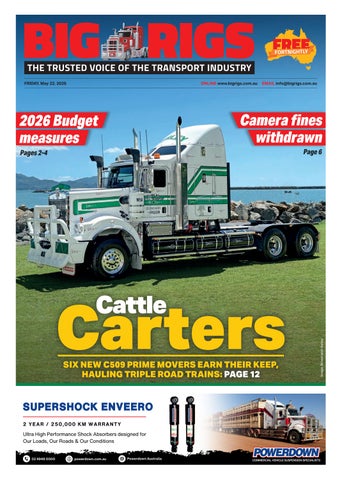
Carting triple road trains of cattle, Curley Cattle Transport’s fleet of Kenworths is put to the test on the daily – with the C509 model now the company’s truck of choice.
BY DANIELLE GULLACI
FOR Curley Cattle Transport’s team of highly experienced operators, no two days are the same. They traverse some of the toughest terrain, all pulling triple road trains of cattle throughout Queensland and into the Northern Territory.
It’s a demanding task that requires equipment capable of standing up to the challenge.
From a single truck in 1972 – a Dodge with a 160 Cummins engine, towing two cattle crates – the fleet today includes 51 late-model Kenworth prime movers, all paired with triple road train sets of stock crates.
As Managing Director of Curley Cattle Transport, Stephen Curley, told Big Rigs, “The fleet has 22 C509s now and 29 T659s. We’re in the process of changing over to the C509s, which the drivers seem to like better.
“We try and replace our fleet completely every eight years, so we’ve been buying six or seven new trucks each year. Our trucks usually do about 130,000-150,000 kilometres per year.”
The latest order, all delivered this year, includes six identical C509s with 50-inch integrated sleepers. They were purchased through Brown and Hurley Townsville, which the company has been purchasing all its trucks through since 1997.
The new C509s are powered by the 600hp Cummins X15, putting out 2050lb/ft of torque, and mated to an Eaton 22 series manual transmission.
As for the trailers, Curley Cattle Transport has remained loyal to Haulmark Trailers for many years.
“All our trailers are from Haulmark. We’ve been using those my whole life. I’m a bit biased but I think they are the best trailers out there and we have such a long-standing relationship with the company, b


picture,” Stephen added. “For the trailers, we’ve been buying two or three sets every year. Trailers can last 20 or more years, so we don’t go through them as much as with the trucks.”
Curley Cattle Transport was started by Stephen’s parents Dawn and Mick Curley. Mick grew up on a cattle

station in Morven, eventually moving to Cloncurry in 1963.
Cloncurry remains the site of the company’s main headquarters, however Curley Cattle Transport now operates from eight sites: Charter Towers, Normanton, Georgetown, Boulia, Blackall, Winton, and its newest site in Mt Isa – the result of a 2023 acquisition of Brennan Transport.
Mick and Dawn have however taken a step back in recent years. “Dad has semi-retired now, but still comes in every day,” added Stephen. “He still has his truck licence too but hasn’t taken a truck out for a few years now.”
As with many family transport businesses, Stephen has grown up in and around the trucks, fondly recalling trips on the road with his father, as a kid.
Stephen, now 52, officially joined the family business at the age of 22. In the last 30 years, he’s seen a lot of change, including the fleet multiplying tenfold.
“Back when I started here in 1996, we only had five trucks. It’s been slow and deliberate progress, with much of our growth being through strategic acquisitions,” explained Stephen.
HAD FIVE TRUCKS. IT’S BEEN SLOW AND DELIBERATE PROGRESS.”
STEPHEN
CURLEY
“If we feel a livestock business is worth buying, we show our interest in acquiring it. The only thing that will stop me is the economy.”
Before joining the business officially, Stephen completed an electrician apprenticeship, spent some time in the workshop, then got his MC licence. Stephen says he knew right away that cattle transport would become his life.
He understands the importance of a modern and well maintained fleet for his drivers.
“Here, it’s one truck per driver, so they have their own truck and own set of trailers. That’s their home. Our game is a bit different to others,” revealed Stephen.
“We typically do about a year’s worth of work in less than nine months, from March to the end of November. Then the wet season comes in and our drivers get a nice break. We put all our trucks and trailers through machinery over that period for the big maintenance items.
“If it’s normal wet season, it’s as quiet as a mouse. Everyone takes at least a month off and they come back fresh. Some of our drivers will start to come back by the end of February.”
Curley Cattle Transport typically moves over 1 million head of cattle each year. On average it’s about 180 animals per triple. “If they’re little enough, sometimes you can put about 300, but with the big fellas it’s about 120 animals,” Stephen added.
It’s a highly specialised role, with drivers having to know the ins and outs of not only their trucks, but also handling livestock.
“Once you leave our depots, you’re your own boss.


Our depots are spread around Queensland, so if a driver leaves for a job on a Monday, they might not get back to base for five days, so they have to be self-sufficient,” said Stephen. “Darwin is the furthest we’d travel. That’s about a 3400-kilometre round trip. The drivers need to know how to grease, service and fix problems out on the road. You’ve got to be an operator rather than just a driver,” explained Stephen.
“A lot of the work involves transporting cattle from station to station, station to abattoir, station to feedlot, and to the port for export. There’s also a lot of inter-station movement for the big cattle companies in Queensland – it could be 1000 kilometres between stations. “I think we have some of the best drivers in the game,” Stephen added. “Some of them have been with me for at least 10 years or more.”


60
At 82 years of age and with over 10 million kilometres under his belt, Alf ‘Dodgy’ Duncan tells Big Rigs, he won’t be parking up any time soon.
BY DANIELLE GULLACI
ALF Duncan has been making life one huge adventure, ever since he sat in the truck for the first time.
From getting his first driving job without a truck licence, to pulling triples across the country, and transporting trailer loads of live crocodiles, Alf has countless stories to tell.
When Big Rigs called, Alf was happy to reminisce and take us on a walk down memory lane.
Alf recently celebrated his 82nd birthday in March, with a trip to Las Vegas to watch the NRL with his son and grandson.
Originally from England, Alf has lived in the small town of Obley, NSW, for the past 10 years. Located about 60 kilometres from Dubbo, he’s one of just six permanent residents to call the place home.
Asked how he got his start in trucking, Alf explained that he finished school and completed an electrician apprenticeship. “When I was working as an electrician, we had a truck, and as I got older, I used to get to have a drive. Then I left that job and didn’t know what I wanted to do. My mate got a job as a tyre fitter, so I went and worked with him.
“Part of my job as a tyre fitter was standing by the bowser, then trucks would come in and I’d check their tyres. One day a driver came in panicked because his wife’s car had broken down and he had to get the kids from school. So I moved his truck around the back for him and got into a heap of trouble from my foreman because I didn’t have a licence.
“A few weeks later, that same foreman asked me to move one of the trucks. I decided to take it down the street and that’s when I saw a sign that said: ‘Driver wanted’. So I pulled up in the truck and applied. Back then in England you had to be 21 to drive a truck, I was 19. He asked to see my licence, I said I’d just turned 21 and hadn’t had a chance to renew it yet. He said it was all good and when could I start.”
Alf probably didn’t know it back then, but that was the start of a lifelong career that saw him travel across the United Kingdom and traverse every corner of Australia.
The first trucks Alf drove were Leylands, Ford Traders and Seddons.
Once he was legally old enough to drive trucks, Alf moved onto a company called McKelvies Heavy Haulage where he operated a 75-foot rear steer trailer – a first of its kind – to transport freight between England and Scotland.
“While I was working at McKelvies, I never read the paperwork,” Alf chuckled.


“I used to drive halfway to Scotland and do changeovers. I did that everyday until I started with the 75 footer. One day, I had a wide load on, running under permit.”
And on this particular occasion, not reading the paperwork landed Alf in hot water. I was supposed to go and unload it, but I brought it another 30 kilometres to the depot – so I got suspended for a day.”
Between that little mishap and getting into driving trucks before he legally could, Alf earned himself the nickname ‘Dodgy’ – and it’s stuck.
Alf first came to Australia in 1961 with his parents and four sisters. He however left two years later, returning down under permanently in 1970, and settling in New South Wales.
He landed his first job here with Roy McDonald Transport in 1970, carrying freight for General Motors; and moved to WJ George driving a Diamond Reo and later a Fiat.
Alf then purchased his first truck in 1978, an Autocar, that he used for Sydney deliveries and then on weekends to relocate houses. His widest load measured over 9.9 metres, taking three full weekends to complete the move between Belmore to Narellan.
He upgraded to a Freightliner powered by a 335 Cummins in 1981, then traded that for a White Road Commander which became famous for being in a TV Commercial for AAMI Insurance, and that was followed by a V8 Powered 142 Scania – and it was quick, very quick.
“That Scania had a 15-speed Roadranger in it which was unusual for the time. I never knew what speed it was actually doing because the speedo only went to 100. I brought it to someone to take a look and work out the speed it was getting up to.”
Alf was shocked to find out it was getting up to speeds of 187km/h!
“So the next time I went to Scania to get it serviced, I asked the guy there to do me a favour and shut that down. He shook my hand and said that in 20 years of being there, I was the first driver who had ever asked him to make a truck go slower!”
After the speedy Scania, Alf bought a Flintstone Mack with his son Craig Duncan. They sub-contracted for Trend Transport, carting steel up to 8 metres wide from Sydney to Adelaide for the Collins Class submarines. Now 54, Craig Duncan has also spent a lifetime in trucking – and Alf taught him young. “When he was 14, we were going from Sydney to Karratha, across the 90Mile Straight. I let him have a drive and said don’t go past 1300 revs. But I nodded off and when I looked back up, he was at 2000 revs!” recalled Alf.
It was 1998 when Alf start-


With the closure of that depot, Alf returned to New South Wales, doing the Sydney to Perth and Sydney to Darwin runs, until he took a slight step back when he finished up in 2025.
ed a long career working for Shaw’s Darwin Transport. “I only finished up with them on July 4 last year, after 27 years.
Much of the work was running Sydney to Darwin and Sydney to Perth – doing everything up to triple road trains. “What we call going around the block,” added Alf. “At one point while I was doing two-up, I did 50 trips from Sydney to Perth in one year alone.”
At Shaw’s, it was all Kenworths, first the T600s and T601s, before moving into the T909s. “The 909s are definitely my favourite truck. I like the big bonnet sticking out the front.”
While at Shaw’s, Alf spent five years living in Kununurra, Western Australia, from 2005 to 2010, and managing that depot.
“I was there until they closed that depot in 2010 because there was no more fruit coming out of there. We went from doing 18 trailers of fruit a week, to nothing.”
During his time there, in 2008, the Baz Luhrmann film ‘Australia’ was filmed in Kununurra. “That was a bad year for produce but the depot was kept busy transporting all the film stuff, including a huge fake baobab tree made of fibreglass.”
“I enjoyed those long trips with Shaw’s. Sometimes I’d be away for five weeks, living in the truck,” said Alf.
“It was generally always to Perth and Darwin, but sometimes I’d to Cairns with live crocodiles, transported in a refrigerated trailer at 9 degrees. You’d come up with three trailers on, leave two at Cloncurry, and then bring the trailer with 16 pallets of crocodiles to the crocodile farm in Cairns.”
Though Alf retired from his long time role at Shaw’s and has taken a slight step back, he’s by no means planning on giving up life on the road any time soon.
When he chatted with Big Rigs, he’d recently returned from a Sydney to Tasmania trip, taking a load across on the ferry. And prior to that, he did a 10-day trip that saw him travel Sydney to Cairns, then down to Adelaide, across to Melbourne and back home again.
Asked if he had many more miles on the road left in him, Alf was quick to respond, “Bloody oath!
“I’ve got a two-week job coming up in a T601, bringing furniture down to Melbourne. This is just what I do – I’ve loved it ever since I first started driving trucks.
“I don’t care where I go, this job has given me a chance to see the world.”


Our test driver puts Hino’s 700 Series range through its paces, including the new in-house 12-speed AMT designed for highway and heavy-duty work.
BY GEOFF MIDDLETON
THE Hino 700 Series is not new. It was launched in its current guise in 2019. However, the 700 Series has a rich and popular history.
Hino’s entry into the heavy-duty market came in 1981 with the Super Dolphin Series in Japan.
In 1992 it was redesigned and became the Super Dolphin Profia and then later simplified to the Profia, but for most export markets, it was simply known as the Hino 700.
The current 700 Series was first seen in Japan in 2017 and then here two years later. It was further updated halfway through 2021 where it received the interior and modern 9.0-litre and 13-litre engines that we see today.
It was with this upgrade that the 700 Series was launched with Euro 6 compliance which was only mandated in this country for new trucks this year.
So, what’s all the fuss about? Well, the purpose of this extended drive program over two days and consisting of no fewer than eight trucks, was to demonstrate the extended model range of the 700 Series and the addition of a new Hino-manufactured 12-speed automated manual transmission (AMT).
The new transmission will sit alongside the existing sixspeed Allison automatic box and the 16-speed ZF AMT.
Power remains the same with the 9.0-litre A09C with a choice of outputs of 320hp with 1275Nm of torque and 360hp with 1569Nm and the 13-litre E13C with either 450 or 480hp and 2157Nm of torque across the board.
The availability of the new Hino M112 12-speed AMT with either engine provides Hino with eleven additional 700 Series models.
The new FH1836 4x2, FS2636 6x4 and FY3036 8x4 models feature the Hino M112 12-speed AMT, mated to the reliable A09C-VN engine, which produces peak power of 360hp (265kW) and 1569Nm of torque delivered from 1100 to 1600rpm.
“The new 360hp with 12-speed AMT drivelines are well suited to the stopstart demands of metropolitan general freight and vocational applications – they are also ideal for heavy rigid


customers driving in regional areas, or those requiring more towing capability than the existing 320hp automatic models can deliver,” said Daniel Petrovski, Hino’s Department Manager of Product Strategy.
“All of the new driveline combinations with the 12-speed AMT feature a 3.9:1 final drive ratio, meaning the new models sit at about 1600rpm while cruising at 100km/h in top gear.
“The ability to select 11th gear at 100km/h and ascend inclines at full power makes the new models particularly well suited to customers seeking a fuel-efficient highway operational vehicle that a lso delivers the performance required for Australia’s regional highways.”
The FS2845 – available with either an airbag or leaf spring drive axle – utilises the E13C 13 litre engine and the new M112 Hino 12-speed AMT to deliver 450hp (331kW) and 2157Nm of torque.
“It’s an ideal truck for councils and civil works operators that require the flexibility to operate as a rigid tipper and

to also tow a pig or dog trailer,” said Petrovski.
“The Hino 700 Series range is expansive with 31 models that appeal to almost any operation.”
The already existing range offers FH 1832 4x2, FR 2632 6x2 and FS 2632 6x4 models with the A09C engine delivering 320hp and 1275Nm via a six-speed Allison 3200 true automatic transmission, while the FY 3036 8x4 models deliver 360hp and 1569Nm via the larger and stronger six-speed Allison 4400 true automatic transmission.
The FS 2848 6x4, SS 2848 6x4 and FY 3248 8x4 models with the 13 litre E13C 480hp 2157Nm engine is also available with the popular ZF 16-speed AMT, the TraXon TX 2441TO, which features the market-leading ZF intarder.
“Both the A09C and E13C engines comply with Euro 6 emission standards through a combination of Selective Catalytic Reduction (SCR) system, cooled Exhaust Gas Recirculation (EGR) and the Hino Diesel Particulate Active Reduction Filter (DPR),” said Petrovski.
On the road
Our two-day drive took in some typical roads that the Hino 700 Series would travel during the course of an intra-state or even an interstate drive.
We started off at Hino’s HQ in Sydney and did some city driving before heading south down the notorious Mount Ousley to the south coast of New South Wales. From there, we picked up the


Kings Highway, up the equally notorious Clyde Mountain to end up in Canberra.
Along the way, we swapped in and out of trucks to really get the feel for the different models and really test out the new transmission.
It was a bold move by Hino to give us a really challenging drive program and reinforced the company’s faith they have in the 700 Series.
On the trip, the 12-speed transmission performed faultlessly. It changes smoothly up or down and is never flustered or found hunting for gears.
On the descent down Mt Ousley, I found that manually selecting seventh gear in the box held the loaded 700 Series that I was driving to around 40km/h (which is the truck speed limit on that hill) without having to use the service brakes at all.
The 700 Series trucks have a stalk on the left-hand side of the steering column that controls the Jake brake and there
is a little button on the end that shifts the box between manual and auto operation.
Back on the flat, a flick to auto mode and the truck purrs along nicely on the highway quickly reaching 12th gear and cruising effortlessly with the traffic.
Approaching a hill, a quick flick of the mode button and a press on the shifter to kick it down to 11th or even 10th and the truck marches up without losing speed.
On the steeper grades, like Clyde Mountain, I found that the combination of the 13-litre engine and the 12-speed AMT was the pick of the bunch.
I was fortunate to have a 480hp tipper under me on the run up the hill and it was a beauty with ninth and 10th being the gears of choice and the occasional kick down to eighth for the really tight hairpin bends.
Don’t get me wrong, the Allison six-speed is a fine
transmission and the ZF TraXon 16-speed has proven itself over the years, not only in the Hino 700 Series but in many other brands of trucks as well, but for the kind of work we did on our two-day drive, I think the new Hino 12-speed is a beauty.
I’ll stick my neck out and say that the six-speed would be great for around-town work where its quick shifting properties and smooth changes would be suited to stop-start traffic and delivery work, whereas the 16-speed and new Hino 12-speed would be better suited to highway and long-distance driving.
Overall, with the new 12-speed transmission and additional models in the lineup, there really is a 700 Series Hino for everyone. It’s a versatile truck that combines comfort, safety and Hino’s reputation for reliability into a versatile truck that can suit a myriad of
plications.


This trusty old S-Line is a trip down memory lane, and a chance to reminisce about a childhood spent in the passenger seat with his father and grandfather.
BY DAVID VILE
IT’S a catchphrase that has been used in times past to portray the venerable International model that first hit the highways in Australia in the late 1970’s – “Looking fine in an S-Line”.
Quickly earning a reputation as a tough, no-nonsense truck, the S-Line became a popular choice for both owner drivers and fleet operators in a variety of applications for the best part of two decades.
While the International nameplate has for the most part sadly disappeared off the trucking scene in Australia, the brand and S-Line model is still a popular choice as a ‘farm truck’, and in the case of Kade McLachlan, an ideal truck to work on and restore to past glory.
Located at Big Springs near Wagga in New South Wales, Kade is the proud owner of a 1988 S2600 model. In taking delivery of the International three years ago, he has followed in both his father’s and grandfather’s tyre tracks, in getting behind the wheel of an S-Line.
“I spent a lot of my childhood riding shotgun in S-Lines, my father and grandfather both ran truck and dog tippers around Wagga, so I got this as a throwback to my childhood to tinker away with,” he explained.
Having been on the lookout for a suitable S-Line to take on, it was the sale of another project truck that helped him on the way to buying the International out of Warragul in Victoria. “I had an old R-Model Mack which I only paid 2 grand for,” explained Kade.
“I did a lot of work to it but it really needed a full strip down to the chassis rails and rebuild. I couldn’t afford that so I parted ways with it and sold it for $15,000.
“I was actually looking at two S-Lines, this one and another one at Avenel. I ummed and ahhed, so thought I would check out the one furthest away and then check out the other one at Avenel on the way home. I took one look at this and that was that. I was set!
“It had been owned by a fencing contractor who had been using it to cart his machinery and fencing stuff around.”
Driving the S-Line home on a permit, Kade did a couple of little maintenance jobs before giving the truck its first serious workout, making the trek up into northern New South Wales to the Casino Truck Show, where it performed well on the roughly 2300-kilometre round trip.
“She never missed a beat, I had a trailer on behind it with a mate’s Kenworth K123 all loaded up and she hauled arse all the way – we went inland going up and came back down the coast road home and there was not a fault in it that I could find,” he said.
Going by the faded ‘Cummins320’ badge on the bon-


net, it would seem the old girl has had a heart transplant somewhere along the line as today a NTC 400 sits between the chassis rails, coupled to a 15-speed Direct Roadranger.
Kade has recently invested some dollars getting the Cummins overhauled and has also done a bit of work on the radiator and also inside the cab, replacing the hood lining and the sock from the cabin into the sleeper.
Externally, the duco on the International is looking a bit battle worn but Kade has some plans in the pipeline to rectify that. “The idea is to give it a full respray, take the bonnet and bunk off it and maybe the cab. There’s a bit of rust in it to chase out but for a 38-year-old truck you would expect a few things like that.
“I have no idea of the paint as to who’s colours they were, but you can still see the original scroll work and so forth. Of course, back then it was all done by hand, and someone has taken the time to do it properly. It’s a nice standout colour scheme, it’s a bit different.”
With diesel running in his blood, Kade completed a trade qualification in Wagga before Bombala and Bendoc.


Now back home on the family’s 64-acre property at Big Springs, his daily drive is a Mack Trident truck and dog tipper combination owned by Kennedy Brothers from Wagga.
With the S-Line running on club registration, Kade is a member of the Australian Road Heritage Centre club based in Gundagai. “It’s a great little club and I go to all the meetings. There’s no stresstive with each other striving for awards. They do it for the love of it and have fun,” he said. And having fun is all part of the program for Kade, being a regular attendee at a number of events throughout southern New South Wales, along with


doing the popular Crawlin’ and Haulin’ the Hume events from Melbourne and Sydney, respectively.
“I have a 41-footer Freighter trailer and an old Fordson tractor which I use as a counterweight to keep it all on the ground. It’s great fun getting it all hooked up and doing the Hume runs with the old blokes. It’s just great to hear how they used to do it back in the day,” he said enthusiastically.
With the ‘Inter’ now firmly part of the family, Kade plans
to keep working away on his project truck and to keep the S-Line ticking over for some time yet, while taking in a few more shows and get-togethers along the way. “It’s just a toy for me, I did think about doing a bit of harvest work or something with it but I will let her rest. I wanted to be a bit different in getting a truck to work on and this is a nice throwback to my childhood. I have had people offer me good money for it, but I just have too much sentimental value in it.”


SHELL Rimula has partnered with Big Rigs in a big way – so there are even more reasons to send in your best truck shots.
Each month, the Big Rigs team will choose a #PicOfTheMonth, with the lucky winner receiving a $500 Shell Coles Express Gift Card.
Keep an eye out for our regular posts on the Big Rigs Facebook page, calling for your best truck photos and add yours in
the comments, or email them direct to danielle.gullaci@ primecreative.com.au for your chance to win the main prize.
Don’t forget to include a brief note about the truck and where the photo was taken. We’ll feature some of the best photos in each print edition of Big Rigs, with one winner announced each month.
Keep those amazing truck pics coming!


ARMOURY Group has never been a company that stands still.
From the beginning, the focus has always been on building better products, improving customer experience, and continuing to push forward.
Over the past 12 months, that mindset has driven major developments across the business, from expanded operations and new facilities through to evolving product ranges and next-generation wheel finishes.
One of the biggest developments over the past 12 months has been the expansion of Armoury Group’s workshop and warehouse operations.
Originally based entirely out of Penrith, Armoury Group expanded into Melbourne at the start of last year with the opening of its Epping workshop and fitting facility.
Following continued growth and increased demand, the business has now expanded
again into a significantly larger Melbourne workshop and warehouse facility at 64 Yale Drive, Epping.
The expansion has allowed Armoury Group to increase wheel stock holding, improve supply capability, and we can now offer same day dispatch from both Sydney and Melbourne.
At the same time, the Penrith sales team has now moved into the main Leland Street facility, bringing sales, manufacturing, and workshop operations together under one roof while keeping all stainless manufacturing based at Armoury’s original Penrith workshop.
The expansion was driven by one of the biggest milestones in Armoury Group’s history.
Armoury wheels are now available on Kenworth trucks from factory.
This is a major step forward for both the business and its customers. Operators

can now access premium Armoury wheel packages directly through Kenworth factory orders, backed by increased stock holding and improved supply capability through the Kenworth dealer network.
It also represents the continued confidence major industry manufacturers are placing in Armoury products and the standards behind them.
While operations continue to grow, product development remains a major focus within the business.
Last year, Armoury Group released a dedicated Volvo stainless accessories range, specifically designed to suit Volvo trucks. The range has already seen strong demand, with development continuing across multiple new stainless categories.
Armoury is currently developing an entirely new stainless range, with more announcements still to come later this year.
Innovation across the wheel range hasn’t slowed down either.
Recently, Armoury Group introduced the next generation of its ArmourBrite finish, now known as Next Gen ArmourBrite.
ArmourBrite has built a reputation as the ultimate easyclean finish. Designed for trucks that work hard and still need to look sharp doing it. The updated finish delivers even better durability and easier maintenance while

maintaining the appearance and low-maintenance benefits customers already know ArmourBrite for.
Looking ahead, another major development is already on the horizon.
Later this year, Armoury Group will begin rolling out Legend Chrome V2 across its main wheel range. Already recognised as one of the industry’s leading high-shine finishes, Legend Chrome has become a standout choice for operators chasing premium appearance without compromise.
Legend Chrome V2 will take that even further.
Across every part of the business, the goal remains
the same. Continue improving, continue innovating, and continue delivering products that work as hard as the trucks they are fitted to.
The
never stands

FATIGUE remains one of the most complex safety risks in the heavy vehicle industry, with operators continuing to look for practical ways to identify fatigue risks earlier, supporting safer decision-making on the road.
As fatigue management technology evolves, fleets are increasingly looking towards predictive safety systems that detect risks before fatigue events occur. Through FleetPREDICT, WHG Technologies is helping define smart wearable fatigue management; an emerging category combining science, predictive analytics and real-world fleet technology.
Developed by WHG Technologies in conjunction with Sleep Advice Technologies (SAT), FleetPREDICT combines biometric data and predictive analytics, paired with a Garmin smartwatch to identify fatigue risks 1 to 8 minutes
before potential micro sleep events occur.
“FleetPREDICT has been scientifically validated through simulations and sleep studies,” explained WHG Director of Operations Dylan Hartley.
“There are three levels of monitoring. The first is that you’re fit to drive. The second level is inattention, generating a warning alarm to alert the driver they are beginning to fatigue and should pull over and rest.
The third level is the fatigue alarm, occurring 1-8 minutes before micro sleep. This triggers an audible alarm in-cab, the smartwatch vibrates, and the phone provides an audible and visible alarm.”
Australian research has found that validated ocular, camera-based driver monitoring systems can detect up to 66 per cent of severe fatigue-related impairment events and reduce events by up to 55 per cent in


real-world fleet trials. While this reinforces the value of camera-based systems, it also points to the need for additional technologies that can recognise risk earlier and through different data inputs.
FleetPREDICT is designed to provide that additional layer. For some fleets, it may offer a non-camera alternative. For others, it works alongside existing camera, telematics and fatigue systems, utilising biometric data and fatigue prediction science. FleetPREDICT has been scientifically validated at above 90 per cent accuracy through simulations and sleep studies, offering a higher level of predictive accuracy than traditional camera-based fatigue detection systems.
“With fatigue cameras, the system is generally looking for visible signs such as yawning, eye closure or distraction.
While those signs are valuable, there’s a distinct difference between visible signs of tiredness and physiological fatigue risks,” Dylan said. “Wearables provide another way to understand fatigue without relying on incab video. Driver feedback has highlighted the appeal of systems that support fatigue prevention without drivers feeling like they’re being watched.”
Garmin Health Head of Sales, Harry Gasiamis, added that FleetPREDICT has provided an added level of functionality to its smart watches.
“A smartwatch is something already being used by people in day-to-day life – to tell the time, if they play golf on the weekend, go for a run or jump on a bike,” said Harry. “There is already trust built into the Garmin brand. Now, truck drivers can use that same piece of trusted technology to under-
stand their fatigue levels and keep them safer while driving.”
Harry added that FleetPREDICT provides longitudinal data, allowing operators to better understand fatigue patterns over time. “This is really important when you’re trying to understand how people are behaving. FleetPREDICT applies the science across a broader data set. It also avoids some of the physical challenges that can affect camera-based systems, such as drivers getting in and out of the cab, or wearing glasses, hats or visors.”
FleetPREDICT has been backed by the National Heavy Vehicle Regulator’s (NHVR) Heavy Vehicle Safety Initiative (HVSI), supported by the Australian Government, as one of 12 industry-led projects selected last year to share in HVSI funding. This has seen the beginning of real-world FleetPREDICT technology trials with four Australian fleets: Linfox, Wettenhalls, FBT Transwest and Team Transport. With these trials now several weeks in, Dylan says the feedback has been positive.
“What’s been fascinating is that even with all the existing technology in fleets today, fatigue remains one of the major challenges. Coming across strongly through these trials is how FleetPREDICT’s scientifically validated technology helps manage fatigue risks for operators,” Dylan explained.
“Drivers like that all they
need to do is carry on with their usual day, while wearing a smart watch. The operators we’re currently working with have also expressed interest in trialling FleetPREDICT in warehouse and production environments; it is encouraging to see this level of engagement.” Harry also shared his views on the operator trials. “It’s really exciting to see that this technology is starting to gain traction.”
“We’ve seen the science behind what WHG and SAT have built – it’s sound and it’s exciting to see where it’s going. We expect the results of these trials will be encouraging and further back the research that’s already been done.”
To learn more about the trial visit marketing.whgsolutions.team/ F leetPREDICT-Trial. For more information on WHG Technologies, visit whg-telematics.com.

BY JAMES FRENCH
REGIONAL SALES MANAGER AT TELETRAC NAVMAN
IN the transport industry, inefficiency rarely announces itself with a stranded truck or a missed delivery window. More often, it shows up quietly – vehicles sitting idle between jobs, assets held back “ just in case”, or equipment brought in at short notice because availability feels uncertain.
In that environment, caution can feel like good management. But over time, uncertainty carries a real cost – t ying up capital, limiting productivity and pushing operating expenses higher than they should be.
Recent research shows how widespread this has become.
Teletrac Navman’s ‘Mobilizing the Future of Fleets: 2026 Equipment Utilisation Edition’ report found that businesses across construction, transport, manufacturing, energy, facilities and retail often have assets sitting idle because teams struggle to access and act on the data they already have. In fact, 74 per cent of operators cite data accessibility as the biggest barrier to improving utilisation.
Underutilisation is rarely about effort. More often, it comes down to confidence –knowing what assets are doing and trusting the informa-

tion used to make decisions. Good utilisation starts when organisations move beyond simply knowing where assets are to understanding how they’re being used. With fuel and energy costs rising, every allocation decision needs to make economic sense. Used well, utilisation data can support real-time decisions on truck and equipment deployment – not just end-of-month reporting.
Speaking to large fleet managers, the patterns are familiar. Vehicles are held back because maintenance is due, parts availability is unclear, or job schedules are shifting. Assets stay parked because no one wants to release a truck that may be needed tomorrow. The same applies to non-truck assets such as tractors and forklifts in con-
struction and manufacturing. Teletrac’s research found that 67 per cent of organisations admit assets are sometimes held on site without being actively used – not due to poor discipline, but as a rational response to incomplete or unreliable information.
This “just in case” behaviour is driven by uncertainty. Project teams hesi-
tate to release assets because they’re not sure they can get them back when needed. Without objective utilisation data, decisions default to judgement and habit instead of the assurance tracking and utilisation insights can provide.
Uncertainty also drives reactive decisions elsewhere. Nearly a third of organisations say maintenance requirements regularly disrupt operations, and 27 per cent report frequently renting or purchasing additional equipment to cover unavailable assets. The result is a costly cycle: idle equipment in one part of the operation and urgent spending in another. This is especially frustrating because digital investment is already widespread. The research shows 87 per cent of fleets have invested in digital technology to monitor util-

isation, yet many have not achieved the outcomes they expected.
Often the gap is integration.
Three-quarters of organisations still rely on manual logs, either as a primary method or alongside digital systems. Manual records are familiar, but they’re prone to inconsistency and error – especially in fast-moving transport environments.
The biggest risk is confidence. When manual records don’t align with digital data, teams revert to what feels familiar rather than what’s verifiable, creating blind spots, slowing decision-making and undermining trust.
That helps explain why only 28 per cent of organisations say they have fully implemented digital tracking systems, despite recognising the strategic value of better utilisation insights.
Breaking the cycle of underutilisation doesn’t require radical change. It starts with a data-led culture that shows what the fleet is really doing day to day – not just where assets are, but how consistently they’re working and where downtime is creeping in.
When teams can clearly see which assets are productive and which aren’t, decisions become more confident. Utilisation data starts shaping

planning, maintenance and investment choices, rather than sitting in a report. When utilisation data is trusted, decisions get easier. Maintenance can be planned around actual usage, assets can be redeployed with confidence, and managers can challenge long-held assumptions with evidence rather than instinct.
In an industry where margins are tight and reliability matters, Teletrac Navman’s research suggests the opportunity is often simpler than adding more trucks: improve confidence in what you already have. Trusted utilisation data becomes a practical dashboard for the fleet – turning uncertainty into clear signals so leaders can cut waste, improve planning and keep operations moving.

WHAT makes a heavy-duty truck repair shop efficient and reliable? The answer lies in having the top tools for heavy-duty truck repairs.
The right equipment is essential for truck maintenance, enabling technicians to work faster, reduce downtime, and provide better service.
Well-equipped service trucks ensure smooth operations, helping businesses boost productivity and profitability by eliminating wasted time and inefficiencies. Investing in quality tools is a game-changer for any repair shop.
Complete Steering Australia (CSA), was established in 2001 after Complete Truck
Alignment (founded in 1988).
CSA offers the largest range of heavy vehicle power steering products in Australia, covering a wide array of makes and models. It provides commercial truck and bus steering services and products for US and European heavy vehicle brands –including Kenworth, Western Star, Freightliner, Mack and Volvo.
The business has locations in Melbourne and Brisbane –and provides a full driveway service for both on-truck and bench work.
CSA and its agents are wellstocked to provide better service to customers and increase efficiency.
High-quality equipment in service power steering and linkage trucks is crucial for efficient operations.
CSA understands the importance of having the right tools for heavy-duty truck power steering repairs and truck maintenance. Regular assessments and updates of equipment and technology are vital for maintaining a competitive edge.
A comprehensive set of tools is also essential for performing repairs effectively.
A special range of tools are required for heavy-duty truck repairs, such as diagnostic equipment. These tools help keep repairs safe and efficient.
Onboard diagnostics (OBD) systems give real-time info on truck power steering health, helping fix issues quickly.

Good diagnostics are key for keeping trucks running well and safely.
In a first for the trucking industry, CSA has developed its own patented Australian made Sector Lash Adjustment Kit.
This special tool is designed to make the sometimes overlooked job of lash adjustment uch simpler – challenging the long-held assumptions about what constitutes “routine” steering maintenance.
The k it works with major steering systems found across Australian fleets, including Kenworth, Western Star, Freightliner, and ZF/TRW


TAS gears. It’s a tool that is straightforward, practical, and ready to use.
CSA is also the sole distributor for Wallmek tools in Australia and New Zealand. Wallmek is a Swedish brand that has been manufacturing


Truck steering repairs include:
• Regular maintenance on all linkage for safety and efficiency with reduced driver fatigue and smoother steering.
• Buying advanced diagnostic tools to cut down on downtime and repair costs available through Complete Steering Australia.
• Only use manual grease gun on grease nipple on sector shaft bearing on C service. Over greasing with pneumatic or battery grease gun will over grease the area and will damage the inner high-pressure seal.
• Do not use high pressure washer on steering gear as this can damage the seal areas and contribute to water ingress.
time saving tools since 1978, producing and designing specialty tools for cars, trucks and buses. It produces a wide range of products, from rod end and king pin hydraulic removers to basic truck and bus garage packages.
• Mistimed drop arm or pitman arm can damage the poppet plunger when first installing a new or remanufactured steering gear.


FUEL volatility is nothing new to the transport and logistics sector, but every major disruption tests the resilience, preparedness and communication capabilities of operators across the industry. Recent global events have once again demonstrated how quickly international instability can impact local operating costs, margins and project delivery expectations.
The latest fuel crisis has created significant pressure throughout the sector, particularly for businesses managing large fleets, remote operations and fixed-price contracts. However, successfully navigating sudden fuel impacts is not simply about reacting to price rises – it is about applying lessons learned from previous market shocks and maintaining transparency with clients throughout the process.
Many operators still remember the rapid escalation in fuel pricing following the outbreak of the Russia/Ukraine conflict. Oil markets responded almost immediately, creating substantial increases
in diesel prices and placing enormous strain on transport providers already dealing with supply chain instability and labour shortages. The speed of those increases highlighted an important reality for the industry: preparation and decisive action matter more than waiting for stability to return.
W hen the United States launched its “Epic Fury” campaign targeting Iran, it was predictable that similar fluctuations in global oil pricing would occur. Rather than waiting for the market response to fully materialise, ECS management moved immediately to mitigate the impact. Fleet teams fully fuelled as many trucks as possible as soon as news of conflict escalation broke, effectively creating a short operational buffer against the first wave of price increases. While this did not eliminate the broader cost impacts, it provided valuable time to begin structured communication with clients regarding ongoing and upcoming projects. Early response in periods
of rapid market movement is critical.
Any fuel crisis highlights the need to maintain multiple fuel supply arrangements. Businesses relying on a single supplier place themselves in a vulnerable negotiating position during periods of volatility. Holding multiple fuel accounts creates flexibility and allows operators to compare pricing, availability, and regional supply conditions in real time. Equally important is the need to negotiate immediately and aggressively with suppliers once supply constraints begin to emerge. Delays in negotiation can significantly increase operational exposure over even a short period.
Technology also plays a major role in managing fuel costs effectively. Real-time tracking and IVMS systems are no longer simply compliance or safety tools – they are operational decision-making assets.
Monitoring truck movements alongside live fuel pricing enables businesses to adjust scheduled refuelling locations based on current market con-

ditions. Small savings per litre across a large fleet can quick ly translate into meaningful cost reductions over weeks or months of instability. Dy namic scheduling and route management are becoming increasingly important capa bilities for operators seeking to remain competitive during volatile trading periods.
Perhaps the most important factor of all, however, is cus tomer communication.
Fuel crises create pressure on both contractors and clients alike. Attempting to absorb escalating costs silently often leads to damaging outcomes later in the project cycle, in cluding disputed variations, strained relationships and unexpected invoices. Early and decisive customer negotiation is essential. Transparent discussions around market conditions, operating impacts and possible pricing adjustments help create collaborative solutions rather than adversarial disputes.

is not the increase itself, but poor communication surrounding it. Clear, honest and proactive engagement allows both parties to manage expectations and plan accordingly.
The reality is that clients generally understand global events influence operating costs. What damages trust
The transport and logistics industry will continue to face external pressures driven by geopolitics, energy markets
and global supply chain uncertainty. While no operator can control international events, businesses can control how they prepare, respond and communicate.
In times of disruption, operational agility and transparency remain two of the strongest tools available to industry leaders.


RUNNING a transport business is full of pressures and it’s not getting any easier. Rising costs. Driver shortages. Compliance pressures. Fuel uncertainty. Infrastructure constraints. More paperwork, more regulation and less time to focus on running your business.
At the Queensland Trucking Association (QTA), we believe transport operators need more than an association that simply talks about problems.
You need people in your corner who are prepared to
take action – and people you can trust to look after your business and your interests.
At QTA, our members drive what we do and why we do it. We take the time to genuinely understand your business – whether you’re an owner driver, a family operation or a major fleet. We want to know how your business runs, the challenges you face and where you need support. That direct connection shapes our advocacy, services and resources every day.
Building trust with members is central to how we op-
erate. We want operators to k now they can pick up the phone, ask for help and have confidence that someone will work alongside them to find practical solutions.
And while we are proudly Queensland-based, our support extends well beyond the border. We understand transport businesses operate nationally, and many of our members move freight across the country every day. Wherever our members operate, QTA is there to support them.
Too many operators tell us

they feel disconnected from associations that no longer understand the realities of transport. At QTA, we stay close to industry and focused on outcomes that make a genuine difference to businesses.
Importantly, our work is not just about identifying problems. It’s about helping solve them.
Workforce shortages remain one of the industry’s biggest challenges. QTA has invested heavily in workforce initiatives like Driving Futures and the Heavy Vehicle Safe Driver Program – practical projects designed to attract people into the industry, improve skills, support safer operations and help businesses build a stronger workforce for the future.
We also maintain a strong national advocacy focus on issues directly impacting operators, including sham contracting, the fuel crisis, industrial relations pressures and the need for fair operating conditions across the supply chain.
At the same time, we continue pushing for smarter road and freight infrastructure investment to improve safety, productivity and efficiency across the industry. Better roads, better access and long-term freight planning are critical to the future of every transport business in Australia.

Our advocacy is strategic, constructive and agile. We respond quickly when issues emerge, while also building strong, evidence-based advocacy positions that create long-term industry change.
What also sets QTA apart is our people.
We have the largest team of any transport association in the country dedicated to servicing members. Every day, our team works directly with operators on compliance, industrial relations, safety, training, business advice and operational challenges. For many members, that personal support becomes an extension of their own business.
QTA is also an incorpo-
rated company governed by a Board of Directors and operates under strict ASIC governance and audit requirements, giving members confidence that the Association is professional, accountable and built for the long term.
At the heart of everything we do are our core values –putting members first, thinking long term, embracing innovation and standing up for what is right for industry. The road freight industry keeps Australia moving and QTA exists to support the businesses behind it – with more action, less talk, and a genuine commitment to operators every day.


MELBOURNE-BASED
refrigerated freight operator
CoolTrans says it is already seeing fuel savings after adding one of Australia’s first Mercedes-Benz Actros ProCabin models to its fleet.
CoolTrans delivers a range of food products up and down Australia’s east coast and across to South Australia and Tasmania.
Its new aerodynamic ProCabin was put to work in February towing B-doubles.
“The previous Actros really set the standard for fuel economy, but this new one is more efficient again,” said CoolTrans General Manager, Jono Hookway.
“It’s a clear improvement, which is great for us.”
The new Actros ProCabin has been shaped for maxi-
mum fuel efficiency through aerodynamics, featuring a rounded nose and smooth panels to cut consumption.
Jono said driving down fuel consumption is critical.
“Saving money on fuel has always been important but it is even more so now with the price of fuel. It just makes sense to reduce the costs you can control,” Jono said.
CoolTrans also has a strong focus on sustainability. The company switched to Euro 6 emission level trucks when it started purchasing Actros models back in 2018, well ahead of any legal requirement to do so.
“Sustainability is a key part of our operation, which is another reason we choose Mercedes-Benz trucks,” Jono added.

This time, CoolTrans chose a 2663 model with the taller GigaSpace cab fitted with the approved DuraBar bullbar. The truck was sourced through Daimler Trucks AJL Hobart.
While efficiency was a leading driver for CoolTrans, it a lso places a sharp focus on safety.
“Safety is absolutely at the centre of everything we do at CoolTrans, so Mercedes-Benz is a natural choice given how much safety technology they have in their trucks as standard,” Jono said.
All Actros models now feature the Active Brake Assist 6 Advanced Emergency Braking Systems safety package that includes five radars providing a 270-degree view
around the vehicle and allow ing for optimum operation of the Active Side Guard Assist 2 system.
The backbone of this safety suite is a new electronics plat form that can process data 20 times faster.
Daimler Truck Australia Pacific Vice President Sales, Marketing and Operations, Andrew Assimo, was glad to hear how well the Mer cedes-Benz ProCabin was performing for CoolTrans.
“We knew the ProCabin would use less fuel, but to hear our customers tell us how they are benefitting is just brilliant,” Andrew said.

“Driving fuel costs down has never been more critical to business success, which makes the ProCabin an even smarter choice.”


The CoolTrans Actros is a 2663 featuring a 630hp 16-litre Mercedes-Benz engine teamed up to a 12-speed Automated Manual Transmission. It’s also equipped with the taller GigaSpace cabin.
Mercedes-Benz extended the front of the new Actros Pro Cabin by 80mm and then rounded off the face to reduce drag.
The clever ProCabin design removes unwanted gaps and joints and guides air either around the cabin or straight into the truck’s cooling system.
This concentration of the

JONO HOOKWAY
airflow maintains the cooling effectiveness of the Actros. There are also new sailshaped side air deflectors at the rear of the cabin and a new roof spoiler as well as a new under-cab spoiler. Along with the new exterior design, these features reduce air turbulence and improve air flow. IT JUST MAKES SENSE TO REDUCE THE COSTS YOU CAN CONTROL.”


IN the Australian transport industry, half a century is a milestone that speaks for itself.
For 50 years, Lelox has been a staple on the chassis of the nation’s hardest-working rigs. From the early days of manufacturing mudguards on the factory floor to becoming a leader in heavy road transport accessories, our mission has always been to keep the wheels turning with Australian-made quality. Today, we aren’t just looking back at where we’ve been; we’re looking at where the industry is going.
Respecting the legacy, engineering the future
You only have to look at any truck stop or highway to see the Lelox legacy in action. There are thousands of our classic 1.2mm stainless steel guards currently on the road, and they’ve served the industry incredibly well for decades. They are products built on a foundation of reliability, and they remain a testament to what local manufacturing can achieve.
However, as trailers get bigger and the conditions on our highways get tougher, we knew it was time to take that proven design and “beef it up”. After 50 years of experience, we didn’t want to just rest on our laurels. We wanted to provide the next generation of transport operators with even more muscle and a level
of refinement that was previously thought impossible for heavy-gauge steel.
The 1.6mm powerhouse: Strength without compromise
The biggest change in our new range is the move to a solid 1.6mm heavy-duty stainless steel. By increasing the gauge, we’ve significantly increased the structural integrity of the guard, making it more resistant to the constant vibration and road debris that define a life on the bitumen. This is a guard built for the long haul – designed to be the strongest on the market while maintaining the classic look that drivers have trusted for five decades.
But we didn’t stop at the thickness. To handle this heavier steel, we spent three years developing a custom-built machine that is unique to our Australian facility. This machine allows us to achieve a “ripple-free” edge. While our older guards have reliably served the industry for years, this new technology allows for an even smoother, sharper finish. It’s a subtle refinement that ensures your rig looks as precise as it is powerful.
A signature finish that leads the pack
Our Signature Series remains the benchmark for drivers who take immense pride in their presentation. Featuring

our refined three and four groove designs, as well as no grooves in a True No. 8 Mirror Finish, these guards are designed to hold their shine against the harsh Australian sun and corrosive road grime. We’ve worked hard to ensure that this finish is deeper and more durable than ever before. We’ve proven that you don’t need to look to international suppliers to find a premium


aesthetic. By combining 50 years of heritage with this new 1.6mm “beefed-up” construc tion, we are delivering a prod uct that looks better on day one and stays looking better for years to come.
Better value through local innovation


One of the most important aspects of our 50-year histo ry is our commitment to the Australian “fair go”. We’ve mastered the production pro cess right here at home, which a llows us to challenge the idea that imports are the only high-end option. By manufacturing locally, we eliminate the heavy costs of international shipping and middleman markups. This means we can offer a superi or, thicker 1.6mm guard at a price point that actually beats the overseas alternatives. We’re supporting the bottom line of Australian transport business es while keeping our manufac turing jobs right here.


IN Queensland’s heavy automotive industry, success is rarely accidental. It’s built through hard work, strong values and a commitment to developing great people, particularly apprentices. For small businesses like Kel Stanton Mobile Diesel, investing in the next generation of tradespeople hasn’t just supported workforce growth; it’s helped build an award winning operation grounded in skill, trust and long term thinking.
Kel Stanton Mobile Diesel is the kind of business many apprentices aspire to work for. Known for high quality workmanship and dependable service across Queensland, the business has grown steadily by focusing on people as much as performance. Central to that approach is a belief that apprentices are not a short term solution to skills shortages, but a long term investment in the future of the industry.
“Apprentices are awesome for business,” Kel said.
“When you bring someone in early, train them properly and support their development, you’re not just filling a role –you’re building capability.”
That philosophy has paid off. Through employing
and mentoring apprentices trained with TAFE Queensland (RTO 0275), Kel Stanton Mobile Diesel has fostered a skilled, loyal workforce and earned industry recognition, including an Apprentice Network Small Employer of the Year Award at the 2025 TAFE Queensland – SkillsTech CSQ Apprentice Awards. The accolade reflects not only technical excellence, but a genuine commitment to developing talent the right way.
TAFE Queensland plays a vital role in that journey. By delivering industry relevant training that prepares apprentices for real world conditions, TAFE Queensland gives employers confidence that new starters arrive ready to learn, contribute and grow. Across South East Queensland, facilities including Acacia Ridge, Bracken R idge and Caboolture provide access to contemporary equipment and knowledgeable, passionate educators who deliver training that reflects current trade practice.
For apprentices, this means stepping into the workforce with a strong foundation; from core diesel and heavy commercial vehicle knowledge through to problem
solving, safety and professionalism. For businesses like Kel’s, it means apprentices who understand expectations from day one and can progress quickly under workplace supervision.
“What makes a difference is knowing apprentices have already been exposed to the realities of the job,” Kel said. “You’re not starting from scratch. TAFE Queensland gives them the fundamentals, and we build on that in the business.”
This seamless connection between training and employment is exactly what the heavy automotive industry needs as technology advances and demand for skilled workers continues to rise. Employers are under pressure to keep fleets moving while navigating new systems, compliance standards and customer expectations. Well trained apprentices help bridge that gap.
TAFE Queensland – SkillsTech General Manager Stephen Gates says partnerships with employers are essential to producing job ready graduates and supporting business sustainability.
“Industry collaboration ensures our training stays current and relevant,” Stephen


Waratah Road, Mangrove Mountain, NSW, 2250 www.djftruckpartsaustralia.com


said. “It also means employers can confidently take on apprentices, knowing they are supported by a high quality training system aligned with industry needs.”
For small businesses considering their first apprentice, or their next, stories like Kel Stanton Mobile Diesel demonstrate what’s possible. With the right training partner and a genuine commitment to mentoring, apprentices can become the backbone of a business’s success.
As training opportunities continue to expand at TAFE Queensland’s Bracken Ridge and Caboolture facilities, more employers now have access to local training pathways that support both apprentices and business growth. These facilities strengthen workforce pipelines while keeping skills development close to where people live and work.
For Kel, the formula remains simple: train well, support people and back the future of the trade.
“You get out what you put in,” Kel said. “When you invest in apprentices, they invest back into your business.” It’s a message echoed across Queensland’s heavy automotive industry, and one that proves award winning businesses don’t just build machines – they build great people.
To learn more about TAFE Queensland’s free Find Your Apprentice service, please visit tafeqld.edu.au/ find-your-apprentice-service

IN heavy vehicle operations, air suspension is often judged by a single component – the airbag. But in reality, it is a far more advanced system, made up of multiple inter connected parts working together to influence vehicle performance, ride quality and driver comfort.
As one of the largest suppli ers of air suspension systems, A irbag Man offers more than 7000 line items to meet growing industry demand. The extensive catalogue supports a wide variety of vehicle air suspension needs spanning from light to heavy truck applications, including replacement airbags from Firestone and Continental, lift axle valves, leaf spring air assist kits, height control, raise and lower valves for trucks, trailers, buses and trains, and a wide range of airline fittings.

An air suspension system is best understood as a fully integrated ecosystem. Compressors, valves, tanks, airlines, and control systems all play interconnected roles. In heavy vehicle applications, performance does not rely on a single component but on how effectively these systems communicate and function together.
In practical terms, this integration is what allows vehicles to maintain consistent ride height and stable load distribution under varying conditions. For example, a leaf spring air assist system installed on a customer’s vehicle might combine airbags with mounting hardware and air control components to provide adjustable support-

AN AIR SUSPENSION SYSTEM IS BEST UNDERSTOOD AS A FULLY INTEGRATED ECOSYSTEM.”


er to adapt to changing loads
without major modifications, improving stability and over all control. Beyond the air bags themselves, supporting components play a critical role in system performance. Airlines deliver consistent air supply, compressors regulate pressure within the system, and valves manage how air is distributed and maintained. Together, these elements ensure the vehicle remains level, balanced and predictable on the road.
ly downtime. To address t his, Airbag Man supports an extensive network of authorised dealers and experienced workshops, while a lso providing digital manuals and installation guides accessible via QR code for those undertaking their own fitment.
In the heavy vehicle sector its primary role is practical
changing operating conditions. Achieving these outcomes depends not on a single component, but on a well-designed and properly integrated system where each part plays a vital role.
Since 1995, Airbag Man has been an Australian manufacturer of air suspension systems. The company designs and produces
and 4x2), heavy vehicles, trailers, caravans, motorhomes, providing safe and effective load management. By partnering with Airbag Man, you can help your clients confidently conquer any load or terrain.
For more information, visit airbagman.com.au or free call 1800 247 224 today.


IN the transport industry, most safety discussions centre around fatigue, load restraint, and compliance. But there’s another risk that tends to fly under the radar: whole body vibration (WBV).
It’s something drivers deal with every day – but over time, it takes a toll on their bodies, their focus, and their safety.
For operators spending long hours behind the wheel, vibration isn’t just about comfort.
It’s a long-term exposure issue that can affect both the driver and the operation as a whole.
What is whole body vibration and why does it matter?
Whole body vibration is exactly what it sounds like – movement from the road, tyres, and vehicle travelling through the seat and into the driver.
It comes from all directions.
Road conditions, tyre behaviour, suspension, even the drivetrain, they all play a role.
Every bump, rut, and corrugation sets off a chain reaction that ends up at the driver’s seat. Over time, that adds up.
Long-term exposure has been linked to:
• Lower back pain and musculoskeletal disorders
• Increased fatigue and reduced alertness
• Long-term spinal health issues
• Decreased driver performance and reaction times
• Postural strain and joint stress from prolonged exposure
• Reduced coordination and visual stability, particularly over long driving periods
It’s not usually one big event, it’s the cumulative effect that causes the damage. From a compliance perspec-


tive, WBV is also recognised under workplace health and safety frameworks, placing responsibility on operators to manage exposure risks.
The tyre connection: Where vibration begins Suspension systems get a lot of attention when it comes to mitigating vibration, but one of the most influential, and over-looked factors is tyre pressure.
Research shows that tyre pressure directly affects vibration characteristics. As inflation pressure increases, tyre stiffness and natural frequency also increase, which leads to greater transmission of vibration through the vehicle.
In practical terms:
• Higher tyre pressure = stiffer tyres = harsher ride
• Lower tyre pressure = more deformation = better absorption of vibration energy
However, it’s not as simple as running low pressures. Incorrect pressure, whether too high or too low, can compromise:
• Safety (handling and braking)
• Tyre wear and lifespan
• Fuel efficiency
• Compliance with manufacturer specifications
The challenge is clear: how do you maintain optimal pressure for both safety and vibration control across constantly changing conditions?
From problem to solution:
Smarter pressure control
This is where innovation in tyre management is changing the game.
Central Tyre Inflation (CTI) systems allow operators to adjust tyre pressures in real time, matching conditions as they change – whether transitioning from highway to gravel, loaded to empty, or smooth roads to corrugated tracks. By maintaining the correct pressure at all times, CTI systems address a root cause of
excessive vibration rather than simply trying to dampen it after the fact.
Aussie CTI: Built for safety, innovation, and compliance
Aussie CTI systems are designed for Australian conditions, where a single trip can involve a bit of everything – highways, back roads, and rough tracks.
With in-cab control, drivers can keep tyre pressures where they should be for the conditions, which helps:
• Reduce vibration and driver fatigue
• Improve handling and braking performance
• Keep operations within compliance requirements
• Cut down on tyre wear and maintenance costs
There’s also solid research behind it. Studies have shown that optimising tyre pressure can reduce vibration at the operator seat by up to 55 per cent, which makes a noticeable difference over a long day.
Beyond comfort, this directly supports safer operations and helps operators meet increasing expectations around workplace health and safety.
The bigger picture
Whole body vibration might not be the most obvious risk in transport, but it’s one that builds over time.
Looking after drivers isn’t just about avoiding incidents, it’s about managing the day-in, day-out conditions that affect their health and performance.
Managing vibration through intelligent tyre pressure control is a clear example of how innovation can support both compliance and operational performance.
And in a landscape where every advantage counts, solutions like Aussie CTI aren’t just improving the ride, they’re redefining what safe, efficient transport looks like in Australia.


BTT Engineering is carving out a strong reputation in Australia’s Performance-Based Standards (PBS) space, not just through technical expertise, but through the way it works alongside operators to get real business efficiency outcomes.
The recent partnership with Plant Access, Australia’s largest plant life distribution business, is a clear example of that in action.
Plant Access operates across Victoria, South Australia, Tasmania and New South Wales, moving high volumes of freight every day.
Like many growing businesses, they saw an opportunity to do things better – specifically, by upgrading from 26-metre B-doubles to higher productivity A-doubles, B-triple and 30-metre B -double PBS vehicles. The benefits were obvious: fewer trips, lower costs, and a greater utilisation of existing fleet. But getting there wasn’t straightforward.
PBS approvals and road access permits can be a major hurdle, particularly when multiple road managers are involved. Each has their own requirements, and even well-prepared applications can hit roadblocks. That’s where BTT Engineering stepped in – not just as a consultant, but as a handson partner.
Working closely with the Plant Access team, BTT guided the PBS approval process for all the PBS combinations, ensuring all
the relevant Reference Vehicle requirements were met, which helped navigate the complexities of restricted network access. When applications stalled, BTT didn’t just accept it – they worked directly with road managers, providing additional technical detail and context to address concerns to keep things moving.
As Plant Access put it, “BTT helped us get across the line in those areas where we got roadblocks from state and local road managers.”
That kind of persistence and industry connection made a real difference.
With BTT’s support, Plant Access secured the permits they needed and now run nightly A-double, B-triple and Super B-double trips into Adelaide and Sydney.
The result: Each run eliminates the need for an extra truck, cutting costs while lifting overall productivity.
Importantly, the support didn’t stop once the vehicles were on the road.
BTT Engineering also worked with Plant Access to strengthen their compliance systems and make day-to-day obligations easier to manage.
Through BTT’s CoR Online Platform, their team now has access to clear Heavy Vehicle training modules, role-specific inductions, and practical policies that help staff understand and meet their responsibilities.
On top of that, BTT supported their NHVAS accreditation across Mass, Maintenance and Fatigue
using the Accreditation Online Platform – giving them structured tools, organised systems, and confidence heading into audits.
Monthly updates, training content, and regulatory insights round out the support, helping Plant Access stay on top of changes and remain audit-ready without the usual stress.
“The training material and monthly updates have been a real benefit to us and our team,” they said.
But what stood out most to the Plant Access team wasn’t just the technical capability – it was the responsiveness.
“You can pick up the phone and get an answer straight away.”
That accessibility is a big area that sets BTT Engineering apart. In an industry where delays and uncertainty can cost time and money, having someone who answers the call – and knows how to solve the problem –matters.
This combination of practical expertise, strong relationships with regulators, and genuine customer support is what’s positioning BTT as a leader in the PBS space. It’s not just about getting approvals – it’s about helping operators unlock better ways of working and supporting them long after the paperwork is done.
The Plant Access project shows what’s possible when that approach is done right: smarter transport, stronger compliance, and a partner who’s there when it counts.


BASED out of Bridgewater, around 30 minutes west of Bendigo in Central Victoria, Justin Bowen is an owner-operator who has built a life around the trucking industry – an industry he says he was born into long before he ever sat behind the wheel himself.
Today, Justin spends his days carting grain and fertiliser throughout Victoria, South Australia and New South Wales in his 2018 Kenworth K200, but his connection to transport goes back much further than his six years driving full-time.
“I’ve had a passion for the transport industry and trucks since I can remember,” Justin explained.
“Both Mum and Dad drove and had trucks through the early 90s. After they separated, Dad continued to have trucks right up until around 2015.
Growing up, I was constantly surrounded by trucks, so I never really had a chance. Not that I’d have it any other way.”
Like many drivers raised around transport yards and truck stops, trucking quickly became more than just a job for Justin. It became part of who he is.
While he previously drove a
Kenworth T909, Justin now spends most of his time in his K200 Big Cab, a truck affectionately nicknamed “The Mistress” by his wife due to the amount of time he spends in it.
“Hopping out of the T909 and into the K200 was definitely a bit of a change, especially travelling on some of these magnificent roads we have here in Victoria,” he laughed.
“My chiropractor will probably be able to put his kids through the most prestigious schools thanks to me.”
Despite the long hours and rough roads, Justin still genuinely loves life behind the wheel.
For him, the attraction of trucking isn’t just the trucks themselves, it’s the lifestyle, the scenery and the sense of freedom that comes with life on the road.
“I enjoy the open roads, the sunsets and sunrises and the fact that I get paid to travel around our big beautiful country.”
But while trucking can offer incredible experiences, Justin admits the lifestyle also comes with sacrifices that many people outside the industry never fully understand.
“The toughest part of truck-

ing would definitely be the time away from family and friends,” he said.
“The missed events, social gatherings and the long periods of solitude can sometimes become very lonely.”
Like many drivers, Justin has travelled some incredible parts of the country over the years. One standout experience was heading west for the 2024 grain harvest in Western Australia.
“Going across the paddock was definitely an eye-opening experience,” he said. “One that I’ll never forget.”
But despite the endless highways and unforgettable scenery, Justin says his favourite stretch of road isn’t found on any map.
“My favourite stretch of road is the one that leads to my house where I watch my little girl run out cheering and waving as I drive in.”
It’s a reminder that behind every truck driver is a family making sacrifices too, waiting at home while the kilometres roll by.
When it comes to roadhouses, Justin says many have changed over the years and not always for the better.
“Unfortunately, the conditions of a lot of the roadhouses I stop at regularly have dimin-
ished over the years,” he ex plained.
But one place still stands out.
“If I had to pick one, it would definitely be the Mortlake Roadhouse. It’s not the biggest or flashiest spot, but the people are friendly, the meals are excel lent and they treat drivers like royalty.”
Although owner-drivers can earn good money, Justin says financial rewards aren’t the main thing keeping him in the industry.
“I’d love to say it’s the money because there’s definitely mon ey to be made if you’re willing, but I think it’s more my passion for the industry and the trucks that keeps me here.”
Looking ahead, Justin hopes to continue building his business while finding a better balance between work and family life.
“In the next few years, I hope to see myself in a new truck still out here grinding away and pushing forward, but also having the flexibility to spend a bit more time with my family.”
For younger drivers entering the industry, Justin offered some thoughtful advice built from both experience and observation.
“Stay humble when it comes


things do come to those who wait,” he said.
“And don’t ever rush anything in the transport industry. Don’t rush the licence process, don’t rush to jump into the biggest truck getting around, don’t rush to get up and wash it while you should be spending valuable time with family, and certainly don’t rush to get to your destination because there is no freight worth risking yours or somebody else’s life for.”
He also encouraged drivers not to settle for toxic workplaces or unrealistic promises.
feel trapped in a bad work en vironment if it’s not what you want.”
Outside of trucking, Justin enjoys fishing, shooting, fourwheel-driving and spending quality time with family and friends, the simple things that help balance life on the road. Stories like Justin’s are exactly what make Australia’s transport industry so unique. Behind every truck is a hardworking person making sacrifices, chasing goals and helping keep the country moving one load at a time.


FRIENDLY driver David
Van Berkel had hauled an excavator from Mackay to Townsville when he chatted to Big Rigs at the BP Cluden Roadhouse recently.
David, 56, drives a 2022 Freightliner Cascadia for AGM Heavy Haul out of their Newcastle depot.
AGM Heavy Haul is a specialist heavy haulage and logistics provider, operating Australia-wide for over two decades.
“I have to head off to Toowoomba and pick up ma-
A truckie for 15 years and with this company for several months, David loves it.
“This is a great company to work for and I enjoy my job,” he said.
Regarding bad roads, David who has Dutch descent, said the one between Emerald and Clermont was a genuine challenge.
On the subject of rest areas, David said he tries not to stop at many on his trips.
“I like going to roadhouses and have a coffee early in the
spaghetti bolognese and curried sausages,” he said.
He nominated Uncle Leo’s Roadhouse in NSW as a great place to stop.
Outside work David enjoys dirt bike riding and camping.
One of his preferred places is near Puddy Valley.
“Being from Newcastle, I barrack for the Knights in the NRL,” he said.
After leaving David I drove to another nearby roadhouse and returned an hour later.
It was testimony to how much


YOUNG truckie Riley Romer was driving a Kenworth for Mal’s Haulage out of Ipswich when Big Rigs saw him parked up at the Townsville Port Access Road breakdown pad.
R iley, 25, is in the younger bracket of drivers and was a mazed when I told him the average age is around 58.
“I have been a truckie for about a year and like it. For this trip I have a demountable building from Brisbane for
Townsville,” he said.
Before becoming a driver, Riley was a fitter and mechanic, which holds him in good stead for this job.
Riley said he likes the BP Cluden Roadhouse when in the area and added that they serve up a delicious pork and gravy roll around lunchtime.
Regarding rest areas, Riley believes there is enough for truckies on inland roads.
“But that is not the case on
coastal highways,” he said.
A Brisbane Broncos supporter in the NRL, Riley loves camping when he gets time off.
“I go to Fraser Island and have never had a problem with dingoes. If you leave them alone, they tend to not bother you. The problem is when people feed them,” he added.
Riley hopes to be in the industry for many more years.


HEAVY vehicle inspection
stations at Ceduna and Port Augusta in South Australia have been busy as of late, according to reports received by Spy from truckies.
One interstate driver said he was pulled up around 10.30pm one night and had his logbook and truck and trailer checked.
“They were courteous and fair and I didn’t have any breach but a lot of trucks have been stopped there,” he said.
Another driver added that the Port Augusta facility had also been doing a roaring trade lately. “There is a blitz going on,” he said. He maintains that a lot of the breaches found are minor and are nothing more than revenue raising activities.
“If you get a decent scalie he or she will give you a warning if it is something minor.”
Registration reduction query
Some drivers Spy has yarned to have called on governments to reduce the price of truck and trailer registration after the fuel increases.
A NSW owner-operator said he was paying close to $14,000 to register his prime mover and nearly $2000 for each trailer.
“They dropped the fuel excise a bit so why not do the same with registration. When we have increased outlays, that would help considerably,” he said.
This gent said he was “just hanging in there” with his one truck operation but had to try and save dollars in other areas.
“Fuel prices are a big part of my operating costs, but registration also affects the bottom line. A decrease would be helpful,” he said.
This veteran said he thought the registration costs varied slightly in different states.
Roadhouse meal purchases
Speaking to truckies from various states, many say they are buying fewer meals from roadhouses with the cost of living crisis.
“I used to stop regularly and order a full meal once a day from a roadhouse in my travels but not anymore,” one truckie said.
The Victorian driver added that he now took a lot of food away with him, storing it in small fridges.
“I prepare a lot of my own tucker on a gas cooker I carry. A lot of drivers have these but nowadays I see more of them being used at parking and rest areas,” he said.
Roadhouses which serve up value priced meals are the go for many truckies who travel the highways.
But those which charge a premium price are less likely to get business at the moment.
Another helpful solution for drivers Spy had conversations with is to find a pub along the way which has parking for trucks, to purchase an affordable special.
Sick pay bonanza
A driver with more than 40 years’ experience working for the same company was telling Spy about a holiday he had in Norway after retiring recently.
The company he was employed by did have many ownership changes over the duration of his time there and in conversation he mentioned that he had accrued 900 hours of sick pay.
Normally Spy would think


that all sick pay is defunct once an employee retires.
“Not under my employment award. I got paid for 50 per cent of my sick pay and that is how I paid for the Norway trip,” he said.
Most readers will be envious when they see this and would want to know which company was involved.
However, to satisfy the curiosity of truckies, I have to admit it was a bus company he drove for.
Nevertheless, this gent is very well known to truckies in the region he works in.
Movie star truck
A military truck which appeared in the popular movie ‘Australia’, starring Hugh Jackman and Nicole Kidman, was a highlight at an Army Open Day in Townsville on April 18.
The restored GMC CCKW 353 cargo truck was on display in gallery two at the Military Museum.
Jackman and Kidman sat in the truck when the bombing of Darwin scenes were filmed in Bowen near the sea.
That was back in 2007, and Spy was there to snap pics of the action and got to unexpectedly meet Jackman as he left a Bowen gym early one morning.
Thousands of people were at the Open Day which also featured other military vehicles, including numerous trucks.
Bilyana rest area
There is a genuine lack of rest areas which suit trucks between Cardwell and Cairns in north Queensland. That has been the opinion of many drivers Spy has spoken to over the years.
There are pull off areas, however those with toilets and shaded sections are few and far between.
A couple that come to mind are at Fishery Falls south of Cairns which has truck parking and those smelly dropdown public toilets.
Just north of Innisfail at the intersection of the Bruce and Palmerston Highways is a small rest area which has restricted parking for trucks.
It does have a toilet which has been there for a long time.
One place that truckies have told Spy they often stop at is the Bilyana rest area located 21km north of Cardwell and 22km south of Tully on the western side of the Bruce Highway.
The site has a bitumen surface with some grass and plenty of room and shady spots, but it is located near a railway line, which can be noisy.
The maximum time limit for staying here is 20 hours. It is suitable for most sized rigs and has some mobile phone service.
Potholes still there
In a column late last year Spy reported that truckies who stopped at the Mobil Nullarbor Roadhouse on the Eyre Highway in South Australia asked that numerous potholes be attended to.
These potholes in the parking area were causing problems for trucks, with damage to tyres on one of them.
One driver, a veteran of many years’ experience said he always drove in first gear when he stopped there.
“They are really bad and trucks, cars and vans have to zig zag when they drive up to the fuel pumps,” he said.


In the past week Spy has received several calls from truckies about the potholes.
“I stopped there in late April and they haven’t been filled in,” a driver said.
Renowned for homemade food
Homemade food is one of the attractions which truckies like when they visit the Westerway Roadhouse, a remote spot in Tasmania.
For the past four and a half years it has been run by Sharyn Wakefield and her husband Andrew who is a renowned cook.
It is located 29km northwest of New Norfolk town and is open from 5am to 6pm on weekdays and from 6am to 5pm on Saturday and Sunday.
Spy had never heard of the roadhouse in 16 visits to Tasmania and was told about it recently by truckies who patronise it.
Sharyn said 10 to 15 trucks a day regularly stop there, which increases during snow season.
“The trucks carry gravel, logs and other material and goods, and they order lots of food,” Sharyn said.
When Spy spoke to Sharyn by phone, hubby Andrew had just finished baking some of his homemade pies which drivers love.
“We are very biker, traveller and truckie-friendly and offer down to earth non-fancy food, good old-fashioned burgers and standard takeaway stuff,” she said.
“Great Botero Coffee is not your standard roadhouse coffee. Andrew does a lot of in-house baking and his peppered lamb pies are becoming very well known. Our beef pies and our sausage rolls are
very popular with drivers.” The roadhouse has five part time staff and is always willing to help charities or those in need with fundraising.
There is not a great deal of parking outside, especially for bigger trucks, but Sharyn said that most pull up at different times, so it isn’t a problem.
Sharyn added that when they took over the roadhouse it had been run down.
“Most of the profits are invested back into the roadhouse,” she said.
30 years since Port Arthur shooting
Some truckies were amongst 160 people who gathered at the Memorial Garden at Tasmania’s Port Arthur Historical Site on the 30th anniversary of Australia’s biggest massacre by a single gunman. It was a sombre ceremony at which survivors, families and community members remembered those who lost their lives.
It was on April 28 in 1996, a lone gunman armed with semi-automatic weapons committed the deadliest mass shooting in modern Australian history.
Thirty-five people were killed and 23 more were wounded, while many witnesses, first responders, and the broader community were left with lasting psychological scars. The gunman was sentenced to life imprisonment with no parole.
A visit to Port Arthur Historical Site is a touching experience and Spy has been there 16 times since the tragedy.
A special memorial around the shell of the Broad
there is
each


SEASON 2 of the What’s Your 20? podcast is here, with the National Heavy Vehicle Regulator (NHVR) once again bringing drivers, operators and industry voices together for practical, honest conversations about the issues shaping Australia’s heavy vehicle industry.
Australia’s truck drivers keep the country moving. They deliver freight, supply communities and support industries in every corner of the nation. But the job has never been more demanding.
From safety pressures and compliance responsibilities to workforce shortages, changing
regulations and the realities of long hours on the road, drivers are navigating an increasingly complex industry every day. That’s why staying connected matters.
At the NHVR, one of our key goals is ensuring drivers and operators have access to timely, practical information that supports them in the real world.
Hosted once again by industry veterans Rob and Sarah, Season 2 of What’s Your 20? features nine new episodes focused on the biggest issues facing heavy vehicle operators today.
Rob draws on over 30 years’ experience in the transport industry, including driving refrigerated vehicles, bulk haulage with dry tankers and tippers and general linehaul freight.
Meanwhile Sarah started her career driving body trucks at 17, and progressed through to driving triple road trains by 23. She has worked as a load-
er, allocator, depot manager, compliance and driver trainer and now works at the National Heavy Vehicle Regulator.
Named after the well-known CB radio phrase “what’s your location?”, the podcast is built for the people who spend their working lives on the road. It meets drivers where they are, delivering relevant conversations straight from the cab to the wider industry.
This season dives into the topics that matter most.
NHVR CEO Nicole Rosie returns to discuss key priorities including Heavy Vehicle National Law (HVNL) reform, sham contracting and the regulator’s work targeting high-risk operators. Across the season, listeners will also hear discussions on dangerous goods, mental and physical health, diversity in the industry, road safety and the future of trucking in Australia.
These are real conversations about real challenges, deliv-
ered in a way that is direct, professional and grounded in industry experience. What’s Your 20? also reflects the NHVR’s broader approach to modern regulation. By using platforms like podcasting, we are creating more direct ways to engage with industry, share critical safety information and strengthen relationships with the people
who keep Australia’s freight network running.
Rob and Sarah bring authenticity and credibility to every episode, drawing on decades of experience to ensure conversations remain practical, relatable and relevant.
At a time when trust, transparency and connection are more important than ever,
demonstrate that effective regulation starts with listening. Season 2 is now live, with new episodes released every Thursday. Whether you’re behind the wheel, managing a fleet or working across the supply chain, this season offers valuable insights and meaningful conversations for everyone in

THE fuel crisis has exposed a deeper issue facing Australia’s road freight industry – cash flow vulnerability. While operators have always managed tight margins, the sharp spike in diesel prices highlights just how exposed trucking businesses are when major costs rise quickly, and income continues to arrive weeks or even months later.
NatRoad’s recent fuel crisis survey, completed by operators across the country, found diesel is now taking up a far larger share of operating costs than ever before, with more
than 65 per cent of respondents reporting fuel now accounts for over 40 per cent of their business costs, compared to only around 11 per cent prior to March this year.
The survey also highlighted the difficulty some operators have when it comes to passing on rising fuel costs. More businesses have introduced fuel levies, with 61 per cent now having fuel levies in place versus 35 per cent prior to March 2026, however 51 per cent of operators say they have clients who have refused to pay them. This has left some operators stuck in the middle – absorbing costs they cannot control, without the ability to recover them.
For many, the challenge has not simply been the high cost of fuel. While fuel price increases can be managed through properly applied fuel
levies, there is a growing cash flow gap between expenses such as fuel, wages, maintenance and suppliers, and when the operator gets paid by clients. This can be a mix of 30, 60 or even 90-day payment terms. In an industry where profit margins are often as low as 2 per cent, that gap can quickly become unsustainable during periods of exceptionally high operating costs.
The survey also showed just how quickly conditions can deteriorate. Prior to March this year, the majority of operators surveyed (54 per cent) described their business performance as “strong” or “very strong”. Today, the picture has shifted dramatically, with 69 per cent now describing performance to be “weak” or “very weak”. This is a significant loss of confidence in a very short period.

The consequences of the fuel crisis were immediately felt with some operators turning down work, parking up trucks or standing staff down. Others are questioning how long they can continue if conditions don’t improve. More than two thirds of respondents (67 per cent) said they could not sustain their business for more than six months if the impacts of the fuel crisis persist. This included 28 per cent who said they could not survive for more than three months.
Fuel has been the trigger, but it’s not the full story. Costs are increasing across every part of the business, and payment terms leave a cash flow gap.
We are hearing directly from NatRoad members carrying significant outstanding debts across multiple clients. In the case of one small business, close to $100,000 is tied up
in unpaid invoices to ten different clients. That is money that should be covering fuel, wages and keeping trucks on the road. Instead, operators are being forced to carry that burden themselves.
There have been some positive temporary steps. The Federal Government has introduced zero-interest loans under its Economic Resilience Program and the Road User Charge has been reduced to zero.
The Fair Work Commission also issued contractual chain orders requiring fuel costs to flow down through every link in the supply chain while diesel prices remain above $2 per litre. This is a major change and I encourage operators to take the opportunity to review or establish your method of fuel levy calculation; and talk to your clients about imple-
menting changes to contracts where necessary. This will help protect your business against future fuel price spikes. NatRoad has made many of our member tools and resources, such as a new online fuel levy calculator and guide to setting your fuel levy, available to all operators. Cash flow is not a minor inconvenience; it is a survival issue. NatRoad will continue to fight for change, calling on government to extend the abolition of the Road User Charge, secure more timely payment terms for operators, and stamp out practices such as sham contracting, which continue to undermine operators who responsibly charge. Keeping trucks moving depends on keeping businesses viable, and right now, that starts with plugging the cash flow gap.


Trucking role was a long time coming
Driving trucks was in the back of her mind for decades, but life got in the way.
Now this newly MC licensed truckie has hit the road, chasing her dream.
BY DANIELLE GULLACI
FOR Anthea Martin, 54, starting a career as a truck driver all came down to timing.
First piquing her interest back in 1990 when she joined the Army as an apprentice diesel mechanic, trucking had remained a pipe dream for Anthea, who finally made the move towards her new career in 2025.
“Back when I left high school, trucking wasn’t really a big thing for the girls,” said Anthea.
Despite getting her MR


IT’S A STEEP LEARNING CURVE BUT I’M LOVING EVERY MINUTE AND AM INCREDIBLY APPRECIATIVE OF THE SUPPORT OF MY BOSS AND COLLEAGUES.”
ANTHEA MARTIN
licence in 1993 while enlisted in the Army, Anthea explained, “Long story short – life happened. I got married, had four kids, worked a heap of different jobs and eventually used that licence to drive the local school bus for five years.
“As you get older your priorities shift and once my youngest finished high school, I decided it was finally my turn to do what I’d always wanted.
“My youngest is now 19 and has finished high school, so that’s what I was waiting for.”
Being married to a truck driver only served to further fuel her desire to make a go of it in the truck for herself.
“My husband has driven trucks for about 25 years. The first time I went out

with him was about 15 years ago – that was the first time he brought the truck home,” added Anthea. “Over the years, I’ve only been out in the truck with him about half a dozen times to get a feel of what it’s all about.”
Securing her HC licence in 2023 and wrapping up her school bus driving role at the end of the 2024 school year, Anthea went about her

Come and work for us as we are committed to:
• Training and further education
• Your safety
• Maintaining an impressive Fleet
On offer are permanent full time, part time, casual and roster positions including weekend work, paid leave entitlements and public holidays. Drivers need to be available for weekend work as scheduled for work falling across the 7 days of the week.
The successful Applicant will:
• Hold a current MC licence (minimum two years)
• Have knowledge of the HVNL and Load Restraint
• Be professional
• Be reliable
To apply for the Driver positions please contact Operations Manager by emailing your resume to
next career move.
Problem was, without any experience in trucks, she found it hard to find anybody willing to give her a go – until she found Qube. “A lot of people didn’t seem to want a lot to do with me because I didn’t have the experience. I was applying for all these jobs and not hearing back from anyone,” she said. That was until Anthea came

ing Services. She joined the program in April 2025 and then transferred across to her current role with Qube Logistics, at Outer Harbour, in June 2025.
“It’s a steep learning curve but I’m loving every minute and am incredibly appreciative of the support of my boss and colleagues,” she said.
As Anthea is based in the town of Bute on the Yorke Peninsula, she makes the 272-kilometre round trip each day to get to and from work.
The role sees her doing container work to and from
ple trips each day. “I started with a single trailer and since getting my MC in February this year, I’ve moved into double trailer road trains, alternating between Scanias and Mercedes Benz prime movers.”
Around 12 months into the role, Anthea says she’s loved being able to get a feel for being in the bigger combination.
“I really like the freedom of driving. When you’re in the truck, especially when you’re travelling to different places, you’re by yourself and doing your own thing.


school bus, I loved driving the kids around but I did it for five years and was ready to start something new.
“With the work I’m doing now, the depot is only about 400 metres from the harbour, so you can get from one to the other in about 5 minutes. But you do get to meet a lot of new people, especially since I’ve moved into the road train work. The other drivers are really helpful and friendly, and accepting of new drivers giving it a go.”
As she builds up her experience, Anthea is hoping to eventually progress to longer distance work. “That’s definitely the end goal, to be able to spend more time out on the road rather than driving around the harbour.
I’d like to eventually move into long haul, not so much interstate, but longer routes, where you’re out all week, leave on the Monday and come back Friday, like what my husband does at his job.
“Staying away for a week at a time doesn’t bother me. The travel to and from work doesn’t bother me too much either but sometimes it can get to me. I’m lucky it’s straight down the highway so there’s no peak hour city traffic.”
Having taken the plunge into trucking, Anthea is glad she took the chance. “I’m so much happier now doing what I’m doing,” she said.
“Now was the right time for me. I would have loved to have been able to do this earlier but I couldn’t. I’ve
seen with my husband how hard it is to be away from the family for work, and it would have been even harder if we were both away, especially for our four kids.”
For others considering getting into truck driving later in life like she did, Anthea’s advice is, “If you want to get out there and get into it, you need to make that jump.
“Especially if it’s something you’ve always wanted to do, I think you’ll enjoy it and find that the work really does make you happier.
“The majority of people I’ve met are really friendly and happy to help you learn easier ways of doing things. Trucking is not for everyone though. You can’t go into it half-hearted, you need to really want to do it to make it work.”
PACCAR Australia has recognised exceptional performance across its dealer and supplier network, with Gilbert & Roach Huntingwood awarded 2025 Parts Dealer of the Year, alongside R&J Batteries and Hilton Manufacturing as 2025 PACCAR Parts Suppliers of the Year.
Kenworth DAF Huntingwood (Gilbert & Roach) was recognised for outstanding performance in parts growth, operational excellence, customer support and execution of key initiatives.
Chris Richardson, Parts Manager at Kenworth DAF Huntingwood, said, “I am proud of our entire parts team and their ongoing commit ment to outstanding custom er service and continuous im provement.”
PACCAR Parts Gener al Manager Mark Santschi added that the win was truly well deserved, “I would like to extend my sincere con gratulations to the entire team at Huntingwood,” he said. “Their exceptional per formance exemplifies their commitment to customer ser vice and continued growth in tough market conditions.”
R&J Batteries was named 2025 PACCAR Parts Suppli er of the Year – Aftermarket Category, while Hilton Man ufacturing received the 2025 PACCAR Parts Supplier of the Year – Proprietary Category. The awards recognise outstanding performance
through PACCAR Australia’s Supplier Performance Management (SPM) program, which evaluates major suppliers across parts availability, on-time delivery, lead times, product quality, warranty support, and sales and marketing program support.
In accepting the Aftermarket award, National Sales Manager of R&J Batteries, Shayne Dryden, said the recognition highlighted the value of strong collaboration. “Being recognised by a business as highly regarded as PACCAR reflects what is possible when two organisations with aligned goals work together. We sincerely
thank the PACCAR team and dealer network for their ongoing support and look forward to continuing this growth into the future.”
Hilton Manufacturing Managing Director Todd Hartley described the Proprietary award as a significant achievement. “Winning the PACCAR Parts Supplier of the Year – Proprietary award is an outstanding honour and a testament to the dedication of our entire team. It reflects our commitment to quality, reliability, innovation and the strong partnership we continue to build with PACCAR Parts.”

About the position:
• Semi, road train and truck & dog combinations
• Water and vac tanker operations e.g., dust suppression/road watering, transporting drilling fluids, water etc
• Specialised landspray operations
• Managing fluid transfer operations on the lease
• On the job training provided
• 12-hour shifts
• Roster is either 2/2 or 2/1 weeks (depending on the operation)
• Meals and accom provided
• This role can be labour intense which requires applicants to be physically fit and have a sound knowledge of positive manual handling techniques
• Above award wages, with the potential to earn up to $52/hr plus super
Requirements of the positions:
• Heavy vehicle licence required
• Min 2 years (recent) heavy vehicle driving experience
• Competently drive an 18-speed road ranger transmission
• Mandatory medical assessment and traffic history checks
• Commitment to health, safety and environmental practices and standards
• Knowledge and understanding of heavy vehicle maintenance
Due to company expansion, we have multiple positions available providing heavy vehicle support to CSG field operations in South West QLD. Please direct all applications and enquiries to: careers@coho-resources.com Craig Davis: 0455 538 253 / (07) 3870 0849

