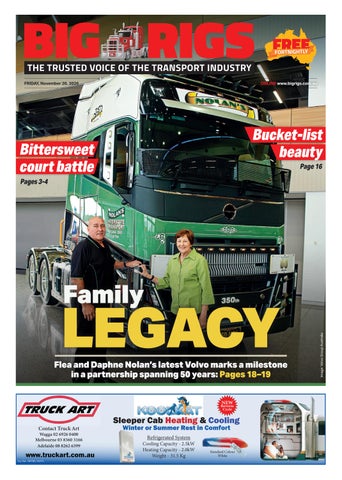
FRIDAY, November 20, 2026
ONLINE www.bigrigs.com.au
Bucket-list beauty
Bittersweet court battle
Page 16
Pages 3-4
LEGACY
Flea and Daphne Nolan’s latest Volvo marks a milestone in a partnership spanning 50 years: Pages 18–19
2.5kW 2.0kW
Image: Volvo Group Australia
Family
2 NEWS CONTACT US Address: 379 Docklands Drive, Docklands VIC 3008 Phone: 03 9690 8766 Email: editor@bigrigs.com.au Web: bigrigs.com.au Accounts: 03 9690 8766 Subscriptions: 03 9690 8766 Classifieds: 0403 626 353 Circulation and distribution queries: 03 9690 8766 info@bigrigs.com.au
EDITOR
James Graham: 0478 546 462 james.graham@primecreative.com.au
SENIOR REPORTER
Danielle Gullaci 0478 844 797 danielle.gullaci@primecreative.com.au
DESIGN
Alejandro Molano – Art Director
GENERAL MANAGER
Peter Hockings: 0410 334 371 peter.hockings@primecreative.com.au
BUSINESS DEVELOPMENT MANAGER Treena Heit: 0403 626 353 treena.heit@primecreative.com.au
CLIENT SUCCESS MANAGER
Katharine Causer: 0423 055 787 katharine.causer@primecreative.com.au
CONTRIBUTORS
Truckin in the Topics/Spy on the Road: Alf Wilson, 0408 009 301 David Vile, Graham Harsant, Geoff Middleton, Jonathan Wallis, Tim Oakes.
Big Rigs National Road Transport Newspaper is published by Prime Creative Media. It is the largest circulated fortnightly truck publication in Australia with 22,248* copies per fortnight.
*Average circulation per issue in 2025
FRIDAY NOVEMBER 20 2026 BIGRIGS.COM.AU
Trucks grounded amid fleet safety failures THE National Heavy Vehicle Regulator (NHVR) has issued a prohibition notice to an operator, preventing two heavy vehicles from being used until full inspections are carried out and all identified defects are cleared. An improvement notice was also issued, requiring the operator to implement policies, procedures or systems to manage risks associated with vehicle safety standards. The NHVR has declined to name the operator while investigations continue, although the Heavy Vehicle National Law allows disclosure in certain circumstances, including to prevent or minimise risks to public safety. In late August 2026, NHVR Safety and Compliance Officers (SCOs) inspected the operator’s registered heavy vehicles, with all vehicles receiving defect notices. Defects included excessive
movement in steering components, a fuel leak, damaged seat belts and vehicle lighting, a defective air bag suspension, and an excessively worn steer tyre to the point it had exposed steel cords. During an entry of the operator’s premises, the NHVR said its investigators identified failings of the operator’s safety management systems, including how it managed risks associated with vehicle maintenance, such as braking and steering systems, as well as compliance with mass and dimension limits. Despite the initial regulatory intervention, subsequent inspections allegedly continued to identify significant defects in safety-critical vehicle systems, including a major airbag suspension fault, major defects affecting brakes and suspension, and a tyre with insufficient tread. A further 24 defect notices
were issued following the initial inspection. Defects affecting the same or similar components were repeatedly identified, demonstrating a pattern of recurring maintenance and compliance failures. The NHVR said the serious safety risk posed to drivers and other road users was exacerbated by the operator’s transportation of flammable fuels and other dangerous goods. NHVR Executive Director Statutory Compliance Paul Alsbury said the number and severity of defects identified across the operator’s fleet presented a substantial and unacceptable risk to drivers and other road users. “These were not isolated issues – the findings pointed to serious systemic shortcomings in the operator’s management of vehicle safety, with defects identified across multiple crit-
The notice prevents two of the fleet’s trucks from being used until full inspections are carried out and all identified defects are cleared. Image: NHVR
ical safety areas,” he said. “These vehicles were used to transport highly flammable materials and, combined with the serious safety issues identified, presented an immediate or imminent risk of loss of control, collision, fire or explosion, with potentially catastrophic consequences.” Alsbury said fewer than 0.01
per cent of Australia’s almost 300,000 heavy vehicle operators have been issued prohibition notices, reflecting the high threshold required before this action is taken.
• Turn to page 47 for Alsbury’s column on fatigue management and the new Unfit to Drive Duty.
Fuel cost recovery returns with new trigger
TRUCK operators and owner-drivers covered by the federal fuel cost recovery order will again be able to recover higher fuel costs through the freight chain from Monday, November 23. The Fair Work Commission’s road transport Expert Panel confirmed it would reinstate the payment obligations that lapsed in June, with
changes to how often rates must be adjusted and how long the rules stay in force. Under the revised order, businesses with a direct payment obligation must generally set or adjust rates at least once each calendar month to cover the increase in fuel costs. The original order required adjustments every fortnight or twice a month.
The benchmark remains the per-litre cost of the fuel used for the job on or before March 6. Businesses can cover the difference through a rate adjustment, a fuel levy or direct reimbursement. Existing rise-and-fall arrangements can also meet the requirements if they account for higher fuel costs and follow the applicable ad-
justment timetable. The panel has added a specific provision for an agreed fuel levy or surcharge. To use it, the payer must give the operator or contractor a copy of the order, adjust the levy at least once each calendar month and take reasonable steps to ensure it covers the increased fuel cost. The revised order also chang-
es the diesel price trigger. The obligations will end after the national average wholesale diesel price falls below $2 a litre for four consecutive weeks, based on the Australian Institute of Petroleum’s weekly terminal gate price figures. If prices rise again after that trigger is reached, the rules will need a further commission decision to restart.
Over 65% of lung cancers can be successfully treated when found early. Lung screening is free and could save your life.
Rural and Remote Audiences Supported by
Talk to your doctor or healthcare provider about lung screening.
In partnership with
NEWS 3
BIGRIGS.COM.AU FRIDAY NOVEMBER 20 2026
Truck driver’s bittersweet court result BY DANIELLE GULLACI
A Queensland truck driver has described his result in court as bittersweet, after an 18-month battle to clear his name. A second-generation truck driver, Tony Cassidy, 62, has been in the game for more than 40 years, following his father into the trucking industry. Now semi-retired, he currently does casual relief work, carting produce from Caboolture, into Sydney and Melbourne. Cassidy was fined $865 for failing to stop at the Marulan Southbound Heavy Vehicle
Safety Station (HVSS) on March 7, 2025. In fighting the fine, Cassidy’s defence was centred around “confusing signage” on the approach to the National Heavy Vehicle Regulator (NHVR) controlled HVSS – and, in particular, a yellow sign that reads: ‘All access to Marulan next exit’. “I was slugged for bypassing the station under Section 513(4) of the Heavy Vehicle National Law. However, my sole intention was to exit the highway to refuel at the Marulan Ampol truck stop. The problem is the state’s roadside signage,” Cassidy told Big Rigs.
At Marulan, there are Heavy Vehicle Safety Stations located northbound and southbound on the Hume Highway. Image: NHVR
THEY LET ME OFF AND THEIR COMPUTER SYSTEM REISSUED THE FINE, AND I DIDN’T KNOW UNTIL I GOT THAT OVERDUE FINE.” TONY CASSIDY
“Once you follow that directive and enter the left lane to access the town or fuel, you are physically funnelled straight into the safety station monitoring corridor with concrete barriers, making it impossible to exit safely without crossing the scales first – a fact completely omitted from the roadside signage.” The NHVR sent a letter to Cassidy advising the penalty notice had been withdrawn on August 1, 2025. “This Penalty Notice has been withdrawn based on the additional information that you have supplied. Payment of that prescribed penalty is waived,” the letter said. Cassidy was shocked to then receive an overdue fine in the mail in November. “They let me off and their computer system reissued the fine, and I didn’t know until I got that overdue fine,” he said. Cassidy claims the issue came down to an administrative error, resulting from “an interstate database synchro-
Veteran truckie Tony Cassidy says he just wanted to refuel but was confused by the signage at Marulan. Image: Tony Cassidy
nisation error of a change of address and surname” despite him maintaining up-to-date licensing records, pre-dating the alleged offence. After again disputing the fine, Cassidy received another letter from the regulator on December 1, 2025. It stated, “On examination of the circumstances, the National Heavy Vehicle Regulator (NHVR) is satisfied the penalty notice was correctly issued and that the penalty should stand.” As the letter continued, “Please be advised we have considered the circumstances outlined in your representations; however, for an in-
fringement to be withdrawn and leniency to be provided, there are a number of elements that must be met. One of the elements is the Driver’s traffic record be clear of any traffic matters (this being heavy vehicle or light vehicle) for the last 5 years. Unfortunately, as your traffic record contains offences, leniency cannot be granted on this occasion.” According to Cassidy’s written statement of facts and submissions, presented in court, Cassidy claimed there is physical ambiguity of the infrastructure layout, conflicting traffic signage, and a total lack of a safe alternative path.
DEVELOPED TO KEEP CHINESE TRUCKS MOVING
Servicing Sinotruks just got easier. Keep your fleet service ready with Ryco.
FLEETSUPPORT@RYCOFILTERS | RYCOFILTERS.COM.AU | 1800 804 541
Cassidy had his day in court on September 21, appearing via telephone link with the Local Goulburn Court, represented by lawyer Rodney Boyd of Highway Advocates, who agreed to take on the case pro-bono. Cassidy was advised by his lawyer to change his original “not guilty” plea to “guilty” as technically he had committed the offence. Given the circumstances of the offence Boyd was confident the judge would dismiss the case under a non-conviction order under Section 10 in NSW. Continued page 4
4 NEWS
FRIDAY NOVEMBER 20 2026 BIGRIGS.COM.AU
Court case highlights confusing signage From page 3
SPEAKING to the court, Boyd spoke of Cassidy’s exemplary driving record. “He is someone who is 62 years of age, your Honour, been driving heavy vehicles most of his adult life and he has four minor speeding offences ever. It’s a pretty remarkable record for a professional driver. “He was coming into Marulan needing fuel and then there’s a sign saying he must go here to go into Marulan and so he didn’t want to be in the position where he’s stuck back out on the highway not being able to enter the service station and with no access to fuel.” For Cassidy, he says the advice to plead guilty felt incredibly bittersweet and a bit hollow. “I spent considerable time meticulously preparing a bulletproof defence to prove my complete innocence. “But when you are staring down a complex legal system, a tactical plea in mitigation is often the cleanest path your lawyer can take to protect you. It leaves a sour taste when you know you did nothing wrong except follow a roadside sign. “The moment of absolute validation came when the Magistrate openly stated on the record that other drivers had fallen into this exact same infrastructure trap.”
During the hearing, Judge Khoo said, “As Mr Boyd has highlighted, Mr Cassidy’s record for a professional driver is quite extraordinary. It does indicate that for the most part Mr Cassidy is a law abiding driver and responsible driver. I accept the explanation that has been provided as to his confusion on this date.” Judge Khoo also pointed to the confusing nature of the signage. “This is not the first time I have heard somebody having an issue with the signage at Marulan and it causing an issue in that respect. I accept that there was no intention by Mr Cassidy to evade the law or evade the weighbridge given that there have been no issues identified with his load before or since.” Speaking of the gravity of the offence, along with Cassidy’s moral culpability, both of which Judge Khoo said were towards the lower end, the charge was dismissed pursuant to Section 10(1)(a). Despite putting the case behind him, Cassidy believes the ‘All access’ sign needs an urgent fix. “As truck drivers, we are under massive operational and fatigue management pressures,” he said. “When a massive yellow highway sign explicitly says ‘All access to Marulan next exit’ any reasonable driver interprets that as the safe, lawful pathway to fuel up.”
THIS IS NOT THE FIRST TIME I HAVE HEARD SOMEBODY HAVING AN ISSUE WITH THE SIGNAGE AT MARULAN.” JUDGE KHOO
Cassidy believes the big yellow sign omits the critical fact that you are being funnelled through to the Marulan HVSS first. “It sets an unfair logistical trap,” he said, adding that the NHVR needs to urgently upgrade the current signage before more drivers are slapped with “unfair compliance fines”. “I didn’t purposely ignore the sign,” said Cassidy. “The big take away from me in all of this is that I hope it encourages them to put a new sign up so other drivers don’t fall into the same trap.” Boyd emphasised the broader struggle truck drivers face every day on Australia’s highways: “Truck drivers already have enough on their plates navigating long shifts and tight deadlines without ambiguous road signs turning honest drivers into criminals. It’s just not right. The signs should be there to help drivers not trap them.” The NHVR was contacted about the matter, however declined to comment.
The Marulan Southbound Heavy Vehicle Safety Station. Image: Tony Cassidy
NEWS 5
BIGRIGS.COM.AU FRIDAY NOVEMBER 20 2026
Rosie reveals gaps in truck safety audits BY JAMES GRAHAM
SOME of the trucking operators the National Heavy Vehicle Regulator (NHVR) considered its highest risks had never failed an accreditation audit, NHVR CEO Nicole Rosie has revealed. Speaking at this month’s NatRoad annual conference on the Gold Coast, NatRoad Connect 26, Rosie said the regulator had removed some high-risk operators from accreditation and moved some auditors out of the scheme after finding that clean audit records could sit alongside poor compliance histories. The findings came after Rosie asked to see the regulator’s high-risk operator report alongside its accreditation data. She said most operators in the group were accredited, and some of those ranked highest on the strength of their compliance histories had a 100 per cent audit pass rate. “What was very clear is that some of the auditing wasn’t necessarily as strong or as good as it should have been within that system,” Rosie said. She added that the NHVR was working with auditors to lift standards across a scheme used by thousands of operators. Under the new approach to accreditation, she said, operators would have to
demonstrate that their safety systems worked in practice. That meant auditors had to look at what was happening in the business as well as what was on paper. Rosie, who joined the NHVR in June 2025 after leading New Zealand’s transport agency, used the session to set out how she wants the regulator to spend more of its time on the operators and practices most likely to cause serious harm. She said the NHVR had issued prohibition notices only to operators in a high-risk group that numbered 22. The regulator was taking slightly more prosecutions and more fatigue-related action, she said, while the rate at which it issued major defect notices was broadly in line with the previous five years. The NHVR was drawing on camera data, roadside inspections and information from police and state authorities to work out where to focus its efforts. For operators assessed as medium risk, Rosie said the emphasis was on education to help them address problems before enforcement became necessary. She said she wanted more of that work done before a driver got behind the wheel. By the time an officer encountered a truck with a major mechanical fault or a serious
fatigue breach at the roadside, the driver and other road users had already been exposed to the risk. Rosie said technology could eventually mean fewer roadside stops for operators who could show the regulator how their trucks were being run. She outlined a future in which operators could share onboard data on a vehicle’s location, weight and mechanical condition, giving the NHVR more information to decide where to deploy its officers. “Why would I need to stop you on the side of the road?” she said. Rosie also flagged increasing concerns with some of those in the online freight broker sector. “They are disrupting the traditional freight models; they are Uberising the provision of services, and they are basically allocating all the risks down the supply chain. “They’re carrying no risks themselves, keeping the margins for themselves, but running a model that is a lot lower cost.” Rosie said this sector is where the ABN model and other types of contracting arrangements are occurring. “But way down the supply chain, and the people that are contracting the work are actually not looking, or trying to look, or wanting to look at how people are able to
offer a cheaper service right at the bottom. “It’s got some really big question marks, and for us as a regulator, we’re quite worried about that.” In his keynote address, WA Labor Senator Glenn Sterle updated attendees on the work being done to stamp out sham contracting. He said the latest figures revealed that eight road transport supply chains are under investigation. The former owner-driver said the Fair Work Ombudsman (FWO) had received 45 referrals from external stakeholders alleging sham contracting in road transport and had 52 cases on hand in the sector, including suspected sham contracting. The watchdog had also written to 106 road transport duty holders setting out what it expected them to do to check for sham contracting in their supply chains. Sterle also reported 14 compliance notices involving worker misclassification and more than $94,000 recovered for 17 workers. “This is the greatest curse in our industry, and it doesn’t matter what we do, unless sham contracting is confronted head on and not left in the shadows as it has been for many years,” said Sterle “This is a pox that drives good operators to the wall. This is a poison that steals
NHVR CEO Nicole Rosie updates attendees at the NatRoad conference. Image: Prime Creative Media
food from the hardworking men and women in the trucking industry who are doing the right thing.”
• For more coverage from NatRoad Connect 26, turn to pages 10, 12, and 54-55.
ISRI SEATS DEALERS SYDNEY 510 Victoria Street, Wetherill Park NSW 2164 Ph. 02 9756 6199, email: isri@isri.com.au, www.isri.com.au
BRISBANE 3/120 Gardens Drive, Willawong QLD 4110 Ph. 07 3275 2044, email: sales@isribrisbane.com.au, www.isribrisbane.com.au
BRISBANE NORTH 1/259 Cullen Av, East Eagle Farm QLD 4009 Ph 1300 11 4774, email: seats@isrinb.com.au, www.isrinb.com.au
MELBOURNE Unit 1/569 Somerville Rd, Sunshine West VIC, 3020 Ph. 03 9311 5544, email: sales@isrisunshine.com.au, www.isri.com.au
MACKAY
PERTH
DARWIN Mobile Sales and Service Ph. 08 8927 0986, email: info@isridarwin.com.au, www.isridarwin.com.au
When moving Heavy Loads comfort equals Safety. When moving Heavy Loads
WhenEveryday moving Heavy Loads demands are increasing, Safety is important. To achieve Safety you require comfort. comfort equals Safety. comfort equals Safety. Make sure you have an ISRI Seat.
Everyday demands are increasing, Safety is important. To achieve Safety you require comfort. Everyday demands are increasing, Safety is important. To achieve Safety you require comfort. Make sure you have an ISRI Seat. Make sure you have an ISRI Seat. T1/4P-A4-2
408 Welshpool Rd, Welshpool WA 6106 Ph. 08 9362 6800, email: info@mmtisri.com.au, www.mmtisri.com.au
NEWCASTLE/HUNTER VALLEY Unit 2/13 Hinkler Ave, Rutherford NSW 2320 Ph 02 4932 0600, email: sales@hvss.com.au www.isri.com.au
6953653al
110 – 120 Maggiolo Drive, Paget QLD 4740 Ph. 07 4952 1844, email: admin@isrimky.com.au, www.isriseatsmackay.com.au
Seating - on a higher level. Seating - on a higher level. Seating - on a higher level. www.isri.com.au www.isri.com.au
6 NEWS
FRIDAY NOVEMBER 20 2026 BIGRIGS.COM.AU
Milin Transport sold as former owners enter retirement BY DANIELLE GULLACI
MILIN Transport has entered a new era, under new ownership. The Queensland based business has been acquired by Damien Glanville, with the purchase taking effect from Friday October 30. The transaction includes the company’s 6.5-acre site and full fleet, with all staff continuing in their existing roles. Started 25 years ago by Mick and Jacinta Smith, Milin Transport has developed a solid reputation on the transport scene, known for its immaculate fleet of Kenworths, that travel right across the country. It’s a business the couple poured their hearts and souls into, building it from the ground up. However as 61-year-old Mick told Big Rigs, the time was right for them to sell up so they could enjoy life at a slower pace. Milin Transport started from humble beginnings. Mick had spent years working as an interstate truck driver before making the decision to buy his first truck, so he could spend more time closer to home. “I thought I had reached what I could achieve as a company driver. I was always going
away. I was never home, so I bought a little crane truck so I could drive around town – and it’s grown into what this is now,” he said. Mick started out collecting industrial bins with his crane truck and gradually purchased more trucks. “I originally got a five-year contract, so I put more trucks on and then found other contracts to keep those trucks busy.” Today, the trucks and the loads are much bigger. Milin Transport is a primary contracted carrier for BlueScope Steel, Orrcon Steel, Lysaght, Bluewater Shipping and also holds a position on the road transport panel for the Department of Defence, carrying everything from tankers to helicopters. From its base at Brendale, just north of Brisbane, Milin Transport operates a fleet of 30 prime movers, two crane trucks and 70 trailers – servicing all of Queensland, Sydney, Melbourne, Adelaide and Perth. The business carries various types of loads, ranging from pipe and tube, coil steel, mining equipment, oversize loads for large infrastructure projects and military vehicles and equipment.
The business operates a fleet that includes 30 prime movers, two crane trucks and 70 trailers.
“A great majority of what the company does now is either road train or B-double work,” said Mick. “I never thought Milin Transport would grow how it has. It almost felt like it happened overnight, but it didn’t, it happened over 25 years. I did it slowly and carefully. Every business owner experiences their lows and their highs. There was pressure from clients who were wanting me to expand and supply more vehicles, but I went at my own pace. “I had great customers, many who were with me the entire time I’ve been in business. Service is key and that’s what we’ve always focused on,” he continued. Asked about the decision to sell, Mick said, “I’m 61 years old. I thought to myself that this was the right time.” While that kind of decision is often a difficult one, for Mick it was different. “It wasn’t really hard to be honest. This is hard work and I’m a little buggered.” Speaking to Big Rigs just days after the reins were officially handed over, Mick added, “The hardest part I’ve found over the past three days is keeping myself busy. I’d given my heart and soul the entire time, and this was right for me. “The only change for the business will be a change of ownership, other than that it’s business as usual.” Mick enlisted the help of Karl Barban at Benchmark Business Sales & Valuations to find a suitable buyer for Milin Transport – and he and Jacinta found that in Damien Glanville. “I’d like to thank Karl and Benchmark for everything they did for us. Without them, I couldn’t see things happening the way it did,” said Mick. “Karl rode the wave with us, all the way through it. He went above and beyond and Damien was the right fit – he’s a nice bloke and really driven.” As Barban explained, Milin Transport attracted significant interest from buyers from
Jacinta and Mick Smith, pictured with their restored Ford LTL 9000, are looking forward to their next chapter. Images: Milin Transport
the moment it went onto the market. “Milin Transport offered everything strategic acquirers are looking for today: a quality fleet, experienced workforce, established systems and long-standing customer relationships. The transaction reflects the continued demand we are seeing for wellrun transport and logistics businesses across Australia,” he said. “Jacinta and Mick built an outstanding business and reputation throughout Queensland and Australia wide. Transactions like this are about more than just a sale, they’re about finding the right successor to continue the legacy that owners have
spent decades creating.” Barban said the sale also reinforces the strength of the transport market despite broader economic uncertainty. “Businesses that have built a reputation for reliability and service continue to attract strong buyer interest. Milin Transport was a standout operation, and we’re delighted to have achieved a successful result for all parties involved.” New owner Damien Glanville spent a decade as an interstate truck driver before moving into the energy sector, where he ran his own company. He saw Milin Transport as the perfect opportunity to make his move back into trucking. “My entire life, I’ve always loved trucks,” he said.
“Mick and Jacinta created a strong and reliable business, backed by good equipment and a great team of people working for them, from the drivers, all the way up. “They built an amazing platform, and I saw this as a great opportunity that I could add value to and continue to grow.” As Mick and Jacinta step into retirement, they’re looking forward to travelling in Australia and abroad. “We’re playing with the idea of spending a few months in Canada, the United States, Italy and Croatia. We’ve only seen half of Australia in our caravan, so when we come back from that trip, we want to finish it off, and see the rest of it!”
Buying a new trailer? Equip Your New Trailer with Wheels Designed to Pay You Back
$
$ Increase Profitability
Decrease Maintenance Cost
Drive with Pride
Boost Resale Value
FIND MORE
Specify Alcoa Wheels
For more information: contact us at
1800 955 191
alcoawheels.sales@howmet.com
www.alcoawheels.com.au
NEWS 7
BIGRIGS.COM.AU FRIDAY NOVEMBER 20 2026
Heavy-duty truck sales cushion end-of-year downturn
AUSTRALIA’S new truck market has suffered its weakest October since 2020, with heavy-duty sales offering some resilience as the usual pre-Christmas buying surge failed to arrive. Truck Industry Council (TIC) figures show 3215 new trucks and heavy vans were sold in October, down 18 per cent, or 706 vehicles, on the same month last year. Sales also fell by 147 vehicles compared with September, delivering what TIC described as a concerning start to the final quarter. “We have seen yet again another disappointing new truck sales month and a concerning start to quarter four 2026,” said TIC CEO Tony McMullan. “All heavy truck segments were down in October compared with the previous month of September and all truck and van segments were down when viewed against the monthly
sales results of October 2025.” McMullan said October and November are traditionally strong months for truck sales, as companies gear their fleets up for the Christmas delivery rush. “This October we have not seen strong pre-Christmas truck sales, we will now have to wait to see if this turns around in November,” he said. “Perhaps the flat October truck sales are an indicator that fleets are not forecasting the usual surge in freight movements leading into the festive season, as increasing interest rates and continuing high inflation dampen consumer spending, as we head into the last couple of months prior to Christmas.” Year-to-date sales across all categories reached 32,448, down 13.8 per cent on the 37,648 recorded by the end of October 2025. Heavy-duty trucks fared better than the overall market,
although deliveries still fell 12 per cent to 1079 for October. The segment’s year-to-date tally stood at 10,812, down 8.3 per cent, or 977 trucks. That comparatively smaller decline has increased heavy-duty trucks’ share of the total truck and van market to 33.3 per cent for the year, compared with 31.3 per cent a year earlier. Kenworth retained the heavy-duty lead with 215 October deliveries, but Volvo finished just five trucks behind on 210. The monthly result represented a 32.8 per cent fall for Kenworth compared with October 2025, while Volvo slipped just 3.2 per cent. Kenworth also remained ahead for the year with 2151 heavy-duty sales and a 19.9 per cent share, followed by Volvo on 1856 and 17.2 per cent. However, the gap between the two has narrowed from 891 trucks at the same point last year to 295.
One of the highlights in a quiet sales month, Shanahan Transport takes delivery of this stunning T909. Image: CMC Truck Centre/ Facebook
Year-on-year Kenworth’s market share has also dipped, down from 23.9 per cent this time last year to 19.9 per cent at the end of October 2026.
Scania was another standout in October, lifting deliveries 29 per cent to 120 and taking third place for the month ahead of Isuzu on 103.
Scania’s year-to-date sales increased 3.3 per cent to 965, although Isuzu remained third overall with 1444. Among the strongest heavy-duty growth stories was UD Trucks, which lifted yearto-date deliveries 60.1 per cent to 605. Its October sales rose from 40 to 55. DAF’s year-to-date sales increased 24.4 per cent to 565, despite a softer October, while Hino lifted its cumulative heavy-duty tally 18.8 per cent to 671. Freightliner also grew strongly from a smaller base, up 40 per cent to 154 for the year. Across the broader market, light-duty trucks suffered October’s sharpest fall, down 27 per cent to 988. Medium-duty sales dropped 19.5 per cent to 392, while heavy van deliveries fell 11.6 per cent to 756. Isuzu remained the overall market leader, recording 796 October sales and 7639 for the year.
NT freezes truck registration fees for next 12 months
NORTHERN Territory truck operators will avoid a registration fee rise under a 12-month freeze estimated to save $465 per three-trailer road train. The NT Government said heavy vehicle registration fees would remain at the levels set on October 1, 2025, with a review in mid-2027
to determine whether another 12-month freeze is needed. Alice Springs-based G & S Transport boss Franco Bilato welcomed the announcement as relief for operators facing a tough year. “When you’re running 17 trucks across the NT, including triple and quad road trains, that is welcome re-
lief,” Bilato said. “The simple fact is that when costs rise for transport companies, we have to pass them on to our customers, so this helps save money for a lot of people.” Based on previous Territory increases and national increases this year, the government estimates the freeze will
BIGWASH GEAR WASH DOWN DOWN ADMIRAL 4000
HEAVY DUTY STEAM CLEANER
4000 4000 PSI PSI Pressure + Steam TRUCKIES SPECIAL
$9,736
Admiral 4000 FHD275ADMIRAL IDAC40648
130°C 15 Ipm
+GST
SAVE $1,000
GST List Price $10,736 +GST +
Aussie Pumps Aussie
02 02 8865 8865 3500 3500 aussiepumps.com.au aussiepumps.com.au
save operators $465 annually for a three-trailer road train and $429 for a two-trailer combination. Estimated annual savings for rigid trucks are $18 for a two-axle vehicle and $39 for a three-axle vehicle. Minister for Logistics and Infrastructure Bill Yan said the decision would give
freight businesses one less cost increase to manage amid continued fuel price uncertainty. “Our freight and transport operators keep goods moving to the businesses and communities that rely on them,” Yan said. “Freezing heavy vehicle rego fees gives these businesses one less cost increase
to worry about. “Alongside the fuel relief announced last week, we are taking practical steps to support industry and keep projects moving.” The announcement follows renewed temporary fuel cost relief for eligible Department of Logistics and Infrastructure contractors.
Northside Diesel service and repair all makes and models Our services include: • Truck and Trailer service and repair. • We service and repair American, European and Japanese makes and models • Engine Overhauls • Minor and Major Repairs • 24/7 Breakdown service • Advanced diagnostics • VOLVO, MACK and UD service centre • Approved Inspection Station Call in and see us or phone: 07 54954133 www.northsidediesel.com.au service@northsidediesel.com.au 24 Commercial Drive, Caboolture QLD 4510
8 OPINION
FRIDAY NOVEMBER 20 2026 BIGRIGS.COM.AU
Your voice counts too
EDITOR JAMES GRAHAM
IT was great to get out from behind the desk for a couple of days to attend the NatRoad conference on the Gold Coast. We know a lot of you aren’t big fans of associations, or have the time to spend away from work. But there’s no escaping that these are the groups that give trucking a seat at the right tables. When government officials and pollies say they’ve been talking to industry, they’re not parked up at the BP Eastern Creek polling drivers on their biggest gripes. They’re getting their intel from association CEOs, or their members if they linger in the lobby long enough after a keynote speech. That doesn’t mean associations get a free pass. They need to listen to the people doing the job, challenge bad policy and show members what their fees are achieving. But writing them off isn’t the answer for change. If you reckon they’re missing the mark, tell them. The industry needs your voice in the room too.
What’s hot online Work diary warnings STEVE Shearer, Executive Officer of the South Australian Road Transport Association (SARTA) recently told Big Rigs he believes the National Heavy Vehicle Regulator (NHVR) has gone too far by sending work diary warnings he describes as threatening – arguing that genuine delays could be putting operators in the firing line. Online, readers weighed in: “Drivers have not done anything wrong. Schedulers have not done anything wrong. NHVR just automatically defaults to transport operators or drivers are
doing something dodgy, instead of just asking: Why is this so,” said Trevor Warner. “NHVR want drivers to be honest and when you are honest you are questioned.” Matthew Reichelt added, “They can’t have it both ways. When we get to work we start our books and complete a pre-check inspection which by the letter of the law is ‘working’. This can take 10 to 15 mins or more, it may then be another hour or more before actually starting your journey/trip.” Mick Debenham added, “A client of mine has had several of these letters sent to
SA trucking boss Steve Shearer says the warnings don’t take into account genuine delays. Image: NHVR
him after a notice to produce found no breaches. The company transports their own freight and at the start of the week the driver starts working when doing a pre-trip vehicle inspection as soon as he arrives at and then would often need to wait until all his freight is ready. Completely genuine reason at the start of the week.”
Two defects for shock absorbers READERS were quick to question the justification for a B-double receiving two defect notices relating to its shock absorbers. According to the National Heavy Vehicle Regulator (NHVR), Safety and Compliance Officers found damaged suspension components on both trailers of an 11-axle B-double. But most of the online feedback said the regulator should have factored in the condition of the roads first. “Without constant camera feeds under every point of a vehicle how is a driver that is driving over our non-vehicle worthy roads supposed to
know what damage is being done just before they are pulled up,” wrote David Johnson. Allan Lockhart was surprised there was any suspension still under there, given the state of the roads. “NHVR cannot claim to be about safety until roads undergo same level of inspection and defect notices requiring re-
pair,” chimed in Mark Nelson. “The wear rate on tyres and suspension continues to increase as roads continue to deteriorate.” The final word goes to Matt Oates who wrote: “We just replaced spring hangers on a 2-year-old Aussie made trailer, done 230,000km. Fix your roads!”
Safety and Compliance Officers found damaged suspension components on both trailers of an 11-axle B-double. Image: NHVR
WOULD YOU LIKE TO CONTRIBUTE TO READER CORNER? EMAIL US AT EDITOR@BIGRIGS.COM.AU
NHVR’s $35 million annual deficit
THE National Heavy Vehicle Regulator (NHVR) has reported a $35.45 million annual deficit, comprising of operational shortfall of $8.2 million and $27.2 million in project spending. It says the operational shortfall was primarily driven by increased employee costs following new enterprise agreements. Employee and related expenses rose $20.62 million, or 12.7 per cent, to $182.60 million. When details of the regulator’s annual report were shared online, many readers shared their views. “If the people tasked with policing the over complicat-
ed compliance of the industry find it expensive to do, really shows the cost burden on companies being policed,” said Robert Vickery. “So, where has all the money gone? They need to be audited as well,” wrote Jason Murdoch. While David Crane asked, “What they have actually achieved? Looking from out here, it’s got worse not better!” Michael Leslie commented, “How much is going to their executives and senior staff as well as the board members, many of whom are owners of large transport companies.” Eddie Roberts added,
“And you wonder why the fines have gone through the roof and they have a fatigue blitz every month. Fatigue is where the big money is because it’s unprovable.”
The regulator said the result was $1.5 million better than budget and consistent with its three-year plan. Image: NHVR
$4.25 million on rest area updates TRUCKIES were far from impressed by how $4.25 million was spent on SA rest areas on the Olympic Dam Highway at Pimba, and an upgrade of the Arcoona rest area on the Stuart Highway near Island Lagoon Lookout. “As usual, if you need to take a dump, lean against the tris, because apparently truckies don’t need toilets, writes Brian Hanford. “Whoever designs these, has all the comforts of home in their office, and has no concept of life on the road!” Added Simon Kearns:
Sealed parking, a new shelter with a picnic table and seating at Arcoona. Images: Senator Anthony Chisholm
“Pulled into the one at Pimba the other night, it was full so had to keep going. There was more room there before they did the works. “It might have been a bit rough at times. “But at least you could get more in there. Well done,
you useless state government.” Pat Rick reckons the designers should have allowed for more parking: “330 heavies pass there daily. That’s 14 per hour in a 24hour period. Four spaces aren’t much,” he said.
GET A HEAD START WITH FREIGHTLINER CASCADIA. Get three months on us up to $20,000 when you finance a Freightliner Cascadia with Daimler Truck Financial Services. Experience the benefits of Guaranteed Buy Back and three years of servicing at no extra cost. Talk to your Freightliner dealer today to find out how you can take advantage of Cascadia’s remarkable fuel efficiency, advanced safety and superior comfort - Underestimate At Your Own Cost.
3
WE PAY YOUR FIRST 3 MONTHS, UP TO $20,000.
OF REPAYMENTS ON US, UP TO $20,000*
NOTHING TO SPEND SERVICING FOR 3 YEARS / 450,000KM.
MONTHS
GUARANTEED BUY BACK.
Contact your Freightliner dealer to get a Head Start today.
*Finance offer available on selected new & demo Freightliner trucks ordered between 23 March 2026 to 31 December 2026 (unless extended) and subject to stock and vehicle eligibility. Restricted to approved business customers (excluding fleet, government, or rental buyers) of Daimler Truck Financial Services Pty Ltd (“DTFSAu”) ABN 23 651 056 825 and subject to standard credit assessment and lending criteria, and fees may apply. A $20,000.00 finance contribution payable by Daimler Truck Australia Pacific Pty Ltd ABN 86 618 413 282 is available towards a new finance contract, structured as 3 equal payments for the first 3 months of the finance contract (i.e. exactly $6,666.66 per month). Following the 3 months, the customer returns to making repayments as per the relevant signed finance contract for the remainder of the term. Fast Track is also available in conjunction with this offer. Guaranteed Buy Back (GBB) is subject to vehicle eligibility and excess kilometer charges calculated at $0.15/kilometer in excess of the agreed annual allowance. Fair wear and tear return conditions apply. Full details available at an authorised Daimler Truck dealership.
10 NEWS
FRIDAY NOVEMBER 20 2026 BIGRIGS.COM.AU
NatRoad Connect 26
Gold Coast, November 5–6
Event Wrap-up
When a truckie says they’re unfit to drive HOW an allocator responds when a truckie says they’re unfit to drive can determine whether the next driver feels safe enough to speak up. That was the warning from Followmont Transport Chief People Officer Melissa Strong at NatRoad Connect 26, where a panel on keeping drivers fit for duty heard how fleets are tackling isolation, making it easier to get help and handling the tough call to take someone off a run. Strong urged operators to pay attention to the language they use when a driver says they’re struggling. Asking “could you just do this?” can put pressure on someone who has already flagged they may be unfit. “Be prepared to make the tough call,” Strong said. She said fleets needed to make clear that drivers were expected to turn up fit for work and should tell someone early if they couldn’t. That gives allocators time to make other plans and helps drivers trust they can speak up with-
out being penalised. NatRoad HR adviser Kylie James said the first step was to listen and find out what was happening. The circumstances would vary from driver to driver, and sometimes the operator would have to tell someone they couldn’t get behind the wheel. At Richers Transport, the starting point was an anonymous staff survey run by someone outside the business. Richers Transport director Matthew Richers said drivers pointed to isolation and communication as problems, while managers said they struggled with difficult conversations and confrontation. The company brought in an organisational psychologist who visits once a month and is available to drivers and managers. Richers said an informal chat at the depot could feel more approachable for a driver than being asked to make an appointment off site. Fleet managers were also asked to look for changes in a driver’s usual behaviour.
Someone who was normally punctual might start turning up late, for example, prompting a conversation about what was going on. Richers said the same approach could help uncover what was behind signs of fatigue. A driver might be losing sleep because of a change at home that a fleet manager would only learn about by asking. “If someone’s strong enough to come forward and tell you that they’ve got a problem, I think it’s a serious conversation and a compassionate conversation,” he said. At Followmont, Strong said the company had started with drivers when it introduced its Fit for Life program. The first phase looked at pre-employment and ongoing medicals, including how to support drivers when a check picked up a condition or further testing was recommended. The company also conducts welfare checks, particularly for drivers on remote routes. A monthly online session with
the CEO gives staff across the depot network a chance to submit questions, with a recording available to those who are working when it goes live. An audience member asked how the industry could reach drivers who might see people at roadhouses or unloading sites more often than they see their own boss. Richers said freight customers could be part of that conversation. With drivers spending so much time waiting at other businesses’ sites, he asked how operators could get customers to help support the
people delivering their freight. James said operators could start identifying workplace risks by asking staff what they were experiencing and taking practical steps to reduce the problems they raised. NatRoad had put together a toolkit with questions employers could use to identify common hazards in their own operations. She expected it to be available through the member portal after the conference. James said members often asked where their responsibility began when a problem
outside work followed a driver into the depot. She said employers could help by connecting workers with professional support. Strong said the first conversation could be as simple as sitting down with a driver over a cup of coffee and working out what to do next. Richers said the business had to take what it heard seriously and follow through with help, whether that meant a visit to a doctor or a referral for counselling. “Once you know, you know,” he said.
[L-R]: Matthew Richers, Kylie James, Melissa Strong and session chair Marla Cartmill. Image: Prime Creative Media
Fewer roadside stops for low-risk fleets TRUCKIES working for lower-risk operators could face fewer roadside stops under a shift in how the National Heavy Vehicle Regulator decides who to pull over. Speaking at NatRoad Connect 26, NHVR CEO
Nicole Rosie said data from trucks could eventually give officers enough information about a vehicle’s weight and mechanical condition to let it keep rolling. “I know what you’re doing. I know where you are.
I know your weight,” Rosie said, outlining how the approach could work. “In fact, your onboard computer tells me what your mechanical status is. Why would I need to see you? Why would I need to stop
NHVR CEO Nicole Rosie shares how effective regulation can support both safer roads and stronger transport businesses. Image: Prime Creative Media
you on the side of the road?” Rosie described a longer-term direction for the regulator. The NHVR is already combining information from roadside inspections, cameras, police and state authorities to identify operators that pose a higher risk and decide where to put its officers. The regulator has traditionally subjected trucks passing through inspection stations or across its cameras to the same checks, she said. Access to more information could help it spend less time stopping trucks from operators with a strong track record and more time dealing with businesses that pose a greater risk. Rosie said onboard technology could also help operators get better access to the road network. She pointed to work on automated access and said some states were considering how onboard weighing and telematics could give road
managers greater confidence about the loads crossing their bridges. “We’ll be a bit more open to taking some more risk because we know what’s going across our bridges,” she said, describing how road managers might respond. That could open more routes to Performance Based Standards (PBS) combinations and other higher-productivity vehicles. Rosie said the work aimed to eliminate about 80 per cent of permits, with technology helping road managers make access decisions. She said states were taking different approaches. While better information could help officers decide which trucks to stop, Rosie said some of the decisions that put drivers at risk were being made well away from the roadside. She singled out some online freight platforms that she said were keeping the margins while passing the risks to contractors further down
the supply chain. Those commissioning the work, she said, were paying too little attention to how operators at the bottom could afford to offer cheaper rates. “Me turning up on the side of the road and issuing a ticket to a driver ain’t going to change unsafe or inconsistent practices,” she said. Rosie said the NHVR also wanted to get to operators earlier with education. By the time an officer pulled over a truck with a serious mechanical defect or fatigue breach, the driver had already been on the road with that risk. She said closer work with road managers on access and with operators on safety could do more for the industry than the regulator could achieve at an inspection bay alone. “We need to start to change the way we work,” Rosie said. “And we want to do that with you through engagement and continuous improvement.”
Industry-led alliance launches to help cut your fuel costs A free industry initiative launched on the Gold Coast aims to help trucking operators cut their diesel bills and work out whether electric trucks could suit their business. Move3ment’s Mark Gjerek unveiled Fleetleap at NatRoad Connect 26, saying operators were grappling with high diesel prices, carbon reporting requirements and some freight contracts that exclude diesel vehicles.
Fleetleap brings together fleet operators, equipment suppliers, insurers and charging specialists. The partnership is co-funded by the Australian Renewable Energy Agency, with NatRoad on the steering committee to represent operators. Fleetleap is also supported by Heavy Vehicle Industry Australia, Queensland Transport and Logistics Council, Australian Alli-
ance for Energy Productivity, National Transport Insurance (NTI), NewVolt and JET Charge. Together, the founding partners represent almost 3000 businesses across Australia’s freight, logistics and energy sectors. The first offering is a free online hub with information on fuel efficiency, emissions and electrification. Gjerek pointed to tyre choice and basic aerodynamic devices as examples of changes op-
erators could make to reduce fuel use on the trucks they already run. The second is Run on Less, an Australian version of a US demonstration program that will share data from electric trucks carrying real loads for working fleets. Operators will be able to see how the trucks perform on the job and judge whether they could handle similar work in their own businesses. A third program, eTrucker,
will offer fleet coaching and advice on electric trucks and charging, and connect operators with suppliers who can help. Gjerek said Fleetleap was designed to close gaps in what operators knew about both diesel savings and electric truck options. He said some fleets were still unaware of viable electric trucks, even though at least 25 models were available on the market.
NatRoad CEO Warren Clark said the association’s role on the steering committee was to keep operators’ interests front and centre as industry and government work through the shift to lower-emissions freight. The hub is already live at fleetleap.com.au. Operators can access the information free of charge and sign up for updates as the demonstration and coaching programs roll out.
OUTSTANDING EFFICIENCY
NEXT GENERATION DAF
+ DRIVER COMFORT
Powering your Success
+
ADVANCED SAFETY
Discover the New Generation DAF. The New Generation 13-litre DAF XF and flagship 15-litre DAF XG deliver outstanding fuel efficiency, exceptional driver comfort and advanced safety, maximising productivity on every journey and making them the ideal choice for Australia’s interstate and long-haul freight operations. Complementing the range are the agile 7-litre DAF XB for urban transport and the lightweight 11-litre DAF XD for regional and distribution applications. From city streets to cross-country highways, DAF offers Australian transport operators a complete range to keep business moving. DAF Transport Efficiency. Powering Your Success. DAF.COM.AU
DISCOVER MORE
12 NEWS
FRIDAY NOVEMBER 20 2026 BIGRIGS.COM.AU
NatRoad Connect 26
Gold Coast, November 5–6
Event Wrap-up
Transport operators fight for every dollar TRUCKING operators are switching to weekly fuel levies, recruiting drivers on social media and walking away from work that no longer pays as rising costs squeeze margins. At NatRoad’s annual conference, three operators outlined what they had changed in their businesses and where they still needed help. The panel brought together Matthew Richers of Richers Transport, Laura Hobson of Hobson Logistics Group, Steve Fieldus ofTransforce and Senator Glenn Sterle. For Fieldus, who runs 14 trucks out of Dubbo, the immediate headache was getting customers to understand what rising diesel prices were doing to freight costs. “Gone from being a transport operator to number one fuel salesman, I think,” he said. Transforce switched from monthly to weekly fuel levies as prices climbed. Fieldus sounded out other operators about where customers were pushing back, then shared the fuel calculator he used
with customers who wanted to see how he arrived at the levy. That gave them a way to check the figures against the terminal gate price. Richers Transport also moved to weekly levies after diesel spiked in March. Richers said giving customers a week’s notice meant there was still a roughly two-week lag between the price rise and the higher levy taking effect. The business recovered the increase, but it had to find the cash to pay for diesel in the meantime. Hobson said that gap was especially hard when operators paid for fuel weekly but waited 30 or 60 days for invoices to be settled. Her business has kept its weekly levy, as has Richers Transport, despite some customers asking to go back to monthly adjustments when diesel briefly fell. For Hobson, one of the hardest calls came when a customer sought a 20 per cent reduction after awarding a four-year contract and specifying how the vehicles should be set up.
She and her father went through the figures and decided the work was no longer viable. They also questioned where the demands would end once they had accepted the first cut. “I think sometimes you just have to have that hard internal conversation and just understand that you have to stop the bleeding,” she said. Richers said his business had priced tenders around detailed requirements such as Euro 6 trucks, specific trailers and underrun protection, only to see work go to cheaper competitors whose equipment appeared to fall short of the brief. Fieldus gives customers three price points, from a basic truck and trailer to a Performance Based Standards combination with specialist equipment and a higher-spec option. When a customer says the quote is too dear, he can ask which part of the specification they are willing to change. Richers said driver shortages remained his biggest problem. His company had little
[L-R] MC Des Dowling, Steve Fieldus, Laura Hobson, Senator Glenn Sterle and Matthew Richers discuss the challenges facing operators today. Image: Prime Creative Media
success advertising on Seek after the COVID-era peak and turned to social media to reach potential recruits. “Just when you think you’ve got a handle on it, you seem to fall back into that problem again,” he said. Fieldus said driver turnover had eased in his area, where he believed workers were putting more value on job security. He said the Mount Victoria
closure in the Blue Mountains was a more immediate problem for his fleet, which does much of its work in and out of Sydney and Newcastle. One operator in the audience said his business had tackled the shortage by training its own drivers, starting them on tippers and teaching them the company’s paperwork and procedures. He estimated about half his drivers
had come through that approach, though keeping them once they had experience was another challenge. Hobson called for heavy vehicle driving to be recognised as skilled work. Sterle urged operators to lead discussions on overseas recruitment and press Canberra for a system that brings drivers in with proper training and protects them from exploitation.
Know your costs or risk hauling at a loss, warns expert TRUCKING operators need to know when to turn down a load, even if it means leaving a truck parked, Plus 1 Group accountant Devinder Singh told the NatRoad annual conference. With fuel, wages and equipment costs squeezing margins, Singh said taking on more work could make a struggling business worse off if the rate failed to cover the true cost of the job. “You cannot undercut your way to a profit,” he said. Singh, whose northern
Victorian firm specialises in transport and agriculture, said operators had added trucks and trailers during the Covid freight boom, when volumes were strong and finance was cheap. Now there was more equipment chasing work as growth slowed and the cost of keeping trucks on the road climbed. As a rough guide, Singh said wages and fuel each took about $30 out of every $100 in revenue. Another $10 went towards costs such as registration, road user charges, tyres
and insurance. That left about $30 to cover repayments, overheads and any profit. Equipment costs were eating into that balance, he said. A B-double outfit that once cost about $600,000 could now approach $1 million, depending on the specification. Higher replacement costs also pushed up insurance premiums. Singh urged operators to agree on a base freight rate with customers and apply a separate fuel levy. When diesel is built into a fixed rate, a
price rise can quickly wipe out the margin on a job. “Set your base rate,” he said. “You have to demand that from the customer.” Rising diesel prices can also squeeze cash flow before a customer’s invoice falls due. Singh said fuel suppliers set credit limits in dollars, so operators could hit their limit sooner while buying the same volume of diesel. Some were being forced to pay weekly as suppliers tightened limits and payment terms.
When margins slipped, Singh said, superannuation and tax payments were often among the first obligations to fall behind. He urged operators to review their figures with their accountant before arrears built up. One warning sign was equipment repayments rising above 20 per cent of revenue. At that point, Singh said, there was little room left to absorb other costs. He encouraged operators to compare revenue year on year and break down their costs by
the kilometre so they could judge whether a rate would pay its way. “Operators always say yes to every load,” he said. “But generally, the operator always gets paid last.” Singh said the long-term outlook for road freight was still promising. The immediate challenge was making sure operators could stay in business long enough to benefit, and that started with knowing which loads would leave money in the business after the bills were paid.
MICHAEL Kennedy has been recognised for 20 years of service on the NatRoad board and a lifetime spent standing up for trucking operators. Presenting the award at NatRoad Connect 26, CEO Warren Clark said Kennedy brought the experience of a driver, owner-driver and fleet operator to the board, along with a habit familiar to anyone who had shared a conference room with him. “If anyone has been to a conference with Mick, they will recognise the moment that he stands up with a question, and perhaps one more question before the microphone goes back,” Clark said. “He wants to understand because the answers matter to people’s livelihoods.” Clark said Kennedy had championed the need for operators to know their costs,
be paid properly for the work they did and have access to reliable advice. He also encouraged them to speak up for themselves. “Michael understands that behind every truck is a business. Behind that business are people and families that depend on it,” Clark said. “He thinks about the small guy. He thinks about everyone.” Kennedy built a family transport business while serving on the board. Clark said he brought the day-to-day realities of running trucks into discussions about the direction of the association and what its members needed. Over two decades of change, he also brought a memory of what NatRoad had tried before and what had mattered most to operators. Accepting the award, Kennedy took the audience back
to where it started. As a schoolboy, he washed trucks and sometimes tagged along on Friday night runs to Brisbane. Those trips gave him an early idea of what he wanted to do for a living. “From washing the overnighters, that set my mindset that I was going to be an overnighter,” Kennedy said. He joined the police force at 19 but kept driving trucks on the side. By 23, he was doing part-time linehaul for IPEC, driving MANs and Atkinsons via the Putty Road in the days before the freeway. He bought his first truck at the same age. Clark said Kennedy had kept Sundays for his family while building the business and took immense pride in the fact that his daughter and son had worked alongside him. His interest in trucks extended beyond the working fleet to restoring histor-
ic vehicles, including the eight-wheeler ‘Grey Ghost’ he pointed out to the audience during his acceptance speech. “Michael, tonight we thank you for 20 years of service
to the NatRoad board and for the experience, conviction and character you have brought to that board, to that role, to our industry,” Clark said.
“He’s the glue that holds all this stuff together.”
Kennedy honoured for 20 years of service • For more awards coverage from the conference, turn to pages 54-55.
Mick Kennedy, left, with a framed drawing of his beloved ‘Grey Ghost’, and CEO Warren Clark.
Save up to 10.5c per litre on fuel* NatRoad members save up to 10.5 cents per litre on Diesel, Premium Diesel and AdBlue with a NatRoad AmpolCard.*
Join NatRoad today to start saving. Call 1800 272 144 or scan the QR code.
1800 272 144 info@natroad.com.au *Terms and conditions apply. For full terms and conditions, visit natroad.com.au.
NOV - DEC
N OV — D E C 2 0 2 6
CATALOGUE OUT NOW!
Rigs
FROM
$
NON-MEMBERS
$
349
I Multipurpose heavy duty axle oil suitable for use in differentials, manual transmissions, steering gears and oil-filled hubs I Meets API GL-5/MT-1 and SAE J2360 specifications
SK3106/007 Top plate liner, 6 hole, 10mm including countersunk bolts
ELC30-5M
5L
ELC30-20M $126
Fifth Wheel Repair Kit
SK3105/94
$
Load Restraint MEMBERS FROM
282
SK3105/94 $282 I Greaseless wear ring kit, 4x bolts, 1x wear ring, 1x wear ring retainer I Suits JSK37 & JSK42 SK2121/69Z $299 $329 I 2x upper cushion, 2x lower cushion, 8x countersunk bolts I Suits JSK 37
69.95
D99-TP-1000-20L
I High performance, multipurpose diesel engine oil I Meets SAE 15W-40, ACEA E9/E11 and API CK-4 specifications I Suitable for use where CAT ECF-3, Cummins CES 20086, DDC DFS 93K222 and Volvo VDS4.5 specifications are required
D99-TP-1000-205L $1,200 205L
I Complies with AS/NZS 4344
Trailer Slack Adjuster
TRPLC8MM $69.95 $79.95 8mm x 9m chain kit with grab hooks TRPLB8MM $76.95 $84.95 Ratchet loadbinder - 7-8mm
TRPLB8MM
FROM
$
19.95
SAT30TRP $19.95 Slack adjuster 5.5 + 6.5, 28 spline
EBS Plug
SAT31TRP $69.95 Auto slack adjuster, 28 spline SAT32TRP $19.95 Slack adjuster 5 + 6 + 7, 10 spline
A multi-fit 7 pin trailer plug engineered for ABS and EBS braking systems, compatible with 12V and 24V vehicles and meeting ADR 38/04 82196
125
D99-TP-1000-20L $125 20L
.95
59.95
Heavy Duty Engine Oil 15W-40
$
NON-MEMBERS FROM
$
D99-TP-1001-205L $1,300 205L
FROM
FROM
20L
TRPLC8MM
79
D99-TP-1001-20L $132 20L
ELC30-20M
I Organic Acid Technolgy (OAT) Coolant I Extended change intervals I First fill in all Australian built Kenworth and DAF trucks from January 2026
$
132
D99-TP-1001-20L
I Protects against plate wear I Smooth coupling performance I Complete installation kit
32
$
$30
319
$
FROM
ELC30-5M $32
MEMBERS
SAVE
MEMBERS
ELC30 Coolant
$
Fifth Wheel Top Plate Liner Kit
Heavy Duty Axle Oil 85W-140
SAT33TRP $19.95 Slack adjuster 5.5 + 6.5, 28 spline TO SEE THE SLACK ADJUSTER VIDEO, SCAN THE QR CODE
D99-TP-1000-1000L $5,550 1,000L SAT30TRP
AC2001
Air Dryer Cartridge FROM
$
63
AC2001 $63 Suits Bendix AD-SP/1P AC3001 $115 Suits Bendix AD-9
EXTENSIVE DEALER NETWORK AUSTRALIA-WIDE Visit paccarparts.com.au For more details, Freecall* 1800 PPARTS (772 787)
CHECK OUT THE CATALOGUE ONLINE PACCARPARTS.COM.AU/CATALOGUES TRPPARTS.COM.AU/CATALOGUES
Pure Sine Wave Inverter FROM
$
Ultima Mk3 215 Driving Light
1,795
R-12-2000RS3
I 2000W I ATS & RCBO R-12-2000RS3 $1,795 12V
R-24-2000RS3 $2,249 24V
$
549
EXCLUSIVE OFFER!
I Exclusive Kenworth branded driving light with red bezel I Hybrid beam, 9-33 volt I Current draw 14.9A at 13.5A 71742KW
ONLY AVAILABLE THROUGHOUT PARTICIPATING PACCAR PARTS DEALERSHIPS
REDWORKS Power Panel FROM
$
1,549
Drawer Fridge 1CMS-015-002
I 12V I Integrated charge management system 1CMS-015-002 $1,549 40A BCDC Core SCOUT
FROM
945
$
NEW!
NRXD20B
I 12/24 V DC
1CMS-015-003 $2,199 50A BCDC Alpha SCOUT 1CMS-016-002 $2,849 50A BCDC Alpha NOMAD W/Fuseblock
GREY
BLACK
NRXD20C $945 20L, 440 x 564 x 250mm, 13.6kg
NRXD20B $945 20L, 440 x 564 x 250mm, 13.6kg
NRXD30C $965 30L, 440 x 730 x 250mm, 16kg
NRXD30B $965 30L, 440 x 730 x 250mm, 16kg
Purple Wash & Wax Intelli-Start Emergency Jump Starter
NEW!
FROM
$
160
1S920
I Recharges directly from the vehicle just started I Lightweight and compact I Engineered to provide complete protection against short circuits, surges and over-heating 1S920 $160 Starts 12V vehicles up to 6 litre petrol 1S1220C $220 Starts 12V vehicles up to 7L petrol and 4.5L diesel 1S5000HD $2,150 Starts all 12V and 24V vehicles, buses and industrial machinery
FROM
$
17.95
TRPPR1
$17.95
1L
TRPPR5
$29.95
5L
TRPPR20
$69.95 WAS $89.95
20L
TRPPR200
$699
205L
TRPPR1000
$2,895
1000L Pod
Prices herein are recommended selling prices for both Privileges members and non-members, inclusive of GST. Recommended selling prices in this publication are provided as a guide. Prices may vary at the dealerships. Freight charges may apply. All items have been included in good faith on the basis that goods will be available at the time of sale. Promotion available at participating Dealers from 1 November to 31 December 2026 or while stocks last. Images are used for illustrative purposes only.
✓ PREMIUM CARNAUBA INTRODUCTORY OFFER!
WASH & WAX ✓ HIGH FOAM, EASY RINSE ✓ BIODEGRADABLE ✓ MIXED BERRY FRAGRANCE
* Calls from Australian landlines are generally free of charge whilst calls from mobile phones are typically charged based on the rate determined by the caller’s mobile service provider. Please check with your mobile service provider for call rates.
16 FEATURE
FRIDAY NOVEMBER 20 2026 BIGRIGS.COM.AU
New T909 is a tick off the bucket list
Despite owning various trucks over the years, this Queensland operator has always had his eyes set on a brand new T909 – recently he’s made that happen.
BY DANIELLE GULLACI
GARY Gill’s path into trucking actually didn’t start with trucks at all. As he explained, “I was driving buses when I was young, and there was an old fella there, and he said: ‘You’re young, what are you doing driving buses? You should get into trucks’.” Taking that advice onboard, Gary secured his HC licence, but as he revealed, getting his start wasn’t easy. “I knocked on the door of every transport company I could.” Eventually he came across one business willing to give him a go – McColl’s Transport. While there, he also progressed to his MC licence, eventually pulling B-double tankers. “I told them I’d do anything to learn, and they gave me a go on milk tankers. I did that from about 2007 until 2012, then I moved into their chemical division, doing local work,” explained 45-year-old Gary. “I wanted to get back onto the highways doing longer distance, so I got a job at RM and ME Singh, driving hydrous ammonia tankers.” Then in 2020, Gary made the decision to go out on his own, starting his own business called Air Haulage, which he runs alongside his wife Sarah Singh, who brings first-hand experience in operating a transport business and now works as an NHVR auditor, specialising in transport compliance and safety management systems. As Gary told Big Rigs, “I had an opportunity to buy my own truck for a contract with a major gas company. That was a 2018 Mercedes-Benz Actros. I ended up having three trucks working on that contract until I lost that work in 2022.” Gary spent the next six months away from the trucking game before buying another truck, this time a 2018 Kenworth K200 and got a contract with Prixcar, doing car carrying for a couple of years. He soon added another truck, a Kenworth T409. “Then work went quiet because of interest rate rises. But Prixcar was awesome to work for.” Missing the tanker work, Gary found work pulling bitumen tankers. “I had two trucks on the Prixcar contract and then I started subbing, doing bitumen work. By 2023, I decided I wanted to stick with the tanker work, so I sold my car carrying truck. I got a contract with Fulton Hogan in 2024 and started doing that with my T409,” he said. “I went down to one truck from that point and decided that was enough for me.” Then last year he decided
Owner Gary Gill says a Kenworth T909 was his bucket list truck. Images: Brown and Hurley
Gary and wife Sarah Singh with the new truck.
Since being delivered in March, the new T909 has been hard at work pulling bitumen tankers. Image: Air Haulage
Gary says he’s stoked with how the truck’s turned out. Image: Air Haulage
to bite the bullet and upgrade to his first brand new truck, a Kenworth T909. “That was my bucket list truck,” he said. The new T909 was delivered in March and has been hard at work pulling bitumen tankers for Fulton Hogan. “I’ve added all the bling. It has lots of stainless work, stainless wrapped tanks, LED lights, stainless guards, a stainless visor and chrome stacks. It’s the first brand new truck I’ve bought. Now, working for Fulton Hogan, it’s been my happy ever after.” Gary’s T909 was one of the last Euro 5 models on offer. It’s powered by a 550hp Cummins X15 engine, mated to an 18-speed Roadranger. The truck features a 50-
inch bunk, microwave, television, 12-inch sub and under-dash lighting. Gary says he couldn’t be happier with the end result. “I’m stoked with how it’s all turned out. I’ve ticked this off my bucket list and I’m enjoying the truck through and through. “This is a much heavier and bigger truck than my previous ones. It’s much more comfortable with the longer wheelbase too. It’s a good feeling having the big bonnet in front of you.” The couple’s four-year-old son, Ajay, loves trucks and is also a big fan of the T909. Though Gary is based in Brisbane, when he chatted with Big Rigs, he’d spent the past 10 weeks in Townsville. “My base is still Geebung in Brisbane, but weather-permitting, I’ll probably stay
A look inside the cabin.
here in Townsville until Christmas because they’ve been so busy up here. There are quite a few other drivers too who have come up here from Brisbane,” he said. While Gary spent years pulling B-doubles, his time in Townsville has given him an opportunity to move up
The truck features plenty of bling.
into road trains. “I’m doing a mix of local work up here, from terminals to asphalt plants, but also serve a quarry in Cairns, and run to spray seal out west between Townsville and Mt Isa and anywhere in between,” he explained. Although he’s had up to three
Complete with all the creature comforts.
trucks on the go at once, Gary says he’s enjoying being back down to just the one truck. Asked what he enjoys most about the work, Gary added, “I love the scenery and getting to see the Australian outback – just the freedom. And Fulton Hogan is a great company to work for.”
N OV- D E C 2 02 6
CHECK THE CATALOGUE ONLINE PACCARPARTS.COM.AU/CATALOGUES
Christmas GIFT GUIDE 2026
BONUS!
FREE ENGEL 18L BLACK* COOLER (EDC19BK) VALUED AT $123.00 WHEN YOU PURCHASE A 15L OR 21L ENGEL FRIDGE. *Colour maybe substituted if black becomes unavailable.
Chest Fridge
MT17J-G4S
MT27J
I 17kg I DC power consumption: 0.5 to 3 amps I Power: built in 240V AC / 12V DC / 24V DC I 3 year warranty
$999 $1,049
MT17J-G4S 15L (21 x 375ml cans) Suits transit slide lock TRL17
$1,079 $1,179
MT27J 21L (29 x 375ml cans)
Blower Dust Kit
MEMBERS
SAVE
$5
GRV5HDW
MEMBERS
SAVE
GREAT FOR CLEANING THE INSIDE OF YOUR TRUCK WWBG-12
$24
.95
$29
.95
MEMBERS
SAVE
$100
LED Load Light
KWL0ADL1GHT
5” DISPLAY DIGITAL WIRELESS 720P HD CAMERA KIT
7” DISPLAY DIGITAL WIRELESS 1080P HD CAMERA KIT
I 800 X 480 HD resolution I 110° wide angle lens camera with 1280 X 720 resolution I Supports up to 150M wireless range between monitor and camera I Connects with one wireless camera (included with kit) I 12V & 24V compatibility
I 4 channel with 1024 X 600 HD resolution I 110° wide angle lens camera with 1280 X 720 resolution I Supports up to 200M wireless range between monitor and camera I Connects with one wireless camera (included with kit) I 12V & 24V compatibility
GRV5HDW
I Kit 2 x lights I Mirror mounted I Spot beam I 9-36V I 1630mm cable I Mini deutsch connector I Bracketry included I 5 year warranty
$50
Digital Wireless HD Reverse Camera Kit
$244 $294
GRV7HDW
$429 $479
C
B A
$479 $579 D
Kenworth Badge Pack Legacy Logo Z53-KW-1000
Z53-KW-1001
A
Polo
B
C-KEN1143-S to C-KEN1143-5XL
Z53-KW-1000 Gold Z53-KW-1001 Chrome
$44 .95 $54 .95 $44
.95
$54
.95
C
$61 .95
T-Shirt
C-KEN1144-S to C-KEN1144-5XL
D
I Green I Dog bone logo C-KEN1157-S to C-KEN1157-3XL
Puffer Vest I Sizes S-5XL
I Sizes S-5XL
$139
Kids Sweater I Sizes 2-12
$72.95
C-KEN1148-2 to C-KEN1148-12
$69.95
EXTENSIVE DEALER NETWORK AUSTRALIA-WIDE Visit paccarparts.com.au For more details, Freecall* 1800 PPARTS (772 787)
Prices herein are recommended selling prices for both Privileges members and non-members, inclusive of GST. Recommended selling prices in this publication are provided as a guide. Prices may vary at the dealerships. Freight charges may apply. All items have been included in good faith on the basis that goods will be available at the time of sale. Promotion available at participating Dealers from 1 November to 31 December 2026 or while stocks last. Images are used for illustrative purposes only.
* Calls from Australian landlines are generally free of charge whilst calls from mobile phones are typically charged based on the rate determined by the caller’s mobile service provider. Please check with your mobile service provider for call rates.
18 COVER STORY
FRIDAY NOVEMBER 20 2026 BIGRIGS.COM.AU
Loyal truckie takes keys to Volvo No. 350
Nearly 20 years after he got the keys to his first milestone truck, Nolan’s rewards Kim Cooper with another special addition to the fleet. BY JAMES GRAHAM THE three generations of Nolan family were beaming from ear to ear when the covers came off Nolan’s Interstate Transport’s 350th Volvo at the Wacol headquarters late last month. This wasn’t just a special milestone for the Nolan family, however, whose relationship with Volvo stretches back to the early 1970s, the truck’s designated driver, Kim Cooper, was also celebrating a unique partnership of his own. As family and colleagues posed for pictures with the stunning new 780hp FH16 XXL Diamond Edition in the main atrium, Kim told Big Rigs that he’s been lucky enough to be handed “something special” by the Nolan family since 2008. Kim had been doing a stint in operations at the time when late company co-founder Terry Nolan made him a promise that if he didn’t like the office-bound role at the Gatton HQ, he’d buy him a new truck. True to his word, two years later, Terry gave Kim one of the highest honours for any driver at the family-owned powerhouse, the keys to the famous fleet’s centenary FH 558. “I walked into the office one day, and he said, ‘I know, I know. The new truck’s already ordered’. The last one was a 700hp Volvo that was just shy of one million kilometres before Kim, now 67, threw his logbook up into the cab of the Diamond Edition for the first time at the Wacol ceremony. By the time you read this, Kim and the latest pride of the fleet will already be working hard on the Melbourne run in
WE DON’T BUY A TRUCK JUST FOR THE SAKE OF BUYING A TRUCK. WE DO A LOT OF RESEARCH, AND WE DO LISTEN TO THE DRIVERS, AND WE LISTEN TO THE MECHANICS. THAT’S HOW WE GOT TO WHERE WE ARE TODAY.”
Matriarch Daphne Nolan presents the keys to long-time Nolan’s driver Kim Cooper. Image: Volvo Group Australia
FLEA NOLAN
a road train combination. But Nolan’s Director Flea Nolan told Big Rigs that Kim will be doing it in style, with every creature comfort they could throw in the new cab to complement one of the smoothest rides on the market. “He [Kim] tells me it’s his last one, but we’ll see how we go.” Volvos account for about 65 per cent of Nolan’s 170-truck fleet, with the company maintaining a mix to accommodate different driver preferences for European or the American-style rides. Flea said feedback from drivers and mechanics, in conjunction with customer profiles and needs, always helped shape purchasing decisions. “We don’t buy a truck just for the sake of buying a truck,” he said. “We do a lot of research and we do listen to the drivers, and we listen to the mechanics. That’s how we got to where we are today.” Flea said Volvo has always been the leader for him when it comes to safety and durability for the drivers. “When you can get out of
A celebration to cherish for the Nolans and their extended Volvo ‘family’.
your truck after doing your stint and you can feel refreshed, it means you’re in a good healthy spot.” When it came to choosing the specifications for the 350th Volvo to join the Nolan’s Interstate Transport ranks, technology, fuel consumption and horsepower were also high on Flea’s priority list. “It’s doing the road train up and down the eastern seaboard, and we just knew it had to be the biggest and the best,” said Flea. “So, it’s a 780 and it should do it easy. The safety and technology standards are
state-of-the-art, and the fuel will be good. “With the technology that Volvo’s got it delivers a very sound fuel consumption engine, and that’s obviously why we buy them because fuel’s a big-ticket item in our books.” The milestone 17-litre Euro 6 truck is Nolan’s second 780hp Volvo, arriving about a fortnight after the first. That earlier delivery carries a special connection to the Lights on the Hill Trucking Memorial, with a differently coloured prime mover and matching road train trailers promoting the memorial wall. Flea said supporting the Gat-
Flea Nolan and his mum Daphne with their first 780hp Volvo and its commemorative Lights on the Hill trailer set.
ton memorial, convoy, and the wider road transport community was important to the 5th generation family-owned business, which had been involved since the wall was built in its hometown. The company also retains another significant Volvo within its fleet: the 50,000th truck from the manufacturer’s Australian factory. Flea said that truck had recently moved from interstate duties to local work and received a replacement engine. “That won’t leave. We will just keep rebuilding it,” he said. “It’s a bit of a legacy.” Flea said the long-standing relationship with Volvo also extended to testing vehicles and providing feedback, with opportunities to meet factory engineers and discuss improvements. “We often have tours in the factory where we can sit down with the engineers and go through some things which you do see in the end product. “It might not be exactly what you think it’s going to be, but it does come through.” Flea said the 350th Volvo was a symbol of that close bond and the two company’s shared family values, with a sixth generation already working at Nolan’s to ensure the partnership continues for many years to come. “It doesn’t just happen overnight. It takes a lot of commitment from both sides to get something right. “But the sales team and
Martin [Merrick] and his team listen to what the customer has got to say. “Everyone has their problems, but it’s how they deal with it, and I believe they deal with a problem very well.” For General Manager Robert Owens, the October 29 handover was also a chance to celebrate the people and relationships behind 350 Volvo deliveries. “This isn’t just a milestone for the Nolan’s business but for the relationship with Volvo as well,” Robert said. “The business and the family respect family values, and that’s something that we get out of the Volvo relationship.” Greg Sargeant, Dealer Principal, VCV Australia, also echoed that special bond in his speech before the covers came off the FH16. “Yes, today we’re handing over another truck, but it’s a partnership more than the truck itself,” Greg told the large contingent of colleagues on hand for the handover. “After 350 trucks we certainly don’t take the number 351 for granted. We know our success is your success, and we work together for that. “So, taking delivery of your 350th Volvo truck is one hell of a compliment and a vote of confidence in us to support you as we go through the journey together. “We’re incredibly proud of the Nolan family and what it means to Volvo Group Australia.”
COVER STORY 19
BIGRIGS.COM.AU FRIDAY NOVEMBER 20 2026
The models will be available to order from late December.
A big undertaking in miniature
The latest addition to the fleet is seen as a symbol of a close bond between two companies with shared family values.
The sixth generation of Nolans, proudly carrying on a family legacy built over more than 100 years.
Kim Cooper was thrilled with his latest milestone truck.
Nolan’s staff celebrate Daphne’s 60 years at the helm.
Nolan’s founder celebrates special milestone
It was a big week of festivities for Nolan’s Interstate Transporter Founder Daphne Nolan. Just days after the covers came off the 350th Volvo to don the famous green and white livery at Volvo’s Wacol HQ, staff celebrated Daphne’s 60 years at the helm of the revered family-run fleet. “Today we celebrated an incredible milestone, recognising Daph Nolan’s 60 years of dedication, hard work and commitment to Nolan’s Interstate Transport,” the company posted on its Facebook page. “Six decades is an extraordinary achievement and Daph has been such a valued part of the Nolan’s team throughout those years. Always one of the first through the door in the morning and the last to leave of an afternoon, her dedication and work ethic are second-to-none. “Thank you Daph, for your outstanding service, unwavering dedication and the many years of memories along the way. What an amazing achievement and one to be incredibly proud of!” Nolan’s also thanked Brown and Hurley for coming out to support this special milestone and “firing up the BBQ to celebrate”.
The 350th Volvo is now running in a road train configuration.
The 1:50 replica will also come with a full trailer set.
When Heath Blok from Best Man Cave was approached about creating a 1:50 scale replica of Nolan’s Transport’s 350th Volvo, he knew it would be a special project. What the Mount Gambier model maker didn’t realise was just how much work would go into bringing the 780hp FH and its custom 42-pallet quad reefer combination to life. Heath said the idea was to create a model that captured the detail and presence of the real combination – a fitting tribute to an important milestone for Nolan’s. Finding a suitable starting point was the first challenge. Heath sourced Volvo models from Tekno in the Netherlands and had to wait for them to arrive before he could properly assess what needed changing. The cab was reasonably close to what Heath needed. Underneath it, however, was a different story. “The chassis and associated components weren’t right for the Nolan’s truck,” Heath said. “To get the proportions and layout as close as possible, we had to build a new chassis from scratch, using photographs of the actual 350th Volvo as our reference. “That became a project in itself: studying photographs, working out measurements, making parts, checking the fit and then going back to adjust them again. At 1:50 scale, even a small discrepancy can change the appearance of the finished truck.” Heath said the custom 42-pallet quad reefer presented another substantial challenge. “I sourced diecast trailers as a starting point, and my mate Jim Hamilton, a retired tinkerer, came on board to help develop a combination of diecast components and purpose-designed 3D-printed parts. “Jim’s assistance has been a valuable part of the build. Between us, there has been a tremendous amount of designing, measuring, trial fitting and testing to bring the combination together.” Adding to the challenge, was trying to keep the project a surprise. “We couldn’t simply ask for every measurement or photograph we needed, so there was plenty of time spent studying the images available and working through how to reproduce the details,” Heath said. “It has been rewarding, but I won’t pretend it hasn’t been exhausting at times. There have been setbacks, delays and parts that needed more than one attempt. The aim throughout has been to get the model as close to the real truck as I possibly can.” Heath said Ashley Rowley from VCV has been incredibly patient throughout the process, and he is grateful for his understanding as the model team worked through the challenges. “Unfortunately, circumstances outside our control meant we missed the planned deadline for having the model ready. We were, however, able to supply a progress video for the launch. It was very well received and sparked plenty of interest in what we were creating. “That response made all the effort feel worthwhile and has helped open the door to the next stage.” As we were going to print, Heath confirmed that the diecast model will now go into worldwide production. A 100 will be sold on their own for $300, another 250 will be sold in the new truck-quad set-up at $720 a set. Heath said these will be available for pre-order at bestmancave.com.au and quarrydiecastmodels.com. au in late December/early January with final deliveries scheduled for late 2027. “What started as a request for a scale replica has grown into one of the most demanding custom projects I have taken on,” Heath added. “The progress photographs show just how much has gone into it – and how much work can sit behind a model small enough to display on a shelf. “It’s been a bigger job than I thought it would be, but I was humbled to be a part of it.”
20 FEATURE
FRIDAY NOVEMBER 20 2026 BIGRIGS.COM.AU
Cruise control: Who’s really in control? In the fifth instalment of our driver training series, our expert looks at when cruise control helps and when your right foot can do a better job. CRUISE control is one of those wonderful inventions that can make a long day behind the wheel easier. Set the speed, settle back and let the truck take care of the throttle. But there’s a trap in that thinking. Cruise control is very good at doing exactly what it is told. Unfortunately, it doesn’t necessarily know what you are trying to achieve. If you tell it to maintain 100km/h, it will do its level best to maintain 100km/h — uphill, downhill and everywhere in between. And that can make it a lousy fuel-efficiency coach. The important distinction is simple: cruise control manages speed. The driver manages efficiency. Tip 1: Use cruise control where it works best On relatively flat highways, cruise control makes plenty of sense. A modern truck can maintain a constant road speed and manage the engine and transmission very accurately. It also removes those tiny, often unconscious movements of the driver’s right foot that continually add and subtract fuel. There’s another benefit too. Maintaining a steady speed makes the truck predictable to surrounding traffic and reduces driver workload, particularly during long highway runs. So on a relatively flat, open road, cruise control can be your friend. But undulating country is a different story. Remember one of the two big rules from the beginning of this series: (Never) accelerate uphill? The brackets around “never” are important. Obviously, there are times when you have to accelerate on a climb, and maintaining a safe speed relative to surrounding traffic always takes priority. But we’re talking about fuel efficiency. Pouring fuel into the engine simply to maintain an arbitrary road speed while climbing a hill can be expensive. Cruise control doesn’t care. Tip 2: Don’t make the truck fight the hill Approach a climb at 100km/h with cruise set at 100 and, as speed begins to fall, the system will progressively call for more torque to maintain the selected speed. Depending on the truck, load, gradient and transmission programming, that can mean changing down and asking the engine for a substantial amount of fuel
simply to prevent the speedometer dropping a few kilometres an hour. A good driver might make a completely different decision. Most professional drivers spend a considerable amount of their working lives on familiar roads. You know where the hills are and, more importantly, you know what’s on the other side. Instead of demanding maximum effort from the engine all the way to the crest, allow the truck to gradually lose a little speed and start taking torque away as you approach the top. Then let gravity help you regain that speed. I’ve seen the difference this can make. Years ago, I did a fuel economy comparison with Mack Truck’s Paul Munro between Eastern Creek and Kempsey and back. I drove conventionally, maintaining normal highway speeds up and down hills. Paul concentrated specifically on fuel efficiency. One of his techniques was taking torque away as he approached the crest. He’d allow the truck to roll across the crest at perhaps 80 to 85km/h and then use the descent to bring it naturally back towards cruising speed. Result - 13 per cent less fuel. The cost over the entire exercise was around 20 minutes travelling time. That’s a trade-off worth thinking about. Tip 3: Don’t fight gravity twice This brings us straight back to our old friend from Episode 1 — momentum, and the simple adage – “Gravity is free. Diesel isn’t.” Think about what conventional cruise control can do on a typical rolling section of highway. The truck starts climbing. Road speed falls, so cruise control adds fuel. It reaches the crest and suddenly all that engine torque isn’t required anymore. Gravity takes over and the combination begins accelerating downhill. Depending on how the cruise system is configured, the truck may now use engine braking, a retarder or another auxiliary braking system to prevent speed increasing beyond the set limit. The rig has just spent fuel fighting gravity on the way up — and then used braking effort to fight gravity on the way down. A skilled driver looks further ahead. Sacrifice a little speed uphill, preserve fuel, crest safely and let the
mass of the combination work for you on the descent. That’s not driving slowly, it’s driving intelligently. Tip 4: Use the technology on the way down Now let’s turn the argument around. Here’s a question I use in driver training sessions: What’s the fastest, safest and most fuel-efficient way to drive down a major hill while maintaining the legal speed limit? That usually starts a pretty good discussion. Modern adaptive cruise control can provide a surprisingly good answer. Take a long descent with a statutory 40km/h truck limit. Depending on the particular truck and its systems, I can set adaptive cruise at, say, 38km/h, input a small amount (2-3km/h) of overrun and underrun, and let the truck manage the descent. The system will progressively call on the available auxiliary braking systems to control speed while also maintaining a safe distance behind vehicles ahead. If another vehicle moves into your lane, adaptive cruise will react to that as well. Conversely, if a section of the hill levels out, the system will ease off the braking and allow the truck to accelerate up to the set limit. That’s a very different job from asking cruise control to drag a fully loaded combination uphill at a rigidly maintained road speed. In one situation we’re asking the system to burn fuel to maintain speed, but in the other we’re using the truck’s technology to manage stored energy and control speed safely. Tip 5: Use adaptive cruise as a safety tool I also like adaptive cruise control in heavy metropolitan traffic, primarily as a safety system. Used intelligently, it can maintain following distance and react to traffic movements ahead. Again, that’s not necessarily about saving fuel. It’s about taking advantage of technology already fitted to the truck. Remember that smooth traffic flow helps preserve momentum. If adaptive cruise helps you maintain a sensible gap rather than continually accelerating towards the vehicle ahead and then braking, that’s good driving anyway. But don’t confuse the safety advantages of adaptive cruise with an assumption that cruise control is automatically the
Every decline is gravity’s gift. Images: David Meredith
most economical way to drive. The professional driver is always the best judge of when to use coasting, off-throttle, engine braking, retarders and service brakes to anticipate the most fuel-efficient way to drive in any conditions. Tip 6: Know what your cruise control can do Not all cruise-control systems are equal. Settings differ. Permitted speed overrun can differ. Integration with engine braking and retarders varies, and newer trucks may have predictive cruise functions that older trucks don’t. That’s why one of the recurring messages in these Fuel Smart articles is simple: Know your equipment. A good place to start is the owner’s manual. One of my seminars revealed that neither the company’s operations boss nor the drivers knew that their trucks had seven transmission modes, one of which solved a major safety concern they had in their warehouse. Modern trucks have extraordinarily sophisticated engine, transmission, braking and adaptive cruise systems. But technology works best when the driver understands what it’s doing. Find out how your truck’s cruise system interacts with the transmission. Understand its overrun settings. Know when it will call on the engine brake or retarder. If it has predictive functions, understand what they’re actually predicting. Tip 7: Remember who’s the boss Cruise control is a valuable tool but it isn’t the driver, and no matter how advanced or AI embedded your truck is it won’t have your real-time knowledge of the road ahead. With the exception of topographical cruise control it doesn’t know why you’re prepared to sacrifice a few kilometres an hour approaching this particular crest. It doesn’t necessarily know that after this climb comes a long descent where gravity will give back the speed you’ve sacrificed. The objective isn’t to main-
NOT a cruise control situation!
A Kenworth on a straight and flat road; cruise control country.
tain precisely the same number on the speedometer every second of the journey. It’s to move the truck, the load and yourself safely and efficiently from one end of the journey to the other. And sometimes the most efficient thing a driver can do is let the speedometer move.
Summary Cruise control has an important place in modern trucking. On flat, open roads it can maintain a consistent speed, reduce driver workload and remove unnecessary throttle movements. Adaptive cruise adds another layer, particularly as a safety tool in traffic and as a means of controlling speed on long descents. But cruise control should never replace the driver’s understanding of the road. In rolling country, blindly maintaining a set speed can mean using extra fuel climbing a hill and then using the truck’s braking systems to remove the energy gained going
Kenworth CC at 94km/h.
down the other side, and that’s where the driver’s judgement always wins. Cruise control manages speed. Good drivers manage fuel. So – things to focus on this month • Look at where you use cruise control. • Disengage it in rolling country. • Learn your adaptive cruise settings. • Compare the result. Next month we’ll dive into the latest digital driver hints, and how knowing what’s at your fingertips delivers safety and fuel efficiency. Stay safe
We Guarantee To Get Your Rig Steering Like New g the Servicin for industry years over 45
Power Steering & Alignment Specialist
EXCHANGE BOXES & PUMPS BOXES FROM
$1,450 PLUS GST *Conditions Apply
Kenworth | Mack | Western Star | Volvo | Nippon A Correctly Aligned Truck Can Reduce Fatigue….. ASK US HOW Servicing of Boxes & Pumps Wheel Alignments
2
YEAR WARRANTY
ON ALL WORK 7132168ab
* Conditions Apply
23 BLIVEST STREET OXLEY QLD
07 3375 8233
admin@bakerpowersteer.com.au
0413 151 516
www.bakerpowersteer.com.au
22 TEST DRIVE
FRIDAY NOVEMBER 20 2026 BIGRIGS.COM.AU
Hino 300 makes easy work of heavy lifting Small changes on paper deliver a big surprise behind the wheel as we test drive Hino’s updated 300 Series. BY GRAHAM HARSANT HINO is a little late to the Euro 6 party with its 300 Series but has the wait been worthwhile? Indeed, 300 product has been in short supply over the past few months while the company geared up for the required changes. But you don’t really care if it’s Euro 6 or not, do you? All you want is to get in a truck and drive it, knowing it’s going to get you through the days, weeks, months and years reliably. And if you’ve been in the Hino universe before, you know that’s exactly what the company’s products do. It’s not like you’re going to walk to your truck in the morning, look at that little ‘Euro 6’ badge on the door and smile to yourself in the knowledge that you’re doing your bit to save the planet. Or that you’re going to arrive at the worksite and crow to your mates that you are now the proud owner of a Hino 300 Series Euro 6. Or are you? Look at the outside of the 300 range and you’re not going to notice any difference apart from that badge. Ditto inside, apart from a small change to the gearshift lever. It’s under the cab where the changes have been made. First up Hino have changed the architecture between the engine and 6 speed, A862E gearbox. Previously the ‘box was 24 volt and the engine 12. Now the ‘box is also 12 volt. The outcome is that engine and gearbox ‘talk’ to each other more effectively, resulting in quicker and smoother gear changes to the only true automatic on the truck market. Hino have made an already excellent gearbox even better. But you’re not really interested in what you can’t see are you? In addition the company has added a sequential gear shifter to the ‘box, giving the driver added control when descending steep inclines – of particular value with the heavier trucks in the 300 range. You still don’t really care do you? The previous engine had 150hp and so does this Euro 6 version. The previous engine had 420Nm and now it has gone up to 440Nn. That torque comes in 100rpm lower in the rev range while peak power has been extend-
ed 100rpm further up so the spread of power and torque is considerably wider than previously. “Wow, a whole 5 per cent extra torque!” I hear you say sarcastically. I have driven more Hino 300 Series trucks than any other model in their or anyone else’s range of trucks over the 15-plus years I’ve been test driving. I’ve had them for days and weeks at a time so it’s fair to say I’m pretty familiar with the models. When Hino invited me along with a bunch of journos up to The Goldie to experience the Euro 6s, followed by some R and R at the Supercars, who was I to refuse? As they sat us down and described the changes to the model another journo and I exchanged looks and mentally shrugged in unison. Why the company would fly us up to the Gold Coast, put us up at a nice hotel and take us racing for a whole 20Nm and no extra horsepower was beyond us. Their enthusiasm and excitement over the Euro 6 updates was either real or the best piece of company PR I’d seen in a long time. We were to find out which the next day…. No less than seven variants of the (loaded) Euro 6 300 Series greeted us at the hotel entrance
Now with sequential shifting.
Beam me up, Scotty.
Familiar surroundings. Images: Graham Harsant
With the rain abating, we put the pedal to the metal.
This is where the magic happens.
on the following morning, ranging from the 616 Standard and Wide cabs, through the 716 and 816 models. The drive was to take us 350km from the Gold Coast, through time zones into NSW briefly then inland up steep, winding roads and down Mt Tambourine before returning through the ‘burbs to the hotel. The 616 is a car licence-friendly 4499kg GVM with an optional 5500kg and can be optioned up to 8000kg (Tipper Pro) in their many ‘Built to Go’ range of trucks. The 716 has a GVM of 6500kg and the 816 has a GVM of 8000kg. Both of the latter models can be optioned down to 4499kg. GCM is GVM plus 3.5 tonne (with 4.5 tonne available), also across the range. The 4-litre diesel and gearbox described earlier is standard fitment across all trucks. My first drive was the 616 Standard Cab painted in ‘go faster’ red. No chance to see if it did indeed go faster as we headed out into peak hour traffic followed immediately by driving rain which left me to enjoy my interior surroundings and remind me how well the cab is insulated from outside noise. Out onto open roads, the rain
Right across the range, the Hino 300 Series is a very different truck to its predecessor.
abating and I was finally able to put the pedal to the metal. WHAT THE? The truck fairly leaps forward, from the get-go or through the gears. How the hell have they done this with no extra horses and only 20 more of Newton’s Metres? I comment to my passenger that it’s a shame Mazda has ‘Zoom, Zoom’ registered because this truck has it in spades. Steering is nicely weighted and direct, the seats as comfortable as I remember them and the ride great over bumps, humps and the inevitable potholes. I don’t need to play with the sequential shifter – but I do. Knock the gearshift towards you and knock yourself out I say. Move forward to change up a gear and vice-versa which is natural to my mind. (14 years with my Territory which works the other way and I still
have to look to remember). As the trucks get heavier the Zoom, Zoom naturally diminishes a little – but only a very little. Remember they’re all using the same engine/gearbox. My last drive is in the near 8 tonne-loaded Big Boy 816 – which just happens to be the my last, recent drive in Euro 5 guise and the difference in power and torque is actually mind-boggling. When we reach Mt Tambourine I’m required to do no more than 40km/h down this steep drop. I activate the very effective (single stage) engine brake and use that sequential shift to drop into second (or third – I can’t remember). I did not touch the brakes all the way down. That’s saving wear and tear right there. Conversely, uphill you may as well leave the truck to its own devices because the gear changes are perfection in keeping
within the peak of power and torque curves. Still, if you want to play go right ahead. Right across the range, the Hino 300 Series is a very different truck to its predecessor. Somehow the company has turned 150 ponies into Clydesdales and made a 5 per cent increment in torque into something that feels much, much more. So, when you walk out to your brand new 300 Series to go to work, you will look at that ‘Euro 6’ badge and quietly smile to yourself, knowing that you’re going to get where you’re going quicker, and that the truck will make short work of whatever load you’re carrying. And when your mates see the smile on your dial and ask you why, just chuck them the keys and say, “Vroom, Vroom.” We don’t want to step on Mazda’s toes do we?
Seven variants of the loaded Euro 6 300 Series greeted us at the hotel entrance.
ALL THE PARTS FOR ALL THE TRUCKS. UNBEATABLE RANGE OF DISCOUNT ALL-MAKES PARTS AND ACCESSORIES
Alternators & Starters
RDP Meritor Brake Shoe Kits RDPBSK4515F3
16.5” x 7” Fruehauf/SAF/TMC
$92
RDPBSK4515PSS
16.5” x 7” Severe Service Smooth
$87
RDPBSK4515Q
16.5” x 7” Drive
$83
RDPBSK4707QP
16.5” x 7” Drive Q-Plus
$84
RDPBSK4720QP
16.5” x 5” Steer
$99
RDPBSKBC3695
BPW BC36 Brake 95
$87
RDPBSK24515Q
Q Plus MG2A 4515Q
$90
RDPBSK24707QP Q Plus MG2A 4707QP
160A J Mount 110555JHO Only
$450 160A Pad Mount 110555PHO Only
$530
Only
$88
$770 39MT Rotatable Nose 8200308
Built by Meritor, Backed by RDP, MG1A/MG2A lined Brake Shoe Kits provide OE quality fit, dependable braking performance, and long service life for heavy-duty applications.
Only
$715 RDP Air System
Genuine Cooling Fan Clutch Steel K32 10900965001
Only
$1000
3030 Brake Boosters - 2-Pack
RDPBB3030
Fan Clutch Super Overhaul Kit Suits Horton HT/S 9.5” N20994305
Only
Top Hose DD15 0516836205
Only
Only
$787
$44
$110 2430 Brake Boosters - 2-Pack
RDPBB2430 Only
32” 9-Blade Engine Fan 47354139308 Only
$429
39MT DD15/13 8200434
Bottom Hose DD15 0516836210 Only
$77
Available from over 50 dealers nationwide or online at truckpartsuperstore.com.au
$108 Wabco Style Levelling Valve
RDP4640060020 Only
$70
Available from your participating Western Star Dealer. Prices include GST and are valid from 1st Sept - 30th Nov 2026. Prices and specifications are subject to change without notice and do not include freight. Images are for illustration purposes only - actual products may differ from shown. Penske Australia reserves the right to correct printing errors.
24 FEATURE
FRIDAY NOVEMBER 20 2026 BIGRIGS.COM.AU
Detroit power hits all the right notes The unmistakable sound of a “Screaming Jimmy” lured Wayne Glasson to a paddock-find 1979 Dodge that’s now back on the road, turning heads along the way. BY DAVID VILE WHEN looking back at times past, particular makes and models of trucks have become legendary in the transport landscape (think B-Model Mack or a 1418 ‘Benz). The same can also apply to truck engines, mention the words “Screaming Jimmy” and many will readily identify with the line of 2-stroke GM Detroit Diesel engines which were a source of motive power (and a unique engine sound) for a vast number of trucks, buses and other vehicles over many years. Introduced in the 1950s, the 6/53 is one of the Detroit variants which have become renown, and it is the lure that led Wayne Glasson into making his first truck purchase last year. The 6/53 is the beating heart of his 1979 Dodge D5N 700 which had been sitting out in a paddock at Canowindra in rural New South Wales before Wayne purchased it, as a means to cart about his historic John Deere 4020 tractor from his home at West Wyalong. He had fired up the ‘GM’ in the old Dodge for a day out at the Weethalle Show, with the Detroit mudflaps on the front of the truck a give-away as to what was lurking under the bonnet. “She’s the real deal; this one has the 11,000-pound heavy front end and there were only about 300 of them made. I drove an International Lodestar with a 6/53 GM for a few years when I was around 19-20, so I got to know the engine and took a liking to them. There are other things out there with GMs in it but this was pretty rare and it was offered to me so I grabbed it,” he explained.
Having come off a farm, Wayne was no stranger to horsepower, driving trucks in-between seasons and today operates a 400-tonne Liebherr excavator at the Lake Cowal mine. While the 200-odd horses the Detroit punches out seems modest by today’s standards, back in the day the Dodge variant was a popular choice for a number of operators including those in the express newspaper runs out of the metropolitan areas. “They used to drive these things all over the place, they were built to be flogged,” Wayne said. “it fires up pretty well and doesn’t smoke too much. With the 5-speed ‘box and 2 speed diff it will do 100k if you hold it flat, but if you back her off to 90 it will sit along on that quite nicely. I normally have the John Deere on the back which is 6 tonne and it carts that quite well,” he continued. The Detroit powerplant was one of a number of engine choices available in the Dodge model line, which also included the Cummins 160 and a variety of Chrysler-derived petrol V8 options. As Wayne explained, the 1970s-era engineering of the truck to fit the GM powerplant would be considered rudimentary today. “They were pretty crude when they put these motors in as they have cut down around the front fender with an angle grinder to fit the radiator in, and they have blown a hole in the chassis to put the steering arm through. “It was all pretty rough, but it all worked - they have actually offset the motor to the left a bit to get it to fit - I’m not sure you would get away with all that these days.” Body-wise the Dodge was in pretty good order when
Wayne purchased it and he does not plan to go to the lengths of a full tear-down and rebuild, having done a few little jobs and keeping the truck authentic. “It hasn’t got any structural rust which is probably a bit lucky as it did sit out in the paddock for a fair while - it had a bit of surface rust on it when I got it, it was looking a bit shabby so I polished it up - I did put some paint on the front guards have put some new blinker lenses and so forth on it,” he said. “The bonnet, cab and doors are all original so I’m planning to pretty much leave it as it is, and not do too do much to it, and just try to keep it original.” With the Dodge range of the 1970’s sharing the same componentry as the International product line, parts and accessories are common to both which have also been of benefit to Wayne. “The cabs were built by Chrysler and International and Dodge shared them just put different front clips on them. “The bulbar I have put on it; I found it on Facebook Marketplace, and it had been sandblasted and painted it up. It had come off an International, so the measurements were the same - it was a perfect fit and from the right era,” he said. As he now has some solid transport for his tractor, Wayne reckons the Dodge will be in his care for a number of years and will be firing the Detroit up on a regular basis taking in a few more truck shows around the area, with the 6/53 calling the tune as he makes his way down the road. “It’s a bit of fun - just have to put the ear plugs in and drive it like you hate it!” he concluded with a grin.
Wayne Glasson with his Detroit/Dodge outfit at Weethalle. Images: David Vile
The Detroit mudflaps are a give-away to what is lurking under the bonnet.
IMPROVE RIDE & TRACTION • Increased traction
• Better braking, especially in the wet
• Increased Stability • Marked improvement in steering • Enables air suspension to go as far as 6 rod
• Reduced axle breakage • Reduced tyre, brake and drum wear • Get up to 12 inches of axle travel
Search HaireBag on YouTube
Ph: 02 6056 2399 Wodonga Vic 3690
thehairetruckandbusrepairs.com.au
EVENTS 25
BIGRIGS.COM.AU FRIDAY NOVEMBER 20 2026
Celebrating classic rigs from a golden era
Big Rigs was in Yarra Glen earlier this month for one of the great days out on the Historical Commercial Vehicle Club of Australia’s calendar. BY GRAHAM HARSANT JIM Corstorphan was in love with his Diamond Ts, running between Melbourne and Sydney. First up was a 630 with a 471 in it, followed by a 653. The love affair lasted until 1969 when he swapped the ‘T’ out for a Mercedes-Benz cabover with a sleeper, after one had passed him on the Hume northbound. He chased it all night and when he got to the Marulan Weybridge, he said to the bloke there that the Merc
must only be 10 minutes ahead of him. “No-one’s been through,” the bloke answered. So Jim grabbed the book and had a look, and it was over three hours before. “I want one of those,” he said at the time. “I could have been in bed for three hours!” Jim never lost the love for the Diamonds though and said to son, Steve that he wanted to find one – which he did. Jim has now passed on and that Diamond T is in Steve’s care. It has now been joined by a second of the famous marque.
“This one’s 1958 630 Diamond T,” said Steve. “We imported it from America in 2008, and it’s been an 18-year project to put it on the road which occurred 5 weeks ago. Yarra Glen is its first outing. “With the family restoration business in Lilydale it got put aside for other jobs. Then fiveand-half years ago when we were closing up the factory, I rushed to get the chassis painted and took it home. “I would walk out to the shed a few times to work on it, look at it and walk back out. Coming up three years ago,
The interior of the Diamond T is better than new. Images: Graham Harsant
I took the cab up to Yea, to the Deluxe Rod Shop, and it was rubbed down and painted there. “Should’ve been on the road in three months and three months turned into nearly three years. “The truck was sourced from Iowa and had been in an igloo shed over there for 22 years. An Irving Jensen Jr. had it. He was 86 years old, and had sold the business and the igloo, so the truck had to be moved, and was on eBay in America.” The Diamond has had the
full works. From bogey drive back to a single axle, converted to RHD, new interior, wiring, fuel tanks and air lines. Repaired grill bars and re-chroming – the list goes on and on. The original (big donk) 450 petrol motor has been replaced by a CAT V8 diesel. “The crankshaft was cracked. The block was cracked. The head was cracked….” Steve sure knows how to pick ‘em! The final result though is a stunning tribute to Jim. “There’s been plenty of mon-
Steve Corstorphan with the 1958 630 Diamond T.
THERE’S BEEN PLENTY OF MONEY SPENT. SHOULD HAVE BEEN DONE 18 YEARS AGO. WOULD HAVE BEEN A LOT CHEAPER AND A LOT LESS HEADACHES.” ey spent. Should have been done 18 years ago. Would have been a lot cheaper and a lot less headaches.” Continued on page 26
26 EVENTS
FRIDAY NOVEMBER 20 2026 BIGRIGS.COM.AU
$9500 dream truck runs like a charm
From page 25
STEVE Sharp hails from Croydon, Vic and arrived at Yarra Glen with his 2003 KW T401 on its first outing. Turns out Steve bought the truck from his boss and then resigned from his job – on the same day! “It had over 3 million clicks on it and had sprung a little engine oil leak so he just parked it up. I used to drive it, hauling furniture removals from Melbourne to Sydney. Anyway, I offered $9500 and it’s now mine. “I took all the skirts off because I prefer the tanks, which I’m still in the middle of trying to chrome up, because they’ve never been chromed in their life! I’ll add a few lights I reckon. The scrolling is all original, all hand done by an elderly fellow some nine years ago. It still looks good so nothing to do there.” The interior of the truck is in remarkable condition for its age and miles with Steve only tinkering with the floor.
“Thought I might add wooden panelling there,” he said. The truck has cost another $6k to put on the road which makes it a good buy – if it goes OK. And did it? “Mate! Ran like a charm out here today.” The oil leak was a rear main engine seal but that didn’t deter Steve who’s a handson type of bloke and sorted it himself with the help of a mate. “Yeah, we just pretty much pulled the gearbox and everything out, redid it and slapped it back in. I don’t get mechanics. I don’t pay mechanics. Why do that when you can do it yourself?”
Ford F100 gets a run Peter Estcourt and his 1986 SAR with the appropriate number plates: POPS KW, are well known in Victorian trucking circles. Peter however decided to downsize for the HCVCV Yarra Glen bash, arriving in an old Ford F100. “It’s got a C10 auto shift, power steering and aircon. And some days I feel all of
my 82 years so this is easier to bring out than the SAR.” Motive power is Ford’s famed 351 Cleveland engine – one of the sweetest sounding V8s ever. Owning the truck for three years Peter’s not done a lot to it with the main change being the stepside tub, giving it a distinctly Americana look.
‘Truckaholic’ shows ever-growing collection When my mate, Sean Denny moved house to Northern Victoria he declared he was going to “retire from trucks in all ways, shapes, and form,” and sell off his truck collection. And he did. But being a ‘Truckaholic’ it didn’t last and today he owns two Louisville’s, a Mack, an Aerodyne and another Aerodyne on the way. And that doesn’t include the three trucks he brought to Yarra Glen. Firstly, there was an exBooths 1986 K100G with a 12.7-litre Detroit and somewhere between 3 and 4 million clicks on the clock which is sentimental to Sean as he
was working at the KW factory when it was produced. “I actually put the diffs under that truck. I nearly bought it sight unseen but glad I didn’t as it need a fair bit of work.” Next to the KW was Sean’s International R190, which belonged to his dad, Jim in the mid-80s. With a Detroit 2-stroke 471 and 10-speed RR, the truck moved through various hands before Sean found it and offered to buy it, only to be gazumped – by a bloke he knew. “I hounded Swampy for 10 years. I finally went to him and said this is what I’m willing to pay for it; here’s the money. I’m either going home with a new car for me missus, or I’m going home with this. I’m not coming back. Anyway, he finally bowed and sold it to me, and now it stays in the family.” The third truck at Yarra Glen is a more recent acquisition, an ex-Toll 2006 KT104B, also with a Detroit of which Sean is a fan. “This is Miss Kelly’s,” said
Sean, referring to his partner. “It’s a three pedal auto with a Cobra shift. I got this one at a reasonable price. “But when you get them at a reasonable price, you’ve got to be prepared to spend the same amount of money on them to get them roadworthy. So this one had kingpins, shackle pins, torque rod bushes, sway bar bushes, you name it. “There’s probably $15,000 in parts gone into this truck to do it all. I put all new rims and everything on the tyres and everything else, so it’s just never-ending.” So obviously is Sean’s ever-growing collection.
John’s dream truck drives like new John Zannikos is better known as ZED and his wrecking company, specialising in Scanias goes by that name. ZED arrived with three of the marque including an LKT111, “This was a truck I’d been trying to get my hands on for a long time. It was based out
of the Mobil Altona refinery and worked as a tanker for a very short time in its life back in 1982 before it got retired. “It was painted red because it was an emergency vehicle. It was a foam tanker on site that was continually plumbed into air and ready to go for any emergencies. “It’s only got 190,000 kilometres and drives like new. I was trying to get in to talk to someone about it but the joint was always closed. You couldn’t just jump the fence and get someone’s attention. “Then we were up at Clunes last year, and someone came up to me and said that they had it. He only got it through the demolition mob that was pulling down the refinery. He was only chasing the Gen set that was there, but they made him buy everything. So I bought this off him. Now I’m a happy chappie.” Yarra Glen as always, was full of happy chappies playing catch-up and exchanging stories, both old, new and some of them even possibly true.
Steve Sharp is more than happy with his 3 million click T401, bought for a mere $9500.
The interior of Steve’s truck is in remarkable condition.
Peter Escourt downsized from his SAR to bring his Effy down to Yarra Glen. Images: Graham Harsant
Sean Denny with two of the three trucks he brought to Yarra Glen.
John ‘ZED’ Zannikos with his Scania LKT111.
How good is this Western Star.
Eastside Towing’s T909 - something new amongst the old.
This Atkinson ‘butter-box’ sleeper is a beauty.
Trev SloSpeed’s Purple People Eater.
BIGRIGS.COM.AU FRIDAY NOVEMBER 20 2026
28 READER RIGS
FRIDAY NOVEMBER 20 2026 BIGRIGS.COM.AU
Proudly supporting Reader Rigs
Heavy Duty Diesel Engine Oil
Daniel Houston snapped this cool pic on the Lasseter Highway in the Northern Territory.
Filip Schubert enjoys the sunrise in country Victoria, driving the Robtrans T904.
Share your truck pics to win with Shell Rimula
SHELL Rimula has partnered with Big Rigs in a big way – so there are even more reasons to send in your best truck shots. Each month, the Big Rigs team will choose a #PicOfTheMonth, with the lucky winner receiving a $500 Shell Coles Express Gift Card. Keep an eye out for our regular posts on the Big Rigs Facebook page, calling for your best truck photos and add yours in
the comments, or email them direct to danielle.gullaci@ primecreative.com.au for your chance to win the main prize. Don’t forget to include a brief note about the truck and where the photo was taken. We’ll feature some of the best photos in each print edition of Big Rigs, with one winner announced each month. Keep those amazing truck pics coming!
Tom Vinnie Auton enjoys a stunning sunrise in the Mack Superliner while in the Northern Territory.
Dennis Mckenna stops for a break at Nerong, NSW.
Cam Deans shared this ripper pic of the restored heritage Western Star.
Heavy Duty Diesel Engine Oil
Henry Geyer shared this cool shot of his Kenworth K104 and TE storage’s T659.
Ekon O’Dyne snapped this G&S Transport C509 heading across the Tanami in WA.
Grant Rasmussen shared this great shot of his 2023 Kenworth T909, working the wheat harvest at St George, Queensland.
READER RIGS 29
BIGRIGS.COM.AU FRIDAY NOVEMBER 20 2026
Keeping you and your business unstoppable
Heavy Duty Diesel Engine Oil
Heavy Duty Diesel Engine Oil
A great pic of the Kenworth snapped by Steve Ford.
Jamie Brookes shared this snap of the 1989 International S-Line, which still does the odd run.
This cool shot was snapped by Ethan Kohler, on the Barrier Highway.
Slippery Snr loads logs for export, out of Mansfield, Victoria.
Paul Freeth shared this ripper, taken at the golden hour on the Strzelecki Track.
Neville Bammann snapped this great sunset pic at Clare, SA.
30 SPONSORED CONTENT
FRIDAY NOVEMBER 20 2026 BIGRIGS.COM.AU
Transport insurance made easy
A partnership between Trevor Marshall Transport and MBM Insurance Solutions is putting a familiar message on the road – and backing the operators who keep regional Australia moving. There are plenty of challenges that come with running a transport business in Australia. Long distances, demanding schedules, rising operating costs and the responsibility of keeping trucks, trailers and people moving are all part of the job. For Trevor Marshall of Trevor Marshall Trans-
port, operating across Darwin and western Queensland, it’s simply part of doing business. A recent trailer revamp presented an opportunity for something a little different: a partnership that puts a bit of personality on the road while supporting the industry behind it. The finished trailer carries a message that sits at the heart of MBM Insurance Solutions: “Trucking is tough, we make insurance easy.” For MBM, the decision to partner with Trevor and
Bill, Merry, Holly and Emma Manton – a family with deep roots in Australia’s transport industry and a shared passion for supporting the people who keep it moving.
contribute towards the new curtains was a deliberate one. The Darwin and western Queensland corridor is an area close to the heart of the MBM team, home to many of the family-owned transport businesses they’ve built longstanding relationships with. Holly Manton, Senior Adviser at MBM, says supporting operators in these regions is an important part of what the business stands for. “We’re proud to support operators like Trevor, particularly in regional areas where transport businesses are such an important part of the community. These are the relationships that make our industry what it is, and they’re relationships we’re proud to invest in.” Having an expansive background in the transport industry, the MBM team understands that running a transport business is about much more than getting from A to B. It’s about people, equipment, relationships and having the right support when things don’t go to plan. Founded by Merry and Bill Manton in 2012, MBM has grown from a small family business into a specialist heavy motor insurance brokerage supporting transport, farming and earthmoving operators across Australia. Director Merry Manton says some of the most important
MBM is proud to be part of keeping Australia’s transport industry moving. Images: MBM Insurance Solutions
relationships MBM has built are with operators working in regional and remote parts of the country. “Some of our strongest relationships are with family businesses operating in regional and remote Australia. We know the challenges these operators face, and we want them to know they’ve got people in their corner who understand their business.” That understanding has shaped MBM’s approach to insurance. While insurance might not be the most exciting part of running a transport business, having someone who understands your operation, knows your busi-
ness and is only a phone call away can make a significant difference. For Trevor, that’s exactly what the relationship with MBM is about. “MBM keeps me moving with ease. They’re always just a phone call away when I need them, and that makes a difference when you’re busy running a transport business.” It’s a sentiment that reflects what MBM believes good broking should look like: knowing the businesses you insure, understanding the challenges they face and being there when it matters. The trailer partnership is a small but visible example of
that philosophy. Rather than simply putting a logo on the side of a truck, MBM wanted to contribute something tangible to an operator and a part of the industry it genuinely values. As the trailer travels the roads between Queensland and the Northern Territory, it carries a message that is just as relevant in the outback as it is in the city. Because trucking is tough. The people behind it know that better than anyone. At MBM, the job is to make the insurance side of it a little easier, so operators like Trevor can concentrate on what they do best: keeping Australia moving.
AIR BRAKE FITTINGS & COUPLINGS
™
D.O.T / S.A.E STANDARDS CONFORMANCE Australia’s BIGGEST range and stockist of Metric / Imperial Push to Connect and Compression Style D.O.T Air Brake Fittings
CLIPLOCK features a TWO-STAGE locking mechanism. CLIPLOCK The industry standard and the Optional innovative GP LOCKING CLIP & LOCKING GROOVE (PATENT PENDING). CLIPLOCK CLIP LOCK Ensures positive and secure connection
of the Trailer Airline Couplings.
Huge range available. Approved to meet: Australian Design Rules ADR-38/05 DOT FMVSS 571.106, SAE J2494/3, SAE J1131 blanking plugs.
Brass Fittings
Full range of Brass fittings designed to suit North American and European Truck & Trailer Air Brake systems.
FEATURING • Locking Collar • Locking Clip • Visual Lock Indicator
AVAILABLE AT TRUCK & TRAILER SPARE PARTS OUTLETS AUSTRALIA WIDE.
Compliant Standards: ADR-38/05. AUSTRALIAN REGISTERED DESIGN NUMBER 202417225.
SCAN CODE FIND OUT MORE
UNCOMPROMISING PERFORMANCE
Pho n e +61 3 9580 1811 sales@gptruckproducts.com.au www.gptruckproducts.com.au
SPONSORED CONTENT 31
BIGRIGS.COM.AU FRIDAY NOVEMBER 20 2026
The five things you need to know about super
MOST people are aware that their employer generally pays a percentage of their salary to their super fund. This is called a Super Guarantee (SG) contribution. You can also choose how this money is invested by making an investment switch or simply staying with the option your super fund picks for you (which is usually their MySuper or default option). But did you know there are other things you can do that can make a difference to how you grow and manage your super? In this article, our friends at Team Super highlight the five things you should be across when it comes to super. 1. Nominating beneficiaries It’s important to think about what happens to your assets when you pass away. And that includes who will receive your super or pension benefit. Did you know that if you have a valid binding nomination on your super account, your super will be paid according to your wishes? If you don’t, then your super fund must decide. For pension accounts, you can also make a reversionary nomination (if the pension holder dies, the beneficiary can then keep the pension going and receive regular income payments). 2. Accessing your super Super is a way to manage your retirement savings. You can
generally only access it when you retire or reach ‘preservation age’, which is age 60. There are very limited circumstances when your super can be accessed ‘early’, such as becoming permanently incapacitated or terminally ill, or if you’re under severe financial hardship or meet specified compassionate grounds. These are known as ‘conditions of release’. It’s important to know the rules, as accessing your super early is illegal when you don’t meet one of these conditions. If you do access your super without meeting one of these conditions, you could lose your retirement savings and be hit with huge financial penalties. You also need to be aware of people who offer to help you access your super early. These people, also known as ‘promoters’, may tell you they can set up a self-managed super fund (SMSF) in your name so you can access your super to buy a house to live in, or go on a holiday. But this is also illegal. 3. Changing jobs If you’re changing jobs, your new employer should ask you which super fund you want them to pay your super contributions to. If you’re a member of Team Super, the Fund has made this easy – you can simply download and fill in their teamsuper.com/choice, then share it with your new employer.
If you don’t tell your new employer which super fund you want them to pay your super to, they’ll need to check with the Australian Taxation Office (ATO) to see if you have a ‘stapled super fund’. If you do, then they’ll have to pay your super into that fund. 4. Insurance super Insurance can give you peace of mind as it provides financial support to protect what’s important to you if you die or must stop work due to illness or injury. Super funds, including Team Super, typically have three types of insurance for members: • Death and Terminal Illness Cover (also known as life insurance) • Total and Permanent Disablement (TPD) Cover • Income Protection (IP) insurance Deciding if and how much insurance is best for you depends on your circumstances, such as your age, whether you have dependants and the amount of savings or other income you have. It’s important to check if you have any insurance on your super account, as often this is automatically applied when you meet certain eligibility requirements. While most super funds offer insurance cover to their members, they may not cover people working in a job that’s considered ‘dangerous’. If you work in transport, mining, or a related industry, jobs com-
Team Super highlights five things you should be across when it comes to super. Images: Team Super
monly excluded from insurance cover include miners, truck drivers, loaders, mechanics, flight crew, and store persons. At Team Super, our insurance caters for members working in such high risk or ‘dangerous occupations’, who can find it hard to obtain adequate and reasonably priced insurance elsewhere, due to their jobs. 5. Growing your super Investing extra money into your super is one way you can help set yourself up for a comfortable retirement. One of the great benefits of super is that earnings are taxed at a low rate. So, unlike other
types of investment, any earnings you make on your super will be taxed at a maximum of 15 per cent instead of your marginal tax rate. Already a member of Team Super? You can view and manage your account online! Simply grab your member number from your last statement and log in via teamsuper.com/ login. Not yet a member? Learn about the benefits of joining Australia’s top specialist fund for transport, energy and mining, by visiting teamsuper.com/join/ super-join.
HARD WORK TAKES YOU PLACES. SO SHOULD YOUR SUPER. YOU’VE EARNED IT Join the specialist fund for transport, energy, and mining. teamsuper.com/join Talk to us about super, pension, insurance and financial advice. 13 64 63 | teamsuper.com Issued by Team Super Pty Ltd ABN 70 003 566 989 AFS licence 246864 trustee for the Team Superannuation Fund ABN 16 457 520 308. Refer to the PDS and TMDs on our website at teamsuper.com when considering if our financial products are right for you. Financial planning services are provided by Team Super Financial Advice a trading name of Team Super Services Pty Ltd ABN 49 051 315 014 AFS licence 502700. Past investment performance isn’t necessarily an indication of future performance. Zenith CW Pty Ltd ABN 20 639 121 403 AFSL 226872/AFS Rep No. 1280401 Chant West Awards issued May 2026 are solely statements of opinion and not a recommendation in relation to making any investment decisions. Awards are current for 12 months and subject to change at any time. Awards for previous years are for historical purposes only. Full details on Chant West Awards at chantwest.com.au/fund-awards/about-the-awards Past performance isn’t necessarily an indication of future performance.
Team Super tip: Small change now can mean a big change later
Adding an extra $24 a week to your super, could mean an extra $137,193 in retirement*. You see, even small contributions can really snowball over time. And the earlier you start, the better, as these good habits can really pay off in the future! Check out the Industry SuperFunds calculator to check how small changes now can grow your retirement savings over time. * Calculation made using Industry SuperFunds Super contribution calculator. Based on a 30-year-old earning $80,000 pa with a super balance of $50,000 and adding $24 per week as a before-tax contribution. Calculation as at November 4, 2026.
Team Super is Team Super Pty Ltd AFS licence 246864, the trustee for the Team Superannuation Fund. Refer to the PDS and TMDs on Team Super’s website at teamsuper.com when considering if their financial products are right for you. Any financial advice in this article does not take into account your financial situation, needs or objectives, and you should consider these factors before taking any action.
32 EVENTS
FRIDAY NOVEMBER 20 2026 BIGRIGS.COM.AU
Transport industry turns out in force
A capacity crowd of transport operators, regulators, manufacturers, industry associations and technology leaders came together at TechDRIVE Melbourne 2026, highlighting the growing momentum behind innovation, collaboration and the future of Australian transport. Hosted by WHG Technologies at Seaworks Maritime Precinct, Williamstown on October 21, the event combined industry discussions, technology showcases and live demonstrations, exploring the practical challenges and opportunities facing transport operators. From artificial intelligence and automation to regulatory reform, driver safety, future fuels and emerging vehicle technologies, TechDRIVE brought together the people and businesses helping shape the next chapter of Australian transport. WHG CEO – Australia, Dylan Hartley, said the breadth of participation was one of the event’s strongest outcomes. “TechDRIVE continues to grow thanks to the support of our industry. It’s an opportunity to bring people together, showcase what is being developed across transport and technology, discuss the direction of our industry, and celebrate the people and businesses making it happen,” Hartley said. Industry facing change together The opening State of Transport sessions featured Peter Anderson from the Victorian Transport Association, Gavin Hill from Transport Certifica-
tion Australia, and Paul Daly from the National Heavy Vehicle Regulator. Their presentations explored infrastructure, workforce pressures, regulatory reform, trusted telematics and the role of technology in improving productivity and road access. Anderson stressed the importance of supporting innovation with the right foundations. “The lesson for policymakers is simple: technology must be supported by the right infrastructure, workforce settings and regulatory frameworks,” he said.
AI moves into practical operations The From AI to Automation panel brought together industry leaders from DHL, MCM Logistics, Allotrac, Ramco Systems and WHG Technologies, moderated by HVIA Chief Engineer Rachel Michaud. The discussion moved beyond the potential of artificial intelligence to examine its practical application in transport and logistics. Key themes included data security, reducing manual administration, improving operational information flows and the importance of selecting AI tools suited to the specific needs of the transport industry. The broader message was clear: the greatest value of AI lies in its ability to simplify work, improve decision-making and deliver practical operational improvements. Autonomous vehicles and future energy on show One of the highlights of TechDRIVE Melbourne was
TechDRIVE guests in the presentation area set among a vehicle display featuring the TR Group Kenworth, Polymer Connect legacy Kenworth, Daimler Truck EV, Volvo, Healthy Heads Roadie, and Allotrac trailer.
the Australian debut of TenLeague’s Zelos Z10 autonomous delivery vehicle. Unveiled at Seaworks, the vehicle demonstrated its autonomous operation against the backdrop of Port Phillip Bay, giving attendees a firsthand look at technology already being deployed in overseas logistics markets. The live demonstration brought autonomous delivery technology into a practical setting, allowing industry participants to see emerging mobility solutions firsthand. The Beyond Diesel session explored the changing energy landscape through insights from Sandra Lau of Viva Energy Australia, Joe Di Santo of CMV Truck & Bus, Romesh Rodrigo of Daimler Truck Australia and Adam Wakefield of Ten-League. Rather than focusing on a single future fuel or technology, the discussion highlighted how different solutions are being developed and deployed, with future fleet strategies likely to depend on route profiles, payloads, infrastructure, utilisation and operational requirements.
People remain central to transport transformation Despite the strong technology focus, a consistent theme across TechDRIVE was the importance of people in delivering meaningful industry change. Wettenhalls’ Jackie Allen shared insights into leadership, change management and psychosocial safety, including Wettenhalls’ participation in the Australian FleetPREDICT trial. Developed in partnership by WHG Technologies and Sleep Advice Technologies (SAT), FleetPREDICT leverages Garmin wearable technology to predict emerging fatigue risk and support earlier intervention, helping transport operators take a more proactive approach to driver safety. In the days immediately following TechDRIVE Melbourne, senior executives from WHG travelled to Bangkok to showcase FleetPREDICT at the annual Garmin Health Summit amongst industry leaders, researchers and entrepreneurs from around the world.
Panel discussion featuring WHG’s Dylan Hartley, Garmin’s Harry Gasiamis, Wettenhalls’ Jackie Allen, and Polymer Connect’s Jason Razumic, moderated by David Ritchie from VTA. Image: WHG
Jessica Alikaris from Healthy Heads in Trucks & Sheds highlighted the importance of embedding mental health and wellbeing into everyday transport operations. The Healthy Heads team also attended with Roadie, their mobile health and wellbeing clinic, providing health checks and practical support to attendees throughout the event. Raising expectations of fleet technology WHG Director of Digitalisation Calvin Hartley challenged operators and technology suppliers to expect more from fleet technology as regulatory requirements, integration needs and operational complexity continue to evolve. He reinforced WHG’s commitment to standing behind the technology it delivers, highlighting the company’s Lifetime Warranty as part of its approach to improving product reliability, service and customer support. “When we improve our products, our service and the way we support our customers, it creates greater competition in the market, which is good for our industry,” Hartley said. Strong industry participation and support The scale of industry participation was reflected across the event’s extensive vehicle and technology showcase, with contributions from transport operators, manufacturers,
technology providers and industry partners. Participants and supporters included Wettenhalls, DHL, MCM Logistics, TR Group, Garmin, Daimler Truck Australia, CMV Truck & Bus, Viva Energy Australia, Polymer Connect, Allotrac, Ramco Systems, FBT Transwest, Ten-League, Bandit Security and HVIA, among others. Heavy Vehicle Industry Australia played an active role in the program, with Chief Engineer Rachel Michaud moderating the AI and Automation panel and Chief Technical Officer Adam Ritzinger moderating the Future Fleet Strategy discussion. Reflecting on the event, Ritzinger said: “The conversations around threats and opportunities were particularly insightful, and really highlighted the value in TechDRIVE, which draws on broad expertise from a wide range of transport industry leaders and experts.”
Building on the momentum Launched by WHG in Melbourne in 2023, TechDRIVE has continued to grow, expanding through events in Melbourne, Sydney and Brisbane. For WHG, the event reinforces the value of bringing operators, regulators, manufacturers, industry associations and technology providers together to openly share experience, challenge assumptions and explore the opportunities ahead. “What stood out for me was the genuine level of engagement across the industry. We had operators, regulators, manufacturers and technology providers sharing their experiences, challenging ideas and looking at what is actually possible,” Hartley said. “That is what TechDRIVE is about, bringing our industry together to help move it forward.” For more information, visit whgtechdrive.com.au.
TechDRIVE guests networking at Seaworks, as Wettenhalls displays its newly acquired first EV vehicle.
SPONSORED CONTENT 33
BIGRIGS.COM.AU FRIDAY NOVEMBER 20 2026
Servicing the growing green energy sector
FROM busy Australian ports to remote renewable energy projects, ECS Project Logistics is building a specialist transport capability to meet the growing demands of the nation’s green energy sector. Australia’s transition towards renewable energy is creating a new frontier for the transport industry. As large-scale solar and wind farms continue to expand, Battery Energy Storage Systems (BESS) are becoming an increasingly important part of the nation’s energy infrastructure. For ECS Project Logistics, this rapidly growing sector has become a significant area of operations, with the company having transported more than 1000 battery units in the past two years – and counting. ECS is experiencing a significant increase in receiving large import shipments of batteries, with individual units weighing between 36 and 42 tonnes and arriving in 20foot container configurations. Moving these units requires heavy haulage equipment, careful planning, and a transport team capable of managing complex logistics from port arrival through to final installation. To meet this demand, ECS has continued to expand its heavy haulage fleet, investing in quad-axle Drake low load-
ers equipped with rated container pins. These heavy-duty trailers provide the capacity and configuration required to safely transport the battery containers, supporting the movement from Australian ports to project sites across the country. The work extends well beyond the transport task itself. ECS teams are coordinating multiple vessel unloading operations at various Australian ports, managing the movement of imported battery equipment through terminal operations and organising onward transport to project locations. With vessel schedules, terminal availability, equipment requirements and construction programs all requiring close coordination, the ability to manage each stage of the supply chain is critical. From the port, the logistics operation continues through storage, heavy haulage and final delivery. ECS provides an integrated service that allows customers to manage their project cargo through a single logistics partner, reducing the complexity of coordinating multiple transport and handling providers. The final delivery stage is often where the greatest level of coordination is required. Large-scale BESS projects are typically constructed
ECS has been transporting BESS from Australian ports to remote renewable energy projects.
ECS Project Logistics has transported over 1000 battery units in the past two years – and counting. Images: ECS Project Logistics
alongside solar farms, wind farms or existing electricity infrastructure. Battery units, inverters, transformers and associated electrical equipment must be delivered in a carefully planned sequence to support civil works, installation and commissioning. ECS project teams work directly with site personnel, construction contractors and installation crews to coordinate deliveries, manage access requirements and supervise transport activities on site. The objective is to ensure equipment arrives when required to coincide with project schedules. For a project involving hundreds of battery units, even minor disruptions to delivery schedules can have a significant impact on installation productivity. Effective project supervision and communication are therefore just as important as the transport equipment itself. Australia’s growing investment in renewable energy storage is creating opportunities for transport operators with the right experience and capability. BESS facilities allow electricity generated during periods of high solar or wind production to be
Battery Energy Storage Systems (BESS) are becoming an increasingly important part of the nation’s green energy sector.
stored and dispatched when demand increases or renewable generation falls. They also play an important role in supporting grid stability and reliability. As the scale of these developments increases, so too does the logistical challenge. Battery units can be delivered in large numbers, with multiple vessels, ports, transport fleets, and installation teams.
ECS’s growing fleet of quad-axle Drake low loaders, combined with experienced project personnel and national transport capability, positions ECS to support the evolving requirements of Australia’s renewable energy construction sector. Transporting more than 1000 battery units in just two years is a significant milestone, but the company sees it as part of a much larg-
Anywhere to Anywhere in Australia 1300 002 252 quotes@expresscargo.com.au
ecs_projectlogistics ECS Project Logistics ECS Project Logistics
www.expresscargo.com.au
er opportunity. As Australia continues to invest in large-scale energy storage, the movement of heavy battery infrastructure will remain a critical component of project delivery. All battery farms will eventually need replenishment and battery reconditioning also. For the transport industry, the green energy transition is creating a new generation of specialised project work.
34 SPONSORED CONTENT
FRIDAY NOVEMBER 20 2026 BIGRIGS.COM.AU
Helping to keep Australia moving
VEHICLES across the transport industry face a common challenge: carrying changing loads while maintaining a suitable ride height, stability and ride comfort. From light and medium trucks (4x2 and 4x4) working across Australia to emergency vehicles responding to demanding conditions and public transport carrying different passenger loads throughout the day, suspension systems play an important role in supporting vehicle performance. With more than 30 years of experience, Airbag Man provides air suspension solutions for a wide range of vehicle types and applications, from light and medium trucks to emergency vehicles and public transport. Its products are designed to provide additional suspension support, adjustable levelling and greater control. For 4x2 and 4x4 trucks, additional weight is often part of the journey, and it can contribute to suspension sag, reduced available suspension travel and changes in handling. Airbag Man air suspension systems provide adjustable support alongside a truck’s existing suspension, helping drivers manage changing loads and maintain a more level ride. Air pressure can be adjusted to suit different carrying and towing requirements, providing flexibility for trucks that regularly switch between unloaded driving and heavier working conditions.
The versatility of air suspension makes it suitable to a broad range of light 4x4 truck applications, from everyday work vehicles to heavily equipped touring trucks. Airbag Man also works with businesses in the off-road and touring sector, including All Terrain Warriors, reflecting the importance of suspension support for trucks built to carry additional equipment and tackle varied terrain. Emergency vehicles have their own unique suspension demands. Ambulance, fire trucks and other specialist vehicles need to carry crews and essential supplies, with vehicle weight changing depending on the task. Fire trucks, for example, face demanding conditions, travelling across changing roads from urban streets to rough and remote areas. Along with changing loads, the operating conditions place additional demands on vehicle suspension. Appropriate suspensions can help accommodate these requirements and contribute to vehicle stability and control. Ambulances have additional considerations, as patients’ comfort is an important part of the journey. Their suspension needs to accommodate medical equipment, crew and patients while responding to changing roads and conditions. Air suspension can provide adjustment support to help manage these varying loads and demands.
Airbag Man air suspension systems provide adjustable support alongside a truck’s existing suspension. Images: Airbag Man
Public transport presents another important application for air suspension. Buses experience frequent changes in passenger numbers and weight distribution throughout the day. These variations can affect vehicle ride height and suspension loading. Automatic height control systems help manage these changes by adjusting air
Airbag Man offers suspension solutions for light and medium duty trucks, emergency vehicles and public transport.
pressure through levelling valves to maintain a preset vehicle height, regardless of the number of passengers. Depending on the system, manual raise and lower functions can also be incorporated to provide additional control when required. While the requirements of a light and medium truck, an ambulance and a public trans-
port bus may be very different, the underlying need is similar: the suspension system must accommodate the loads and operating conditions placed on each vehicle. With solutions covering more than 1200 vehicle applications, Airbag Man combines product knowledge and industry experience to help customers find suspension
solutions suited to their vehicles and operating requirements. By partnering with Airbag Man, you can help your customers confidently conquer any load or terrain with air suspension. Enquire at airbagman. com.au or free call 1800 247 224 today.
Air pressure can be adjusted to suit different carrying and towing requirements.
AIRBAGS & AIR SUSPENSION LEARN MORE
support for every mission Demanding conditions and shifting loads require reliable support.
Whether you're running a fleet of light work trucks or critical emergency vehicles, trust irbag an for heavy-duty air suspension solutions.
OEM quality
Reduce
replacement
downtime
Maximise performance
Airbag Man warranty
Firestone air springs
SPONSORED CONTENT 35
BIGRIGS.COM.AU FRIDAY NOVEMBER 20 2026
Making every litre count
While you can’t control the pump price, you can control how much work your engine gets out of every litre. OVER the past few months, Jimmy Dever and the team at Cost Effective Maintenance have fielded hundreds of calls from owner-drivers, fleet managers and contractors. Nearly all of them come back to the same question: how do I get more out of the fuel I’m already buying? It’s the right question. For many transport businesses, diesel is the biggest running cost after wages, and it doesn’t wait for the invoice to be paid. When margins are thin and rates are locked in, the pump price eats straight into what’s left at the end of the month. You can’t do much about what the bowser charges. But you can do something about what happens to that diesel once it’s in the tank. Get more out of every tank Why not have your engine running as efficiently as it can? Every litre in the tank holds a fixed amount of energy. What matters is how much of it the engine turns into work. That’s where FTC Decarbonizer comes in. Added straight to the diesel, FTC
acts as a combustion catalyst, helping the fuel burn more completely in the combustion chamber. A more complete burn releases more of the fuel’s energy as power, which means better output from the same litre and better fuel economy. FTC has been used for decades to do exactly that. As well as giving a cleaner, more complete burn, it steadily reduces carbon build-up inside the engine. That matters because carbon collects over time on injector tips, piston crowns, rings and valves. It happens so gradually that a truck can keep working every day while quietly burning more fuel than it needs to. There’s no warning light, only fuel use creeping up and smoke getting darker. Keeping the engine clean helps keep combustion efficient, tank after tank. Suits new trucks and modern emission systems FTC is suitable for all diesel engine types, from older mechanical engines to the latest common-rail trucks, and for use both in vehicles and in bulk storage. It’s compatible with modern emission con-
Bursle’s Haulage ensures every trip gets the best possible mileage. Image: Ray Lawrence Photography
Demand For FTC Decarbonizer soars as users look for better fuel economy. Image: Cost Effective Maintenance
trol systems, including DPF, EGR and AdBlue (SCR). That means it can go into a brand-new truck just as easily as a high-kilometre workhorse. Independently tested FTC isn’t a new idea making big promises. It has a long record of independent testing behind it. A university research program that grew out of a mining industry evaluation measured reduced fuel consumption in laboratory and industrial diesel engines, along with smoke reductions of up to 39 per cent. It found no measurable change to the fuel’s viscosity, density, flash point or cetane index. Across lab work, mine-site trials and fleet operations, operators have seen fuel savings of up to 5 per cent, with results depending on engine condition and how the equipment is worked. Cost Effec-
G
E R O M ET
tive Maintenance holds more than 200 test reports on the product, and operators are welcome to ask for them. Five per cent doesn’t sound like much until you put it against a year of refuelling. A prime mover burning 75,000 litres a year would use 3750 fewer litres at that rate. Across a fleet, or a mine site running around the clock, the litres add up quickly. Work it out for your own operation. Your annual fuel use is the starting point. A little goes a long way At the standard rate, one litre of FTC treats 1600 litres of diesel. That’s a small dose for a lot of fuel, so treatment adds very little to the cost of each fill. You pour it in at refuelling, with no modifications and no workshop time. For larger operators with bulk fuel storage, FTC can be supplied for treatment
at 1:10,000. One litre treats ten thousand litres of diesel, which suits depots, mine sites and high-volume fleets. Cost Effective Maintenance also offers automated dosing units that treat fuel as it goes into bulk tanks, with remote monitoring and resupply alerts. FTC comes in 1 litre bottles for individual trucks, 5 and 20 litre drums for workshops and depots, and bulk supply for large sites. Australian made, over 40 years in the game FTC Decarbonizer has been made in Australia for more than 40 years, working in trucks, mine fleets and heavy equipment across the country. It isn’t a fad or an overseas import. It’s an Australian product with decades of real-world use behind it. Production is backed by regular ASTM fuel testing for quality assurance, so opera-
YOU CAN’T DO MUCH ABOUT WHAT THE BOWSER CHARGES. BUT YOU CAN DO SOMETHING ABOUT WHAT HAPPENS TO THAT DIESEL ONCE IT’S IN THE TANK.” tors can count on a consistent product, fill after fill. The question isn’t just what you’re paying for diesel. It’s how much work you’re getting out of every litre. Talk to Jimmy and the team at Cost Effective Maintenance about FTC Decarbonizer and the right treatment rate for your truck, fleet or site. Call 07 3376 6188 or visit costeffective.com.au. Cost Effective Maintenance: Australian-made additive specialists since 1983.
F
OUT O
K N A T ERY
EV
IMPROVE YOUR FUEL ECONOMY WITH FTC DECARBONIZER, PLUS: Reduce emissions Avoid DPF problems Clean and maintain DPF filters Proudly 100% Australian Made and Owned
FREE DELIVERY AUSTRALIA-WIDE
Deglaze engine Decoke turbo & DPF Stop fuel bug
(07) 3376 6188 | sales@costeffective.com.au | costeffective.com.au
36 SPONSORED CONTENT
FRIDAY NOVEMBER 20 2026 BIGRIGS.COM.AU
TRAILER FEATURE
ABS Trailquip leads the transition
ABS Trailquip is preparing for the next generation of electronic braking technology, with the introduction of the new Haldex GEN4 Electronic Braking System (EBS), following 12 months of extensive testing and Australian Design Rule (ADR) approval work. As a long-established supplier of heavy vehicle braking equipment, ABS Trailquip has been working closely with Haldex EBS technology for many years, supplying systems, components and technical support to trailer manufacturers, transport operators, and repair workshops throughout Australia. The move from the well-established Haldex GEN3 platform to the latest GEN4 system represents a significant step forward, offering a number of practical improvements designed to simplify installations, improve maintenance, and reduce the overall cost of trailer braking systems. For ABS Trailquip, the transition has involved considerable behind-the-scenes
work, with its technical team spending the past 12 months undertaking testing and working towards the necessary ADR approvals for the new system. As an Approved Test Facility for ADR braking requirements, ABS Trailquip has the experience and facilities to undertake this important work, ensuring the new technology is properly assessed for Australian heavy vehicle applications.
A simpler, more costeffective braking system One of the most noticeable improvements with the new Haldex GEN4 EBS is the simplified installation and plumbing arrangement. The new system incorporates built-in push-in air fittings, allowing nylon air lines to be used for the connections running directly from the EBS module to the brake boosters, replacing the traditional rubber hoses previously used in these areas. This provides a cleaner, more streamlined installation while also allowing in-
ABS Trailquip recently conducted an EBS training session at its Brisbane facility.
FOR ABS TRAILQUIP, THE TRANSITION HAS INVOLVED CONSIDERABLE BEHIND-THE-SCENES WORK.” stallers to colour-code the individual air lines, making it easier for technicians to identify brake circuits and trace potential faults when carrying out maintenance or diagnostics. For busy transport workshops, this is a practical improvement that can help simplify installation work and make future servicing more straightforward. Another major improvement with the GEN4 EBS braking control system is that it eliminates the need for a separate spring brake control valve. This simplifies the installation, reduces maintenance requirements, and helps lower the overall cost of a complete trailer EBS system. With equipment costs remaining an important consideration for trailer manufacturers and transport operators, these improvements offer genuine benefits beyond the introduction of new technology. ABS Trailquip hosts GEN4 customer training school Recognising the importance of helping customers become familiar with the new technology, ABS Trailquip recently conducted an EBS training school at its Brisbane facility. The training was deliv-
The Haldex GEN 4 EBS valve assembly. Images: ABS Trailquip
ered by the company’s own in-house EBS technicians, who shared their technical knowledge and practical experience with customers preparing for the transition from GEN3 to GEN4. The sessions provided attendees with an introduction to the new system, highlighting the differences between the two generations, the revised plumbing arrangements and the diagnostic and maintenance considerations associated with GEN4. The training also provided an opportunity for customers to ask questions and gain a better understanding of how the new technology will affect their day-to-day operations. ABS Trailquip believes that providing customers with practical, hands-on training
is just as important as supplying the latest equipment. With electronic braking systems now an essential part of modern heavy vehicle technology, ensuring technicians understand how these systems operate is critical to maintaining safe and reliable braking performance. Supporting the industry through the change While the introduction of GEN4 marks an exciting development, ABS Trailquip recognises that thousands of trailers fitted with existing GEN3 systems will continue operating across Australia for many years. The company remains committed to supporting these existing systems while helping customers transition to the new technology.
With its extensive experience in air braking, electronic braking systems, trailer manufacturing and ADR compliance, ABS Trailquip is well positioned to provide the technical knowledge and ongoing support required by the industry. The introduction of Haldex GEN4 is another example of the company’s commitment to investing in new technology, improving product offerings, and ensuring Australian transport operators have access to reliable, cost-effective braking solutions. For further information on the new Haldex GEN4 EBS system, technical support or future training opportunities, contact the ABS Trailquip team on 07 3274 6046.
0417 428 821 sales@djftruckparts.com
191 Waratah Road, Mangrove Mountain, NSW, 2250
www.djftruckpartsaustralia.com
SPECIALISING IN PARTS FOR ALL OLDER MACK TRUCKS, FROM FLINSTONE’S TO ALL PRE 2007 MODELS. INCL. COMPLETE DASHES, INTERIOR TRIMS, ENGINE REBUILD KITS, ENGINE ECU EXCHANGE, FIREWALL AIR MANIFOLDS, AND THOUSANDS OF OTHER PARTS.
SPONSORED CONTENT 37
BIGRIGS.COM.AU FRIDAY NOVEMBER 20 2026
TRAILER FEATURE
Trailers that stand up to the challenge
AS any livestock transport operator will tell you, having robust and reliable equipment that can go the distance is essential – and that’s especially true for the trailers. Martins Stock Haulage is one of Australia’s biggest livestock carriers. Based in Queensland, the company’s trucks go all over the country, tackling some of the toughest outback roads. With a fleet of 96 trucks and around 400 trailers, the business operates from four depots: Scone and Dubbo in New South Wales, and Oakey and Quilpie in Queensland; carting cattle and sheep. Martins Stock Haulage is picky when it comes to choosing its trailer suppliers, only purchasing from manufacturers it knows can stand up to the daily challenge of livestock transport. Among those manufacturers is Brisbane-headquartered Haulmark Trailers, which has been in the game for over 60 years. As Adam Ross, Director/ General Manager at Martins Stock Haulage said, “We started purchasing livestock trailer sets from Haulmark
in the last couple of years and now have about a dozen sets, ranging from B-doubles to triple road trains. We have an ongoing order with them, with more sets due to join the fleet soon.” Interestingly, the relationship between the two companies didn’t actually start with livestock. Martins Stock Haulage used to also transport dangerous goods. The business has moved away from that in recent times to focus solely on livestock transport. As Adam explained, “When we bought our first Haulmark skels, we had a job running to the Granites Gold Mine, so the trailers ran across the Tanami. At the time we were speaking with another major operator who had just bought a set of skels from Haulmark. After having a look at them, we were very impressed.” That first set was a triple road train and Adam says they were the only trailers that could stand up to the task. “At the time, we were cracking trailers on every run over there. So every time a set of trailers came back, they’d have to spend a day in the workshop. With the
Haulmark skels, they did the job for a couple of years and we never had to put a welder on them. “That’s what started the relationship with Haulmark. The skels were so good that we decided to buy a set of livestock crates – and they’ve all been really good as well.”
The majority of Martins’ Haulmark trailers are based in Quilpie, a remote outback town in Queensland’s southwest, along with two Haulmark B-doubles based at the Oakey site, in Queensland’s south-east. “The build quality of Haulmark’s trailers is phenom-
enal,” added Adam. “Our trucks and trailers go everywhere. Today alone we’re loading cattle to go to Darwin, and have other trucks going from Roma into Brisbane’s CBD. “We’ve got trucks coming in from Birdsville all the time too, having to travel through
Martins has about a dozen trailer sets from Haulmark, ranging from B-doubles to triple road trains. Image: Martins Stock Haulage
the desert. The Haulmark trailers are a really good stock crate – that’s how modern-day stock crates have to be built. “Reliability is paramount. It goes hand in hand with providing a good service. You can’t have one without the other.” Along with building a great product, Adam says Haulmark provides the service to match. “I’m a face-to-face people person. I would rather do a deal with a handshake than over an email, and that works great with what Haulmark does. “It’s rare that we ever have an issue or drama, but if we do, our salesman Steve will get in the car and be here the next day. Their aftersales service is spectacular.” Adam also values the ability to customise the trailers to suit their task and preferences. “We have some of our own little things we like to have on our trailers. For example, our lighting system and drop door system are a little bit different. If there’s something we want changed on a Haulmark trailer, there are never any issues. They customise it to what we want.”
HAULMARK WELCOMES NEW PRODUCT TO ITS TRAILER RANGE A safe and efficient option for the cartage of Asphalt / Hotmix and a extensive range of bulk materials
NEW STOCK AVAILABLE NOW THROUGHOUT OUR BRANCH NETWORK!
haulmark.com.au
Brisbane 07 3277 3666 Adelaide 08 8283 8585 Townsville 07 4414 2803 Darwin 08 8984 3533
38 SPONSORED CONTENT
FRIDAY NOVEMBER 20 2026 BIGRIGS.COM.AU
TRAILER FEATURE
A-double tipper sets offer huge gains
STEVE Settineri, owner of STS Bulk Haulage, says it was always a childhood dream to have his own trucks, following in the footsteps of his father. “My dad was an owner operator as well. He had a rigid tipper, running around Melbourne,” Steve said. After completing his heavy diesel mechanic apprenticeship, Steve worked as a truck driver for about three years before turning his dream into a reality, with the pur-
chase of a 1997-model Kenworth T950 in 2002. That move marked the beginning of STS Bulk Haulage. Steve, 49, has grown his fleet to include five Kenworth prime movers and a growing fleet of tippers. Steve still has that very first truck he bought, along with his main ride, a T900 Legend, an SAR Legend, a T659 and the newest addition, a 2025-model T909. As for the trailers, while the early days were centred
The company has six sets of CBB tippers, with a new A-double also on the way.
around hay transport, over the years, he’s added more and more tippers. As Steve explained, “I used to mainly cart hay. That was about 80 per cent of the work in the beginning. Then we started doing more tipper work to utilise some of the equipment we had. Now it’s swung the other way, with about 80 per cent of our work being tipper work.” With the tippers, it’s largely fertiliser, grain, lime and gypsum, along with other bulk commodities. Based in Inverleigh, Victoria, around 87 kilometres west of Melbourne, STS Bulk Haulage travels right across the state and into southern New South Wales. The trailer fleet includes four sets of B-double tippers; along with two sets of aluminium A-double tippers from Chris’s Body Builders (CBB), with another on the way and due for delivery in coming weeks. Moving from CBB B-doubles to A-doubles has led to huge payload gains. Steve had turned to CBB several years ago for the purchase of a quad dog set of tippers. So when it came
STS Bulk Haulage’s operations are predominantly centred around tipper work. Images: STS Bulk Haulage
time to bolster his fleet with higher capacity A-doubles, the choice was an easy one. “They are also local to us and very easy to deal with. We’ve been having a really good run with the Chris’s Body Builders tippers. They hold up really well and if there’s ever a small issue, it’s rectified straight away,” said Steve. “CBB is also open to sug-
gestions and happy to customise any little things you want changed. They’re happy to try different methods to help further improve.” The trailers from CBB feature Hendrickson’s INTRAAX suspension and HXL7 long life wheel-end package, along with Hendrickson’s TIREMAAX tyre pressure control system. For the newest set of CBB
A-double tippers, Steve has opted for a drop deck design to allow for a higher cubic metre capacity of 54 cubic metres. Steve says that’s an advantage when carting lighter products like cotton seed, almond hulls and canola. As for the service, Steve can’t fault it. He says CBB backs its products with great overall customer support.
Australia, we’ve got you covered... Protecting your precious load with high quality tarps
Roll-Over Tarps
Retractable Tarps
> Manual & electric options > Installation available at factory
> Manual & electric options > Installation available at factory
LEARN MORE NOW
Built for the Season Ahead 03 9311 6124
chrissbodybuilders.com.au
Scan the QR code to see our full range and request a quote today Hardware Items > Roll-Over Tarp Parts > Retractable Tarp Parts
TAIL-WI N
D
R TA
PS
1800 808 769 sales@ellisandsonsgroup.com.au ellisandsonsgroup.com.au/industries/transport
SPONSORED CONTENT 39
BIGRIGS.COM.AU FRIDAY NOVEMBER 20 2026
TRAILER FEATURE
Electric systems take effort out of tarping
COVERING loads is an essential part of transport operations, but for drivers who are opening and closing their tarps several times a day, manually operating a tarp system can become a repetitive and time-consuming task. As transport operators look for practical ways to improve efficiency and make day-today work easier for drivers, electric tarp systems are becoming an increasingly attractive alternative to traditional manual systems. Ellis & Sons Group is an Australian-owned agricultural and transport tarp manufacturer with 113 years’ experience, based in Cowra, NSW. It is an agent for Razor International – an Australian manufacturer of electric tarp systems. The company supplies and installs Razor’s
systems, along with its own custom-made tarps to suit individual trailers, and offers transport operators an alternative to manually winding their roll-over and retractable tarp systems. With operation controlled via remote, a switch in the cab or even an app, drivers can open and close their tarps at the push of a button, without needing to manually wind a handle. This not only reduces repetitive physical effort but also provides greater flexibility when operating in confined spaces where access to a manual handle can be restricted. While manual tarp systems remain a practical and economical option for many operators, electric systems offer added convenience for drivers who regularly cover multiple loads throughout the day.
Jamie’s trailer before the new tarp system.
A solution to suit different trailer configurations Electric tarp systems are available for both roll-over and retractable tarp configurations. Roll-over systems operate from side to side, while retractable systems move from front to back and are com-
monly used on trailers carrying materials such as earth, rock and bitumen. Importantly, not every trailer presents the same installation requirements. Existing hardware, ladders, doors and other trailer features can all influence how a system needs to be fitted.
A new Razor electric tarp system installed by Ellis & Sons for Jamie Harris. Images: Ellis & Sons
Melbourne
Unit 1, 9 Independent Way Ravenhall VIC 3023
Sydney
Unit 3, 24 Daniel St Wetherill Park NSW 2164
Brisbane
Unit 1, 1537 Ipswich Road Rocklea QLD 4106
Perth
Unit 3, 21 Oxleigh Drive Malaga WA 6090
To prevent the operating arm from obstructing the door, the team incorporated Razor’s reverse roll-over configuration, allowing the hardware to operate around the existing trailer design. The result was an electric tarp system that was specifically configured to suit Jamie’s trailer, allowing him to operate the cover remotely without having to access the confined space between the trailers.
Manufacturing and installation under one roof For Ellis & Sons, supplying electric tarp systems is about more than simply fitting an electric motor. Having its own tarp manufacturing capabilities allows the company to manufacture covers to suit individual trailers and work through installation requirements to achieve a practical solution. By combining its own tarp manufacturing with Razor International’s electric operating systems, the company can offer transport operators a complete solution, from the tarp itself through to the operating hardware and installation. For more information about electric roll-over and retractable tarp systems, contact Ellis & Sons Group on 1800 808 769 or email sales@ellisandsonsgroup. com.au.
$62.50
BLACK FRIDAY SPECIAL
Aluminium handles • Hook & keeper fittings • Wear sleeves included Available in blue and red.
A custom solution for Jamie Harris A recent installation for Jamie Harris, a transport operator from Gulargambone, NSW, demonstrates how an electric tarp system can be adapted to suit the specific requirements of a trailer. Jamie’s tipper trailer originally operated with a traditional Queensland-style manual tarp system featuring flaps, ropes and rubbers. Before rolling the tarp open, the driver needed to undo the ropes and rubbers at both the front and rear of the trailer, then repeat the process when closing it. With Jamie regularly operating two trailers, the restricted space between them also made accessing and winding the manual handle difficult. Ellis & Sons fitted the trailer with a custom-manufactured tarp and Razor electric roll-over system, replacing the manual operation with a remote-controlled system. The installation required some additional modifications to accommodate the trailer’s existing features. A ladder fitted to the front of the trailer would have interfered with the electric system, so Ellis & Sons designed and manufactured a custom spacer to provide the necessary clearance. The trailer also featured a submarine door, which presented another installation consideration.
Box of 5
AVAILABLE IN BRISBANE • SYDNEY • MELBOURNE • PERTH
SECURE EVERY LOAD. WITH CONFIDENCE. 9m × 50mm ratchet tie downs | LC 2500kg
And after the Razor electric roll-over tarp system was installed.
SUPPLIED BY
Speak to our team for reliable load restraint solutions. sales@pacificpackaging.com.au 1300 234 235 pacificpackaging.com.au
Scan to shop the TYMATE range.
WE SELL TRAILER PARTS TOO. Visit paccarparts.com.au/trailer or scan the QR code to see the full range! Freecall* 1800 PPARTS (772 787)
* Calls from Australian landlines are generally free of charge whilst calls from mobile phones are typically charged based on the rate determined by the caller’s mobile service provider.
Please
vider.
Please check with your mobile service provider for call rates.
42 SPONSORED CONTENT
FRIDAY NOVEMBER 20 2026 BIGRIGS.COM.AU
TRAILER FEATURE
Faster unloading for Australian operators
KEITH Manufacturing Co.’s latest generation of WALKING FLOOR drive technology is entering full production and becoming available to Australian operators, with the RX2 bringing faster unloading, simplified operation and increased productivity to agricultural and wood-product applications. For operators moving bulk materials, unloading is only one part of the job. Payload, turnaround time, cleanout, maintenance and the ability to use the same trailer across different applications all contribute to how productive that equipment can be over the course of a working day.
Within the new range, the RX2 is the two-cylinder drive developed specifically for applications where unloading speed and efficiency are priorities. The objective was to make the system faster and easier to operate and maintain, without sacrificing the flexibility that allows a WALKING FLOOR trailer to handle a broad range of materials. The RX2 has been designed to increase floor speed, helping reduce the time required to discharge a load. For operators completing multiple trips, reducing unloading time can contribute to better utilisation of both the trailer and driver. Agricultural and wood-prod-
Beneath the trailer floor, the drive and hydraulic components work together to unload bulk materials without tipping.
uct operators may move materials with very different weights and characteristics throughout the year. A trailer that works efficiently with one commodity may later be called upon to carry something lighter, bulkier or more difficult to handle. The system combines a faster unloading cycle with the horizontal unloading action and load versatility of the WALKING FLOOR system. The trailer remains level during discharge, removing the need to raise the trailer body and allowing unloading in locations where overhead clearance or ground conditions may limit tipping operations. Changes beneath the floor KEITH redesigned the drive around a broader goal of simplifying operation and service while protecting the hydraulic system in demanding working conditions. An automatic switching valve removes the need for manual valve adjustment during normal operation. Cartridge-style components have been incorporated to simplify servicing, while an integrated pressure filter provides additional hydraulic
system protection. The RX platform also includes over-temperature protection and simplified push-button controls. Individually, the changes may appear relatively small. Together, they are intended to make the system easier to operate, easier to maintain and better protected during daily use. Residual material can mean additional cleanout time before the next load, and in some applications it can require a driver to enter the trailer. For operators looking to reduce that step, RX2 can be paired with KEITH’s CleenSweep automated cleanout system. As the WALKING FLOOR system unloads, a tarp travels with the load to help remove residual material from the floor. The goal is to reduce the amount of manual cleanout required and, importantly, reduce the need for a driver to enter the trailer. RX Technology represents a significant change to the KEITH drive platform, and its development has extended beyond engineering and controlled durability testing. Systems have also been placed into working operations, al-
“This expansion hasn’t happened overnight. It’s come from consistently delivering on our commitments, being open and transparent in how we work together, and hav-
ing good people who genuinely care about the service we provide. “Our New South Wales and Queensland teams, along with our agent partners, have
Bulk unloading without tipping keeps trailers level during discharge, allowing operators to work where overhead clearance may limit tipping operations. Images: KEITH
lowing KEITH to evaluate performance with actual loads, drivers and day-to-day operating conditions. That field experience has provided feedback on unloading performance, controls, serviceability and cleanout, helping engineers refine the system before moving into full production. A new option for Australian operators KEITH Australia’s Tim Mellor sees the combination of unloading speed and versatility as particularly relevant to the local market. “Australian operators often need their
equipment to handle different materials and applications, particularly in agriculture and wood products,” Tim said. “RX2 gives them the faster unloading they are looking for while retaining the versatility of a WALKING FLOOR system. That combination has the potential to make a real difference to day-to-day productivity.” For operators looking to move bulk material efficiently, the goal remains to carry the right load, unload it quickly, minimise unnecessary handling and get the trailer back to work.
played an important role in building that confidence. They’ve demonstrated what we can deliver, and it’s great to see that recognised through the continued growth of this partnership.” Followmont’s four new B-doubles are now on the road and feature special Bundaberg Brewed Drinks co-branding. For Followmont, the partnership holds particular significance, bringing together two Queensland family businesses that share similar values and a strong commitment to their people, customers and communities. “Seeing these new B-doubles out on the road is a great way to recognise what we’ve built together, and we’re
looking forward to continuing to grow the partnership,” said Ross. John McLean, CEO of Bundaberg Brewed Drinks, added, “The expansion of our partnership with Followmont will support the movement of our brewed drinks across more parts of our network, while the new co-branded B-doubles provide a visible celebration of two Queensland businesses working together.” The expanded partnership also reinforces Followmont’s long-term investment in the Bundaberg region, where a depot was established in 2019. Since opening, the branch has become one of Followmont’s fastest-growing regional operations.
Followmont introduces four new B-doubles to its fleet
FOLLOWMONT Transport has expanded its freight services for iconic Australian family-owned beverage producer Bundaberg Brewed Drinks, marking the move with four new co-branded B-doubles. What began as a third-party logistics (3PL) arrangement servicing New South Wales in 2022 has grown to include Queensland operations. Under the expanded arrangement, Followmont will support additional freight movements across selected routes in regional Queensland, including movements of bottled and canned products into and out of Bundaberg. As Followmont explained, the growth of this relationship was driven by consistently
strong service performance, with the company’s teams in New South Wales and Brisbane, supported by its agent partners, delivering the reliability and service standards Bundaberg Brewed Drinks has come to expect. Bundaberg Brewed Drinks is an Australian family-owned company known for its premium drinks, including ginger beer and other non-alcoholic beverages, with the business extending over four generations. “Bundaberg Brewed Drinks is an iconic Queensland business, and we’re fortunate to have built a strong working relationship with their team over the years,” said Followmont Transport CEO Ross Longmire.
The new co-branded B-doubles are transporting bottled and canned products in and out of Bundaberg. Image: Aitken Photography
PROUDLY MANUFACTURED AND BUILT IN SOUTH AUSTRALIA SINCE 1986
AUSTRALIAN MADE with AUSTRALIAN STEEL DELIVERY AUSTRALIA WIDE
566 WATERLOO CORNER ROAD BURTON SA 5110 PH: 08 8280 6475 | E: sales@freightmastertrailers.com.au Trailers & Tippers in STOCK, please check our website www.freightmastertrailers.com.au or PH: 0407 829 542
SPONSORED CONTENT 43
BIGRIGS.COM.AU FRIDAY NOVEMBER 20 2026
TRAILER FEATURE
Save on tyres and parts with Atlas Balance
DRIVE or own a truck? Then you’ll know that truck maintenance and servicing costs in Australia are significant and will vary significantly depending on whether it is a light rigid truck, a heavy rigid truck, or a prime mover. A minor service, for example, will range from $800 to $1500 and a major service $2000 to $6500 plus the cost of extra parts. It’s not hard to see that larger size rigs (like 6-axle articulated trucks or road trains) will have higher parts, tyre replacement, and labour costs. Compliance means strict road worthiness, safety checks, and documented chain of responsibility compliance, which adds to your repetitive maintenance costs. Then add your per-kilometre running costs – with fuel, tyres and general repairs and you may land somewhere between $1.40 and $2.00+ per kilometre for a prime mover and trailer setup.
But what about all the bits and parts that get shaken loose, broken, and lost on the road? Increasingly, Atlas Balance Company clients are reporting that with fully balanced rigs, the typical seals, bearings, springs, mud guards,
screws and lights that used to rattle and shake and come loose, is just not happening as frequently. The savings on these parts have made an impressionable difference on drivers and service crews, and in addition, the labour to replace these parts is also saved. This is the feedback we are hearing from drivers. Damorange Refrigerated Transport (DRT) from Werribee in Victoria runs around 200 prime movers. Each one has Atlas Balance Rings fitted on the steer wheels, and the majority have Atlas Balance Rings fitted on the drive wheels as well. Around 20 rigs have now been balanced on the quad trailers too. These were fitted out by distributor Matt Swan, of Geelong Truck and Steering. Here are the numbers that DRT owner Shane Splatt is reporting. “We are getting 500,000km on tyres alone, plus significantly less wear on components, seals, bearings, springs, mud guards, screws and lights that used to rattle and shake and come loose.” The service manager of a trailer hire business on the Gold Coast shared this with us: “When a third of the fleet had balanced wheels, the difference between those rigs and the unbalanced rigs, with sav-
A balanced rig: Atlas Balance Rings on 19.5” trailer wheels. Images: Atlas Balance
ings on tyres and parts, was like night and day. Because it’s a hire business, every operator is different (and frankly can be indifferent), and every load and road surface is different. “When the trailers come into the servicing pit, you wouldn’t have to service anywhere near as much wear and tear, and replacement parts. With a huge reduction of friction from various road surfaces, there was less shaking, less wear and tear going on, so we would not have to change bearings and greases
DRT runs about 200 prime movers, all balanced with Atlas Balance Rings.
or brake pads as we had done previously.” In other words, it’s not just about saving tyres. In New Zealand, operators have seen some interesting contrasts too. We spent a good part of last month meeting and talking to folks that drive on both the North and South Island roads. We see a call for balanced wheels with hauling stock in every country but usually think first of big American rigs in rural transport and delivering livestock, but New Zealand’s Scanias are hardworking trucks, doing hill climbs and hard turns. They have Atlas Balance Rings fitted to the steers, and we’re talking to them about fitting the 19.5” rings on their trailers. Dean Fitzgerald from DJ Fitzgerald’s Transport has fitted out every truck and trailer from start to finish, and he was also Atlas’s very first customer. He’s inspired drivers in Australia to fit out 19.5” trailer wheels carrying cars too, like the one pictured above. Dean shared a bit of education for those drivers who haven’t tried Atlas Balance Rings yet. “Check the Atlas Balance Rings we have fitted in between the duals, you can rotate them as often as you want to, and the tyres are
wearing nice and flat and even for us, even on the toughest stock routes.” That’s why Atlas Balance guarantees up to 50 per cent extra tyre life. You don’t need to touch the Rings for the rest of the life of the tyre. It’s Atlas, it’s balanced – with a 365day money-back guarantee.
How about you save yourself up to 50 per cent on tyres, save fuel and save on components that shake off. We dare you to prove us wrong. For more information, call 1300 228 527 or visit atlasbalance.com.au. Servicing Australia and New Zealand.
Atlas Balance Company’s Simon McQuillan with Dean Fitzgerald from D&J Fitzgerald Transport.
44 SPONSORED CONTENT
FRIDAY NOVEMBER 20 2026 BIGRIGS.COM.AU
TRAILER FEATURE
Why do we promote tyre inflation?
HEAVY Vehicle operation is a highly specialised industry that carries with it extreme levels of liability and accountability. Driver fatigue and human factors remain the leading contributors to injury, accident, loss of life and vehicle loss across Australia. Fatigue does not suddenly begin when the driver turns the ignition key. Relationship issues, competing priorities, strict timelines, social activities and professional driver responsibilities, etc, all impact the driver’s ability to focus. As an industry, we struggle
to combat the impact of fatigue-based issues however a few basic steps can facilitate driver safety and a reduction in loss of focus and potentially loss of life due to fatigue. Assisting the driver to come home each day The alert/discerning driver notices the subtle changes in a vehicle that, if left unattended, develop into life-threatening situations for the driver and general public –i.e. decreasing tyre pressures. Removing the need for the driver to check each tyre before driving, after each break
and while on the road essentially provides space in the driver’s busy and complex day. It allows the driver to be more relaxed and more highly focussed on their role as a heavy vehicle driver. Truck Art provides a range of tyre management initiatives designed to take the worry and heavy focus off tyre pressures, enabling the driver, workshop manager and business owner to focus on other priorities. VIGIA’s NM247 tyre pressure management inflate and monitoring system requires no input from the driver to maintain tyre pressures. This
The Vigia 247 tyre inflation system fitted to a Truck Art Trailers B-double. Images: Truck Art
tyre management system is fully independent and requires no electrical input. This allows trailers and prime movers to be interchanged without impacting the tyre management system. Trailers fitted with VIGIA NM247 continue to reduce driver fatigue, associated stress and tyre wear as the trailer is interchanged across the fleet. VIGIA’s NM364 tyre pressure management system monitors and maintains correct tyre pressures and reports issues to the driver through an in-cab display. This system is suited to prime movers and reduces
overall driver fatigue. And like all other VIGIA systems, it also reduces fuel, tyre and suspension repair costs. The VIGIA NM364 system allows the driver to view tyre pressures in real time. These pressures and the tyre status can be viewed on the office computer or mobile phone app via GPS. The VIGIA NM464 automatic inflate/deflate tyre management system places the driver in full control. Inflating/deflating the tyres to suit rough, loose and undulating road surfaces from the cab. With the NM464 system’s ability to couple with a
VIGIA’s NM247 system requires no input from the driver to maintain tyre pressures.
Looking beyond the ‘Bright’ finish
FOR many years, polished wheels have been judged by their shine. A brilliant finish has always been the hallmark of a premium wheel. That finish is something fleets and drivers take pride in. But today, the real story goes far beyond the shine. With Alcoa Dura Bright, the value isn’t just in how bright the wheels look on day one; it’s in how much time and money they save over their entire lifecycle. Unlike traditional polished wheels, Alcoa Dura Bright wheels aren’t coated – they’re engineered. The surface is transformed at a molecular level, creating a protective layer that resists corrosion, staining, and discolouration. And this simple difference is what drives significant savings for operators.
Saving time Traditional wheels demand hours of polishing, scrubbing, and chemical treatments to maintain their appearance. Alcoa Dura Bright reduces this dramatically. A quick wash with mild soap and water is enough to bring the wheels back to their showroom shine. Less time spent cleaning means more time on the road – and for commercial fleets, every hour counts. Alcoa Dura-Bright makes it
ment, demonstrating a commitment to environmental stewardship while also reaping economic rewards.
Dura-Bright wheels’ patented surface treatment drastically cuts the amount of water needed for maintenance and cleaning. Images: Howmet
easier than ever to have a great looking truck. Simply drive, rinse and repeat. How you ask? The Dura-Bright EVO Surface Treatment penetrates the aluminium, meaning the wheels keep their shine, even after hundreds of washes and thousands of miles – and all without polishing. Simplified cleaning doesn’t just save time, it’s great for the environment too. Water scarcity is a pressing issue in many parts of Australia, making water conservation an essential consideration for all industries. As they’re easy to clean, Alcoa Dura-Bright wheels are engineered to reduce water usage significantly. Tradition-
al wheels require extensive cleaning, often involving copious amounts of water. Dura-Bright wheels’ patented surface treatment drastically cuts down on the amount of water needed for maintenance and cleaning. On average, cleaning and polishing traditional wheels takes about 25 minutes per wheel. Fitting Alcoa Dura-Bright Wheels can significantly reduce polishing time. With Dura-Bright wheels, this time is slashed to just 2 minutes per wheel. This remarkable reduction translates to thousands of litres of water saved over a fleet’s lifespan. For truck fleet owners, this means a substantial decrease in water usage, contributing
GPS link, tyre pressure issues are taken out of the hands of the driver and can be monitored via the office computer or mobile phone. Good heavy vehicle drivers are hard to find and due to the ongoing stresses associated with the job, even harder to retain. Removing or minimising the fatigue in a driver’s day is quite clearly vital to retaining drivers longterm. It’s quickly becoming a management imperative to consider fitting the VIGIA tyre pressure management systems as part of an overall risk, stress and fatigue management strategy.
to broader environmental conservation efforts. What’s more, Alcoa Dura-Bright eliminates the need for caustic cleaning products, further protecting the environment and reducing maintenance to keep your wheels looking their best with a lot less effort – saving you time and money. Fewer hours spent on maintenance means lower energy consumption and reduced wear and tear on cleaning equipment, further underscoring the environmental benefits of adopting Dura-Bright wheels. These wheels represent a smart investment in sustainability. Adopting Dura-Bright wheels is a proactive step towards greener fleet manage-
Saving money Maintenance hours aren’t the only cost when it comes to keeping your wheels looking great: traditional wheel upkeep requires specialised cleaners, strong chemicals, and regular polishing services. Over the life of a fleet, these expenses can add up very fast. Alcoa Dura Bright eliminates most of these costs. No polishing. No harsh chemicals. No repeated refurbishments. Just long lasting performance with reduced maintenance spends. Beyond the Bright finish What makes Alcoa Dura Bright powerful isn’t just its
durability – it’s the predictability it brings to operations. Fleets can plan with confidence knowing their wheels will maintain a clean, professional appearance with minimal effort. Less downtime. Lower maintenance budgets. A consistently strong brand image on the road. In a market where efficiency drives competitiveness, Alcoa Dura Bright goes beyond brightness. It delivers measurable, long term value. Contact Howmet Wheel Systems at 1800 955 191. You can also drop us an email at alcoawheels.sales@howmet. com or visit alcoawheels. com.au. Also, don’t forget to follow Alcoa on Facebook at alcoawheelsaustralia for all the latest updates.
These wheels keep their shine, even after hundreds of washes and thousands of miles.
SPONSORED CONTENT 45
BIGRIGS.COM.AU FRIDAY NOVEMBER 20 2026
TRAILER FEATURE
Driving a safer transport industry
IN an industry where safety is paramount, every component, connection and decision matters. As Australia’s transport industry continues to evolve, the importance of safe equipment, effective maintenance and ongoing education has never been greater. At JOST Australia, safety is more than a product requirement. It is a commitment that underpins everything they do, from the design and development of their products through to customer support, technical training and ongoing engagement with transport operators. A leading supplier of components and equipment for the heavy vehicle industry, JOST Australia’s products continue to evolve – embracing technology and innova-
The Loc-Light fifth wheel dualsensor system is integrated with the Go/No-Go indicator light near the handle. Image: JOST
tion to drive improved safety. In any truck and trailer combination, the fifth wheel is one of the most critical safety components – and JOST’s fifth wheels are built for reliability and durability, even in the toughest terrain. But as with every heavy vehicle component, maintenance and servicing are critical to ensuring continued safe operation. As JOST Australia National Manager – Fleet & Product Innovation, Joey Coles explained, fifth wheel safety extends beyond the initial coupling process. Consistent inspections, correct maintenance, appropriate training and a proactive safety culture all play an important role in reducing risk and improving fleet reliability. Regular inspections can identify wear, damage and avoid a VOR situation. Having an understanding of what to look for and when to adjust, repair or replace parts helps keep the fifth wheel fully functional and on the road. This in turn also helps the driver with consistent coupling. Areas such as locking mechanisms, adjustment screws, mounting bolts, chassis connections and general fifth wheel condition
JOST’s National Manager – Fleet & Product Innovation Joey Coles and State Sales Manager (Vic and Tas) Adrian Rocks at the Technical and Maintenance Conference (TMC). Image: Prime Creative Media
all deserve attention. JOST continues to work alongside major Australian fleets to improve inspection processes and establish consistent maintenance practices. This removes the guesswork from fifth wheel inspections, provides technicians with the right information and helps fleets maintain their equipment to the required standard. While JOST places a strong focus on education, collaboration and continuous product
innovation, technology is also playing an increasingly important role. As Joey added, “Our safety innovations pave the way for fleets to be more efficient.” JOST’s sensor technology and Loc-Light system for fifth wheels are a prime example of how new technology can help boost safety outcomes. Providing drivers with an additional visual indication of fifth wheel locking status, the Loc-Light system reduces
the risk of incorrect coupling, to provide greater confidence before a vehicle enters service. The Loc-Light system uses a dual-sensor monitoring set-up and an LED throat illumination, to ensure a secure and reliable coupling, reducing the risk of errors, saving valuable time during pre-trip inspections and providing added peace of mind. It is integrated with the Go/ No-Go indicator light near the handle. When the handle and kingpin are properly locked, the fifth wheel light turns green, signalling a “Go light.” If the handle or kingpin is not correctly locked, the fifth wheel light flashes red, indicating a “No-Go light.” These technologies help address one of the industry’s most important challenges: ensuring the truck and trailer are correctly connected before every journey. While product innovation is important, JOST recognises that even the best equipment needs to be correctly installed, operated and maintained. This means working directly with fleets, workshops, maintenance teams and drivers to build knowledge and confidence.
Through regular fleet engagement and technical training initiatives, JOST works with customers to improve their understanding of fifth wheel operation, inspection requirements, maintenance procedures and potential safety concerns. This provides end-users with an opportunity to discuss real-world challenges, identify common issues and ensure those responsible for maintaining equipment understand what to look for. JOST also actively engages with industry organisations and events, including presenting at the recent Technology and Maintenance Conference in Melbourne, sharing technical knowledge and contributing to broader conversations around transport safety. By sharing technical expertise and supporting customers with practical maintenance guidance, JOST aims to help reduce avoidable equipment failures and improve vehicle safety across the industry. “At JOST, we are always looking to enhance the safety of our products,” said Joey, “by liaising with the industry as a whole – with manufacturers, fleets, suppliers and end users.”
SMARTER COUPLING
CLEARER CHECKS
JOST Loc-Light gives drivers clear coupling status and better visibility at the fifth wheel, making it easier to confirm the connection before you roll.
jostaustralia.com.au
Scan to see smarter coupling in action.
46 SPONSORED CONTENT
FRIDAY NOVEMBER 20 2026 BIGRIGS.COM.AU
TRAILER FEATURE
Brilliant finish makes all the difference
FOR truck owners who take pride in their vehicles, Superchrome Wheels offers more than just a practical alternative to conventional alloy wheels. It offers a finish that makes any truck truly stand out. There’s something special about a beautifully presented truck. Whether it’s a meticulously maintained highway prime mover or an impressive truck and trailer combination, details make all the difference. And few details attract attention quite like a stunning set of chrome wheels. For Australian truck owners who take pride in their vehicles, Superchrome Wheels has built its reputation on delivering a brilliant, mirror-like finish that enhances the appearance of virtually any truck. The difference is immediate-
ly noticeable. Chrome wheels catch the light, reflect their surroundings and add a level of visual appeal that ordinary alloy wheels struggle to match. Whether fitted to a working truck or a showpiece, the result is unmistakable: a vehicle that looks every bit as impressive as the pride its owner takes in it.
More than just good looks Keeping conventional polished alloy wheels looking their best can be a time-consuming exercise. Regular polishing demands considerable effort, particularly for operators who spend long hours on the road and would rather enjoy their limited downtime. Superchrome’s chrome-plated alloy wheels eliminate the need for routine polishing, allowing operators to maintain an im-
This G&D Richards Transport rig looking great in Superchrome wheels.
pressive appearance with considerably less effort. The company has demonstrated how fast its wheels can be cleaned, with a wheel washed in just 41 seconds. For busy owner-drivers and fleet operators, it’s less time spent maintaining the appearance of their wheels and more time for things that matter. And importantly, there’s no need to sacrifice presentation for convenience. Superchrome wheels are designed to deliver both. Pride in every detail For many truck owners, their vehicle is far more than a means of earning a living. It’s a reflection of years of hard work, personal investment and pride in their profession. From custom paintwork and stainless-steel accessories to carefully chosen lighting and polished components, every detail contributes to the finished result. A set of brilliant chrome wheels can bring those elements together, creating a striking appearance that complements the entire vehicle. It’s a finishing touch that can make an already impressive truck look extraordinary.
Australian workmanship and experience Operating in a highly specialised corner of the Australian transport industry, Superchrome Wheels occupies a unique position as a dedicated Australian chrome-plating specialist for heavy vehicle alloy wheels, delivering a mirror-like finish that sets its wheels apart from conventional alternatives. Over the years, the company has developed extensive experience in producing the distinctive finish sought after by truck enthusiasts and commercial operators alike. Its work can be seen on trucks operating throughout Australia, from hardworking transport vehicles to beautifully presented rigs that turn heads wherever they travel. The company’s focus remains on combining visual appeal, practical maintenance benefits and quality workmanship. For customers, that means the opportunity to enjoy the appearance of chrome without the ongoing demands associated with maintaining polished alloy wheels. Making an impression In an industry where trucks are constantly exposed to road
It takes just 41 seconds to wash each wheel. Images: Superchrome
grime, dust and demanding operating conditions, maintaining a professional appearance can be challenging. But for operators who value presentation, the rewards are obvious. A well-presented truck makes an impression on customers, fellow drivers and the wider community. It reflects the professionalism of the business behind the vehicle and the pride of the person behind the wheel. Superchrome Wheels helps operators achieve that impression with a finish that is as visually striking as it is convenient to maintain. Because when you’ve invested so much in your truck, the wheels shouldn’t be an afterthought. They should be one of its standout features.
More flexibility Superchrome Wheels is pleased to introduce two new payment options through Procuret and Selectpay, making it easier for customers to enjoy the appearance and low-maintenance benefits of chrome-plated alloy wheels without paying the full amount upfront. With flexible repayment options available to eligible business customers, upgrading to brilliant chrome wheels has never been more accessible. Finance is subject to approval and provider terms and conditions. For more information about Superchrome’s range of chrome-plated alloy truck wheels, contact Superchrome Wheels on 02 9606 1610 or visit superchrome.com.au.
Save your wrist for more enjoyable things. Superchrome alloy wheels wash clean in just 41 seconds, and there's no polishing required. So, you can stop wasting your time on wheel maintenance.
No polishing alloys | Cleans in 41 seconds | Look good all year round Call Superchrome on 02 9060 1610 or visit us at www.superchrome.com.au Scan me
COLUMNS 47
BIGRIGS.COM.AU FRIDAY NOVEMBER 20 2026
Fatigue management doesn’t stop at the border STATUTORY COMPLIANCE PAUL ALSBURY Executive Director Statutory Compliance, NHVR
DRIVER fatigue is a serious safety risk for everyone on our roads, but the challenges can be particularly significant for heavy vehicle drivers travelling hundreds of kilometres in a single shift and crossing multiple state and territory borders. Ensuring drivers get adequate rest, accurately record their work and rest hours and understand their obligations across jurisdictions is essential to keeping themselves and other road users safe. A recent prosecution in Queensland highlights why these responsibilities matter. In this case, a NHVR Safety and Compliance Officer (SCO) intercepted a B-triple combination on the Flinders Highway near Cloncurry in remote northwest Queensland, more than three hours from the Northern Territory border and nine hours from Townsville. During a roadside inspection, the SCO reviewed the
driver’s work diary and found inconsistencies that raised questions about the accuracy of some of the entries. The SCO sought further information by issuing a notice to produce documents. The registered operator provided records, which revealed six offences of making false or misleading work diary entries, one substantial fatigue breach and two minor fatigue breaches.
Understanding fatigue obligations across borders The investigation also involved conduct that had occurred in the Northern Territory, a non-participating jurisdiction under the HVNL. However, the HVNL recognises that heavy vehicle operations can cross jurisdictional boundaries. In certain circumstances, time spent in a non-participating jurisdiction during the previous seven days is counted when assessing fatigue compliance in a participating jurisdiction. Additionally, HVNL record keeping obligations (including the obligation not to make false and misleading entries and to ensure records accurately reflect work and rest activities) apply in non-participating jurisdictions where a driver also
DRIVERS MUST NOT GET BEHIND THE WHEEL IF THEY ARE IMPAIRED BY FATIGUE OR OTHERWISE UNFIT TO DRIVE SAFELY, EVEN IF THEY ARE WITHIN THEIR PERMITTED WORK AND REST HOURS.” drives a heavy vehicle in a participating jurisdiction. In this case, the driver’s activities in the Northern Territory were within seven days of returning to Queensland and were relevant to the investigation. Safety is everyone’s responsibility The driver pleaded guilty to all nine offences and was fined $10,157. A conviction was recorded, and the driver was ordered to pay $500 in costs. The outcome highlights the importance of effective fatigue management and accurate record-keeping across the heavy vehicle industry. Fatigue can impair concentration, slow reaction times and affect a driver’s ability to make safe decisions, with potentially devastating consequences.
All drivers now have the legal authority to stop driving if they become unfit for any reason. Image: NHVR
Recent changes to the HVNL have further strengthened these responsibilities through a new Unfit to Drive duty. Drivers must not get behind the wheel if they are impaired by fatigue or otherwise unfit to drive safely, even if they are within their permitted work and rest hours. This can include physical or mental health conditions, temporary illness, injury, or the effects of alcohol and other drugs.
All drivers now have the legal authority to stop driving if they become unfit for any reason. The message from this case is clear: fatigue obligations don’t stop at the border, and neither does the responsibility to accurately record work and rest hours. Keeping accurate records, understanding work and rest requirements and recognising when you are not fit to drive is critical to staying safe and compliant.
While this case resulted in a significant fine, the consequences of driving fatigued can extend far beyond a monetary penalty. Managing fatigue and making the decision not to drive when unfit can prevent serious incidents and help ensure everyone gets home safely. • For more information, visit nhvr.gov.au/safety-accreditation-compliance/ fatigue-management.
When running on empty is the norm HEALTH AND WELLBEING KYLIE KARAGICH Clinical Nutritionist and Psychotherapist
BURNOUT doesn’t always look like someone falling apart. Sometimes it’s the person who keeps turning up, getting the job done and quietly running out of energy for everything else. In transport, long hours, tight deadlines, changing schedules and time away from family can become part of everyday life. But when ongoing pressure outweighs opportunities for recovery, it can gradually affect our physical and psychological wellbeing. Stress, fatigue or burnout? Feeling tired after a long shift is one thing. Feeling mentally drained, disconnected and struggling to recover is another. Fatigue often improves with adequate rest, while burnout develops from prolonged workplace stress that hasn’t been successfully managed. It commonly involves exhaustion, growing detachment from work and feeling less effective. The warning signs aren’t always obvious. You might become frustrated over little things, lose interest in activi-
ties you normally enjoy, withdraw from family or mates, or find yourself constantly thinking about work. When these changes become your new normal, it’s worth paying attention. What happens when stress takes over? When we’re under pressure, our nervous system activates the body’s stress response, releasing hormones such as adrenaline and cortisol. This is useful in short bursts, but ongoing stress, particularly alongside poor sleep, can affect mood, concentration, appetite and recovery. Some people experience headaches, muscle tension, digestive discomfort or changes in eating habits. Others notice they’re becoming less patient or finding it difficult to switch off. These symptoms can have several causes, so persistent changes shouldn’t automatically be attributed to burnout. The nutrition and gut–brain connection One area often overlooked in burnout is nutrition. When you’re exhausted, preparing meals can feel like another job. Skipping meals, relying on takeaway food or reaching for sugary snacks and energy drinks can become convenient habits. Stress also influences the gut–brain axis, the communication system connecting our digestive system and brain. This can affect appetite, digestion and bowel habits, sometimes contributing to
bloating or stomach discomfort. While food alone won’t prevent or treat burnout, balanced nutrition supports normal physical and mental functioning. Aim to include protein-rich foods such as eggs, chicken, fish, yoghurt or legumes, alongside vegetables, fruit and wholegrains. Protein supports muscle maintenance, while fibre contributes to digestive health and blood glucose regulation. Foods containing iron, vitamin B12 and other essential nutrients support normal energy metabolism. For drivers, this might mean preparing a couple of meals before leaving home, keeping fruit and unsalted nuts in the truck, or choosing a wholemeal sandwich instead of skipping lunch. And remember water. Dehydration can contribute to headaches and reduced concentration, particularly during hot weather. Your mind needs recovery too Burnout isn’t simply about physical tiredness. Prolonged pressure can affect how we think, feel and respond to everyday situations. You might find yourself becoming more irritable, worrying about work after hours or feeling disconnected from people around you. Psychological strategies can help manage stress. Slow breathing, relaxation exercises, maintaining social connections and recognising un-
Long hours and time away from family can become part of everyday life in transport. Image: Shirley and Johan/stock.adobe.com
helpful thinking patterns can all be useful. Even spending a few minutes unwinding after a shift, calling someone you trust or making time for an activity you enjoy can support emotional wellbeing. Professional psychological support can also help identify stress patterns and develop healthier coping strategies. Sleep, recovery and workplace pressures Sleep is essential for physical recovery, emotional regulation and alertness. Irregular shifts and disrupted sleep can influence appetite, mood and concentration. Caffeine might temporarily improve alertness, but it cannot replace adequate sleep. Prioritise rest whenever pos-
sible and create a dark, quiet sleeping environment. Importantly, burnout isn’t always something an individual can fix alone. Excessive workloads, unrealistic deadlines, poor communication and limited opportunities for recovery also need addressing. Healthy eating and stress-management techniques are valuable, but they cannot compensate for consistently unsafe or unreasonable working conditions. Recognising when it’s time to act If exhaustion, irritability, poor sleep or loss of motivation are becoming part of everyday life, consider speaking with your GP or a qualified mental health professional. These symptoms can overlap
with depression, anxiety, sleep disorders and physical health conditions, making appropriate assessment important. Seeking support early may prevent difficulties from becoming more disruptive. Fit to drive reminder You wouldn’t expect your truck to keep performing without maintenance, fuel and downtime. Your body and mind need the same consideration. Eat regularly, prioritise sleep, recognise the warning signs and seek support when needed. Looking after yourself is part of staying fit for the road and enjoying life beyond it. EAT HEALTHY – FEEL BETTER – LIVE YOUR BEST LIFE
48 COLUMN
FRIDAY NOVEMBER 20 2026 BIGRIGS.COM.AU
Upgrade on the cards for flood-prone Queensland crossing NEWS that the Queensland Government will upgrade the notorious Gairloch Overflow Crossing S-bend on the Bruce Highway, just north of Ingham, will be welcomed by truckies and road transport companies. Over the years thousands of truckies have been held up there or at nearby crossings over the Seymour and Arnott Creeks. The Seymour and Arnott crossings have been upgraded and usually don’t flood except during major weather events. But Gairloch is different as it is very low lying and on a curve. It floods for an average of 30 hours every year, holding up traffic. It can flood and delay traffic even after consistent rain and is even worse when combined with high tides. Spy has been caught at Gairloch several times and has seen the water rise in a short period. Authorities are making the upgrade after many complaints over decades. Realignment of approximately 1.6km of the Gairloch Crossing will remove the sharp curve and straighten the road. It is not far from Ingham which is the hometown of
Vehicles on the flooded Gairloch Crossing along the Bruce Highway. Image: Alf Wilson
Queensland Premier David Crisafulli. When completed it will enhance safety and flood resilience along this complex and flood-prone section of the highway. Key improvements will include road realignment, wide centre line treatment, and removal of the curve to improve traffic flow and reduce flood-related disruptions. Currently, the annual average time of submergence of this lo-
cation is 1.4 days, which is expected to be reduced by more than half. The flood likelihood will drop from 54 per cent to approximately 33 per cent per year with the new alignment. Ingham bypass opinion divided Truck drivers may welcome a Bruce Highway bypass to be built around the flood-prone North Queensland town of
A truck heads towards Ingham which will be bypassed when an upgrade goes ahead. Image: Alf Wilson
Ingham but many local residents don’t. The state government has confirmed it is in the planning stage, and if completed, it would divert traffic along the Bruce Highway, bypassing Ingham’s town centre. Currently, trucks negotiating the northern section must drive along Ingham’s main street where some stop to use the public toilets, buy food, visit the bank or just
have a short break. Queensland Minister for Transport and Main Roads, Brent Mickelberg, was in Ingham in late October and told locals “any bypass is going to take at least a decade”. Having stopped off at Ingham numerous times in 2026, Spy has spoken to lots of people who are against such a bypass. The common comment is that it will take business away
from the town and harm the economy. But truckies Spy yarned to are mostly all for it. “It will cut some time off our trip and that has to be a good thing,” one said.
On a different track Rising fuel costs and the reluctance of many clients to add a fuel levy to rates has resulted in a large Victorian based company sending some
Fuels, Lubricants, Equipment and Storage Solutions
As the official Shell Lubricants Macro Distributor in Australia, Viva Energy keeps your fleet moving Scan here to view our range of lubricants, equipment and storage solutions vivaenergy.com.au/shoplubricants
Heavy Duty Diesel Engine Oil
COLUMN 49
BIGRIGS.COM.AU FRIDAY NOVEMBER 20 2026
Roadworks along Tasmania’s Midlands Highway. Image: Alf Wilson
of their freight by rail. That is the info Spy has gleaned from several informed truckies. “This company was carrying lots of freight and refrigerated goods by trucks from Melbourne to Darwin and Perth but now sends lots by train, because it is a cheaper way. Road transport companies get hit financially by the rising fuel costs and this is what has occurred,” one driver told Spy. In a well thought out quote, he quipped “Taking into account lesser costs, they are on the ‘right track’,” he said. Road workers safety campaign A safety focused project has been launched in Tasmania, asking drivers to take extra care around roadworks, for the safety of workers. Titled ‘Your Speed is Our Safety’ the campaign has the support of the Tasmanian Government, the Civil Contractors Federation and safety advocates. It is part of the ‘2030 Strong Plan for Tasmania’s Future’ which is investing in road safety across the state. Since 2016, authorities in the Apple Isle have been urging drivers to take extra care around roadworks to ensure the maximum safety of workers.
In the past year Spy has spoken to numerous road workers who have reported dangerous activities by a minority of drivers at roadworks. These include vehicles ignoring stop signs at one end of roadworks, others not adhering to speed restrictions as they negotiate a single lane, or abusive behaviour towards workers. Tasmania Minister for Infrastructure and Transport, Kerry Vincent, said this campaign was vitally important. “Everyone deserves to get home safely after a hard day’s work. It’s important to remind Tasmanians to look out for their fellow Tasmanians on the road. This is everyone’s responsibility, and we all must ensure we’re doing our bit to make sure that people are getting home to their loved ones,” he said. “It’s a worthy cause and the Tasmanian Government is proud to be a long-term supporter of this campaign. I am sure that it has saved lives.” Now a giant yabby Truckies around the country would have heard of the popular statues – the Big Prawn at Ballina in NSW, and the Giant Mud crab at Cardwell in North Queensland. Now a 4.6-metre yabby statue has been unveiled at Win-
dorah in western Queensland, and it is creating plenty of interest. Windorah is known for its yabbying and international yabby races. Old Spy knows all about such yabby races having attended and covered events at Kajabbi in the Queensland outback. These crustaceans were captured in a nearby river and used for races where people who bid for them would collect prizemoney if they landed the winning yabby. Barcoo Shire Mayor Sally O’Neil said it was a fitting addition to the town with a population of 100. “At Cooper Creek you will pull up, go fishing, and you’re bound to get a yabby or two, or five or more,” she said. O’Neil said she hoped the $13,000 state-funded project would catch the eye of the town’s tourists. “Hopefully it’ll pull the tourists up and they may hang around an extra day… it’s good for economic development of the communities out west,” she said. It was created by Toowoomba artist Jobella Bennett using bird wire and sheet metal. Humour by truckies Despite the difficulties most drivers face during day-today life in their travels, many possess a wonderful sense of humour. One middle aged lad who has driven for decades was asked the worst road he had
travelled on. “It would have to be the Goose Highway,” was his reply. A smart but obvious self description of the Bruce Highway, which he confirmed. Later I mentioned that to another truckie who had a good chuckle before quipping. “Maybe every time he travels on it he should ‘honk’ his horn when passing the most dangerous spots,” he said. Spy had to think about the remark and then realised that a honk is a sound made by geese. Some years ago Spy entered a road transport company yard at Macrossan which had guard geese on patrol. They get very aggressive when anybody they don’t know enters and their honks are very loud. Daredevil retired truckie Many retired drivers aged over 80 have recreations such as lawn bowls, gardening, enjoying an hour or two with mates at a pub, or fishing. But 87-year-old Roly Davis loves to participate in skydiving in tandem with an instructor. On November 14, Roly had his third jump from a plane above Donnington Airport which is beside the Flinders Highway near Woodstock. “That was my third jump, four days before my 87th birthday,” Roly said. Skyone provided the plane which takes 18 to 20 minutes to rise to about 12,000 feet. Once the parachute opens after jumping from the plane, it
The Big Yabby at Windorah. Image: Barcoo Shire Council
takes Roly about five minutes to reach terra firma. Roly had many experiences driving trucks in New Zealand and around Australia after arriving down under in October 1976. He first got a job for Railex at Dutton Park in Brisbane driving a Ford D600 and as a qualified diesel fitter that held him in good stead. Roly also worked for Gemco at the small hamlet of Malbon, south of Cloncurry deep in the arid outback of Queensland. In 1979 Roly started working for NTS out of Welshpool in WA driving an old 1418 Mercedes Benz truck. He later went to Albany in WA and worked as a tuna fisherman for a while. During the mid-eighties, Roly also got to work around many trucks whilst employed as a fitter, working on the railway line between Townsville and Mount Isa. He had to repair a lot of International trucks at places such as Hughenden, Richmond, Julia Creek, Torrens Creek and Prairie. In those days the railway line sleepers were wooden, and the trucks did lots of hard work. Roly also saw many derailments in his jobs which certainly don’t rate amongst his career highlights. On the flip side, another major highlight was when Roly worked in WA for Readymix about 100km from Broome. “We would work six days a week and on the afternoon we got off would head to near the Fitzroy River and we would sit in the middle of the river sucking on coldies (beers),” he said. He carted blue metal out of Nillibubbica which was for the last bit of unsealed road so that traffic could travel around Australia on bitumen. There is now a popular Nillibubbica Rest Area on the Great Northern Highway at Waterbank, WA.
Roly Davis, 87, has just completed his third skydive. Image: Christian Smith Donnington Air Park
Another memorable event for Roly was when he got to meet then Queensland Premier Joh Bjelke-Petersen who was at Broome, WA, in 1978 checking out an investment opportunity for the sunshine state. “Joh was with the WA Premier and shook my hand at the Continental Hotel in Broome when he was with Charlie Court talking about coal one way and iron ore the other by rail,” Roly said. Up until 2005, Roly worked for Pioneer Road Services on machinery and equipment. “I worked for Pioneer Road Services as a fitter in their workshops, reconditioning truck and machinery motors, plus all the necessary maintenance on the trucks and trailers. Although I drove trucks there from time to time, I was never employed as a driver,” he said. In his younger days, Roly also held a plane pilot’s licence and used to fly Cessna 172 and Cherokee light aircraft. “I was the engineer on a 57’ tuna boat working the Southern Ocean at one time,” he said.
Your next truck is already listed.
tradetrucks.com.au
Start your online search now
trucks Suggested Trucks Trucks › Truck Parts Trucks › Truck Parts › Mirrors & Lights Trucks › Truck Trailers Trucks › Truck Parts › Cabs & Cab parts Trucks › Truck Parts › HINO Trucks › Dismantling Trucks › Truck Parts › Doors, Door Accessories & Glass
www.tradetrucks.com.au
52 DRIVER PROFILES
FRIDAY NOVEMBER 20 2026 BIGRIGS.COM.AU
Truckie enjoying the role
WHEN he gets time off work, long-time truckie Andrew Gibbs enjoys time with his extensive Lego collection. Andrew, 57, drives a Kenworth for Tutt’s Transport out of Brisbane and had stopped for a fatigue break when I saw him. “I have brought up steel from Brisbane for Townsville and don’t know yet if I have a backload,” he said. Andrew has been a driver for 30 years and for 24 of
them has been employed by Tutts. “They are a good company to work for,” he said. An experienced driver, Andrew mainly does the run from Brisbane to up north and likes stopping at the Tully Marano Roadhouse. “Great food and the staff are very courteous. I like the sausages and mash,” he said. Andrew’s least favourite roads are the Leichhardt Highway between Miles
and Mount Isa and a stretch of the Bruce north of Rockhampton. As for rest areas, Andrew was critical of the lack of genuine stops for drivers between Cairns and Townsville. “There is one good one at Babinda but we have to turn off our trailer fridges after 7.30pm,” he said. Getting back to the subject of his enjoyment of Lego. “I have 300 sets of it at home and love it,” he said.
Trucking across the world FRIENDLY truckie Abe Melic used to drive rigids in his native Holland before arriving in Australia in 2018. I saw Abe, 43, at BP Cluden as he walked towards the Mercedes Actros 2658 he drives for Griffith Corp. “I have brought up sail boat fuel from Brisbane,” he said. When I asked Abe what the worst roads were in Australia, he quickly compared them in general with those in the Netherlands. “Roads over there are much better than here. There are lots of bad ones here. I find that a lot of roads about two hours outside of big cities are amongst them,” he said. While Abe said more quality rest areas are needed for drivers, he often opted to stop at safe pull off areas.
Abe says he likes stopping at BP Cluden and BP Goondiwindi but does most of his own cooking on a gas burner. I saw Abe walking back from the supermarket near the roadhouse where he had purchased his dinner. It was frozen scotch herring fish which he soon started cooking.
SPORTING an impressive white beard, Brisbane based driver Garry Fiedler is certain he won’t be sporting his Santa Claus gear at home come December. “Last time I did that my pet Staffy cross didn’t know me and tried to attack me. I had to take it off for him to recognise me,” Garry said. Aged 64 but looking much younger, Garry was driving a 2018 Kenworth K200 for Vision Transport when I saw him parked up at the Townsville Port Access Road. “I have brought up general from Brisbane by road train and generally then drive a B-double onto Cairns,” he said, while checking his trailers. Garry added that he likes stopping for a break at the
Emerald Caltex Roadhouse. “Good showers and tasty food. My favourite is chicken parmigiana,” he said. A truckie for more than 30 years, Garry rated the Goondiwindi to Miles highway as the worst to get along. “It is as rough as guts,” he said. Garry added that more rest areas are needed, and he stops often at pull off areas which are
Originally from Holland, Abe Melic continued his career in trucking when he moved to Australia.
“I also buy a whole rump back home and get the butcher to slice and Cryovac it and bring it with me,” he said. Outside work, Abe enjoys ice skating which he does weekly in Brisbane. I left Abe as his herring was just about ready to eat and the aroma of it was tantalising.
30 years behind the wheel
Andrew Gibbs has worked for Tutt’s Transport for 24 years. Images: Alf Wilson
Garry Fiedler drives a K200 for Vision Transport.
a safe distance from the road when he can. “There is a good one near Rolleston,” he said. Gold prospecting is his major hobby, but Garry was naturally coy about how successful that is and his best locations. “I go to Cape York, Palmer River area and near Clermont but haven’t become rich yet,” he said.
INSURANCE FOR ALL TRANSPORT OPERATORS: • Commercial Motor • Marine Transit • Public Liability
Specialty
0269 258 788 | tbi@tbiinsurance.com.au Transport & Business Insurance Services Pty Ltd t/as TBI Insurance Services ABN 22 622 458 593 – CAR 126074 as Corporate Authorised Representative of EBN Holdings Pty Ltd ABN 24 635 396 306 - AFSL 518220
PUZZLES 53
BIGRIGS.COM.AU FRIDAY NOVEMBER 20 2026
GENERAL KNOWLEDGE 1
2
3
4
5
6
7
8 9 10 11
12
13
14
15
16
Across
Down
4 What is patent medicine (7) 8 Name any of the two or more forms of a chemical element having the same number of protons in the nucleus (7) 9 To wash and iron clothes is to do what (7) 10 What are spectacles with special rims, etc (7) 11 To perform surgery, is to do what (7) 12 Name a lubricant (6) 14 Who are senior scouts (6) 18 What is an alloy of mercury with another metal (7) 21 Name a soldier of the lowest military rank (7) 22 What are trunks, suitcases, etc, used in travelling (7) 23 To withdraw, is to do what (7) 24 To accept as true, is to do what (7)
1 When one is chanting, one is doing what (7) 2 Name a Latin-American group dance (5) 3 When one pursues, one does what (7) 4 Name a US country and rock singer, Willie ... (6) 5 Which liquid preparation is eaten as a relish (5) 6 To disseminate as from a centre, is to do what (7) 7 What are dots and dashes (5) 13 Name a doctrine taken as a guide (7) 15 To prevent difficulties by effective measures, is to do what (7) 16 When one chooses, one does what (7) 17 What is the base unit of electric current (6) 18 Which term means “freely” (2,3) 19 Name a place of interment (5) 20 Who makes bread (5)
17 18
19
20 21
22
S C F N O S T R U M I S O T O P E A A O N L L A U N D E R N C I S G O G G L E S A O O P E R A T E I W N T N G R E A S E R O V E R S V A B E V B L A M A L G A M N R P R I V A T E D A K C L U G G A G E E V R E T R E A T I E R S B E L I E V E
3
4
6
7
Across
5
1 6 7 9 10 11 12 14 17 20 21 23 25 26 27 28
8
10
9 11 12
13
14
15
16
HARD
17
18
20
19
21 23 26
Down
22
24
25 27 28
HARD
Young horse Summit Small river valley Golf club Custom At no time Girl’s name Measuring instrument Prescribed amounts Drink Essential Charge with debt Raw hide Worshipped image Marsh Agitate
1 2 3 4 5 7 8 10 13 15 16 18 19 22 23 24
Missed achievement Makes amends Solitary Seize suddenly Wager Challenge Written defamation Garment border Promised solemnly Natural gift Clergyman Wicked Use a chair Monkeys Excavate Wet spongy ground
QUICK CROSSWORD
Fill the grid so every column, every row and 3x3 box contains the digits 1 to 9.
2
F O A L N B A T O P D A L E H A B I T I R O N N E V E R B L E V E M E T E R A L E D O S E S W V I T A L C P E L T D E B I T F E N O I D O L G G S T I R
EASY
1
Across: 1 Foal, 6 Top, 7 Dale, 9 Iron, 10 Habit, 11 Never, 12 Eve, 14 Meter, 17 Doses, 20 Ale, 21 Vital, 23 Debit, 25 Pelt, 26 Idol, 27 Fen, 28 Stir. Down: 1 Failed, 2 Atones, 3 Lone, 4 Nab, 5 Bet, 7 Dare, 8 Libel, 10 Hem, 13 Vowed, 15 Talent, 16 Rector, 18 Evil, 19 Sit, 22 Apes, 23 Dig, 24 Bog.
SUDOKU
EASY
GENERAL KNOWLEDGE
24
Across: 4 Nostrum, 8 Isotope, 9 Launder, 10 Goggles, 11 Operate, 12 Grease, 14 Rovers, 18 Amalgam, 21 Private, 22 Luggage, 23 Retreat, 24 Believe. Down: 1 Singing, 2 Conga, 3 Follows, 4 Nelson, 5 Sauce, 6 Radiate, 7 Morse, 13 Evangel, 15 Obviate, 16 Selects, 17 Ampere, 18 Ad lib, 19 Grave, 20 Baker.
23
ICEPACK ES EXTENDED 1000 HOUR SERVICE.
Australian Made - Since 1995 As tough as the country you drive over.
WWW.ICEPACK.COM.AU 07 38123344
54 CAREERS AND TRAINING NatRoad Connect 26
FRIDAY NOVEMBER 20 2026 BIGRIGS.COM.AU
Gold Coast, November 5–6
Event Wrap-up
DG driver takes top NatRoad honour A 15-year, blemish-free record behind the wheel for Peter Dracos was recognised with the Professional Driver of the Year prize at the 2026 NatRoad Awards on the Gold Coast earlier this month. The West Ryde truckie, who drives a heavy rigid for Formula Chemicals in NSW, said he’d found his “happy place” since making the career switch after a stint in corporate customer relations. “I’m extremely proud and humbled to accept this award,” Peter told attendees at the gala night awards dinner. “While my name may be on the award, recognition like this is not achieved alone. It reflects the support, trust, and encouragement of the people around you – first and foremost, the leadership team at Formula Chemicals: our Director Leigh Smart, CFO Kimberly Smart, and our office manager Simone Willoughby. “Your support, guidance, and confidence in me have played an important part in my professional development, and I’m incredibly grateful.” Peter also singled out Formula Chemicals’ HR and
ing and transporting volatile materials, there is no room for complacency.”
Peter Dracos accepts his prize. Images: Prime Creative Media
Compliance Manager Graham Thompson for special mention. Thompson described Dracos as “a strong role model for other employees” who is “always willing to go the extra mile”. “Quite simply, I wouldn’t be standing on the stage tonight if it hadn’t been for Graham,” Peter added. “Throughout my time at Formula Chemicals his strong commitment to safety and compliance has continually challenged me to be a better, safer, and responsible professional driver. “More importantly, my wife, who couldn’t be here tonight, her encouragement and support, particularly
during my transition from the corporate world into back into automotive, behind the wheel of a heavy vehicle, has meant more to me than I can express. “Career change is never easy, but I persisted and found my happy place again.” Peter said working with volatile materials had sharpened his awareness of what was happening around the truck and reinforced the importance of defensive driving. That applied at depots and truck stops as much as it did out on the highway. “Working in the specialist dangerous goods sector brings enormous responsibility,” he said. “When you’re manufactur-
NEED NEW DRIVERS?
Living the dream at Richers Before Benjamin Scott was driving a Kenworth 610 SAR on interstate B-double runs, he was mowing lawns for the local council in Bundaberg and watching the Richers Transport trucks go by. “I’d be mowing a lawn, and I’d look out and think, ‘gee, I’d love to sort of do that one day’,” the winner of NatRoad’s Young Driver of the Year Award told Big Rigs at the gala dinner presentation on the Gold Coast earlier this month. Richers was a familiar sight in his home town. By the
time Benjamin got his truck licence, he knew the company’s routes and its team, and it was where he wanted to start. He had no real family connection to trucking, but his parents backed him when he decided to drive. The 27-year-old spent about two years on local work around Bundaberg in a Mack Anthem day cab before moving onto interstate B-double work. The switch brought a bigger truck he could live out of and trips that typically keep him away for much of the week. Recent runs have taken him from Bundaberg and Maryborough down to Melbourne, with return legs into Brisbane or Bundaberg. He had also been delivering
Sam Sali National Young Driver Award winner Benjamin Scott.
THREE EASY STEPS...
1
CAREERS AND TRAINING 39
BIGRIGS.COM.AU FRIDAY JANUARY 31 2025
Prior to her current role at Mt Isa Carriers, Kayla was steering triples, behind the wheel of this truck.
Place a print ad in the Big Rigs careers section
I KNEW I WOULDN’T BE ABLE TO WORK AS A DRIVER FOREVER, SO THE NEXT STEP FOR ME WAS TO GET INTO THE OPERATIONS SIDE OF IT.” KAYLA TRAINOR
Mt Isa Carriers co-owner Cassy Baillie and Kayla.
Asked about what her typical day with the company involves, Kayla says she’s tasked with organising the drivers and their runs, organising maintenance and NHVR requirements, visiting all four depots, and being heavily involved in all aspects of the day to day running of the company. “Sometimes I think people get the impression that because I sit behind a desk I haven’t done the work, but I have, so that’s a big advantage,” Kayla added. “My original goal when I got into this industry was to see the country and I’ve been all over – but haven’t been to the
Northern Territory. I don’t think I’ve ruled that out just yet though.” Mt Isa Carriers is currently owned and operated by husband and wife team Kent and Cassy Baillie. It was originally started in 1965 by family friend Graham Porter. In chatting with Kent, he had high praise for Kayla and her work ethic. “Kayla was one of the best drivers we had and now as operations manager, she’s my 2IC (second-in-charge). She looks after everything and is very thorough in everything she does,” he said. Though Kent also admitted, “Part of me didn’t want
to pull her off the road because she was just so good at her work. There are a lot women out there in this industry who are running rings around some of the blokes. We also have another female driver doing triples from Townsville to Mt Isa. It’s sad that parts of the industry are still lagging behind. He continued, “Across the industry, we’re losing more drivers than we have coming in, so I’m all for giving more women and more young drivers a go. “We’re also in touch with several driving schools as we like to give young people a chance. We have one driver
She previously worked as a driver at Mort & Co, carrying molasses and feedlot supplements.
it up so I can drive it back!” She also offered her advice to those considering a career in the industry. “I encourage young drivers, and females
into the industry. Don’t take the knock-backs personally and keep trying. You will get told no – but keep applying.”
73 Formation St, Wacol Easter Group, located in Wacol, provides time sensitive road transporting solutions to many companies throughout Queensland, New South Wales, South Australia and Victoria. . We are a family owned business, operating since 1976. We currently have the following positions available:
OPERATIONS ALLOCATORS (Brisbane based only)
You will be required to work on a rotating roster including Days-Nights-Weekends Previous Operations experience preferred.
MC LOCAL, LINEHAUL & 2-UP DRIVERS WANTED
(Brisbane, Sydney, Melbourne and Adelaide Based) Come and work for us as we are committed to: • Training and further education • Your safety • Maintaining an impressive Fleet On offer are permanent full time and roster positions including paid leave entitlements and public holidays. Drivers will need to be available to be scheduled for work falling across the 7 days of the week.
embrace a life less ordinary Join the team at Anthony Lagoon Station NT.
Visit our website to find out more about our current opportunities, including: • Road Train Driver • Loader Driver • Grader Driver
The successful Applicant will: • Hold a current MC licence (minimum two years) • Have knowledge of the HVNL and Load Restraint • Be professional • Be reliable To apply for the Operations/Driver positions please contact Operations Manager or by emailing your resume to
WORKSHOP MECHANICS & TYRE FITTERS WANTED (Brisbane based only)
employment@kseaster.com.au
2 Careers ad is placed online
3 Careers ad amplified on socials
Peter 0410 334 371 | peter.hockings@primecreative.com.au Treena 0421 330 031 | treena.heit@primecreative.com.au
who started out on the rigids and now he’s worked his way up to triples between Mt Isa and Darwin. “We’ve been very lucky with the calibre of drivers we’ve been attracting.” And for Kayla, Mt Isa Carriers has been the perfect fit. “I really enjoy the work at Mt Isa Carriers – and I enjoy the people I work with. You gain a lot of respect from drivers too, because they know you’ve been there and done the work too,” she said. When asked if she ever misses being on the road, Kayla replied, “Yeah I do sometimes, so if we ever purchase a new truck, I’ll happily race down and pick
Easter Group Pty Ltd
To apply for Mechanic positions please forward your resume to Workshop Manager via email to
BOOK NOW
in Adelaide in the weeks before the awards, and his work has taken him north through Mackay and Townsville to Cairns. Benjamin said the variety was one of the things he liked most about the job. There was always someone different to meet, whether at a roadhouse or at one of the places the work took him. NatRoad recognised Benjamin for his work ethic and responsible approach to managing fatigue as an interstate multi-combination driver. NatRoad CEO Warren Clark said Benjamin was willing to help other young drivers by sharing what he had learnt and was equally willing to take guidance from experienced colleagues. “That respect for experience, combined with his willingness to take on new challenges, makes him a deserving recipient,” he said. A humbled Benjamin said the win came as a bit of a surprise. He’d had to be talked into attending when told he needed to be there. He said some of his best lessons came from drivers who had already retired. Their years on the road gave him a
AACo Careers
CAREERS AND TRAINING 55
BIGRIGS.COM.AU FRIDAY NOVEMBER 20 2026
NatRoad Connect 26
Event Wrap-up
store of practical knowledge to draw on as he worked out a routine of his own. His advice to anyone thinking about getting into trucking was simple. “I guess just get in and have a go,” he said. “Learn what you can from everyone else.” Always happy to take the call Fiona Baxter would have been happy to stay out of the spotlight, but there was one thing about her Excellence in Operational Support Award that made getting up on stage worthwhile. A driver from her company, Kelvin Baxter Transport, had put her name forward. “It means a lot to me that it was put forward by a driver,” the compliance manager told attendees as she accepted the prize. “We have a couple of drivers here tonight, and without them, we don’t exist.” Fiona also paid tribute to those she’d been lucky to learn from over the years, including Jodie Broadbent and Justin Fleming. In his introduction, NatRoad CEO Warren Clark said that for colleagues seeking help with route planning or compliance issues, Baxter is always their first port of call. “Her nomination describes
Gold Coast, November 5–6
L-R Warren Clark, CEO NatRoad; Fiona Baxter, Excellence in Operational Support Award Winner; Bert Webster, National Development Manager, National Transport Insurance.
someone who is always happy to take a call, resolves problems promptly and brings a positive professional manner to every interaction,” he said. “Leading the compliance team, Fiona also supports the practical initiatives and technology to make compliance easier to manage. “Her dedication provides valuable support to drivers and the wider business.”
Honoured for his lasting industry legacy For former NatRoad chair Geoff Crouch, there was no one more deserving of the Ted Pickering Memorial Award for outstanding service to the Australian transport industry than his long-time close friend Tim Wedlock. Sadly, Wedlock died in a tragic accident while holidaying in the US on August 1, but as Crouch relayed to
attendees on the Gold Coast, his legacy lives on, both in the impact he had in the insurance sector, and also in inspiring others. “Whether it was a lively conversation, a helping hand when it was needed, or his unmistakable enthusiasm, Tim always had a way of leaving a lasting impression,” Crouch said. “Those shared memories speak to the very strength of his connections across the transport industry. “His career reflected an unwavering commitment to clients, a determination to find solutions, and a belief that good service meant being there when his clients needed him.” Crouch said his advocacy also reflected the importance of helping operators bring new drivers into their business.
“He also recognised that lasting service to an industry means investing in its people,” Crouch said. “Through his leadership at AEI and his wider contribution to the insurance profession, he championed education, professionalism and mentoring. “He generously shared his knowledge, encouraged emerging talent and helped develop the people that would carry that work forward.” Wedlock joined AEI Insurance Broking Group as a junior clerk in 1987 and rose to Executive Chairman. Over almost four decades in broking he helped transport operators protect their businesses and pushed for practical insurance arrangements that would help them bring young drivers into the industry. Noel Kelly, who spent 20 years working with Wedlock,
told the room they first met at Kelly’s father’s funeral. Wedlock went on to become a friend and mentor, and in many respects a father figure to him. Kelly said Wedlock had four great loves in his life. His family came first, followed by insurance, rugby and the transport community. He played first grade for Gordon and was a familiar face at ATA and NatRoad conferences. For all the time Wedlock spent in insurance, Kelly said, some of his peers in that profession probably never saw just how much the transport industry meant to him. “He was a friend, a mentor and a father-figure in many respects to me, and I was very blessed to have the amazing journey that we had together. “Although his life has been cut short, tragically, the
Matt Wedlock, son of Tim Wedlock, holding the Ted Pickering Memorial Award. Images: NatRoad
Tim Wedlock.
amount of stories that we have in the room here together I think is a tribute to a man who was so committed to the industry and the sector.” Wedlock’s proud son Matt accepted the award on behalf of the family. He told attendees that growing up he had so many fond memories of his dad coming home from another conference “absolutely shattered”. “He just personally loved spending time with the whole transport industry,” Matt said. “Thank you all from our family, to our extended family over here, to everyone in this room. This means a lot to us. “It’s actually AEI’s 40-year anniversary this year, which means a lot to the family as well. So very excited to see everybody, at least from our team over there, celebrating accordingly.”
NEW OFFERING
CASE STUDY VIDEOS
Tipper drivers wanted
Showcase your solutions through powerful real-world storytelling. Connect with decision-makers by putting your products, projects and outcomes into motion.
Join an iconic Australian brand and help build our community.
ꞏ 3-5 min hero video, shot & produced ꞏ 10 high-res images from your shoot ꞏ Amplified across e-news & social ꞏ Featured on the newspaper homepage ꞏ Editorial write-up hosted with video ꞏ Full reusage rights, yours to keep
What you’ll do • Load and deliver quarry and asphalt materials safely, within axle weight limits • Complete daily vehicle checks and report maintenance needs • Look out for yourself and others by reporting hazards and having safety conversations What you’ll bring A heavy vehicle licence and related driving experience (an MC licence is required for some roles) A clean driving history and knowledge of relevant transport laws A commitment to safety and the environment Flexibility with shifts. Some roles involve time away from home.
• • • •
What’s on offer
• Casual and permanent roles • Competitive hourly rate and overtime • Support through our Employee Assistance Program
BIG RIGS MEDIA
TELL YOUR STORY Reach a highly relevant transport industry audience with a video that works as hard as you do. BOOK
YOUR SHOOT TODAY
PETER HOCKINGS 0410 334 371 peter.hockings@primecreative.com.au
Scan the QR
code to see the full details and apply.
SCAN TO LEARN MORE TREENA HEIT 0421 330 031 treena.heit@primecreative.com.au
Boral is an equal opportunity employer. We welcome applications from everyone.
boral.com.au
PROVEN, RELIABLE AND READY FOR YOUR FLEET. Experience the power of Meritor’s Air Valve Range
Meritor’s latest air valve range has successfully launched, and workshops across Australia are already noticing the difference. Designed specifically for heavy-duty trucks, buses and trailers, the valves are manufactured to Meritor’s rigorous quality standards and engineered to suit the most common Australian platforms. Backed by a one-year warranty, the range is available now through authorised Meritor parts suppliers. To explore the complete offering, simply scan the QR code or visit meritorpartsxpress.com.
In-Cab Dash Valve - MAV20612
Relay Valve 12H - MAV103009
Quick Release Valve - MAV289714
Governor Valve - MAV284358
E6 Foot Valve - MAV286171
Suspension Levelling Valve - MAV27000 (can also be used in Trailers)
R-12 Relay Valve - MAV102626
Park Brake Switch - MAV228600
Inversion Valve TR3 - MAV280758
Relay Valve R14H - MAV106165
Double-Check Valve - MAV278614
Spring Brake Valve SR3 - MAV106834