THE AUSTRALIAN PIPELINER
Official Publication of the Australian Pipelines and Gas Association
ISSUE 213 | Jan 2026
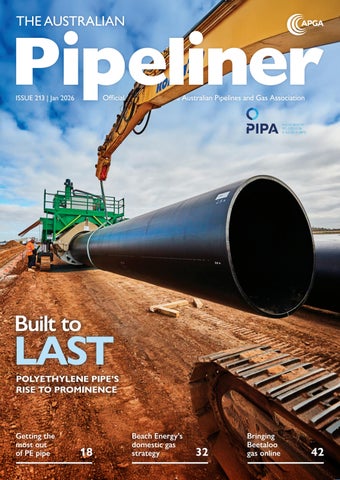
Built to
LAST
POLYETHYLENE PIPE’S RISE TO PROMINENCE
JAN 2026
Getting the most out of PE pipe
18
Beach Energy’s domestic gas strategy
32
Bringing Beetaloo gas online
42
PIGGING | ILI | NDT | LEAK DETECTION | NATA TESTING
POWERED BY PEOPLE, PROVEN IN PROJECTS With innovation, safety and performance at our core, we’re proud to celebrate 10 years of partnerships and projects - and we’re just getting started
www.pipetek.com.au
WE KNOW PRESSURE ® 1300 PIPE TEK
Our Exclusive Global Partner
SV400i INNOVATION IN ACTION
NNOVATIVE NTE ACTIVE NTE I ENT NTE ATE NT ITIVE NS I E
WHEN LESS REALLY IS MORE
26 Culya St, Pinkenba Qld 4008 1300 952610 sales@austrackequipment.com.au www.austrackequipment.com.au
CONTENTS
14 Executive reports
Pro pipe services............................................................................................ 30
APGA President message............................................................................. 8
A pipeline industry powerhouse.............................................................34
State spotlight
Tough under pressure..................................................................................36
What’s on the go in New South Wales?.............................................10
Cue Energy on the hunt for NT gas ....................................................38
ADGO 2026
Master in the art of bending..................................................................... 40
Conference guide...........................................................................................12
Bringing Beetaloo gas online.....................................................................42
Integrity and maintenance
Cover story Engineering the future..................................................................................14
PE Pipe Austrack marches into 2026 with confidence...................................16 Getting the most out of PE pipe.............................................................18 Benton’s Gas: Know your pipe.................................................................20 A closer look at HDPE................................................................................ 22
Operation critical.......................................................................................... 44 Rust-free relief................................................................................................ 46
State of the industry WPF looks ahead to 2026......................................................................... 48 Start the year with purpose......................................................................50
Built to handle PE pipe.................................................................................24
International No-Dig Auckland................................................................52 PNG Expo......................................................................................................... 54
Infrastructure expansion
News in brief
Start the year with purpose......................................................................28
Latest updates in the industry..................................................................56
40
T
G
W o
Events
Brugg Flexwell FSR for hazardous liquid transport........................26
34
4
Beach Energy’s domestic gas strategy..................................................32
P th h
52
The Australian Pipeliner | JANUARY 2026
2026-Prin
Test Critical Welds Faster GripTight® Hydrostatic Test & Isolation Plugs Whether you’re testing open end pipe, systems terminating in long radius elbows, flange welds or isolating lines... count on the GripTight Family of Test & Isolation Plugs from Curtiss-Wright to perform above expectations, test after test. Patented gripper designs, hardened components and single-body uninterrupted seals provide field performance that’s second to none. When safety and reliability matter most, plants around the world trust GripTight Plugs for their hydrostatic testing & pipe isolation needs! Patented gripper designs for increased safety in high-pressure applications Save time by eliminating welded end caps to test pipe spools & piping systems Test flange-to-pipe welds without pressurizing entire systems Isolate & monitor upstream pressure and vapors during hot work Standard pressure ratings up to 15,000 PsiG (1034 BarG) ASME PCC-2 Type I, III & IV Testing Devices available
Call, Click or Scan to Learn About Our Full Line of Test & Isolation Equipment +1.800.355.7044 est-sales@curtisswright.com curtisswright.com curtisswright.com
2026-Print-Ad_TAP-FP_jan.feb.indd 1
12/11/2025 4:53:12 PM
PUBLISHER
Chairman John Murphy CEO Christine Clancy christine.clancy@primecreative.com.au
Managing Editor Eugene Duffy eugene.duffy@primecreative.com.au
Editor Timothy Bond tim.bond@primecreative.com.au
Business Development Manager Jake Niehus
Maximise brand awareness by connecting with thousands of industry professionals The Australian Pipeliner brand comprises: six editions a year, a news website, a weekly e-newsletter, multiple social media platforms, an annual industry directory and an annual pipelines wallchart. Book an advertising and editorial package to gain access to our exclusive audience.
jacob.niehus@primecreative.com.au
3,300+
20,000+
Head of Design Blake Storey
magazine subscribers
website views each month
Designer Apostolos Topatsis
16,500+
13,700+
Front Cover Image PIPA
e-newsletter subscribers
social media followers
blake.storey@primecreative.com.au
Copyright The Australian Pipeliner is owned by Prime Creative Media and published by John Murphy. All material in The Australian Pipeliner is copyright and no part may be reproduced or copied in any form or by any means (graphic, electronic or mechanical including information and retrieval systems) without written permission of the publisher. The Editor welcomes contributions but reserves the right to accept or reject any material. While every effort has been made to ensure the accuracy of information, Prime Creative Media will not accept responsibility for errors or omissions or for any consequences arising from reliance on information published. The opinions expressed in The Australian Pipeliner are not necessarily the opinions of, or endorsed by the publisher unless otherwise stated.
Want to find out more? Contact our business development team to discuss how you can grow your business with The Australian Pipeliner. Call 0466 929 675 or email jacob.niehus@primecreative.com.au
© Copyright Prime Creative Media, 2021
Articles All articles submitted for publication become the property of the publisher. The Editor reserves the right to adjust any article to conform with the magazine format.
Printed by: The Precision Group 83-89 Freight Drive, Somerton VIC 3062 Ph: (03) 9490 1500
Head Office
Sydney Office
379 Docklands Drive, Docklands VIC 3008 Ph: (03) 9690 8766
Suite 11.01, Level 11, 201 Miller St, North Sydney NSW 2060
enquiries@primecreative.com.au www.primecreative.com.au
The Australian Pipelines and Gas Association’s (APGA) vision is to lead the sustainable growth in pipeline infrastructure for Australasia’s energy. APGA is a non-profit organisation formed to represent the interests of its members involved in: the ownership, operation, maintenance, design, engineering, supply and construction of pipelines, platforms and all other structures used in or in connection with the drilling for, extraction and transmission of hydrocarbons, solids, slurries and similar substances both onshore and offshore. As a single voice representing the collective interests of its members, APGA is dedicated to encouraging the extension and development of the industry. The Australian Pipeliner is the official journal of the Australian Pipelines and Gas Association (APGA) and is distributed to members without charge and circulated to interested organisations throughout Australia and overseas. It is also available on subscription. The publishers welcome editorial contributions from interested parties. However, neither the publishers nor APGA accept responsibility for the content of these contributions and the views contained therein are not necessarily the views of the publishers or APGA. Neither the publishers nor APGA accept responsibility for any claims made by advertisers. All communications should be directed to the publishers.
6
The Australian Pipeliner | JANUARY 2026
The Remote Tecno Plug® provides fail-safe double block and monitored isolation of pressurised pipelines while the system remains live and at operating pressure.
Isolated Pipeline
Taper Lock Grips Zero Energy Zone
Dual Leak-Tight Seals Double Block & Monitor Isolation Pipeline Pressure
EXECUTIVE REPORTS
From the President The start of the new year brings with it many new beginnings and I am thrilled to welcome you to the first edition of The Australian Pipeliner for 2026.
T
his is also the first time I have written to you as President of APGA – a role I am honoured to have been appointed to at our AGM in October last year. Last year, Australia’s energy transition continued to make the daily news headlines, and our sector was placed firmly at the heart of what is a very complex conversation. We should be pleased that the assets and infrastructure we operate and work on are being seeing for what they are – as crucial not only to Australia’s future energy security, but as a key enabler of current and future economic activity and prosperity. This fact is recognised not only in the myriad of government policies which call out our sector’s role in the energy transition, but in the investment decisions which continue to be advanced for new projects right across the country. In this edition, Pipeliner touches on two projects that reflect this moment of transition and investment in our sector: the Moomba to Sydney methane pipeline conversion project, and Beach Energy’s Otway Gas Plant. Having worked in our sector for almost 30 years, I am continually impressed by the ingenuity and innovation of my peers and how this shapes our sector. Last year this was on full display at the APGA Innovation Awards where we saw many examples of technology and ingenuity being used to improve the safety of our assets, enhance our sustainability credentials, and enable greater efficiency across our management processes. This same ingenuity was recognised late last year by the New South Wales Government when they released their Renewable Fuels Strategy in November. The Renewable Fuels Strategy sets a clear role for renewable gases, particularly biomethane, in New South Wales and is a welcomed next step in the development of Australia’s burgeoning biomethane sector. I suspect we can expect to see further interest from biomethane producers throughout 2026, reaffirming the important role our assets will play in the energy transition.
APGA Secretariat Registered Office:
2nd Floor, NFF House, 14-16 Brisbane Avenue, Barton, ACT 2600 (PO Box 5416, Kingston ACT 2604) T: +61 2 6273 0577 E: apga@apga.org.au W: www.apga.org.au ABN: 29 098 754 324
8
The Australian Pipeliner | JANUARY 2026
The focus on PE pipe in this edition highlights just how critical this material has become to our industry’s evolution. Its versatility, corrosion resistance and longterm performance make PE pipe a cornerstone technology as we work to deliver safer, lower-emissions and futureready pipeline networks. Sitting behind these developments is you – the people who make our sector such a great one to work in – and I am continually impressed by the camaraderie, care, and solidarity which makes this industry unique. For those of us who have been in the sector for some time, I think it’s important that we continue to support the next generation of pipeliners, and I am continually impressed by the changing face of our sector each time I attend one of the association’s events or conferences. As we look to the year ahead it is these stories of innovation, ingenuity, people, and change which I am most excited to learn more about – some of which have been captured in the following pages. I hope you enjoy reading this edition of The Australian Pipeliner.
SEAN WARD APGA PRESIDENT
Chief Executive Officer
Head of Engagement
Head of Corporate Services
Accounts & Membership Officer
Head of Corporate Affairs
National Policy Manager
Head of Operations & Communications
Technical Advisor
Steve Davies
Dhammith Abeysuriya Paul Purcell
Gayle Bower Katy Spence
Catriona Rafael Craig Bonar
Lawrence Shelton
P
Join the winning team with Benton’s & Fusion Blue ribbon service for Sales, Calibration, Service & Hire
F60 Lightweight electrofusion welder capable of welding electrofusion fittings for gas, water and other pressure pipe applications.
Calibration
Accredited by Fusion
Electrofusion Butt Welding
Hire Service Repair
Gator 2 Automatic butt fusion welder designed and developed for use on gas and water pressure polyethylene pipe networks.
TRIED – TESTED – TRUSTED Benton’s Gas – Hire and Service Division: 18-22 Castro Way, Derrimut Ph: (03) 9361 6120 Email: bps.enquiry@bentons.com.au Web: www.bentonsgas.com.au
STATE SPOTLIGHT
What’s in the pipeline for NSW? The Australian Pipeliner takes a look at some of the pipeline projects taking place in NSW in the last 12 months.
H
unter Water has completed major reservoir upgrades. Just in time for summer, the utility has completed renewal works at its reservoirs at The Hill, Morisset and Arcadia Vale, and has delivered a new reservoir at Cameron Park, helping to maintain strong water pressure and ensuring reliable supply during peak demand periods. The extensive upgrades have boosted reservoir performance, enabling them to service at full capacity and continue delivering safe, high-quality drinking water to homes and businesses, while meeting the needs of our growing communities. The works are part of Hunter Water’s broader investment in maintaining and renewing critical infrastructure across its network of 61 reservoirs, six water treatment plants, 94 pumping stations and more than 5000km of pipelines. Hunter Water’s Acting CEO, Jennifer Hayes, said these projects highlights the organisation’s commitment to delivering a resilient and sustainable water supply.
Gas and water demand in NSW are rising, and the pipeline industry is keeping pace.
10
The Australian Pipeliner | JANUARY 2026
“These reservoir upgrades are a great milestone to reach as we welcome the first day of summer,” Hayes said. Hunter Water’s overall storages sit at 81.7 per cent, but our levels drop faster than most other major Australian urban centres during dry periods due to shallow storages and high evaporation rates. The Bureau of Meteorology is also predicting a hotter-than-usual summer for NSW, with warm days and nights and belowaverage rainfall, another timely reminder to be mindful of how we use water. While our storages are in good shape for now, Hunter Water continues to encourage the community to save water in any weather, reminding residents that even small, everyday actions can have a big impact on the region’s water supply. Taking a 4-minute shower, watering the garden early in the morning or late in the evening, and checking for leaks around your property can make a big difference. “As we turn the calendar over to December, it’s the perfect time to build good habits so
that we ensure we are conserving our most precious resource” Hayes said. “Using water efficiently helps protect precious supplies. If everyone across the Lower Hunter showered for one-minute less, we would save around six million litres of water per day.” “Let's kick off summer and love water together,” Hayes said
Milestone for Moomba to Sydney pipeline APA Group has reached a key milestone in its Moomba to Sydney Ethane Pipeline conversion project, with the New South Wales Government granting approval for natural gas transportation through the repurposed asset. The pipeline, originally designed to carry ethane, is being converted to enable the flow of natural gas – a move that aligns with APA’s broader strategy to bolster energy infrastructure across Australia’s east coast. With government approval now in place, natural gas is expected to begin flowing through the pipeline later this year.
What will Santos do with its Narrabri gas? Santos has signed a non binding memorandum of understanding with ENGIE for the supply of natural gas from the Narrabri gas project to the domestic market. Under the proposal, Santos would deliver up to 20 petajoules per year for at least ten years from first gas, with ENGIE committing all of the gas to the domestic market.
Santos CEO Kevin Gallagher said the company is confident that Narrabri will be a very competitive source of domestic gas supply for the east coast market that is further advantaged by proximity to customers in NSW. Gallagher also said Santos bought this asset in 2011 and has been working for over a decade to develop it, investing more than $1.5 billion to date. “Delays to bringing Narrabri gas to market have occurred as a result of a number of factors including government moratoriums, independent scientific reviews, delayed and lengthy approvals, legal appeals and native title processes,” he said. “This is a strategic project that now needs Santos, along with state and federal governments, putting their shoulders to the wheel and working together to make it happen. “Narrabri will be subject to some of the strictest environment and groundwater protections in the world, and we will comply with them. “The federal government’s clear Future Gas Strategy shows that there will be no energy transition to renewables without gas backup and no Future Made in Australia without the gas that is required to make things.”
New water infrastructure project for NSW The NSW Government has committed $59.2 million to building a new filtration plant to treat raw water from the Steuart McIntyre Dam and Sherwood Borefield in Kempsey, NSW. The project is one of the largest water infrastructure projects on the mid north coast that will future-proof the drinking supply of Kempsey, Frederickton, Smithtown and Gladstone. The project will be funded by $12.5 million from the Australian Government’s National Water Grid Fund, $13.2 million from the NSW Government’s Safe and Secure Water Program and $27.1 million from Kempsey Shire Council. The 2500 megalitre Steuart McIntyre Dam stores water from the Sherwood Borefield, located 2km away, and was built in response to the 1994 drought. The new high-tech water treatment plant will be more efficient, lower carbon emissions and significantly boost water security and quality across the network that supplies over 18,000 residents. The project also includes new pumps, tanks and a pipeline to connect this world-class facility to the dam and bore field. Construction kicked off in mid-2025 and will take roughly 18 months to complete.
Image: pop_gino/stock.adobe.com
This development marks a significant step forward in efforts to strengthen energy supply and reliability, particularly as demand for gas continues across the eastern seaboard. The repurposed pipeline will form a critical part of the east coast gas network, helping to support households, businesses and industries by improving access to domestic gas. APA Group says the project reflects its commitment to adapting existing infrastructure to meet the evolving needs of Australia’s energy system. By repurposing existing assets rather than building new ones from the ground up, the company is aiming to deliver energy solutions in a more efficient and sustainable manner. Once operational, the pipeline will enhance connectivity between gas production facilities in South Australia and major centres in New South Wales, playing a key role in maintaining energy security across the region.
JANUARY 2026 | The Australian Pipeliner
11
Australian Domestic Gas Outlook 2026 CONFERENCE AGENDA
MONDAY – 30 MARCH 2026
Pre-Conference Masterclass
Time
Session
Speakers
9:00 am
Masterclass A: Detailed gas market analysis: Price trends, electrification, supply demand balance, decarbonisation and LNG imports
Jim Snow, Angus Rich, Rohan Harris, Liz Boylan
TUESDAY – 31 MARCH 2026 Time
Session
8:20 am
Registration and coffee
8:50 am
Opening remarks from the Chair
Conference Day One Speakers
Clyde Russell
TAKING STOCK OF THE CURRENT DOMESTIC GAS MARKET
9:00 am
Investing in Australia’s gas future meeting demand with new supply
Liz Westcott
9:25 am
Managing Australia's east coast gas supply: balancing domestic security against investment uncertainty
Jane Norman
9:50 am
Panel Discussion Can export-linked supply obligations solve the east coast gas crunch without undermining market confidence?
Moderator: Saul Kavonic Sean Fleming, Andrew Thornton, Stephen Harty, Paul Farrow, Mia Davies
10:30 am
Morning tea
FUTURE DIRECTIONS AND SOLUTIONS FOR INCREASING GAS SUPPLY
11:00 am
Ending a decade long gas crisis: Why Australia needs to be innovative when it comes to our gas future
Rob Wheals
11:25 am
East Coast Gas – a path to stability
Dan Clark
11:45 am
Firming the future with gas and power to enable a reliable energy transition
Peter Stokes
12:10 pm
Interview: Driving investment certainty and supply stability in a shifting gas market
Moderator: Saul Kavonic Danny Woodall
12:35 pm
Lunch
1:30 pm
Pathways to providing competitive gas supply
Cecile Wake
1:55 pm
Unlocking new domestic supply amid gas market and environmental reform
Darren Stevenson
2:20 pm
Expanding pipeline capacity to strengthen domestic gas supply - resolving infrastructure constraints to meet peak demand
Darren Rogers
2:45 pm
Navigating Otway gas drilling: turning exploration authorisation into energy security
Jan-Arne Johansen
3:10 pm
Afternoon
ASSESSING PROMISING NEW GAS DEVELOPMENTS
3:35 pm
Unlocking Beetaloo gas to strengthen Australia’s long-term energy security
3:55 pm
Bowen Basin’s new resource value: breakthrough in Denison’s tight sandstone gas exploration
4:15 pm
Gas development update
4:35 pm
Panel Discussion What are the investment priorities for a robust domestic gas sector?
5:15 pm
Closing remarks from Chair
5:20 pm
Close of day one and Networking drinks
6:30 pm
Official ADGO Conference dinner
WEDNESDAY – 1 APRIL 2026
Xingjin Wang
Moderator: Mark Wiseman Fiona Hall, Nerise Cook, Tim Cooper
Conference Day Two / Women in Energy Breakfast
Time
Session
Speakers
9:50 am
Panel Discussion / Women in Energy Breakfast Why is it important to continue to grow diversity and how do we increase the number of women in the gas sector?
Moderator: Ying Luo Fran Duiker, Craig Ypinazar
8:20 am
Registration and coffee
8:50 am
Opening remarks from the Chair
Kathy Witt
OUTCOMES AND ONGOING IMPLICATIONS OF THE FEDERAL REVIEW FOR PRODUCERS, USERS, AND REGULATORS
9:00 am
12
Ministerial updates
The Australian Pipeliner | JANUARY 2026
9:30 am
Shaping east coast gas market reform to unlock supply and investment confidence
Samantha McCulloch
10:00 am
East Coast Gas Market – ACCC perspectives
Anna Brakey
10:30 am
Morning tea
HOW POLICY DECISIONS WILL AFFECT SUPPLY RELIABILITY AND DOMESTIC ENERGY SECURITY
11:10 am
Update on rule changes under the Stage 2 gas reforms to improve the reliability and supply adequacy of the East Coast Gas System
Andrew Lewis
11:40 am
The next phase: balancing energy security, efficiency, and end-of-life realities
Nathan Pike
12:00 pm
Reserving gas domestically to strengthen national interest
Brett Woods
12:30 pm
Lunch
PATHWAYS FOR GAS USERS AND BUYERS IN A TIGHTENING MARKET
1:30 pm
Leading change from dominance to mutual benefit
Andrew Richards
2:00 pm
The ongoing evolution of the Bass Strait
David Berman
2:30 pm
Panel Discussion Understanding buyer needs to build a stronger domestic gas market
Moderator: Dale Koenders Paul Evans, Melissa Perrow, Lauren Trost, Phaedra Deckart
3:10 pm
Afternoon tea
REBUILDING TRUST IN THE GAS SECTOR TO ENSURE A STABLE FUTURE
3:40 pm
Making tax payments from gas producers fairer
4:10 pm
Partner presentation
4:30 pm
Panel Discussion Credible strategies for decarbonising the gas sector
5:10 pm
Closing remarks from Chair
5:15 pm
Close ADGO 2026
THURSDAY – 2 APRIL 2026 Time
Session
8:20 am
Registration and coffee
8:50 am
Opening remarks from the Chair
Richard Denniss
Moderator: Felicity Underhill Vikram Singh, Behdad Moghtaderi, Tim Cooper, David Kearns
CCS Day Speakers
David Byers
ANSWERING THE QUESTIONS ON COST AND COMPETITIVENESS
9:00 am
Positioning Australia’s CCS developments to accelerate global decarbonisation
David Kearns
9:30 am
Succeeding where others stall - cracking both the policy and economic incentives to make CCS projects viable
10:00 am
Panel Discussion How can CCS overcome cost and competitiveness challenges?
10:40 am
Morning tea
Moderator: Liam Pepper Kevin Morrison, Glenn Watt, Andrew Nicholls, Jane Burton
REGULATORY AND APPROVAL RISKS/ MARKET AND REPUTATION PRESSURE
11:10 am
Advancing CCS through the Otway Test Centre to confront Australia’s emissions challenges
Matthias Raab
11:40 am
Responding to market and reputation pressure
Jane Burton
12:10 pm
Delivering economically viable abatement through CCS and natural gas
Glenn Watt
12:40 pm
Lunch
STRATEGIES FOR DEALING WITH TECHNICAL AND OPERATIONAL UNCERTAINTY
1:30 pm
Enhancing CCS performance through technical and operational refinements
David Fallon
2:00 pm
Panel Discussion Coordinating storage and transport to enable large scale CCS
Moderator: Yu Jing David Fallon, Matthias Raab, Rachael Smith
2:30 pm
Closing remarks from the Chair
2:35 pm
Close of Carbon Capture Day
JANUARY 2026 | The Australian Pipeliner
13
COVER STORY
A team of industry experts help develop PIPA’s technical guidelines, notes, and codes of practice.
Engineering the future Plastics Industry Pipe Association of Australia explains why polyethylene pipe is Australia’s century-long infrastructure asset.
P
olyethylene (PE) pipe has become one of the most reliable, sustainable, and future-fit materials in Australia’s infrastructure landscape. From drinking water to gas distribution, irrigation, and major industrial networks, PE pipe quietly underpins the essential services that keep communities running. But what makes it so valued – and how has it earned its place as a 100-year critical asset? We spoke with PIPA’s Executive General Manager Cindy Bray on exploring PE pipe from its early development to the advanced materials and circular-economy innovations shaping its future. Polyethylene pipe’s journey began in the 1930s with early LDPE materials. By the 1950s, HDPE began replacing traditional materials in irrigation and industrial applications across Australia. As demand grew through the mining boom, rural schemes, and the rapid expansion of gas networks in the 1970s and 80s, PE pipe proved its strength: corrosion-free, flexible, and reliably weldable. “The evolution of PE materials has been driven by long-term research, strong standards, and real-world performance,” Bray said. “PE isn’t just fit for purpose, it’s fit for the future.” Today, PE is the material of choice for many of Australia’s critical water, wastewater, and gas assets, a position built on decades of proven performance and continuous material innovation.
14
The Australian Pipeliner | JANUARY 2026
The science behind the strength The modern era of PE pipe is defined by advanced materials engineered for long-term performance. PIPA’s POP004 ‘Polyethylene Pipe and Fittings Compounds’ comprehensive listing independently evaluates compounds that meet strict criteria under AS/NZS 4131 ‘Polyethylene (PE) compounds for pressure pipes and fittings’ and AS/NZS 4130 ‘Polyethylene (PE) pipes for pressure applications’. Within POP004 it identifies several material classes essential to today’s infrastructure: • PE100: the industry standard for pressure pipelines. • PE100-RC: Raised Crack Resistant compounds for challenging installation conditions. • PE112: delivering a higher MRS (11.2 MPa), offering additional safety margins and strength. These advancements give asset owners confidence, not just for today, but for the next century. Long-term performance is determined not just by material quality, but by smart engineering that anticipates operating conditions. Australian designers rely on both Standards and PIPA guidance to ensure PE performs consistently over decades. Water network design must account for interactions with disinfectants like chlorine and chloramine. PIPA’s POP018 ‘Polyethene
drinking water pipes in contact with chlorine and chloramine disinfectants’ provides guidance on allowable pressure ratings under disinfectant exposure, chemical derating factors, and long-term oxidative resistance. These factors ensure PE pipes maintain integrity even when exposed to oxidative environments for decades. “PE pipes are incredibly durable, but like any engineered asset, long-term performance depends on good design choices early. POP018 provides this guidance,” Bray said. As a thermoplastic, PE’s pressure performance naturally varies with temperature. Designers apply temperature derating to ensure pipelines remain safe and reliable across Australia’s diverse climates, from hot northern regions to warmer reclaimed water systems. Factors considered include ambient climate, fluid temperature, shallow or above-ground installation, and long-term cyclic loading or surge pressures.
Sustainability and circularity Engineered for long life, durability, repairability, and eventual recyclability, PE pipe systems demonstrate how highperformance infrastructure can align with circular principles through design choices that reduce resource demand over decades. Across Australia’s water, gas, and industrial sectors, asset owners are increasingly seeking low-carbon, circular materials. PE pipe meets these priorities through robust environmental
Installation flexibility PE’s flexibility and weldability make it ideal for both open-trench and trenchless construction methods such as directional drilling, slip lining, pipe cracking, and swage lining. These techniques reduce excavation, community disruption, spoil, emissions, and cost. Fusion welding is central to system integrity. PIPA’s guidelines POP001 ‘Electrofusion jointing of PE pipe and fittings for pressure applications’, POP001A ‘Guide to electrofusion assembly and welding’ and POP003 ‘Butt Fusion jointing of PE pipes and fittings – recommended parameters and practices’ establish national best practice for electrofusion and butt fusion jointing. These guidelines provide essential advice on safe, reliable electrofusion and butt fusion jointing, covering everything from surface preparation and temperature control to post-fusion inspection and record keeping. They are recognised in national standards, industry codes, and project specifications across Australia. “The biggest factor in achieving long-term performance is welder competency,” Bray said. “A high-quality fusion joint becomes as strong as the pipe itself, and that’s critical for a system expected to last over 100 years.”
PIPA acts as the peak body for plastic pipes and fittings in Australia.
PIPA advocates for welder training to national competency standards, with reaccreditation every 2–3 years.
Closing the loop on circular infrastructure PE’s contribution to circularity extends to both its long service life and its recyclability. The vast majority of PE pipelines currently installed will remain in the ground as host pipes, into which new pipes are inserted via trenchless renewal, preserving embodied energy and avoiding excavation. For those pipes that are available for recycling these can be incorporated into nonpressure applications. PIPA’s POP208 ‘Specification and testing guidelines for recycled material suitable for non-pressure plastic pipe applications’ provides clear requirements for incorporating recycled materials. This ensures recycled content meets strict chemical, physical and rheological standards, enabling industry to increase recycled material use without compromising performance. From the early LDPE pipes to today’s advanced materials, polyethylene has become a cornerstone of Australia’s infrastructure renewal. Its evolution reflects decades of
Images: PIPA
performance and long service life. PIPA commissioned independent Life Cycle Assessment (LCA) studies through Edge Impact, aligned with ISO 14040/44 and verified with third-party Environmental Product Declarations (EPDs). The findings highlight clear advantages: • Lower embodied carbon (GWP) compared with ductile iron cement-lined (DICL) pipes. • Substantially reduced radioactive waste impacts, due to avoidance of nuclearpowered steel production. • Lower transport emissions, thanks to PE’s light weight and efficient handling. • High recyclability, supporting circular procurement strategies. “When we talk about sustainable infrastructure, it’s not just about carbon,” Bray said. “We need to look at all factors including circularity, durability, recyclability, efficient transport, cleaner manufacturing, and long service life. PE performs strongly across all of these.” While no single material outperforms across every environmental category, the LCA results show that plastic pipes consistently deliver strong advantages, particularly in reducing greenhouse gas emissions, conserving water, and supporting circular economy outcomes through local manufacturing and recyclability.
innovation, resulting in pipelines that can perform reliably for over a century. PE pipelines offer long-term durability, standing up to soil pressures, traffic loads, and environmental stresses while maintaining integrity in challenging conditions. This durability ensures system-wide reliability, allowing critical infrastructure networks like drinking water, gas, irrigation, and industrial pipelines to operate safely with minimal maintenance over decades. Beyond mechanical performance, PE demonstrates strong environmental credentials. Its lightweight nature reduces transport emissions, and its resistance to corrosion and chemical degradation minimises resource consumption over the asset’s life. Designed with circular economy principles in mind, PE can be repaired, reused, or recycled, and its compatibility with trenchless renewal methods allows multiple generations of infrastructure to coexist, conserving resources and reducing disruption. “PE pipe isn’t just an engineering solution; it’s an infrastructure strategy for the next century,” Bray said. “Its materials, design, and installation practices ensure communities can rely on safe, sustainable services for generations to come.”
For more information, visit pipa.com.au JANUARY 2026 | The Australian Pipeliner
15
PE PIPE
Austrack Equipment marches into 2026 with confidence Austrack Founder and Managing Director Michael Benson takes time out to speak with The Australian Pipeliner about his company’s relentless pursuit of excellence in service. Austrack Founder Michael Benson with APGA CEO Steve Davies.
I
f you want to know the heart and soul of a company you will generally find it most clearly expressed in its founder. That is undoubtedly the case with Austrack Equipment where founder and managing director Michael Benson leaves his unmistakable stamp on the company. Michael Benson, like the company he founded, is busy, determined and customerfocused with a can-do attitude that permeates everything he does. He started his career in Ireland and operated machinery before he’d even left school. When he arrived in Australia a quarter of a century ago, no one could have foreseen the circuitous route he would take to end up as the driving force behind Austrack Equipment. Over the last almost fifteen years he has developed the company into one of the most dynamic equipment hire companies servicing a range of sectors but always with an emphasis on pipelining. 16
The Australian Pipeliner | JANUARY 2026
On arrival in Sydney, it wasn’t long before he found his way into pipeline construction. Quickly Michael moved from machine operator into ever more challenging and demanding roles: supervisor, field operations manager, and construction superintendent. Always with a home base in Brisbane, pipelining took him to every corner of Australia. “All the while in those frontline roles I was learning what pipelining was all about,” he said. “I was also learning about operating in the harsh Australian environment, in remote bush locations where the terrain was challenging, where machine reliability is critical, and where machine breakdown is sometimes catastrophic and always costly. “The pressure of getting pipe in the ground can be relentless, keeping ahead of the build program, ensuring key project deadlines are met, managing the complicated mix of men and machinery in a shared purpose that
delivers hardship and reward in almost equal measures. “During my time in pipeline construction I have worked on major pipelines all over Australia. I spent time on the Burdekin Dam and pipeline in Queensland and on the Sugar Loaf water pipeline in Victoria. I have worked on the Sino iron ore project near Karratha in WA’s Pilbara. I have worked on gas gathering activities in the Surat Basin. “When the time came to do my last fly-in fly-out, when the last section of pipe had been hammered home, when the compaction testing had all been passed, I knew exactly what I wanted to do. I wanted to set up a heavy equipment hire company that would bring a very particular expertise to service pipeline contractors. The knowledge I had gained from machine operator right up to construction manager I could now use to assist pipeline contractors to get the best equipment to complete their projects.” Benson recalls his first staff hire, Donna Owens, whom he had already worked with on a number of pipelines. Donna is now Austrack Equipment General Manager which will give an insight into another of the qualities highly valued in the organisation that bears his stamp: loyalty. “In truth it wasn’t really a hire at all. I had a plan and an idea of how it might be achieved and Donna agreed to come along for the ride, and I am very pleased that she did. “At first we operated out of a small yard in Eagle Farm with machines numbered on the fingers of one hand. Believe me, it wasn’t hard to keep track of everything. Our premises were not exactly a hole in the wall, but it was a modest beginning, certainly. “Donna was a perfect fit for the business. I knew equipment and what worked and what was needed to build pipelines and Donna knew computers, invoicing, accounting, contracts and all of the endless paperwork necessary to survive and grow. And grow we did. “The original two eventually became four and we were on our way.” Now Benson looks out over the 12,000m2 yard in Pinkenba, Brisbane that is complimented by satellite yards in Mackay, Toowoomba, Rockhampton and more recently Perth. The original handful of machines now numbers more than four hundred and there are close to another one thousand attachments.
Benson is a modest man and a plain speaker. In talking about the Austrack journey from where it began to where it is now, it is noticeable that he studiously avoids use of the word ‘I’. When he talks, it is about the team and the critical power of collaboration in getting the job done. He does, however, credit his hiring of staff who have been out on pipelines working, as an important part of the success of the company. “Look, it makes good business sense, having staff who understand the environment in which our customers operate,” he said. “People who have done the job and lived the life themselves, giving them a unique perspective. We pride ourselves in our responsiveness and customer focus.” Apart from a uniquely well-credentialled workforce and the sheer number and range of yellow iron beasts that Austrack has available to keep its customers supplied, there is one
other business decision that has fuelled the company’s growth over the last few years. The development of its SafeVac Lifting Systems vacuum lifting attachment has been an unqualified success, and added manufacturing to Austrack’s core role. Benson said the introduction of the vacuum lifting attachment has been a driver of Austrack growth since the first unit was rolled out three years ago. It was a big decision at the time to get involved in design and manufacturing, But customer response has proved that decision is sound. “We have now released three models, and we are really well-placed to provide vacuum lifting attachments for all pipe sizes, weights, and materials,” he said. “Our SV200 unit fitted onto a Hitachi ZX170 wheeled excavator is perfect for polyethylene work and we already have a number of units operating on gas gatherings in Queensland’s Surat Basin. Going forward
with gas production likely to ramp up again, I believe our SV200 combination will be a great choice for contractors. It is the perfect combination of speed and maneuverability both essential elements when PE is in use. “And all of our units carry the Australian Made logo and Australian patents with world-wide patents pending. “The move into vacuum lifters has allowed us to broaden our customer base, which now includes all of the Tier One pipeline contractors. “That makes for exciting times at Austrack.” Pressed on the future and what it looks like for Austrack, Benson said: “I am confident we are well-placed to continue to grow, but we take nothing for granted. “We are only as good as our last job. ‘Everything begins and ends with our customers’ is not just a cute phrase, and ‘we make it happen’ is a promise we always intend to keep.”
For more information, visit austrackequipment.com.au
Images: Austrack Equipment
Austrack’s SV200.
JANUARY 2026 | The Australian Pipeliner
17
PE PIPE
Getting the most out of PE pipe The polyethylene pipe market in Australia is booming, and kwik-ZIP is one of the key links in the chain.
Images: kwik-ZIP
kwik-ZIP spacers and centralisers help protect pipelines from abrasion.
P
olyethylene (PE) has emerged as a material of choice for gas, water, wastewater pipes, and other underground networks. Its durability, light weight, and chemical resistance make it simpler and more cost-efficient to install in the right circumstances than traditional metal or concrete pipes. In Australia, aging assets, combined with rapid population growth in regional centres and outer suburbs, have created enormous demand for pipeline replacement and new construction. Many of these jobs call for trenchless techniques such as slip-lining and cased crossings – methods where the carrier pipe (often PE) is inserted within an existing casing or old pipeline. But slip-lining only works if the new pipe is carefully centralised inside the casing. Without proper support and spacing, the pipe can rub, deform or even fail, especially over the long life expected of PE networks. As demand for these durable, costeffective and corrosion-resistant pipelines grow, one Australian-born company is quietly becoming indispensable to contractors across the nation: kwik-ZIP.
Headquartered in Western Australia but with a worldwide customer base, the company manufactures non-corroding, non-metallic casing spacers and centralisers designed specifically for pipe-in-pipe applications including slip-lining, cased crossings, and other trenchless installation methods. The kwik-ZIP product range, including the HD, HDX, and HDXT series, covers pipes from small diameters (about 100mm) to heavyweight carrier pipes in excess of 1600mm OD. The spacers are moulded in a high-performance engineered thermoplastic blend, offering excellent chemical resistance, abrasion resistance, low friction, and resistance to corrosion. All kwik-ZIP spacers have been successfully appraised against the Water Services Association of Australia’s product specification for casing spacers (WSA PS-324). This standard covers casing spacers used to facilitate the insertion and protection of carrier pipes when installed inside encasement pipes. Additionally, all products are also certified by the Australian Water Quality Centre for use in contact with drinking water. These features also make the products suitable for potable water projects.
HD-50 spacers on a DN560 HDPE pipe.
In terms of performance, kwik-ZIP spacers distribute the pipe’s weight across multiple runners, reducing point loading. This loadsharing suspension system cuts down on wear and stress, minimises the risk of pipe deformation or damage during insertion, and helps isolate the carrier pipe from vibrations or movements in the outer casing. kwik-ZIP’s spacers and centralisers have already proven themselves on major infrastructure projects across Australia and the rest of the world, such as Water Corporation’s Alkimos seawater desalination plant project in WA, and Canada’s 1150kmlong trans mountain pipeline project. While PE pipe is expected to last for a century, factors such as oxidative degradation and ground movement threaten to dramatically shorten this lifespan. That’s why asset owners and contractors are turning to kwik-ZIP to help secure the full lifespan of their pipeline assets. Utlities are facing a generational challenge in upgrading and rehabilitating ageing pipeline infrastructure. By providing an offthe-shelf solution with proven longevity, kwikZIP is playing a critical role in this effort.
S S S
W t B s
For more information, visit kwikzip.com 18
The Australian Pipeliner | JANUARY 2026
STRONG PIPELINES START WITH STRONG JOINTS. Whether you choose electrofusion or butt welding, the key is simple: follow industry best practice. Because when every weld is done right, the whole system works better, for longer.
pipa.com.au
PE PIPE
Benton’s Gas: Know your pipe
Images: Benton’s Gas
Polyethylene pipe is being laid across Australia almost faster than it’s being made, but when dealing with critical networks like potable water and gas, it’s important to know every link in the production chain is tried and tested. And that’s where Benton’s Gas comes in.
Pipe installation equipment.
P
ipe networks across Australia are under pressure to evolve. Polyethylene (PE) pipe materials, especially high-density PE100, have emerged as the backbone of new water and gas networks. Their favourable properties, including long service life, corrosion resistance and flexibility, make them ideally suited to modern infrastructure needs. Since 1999, Benton’s Gas has built a reputation in the pipeline industry for supplying high-quality products and services for Australia’s growing PE networks. The company’s scope is broad, supplying PE and PVC pipe, pipe fittings, tooling, gas meters, valves, personal protective equipment, and much more. This covers gas, potable water, recycled water, and electrical conduits. “In the PE pipe space, much of our work comes from commercial developments and greenfield areas,” Benton’s Gas Category Manager Bevan McWha told The Australian Pipeliner. “With gas, everything’s PE, from main to meter. Water is very similar.” The company left its mark on countless projects last year, including the Victorian gas
20
The Australian Pipeliner | JANUARY 2026
renewal upgrade program, which involved works in rural and metro regions all over the state. Benton’s also played a role in multiple pipeline relocation projects, including for the Melbourne Airport Rail and the North East Link. Bevan said the order books are already filling up for 2026, with supply contracts for asset initial development and maintenance programs lined up in South Australia and Victoria. From utilities to data centres, appetite for PE pipe remains strong in the market, which Bevan attributes to its impressive properties. “PE is lighter than steel, but more durable and flexible than PVC,” he said. “It has highpressure properties and a shelf life of 100 years if you treat it right. It’s easy to understand the appeal of these assets.” But just like any type of pipe, not all PE is created equal. Bevan said the main pain points when working with PE are on the manufacturer’s end, with the pipe and fittings needing to adhere to strict standards, as well as the joining methods.
Issues with quality control can sometimes arise when sourcing cheap PE resin from overseas. That’s why Benton’s sources its highpressure PE pipe from Vinidex, which supplies over 50 per cent of the business. Vinidex uses only the highest standard of raw materials and the latest manufacturing technology to manufacture its PE pipe. In other words, Benton’s Gas knows exactly where its pipe comes from, and its technical capabilities. The gas division of the business takes this one step further, with BSI certification, and the collection of test certificates for every batch of pipe that comes in. “We supply PE pipe from 16mm all the way up to 355mm,” Bevan said. “All of it is tried, tested, and trusted.”
Fittings & installation The pipe is only one piece of the picture; once it hits a worksite, it needs to be installed. For PE, this means butt-welding or electro-fusion, depending on application. “Butt-welding is common in the water industry due to its simplicity,” Bevan said. “Gas is more focused on electro-fusion, which
Benton’s has an impressive track record across a range of gas infrastructure projects.
Pipe arriving at a worksite.
requires more preparation but has a faster cook time. “We supply high-performance electro-fusion and butt-welding equipment from a range of leading brands such as Fusion Plast. “We hold accreditation from these OEMs, which means we can provide qualified servicing, support and spare parts to keep these machines performing at the top of their game.” This means that Benton’s is able to alleviate the main challenges associated with PE pipelines, those being pipe quality and proper installation. All that remains is for installers to follow best practice when assembling the pipe. “If the joining method is correctly performed, whether it's a butt-weld or electrofusion, these sections will actually be the strongest part of the pipe and the asset will last the intended duration.” The Benton’s family of companies covers several markets and operating out of 16 branches across metropolitan Melbourne and regional Victoria. Bevan said the plan for 2026 is to consolidate its multi-sector resources, rolling out streamlined practices across the whole company, to better serve the markets in which it operates. “We’re opening a new site in Lynbrook which will house our trade; heating, ventilation, and air conditioning [HVAC]; and gas business,” he said. “Consolidating our resources like this will allow us to support our customers on a broader level. For asset owners looking to develop PE pipe
networks, Benton’s Gas delivers a single-point supplier model that is hard to look past. And yet, despite its broad scope the company
understands its products at a granular level, delivering tried, tested and trusted service to the pipeline industry.
Benton’s has played a driving role in the development of much of Victoria’s water and gas infrastructure.
For more information, visit bentonsgas.com.au JANUARY 2026 | The Australian Pipeliner
21
PE PIPE
Because of the rugged properties of HDPE, pipe can be welded and installed in even the most challenging of environments.
A closer look at HDPE McElroy explains why HDPE is a common-sense solution to efficiency, improved safety, and quality.
22
The Australian Pipeliner | JANUARY 2026
HDPE, however, takes things a step further, bringing a myriad of benefits when welded with quality equipment and following a recognised standard. Those benefits include:
HDPE pipe is lifted with heavy machinery during a large-scale project in the City of Gold Coast.
• Corrosion free: Unlike traditional piping materials like iron or steel, HDPE does not rust or tuberculate, and when properly installed is expected to last more than a century without issue.
Images: McElroy
T
he world’s infrastructure is changing. In piping systems both above- and underground, system design, installation, and maintenance have become top priorities, alongside considerations for sustainability, cost effectiveness, and quality assurance. Because of the ever-increasing need for oversight and improved safety, welded highdensity polyethylene (HDPE) pipe has emerged as one of the fastest-growing pipe materials available worldwide. Thermoplastic pipe welding – also known as butt fusion welding and poly pipe welding – is the process by which two plastic pipe ends are faced, heated, and forced together under pressure to form a welded joint that is stronger than the material surrounding it. Poly pipe welding is a reliable, trusted, and standardised method for joining plastic pipe together. Many standards exist to ensure the welding is performed properly and consistently. In Australia, ISO high force standards outline the acceptable practices for heat welding for polyethylene pipe and fittings, including heat and cool times and pressures required for different sizes of HDPE pipe. Since its arrival on the market in the 1960s, welded HDPE has become one of the most trusted materials for installation. Much like iron, steel, and PVC pipe, HDPE can be used in a variety of applications, from municipal water and wastewater to natural gas to conduit for wire and cables.
• Leak free: Welded HDPE has an allowable water leakage rate of zero, as the bond formed during the pipe welding process is stronger than the surrounding pipe material. • Trenchless installation: HDPE can be installed using trenchless methods that keep disruption in the area to a minimum and reduce machinery, manpower, and time required for the work. • Longevity: When welded with quality equipment, a trained operator, and an accepted welding standard, the lifespan of HDPE piping systems can exceed 100 years. • Cost and time efficiency: Because poly pipe welding can be done using a single operator and a single machine (that in some cases can even be driven to the pipe welding site without extra heavy machinery), the amount of heavy equipment required for the project is often lower than what’s expected for metal pipe. HDPE is lightweight and versatile, and can be bent to fit into spaces that might call for joints or specialised fittings in traditional piping materials. • Quality assurance: HDPE and other plastic pipe – such as polypropylene, which is widely used in indoor applications like HVAC – can be joined in a way that provides a digital “thumbprint” for each joint welded and installed. Data-logging tools can record pertinent welding parameters like the pressure and standard used, heating/cooling times, GPS location of the weld, and more.
Trenchless opportunities With thermoplastic pipe, installation methods go beyond traditional trench-digging. Eliminating the need for a trench not only reduces the amount of manpower needed for installation – it also minimises the disruptions around the site, such as streets or waterways. Some trenchless installation methods include horizontal directional drilling (HDD), pipe bursting, slip-lining, submerged/floating pipe. Utilising HDD, the City of Gold Coast was recently able to complete a large-scale water recycling network, constructing two of the longest marine pipeline crossings of their kind in all of Australia. To compensate for the area’s population boom – by 2050 the area is expected to double to 1.2 million people – the existing infrastructure, installed in the 1980s, had neared capacity. During the first phase of the project, a 1200mm diameter welded HDPE pipeline was pulled under the Nerang River bottom between Winchester Street and Waterways Drive. The pipeline is designed to handle increased volume of wastewater that, after treatment and reclamation, goes on to irrigate golf courses, parks, and more.
Replacing guesswork with guarantees Quality assurance can take many forms, especially on a poly pipe welding jobsite. Whether replacing old or failing infrastructure or installing new service, it’s critical to ensure the pipe is installed correctly. For poly pipe welding, quality assurance considerations include: • Training and certification: Certified welding technicians undergo classes to ensure they are well-versed in the welding process. McElroy University offers several certification classes that cover a wide range of poly pipe welding processes, from smalldiameter and manual welding to large-scale pipe welding. These classes are available worldwide and are taught by McElroy Certified Instructors, ensuring that students are ready for the job ahead. • Accepted standard: To ensure consistency and quality of each joint, an accepted standard should be used when welding HDPE or other plastic pipe. These guidelines establish things like proper melt depth, the pressure needed for the size and type of pipe being joined, heat and cool times, and more. • Quality poly pipe fusion machine: A high-quality fusion machine is one of the
most important tools on any fusion jobsite. A quality machine will be ready for the job ahead and, in many cases, may reduce the need for extra heavy machinery or manpower. Many McElroy machines are designed around a single operator, allowing one person to control the fusion from start to finish. • Data-logging tools: During and after the poly pipe fusion process, data-logging tools can record and store the fusion parameters. Data-logging devices provide the tools to improve decision-making and overall jobsite performance in the field. McElroy’s DataLogger® 7 takes that a step further with an additional suite of quality assurance innovations, including GPS information for each individual joint, the operator who performed the weld, and exception reporting that lets inspectors, contractors, and engineers find potential issues in the fusion site before it goes into service. The poly pipe welding industry is a fastgrowing one, and it’s constantly shifting to meet the changing needs of modern infrastructure. McElroy is committed to remaining at the forefront of fusion technology and providing tested, trusted machinery that will improve the world’s infrastructure one weld at a time.
A MegaMc 1600 was utilised to weld 1200mm sticks of pipe for the City of Gold Coast project, which involved replacing a 1980s-era wastewater lines.
For more information, visit mcelroy.com JANUARY 2026 | The Australian Pipeliner
23
PE PIPE
Built to handle PE pipe Pipeline Plant Hire has been involved in Queensland’s polyethylene pipeline sector since inception – and for good reason. PPH VacLifts have a cycle time of under 40 seconds per pipe length.
P
olyethylene pipe – light relative to steel, yet awkward to handle – presents a unique set of challenges on site. Traditional installation methods often involve slings and manual labour to lift, manoeuvre and place the pipe. With long lengths, plastic coatings that can be scuffed or damaged, and flexible construction, poly pipe demands careful handling. On any job site, poor handling practices not only slow down
Images: Pipeline Plant Hire
VacLifts help move PE pipe safely and efficiently.
24
The Australian Pipeliner | JANUARY 2026
progress but also increase the risk of damage to the pipe and injury to workers. And that’s where Pipeline Plant Hire’s (PPH) VacLifts come in, offering a PE pipe handling method calibrated for precision, protection and speed. The VacLift is the company’s own expertly manufactured and highly optimised vacuum lift. The VacLift can raise lengths of polyethylene or steel pipe weighing up to
15 tonnes without causing damage during the lifting process. The suction between the shoe of any vacuum lift and the pipe forms the critical seal keeping the pipe suspended. In long lengths – and particularly under the hot sun – PE pipe can sag, which can cause it to peel off the shoe. Fortunately, PPH’s VacLifts are designed to account for this. The nine meter lifting beam has pivot points in the suction shoe at either end, which allows the shoe to move to accommodate pipe sag, ensuring a secure connection. “PE pipe – especially that which is intended for high-pressure use – needs to be treated with respect and you need to be able to unload those pipes without putting anyone in harm’s way,” Global Pipeline Equipment (PPH’s research and development partner) Matt Dridan said. “The only way to do that is with a VacLift.” Notably, these machines have a cycle time under 40 seconds per pipe length, whereas conventional methods typically take 5–10 minutes. “Through careful consultation and engineering approval from the relevant manufacturers, we have been able to safely maximise the lifting capabilities of our machines,” Dridan said.
I
A PPH VacLift handling PE pipe.
“This is the key to getting a job done efficiently. You can send a 60–70-tonne machine out to a project, but it will be extremely expensive. Alternatively, you can send out one of our 30–40-tonne VacLifts to do the same work for significantly less cost, by maximising its lifting ability while retaining the necessary safety factors in
line with Australian standards. “This is something we’ve specialised in for many years.” On the safety side of the equation, VacLifts can assemble pipes in-situ using a guidance system that eliminates the need for ground crew to be in or even near the trench. A unique shoe design also means the pipe
cannot be released unless in contact with the ground, significantly reducing the risk of a drop. The result is much faster and safer pipeline construction. All of this comes in a highly optimised, lightweight package. “Apart from the risk of falling objects, there are a number of environmental hazards for ground crew, like heat, dust inhalation, snake bites, not to mention the expense,” Dridan said. “That’s why it’s necessary to limit ground crew and the best way to do that is by using a VacLift.” PPH has been involved in the pipe handling space for two decades, and in that time the company has learned how to smooth out many of the industry’s main pain points at once. Its VacLifts combine speed, safety and bullet-proof pipe handling in a single package. For asset owners, that means fewer delays, less manual labour, and lower risk of damage or injury. At a time when demand for water and gas infrastructure is rising sharply, and contractors juggle cost, time, safety and environmental considerations, PPH’s pipe handling solutions offer a clear edge.
For more information, visit pipelineplanthire.com.au
INDUCTABEND Shaping Australia for over 30 years Process control
Quality
Innovation
Customer service
We specialise in applying our induction technology to solve seemingly intractable problems. Induction bending of pipe up to DN900, wall thicknesses up to 100mm.
Structural steel section bending Fully customizable bend geometry
Carbon steels, stainless steels, clad pipe and other exotic alloys
Other specialist heating applications
High X grade bends Compound bends Helix bends Custom OD mandrels
Cold field bending machines also available for hire (up to DN1200)
Onsite induction bending (large diameter high volume projects)
For security of supply and the circular economy we support Australian manufacturing
enquiries@inductabend.com.au +61 (0)3 9315 1244 inductabend.com 32 Frederick Rd Tottenham VIC 3012
Image: Elaflex Pacific
PE PIPE
Brugg Flexwell Offshore Pipe at an LNG facility in the Gulf of Mexico.
Why choose Brugg Flexwell FSR for hazardous liquid transport? When it comes to the challenges of safety, compliance and installation efficiency of transporting hazardous liquids, Elaflex’s double-walled stainless-steel pipe systems offers powerful arguments of its winning advantages for utility companies.
T
ransporting flammable or environmentally sensitive liquids demands piping material that can deliver on safety, regulatory compliance, installation efficiency, and long-term operational reliability. Elaflex Pacific explains the benefits of Brugg Flexwell FSR over HDPE pipe for hazardous liquid transport. “While HDPE [high-density polyethylene] pipe is widely used for general utility applications, it has significant limitations when deployed in high-risk environments,” Elaflex Pacific Sales Manager Mario Iglic told The Australian Pipeliner. “Elaflex Pacific has the answer for this problem.” The Brugg Flexwell FSR double-walled stainless-steel pipe system offers engineering advantages over HDPE that make it a strong solution wherever safety and containment are critical. The most decisive difference is that Flexwell FSR is inherently a double-wall system, featuring a corrugated stainless-steel inner pipe surrounded by a stainless-steel containment pipe. The annular space between them provides true secondary containment along the entire length. In contrast, standard HDPE pipe is single walled. To achieve dual containment, contractors must install a second external HDPE pipe, assemble spacer rings, and weld or electrofusion-join fittings. “This process dramatically increases installation time, cost, and potential leak points,” Iglic said. “FSR provides continuous, factory-built containment without the complexity of on-site fabrication.” Brugg Flexwell FSR is designed for permanent leak detection, using pressure or vacuum monitoring of the annulus.
“If the inner pipe is compromised, operators receive an almost immediate alert before product escapes into surrounding soil or groundwater,” Iglic said. “HDPE piping has no inherent leakdetection capability. Detecting failures typically requires periodic pressure testing or physical inspection – methods that may not discover leaks early enough to prevent environmental contamination or regulatory breaches.”
Made tough FSR’s stainless-steel inner pipe provides high mechanical strength; excellent temperature resistance; fire resistance ratings of R90 / R120; and long-term compatibility with fuels, chemicals, hydrocarbons, and aggressive media. “For industrial, fuel-handling, and hazardous fluid applications, stainless steel ensures a robust and predictable service life,” Iglic said. “HDPE, while chemically resistant, is vulnerable to creep and deformation under long-term stress; temperature limitations, especially above 40–60°C where HDPE can soften and deform or even lose structural integrity; stress cracking, particularly in installations with point loads or sharp bends; and UV degradation unless specially protected.”
Efficient installation FSR is supplied in factory-made continuous lengths up to hundreds of meters, allowing it to be pulled into trenches with minimal joints. This reduces leak risk, eliminates hot work, and speeds up installation.
“Unlike FSR, HDPE installation requires butt-fusion or electrofusion welds, each of which demands skilled technicians, specialised equipment, and strict quality controls,” Iglic said. “Every weld is a potential failure point and increases installation duration.” Iglic said that the corrugated profile of Flexwell FSR gives it high flexibility, enabling tight bends and easy navigation around obstacles. This reduces excavation, trench width, and overall civil construction effort. “HDPE is flexible only in small diameters and becomes rigid in larger sizes, often requiring sweeping bends, multi-segment welding, and larger trenches,” he said. “FSR carries international approvals for transporting flammable and water-hazardous liquids, backed by decades of use in fuel stations, tank farms, airports, and industrial facilities. Its double-walled construction and stainless-steel durability ensure a long operational life with minimal maintenance. “While good for water and utilities, HDPE is not purpose-built for high-risk, safetycritical fluid systems.” Brugg Flexwell FSR is also available in variations including vacuum insulated pipe for cryogenic applications such as LNG, ammonia and liquid hydrogen and is currently in use around the world. “Brugg Flexwell FSR provides a level of safety, containment, monitoring, and installation efficiency that single-wall HDPE systems cannot match,” Iglic said. “For hazardous liquids, the engineering advantages of FSR make it the superior and more responsible choice.”
For more information, contact mario.iglic@elaflex.com.au or call +61 461 529 141 26
The Australian Pipeliner | JANUARY 2026
Future Proofing Critical Infrastructure with Data-Driven Solutions Partner with us to enhance asset safety, lifetime, and performance www.rosen-group.com/datadriven
www.rosen-group.com
INFRASTRUCTURE EXPANSION
Looking behind to look ahead Image: DifferR/stock.adobe.com
APGA Head of Corporate Affairs Paul Purcell discusses the challenges ahead for the energy transition. In an energy system that increasingly depends on gas to firm renewable generation and manage periods of stress, predictability matters as much as volume.
A
ustralia’s gas industry has always evolved in eras. First came the era of discoveries: Gippsland in the 1960s, which shifted Victoria off town gas and laid the foundations for the state’s industrial prosperity, and the North West Shelf in the 1970s, a resource so significant it would help underpin Australia’s position as a global LNG powerhouse. Next came the era of pipelines, when new transmission began to stitch the continent together. From the Moomba to Sydney Pipeline through to the expanding east coast grid, Australia built the networks that today moves gas thousands of kilometres between basins, cities and industrial hubs. That was followed by the era of LNG, as Gladstone’s CSG to LNG developments transformed Queensland’s economy and cemented Australia’s position among the world’s largest exporters. Now, with the Commonwealth’s Gas Market Review approaching its final report, Australia is entering a new era. This one will not be defined by a single discovery or mega project. It will be defined by the rules that govern how the East Coast Gas System works for domestic users and exporters alike, and whether it can stay that way for good. The GMR is the most comprehensive attempt in decades to bring coherence to how Australia manages domestic supply, pricing, contracting behaviour and export expectations.
28
The Australian Pipeliner | JANUARY 2026
The current combination of the Gas Market Code, the Australian Domestic Gas Security Mechanism and the various Heads of Agreement evolved in response to shortterm pressures. The Review is now seeking to replace this with a durable, long-term framework that assures domestic customers of affordable supply, gives exporters clear and stable obligations, and provides industry with the certainty required to invest in bringing new gas and infrastructure to market. Although the Review is formally limited to upstream policy settings, its influence will extend across the entire supply chain. When the Commonwealth changes how gas is contracted, priced or reserved, these settings inevitably shape the environment in which infrastructure must operate. Even though the pipelines and storage that move gas between regions fall outside the federal mandate, they remain central to whether any upstream reform works in practice. This is where contracting trends become important. The shift toward shorter, more flexible supply arrangements has advantages, particularly in a market marked by variable production and shifting demand. But midstream infrastructure is financed over decades, not years. Pipelines, compression and storage typically rely on multi-year shipping commitments
rather than short-term expressions of interest, and as contract horizons shorten while policy settings evolve, investors face greater uncertainty. The risk premium on new midstream capacity tends to increase, and that affects the ability of the system to deliver gas where and when it is needed. Officials across government recognise this relationship. Throughout the Review, departments have acknowledged that no domestic reservation can function unless infrastructure exists to transport and store reserved gas. Sound policy must treat infrastructure as a foundational component of delivering supply, not as an afterthought. This logic also shapes the debate on how domestic obligations should be calibrated. A mechanism linked to shifting demand forecasts may offer flexibility, but it introduces variability that complicates long-term investment. Production-linked or exportlinked approaches provide clearer, more stable signals for producers and, importantly, for the infrastructure operators who must plan and finance capacity years in advance. In an energy system that increasingly depends on gas to firm renewable generation and manage periods of stress, predictability matters as much as volume. The Review is also turning its attention to transparency. The current reporting framework is fragmented, expensive, duplicative and slow. The GMR could help consolidate key market data within a single authority, streamline compliance and improve the timeliness of supply and demand information. For infrastructure operators, this could reduce regulatory burden and provide a clearer picture of gas flows across the eastern seaboard. What ties all of this together is a simple reality. The success of the next era will not be measured by how neat the rules appear on paper. It will be measured by whether gas continues to reach the customers and power stations that rely on it at the moments the energy system is most under pressure. That depends on supply, but it depends equally on the infrastructure that moves it, stores it and makes it available where it is needed most. If the GMR delivers a framework that is stable, predictable and investable, this new era could give Australia a gas system that works for domestic users and exporters, and stays that way for good.
W e in
B to fo
Pipeline solutions in Australia Faster. Smarter. Safer.
We are proud to announce the integration of Pro Pipe Services with TDW, expanding our capability to deliver industry-leading hot tapping, isolation, inspection, pigging and repair solutions across the region. Backed by global technology and expertise, our enhanced local team is ready to respond faster, deliver trusted services and provide new technical resources for your energy infrastructure operations.
Local expertise. Global strength. For the life of your pipeline.
tdwilliamson.com
Images: TDW
INFRASTRUCTURE EXPANSION
The integration will result in quicker mobilisation, local expertise, and access to a global network of advanced pipeline solutions.
TDW integrates Pro Pipe Services T.D. Williamson has integrated the assets and operations of Pro Pipe Services to strengthen Australia’s pipeline network.
A
ustralia’s pipeline infrastructure is evolving. As is the case for many nations, pipeline networks are growing, systems are aging, fuels transported within pipelines are changing, and demand for energy delivered through these vital assets continues to rise. The challenge of providing safe, reliable, and affordable energy in the context of aging networks, rising demand for maintenance and evolving regulations are pushing operators to rethink their approach. Operators need partners who combine technical expertise, local presence, and advanced technologies to deliver smarter, safer and faster solutions. T.D. Williamson (TDW), a global leader in pipeline infrastructure technology and services, is stepping in with a decisive solution. The company has expanded its commitment to the Australian market by integrating the assets and operations of Pro Pipe Services, a trusted provider of pipeline maintenance solutions. This combination strengthens TDW’s ability to deliver advanced hot tapping and isolation solutions by deploying global resources through local expertise. Pro Pipe Services is well-respected for its expertise and customer-focused commitment in delivering specialised hot tapping, line 30
The Australian Pipeliner | JANUARY 2026
isolation, and maintenance of pipelines across Australia. Through this combination, customers will benefit from TDW’s global resources and advanced hot tapping and pressure isolation offerings, along with advanced inline inspection technologies, pigging products and repair solutions currently offered in the region.
Local strength meets technical depth While the Australian pipeline market continues to grow, operators face increasing demands alongside capacity pressures, labour shortages and project bottlenecks. TDW’s integration of Pro Pipe Services directly addresses these challenges, providing local expertise, faster mobilisation and expanded technical capabilities. Operators can maintain safe, efficient pipelines while relying on experienced industry leaders to ensure smooth project execution. By integrating Pro Pipe Services, TDW delivers faster, smarter, and safer pipeline solutions across Australia. Operators have access to advanced technology plus local expertise, ensuring projects are completed efficiently and safely.
Key benefits include: • Advanced technologies: High-pressure energised seals and double isolation and bleed technology enable safe hot tapping and line isolation without shutting down pipelines. • Comprehensive services: Pipe cutting, bypass, and full maintenance for steel, PVC, cast iron, polyethylene and other pipeline materials. • Project support: Quality assurance oversight, ancillary services, and on-the-ground training keep operations running safely and efficiently. • Continuity and experience: Pro Pipe Services leaders remain in place to maintain relationships, transfer knowledge, and ensure projects run smoothly, giving operators the same trusted faces with new depth, capacity and speed.
How this integration will serve the pipeline industry The integration of Pro Pipe Services into TDW positions the team to address critical challenges and opportunities across Australia’s pipeline sector: • Supports aging infrastructure: Provides capabilities for upgrades, repairs and replacements across mature networks.
e
• Enables new technology adoption: Local support helps operators modernise and future-proof assets. • Enhances emergency response: Faster interventions with on-the-ground teams and equipment. • Facilitates growth and compliance: Supports regulatory adherence and energy transition readiness, including hydrogen and carbon capture infrastructure.
Confidence, continuity, and innovation Operators can rely on upgraded local service, enhanced technical capability and faster response times across their networks. Experienced teams, backed by TDW global resources, ensure continuity, safety and operational reliability. “This combination reflects our ongoing commitment to the Australian market and our dedication to delivering greater value, safety and reliability to pipeline operators. Welcoming Pro Pipe’s talented team and operations into TDW, unlocks enhanced local support, faster mobilisation, and expanded technical offerings
TDW provides operators with tools, training and talent to maintain safe, efficient pipelines.
to our customers,” said Bob McGrew, TDW President and CEO. “We are excited for the opportunities this combination will create for Pro Pipe’s customers and employees,” said Joe Buttigieg and Dean Muscat, owners of Pro Pipe Services. “We have a long history working with TDW, and we are confident this combination will provide unparalleled services for the Australian market.”
TDW provides operators with tools, training and talent to maintain safe, efficient pipelines while meeting rising regulatory standards and accommodating future energy transitions. With infrastructure investment surging, this integration supports Australia’s pipeline industry for growth, resilience and longterm reliability.
For more information, visit tdwilliamson.com
Flexible
Pipes for
Offshore
Applications
Unbonded, robust connections for LNG, LH2, Ammonia and more.
elaflex.com.au
INFRASTRUCTURE EXPANSION
Waitsia gas plant.
Inside Beach Energy’s strategy for a stronger domestic gas market Beach Energy is sharpening its role as a major supplier of affordable, reliable domestic gas, investing billions to bring new supply online and strongly advocating for policy settings that restore confidence across Australia’s east coast market.
B
each Energy continues to position itself as a central player in strengthening Australia’s domestic gas outlook, with CEO Brett Woods and Executive Vice President Strategy and Commercial Fiona Hall outlining how the company is navigating policy shifts, supply pressures and major development opportunities. Speaking with The Australian Pipeliner, Hall emphasised Beach’s deep commitment to the local market. “We are an Australian company focussed on supplying the domestic market – last financial year we supplied nearly 20 per cent of the east coast market,” she said. “Our vision is to become Australia’s leading domestic supplier of energy and during the past five years, we have invested about $3.4 billion dollars to deliver new natural gas supply.” This investment program sits against the backdrop of a rapidly evolving policy landscape. With outcomes of the East Coast Gas Policy Review, ongoing debates over reservation, compliance with the Gas Market 32
The Australian Pipeliner | JANUARY 2026
Code, and speculation about an east coast reservation regime, Beach is advocating for certainty that will encourage continued exploration and development. Hall said the right policy setting is key to strengthening the domestic gas market.
Beach Energy Executive Vice President Strategy and Commercial Fiona Hall.
“Streamlining the approvals process, cutting through regulatory red tape and reinstating the timely release and award of new exploration acreage is critical to getting more gas to the domestic market and supporting the rollout of renewables,” she said. “This will help producers to confidently invest in exploration and development of the resources required to support the long-term role of gas in contributing to our energy security. “We support prospective natural gas reservation policies paired with the right policy framework to support exploration and development and allowing the gas market to return to functioning with transparency and predictability without excessive government intervention. “Through the development of the Future Gas Strategy in their first term to the current Gas Market Review, the Federal Government has demonstrated an increasing understanding of the importance of continuing to explore for and develop natural
Images: Beach Energy
gas to back up renewables and to make things like aspirin, bricks and metals.” Hall also highlighted the critical role of infrastructure and the need to address transport constraints as part of the broader supply picture. “While there is a lot of focus on supply from the north there is also significant infrastructure transport capacity constraints, so speeding up exploration and permitting in the southern markets, incentivising pipeline development and recognising the benefits of scale in opening up new plays, including the development of unconventional gas, will play to our strengths as an energy rich nation,” she said. Looking ahead, Hall sees the Federal Gas Market Review as a pivotal moment for establishing a market that provides durable supply for manufacturers, industry, business and households. “Beach has new development and exploration underway in the Otway Offshore Basin, and our Otway Gas Plant in Victoria near Port Campbell, is well positioned to play a leading role in the processing and deliver of new natural gas to the east coast market. “The Federal Gas Market Review provides an opportunity for our nation to establish a gas market which delivers sustainable supply for manufacturers, industry, business and Australian households over the coming decades.”
In the Bass Basin, Beach extracts natural gas from the Yolla field, transporting it to shore via a 147km subsea pipeline.
Beach Energy leaders will also share their perspectives at ADGO 2026, where Brett Woods will speak on the national interest case for domestic gas reservation and Fiona Hall will join a panel on investment priorities.
However, the core of their message remains clear: stable policy, timely approvals and continued exploration are essential to keeping Australia’s domestic gas system strong for decades to come.
For more information, visit adgoconference.com.au
Beach Energy’s Otway Gas Plant near Port Campbell in Victoria. All natural gas processed here is delivered to Australia’s east coast.
JANUARY 2026 | The Australian Pipeliner
33
INFRASTRUCTURE EXPANSION
The makings of an Australian pipeline industry powerhouse Pipeliners who work at the pointy end of Australian pipeline engineering and construction – especially those with tenure – will know the name Mitchell Water. Mitchell Water has always counted on Vermeer track trenchers when the terrain turns to hard rock.
34
The Australian Pipeliner | JANUARY 2026
A series of strategic acquisitions and partnerships over the last 30 years have brought functions like surveying and fabrication in-house and provided resources for further expansion. “In 2011 we purchased Sadlier Surveying, who have over 40 years’ experience in water and gas pipelines throughout Australia and the Asia Pacific, to bolster our design and construct capabilities,” Ben said. “Similarly, our investment in fabrication and pumping businesses [Westmain Aust and Envirotech Water Solutions] enables us to manufacture and install fittings and assemblies for pump stations, buildings, well pads, etc.”
Ben Waldron, Operations Director at Mitchell Water Australia.
When it comes to equipment fleet, there are few providers who can offer the depth and breadth of Mitchell’s owned and selfmaintained fleet. “Company Founder Wayne Mitchell is a bit of an industry legend when it comes to his patented plant; from developing pipe bedding systems to compliment our trenchers, the invention and patenting of our Plow installation systems, to designing and producing pipe welding barges, this homegrown gear is a big part of our operation’s success,” Ben said. “Similarly, when it comes to the off-theshelf specialist equipment that powers our
Images: Mitchell Water
T
raditionally keeping a low profile on the social and self-promotion carousel, their execution of many significant projects almost 50 years speaks for itself and has cemented Mitchell’s place as one of Australia’s leading pipeline constructors. We caught up with Ben Waldron, Operations Director at Mitchell Water Australia, to learn how this privately owned and operated, dedicated water and energy infrastructure construction company has reached this enviable position. “We’ve built some of Australia’s largest water and CSG pipelines since our formation in 1979, extending to an accumulative total of over 26,000km of pipe, and pumping stations, treatment plants, dams, storages and infrastructure,” he said. “I feel that our key differentiator is that we are a true end-to-end solution provider when it comes to pipeline engineering and construction. In particular, we offer a complete design and construct service, which draws on the team’s wealth of experience to ensure pipeline survey, design, construction and commissioning is delivered on time and to budget. And when it comes to construction, the breadth of our fleet means we can take on essentially anything the Australian landscape presents”. Ben’s extensive industry experience gives credence to his claims. In particular, Mitchell Water’s approach to managing in-house expertise, and their equipment fleet, is worth further study.
Innovate, design and construct
One of Mitchell’s Vermeer track trenchers in action.
pipeline construction, we’ve always counted on Vermeer trenchers when the terrain turns to hard rock; they are part of our fabric. We started in the early 90s with a Vermeer T850, and I believe we’re now at our ninth Vermeer track trencher. For us, it’s about finding what works and partnering with it. And for 30 years we’ve partnered with the Vermeer Australia team.” When speaking with Adam Lane, Specialty Excavation and Pipeline Specialist at Vermeer Australia, he noted that Mitchell’s experience
in the pipeline construction game was immediately evident. “Delivering a machine to a company with long-term staff and extensive knowledge in the pipeline industry, that know the Vermeer equipment and understand the operation of the machine, makes for an easy delivery and handover. The ability of the customer to efficiently transition from commissioning phase to full operation is definitely worth noting of Mitchell Water capabilities” Adam said.
It’s fair to say that Mitchell’s combination of in-house expertise, strategic partnerships and investment in fleet has delivered results in many high-profile projects spanning tens of years and tens of thousands of kilometres of pipeline. Their project resume reads as the who’s who of Australian pipelines over the last 47 years – and they’re not standing still. “At present we’re constructing a significant long term CSG contract in the Surat Basin,” Ben said. “At the same time we’re underway on the East Grampians Rural Pipeline in Western Victoria for GWM Water, where our Vermeer trenchers’ rock capabilities gave us an edge over other bidders. But we’re always looking to the future.” One thing’s for sure, while they may be the Australian pipeline industry’s quiet achiever, as the constructor of some of Australia’s biggest pipeline networks, and with decades of expertise and an unmatched in-house equipment fleet, Mitchell Water is poised ready to take on whatever opportunity the industry presents.
For more information, contact bwaldron@mitchellwater.com.au or visit vermeeraustralia.com.au
Standing up under pressure since 1968 Pollard’s Sawdust Supplies has been a trusted national supplier of graded and bagged sawdust and wood shavings products for over 50 years. The pipeline construction industry has been entrusting our business to provide support for their pipe assets for many decades. Our pipeline bedding Pack Tuff bags are: Lightweight – up to 80% lighter than equivalent sandbags Eco-friendly from sustainable sources Chemical free 3 sizes to suit all pipe diameters Won’t explode or balloon under pressure
Contact us for more information about our products, request a free sample for evaluation, or place an order.
www.sawdust.com.au 130 Yan Yean Road, Plenty, Victoria 3090
DELIVER AUSTRALIA WIDE
(03)9435 6167
INFRASTRUCTURE EXPANSION
Tough under pressure Pipeline projects abound in 2026, and Pollard’s Sawdust Supplies is prepared to help with the heavy lifting.
A
s Australia’s pipeline sector steers a steady course into 2026, one supplier quietly continues to underpin much of the industry’s heavy-lifting. For more than five decades, Pollard’s Sawdust Supplies has transformed timber off-cuts into a product that contractors rely on to support and protect vital pipeline infrastructure across the nation. That commitment shows no sign of waning. Established in 1968, Pollard’s has grown and adapted its business to meet a much broader range of industrial needs. Over the years, the company has developed more than 15 types of graded and bagged wood shavings and sawdust for uses as diverse as animal bedding, horticulture, spill absorption, smoking sawdust for food, and brick manufacturing. But perhaps its most crucial role today lies in pipeline support. At the heart of Pollard’s pipeline offering is the product known as Pack Tuff. These specially designed bedding bags have become the go-to solution for companies engaged in laying, transporting or storing pipeline sections, thanks to a combination of practicality, safety and reliability. Pack Tuff bags are manufactured using sustainably sourced, chemical-free virgin timber, kiln-dried or air-dried to precise standards. Pack Tuff’s polywoven bags are robust enough to withstand the rough conditions of pipeline construction sites, yet
flexible enough under pressure to avoid dangerous ‘exploding’ under the weight of heavy steel pipeline sections – even those weighing up to 15 tonnes.
For more information, visit sawdust.com.au 36
The Australian Pipeliner | JANUARY 2026
Pollard’s freights its Pack Tuff bags across Australia with pallets arriving onsite stretch-wrapped and weatherproof.
Image: Pollard’s Sawdust Supplies
Pollard’s Sawdust Supplies is based in Plenty, Victoria.
One of the most significant advantages of Pack Tuff over traditional sandbags is its low weight. For pipeline crews working long hours on remote sites, that means easier manual handling and a reduced risk of injury. The durability and reusability of Pack Tuff bags also make them an economical solution. Many contractors report being able to reuse them multiple times, even after harsh exposure during transit or construction, adding up to a lower long-term cost of ownership and less waste compared with oneuse alternatives. Pollard’s Director Peter Brennan put it best: “The Pack Tuff bags can withstand a lot of hammering,” he said. “Companies choose our bags because they can take significant rough handling on site.” As demand for pipeline infrastructure grows, driven by new gas, water and energy projects across Australia, Pollard’s is wellpositioned to keep supporting the backbone of that expansion. And while the spotlight often shines on high-tech materials and complex infrastructure, it’s worth remembering that sometimes, the humble bag of sawdust does the hard yards.
WE CAN DO THIS THE EASY WAY, OR WE CAN DO THIS THE EASY WAY.
Need a pipe handling system to make your job faster, safer and easier? At Pipeline Plant Hire we have two flexible solutions ready to go. Hire and attach a PL1500 to your machine, or hire a fully-equipped VL machine as an efficient, all-in-one solution. All our vacuum lifter are capable of safely lifting 15 tonne. Our PL1500 integrates seamlessly with your host excavator using the main controls and hydraulics to operate the vacuum lifter. This system makes your life easier, more productive, and the whole site safer. Talk to us about a solution today.
INFRASTRUCTURE EXPANSION
Cue Energy on the hunt for NT gas A joint initiative is underway in the Northern Territory’s Amadeus Basin to bring more gas supply to the domestic market.
The gas supply will help boost the Northern Territory’s energy grid.
38
The Australian Pipeliner | JANUARY 2026
gas supply into the local market through to 2034. The LOI, announced this week, sets the framework for joint-venture partners and PWC to finalise gas supply terms that support both immediate development works and future production. The initiative is a shared ambition to bolster local energy reliability through domestic gas growth that feeds
Territory industry, households, and critical infrastructure. Under the arrangement, the joint ventures will launch into early works without delay. This initial phase will see the ordering of longlead equipment, mobilisation of civil works, and the selection of a suitable drilling rig ahead of a projected mid-2026 drilling commencement. Image: tonjung/stock.adobe.com
A
major step forward for energy security in the Northern Territory has been marked with the signing of a binding letter of intent (LOI) between Cue Energy Resources, the Mereenie and Palm Valley Joint Ventures, and the Territory’s Power and Water Corporation (PWC). The agreement paves the way for a significant four-well drilling program, and could secure long-term
Image: SobrevolandPatagonia/stock.adobe.com
The venture covers four new wells.
The program encompasses two wells at the established Mereenie field and two at Palm Valley, each strategically positioned to tap existing reservoirs and unlock new production potential. “The Mereenie and Palm Valley fields have been important contributors to the Northern Territory’s energy supply,” Cue Energy CEO Matthew Boyall said.
“This LOI supports new development activity and long-term gas supply, helping to ensure reliable, locally sourced energy for the Territory through to 2035. “This is an exciting opportunity for Cue with short-term production growth and longterm contract stability. We look forward to finalising agreements and commencement of the four well drilling program in mid-2026.”
The LOI itself outlines non-binding, conditional terms for gas supply, stretching beyond the current contracted volumes. It includes both uncontracted gas from existing production and anticipated output from the upcoming drilling campaign. As part of the agreed framework, the parties are targeting the finalisation and execution of binding gas sales agreements by early 2026, subject to internal approvals from each joint-venture participant and PWC. Included in the LOI is provision for the joint ventures to be reimbursed by PWC for costs associated with the drilling program’s early works in the event binding GSAs are not executed by 20 February 2026. For the Northern Territory, the potential influx of locally produced gas comes at an important time. With energy markets under pressure, strengthening domestic supply chains has become a priority. Gas remains a cornerstone of the Territory’s energy mix, feeding power generation, industrial users and supporting broader economic activity. In the coming years, energy projects like this one are likely to be crucial building blocks for meeting demand, and for positioning it as a major contributor to Australia’s energy landscape.
DataLogger® 7 WHEN IT COMES TO A JOB WELL DONE, having the data to back it up is invaluable. The DataLogger from McElroy helps to assure every fusion joint is in adherence to industry standards by documenting operator and machine information, heating and cooling times, and hydraulic pressures. Each joint report can be stored, analyzed and shared to provide a comprehensive record of the entire jobsite.
Read why a DataLogger became standard use on a Gold Coast water recycling job.
mcelroyfusion.com.au/goldcoast
Copyright © 2025 McElroy Manufacturing, Inc. MMI block and DataLogger are registered trademarks of McElroy Manufacturing, Inc. All rights reserved.
Image: Inductabend
INFRASTRUCTURE EXPANSION
Master in the art of bending
Inductabend delivers solid, reliable and creative solutions to its clients in the pipeline industry.
The pipeline industry is staring down the barrel of a busy 2026, and Inductabend stands ready to deliver.
I
Quick and convenient
n an era when pipelines are under increasing pressure to deliver on efficiency, safety and longevity, Inductabend has quietly built a reputation as Australia’s go-to specialist for highintegrity induction bending. Over more than three decades, the company has evolved from a niche pipe-bender into a strategic partner for major gas, mining and infrastructure projects. Since 1992, Inductabend has forged a name for itself in mastering the precision art of induction bending. Using advanced heatinduction machinery to bend pipe into various configurations, the company creates custom bends that preserve the structural integrity of the original pipe material and meet stringent standards required for highpressure gas or other industrial pipelines. Whatever the shape – whether a tight turn, large radius curve, or even helical bend – Inductabend has the skill the deliver. These induction bends are all made and delivered from Australian soil, eliminating the challenges sometimes associated with sourcing supplies and services from overseas, such as lengthy lead times, quality assurance, and after sales support.
Inductabend’s pre-qualified stock program takes this homefield advantage and elevates it to new heights, giving pipeline operators access to readily available bends with the specific angles, radius and tangent lengths to suit their pipeline projects. In any induction bending service, a test bend – called a qualification bend – must be made from the mother pipe intended for use. Samples are then cut from this bend and rigorously tested to ensure it is fit for purpose. The strict quality standards associated with gas pipes mean this can be an arduous and expensive process – but Inductabend can remove this step altogether. “We stock a range of X52 PSL2 pipe from reputable Korean mills. We purchase a full run of pipe at a time so each pipe for that size has the same chemistry,” Inductabend Business Development Manager Nathan Crouch told The Australian Pipeliner. “This way, we’re able to qualify the pipe by making just one qualification bend for an entire batch. “Inductabend performs and pays for the qualification up front, and then any customer is free to utilise that pipe to make bends
customised to their specific project needs.” This initiative drastically lowers cost and lead-times for pipe bends. Inductabend currently holds pre-qualified stock of standard X52 PSL2 HFW pipe in diameter nominals 100, 150, 200 and 300, suitable for 5D–10D radii bends. Clients can request to add other pipe sizes be carried by Inductabend to suit their pipelines too.
Proven in the field Inductabend has been helping shape Australia’s complex network of pipelines of decades. “Our customers appreciate the consistency we provide,” Crouch said. “They get their high-quality bends quickly and economically, every time.” In one instance, Inductabend was even able to manufacture an urgent bend for a customer within 48 hours of the initial inquiry, significantly reducing the duration of an unplanned shutdown. While Inductabend brings a lot to the table, it’s adaptability, speed and cost-effectiveness, as well as the satisfaction that comes with supporting Australian business, that keeps clients coming back.
For more information, visit inductabend.com 40
The Australian Pipeliner | JANUARY 2026
The global stage for trenchless innovation
EXHIBIT NOW
New Zealand International Convention Centre, Auckland 28 – 29 October 2026
Hosted in partnership with
INFRASTRUCTURE EXPANSION
Bringing Beetaloo gas online Jemena outlines its strategy to bring Beetaloo Basin gas to market.
J
emena, the owner of the Northern Gas Pipeline (NGP), has unveiled the Northern Territory Gas Strategy, designed to bring gas from the Beetaloo Basin to Australia’s east coast markets more quickly and affordably than previously envisaged. The plan pivots on using existing infrastructure, expanding and optimising where possible, rather than waiting for expensive new builds that might not be ready until the early 2030s. Under the first stage of the strategy, Jemena says early-stage Beetaloo gas could begin supplying the east coast gas market as soon as 2026. The existing NGP, which runs 622km from Tennant Creek in the Northern 42
The Australian Pipeliner | JANUARY 2026
Territory to Mount Isa in Queensland, could carry up to 90 terajoules per day (TJ/d) of gas once Beetaloo production begins. In a second stage, Jemena plans to augment and expand the NGP, increasing its capacity by around 45 per cent. That would lift throughput to roughly 130 TJ/d, which the company estimates could meet about 10 per cent of typical east coast gas demand. Looking beyond augmentation, the strategy contemplates a further major build: a new pipeline lateral of approximately 370km, running north from the Territory’s Barkly region to the heart of the Beetaloo Basin. That expansion would serve to link the Beetaloo
more directly into Jemena’s network and cater for future demand growth. Jemena’s Managing Director, David Gillespie, explained the approach as being grounded in a deep understanding of market needs, especially those of upstream producers in the Beetaloo. “We’re listening to our stakeholders to understand how we can best meet their needs and make their projects a success,” he said. As a first step the company is conducting a market-led Expression of Interest process to engage both producers in the Northern Territory and gas consumers, to clarify future pipeline requirements.
Image: kalyakan/stock.adobe.com
The strategy could see Jemena construct a 370km pipeline.
Jemena Managing Director David Gillespie.
Image: Jemena
He emphasised the attractiveness of leveraging existing infrastructure over new large-scale builds, which in his view would carry a capital expenditure of between $4–$6 billion and would not come online until at least the early 2030s. Instead, by gradually augmenting the capacity of the NGP, Jemena aims to align transport capacity to production volumes, making the NGP a more cost-effective route for Beetaloo gas to reach market. “By gradually augmenting the capacity of the Northern Gas Pipeline, we can match transportation capacity with production volumes, making the Northern Gas Pipeline the most cost-effective way of delivering Beetaloo gas to market,” Gillespie said. “This is a win-win for upstream gas producers and consumers as it will enable Beetaloo gas, particularly early-stage Beetaloo gas, to be delivered to market quickly and without the price tag associated with large-
scale new infrastructure builds. This gas is crucial for large industrials and Australia’s $100 billion manufacturing sector which simply cannot wait half a decade for new pipeline builds to be completed.” Jemena also stressed its commitment to working in tandem with communities and
local businesses – lessons learned during the original construction of the NGP between 2015 and 2019. That earlier effort cost around $800 million, and was credited with creating more than 900 jobs, 75 per cent of which went to people from communities along the pipeline corridor. Over $50 million was invested in small businesses across the Territory. In addition to its work developing the Beetaloo Basin, Jemena continues to support local Territory businesses and community organisations, having recently sponsored 20 Indigenous delegates to attend the NT Resources Week. The business was also the foundation partner, and continues to support, Saltbush Enterprise’s Foundation to the Future program, which is delivering holistic mentoring and job readiness training to support Indigenous Territorians into employment. JANUARY 2026 | The Australian Pipeliner
43
INTEGRITY & MAINTENANCE
Operation critical Pipe Tek has completed the ILI of a more than 50-year-old, 9.1km section of pipeline, critical to fuel terminals operated by multiple energy retailers. Image: Pipe Tek
Taddam Farrant and Myles Brannelly in the new ILI pig trailer.
I
Pipe Tek mobilised on site in November, utilising the company’s new pig trailer in the field for the first time. Launched only weeks earlier, the custom-built ILI pig transport trailer was developed from insights gained from more than a decade on-site. The trailer is equipped with a high-tech laboratory, meaning data gathered from ILI runs can be downloaded immediately and analysed on site in real time. The ability to analyse data immediately on site also facilitates quicker decision making about next steps, whether that means continuing operations, performing targeted digs or scheduling repairs. Pipe Tek designed an integrity plan for the
n August last year, Pipe Tek was approached by a major Australian fuel supplier to conduct inline inspection (ILI) of a section of pipeline located in Brisbane, Queensland. The critical piece of infrastructure transports jet, diesel and unleaded fuels from a refinery at the supplier’s terminal to two other terminals operated by separate energy retailers. Originally constructed in the mid-1960s, the 9.1km pipeline had been showing signs of wear and tear, consistent with its age. ILI conducted in 2022 identified anomalies with short remaining lives, some of which were rehabilitated, but others could not be verified.
project which used a range of pigging applications to clean the pipeline. The foundation of this was a triple magnet pig train which was custom-built for the project, along with a combination of brush magnet pigs, urecast pigs with and without brushes, and additional pig links. “An integrity plan like this is developed to ensure the pipeline is in the best possible condition for ILI,” Pipe Tek Chief Operating Officer Taddam Farrant said. “By using a tailored mix of cleaning pigs which each target different forms of debris and residue, we can maximise data quality, reduce risk and give the inspection tools a clear path to collect the most accurate data.” Farrant said ILI relies heavily on effective cleaning and that inspection of a poorly cleaned pipeline was a wasted opportunity. “ILI is only as good as the cleaning that comes before it. If the pipeline isn't properly prepared, the data becomes unreliable and even the best ILI tool can't see through debris,” he said. Once cleaning had been completed, a custom-built MFL DfL Combo tool, manufactured by Pipe Tek’s exclusive strategic partner Enduro Pipeline Services, was used for the ILI runs. The tool is a multi-technology ILI system that combines high-resolution magnetic flux-leakage sensing with deformation and geometry measurement in a single run. “The Enduro tool gave us a clear understanding of the pipeline's condition in a single pass,” Farrant said. “It is capable of picking up a wide range of possible issues and delivers reliable information we can report on that can be used by the operator to plan maintenance and make confident decisions on the integrity of the pipeline into the future.” The project was completed over a single weekend and concluded with Pipe Tek delivering final reports analysing the inspection data, corrosion growth assessment and a fitness for service assessment. “We're proud to have successfully completed this inspection, delivering the clarity and confidence the asset owner needed,” Farrant said. “As pipelines continue to age, regular ILI isn't just good practice, it's essential for staying ahead of emerging risks, maintaining long term integrity and ultimately safety.”
For more information, visit pipetek.com.au 44
The Australian Pipeliner | JANUARY 2026
Connect
CONNECT WITH US
APGA NEWS
COMMITTEES
CO
For all the latest and most up to date on the APGA, the pipelines and gas industry as well as events, convention EVENTS and other industry news, make sure to connect with us through one of our channels.
n
APGA Mailing List
n
n
n
Website
P: 02 6273 0577
ConnectA4.indd 1
EV
CONNECT
CO
E: APGA@APGA.ORG.AU
21/10/2022 10:44 am
INTEGRITY & MAINTENANCE
Rust-free relief Say goodbye to agitation with Cortec’s new VpCI-330 rust preventative.
Image: thongdee/stock.adobe.com
VpCI-330 can be dipped, rolled, brushed, or sprayed onto metal surfaces.
R
ust prevention for manufacturers should be as fast, easy, and effective as possible. But if the rust preventative separates in the dip tank or dries and stains the metal surface, forcing the end user to reject it for potential rust, the result can be just as bad and costly as using no rust preventative at all. Cortec’s new VpCI®-330 addresses those problems with a homogenous rust preventative that leaves a thin, almost invisible coat of oil for protection of metals in high humidity conditions. VpCI-330 is a great option where agitation is not possible, and the manufacturer desires a thin oily film that does not dry. It is ideal for dip tanks where the rust preventative may sit for weeks or months without agitation as
multiple batches of tubes or gears are dipped for rust prevention. VpCI-330 can also be rolled, brushed, or sprayed onto metal surfaces. A handheld trigger spray bottle works well when protecting the internals of fuel and turbo engine tubes that have already been externally painted.
Taking on overseas shipments One of the biggest corrosion challenges for overseas shipment is the buildup of high humidity inside packaging such as tubes, gears, spindles, coils, or other metal parts pass through a wide variety of climates. Fortunately, VpCI-330 performs well in high humidity conditions and meets the requirements of a well-known international manufacturer for
selecting a medium-term rust preventative. On the worker safety side, VpCI-330 is nonflammable and does not contain chromates, nitrites, phosphates, secondary amines, or OSHA hazardous components. Next time your shipment needs an oily film rust preventative, ask yourself three things: 1. Does the rust preventative need to stay wet and inconspicuous? 2. Is agitation difficult? 3. Is the main corrosion concern high humidity? If the answer to these questions is yes, be sure to take a closer look at VpCI-330, designed to provide corrosion protection in high humidity conditions without the danger of separating, staining, and drying.
For more information, call 1800 SAVCOR or visit savcorproducts.com.au
Products for the Pipeline Industry www.savcorproducts.com.au Call: 1800 SAVCOR
Cathodic Protection Materials: Cortec VpCI Preservation Materials
Surge Protectors
Sacrificial anodes (Zn, Mg, Al)
Borin Permanent & Portable electrodes
Corrosometer resistance probes
Loresco Coke Backfill
Gypsum bentonite backfill
APS Flange Insulation Kits
Dehn & Sohne IEC Certified Spark Gap Arresters
Radolid Nuts Protectors
Pipeline Fittings & Equipment: Pipeline pigs and equipment including: Foam, Poly Coated & Wire Brush Pigs Monolithic Insulating Joints Hot Tapping Equipment
Wachs Pipe Cutting and Beveling Pipe Seals, Pipe Clamps, Leak Repair APS Casing Spacers Impressed Current & Sacrificial Anodes
Trusted Supplier of Cathodic Protection & Prevention materials in Australia. Melbourne
T: 03 9764 2651 E: melbourne@savcor.com.au
46
Sydney
T: 02 9807 4542 E: sydney@savcor.com.au
The Australian Pipeliner | JANUARY 2026
Brisbane
T: 07 5549 2248 E: brisbane@savcor.com.au
Perth
T: 08 6240 3900 E: perth@savcor.com.au
We’ve expanded the floor plan but spaces won’t last The Stanley Hotel and Suites Port Moresby, Papua New Guinea
1-2 July 2026
Download Prospectus
Secure your spot and showcase your business to the industry’s key players
STATE OF THE INDUSTRY
WPF looks ahead to 2026 Gretyl Lunn, on behalf of the Women in Pipelines Forum, discusses what’s on the cards in 2026.
In 2026, WPF is choosing optimism, and pairing it with projects, practice, and partnership.
48
The Australian Pipeliner | JANUARY 2026
The future isn’t written yet, and while the stakes are high, so is our capacity to adapt. Australia’s pipeline sector is not standing still. From hydrogen-ready infrastructure and carbon capture projects to digital transformation and safety innovation, the industry is actively shaping the energy transition. These developments create space for leadership – and the Women in Pipelines Forum (WPF) is ensuring that leadership is inclusive, visible, and impactful.
The WPF 2026 roadmap Safety for all: A code of practice for inclusive safety WPF is championing a simple premise: everyone deserves to be safe – physically and psychologically – at work and on site. In 2026, the Forum will publish and promote a Safety for All Code of Practice, aligning with industry safety expectations while centring inclusion, speaking-up cultures, and psychosocial risk management. We’ll encourage adoption alongside existing APGA guidelines and codes, because better safety is inseparable from better culture and performance. In practice, this will look like a clear, practical guide to serve as a reference for all APGA member companies, no matter their location and size. The SACoP serves as a one-stop reference for organisations seeking clarity on their DEI obligations. It consolidates federal and state legislation, industry standards, and societal expectations into a single, accessible document.
More networking, more connection WPF will expand our networking events, leveraging APGA’s national events footprint to ensure women at every career stage can access mentors, sponsors, and project opportunities. We’re already looking forward to our events at Convention, in Darwin 2026, which will be our 5th year being a part of convention. Networks translate to outcomes – speaking slots, bid teams, site rotations, and leadership visibility. The Forum’s state committees and advocacy streams will continue to host targeted gatherings for early-career engineers, field supervisors, and project managers.
Learning for leadership in the transition The Forum will roll out learning pathways focused on technical depth and leadership breadth – hydrogen readiness, digital asset management, integrity management, and inclusive leadership. We’ll coordinate with APGA programs to connect skills training with real project deployment opportunities. Pipelines remain essential to Australia’s energy system – supporting reliability, enabling new fuels, and underpinning industrial precinct decarbonisation. Policy signals confirm that gas will play a targeted, evolving role through 2050 while renewable gases and CCS scale. Optimism isn’t blind. It is a disciplined choice to recognise progress, to participate, and to build. In 2026, WPF is choosing optimism, and pairing it with projects, practice, and partnership. Let’s make the next year about building, connecting, and thriving together.
Image: dusankostic/stock.adobe.com
A
s we step into a new year, the questions facing both the world and our industry seem bigger than ever. Climate instability, geopolitical tensions, technological disruption, and economic uncertainty dominate headlines. The decisions we make – individually and collectively – feel like they carry existential weight. From personal choices to professional strategies, everything seems under a cloud of anxiety and dread. But here’s the uncomfortable question: is this perception grounded, or is it amplified by the constant stream of alarmism on our screens? Is the world truly spiralling toward catastrophe, or are we victims of curated horror delivered straight to our eyeballs? For many, this feels like a generational dilemma. Gen Z often gets labelled as nihilistic – a cohort groomed by algorithms to expect collapse rather than progress. Yet dismissing this as mere pessimism ignores undeniable signals: rising global temperatures, widening inequality, and political polarisation aren’t figments of imagination. They’re measurable trends. Still, perspective matters. History reminds us that humanity has faced – and overcome – immense challenges before. What’s different now is the velocity of information and the amplification of fear. Every crisis feels immediate, personal, and unending because it’s always in our feed. So, as we look to next year, perhaps the real question isn’t whether the world is “going to hell,” but how we choose to engage with uncertainty. Will we retreat into cynicism, or lean into resilience and innovation?
The official magazine of the Australian Pipelines and Gas Association (APGA) and the leading media brand for the sector.
The publication covers everything from upstream gas exploration and facilities, to construction and maintenance of hydrocarbon transmission pipelines and water pipelines. With mature readership lists developed over several decades, excellent brand recognition in the industry and a strong reputation for producing high-quality original content, The Australian Pipeliner has unparalleled access to key decision-makers in the upstream and midstream sectors.
WORK SMA NOT HARDRTER, ER. | Mar ISSUE 208
2025
ISSUE 209 | May
2025
INER
RALIAN PIPEL
THE AUST
N PIPELINER
THE AUSTRALIA
READY FOR HEAVY-DUTOYN EXCAVATI
Revoluti
nising METHAoN E DETEC TION
EXPLOR ING THE LATE IN STAT E-OF-THE ST -ART EMISSIO NS REDU CTION TECHNO LOGY
Go with the K PACKAGES
FLOW
TECHNOLOGY SOLUTIONS FOR AUSTRA SmartTEC
THE MASTERING IES OF COMPLEXIT TRUCTION NS MARINE CO
MARCH 2025
EERAUSTRALIA
ALIA.COM.AU
VERMEERAUSTR
.COM.AU |
EER
| 1300 VERM
s. other countrie d. States and /or ). All Rights Reserve y in the United turing Compan as Vermeer Australia of Vermeer Manufac Equipment Pty Ltd (trading are trademarks RDO OEM. ©2025 the Vermeer logo to change by Vermeer and tions are subject Product specifica
Aus your back EER got
1300 VERM
12
Calling in s the big gun
Vermeer and the Product speci Vermeer logo are trade mark fications are subject to chang s of Vermeer Manufactu ring Company e by OEM. ©202 in the Unite 5 RDO Equip d States and ment Pty Ltd /or other count (trading as ries. Vermeer Austr alia). All Right s Reserved.
Pigging with a purpose
22
42
MAY 2025
LIA’S PIPELINE Performance ultimate job- with adju Software help INSTALLATION package. The stments to s maximise . and Isuzu truck 00-1600 machine cont ulic boom, this performan machine perfo m Excavator VERMEER VSK1 rols during telescoping hydra ce, which can rmance by 0-1600 Vacuu sizes in operation, and ance blower and assisting oper got all machine be analysed the Vermeer VSK10 Verm monitoring day one. We’ve ators ring a high-perform today. eer Australia team by operational with and recording readiness from eer Australia Get instantly excavation. Featu to learn how the machine owner or alists at Verm machine diate operational for high-volume speci n we imme ator and solutio can support your fleet manager. Contact ready efficiency, vacuum excav your local ntees quality, project. ct your local Conta go. package guara to trucks and ready stock, fitted to VERM track has
VATOR TRUC VACUUM EXCA
Maintaining Australia’s lifelines
14
Building a future-proo pipeline ind f ust
ry 32
Australian gas at a crossroad s
42
Subscribe to The Australian Pipeliner to stay up to date with the latest news
www.pipeliner.com.au
STATE OF THE INDUSTRY
Start the year with purpose APGA Head of Communications and Operations Lawrence Shelton discusses carrying momentum into 2026.
A
s we begin 2026, we do so with renewed clarity about what drives progress in the pipeline industry: connection, contribution, and continuous learning. These themes were on full display at the 2025 APGA Convention and Exhibition, and they remain just as relevant as we look to the year ahead. The Convention reminded us that when the industry comes together, the result is more than a program of sessions or a floorplan of exhibitors. It’s an ecosystem of engagement. Professionals sharing their challenges. Experts offering their insights. Leaders stepping aside to make room for new voices. That kind of environment doesn’t happen by accident, it happens through participation. Many who attended the Convention left inspired – by technical papers, by plenary presentations, by side conversations at exhibition stands and evening functions. But the value of that inspiration only compounds when it’s carried forward. As we step into a new year, we encourage every member to consider: how can I build on that momentum? There are many answers Attend a technical webinar on a topic outside your current scope.
Submit a paper to the next Call for Papers. Nominate a team member for an award. Join a committee discussion. Sponsor or attend a Young Pipeliners Forum event. Turn up to a seminar. Ask a question. Start a conversation. Every action strengthens the network. Every contribution enriches the industry.
Participation drives perspective One of the enduring strengths of APGA is the diversity of knowledge across its membership. From construction to operations, research to regulation, the full pipeline lifecycle is represented in our network. But the benefit of that breadth is only realised when we make the effort to listen outside our lane. In 2026, we encourage members to participate in spaces beyond their core expertise. Learn about emissions monitoring if you work in materials. Attend a discussion on future fuels if you’re in field services. Broaden your understanding. It’s often the insight from adjacent areas that sparks the next great idea. Participation isn’t just a professional duty, it’s a strategic advantage.
Make the most of your membership APGA is here to serve the industry, but the value of the association grows when the membership is active, present, and contributing. There are touchpoints available all year: technical webinars, regional dinners, site visits, seminars, publications, working groups, and more. The best way to extract value from your membership is to use it, fully. Reach out if you’re looking to get involved. We’re here to support you, whether it’s your first event or your fiftieth. The energy transition, infrastructure renewal, workforce transformation; these are not distant topics. They are here. Now. And they will shape how we work, how we lead, and how we collaborate. As we plan for another year of delivery and change, we will continue to rely on you, our members, to help shape the future of this industry. The Secretariat is ready to support, but it’s the participation of our community that makes the APGA ecosystem strong. If the Convention reminded us of anything, it’s that this industry is at its best when we show up, speak up, and move forward together. Let’s do more of that in 2026.
Image: andreasgruhl/stock.adobe.com
The pipeline industry is at its best when it shows up, speaks up, and moves forward together.
50
The Australian Pipeliner | JANUARY 2026
TAPJoin
Contractors Committee A forum for APGA’s contractor members to exchange information and address shared priorities such as safety, industrial relations, training, and technical developments. CSG Committee Focused on the development and maintenance of the APGA Code of Practice for Upstream Polyethylene Gathering Networks in the Coal Seam Gas Industry. Pipeline Consultants Group Brings together consultants — individuals and companies — to represent the consulting sector and engage openly on industry-wide issues and opportunities. Health, Safety and Environment Committee Builds on decades of member collaboration to maintain the industry’s outstanding safety record and uphold best practice, including the APGA Code of Environmental Practice. Owners Committee Represents the collective interests of private investors in gas transmission pipelines, overseeing policy working groups and advising the APGA Board. Pipeline Corridor Committee Addresses encroachment issues and compliance with AS 2885 by bringing together the full spectrum of interests across the Association. Pipeline Engineering Competency System Committee Maintains and evolves the APGA Pipeline Engineering Competency System, ensuring its ongoing relevance and value to members and the profession. Pipeline Operations Group Established in 1977, POG continues to enhance safety and efficiency in pipeline design and operation, maintaining its long-standing commitment to industry and public safety. Suppliers Forum A collective voice for APGA supplier members, enabling them to raise issues, express views, and provide recommendations to the Board. Research and Standards Committee Coordinates member funding to support critical research through the Gas Infrastructure Research Australia (GIRA). WA Chapter Organises a calendar of events for members based in Western Australia.
YPF
Women in Pipelines Forum Promotes the participationYPF and advancement of women in YPF YPF the pipeline and gas industries, encouraging opportunity and involvement across all sectors. Young Pipeliners Forum Provides a platform for early-career professionals to exchange ideas, network, share information, and learn from one another.
TAPJoinCommitte.indd 1
20/11/2025 9:03 am
EVENTS
Join the trenchless industry at International No-Dig Auckland Premium positions are selling out fast for International No-Dig Auckland 2026. No-Dig Down Under 2025.
I
nternational No-Dig Auckland 2026 will be held at the New Zealand International Convention Centre on 28–29 October 2026, marking the first time International Society for Trenchless Technology (ISTT) brings its flagship No-Dig conference to New Zealand. The decision to host it in Auckland reflects growing recognition of New Zealand’s unique underground infrastructure needs and its increasing leadership in sustainable,
Images: Prime Creative Media
The world-class conference program will spotlight top international speakers and industry leaders.
52
The Australian Pipeliner | JANUARY 2026
trenchless-method solutions. The country’s terrain, environmental ethos and growing investments in sewage, water and utility infrastructure make no-dig technologies like microtunnelling, horizontal directional drilling and modern pipeline rehab particularly relevant. “Auckland provides the ideal setting for the next chapter of trenchless innovation,” General Manager – Events at Prime Creative Media Siobhan Rocks said.
“New Zealand’s recent achievements in underground construction show the world how sustainability and technology can come together to shape the cities of the future.” Already, a strong line-up of global trenchless firms have locked in as exhibitors and sponsors, signalling serious demand and high expectations even before the full program has been released. Attendees can look forward to meeting global heavyweights such as Pipe Core,
The event will give exhibitors the chance to showcase their ideas, technologies and innovations.
Herrenknecht, IMS Robotics, Creg / Wirth, Norditube / Pipeworks, Inrock, Kaiser, TRACTO, Denson, OptionX, GN Solids / Trenchmate, Channeline International and more. Their early commitment highlights the appetite for cutting-edge solutions, live demonstrations and deep technical expertise across the world’s underground infrastructure sector.
"Exhibition space is filling up fast, and we’re seeing lots of companies keen to get in early,” Rocks said. “With so many top players already on board, the 2026 show is shaping up to be one of the biggest and most exciting trenchless events in the world. If you want to get in front of the right people and make the most of the buzz, now’s the time to lock in your stand.”
With thousands of trenchless professionals expected to attend, International No-Dig Auckland 2026 offers a concentrated platform for solution providers looking to scale their presence. Early exhibitors are already positioning themselves to connect with engineers, utilities, councils, contractors, and project leaders shaping the pipeline and infrastructure landscape. The plan for 2026 is ambitious: over two days, attendees will see a world-class exhibition of the latest undergroundinfrastructure technology, get access to technical sessions, case studies, research presentations and design innovations, and be able to network with a global community of engineers, contractors, utilities, suppliers and planners. The event aims to deliver not just business leads and equipment showcases, but real insights into futureproof underground infrastructure systems. The timing and location couldn’t be more fitting, because New Zealand is already seeing major trenchless-enabled infrastructure projects in motion. It means the show won’t be purely theoretical: many of the techniques and products on display are already being used in real-world projects, under real-world constraints. International No-Dig Auckland 2026 represents a convergence of market demand, technological maturity, environmental sensibility and global collaboration. Companies wanting to be part of this global gathering are encouraged to secure their stand while premium spaces remain.
New Zealand has become a driving force in trenchless advancement.
For more information, visit no-dignz.com/get-involved/ JANUARY 2026 | The Australian Pipeliner
53
EVENTS
Why attend the 2026 PNG Expo? The Papua New Guinea resources industry is on the cusp of a new era. The 2025 PNG Expo was a success.
W
ith PNG’s vast natural commodities yet to be fully tapped and a commitment to growth across the resources sectors, the stage is set for a major gathering: the PNG Industrial and Mining Resources Exhibition and Conference 2026. This two-day exhibition and conference promises to be the region’s premier opportunity for forging strategic connections, discovering new technologies and shaping the future of the local industry. Taking place 1-2 July 2026 at the Stanley Hotel, Port Moresby, the PNG Expo will feature an expanded floor plan, showcasing an array of equipment displays and stands. Delegates will have the chance to examine cutting-edge technologies, heavy machinery and infrastructure solutions – all under one roof. The accompanying conference, curated in collaboration with the editorial team at PNG Mining, offers a free-to-attend platform for industry experts to discuss both current challenges and new opportunities confronting Papua New Guinea’s mining and resource sectors. Marketing Manager of Mining Events at Prime Creative Media, Rebecca Todesco, said that momentum is building across the sector and PNG Expo 2026 is designed to scale with that growth.
54
The Australian Pipeliner | JANUARY 2026
“The launch of our 2026 event marks a new phase for PNG Expo and one we’re especially proud to lead,” she said. “From a redesigned floorplan to stronger
content streams and bigger networking opportunities, everything we’re doing is designed to add value for both exhibitors and attendees.”
The PNG Expo will take place 1-2 July 2026 at the Stanley Hotel and Suites, Port Moresby.
The PNG Expo 2026 is more than just exhibitions and formal sessions – it's also about forging relationships. The event includes a welcome reception and official networking function, enabling attendees to continue business conversations in relaxed, social settings. Every element of the program is designed to spark conversation, build relationships, and create genuine opportunities for collaboration. The PNG Expo’s recent history reflects growing interest and expanding participation. In 2024, 65 per cent of attendees identified themselves as directly involved in decision-
making at their companies, a clear indicator of the calibre of delegates. Attendance rose by 10 per cent in 2025, and 62 per cent of attendees were local to PNG. These numbers illustrate not only the event’s growing reach but also its strong resonance within the domestic industry. Given the rising demand and increasing scale, PNG Expo 2026 will make full use of a world-class, secure venue hosting all activities on-site to eliminate the need for delegates to travel between multiple locations. This singlesite approach ensures a seamless experience, giving priority to networking, learning and business-building at every stage.
There is a growing pipeline industry in PNG.
Image: Prime Creative Media
A presentation underway at the 2025 PNG Expo.
As PNG continues to expand its mining footprint, upgrade infrastructure and attract investment, PNG Expo 2026 offers a unique moment to engage directly with the forces shaping that growth. With strategic connections, expert insights and a vibrant networking environment, this event represents a platform where industry leaders, innovators and stakeholders can come together to shape the future of mining in Papua New Guinea. With support from sponsors such as TriCab, PNG Expo 2026 stands ready to deliver an elevated, inclusive and impactful show that will drive the industry forward.
TriCab is a silver sponsor of the event.
For more information, visit pngexpo.com/getinvolved/ JANUARY 2026 | The Australian Pipeliner
55
NEWS IN BRIEF
Chevron greenlights Gorgon Stage 3 (LNG) for international customers in Asia. “Gorgon is a world-class energy asset which plays a crucial role in supporting the economic development and energy security of millions of people in Australia and across the Asia Pacific region,” he said. “With the development of the Geryon and Eurytion fields – to join the existing Gorgon and Jansz-Io fields in providing gas supply for the processing facilities – we can continue providing the reliable energy the world needs, maintaining thousands of highly skilled jobs in Australia, supporting regional WA communities and contributing to government revenue.”
The extension, dubbed Gorgon Stage 3, is the first in a planned series of subsea tiebacks. The work involves installing three subsea manifolds and a 35km production flowline, along with associated infrastructure. Six wells will be drilled across the two new fields, located around 100 kilometres northwest of Barrow Island in waters roughly 1300m deep. Krishnamurthy described Gorgon Stage 3 as a cost-competitive development that will optimise existing infrastructure and complement the already well-advanced Jansz-Io Compression Project and the previously completed Gorgon Stage 2 infill development.
Image: JTJeeraphun/stock.adobe.com
Chevron has pulled the trigger on a $3 billion update to its Gorgon gas project. The $3 billion backfill development will link the offshore Geryon and Eurytion natural gas fields in the Greater Gorgon Area to the existing subsea gas gathering infrastructure and processing facilities at Gorgon on Barrow Island. The project forms part of the Gorgon Project, operated by Chevron Australia. Chevron Australia president Balaji Krishnamurthy said the move would maintain production at Gorgon, ensuring a long-term supply of domestic gas for Western Australian households and industry, as well as liquefied natural gas
The work involves installing three subsea manifolds and a 35km production flowline.
ConocoPhillips strikes gas in the Otway Basin ConocoPhillips Australia has confirmed a natural gas discovery in the Otway Basin, off the coast of Victoria. At the Essington-1 well, the company has detected gas in two key reservoirs, Waarre A and Waarre C. Initial logging and wireline evaluation suggest a gross hydrocarbon column of approximately 62.6m in Waarre A, with a further 33.2m in Waarre C. The discovery lies around 53 km offshore from Port Campbell and about 12 km from existing gas production infrastructure. Jan-Arne Johansen, President of 56
The Australian Pipeliner | JANUARY 2026
ConocoPhillips Australia, described the find as a strong start to the operator’s renewed exploration programme in the region. He said further work will determine potential flow rates, resource recovery and the commercial viability of development. Once operations at Essington-1 are complete, the well will be plugged and abandoned in strict accordance with the approved environmental plan. Drilling is expected to conclude by the end of November 2025. A second exploration well, Charlemont-1, is slated to start in December,
subject to weather and operational constraints. Additional wells may be considered later under the existing environmental approvals. ConocoPhillips operates the Otway exploration project with a 51 per cent stake, alongside Korea National Oil Corporation (29 per cent) and 3D Energi (20 per cent). Johansen emphasised that natural gas remains a vital component of Australia’s energy mix as the nation works towards net zero, providing a reliable and affordable transition fuel that complements future lowcarbon strategies.
APA Group has signed a Joint Development Agreement with CS Energy to build the proposed 400MW Brigalow Peaking Power Plant in Queensland, adjacent to CS Energy’s existing Kogan Creek Power Station. Once operational, expected in 2028, the gas-fired plant will offer firming capacity to meet peak electricity demand and support intermittent renewable generation such as wind and solar. Under the terms of the agreement, APA Group will lead delivery of the project and – pending completion of required regulatory approvals, development conditions, and full documentation – will acquire an 80 per cent ownership stake, with CS Energy retaining 20 per cent and responsibility for operations and maintenance. A new pipeline of about 23km will connect the site with APA’s Roma-Brisbane network, enabling gas transmission and storage services once complete. The plant will be powered by 12 aeroderivative turbines supplied by GE Vernova, capable of ramping up to full output within five minutes of start-up – a critical feature for quickly responding to demand spikes. Importantly, the design envisages hydrogen-ready operation: the same turbines are capable of using a blend including renewable hydrogen, offering a pathway toward lower-carbon energy in the future.
A new pipeline of about 23km will connect the site with APA’s Roma-Brisbane network.
Image: differ/stock/adobe.com
Brigalow peaking power plant takes shape
Final capital expenditure will depend on detailed engineering design, expected by mid-2026, and the project remains subject to final investment approval alongside any external and government consents. The agreement and early funding commitments
by APA form part of the company’s broader growth pipeline, reflecting its strategic ambition to deliver infrastructure that enhances energy reliability while supporting the energy transition across Australia’s east coast.
Is this initiative the key to commercialising hydrogen? Carbon280, a Perth-based materialsengineering company developing hydrogen separation, storage and transport solutions, has signed a Memorandum of Understanding (MOU) with natural hydrogen explorer H2EX. The agreement follows Carbon280’s successful presentation of its Hydrilyte technology at the Australian Natural Hydrogen Conference, where the company showcased results from mixed-gas testing, using a blend representative of natural hydrogen. The tests confirmed Hydrilyte’s ability to separate hydrogen from helium and other gases, while safely storing the hydrogen ready for transport, all in a single, integrated step. Hydrilyte is a proprietary, low-cost system that suspends a metal-hydride powder in mineral oil, enabling hydrogen to be captured, stored and transported at ambient temperature as a stable bulk solid. By combining separation and storage in one process, Hydrilyte directly addresses a significant challenge facing the emerging
natural hydrogen industry, how to move hydrogen safely, cheaply and efficiently from wellhead to end user. Momentum in natural hydrogen is building rapidly, with global drilling campaigns expanding through 2026, and the US Geological Survey forecasts there are vast global volumes of untapped natural hydrogen resources. As exploration moves toward production, the need for low-carbon, scalable infrastructure becomes critical. “One of the biggest bottlenecks for natural hydrogen is how to separate, transport and store it safely,” said Mark Hanna, Founder and CEO of H2EX. “As H2EX progresses from exploration to production, we need a solution that can efficiently separate hydrogen from other gases and deliver it to customers. That’s why Hydrilyte is so important. It brings separation and logistics together in a single, elegant step.” Carbon280 has now completed and commissioned its pilot plant, alongside its
dedicated Kwinana laboratory where helium–hydrogen separation has been successfully demonstrated. Together, these facilities mark a major de-risking milestone and confirm the readiness of Hydrilyte for scale-up. The company is now moving into its next phase, and is converting the pilot system to continuous operation, a critical step toward commercial deployment and large-scale natural hydrogen processing. To accelerate this progression, Carbon280 has launched a seed funding round, targeted to close in February 2026. The investment will support optimisation of the continuousflow process, expanded mixed-gas separation tests, and preparation for early precommercial field trials. Carbon280 is building a low-carbon, safe and economically compelling pathway to natural hydrogen, unlocking its potential as a globally competitive energy and industrial feedstock. JANUARY 2026 | The Australian Pipeliner
57
NEWS IN BRIEF
Image: andranik123/stock.adobe.com
HumeLink construction kicks off
The project will link output from Snowy 2.0 and other projects to the national grid.
Construction crews have raised the first towers of the HumeLink transmission project at Gregadoo, near Wagga Wagga – a milestone that signals the start of fullscale construction on the 365 km line. More than 700 workers are now onsite working across the entire alignment. According to Transgrid, HumeLink will link output from Snowy 2.0 and other renewable generators into the national grid, delivering an extra 2200 megawatts of ondemand energy – enough to power up to three million homes for a week. The project calls for more than 800 new
transmission towers, around 52,000 tonnes of structural steel and over 9300km of high-voltage conductor wires. Transgrid CEO Brett Redman said the project is a “once-in-a-generation investment,” vital to realising the Commonwealth and NSW Governments’ shared clean-energy vision and delivering cleaner, more affordable power to millions of consumers. The first towers mark the beginning of the major logistical and construction phase, which involves subcontractors UGL with CPB Contractors on the HumeLink West
portion, and Acciona with GenusPlus Group handling HumeLink East. As construction intensifies, Transgrid says the project will deliver substantial economic benefits to regional communities — including employment opportunities, local business contracts and long-term gains through upgraded energy infrastructure. With tower assembly now underway, HumeLink represents a major leap forward in Australia’s clean energy transition — and a timely step towards boosting energy security across New South Wales and beyond.
Sturt Plateau Pipeline to go ahead In September 2025, the Northern Territory Government finalised a permit allowing APA Group to build and operate the much anticipated Sturt Plateau Pipeline. At approximately 37km in length, the underground natural gas conduit will link the proposed Sturt Plateau Compression Facility – part of Tamboran Resources’ Shenandoah South Pilot Project – to APA’s existing Amadeus Gas Pipeline, with first gas expected in the first half of 2026. Project costs are estimated at around $66.5 million. 58
The Australian Pipeliner | JANUARY 2026
APA’s chief executive, Adam Watson, emphasised the pipeline’s vital role in securing the Territory’s energy future. He noted the project will transport Beetaloo Basin gas to support power generation and household energy needs in Darwin, while generating approximately 150 jobs during peak construction over the coming year. Watson said the pipeline also lays the groundwork for scaled up development, paving the way for enhanced economic growth across the Territory, energy security
on the east coast, and progress toward decarbonisation goals. With environmental assessment processes well underway and sustained engagement with First Nations communities, landholders and governments, APA is aiming to complete construction by early 2026. The Sturt Plateau Pipeline thus represents a pivotal infrastructure investment, reinforcing the Northern Territory’s energy infrastructure and underpinning the Beetaloo Basin’s potential.
Is your pipe spacer compliant?
HD, HDX and HDXT kwik-ZIP casing spacers successfully appraised by WSAA
KWIK-ZIP’S HD, HDX & HDXT CASING SPACERS COMPLY WITH WSAA PRODUCT SPEC #324 CASING SPACERS; REFER WSAA PRODUCT APPRAISAL REPORT #1523
Call us for details on ordering P (08) 9725 4678 sales@kwikzip.com
www.kwikzip.com
VERMEERAUSTRALIA.COM.AU | 1300 VERMEER
Vermeer and the Vermeer logo are trademarks of Vermeer Manufacturing Company in the United States and /or other countries. Product specifications are subject to change by OEM. © 2026 RDO Equipment Pty Ltd (trading as Vermeer Australia). All Rights Reserved.
JAN 2026
SMART TRENCHING FOR AUSTRALIA’S INFRASTRUCTURE PROJECTS Vermeer’s SmartTEC Performance Software empowers operators with real-time control adjustments and performance insights, helping maximise productivity and precision on the job. Whether you’re cutting through tough terrain or laying critical pipeline, SmartTEC delivers the data you need to stay efficient and ahead of schedule. Reach out to your local Vermeer Australia team to discover how we can support your next trenching project.
THE AUSTRALIAN PIPELINER
SMARTER TRENCHING STARTS HERE