Bulk material handling Industry insight Volume 118/09 | OCTOBER 2026
Mining equipment
Fuel’s gold
PRINT POST APPROVED PP100008185
NEW VARIANT ADDS VALUE TO EVERY DROP
OFFICIAL MEDIA PARTNERS
SERVING THE MINING INDUSTRY SINCE 1908
The next generation of digging performance
Z G3 Ground Engaging Tools
Built to maximise productivity and minimise downtime Liebherr’s third-generation Z G3 ground engaging tools is engineered to deliver reliable digging performance, simplify maintenance and help lower total cost of ownership, even in the toughest mining conditions. Key features: – Optimised design delivers consistent penetration to improve cycle times and performance. – Standardised locking system enables simplified maintenance. – Integrated component design distributes loads evenly to help reduce wear. – Durable plate lip and cast lip solutions engineered for demanding mining applications. Liebherr-Australia Pty. Ltd. • Adelaide • 1 Dr. Willi Liebherr Drive • Para Hills West • 5096 South Australia • Australia • Phone +61 8 8344 0200 • www.liebherr.com/mining
Scan here to learn more
COMMENT
Standing steady There is plenty of heft in this edition, from the machinery moving mountains of material to the discoveries giving established operations fresh reasons to look twice.
Prealene Khera Editor
T
o carry a hefty endeavour to success, you need strong, unwavering legs. And given the Australian mining industry has never been known for thinking small, it follows that the equipment carrying its biggest loads needs to be up to the task. When I think about bulk material handling, it’s the sheer scale of these systems that first comes to mind. We are talking about equipment built to move not mere kilograms or even individual tonnes, but to keep colossal quantities of material flowing hour after hour. It’s hard not to be impressed. More impressive still is all the work that goes into ensuring these systems operate without a hitch, with reliability often a sum of several small factors coming together. Bulk material handling is a continuous chain, where the way material is fed, conveyed, transferred and discharged can determine how well the whole system performs. Change the characteristics of the material, the rate at which it is being moved or the conditions the equipment is operating in, and suddenly a system that looks perfectly capable on paper can face a very different test in practice. There is also the question of what happens when things do not go to plan. Wear is inevitable when equipment is handling abrasive material for thousands of hours, while spillage, blockages and dust can turn a seemingly minor issue into a disruption that travels through the circuit. Designing equipment that can withstand those conditions is one challenge; making it practical to inspect, maintain and replace when the time comes is another. That is what makes the entire bulk material handling process such an important part of the mining ecosystem. The equipment might sit between extraction and processing, but its performance can have a direct bearing on how efficiently the rest of the operation can run. As we keep our sights on the intricacies of moving material, there’s another story that has recently caught my eye – Alkane’s recent discovery at Costerfield.
Chairman John Murphy Chief executive officer Christine Clancy Managing editor Paul Hayes paul.hayes@primecreative.com.au Editor Prealene Khera prealene.khera@primecreative.com.au Journalists Engel Schmidl engelbert.schmidl@primecreative.com.au Ben Cartwright ben.cartwright@primecreative.com.au Ethan Benedicto ethan.benedicto@primecreative.com.au
A closer look by the miner at what had been considered a low-grade patch of ground actually revealed it had more going for it, with one drill result returning 0.25m at 1360 grams per tonne of gold and 19.7 per cent antimony. The result came from between historical high-grade Cuffley panels, in an area that had previously been interpreted as low grade because of a crosscutting fault and limited drilling. It is an extraordinary result, especially given the area’s previous status. Alkane put 23 diamond holes into the area, with the drilling revealing a new mineralised zone that is now being incorporated into the mine schedule. It is a good example of how a mine can keep giving you reasons to look twice. But sometimes, of course, it pays to stop looking and start listening… specifically to the Australian Mining Podcast, because you might just find a golden nugget of insight. In our recent episode, Arafura Rare Earths chief executive officer Darryl Cuzzubbo sat down with us to talk about the road to Nolans, including the “triple whammy” of factors that have made the project’s journey to development such an interesting one. It is a conversation that gives a little more colour to the story behind a significant project we have been closely following. And I suppose that takes me back to what I said in the beginning: we’re an industry that dreams big. Lucky for us, we’ve got some pretty impressive legs to stand on.
Prealene Khera Editor
Jackson Haddad jackson.haddad@primecreative.com.au Adam Daunt adam.daunt@primecreative.com.au Client Success Manager Janine Clements 02 9439 7227 janine.clements@primecreative.com.au Sales Manager Jonathan Duckett 0498 091 027 jonathan.duckett@primecreative.com.au Business Development Managers James Phipps 0466 005 715 james.phipps@primecreative.com.au
AUSTRALIANMINING 3 OCTOBER 2026
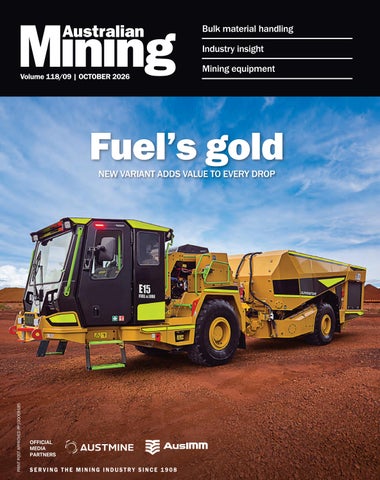
Front cover
Elphinstone is a Tasmanian-based manufacturer specialising in equipment and solutions for the global underground and surface mining industries. With more than 50 years of mining experience, the company designs and manufactures specialised underground support vehicles, including agitators, service trucks, water tanks, personnel carriers and graders. It also produces the Mine Extraction Device (MED), designed to safely recover bogged or buried underground equipment, and Haulmax extendeddistance, off-highway haulage trucks for surface mining. Elphinstone’s products combine purposebuilt engineering with Caterpillar components and are supported through the global CAT dealer network. Its focus is on reliable, durable and fit-forpurpose equipment that helps mining companies improve safety, productivity and operational efficiency.
Rob O’Bryan 0411 067 795 robert.obryan@primecreative.com.au Art Director Michelle Weston michelle.weston@primecreative.com.au Subscription Rates Australia (surface mail) $120.00 (incl GST) Overseas A$149.00 For subscriptions enquiries please contact 03 9690 8766 subscriptions@primecreative.com.au Prime Creative Media 379 Docklands Drive, Docklands, Vic 3008 www.primecreative.com.au © Copyright Prime Creative Media, 2016 All rights reserved. No part of the publication December be reproduced or copied in any form or by any means without the written permission
of the publisher. Printed by Brougham Press 865 Mountain Hwy, Bayswater VIC 3153 03 9873 5144 Published 11 issues a year Cover image: Elphinstone
In this issue 24
38 Mining equipment
24 Aligned for uptime FLS’s self-aligning mainshaft upgrade kit improves gyratory crusher safety, reduces change-out time and limits costly rework during maintenance shutdowns.
Bulk material handling
Smooth operation 32 Alemlube supports mine site maintenance with its custom designs and supply of automatic lubrication systems that integrate into existing infrastructure.
8 Fuelling progress Elphinstone has expanded its underground support fleet with a new fuel and lubricant transport and servicing variant. 13 From road train to mill Maritana Minerals is reshaping how ore moves through its Black Swan hub, linking bulk material handling with smarter processing decisions. 14 Crushing standards Recent upgrades to its jaw crusher range have seen Sandvik set a new industry standard for safety and performance.
38 Layers of protection Conveyor Components Company is helping mines move beyond a single line of defence by combining emergency-stop, belt-tracking, damage-detection and motion controls.
Podcast
52 The road to Nolans Arafura Rare Earths CEO Darryl Cuzzubbo sat down with the Australian Mining Podcast to discuss the potential strategic importance of its Nolans project.
Industry insight
77 More than ore A cornerstone of its operations since the 1960s, Rio Tinto is recognising the Pilbara as more than just a source of iron ore.
Industry events
102 Making connections that count In 2027, the industry will have its pick of mining events focusing on everything from regional mining priorities to international developments and collaboration.
70
74 AUSTRALIANMINING 4 OCTOBER 2026
WHO WE ARE OTR Tyres is Australia’s leading independent partner for off‑highway tyres, wheels, consumables and service solutions. With nationwide manufacturing, service hubs, and on‑site support teams, we provide the most comprehensive ground‑contact offering in the country. With deep expertise across mining and heavy industry, OTR Tyres is trusted by major operations to deliver safe, compliant, and cost‑effective solutions built for tough Australian conditions.
est Outperform The R
WHAT WE DO TYRE SOLUTIONS • Massive range & stocks of earthmover, truck & LV tyres. • Full range from 6” through to 63” from leading global brands.
Mining tyre and wheel experts. OTR Tyres is at the forefront of tyre, wheel and service innovation, proudly supporting Australia’s mining, construction, transport, agricultural and industrial
• Tyre fitting, rotation, change‑outs and on‑site support. • Tyre pressure management and haul profile optimisation. • Tyre valving, O‑rings & tooling
WHEEL & RIM SOLUTIONS • Wheels, rims, assemblies & components. • Australian manufactured with in‑house design. • Test, repair & certification under Australian Standards AS4457.1. • Latest MID and MRD compliance.
ON‑SITE SERVICES • Mobile fitting capability for large OTR assemblies. • Dedicated tyre & wheel technicians for major mining operations. • On‑site wheel, rim & tyre management programs. • Tyre Handlers, mine site spec for sale or hire.
TRAINING • Industry‑accredited Cert II tyre fitting and safety training. • RTO provided on‑site or at OTR facilities.
sectors. We deliver unmatched capability, performance and reliability across every site and every haul road. Our commitment is simple, if your tyres or wheels stop, your production stops ‑ so we’re here to keep you moving.
WITH SERVICE HUBS AND MANUFACTURING FACILITIES ACROSS AUSTRALIA, OTR TYRES PROVIDES RAPID RESPONSE AND CONSISTENT SUPPORT WHEREVER YOU OPERATE.
Phone 1300 OTR TYERS or visit www.otrtyres.com Perth | Mildura | Gold Coast | Brisbane | Emerald | Mackay | Mount Isa | Gladstone | Sydney | Muswellbrook | Karratha | Port Hedland | Kalgoorlie | Geraldton
INDUSTRY INSIGHT
Alkane Resources has announced promising results from its Victorian operation.
A second look unlocks Cuffley Alkane Resources’ latest drilling has changed old interpretations and revived interest in Cuffley, which sits between two historical high-grade mining panels in Victoria. occurring in both quartz and stibnite. The result follows Costerfield’s addition to Alkane’s portfolio through the merger with Mandalay Resources. Completed on August 5, 2025, the transaction was structured through Alkane’s acquisition of all issued Mandalay shares. The combined company retained the Alkane Resources name and its Perth headquarters. Costerfield joined Alkane’s Tomingley gold operation in New South Wales and the Björkdal gold mine in Sweden, creating a three-mine gold and antimony producer. At the merger’s completion, Alkane Resources managing director and chief executive officer Nic Earner said the portfolio provided a broader base for growth. “By combining our complementary portfolios, we have created a stronger, more resilient platform with the scale and financial flexibility to pursue long-term growth,” Earner said. Underground mining at Costerfield has continued since 2006, initially from
Augusta before progressing north to Cuffley and N Lode in 2014, Brunswick in 2018 and the Youle and Shepherd lodes in 2019. Current mining is centred beneath the historical Costerfield, Minerva and Bombay mines. Alkane also reported infill and targettesting results from the deeper Sub-KC domain. Four target-testing holes were completed for 3705.32m, accompanied by ten parent holes and two wedge holes covering 8168.28m of growth and infill drilling. Results included 28.2g/t gold over 0.99m in CSK044. CSK043 produced two narrow intersections: 73.2g/t gold and 18.8 per cent antimony over 0.19m, and 192g/t gold over 0.17m. CSK048 returned 16.1g/t gold and 12.7 per cent antimony over 0.37m. Target testing produced contrasting geological outcomes. North of the principal Sub-KC block, the Lyre Fault had stepped eastwards and faulted out much of the interpreted favourable fold limb.
To the south, drilling encountered an intact anticlinal position and anomalous gold-bearing veins, although no ore-grade intercepts were recorded. Alkane said the structural information left scope for further growth at SubKC, although future drilling may need to be undertaken from surface or new underground development to provide improved intersection angles. Earner said the new Cuffley pod demonstrates the value of returning to areas where earlier geological interpretations had limited expectations. “This discovery of unmined highgrade material directly adjacent to one of Costerfield’s top-shelf historical orebodies showcases the importance of Alkane’s directive of revisiting and challenging old models and preconceptions surrounding mineralisation to extract value,” he said. “We will continue seeking this new mineralisation alongside generating new targets within our leases.” AM
This discovery of unmined highgrade material directly adjacent to one of Costerfield’s top-shelf historical orebodies showcases the importance of revisiting and challenging old models” – Alkane Resources managing director and chief executive officer Nic Earner Images: Alkane Resources
A
geological assumption can remain unchallenged until a drill hole gives a mine a reason to look again. At Alkane Resources’ Costerfield gold-antimony operation in Victoria, that second look has identified a high-grade pod in an unmined area between the historical northern and southern panels of the Cuffley Lode. The sparsely drilled zone was previously thought to host low-grade mineralisation due to the interpreted influence of a crosscutting fault. Alkane tested that view with 23 growth and infill holes totalling 3255m of diamond drilling. The program produced 18 new intercepts, while five holes encountered fault blanking. Four holes intersected mineralisation grading above 10g/t gold equivalent over mining width. The standout result came from AD270, which returned 580.9g/t gold and 24 per cent antimony over 0.61m, with an estimated true width of 0.54m. It included 0.25m at 1360g/t gold and 19.7 per cent antimony. Hole AD265 intersected 168.9g/t gold and 33.5 per cent antimony over 0.9m, with an estimated true width of 0.78m. AD292 returned 60.1g/t gold and 15.2 per cent antimony over 1.26m, while AD275 encountered 124g/t gold and 48.6 per cent antimony over 0.23m. Another four holes graded above 2g/t gold equivalent over mining width. Alkane said the Cuffley pod was readily accessible from existing infrastructure and had been incorporated into the Costerfield mine plan, and is scheduled to be mined. Cuffley forms part of Costerfield’s Central Corridor and occupies a vertical shear running along the Cuffley Anticline near the Augusta deposit. Mineralisation consists of quartz-carbonate veining grading into massive stibnite, with gold
AUSTRALIANMINING 6 OCTOBER 2026
THE OPERATOR’S CHOICE The Difference Is In The Details. From cab comfort and all-round visibility to responsive control, fuel efficiency and uptime, every detail of the Volvo EC550 is engineered to help operators do their best work shift after shift.
SAFETY Features that support safer operation.
Big Enough to Trust, Small Enough to Care @CJDequipment
Fuel Efficiency Performance that makes every litre count.
Contact your local branch cjd.com.au | 1300 139 804
Resale value Built to perform. Engineered to last.
CJD Equipment has a national supply network and 24/7 service
SUPPORT Local expertise backed by 24/7 support.
MINING EQUIPMENT
Fuelling progress Elphinstone has expanded its E15 underground support fleet with a new fuel and lubricant transport and servicing variant.
F
ounded on a passion for adding value to mining operations, Elphinstone has expanded its E15 underground support fleet with the new E15 Fuel & Lube, delivering enhanced bulk fuel transport and fluid dispensing capability. Selecting the right support vehicle for underground mining operations can significantly improve fleet productivity while reducing operating costs. The E15 underground support vehicle platform has been tested and proven in some of Australia’s harshest underground hard rock mining environments, delivering reliability, safety and operational efficiency. This new release is the fifth model in the E15 series, extending the capabilities of this highly configurable support vehicle platform. The E15 fleet comprises a tilt tray, agitator, delivery vehicle with crane and flat deck, with additional variants under development. “The E15 has been well received in Australia and internationally, with machines deployed across three continents, with solid orders on hand indicating significant demand,” Elphinstone global sales and marketing manager Tim Mitchell told Australian Mining. “Customers value the operator experience, safety features, common platform design, ground-level
operation and service accessibility. The E15 Fuel & Lube provides our customers with a purpose-built, highly configurable underground fuel and lubricant transport solution, conforming to all relevant ISO, Australian and local standards.”
Tank configurations and capacities
Engineered for underground mining applications, the Fuel & Lube module is available in configurations that are designed around bulk fuel and lubricant transport or in-situ servicing of equipment. This module structure features carefully designed weld joints that provide greater structural integrity and independent tank compartments. The first fuel and lube module to be released features a tank arrangement comprising a 10,000L diesel tank, two 500L oil tanks, a 245L diesel exhaust fluid (DEF) or coolant tank, a 500kg grease tank with pumps, and a 180L water tank equipped with a high-pressure cleaner. Key features include well-illuminated and fully enclosed rear cabinets with durable polyethylene sliding doors, interlocked with park brake. Fluid dispensing, operator control panel, and tank fill points are located on the rear
right-hand side, while dispensing pumps and filters are located on the left-hand side, all with convenient ground-level access. The filling and dispensing cabinet is fitted with powered and spring rewind 15m hose reel arrangements featuring high-flow and low-flow diesel and high volume and high pressure grease, DEF, hydraulic and engine oil and a highpressure water hose fitted with spray lance. Other inclusions such as onboard storage for filters, spill kit, eye wash and hand wash stations further enhance the E15’s practicality and convenience for operators. Another consideration is operator comfort – features include air conditioning, central driving position, ergonomic controls and a clear 180-degree field of view. Additional conveniences include an aircooled lunchbox compartment, cupholders and smartphone charging ports. Air ride seats are a standard feature in the E15 and can be individually adjusted by the occupant. Comfort is further enhanced through the E15’s front axle suspension, heavyduty oscillating hitch and air-suspended seating. Together, these features help minimise fatigue and improve ride quality. The oscillating hitch maintains continuous four-wheel ground contact,
AUSTRALIANMINING 8 OCTOBER 2026
reducing wear on steering and hitch components. It features a 600mm-deep frame section, 42.5 degrees of steering articulation, and 10 degrees of oscillation. “The oscillating platform prevents rough terrain impacts from being transferred between the front and rear frames,” Mitchell said. “This enhances ride comfort and helps reduce stress on the hitch and frame structure.”
Ground level serviceability
Ease of maintenance is another focus of the E15 platform design. Service points, including tanks, filters, lubrication points and drain locations, are positioned at ground level to improve safety and reduce maintenance time. In addition, quick-change air filters and 500-hour oil service intervals help minimise downtime and maximise productivity. A centralised onboard service centre provides fluid sampling points for condition monitoring, while optional systems such as auto-lube, fast-fill and fast-evac further streamline servicing. The E15 is also equipped with advanced diagnostic capabilities and optional datalogging and Caterpillar (CAT) Product Link, providing a streamlined
E15 Fuel & Lube can be configured for bulk fuel and lubricant transport or in-situ servicing.
Images: Elphinstone
MINING EQUIPMENT
Filling and dispensing cabinet features high-flow and low-flow diesel, high-volume and high-pressure grease, hydraulic, engine oil, and high pressure water.
The service module features well-illuminated, fully enclosed rear cabinets with sliding doors.
solution to predictive maintenance strategies and giving operators greater overview of equipment availability through a 12-inch touchscreen display. Parts and product support are available globally through authorised CAT dealers across Australia. The E15 incorporates a high percentage of CAT components sourced from commonly available construction equipment, simplifying parts supply and maintenance. Safety remains a critical consideration for all underground mining equipment
and Elphinstone has incorporated a comprehensive suite of standard safety systems into the E15 platform. This includes an operator cabin certified to applicable ROPS/FOPS design standards, fire suppression and illuminated emergency stops located at ground level on both sides of the machine. Safety features also include firewalls, heat shields, machine interlocks and centralised isolation points, including battery and starter isolation switches, jump-start receptacles and fire-system controls.
“The majority of key safety items on the E15 are standard features rather than optional extras,” Mitchell said. The wireless remote controls reels, pumps, fluid dispensing, and jack leg operation. The remote features a ‘Deadman’ switch and dropped-remote detection for added safety. An emergency spill kit is also housed in the rear cabinet, with two fire extinguishers and work lights positioned on either side of the entrance to the cabinet, with rear warning beacons
AUSTRALIANMINING 9 OCTOBER 2026
and reversing camera mounted above the door. Intelligent electronic speed control systems combine a heavy-duty electromagnetic driveline retarder, engine speed management and transmission control to safely regulate machine speed on underground declines – reducing wear of brakes and extending asset life. The system also detects neutral coasting and automatically engages the retarder and parking brake when required. An optional front hydraulic jack system includes a park function, enabling operators to safely exit the cab while the engine remains running. Rear hydraulic stabiliser jacks allow the machine to be levelled and stabilise during loading and unloading operations. The E15 can be configured with a standard Tier 3 C7.1 ACERT engine producing 168 kilowatts (kW), equivalent to 225 horsepower, or an optional C7.1 ACERT Tier 4 Final engine delivering 151kW of power. Both engines are paired with a CAT five-speed transmission featuring three reverse gears and a lock-up torque converter. All Elphinstone products are backed by the global CAT dealer network, providing access to technical expertise, support services and replacement parts worldwide, complemented by Elphinstone’s regional support teams to ensure reliable assistance throughout equipment lifecycles. AM
PRACTICAL. POWERFUL. PROVEN.
One platform. End-to-End capability. Deswik’s integrated suite of mining software empowers operations worldwide to bridge the gap between mine planning and real-time execution. Our cutting-edge tools deliver the insights and control you need to maximize productivity and drive operational excellence.
DRIVING PERFORMANCE ACROSS THE MINING VALUE CHAIN
Discover more at DESWIK.COM
BULK MATERIAL HANDLING
Image: electra kay-smith/stock.adobe.com
Maritana Minerals is advancing its Black Swan Processing Hub.
From road train to mill Maritana Minerals is reshaping how ore moves through its Black Swan hub, linking bulk material handling with smarter processing decisions.
W
hen it comes to bulk materials handling in mining, the practice continues to depend on familiar and reliable steps – from hauling at the ore, stockpiling it, and feeding it into the plant to keeping it moving. However, what has changed is the amount of control operators have and expect at each step. An example is in the stockpile, which can buffer uneven deliveries and give a plant room to manage differences in its mill feed, which means information gathered along the route can help operators decide what to process and when. This is an opportunity that became central to Maritana Minerals’ planned Black Swan processing hub, and with ore expected to arrive from several Western Australian Goldfields’ mines, its enlarged run-of-mine pad is designed to handle quad side-tipping road trains and great stockpiling capacity. The aim now is to blend material and optimise what reaches the mill, and while the practice of stockpiling and blending are not new ideas, the change is in how closely the movement of ore can be tied to decision about feed quality, plant performance and maintenance.
To a hub servicing several mines, arrivals from different pits may vary in timing and characteristics, and if there is space to hold and sequence those loads, that means operators have a series of options before material enters the crushing circuit. Black Swan, about 50km northeast of Kalgoorlie, is being converted from an existing nickel-processing facility into a gold plant. Front-end engineering design completed in June 2026 lifted its planned nameplate throughput from 2.2 million to 2.5 million tonnes per annum, and Maritana attributed the increase to further assessment of its ore sources and the capability of its existing crushing and grinding infrastructure. The larger pad is intended to serve a hub-and-spoke model, rather than one nearby mine. Maritana identified the Boorara, Coote and Crake open pits, along with the Cannon underground mine, as initial ore sources, and its resource and reserve work is intended to strengthen the inventory available to the hub. Managing director and chief executive officer Grant Haywood said the growth in reserves at Boorara in particular “demonstrates the value of continued
drilling and mine planning work” on the company’s tenure to feed Black Swan, establishing a connection between mining plans and mill feed. Inside the plant, the route will continue through refurbished crushing and grinding equipment. Maritana said it plans to convert the existing single-stage semi-autogenous grinding arrangement into a semi-autogenous grinding, ball mill and crusher configuration. New motors and variable-speed drives are planned for the mills, while procurement for the project includes apron and vibrating feeders, screens and conveyor components. While these are familiar pieces of equipment, their sizing, reliability and coordination will matter when ore comes from multiple sources. The facility also adds a design hurdle and opportunity to showcase the effects where gathered information is being applied before construction. Maritana completed a light detection and ranging survey to create a digital representation of Black Swan’s infrastructure, and the model is being used to reduce potential clashes between old and new works during detailed engineering. In the broader mining landscape greater levels of information is being collected
AUSTRALIANMINING 13 OCTOBER 2026
while materials is still on a conveyor. An example of this is when Commonwealth Scientific and Industrial Research Organisation (CSIRO) developed sensing technology that can measure the grade of passing rock and, where suitable, can help divert low-value material before it is ground and processed. Other monitoring systems can detect conveyor wear so maintenance crews can address failing components before they cause an unplanned stop. While neither technology has been announced for Black Swan, both show the wider handling task is revolving around knowing more about the ore and the equipment moving it. Maritana’s immediate test, however, is more practical. The pad must receive ore from several operations, hold enough material to blend it, and feed the planned circuit consistently. Early works for the project began in July 2026, with first gold targeted for the second half of 2027, with a final investment decision still needed. If Black Swan proceeds, its route from road train to mill will show how established handling equipment can be arranged around a more flexible regional supply chain. AM
BULK MATERIAL HANDLING
Crushing standards Recent upgrades to its jaw crusher range have seen Sandvik set a new industry standard for safety and performance. through a web interface. It is designed to help operators identify issues earlier and troubleshoot problems before they can impact plant availability. The updated design also enables a simpler and safer adjustment procedure along with improved control over critical operating parameters. This contributes to a more predictable crushing process, supporting reliable performance and availability. According to Sandvik, these improvements have been validated through direct customer engagement, with notably positive feedback. “This shows that our customers clearly recognise the value of improved usability, safer workflows and enhanced operational transparency,” the spokesperson said. The complete jaw crusher range delivers consistent performance across primary crushing applications, helping reduce downtime and support stable productivity. Sandvik’s jaw crusher range is designed to keep primary crushing operations running consistently, with a focus on reducing maintenance interruptions and simplifying day-to-day adjustments. The latest generation incorporates hydraulic wedge setting with synchronised retraction, allowing operators to make closed-side setting adjustments faster and with less manual intervention. A welded main frame, common component design and plug-and-play installation are also intended to simplify maintenance and reduce delays to production. Wear management is an important part of the uptime equation.
Sandvik’s upgraded jaw crushers host new features that improve safety and deliver better reliability.
The range offers different jaw-plate profiles for varying feed conditions, including heavy-duty options with carbide inserts designed to improve resistance to abrasive wear. By combining reliable operation with simplified processes, the range also contributes to improved efficiency and lower operating costs over time. “These upgrades confirm that our development efforts are well aligned with market expectations,” Sandvik product manager jaw, gyratory and impact crushers, rock processing Martin Johansson said. “By focusing on safe operation, ease of use and consistent productivity, we are delivering solutions that are more
intuitive, reliable and better suited to the needs of our customers.” According to Sandvik, the upgraded range allows it to offer primary crushing solutions that deliver even more reliable performance, improved efficiency and consistent results, further strengthening its position as an industry partner in ecoefficient rock and mineral processing. Sandvik’s rock processing business area leverages its expertise in crushing, screening, feeding, loading, weighing and wear protection to bring an unrivalled equipment line-up to market. It underpins this offering with expert process knowledge, cutting edge digital tools, high-quality spare parts, consumables and lifecycle services. AM
Images: Sandvik
R
ock processing, a business area within Sandvik Group, has announced the completion of an extensive upgrade to its jaw crusher range, now offering a fully unified portfolio with an array of new features designed to improve safety, simplify operations and deliver even more reliable performance. The range includes five models capable of nominal throughput capacities from 150–1160 metric tonnes per hour and motor power ratings from 110–200 kilowatts (kW). “With the upgrades now completed across the entire range, plant operators can benefit from solutions tailored to their specific needs, supported by a consistent Sandvik-standard approach and the company’s application expertise across the entire crushing spectrum,” a Sandvik spokesperson told Australian Mining. According to Sandvik, the new range represents a focused step forward in addressing what matters most to processing plant operators: safe operation, ease of use and consistent productivity. “Key upgrades across the range simplify crusher setting and control while reducing manual intervention and operator exposure,” the spokesperson said. “With features such as the hydraulic wedge setting system, synchronized retraction arrangement and the ACS-j monitoring and control system, operators can manage their crushing process more easily and with greater confidence.” The ACS-j system provides visibility of hydraulic settings, lubrication and eccentric-shaft bearing temperature
The updated range includes five models capable of nominal throughput from 150–1160 tonnes per hour.
AUSTRALIANMINING 14 OCTOBER 2026
BULK MATERIAL HANDLING
Better flow and greater output Astec is encouraging mining operators to look beyond individual machines and treat crushing and screening performance as a whole-of-circuit challenge. downstream equipment to stop even when the crusher has more to give, and the opportunity is finding those constraints before they become lost production. This is where computer-aided engineering and advanced visualisation can help translate those interactions into something operators can readily understand. With more than a decade at Astec, scientific visualisation manager Chase Walker draws on his experience as a mechanical engineer to turn complex digital engineering into practical information for the industry. “We do all of the computational fluids, particles, and structural simulations,” he said. “So that is airflow, particles going down conveyor belts and through chutes, and then structural deflection as well.”
Digital simulations allow engineers to test a circuit before steel hits the ground or physical modifications are made. Equipment selection, geometry and layout can be assessed against expected production, helping expose bottlenecks and material-flow constraints while changes are still relatively inexpensive. According to Astec, the objective is not to create an idealised model. Effective modelling needs to account for real changes in mine material, including feed size, hardness, moisture, fines and clay content. These variations can affect crusher loading, screening efficiency and final product quality, which is why a useful model must reflect the conditions an operation is likely to encounter. Simulation can also compare alternative operating scenarios before
a final configuration is selected. By changing feed assumptions, equipment settings or transfer geometry in the model, engineers can examine how one decision affects the wider circuit, providing a clearer basis for design decisions and reducing the risk of discovering avoidable constraints during commissioning. While the equipment may appear deceptively simple from the outside, Walker said the behaviour of material inside crushers, screens and transfer points is far more complex. “When someone comes to us and says, ‘We want to change this thing – what’s it going to do to our machine?’, we can more accurately predict changes like that computationally and get it right the first time way more often,” Walker said. Looking more closely at how the material behaves inside and between
Images: Astec
M
ining operators are under pressure to move more tonnes, improve throughput and control costs, often without the option of starting again with a new plant design. Astec sees the biggest gains in how the full circuit works together, not just in the performance of a single crusher or screen. A circuit is only as productive as the way material moves between each stage. If one area is starved while another is overloaded, capacity can be lost through recirculating material, rehandling, excessive wear and unplanned stoppages. Balanced feed, effective screening and clean transfer points help keep the whole system working closer to its intended range. In mining circuits, small restrictions can quickly compound. A shortfall in surge capacity, for example, can force
According to Astec, the biggest gains come from the full circuit working together.
AUSTRALIANMINING 16 OCTOBER 2026
BULK MATERIAL HANDLING
those machines, Walker said, can reveal capacity that is already sitting in an existing process. Poor feed presentation, an unbalanced crusher-screen combination, inefficient transfer points or an excessive recirculating load can all limit output without an obvious single point of failure. Correcting these constraints can stabilise production and improve equipment utilisation before mines commit to major capital expenditure. Supporting technologies also have a practical role, such as modern screens which can provide more consistent separation as feed conditions change, and a correctly selected rock breaker which can prevent oversize material from interrupting flow into the primary crusher. This means that the value is measured in fewer stoppages, smoother feeding and more predictable output, rather than technology for its own sake, with the whole-of-plant view reflected in Astec’s broader capabilities. “We do everything from A to Z,” Walker said. “We offer everything from pulling the rocks out of the ground, crushing them up, screening them, sorting them out, making asphalt, making concrete, and then paving it back on the road.” In Australia, Astec’s fixed plant equipment is sold and supported through dealer MPS, combining local site
Looking closely at how material behaves inside machines can reveal existing capacity.
knowledge with Astec’s original equipment manufacturer engineering expertise. This helps ensure each solution reflects the material conditions, layout and production targets of the operation. Astec sells and supports tracked equipment directly. This support becomes increasingly valuable as operating conditions change. Ore sources, blends and production targets
can shift over a mine’s life, so the circuit may need to be reviewed and adjusted to maintain its original balance rather than being treated as a fixed design. As mining companies seek greater performance from existing assets, digital tools will play a stronger role in design, troubleshooting and optimisation, but Astec said their usefulness will remain tied to operational outcomes.
“And so that’s what we want to showcase with all of this, and it’s how it’s really providing actionable insights, efficiency improvements and better decision-making to the customer,” Walker said. For operators, the real value is not the model itself, but the practical improvements it can reveal in throughput, uptime and decision-making. AM
ATLAS COPCO
GENERATORS - LIGHT TOWERS- COMPRESSORS RELIABLE POWER WHEN IT MATTERS MOST.
RUGGED, PORTABLE, AND JOB-READY
DESIGNED FOR TOUGH ENVIRONMENTS & DEMANDING WORKLOADS.
Atlas Copco’s extensive range of generators, light towers and compressors are engineered for maximum uptime while providing uncompromising efficiency in the toughest environments. Whether you need reliable onsite power, precision-engineered air flow, or high-intensity illumination, our equipment delivers the sustainable performance and rugged durability your project demands.
PH: 1800 733 782 www.atlascea.com.au
AUSTRALIANMINING 17 OCTOBER 2026
Moving Australia's Mining Industry with Charter Expertise From FIFO workforce rotations to critical cargo and executive travel, Air Charter Service delivers tailored aircraft solutions built for Australia’s most remote and time-critical operations.
Cargo Charter Transporting critical mining equipment Urgent spares, heavy and outsize loads, and project cargo moved with precision.
Group Charter Flying workforce to remote sites Workforce transport that keeps operations productive and on schedule.
Private Charter Direct travel for mining leaders On-demand flights for executives and site visits in Australia and beyond.
With over 40 offices worldwide, we're a global company, with a local presence.
Brisbane
Perth
Sydney
+61 7 3505 7071
+61 8 9442 6503
+61 2 9134 9430
Level 2, 100 McLachlan Street, Fortitude Valley, Queensland 4006, Australia
Office 1311, Level 13, 37 St Georges Terrace, Perth, WA 6000, Australia
Level 20, 135 King Street, Sydney, NSW 2000, Australia www.aircharterservice.com.au
BULK MATERIAL HANDLING
Circular economy realised Fenner Conveyors has partnered with Tyrecycle to deliver a port-first conveyor belt recycling initiative.
A
According to GPC, this marks a significant step towards improved sustainability and circular economy practices across its operations. “Our teams have been working through options for some time, so to have a genuine, data-backed recycling solution is a great step forward,” a GPC spokesperson said. Independent analysis commissioned by Tyrecycle estimated the recycling of these belts will save more than 190 tonnes of carbon dioxide (CO2) equivalent, helping facilities like GPC and other mining companies reduce the environmental impact associated with end-of-life assets. Fenner Conveyors sales and marketing executive general manager Trevor Svenson said the project highlighted how the industry could turn conveyor belt waste into a local circular economy opportunity. “Every organisation that begins recycling its belts is contributing to a growing circular economy, supporting local manufacturing, creating jobs and reducing waste,” Svenson said. “GPC’s involvement is an important step in proving this model can work
at scale for major industrial sites, and we are proud to have helped deliver a solution that is practical, efficient and genuinely circular.” As part of the initiative, the embedded steel from GPC’s decommissioned belts will also be recovered for recycling, not only diverting this material from landfill but also helping pave the way for a one-in, one-out operating model. Tyrecycle head of trading, mining and strategic development Ashley Battilana said this would reduce the number of decommissioned belts sitting idle at GPC. “Moving forward, hopefully we can help facilities like GPC reach this model, so they don’t have to stockpile old conveyor belts that get in the way of their operations,” Battilana said. “Instead, a new belt will get delivered and the old belt taken away. This logistics model will remove double handling, reduce supply chain costs and enable recycling to be completed in Australia within three days of the belt being removed from service.” Both Fenner and Tyrecycle hope that their partnership can help create a circular
Image: Fenner
t Gladstone Ports Corporation (GPC), conveyor belts are central to keeping operations and material moving. One consistent and significant challenge, however, has been finding a new destination for them once they are decommissioned. With 65 conveyor systems, representing more than 48km of installed belting, Queensland’s largest multi-commodity port and major global coal export terminal has long sought a recycling pathway to iron out that hurdle. However, that solution wasn’t available until recently. As part of a strategic partnership, Fenner Conveyors has come together with Australian recycling company Tyrecycle to give decommissioned conveyor belts a second life rather than sending them to landfill. GPC is among the first to trial this approach, with six of its conveyor belts, weighing 122 tonnes, recently transported to Tyrecycle’s Brisbane facility to be converted into new rubber products for civil applications, playgrounds and various industrial uses.
economy model where new conveyor belts are manufactured with the recycled material of their predecessors. This vision may not be as far-fetched as first thought, as recovered material from GPC’s recycled belts will support the manufacture of Fenner’s InfinitySeries conveyor belting, which incorporates recycled rubber materials from reclaimed conveyor belts, into new belt construction. Manufactured locally, the InfinitySeries has undergone rigorous testing and quality assurance to ensure it delivers the performance required for the harsh demands of mining and industrial environments across the country. In recognition of its recycling efforts, Fenner’s InfinitySeries was nominated as a finalist for the 2026 Australian Bulk Handling Awards and the 2026 Australian Mining Prospect Awards in their respective sustainability categories. “Fenner Conveyors remains committed to expanding belt recycling efforts nationwide,” Svenson said. “We want to partner with customers to embed circular economy principles into everyday operations.” AM
Fenner’s partnership is helping divert conveyor belt material away from landfill. AUSTRALIANMINING 19 OCTOBER 2026
BULK MATERIAL HANDLING
Tasmanian connection
Lincom Group’s Tasmanian branch opened in July 2026.
With a new facility in Tasmania, Lincom Group is strengthening its support for a mining region with growing potential. The ThorStacker can be loaded directly from ground level by a wheeled loader, eliminating the need for additional ramps or major civil works and can also be remotely operated, allowing personnel to control the equipment from the ground or from the vessel. Handling armour rock measuring between 300mm and 375mm introduced another engineering challenge. The size and weight of the material meant impact protection was critical across the loading system. The equipment incorporates reinforced structures, specialised scrapers and extensive side protection, including spillboards designed to contain material and protect surrounding equipment and personnel. The vibratory pan feeder forms the first impact point when material is transferred from excavator buckets into the system, making its ability to withstand repeated heavy loading central to the overall solution. The Bell Bay project also draws on Thor Global’s international experience with armour rock applications.
Earlier projects involved collaborative testing designed to identify potential weaknesses under demanding operating conditions, with the lessons incorporated into subsequent equipment designs. “The Bell Bay version is kind of the newest generation. It’s the strongest of all the three units supplied this year and it also has its custom-built feeder as well,” Dunbar said. The equipment’s mobility is particularly relevant to the Bell Bay application, where specialist vessels require consistent loading rates and downtime can carry significant operational consequences. “If you’re not loading, if the boat’s just sitting there empty waiting for equipment availability, it’s just going to cost you a fortune,” Dunbar said.
A branch in Tasmania helps Lincom support customers in mining regions like Rosebery, Renison and Savage River.
AUSTRALIANMINING 20 OCTOBER 2026
This project also demonstrates why a stronger local presence matters as Bell Bay is not simply a destination for equipment – it is part of a wider industrial network where access to parts and technical support can influence the availability of critical infrastructure. “In remote places like Bell Bay, you can’t just grab a new part if something goes wrong. With the new workshop in Launceston, our spare parts and service are never too far, offering quick turnaround to our local customers,” Dunbar said. As Tasmania’s resource and industrial operations continue to rely on specialised processing and bulk handling equipment, Lincom’s Launceston presence provides another link between the machinery being deployed and the support required to keep it operating. AM
Images: Lincom Group
T
asmania may account for a relatively small share of Australia’s overall mining output, but its established resource operations and mineral processing infrastructure continue to create demand for equipment, maintenance and technical support. This has provided a clear opportunity for Lincom Group, with a new branch in Launceston established in July 2026 to bring its equipment, parts and service capabilities closer to operations across the state. The branch is positioned to support mining operations around Rosebery, Renison and Savage River, as well as the Bell Bay port and mineral processing precinct. Its reach also extends beyond mining into quarries, construction, recycling and agriculture operations across northern Tasmania. The move builds on Lincom’s broader position as an Australian supplier of crushing, screening, bulk handling and recycling equipment, with the company also supporting customers through spare parts, technical assistance and field service. One example of the equipment and support opportunities emerging in northern Tasmania is Lincom’s recent involvement at Bell Bay, where it supplied East Arm Resources with a custom-built ThorStacker T170x54 ship loader and purpose-built vibratory pan feeder. East Arm Resources is preparing to supply and load large armour rock onto specialist vessels supporting future offshore wind developments, creating a material handling challenge that required equipment capable of operating within the constraints of the Bell Bay port. The solution provided by Thor Global was designed around mobility. Both the stacker and feeder are trackmounted and independently mobile, allowing the equipment to be positioned around the port without relying on permanent infrastructure. Lincom Group product manager Alan Dunbar said the equipment needed to accommodate both the material being handled and the limited space available. “The machines had to be strong, fast and mobile, because of limited available space at the port,” Dunbar said. “Our customer required a complete mobile solution that could also manage the speed and flexibility of a traditional mobile shiploader.”
AM_Print_Ad_Full_Page_DredgeRobotics_30052025.pdf 1 06/06/2025 10:24:16
C
M
Y
CM
MY
CY
CMY
K
BULK MATERIAL HANDLING
No-spill zone ESS Engineering combines skirting systems with ongoing conveyor belt support and maintenance to improve material control.
Image: ESS Engineering
S
pillage is a persistent challenge in mining conveyor systems, especially at loading zones where high-impact transfers strain the belt, support structure, and containment system. Fugitive material frequently escapes from the carry side in these areas. Unchecked spillage accumulates around structural components and moving parts, increasing wear and risking seized idlers, damaged conveyor parts, and mistracked belts. Minor clean-up can quickly escalate into equipment damage, unplanned maintenance, and costly downtime. Spillage also impacts site safety. Accumulated material on walkways creates slip and trip hazards, while falling material and airborne dust present further risks for personnel. According to ESS Engineering Services & Supplies, effective spillage control starts at the load zone. “Spillage is a persistent challenge because it can be caused by many factors that often occur concurrently,” ESS Engineering accounts development manager Tom Stahura told Australian Mining. “This includes high-impact and uneven material loading, insufficient belt support and inadequate containment. Belt mistracking and belt sag can make the issue worse, while deteriorating seals, idlers, tracking components and other conveyor accessories can further compromise containment.” Skirting and sealing systems are an important part of controlling fugitive material around conveyor loading zones. When correctly designed and installed, they help prevent material from escaping over the sides of the belt and create a controlled containment area. However, skirting alone is not effective if belt support is poor, there is excessive sag, or the chute is poorly designed. Effective spillage control requires addressing these issues and ensuring all conveyor components work together. This systems-based approach is central to ESS Engineering’s philosophy. “ESS focuses on the complete materialcontrol system rather than treating the skirt as an isolated component, a key
Skirting and sealing systems are an important part of controlling fugitive material at conveyor loading zones.
difference from conventional approaches,” Stahura said. “ESS specifically identifies three important elements in controlling spillage – containing material at the loading zone, preventing it from escaping from the carry side, and controlling material discharge and carryback.” This means looking beyond the skirt itself to consider belt support, impact beds, belt tracking, belt cleaning, chute design and ongoing maintenance. Since every loading zone is different, skirting systems should be chosen based on material type, impact forces, belt support, belt sag, and application severity. ESS Engineering offers various skirting configurations to meet these needs. The ESS 2000 Series suits a wide range of load zones, using a low-profile rubber or urethane seal with a captive wedge system for easy adjustment or replacement. For dusty materials, a urethane dualseal is available. The 2000 Series Lay-In is ideal where belt support is suboptimal or belt sag occurs, and can be used at secondary loading points with lower impact. For heavy-duty applications, the ESS 3000
Heavy Duty Series uses external clamps and a rubber or polymer seal against the chute wall. Guided vertical movement and a captive wedge maintain clamp pressure under vibration. The objective across these configurations is the same: maintain effective containment while allowing the sealing system to accommodate the conveyor’s operating conditions. ESS Engineering manufactures its skirting systems in Perth, Western Australia, and Currumbin, Queensland, with sales and service teams supporting mining operations across Australia. The company works with clients to develop load-zone solutions based on each application’s specific characteristics, from high-impact iron ore transfer points to corrosive environments and underground coal operations. “ESS collaborates with our clients to develop load zone solutions tailored to their individual plant requirements, while our service teams provide installation, inspection, troubleshooting and maintenance support,” Stahura said. This ongoing support is crucial, as even well-designed systems can deteriorate
AUSTRALIANMINING 23 OCTOBER 2026
with changing conditions as well as maintenance needs. Spillage control should also not be a one-off exercise. Regular inspection and maintenance can catch issues before they escalate. Additionally, mining operations benefit most from changing how fugitive material is managed. “The biggest opportunity for mining operations to improve spillage control is to move from reactive clean-up to proactive fugitive-material management,” Stahura said. “That means operations should treat spillage, dust, carryback, belt sag and mistracking as interconnected conveyorperformance issues. Improving the entire system can deliver greater results rather than simply replacing a worn skirt.” Ultimately, effective spillage control is about maintaining the performance of the entire material-handling system. By managing containment, belt support, tracking, cleaning, chute design, and maintenance together, mining operations can reduce spillage at its source, protect equipment, improve safety, and minimise downtime. AM
BULK MATERIAL HANDLING
Images: FLS
The self-aligning upgrade is designed to remove manual requirements.
Aligned for uptime FLS’s self-aligning mainshaft upgrade kit improves gyratory crusher safety, reduces change-out time and limits costly rework during maintenance shutdowns.
W
ith a gyratory crusher made up of several intricate components, even the slightest change in position can cause downtime issues that – in some cases – can incur millions of dollars in lost productivity. By removing suspended-load exposure and making mainshaft change-outs faster and more predictable, FLSmidth (FLS) has developed a retrofit kit that stops the issue in its tracks. The self-aligning mainshaft upgrade kit has been developed for existing gyratory crushers, allowing older machines to adopt the feature already incorporated into newer FLS equipment without replacing the crusher. FLS crushing product specialist Ahmed Mohamed said the development responds to a long-standing challenge with servicing older gyratory crushers. “Gyratory crushers have evolved over time, from early machines to those you
see now, such as the top service units,” Mohamed said. “With these units, you’re able to perform maintenance from the top, but there’s still a need for people to work underneath to make sure everything fits as it should.” The challenge becomes more apparent when servicing older machines that do not have the self-aligning capability. During a mainshaft installation, personnel may need to enter the crusher’s lower area to help guide the shaft into position. “The old machines don’t have the features to allow the shaft to align itself into the centre and be positioned securely,” Mohamed said. “This involves putting workers in risky spots to ensure the shaft is in the proper position.” That process can require the crusher’s vault to be opened and cleared, with scaffolding erected to provide access. It can also introduce confined-space work
and, most significantly, expose personnel to a suspended load. “The biggest risk we see is those people sitting in there trying to guide the shaft into position. That’s technically people working under a suspended load, and that’s a massive risk,” Mohamed said. The self-aligning upgrade is designed to remove those manual requirements. Reengineered geometry of the FLS solution centres the shaft during installation, while guided assembly hardware provides a defined path towards its final position. “The self-aligning feature eliminates the requirement of people being under a suspended load,” Mohamed said. “It eliminates the need for opening the vault and building access underneath the crusher to help guide and align the shaft.” The system also addresses a second maintenance risk: damage to seals and other internal components during installation.
AUSTRALIANMINING 24 OCTOBER 2026
“With the self-aligning system, we know for sure the shaft has positioned itself. That means the internal components are protected and you avoid introducing other issues during installation,” Mohamed said. “With the FLS upgrade kit, we’re implementing cameras to help ensure that positioning process so there is no other damage done while getting it into place.” The self-aligning technology is also protected by a patent, providing FLS with an engineered solution developed specifically to address the installation challenge. On top of safety benefits, changeouts to a conventional gyratory crusher mainshaft are quicker thanks to a reduced need for building and removing access to the asset. “Twenty hours of the standard threeday shutdown time can be just to build the access and remove the scaffold,” Mohamed said.
BULK MATERIAL HANDLING
“With the self-aligning system, you could save at minimum one day.” The value of that time can be significant for mine operators, where extended primary crusher downtime can affect the wider processing circuit. “One hour of downtime could cost more than $100,000 easily,” Mohamed said. “You could save up to $1 million every time you remove the shaft to change out the wear components.” The upgrade also provides a way to reduce the risk of rework following an installation. If a seal is damaged during assembly, the resulting oil leak may not become apparent until the crusher is restarted, potentially requiring another period of downtime to correct the issue. “Eliminating rework will save a ton of time for the customer. Think about it like this – you’re not only getting the job done, but minimising other risks that can create other problems,” Mohamed said. “FLS has developed its upgrade kit to be retrofitted on all gyratory crushers in the crushing range. It converts them to have the self-aligning feature with minimal disruption to the existing footprint or the rest of the components.” The upgrade can also be incorporated within a standard maintenance shutdown, avoiding the need for an extended outage or additional labour. “The kit is simple to retrofit, and there’s no need for an extended duration
FLS’ goal is to reduce damage to internal components during installation.
or additional labour. A routine shutdown is all we need,” Mohamed said. With crushers at the beginning of a bulk material handling operation, the importance of keeping machinery running is paramount in mineral processing. “It is upstream for the whole processing plant,” Mohamed said.
“So if the crusher is down, then pretty much everything downstream will be down.” For FLS, the upgrade provides a way to bring a modern safety and maintenance feature to an established asset base, addressing a specific risk without requiring operators to invest in a new crusher.
“It’s a kit that deals with a big problem. This change is not just beneficial from an operational and productivity standpoint, but more importantly it’s boosting safety for workers. We want to make sure everyone goes home – and the selfaligning mainshaft upgrade kit from FLS is enabling that goal,” Mohamed said. AM
TRS Total Rockbreaking Solutions
AUSTRALIAN ENGINEERED MINING PROVEN BUILT FOR RELIABILITY Operate a TRS boom remotely. Live at IMARC stand G33.
Built for continuous operation in demanding mining environments, Australian-made TRS Rockbreaker Booms combine heavy-duty engineering, advanced safety systems and service-friendly design to maximise reliability, safety and productivity. For even greater control, BoomSafe® brings automation, collision prevention and remote operation to fixed pedestal boom systems, helping reduce operational risk.
totalrockbreaking.com.au
AUSTRALIANMINING 25 OCTOBER 2026
TRS Booms
BoomSafe®
AUTOMATIC LUBE SYSTEMS. BUILT FOR HEAVY INDUSTRY. High-flow, high-pressure pump stations engineered for major fixed plant equipment These heavy duty pump stations are designed to operate either injector or dual line systems on major fixed plant applications such as ship loaders, stackers, reclaimers & mineral processing plants. Featuring large reservoir capacity and fast fill with auto shut-off, these pump stations are designed to seamlessly replace older pump stations, deliver higher volumes, larger reservoir capacities and easier refilling and monitoring.
Key Features 60kg remote fill reservoir with auto fill shut-off Suitable for NLGI#2 greases 400cc/min flow rate 400bar max pressure 24vdc electric vent valve system or electric reversing valve system Internal control and alarm outputs with minimal input by PLC system required
Applications
MINING
QUARRY
CIVIL WORKS
www.alemlube.com.au | info@alemlube.com.au *For Warranty Policies & Terms and Conditions, visit alemlube.com.au
ALEMLUBE 60KG INJECTOR PUMP AND DUAL LINE PUMP STATIONS
*
2
BULK MATERIAL HANDLING
Built to keep bulk moving WAM Australia’s enclosed conveying technologies bring scalable, low-maintenance control to the dusty, demanding transfer points that keep mines moving efficiently.
Image: WAM Australia
The CAO tubular screw feeders provide compact, controlled transfer.
M
oving bulk solids around a mine is rarely as simple as getting material from A to B. Transfer points have to handle dust, variable flow rates, abrasive materials, limited space and the need to keep downstream equipment reliably supplied. For mining and mineral-processing operations, the right conveying technology supports controlled material movement and dependable plant operation. WAM Australia’s TCG Chain Conveyors and CAO Tubular Trough Screw Conveyors provide complementary approaches to enclosed bulk handling, from higher-capacity transfer to controlled extraction and feeding. When it comes to higher-capacity duties, the TCG provides an enclosed conveying option across demanding mine-site layouts. Designed for dry, free-flowing powders, granules, pellets and flakes, the TCG Chain Conveyor uses rectangular scraper flights fixed beneath a guided chain to convey material along the bottom of a hot-galvanised, fully bolted casing. Its enclosed construction helps contain dust in demanding industrial environments. Modular tail, head and intermediate sections allow the conveyor to suit different plant layouts and simplify installation in space-restricted areas.
In mining applications, a TCG can provide enclosed horizontal or inclined transfer, extract material from pits or hoppers, and distribute it to one or more discharge points. Electrically operated slide gates can provide multiple outlets for storage bins or parallel process streams. “For WAM Australia, this combination of robust construction and modular design makes the TCG particularly well suited to mining environments,” WAM Australia said. With conveying lengths up to 100m and nominal capacities up to approximately 1000m3 per hour, the TCG range can address substantial plant duties while maintaining a relatively compact footprint. Configurations include pressed-link chain with bent scrapers or forged-link chain with welded scrapers, and chain guides can be specified in Polyzene or manganese steel to match the conveyed material and operating conditions. Application-specific options include a double-bottom casing, side inlet for pit extraction, flow-control devices, inspection hatches, rotation sensors and an overflow hatch with a safety device. A vent outlet can connect to a dedusting system, supporting the conveyor’s enclosed, dust-tight design, making the
conveyor relevant where dust containment and controlled material transfer are important design considerations. Stainlesssteel and ATEX-certified versions are also available, subject to application-specific engineering assessment. At lower volumes, the CAO Tubular Trough Screw Conveyor provides a compact option for controlled extraction or feeding from bins and hoppers. Its modular mild-steel cylindrical casing houses a continuous-welded flight, with inlet and outlet spouts available in various configurations. Direct, coupled, chaindriven or belt-driven arrangements provide flexibility when integrating the conveyor into existing plant layouts. While the CAO is widely used in milling, the same principles apply to mineral processing, where powders and additives must be reliably extracted from bins, hoppers and silos. This is particularly important for materials that flow poorly or compact under pressure. Heavy-duty CAO configurations suit demanding materials and steel, chemical and effluent-treatment processes involving products such as bentonite, sand, carbonate and sludge. “The CAO is particularly valuable where a mine needs consistent extraction or controlled feeding from a hopper,
AUSTRALIANMINING 27 OCTOBER 2026
while reducing residue build-up and the risk of material packing at the discharge,” WAM Australia said. The CAO range covers screw diameters from 100 – 500mm and feed rates of approximately 10 – 100m3 per hour. Reduced clearance between screw and trough supports controlled material movement, while self-lubricating intermediate and end bearings minimise maintenance. Options include a drop-bottom trough, inspection hatches, rotationindicator bracket, emergency-stop device and specialised flights or finishes, and together, these features support predictable feeding while reducing material residue and the risk of packing at discharge. The TCG and CAO address different but complementary requirements, and where the TCG suits longer, highercapacity enclosed conveying and multipledischarge applications, the CAO suits compact conveying, bin and hopper extraction, and controlled feeding. By matching conveyor geometry, construction materials, drive configuration and accessories to the conveyed product, WAM Australia can help mining and mineral-processing operators turn challenging transfer points into reliable links in the processing chain. AM
BULK MATERIAL HANDLING
Finding the right fit SKF’s new bearing housing series combines an optimised design with heavy-duty performance to improve reliability, maintenance and costs.
S
KF is expanding its bearing housing offering with a new series designed to meet growing demand from heavy industry. The new SDED bearing housing series has been developed to fill what SKF sees as its gap in the market, providing an optimised housing that can be supplied as part of a complete SKF bearing and housing solution. While SKF already supplies applicationspecific bearing housings for demanding operations, including bulk-handling conveyors in iron ore and coal mining, the SDED offer positions the company into the much larger generic housing market space. SKF Australia head of sales Rod Allen told Australian Mining that this segment accounts for the largest segment of the market. “SKF currently has application specific offers for bearing housings, which are largely driven by end-user specification,” Allen said.
That distinction is important to SKF’s positioning of the SDED series. Application-specific products can be engineered for particular operating environments and customer requirements, but original equipment manufacturers (OEMs) often demand more standardised housing and sealing solutions. “The SDED series is our answer to that requirement,” he said. According to SKF, it is now the only bearing and housing manufacturer to offer a complete solution of bearing, sleeve, locating rings, housing and seals to the heavy industry segment. But moving into the generic market did not mean simply developing another conventional housing. SKF SDED bearing housings are designed for the high-load and highly contaminated operating conditions in
which mining conveyor systems commonly operate, with patent pending features intended to improve the bearing, housing and seal reliability. SKF America and Pacific region customised products manager Ramesh Varadarajan said a key engineering objective was to design a housing and seal solution specifically engineered to accommodate the 231 spherical roller bearing series, used across 90 per cent of Australian heavy-industry segments. By designing the SDED housing around this bearing series, SKF was able to move away from the wider housing bodies commonly used in the industry and optimise the design without compromising product quality or structural strength. An additional benefit is that reducing the amount of material
Images: SKF
SDED bearing housings are designed for the demands of high-load mining conveyor systems.
AUSTRALIANMINING 28 OCTOBER 2026
required can optimise manufacturing costs while also reducing carbon footprint. Importantly, Varadarajan said the optimisation does not come at the expense of strength or performance, with the four-bolt SDED housing manufactured from high-strength spheroidal graphite iron and designed to withstand shock loads, vibration and demanding operating conditions. Its narrower footprint brings bearing centres closer together, while optimised internal and external housing design decreases bearing stress and increases the bearing performance. “Although it’s a generic offer and the market accepts it as a generic offer, there’s still some optimisation that’s come into the new housing offer,” Allen said. This includes SKF’s TACV taconite sealing arrangement, incorporating a patent pending positive wear plate locking system. “It has unique sealing features, which is patent pending,” Varadarajan said. “This will provide better performance compared to what is currently available in the market.” The design is intended to prevent movement, angular misalignment and displacement of the wear plate, maintaining peak sealing performance in contaminated environments. Maintainability has also been central to the SDED concept. The split housing design allows relatively quick installation and removal of the seal which provides access for inspection and maintenance. The range covers sizes from SDED 3134 to 3164 and is available in open and closed variants. “This new housing assembly is completely interchangeable with all current generic housings, so customers
BULK MATERIAL HANDLING
An expanded view of the new SDED bearing housing.
don’t have any space or installation constraints,” Varadarajan said. The housings also incorporate condition monitoring points and provision for attaching temperature probes as a standard feature. Together, SKF expects the design features to help extend bearing
service life, reduce premature wear and lower maintenance requirements. For mining operations, fewer interventions can translate into greater equipment availability and reduced lifecycle costs, particularly on critical conveyor systems. Although suitable for applications across quarrying, ports, timber, sugar and other industries, SKF expects Australian mining to provide the major market for the new housing. “Mining is absolutely the focus,” Allen said. For SKF, Australia can also serve as a proving ground for products that may eventually find a broader international market. “Australia is a mining-reliant country where many solutions are designed, tried, and tested,” Varadarajan said. “Anything we design and develop here as a pilot, very often finds its way into the global market after being implemented successfully locally.” By combining a standardised platform with design optimisation and a complete bearing package, SKF is bringing its capabilities into the generic housing market where it has had a limited presence – with Australian mining to provide its most important proving ground yet. AM
SKF has optimised housing design without compromising quality or structural strength.
Keeping Mining Operations Moving
& Leaders in cable management solutions Project management
Technical expertise
Product supply
Installation
Maintenance
• Complex projects
• Extensive igus product knowledge
• Comprehensive range of igus products
• Experienced installation personnel
• Ongoing project support
• Mining application expertise
• Nationwide supply
• Efficient project execution
• Systematic planning • Timeline management
Contact us today on 1300 65 75 64 or email info@treotham.com.au AUSTRALIANMINING 29 OCTOBER 2026
• Dedicated personnel
VIEW THE RANGE
BULK MATERIAL HANDLING
Beyond the individual component From screening and separation to overall wear protection, Tega Industries adopts a total-solution-based approach to improving performance across the processing circuit.
Tega looks beyond the standard to make bulk handling systems work better.
experiencing recurring blockage. Near-size particles were lodging in panel apertures at the feed entry zone, disrupting material movement. Screening efficiency declined, slurry overflowed and downstream equipment performance deteriorated. Tega OptiTrommel and the Tega OptiScreen panels and dams were engineered to maintain continuous material movement and address the behaviour of near-size particles. Improved screening efficiency helped smooth mill operation, reduce process downtime and stabilised downstream equipment performance and plant throughput. Beyond equipment design, Tega’s support extends across the ongoing maintenance and refurbishment of trommel systems, including structural and parent metal repairs, rubber lining or polyurethane coating, blasting and painting, and installation of new Tega OptiTrommel panels. The same focus on application-specific design is applied to Tega’s OptiScreen screen media. Tega combines screen media with engineering analysis to improve efficiency while reducing downtime and operating cost per tonne. Advanced rubber and polyurethane grades provide wear resistance and help maintain aperture integrity, while panel
designs support faster replacement during changeouts. Its effectiveness could be seen in an iron ore operation processing 500 tonnes per hour where persistent screening challenges were affecting performance. Tega addressed clogging associated with 12 per cent moisture content and a high proportion of near-size particles. Tega’s Rapido panels achieved a 70 per cent reduction in screen-panel clogging, an 11 per cent increase in top-deck efficiency and a 40 per cent increase in bottom-deck efficiency. The application also recorded a 22 per cent reduction in panel cost per tonne, a 14 per cent reduction in direct customer costs and a 20 per cent reduction in carbon footprint over three cycles. While screening performance is critical to efficient processing, controlling wear throughout the broader material handling circuit is equally important. Tega’s Aggression range extends this approach to wear protection across primary and secondary impact zones, chutes, hoppers, bins, launders and conveyor transfer points. Solutions are available in rubber, ceramic, polyurethane and ultra-high-molecular-weight polyethylene (UHMWPE), allowing materials to be selected according to the wear and flow of each application.
AUSTRALIANMINING 30 OCTOBER 2026
A Tega OptiTrommel at a Tega Losugen Australia workshop.
Tega Australia’s sales and technical teams work with customers from initial assessment and engineering through product selection, custom design, manufacture, implementation and ongoing support. By considering the broader material handling system rather than components in isolation, Tega’s totalsolution approach is focused on reducing maintenance requirements, extending equipment life and improving operational performance and throughput. AM
Images: Tega Industries
B
ulk material handling performance is about more than moving material through a mineral processing operation. Every transfer, screening and separation point presents challenges, from abrasive wear and difficult material flow to downtime and declining efficiency. Tega Industries and its dedicated engineers proactively address these challenges with solutions to maximise efficiency and minimise planned and unplanned downtime. Tega Industries takes a total-solution approach, combining engineering expertise, application-specific design, materials technology and ongoing services across the processing circuit. Its approach begins with understanding the application – how material behaves, the points at which wear occurs, and operating conditions. Engineering tools including material flow analysis, discrete element method (DEM) analysis and finite element analysis (FEA) help Tega assess material behaviour and structural requirements before developing a solution. This capability supports a bulk material handling portfolio spanning separation, wear and conveyance, including Tega OptiTrommel, Tega OptiScreen, and Tega Aggression wear liners. Tega OptiTrommel demonstrates how equipment can be designed around the characteristics of a specific application. Each trommel is custom designed to optimise size, capacity and wear life, with structural components, panel types, fixing methods and reinforcement selected according to operating requirements. FEA is used to assess structural performance under specific loading conditions, while rubber or polyurethane coatings provide protection against wear and corrosion. Frames are thermally treated and welds ultrasonically tested to support fatigue tolerance and reliability. One large copper operation provides an example of how this applicationspecific approach can address separation challenges. The site featured a SAG mill trommel operating at a capacity of up to 7000 tonnes per hour that was
OVER 150 YEARS OF SUCCESS STORIES UltraTuff Triples Bauxite Belt Life
ArmorShield Doubles Coal Port Belt Life
ArmorShield Triples Limestone Belt Life
See Them All
Does a conveyor belt which lasts twice as long effectively make it half the cost? Actually it goes much deeper than that.
A more durable belt means more for your operation than just a reduced replacement rate. By withstanding operational demands, it improves safety, boosts productivity, and reduces maintenance, lowering costs and downtime. When every minute matters, a belt that rolls on reliably through thick and thin represents the vital heart of your operation. Choose one you can rely on.
Phone 1800 Fenner (336 637) fenner.com.au | sales@fenner.com.au
UsFlex $1 Million in Annual Savings
BULK MATERIAL HANDLING
Smooth operation
F
or operations that run around the clock, keeping equipment and plant ticking along smoothly is vital. This is especially true when it comes to handling and processing bulk materials – right from crushing and screening to transport. Smooth operations, however, need a smooth operator. With its suite of lubrication products, Alemlube has slid into that role with ease. Removing much of the manual work involved, the company’s mining and fixed plant automatic lubrication systems deliver measured quantities of grease to critical points while equipment remains in operation. Rather than relying on periodic manual greasing, the automatic lube systems distribute small amounts of lubricant to each point multiple times throughout the day. This helps keep hard-working components consistently lubricated while reducing the opportunity for damaging contaminants to enter bearings. According to Alemlube, inadequate lubrication and contamination sit among the leading causes of bearing failure, with lubrication-related failures accounting for 54 per cent of failures. This makes its approach particularly relevant to fixed plant operating in environments where dust, moisture and other contaminants can accelerate component wear.
Alemlube also supplies custom built lubrication cabinets for mining and mineral processing fixed plant. These can be configured with divider arrangements and monitoring systems according to the requirements of individual applications. Alemlube’s pump stations can be built to meet specific site requirements and operational constraints to deliver more reliable performance, easier refilling and better monitoring. This results in better equipment reliability and reduced maintenance schedules. The automatic lube systems are designed to use greases up to NLGI Grade 2, allowing operators to select the most suitable lubricant for their equipment and operating conditions, including greases containing up to five per cent molybdenum disulphide. The benefits of Alemlube’s design flexibility have been demonstrated in a recent application at a large coal mine in central Queensland, where Alemlube upgraded grease pumping stations on a site with a lot of existing injector lubrication systems. New pump stations were designed and supplied to serve existing injector distribution systems on a reclaimer and middlings conveyors. To meet specific requirements, Alemlube developed a bespoke system incorporating a 60kg bulk-fill reservoir
Images: Alemlube
Alemlube supports mine site maintenance needs with its custom designs and supply of automatic lubrication systems that can integrate with existing infrastructure.
Alemlube’s lubrication solutions ensure mining operations run smoothly.
with ground-fill capability, 400-cubiccentimetre-per-minute flow and up to 400-bar pressure, housed within a custom 316 stainless-steel enclosure. The system also integrated filtration, a vent valve and pressure switch alongside a standalone control system, reducing the demand on the mine’s existing programmable logic controller (PLC) infrastructure. The upgrade provided practical improvements over the site’s previous lubrication stations. Alemlube provided a turnkey solution for upgrades from older lubrication pump station designs with small reservoirs and poor refilling and monitoring options to larger bulk-fill reservoirs with ground fill and auto shut-off.
The resulting system provides longer service intervals, faster, cleaner refilling, improved monitoring and reliability. By combining larger storage capacity, controlled distribution, monitoring and site-specific controls, Alemlube can address the practical maintenance requirements of individual operations while reducing the intervention required from maintenance teams. The automatic lubrication system is only one part of Alemlube’s offering. The company provides design, installation, servicing and ongoing technical support, working with maintenance teams, contractors and engineers to develop systems around individual plant requirements. AM
Designed for the demand
Alemlube offers a range of automatic lubrication configurations for fixed plant, from progressive systems and injector systems, through to dual-line and multiline solutions for larger equipment. Its progressive systems provide highpressure lubrication, precise volume control and monitoring, with built-in indication of blockages or excessive back pressure. Alemlube’s DPX and DMX modular dividers measure and distribute lubricant through piston movement, allowing systems to be configured around individual plant requirements. For medium and large machinery, Alemlube’s dual-line systems provide another alternative for delivering lubricant across multiple points. The company’s Triton system is designed for equipment and remote plant locations exposed to vibration and demanding conditions, with a 25kg capacity, 280-bar operating pressure and features including low-level monitoring and remote fill shut off.
A coal project in Queensland saw greater productivity owing to upgraded grease pumping stations.
AUSTRALIANMINING 32 OCTOBER 2026
TT765_T
INTRODUCING THE RANGE
At Terrain Tamer, we understand the demands of real heavy duty 4WD vehicles, tackling extreme conditions. That’s why we’ve invested in the technology to create our TERRAIN TAMER FORTIFIED 4WD Parts range, uniquely designed and developed to truly meet these needs. We’re built tougher as recognised and used in mining, emergency services and agriculture, and those who really need to demand more from their vehicle. For information visit terraintamer.com or call 1300 888 444
TT765_TT_Fortified_Suspension_Advert_297x235mm_AM.indd 1
19/8/2026 4:38 pm
BULK MATERIAL HANDLING
Martin Engineering supports mining operations with bulk material handling issues such as length of conveyor transfer points.
Conveyor control
H
andling and transferring bulk materials isn’t a surgical practice, but with conveyor systems, a few inches can make the difference between blissful efficiency and costly downtime. The length of the conveyor transfer point varies with the application’s needs and the available physical space. The general rule is the longer the settling zone, the better. For Martin Engineering, these efficiency considerations are the foundation of the solutions it offers to the resources industry. Martin Engineering training manager Jerad Heitzler sat down with Australian Mining to discuss conveyor transfer point optimisation and how operations can redesign and retrofit solutions to fix common problems.
As program manager and lead instructor for Martin Engineering’s FOUNDATIONS Training Workshops, Heitzler helps mining and quarrying operations globally on how to make the handling of bulk materials cleaner, safer, and more productive. “In an attempt to save money, operators choose shorter transfer point designs, only to find they fail to accommodate settling dust, meet greater production demands, or improve safety,” Heitzler said. One primary focus is, according to Heitzler, belt-to-belt transfers. “In an ideal world, these would be in-line. Most in-line transfers allow sufficient belt overlap to avoid ‘loading on the transition’,” he said.
Images: Martin Engineering
Small design decisions can have major consequences for conveyor efficiency and safety, with Martin Engineering identifying common inefficiencies early to avoid problems later.
The design of conveyor chutes are a common mistake in conveyor installation, according to Martin Engineering.
“This is when the belt trough angle transitions at the point where the belt goes from flat against the tail pulley to curving into a full trough angle equal to the angle of the cradles and idlers.” Loading on the transition can help lower installation costs by reducing the length of the conveyor belt at the transfer point, however, this has the possibility of
AUSTRALIANMINING 34 OCTOBER 2026
causing problems in loading, sealing and belt wear. “If the belt has not fully transitioned into the trough angle, then the skirtboard and tail box are ineffective at sealing the loading zone,” Heitlzer said. “Due to the force and turbulence of the material hitting the belt, fugitive spillage and dust pour out of the openings.”
BULK MATERIAL HANDLING
Off-centred loading
Another safety risk in conveyor optimisation is off-centred loading causing the belt to drift. The weight of the cargo on one side pushes the belt up one side creating a gap between the belt and the skirting on the other side. “This allows the skirtboard to drop down, preventing the belt from returning to its centred position. As material loading changes, when the belt attempts to return to its centre, it will come into contact with the sealing strip and cut through the strip, resulting in substantial spillage,” Heitzler said. “Significant weight on one side of the belt causes tracking issues down the length of the system, leading to spillage, idler fouling and damage at the discharge zone. “Fortunately, several strategies and components can guide the flow of material in the desired direction of travel and load it onto the centre of the receiving belt.” Without attention to proper conveyor design, including sufficient overlap, the operation is burdened with a conveyor that will have excessive downtime and a higher cost of operation.
Discharge dialogue
The Belt Conveyors for Bulk Materials manual released by the Conveyor Equipment Manufacturer’s Association (CEMA) is a resource that can be used
The trajectory path for conveyors helps plan for bulk material movement..
to better map – and determine – a constant trajectory path for conveyors. “To plot the trajectory, a tangent line is drawn from the point at which the material leaves the pulley,” the manual states. “At regular time intervals along this tangent line, vertical lines are projected down to fall distances. A curve is then drawn through these points to produce the centroid trajectory. The upper and lower trajectory limits can also be plotted by offsetting from the centroidal
curve the distance to the belt and to the load height.” Despite clear guidelines from industry, this area of the design process is where many often fall down. “The most common mistake made at this stage of design is developing an initial material trajectory that fails to consider the effects of friction when plotting subsequent reflections of the material stream from the transfer chute walls,” Heitlzer said. “Modern transferchute designs control the stream of bulk
Maximize Recovery. Minimize Effort. DELKOR BQR Flotation Cells with MAXGen™ technology deliver optimized bubble generation and mixing for improved flotation performance, faster flotation kinetics and precise froth level control. Discover the MAXGen™ advantages.
www.takraf.com info@takraf.com
AUSTRALIANMINING 35 OCTOBER 2026
material and do not allow it to free-fall from the discharge onto the receiving belt. With this controlled approach, the designer assumes the material cross-section does not fan out or open up significantly. If drop heights are minimised, then material degradation, dust creation and wear on the receiving belt are minimised.” For Heitzler, bulk handling equipment is often punished, with slight changes to throughput such as raises in volume or belt speed having “unpredictable consequences”, something that can be avoided with adequate consideration of loading design adjustments. “The dynamics of conveyor transitions can depend on changes in weather, material and production demands,” Heitzler said. “To prevent dust emissions and spillage, conveyor transfers require a series of well-engineered components working in tandem to keep the environment sealed, however, they should also be graded above the existing production environment to accommodate these changes. “Experts often recommend that designers of conveyor transfers consider ease of maintenance, safety and logistics in their design by choosing a single reputable manufacturer for all of the integrated components.” AM
Directors Andrew Cockbain and Abby Crawford
POWERING INDUSTRY. PROTECTING TOMORROW. At Australian Power Equipment (APE), we deliver more than high-voltage power solutions – we deliver peace of mind. From brand-new transformers to expertly refurbished equipment, we help industries stay switched on with smarter, faster, and more sustainable options.
11kV Switchgear
Our circular economy model means we don’t just supply power—we give old equipment new life. By refurbishing quality assets from decommissioned sites, we minimise waste, reduce lead times, and keep urgent projects moving. It’s better for business and better for the planet. But our commitment doesn’t stop there. We actively support wildlife conservation and rewilding efforts across Australia – because powering progress should never come at the cost of our environment. With a nationwide network and a lean, responsive team, APE sources and delivers critical equipment when and where it’s needed most. Whether it’s mining, infrastructure, or renewables, our clients trust us to keep operations running and downtime to a minimum.
Type 241 cable
Backed by decades of experience and a clear vision for the future, we’re proud to be shaping a more sustainable tomorrow. AGENTS FOR
2000kVA transformer
1300 040 500
Trusted. Tested. Tomorrow-ready.
E info@australianpowerequipment.com.au W www.australianpowerequipment.com.au
BULK MATERIAL HANDLING
Image: Nivek Industries
Nivek developed TED to support, transport and position heavy components during maintenance.
Maintenance simplified Nivek Industries is changing how maintenance crews handle heavy components around bulk material handling equipment.
A
maintenance task changes when a worker no longer has to stand beside the load. For crews maintaining conveyors and other bulk materials handling equipment, component weight is only one part of the challenge. Restricted access can make loads difficult to manoeuvre, while removal and installation often require the component to be positioned accurately within a confined working area. When conventional methods rely on physical guidance or improvised lifting arrangements, workers may be required to operate near pinch points, crush zones, or suspended loads. According to Nivek Industries marketing coordinator Rosey Holland, the company saw this as an opportunity to reduce both physical handling and worker exposure. “One of the biggest challenges is the combination of component weight, restricted access and the need for precise positioning,” she told Australian Mining. “Maintenance crews often work around large equipment where there is little room for error. Traditional methods can involve significant manual handling or place workers near suspended, unstable loads.”
Nivek developed its Tracking Elevating Device, known as TED, to support, transport and position heavy components during maintenance. The remotely controlled machine can be paired with attachments and cradles developed for particular applications. Rather than requiring a worker to remain immediately beside the component, remote control allows the operator to select a position offering greater separation and a clearer view of the task. “The aim is not simply to make the lift easier, but to change where the worker needs to be while the task is being completed,” Holland said. TED’s attachments reflect the variety of components encountered by maintenance crews. The corner cutting edge tool and lowprofile pivot table assist with removing and installing cutting edges while providing flexibility during positioning. Nivek Industries’ steer cylinder cradle with extension blocks securely supports steer cylinders and can be adjusted for different component sizes. The universal mounting system offers greater adaptability when a maintenance
operation involves multiple components or when a single-purpose attachment is impractical. Together, the machine and attachments perform work that might otherwise require crews to guide, support or reposition heavy components manually. This practical, task-focused approach also shapes and influences how Nivek develops its equipment. Essentially, Nivek’s development process begins with how maintenance is performed on-site. Feedback from the people on the ground, who complete these tasks regularly especially helps the company identify repetitive, physically demanding or higher-risk stages that could benefit from mechanical assistance. “By listening to crews and looking closely at how maintenance tasks are currently being completed, we can identify where a mechanical solution could make the job safer or more efficient,” Holland said. “That feedback then helps guide the development process, with equipment designed around real maintenance applications rather than trying to make a generic product fit the task.”
AUSTRALIANMINING 37 OCTOBER 2026
A purpose-built handling method can also make maintenance more repeatable. Crews do not have to develop a new lifting arrangement each time a component is changed, potentially reducing preparation delays and helping equipment return to service sooner. Mining operations can purchase Nivek equipment for recurring maintenance requirements or hire machines for shutdowns, maintenance campaigns and occasional specialised tasks. The ability to trial equipment on site also gives operators a clearer understanding of where it can deliver value. These site-level insights are helping shape Nivek’s next developments, with the company continuing to focus on tasks where workers face heavy manual handling or difficult operating positions. “Our focus remains on identifying maintenance tasks where workers are still required to manually handle heavy components or work in difficult and potentially hazardous positions,” Holland said. “We’re excited about what’s currently in development and look forward to revealing more later this year.” AM
BULK MATERIAL HANDLING
Layers of protection Conveyor Components Company is helping mines move beyond a single line of defence by combining emergency-stop, belt-tracking, damage-detection and motion controls.
C
onveyors are fundamental to bulk material movement, but their scale can make small problems difficult to spot. And once these issues occur, they can quickly accumulate into bigger hurdles. For example, a drifting belt, a developing tear or a change in pulley speed can damage equipment and expose workers to risk before someone reaches for an emergency stop. Conveyor Components Company sales manager John Carlson said that is why conveyor protection should be multi-layered. “Damaged equipment or drifting belts can create potential safety risks,” Carlson told Australian Mining. “[Our] DB damaged belt detector, the TA belt misalignment control, and the Model CMS motion control can help monitor the conveying system to prevent these potentially hazardous situations. “The devices can alert operators to an issue before it becomes critical.” The US-based manufacturer has spent more than 60 years producing controls for bulk handling equipment,
and its proactive approach is behind the company’s conveyor safety system (CSS), which brings together emergency pullstop, belt-misalignment, damaged-belt and motion controls. Each responds to a different condition, creating several layers of protection. The Model TA belt misalignment control monitors mistracking, and as a belt moves away from its intended path, it contacts the switch arm. Movement of that arm then activates contacts in the device, which can raise an alarm or stop the conveyor, depending on how the end user has configured the switch. Working on the same principle, the Model DB damaged belt detector uses two controls connected to a specially designed cable system beneath the belt. If punctured or torn belt material catches the cable and pulls it from the switch, the contacts activate; from there, the device can trigger an alarm or a shutdown. As for the Model CMS motion control, it can detect overspeed, underspeed or zero-speed conditions, and alert the
The CSS brings together emergency pull-stop, beltmisalignment, damaged-belt and motion controls.
operator when the system is running too quickly, too slowly or has stopped. Together, these controls can identify mechanical problems before they create a more serious event. Conveyor Components Company’s best-known product, the Model RS emergency pull stop switch, is the final piece of the puzzle. By letting a worker stop a conveyor by pulling a safety cable, the Model RS remains a direct safeguard for people
Images: Conveyor Components Company
Conveyor Components Company’s manufacturing model and international experience underpin its offerings.
AUSTRALIANMINING 38 OCTOBER 2026
working near the conveyor, and if an operator encounters a hazardous situation, pulling the cable shuts down the system. “The Model RS emergency pull stop switch is there if an emergency develops,” Carlson said. “Operators who find themselves in a hazardous situation can pull the safety cable and shut down the system.” For Australian mines, this layered model applies to environments where conveyors can extend over long distances and operate with abrasive material, dust, heat and limited maintenance access; especially since there is no universal switch layout, and conveyor length, conveyed material and application risks all influence the number and position of controls. According to Carlson, a Model RS installation can cover a maximum cable length of 200 feet, or about 61 metres. In turn, Model TA and DB controls should be installed at intervals the customer considers appropriate for the conveyor length and conveyed material. “Each application is unique, and we have a team at Conveyor Components Company that can assist in the number and type of switches needed per application,” he said. That application-specific work also supports retrofits at operating plants. Before preparing a recommendation, Conveyor Components Company asks how many conveying systems are involved, their overall length, voltage requirements, special equipment ratings and the material being transported. The company then prepares a bid package setting out the recommended controls, with the option for devices to be installed into existing plant-control and monitoring systems, allowing mines to strengthen an existing installation.
BULK MATERIAL HANDLING
In the global landscape, technical assurance is an important part of Conveyor Components Company’s endeavours. Certified to ISO 9001:2015, Carlson said many of its units carry CUL ratings and that the company is more than willing to pursue required certifications. The company is now working with the Australian and US governments to identify prospective customers aligned with its objectives, with its preferred route to market including stocking distributors, which would place safety-critical products closer to mines and reduce the time between an order and delivery. Until that local capability is established, Carlson said the company’s manufacturing model and international experience underpin its offer. “We manufacture the majority of our products so we can keep lead time short, and we’ve had many instances where we can ship on the same day,” Carlson said. Carlson also pointed to mining operations in Chile as international customers that use this capability, and for remote Australian sites, a stocking network would provide quicker access to controls and replacement units. “Ideally, we would like to work with stocking distributors,” Carlson said. “This way the goods are rapidly available.” Ultimately, emergency access and early detection perform different tasks;
The layered model applies where conveyors can extend over long distances and operate with abrasive material.
where a pull cord allows a person to act when danger is apparent, alignment, damage and motion controls are designed to identify the conditions that can lead to that danger.
By assessing those risks together, mines can design conveyor protection around the way each system operates, the material it carries and the environment it must withstand.
AUSTRALIANMINING 39 OCTOBER 2026
As Conveyor Components Company develops its Australian presence, this layered approach gives the manufacturer a practical point of entry into the country’s bulk material handling sector. AM
BULK MATERIAL HANDLING
Basking in the limelight Bulk Handling Technologies combines locally engineered solutions with complete plant design to support reliable lime processing.
U
Images: Bulk Handling Technologies
nderstanding the intricacies of a lime plant can often open doors to desirable outcomes. Quicklime, or calcium oxide, is produced from limestone and supplied to mine sites as a dry bulk material, but before it can be used in many mineral-processing applications, it must be combined with water in an exothermic reaction known as slaking, producing a calcium hydroxide slurry called milk-of-lime. A lime plant must safely receive and store the quicklime, meter it at a controlled rate, manage the addition of water, reduce and classify the resulting particles, and transfer the finished slurry to the process. The understanding of this process is deeply reflected in Bulk Handling Technologies’ (BHT) approach to quicklime powder handling. By maintaining control over the design and manufacturing process,
it develops solutions tailored to the specific requirements of mine-site lime plants. Through one integrated system, BHT helps mines maintain the consistent slurry concentration, particle size and availability required by the wider processing circuit. In turn, this plays an important role in mineral processing, where milk-of-lime is used across several applications, including pH control, neutralisation, flotation, impurity removal and water treatment. According to BHT, while a lime plant may attract little attention when running effectively, an inconsistent supply can affect recovery, compliance and the availability of the wider processing circuit. Reliable milk-of-lime production begins with understanding the complete duty rather than selecting equipment in isolation. The Perth-based original equipment manufacturer designs its plants around each site’s consumption,
feedstock, water quality, required product specification and operating philosophy. “Sites need to ensure milk-of-lime is available at all times,” BHT engineering manager Paul Ingleson said. “If you make the plant easier and safer to maintain, it will be more reliable over time.” A complete BHT system can incorporate tanker or bulk-bag receiving, storage silos, dust collection, level indication, heavy-duty metering and waterflow control. These elements are coordinated with the slaking, classification, storage and dosing stages to produce slurry at the required rate, solids concentration and particle size. At the centre of BHT’s slaking plants is its tyre-driven slaking ball mill. Inside the mill, grinding media reduces the particle size as the quicklime reacts with water, which in turn increases the
BHT helps mines maintain consistent slurry concentration, particle size and availability.
available surface area and promotes a more complete reaction, helping to produce a fine, reactive slurry even when lime quality or process water presents challenges. “The mill is the hero within the plant, but reliable performance depends on everything around it working as one system,” Ingleson said. “We design the individual materialshandling components in-house, so we understand how each item needs to operate and how those components must work together in the complete package.” Depending on the required product, BHT said the mill can operate in an open or closed circuit. Where tighter particlesize control is needed, hydrocyclone classification separates the correctly sized material from oversized particles. Acceptable material proceeds to the milk-of-lime storage tank, while oversized material returns to the mill for further grinding. BHT also addresses steam and moisture as part of the overall plant design, and its impingement wet scrubber draws vapour away from dry-feed equipment. In the meantime, its Vortex Feed Bowl controls the introduction of quicklime and water into the mill, allowing refined inlet and discharge arrangements which can help reduce blockages, improve access for cleaning and promote smooth slurry flow into downstream storage and pumping systems. Just as importantly, BHT considers the plant’s maintenance throughout its working life. “We consider maintenance at the individual-machine level and at the scale of the complete plant,” Ingleson said. “That means thinking about how people will access, clean, service and replace components over the full life of the installation.” Modularising larger sections of the plant can also reduce work on site, while detailed three-dimensional modelling helps simplify interfaces before equipment reaches the installation stage. BHT supports these projects from early consultation and plant layouts through detailed design, manufacture, workshop testing, installation and commissioning support. Combining a distinctive mill design with control over the equipment and infrastructure around it, BHT said it is approaching lime slaking as a complete, process-critical system – one designed to produce milk-of-lime whenever the operation requires it and remain practical to maintain for years to come. AM
AUSTRALIANMINING 40 OCTOBER 2026
FLS-AFP
Empowering the future of mining
Eliminating risks, minimising downtime with the Self-Aligning Mainshaft Upgrade Kit The FLS Self-Aligning Mainshaft Upgrade Kit is a retrofit upgrade for primary gyratory crushers that makes a mainshaft change-out safer, faster and more predictable while keeping the primary available between shutdowns. It eliminates the single biggest hazard of a mainshaft change-people working under a suspended load-by doing positioning and inspection both remotely. Because the mainshaft self-aligns and seats first time, it removes the trialand-error that stretches a shutdown, making the change-out repeatable for any crew, while protecting the seal on installation prevents the early failures that would otherwise bring the primary down again between shutdowns.
Key benefits ▪ Improves production: Less corrective maintenance or unplanned downtime. ▪ Boosts safety: Removes need for personnel under suspended load. ▪ Reduce downtime: Simpler, faster & more predictable change outs. ▪ Lower cost per tonne: Retrofitable solution, less required labour and resources.
Explore more at FLS.com
FLS-AFP_Jul_edition.indd 1
09/09/2026 10:18
Partnering with the mining industry to deliver environmental solutions that protect resources, support communities and sustain progress
Water Management
Tailings & Mine Waste Management
Scan the QR code to learn more about our mining solutions
Environmental Impact Assessments
Community & Stakeholder Engagement
Onterris.com Formerly Epic Environmental
BULK MATERIAL HANDLING
Image: Southern Ports
The Port of Esperance handles a significant volume of material, including iron ore, spodumene and nickel.
Smarter link in the chain A targeted upgrade by Treotham has strengthened the reliability of Southern Ports’ Esperance ship-loader.
W
hen a ladder was left against a key component at Southern Ports’ Port of Esperance, a potentially minor oversight could have resulted in an expensive problem. Rather than continuing to operate the energy chain, which protects cables and hoses on moving equipment, the excessive force was detected and stopped before a potential failure could occur. The incident provided an early demonstration of why Southern Ports invested in a new system from industrial automation specialist Treotham, with its push-pull detection system (PPDS) designed to protect the ship-loader from damage. Treotham national sales manager John Sharp played a key role in designing the solution to keep the port running smoothly. “The PPDS is a mounted sensor that measures force continually,” Sharp told Australian Mining. “It can be configured to meet the needs of the operator when excessive force is detected, whether that be a warning or an automatic controlled stop. Ultimately, the customer was extremely pleased to
not have the damage and downtime that would have ensued.” The Port of Esperance handles a significant volume of material, including iron ore, spodumene and nickel, placing a large emphasis on efficiency. Looking to improve this, Southern Ports first engaged Treotham to design a solution which would reduce its costs and improve worker safety. “I had been to the site a few times and saw opportunities to improve the system that supplied power to the ship loader,” Sharp said. “Our priority is to develop solutions that work, so we put together a new custom-designed system that would get the loader running more efficiently.” While the PPDS provided a way to respond to excessive force, Treotham’s work with Southern Ports also addressed an underlying issue affecting the ship-loader. A belt tripper had been incorporated onto a conveyor to distribute material at specified locations between the terminal pulleys, before discharging that material on another conveyor that feeds the ship-loader.
However, as the ship-loader moved, the energy chain also moved from where it should be, requiring the equipment to be stopped until the energy chain was returned to its trough. To solve this, Treotham incorporated a marine-grade aluminium guide trough, energy chain and cable management system with anti-lift protection. The key challenge was determining where the energy chain should be positioned. “We decided to put it in the gallery, meaning we could simply put brackets on the existing conveyor structure, making installation quicker and more efficient than alternative locations,” Sharp said. This approach allowed the new system to be integrated with the existing conveyor structure while making the installation more efficient. Treotham worked with long-time partner igus to supply a 105m energy chain to provide the power required for the system. The chain was designed with water hoses, fibre optics and high-voltage igus Chainflex cables for greater flexibility. “If you think about the market for high-voltage cables, they’re around on every street corner at a transformer,
AUSTRALIANMINING 43 OCTOBER 2026
but they’re not flexible, so they’re for static installation,” Sharp said. “Then when you look at high-voltage cables for continuous motion, not many companies actually produce this; it’s quite a feat of engineering to build such a highvoltage cable designed to continually bend.” The energy chain’s ability to withstand extreme push and pull forces was particularly important in this bulk material handling application, where a failure could lead to extended downtime. Treotham’s expertise delivered not only improvements to the tripper but also reduced installation costs through collaboration between company personnel and Southern Ports’ own inhouse technicians. “It was a huge benefit to be on the ground, implementing the Esperance solution in-person,” Sharp said. “With a team of two fitters and two electricians from Southern Ports, we fitted the system in five days. “It’s always satisfying working with a customer that can operate in-house for these kinds of solutions and bring in our team to create a group of like-minded experts to get the job done.” AM
BULK MATERIAL HANDLING
The aftermarket advantage An apron feeder service project demonstrates how Transmin supports Australian mines when critical equipment requires expertise beyond the original supplier.
W
Transmin has been supporting the mining sector since 1987.
Regular inspections provide the service team with information before a shutdown begins. Wear can be monitored, parts ordered, and work prioritised based on the asset’s condition, rather than relying on assumptions or reacting after failure. “If we have regular eyes on that equipment, we can understand the parts and timing requirements and how long something may have before it needs to be changed,” Dodson said. “It gives us a full-circle approach to understanding what we need to target first.” Transmin’s engineering, drafting, procurement and manufacturing teams can work with mining companies from early project studies through equipment supply, installation and commissioning. After handover, an aftermarket account manager becomes the ongoing point of contact for spare and wear parts, technical support, shutdowns, emergency maintenance, and potential upgrades. Transmin general sales manager Ben Weetman said operators should place greater reliance on technical knowledge of original equipment manufacturers and expect consistent site engagement. “The original equipment manufacturer needs to support the end user with spare parts, wear parts, technical assistance, shutdowns and potential upgrades or modernisation throughout the equipment lifecycle,” he said. Founded in 1987, Transmin designs and manufactures feeders, rockbreakers, and
Transmin maintains an experienced team to support its customers.
Images: Transmin
hen a mine operator struggled to obtain support for an apron feeder from its original manufacturer, the requirement extended beyond the supply of replacement parts. The site needed a team capable of inspecting unfamiliar equipment, defining the work and mobilising with the tooling and personnel required to complete it. The operator approached Perthbased bulk materials-handling original equipment manufacturer Transmin, whose aftermarket personnel had prior experience servicing apron feeders and supplying components for them. Transmin director of aftermarket Adam Dodson said the project demonstrated why service capability must be established before a breakdown or shutdown creates an urgent requirement. “They called us because they understood that we had the capability and a team we could mobilise in a very short space of time,” Dodson told Australian Mining. “We have the tooling, site service toolboxes and vehicles ready. We are also confident in our people’s ability to fulfil the requirements of the job.” The process begins with a service engineer or site supervisor inspecting the feeder from end to end. The resulting report identifies potential parts requirements and develops an initial methodology covering the likely duration, personnel and skills needed. That information is reviewed by Transmin’s project team before a scope is presented to the customer. Site inductions, workforce requirements and the experience needed for individual tasks are considered before personnel mobilise. Dodson said the function had shifted from responding to customers’ calls to maintaining a regular presence at mine sites. Four key account managers cover regions including the Pilbara, Kalgoorlie, Australia’s east coast and international markets. The wider operation incorporates service engineers, project managers, coordinators and a dedicated shutdown team that can be deployed to planned work or urgent requirements. Dodson said the dedicated structure enabled appropriately equipped personnel to mobilise without diverting labour from Transmin’s workshop. “Aftermarket is not only parts sales. It includes service, ongoing audits, preventative maintenance, scheduled repairs and helping customers plan equipment downtime,” he said.
other bulk materials-handling systems. Its Western Australian engineering and workshop capabilities are supported by personnel who install, inspect, repair, and upgrade equipment in the field. Dodson said some shutdown personnel had been with Transmin for approximately 15 years and understood the equipment from its original workshop build through to its on-site performance. Their observations can identify opportunities for improvement that
AUSTRALIANMINING 44 OCTOBER 2026
may be incorporated into repairs, upgrades, or future equipment. This makes service work both a source of operational information and a response to maintenance demand. “We take pride in seeing our equipment working and commissioned, but we take even greater pride in seeing it still operating 10 years later,” Dodson said. “We want to continue working closely with our customers to ensure that equipment runs well into the future.” AM
Zenith Plate Lip G.E.T. Solutions ®
Bradken’s Zenith® Plate Lip ground engaging tools are engineered to minimise dig energy required for penetration and extend wear life. • Bradken Zenith® Points and Adapters are available in three options to suit multiple applications. • Easy conversion to Zenith® G.E.T. from existing plate lip fitments or complete new lip. Our unique design reduces change-out time with a truly hammer-free pin, and dedicated point removal tool to enable safer removal.
Discover the benefits of our latest surface mining innovation
BULK MATERIAL HANDLING
Do more with Dugless Minprovise’s Dugless 903 enables safer, continuous conveyor clean-up, reducing downtime, personnel exposure, material loss and equipment build-up.
A
cross mining and bulk materials handling operations, conveyor clean-up has always presented a combination of safety, productivity and maintenance challenges. However, changing site conditions are increasing the pressure on conventional clean-up methods. Higher material volumes, heavier spillage, restricted access beneath infrastructure and the need to maintain production are making clean-ups increasingly difficult. At the same time, mining operations are expected to improve safety, maximise plant availability and control operating costs. Simply accepting accumulated material or relying on shutdown-based manual clean-ups is becoming less sustainable. Sites need regular clean-up solutions capable of working within increasingly demanding operating environments without exhausting human resources. Minprovise’s Dugless 903 remotecontrolled mini loader was developed to help solve these challenges. Its low-profile design allows it to operate underneath most conveyor systems in areas inaccessible to conventional equipment, while remote operation helps remove
personnel from hazardous zones and only needs one operator, not a team of 20. According to Minprovise, Dugless 903 helps solve five risky and timeconsuming clean-up problems for mining operations: cleaning without unnecessary shutdowns, reducing personnel exposure to hazardous areas, reaching hard-toaccess areas, recovering valuable spilled material and protecting conveyors from material build-up. Cleaning beneath conveyor systems has traditionally required equipment to be stopped before workers or machinery can safely enter the area. While planned shutdowns provide opportunities for essential maintenance, using valuable shutdown time for routine spillage removal can affect production schedules and output. As spillage volumes increase or conditions become more difficult, sites may also find that clean-ups cannot always wait until the next planned shutdown. “Purpose-built, low-profile equipment that is able to conduct clean-ups without shutdowns. At only 560mm high, the Dugless 903 can access areas beneath most low conveyor structures while
the conveyor remains operational,” a Minprovise spokesperson told Australian Mining. This allows accumulated material to be progressively removed instead of developing into a larger, more complex clean-up task. “Work that might otherwise be delayed until a shutdown can be addressed as part of ongoing site operations,” the spokesperson said. “Not unlike the house keeping at home, keeping the shed tidy is so much better than cleaning it our every five years.” Manual clean-up can place personnel in confined, dusty and difficult-to-access environments. Potential hazards include moving machinery, unstable accumulated material, falling debris and exposure to challenging weather or site conditions. When clean-ups become larger or more frequent, reliance on manual labour can increase both workforce requirements and exposure to risk. Remote-controlled machinery enables the operator to undertake the clean-up from outside the immediate work zone. “The Dugless 903 can be operated from up to 50m away using a two-joystick remote harness,” the spokesperson said.
The Dugless 903’s low-profile design allows it to operate underneath most conveyor systems.
Removing the operator from the immediate clean-up area helps reduce direct interaction between people, moving equipment and accumulated material. It also allows one operator to control the clean-up process from a safer location, instead of a team.
Images: Minprovise
The Dugless 903 helps improve mine site safety by removing personnel from maintenance and cleaning operations.
AUSTRALIANMINING 46 OCTOBER 2026
BULK MATERIAL HANDLING
KEEP IT SAFE KEEP IT CLEAN! During planned maintenance and shutdowns, conveyor belt cleaners, skirts, impact beds, and other accessories are often overlooked or serviced by untrained personnel. If these conveyor components do not operate at optimal levels, it can result in belt damage, carry-back, and spillage.
ESS provides skilled technicians who specialise in monitoring and maintaining conveyor belt cleaning, sealing, and support
Traditional loaders and excavators are not designed to work underneath low conveyor frames or within narrow plant corridors. Consequently, spillage remains in place. As sites evolve and infrastructure becomes more constrained, access can become an even greater limitation. A machine may have sufficient power for a clean-up but still be ineffective if its height, width or turning radius prevents it from reaching the material. “The Dugless 903 is 1050mm wide, 2255mm long and 560mm high. Its compact footprint, manoeuvrability and self-levelling four-in-one bucket allow it to collect and relocate material in areas where larger equipment simply cannot operate,” the spokesperson said. This provides sites with a dedicated clean-up option rather than attempting to adapt machinery designed for more open environments. Material beneath a conveyor is not simply a housekeeping issue. It can represent product that has already been extracted, processed and transported. As accumulated spillage becomes deeper, denser or more widespread, recovery can become increasingly labour intensive. Material may consequently remain beneath the conveyor even though it could potentially be returned to the production stream and turned back into revenue. Regular mechanical clean-up allows recoverable material to be collected before the scale of the task becomes unmanageable.
In one reported application, a Dugless 903 unit recovered 50 tonnes of iron ore in three days. In another, 100 tonnes was removed from beneath 200m of conveyor without production downtime. The recovered material was able to be returned to the operation rather than remaining as inaccessible spillage. Spillage does not remain isolated from surrounding infrastructure. As material accumulates, it can interfere with return rollers, contribute to belt misalignment and accelerate wear on conveyor components. “More severe build-up can turn a routine housekeeping requirement into an urgent maintenance problem, increasing the likelihood of equipment damage and unscheduled intervention,” the spokesperson said. “It’s grandma’s principle of ‘clean as you go’.” Removing accumulated material before it reaches critical conveyor components can help protect belts, rollers and surrounding equipment. One site using the Dugless 903 removed dense spillage before it caused an imminent roller failure. As operating conditions become more demanding, clean-up equipment must be capable of reaching restricted areas, handling challenging accumulations and working without unnecessarily interrupting production. The Dugless 903 demonstrates how compact, remote-controlled equipment can help mining operations respond to these five challenges and reflects a shift in clean-up strategy: addressing spillage progressively, safely and mechanically. AM
systems. Our technicians can inspect your equipment and provide a detailed report along with a maintenance plan that can be implemented by plant staff, contracting companies, or ESS technicians. ESS offers a variety of flexible maintenance, monitoring, and training services to ensure the best performance from your plant’s conveying systems. ESS Maintenance and Monitoring Services Include;
AUSTRALIANMINING 47 OCTOBER 2026
- Installation and commissioning - Service and maintenance - Inspection and reporting services - On-site troubleshooting - Site-compliant vehicles and equipment - Maintenance contracts - Conveyor accessory maintenance training
ENGINEERING SERVICES & SUPPLIES PTY LTD
PH: 1800 074 446 www.esseng.com.au
BULK MATERIAL HANDLING
Smarter belt monitoring With downtime estimated to cost £20,000 ($37,550) per hour and a typical belt rip repair taking up to 48 hours, a single major failure can generate losses exceeding £700,000 ($1.3 million). After experiencing several belt failures in quick succession, Cemex worked with its belt distributor to assess predictive monitoring technologies. The company selected Flexco’s EBRP to continuously monitor its conveyor and automatically stop the system when damage was detected. In April 2025, a steel plate fell from the primary crusher onto the conveyor below. EBRP detected the resulting damage and stopped the belt within 12 metres, preventing the rip from continuing along the conveyor. “When the rip detector detected the issue, the belt stopped, which allowed the maintenance team to go and inspect the belt,” Cemex Dove Holes assistant quarry manager Jamie Shaw said. “If we didn’t have Elevate installed on our conveyor, the conveyor would have ripped completely in half. The system paid for itself.” Without the EBRP, the incident could have destroyed the belt and caused several weeks of unplanned downtime.
Cemex subsequently expanded its use to additional conveyors across the facility. Flexco is also applying intelligent monitoring to belt cleaners through the Elevate smart cleaner i3 device. Designed to act as a “check engine light” for belt cleaners, the i3 addresses problems that can otherwise remain unnoticed until carryback or visible belt damage develops. It remotely monitors cleaner performance, giving maintenance teams an opportunity to move from reactive inspections towards predictive maintenance. Installation involves sliding the i3 device onto the end of the cleaner pole, tightening it in place and connecting it to the i3 Mobile App. Flexco said most belt cleaners can be connected in five minutes or less. Once installed, the device transmits information through cellular or Wi-Fi networks to the Elevate dashboard. Users can access data covering blade performance, cleaner engagement, blade run-time, belt status and projected blade life. If an abnormal event occurs, the i3 records the incident and reports it to the dashboard. Through machine learning, the system can also identify whether belt
The Elevate i3 device acts like a check engine light for belt cleaners.
cleaners are maintaining effective contact with the belt. This constant monitoring can reduce the labour associated with physical inspections while helping maintenance teams plan cleaner and blade replacements. By limiting the need for personnel to enter hazardous conveyor areas, the technology can also support safer maintenance practices. Through the expanding Elevate portfolio, the company is combining that global conveyor expertise with AI, machine learning and remote monitoring to help operations prevent failures, reduce unnecessary intervention and keep critical materials-handling systems running smoothly. AM
Conveyor belt failures can lead to costly downtime and pose serious safety hazards. AUSTRALIANMINING 48 OCTOBER 2026
Image: Olga/stock.adobe.com
S
ince its establishment in 1907, Flexco has focused on maximising belt conveyor productivity. Its latest advancement, the Flexco Elevate Belt Rip Prevention (EBRP) system, applies intelligent monitoring to one of the most serious issues facing conveyor operations. The artificial intelligence (AI) powered platform provides real-time belt rip detection and automated conveyor shutdown capability, helping protect critical assets from catastrophic belt failure and unplanned downtime. Unlike conventional systems that depend on sensors embedded in the belt, lasers or extensive structural modifications, EBRP uses a fully integrated, plug-and-play approach. This provides operators with immediate visibility of belt conditions while minimising installation complexity. The potential value of that protection was demonstrated at Cemex UK’s Dove Holes Quarry, where the system prevented a critical incident from developing into a complete belt failure. The quarry produces approximately five million tonnes of limestone aggregate each year for distribution throughout the UK by road and rail.
Image: Flexco
Flexco’s intelligent belt monitoring system leverages artificial intelligence to give operators greater clarity over conveyor operations.
Cleanups without shutdowns.
DUGLESS 903 MINILOADER
NO SHUTDOWNS OR DOWNTIME
REMOTE CONTROLLED
TURNS SPILLAGE INTO REVENUE
FITS UNDER MOST CONVEYOR FRAMES
INCREASES SAFETY & DECREASES RISK
COMPACT DESIGN ONLY 560MM HIGH
ONE OPERATOR, NO TEAM REQUIRED
Now in Kalgoorlie
M I N P R O V I S E . C O M . A U
BULK MATERIAL HANDLING
Engineering beyond the flow Jenike & Johanson has more than 60 years of bulk materials expertise with an integrated design engineering offering for complex projects. brownfield sites, where the technically obvious solution may be unworkable because of spatial, operational, safety or environmental constraints. “Our most restrictive challenge is usually space,” Kaya said. “Given enough space, you can come up with a truly novel engineered solution. But more often than not, you’re restricted by available real estate.” Those limitations can be compounded by plants containing machinery installed over several decades, with different generations of hardware, software and engineering standards operating alongside one another. A seemingly isolated handling issue may also prove to be connected to problems elsewhere in the circuit. Jenike & Johanson’s approach is therefore to understand the operating limits of the existing equipment and examine the consequences of a proposed
change across the system, rather than treating a troublesome component as an isolated problem. Additionally, safety and environmental considerations can narrow the available choices further. On one recent application involving a hazardous material, Jenike & Johanson selected a vacuum pneumatic conveying system to keep the product contained and avoid the potential consequences of a pressurised line failure. “Operating under positive pressure means a system failure could result in the uncontrolled release of highly hazardous materials, which is an unacceptable risk,” Kaya said. The expanded capability arrives as Jenike & Johanson celebrates its 60th anniversary. Founded by Andrew Jenike in 1966, the company continues to transform bulk solids handling into a discipline grounded in material testing,
flow science and established engineering principles. Kaya said the company was uniquely positioned to combine laboratory testing, physical modelling, simulation and engineering execution while maintaining continuity throughout a project. Jenike & Johanson’s work continues to help its clients address arching, ratholing, segregation, uncontrolled flow, transfer chute plugging, caking, abrasive wear and erratic discharge across industries including mining, chemicals, food, pharmaceuticals, energy, cement and advanced materials. “Clients will receive the same quality of service they have always received from their engagements with us, but now we can complement those with the inclusion of detailed design and supply and commissioning of the system,” Kaya said. “It is really about providing a complete solution aligned to our clients’ needs.” AM Installing new equipment and systems can be an engineering challenge in brownfield mining operations.
Image: Adwo/stock.adobe.com
J
enike & Johanson has launched an expanded design engineering offering that brings its bulk material handling capabilities together in a single, integrated service for mining and processing operations. Led by a global team, including senior project engineer Enes Kaya, the initiative builds on the company’s established work in materials testing, consulting, simulation and physical modelling. It will allow Jenike & Johanson to take selected projects through detailed design and equipment supply to site commissioning. The offering is suited to smaller, complex projects that may be too specialised for a conventional original equipment manufacturer (OEM), but too limited in scale for a large engineering, procurement and construction contractor. It also responds to the distinctive challenges of brownfield mining operations, where new equipment must be installed within limited space and integrated with existing machinery, structures and services. “Historically, we have undertaken materials testing, used that data to provide conceptual ‘functional’ recommendations, and in some cases, then validated those recommendations with computer-based simulations or physical modelling,” Kaya said. “We would combine that information and provide conceptual solutions to the client, whether through 3D models or general arrangement drawings. “With this latest initiative we can take that work to the next stage. We can become a one-stop shop where clients come to us with one specific problem or a range of problems, and we develop solutions that take into account everything happening upstream, downstream, and in between.” The new offering extends Jenike & Johanson’s involvement into detailed engineering and the supply of bulk materials handling equipment, including pneumatic conveying systems, silos, hoppers and feeders. Rather than being tied to a particular OEM or predetermined piece of equipment, the company assesses competing technologies and solutions according to the behaviour of the material and the requirements of the broader process. This can include feasibility studies comparing different bulk handling equipment before a preferred solution progresses into detailed design. That equipment-agnostic approach can be especially important on
AUSTRALIANMINING 51 OCTOBER 2026
PODCAST
The road to Nolans Arafura Rare Earths CEO Darryl Cuzzubbo sat down with the Australian Mining Podcast to discuss the potential strategic important of the Nolans project. But reaching this point required far more than a world-class resource. To discuss this – and more – Arafura Rare Earths chief executive officer Darryl Cuzzubbo sat down with the Australian Mining Podcast.
What makes the Nolans project so significant?
Arafura CEO Darryl Cuzzubbo.
A
fter years of planning, partnerships and persistence, the Nolans project operated by Arafura Rare Earths has been transformed to one of Australia’s most strategically significant critical minerals resources. Located 135km north of Alice Springs in the Northern Territory, the project is expected to become Australia’s first fully integrated ore-to-oxide rare earths operation, supplying materials needed for electric vehicles, wind turbines, advanced manufacturing and defence technologies.
DC: We’ve had a real breakthrough over the last six years when we looked at our flowsheet and redesigned it to generate phosphoric acid – in addition to neodymium-praseodymium – which took us from the middle of the cost curve to around the bottom. One of the things that really differentiates us is that we sit on a very large ore body, but we have deliberately taken an ore to oxide strategy. If you look at other rare earth projects, they typically only go to a concentrate or a carbonate. We’ve done that deliberately so that we can be an alternative to China.
Why has Nolans been so attractive to investors?
DC: Pricing is typically influenced by the likes of China and we realised that being in the middle of the cost curve was never going to attract investors. So the team took on a challenge: how do we get down the bottom of the cost curve?
A gentlemen called Dr Alex Elliott came up with the new process design to generate phosphoric acid as a byproduct to be used in the leaching process so we don’t have to buy it. We can also sell the in-excess of 144,000 tonnes of acid and it means that – because we generate it – we don’t need to neutralise the waste stream with expensive reagents. Essentially, we’ve got a ‘triple whammy effect’ that brings us down that cost curve.
If rare earths become lower than assumptions, how resilient is Nolans?
DC: It’s resilient from two perspective – our costings, as I’ve already mentioned, and the fact that we have secured a significant number of offtake with the likes of Korea, Germany, India and the US. The market fundamentals are very strong as well, which plays to our favour. Over the next three decades, structural demand is expected to grow significantly, with demand for rare earths at least doubling over the next 10 years, largely driven by electric vehicles, followed by electric vehicles and robotics, and then predominantly robotics in the third decade.
What does the next 12–18 months look like for Nolans?
DC: Our number one priority is constructing the plant and getting it into ramp-up as soon as possible. Construction starts at the end of September, with activity ramping up over the next six to eight months. The construction timeline is just over three years, followed by a twoyear ramp-up. We will also progress phase two, including environmental approvals, engineering and consultation, with the aim of becoming a third-party processing hub. Phase one remains the priority, but phase two establishes a significant growth trajectory. Phase one is 4400 tonnes per annum, while phase two would lift capacity to 10,000 tonnes per annum. That would make us a significant global player at the bottom of the cost curve, but we have to deliver phase one first. AM For the full conversation, tune in to the Australian Mining Podcast.
The Australian Mining Podcast is available on all major video and audio streaming services including YouTube, Spotify and Apple Podcasts.
Images: Arafura Rare Earths
The Nolans project in the Northern Territory could become the world’s first ore-to-oxide processing plant.
AUSTRALIANMINING 52 OCTOBER 2026
MODEL
TA
BELT ALIGNMENT SWITCH
MODEL
RS
PULL CORD SAFETY STOP SWITCH FOR CONVEYORS
MODEL
DB
DAMAGED BELT DETECTOR
™
MAGNETICALLY COUPLED MOTION SWITCH
MODEL
CMS
COMPACT MOTION SWITCH
INTRODUCING AN EASY WAY TO PROTECT YOUR WORKERS AS WELL AS PROTECT YOUR INVESTMENT INTO YOUR EQUIPMENT. THE CONVEYOR SAFETY SYSTEM™ IS AN EASY, COST EFFICIENT WAY TO GET PEACE OF MIND AND PROTECTION FOR CONVEYOR EQUIPMENT. BY BUNDLING OUR MODEL RS SAFETY STOP SWITCH WITH OUR MODEL TA BELT ALIGNMENT SWITCH, MODEL DB DAMAGED BELT DETECTOR WE HAVE YOUR WORKERS AND EQUIPMENT COVERED. COUPLE THAT WITH ADDING ONE OF OUR MOTION SWITCHES (MAG-NEAT-O™ OR MODEL CMS), YOU CAN FEEL CONFIDENT KNOWING THAT YOUR SYSTEM AND WORKERS ARE PROTECTED FOR A FRACTION OF THE COST OF DOWNTIME, REPAIRS AND REPLACEMENT EQUIPMENT.
www.conveyorcomponents.com
TRANSPORT
ACS helped transport 55 tonnes of mining equipment from Idaho in the United States to Perth.
Racing against time Tackling complex aviation logistical challenges, Air Charter Service ensures critical mining equipment reaches site on time to minimise disruptions.
C
Images: Air Charter Service
oordination, communication and trusted relationships – these are the key values for Air Charter Service’s (ACS) Stephen Fernandez. As chief executive officer of the specialist aviation coordinator’s Perth office, Fernandez has a wealth of experience in the field, having spent more than two decades with the company. Throughout this time, he has seen ACS solve numerous complicated logistical challenges for Australian mining operations, from moving large fly-in fly-out (FIFO) workforces to some of the most remote sites, handling emergency medical evacuations and transporting critical equipment across the world. Previously overseeing the company’s Asia-Pacific offices, Fernandez understands the importance of trusted relationships in delivering reliable transportation. “ACS works with a network of freight forwarders, trucking providers, airport handlers, and specialist logistics partners to deliver bespoke air transport solutions
Stephen Fernandez is chief executive officer of ACS’s Perth office.
to the mining industry,” Fernandez told Australian Mining. “A huge part of our cargo charter and onboard courier business comes from freight forwarders, which means we have well-established relationships with partners who can mobilise quickly when urgent situations arise.” These relationships were put to the test in a recent project, with ACS called upon to transport 55 tonnes of mining equipment from Idaho, US to Perth ahead of a planned mine shutdown. ACS was first engaged after the customer identified several critical components missing for the shutdown, resulting in an urgent need to source the equipment and minimise disruption. From the initial enquiry, Fernandez said the entire operation was executed in just over a week, with ACS coordinating trucking, specialist packing, airport handling, flight planning and regulatory approvals across the US and Australia. “The greatest challenge was not just the distance itself, but the urgency as
Adam Evans is the cargo manager of ACS’s Sydney office.
every stage of the supply chain had to be extremely precisely coordinated,” he said. “Every element of the operation had to move in parallel, and there was very little margin for error.” A key reason for the project’s success was ACS’s network of partners, with the company’s Los Angeles team engaging a freight forwarder to manage trucking, handling and specialist export packing in Idaho before the cargo was transferred to Seattle Airport. “Having colleagues on the ground in the US allowed us to leverage local expertise and trusted supplier relationships from the outset,” Fernandez said. An ACS representative also oversaw the shipment from start to finish, travelling with the cargo aboard a Boeing 747 freighter to ensure any issues were addressed immediately. “When every hour counts, having experienced people on the ground and trusted partners across the supply chain can make all the difference,” Fernandez said. “Most importantly, the shipment arrived in time to support the client’s planned shutdown schedule, helping minimise disruptions.” While this project focused on delivering time-critical equipment for a planned mine shutdown, ACS has also demonstrated its value in helping mining companies mobilise equipment for new operations. ACS Sydney office cargo manager Adam Evans was recently involved in a project that saw almost 300 tonnes of inactive second-hand mining equipment
AUSTRALIANMINING 54 MAY 2026
transported from Australia to Kazakhstan to support a large copper mine. The equipment was sourced from both Brisbane and Melbourne, with the sheer weight of the cargo requiring three separate flights. A Boeing 747-400F aircraft was selected for all three due to its payload capability and the long route. “One of the biggest challenges was securing sufficient ground-handling personnel to build up the cargo onto aircraft pallets within tight timeframes,” Evans said. “The airline we partnered with supplied its own pallets for the flights, and scheduling constraints meant there was less than 24 hours on the ground before each aircraft needed to depart.” Despite this, all three flights operated on schedule, thanks to close coordination with all parties. Evans said the equipment reached the site much quicker than would have been possible by sea or general airfreight, allowing the mining operation to keep its project timeline moving. “Behind the scenes, this involved coordinating aircraft availability, charter slots, and ground-handling crews against each unit’s readiness date across two Australian cities,” he said. “Securing the resources required to prepare a project cargo load of this scale at short notice required close coordination between all parties. “At the end of the day, we’re here to solve complex logistical challenges and help our clients keep their projects moving.” AM
D w o
S pu
®S
SDED ad
DesigneD to withstanD what others can’t SKF’s next generation SDED bearing housings are purpose-built to do precisely this.
® SKF is a registered trademark of AB SKF (publ). | © SKF Group 2026
SDED ad.indd 1
9/09/2026 11:41:58 AM
DIGITAL INTEGRATION
Image: Christoph Schaarschmidt/shutterstock.com
Digital integration presents an opportunity to turn complex datasets into actionable insights.
Digging deeper into data
W
hile there may be more data available than ever, the mining industry is also better positioned than ever to use it to drive seamless digital integration. Enabling that connection, according to Deswik chief executive officer Andrew Pyne, is particularly important. With more challenging ore bodies, increasing operating costs and a greater focus on environmental, social and governance expectations, digital integration presents an opportunity to turn complex datasets into actionable insights across the entire mining process – an outcome Pyne believes is well within reach with the help of Deswik’s engineering software. “Deswik was founded by mining engineers who understood the industry’s challenges, so the company is and always has been focused on building technology that supports business’ workflow and processes,” Pyne told Australian Mining. “Today, we employ over 200 mining engineers, aiming to enable our customers to have more time conducting critical analysis of key data and provide better decision-making support tools to achieve better operational outcomes.” As a specialised business unit of Sandvik Mining, Deswik’s software portfolio supports mine planning from strategy to execution, with its solutions used by more than 750 companies
across 1330 mining operations worldwide. Its story began with a focus on making it easier to transfer data between different mining software programs, leading to the development of products such as Deswik’s interactive scheduler. Linking the mine design with the production schedule, this program enables users to better understand the potential impacts of operational change before committing to a new process. It’s just one of many Deswik products that highlight a key theme behind its offering – simplification. “We are focused on better supporting our customers by simplifying how they interact with our software,” Pyne said. “By leveraging artificial intelligence, we are simplifying their user experience with our products.” Deswik’s evolution has been driven by close collaboration with customers. Real-world feedback has helped shape product development, constantly feeding into product improvements, and also new products to improve the workflow and the user experience. In addition, the company continues to directly engage with its customers’ executive staff, ensuring Deswik’s technology strategy is aligned with the long-term ambitions of miners. “We reinvest around a third of turnover into research and development, with that investment guided by problems we’ve
seen firsthand on real sites, supplemented by ideas we capture leveraging emerging technologies,” Pyne said. These onsite problems are often identified by Deswik’s mining engineers, who remain deeply embedded in the company’s software development teams and processes to ensure products are designed for practical application at mining operations. “Our mining engineers are such an important component of the value we deliver,” Pyne said. “They have done the jobs our customers do at mines, so they understand the constraints, operational challenges and time pressures. They’re also very aware and mindful of our customers’ capacity to adopt and adapt to new software to ultimately achieve a successful operational outcome.” Pyne believes Deswik’s mining engineers account for up to 70 per cent of the value the company delivers to its customers through the application of their expertise, assisting customers in assessing whether they have the mining operational processes, personnel and organisational capability needed for the technology to work effectively. While this approach can at times lead to difficult conversations, Pyne said it has strengthened Deswik’s relationships with customers and helped shape the company’s culture, which is focused on ensuring customers get value from what
AUSTRALIANMINING 56 OCTOBER 2026
Deswik chief executive officer Andrew Pyne.
Deswik delivers to them, be it software and consulting services. “Even our ‘salespeople’ or key account managers as we define them, are 90-plus per cent mining engineers, whose professional ethics and standards ensure we are laser focused on customer outcomes,” Pyne said. “When we see a situation where we have concerns that the customer isn’t set up for success, we shine a light on the areas of the business that need transforming to be successful with a technology rollout. “It’s part of the Deswik business model and is a key ingredient behind the more than 1330 mining operations and 32,000plus users on Deswik globally.” Many of the tasks undertaken by Deswik customers, such as mine design, scheduling, feasibility, technical reviews and closure planning, are also carried out by the company’s mining engineering consulting team.
Image: Deswik
Deswik is focused on connecting technology, people and processes to transform mining data into better operational decisions.
Deswik’s software portfolio supports mine planning from strategy to execution.
This practical experience is complemented by a highly valued support helpline, with dedicated staff committed to helping customers resolve issues as they arise. “Our staff’s commitment to customers in those areas is quite frankly superhuman at times,” Pyne said. “We have invested in offices and staff in 19 separate locations, including some quite exotic places to ensure we have the technical capabilities where and when our customers need it. “We have established a few of those offices when customers specifically asked us to, so we have mining people closer to be at the site to solve problems when they arise.”
Deswik’s support for mining operations goes beyond just delivering software, with the company committed to helping customers achieve both successful and sustainable long-term adoption. That focus will be on display at the International Mining and Resources Conference (IMARC), where Deswik will join Sandvik Mining at its booth to showcase its solutions. “Sandvik and Deswik share the same values around customer success focus, making the acquisition a few years back such a harmonious fit,” Pyne said. “Deswik’s founders chose Sandvik as the acquirer of the company due to this alignment, with its customers first across the spectrum.”
While many mine sites have limited time and capacity to improve processes or implement new software, Deswik’s engineering team can provide additional capability to support these teams through implementation and embedding software into existing workflows. Training is also a key part of Deswik’s support for miners, equipping customers with the tools needed to get the most out of the company’s software. Deswik offers tailored training pathways, from self-paced learning to instructor-led sessions, while regional support teams on the ground can provide practical guidance.
Lessons extend to the next generation of mining engineers, with Deswik holding an education partnership program spanning more than 55 universities and training over 1500 students a year, giving graduates experience to succeed in the industry. However, building capability is only one part of ensuring the software delivers value, according to Pyne, with adoption holding equal importance. “The most capable software delivers nothing if planners and operators don’t trust it enough to use it every day,” he said. “So, it’s important for us to ensure trust is at the centre of our offering.” AM
Image: MaxSafaniuk/stock.adobe.com
Image: Christoph Schaarschmidt/shutterstock.com
DIGITAL INTEGRATION
Deswik’s evolution has been driven by close collaboration with customers.
There’s a new lung cancer screening program. It’s free and could save your life.
Supported by
Talk to your doctor or healthcare provider about lung screening.
Rural Remote 122mm(H) x 210mm(W)_3mmBleed.indd 1
In partnership with
6/08/2026 5:55:53 PM
AUSTRALIANMINING 57 OCTOBER 2026
MINING EQUIPMENT
A century of performance Cummins’ century-long mining legacy is underpinned by durable engine technology, customer partnerships and lifecycle support that keep fleets productive.
A
Image: Cummins
s Cummins celebrates a century of serving the mining industry, its success has been built on more than engines alone, with strong customer partnerships playing a key role in driving innovation and performance for the last 100 years. The number ‘50’ holds a special place in Cummins’ mining history. For decades, the company’s 50-litre V16 engine platform has powered mining operations around the world, earning a reputation for reliability, durability and performance in some of the industry’s toughest operating environments. The platform’s heritage includes the KTA50 and K2000 engine variants and continues today through the QSK50, the latest evolution of Cummins’ 50-litre V16 platform. Developed for high-horsepower mining applications, the QSK50 combines proven durability with advancements in fuel efficiency, emissions performance and noise reduction. Alcoa’s mining operations in Western Australia provide such an example of the effectiveness of the partnership, with operations combining decades of
Cummins-powered equipment with a shared focus on productivity, reliability and long-term value. Alcoa is one company in Australia with extensive experience operating Cumminspowered mining equipment, with bauxite mining operations at Huntly and Willowdale relying on Cummins engines for many years. The partnership has helped support the movement of large volumes of material, helping keep production running efficiently. “Partnerships like this are a testament to the work Cummins does in providing complete solutions across the mining value chain to ensure companies can do their best work,” Cummins director and general manager – mining Ben Clark said. “Mining requires more than a reliable engine. Customers need the products, people, parts and technical resources to work together across the full equipment lifecycle.” A long-standing relationship between Alcoa, Komatsu and Cummins reflects a shared commitment to operational excellence, reliability and continuous
improvement, thanks to recent upgrades to equipment. In recent years, Alcoa has introduced a new generation of Komatsu mining equipment across its Western Australian operations, replacing Cummins-powered haul trucks and excavators that had been in service since 2004. “On the surface, you’d think engines would need to be replaced much earlier, but that just shows the engineering excellence we bring to the table,” Clark said. “Our capability includes highhorsepower engines in haul trucks, excavators and drills to power generation and the transport equipment that helps move materials and product.” The previous generation of equipment, powered by Cummins K2000 engines, delivered many years of reliable service and provided a strong foundation for the move to the latest fleet, with the transition, which began in mid-2023, “exceeding expectations” of what was possible, according to Alcoa maintenance superintendent for mobile equipment Ryan Wittorff.
Cummins supported the global mining industry for more than a century.
AUSTRALIANMINING 58 OCTOBER 2026
The QSK50 engine now powers Komatsu 730E haul trucks and PC3409 excavators across Alcoa’s Huntly and Willowdale operations. Building on the proven 50-litre platform, the latest generation of Cummins-powered equipment is designed to deliver dependable, highhorsepower performance in demanding mining applications. The engine’s high-pressure common rail fuel system supports more efficient combustion, helping improve fuel efficiency and emissions performance while reducing engine noise. “Alcoa’s proactive approach to maintenance, combined with the durability of the equipment and strong support from Cummins, has helped maximise uptime and deliver consistent results across the fleet,” Clark said. “The success of any mining operation extends beyond the equipment itself, and the relationship between Alcoa, Komatsu and Cummins is central to supporting fleet performance.” Large-scale equipment transitions like this rely heavily on support from key stakeholders, with Wittorff describing Cummins’ approach, from its branch in Bunbury, as “exceptional”. This partnership is echoed in Alcoa’s disciplined ‘reliability excellence’ approach to equipment performance, with effective planning, collaboration and proactive maintenance measures supporting extended component life and dependable operations. “The strength of the Cummins network is that customers can access support close to their operation, backed by specialist capability from across the region,” Clark said. “The partnership-driven approach with Alcoa helps create long-term value and demonstrates the benefits of close collaboration between customer, equipment manufacturer and service provider.” The work of Cummins across Australia comes as the company marks 100 years of serving the global mining industry. For a century, Cummins has partnered with mining customers around the world, delivering reliable power solutions, technical expertise and service support to help operations maximise productivity and performance. Today, Cummins continues to build on that legacy through ongoing innovation and a commitment to powering the future of mining. AM
A BHT Lime Slaking Plant being commissioned
From quicklime storage and delivery through to slaking, dosing and material handling, Bulk Handling Technologies (BHT) designs and manufactures complete lime slaking systems with a focus on process control, maintainability and long-term plant performance. • Quicklime storage systems from 50 t to 2,000 t, with configurations tailored to site layout, capacity and operating requirements • Bulk receival systems for pneumatic tanker unloading or bulk bag handling • Exclusive Australian-manufacture of industry leading tyre-driven lime slaking ball mills for controlled and reliable slaking • Accurate consumption measurement using Silo Load Cells or Weigh Augers • Maintenance-focused plant design with unique built-in features, incorporating access, isolation, cleaning and serviceability requirements
BULKHANDLING TECHNOLOGIES
• Plant troubleshooting and upgrade engineering for existing lime handling and slaking systems • Complete materials handling equipment designed and manufactured in Australia
Engineered and Built in Australia +61 8 9332 3454 | sales@bulkhandlingtech.com.au | 10 Ferguson St Kewdale WA | bulkhandlingtechnologies.com.au
MINING EQUIPMENT
Image: Peter Turnbull/Turnbull Photography
Hastings Deering supported Foxleigh will the rollout of 26 240-tonne Caterpillar 793 haul trucks.
Taking control As the Foxleigh mine in Queensland looks for greater control over equipment reliability, a partnership with Hastings Deering proved to be the answer it was looking for.
T
he Foxleigh coal mine in Queensland has taken a significant step towards greater control of its mobile fleet, transitioning from a contractor-operated model to owning equipment following the rollout of a new fleet of Caterpillar (Cat) 793 haul trucks. Delivered by Hastings Deering, the 26 240-tonne-class trucks form part of a broader partnership designed to support Foxleigh assume responsibility for equipment ownership, maintenance and production performance. A maintenance partnership between Foxleigh and Hastings Deering was struck up to support mining operations transition to that owner-operator model. The project began with a tender process in late 2024, which, according to Hastings Deering resource industries account manager Stuart Manton, involved working with the operation to find the perfect fit. “At that stage, they were looking at different size-class trucks including the 190-tonne, which is the Cat 789, and the 240-tonne, which is the Cat 793,” Manton said. As discussions progressed into 2025, the focus shifted towards establishing a larger 240-tonne fleet and greater uniformity across the operation. That provided Hastings Deering with an opportunity to demonstrate the capabilities of the latest 793 next-generation truck, while also
addressing perceptions around mechanical and electric-drive haulage. “There was a perception that the application required an electric-drive truck, but the mix of strong speedon-grade performance and operating efficiency from the Cat 793 challenged that assumption,” Manton said. “With the evolution of the 240-tonne class and the introduction of the APECS transmission, the mechanical-drive 793 delivers a smoother ride, greater efficiency and exceptional productivity, creating a class-leading haulage solution.” That technical discussion became an important part of the broader sales process, helping Foxleigh assess the equipment against its operational requirements. Foxleigh issued a letter of intent in May 2025, with the first trucks arriving a couple of months later in September. Deliveries continued through to April 2026, in line with the original ready-towork schedule. Manton said meeting that timeframe required detailed planning across the supply chain. “It was a really compressed process, and absolute credit to the Foxleigh team, Hastings Deering and Cat to pull it all together,” he said. “We had to coordinate the build slots, transport, shipping, assembly of the trucks and the bodies,
and all of that had to come together to meet the original ready-to-work dates.” The fleet transition represented more than a change in equipment for Foxleigh. Moving from a contractor model to owner mining meant the operation was taking greater responsibility for the performance and availability of its haulage fleet. Hastings Deering responded by extending its role beyond truck supply, incorporating a five-year service and maintenance contract and performance support into the offering. “We saw the transition from a contractor model as an opportunity as a trusted business partner to bear that risk with them through our own resources and support on site,” Manton said. A key element of that arrangement is equipment availability. “At Hastings Deering we typically have a target of over 90 per cent availability of equipment. Our work with Foxleigh means they’re sitting above 93 per cent,” Manton said. “This is an important component of the work we do, and we are there throughout the process to support operators with what they need beyond delivery. “There’s often a real education piece, especially in the early tendering process that gives the customer all the tools they need to make the right decision.”
AUSTRALIANMINING 60 OCTOBER 2026
That performance is supported by ongoing condition monitoring, providing Foxleigh with regular insight into how the fleet is tracking and where potential maintenance needs may emerge. The service is delivered by a team of engineers who report to the customer weekly, providing a continuous assessment of equipment performance rather than waiting for failures. “We offer ongoing performance monitoring through our condition monitoring service, which is quite a mature service,” Manton said. “We have a group of ‘reliability engineers’ effectively reporting to the customer once a week on how the trucks are tracking.” That approach allows maintenance requirements to be identified with ease and addressed while the equipment remains productive, supporting maximum availability. “Our business is built around long-term relationships,” Manton said. “We saw this as an opportunity to demonstrate our level of support and resources to back the product and create a trusted partnership.” With the final trucks delivered, the focus has now shifted from fleet mobilisation to maintaining and improving performance, with the 26-truck 793 fleet supported by Hastings Deering’s maintenance and monitoring framework. AM
Your Global Automation Partner
Smarter, more resilient mining starts here Discover how TURCK solutions improve the safety and life of your equipment.
LEARN MORE
www.turck.com.au/en/
MINING SERVICES
Uncovering trapped value Dredge Robotics is using robotic technology to safely recover valuable material from lined ponds while restoring capacity and supporting production.
M
ining companies can spend years searching for new resources, yet valuable material can sometimes remain within an existing operation. To help sites make the most of these untapped resources, Dredge Robotics is applying robotic technology to lined ponds, where conventional dredging methods may leave high-density material inaccessible. The company specialises in robotic dredging, sediment management and material recovery, designing, building and operating its own systems. The technology was initially developed to remove sediment from lined ponds while protecting high-density polyethylene (HDPE) liners and keeping personnel away from hazardous environments. The original objective was to protect the liner, restore pond capacity and remove accumulated sediment. Working directly above the liner, however, revealed that higher-density material can settle into the lowest part of the sediment profile, where conventional dredging encounters limitations on safe operation. “The resource has not changed; the ability to access it safely and economically has,” Dredge Robotics
chief executive officer Antony Old told Australian Mining. “A clever machine is not necessarily a commercial breakthrough. “A commercial breakthrough occurs when the technology can recover more value than it costs to operate.” That proposition was first demonstrated at a gold operation. The site’s pond had previously been dredged using a barge, with approximately one metre of material left above the liner as a safety buffer. When Dredge Robotics began removing material from this lower zone and returning it to the head of the processing circuit, production changes began tracking the material being recovered. The client repeatedly asked the team to stop and restart dredging, and eventually the campaign had to be slowed because the operation could not process the recovered material as quickly as it was being lifted. “The gold had not suddenly appeared. The pond had not changed. Only access to the material directly above the liner had changed,” Old said. The result shifted the role of dredging from pond maintenance towards production support.
Old said the commercial test for the technology was ultimately whether the value recovered could justify the cost of accessing it. “What begins as an unavoidable maintenance cost becomes an opportunity to return valuable material to production while also restoring the operating capacity of the pond,” Old said. Dredge’s technology has since been applied across other commodities, including nickel, copper as well as lead operations. At a nickel operation, the system was adapted to recover double ammonium nickel salts from aggressively acidic pond liquor. The material had crystallised and required substantially more mechanical energy to break down and mobilise while protecting the HDPE liner. At a major copper operation, Dredge Robotics completely cleaned a sediment filled process pond while the pond remained operational. During a plant shutdown, dredging operated 24 hours a day, with recovered material directed to an operating thickener so the processing circuit could continue producing. A lead producer has also completed two campaigns within 12 months,
recovering concentrate accumulated on the HDPE liner. The recovered material was immediately saleable, with both campaigns returning value at multiples of the dredging cost. “Gold proved the value. Nickel proved the chemistry. Copper proved the scale. Lead proved the repeatability,” Old said. Across a relatively modest number of campaigns, client production, assay and valuation data indicates that more than $100 million of previously trapped material has been returned to processing or recovered as saleable product. Dredge’s opportunity extends beyond resource recovery, with the dredging process proving that the same work can address existing pond maintenance requirements and restore operating capacity whilst potentially turning a maintenance activity into production support. “The pond already exists. The material is already inside the operation. The client already owns it,” Old said. That idea challenges the boundary of what is considered recoverable. Material may already have been mined, milled and processed, but previously, access limitations may have necessitated that value is left behind. AM
C
M
Y
CM
MY
CY
CMY
K
Image: Dredge Robotics
Dredge Robotics uses robotic technology to lined ponds where traditional dredging methods can leave inaccessible material.
AUSTRALIANMINING 62 OCTOBER 2026
8-11_AustralianMining_InsertV1.pdf
1
8/6/26
11:45 AM
C
M
Y
CM
MY
CY
CMY
K
+ XHD
QC1
Call 1300 627 364 Email salesau@martin-eng.com Visit martin-eng.com.au Martin Engineering Australia Pty Ltd 102 Christensen Road South Stapylton, QLD, 4207, Australia
+ HD STS
QC1
+ HD
QC1
primary belt cleaners deliver the best performance for demanding bulk handling operations all over the globe. These innovative cleaners minimize the carryback that can lead to potential belt or component damage, unscheduled downtime, and diminished production. Featuring Martin's patented Continuous Angle Radial Pressure blade-to-belt technology, our application-specific urethane blade formulations, rugged mainframe construction, and easy blade replacement design, the QC1+™ maximizes cleaning effectiveness for all belt sizes and speeds.
MAINTENANCE
Images: Don Kyatt
Don Kyatt Group is experienced in taming challenging landscapes.
Taming the terrain Australian mine sites are helping Don Kyatt refine Terrain Tamer components, reduce downtime and drive the brand’s expansion.
D
ust, slush, heavy loads and relentless corrugations make Australia’s mine sites the ideal proving grounds for light vehicles. Melbourne-based spare parts provider Don Kyatt Group is well-versed in taming these challenging landscapes. Founded in 1969, the company manufactures and distributes aftermarket parts under the Terrain Tamer brand. Since it first started exporting to New Zealand in the late 1980s, it has built an even bigger international presence in markets including Chile, South Africa and Papua New Guinea, which is an expansion reflected across mining itself, with Don Kyatt also building relationships with global operators such as BHP, Glencore and Newmont in other resourcerich regions. Its approach is straightforward: components are developed for remote operations that depend on reliable 4WD fleets. Terrain Tamer’s Fortified range is the sharpest expression of this – bringing together heavy-duty parts designed to address recurring mine-site failures, extend service life and keep vehicles working. Recent product trials at BHP’s Olympic Dam operation have demonstrated how this philosophy translates into fleet outcomes, with Terrain Tamer’s heavyduty pressed-aluminium radiators being tested for almost 12 months in 79 Series Toyota Land Cruisers. Following the trial, BHP committed to progressively fitting the units across the site’s light-vehicle fleet.
The radiators use a fully pressed aluminium construction without welding and an improved fin pitch that, according to Terrain Tamer, provides approximately eight per cent greater cooling capacity. A built-in sensor plug also enables an in-dash warning indicator, alerting an operator if radiator or hose damage causes coolant loss before it develops into extensive engine damage. Outback Mining Services in Port Augusta, a Terrain Tamer dedicated stockist, facilitated the trial, and workshop manager Kenny Garrard said manufacturing quality and component longevity were central to the result.
“Decision makers indicated that the high-quality manufacturing of Terrain Tamer’s radiators was one of the things they were most impressed with,” Garrard said. “The extended lifespan of parts is so important in the light vehicle fleets at mines, and with the Terrain Tamer trial, BHP noted that there was no premature leaking or corrosion of the fins [as] there had been with others.” Terrain Tamer’s parabolic springs provide another example. After two years of testing, BHP selected the springs for Toyota Hilux vehicles supporting its Western Australia Iron Ore hubs in the Pilbara, beginning with 25 new utes before expanding their use.
Terrain Tamer’s Fortified range brings together heavy-duty parts designed to extend service life and keep vehicles working.
Unlike conventional leaf packs, the springs use fewer leaves with a tapered profile that is thickest at the centre and thinner towards each end. The design reduces unsprung weight, frees up payload capacity and improves flexibility over rough ground. The flex can help a wheel maintain traction rather than lifting when the opposite side encounters a bump, while reducing shock transferred through the vehicle and to its occupants. When it comes to mining fleets operating near gross vehicle mass limits, the combination of load-carrying strength, ride comfort and reduced weight is significant, especially as the range now includes heavy-duty, extra-heavy-duty and armoured variants for mining and other demanding applications, including configurations carrying 700kg or more. Don Kyatt said that these are not export products adapted from a generic catalogue, but instead are solutions refined through long trials in operating fleets, where performance can be measured in fewer failures, longer replacement intervals and less downtime. While every market requires local knowledge and long-term relationships, Terrain Tamer can arrive with products already tested in conditions synonymous with Australian mining. As Don Kyatt deepens its presence across the Americas, Africa and the AsiaPacific, the toughest kilometres travelled by Australian light vehicles are helping carry a Victorian brand much further. AM
AUSTRALIANMINING 64 OCTOBER 2026
Nivek TE
TED ATTACHMENTS DESIGNED FOR SAFETY & BULK MANUAL HANDLING. Designed around real maintenance tasks, TED’s attachments and cradles help maintenance teams safely support, position and move heavy, awkward components with greater precision and control. Purpose-built to reduce manual handling, improve positioning accuracy and increase separation from pinch points, each attachment integrates seamlessly with TED to create a safer, more efficient maintenance solution.
REDUCE THE RISK OF HEAVY COMPONENT HANDLING Reduced Manual Handling Improved Positioning Control Increased Clearance from Hazard Zones Adaptable Maintenance Solutions Designed for Mining Operations
ENGINEERED, TESTED, AND PROVEN IN THE FIELD
CORNER CUTTING EDGE TOOL WITH PIVOT TABLE
STEER CYLINDER CRADLE WITH EXTENSION BLOCKS
UNIVERSAL SYSTEM WITH SLOPE JIG
Designed to assist with the safe removal and
Provides secure support during steer cylinder
A versatile attachment designed to support a wide
installation of cutting edges while providing
removal and installation, with adjustable
range of maintenance tasks where a dedicated
greater flexibility when positioning components.
extension blocks to suit a range of component
attachment may not be practical, giving crews
sizes and applications.
greater flexibility across multiple applications.
AVAILABLE TO HIRE OR PURCHASE
Call (02) 6571 3703 nivekindustries.com.au
Nivek TED Full Page Ad 2609 Aus Mining-01_02.indd 1
7/9/2026 12:56 pm
Built for modern mining The future of mining is more automated, more data-intensive and more connected. That future depends on infrastructure that can support real-time data, operational technology, cloud platforms and remote teams. Whether its boosting data-driven autonomous operations, empowering a connected and digital workforce or reinforcing your health, safety & environment programs, Vocus helps mining and resources organisations build secure, scalable connectivity for today’s operations and tomorrow’s opportunities.
Discover more at vocus.com.au/mining
MACHINERY
Engineered to endure Liebherr’s integrated undercarriage engineering is helping its ultra-class excavators withstand abrasive Australian conditions by extending the lifecycle of components. and components perform under real operating conditions. These relationships are enhanced by Liebherr’s site intelligence, field inspections, customer feedback, and operational data. A direct outcome of this preparedness is the R 9600 track chain system, one that incorporates a patented design optimising the roller-to-track interface by distributing loads more evenly across the contact surfaces. Thery said the design lowers contact stress, limits uneven wear and helps extend component service life. “The development process drew on components returned from the field, 3D scanning, destructive and non-destructive testing, and theoretical correlation,” he said. “These findings were used to identify potential design improvements and carry out calculations aimed at reducing contact stress within the roller-to-track interface.” The system’s profile also helps prevent edge loading, in which forces become concentrated on one side of a component rather than being distributed across the full contact surface. Reducing this loading can limit uneven wear and fatigue contact issues while supporting more consistent performance. To demonstrate this level of engineering, an open-cut coal mine
in New South Wales presented a fitting proving ground, with conditions Thery said were “particularly demanding” for the undercarriage, including challenging and abrasive terrain consisting of blasted rock, coarse gravel, and sandy topsoil. Due to the nature of the site, Thery said there was increased interaction across several undercarriage wear interfaces. This included track chain articulation and pins, sprocket and track pad drive lug engagement, chain and roller contact, and idler and chain contact. Turning manoeuvres also increased lateral loading on the undercarriage. Sand and fine particles were also becoming entrained within exposed track-component contact interfaces, acting as an abrasive medium and increasing material loss. Combined with extended travel, which increases cumulative articulation cycles and sliding contact distance, those conditions can easily accelerate undercarriage wear and potentially reduce component life. Tackling that challenge were the originally fitted track chains on the R 9600 excavator which delivered a strong result, reaching overhaul after 32,744 machine hours, including 3202 travel hours and a 9.8 per cent travel ratio. This meant the excavator spent almost one in every 10 operating hours travelling,
increasing the cumulative movement and contact across its undercarriage wear interfaces. The R 9600’s sprockets achieved the same service life as the track chains, with most other track-wear components exceeding their initial life-cycle cost expectations. At the same mine, also originally fitted track chains on a Liebherr R 9800 achieved 33,594 operating hours before overhaul. This included 2972 travel hours and an 8.8 per cent travel ratio under the mine’s abrasive operating conditions. Thery said the sprockets also achieved the same service life as the track chains, while most other track-wear components exceeded their initial lifecycle cost expectations. Together, the two machines accumulated 66,338 operating hours and 6174 travel hours on their original track chains before overhaul. For mine operators, these results place greater emphasis on the undercarriage’s impact on maintenance demand, machine availability and total cost of ownership. “This provides greater flexibility to coordinate replacement with major shutdowns and, depending on the machine’s remaining service life and maintenance schedule, may eliminate the need for a separate undercarriage replacement,” Thery said. AM
Image: Liebherr
B
earing the weight of machines that can be hundreds of tonnes is no easy feat, especially when traversing the challenging terrain of Australian mine sites. Not only does it underpin the machine, but it is also in direct contact with the mining environment as the excavator digs, clears land, and moves mined minerals. This is why heavy equipment manufacturer Liebherr engineers its undercarriages for each specific model, with components designed and validated to work together as an integrated system that ensures the correct fit, compatibility, and performance for the demands of the customer’s application. Liebherr’s product specialist Julien Thery said this ensures machine stability and optimal kinematic performance throughout the track components’ life. “This integrated approach allows loads to be distributed more evenly throughout the undercarriage. As a result, component life can be extended, and long-term performance becomes more reliable,” he said. To carry out this process, information is paramount. Liebherr’s engineers maintain close relationships with regional sales and service centres across its global network, and especially with customers, which gives them visibility into how these machines
The R 9600 track chain system incorporates a patented design that optimises the roller-to-track interface.
AUSTRALIANMINING 67 OCTOBER 2026
MINERAL PROCESSING
Shandong Zhuocheng is a Chinese lithium reagent supplier.
The right formula Shandong Zhuocheng, a critical chemical supplier in the lithium supply chain, is expanding into the global spodumene processing industry. the lithium oxide extraction from this mineral, quickly becoming its largest, reliable supplier. “Another decade later, the company started developing collectors for the fast-growing spodumene industry, while supporting African projects with the know-how and lithium collectors tailored to each mine’s individual flotation needs.” While many aspects of the lithium processing industry are widely discussed, flotation remains relatively overlooked according to Shandong Zhuocheng, which it said could be attributed to the longestablished standard use of oleic acid. “Even though it is rather cheap with all the advantages of being renewable, today’s growing expectations on modern flotation rely on a combination of collectors and reagent regimes to balance and maximise recovery and selectivity,” the company said. “Traditional methods struggle with the orebodies’ varying grades and complex mineral composition, and increasing regulations demand high-efficiency extraction processes with the lowest possible reagent consumption.” This means a collector that works well at one deposit may not work as effectively at another, making site-specific fine-tuning and ongoing monitoring
essential to maximise recovery. To simplify the process, Shandong Zhuocheng follows a ‘one mine, one product’ policy, including adjustments of the mixtures, as the process evolves or the ore body’s composition changes.
From major Chinese supplier to global player
Adapting its products to individual operations has been a key part of the company’s expansion beyond China. Shandong Zhuocheng’s ability to quickly develop collectors for different
types of minerals, as well as customise reagents for individual deposits, has helped establish it as China’s largest manufacturer of flotation reagents. Its current production capacity sits around 100,000 tonnes per year, split evenly between lepidolite and spodumene collectors. While the production of lepidolite collectors is running close to maximum capacity, serving at least 90 projects within China, Shandong Zhuocheng said spodumene collector production has room to grow.
Shandong Zhuocheng helped Mali’s Goulamina mine improve its lithium oxide content and its recovery rate.
AUSTRALIANMINING 68 OCTOBER 2026
Images: Shandong Zhuocheng
A
s the world’s appetite for lithium continues to surge, Australia is playing a pivotal role in expanding global spodumene production, providing the essential ore needed to produce more lithium carbonate equivalent. This capacity increase is critical in ensuring that the global battery industry has the lithium supply needed to maintain its growth. Alongside developing new projects and building new mines, efforts to maximise recovery rates are intensifying. Much of the value chain is influenced by technologies, reagents – chemicals used to help separate and process minerals – and processing expertise developed in China, including work on the next generation of lithium collector chemicals for flotation. This focus has been central to the growth of Chinese lithium reagent supplier Shandong Zhuocheng. “In 1995, Liu Jianjun founded the company to address a gap in China’s iron ore processing industry, where cationic collectors for flotation were not yet available,” the company said. “Ten years later, while China was turning its junior lepidolite projects into a huge industry, Shandong Zhuocheng developed tailored eco-friendly neutral to weakly alkaline collectors to maximise
MINERAL PROCESSING
“With its unusually high lithium oxide content and the participation of the Zijin Mining Group, the Manono project is set to become one of the largest spodumene projects globally, second only to Australia’s Greenbushes and Pilgangoora mines,” Shandong Zhuocheng said. Back in its own labs and pilot plant in China, Shandong Zhuocheng processed crude ore from the Manono project to develop a viable flotation circuit. The resulting process enabled the whole ore, with an average lithium oxide content of 1.3 per cent, to enter the flotation circuit directly, producing a concentrate grading 5.2 per cent lithium oxide at an 88 per cent recovery rate. Meanwhile, the company’s technical experts were on the ground preparing for the next large-scale trials, with further improvements needing to be assessed on site.
Engineers from Shandong Zhuocheng inspecting Manono’s flotation circuit in the Democratic Republic of Congo.
Serving 27 Chinese-invested enterprises in Africa, the company said its spodumene collector production is running at around half of its capacity. With international certifications covering quality (ISO 9001), workplace safety (ISO 45001) and environmental management (ISO 14001), Shandong Zhuocheng is well-placed for further growth across the world. Shandong Zhuocheng’s expertise has been called upon at the Goulamina lithium mine in Mali, West Africa,
where the initial flotation process was designed to use traditional oleic acid-based collectors. Following severe lithium losses to the tailings and a low overall recovery, partially caused by the desliming stage, Shandong Zhuocheng conducted trials to optimise the reagent scheme and process flowsheet. It developed a tailored reagent mix that removed the need for desliming, allowing all particle sizes to enter the flotation circuit directly. At pilot scale, the lithium oxide content in the concentrate rose from 4.8 per cent
to 5.26 per cent and the recovery rate from 75 per cent to 92 per cent. “This technology is being scaled up and, upon validation, will secure this project a higher lithium recovery and a simplified stable flotation circuit, raising the concentrator’s performance to another level,” Shandong Zhuocheng said. The company has also applied its expertise to other major lithium projects in Africa, including the Manono project in the Democratic Republic of Congo.
AUSTRALIANMINING 69 OCTOBER 2026
Why now, why Australia
After successfully implementing its technology in many projects in Africa and now tackling some of its largest assets, Shandong Zhuocheng’s attention is turning to whether these gains can be achieved in Australia. “Australia remains the dominant producer of spodumene with the fastest growth,” Shandong Zhuocheng said. “Shandong Zhuocheng’s strong position, scale, expertise, and speed of adaptation make it a company Australian spodumene producers should watch.” AM
MINING SERVICES
Selecting excellence Select Plant Australia is combining reliable equipment, expert lifting and logistics to keep Western Australian mining operations running efficiently. relationships with trusted suppliers, service providers and logistics partners to support our clients wherever they operate,” Mawn said. Given the potential consequences of unplanned downtime, Select is particular about undertaking equipment prevention measures that follow strict premobilisation and maintenance processes to ensure assets are fit-for-purpose and ready to perform. This approach also considers factors such as utilisation history, maintenance records, application requirements, and operating environments to guarantee that the equipment is up to the task. Performing this process is Select’s skilled workshop team, focusing heavily on preventative maintenance and lifecycle management, utilising data and reporting tools to monitor performance and identify potential issues before they escalate. “Combined with our skilled workforce, extensive remote operations experience, field service capabilities and established depots in Perth and Port Hedland, and with a new Karratha depot opening soon, this helps ensure responsive support is available whenever and wherever our clients need it,” Mawn said.
Considering Select’s breadth of operations in Western Australia, it frequently provides integrated solutions that combine plant, power, lifting, material handling, temporary facilities, and supporting services, instead of providing a single asset type. This, in turn, can help achieve faster mobilisation timeframes and improve utilisation across equipment fleets. Carried out by Select’s national fleet that regularly coordinates the movement of assets between regions, there is assurance that the provider can deploy the right equipment where and when it is needed. Amplifying this capability is its close relationship with transport providers, service partners and stakeholders to develop mobilisation plans that consider site access requirements, delivery schedules, resource availability, and operational constraints. Beyond equipment availability, Select’s experience in construction and engineering underpins its understanding of the pressures facing mining clients. This knowledge informs its lifting and material-handling services across construction, shutdowns, maintenance programs and asset upgrades, where large,
complex or high-value components must be moved safely through constrained operating environments. By combining equipment supply with planning and operational expertise, clients complete critical works while maintaining productivity and minimising disruption to surrounding operations. That coordination extends across the contractors, deliveries and equipment types operating on site. By acting as a central point across multiple equipment categories and service requirements, supported by inhouse subject-matter experts, Select can simplify interfaces that might otherwise affect schedules. Detailed planning, regular communication and asset visibility also give clients greater confidence that equipment will arrive when required and deliver value throughout its time on site. Select is also investing in lower-emission equipment as miners pursue sustainability targets without compromising production. “The benefits extend beyond emissions reduction; operators regularly report quieter worksites, improved comfort, smoother machine operation, and a better overall working environment,” Mawn said. AM
Image: Select Plant Australia
T
he sheer scale and remoteness of mining operations represent one of the industry’s biggest challenges. Moving plant and equipment across these vast distances requires careful planning and logistics, while maintaining assets in isolated locations can be resourceintensive and costly. If not managed effectively, access to skilled maintenance personnel, long lead times for parts, and transport availability can all impact productivity and operational continuity. Mine sites also need equipment that can perform reliably in demanding environments while meeting strict safety and compliance requirements. Offering heavy equipment hire and logistics solutions, Select Plant Australia (Select) said that with production demands increasing, there is a growing need for suppliers that can provide appropriate equipment, as well as the systems, expertise, and support networks. Select business unit leader Ruairi Mawn said that the company’s ongoing work across the Pilbara has allowed it to develop an understanding of local challenges. “We leverage a large and proven supply chain network built on long-standing
Select ensures assets are fit for purpose and ready to perform.
AUSTRALIANMINING 70 OCTOBER 2026
OPTIMISING THROUGHPUT MINIMISING COST PER TONNE
POWER SOLUTIONS
Australian Power Equipment prioritises new and refurbished electrical solutions.
Reliable power often starts with the right equipment, and Australian Power Equipment is stepping in with solutions to match.
M
ining productivity is often measured in tonnes – tonnes extracted, moved, processed and shipped. But behind every one of those numbers is an electrical system that needs to perform reliably, often in some of the most demanding operating environments in the world. The machinery doing the visible work may attract much of the attention, but conveyors, crushers, processing plants and mobile equipment all depend on the infrastructure supplying power to them. Transformers need to perform to specification, cable must withstand the conditions in which it is installed and operated, and when equipment is required for an expansion, replacement or unexpected outage, it needs to be able to react and adapt to a changing operating environment. This is what Australian Power Equipment (APE) believes should be an increasingly important part of the procurement conversation. “In mining, the electrical system has to do more than meet the technical specification, it has to perform reliably in the real operating environment,” Australian Power Equipment co-director Andrew Cockbain said. “Quality electrical equipment, correct installation and engineering integrity are essential to the success of the broader production system.” A fundamental link in any mining electrical system, cable can be exposed to movement, abrasion, mechanical stress,
harsh environmental conditions and demanding duty cycles. Cable selection therefore requires more than simply matching voltage and conductor size. As the exclusive Australiasian agents for Turkish manufacturer Üntel Kablo, Australian Power Equipment supplies a broad range of medium and highvoltage cable for mining and industrial applications, including reeling and trailing cables. Üntel’s experience in specialised cable manufacturing paired with APE’s local expertise has inspired cable solutions for Australia’s most demanding operating environments, with local stockholding providing another important advantage: availability. Transformers perform an equally critical role in ensuring power is available at the voltage and capacity required across an operation. Australian Power Equipment, as the exclusive agent for Indonesian transformer manufacturer PT Bambang Djaja, otherwise known as B&D Transformers, supplies new transformers engineered to meet Australian site requirements and operating conditions. New manufacture remains an important pathway, particularly for greenfield projects, major upgrades and applications where equipment needs to be designed around a defined technical specification. But specification is only one part of a successful procurement decision.
Lead time and project schedules also matter. A transformer that meets an engineering specification but cannot be delivered within the required project window, may not be the right solution for that application. This is why refurbished and repurposed electrical equipment plays an important role in Australian Power Equipment’s offering. “Availability is increasingly part of the specification,” Australian Power Equipment co-director Abby Crawford said. “Mining operations need quality equipment, but they also need confidence that it can be supplied within the timeframe the project or operation demands.” Australian Power Equipment holds a range of transformers and other highvoltage equipment that can be assessed for suitability, refurbished or modified where required, then tested and returned to productive service. For some applications, particularly urgent replacements, temporary power requirements, brownfield projects or projects constrained by long manufacturing lead times, this can provide a faster pathway than new manufacture. It can also extend the useful life of highvalue electrical assets that may otherwise remain idle despite having years of serviceable life remaining. This is where APE’s model brings together both sides of the procurement equation: access to new equipment manufactured specifically for an application, and access to existing equipment that provides a faster, more sustainable solution.
AUSTRALIANMINING 72 OCTOBER 2026
Australian Power Equipment directors Andrew Cockbain and Abby Crawford.
For mining operations, electrical infrastructure rarely receives the same attention as the production equipment it supports. Yet when that infrastructure is unavailable, unsuitable or unreliable, the impact quickly becomes visible. Reliable mining operations therefore depend not only on selecting high-quality electrical equipment, but on having a supply chain capable of responding to different project conditions. Sometimes that means a newly manufactured B&D transformer designed for a specific application. Sometimes it means high-quality Üntel cable available locally when required. And sometimes the best solution is a proven transformer or other piece of electrical equipment already in Australia, ready to be refurbished, modified, tested and returned to service. There is no single procurement pathway that suits every mining project, but behind every tonne successfully moved is the same fundamental requirement: the right electrical infrastructure, in the right place, at the right time. AM
Images: Australian Power Equipment
The power behind every mine
Ben Cartwright Host & Editor, Australian Mining Podcast
Joachim Braun, Division President Process Industries, ABB
James Sorahan, Executive Director - Victoria Division, Minerals Council of Australia
LI S TE N NOW
S E A RC H “AU STR ALI AN MINING”
The Australian Mining Podcast gives unparalleled insight into the industry. From technological advancements and sustainability practices to the newest regulatory changes and mine announcements, the podcast provides a platform to showcase the knowledge listeners need to stay ahead.
TECHNOLOGY
Tackling critical challenges DXC Technology is helping mining operators harness artificial intelligence, automation and digital twins to improve efficiency across critical minerals supply chains.
M
ineral processing operations across the globe are experiencing unprecedented levels of change; not just how ore is processed and mined but in how the supporting digital infrastructure is embedded into day-today operations. Gone are the days of manual reporting, with technologies such as artificial intelligence (AI) and digital twins supporting more streamlined processes – creating a greater culture of accountability, predictability and productivity. For DXC Technology, this ethos is coded into the fabric of its being, by supporting the industry to run efficient and modern enterprise systems. When this is coupled with growing demand for rare earths and critical minerals, particularly from Australia’s international partners like the US, these technologies support quicker, smarter and more intelligent operations. “Last year, mining was around half of Australia’s exports, making up almost 10 per cent of the country’s gross domestic
product, around $300 billion,” DXC head of digital evolution – mining and heavy industries Paul Canterbury told Australian Mining. “Whilst the bulk of Australia’s history has been in traditional commodities like coal and iron ore, industry is really starting to see a realignment to accommodate the increasing shift towards critical minerals and rare earths needed for electrification, automation, defence.” Canterbury said this shift has been addressed through an understanding of demand and working out ways to get more with less – more ore, more uptime and ultimately, more production. “There are 17 rare earths on the periodic table, and they are typically found in a lot of places. They’re not rare at all; they’re just hard to scrape off everything else because you rarely find them mineralised,” he said. “The driver behind the feasibility of new mines is that there are critical minerals in original deposits, so the change that’s happening at the moment
is that nation states are ensuring supply by creating contracts with miners for things which they never did before.” A prime example of such a shift is the US’s $500 million investment in the Syerston scandium project operated by Sunrise Energy Metals in New South Wales, highlighting the importance of Australian projects on the global supply chain. “Joint ventures are happening with a frequency that we haven’t seen before, where corporations and nation states are investing in mines to get access to the minerals that they want,” Canterbury said. “So, the change is dynamic, and it’s happening fast, and it does mean that the old way of doing things is having to change considerably.”
The changing face of processing DXC supports these processes through its four key pillars: feasibility studies, postfeasibility execution, expansions, mergers and acquisitions, transformation for electrification and technology support.
DXC helps transform technology from a project delivery function into a strategic competitive advantage.
AUSTRALIANMINING 74 OCTOBER 2026
“The October 2025 US-Australia Critical Minerals Framework marks a significant step in strengthening secure supply chains for critical minerals,” DXC technology leader – mining innovation centre David Gollan said. “The critical minerals opportunity is now moving from strategy to delivery. As investment flows into new mining projects, the focus will be on accelerating mine development and operational readiness. DXC helps clients reduce the path to first ore through the rapid integration of mining IT and OT systems, leveraging automation, AI and proven delivery expertise to bring modern mining operations online faster.” It’s this AI enablement that will provide the “one per cent advantage” that will pay dividends in the future for mining companies. “We’ve actually come up with an AI prototype model where you can model a mine plan and use it on a digital twin, so you can see the plant running 24 hours in advance and optimise it with the very latest variables,” Gollan said.
Images: DXC Technology
TECHNOLOGY
Technology is becoming an efficiency driver as operations look to do more with less.
“It’s really taking mine planning to a whole new level.” This new level also helps alleviate tensions in other areas of business operations, such as dealing with skill shortages across the resources sector. “Mines are competing for people, especially in Western Australia. There’s only a certain pool of people, and now you’ve got these new rare earth mines coming up,” Gollan said.
“Wherever possible, you need to automate using technology because there are only so many humans to go around.” This, in turn, supports the company’s clear opportunity: transform technology from a project delivery function into a strategic competitive advantage. But the ongoing collaboration between miners and operators doesn’t stop there, with DXC directly influencing global trends.
“DXC is part of the Critical Minerals Delegation going to the US with the American Chamber of Commerce, and this just really shows how serious we are about the long-term strength of rare earths and critical minerals in Australia,” Canterbury said. Gollan echoed this sentiment, noting DXC’s expertise in supporting sites move forward while ensuring the highest operational standards are met.
“It’s this direct experience that supports those we work with. We don’t just understand the technology, we understand the market, too,” he said. “With a growing pipeline of critical minerals projects expected across Australia, technology-enabled mine development will play an increasingly important role in helping the sector meet global demand and capture the full value of this investment cycle.” AM
Engineering Excellence in Bulk Material Handling Engineered for Control. Built for the Mine TEZ Conveyor Belt Arresting Clamps Reliable Belt Arresting Designed to securely hold conveyor belts in position during maintenance, belt replacement and installation activities
High-Grip Contact Surface
Specially profiled contact surfaces provide firm and stable grip on the belt while minimising the risk of belt movement.
Built for Mining Applications Robust construction suitable for demanding conveyor applications across underground and surface mining operations.
Safe Load Handling Helps control and restrain belt movement during critical maintenance activities, supporting safer work practices.
Multiple Capacity Options Available in 4T and 7T configurations to suit different conveyor belt handling requirements.
THEJO ENGINEERING LIMITED INDIA: +91 96770 44702
AUSTRALIA: +61 89434 4811
MARKETING@THEJO-ENGG.COM BRASIL: +55 19996238339
CHILE: +56 963603525
AUSTRALIANMINING 75 OCTOBER 2026
WWW.THEJO-ENGG.COM SAUDI ARABIA: +96 6568524806
UAE: +971 544023729
Long-term IPP power solutions for mining We deliver fully financed, mine-life power solutions across Australia and the Pacific. From large-scale hybrid systems to remote off-grid operations, we take ownership of power delivery so our customers can focus on production, with certainty on cost, sustainability, performance and reliability.
Lower emissions hybrid power solutions Build, own, operate delivery process Flexible commercial contracts Power purchase agreements (PPAs)
INDUSTRY INSIGHT
Rio Tinto has been operating in the Pilbara since August 1966.
More than ore A cornerstone of its operations since the 1960s, Rio Tinto has recognised the Pilbara as more than just a source of iron ore. we reflect on the people who came before us, whose hard work laid the foundations for the business we have today and for the future we are building.” Traditional Owners remain central to that history, with Rio Tinto recognising their connection to Country stretches back tens of thousands of years. “[Rio’s success in the Pilbara] is a story that starts with Traditional Owners, whose connection to Country stretches back tens of thousands of years, and continues through generations of Australians who have helped shape our industry. Their commitment, resilience and perseverance have been fundamental to our success,” Holcz said. The company’s contribution to Western Australia has also grown alongside its operations, with the company investing almost $500 million in community initiatives across the state over the past five years, while its expenditure with Western Australian businesses reached a record $12 billion in 2025. Rio Tinto’s local supply chain spending has doubled over the past four years, extending the economic footprint of its operations. The anniversary is also being used to look towards the next phase of Rio Tinto’s presence in Western Australia. The company is currently investing $16 billion over three years to sustain its existing Pilbara hubs, while the Rhodes Ridge project represents a potential future source of iron ore production. Holcz said the company’s long-term outlook remained closely connected to Western Australia and the Pilbara. “While we reflect on the past, we also turn to the future,” he said.
Rio Tinto’s Matthew Holcz has reaffirmed the Pilbara’s value to the company.
Images: Rio Tinto
R
io Tinto is marking 60 years of operations in Western Australia, commemorating the first shipment of iron ore from Dampier to Japan and laying the foundations for one of the state’s largest resource businesses. The shipment departed Dampier on August 22, 1966, aboard the Houn Maru, following an agreement with Japanese steel mills to purchase 65.5 million tonnes of iron ore over 15 years. At the time, the deal was the largest export agreement in Australian history. Six decades later, Rio Tinto’s Pilbara operations have shipped more than eight billion tonnes of iron ore to customers globally, supplying material used to produce steel for buildings, homes, transport and energy infrastructure. The anniversary also marks the development of the Pilbara itself, which has become a major mining region and a significant contributor to Australia’s economy. Rio Tinto is now one of Western Australia’s largest private-sector employers, with operations connected to six residential towns in the Pilbara and five other regional towns through its fly-in flyout (FIFO) program. The company’s footprint extends to Perth, where its remote operations centre and global iron ore headquarters are based. Rio Tinto iron ore chief executive Matthew Holcz said the company’s history was inseparable from the people and partnerships that supported its development. “Our story in Western Australia began in the Pilbara, which remains the heart of our iron ore business,” Holcz said. “As we mark 60 years in Western Australia,
“We plan to be in Western Australia for decades to come, helping create further opportunities for future generations of Western Australians.” Rio Tinto is also marking the anniversary through initiatives celebrating the history and communities that have shaped its Western Australian operations. A collection of photographs taken by renowned photographer Richard Woldendorp during the early development of the Pilbara has been gifted to the State Library of Western Australia. The collection, donated by Woldendorp’s wife Lyn and digitised by Rio Tinto, documents
AUSTRALIANMINING 77 OCTOBER 2026
the construction of the Mount Tom Price mine and the region’s early development. Holcz said the anniversary provides an opportunity to both celebrate success and look forward to the future. “The Pilbara can remain the powerhouse of the global steel industry and Australia’s economy, and be safer, cleaner, more productive and more technologically advanced,” he said. “But as history shows, this won’t happen by chance. It will require ambition, determination, hard work and close partnership across industry, community and government.” AM
MINING EQUIPMENT
Image: KOR Equipment Solutions
KOR head of sales Thomas Pewtress said the CAP VAC INDUSTRIAL and CAP BORA are “high productivity machines”.
Powering the clean-up By distributing Cappellotto vacuum trucks, KOR Equipment is supporting safer, more efficient mining cleanup and maintenance.
K
eeping mine sites clean is rarely a simple task, particularly when maintenance, spills and material recovery need to be completed quickly to avoid production disruption. This is where Cappellotto industrial vacuum trucks shine. The company’s CAP VAC INDUSTRIAL and CAP BORA units are engineered for heavy-duty vacuum recovery, clean-up and shutdown maintenance, with applications already extending across mining regions including the Pilbara, Kalgoorlie, Karratha and Darwin. As the exclusive distributor in Australia and New Zealand, KOR Equipment Solutions has driven Cappellotto’s footprint in this region. “They are high-productivity machines that will perform in incredibly challenging environments for a very long period of time,” KOR head of sales Thomas Pewtress told Australian Mining. “When you are in a mining operation, particularly in places like Port Hedland and Karratha where time is money, if there is a problem, spill or hazard that needs to be cleaned up quickly and effectively, Cappellotto is the solution.”
The trucks are designed around both wet and dry vacuum capability, with long-distance eight-inch hoses and boom rotation of up to 270 and 285 degrees, depending on the unit. This provides operators with greater reach and manoeuvrability when accessing areas requiring material recovery. “The benefit of an eight-inch system compared with equivalents that might be running in a mining application is that a larger blower gives you higher airflow and greater productivity,” Pewtress said. “The pumps have to be correctly engineered to support that productivity, and that is what the Cappellotto product provides.” Long-term reliability is also a consideration for mining contractors and operators investing in equipment. KOR has supplied Cappellotto units to heavy industrial applications in Australia for 15 years, with equipment operating across major mining territories. KOR is marking the anniversary alongside the delivery of its 1000th Cappellotto truck to Australian and New Zealand markets.
The milestone unit is a CAP BORA, adding to a fleet that, according to Pewtress, has demonstrated its capabilities across some of Australia’s most demanding mining regions. “There is basically not a single mining territory in Australia that does not have Cappellotto heavy industrial eightinch technology somewhere within the operation,” he said. “They have proven to work in those environments over a very long period of time.” The company is looking to build on its involvement in the mining industry, showcasing its vacuum recovery offerings at key industry events, such as WA Mining in Perth and the International Mining and Resources Conference (IMARC) in Sydney. “Events like this are critical for us,” Pewtress said. “You need a direct presence in the market because of the value faceto-face conversations bring for both prospective business and establishing the strong relationships we already have.” KOR’s offering also extends to remotely operated cleaning through Gerotto, a provider of remotely operated vehicles (ROVs), which can be connected to vacuum trucks by hose.
AUSTRALIANMINING 78 OCTOBER 2026
The systems are designed for complex vacuuming and industrial cleaning applications where removing personnel from hazardous or confined environments can reduce exposure. The ROVs can be operated remotely using cameras and hydraulic controls, allowing cleaning work to continue without requiring personnel to enter the space being cleaned. “There are so many benefits to Gerotto,” Pewtress said. “You can put it into a confined space, work continuously using cameras and hydraulic controls from a safe location outside, and get the job done more efficiently while taking away the risk factor that could potentially put human lives at risk.” Together, the Cappellotto vacuum trucks and Gerotto ROVs provide KOR with a broader suite of recovery and cleaning equipment for mining applications. As KOR increases its focus on mining, the company is using its existing industrial experience and established equipment base to demonstrate how specialised vacuum technology can contribute to faster cleanup, reduced operational disruption and safer maintenance practices. AM
ITALY AT IMARC 2026
Discover absolute reliability at the Italian Pavilion 27-29 October 2026 | ICC Sydney | Stand K31
Consulate General of Italy Sydney
Embassy of Italy Canberra
MINING EQUIPMENT
One-stop wheel and tyre shop OTR Tyres combines local support, tyre expertise and preventive maintenance to improve fleet reliability, reduce downtime and control mining operating costs. components of the tyre and wheel assembly to be addressed at the same time. This approach helps simplify maintenance planning whilst also helping provide a clearer view of fleet condition. Where a tyre requires replacement, OTR Tyres can also support the associated fitting and servicing requirements, keeping the process within its broader service offering. Local manufacturing and repair capabilities further strengthen that model, with OTR Tyres manufacturing and repairing certain wheel products in Australia, rather than relying entirely on offshore supply. “We sit at the front of wheel testing and certification,” Bentley said. “We’re no strangers to long-life, quick change wheel design and are constantly evolving in terms of compliance.” The company’s onsite servicing model is similarly focused on reducing disruption. Purpose-built service vehicles allow technicians to take equipment and expertise directly to mine sites, limiting the need to move large machinery away from its operating environment for routine tyre work. For mining companies, the financial benefit of this approach is tied to the lifecycle of the tyre and the equipment it supports. Identifying wear early, maintaining correct pressure and addressing issues before failure can help operators get more productive life from
tyres while reducing the likelihood of unexpected maintenance. The combination of local support and broader product access is central to OTR Tyres’ proposition. Rather than treating tyres as a standalone purchase, the company provides a full service covering supply, fitting, inspection, repair and replacement.
“Customer service is our main priority, and that’s backed by our Australianowned and Australian-operated model. Our extensive branch network helps support that,” Bentley said. “At the end of the day, we want to become the go-to partner for mining companies.” AM
OTR Tyres’ service offering is supported by a big national footprint.
OTR Tyres supplies tyres from a range of major manufacturers including Bridgestone, Michelin and Goodyear.
Images: OTR Tyres
T
yres are a key component of equipment availability on mine sites, a fact OTR Tyres knows all too well with decades worth of combined tyre industry experience. Since its conception in Western Australia, OTR Tyres has supported customers through tyre and wheel service and supply, on-site servicing and local technical support to ensure critical equipment can keep ore, operations and people moving. The company’s offering is built around keeping equipment operational rather than simply replacing tyres when they reach the end of their service life. The company’s technicians can undertake inspections, pressure checks, tyre fitting, repairs and maintenance onsite while helping operators identify issues before they become larger problems. That preventative approach is relevant for mining fleets, where tyre failures can result in equipment being removed from service. Regular inspection and monitoring can identify problems such as damage, wear or incorrect pressure, allowing maintenance teams to address them as part of planned servicing. OTR Tyres’ service offering is supported by a national footprint of more than 16 locations, providing customers with local access to tyres, wheels and technical support, while allowing the company to draw on its broader supply and manufacturing capabilities. “We’re a one-stop shop for all mining tyres, wheels and ancillary products and are a leading innovator in these products,” OTR Tyres owner Darryl Bentley said. “We’ve developed mine site-specific products that incorporate the latest tread design and compounds.” That local presence plays an important role in remote and regional mining operations. Having technicians, products and support closer to an operation can reduce the logistical requirements associated with servicing large equipment and sourcing replacement components. OTR Tyres supplies tyres from a range of major manufacturers, including Bridgestone, Michelin, Goodyear, Toyo, Aeolus and TerraTyre. This allows products to be provided across a broad range of equipment and applications, rather than being tied to a single manufacturer. The company’s wheel capabilities add another dimension to its offering. OTR Tyres provides wheel manufacturing, repairs and inspections, allowing multiple
AUSTRALIANMINING 80 OCTOBER 2026
Keeping Australia’s Mining Projects Moving. Select’s growing fleet of electric, hybrid and diesel plant is built for real project demands, backed by national coverage and proven on-site delivery.
Electric & Diesel Telehandlers
Site Solutions
Diesel Utes
Solar & Hybrid Lighting & Power
Explore the full range at selectplant.com.au or call 1300 752 684
CONNECTIVITY
Image: Moxa/Adobe Firefly
Moxa’s OnCell G3504-5G Series features a four-port industrial 5G secure cellular gateway.
Building a stronger connection Colterlec and Moxa are providing the wireless infrastructure needed to keep equipment and systems connected and operating reliably.
M
ines can have the latest autonomous equipment and technology, but without a reliable network connecting them, their value is limited. The industry’s digital transformation relies on wireless networks that are capable of operating in remote and challenging environments. These demands have seen Colterlec move beyond the supply of individual electrical and automation components to supporting the communication networks that connect operations from the pit through to the port. Colterlec has been embedded in Australian mining for more than three decades, working across the whole value chain and now supporting customers through site analysis, network design, procurement, installation and commissioning before continuing into the operational life of the system. Its approach is to adapt and scale networks as requirements change, rather than treating communication infrastructure as a one-off installation. A key part of this capability is Colterlec and its partnership with Moxa, a leading networking and automation solutions provider, offering private 5G and
industrial wireless technologies designed to support connected mines. These types of networks are being adopted across various smart mining applications, such as wireless control of haul trucks, autonomous transport systems and conveyor monitoring. However, deploying private 5G across a mine has its challenges, particularly in balancing the different priorities of information technology (IT) and operational technology (OT). While IT environments typically place a strong emphasis on cybersecurity, OT systems prioritise production capacity and occupational safety. Moxa’s OnCell G3504-5G Series industrial cellular gateway is designed to help bridge this gap, connecting legacy OT equipment with modern wireless infrastructure and enabling data transmission across mining environments. The four-port gateway supports downlink speeds of up to 4.9 gigabits per second (Gbps) across private and public networks and is intended to remove bandwidth bottlenecks on sites carrying fleet telemetry, video and sensor data over a single connection, while leaving room for expansion. Continuity is managed through Moxa’s GuaranLink plus adaptive
Antenna mechanism, which automatically recovers cellular connectivity to maintain stable communication with minimal service visits. In remote deployments, where physically reaching a device can take hours, that reduces downtime and the need for site attendance. Security is built into the device through an industrial-grade Firewall plus Deep Packet Inspection (DPI) mechanism (duallayer protection), adding layered protection for industrial traffic and connected assets to reduce exposure to cyberthreats. The gateway is housed in a metal enclosure for DIN-rail or wall mounting, while wide-temperature models extend the operating range for demanding conditions. Deployment and upkeep are handled centrally through DLM plus MRC (central remote management), enabling centralised visibility, configuration, and remote maintenance of distributed cellular and end devices to simplify remote device operations and reduce after-sales service costs, according to Colterlec. Moxa AeroMesh wireless mesh technology provides another approach to maintaining connectivity across dynamic mining environments, particularly where reliance on physical cabling can be difficult and expensive due to vibration, blasting activity and constantly changing operating layouts. Unlike centralised systems, wireless mesh networks use each node as both an endpoint and router, allowing the
AUSTRALIANMINING 82 OCTOBER 2026
network to reroute traffic when a link is interrupted. AeroMesh uses Adaptive Topology Technology to assess link quality and redirect traffic when instability is detected. The system can provide wireless speeds of up to 1.8Gbps and support more than 100 devices per access point. These capabilities make the technology well suited to applications where stable wireless communication is critical, including autonomous haulage, smart loaders and personnel safety tracking. Colterlec is the only dual accredited Moxa service provider in the southern hemisphere with Moxa Authorised Repair Centre (MARC) and Moxa Technical Support Centre (MTSC) status. This local capability means equipment can be diagnosed and repaired in Australia by Colterlec qualified Moxa trained team rather than offshore. Colterlec also provides Moxa certified training at beginner and advanced levels across major cities through its technical support centres, with tailored courses available for specific projects and customer requirements. While the technology on mine sites will continue to change, the challenge is ensuring the network connecting it can adapt. That approach, according to Colterlec, means supporting mining operations beyond the initial installation, helping them build communication networks that can evolve with their operations. AM
WE’VE EVOLVED Now delivering end-toend asset remediation and protection solutions across Australia. In mining and industrial environments, corrosion, wear and deterioration can impact performance, reliability and safety. At Duratec, we combine inspection, engineering, remediation and protection to address the root cause of asset degradation to deliver smarter solutions that extend asset life. Supporting this integrated approach is MEnD, a Duratec company specialising in durability engineering, nondestructive testing (NDT), digital engineering, cathodic protection and laboratory services. Together, we deliver solutions that extend asset life, reduce risk and maximise long-term value.
Scan to learn more.
Nationally Led Locally Delivered A
D U R A T E C
C O M P A N Y
MINING EQUIPMENT
Breaking it down Total Rockbreaking Solutions combines specialised boom systems, automation and lifecycle servicing to improve safety and control.
T
Images: Total Rockbreaking Solutions
he hydraulic rock breaker may do the heavy lifting, but for Total Rockbreaking Solutions (TRS), what happens around it is where the real gains in safety, control and uptime begin. The company’s boom range is designed around different applications and operating duties, with configurations available for jaw crushers, gyratory crushers and static grizzlies. Its HMD series is designed for shorter reach and demanding mining duties, while the HD series is suited to larger-scale applications. Across the range, TRS places safety alongside equipment performance. Boom systems incorporate features including energy-absorbing mechanical slew stops and safety-rated slew limit sensors designed to control over-rotation. The systems can also be integrated with TRS’s BoomSafe technology, providing operators with additional control over boom movements. BoomSafe is designed to automate and simplify common boom operations while providing operators with greater control over the working envelope. Customisable controls allow speed, direction and acceleration to be adjusted according to site requirements, while automated functions include ‘Park’, ‘Deploy’, ‘Tool Replacement’ and ‘Hammer Change’. Smart Limits and intelligent geofencing can be used to define operating areas and prevent potential collisions with surrounding infrastructure. Remote operation also allows boom systems to be controlled from a centralised workstation,
reducing the requirement for personnel to remain immediately adjacent to the equipment during operation. One of the more recent additions to BoomSafe is its on-board camera, which provides operators with real-time visibility of the hydraulic hammer. The system is designed to assist with tool placement when breaking oversize material in crushers and dump pockets. TRS engineering manager Paul Ingleson said the camera was developed to improve visibility during these applications. “This innovation provides real-time vision of the hydraulic hammer, giving operators unparalleled visibility of tool placement when breaking oversize in crushers and dump pockets, resulting in safer and more efficient navigation of boom operations,” Ingleson said. “BoomSafe has earned a reputation as a reliable and easy-to-use rock breaker boom control system on the market in some of the most demanding applications.” BoomSafe can also integrate with Steelwrist fully automatic quick couplers, allowing operators to change attachments through the control system. The automated process removes the need for manual hose disconnection, unlocking pins or bleeding the system when switching between attachments such as hydraulic hammers. For TRS, however, the relationship with a boom does not end once the equipment leaves the workshop. The company provides servicing and maintenance support through its dedicated workshop, where boom systems can be inspected,
BoomSafe is designed to automate and simplify common boom operations.
repaired and maintained throughout their operational life. This provides customers with a local point of support for equipment that can be central to the operation of fixed plant. Rather than limiting its role to initial equipment supply, TRS can remain involved as the boom moves through its operating lifecycle, helping customers address maintenance requirements and keep equipment available. TRS also operates a site service team capable of travelling directly to mine sites to provide maintenance and technical support. This provides another layer of assistance for customers operating equipment in demanding environments, where transporting a large boom system away from site may not be practical.
TRS Booms have customisable controls to allow speed, direction and acceleration to be adjusted to site requirements.
AUSTRALIANMINING 84 OCTOBER 2026
The company’s approach is underpinned by its hydraulic power units (HPUs), which are fully enclosed and designed specifically for demanding Australian mining applications. Together with its boom configurations and control technology, the HPU forms part of a system designed to withstand the conditions associated with heavy-duty rock breaking. That combination of equipment, workshop capability and field service support allows TRS to address more than the initial selection of a boom. Its offering covers the lifecycle of the equipment, from selecting a configuration appropriate to the application through to installation, maintenance and ongoing site support. Another key feature of the TRS Boom system is remote control, which ensures greater safety compliance and keeps operators out of harm’s way. This feature will be on display at the International Mining and Resources Conference (IMARC) in Sydney, where delegates will be able to operate a boom located in Perth – demonstrating how BoomSafe connects the operator with equipment operating hundreds of kilometres away. The demonstration will provide an opportunity to see the technology, including its remote operation and control capabilities, while speaking directly with the TRS team about its boom systems, workshop services and site support. “When BoomSafe is coupled with the additional safety features on the boom system itself, and implementing our functional safety processes, our customers can be assured that TRS rock breakers provide leading levels of safety,” Ingleson said. AM
YOUR BULK MATERIAL HANDLING LIFECYCLE PARTNER Decades of experience in bulk materials handling. Engineering solutions for mining and minerals processing. Focused on reliability, productivity, and long-term value. Ongoing service and technical support across the equipment lifecycle. Continuous optimisation of equipment performance throughout every stage of its operating life.
www.transmin.com.au
MINING TECHNOLOGY
The safety trifecta
I
ndustrial automation manufacturer TURCK has a unique three-pronged approach to safety. According to the company’s Australia and New Zealand head of technology and product David Coghlan, this involves machine safety, condition monitoring, and vehicle detection – extending the conversation from protecting people at an individual machine to improving safety awareness across an operation. Machine safety architecture involves emergency stops, guard monitoring, and established functions designed to bring equipment to a safe state when required. In TURCK’s context of connectivity, it does not replace these functions; instead, it allows sites to understand the health and status of the devices behind them. “It’s about tying together the standalone systems and getting it into a complete industrial network, which the whole plant can see,” Coghlan said. “We can then start monitoring the system to
prevent catastrophic failures and predict when equipment is not operating as it should.” Delivered through TURCK in a collaborative joint venture, Banner Engineering’s in-series diagnostics (ISD) technology is one example. By providing device-level information from components such as radio frequency identification (RFID) safety switches, it can flag a developing problem before the component is needed in an emergency. “One of the key things with ISD, even on an RFID safety switch, is that it’s designed to tell you if it’s out of tolerance,” Coghlan said. An actuator moving away from a switch, or vibration affecting contact, can therefore produce a pre-alarm for operators. These diagnostics provide greater visibility into system health, but support rather than replace the engineered safety functions designed to protect people.
Device-level information from RFID safety switches can flag a developing problem before an emergency.
This is, Coghlan said, the practical meaning of predictive machine safety, a logic that does not forecast but instead makes abnormalities visible while there is still time to investigate. “I think back in the day, machine safety was more based on monitoring the wiring, and so as long as your wiring was all good, happy days, but now we can really drill down and make sure that the health of the actual devices is good,” Coghlan said. The second prong is condition monitoring. Vibration and temperature sensors, current transformers and other instruments can indicate when motors,
TURCK’s David Coghlan said predictive machine safety makes abnormalities visible.
AUSTRALIANMINING 86 OCTOBER 2026
pumps and other critical assets are moving away from normal operating conditions, which is information that can support planned maintenance or, where appropriate, an automated shutdown. This level of distinction, Coghlan said, is important, especially for a fault in a safety device, which demands immediate attention, while a developing bearing fault may give a maintenance team time to assess and schedule an intervention. In both cases, the value lies in sending information to the right person with the appropriate priority. In brownfield operations, condition monitoring can also be introduced without discarding a functioning control system. Coghlan said TURCK can add sensors at critical assets or use information already being produced by existing instruments. Remote IO-Link and industrial communications can move information from the sensor level to a programmable logic controller (PLC), supervisory control and data acquisition (SCADA) or cloud environments. Existing sensor data can also be “piggybacked” into the overlay without interrupting its path to the mine’s control system. The third prong takes the discussion beyond fixed machinery. Mine roads, crossings and the interaction between haul vehicles and pedestrians create risks that conventional machine safety devices alone cannot address. “It’s not only machine safety, but safety overall, that’s important,” Coghlan said. Radar sensors can detect vehicles in dust, wind, rain and other difficult outdoor conditions, and when combined with beacon lights or controls, can provide warnings at crossings, guide pedestrians or help reduce collision risks. Coghlan stressed that these sensors are not safety-approved machine-safety devices; their role is to add another level of awareness. The common thread is about collecting more data, but more importantly, creating a connected view of risk, from the health of a single safety switch to the movement of trucks across a site, and translating that visibility into timely action. AM
Images: TURCK
TURCK is connecting machine safety, condition monitoring and vehicle detection to give operators earlier, clearer visibility of developing risks.
Be wi wo Be ser Po av we
S to
S b
Bedeschi is present in Australia with its own office and workshop based in Perth. Bedeschi Australia effectively serves its customers in the Mining, Port, and Food Industries with a very experienced and well-known team in the market.
Since 1908, taking the best from the past to build a better future. Sales-Australia@bedeschi.com bedeschi.com
Did you know? The future of mining is breaking rocks with less energy.
Jenike has commercialized Selective Heat Ore Treatment (S.H.O.T.) Technology in partnership with Crescend Technologies bringing solid-state microwave energy from the lab to the mine. Comminution consumes ~4% of the world’s energy, and S.H.O.T. reduces this demand by preheating and weakening ore. The result is lower mechanical energy needs, improved mineral liberation, and stronger performance in grinding, flotation, and leaching. With systems designed per site requirements, S.H.O.T. offers a clear pathway to lower costs, lower carbon, and higher efficiency in mineral processing.
To read more about S.H.O.T. Technology, scan the barcode.
Your Partner in Testing, Engineering & Consulting
Our Services Bulk Solids Flowability Testing Site & Process Assessments Stockpile, Silo, Hopper & Feeder Design Chute Design, DEM & Physical Modelling Flowability Review & Conceptual Engineering Structural & Mechanical Engineering
Contact Us +61 8 9277 3303
info-australia@jenike.com www.jenike.com
n g g
s
ng nts gn ng ng ng
FLEET EQUIPMENT
Finding middle ground The Volvo EC550E offers mines and contractors an intermediate capacity option designed to balance increased production with fleet flexibility.
M
ining fleets rarely remain static. Work areas open, pits deepen and haul routes change, while development activities compete with production for equipment. An excavator may remain reliable through these changes but become less suited to the operation around it. The Volvo EC550E gives mines and contractors an option between conventional 50-tonne excavators and larger production machines. Sitting in the mid-50-tonne class, the EC550E is designed to address this gap, with CJD Equipment helping customers assess whether its additional digging, lifting and loading capacity suits their wider fleet. Material density, fragmentation and bucket fill determine the volume moved with each pass. Truck positioning, swing angle and loading consistency also influence how efficiently material reaches the haul unit. Volvo identifies the EC550E as a match for its A35 and A40 articulated haulers, which can be loaded in approximately four to six passes depending on bucket selection, material characteristics and target payload. This range is not a fixed outcome. A 4.2m³ bucket operating in wellfragmented, lower-density material will perform differently from a smaller heavyduty bucket digging dense or abrasive rock.
CJD Equipment therefore assesses the excavator, bucket and haul unit as an integrated system. Volvo Site Simulation can model fleet combinations, haul routes and operating conditions before a configuration is selected. The aim is a repeatable cycle that makes effective use of excavator and hauler capacity. Too many passes can extend loading times and leave trucks underused, while too few can complicate payload control or reveal a poor match between bucket and body. Developed for heavy-duty digging, mass excavation, large-scale site preparation and production loading, the EC550E has a reinforced undercarriage, frames, boom and arm to support larger buckets and increased digging forces. Central to its performance is Volvo’s Independent Metering Valve Technology. Electronically controlled valves regulate hydraulic flow according to demand, allowing digging, lifting, swinging and travelling functions to operate more independently than under a conventional mechanically coupled main control valve. The practical measure for an operation, however, is the amount of work completed for the fuel, time and equipment invested. Australian customers can select Tier 3 or Stage V/Tier 4 Final engine configurations, subject to specification and availability.
The Tier 3 version does not require AdBlue, simplifying fluid storage, handling and maintenance for remote projects. The Stage V configuration uses selective catalytic reduction and AdBlue to reduce nitrogen oxide emissions, while applying tighter controls to particulate emissions. The choice will depend on site location, fuel quality, maintenance capability and procurement standards. Some operators may prioritise Tier 3 simplicity, while others require Stage V equipment to meet emissions targets or contractual conditions. This flexibility may be relevant to smaller and mid-sized mines, satellite pits and staged developments. Early works can include roads, drainage, pads and pre-strip before the focus shifts to sustained production. A new cutback may then create an additional loading requirement without enough work to keep a substantially larger excavator fully utilised. The EC550E may suit a project that has outgrown general earthmoving equipment but does not yet have the production requirement or haul fleet needed for a larger machine. It could also add capacity to pre-strip or mine development without drawing the primary excavator away from production. Contractors face a similar calculation,
The EC550E is designed for heavy-duty digging, mass excavation, large-scale site preparation and production loading.
Image: Volvo Construction Equipment
s
03
m
m
balancing immediate production needs against mobilisation costs and the machine’s potential use across future contracts. Optional on-board weighing through Volvo Dig Assist provides real-time bucket-weight information and records tonnage over a shift or selected period. CareTrack adds data on utilisation, fuel consumption, idle time and machine hours. Combined with maintenance and production information, this data enables actual performance to be tested against the assumptions made during the fleet selection process. Fuel use can be assessed against productive tonnes, while loading data can show whether cycle consistency and volume targets have improved. CJD Equipment supports the EC550E through service programs aligned with Volvo Construction Equipment platforms. Delivered through its national network, these combine technical support, preventative maintenance and lifecycle planning across Australian operations. The EC550E is not a universal substitute for smaller excavators or a replacement for a large mining shovel. Its role is more precise: providing additional capacity where the haul fleet, workload and site conditions can make practical use of it. AM
AUSTRALIANMINING 89 OCTOBER 2026
DRILLING
Image: Robit
Field experience drives development as Robit puts its drilling technology to work.
Lessons from the rock Robit is using field trials, wear monitoring and local expertise to refine drilling tools for tough ground conditions.
W
hen a drilling tool comes face to face with the rock, it encounters its greatest moment of opportunity – one that not only showcases its strengths, but also highlights avenues for improvement. Laboratory development can establish a design’s potential, but repeated shifts in abrasive and variable ground show how consistently a tool performs, where components wear, and what needs to be changed to achieve consistent operational outcomes. According to drilling consumables specialist Robit, these observations form an important part of product development for the company, especially as field trials allow it to study tools within complete drilling systems and work with customers on changes ranging from material selection to component redesign. Few environments illustrate that process better than Boliden’s Kevitsa mine in Finnish Lapland. One of Finland’s largest mining operations, Kevitsa is a major nickel and copper deposit where ore zones, wall rock and waste rock place different demands on drilling equipment. “The rock is both tough and extremely abrasive,” Kevitsa drilling development coordinator Juha Ranta said.
Conditions at the open-pit mine add another layer to the testing environment, with temperatures that can range from negative 40 degrees Celsius in winter to more than 35 degrees Celsius in summer, while production drilling is conducted almost entirely with remote-controlled rigs operating continuously in the pit. Robit has worked with Boliden at Kevitsa since early 2025 to test and refine its H8 down-the-hole hammer. The program has paired the hammer with two different 229mm drill bits as the companies assess performance in the mine’s abrasive ground. “At Kevitsa, rock hardness and the way impact energy reflects from the rock can differ significantly from other mines,” Ranta said. Rather than treating wear as a final result, Robit’s testing program used it to identify the next engineering task, especially when a component that performed elsewhere was materially exposed to Kevitsa’s combination of hardness and abrasion. “Whenever we’ve identified parts that don’t last, we’ve worked together to determine whether material changes or full component redesign is needed,” Ranta said.
Field experience has also guided the adoption of Robit’s shoulder-driven top hammer systems. In the RG design, the rod shoulder absorbs the impact energy generated during drilling instead of the thread, an arrangement that is intended to provide greater stiffness, straighter holes and longer service life than conventional C-series rods. At Finnish sites, RG45 rods have recorded service lives more than 50 per cent longer than standard C45 tools, with some results exceeding 70 per cent. Trials in Sweden have since taken the system into daily quarry production. Rock drilling and blasting contractor Bohus Bergsprängning began using 3660mm and 4265mm RG45 rods with 76–89mm bits in spring 2025, and performance monitoring led the contractor from trial use to full adoption. Blasting services company Alingsås Sprängtjänst followed after a demonstration in October 2025, moving directly to implement the technology after drilling test holes. Across Australian mines, Robit said the same field-led approach can be supported closer to site, with its 2000-square-metre Kalgoorlie-Boulder branch stocking Top Hammer, DTH, Reverse Circulation and
AUSTRALIANMINING 90 OCTOBER 2026
geotechnical consumables for operations across the Eastern Goldfields. The branch’s drilling specialists provide application advice, performance analysis and troubleshooting, including guidance on matching bits, hammers and rods to local ground conditions. They also support product trials and ongoing performance monitoring, drawing on technical expertise from Robit’s manufacturing operations in Finland, South Korea and the UK. Its in-house grinding operation adds another point of contact with tool performance; worn button bits can be restored to operating specification before flattened carbide buttons reduce penetration and increase the risk of cracking. The condition of those tools provides a practical record of how geology, equipment settings and maintenance practices affect wear. By combining field trials with local monitoring and technical support, Robit can follow tool performance beyond its initial design. The resulting feedback helps place product development in the conditions that ultimately determine success: the rock, the rig and the way each tool is used. AM
Keep your drivers and fleets safe with AI-powered video telematics
Act on the most urgent risks in seconds. Geotab’s all-in-one AI-powered video telematics solution provides the ultimate safety net for your team. Our smart AI detection identifies risks like tailgating or drowsiness in near real time, delivering instant in-cab alerts that help drivers stay sharp and get home safely. For managers, the guesswork is over. Our connected workflow prioritises the highest risks first, turning hours of video into actionable coaching moments. Protect your drivers, exonerate your fleet, and elevate your safety standards with the power of AI.
Ready to transform your fleet? Visit geotab.com/au/ to learn how our video telematics solution can drive your business forward.
Prevent accidents Move from recording accidents after they’ve happened, to preventing them via near real-time AI alerts to mitigate distracted driving, tailgating and drowsiness
Unified Safety Access both video and vehicle data in one integrated platform through MyGeotab. Plus, hand-pick the best tools to reach your operational goals through the Geotab Marketplace.
Indisputable Video Evidence Turn uncertainty into proof. Secure the visual evidence needed to shield your drivers from wrongful liability and reduce insurance premiums.
Ventilation - Large Diameter Shaft Drilling
Australian Shaft Drilling (ASD): Leaders in Large-Diameter Ventilation Shaft Drilling ASD specialises in large-diameter ventilation shaft drilling using advanced vertical blind boring technology—one of Australia’s safest construction methods. Since 2004, we’ve completed 54 shafts for coal and metalliferous mining operations, continually refining our approach to ensure safety, efficiency and reliability.
Why Choose Blind Boring? Blind boring enables the completion of shafts ahead of underground development, minimising project delays and enhancing overall efficiency. Beyond ventilation, this method offers cost-effective solutions for: > Mine Access: Establishing safe and reliable entry points. > Mine Haulage: Facilitating efficient material transportation. > Tunnel Access: Providing pathways for construction and maintenance. > Emergency Egress: Ensuring critical escape routes for enhanced safety.
How Does Blind Boring Work? Our blind boring methodology begins with the excavation of a presink to allow for the installation of the drilling tools. The drilling phase involves the use of a specialised drill head to cut through varied strata, with cuttings extracted via reverse circulation, ensuring efficient material removal and minimal surface disruption. Once drilling is complete, the liner is installed and securely grouted into place. This method ensures structural integrity and is adaptable to a range of geological conditions, including weak clays, uncemented sand, sedimentary materials, basalt and granite, ensuring optimal outcomes for each project.
mackay PO Box 9094, Slade Point QLD 4740 370 Airstrip Road, Nebo QLD 4742 Ph: (07) 4951 4831
Commitment to Safety Safety is the foundation of our operations. We have maintained an impressive record of 7,948 days without a Lost Time Injury (LTI), and as of February 2026, our Medical Treatment Injury Frequency Rate (MTIFR) stands at 2.44 per million hours—demonstrating our commitment to maintaining the highest industry standards.
Drilling & Lining Capabilities > Shaft Diameters: From 2.2 meters to 7.3 meters, tailored to project requirements. > Lining Options: Including steel, concrete or a combination, selected based on strata conditions and shaft lifespan.
Innovation, Precision and Reliability With a focus on cutting-edge technology, precision-driven processes and a steadfast commitment to safety, ASD continues to provide industry-leading shaft solutions for Australia’s mining sector.
MINING TECHNOLOGY
Anchoring the cyber front Securing access to original equipment manufacturers enables miners to maintain critical equipment support while protecting operational technology.
M
Image: Igor Hotinsky/stock.adobe.com
ining operators rely on original equipment manufacturers (OEMs) to maintain real-time or near-real-time access to vehicles, processing plants, and critical operational technology (OT) to keep production running. Modern mining fleets and processing systems are designed with deep OEM integration, often requiring connectivity from OEM support centres into on-site OT networks. This dependency can create several supply chain and remote access risks. Anchoram Consulting quoted a 2024 Claroty mining industry survey that found 76 per cent of respondents experienced cyber-breaches from third-party OT access. As a result, Anchoram is urging operators to plan for compromised OEM workstations, stolen credentials, lateral movement into safety or fleet-management systems, and disruption through remoteaccess platforms shared across customers. “Persistent operational need does not mean permanent, unrestricted access,” Anchoram said.
“Operators should treat all OEM connections as untrusted external traffic.” The priority is controlling how these connections enter OT. Networks should be segmented by function and criticality, separating autonomous mobile equipment, fixed plant, safety systems, and links to remote operations centres (ROC). Remote OEM users should have access limited to an industrial demilitarised zone (DMZ) or Level 3.5 zone containing jump hosts, terminal servers, and remote-assistance gateways; rather than landing directly in the OT network. Secure remote-access solutions can then broker connections to specific devices or applications for limited periods. Every remote OEM operator should use a named account with multifactor authentication. Access should require approval, be granted for a defined window, and expire when the task ends. Operators should record remote sessions and store logs outside the OT network for independent review.
Least privilege is critical. Each OEM role should receive only the access required for relevant programmable logic controllers (PLCs), human–machine interfaces (HMIs), supervisory control and data acquisition (SCADA) or fleetmanagement systems, with no direct paths from the internet to OT devices and systems. Autonomous mobile equipment should have onboard networks treated as critical OT. Communications should be segmented so engine diagnostics cannot access autonomous control or safety functions, and vendor updates should be tested before deployment. “Technical controls must be backed by strong governance over OEM relationships,” Anchoram said. Maintenance and support contracts should define requirements for access security, responsibilities, credential management, logging, and incident notification. Operators should retain the right to audit OEM controls, review logs, and participate in joint simulations and recovery drills.
Strong access controls help protect the operational technology at the heart of modern mining.
AUSTRALIANMINING 93 OCTOBER 2026
OT-specific third-party assessments should include workshops with critical OEMs and service providers to review shared controls. Operators should also understand their suppliers’ cyber exposure, including platforms they use, and how an incident could propagate across multiple sites. Involving security teams early in procurement helps assess supplier security maturity and align cyberresilience strategies. Once access controls and supplier responsibilities are established, operators need to see how OEM connections are being used. Passive monitoring can analyse traffic between OT devices and identify anomalous OEM behaviour without disrupting operations. Site OT network monitoring should operate independently of connectivity to either the ROC or corporate IT, maintaining visibility even during communications outages. OEM access logs, jump host logs, and session recordings should feed into a central security operations platform outside the OT network. Correlating these records with identity and access management (IAM) events, tickets, and change records helps identify access outside approved maintenance windows, unexpected connections, or deprecated protocols. Incident-response playbooks should be coordinated and developed with OEMs and explicitly define handovers between cyber, operational, maintenance and vendor teams. Joint simulations should regularly test these arrangements, while immutable offline backups of critical configurations, PLC logic, and fleetmanagement data support rapid recovery. Operators can begin by inventorying every OEM remote access channel, user, and destination. They can then implement segmentation and secure gateways, remove direct internet-to-OT paths, enforce named accounts, MFA, time-bound approvals, and centralise monitoring and logging. Contracts and access controls should be strengthened through security requirements and risk workshops, while access paths can be tested through simulations, recovery drills, and penetration testing. “OEM access is inevitable in modern mining, but it does not have to be uncontrolled,” Anchoram said. “Combining zero-trust architecture, strict access governance, OT-aware monitoring, and strong supply chain governance allows operators to preserve real-time support while reducing supply chain and remote-access risk.” AM
INTERNATIONAL RELATIONS
The Italian edge Italian companies are bringing specialised capabilities to Australia’s mining industry. which removes tariffs and strengthens secure supply chain linkages between likeminded partners. With Australian mining operations facing supply chain volatility and long sea freight lead times, Lamura said Italian manufacturers can offer greater supply chain control and rapid parts availability. For example, STM Industriale, which has more than 40 years of experience delivering conveyor belt systems, designs and manufactures its equipment in-house to remove global supply chain risks. Meanwhile, demolition attachment specialist Idromeccanica Ramtec supplies more than 6000 replacement parts compatible with major global brands, as alternatives to delayed original equipment manufacturer components. “By providing reliable delivery and reducing lead times, we directly protect engineering, procurement and construction management (EPCM) contractors from the massive, liquidated damages associated with project schedule delays,” Lamura said. This focus on reliability extends to the components underpinning larger mining systems. SAER Elettropompe brings more than 75 years of manufacturing experience to water-handling applications, including corrosion-resistant pumps built from super duplex stainless steel. Caprari also brings decades of experience in efficient water pumping solutions, while Agudio specialises in flyingbelt, cableways and ropeways for moving bulk material.
Italian Trade Commissioner Alessandro Lamura believes the Australian resources sector presents a significant opportunity for Italian companies.
Italian hydraulic solutions, like those produced by UFI Filters Hydraulics, aim to extend component life and reduce maintenance requirements. Australia’s strict mining regulations are also a point of alignment for many Italian manufacturers. “Australia operates under some of the world’s most stringent safety and environmental regulations,” Lamura said. “This high-standard working environment perfectly matches the rigorous compliance, safety and quality certifications inherent in Italian industrial manufacturing.” The delegation of Italian businesses exhibiting at IMARC demonstrates that Italian mining expertise is not just confined to machinery. Li.Bo combines industrial and electroinstrumental supplies with engineering
The Italian contingent will once again return to IMARC following a successful visit in 2025.
AUSTRALIANMINING 94 OCTOBER 2026
and maintenance services, while its security division supplies workwear, personal protective equipment and safety equipment. Green Mining Italia brings another perspective, developing responsible mining models that connect mineral potential with local knowledge, appropriate technologies and international value chains. At IMARC, the first Italian pavilion will enable Australian mining companies to see how a diverse group of Italian exhibitors can assist with local challenges. “We can’t wait for Australian companies to meet our brilliant Italian exhibitors,” Lamura said. “We are presenting proven engineering partners dedicated to de-risking Australian mining operations, maximising equipment uptime and ensuring that multi-billiondollar projects are delivered on time.” AM
Images: Italian Trade Agency
W
hen people think of Italian-made goods, renowned fashion, food and automotive products quickly come to mind. While Italy’s mining solutions sector is lesser known, it has decades of experience tackling some of the world’s most demanding challenges. The label ‘Made in Italy’ represents premium quality in the mining industry, according to Italian Trade Commissioner Alessandro Lamura. “Made in Italy is not merely about aesthetic design, it is a guarantee of unyielding industrial control and execution,” Lamura told Australian Mining. “Italian manufacturing in the heavy industry sector is distinguished by its uncompromising focus on metallurgical durability, exact engineering tolerances and harsh-environment resilience.” These are the key messages Lamura wants Australian mining companies to take from the Italian pavilion debuting at the International Mining and Resources Conference (IMARC) 2026, from October 27–29 in Sydney. The Italian Trade Agency (ITA), which supports Italian companies entering and operating in Australia, will bring a diverse group of exhibitors to the event, spanning bulk material handling, water pumping, machinery attachments, industrial supplies and hydraulic filtration. Rather than representing a single technology or approach, the delegation reflects the specialised engineering capabilities supporting modern mining. The timing of the first-ever Italian pavilion at the event is particularly significant for Lamura. “The Australian resources sector presents a monumental opportunity for Italian companies, driven by an estimated $US42 billion ($58 billion) forwardlooking investment pipeline spread across 120 major strategic initiatives,” he said. “Globally, an immense 62 per cent of all valued mining spend is slated for execution in the 2027 to 2028 window. Now is the precise time to strengthen this connection because the procurement window for that execution wall is currently open.” Australia’s position as a global critical minerals powerhouse further strengthens the opportunity for Italian companies, with Australia gearing up to become a leader in downstream processing. Lamura said this strategic pivot is supported by the Australia-European Union Free Trade Agreement,
TAP PNG
into
Turn connections into business
26-27 May 2027
The Sheraton Port Moresby Stanley Hotel & Suites
BOOK YOUR STAND!
MINING INFRASTRUCTURE
The Atlas Copco HiLight MI+6 offers four different operating modes.
Images: Atlas CEA
Lighting the way The Atlas Copco HiLight MI+6 lighting tower combines hybrid power, mobility and enhanced technology to maintain visibility in changing work areas.
W
hen the sun sets, the work doesn’t stop. Unlike most office environments that have wrapped up for the day, mining sites continue to operate through the night. This places effective lighting at the centre of safe and productive operations. But with varying work areas and a focus on reducing operating costs, the lighting infrastructure needs to be versatile. That thinking has formed the design of the Atlas Copco HiLight MI+6 hybrid mobile lighting tower. Unlike traditional mobile lighting towers that rely solely on continuous diesel operation, the HiLight MI+6 provides flexible power options through the combination of a lithium-ion battery system and a fuel-efficient diesel engine. This allows operators to select from four different operating modes: battery, diesel, hybrid and mains, based on the task at hand. Battery mode offers reduced noise and emissions for environmentally sensitive areas, diesel mode delivers continuous operation while recharging the battery, hybrid provides a balance to maximise efficiency and runtime, while mains mode enables connection to external power while also recharging the battery system. Richard Crowe, the general manager of Australian distributor Atlas CEA,
said the ability to choose between these working modes can help miners reduce illumination-related operating costs. “Australian mining operations are increasingly looking for ways to reduce fuel consumption and emissions, without compromising safety or lighting performance,” Crowe told Australian Mining. “The HiLight MI+6 addresses this need by combining battery storage, highefficiency LED lighting and diesel backup power in a single unit.” Rather than being fixed in one place, the MI+6 tower is built on durable wheels that provide the mobility to respond quickly to changing illumination requirements without the cost and time associated with permanent installations. Whether it’s on a haul road, a laydown area, drill site or maintenance zone, the MI+6 tower can be positioned exactly where lighting is needed. Featuring a hydraulic mast and a compact, trailer-mounted design, the mobile tower is also intended for rapid deployment. “Operators can move and set up the unit quickly with minimal effort,” Crowe said. “For mining operations where work fronts regularly change, fast deployment means lighting can be relocated efficiently to maintain safe working conditions
without creating delays or additional labour requirements.” With an onboard battery system and an integrated diesel engine, the MI+6 tower can generate and sustain lighting without access to grid power. Crowe said this is particularly valuable at remote mine sites where access to electrical infrastructure can not only be challenging but also expensive. “The MI+6 is ideally suited to these environments because it combines mobility, hybrid power capability and long operating autonomy,” he said. “We see strong opportunities for the MI+6 across open-cut mining, exploration projects, shutdown works, maintenance activities and temporary infrastructure projects where operators require reliable lighting without the need for permanent power connections.” Compared to previous models of Atlas Copco mobile lighting towers, Crowe said the MI+6 delivers up to 25 per cent more lighting coverage through its advanced surface mount device (SMD) LED floodlights and Atlas Copco’s Smart Light Distribution technology. Making use of four 200W SMD LED light heads, the MI+6 provides approximately 152,000 lumens with an efficiency of around 190 lumens per watt. According to Crowe, the system can
AUSTRALIANMINING 97 OCTOBER 2026
The MI+6 tower can generate and sustain lighting without access to grid power.
illuminate up to 6000m2 at an average of 20 lux and up to 8520m2 at 1 lux. Crowe said the improved technology allows the tower to distribute light more effectively across a larger area while maintaining lower energy consumption compared with traditional lighting technologies. “Effective lighting is essential for maintaining visibility around personnel, equipment and traffic movements during nighttime operations,” he said. “By providing improved coverage, the MI+6 helps reduce dark spots, improve hazard identification and enhance situational awareness for operators. “From a productivity perspective, the MI+6 also supports efficient work practices by allowing teams to operate confidently and safely during extended shifts and around-the-clock operations.” AM
ASSET REMEDIATION
Reinforcing legacy assets Australia’s miners are finding their next big opportunity in ageing infrastructure, where smarter maintenance unlocks value and sustains reliable production.
A
s mining companies navigate rising costs and greater pressure on capital allocation, investment is increasingly directed towards lowerrisk opportunities around existing operations. Brownfield exploration continues to outpace greenfield activity nationally, reflecting a growing preference for extracting greater value from existing assets. That approach extends beyond exploration, with operators now asking whether existing infrastructure can continue delivering safe, reliable production, or whether replacement is the only option. The answer is reshaping how the industry approaches asset integrity, maintenance and long-term investment. Many of Australia’s major mining assets were constructed decades ago. Few were expected to remain in service for as long as they have. “A lot of these facilities were built with a life expectancy of 15 to 20 years, but then operators find another deposit right next door, and suddenly they’re asking that same infrastructure to keep performing. That’s why preventative maintenance has become so important,” Duratec Pilbara East area manager Nathan Barrett said. This reality is driving investment in infrastructure remediation. In the Pilbara, asset owners are renewing critical infrastructure such as BHP’s Under Harbour Tunnel and Berth
C&D facilities rather than pursuing wholesale replacement. Similar programs are being carried out across fixed plant, shiploaders and structural infrastructure, maximising the value of existing assets before committing to major replacement capital. Historically, production growth was associated with building new capacity. Today, it increasingly depends on maintaining the reliability of existing capacity. This requires a detailed understanding of asset condition and risk. The industry is moving from reactive maintenance towards condition-based asset management supported by inspection technologies, non-destructive testing (NDT), digital monitoring and datadriven decisions. “You can’t make informed decisions without data. If you do, you’re essentially guessing,” MEnD’s (Duratec Group) general manager for NDT Aaron Keading said. “Inspection shouldn’t be viewed as a cost, but rather an investment; an investment that assists in extending the life of an asset.” Condition intelligence helps operators understand residual asset life, identify emerging risks, prioritise maintenance and make informed repair-or-replace decisions. As infrastructure ages, the operators with the clearest understanding of their assets are better equipped to
direct capital towards the greatest operational value. While technology and condition intelligence are increasingly important, successful infrastructure strategies still rely on people. Mining companies need partners who can inform lifecycle decisions, not simply deliver isolated scopes. “What asset owners really want is a contractor like Duratec that comes to them with solutions to the problem, not just the problem itself,” Duratec North Queensland operations manager Ryan Rogers said. Integrated inspection, engineering and remediation input is what turns asset condition information into practical options. For asset owners, the value of a partnership is not simply in identifying defects, but in understanding the operating constraints around them and developing solutions that support safe, reliable production. The Port of Townsville Berths 1 and 11 Fender Change-Out project reflects this approach. Delivered across critical operating infrastructure, the works show how staged intervention, access planning and specialist execution can help maintain operational continuity while preserving long-term asset performance. At the end, the strongest outcomes are achieved when operators combine local
knowledge, technical expertise and longterm collaboration to develop practical solutions aligned with operational goals. Australia’s mining sector is also entering a new phase. Operations are being extended, infrastructure is ageing, and capital is becoming more disciplined. “The operators we see succeeding are the ones that understand asset condition, that manage risks proactively, that address the root causes, and that build partnerships capable of supporting informed decision-making in the long run,” Hunter Coatings (Duratec Group) operations manager Robbie Annetts said. The next era of Australian mining will not be defined solely by what gets built. It will also be defined by how effectively operators protect, renew and optimise the infrastructure already supporting production. In a capital-disciplined market, brownfield is increasingly coming before greenfield, and the smartest investment decision may already be standing on site. If ageing infrastructure is constraining reliability, competing for capital, or raising questions about asset life extension, the first step is to understand its true condition. “Duratec helps mining and industrial operators assess asset integrity, identify causes of deterioration and develop practical remediation strategies that support safe, reliable and longer-term performance,” Rogers said. AM
Image: Duratec
BHP’s Berth C&D facilities are an example of asset owners renewing critical infrastructure instead of wholesale replacement.
AUSTRALIANMINING 98 OCTOBER 2026
AIMEX RELAUNCHED GET INVOLVED, EXHIBIT NOW
MINING A SMARTER FUTURE
ISSUE 44 -
THE
RITY FIRS T PRIO
FOR AUS
TRA LIA’S
MIN ING
JUL–AUG 2026
INDU STRY
Through the
2026 | JUL-AU
RIGHT LENS
G | ISSUE
ety Bringing saf o focus int technology
44
THE FIRS
FOR AUS
TRA LIA’
IND UST
REDUCIN
SAFETY LGOthe A material AD hand ling breakth rough
2026 | MAYJUN | ISSUE
K.COM .AU
IA PARTNERS
OFFICIAL MED
43
t
ibitor spotligh
wguide – Exh
QMIHSC sho
nology
Safety tech
nts
Industry eve
SAFE TOW ORK. COM .AU
OFFICIAL
MEDIA PAR
TNERS
Insight
SUBSCRIBE TODAY
Visit www.safetowork.com.au, select Magazines > Subscribe and use our easy online form to subscribe today!
S MIN ING
RY ISSUE 43
SAFET OWOR
Safe to Work is a high-quality, multiplatform publication for the Australian mining sector with safety being the key priority. It is a communication channel within the Australian mining industry that exclusively focuses on safety products and services.
T PRIO RITY
OFFICIAL MEDIA PARTNERS
www.safetowork.com.au
Health
Events
- MAY–JUN
2026
THOUGHT LEADERSHIP
Unlocking fast, responsible production Onterris explains how proactive environmental stewardship, science-based data collection, and stakeholder engagement move projects forward with greater certainty and at a faster pace.
W
ith demand for critical minerals increasing, governments and industry players are looking to bring new mines and processing capacity online faster. Copper illustrates the scale of the challenge, with International Energy Agency (IEA) projections showing global mine supply could fall about 25 per cent short of requirements in 2035, based on currently announced projects. But faster development does not require lowering the bar on standards and expectations for responsible mining projects. In many cases, the opposite is true. Projects positioned to advance are those that understand the requirements of regulators, Traditional Owners, local communities and other stakeholders early, then plan to meet them efficiently. In today’s operating environment, environmental stewardship, stakeholder engagement, and social licence will continue to directly influence project timelines, certainty, and, ultimately, viability. Planning for these environmental requirements early can help ensure they don’t become constraints. Regulatory requirements inevitably shape project timelines, and how proponents plan for those requirements can be just as important. Baseline environmental studies, water assessments, biodiversity surveys and
other field programmes should begin early enough to inform project design and regulatory submissions. Investing in strong and deliberate science to underpin approvals provides a risk-appropriate approach that will provide value as design progresses and operations commence. Where frameworks allow, regulatory planning and environmental workstreams can also proceed in parallel rather than sequentially. Early baseline data collection can identify environmental constraints while there is still flexibility to change mine layouts, water management strategies or infrastructure. This gives regulators stronger evidence to assess potential impacts and proposed mitigations. Together, these approaches can reduce avoidable delays without compromising scientific or regulatory rigour. The Australian Government’s critical minerals strategy reflects this balance, with an objective to enable fast, efficient and durable environmental approvals while upholding robust environmental protections. The same principle applies to stakeholder engagement. A technically strong project can still face years of delay when concerns about water, cultural values or community impacts emerge after major project decisions have already been made. Early engagement creates a different starting point.
Mature proponents are transparent and build relationships with Traditional Owners and communities well before critical permitting milestones. They establish clear engagement processes, incorporate Indigenous knowledge where appropriate and maintain dialogue throughout the project lifecycle. Done well, engagement improves project decisions and outcomes. It helps identify potential conflicts earlier, create opportunities for shared benefits and give communities visibility into how environmental risks will be managed. Australia’s critical minerals strategy similarly calls for genuine engagement and collaboration with First Nations communities, including respect for land and water rights and interests. Environmental stewardship, stakeholder engagement and community relationships ultimately converge in a project’s social licence to operate. Social licence is built through consistent performance and relationships over time. Simply put, doing what you say you are going to do, when you say you will do it, is the basis for building mutual respect and credibility. A company that listens to concerns, communicates transparently and follows through on commitments has a stronger foundation for trust. Strong relationships can also contribute to project certainty by identifying and addressing concerns before they become barriers.
Image: Onterris
An environmental site survey can help ensure regulatory requirements don’t become constraints.
AUSTRALIANMINING 101 OCTOBER 2026
Ultimately, the distinction comes down to reactive versus proactive project development and operations. At one end of the spectrum are projects that react to environmental issues and stakeholder priorities when they become permitting problems. At the other end are mature organisations that anticipate those challenges, build relationships early and integrate them into strategic decisions from exploration onward. Investing earlier in the project lifecycle can prevent these factors from becoming schedule, capital and project viability risks later. Australia has the mineral resources, technical capability and established institutions to play a major role in diversifying global critical mineral supply. Turning that potential into producing assets will depend on how effectively projects are planned, developed and operated. Successful proponents will understand the requirements for responsible mining early and integrate them into decisionmaking from the outset. Meeting growing demand for critical minerals will require a greater pace. Raising performance in environmental stewardship, stakeholder engagement and social licence to operate offers a viable way to move projects efficiently from resource to production while maintaining the confidence and support needed for longterm success. AM
INDUSTRY EVENTS
Making connections that count
Asia–Pacific’s International Mining Exhibition will bring together industry leaders in the interest of collaboration.
M
ining’s big conversations tend to take different forms in different places. In the Hunter Valley, operational performance and the coal sector’s transition are central concerns. In Papua New Guinea (PNG), investment and infrastructure sit alongside procurement, workforce development and community engagement. And further down in South Australia, minerals and emerging technologies are reshaping discussions about mining’s future. Next year, people from across the industry will have an opportunity to explore all three with a jam-packed calendar of events to choose from. Kicking the 2027 agenda off, the inaugural Hunter Valley Mining Expo (HVME) will explore the region’s key mining sectors and commodities in May. It’ll be followed closely by the PNG Industrial and Mining Resources Exhibition and Conference (PNG Expo), which will return after a record-breaking 2026 event, and finally Asia–Pacific’s International Mining Exhibition will round out the year by bringing key industry stakeholders together under one roof. The Hunter Valley’s new event will be shaped around its own mining community. Launching at the Newcastle Entertainment Centre in Broadmeadow
on May 19–20, HVME will focus on the region’s operational challenges and the ongoing transformation of the coal sector. Its curated exhibition will cover six key areas of exploration and drilling; extraction and processing; technology and software; engineering and maintenance services; energy solutions; and specialised consumables. The mix is intended to connect attendees with products and services relevant to work on site. Key features of the event include a mining pavilion, with major mining companies including Thiess and Glencore have already confirmed to take part. The dedicated pavilion will encourage engagement between local businesses and industry associations, showcasing the regional supply chain and frontline mining professionals. A single-stage conference will also complement the exhibition with practical insights, case studies and perspectives tailored to the Hunter Valley. Operational efficiency, innovation and the coal sector’s transition will guide discussions across both days, while networking drinks and a barista lounge will provide space to continue them informally. “These events give mining professionals the opportunity to connect with suppliers, share practical knowledge and build relationships,” Prime Creative Media head of events marketing Molly Hancock said.
Further north across the Torres Strait, the 2027 iteration of the PNG Expo will return to Port Moresby from May 26–27. The 2026 event achieved the highest attendance in its history, with an expanded exhibition floorplan responding to demand. Its conference brought local and international perspectives together, featuring voices from organisations including Ok Tedi Mining, Geopacific Resources, Kumul Petroleum, Harmony Gold and PanAust, alongside the World Bank and Asian Development Bank. Discussions ranged from investment and critical minerals to sustainability, infrastructure, connectivity, procurement and logistics. Workforce development, safety and community engagement also featured, reflecting the breadth of issues involved in developing and operating resources projects. That breadth gave the event relevance beyond mining companies alone, connecting government, landowners, infrastructure businesses, contractors and service providers from PNG and the wider region. With exhibition, conference and networking activities hosted at the Sheraton Port Moresby Stanley Hotel & Suites, the format allows attendees to continue conversations without travelling between venues. The focus then moves to Adelaide, where Asia-Pacific’s International
AUSTRALIANMINING 102 OCTOBER 2026
Mining Exhibition (AIMEX) will take place at the Adelaide Showground on September 28–30. AIMEX will connect the mining value chain with technologies spanning automation, robotics and artificial intelligence, digital mine systems, critical minerals processing, electrification, engineering and maintenance and cybersecurity. Its conference will examine operational performance, workforce development, critical minerals, energy integration, investment and emerging technologies, linking immediate operating priorities with the industry’s longer-term direction. The National Mining Marketplace will bring mining companies, suppliers and technology providers together around the convergence of mining, energy and innovation. Dedicated VIP spaces, networking functions and onsite opportunities will also connect participants from Australia and the Asia-Pacific. Together, HVME, PNG Expo and AIMEX will highlight the scope of industry connections, from local supply chains and site-level challenges to the technologies and investment shaping mining across the region. AM To get involved with the events, visit: huntervalleyminingexpo.com.au/, pngexpo.com/ and aimex.com.au/
Image: Prime Creative Media
Next year, the industry will have its pick of mining events focusing on everything from regional mining priorities to international developments and collaboration.
Don’t miss an issue – subscribe today
Combining the resources of our respected editorial team with the knowledge and insights of some of the best and brightest minds in the sector, Mining keeps you up-to-date with the latest news, discussions, innovation and projects in the Australian mining sector.
@MiningMagAus
Mining-Magazine
@mining-mag
SCAN TO SUBSCRIBE
www.miningmagazine.com.au
HUNTER VALLEY MINING EXPO
Be there from the beginning
Register for the inaugural Hunter Valley Mining Expo
REGISTER
FOR FREE
Brought to you by the organisers of
Newcastle Entertainment Centre, Broadmeadow, NSW 19-20 May 2027
INDUSTRY EVENTS
Image: Parilov/stock.adobe.com
AusIMM’s Mill Ops conference will provide a forum to share experiences and ideas.
Processing knowledge in focus
F
ew areas of mining are as technically specialised as mineral processing, making opportunities for practitioners to exchange knowledge, challenge established thinking and learn from their peers particularly valuable. Now in its 17th iteration, AusIMM’s Mill Operators Conference 2026 will bring metallurgists, geometallurgists, engineers, leaders, executives and other industry professionals together in Brisbane from October 19–21 for three days of technical learning, industry discussion and networking. Helmed by conference chair Reg Radford of Gold Fields, the conference will explore advancing best practice, emerging technologies and the global factors influencing mill operations. An AusIMM spokesperson said the unique nature of the discipline helps give Mill Ops its distinctive character. “It’s a highly specialised area of mining so for professionals in the field to be able to come together in a collegial atmosphere to share their knowledge and expertise makes it a really unique event,” the spokesperson said. “It is the type of conference where people can bounce ideas off each other and share experiences. “I think partly because it’s such a highly technical field, people can put aside their company affiliations, and that creates a situation where ideas and collaboration start to happen.”
That collaborative approach will be underpinned by a highly technical program spanning 11 dedicated sessions across the spectrum of mill operations and mineral processing. Topics will include comminution and grinding efficiency; process control, automation and digital transformation; flotation innovation; design, commissioning and operational readiness; geometallurgy and emerging technologies; and sustainability, tailings and resource recovery. Three keynote presentations will complement the technical sessions, bringing perspectives from leaders at the forefront of mill operations and the wider resources industry. Among them will be Bryan Rairdan, head of global metallurgy and processing within BHP’s Resource Centre of Excellence. Rairdan joined BHP in mid-2026 after serving as director of Metallurgical Solutions Americas at Freeport-McMoRan. With more than 25 years of experience in mineral processing and technical leadership, he now leads BHP’s global metallurgy team and helps drive technical innovation and operational excellence across its mineral processing portfolio. His presentation, Practical Innovation in Mineral Processing and the Role of Curiosity, will examine how innovation can begin not simply with new equipment, digital tools, artificial intelligence or
novel flowsheets, but with professionals questioning established practices. Using practical examples of creating value in plant operations, Rairdan will explore how questioning accepted constraints and familiar processes can uncover opportunities for both major changes and smaller improvements that compound over years of operation. University of Queensland Sustainable Minerals Institute PhD researcher Martin Lynch will also deliver a keynote, Substitution as the solution to mineral shortages: The case of copper. A chemical engineering graduate who has worked in operational and analytical roles at companies including Rio Tinto and Iluka Resources, Lynch studies how mining is shaped by developments in the broader economy. Mill Ops will extend beyond its conference sessions through workshops offering delegates opportunities for deeper technical learning. The Application of Gravity Recovery in Gold and Critical Minerals Processing will examine ore characterisation, circuit design, process modelling, plant optimisation and troubleshooting alongside case studies. It is aimed at plant metallurgists, consultants and design engineers working in, or entering, the gold and critical minerals sectors. The Excellence in Mineral Processing workshop will focus on the scientific principles underpinning major processing
AUSTRALIANMINING 105 OCTOBER 2026
Image: AusIMM
AusIMM’s Mill Operators Conference 2026 will bring mineral processing professionals together in Brisbane to share technical expertise and advance best practice.
BHP’s Bryan Rairdan will speak at the conference.
steps and how metallurgical performance can drive value, combining fundamentals with practical strategies and case studies. The conference will be preceded by the one-day AusIMM Metallurgy Symposium, held on October 18, providing a more relaxed environment for technical sharing and presentations on extractive metallurgy. Open to professionals across career stages, the symposium reflects the broader spirit behind Mill Ops: creating a place where technical expertise can be shared openly. At a time when mineral processing professionals are being challenged to improve performance while responding to emerging technologies and changing industry demands, Mill Ops provides an opportunity to put specialists in the same room – and get them talking. AM
INDUSTRY EVENTS
The Innovation & Investment Alley will spotlight the role of new technology in operations.
A WI
Im A
M
tter
rrow Tomo
M VOLU
rial A Be Indust ting d Altra era in w rd an Rexno rs in a ne ands with egal he r of R rd IPS us ned br d to end ge ow er m en Ren Rexno obal ions. ry. ering The gl into Regal ain Solut deliv vy Indust ucts tr n Motio rial Power train prod g and Hea in er Indust class pow ns to Min io ld ut wor train Sol Power
Image: IMARC
Crea
lp an he IPS c tions. xnord lu rexno al Re rtrain So g e .regal R e ut www l Pow find o .com ct to d Industria rd ta ackay n M no co lrex en Get in h end to @rega ane Brisb it stralia w au s. u yo sale tle
Built for tech
1300
6
258 72
ey Sydn
-
urne
-
Melbo
IMARC 2026 will put emerging technologies in focus as miners seek smarter ways to tackle costs, productivity and operational pressures.
T
he International Mining and Resources Conference (IMARC) is set to welcome more than 500 solution providers from around the world when it returns to ICC Sydney from October 27-29. At least 150 new names will feature in the 20,000m2 exhibition area, including the event’s Innovation & Investment Alley, which is making a comeback after its 2025 debut. It represents a critical concentration of technology and innovation at a time of “unprecedented change” for miners and developers of projects advancing to meet rising demand for many minerals and metals. “The sector has repeatedly reinvented itself in response to global demand, technological change and shifting political dynamics,” Deloitte national mining and metals leader in Australia Nicki Ivory said. Set to speak at IMARC 2026, Ivory’s work has previously explored the bigger role new technologies such as artificial intelligence (AI) and automation are
expected to play in the more robust, durable and flexible operating strategies miners must adopt to deal with fastchanging markets, demographics and community mandates. It’s a thesis likely to get a lot of airtime at IMARC 2026. “I think the urgency around replacing reserves, the urgency around changing government policies that are supportive to their business and the urgency around rising costs necessitating better use of technologies to improve outcomes or speed outcomes is more universal this year than it was last year than it was the year before,” IMDEX chief executive officer Paul House said. “The industry is not just focusing on spending more, it is now focused on getting more value from every dollar invested.” According to maintenance software firm MOVUS’ chief executive officer Sanjeev Kumar, AI will “clearly have a significant impact” on mining in future. However, he said the real shift will be from AI that simply provides more
information towards AI that supports decisions and action. “Mining has become very good at generating data,” he said. “The next step is connecting information across previously isolated systems and using it to understand what is happening operationally, what is likely to happen next and what people should do about it. That is where we see prescriptive AI becoming particularly important.” Kumar also expects much greater interoperability between technologies. Mining operations already have substantial investments in operational technology systems, condition monitoring, historians, SCADA (supervisory control and data acquisition) and specialist platforms meaning technologies that can work across this environment will create more value than those that create another data silo. Kumar added that new sensing approaches make previously difficult or uneconomical problems visible. For him, these developments point to a future built
AUSTRALIANMINING 106 OCTOBER 2026
around technologies working together rather than operating in isolation. “The future is therefore not one technology,” Kumar said. “It is the convergence of better sensing, connected data and AI-driven decision support.” IMARC’s Innovation & Investment Alley and content program spotlighting the role of new technology in miners’ plans to tackle maintenance, labour and energy cost and productivity challenges will again be a major attraction for operators attending this year’s event. A free mining guest pass will give attendees access to the entire IMARC conference program, including, for the first time this year, Maintenance of Competence (MOC) workshops delivered with Mines Rescue, the event’s Mining Operators & Capability Program and Hosted Buyer Program. AM Mine site operators can register for a free Mining Guest Pass or use the code PC15 for 15 per cent off delegate passes or a free expo pass.
as Newc
Join Australia’s premier mining resource. DECISION-MAKERS
23 IMARC 20 A WIRTGEN GROUP COMPANY
COMMODITY SPOTLIGHT
AWARDS PROSPECT MINERALS L CA ITI CR | FEBRUARY 2024
ENT AGEM MAN
WASTE MINE G MININ PNG
AUTOMATION
VOLUME 116/01
ER 2023
/11 | DECEMB VOLUME 115 ERS Impressively strong. -MAK ISION . DECent Amazingly intellig
MOBICAT MC 120 PRO
r
2023 MBER | NOVE 5/10 ME 11 VOLU
rrow Tomo
Bette rial Indust Altra in d and new era ith a w ers in d brands d en ne to ow d en en ry. ering deliv vy Indust nd Hea
TO LOOKINGURDO E WN TO THE THE FLEUINATDINEGRS SET NCH
CRU
THOSUURGFHACTNEEMFOR 2024 A NEW ERA IN CRUSHING THEINSTCOEDAYC’SES G
MC 120 PRO
E ON TFHIT O FACE
AND SCREENIN
UR RESO OR SECT
TENANCE OPERATION. WITH INTUITIVE, LOW-MAIN nt preAND RUGGEDNESS, COUPLED crusher and the largest independe POWERFUL PERFORMANCE an impressively powerful the concept actively supports mobile jaw crusher features The MOBICAT MC 120 PRO The intuitive SPECTIVE operating MC 120 PRO: performance up to 650 t/h! touchscreen. The MOBICAT S screen in its class – for maximum and precisely – simply by quickly – IA PARTNER task every MED for OFFICIAL user in finding the ideal setting pack. power The intelligent www.kleemann.info
PRINT POST APPROVED PP100008185
Guildford WA 6055VED PP10000818 Highway (off Ivy St) · South APPRO LTD · Lot 2, Great Eastern PRINT POST WIRTGEN AUSTRALIA PTY · www.wirtgengroup.com/australia +61 448 030 420 RS T: +61 8 6279 2200 or Mobile RTNE IAL
OFFIC
lp an he IPS c tions. d.com xnord lu rexnor al Re rtrain So .regal e www Perth l Pow om nord.c
galrex
a@re
astle Newc
ane
-
-
A PA MEDI
85 000081 VED PP1 APPRO POST PRINT
SER
VING
THE
MIN
ING
INDU
OFFICIAL MEDIA PARTNERS
5
STR
Y SI
NC
SERVING
THE MIN
ING IND
USTRY S
INCE 19
08
SERVING THE MINING
INDUSTRY SINCE 1908
08 E 19
y Macka
Brisb
• Access unparalleled industry insights, news and trends. • Explore exclusive interviews, business profiles, newsworthy innovation, and the latest on regulation. • Australian Mining provides all information in one reputable source. AustralianMining
OzMining
Australian-Mining
SUBSCRIBE
All content on the left side of the page adjusted slightly to meet the “Minimum 8 mm from edge” (Australian Mining printing requirements)
rockprocessing.sandvik
Bringing you our world of expertise We are now better equipped than ever to help you to optimise your comminution and material handling operations for maximum performance, safety and efficiency. Combining the industry leading screening, feeding and loading expertise of Schenck Process Mining with our mastery of crushing and wear protection, allows us to bring you an unrivalled equipment line-up. We underpin this unique offering with our expert process knowledge, full range of digital tools, high quality OEM spare parts, consumables and life-cycle services. Scan the QR code to discover why we are the industry’s partner in eco-efficient mineral processing.
Meet our experts at Booth L27