n
www.bulkhandlingreview.com
VOLUME 31, ISSUE 5 | SEPTEMBER/OCTOBER 2026
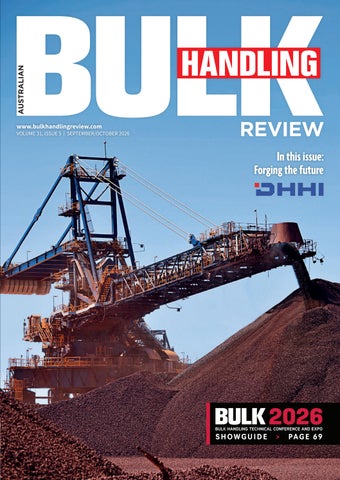
In this issue: Forging the future
SHOWGUIDE
>
PAG E 6 9
Explore the Smart Series Conveyor Safety Range
pacauto.lin sma t se ies
Your Complete Conveyor Safety Solution
uilt to eliminate nuisance t ips e uce unplanne o ntime an eep p o uction unnin .
Pull Wire Switch
Belt Rip Detector
Spillage Detector Feed & Return
Belt Misalignment Detector
Belt Speed Detector
Blocked Chute Detector
Purpose Built Accessories
1300 881 876 sales@pacificautomation.com.au pacificautomation.com.au
CONTENTS SEPTEMBER/OCTOBER 2026
12
19
22
56
10 Analysing material flow and build-up in a bucket wheel reclaimer
28 Engineering confidence in hazardous areas
12 Reshaping the Kwinana port precinct 14 Maximising performance through conveyor reliability
30 Beyond replacement
48 How surface topography and moisture dictate material flow 50 Why fatigue failures keep returning
32 The ideas shaping bulk handling’s future
54 A rotatory solution
34 Turning data into decisions 36 Unlocking results
56 Automation for chemical processors: Beyond meeting increasing demands
38 Lifelong lessons
58 Product focus
40 One supplier for the full power path
60 Beyond the build
22 Safely engineering the lift
42 From sample to safe shipment
64 Going for platinum
26 Kwinana’s next-generation shiploader
44 Dribbling away conveyor discharge build-up
66 Raising the bar in primary crushing
69 BULK EXPO SHOWGUIDE 72 CONFERENCE PROGRAM
74 BULK EXPO EXHIBITOR LIST 82 FLOORPLAN
16 The driving force behind stackers 19 Typical operating modes for stackers and reclaimers
www.bulkhandlingreview.com
VOLUME 31, ISSUE 5 | SEPTEMBER/OCTOBER 2026
In this issue: Forging the future
COVER STORY: FORGING THE FUTURE DHHI is combining Australian engineering and project delivery with global manufacturing scale to evolve from a balanced machine specialist into an integrated mining solutions partner. For the full story, see page 6
follow us on
SHOWGUIDE
>
PAG E 6 9
Australian Bulk Handling Review: September/October 2026 І 3
EDITOR’S NOTE
Published by:
379 Docklands Drive Docklands VIC 3008 T: 03 9690 8766 www.primecreativemedia.com.au CEO Christine Clancy E: christine.clancy@primecreative.com.au Editor William Arnott E: william.arnott@primecreative.com.au Journalist: Daniel Williamson E: daniel.williamson@primecreative.com.au Business Development Manager Michelle Verstandiker E: michelle.verstandiker@primecreative.com.au Client Success Manager Janine Clements E: janine.clements@primecreative.com.au Head of Design Clayton Hawley Design Laura Drinkwater Subscriptions T: 03 9690 8766 E: subscriptions@primecreative.com.au
www.bulkhandlingreview.com
The Publisher reserves the right to alter or omit any article or advertisement submitted and requires indemnity from the advertisers and contributors against damages or liabilities that may arise from material published. © Copyright – No part of this publication may be reproduced, stored in a retrieval system or transmitted in any means electronic, mechanical, photocopying, recording or otherwise without the permission of the publisher.
An industry united In September, the Australian bulk handling industry will once again come together for the 2026 Bulk Handling Technical Conference and Expo. The show is the country’s only dedicated exhibition and conference aimed at the bulk solids handling sector. This biennial event connects leading suppliers with senior decision makers, engineers, operators, procurement professionals and contractors from across the country. Key decision-makers from a broad range of industries will have the opportunity to get an up-close look at the latest in technology and innovations, whether they specialise in agricultural silos, shiploaders, or mining conveyors. It is an opportunity to catch up with colleagues, meet new faces, and build a network. It is also a place to learn, thanks to a world-class forum of advanced technical content, curated by the Australian Society for Bulk Solids Handling. Additionally, it will feature a revamped Australian Bulk Handling Awards night. The event is an opportunity to acknowledge and celebrate the outstanding achievements and successes of companies and individuals that have demonstrated innovative practices and superior performances across the year. In 2026, the event has evolved, with a record number of nominations and several new categories have been added, including the Women in Bulk Handling Award, Bulk Handling Training and Development Award, and Mentor of the Year award. Australian Bulk Handling Review is proud to be the official media partner for the expo and will have a team of reporters at the show this year to report on the latest bulk handling breakthroughs. We look forward to seeing you there at the Melbourne Convention and Exhibition Centre from 16-17 September.
William Arnott Editor - ABHR
4 І Australian Bulk Handling Review: September/October 2026
MODEL
TA
BELT ALIGNMENT SWITCH
MODEL
RS
PULL CORD SAFETY STOP SWITCH FOR CONVEYORS
MODEL
DB
DAMAGED BELT DETECTOR
™
MAGNETICALLY COUPLED MOTION SWITCH
MODEL
CMS
COMPACT MOTION SWITCH
INTRODUCING AN EASY WAY TO PROTECT YOUR WORKERS AS WELL AS PROTECT YOUR INVESTMENT INTO YOUR EQUIPMENT. THE CONVEYOR SAFETY SYSTEM™ IS AN EASY, COST EFFICIENT WAY TO GET PEACE OF MIND AND PROTECTION FOR CONVEYOR EQUIPMENT. BY BUNDLING OUR MODEL RS SAFETY STOP SWITCH WITH OUR MODEL TA BELT ALIGNMENT SWITCH, MODEL DB DAMAGED BELT DETECTOR WE HAVE YOUR WORKERS AND EQUIPMENT COVERED. COUPLE THAT WITH ADDING ONE OF OUR MOTION SWITCHES (MAG-NEAT-O™ OR MODEL CMS), YOU CAN FEEL CONFIDENT KNOWING THAT YOUR SYSTEM AND WORKERS ARE PROTECTED FOR A FRACTION OF THE COST OF DOWNTIME, REPAIRS AND REPLACEMENT EQUIPMENT.
www.conveyorcomponents.com
COVER STORY
Forging the future DHHI is combining Australian engineering and project delivery with global manufacturing scale to evolve from a balanced machine specialist into an integrated mining solutions partner. FOR DHHI, AUSTRALIA’S MINING industry is entering a period of significant change. Ageing infrastructure, growth in iron ore, copper and critical minerals, labour constraints and pressure for safer, faster project delivery are reshaping what owners expect from engineering and construction partners. HH is best known in Australia for balanced machines such as stackers, reclaimers and shiploaders. ver the past three years, however, the company has deliberately invested in the people, systems and partnerships required to
deliver broader engineering, procurement and construction EPC solutions. HH sees company culture as an often understated but essential driver of long-term sustainability and growth, with continued investment in people who align with its values helping to create a stronger workplace environment and improve personnel retention. HH sales manager Will Haua said balanced machines remain as the company s core offering, but the project execution disciplines required to deliver these complex assets extend naturally into wider mining infrastructure.
DHHI’s objective is to provide end-to-end mining and port infrastructure solutions.
6 І Australian Bulk Handling Review: September/October 2026
“Whether it s delivering a stacker or a crushing plant, the project delivery process and subsequent disciplines for project management and controls remain largely the same,” he told ABHR. “With more than 1600 engineers and technicians across 12 professional design institutes at our alian headquarters combined with our Perth based execution team, we plan to leverage these capabilities and skills to diversify the business outside of just bulk commodities to a broader EPC market. “We have been listening to our clients and deliberately built a
Images: DHHI
model that ensures quality through established engineering solutions, adds value through global supply chain partnerships and world-class manufacturing facilities, and supports the full lifecycle of their operations.” HH s objective is to provide endto-end mining and port infrastructure solutions across the complete value chain – from run-of-mine facilities, crushing, screening and mineral processing through to conveying systems, switchrooms, stockyards to the train or truck loadout systems – to both import and export port infrastructure solutions including car dumpers, conveyor systems, stockyards and all forms of shiploaders and shipunloaders. The expansion is not simply a change in market positioning. HH has built the underlying capability first: an enlarged Perth office, Australian engineering and project execution
teams, local procurement and quality assurance, construction management, commissioning resources and a dedicated aftermarket business. This Australian presence is backed by one of the world s largest heavyengineering organisations. HH s model allows projects to be led locally while drawing on global engineering capacity, specialist design institutes, large-scale manufacturing facilities and established international supply chains when required. “Mining projects rarely follow a perfectly straight path,” Haua said. “Clients value having direct access to people who can make decisions, while also knowing the depth of the wider organisation is available behind the local team.” Haua said the move is in response to an evolving mining market. A large proportion of our current work involves balanced machines that are approaching or have exceeded their original 0-year design life,” he said. “ wners are assessing whether each asset should be refurbished, upgraded, life-extended or replaced. That decision increasingly considers availability, maintainability, automation, safety, energy performance, end-of-life and compliance with current Australian Standards, not simply the initial capital cost. “ ur immediate focus remains supporting those critical projects, while our longer-term strategy is to apply the same engineering, manufacturing and execution capability to larger, integrated delivery packages.” A key element of HH s growth has been its people. The Australian business has expanded its engineering, project execution, procurement, quality, construction management, commissioning and aftermarket capability while retaining an agile culture and direct access to decision-makers instead of rigid reporting lines. This combination of local accountability and global technical depth helps the company respond quickly as project conditions change. “Traditional lump-sum EPC contracts still have an important place, particularly where the scope is mature and well defined,” he said.
But many projects now involve brownfield interfaces, evolving engineering, uncertain geotechnical conditions, long-lead equipment and changing market conditions. Those risks can be difficult for either party to manage in isolation. “Rather than forcing every project into one model, we work with clients to select an approach that reflects scope maturity and aligns risk, responsibility and reward.” epending on the project, that may include early contractor involvement, open-book or target-cost arrangements, progressive EPC delivery, hybrid strategies, management support or conventional lump-sum EPC. The aim is not to avoid accountability, but to place each risk with the party best able to understand and manage it. “The most successful projects are not necessarily those that transfer the most risk,” Haua said. “They are the projects where risk is understood, allocated appropriately and supported by shared incentives for safe, timely and commercially responsible delivery.” Reducing the overall risk a client needs to manage is key. t s one of the main reasons HH has embraced modularisation for project delivery. Shipping and transport of large modules to remote locations around Australia requires a lot of moving parts, and highly specialised engineering contractors to ensure the safe stowage and delivery to site. Remote construction requires extensive labour, accommodation, logistics and interface management. By maximising offsite pre-assembly and commissioning in a controlled manufacturing environment such as HH s facilities, quality and schedule can be managed more predictably and cost overruns on site reduced. “We are at the forefront of modularisation,” Haua said. “We have massive manufacturing facilities totalling more than 2.5 million square metres of real estate, and with a targeted an annual fabrication of over 00,000t of steel including access to our own private deep water port loading facilities direct from our assembly yard backs up this position.”
Australian Bulk Handling Review: September/October 2026 І 7
COVER STORY
DHHI has partnered with WA Site Services to strengthen its warehousing and lifecycle support for the entire WA region.
HH has also invested significantly in electrical infrastructure, which Haua described as one of the fastest-growing parts of the business and a critical element of its EPC strategy. Modern mining facilities require switchrooms, switchgear, motor control centres, power distribution, control systems and automation to be engineered and delivered as an integrated part of the wider plant. The company s hongge Electrical Manufacturing Base in alian combines multidisciplinary structural, electrical, H AC, fire-protection and automation engineering with intelligent production lines, advanced manufacturing systems and dedicated testing facilities. This enables standardised quality while retaining the flexibility to customise each switchroom to the client s requirements. “Compliance is built into the process from the outset,” Haua said. “ ur Australian engineers work with the manufacturing teams through design, fabrication, assembly and factory acceptance testing so that the equipment meets Australian Standards and projectspecific requirements before shipment.” HH has supplied many switchrooms into the Australian mining industry, including projects for major iron ore producers. The track record provides tangible evidence that the company s expansion into integrated EPC delivery is supported by established engineering, manufacturing and quality systems.
Aftermarket support is equally important to HH s integrated model. The company has invested significantly into its Perth based operations including the partnership with WA Site Services to strengthen its warehousing and lifecycle support for the entire WA regions. WA-based support enables mines and ports to respond quickly to shutdown schedules as well as unexpected equipment failures, minimising costly downtime and keeping critical assets operating. For HH , project completion is not the end of the relationship. ts lifecycle offering includes condition assessments, shutdown planning, structural and mechanical repairs, component refurbishment, rotable parts solutions, fabrication, machining, original
8 І Australian Bulk Handling Review: September/October 2026
equipment manufacturer upgrades, reliability improvements, modernisation and emergency breakdown support. The capability extends to assets supplied by other manufacturers. ocal workshop, field-service and spare-parts capability can shorten response times, while access to originalequipment engineering supports informed decisions about fatigue, obsolescence, maintainability and life extension. This becomes increasingly important as owners seek to maintain production while planning major replacement programs. HH plans to keep expanding its Australian footprint, with growth focused on local engineering, construction, commissioning, workshop services, critical spares and regional support. Haua said the team is particularly focused on supporting the next generation of replacement, brownfield expansion and critical-minerals projects. “We ve put a lot of focus on growing the business in Perth and increasing our resourcing to provide the support our customers need,” he said. “By taking a lifecycle support model, whether its technical support, upgrades, refurbishments, or maintenance, it allows us to minimise the risks our clients face. Whether we are delivering a single balanced machine or an integrated facility from crusher to port, our objective is the same: to build long-term partnerships and deliver safer, smarter and more reliable mining infrastructure.” DHHI has deliberately invested in the people, systems and partnerships required to EPC solutions.
YOUR BULK MATERIAL HANDLING LIFECYCLE PARTNER For decades, Transmin has delivered innovative bulk materials handling solutions for the mining and minerals processing industries. Built on engineering excellence and industry expertise, we design, supply, and support equipment that maximises reliability, productivity, and longterm value. Through our lifecycle approach, we provide ongoing service and technical support to optimise performance throughout every stage of equipment life.
www.transmin.com.au
STACKERS AND RECLAIMERS
Analysing material flow and build-up in a bucket wheel reclaimer Jenike and Johanson demonstrates how discrete element method modelling can be used to evaluate alternative wear liner types and quantify their influence on material build-up in a bucket wheel reclaimer. play a critical role in the efficient management of stockpiles in bulk material handling operations. In essence, the stacker deposits bulk material to form stockpiles, while the reclaimer retrieves the material for downstream processing or transportation. The performance and reliability of these machines directly influence the overall throughput of an operation with unplanned downtime resulting in significant production and financial losses. There are various types of stackerreclaimer systems available for bulk materials handling applications, and the selection of these systems depends on several factors, including the required handling capacity, material characteristics, stockpile configuration, operational requirements, and site constraints. These factors collectively determine the most suitable system for reliable and efficient stockyard operation. In terms of reclaiming, stockpile reclaim systems are generally classified into two categories: gravity reclaim and positive reclaim. Gravity reclaim relies on the natural flow of bulk material through hoppers located beneath the stockpile. The design of gravity-reclaim stockpiles is well established through the application of bulk material flow properties obtained from laboratory testing. These measured properties form the basis for determining reclaim-hopper geometry and estimating total storage and live capacity of stockpiles. In contrast, positive reclaim employs mechanical equipment to recover material from the stockpile. Among the various types of positive reclaimers, bucket wheel reclaimers are widely used in large-scale bulk materials handling operations because of their high reclaiming capacity and continuous
operation. However, when handling cohesive bulk materials, excessive material build-up on the buckets and internal surfaces of the reclaimer can reduce reclaiming efficiency, increase maintenance requirements, and lead to unplanned downtime. Minimising material build-up and carry-back is therefore an important consideration in the design and operation. With advances in numerical modelling techniques, discrete element method (DEM) modelling has become a powerful tool for analysing the flow behaviour of bulk materials and evaluating equipment performance. By simulating material flow, EM enables engineers to assess and investigate design changes in a virtual environment before implementation.
DEM modelling workflow A typical EM modelling workflow involves four key stages: • Developing a 3D model (geometry and domain definition , • efining material and contact model (calibration step), • Running simulations • Post processing (simulation analysis and review) The first stage establishes the confines of the simulation. The second stage defines the calibration where the physical properties of the bulk material such as particle size distribution, density, stiffness, and shape are specified. These are then paired with contact parameters governing particle-particle and particlewall interactions, including friction, rolling resistance, and cohesion. The third Image: Jenike and Johanson
STACKERS AND RECLAIMERS
Bucket wheel reclaimer.
10 І Australian Bulk Handling Review: September/October 2026
stage is where simulations are performed to compare a base line result against different variables such as changes to liner material types. The fourth stage allows for assessment of the results.
DEM modelling of a bucket wheel reclaimer Jenike leveraged DEM to investigate how changing bucket liners might affect carryback issues at a client’s site. As a first step, material flow characterisation tests were conducted to develop a calibrated material for use in DEM simulations. Once the calibration was complete, simulations were run to establish a base line of the current scenario (i.e. existing carry-back ~250kg per bucket). Once the base line simulation was established, subsequent simulations were conducted for different liner materials. The EM simulations quantified the mass of material build-up in one bucket after three revolutions.
The comparison demonstrates that the choice of liner material has a significant influence on material buildup, with some liner types exhibiting substantially lower build-up than others. These findings illustrate how DEM can be leveraged to evaluate alternative equipment designs and support engineering decisions during the design process. By enabling design options to be assessed in a virtual environment, DEM provides valuable insights that support engineering decision-making while reducing the need for costly physical trials. The predictive capability of any DEM model, however, depends strongly on the selection of appropriate material and contact parameters. Since many contact parameters cannot be measured directly, they must be determined through calibration supported by laboratory flow properties testing combined with engineering knowledge.
Author bio Dr Virat Gurung is a project engineer at Jenike and Johanson with a passion for solving problems in the bulk materials handling field. He began his career in the mining industry, developing and implementing maintenance programs for heavy mining machinery. During his time in the mining sector, he encountered several practical challenges that were often addressed through empirical approaches. Driven by a deep interest in bulk solids handling, Virat pursued a Ph.D. at the University of Newcastle, focusing his research on moisture migration in bulk materials. His strong technical foundation and passion for applied problem-solving led him to join Jenike and Johanson. He has contributed to a wide range of projects aimed at improving the efficiency and reliability of bulk material handling systems.
1800 689 433
SHIPLOADING
Reshaping the Kwinana port precinct Image: stock.adobe.com/Matt
Governments are turning their attention to the infrastructure required to support the next phase of trade growth.
Kwinana has played an integral role to Western Australia’s industrial economy.
KWINANA, SOUTH OF PERTH IN Western Australia, has long played a central role in the state’s industrial economy. Home to major mining, energy and manufacturing operations, the region has evolved into one of Australia’s most significant freight and export corridors. At the centre of that transition is the Kwinana Bulk Terminal (KBT), which is undergoing major redevelopment as part of the Westport program, the WA Government’s long-term plan to develop a new container port and reshape the state’s road and rail freight network. The terminal remains critical to Western Australia’s industrial supply chain. KBT handles all clinker imports into the state, a hard, nodular material produced by heating limestone and clay that is essential to cement manufacturing. The facility also supports the movement of a range of dry bulk commodities connected to construction, mining and industrial production. However, the existing terminal infrastructure is ageing and approaching the end of its operational life, placing increasing pressure on long-term freight planning.
To support the future Westport precinct and strengthen freight efficiency across the region, the Federal and Western Australian governments have confirmed a joint $1.1 billion infrastructure investment package. The funding includes $552 million from the Australian Government, matched by the WA Government, with works focused on improving freight connectivity throughout the Western Trade Coast. Prime Minister Anthony Albanese said the investment was aimed at delivering long-term economic outcomes through infrastructure. “In uncertain times, Australians can be assured we are getting on with the job of delivering landmark projects that will unlock long term social and economic benefits for Australians,” Albanese said. “Upgrading Anketell Road will ensure Western Australia’s trade capacity can realise its potential. “Providing clear and efficient access to the future Westport precinct will support long-term economic growth of Western Australian industries, boost the local and national economy and create jobs.” A major component of the investment is the first stage of upgrades to Anketell Road, a freight corridor expected to
become one of the primary heavy vehicle routes servicing the future port precinct. Planned works include widening sections of the road to four lanes between Leath Road and Abercrombie Road, alongside the construction of a grade-separated interchange at Rockingham Road. The upgrades are designed to improve freight efficiency, reduce congestion and strengthen connections between industrial areas, road freight routes and the future port infrastructure. For the bulk handling sector, the project represents more than a road upgrade. It highlights the increasing importance of first- and last-mile freight infrastructure as supply chains become more complex and freight demand grows across mining, construction materials and agriculture. The broader Westport program is intended to address long-term capacity challenges at Fremantle Port, which is forecast to reach its container trade limits in coming decades. winana has been identified as the preferred location for a future container terminal due to its industrial land availability and direct freight network connections. The proposed port precinct is expected to integrate road, rail and marine infrastructure, creating a dedicated freight corridor that separates heavy vehicle movements from residential areas while supporting higher trade volumes. WA Premier Roger Cook said the project would help support the state’s economic future and growing freight requirements. “Western Australia’s economy is the strongest in the nation, and the future container port in Kwinana coupled with the Western Trade Coast will play a significant role in maintaining that strength,” Cook said. “Upgrading Anketell Road will help deliver this once-in-a-century economic infrastructure for WA.
12 І Australian Bulk Handling Review: September/October 2026
Bulk Han
“It will ensure our State has what it needs to meet my government’s priorities – including becoming a renewable energy superpower and a place that makes more things here.” From an operational perspective, infrastructure upgrades around Kwinana are likely to become increasingly important as freight operators seek greater efficiency and reliability across supply chains. Heavy vehicle congestion, port access delays and network bottlenecks continue to present challenges for industries reliant on the timely movement of bulk commodities. The integration of upgraded road infrastructure with future rail and port developments could help streamline freight movement between inland production zones, processing facilities and export terminals. Deputy premier, treasurer and transport minister Rita Saffioti said Westport will keep WA’s economy the “strongest in the nation”.
“These upgrades will ensure freight movements in and out of the future port precinct and surrounding industrial areas are safe and efficient for all road users,” Saffioti said. “By future-proofing WA s trade capabilities for the next century, we re ensuring costs for imports, exports and everyday goods remain low and creating a pipeline of jobs for Western Australians.” The redevelopment of KBT itself is also expected to play a critical role in maintaining supply continuity for the construction and cement industries, particularly as demand for major infrastructure and housing projects continues. For Australia’s bulk handling and logistics sectors, the investment signals broader recognition of the role freight infrastructure plays in economic resilience. While the Westport project remains a long-term undertaking, the staged rollout of enabling infrastructure such as Anketell
Road demonstrates how governments are increasingly prioritising freight efficiency, industrial connectivity and future trade capacity in strategic planning. Federal member for Brand Madeleine King said the funding will have a greater impact than just making procedures slightly more streamlined. “This funding will mean workers in Perth’s southern suburbs will spend less time behind the wheel and more time with family and friends,” ing said. “It will ease freight congestion, make freight transport safer, back in our truckies and support the continuing unmatched economic powerhouse that is the winana ndustrial Area.” As Western Australia s export task continues to expand, the winana precinct is expected to remain at the forefront of the state’s evolving supply chain network, linking bulk industries, transport infrastructure and future port operations into a single industrial corridor.
Engineering solutions that keep you moving
Bulk Handling Review_Aug26.indd 2
7/08/2026 10:23:03 AM
STACKERS AND RECLAIMERS
Maximising performance through conveyor reliability ESS helps operators reduce fugitive material, extend equipment life and maximise the performance of critical bulk materials handling assets. STACKERS AND RECLAIMERS ARE
facilities. Although designed for highcapacity, continuous operation, their performance relies on the efficiency of the conveyor systems that move material to and from them. Conveyor belts are vital for moving bulk materials like iron ore, coal, and bauxite in stockyards. However, issues such as carryback, spillage, and dust create more than just product clean-up —they increase maintenance needs, create
safety risks, and wear out equipment faster, reducing operational availability. Carryback, the material left on the belt after discharge, accumulates on conveyor components and structures, leading to persistent clean-up and maintenance challenges. This not only results in material loss under stacker conveyors but also accelerates wear and disrupts efficient material recovery on reclaim conveyors. Factors such as moisture, particle size, Images: ESS Engineering
essential to modern bulk materials handling. Together, they allow mining operations, ports, and processing plants to efficiently stockpile and recover large volumes of material, supporting continuous production. Stackers create stockpiles by placing material as required, while reclaimers retrieve it and return it to the processing stream, rail network, or ship-loading
ESS is committed to providing endto-end service, from design and manufacturing to installation and ongoing maintenance.
14 І Australian Bulk Handling Review: September/October 2026
and belt speed make some materials harder to clean, highlighting the need for well-designed belt cleaning systems. A well-designed and wellmaintained belt cleaning system offers significant long-term cost benefits compared to frequent cleanups and component replacements. ESS Engineering accounts development manager Tom Stahura said a belt cleaning system is losing processed material, the site is throwing away money spent on refining the product and then paying more to clean it up. Effective belt cleaning also contributes to dust reduction. Material left adhering to the belt can dry as it travels along the return side before being released as airborne dust at pulleys and idlers. By removing carryback before it travels the full length of the return conveyor, operators reduce airborne dust, reduce manual handling and create a safer working environment while also reducing environmental impacts. ESS Engineering’s approach to belt cleaning utilises a system of primary, secondary and return belt cleaners which work together to minimise carryback and improve conveyor efficiency. “The primary cleaner sits at the head pulley and removes the bulk of material that adheres to the belt,” Stahura said. Removing bulk material at this point allows the material to return to the normal flow of conveyed material and significantly reduces downstream buildup and lessens the cleaning burden placed on subsequent belt cleaners. Next, ESS secondary cleaners are positioned after the head pulley to remove the remaining fines. “For applications where the material requires it, multiple secondary cleaners can be installed”, Stahura said. The final stage of cleaning occurs on the return side of the conveyor. ESS return belt cleaners remove residual material before it reaches the tail pulley, preventing build-up on return idlers, pulleys and conveyor structures. By preventing material from being carried throughout the return conveyor, excessive component wear and safety hazards are reduced. Together, primary, secondary and return belt cleaners form an integrated cleaning system that significantly
ESS Engineering equipment has been designed to simplify inspection and maintenance.
reduces fugitive material while improving conveyor reliability throughout stacker and reclaimer operations. Selecting the correct belt cleaner is only part of achieving long-term conveyor performance. Every conveyor presents unique operating conditions, influenced by belt speed, conveyed material, moisture content, transfer design, operating hours and maintenance intervals. Understanding these variables is essential when specifying conveyor accessories. ESS works closely with operations and maintenance teams to evaluate conveyors in service, observing how material behaves under actual operating conditions before recommending practical, fit-for-purpose solutions. Correctly selected and maintained conveyor accessories significantly extend the service life of both conveyor components and the conveyor belt while improving overall system reliability. However, inspection and service of these products during planned maintenance periods or conveyor shutdowns are often overlooked. Without regular inspection and maintenance, conveyor accessories gradually lose effectiveness, allowing carryback, spillage and excessive wear to return. Reduced performance can ultimately lead to premature component failure, increased clean-up costs, unnecessary replacement of conveyor accessories and, in severe cases, costly damage to the conveyor belt itself.
Whether installing new equipment or maintaining existing systems, ESS technicians can carry out inspections, equipment upgrades, installation, commissioning and preventative maintenance programs. This proactive approach helps sites maximise the return on their conveyor equipment investment while reducing unplanned shutdowns. Stahura said the equipment has also been designed to simplify inspection and maintenance. “Our hardware has been designed to be inspected while the conveyor is in operation,” he said. “We can carry out inspections and minor adjustments to our belt cleaners with the conveyor online, requiring only minimal downtime during shutdowns to service or replace equipment.” ESS is committed to providing end-to-end service, from design and manufacturing to installation and ongoing maintenance, to ensure the client sees long-term benefits for plant efficiency and personnel safety. As stockyard operations continue to demand greater throughput, higher reliability and lower maintenance costs, conveyor performance remains fundamental to stacker and reclaimer productivity. By combining engineered belt cleaning systems with experienced technical support, installation, conveyor audits and ongoing maintenance, ESS helps operators reduce fugitive material, extend equipment life and maximise the performance of these critical bulk materials handling assets.
Australian Bulk Handling Review: September/October 2026 І 15
STACKERS AND RECLAIMERS
The driving force behind stackers Image: SEW-EURODRIVE
SEW-EURODRIVE’s wide range of drives is helping power stackers and reclaimers across Australia.
B SEW-EURODRIVE can provide drives to support each stacker or reclaimer application.
STACKERS AND RECLAIMERS are made up of a multitude of moving parts. Behind each rotation of the bucket wheel and every conveyor is a drive, consisting of motor, gearbox, brakes, and more. For almost a century, SEWEURODRIVE has been supplying the mining industry with this vital equipment. SEW-EURODRIVE national product manager Guido Wagner told ABHR that every application within a stacker or reclaimer faces its own challenges. “The bucket wheel drive, for example, needs to be very light to minimise the weight at the end of the boom, whilst at the same time needing to be heavy duty for shock loading and a high level of contamination,” he said. “Travel drives need to be compact but rugged. They also need to be
quick and easy to replace. “At SEW-EURODRIVE, we understand every part of the machine, which enables us to provide the optimal solution.” Founded in 1931 in Germany, SEWEURODRIVE now operates in more than 50 countries with 17 production plants and 22,000 employees. It aims to design rugged, innovative products to high-quality standards for a wide range of applications. The company can provide drives to support each stacker or reclaimer application, including hoist drives, slewing drives, and travel drives. Wagner said original equipment manufacturers benefit from this wide range of products, as it allows them to find the most suitable and optimised drive solution. “Using coordinated drive components from SEW-EURODRIVE does not only mean fewer emergency spares are required by design but also our local
16 І Australian Bulk Handling Review: September/October 2026
presence, stock and ability to deliver in unmatched short lead times brings peace of mind to the end user,” he said. For end users, having a unified supplier of drive systems means that a single service partner can service the entire machine. Taking a coordinated service approach helps to minimise downtime, reduce the chance of failures, and allows for more in-depth analysis. Wagner said SEW-EURODRIVE has a nationwide service presence that helps mining companies get the most out of their equipment. “There is a range of services that SEW-E R R E offers to keep an aging stacker reclaimer going,” he said. “We can simply service the drives, even if they are not our own. If during the service damaged gearing is discovered, these gears can often be replaced individually with modern SEW-EURODRIVE gears to save cost.
T C
a
T
M
P
P
P c
“We can also provide drop-in solutions, replacing the damaged or aging drive with a modern drive solution by SEW-EURODRIVE.” There are two categories of drop-in solutions. ne is to drop a standard offthe-shelf drive into the existing envelope using adapters. The other is a customdesigned and built drive, externally replicating the obsolete drive but using modern technology internally. Modern gearing takes advantage of stronger materials and smart microgeometry to optimise the shape of the gearing under load, resulting in exceptional torque density. Higher torque density means a smaller form factor, which allows SEWEURODRIVE to replace existing drives with more compact modern drive solutions. The company can also provide engineering support and expertise around drive maintenance, offering tools such as Complete Drive Management. Wagner said unlike traditional
condition monitoring, which will usually only look for faults occurring, SEW-EURODRIVE can calculate the remaining useful life of the equipment. “You can rely on our service team’s professionalism and personalised support to maximise system availability and minimise maintenance expenditures,” he said.
Wagner said SEW-EURODRIVE’s service and support is an integral part of its business philosophy and closely linked with its products “Customers have come to expect only the highest standards in service and support, and we continuously receive positive feedback,” he said.
“Customers have come to expect only the highest standards in service and support, and we continuously receive positive feedback” SEW-EURODRIVE has close to $60 million worth of stock in Australia, most of which is located at its Melbourne warehouse. Normally, parts are available within days, but in certain circumstances the company can achieve sameor next-day delivery, even to remote locations.
“But what really stands out is the service and support we provide when crisis hits and things go wrong. “The determination and dedication of our staff to help our customers get out of trouble goes a long way and sets us apart from most of our competitors.”
BULK MINERAL COMPLIANCE
TECHNICAL CERTAINTY FOR CONFIDENT SHIPPING eciali t tec nical u ort or t e cla i ication and mo ement o ul mineral roduct
TRANSPORT CLASSIFICATION + SDS M
M
M
P
nne
MOISTURE MANAGEMENT PLANS PORT AUTHORITY TECHNICAL REPORTS
Product Quality Management
Practical tec nically de en i le ad ice or ore concentrate mineral and y roduct and a te tream
EXPERT SERVICES l
l Solids o
S l
ing S
s n
S s n Solids
s
in on in o l
S
s o osi
s n
i ol
s i l Solids s S l
ing Solids i
o
l
ls
i
oxi o osi
Solids
Oxidizing Soilids ns o
ion
i
l n l sis
issol ion
s ing s ing
Testing conducted against: s
cienti ic Preci ion
egulatory ertainty
davorenenvironmental.com.au
li n
ng o s oods
n
n ion l
ii
n
n ion l
ii
ng o s oods
Solid
l
go s
l s s
S
l
s s
s in o osion
Driving the world
Stackers and Reclaimers Drive solutions that keep your Balance Machines in motion
D
E
B A C
A demanding industry requires a versatile drive portfolio At SEW-EURODRIVE, we understand the unique demands of the Bulk Materials Handling industry. We are dedicated to keeping your operations in motion with our cutting-edge products and solutions for Stackers and Reclaimers. Our team of specialists ensures you receive local support and access to our comprehensive portfolio of services and products. Services Include:
Solutions Include: A. Bucket Wheel Drive B. Slewing Drive C. Travel Drive
D. Hoist Drive E. Conveyor Drive And many other Drives
Scan to view brochure sew-eurodrive.com.au
• Local Support • Online Support • Drive Configuration • Engineering Support • 24/7 Emergency Service
STACKERS AND RECLAIMERS
Typical operating modes for stackers and reclaimers TRAVELLING, SLEWING AND luffing stackers and bucketwheel reclaimers are widely used throughout Australia for efficient bulk stockpile management. Their ability to handle high throughputs, support fully automated operation, and manage large stockyards has made them the preferred solution for many modern bulk handling facilities. ey performance objectives typically include: The ability to manage product blending segregation in stockpiles stockpile management . Ensuring that the reclaimer operates with minimum spillage and or dust generation. The ability to evenly handle material with a consistent throughput and reliability. Maximising the average reclaim rate, while ensuring that the capabilities of downstream systems are not exceeded e.g. during reclaim peaks . As automation has advanced, most new stockyard machines in Australia are now fully automated, with many existing machines also retrofitted with modern control systems. There are often opportunities to improve facility performance through an understanding of the key operating modes for these machines, and the relative strengths and weaknesses of each operating mode.
Stacking modes Cone and cone-crescent stacking n this method, the stacker must initially build a short conical pile, before extending the pile length through long travel steps. As the pile is developed, the boom is luffed up progressively, minimising material fall distance to the stockpile to avoid excessive material
Images: Aspec Engineering
Aspec Engineering director Adam Mayers details the most common modes of operation for slewing stackers and reclaimers. As automation has advanced, most new stockyard machines in Australia are now fully automated.
degradation and dust. The initial cone stockpile is then progressively lengthened through long travel steps. While simple to execute, this method can lead to issues of poor blending and product segregation. Cone-crescent stacking is a variation on cone stacking, whereby instead of an initial conical stockpile, the stacker builds an initial short full-width pile, before extending the pile length through a series of crescent-shaped slew and long travel steps. Chevron stacking n this method, the stacker initially builds a narrow, full-length stockpile, before increasing the height width of the stockpile through repeated fulllength long travel movements, adding multiple full-length layers of material. The long travel speed is varied according
to belt weigher readings to maintain a constant deposition rate in terms of t m along stockpile length . At the end of one long travel movement, the boom is luffed up, before reversing the direction of long travel motion and creating the next chevron layer. This is repeated until a full height stockpile is created. perators generally prefer this method when blending is required. Chevron-ply stacking Chevron-Ply stacking is a variation on Chevron stacking, whereby a series of additional material strata or plys are deposited by slewing the boom inwards, and performing full length long travel motions. Chevron-ply stacking further enhances blending performance by depositing additional material layers.
Australian Bulk Handling Review: September/October 2026 І 19
STACKERS AND RECLAIMERS
Reclaim modes Slew terrace reclaiming n this method, the stockpile is reclaimed in a series of layers, often referred to as terraces or benches. The machine reclaims from the stockpile in a series of slewing arcs, indexing forwards through the stockpile in the long travel direction. pon reaching the end of the stockpile it may either begin reclaiming in the opposite direction or be reversed to the original start position to commence the next bench. Pilgrim step reclaiming n this method material is reclaimed via a series of advancing terrace cuts. After the top bench has been partially reclaimed to a set distance the next bench is commenced. The subsequent intermittent benches must end prior to the bench above to prevent material slump and collapse of the digging wall. This approach offers greater flexibility in stockyard space management and can
avoid some material segregation issues, at the expense of a very small drop in reclaim efficiency. Waltz step reclaiming Walt step reclaiming, named after the dance, is a variation on either slew terrace or pilgrim step methods. For walt step operation, a number of slew cuts are made whereby the slew range is restricted to keep the bucketwheel embedded within the stockpile. After a set number of cuts of this fashion typically two to four a full range slew cut is performed to reclaim material left behind on previous cuts. The net result is less time wastage and greater utilisation of the bucket wheel. Long travel terrace reclaiming n a similar fashion to slew terrace reclaiming, the stockpile is reclaimed in a series of terraces or benches. However, instead of slewing arcs, the machine reclaims each bench in a series
of long travel trenches. This requires the bucketwheel to be aligned at a greater angle to the main boom structure, and as a result, a non-standard arrangement of the machine is typically required. Although less common, this operating mode offers significant advantages. Fewer individual cuts are required, particularly for long stockpiles, resulting in high average reclaim rates. However, stockpile management, blending and segregation control can be more challenging.
Conclusion Selecting the most appropriate stacking and reclaiming strategy depends on the facility s operating objectives, including throughput, blending performance, stockyard flexibility and downstream constraints. nderstanding the strengths and limitations of each operating mode allows operators to optimise both stockyard performance and overall plant efficiency.
Reclaimers are widely used throughout Australia for efficient bulk stockpile management.
20 І Australian Bulk Handling Review: September/October 2026
OF0046
OF0046 Rema_ABHR_A4_We-Keep_August-2026_v01.indd 1
6/8/2026 1:39 pm
STACKERS AND RECLAIMERS
Safely engineering the lift Maintaining Australia’s bulk handling infrastructure demands more than heavy lifting. It requires engineering expertise, controlled methods and careful, collaborative planning. STACKERS, RECLAIMERS AND shiploaders sit at the heart of Australia’s bulk port operations, but maintaining these giants is one of the industry’s most technically demanding tasks. Unlike many other pieces of equipment, there is rarely a spare machine waiting in reserve if one is taken out of service. “When a critical machine becomes unavailable, the impact can extend well beyond that individual asset,” Sync Lift Engineering general manager and founding director Brian Lynch said. “ t can affect stockpile management, production flow, and shipping commitments.
“The objective is not simply to repair a component, but to return a critical asset to service safely and with as much certainty as possible.” Rather than replacing major machines, many operators are investing in component replacements intended to extend the service life of existing assets.Those projects, however, are rarely straightforward.
More than heavy lifting Since its establishment in Gladstone in 2017, Sync Lift Engineering has built its reputation by integrating engineering, fabrication and field execution, with its directors remaining actively involved.
Images: Sync Lift Engineering
Engineering-led planning and specialised hydraulic jacking play a critical role in safely maintaining Australia’s largest balanced machines.
The company’s projects and shutdowns business unit manager and founding director Marc Richards said collaboration between the client, engineering and project teams, and the people carrying out the work is integral to ensuring every aspect of the job is considered. “I remain closely involved because major shutdowns rarely unfold exactly as they appear on paper,” Richards said. “You need people who understand the plan but can also make practical decisions when conditions change.” Sync Lift Engineering’s work spans stackers, reclaimers, stacker-reclaimers and shiploaders, with projects ranging from slew-bearing replacements and pivot-pin upgrades to long-travel drive replacements, structural modifications, fabrication, specialised lifting, and shutdown execution. While each project is different, success depends on detailed planning long before mobilisation begins. “The projects that tend to keep us busiest are the jobs where several disciplines have to come together within a very restricted shutdown window,” Lynch said. Engineering design, fabrication, project planning and site execution all need to work together seamlessly. Purpose-built support structures and jacking equipment are designed and manufactured in Sync Lift’s Gladstone workshop while project teams simultaneously develop shutdown methodologies and coordinate activities with the client. That workshop-to-site approach, Lynch said, allows the company to contribute far earlier than simply providing labour for a shutdown. “We’re involved in working out how the job can be completed safely, practically and within the client’s operational constraints,” Lynch said.
W ex Ha
S
22 І Australian Bulk Handling Review: September/October 2026
ABHR ad
Every activity within a shutdown window must be carefully sequenced to keep the project moving.
Understanding balanced machines Unlike static structures or standalone components, stackers and reclaimers are carefully balanced systems. Altering one section of the machine changes how loads are distributed throughout the entire structure, meaning even relatively routine maintenance can become a complex engineering exercise. “A lot of what we do involves machinery that cannot be approached using a standard lifting or maintenance method,” Sync Lift Engineering founding director Brad Klease said. “Our role is about understanding how the machine behaves, how the loads will change throughout the work, and what needs to be designed or controlled before we start moving anything.” The company’s recent pivot-pin upgrade projects on two stacker reclaimers provide a practical example.
Sync Lift Engineering general manager and founding director Brian Lynch believes successful shutdowns are built on detailed planning.
Before the pivot pins could even be removed, both the bucketwheel boom and counterweight boom had to be synchronously jacked and supported so that loads remained balanced throughout the operation. Existing bores were then line bored to accommodate upgraded bearings and pins, while long-travel drive bogies were replaced during the same shutdown. Every activity depended on the others being completed in the correct order. Temporary conditions created during lifting and maintenance can be just as critical as the asset s final operating position. “In many cases, the most technically critical part of the project is not
the component replacement itself,” Klease said. “It is safely creating and maintaining the temporary condition that allows the replacement to happen.” All balanced machine projects completed to date since the company’s inception have been completed Recordable Injury Free.
Engineering before execution For projects involving critical bulk handling assets, successful execution begins well before the first piece of equipment is touched. According to Richards, every project starts by building a detailed understanding
World leaders with 50 years’ experience in Bulk Materials Handling Research and Consulting TUNRA Bulk Solids develops custom solutions to suit the individual needs of our clients. Services: Flow Properties and Materials Testing Dust (environmental) Testing Wear Testing (Impact, Abrasion and Erosion) Conveyor Belt, Idler Roll and Pulley Testing Discrete Element Method (DEM) Modelling DEM Calibration Testing Materials Handling Consultancy and Contracted Research Bin and Stockpile Design Pneumatic and Hydraulic Conveying Computational and Scale Modelling Site Visits Professional Development Courses
+61 2 4033 9055
Storage, Feeding, Transfer and Belt Conveying Course: 17-19 November 2026 (Perth) 2027 Professional Development Courses: Transfer Chute Design, Modelling and Optimisation Course: 27 - 28 April (Newcastle) Storage, Feeding, Transfer and Belt Conveying Course: 1 - 3 June (Brisbane) November (Perth)
www.bulksolids.com.au ABHR ad SeptOct 2026.indd 1
31/07/2026 5:01:35 PM
STACKERS AND RECLAIMERS
of the asset, the site and the client’s operational requirements. “The first step is understanding what the client needs to achieve and the constraints around the asset,” Richards said. “We review the scope, available drawings, machine history, site conditions and shutdown requirements. “Where possible, we also inspect and verify the asset rather than relying solely on existing information.” Purpose-designed jacking haunches, support structures and specialised lifting equipment can all be fabricated and tested before mobilisation, ensuring site execution focuses on delivering a proven plan rather than solving problems on the fly. That preparation becomes especially important during major shutdowns, where every hour counts. “The job is largely won or lost before the shutdown begins,” Richards said “By the time the first piece of equipment is touched, everyone should understand the sequence, their responsibilities, the interfaces with other work groups and the hold points that must be cleared before the next activity begins.” Richards said that if developed separately without proper coordination, gaps will appear immediately as the shutdown starts. “People need to know what has changed between shifts, what work has been completed, what remains live and whether anything has been identified that affects the next activity,” Richards said. “It is also important that people feel comfortable stopping and raising a concern. “We’d rather lose some time investigating an issue early than continue based on an assumption and create a much larger problem.” While hydraulic jacking systems are often among the most visible elements of a shutdown, Klease said they represent only one component of a much larger solution. “The hydraulic jacks are only one part of the lifting system,” he said. “Before we lift anything, we need to determine where the machine can safely be supported, how the loads will be distributed and what will happen to the structure as it moves.”
Every aspect of the lift must be considered, from support locations and hydraulic systems to mechanical locking, load monitoring and movement tolerances. Where multiple lifting points are involved, they must function as a single controlled system to prevent unexpected load transfers through the structure. One project that demonstrates this approach was the replacement of a slew bearing on a stacker reclaimer. The scope extended far beyond simply replacing the six-metre-diameter bearing. Purposedesigned jacking haunches were installed before the machine was raised using four 400-tonne mechanically locked hydraulic jacks, allowing the structure to remain positively supported throughout the work. The broader project scope also incorporated slew-drive overhauls, highvoltage and control-cable removal and reinstatement, structural modifications, scaffolding, and blast-and-paint remediation. Every discipline relied on careful coordination to maintain the integrity of the shutdown sequence. “The importance of specialised jacking is control,” Klease said “We’re not just trying to make a very large machine go up and come back down. “We need to hold it in a known, stable condition so that people can safely complete precise work underneath and around it.” Richards said it is this integration between engineering disciplines that often determines the success of a project.
24 І Australian Bulk Handling Review: September/October 2026
“No single discipline completes the job,” Richards said. “It is the coordination between engineering, fabrication, mechanical, electrical, lifting and site execution that delivers the final result.”
A change of approach Lynch said asset owners are looking for more than a contractor who can supply people for a shutdown. “They want engineering partners who can understand the operational problem, develop the method, and take responsibility for delivering it,” he said. That shift is also being driven by a greater emphasis on extending the service life of existing infrastructure. For Richards, another noticeable trend is the earlier involvement of engineering specialists during project planning. “Clients are involving delivery teams earlier because they want greater schedule and execution certainty,” he said. “The earlier those practical considerations are included, the better the project is likely to perform when it reaches site.” For Sync Lift Engineering, that early involvement allows engineering, planning and site execution to be considered as one complete process. When the asset is critical and the shutdown window is tight, success comes down to more than the lift, it comes down to how it is safely engineered. Complex maintenance projects on stackers, reclaimers and ship loaders require detailed engineering.
PORTS
Kwinana’s next-generation shiploader ABHR sat down with Wallbridge Gilbert Aztec (WGA) to learn about its latest shiploading project in Kwinana and its significance to Western Australia and the country. Kwinana Bulk Terminal prepares for a new shiploading system, engineers are balancing long-term capacity requirements, changing trade demands, and increasingly stringent environmental expectations. For Wallbridge Gilbert Aztec (WGA) principal mechanical engineer James Wehr, the project is as much about future-proofing infrastructure as it is about replacing ageing equipment. Leading the mechanical engineering component of the redevelopment, Wehr said the opportunity to influence the project from its earliest stages has allowed the engineering team to rethink how the terminal should operate well into the future. With more than three decades of experience across mining, heavy industry, and materials handling, Wehr has overseen mechanical engineering projects ranging from steelworks to major mining operations. On the Kwinana Bulk Terminal redevelopment, he is leading both WGA’s Adelaide-based mechanical team and
the company’s national mechanical engineering group. The terminal has undergone a significant operational shift in recent years. Once serving both import and export markets, it is now dedicated solely to imports following the decommissioning of its previous shiploader. Despite this, Wehr said the facility remains one of Western Australia’s most important bulk handling gateways. “ t s a significant gateway for bulk materials into and out of Kwinana in particular, but Western Australia in general. “Significantly, they bring all the clinker that makes cement through the facility, and the majority of the state’s imports come through the terminal.” Replacing such critical infrastructure requires looking well beyond today’s operational requirements. Wehr said determining the right equipment size and performance capability is one of the project’s most important design considerations. “It’s a very long design life, so it’s important to make sure there’s enough
From concept and design through to commissioning, the project highlights the importance of collaboration in delivering complex bulk handling infrastructure.
26 І Australian Bulk Handling Review: September/October 2026
Image: Fremantle Ports
AS WESTERN AUSTRALIA’S
capacity for whatever the future might hold,” he said. That includes understanding how shipping requirements may evolve over the coming decades. “It’s been key to understand what size vessels they want to load, because now they don’t really handle anything above a particular size. “The shiploader needs to be big enough to accommodate those types of bigger vessels in the future.”
Early involvement shapes the outcome The project was released to market through an open tender in September 2025, with WGA securing the engineering contract late in 2025. According to Wehr, the biggest advantage was getting involved while the concept design was still relatively undeveloped. “One of the key factors is we got in very early,” he said. “It’s been good to be able to have direct influence over the project in the very early stages to shape what it will look like.” Early engagement has meant that key design decisions can be made while the design is progressing to enable a more integrated design. “Sometimes what can typically happen is the configuration is set by the time they go to the market to get the engineering,” Wehr said. “But this time it was different, so it allowed us to almost start from scratch.” The opportunity has enabled the project team to reassess equipment layout, operational capability and future flexibility rather than simply refining an established concept.
Managing interfaces challenges Like many major port infrastructure projects, the redevelopment has required coordination across multiple contractors.
spillage, preventing contamination and managing transitions between different bulk commodities. “One of the biggest trends we’re seeing in both shiploading and unloading is around environmental controls, particularly surrounding jetties,” he said “There are very strict environmental regulations around jetties, so how we manage and clean up from the shiploader and swap between different commodities becomes very important.” As ports continue to modernise, these environmental considerations are becoming integral to engineering design rather than being addressed after construction. For projects such as Kwinana, the challenge is no D TH longer simply replacing ageing 3R -6 NOVEM PO equipment but developing infrastructure capable of supporting future trade requirements.
PACK EX
R
B UIL DI N G
16-19 MARCH EX
ST
27 20
AP P
33
NO
TH
58
operational versatility to enable trade facilitation. Rather than handling only one commodity stream at a time, the upgraded facility is being designed to manage multiple products simultaneously while supporting both import and export operations. “The terminal will have the ability to import two different types of products at the same time and be able to import and export at the same time,” Wehr said. “The terminal should be better suited to the products and volumes it’s importing.” The redesign will also allow some reallocation of trades to the new facility, creating greater flexibility across the broader port operation. Alongside productivity and operational capability, environmental performance has become an increasingly important consideration in shiploader design. Wehr said modern projects place far greater emphasis on controlling product
24 R 20 BE
ne of the most significant challenges has been integrating the shiploader design with a jetty designed under a separate contract which is not uncommon. As a result, interface management became a critical part of the engineering process. To overcome this, the project team has focused on creating opportunities for direct engagement wherever possible. “We have pushed hard to get those face-to-face meetings happening so that both parties know what’s happening,” Wehr said. “It’s about using what opportunities we have effectively and remaining focused on the task at hand.” The project has now reached approximately 30 per cent design, with around 12 months of engineering work still to be completed. Beyond replacing ageing infrastructure, the redevelopment aims to significantly increase the terminal s
A N D 3020
BAG PACKAGING LINE FOR SEED INDUSTRY Production Rate:
up to 1600 bags/hour
Bag Sizes:
from 5 Kg to 40 Kg
ACCURATE AND RELIABLE PACKAGING | EXCELLENT MACHINE ACCESSIBILITY
AU.CONCETTI.COM
SERVICE CENTRE AND SPARE PARTS WAREHOUSE IN SYDNEY!
SAFETY
Engineering confidence in hazardous areas EX Engineering has built its reputation on delivering compliant electrical solutions backed by specialist expertise.
Image: EX Engineering
EX Engineering has expanded from its Western Australian origins into a national business.
COMBUSTIBLE DUST PRESENTS a significant risk across Australia s bulk handling sector. For E Engineering, helping customers safely manage these environments has been the company s sole focus since it was established in Perth in 201 . E Engineering general manager Scott Bryant said the business was founded to address a gap in the market for ha ardous area specialists capable of delivering compliant electrical solutions backed by local knowledge. “When you re working in ha ardous areas, it s a particular niche that requires specialist knowledge,” Bryant said. “People, when they think of combustible environments, they re normally thinking oil and gas. They re not thinking dust.”
Since then, E Engineering has expanded beyond Western Australia, achieving ECEx-certified workshop status, developing its own certified E EN product range and joining the P roup in 202 . The acquisition has strengthened the company s national reach while allowing it to retain its specialist focus. ust explosions can have devastating consequences, making compliance with ha ardous area standards essential rather than optional. Bryant said this understanding has shaped E Engineering s strategy, with the company deliberately investing in solutions designed specifically for combustible dust applications. “The E EN range that we build is certified exclusively for use in one 21 and one 22 environments,” Bryant said.
28 І Australian Bulk Handling Review: September/October 2026
“ t s not an oil and gas product that we ve repurposed. t s been certified specifically for dust.” Today, combustible dust applications account for around half of the company s business, with the balance serving oil and gas customers. That experience has enabled E Engineering s engineering team to develop expertise in areas such as thermal management, material selection, and application-specific design for dust environments. Rather than simply supplying electrical equipment, Bryant said the company s approach begins with understanding exactly what a customer is trying to achieve. Whether a client is upgrading an existing installation, reviewing an existing design or solving a unique operational challenge, E Engineering works collaboratively to develop a compliant solution suited to the application. “ t s really understanding what they re trying to achieve and what the restrictions are,” Bryant said. “We work alongside our customers to make sure we understand what they want, that they understand what they need, and design a compliant solution.” That often requires balancing certification requirements with practical engineering. Bryant recalled a recent project where a proposed enclosure would have met compliance requirements but proved impractical from a mechanical perspective. By redesigning the solution, E Engineering was able to satisfy both the technical requirements and the customer s operational needs. “ ur team loves it when we solve a problem and get a great outcome for the customer,” he said. The same philosophy extends beyond new equipment.
I E
O
e
E Engineering supports customers through spare parts sourcing, equipment repairs and certified modifications. ts extensive international supplier network helps locate difficultto-source ha ardous area components, while its certified workshop can repair or modify equipment from multiple manufacturers. Bryant said these capabilities become particularly valuable when unexpected failures threaten costly downtime. “ f you ve got a box that s been damaged, the replacement cost and lead time can make a new enclosure impractical,” he said. “ n some instances, we ve been able to repair those parts and get them back into service with a much faster turnaround time.” To further reduce downtime, E Engineering maintains significant inventory in Perth and Brisbane while manufacturing and modifying equipment locally when urgent situations arise.
“The fact our workshop s here in Australia and you re not waiting on something to be built overseas can work really well for those real downtime issues,” Bryant said. “But prevention s better than a cure. “We work with good quality suppliers, and that s the main way of minimising downtime, not specifying parts that aren t going to survive in Australia.” Bryant believes strong customer relationships remain just as important as technical capability. He said E Engineering s culture centres on taking ownership of customer challenges, sharing knowledge openly and building trust through honest communication. “While we re experts in the field, we want to make sure we educate people,” he said. “We don t have egos. We spend the time, and at the end of the day that builds trust and those relationships.” Bryant expects continued investment across Australia s bulk handling industry
as awareness of combustible dust ha ards continues to increase. perators are upgrading ageing infrastructure to meet modern compliance requirements, while newer facilities are increasingly adopting distributed control systems, remote panels and ha ardous area programmable logic controller installations closer to process equipment. At the same time, E Engineering is investing in its own future. The company has recently moved into a larger workshop that has tripled its production capacity, expanded warehousing into Brisbane, and strengthened its presence on Australia s east coast. “We re always looking to extend our product range and find new solutions to fill gaps in the market,” Bryant said. “We ve built something here in Western Australia, and we re making sure that capability is coming across to the east coast as well.”
INNOVATING & AUTOMATING EQUIPMENT. EXPANDING POSSIBILITIES.
Order now to meet your 2027 requirements – call 08 8268 5333 email enquiries@kiliceng.com.au Visit kiliceng.com.au to see our range.
/kilicengineering
STACKERS AND RECLAIMERS
Beyond replacement
Australia’s ageing stackers and reclaimers are prompting a shift from reactive maintenance.
Koch Solutions senior sales manager Vaughan Cranswick discusses how the sector can ‘rethink’ of stackers and reclaimers in Australia. MANY OF AUSTRALIA’S STACKERS and reclaimers are now operating beyond their original design life while continuing to move millions of tonnes of material each year. Asset owners are managing ageing infrastructure alongside higher production requirements and stronger expectations for safety, reliability and sustainability.
Historically, many investment decisions focused on repairing worn components and replacing equipment only after failure. Operators are now assessing stockyard assets more systematically, considering whether each machine should be maintained, upgraded, extensively modernised or replaced. The appropriate response depends on the condition,
Images: Koch Solutions
A disciplined approach to asset management is helping operators balance capital investment with wholeof-life value.
30 І Australian Bulk Handling Review: September/October 2026
duty and strategic importance of the individual asset. This represents a more disciplined approach to asset management. Owners are placing greater emphasis on reliability, maintainability, safety, operational flexibility and whole-of-life value, rather than assessing projects primarily on initial capital cost. This allows critical infrastructure decisions to be based on long-term operational requirements and risk. KOCH Solutions Australia (KSAU) has recently seen this approach reflected in the award of a major project to deliver two new bridge bucket wheel reclaimers for a Western Australian operation. Where replacement is justified, operators are increasingly specifying equipment that incorporates current engineering practice rather than reproducing designs developed decades earlier. The benefits extend beyond increased machine size or installed power. Modern machines can incorporate improved fatigue design, better
maintenance access, condition monitoring, advanced control systems and higher safety standards, including auto-reversing buckets. These features can materially improve how equipment is operated, maintained and supported throughout its service life. Replacement, however, is only one available strategy. Australia has a large installed fleet of stackers and reclaimers, many of which retain substantial productive life. For suitable assets, a structured life-extension program can provide a practical and economical alternative to full replacement. A life-extension program should not be treated as a short-term measure to keep an ageing machine in service. When properly scoped, it can improve the machine’s performance, safety and maintainability while addressing known structural, mechanical, electrical and operational risks. Modern engineering tools provide a much clearer understanding of ageing assets than was previously possible. Detailed inspections, structural assessments, fatigue modelling, digital surveying and design analysis allow upgrades to be targeted where they will have the greatest impact, without replacing the complete machine. Typical programs may include boom replacement, bogie renewal, drive upgrades, electrical modernisation and the introduction of condition-monitoring systems that were not available when the machines were originally commissioned. The outcome can be a safer and more maintainable asset that is better aligned with current operating requirements. Original equipment manufacturers such as Koch Solutions Australia can play an important role in this process. Access to original design information, engineering intent and historical machine data can reduce uncertainty when developing upgrade or replacement solutions. As more assets move beyond their original design life, retaining and applying this knowledge will become increasingly important.
Australia’s stockyards are likely to include a combination of new-generation machines and modernised existing assets. Both will be required to meet future production and operational demands.
The objective is not to maximise the number of replacements, but to select the investment strategy that delivers the best balance of safety, reliability, performance, risk and whole-of-life value.
Engineering assessments help operators determine how to extend the life of stockyard equipment.
Operators assess stockyard assets to determine if they should be maintained, replaced, or upgraded.
Australian Bulk Handling Review: September/October 2026 І 31
EVENTS
The ideas shaping the future of bulk handling ABHR reports on the 15th International Conference on Bulk Materials Storage, Handling & Transportation and how it has resonated across the industry. on Bulk Materials Storage, Handling & Transportation (ICBMH) has long served as a forum where operators, suppliers, researchers and academics come together to discuss the engineering challenges facing the industry. The 2026 conference in Fremantle was no exception. Rather than focusing on individual products or technologies, many of the presentations examined broader industry trends, with delegates repeatedly returning to themes of digital engineering, predictive maintenance, sustainability and collaboration. Conference chair Mark Jones described the event as an opportunity for industry and academia to share ideas in a way that is becoming increasingly important as engineering challenges grow more complex. “I think they’re a marvellous opportunity for industry and academia to come together to look at new initiatives in the industry and really share experiences,” Jones said. “People are willing to share so much information in an open way, and that’s allowing a cross-fertilisation of ideas between different industries, users and suppliers.” One of the strongest themes throughout the conference was the growing maturity of digital engineering tools. Discrete Element Method (DEM) modelling featured prominently across the technical program, with presentations demonstrating how increasingly sophisticated simulation techniques are helping engineers optimise conveyor transfers, chutes and material flow before construction begins. ContiTech head of product development for conveying solutions
in the Asia-Pacific region Jenny u said simulation modelling, artificial intelligence and condition monitoring are increasingly shaping research priorities. “AI, intelligent smart solutions and condition monitoring of conveyor systems are becoming much more of a focus,” u said. “I have also found simulation modelling is increasingly being utilised to give the industry a very good indication before actually implementing a solution.” While artificial intelligence attracted considerable discussion throughout the conference, delegates generally viewed it as a tool to support engineers rather than replace them. Kinder mechanical engineer Bart Fox said AI will inevitably become more prevalent, but today’s greatest opportunities lie in improving engineering confidence through better modelling and analysis.
“There has been a huge focus on DEM, and it really helps optimise designs,” Fox said. “Our ability to model is replicating what we see in the real world, which means that information can be relied upon much more closely for future projects.” Another recurring message was that improving reliability increasingly depends on understanding asset condition before failures occur. Rather than relying solely on routine inspections, many presentations explored the growing use of sensors, automated monitoring and digital asset management to support predictive maintenance strategies. Flexco principal engineer Brett DeVries said the industry’s focus is shifting away from making every maintenance worker an expert and towards providing
ON TE
Image: Prime Creative Media
THE INTERNATIONAL CONFERENCE
32 І Australian Bulk Handling Review: September/October 2026
ICBMH Conference chair Mark Jones.
AV
better information to plan shutdowns and manage assets more effectively. “Monitoring technology is the baseline of predictive maintenance versus preventative or even reactive maintenance,” DeVries said, adding that digital tools allow operators to plan maintenance activities more efficiently while making better use of available labour. Reliability also remains closely linked to operational performance. Drawing on his reliability engineering background, Fox said operators are placing greater emphasis on designing systems that minimise unplanned downtime as production demands continue to increase. “The ability for sites now to operate continuously at a high level has meant an hour of downtime is very consequential,” he said. “There’s been a very big focus on reliability and designing for reliability.”
Sustainability emerged as another key discussion point, extending well beyond emissions reduction. Delegates spoke about energy efficiency, recyclable materials and designing systems that reduce lifecycle costs while improving operational performance. u said the ongoing demand for minerals means bulk materials handling must continue improving how resources are transported and managed. “As bulk material handling professionals, we need to move in the direction of being more sustainable, more recyclable and fully utilising resources while reducing energy use,” she said. ContiTech head of material conveyance in ANZSEA Sharmlin Govender added that many end users are increasingly evaluating technologies through the lens of total cost of ownership rather than upfront
capital expenditure alone, with smarter systems expected to play an important role in lowering operating costs. Discussions around decarbonisation also demonstrated how quickly priorities are evolving internationally, with Australia’s focus on emissions reduction providing useful insights for other mining regions. Although the conference covered a diverse range of technical topics, the strongest message was one of collaboration. Whether discussing DEM modelling, conveyor monitoring, AI or sustainability, speakers consistently emphasised that innovation depends on knowledge being shared between suppliers, operators, researchers and academia. As the bulk materials handling industry embraces smarter technologies and more sustainable operations, the conversations started in Fremantle can continue shaping engineering decisions well into the future.
ONE OF THE WORLD’S LARGEST STOCKS OF PREMIUM, TELESTACK BULK MATERIALS HANDLING EQUIPMENT
Scan me on your Phone for more information
AVAILABLE IN: WA
NT
SA
QLD
PHONE: 1300 400 MPS
NSW
TAS
VIC
sales@mps.com.au
WWW.MPSAUS.COM.AU
AUTOMATION
Turning data into decisions METTLER TOLEDO has stressed the importance of automating bulk weighing operations to enable better business decisions. BULK HANDLING OPERATORS
incomplete, the consequences can extend well beyond the weighbridge itself, affecting customer invoicing, inventory management, production planning and regulatory compliance. ts role extends far beyond weight measurement. Whether it is grain delivered to a receival facility, aggregates dispatched from a quarry or minerals transported from a mine the weighbridge serves as a critical checkpoint where product, data and revenue intersect. METTLER TOLEDO continues to stress the importance of automating bulk weighing operations to improve efficiency, lower costs and enable better business decisions. Automated weighing solutions remove many of the manual processes associated with data capture and transaction management, reducing the risk of human error while improving traceability, operational visibility and regulatory compliance. “A key advantage of modern weighbridge automation is its ability to be tailored to the unique requirements
of each operation. No two bulk handling sites are identical,” Sison said. “Traffic volumes, product types, business processes, compliance obligations and T infrastructure can vary significantly between industries and locations. “As a result, successful automation requires flexibility and security.” Modern automation solutions can be configured using a range of technologies, including driver control stations, automatic number plate recognition, traffic management systems and software integrations. These components can be customised to align with existing operational workflows, site layouts and T infrastructure, ensuring businesses can automate critical processes without disrupting established operations. This flexibility allows organisations to scale their automation journey according to their operational needs, budget and growth objectives. Automation is also becoming increasingly important in helping Image: Mettler Toledo
across Australia’s agriculture, mining, logistics and manufacturing sectors are under increasing pressure to move more product, meet stricter compliance requirements, manage labour shortages and maintain profitability. As a result, many businesses are turning to automation to simplify weighing processes, improve efficiency and gain better visibility across their operations. “Automation continues to emerge as a critical tool to streamline workflows, improve data accuracy, reduce operating costs, and provide the real-time insights needed for better decision making,” METTLER TOLEDO product manager Rochelle Sison said. At the heart of these operations is the weighbridge, often referred to as the “cash register of the business”. Every load entering or leaving a site is weighed, recorded and often forms the basis of a commercial transaction. f the weighbridge data is inaccurate, delayed or
• • •
The weighbridge is often referred to as the “cash register of a business”.
34 І Australian Bulk Handling Review: September/October 2026
organisations meet their obligations under Australia s Chain of Responsibility CoR legislation. The CoR framework places legal responsibility on parties throughout the transport supply chain to ensure heavy vehicles operate safely and within mass limits. For bulk handling operators, this means ensuring loads are accurately measured, documented and verified before vehicles leave site. Automated weighbridge systems help support compliance by providing accurate and auditable records of gross vehicle mass, axle weights, load movements and transaction histories. They can automatically identify overloaded vehicles, generate alerts, store transaction data and provide a clear digital record for reporting and verification purposes. With the recent August 2026 amendments to the Heavy ehicle National aw H N , operators should review how the changes may affect their compliance processes, safety
• • •
management systems and vehicle mass management practices. The reforms place greater emphasis on proactive risk management, auditable records and demonstrating effective controls across transport operations. This is where weighbridge data becomes increasingly valuable. Beyond supporting compliance, the accurate and timely capture of weight, vehicle and transaction data provides organisations with greater visibility into how products move throughout their operations. This information can be used to identify bottlenecks, improve vehicle turnaround times, optimise inventory movements, monitor production volumes and support more informed operational and financial decision-making. Organisations should consider whether their current systems provide the level of visibility, traceability and documented evidence needed to support both compliance obligations and broader business performance objectives.
Automated weighbridge solutions can help bridge the gap, delivering both operational efficiencies and the verifiable records increasingly expected in today s changing regulatory environment. As bulk handling businesses continue their digital transformation journeys and adapt to changing regulatory requirements of H N , the role of the weighbridge is evolving from a transaction point into a strategic source of operational and business intelligence. By combining accurate weighing data with automated workflows and system integration, operations can gain realtime visibility of inventory, material flows and site performance. “For many bulk handling businesses across Australia, the question is no longer whether to automate bulk weighing operations, but how quickly they can unlock the operational, financial and compliance benefits that automation delivers,” Sison said.
ENGINEERING
Ridge Projects is a specialist engineering and construction firm that supports the mining, quarrying and bulk materials handling sectors.
Unlocking results Early planning has helped Ridge bring a major crushing project to commissioning ahead of schedule. it’s important to build relationships as well as bulk handling infrastructure. It’s a lesson that Ridge founder Ryan Eldridge learned when delivering a 500 tonne per hour, four-stage crushing project at Wolffdene uarry, ueensland. “When you’re dealing with a client for two to three years, ensuring the client understands exactly what they are getting is crucial,” he told ABHR. Heidelberg Materials Australia required a new crushing plant capable of producing aggregates and road base materials. The project called for a full turnkey solution, covering everything from dust extraction and suppression through to hydraulic systems, concrete works, construction, commissioning, and plant hand-over. “There were multiple systems within the project that all needed timely resolution,” Eldridge said. “It meant delivering all of this while also undertaking the design and engineering in time for manufacturing to maintain the project schedule.” For Ridge, those early design decisions extend well beyond manufacturing and construction. Commissioning needs to be considered from the outset, with decisions around equipment selection, access, controls, instrumentation and how individual systems interact ultimately influencing how efficiently a plant can be tested and brought into operation.
“We don’t see commissioning as something that starts when construction finishes. We re thinking about how we’re going to test and prove the plant while we’re designing it, so potential issues are identified, designed out or provisions made to tune within the commissioning phase,” Eldridge said. Eldridge said the company had worked with the client on many projects over the past 11 years, however being shortlisted as a preferred contractor on a major project is always exciting. “We understand our clients and their problems. We’re able to distil
complex problems and provide practical, simple, and robust solutions. “Based on our proposal and the solutions we offer, along with the depth of our team’s understanding of the project, its challenges, and how we would resolve them, we were awarded an early contractor involvement (ECI) phase. This then progressed into contract award,” he said. The ECI phase is important for Ridge as it provides an opportunity to develop a deeper understanding of the client’s requirements and identify practical, economical solutions early. Ridge Projects breaks its schedule down, using multiple milestones to ensure it stays on track for delivery.
Images: Ridge
IN THE BULK MATERIALS SECTOR,
36 І Australian Bulk Handling Review: September/October 2026
It also allows the team to look beyond the immediate project requirements and consider how decisions made at the front end will affect fabrication, installation, commissioning and ultimately operation. This in turn builds trust, giving the client confidence in how the project will be delivered. Trust is vital, as there are many ways a project of this size and scope can go wrong. If there’s a problem in the design, an unexpected commercial implication, or a delay in the timeline, it can have significant flow-on effects. For the Wolffdene project, the biggest challenge was layout, with site areas unsuitable for construction and a need to minimise civil works whilst still achieving an acceptable outcome. eveloping the final layout meant balancing the physical constraints of the site with material flow, equipment and maintenance access, safety,
constructability and how individual sections of the plant would ultimately be commissioned and operated. “You have to look at the plant as a complete system,” Eldridge said. “A decision that solves one problem can’t create another elsewhere in the plant.” As construction progressed, Ridge moved into a staged commissioning program, progressively verifying individual systems before moving through no-load commissioning and sequence testing. This approach allows mechanical, electrical and instrumentation functions to be checked individually before they are required to operate together as a complete plant. At Wolffdene, construction verification, pre-commissioning, no-load commissioning and sequence testing were completed weeks ahead of the contracted schedule date.
“Being ahead at commissioning isn’t something you achieve in the final few weeks,” Eldridge said. “ t s the result of a hard-working team and planning that happen throughout design, procurement and construction. By the time you reach commissioning, you want to be proving that the plant works, rather than resolving issues that could have been addressed earlier.” “The client’s senior management, all the way up to their chief executive officer, has been impressed with how our team has executed the project,” Eldridge said. “They have commented on the quality of the project, and we continue to have a great relationship with them. Getting the feedback that this is their new standard for projects going forward, gives you the encouragement that you are heading in the right direction.”
MANUFACTURING
Lifelong lessons Images: Kilic Engineering
ABHR finds out what makes Kilic Engineering’s fabrication process unique.
The company prefers to fabricate in-house as much as possible.
ACROSS ALMOST 30 YEARS, there is one lesson that stands out most to Adam Schmitt: Never assume anything. Schmitt began his career as a boilermaker in South Australia, designing and building tractor cabins. He spent many hours in the Mitsubishi factory in Lonsdale, undertaking maintenance work over Christmas during shutdowns. He took these skills to a structural steel company, where he helped execute highprofile projects around Adelaide, including supplying steelwork for the Adelaide Airport and Adelaide Oval redevelopments. “I was thrown into the deep end and learned a lot,” he told Quarry. “The biggest lesson I learned was that a lot of things can go wrong when you make assumptions. “If you start making assumptions and don’t get the facts right, chances are that something has gone wrong.
“That lesson has stayed with me forever. If there’s ever something I don’t understand, I don’t make assumptions; I go get the answers from whoever I need to.” Schmitt has brought this approach to Kilic Engineering (KE), where he has worked as a project delivery manager for nearly a decade. KE is a diverse mechanical engineering company based in Adelaide, which sells products across the globe. Owned by the Kilic family since 1973, the company specialises in designing, manufacturing, and installing a wide range of conveyors, material handling systems, chute work, and structural elements. Schmitt said the company takes a unique approach to manufacturing, preferring to fabricate in-house as much as possible. “A lot of manufacturers, when they make a weldment or piece of steel, will usually send it to a painter or surface treater,” he said.
38 І Australian Bulk Handling Review: September/October 2026
“From there, it will be dispatched to wherever it needs to go, usually some sort of site. “For us, whatever our team fabricates and welds in the workshop always comes back to the workshop to be assembled.” Because KE is a mechanical engineering business, fabrication is only part of the process. The company also needs to confirm that whatever it fabricates will work alongside the hydraulic motors, gears, and electrical componentry. By keeping as much of the fabrication process within its own workshop, KE’s team can ensure that everything is guaranteed to fit and work as expected on site. Schmitt said the company’s fabrication capacity is broad. “We build bunker stackers machines, but we also do chute work, hoppers and platework. A lot of the chutes we have built use light gauge steel, but also, we can make larger, heavier sections, like hoppers” he said. “We also design and manufacture platforms, handrails, stairs, and a lot of bespoke steel items.” “We can also supply labour and manpower to other companies that need help or assistance with fabrication.” The company has the skills to support unconventional projects, including an oversized sign for a football oval. That project saw E deliver a sign that was beyond what could be legally permitted for road transport. While it was being fabricated, the company needed to devise a way to get it to site. The solution was to work with a transport company to use a precast panel trailer which could stand the sign on an angle, bringing it into the legally required width for road transport. Schmitt said close collaboration with stakeholders is an important part of the delivery process. “When we receive a job from the customer, it gets broken down
So
RK co Po to wi pro
C
ww
into a scope of work which is passed throughout the company. It outlines everything that’s been ordered by the customer, and our mechanical engineers and I make sure that everything the customer has asked for is executed accordingly,” he said. “ nce the job has been shared across the business, we benefit from a broad knowledge pool. “We also provide constant feedback with our customers, sharing photos and videos, so they know where the project is at. Sometimes, if they’re local, we also invite them into the workshop so we can show them, face-to-face, what we’ve been doing.” One of the challenges facing Australia s manufacturers is finding skilled labour. KE has taken a proactive approach, starting an initiative with trade schools to take on students and offering apprenticeships to the next generation of boilermakers. Existing employees are also offered the chance to take additional training at
nearby TAFEs, learning specific welding skills or any other techniques that customers might require. Schmitt said customer feedback has been glowing.
“ ur customers find us an easy company to work with,” he said. “We work with integrity, we’re safe on site, and we act in a professional manner.” The company manufactures bunker stackers machines, chutes, hoppers and platework.
Solving HD Impact Failures RKM Impact Absorption Frames coupled with our Super HD Cast Polyurethane rollers has proven to be very successful to help with high impact loads and product spillage. Contact us to find out more. RKM’s Engineered Product Solutions Manufactured right here in Perth for shorter lead times and quick deliveries for all non-standard and special orders.
www.rkmrollers.com.au
RKM Heavy Duty Lightweight Composite Roller
MOTORS, GEARS, DRIVES
One supplier for the full power path TECO Australia and New Zealand energy solution manager Gustavo Sgrott explains why energy storage is so important. run on reliable power. What’s less obvious is how complicated the path from grid connection to site distribution to energy storage has become, and how much project risk accumulates when different suppliers are responsible for each layer. TECO Energy Solutions is structured to close that gap. The division covers the complete power path: power transformers, busway distribution systems, and solar plus battery energy storage, all supplied and supported by a single local team in Australia and New Zealand. TECO’s transformer range runs from 25kVA to 150MVA at 150kV class, covering ancillary site loads through to major grid connections. Three product families address different project requirements. TECO dry cast-resin transformers are oil-free with vacuum-encapsulated high-voltage windings, achieving less than 10 picocoulombs of partial discharge. They are type-tested to EC 600 6-11 and certified by TÜV Rheinland. TECO Australia and New Zealand energy solution manager Gustavo Sgrott.
TEC oil-filled power transformers reach 150MVA at 150kV, built with continuously transposed conductors and grain-oriented core step-lap stacking, with noise output below 67dB on larger units. TECO distribution transformers are designed to AS/NZS 60076, available up to 20MVA at 33kV with on-load tap changers and thermal protection as standard.
Images: TECO Australia and New Zealand
AUSTRALIAN MINING OPERATIONS
Replacing cable in demanding environments TECO’s TECOBAR busway systems address the space and installation complexity that cable-heavy site distribution creates. The TECO low-voltage sandwich busway handles up to 6300A at 1000V and replaces up to five times the equivalent parallel cable run. It carries a 20 per cent overload rating for two hours without derating, relevant in mining operations with variable load cycles. For environments where standard protection ratings aren t sufficient, the TECO LV cast-resin busway is rated P6 and 11, certified explosion-proof, and built to IEEE 693 seismic requirements. It carries IEC 60331 and BS 6387 fire ratings, produces no toxic gas in a fire event, and is designed for more than 60 years of service with no maintenance required. For medium-voltage distribution, TEC offers M cast-resin busway rated to 24kV and 6,300A, with 120kA short-circuit withstand capability. Compared to cable installations, the busway systems deliver up to 60 per cent space saving, a practical figure on any site where civil and structural headroom is limited. TECO delivers solar and battery energy storage as an EPCM package, engineering, procurement, construction
40 І Australian Bulk Handling Review: September/October 2026
TECO’s Energy Solutions division supports reliable, efficient power infrastructure for Australia’s evolving mining sector.
management, and ongoing operations and maintenance. The energy management system covers frequency regulation, FCAS participation, peak shaving, PV smoothing, and spinning reserve. Power conversion efficiency reaches up to 99 per cent. Systems are available in DC-coupled or AC-coupled configurations and are compatible with all major battery chemistries. Compliance spans AS/NZS 5139, AS 4777.2, IEC 62619, IEC 63056, and NFPA 855. TECO is currently delivering the first three utility-scale sites in Australia and New Zealand. TECO’s engineering support across Australia and New Zealand is delivered from ISO 9001, ISO 45001, and IECEx certified workshops, with factorytrained engineers covering the full product range. For mining operators managing the energy transition, a single supplier across transformer, busway, and storage reduces the coordination risk that has historically come with fragmented procurement. It also puts accountability in one place, from grid connection to battery storage.
TESTING
From sample to safe shipment From initial material characterisation to safety data sheets and shipping declarations, HRL Technology and Davoren Environmental help clients navigate complex regulatory hurdles. conducting dangerous goods assessments for national clients, Dr Maria Davoren knew that a well-equipped laboratory staffed by experienced professionals mattered more than most. So, when Davoren Environmental launched in 2016, she reached out to HRL Technology Group (HRL) and formed a partnership that continues to this day. “A number of regulations govern the safe transport of bulk commodities,” Davoren told ABHR. “There can be numerous regulatory hurdles, so we try to make the process easier and close the loop from the mine site to the ship. “We have developed a highly complementary partnership where HRL provides the testing expertise, and I apply my regulatory and hazardassessment knowledge.” n effect, avoren Environmental and HRL work in lockstep to support operators that want to transport materials from the mining sector. If a copper operation wanted to transport copper concentrate either within Australia or overseas, Davoren Environmental can advise the client on the required testing and representative sample requirements. Then, through its laboratory facilities, HRL can complete the available testing or coordinate any specialist laboratory requirements. The testing results are returned to Davoren Environmental, which then completes the required compliance work and safety data sheets (SDS). The two organisations are on hand to ensure the client understands each step of the process so their materials can be declared correctly and transported in a safe, compliant manner, accounting for all relevant physical, human health, and environmental hazards.
“The potential hazards depend on the material. A copper or metal sulphide concentrate may not be an oxidiser, for example, but it may have self-heating or corrosive properties,” Davoren said. “We apply our experience to identify and ensure all hazards are covered. Depending on the material, this may include additional analysis requirements, such as confirming the presence of asbestos or respirable crystalline silica or levels of natural radioactivity.” Over the past decade, Davoren Environmental and HRL have supported a variety of bulk materials handling clients, ranging from small mining companies to global organisations. “Our job is to explain the ‘why’ when we do these tests, guiding the client and making the process clear and transparent. The regulatory landscape can often be challenging to interpret,” Davoren said. “It is about asking the right questions and obtaining as much value as possible from the testing. We do not
want the client to discover six months later that the port requires additional testing, which could have been addressed at the beginning. “There is always a balance because testing and consulting have costs. However, clients must also consider the cost of not completing the work properly.” That cost cannot be understated. f a shipmaster identifies a mismatch between the safety data sheet and the shipper’s declaration, it can leave a vessel sitting idle, resulting in substantial financial losses for the client. But more critically, beyond the monetary aspect, the cost of not testing or misdeclaration can have catastrophic effects, including loss of life. HR Technology team leader for certification Jasmina arevski said classification was critical when it comes to transporting bulk materials. “Appropriate classification tells the ship master and the authorities how the material should be packaged, stored and managed, or whether it can be carried safely at all,” she said. HRL Technology team leader for certification Jasmina Karevski (l) and Davoren Environmental director Maria Davoren (r).
Image: Davoren Environmental
WITH YEARS OF EXPERIENCE
42 І Australian Bulk Handling Review: September/October 2026
“My first consideration is always human life. I make sure the materials are correctly classified which provides the necessary advice to ensure the safety of all involved. For example, a material classified as a Class . can release a toxic flammable gas into the vessel s hold, creating a hazardous environment that could, if not managed appropriately result in human fatalities. “In addition, a vessel that is transporting corrosive material should be properly protected to avoid damage and prolong its service life.” To stay abreast of the solid bulk cargo regulatory landscape, each year the two organisations track submissions to the IMO Sub-Committee on Carriage of Cargoes and Containers for the nternational Maritime Solid Bulk Cargoes Code, and are active participants in the Australian Maritime Safety Authority s Bulk Cargo Advisory Group. The two organisations have also conducted testing and classification work to support submissions for both Australian
and nternational shippers for new MSBC Code schedules Davoren Environmental also provides SDS for the mining and manufacturing sectors, and assists companies in developing robust moisture management plans for Group A cargoes, helping them safely navigate and meet their legal requirements. With experienced staff at both organisations, customers can use Davoren Environmental and HRL as one one-stop advisory for clients looking to transport bulk materials. The long-standing partnership also means that clients only need to work with one consultancy firm and one laboratory for these matters, rather than several laboratories handling multiple representative samples. n an effort to derisk operations, companies are increasingly addressing safety and regulatory requirements earlier in their projects - sometimes before they even break ground. This shift comes as
the bulk handling industry and adjacent sectors face mounting environmental, social, and governance pressures when managing hazards. Together, the two organisations have supported clients across a range of materials, including ores, concentrates, mineral sands, and waste applications such as tailings and other industrial by-products.” “The information can also prevent a company from spending money developing a resource that may later be too costly or difficult to commercialise safely,” Karevski said. After a decade of being trusted advisors to the bulk materials sector, Davoren Environmental and HRL look forward to supporting more clients and expanding their services. “The mining and solid bulk cargo sectors are relationship-driven. If you do a good job, remain transparent and explain why each test is being completed, that reputation travels by word of mouth,” Davoren said.
The Gap Left by Global Suppliers Is Yours to Own Traditional supply chains are being disrupted by reshoring efforts and geopolitical disruptions. By stepping in to fill gaps left by disrupted global suppliers, SMEs can secure supply contracts with larger producers, increase market share, and contribute to localized, value-added manufacturing. Flexicon’s proven solutions, including our modular conveyor technologies, bulk bag fillers, dischargers, and conditioners — empower SMEs to scale agilely and sensibly for a resilient future. By leveraging today’s CapEx tax incentives to improve efficiency and throughput, you can lean into the disruption others are bending to.
Make adaptability a core component of your process
Back it all with a Lifetime Performance Guarantee and maintain quality
SINGAPORE +65 6778 9225 INDONESIA +62 81 1103 2400
©2026 Flexicon Corporation. Flexicon Corporation has registrations and pending applications for the trademark FLEXICON throughout the world.
FCA26-178
AUSTRALIA sales @ flexicon.com.au +61 7 3879 4180
Integrate modular systems to ensure uninterrupted production
LEARN MORE
FLOW AIDS
Dribbling away conveyor discharge build-up Carryback was once a cost of doing business, but new technologies like vibrating dribble chutes and air cannons are helping to solve this. AS BELT CONVEYOR CARGO TRAVELS
vibrating dribble chute and mounted air cannons were developed to reduce downtime from clogging and cleaning and increase production.
A clean belt is an efficient belt If a belt has no cleaners, operators should expect to add labour to their budgets to clean spillage and replace fouled components from excessive dust and carryback. When spillage is left to build up, the belt rides on the dried pile of abrasive material which prematurely erodes the belt covers and damages the unprotected return resulting in a lower belt life. Further down the return path, carryback can foul rollers and spills into walkways requiring regular maintenance to retain efficiency and adequate workplace safety standards. Without adequate cleaning, a belt in a heavy-duty dry bulk handling operation can carryback more than 0.45 tonnes of material per hour. The addition of just a primary cleaner will still experience carryback, leaving only an average of 0.02 100 g/m2 on the belt. Adding multiple cleaners can get the Images: Martin Engineering
over the idlers on the carry run, the weight of the cargo and the undulating surface causes dust and fines to adhere to the belt and lodge into cracks and gouges. Upon discharge, material that does not fall with the main cargo stream and remains clinging to the belt’s return is known as carryback. If it is not cleaned from the belt by a primary and secondary cleaner, the carryback falls from the belt and accumulates in piles under the belt, building up as spillage or becoming airborne dust. Studies have shown that mitigating carryback can reduce fugitive spillage and dust by up to 90 per cent while increasing idler and belt life by 25-30 per cent. Material that is cleared by a primary or secondary cleaner is collected on a slope in the rear of the head chute called a “dribble chute.” However, cleaning these fines increases the volume of material passing through the head chute and can build up directly under the head pulley. To control buildup and chute clogging, a
Inadequate cleaning leads to carryback build up and potential encapsulation.
44 І Australian Bulk Handling Review: September/October 2026
carryback level down to 50 to 20 g/m2 on the belt. Depending on the speed of the belt, length of the system and the space in which it is operating, this amount of average carryback would keep spillage levels sustainable and dust levels relatively compliant to workplace air quality regulations. Using a high-quality belt cleaning system drastically reduces carryback, dust and spillage, but also introduces a design dilemma resulting in faster build up on the dribble chute. Depending on the characteristics of the application, the design of the dribble chute is an important consideration. Material buildup on them requires addressing to maximise production efficiency. Some heavy-duty applications might require two primary cleaners and a secondary cleaner between the discharge and snub pulleys which can result in a lot of buildup. Due to space restrictions from a small head pulley, tertiary cleaners might be the only option, so designers recommend a vertical dribble chute. Vertical dribble chutes are also prone to buildup and clogging and are difficult to clean. If only a tertiary cleaner is allowed, catch pans are often used to gather carryback from idlers when the conveyor path crosses environmentally sensitive areas, roads or walkways.
Dribble chutes: Catch or release? Some methods of controlling carryback capture the material for cleanup and others aid flow and release it back into the cargo stream. Capture systems such as drip pans or catch pans are often designed to be lowered or hinged making cleanup faster but still expose the worker to hazards as large build ups can break loose while cleaning.
Discharge chute design depends on a series of factors including the application, space restrictions, head pulley size, and volume.
Instead of catch pans, some systems allow material to drop below the system and are cleared by drag chain or pusher conveyor. These can be effective in
operations with larger aggregate but may run into issues if loads are unbalanced or moist fines are left to harden during downtime. Operators who use this
method have reported that the extra power required to run these systems is costly and more labour is needed to keep systems functioning than they previously predicted. The most basic flow aid is the use of water to saturate the discharge and keep it flowing onto the receiving belt. Although some applications can attribute silica content, magnetic properties and surface friction for buildup, moisture is a large factor in adhesion (buildup on surfaces) and cohesion (buildup of material upon itself). Most bulk solids begin to lose adhesion strength at 15 per cent moisture, so not using enough water makes the carryback stickier, whereas oversaturation could cause problems since many processes cannot tolerate the addition of water. ne highly effective and field proven method is installing a sloped chute with a low friction active surface. A vibrating dribble chute is a vibrator attached to a floating low friction liner to
FLOW AIDS
Hinged drip pans designed to be lowered with winches.
Another use of air cannons on dribble chutes is to angle the nozzle downward behind a heavy flexible curtain that ripples when the air cannon is fired, dislodging the adhered material from the surface. Ideally, the curtain would be made from a rubber material with a slick low-friction face that is easily replaceable once it is worn.
Conclusion
make the surface active using vibration and gravity to move the material toward the discharge stream. In some cases, whole chutes can be isolated to make the applied vibration more effective.
Air cannons for transfer chutes Air cannons have demonstrated to be highly effective for aiding flow and eliminating clogging of difficult materials in large chutes. The benefit of air cannons is that, when properly mounted, they dislodge material in typical buildup prone areas such as corners and low angle surfaces. Air cannons release pulses of compressed air to shear buildup from surfaces. They are simple devices with
one moving part that only requires compressed air and a trigger method. The cannons can be discharged manually as needed or on a timed sequence. The cannons are pointed in the direction of the cargo flow providing consistent and efficient production. Firing sequences are accomplished with a simple timer set at an interval based on the cycles of material flow. ntervals can be fine-tuned for fluctuations in humidity or free ing where clogging is more prevalent, or during changes in volume, material type or belt speed, when added flow aids are required. Adjustments to firing sequences are accomplished manually by a nearby solenoid box or can be routed to a centralised logistical system. Air cannons prevent clogging and help direct the flow of material.
A vibrating dribble chute uses a low friction UHMW liner activated by rotary vibrator.
46 І Australian Bulk Handling Review: September/October 2026
Problems associated with carryback such as cleaning spillage, clearing buildups and unclogging chutes used to be considered a cost of doing business. For operators experiencing excessive buildup from carryback, labour costs and workplace safety concerns might require a review of the discharge zone design of their belt conveyors. Over time, when calculating for labour and lost production, unplanned outages to manually clean spillage can justify the cost of a total discharge zone redesign. This includes a larger head pulley, the adequate number of cleaners for the application, and a complete transfer chute configuration with flow aids. sing proven flow technology like a vibrating dribble chute and air cannons working in tandem will promote more uptime and greater production.
With over three centuries of combined expertise, Koch Solutions stands at the forefront of materials handling innovation. Backed by a global installed base of over 10,000 successfully delivered projects, we offer more than equipment - we deliver transformative solutions. Our state-of-the-art facilities and forward-thinking approach ensure operational efficiency, reliability, and long-term value for our partners.
KOCH Solutions Australia Sales.AU@koch-solutions.com www.koch-solutions.com
ENGINEERING
How surface topography and moisture dictate material flow TUNRA Bulk Solids’ Dr Tiago Cousseau and Dr Jayne O’Shea discuss the effects of liner and particle properties on effective flow. THE DESIGN OF GRAVITY-FLOW
•
and (c), this measures the angle at which material begins to slide down a liner under zero applied normal stress, capturing initial boundary slip. Inclined wall friction with load: This evaluates slip under a prescribed normal stress, allowing for the investigation of the direct influence of surface micro-topography and particle-asperity interlocking on material motion.
Material characterisation The liners were characterised for roughness and hardness following ISO guidelines. Figure 2 displays a boxplot of the mean arithmetic roughness (R_a) of all tested liners, measured both parallel and perpendicular to the flow. Most surfaces were found to be isotropic, with ceramic liners being the smoothest and hardest, while plastic liners were the softest. The tested iron ores exhibited a broad range of particle size distributions (PSD), with median particle sizes (D50) ranging from 0.26 mm to 0.96mm. Crucially, the ratio of particle diameter to surface roughness (d_p \/R_a) was much larger than one for all tested combinations, placing them firmly in the particle-wall friction regime.
48 І Australian Bulk Handling Review: September/October 2026
The dominance of surface roughness A key finding from the testing was that surface roughness amplitude (R_a) is the dominant predictor of the wall friction angle. A clear power-law correlation was observed across all tested liners, moisture contents, and loads. Spearman correlation heatmaps for the three test configurations Figures 3, 4, and 5) demonstrate that the IWF tests are more sensitive to roughness amplitude than the standard direct WF test. Increased roughness leads to more discrete particle-surface contacts and a higher “effective attack angle,” which directly increases resistance to sliding. The results indicated that liner hardness had only a weak and inconsistent effect on friction once surface roughness was controlled. Many conditions showed negligible influence of hardness despite substantial variations in liner material. This is likely because industrial iron ores contain broad particle size distributions. Fine particles (smaller than 45 µm) persist in the contact one, filling surface valleys or forming interfacial layers that screen the influence of liner hardness, even when the average particle size (D50) is larger than the surface asperities. The testing highlighted that moisture content is a primary catalyst for friction. Images: TUNRA Bulk Solids
storage bins, silos, and hoppers is critically dependent on the frictional characteristics at the boundary between the bulk solid and the wall material. These characteristics determine whether a system achieves mass-flow, where all material is in motion during discharge, or funnel-flow, which can lead to erratic discharge, stagnation, and segregation. While engineers often look to material hardness to solve friction issues, research suggests a more complex interaction involving surface topography and moisture levels. The study Wall friction and flow behaviour of bulk materials: Effects of liner hardness, surface roughness, and particle properties was presented at the 15th International Conference on bulk materials storage, handling and transportation. To accurately characterise these interactions, the study utilised three distinct test configurations to identify the physical mechanisms governing material motion. The research involved an extensive testing program using 16 different liners, comprising steel, ceramic, and polymer materials, and six types of iron ore. The testing focused on three primary configurations: • Direct wall friction (WF): Also known as the Jenike method, this involves shearing a bulk solid sample over a steady sample plate at a constant rate to establish a Wall Yield Locus, as pictured in Figure 1(a). This methodology is primarily used to determine the “upperbound” friction values required to specify hopper geometries necessary to ensure mass-flow. • Inclined wall friction without load: As shown in Figure 1(b)
Direct wall friction test set up, (b) & (c) Inclined wall friction test, without load.
Boxplot of liners average roughness Ra measured parallel and perpendicular to bulk material flow.
As shown in Figures 3 through 5, higher moisture levels consistently produced stronger correlations between roughness and friction across all test types. The combination of fine particles and water bridges the gap between particles and surface, amplifying the role of surface topography and homogenising contact mechanics across different particle si es. While
dry conditions rely on discrete mechanical interlocking, the presence of this “slurry-like” layer means shear resistance is governed by the depth of the asperities slicing through the film, a factor directly proportional to R_a.
Practical guidance for engineers The discrepancy between direct WF (Jenike) and IWF results provides vital insights for industrial design.
The direct WF test often showed a weaker roughness correlation because it can trigger the formation of internal shear bands just above the liner, which partially masks the liner’s true micro topography. For engineers specifying liners and designing bulk handling systems, the conclusions are clear: 1. Prioritise R_a: Surface roughness amplitude is the key parameter to optimise for effective flow. 2. Hardness is secondary: While vital for wear resistance, hardness is not a primary driver of friction in systems with broad PSDs. 3. Use IWF-load for design: The IWFLoad test is the preferred method when liner surface roughness is the primary design variable. 4. Account for moisture: Friction specifications based on drycondition direct WF tests may significantly underestimate inservice friction at operational moisture levels.
FASCINATING ENGINEERING. AS ONE.
SMARTER PLANTS START HERE Revolutionise your operation with QUAT²RO® HAVER & BOECKER’s AI & digital product suite. AI-powered quality control Machines, control system and ERP integration Live monitoring 24/7 expert support
Contact us today info@haveraustralia.com.au Learn more
Follow us on LinkedIn
08 6240 6900
SILOS
When silos shake: Why fatigue failures keep returning Understanding and managing silo quaking may be the key to reducing downtime, extending asset life and avoiding costly remediation projects. ACROSS AUSTRALIA, BILLIONS
Images: Hatch
of dollars’ worth of bulk materials handling infrastructure is being asked to do more than ever before. Iron ore export facilities are increasing throughput. Coal handling plants are operating beyond their original design capacities. Mineral processing facilities are extending asset life well beyond initial expectations. In many cases, storage bins, surge hoppers, silos and supporting structures that were commissioned decades ago remain critical to production today. While wear, corrosion and obsolescence have traditionally dominated maintenance discussions, another failure mechanism is becoming increasingly difficult to ignore: fatigue.
When the structure starts amplifying the problem.
Unlike an overload failure, fatigue develops gradually with small cracks forming in localised areas and slowly propagating under repeated cyclic loading. By the time damage becomes visible during routine inspections, the crack may already represent thousands or even millions of load cycles. Perhaps most frustratingly, fatigue cracks often return after repairs have been completed and the reason is surprisingly simple. In many bulk materials handling (BMH) facilities, engineers are treating the symptom rather than the cause.
Why repairing cracks often doesn’t fix the problem Most maintenance teams have experienced this scenario. A crack appears in a support frame; the damaged weld is repaired with additional reinforcing steel installed. The structure returns to service and six months later, the crack reappears. At first glance, it is tempting to assume the repair was inadequate. However, fatigue failures rarely occur because a weld repair was poorly executed. More commonly, the original loading mechanism remains unchanged. The structure continues to experience the same cyclic loading that caused the initial damage. As a result, fatigue cracking simply re-emerges at the same location or migrates to another highly stressed region. This issue is particularly common in storage silos and bins affected by a phenomenon known as silo quaking. Most engineers think of silos as static structures where material enters, is stored and then exits with the loads increasing and decreasing predictably. Reality is often very different. nside many storage vessels, bulk solids do
50 І Australian Bulk Handling Review: September/October 2026
not flow smoothly. nstead, movement occurs through a series of rapid accelerations and decelerations. Material may remain stationary for a short period before suddenly slipping and accelerating downward. This behaviour is commonly referred to as silo quaking, pulsating flow, or slip-stick behaviour. While the terminology varies, the mechanism is generally similar. The bulk material becomes temporarily restrained by friction at the wall boundary. As stresses build, the material suddenly slips, generating a rapid movement event before becoming restrained again. The result is a series of pulses travelling through the stored material mass. Every pulse creates a dynamic load with every dynamic load becoming a fatigue cycle. Over time, these cycles can accumulate into significant structural damage.
Why quaking is such a dangerous loading mechanism The challenge with silo quaking is not simply the magnitude of individual load events it lies in the combination of load magnitude, frequency, unpredictability, and structural response. A typical fatigue assessment may consider filling and emptying cycles over the life of the asset. These cycles are relatively easy to quantify. However, a quaking silo can generate hundreds or thousands of additional dynamic events during a single operating day. In some situations, operators may observe noticeable vibration while assuming the effect is merely an operational nuisance; the structure sees something very different. Repeated shock loading can generate stress reversals throughout the support system, accelerating fatigue damage.
increasingly favourable for dynamic flow behaviour. Bulk solids are inherently variable. Changes in moisture content, particle size distribution, bulk density, and shape can all significantly alter flow behaviour. A silo that has operated successfully for years may begin exhibiting vibration simply because the material characteristics have changed. One of the strongest contributors to slip-stick behaviour is the interaction between the material and the vessel wall. Experimental studies have demonstrated that some materialwall combinations exhibit pronounced slip-stick behaviour while others remain stable under similar operating conditions for the same bulk material. Increasing discharge rates to boost production can unintentionally trigger dynamic flow conditions. A vessel that performs well at one throughput may become problematic at another. This is becoming increasingly relevant as operators pursue productivity improvements without major capital upgrades.
Figure 1 – PET-steel shearing response (143mm diameter). Taken from J. Chavez-Sagarnaga et al. 2004. Figure 2 – Polypropylene-steel shearing response (143mm diameter). Taken from J. Chavez-Sagarnaga et al. 2004.
The issue becomes even more severe when dynamic excitation interacts with the natural frequency of the structure.
When the structure starts amplifying the problem One of the most important lessons from fatigue investigations is that material flow and structural response cannot be considered separately. Many silo systems operate within a dominate frequency range of approximately one to three Hz when quaking occurs. Unfortunately, this frequency range often overlaps with the natural frequency of support structures, particularly elevated bins and silos. When excitation frequencies approach a structure’s natural frequency, amplification can occur. Engineers are familiar with this concept in machine design, yet it is often overlooked during storage vessel design.
The consequence is that relatively modest flow disturbances can create disproportionately large structural responses. n effect, the silo begins amplifying its own loading. A phenomenon that started as a flow problem rapidly becomes a structural reliability problem.
What causes one silo to quake and another to flow smoothly? There is no single cause of silo quaking, instead, it is normally the result of several interacting factors. Research has consistently shown that tall, slender, mass-flow silos are generally more susceptible to quaking behaviour than shorter vessels. Historically, critical fill heights have been observed when the material depth exceeds approximately 1.5 to two times the vessel diameter. Beyond this threshold, conditions become
Why traditional fatigue approaches struggle Fatigue assessment methodologies themselves are not the problem as S-N curve approaches remain the backbone of structural fatigue design and assessment. The key gap is how to determine the loading spectrum. Any fatigue assessment requires two key inputs: Stress range and cycle count. For conventional structures these values can often be estimated with reasonable confidence, however, for a quaking silo they become much harder to define. Current Australian standards provide useful fatigue guidance, but specific direction regarding flow-induced dynamic loading in storage vessels remains limited. Designers therefore frequently rely on engineering judgement, operational experience and supplementary methodologies. Fortunately, the tools available to engineers today are substantially more
Australian Bulk Handling Review: September/October 2026 І 51
SILOS
An example test rig.
EM identifies dynamic loading mechanisms and FEA translates those loads into structural stresses, deflections, modal response, and fatigue damage For complex storage structures, particularly those operating at high production rates, this integrated approach is increasingly becoming industry best practice. Rather than designing solely for static loads, engineers can assess realistic operating conditions and understand how a structure is likely to behave throughout its service life.
Designing out the problem
“Most engineers think of silos as static structures where material enters, is stored and then exits with the loads increasing and decreasing predictably. Reality is often very different” sophisticated than those available only a decade ago. Modern facilities generate enormous quantities of operational data. When combined with strain gauges and accelerometers, engineers can develop a realistic understanding of actual structural loading. Instead of estimating fatigue demand, operators can measure it. This shift from assumptionbased assessment to evidence-based assessment is transforming how fatigue investigations are conducted across the industry.
Seeing inside the silo before it is built Few technologies have had a greater impact on bulk materials handling design than the discrete element method (DEM). For many engineers, DEM began as a tool for evaluating flow patterns. Today, it is increasingly being used as a tool for fatigue risk management.
By modelling individual particle interactions, DEM allows engineers to investigate: • Wall pressures • Material velocities • Flow patterns • Arching risks • Segregation effects • Slip-stick behaviour and potential quaking events Perhaps the greatest benefit is that these behaviours can be investigated before fabrication occurs and alternative designs can be evaluated rapidly. Flow rates can be varied, liner systems can be compared, and hopper geometries can be optimised. Potential issues can often be identified before they become operational problems. DEM helps answer an important question: What loads are being generated? Finite Element Analysis (FEA) answers the next: How will the structure respond? Combining the two creates a powerful engineering workflow where
52 І Australian Bulk Handling Review: September/October 2026
The most cost-effective fatigue remediation strategy is avoiding the problem altogether. Several practical design principles continue to emerge from industry experience. ood flow design begins with good flow property data. Testing should not be treated as a compliance activity. It should be used to understand how a material interacts with candidate wall liners and vessel geometry. Material flow specialists and structural engineers should collaborate early in the design process. Treating these disciplines independently can introduce avoidable risks. Simple detailing improvements can significantly extend fatigue life: • Reduced stress concentrations • Improved weld geometry • Full penetration welds where appropriate • Smoother transitions • Better load paths Understanding structural dynamics during design is often far cheaper than modifying a problematic structure after commissioning.
Lessons from remediation projects One of the clearest lessons from fatigue remediation projects is that local repairs rarely succeed when the underlying flow problem remains unresolved. In some cases, relatively minor changes to liner materials or operating conditions have produced greater reliability improvements than extensive structural modifications.
KEEP IT SAFE, KEEP IT CLEAN! This highlights an important point. Silo quaking should not be viewed solely as a structural issue. It is a system-level issue involving material behaviour, vessel geometry and structural response. The next evolution in fatigue management is already underway with digital twins, structural health monitoring and machine learning all beginning to reshape asset management strategies. Instead of discovering fatigue through periodic inspection, operators gain continuous visibility into asset health. Potential issues can be identified months before cracking becomes visible with maintenance planned proactively and shutdowns scheduled strategically. Risk can be managed rather than reacted to. Fatigue cracking is often a symptom of a flow problem rather than a structural problem. Repeated repairs rarely succeed when dynamic loading mechanisms remain unchanged. DEM and FEA provide powerful tools for identifying fatigue risks before they become operational failures. Wall friction, liner selection and silo geometry play a critical role in quaking behaviour. The future of fatigue management lies in integrated monitoring, predictive analytics and system-level design thinking. For Australia’s ageing bulk materials handling infrastructure, understanding the relationship between material flow and structural fatigue may ultimately deliver some of the industry’s greatest gains in reliability, safety and asset life extension.
During planned maintenance and shutdowns, conveyor belt cleaners, skirts, impact beds, and other accessories are often neglected or serviced by untrained personnel. If these conveyor components do not operate at optimal levels, it can lead to belt damage, carry-back, and spillage.
ESS provides skilled technicians who specialise in monitoring and maintaining Conveyor Belt Cleaning, Sealing, and Support systems. Our technicians can inspect the conditions of your equipment and generate a detailed report along with a maintenance plan that can be implemented by plant staff, contracting companies, or ESS technicians. ESS offers a variety of flexible maintenance, monitoring, and training services to ensure the best performance from your plant’s conveying systems. ESS Maintenance and Monitoring Services Include: •
Installation and Commissioning
•
Service and Maintenance
•
Inspection and Reporting Services
•
On-Site Troubleshooting
•
Site-Compliant Vehicles and Equipment
•
Maintenance Contracts
•
Conveyor Accessory Maintenance Training Ready to Improve Conveyor Performance? Scan the QR code to contact ESS and arrange a site visit, maintenance plan, or technical consultation tailored to your operation.
Figure 3 – Example shock tube DEM calibration concept.
ENGINEERING SERVICES & SUPPLIES PTY LTD
PH: 1800 074 446 www.esseng.com.au
GRAIN
A rotatory solution Satake’s latest acquisition is helping farmers solve challenging harvest problems. NATURE HAS A HABIT OF FOILING even the best-laid plans. Few people understand this better than Australian farmers. When not battling droughts, floods, or pests, farmers also need to account for natural contamination within grain and seed loads. Satake senior sales engineer Roger Cook said every season is different and what farmers experience one year can be completely unlike the previous year. “If you take wheat, canola or barley for example, there are a whole range of foreign seeds that can contaminate a batch,” he told ABHR. “The seed could be sprouted, or it could be damaged and broken.
There could be rye grass seeds, pods, sticks, or stalks, all varying from season to season, and depending on what other crops have grown in the region. “There’s no norm, which means the agricultural industry never stops learning.” Where there is a high level of contamination, a producer could see profits shrink or have an entire load of product refused delivery. To help farmers reduce this risk, Satake has acquired the manufacturing rights for DE Engineers’ rotary seed cleaners. Unlike other machines, which usually start with smaller holes for undersized The DE rotary seed cleaners use multiple cylinders inside each other.
Images: Satake
The company can scale the machines depending on the site.
54 І Australian Bulk Handling Review: September/October 2026
material, then larger holes for largersized material, the DE rotary seed cleaners use multiple cylinders inside each other. Cook said the scalp barrels draft off larger particulate that can slow the cleaning process in other machines, increasing cleaning efficiency. “This material can then be returned to the clean grain, dropped in the second hopper for feed, or sent out the back of the machine via the ‘pod chute’ in the case of bug snails or stones,” he said. “The biggest advantage in the barrel design is that it doesn’t have a screw through the middle to move the grain along. The barrels are on a slight angle, which moves the grain along the length of the screen as it rotates, allowing the grain to roll in the screen while constantly turning over. “Depending on the speed and angle of the machine, the grain can move through faster for fewer screenings or slower depending on the result needed.” When the barrels rotate faster, the grain is pushed further up the side of the screen with the help of screen paddles. These lift the grain while flipping it, hitting more holes and stopping grains and weed seeds from rolling over the screen without falling through. The barrels are made in one piece which makes it easier to change screens for different grains and the scalp centre barrels can be easily removed for highspeed cleaning in the paddock, then refitted for cleaning seed or a problem paddock with any oversize material such as straw, white-heads or wild oats. Cook said more than 800 of the cleaners have been sold, almost all within Australia, thanks to the machine’s capacity and performance. “The larger machines have been used in the paddock to keep up with 2- headers depending on grain and sample so it doesn t hold up the harvesting. The machines also do not need an operator while running.
A b d
W h c
a
B
“The DE rotary seed cleaners can help quickly see a return on investment. They ensure the user gets the full price for their grain when it arrives on site. “We’ve had customers that have seen a full return on investment within the first year of operation because they can harvest grain in a more efficient manner.” The DE rotary seed cleaners use small Honda petrol engines and a patenteddrive system which eliminates the need to use hydraulics. This reduces the horsepower, simplifies maintenance and fuel required to run them. The company can also scale the machines depending on the site. Most farmers that crop around 500 to 1000 tonnes of grain use a two-barrel cleaner, but Satake can manufacture a fourbarrel “mega” machine that has the capacity to sort more than 50 tonnes per hour.
Australian expansion In 2024, Satake made a strategic decision to acquire the silo division of DE Engineers. The move was part of Satake’s expansion strategy and would allow silos from Western Australianbased DE Engineers to be promoted on the east coast. Cook said by acquiring the manufacturing rights to DE Engineers’ rotary seed cleaner, Satake could further expand its offering Australia-wide. “The rotary seed cleaners have been made and sold all over Australia, but DE Engineers’ market focus was mostly on Western Australia,” he said. “Satake’s national footprint, with offices and manufacturing on the east coast, will help introduce the machine into markets across the country. “When we announced the news in June at the Farmfest Field Day in Toowoomba, it was exceptionally well received. There was a lot of interest
An Australian benchmark for distinctive engineering. We excel in the delivery of bulk materials handling projects requiring clever and complex engineering solutions.
aspec.com.au → Brisbane | Newcastle | Wollongong | Perth
from people that could really see the potential benefits to their business.” In addition to acquiring the manufacturing rights, Satake has secured stock and expertise from DE Engineers. This allows the company to bring the manufacturing process into its own factories. Cook said that by doing so, Satake can provide fast response times and quick deliveries to an industry that relies on minimal downtime. “Farmers often need it to solve a particular problem that is unique to that season, and often they don’t know what the problem is going to be until the harvest season,” he said. “ f they need different screens or parts due to a kind of contamination in the grain they haven’t experienced before, having close manufacturing support is a real benefit to them. They need those screens straight away, not in 12 weeks because they need to be shipped from overseas.”
CHEMICALS
Automation for chemical processors: Beyond meeting increasing demands Global supply disruptions are just one of the many pressures that chemical processors are facing. Flexicon Australia has a solution. THE STRAIT OF HORMUZ IS THE only sea passage from the Persian Gulf to the open ocean, making it one of the planet’s most strategically important chokepoints. The ongoing conflict in ran and the subsequent disruption to shipping has caused supply chain volatility across the globe. According to the Wimmera Southern Mallee Food Security Resilience ab, the chaos has severely disrupted access to the region that supplied around 60 to 65 per cent of Australia s urea imports in 2025. Flexicon Australia applications engineering manager Rob Wallis said the situation has exposed just how importdependent Australia is. “As an example, urea prices have spiked over 50 per cent this year, and the federal government has had
to step in with strategic reserves,” he told ABHR. “ ayer that on top of tightening workplace health and safety WHS dust regulations, rising energy costs and skilled labour shortages, and processors are managing volatility on every front at once.” Wallis has spent the past 1 years providing engineered solutions for dry bulk material handling projects to our customers across ceania and Asia. His current role at Flexicon Australia sees him working with the company s technical sales team to tailor solutions for customers. According to Wallis, the urea and fertiliser supply shock has hit processors with far less warning than the slowermoving pressures. “WHS dust regulation, energy costs and the skilled labour shortage have
56 І Australian Bulk Handling Review: September/October 2026
built steadily over the past decade, so processors have had time to plan around them,” he said. “The urea and fertiliser supply shock is different. That s only emerged over the past few months since the ran conflict disrupted Hormu shipping. “Agriculture faces a similar squee e. Regional labour shortages are often worse than metro chemical plants, and seasonal peak demands mean processors can t afford unplanned downtime. ust from fertiliser, seed treatments and feed additives raise the same WHS concerns, but often with less capital available to invest in automation than a larger chemical operation might have.” Managing this market volatility is a difficult task, especially for small to medium enterprises. To help provide stability for the sector, Flexicon Australia helps
Images: Flexicon Weighing and batching systems move products from bulk bag through a pneumatic conveying line.
chemical processors engineer systems that are custom-built to meet specific requirements. Wallis said Flexicon s Australia s team works with businesses from initial concept through to a working system, including equipment design, technical sales, contract review and product development. “We engineer dust-tight, automated bulk handling systems that remove manual bag handling and contain dust at the source rather than trying to manage it after the fact,” he said. “Flexicon Australia designs and manufactures locally, which means we can respond quickly to Australian conditions and are by default compliant to local codes and standards rather than retrofitting an overseas standard system. “We also provide local engineering support, spare parts and service, so customers aren t waiting weeks on a container from overseas when something needs attention.”
Flexicon Australia applications engineering manager Rob Wallis.
Support doesn t stop at commissioning. The company provides operator training, spare parts, and ongoing engineering backup for process changes or troubleshooting. Because the local team designed the system, they understand exactly how it should be performing, which makes it much faster to diagnose an issue on-site than starting from scratch with generic equipment. Wallis said the company was able to help an Australian water-treatment chemical handler eliminate exposure to a highly toxic fine powder used in potable water treatment. “We engineered a sealed bulk bag discharger with a dust-tight telescoping tube connection and a dedicated dust collection system feeding a flexible screw conveyor,” he said. “This removed manual handling of the chemical entirely and containing dust throughout the transfer.”
Wallis believes the future of chemical processing will involve more automation, tighter environmental and safety compliance, and greater scrutiny on sustainability. n this environment, Flexicon Australia expects processors will increasingly look to outsource specialist engineering expertise rather than build it in-house, leaning on original equipment manufacturers to deliver turnkey systems. “Automation and data are the clear direction,” he said. “The sector will be looking for systems that need less from the labour market, both in headcount and specialist skill, because the machine is doing more of the thinking.” “ n practice that means more sensors and feedback loops built into equipment: tracking flow rates, load cell performance and other parameters in real time, and flagging maintenance indicators before a fault causes downtime.”
Australian Bulk Handling Review: September/October 2026 І 57
PRODUCT FOCUS
Integrated bulk handling solutions From bulk bag discharge to dust collection, WAM Australia’s product range addresses key stages of the bulk material handling process. inconsistent mixing, dust escaping into the workplace or interruptions in conveying can affect plant productivity, increase maintenance requirements and compromise overall process efficiency. For this reason, bulk material processors are increasingly looking beyond individual equipment and towards integrated equipment solutions that optimise material handling from unloading through to processing and conveying. WAM Australia offers a comprehensive portfolio of equipment covering key stages of the bulk handling process, including FIBC discharge, mixing, mechanical conveying and dust collection. The process often starts with the reliable discharge of flexible intermediate bulk containers F BCs . The SBB-HFF High-Flow-Rate F BC Discharger is designed to handle a range of bulk bag sizes while providing a sealed interface that helps contain dust. ts petal-shaped flow aid system promotes the discharge of difficultflowing materials, while the modular design allows the unit to be configured with additional equipment, including lump breakers, valves and control systems, according to specific application requirements. nce materials enter the process, consistent and efficient mixing is critical across industries such as cement, minerals processing and construction materials. The uickClean WB Single-shaft Batch Mixer is designed to achieve homogeneous mixing while reducing cleaning and maintenance time between production runs. A full-width inspection door provides direct access to the mixing chamber, facilitating cleaning and inspection. This can be advantageous in applications where different materials or formulations are processed within the same production schedule. Following mixing, materials must be conveyed efficiently between processing stages.
The CA Tubular Trough Screw Conveyor provides mechanical conveying for powders and granular materials across a wide range of industrial applications. Its modular construction allows multiple inlet and outlet configurations, while enclosed operation helps minimise material loss and limit exposure to the surrounding environment. A range of drive arrangements and installation options also allows the conveyor to be adapted to different plant layouts and process requirements. Dust management is another key consideration throughout the bulk handling process, particularly at transfer points where airborne particles can be generated. The WAMA R Stand-alone Polygonal Dust Collector is designed for localised dust extraction from Image: WAM Australia
A BOTTLENECK DURING UNLOADING,
WAM Australia’s equipment supports material flow across key stages of the handling process.
58 І Australian Bulk Handling Review: September/October 2026
silos, hoppers, conveyors and material transfer points. ts compact filtration system uses compressed-air cleaning to maintain filter performance while returning collected material to the process. By capturing dust at its source, the system helps create cleaner working environments while reducing product loss. While each product addresses a specific stage of the material handling process, their value extends beyond their individual functions. Together, the four equipment solutions demonstrate how unloading, mixing, conveying and dust collection can be combined as part of an integrated approach to bulk handling, supporting continuous material flow, improving operational efficiency and helping minimise process interruptions.
SUPPORT
Beyond the build As mining operations demand greater uptime and longer asset life, a Perth-based, global original equipment manufacturer is strengthening its lifecycle support model.
Images: Transmin
Transmin supports customers throughout the entire lifecycle of its equipment.
FOR AN ORIGINAL EQUIPMENT manufacturer (OEM), winning a project is only the first step. The real challenge begins once the equipment is commissioned and enters years, or even decades, of operation. This philosophy sits at the centre of Transmin s approach to bulk materials handling. The company has spent almost four decades designing and manufacturing equipment for mining operations worldwide and supporting its customers throughout the entire lifecycle of their assets. Transmin general sales manager Ben Weetman said lifecycle asset management has become a defining component of the business. “As an EM, it s a very clear process,” he said. “The objective of capital sales is to compete and win to establish an installed
base on a mine site. That equipment can operate at a site for 15 to 20 years before replacement, depending on the mine plan. “The key is then providing lifecycle support for the customer.” Transmin s model combines engineering, manufacturing, commissioning, technical support, shutdown assistance, spare parts, equipment upgrades, and ongoing maintenance under a single organisation. The company is an engineeredto-order EM, meaning it has its own engineering, drafting, procurement, project execution, assembly and manufacturing workshop. n top of this, Transmin has an aftermarket team of account managers, site technicians, and shutdown support crews.
“We have the technical capability to service that equipment through its asset lifecycle. We re the full lifecycle service provider,” Weetman said. Founded in 1987, the company has grown from a Western Australian engineering business into an international supplier of bulk materials handling equipment, with installations in more than 60 countries. ts portfolio includes apron feeders, belt feeders, its patented ow-Profile Feeder PF , lime preparation plants, flocculant plants, heavy-duty rockbreakers, isolation gates, and ball charging systems. Weetman said the company s engineering capability allows it to become involved long before equipment reaches a mine site. Rather than simply responding to tenders, Transmin works alongside customers during the early planning and feasibility stages to help optimise material-handling systems before detailed engineering begins. “We ll work with customers at various stages of the project lifecycle,” Weetman said. “We support customers with early contractor engagement, scoping and conceptual study work, where we can develop solutions right through to budgetary proposals and concepts for feasibility studies. “The preference for any EM is to get engaged as early and upfront as possible to help support the customer in optimising its overall design and deliver the best cost-effective and technical solution.” That early engagement is designed to create a smoother transition into the operational phase. Once equipment has been commissioned, responsibility shifts from the capital projects team to Transmin s aftermarket division, with a dedicated account manager becoming the customer s primary point of contact.
A
M F
•L •L •H •S •D •C •S
CO 60 І Australian Bulk Handling Review: September/October 2026
Aer Ph: info
“The account manager is responsible for regular engagement to ensure the ease of operation and maintenance of the equipment,” Weetman said. “They support customers with spare parts, technical support, shutdown support, emergency maintenance activities, and continuous improvement, including upgrades and modernisation as required.” For Transmin, ongoing relationships also create opportunities for continuous product improvement. Weetman said the company s PF installations at various customer sites illustrate this. Since commissioning, Transmin has continued working with its customer to improve belt life, increase equipment availability, and reduce shutdown durations as operating conditions have evolved. “Mine sites are a dynamic environment,” he said. “What was specified during the study phase often changes once the equipment is operating. We ve been working with
the customer to continually improve the ow Profile Feeder s belt life to increase availability and reduce shutdown cycle times. “That s an iterative process over months and years.” As operations become more complex and equipment is expected to deliver reliable performance over increasingly long service lives, Transmin
believes aftermarket support is becoming just as important as the original equipment itself. Today, Transmin s aftermarket division extends far beyond replacement parts. The team provides equipment audits, preventative maintenance programs, shutdown planning, field service, commissioning, refurbishments and technical support for both
Transmin’s proactive servicing and regular customer engagement help maximise equipment availability.
Air-cushion BELT CONVEYOR Both belt and product are carried on a cushion of air
MONEY SAVING FEATURES:
• Low power consumption • Reliability • Low wear and tear • Low maintenance • High capacity • Light weight belt • Steep angles of inclination • High belt speeds • Dust tight • True belt tracking • Complete settling of materials on belt • Simple conversion from open to closed conveyor
CONTACT US FOR MORE INFORMATION
Aerobelt Australia Pty Ltd Ph: 02 4631 2919 | Mob: 0419 279 566 | Fax: 02 4631 2915 info@aerobelt.com.au | aerobelt.com.au
SUPPORT
Transmin equipment and, where appropriate, machinery supplied by other manufacturers. eading that division is Transmin s director of aftermarket Adam odson, who has overseen its transformation over the past decade. “When started with the company 12 years ago, our aftermarket offering was very different to what it is now,” odson said. “ t was very reactive. Now, if the team is in the office for more than a week, ve seen too much of them. ou ve got to get out in front of the customer.” odson said that face-to-face interaction with clients is how companies learn, enabling them to continually improve. “Aftermarket is not just parts sales it s a partnership to optimise equipment lifecycle” odson said. “ t s your service, your ongoing audits, preventative maintenance, OEM equipment lifecycle, scheduled repairs and downtime. “ t s mobilising teams to site to facilitate work on our equipment and not limited to just our equipment.” The expansion of that capability was demonstrated through an apron feeder servicing project, where a customer sought Transmin s assistance after experiencing difficulty obtaining support from the original equipment supplier. “They called us because they understood we had the capabilities,” odson said. “We had a team that we could mobilise in a very short space of time. “We have all the setup tooling, site service toolboxes, site service vehicles, everything ready to pull the trigger in a very short space of time. We re confident in our staff s ability to fulfil the obligation of the job.” That responsiveness is backed by a structured engineering process. Before any refurbishment begins, Transmin s field personnel conduct detailed on-site inspections, document wear, identify replacement components, and develop a comprehensive scope of works. The information is then reviewed by project managers to determine labour requirements, scheduling, shutdown planning and execution strategies before
Transmin’s rapid mobilisation, engineering expertise, and field service teams can extend the life of equipment.
a proposal is presented to the customer. Beyond restoring equipment, the process also creates opportunities to improve future designs. “The personnel in my shutdown team have been with the company for 15 years,” odson said. “Their feedback is critical for us. We can make changes, implement improvements, and ensure future models continue to improve. “ nnovation for us is key.” Rather than viewing commissioning as the end of a project, the company sees it as the beginning of an ongoing partnership, with operational experience informing future engineering improvements. Preventative maintenance also plays a significant role in reducing unplanned downtime. odson said regular inspections enable the aftermarket team to anticipate future maintenance needs. “ f ve got regular eyes on that piece of equipment, can understand the parts requirements, the timing requirements and how long something has left before it needs to be changed,” he said. “ t gives you that full-circle approach to understanding what you ve got to target first and foremost.”
62 І Australian Bulk Handling Review: September/October 2026
The same lifecycle support model is helping Transmin expand globally with operations now in Canada and ndonesia alongside its existing presence in Australia while further expansion into key mining hubs is also underway. “We re looking to continue to improve the members in our team, not just here in Western Australia but globally as well,” odson said. “ f we ve got a massive opportunity to sell equipment into a region where don t have representation, it gives me the opportunity to understand what that looks like and whether we need personnel in-country. “ t s all about being able to support customers where they are.” For Weetman, that investment reflects a broader shift in customer expectations. “ think operators are looking more towards the OEMs for that service level,” he said. “As long as the OEM continues to support and be a partner, that s certainly the way forward. “Customers aren t just looking for someone to supply equipment anymore they re looking for a partner that can support it throughout its lifecycle.”
GET TICKETS
LET’S CELEBRATE EXCELLENCE IN THE BULK HANDLING INDUSTRY ONE23 Rooftop, Melbourne
16 September 2026
bulkhandlingawards.com.au
Image: Prime Creative Media
AWARDS
The Kinder team celebrates winning the 2022 supplier of the year award.
Going for platinum The 2026 Australian Bulk Handling Awards are set for a major return after a new platinum sponsor was announced for the showpiece event. KINDER AUSTRALIA HAS REAFFIRMED
Kinder Australia chief executive officer Charles Pratt.
Image: Kinder Australia
its commitment to the bulk materials handling sector after becoming a platinum sponsor of the Australian Bulk Handling Awards. The company has attended the awards for decades, as it allows the team to present its latest innovations and
successes to the industry. Kinder Australia chief executive officer Charles Pratt said it was an exciting opportunity to be further involved with one of the few events that support the Australian bulk handling industry. “The awards are important to Kinder, because it’s a chance to see what everybody else in the industry is doing,” he said. “It’s a great networking event that offers us the opportunity to showcase what we’re working on as a business.” The Australian Bulk Handling Awards are the only awards program specifically for the bulk solids handling industry. This year, the awards presentation will take place at ONE23 Rooftop in Melbourne on 16 September, concluding the first day of the biennial Bulk Handling Expo. The awards are an opportunity to acknowledge and celebrate the outstanding achievements of companies and individuals in the bulk materials handling sector throughout the year. Kinder Australia’s team
64 І Australian Bulk Handling Review: September/October 2026
prides itself on taking an innovative approach to problem-solving and product development. Pratt said inder Australia, which specialises in solutions for transfer points, material flow, and dust protection, is dedicated to helping solve complex challenges. “We’ve got a powerhouse team of engineers and field application specialists that have industry knowledge and experience solving problems,” he said. “We love a challenge and love hearing from customers when they have a problem, rather than just telling us what they need. “It’s a lot more fun to solve a problem, and we have been able to create innovative products that have spun out of these solutions to customer issues.” One issue that Kinder Australia focuses on is dust, as it is a common problem for almost all operations involved in bulk materials handling. The consequences of dust containment can be detrimental on every level, whether it be risk to personal safety, the environment, or the conveyor equipment itself.
Identifying the areas where dust is most likely to escape is the key to understanding how to contain it. Kinder’s team often visits sites in person to gain firsthand experience of site conditions and a deeper understanding of the key productivity issues that operators face. It has also designed several innovative solutions to solve this common pain point for its customers. Kinder Australia’s AirScrape is a skirting system suspended above the conveyor belt and uses air to prevent fine dust particles from escaping. When combined with the company’s DustScrape product, it forms an exceptionally effective system that combats dust generation and ensures dust-free conveyor belt operation at a cost-effective rate, eliminating the need for additional energy input. Pratt said there is a gap in the market for dust control, particularly when it comes to conveyors. “There are not enough products available to reduce dust emissions,” he said. “There’s lots of sprays, fogs and dust collectors, but not enough mechanical items. “That’s why we have done a lot of research and created a unique solution.”
This dedication to supporting the industry is part of why Kinder Australia was named the 2022 Supplier of the Year. Pratt said one of his favourite memories of the awards was that moment. “I wasn’t able to make it, but our team was sending me plenty of photos of the trophy – I was very jealous that I wasn’t there to celebrate,” he said. “It’s a fun night. You get to rub shoulders with colleagues that you’re often competing with. It’s great to be able to have a drink with them and enjoy some healthy competition.” More than an awards program, the evening is one of the bulk handling industry’s premier networking events. Attendees will have the opportunity to connect with decision-makers, customers, suppliers and peers from across the supply chain in a relaxed setting, making it an ideal occasion to build new relationships, strengthen existing partnerships and celebrate shared achievements. The event also provides a valuable opportunity to recognise businesses and individuals driving progress across the industry. From operational excellence and technological innovation to safety, sustainability and leadership, the awards highlight the achievements shaping the future of Australia’s bulk handling sector.
Pratt said he was happy to see new awards included in this year’s event, including the Women in Bulk Handling Award and Mentor of the Year. “It’s great to see the industry getting behind women,” he said. “We’ve got a healthy percentage of women within our organisation and in the senior management team of the business, and we’re on board with highlighting their wins. “The Mentor of the Year award also spotlights the people who are passionate about helping the next generation. Mentoring is a big part of the push to continue innovating as a business and as an industry.” Prime Creative Media head of awards and conferences Caitlyn ouglas said Kinder Australia’s involvement highlighted the importance of the awards. “Each year, the Bulk Awards showcase the incredible talent, innovation and commitment that exists across Australia’s bulk handling industry,” she said. “The generosity of Kinder Australia means we can bring the industry together to celebrate this year s finalists and winners while providing an opportunity for professionals from across the sector to connect and strengthen industry relationships.”
Image: Kinder Australia
Tickets are now available at bulkhandlingawards.com.au. Join industry leaders for an unforgettable evening celebrating the very best of Australia’s bulk handling industry.
Kinder’s DustScrape helps forms an effective system that combats dust generation.
Australian Bulk Handling Review: September/October 2026 І 65
CRUSHING AND SCREENING
Raising the bar in primary crushing Image: Sandvik
Sandvik is setting a new standard with a fully upgraded jaw crusher range focused on safer operation, simpler control and more consistent productivity.
The upgraded jaw crushers are designed to deliver consistent performance across primary crushing applications.
SANDVIK HAS COMPLETED A MAJOR upgrade of its jaw crusher range, bringing five models together in a unified portfolio designed to give processing plant operators greater control, safer operation and more consistent productivity. Covering nominal throughput capacities from 150–1160 tonnes per hour and motor power ratings from 110–200kW, the upgraded range gives operators more choice while delivering a consistent Sandvik approach across primary crushing applications. “These upgrades confirm that our development efforts are well aligned with market expectations,” Sandvik Rock Processing product manager jaw, gyratory and impact crushers Martin Johansson said. “By focusing on safe operation, ease of use and consistent productivity, we are delivering solutions that are more intuitive, reliable and better suited to the needs of our customers.” It is a straightforward proposition, but one that goes to the heart of what processing plant operators need from primary crushing equipment: keep it safe, keep it simple and keep the material moving. That thinking is reflected throughout the upgraded range. New features have been introduced to simplify crusher setting and control, reduce manual
intervention and limit operator exposure. Hydraulic wedge setting, a synchronised retraction arrangement and the ACS-j control system give operators greater control of the crushing process, helping to make everyday operation easier and more predictable. The result is a portfolio designed to take the guesswork and complexity out of primary crushing. Adjustment procedures are now simpler and safer, while improved visibility and control of critical operating parameters provide operators with a clearer picture of what is happening inside the process. These changes are designed to support a more predictable crushing operation, helping plants maintain reliable performance and availability. And when primary crushing is the first step in keeping material moving through a processing plant, that kind of reliability matters. The upgraded jaw crushers are designed to deliver consistent performance across primary crushing applications while helping to reduce downtime and support stable productivity. By combining reliable operation with simpler processes, Sandvik said the range can help to improve efficiency and lower operating costs over time. The upgrades have been shaped by direct engagement with customers, with
66 І Australian Bulk Handling Review: September/October 2026
Sandvik reporting notably positive feedback from operators. According to the company, customers have recognised the value of improved usability, safer workflows and greater operational transparency. That feedback reinforces the practical focus behind the completed upgrade. Rather than treating each crusher as a standalone solution, Sandvik has brought the five-model portfolio together under a consistent approach, giving operators access to the same focus on safety, usability and productivity across a range of primary crushing requirements. For bulk handling and processing plants, the potential benefits extend beyond the crusher itself. Easier adjustment, improved control and reduced manual intervention can help streamline workflows, while safer operation and greater visibility give operators more confidence in managing the process. With the upgrade now complete across the entire range, Sandvik is putting a refreshed portfolio behind its push to deliver more intuitive and dependable primary crushing. For operators, this means safer workflows, simpler control and consistent performance are no longer separate priorities. These are increasingly part of the same crushing solution – one designed to keep plants productive, efficient and moving forward.
HUNTER VALLEY MINING EXPO
The Inaugural Hunter Valley Mining Expo Coming May 2027
WANT TO LEARN MORE?
Brought to you by the organisers of
Newcastle Entertainment Centre, Broadmeadow, NSW 19-20 May 2027
7-14_ABHR_InsertV1.pdf
1
7/7/26
11:12 AM
C
M
Y
CM
MY
CY
CMY
K
Complete your belt conveyor cleaning system with Martin's SQC2S™ Secondary Belt Cleaner. It clears away residual material your primary cleaner misses, preventing costly carryback and protecting your entire conveyor system. The rugged SQC2S™ handles a wide range of belt speeds and sizes and features five specialized blade options that adapt to the belt for optimal cleaning performance. With simple maintenance and reliable operation, SQC2S™ helps create a safer, more efficient workplace while reducing energy costs. Trust Martin's proven technology to keep your production moving in the right direction.
For service, training or sales call 1300 627 364, email salesau@martin-eng.com or visit martin-eng.com.au. Martin Engineering Australia Pty Ltd, 102 Christensen Road South, Stapylton, QLD, 4207, Australia
SHOWGUIDE
THE BULK HANDLING TECHNICAL Conference & Expo 2026 will bring together the people, equipment and technical knowledge behind Australia’s bulk materials industries under one roof. Running from 16–17 September at the Melbourne Convention and Exhibition Centre, the event combines an exhibition of more than 40 suppliers with a technical conference, networking drinks and the Australian Bulk Handling Awards. The format reflects the range of issues involved in moving and processing bulk
Image: Prime Creative Media
MOVING THE SECTOR FORWARD
materials. Reliable performance can depend on everything from the properties of the material and the design of a storage facility to conveyor condition, dust containment and measurement accuracy. These subjects span quarrying, mining, agriculture, food manufacturing, cement, concrete and other industries that rely on the controlled movement of bulk solids. “Attendees can hear how the industry is addressing issues such as conveyor wear, dust control and material flow, then speak directly with the suppliers and engineers
70 І Australian Bulk Handling Review: September/October 2026
developing practical solutions,” Prime Creative Media head of marketing – events Molly Hancock said. The exhibition will give visitors the opportunity to examine equipment and services designed to improve efficiency, safety and productivity across these operations. Exhibitors will cover conveying, storage, weighing, measurement, dust control, engineering, simulation and materials processing. “This event is about practical innovation. Visitors will not only see new technology, but also meet the engineers and specialists behind it, and understand how these solutions can be applied in real operations,” Hancock said. Curated by the Australian Society for Bulk Solids Handling, the conference will examine flow properties, storage design, conveying systems, dust mitigation, wear, process optimisation and operating case studies. Discussions from the opening day will continue at the Networking Drinks from 5pm on 16 September. Sponsored by SRO Technology and held in the catering area on the show floor, the function will give visitors, speakers and exhibitors an informal opportunity to exchange ideas away from scheduled presentations. The Australian Bulk Handling Awards will follow at 7pm at ONE23 Rooftop. As an awards program dedicated specifically to the bulk solids handling industry, it will recognise companies and individuals that have demonstrated innovation and strong performance during the year. The exhibition and technical conference will resume on 17 September, giving visitors a second day to compare solutions and speak directly with the engineers, manufacturers and specialists behind them. “The networking drinks and Australian Bulk Handling Awards give people time to build relationships, exchange experience and recognise the individuals and companies advancing bulk materials handling,” Hancock said. “Bulk Expo is a great opportunity to bring the sector together and learn about what is moving the sector forward.”
LEARN MORE
>
BULKHANDLINGEXPO.COM.AU
THANK YOU TO OUR SPONSORS PLATINUM SPONSOR
GOLD SPONSORS
ASSOCIATION PARTNERS
CHARITY PARTNER
Australian Bulk Handling Review: September/October 2026 І 71
DAY ONE TIME
FIRST NAME
LAST NAME
COMPANY
10:15 AM
TITLE
WELCOME
10:20 am
Daniel
Grasser
TUNRA Bulk Solids
Composite wall liners with inserts – experiments and simulations
10:40 am
Michael
Martella
Anval
Redefining rotary valve performance in severe wear applications using RFS technology
11:00 am
Bart
Fox
Kinder Australia
Reducing hangup and downtime in bulk materials handling
11:20 am
David
Wilkinson
Syntechtron
Mitigating risk of unpredictable loads during storage and while discharging from bulk solid storage
12:00 PM
LUNCH
1:00 pm
Andrew
Meade
Rockfield Technologies Australia
1:20 pm
Presley
Wilson
Prime Manufacturing
1:40 pm
Nicholas
Russell
Worley
2:00 pm
Nicholas
Davies
Intertek
2:20 pm
Ashley
Ng
AMECO
2.40 PM
Data driven insights for sustainable TLO lifecycle management An engineering solution for multi-path, low breakage mechanical Ccnveying based on Z / C type bucket elevators Revisiting a 20-year-old 13km overland conveyor: How modern technology transforms energy use, capital cost and lifycycle performance Reducing uncertainty in bulk material stockpile inventories AMECO AGV - Productising decades of operational data for autonomous high performance and safe reclaiming AFTERNOON TEA
3:00 pm
Peter
McPherson
Metso
Enhance profitability with quality tracking in the stockyard
3:20 pm
Alex
Phillips
Hexagon
Inventory and quality online management solutions unlocking material value
3:40 pm
Andrew
Grima
Bulk Materials Engineering Stability of iron ore stockpiles - Monitoring and modelling Australia methods
4:00 pm
Felipe
Ong
BS&B Industrial Explosion Protection
Dust explosion protection for bulk handling terminals
4:20 pm
Matthew
Bailey
BFM Australia
From downtime to uptime: Reducing dust leaks and increasing productivity with quality flexible connectors
4:40 pm
Itai
Einav
DICE Computing
Fast coupled solid-fluid solver for industrial bulk design and optimisation
5:00 PM
Curated by the Australian Society for Bulk Solids Handling (ASBSH).
72 І Australian Bulk Handling Review: September/October 2026
NETWORKING DRINKS SPONSORED BY SRO TECHNOLOGY
LEARN MORE
>
BULKHANDLINGEXPO.COM.AU
DAY TWO TIME
FIRST NAME
LAST NAME
COMPANY
10:15 AM
TITLE
WELCOME
10:20 am
Matthew
Cook
Hawk Measurement Systems
Conveyor monitoring through fiber optic cables
10:40 am
Tiago
Cousseau
TUNRA Bulk Solids
Assessing conveyor belt wear resistance: A critical review of current test methods
11:00 am
Bradley
Owen
Kinder Australia
Quantitative assessment of Airscrape's capability to generate pressure differentials under varying conditions
11:20 am
Jonty
Hollins
RCR Mining Technologies
Innovative twin boom linear stacker
11:40 am
Instruments and sensors panel
12:00 PM
LUNCH
1:00 pm
Bin
Chen
TUNRA Bulk Solids
Safety in bulk solids handling
1:20 pm
Bob
Dunbabin
WGA
Travel system design for mobile ship loading conveyor
1:40 pm
Angelo
Christakakis LEAP Australia
2:00 pm
Shaun
Moorcroft
Australian Weighing Equipment
From mechanical levers to operational intelligence The evolution of industrial weighing in bulk handling
2:20 pm
Trevor
Powell
Ultra-Dynamics
Automation of pug mill operations including water control
2:40 PM
Towards a robust DEM calibration workflow: Assessing a scaled-up ring shear cell-based approach
AFTERNOON TEA
3:00 pm
Trevor
Powell
Ultra-Dynamics
Management information system using access to a cloud based data collection system
3:20 pm
Luke
Bennett
KOCH Solutions
IBEX - The future of deep mining
3:40 pm
Alejandro
Hernandez
Geometrica
The geometrica system for bulk storage solutions
4:00 pm
Barry
Elliott
Concetti
Dynamic weighing mastery: Precision, speed and sustainability in industrial bagging
4:20 pm
Velan
Balan
Scorpio Engineering Particulate emission control in port operations
4:40 PM
CLOSE OF CONFERENCE
Please be advised that the conference program is not final and is subject to change.
Australian Bulk Handling Review: September/October 2026 І 73
EXHIBITORS
STAND D05
ALPINE FIBC
Founded in 2008, Alpine FIBC is a global manufacturer and exporter of high-quality industrial packaging solutions. Specialising in a diverse range of Flexible Intermediate Bulk Containers, including food-grade, clean-room, and customisable big bags, we serve over 45 countries worldwide. With an impressive annual capacity of 6.5 million FIBCs, our state-of-the-art, vertically integrated facility utilises multi-layer liner technology and advanced testing laboratories. Backed by an A+ BRCGS rating and comprehensive ISO certifications, Alpine is dedicated to delivering operational excellence, strict hygiene standards, and sustainable practices. ALPINEFIBC.COM
STAND C18
ANVAL INTERNATIONAL
Anval is a global designer and manufacturer of valves, feeders and airlocks. Originally derived from Ansac, an Australian thermal processing specialist, it leverages over 40 years of experience of delivering top quality equipment even for the most challenging applications across industries worldwide. Anval valves range is known for extreme durability and complete sealing under all conditions. Committed to customer satisfaction, Anval will not only provide an effective design solution, but also ensure spare parts supply and full services support throughout the lifetime of the product. Because of its outstanding quality and extreme durability, Anval is offering the unique five years warranty to all its customers to ensure the effortless operation. Anval product range consists of 23 product series and is continuously expanding to meet and customise its products according to the most demanding requirements of any industry. ANVAL.NET STAND A03
AUSTRALIAN BULK HANDLING REVIEW
Australian Bulk Handling Review features the latest news about the local bulk handling industry. The magazine features articles on the newest technology used in the mining, agriculture, food, energy, quarrying and logistics industries. ABHR is read by consulting engineers and key industry decision makers to help stay in touch with the highly competitive market. BULKHANDLINGREVIEW.COM.AU
STAND B18
AUSTRALIAN WEIGHING EQUIPMENT
Established more than 40 years ago, Australian Weighing Equipment (AWE Group) is an Australian provider of industrial weighing systems, packaging machinery, bulk material handling equipment and engineering services. With operations across Sydney, Brisbane and Melbourne, the company designs, manufactures, installs and services customised solutions that improve accuracy, productivity and operational efficiency across a broad range of industries. Backed by experienced engineers, technicians and tradespeople, AWE delivers high-quality equipment supported by comprehensive calibration, maintenance and technical services. Committed to quality, innovation and customer satisfaction, the company has built a trusted reputation for reliable, end-to-end weighing and packaging solutions. AWE.COM.AU
74 І Australian Bulk Handling Review: September/October 2026
LEARN MORE
>
BULKHANDLINGEXPO.COM.AU
STAND BO2
BELT WISE
Belt Wise is an Australian specialist in conveyor optimisation, material handling solutions and industrial belting, delivering innovative services that improve reliability, productivity and operational performance across mining, ports, agriculture, manufacturing and bulk handling industries. Founded on more than 20 years of global conveyor expertise, the company combines engineering knowledge with AI-powered diagnostics, predictive monitoring and customised conveyor solutions to reduce downtime and maximise asset life. With national stockholding, manufacturing capability and operations across Australia and Southeast Asia, Belt Wise provides independent consultancy, conveyor components, maintenance services and technical support, helping clients achieve safer, smarter and more efficient material handling operations. BELTWISE.COM.AU STAND B06
BFM AUSTRALIA
BFM Australia is part of BFM Global and supplies BFM flexible connectors across Australia. Unlike hose clamp connectors that leak dust, BFM connectors offer a 100% seal and have a snap-fit design favoured by leading manufacturers in food, dairy, pharmaceutical, and mineral industries. BFMAUSTRALIA.COM.AU
STAND A10
CONCETTI
Concetti is a world-leading manufacturer of high-quality bagging systems and a provider of turn-key solutions. We make robust and multifunctional weighing, filling, closing and palletising lines for a variety of dry bulk products and special powders packed into bags. Each packaging line is customised to the application. Concetti’s challenge is to bag even the most difficult powder and bulk products. The solutions always assure consistent quality, weight accuracy, highest output rates, environment-friendly operation and user-friendly maintenance. We provide support and assistance throughout the entire machine life cycle, through our guaranteed prompt and professional technical and post-sales team. Our international sales network covers about 60 countries. In addition to the production plant in Italy, we have subsidiaries in the US and Brazil, and more than 50 agencies worldwide. AU.CONCETTI.COM STAND B24
CONSOLIDATED ENGINEERING PLASTICS PRODUCTS
For more than 35 years, Consolidated Engineering Plastics Products has delivered innovative solutions to Australia’s mining, agricultural, sugar, and industrial sectors. Our purpose-built facility in Paget, Mackay is equipped with state-of-the-art machinery and an experienced team specialising in plastics, rubber, and polyurethane. CPEQLD.COM.AU
Australian Bulk Handling Review: September/October 2026 І 75
STAND B16
DISAB AUSTRALIA
DISAB is a global designer and manufacturer of high-powered industrial vacuum systems. Through our Australian dealer GK SKALA we offer a complete turnkey service which includes hire, sales, spares, design and installation of powerful vacuum solutions around Australia and New Zealand. We are proven throughout Australia many bulk material industries ranging from grain, cement, fertiliser, wood processing, and other heavy industrial applications. With a comprehensive range of mobile and centralised systems. Call us to resolve your dust management or spill control requirements. DISAB.COM.AU
STAND C01
DSH SYSTEMS / GULF CONVEYOR SYSTEMS ENGINEERING
Meet DSH, the pioneers in passive dust prevention. Originating from New Zealand, our dust suppression hoppers have revolutionised bulk handling facilities across the globe. Our unique system minimises utility needs, controls dust at the source, and requires minimal maintenance. With a range fully customisable specifications, DSH offers tailored, yet versatile solutions for a cleaner, safer workspace. With more than 19 patents worldwide, Gulf Conveyor Systems delivers innovative conveyor solutions, including StallFlow Transfer Chute Technology, SmartFlow Deflector Technology, and water-free dust management. Our expertise improves performance, eliminates dust and spillage, increases profitability, and delivers safer, more sustainable materials handling. DSHSYSTEMS.COM | GULFCONVEYOR.COM STAND A02
EX ENGINEERING
EX Engineering is an Australian specialist in hazardous area electrical equipment and engineering, delivering fit-for-purpose solutions for industries including oil and gas, chemical processing, and bulk materials handling applications such as grain and food processing. The company provides design, sourcing, customisation and repair of Ex-rated equipment, supported by an IECEx-certified workshop and deep technical expertise. As the Australian distributor for R. STAHL and manufacturer of its own DEXEN enclosure range, EX Engineering combines access to global product ranges with local engineering capability. With Australian stock holdings and a strong focus on certification, compliance and reliability, EX Engineering supports industrial facilities to operate safely. EXENGINEERING.COM.AU STAND B26
FILTAIRE PRODUCTS
Established in 1983, Filtaire Products is an Australian-owned company part of the Major Engineering Group. Filtaire Products specialise in the design, manufacture, installation and commissioning of industrial dust and fume extraction systems. With more than 4500 systems installed across Australia, New Zealand and the South Pacific, the company has built a reputation for delivering customised, turnkey air filtration solutions for a wide range of industries. Filtaire manufactures and supplies dust collectors, cyclones, rotary valves, fume extraction equipment and associated ductwork, combining engineering expertise with quality manufacturing to improve workplace safety, environmental performance and operational efficiency through reliable, application-specific air pollution control solutions. FILTAIRE.COM.AU STAND C19
FIRE PROTECTION TECHNOLOGIES
A specialist fire protection company focused on the protection of unique and special hazard applications and fire risks. With our extensive expertise in providing design and engineering solutions we strive to provide the right solution for any given hazard. FIRE-PROTECTION.COM.AU
76 І Australian Bulk Handling Review: September/October 2026
LEARN MORE
>
BULKHANDLINGEXPO.COM.AU
STAND D19
FLOW POWER
Flow Power empowers Australian homes and businesses to reshape how they manage energy. From retailing electricity and providing expert advice, to delivering innovative energy technology and building renewable generation projects; Flow Power helps customers unlock value from the wholesale electricity market. With a renewable energy portfolio encompassing wind, solar and storage, Flow Power is one of Australia’s fastest-growing energy retailers, serving some of our best-loved organisations including The Sydney Opera House, Snack Brands, Westpac, The City of Sydney, Asahi Beverages, Newcastle Airport and Harris Farms. FLOWPOWER.COM.AU
STAND D11
GSS SYSTEMS
GSS is a leading manufacturer specialising in grain drying, bulk material conveying, smart storage, grain handling, silo unloading and sweeping, grain screening, ancillary system, testing and measuring for grain, oil, food, feed, fermentation, bio-energy industries and ports. GSS provides product engineering, manufacturing, and turnkey services EN.GSSAG.COM
STAND B19
HAWK MEASUREMENT SYSTEMS
Established in 1988 Hawk Measurement Systems is a Melbourne based instrumentation designer, manufacturer with worldwide reach, specialising in point detection, level control and blocked chute detection as well as pioneering the use of fiber optic sensing in the application of conveyor health monitoring for idlers, pulleys and drives. Hawk has a wide range of products for material measurement and has a number of unique application specific solutions as well as the ability to develop, customise and roll-out solutions to unique issues. Please come and speak to us about any and all instrumentation requirements you might have. HAWKMEASUREMENT.COM
STAND B12
HMA GROUP
Established in 1966, HMA Group is a leading Australian provider of engineered products, industrial equipment and technical services for the mining, materials handling, processing, power generation, water management, oil and gas industries. The employee-owned company manufactures, distributes and services a broad range of capital plant and equipment through specialist divisions spanning materials handling, wear solutions, instrumentation, Industrial Explosion Protection, flow and industrial systems, geotechnical solutions and power generation. With operations across Australia, New Zealand, Indonesia and South Africa, HMA Group combines global technology partnerships with in-house engineering expertise to deliver innovative, reliable solutions backed by comprehensive installation, maintenance and technical support. HMAGRP.COM STAND A11
JENIKE & JOHANSON
Jenike & Johanson is the world’s leading company in powder and bulk solids handling, processing, and storage technology. Over the past 59 years, we’ve tested over 19,000 unique powders and bulk solids and worked on more than 9000 projects, giving our team the broadest real-world and in-depth experience in the industry to address a wide variety of bulk material handling and engineering needs. JENIKE.COM
Australian Bulk Handling Review: September/October 2026 І 77
STAND A16
KEITH WALKING FLOOR AUSTRALIA
KEITH is a global leader in mobile and stationary bulk material handling. Famous for the WALKING FLOOR conveyor system, our technology provides a versatile, horizontal unloading solution for trailers and bins. Designed to handle the toughest materials, from biomass and waste to aggregates and grain, KEITH systems eliminate the risks of tipping and maximise payload efficiency in trailer transport. Bins are engineered to custom dimensions and capacity. With a focus on reliability and low maintenance, we help Australian industries streamline their logistics and processing. KEITHWALKINGFLOOR.COM
STAND B10
KINDER AUSTRALIA
Kinder Australia is a leading private company, backed by an Australian investment consortium led by Attalis Capital. Founded in 1985, it has spent over 40 years delivering excellence in the bulk materials handling industries. Kinder is an independent supplier and manufacturer of innovative and practical solutions to improve and maintain the running efficiency of conveyor and bulk materials handling equipment used to convey a variety of products that include ore, quarried products, grain, sugar, salt and coal. Imaginative design capabilities, lateral thinking, rigid benchmarking and the ability to overcome problems make Kinder a trusted and proven industry leader. KINDER.COM.AU
STAND B05
LEAP AUSTRALIA
For 30 years, LEAP has assisted thousands of companies from across Australia and New Zealand to implement digital solutions for industries such as mining and bulk materials handling. Our goal is to help optimise product design and performance using best-in-class digital engineering software solutions from Ansys and PTC. LEAPAUST.COM.AU
STAND C23
LEVELTEC ENGINEERING
Leveltec is an Australian-owned engineering and manufacturing business supporting bulk material handling and conveyor safety across mining and heavy industry. We design, build, and supply reliable, site-ready solutions including conveyor safety switches, monitoring systems, switchgear, and power distribution equipment. With local manufacturing, engineering support, and warehouses in NSW and WA, Leveltec partners with operators to improve safety, reliability, and long-term asset performance. LEVELTEC.COM.AU
STAND C26
MATO AUSTRALIA
Founded in Germany in 1906 and established in Australia in 1990, MATO Australia is a leading supplier of conveyor belt maintenance and lubrication equipment for mining, quarrying, bulk materials handling and industrial applications. The company delivers German-engineered belt fasteners, belt cleaners, conveyor maintenance products and lubrication systems designed to improve reliability, safety and operational efficiency. Backed by ISO 9001-certified manufacturing, a global network of subsidiaries and distributors, and a strong commitment to innovation, quality and customer service, MATO Australia provides durable, high-performance solutions that help customers maximise conveyor productivity while reducing maintenance costs and downtime. MATO.COM.AU
78 І Australian Bulk Handling Review: September/October 2026
LEARN MORE
>
BULKHANDLINGEXPO.COM.AU
STAND B01
METTLER TOLEDO
METTLER TOLEDO’s vehicle business specialises in delivering robust and precise measurement solutions tailored for the transportation, logistics, and heavy machinery industries. Our advanced systems enhance operational efficiency, ensure accurate load management, and support safety and regulatory compliance. Serving businesses across Australia and New Zealand, we provide reliable technologies designed to optimise heavy vehicle operations and improve overall productivity. MT.COM/AU
STAND C20
POLYTEX
Polytex is a trusted Australian supplier of stockpile covers, bunker covers, and shelter covers, delivering durable solutions for some of the most demanding environments. Our solutions support a wide range of applications, including protecting mineral stockpiles, controlling and suppressing dust, and replacing largescale wind-damaged shelter covers. Polytex delivers reliable solutions across diverse industries, servicing clients Australia-wide and beyond. With a strong reputation built on reliability, quality, and performance, Polytex continues to support operations nationwide and internationally. POLYTEX.NET.AU
STAND C05
PRIME MANUFACTURING
Prime Manufacturing is an Australian-based engineering and supply partner specialising in bulk materials handling systems and components. Serving the agricultural, food processing, mining, and industrial sectors, the company provides engineered solutions designed to improve material flow, operational efficiency, and equipment reliability. Our product range includes bucket elevators, belt and chain conveyors, screw conveyors, conveyor belting, elevator buckets, wear-resistant liners, auger flighting, and other critical bulk handling components. Combining local engineering support with global manufacturing capabilities, Prime Manufacturing delivers both standard products and fully customised solutions tailored to individual site requirements. PRIME-MFG.COM.AU STAND B15
PRODETEC
“ProDetec is a leading Australian provider of safety, process control, and environmental monitoring solutions. For more than two decades we’ve supported industrial operators with world-class technologies that protect people, safeguard assets, and optimise production. From gas and flame detection to water quality, dust monitoring, fire protection and engineering support, we deliver reliable systems backed by local expertise across Australia and New Zealand. PRODETEC.COM.AU
STAND B03
ROYAL FLYING DOCTOR SERVICE VICTORIA
Royal Flying Doctor Service Victoria works to make health care accessible for people living in rural, regional and remote communities. As a comprehensive health care charity, RFDS Victoria supports Victorians through a range of transport, primary and specialist health care services. We help reduce the barriers of distance, isolation and limited access to care. With the support from partners and donors, we can continue to “go above” in many more ways, on the road, in communities and through the airwaves thanks to technology. Everything we do is guided by a simple belief: that distance should never be a barrier to quality health care. FLYINGDOCTOR.ORG.AU/VIC
Australian Bulk Handling Review: September/October 2026 І 79
STAND C25
SORTED SEEDS TECHNOLOGY
Sorted Seeds Technology (Formerly Cimbria Sales Australia) is a specialist supplier of seed, grain and food processing equipment, providing industry-leading solutions to customers throughout Australia. As the exclusive distributor for Cimbria’s renowned range of processing technologies, the company offers complete systems for seed cleaning, grading, drying, optical sorting, gravity separation, conveying, storage and material handling. Sorted Seeds Technology works closely with seed companies, growers, processors and researchers to deliver tailored solutions that improve product quality, operational efficiency and profitability. From individual machines to fully integrated processing plants, the company provides project design, equipment supply, installation support, commissioning, training and after-sales service. CIMBRIA.COM/EN STAND C17
SRO TECHNOLOGY
Since 1988, SRO Technology has supported bulk operations across Australia through precision measurement, conveyor protection and materials-handling instrumentation. At Bulk Expo, the company will showcase its revitalised Ramsey product range alongside its latest monitoring and protection technologies. SROTECHNOLOGY.COM
STAND C06
SUPASTRUCT
SupaStruct connects project owners with world class modular and space frame construction systems. We source, supply and support delivery with our network of approved partners. SUPASTRUCT.COM.AU
STAND C12
TECWEIGH
Tecweigh is a manufacturer of heavy duty conveyer belt scales and weighbelt feeders for quarries, mining, agriculture and food auger feeders with volumetric or gravimetric control. TECWEIGH.COM.AU
STAND A06
TUNRA BULK SOLIDS
Established in 1975, TUNRA Bulk Solids is a globally recognised consulting and research organisation specialising in bulk materials handling, processing and conveying. With more than 5000 projects completed for over 1000 companies across 40 countries, the organisation delivers innovative engineering solutions that improve the design, performance and reliability of bulk handling systems. Serving industries including mining, minerals processing, agriculture, manufacturing, food production, pharmaceuticals and chemicals, TUNRA Bulk Solids combines world-class research with practical industry expertise. Its commitment to integrity, innovation, quality and collaboration has earned an international reputation for advancing bulk materials handling technology and operational excellence. BULKSOLIDS.COM.AU
80 І Australian Bulk Handling Review: September/October 2026
LEARN MORE
>
BULKHANDLINGEXPO.COM.AU
STAND B11
ULTRA-DYNAMICS
Ultra-Dynamics Pty Ltd Specialises in the development and manufacture of process measurement equipment including: • HydroSCAN microwave moisture measurement system for bulk materials such as aggregates, • Weighing solutions including ultraWEIGH low cost belt scale for quarry applications, • Online particle size distribution systems for crushing circuit optimisation, • Vehicle tracking systems using RFID tag technology, • Process material tracking systems using RFID tag technology, • densiMAG non-nuclear density gauge for highly magnetic materials. ULTRADYNAMICS.COM.AU. STAND C24
WAM AUSTRALIA
The Italian WAMGROUP, worldwide leader in developing and manufacturing equipment and plant components for bulk solids handling and processing, has been represented in Australia by its own subsidiary since 1997. WAM Australia is responsible for distributing the WAMGROUP product range in Australia, Papua New Guinea, New Zealand, and parts of Micronesia. The goal of WAM Australia is to provide a broad customer base with attractively priced, industrial-quality products specifically tailored to the diverse needs of a variety of industries. Customer satisfaction through professional advice, comprehensive service and constant availability backed up by a vast stock of equipment and spare parts is an expectation WAM Australia is ready to fulfil day by day. WAMAUST.COM.AU/EN STAND A05
WET EARTH DUST CONTROL
Wet Earth provides dust control solutions for conveyors, crushers, screens, transfer points, dump hoppers, roads and stockpiles. The solutions include dry fog, material conditioning sprays, wind and dust fences, fog cannons, sprinkler systems, haul road chemicals, crusting agents and soil binders, dust extinction moisture level modifiers, wetting and foaming agents and chemical dosing systems. WETEARTH.COM.AU
STAND B28
WGA (WALLBRIDGE GILBERT AZTEC)
Wallbridge Gilbert Aztec (WGA) is a multi-disciplinary, award-winning engineering and project management consultancy with deep roots in Australia and New Zealand. Our technical excellence is found in our ability to be different, to be solution-focused and look beyond the status quo, which enables our clients to chase their dreams of building a better future. For over 40 years, we are proud to have creatively and safely delivered engineering and project management solutions for billions of dollars’ worth of infrastructure—from rocket launch facilities to renewable energy projects, from the most advanced sporting venues, learning and health environments, to transport on land, sea and in air. WGA.COM.AU
STAND D09
WIRE ROPE SERVICES
Wire Rope Services is a proudly Australian-owned specialist provider of wire rope engineering, installation, inspection and maintenance services for bulk material handling equipment, including shiploaders, stackers, reclaimers, RTG cranes, mobile harbour cranes and port infrastructure assets. Led by experienced industry professionals, the company delivers practical, safety-focused solutions that maximise the reliability, performance and service life of critical lifting and boom support systems. Our expertise includes the supply, installation, inspection, maintenance and replacement of luffing, shuttle and telechute ropes, boom suspension cables, load cells, sheaves, equaliser systems, specialist link plates, rigging assemblies and associated structural components. WIREROPE-SERVICES.COM
Australian Bulk Handling Review: September/October 2026 І 81
B28 C25
C26
C23
C24
STAGE
B26
B24
B19
C19
C20
B18
C17 LOUNGE
A11
A16
D19
C18
B16
B15
B12
D11 C12
A10
B10
D09
B11
A05
A06
B05
B06
C05
C06
DO5
B02
C01
CATERING
B03 A03
A02 B01
82 І Australian Bulk Handling Review: September/October 2026
LEARN MORE
>
BULKHANDLINGEXPO.COM.AU
REFERENCE LIST STAND
COMPANY
STAND
COMPANY
STAND D05
Alpine FIBC
STAND B10
Kinder Australia
STAND C18
Anval International PTE LTD
STAND B05
LEAP Australia
STAND A03
Australian Bulk Handling Review
STAND C23
Leveltec Engineering
STAND B18
Australian Weighing Equipment
STAND C26
MATO Australia
STAND B02
Belt Wise
STAND B01
Mettler Toledo
STAND B06
BFM® Australia
STAND C20
Polytex
STAND A10
Concetti
STAND C05
Prime Manufacturing
STAND B24
Consolidated Engineering Plastics Products
STAND B15
ProDetec
STAND B16
DISAB Australia
STAND B03
Royal Flying Doctor Service Victoria
STAND C01
DSH Systems/Gulf Conveyor Systems Engineering
STAND C25
Sorted Seeds Technology
STAND A02
EX Engineering
STAND C17
SRO Technology
STAND B26
Filtaire Products
STAND C06
SupaStruct
STAND C19
Fire Protection Technologies
STAND C12
Tecweigh
STAND D19
Flow Power
STAND A06
TUNRA Bulk Solids
STAND D11
GSS Systems
STAND B11
Ultra-Dynamics
STAND B19
Hawk Measurement Systems
STAND C24
WAM Australia
STAND B12
HMA Group
STAND A05
Wet Earth Dust Control
STAND A11
Jenike & Johanson
STAND B28
WGA (Wallbridge Gilbert Aztec)
STAND A16
Keith Walking Floor Australia
STAND D09
Wire Rope Services
Australian Bulk Handling Review: September/October 2026 І 83
follow us on