www.bulkhandlingreview.com
VOLUME 31, ISSUE 6 | NOVEMBER/DECEMBER 2026
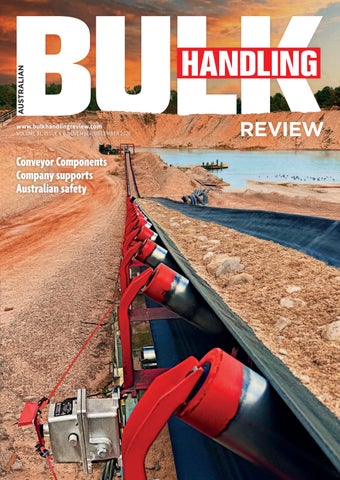
Conveyor Components Company supports Australian safety
1
follow us on
CONTENTS NOVEMBER/DECEMBER 2026
12
26
32
38
09 Playing the long game
28 Keeping material moving
46 Automation and ESG gains
12 Six decades of Rio Tinto in the Pilbara
30 Going with the grain
48 Built for scale
14 Bi-directional feeder solves surge bin bottleneck
32 Automating growth
51 BULK2026 brings industry together
34 Easy guarding
54 HVME is the place to be
36 A stronger silo footprint
56 AIMEX brings mining industry together
24 A new state of mind
38 Specification and auditing of rail mounted machines
58 Managing the bulk handling process
26 Lincom on the hunt
44 Fenner in the spotlight
18 Sisters build futures in farming 21 Smarter tank calibration
COVER STORY: SET TO THRIVE IN AUSTRALIA With a wide range of safety systems, the Conveyor Components Company believes it can better support the conveyor belts of Australian operations. For the full story, see page 6.
Australian Bulk Handling Review: November/December 2026 І 3
EDITOR’S NOTE
Published by:
379 Docklands Drive Docklands VIC 3008 T: 03 9690 8766 www.primecreativemedia.com.au CEO Christine Clancy E: christine.clancy@primecreative.com.au Editor William Arnott E: william.arnott@primecreative.com.au Journalist: Daniel Williamson E: daniel.williamson@primecreative.com.au Business Development Manager Michelle Verstandiker E: michelle.verstandiker@primecreative.com.au Client Success Manager Janine Clements E: janine.clements@primecreative.com.au Head of Design Clayton Hawley Designs Danielle Harris and Laura Drinkwater Subscriptions T: 03 9690 8766 E: subscriptions@primecreative.com.au
www.bulkhandlingreview.com
The Publisher reserves the right to alter or omit any article or advertisement submitted and requires indemnity from the advertisers and contributors against damages or liabilities that may arise from material published. © Copyright – No part of this publication may be reproduced, stored in a retrieval system or transmitted in any means electronic, mechanical, photocopying, recording or otherwise without the permission of the publisher.
Managing maintenance Some of the most useful conversations in bulk handling begin with a deceptively simple question: how did you solve that? For two days in September, the Australian Bulk Handling Expo gave the industry a place to ask that question directly. Engineers, operators, suppliers and researchers gathered at the Melbourne Convention and Exhibition Centre to help shape bulk solids handling across Australia. Bulk handling connects industries that can otherwise appear very different. A mine, grain terminal, quarry, and processing plant may handle different materials, but each depends on reliable flow, well-designed transfer points, and equipment capable of operating under demanding conditions. Bringing those industries together creates opportunities for knowledge developed in one application to inform another. That exchange continued through the Bulk Handling Technical Conference. Curated by the Australian Society for Bulk Solids Handling, the program addressed the issues that engineers and operators encounter on-site. These subjects do not always produce simple answers. Material behaviour changes between applications and solutions must account for the complete system. The value of the conference lay in connecting technical knowledge with practical examples and giving delegates the opportunity to question the people behind the work. The Australian Bulk Handling Awards provided another highlight. The awards recognised the individuals, projects, and technologies advancing the sector, while giving the industry an opportunity to celebrate together. Thank you to everyone who attended Bulk Expo, contributed to the conference, exhibited equipment or supported the awards. The event succeeded because the bulk handling community arrived ready. For our team, it was also a chance to hear directly from readers about the problems receiving attention at their sites and the subjects they want examined next. That momentum will continue into when Asia- acific s International Mining Exhibition AIME returns to the Adelaide howground from 30 September. AIME will carry the conversation into on an even larger stage, and the Australian Bulk Handling Review looks forward to being part of it.
William Arnott Editor - ABHR
4 І Australian Bulk Handling Review: November/December 2026
OVER 150 YEARS OF SUCCESS STORIES UltraTuff Triples Bauxite Belt Life
ArmorShield Doubles Coal Port Belt Life
ArmorShield Triples Limestone Belt Life
See Them All
Does a conveyor belt which lasts twice as long effectively make it half the cost? Actually it goes much deeper than that.
A more durable belt means more for your operation than just a reduced replacement rate. By withstanding operational demands, it improves safety, boosts productivity, and reduces maintenance, lowering costs and downtime. When every minute matters, a belt that rolls on reliably through thick and thin represents the vital heart of your operation. Choose one you can rely on.
Phone 1800 Fenner (336 637) fenner.com.au | sales@fenner.com.au
UsFlex $1 Million in Annual Savings
COVER STORY
Set to thrive in Australia With a wide range of safety systems, the Conveyor Components Company believes it can better support the conveyor belts of Australian operations. CONVEYOR SYSTEMS ARE THE backbone of many bulk handling operations, but if they are not properly monitored, any issue can quickly become a serious safety concern. If a belt begins to drift, it can pose serious risks to workers and equipment. Misalignment also risks damaging the conveyor itself, leading to expensive repairs and long periods of downtime.
Conveyor Components Company (CCC) customer service supervisor Amanda Solgot said a proven, experienced partner can make all the difference, and that is what the company is bringing to the local market with its Conveyor Safety System (CSS). “Our goal is to build awareness of CCC, develop relationships with Australian customers, and demonstrate
Conveyor Components Company plans to expand its presence in Australia.
6 І Australian Bulk Handling Review: November/December 2026
how the CSS can provide safer operations across the country,” Solgot told ABHR. “We are targeting industries that rely on conveyor systems, including mining, aggregates, quarries, cement, ports, and any bulk material handling. These industries require dependable equipment for conveyor safety and monitoring. “Our focus is to understand each operating condition and then provide solutions that support customer safety and monitor their systems.” Conveyor Components Company plans to expand its presence in Australia through strengthening its relationships with original equipment manufacturers and end users. To do that, the company aims to increase awareness of conveyor safety and expand its monitoring solutions. Solgot said the company understands the challenges Australian customers face when working with international clients. “Australian customers may face long lead times, import requirements, and time one differences. They also need confidence that equipment meets their specific requirements and that technical support is available when needed. “Finding an international supplier that provides clear communication, dependable service, and product knowledge is essential to making the purchasing process easier,” she said. The CSS is a comprehensive safety solution that combines multiple essential safety switches into a single, costeffective system. One of the key components is the Model RS, a pull-cord safety stop switch that allows operators to instantly halt the conveyor by pulling a cord along its side. Supplementing this is the Model TA belt alignment switch, which can act as an alarm or shutoff switch if it detects a belt misalignment. Also included is the Model DB damaged belt detector, which is used to find belt tears as early as possible.
In addition to the safety benefits, finding tears in a belt early allows it to be repaired quickly, before a catastrophic repair bill and unplanned downtime occur. While the Michigan-based company doesn’t currently have a local footprint in Australia, it sees a strong opportunity for the CSS to thrive. “Our CSS line is designed to identify these emergency situations and can help customers protect their employees and their equipment,” Solgot said. The company’s delivery process is designed to make life easier for Australian businesses. It involves confirming product specifications, quantities, documentation, and shipping requirements. It can then coordinate order processing, production, fulfilment, packaging, and freight arrangements Throughout this process, the company’s team works to keep customers informed and ensure the correct equipment is prepared for delivery.
The company aims to increase conveyor safety awareness.
Solgot said the company works closely with customers to provide the right advice. “At Conveyor Components Company, we focus on understanding each customer’s application and technical requirements before recommending equipment,” she said. “We provide clear quotations, responsive communication, and ongoing support throughout the purchasing process. “Our goal is to make international purchasing easier by ensuring customers
receive the correct solutions, accurate information, and a reliable point of contact from quotation to delivery. “We maintain close contact through email, virtual meetings, and regular communication throughout our sales process. “We work around time zone differences when necessary and we aim to respond quickly to any questions asked.”
Images: Conveyor Components Company
The CSS is a comprehensive safety solution.
Australian Bulk Handling Review: November/December 2026 І 7
MINING
Playing the long game Hallett Group chief executive officer Kane Salisbury tells ABHR how the company reached its agreement with BHP. was a small independent quarry and concrete business with big ambitions. The South Australian company had a lofty goal in mind – to grow its business to become the market leader and in time, secure a tender with mining giant BHP. allett Group chief executive o cer Kane Salisbury said he knew that if the company could get into a position where it could supply BHP, it would say a lot about the supllier’s capability to the wider market. “BHP have got long-life assets,” Salisbury said. “Having customers with that sort of longevity, consistent demand and growth aspirations makes them an outstanding fit for us. That credibility was not earned overnight. Salisbury said Hallett Group had unsuccessfully bid for multiple BHP tenders over the past 10 years, using each attempt to better understand the miner’s requirements while simultaneously expanding its own capabilities. The company steadily increased its cement volumes, strengthened its technical expertise, and invested heavily in research and development, its laboratory capabilities, and pilot through to scale processing infrastructure before finally presenting what alisbury described as a genuinely competitive offering. In , that ambition has become reality. The South Australian company secured what it describes as the country’s largest ongoing cement and quarry product supply contract. As part of the contract, the Hallett Group will supply cementitious materials, lime, and quarry products to two of BHP’s South Australian operations, Olympic Dam and Prominent Hill. For BHP, the partnership represents more than another procurement agreement. BHP Head of Procurement Copper SA Bree Sipavicius said the company was continually looking for
Images: Hallett Group
A DECADE AGO, HALLETT GROUP
Hallett CEO Kane Salisbury with BHP Copper SA Head of Procurement, Bree Sipavicius.
new and innovative ways to improve its operations. “Hallett Group joins a strong line up of existing South Australian suppliers who work with us here at BHP Copper SA to enable us to produce the copper the world needs right here in South Australia,” Sipavicius said.
The contract also provides the volume certainty needed to support Hallett Group’s ongoing investment in cement manufacturing and processing infrastructure. The company established a dedicated Class C laboratory capable of testing radioactive mine backfill materials,
Australian Bulk Handling Review: November/December 2026 І 9
PARTNERSHIPS
expanded its research capability through university partnerships and invested millions of dollars in pilot scale manufacturing facilities to develop lower-carbon supplementary cementitious materials CMs . In total, Salisbury estimates Hallett Group invested around million in research, development and technical capability before securing the agreement with BHP Copper SA. “Don’t underestimate just how heavy that investment has been to get to where we are today,” he said. “For our owner Mark Pickard to back the business for a decade without the promise of a single
cent in return was a huge commitment. The faith and confidence placed in the expert team we have assembled has paid off, he said. Those investments now extend beyond supplying traditional cement products. The partnership closely aligns with the next stage of allett Group s million Green Cement Transformation Project with its Port Augusta facility under construction, which aims to manufacture supplementary cementitious materials from locally sourced industrial by-products including Nyrstar slag from ort irie and reclaimed fly ash from ort Augusta. Rather than relying on imported
Hallett Group will supply cement, lime and quarry products to two of BHP’s Copper South Australia operations.
10 І Australian Bulk Handling Review: November/December 2026
SCMs, Salisbury believes Australia has an opportunity to develop sovereign manufacturing capability while reducing supply chain risk. “About 50 per cent of Australia’s supplementary cementitious materials are imported,” he said. “As we’ve seen over the past six months, global disruptions are becoming more prevalent. Having those materials here locally eliminates a huge amount of supply risk.” Salisbury said Australia possesses enormous, untapped resources capable of supporting a domestic lowcarbon cement industry. He said there are hundreds of millions of tonnes of fly ash sitting in ash dams around the country, alongside significant quantities of other industrial by-products that could be processed into valuable construction materials. While recovering those materials requires considerable research, investment and regulatory approval, Salisbury said Hallett Group has demonstrated what is possible. “We’ve shown the way for other participants around the country,” he said. It s not easy and it s not quick, but Australia has a huge amount of these materials available if we’re prepared to invest in bringing them back into productive use.” The next priority is integrating Hallett’s expanding operations and completing the investments that underpin the new contract. Beyond that, Salisbury said the agreement demonstrates that an independent Australian-owned company can compete successfully against multinational suppliers while helping reshape the country’s construction materials supply chain for a more sustainable future. “We hope to turn our current contract into a -year relationship, he said. If we continue to innovate and continue bringing value to the table, that’s what success looks like. “To all our Hallett team, it has been a long journey to get here and fair reward for the dedication and commitment of our entire team. I have never been more excited by the opportunities ahead of us as we continue to build on this success with our development of our Port Augusta green cement hub just around the corner.”
OPERATIONS
The 1000th train to bring ore from Tom Price to Dampier for 1969.
Six decades of Rio Tinto in the Pilbara The mining company is celebrating 60 years of iron ore operations in Western Australia. RIO TINTO’S FIRST LANDMARK shipment of Pilbara iron ore departed from Dampier, Western Australia, on August 22, 1966, aboard the ship Houn Maru, bound for Japan. The historic departure marked the beginning of exports from the Mount Tom Price mine and followed a 15year agreement with Japanese steel mills to purchase 65.5 million tonnes of iron ore. At the time, the agreement was the largest export deal in Australian history, and provided the commercial certainty required to develop the Pilbara’s iron ore industry. Six decades later, Rio Tinto’s Pilbara operations have shipped more than eight billion tonnes of iron ore to customers around the world. The milestone reflects the expansion of a regional mining industry supported by extensive transport and export infrastructure.
Rio Tinto Iron Ore chief executive Matthew Holcz said the Pilbara remained central to the company’s iron ore business. “Our story in Western Australia began in the Pilbara, which remains the heart of our iron ore business,” Holcz said. “As we mark 60 years in Western Australia, we reflect on the people who came before us – whose hard work laid the foundations for the business we have today and for the future.” The company’s Western Australian iron ore network now comprises 18 mines, four port terminals, four power plants and approximately 2000km of rail infrastructure. Its operations are supported remotely by an operations centre in Perth, which also serves as the headquarters of its global iron ore business.
12 І Australian Bulk Handling Review: November/December 2026
The scale of this network highlights the coordination required to move bulk commodities from mine sites to international markets. Production, rail movements, stockpiling and shiploading must operate in sequence to maintain export flows, with the performance of each stage affecting the supply chain. The network has also expanded beyond its original operations at Mount Tom Price. Rio Tinto’s current asset base includes established mining hubs and replacement projects designed to sustain production as existing deposits are depleted. Among its recent developments, the company opened the Western Range mine in 2025, while the Brockman Syncline 1, Hope Downs 2 and West Angelas projects were under construction in March 2026. These projects form part of a continuing program of investment in the Pilbara.
Images: Rio Tinto
Robe River Iron Associates staff with the first train of iron ore from Pannawonica, 8 August 1972.
For equipment manufacturers, engineering contractors, and bulk handling specialists, this ongoing investment creates demand for systems and services across extraction, conveying, materials handling, rail logistics, and port operations. The scale of the operation is also reflected in its regional supply chain. Rio Tinto reported spending a record A$12 billion with Western Australian businesses in 2025, with expenditure on local suppliers doubling over the preceding four years. The company’s broader supplier network supports activities ranging from equipment maintenance and engineering to construction and operational services. In March 2026, Rio Tinto also reported that its spending with Pilbarabased suppliers had reached a record A$1.1 billion in 2025. The company’s regional footprint extends beyond its mine sites and export facilities. Rio Tinto’s operations are connected to six residential towns in the Pilbara and five other regional towns through its fly-in, fly-out arrangements.
Perth remains a central location for operational coordination and technical decision-making. Rio Tinto also reported investing approximately A$500 million in community initiatives across Western Australia over the five years to . Its anniversary announcement acknowledged the role of Traditional Owners, employees, communities, governments, joint venture partners, customers, and suppliers in developing the business. “We could never have built this business alone. We thank the generations of employees, Traditional Owners, communities, governments, joint venture partners, customers, and suppliers who have built it with us,” Holcz said. To mark the anniversary, a collection of photographs documenting the early development of Mount Tom Price and the Pilbara will be gifted to the State Library of Western Australia. The photographs were taken by the late Richard Woldendorp, who was commissioned by Hamersley Iron in the 1960s to document construction of the Mount Tom Price mine.
Donated by Woldendorp’s wife, Lyn, and digitised by Rio Tinto, the collection will add to the library’s existing holdings. The images provide a historical record of the infrastructure and workforce involved in establishing the Pilbara’s iron ore industry. Looking ahead, Rio Tinto has indicated that it intends to maintain its presence in Western Australia through further investment in its operations and regional communities. While we reflect the past, we also turn to the future. We plan to be in Western Australia for decades to come, helping create further opportunities for future generations of Western Australians,” Holcz said. Sixty years after the Houn Maru departed Dampier, the Pilbara remains a major source of iron ore for international steelmakers. Its development demonstrates how long-term customer agreements, sustained investment and integrated bulk handling infrastructure have shaped Western Australia’s worldleading resources industry and fueled global industrialisation.
Australian Bulk Handling Review: November/December 2026 І 13
ENGINEERING
Bi-directional feeder solves surge bin bottleneck How RCR Mining Technologies and TUNRA Bulk Solids engineered a 4000 tph reversing belt feeder capable of operating under a full head of magnetite dry rejects in Western Australia’s Pilbara region. By Elia Khoury (RCR Mining Technologies) and Dr Bin Chen (TUNRA Bulk Solids, The University of Newcastle) IN MODERN BULK MATERIALS handling, surge bins perform a pivotal operational role: smoothing out downstream material surging and establishing production stability in high throughput operations. In a major magnetite operation located in the Pilbara, dry magnetic separator rejects (-8mm dry material) required dedicated surge storage and high-capacity reclaim. The primary operational route prescribed storing the dry reject material in a surge bin, utilising a high-capacity belt feeder operating at 4000tph to discharge directly into large haul trucks. These trucks transport and dry-stack the material in designated disposal areas. A requirement to ensure operational continuity required that, when trucks are
unavailable or transport is delayed, the process required an immediate, automated contingency mode: reversing the belt feeder direction under a filled surge bin to discharge material onto an auxiliary radial stacker for temporary stockpiling and manual reclaim. Reversing a belt feeder under a fully loaded surge bin, without emptying the bin first, presents severe mechanical, structural, and flow challenges. To achieve this, RCR Mining Technologies partnered with TUNRA Bulk Solids to design, verify, and validate a bespoke bidirectional reclaim belt feeder.
Overcoming the bulk solids paradox Conventional surge bins equipped with belt or apron feeders are typically engineered for mass-flow, ensuring
14 І Australian Bulk Handling Review: November/December 2026
material at every point within the bin moves continuously during drawdown (Plinke and Roberts, 2022). Massflow prevents stagnant dead capacity, eliminates erratic flow and ratholing, and helps prevent segregation. Furthermore, uniform drawdown along the hopper slot is essential to manage feeder loads, minimise belt wear, and prevent drive motor stalling. To achieve uniform drawdown in standard single-direction feeders, hopper slot geometry relies on two foundational design parameters (Roberts, 2022): • Skirt divergence angle ( ): Vertical skirt plates diverge outward from the rear of the hopper slot toward the discharge end (typically 3° to 5° theoretically, or <3° in industrial
Images: TUNRA Bulk Solids
(ye), providing height relief for expanding material. However, these traditional diverging skirt plates and release angles create an intractable physical paradox for bi-directional feeders. Diverging skirts only function in one direction. If the belt feeder reverses direction, the diverging skirts instantly become converging skirts relative to material travel. Reversing under diverging geometry forces material into a narrowing throat, causing severe material wedging, extreme belt jamming, structural skirt overload, and immediate drive stalling. To eliminate material convergence in both operating directions, RCR engineered a strict parallel skirt outlet geometry ( = 0°, = 0°). While parallel skirting resolved the reversibility constraint, it raised significant technical concerns regarding uniform drawdown along the long hopper slot, potential material slippage on the belt, elevated shear stresses, and increased drive torque requirements under full head loads.
A radial stacker.
practice) to expand the volumetric capacity along the belt. • Release angle ( ): The height of the vertical skirts increases from the rear (RH) to the discharge outlet
Discrete element method numerical verification To verify whether mass-flow and uniform drawdown could be maintained with parallel skirts, TUNRA Bulk Solids performed discrete element method DEM modelling which specifically evaluated bulk material velocity profiles, shear stresses, and flow stability during
instantaneous direction reversals under maximum bin head load. The numerical modelling yielded critical design insights: • Mass-flow integrity The bin demonstrated robust mass-flow behaviour, with material discharging continuously and reliably in whichever direction the belt travelled. • Self-clearing reversal dynamics: When belt travel was reversed, residual material contained within the extended skirt section was drawn back beneath the filled bin without causing stagnant zones or irreversible material wedging. • Temporary extended skirt build-up: DEM identified that residual material in the extended skirt section moved at a slightly slower velocity than fresh material being drawn from beneath the hopper throat. This created a temporary, localised material buildup in the extended skirt before fully clearing. Subsequent on-site commissioning confirmed this exact temporary build-up, although the build-up observed on site was slightly lower than DEM predictions due to lower moisture levels and lower material cohesive strength in the field.
Mechanical architecture and advanced belt tracking The surge bin design and DEM modelling performed by TUNRA acted as inputs into the belt feeder design. The resulting feeder model, the RCR BFD 2800 x
Equipment specifications: RCR BFD 2800 x 18000 Parameter / description
Engineering units
Design specification value
Manufacturer and equipment model
-
RCR Mining Technologies / RCR BFD 2800 x 18000
Manufacture year and application
-
2023 | Surge bin reclaim (bi-directional)
Design reclaim throughput rate
mtph / tph
4000tph
Bulk material handled
-
Magnetite operation (dry magnetic separator dry rejects)
Material sizing (P100)
mm
8mm (-8mm dry rejects)
Design bulk density envelope
t/m3
1.6–2.6t/m3
Annual operating utilisation
h/a
7400 hours/annum
Speed and motion control
-
Variable speed; frequent start-stop batch loading
Drive system architecture
-
Electro-hydraulic drive system
Australian Bulk Handling Review: November/December 2026 І 15
ENGINEERING
RCR bi-directional belt feeder.
18,000, is an 18m long, 2.8m wide heavyduty belt feeder designed for 7400 hours per year of continuous, high-utilisation mining service. Key mechanical and mechatronic features incorporated into the feeder architecture include: • Electro-hydraulic drive system: Selected for its high power density, instantaneous direction reversal capability under full load, precise variable speed regulation, and exceptional reliability during high-frequency stop-start truck batching cycles. • Precision laser alignment and frame rigidity Tracking a slow, short, flat carry-idler belt feeder is inherently di cult reversing belt travel exponentially increases tracking sensitivity. RCR executed precision shop fabrication and laser alignment of all structural modules, idler sets, and pulleys to guarantee total squareness to the belt centreline. • Active hydraulic take-up and high belt tension: When a feeder reverses, the high-tension belt strand shifts from the drive pulley to the non-drive pulley. To prevent belt slip under extreme breakaway torque, an active
hydraulic take-up system maintains elevated, constant belt tension, paired with heavy-duty dimpled ceramic pulley lagging and crowned pulleys. • Dual-end dynamic belt cleaning: Dual primary and secondary scrapers were installed at both head and tail pulleys, supplemented by diagonal plow cleaners on the return strand. Crucially, the scrapers at the take-up pulley feature dynamic floating mounts that automatically translate with pulley movement to maintain optimal blade contact.
Theoretical load calculations vs real-world site validation The belt feeder tensions were calculated using hopper pressure and feeder load analytical equations developed by TUNRA Bulk Solids (Plinke et al., 2024) for both running and pullout conditions. Calculations were performed across the full bulk density envelope of 1.6t/m3 (low limit) to 2.6t/m3 (high limit). The analytical models and calculated values were then validated against site performance data: over a period of eight days, total hydraulic system pressure maintained a consistent baseline of ~200bar under normal operating
Calculated design envelope vs measured site operating telemetry Operating condition / parameter
Bulk density (t/m3)
Calculated torque (kNm)
Total system pressure (bar)
Low bulk density design limit
1.60t/m3
78.3kNm
178.1bar
High bulk density design limit
2.60t/m3
125.7kNm
276.9bar
Measured site telemetry (eight-day mean)
1.60–2.60t/m3 (visual)
Validated (~90–100kNm)
~200.0bar (steady reading)
16 І Australian Bulk Handling Review: November/December 2026
conditions. This measured pressure falls between the calculated lower bound (178.1 bar at 1.6t/m3) and upper bound (276.9 bar at 2.6t/m3). Concurrently, bin level telemetry recorded a steady fill level around per cent. Minor fluctuations in bin level did not significantly impact hydraulic pressure, proving that horizontal shear forces and skirt friction dominate feeder loads once surcharge head is established. The successful design, commissioning, and validation of the RCR BFD 2800 x 18,000 bi-directional belt feeder represents a major advancement in bulk materials handling engineering, accomplished through collaboration between academia and industry. By solving the parallel skirt drawdown challenge and enabling instant direction reversal under full head load, RCR Mining Technologies and TUNRA Bulk Solids delivered substantial operational benefits. References Plinke, J. and Roberts, A. W. (2022) ‘Presentation on Mass-flow rinciples Bin Design Application , TUNRA Bulk Solids in association with The Centre for Bulk olids articulate Technologies, The University of Newcastle, NSW, Australia, p. 3. Roberts, A. W. (2022) ‘Course notes on Feeding of Bulk Solids 2 - Feeder Interfacing, Loads and Power Focusing on Belt and Apron Feeders , Centre for Bulk Solids and Particulate Technologies, The University of Newcastle, NSW, Australia, pp. 6–11. Bradney, D. (2023) ‘Simulation videos using Discrete Element Method (DEM) of the Surge Bin Reclaim Bi-Directional Material Flow , The niversity of Newcastle, NSW, Australia. Plinke, J., Roberts, A. W. and Chen, B. (2024) ‘Silo Wall oads, Discharge and Interfacing Course otes , TUNRA Bulk Solids in association with The Centre for Bulk olids articulate Technologies, The University of Newcastle, NSW, Australia, pp. 1–37. Khoury, E. and Chen, B. (2026) ‘Surge Bin Reclaim Bi-Directional Belt Feeder , roceedings of the th International Conference on Bulk Materials Storage, Handling and Transportation (ICBMH 2026), Fremantle, Western Australia, 07–09 July 2026.
T
TRANSPORTABLE RANGE Seed Cleaner
Transportable Silo Capacity up to 90.1 Metric Tonnes (T/m3) Optional Bagging Chute Available Optional Blow Pipe with Camlock Fitting Available Base Angles available in 28°, 35° & 48° Optimised Hopper Design to Reduce Feed Bridging
High capacity cleaning up to 40 Tonnes per Hour 4 cleaning barrels at 2.4m long Powerful multi-stage separation in one pass Fully equipped & farm-ready - Augers, Crane Jib, Walkways & Auto Shut-off
Innovation you can move. Storage you can rely on. Ask about the Denny’s Transportable Silo Range and Seed Cleaner. MILLING / PROCESSING
Leader in cereal, rice, plastic, feed and grain milling.
OPTICAL SORTING
Electronic colour and shape inspection to increase the quality of product.
COMPLEX TURN-KEY / GRAIN HANDLING
For all sectors of the bulk solids industry.
GRAIN STORAGE
From small capacity Transportables, to heavy-duty conical and flat bottom storage solutions.
07 4666 3266
www.satake.com.au
AGRICULTURE
Sisters build futures in farming Images: GrainCorp
Two pairs of Victorian sisters are combining complementary skills and generations of farming knowledge. Danielle and Caitlin Land working in the field.
AGRICULTURE RELIES ON A BROAD range of skills, from machinery operation and crop management to livestock production and business planning. For two Victorian farming families, sharing these responsibilities between sisters has become an important part of their approach to running their properties. Danielle and Caitlin Lang, who farm at Nareewillock in Victoria’s Mallee region, and Ella and Darcy Gervasoni, based at Smeaton in the Central Highlands, have developed their roles within established family operations. For the Gervasoni family, farming extends across six generations. Ella Gervasoni said the prospect of continuing that history has influenced her plans for the future. For her, the land is as much a legacy as it is a livelihood.
“It’s just a normal part of who I am and the lifestyle I’ve always known,” she said. “I’ve always hoped that one day we’ll be able to carry on the family farm and pass it down to future generations, continuing the legacy of Gervasonis.”
Danielle and Caitlin Lang combine their skills across sowing, truck driving, spreading and hay stacking on their family farm near Nareewillock in Victoria’s Mallee region.
18 І Australian Bulk Handling Review: November/December 2026
Working alongside Darcy means dividing responsibilities according to their interests. Ella focuses more closely on broadacre cropping, while her sister has a stronger interest in livestock. “We each have our own strengths and interests, I’m more focused on broadacre cropping, while Darcy has a passion for livestock, so we bring different skills to the table,” Ella said. The arrangement also requires communication and cooperation. Ella acknowledged that working closely with a sibling has its challenges, but says the pair find ways to resolve differences and complete the work required. For the Lang sisters, the path into farming included experience outside the family business. Danielle Lang said she and Caitlin helped on the farm from an early
Darcy and Ella Gervasoni.
age. However, their professional journeys included vocational training and further study. Danielle completed a butcher’s apprenticeship before working on an olive grove, then attended Longerenong College, where she gained an Advanced Diploma of Agribusiness Management and Agronomy. Caitlin followed a similar path. Those experiences have informed how the sisters now contribute to the farm. “Now that we’re both working on the farm together, we each play to our strengths. For example, I drive trucks and handle sowing while Caitlin does a lot of the spreading and stacking hay,” Danielle said. The division of work reflects the varied practical demands of a farming operation, where machinery, seasonal workloads and crop production require different capabilities across the year. Both families also view farming as work with a purpose beyond the property boundary. Production decisions and seasonal activities ultimately contribute to the supply of food to domestic and international markets. “What I love about farming is that it’s more than just a job, it’s a lifestyle, and you’re contributing to feeding people across Australia and the world,” Ella said.
Danielle pointed to the satisfaction of seeing the results of that work, despite the long days and ongoing demands of farm life. “Even though some days can be long and there is always something that needs doing, it’s worth it to see your hard work resulting in quality food,” she said. The sisters experiences also reflect the importance of encouraging women to develop practical skills and pursue different responsibilities.
Danielle said her father encouraged her and Caitlin to try different tasks and build confidence in their abilities. “I think it’s important that more women are working in ag, as the dynamic is changing so much compared to 10 or 20 years ago,” she said. Ella similarly argued that women can contribute across the full range of farming activities, including roles involving technical knowledge, operational decisions and responsibility for farm performance. “I believe women are capable of doing anything they set their minds to in agriculture,” she said. “We’re just as capable of taking on the challenges and responsibilities of the industry, and it’s great to see more women becoming involved in all areas of farming.” For the next generation, visibility and access to varied experience will remain important in shaping perceptions of agricultural careers. The sisters’ accounts suggest that practical involvement, education and opportunities to develop individual strengths can all help build capability within family-run businesses. “Having a mix of skills, knowledge and perspectives helps strengthen the industry as a whole and the more women we see working in agriculture, the more we can show the next generation that there’s a place for them in the industry,” Ella said. The Gervasoni family is in its sixth generation of farming, with Ella and Darcy looking to continue the family operation into the future.
Australian Bulk Handling Review: November/December 2026 І 19
AIMEX RELAUNCHED GET INVOLVED, EXHIBIT NOW
MINING A SMARTER FUTURE
CALIBRATION
Smarter tank calibration Images: Mettler Toledo
Mettler Toledo is offering steel fabricators a faster, safer approach for tank scales
Mettler Toledo’s RapidCal system provides an alternative to traditional tank scale calibration methods.
ACCURATE WEIGHING IS fundamental to consistent production, product quality, and cost control. From measuring raw materials to monitoring production processes, reliable weight data helps manufacturers maintain product specifications, manage material usage, and minimise waste. Regular calibration is essential to ensure weighing equipment continues to deliver dependable results. However, conventional tank calibration methods are often expensive and labor-intensive. The use of heavy test weights presents workplace safety challenges, while water-based calibration methods typically require tanks to be emptied, opened, and thoroughly cleaned, resulting in operational disruptions and a risk of product contamination. Mettler Toledo’s IND360 Terminal and RapidCal system provide an alternative designed to simplify calibration while maintaining confidence in weighing performance. The IND360 Terminal supports integration with programmable logic controllers (PLCs) through industrial Ethernet protocols and sample code.
Its high-speed connectivity enables reliable data exchange and supports distributed control systems, real-time monitoring and Industry 4.0 automation architectures. This allows weighing data to be incorporated into broader industrial processes, helping operators monitor and manage production more effectively. Paired with RapidCal, the Terminal can support a more e cient approach to maintaining tank scale accuracy. Designed for tank scales with capacities
ranging from one to 32 tonnes, RapidCal uses a hydraulic system to apply a precise downward test load. Reference load cells measure the applied force against defined standards, allowing the system to assess weighing performance without relying on conventional test weights. The system also accounts for piping effects that can influence tank weighing results. Connections between a tank and surrounding pipework can introduce forces that affect measurements, making it important to consider the complete installation during calibration. RapidCal can achieve accuracy of up to 0.1 per cent, with traceability and calibration certificates provided for each service. This documentation supports internal quality management systems and helps businesses demonstrate that their weighing equipment is maintained in accordance with relevant quality, regulatory and compliance requirements. A key advantage is the reduced need for preparation and material handling. Unlike conventional approaches, RapidCal does not require bulky test weights, purified water or a calibrated flowmeter. Tanks do not need to be opened or emptied, and extensive cleaning can be avoided. This can be particularly beneficial in industrial environments where access is restricted, production
The IND360 Terminal supports PLC integration through industrial Ethernet protocols.
Australian Bulk Handling Review: November/December 2026 І 21
CALIBRATION
schedules are demanding or the contents of a tank must be protected from contamination. The equipment is portable and can accommodate a variety of tank configurations, providing flexibility for installations that may be di cult to access using traditional calibration methods. Reducing the need to transport and position heavy weights can also help limit manual handling requirements and associated workplace risks. Calibration can be completed in just a few hours, helping minimise production downtime. Shorter service times and reduced preparation requirements can make routine calibration easier to schedule around operational demands. For manufacturers, this creates opportunities to maintain weighing equipment more consistently without committing to lengthy interruptions or extensive preparation work. There are also potential resource benefits. By avoiding water-based
calibration methods, operations can reduce water consumption and the need to manage wastewater, supporting broader efforts to improve resource e ciency and minimise industrial waste. For steel fabricators and metalworking manufacturers, weighing accuracy remains an important part of maintaining process control and product consistency. Combining the IND360 Terminal’s industrial connectivity with RapidCal’s hydraulic calibration method offers a practical way to support reliable measurements while addressing the time, safety and resource challenges associated with traditional techniques. By simplifying calibration, the solution helps businesses maintain confidence in their weighing data while supporting safer and more e cient industrial operations. For more information, email info.mtaus@mt.com or call 1300 659 761.
RapidCal uses a hydraulic system and reference load cells to apply and measure a precise test load during tank scale calibration.
HUNTER VALLEY MINING EXPO
Be there from the beginning
Register for the inaugural Hunter Valley Mining Expo
REGISTER
FOR FREE
Brought to you by the organisers of
Newcastle Entertainment Centre, Broadmeadow, NSW 19-20 May 2027
Image: WGA, An AtkinsRéalis Company
OPERATIONS
WGA is a multi-disciplinary engineering and project management consultancy.
A new state of mind WGA, An AtkinsRéalis Company, discusses the opportunities that its new Tasmanian branch provides. MODERN BULK HANDLING IN Australia relies on integrated smart systems, high-e ciency container and bag solutions, and automation across mining, agriculture, ports, and manufacturing. Throughout the country, different regions can specialise in different aspects of the industry. Western Australia is renowned for its iron ore, gold, nickel, and lithium exports. Ma or operations and original equipment manufacturers OEMs are heavily clustered in erth and the ilbara mining hubs. Queensland has a prominent role in coal and mineral exports, managed through ma or facilities such as Queensland Bulk andling at the ort of Brisbane. ew outh Wales and ictoria serve as ma or hubs for grain, agricultural bulk storage, manufacturing, and national engineering firms. WGA, however, identified an opportunity in a less-served location Tasmania.
Our focus from the outset has been on building a sustainable, longterm business in Tasmania,” WGA’s senior principal structural engineer Bob Dunbabin said. Founded in 1982 by university classmates Geoff Wallbridge and Mark Gilbert following a handshake, WGA is a multi-disciplinary engineering and pro ect management consultancy. ince then, the company has delivered , pro ects and has over , clients throughout Australia and ew ealand. ow, the company is entering its new chapter as part of AtkinsR alis, a global engineering firm. It s been an incredibly rewarding ourney growing the business and building a multidisciplinary team here in Tasmania, Dunbabin said. Dunbabin is widely regarded as an expert in bulk materials handling, having led numerous shiploader and stockpile stacker pro ects. At WGA, he plays a pivotal role in expanding the company s structural, resources, and materials capabilities.
24 І Australian Bulk Handling Review: November/December 2026
I en oy working with people to understand their strengths and motivations to be able to apply them to the tasks at hand, he said. WGA s expansion into Tasmania goes back to , when ports and marine lead David Ewers relocated to obart. ince the move, Ewers mission has been to establish the company s presence and build lasting relationships across the local market. The opportunity we saw in Tasmania was to establish a genuinely local presence. For us, that meant creating local obs, investing in Tasmanian people and capability, partnering with the government, local suppliers, and helping deliver the infrastructure that supports a strong and resilient economy, Ewers said. We support clients across most infrastructure sectors in Tasmania, including maritime, resources, transport, buildings and energy, bringing together strong technical capability with valuable local experience and knowledge.
OLI Vi
2019_Au_
According to Infrastructure Australia, over per cent of Tasmania’s freight volume relies on sea transport across Bass trait, making maritime connections and port charges a dominant cost factor. Bringing together WGA and ADG under AtkinsR alis, the obart o ce is home to more than people who endeavour to do the same. The team has decades of experience in civil, structural, electrical, and mechanical engineering. Our Tasmanian team operate as an integrated part of the broader national business, Dunbabin said. This has enabled the development of strong local relationships supported by the ability to scale up pro ect support using additional resources from other WGA o ces as pro ect needs change. ro ects in the ports and industrial sectors remain core to WGA s Tasmanian branch. The company is currently working for two D C
contractors to deliver the designs of a new shiploader and maritime bridge structure for Tas orts. The Bell Bay ort woodchip shiploader replacement is a ma or pro ect for our obart o ce. This is the detailed design of a mobile shiploader and modification of the feed conveyor, covering all engineering disciplines, Dunbabin said. The head contractor, Crisp Bros aywards, is based in aunceston, with Tas orts being the end client. This has been a particularly local pro ect that WGA is proud to be a part of. The pro ect has been ongoing for almost 12 months and is due for design completion at the end of . We expect to continue to provide construction and commissioning support through to the completion of the pro ect in late . WGA believes the Tasmanian market is dominated by established mining and
processing operations, which have been in the game for a long time. Global price movements tend to change the mine life expectations and or enable new feasibility studies to get off the ground, sometimes on a reasonably short timeframe, Dunbabin said. WGA is currently assisting existing clients with pro ects at all ends of the operations life cycle, ranging from assessment of and replacement of ageing assets through to feasibility assessments of new proposals. But it all comes down to WGA s business model endeavouring to maintain personal relationships and provide excellent services, no matter where the company is based. ooking ahead, Dunbabin wishes to continue on the same path. riorities include consolidating relationships with existing clients, developing new client relationships, and expanding our service offering, Dunbabin said.
THE WORLDWIDE LEADER IN VIBRATION TECHNOLOGY
INDUSTRIAL VIBRATORS
Designed for industrial sectors OLI is the world’s top selling manufacturer of electric and pneumatic vibrators. The high level of customer service, guaranteed by 18 trading subsidiaries worldwide, and long-lasting and performing products make us always ahead. Our vibrators are designed for industrial applications in all sectors, from the most extreme environments such as quarries, mines and foundries to the food and pharmaceutical.
OLI Vibrators Pty Ltd. 141 Discovery Road Dandenong South Vic 3175, Australia - Phone: +61 3 9764 9988 - Mail: info@olivibrators.com.au - www.olivibra.com
2019_Au_BulkHandingMagazine_210x150.indd 1
09/12/2019 10:11:25
CRUSHERS
On the hunt Lincom Group is on a mission to search for Australia’s oldest working Powerscreen. working life after a few years. Others refuse to retire. They move from site to site, change hands, receive a few new parts, and collect more than their fair share of scratches along the way. Paint may fade and their hour meters keep climbing, but every morning they start up and get back to work. To celebrate Powerscreen’s 60th anniversary, Lincom Group is on the hunt for the machine that has been doing exactly that longer than any other: Australia’s oldest working Powerscreen. “The resources industry is always looking ahead to the next machine development, the next model and the next innovation,” Lincom Group group marketing manager Renata Hjelmstrom said. “That is important, of course, but I think there is also value in
recognising the machines that helped get us here. “This search is a nice opportunity to do exactly that.”
A big idea that changed the industry The Powerscreen story began in 1966 in County Tyrone, Ireland, under the name Ulster Plant. At the time, processing material often meant transporting it from the quarry face to a fixed screening plant. Powerscreen’s founders saw another way. Instead of taking the material to the machine, why not take the machine directly to the material? It was a simple idea, but one that would help change the way quarries and material-processing operations worked. Mobile screening gave operators greater flexibility, reduced unnecessary material handling and
Lincom Group is searching for Australia’s oldest working Powerscreen.
26 І Australian Bulk Handling Review: November/December 2026
brought the equipment closer to where it was needed. Early machines such as the MK1 were at the forefront of mobile processing, while the Chieftain design, launched in 1980, went on to provide the blueprint for many modern mobile aggregate screens. In 1999, Powerscreen became part of Terex Corporation, beginning another chapter in the company’s growth. In 2009, Powerscreen and Pegson, the legendary crusher manufacturer, came together under the Powerscreen name, creating one of the most comprehensive lines of crushing, screening, and conveying equipment in the industry. Today, Powerscreen equipment can be found working in industries and applications around the world. Yet the idea behind the brand remains much the same as it was in 1966: strong machine design, effective support and longImage: Lincom Group
SOME MACHINES FINISH THEIR
D t s
standing relationships remain central to the business, alongside continual innovation to improve the end user experience and deliver a strong return on investment.
A partnership built to last Powerscreen has been part of Lincom Group’s story for more than 25 years. Since becoming the exclusive dealer across Australia, Papua New Guinea, and the acific Islands in , incom Group has supplied and supported these machines through countless applications, industries, and working conditions. Along the way, the company has watched new machines become familiar fixtures on site. It has built stockpiles, processed millions of tonnes and, in many cases, continue working years after their first ob. Lincom Group’s role as a Powerscreen dealer has never ended when a machine leaves the yard. Through the company’s national branch network, it continues
to support customers with genuine parts, field service, technical support, refurbishment, and training. That history is why Powerscreen’s 60th anniversary means so much. Somewhere in Australia, an early Powerscreen may still be screening material in a quarry, working on a recycling site, or earning its keep in a regional operation. It may have faded paint, a long list of replacement parts and several decades of stories behind it. But if it still starts up and does the job it was built to do, Lincom Group wants to know. “We know there are some real oldtimers out there, and we would love to hear their stories,” Hjelmstrom said. “Maybe the machine has been in the same family for generations, or perhaps it has changed owners and worked across different sites over the years. “We are genuinely curious to see what we find and ust how far back we can go.”
To celebrate Powerscreen’s 60th anniversary, the company is launching a nationwide search for the oldest working Powerscreen machine in Australia. Each entry should include: • The Powerscreen model and serial number • The year of manufacture • Clear, recent photographs of the machine • Evidence that helps verify its age • A short video showing the machine safely operating • The story behind the machine: where it has worked, what it has processed and how it has been kept going over the years The winning owner will receive a $500 AUD gift card and a Powerscreen Chieftain 1700X scale model, along with some serious industry bragging rights. Entries close 1 December 2026. To enter email marketing@lincom.com.au, or contact Lincom Group through social media.
DHHI’s local After Sales team supports your operation and equipment throughout its entire lifecycle, providing reliable and cost effective solutions every step of the way. New Machines DHHI is a major supplier of balanced machines for Tier 1 and 2 Australian and international mining companies.
Engineering and Optimisation Onshore and offshore structural, mechanical, electrical, control systems and reliability engineering as well as ongoing technical support.
End of Life Life enhancements, capacity upgrades and deconstructions.
Spare Parts Along with low cost sourcing, rotables and service exchange, DHHI’s key strength is manufacturing high-quality and low-cost spare parts for both DHHI and non-DHHI equipment.
Site Services Managing and executing high risk maintenance activities, both planned and unplanned.
Contact for spare parts parts@dhhi.com.au
Any other inquires support@dhhi.com.au
SILOS
Keeping material moving Oli Vibrators combines application expertise, vibration technology, and tailored flow aids to help bulk handling operators. SILOS STORE BULK MATERIALS AND deliver them when required. However, when powders compact, moisture builds up or material properties change, even a well-established handling process can encounter unexpected flow problems. For operators, the challenge is not just getting material moving again but finding a solution that addresses the cause of the blockage without introducing new problems. Oli Vibrators has spent more than 60 years developing specialist vibration equipment and flow aids for the bulk handling sector. Working across industries including mining, quarrying, grain, food processing, construction, and chemicals, the company focuses on understanding each application before recommending a solution. Oli Vibrators managing director Mark Thompson said changes to a material’s characteristics can have significant consequences for existing infrastructure. “When the recipe changes, whether it s flour or cement the characteristics also change – and the facilities they have may not be adequately prepared to handle that,” he told ABHR. The company encountered this challenge when a producer of calcium carbonate changed its product parameters. Material that had previously flowed freely began hanging up in a hopper, preventing discharge. Rather than immediately recommending a particular piece of equipment, Oli ibrators first investigated the material and the handling system. Drawings of the existing silos and hoppers helped the team understand the installation and identify information that had not previously been considered. Thompson said the company’s engineers can often identify a suitable solution within 24 to 48 hours when the necessary application details are available. This investigative approach reflects a central principle of bulk solids handling:
there is no universal solution for every material or storage vessel.
Applying vibration where it matters Mechanical vibrators can help restore flow by transmitting controlled vibration through the walls of a hopper or storage vessel. This movement reduces the resistance that can prevent material from discharging, helping break down accumulations and encourage solids towards the outlet. The effectiveness of vibration depends on selecting equipment suited to the material and installation. Different products respond differently to vibration frequency and amplitude, meaning a solution that works well for one application may be unsuitable for another. Oli Vibrators supplies equipment designed for demanding industrial environments, with heavy-duty ductile cast iron construction and high-quality bearings across its range. Product selection also needs to account for the operating environment, including protection against dust and moisture, and any relevant hazardousarea requirements. In silo applications, vibrators can also form part of a bin activator system. These devices are designed to promote controlled discharge from storage vessels. A bin activator applies synchronised movement to encourage material flow towards the outlet. This can help reduce bridging and ratholing, improve emptying, and limit interruptions caused by inconsistent discharge. Such systems are used across a range of applications, including food processing, where materials such as flour and sugar can present handling challenges. The equipment must be matched to the process, however. Excessive or poorly applied vibration can be counterproductive for some materials, particularly those that compact under
28 І Australian Bulk Handling Review: November/December 2026
their own weight. In these situations, another flow-aid technology may be more appropriate.
When air provides the answer Vibration is only one part of Oli ibrators offering. The company also supplies bin and silo aerators designed to assist with the discharge of dry, fine and granular powders. Its VBS Aerator range is used in food, chemical and grain processing applications. The systems introduce air into the stored material to assist fluidisation, helping powders move more readily through a vessel. Thompson said aeration can be particularly useful when mechanical vibration is not the best fit. “A lot of products compact under their own weight, so it might not be practical to use vibration as it could exacerbate the problem. However, if we were to fluidise the material with air, it will flow easier and cleaner, he said. The choice between vibration and aeration depends on the material’s behaviour and the conditions within the installation. Where compressed air is unavailable, equipment positioning and the broader system configuration may also need to be considered.
Improving safety and reliability Blocked silos and hoppers can have consequences beyond lost production. When operators resort to manually striking a vessel to dislodge material, they can expose themselves to additional risks, particularly when working at height. Repeated impacts can also damage or deform the vessel, potentially creating further flow di culties and maintenance requirements. Appropriately selected flow aids offer an alternative by reducing the need for manual intervention. More consistent discharge can help operators maintain production, limit avoidable equipment
Image: Oli Vibrators
wear and reduce the time spent responding to blockages. For facilities handling large volumes of material, these improvements can extend beyond the silo itself. Delays at discharge points can affect downstream processes, loading schedules and transport operations, making reliable flow an important consideration across the handling chain. Equipment reliability and ongoing support are also important considerations. Oli Vibrators maintains stocks of spare parts and offers a two-year product warranty, providing customers with support beyond the initial installation. The company also works with original equipment manufacturers, including those developing bin activators, to integrate vibration equipment into their systems. Its technical team can assist with application assessments, equipment selection and retrofit work on existing installations.
Thompson said the company’s experience across different materials and industries helps its team identify the questions that need to be answered before a recommendation is made. “If we know everything we need to from the start, there’s a very high chance of getting it right the first time, he said.
Oli Vibrators supplies specialist vibration equipment and flow aids to help bulk handling operators address difficult material-flow conditions.
As bulk handling facilities adapt to changing products, production requirements and operating conditions, maintaining reliable material flow remains an ongoing engineering challenge. For Oli Vibrators, addressing that challenge begins with understanding the material, the vessel and the process before selecting the technology.
Engineering the systems and infrastructure that keep industry moving
WGA.COM.AU
GRAIN
Going with the grain Allied Grain Systems has delivered a major upgrade to handle multiple commodities at a key Qube Agri facility. LOCATED IN ONE OF NEW SOUTH
quality management, rail and road logistics, container packing services, and connections to ports. Allied Grain Systems (AGS) general manager Simon Hooper said that upgrading such an important site required a contractor capable of providing a complete solution. “Qube wanted a contractor that could provide an intake and outfeed solution,” he told ABHR. “It was important that the contractor had knowledge of storage
solutions, and could provide all the handling equipment, enclosed intake areas, and integrate the upgrades into the existing infrastructure.” AGS has previously worked with Qube to upgrade important facilities in the region, delivering a rapid rail loading facility at the company’s Narromine site. Allied Grain Systems has decades of experience designing and installing high-quality grain handling and storage facilities. Images: AGS
Wales’ established grain-producing regions, Qube Agri’s facility in Coonamble connects regional growers with domestic and export markets. The site handles wheat, barley, chickpeas and other pulse crops and forms part of the company’s broader integrated logistics network. As a result, the facility combines grain receival, storage, and handling infrastructure with commodity segregation and
Qube Agri’s facility in Coonamble connects regional growers with domestic and export markets.
30 І Australian Bulk Handling Review: November/December 2026
Since joining Mitchells Group in 2024, AGS has expanded its capabilities, drawing on the group’s expertise in bulk materials handling and conveying systems to deliver more integrated endto-end solutions. Mitchells designs, manufactures, and installs complete conveying solutions for global agriculture and bulk handling industries. Its equipment can be found in oilseed crushing plants, animal feed systems, grain storage, and fertiliser plants. Hooper said upgrading Qube’s Coonamble site was the first ma or project since the acquisition. The expansion was undertaken within the established operating facility to increase the site’s ability to receive and store grain during peak harvest periods and to improve the flow of material through the facility. AGS delivered six new sealed flat-bottom silos, a new road receival hopper with an intake capacity of 400 tonnes per hour and added 13,270 tonnes of additional covered grain storage capacity. Hooper said the new grain conveying infrastructure was designed to accommodate different commodities and includes drag chain conveyors, a belt and bucket elevator and out loading augers. “Rather than using the traditional auger-type outloading systems, two of the silos use a dragchain conveyor,” he said. “This is far more gentle when handling the product, which is important when moving any legume product. “Screw conveyor systems, which are the most common means of handling cereals, are notorious because they run fast. For hard grains like wheat or barley, that’s not a problem, but it can damage more friable commodities like chickpeas.” To deliver the upgrades, AGS produced the structural steel work for the project from their facility in Young NSW, also working with local subcontractors and businesses. Because the company had not supplied the existing silos on site, AGS needed to incorporate that into the engineering process. No structural loads were placed on the existing silos, and the company took complete
Allied Grain Systems has decades of experience designing and installing high-quality grain handling and storage facilities.
The new grain conveying infrastructure was designed to accommodate different commodities.
responsibility for all structural and civil engineering involved. Hooper said part of the process involved learning about the existing outloading system to ensure the upgrade was able to neatly incorporate it. “Most critical of all was maintaining the seal on those silos,” he said. “We have a two-stage slide valve system above each silo. It’s a simple openand-shut feed into the silo, but when the client wants to fumigate, there is a manual valve to shut the silo. “We had to make sure that our sealing solution would automatically do this for our silos, and to not modify the existing silos in any way.” The site was also next door to the local airport, which presented unique constraints. AGS worked closely with the airport while cranes were on site, alerting them of any works and accounting for any planes that were scheduled to take off or land.
Qube has tested the new infrastructure, which has proven to be capable of handling the increased capacity. Hooper said the AGS team learned while delivering the upgrade and was able to benefit from the Mitchells Group’s support. “AGS as a business, before it became part of the Mitchells Group, had delivered a few larger commercial storage facilities. Taking on this project has increased the skill base of our employees,” he said. “I joined AGS from Guttridge in the UK, another Mitchells Group company, and with my background working at a conveyor manufacturer, I’m keen that we maximise the groups knowledge of the different conveying solutions. “Overall, I’m keen for us as a company to take on more of these exciting pro ects and offer advanced tailored solutions to our customers.”
Australian Bulk Handling Review: November/December 2026 І 31
PACKING
Automating growth Images: HAVER & BOECKER
For Perth concrete pool finish manufacturer AQWA Glass, a new HAVER & BOECKER packing line has done more than lift production accuracy and output.
HAVER & BOECKER have helped take up to 20 tonnes of manual lifting a day for AQWA Glass.
AQWA GLASS FOUNDER AND director Steve Davies can still point to the machine where it all started. A small blue bagging unit sits in the corner of the AQWA Glass factory, dwarfed by the HAVER & BOECKER line that now runs the length of one side of the building. “That little machine was all we had,” he said. “Now on our new HAVER & BOECKR system, you literally press a button, and it does almost everything for you. It is amazing.” AQWA Glass manufactures an interior concrete finish applied to swimming pools. Along with colourful glass beads, the company uses smooth ultra white quartz combined with low levels of quality non-fading pigments and advanced polymer technology to create a product that delivers a quality, high-end finish which is among the smoothest on the market. When the business started around 16 years ago, the team bought raw materials pre-bagged and combined them on site for their own installations. Today materials arrive in bulk bags before being weighed out and blended in a ribbon blender. The finished product is sold to around 20 of Perth’s high-end pool builders as well as being used in the company’s sister business, which performs pool renovation work.
The product’s key selling point is that the cement is already in the bag. Competing systems typically require installers to combine two bags of product with a separate bag of cement. “All you do is open a bag and add water,” Davies said. “If a young labourer adds too much water, they just open another bag to dry the mix up. It makes life a lot easier if you haven’t got skilled labourers.”
Outgrowing the original line The original bagging machine, installed several years ago, created two problems as the business grew. The first was accuracy. Fill weights were so inconsistent that the team deliberately overfilled bags rather than risk sending out underweight product. “We gave so much product away because we were frightened it was way under,” Davies said. The second was physical. Every bag leaving the machine had to be picked up and stacked onto a pallet by hand - up to 1000 20kg bags in a day. The team needed a better solution. When Davies began searching for a new packing system, his bag supplier recommended HAVER & BOECKER. The company’s Perth-based team visited site and worked closely with him to develop a complete system.
32 І Australian Bulk Handling Review: November/December 2026
From the street, you would never guess the modest AQWA Glass factory houses an automated packing line. While HAVER & BOECKER is best known for high-capacity rotary packers running at 70 to 80 tonnes per hour for some of Australia’s largest cement producers, its range spans bulk powder manufacturing operations of any scale. AQWA Glass needed around two to four tonnes of production capacity per hour. Rather than a fully automated line, which would have added cost and floor space in an already limited area, A ER BOEC ER specified a singlespout M- eries air packer filling paper valve bags, paired with an automatic robotic palletiser. An operator places the light, empty bags on the spout while the palletiser handles every full bag. For a customer running around two tonnes per hour, the smallest machine with semi-automatic bag placing is often enough,” HAVER & BOECKER Australia sales engineer Alexandre Santi said. “What you really want to automate is the palletising, because you don’t want anyone lifting those bags.” The modular M-Series suits repeatable products of simple to medium complexity and can be configured with up to four spouts to reach around 16 to 20 tonnes per hour. Space was the biggest constraint. Davies removed an o ce and several walls to free up the floor while A ER & BOECKER designed the layout to make the most of every square metre. The result is a complete semiautomated packing and palletising line in a footprint of around 25m2. The HAVER & BOECKER team designed the overall layout, providing drawings for the feed hopper and coordinating the connection to a thirdparty conveying system. The project was delivered turnkey, with supply, installation and
commissioning all handled by HAVER & BOECKER Australia. Davies also opted for ultrasonic valve sealing, which HAVER & BOECKER recommends across all industries, and which is fast becoming the standard in Australia. The bag valve is sealed before the filled bag is released from the spout - the point at which most dust is generated. The result is a cleaner, safer plant floor.
Support close to home It wasn’t long after commissioning that HAVER & BOECKER’s aftersales support was put to the test. The robotic palletiser stopped picking up bags after a contractor installing dust extraction ducting knocked a bag-detection sensor out of position. One phone call to HAVER & BOECKER was all it took to pinpoint the cause. “I phoned the technician, he answered straight away, stepped me through it and it was fixed within seconds,” Davies said.
When AQWA Glass founder and director Steve Davies began searching for a new packing system, his bag supplier recommended HAVER & BOECKER.
With HAVER & BOECKER Australia headquartered in Perth, local support, spare parts and servicing are close at hand. The gains are already clear. The first is fill accuracy. Consistent bag weights mean AQWA Glass no longer gives product away through overfilling. The second is the robotic palletiser, which has removed the heaviest manual task in the factory entirely.
“That’s what we were after accuracy and health and safety,” Davies said. “I couldn’t fault the HAVER & BOECKER team in any way. Nothing was too much trouble.” With capacity in place, AQWA Glass is now looking beyond Western Australia to the eastern states. Longer term, Englishborn Davies would love to take the product to Europe, with pain and France on his wish list.
Longer asset life. Lower risk. Higher throughput.
Independent engineers for ports, mines and heavy industry.
aspec.com.au Brisbane | Newcastle | Perth | Adelaide
CONVEYORS
Easy guarding ESS Engineering’s modular EZI-GUARD system is taking the pain out of conveyor guarding.
Images: ESS Engineering
ESS Engineering has engineered its EZI-GUARD system to meet Australian Standards.
CONVEYOR SYSTEMS ARE ESSENTIAL to Australian mining and bulk-handling operations, but unguarded moving belts, rollers, and pinch points pose serious risks to workers. Contact with moving machinery can result in entanglement, crushing injuries, amputations or fatalities. These hazards are particularly acute around transfer points, idlers and areas where workers inspect equipment, perform maintenance or clear material build-up. While guarding is essential to protecting workers, poorly designed systems can introduce additional hazards. Effective guarding must therefore balance worker protection with practical installation and servicing requirements. Conveyor guarding must be designed and installed in accordance with applicable machinery safety requirements, including AS4024.3610:2015, Safety of Machinery – Conveyors, and relevant guarding principles in ISO 14120. ESS Engineering developed its EZI-GUARD modular guarding system to address these requirements, combining a robust protective barrier
with practical access for installation and maintenance. ESS Engineering accounts development manager Tom Stahura said conveyor guarding must be designed with maintenance in mind, allowing guards to be removed safely and e ciently without introducing unnecessary manualhandling risks. Heavy or awkward panels and complicated removal procedures can increase injury risk, prolong maintenance, and increase the likelihood of guards being incorrectly refitted or left off altogether. “Easy guard removal is essential at bulk handling sites,” Stahura said. “It supports safety and provides straightforward access when work is needed on that section of conveyor.” “With traditional guarding, there are jobs where just trying to get access to the conveyor would take you half a shift,” Stahura said. The off-the-shelf E E I-G ARD system uses a combination of brackets, panels and standard structural tubing to form a conveyor belt guard. This modularity means the EZI-GUARD can adapt to almost any application.
Standard bolted attachment points require no welding and can be disassembled with conventional hand tools, such as a spanner. This simplifies installation and can reduce associated costs. Standard panels are one-metrewide and available in heights of 900mm, 1200mm, 1500mm and 1800mm. For applications requiring non-standard heights, lengths that don’t align with one metre increments, or irregular shapes, ESS can manufacture custom panels locally. Cut-outs can also be incorporated for equipment such as emergencystop switches, lubrication points and condition-monitoring access points. Lightweight panel options further help minimise manual handling risks during installation and removal. Mining and bulk handling sites expose guarding to challenging operating conditions, including corrosion, impact and general wear. EZI-GUARD offers a range of materials to suit different environments. “The brackets are made from corrosion-resistant 304 grade cast stainless steel as standard. The structural tubing, which is typically supplied in galvanised steel, can also be specified in stainless steel for corrosive environments,” Stahura said. “There is a wide choice of panel materials, whether you are looking for lightweight aluminium, galvanised
W ex Ha
S
The ESS EZI-GUARD system uses a combination of brackets, panels and standard structural tubing.
34 І Australian Bulk Handling Review: November/December 2026
ABHR ad
mild steel for standard applications, or powder-coated stainless steel for harsh applications.” High-density polyethylene (HDPE) panels are also available for applications requiring an alternative to metal. These options allow the system to be specified according to site conditions, balancing durability, corrosion resistance and handling requirements. To support guarding performance, panels are tested for deflection and strength under specified loads at various angles. High-visibility yellow powder coating is standard for the panel options specified by E , with galvanised steel panels excluded from this finish. Beyond conveyors, EZI-GUARD can be adapted for other applications requiring physical barriers, including workshop machinery and freestanding barriers for isolating hazardous areas. It may also be suitable for certain applications requiring protection against falls from height, subject to the relevant requirements.
For projects outside standard configurations, E provides bespoke design and manufacturing services, including custom panel dimensions, application-specific cut-outs, and complete guarding designs and quotations. ESS maintains local stores and service crews across most Australian mining centres, providing installation, servicing, inspections and troubleshooting for EZI-GUARD systems. Its service teams work with clients to ensure installations meet applicable site requirements and relevant standards. ESS also supplies complementary conveyor components, including belt support cradles and skirting systems. At transfer points, these components help stabilise the belt beneath the skirt line, providing a flatter, more consistent sealing surface for the skirting rubber to improve material containment and reduce spillage.
By combining modular construction, durable material options and simplified installation, E I-G ARD offers mining and bulk handling operators a flexible approach to conveyor safety that supports worker protection and e cient maintenance.
ESS can manufacture custom panels locally.
World leaders with 50 years’ experience in Bulk Materials Handling Research and Consulting TUNRA Bulk Solids develops custom solutions to suit the individual needs of our clients. Services: Flow Properties and Materials Testing Dust (environmental) Testing Wear Testing (Impact, Abrasion and Erosion) Conveyor Belt, Idler Roll and Pulley Testing Discrete Element Method (DEM) Modelling DEM Calibration Testing Materials Handling Consultancy and Contracted Research Bin and Stockpile Design Pneumatic and Hydraulic Conveying Computational and Scale Modelling Site Visits Professional Development Courses
+61 2 4033 9055
Storage, Feeding, Transfer and Belt Conveying Course: 17-19 November 2026 (Perth) 2027 Professional Development Courses: Transfer Chute Design, Modelling and Optimisation Course: 27 - 28 April (Newcastle) Storage, Feeding, Transfer and Belt Conveying Course: 1 - 3 June (Brisbane) November (Perth)
www.bulksolids.com.au ABHR ad SeptOct 2026.indd 1
31/07/2026 5:01:35 PM
SILOS
A stronger silo footprint Satake’s acquisition of DE Engineers’ silo division has expanded its Western Australian manufacturing presence. DELIVERING FIT-FOR-PURPOSE solutions for Australia’s agriculture industry requires a strong understanding of how locals operate, backed by the right manufacturing capacity. For Satake, expanding its Western Australian presence helped support both aspects. In 2024, the company acquired the silo division of DE Engineers, adding an established local manufacturing operation to its Australian business. The acquisition brought together DE Engineers’ experience in silo design and manufacturing with Satake’s international grain technology expertise. It also complements the company’s existing Denny’s Silos business,
broadening its footprint across Australia’s grain storage market. Previously, Satake supplied silos to Western Australian customers through its Denny’s brand and a nonexclusive agent. By establishing a local manufacturing presence, the company avoids needing to transport large silo structures across the country.
Complementary silo expertise Founded in 1965, DE Engineers developed from a machining workshop into a Western Australian manufacturer of grain storage solutions. Its silo division-built experience serving agricultural applications, including the
Images: Satake
Satake’s silo offering can be integrated with associated grain handling equipment.
36 І Australian Bulk Handling Review: November/December 2026
manufacture of Grian Field bins and other storage infrastructure. Under Satake Oceania, the acquired division provides a Western Australian manufacturing base that complements the company’s established operations elsewhere in Australia. A central part of that existing business is Denny’s Silos, an Australian manufacturer with roots in agricultural engineering and metal fabrication. Originally established as Denny’s Engineering and Welding in Allora, Queensland, in 1956, the business developed over decades of family ownership before becoming part of Satake Australia. Denny s offers grain storage and bulk handling equipment, including engineered silos and associated systems for agricultural and industrial applications. Its capabilities sit within Satake’s broader portfolio of grain processing and handling technologies, which includes cleaning, conveying, weighing, packaging and optical sorting equipment. The addition of DE Engineers’ silo division extends this established offering into Western Australia, bringing together two businesses with distinct manufacturing histories and product expertise. Rather than positioning the two silo ranges as interchangeable, Satake identified opportunities for them to serve different customer requirements. Denny s products are designed around a focus on robust construction and durability, while the DE range offers an alternative for customers seeking a different balance between specification and cost. This approach gave Satake scope to address a broader range of storage requirements, from individual installations to more extensive agricultural infrastructure projects.
Beyond storage Silo selection is only one consideration when planning grain handling
A M
T c c
infrastructure. The way storage integrates with receival, conveying, loading, and processing equipment can also influence how effectively a facility operates. Satake’s wider product portfolio provides a basis for supporting projects that extend beyond the silo itself. Depending on project requirements, the company can incorporate equipment such as catwalks, loading systems and grain cleaning machinery into a broader installation. This capability is relevant to new facilities as well as projects requiring additional storage or upgrades to existing infrastructure. Coordinating storage and handling equipment through a broader project scope can help align the different stages of grain movement, from intake through to storage and subsequent processing. The acquisition also creates opportunities to extend DE Engineers’ silo range beyond its traditional Western Australian market. Satake has started to
produce transportable silos on the east coast, providing a pathway for the products to reach customers in other regions. As grain storage requirements continue to vary between operators, regions and applications, maintaining a
range of solutions will remain important. Satake’s expanded manufacturing footprint provides another way to match its silo offering to those differing needs, while building on the experience of both Denny’s Silos and DE Engineers.
Satake’s acquisition of DE Engineers’ silo division has expanded the company’s manufacturing presence in Western Australia.
FASCINATING ENGINEERING. AS ONE.
AUTOMATED PACKING MADE EASY The HAVER & BOECKER M SERIES. Clean, accurate, cost effective valve bagging for building materials, cement, chemicals, fertilisers & food. Small footprint Scalable - one to four spouts Complete turnkey solutions available Local sales & support
Contact us today info@haveraustralia.com.au Follow us on LinkedIn
08 6240 6900
STACKERS
Specification and auditing of rail mounted machines
The specification and design audit of rail-mounted machines requires careful consideration of how the equipment will operate throughout its service life. By Aspec Engineering structural engineer and senior advisor Richard Morgan for the mining, metallurgical and associated industries have shown failure rates higher than standard static structures. Under workplace health and safety legislation, owners and operators of such equipment have significant responsibilities for risk management of the machines. There is a strong need for owners, operators’ designers
and manufacturers to adopt a pro-active approach to risk management throughout the asset lifecycle including procurement, design, manufacture, installation and ongoing asset management and maintenance. As well as the need for new machines for extension of export terminals and mines, many installations have equipment at the end of their original
A “J” frame stacker reclaimer.
38 І Australian Bulk Handling Review: November/December 2026
design life and in normal circumstances would carry out a mid-life refurbishment to allow the equipment life to be extended. However, due to the strong demand for commodity exports and high prices, downtime is critical and machine replacement is often found to be a more costeffective option to refurbishment, hence many owners are adopting this option. Images: Aspec Engineering
MATERIALS HANDLING MACHINES
When procuring new bulk materials handling machines, the following stages need to be considered: • Determination of configuration • pecification and procurement • Design audit • Issues During construction
Developing machine configuration Determination of a suitable configuration of a machine and performance parameters such as outreach, throughput rate, utilisation, design life etc is intimately linked to the business objectives and process/quality requirements for the materials being handled. Future trends in business, shipping etc are also important and allowance for flexibility and responsiveness to the market may need to be considered in the equipment selection and specification.
Shiploader configuration The length of the berth is determined by the largest ship expected and to a lesser extent by the type of shiploader selected. In the case of a long travelling shiploader, the travel length should generally be equal to the distance between extreme hatches on the largest ship using the berth to avoid the need to move the ship along the berth (termed warping). The use of radial loaders or linear loaders can lead to a reduction in berth length. Both linear and radial type shiploaders pivot about a central point, the former having a longitudinal runway beam adjacent to the berth and the latter having a quadrant beam on a radius. Single shiploaders of this type are limited to ships of maximum size 100,000 deadweight tonnage (DWT) and 65,000 DWT respectively. For larger ships a long travelling type shiploader or dual quadrant (radial) shiploader system is required.
A major advantage of linear and radial type shiploaders is the ability to minimise dust and spillage as the transfer from the approach conveyor system to the shiploader is at a single point, whereas a long travelling shiploader requires a wharf conveyor and tripper which increases the potential for dust and spillage.
Bridge type shiploaders Bridge type shiploaders have a large travelling bridge spanning from the seaward rail to a second rail or pivot point located on the land or some distance behind the berth on a structure where the berth is at sea. A shuttling trolley system, which supports the boom, tower, and lu ng winch system travels along the bridge. Bridge shiploaders may be long travelling, radial or linear types. These shiploaders tend to be large and relatively heavy compared to portal gantry and portal slewing types. Metal
STACKERS
slewing motions to lay the stockpiles for subsequent reclaiming by a slewing or bridge type reclaimers. On most modern machines lu ng is carried out by means of hydraulic cylinders. Stackers with longer spans are often articulated to provide less variation in load during the lu ng motion. Fixed “bat wing” stackers can be used where the stockpile system is very regular. These are often used in conjunction with a bridge reclaimer.
A long travelling shiploader with fixed boom and internal shuttle.
Specifications for new machines
fatigue in the bridge girder and at the boom head due to chute rotations are common issues with this type of shiploader. For the long travelling bridge type, skew control is very important to avoid derailment or other major damage.
Portal gantry type shiploaders Long travelling shiploaders with narrow wheelbases up to approximately 20 metres often have a portal structure spanning the rails and a fixed boom gantry set at 90 degrees to the rail track. The boom conveyor shiploading chute shuttles in and out to load the hatches and due to geometry, there are limitations on the length of inboard travel of the shuttle. The shuttle mechanism may vary the length of the boom or the boom may be of fixed length with the shuttle within the boom. This type of shiploader is best suited to loading ships when ship sizes do not vary too much. Such shiploaders have a roped boom lu ng system with winch as the boom must luff up to vertical or near vertical to allow ships to berth. Thus, these machines are not balanced and have a large variation in overturning moment depending on the configuration.
Portal slewing type shiploaders The portal slewing type shiploader is suitable for ships without masts and cargo gear. Trimming of hatches is
accomplished by a combination of slewing and long travel motions. This gives some limitations, so this type of machine tends to be used for dedicated ships. The portal slewing and shuttling type shiploader allows for greater flexibility in loading different ship types than the portal slewing type. Both these types of machines can be balanced configuration as the ability to slew allows the boom to be stored behind the quay line for parking and ship berthing without the need to luff up to vertical as for the long travelling portal type.
Reclaimers and stacker reclaimers Boom type bucketwheel reclaimers and stacker reclaimers are highly loaded structures which are generally very sensitive to changes in balance. Changes in weight and weight distribution need to be carefully monitored and controlled. The repetitive loading due to the bucketwheel motion requires consideration for metal fatigue of the structure and slew bearing. A C frame configuration is used where there is insu cient room to have an extendible towing link on the tripper. Such machines can slew to both sides of the rail tracks without the need to extend the tripper.
Stackers Stackers are generally required to predominately long travel with limited
40 І Australian Bulk Handling Review: November/December 2026
The standard method for procuring bulk materials handling machines is a design and construct contract with the contractor having responsibility for design, manufacture, supply and installation. In some cases, the contracts may be split to suit the logistics of construction or for commercial reasons. However, if this is contemplated, care should be taken to keep the responsibility for final performance with one party. The specification for the machine should cover design, material and quality requirements for manufacture and installation, commissioning and hand over to operations, provision of spare parts and requirements for ongoing maintenance. The specification needs to be written to ensure that the configuration and performance parameters upon which the requirements for the machine were determined can be met realistically in practice. pecification of the design requires a good knowledge of the design standards; their limitations and interpretations of the design standards commonly used within the industry. Industry experts should be consulted to ensure that problems commonly encountered on equipment of this type are not repeated should review the specification. The operators and maintainers of the plant have a large influence on the ongoing safe performance of the machine and should also be involved in review of the specification. AS4324.1 Mobile equipment for continuous handling of bulk materials – General requirements for the design of steel structures was introduced in
1995 in response to failures of bulk materials handling machines within Australia and has been updated in and . This tandard specifies general requirements, design loads and specific requirements for structures of mobile equipment for continuous handling of bulk materials, including appliances and machines that are intended to carry out similar functions (e.g. excavators, stackers, reclaimers, ship loaders, ship unloaders). Appendix B in the standard specifies relevant information to be supplied in the technical specification for procurement of a machine. The International Standards Organisation has published design standards bulk materials handling machines such as stackers, reclaimers, ship loaders and ship unloaders (ISO5049.1). While ISO5049.1 has been widely used internationally, its use has been discontinued in Australia since the introduction of AS4324.1 in
1995. Steel design requirements for strength and fatigue and wind loading are covered in ISO5049.1. However, these vary from Australian Standard requirements in several respects.
Structural design audit AS 4324.1 Appendix K gives guidance for engagement of a design audit engineer, sometimes termed proof engineer, for structural auditing. The process involves design auditing and certification by an independent third party engineering consultant. This may be by means of independent calculations or in some cases by checking and reviewing the original design calculations and computer analyses. Independent calculations are the preferred method. In conjunction with the design audit, it is desirable to hold one or more facilitated workshops with key staff from the designer, operator, maintainer and proof audit-engineering consultant present.
The design audit engineer should ideally be engaged before the specification for the machine is finalised to allow for a review by the proof engineer prior to issue. Involvement of the audit engineer by the client in the tender review process is also desirable. AS4324.1 is a standard for the design of steel structures for continuous materials handling machines. When applying Appendix K to the standard for a design audit, the question has arisen as to who is suitably qualified to carry out the role of design audit engineer. The standard nominates this as a suitably qualified engineer who undertakes independent checks of the design (also known as a proof engineer)”. owever, this definition does not nominate the required qualifications or engineering discipline. As this is a structural standard, the preference is that this role should be carried out by a structural engineer.
STACKERS
National Professional Engineers Register (NPER) competencies for structural engineers were developed by the Structural College of Engineers Australia. The base qualification accepted by the college has typically been a four-year structural or civil engineering bachelor’s degree. There are few purely structural engineering degrees so most structural engineers tend to have a civil engineering degree. However, the structural college has in some cases recognised that persons with a mechanical engineering base degree may be eligible for registration as a structural engineer. The main emphasis in selecting a design audit engineer should be to select a consultant with strong technical qualifications and considerable experience in the field. In some jurisdictions, registration of engineers may also apply.
Mechanical design audit Although not included in Appendix K of AS4324.1, a mechanical design audit of the machine is also desirable. The mechanical design audit should involve review of the machine designer’s selection of mechanical equipment as well as review of manufacturer s data and specifications
to assess the validity of the related loading assumptions and compliance with the technical specification. The following equipment should normally be included in the mechanical design audit: • Long travel drives • Slew drives • Slew bearing • Boom conveyor drive • uff hydraulics • Conveyors • Wheels • Bucketwheel shaft (if applicable) • Bucketwheel drive (if applicable) • Shuttle (if applicable) • Winches (if applicable) As a minimum, the mechanical assessment should cover the design and selection of mechanical components producing loads affecting the structural design of the machine. The following relates some of the problems encountered on projects and key lessons.
Transmission of information During a complex design and construct contract, many versions of drawings and documentation are transmitted and received. A linear bridge type shiploader.
Systematic registration and control of this data is essential to avoid re-work and ine ciencies in the auditing process.
Electrical/mechanical protective devices Protective or load limiting devices in the electrical, control, mechanical and hydraulic systems are very important in determining the load imposed on a machine. This is an area which requires close attention both in the design phase and on site to ensure that the devices as installed perform the correct function.
Weight control The final weight of a machine is often greater than that advised at time of tender even when the supplier has carried out an upfront concept design phase. Due to contractual pressures during the contract, weight measurement of components leaving the fabricator shop may be overlooked. It is strongly recommended that weight control be policed strictly through the contract.
Fabrication issues Issues may arise during the fabrication stage. Experience has shown that major issues may be avoided by having a rigorous inspection regime in place and requiring proper documentation. Visits should be made to overseas fabrication works to prepare a consignment approval report prior to major fabrication items being released for transport to site. This should include a physical inspection and sighting of Material Data Records, non-destructive testing reports, or dimensional inspection reports, in accordance with the contract specification.
Shock and vibration During the commissioning phase care needs to be taken in testing the emergency stops on the machine. When stopping is through the braking system via controlled electrical stopping, severe forces can be imparted into the structure if the brakes or rail clamps are not adjusted correctly and are applied too quickly during power deactivation of the electrical system.
42 І Australian Bulk Handling Review: November/December 2026
OFFIC
IAL JO
URN
AL O
F TH
E INST
ITUTE
OF Q
UAR
RYIN
G AU
STRAL
IA
MAY
2026
JUNE 2026 RNAL OF THE
INSTITUTE OF
QUARRYING
AUSTRALIA
CTIV
FROM QUA PIT LAN RRY E FLOO TO R LEAD
ING TH
E WAY
PORTS QUARRY SUP OEING BRISBANE CAN orting a Boral is supp cil’s coun and Queensl a new build to n visio Olympics. venue for the
As the only national quarrying publication and the official journal of the Institute of Quarrying Australia, you’ll always be up to date with the latest developments in industry news, technology and events with Quarry Magazine. It’s quick and easy to subscribe to our monthly print issues, our annual Suppliers Directory and our weekly eNewsletter. Don’t miss out!
SUBSCRIBE NOW www.quarrymagazine.com or email: subscriptions@primecreative.com.au
JULY 2026
ITY
46
ODU
26
D PR
THE INSTITUTE OF QUARR YING AUSTRALIA
CONSISTENCY IS THE KEY CJD Equipment showca ses what makes the Volvo K Series wheel loaders such a good fit for quarry operato rs.
MIXING IT UP IN SA Liam Berneville-Claye is having a crack at develop ing his business from the ground up in South Australia.
28
PARK FROM PIT TO explains Rob Corkery vital quarry how a once formed has been trans multipurpose into a major facility. recreational
SOLI
18
TION NEXT GENERA SCREENING CRUSHING AND trotech’ of ‘elec A new wave g how nisin is revolutio generated, electricity is umed. stored and cons
ROCK
34
18
14
16
OFFICIAL JOURNAL OF
36
OFFICIAL JOU
THE AUSTRALIAN EDGE Multotec has invested in local manufacturing to improve support for the Australi an quarrying sector.
Images: Prime Creative Media
SUSTAINABILITY
The Fenner Conveyors and Tyrecycle teams at the 2026 Australian Mining Prospect Awards.
Fenner in the spotlight ABHR explores how Fenner Conveyors’ new sustainability initiative led to a win at the Australian Bulk Handling Awards. IN SEPTEMBER, FENNER CONVEYORS had the honour of being named winner of the 2026 Sustainability in Bulk Handling award in Melbourne. On the same night, on the other side of the country in Perth, the company was also named as a finalist for the 2026 Australian Mining Prospect Awards for sustainability innovation. Both accolades are a testament to the company’s work in advancing circular economy principles through the development of the Infinity eries, a range of engineered, recycled-content conveyor belts manufactured in partnership with Australian resource recovery specialist Tyrecycle. By combining expertise in resource recovery, recycling, engineering and manufacturing, the two organisations have developed a process that recovers materials from end-of-life conveyor belts and repurposes them into new, engineered-performance recycled-
content conveyor belts manufactured in Australia. The Infinity eries belts are produced using a minimum of 10 Fenner Conveyors won the 2026 Sustainability in Bulk Handling award.
44 І Australian Bulk Handling Review: November/December 2026
per cent locally recycled materials, sourced through Tyrecycle. These materials are processed at Fenner Conveyors’ K-MIX
Material Innovation Hub in Kwinana, ensuring controlled, consistent performance while significantly reducing transport requirements and associated carbon emissions. The belts deliver the strength, durability, and reliability expected from Fenner Conveyors belting, making them ideal for general-purpose applications across mining, processing, ports, industrial operations, and agriculture. Each cover compound is developed by Fenner’s in-house industrial compounding experts, with all materials mixed locally to reduce environmental impact. Fenner Conveyors managing director Jen Green said the Infinity eries was more than ust a new product line. It represents a ma or milestone in Fenner s circularity ourney, Green said. “The range plays a critical role in enabling full lifecycle, chain-of-custody management, connecting manufacturing, in-field use, end-of-life return and reincorporation into new belts. “It’s no longer the end for end-of-life conveyor belts. We are transforming these belts into new solutions that can continue to deliver value to the industry. For operations handling coal, iron ore, quarry materials, hard rock, or grain, the Infinity eries provides a practical, credible pathway to reducing environmental footprint, supported by Fenner’s warranty, expert engineering teams, and national network of service centres. This collaboration between Fenner Conveyors and Tyrecycle demonstrates the power of industry partnerships in addressing complex sustainability challenges. Rather than viewing end-of-life belts as waste, Infinity eries treats them as a valuable resource, keeping materials in circulation for longer and reducing the volume of conveyor belting sent to landfill. The recognition at the two award ceremonies, according to Fenner’s executive general manager sales and marketing Trevor venson, reflects Fenner Conveyors ongoing commitment to finding practical and scalable solutions that reduce waste and support a more circular approach to industrial manufacturing. “They also highlight the growing importance of sustainability innovation across the bulk materials handling and mining sectors, venson said. “Fenner Conveyors sees these achievements as motivation to continue exploring new opportunities for innovation. The success of Infinity eries marks an important milestone, but it is only one step in a broader ourney towards more sustainable products, processes, and outcomes for customers and industry alike.
EZI-ON, EZI-OFF EZI-GUARD Moving parts and pinch points pose a serious danger to people who work around machinery. While most machinery guards eliminate incidents around moving parts, it is often heavy and cumbersome enough to become a manual handling hazard.
The patented ESS EZI-GUARD system comprises of a range of versatile, easy-to-install brackets, lightweight panels and standard structural tubing which forms an ‘off the shelf’ system that can be adapted to almost any application. The EZI-GUARD System has been developed to exceed the guard design requirements of AS4024.3610:2015. The patented ESS EZI-GUARD is;
•
Quick and easy to retrofit
•
Easy to remove for maintenance
•
Modular ‘off the shelf’ design
•
Corrosion Resistant
•
Strong but lightweight panels
•
Easily handled
•
Available in a variety of materials
•
Available in barricade form
•
Coloured Safety Yellow or black as standard
ENGINEERING SERVICES & SUPPLIES PTY LTD
PH: 1800 074 446 www.esseng.com.au
AUTOMATION
Automation and ESG gains Dalian Huarui Heavy Industry Group is connecting steel processing, robotic handling, and material traceability. FOR MINING AND PORT
finished machine, he said. These upgrades give us better control of the steel as it moves through production, with clearer traceability and more consistent preparation before fabrication begins. Built by group subsidiary uarui Intelligent, the centre upgrades existing workshops and equipment. Its proprietary cutting management platform connects seven modules, designed to coordinate the mix of components and small production batches common in heavy equipment manufacture.
Connecting the workshop The production sequence begins with automated shot blasting, QR code marking, and contour scribing. D I achieves QR code recognition of at least . per cent. The information system links planning, materials, and inventory, allowing traceability from a plate s heat or batch number through to the finished parts. Automated loading feeds the cutting stations. aser scanning and D vision then help robots identify, pick, and stack the cut components.
Automated bevelling prepares their edges, while kitting groups the parts into the sets required for individual subassemblies. Automated guided vehicles AG s move material between production areas. For workshop teams, that coordination can make it easier to see where components are and what is ready for the next operation. For pro ect quality teams, the connection between the material identity and the finished part supports review of manufacturing records. A large machine brings together many different components, and getting those parts ready in the right sequence is a significant part of the ob, aua said. The value of automation is in connecting those steps, so the information and the material move through the workshop together.
More consistent steel preparation Annual processing capacity at the centre will increase from , tonnes to , tonnes. This is the capacity of the processing centre within the group s wider operations.
Images: DHHI
operators, confidence in a new machine starts long before it arrives on site. The way its steel is identified, prepared, and moved through the workshop helps establish the quality of the finished equipment. That is the focus of a new smart steel processing and distribution centre at Dalian uarui eavy Industry Group s D I Quanshui base. Commissioned on eptember , the centre connects production planning with plate preparation, cutting, and the handling of components ready for fabrication. The investment adds a practical manufacturing dimension to D Is environmental, social and governance E G program, linking better use of materials and more controlled workshop processes with its broader governance and testing developments. D I sales manager Will aua said the relevance for Australian customers lies in how those changes support pro ect delivery. When a client places an order for a stacker or shiploader, they need confidence in the work behind the
The smart steel processing and distribution centre at the Quanshui base.
46 І Australian Bulk Handling Review: November/December 2026
D I has improved first-pass inspection acceptance from per cent to per cent and narrowed bevel angle deviation from approximately degrees to . degrees. ubassembly kitting exceeds per cent. Accurate edge preparation supports subsequent welding, while complete component sets help fabrication teams organise assembly. The effect on an individual pro ect will depend on its design and production requirements.
Material use and working conditions D I has also improved material utilisation by more than per cent. sing more of each steel plate can reduce the scrap generated for a given quantity of finished parts, while consistent preparation can reduce repeat processing. Bevelling takes place within an enclosed process with centralised dust extraction. Robotic handling and AG transport reduce some manual material movements, and the logistics system includes protective functions such as automatic stopping following perimeter intrusion. For us, the practical side of E G includes how we use steel and the conditions in which our people work, aua said. Better material utilisation and enclosed processing are useful examples of improvements that have a direct place in everyday operations.
ESG and quality assurance Alongside the workshop investment, D I has achieved a Wind E G rating of AA and a score of . out of in . The company is integrating E G considerations into sales, research and development, production and procurement, including work on lowcarbon plants, circular resource use, and supply chains. D I has also achieved its eighth consecutive A-grade information disclosure assessment, with the latest assessment covering the period. These corporate measures provide context for customers reviewing D I as a long-term equipment and E C pro ect delivery partner. Testing capability is another part of that picture. D I s testing subsidiary completed a reassessment, scope
Robotic sorting of cut steel parts.
expansion, and certificate renewal with the China ational Accreditation ervice for Conformity Assessment C A in May .D I now has accredited testing capabilities following the expansion, including Australian mechanical testing of metallic materials. The testing work spans metallic materials, oils and paints, and nondestructive testing. For any pro ect, the specified test method and the applicable accreditation scope remain central to deciding which testing is suitable. aua said the developments support D I s delivery model, combining Australian engineering and pro ect execution with the group s manufacturing resources. Our Australian team works with the manufacturing teams to translate pro ect requirements into the equipment we deliver, he said. Investment in production control and testing
strengthens the resources behind that work. What matters to the client is having the right requirements understood and checked throughout manufacture. The new centre puts that investment into view at the start of production. Traceable plate, controlled edge preparation and coordinated parts handling establish a stronger starting point for fabrication, supporting D Is delivery of equipment for mining and bulk handling operations. ooking ahead, we expect to announce the purchase of a substantial additional manufacturing facility that will almost double the fabrication capacity available at our existing Quanshui base, aua said. The facility will also provide extensive assembly space and five additional deepwater loading berths, expanding our ability to assemble and ship large modules. We look forward to sharing more details soon.
Annual processing capacity at the centre will increase from 34,000 tonnes to 60,000 tonnes.
Australian Bulk Handling Review: November/December 2026 І 47
OPERATIONS
Built for scale Sync Lift Engineering’s Gladstone workshop delivers heavy fabrication capability. LARGE-SCALE BULK MATERIALS handling projects demand more than fabrication capacity alone. They require space, lifting capability, specialised tooling, experienced tradespeople and quality systems capable of maintaining accuracy across large and complex assemblies. For Sync Lift Engineering, those capabilities come together at its Gladstone facility. Strategically positioned to support major industrial operations and port infrastructure throughout the region, the facility spans approximately 18,000 m2 and combines heavy engineering, modular assembly, site readiness and laydown areas within a single operating footprint. At its core is a 1,500 m2 heavy engineering workshop, supported by a 3,500 m2 modular assembly area, a 2,000 m2 site readiness facility and 5,000 m2 of laydown space. The workshop is serviced by 60-tonne and 10-tonne overhead cranes, providing the lifting capacity required to safely handle large, fabricated assemblies and heavy mining components. The facility has been developed to support heavy fabrication and overhaul activities across mining and bulk materials handling equipment, including dragline buckets, shovel dippers, excavator buckets, dozer blades, dump truck trays and rotable spares. Its broader capability also extends to platework, pipework, modular and portal structures, ancillary fabrication, minor machining, milling and line boring. That breadth of capability allows Sync Lift to support projects beyond individual fabrication tasks. The Gladstone operation forms part of a broader delivery model that connects workshop fabrication, overhaul, mobilisation, specialist tooling and onsite execution. Sync Lift maintains more than 25 bespoke, asset-tracked tooling
The 7m diameter bucketwheel was fabricated for a clientoperated stacker/reclaimer.
containers configured to support minor works, downtime response and full-scale shutdowns involving crews of more than 150 personnel. The business also maintains mobile welding systems, hydraulic jacking equipment, specialist stands, packing systems and line boring capability to support both workshop and field delivery. For clients operating large mining and bulk materials handling assets, this allows complex components and assemblies to be fabricated, overhauled, inspected and prepared in a controlled environment before transitioning to site.
Proven capability A recent bucketwheel fabrication project provides a strong example of that capability in practice. Fabricated for a client-operated stacker/reclaimer, the bucketwheel measured approximately 7m in diameter and 1.8m high, with around 1500 fabrication hours invested in the build. The scope extended beyond the bucketwheel itself, incorporating fabrication of the radial chute and reclaimer buckets using both carbon steel and 3CR12 stainless steel materials. The project also included the development and implementation of a distortion mitigation plan, third-party surveying during fabrication, line boring
48 І Australian Bulk Handling Review: November/December 2026
and machining, surface protection, and onsite removal and installation. All welding was undertaken in accordance with AS/NZS 1554.1 and AS/NZS 1554.6. The physical scale of the assembly was only one part of the challenge. At seven metres across, maintaining the relationship between the hub, bucket mounting points, structural members and outer ring required careful control throughout fabrication. Small dimensional variations introduced during fit-up or welding had the potential to accumulate across the circumference of the wheel. For that reason, the fabrication methodology was developed around maintaining alignment and controlling distortion from the earliest stages of the build.
Controlling geometry from the ground up The project commenced with an adjustable level fabrication bed incorporating the centre hub. This provided a controlled reference from which the bucketwheel could be progressively assembled, measured and adjusted throughout fabrication. A purpose-built triangular jig was then used as a common alignment and marking reference for key features including bucket centre pins, column centres, circular stiffeners and outer steelwork.
Managing weld distortion Welding methodology formed another important part of the project. Large, fabricated structures naturally respond to the heat introduced during welding, with shrinkage and residual stress having the potential to alter final dimensions. Rather than reacting to distortion after welding was complete, the team incorporated controls into the fabrication process from the outset. A preset was applied to the top ring to compensate for anticipated weld shrinkage. As welding progressed and the material contracted, the structure moved toward its intended final geometry.
A balanced weld sequence was also used to distribute heat input and complement welding stresses across the assembly, reducing the likelihood of distortion developing. The combined approach resulted in a finished structure free from significant weld distortion and well within tolerance, with the top ring finishing within . mm of its target dimension. Third-party surveying was also used during fabrication as part of the broader distortion mitigation strategy, providing an additional level of verification as the build progressed. The bucketwheel project demonstrates an important principle in heavy fabrication: dimensional accuracy and quality cannot simply be inspected into a product once fabrication is complete. They need to be built into the methodology from the beginning. For complex assemblies, that means considering the fabrication sequence, jigs, restraints, alignment systems, welding sequence, dimensional presets and inspection requirements before major fabrication begins. In the bucketwheel project, each of those elements worked together. The adjustable fabrication bed established the initial geometry. The triangular jig maintained repeatable reference points. The jacking system provided controlled adjustment. The welding preset compensated for anticipated shrinkage. The balanced weld sequence minimised distortion. Progressive measurement and surveying confirmed the
assembly remained within tolerance throughout fabrication. The result was not simply a successfully fabricated bucketwheel, but a demonstration of the level of control that can be achieved when fabrication, quality and practical construction methodology are developed as a single process. The same principle extends across Sync Lift’s broader Gladstone operation. The workshop supports structural steel, piping, mechanical overhauls and specialised welding, backed by more than 30 experienced workshop fabrication trades and a broader workforce of more than 400 site-ready trades and support personnel. The facility’s role is therefore not limited to fabrication in isolation. It provides a controlled environment in which large assemblies can be built, overhauled, inspected and prepared before being integrated into major shutdowns, maintenance programs or project works. That ability to connect workshop fabrication with onsite execution is particularly valuable across the mining, ports and bulk materials handling sectors, where equipment availability, installation windows and schedule certainty are critical. The bucketwheel project is a strong example of that capability in action. It combined scale, heavy fabrication, precision alignment, controlled welding, machining and quality assurance within a single project, while demonstrating that even very large fabricated assemblies can be produced with extremely tight dimensional control. Images: Sync Lift Engineering
Using a repeatable reference point was particularly important given the circular geometry of the structure. Rather than controlling individual components in isolation, the fabrication team needed to maintain their relationship to the centreline and overall geometry of the wheel. A central jacking arrangement was also incorporated into the fabrication setup, allowing controlled adjustment across the X and Y axes. Adjustable side bracing provided further support as fit-up and welding progressed, allowing the structure to be monitored and corrected throughout the build rather than relying solely on final dimensional inspection. The centre hub and shaft arrangement represented another critical stage of the project. Traditional alignment techniques were complemented by a screw-jacking system that allowed controlled adjustment of the dual-shaft arrangement during installation and fabrication. Following welding and prior to line boring, the completed assembly recorded a maximum misalignment of just 0.0185mm. The result demonstrated the level of dimensional control maintained during fabrication before final machining operations were carried out. The broader project scope also included line boring and machining, reinforcing the value of integrating fabrication and final dimensional finishing within a coordinated delivery process.
Modular assembly, site readiness, and laydown areas support projects from fabrication through to site.
Australian Bulk Handling Review: November/December 2026 І 49
Join Australia’s premier mining resource. Bulk material handling
spotlight Commodity innovation Processing g cessin s ral pro motive Mine c loco 6 lectri -e ry e /4 | May 202 Batt Volume 118 ts n ry eve Indust
Industry insight Mining equipment
nts Industry eve
2026 Volume 118/09 | OCTOBER
ncy Fu Efficpiee -site el’s gold sha d on
26 ril 20 3 | Ap e 118/ Volum
king n i h t Re ulage ha PRINT POST
8185 0000 VED PP1 APPRO POST PRINT
185 PP100008 APPROVED
r big delive gains small How L
IAL OFFIC A MEDI NERS PART
SER
VI
HE NG T
MIN
ING
INDU
STR
Y SI
NCE
190
OFFICIA MEDIA PARTNERS
SERVING
gs savin
THE MIN
ING IN
SINCE DUSTRY
PRINT POST APPROVED PP100008185
NCE TO EVERY DROP NEW VARIANT ADDS VALUE PERFORMA OPTIMISING IT COUNTS WHERE
OFFICIAL MEDIA PARTNERS
1908 SERVING TH
E MINING INDUSTRY S
INCE 1908
8
• Access unparalleled industry insights, news and trends. • Explore exclusive interviews, business profiles, newsworthy innovation, and the latest on regulation. • Australian Mining provides all information in one reputable source.
AustralianMining
OzMining
Australian-Mining
SUBSCRIBE
EVENTS
BULK2026 brings industry together Images: Prime Creative Media
BULK2026 brought engineers, equipment suppliers, and industry professionals together in Melbourne.
TUNRA Bulk Solids consulting engineer Jayne O’Shea received the Women in Bulk Handling Award at the 2026 Australian Bulk Handling Awards.
THE AUSTRALIAN BULK HANDLING industry gathered at the Melbourne Convention and Exhibition Centre for two days of technical presentations, discussions and networking highlighting the technologies and engineering approaches shaping bulk solids handling. The Bulk Handling Technical Conference & Expo (BULK2026) combined an exhibition of industry solutions with a technical program curated by the Australian Society for Bulk Solids Handling (ASBSH). Spanning conveying, storage, wear management, dust control, automation and safety, the event provided a forum for industry professionals to discuss operational challenges and explore potential solutions.
For SRO Technology operations manager Jayden Rowett, the event’s value lay in connecting suppliers with customers seeking answers to specific operational problems. eople have very specific issues that they’ve come here for to try and solve. So, they’re looking for solutions,” Rowett said. He said the event allowed customers to speak with multiple suppliers and compare approaches, while giving businesses an opportunity to understand emerging technologies and changing customer requirements. That emphasis on practical problemsolving was reflected throughout the conference program, which examined how engineering design, materials selection, and digital tools could improve plant performance.
Addressing wear and operational challenges Day one opened with TUNRA Bulk Solids consulting engineer Dr Daniel Grasser examining composite wall liners and the use of experiments and discrete element method (DEM) simulations to understand abrasive wear. Grasser described wear as a system property influenced by operating conditions, highlighting the potential for engineered composites to improve wear resistance. The discussion demonstrated how testing and simulation can help engineers evaluate materials and develop solutions for demanding applications. Kinder Australia mechanical engineer Bart Fox discussed reducing material hang-up and downtime, using bauxite handling as a case study.
Australian Bulk Handling Review: November/December 2026 І 51
EVENTS
BULK2026 brought bulk solids handling professionals together at the Melbourne Convention & Exhibition Centre.
The material’s abrasive characteristics, variable moisture content and particle size can create significant handling challenges. Safety was another central theme, with Syntechtron mechanical design engineer David Wilkinson examining unpredictable loads during storage and discharge, including the potentially fatal risks associated with grain entrapment. EMtek managing director Josh Proud rounded out the morning’s presentations with a case study on Fortescue’s Hall Hub project. The project involves a 13.7km overland conveyor transporting iron ore from a deposit approximately 14km from the Christmas Creek mine to an existing processing plant. Together, the presentations illustrated the importance of addressing bulk handling systems as interconnected operations.
monitoring, belt wear testing, instrumentation, automation and sensor technologies. Further sessions explored bulk solids safety, mobile ship-loading conveyor design, DEM calibration, industrial weighing, stockpile management, deep mining, storage solutions and particulate emission control. For EX Engineering general manager Scott Bryant, the exhibition also provided an opportunity to discuss how engineering expertise could help operators manage hazardous industrial environments.
Connecting research with industry Grasser said the combination of technical presentations and the exhibition was an important feature of BULK2026, bringing research and practical industry applications together. e identified advances in simulation and digital tools as key takeaways, while cautioning against adopting artificial intelligence without a clear understanding of its capabilities and applications. “Perhaps also AI, but my opinion is that we have to be very careful when it comes to AI,” Grasser said. The second day continued the technical focus, with presentations examining fibre-optic conveyor
The conference discussed a range of relevant issues surrounding the Australian bulk handling industry.
52 І Australian Bulk Handling Review: November/December 2026
“It’s important that we can share some information and show how we solve problems collaboratively with the market,” Bryant said. He said the company’s experience with hazardous dust and the importance of compliant electrical solutions in helping industrial plants operate safely. Across the two days, BULK2026 highlighted the role of collaboration between researchers, engineers, equipment suppliers and operators in addressing the industry’s technical challenges.
TAP PNG
into
Turn connections into business
26-27 May 2027
The Sheraton Port Moresby Stanley Hotel & Suites
BOOK YOUR STAND!
EVENTS
HVME is the place to be Conveyor components company PROK has signed on as a Gold Sponsor of the Hunter Valley Mining Expo, calling it an opportunity too good to ignore. THE UPCOMING HUNTER VALLEY Mining Expo (HVME) continues to hit milestone after milestone. Having sold over 60 per cent of exhibition space within ust five weeks of launching, the event has since sold all sponsorships and completely sold out of stands.
The event takes place on 19-20 May 2027, at the Newcastle Entertainment Centre, New South Wales. The sponsor lineup includes the platinum sponsors Hitachi LANDCROS and Global Soils. Alongside it is a gold sponsor group
featuring SRO Technology, FLEXCO, Swivelpole, and PROK. PROK is one of the integral Gold Sponsors of HVME. Business unit manager for Gosford Andrew de Lore said one of the most attractive aspects of the event is its location.
Images: PROK
Visitors to the PROK stand can learn more about the company’s latest conveyor technologies and the role they play in improving materials handling operations.
54 І Australian Bulk Handling Review: November/December 2026
PROK is using the Hunter Valley Mining Expo to connect with customers and showcase its latest conveyor solutions for the mining and quarrying sectors.
“A lot of our customers are based there, so it’s an important opportunity for us to interact with them and showcase our newest products and innovations,” he said. “When we get these opportunities, it’s a very valuable exercise.” The Hunter Valley is a major mining region and is home to Port Waratah Coal Services (PWCS), which moved 96.5 million tonnes of coal in 2025. Therefore, many key players in the resources industry are eager to expand operations to the region. PROK Sydney general manager Ben Curtis said the company’s facilities are strategically aligned to be nearer to its customer base. “We intentionally put facilities close to where our customers are, and we manufacture our products there,” Curtis said. “We can have exceptional customer service as a result and it’s what has really helped driven PROK’s success.” HVME also has a number of Silver sponsors for the event, including UGL Transport, Apollo Engineering, United Safety and Survivability Corporation, Allight, Waterline, and Envirostay. Prime Creative Media relationship manager of mining events Rebecca Todesco said to sell all remaining sponsorships so early was an unexpected, but welcome achievement. The speed of uptake, and the level of early sponsor commitment shows just how strongly the industry has responded,” Todesco said.
We endeavour to keep pushing and make ME a successful event for everyone involved.” Trends in any industry continue to change and emerge, and one which both de Lore and Curtis agree on in the mining sector is a continued focus on minimising unplanned downtime. “From a reliability perspective, it’s about predicting and planning maintenance rather than it being unplanned,” Curtis said. That s the stuff that really costs people a lot of money. “At HVME we can help our customers directly through any kind of conveyor-related reliability challenges.” HVME provides practical, solutionsdriven outcomes for the entire mining industry. It connects attendees with leading suppliers, local innovations, and regional supply chain networks faceto-face, and is designed to improve on-site performance and support the region’s evolving industry. “Attending and sponsoring the HVME provides a great opportunity to talk to our customers and gain insight on customer and market trends, Curtis said. “There’s a lot of pride in locally manufactured product for our customers. “Being close to the factory allows us to bring customers in and show them the speed of delivery and the highest quality product.
“That’s a critical part of how we do business.” The conference program will also deliver a focused, single-stage agenda. Industry experts will share practical insights, real-world case studies, and forward-looking perspectives tailored to the Hunter Valley. Curtis said Its events like these that are critical to understanding the needs and wants of customers which is integral to moving the industry forward. “What we’re aiming to do is to understand what challenges our customers are facing and apply our knowledge and expertise to providing solutions,” he said. De Lore added that reliability is a core component of PROK’s values as a company. “Uptime is money for our customers,” he said. “Therefore, running reliable and consistent conveyor components is essential whilst they’re in production.” The Hunter Valley Mining Expo is positioned as a highly focused, high-value industry platform that connects the right audience with the right solutions. By combining a curated exhibition, practical conference content and strong networking opportunities, the event will play a key role in supporting the future growth, innovation and transformation of mining in the Hunter Valley. Get tickets now at huntervalleyminingexpo.com.au
Australian Bulk Handling Review: November/December 2026 І 55
EVENTS
AIMEX brings mining industry together AIMEX will see mining operators, suppliers, and industry leaders meet in South Australia. ASIA-PACIFIC’S INTERNATIONAL
The move has attracted interest from companies looking to support and participate in the event, with sponsorship providing a way for businesses to engage with mining professionals and demonstrate their products and capabilities. Business Events Adelaide and the Government of South Australia are the major sponsors of AIMEX. TriCab is a platinum sponsor, while Cirlock, EarthLight and Challenger Valves are among the exhibition’s silver sponsors. For TriCab, the opportunity to bring different parts of the mining industry together was a key reason for supporting the event. “Operators, contractors, suppliers and safety specialists all turn up with the same aim of making mining
better,” TriCab South Australia and Northern Territory state manager Neil O’Loughlin said. “Conversations that would normally take months of emails and meetings can happen over a few days, and it’s a good way to find out what the industry needs and what solutions are available.” Prime Creative Media head of marketing – events Molly Hancock said the move to South Australia would provide a foundation for AIMEX to build stronger connections with the mining industry over the next decade. “Establishing AIMEX in South Australia for the next 10 years gives us an opportunity to build long-term relationships across the industry and continue developing an event that reflects the needs of the mining sector,” she said. Images: Prime Creative Media
Mining Exhibition (AIMEX) is Australia’s longest-running mining exhibition. It serves as a biennial gathering that combines a trade show floor with a conference program focused on the technologies, projects, and ideas shaping the future of mining. AIMEX also explores mining’s role in the global energy transition and the supply of materials needed for renewable energy, electric vehicles, and emerging technologies. The event provides a forum to discuss the challenges facing the sector and the solutions being developed to address them. Following a successful bid from the South Australian Government, AIMEX is set to call South Australia home for years to come.
AIMEX provides opportunities for mining professionals and suppliers to exchange ideas, share experience, and explore potential solutions.
56 І Australian Bulk Handling Review: November/December 2026
AIMEX’s 10-year commitment to South Australia establishes a new base for the exhibition.
Critical minerals and the energy transition will be central themes of AIMEX, placing a focus on the mining sector’s role in supplying materials for changing energy systems. The exhibition will provide an opportunity to examine the equipment and infrastructure required to keep mining operations productive and safe. For suppliers, direct engagement with mining professionals can help connect product development with the realities of operating and maintaining equipment in the field. O’Loughlin said safety is central to many of TriCab’s product innovations, with feedback from site personnel helping the company identify challenges and develop practical solutions. Its galvanised steel wire braided cable is an alternative to traditional steel wire armoured cable. According to O’Loughlin, its flexibility can make installation easier and quicker, reducing the time crews spend handling and installing cable. TriCab’s OneCircuit system delivers a complete cable run to the installation point, while OneDrum allows crews to manoeuvre cable drums and install cable without forklifts or cable jacks. Both products are designed to improve the safety and e ciency of cable handling and installation. “Events like AIMEX let us showcase these innovations and get immediate feedback from the wider industry,” O’Loughlin said. Discussions with customers and site personnel can help identify where processes could be improved,
as well as where solutions developed for one operation might have applications elsewhere. “Something that works at one site can solve a problem at another, and some of the best exchanges happen away from the formal program,” O’Loughlin said. “For suppliers, it’s feedback on what’s working and what could be better.” Hancock said bringing the exhibition and conference program together would create opportunities for attendees to explore industry challenges from different perspectives. “AIMEX is about more than showcasing products and technologies. It is also about creating opportunities for people to share their experiences, discuss the challenges they are facing and learn from others across the industry,” she said. Beyond product demonstrations and scheduled conference sessions, AIMEX offers participants the opportunity to discuss the day-to-day challenges facing mining operations and the priorities that will influence future investment. O’Loughlin said he was particularly interested in hearing from industry professionals about equipment performance, maintenance requirements and installation challenges. He also highlighted cable handling and installation as areas where conversations between suppliers and site personnel could help identify opportunities to reduce risk and improve e ciency. Those conversations, he said, can make worksites safer.
“We’ve been part of the Australian industry for nearly 50 years, and supporting AIMEX is a good way to stay close to the people we work for,” O’Loughlin said. “Cable isn’t the most visible part of a mine, but it’s a critical backbone.” For TriCab, the exhibition is an opportunity to explain the thinking behind products such as OneCircuit and OneDrum while hearing directly from the people who use them. O’Loughlin said he hoped to leave AIMEX with new relationships, useful product feedback and a clearer understanding of the industry’s needs. Looking ahead, Hancock said the event’s value would be measured by the connections and conversations it helps facilitate across the mining supply chain. “We want exhibitors and delegates to leave AIMEX with valuable new connections and ideas, and a clearer understanding of the technologies and solutions available to support the industry’s future.” AIMEX’s long-term move to South Australia also establishes a new chapter for the event, with opportunities to build industry relationships and examine the technologies shaping mining’s future. Put your business in front of the people shaping the future of mining. Explore opportunities to exhibit, sponsor or partner with AIMEX at aimex.com.au/ exhibitor-enquiries
Australian Bulk Handling Review: November/December 2026 І 57
PRODUCT FOCUS
Managing the bulk handling process From high-capacity conveying to batch mixing and dust collection, WAM Australia’s equipment portfolio addresses key requirements across the bulk material handling process. through an industrial facility involves more than simply transporting product from one point to another. Different material characteristics, throughput requirements, dust generation, and plant constraints all influence equipment selection. WAM Australia offers conveying, mixing, and filtration technologies designed to address these needs at different stages of the bulk handling process. For high-capacity vertical transfer, the EC bucket elevator moves dry, free-flowing materials between processing stages. Designed for cereals and similar non-abrasive materials, the EC range can achieve throughput rates of up to 385m3 per hour and discharge heights of up to 4m. Inspection hatches, rotation, and belt misalignment sensors, and a selfcleaning foot section support operation and maintenance, while stainless steel configurations are available on request. Where horizontal transfer or distribution is required, the TCG chain conveyor provides an enclosed mechanical conveying solution. Modular construction allows the system to be configured around different plant layouts, including installations with multiple discharge points. The TCG can therefore connect storage, handling and processing equipment, with the final configuration determined by material characteristics and operating conditions. For the controlled transfer of powders and granular materials, the CAO tubular trough screw conveyor provides an enclosed alternative. Its design helps contain the product during conveying, while modular components allow inlet and outlet arrangements to be adapted to different installations. The CAO range is particularly suited to processes where controlled transfer and low material residue are important considerations.
Image: WAM Australia
MOVING BULK MATERIALS EFFICIENTLY
EC-EF bucket elevators used for soy flour storage and handling in Guatemala.
Beyond conveying, consistent processing may depend on accurately blending materials before the next production stage. The QuickClean WBO single-shaft batch mixer is designed for powderto-powder mixing and powder-liquid processing, particularly where cleaning access and frequent product changeovers are important. A front inspection door facilitates access, while a pneumatically actuated outlet valve supports discharge. Available sizes range from 75L–1100L gross volume. Dust control completes the process wherever bulk materials are transferred, discharged or processed. The WAMAIR
58 І Australian Bulk Handling Review: November/December 2026
stand-alone polygonal dust collector provides localised filtration. It captures airborne particles at appropriate collection points. Effective dust collection can help limit particulate emissions into the surrounding working environment. Together, these technologies enable conveying, processing and dust control to be considered as connected elements of the overall bulk handling system. Matching equipment to material properties, required throughput, plant layout and maintenance needs can help operators create a more integrated material flow from one processing stage to the next.
SUBSCRIBE TODAY WA’s flagship mining event
www.
www.bulkhandlingreview.com
VOLUME 31, ISSUE 4 | JULY/AUGUST 2026
bu
lk ME 31 handlingr , ISSUE ev 5 | SE iew.com PTEM BER/OC TOBE
VOLU
R 2026
.com 6 ngreview
202 lkhandli Y/JUNE www.bu31, ISSUE 3 | MA E
VOLUM
ue: In this iss d Johanson’s Jenike an of capability spiderweb
waminingexpo.com.au
Don’t miss your chance to exhibit
In Forging this issue: the futu re
In this issue: New life for ageing bulk handling equipment
follo
w us
on
SHO
16-17 September 2026 us on follow Perth Convention & Exhibition Centre
WGU
IDE
>
PAG
E 69
Australia’s only publication 100%-focused on bulk solids handling. Australian Bulk Handling Review covers conveyors, silos, engineering, dust control, powder handling, weighing, pneumatics and much more, in industries such as mining and metals, ports and terminals, grain, fertiliser, sugar, salt, foods, milling, resins, cement and woodchips.
1 year
$99.00 (inc GST)
2 years
$179.00 (inc GST)
6 issues of Australian Bulk Handling Review and
12 issues of Australian Bulk Handling Review
1 copy of the Equipment and Services Guide
and 2 copies of the Equipment and Services Guide
n Subscribe today: www.bulkhandlingreview.com/subscribe