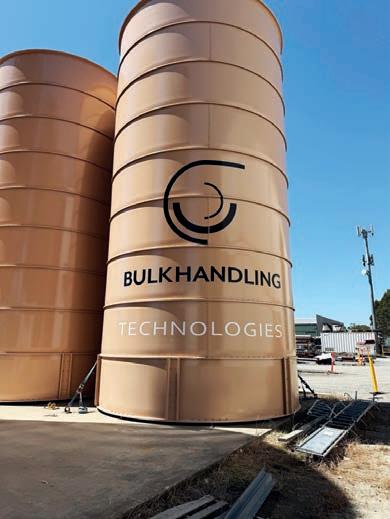
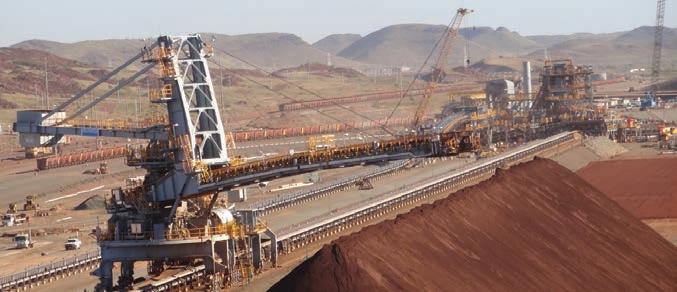
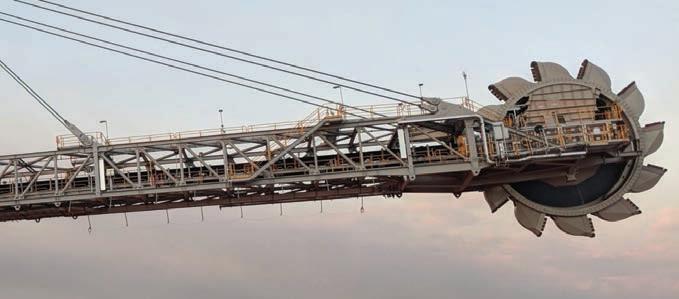
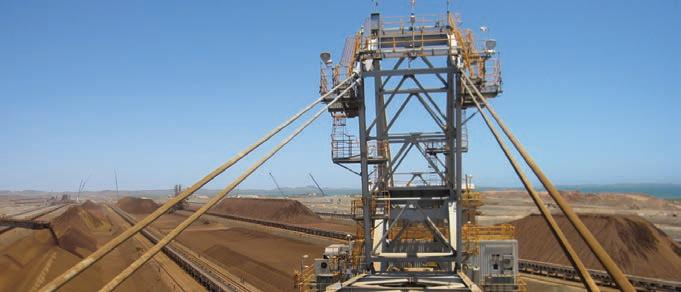
Bulk Handling Technologies draws on deep industry experience to engineer purpose-built, innovative systems that address the specific challenges of each application. From custom bin and hopper design to an extensive portfolio of feeding, conveying and weighing solutions, we deliver complete, reliable packages to handle any bulk material with accuracy and confidence.
We also support our customers with site audits, troubleshooting and practical refurbishment or upgrade solutions to improve performance, extend equipment life and maximise operational efficiency.
Our equipment and solutions are supplied across Australia and to international clients.
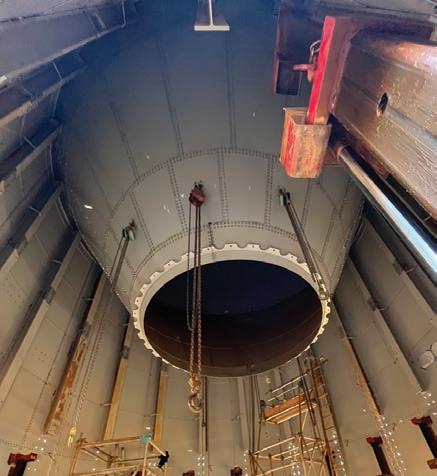
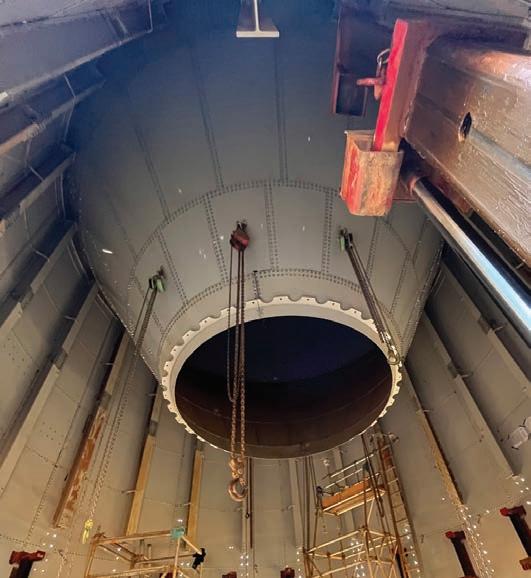
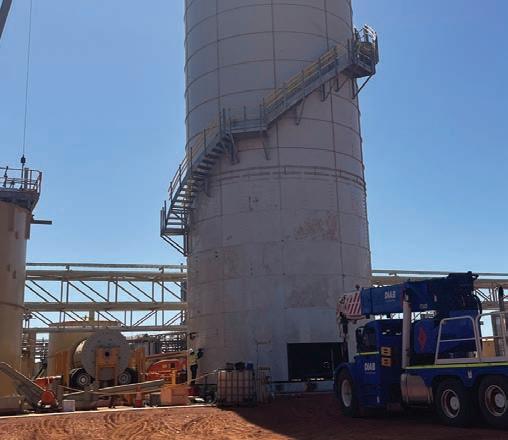
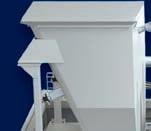
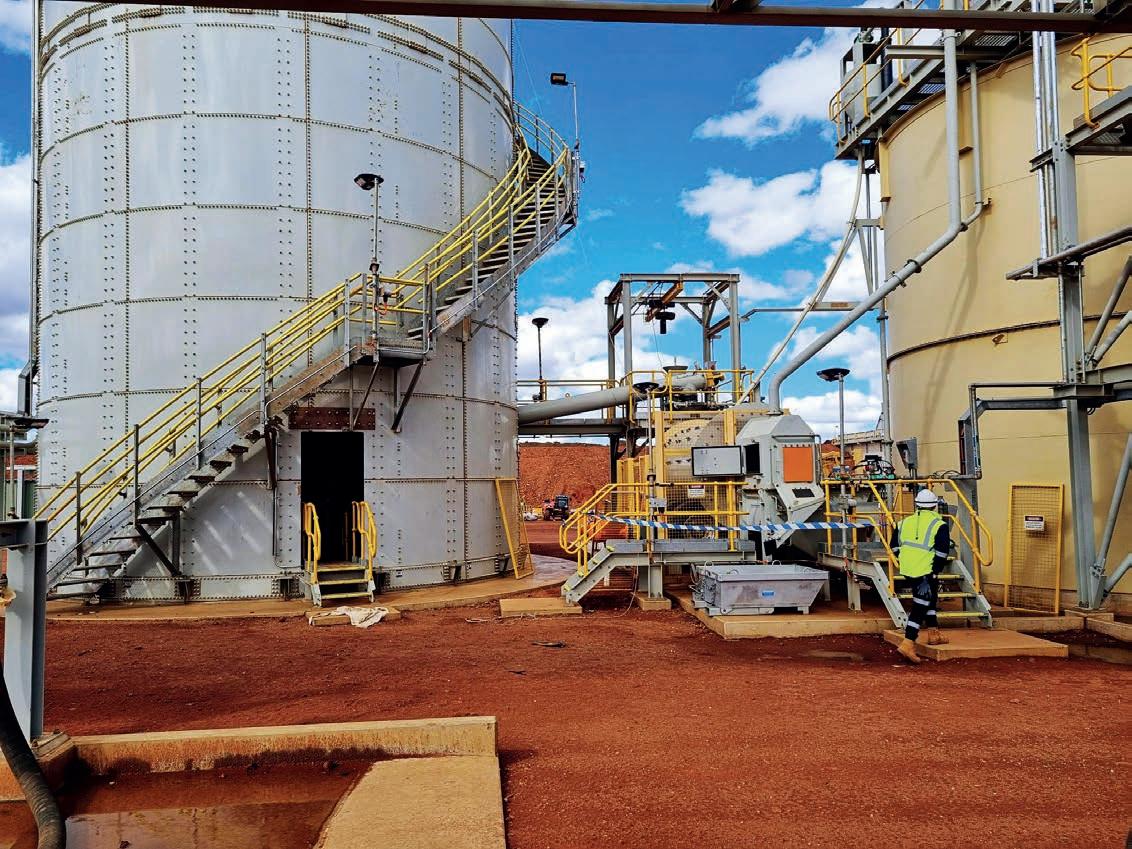
BHT Lime Slaking Plant being commissioned
Conveying and Elevating
Bulk Material Storage | Bin Isolation Gates | Lime Slaking and Limestone Grinding Systems
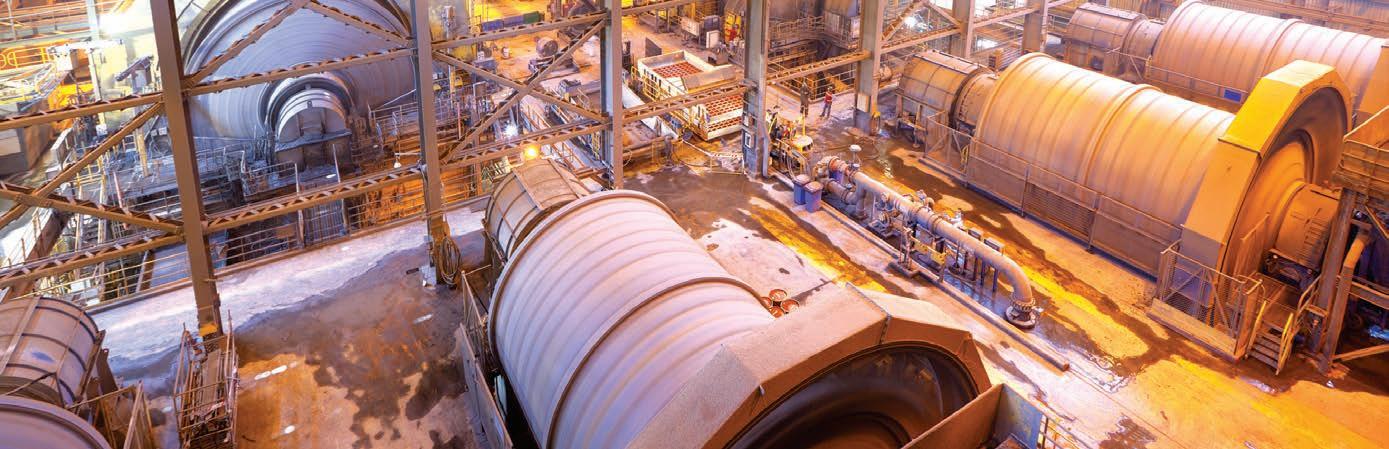
Wet Grinding Ball Mills and Grinding Media Handling
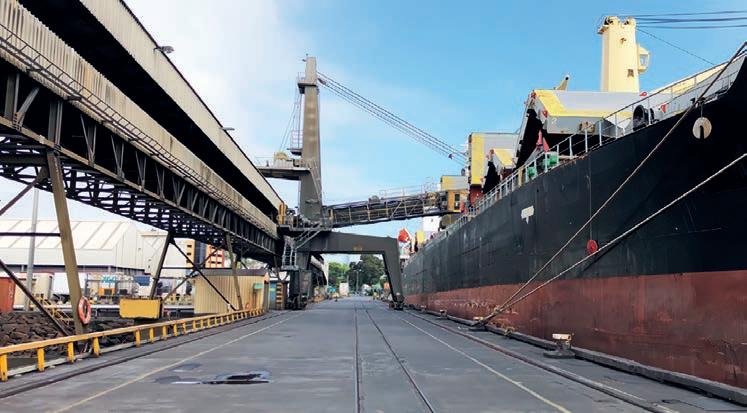
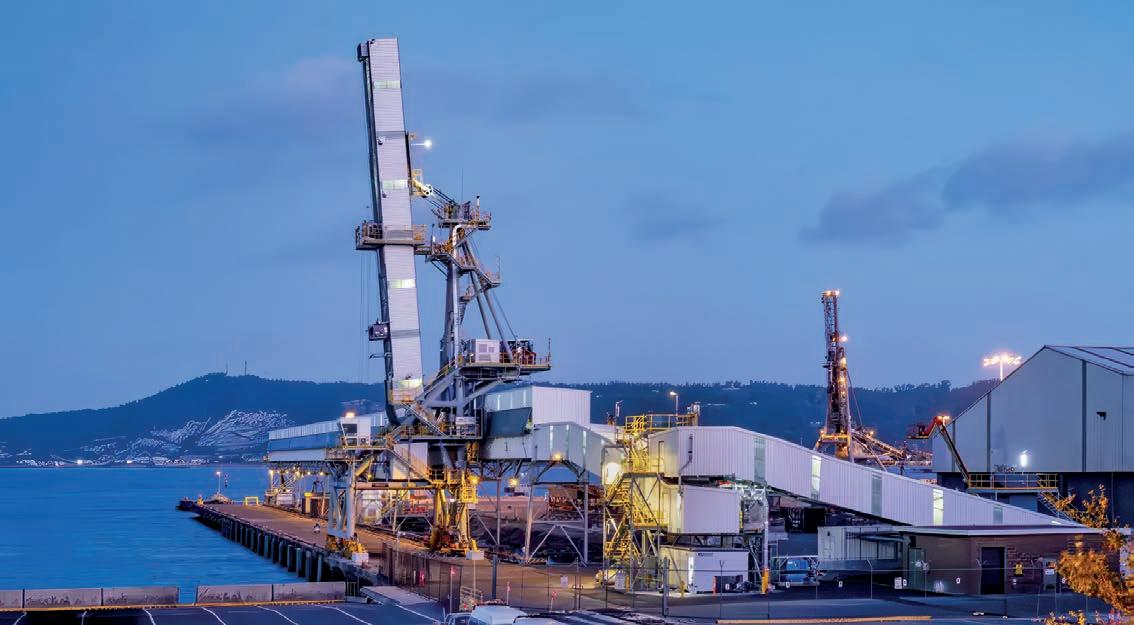
48 Case Study: TasRail Port of Burnie Berth 5 shiploader replacement
54 Why silos fail and the importance of understanding bin loads 58 International collaboration Refurbishment and support
26 Global manufacturing meets local expertise: DHHI expands its footprint in WA
Published by:
379 Docklands Drive
Docklands VIC 3008
T: 03 9690 8766
www.primecreativemedia.com.au
COO
Christine Clancy
E: christine.clancy@primecreative.com.au
Editor William Arnott
E: william.arnott@primecreative.com.au
Assistant Editor:
Adam Daunt
E: adam.daunt@primecreative.com.au
Business Development Manager
Rob O’Bryan
E: rob.obryan@primecreative.com.au
Client Success Manager
Janine Clements
E: janine.clements@primecreative.com.au
Head of Design
Blake Storey
Design
Laura Drinkwater
Subscriptions
T: 03 9690 8766
E: subscriptions@primecreative.com.au
www.bulkhandlingreview.com
The Publisher reserves the right to alter or omit any article or advertisement submitted and requires indemnity from the advertisers and contributors against damages or liabilities that may arise from material published.
An unfortunate fact about the nature of machinery is that breakdowns are inevitable. If you run a machine for long enough, eventually something will stop working. The more moving parts there are, the more potential things that could go wrong.
On a bulk handling site, there are several machines that rely on critical components, each with the potential to fail. When this happens, then it can quickly cascade.
For example, a bearing could come loose in a roller, which could damage surrounding components or itself, which could then damage a conveyor belt – leading to costly repairs and unplanned downtimes.
To avoid these calamities, sites follow maintenance routines. If routine maintenance is not performed, it becomes more likely that small things won’t be caught before they become big things, costing the operations thousands (if not millions) of dollars.
Most businesses offer after sales support, to ensure their customers can rely on the equipment even if something goes wrong. Some have now embraced the Internet of Things, incorporating sensors into equipment to help monitor the performance of a system in real time.
Access to this data allows sites to make more informed decisions and can highlight when something has gone wrong. In many cases, the digital monitoring can spot potential problems well in advance of manual maintenance, giving the operators more time to respond in scheduled downtime.
Others are even beginning to embrace machine learning and cloudbased computing to help predict when something will go wrong before it even happens.
However you handle it, maintenance is a key part of keeping sites profitable. New technology is helping find ways of removing risks and speeding up the process so that machinery can get back to earning a profit.
Next month, ABHR will shine the spotlight on silos, hoppers, motors, gears, and drives. If you would like to see your business covered, please get in touch.
William Arnott Editor - ABHR
MODELRS
MODELDB
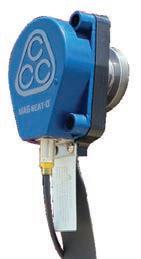
INTRODUCING AN EASY WAY TO PROTECT YOUR WORKERS AS WELL AS PROTECT YOUR INVESTMENT INTO YOUR EQUIPMENT. THE CONVEYOR SAFETY SYSTEM™ IS AN EASY, COST EFFICIENT WAY TO GET PEACE OF MIND AND PROTECTION FOR CONVEYOR EQUIPMENT. BY BUNDLING OUR MODEL RS SAFETY STOP SWITCH WITH OUR MODEL TA BELT ALIGNMENT SWITCH, MODEL DB DAMAGED BELT DETECTOR WE HAVE YOUR WORKERS AND EQUIPMENT COVERED. COUPLE THAT WITH ADDING ONE OF OUR MOTION SWITCHES (MAG-NEAT-O™ OR MODEL CMS), YOU CAN FEEL CONFIDENT KNOWING THAT YOUR SYSTEM AND WORKERS ARE PROTECTED FOR A FRACTION OF THE COST OF DOWNTIME, REPAIRS AND REPLACEMENT EQUIPMENT.
Why belt cleaner maintenance matters
Belt cleaners keep carryback at bay, but if they’re not properly maintained, they can quickly become a nightmare for bulk-handling operations.
CONVEYOR SYSTEMS are the backbone of bulk material handling across industries such as mining, construction, and cement production. However, one of the most persistent challenges operators face is carryback – the material that remains on the belt after discharge.
Carryback poses a dual threat: it compromises operational efficiency and worker safety. The accumulation of fugitive material – spillage, dust, and carryback – can also lead to equipment malfunctions, increasing maintenance costs, and unplanned downtime. In the worst cases, excessive fugitive material build-up can cause belt misalignment or even catastrophic belt failures, requiring costly repairs.
“They understand what’s
The dream scenario for many bulk handling sites is conveyor components that can be installed and left to run reliably in the background. ‘Set and forget’ equipment that requires minimal intervention frees up labour, reduces downtime risk, and improves operational focus elsewhere.
However, ESS Engineering accounts development manager Ken Minch said that when it comes to belt cleaners, that dream can turn into a nightmare.
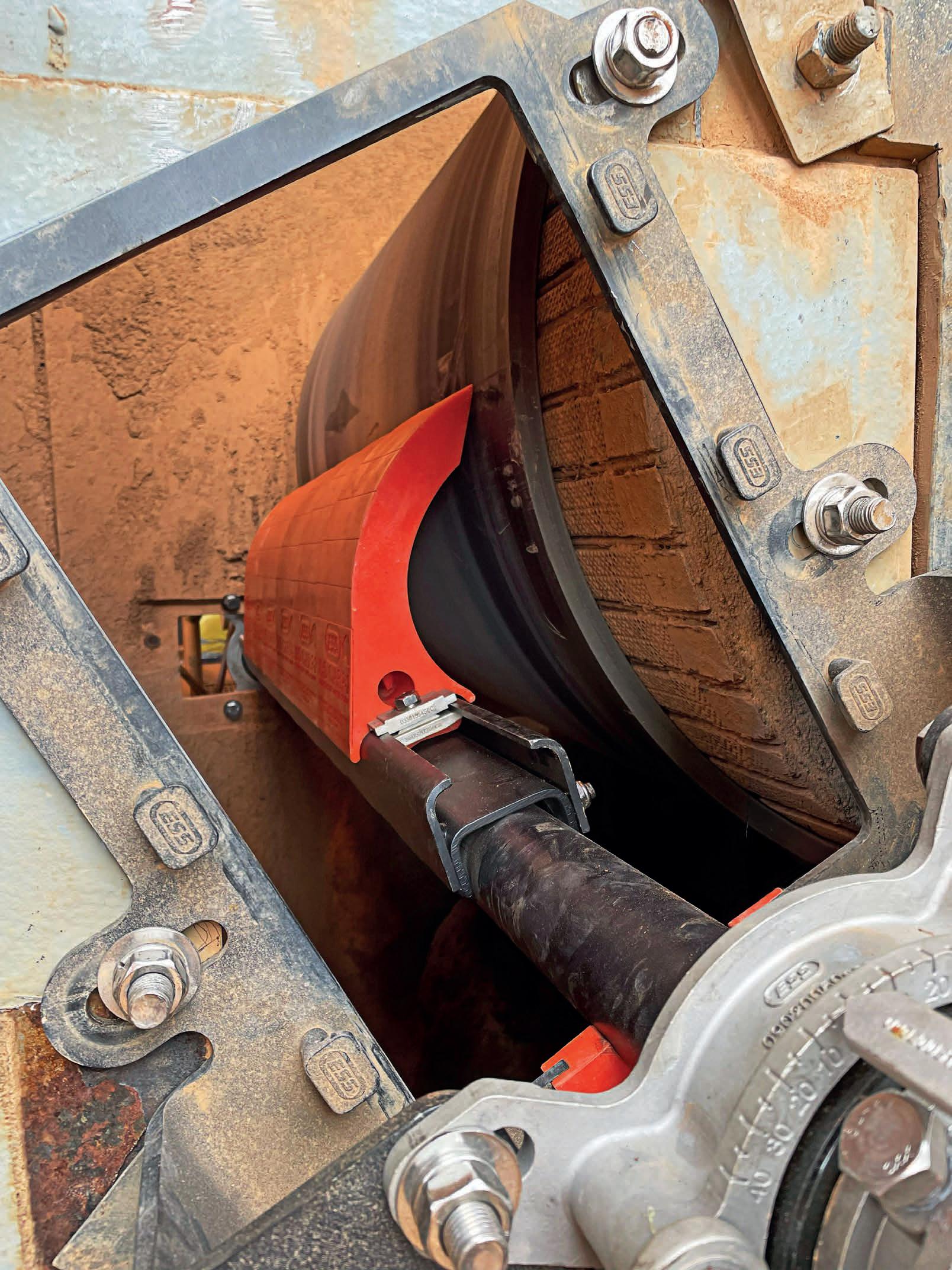
“The analogy we use for belt cleaners is shaving,” Minch told ABHR. “For a belt cleaner to work effectively, it needs to be cleaned of all debris and buildup, just like a razor.”
Conveyor belt cleaners remove sticky or damp material from belts. If a
needed
and take
special care
to ensure everything is working properly. They can then share that knowledge with clients so they can maintain the equipment and extend its lifespan.”
conveyor stops for any period of time, the residue can dry and accumulate on the blade surface. Over time, this build-up reduces cleaning efficiency. Restoring performance requires cleaning the blades, correctly re-engaging them, and resetting them for optimal operation.
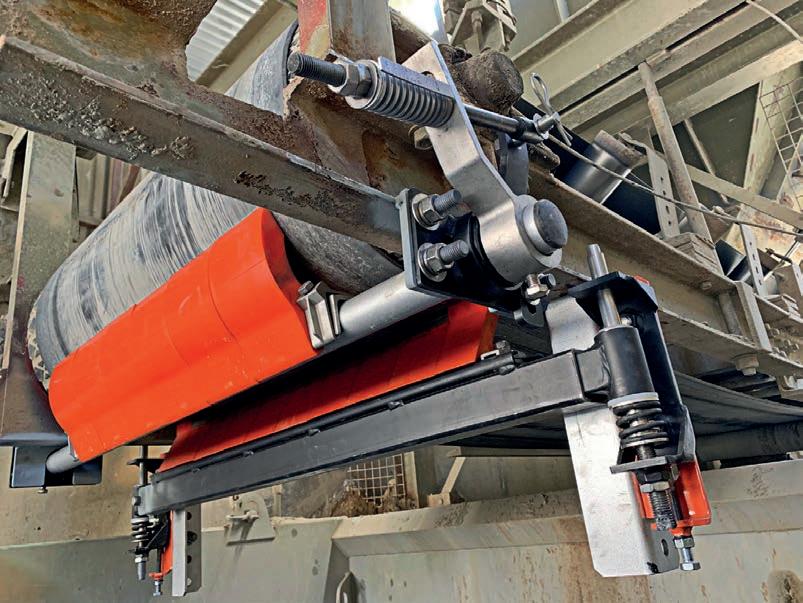
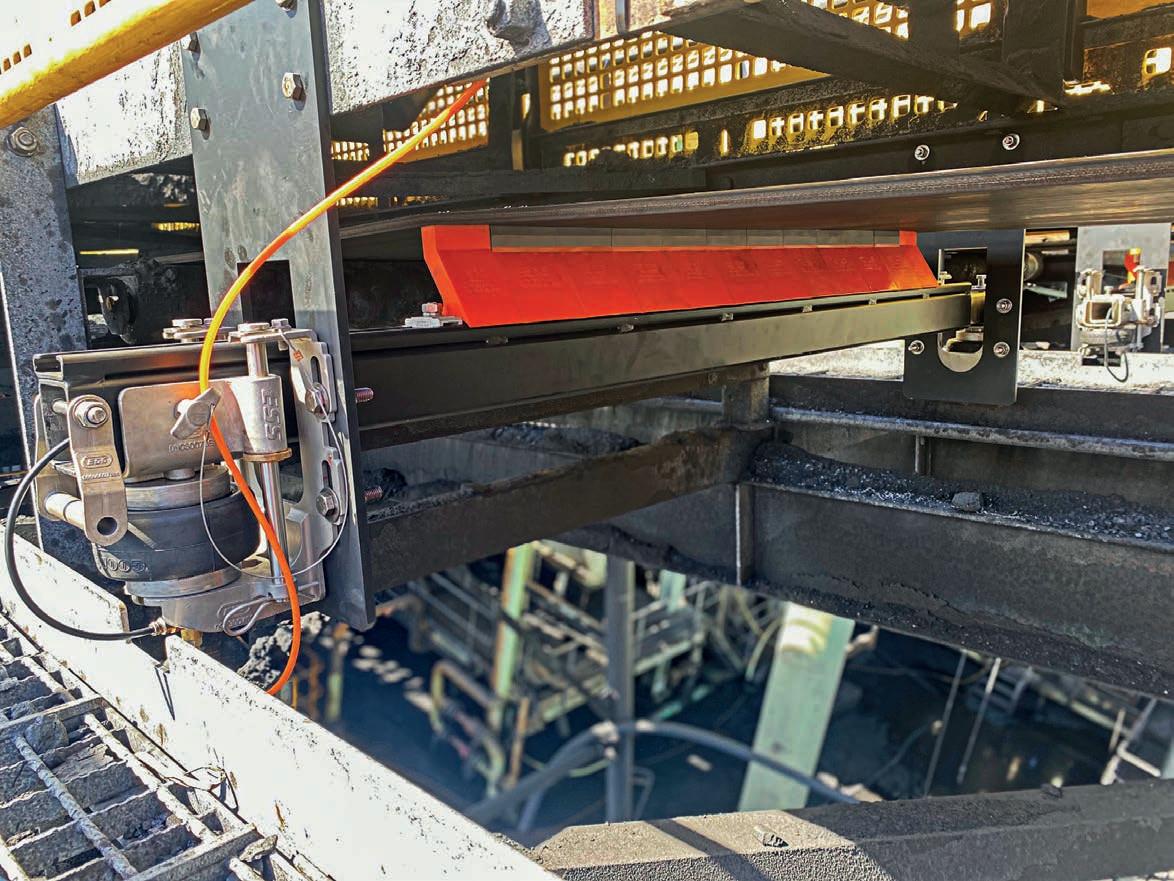
ESS Engineering has spent decades collaborating with clients to ensure optimal belt cleaning. ESS Engineering’s approach to belt cleaning utilises a system of primary, secondary, and return belt cleaners, which work together to minimise carryback and improve conveyor efficiency.
The primary cleaner, located at the head pulley, removes the bulk of the material that adheres to the belt. Secondary belt cleaners provide an additional layer of cleaning for the material fines that primary cleaners may leave behind. Positioned just past where the belt leaves the head pulley, they ensure thorough belt cleaning and material recovery, helping to prevent material build-up. The return belt cleaners remove fugitive material that escapes from the carry side of the belt and drops onto the inside strand of the conveyor belt.
ESS accounts development manager Tom Stahura emphasised that regular inspection of belt cleaners is essential to maintaining performance.
“It’s why we recommend inspecting your belt cleaners weekly, or even daily, depending on the operation,” he said. “Conveyors aren’t sensitive; they’re not going to tell anyone there’s a problem unless you’re specifically looking for it.”
Routine inspections help identify wear, buildup, or misalignment before these issues escalate into costly downtime or equipment damage.
According to Minch, one of the most common mistakes sites make is
ESS Engineering has spent decades collaborating with clients to ensure optimal belt cleaning.
increasing cleaner pressure when the belts aren’t clean enough.
“If the belt isn’t clean, they often think they need more force,” he said. “But when you investigate, you might find the blades are clogged with material and not working at all.”
Adding tension without resolving buildup increases friction, raises drive motor power demand, and can accelerate belt wear or damage.
ESS installation manuals include maintenance manuals that outline best practices for belt cleaner performance. The document is continually refined using operational feedback, service data, and wear-rate analysis. Suggested blade pressures, for example, are based on proven results and then tailored to suit each site’s specific application.
Stahura said that high pressure is often not necessary to clean the belt, “There are a lot of variables that need to be considered, like belt condition, moisture levels, or blade type.”
Another variable to consider is the needs of the client; “Some clients want blades to last for a certain period of time; others want maximum cleaning efficiency. We analyse all of these factors when servicing or adjusting equipment.”
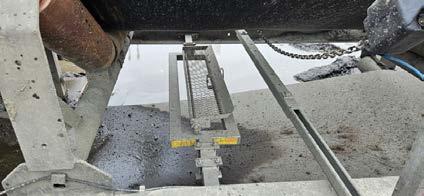
To simplify maintenance, ESS belt cleaners are supplied with inspection doors that allow quick visual checks of blade condition on both sides of the conveyor. A protective mesh and stainless-steel plate shield the opening from material impact.
Once the conveyor is safely locked out, the mesh can be removed for direct blade access. Secondary cleaners also feature removable cartridges for fast servicing or replacement.
ESS places strong emphasis on technician training to ensure equipment is installed, maintained, and serviced correctly.
“We do in-house training where our team is taught to have pride in their work and the product,” Minch said. “They understand what’s needed and take special care to ensure everything is working properly. They can then share that knowledge with clients so they can maintain the equipment and extend its lifespan.”
Conveyor belt cleaners remove sticky or damp material from belts.
ESS Engineering’s approach to belt cleaning utilises a system of primary, secondary, and return belt cleaners.
New nut to crack
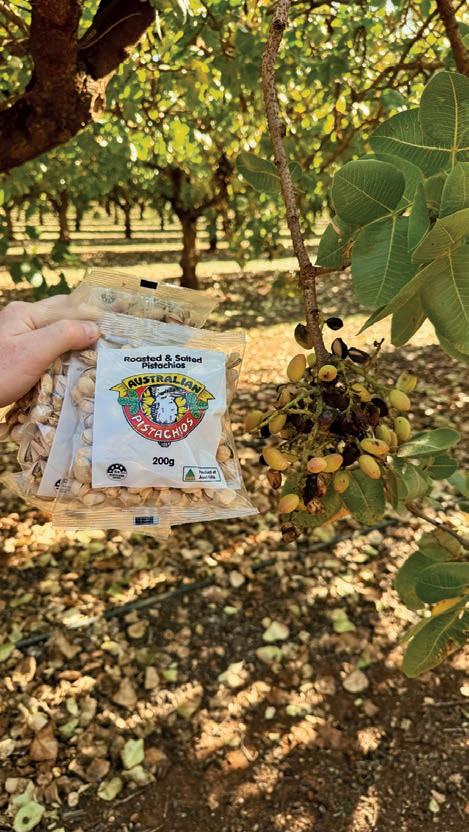
Allied Grain Systems has launched its first pistachio facility.
WHEN ALLIED GRAIN SYSTEMS
signed on to deliver a new pistachio handling facility in Robinvale, Victoria, it was a deliberate step into unfamiliar territory.
For engineering manager Harrison McInnes and the Allied team, it was a chance to rethink how the company approaches bulk storage outside traditional grain supplies.
Now complete, the Robinvale facility is one of the largest pistachio handling operations of its kind in Australia. Located in the heart of a key pistachio-growing region, the site services two major orchard blocks: an existing operation and a newly developed block that has undergone significant investment to support long-term production growth.
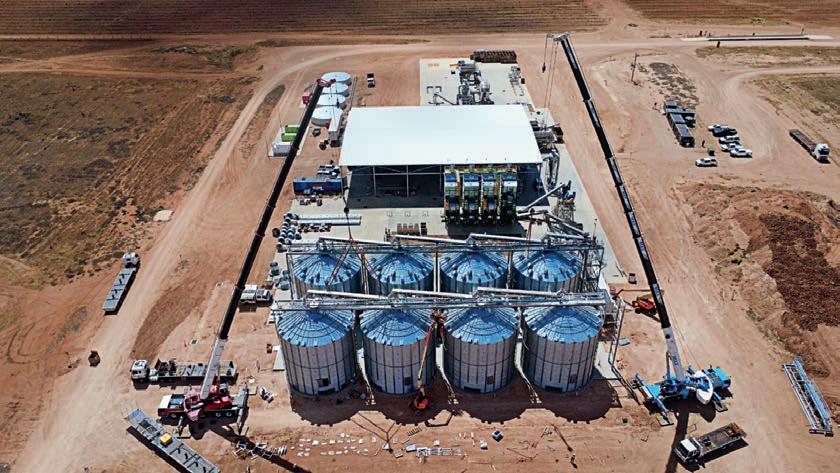
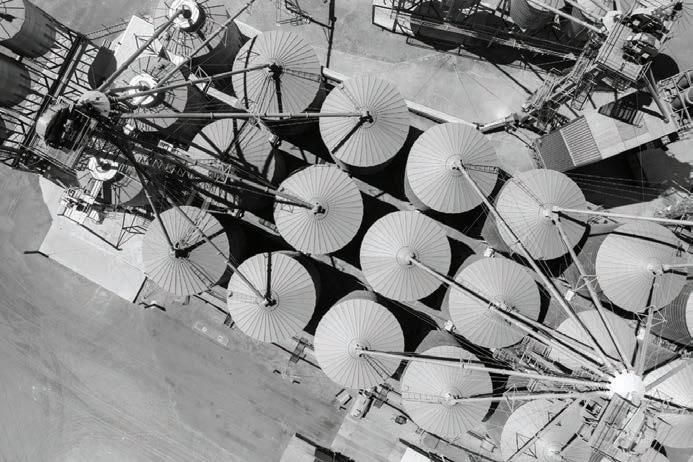
Allied Grain Systems was contracted to design and install four new banks of silos, connected by an overhead steel gantry. The project also involved close collaboration with a specialist conveyor supplier, whose equipment was integrated across the gantry and into the wider materials handling system.
“It’s something completely different to anything we’ve done before,” McInnes said. “Up until this point, our silos have predominantly been focused on grain
like wheat, canola, barley, sorghum. We’ve never done nuts until now.”
Unlike traditional grain systems, where material flows relatively predictably through chutes and spouts, pistachios introduce a unique set of handling challenges, and opportunities.
Fresh pistachios are harvested using tree shakers before moving through a processing plant where they are dehusked, dried, and cleaned. From there, they are conveyed to the top of the silo in a form McInnes describes as being closer to a rubber pellet than a grain kernel.
“They come off the tree, go into the plant, get de-husked and dry cleaned, and then they go into the top of the silo,” he said. “They get dropped in and bounce off the deck as they fill the silo.”
Drying is a critical part of the process, and the Robinvale silos have been designed with this in mind. Two large gas heaters force significant volumes of hot air through the system, ensuring moisture is removed efficiently and consistently once the product is in storage.
“The heaters pump heaps of hot air into the silo and dry it out,” McInnes said. “By the time the pistachios are on the conveyor belt, you could basically eat them straight off it.”
than a simple adaptation of existing grain infrastructure.
While the technical challenge was significant, McInnes said the project’s novelty was a major drawcard for the team.
“It being something so different is what made it interesting to us,” he said. “That’s why the team gravitated towards the project initially.”
The pistachio industry, while substantial, is often overlooked when compared with Australia’s major grain sectors. For Allied Grain Systems, the Robinvale project has highlighted both the scale of the opportunity and the importance of flexible engineering solutions across agricultural commodities.
“You forget how big the industry is,” McInnes said. “Nuts can be overlooked, but this has really helped us expand our operations and gain insight into different ways of handling bulk products.”
With one pistachio facility now successfully delivered, Allied Grain Systems has broadened its expertise beyond traditional grain, positioning the company to support a wider range of bulk handling applications as Australian agriculture continues to diversify.
For McInnes and the Allied team, Robinvale stands as proof that stepping outside familiar territory can deliver both technical growth and long-term strategic value one pistachio at a time.
Allied Grain System’s pistachio facility in Robinvale is now complete.
The pistachio facility is Allied Grain System’s first avenue outside of the traditional grain supply.
Images: Allied Grain Systems
Modular design and simplified maintenance
TECO Australia and New Zealand has designed its medium voltage drive to support the local industrial landscape.
UNDER THE TECHNICAL
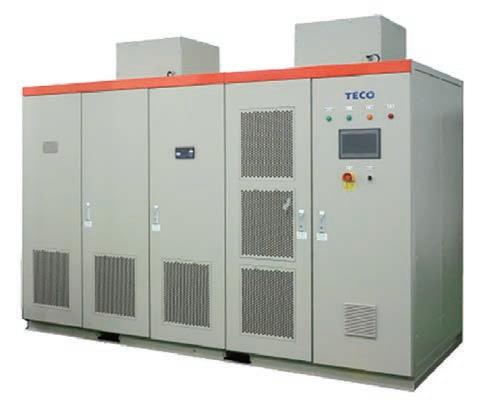
leadership of TECO Australia and New Zealand product manager for medium and high voltage motors and drives, Bradley Cargill, TECO has positioned the Medium Voltage Drive MV510 as a solution designed to cover all major regional industries, from heavy mining and cement to traditional centrifugal pumps and fans.
At the core of the TECO MV510 is a multilevel H-bridge topology utilising 690V power cells. This specific architecture provides a significant advantage for site maintenance teams: because the internal power cells operate at 690V, high voltage paperwork and procedures typically required for maintenance are not necessary for power cell interventions.
Furthermore, TECO has standardised these power cells across the entire range. This allows end users to optimise spare parts inventory significantly; a site can operate a 1MW 3.3kV unit and a 5MW 11kV unit while sharing the same set of critical spare components. This commonality reduces the risk of prolonged downtime due to component unavailability.
The MV510’s multilevel H-bridge topology produces a near-sinusoidal output voltage.
This design ensures strict compliance with IEEE-519 requirements for Total Harmonic Distortion, protecting the
integrity of the motor insulation without the need for additional, space-consuming external filtering equipment.
further enhances flexibility, allowing engineers to size motors to optimise the specific application rather than being constrained by the available supply voltage onsite.
The TECO MV510 is engineered for sophisticated multi-motor control. Through a built-in bypass cabinet, the drive can start several motors and transfer them to line voltage (and back to drive control), allowing customers to manage a mix of fixed and variable speed assets. This capability reduces overall installation costs and minimises the physical footprint required in the motor control centre.
capability are essential safeguards that prevent catastrophic structural damage to mill shells and bearings during hightorque start-up sequences.
Local expertise with global reach
TECO Australia and New Zealand serves as a centre of excellence for these medium-voltage solutions. Backed by a local engineering team that travels internationally, with successful onsite support provided as far afield as Mexico and Senegal, TECO ensures that technical accountability is maintained throughout the asset’s lifecycle.
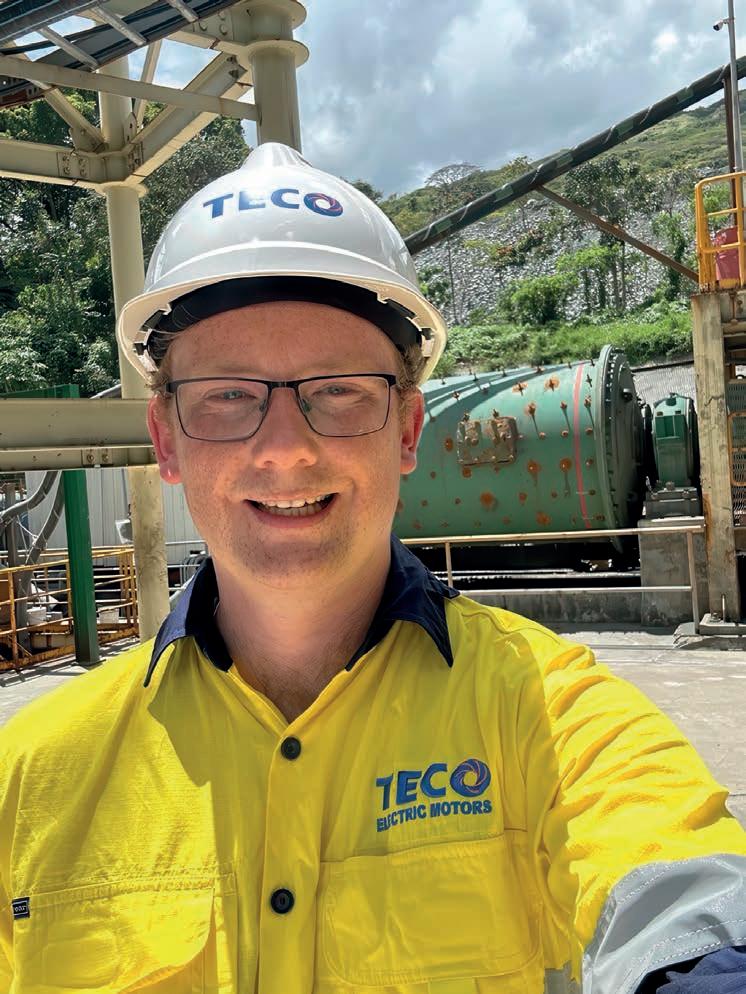
TECO Australia and New Zealand product manager for medium and high voltage motors and drives, Bradley Cargill.
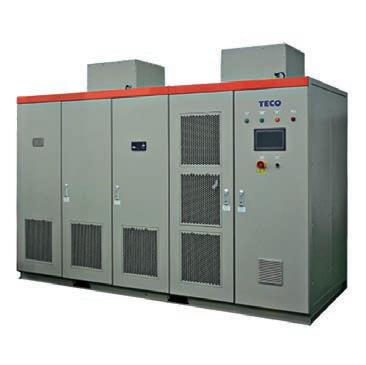
The MV510 is a versatile solution in the bulk handling industry.
Images:
TECO
roviding load stability and uniform belt alignment, idlers serve as the primary belt-support components in industrial conveyor systems. At transfer points, idlers carry the belt between impact cradles, eliminating sag and gaps to maintain a consistent belt line through the load zone. This controlled belt geometry provides effective sealing — helping contain fugitive material, minimize errant dust, and protect the belt from damage over time.
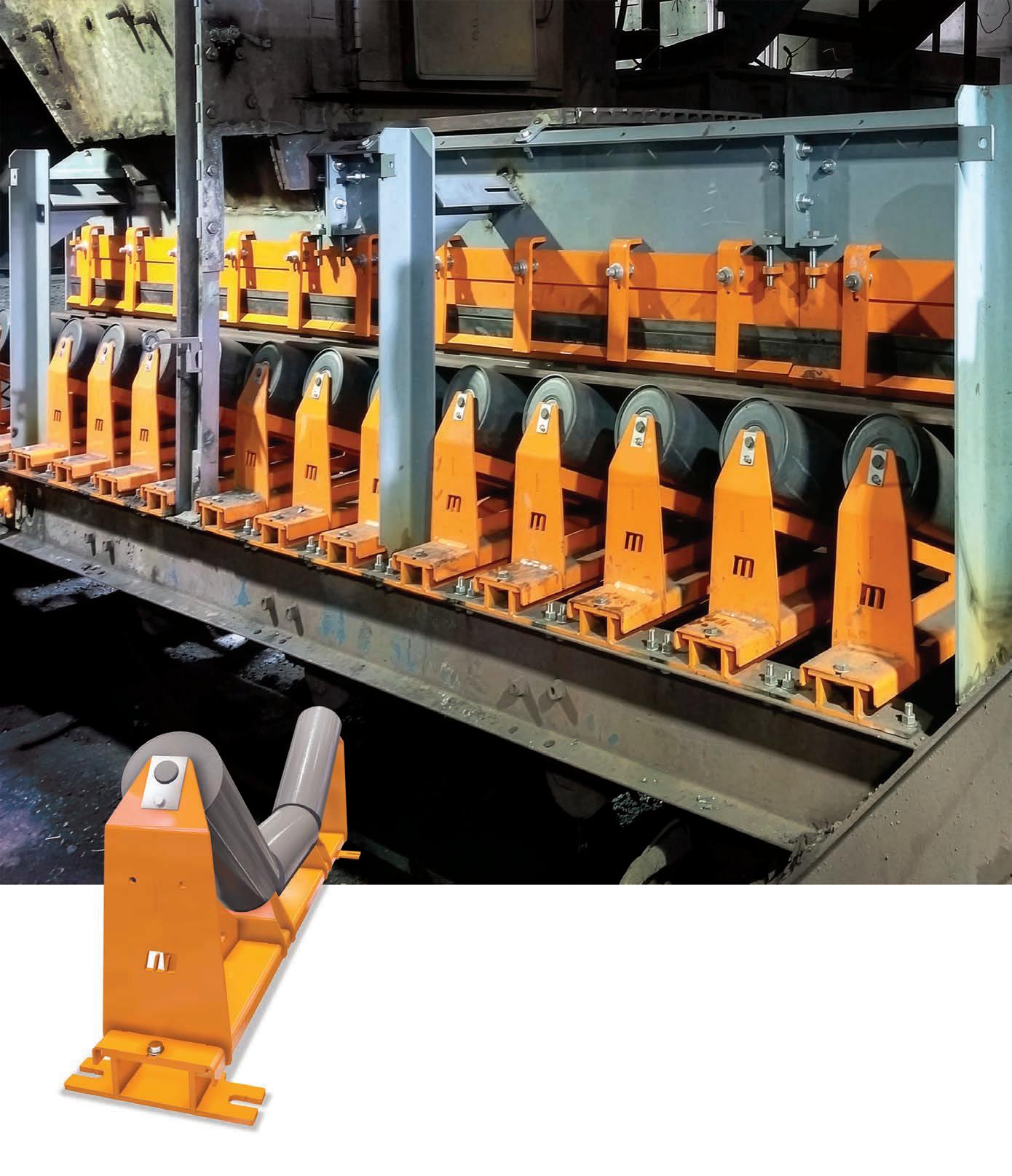
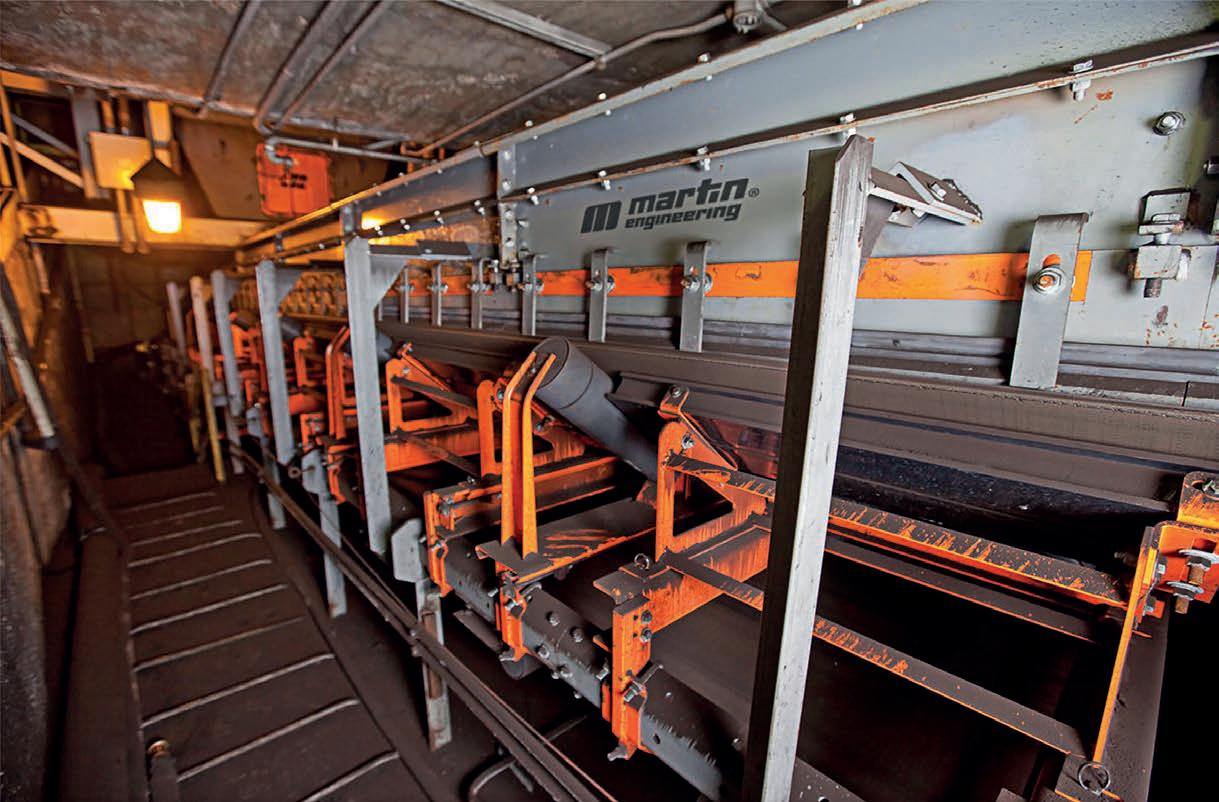
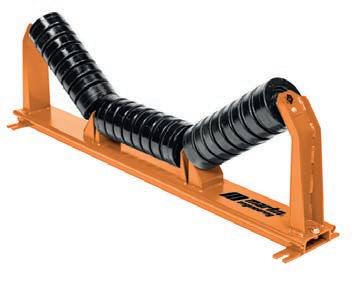
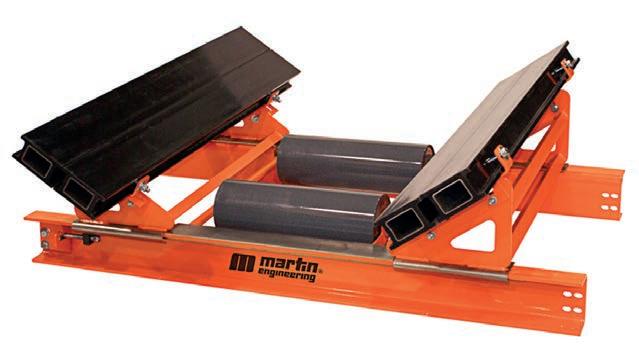
Martin® Trac-Mount™ Idlers feature sliding frames on stationary standard or wide bases that pull out for service without raising the belt or removing adjacent idlers. These idlers can be customdesigned for unique applications and are available with steel or impact rolls in CEMA C, D, and E classes.
Martin Engineering. We got your back.
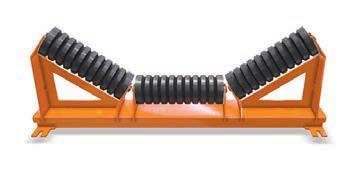
Trac-Mount™ Idler with Impact Rolls
Trac-Mount™ Idler with Steel Rolls
Enduring the most abrasive environments
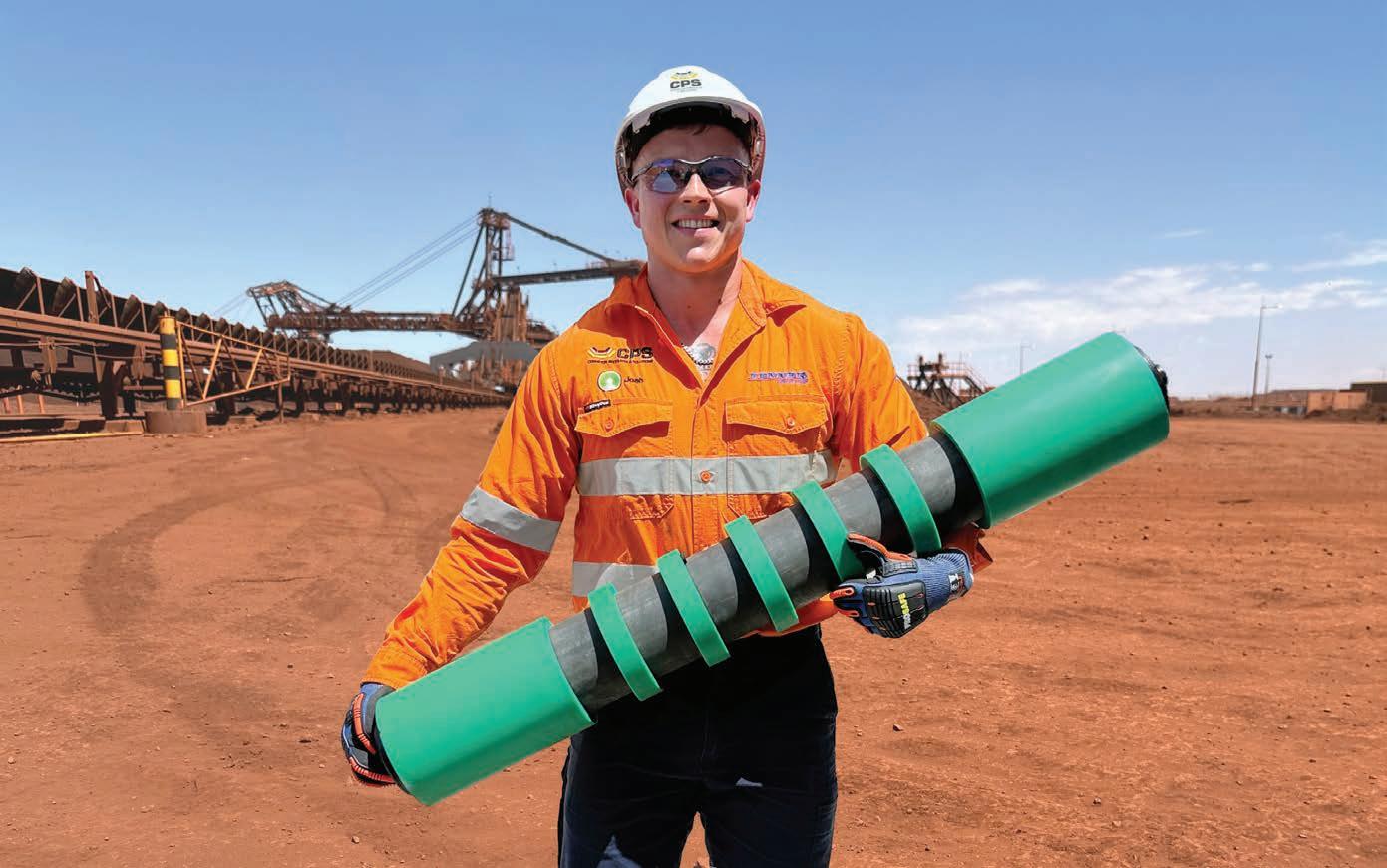
CPS has unveiled Enduroroll, a disc roller that is designed to enhance the operational effectiveness of conveyors, as well as reduce their environmental footprint.
IN BULK MATERIAL CONVEYORS,
it is typical for rollers to be designed for lifetimes on the order of five to 10 years. But rollers in some areas (e.g. heavy carryback and material build-up zones) can be subject to such harsh conditions that they may last less than a year before the shell is worn-through.
The shell needs replacement, yet the rest of the components inside the roller are still only beginning their
lifetime. These are the abrasion-critical applications which CPS has addressed with its new product, Enduroroll.
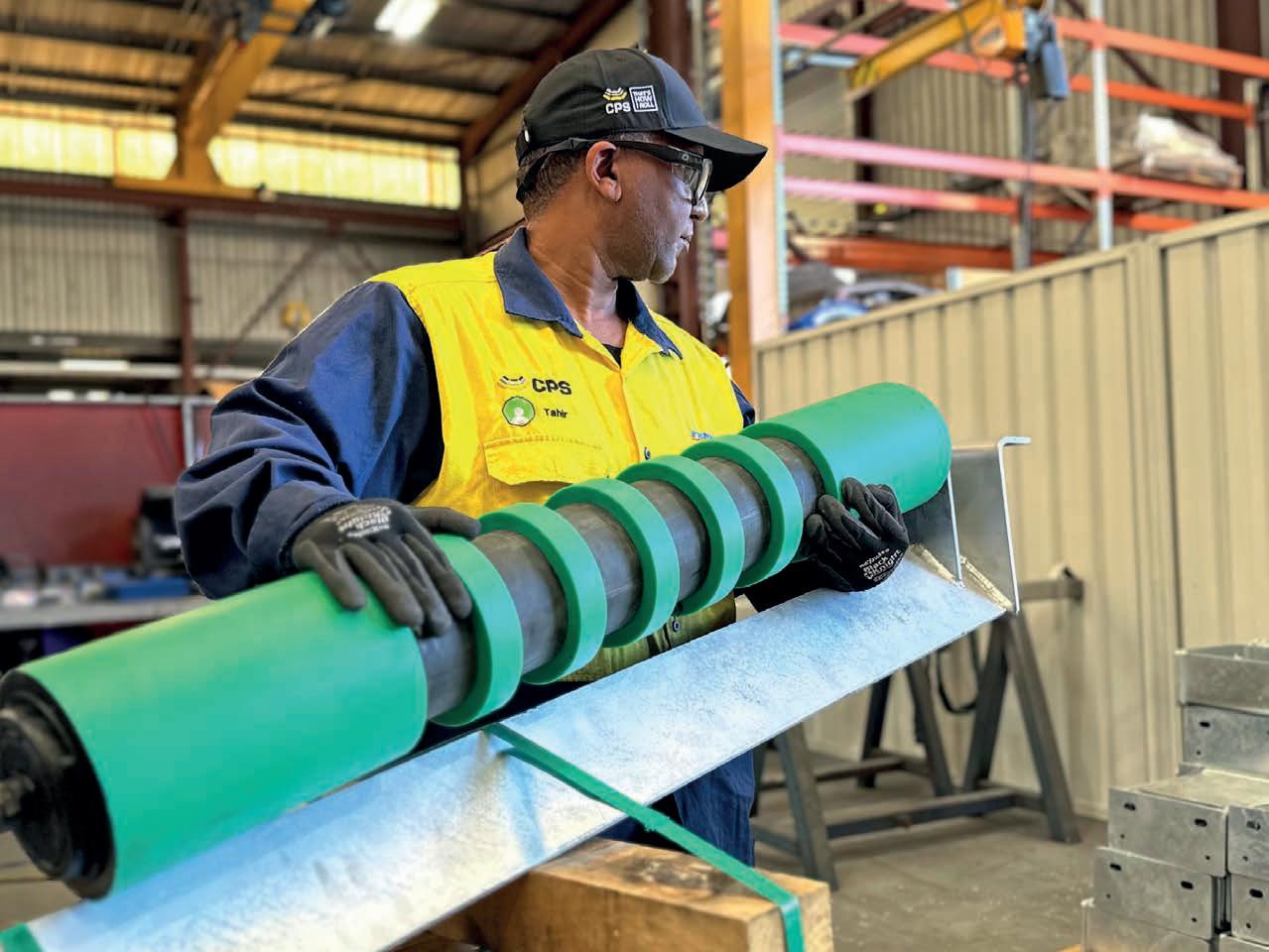
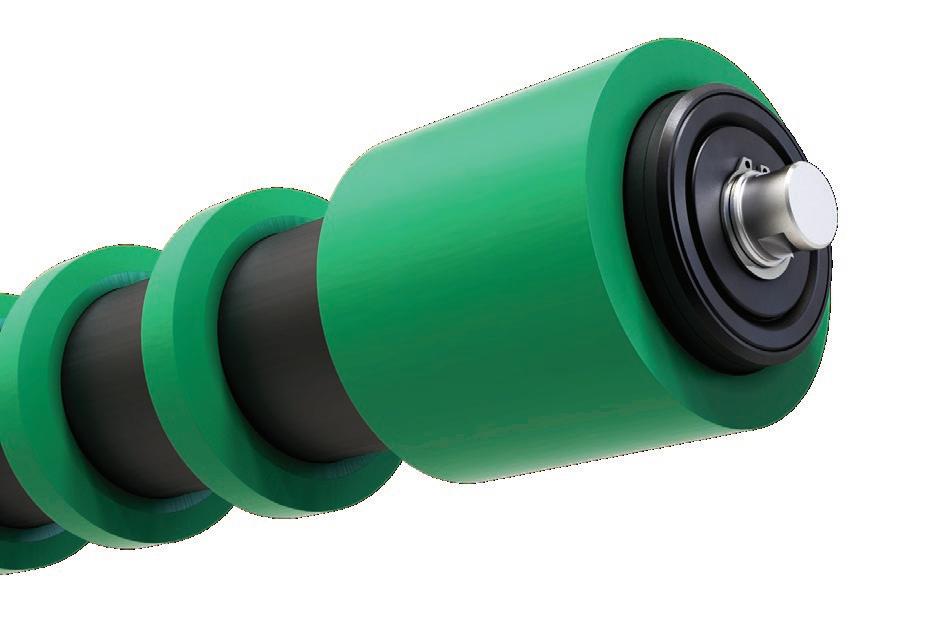
Enduroroll is a roller using advanced elastomer design to reduce rolling drag, reduce environmental impact of the materials involved, and, perhaps most noticeably to the conveyor operator, improve wear life by up to 80 per cent compared to CPS’s market-leading polyurethane return product.
Development
Enduroroll started life as a search to find alternative, lower-impact chemicals for formulating rollers. In assessing the results, one of the trial batches surprisingly showed high abrasion resistance.
“At the time, we weren’t even looking for abrasion resistance – but when we saw it, and modelled the lifecycle environmental impact of the longer lasting rollers, we found that
Image:
CPS
Enduroroll is a roller using advanced elastomer design to reduce rolling drag.
the increased roller life did more than we were ever getting with the chemical change,” CPS head of product Ahmad Fleyfel said. “We pivoted to optimise lifetime further.”
The focus for CPS shifted from lowimpact materials to a whole lifecycle optimisation of the product: Make the materials last as long as possible and prevent the need to replace the roller at all.
Results
By the time materials research and development was done, CPS measured an 80 per cent improvement in wear life. This meant clients would require less costly roller changeouts and conveyor downtime.
CPS didn’t stop at end-of-life optimisation. It also wanted to address the roller’s performance both in storage and in operation. In storage, rollers can sometimes be asked to last for years in harsh
conditions – enduring sun, rain, heat and corrosive atmospheres. The cost of rotating shafts, regreasing, and other processes used to store more expensive rotating equipment, is often not viable for rollers. CPS said the new Enduroroll formulation addresses this with an increased environmental attack resistance.
“In our accelerated environmental attack chamber, the new formulation lasts more than 50 per cent longer” Ahmad said.
CPS have also started designing and assessing the material specifically for mechanical efficiency on the conveyor. The compant used highspeed logging on a dynamic test machine to measure the amount of power absorbed by the elastomer rings under cyclic loading. CPS said that while further work is required, it has started addressing the idea of high-efficiency materials to reduce rolling losses on the belt, in a similar
vein to low rolling resistance belt bottom covers and modern electric vehicle tyres.
The new state of roller selection
CPS head of engineering Peter Copley said Enduroroll is not a blanket solution for all circumstances.
“You need to have the right roller for the right application,” he said. “The benefits of Enduroroll will shine where they are needed. We have a full team of application engineers dedicated to assisting clients in choosing the right solutions for their problem conveyors.”
According to Copley, Enduroroll can make an incredible difference in heavy abrasion areas. It will also be used to address some sites requiring long term roller storage and survival in more aggressive ambient environments.
CPS believes its existing rollers and new Enduroroll provides a high-performance roller for every application.
PLUG & PACK
ABRASION RESISTANT
Welcome to the Next Generation of Abrasion Resistant Conveyor Rollers
With an abrasion resistance up to 80% better than traditional polyurethane and 500% better than rubber, Enduroroll increases up-time in carryback/ buildup areas, reduces time spent replacing rollers at shut-downs and reduces long term system costs and environmental impact.
Better Return Rollers
Designed as the successor to our yellow polyurethane (PU) disc rollers, the advanced formulation provides better performance under the unique conditions faced in return areas of conveyors where carry-back leads to increased wear and roller failure. Enduroroll also uses the same ‘field proven’ internal components and construction as previous disc rollers.
Better Against the Elements
The new formulation also significantly increases roller longevity in storage and operation through improved environmental resistance.
Reduced Planet Impact
Additional to longer lasting rollers producing less waste, CPS captures waste raw material to be re-introduced into manufacturing with no impact on material integrity.
Proudly by Fenner Conveyors Australia
www.cpsconveyors.com.au sales@cpsconveyors.com.au
Silo art sparks regional revival
Grain silos are not just critical bulk storage units, they are catalysts for tourism, community pride, and regional renewal.
SILOS ARE CRITICAL FOR THE the bulk handling industry. These tall, impressive structures are designed to manage large quantities of loose materials, protecting them from environmental elements like moisture and pests while allowing for controlled discharge into production or transport systems.
In South Australia, silos are used primarily for the bulk storage of grain, but throughout the country they are typically located in regional areas central to farming communities.
In a means to rejuvenate rural areas, talented artists have been redesigning the surface of silos with impressive and modern artwork to boost tourism in regional areas and preserve local heritage through large-scale, accessible public art.
GrainCorp, an integrated grain and edible oils business is a large grain storage and handling business operating
in Australia and New Zealand. The company has recently celebrated 10 years since it revealed its first silo mural on Australia’s east coast.
The mural was unveiled at GrainCorp’s Brim site in western Vicotria in 2016, and what began as a single artwork painted during a period of drought has since inspired close to 80 silo artworks across the country.
Community engagement manager Kyle Docherty said the anniversary is an ode to the towns, artists, and locals who helped bring the artworks to life.
“Grain silos have always been places of connection and economic activity for growers,” Docherty said. “Over the past decade silo art has breathed new life and purpose into disused sites, turning them into landmarks that symbolise resilience, creativity, and regional pride. Silo art has helped shine a spotlight on towns that might otherwise be passed
by, encouraging people to stop, explore, and experience Australia’s largest outdoor gallery.”
According to the Australian Silo Art Trail, the beginning of the silo art movement traces back to March 2015 where the first art mural was a pilot project by a cultural non-profit known as FORM.
With the help of the CBH grain handler two internationally renowned street artists Phlegm & HENSE decorated the grain silos in Northam, in Western Australia’s Wheatbelt.
Following this, six trail silos were planned. And in 2016, in Victoria’s Wimmera Malle region, GrainCorp would launch its Brim silo art.
The Brim mural, painted across four GrainCorp silos built in 1939, was created by Australian artist Guido van Helten. The mural depicts an anonymous, multigenerational farming family.
The Thallon mural pays tribute to local agriculture and Indigenous heritage.
Images: GrainCorp
Brim community active group president Shane Wardle said the impact the silo art had on the town was immediate and tremendous.
“To be the catalyst for other communities getting on board the silo art movement is extremely special,” Wardle said. “The general store sold more ice creams in two weeks than it had in 10 years. Wherever I go and mention where I’m from, people instantly talk about the mural.”
Further along the trail is the Quirindi silo mural in northern New South Wales, a project combining large-scale artwork with a light and sound show every night.
Led by the Quirindi Silo Art Committee, the project has driven visitation across the Liverpool Plains and earned national recognition, including ‘Best of the Best’ at the Australian Street Art Awards.
Committee Chair and local grower Ian Carter said the mural has become a uniting force for the town.
“The silo art has created a real sense of ownership and pride in Quirindi,” Carter said. “Local businesses saw turnover rise by 20 per cent within months of the launch, and there’s rarely a day or night when someone isn’t visiting the silos.”
The mural is designed by Western Australian artist Peter Ryan, and pays
transporting wheat from the Liverpool Plains to Sydney and Newcastle.
The Australian Silo Art Trail continues to act as a major tourist attraction, bringing revenue to small regional towns. In the small regional settlement of Thallon in southern Queensland, home to an incredible 60 people, GrainCorp’s ‘Watering Hole’ mural is a prime example.
Painted by artists Joel Fergie (The
scenery, set against a Queensland sunset. The artwork also recognised members of Thallon’s Indigenous community with the inclusion of a scarred tree.
Thallon Progress Association member Leanne Brosnan said the mural represented a turning point for the community, having played a central role in the project.
“Before the mural, the town was in decline,” Brosnan said. “Today, it’s a community revived, with visitors brining life, optimism, and new opportunities. The mural didn’t just brighten the silos; it transformed our local economy.”
According to GrainCorp, tourism now accounts for 40 per cent of turnover at the nearby Thallon Hotel, with over 10500 caravans visiting the town since the mural was completed. It also inspired a broader cultural revival, inspiring pioneer sculptures, the Rogues Gallery, and hosting major events such as Grazing at the Watering Hole and Pub Choir.
“Most of all, it has given Thallon something priceless,” Brosnan said. “A renewed sense of pride and the confidence to imagine a brighter future.”
To celebrate 10-years since GrainCorp unveiled the Brim mural, the company will host community events, storytelling, activations in towns that have helped shape the silo art movement throughout the course of 2026.
The Quirindi silos have become a centrepiece for tourism in northern NSW.
The Brim mural by Australian artist Guido van Helten marked the beginning of GrainCorp’s silo art journey in 2016.
Engineering reliability into lime slaking systems
Lime slaking systems may operate in the background, but their reliability is critical to mining and mineral processing operations.
WHILE LIME SLAKING PLANTS rarely sit at the centre of production, the entire operations running.
commonly referred to as ‘milk of lime’, is used across a range of applications like pH adjustment, water softening, flotation and impurity removal.
equipment and systems supplier Bulk Handling Technologies (BHT) was recently commissioned to supply a large lime slaking system for a rare earths facility in Western Australia.
According to BHT Engineering and nickel to alumina and rare earths.
to operate consistently in the background
meeting environmental requirements, the
Operational reliability and automation are dependent on a maintainable lime slaking plant.
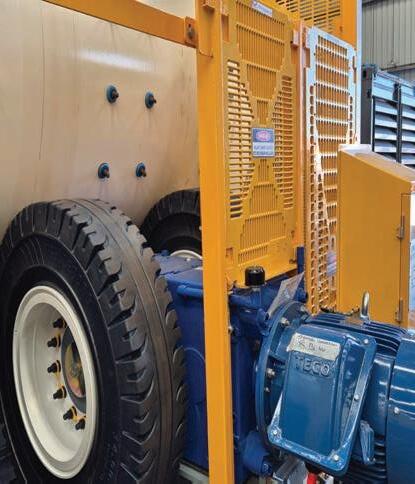
aimed at improving safety and reducing unplanned downtime. Central to this is the company’s tyre-driven slaking ball mill, where quicklime and water meet.
“That’s the heart of the lime slaking plant,” Ingleson said.
“It’s where the quicklime particles are ground, mixed with water and the exothermic slaking reaction occurs, generating steam and producing milk of lime.”
Drawing on more than 25 years of involvement in lime slaking plants, including refurbishments, troubleshooting, and audits across a wide range of installations, BHT identified common operational pain points and designed them out of its system. These include areas prone to blockages, hangups or excessive wear, and components that are difficult to inspect or maintain.
“We took the lessons we learned from auditing and maintaining other plants, not just our own, and focused on addressing those pain points,” Ingleson said.
Key improvements include a reengineered pre-wetting vortex feed bowl and mill inlet pipe, designed to reduce blockages and improve access for inspection, cleaning, and replacement. On the discharge side of the mill, BHT has incorporated options such as agitators to prevent hang-ups, improved access doors and a refined hopper design to ensure smooth slurry flow to the pump suction.
Historically, many areas have been difficult or unsafe to access, requiring scaffolding or work at height. BHT’s designs incorporate features such as additional access stairs and platforms and even integrated overhead hoists and beam trolleys to support components during removal, significantly improving safety and ease of maintenance.
“If people can’t get to an area easily, they won’t inspect or maintain it,” Ingleson said. “So, accessibility is critical. If you make it easier and safer to maintain, the plant will be more reliable over time.”
Managing operational risks
An unreliable lime slaking plant can create operational and environmental risks. Ingleson said inadequate storage capacity is a common issue.
An Australian benchmark for distinctive engineering.
We excel in the delivery of bulk materials handling projects requiring clever and complex engineering solutions.
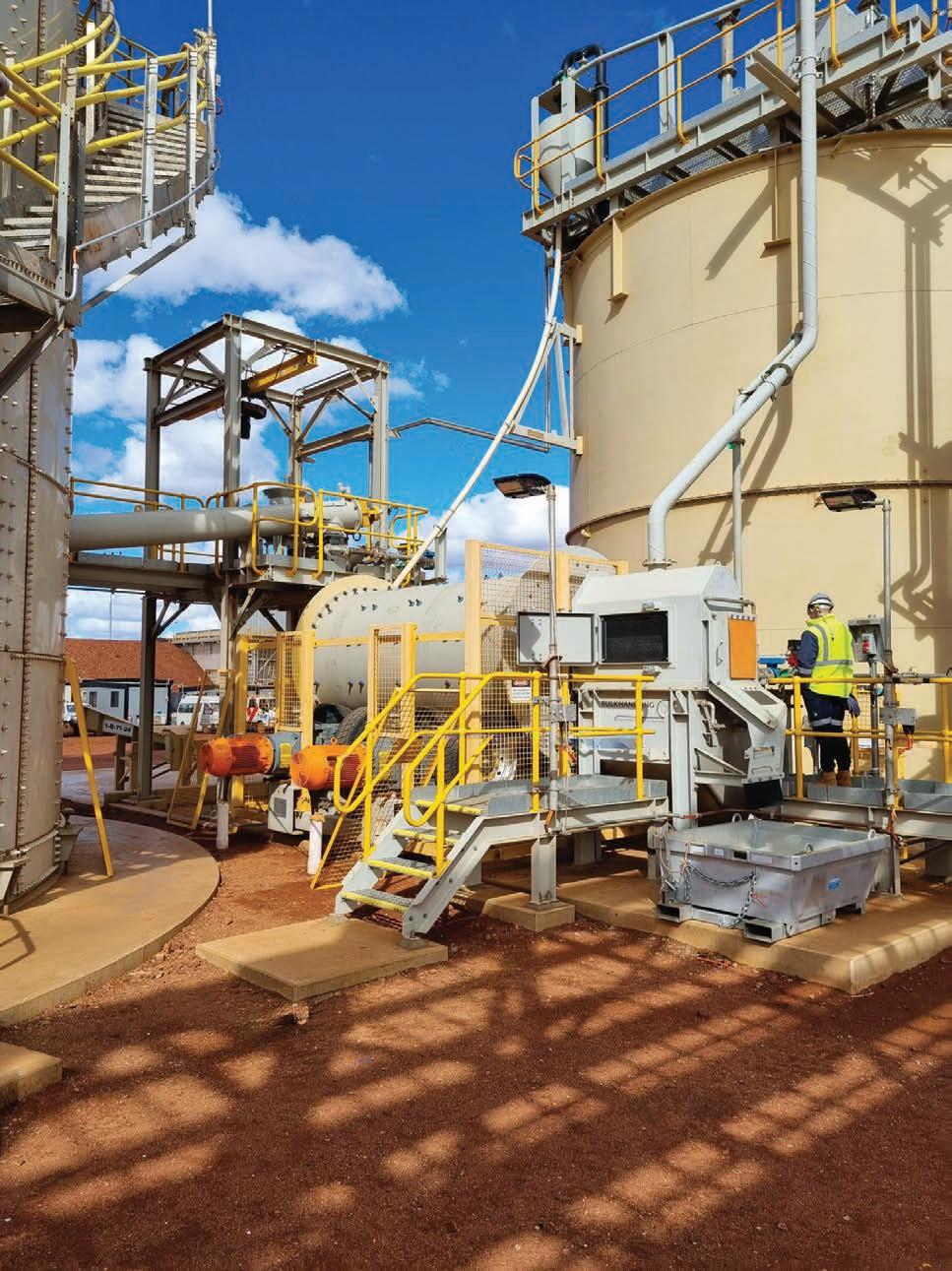
Bulk Handling Technologies’ tyre-driven slaking ball mill is central to improving safety and reducing unplanned downtime.
Images: Bulk Handling Technologies
“If sites don’t allow for the fact that deliveries can be disrupted, whether due to weather or logistics, they can run out of lime, he said. “If you can’t produce milk of lime, you may have to shut your process down entirely.”
Another key consideration is steam management. The exothermic slaking reaction produces significant amounts of steam which must be carefully controlled.
“What sites need to be wary of is making sure that steam is drawn away from the dry part of the plant,” Ingleson said. “That means having the right extraction design and ensuring the dry handling equipment can cope with higher humidity levels.”
Beyond storage and steam, overall plant layout plays a critical role. Proper access platforms, inspection points and maintenance provisions are essential to ensure components can be inspected, disconnected and serviced efficiently.
Growth driven by experience
BHT’s growing presence in the lime slaking space has been driven
less by market shifts and more by internal capability. Ingleson said the company recognised early on that it had deep expertise in this area and a genuine opportunity to offer something different.
“It’s an area we knew we had a lot to offer,” he said.
“Our engineering personnel have extensive experience in the design and manufacture of lime slaking systems, and we are currently assembling a further three systems for customers in Australia and overseas.”
Increased activity across gold mining, major plant upgrades and the rapid growth of rare earths projects have also contributed to rising demand. Each new installation has allowed BHT to further standardise and expand its range of components.
“The key is doing these efficiently,” Ingleson said. “We’re now focused on modularising larger sections of the plant so we can reduce lead times, lower costs and customise layouts without reinventing the engineering each time.
Looking ahead
Feedback from clients to date has been positive, particularly around commissioning and early operation. However, Ingleson said the real measure of success is long-term performance.
“Lime slaking systems need to remain reliable and achieve high availability throughout the life of the plant. We like to stay connected to our customers over the long term to help them achieve maximum returns on their investment,” he said. “In addition, we are always looking for opportunities to collaborate with our customers whenever opportunities arise to implement improvements.”
For BHT, the goal is clear: to establish itself as a long-term, competitive supplier of lime slaking systems.
“We want the market to know we’ve arrived,” Ingleson said. “We’re a viable option, and we’re not just doing what others have done before. We’ve brought improvements and ideas that make these plants safer, more reliable, and easier to maintain.”
Lime slaking plants are critical in bulk handling to turn quicklime into user-ready hydrated lime slurry.
TECO MV510:
Mining grade reliability. Australian backed engineering.
Stop designing your site around your hardware. Get a drive engineered for your process.
The TECO MV510 is a CAPEX-reducing solution that delivers reliable performance in crushing and milling circuits.
WHY LEADING MINES CHOOSE THE TECO MV510
• Reduced CAPEX & Footprint: Multi-motor control starts multiple assets and transfers them to fixed speed, requiring less MCC space and lower initial outlay.
• Mill Asset Protection: Dedicated Frozen Charge Protection and SBRS (Start Ball Run SAG) capability prevent damage to mill shells and bearings.
• Superior Power Quality: Multilevel H-Bridge topology ensures a near-sinusoidal waveform (IEEE 519 compliant), eliminating the need for bulky external filters.
• Drop-in Integration: Optional built-in transformers allow the TECO MV510 to match existing line voltages to your specific motor requirements.
• Extreme Resilience: Engineered to perform in ambient temperatures ranging from -20°C to +50°C.
The TECO advantage: 50+ years of local support
Call our local engineering team, a centre of excellence for mining solutions. Whether it’s a custom drop-in replacement or site-specific commissioning, we’ve supported the Australia and New Zealand market since 1983.
One team. One number. Total reliability. For a technical deep-dive contact us today!
Belt support: Options, obstacles, and maintenance
Martin Engineering’s R. Todd Swinderman outlines how proper belt support systems can prevent costly problems.
FOR A CONVEYOR TO CONTROL
dust and spillage, the design engineer must do w hatever is practical to keep the belt’s line of travel consistent.
While there are many factors that influence the belt’s running line both inside and outside the loading zone, a key ingredient is proper support.
Modern belt support systems are designed to maintain a smooth belt path with minimal bumping or disruption to settled cargo, avoiding gaps in the loading zone and minimising belt sag along the system’s length.
New designs reduce maintenance costs and improve safety by providing easier access to components and reducing the labour required for routine maintenance.
Building proper belt support
Before any support components (cradles, idlers etc.) are installed, the structure on which all conveyor equipment is attached – the “stringer” – must be precisely aligned and the footings secure.
Stringer alignment using laser surveying is the preferred method. The Conveyor Equipment Manufacturers Association (CEMA) publication Appendix D provides installation tolerances. It is imperative that footings provide rigid support to prevent movement or deflection. Engineers should account for the amount of material being loaded and the force of the impact to prevent excessive belt deflection under the load.
As noted in Martin Engineering’s Foundations industry reference book, the belt’s line of travel must be stabilised with proper support in the loading zone to achieve an effective, minimumspillage conveyor.
With a true belt line, support components can better maintain a sealed environment. According to CEMA there are several techniques and
components that control belt sag by improving belt support in the loading zone. They include idlers, belt support cradles, and impact cradles.
Idler type and rating
Idlers shape and support the belt and cargo, while minimising the power needed to transport the materials.
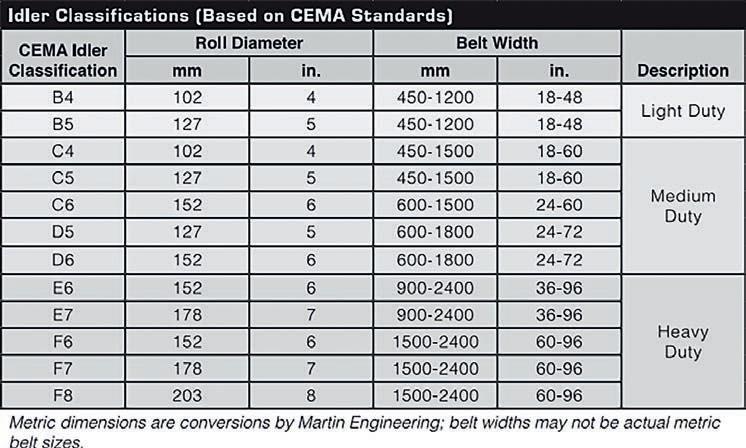
They are classified by roller diameter, service type, operating condition, belt load, and belt speed, and then rated for load-carrying capacity and calculated bearing life.
CEMA uses a two-character code that indicates the idler classification
and implied load rating, with a letter code followed by the idler diameter in inches, resulting in classes from B4 to F8.
Troughed carrying idlers typically consist of three rolls: one horizontal roll in the centre with inclined (or wing) rolls on either side. These support and shape the belt into a specific trough angle for the conveyance of cargo
Impact idlers typically have a similar load rating to standard idlers, with the same shafts and bearings.
One disadvantage is that each idler supports the belt only at the top of the roller, so the rounded shape and
A sealed belt in the loading zone requires an even, well-supported belt path with no sag.
Images: Martin Engineering
deflective rubber will allow the belt to oscillate or sag away slightly from the ideal flat profile.
Picking idlers have a shallow trough with a wide base, giving larger raw
Without that wide base, large chunks would drift to one side of the belt or the other, causing misalignment.
Offset idlers place the centre roller slightly in front of the wing rollers. By
set, this configuration is well-suited to cramped spaces, such as mines that require heavy-duty support but lack space.
Belt sag
Belt sag, when viewed from the side of the transfer point, is the vertical deflection of the belt from a straight line across the top of the two adjacent idlers. Even a millimetre of sag is enough to permit fines to become entrapped,
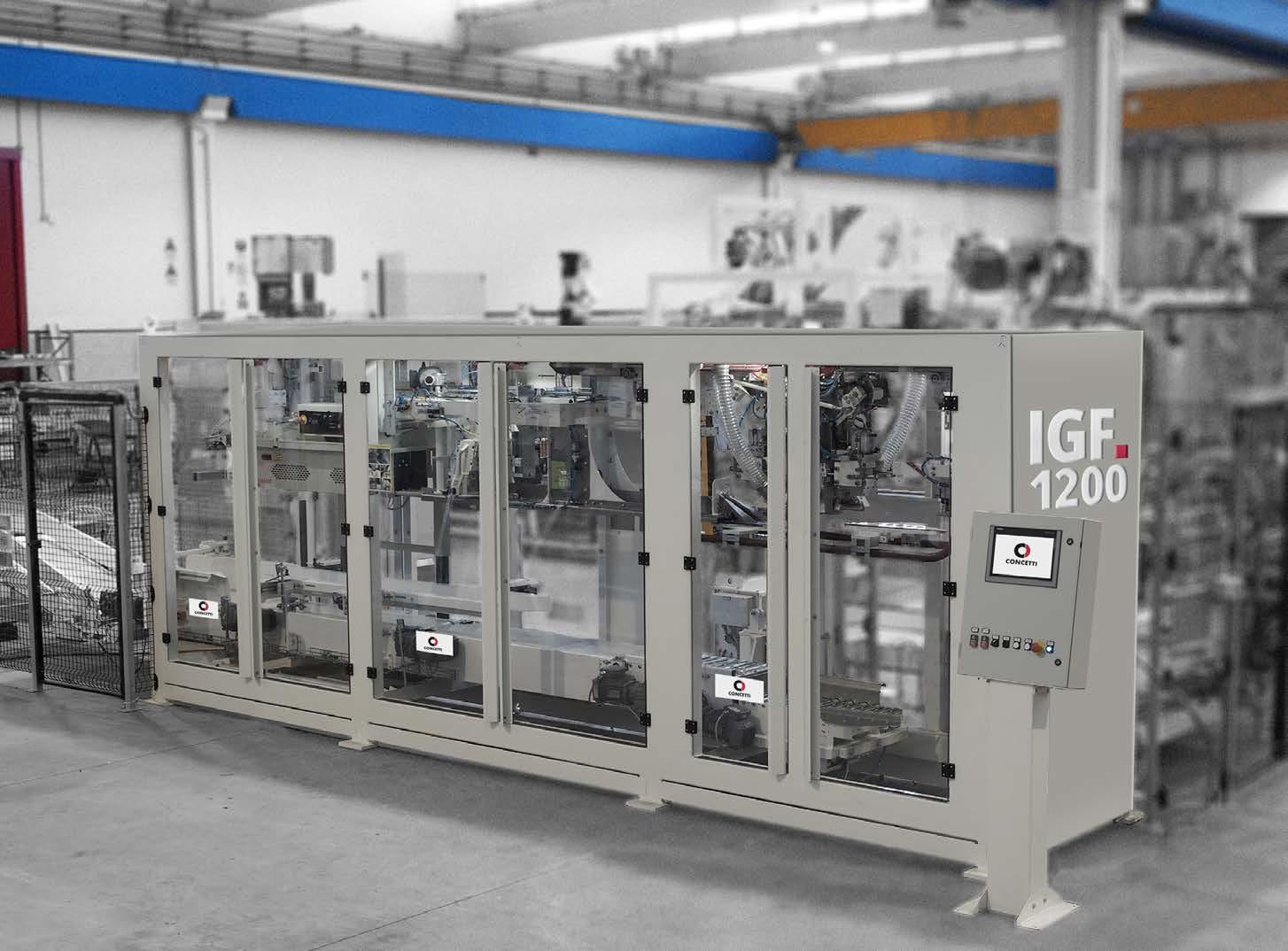
BAG PACKAGING LINES FOR ANIMAL FEED
Impact idlers have padded, impact absorbing rollers.
typically high-temperature friction and belt damage, requiring unscheduled downtime to fix.
Idler spacing and power consumption
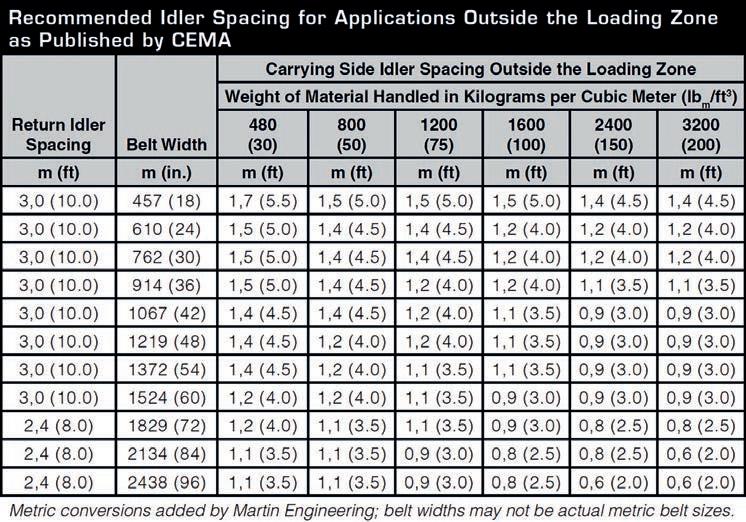
Sagging causes the load to shift as it is carried up and over each idler and down into the valley between, increasing belt wear and power consumption while contributing to fugitive dust and spillage. This complicated mathematical relationship has been published. CEMA has produced tables of recommended idler spacing for applications outside the loading zone.
Idler maintenance
When idlers seize or sustain damage, the unprotected underside of the belt can be damaged as well.
Extreme temperatures from the friction may cause combustible cargo or the belt to ignite, carrying the fire the entire length of the belt within seconds.
In the past, an idler set could be difficult to access and change, often requiring the worker to reach in past the belt plane. To address this issue, track-mounted idlers are designed as an in-line set on the same track assembly, engineered to be easily extracted in separate sections for maintenance outside of the conveyor plane.
This enables faster, easier maintenance in a safe environment, reducing labour and downtime.
Impact cradles in the loading zone
Impact cradles continuously support the belt edge, eliminating belt sag between the idlers.
Some bulk-handling operations drop material from a great height. Repeated high-magnitude impacts without proper support can damage the belt.
An example would be a 45.7cm lump of sandstone dropping around 2m. This lump will hit the belt with the same energy as a fully loaded refrigerator falling around 3m.
To minimise these negative effects, impact cradles are constructed of a steel support framework with individual impact-absorbing bars made from durable elastomeric materials that combine a slick top surface with one or
more sponge-like secondary layers. Some models allow the bumpers to be flipped to double the service life.
Support cradles
Instead of using rolling idlers following the impact cradle, support cradles use low-friction bars to support the belt profile. Support cradles perform two functions: controlling belt sag in the load zone to reduce spillage and providing a slick surface on which the belt can ride. Other benefits of using cradles under the transfer point include fewer moving parts and no lubrication is required.
Cradle maintenance
Some cradles are engineered to slide away from the stringer. Much like pulling out a drawer to a filing cabinet, a single worker removes the locking pin in a one-tool
procedure and simply slides the cradle into the open-access area to perform maintenance outside of the belt plane.
This creates a safer work environment, improves access for higher quality maintenance, reduces the amount of labour needed and minimises the amount of downtime required for the procedure.
Conclusion
By implementing proper belt support systems, operators can prevent costly problems caused by fugitive material.
It is better to design a system that incorporates the slightly higher power consumption required to prevent spillage, rather than suffer the much higher power consumption and greater consequences of fugitive material. The costs of installing and operating belt-support systems represent an investment in efficiency.
CEMA idler spacing chart
A “combination cradle” uses bars for sealing the belt edge and rollers to support the centre.
Global manufacturing meets local expertise: DHHI expands its footprint in WA
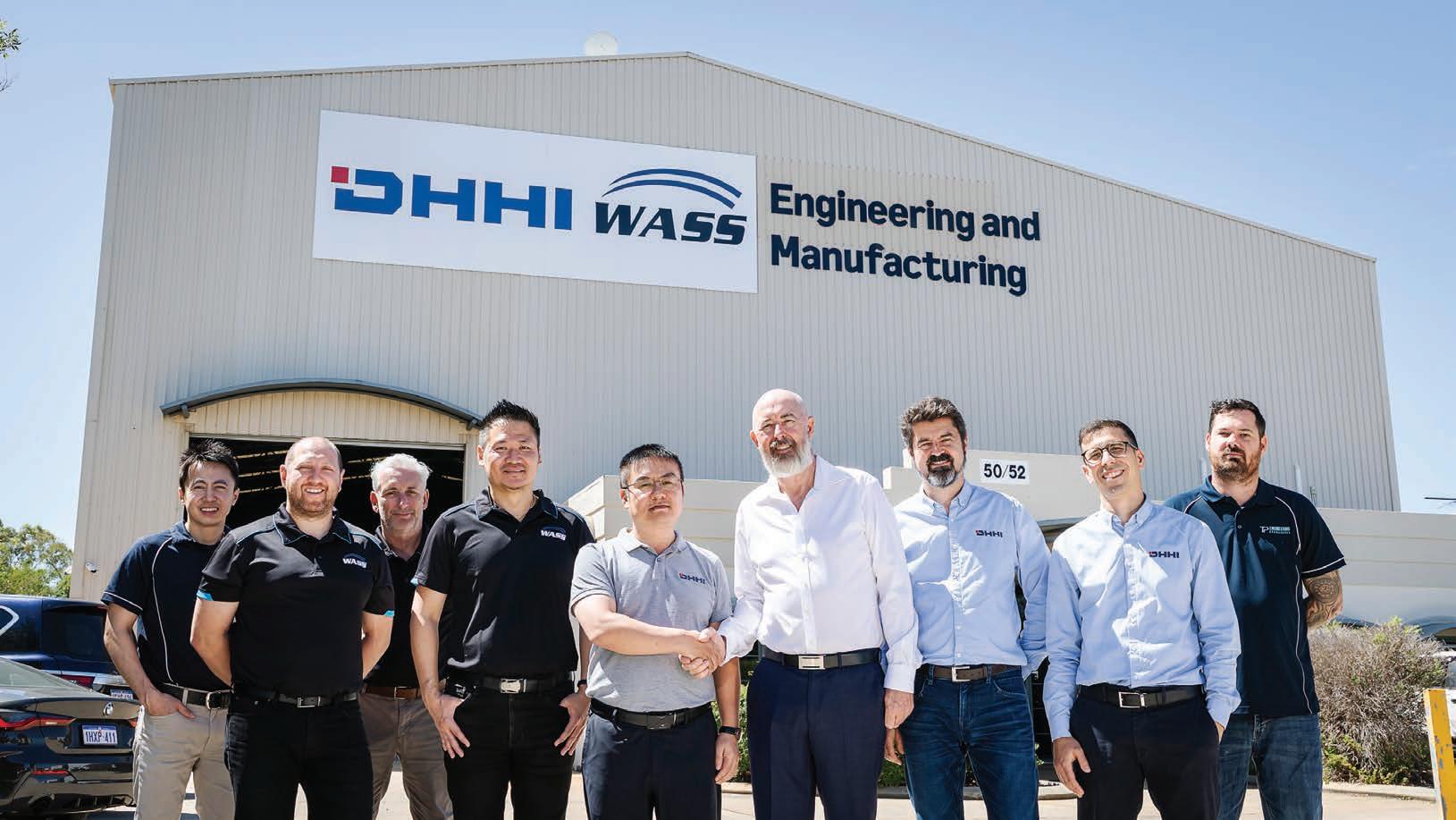
DHHI has partnered with WA Site Services to strengthen equipment lifecycle support for Australia’s iron ore industry, supported by the development of a new warehouse and workshop facility in Western Australia.
IN WESTERN AUSTRALIA’S
Pilbara region, where distance, scale and production demands are part of daily operations, reliable local support is critical. Located hundreds of kilometres from Perth, the resourcerich territory is home to some of the world’s largest mining operations, where equipment availability directly impacts productivity.
Having WA-based support enables mines to respond quickly to shutdown schedules as well as unexpected equipment failures, minimising costly downtime and keeping critical assets operating.
WA Site Services (WASS) managing director Ron Ayerst told ABHR that strong local capability is essential for operators in the Pilbara.
“It’s a tight community,” he said. “Having experience working in the Pilbara makes a big difference. Local knowledge and rapid response are extremely valuable.”
and the Pilbara, WASS brings decades of experience in mining maintenance,
shutdown execution and component rebuilds, primarily in iron ore and bulk materials handling. That operational expertise made the company a natural partner for DHHI, which has been expanding its long-term presence in Australia through the DHHIWASS collaboration.
International collaboration
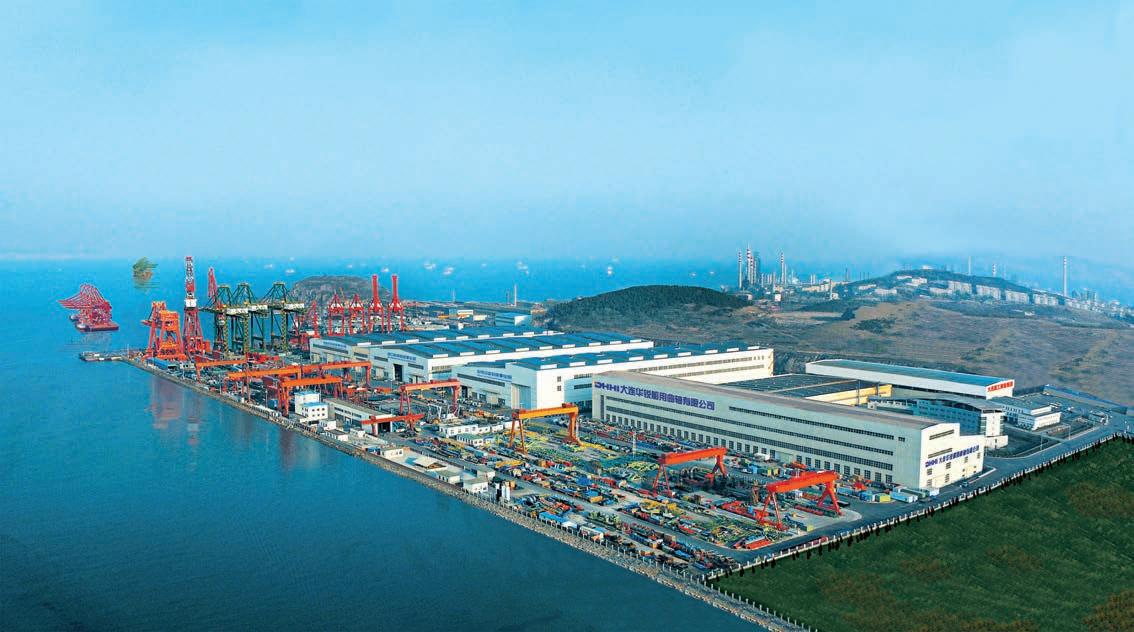
Headquartered in Dalian, China, DHHI is a global engineering specialist and manufacturer of heavy machinery supporting major mining and bulkhandling operations worldwide, including tier one producers. The company operates five manufacturing and research facilities across more than 2.5 million square metres and produces approximately 650,000 tonnes of steel structures annually, including stackers, reclaimers, shiploaders, conveyors, car dumpers and
service presence in Australia under the DHHI-WASS banner creates significant value for customers.
“DHHI delivers cost-effective, highquality products,” he said. “Overseas manufacturing is highly competitive, but local turnaround times for spare parts, rebuilds and repairs are equally important. Mining operations can’t afford extended delays, whether during shutdowns or in unexpected breakdown situations.”
The partnership integrates DHHI’s international engineering and manufacturing reach with WASS’s local service capability, creating a unified DHHI-WASS platform focused on faster delivery, improved reliability and full lifecycle support.
The centrepiece of this collaboration is the new DHHI-WASS workshop in Canning Vale, Perth.
DHHI is a global engineering specialist and manufacturer of heavy machinery.
Images: DHHI
Operating under the joint DHHIWASS banner, the partnership combines DHHI’s global engineering and manufacturing capability with WASS’s on-the-ground expertise to deliver faster turnaround times for component rebuilds, improved equipment availability, and enhanced support for both planned maintenance (shutdowns) and unplanned repairs across the region.
It enables off-site repairs and component rebuild programs supported by locally available inventory, designed to deliver faster turnaround times for both planned shutdown maintenance and rapid-response unplanned repairs.
Ayerst said the traditional repair cycles can involve extended delays due to quoting, measurement, rebuilding and logistics.
“By having capability and stock available locally, we can significantly reduce turnaround times,” he said. “The DHHI partnership allows us to respond faster to rebuilds, scheduled work and urgent repairs.”
DHHI aftermarket manager Pedro Carvalho said the facility is central to the company’s long-term Australian strategy and the growth of the DHHI-WASS brand.
“Our model focuses on keeping critical components available locally,” he said. “Pre-positioned inventory and
rebuild capability allow us to prepare components faster and at lower cost. In the iron ore sector, availability is everything. Local storage of spare parts supports shutdown planning, rebuild programs and immediate response to unexpected failures.”
The DHHI-WASS partnership reinforces DHHI’s commitment to full lifecycle support for mining equipment, spanning engineering and optimisation, parts supply, maintenance services, and upgrades and rebuilds. This model is underpinned by local parts storage and component rebuild capability at the workshop, alongside integrated on-site maintenance services delivered jointly by the DHHI-WASS team, including shutdown execution and field repairs.
Equipped with two cranes, including a 25-tonne overhead crane, as well as a painting booth and washing bay, the facility is designed to handle large-scale mining components. It is staffed by experienced local personnel with extensive Pilbara industry knowledge operating under the joint DHHI-WASS banner.
“While our manufacturing strength remains in China, expanding our local support capability has been a strategic priority,” Carvalho said. “The WASS team brings years of experience in shutdowns, rebuilds and field services. Partnering
with them under the DHHI-WASS banner was the logical step to deliver stronger support to Australian clients.”
Long-term commitment to Australia
Early feedback from customers has been positive, with several clients already engaging the DHHI-WASS partnership for rebuild programs, shutdown support and ongoing service work.
DHHI plans to continue expanding its Australian footprint, with future growth focused on strengthening regional support networks, including the establishment of a dedicated Pilbara branch operating within the DHHIWASS framework.
“Local support is fundamental to our approach,” Carvalho said. “We are investing in Australian capability, employing local talent and reinvesting in infrastructure that supports the mining industry. Our goal is to build longterm partnerships that improve safety, performance and equipment availability across rebuilds and both planned and unplanned maintenance activities.”
Through the DHHI-WASS collaboration, DHHI is positioning itself as a long-term partner to Australia’s mining industry, combining global manufacturing scale with local expertise to deliver faster, more reliable lifecycle support.
The DHHI-WASS workshop is located in Canning Vale, WA.
September 2026
EXHIBIT IN 2026. BE SEEN. BE HEARD. BE CHOSEN.
A personal touch
ABHR spoke with John Carlson from the Conveyor Components Company to learn how it provides top quality care from across the globe.
is an important
The Michigan-based business aims to provide a personal touch by building relationships with its customers through side of the world can make that a different time zones can be challenging,
“We’re doing a lot of our discussions through email and video calls,” he said. “The one challenge we face the most with international customers is being able to
Conveyor Components Company has established robust supply chains to make company to build strong relationships with the Chilean mining industry.
“Chile is a huge market for us. There are a lot of precious metal mining operations and an immediate need for our rope stop switches,” he said.
“A lot of these conveyors are overland, moving raw material across large areas, 24/7, and there’s not always personnel around them. We’ve had cases where the customer has contacted us and told our team that they’re losing material, but they don’t find out till they get there, or a conveyor has gone down because there was a belt tear.
“That’s where we come in and start to help educate them on how we can help.”
By taking this collaborative approach, the Conveyor Components Company can find out the problems a site is facing. One of the common issues the company
purchase a specific component that may only address one symptom.
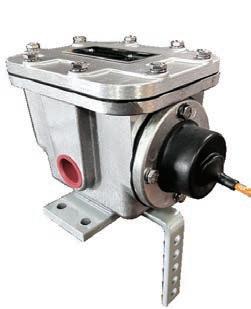
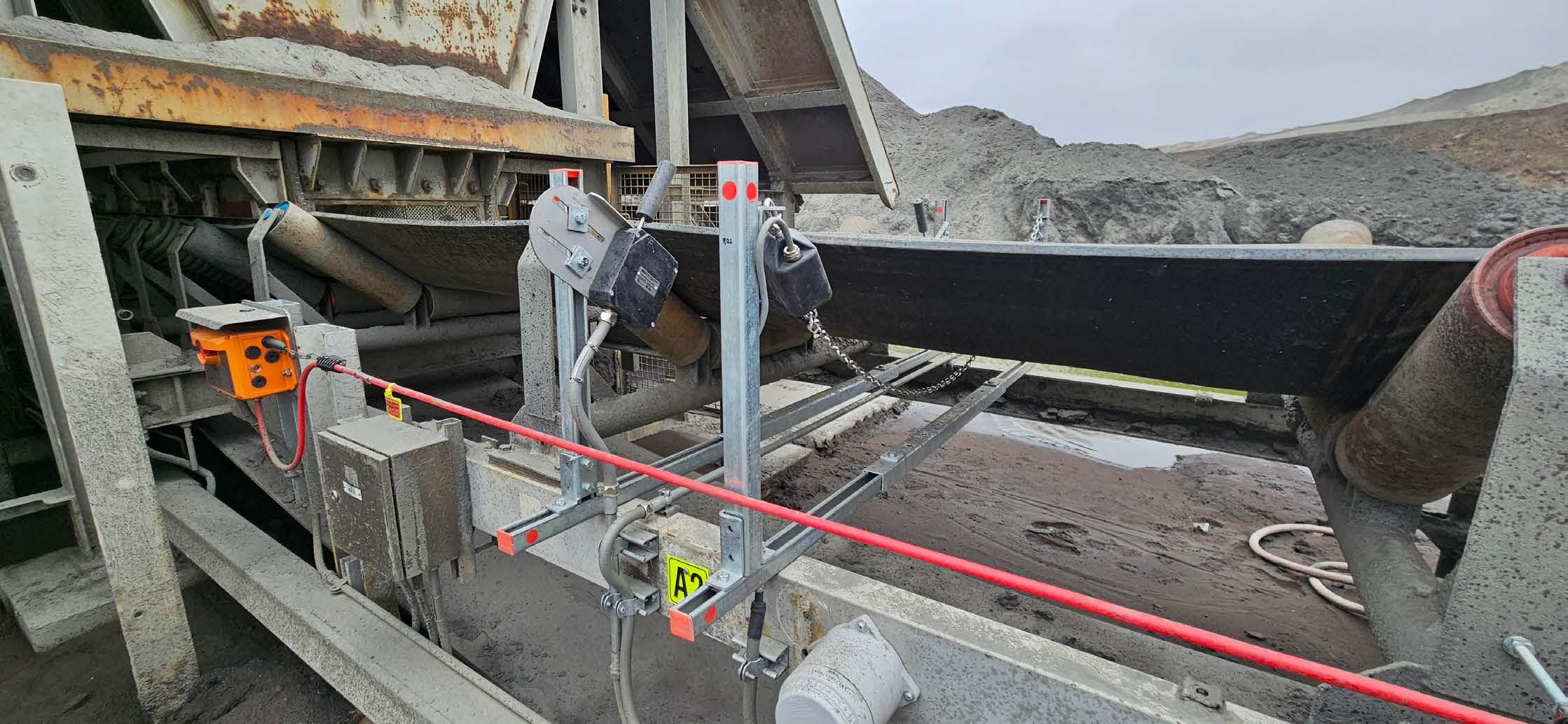
The Conveyor Components Company designed its Conveyor Safety System (CSS) to help clients get the most out of safety equipment. It combines multiple essential safety switches into a single, cost-effective system.
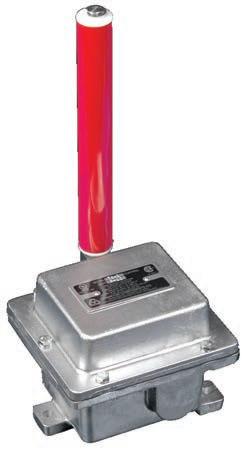
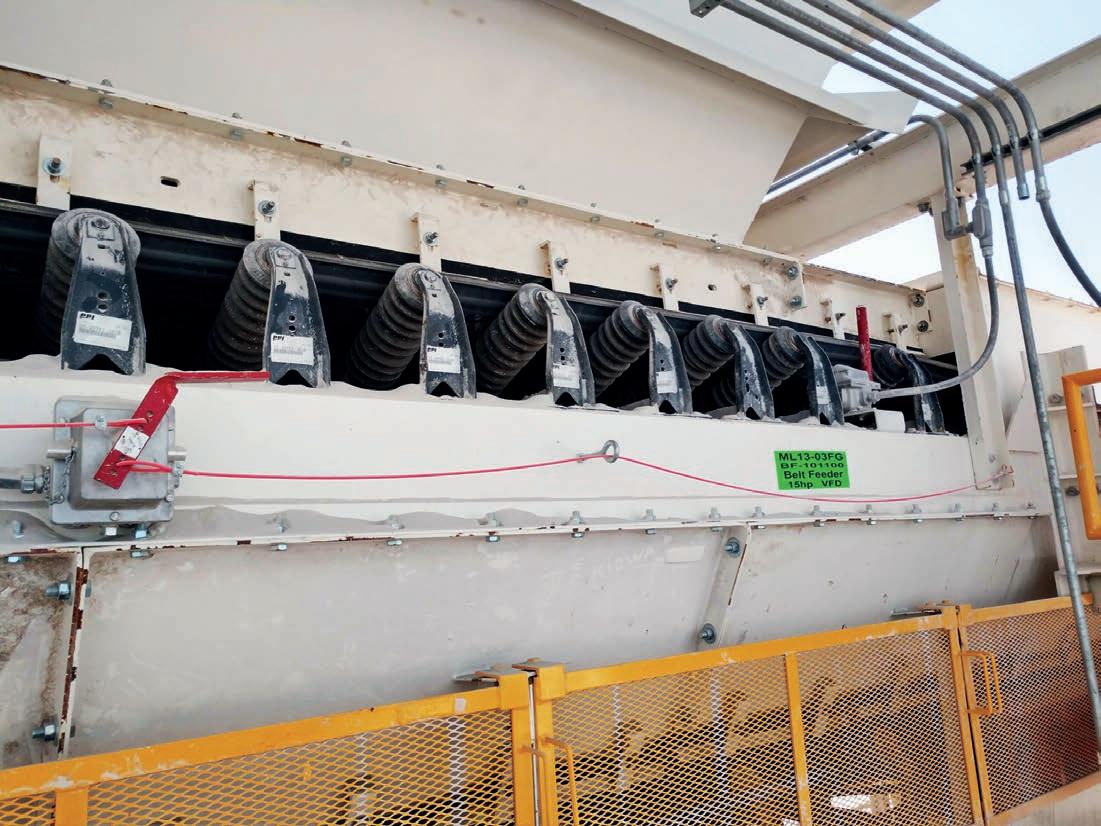
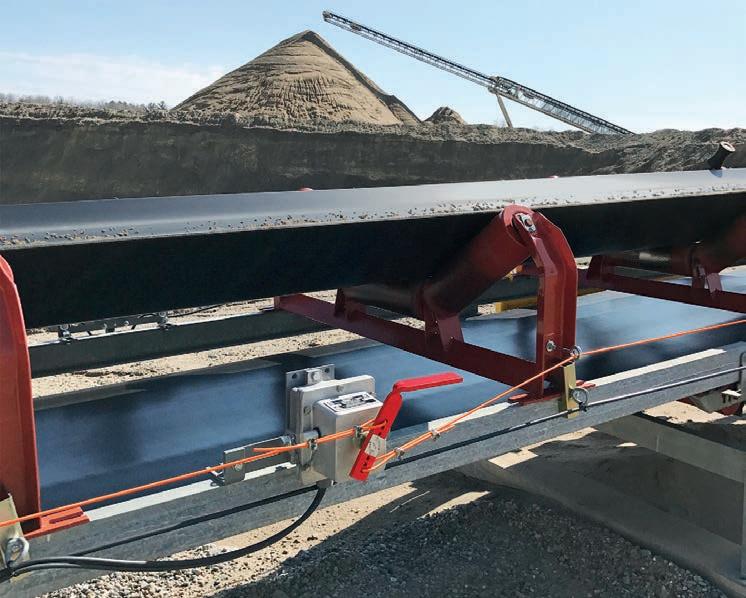
One of the key components is the Model RS, a pull-cord safety stop switch, which allows operators to halt the conveyor instantly by pulling a cord along its side.
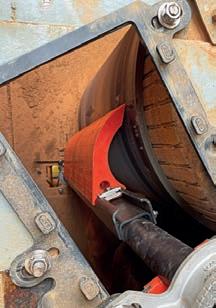
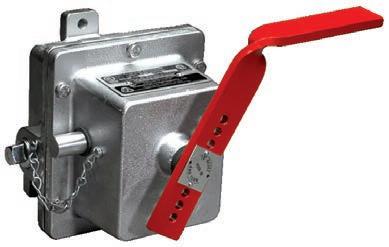
Supplementing this is the Model TA belt alignment switch, which can act as an alarm or shutoff switch if it detects a
Conveyor Components Company has been supporting international clients for more than 50 years.
Images: Conveyor Components Company
safety benefits, finding tears in a belt early means it can be repaired quickly, before a catastrophic repair bill and unplanned downtime can occur.
“When a customer has a request for us, we have a customer service group that works on their immediate needs,” Carlson said.
At the same time, the sales team takes that case from the customer service representatives and introduces all of the
other products, making sure they get the right thing and seeing what additional products we may be able to offer, along with training,” he said.
Rapid response
Another key consideration for international support is a fast turnaround time.
Carlson said the company knows customers can’t afford to have machines down for long, so it will send replacement parts as soon as possible, usually within 24 hours.
“Our immediate goal is to get the customer up and running, especially in situations where there has been a breakdown,” he said.
“We send them a replacement product as fast as we can, and in the meantime, we investigate the failure modes and determine what the customer can do to avoid a similar situation from occurring again.
“Once we start working with a customer, we are in a partnership with them. We want to be a supplier they want to work with, so it’s important we anticipate their needs.”
The Conveyor Components Company plans to expand rapidly into Australia in 2026, with the goal of finding a distributor that can further enhance its understanding of the market.
Carlson said the team will also attend ConExpo/Con-Agg this year, along with a fully functional conveyor equipped with the CSS. Customers will be able to get up close and look at the installation methods, the wiring, and activate each switch to see how it interacts with a programmable logic controller.
“We’re establishing relationships with local Australian distributors to ensure we can meet the industry’s needs,” Carlson said.
“Most importantly, we want to ensure we’re bringing a product and high-quality service that the Australian market needs.”
Conveyor Components Company designed its Conveyor Safety System to help clients get the most out of safety equipment.
The Model RS is a pull-cord safety stop switch that allows operators to halt the conveyor instantly.
Precision meets performance
The launch of Concetti’s C-Lab indicates a new era for the company.
WHETHER IT’S CEMENT, dry mix, food, or chemicals, Concetti equipment handles a vast range of powders and granular materials, each with its own quirks.
Some products are free-flowing, others sticky. Some are abrasive, some segregate easily, and some behave differently depending on how they are fed into a system.
Even products that appear straightforward can present unexpected challenges. Mitford said sugar a prime example.
“You wouldn’t normally think of sugar as abrasive, but it can be,” Mitford said. “And beet sugar behaves differently to cane sugar. Where the product comes from, how it’s processed and the environment it’s handled in all make a difference.”
Cement is another case in point. Hot cement behaves very differently to cold or ambient cement, while pneumatically conveyed material will be far more fluid than product delivered via conveyor or gravity feed. These variables influence everything from bulk density and flow characteristics to weighing accuracy and bag stability.
“For us to give meaningful performance guarantees to customers, we need to understand all of that,” Mitford said. “Otherwise, you’re relying on assumptions, and that’s where mistakes happen.”
“If you don’t get a clear understanding of materials handling, you’ve got no chance of weighing accurately, filling a bag properly, or creating a pallet that’s safe, stable, and presentable,” Mitford said. “Everything starts with how the product behaves.”
The evolution of Concetti’s testing approach
Concetti has long placed importance on product testing. Previously, testing was carried out using relatively basic equipment, effective for its time, but increasingly limited as materials, packaging requirements, and sustainability expectations have evolved.
“25 years ago, we were probably doing more product testing than most of the industry,” Mitford says. “But technology moves on. Science moves on. We wanted to stay at the forefront.”
To replaces manual, experienceheavy testing, Concetti has launched Concetti Lab (C-Lab), which uses modern laboratory technology to deliver faster, more accurate and repeatable results.
“When material arrives in our hopper, it’s usually at loose bulk density,” Mitford said. “By the time it’s in the bag, ideally, it’s closer to tapped density, the air has been removed and the product has settled. C-Lab helps us understand how long that process takes and how the product responds to different handling methods.”
That data feeds directly into system design, from infeed configuration through to weighing, bag filling
Preventing segregation
One of the most critical risks C-Lab helps address is segregation, particularly in blended products such as dry concrete mixes. Customers often invest significant time and energy ensuring recipes are mixed correctly, but poor handling between the mixer and the packing line
“If you drop a mixed product too far under gravity, you can easily de-mix it,” Mitford said. “Aggregates, sand, and cement will separate, and suddenly you’ve got an inconsistent product in the hopper.”
C-Lab allows Concetti to test and validate handling concepts before a system is built, ensuring the infeed and transfer design preserves product integrity rather than compromising it.
“This is about avoiding mistakes at the front end of a project,” Mitford says. “It’s much easier to fix a problem in a lab than on a live production line.”
A more open, collaborative facility
Beyond the technical benefits, C-Lab has also changed how Concetti engages with customers.
The laboratory is located within Concetti’s factory in Bastia Umbra, near Assisi in Italy, and doubles as a meeting and collaboration space.
“In the past, testing was hidden away,” Mitford said. “Not because we were ashamed of it, but it wasn’t something you’d proudly bring customers into. Now we can.”
Customers visiting the factory can see their full line assembled and commissioned with their own product, bags, and pallets, exactly as it would be installed on site. From C-Lab, positioned above the factory floor, they can observe testing and commissioning while reviewing data and performance results in real time.
“It’s a proper laboratory, but it’s also a space for discussion,” Mitford said. “We can sit down with customers, explain how we’ve tested their product, show the results, and answer questions openly.”
Sustainability through better handling
While C-Lab delivers clear benefits in efficiency, accuracy and reliability, Mitford said its broader value lies in sustainability.
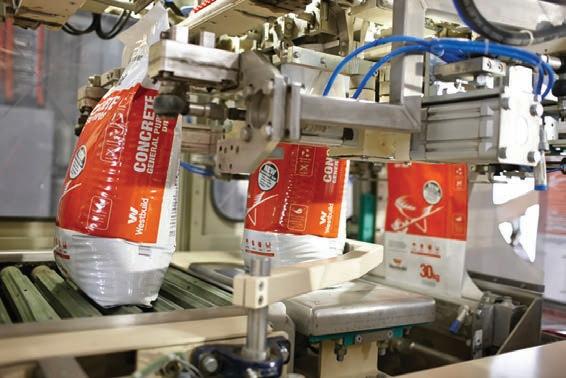
Bags of cement are tested at Concetti’s C-Lab.
“How much product is wasted globally because it hasn’t been packed correctly?” he asked. “I saw figures years ago suggesting up to 14 per cent of cement was wasted in some markets. Think about the energy that goes into producing that cement and then think about the environmental cost of losing it.”
Reducing product loss through better handling, weighing and packaging may not grab headlines in the same way as renewable energy or electrification, but Mitford said it is an essential piece of the sustainability puzzle.
“If we’re better at what we do, everyone benefits,” he said. “Less waste, lower energy loss, safer working environments, and higher productivity. C-Lab helps us contribute to that in a very real way.”
Investing in the future
C-Lab is the result of nearly two years of planning, designed to support Concetti’s sales, technical and R&D teams.
“It’s not just there for us,” Mitford said. “It’s there for the customer.”
Concetti will continue to work with evolving materials, packaging formats and sustainability
World leaders with 50 years’ experience in Bulk Materials Handling Research and Consulting
TUNRA Bulk Solids develops custom solutions to suit the individual needs of our clients.
Services:
Flow Properties and Materials Testing
Dust (environmental) Testing
Wear Testing (Impact, Abrasion and Erosion)
Conveyor Belt, Idler Roll and Pulley Testing
Discrete Element Method (DEM) Modelling
DEM Calibration Testing
Materials Handling Consultancy and Contracted Research
Bin and Stockpile Design
Pneumatic and Hydraulic Conveying
Computational and Scale Modelling
Site Visits
Professional Development Courses
requirements, with C-Lab at the forefront of it all.
“We never stop trying to improve,” Mitford said. “This is just the next step.”
2026 Professional Development Opportunities:
Storage, Feeding, Transfer and Belt Conveying Course: 23-27 March (Online)
Storage, Feeding, Transfer and Belt Conveying Course: 19-21 May (Brisbane)
Storage, Feeding, Transfer and Belt Conveying Course: 17-19 November (Perth)
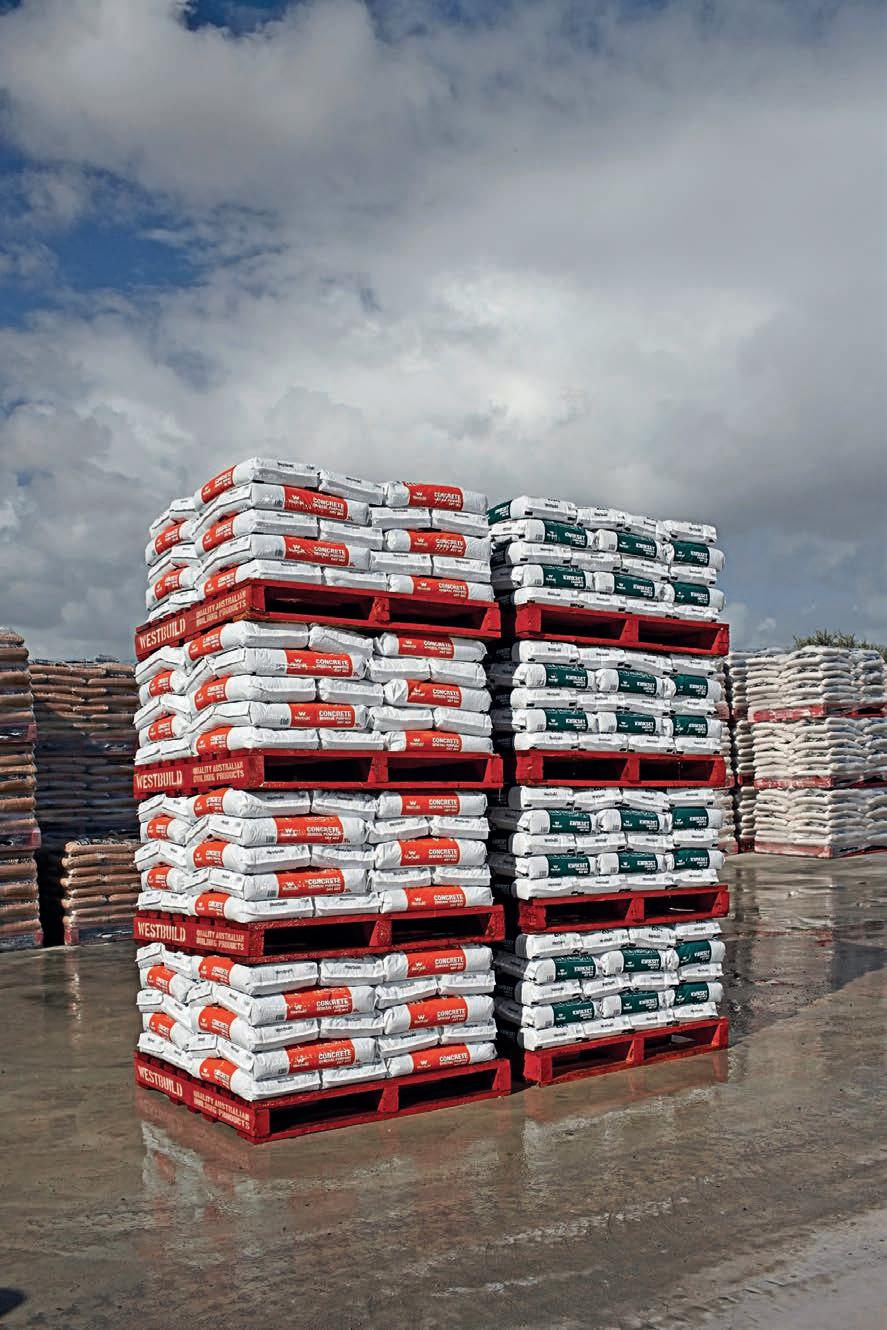
Concrete pallets at Westbuild Australia.
Images:
Concetti
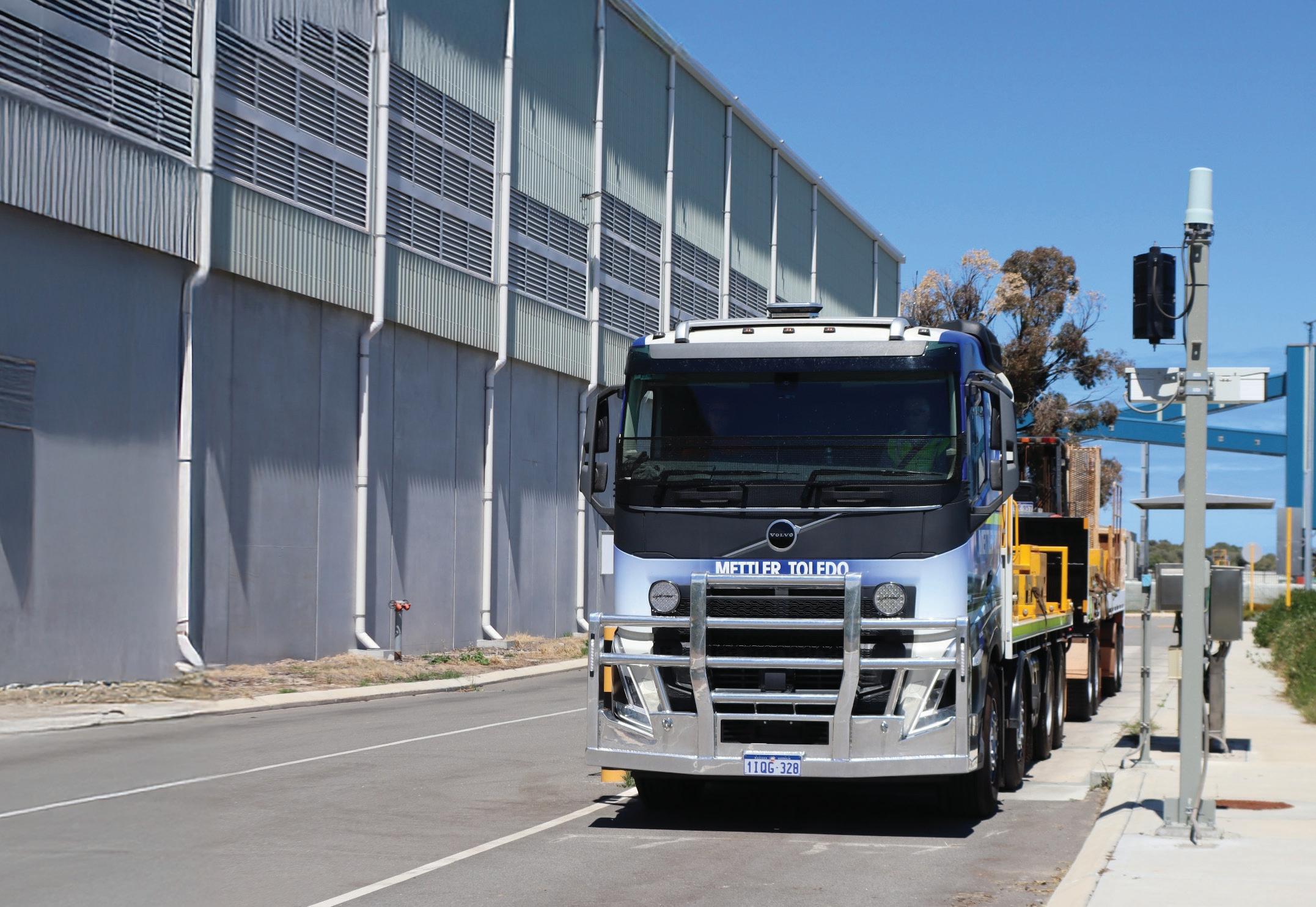
METTLER TOLEDO’s new test trucks
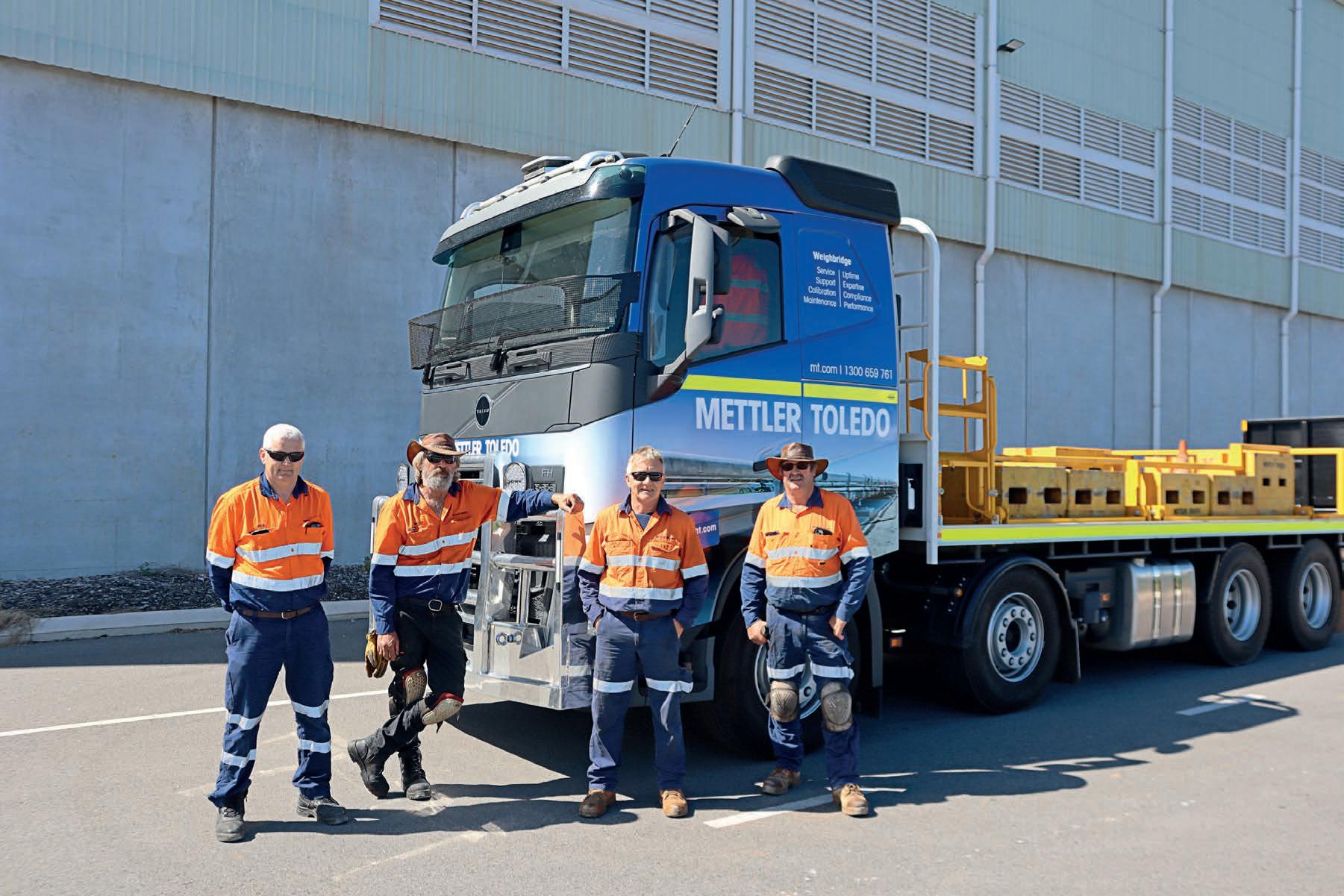
METTLER TOLEDO gives customers control with its new trucks.
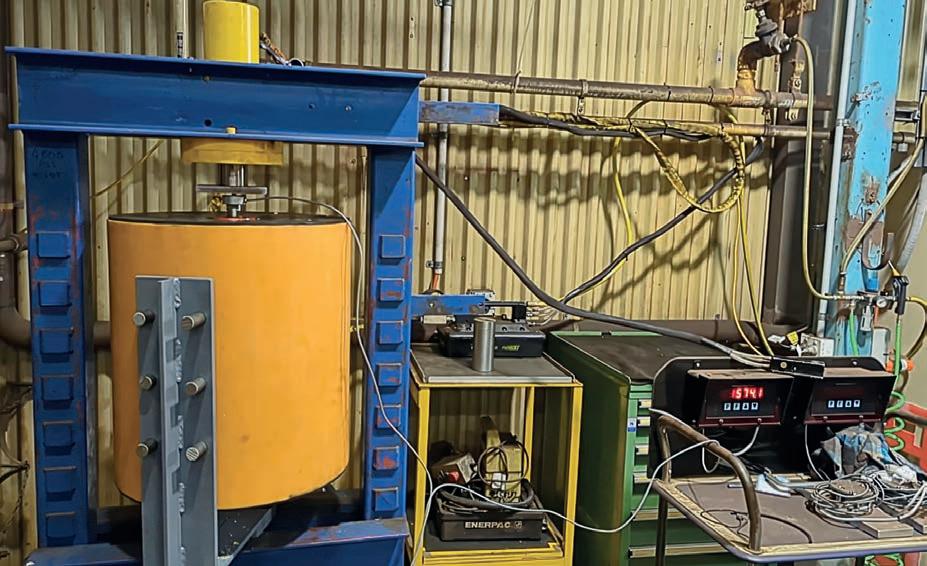
METTLER TOLEDO has launched new test trucks and forklift trucks, marking a significant milestone in servicing clients across Western Australia and beyond.
The company offers automated
used in industries such as agriculture, transportation, logistics, and mining to ensure accurate payload management, enhance safety, and improve operational efficiency. These solutions include weighbridges, in-motion axle weighing
Bick said customers commonly experience delays due to service providers lacking their own fully functioning test trucks and certified weights.
“Many suppliers rely on subcontractors or unreliable vehicles
The ability to deploy both trucks on larger capacity weighbridges allows METTLER TOLEDO to conduct servicing and calibration more quickly and safely.
Images:
METTLER TOLEDO
In safe ARMS
Rema Tip Top has partnered with a specialist to offer a solution that provides mines with real-time insight into roller health.
MANUAL INSPECTION OF CONVEYOR
rollers relies on humans, and as a result, can be highly subjective.
People can interpret things very differently, especially when in the field next to a conveyor, in a noisy operating environment.
On top of this, depending on the length of a conveyor, the process can be a lengthy process that keeps workers from other important tasks.
For many mines, the faster this process could be automated, the safer and more reliable a conveyor system would become.
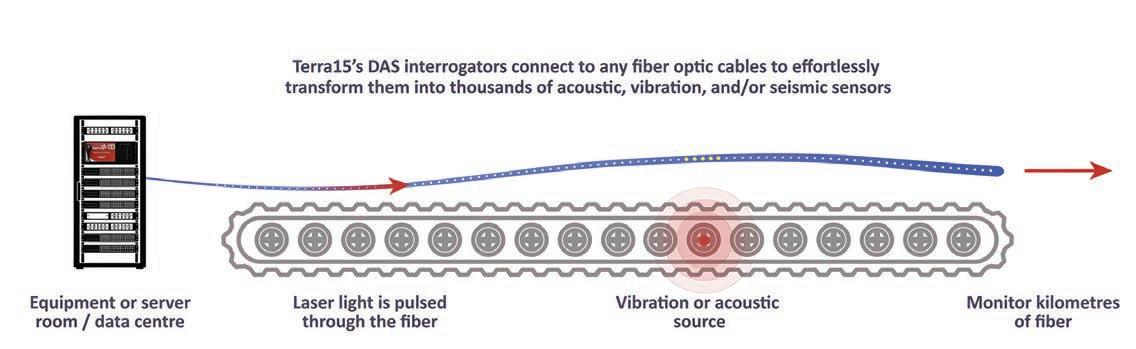
Terra15, a specialist in distributed acoustic sensing (DAS) systems, has developed a solution to fill this need.
Terra15 chief geoscientist and sales manager Albert Carmenate said the company’s technology was created to address a gap in the market.
“The idea was to build this DAS system that was fundamentally different from all of the other DAS devices out
To help commercialise the product, Terra15 established a partnership with REMA TIP TOP, which invested in creating a dedicated division to support the technology and help grow its use in conveyor monitoring.
The partnership led to the introduction of the Automated Roller Monitoring System (ARMS), a solution designed to support mining operations with continuous, real-time insights into roller health.
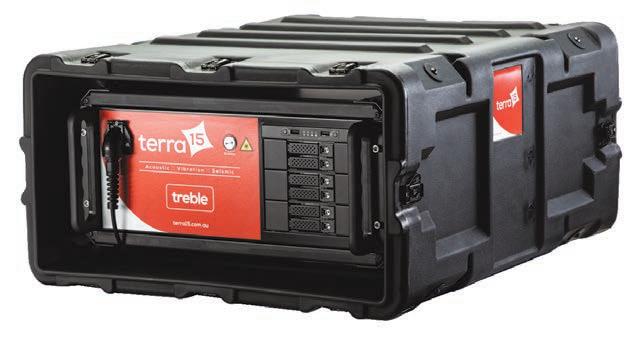
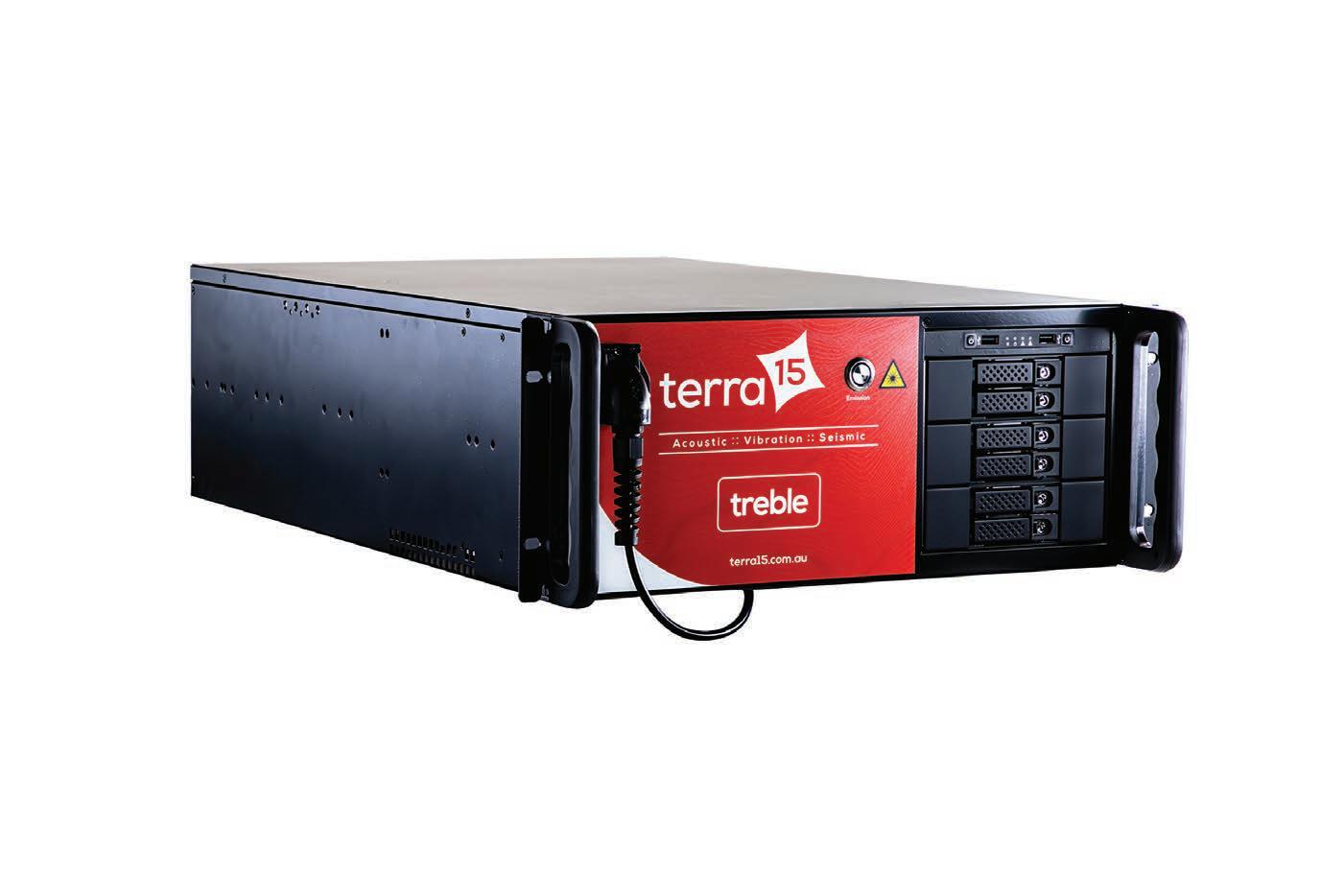
At the core of this system is the Treble interrogator, a Terra15developed device that sends thousands of laser pulses every second through a cable. It detects subtle changes in the backscattered signal caused by vibrations, allowing the system to pinpoint emerging issues with precision.
All data is processed through AssureSrv, a secure, cloud-based software platform, enabling remote access and real-time visibility for authorised users with internet access.
The Treble interrogator is a device that sends thousands of laser pulses every second through a cable.
REMA TIP TOP provides the endto-end supply, installation, and commissioning of the ARMS.
DHHI’s local After Sales team supports your operation and equipment throughout its entire lifecycle, providing reliable and cost effective solutions every step of the way.
New Machines
DHHI is a major supplier of balanced machines for Tier 1 and 2 Australian and international mining companies.
End of Life Life enhancements, capacity upgrades and deconstructions.
Spare Parts
Along with low cost sourcing, rotables and service exchange, DHHI’s key strength is manufacturing high-quality and low-cost spare parts for both DHHI and non-DHHI equipment.
Managing and executing high risk maintenance activities, both planned and unplanned.
Contact for spare parts parts@dhhi.com.au
Engineering and Optimisation
Onshore and offshore structural, mechanical, electrical, control systems and reliability engineering as well as ongoing technical support.
Belt Wise plants its flag in Papua New Guinea
Belt Wise managing director Beau Wise explains to ABHR why the company set up a PNG division.
FROM GOLD AND COPPER TO agricultural commodities, Papua New Guinea (PNG) relies heavily on conveyors, loaders, specialised vehicles, and materials handling systems to keep product moving from pit to port.
Yet while the need for bulk handling infrastructure is undeniable, the market has long lacked something just as critical: local, on-the-ground expertise.
For many operators, equipment supply and technical support has traditionally come from offshore, often from Australia, the United States, or China. That gap in direct expertise was a key driver behind Belt Wise’s decision to establish a dedicated PNG division.
Belt Wise managing director Beau Weiss said the move was both professional and deeply personal.
“My family, going back two generations, have been working in the mining sector in PNG, and my father was raised there,” Weiss said. “So, we have a personal attachment to the mining sector there and to the local communities. Professionally, I’ve always been involved with the PNG market, so because of those reasons, it became imperative for us to specifically branch out there.”
While many bulk handling companies seek competitive advantage through new technologies or proprietary systems, Weiss said Belt Wise identified a more fundamental opportunity: being present.
“From a conveyor perspective, there has historically been limited conveyorspecialist presence permanently based in PNG,” he said. “All of them work from afar. The major mines get their supply and expertise from companies based in Australia, America or China, but direct, on-site involvement is pretty much non existent.”
That absence, Weiss said, is not due to a lack of opportunity, but rather the challenges of operating in PNG.
Geographic isolation, difficult terrain, security concerns, and complex social dynamics have made many companies reluctant to invest directly in the country. As a result, support is often reactive, remote, and delayed.
By establishing a physical presence in Port Moresby, Belt Wise has positioned itself as one of the only conveyor-focused materials handling company with boots on the ground in PNG.
“We’re the only company directly set up there offering that level of expertise,” Weiss said. “It’s a major point of difference for us. We identified an opportunity to strengthen on-theground conveyor expertise within the PNG market.”
Local presence, local people Central to Belt Wise’s PNG strategy is its emphasis on local engagement and employment. Rather than operating as a fly-in, fly-out extension of its Australian business, the company has embedded itself within the local workforce and community.
“Our branch manager and business development manager are PNG born, bred, and raised,” Weiss said. “They’re heavily involved with the community, and they know the ins and outs of operating there. No one else in this sector, especially those working from afar, is utilising nationals to that extent.”
This local leadership model allows Belt Wise to navigate cultural, social and political complexities that can otherwise derail projects in PNG. Weiss noted that operating successfully in the country requires a different mindset to traditional Western markets.
“You have to be hypersensitive to the local communities, their wants and their needs, and what’s culturally respectable,” he said. “It’s just as important to engage with the community as it is the customer.
Over there, villages and landowners are just as important as the mine operators themselves.”
To reinforce that commitment, Belt Wise allocates a percentage of its PNG sales back into communities surrounding mine sites. The company is also investing heavily in skills development, particularly in conveyor belt splicing and conveyor management, areas where local training opportunities have historically been limited.
“We’re providing an upskilling program around belt splicing and conveyor optimisation,” Weiss said. “We’re running a conveyor optimisation course at the Hilton PNG, which will give splicers, engineers, and maintenance teams access to training they simply don’t get otherwise.”
Beyond productivity gains, Weiss said the training focus is about safety and self-sufficiency.
“In Australia, you’ve got access to experts everywhere, especially in places like Perth,” he said. “Access to specialist conveyor expertise has traditionally required offshore support. Proper training improves safety and gives sites the ability to be more self-sufficient, which is critical given how remote many operations are.”
Operating at ground zero
One of the biggest advantages of Belt Wise’s PNG presence is its ability to respond in real time. Time zone differences, travel constraints, and logistics challenges often mean offshore support can take days or weeks to reach site.
“We’re at ground zero,” Weiss said. “That’s unheard of in PNG. Because we’re there, we can react immediately and operate far more effectively than companies trying to manage issues from another country.”
A major point of difference for Belt Wise is its PNG division
However, setting up locally has not been without its challenges.
Weiss pointed to a complex operating environment requiring cultural understanding and careful engagement.
“It’s a complex environment,” he said. “You must navigate politics and tribal dynamics, and you need to take your time to engage correctly. Cultural respect and giving back to the community isn’t optional, it’s imperative.”
Despite those challenges, Weiss said the response from the market has exceeded expectations. Since establishing the division, Belt Wise has seen strong engagement not only from mine operators, but also from engineers and maintenance professionals eager for support.
“The PNG market is far more willing
operations and operate the way everyone else does. They just haven’t had access to that level of involvement before.”
Looking ahead
Although the PNG division has only been formally established for a matter of months, Belt Wise is already planning its next phase of growth. Given PNG’s challenging geography, Weiss expects future expansion to be site-centric rather than city-based.
“Rather than operating from a central branch like you would in Australia, it often makes more sense to integrate
Such an approach, Weiss said, reduces risk, improves response times and avoids the logistical challenges of transporting equipment through logistically complex and geographically challenging terrain.”
As Belt Wise continues to build its footprint, the company’s ambition is clear: to become the go-to conveyor and materials handling specialist in PNG, while helping lift capability across the broader industry.
“We’re looking forward to furthering ourselves and the market over there,” Weiss said. “If we can bring the innovation, expertise and training that
Belt Wise is one of the few conveyorfocused materials handling companies with its own PNG division.
Extending life of bulk assets
Koch Solutions head of sales Luke Bennett sat down with ABHR to discuss why companies are refurbishing existing assets rather than purchasing new machines.
A SIMPLE BUT EFFECTIVE FOCUS
has kept Koch Solutions relevant and competitive for more than 80 years: aftersales service and refurbishment.
An original equipment manufacturer (OEM), Koch Solutions maintain a large portfolio of installed machines under its brand, many of which have been operating for decades. Rather than viewing these assets as nearing the end of their usefulness, the company sees them as long-term investments that, with the right expertise and support, can continue to deliver strong performance well beyond their original design life.
Koch Solutions head of sales Luke Bennett said the business has earned its reputation as a premier OEM in bulk handling solutions, through its commitment to robust machine design and flexible delivery options.
“Our new chief executive officer, Paul Jackson, has a clear, globally driven vision that Koch Solutions will collaboratively partner with our customers to understand their reliability or production challenges,” he said. “We can find unique solutions to maximise the return on their large investment through enhancements or refurbishing their existing equipment long after installation.”
“We’ve got over 150 machines just in Australia, and thousands globally, that have ongoing reliability and maintenance requirements,” Bennett said. “So, as a first-case business, we are about keeping our machines running and keeping our customers satisfied.”
Bennett oversees sales initiatives across both new-build equipment and aftersales services, working closely with clients operating in iron ore, bauxite, and other bulk commodities. He said the scale of Koch’s installed base naturally drives a strong focus on aftermarket support.
“When you look at the makeup of our business, the weight is clearly in the existing assets,” Bennett said. “There might only be one or two new machines
coming into Australia each year, but there are hundreds already operating that need to perform every single day.”
The focus is becoming increasingly relevant as customer attitudes and focus shift to capital efficiency and away from full equipment replacement and toward refurbishment and life extension.
According to Bennett, many operators are reassessing the true cost of new machines, particularly in a capitalconscious market.
“We’re seeing cases where a client has a future project in the pipeline maybe 10 years down the track,” Bennett said. “If they replace a machine now, it could
Good
Images:
Koch Solutions
end up being a pre-mature investment and a waste of money because they’ll likely need to replace it again when that future project comes around.”
Instead, operators are asking a more fundamental question: do they really need to replace the machine at all?
“Our answer is often no,” Bennett said. “If the machine satisfies the design requirements and is structurally integral, then Koch can come in and decide what needs to be maintained and refurbished to keep the equipment running for a determined period”
Beyond the upfront cost of new equipment, Bennett said replacement projects can often carry hidden impacts that can escalate quickly.
“Replacing a machine isn’t just the cost of the machine itself,” Bennett said. “There’s the downtime, the loss of production, and often major changes in the surrounding infrastructure like rail, electrical systems, and land/sea foundations. What might look like a straightforward replacement can turn into a very complex and costly project.”
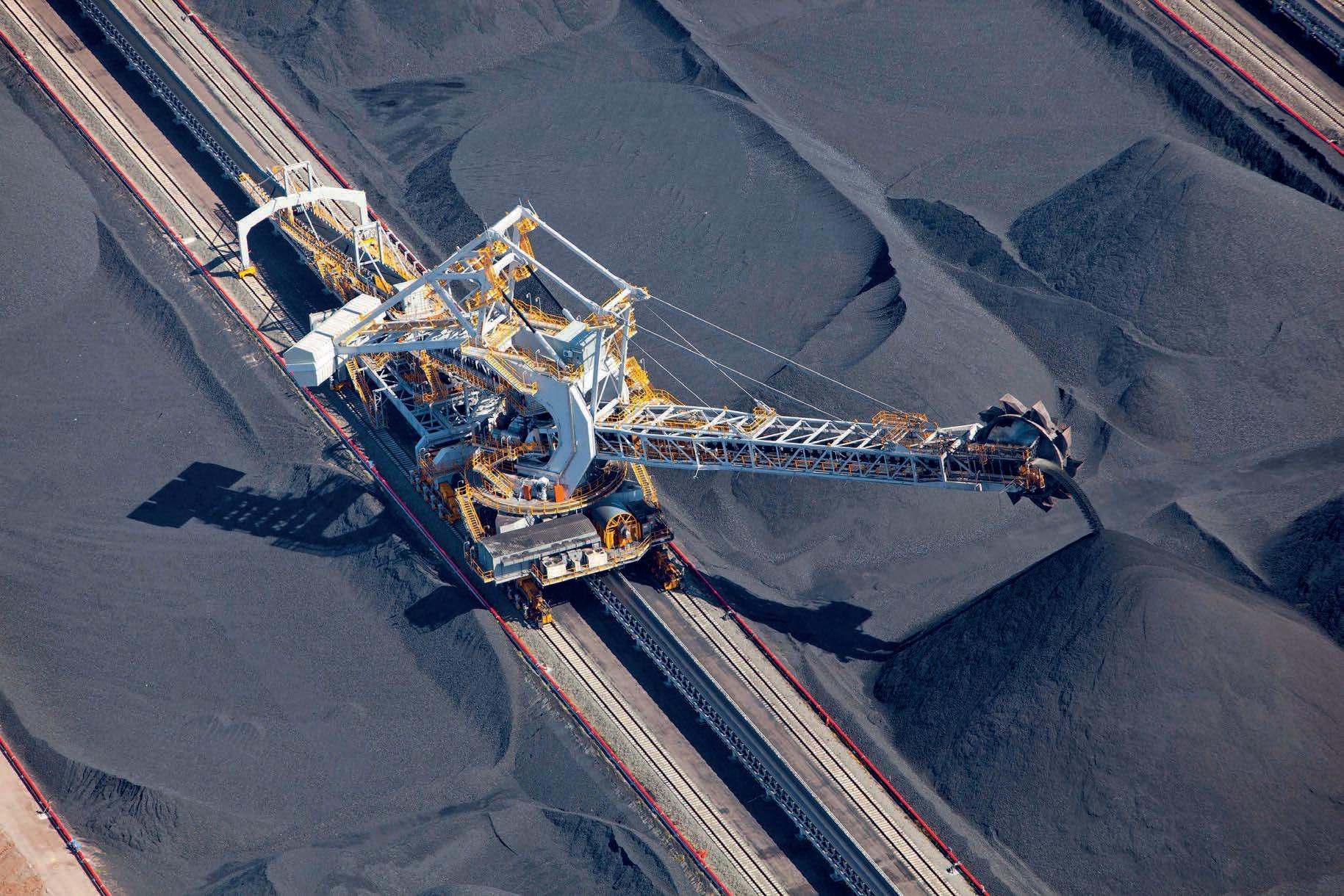
Refurbishment programs allow operators to extend asset life while minimising downtime and disruptions to operations. This approach is particularly critical for stockyard equipment such as stackers, reclaimers, and shiploaders, which form essential links between process plants, rail systems, and export terminals.
“These are 25- to 30-year assets, and they’re absolutely critical to the supply chain,” Bennett said.
“If a reclaimer goes down, material stops moving. Fixed plant is not like mobile plant where you’ve got options and dozens of truck/excavator backups from multiple locations within the business.”
In iron ore operations especially, maintaining consistent throughput remains a priority. Bennett said many producers continue to rely on iron ore as a key cash generator to support diversification into other commodities, placing even greater importance on the reliability of existing infrastructure.
“The focus is on production tonnes out the door,” Bennett said. “Operators aren’t necessarily looking to increase their installed capacity; they want to get
the best possible performance out of their existing assets.”
Koch Solutions designs its own machines, retains decades of historical design data, and employs engineers who understand how each asset was originally intended to operate.
“We know these machines inside and out because we designed them and we understand where the opportunities are,” Bennett said. “That gives us the best insight into fault finding, refurbishment, upgrades, and life extension.”
This OEM capability is supported by global spare parts supply, dedicated service teams, specialised tooling, and OEM-backed warranties. Bennett said this full-service approach sets Koch apart from generalist service providers.
“These are highly specialised machines,” Bennett said. “You need to understand them properly to work on them properly.”
Bennett provided examples of when operators have drifted from OEM support,
only to experience increasing failure rates and reduced asset life.
“We’ve seen parts that once lasted six years suddenly failing in six months,” Bennett said. “When that happens, it’s usually not just the part, it’s the whole operating model that needs to be reassessed.”
In those cases, Koch Solutions has worked with clients to stabilise performance and restore confidence in critical assets through structured refurbishment and ongoing OEM involvement.
Ultimately, Bennett said Koch’s approach to aftermarket services is about long-term partnership rather than shortterm fixes.
“These machines are going to be around for decades,” he said. “Our role is to collaborate with and help clients plan, maintain, and refurbish their assets so they can meet today’s production demands while staying aligned with their future projects.”
The team at Koch Solutions is committed to aftermarket services.
Big rollers redefine conveyor efficiency
The Big Roller Overland Conveyor Company believes that bigger can be better when it comes to conveyor rollers.
FOR MORE THAN THREE DECADES, the bulk materials handling sector has understood a simple principle: larger conveyor rollers can deliver energy efficiency gains. What it has lacked, however, is clear empirical evidence on just how large those rollers should be, and the confidence to shift longestablished design standards.
That gap is what motivated Big Roller Overland Conveyor Company director Shawn Ryan to pursue the development of a new large-diameter composite roller, culminating in a 20-inch (508mm)
design now independently tested by TUNRA Bulk Solids.
Ryan said the industry has “known” since the early 1990s that larger rollers provide energy efficiency benefits, but the question of “how big?” remained largely untested in a rigorous, public way.
From engineering, procurement, constructions, and management (EPCM) contract models and risk mitigation frameworks to conservative design standards, the conveyor sector has often favoured incremental improvements over
In 2022, Ryan decided to test his hypothesis. Drawing on an existing working relationship with the team at TUNRA, he personally funded research to validate the internal rate of return (IRR) for 316mm and 400mm rollers. TUNRA was selected for a simple reason: it operates the only large-scale test facility of its kind compliant with AS 1334.13.
After presenting early research findings and concept designs to a major EPCM in 2023, Ryan encountered resistance. Undeterred, he turned to the global idler supply chain to bring the concept to life.
A key constraint guided the next phase of development: achieving a 20inch roller with a maximum weight of 20kg. Only one manufacturer could meet the brief: Tribotech, with its Weartech Nylon composite roller. The combination of large diameter and lightweight composite construction represented a material science advancement that pushed well beyond conventional steel idler dimensions.
However, the dimensional leap created a new challenge. Industry standards such as CEMA 502 and SANS 1313 define commonly available idler sizes, with the largest CEMA roller at 8 inches (219mm). The 20-inch product dwarfed these benchmarks.
To properly certify the design and extend the empirical IRR dataset to 20 inches, TUNRA was again a leading option. But even its facilities required modification.
All relevant test rigs had to be upgraded to accommodate rollers up to 24 inches in diameter, while remaining compliant with applicable standards. With financial support during this innovation phase from the Minerals Research Institute of Western Australia, Big Roller invested in upgrading the necessary test rigs, infrastructure Ryan
Independent testing is laying the groundwork for a new era of conveyor design.
Images: Big Roller Overland Conveyor Company
describes as benefiting the broader industry, not just his company.
For Ryan, independent third-party testing was non-negotiable.
“It’s one thing to say we have the best product,” he said, “but another to have evidence through data to back that up.” Third-party validation, he adds, is essential not only for technical credibility but for breaking down commercial and specification barriers that have historically slowed adoption of new technologies.
Partnering with TUNRA to conduct all industry-standard testing on the 20-inch idler has added what Ryan describes as “gravitas” to the process. The independent testing is contributing to increased commercial engagement and enquiries, signalling growing industry interest.
Throughout the process, Ryan says the collaboration has been defined by technical rigour and flexibility. The TUNRA team has been methodical in pursuing the required testing regime,
while also supporting an aggressive development schedule aimed at bringing a certified product to market as quickly as possible.
Now, with testing forming what Ryan calls a “foundational stepping stone”, the company is looking beyond certification to broader industry impact. He believes the fundamental science underpinning larger-diameter, lightweight composite rollers has the potential to drive a major evolution in overland conveyor design.
Ryan said the adoption of large diameter rollers and advances in rubber compounds offer a compounding efficiency gain essential to achieve carbon reduction targets.
“With potentially 800km of new conveying projects and existing retrofit in WA alone, the potential impact of Big Roller’s designs are substantial.”
“These insights will guide the next generation of conveyor design.”
• Faster service with no delays from external contractors
• More reliable and efficient testing operations
• Environmentally friendly with reduced emissions
• Less downtime means quicker turnaround for your equipment
• Increased testing capacity for larger weighbridges
• Safer operations protecting your staff and assets
• Cost savings from faster, safer, and more efficient processes
Upgraded test rigs at TUNRA Bulk Solids were engineered to accommodate rollers up to 24 inches in diameter.
Bulk wins, bulk solutions, bulk legacy
As BULK2026 draws near, the industry is eager to get together under the same roof.
ON 16-17 SEPTEMBER
at the Melbourne Convention and Exhibition Cen tre, the bulk handling sector will come together for the industry’s only dedicated exhibition and conference, the Bulk Handling Technical Conference and Expo (BULK2026).
BULK2026 remains Australia’s only dedicated exhibition and conference for the bulk solids handling industry.
Momentum for the event continues to build following the announcement of a new partnership between BULK2026 and the Australian Society for Bulk Solids Handling (ASBSH), adding further depth to the technical program as organisers at Prime Creative Media finalise preparations.
Returning in 2026, the Bulk Handling Technical Conference will run concurrently with the Bulk Handling Expo, delivering an expanded forum of advanced technical content curated
by ASBSH. The combined format is designed to encourage industry-wide discussion, collaboration and practical problem-solving across all areas of bulk materials handling.
Prime Creative Media head of marketing – events Molly Hancock said the partnership with ASBSH represents an exciting development for the event and the industry more broadly.
“This is where engineers, operators, suppliers and managers can come together in the same space and speak the same language,” Hancock said. “Connections are made and insights are shared that would normally take multiple meetings or site visits to establish.”
BULK2026 lets the industry unite under the same roof, which is a feature that sets the event apart from anything else like it. From global equipment suppliers and engineering teams to operations, maintenance, and site-based personnel, the expo creates a holistic
view of the challenges and opportunities facing the sector.
Exhibitor interest is also gaining traction, with Kinder Australia confirming preparations are already underway. Sales and marketing manager Sam Veal said the event provides far more than a promotional platform.
“For us, it’s about contributing to broader conversations around reliability, safety and performance across the industry,” Veal said.
With Kinder planning to unveil a new product in 2026, which Veal said is a “revolutionary for conveyor tracking,” the lead-up to BULK2026 is shaping up to be a significant period for the company.
Events like BULK2026 also provide a valuable opportunity for direct engagement with industry stakeholders seeking operational improvements.
“It’s a chance to communicate and educate,” Veal said. “It allows us to maintain dialogue with site
BULK2026 brings the bulk handling industry together.
representatives who are focused on optimisation, while also catching up with long-term customers and identifying new requirements.
“It’s a real melting pot for bulk handling, we meet people we’ve never connected with before, and that’s where new relationships start.”
In an environment where conveyor failures, dust generation and accelerated wear can result in significant operational and financial impacts, the timing of BULK2026 is particularly relevant.
as Supplier of the Year at the 2022 Australian Bulk Handling Awards.
These pressures position the event as more than a commercial exhibition, providing operators with the opportunity to evaluate new technologies, compare approaches and explore solutions designed to deliver longterm performance.
Against this backdrop, experienced suppliers such as Kinder come into sharper focus. A specialist in belt conveyor design and bulk material handling, Kinder was recognised
Veal said dust control remains a recurring challenge across the sector where Kinder’s solutions are designed to deliver measurable improvements.
“Our contactless skirting arrangements are designed as an ultimate dust-mitigation solution for bulk handling operations,” he said.
“Products like our Dustscrape system play an important role from a health and safety perspective, from managing silica dust in quarries to improving visibility at iron ore operations.
“We also provide conveyor health checks supported by a uniquely developed software platform, allowing us to identify hazards and productivity issues with the aim of optimising site performance and operator safety.”
While individual innovations will form a key part of discussions on the expo floor, BULK2026 ultimately serves as a broader industry platform, bringing together every decision maker in the bulk handling chain to advance performance, reliability and sustainability across the sector.
Images:
Attendees are eager to hear from decision makers regarding the latest innovations in bulk handling.
Case Study: TasRail Port of Burnie Berth 5 shiploader replacement
Aspec Engineering senior structural engineer Wyndham Bird outlines Aspec’s role in an independent design audit and verification of the shiploader, wharf strengthening works and conveyor gallery for TasRail.
EMU BAY WAS DEVELOPED AND
the Port of Burnie established in 1827 to provide port services to the surrounding region. The port has developed into one of Tasmania and Australia’s most important deepwater ports.
It is owned and operated by TasPorts, and more than five million tonnes of general freight and 50 per cent of Tasmania’s containerised freight are transited there each year.
Berth 5 was built in the late 1960’s, primarily to serve as the bulk berth for the Electrolytic Zinc Co (now Nystar). The original shiploader was built in 1969, weighing 160 tonnes with a peak loading rate of 1100 tonnes per hour.
The shiploader loaded copper, zinc, pyrite, nickel and a range of iron ore products for export. After 50 years, the shiploader had reached the end of its economic life which led to the decision for a replacement.
With funding provided by the Australian Federal Government, the Principal’s Design Parameters (PDP) for the new shiploader were established and the project commenced. The PDP is a comprehensive document outlining operational and design requirements of the rail mounted shiploader and associated travel rails, conveyor gallery, tripper, tripper rails, gallery and reclaim conveyors, loading hoppers, and all associated equipment to be installed at Berth 5.
Key among the shiploaders design parameters was the requirement for it to be designed with environmental and safety standards in mind, and to double the loading capacity while enclosing all material handling equipment to prevent dust emissions into the sensitive environment around the harbour. The new shiploader was also required
to operate on the original wharf due to the high cost of its replacement or strengthening.
TasRail appointed Aspec Engineering to perform an independent audit of the new shiploader and wharf structures as well as the capacity verification of the strengthening modifications to the existing wharf structure at Berth 5 of the Burnie Port.
The detailed design and construction for the shiploader and ancillary wharf structures was carried out by COVA Haywards Pty Ltd (COVA). The purpose of Aspec’s audit was to confirm that the designs for the shiploader and ancillary wharf structures have adequate capacity to withstand the required design loads and comply with the project requirements and Australian Standards. In addition to this, the strengthened capacity of the concrete wharf structure was verified for the new, heavier shiploader and higher conveyor gantry loads.
One aspect of significance was the wharf loading generated by the new shiploader structure. The wharf and infrastructure, originally designed by the Marine Board of Burnie for a substantially lighter shiploader, needed to withstand
the design loads applied to it by the new, heavier, shiploader under all required conditions. The wharf is a TasPorts asset, and TasRail were required to verify that the wharf structure would not be compromised by the installation and operation of the new shiploader.
The dimensions and height of the shiploader structure is such that wind contributions to the loads impacting the wharf wheel loads are significant and extensive work was conducted to prove that wheel loads remained compliant under all conditions nominated in the PDP.
In addition to auditing the shiploader, Aspec was tasked with proof engineering of the wharf conveyor gallery and with checking that the wharf and wharf strengthening had adequate capacities for the revised wharf loading.
Shiploader weighing
The weighing of the shiploader occurred after the machine had been assembled. The estimated weight during the auditing process was around 260t. The limiting contractual weight of the shiploader was set at 280t, a figure that was more than five per cent greater than the weight
Images: Aspec Engineering
Old shiploader at Berth 5.
assumed for the audit. This difference would automatically trigger a rerun of all structural capacity calculations.
Weighing occurred in April 2024 and the assessed mass exceeded 280t by several tonnes.
Since the weight of the shiploader exceeded the 280t limit, COVA was obligated to reduce the mass of the shiploader. The full weight of the tail end of boom conveyor was captured in the shiploader’s weight, however, in operation, some of this mass is supported by the wharf conveyor gallery. The gallery supported mass was subtracted from the overall mass, however, it was still required that some structural members were trimmed and strops, (provided to facilitate luffing rope
changeout), were removed to achieve the contracted weight.
Once the weight of the shiploader complied with the contractual limits, the wheel loads under different scenarios were revisited. Based on the shiploader wind load assumptions used for the design, the wheel loads on the southeast corner of the shiploader were marginally non-compliant for the relocating and storm park conditions.
A critical review of the site wind speed coupled with appropriate directional multipliers and terrain category was conducted.
The review and refinement of the wind loading showed that wind speeds northwest segments could be reduced, and this consideration meant that the
wheel loads were at the upper end of allowable limits. Additionally, COVA added shimming to the shiploader’s legs on the southwest to northeast diagonal, attracting more loading to these legs thus reducing the loads on the other diagonal to satisfy the limits.
Wharf conveyor gallery check
The primary actions acting on the wharf conveyor gallery comprise live loads and wind loads. Wind actions were determined in accordance with guidance provided in the PDP, including recommended values for drag coefficient (Cd), terrain category (TC), and wind directional multipliers (Md) applicable to fixed structures. In particular, the drag coefficient for the clad gallery was limited to two, taking into account the reduction in effective drag associated with turbulent flow conditions.
The main loads on the wharf conveyor gallery are live loads and wind loads. To calculate the wind loads, the PDP provided some guidelines with regards to the Cd, TC and wind Md for the fixed structures. In particular, the clad gallery’s drag was limited to two by taking cognisance of the reduced drag due to turbulent flow. Typically, drag coefficients for rectangular prisms with the aspect ratio of the galleries exceed 2.2.
Moving loads were employed to simulate the tripper in any position along the wharf. It was found that when
New shiploader at Berth 5.
Directional wind speeds from Checkwind.
adopting the PDP criteria specifying a uniform direction multiplier of Md= 0.95, and a drag coefficient of Cd ≤ 2.0, several members did not comply with the requirements of AS 4100. The designers had justified a lower coefficient of drag, whereas Aspec adopted the upper limit of 2.0.
The critical wind speed review showed that the maximum wind speed combination corresponds to wind from the northwest, and it matches the TC 1 regional wind speed reduced by 0.95. The maximum forces on the wharf crossheads supporting the wharf conveyor gallery are due to perpendicular landward winds (from the north and northeast sectors) and the seaward winds (from the south
and southwest sectors). Peak landward winds are 40.7m/s and peak seaward winds are 34.4m/s. These wind speeds are both less than the 47.4m/s from the PDP and limit the maximum downward and upward forces applied to the foundations on the wharf crossheads. The windspeed review showed compliance of the structure even with Cd = 2.0.
Shiploader movement onto the wharf
During the construction of the new shiploader, the wharf was still in use for fuel delivery, passenger ships and offloading of other cargo. Given the restricted space on the wharf, the shiploader was constructed on land
behind the wharf and later moved onto the wharf to limit disruption to the wharf operation. The movement of the shiploader onto the wharf required a few steps. The shiploader was firstly rolled along temporary rails from the construction and weighing location in a direction perpendicular to the wharf. The shiploader was then jacked up and the long travel gear rotated by 90° to enable movement on rails parallel to the wharf. After this rotation had been completed, it was observed that one of the shiploader’s jacking points had experienced permanent deformation.
Aspec undertook a non-linear analysis of the jacking procedure and by simulating the jack displacement. It found the actual jacking force required to generate the observed deformations was greater than the design capacity of the jacking point. A survey of the temporary rails revealed that the corners of the shiploader were out of plane. In this instance, the southwest and northeast legs were attracting substantially more load than the other diagonal legs.
Repairs were made and strengthening to the jacking points was installed. COVA were required to prove that following repairs the future operation of the shiploader would not be compromised and as auditors, Aspec was required to verify this.
When repairs were complete, the shiploader was rolled parallel to the wharf to a position near the wharf’s end. The long travel gear was once again rotated by 90° and located on rails perpendicular to the wharf. Once the shiploader was rolled onto the wharf the final rotation of the long travel gear was done and the shiploader positioned on the wharf rail beams.
Wharf review
The concrete wharf structure was designed and constructed in the late 1960’s. As such, there is limited detail of the material specifications and assumptions were based on typical materials in use at the time. There were some design calculations available showing that the wharf was designed for a live load of 35 kPa. The owners of the wharf required that the capacity check of the wharf include this as a live
Actual damage of jacking point.
Modelling of the jacking point deformation.
load in addition to the loads imposed by the shiploader and the wharf conveyor gallery. Core samples were extracted from the crossheads and the deck of the wharf and tested for concrete strength. The strengths of the samples ranged between 49MPa and 69MPa. Assuming a t-distribution with a 95 per cent confidence level, a concrete strength of 45MPa was adopted. The original strength specification is unknown, but the expectation is that it may have been 3000psi as concrete tends to gain strength with time.
The crossheads supporting the conveyor gallery had been subject to investigation prior to the start of the project. It was identified that the crossheads were deep beams and needed to be checked as non-flexural members.
Prior to tender, strut and tie calculation methods had identified that the crossheads did not have sufficient strength for the wharf conveyor gallery loading and that strengthening would be required.
The main span of the conveyor gallery crossheads are on the threshold of being flexural members and the standard crossheads, being simply supported could be treated as flexural members..
The shiploader wheel loads were applied as moving loads at 200mm intervals to identify the maximum section forces that could occur. It was confirmed that the wharf had sufficient capacity for the worst loading combinations that included the 35kPa live load imposed on the deck. It was found that the most critical forces were the shear forces, and even though flexural methods were not applicable to the conveyor gallery crossheads, it was confirmed that the shear capacity was inadequate, and strengthening was required.
Detailed crosshead analysis
The shear strengthening proposed for the conveyor gantry crossheads was to provide two Grade 8.8 M36 bars through the depth of the beams at each of the conveyor gantry column bases.
These bars double as holding down bolts and shear strengthening. A critical shear plane was identified between the landside gantry column and the single landward pile.
This plane missed the outer M36 bar and the simplifying assumptions in conventional calculations showed marginal non-compliance.
A detailed nonlinear plane stress model was used to prove the capacity of the crossbeam. The material model adopted for the steel reinforcement was elastic, perfectly plastic with a yield plateau of øfy where ø is the material reduction factor and fy the yield stress of the reinforcement. The concrete was assumed to be nonlinear elastic with a stress strain curve. The peak compressive stress was downrated to 32MPa to account for the capacity reduction factor of 0.7 applicable to concrete. The prestressing was taken to 70 per cent of proof stress and then reduced by 30 per cent to allow for relaxation after transfer over the years.
Solving HD Impact Failures
RKM Impact Absorption Frames coupled with our Super HD Cast Polyurethane rollers has proven to be very successful to help with high impact loads and product spillage.
RKM Heavy Duty Lightweight Composite Roller
The factored limit state loads were applied incrementally to the model. The numerical analysis converged beyond the limit state loads, proving that the structure had adequate capacity. The major principal stresses were compressive throughout the model, indicating no shear failure of the concrete.
Slab supporting shiploader rails
The flexural models showed that the shear capacity of the slabs supporting the rail beams is marginally adequate based on the assumption that the shear was averaged over a finite width. It was considered prudent to verify the assumed width in these calculations and a solid model and a plane stress model were employed for this purpose.
Moving loads were applied to the model and the load combinations that resulted in the peak stresses in the flexural models, were identified. These load combinations were then analysed nonlinearly using plane stress models of the wharf deck.
The converged solution confirms stable structural behaviour. The maximum principal stresses remain below the tensile capacity of the concrete, confirming that shear failure does not occur under the applied loading.
Conclusion
TasRail have successfully installed a new shiploader on Berth 5 or the Port of Burnie. The aim of the new shiploader was to double the throughput of the terminal. The increased capacity of the terminal required a considerable increase in the weight of the shiploader and associated infrastructure as did the requirement to enclose the material handling components of the terminal and the addition of equipment to the shiploader that is expected on modern machines of a similar nature.
Despite the additional requirements placed on the shiploader, COVA and TasRail have managed to keep the weight of the new machine under control so that with considered application of design calculations and targeted strengthening, the new, modern, shiploader is able to operate safely on the aging wharf under all conditions.
Plane strain modelling of conveyor gallery crossheads.
Stress strain curve adopted for concrete.
Join Australia’s premier mining resource.
• Access unparalleled industry insights, news and trends.
• Explore exclusive interviews, business profiles, newsworthy innovation, and the latest on regulation.
• Australian Mining provides all information in one reputable source.
Why silos fail and the importance of understanding bin loads
Jenike & Johanson project engineer Aleef Rahman explains how silo failures can be prevented through an understanding of material flow, operational scenarios and routine maintenance.
ACROSS AUSTRALIA, several notable silo failures in recent times highlight the ongoing risks that arise when bulk loads and material behaviour are underestimated.
In October 2024, two large grain silos facility collapsed, spilling thousands of tonnes of wheat and prompting emergency response and regulatory investigations. Other incidents include a five-metre transportable farm silo overturning in Goondiwindi, Queensland (2020), a man buried in a silo in Arcturus, Central Queensland (2024), and a worker hospitalised in Victoria (2021) after being trapped beneath two tonnes of grain released from a small silo following a blockage and unsafe operating practices.
These events, ranging from structural collapses to internal grain
surges, highlight that silo failures are not isolated cases but part of a broader pattern of hazards across Australia’s bulk handling sector.
Such failures often result from an inadequate consideration of materialinduced loads that silo/bins are subjected to under actual operating conditions. These incidents highlight the importance of understanding bin loads, including wall pressures, flow-induced stresses, and asymmetric loading, as well as identifying material flow patterns within silos. Phenomena such as powder flooding or rathole collapse can occur when flow behaviour is not properly assessed, creating serious operational risks.
While the Victoria grain surge incident was not a structural failure, it
illustrates how inadequate flow analysis can lead to uncontrolled discharge. Proper evaluation of flow behaviour at the design stage supports safer operating procedures and reduces risk to personnel.
Silos are dynamic systems where material properties change, flow patterns evolve, and operating conditions vary throughout a structure’s service life, which should be considered in the design to ensure structural strength and ensure right safety measures/protocol are developed to follow during operating conditions.
The following sections present failure scenarios, and common assumptions made across three stages: Design, construction and operation.
Design stage
Assuming material properties remain constant over time, or that changes in wall friction (such as polishing of the liner) do not alter flow patterns, is a common mistake that can lead to unexpected bin loads and structural failure.
Prior to designing storage silos for handling bulk materials, it is essential to understand their material flow properties. These properties form the basis of design when determining silo geometry, depending on the selected flow regime.
Key parameters include particle size distribution, bulk density, cohesive strength, angle of repose, and drawdown angle.
It is also important to recognise that these properties can evolve over time due to changes in composition, moisture content, particle size, and other factors. Such variations not only influence the flow pattern
during discharge but also directly affect wall pressures and internal load distributions.
Once the material is well characterised, both the expected flow behaviour and associated bin loads can be assessed, providing a more reliable basis for safe and robust silo design.
There are three distinct flow patterns that are likely to be developed in your silo, as shown in the figure below.
Designers sometimes assume that material will flow perfectly, but in reality, ratholes, eccentric discharge, and uneven fill can produce asymmetrical loads that exceed design assumptions.
Silo failures often happen when bin wall loads are underestimated, especially during eccentric discharge.
In practice, flow is rarely perfectly symmetric. Ratholes, partial emptying, or discharge near one side of the walls
A silo collapse.
Flow patterns.
Images: Jenike & Johanson
Flow Pattern Description Key Points
Mass Flow
Aleef Rahman
Aleef Rahman is a project engineer at Jenike & Johanson with a passion for solving problems in the bulk materials handling field. He has a wealth of experience in the field, with project involvements in feeder systems, hopper/bin designs, train loadout systems, and more. He has contributed to the success of many materials handling projects, working with clients to develop effective solutions that optimize their handling processes and improve overall efficiency.
Aleef understands the critical role material properties play when it comes to design and operation. Equipped with the fundamentals of materials he believes that sharing this knowledge with his clients and ensuring the information is understood is a driving motivation.
Jenike & Johanson are a bulk material handling company with a world-class team assembled of highly educated and skilled bulk material handling experts.
Funnel Flow
All material moves in motion whenever any is withdrawn from the hopper.
Flow occurs through a central flow channel, with stagnant material at the edges.
- First-in-first-out flow
- No stagnant material build-up
- Steady, uniform discharge with consistent bulk density
- Stagnant material may form ratholes if cohesion is high
- First-in-last-out flow
- Can cause material degradationOccurs with shallow hopper walls and high wall friction
Expanded Flow Mass flow hopper placed beneath a funnel flow hopper.
can produce uneven pressures that can exceed what the silo was designed for. If the resulting flow channel intersects the silo wall, non-uniform pressures will develop around the circumference of the silo, leading to circumferential bending and axial compression on the cylinder shell.
Therefore, designs should not only consider water-level and uneven fill during filling and discharge, but also asymmetric bin loads resulting from off-centre flow.
The flow pattern inside a silo/bin is also influenced by the feeders. A mass flow bin may fail to operate under the mass flow condition if the feeder is improperly designed, allowing flow channels to develop, and causing loads to concentrate in certain areas.
- Saves headroom in largediameter silos
- Combines mass flow reliability with space efficiency
Designs need to account for these situations to keep silos safe and structurally sound.
Designers sometimes assume that environmental conditions won’t affect the silo, but in reality, humidity changes or temperature fluctuations can cause changes in material properties, leading to flow issues such as caking and bridging, or silo wall deformations (periodic contractive behaviour), leading to increased wall pressures that were not accounted for in the design.
It is important to recognise that these effects can occur gradually over time or rapidly under certain conditions, such as wet weather or seasonal temperature fluctuations. Ignoring temperature and moisture
Eccentric flow discharge pattern and pressure distribution.
influences during design can compromise silo integrity. Proper assessment of these factors is essential to ensure safe and reliable silo performance.
Construction stage
Designers sometimes assume silos will be built to exact specifications, but even small deviations or poor workmanship can compromise structural performance and increase the risk of failure.
Small alterations during construction, such as incorrect panel assembly, insufficient welding, or unapproved modifications, can compromise the structural integrity of the silo. These deviations can result in uneven load distribution, reduced resistance to wall pressures, and increased risk of local buckling or collapse.
Ensuring that the silo is built exactly to the approved design and maintaining high-quality workmanship
throughout construction is essential. Careful oversight, adherence to specifications, and proper inspection during assembly help prevent structural weaknesses that could otherwise lead to operational failures.
Operation stage
Operators often assume silos will function safely under any conditions, but improper use or delayed maintenance can create loads and stresses not accounted for in the design, leading to failure.
Overfilling, rapid discharge, ignoring blockages, or bypassing safety procedures can generate unexpected loads and stresses. Coupled with delayed or inadequate maintenance, these factors can weaken structural components, increasing the risk of wall buckling, panel failure, or collapse.
Clear operational procedures and proper personnel training are essential. Routine inspection and maintenance
help identify wear, damage, or flow issues early. Monitoring material flow and adhering to engineer-approved guidelines ensures that silos operate within their design limits, protecting both personnel and assets while maintaining safe, reliable performance.
Summary
Silo failures in Australia often arise from underestimated loads, changing material properties, temperature and moisture fluctuations, poor workmanship, deviations from approved designs, and improper operation or maintenance. Preventing these failures requires an understanding of material flow, careful consideration of operational scenarios, adherence to design specifications, and routine inspection and maintenance. Applying these principles helps ensure silos operate safely and reliably, protecting personnel and assets, and maintaining the continuity of bulk handling processes
International collaboration
ABHR learns how the 15th International Conference on Bulk Materials Handling will support the sector.
RESEARCHERS FROM ACROSS
the world will meet in Fremantle, We stern Australia, to continue a tradition that has been ongoing for more than 40 years.
The congregation will discuss the science behind a sector vital to modern life but often ignored: bulk solids handling. Storing and transporting bulk solids materials is a complex science, with a range of different methods and requirements. One application may require very small quantities of material to be handled gently, whereas another may require moving vast amounts of abrasive, heavy materials.
International Conference on Bulk Materials Handling (ICBMH) conference manager Danielle Harris said this diversity is particularly evident in Australia, where the wide-ranging nature and scale of operations are unique.
“Advancements continue in the development, research and implementation of the many aspects of bulk materials storage, handling and transportation,” she said.
“This conference will provide an excellent forum for practitioners, researchers and designers to come together to review and exchange ideas.”
The conference is designed to provide a forum for practitioners, researchers and designers to review and exchange ideas and experiences on established, new and emerging technologies with professionals who deal with bulk materials daily, both nationally and internationally.
Around 120 delegates from Australia, Brazil, China, Germany, the Netherlands, India, New Zealand, the USA, and the UK presented over 90 papers at the 2019 conference.
All papers are peer-reviewed by an international panel of experts, and presentations have historically included a mix of academic and research work as well as industrial applications.
Key industry organisations have chosen to support the
conference, with ContiTech Australia, Fenner Conveyors, Kinder Australia, Flexco, Belt Wise, WAGENER Vulcanizers Australia, and Agilitus signing on as sponsors.
Harris said the conference would be of particular interest for a wide range of industries, including mining, power generation, chemicals, agriculture, energy, and food.
“Other benefits of attending the conference include professional development hours and networking with other experts in the field,” she said.
“By attending, you diversify your expertise and knowledge in materials handling concepts and can stay up to date with the latest developments in industry and bulk solids research.”
The conference offers attendees an unmatched opportunity to network and learn from industry leaders.
“It is a must-attend event that will help to further the sector as a whole”, Harris said.
The ICBMH 2026 is organised by Australian Society for Bulk Solids Handling whose aim is to promote cooperation between universities, research establishments, consultants, equipment manufacturers, suppliers and industrial users.
It also aims to provide a national focus and forum for its members to discuss the practice of bulk solids handling.
The 15th ICBMH will be held at Rydges’ Esplanade Hotel in Fremantle, which is a 30-minute car ride from Perth’s airport and registrations are now open through the conference website
The ICBMH will take place in Fremantle, Western Australia.