AUSTRALASIAN BUS & COACH
CHALLENGER Parts perfection
IRIZAR
Milestone moment
SCHOOL ICON Lorraine DouglasSmith’s bus story
ISSUE 470 October 2026 $5.95 inc GST
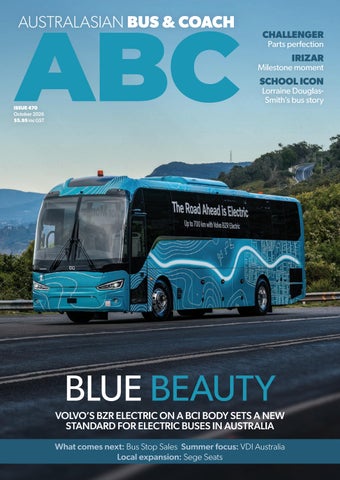
BLUE BEAUTY VOLVO’S BZR ELECTRIC ON A BCI BODY SETS A NEW STANDARD FOR ELECTRIC BUSES IN AUSTRALIA What comes next: Bus Stop Sales Summer focus: VDI Australia Local expansion: Sege Seats
5
CONTENTS
OCTOBER 2026
EXECUTIVE GROUP CEO: Christine Clancy Chairman: John Murphy Head of Customer Experience: Regina Fellner
EDITORIAL & DESIGN
42
Image: Styleride
in the know 06. editorial | ignition THE FORGOTTEN MODE After spending years in the shadows, the Australasian bus and coach sector has tangible evidence of the industry’s major impact on nations and communities. It’s well overdue
08. news | all aboard
38. feature | irizar ZERO TO ONE HUNDRED In just 18 quick years, Irizar Asia Pacific and Victorian operator Dyson Group have created a lasting supply partnership, culminating in a recent milestone delivery
features 18. cover | volvo ONE PLATFORM, MANY JOURNEYS
44. feature | zbus LOCAL OUTFIT
Unveiled at the 2026 National Bus & Coach Show, the Volvo BZR Electric on a BCI body brings together a global chassis maker and Australian bodybuilder that share the same standards
22. feature | lorraine douglas-smith TURNING POINT Lorraine Douglas-Smith, like many other Aussies in the ‘80s, simply wanted to play tennis. A chance encounter saw her venture into the bus space
28. from the pod | ventura BUILT AROUND BUSES Without realising, Carol-Anne Nelson’s life has revolved around public transport. She joined the Bus News Podcast to discuss why PT is the place to be right now
32. hvac feature | vdi COOLER IN FEBRUARY VDI Australia discusses the Cling climate systems designed in alongside every Yutong, and why that matters when the heat arrives
34. feature | bus stop sales MORE BUSES, MORE RESPONSIBILITY ABC caught up with Pete White to talk about what comes next and why the company’s next round of investment is focused on people, parts, stock and service capability
36. feature | challenger LIVE SUPPORT Challenger, through sister business Australasian Bus & Coach Parts, is set to take the aftersales experience to a new level through the upcoming launch of its new online parts store
Just a year after returning to the Australian market, ZBus is growing its local fleet and service capabilities for operators across the country
46. feature | sege seats SPREADING WINGS Sege Seats is riding waves of momentum following the release of its new modular seating range, investing in a new local home base
49. events | endeavour awards AWARDS RETURN Australia’s manufacturing industry is being called on to nominate its leading businesses, innovators and professionals as the Endeavour Manufacturing Awards return for 2027
4
Designer: Apostolos Topatsis & Breanna Agent
PRINTING Brougham Press Sales Manager – South: Courtney Burton ph: 0481 736 890 e-mail: courtney.walker@primecreative.com.au Business Development Manager – Bus: Michael Girgis ph: 0432 237 187 e-mail: michael.girgis@primecreative.com.au
SUBSCRIPTIONS www.busnews.com.au/subscribe ph: +61 (0)3 9690 8766 Mon-Fri 8am-4.30pm (EST) e-mail: subscriptions@primecreative.com.au mail: 379 Docklands Drive, Docklands VIC 3008 Australia Annual subscription rates (12 issues): Australia: $99* Overseas: $A170 (Australian air-mail only) *price includes GST Cover image: Volvo
51. best bus | october SCRUBBING UP WELL After last month’s winter warmer, the October winner of ABC’s Best Bus returns to the sky blue nature of outback Australia
departments 54. deliveries | september STEADY TO THE END The latest bus and coach deliveries are maintaining consistency to end another busy year
379 Docklands Drive, Docklands VIC 3008 T: 03 9690 8766 www.primecreativemedia.com.au
58. back seat | Lajamanu bus BUILT FOR LAJAMANU
ISSN 1324-8634
A new Toyota Coaster is giving young people in Lajamanu more opportunities to travel for sport, recreation and culture, with the bus built specifically for life in remote Central Australia
Distribution
Follow us online at: Facebook facebook.com/ABCBusnews
Art Director: Daz Woolley
ADVERTISING
42. feature | styleride RECIPE FOR SUCCESS Just a decade into life as a family operator, Deane’s Coaches is focused on optimising the passenger experience with local partners like StyleRide as it continues expanding its various services
Check out the latest news from around Australia and the world
Managing Editor: Geoff Crockett e-mail: geoff.crockett@primecreative.com.au Editor: Sean Mortell e-mail: sean.mortell@primecreative.com.au ph: 0468 577 166
YouTube bit.ly/busandcoachtv
Twitter/X x.com/ABCmag
Distribution within Australia and New Zealand and beyond by paid subscription to the owners and managers of: • route buses • government bus operations • school buses • extended and day tour operations • express coaches • country and charter operations • bus and coach manufacturers • equipment suppliers • tourism attractions • railways management. Australasian Bus & Coach (ABC) magazine is owned by Prime Creative Media. All material in ABC is copyright and no part may be reproduced or copied in any form or by any means (graphic, electronic or mechanical including information and retrieval systems) without written permission of the publisher. The Editor welcomes contributions but reserves the right to accept or reject any material. While every effort has been made to ensure the accuracy of information Prime Creative Media will not accept responsibility for errors or omissions or for any consequences arising from reliance on information published. Opinions expressed in ABC are not necessarily the opinions of, or endorsed by the publisher unless otherwise stated.
ABC • busnews.com.au
Challeng
te nded
ment
e may phic, al ditor
sure cept ces
Challenger_Buses_ABC Mag #454_210mm x 297mm_PressAD_0625_fa.indd 1
5/6/2025 9:05 pm
IGNITION
EDITOR’S NOTE
The forgotten mode After spending years in the shadows, the Australasian bus and coach sector has tangible evidence of the industry’s major impact on nations and communities. It’s well overdue
It’s now the time for bus and coach to be clearly viewed as a popular costeffective mode of public transport in all Australasian cities, suburbs and regions 6
ABC • busnews.com.au
I
n a year where so much has highlighted the power of bus and coach transport, the sector is beginning its resurgence. For years, it’s been viewed as the forgotten mode in Australia’s public transport industry. Nestled behind train and tram, tucked away from car and active transport. It’s given the sector a form of underdog status, a grit that has motivated many in the industry to complete some remarkable achievements. This is slowly ceasing to be the case as necessity and evolution have led to many in the bus and coach sector to begin loudly championing the many enduring qualities of bus transport. It’s the flexibility of the mode, the friendliness of drivers, the ability to be there at the drop of a hat and counter emergencies. It’s the safety, the innovation, the newfound sustainability and use of leading global technology. It’s now the time for bus and coach to be clearly viewed as a popular cost-effective mode of public transport in all Australasian cities, suburbs and regions. While numerous operators and suppliers in recent times have held and shared this view, there’s now data and noise from outside our sector that’s supporting it. A key example is a new report handed down in mid-September from New Zealand, showing the bus and coach industry is contributing more than $1 billion to the nation’s economy. The report, commissioned by the Bus and Coach Association of New Zealand (BCA) and completed by the New Zealand Institute of Economic Research (NZIER), found the sector generates $1.069 billion in GDP annually while supporting 11,750 jobs across the country. “Most New Zealanders probably don’t think of public buses, school buses, intercity services and the coaches carrying visitors around the country as parts of one industry,” BCA Chief Executive Delaney Myers says. “But collectively this is a billion-dollar industry employing almost 12,000 people, and even those numbers don’t capture its full contribution.” It’s enough to make one ponder what financial impact bus and coach is having on Australia’s GDP, particularly with tourism once again on the up in the wake of the COVID pandemic. Is it time for our industry to be
formally valued for the impact it’s having on governments, communities and wider society? I think so, and the best way to do this is to recognise the many operators and industry members who live bus and coach’s values every day. As I’ve said before, this all boils down to a unique method of collaboration, often between competitors. This was on display once again in October, with Volvo partnering with BCI for the recent unveiling of the BZR Electric coach on a BCI body. Head to page 18, fittingly, for the inside word on the 18-month process that’s gone into globally developing this model for the local market and then bringing it out to Sydney in time for the industry trade show. Other collaboration is on display on page 38, where we chat to members of both Irizar Asia Pacific and Dyson Group as they celebrated the 100th Irizar model to be delivered to the Victorian operator. The 18-year journey of trust and faith between the two partners allowed for a special moment of reflection from both parties – don’t miss this one. It was a chance moment when I received a call telling me about the retirement presentation given to Lorraine Douglas-Smith in Queensland recently. Thankfully, I was able to catch her soon after for an in-depth chat on her remarkable career in the Queensland school transport sector while humbly discussing her impact on many operators and her lucky ‘Sliding Doors’ moment that saw her enter the sector. Head to page 22 for this long-form read. There’s much more I could go on about, including the page 28 Bus News Podcast episode recap feature from our chat with Carol-Anne Nelson, but for now it’s best you flip through these pages and read these heartwarming stories for yourself. Hopefully you enjoy the read and see the brimming power building in the bus and coach sector.
A
T m A d a
B Sean Mortell EDITOR, ABC
A journey coast to coast Three years on the road and leading from the front, the combination of leading European OEM manufacturers chassis with the BCI Cruiser coach body has delivered outstanding results across Australia. Packed with advanced safety technology and engineered for tough local conditions, it delivers bold design, spacious comfort and superior climate control—giving operators confidence and passengers a smoother, smarter, more enjoyable journey every time.
BUS & COACH INTERNATIONAL Contact our team for further information on 1300 289 224 or visit bcibus.com.au
Head Office Perth: 08 9353 9000 Melbourne: 03 8787 2100 Brisbane: 07 3275 6900 Adelaide: 08 8182 3888
NEWS
Work wraps up on automated EV depot The Victorian electric bus depot will allow up to 30 buses to be charged through a new automated system as Kinetic phases diesel buses out
Australasian bus operator Kinetic has completed electrification upgrades at its Heatherton bus depot in Melbourne’s south-east, allowing every urban route bus operating from the site to be zero-emission by the end of the year. In a first for Kinetic’s Victorian network, the upgrades lift the number of zero-emission buses the depot can charge from 12 to 30, supporting the Metropolitan Bus Franchise fleet based at Heatherton so passengers on routes 600, 603, 604, 922 and 923 can travel on zero-emission buses. The operator says the remaining diesel buses will be replaced through the rest of the year. The works also introduce automated charging technology for the first time on Kinetic’s Australian network, keeping people and depot infrastructure safer. Load management soft ware distributes charging across the site overnight, keeping demand within the depot’s 8
ABC • busnews.com.au
Above: The Heatherton depot upgrades are now complete. Image: Kinetic/ Eugene Hyland/ The Photo Pitch
power limits while ensuring every bus is ready for the morning. Heatherton is the first to automate charging, and the same technology is being extended to Kinetic’s Sunshine West depot. The upgrade, delivered in partnership with the Victorian government, installs a single overhead gantry with capacity for up to 22 charge points, supported by two fast chargers for high-capacity opportunity charging and a dedicated electrical kiosk to increase the power available at the site. Gantries need little civil groundwork and can be built off site, which allowed crews to install the system around daily operations, with the depot remaining open throughout the upgrade works. No parking or operational space has been lost at Heatherton, and once the remaining diesel infrastructure is removed the site will have more usable space than before.
Kinetic Managing Director of Australia Matthew Campbell says the milestone reflects Kinetic’s commitment to supporting the electrification of Victoria’s urban bus network. “Heatherton will be the first depot in Kinetic’s Victorian network where every urban route bus that leaves the depot gates is 100 per cent electric,” he says. “We’ve operated this site since 2022 and are proud to have delivered this major electrification upgrade in partnership with the Victorian government. “We’re committed to the ongoing electrification of Victoria’s urban bus network. That means consistently innovating, investing in new technologies, and working closely with our building and bus manufacturing partners. “Reliable charging is what keeps buses in service, so we keep investing in the equipment our people work with.”
NEWS
PTA appoints new MD An experienced operations manager has been officially announced as the state’s public transport authority managing director An experienced mechanical engineer and operations manager has been appointed to the position of managing director at Western Australia’s Public Transport Authority (PTA). Elwyn Gearon has been officially appointed to the role, bringing experience and leadership to the position. Having previously served as
operations manager at the PTA, Gearon is a degree-qualified mechanical engineer, with additional qualifications in business and project management and over 25 years’ experience working in public transport. The Public Transport Association of Australia and New Zealand (PTAANZ), of which Gearon is a board director, has welcomed the appointment.
“Elwyn is already an important part of the PTAANZ community and we’re delighted to see his appointment made official after acting in the role for some time,” the PTAANZ says. “We look forward to continuing to work closely with him and the PTA team as Western Australia continues to invest in and grow its public transport network.”
Penrite acquires pressure washer brand The Australian lubricant company is celebrating a century in business with the acquisition of a local pressure washer supplier Australian lubricant company Penrite Oil has announced the acquisition of a majority shareholding in an Australian pressure washer brand. Penrite Oil has acquired a majority shareholding in BLAHST, expanding beyond its traditional lubricant offering to broaden its automotive portfolio. Founded by Leigh Bartlett and Andrew Hermes, BLAHST has quickly established itself in the Australian automotive market with its range of wall-mounted pressure washers, vacuums, dryer blowers, cleaning products, accessories and modular garage storage solutions. Penrite’s majority investment in BLAHST represents another step in the company’s continued growth and diversification as the business evolves towards Penrite Automotive. Penrite CEO Toby Dymond says the investment is a natural fit between two Australian businesses with a strong connection to the automotive community. “We’re incredibly pleased to welcome BLAHST into the Penrite family. As an Australian-owned business ourselves, we’re proud to support and invest in another Australian brand that shares our passion for the automotive industry, 10
ABC • busnews.com.au
innovation and delivering quality products to customers,” he says. “BLAHST has built an exciting brand and a great range of products that complement what we already do at Penrite. We see a lot of opportunity to support the continued growth of the brand while maintaining the energy, identity and customer focus that has made BLAHST successful.” BLAHST co-founders Leigh Bartlett and Andrew Hermes say BLAHST started with an idea, big plans and a belief it could do it better. “Customers, retailers and the wider community got behind us early, and we wouldn’t be here without them. Having Toby and the Penrite team recognise what we’ve built and welcome us into the family is a huge moment for all of us,” Bartlett and Hermes say. “Penrite gets what we’re about – quality gear, practical ideas and looking after customers. We’ll continue to lead BLAHST and stay hands-on. What Penrite adds is more support behind the scenes: stronger supply, a faster path from ideas to products and more room to keep building the system. Same BLAHST. A lot more
behind it.” BLAHST has expanded outside of wall-mounted pressure washers to create a complete system for cleaning, drying, vacuuming and storing cars, bikes, boats, caravans and heavy vehicles. As Penrite celebrates its 100th year in 2026, the investment in BLAHST represents another important chapter in the company’s growth while remaining true to the Australian values and automotive passion that have shaped Penrite for a century. BLAHST will continue to operate as the brand customers and retailers know, with founders Leigh Bartlett and Andrew Hermes remaining hands-on and continuing to lead the business. Day-to-day relationships, service and customer support will remain unchanged. As part of the Penrite family, BLAHST will gain access to Penrite’s broader infrastructure, resources and experience. This will help strengthen supply, accelerate product development and support the continued expansion of the BLAHST range, providing a stronger platform for future growth while retaining the qualities that have driven the brand’s success.
genuine by name, reliable by nature.
The performance of your Volvo starts with the parts that keep it moving. When uptime matters most, every component plays its part in fleet performance. Genuine Volvo Parts are identical to the original components built into our Volvo Bus and Coach platforms. Manufactured to the same specifications and rigorous quality standards, they maintain the performance, safety, reliability and uptime engineered into your vehicle. From brakes and steering to electrical systems and everyday service parts, every genuine component is built for the Volvo it was made to support. Backed by Volvo Bus Australia’s dedicated aftersales team, the country’s largest dealer network, and a two-year fitted parts warranty. Genuine parts – means real reliability.
Scan for more, or visit volvobuses.com.au
NEWS
Melbourne adds weekly services in new timetable New timetables started on 36 Melbourne bus routes from early October, with at least 373 extra weekly services, new weekend trips and longer operating hours included
New timetables started on 36 Melbourne bus routes from early October, adding hundreds of weekly services. Transport Victoria says some routes gained extra trips, later
Above: Expanded services are in place in Victoria. Image: Doublelee/stock. adobe.com
services or new weekend operations, giving passengers more options during school travel periods, evenings and weekends. The Melbourne bus timetables have also been adjusted to improve connections with train services following the opening of the Metro Tunnel. Across the routes where additional service numbers have been specified, at least 373 new weekly trips were introduced. Route 236 between Queen Victoria Market and Garden City via South Melbourne received the largest single increase, with 126 additional services each week. It also gained Sunday services, improved frequency and longer operating hours.
Route 551 between Heidelberg and La Trobe University Interchange gained 124 weekly services. Another major change affects Route 885 between Glen Waverley and Springvale via Wanda Street. The route gained 78 services each week, Sunday operations for the first time and longer operating hours. Route 510 between Essendon and Ivanhoe stations via Brunswick, Northcote and Thornbury received 20 new weekly services, improved frequency and longer operating hours. Routes 467 and 766 each gained 10 services per week, while Route 465 received five additional trips. All moved to new timetables, with frequency improvements also planned for routes 465 and 467.
Foton reaches Nowra milestone Construction on Foton Mobility Distribution’s 6,000sqm South Nowra site has reached a major milestone as the brand plans for local growth Foton Mobility Distribution (FMD) has revealed construction on its new manufacturing and assembly facility in South Nowra has reached a milestone with the site reaching its full structural height. The 6,000-square-metre facility on Oxford Street will become Foton Mobility Distribution’s flagship manufacturing and assembly operation, with capacity to produce up to 400 electric buses a year when operating at full production. Construction began in April and the building has now topped out, with work continuing towards completion of the first phase of the development. Once the first phase is complete, the operation is expected to employ nearly 130 people, with FMD aiming to recruit its entire workforce from 12
ABC • busnews.com.au
the Nowra region. CEO Neil Wang says seeing the building reach its full height is a significant moment for both the company and the South Coast. “When we broke ground earlier this year, we spoke about what we wanted to build here. Now, you can stand on the site and see the scale of what is taking shape,” he says. “Reaching full height is another important step towards having buses move through this facility and creating the local jobs and skills we committed to when this project began. “This is about establishing a long-term manufacturing capability in Nowra. We want to grow our workforce here, increase the amount of work we undertake locally and create opportunities for people on
the South Coast to build careers in a growing industry.” The company has been selected to supply 126 battery-electric buses as part of the NSW Government’s Zero Emission Bus Program. Wang, who lived in the Illawarra region from 2006, says the project holds particular personal significance. “The Illawarra and South Coast had been home to me for two decades, so there is something especially satisfying about watching this building take shape,” he says. “What matters now is what happens inside it; local people learning new skills, building buses and contributing to the next generation of Australian transport. “We still have work ahead of us, but topping out the building is a milestone worth recognising.”
NEWS
Ventura welcomes electric charter coach The major Victorian operator has announced the delivery of its very first electric coach within its evolving charter division
Victorian operator Ventura Bus Lines has taken the next step towards cleaner travel, introducing its first electric charter coach. The operator’s very first electric charter coach is a 57-seat Yutong C12E. Its arrival takes Ventura’s work in electric transport into another part of the business and closer to more passengers. Ventura’s Executive General Manager of Charter Gary Dunne says seeing the coach join the fleet is a proud moment for the team and one that assists the operator in delivering a better experience for its customers. “Whether we’re taking students to school or a charter group out for the day, we have an opportunity to rethink how we deliver that experience,” he says.
Above: The first electric charter coach has landed. Image: Ventura Bus
“This coach is a step change, and we’re very excited for our passengers to experience it.” Behind its arrival is the work of Ventura’s mechanics and drivers, who have been learning the skills needed to support electric travel. Mechanics completed specialist high-voltage training, while drivers trained in charging, pre-departure checks, vehicle operation and emergency procedures. “Our team have worked meticulously to understand the technology and changes required to operate the new buses safely. They underpin what makes this possible,” Dunne says. The coach builds on Ventura’s experience at Ivanhoe, home to Victoria’s first fully electric bus depot.
Across the business, five changeover cars have also been replaced with fully electric vehicles, with more being transitioned. Those first five cars are estimated to save approximately 9,500 litres of fuel each year, with an electric forklift having also joined Ventura’s operations. “While this is our first fully electric charter coach, it won’t be our last,” Dunne says. “More are on the way, and we’re looking forward to differentiating ourselves from our competitors with a modern fleet and unparalleled experience. This will be a new experience for customers, and we are thrilled to be part of the charter evolution our customers current and future need.” busnews.com.au • ABC
13
NEWS
Irizar hands over maiden TrainLink coach to CDC Australia The first of seven Irizar/Scania hybrid coaches has started operations on TrainLink services across NSW following the recent delivery
Irizar Asia Pacific has revealed a recent special delivery, handing over the keys to a unique Irizar and Scania vehicle to national operator CDC Australia. The first-of-its-kind delivery is an Irizar i6 body on a Scania K360 hybrid chassis, with the vehicle to run for TrainLink operations. Designed for long-distance operations, the high-floor hybrid coach brings together a 360 hp diesel engine with electric assistance, supporting cleaner and more efficient operation across both town and freeway environments. 14
ABC • busnews.com.au
Above: The unique Scania/Irizar model has been delivered. Image: Irizar Asia Pacific
Built with passenger comfort, accessibility and safety at its core, the coach features 41 passenger seats with extra legroom and USB charging, two permanent wheelchair positions, an onboard toilet, Starlink Wi-Fi, a DVD player, entertainment monitors and three Hispacold eCo3 air purifiers, along with an extensive range of safety features. Irizar says this delivery marks only the start, with a further six on the way to CDC. “Bringing this project to life has taken a huge amount of collaboration, and we’re incredibly
proud to see the first coach officially joining the CDC fleet,” Irizar Asia Pacific says. “A huge thank you to Michael Bourke and the CDC Australia team, Shane Simpson, Ian Clark and the entire Scania Australia team for working alongside Irizar to make this project a reality. And a special mention to Luke Eldred for another great handover. “Congratulations to everyone involved in reaching this exciting milestone. We can’t wait to see the first of these seven coaches out on the road, with plenty more to come!”
NEWS
BIC Irizar auction bus announced
Images: BIC
The 2026 edition of the BIC auction bus, courtesy of Irizar and its popular i6 model, has been officially unveiled ahead of the November conference
This year’s BIC auction bus is an Irizar i6, and it will go to the highest bidder at the Tropical Poolside BBQ on Hamilton Island on Monday November 16. The auction is one of the social highlights of BNC26, which runs from Sunday November 15 to 17. From 7pm, delegates will gather at the Main Pool with a drink in hand and their best tropical shirt on, while DJ Dylan Hammond keeps things lively before bidding gets underway. The coach itself is a standout. The 12.3 metre Irizar i6 is built on a Volvo B8R Euro 6 chassis with a ZF transmission and seats 57 passengers. It’s also a true industry build. BIC thanks Irizar Asia Pacific, Volvo, McConnell Seats, Hispacold, Masats, Camira, United Safety, BSS, Precision 1 Tint, Novo TS, Hanover, Watco, Transcal and Solid Circuit, who all contributed to making it happen. The coach won’t be the only lot on offer. Also going under the hammer are a bus wrap from GoTransit Media valued at $12,500, a selection of exclusive wines and a two-person conference package for BNC27.
Above, below: Prepare to bid for the win at the BIC Conference
There’s Still Time to Register
the Hon. Catherine King MP. The conference wraps up with the Night of the Stars awards gala on Tuesday November 17, where this year’s National Industry Award winners will be announced.
Standard registration has now closed, but delegates can still register at the late rate. The three-day program brings together operators, suppliers and government for plenary sessions, panels and networking. Monday’s plenary will be hosted by David Speers, with a keynote from Kurt Fearnley and an address from
Register at buff.ly/jGzLi7h. Proceeds from the auction support BIC’s work for the bus and coach industry. The winning bidder drives away with a great coach and the whole industry wins too. To contribute an item to the auction, email events@bic.asn.au
a live auction only. There is no online bidding, so the only way to place a bid is to be at the Main Pool on the night.
Live Bidding Only Anyone hoping to take the coach home needs to know one thing: this is busnews.com.au • ABC
15
NEWS
INTERNATIONAL
NZ bus industry critical for economy The latest study showcases the growing importance of the nation’s bus and coach sector to its GDP and employment capabilities
A new report has found the New Zealand bus and coach industry is contributing more than $1 billion to the nation’s economy. The new report by the New Zealand Institute of Economic Research (NZIER) and commissioned by the Bus and Coach Association of New Zealand (BCA) confirmed the sector remains a vital contributor to the economy and communities. The research found the bus and coach industry generates $1.069 billion in GDP annually while supporting 11,750 jobs across New Zealand. BCA Chief Executive Delaney Myers says the research provides a rare picture of the scale of an industry whose value extends well beyond operating vehicles. “Most New Zealanders probably don’t think of public buses, school buses, intercity services and the coaches carrying visitors around the country as parts of one industry,” she says. “But collectively this is a billion-dollar industry employing almost 12,000 people, and even those numbers don’t capture its full contribution.” 16
ABC • busnews.com.au
Above: The bus and coach sector is a key player in the nation’s economy. Image: Kinetic New Zealand
The report shows bus patronage in public transport has recovered strongly, with public buses recording 141.2 million passenger boardings in 2025, above pre-COVID levels. Buses now account for around 81 per cent of all public transport boardings nationally and are carrying an increasing share of public transport passengers. The industry is also a significant contributor to New Zealand’s visitor economy, with NZIER estimating around 1.24 million international visitors used bus or coach services during 2025, highlighting the important role coaches play in connecting visitors with regional destinations and supporting tourism businesses throughout the country. “A coach doesn’t just move visitors from A to B. It takes them into regional New Zealand, where they stay in accommodation, eat in restaurants, visit attractions and spend money in local communities,” Myers says. “That makes the sector an important enabler of regional economic activity, not simply a transport provider.” Beyond its direct contribution to GDP, NZIER concludes the industry delivers substantial wider
economic and social benefits by reducing congestion, supporting productivity, connecting regional communities, enabling tourism growth and providing access to essential services for people without private transport. The report also highlights the industry’s strong safety record compared with private vehicle travel. The research also identifies challenges facing the industry. Workforce shortages remain a critical risk, with a large share of licensed bus drivers now over 60. While higher wages and more flexible immigration settings have helped ease immediate pressures, long-term labour supply remains a concern. The report also notes growing pressure on the financial sustainability of public transport, with farebox recovery rates falling from around 49 per cent a decade ago to approximately 25 per cent in 2025. “We often debate buses purely in terms of what it costs to provide a service. This research is an important reminder that we also need to look at what those services make possible,” Myers says. “When a bus gets someone to a job they otherwise couldn’t reach, enables thousands of people to work in a congested city centre, connects a regional community or delivers visitors to tourism businesses, there is economic value well beyond the fare paid for that journey. “New Zealand needs to think about buses and coaches not simply as a transport cost, but as critical economic infrastructure.” She says the report’s overall message is while the industry has largely recovered from the impacts of COVID-19, it is now at a crossroads. Long-term workforce shortages, financial sustainability, tourism infrastructure gaps and outdated regulatory settings will all require attention if New Zealand is to continue benefiting from a strong and resilient bus and coach sector.
INTERNATIONAL
NEWS
Kinetic appoints NZ CEO The Australasian operator has revealed who will lead its New Zealand operation following an extensive global search Australasian bus and coach operator Kinetic has announced the appointment of a CEO for its New Zealand business. Following an extensive global search, Kinetic has appointed Tessa Auelua to lead the brand’s operations across the Tasman. With a career spanning frontline operations through to senior executive leadership, Auelua will head Kinetic’s New Zealand operations from November, leading a nationwide team responsible for helping thousands of New Zealanders get to work, school and where they need to be every day. She’ll start in the role in November, with New Zealand managing director Calum Haslop stepping down in October after four years leading the business and, before that, as Chief
Executive of Go Bus New Zealand. He will continue to support Kinetic as a strategic adviser to the Board. Kinetic Group CEO Michael Sewards says Auelua stood out during the global search. “We looked around the world for the right person to lead our New Zealand business, which makes it even more meaningful to have found the right person so close to home,” he says. “Tessa brings an impressive track record leading complex operations and helping organisations through significant periods of change, but what really stood out to us was how she leads. She understands that businesses like ours are ultimately about people, whether that’s the people behind the wheel, the teams supporting them
or the communities who rely on us every day. “Aotearoa is an important part of Kinetic’s global network – we have a strong, capable team there, a leadership position in zero-emission busing and depot electrification, and a lot of opportunity ahead. Tessa’s job is to build on that, and I’m confident she will.” Sewards acknowledged Haslop for his years of leadership. “Calum has a long and proud history in public transport and has led our New Zealand business through a period of significant growth,” Sewards says. “I want to thank him for everything he has contributed, and I’m pleased he will remain connected to Kinetic in an advisory capacity.”
DISTRIBUTING TO OVER 40+ COUNTIES WORLDWIDE
XXX Intro Line 1 Intro par. YOU standard par. Company credit
H A V E SAbove: EEN THE REST, NOW MEET THE BEST Xxx Right: Xxx Below: Xxx
Above: Xxx
segeseats.com.au
Right: Xxx Below: Xxx
Lance Taskin
CEO of Sege Seats Asia Pacific
+61 2 9727 0440
busnews.com.au • ABC
17
VOLVO
Images: Volvo Bus Australia
COVER
One platform, many journeys Unveiled at the 2026 National Bus & Coach Show, the Volvo BZR Electric on a BCI body brings together a global chassis maker and Australian bodybuilder that share the same standards
W
hen the covers came off the Volvo BZR Electric at the National Bus & Coach Show in July, the crowd gathered at Stand 167 was looking at more than a new coach. Gleaming on the Volvo Bus Australia stand, the latest addition to the 18
ABC • busnews.com.au
manufacturing giant’s zero-emissions bus and coach range signalled a defining moment for two reasons. First, it was Volvo’s first electric coach model for Australian roads. Secondly, it wore a BCI body, marking a partnership between the two companies that turned out to want very similar things for a bus.
Above: The Volvo BZR Electric with a BCI body is officially available in Australia
The defining shared feature of both brands that has been poured into the BZR Electric is flexibility. Rather than offering a single fixed specification and asking operators to make it fit, the platform starts with the operator’s own requirements. Battery capacity, vehicle length, seating layout and body configuration can all be
specified to match the work the vehicle will actually do, whether that is school runs, charter, route service or specialist operations. Operators can choose between four and eight 90 kWh battery packs, single or dual-motor powertrains of 200 or 400 kW, and two or three-axle configurations, balancing range, payload and efficiency to suit their routes. It’s what has members of both parties believing the BZR Electric stands on its own in the local market. “There’s nothing else on the Australian market that gives operators this level of choice in an electric coach,” Volvo Bus Australia general manager Sarah Forbes told ABC. “But flexibility isn’t just a list of options on a spec sheet – it starts with sitting down with the customer, understanding how their business runs, what their routes look like and what they need from a vehicle, and then building a solution that genuinely fits.” She says this approach is important in a local market where no two operators are alike. Across the country, a regional school contractor running long rural routes has very different needs from a remote charter business operating on mine sites. Despite their differences, both want the confidence that their investment in electric will work on day one and for years after. This is the philosophy that the Volvo BZR Electric with a BCI body has been built on. Forbes says delivering that flexibility requires a local bodybuilder that can match it – this is where BCI comes in. Volvo and BCI have a working relationship built on diesel coaches, and the move to electric has drawn the two teams even closer. Integrating a body onto an electric chassis is a different engineering challenge from diesel: battery packaging, weight distribution, access for servicing and compliance all have to be resolved together from the outset. On the BZR Electric, those conversations happened early and often, with engineers from both companies working through the detail as one team. The result is a coach that provides operators a product shaped for
Australian conditions, and that’s supported locally by both Volvo and BCI’s team. “We started this project early in 2025 when one of our potential customers wanted a Volvo electric vehicle with our body to mirror their diesel buses they had running in their fleet,” BCI senior project manager
Above, below: The new model has taken 18 months to develop for the local market
Fedele Schibani told ABC. “A lot of planning has gone into this, with all parties going to the Volvo factory in Sweden last year to discuss the different options we had in building this model. That meeting was very successful and it allowed us to go back to the factory in China and begin building it.”
busnews.com.au • ABC
19
COVER
VOLVO
Ask either company what matters most and the answers line up closely – safety, quality and environmental care are Volvo’s core values, and they sit at the heart of BCI’s approach to building buses and coaches for Australian operators. Safety comes first and is the most
20
ABC • busnews.com.au
important factor for both brands. The BZR Electric carries Volvo’s third generation of active safety systems, designed to support drivers and protect passengers and other road users alike. Beneath the floor, the battery system is monitored at cell and pack level, with active
Above: Volvo’s quality chassis paired with BCI’s latest body technology
Below: Comfort remains key
temperature control, robust mechanical protection and automatic shutdown if a risk is detected. Combined with BCI’s own focus on safe, robust body construction, the result is a vehicle where safety has been considered from chassis to roofline.
With zero tailpipe emissions and a quieter ride, the BZR Electric gives operators a practical route to decarbonising their coach fleets without compromising on capability. Its battery packs are the same Volvo units proven in the Group’s electric trucks, bringing years of real-world experience to the coach platform. Then there is quality. Both companies build vehicles to last, and both stand behind them long after delivery. Operators get the backing of Volvo’s national parts and service network alongside BCI’s local aftersales support – the kind of peace of mind that matters when adopting new technology. “I had the honour of working with the Volvo team in China at our factory. They have provided terrific support for this project,” Schibani says. “BCI brings substantial experience in electric bus design and manufacturing, further strengthened by the knowledge and support
gained through working closely with the Volvo team.” BCI national sales manager Cameron Millen says the very first vehicle on display at the Show, due to head into the mining sector in Western Australia, signals a new stage of the partnership between the bodybuilder and Volvo. “This is a first for us when it comes to an electric body on another brand’s chassis – we’re excited to be part of this project, which is a first in the Oceania region,” he told ABC. “We hope to learn from this model and to continue evolving with Volvo on future vehicles. We’ve built on a range of Volvo chassis now and we want to continue working together in such a productive way.” The Bus Show was always going to be the first real test of how the market would respond, and the conversations at the stand reflected an industry that has moved past asking whether to electrify and is
Above: The BZR Electric is the latest evolution in Australian electric buses
now asking how. Operators wanted to know about range, charging, total cost of ownership and, above all, whether the vehicle could be configured to suit their business. On that last question, the answer was yes. Forbes says the BZR Electric represents the next evolution in electric buses in Australia. Operators are now coming to understand that an electric bus is more than just the vehicle – they also need long-term partners who will offer support for the long run. With Volvo’s chassis and BCI’s body working as one, operators now have a coach that brings together global engineering for local conditions. “We’re very proud of this bus and helping produce the first Volvo and BCI electric coach in the APAC region,” Schibani says. “Everything has gone according to the plan and both parties are excited about what this model could be for the local market.”
busnews.com.au • ABC
21
FEATURE
LORRAINE DOUGLAS-SMITH
Turning point Lorraine Douglas-Smith, like many other Aussies in the ‘80s, simply wanted to play tennis. A chance encounter saw her venture into the bus space, where she spent nearly five decades leading Queensland’s school transport sector towards a brighter future
I
t was the ideal time for a game of tennis. Queensland’s sun blazing in its full glory, bringing heat and the tickle of burning forearms. The courts perfectly prepared, racquets strung to varying degrees of quality, and the glorious smell of fresh tins of balls being popped open. Tennis was all the rage in early ‘80s Australia. Motivated by the golden age being enjoyed by Evonne Goolagong Cawley’s numerous Slam wins, Superman’s Australian Open fairytale and the enduring flair of the SuperMacs, many across the country were doing all they could to hit the courts. Working part-time in public relations, the favourite part of Lorraine Douglas-Smith’s job was that she had time to join the Australian tennis wave
22
ABC • busnews.com.au
throughout the week. A lunch event in 1981 at her local tennis club soon changed her life, taking her away from the alluring promise of aces and backhand winners and into the world of school transport and buses. “Any ideas I had of a tennis career died that day,” she told ABC with a laugh. “It was all very strange – I went to a tennis club luncheon and sat next to a fellow member who told me she worked for a school bus association and felt bad as she was overwhelmed by negotiating with the state government. “She’d only been in the job for nine months and was going to quit. I remember her turning to me and saying that I would be perfect for the role. The next thing I knew I was
Above: Lorraine (third from left) has been recognised for decades of devotion
being interviewed by a couple of members of the Queensland School Transport Association (QSTA), and I was suddenly thrown into the bus industry.” Now, 45 years on from this fateful moment, Lorraine is finally stepping away from a sector she’s grown to
Our fighting for change resulted in the education minister insisting these committees had to conduct formal forums and meetings before they could cancel a contract
Images: Lorraine Douglas-Smith
cherish as a doyen of Queensland passenger transport. Despite being renowned as an expert in school transport nowadays, she admits she knew “absolutely nothing” about the bus industry when she was first thrust into the sector in 1981. “I was very lucky that I had members that had plenty of experience and knowledge and were only too willing to share it with me,” she says. “I really took to the industry from the word go – it’s such a wonderful sector with lots of great people.” While the early 1980s was a transformative time for tennis in Australia, it was completely different for Queensland’s school bus sector. Unlike nowadays where major companies carry out most of the daily services for the state government, the ‘80s saw a horde of mostly family-owned businesses working within a private scene. This personal nature allowed Lorraine, who was eager to chat to many in the industry, to get along with QSTA members and quickly learn about the ins and outs of passenger transport. None of this knowledge prepared her for her very first member problem with the association, which came from a particularly prickly native animal. “My very first issue was with an echidna being taken to school by a student for show and tell in a bus,” she reflects. “It created absolute havoc, although I’m sure the operators of today would love to have just a wayward echidna problem to deal with rather than the behaviour issues we see today with students and sometimes parents.”
When Lorraine first joined the association, she was unwittingly stepping into a sector that was rapidly finding its feet. The foundations of modern Australian school transport can be traced to the aftermath of WWII, when the Queensland government at the time started closing small schools and established the Student Transport Assistance
Above, below: Inside Lorraine’s special ceremony at the Brisbane Transport Museum
Scheme (STAS). In her decades involved in the industry, Lorraine has always searched for the information that drove these origins – she recently discovered a declaration signed in 1886 set this infrastructure in place, with some of the eligibility criteria still being implemented today. By 1981, school transport was driven by contracts handed out by
busnews.com.au • ABC
23
FEATURE
LORRAINE DOUGLAS-SMITH
the state’s Department of Education, which primarily focused on schools and treated school bus contracts as an afterthought. This meant conveyance committees were formed to allocate contracts to operators throughout the state, with these committees employing transport companies and signing contracts with them on behalf of the state government. This led to constant problems throughout the transport sector, with associations like the QSTA having to fight to be heard by the Department of Education to ensure contracts were handed out fairly. “It was really hard going and operators were up against it,” she admits. “When I started I remember having operators who were sacked by three conveyance committee members on a Friday night at the pub because one of the members wanted to take over the run themselves or they had a
24
ABC • busnews.com.au
It created absolute havoc, although I’m sure the operators of today would love to have just a wayward echidna problem to deal with rather than the behaviour issues we see today relative wanting to take over. “Our fighting for change resulted in the education minister insisting these committees had to conduct formal forums and meetings before they could cancel a contract. “Another major issue was payment – most operators were paid on a kilometre basis, meaning some operators with large buses were only being paid $7.50 a day in the 1980s because they ran short runs.” To compound the confusion, not all school transport contracts emanated from the Department of Education. Other operators working under the Department of Transport had been licensed under a completely different
Below: Years ago but still sporting her trademark splash of red
model where they individually negotiated fares for their services. It made Lorraine’s job twofold as the Department of Transport fought to stop educators contracted by the Department of Education from doing any extra work such as charter services. It all changed in 1989 when the Queensland government transferred all school transport contracts to the Department of Transport, ending the internal department battles threatening to tear apart the vulnerable bus sector. “That was probably the biggest change I recall in my 45 years in the industry,” Lorraine says.
Left, Below: A doyen of Queensland school transport
“The government then established a school transport section led by transport analyst Ian Herbert – we went from having no one in government care about school buses to having people with a transport background focusing solely on it.”
With this came the end of the troublesome conveyance committees as Lorraine and her team began pushing for the introduction of a fixed cost variable system to ensure all operators were adequately paid. She’s proud to say this system is
still in place today, with a fixed rate plus a kilometre variable payment removing payment inequities among Queensland school bus companies. All of this was done behind the wheel of an old red Kingswood wagon that Lorraine would take up and down the Warrego Highway for meetings. She was clearly having an impact – when her husband was transferred after two years of Lorraine accepting the role at the QSTA, the association refused to accept her resignation, instead transferring their secretariat to Toowoomba for five years. Despite these victories, there are still moments that Lorraine shakes her head at. She recalls the initial declarations in place in 1981 that allowed children to access free transport until their 10th birthday as a key example. This meant a driver would say happy birthday to a child on their 10th birthday and then have to tell them they’re off the bus until they began going to high school. It took until the Department of Transport took over school bus operations for someone other than Lorraine to view this measure as “ridiculous” and instead split the eligibility into set criteria for primary and high schools. The ‘90s saw more drastic movement, with the Queensland bus industry undergoing total reform in 1994. As the QSTA built up to a point that it changed its name to the Bus Operator’s Association of Queensland (BOAQ), Lorraine as its leader was at the forefront of change. The years of hard work ensured school operators fared better than many others in the sector once the reform landed, with many school transport businesses receiving five-year contracts and the first offer for their existing contracts and any new services starting in their area. “It was a fairly hard and sad time for the wider industry,” Lorraine recalls. “Kerry Paronella was president of BOAQ at that time and I think I spent every night on the phone with him for a few years – his wife was very understanding. “We were lucky to be able to get the school operators through this busnews.com.au • ABC
25
FEATURE
LORRAINE DOUGLAS-SMITH
period without an awful lot of pain – it took lots of work but it was all worthwhile.” In the late ‘90s the Bus and Coach Association of Queensland asked her to take on the executive director role, meaning she was the leader of two associations simultaneously. When the Bus and Coach Association merged with the Bus Operators Association of Queensland on April
26
ABC • busnews.com.au
27, 2000, Lorraine was instilled as the founding executive director, with long-standing family operator John Christensen the president. Lorraine remained in the role until 2002, with her daughter Suzie joining her in starting a consultancy business for the industry. “I almost immediately had a number of operators put me on their retainer,” Lorraine says.
Above: Lorraine has been at the forefront of tackling industry issues
Below: For decades she’s helped the Queensland school transport sector
“To quote them, they wanted to be able to pick up the phone and find me on the other end.” As the school transport side of Queensland’s bus industry began to stagnate, the Queensland School Bus Alliance (QSBA) was formed with Lorraine at the head. It quickly grew as school operators flocked to become members. She then spent the last 24 years of her 45-year career at the QSBA, continuing to fight for change. “One of the big moves we were able to achieve was to fund new school buses throughout Queensland’s fleets,” she says. “Previously the funding was always for second-hand vehicles – I always found it disappointing that school buses do such an important job in getting kids to education with such a strong safety record but often don’t receive the attention they should as they aren’t seen as a glamorous area of public transport. “One of the recent highlights at the QSBA has been helping special education operators who have been in limbo since the introduction of the NDIS some 11 years ago. Even though it looks like they’ll retain their contracts, it’s been a big fight and it was still being discussed when I left the job. “It was amazing to be given an opportunity to put a petition before
Queensland parliament in just two weeks. We managed to get more than 15,000 signatures for the first petition put before state parliament. It was a great reflection of the QSBA’s membership, as we asked for help and everyone came to the party quickly. “Some operators were in towns you’d miss if you blinked, and they’d call and apologise for only getting 50 or so signatures. Everyone threw themselves behind it – it reflects what our industry is like.” After years of fighting for the best for school transport operators, Lorraine decided to call time on her career earlier this year. Her 45 years of service to the state’s bus industry
were celebrated at the recent 30th anniversary event for the Queensland Omnibus & Coach Society (QOCS), with a group of QSBA members presenting gifts to her in recognition of her contributions. It could’ve easily been just another luncheon at the local tennis club, but for Lorraine, it was confirmation that she made the right choice in joining the bus industry 45 years ago. “I’ve made an awful lot of friends in those 45 years,” she says. “It’s been both challenging and rewarding, and I’m grateful to everyone who has supported me over the years, from operators and members to ABC Magazine.
It’s been both challenging and rewarding, and I’m grateful to everyone who has supported me over the years, from operators and members to ABC Magazine Below: A fitting tribute to a highly regarded member of the industry
“My daughter suggested I write a book in my retirement. I’ve experienced some funny things over the years and have witnessed a lot of history, so who knows, maybe one day.”
busnews.com.au • ABC
27
FROM THE POD
BUS NEWS
Built around buses Without realising, Carol-Anne Nelson’s life has revolved around public transport. From her time on Brisbane’s banana buses to taking over as CEO of Ventura Bus Lines, she joined the Bus News Podcast to discuss why PT is the place to be right now
A
t the start it was just a meeting place. A rattle of noises clacking together as it rounded the corner, hissing to a halt before the doors swung open and groups of students jumped on mid-conversation. Inside was a melting pot of school students – nearby all-boys schools members swaggering over to the sister girls school pupils, other public school people littered around in a mix of colour and sound. Throughout the suburbs surrounding Brisbane, the affectionately known banana bus, or articulated vehicle, played host to these afternoon catch-ups. Carol-Anne Nelson was one of many 28
ABC • busnews.com.au
students who enjoyed the bendy social grounds in Brisbane throughout her childhood. Now, as the CEO of Ventura Bus Lines in Victoria, she’s come to appreciate the social value of bus services for many Australians in their formative years. “Everyone got the bus to school at that time, and I remember catching two buses to get to and from school every day,” she told ABC on the latest edition of the Bus News Podcast. “I got one of the first banana buses in Brisbane, and I remember coming with my friends from the all-girls school I went to and standing in the bendy bit of the bus to wait for something exciting to happen, a bit of movement.
Above: Carol-Anne has a true array of public transport experience
“The bus was the place we socialised, where we met boys and people from other schools. It was a huge part of my childhood and the social aspect of the bus was fantastic. It gave us choices, especially when I lived quite far out of Brisbane in the outer suburbs and went to school in the city. “If public transport wasn’t there, I wouldn’t have had the opportunity to go to that school, which was a pretty special experience. That’s what public transport does – it gives people options and choices they wouldn’t otherwise have.” While she may not have realised the power of buses in her adolescent
Images: Ventura Bus Lines
years, Carol-Anne has since stayed close to the industry throughout her professional career. Her father worked in the railways and around buses, while both her brother and sister continue to do the same. There may be no deep family connection to running public transport services, but this close reach to the sector meant she was always attracted to essential services, starting with the energy sector. “What I realised early on was I wanted to do something where at the end of the day I could go home and be very clear about what I did and tangibly describe it,” she says. “There’s a huge connection between energy and public transport, which I discovered when I was offered a job at Queensland Rail after.” Public transport was a different beast when Carol-Anne first joined the sector. At Queensland Rail there were 15,000 staff covering the entirety of Queensland’s rail network, with an early meeting highlighting the different perspective that the transport giant had at the time regarding passengers. “I went into this room full of people and they were talking about the network and what was going on,” she reflects. “At the time Queensland Rail operated lots of different services from passenger to freight services. Someone described passenger services as self-loading freight, and I
had to stop and ponder what they were on about. It’s amazing to think how far we’ve moved now, and how much more customer-centric we are as an industry.” After spending five years at Queensland Rail, Carol-Anne’s next move was down south to Victoria, where she eventually took over as the chief operating officer at V/Line in 2016. Four years later she became the deputy secretary at Transport for NSW before she ventured to the private side of the sector when she became a non-executive director of
Above & below: The transport leader is now at the forefront of bus network change in Victoria
Ventura in 2024. By late last year she was identified as the new CEO of the Victorian operator, allowing her to bring her experience to Ventura. “It’s been fantastic to work in Queensland, New South Wales and Victoria across all modes, including working on the government and private sides,” she says. “It’s really helpful because I can see it from all sides and understand where everyone’s coming from. Public transport is complex and a big industry, and I’ve been so lucky to work in regional and metropolitan areas. “For me, regional areas are in some ways more important because transport choices are more limited. It’s all about making sure wherever we deliver outcomes that we do so for the broadest part of our community so they have choices. If public transport works, everything works.” Carol-Anne’s arrival at Ventura came in the midst of the operator’s largest changing of the guard in its history. After around a century of operating as a Melbourne family-owned business, the Cornwall family made the decision to sell the business two years ago to Keppel Infrastructure Trust. Not long after, Andrew Cornwall decided to retire, with Carol-Anne handed the reins of the business as it entered a new era. busnews.com.au • ABC
29
FROM THE POD
“It was the right time for the family to sell and Keppel Infrastructure Trust was looking for local directors for their board with a transport background, so I was approached to join and it was an easy conversation,” she says. “I felt it was a real opportunity to help shape the future of something that had such an amazing legacy and was heading into a new ownership structure. I was asked a year after if I would consider taking over as CEO and I was a bit surprised. When I went home and had a think about it and talked to my family, it was an easy decision. “Getting involved in buses right now is perfect. Public transport is the place you want to be in – it’s the hero part of the public transport equation. I always say buses are the most flexible form and are relatively cheap to operate. Buses are the ones that come to the rescue.” Her initial time in the role has allowed Carol-Anne to pinpoint
BUS NEWS
Melbourne and Victoria’s unique relationship with buses. Having been renowned for its historic tram network and rail preference, Carol-Anne and Ventura have been among the state’s operators pushing for a change of perception of buses in the region. “In Melbourne I feel like with buses, people don’t feel really good about them, which doesn’t make a lot of sense to me as the performance of the bus network is easily as good, and in some cases better than the tram and train network,” she says. “I think now people are starting to realise the benefit of buses and what they can deliver in Melbourne. In Melbourne, I think the government has been so focused on spending large sums of money on amazing and transformative projects in the rail space in particular, but I think to get the most out of this investment we now need to put some more funding into buses. If we can get that intermodal connection with the rail network, it’ll justify this spend.”
Left: Carol-Anne says now is the time for Australia’s bus industry to shine
30
ABC • busnews.com.au
Ventura has been at the forefront of innovation when it comes to electric buses, having recently welcomed its very first electric charter coach after also unveiling the state’s first electric bus depot in Ivanhoe in recent years. Carol-Anne says innovation is critical to improving the perspective of bus services in Victoria, with the electrification of bus fleets offering a different experience for passengers. “I think this transition can’t come quickly enough,” she says. “I think it’ll really contribute to how people feel about buses, and hopefully it’ll also encourage more people onto them. Our drivers absolutely love how quiet and smooth they are, so now we’re at the exciting part we can start getting on with this journey.” A recent highlight of Carol-Anne’s tenure at Ventura was the acquisition of fellow Victorian family business Crown Coaches at the start of this year. She says Ventura has been careful throughout the integration process to look after the business and its enduring legacy while also expanding its footprint. This has led to other developments in technology, including Ventura’s trial this year of Hailo’s technology to help increase accessibility for hailing buses throughout Victoria.
Throw in the surprise announcement by the government this year to introduce free public transport and further half-price fares to finish the year and it’s made for a whirlwind first full year in charge of Ventura. “Our big challenge now is how do we use this technology and expansion to keep these extra passengers we’ve seen during free or discounted transport?” Carol-Anne says. “The challenge for us is we’re trying to make sure we deliver an exceptional service so that when it does go back to full fare, that people stay with us and realise that it’s still a relatively modest investment. We feel like if they have a great experience on the bus then they’ll stay with us. “Looking at how we build on Ventura’s legacy, the future is going to be built on the use of technology. There’s the electrification piece, but how do we also use it to improve the customer experience? I feel like people are going to start moving away from cars, so we have to be ready for them.” Much like her time at Ventura to date, Carol-Anne views her career in the industry and her journey from being a schoolgirl onboard Brisbane’s banana buses as a whirlwind. She wouldn’t have it any other way.
“My advice for anyone is to join the sector now,” she says. “There are so many different jobs available in public transport, and buses is where all the action will be in the next 10 years. “There’s so much going on and
Above & below: A leader for a modern bus operator
there’s a real opportunity to shape what the future can look like, which is exciting. If you want an exciting job that you can come home at the end of each day and realise what you’ve done, then public transport and buses are the go.”
busnews.com.au • ABC
31
VDI YUTONG
Images: VDI Australia
HVAC FEATURE
Cooler in February Every bus air conditioner copes in October. February is the test. VDI Australia discusses the Cling climate systems designed in alongside every Yutong, and why that matters when the heat arrives
A
sk about air conditioning at a bus purchase and the answer is always the same – it copes. The spec sheet gives a cooling capacity in kilowatts, the brochure says climate controlled and the salesperson has never had a complaint. In October, none of that is a lie. February is when it gets tested – a full load, a two-hour charter, 41 degrees on the tarmac at the pick-up and a cabin that has to be at 22 before the first passenger boards or the driver hears about it for the next two hours. Every operator in Australia knows this is where a bus is judged, which is why the question gets asked, but what 32
ABC • busnews.com.au
nobody can do at purchase is check the answer. Who built the unit, what was it tested against and will the parts be on a shelf in the same state when it fails? None of these are on the spec sheet, but for Yutong, the answer to the first question is Cling, while the other two follow from it. Cling has been Yutong’s climate-control supplier since 2004, a year after the company was founded in Zhengzhou, where Yutong builds. More than 600,000 Cling units are in service across 130 countries, and by the company’s count, about two million passengers a day ride under one. At that scale, Cling’s engineers sit in on the bus design rather than
Above: Cling’s air conditioning units are built to keep Yutong buses running even in extreme conditions like the Pilbara, where this C12 works mine transport
receiving a roof aperture and a wiring loom afterwards. The unit is shaped to the roofline, the ducting is designed with the interior and the controller speaks the same language as the rest of the vehicle. “Many operators ask us about the air conditioning before they ask about the engine,” VDI Australia National Sales Manager Sara Clark told ABC. “That’s the right order in this country. What we can tell them is that it wasn’t a purchasing decision made at the end of the build, it was designed with the bus, by the people who’ve been designing with Yutong for 20 years.” The practical result is the part
a workshop notices. The current rooftop units lift on as one piece, with no piping or harness to join between evaporator and condenser, and the cover bolts are concealed. Fewer joints made on the line means fewer joints to find leaking in February. Cling’s control electronics are rated to run reliably at an ambient temperature of 65 degrees Celsius – for comparison, Australia’s hottest recorded day is 50.7 degrees Celsius. High-voltage components on the electric range carry an IP68 rating and the brushless condenser and evaporator fans are rated for 20,000 hours. Dust, wash-down bays and a Pilbara wet season sit inside the design envelope. Behind those figures is a 2,200 square metre test centre with close to 200 rigs, including salt spray, corrosion, vibration and enthalpy chambers. Every unit is helium-tested for leaks at coil production and again at final assembly. Cling holds IATF 16949 and EU E-Mark certification, and its lines turn out 100,000 units a year. Clark says passengers don’t feel the test chambers – they only feel the control. Cling’s units use an electronic expansion valve that regulates refrigerant flow to a tenth of a degree, with compressor and fans adjusting speed continuously rather than cycling on and off. The cabin holds temperature instead of swinging around it, which on a school run is the difference between arriving quiet and arriving with the windows fogged and the back rows shouting. It also cuts the energy the system draws, because a compressor running at 60 per cent uses less than one that hammers between zero and full. The last metre is personal – because the ducting is designed with the interior, every seat row on a Yutong has its own overhead console, meaning the passenger by the window and the passenger who runs hot each get a vent they can aim and shut. The driver gets the same treatment, with multiple dedicated vents at the cab rather than one blower fighting the windscreen. Nobody has to ask the driver to turn it down, and the driver doesn’t have to choose between their own comfort
and the saloon’s. None of that helps at three in the afternoon if the compressor has failed and the replacement is on a ship. VDI Australia holds Cling compressors, fans, receiver driers and control panels at its five Yutong Bus Centres in Brisbane, Cairns, Melbourne, Perth and Sydney, alongside the rest of its Yutong parts inventory. Technicians at each centre are trained by Yutong on the platform, including its climate system. “February is when the phone rings,” VDI Australia National Parts Manager Sam Burrill told ABC. “An air conditioning part on back order in summer is a bus off the road, and it doesn’t matter how good the unit was in October. The climate parts are stocked in every state for that reason.” Cling designed its current rooftop units so the wear parts can be reached without removing the cover. Evaporator fans, condenser fans and the receiver drier come out from the service side, which takes the routine job off the hoist and, by Cling’s own measure, shortens labour time by around 10 per cent.
Above & below: Air conditioning quality comes to the fore in February, but it can be considered earlier
Cling builds top-mounted, built-in, back-mounted and independent units for buses from six to 25 metres, and the range is not exclusive to Yutong. An operator with an ageing climate system on another make can talk to the VDI parts team about whether a Cling unit fits the vehicle. The team will assess the application and quote where a unit fits. “We know every air conditioner copes in October, but the one worth buying is the one that copes on the day the rest of the fleet doesn’t, and that is a day no showroom can stage,” Clark says. VDI offers a free trial of up to two weeks on its retail models, subject to availability, and the useful time to take it is the week the depot phone is already ringing. “Put a Yutong on the hardest route in the roster with a full load and let February do the assessment.” Operators wanting to book a summer trial, or to ask the parts team whether a Cling unit suits a vehicle they already run, can reach VDI Australia on 1800 YUTONG or at vdiaustralia.com.au
busnews.com.au • ABC
33
FEATURE
BUS STOP
More buses, more responsibility Bus Stop Sales has spent the past few years broadening its range and putting more King Long and I-Bus vehicles into Australian fleets. ABC caught up with managing director Pete White to talk about what comes next and why the company’s next round of investment is increasingly focused on the people, parts, stock and service capability behind the buses
T
here are a lot more King Long buses working in Australia than there were a few years ago. Recent growth has seen the badge appear more and more on local roads, and Pete White says that’s changing the priorities inside Bus Stop Sales. The conversations are still about new buses, upcoming deliveries and product development, but increasingly they are also about fairly practical things: what parts need to be held in Melbourne, which buses should be kept in stock, what technicians are seeing in the field and where another service partner might be needed.
34
ABC • busnews.com.au
“We’ve got a lot more buses out there now,” White told ABC. “That’s great, but it also means we’ve got a lot more buses to look after. A school in regional Queensland needs something different from a major operator in Melbourne. A charter operator is different again. We’ve got to understand what drives their business and make sure we’re set up to support it.” It’s a fairly straightforward description of where Bus Stop finds itself. Much of the work over recent years has been around product – the King Long range has expanded, specifications have evolved and EVolution has taken the business
Above: More deliveries are leading to more important lessons for Bus Stop Sales
further into zero-emission operations. At the smaller end, I-Bus has developed around the familiar Isuzu platform. Now the installed fleet itself is becoming an important source of information. The more buses that enter service, the more Bus Stop can see which parts are being consumed, what technicians need, where specifications can be improved and what different types of operators expect from the business supporting them. White says the challenge is making sure those lessons do not stay with the individual who found them. “Something a technician finds here
Images: Bus Stop Sales
should be able to become a change on the next bus,” he says. “If we’re seeing a particular part being used, we need to have it on the shelf. If an operator tells us something isn’t working for them, we need to understand why. “We’re still learning. The important thing is that we don’t keep learning the same lesson.” Private schools have become an important part of that learning, with White saying their transport requirements covering a surprisingly wide range. Bus Stop has increasingly built its school offering around those various offerings, with I-Bus at the smaller end and King Long covering the mid-sized and full-size segments. King Long already has a substantial history in Australian school work. In one Queensland example previously covered by ABC, Fassifern Coaches selected 13 King Long vehicles for school services supporting Ipswich Grammar School and Ipswich Girls’ Grammar School, with an additional vehicle initially intended for charter subsequently finding permanent work with another private school. Bus Stop has also supplied zero-emission school applications, including the electric King Long coach operating with Hillcrest Christian College on the Gold Coast. White says schools tend to be clear about what they need. “They want a safe, reliable bus, but capacity matters and so does who can drive it,” he says. “A lot of schools don’t need
one type of bus. They might need something smaller for activities during the week and then a 35, 40 or 57 seat vehicle for sport, camps and bigger groups. “The important thing is having the right bus for the job rather than trying to make one model fit everything.” That philosophy is also behind I-Bus – rather than develop another proprietary chassis for the smaller end of the market, Bus Stop has built the range around Isuzu. The NQR-based I-Bus provides 31 passenger seats plus the driver while retaining an LR-licence configuration, giving schools, community groups and smaller operators useful capacity on a chassis already familiar to workshops around Australia. For White, the existing Isuzu service and parts network is a significant part of the product. “We don’t need to try and recreate something Isuzu already does very well,” he says. “They know the chassis and have the network. We know the bus side. Particularly outside the major cities, that makes sense.” Availability also matters – school calendars do not move because a bus is late. Contracts can change, enrolments grow and an older vehicle can need replacing sooner than expected. It’s one reason Bus Stop wants more selected King Long and I-Bus vehicles physically in Australia rather than treating every sale as a future factory order.
Above: Bus Stop is continuing to adapt its range for the local market
“We’ve had plenty of customers who don’t need a bus in six or nine months. They need one now,” White says. “If we’ve got the right vehicle here, they can see it, drive it and know what they’re buying. Then we can get on with preparing it for them.” The charter market presents a different opportunity, with White seeing a group of established operators who have traditionally purchased European chassis and quality coach bodies who now face significantly higher replacement costs. He is careful not to suggest those operators should lower their expectations simply to buy at a lower price. “If someone’s been running quality European coaches for 30 years, I’m not going to tell them the things they’ve valued suddenly don’t matter,” he says. “They do matter. They care about how it drives, the suspension, driveline, driver’s seat, passenger comfort, parts and who is going to support it. “What we’re saying is have a look at what we’re doing with King Long. Look at the component choices, drive the bus, look at the support behind it and then look at the price. Let the operator make that judgement.” That thinking has influenced Bus Stop’s Australian specifications. Recognised suppliers including Cummins and ZF have been selected on relevant King Long models even where lower-cost alternatives were available. ABC has previously reported on Bus Stop’s decision to accept a higher initial component cost where it sees benefits in performance and Australian aftermarket support. It gives Bus Stop a broad customer base, but White says the important point is not the number of models it can offer – a private school, regional operator, charter company and metropolitan fleet all have different reasons for buying a bus. “Most of the people we’re dealing with know their operation better than we ever will,” he says. “Our job is to listen to what they’re trying to do and see if we’ve got something that fits.” busnews.com.au • ABC
35
FEATURE
CHALLENGER
Live support Challenger, through sister business Australasian Bus & Coach Parts, is set to take the aftersales experience to a new level through the upcoming launch of its new online parts store
S
established with a parts business supporting buses sold into the market,” Challenger Bus & Coach general manager Paul Fagg told ABC. “The decision was made from the start to split it into a separate business under a different name to ensure we weren’t just limited to stocking and selling Challenger parts – we’ve been able to support other brands and components too.” As the Challenger brand has amassed more sales, models and capabilities over the past decade, Australasian Bus & Coach Parts has been similarly growing quietly to match this evolution. Through the constant building of its service items and parts inventory, Challenger has created a system of aftersales support that can be cross-referenced across various brands while also stocking Challenger’s own bus and coach parts.
Below: A sneak peek of the new online store
It’s about to be taken to the next level as the wider Challenger family prepares to launch a revolutionary new online parts store for the Australasian Bus & Coach Parts business. “The latest stage of our growth as a group has allowed us to look at ways we can grow both sides of our business – the vehicle and the parts – in the near future,” Paul says. “When I came onboard with Challenger and looked at our inventory and locations under the Australasian Bus & Coach Parts umbrella, the network was mainly set up where we had staff around the country and where it made the most sense for us. “I have a bit of a background in this area, and the world is moving more and more towards online retail. People are increasingly comfortable
Images: Challenger
ince the mid-20th century, the phrase ‘behind every great man is an even greater woman’ has become a common way of highlighting the incredible capabilities of those supporting behind the scenes. Away from the limelight, guiding towards success. When Challenger Bus & Coach was founded in 2017 by Greg Sloan following his roots as an operator, a strong force sat behind the vehicle brand. As the sister business to Challenger, Australasian Bus & Coach Parts has been constantly driving the manufacturer’s growth behind the scenes, ensuring all new vehicle sales are supported by the latest and greatest spare parts and service. “Australasian Bus & Coach Parts was founded at the same time as Challenger to ensure the brand was
36
ABC • busnews.com.au
Images: Challenger
ordering online and, more importantly, they value their time. Rather than driving around searching for parts or visiting multiple suppliers, customers can shop online when it suits them and have what they need delivered directly to their door. “With that in mind, we decided to develop an online parts store where customers can easily browse our full range of parts in one place, find what they need, place an order and have it delivered. The aim is to make buying bus and coach parts as simple, convenient and efficient as possible, simplifying the aftersales service and support experience. “Lots of suppliers tend to have parts online but don’t list their details or stock – they simply have a contact number for further queries. “We’re treating the customer experience differently, making it more like general retail vendors where we list the parts, have the pricing available and display a constant stock update. It results in an almost click and collect or click and send process for operators around the country wanting a range of Challenger and other brand parts.” The initial version of the Australasian Bus & Coach Parts store, set to be launched by the end of the year, will focus on primary service parts like filters, valves, brake pads and so on. These popular and easy-to-buy parts will kickstart the new-look store, allowing the supplier to also look at how inventory
moves through the online process and where operators need the most support. Paul says the Australasian Bus & Coach Parts team will be primarily looking at the turnover rate of these parts to improve their service forecasts for Australian operators. He admits “quite a lot” has gone into establishing this online platform as the brand enters discussions with major parts retailers to include their leading products on the store. “We’re looking at offering a range of service and maintenance kits through the online store, making it easier for operators to order everything they need for routine servicing in one package,” Paul says. “The idea is to bundle common maintenance items such as filters, engine oil and other service components into ready-to-order kits that suit specific vehicles and service intervals. Instead of customers having to identify and source each item individually, they can simply select the appropriate service kit and have everything delivered together. “We also want to continue expanding the range of maintenance and consumable products available through the store, giving customers a convenient single place to order the everyday parts and products they need to keep their vehicles on the road.” Paul says from there it’ll simply be a matter of growth and meeting demand. He says the online store
Above: The new store will expand the brand’s parts offering
will be a gradual process as more and more parts will be added to the website over time depending on customer needs and wants. There are a couple of main directions this could go in, from supporting other vehicle brands through aftermarket parts to aligning with genuine parts suppliers for operators around Australia. “It’s something that’s a bit different for the local market – even in my trucking days prior to joining Challenger, large manufacturers didn’t have many online capabilities as it always went through dealers,” Paul says. “A lot of bus operators maintain their fleet themselves through parts, so this online store makes life easier for them to procure for their service and maintenance needs. When I first came onboard at Challenger, it was all about understanding the business and its priorities, with parts service and support being a major focus. “If you get that right, you tend to make customers more comfortable and more sales come through the door, so this is critical in laying the foundations for the wider brand’s growth.” This philosophy of supporting ongoing customers underpins everything Challenger and its sister business are doing with the new online store. Paul and his team have worked hard to clarify parts quality standards from the factory to ensure the latest and best quality products will be flying off the metaphorical shelves of the new Australasian Bus & Coach Parts store. His hopes are for the parts side, which has been traditionally left behind the scenes of Challenger’s growth over the past decade, to get its time in the sun and push the brand to new heights in the local bus and coach market. “We’re currently in the midst of our internal launch, with some key customers soon getting access to the store,” Paul says. “We’ve also added discount matrices onto the store to allow for fleet discounts and VIP prices, making for one complete live store that can make the service and support experience easier for all Challenger and bus and coach customers.” busnews.com.au • ABC
37
FEATURE
IRIZAR
Zero to one hundred
Images: Irizar Asia Pacific
In just 18 quick years, Irizar Asia Pacific and Victorian operator Dyson Group have created a lasting supply partnership, culminating in a recent milestone delivery
A
n 18th birthday is always a day of varying emotions. Excitement for the person reaching adulthood, preparing for celebrations with family and friends. The parents’ trepidation over what lay in store for their newly minted adult offspring. Then there’s what comes with it – alcohol, clubs and cars. But not all 18th anniversary celebrations are quite as anxiety inducing. Coinciding with the 18th year of partnering together, bodybuilder Irizar Asia Pacific and Victorian family operator Dysons recognised the moment with the delivery of the 100th Irizar-bodied vehicle to the transport business. “We’ve celebrated something special with the official delivery of the 38
ABC • busnews.com.au
100th Irizar bus to Dysons,” Irizar Asia Pacific managing director Steve Heanes told ABC. “This bus represents so much more than another vehicle joining the Dysons fleet. It represents years of trust, commitment and partnership between Dysons and Irizar, and a relationship that has continued to grow one bus at a time.” The milestone bus was handed over from Heanes to Neil Dyson, former joint managing director of the family operator. The journey to 100 buses is a personal one for Neil, having been central to Dysons’ decision to begin buying bodies from the Spanish-based manufacturer in 2008. “I remember the beginning in 2008 when we first bought four Scania 14.5m buses with Irizar bodies on
Above: The pair’s 18th anniversary culminated in a milestone bus delivery
top,” Neil told ABC. “Back then it was an Irizar Century model, which came before the i6. We followed this up with a fifth bus in 2008 in a Century school bus model.” At the time, the decision to venture to Irizar bodies was revolutionary for Dysons. After years of local bus history spent procuring models off only a handful of bodybuilders, the Victorian family operator took a turn when Neil came across the Irizar product while viewing Scania products in Europe. “That was where I first took a liking to the Irizar product,” he says. “I remember when agents were first starting to bring Irizar out to Australia, and now they’ve established and grown their presence in the country and we’ve just kept buying them over 18 years.” These foundation days may have had their expected teething problems, however Neil’s recollections of these initial vehicles were of how impressive they were from day one. Whether it be the first Century bodies or other models he was able to ride on in Europe, the impression they made on him was enough to take the gamble to introduce them to Australia. They now sit as a marker of Dysons and Irizar’s enduring partnership that has spanned 100 vehicles. Dysons general manager fleet services and infrastructure manager Sam Distefano says these initial models have driven more than 2.6 million kilometres each, highlighting the workhorse nature of the Irizar body. “Those vehicles did a lot of kilometres in their life before we recently sold them,” he told ABC. “They’ve been very flexible – the models have always been much more than one size fits all. If you want a toilet or a certain number of seats, they’ve never said no and have been a very good partner.”
Over time, Irizar’s emergence in the local market has allowed the vehicles to be progressively tailored to Australian conditions through updates to new controls and air-conditioning. This focus to constantly improve has been a drawcard for operators like Dysons, with a faultless relationship behind the scenes also driving the Victorian business back to Irizar more and more in recent years.
“I was really pleased to see Irizar come out here, but since then our relationship has only strengthened,” Neil says. “They’ve certainly evolved and the product has become more suited to Australia. They’ve done a wonderful job in taking on suggestions from local operators and putting them into their vehicles to Australianise them.” A century of deliveries is bound
Above: 100 Irizarbodied buses now belong to Dysons’ fleet
to have an abundance of highlights, particularly in 18 fast-moving years for both parties. Neil and Sam both quickly pointed to when Dysons acquired the Cobb & Co charter coach brand in 2003, with Dysons introducing a range of Irizar i6S vehicles that became a clear favourite in the operator’s Irizar fleet. “They turned out to be very impressive vehicles that are still in our busnews.com.au • ABC
39
FEATURE
IRIZAR
fleet today,” Neil recalls. “We spec’d them to be more luxurious with seating and other bits and pieces like the flooring and overall look. They’re very impressive vehicles that are still in our fleet. “Outside of that, it’s always been nice to get new Irizar vehicles in our fleet. My view is the Australian coach industry wouldn’t be the same if Irizar wasn’t in Australia – they’ve filled a void and professionalised the Australian coach industry. It’s been a pleasure to be part of their journey in the local sector.” Sam says the school transport sector has particularly benefitted from Irizar’s evolving technology over the past 18 years, with numerous schools working with Dysons enjoying the modern European look of Irizar’s coach bodies for student transport. It was in this school transport sector that the historic 100th delivery was made in the form of a 45-seat vehicle for a school contract. “The 100th vehicle delivered by Irizar to us is actually only a 45-seater, as it was all the school contract required,” Sam says. “It’s 12.5m long and has plenty of legroom for the kids boarding this bus. It’s special as the 100th bus from Irizar, and we’re glad it’s a Dyson-liveried school bus that is the milestone model. “The bus operates a little school run in Colbinabbin, north east of Bendigo, between Heathcote and Rushworth.
40
ABC • busnews.com.au
The driver is extremely happy and loves the vehicle already for the little school run.” The gratefulness hasn’t all been limited to one side in this partnership – Heanes says Irizar Asia Pacific is “incredibly proud” to see its buses operating across the Dysons network and supporting the communities they keep moving every day. “To Neil, Roy, Brad, Sam, the Dyson family and the entire Dyson Group, thank you for your continued trust and support of Irizar,” he says. “Reaching 100 buses together is a milestone worth celebrating,
Above, below: Members of Irizar and Dysons came together for the milestone delivery
and one we’re incredibly proud to share with you. “A special acknowledgement also goes to George Stavrinou from the Irizar sales team who has played an important role in supporting Dysons and helping grow this partnership over the years.” Just a couple of weeks later, the partnership ventured past the 100 mark when vehicle number 101 was handed over to the Dysons team, this time a TrainLink coach. What’s the secret to such a fast-moving and close-knit connection in the local bus and coach industry? For Neil, it’s all about confidence. “We know we can buy and order these vehicles and that they’ll go out on the roads and do the job,” he says. “We also know with aftersales we can call anytime and get full support – having their factory in Melbourne is very good. Their aftersales and parts set-up has improved dramatically over the years. “I’m a bit chuffed because I brought the Irizars into Dysons 18 years ago and we’re still buying them now because they’re such a good product. We’ve persevered and everyone has prospered from this partnership.”
Sean Mortell Host & Editor, Australiasian Bus & Coach Magazine
Michael Baulch, Director, Emerald Coaches
LISTEN NOW
S E A RC H “BUS NEWS PODCAST”
Shane Dyson, Former Joint Managing Director, Dyson Group
Carol-Anne Nelson, CEO, Ventura Bus Lines
The Bus News podcast takes you behind the scenes of the Australasian bus and coach industry, introducing the people driving the sector forward. From the leaders of major operators to the long-standing industry figures who have helped shape the industry, each episode uncovers the stories, insights and experiences behind one of Australia’s most important transport sectors.
FEATURE
STYLERIDE
Recipe for success Just a decade into life as a family operator, Deane’s Coaches is focused on optimising the passenger experience with local partners like StyleRide as it continues expanding its various services
M
any ingredients go into a successful bus and coach business. There’s a dollop of courage, a sprinkle of free spirit and a drizzle of reckless abandon. Stir in hours of tireless work, fold in perseverance and throw out hours with loved ones in order to ensure the recipe is seasoned to perfection. If needed, mix in experience. Then there’s luck. Don’t you forget that pinch of luck. Deane’s Coaches has been built using this recipe, including the exceptionally well-timed pinches of seizing opportunities that arise. The business is in its latest stage of evolution, having been around for more than 60 years in various forms that have been bought, operated and sold by the Deane family over decades. While Brenton and Alyson Deane now run the operator’s latest format, Brenton’s grandfather started the family history in buses when he began operating buses in Turramurra and Bobbin Head throughout Sydney’s northern suburbs in the early 1960s.
42
ABC • busnews.com.au
Alyson’s family has its own history in the industry, with her lineage being traced back to running buses in Sydney’s north western suburbs around the same time. In the ‘90s Brenton’s late uncle Dennis also ran buses in Canberra before selling to CDC in 2012. Only 10 years ago, Brenton and Alyson continued rich bus tradition when they started Deane’s Coaches from scratch in Cooma. This initial recipe lacked the all-important pinch of luck, with the arrival of the COVID pandemic curtailing Brenton and Alyson’s bus venture. It took a mixture of perseverance and luck to forge through the tough origins. “Post COVID, we were lucky enough to pick up some private school runs in Canberra,” Brenton told ABC. “That was the first stage of our growth as a business, before we then became sub-contractors on the Snowy 2.0 service.” This upswing allowed Deane’s Coaches to add another three vehicles to the fleet, resulting in the Snowy
Above: Comfort and quality with StyleRide seats. Image: Deane’s Coaches
service swelling to seven coaches over time. Momentum continued with the addition of more school contracts with larger private schools in Canberra before the family business had its big break late last year through a mixture of luck and courage. “The major moment was in late November last year when we signed with FlixBus,” Brenton says. “I read an article that they were coming to Australia and managed to get in contact quickly with their Australian managing director. We had a quick discussion that turned into a wider chat about how it would work for both parties.” Fast-forward nearly a year and Deane’s Coaches has bought 12 new coaches through its growing contract with Flix. When first planning a partnership, Brenton had one goal in mind – the introduction of a Canberra to Sydney service. “I’ve always thought Canberra to Sydney is one of the most heavily patronised long distance services in Australia that’s a perfect distance to
run, as you can run up and back with one driver in a day,” he says. “I’ve always wanted to be able to run Canberra to Sydney, it’s been on my bucket list, but up until now we could never go up against other operators who run that route and survive financially.” The introduction of a global transport powerhouse in Flix gave the growing operator the chance to compete on the popular run. With Flix agreeing to the long distance service, the pair have partnered to introduce 12 services a day. The latest updates to the timetable now see Flix and Deane’s Coaches run Canberra to Sydney services nearly every hour and a half around the clock, fulfilling Brenton’s bucket list vision. “We started with four vehicles in November last year, and it’s now been increased to 12 new coaches on our latest contract,” he says. “It’s become a massive part of our business and we’re continuing to grow. We’re about to commence FlixBus services into Western Sydney International Airport while the Canberra to central Sydney service is growing by a couple more services per day. “Flix has been a fantastic partner because the service works and patronage is improving each month. Their secret is using the bus to its full extent – we have buses out on the road non-stop doing 18 hours a day, with driver changeovers occurring halfway through the day to maximise our investment in the buses. “Add in our general charter growth, which has been year-on-year since COVID, and we now have about 35 vehicles plus a further six on order that will arrive before the end of the year.” As Deane’s Coaches has evolved its fleet and capabilities, it’s enhanced its choice of product. Recent orders have allowed the operator to settle on their seat of choice, with the latest StyleRide models that Brenton helped design being fitted into all new Deane’s Coaches vehicles. “Throughout all of the vehicles we’ve bought to date, we’ve had a lot of second-hand vehicles as we’ve grown throughout Canberra,” Brenton says. “The vast majority have included
StyleRide seats. Since then we’ve bought new vehicles and we’ve always come back to StyleRide, including their more luxury seat models for the FlixBus services. “When we started the Sydney to Canberra runs we were coming up against a well-established operator, so we knew we needed something better, a point of difference. We wanted a better seat to create a more comfortable experience for passengers.” This wish saw Brenton partner with StyleRide managing director Garrin Angel and national business development manager Troy Wells, with the former heading to the StyleRide factory to see their seating offerings. This gave Brenton the chance to provide feedback and suggestions on styling with the StyleRide high-end seat, with Garrin and his team coming back with an updated design that resulted in StyleRide’s latest model. “Personally I think these seats in the latest Flix coaches are the most comfortable seats I’ve sat in when it comes to passenger seating,” Brenton says. “We wanted a wide, soft and comfortable seat, one that didn’t impinge too much on passengers behind them when reclining. The end product has all of that and more, including tray tables, USB ports and foot rests.” StyleRide’s latest generation of seats have been a pivotal part of Deane’s Coaches’ FlixBus fleet, with the models being fitted to the very first Flix buses that arrived in December last year. The Flix model sees constant customer surveys conducted, providing Deane’s Coaches with lots of feedback. The seats always emerge as a popular part of the bus, receiving high ratings from passengers on a range of services. “Given this success on our first two buses, Flix made it its ideal seat that it wanted to put onto all of its buses in the future,” Brenton says. “We’ve now got five running around with those seats in them – three are new Scanias, while the next four Flix vehicles will feature them. “Being able to deal with an Australian manufacturer is wonderful
I’ve always wanted to be able to run Canberra to Sydney, it’s been on my bucket list – we want to keep supporting local manufacturing as much as possible. “This partnership continues to evolve and very soon it’ll be in the majority of vehicles in our fleet.” From an operator’s perspective, Brenton says a common tendency is to buy buses that he thinks look good without considering the overall passenger experience. When charter and tour services fight against railways, airlines and other transport companies, Brenton says the operator’s focus is constantly on providing the most comfortable seating experience possible. To prepare for the operator’s planned expansion along the Canberra to Sydney Flix route, Deane’s Coaches recently opened a 5,000sqm undercover facility in the ACT to complement its large Cooma depot. It’s all part of the Cooma-based operator’s ongoing recipe for success as it has welcomed Brenton and Alyson’s four kids into the business in various roles, forming a fourth generation of staff for the enduring family legacy. A decade into the most recent business, through the thick and the thin, the family operator is intent to continue mixing hard work with a pinch of luck to snatch opportunities and make more bucket list wishes a reality. Partnerships with StyleRide and Flix form critical ingredients to this growth. “Our work with FlixBus will only grow, considering what we’ve done with them has grown threefold in the past year,” Brenton says. “We’ll also look to continue growing our private school bus contracts in Canberra, while we also recently secured a TrainLink contract to run an electric bus service from Cooma to Bombala. “As we continue expanding, we’ll open a depot in Sydney that we’re planning for later this year. This means more vehicles, and more opportunities to evolve the passenger experience with StyleRide.”
busnews.com.au • ABC
43
FEATURE
ZBUS
Local outfit Just a year after returning to the Australian market, ZBus is growing its local fleet and service capabilities for operators across the country
S
ome returns are slow, crawling along at a snail’s pace. The gradual rebuild of a city to its former glory, the various stages needed for a person to resume working after time off. The return of the Zhongtong brand to the Australian bus and coach industry has been the opposite of this – ZBus’ re-emergence can only be described as swift. Only a year since it first came back to Australian shores, one of China’s largest bus and coach brands has found its niche in the local market. With consistent sales and an evolving line-up of vehicles for operators, the ZBus Australia team is ensuring second time is indeed a charm for the Zhongtong badge. “Our current Australian line-up delivers a unified and future-focused bus range designed for urban,
44
ABC • busnews.com.au
regional, school, charter and low-emission fleet applications,” ZBus Australia corporate sales manager Glenn Davidson told ABC. “Represented nationally by ZBus Australia, the L7, L8 Hybrid, H12 Diesel and H12 Hybrid models combine global manufacturing strength with Australian-specific compliance, safety systems and operator-driven design.” As one of the world’s largest bus manufacturers, Zhongtong Bus Holdings is continuing to expand its footprint in Australia. Its method of doing so is providing these four vehicles engineered for durability, efficiency and long-term fleet value. Sitting as the brand’s current smallest model in Australia, the Zhongtong L7 is a versatile 7.3 metre city, charter or school bus designed for operators needing manoeuvrability without sacrificing passenger
Above: ZBus’ four model range is proving enticing to many local operators
comfort or safety. The compact bus includes a Cummins F3.8 Euro VI engine, full airbag suspension for improved ride quality and bonded saloon windows alongside a modern interior layout. Other key features include USB A+C charging, CCTV, ADR-compliant seating and 2,500kg braked towing capacity for operational flexibility. “With seating for 18 to 26 passengers, the L7 is ideal for urban feeder routes, school transport, on-demand services and regional councils,” Davidson says. Outside of the diesel L7, the L8 Hybrid offers a low-emission mid-size fleet option for operators around the country. As Zhongtong’s mid-size 8.5 metre hybrid model, the L8 delivers a balance of passenger capacity, efficiency and reduced emissions. The hybrid powertrain includes
Images: ZBus
a Yuchai YCY24 Euro VI engine, an 88.87 kWh CATL traction battery, a permanent-magnet synchronous motor and full airbag suspension and stabilised axles. Davidson says safety remains at the forefront of Zhongtong’s approach to this flexible model with advanced safety systems including EBS, ABS, ASR, ESC and AEBS. “With 28 seats, the L8 Hybrid is suited to regional routes, commuter shuttles, school services and low-emission fleet upgrades,” he says. “The L8 Hybrid provides operators with a practical step toward electrification while maintaining familiar diesel hybrid drivability and long range capability.” While these smaller and mid-sized options allow ZBus to cater to a range of applications in Australasia, its flagship sits in the full-size coach sector. The most popular member of Zhongtong’s Australian fleet is its H12 Diesel 12.3 metre coach built for long-distance charter, school transport and high-capacity route operations. Coming with between 45 to 57 seats plus a driver’s seat, the H12 Diesel is headlined by a robust Euro VI powertrain and a focus on passenger comfort. The leading ZBus model includes a Cummins ISL 9-litre Euro VI engine, an Allison T390R six-speed automatic transmission with retarder and ZF independent front suspension alongside a 13T Dana rear axle. Featuring the customary ZBus bonded saloon windows,
customisable seats and two 19” LCD displays, other additional safety technology like Child Check System and Passenger Seatbelt Monitoring Systems are included as standard. To cap it off, there’s also CCTV, a TS160 door system and a full electronic safety suite. “The H12 Diesel is engineered for durability, long range efficiency and operator confidence across Australia’s diverse conditions,” Davidson says. The last part of ZBus Australia’s supergroup of four models is another hybrid model, this time in the larger H12 Hybrid configuration. The large-scale, low-emission coach builds on the H12 platform with a high-capacity hybrid system designed for operators seeking reduced emissions without compromising range or performance. The H12H system is filled with features including a Yuchai YCS04 Euro VI engine, a 176 kWh CATL battery and a permanent-magnet synchronous motor. All the same standard options from the hybrid model’s H12 diesel sibling are included alongside full air disc braking with EBS, ABS, ASR, ESC and AEBS. Pick an acronym and you can just about guarantee it comes on this model. Dual LCD screens and premium seating come alongside 32,000 Kcal/h air-conditioning to once again prioritise passenger comfort – a constant in ZBus’ growing Australian fleet. “The H12 Hybrid is suited to all contracts, regional commuter
Above: Resplendent in gold
routes and operators transitioning toward future zero-emission fleets,” Davidson says. Beyond the nuts and bolts of the four models currently representing the Zhongtong brand in Australia, ZBus Australia has worked on a comprehensive support and warranty program for operators. This includes a three-year or 300,000km warranty, whichever comes first, national parts distribution, technical support and operator training and local compliance, registration and delivery coordination. New innovations include the introduction of a full web-based Customer Hub for complete customer support, offering a gateway for customers to order all parts and accessories required from any nominated workshop. Davidson stresses this is only the starting point of ZBus Australia’s fleet and service intentions in the local industry. Following its rapid return in Australasia, he says the brand is now focused on expanding its service network to ensure rapid parts availability and responsive aftersales support across the country. “Our models vary from compact, versatile and cost-efficient options in the L7 and L8 Hybrid to full-size, proven and future-ready vehicles in the H12 Diesel and H12H,” he says. “Together, the Zhongtong range provides operators with a scalable fleet pathway from compact diesel to large format hybrid technology. It’s only the beginning of our journey in Australia.” busnews.com.au • ABC
45
SEGE SEATS
FEATURE
Spreading wings Sege Seats is riding waves of momentum following the release of its new modular seating range, investing in a new local home base while also providing seats for the latest generation of premium coaches in Australia
W
ho says new isn’t better? There’s not much better than a brand new car, the latest technology, the freshest food from the shelves. In the Australasian bus and coach seating space, there’s plenty new coming from Sege Seats. In the wake of the Australasian Bus & Coach Expo in Sydney, where Sege’s space combined its mobile showroom with the new generation of bus and coach seats for the local market, the seating supplier 46
ABC • busnews.com.au
has gone a step further as it revamps its Australian home base while introducing more fresh models on the latest coach technology in the region. “We’ve advanced our technology and done our research and development to create a new generation of bus seats worthy of celebration,” Sege Seats Asia Pacific director Ozcan Kuvanci told ABC. “This model range includes a variety of driver and guide seats, including our 4036 model, which is our most popular, as well as the 4020, which is a popular option for higher class vehicles.” The new modular seats are set to be given a fresh home in Australia, with Sege Seats Asia Pacific in
Above: Sege’s new seating range is only part of its recent growth
the midst of establishing a new Melbourne warehouse, assembly and manufacturing facility. Based in Campbellfield, the facility will establish a true homebase for the seating supplier as it looks to continue expanding in the local bus and coach market. “This is a key development for us and represents another significant step in expanding our local presence,” Kuvanci says. “It’ll allow us to hold greater levels of Australian stock and undertake local assembly and fitment activities while providing faster support to customers. The end result will be creating a dedicated showroom where operators and manufacturers can view our seating range.” This new site in Melbourne’s west comes at a defining time for the brand, with Sege continuing to invest and grow in the Australian bus and coach industry. Off the back of its new modular seating generation, the brand’s local growth is allowing a stronger presence within the Australasian market, capitalising on a larger space for the future. Kuvanci says the brand will now look to combine its global manufacturing and engineering capabilities from the global Sege factory with an increasingly strong local operation that will better support Australian bus and coach manufacturers, operators and bodybuilders. “The new facility is an important investment for Sege Asia Pacific and a significant step in strengthening our local presence in Australia,” he says. “Once completed, we anticipate having approximately 300 pallet spaces, which is roughly equivalent to the seating requirements for 30 complete buses. This additional capacity will allow us to maintain a
may want to upgrade seats or do something different – all they have to do is order some front seat covers and it only takes a couple of hours to change all seats in a bus,” Kuvanci says. “No extra engineering has to be done, and the trusted seat frames remain the same, so there are no structure changes happening. It’s only the padding that’s being swapped.”
Above & below: Sege’s new modular seating range will grace its new Melbourne home base
Outside of the new range of Sege seats locally, the brand is also growing its OEM presence in Australia through a new partnership with Marcopolo. This is allowing Sege seats to be fitted to the latest Marcopolo G8 coaches being delivered in Australia through a modern seating specification on the nation’s newest premium coaches. “This development alongside our new Melbourne site showcases how Sege is strengthening its Australian presence as the next generation of coaches arrive,” Kuvanci says. “We’re increasing our investment in local infrastructure while growing the adoption of Sege seating among major manufacturers. “This all culminates in our Campbellfield facility, which is about bringing more of our capability closer to our customers. The end result will hopefully be increased Australian stock, local assembly and light manufacturing, greater spare parts availability, installation support and eventually a dedicated showroom where customers can see and compare our seating range.”
Images: Sege Seats
much larger inventory of complete seat sets in Australia, ready for faster delivery or installation for our customers. “Importantly, the facility will also give us the capability to undertake small-scale manufacturing, assembly and customisation of SEGE seats locally in Australia. Our intention is to combine SEGE’s international manufacturing capabilities with greater local flexibility, allowing us to respond more quickly to the requirements of Australian bus and coach manufacturers and operators.” The facility, which is currently still in the set-up stage, was awaiting the installation of pallet racking and shelving at the time of publication, with machinery and other operational equipment set to land soon at the Campbellfield space. Kuvanci says it’s a case of watch this space, with partial move-in currently occurring to allow the warehouse, alongside initial light manufacturing and seat assembly operations, to run at a minimum. From there, the office and dedicated showroom areas are expected to be done by Christmas, offering a welcome gift to Sege Asia Pacific for another strong year. “We are also significantly expanding the space allocated to our spare parts inventory,” Kuvanci says. “Aftersales support is an important part of our business, and holding a broader range of components locally will allow us to provide faster support for customers and vehicles already operating with Sege seating throughout Australia.” When completed, the Campbellfield site will provide plenty of space for Sege’s expanding range of seating products, including its new generation modular offerings. Sege had these on display at the July Expo in Sydney, giving demonstrations on how the latest models only take 10 minutes for a cover change by sliding the seats on and off the rails. The simple clip-in and clip-out procedure means seats can be taken out or locked into place in a matter of seconds, removing time for mechanics and workshop staff when an operator may want to change the seating configuration in a vehicle. “Down the line an operator
busnews.com.au • ABC
47
Endeavour Manufacturing Awards 2027
MAY 2027
MELBOURNE
NOMINATE
NOW
LET’S RECOGNISE AUSTRALIA’S BEST MANUFACTURERS
endeavourawards.com.au SPONSORED BY
EVENTS
Endeavour Awards Australia’s manufacturing industry is being called on to nominate its leading businesses, innovators and professionals as the Endeavour Manufacturing Awards return for 2027
P
resented annually by Manufacturers’ Monthly and held in collaboration with Australian Manufacturing Week, the Endeavour Manufacturing Awards are the premier celebration of excellence and innovation across Australian manufacturing, recognising the individuals and organisations driving the industry forward. The 2027 awards will once again bring together manufacturers, industry leaders, innovators and emerging talent to celebrate the achievements helping shape the future of Australian manufacturing. Nominations are now open, providing businesses and individuals with the opportunity to showcase their achievements and recognise those making a significant contribution to the sector. This year’s program will also expand with three new award categories, highlighting some of the key priorities and opportunities facing Australian manufacturing. The Apprentice of the Year Award will recognise an outstanding apprentice who has demonstrated exceptional commitment, technical ability, initiative and contribution to the manufacturing industry. The SME of the Year Award will celebrate an Australian small or
medium-sized manufacturing enterprise that has demonstrated strong business performance, innovation, resilience and commitment to the industry. Meanwhile, the Excellence in Sovereign Capability Award will spotlight a manufacturing business strengthening Australia’s sovereign manufacturing capability through the development, production or delivery of critical products, technologies, systems or capabilities. The new categories join existing award categories including excellence in sustainability, outstanding start-up, innovation in food and beverage manufacturing, health technology, aerospace and transport, leader of the year and advanced manufacturer of the year to provide greater opportunities to recognise the diverse achievements and contributions of individuals and organisations across Australia’s manufacturing industry. Prime Creative Media’s Head of Awards and Conferences Caitlyn Douglas says the additional categories in the 2027 program are vital to the development of not only the awards but industry recognition as a whole. “Introducing these additional categories is an important step in the growth of the 2027 program and reflects the evolving nature of
Above: The awards are returning in 2027. Image: Prime Creative Media
Australia’s manufacturing industry. They provide more opportunities to recognise the diverse businesses, individuals and achievements contributing to the sector, ensuring that more of the industry’s success stories have a platform to be celebrated,” she says. Returning as platinum partners of the awards is BDO Australia, RSM Australia, Weld Australia and Manufacturing Industry Skills Alliance, while Australian Manufacturing Technology Institute Limited (AMTIL) and Australian Manufacturing Week continue as the awards collaboration partner for 2027. With nominations now open, manufacturers across Australia are encouraged to put forward the individuals, businesses and initiatives they believe deserve industry recognition. The awards will culminate in the Endeavour Manufacturing Awards gala dinner in May 2027, held in Melbourne during Australian Manufacturing Week, bringing the industry together for an evening of networking, celebration and recognition. Head to the website at endeavourawards.com.au/nominate/ and start your nomination busnews.com.au • ABC
49
S U B T BES N O I T I T E P M CO ! D E V L O V N I T GE
E T A P I C I T R A P O T E D O C SCAN QR Send in your best bus or coach photos to feature in next month’s magazine.
BEST BUS
FEATURE
WINNER
Scrubbing up well After last month’s winter warmer, the October winner of ABC’s Best Bus returns to the sky blue nature of outback Australia
T
he October winner of ABC’s Best Bus takes us well and truly away from the fresh white cold involved in September. While Damian Shiambi’s September winner threw us back into the depths of an alpine winter, the October winner, courtesy of Neil Hicks, is all about the sunny surrounds of Outback Australia. Neil Hicks took home the October title with an eye-catching shot of a Port Stephens Coaches Volvo
high-floor vehicle out the front of an Outback staple in Glengarry Hilton. This winning photo was joined by two other finalists from Neil in another Port Stephens Coaches photo at Grawin Opal Fields near Lightning Ridge in NSW, as well as an entry with a twist courtesy of a shot of veteran bus driver Steve Buckingham in front of a vintage double-decker bus from the Sydney Bus Museum. “This photo was taken at the Sydney Bus Show,” he told ABC. “Now he’s still driving for Port
Above: This Port Stephens Coaches Volvo was captured in the Outback. Image: Neil Hicks
Stephens Coaches and still driving a double-decker bus, just a newer model.” As the winner of Best Bus October, Neil received a free 12-month subscription to ABC magazine, while the winning photo is also being shown off as ABC’s Facebook cover photo for the whole of the month. Don’t forget to send through your Best Bus photos for November and throughout 2026 via email and keep an eye on our Facebook page for more details! busnews.com.au • ABC
51
FEATURE
BEST BUS
Above and below: Drivers and vehicles from Neil Hicks
52
ABC • busnews.com.au
Left: A twin capture by Elijah Winn
Right: Grady WeatherleyConnell catching celebrations in NZ
Below: A sunset beauty from Michael Presta
busnews.com.au • ABC
53
SEPTEMBER
DELIVERIES
Steady to the end The latest bus and coach deliveries are maintaining consistency to end another busy year for the industry
T
he bus and coach deliveries data for September paints a picture of consistency, with deliveries continuing to remain steady despite an already bumper year. For September, ABC recorded 143 deliveries. This is slightly down from recent months, and five short of August’s efforts, it’s still a loft y average for the industry throughout 2026. Surprise, surprise, but Volvo took out the top honours in the chassis sector through another 46 deliveries in September. Scania was a narrow second, with its 20 units finishing one ahead of BYD (19) and two ahead of BCI (18). Yutong’s mix of nine heavy and six light bus deliveries maintained its consistency, with Zhongtong’s eight heavy and one light bus keeping its output steady in the market. I-Bus (four light bus), MAN (four) and King Long (four) all couldn’t be split, while BLK (three) and Challenger (one light
54
ABC • busnews.com.au
bus) wrapped up a busy market. Volgren did enough to reach the half-century in September, recording 51 units in the bodybuilder market to top the leaderboard. Irizar narrowly claimed second place with 20 deliveries ahead of BCI with 19. From there, Yutong’s blend of nine heavy and six light bus deliveries gave it breathing room on the table, with Zhongtong’s eight heavy and one light bus units the next best. In an increasingly evening market, the remaining 29 deliveries were spread across an incredible 12 brands, maintaining the body market as the most diverse in the deliveries breakdown. The seating market was once again led by McConnell, with the local giant recording 60 units in a busy September. After nearly claiming half of the market for the month, a diverse range of suppliers provided the remaining deliveries,
Below: More King Long vehicles were delivered as the industry continued its push in September. Image: Bus Stop Sales
including the second placed Sege (28). Surprise arose with Leadcom finishing third with 14 deliveries, ahead of the consistent StyleRide with 12. Zhongtong and Yutong couldn’t be split with nine units apiece, and neither could APM and King Long (four apiece). To wrap up the market, Fainsa had the two deliveries while Marcopolo had one. The mixed air-conditioning market took a turn, with Coachair clearly claiming the top spot in the area with 47 September deliveries. Hispacold was a comfortable second with 22, staying ahead of a tight tussle between Denso (16) and Cling-Yutong (15). Thermo King (10) narrowly beat Tongsun (nine), while Spheros (seven) did its bit to stay clear of BCC (five), I-Bus (four), King Long (four), Konvekta (three) and Songz (one). For the first time in months the state-based battle tightened up, as New South Wales (44) was forced by its State of Origin foe Queensland (41) to work for the September win. Western Australia cemented third spot with 26 units, ahead of the plummeting Victoria (19), while South Australia (eight) stayed clear of the ACT (three) and Northern Territory (two). Diesel dominance returned in September, with 86 of the 143 deliveries coming from the traditional fuel source. In this market, Volvo (30) led the likes of Scania (12) and BCI (12). There were 11 hybrid deliveries split between Scania (eight) and Zhongtong (three), with the remaining 46 vehicles being electric. In this area, BYD (19) held off Volvo (16) to maintain dominance. Turn overleaf for comprehensive bus and coach delivery information for September. Please note all data is as supplied from manufacturers, at their discretion.
9
6
Yutong
BCI
16
19
Volvo
BYD
9
4
4
SA
2%
31%
ACT
NSW
18% WA
29%
2
1
Coachair Hispacold Denso Cling-Yutong Thermo King Tongsun Spheros BCC I-Bus King Long Konvekta Songz
47 22 16 15 180 9 7 5 4 4 3 1
Diesel deliveries
12
VIC
Sales by air-conditioner
28 14
13%
QLD
The seating market was once again led by McConnell, with the local giant recording 60 units in a busy September. After nearly claiming half of the market for the month, a diverse range of suppliers provided the remaining deliveries
60
5
ZEB deliveries
Sales by region
Sales by body Seat delivery units
Volgren did enough to reach the half-century in September, recording 51 units in the bodybuilder market to top the leaderboard
6%
There were 86 diesel deliveries, led by Volvo (30)
Sales by chassis
Volvo Scania BYD BCI Yutong
8
Zhongtong MAN King Long
3
BLK Yutong I-Bus Zhongtong Challenger
1 1
4 4
4
6
9
20 19 18
46
Volvo took out the top honours through another 46 deliveries in September. Scania was a narrow second, with its 20 units finishing one ahead of BYD (19) and two ahead of BCI (18)
busnews.com.au • ABC
55
SEPTEMBER ENGINES
TRANSMISSIO
CHASSIS
BCI
Darlot Mining
WA
1
BCI Fleetmaster
BCI
ME
18t
315
R
Euro 6
A
BCI
Goldrush Tours
WA
1
BCI Proma
BCI
ME
11.8t
220
R
Euro 6
A
MANUFACTURER, OPERATOR & LOCATION
(Model)
BODY BUILDER
MD or ME
GVM
HP*
Rear / Front
Emissions standard
A: Automati M: Manual AS: Auto-Shi O: Opticruis
BCI
Territory Transit
NT
2
BCI Classmaster
BCI
ME
18t
315
R
Euro 6
A
BCI
Sydney Airport Corp
NSW
6
BCI Citirider EV
BCI
ME
18t
N/A
R
Zero
N/A A
BCI
Transit Systems
NSW
8
BCI Citirider 12
BCI
ME
18t
290
R
Euro 6
BLK
Rail Replacement
NSW
1
BLK President 3
BLK
ME
23.01t
490
R
Euro 6
A
BLK
Private
NSW
1
BLK President 10
BLK
ME
15t
320
R
Euro 6
A
BLK
FlixBus
QLD
1
BLK President 3
BLK
ME
23.01t
490
R
Euro 6
A
BYD
Kinetic Melbourne
VIC
8
BYD BC12A06
Volgren
ME
19t
382kWh
R
Zero
A
BYD
Transit Systems Australia
NSW
6
BYD BC12A06
Volgren
ME
19t
382kWh
R
Zero
A
BYD
Dyson Group
VIC
1
BYD BC12A06
Volgren
ME
19t
382kWh
R
Zero
A
BYD
CDC Victoria
VIC
4
BYD BC12A06
Volgren
ME
19t
382kWh
R
Zero
A
Challenger
FNQ Bus Lines
QLD
1
Challenger Callibar
Challenger
ME
8.5t
160
F
Euro 5
A
I-Bus
School
SA
1
Isuzu NQR
I-Bus Australasia
ME
8t
190
F
Euro 6
AS
I-Bus
School
NSW
1
Isuzu NQR
I-Bus Australasia
ME
8t
190
F
Euro 6
AS
I-Bus
School
QLD
1
Isuzu NQR
I-Bus Australasia
ME
8t
190
F
Euro 6
AS AS
I-Bus
School
QLD
1
Isuzu NQR
I-Bus Australasia
ME
8t
190
F
Euro 6
King Long
Private School
ACT
1
King Long
King Long
ME
14t
320
R
Euro 6
A
King Long
Private
QLD
1
King Long
King Long
ME
14t
320
R
Euro 6
A
King Long
Private
QLD
1
King Long
King Long
ME
14t
320
R
Euro 6
A
King Long
Private
NSW
1
King Long
King Long
ME
18t
400
R
Euro 6
A A
MAN
Transit Australia – Sunshine Coast
QLD
1
MAN LE.19.330.RC2.E6D
Global Bus Ventures
ME
19.5t
330
R
Euro 6
MAN
Transit Australia – Cairns
QLD
1
MAN LE.19.330.RC2.E6D
Global Bus Ventures
ME
19.5t
330
R
Euro 6
A
MAN
Surfside Buslines
QLD
1
MAN LE.19.330.RC2.E6D
Global Bus Ventures
ME
19.5t
330
R
Euro 6
A A
MAN
Fallons Wangaratta
VIC
1
MAN IC.19.330.RR8
Coach Concepts
ME
19.5t
330
R
Euro 6
Scania
B&D Holiday Pty
VIC
1
Scania K 370C B4x2NB
Scania Higer
ME
19.5t
370
R
Euro 6
A
Scania
CDC Canberra
ACT
2
Scania K 360H B4x2NI
Irizar
ME
19.5t
360
R
Euro 6
Opticruise
Opticruise
Scania
CDC NSW
NSW
3
Scania K 360H B4x2NI
Irizar
ME
19.5t
360
R
Euro 6
Scania
Department of Transport & Main Roads
QLD
2
Scania K 320C B4x2LB
Nexport
ME
19.5t
320
R
Euro 6
A
Scania
Department of Infrastructure and Transport
SA
2
Scania K 320H B4x2LB
Nexport
ME
20.2t
320
R
Euro 6
Opticruise
Scania
Dyson Group
VIC
1
Scania K 370C B4x2NB
Irizar
ME
19.5t
370
R
Euro 6
A
Scania
Eggins Comfort Coaches
NSW
1
Scania K 320C B4x2NB
Marcopolo
ME
20.5t
320
R
Euro 6
A
Scania
Toowoomba Transit
QLD
1
Scania K 320C B4x2NB
Volgren
ME
19.5t
320
R
Euro 6
A
Scania
Transport for NSW
NSW
3
Scania K 360C A6x2/2MB
Volgren
ME
30t
360
R
Euro 6
A
Scania
Ventura Bus Lines
VIC
2
Scania K 370C B4x2NB
Scania Higer
ME
19.5t
370
R
Euro 6
A
Scania
Warragul Bus Lines
VIC
1
Scania K 320H B4x2LB
Custom Denning
ME
20.2t
320
R
Euro 6
Opticruise
Scania
Wyoming Distributors
QLD
1
Scania K 320C B4x2NB
Coach Design
ME
19.5t
320
R
Euro 6
A
Volvo
Public Transport Authority WA
WA
16
Volvo BZL Electric
Volgren
ME
19t
N/A
R
Zero
A A
Volvo
Department of Transport and Main Roads
QLD
10
Volvo B8RLE
Volgren
ME
19t
320
R
Euro 6
Volvo
Caboolture Bus Lines
QLD
2
Volvo B8R
Irizar
ME
19t
350
R
Euro 6
A
Volvo
Kangaroo Bus Lines
QLD
2
Volvo B8R
Irizar
ME
19t
350
R
Euro 6
A
Volvo
Mt Gravatt Coach & Travel
QLD
1
Volvo B8R
Irizar
ME
19t
350
R
Euro 6
A
Volvo
Emerald Coaches
QLD
2
Volvo B8R
Irizar
ME
19t
350
R
Euro 6
A
Volvo
Currumbin Valley Bus & Coach
QLD
1
Volvo B8R
Irizar
ME
19t
350
R
Euro 6
A
Volvo
Polleys Coaches
QLD
1
Volvo B8R
Irizar
ME
19t
350
R
Euro 6
A
Volvo
Wide Bay Transit
QLD
1
Volvo B8R
Irizar
ME
19t
350
R
Euro 6
A
Volvo
King's Christian College
QLD
1
Volvo B8R
Volgren
ME
19t
350
R
Euro 6
A
Volvo
QBus
QLD
1
Volvo B8R
Marcopolo
ME
19t
350
R
Euro 6
A
Volvo
Keolis Downer Hunter
NSW
1
Volvo B8RLE
Express
ME
19t
320
R
Euro 6
A
Volvo
Port Stephens Coaches
NSW
1
Volvo B13R
Coach Design
ME
26t
500
R
Euro 6
AS
Volvo
Seapost
NSW
1
Volvo B8RLE
Volgren
ME
19t
320
R
Euro 6
A
Volvo
Kinetic Resources
SA
4
Volvo B8R
Irizar
ME
19t
350
R
Euro 6
A
Volvo
Willunga Charter Service
SA
1
Volvo B8RLE
BCI
ME
19t
350
R
Euro 6
A
Yutong
Private
QLD
1
Yutong C10
Yutong
ME
13.6t
310
R
Euro 6
A
Yutong
Private
QLD
1
Yutong D7
Yutong
ME
8t
190
F
Euro 6
A
Yutong
Private
WA
1
Yutong C10
Yutong
ME
13.6t
310
R
Euro 6
A A
Yutong
Private
WA
1
Yutong D7
Yutong
ME
8.5t
190
F
Euro 6
Yutong
Private
WA
1
Yutong D7
Yutong
ME
8t
190
F
Euro 6
A
Yutong
Goverment
NSW
1
Yutong D7
Yutong
ME
8t
190
F
Euro 6
A
Yutong
Private
NSW
1
Yutong D7
Yutong
ME
8t
190
F
Euro 6
A
Yutong
Private
NSW
1
Yutong D7
Yutong
ME
8t
190
F
Euro 6
A
Yutong
Private
NSW
2
Yutong C10
Yutong
ME
13.6t
310
R
Euro 6
A N/A
Yutong
Goverment
NSW
5
Yutong E12
Yutong
ME
18t
350
N/A
N/A
Zhongtong
Private
QLD
1
Zhongtong H12
Zhongtong
ME
18t
340
R
Euro 6
A
Zhongtong
Private
WA
3
Zhongtong H12
Zhongtong
ME
18t
340
R
Euro 6
A
Zhongtong
Private
QLD
1
Zhongtong H12H
Zhongtong
ME
19t
370kW
R
Euro 6
A
Zhongtong
Private
QLD
1
Zhongtong H12
Zhongtong
ME
18t
340
R
Euro 6
A
Zhongtong
Private
QLD
1
Zhongtong H12
Zhongtong
ME
18t
340
R
Euro 6
A
Zhongtong
Private
WA
1
Zhongtong H12H
Zhongtong
ME
19t
370kW
R
Euro 6
A
Zhongtong
Private
WA
1
Zhongtong L8
Zhongtong
MD
9.5t
268
R
Euro 6
A
TOTAL DELIVERIES 143 56
CLASS
UNITS
DELIVERIES
ABC • busnews.com.au
S
NUMBER OF SEATS
APPLICATION
AXLES
TRANSMISSION
BODY LENGTH
Euro 6
A
ZF
2
12.3
BCC
–
55
–
–
X
–
–
–
Sege
BCI
Y
N
Euro 6
A
ZF
2
8.8
BCC
–
35
–
–
X
–
–
–
Sege
BCI
Y
N N
Emissions standard
A: Automatic M: Manual AS: Auto-Shift O: Opticruise
TRANS MAKE
(metres)
AIR-CON (Brand)
Fixed Coach
Recliners
Metro
Long Distance
Charter
City or Route
School
SEATING On Demand
DOOR MFR/ SUPPLIER
SEAT BELTS
WHEEL CHAIR LIFT ACCESS
Euro 6
A
ZF
2
12.3
BCC
57
–
–
–
–
–
X
–
Sege
BCI
Y
Zero
N/A
N/A
2
12.5
Coachair
–
–
27
–
–
X
–
–
Leadcom
BCI
N
Y
Euro 6
A
Allison
2
12.5
Coachair
–
–
44
–
–
X
–
–
Leadcom
BCI
N
Y
Euro 6
A
Allison
3
13.5
Thermo King
–
54
–
X
–
–
–
–
StyleRide
BLK
Y
Y
Euro 6
A
Allison
2
10
Spheros
–
41
–
–
X
–
–
–
Fainsa
BLK
Y
N/A
Euro 6
A
Allison
3
14.5
Spheros
–
58
–
X
–
–
–
–
StyleRide
BLK
Y
Y
Zero
A
BYD
2
12.5
Coachair
–
–
43
–
–
X
–
–
McConnell
Ventura
N/A
Y
Zero
A
BYD
2
12.5
Coachair
–
–
43
–
–
X
–
–
McConnell
Ventura
N/A
Y
Zero
A
BYD
2
12.5
Coachair
43
–
–
–
–
X
–
–
McConnell
Ventura
N
Y
Zero
A
BYD
2
11.9
Coachair
–
–
43
–
–
X
–
–
McConnell
SMC
N/A
Y
Euro 5
A
Allison
2
7.75
Songz
–
28
–
–
–
–
X
–
Fainsa
N/A
Y
N/A
Euro 6
AS
Isuzu
2
8.3
I-Bus
32
–
–
–
–
–
X
–
APM
I-Bus
Y
N
Euro 6
AS
Isuzu
2
8.3
I-Bus
32
–
–
–
–
–
X
–
APM
I-Bus
Y
N
Euro 6
AS
Isuzu
2
8.3
I-Bus
32
–
–
–
–
–
X
–
APM
I-Bus
Y
N
Euro 6
AS
Isuzu
2
8.3
I-Bus
–
26
–
–
–
–
X
–
APM
I-Bus
Y
N
Euro 6
A
Cummins
2
9
King Long
39
–
–
–
–
–
X
–
King Long
King Long
Y
N
Euro 6
A
Cummins
2
10
King Long
45
–
–
–
–
X
–
–
King Long
King Long
Y
N
Euro 6
A
Cummins
2
9
King Long
39
–
–
–
–
X
–
–
King Long
King Long
Y
N
Euro 6
A
Cummins
2
13
King Long
70
–
–
–
X
–
–
–
King Long
King Long
Y
N
Euro 6
A
ZF
2
12.5
Spheros
47
–
–
–
–
X
–
–
McConnell
Ventura
N
Y
Euro 6
A
ZF
2
12.5
Spheros
47
–
–
–
–
X
–
–
McConnell
Ventura
N
Y
Euro 6
A
ZF
2
12.5
Spheros
47
–
–
–
–
X
–
–
McConnell
Ventura
N
Y
Euro 6
A
ZF
2
12.3
Coachair
57
–
–
–
–
–
X
–
McConnell
Coach Concepts
Y
N
Euro 6
A
ZF
2
12.5
Konvekta
58
–
–
–
–
–
X
–
Sege
N/A
Y
N
Euro 6
Opticruise
Scania
2
12.3
Hispacold
–
41
–
–
–
–
X
–
Sege
N/A
Y
N
Euro 6
Opticruise
Scania
2
12.3
Hispacold
–
41
–
–
–
–
X
–
Sege
N/A
Y
N N
Euro 6
A
ZF
2
12.5
Thermo King
–
–
46
–
–
X
–
–
StyleRide
N/A
N
Euro 6
Opticruise
Scania
2
11.8
Hispacold
41
–
–
–
–
X
–
–
McConnell
N/A
N
N
Euro 6
A
ZF
2
12.5
Hispacold
–
48
–
–
–
–
X
–
Sege
N/A
Y
N
Euro 6
A
ZF
2
12.3
Thermo King
57
–
–
–
–
–
X
–
McConnell
N/A
Y
N
Euro 6
A
ZF
2
12.3
Coachair
57
–
–
–
–
–
X
–
McConnell
N/A
Y
N
Euro 6
A
ZF
3
18.0
Thermo King
–
–
57
–
–
X
–
–
McConnell
N/A
N
N N
Euro 6
A
ZF
2
12.3
Konvekta
58
–
–
–
–
–
X
–
Sege
N/A
Y
Euro 6
Opticruise
Scania
2
12.5
Coachair
–
–
52
–
–
X
–
–
McConnell
N/A
N
N
Euro 6
A
ZF
2
12.5
Thermo King
62
–
–
–
–
–
X
–
McConnell
N/A
Y
N
Zero
A
Volvo
2
10 - 12.9
Denso
–
–
32
–
–
X
–
–
McConnell
Ventura
N
Y
Euro 6
A
ZF
2
10 - 12.9
Coachair
43
–
–
X
–
–
–
–
McConnell
Ventura
N
Y
Euro 6
A
ZF
2
13.2
Hispacold
61
–
–
–
–
–
X
–
Sege
Masats
Y
N
Euro 6
A
ZF
2
13.2
Hispacold
61
–
–
–
X
–
–
–
Sege
Masats
Y
N
Euro 6
A
ZF
2
10 - 12.9
Hispacold
68
–
–
–
–
–
X
–
Sege
Masats
Y
N
Euro 6
A
ZF
2
10 - 12.9
Hispacold
68
–
–
–
–
–
X
–
Sege
Masats
Y
N
Euro 6
A
ZF
2
10 - 12.9
Hispacold
–
53
–
–
X
–
–
–
Sege
Masats
Y
Y
Euro 6
A
ZF
2
10 - 12.9
Hispacold
57
–
–
–
–
–
X
–
Sege
Masats
Y
N
Euro 6
A
ZF
2
10 - 12.9
Hispacold
57
–
–
–
–
–
X
–
Sege
Masats
Y
N
Euro 6
A
ZF
2
10 - 12.9
Coachair
59
–
–
–
–
–
X
–
McConnell
SMC
Y
N N
Euro 6
A
ZF
2
10 - 12.9
Spheros
57
–
–
–
–
–
X
–
Marcopolo
Marcopolo
Y
Euro 6
A
ZF
2
12.5
Thermo King
–
–
45
–
–
X
–
–
StyleRide
ECB
N
Y
Euro 6
AS
Volvo
3
14.5
Spheros
–
64
–
X
–
–
–
–
McConnell
Coach Design
Y
Y
Euro 6
A
ZF
2
12.5
Thermo King
–
–
43
–
–
X
–
–
StyleRide
Ventura
N
Y
Euro 6
A
ZF
2
10 - 12.9
Hispacold
–
48
–
–
X
–
–
–
Sege
Irizar
Y
N
Euro 6
A
ZF
2
10 - 12.9
BCC
51
–
–
–
X
–
–
–
Sege
BCI
Y
Y
Euro 6
A
ZF
2
7.7
Cling-Yutong
43
–
–
–
–
–
X
–
Yutong
Yutong
Y
N/A
Euro 6
A
Allison
2
7.7
Cling-Yutong
27
–
–
–
–
–
X
–
Yutong
Yutong
Y
N/A
Euro 6
A
ZF
2
12.3
Cling-Yutong
43
–
–
–
X
–
–
–
Yutong
Yutong
Y
N/A
Euro 6
A
Allison
2
7.7
Cling-Yutong
28
–
–
X
–
–
–
–
Yutong
Yutong
Y
N/A
Euro 6
A
Allison
2
7.7
Cling-Yutong
27
–
–
–
–
–
X
–
Yutong
Yutong
Y
N/A
Euro 6
A
Allison
2
7.7
Cling-Yutong
28
–
–
–
–
–
X
–
StyleRide
Yutong
Y
N/A
Euro 6
A
Allison
2
7.7
Cling-Yutong
27
–
–
–
–
X
–
–
Yutong
Yutong
Y
Y
Euro 6
A
Allison
2
7.7
Cling-Yutong
27
–
–
–
–
–
X
–
Yutong
Yutong
Y
N/A N/A
Euro 6
A
ZF
2
7.7
Cling-Yutong
43
–
–
–
X
–
–
–
Yutong
Yutong
Y
N/A
N/A
N/A
2
12.4
Cling-Yutong
–
–
44
–
–
X
–
–
StyleRide
Yutong
N/A
Y
Euro 6
A
Allison
2
12.3
Tongsun
57
–
–
–
X
–
–
–
Zhongtong
Zhongtong
N/A
N/A N/A
Euro 6
A
Allison
2
12.3
Tongsun
–
57
–
X
–
–
–
–
Zhongtong
Zhongtong
N/A
Euro 6
A
N/A
2
12.3
Tongsun
–
57
–
–
X
–
–
–
Zhongtong
Zhongtong
N/A
N/A
Euro 6
A
Allison
2
12.3
Tongsun
57
–
–
–
–
–
X
–
Zhongtong
Zhongtong
N/A
N/A
Euro 6
A
Allison
2
12.3
Tongsun
–
57
–
–
X
–
–
–
Zhongtong
Zhongtong
N/A
N/A
Euro 6
A
N/A
2
12.3
Tongsun
–
57
–
–
X
–
–
–
Zhongtong
Zhongtong
N/A
N/A
Euro 6
A
N/A
2
8.5
Tongsun
–
28
–
–
X
–
–
–
Zhongtong
Zhongtong
N/A
N/A
busnews.com.au • ABC
57
BACK SEAT
Built for Lajamanu A new Toyota Coaster is giving young people in Lajamanu more opportunities to travel for sport, recreation and culture, with the bus built specifically for life in remote Central Australia
58
ABC • busnews.com.au
Images: Central Desert Regional Council
A
new bus in Lajamanu is doing more than adding another vehicle to the Central Desert Regional Council fleet. The 22-seat Toyota Coaster is giving young people in the remote Northern Territory community greater access to sport, recreation, cultural activities and trips on Country. Central Desert Regional Council Deputy CEO Daniel Shane says the idea originated within Lajamanu, where members of the Granites Mine Affected Areas Aboriginal Corporation (GMAAAC) committee identified youth transport as a community priority. “I think this is a really good example of community-led investment,” Daniel says. “The community identified this need, the community organised it, [and] we’re able to therefore manage it for them.” Choosing the bus required Council to consider what travelling from Lajamanu actually involves. The community is around 900 kilometres by road from Alice Springs, while even nearby Kalkarindji is approximately two hours away. Council selected the Coaster partly because its 22 seats could accommodate an entire sporting team. Its established support network in Central Australia also suited the demands of remote operation. The standard Coaster was then transformed for the job. EnduroCo completed a specialist four-wheel-drive conversion, including high- and low-range capability, all-terrain tyres, suspension and steering upgrades, and underbody protection. They also fitted a bull bar, driving lights, an additional spare wheel and tyre, a long-range fuel tank, and a satellite phone, along with remote-travel safety equipment.
Those additions allow larger groups to travel beyond Lajamanu together. Youth workers previously relied on Toyota Hiluxes and wagons, limiting how many young people could participate in activities outside the community. The Coaster is also unmistakably Lajamanu. Artwork by Veronica Nakamarra Stafford wraps around the vehicle, while GMAAAC branding recognises the local funding behind it. “The local artwork reflects culture and identity,” Daniel says. “It gives the bus a really strong connection to community. So, it’s not just another fleet vehicle.”
Above: Central Desert Regional Council CEO Daniel Shane (right) with the new Lajamanu Youth Bus, which was developed following a communityidentified need for better youth transport
Below: The 22-seat Toyota Coaster has undergone a specialist four-wheeldrive conversion for remote travel around Lajamanu and the Central Desert region
That connection could grow as other community groups seek access to the bus when it is not being used for youth programs. Council will also need appropriately licensed drivers, creating potential training and employment opportunities. Lajamanu may eventually provide a model for elsewhere in Central Desert Regional Council’s nine main communities. “We want it to be a long-lasting community asset,” Daniel says. “Seeing it used regularly by young people, in a way that makes a real difference in their lives, is the measure.”
Images: Central Desert Regional Council
“I listen to loads of stuff in the truck on the road, but Australian Truck Radio is my go-to radio station. A great music mix and heaps of handy info day and night!” LIESL HALES
MC DRIVER, MATTINA FRESH PRODUCE
Visit us on www.australiantruckradio.com.au
By
BUS STOP SALES AUSTRALIA’S LARGEST SALES & SERVICE CENTRE
QUEENSLAND NEW SOUTH WALES VICTORIA